SB 1393: Commercial fishing: steelhead trout: Dungeness crab.
- Session Year: 2025-2026
- House: Senate
- Latest Version Date: 2026-09-27
Current Status:
Passed
(2026-09-27: Chaptered by Secretary of State. Chapter 707, Statutes of 2026.)
Introduced
In Committee
Awaiting First Chamber Vote
Passed First Chamber
In Committee
Awaiting Second Chamber Vote
Passed Second Chamber
Enacted
(1)Existing law requires a person taking steelhead trout in inland waters, in addition to a valid California sport fishing license and any applicable sport license stamp, to have in their possession a valid nontransferable steelhead trout fishing report-restoration card issued by the Department of Fish and Wildlife. Existing law requires revenues from the card to be deposited in the Fish and Game Preservation Fund and to be available for expenditure, upon appropriation by the Legislature, to monitor, restore, or enhance steelhead trout resources consistent with specified law, and to administer the fishing report-restoration card program. Existing law requires the department to report to the Legislature on or before July 1, 2025, regarding the steelhead trout fishing report-restoration card programs projects undertaken using these revenues derived pursuant to that program, the benefits derived, and its recommendations for revising the fishing report-restoration card requirement, if any. These provisions are repealed as of January 1, 2027. Under existing law, any violation of the Fish and Game Code, or of any rule, regulation, or order made or adopted under that code, is a misdemeanor, except as provided.
This bill would require a person who does not return a steelhead trout fishing report-restoration card by the date established by the department to be assessed a late or nonreturn fee, as provided. The bill would require the department to report to the Legislature regarding the fishing report-restoration card programs projects on or before July 1, 2030, and would extend the operation of the program until January 1, 2032. Because this bill would extend the operation of the fishing report-restoration card requirements, the violation of which would be a crime, it would impose a state-mandated local program.
(2)Existing law requires the department, in consultation with the California Dungeness Crab Fishing Gear Working Group and other stakeholders, to adopt regulations establishing criteria and protocols to evaluate and respond to potential risk of marine life entanglement, as prescribed. Existing law authorizes the Director of Fish and Wildlife to restrict the take of Dungeness crab pursuant to the criteria and protocols. Existing law makes it unlawful to take or possess Dungeness crab from any waters closed, or otherwise violate any restriction on take imposed, pursuant to these provisions. Existing law repeals these provisions on January 1, 2030.
This bill would extend the operation of these, and related, Dungeness crab provisions until January 1, 2037. By extending the operation of existing provisions, a violation of which is a crime, the bill would impose a state-mandated local program. The bill would authorize a vessel to transit closed waters with Dungeness crab traps and Dungeness crab on board the vessel if specified conditions are met, as provided.
(3)Existing law provides for the development and administration of a Dungeness crab task force. Existing law imposes various duties on the task force, including making specified recommendations to the Joint Committee on Fisheries and Aquaculture, the department, and the Fish and Game Commission. Existing law establishes the Dungeness Crab Account in the Fish and Game Preservation Fund. Existing law requires, through the 2029 fiscal year, a specified sum to be allocated to the Ocean Protection Council to support the administration and facilitation of the Dungeness crab task force. Existing law repeals these provisions on January 1, 2030.
This bill would extend the operation of those task force provisions until January 1, 2037. The bill would, until January 1, 2037, and upon an appropriation by the Legislature, require the department to provide funding from the Dungeness Crab Account to the Pacific States Marine Fisheries Commission, consistent with a spending plan that the bill would require the Dungeness crab task force to develop, as provided.
(4)The California Constitution requires the state to reimburse local agencies and school districts for certain costs mandated by the state. Statutory provisions establish procedures for making that reimbursement.
This bill would provide that no reimbursement is required by this act for a specified reason.
(1)Existing law requires a person taking steelhead trout in inland waters, in addition to a valid California sport fishing license and any applicable sport license stamp, to have in their possession a valid nontransferable steelhead trout fishing report-restoration card issued by the Department of Fish and Wildlife. Existing law set the base fee for the card at $5 for the 2004 license year, subject to adjustment for inflation, as specified. Existing law requires revenues from the card to be deposited in the Fish and Game Preservation Fund and to be available for expenditure, upon appropriation by the Legislature, to monitor, restore, or enhance steelhead trout resources consistent with specified law, and to administer the fishing report-restoration card program. Existing law requires the department to report to the Legislature on or before July 1, 2025, regarding the steelhead trout fishing report-restoration card programs projects undertaken using these revenues derived pursuant to that program, the benefits derived, and its recommendations for revising the fishing report-restoration card requirement, if any. These provisions are repealed as of January 1, 2027. Under existing law, any violation of the Fish and Game Code, or of any rule, regulation, or order made or adopted under that code, is a misdemeanor, except as provided.
This bill would increase the base fee for a steelhead trout fishing report-restoration card to $15 for the 2027 license year. The bill would require a person who does not return a steelhead trout fishing report-restoration card by the date established by the department to be assessed a late or nonreturn fee, as provided. The bill would require the department to report to the Legislature regarding the fishing report-restoration card programs projects on or before July 1, 2030, and would extend the operation of the program until January 1, 2032. Because this bill would extend the operation of the fishing report-restoration card requirements, the violation of which would be a crime, it would impose a state-mandated local program.
(2)Existing law requires the department, in consultation with the California Dungeness Crab Fishing Gear Working Group and other stakeholders, to adopt regulations establishing criteria and protocols to evaluate and respond to potential risk of marine life entanglement, as prescribed. Existing law authorizes the Director of Fish and Wildlife to restrict the take of Dungeness crab pursuant to the criteria and protocols. Existing law makes it unlawful to take or possess Dungeness crab from any waters closed, or otherwise violate any restriction on take imposed, pursuant to these provisions. Existing law repeals these provisions on January 1, 2030.
This bill would extend the operation of these, and related, Dungeness crab provisions until January 1, 2037. By extending the operation of existing provisions, a violation of which is a crime, the bill would impose a state-mandated local program. The bill would authorize a vessel to transit closed waters with Dungeness crab traps and Dungeness crab on board the vessel if specified conditions are met, as provided.
(3)Existing law provides for the development and administration of a Dungeness crab task force. Existing law imposes various duties on the task force, including making specified recommendations to the Joint Committee on Fisheries and Aquaculture, the department, and the Fish and Game Commission. Existing law establishes the Dungeness Crab Account in the Fish and Game Preservation Fund. Existing law requires, through the 2029 fiscal year, a specified sum to be allocated to the Ocean Protection Council to support the administration and facilitation of the Dungeness crab task force. Existing law repeals these provisions on January 1, 2030.
This bill would extend the operation of those task force provisions until January 1, 2037. The bill would, until January 1, 2037, and upon an appropriation by the Legislature, require the department to provide funding from the Dungeness Crab Account to the Pacific States Marine Fisheries Commission, consistent with a spending plan that the bill would require the Dungeness crab task force to develop, as provided.
(4)The California Constitution requires the state to reimburse local agencies and school districts for certain costs mandated by the state. Statutory provisions establish procedures for making that reimbursement.
This bill would provide that no reimbursement is required by this act for a specified reason.
(1)Existing law requires a person taking steelhead trout in inland waters, in addition to a valid California sport fishing license and any applicable sport license stamp, to have in their possession a valid nontransferable steelhead trout fishing report-restoration card issued by the Department of Fish and Wildlife. Existing law set the base fee for the card at $5 for the 2004 license year, subject to adjustment for inflation, as specified. Existing law requires revenues from the card to be deposited in the Fish and Game Preservation Fund and to be available for expenditure, upon appropriation by the Legislature, to monitor, restore, or enhance steelhead trout resources consistent with specified law, and to administer the fishing report-restoration card program. Existing law requires the department to report to the Legislature on or before July 1, 2025, regarding the steelhead trout fishing report-restoration card programs projects undertaken using these revenues derived pursuant to that program, the benefits derived, and its recommendations for revising the fishing report-restoration card requirement, if any. These provisions are repealed as of January 1, 2027. Under existing law, any violation of the Fish and Game Code, or of any rule, regulation, or order made or adopted under that code, is a misdemeanor, except as provided.
This bill would increase the base fee for a steelhead trout fishing report-restoration card to $15 for the 2027 license year. The bill would require a person who does not return a steelhead trout fishing report-restoration card by the date established by the department to be assessed a late or non-return nonreturn fee, as provided. The bill would require the department to report to the Legislature regarding the fishing report-restoration card programs projects on or before July 1, 2030, and would extend the operation of the program until January 1, 2032. Because this bill would extend the operation of the fishing report-restoration card requirements, the violation of which would be a crime, it would impose a state-mandated local program.
(2)Existing law requires the department, in consultation with the California Dungeness Crab Fishing Gear Working Group and other stakeholders, to adopt regulations establishing criteria and protocols to evaluate and respond to potential risk of marine life entanglement, as prescribed. Existing law authorizes the Director of Fish and Wildlife to restrict the take of Dungeness crab pursuant to the criteria and protocols. Existing law makes it unlawful to take or possess Dungeness crab from any waters closed, or otherwise violate any restriction on take imposed, pursuant to these provisions. Existing law repeals these provisions on January 1, 2030.
This bill would extend the operation of these, and related, Dungeness crab provisions until January 1, 2040. 2037. By extending the operation of existing provisions, a violation of which is a crime, the bill would impose a state-mandated local program. The bill would authorize a vessel to transit closed waters with Dungeness crab traps and Dungeness crab on board the vessel if specified conditions are met, as provided.
(3)Existing law provides for the development and administration of a Dungeness crab task force. Existing law imposes various duties on the task force, including making specified recommendations to the Joint Committee on Fisheries and Aquaculture, the department, and the Fish and Game Commission. Existing law establishes the Dungeness Crab Account in the Fish and Game Preservation Fund. Existing law requires, through the 2029 fiscal year, a specified sum to be allocated to the Ocean Protection Council to support the administration and facilitation of the Dungeness crab task force. Existing law repeals these provisions on January 1, 2030.
This bill would extend the operation of those task force provisions until January 1, 2040. The bill would establish the Dungeness Crab Fleet Subaccount within the Dungeness Crab Account. The bill would require the moneys in the subaccount to be managed and overseen by the Pacific States Marine Fisheries Commission and, 2037. The bill would, until January 1, 2037, and upon an appropriation by the Legislature, would require the moneys to be used to implement department to provide funding from the Dungeness Crab Account to the Pacific States Marine Fisheries Commission, consistent with a spending plan that the bill would require the Dungeness crab task force to develop, as provided.
This bill would make the provisions relating to the subaccount inoperative on April 1, 2039, and would repeal them as of January 1, 2040.(4)The California Constitution requires the state to reimburse local agencies and school districts for certain costs mandated by the state. Statutory provisions establish procedures for making that reimbursement.
This bill would provide that no reimbursement is required by this act for a specified reason.
(1)Existing law requires a person taking steelhead trout in inland waters, in addition to a valid California sport fishing license and any applicable sport license stamp, to have in their possession a valid nontransferable steelhead trout fishing report-restoration card issued by the Department of Fish and Wildlife. Existing law set the base fee for the card at $5 for the 2004 license year, subject to adjustment for inflation, as specified. Existing law requires revenues from the card to be deposited in the Fish and Game Preservation Fund and to be available for expenditure, upon appropriation by the Legislature, to monitor, restore, or enhance steelhead trout resources consistent with specified law, and to administer the fishing report-restoration card program. Existing law requires the department to report to the Legislature on or before July 1, 2025, regarding the steelhead trout fishing report-restoration card programs projects undertaken using these revenues derived pursuant to that program, the benefits derived, and its recommendations for revising the fishing report-restoration card requirement, if any. These provisions are repealed as of January 1, 2027. Under existing law, any violation of the Fish and Game Code, or of any rule, regulation, or order made or adopted under that code, is a misdemeanor, except as provided.
This bill would increase the base fee for a steelhead trout fishing report-restoration card to $15 for the 2027 license year. The bill would require a person who does not return a steelhead trout fishing report-restoration card by the date established by the department to be assessed a late or non-return fee, as provided. The bill would require the department to report to the Legislature regarding the fishing report-restoration card programs projects on or before July 1, 2031, and on or before July 1, 2036, 2030, and would extend the operation of the program until January 1, 2037. 2032. Because this bill would extend the operation of the fishing report-restoration card requirements, the violation of which would be a crime, it would impose a state-mandated local program.
(2)Existing law requires the department, in consultation with the California Dungeness Crab Fishing Gear Working Group and other stakeholders, to adopt regulations establishing criteria and protocols to evaluate and respond to potential risk of marine life entanglement, as prescribed. Existing law authorizes the Director of Fish and Wildlife to restrict the take of Dungeness crab pursuant to the criteria and protocols. Existing law makes it unlawful to take or possess Dungeness crab from any waters closed, or otherwise violate any restriction on take imposed, pursuant to these provisions. Existing law repeals these provisions on January 1, 2030.
This bill would extend the operation of these, and related, Dungeness crab provisions until January 1, 2040. By extending the operation of existing provisions, a violation of which is a crime, the bill would impose a state-mandated local program. The bill would authorize a vessel to transit closed waters with Dungeness crab traps and Dungeness crab on board the vessel if specified conditions are met, as provided.
(3)Existing law provides for the development and administration of a Dungeness crab task force. Existing law imposes various duties on the task force, including making specified recommendations to the Joint Committee on Fisheries and Aquaculture, the department, and the Fish and Game Commission. Existing law establishes the Dungeness Crab Account in the Fish and Game Preservation Fund. Existing law requires, through the 2029 fiscal year, a specified sum to be allocated to the Ocean Protection Council to support the administration and facilitation of the Dungeness crab task force. Existing law repeals these provisions on January 1, 2030.
This bill would extend the operation of those task force provisions until January 1, 2040. The bill would establish the Dungeness Crab Fleet Subaccount within the Dungeness Crab Account. The bill would require the moneys in the subaccount to be managed and overseen by the Pacific States Marine Fisheries Commission and, upon an appropriation by the Legislature, would require the moneys to be used to implement a spending plan that the bill would require the Dungeness crab task force to develop, as provided.
This bill would make the provisions relating to the subaccount inoperative on April 1, 2039, and would repeal them as of January 1, 2040.
(4)The California Constitution requires the state to reimburse local agencies and school districts for certain costs mandated by the state. Statutory provisions establish procedures for making that reimbursement.
This bill would provide that no reimbursement is required by this act for a specified reason.
(1)Existing law requires a person taking steelhead trout in inland waters, in addition to a valid California sport fishing license and any applicable sport license stamp, to have in their possession a valid nontransferable steelhead trout fishing report-restoration card issued by the Department of Fish and Wildlife. Existing law set the base fee for the card at $5 for the 2004 license year, subject to adjustment for inflation, as specified. Existing law requires revenues from the card to be deposited in the Fish and Game Preservation Fund and to be available for expenditure, upon appropriation by the Legislature, to monitor, restore, or enhance steelhead trout resources consistent with specified law, and to administer the fishing report-restoration card program. Existing law requires the department to report to the Legislature on or before July 1, 2025, regarding the steelhead trout fishing report-restoration card programs projects undertaken using these revenues derived pursuant to that program, the benefits derived, and its recommendations for revising the fishing report-restoration card requirement, if any. These provisions are repealed as of January 1, 2027. Under existing law, any violation of the Fish and Game Code, or of any rule, regulation, or order made or adopted under that code, is a misdemeanor, except as provided.
This bill would increase the base fee for a steelhead trout fishing report-restoration card to $15 for the 2027 license year. The bill would require the department to report to the Legislature regarding the fishing report-restoration card programs projects on or before July 1, 2031, and on or before July 1, 2036, and would extend the operation of the program until January 1, 2037. Because this bill would extend the operation of the fishing report-restoration card requirements, the violation of which would be a crime, it would impose a state-mandated local program.
(2)Existing law requires the department, in consultation with the California Dungeness Crab Fishing Gear Working Group and other stakeholders, to adopt regulations establishing criteria and protocols to evaluate and respond to potential risk of marine life entanglement, as prescribed. Existing law authorizes the Director of Fish and Wildlife to restrict the take of Dungeness crab pursuant to the criteria and protocols. Existing law makes it unlawful to take or possess Dungeness crab from any waters closed, or otherwise violate any restriction on take imposed, pursuant to these provisions. Existing law repeals these provisions on January 1, 2030.
This bill would extend the operation of these, and related, Dungeness crab provisions until January 1, 2040. By extending the operation of existing provisions, a violation of which is a crime, the bill would impose a state-mandated local program. The bill would authorize a vessel to transit closed waters with Dungeness crab traps and Dungeness crab on board the vessel if specified conditions are met, as provided.
(3)Existing law provides for the development and administration of a Dungeness crab task force. Existing law imposes various duties on the task force, including making specified recommendations to the Joint Committee on Fisheries and Aquaculture, the department, and the Fish and Game Commission. Existing law establishes the Dungeness Crab Account in the Fish and Game Preservation Fund. Existing law requires, through the 2029 fiscal year, a specified sum to be allocated to the Ocean Protection Council to support the administration and facilitation of the Dungeness crab task force. Existing law repeals these provisions on January 1, 2030.
This bill would extend the operation of those task force provisions until January 1, 2040. The bill would establish the Dungeness Crab Fleet Subaccount within the Dungeness Crab Account. The bill would require the moneys in the subaccount to be managed and overseen by the Pacific States Marine Fisheries Commission and, upon an appropriation by the Legislature, would require the moneys to be used to implement a spending plan that the bill would require the Dungeness crab task force to develop, as provided.
(4)The California Constitution requires the state to reimburse local agencies and school districts for certain costs mandated by the state. Statutory provisions establish procedures for making that reimbursement.
This bill would provide that no reimbursement is required by this act for a specified reason.
(a)In addition to a valid California sport fishing license and any applicable sport license stamp issued pursuant to this code, after January 1, 1993, a person taking steelhead trout in inland waters shall have in their possession a valid nontransferable steelhead trout fishing report-restoration card issued by the department. The cardholder shall record certain fishing information on the card as designated by the department. The month, day, and location fished shall be recorded before the cardholder begins fishing for the day and when the cardholder moves to another location listed on the back of the report-restoration card. The cardholder shall immediately record catch information upon keeping a steelhead trout and immediately record catch information regarding released steelhead trout whenever the cardholder finishes fishing for the day, or moves to another location listed on the back of the report-restoration card. The cardholder shall return the card to the department on a schedule or date established by the department.
(b)The base fee for the card shall be five dollars ($5) for the 2004 license year, which may be adjusted annually thereafter pursuant to Section 713. The funds received by the department from the sale of the card shall be deposited in the Fish and Game Preservation Fund and shall be available for expenditure upon appropriation by the Legislature. The department shall maintain the internal accountability necessary to ensure that all restrictions and requirements pertaining to the expenditure of these funds are met.
(c)(1)A person who does not return a steelhead trout fishing report-restoration card by the date established by the department shall be assessed a late or nonreturn fee, and the department shall not sell a steelhead trout fishing report-restoration card for a subsequent year to that person until the late or nonreturn fee is paid in full.
(2)The base fee for the late or nonreturn fee shall be twenty dollars ($20) for the 2028 license year, and may be adjusted annually thereafter pursuant to Section 713.
(3)The funds received by the department from late or nonreturn fee assessments shall be treated in the same manner as the card revenue pursuant to subdivision (b).
(4)The department or commission shall not waive the late or nonreturn fee established pursuant to this subdivision.
(d)The commission shall adopt regulations necessary to implement this section. These regulations shall include, but not be limited to, procedures necessary to obtain appropriate steelhead trout resources management information, a requirement that the card contain a statement explaining potential uses of the funds received as authorized by Section 7381, and a requirement that the cards be returned to the department.
SEC. 2.Section 7381 of the Fish and Game Code is amended to read:7381.(a)Revenue received pursuant to Section 7380 may be expended, upon appropriation by the Legislature, only to monitor, restore, or enhance steelhead trout resources consistent with Sections 6901 and 6902, and to administer the fishing report-restoration card program. The department shall submit all proposed expenditures, including proposed expenditures for administrative purposes, to the Advisory Committee on Salmon and Steelhead Trout for review and comment before submitting a request for inclusion of the appropriation in the annual Budget Act. The committee may recommend revisions in any proposed expenditure to the Legislature and the commission.
(b)(1)The department shall report to the Legislature on or before July 1, 2030, regarding the steelhead trout fishing report-restoration card programs projects undertaken using revenues derived pursuant to that program, the benefits derived, and its recommendations for revising the fishing report-restoration card requirement, if any.
(2)In the main body of the report, described in paragraph (1), the department shall do all of the following:
(A)Report on the number of card sales and related card return rates.
(B)Evaluate and discuss the constraints and uncertainty of the fishing effort data.
(C)Describe how the report card data is used in conjunction with other relevant, credible science, as defined in Section 33, to inform management decisions.
(3)The report submitted pursuant to this subdivision shall be submitted in compliance with Section 9795 of the Government Code.
SEC. 3.Section 7382 of the Fish and Game Code is amended to read:7382.This article shall remain in effect only until January 1, 2032, and as of that date is repealed.
SEC. 4.Section 8276.1 of the Fish and Game Code is amended to read:8276.1.(a)For purposes of this section, the following definitions apply:
(1)California Dungeness Crab Fishing Gear Working Group means the California Dungeness Crab Fishing Gear Working Group established by the department, in partnership with the Ocean Protection Council and the National Marine Fisheries Service, on September 21, 2015, and as defined by its most recent charter as it may be amended from time to time.
(2)Risk assessment and mitigation program means the program developed by the California Dungeness Crab Fishing Gear Working Group, as that program may be amended from time to time until the regulations are adopted pursuant to subdivision (b), to identify and assess elevated levels of entanglement risk and determine the need for management options to reduce the risk of entanglement.
(b)The department, in consultation with the California Dungeness Crab Fishing Gear Working Group and other stakeholders, shall adopt regulations establishing criteria and protocols to evaluate and respond to the potential risk of marine life entanglement. The regulations shall include, but are not limited to, the risk assessment and mitigation program, and the use of alternative gear only after the season is open pursuant to the risk assessment and mitigation program that may otherwise be prohibited as prescribed by the department. Upon the effective date of the regulations, the director may restrict the take of Dungeness crab pursuant to the protocols and criteria.
(c)Unless otherwise prescribed by regulation, it is unlawful to take or possess Dungeness crab from any waters closed, or otherwise violate any restriction on take imposed, pursuant to this section.
(d)This section shall remain in effect only until January 1, 2037, and as of that date is repealed.
SEC. 5.Section 8276.2 of the Fish and Game Code is amended to read:8276.2.(a)The director may order a delay in the opening of the Dungeness crab fishery after December 1 in Districts 6, 7, 8, and 9 in any year. The delay in the opening shall not be later than January 15 of any year.
(b)(1)On or about November 1 of each year, the director may authorize one or more operators of commercial fishing vessels to take and land a limited number of Dungeness crab for the purpose of quality testing according to a testing program conducted by, or on behalf of, the Pacific States Marine Fisheries Commission or an entity approved by the department.
(2)(A)The meat extracted from Dungeness crab tested pursuant to paragraph (1) may be sold by the entity approved by the department and revenues from that sale may be used for purposes of managing the testing program. Revenues shall be deposited in an account managed and overseen by the Pacific States Marine Fisheries Commission.
(B)For purposes of the testing program, the department shall develop guidelines after consulting with representatives of the California Dungeness crab industry, which shall include California delegates to the Tri-State Dungeness Crab Commission or members of the California Dungeness Crab Task Force, or both. The guidelines shall include the following:
(i)Suggested guidelines for the management of the funds received from, but not limited to, the sale of the crab meat pursuant to subparagraph (A), including the suggested guideline that funds in excess of the program costs may be donated for charitable purposes.
(ii)Guidelines for the testing program.
(iii)Guidelines that establish measures to track crab caught for purposes of the testing program, including, but not limited to, the guideline that all crab caught and sold for the testing program shall be canned.
(c)The director shall order the opening of the Dungeness crab season in Districts 6, 7, 8, and 9 on December 1 if the quality tests authorized in subdivision (b) indicate the Dungeness crabs are not soft-shelled or low quality. The entity authorized to conduct the approved testing program may test, or cause to be tested, crabs taken for quality and soft shells pursuant to the approved testing program. If the tests are conducted on or about November 1 and result in a finding that Dungeness crabs are soft-shelled or low quality, the director shall authorize a second test to be conducted on or about November 15 pursuant to the approved testing program. If the second test results in a finding that Dungeness crabs are soft-shelled or low quality, the director may order the season opening delayed for a period of 15 days and may authorize a third test to be conducted on or about December 1. If the third test results in a finding that Dungeness crabs remain soft-shelled or of low quality, the director may order the season opening delayed for a period of an additional 15 days and authorize a fourth test to be conducted. This procedure may continue to be followed, except that tests shall not be conducted after January 15 for that season, and the season opening shall not be delayed by the director later than January 15.
(d)This section shall become inoperative on January 1, 2037, and, as of January 1, 2038, is repealed, unless a later enacted statute, that becomes operative on or before January 1, 2038, deletes or extends the dates on which it becomes inoperative and is repealed.
SEC. 6.Section 8276.3 of the Fish and Game Code is amended to read:8276.3.(a)If there is any delay ordered by the director pursuant to Section 8276.2 in the opening of the Dungeness crab fishery in Districts 6, 7, 8, and 9, a vessel shall not take or land crab within Districts 6, 7, 8, and 9 during any closure.
(b)If there is any delay in the opening of the Dungeness crab season pursuant to Section 8276.2, the opening date in Districts 6, 7, 8, and 9 shall be preceded by a 64-hour gear setting period, as ordered by the director.
(c)This section shall become inoperative on January 1, 2037, and, as of January 1, 2038, is repealed, unless a later enacted statute, that becomes operative on or before January 1, 2038, deletes or extends the dates on which it becomes inoperative and is repealed.
SEC. 7.Section 8276.4 of the Fish and Game Code is amended to read:8276.4.(a)The Ocean Protection Council shall make a grant, upon appropriation of funding by the Legislature, for the development and administration of a Dungeness crab task force. The membership of the Dungeness crab task force shall be comprised of all of the following:
(1)Two nonvoting members representing the department, appointed by the department.
(2)One nonvoting representative of the University of California Sea Grant, appointed by the University of California Sea Grant.
(3)Seven members appointed by the Chair of the Ocean Protection Council following a public solicitation for nominations, as follows:
(A)One voting and one nonvoting member representing sport fishing interests.
(B)Two voting members representing crab processing interests.
(C)One voting member representing commercial passenger fishing vessel interests.
(D)Two nonvoting members representing nongovernmental organization interests.
(4)Seventeen voting members representing commercial fishery interests, elected by licensed persons possessing valid Dungeness crab permits in their respective ports and production levels, as follows:
(A)Three members from Crescent City.
(B)One member from Trinidad.
(C)Two members from Eureka.
(D)Two members from Fort Bragg.
(E)Two members from Bodega Bay.
(F)Two members from San Francisco.
(G)Two members from Half Moon Bay.
(H)Two members from ports south of Half Moon Bay.
(I)One member who has a valid California nonresident crab permit.
(b)(1)Elected members in each port shall represent the following production levels:
(A)For ports with one elected member, the member shall represent both the upper and lower production levels.
(B)For ports with two elected members, one member shall represent the upper production level and one member shall represent the lower production level.
(C)For ports with three elected members, one member shall represent the upper production level, one member shall represent the lower production level, and one member shall represent both the upper and lower production levels.
(2)Upper and lower production levels shall be determined in relation to the average landing, during the five-year period before the beginning of an election cycle, of valid crab permitholders who landed a minimum of 25,000 pounds of crab during that period.
(c)Elections shall be held every three years in each port, on a staggered basis across ports, in coordination with the department or the Ocean Protection Council and with support from an administrative team of the Dungeness crab task force. In an election year, all elected members in a port shall be subject to reelection. There is no limit on the number of terms that may be served by any person.
(d)(1)Each member appointed pursuant to paragraph (1), (2), or (3) of subdivision (a) shall select an alternate to serve and, if applicable, vote in the members place in case of the members absence from, or disqualification from participating in, a meeting of the task force. If the position of a member appointed pursuant to one of those paragraphs becomes vacant, the alternate member shall serve until the position is filled as required pursuant to that paragraph.
(2)Each elected member shall select an alternate in the same port and production level to serve and vote in the members place in case of the members absence from, or disqualification from participating in, a meeting of the task force. If the position of the member becomes vacant, the alternate shall serve and vote in the members place until the next election is held in the port pursuant to subdivision (c).
(e)The Dungeness crab task force shall do all of the following:
(1)Review and evaluate the commercial Dungeness crab management measures described in Section 8276.5, and make recommendations to the Joint Committee on Fisheries and Aquaculture, the department, and the commission, no later than January 15, 2022, and by January 15 of every third year thereafter through 2038.
(2)Make recommendations by the dates specified in paragraph (1) on all of the following: the need for a permanent Dungeness crab advisory committee, the economic impact of the program described in Section 8276.5 on permitholders of different tiers and the economies of different ports, the cost of the program to the department, including enforcement costs, the viability of a buyout program for the permitholders described in subparagraph (G) of paragraph (1) of subdivision (a) of Section 8276.5, refining commercial Dungeness crab management, and the need for statutory changes to accomplish task force objectives.
(3)In considering commercial Dungeness crab management options, prioritize the review of pot limit restriction options, current and future commercial fishery effort, season modifications, essential fishery information needs, and short- and long-term objectives for improved management.
(f)The task force may establish subcommittees of specific user groups from the task force membership to focus on issues specific to commercial harvest or crab processing. The subcommittees shall report their recommendations, if any, to the task force.
(g)The Ocean Protection Council may include in a grant funding to cover department staffing costs, as well as travel costs for task force participants as specified in paragraph (1) of subdivision (a).
(h)Except as otherwise provided in Section 8276.5, a recommendation shall be forwarded to the Joint Committee on Fisheries and Aquaculture, the department, and the commission upon an affirmative vote of at least two-thirds of the voting members of the task force.
(i)Eligibility to take crab in state waters and offshore for commercial purposes may be subject to restrictions, including, but not limited to, restrictions on the number of traps utilized by that person, if either of the following occurs:
(1)A person holds a California Dungeness crab permit with California landings of less than 5,000 pounds between November 15, 2003, and July 15, 2008, inclusive, as reported in California landings receipts.
(2)A person has purchased a Dungeness crab permit on or after July 15, 2008, from a permitholder whose California landings were less than 5,000 pounds between November 15, 2003, and July 15, 2008, inclusive, as reported in California landings receipts.
(j)This section shall become inoperative on January 1, 2037, and, as of January 1, 2038, is repealed, unless a later enacted statute, that becomes operative on or before January 1, 2038, deletes or extends the dates on which it becomes inoperative and is repealed.
SEC. 8.Section 8276.5 of the Fish and Game Code is amended to read:8276.5.(a)In consultation with the Dungeness crab task force, or its appointed representatives, the director shall adopt a program, on or before March 31, 2013, for Dungeness crab trap limits for all California permits. Unless the director finds that there is consensus in the Dungeness crab industry that modifications to the following requirements are more desirable, with evidence of consensus, including, but not limited to, the record of the Dungeness crab task force, the program shall include all of the following requirements:
(1)The program shall contain seven tiers of Dungeness crab trap limits based on California landings receipts under California permits between November 15, 2003, and July 15, 2008, as follows:
(A)The 55 California permits with the highest California landings shall receive a maximum allocation of 500 trap tags.
(B)The 55 California permits with the next highest California landings to those in subparagraph (A) shall receive a maximum allocation of 450 trap tags.
(C)The 55 California permits with the next highest California landings to those in subparagraph (B) shall receive a maximum allocation of 400 trap tags.
(D)The 55 California permits with the next highest California landings to those in subparagraph (C) shall receive a maximum allocation of 350 trap tags.
(E)The 55 California permits with the next highest California landings to those in subparagraph (D) shall receive a maximum allocation of 300 trap tags.
(F)The remaining California permits with the next highest California landings to those in subparagraph (E), which are not described in paragraph (1) or (2) of subdivision (i) of Section 8276.4, shall receive a maximum allocation of 250 trap tags.
(G)The California permits described in paragraphs (1) and (2) of subdivision (i) of Section 8276.4 shall receive a maximum allocation of 175 trap tags.
(2)A participant in the program shall meet all of the following requirements:
(A)Unless a participant receives a waiver pursuant to paragraph (3), pay a biennial fee for each trap tag issued pursuant to this section to pay the pro rata share of costs of the program, including, but not limited to, informing permitholders of the program, collecting fees, acquiring and sending trap tags to permitholders, paying for a portion of enforcement costs, and monitoring the results of the program. The fee shall not exceed five dollars ($5) per trap, per two-year period. All of the trap tags allocated to each permit pursuant to subdivision (a) shall be purchased by the permitholder or the permit shall be void.
(B)Purchase a biennial crab trap limit permit of not more than one thousand dollars ($1,000) per two-year period to pay for the departments reasonable regulatory costs.
(C)Not lease a crab trap tag, and transfer a tag only as part of a transaction to purchase a California permitted crab vessel.
(D)A Dungeness crab trap that is fished shall contain a trap tag that is fastened to the main buoy, and an additional tag provided by the permitholder attached to the trap. The department shall mandate the information that is required to appear on both buoy and trap tags.
(3)The department shall issue a participant a waiver from the biennial fee for each trap tag described in subparagraph (A) of paragraph (2) if the participant is unable to fish due to mandatory military service and the participant submits a request for a waiver to the department at the same time that the participant renews the permit issued pursuant to subparagraph (B) of paragraph (2). A participant who receives a waiver pursuant to this paragraph shall not apply to the department to fish for Dungeness crab during the first year of the waiver, but may apply to fish for Dungeness crab during the second year of the waiver if the participant pays the full cost of the biennial fee for each trap tag. The department shall not limit the number of times a participant may request a waiver.
(4)Notwithstanding subparagraph (D) of paragraph (2), a vessel may transit state waters with Dungeness crab traps that are not tagged pursuant to subparagraph (D) of paragraph (2) if the traps contain either a valid Oregon or Washington trap tag, the traps are not deployed in state waters, and all of the conditions required pursuant to Section 8286 are met.
(5)The department shall annually provide an accounting of all costs associated with the crab trap limit program. The department shall use excess funds collected to reduce the cost of the crab trap limit permit fee or tag fee in subsequent years of the program.
(6)A permitholder may replace lost tags by application to the department and payment of a fee not to exceed the reasonable costs incurred by the department. The department may waive or reduce a fee in the case of catastrophic loss of tags.
(b)(1)In addition to criminal penalties authorized by law, a violation of the requirements of the program created pursuant to this section shall be subject to the following civil penalties:
(A)Conviction of a first offense shall result in a fine of not less than two hundred fifty dollars ($250) and not more than one thousand dollars ($1,000) per illegal trap or fraudulent tag.
(B)Conviction of a second offense shall result in a fine of not less than five hundred dollars ($500) and not more than two thousand five hundred dollars ($2,500) per illegal trap or fraudulent tag, and the permit may be suspended for one year.
(C)Conviction of a third offense shall result in a fine of not less than one thousand dollars ($1,000) and not more than five thousand dollars ($5,000) per illegal trap or fraudulent tag, and the permit may be permanently revoked.
(2)The severity of a penalty within the ranges described in this subdivision shall be based on a determination whether the violation was willful or negligent and other factors.
(3)The portion of monetary judgments for noncompliance that are paid to the department shall be deposited in the Dungeness Crab Account created pursuant to subdivision (e).
(c)For the purposes of this section, a proposed recommendation that receives an affirmative vote of at least two-thirds of the voting members of the Dungeness crab task force may be transmitted to the director or the Legislature as a recommendation, shall be considered to be the consensus of the task force, and shall be considered to be evidence of consensus in the Dungeness crab industry. Any proposed recommendation that does not receive a vote sufficient to authorize transmittal to the director or Legislature as a recommendation shall be evidence of a lack of consensus by the Dungeness crab task force, and shall be considered to be evidence of a lack of consensus in the crab industry.
(d)The director may modify the program adopted pursuant to subdivision (a), if consistent with the requirements of this section, after consultation with the Dungeness crab task force or its representatives and after the task force has had 60 days or more to review the proposed modifications and recommend any proposed changes. The director may implement the modifications earlier than 60 days after it is sent to the Dungeness crab task force for review, if recommended by the task force.
(e)The Dungeness Crab Account is hereby established in the Fish and Game Preservation Fund and the fees collected pursuant to this section shall be deposited in that account. The moneys in the account shall be used as follows:
(1)By the department, upon appropriation by the Legislature, for administering and enforcing the program.
(2)In each fiscal year through the 2037 fiscal year, upon appropriation by the Legislature, of the amount remaining in the account after an allocation pursuant to paragraph (1), the sum of one hundred fifty thousand dollars ($150,000), if available, shall be allocated to the council to support the administration and facilitation of the Dungeness crab task force.
(3)Beginning in fiscal year 2027, and every two fiscal years thereafter through fiscal year 2037, the amount remaining in the account, not to exceed the remaining balance in the account after the allocations pursuant to paragraphs (1) and (2) are made, and if the account has a prudent reserve, as determined in collaboration with the department and the Department of Finance, shall be made available for appropriation by the Legislature to the Pacific States Marine Fisheries Commission pursuant to Section 8276.6.
(f)For purposes of meeting the necessary expenses of initial organization and operation of the program until fees may be collected, or other funding sources may be received, the department may borrow moneys as needed for these expenses from the council. The borrowed moneys shall be repaid within one year from the fees collected or other funding sources received. The council shall give high priority to providing funds or services to the department, in addition to loans, to assist in the development of the program, including, but not limited to, the costs of convening the Dungeness crab task force, environmental review, and the departments costs of attending meetings with task force members.
(g)(1)It is the intent of the Legislature that the department, the council, and the Dungeness crab task force work with the Pacific States Marine Fisheries Commission and the Tri-State Dungeness Crab Commission to resolve any issues pertaining to moving the fair start line south to the border of California and Mexico.
(2)For purposes of this subdivision, the resolution of issues pertaining to the fair start line shall be limited to assessing the positive and negative implications of including District 10 in the tri-state agreement, including working with the Tri-State Dungeness Crab Commission to amend Oregon and Washington laws to include District 10 in the regular season fair start clause, and discussion of providing different rules for District 10 with regard to preseason quality testing.
(h)For purposes of this section, council means the Ocean Protection Council established pursuant to Section 35600 of the Public Resources Code.
(i)This section shall become inoperative on January 1, 2037, and, as of January 1, 2038, is repealed, unless a later enacted statute, that becomes operative on or before January 1, 2038, deletes or extends the dates on which it becomes inoperative and is repealed.
SEC. 9.Section 8276.6 is added to the Fish and Game Code, to read:8276.6.(a)Upon appropriation by the Legislature, the department shall provide the Pacific States Marine Fisheries Commission with funding from the Dungeness Crab Account established pursuant to Section 8276.5, consistent with the California Dungeness Crab Task Force spending plan developed pursuant to subdivision (b).
(b)(1)The California Dungeness Crab Task Force shall, on or before December 31, 2027, and by December 31 annually thereafter, develop and submit to the Legislature a spending plan for the funds provided pursuant to subdivision (a).
(2)The task force shall submit the plan pursuant to paragraph (1) in accordance with Section 9795 of the Government Code.
(c)This section shall become inoperative on January 1, 2037, and, as of January 1, 2038, is repealed.
SEC. 10.Section 8279.1 of the Fish and Game Code is amended to read:8279.1.(a)A person shall not take, possess onboard, or land Dungeness crab for commercial purposes from a vessel in ocean waters for 30 days after the opening of those waters for the commercial Dungeness crab fishing season, if both of the following events have occurred:
(1)The opening of the season has been delayed in those waters.
(2)The same vessel was used to take, possess onboard, or land Dungeness crab for commercial purposes, from ocean waters outside of the delayed waters, before the opening of the delayed waters for the season.
(b)For purposes of this section, a delay in the opening of ocean waters for the commercial Dungeness crab fishing season has occurred in either of the following circumstances:
(1)The opening of those waters for the season has been delayed pursuant to Section 5523 or 8276.2 or the regulations adopted pursuant to Section 8276.1.
(2)The opening of those waters for the season has been delayed in Oregon or Washington due to the tri-state quality testing program or by a closure to prevent a risk to human health or a risk of marine life entanglement.
(c)A violation of this section does not constitute a misdemeanor. Pursuant to Section 7857, the commission shall revoke the Dungeness crab vessel permit that was issued for use on the vessel that was used in violation of this section.
(d)This section shall become inoperative on January 1, 2037, and, as of January 1, 2038, is repealed, unless a later enacted statute, that becomes operative on or before January 1, 2038, deletes or extends the dates on which it becomes inoperative and is repealed.
SEC. 11.Section 8280.1 of the Fish and Game Code is amended to read:8280.1.(a)A person shall not use a vessel to take, possess, or land Dungeness crab for commercial purposes using Dungeness crab traps authorized pursuant to Section 9011, unless the owner of that vessel has a Dungeness crab vessel permit for that vessel that has not been suspended or revoked.
(b)A person shall not be issued a new, original Dungeness crab vessel permit. A Dungeness crab vessel permit may be issued only pursuant to a renewal or transfer of an existing permit as provided in Section 8280.2 or 8280.3.
(c)A permit issued pursuant to paragraph (3) of subdivision (b) of this section, as this section read on August 1, 2018, or any prior version of that paragraph, shall become immediately null and void upon the death of the permittee.
(d)In addition to criminal penalties authorized by law, a person who fishes without a Dungeness crab vessel permit, or who uses a Dungeness crab vessel permit to fish illegally on another vessel other than the permitted one, shall be subject to a fine not more than twenty thousand dollars ($20,000) and, at the discretion of the department, revocation of the persons fishing license for a period not to exceed five years and revocation of the commercial boat registration license for a period not to exceed five years.
(e)This section shall become inoperative on January 1, 2037, and, as of January 1, 2038, is repealed, unless a later enacted statute, that becomes operative on or before January 1, 2038, deletes or extends the dates on which it becomes inoperative and is repealed.
SEC. 12.Section 8280.2 of the Fish and Game Code is amended to read:8280.2.(a)The owner of a Dungeness crab vessel, for purposes of this section, may include a person with a bona fide contract for the purchase of a vessel who otherwise meets all other qualifications for a Dungeness crab vessel permit. If a contract is found to be fraudulent or written or entered into for the purposes of circumventing qualification criteria for the issuance of a permit, the applicant shall be permanently ineligible for a Dungeness crab vessel permit.
(b)A Dungeness crab vessel permit shall be issued only to the person owning the vessel at the time of application for that permit. A person shall not be issued more than one permit for each vessel owned by that person and qualifying for a permit pursuant to this article.
(c)A Dungeness crab vessel permit shall be issued only to the owner of a vessel taking crab by traps. A permit shall not be issued to the owner of a vessel using trawl or other nets unless the owner of that vessel qualifies for a permit pursuant to paragraph (1) of subdivision (b) of Section 8280.1, as that section read on August 1, 2018, or any prior version of that paragraph. A trawl or other net vessel authorized under this code to take Dungeness crab incidental to the taking of fish in trawl or other nets shall not be required to possess a Dungeness crab vessel permit.
(d)Dungeness crab vessel permits shall not be combined or otherwise aggregated for the purpose of replacing smaller vessels in the fishery with a larger vessel, and a permit shall not be divided or otherwise separated for the purpose of replacing a vessel in the fishery with two or more smaller vessels.
(e)Applications for renewal of a Dungeness crab vessel permit shall be received by the department, or, if mailed, postmarked, by April 30 of each year. In order for a vessel to retain eligibility, a permit shall be obtained each year subsequent to the initial permit year and the vessel shall be registered pursuant to Section 7881. The vessel owner shall have a valid commercial fishing license issued to that person pursuant to Section 7852 that has not been suspended or revoked. Minimum landings of Dungeness crab shall not be required annually to be eligible for a Dungeness crab vessel permit.
(f)This section shall become inoperative on January 1, 2037, and, as of January 1, 2038, is repealed, unless a later enacted statute, that becomes operative on or before January 1, 2038, deletes or extends the dates on which it becomes inoperative and is repealed.
SEC. 13.Section 8280.3 of the Fish and Game Code is amended to read:8280.3.(a)For purposes of this section, the term length overall means the horizontal distance between the forward-most and after-most points on the hull of a vessel. The length overall of a vessel does not include attachments fixed to the stern and bow.
(b)Notwithstanding Article 9 (commencing with Section 8100) of Chapter 1 and except as provided in this section, a Dungeness crab vessel permit shall not be transferred.
(c)(1)The owner of a vessel to whom a Dungeness crab vessel permit has been issued shall transfer the permit for the use of that vessel upon the sale of the vessel by the permitholder to the person purchasing the vessel, except that the permit shall not be transferred if the vessel is more than five feet longer in length overall, as determined by a licensed marine surveyor, than the baseline length on the permit. Thereafter, upon notice to the department, the person purchasing the vessel may use the vessel for the taking and landing of Dungeness crab for any and all of the unexpired portion of the permit year, and that person is eligible for a permit pursuant to this article for the use of that vessel in subsequent years. The person purchasing the vessel shall not transfer the permit for use of that vessel in the Dungeness crab fishery to another replacement vessel during the same permit year.
(2)A permit described in subdivision (c) of Section 8280.1 shall not be transferred pursuant to this subdivision.
(d)The owner of a vessel to whom the Dungeness crab vessel permit has been issued may transfer the permit to a replacement vessel of equivalent capacity, except as specified in this section. Thereafter, upon notice to the department and payment of the transfer fee specified in Section 8280.6, the replacement vessel may be used for the taking and landing of Dungeness crab for any and all of the unexpired portion of the permit year and that person is eligible for a permit pursuant to this article for the use of that replacement vessel in subsequent years.
(e)(1)The owner of a permitted vessel may transfer the permit to a vessel of greater capacity as follows:
(A)If the person the permit is to be transferred to purchased the vessel of greater capacity on or before November 15, 1995, the vessel of greater capacity shall not be more than 10 feet longer in length overall than the baseline length on the permit.
(B)If the person the permit is to be transferred to purchased the vessel of greater capacity after November 15, 1995, the vessel of greater capacity shall not be more than five feet longer in length overall than the baseline length on the permit.
(2)A permit described in subdivision (c) of Section 8280.1 shall not be transferred pursuant to this subdivision.
(f)(1)The department may authorize the owner of a permitted vessel to transfer the permit to a replacement vessel that was owned by the person the permit is to be transferred to on or before April 1, 1996, that does not fish with trawl nets that is greater than five feet longer in length overall than the baseline length on the permit, if all of the following conditions are satisfied:
(A)A vessel of a larger size is essential to the proposed permitholder for participation in another fishery other than a trawl net fishery.
(B)The owner of the permitted vessel held a permit on or before January 1, 1995, for the fishery for which a larger vessel is needed and has participated in that fishery.
(C)The permit for the vessel from which the permit is to be transferred qualified pursuant to paragraph (1) of subdivision (b) of Section 8280.1, as that section read on August 1, 2018, or any prior version of that paragraph.
(D)The vessel to which the permit is to be transferred does not exceed 20 feet longer in length overall than the baseline length on the permit and the vessel to which the permit is to be transferred does not exceed 60 feet in length overall.
(E)A permit was not previously transferred to the same replacement vessel.
(2)A permit described in subdivision (c) of Section 8280.1 shall not be transferred pursuant to this subdivision.
(g)A transfer of a permit to a larger vessel shall not be allowed more than one time. If a permit is transferred to a larger vessel, any Dungeness crab vessel permit for that permit year or any subsequent permit years for that larger vessel shall not be transferred to another larger vessel. The department shall not thereafter issue a Dungeness crab vessel permit for the use of the original vessel from which the permit was transferred, except that the original vessel may be used to take or land Dungeness crab after that transfer if its use is authorized pursuant to another Dungeness crab vessel permit subsequently transferred to that vessel pursuant to subdivision (d), (e), or (f).
(h)(1)Upon the written approval of the department, the owner of a vessel to whom the Dungeness crab vessel permit has been issued, which has California Dungeness crab landings made with trap gear documented on department electronic fish tickets and which has had California Dungeness crab landings amounting to not less than 5,000 pounds cumulative for the past two Dungeness crab seasons, may temporarily transfer the permit to a replacement vessel for which use in the Dungeness crab fishery is not permitted pursuant to this article that is of equivalent size and capacity of the originally permitted vessel, no greater than 10 feet longer in length overall than the vessel from which the permit is transferred, for a period of not more than six months during the current permit year if the vessel for which the permit was issued is seriously damaged, suffers major mechanical breakdown, or is lost or destroyed, as determined by the department, upon approval of the director. The owner of the vessel shall submit proof that the department may reasonably require to establish the existence of the conditions of this paragraph. Only the permittee at the time of the loss, theft, damage, breakdown, or destruction of the vessel may apply for the transfer of the vessel permit. Proof of loss or destruction shall be documented by submission of a copy of the report filed with the United States Coast Guard or any other law enforcement or fire agency that investigated the loss. In the case of mechanical breakdown, the request shall include an estimate of the costs to repair the vessel from a marine surveyor or boat repair yard. The department shall not issue a permit for a replacement vessel pursuant to this subdivision if the permitted vessel was reported lost, stolen, mechanically broken down, destroyed, or damaged for fraudulent purposes. Upon approval by the director, the owner of a vessel granted a six-month temporary transfer under this section may be granted an additional six-month extension of the temporary transfer.
(2)Notwithstanding subdivision (e) of Section 8280.2, in the event of loss or destruction of a vessel for which a Dungeness crab vessel permit was issued, or serious damage that renders the vessel inoperable, and upon written approval of the department, the owner of the vessel to whom the permit was issued may retain the permit and may transfer the permit to another vessel of equivalent size and capacity of the vessel that was lost or damaged during the period of two years after the loss or damage of the vessel for which the permit was originally issued. The owner of the lost or damaged vessel shall submit proof that the department may reasonably require to establish the loss or damage of the vessel. Only the permittee at the time of the loss, theft, damage, or destruction of the vessel may apply for the transfer of the vessel permit. Proof of loss or destruction shall be documented by submission of a copy of the report filed with the United States Coast Guard or any other law enforcement or fire agency that investigated the loss. In the case of mechanical breakdown, the request shall include an estimate of the costs to repair the vessel from a marine surveyor or boat repair yard. The department shall not issue a permit for a replacement vessel pursuant to this paragraph if the lost or damaged vessel was reported lost, stolen, destroyed, mechanically broken down, or damaged for fraudulent purposes. The department shall only transfer a permit pursuant to this paragraph if the lost or damaged vessel has a current permit and the owner of the lost or damaged vessel makes assurances in the application that any renewal of the permit that becomes due during the application processing period will be made. If the permit is not permanently transferred to another vessel within two years of the loss or damage, the permit shall become void by operation of law.
(i)Upon written approval of the department, the owner of a vessel to whom the Dungeness crab vessel permit has been issued may retain that permit upon the sale of that permitted vessel for the purpose of transferring the permit to another vessel if the requirements of this section are satisfied, including the payment of transfer fees. If the permit is not transferred to a new vessel within one year of the sale of the permitted vessel, the permit shall become void by operation of law.
(j)Except as provided in subdivision (c) of Section 8280.1, in the event of the death or incapacity of a permitholder, the permit shall be transferred, upon application, to the heirs or assigns, or to the working partner, of the permitholder, together with the transfer of the vessel for which the permit was issued, and the new owner may continue to operate the vessel under the permit, renew the permit, or transfer the permit upon sale of the vessel pursuant to subdivision (b). The estate of the holder of a transferable Dungeness crab vessel permit may renew that permit as provided for in statute if needed to keep it valid. The estate of the decedent may transfer that permit pursuant to these regulations no later than two years from the date of death of the permitholder as listed on the death certificate.
(k)(1)For purposes of this section, the baseline length on a Dungeness crab vessel permit shall be equal to the length overall of the vessel for which the permit was originally issued, as originally documented on the permit, unless updated pursuant to paragraph (2).
(2)(A)If, on or before March 31, 2020, the owner of a vessel to whom a Dungeness crab vessel permit has been issued submits to the department a survey reflecting a current length overall of the vessel that is greater than the length overall described in paragraph (1), the baseline length on the permit shall be equal to that current length overall.
(B)A survey submitted pursuant to subparagraph (A) shall be conducted by a licensed marine surveyor.
(l)This section shall become inoperative on January 1, 2037, and, as of January 1, 2038, is repealed, unless a later enacted statute, that becomes operative on or before January 1, 2038, deletes or extends the dates on which it becomes inoperative and is repealed.
SEC. 14.Section 8280.4 of the Fish and Game Code is amended to read:8280.4.(a)The commission may revoke the commercial fishing license issued pursuant to Section 7852 of any person owning a fishing vessel engaging in the taking or landing of Dungeness crab by traps for which that person has not obtained a Dungeness crab vessel permit, and the commission may revoke the registration, issued pursuant to Section 7881, for that vessel.
(b)This section shall become inoperative on January 1, 2037, and, as of January 1, 2038, is repealed, unless a later enacted statute, that becomes operative on or before January 1, 2038, deletes or extends the dates on which it becomes inoperative and is repealed.
SEC. 15.Section 8280.6 of the Fish and Game Code is amended to read:8280.6.(a)The department shall charge a fee for each Dungeness crab vessel permit of two hundred dollars ($200) for a resident of California and four hundred dollars ($400) for a nonresident of California, for the reasonable regulatory costs of the department.
(b)The department shall charge a nonrefundable fee of two hundred dollars ($200) for each transfer of a permit authorized pursuant to Section 8280.3, for the reasonable regulatory costs of the department.
(c)A vessel owner shall sign an application for transfer and certify that the information included in the application is true to the best of the owners information and belief.
(d)This section shall become inoperative on January 1, 2037, and, as of January 1, 2038, is repealed, unless a later enacted statute, that becomes operative on or before January 1, 2038, deletes or extends the dates on which it becomes inoperative and is repealed.
SEC. 16.Section 8286 is added to the Fish and Game Code, immediately following Section 8285, to read:8286.(a)Unless otherwise prohibited in regulation or by a directors action pursuant to Section 8276.1, a vessel may transit waters that are closed pursuant to Section 8276.1 with Dungeness crab traps and Dungeness crab onboard the vessel if all the following conditions are met:
(1)The vessel owner or operator shall submit a notice of intent to the department at least 72 hours before entering a closed area. The notice of intent shall be in a manner prescribed by the department and include all of the following information:
(A)The vessels name and permit number.
(B)The name and telephone number of both the vessel owner and vessel operator.
(C)The port of landing and the fish business that the Dungeness crab will be delivered to.
(D)The requested start time and date and end time and date of the closed area transit.
(E)Any other information prescribed by the department.
(2)The vessel maintains continuous transit through the closed waters.
(3)The vessel possesses an electronic monitoring system that meets the requirements of Section 132.8 of Title 14 of the California Code of Regulations. The system shall remain fully operational during transit through closed areas.
(4)All gear is secured so that all traps are rendered unusable, including not having bait inside or attached to the traps on board the vessel.
(b)The department shall provide a notification procedure for a vessel experiencing mechanical issues during transit.
(c)For purposes of this section, continuous transit means transiting through an area closed to take of Dungeness crab on a heading as close as practicable to a direct route, without stopping or delaying, and maintaining speeds greater than three knots at all times during transit.
(d)This section shall become inoperative on January 1, 2037, and, as of January 1, 2038, is repealed.
SEC. 17.Section 9002.5 of the Fish and Game Code is amended to read:9002.5.(a)Notwithstanding Section 9002, the department, in consultation with the Dungeness crab task force, shall establish a retrieval program to provide for the retrieval of lost or abandoned commercial Dungeness crab traps by June 30, 2019.
(b)The retrieval program developed pursuant to subdivision (a) shall be consistent with all of the following:
(1)(A)The department shall establish a retrieval permit that grants a person who obtains a retrieval permit the authority to retrieve Dungeness crab traps located in ocean waters belonging to another person without written permission from that person during both of the following periods of time:
(i)The closed season of the Dungeness crab commercial fishery, as described in Section 8276.
(ii)A period of time other than the time period described in clause (i) in which the director restricts the take of Dungeness crab pursuant to Section 8276.1 or regulations adopted pursuant to that section, if the director authorizes retrieval permitholders to retrieve traps during that time period.
(B)The department may establish any qualifications it deems necessary for a person to obtain a retrieval permit.
(C)The department shall require a permit fee in an amount necessary to fully recover, but not exceed, all reasonable administrative and implementation costs to the department of the retrieval program.
(2)Notwithstanding Chapter 4 (commencing with Section 2080) of Title 6 of Part 4 of Division 3 of the Civil Code or any other law, any Dungeness crab trap retrieved under the authority of a retrieval permit shall become the property of the retrieval permitholder.
(3)The department shall require a retrieval permitholder to notify the former trap owner of the retrieval of a Dungeness crab trap and to offer to sell the trap to the former owner for a reasonable recovery fee, as determined by the retrieval permitholder, based on the cost of trap retrieval and storage of the trap. The department shall impose per-trap fees on any former trap owner who refuses to pay the recovery fee to the retrieval permitholder. The department shall set the rate of these per-trap fees at a level sufficient to recover any costs to the department from handling noncompliance with the gear retrieval program and to reimburse the retrieval permitholder for the reasonable cost of trap retrieval, storage, and disposal of crab traps belonging to a former owner who refuses to pay the recovery fees for those traps and, upon appropriation by the Legislature, shall use the proceeds of the per-trap fees for these purposes. The department shall annually adjust the per-trap fees pursuant to Section 713.
(4)Notwithstanding Section 8022, the department may release contact information to a retrieval permitholder for purposes of the retrieval program under terms and conditions as the department deems necessary to preserve the confidentiality of the information released. Any release of information pursuant to this section does not constitute a waiver of any applicable exemptions from disclosure under the California Public Records Act (Division 10 (commencing with Section 7920.000) of Title 1 of the Government Code).
(5)The department may deny an application for renewal or transfer of a Dungeness crab vessel permit until the applicant pays any fees imposed pursuant to paragraph (3).
(6)The department shall submit the proposed retrieval program developed pursuant to this section to the Dungeness crab task force for review, and shall not implement the retrieval program until the task force has had 60 days or more to review the proposed retrieval program and recommend any proposed changes. The director may implement the retrieval program earlier than 60 days after it is submitted to the Dungeness crab task force for review, if recommended by the task force.
(c)This section shall become inoperative on January 1, 2037, and, as of January 1, 2038, is repealed, unless a later enacted statute, that becomes operative on or before January 1, 2038, deletes or extends the dates on which it becomes inoperative and is repealed.
SEC. 18.No reimbursement is required by this act pursuant to Section 6 of Article XIIIB of the California Constitution because the only costs that may be incurred by a local agency or school district will be incurred because this act creates a new crime or infraction, eliminates a crime or infraction, or changes the penalty for a crime or infraction, within the meaning of Section 17556 of the Government Code, or changes the definition of a crime within the meaning of Section 6 of Article XIIIB of the California Constitution.
(a)In addition to a valid California sport fishing license and any applicable sport license stamp issued pursuant to this code, after January 1, 1993, a person taking steelhead trout in inland waters shall have in their possession a valid nontransferable steelhead trout fishing report-restoration card issued by the department. The cardholder shall record certain fishing information on the card as designated by the department. The month, day, and location fished shall be recorded before the cardholder begins fishing for the day and when the cardholder moves to another location listed on the back of the report-restoration card. The cardholder shall immediately record catch information upon keeping a steelhead trout and immediately record catch information regarding released steelhead trout whenever the cardholder finishes fishing for the day, or moves to another location listed on the back of the report-restoration card. The cardholder shall return the card to the department on a schedule or date established by the department.
(b)The base fee for the card shall be five dollars ($5) for the 2027 2004 license year, which may be adjusted annually thereafter pursuant to Section 713. The funds received by the department from the sale of the card shall be deposited in the Fish and Game Preservation Fund and shall be available for expenditure upon appropriation by the Legislature. The department shall maintain the internal accountability necessary to ensure that all restrictions and requirements pertaining to the expenditure of these funds are met.
(c)(1)A person who does not return a steelhead trout fishing report-restoration card by the date established by the department shall be assessed a late or nonreturn fee, and the department shall not sell a steelhead trout fishing report-restoration card for a subsequent year to that person until the late or nonreturn fee is paid in full.
(2)The base fee for the late or nonreturn fee shall be twenty dollars ($20) for the 2027 2028 license year, and may be adjusted annually thereafter pursuant to Section 713.
(3)The funds received by the department from late or nonreturn fee assessments shall be treated in the same manner as the card revenue pursuant to subdivision (b).
(4)The department or commission shall not waive the late or nonreturn fee established pursuant to this subdivision.
(d)The commission shall adopt regulations necessary to implement this section. These regulations shall include, but not be limited to, procedures necessary to obtain appropriate steelhead trout resources management information, a requirement that the card contain a statement explaining potential uses of the funds received as authorized by Section 7381, and a requirement that the cards be returned to the department.
SEC. 2.Section 7381 of the Fish and Game Code is amended to read:7381.(a)Revenue received pursuant to Section 7380 may be expended, upon appropriation by the Legislature, only to monitor, restore, or enhance steelhead trout resources consistent with Sections 6901 and 6902, and to administer the fishing report-restoration card program. The department shall submit all proposed expenditures, including proposed expenditures for administrative purposes, to the Advisory Committee on Salmon and Steelhead Trout for review and comment before submitting a request for inclusion of the appropriation in the annual Budget Act. The committee may recommend revisions in any proposed expenditure to the Legislature and the commission.
(b)(1)The department shall report to the Legislature on or before July 1, 2030, regarding the steelhead trout fishing report-restoration card programs projects undertaken using revenues derived pursuant to that program, the benefits derived, collected fishing effort data with error bars, and its recommendations for revising the fishing report-restoration card requirement, if any. The
(2)In the main body of the report, described in paragraph (1), the department shall do all of the following:
(A)Report on the number of card sales and related card return rates.
(B)Evaluate and discuss the constraints and uncertainty of the fishing effort data.
(C)Describe how the report card data is used in conjunction with other relevant, credible science, as defined in Section 33, to inform management decisions.
(3)The report submitted pursuant to this subdivision shall be submitted in compliance with Section 9795 of the Government Code.
SEC. 3.Section 7382 of the Fish and Game Code is amended to read:7382.This article shall remain in effect only until January 1, 2032, and as of that date is repealed.
SEC. 4.Section 8276.1 of the Fish and Game Code is amended to read:8276.1.(a)For purposes of this section, the following definitions apply:
(1)California Dungeness Crab Fishing Gear Working Group means the California Dungeness Crab Fishing Gear Working Group established by the department, in partnership with the Ocean Protection Council and the National Marine Fisheries Service, on September 21, 2015, and as defined by its most recent charter as it may be amended from time to time.
(2)Risk assessment and mitigation program means the program developed by the California Dungeness Crab Fishing Gear Working Group, as that program may be amended from time to time until the regulations are adopted pursuant to subdivision (b), to identify and assess elevated levels of entanglement risk and determine the need for management options to reduce the risk of entanglement.
(b)The department, in consultation with the California Dungeness Crab Fishing Gear Working Group and other stakeholders, shall adopt regulations establishing criteria and protocols to evaluate and respond to the potential risk of marine life entanglement. The regulations shall include, but are not limited to, the risk assessment and mitigation program, and the use of alternative gear only after the season is open pursuant to the risk assessment and mitigation program that may otherwise be prohibited as prescribed by the department. Upon the effective date of the regulations, the director may restrict the take of Dungeness crab pursuant to the protocols and criteria.
(c)Unless otherwise prescribed by regulation, it is unlawful to take or possess Dungeness crab from any waters closed, or otherwise violate any restriction on take imposed, pursuant to this section.
(d)This section shall remain in effect only until January 1, 2037, and as of that date is repealed.
SEC. 5.Section 8276.2 of the Fish and Game Code is amended to read:8276.2.(a)The director may order a delay in the opening of the Dungeness crab fishery after December 1 in Districts 6, 7, 8, and 9 in any year. The delay in the opening shall not be later than January 15 of any year.
(b)(1)On or about November 1 of each year, the director may authorize one or more operators of commercial fishing vessels to take and land a limited number of Dungeness crab for the purpose of quality testing according to a testing program conducted by, or on behalf of, the Pacific States Marine Fisheries Commission or an entity approved by the department.
(2)(A)The meat extracted from Dungeness crab tested pursuant to paragraph (1) may be sold by the entity approved by the department and revenues from that sale may be used for purposes of managing the testing program. Revenues shall be deposited in an account managed and overseen by the Pacific States Marine Fisheries Commission.
(B)For purposes of the testing program, the department shall develop guidelines after consulting with representatives of the California Dungeness crab industry, which shall include California delegates to the Tri-State Dungeness Crab Commission or members of the California Dungeness Crab Task Force, or both. The guidelines shall include the following:
(i)Suggested guidelines for the management of the funds received from, but not limited to, the sale of the crab meat pursuant to subparagraph (A), including the suggested guideline that funds in excess of the program costs may be donated for charitable purposes.
(ii)Guidelines for the testing program.
(iii)Guidelines that establish measures to track crab caught for purposes of the testing program, including, but not limited to, the guideline that all crab caught and sold for the testing program shall be canned.
(c)The director shall order the opening of the Dungeness crab season in Districts 6, 7, 8, and 9 on December 1 if the quality tests authorized in subdivision (b) indicate the Dungeness crabs are not soft-shelled or low quality. The entity authorized to conduct the approved testing program may test, or cause to be tested, crabs taken for quality and soft shells pursuant to the approved testing program. If the tests are conducted on or about November 1 and result in a finding that Dungeness crabs are soft-shelled or low quality, the director shall authorize a second test to be conducted on or about November 15 pursuant to the approved testing program. If the second test results in a finding that Dungeness crabs are soft-shelled or low quality, the director may order the season opening delayed for a period of 15 days and may authorize a third test to be conducted on or about December 1. If the third test results in a finding that Dungeness crabs remain soft-shelled or of low quality, the director may order the season opening delayed for a period of an additional 15 days and authorize a fourth test to be conducted. This procedure may continue to be followed, except that tests shall not be conducted after January 15 for that season, and the season opening shall not be delayed by the director later than January 15.
(d)This section shall become inoperative on January 1, 2037, and, as of January 1, 2038, is repealed, unless a later enacted statute, that becomes operative on or before January 1, 2038, deletes or extends the dates on which it becomes inoperative and is repealed.
SEC. 6.Section 8276.3 of the Fish and Game Code is amended to read:8276.3.(a)If there is any delay ordered by the director pursuant to Section 8276.2 in the opening of the Dungeness crab fishery in Districts 6, 7, 8, and 9, a vessel shall not take or land crab within Districts 6, 7, 8, and 9 during any closure.
(b)If there is any delay in the opening of the Dungeness crab season pursuant to Section 8276.2, the opening date in Districts 6, 7, 8, and 9 shall be preceded by a 64-hour gear setting period, as ordered by the director.
(c)This section shall become inoperative on January 1, 2037, and, as of January 1, 2038, is repealed, unless a later enacted statute, that becomes operative on or before January 1, 2038, deletes or extends the dates on which it becomes inoperative and is repealed.
SEC. 7.Section 8276.4 of the Fish and Game Code is amended to read:8276.4.(a)The Ocean Protection Council shall make a grant, upon appropriation of funding by the Legislature, for the development and administration of a Dungeness crab task force. The membership of the Dungeness crab task force shall be comprised of all of the following:
(1)Two nonvoting members representing the department, appointed by the department.
(2)One nonvoting representative of the University of California Sea Grant, appointed by the University of California Sea Grant.
(3)Seven members appointed by the Chair of the Ocean Protection Council following a public solicitation for nominations, as follows:
(A)One voting and one nonvoting member representing sport fishing interests.
(B)Two voting members representing crab processing interests.
(C)One voting member representing commercial passenger fishing vessel interests.
(D)Two nonvoting members representing nongovernmental organization interests.
(4)Seventeen voting members representing commercial fishery interests, elected by licensed persons possessing valid Dungeness crab permits in their respective ports and production levels, as follows:
(A)Three members from Crescent City.
(B)One member from Trinidad.
(C)Two members from Eureka.
(D)Two members from Fort Bragg.
(E)Two members from Bodega Bay.
(F)Two members from San Francisco.
(G)Two members from Half Moon Bay.
(H)Two members from ports south of Half Moon Bay.
(I)One member who has a valid California nonresident crab permit.
(b)(1)Elected members in each port shall represent the following production levels:
(A)For ports with one elected member, the member shall represent both the upper and lower production levels.
(B)For ports with two elected members, one member shall represent the upper production level and one member shall represent the lower production level.
(C)For ports with three elected members, one member shall represent the upper production level, one member shall represent the lower production level, and one member shall represent both the upper and lower production levels.
(2)Upper and lower production levels shall be determined in relation to the average landing, during the five-year period before the beginning of an election cycle, of valid crab permitholders who landed a minimum of 25,000 pounds of crab during that period.
(c)Elections shall be held every three years in each port, on a staggered basis across ports, in coordination with the department or the Ocean Protection Council and with support from an administrative team of the Dungeness crab task force. In an election year, all elected members in a port shall be subject to reelection. There is no limit on the number of terms that may be served by any person.
(d)(1)Each member appointed pursuant to paragraph (1), (2), or (3) of subdivision (a) shall select an alternate to serve and, if applicable, vote in the members place in case of the members absence from, or disqualification from participating in, a meeting of the task force. If the position of a member appointed pursuant to one of those paragraphs becomes vacant, the alternate member shall serve until the position is filled as required pursuant to that paragraph.
(2)Each elected member shall select an alternate in the same port and production level to serve and vote in the members place in case of the members absence from, or disqualification from participating in, a meeting of the task force. If the position of the member becomes vacant, the alternate shall serve and vote in the members place until the next election is held in the port pursuant to subdivision (c).
(e)The Dungeness crab task force shall do all of the following:
(1)Review and evaluate the commercial Dungeness crab management measures described in Section 8276.5, and make recommendations to the Joint Committee on Fisheries and Aquaculture, the department, and the commission, no later than January 15, 2022, and by January 15 of every third year thereafter through 2038.
(2)Make recommendations by the dates specified in paragraph (1) on all of the following: the need for a permanent Dungeness crab advisory committee, the economic impact of the program described in Section 8276.5 on permitholders of different tiers and the economies of different ports, the cost of the program to the department, including enforcement costs, the viability of a buyout program for the permitholders described in subparagraph (G) of paragraph (1) of subdivision (a) of Section 8276.5, refining commercial Dungeness crab management, and the need for statutory changes to accomplish task force objectives.
(3)In considering commercial Dungeness crab management options, prioritize the review of pot limit restriction options, current and future commercial fishery effort, season modifications, essential fishery information needs, and short- and long-term objectives for improved management.
(f)The task force may establish subcommittees of specific user groups from the task force membership to focus on issues specific to commercial harvest or crab processing. The subcommittees shall report their recommendations, if any, to the task force.
(g)The Ocean Protection Council may include in a grant funding to cover department staffing costs, as well as travel costs for task force participants as specified in paragraph (1) of subdivision (a).
(h)Except as otherwise provided in Section 8276.5, a recommendation shall be forwarded to the Joint Committee on Fisheries and Aquaculture, the department, and the commission upon an affirmative vote of at least two-thirds of the voting members of the task force.
(i)Eligibility to take crab in state waters and offshore for commercial purposes may be subject to restrictions, including, but not limited to, restrictions on the number of traps utilized by that person, if either of the following occurs:
(1)A person holds a California Dungeness crab permit with California landings of less than 5,000 pounds between November 15, 2003, and July 15, 2008, inclusive, as reported in California landings receipts.
(2)A person has purchased a Dungeness crab permit on or after July 15, 2008, from a permitholder whose California landings were less than 5,000 pounds between November 15, 2003, and July 15, 2008, inclusive, as reported in California landings receipts.
(j)This section shall become inoperative on January 1, 2037, and, as of January 1, 2038, is repealed, unless a later enacted statute, that becomes operative on or before January 1, 2038, deletes or extends the dates on which it becomes inoperative and is repealed.
SEC. 8.Section 8276.5 of the Fish and Game Code is amended to read:8276.5.(a)In consultation with the Dungeness crab task force, or its appointed representatives, the director shall adopt a program, on or before March 31, 2013, for Dungeness crab trap limits for all California permits. Unless the director finds that there is consensus in the Dungeness crab industry that modifications to the following requirements are more desirable, with evidence of consensus, including, but not limited to, the record of the Dungeness crab task force, the program shall include all of the following requirements:
(1)The program shall contain seven tiers of Dungeness crab trap limits based on California landings receipts under California permits between November 15, 2003, and July 15, 2008, as follows:
(A)The 55 California permits with the highest California landings shall receive a maximum allocation of 500 trap tags.
(B)The 55 California permits with the next highest California landings to those in subparagraph (A) shall receive a maximum allocation of 450 trap tags.
(C)The 55 California permits with the next highest California landings to those in subparagraph (B) shall receive a maximum allocation of 400 trap tags.
(D)The 55 California permits with the next highest California landings to those in subparagraph (C) shall receive a maximum allocation of 350 trap tags.
(E)The 55 California permits with the next highest California landings to those in subparagraph (D) shall receive a maximum allocation of 300 trap tags.
(F)The remaining California permits with the next highest California landings to those in subparagraph (E), which are not described in paragraph (1) or (2) of subdivision (i) of Section 8276.4, shall receive a maximum allocation of 250 trap tags.
(G)The California permits described in paragraphs (1) and (2) of subdivision (i) of Section 8276.4 shall receive a maximum allocation of 175 trap tags.
(2)A participant in the program shall meet all of the following requirements:
(A)Unless a participant receives a waiver pursuant to paragraph (3), pay a biennial fee for each trap tag issued pursuant to this section to pay the pro rata share of costs of the program, including, but not limited to, informing permitholders of the program, collecting fees, acquiring and sending trap tags to permitholders, paying for a portion of enforcement costs, and monitoring the results of the program. The fee shall not exceed five dollars ($5) per trap, per two-year period. All of the trap tags allocated to each permit pursuant to subdivision (a) shall be purchased by the permitholder or the permit shall be void.
(B)Purchase a biennial crab trap limit permit of not more than one thousand dollars ($1,000) per two-year period to pay for the departments reasonable regulatory costs.
(C)Not lease a crab trap tag, and transfer a tag only as part of a transaction to purchase a California permitted crab vessel.
(D)A Dungeness crab trap that is fished shall contain a trap tag that is fastened to the main buoy, and an additional tag provided by the permitholder attached to the trap. The department shall mandate the information that is required to appear on both buoy and trap tags.
(3)The department shall issue a participant a waiver from the biennial fee for each trap tag described in subparagraph (A) of paragraph (2) if the participant is unable to fish due to mandatory military service and the participant submits a request for a waiver to the department at the same time that the participant renews the permit issued pursuant to subparagraph (B) of paragraph (2). A participant who receives a waiver pursuant to this paragraph shall not apply to the department to fish for Dungeness crab during the first year of the waiver, but may apply to fish for Dungeness crab during the second year of the waiver if the participant pays the full cost of the biennial fee for each trap tag. The department shall not limit the number of times a participant may request a waiver.
(4)Notwithstanding subparagraph (D) of paragraph (2), a vessel may transit state waters with Dungeness crab traps that are not tagged pursuant to subparagraph (D) of paragraph (2) if the traps contain either a valid Oregon or Washington trap tag, the traps are not deployed in state waters, and all of the conditions required pursuant to Section 8286 are met.
(5)The department shall annually provide an accounting of all costs associated with the crab trap limit program. The department shall use excess funds collected to reduce the cost of the crab trap limit permit fee or tag fee in subsequent years of the program.
(6)A permitholder may replace lost tags by application to the department and payment of a fee not to exceed the reasonable costs incurred by the department. The department may waive or reduce a fee in the case of catastrophic loss of tags.
(b)(1)In addition to criminal penalties authorized by law, a violation of the requirements of the program created pursuant to this section shall be subject to the following civil penalties:
(A)Conviction of a first offense shall result in a fine of not less than two hundred fifty dollars ($250) and not more than one thousand dollars ($1,000) per illegal trap or fraudulent tag.
(B)Conviction of a second offense shall result in a fine of not less than five hundred dollars ($500) and not more than two thousand five hundred dollars ($2,500) per illegal trap or fraudulent tag, and the permit may be suspended for one year.
(C)Conviction of a third offense shall result in a fine of not less than one thousand dollars ($1,000) and not more than five thousand dollars ($5,000) per illegal trap or fraudulent tag, and the permit may be permanently revoked.
(2)The severity of a penalty within the ranges described in this subdivision shall be based on a determination whether the violation was willful or negligent and other factors.
(3)The portion of monetary judgments for noncompliance that are paid to the department shall be deposited in the Dungeness Crab Account created pursuant to subdivision (e).
(c)For the purposes of this section, a proposed recommendation that receives an affirmative vote of at least two-thirds of the voting members of the Dungeness crab task force may be transmitted to the director or the Legislature as a recommendation, shall be considered to be the consensus of the task force, and shall be considered to be evidence of consensus in the Dungeness crab industry. Any proposed recommendation that does not receive a vote sufficient to authorize transmittal to the director or Legislature as a recommendation shall be evidence of a lack of consensus by the Dungeness crab task force, and shall be considered to be evidence of a lack of consensus in the crab industry.
(d)The director may modify the program adopted pursuant to subdivision (a), if consistent with the requirements of this section, after consultation with the Dungeness crab task force or its representatives and after the task force has had 60 days or more to review the proposed modifications and recommend any proposed changes. The director may implement the modifications earlier than 60 days after it is sent to the Dungeness crab task force for review, if recommended by the task force.
(e)The Dungeness Crab Account is hereby established in the Fish and Game Preservation Fund and the fees collected pursuant to this section shall be deposited in that account. The moneys in the account shall be used as follows:
(1)By the department, upon appropriation by the Legislature, for administering and enforcing the program.
(2)In each fiscal year through the 2037 fiscal year, upon appropriation by the Legislature, of the amount remaining in the account after an allocation pursuant to paragraph (1), the sum of one hundred fifty thousand dollars ($150,000), if available, shall be allocated to the council to support the administration and facilitation of the Dungeness crab task force.
(3)Beginning in fiscal year 2027, and every two fiscal years thereafter through fiscal year 2037, the amount remaining in the account, not to exceed the remaining balance in the account after the allocations pursuant to paragraphs (1) and (2) are made, and if the account has a prudent reserve, as determined in collaboration with the department and the Department of Finance, shall be made available for appropriation by the Legislature to the Pacific States Marine Fisheries Commission pursuant to Section 8276.6.
(f)For purposes of meeting the necessary expenses of initial organization and operation of the program until fees may be collected, or other funding sources may be received, the department may borrow moneys as needed for these expenses from the council. The borrowed moneys shall be repaid within one year from the fees collected or other funding sources received. The council shall give high priority to providing funds or services to the department, in addition to loans, to assist in the development of the program, including, but not limited to, the costs of convening the Dungeness crab task force, environmental review, and the departments costs of attending meetings with task force members.
(g)(1)It is the intent of the Legislature that the department, the council, and the Dungeness crab task force work with the Pacific States Marine Fisheries Commission and the Tri-State Dungeness Crab Commission to resolve any issues pertaining to moving the fair start line south to the border of California and Mexico.
(2)For purposes of this subdivision, the resolution of issues pertaining to the fair start line shall be limited to assessing the positive and negative implications of including District 10 in the tri-state agreement, including working with the Tri-State Dungeness Crab Commission to amend Oregon and Washington laws to include District 10 in the regular season fair start clause, and discussion of providing different rules for District 10 with regard to preseason quality testing.
(h)For purposes of this section, council means the Ocean Protection Council established pursuant to Section 35600 of the Public Resources Code.
(i)This section shall become inoperative on January 1, 2037, and, as of January 1, 2038, is repealed, unless a later enacted statute, that becomes operative on or before January 1, 2038, deletes or extends the dates on which it becomes inoperative and is repealed.
SEC. 9.Section 8276.6 is added to the Fish and Game Code, to read:8276.6.(a)Upon appropriation by the Legislature, the department shall provide the Pacific States Marine Fisheries Commission with funding from the Dungeness Crab Account established pursuant to Section 8276.5, consistent with the California Dungeness Crab Task Force spending plan developed pursuant to subdivision (b).
(b)(1)The California Dungeness Crab Task Force shall, on or before December 31, 2027, and by December 31 annually thereafter, develop and submit to the Legislature a spending plan for the funds provided pursuant to subdivision (a).
(2)The task force shall submit the plan pursuant to paragraph (1) in accordance with Section 9795 of the Government Code.
(c)This section shall become inoperative on January 1, 2037, and, as of January 1, 2038, is repealed.
SEC. 10.Section 8279.1 of the Fish and Game Code is amended to read:8279.1.(a)A person shall not take, possess onboard, or land Dungeness crab for commercial purposes from a vessel in ocean waters for 30 days after the opening of those waters for the commercial Dungeness crab fishing season, if both of the following events have occurred:
(1)The opening of the season has been delayed in those waters.
(2)The same vessel was used to take, possess onboard, or land Dungeness crab for commercial purposes, from ocean waters outside of the delayed waters, before the opening of the delayed waters for the season.
(b)For purposes of this section, a delay in the opening of ocean waters for the commercial Dungeness crab fishing season has occurred in either of the following circumstances:
(1)The opening of those waters for the season has been delayed pursuant to Section 5523 or 8276.2 or the regulations adopted pursuant to Section 8276.1.
(2)The opening of those waters for the season has been delayed in Oregon or Washington due to the tri-state quality testing program or by a closure to prevent a risk to human health or a risk of marine life entanglement.
(c)A violation of this section does not constitute a misdemeanor. Pursuant to Section 7857, the commission shall revoke the Dungeness crab vessel permit that was issued for use on the vessel that was used in violation of this section.
(d)This section shall become inoperative on January 1, 2037, and, as of January 1, 2038, is repealed, unless a later enacted statute, that becomes operative on or before January 1, 2038, deletes or extends the dates on which it becomes inoperative and is repealed.
SEC. 11.Section 8280.1 of the Fish and Game Code is amended to read:8280.1.(a)A person shall not use a vessel to take, possess, or land Dungeness crab for commercial purposes using Dungeness crab traps authorized pursuant to Section 9011, unless the owner of that vessel has a Dungeness crab vessel permit for that vessel that has not been suspended or revoked.
(b)A person shall not be issued a new, original Dungeness crab vessel permit. A Dungeness crab vessel permit may be issued only pursuant to a renewal or transfer of an existing permit as provided in Section 8280.2 or 8280.3.
(c)A permit issued pursuant to paragraph (3) of subdivision (b) of this section, as this section read on August 1, 2018, or any prior version of that paragraph, shall become immediately null and void upon the death of the permittee.
(d)In addition to criminal penalties authorized by law, a person who fishes without a Dungeness crab vessel permit, or who uses a Dungeness crab vessel permit to fish illegally on another vessel other than the permitted one, shall be subject to a fine not more than twenty thousand dollars ($20,000) and, at the discretion of the department, revocation of the persons fishing license for a period not to exceed five years and revocation of the commercial boat registration license for a period not to exceed five years.
(e)This section shall become inoperative on January 1, 2037, and, as of January 1, 2038, is repealed, unless a later enacted statute, that becomes operative on or before January 1, 2038, deletes or extends the dates on which it becomes inoperative and is repealed.
SEC. 12.Section 8280.2 of the Fish and Game Code is amended to read:8280.2.(a)The owner of a Dungeness crab vessel, for purposes of this section, may include a person with a bona fide contract for the purchase of a vessel who otherwise meets all other qualifications for a Dungeness crab vessel permit. If a contract is found to be fraudulent or written or entered into for the purposes of circumventing qualification criteria for the issuance of a permit, the applicant shall be permanently ineligible for a Dungeness crab vessel permit.
(b)A Dungeness crab vessel permit shall be issued only to the person owning the vessel at the time of application for that permit. A person shall not be issued more than one permit for each vessel owned by that person and qualifying for a permit pursuant to this article.
(c)A Dungeness crab vessel permit shall be issued only to the owner of a vessel taking crab by traps. A permit shall not be issued to the owner of a vessel using trawl or other nets unless the owner of that vessel qualifies for a permit pursuant to paragraph (1) of subdivision (b) of Section 8280.1, as that section read on August 1, 2018, or any prior version of that paragraph. A trawl or other net vessel authorized under this code to take Dungeness crab incidental to the taking of fish in trawl or other nets shall not be required to possess a Dungeness crab vessel permit.
(d)Dungeness crab vessel permits shall not be combined or otherwise aggregated for the purpose of replacing smaller vessels in the fishery with a larger vessel, and a permit shall not be divided or otherwise separated for the purpose of replacing a vessel in the fishery with two or more smaller vessels.
(e)Applications for renewal of a Dungeness crab vessel permit shall be received by the department, or, if mailed, postmarked, by April 30 of each year. In order for a vessel to retain eligibility, a permit shall be obtained each year subsequent to the initial permit year and the vessel shall be registered pursuant to Section 7881. The vessel owner shall have a valid commercial fishing license issued to that person pursuant to Section 7852 that has not been suspended or revoked. Minimum landings of Dungeness crab shall not be required annually to be eligible for a Dungeness crab vessel permit.
(f)This section shall become inoperative on January 1, 2037, and, as of January 1, 2038, is repealed, unless a later enacted statute, that becomes operative on or before January 1, 2038, deletes or extends the dates on which it becomes inoperative and is repealed.
SEC. 13.Section 8280.3 of the Fish and Game Code is amended to read:8280.3.(a)For purposes of this section, the term length overall means the horizontal distance between the forward-most and after-most points on the hull of a vessel. The length overall of a vessel does not include attachments fixed to the stern and bow.
(b)Notwithstanding Article 9 (commencing with Section 8100) of Chapter 1 and except as provided in this section, a Dungeness crab vessel permit shall not be transferred.
(c)(1)The owner of a vessel to whom a Dungeness crab vessel permit has been issued shall transfer the permit for the use of that vessel upon the sale of the vessel by the permitholder to the person purchasing the vessel, except that the permit shall not be transferred if the vessel is more than five feet longer in length overall, as determined by a licensed marine surveyor, than the baseline length on the permit. Thereafter, upon notice to the department, the person purchasing the vessel may use the vessel for the taking and landing of Dungeness crab for any and all of the unexpired portion of the permit year, and that person is eligible for a permit pursuant to this article for the use of that vessel in subsequent years. The person purchasing the vessel shall not transfer the permit for use of that vessel in the Dungeness crab fishery to another replacement vessel during the same permit year.
(2)A permit described in subdivision (c) of Section 8280.1 shall not be transferred pursuant to this subdivision.
(d)The owner of a vessel to whom the Dungeness crab vessel permit has been issued may transfer the permit to a replacement vessel of equivalent capacity, except as specified in this section. Thereafter, upon notice to the department and payment of the transfer fee specified in Section 8280.6, the replacement vessel may be used for the taking and landing of Dungeness crab for any and all of the unexpired portion of the permit year and that person is eligible for a permit pursuant to this article for the use of that replacement vessel in subsequent years.
(e)(1)The owner of a permitted vessel may transfer the permit to a vessel of greater capacity as follows:
(A)If the person the permit is to be transferred to purchased the vessel of greater capacity on or before November 15, 1995, the vessel of greater capacity shall not be more than 10 feet longer in length overall than the baseline length on the permit.
(B)If the person the permit is to be transferred to purchased the vessel of greater capacity after November 15, 1995, the vessel of greater capacity shall not be more than five feet longer in length overall than the baseline length on the permit.
(2)A permit described in subdivision (c) of Section 8280.1 shall not be transferred pursuant to this subdivision.
(f)(1)The department may authorize the owner of a permitted vessel to transfer the permit to a replacement vessel that was owned by the person the permit is to be transferred to on or before April 1, 1996, that does not fish with trawl nets that is greater than five feet longer in length overall than the baseline length on the permit, if all of the following conditions are satisfied:
(A)A vessel of a larger size is essential to the proposed permitholder for participation in another fishery other than a trawl net fishery.
(B)The owner of the permitted vessel held a permit on or before January 1, 1995, for the fishery for which a larger vessel is needed and has participated in that fishery.
(C)The permit for the vessel from which the permit is to be transferred qualified pursuant to paragraph (1) of subdivision (b) of Section 8280.1, as that section read on August 1, 2018, or any prior version of that paragraph.
(D)The vessel to which the permit is to be transferred does not exceed 20 feet longer in length overall than the baseline length on the permit and the vessel to which the permit is to be transferred does not exceed 60 feet in length overall.
(E)A permit was not previously transferred to the same replacement vessel.
(2)A permit described in subdivision (c) of Section 8280.1 shall not be transferred pursuant to this subdivision.
(g)A transfer of a permit to a larger vessel shall not be allowed more than one time. If a permit is transferred to a larger vessel, any Dungeness crab vessel permit for that permit year or any subsequent permit years for that larger vessel shall not be transferred to another larger vessel. The department shall not thereafter issue a Dungeness crab vessel permit for the use of the original vessel from which the permit was transferred, except that the original vessel may be used to take or land Dungeness crab after that transfer if its use is authorized pursuant to another Dungeness crab vessel permit subsequently transferred to that vessel pursuant to subdivision (d), (e), or (f).
(h)(1)Upon the written approval of the department, the owner of a vessel to whom the Dungeness crab vessel permit has been issued, which has California Dungeness crab landings made with trap gear documented on department electronic fish tickets and which has had California Dungeness crab landings amounting to not less than 5,000 pounds cumulative for the past two Dungeness crab seasons, may temporarily transfer the permit to a replacement vessel for which use in the Dungeness crab fishery is not permitted pursuant to this article that is of equivalent size and capacity of the originally permitted vessel, no greater than 10 feet longer in length overall than the vessel from which the permit is transferred, for a period of not more than six months during the current permit year if the vessel for which the permit was issued is seriously damaged, suffers major mechanical breakdown, or is lost or destroyed, as determined by the department, upon approval of the director. The owner of the vessel shall submit proof that the department may reasonably require to establish the existence of the conditions of this paragraph. Only the permittee at the time of the loss, theft, damage, breakdown, or destruction of the vessel may apply for the transfer of the vessel permit. Proof of loss or destruction shall be documented by submission of a copy of the report filed with the United States Coast Guard or any other law enforcement or fire agency that investigated the loss. In the case of mechanical breakdown, the request shall include an estimate of the costs to repair the vessel from a marine surveyor or boat repair yard. The department shall not issue a permit for a replacement vessel pursuant to this subdivision if the permitted vessel was reported lost, stolen, mechanically broken down, destroyed, or damaged for fraudulent purposes. Upon approval by the director, the owner of a vessel granted a six-month temporary transfer under this section may be granted an additional six-month extension of the temporary transfer.
(2)Notwithstanding subdivision (e) of Section 8280.2, in the event of loss or destruction of a vessel for which a Dungeness crab vessel permit was issued, or serious damage that renders the vessel inoperable, and upon written approval of the department, the owner of the vessel to whom the permit was issued may retain the permit and may transfer the permit to another vessel of equivalent size and capacity of the vessel that was lost or damaged during the period of two years after the loss or damage of the vessel for which the permit was originally issued. The owner of the lost or damaged vessel shall submit proof that the department may reasonably require to establish the loss or damage of the vessel. Only the permittee at the time of the loss, theft, damage, or destruction of the vessel may apply for the transfer of the vessel permit. Proof of loss or destruction shall be documented by submission of a copy of the report filed with the United States Coast Guard or any other law enforcement or fire agency that investigated the loss. In the case of mechanical breakdown, the request shall include an estimate of the costs to repair the vessel from a marine surveyor or boat repair yard. The department shall not issue a permit for a replacement vessel pursuant to this paragraph if the lost or damaged vessel was reported lost, stolen, destroyed, mechanically broken down, or damaged for fraudulent purposes. The department shall only transfer a permit pursuant to this paragraph if the lost or damaged vessel has a current permit and the owner of the lost or damaged vessel makes assurances in the application that any renewal of the permit that becomes due during the application processing period will be made. If the permit is not permanently transferred to another vessel within two years of the loss or damage, the permit shall become void by operation of law.
(i)Upon written approval of the department, the owner of a vessel to whom the Dungeness crab vessel permit has been issued may retain that permit upon the sale of that permitted vessel for the purpose of transferring the permit to another vessel if the requirements of this section are satisfied, including the payment of transfer fees. If the permit is not transferred to a new vessel within one year of the sale of the permitted vessel, the permit shall become void by operation of law.
(j)Except as provided in subdivision (c) of Section 8280.1, in the event of the death or incapacity of a permitholder, the permit shall be transferred, upon application, to the heirs or assigns, or to the working partner, of the permitholder, together with the transfer of the vessel for which the permit was issued, and the new owner may continue to operate the vessel under the permit, renew the permit, or transfer the permit upon sale of the vessel pursuant to subdivision (b). The estate of the holder of a transferable Dungeness crab vessel permit may renew that permit as provided for in statute if needed to keep it valid. The estate of the decedent may transfer that permit pursuant to these regulations no later than two years from the date of death of the permitholder as listed on the death certificate.
(k)(1)For purposes of this section, the baseline length on a Dungeness crab vessel permit shall be equal to the length overall of the vessel for which the permit was originally issued, as originally documented on the permit, unless updated pursuant to paragraph (2).
(2)(A)If, on or before March 31, 2020, the owner of a vessel to whom a Dungeness crab vessel permit has been issued submits to the department a survey reflecting a current length overall of the vessel that is greater than the length overall described in paragraph (1), the baseline length on the permit shall be equal to that current length overall.
(B)A survey submitted pursuant to subparagraph (A) shall be conducted by a licensed marine surveyor.
(l)This section shall become inoperative on January 1, 2037, and, as of January 1, 2038, is repealed, unless a later enacted statute, that becomes operative on or before January 1, 2038, deletes or extends the dates on which it becomes inoperative and is repealed.
SEC. 14.Section 8280.4 of the Fish and Game Code is amended to read:8280.4.(a)The commission may revoke the commercial fishing license issued pursuant to Section 7852 of any person owning a fishing vessel engaging in the taking or landing of Dungeness crab by traps for which that person has not obtained a Dungeness crab vessel permit, and the commission may revoke the registration, issued pursuant to Section 7881, for that vessel.
(b)This section shall become inoperative on January 1, 2037, and, as of January 1, 2038, is repealed, unless a later enacted statute, that becomes operative on or before January 1, 2038, deletes or extends the dates on which it becomes inoperative and is repealed.
SEC. 15.Section 8280.6 of the Fish and Game Code is amended to read:8280.6.(a)The department shall charge a fee for each Dungeness crab vessel permit of two hundred dollars ($200) for a resident of California and four hundred dollars ($400) for a nonresident of California, for the reasonable regulatory costs of the department.
(b)The department shall charge a nonrefundable fee of two hundred dollars ($200) for each transfer of a permit authorized pursuant to Section 8280.3, for the reasonable regulatory costs of the department.
(c)A vessel owner shall sign an application for transfer and certify that the information included in the application is true to the best of the owners information and belief.
(d)This section shall become inoperative on January 1, 2037, and, as of January 1, 2038, is repealed, unless a later enacted statute, that becomes operative on or before January 1, 2038, deletes or extends the dates on which it becomes inoperative and is repealed.
SEC. 16.Section 8286 is added to the Fish and Game Code, immediately following Section 8285, to read:8286.(a)Unless otherwise prohibited in regulation or by a directors action pursuant to Section 8276.1, a vessel may transit waters that are closed pursuant to Section 8276.1 with Dungeness crab traps and Dungeness crab onboard the vessel if all the following conditions are met:
(1)The vessel owner or operator shall submit a notice of intent to the department at least 72 hours before entering a closed area. The notice of intent shall be in a manner prescribed by the department and include all of the following information:
(A)The vessels name and permit number.
(B)The name and telephone number of both the vessel owner and vessel operator.
(C)The port of landing and the fish business that the Dungeness crab will be delivered to.
(D)The requested start time and date and end time and date of the closed area transit.
(E)Any other information prescribed by the department.
(2)The vessel maintains continuous transit through the closed waters.
(3)The vessel possesses an electronic monitoring system that meets the requirements of Section 132.8 of Title 14 of the California Code of Regulations. The system shall remain fully operational during transit through closed areas.
(4)All gear is secured so that all traps are rendered unusable, including not having bait inside or attached to the traps on board the vessel.
(b)The department shall provide a notification procedure for a vessel experiencing mechanical issues during transit.
(c)For purposes of this section, continuous transit means transiting through an area closed to take of Dungeness crab on a heading as close as practicable to a direct route, without stopping or delaying, and maintaining speeds greater than three knots at all times during transit.
(d)This section shall become inoperative on January 1, 2037, and, as of January 1, 2038, is repealed.
SEC. 17.Section 9002.5 of the Fish and Game Code is amended to read:9002.5.(a)Notwithstanding Section 9002, the department, in consultation with the Dungeness crab task force, shall establish a retrieval program to provide for the retrieval of lost or abandoned commercial Dungeness crab traps by June 30, 2019.
(b)The retrieval program developed pursuant to subdivision (a) shall be consistent with all of the following:
(1)(A)The department shall establish a retrieval permit that grants a person who obtains a retrieval permit the authority to retrieve Dungeness crab traps located in ocean waters belonging to another person without written permission from that person during both of the following periods of time:
(i)The closed season of the Dungeness crab commercial fishery, as described in Section 8276.
(ii)A period of time other than the time period described in clause (i) in which the director restricts the take of Dungeness crab pursuant to Section 8276.1 or regulations adopted pursuant to that section, if the director authorizes retrieval permitholders to retrieve traps during that time period.
(B)The department may establish any qualifications it deems necessary for a person to obtain a retrieval permit.
(C)The department shall require a permit fee in an amount necessary to fully recover, but not exceed, all reasonable administrative and implementation costs to the department of the retrieval program.
(2)Notwithstanding Chapter 4 (commencing with Section 2080) of Title 6 of Part 4 of Division 3 of the Civil Code or any other law, any Dungeness crab trap retrieved under the authority of a retrieval permit shall become the property of the retrieval permitholder.
(3)The department shall require a retrieval permitholder to notify the former trap owner of the retrieval of a Dungeness crab trap and to offer to sell the trap to the former owner for a reasonable recovery fee, as determined by the retrieval permitholder, based on the cost of trap retrieval and storage of the trap. The department shall impose per-trap fees on any former trap owner who refuses to pay the recovery fee to the retrieval permitholder. The department shall set the rate of these per-trap fees at a level sufficient to recover any costs to the department from handling noncompliance with the gear retrieval program and to reimburse the retrieval permitholder for the reasonable cost of trap retrieval, storage, and disposal of crab traps belonging to a former owner who refuses to pay the recovery fees for those traps and, upon appropriation by the Legislature, shall use the proceeds of the per-trap fees for these purposes. The department shall annually adjust the per-trap fees pursuant to Section 713.
(4)Notwithstanding Section 8022, the department may release contact information to a retrieval permitholder for purposes of the retrieval program under terms and conditions as the department deems necessary to preserve the confidentiality of the information released. Any release of information pursuant to this section does not constitute a waiver of any applicable exemptions from disclosure under the California Public Records Act (Division 10 (commencing with Section 7920.000) of Title 1 of the Government Code).
(5)The department may deny an application for renewal or transfer of a Dungeness crab vessel permit until the applicant pays any fees imposed pursuant to paragraph (3).
(6)The department shall submit the proposed retrieval program developed pursuant to this section to the Dungeness crab task force for review, and shall not implement the retrieval program until the task force has had 60 days or more to review the proposed retrieval program and recommend any proposed changes. The director may implement the retrieval program earlier than 60 days after it is submitted to the Dungeness crab task force for review, if recommended by the task force.
(c)This section shall become inoperative on January 1, 2037, and, as of January 1, 2038, is repealed, unless a later enacted statute, that becomes operative on or before January 1, 2038, deletes or extends the dates on which it becomes inoperative and is repealed.
SEC. 18.No reimbursement is required by this act pursuant to Section 6 of Article XIIIB of the California Constitution because the only costs that may be incurred by a local agency or school district will be incurred because this act creates a new crime or infraction, eliminates a crime or infraction, or changes the penalty for a crime or infraction, within the meaning of Section 17556 of the Government Code, or changes the definition of a crime within the meaning of Section 6 of Article XIIIB of the California Constitution.
(a)In addition to a valid California sport fishing license and any applicable sport license stamp issued pursuant to this code, after January 1, 1993, a person taking steelhead trout in inland waters shall have in their possession a valid nontransferable steelhead trout fishing report-restoration card issued by the department. The cardholder shall record certain fishing information on the card as designated by the department. The month, day, and location fished shall be recorded before the cardholder begins fishing for the day and when the cardholder moves to another location listed on the back of the report-restoration card. The cardholder shall immediately record catch information upon keeping a steelhead trout and immediately record catch information regarding released steelhead trout whenever the cardholder finishes fishing for the day, or moves to another location listed on the back of the report-restoration card. The cardholder shall return the card to the department on a schedule or date established by the department.
(b)The base fee for the card shall be fifteen dollars ($15) five dollars ($5) for the 2027 license year, which may be adjusted annually thereafter pursuant to Section 713. The funds received by the department from the sale of the card shall be deposited in the Fish and Game Preservation Fund and shall be available for expenditure upon appropriation by the Legislature. The department shall maintain the internal accountability necessary to ensure that all restrictions and requirements pertaining to the expenditure of these funds are met.
(c)(1)A person who does not return a steelhead trout fishing report-restoration card by the date established by the department shall be assessed a late or nonreturn fee, and the department shall not sell a steelhead trout fishing report-restoration card for a subsequent year to that person until the late or nonreturn fee is paid in full.
(2)The base fee for the late or nonreturn fee shall be twenty dollars ($20) for the 2027 license year, and may be adjusted annually thereafter pursuant to Section 713.
(3)The funds received by the department from late or nonreturn fee assessments shall be treated in the same manner as the card revenue pursuant to subdivision (b).
(4)The department or commission shall not waive the late or nonreturn fee established pursuant to this subdivision.
(d)The commission shall adopt regulations necessary to implement this section. These regulations shall include, but not be limited to, procedures necessary to obtain appropriate steelhead trout resources management information, a requirement that the card contain a statement explaining potential uses of the funds received as authorized by Section 7381, and a requirement that the cards be returned to the department.
SEC. 2.Section 7381 of the Fish and Game Code is amended to read:7381.(a)Revenue received pursuant to Section 7380 may be expended, upon appropriation by the Legislature, only to monitor, restore, or enhance steelhead trout resources consistent with Sections 6901 and 6902, and to administer the fishing report-restoration card program. The department shall submit all proposed expenditures, including proposed expenditures for administrative purposes, to the Advisory Committee on Salmon and Steelhead Trout for review and comment before submitting a request for inclusion of the appropriation in the annual Budget Act. The committee may recommend revisions in any proposed expenditure to the Legislature and the commission.
(b)The department shall report to the Legislature on or before July 1, 2030, regarding the steelhead trout fishing report-restoration card programs projects undertaken using revenues derived pursuant to that program, the benefits derived, collected fishing effort data with error bars, and its recommendations for revising the fishing report-restoration card requirement, if any. The report submitted pursuant to this subdivision shall be submitted in compliance with Section 9795 of the Government Code.
SEC. 3.Section 7382 of the Fish and Game Code is amended to read:7382.This article shall remain in effect only until January 1, 2032, and as of that date is repealed.
SEC. 4.Section 8276.1 of the Fish and Game Code is amended to read:8276.1.(a)For purposes of this section, the following definitions apply:
(1)California Dungeness Crab Fishing Gear Working Group means the California Dungeness Crab Fishing Gear Working Group established by the department, in partnership with the Ocean Protection Council and the National Marine Fisheries Service, on September 21, 2015, and as defined by its most recent charter as it may be amended from time to time.
(2)Risk assessment and mitigation program means the program developed by the California Dungeness Crab Fishing Gear Working Group, as that program may be amended from time to time until the regulations are adopted pursuant to subdivision (b), to identify and assess elevated levels of entanglement risk and determine the need for management options to reduce the risk of entanglement.
(b)The department, in consultation with the California Dungeness Crab Fishing Gear Working Group and other stakeholders, shall adopt regulations establishing criteria and protocols to evaluate and respond to the potential risk of marine life entanglement. The regulations shall include, but are not limited to, the risk assessment and mitigation program, and the use of alternative gear only after the season is open pursuant to the risk assessment and mitigation program that may otherwise be prohibited as prescribed by the department. Upon the effective date of the regulations, the director may restrict the take of Dungeness crab pursuant to the protocols and criteria.
(c)Unless otherwise prescribed by regulation, it is unlawful to take or possess Dungeness crab from any waters closed, or otherwise violate any restriction on take imposed, pursuant to this section.
(d)This section shall remain in effect only until January 1, 2037, and as of that date is repealed.
SEC. 5.Section 8276.2 of the Fish and Game Code is amended to read:8276.2.(a)The director may order a delay in the opening of the Dungeness crab fishery after December 1 in Districts 6, 7, 8, and 9 in any year. The delay in the opening shall not be later than January 15 of any year.
(b)(1)On or about November 1 of each year, the director may authorize one or more operators of commercial fishing vessels to take and land a limited number of Dungeness crab for the purpose of quality testing according to a testing program conducted by, or on behalf of, the Pacific States Marine Fisheries Commission or an entity approved by the department.
(2)(A)The meat extracted from Dungeness crab tested pursuant to paragraph (1) may be sold by the entity approved by the department and revenues from that sale may be used for purposes of managing the testing program. Revenues shall be deposited in an account managed and overseen by the Pacific States Marine Fisheries Commission.
(B)For purposes of the testing program, the department shall develop guidelines after consulting with representatives of the California Dungeness crab industry, which shall include California delegates to the Tri-State Dungeness Crab Commission or members of the California Dungeness Crab Task Force, or both. The guidelines shall include the following:
(i)Suggested guidelines for the management of the funds received from, but not limited to, the sale of the crab meat pursuant to subparagraph (A), including the suggested guideline that funds in excess of the program costs may be donated for charitable purposes.
(ii)Guidelines for the testing program.
(iii)Guidelines that establish measures to track crab caught for purposes of the testing program, including, but not limited to, the guideline that all crab caught and sold for the testing program shall be canned.
(c)The director shall order the opening of the Dungeness crab season in Districts 6, 7, 8, and 9 on December 1 if the quality tests authorized in subdivision (b) indicate the Dungeness crabs are not soft-shelled or low quality. The entity authorized to conduct the approved testing program may test, or cause to be tested, crabs taken for quality and soft shells pursuant to the approved testing program. If the tests are conducted on or about November 1 and result in a finding that Dungeness crabs are soft-shelled or low quality, the director shall authorize a second test to be conducted on or about November 15 pursuant to the approved testing program. If the second test results in a finding that Dungeness crabs are soft-shelled or low quality, the director may order the season opening delayed for a period of 15 days and may authorize a third test to be conducted on or about December 1. If the third test results in a finding that Dungeness crabs remain soft-shelled or of low quality, the director may order the season opening delayed for a period of an additional 15 days and authorize a fourth test to be conducted. This procedure may continue to be followed, except that tests shall not be conducted after January 15 for that season, and the season opening shall not be delayed by the director later than January 15.
(d)This section shall become inoperative on January 1, 2037, and, as of January 1, 2038, is repealed, unless a later enacted statute, that becomes operative on or before January 1, 2038, deletes or extends the dates on which it becomes inoperative and is repealed.
SEC. 6.Section 8276.3 of the Fish and Game Code is amended to read:8276.3.(a)If there is any delay ordered by the director pursuant to Section 8276.2 in the opening of the Dungeness crab fishery in Districts 6, 7, 8, and 9, a vessel shall not take or land crab within Districts 6, 7, 8, and 9 during any closure.
(b)If there is any delay in the opening of the Dungeness crab season pursuant to Section 8276.2, the opening date in Districts 6, 7, 8, and 9 shall be preceded by a 64-hour gear setting period, as ordered by the director.
(c)This section shall become inoperative on January 1, 2037, and, as of January 1, 2038, is repealed, unless a later enacted statute, that becomes operative on or before January 1, 2038, deletes or extends the dates on which it becomes inoperative and is repealed.
SEC. 7.Section 8276.4 of the Fish and Game Code is amended to read:8276.4.(a)The Ocean Protection Council shall make a grant, upon appropriation of funding by the Legislature, for the development and administration of a Dungeness crab task force. The membership of the Dungeness crab task force shall be comprised of all of the following:
(1)Two nonvoting members representing the department, appointed by the department.
(2)One nonvoting representative of the University of California Sea Grant, appointed by the University of California Sea Grant.
(3)Seven members appointed by the Chair of the Ocean Protection Council following a public solicitation for nominations, as follows:
(A)One voting and one nonvoting member representing sport fishing interests.
(B)Two voting members representing crab processing interests.
(C)One voting member representing commercial passenger fishing vessel interests.
(D)Two nonvoting members representing nongovernmental organization interests.
(4)Seventeen voting members representing commercial fishery interests, elected by licensed persons possessing valid Dungeness crab permits in their respective ports and production levels, as follows:
(A)Three members from Crescent City.
(B)One member from Trinidad.
(C)Two members from Eureka.
(D)Two members from Fort Bragg.
(E)Two members from Bodega Bay.
(F)Two members from San Francisco.
(G)Two members from Half Moon Bay.
(H)Two members from ports south of Half Moon Bay.
(I)One member who has a valid California nonresident crab permit.
(b)(1)Elected members in each port shall represent the following production levels:
(A)For ports with one elected member, the member shall represent both the upper and lower production levels.
(B)For ports with two elected members, one member shall represent the upper production level and one member shall represent the lower production level.
(C)For ports with three elected members, one member shall represent the upper production level, one member shall represent the lower production level, and one member shall represent both the upper and lower production levels.
(2)Upper and lower production levels shall be determined in relation to the average landing, during the five-year period before the beginning of an election cycle, of valid crab permitholders who landed a minimum of 25,000 pounds of crab during that period.
(c)Elections shall be held every three years in each port, on a staggered basis across ports, in coordination with the department or the Ocean Protection Council and with support from an administrative team of the Dungeness crab task force. In an election year, all elected members in a port shall be subject to reelection. There is no limit on the number of terms that may be served by any person.
(d)(1)Each member appointed pursuant to paragraph (1), (2), or (3) of subdivision (a) shall select an alternate to serve and, if applicable, vote in the members place in case of the members absence from, or disqualification from participating in, a meeting of the task force. If the position of a member appointed pursuant to one of those paragraphs becomes vacant, the alternate member shall serve until the position is filled as required pursuant to that paragraph.
(2)Each elected member shall select an alternate in the same port and production level to serve and vote in the members place in case of the members absence from, or disqualification from participating in, a meeting of the task force. If the position of the member becomes vacant, the alternate shall serve and vote in the members place until the next election is held in the port pursuant to subdivision (c).
(e)The Dungeness crab task force shall do all of the following:
(1)Review and evaluate the commercial Dungeness crab management measures described in Section 8276.5, and make recommendations to the Joint Committee on Fisheries and Aquaculture, the department, and the commission, no later than January 15, 2022, and by January 15 of every third year thereafter through 2038.
(2)Make recommendations by the dates specified in paragraph (1) on all of the following: the need for a permanent Dungeness crab advisory committee, the economic impact of the program described in Section 8276.5 on permitholders of different tiers and the economies of different ports, the cost of the program to the department, including enforcement costs, the viability of a buyout program for the permitholders described in subparagraph (G) of paragraph (1) of subdivision (a) of Section 8276.5, refining commercial Dungeness crab management, and the need for statutory changes to accomplish task force objectives.
(3)In considering commercial Dungeness crab management options, prioritize the review of pot limit restriction options, current and future commercial fishery effort, season modifications, essential fishery information needs, and short- and long-term objectives for improved management.
(f)The task force may establish subcommittees of specific user groups from the task force membership to focus on issues specific to commercial harvest or crab processing. The subcommittees shall report their recommendations, if any, to the task force.
(g)The Ocean Protection Council may include in a grant funding to cover department staffing costs, as well as travel costs for task force participants as specified in paragraph (1) of subdivision (a).
(h)Except as otherwise provided in Section 8276.5, a recommendation shall be forwarded to the Joint Committee on Fisheries and Aquaculture, the department, and the commission upon an affirmative vote of at least two-thirds of the voting members of the task force.
(i)Eligibility to take crab in state waters and offshore for commercial purposes may be subject to restrictions, including, but not limited to, restrictions on the number of traps utilized by that person, if either of the following occurs:
(1)A person holds a California Dungeness crab permit with California landings of less than 5,000 pounds between November 15, 2003, and July 15, 2008, inclusive, as reported in California landings receipts.
(2)A person has purchased a Dungeness crab permit on or after July 15, 2008, from a permitholder whose California landings were less than 5,000 pounds between November 15, 2003, and July 15, 2008, inclusive, as reported in California landings receipts.
(j)This section shall become inoperative on January 1, 2037, and, as of January 1, 2038, is repealed, unless a later enacted statute, that becomes operative on or before January 1, 2038, deletes or extends the dates on which it becomes inoperative and is repealed.
SEC. 8.Section 8276.5 of the Fish and Game Code is amended to read:8276.5.(a)In consultation with the Dungeness crab task force, or its appointed representatives, the director shall adopt a program, on or before March 31, 2013, for Dungeness crab trap limits for all California permits. Unless the director finds that there is consensus in the Dungeness crab industry that modifications to the following requirements are more desirable, with evidence of consensus, including, but not limited to, the record of the Dungeness crab task force, the program shall include all of the following requirements:
(1)The program shall contain seven tiers of Dungeness crab trap limits based on California landings receipts under California permits between November 15, 2003, and July 15, 2008, as follows:
(A)The 55 California permits with the highest California landings shall receive a maximum allocation of 500 trap tags.
(B)The 55 California permits with the next highest California landings to those in subparagraph (A) shall receive a maximum allocation of 450 trap tags.
(C)The 55 California permits with the next highest California landings to those in subparagraph (B) shall receive a maximum allocation of 400 trap tags.
(D)The 55 California permits with the next highest California landings to those in subparagraph (C) shall receive a maximum allocation of 350 trap tags.
(E)The 55 California permits with the next highest California landings to those in subparagraph (D) shall receive a maximum allocation of 300 trap tags.
(F)The remaining California permits with the next highest California landings to those in subparagraph (E), which are not described in paragraph (1) or (2) of subdivision (i) of Section 8276.4, shall receive a maximum allocation of 250 trap tags.
(G)The California permits described in paragraphs (1) and (2) of subdivision (i) of Section 8276.4 shall receive a maximum allocation of 175 trap tags.
(2)A participant in the program shall meet all of the following requirements:
(A)Unless a participant receives a waiver pursuant to paragraph (3), pay a biennial fee for each trap tag issued pursuant to this section to pay the pro rata share of costs of the program, including, but not limited to, informing permitholders of the program, collecting fees, acquiring and sending trap tags to permitholders, paying for a portion of enforcement costs, and monitoring the results of the program. The fee shall not exceed five dollars ($5) per trap, per two-year period. All of the trap tags allocated to each permit pursuant to subdivision (a) shall be purchased by the permitholder or the permit shall be void.
(B)Purchase a biennial crab trap limit permit of not more than one thousand dollars ($1,000) per two-year period to pay for the departments reasonable regulatory costs.
(C)Not lease a crab trap tag, and transfer a tag only as part of a transaction to purchase a California permitted crab vessel.
(D)A Dungeness crab trap that is fished shall contain a trap tag that is fastened to the main buoy, and an additional tag provided by the permitholder attached to the trap. The department shall mandate the information that is required to appear on both buoy and trap tags.
(3)The department shall issue a participant a waiver from the biennial fee for each trap tag described in subparagraph (A) of paragraph (2) if the participant is unable to fish due to mandatory military service and the participant submits a request for a waiver to the department at the same time that the participant renews the permit issued pursuant to subparagraph (B) of paragraph (2). A participant who receives a waiver pursuant to this paragraph shall not apply to the department to fish for Dungeness crab during the first year of the waiver, but may apply to fish for Dungeness crab during the second year of the waiver if the participant pays the full cost of the biennial fee for each trap tag. The department shall not limit the number of times a participant may request a waiver.
(4)Notwithstanding subparagraph (D) of paragraph (2), a vessel may transit state waters with Dungeness crab traps that are not tagged pursuant to subparagraph (D) of paragraph (2) if the traps contain either a valid Oregon or Washington trap tag, the traps are not deployed in state waters, and all of the conditions required pursuant to Section 8286 are met.
(5)The department shall annually provide an accounting of all costs associated with the crab trap limit program. The department shall use excess funds collected to reduce the cost of the crab trap limit permit fee or tag fee in subsequent years of the program.
(6)A permitholder may replace lost tags by application to the department and payment of a fee not to exceed the reasonable costs incurred by the department. The department may waive or reduce a fee in the case of catastrophic loss of tags.
(b)(1)In addition to criminal penalties authorized by law, a violation of the requirements of the program created pursuant to this section shall be subject to the following civil penalties:
(A)Conviction of a first offense shall result in a fine of not less than two hundred fifty dollars ($250) and not more than one thousand dollars ($1,000) per illegal trap or fraudulent tag.
(B)Conviction of a second offense shall result in a fine of not less than five hundred dollars ($500) and not more than two thousand five hundred dollars ($2,500) per illegal trap or fraudulent tag, and the permit may be suspended for one year.
(C)Conviction of a third offense shall result in a fine of not less than one thousand dollars ($1,000) and not more than five thousand dollars ($5,000) per illegal trap or fraudulent tag, and the permit may be permanently revoked.
(2)The severity of a penalty within the ranges described in this subdivision shall be based on a determination whether the violation was willful or negligent and other factors.
(3)The portion of monetary judgments for noncompliance that are paid to the department shall be deposited in the Dungeness Crab Account created pursuant to subdivision (e).
(c)For the purposes of this section, a proposed recommendation that receives an affirmative vote of at least two-thirds of the voting members of the Dungeness crab task force may be transmitted to the director or the Legislature as a recommendation, shall be considered to be the consensus of the task force, and shall be considered to be evidence of consensus in the Dungeness crab industry. Any proposed recommendation that does not receive a vote sufficient to authorize transmittal to the director or Legislature as a recommendation shall be evidence of a lack of consensus by the Dungeness crab task force, and shall be considered to be evidence of a lack of consensus in the crab industry.
(d)The director may modify the program adopted pursuant to subdivision (a), if consistent with the requirements of this section, after consultation with the Dungeness crab task force or its representatives and after the task force has had 60 days or more to review the proposed modifications and recommend any proposed changes. The director may implement the modifications earlier than 60 days after it is sent to the Dungeness crab task force for review, if recommended by the task force.
(e)The Dungeness Crab Account is hereby established in the Fish and Game Preservation Fund and the fees collected pursuant to this section shall be deposited in that account. The moneys in the account shall be used as follows:
(1)By the department, upon appropriation by the Legislature, for administering and enforcing the program.
(2)In each fiscal year through the 2037 fiscal year, upon appropriation by the Legislature, of the amount remaining in the account after an allocation pursuant to paragraph (1), the sum of one hundred fifty thousand dollars ($150,000), if available, shall be allocated to the council to support the administration and facilitation of the Dungeness crab task force.
(3)Beginning in fiscal year 2027, and every two fiscal years thereafter through fiscal year 2037, the amount remaining in the account, not to exceed the remaining balance in the account after the allocations pursuant to paragraphs (1) and (2) are made, and if the account has a prudent reserve, as determined in collaboration with the department and the Department of Finance, shall be made available for appropriation by the Legislature to the Pacific States Marine Fisheries Commission pursuant to Section 8276.6.
(f)For purposes of meeting the necessary expenses of initial organization and operation of the program until fees may be collected, or other funding sources may be received, the department may borrow moneys as needed for these expenses from the council. The borrowed moneys shall be repaid within one year from the fees collected or other funding sources received. The council shall give high priority to providing funds or services to the department, in addition to loans, to assist in the development of the program, including, but not limited to, the costs of convening the Dungeness crab task force, environmental review, and the departments costs of attending meetings with task force members.
(g)(1)It is the intent of the Legislature that the department, the council, and the Dungeness crab task force work with the Pacific States Marine Fisheries Commission and the Tri-State Dungeness Crab Commission to resolve any issues pertaining to moving the fair start line south to the border of California and Mexico.
(2)For purposes of this subdivision, the resolution of issues pertaining to the fair start line shall be limited to assessing the positive and negative implications of including District 10 in the tri-state agreement, including working with the Tri-State Dungeness Crab Commission to amend Oregon and Washington laws to include District 10 in the regular season fair start clause, and discussion of providing different rules for District 10 with regard to preseason quality testing.
(h)For purposes of this section, council means the Ocean Protection Council established pursuant to Section 35600 of the Public Resources Code.
(i)This section shall become inoperative on January 1, 2037, and, as of January 1, 2038, is repealed, unless a later enacted statute, that becomes operative on or before January 1, 2038, deletes or extends the dates on which it becomes inoperative and is repealed.
SEC. 9.Section 8276.6 is added to the Fish and Game Code, to read:8276.6.(a)Upon appropriation by the Legislature, the department shall provide the Pacific States Marine Fisheries Commission with funding from the Dungeness Crab Account established pursuant to Section 8276.5, consistent with the California Dungeness Crab Task Force spending plan developed pursuant to subdivision (b).
(b)(1)The California Dungeness Crab Task Force shall, on or before December 31, 2027, and by December 31 annually thereafter, develop and submit to the Legislature a spending plan for the funds provided pursuant to subdivision (a).
(2)The task force shall submit the plan pursuant to paragraph (1) in accordance with Section 9795 of the Government Code.
(c)This section shall become inoperative on January 1, 2037, and, as of January 1, 2038, is repealed.
SEC. 10.Section 8279.1 of the Fish and Game Code is amended to read:8279.1.(a)A person shall not take, possess onboard, or land Dungeness crab for commercial purposes from a vessel in ocean waters for 30 days after the opening of those waters for the commercial Dungeness crab fishing season, if both of the following events have occurred:
(1)The opening of the season has been delayed in those waters.
(2)The same vessel was used to take, possess onboard, or land Dungeness crab for commercial purposes, from ocean waters outside of the delayed waters, before the opening of the delayed waters for the season.
(b)For purposes of this section, a delay in the opening of ocean waters for the commercial Dungeness crab fishing season has occurred in either of the following circumstances:
(1)The opening of those waters for the season has been delayed pursuant to Section 5523 or 8276.2 or the regulations adopted pursuant to Section 8276.1.
(2)The opening of those waters for the season has been delayed in Oregon or Washington due to the tri-state quality testing program or by a closure to prevent a risk to human health or a risk of marine life entanglement.
(c)A violation of this section does not constitute a misdemeanor. Pursuant to Section 7857, the commission shall revoke the Dungeness crab vessel permit that was issued for use on the vessel that was used in violation of this section.
(d)This section shall become inoperative on January 1, 2037, and, as of January 1, 2038, is repealed, unless a later enacted statute, that becomes operative on or before January 1, 2038, deletes or extends the dates on which it becomes inoperative and is repealed.
SEC. 11.Section 8280.1 of the Fish and Game Code is amended to read:8280.1.(a)A person shall not use a vessel to take, possess, or land Dungeness crab for commercial purposes using Dungeness crab traps authorized pursuant to Section 9011, unless the owner of that vessel has a Dungeness crab vessel permit for that vessel that has not been suspended or revoked.
(b)A person shall not be issued a new, original Dungeness crab vessel permit. A Dungeness crab vessel permit may be issued only pursuant to a renewal or transfer of an existing permit as provided in Section 8280.2 or 8280.3.
(c)A permit issued pursuant to paragraph (3) of subdivision (b) of this section, as this section read on August 1, 2018, or any prior version of that paragraph, shall become immediately null and void upon the death of the permittee.
(d)In addition to criminal penalties authorized by law, a person who fishes without a Dungeness crab vessel permit, or who uses a Dungeness crab vessel permit to fish illegally on another vessel other than the permitted one, shall be subject to a fine not more than twenty thousand dollars ($20,000) and, at the discretion of the department, revocation of the persons fishing license for a period not to exceed five years and revocation of the commercial boat registration license for a period not to exceed five years.
(e)This section shall become inoperative on January 1, 2037, and, as of January 1, 2038, is repealed, unless a later enacted statute, that becomes operative on or before January 1, 2038, deletes or extends the dates on which it becomes inoperative and is repealed.
SEC. 12.Section 8280.2 of the Fish and Game Code is amended to read:8280.2.(a)The owner of a Dungeness crab vessel, for purposes of this section, may include a person with a bona fide contract for the purchase of a vessel who otherwise meets all other qualifications for a Dungeness crab vessel permit. If a contract is found to be fraudulent or written or entered into for the purposes of circumventing qualification criteria for the issuance of a permit, the applicant shall be permanently ineligible for a Dungeness crab vessel permit.
(b)A Dungeness crab vessel permit shall be issued only to the person owning the vessel at the time of application for that permit. A person shall not be issued more than one permit for each vessel owned by that person and qualifying for a permit pursuant to this article.
(c)A Dungeness crab vessel permit shall be issued only to the owner of a vessel taking crab by traps. A permit shall not be issued to the owner of a vessel using trawl or other nets unless the owner of that vessel qualifies for a permit pursuant to paragraph (1) of subdivision (b) of Section 8280.1, as that section read on August 1, 2018, or any prior version of that paragraph. A trawl or other net vessel authorized under this code to take Dungeness crab incidental to the taking of fish in trawl or other nets shall not be required to possess a Dungeness crab vessel permit.
(d)Dungeness crab vessel permits shall not be combined or otherwise aggregated for the purpose of replacing smaller vessels in the fishery with a larger vessel, and a permit shall not be divided or otherwise separated for the purpose of replacing a vessel in the fishery with two or more smaller vessels.
(e)Applications for renewal of a Dungeness crab vessel permit shall be received by the department, or, if mailed, postmarked, by April 30 of each year. In order for a vessel to retain eligibility, a permit shall be obtained each year subsequent to the initial permit year and the vessel shall be registered pursuant to Section 7881. The vessel owner shall have a valid commercial fishing license issued to that person pursuant to Section 7852 that has not been suspended or revoked. Minimum landings of Dungeness crab shall not be required annually to be eligible for a Dungeness crab vessel permit.
(f)This section shall become inoperative on January 1, 2037, and, as of January 1, 2038, is repealed, unless a later enacted statute, that becomes operative on or before January 1, 2038, deletes or extends the dates on which it becomes inoperative and is repealed.
SEC. 13.Section 8280.3 of the Fish and Game Code is amended to read:8280.3.(a)For purposes of this section, the term length overall means the horizontal distance between the forward-most and after-most points on the hull of a vessel. The length overall of a vessel does not include attachments fixed to the stern and bow.
(b)Notwithstanding Article 9 (commencing with Section 8100) of Chapter 1 and except as provided in this section, a Dungeness crab vessel permit shall not be transferred.
(c)(1)The owner of a vessel to whom a Dungeness crab vessel permit has been issued shall transfer the permit for the use of that vessel upon the sale of the vessel by the permitholder to the person purchasing the vessel, except that the permit shall not be transferred if the vessel is more than five feet longer in length overall, as determined by a licensed marine surveyor, than the baseline length on the permit. Thereafter, upon notice to the department, the person purchasing the vessel may use the vessel for the taking and landing of Dungeness crab for any and all of the unexpired portion of the permit year, and that person is eligible for a permit pursuant to this article for the use of that vessel in subsequent years. The person purchasing the vessel shall not transfer the permit for use of that vessel in the Dungeness crab fishery to another replacement vessel during the same permit year.
(2)A permit described in subdivision (c) of Section 8280.1 shall not be transferred pursuant to this subdivision.
(d)The owner of a vessel to whom the Dungeness crab vessel permit has been issued may transfer the permit to a replacement vessel of equivalent capacity, except as specified in this section. Thereafter, upon notice to the department and payment of the transfer fee specified in Section 8280.6, the replacement vessel may be used for the taking and landing of Dungeness crab for any and all of the unexpired portion of the permit year and that person is eligible for a permit pursuant to this article for the use of that replacement vessel in subsequent years.
(e)(1)The owner of a permitted vessel may transfer the permit to a vessel of greater capacity as follows:
(A)If the person the permit is to be transferred to purchased the vessel of greater capacity on or before November 15, 1995, the vessel of greater capacity shall not be more than 10 feet longer in length overall than the baseline length on the permit.
(B)If the person the permit is to be transferred to purchased the vessel of greater capacity after November 15, 1995, the vessel of greater capacity shall not be more than five feet longer in length overall than the baseline length on the permit.
(2)A permit described in subdivision (c) of Section 8280.1 shall not be transferred pursuant to this subdivision.
(f)(1)The department may authorize the owner of a permitted vessel to transfer the permit to a replacement vessel that was owned by the person the permit is to be transferred to on or before April 1, 1996, that does not fish with trawl nets that is greater than five feet longer in length overall than the baseline length on the permit, if all of the following conditions are satisfied:
(A)A vessel of a larger size is essential to the proposed permitholder for participation in another fishery other than a trawl net fishery.
(B)The owner of the permitted vessel held a permit on or before January 1, 1995, for the fishery for which a larger vessel is needed and has participated in that fishery.
(C)The permit for the vessel from which the permit is to be transferred qualified pursuant to paragraph (1) of subdivision (b) of Section 8280.1, as that section read on August 1, 2018, or any prior version of that paragraph.
(D)The vessel to which the permit is to be transferred does not exceed 20 feet longer in length overall than the baseline length on the permit and the vessel to which the permit is to be transferred does not exceed 60 feet in length overall.
(E)A permit was not previously transferred to the same replacement vessel.
(2)A permit described in subdivision (c) of Section 8280.1 shall not be transferred pursuant to this subdivision.
(g)A transfer of a permit to a larger vessel shall not be allowed more than one time. If a permit is transferred to a larger vessel, any Dungeness crab vessel permit for that permit year or any subsequent permit years for that larger vessel shall not be transferred to another larger vessel. The department shall not thereafter issue a Dungeness crab vessel permit for the use of the original vessel from which the permit was transferred, except that the original vessel may be used to take or land Dungeness crab after that transfer if its use is authorized pursuant to another Dungeness crab vessel permit subsequently transferred to that vessel pursuant to subdivision (d), (e), or (f).
(h)(1)Upon the written approval of the department, the owner of a vessel to whom the Dungeness crab vessel permit has been issued, which has California Dungeness crab landings made with trap gear documented on department electronic fish tickets and which has had California Dungeness crab landings amounting to not less than 5,000 pounds cumulative for the past two Dungeness crab seasons, may temporarily transfer the permit to a replacement vessel for which use in the Dungeness crab fishery is not permitted pursuant to this article that is of equivalent size and capacity of the originally permitted vessel, no greater than 10 feet longer in length overall than the vessel from which the permit is transferred, for a period of not more than six months during the current permit year if the vessel for which the permit was issued is seriously damaged, suffers major mechanical breakdown, or is lost or destroyed, as determined by the department, upon approval of the director. The owner of the vessel shall submit proof that the department may reasonably require to establish the existence of the conditions of this paragraph. Only the permittee at the time of the loss, theft, damage, breakdown, or destruction of the vessel may apply for the transfer of the vessel permit. Proof of loss or destruction shall be documented by submission of a copy of the report filed with the United States Coast Guard or any other law enforcement or fire agency that investigated the loss. In the case of mechanical breakdown, the request shall include an estimate of the costs to repair the vessel from a marine surveyor or boat repair yard. The department shall not issue a permit for a replacement vessel pursuant to this subdivision if the permitted vessel was reported lost, stolen, mechanically broken down, destroyed, or damaged for fraudulent purposes. Upon approval by the director, the owner of a vessel granted a six-month temporary transfer under this section may be granted an additional six-month extension of the temporary transfer.
(2)Notwithstanding subdivision (e) of Section 8280.2, in the event of loss or destruction of a vessel for which a Dungeness crab vessel permit was issued, or serious damage that renders the vessel inoperable, and upon written approval of the department, the owner of the vessel to whom the permit was issued may retain the permit and may transfer the permit to another vessel of equivalent size and capacity of the vessel that was lost or damaged during the period of two years after the loss or damage of the vessel for which the permit was originally issued. The owner of the lost or damaged vessel shall submit proof that the department may reasonably require to establish the loss or damage of the vessel. Only the permittee at the time of the loss, theft, damage, or destruction of the vessel may apply for the transfer of the vessel permit. Proof of loss or destruction shall be documented by submission of a copy of the report filed with the United States Coast Guard or any other law enforcement or fire agency that investigated the loss. In the case of mechanical breakdown, the request shall include an estimate of the costs to repair the vessel from a marine surveyor or boat repair yard. The department shall not issue a permit for a replacement vessel pursuant to this paragraph if the lost or damaged vessel was reported lost, stolen, destroyed, mechanically broken down, or damaged for fraudulent purposes. The department shall only transfer a permit pursuant to this paragraph if the lost or damaged vessel has a current permit and the owner of the lost or damaged vessel makes assurances in the application that any renewal of the permit that becomes due during the application processing period will be made. If the permit is not permanently transferred to another vessel within two years of the loss or damage, the permit shall become void by operation of law.
(i)Upon written approval of the department, the owner of a vessel to whom the Dungeness crab vessel permit has been issued may retain that permit upon the sale of that permitted vessel for the purpose of transferring the permit to another vessel if the requirements of this section are satisfied, including the payment of transfer fees. If the permit is not transferred to a new vessel within one year of the sale of the permitted vessel, the permit shall become void by operation of law.
(j)Except as provided in subdivision (c) of Section 8280.1, in the event of the death or incapacity of a permitholder, the permit shall be transferred, upon application, to the heirs or assigns, or to the working partner, of the permitholder, together with the transfer of the vessel for which the permit was issued, and the new owner may continue to operate the vessel under the permit, renew the permit, or transfer the permit upon sale of the vessel pursuant to subdivision (b). The estate of the holder of a transferable Dungeness crab vessel permit may renew that permit as provided for in statute if needed to keep it valid. The estate of the decedent may transfer that permit pursuant to these regulations no later than two years from the date of death of the permitholder as listed on the death certificate.
(k)(1)For purposes of this section, the baseline length on a Dungeness crab vessel permit shall be equal to the length overall of the vessel for which the permit was originally issued, as originally documented on the permit, unless updated pursuant to paragraph (2).
(2)(A)If, on or before March 31, 2020, the owner of a vessel to whom a Dungeness crab vessel permit has been issued submits to the department a survey reflecting a current length overall of the vessel that is greater than the length overall described in paragraph (1), the baseline length on the permit shall be equal to that current length overall.
(B)A survey submitted pursuant to subparagraph (A) shall be conducted by a licensed marine surveyor.
(l)This section shall become inoperative on January 1, 2037, and, as of January 1, 2038, is repealed, unless a later enacted statute, that becomes operative on or before January 1, 2038, deletes or extends the dates on which it becomes inoperative and is repealed.
SEC. 14.Section 8280.4 of the Fish and Game Code is amended to read:8280.4.(a)The commission may revoke the commercial fishing license issued pursuant to Section 7852 of any person owning a fishing vessel engaging in the taking or landing of Dungeness crab by traps for which that person has not obtained a Dungeness crab vessel permit, and the commission may revoke the registration, issued pursuant to Section 7881, for that vessel.
(b)This section shall become inoperative on January 1, 2037, and, as of January 1, 2038, is repealed, unless a later enacted statute, that becomes operative on or before January 1, 2038, deletes or extends the dates on which it becomes inoperative and is repealed.
SEC. 15.Section 8280.6 of the Fish and Game Code is amended to read:8280.6.(a)The department shall charge a fee for each Dungeness crab vessel permit of two hundred dollars ($200) for a resident of California and four hundred dollars ($400) for a nonresident of California, for the reasonable regulatory costs of the department.
(b)The department shall charge a nonrefundable fee of two hundred dollars ($200) for each transfer of a permit authorized pursuant to Section 8280.3, for the reasonable regulatory costs of the department.
(c)A vessel owner shall sign an application for transfer and certify that the information included in the application is true to the best of the owners information and belief.
(d)This section shall become inoperative on January 1, 2037, and, as of January 1, 2038, is repealed, unless a later enacted statute, that becomes operative on or before January 1, 2038, deletes or extends the dates on which it becomes inoperative and is repealed.
SEC. 16.Section 8286 is added to the Fish and Game Code, immediately following Section 8285, to read:8286.(a)Unless otherwise prohibited in regulation or by a directors action pursuant to Section 8276.1, a vessel may transit waters that are closed pursuant to Section 8276.1 with Dungeness crab traps and Dungeness crab onboard the vessel if all the following conditions are met:
(1)The vessel owner or operator shall submit a notice of intent to the department at least 72 hours before entering a closed area. The notice of intent shall be in a manner prescribed by the department and include all of the following information:
(A)The vessels name and permit number.
(B)The name and telephone number of both the vessel owner and vessel operator.
(C)The port of landing and the fish business that the Dungeness crab will be delivered to.
(D)The requested start time and date and end time and date of the closed area transit.
(E)Any other information prescribed by the department.
(2)The vessel maintains continuous transit through the closed waters.
(3)The vessel possesses an electronic monitoring system that meets the requirements of Section 132.8 of Title 14 of the California Code of Regulations. The system shall remain fully operational during transit through closed areas.
(4)All gear is secured so that all traps are rendered unusable, including not having bait inside or attached to the traps on board the vessel.
(b)The department shall provide a notification procedure for a vessel experiencing mechanical issues during transit.
(c)For purposes of this section, continuous transit means transiting through an area closed to take of Dungeness crab on a heading as close as practicable to a direct route, without stopping or delaying, and maintaining speeds greater than three knots at all times during transit.
(d)This section shall become inoperative on January 1, 2037, and, as of January 1, 2038, is repealed.
SEC. 17.Section 9002.5 of the Fish and Game Code is amended to read:9002.5.(a)Notwithstanding Section 9002, the department, in consultation with the Dungeness crab task force, shall establish a retrieval program to provide for the retrieval of lost or abandoned commercial Dungeness crab traps by June 30, 2019.
(b)The retrieval program developed pursuant to subdivision (a) shall be consistent with all of the following:
(1)(A)The department shall establish a retrieval permit that grants a person who obtains a retrieval permit the authority to retrieve Dungeness crab traps located in ocean waters belonging to another person without written permission from that person during both of the following periods of time:
(i)The closed season of the Dungeness crab commercial fishery, as described in Section 8276.
(ii)A period of time other than the time period described in clause (i) in which the director restricts the take of Dungeness crab pursuant to Section 8276.1 or regulations adopted pursuant to that section, if the director authorizes retrieval permitholders to retrieve traps during that time period.
(B)The department may establish any qualifications it deems necessary for a person to obtain a retrieval permit.
(C)The department shall require a permit fee in an amount necessary to fully recover, but not exceed, all reasonable administrative and implementation costs to the department of the retrieval program.
(2)Notwithstanding Chapter 4 (commencing with Section 2080) of Title 6 of Part 4 of Division 3 of the Civil Code or any other law, any Dungeness crab trap retrieved under the authority of a retrieval permit shall become the property of the retrieval permitholder.
(3)The department shall require a retrieval permitholder to notify the former trap owner of the retrieval of a Dungeness crab trap and to offer to sell the trap to the former owner for a reasonable recovery fee, as determined by the retrieval permitholder, based on the cost of trap retrieval and storage of the trap. The department shall impose per-trap fees on any former trap owner who refuses to pay the recovery fee to the retrieval permitholder. The department shall set the rate of these per-trap fees at a level sufficient to recover any costs to the department from handling noncompliance with the gear retrieval program and to reimburse the retrieval permitholder for the reasonable cost of trap retrieval, storage, and disposal of crab traps belonging to a former owner who refuses to pay the recovery fees for those traps and, upon appropriation by the Legislature, shall use the proceeds of the per-trap fees for these purposes. The department shall annually adjust the per-trap fees pursuant to Section 713.
(4)Notwithstanding Section 8022, the department may release contact information to a retrieval permitholder for purposes of the retrieval program under terms and conditions as the department deems necessary to preserve the confidentiality of the information released. Any release of information pursuant to this section does not constitute a waiver of any applicable exemptions from disclosure under the California Public Records Act (Division 10 (commencing with Section 7920.000) of Title 1 of the Government Code).
(5)The department may deny an application for renewal or transfer of a Dungeness crab vessel permit until the applicant pays any fees imposed pursuant to paragraph (3).
(6)The department shall submit the proposed retrieval program developed pursuant to this section to the Dungeness crab task force for review, and shall not implement the retrieval program until the task force has had 60 days or more to review the proposed retrieval program and recommend any proposed changes. The director may implement the retrieval program earlier than 60 days after it is submitted to the Dungeness crab task force for review, if recommended by the task force.
(c)This section shall become inoperative on January 1, 2037, and, as of January 1, 2038, is repealed, unless a later enacted statute, that becomes operative on or before January 1, 2038, deletes or extends the dates on which it becomes inoperative and is repealed.
SEC. 18.No reimbursement is required by this act pursuant to Section 6 of Article XIIIB of the California Constitution because the only costs that may be incurred by a local agency or school district will be incurred because this act creates a new crime or infraction, eliminates a crime or infraction, or changes the penalty for a crime or infraction, within the meaning of Section 17556 of the Government Code, or changes the definition of a crime within the meaning of Section 6 of Article XIIIB of the California Constitution.
(a)In addition to a valid California sport fishing license and any applicable sport license stamp issued pursuant to this code, after January 1, 1993, a person taking steelhead trout in inland waters shall have in their possession a valid nontransferable steelhead trout fishing report-restoration card issued by the department. The cardholder shall record certain fishing information on the card as designated by the department. The month, day, and location fished shall be recorded before the cardholder begins fishing for the day and when the cardholder moves to another location listed on the back of the report-restoration card. The cardholder shall immediately record catch information upon keeping a steelhead trout and immediately record catch information regarding released steelhead trout whenever the cardholder finishes fishing for the day, or moves to another location listed on the back of the report-restoration card. The cardholder shall return the card to the department on a schedule or date established by the department.
(b)The base fee for the card shall be fifteen dollars ($15) for the 2027 license year, which may be adjusted annually thereafter pursuant to Section 713. The funds received by the department from the sale of the card shall be deposited in the Fish and Game Preservation Fund and shall be available for expenditure upon appropriation by the Legislature. The department shall maintain the internal accountability necessary to ensure that all restrictions and requirements pertaining to the expenditure of these funds are met.
(c)(1)A person who does not return a steelhead trout fishing report-restoration card by the date established by the department shall be assessed a late or non-return nonreturn fee, and the department shall not sell a steelhead trout fishing report-restoration card for a subsequent year to that person until the late non-return or nonreturn fee is paid in full.
(2)The base fee for the late or non-return nonreturn fee shall be ____ dollars ($____) twenty dollars ($20) for the 2027 license year, and may be adjusted annually thereafter pursuant to Section 713.
(3)The funds received by the department from late or non-return nonreturn fee assessments shall be treated in the same manner as the card revenue pursuant to subdivision (b).
(4)The department or commission shall not waive the late or non-return nonreturn fee established pursuant to this subdivision.
(d)The commission shall adopt regulations necessary to implement this section. These regulations shall include, but not be limited to, procedures necessary to obtain appropriate steelhead trout resources management information, a requirement that the card contain a statement explaining potential uses of the funds received as authorized by Section 7381, and a requirement that the cards be returned to the department.
SEC. 2.Section 7381 of the Fish and Game Code is amended to read:7381.(a)Revenue received pursuant to Section 7380 may be expended, upon appropriation by the Legislature, only to monitor, restore, or enhance steelhead trout resources consistent with Sections 6901 and 6902, and to administer the fishing report-restoration card program. The department shall submit all proposed expenditures, including proposed expenditures for administrative purposes, to the Advisory Committee on Salmon and Steelhead Trout for review and comment before submitting a request for inclusion of the appropriation in the annual Budget Act. The committee may recommend revisions in any proposed expenditure to the Legislature and the commission.
(b)The department shall report to the Legislature on or before July 1, 2030, regarding the steelhead trout fishing report-restoration card programs projects undertaken using revenues derived pursuant to that program, the benefits derived, collected fishing effort data with error bars, and its recommendations for revising the fishing report-restoration card requirement, if any. The report submitted pursuant to this subdivision shall be submitted in compliance with Section 9795 of the Government Code.
SEC. 3.Section 7382 of the Fish and Game Code is amended to read:7382.This article shall remain in effect only until January 1, 2032, and as of that date is repealed.
SEC. 4.Section 8276.1 of the Fish and Game Code is amended to read:8276.1.(a)For purposes of this section, the following definitions apply:
(1)California Dungeness Crab Fishing Gear Working Group means the California Dungeness Crab Fishing Gear Working Group established by the department, in partnership with the Ocean Protection Council and the National Marine Fisheries Service, on September 21, 2015, and as defined by its most recent charter as it may be amended from time to time.
(2)Risk assessment and mitigation program means the program developed by the California Dungeness Crab Fishing Gear Working Group, as that program may be amended from time to time until the regulations are adopted pursuant to subdivision (b), to identify and assess elevated levels of entanglement risk and determine the need for management options to reduce the risk of entanglement.
(b)The department, in consultation with the California Dungeness Crab Fishing Gear Working Group and other stakeholders, shall adopt regulations establishing criteria and protocols to evaluate and respond to the potential risk of marine life entanglement. The regulations shall include, but are not limited to, the risk assessment and mitigation program, and the use of alternative gear only after the season is open pursuant to the risk assessment and mitigation program that may otherwise be prohibited as prescribed by the department. Upon the effective date of the regulations, the director may restrict the take of Dungeness crab pursuant to the protocols and criteria.
(c)Unless otherwise prescribed by regulation, it is unlawful to take or possess Dungeness crab from any waters closed, or otherwise violate any restriction on take imposed, pursuant to this section.
(d)This section shall remain in effect only until January 1, 2040, 2037, and as of that date is repealed.
SEC. 5.Section 8276.2 of the Fish and Game Code is amended to read:8276.2.(a)The director may order a delay in the opening of the Dungeness crab fishery after December 1 in Districts 6, 7, 8, and 9 in any year. The delay in the opening shall not be later than January 15 of any year.
(b)(1)On or about November 1 of each year, the director may authorize one or more operators of commercial fishing vessels to take and land a limited number of Dungeness crab for the purpose of quality testing according to a testing program conducted by, or on behalf of, the Pacific States Marine Fisheries Commission or an entity approved by the department.
(2)(A)The meat extracted from Dungeness crab tested pursuant to paragraph (1) may be sold by the entity approved by the department and revenues from that sale may be used for purposes of managing the testing program. Revenues shall be deposited in an account managed and overseen by the Pacific States Marine Fisheries Commission.
(B)For purposes of the testing program, the department shall develop guidelines after consulting with representatives of the California Dungeness crab industry, which shall include California delegates to the Tri-State Dungeness Crab Commission or members of the California Dungeness Crab Task Force, or both. The guidelines shall include the following:
(i)Suggested guidelines for the management of the funds received from, but not limited to, the sale of the crab meat pursuant to subparagraph (A), including the suggested guideline that funds in excess of the program costs may be donated for charitable purposes.
(ii)Guidelines for the testing program.
(iii)Guidelines that establish measures to track crab caught for purposes of the testing program, including, but not limited to, the guideline that all crab caught and sold for the testing program shall be canned.
(c)The director shall order the opening of the Dungeness crab season in Districts 6, 7, 8, and 9 on December 1 if the quality tests authorized in subdivision (b) indicate the Dungeness crabs are not soft-shelled or low quality. The entity authorized to conduct the approved testing program may test, or cause to be tested, crabs taken for quality and soft shells pursuant to the approved testing program. If the tests are conducted on or about November 1 and result in a finding that Dungeness crabs are soft-shelled or low quality, the director shall authorize a second test to be conducted on or about November 15 pursuant to the approved testing program. If the second test results in a finding that Dungeness crabs are soft-shelled or low quality, the director may order the season opening delayed for a period of 15 days and may authorize a third test to be conducted on or about December 1. If the third test results in a finding that Dungeness crabs remain soft-shelled or of low quality, the director may order the season opening delayed for a period of an additional 15 days and authorize a fourth test to be conducted. This procedure may continue to be followed, except that tests shall not be conducted after January 15 for that season, and the season opening shall not be delayed by the director later than January 15.
(d)This section shall become inoperative on April 1, 2039, January 1, 2037, and, as of January 1, 2040, 2038, is repealed, unless a later enacted statute, that becomes operative on or before January 1, 2040, 2038, deletes or extends the dates on which it becomes inoperative and is repealed.
SEC. 6.Section 8276.3 of the Fish and Game Code is amended to read:8276.3.(a)If there is any delay ordered by the director pursuant to Section 8276.2 in the opening of the Dungeness crab fishery in Districts 6, 7, 8, and 9, a vessel shall not take or land crab within Districts 6, 7, 8, and 9 during any closure.
(b)If there is any delay in the opening of the Dungeness crab season pursuant to Section 8276.2, the opening date in Districts 6, 7, 8, and 9 shall be preceded by a 64-hour gear setting period, as ordered by the director.
(c)This section shall become inoperative on April 1, 2039, January 1, 2037, and, as of January 1, 2040, 2038, is repealed, unless a later enacted statute, that becomes operative on or before January 1, 2040, 2038, deletes or extends the dates on which it becomes inoperative and is repealed.
SEC. 7.Section 8276.4 of the Fish and Game Code is amended to read:8276.4.(a)The Ocean Protection Council shall make a grant, upon appropriation of funding by the Legislature, for the development and administration of a Dungeness crab task force. The membership of the Dungeness crab task force shall be comprised of all of the following:
(1)Two nonvoting members representing the department, appointed by the department.
(2)One nonvoting representative of the University of California Sea Grant, appointed by the University of California Sea Grant.
(3)Seven members appointed by the Chair of the Ocean Protection Council following a public solicitation for nominations, as follows:
(A)One voting and one nonvoting member representing sport fishing interests.
(B)Two voting members representing crab processing interests.
(C)One voting member representing commercial passenger fishing vessel interests.
(D)Two nonvoting members representing nongovernmental organization interests.
(4)Seventeen voting members representing commercial fishery interests, elected by licensed persons possessing valid Dungeness crab permits in their respective ports and production levels, as follows:
(A)Three members from Crescent City.
(B)One member from Trinidad.
(C)Two members from Eureka.
(D)Two members from Fort Bragg.
(E)Two members from Bodega Bay.
(F)Two members from San Francisco.
(G)Two members from Half Moon Bay.
(H)Two members from ports south of Half Moon Bay.
(I)One member who has a valid California nonresident crab permit.
(b)(1)Elected members in each port shall represent the following production levels:
(A)For ports with one elected member, the member shall represent both the upper and lower production levels.
(B)For ports with two elected members, one member shall represent the upper production level and one member shall represent the lower production level.
(C)For ports with three elected members, one member shall represent the upper production level, one member shall represent the lower production level, and one member shall represent both the upper and lower production levels.
(2)Upper and lower production levels shall be determined in relation to the average landing, during the five-year period before the beginning of an election cycle, of valid crab permitholders who landed a minimum of 25,000 pounds of crab during that period.
(c)Elections shall be held every three years in each port, on a staggered basis across ports, in coordination with the department or the Ocean Protection Council and with support from an administrative team of the Dungeness crab task force. In an election year, all elected members in a port shall be subject to reelection. There is no limit on the number of terms that may be served by any person.
(d)(1)Each member appointed pursuant to paragraph (1), (2), or (3) of subdivision (a) shall select an alternate to serve and, if applicable, vote in the members place in case of the members absence from, or disqualification from participating in, a meeting of the task force. If the position of a member appointed pursuant to one of those paragraphs becomes vacant, the alternate member shall serve until the position is filled as required pursuant to that paragraph.
(2)Each elected member shall select an alternate in the same port and production level to serve and vote in the members place in case of the members absence from, or disqualification from participating in, a meeting of the task force. If the position of the member becomes vacant, the alternate shall serve and vote in the members place until the next election is held in the port pursuant to subdivision (c).
(e)The Dungeness crab task force shall do all of the following:
(1)Review and evaluate the commercial Dungeness crab management measures described in Section 8276.5, and make recommendations to the Joint Committee on Fisheries and Aquaculture, the department, and the commission, no later than January 15, 2022, and by January 15 of every third year thereafter through 2038.
(2)Make recommendations by the dates specified in paragraph (1) on all of the following: the need for a permanent Dungeness crab advisory committee, the economic impact of the program described in Section 8276.5 on permitholders of different tiers and the economies of different ports, the cost of the program to the department, including enforcement costs, the viability of a buyout program for the permitholders described in subparagraph (G) of paragraph (1) of subdivision (a) of Section 8276.5, refining commercial Dungeness crab management, and the need for statutory changes to accomplish task force objectives.
(3)In considering commercial Dungeness crab management options, prioritize the review of pot limit restriction options, current and future commercial fishery effort, season modifications, essential fishery information needs, and short- and long-term objectives for improved management.
(f)The task force may establish subcommittees of specific user groups from the task force membership to focus on issues specific to commercial harvest or crab processing. The subcommittees shall report their recommendations, if any, to the task force.
(g)The Ocean Protection Council may include in a grant funding to cover department staffing costs, as well as travel costs for task force participants as specified in paragraph (1) of subdivision (a).
(h)Except as otherwise provided in Section 8276.5, a recommendation shall be forwarded to the Joint Committee on Fisheries and Aquaculture, the department, and the commission upon an affirmative vote of at least two-thirds of the voting members of the task force.
(i)Eligibility to take crab in state waters and offshore for commercial purposes may be subject to restrictions, including, but not limited to, restrictions on the number of traps utilized by that person, if either of the following occurs:
(1)A person holds a California Dungeness crab permit with California landings of less than 5,000 pounds between November 15, 2003, and July 15, 2008, inclusive, as reported in California landings receipts.
(2)A person has purchased a Dungeness crab permit on or after July 15, 2008, from a permitholder whose California landings were less than 5,000 pounds between November 15, 2003, and July 15, 2008, inclusive, as reported in California landings receipts.
(j)This section shall become inoperative on April 1, 2039, January 1, 2037, and, as of January 1, 2040, 2038, is repealed, unless a later enacted statute, that becomes operative on or before January 1, 2040, 2038, deletes or extends the dates on which it becomes inoperative and is repealed.
SEC. 8.Section 8276.5 of the Fish and Game Code is amended to read:8276.5.(a)In consultation with the Dungeness crab task force, or its appointed representatives, the director shall adopt a program, on or before March 31, 2013, for Dungeness crab trap limits for all California permits. Unless the director finds that there is consensus in the Dungeness crab industry that modifications to the following requirements are more desirable, with evidence of consensus, including, but not limited to, the record of the Dungeness crab task force, the program shall include all of the following requirements:
(1)The program shall contain seven tiers of Dungeness crab trap limits based on California landings receipts under California permits between November 15, 2003, and July 15, 2008, as follows:
(A)The 55 California permits with the highest California landings shall receive a maximum allocation of 500 trap tags.
(B)The 55 California permits with the next highest California landings to those in subparagraph (A) shall receive a maximum allocation of 450 trap tags.
(C)The 55 California permits with the next highest California landings to those in subparagraph (B) shall receive a maximum allocation of 400 trap tags.
(D)The 55 California permits with the next highest California landings to those in subparagraph (C) shall receive a maximum allocation of 350 trap tags.
(E)The 55 California permits with the next highest California landings to those in subparagraph (D) shall receive a maximum allocation of 300 trap tags.
(F)The remaining California permits with the next highest California landings to those in subparagraph (E), which are not described in paragraph (1) or (2) of subdivision (i) of Section 8276.4, shall receive a maximum allocation of 250 trap tags.
(G)The California permits described in paragraphs (1) and (2) of subdivision (i) of Section 8276.4 shall receive a maximum allocation of 175 trap tags.
(2)A participant in the program shall meet all of the following requirements:
(A)Unless a participant receives a waiver pursuant to paragraph (3), pay a biennial fee for each trap tag issued pursuant to this section to pay the pro rata share of costs of the program, including, but not limited to, informing permitholders of the program, collecting fees, acquiring and sending trap tags to permitholders, paying for a portion of enforcement costs, and monitoring the results of the program. The fee shall not exceed five dollars ($5) per trap, per two-year period. All of the trap tags allocated to each permit pursuant to subdivision (a) shall be purchased by the permitholder or the permit shall be void.
(B)Purchase a biennial crab trap limit permit of not more than one thousand dollars ($1,000) per two-year period to pay for the departments reasonable regulatory costs.
(C)Not lease a crab trap tag, and transfer a tag only as part of a transaction to purchase a California permitted crab vessel.
(D)A Dungeness crab trap that is fished shall contain a trap tag that is fastened to the main buoy, and an additional tag provided by the permitholder attached to the trap. The department shall mandate the information that is required to appear on both buoy and trap tags.
(3)The department shall issue a participant a waiver from the biennial fee for each trap tag described in subparagraph (A) of paragraph (2) if the participant is unable to fish due to mandatory military service and the participant submits a request for a waiver to the department at the same time that the participant renews the permit issued pursuant to subparagraph (B) of paragraph (2). A participant who receives a waiver pursuant to this paragraph shall not apply to the department to fish for Dungeness crab during the first year of the waiver, but may apply to fish for Dungeness crab during the second year of the waiver if the participant pays the full cost of the biennial fee for each trap tag. The department shall not limit the number of times a participant may request a waiver.
(4)Notwithstanding subparagraph (D) of paragraph (2), a vessel may transit state waters with Dungeness crab traps that are not tagged pursuant to subparagraph (D) of paragraph (2) if the traps contain either a valid Oregon or Washington trap tag, the traps are not deployed in state waters, and all of the conditions required pursuant to Section 8286 are met.
(5)The department shall annually provide an accounting of all costs associated with the crab trap limit program. The department shall use excess funds collected to reduce the cost of the crab trap limit permit fee or tag fee in subsequent years of the program.
(6)A permitholder may replace lost tags by application to the department and payment of a fee not to exceed the reasonable costs incurred by the department. The department may waive or reduce a fee in the case of catastrophic loss of tags.
(b)(1)In addition to criminal penalties authorized by law, a violation of the requirements of the program created pursuant to this section shall be subject to the following civil penalties:
(A)Conviction of a first offense shall result in a fine of not less than two hundred fifty dollars ($250) and not more than one thousand dollars ($1,000) per illegal trap or fraudulent tag.
(B)Conviction of a second offense shall result in a fine of not less than five hundred dollars ($500) and not more than two thousand five hundred dollars ($2,500) per illegal trap or fraudulent tag, and the permit may be suspended for one year.
(C)Conviction of a third offense shall result in a fine of not less than one thousand dollars ($1,000) and not more than five thousand dollars ($5,000) per illegal trap or fraudulent tag, and the permit may be permanently revoked.
(2)The severity of a penalty within the ranges described in this subdivision shall be based on a determination whether the violation was willful or negligent and other factors.
(3)The portion of monetary judgments for noncompliance that are paid to the department shall be deposited in the Dungeness Crab Account created pursuant to subdivision (e).
(c)For the purposes of this section, a proposed recommendation that receives an affirmative vote of at least two-thirds of the voting members of the Dungeness crab task force may be transmitted to the director or the Legislature as a recommendation, shall be considered to be the consensus of the task force, and shall be considered to be evidence of consensus in the Dungeness crab industry. Any proposed recommendation that does not receive a vote sufficient to authorize transmittal to the director or Legislature as a recommendation shall be evidence of a lack of consensus by the Dungeness crab task force, and shall be considered to be evidence of a lack of consensus in the crab industry.
(d)The director may modify the program adopted pursuant to subdivision (a), if consistent with the requirements of this section, after consultation with the Dungeness crab task force or its representatives and after the task force has had 60 days or more to review the proposed modifications and recommend any proposed changes. The director may implement the modifications earlier than 60 days after it is sent to the Dungeness crab task force for review, if recommended by the task force.
(e)The Dungeness Crab Account is hereby established in the Fish and Game Preservation Fund and the fees collected pursuant to this section shall be deposited in that account. The moneys in the account shall be used as follows:
(1)By the department, upon appropriation by the Legislature, for administering and enforcing the program.
(2)In each fiscal year through the 2039 2037 fiscal year, upon appropriation by the Legislature, of the amount remaining in the account after an allocation pursuant to paragraph (1), the sum of one hundred fifty thousand dollars ($150,000), if available, shall be allocated to the council to support the administration and facilitation of the Dungeness crab task force.
(3)Beginning in fiscal year 2027, and every two fiscal years thereafter through fiscal year 2039, 2037, the amount remaining in the account after the allocations pursuant to paragraphs (1) and (2) are made shall be deposited into the Dungeness Crab Fleet Subaccount established pursuant to section 8276.6. remaining in the account, not to exceed the remaining balance in the account after the allocations pursuant to paragraphs (1) and (2) are made, and if the account has a prudent reserve, as determined in collaboration with the department and the Department of Finance, shall be made available for appropriation by the Legislature to the Pacific States Marine Fisheries Commission pursuant to Section 8276.6.
(f)For purposes of meeting the necessary expenses of initial organization and operation of the program until fees may be collected, or other funding sources may be received, the department may borrow moneys as needed for these expenses from the council. The borrowed moneys shall be repaid within one year from the fees collected or other funding sources received. The council shall give high priority to providing funds or services to the department, in addition to loans, to assist in the development of the program, including, but not limited to, the costs of convening the Dungeness crab task force, environmental review, and the departments costs of attending meetings with task force members.
(g)(1)It is the intent of the Legislature that the department, the council, and the Dungeness crab task force work with the Pacific States Marine Fisheries Commission and the Tri-State Dungeness Crab Commission to resolve any issues pertaining to moving the fair start line south to the border of California and Mexico.
(2)For purposes of this subdivision, the resolution of issues pertaining to the fair start line shall be limited to assessing the positive and negative implications of including District 10 in the tri-state agreement, including working with the Tri-State Dungeness Crab Commission to amend Oregon and Washington laws to include District 10 in the regular season fair start clause, and discussion of providing different rules for District 10 with regard to preseason quality testing.
(h)For purposes of this section, council means the Ocean Protection Council established pursuant to Section 35600 of the Public Resources Code.
(i)This section shall become inoperative on April 1, 2039, January 1, 2037, and, as of January 1, 2040, 2038, is repealed, unless a later enacted statute, that becomes operative on or before January 1, 2040, 2038, deletes or extends the dates on which it becomes inoperative and is repealed.
SEC. 9.Section 8276.6 is added to the Fish and Game Code, to read:8276.6.(a)(1)The Dungeness Crab Fleet Subaccount is hereby established in the Dungeness Crab Account established pursuant to Section 8276.5. Funds shall be deposited into the subaccount in accordance with paragraph (3) of subdivision (e) of Section 8276.5.(2)The moneys deposited into the subaccount shall be managed and overseen by the Pacific States Marine Fisheries Commission.(3)The moneys in the subaccount shall be available, upon appropriation by the Legislature, to implement the spending plan developed by the California Dungeness crab task force pursuant to subdivision (b).SEC. 9.Section 8276.6 is added to the Fish and Game Code, to read:8276.6.(a)Upon appropriation by the Legislature, the department shall provide the Pacific States Marine Fisheries Commission with funding from the Dungeness Crab Account established pursuant to Section 8276.5, consistent with the California Dungeness Crab Task Force spending plan developed pursuant to subdivision (b).
(b)(1)The California Dungeness crab task force Crab Task Force shall, on or before December 31, 2027, and by December 31 annually thereafter until December 31, 2039, thereafter, develop and submit to the Legislature a spending plan for the funds in the subaccount. provided pursuant to subdivision (a).
(2)The task force shall submit the plan pursuant to paragraph (1) in accordance with Section 9795 of the Government Code.
(c)This section shall become inoperative on April 1, 2039, January 1, 2037, and, as of January 1, 2040, 2038, is repealed.
SEC. 10.Section 8279.1 of the Fish and Game Code is amended to read:8279.1.(a)A person shall not take, possess onboard, or land Dungeness crab for commercial purposes from a vessel in ocean waters for 30 days after the opening of those waters for the commercial Dungeness crab fishing season, if both of the following events have occurred:
(1)The opening of the season has been delayed in those waters.
(2)The same vessel was used to take, possess onboard, or land Dungeness crab for commercial purposes, from ocean waters outside of the delayed waters, before the opening of the delayed waters for the season.
(b)For purposes of this section, a delay in the opening of ocean waters for the commercial Dungeness crab fishing season has occurred in either of the following circumstances:
(1)The opening of those waters for the season has been delayed pursuant to Section 5523 or 8276.2 or the regulations adopted pursuant to Section 8276.1.
(2)The opening of those waters for the season has been delayed in Oregon or Washington due to the tri-state quality testing program or by a closure to prevent a risk to human health or a risk of marine life entanglement.
(c)A violation of this section does not constitute a misdemeanor. Pursuant to Section 7857, the commission shall revoke the Dungeness crab vessel permit that was issued for use on the vessel that was used in violation of this section.
(d)This section shall become inoperative on April 1, 2039, January 1, 2037, and, as of January 1, 2040, 2038, is repealed, unless a later enacted statute, that becomes operative on or before January 1, 2040, 2038, deletes or extends the dates on which it becomes inoperative and is repealed.
SEC. 11.Section 8280.1 of the Fish and Game Code is amended to read:8280.1.(a)A person shall not use a vessel to take, possess, or land Dungeness crab for commercial purposes using Dungeness crab traps authorized pursuant to Section 9011, unless the owner of that vessel has a Dungeness crab vessel permit for that vessel that has not been suspended or revoked.
(b)A person shall not be issued a new, original Dungeness crab vessel permit. A Dungeness crab vessel permit may be issued only pursuant to a renewal or transfer of an existing permit as provided in Section 8280.2 or 8280.3.
(c)A permit issued pursuant to paragraph (3) of subdivision (b) of this section, as this section read on August 1, 2018, or any prior version of that paragraph, shall become immediately null and void upon the death of the permittee.
(d)In addition to criminal penalties authorized by law, a person who fishes without a Dungeness crab vessel permit, or who uses a Dungeness crab vessel permit to fish illegally on another vessel other than the permitted one, shall be subject to a fine not more than twenty thousand dollars ($20,000) and, at the discretion of the department, revocation of the persons fishing license for a period not to exceed five years and revocation of the commercial boat registration license for a period not to exceed five years.
(e)This section shall become inoperative on April 1, 2039, January 1, 2037, and, as of January 1, 2040, 2038, is repealed, unless a later enacted statute, that becomes operative on or before January 1, 2040, 2038, deletes or extends the dates on which it becomes inoperative and is repealed.
SEC. 12.Section 8280.2 of the Fish and Game Code is amended to read:8280.2.(a)The owner of a Dungeness crab vessel, for purposes of this section, may include a person with a bona fide contract for the purchase of a vessel who otherwise meets all other qualifications for a Dungeness crab vessel permit. If a contract is found to be fraudulent or written or entered into for the purposes of circumventing qualification criteria for the issuance of a permit, the applicant shall be permanently ineligible for a Dungeness crab vessel permit.
(b)A Dungeness crab vessel permit shall be issued only to the person owning the vessel at the time of application for that permit. A person shall not be issued more than one permit for each vessel owned by that person and qualifying for a permit pursuant to this article.
(c)A Dungeness crab vessel permit shall be issued only to the owner of a vessel taking crab by traps. A permit shall not be issued to the owner of a vessel using trawl or other nets unless the owner of that vessel qualifies for a permit pursuant to paragraph (1) of subdivision (b) of Section 8280.1, as that section read on August 1, 2018, or any prior version of that paragraph. A trawl or other net vessel authorized under this code to take Dungeness crab incidental to the taking of fish in trawl or other nets shall not be required to possess a Dungeness crab vessel permit.
(d)Dungeness crab vessel permits shall not be combined or otherwise aggregated for the purpose of replacing smaller vessels in the fishery with a larger vessel, and a permit shall not be divided or otherwise separated for the purpose of replacing a vessel in the fishery with two or more smaller vessels.
(e)Applications for renewal of a Dungeness crab vessel permit shall be received by the department, or, if mailed, postmarked, by April 30 of each year. In order for a vessel to retain eligibility, a permit shall be obtained each year subsequent to the initial permit year and the vessel shall be registered pursuant to Section 7881. The vessel owner shall have a valid commercial fishing license issued to that person pursuant to Section 7852 that has not been suspended or revoked. Minimum landings of Dungeness crab shall not be required annually to be eligible for a Dungeness crab vessel permit.
(f)This section shall become inoperative on April 1, 2039, January 1, 2037, and, as of January 1, 2040, 2038, is repealed, unless a later enacted statute, that becomes operative on or before January 1, 2040, 2038, deletes or extends the dates on which it becomes inoperative and is repealed.
SEC. 13.Section 8280.3 of the Fish and Game Code is amended to read:8280.3.(a)For purposes of this section, the term length overall means the horizontal distance between the forward-most and after-most points on the hull of a vessel. The length overall of a vessel does not include attachments fixed to the stern and bow.
(b)Notwithstanding Article 9 (commencing with Section 8100) of Chapter 1 and except as provided in this section, a Dungeness crab vessel permit shall not be transferred.
(c)(1)The owner of a vessel to whom a Dungeness crab vessel permit has been issued shall transfer the permit for the use of that vessel upon the sale of the vessel by the permitholder to the person purchasing the vessel, except that the permit shall not be transferred if the vessel is more than five feet longer in length overall, as determined by a licensed marine surveyor, than the baseline length on the permit. Thereafter, upon notice to the department, the person purchasing the vessel may use the vessel for the taking and landing of Dungeness crab for any and all of the unexpired portion of the permit year, and that person is eligible for a permit pursuant to this article for the use of that vessel in subsequent years. The person purchasing the vessel shall not transfer the permit for use of that vessel in the Dungeness crab fishery to another replacement vessel during the same permit year.
(2)A permit described in subdivision (c) of Section 8280.1 shall not be transferred pursuant to this subdivision.
(d)The owner of a vessel to whom the Dungeness crab vessel permit has been issued may transfer the permit to a replacement vessel of equivalent capacity, except as specified in this section. Thereafter, upon notice to the department and payment of the transfer fee specified in Section 8280.6, the replacement vessel may be used for the taking and landing of Dungeness crab for any and all of the unexpired portion of the permit year and that person is eligible for a permit pursuant to this article for the use of that replacement vessel in subsequent years.
(e)(1)The owner of a permitted vessel may transfer the permit to a vessel of greater capacity as follows:
(A)If the person the permit is to be transferred to purchased the vessel of greater capacity on or before November 15, 1995, the vessel of greater capacity shall not be more than 10 feet longer in length overall than the baseline length on the permit.
(B)If the person the permit is to be transferred to purchased the vessel of greater capacity after November 15, 1995, the vessel of greater capacity shall not be more than five feet longer in length overall than the baseline length on the permit.
(2)A permit described in subdivision (c) of Section 8280.1 shall not be transferred pursuant to this subdivision.
(f)(1)The department may authorize the owner of a permitted vessel to transfer the permit to a replacement vessel that was owned by the person the permit is to be transferred to on or before April 1, 1996, that does not fish with trawl nets that is greater than five feet longer in length overall than the baseline length on the permit, if all of the following conditions are satisfied:
(A)A vessel of a larger size is essential to the proposed permitholder for participation in another fishery other than a trawl net fishery.
(B)The owner of the permitted vessel held a permit on or before January 1, 1995, for the fishery for which a larger vessel is needed and has participated in that fishery.
(C)The permit for the vessel from which the permit is to be transferred qualified pursuant to paragraph (1) of subdivision (b) of Section 8280.1, as that section read on August 1, 2018, or any prior version of that paragraph.
(D)The vessel to which the permit is to be transferred does not exceed 20 feet longer in length overall than the baseline length on the permit and the vessel to which the permit is to be transferred does not exceed 60 feet in length overall.
(E)A permit was not previously transferred to the same replacement vessel.
(2)A permit described in subdivision (c) of Section 8280.1 shall not be transferred pursuant to this subdivision.
(g)A transfer of a permit to a larger vessel shall not be allowed more than one time. If a permit is transferred to a larger vessel, any Dungeness crab vessel permit for that permit year or any subsequent permit years for that larger vessel shall not be transferred to another larger vessel. The department shall not thereafter issue a Dungeness crab vessel permit for the use of the original vessel from which the permit was transferred, except that the original vessel may be used to take or land Dungeness crab after that transfer if its use is authorized pursuant to another Dungeness crab vessel permit subsequently transferred to that vessel pursuant to subdivision (d), (e), or (f).
(h)(1)Upon the written approval of the department, the owner of a vessel to whom the Dungeness crab vessel permit has been issued, which has California Dungeness crab landings made with trap gear documented on department electronic fish tickets and which has had California Dungeness crab landings amounting to not less than 5,000 pounds cumulative for the past two Dungeness crab seasons, may temporarily transfer the permit to a replacement vessel for which use in the Dungeness crab fishery is not permitted pursuant to this article that is of equivalent size and capacity of the originally permitted vessel, no greater than 10 feet longer in length overall than the vessel from which the permit is transferred, for a period of not more than six months during the current permit year if the vessel for which the permit was issued is seriously damaged, suffers major mechanical breakdown, or is lost or destroyed, as determined by the department, upon approval of the director. The owner of the vessel shall submit proof that the department may reasonably require to establish the existence of the conditions of this paragraph. Only the permittee at the time of the loss, theft, damage, breakdown, or destruction of the vessel may apply for the transfer of the vessel permit. Proof of loss or destruction shall be documented by submission of a copy of the report filed with the United States Coast Guard or any other law enforcement or fire agency that investigated the loss. In the case of mechanical breakdown, the request shall include an estimate of the costs to repair the vessel from a marine surveyor or boat repair yard. The department shall not issue a permit for a replacement vessel pursuant to this subdivision if the permitted vessel was reported lost, stolen, mechanically broken down, destroyed, or damaged for fraudulent purposes. Upon approval by the director, the owner of a vessel granted a six-month temporary transfer under this section may be granted an additional six-month extension of the temporary transfer.
(2)Notwithstanding subdivision (e) of Section 8280.2, in the event of loss or destruction of a vessel for which a Dungeness crab vessel permit was issued, or serious damage that renders the vessel inoperable, and upon written approval of the department, the owner of the vessel to whom the permit was issued may retain the permit and may transfer the permit to another vessel of equivalent size and capacity of the vessel that was lost or damaged during the period of two years after the loss or damage of the vessel for which the permit was originally issued. The owner of the lost or damaged vessel shall submit proof that the department may reasonably require to establish the loss or damage of the vessel. Only the permittee at the time of the loss, theft, damage, or destruction of the vessel may apply for the transfer of the vessel permit. Proof of loss or destruction shall be documented by submission of a copy of the report filed with the United States Coast Guard or any other law enforcement or fire agency that investigated the loss. In the case of mechanical breakdown, the request shall include an estimate of the costs to repair the vessel from a marine surveyor or boat repair yard. The department shall not issue a permit for a replacement vessel pursuant to this paragraph if the lost or damaged vessel was reported lost, stolen, destroyed, mechanically broken down, or damaged for fraudulent purposes. The department shall only transfer a permit pursuant to this paragraph if the lost or damaged vessel has a current permit and the owner of the lost or damaged vessel makes assurances in the application that any renewal of the permit that becomes due during the application processing period will be made. If the permit is not permanently transferred to another vessel within two years of the loss or damage, the permit shall become void by operation of law.
(i)Upon written approval of the department, the owner of a vessel to whom the Dungeness crab vessel permit has been issued may retain that permit upon the sale of that permitted vessel for the purpose of transferring the permit to another vessel if the requirements of this section are satisfied, including the payment of transfer fees. If the permit is not transferred to a new vessel within one year of the sale of the permitted vessel, the permit shall become void by operation of law.
(j)Except as provided in subdivision (c) of Section 8280.1, in the event of the death or incapacity of a permitholder, the permit shall be transferred, upon application, to the heirs or assigns, or to the working partner, of the permitholder, together with the transfer of the vessel for which the permit was issued, and the new owner may continue to operate the vessel under the permit, renew the permit, or transfer the permit upon sale of the vessel pursuant to subdivision (b). The estate of the holder of a transferable Dungeness crab vessel permit may renew that permit as provided for in statute if needed to keep it valid. The estate of the decedent may transfer that permit pursuant to these regulations no later than two years from the date of death of the permitholder as listed on the death certificate.
(k)(1)For purposes of this section, the baseline length on a Dungeness crab vessel permit shall be equal to the length overall of the vessel for which the permit was originally issued, as originally documented on the permit, unless updated pursuant to paragraph (2).
(2)(A)If, on or before March 31, 2020, the owner of a vessel to whom a Dungeness crab vessel permit has been issued submits to the department a survey reflecting a current length overall of the vessel that is greater than the length overall described in paragraph (1), the baseline length on the permit shall be equal to that current length overall.
(B)A survey submitted pursuant to subparagraph (A) shall be conducted by a licensed marine surveyor.
(l)This section shall become inoperative on April 1, 2039, January 1, 2037, and, as of January 1, 2040, 2038, is repealed, unless a later enacted statute, that becomes operative on or before January 1, 2040, 2038, deletes or extends the dates on which it becomes inoperative and is repealed.
SEC. 14.Section 8280.4 of the Fish and Game Code is amended to read:8280.4.(a)The commission may revoke the commercial fishing license issued pursuant to Section 7852 of any person owning a fishing vessel engaging in the taking or landing of Dungeness crab by traps for which that person has not obtained a Dungeness crab vessel permit, and the commission may revoke the registration, issued pursuant to Section 7881, for that vessel.
(b)This section shall become inoperative on April 1, 2039, January 1, 2037, and, as of January 1, 2040, 2038, is repealed, unless a later enacted statute, that becomes operative on or before January 1, 2040, 2038, deletes or extends the dates on which it becomes inoperative and is repealed.
SEC. 15.Section 8280.6 of the Fish and Game Code is amended to read:8280.6.(a)The department shall charge a fee for each Dungeness crab vessel permit of two hundred dollars ($200) for a resident of California and four hundred dollars ($400) for a nonresident of California, for the reasonable regulatory costs of the department.
(b)The department shall charge a nonrefundable fee of two hundred dollars ($200) for each transfer of a permit authorized pursuant to Section 8280.3, for the reasonable regulatory costs of the department.
(c)A vessel owner shall sign an application for transfer and certify that the information included in the application is true to the best of the owners information and belief.
(d)This section shall become inoperative on April 1, 2039, January 1, 2037, and, as of January 1, 2040, 2038, is repealed, unless a later enacted statute, that becomes operative on or before January 1, 2040, 2038, deletes or extends the dates on which it becomes inoperative and is repealed.
SEC. 16.Section 8286 is added to the Fish and Game Code, immediately following Section 8285, to read:8286.(a)A vessel(a)Unless otherwise prohibited in regulation or by a directors action pursuant to Section 8276.1, a vessel may transit waters that are closed pursuant to this article Section 8276.1 with Dungeness crab traps and Dungeness crab onboard the vessel if all the following conditions are met:
(1)The vessel owner or operator shall submit a notice of intent to the department at least 72 hours before entering a closed area. The notice of intent shall be in a manner prescribed by the department and include all of the following: following information:
(A)The vessels name. name and permit number.
(B)The vessels captains name and phone number.(B)The name and telephone number of both the vessel owner and vessel operator.
(C)The port of landing. landing and the fish business that the Dungeness crab will be delivered to.
(D)The number of trips anticipated where the vessel will enter a closed area.(E)(D)The requested start time and date and end time and date of the closed area transit.
(F)The procedures the vessel will follow in case of mechanical failure or breakdown during transit.(E)Any other information prescribed by the department.
(2)The vessel maintains continuous transit through the closed waters.
(3)The vessel possesses an electronic monitoring system approved by the department. that meets the requirements of Section 132.8 of Title 14 of the California Code of Regulations. The system shall remain fully operational during transit through closed areas.
(4)All gear is secured so that all traps are rendered unusable. unusable, including not having bait inside or attached to the traps on board the vessel.
(b)The department shall provide an exemption from the requirements of subparagraphs (C), (D), and (E) of paragraph (1), paragraph (2), and paragraph (4) of subdivision (a) a notification procedure for a vessel experiencing mechanical issues during transit.
(c)For purposes of this section, continuous transit means transiting through an area closed to take of Dungeness crab on a heading as close as practicable to a direct route, without stopping or delaying, and maintaining speeds greater than three knots at all times during transit.
(d)This section shall become inoperative on January 1, 2037, and, as of January 1, 2038, is repealed.
SEC. 17.Section 9002.5 of the Fish and Game Code is amended to read:9002.5.(a)Notwithstanding Section 9002, the department, in consultation with the Dungeness crab task force, shall establish a retrieval program to provide for the retrieval of lost or abandoned commercial Dungeness crab traps by June 30, 2019.
(b)The retrieval program developed pursuant to subdivision (a) shall be consistent with all of the following:
(1)(A)The department shall establish a retrieval permit that grants a person who obtains a retrieval permit the authority to retrieve Dungeness crab traps located in ocean waters belonging to another person without written permission from that person during both of the following periods of time:
(i)The closed season of the Dungeness crab commercial fishery, as described in Section 8276.
(ii)A period of time other than the time period described in clause (i) in which the director restricts the take of Dungeness crab pursuant to Section 8276.1 or regulations adopted pursuant to that section, if the director authorizes retrieval permitholders to retrieve traps during that time period.
(B)The department may establish any qualifications it deems necessary for a person to obtain a retrieval permit.
(C)The department shall require a permit fee in an amount necessary to fully recover, but not exceed, all reasonable administrative and implementation costs to the department of the retrieval program.
(2)Notwithstanding Chapter 4 (commencing with Section 2080) of Title 6 of Part 4 of Division 3 of the Civil Code or any other law, any Dungeness crab trap retrieved under the authority of a retrieval permit shall become the property of the retrieval permitholder.
(3)The department shall require a retrieval permitholder to notify the former trap owner of the retrieval of a Dungeness crab trap and to offer to sell the trap to the former owner for a reasonable recovery fee, as determined by the retrieval permitholder, based on the cost of trap retrieval and storage of the trap. The department shall impose per-trap fees on any former trap owner who refuses to pay the recovery fee to the retrieval permitholder. The department shall set the rate of these per-trap fees at a level sufficient to recover any costs to the department from handling noncompliance with the gear retrieval program and to reimburse the retrieval permitholder for the reasonable cost of trap retrieval, storage, and disposal of crab traps belonging to a former owner who refuses to pay the recovery fees for those traps and, upon appropriation by the Legislature, shall use the proceeds of the per-trap fees for these purposes. The department shall annually adjust the per-trap fees pursuant to Section 713.
(4)Notwithstanding Section 8022, the department may release contact information to a retrieval permitholder for purposes of the retrieval program under terms and conditions as the department deems necessary to preserve the confidentiality of the information released. Any release of information pursuant to this section does not constitute a waiver of any applicable exemptions from disclosure under the California Public Records Act (Division 10 (commencing with Section 7920.000) of Title 1 of the Government Code).
(5)The department may deny an application for renewal or transfer of a Dungeness crab vessel permit until the applicant pays any fees imposed pursuant to paragraph (3).
(6)The department shall submit the proposed retrieval program developed pursuant to this section to the Dungeness crab task force for review, and shall not implement the retrieval program until the task force has had 60 days or more to review the proposed retrieval program and recommend any proposed changes. The director may implement the retrieval program earlier than 60 days after it is submitted to the Dungeness crab task force for review, if recommended by the task force.
(c)This section shall become inoperative on April 1, 2039, January 1, 2037, and, as of January 1, 2040, 2038, is repealed, unless a later enacted statute, that becomes operative on or before January 1, 2040, 2038, deletes or extends the dates on which it becomes inoperative and is repealed.
SEC. 18.No reimbursement is required by this act pursuant to Section 6 of Article XIIIB of the California Constitution because the only costs that may be incurred by a local agency or school district will be incurred because this act creates a new crime or infraction, eliminates a crime or infraction, or changes the penalty for a crime or infraction, within the meaning of Section 17556 of the Government Code, or changes the definition of a crime within the meaning of Section 6 of Article XIIIB of the California Constitution.
(a)In addition to a valid California sport fishing license and any applicable sport license stamp issued pursuant to this code, after January 1, 1993, a person taking steelhead trout in inland waters shall have in their possession a valid nontransferable steelhead trout fishing report-restoration card issued by the department. The cardholder shall record certain fishing information on the card as designated by the department. The month, day, and location fished shall be recorded before the cardholder begins fishing for the day and when the cardholder moves to another location listed on the back of the report-restoration card. The cardholder shall immediately record catch information upon keeping a steelhead trout and immediately record catch information regarding released steelhead trout whenever the cardholder finishes fishing for the day, or moves to another location listed on the back of the report-restoration card. The cardholder shall return the card to the department on a schedule or date established by the department.
(b)The base fee for the card shall be fifteen dollars ($15) for the 2027 license year, which may be adjusted annually thereafter pursuant to Section 713. The funds received by the department from the sale of the card shall be deposited in the Fish and Game Preservation Fund and shall be available for expenditure upon appropriation by the Legislature. The department shall maintain the internal accountability necessary to ensure that all restrictions and requirements pertaining to the expenditure of these funds are met.
(c)(1)A person who does not return a steelhead trout fishing report-restoration card by the date established by the department shall be assessed a late or non-return fee, and the department shall not sell a steelhead trout fishing report-restoration card for a subsequent year to that person until the late non-return fee is paid in full.
(2)The base fee for the late or non-return fee shall be ____ dollars ($____) for the 2027 license year, and may be adjusted annually thereafter pursuant to Section 713.
(3)The funds received by the department from late or non-return fee assessments shall be treated in the same manner as the card revenue pursuant to subdivision (b).
(4)The department or commission shall not waive the late or non-return fee established pursuant to this subdivision.
(c)(d)The commission shall adopt regulations necessary to implement this section. These regulations shall include, but not be limited to, procedures necessary to obtain appropriate steelhead trout resources management information, a requirement that the card contain a statement explaining potential uses of the funds received as authorized by Section 7381, and a requirement that the cards be returned to the department.
SEC. 2.Section 7381 of the Fish and Game Code is amended to read:7381.(a)Revenue received pursuant to Section 7380 may be expended, upon appropriation by the Legislature, only to monitor, restore, or enhance steelhead trout resources consistent with Sections 6901 and 6902, and to administer the fishing report-restoration card program. The department shall submit all proposed expenditures, including proposed expenditures for administrative purposes, to the Advisory Committee on Salmon and Steelhead Trout for review and comment before submitting a request for inclusion of the appropriation in the annual Budget Act. The committee may recommend revisions in any proposed expenditure to the Legislature and the commission.
(b)The department shall report to the Legislature on or before July 1, 2031, and on or before July 1, 2036, 2030, regarding the steelhead trout fishing report-restoration card programs projects undertaken using revenues derived pursuant to that program, the benefits derived, collected fishing effort data with error bars, and its recommendations for revising the fishing report-restoration card requirement, if any. The report submitted pursuant to this subdivision shall be submitted in compliance with Section 9795 of the Government Code.
SEC. 3.Section 7382 of the Fish and Game Code is amended to read:7382.This article shall remain in effect only until January 1, 2037, 2032, and as of that date is repealed.
SEC. 4.Section 8276.1 of the Fish and Game Code is amended to read:8276.1.(a)For purposes of this section, the following definitions apply:
(1)California Dungeness Crab Fishing Gear Working Group means the California Dungeness Crab Fishing Gear Working Group established by the department, in partnership with the Ocean Protection Council and the National Marine Fisheries Service, on September 21, 2015, and as defined by its most recent charter as it may be amended from time to time.
(2)Risk assessment and mitigation program means the program developed by the California Dungeness Crab Fishing Gear Working Group, as that program may be amended from time to time until the regulations are adopted pursuant to subdivision (b), to identify and assess elevated levels of entanglement risk and determine the need for management options to reduce the risk of entanglement.
(b)The department, in consultation with the California Dungeness Crab Fishing Gear Working Group and other stakeholders, shall adopt regulations establishing criteria and protocols to evaluate and respond to the potential risk of marine life entanglement. The regulations shall include, but are not limited to, the risk assessment and mitigation program, and the use of alternative gear only after the season is open pursuant to the risk assessment and mitigation program that may otherwise be prohibited as prescribed by the department. Upon the effective date of the regulations, the director may restrict the take of Dungeness crab pursuant to the protocols and criteria.
(c)Unless otherwise prescribed by regulation, it is unlawful to take or possess Dungeness crab from any waters closed, or otherwise violate any restriction on take imposed, pursuant to this section.
(d)This section shall remain in effect only until January 1, 2040, and as of that date is repealed.
SEC. 5.Section 8276.2 of the Fish and Game Code is amended to read:8276.2.(a)The director may order a delay in the opening of the Dungeness crab fishery after December 1 in Districts 6, 7, 8, and 9 in any year. The delay in the opening shall not be later than January 15 of any year.
(b)(1)On or about November 1 of each year, the director may authorize one or more operators of commercial fishing vessels to take and land a limited number of Dungeness crab for the purpose of quality testing according to a testing program conducted by, or on behalf of, the Pacific States Marine Fisheries Commission or an entity approved by the department.
(2)(A)The meat extracted from Dungeness crab tested pursuant to paragraph (1) may be sold by the entity approved by the department and revenues from that sale may be used for purposes of managing the testing program. Revenues shall be deposited in an account managed and overseen by the Pacific States Marine Fisheries Commission.
(B)For purposes of the testing program, the department shall develop guidelines after consulting with representatives of the California Dungeness crab industry, which shall include California delegates to the Tri-State Dungeness Crab Commission or members of the California Dungeness Crab Task Force, or both. The guidelines shall include the following:
(i)Suggested guidelines for the management of the funds received from, but not limited to, the sale of the crab meat pursuant to subparagraph (A), including the suggested guideline that funds in excess of the program costs may be donated for charitable purposes.
(ii)Guidelines for the testing program.
(iii)Guidelines that establish measures to track crab caught for purposes of the testing program, including, but not limited to, the guideline that all crab caught and sold for the testing program shall be canned.
(c)The director shall order the opening of the Dungeness crab season in Districts 6, 7, 8, and 9 on December 1 if the quality tests authorized in subdivision (b) indicate the Dungeness crabs are not soft-shelled or low quality. The entity authorized to conduct the approved testing program may test, or cause to be tested, crabs taken for quality and soft shells pursuant to the approved testing program. If the tests are conducted on or about November 1 and result in a finding that Dungeness crabs are soft-shelled or low quality, the director shall authorize a second test to be conducted on or about November 15 pursuant to the approved testing program. If the second test results in a finding that Dungeness crabs are soft-shelled or low quality, the director may order the season opening delayed for a period of 15 days and may authorize a third test to be conducted on or about December 1. If the third test results in a finding that Dungeness crabs remain soft-shelled or of low quality, the director may order the season opening delayed for a period of an additional 15 days and authorize a fourth test to be conducted. This procedure may continue to be followed, except that tests shall not be conducted after January 15 for that season, and the season opening shall not be delayed by the director later than January 15.
(d)This section shall become inoperative on April 1, 2039, and, as of January 1, 2040, is repealed, unless a later enacted statute, that becomes operative on or before January 1, 2040, deletes or extends the dates on which it becomes inoperative and is repealed.
SEC. 6.Section 8276.3 of the Fish and Game Code is amended to read:8276.3.(a)If there is any delay ordered by the director pursuant to Section 8276.2 in the opening of the Dungeness crab fishery in Districts 6, 7, 8, and 9, a vessel shall not take or land crab within Districts 6, 7, 8, and 9 during any closure.
(b)If there is any delay in the opening of the Dungeness crab season pursuant to Section 8276.2, the opening date in Districts 6, 7, 8, and 9 shall be preceded by a 64-hour gear setting period, as ordered by the director.
(c)This section shall become inoperative on April 1, 2039, and, as of January 1, 2040, is repealed, unless a later enacted statute, that becomes operative on or before January 1, 2040, deletes or extends the dates on which it becomes inoperative and is repealed.
SEC. 7.Section 8276.4 of the Fish and Game Code is amended to read:8276.4.(a)The Ocean Protection Council shall make a grant, upon appropriation of funding by the Legislature, for the development and administration of a Dungeness crab task force. The membership of the Dungeness crab task force shall be comprised of all of the following:
(1)Two nonvoting members representing the department, appointed by the department.
(2)One nonvoting representative of the University of California Sea Grant, appointed by the University of California Sea Grant.
(3)Seven members appointed by the Chair of the Ocean Protection Council following a public solicitation for nominations, as follows:
(A)One voting and one nonvoting member representing sport fishing interests.
(B)Two voting members representing crab processing interests.
(C)One voting member representing commercial passenger fishing vessel interests.
(D)Two nonvoting members representing nongovernmental organization interests.
(4)Seventeen voting members representing commercial fishery interests, elected by licensed persons possessing valid Dungeness crab permits in their respective ports and production levels, as follows:
(A)Three members from Crescent City.
(B)One member from Trinidad.
(C)Two members from Eureka.
(D)Two members from Fort Bragg.
(E)Two members from Bodega Bay.
(F)Two members from San Francisco.
(G)Two members from Half Moon Bay.
(H)Two members from ports south of Half Moon Bay.
(I)One member who has a valid California nonresident crab permit.
(b)(1)Elected members in each port shall represent the following production levels:
(A)For ports with one elected member, the member shall represent both the upper and lower production levels.
(B)For ports with two elected members, one member shall represent the upper production level and one member shall represent the lower production level.
(C)For ports with three elected members, one member shall represent the upper production level, one member shall represent the lower production level, and one member shall represent both the upper and lower production levels.
(2)Upper and lower production levels shall be determined in relation to the average landing, during the five-year period before the beginning of an election cycle, of valid crab permitholders who landed a minimum of 25,000 pounds of crab during that period.
(c)Elections shall be held every three years in each port, on a staggered basis across ports, in coordination with the department or the Ocean Protection Council and with support from an administrative team of the Dungeness crab task force. In an election year, all elected members in a port shall be subject to reelection. There is no limit on the number of terms that may be served by any person.
(d)(1)Each member appointed pursuant to paragraph (1), (2), or (3) of subdivision (a) shall select an alternate to serve and, if applicable, vote in the members place in case of the members absence from, or disqualification from participating in, a meeting of the task force. If the position of a member appointed pursuant to one of those paragraphs becomes vacant, the alternate member shall serve until the position is filled as required pursuant to that paragraph.
(2)Each elected member shall select an alternate in the same port and production level to serve and vote in the members place in case of the members absence from, or disqualification from participating in, a meeting of the task force. If the position of the member becomes vacant, the alternate shall serve and vote in the members place until the next election is held in the port pursuant to subdivision (c).
(e)The Dungeness crab task force shall do all of the following:
(1)Review and evaluate the commercial Dungeness crab management measures described in Section 8276.5, and make recommendations to the Joint Committee on Fisheries and Aquaculture, the department, and the commission, no later than January 15, 2022, and by January 15 of every third year thereafter through 2038.
(2)Make recommendations by the dates specified in paragraph (1) on all of the following: the need for a permanent Dungeness crab advisory committee, the economic impact of the program described in Section 8276.5 on permitholders of different tiers and the economies of different ports, the cost of the program to the department, including enforcement costs, the viability of a buyout program for the permitholders described in subparagraph (G) of paragraph (1) of subdivision (a) of Section 8276.5, refining commercial Dungeness crab management, and the need for statutory changes to accomplish task force objectives.
(3)In considering commercial Dungeness crab management options, prioritize the review of pot limit restriction options, current and future commercial fishery effort, season modifications, essential fishery information needs, and short- and long-term objectives for improved management.
(f)The task force may establish subcommittees of specific user groups from the task force membership to focus on issues specific to commercial harvest or crab processing. The subcommittees shall report their recommendations, if any, to the task force.
(g)The Ocean Protection Council may include in a grant funding to cover department staffing costs, as well as travel costs for task force participants as specified in paragraph (1) of subdivision (a).
(h)Except as otherwise provided in Section 8276.5, a recommendation shall be forwarded to the Joint Committee on Fisheries and Aquaculture, the department, and the commission upon an affirmative vote of at least two-thirds of the voting members of the task force.
(i)Eligibility to take crab in state waters and offshore for commercial purposes may be subject to restrictions, including, but not limited to, restrictions on the number of traps utilized by that person, if either of the following occurs:
(1)A person holds a California Dungeness crab permit with California landings of less than 5,000 pounds between November 15, 2003, and July 15, 2008, inclusive, as reported in California landings receipts.
(2)A person has purchased a Dungeness crab permit on or after July 15, 2008, from a permitholder whose California landings were less than 5,000 pounds between November 15, 2003, and July 15, 2008, inclusive, as reported in California landings receipts.
(j)This section shall become inoperative on April 1, 2039, and, as of January 1, 2040, is repealed, unless a later enacted statute, that becomes operative on or before January 1, 2040, deletes or extends the dates on which it becomes inoperative and is repealed.
SEC. 8.Section 8276.5 of the Fish and Game Code is amended to read:8276.5.(a)In consultation with the Dungeness crab task force, or its appointed representatives, the director shall adopt a program, on or before March 31, 2013, for Dungeness crab trap limits for all California permits. Unless the director finds that there is consensus in the Dungeness crab industry that modifications to the following requirements are more desirable, with evidence of consensus, including, but not limited to, the record of the Dungeness crab task force, the program shall include all of the following requirements:
(1)The program shall contain seven tiers of Dungeness crab trap limits based on California landings receipts under California permits between November 15, 2003, and July 15, 2008, as follows:
(A)The 55 California permits with the highest California landings shall receive a maximum allocation of 500 trap tags.
(B)The 55 California permits with the next highest California landings to those in subparagraph (A) shall receive a maximum allocation of 450 trap tags.
(C)The 55 California permits with the next highest California landings to those in subparagraph (B) shall receive a maximum allocation of 400 trap tags.
(D)The 55 California permits with the next highest California landings to those in subparagraph (C) shall receive a maximum allocation of 350 trap tags.
(E)The 55 California permits with the next highest California landings to those in subparagraph (D) shall receive a maximum allocation of 300 trap tags.
(F)The remaining California permits with the next highest California landings to those in subparagraph (E), which are not described in paragraph (1) or (2) of subdivision (i) of Section 8276.4, shall receive a maximum allocation of 250 trap tags.
(G)The California permits described in paragraphs (1) and (2) of subdivision (i) of Section 8276.4 shall receive a maximum allocation of 175 trap tags.
(2)A participant in the program shall meet all of the following requirements:
(A)Unless a participant receives a waiver pursuant to paragraph (3), pay a biennial fee for each trap tag issued pursuant to this section to pay the pro rata share of costs of the program, including, but not limited to, informing permitholders of the program, collecting fees, acquiring and sending trap tags to permitholders, paying for a portion of enforcement costs, and monitoring the results of the program. The fee shall not exceed five dollars ($5) per trap, per two-year period. All of the trap tags allocated to each permit pursuant to subdivision (a) shall be purchased by the permitholder or the permit shall be void.
(B)Purchase a biennial crab trap limit permit of not more than one thousand dollars ($1,000) per two-year period to pay for the departments reasonable regulatory costs.
(C)Not lease a crab trap tag, and transfer a tag only as part of a transaction to purchase a California permitted crab vessel.
(D)A Dungeness crab trap that is fished shall contain a trap tag that is fastened to the main buoy, and an additional tag provided by the permitholder attached to the trap. The department shall mandate the information that is required to appear on both buoy and trap tags.
(3)The department shall issue a participant a waiver from the biennial fee for each trap tag described in subparagraph (A) of paragraph (2) if the participant is unable to fish due to mandatory military service and the participant submits a request for a waiver to the department at the same time that the participant renews the permit issued pursuant to subparagraph (B) of paragraph (2). A participant who receives a waiver pursuant to this paragraph shall not apply to the department to fish for Dungeness crab during the first year of the waiver, but may apply to fish for Dungeness crab during the second year of the waiver if the participant pays the full cost of the biennial fee for each trap tag. The department shall not limit the number of times a participant may request a waiver.
(4)Notwithstanding subparagraph (D) of paragraph (2), a vessel may transit state waters with Dungeness crab traps that are not tagged pursuant to subparagraph (D) of paragraph (2) if the traps contain either a valid Oregon or Washington trap tag, the traps are not deployed in state waters, or and all of the conditions required pursuant to Section 8285 8286 are met.
(5)The department shall annually provide an accounting of all costs associated with the crab trap limit program. The department shall use excess funds collected to reduce the cost of the crab trap limit permit fee or tag fee in subsequent years of the program.
(6)A permitholder may replace lost tags by application to the department and payment of a fee not to exceed the reasonable costs incurred by the department. The department may waive or reduce a fee in the case of catastrophic loss of tags.
(b)(1)In addition to criminal penalties authorized by law, a violation of the requirements of the program created pursuant to this section shall be subject to the following civil penalties:
(A)Conviction of a first offense shall result in a fine of not less than two hundred fifty dollars ($250) and not more than one thousand dollars ($1,000) per illegal trap or fraudulent tag.
(B)Conviction of a second offense shall result in a fine of not less than five hundred dollars ($500) and not more than two thousand five hundred dollars ($2,500) per illegal trap or fraudulent tag, and the permit may be suspended for one year.
(C)Conviction of a third offense shall result in a fine of not less than one thousand dollars ($1,000) and not more than five thousand dollars ($5,000) per illegal trap or fraudulent tag, and the permit may be permanently revoked.
(2)The severity of a penalty within the ranges described in this subdivision shall be based on a determination whether the violation was willful or negligent and other factors.
(3)The portion of monetary judgments for noncompliance that are paid to the department shall be deposited in the Dungeness Crab Account created pursuant to subdivision (e).
(c)For the purposes of this section, a proposed recommendation that receives an affirmative vote of at least two-thirds of the voting members of the Dungeness crab task force may be transmitted to the director or the Legislature as a recommendation, shall be considered to be the consensus of the task force, and shall be considered to be evidence of consensus in the Dungeness crab industry. Any proposed recommendation that does not receive a vote sufficient to authorize transmittal to the director or Legislature as a recommendation shall be evidence of a lack of consensus by the Dungeness crab task force, and shall be considered to be evidence of a lack of consensus in the crab industry.
(d)The director may modify the program adopted pursuant to subdivision (a), if consistent with the requirements of this section, after consultation with the Dungeness crab task force or its representatives and after the task force has had 60 days or more to review the proposed modifications and recommend any proposed changes. The director may implement the modifications earlier than 60 days after it is sent to the Dungeness crab task force for review, if recommended by the task force.
(e)The Dungeness Crab Account is hereby established in the Fish and Game Preservation Fund and the fees collected pursuant to this section shall be deposited in that account. The moneys in the account shall be used as follows:
(1)By the department, upon appropriation by the Legislature, for administering and enforcing the program.
(2)In each fiscal year through the 2039 fiscal year, upon appropriation by the Legislature, of the amount remaining in the account after an allocation pursuant to paragraph (1), the sum of one hundred fifty thousand dollars ($150,000), if available, shall be allocated to the council to support the administration and facilitation of the Dungeness crab task force.
(3)Beginning in fiscal year 2027, and every two fiscal years thereafter through fiscal year 2039, the amount remaining in the account after the allocations pursuant to paragraphs (1) and (2) are made shall be deposited into the Dungeness Crab Fleet Subaccount established pursuant to section 8276.6.
(f)For purposes of meeting the necessary expenses of initial organization and operation of the program until fees may be collected, or other funding sources may be received, the department may borrow moneys as needed for these expenses from the council. The borrowed moneys shall be repaid within one year from the fees collected or other funding sources received. The council shall give high priority to providing funds or services to the department, in addition to loans, to assist in the development of the program, including, but not limited to, the costs of convening the Dungeness crab task force, environmental review, and the departments costs of attending meetings with task force members.
(g)(1)It is the intent of the Legislature that the department, the council, and the Dungeness crab task force work with the Pacific States Marine Fisheries Commission and the Tri-State Dungeness Crab Commission to resolve any issues pertaining to moving the fair start line south to the border of California and Mexico.
(2)For purposes of this subdivision, the resolution of issues pertaining to the fair start line shall be limited to assessing the positive and negative implications of including District 10 in the tri-state agreement, including working with the Tri-State Dungeness Crab Commission to amend Oregon and Washington laws to include District 10 in the regular season fair start clause, and discussion of providing different rules for District 10 with regard to preseason quality testing.
(h)For purposes of this section, council means the Ocean Protection Council established pursuant to Section 35600 of the Public Resources Code.
(i)This section shall become inoperative on April 1, 2039, and, as of January 1, 2040, is repealed, unless a later enacted statute, that becomes operative on or before January 1, 2040, deletes or extends the dates on which it becomes inoperative and is repealed.
SEC. 9.Section 8276.6 is added to the Fish and Game Code, to read:8276.6.(a)(1)The Dungeness Crab Fleet Subaccount is hereby established in the Dungeness Crab Account established pursuant to Section 8276.5. Funds shall be deposited into the subaccount in accordance with paragraph (3) of subdivision (e) of Section 8276.5.
(2)The moneys deposited into the subaccount shall be managed and overseen by the Pacific States Marine Fisheries Commission.
(3)The moneys in the subaccount shall be available, upon appropriation by the Legislature, to implement the spending plan developed by the California Dungeness crab task force pursuant to subdivision (b).
(b)(1)The California Dungeness crab task force shall, on or before December 31, 2027, and by December 31 annually thereafter until December 31, 2039, develop and submit to the Legislature a spending plan for the funds in the subaccount.
(2)The task force shall submit the plan pursuant to paragraph (1) in accordance with Section 9795 of the Government Code.
(c)This section shall become inoperative on April 1, 2039, and, as of January 1, 2040, is repealed.
SEC. 10.Section 8279.1 of the Fish and Game Code is amended to read:8279.1.(a)A person shall not take, possess onboard, or land Dungeness crab for commercial purposes from a vessel in ocean waters for 30 days after the opening of those waters for the commercial Dungeness crab fishing season, if both of the following events have occurred:
(1)The opening of the season has been delayed in those waters.
(2)The same vessel was used to take, possess onboard, or land Dungeness crab for commercial purposes, from ocean waters outside of the delayed waters, before the opening of the delayed waters for the season.
(b)For purposes of this section, a delay in the opening of ocean waters for the commercial Dungeness crab fishing season has occurred in either of the following circumstances:
(1)The opening of those waters for the season has been delayed pursuant to Section 5523 or 8276.2 or the regulations adopted pursuant to Section 8276.1.
(2)The opening of those waters for the season has been delayed in Oregon or Washington due to the tri-state quality testing program or by a closure to prevent a risk to human health or a risk of marine life entanglement.
(c)A violation of this section does not constitute a misdemeanor. Pursuant to Section 7857, the commission shall revoke the Dungeness crab vessel permit that was issued for use on the vessel that was used in violation of this section.
(d)This section shall become inoperative on April 1, 2039, and, as of January 1, 2040, is repealed, unless a later enacted statute, that becomes operative on or before January 1, 2040, deletes or extends the dates on which it becomes inoperative and is repealed.
SEC. 11.Section 8280.1 of the Fish and Game Code is amended to read:8280.1.(a)A person shall not use a vessel to take, possess, or land Dungeness crab for commercial purposes using Dungeness crab traps authorized pursuant to Section 9011, unless the owner of that vessel has a Dungeness crab vessel permit for that vessel that has not been suspended or revoked.
(b)A person shall not be issued a new, original Dungeness crab vessel permit. A Dungeness crab vessel permit may be issued only pursuant to a renewal or transfer of an existing permit as provided in Section 8280.2 or 8280.3.
(c)A permit issued pursuant to paragraph (3) of subdivision (b) of this section, as this section read on August 1, 2018, or any prior version of that paragraph, shall become immediately null and void upon the death of the permittee.
(d)In addition to criminal penalties authorized by law, a person who fishes without a Dungeness crab vessel permit, or who uses a Dungeness crab vessel permit to fish illegally on another vessel other than the permitted one, shall be subject to a fine not more than twenty thousand dollars ($20,000) and, at the discretion of the department, revocation of the persons fishing license for a period not to exceed five years and revocation of the commercial boat registration license for a period not to exceed five years.
(e)This section shall become inoperative on April 1, 2039, and, as of January 1, 2040, is repealed, unless a later enacted statute, that becomes operative on or before January 1, 2040, deletes or extends the dates on which it becomes inoperative and is repealed.
SEC. 12.Section 8280.2 of the Fish and Game Code is amended to read:8280.2.(a)The owner of a Dungeness crab vessel, for purposes of this section, may include a person with a bona fide contract for the purchase of a vessel who otherwise meets all other qualifications for a Dungeness crab vessel permit. If a contract is found to be fraudulent or written or entered into for the purposes of circumventing qualification criteria for the issuance of a permit, the applicant shall be permanently ineligible for a Dungeness crab vessel permit.
(b)A Dungeness crab vessel permit shall be issued only to the person owning the vessel at the time of application for that permit. A person shall not be issued more than one permit for each vessel owned by that person and qualifying for a permit pursuant to this article.
(c)A Dungeness crab vessel permit shall be issued only to the owner of a vessel taking crab by traps. A permit shall not be issued to the owner of a vessel using trawl or other nets unless the owner of that vessel qualifies for a permit pursuant to paragraph (1) of subdivision (b) of Section 8280.1, as that section read on August 1, 2018, or any prior version of that paragraph. A trawl or other net vessel authorized under this code to take Dungeness crab incidental to the taking of fish in trawl or other nets shall not be required to possess a Dungeness crab vessel permit.
(d)Dungeness crab vessel permits shall not be combined or otherwise aggregated for the purpose of replacing smaller vessels in the fishery with a larger vessel, and a permit shall not be divided or otherwise separated for the purpose of replacing a vessel in the fishery with two or more smaller vessels.
(e)Applications for renewal of a Dungeness crab vessel permit shall be received by the department, or, if mailed, postmarked, by April 30 of each year. In order for a vessel to retain eligibility, a permit shall be obtained each year subsequent to the initial permit year and the vessel shall be registered pursuant to Section 7881. The vessel owner shall have a valid commercial fishing license issued to that person pursuant to Section 7852 that has not been suspended or revoked. Minimum landings of Dungeness crab shall not be required annually to be eligible for a Dungeness crab vessel permit.
(f)This section shall become inoperative on April 1, 2039, and, as of January 1, 2040, is repealed, unless a later enacted statute, that becomes operative on or before January 1, 2040, deletes or extends the dates on which it becomes inoperative and is repealed.
SEC. 13.Section 8280.3 of the Fish and Game Code is amended to read:8280.3.(a)For purposes of this section, the term length overall means the horizontal distance between the forward-most and after-most points on the hull of a vessel. The length overall of a vessel does not include attachments fixed to the stern and bow.
(b)Notwithstanding Article 9 (commencing with Section 8100) of Chapter 1 and except as provided in this section, a Dungeness crab vessel permit shall not be transferred.
(c)(1)The owner of a vessel to whom a Dungeness crab vessel permit has been issued shall transfer the permit for the use of that vessel upon the sale of the vessel by the permitholder to the person purchasing the vessel, except that the permit shall not be transferred if the vessel is more than five feet longer in length overall, as determined by a licensed marine surveyor, than the baseline length on the permit. Thereafter, upon notice to the department, the person purchasing the vessel may use the vessel for the taking and landing of Dungeness crab for any and all of the unexpired portion of the permit year, and that person is eligible for a permit pursuant to this article for the use of that vessel in subsequent years. The person purchasing the vessel shall not transfer the permit for use of that vessel in the Dungeness crab fishery to another replacement vessel during the same permit year.
(2)A permit described in subdivision (c) of Section 8280.1 shall not be transferred pursuant to this subdivision.
(d)The owner of a vessel to whom the Dungeness crab vessel permit has been issued may transfer the permit to a replacement vessel of equivalent capacity, except as specified in this section. Thereafter, upon notice to the department and payment of the transfer fee specified in Section 8280.6, the replacement vessel may be used for the taking and landing of Dungeness crab for any and all of the unexpired portion of the permit year and that person is eligible for a permit pursuant to this article for the use of that replacement vessel in subsequent years.
(e)(1)The owner of a permitted vessel may transfer the permit to a vessel of greater capacity as follows:
(A)If the person the permit is to be transferred to purchased the vessel of greater capacity on or before November 15, 1995, the vessel of greater capacity shall not be more than 10 feet longer in length overall than the baseline length on the permit.
(B)If the person the permit is to be transferred to purchased the vessel of greater capacity after November 15, 1995, the vessel of greater capacity shall not be more than five feet longer in length overall than the baseline length on the permit.
(2)A permit described in subdivision (c) of Section 8280.1 shall not be transferred pursuant to this subdivision.
(f)(1)The department may authorize the owner of a permitted vessel to transfer the permit to a replacement vessel that was owned by the person the permit is to be transferred to on or before April 1, 1996, that does not fish with trawl nets that is greater than five feet longer in length overall than the baseline length on the permit, if all of the following conditions are satisfied:
(A)A vessel of a larger size is essential to the proposed permitholder for participation in another fishery other than a trawl net fishery.
(B)The owner of the permitted vessel held a permit on or before January 1, 1995, for the fishery for which a larger vessel is needed and has participated in that fishery.
(C)The permit for the vessel from which the permit is to be transferred qualified pursuant to paragraph (1) of subdivision (b) of Section 8280.1, as that section read on August 1, 2018, or any prior version of that paragraph.
(D)The vessel to which the permit is to be transferred does not exceed 20 feet longer in length overall than the baseline length on the permit and the vessel to which the permit is to be transferred does not exceed 60 feet in length overall.
(E)A permit was not previously transferred to the same replacement vessel.
(2)A permit described in subdivision (c) of Section 8280.1 shall not be transferred pursuant to this subdivision.
(g)A transfer of a permit to a larger vessel shall not be allowed more than one time. If a permit is transferred to a larger vessel, any Dungeness crab vessel permit for that permit year or any subsequent permit years for that larger vessel shall not be transferred to another larger vessel. The department shall not thereafter issue a Dungeness crab vessel permit for the use of the original vessel from which the permit was transferred, except that the original vessel may be used to take or land Dungeness crab after that transfer if its use is authorized pursuant to another Dungeness crab vessel permit subsequently transferred to that vessel pursuant to subdivision (d), (e), or (f).
(h)(1)Upon the written approval of the department, the owner of a vessel to whom the Dungeness crab vessel permit has been issued, which has California Dungeness crab landings made with trap gear documented on department electronic fish tickets and which has had California Dungeness crab landings amounting to not less than 5,000 pounds cumulative for the past two Dungeness crab seasons, may temporarily transfer the permit to a replacement vessel for which use in the Dungeness crab fishery is not permitted pursuant to this article that is of equivalent size and capacity of the originally permitted vessel, no greater than 10 feet longer in length overall than the vessel from which the permit is transferred, for a period of not more than six months during the current permit year if the vessel for which the permit was issued is seriously damaged, suffers major mechanical breakdown, or is lost or destroyed, as determined by the department, upon approval of the director. The owner of the vessel shall submit proof that the department may reasonably require to establish the existence of the conditions of this paragraph. Only the permittee at the time of the loss, theft, damage, breakdown, or destruction of the vessel may apply for the transfer of the vessel permit. Proof of loss or destruction shall be documented by submission of a copy of the report filed with the United States Coast Guard or any other law enforcement or fire agency that investigated the loss. In the case of mechanical breakdown, the request shall include an estimate of the costs to repair the vessel from a marine surveyor or boat repair yard. The department shall not issue a permit for a replacement vessel pursuant to this subdivision if the permitted vessel was reported lost, stolen, mechanically broken down, destroyed, or damaged for fraudulent purposes. Upon approval by the director, the owner of a vessel granted a six-month temporary transfer under this section may be granted an additional six-month extension of the temporary transfer.
(2)Notwithstanding subdivision (e) of Section 8280.2, in the event of loss or destruction of a vessel for which a Dungeness crab vessel permit was issued, or serious damage that renders the vessel inoperable, and upon written approval of the department, the owner of the vessel to whom the permit was issued may retain the permit and may transfer the permit to another vessel of equivalent size and capacity of the vessel that was lost or damaged during the period of two years after the loss or damage of the vessel for which the permit was originally issued. The owner of the lost or damaged vessel shall submit proof that the department may reasonably require to establish the loss or damage of the vessel. Only the permittee at the time of the loss, theft, damage, or destruction of the vessel may apply for the transfer of the vessel permit. Proof of loss or destruction shall be documented by submission of a copy of the report filed with the United States Coast Guard or any other law enforcement or fire agency that investigated the loss. In the case of mechanical breakdown, the request shall include an estimate of the costs to repair the vessel from a marine surveyor or boat repair yard. The department shall not issue a permit for a replacement vessel pursuant to this paragraph if the lost or damaged vessel was reported lost, stolen, destroyed, mechanically broken down, or damaged for fraudulent purposes. The department shall only transfer a permit pursuant to this paragraph if the lost or damaged vessel has a current permit and the owner of the lost or damaged vessel makes assurances in the application that any renewal of the permit that becomes due during the application processing period will be made. If the permit is not permanently transferred to another vessel within two years of the loss or damage, the permit shall become void by operation of law.
(i)Upon written approval of the department, the owner of a vessel to whom the Dungeness crab vessel permit has been issued may retain that permit upon the sale of that permitted vessel for the purpose of transferring the permit to another vessel if the requirements of this section are satisfied, including the payment of transfer fees. If the permit is not transferred to a new vessel within one year of the sale of the permitted vessel, the permit shall become void by operation of law.
(j)Except as provided in subdivision (c) of Section 8280.1, in the event of the death or incapacity of a permitholder, the permit shall be transferred, upon application, to the heirs or assigns, or to the working partner, of the permitholder, together with the transfer of the vessel for which the permit was issued, and the new owner may continue to operate the vessel under the permit, renew the permit, or transfer the permit upon sale of the vessel pursuant to subdivision (b). The estate of the holder of a transferable Dungeness crab vessel permit may renew that permit as provided for in statute if needed to keep it valid. The estate of the decedent may transfer that permit pursuant to these regulations no later than two years from the date of death of the permitholder as listed on the death certificate.
(k)(1)For purposes of this section, the baseline length on a Dungeness crab vessel permit shall be equal to the length overall of the vessel for which the permit was originally issued, as originally documented on the permit, unless updated pursuant to paragraph (2).
(2)(A)If, on or before March 31, 2020, the owner of a vessel to whom a Dungeness crab vessel permit has been issued submits to the department a survey reflecting a current length overall of the vessel that is greater than the length overall described in paragraph (1), the baseline length on the permit shall be equal to that current length overall.
(B)A survey submitted pursuant to subparagraph (A) shall be conducted by a licensed marine surveyor.
(l)This section shall become inoperative on April 1, 2039, and, as of January 1, 2040, is repealed, unless a later enacted statute, that becomes operative on or before January 1, 2040, deletes or extends the dates on which it becomes inoperative and is repealed.
SEC. 14.Section 8280.4 of the Fish and Game Code is amended to read:8280.4.(a)The commission may revoke the commercial fishing license issued pursuant to Section 7852 of any person owning a fishing vessel engaging in the taking or landing of Dungeness crab by traps for which that person has not obtained a Dungeness crab vessel permit, and the commission may revoke the registration, issued pursuant to Section 7881, for that vessel.
(b)This section shall become inoperative on April 1, 2039, and, as of January 1, 2040, is repealed, unless a later enacted statute, that becomes operative on or before January 1, 2040, deletes or extends the dates on which it becomes inoperative and is repealed.
SEC. 15.Section 8280.6 of the Fish and Game Code is amended to read:8280.6.(a)The department shall charge a fee for each Dungeness crab vessel permit of two hundred dollars ($200) for a resident of California and four hundred dollars ($400) for a nonresident of California, for the reasonable regulatory costs of the department.
(b)The department shall charge a nonrefundable fee of two hundred dollars ($200) for each transfer of a permit authorized pursuant to Section 8280.3, for the reasonable regulatory costs of the department.
(c)A vessel owner shall sign an application for transfer and certify that the information included in the application is true to the best of the owners information and belief.
(d)This section shall become inoperative on April 1, 2039, and, as of January 1, 2040, is repealed, unless a later enacted statute, that becomes operative on or before January 1, 2040, deletes or extends the dates on which it becomes inoperative and is repealed.
SEC. 16.Section 8286 is added to the Fish and Game Code, immediately following Section 8285, to read:8286.(a)A vessel may transit waters closed pursuant to this section article with Dungeness crab traps and Dungeness crab onboard the vessel if all the following conditions are met:
(1)The vessel owner or operator shall submit a notice of intent to the department at least 72 hours before entering a closed area. The notice shall include all of the following:
(A)The vessels name.
(B)The vessels captains name and phone number.
(C)The port of landing.
(D)The number of trips anticipated where the vessel will enter a closed area.
(E)The requested start and end date of closed area transit.
(F)The procedures the vessel will follow in case of mechanical failure or breakdown during transit.
(2)The vessel maintains continuous transit through the closed waters.
(3)The vessel possesses an electronic monitoring system approved by the department. The system shall remain fully operational during transit through closed areas.
(4)All gear is secured so that no all traps are rendered unusable.
(b)The department shall provide an exemption from the requirements of subparagraphs (C), (D), and (E) of paragraph (1), paragraph (2), and paragraph (4) of subdivision (a) for a vessel experiencing mechanical issues during transit.
(c)For purposes of this section, continuous transit means transiting through an area closed to take of Dungeness crab on a heading as close as practicable to a direct route, without stopping or delaying, and maintaining speeds greater than three knots at all times during transit.
SEC. 17.Section 9002.5 of the Fish and Game Code is amended to read:9002.5.(a)Notwithstanding Section 9002, the department, in consultation with the Dungeness crab task force, shall establish a retrieval program to provide for the retrieval of lost or abandoned commercial Dungeness crab traps by June 30, 2019.
(b)The retrieval program developed pursuant to subdivision (a) shall be consistent with all of the following:
(1)(A)The department shall establish a retrieval permit that grants a person who obtains a retrieval permit the authority to retrieve Dungeness crab traps located in ocean waters belonging to another person without written permission from that person during both of the following periods of time:
(i)The closed season of the Dungeness crab commercial fishery, as described in Section 8276.
(ii)A period of time other than the time period described in clause (i) in which the director restricts the take of Dungeness crab pursuant to Section 8276.1 or regulations adopted pursuant to that section, if the director authorizes retrieval permitholders to retrieve traps during that time period.
(B)The department may establish any qualifications it deems necessary for a person to obtain a retrieval permit.
(C)The department shall require a permit fee in an amount necessary to fully recover, but not exceed, all reasonable administrative and implementation costs to the department of the retrieval program.
(2)Notwithstanding Chapter 4 (commencing with Section 2080) of Title 6 of Part 4 of Division 3 of the Civil Code or any other law, any Dungeness crab trap retrieved under the authority of a retrieval permit shall become the property of the retrieval permitholder.
(3)The department shall require a retrieval permitholder to notify the former trap owner of the retrieval of a Dungeness crab trap and to offer to sell the trap to the former owner for a reasonable recovery fee, as determined by the retrieval permitholder, based on the cost of trap retrieval and storage of the trap. The department shall impose per-trap fees on any former trap owner who refuses to pay the recovery fee to the retrieval permitholder. The department shall set the rate of these per-trap fees at a level sufficient to recover any costs to the department from handling noncompliance with the gear retrieval program and to reimburse the retrieval permitholder for the reasonable cost of trap retrieval, storage, and disposal of crab traps belonging to a former owner who refuses to pay the recovery fees for those traps and, upon appropriation by the Legislature, shall use the proceeds of the per-trap fees for these purposes. The department shall annually adjust the per-trap fees pursuant to Section 713.
(4)Notwithstanding Section 8022, the department may release contact information to a retrieval permitholder for purposes of the retrieval program under terms and conditions as the department deems necessary to preserve the confidentiality of the information released. Any release of information pursuant to this section does not constitute a waiver of any applicable exemptions from disclosure under the California Public Records Act (Division 10 (commencing with Section 7920.000) of Title 1 of the Government Code).
(5)The department may deny an application for renewal or transfer of a Dungeness crab vessel permit until the applicant pays any fees imposed pursuant to paragraph (3).
(6)The department shall submit the proposed retrieval program developed pursuant to this section to the Dungeness crab task force for review, and shall not implement the retrieval program until the task force has had 60 days or more to review the proposed retrieval program and recommend any proposed changes. The director may implement the retrieval program earlier than 60 days after it is submitted to the Dungeness crab task force for review, if recommended by the task force.
(c)This section shall become inoperative on April 1, 2039, and, as of January 1, 2040, is repealed, unless a later enacted statute, that becomes operative on or before January 1, 2040, deletes or extends the dates on which it becomes inoperative and is repealed.
SEC. 18.No reimbursement is required by this act pursuant to Section 6 of Article XIIIB of the California Constitution because the only costs that may be incurred by a local agency or school district will be incurred because this act creates a new crime or infraction, eliminates a crime or infraction, or changes the penalty for a crime or infraction, within the meaning of Section 17556 of the Government Code, or changes the definition of a crime within the meaning of Section 6 of Article XIIIB of the California Constitution.
(a)In addition to a valid California sport fishing license and any applicable sport license stamp issued pursuant to this code, after January 1, 1993, a person taking steelhead trout in inland waters shall have in his or her their possession a valid nontransferable steelhead trout fishing report-restoration card issued by the department. The cardholder shall record certain fishing information on the card as designated by the department. The month, day, and location fished shall be recorded before the cardholder begins fishing for the day and when the cardholder moves to another location listed on the back of the report-restoration card. The cardholder shall immediately record catch information upon keeping a steelhead trout and immediately record catch information regarding released steelhead trout whenever the cardholder finishes fishing for the day, or moves to another location listed on the back of the report-restoration card. The cardholder shall return the card to the department on a schedule or date established by the department.
(b)The base fee for the card shall be five dollars ($5) for the 2004 fifteen dollars ($15) for the 2027 license year, which may be adjusted annually thereafter pursuant to Section 713. The funds received by the department from the sale of the card shall be deposited in the Fish and Game Preservation Fund and shall be available for expenditure upon appropriation by the Legislature. The department shall maintain the internal accountability necessary to ensure that all restrictions and requirements pertaining to the expenditure of these funds are met.
(c)The commission shall adopt regulations necessary to implement this section. These regulations shall include, but not be limited to, procedures necessary to obtain appropriate steelhead trout resources management information, a requirement that the card contain a statement explaining potential uses of the funds received as authorized by Section 7381, and a requirement that the cards be returned to the department.
SEC. 2.Section 7381 of the Fish and Game Code is amended to read:7381.(a)Revenue received pursuant to Section 7380 may be expended, upon appropriation by the Legislature, only to monitor, restore, or enhance steelhead trout resources consistent with Sections 6901 and 6902, and to administer the fishing report-restoration card program. The department shall submit all proposed expenditures, including proposed expenditures for administrative purposes, to the Advisory Committee on Salmon and Steelhead Trout for review and comment before submitting a request for inclusion of the appropriation in the annual Budget Act. The committee may recommend revisions in any proposed expenditure to the Legislature and the commission.
(b)The department shall report to the Legislature on or before July 1, 2025, 2031, and on or before July 1, 2036, regarding the steelhead trout fishing report-restoration card programs projects undertaken using revenues derived pursuant to that program, the benefits derived, and its recommendations for revising the fishing report-restoration card requirement, if any. The report submitted pursuant to this subdivision shall be submitted in compliance with Section 9795 of the Government Code.
SEC. 3.Section 7382 of the Fish and Game Code is amended to read:7382.This article shall remain in effect only until January 1, 2027, 2037, and as of that date is repealed.
SEC. 4.Section 8276.1 of the Fish and Game Code is amended to read:8276.1.(a)For purposes of this section, the following definitions apply:
(1)California Dungeness Crab Fishing Gear Working Group means the California Dungeness Crab Fishing Gear Working Group established by the department, in partnership with the Ocean Protection Council and the National Marine Fisheries Service, on September 21, 2015, and as defined by its most recent charter as it may be amended from time to time.
(2)Risk assessment and mitigation program means the program developed by the California Dungeness Crab Fishing Gear Working Group, as that program may be amended from time to time until the regulations are adopted pursuant to subdivision (b), to identify and assess elevated levels of entanglement risk and determine the need for management options to reduce the risk of entanglement.
(b)The department, in consultation with the California Dungeness Crab Fishing Gear Working Group and other stakeholders, shall adopt regulations establishing criteria and protocols to evaluate and respond to the potential risk of marine life entanglement. The regulations shall include, but are not limited to, the risk assessment and mitigation program, and the use of alternative gear only after the season is open pursuant to the risk assessment and mitigation program that may otherwise be prohibited as prescribed by the department. Upon the effective date of the regulations, the director may restrict the take of Dungeness crab pursuant to the protocols and criteria.
(c)Unless otherwise prescribed by regulation, it is unlawful to take or possess Dungeness crab from any waters closed, or otherwise violate any restriction on take imposed, pursuant to this section.
(d)This section shall remain in effect only until January 1, 2030, 2040, and as of that date is repealed.
SEC. 5.Section 8276.2 of the Fish and Game Code is amended to read:8276.2.(a)The director may order a delay in the opening of the Dungeness crab fishery after December 1 in Districts 6, 7, 8, and 9 in any year. The delay in the opening shall not be later than January 15 of any year.
(b)(1)On or about November 1 of each year, the director may authorize one or more operators of commercial fishing vessels to take and land a limited number of Dungeness crab for the purpose of quality testing according to a testing program conducted by, or on behalf of, the Pacific States Marine Fisheries Commission or an entity approved by the department.
(2)(A)The meat extracted from Dungeness crab tested pursuant to paragraph (1) may be sold by the entity approved by the department and revenues from that sale may be used for purposes of managing the testing program. Revenues shall be deposited in an account managed and overseen by the Pacific States Marine Fisheries Commission.
(B)For purposes of the testing program, the department shall develop guidelines after consulting with representatives of the California Dungeness crab industry, which shall include California delegates to the Tri-State Dungeness Crab Commission or members of the California Dungeness Crab Task Force, or both. The guidelines shall include the following:
(i)Suggested guidelines for the management of the funds received from, but not limited to, the sale of the crab meat pursuant to subparagraph (A), including the suggested guideline that funds in excess of the program costs may be donated for charitable purposes.
(ii)Guidelines for the testing program.
(iii)Guidelines that establish measures to track crab caught for purposes of the testing program, including, but not limited to, the guideline that all crab caught and sold for the testing program shall be canned.
(c)The director shall order the opening of the Dungeness crab season in Districts 6, 7, 8, and 9 on December 1 if the quality tests authorized in subdivision (b) indicate the Dungeness crabs are not soft-shelled or low quality. The entity authorized to conduct the approved testing program may test, or cause to be tested, crabs taken for quality and soft shells pursuant to the approved testing program. If the tests are conducted on or about November 1 and result in a finding that Dungeness crabs are soft-shelled or low quality, the director shall authorize a second test to be conducted on or about November 15 pursuant to the approved testing program. If the second test results in a finding that Dungeness crabs are soft-shelled or low quality, the director may order the season opening delayed for a period of 15 days and may authorize a third test to be conducted on or about December 1. If the third test results in a finding that Dungeness crabs remain soft-shelled or of low quality, the director may order the season opening delayed for a period of an additional 15 days and authorize a fourth test to be conducted. This procedure may continue to be followed, except that tests shall not be conducted after January 15 for that season, and the season opening shall not be delayed by the director later than January 15.
(d)This section shall become inoperative on April 1, 2029, 2039, and, as of January 1, 2030, 2040, is repealed, unless a later enacted statute, that becomes operative on or before January 1, 2030, 2040, deletes or extends the dates on which it becomes inoperative and is repealed.
SEC. 6.Section 8276.3 of the Fish and Game Code is amended to read:8276.3.(a)If there is any delay ordered by the director pursuant to Section 8276.2 in the opening of the Dungeness crab fishery in Districts 6, 7, 8, and 9, a vessel shall not take or land crab within Districts 6, 7, 8, and 9 during any closure.
(b)If there is any delay in the opening of the Dungeness crab season pursuant to Section 8276.2, the opening date in Districts 6, 7, 8, and 9 shall be preceded by a 64-hour gear setting period, as ordered by the director.
(c)This section shall become inoperative on April 1, 2029, 2039, and, as of January 1, 2030, 2040, is repealed, unless a later enacted statute, that becomes operative on or before January 1, 2030, 2040, deletes or extends the dates on which it becomes inoperative and is repealed.
SEC. 7.Section 8276.4 of the Fish and Game Code is amended to read:8276.4.(a)The Ocean Protection Council shall make a grant, upon appropriation of funding by the Legislature, for the development and administration of a Dungeness crab task force. The membership of the Dungeness crab task force shall be comprised of all of the following:
(1)Two nonvoting members representing the department, appointed by the department.
(2)One nonvoting representative of the University of California Sea Grant, appointed by the University of California Sea Grant.
(3)Seven members appointed by the Chair of the Ocean Protection Council following a public solicitation for nominations, as follows:
(A)One voting and one nonvoting member representing sport fishing interests.
(B)Two voting members representing crab processing interests.
(C)One voting member representing commercial passenger fishing vessel interests.
(D)Two nonvoting members representing nongovernmental organization interests.
(4)Seventeen voting members representing commercial fishery interests, elected by licensed persons possessing valid Dungeness crab permits in their respective ports and production levels, as follows:
(A)Three members from Crescent City.
(B)One member from Trinidad.
(C)Two members from Eureka.
(D)Two members from Fort Bragg.
(E)Two members from Bodega Bay.
(F)Two members from San Francisco.
(G)Two members from Half Moon Bay.
(H)Two members from ports south of Half Moon Bay.
(I)One member who has a valid California nonresident crab permit.
(b)(1)Elected members in each port shall represent the following production levels:
(A)For ports with one elected member, the member shall represent both the upper and lower production levels.
(B)For ports with two elected members, one member shall represent the upper production level and one member shall represent the lower production level.
(C)For ports with three elected members, one member shall represent the upper production level, one member shall represent the lower production level, and one member shall represent both the upper and lower production levels.
(2)Upper and lower production levels shall be determined in relation to the average landing, during the five-year period before the beginning of an election cycle, of valid crab permitholders who landed a minimum of 25,000 pounds of crab during that period.
(c)Elections shall be held every three years in each port, on a staggered basis across ports, in coordination with the department or the Ocean Protection Council and with support from an administrative team of the Dungeness crab task force. In an election year, all elected members in a port shall be subject to reelection. There is no limit on the number of terms that may be served by any person.
(d)(1)Each member appointed pursuant to paragraph (1), (2), or (3) of subdivision (a) shall select an alternate to serve and, if applicable, vote in the members place in case of the members absence from, or disqualification from participating in, a meeting of the task force. If the position of a member appointed pursuant to one of those paragraphs becomes vacant, the alternate member shall serve until the position is filled as required pursuant to that paragraph.
(2)Each elected member shall select an alternate in the same port and production level to serve and vote in the members place in case of the members absence from, or disqualification from participating in, a meeting of the task force. If the position of the member becomes vacant, the alternate shall serve and vote in the members place until the next election is held in the port pursuant to subdivision (c).
(e)The Dungeness crab task force shall do all of the following:
(1)Review and evaluate the commercial Dungeness crab management measures described in Section 8276.5, and make recommendations to the Joint Committee on Fisheries and Aquaculture, the department, and the commission, no later than January 15, 2022, and by January 15 of every third year thereafter through 2028. 2038.
(2)Make recommendations by the dates specified in paragraph (1) on all of the following: the need for a permanent Dungeness crab advisory committee, the economic impact of the program described in Section 8276.5 on permitholders of different tiers and the economies of different ports, the cost of the program to the department, including enforcement costs, the viability of a buyout program for the permitholders described in subparagraph (G) of paragraph (1) of subdivision (a) of Section 8276.5, refining commercial Dungeness crab management, and the need for statutory changes to accomplish task force objectives.
(3)In considering commercial Dungeness crab management options, prioritize the review of pot limit restriction options, current and future commercial fishery effort, season modifications, essential fishery information needs, and short- and long-term objectives for improved management.
(f)The task force may establish subcommittees of specific user groups from the task force membership to focus on issues specific to commercial harvest or crab processing. The subcommittees shall report their recommendations, if any, to the task force.
(g)The Ocean Protection Council may include in a grant funding to cover department staffing costs, as well as travel costs for task force participants as specified in paragraph (1) of subdivision (a).
(h)Except as otherwise provided in Section 8276.5, a recommendation shall be forwarded to the Joint Committee on Fisheries and Aquaculture, the department, and the commission upon an affirmative vote of at least two-thirds of the voting members of the task force.
(i)Eligibility to take crab in state waters and offshore for commercial purposes may be subject to restrictions, including, but not limited to, restrictions on the number of traps utilized by that person, if either of the following occurs:
(1)A person holds a California Dungeness crab permit with California landings of less than 5,000 pounds between November 15, 2003, and July 15, 2008, inclusive, as reported in California landings receipts.
(2)A person has purchased a Dungeness crab permit on or after July 15, 2008, from a permitholder whose California landings were less than 5,000 pounds between November 15, 2003, and July 15, 2008, inclusive, as reported in California landings receipts.
(j)This section shall become inoperative on April 1, 2029, 2039, and, as of January 1, 2030, 2040, is repealed, unless a later enacted statute, that becomes operative on or before January 1, 2030, 2040, deletes or extends the dates on which it becomes inoperative and is repealed.
SEC. 8.Section 8276.5 of the Fish and Game Code is amended to read:8276.5.(a)In consultation with the Dungeness crab task force, or its appointed representatives, the director shall adopt a program, by on or before March 31, 2013, for Dungeness crab trap limits for all California permits. Unless the director finds that there is consensus in the Dungeness crab industry that modifications to the following requirements are more desirable, with evidence of consensus, including, but not limited to, the record of the Dungeness crab task force, the program shall include all of the following requirements:
(1)The program shall contain seven tiers of Dungeness crab trap limits based on California landings receipts under California permits between November 15, 2003, and July 15, 2008, as follows:
(A)The 55 California permits with the highest California landings shall receive a maximum allocation of 500 trap tags.
(B)The 55 California permits with the next highest California landings to those in subparagraph (A) shall receive a maximum allocation of 450 trap tags.
(C)The 55 California permits with the next highest California landings to those in subparagraph (B) shall receive a maximum allocation of 400 trap tags.
(D)The 55 California permits with the next highest California landings to those in subparagraph (C) shall receive a maximum allocation of 350 trap tags.
(E)The 55 California permits with the next highest California landings to those in subparagraph (D) shall receive a maximum allocation of 300 trap tags.
(F)The remaining California permits with the next highest California landings to those in subparagraph (E), which are not described in paragraph (1) or (2) of subdivision (i) of Section 8276.4, shall receive a maximum allocation of 250 trap tags.
(G)The California permits described in paragraphs (1) and (2) of subdivision (i) of Section 8276.4 shall receive a maximum allocation of 175 trap tags.
(2)Participants A participant in the program shall meet all of the following requirements:
(A)Unless a participant receives a waiver pursuant to paragraph (3), pay a biennial fee for each trap tag issued pursuant to this section to pay the pro rata share of costs of the program, including, but not limited to, informing permitholders of the program, collecting fees, acquiring and sending trap tags to permitholders, paying for a portion of enforcement costs, and monitoring the results of the program. The fee shall not exceed five dollars ($5) per trap, per two-year period. All of the trap tags allocated to each permit pursuant to subdivision (a) shall be purchased by the permitholder or the permit shall be void.
(B)Purchase a biennial crab trap limit permit of not more than one thousand dollars ($1,000) per two-year period to pay for the departments reasonable regulatory costs.
(C)Not lease a crab trap tag, and transfer a tag only as part of a transaction to purchase a California permitted crab vessel.
(D)A Dungeness crab trap that is fished shall contain a trap tag that is fastened to the main buoy, and an additional tag provided by the permitholder attached to the trap. The department shall mandate the information that is required to appear on both buoy and trap tags.
(3)The department shall issue a participant a waiver from the biennial fee for each trap tag described in subparagraph (A) of paragraph (2) if the participant is unable to fish due to mandatory military service and the participant submits a request for a waiver to the department at the same time that the participant renews the permit issued pursuant to subparagraph (B) of paragraph (2). A participant who receives a waiver pursuant to this paragraph shall not apply to the department to fish for Dungeness crab during the first year of the waiver, but may apply to fish for Dungeness crab during the second year of the waiver if the participant pays the full cost of the biennial fee for each trap tag. The department shall not limit the number of times a participant may request a waiver.
(4)Notwithstanding subparagraph (D) of paragraph (2), a vessel may transit state waters with Dungeness crab traps that are not tagged pursuant to subparagraph (D) of paragraph (2) if the traps contain either a valid Oregon or Washington trap tag, no crab species are onboard the vessel, and the traps are not deployed in state waters. waters, or all of the conditions required pursuant to Section 8285 are met.
(5)The department shall annually provide an accounting of all costs associated with the crab trap limit program. The department shall use excess funds collected to reduce the cost of the crab trap limit permit fee or tag fee in subsequent years of the program.
(6)Permitholders A permitholder may replace lost tags by application to the department and payment of a fee not to exceed the reasonable costs incurred by the department. The department may waive or reduce a fee in the case of catastrophic loss of tags.
(b)(1)In addition to criminal penalties authorized by law, a violation of the requirements of the program created pursuant to this section shall be subject to the following civil penalties:
(A)Conviction of a first offense shall result in a fine of not less than two hundred fifty dollars ($250) and not more than one thousand dollars ($1,000) per illegal trap or fraudulent tag.
(B)Conviction of a second offense shall result in a fine of not less than five hundred dollars ($500) and not more than two thousand five hundred dollars ($2,500) per illegal trap or fraudulent tag, and the permit may be suspended for one year.
(C)Conviction of a third offense shall result in a fine of not less than one thousand dollars ($1,000) and not more than five thousand dollars ($5,000) per illegal trap or fraudulent tag, and the permit may be permanently revoked.
(2)The severity of a penalty within the ranges described in this subdivision shall be based on a determination whether the violation was willful or negligent and other factors.
(3)The portion of monetary judgments for noncompliance that are paid to the department shall be deposited in the Dungeness Crab Account created pursuant to subdivision (e).
(c)For the purposes of this section, a proposed recommendation that receives an affirmative vote of at least two-thirds of the voting members of the Dungeness crab task force may be transmitted to the director or the Legislature as a recommendation, shall be considered to be the consensus of the task force, and shall be considered to be evidence of consensus in the Dungeness crab industry. Any proposed recommendation that does not receive a vote sufficient to authorize transmittal to the director or Legislature as a recommendation shall be evidence of a lack of consensus by the Dungeness crab task force, and shall be considered to be evidence of a lack of consensus in the crab industry.
(d)The director may modify the program adopted pursuant to subdivision (a), if consistent with the requirements of this section, after consultation with the Dungeness crab task force or its representatives and after the task force has had 60 days or more to review the proposed modifications and recommend any proposed changes. The director may implement the modifications earlier than 60 days after it is sent to the Dungeness crab task force for review, if recommended by the task force.
(e)The Dungeness Crab Account is hereby established in the Fish and Game Preservation Fund and the fees collected pursuant to this section shall be deposited in that account. The money moneys in the account shall be used as follows:
(1)By the department, upon appropriation by the Legislature, for administering and enforcing the program.
(2)In each fiscal year through the 2029 2039 fiscal year, upon appropriation by the Legislature, of the amount remaining in the account after an allocation pursuant to paragraph (1), the sum of one hundred fifty thousand dollars ($150,000), if available, shall be allocated to the council to support the administration and facilitation of the Dungeness crab task force.
(3)Beginning in fiscal year 2027, and every two fiscal years thereafter through fiscal year 2039, the amount remaining in the account after the allocations pursuant to paragraphs (1) and (2) are made shall be deposited into the Dungeness Crab Fleet Subaccount established pursuant to section 8276.6.
(f)For purposes of meeting the necessary expenses of initial organization and operation of the program until fees may be collected, or other funding sources may be received, the department may borrow money moneys as needed for these expenses from the council. The borrowed money moneys shall be repaid within one year from the fees collected or other funding sources received. The council shall give high priority to providing funds or services to the department, in addition to loans, to assist in the development of the program, including, but not limited to, the costs of convening the Dungeness crab task force, environmental review, and the departments costs of attending meetings with task force members.
(g)(1)It is the intent of the Legislature that the department, the council, and the Dungeness crab task force work with the Pacific States Marine Fisheries Commission and the Tri-State Dungeness Crab Commission to resolve any issues pertaining to moving the fair start line south to the border of California and Mexico.
(2)For purposes of this subdivision, the resolution of issues pertaining to the fair start line shall be limited to assessing the positive and negative implications of including District 10 in the tri-state agreement, including working with the Tri-State Dungeness Crab Commission to amend Oregon and Washington laws to include District 10 in the regular season fair start clause, and discussion of providing different rules for District 10 with regard to preseason quality testing.
(h)For purposes of this section, council means the Ocean Protection Council established pursuant to Section 35600 of the Public Resources Code.
(i)This section shall become inoperative on April 1, 2029, 2039, and, as of January 1, 2030, 2040, is repealed, unless a later enacted statute, that becomes operative on or before January 1, 2030, 2040, deletes or extends the dates on which it becomes inoperative and is repealed.
SEC. 9.Section 8276.6 is added to the Fish and Game Code, to read:8276.6.(a)(1)The Dungeness Crab Fleet Subaccount is hereby established in the Dungeness Crab Account established pursuant to Section 8276.5. Funds shall be deposited into the subaccount in accordance with paragraph (3) of subdivision (e) of Section 8276.5.
(2)The moneys deposited into the subaccount shall be managed and overseen by the Pacific States Marine Fisheries Commission.
(3)The moneys in the subaccount shall be available, upon appropriation by the Legislature, to implement the spending plan developed by the California Dungeness crab task force pursuant to subdivision (b).
(b)(1)The California Dungeness crab task force shall, on or before December 31, 2027, and by December 31 annually thereafter until December 31, 2039, develop and submit to the Legislature a spending plan for the funds in the subaccount.
(2)The task force shall submit the plan pursuant to paragraph (1) in accordance with Section 9795 of the Government Code.
SEC. 10.Section 8279.1 of the Fish and Game Code is amended to read:8279.1.(a)A person shall not take, possess onboard, or land Dungeness crab for commercial purposes from a vessel in ocean waters for 30 days after the opening of those waters for the commercial Dungeness crab fishing season, if both of the following events have occurred:
(1)The opening of the season has been delayed in those waters.
(2)The same vessel was used to take, possess onboard, or land Dungeness crab for commercial purposes, from ocean waters outside of the delayed waters, before the opening of the delayed waters for the season.
(b)For purposes of this section, a delay in the opening of ocean waters for the commercial Dungeness crab fishing season has occurred in either of the following circumstances:
(1)The opening of those waters for the season has been delayed pursuant to Section 5523 or 8276.2 or the regulations adopted pursuant to Section 8276.1.
(2)The opening of those waters for the season has been delayed in Oregon or Washington due to the tri-state quality testing program or by a closure to prevent a risk to human health or a risk of marine life entanglement.
(c)A violation of this section does not constitute a misdemeanor. Pursuant to Section 7857, the commission shall revoke the Dungeness crab vessel permit that was issued for use on the vessel that was used in violation of this section.
(d)This section shall become inoperative on April 1, 2029, 2039, and, as of January 1, 2030, 2040, is repealed, unless a later enacted statute, that becomes operative on or before January 1, 2030, 2040, deletes or extends the dates on which it becomes inoperative and is repealed.
SEC. 11.Section 8280.1 of the Fish and Game Code is amended to read:8280.1.(a)A person shall not use a vessel to take, possess, or land Dungeness crab for commercial purposes using Dungeness crab traps authorized pursuant to Section 9011, unless the owner of that vessel has a Dungeness crab vessel permit for that vessel that has not been suspended or revoked.
(b)A person shall not be issued a new, original Dungeness crab vessel permit. A Dungeness crab vessel permit may be issued only pursuant to a renewal or transfer of an existing permit as provided in Section 8280.2 or 8280.3.
(c)A permit issued pursuant to paragraph (3) of subdivision (b) of this section, as this section read on August 1, 2018, or any prior version of that paragraph, shall become immediately null and void upon the death of the permittee.
(d)In addition to criminal penalties authorized by law, a person who fishes without a Dungeness crab vessel permit, or who uses a Dungeness crab vessel permit to fish illegally on another vessel other than the permitted one, shall be subject to a fine not more than twenty thousand dollars ($20,000) and, at the discretion of the department, revocation of the persons fishing license for a period not to exceed five years and revocation of the commercial boat registration license for a period not to exceed five years.
(e)This section shall become inoperative on April 1, 2029, 2039, and, as of January 1, 2030, 2040, is repealed, unless a later enacted statute, that becomes operative on or before January 1, 2030, 2040, deletes or extends the dates on which it becomes inoperative and is repealed.
SEC. 12.Section 8280.2 of the Fish and Game Code is amended to read:8280.2.(a)The owner of a Dungeness crab vessel, for purposes of this section, may include a person with a bona fide contract for the purchase of a vessel who otherwise meets all other qualifications for a Dungeness crab vessel permit. If a contract is found to be fraudulent or written or entered into for the purposes of circumventing qualification criteria for the issuance of a permit, the applicant shall be permanently ineligible for a Dungeness crab vessel permit.
(b)A Dungeness crab vessel permit shall be issued only to the person owning the vessel at the time of application for that permit. A person shall not be issued more than one permit for each vessel owned by that person and qualifying for a permit pursuant to this article.
(c)A Dungeness crab vessel permit shall be issued only to the owner of a vessel taking crab by traps. A permit shall not be issued to the owner of a vessel using trawl or other nets unless the owner of that vessel qualifies for a permit pursuant to paragraph (1) of subdivision (b) of Section 8280.1, as that section read on August 1, 2018, or any prior version of that paragraph. A trawl or other net vessel authorized under this code to take Dungeness crab incidental to the taking of fish in trawl or other nets shall not be required to possess a Dungeness crab vessel permit.
(d)Dungeness crab vessel permits shall not be combined or otherwise aggregated for the purpose of replacing smaller vessels in the fishery with a larger vessel, and a permit shall not be divided or otherwise separated for the purpose of replacing a vessel in the fishery with two or more smaller vessels.
(e)Applications for renewal of all a Dungeness crab vessel permits permit shall be received by the department, or, if mailed, postmarked, by April 30 of each year. In order for a vessel to retain eligibility, a permit shall be obtained each year subsequent to the initial permit year and the vessel shall be registered pursuant to Section 7881. The vessel owner shall have a valid commercial fishing license issued to that person pursuant to Section 7852 that has not been suspended or revoked. Minimum landings of Dungeness crab shall not be required annually to be eligible for a Dungeness crab vessel permit.
(f)This section shall become inoperative on April 1, 2029, 2039, and, as of January 1, 2030, 2040, is repealed, unless a later enacted statute, that becomes operative on or before January 1, 2030, 2040, deletes or extends the dates on which it becomes inoperative and is repealed.
SEC. 13.Section 8280.3 of the Fish and Game Code is amended to read:8280.3.(a)For purposes of this section, the term length overall means the horizontal distance between the forward-most and after-most points on the hull of a vessel. The length overall of a vessel does not include attachments fixed to the stern and bow.
(b)Notwithstanding Article 9 (commencing with Section 8100) of Chapter 1 and except as provided in this section, a Dungeness crab vessel permit shall not be transferred.
(c)(1)The owner of a vessel to whom a Dungeness crab vessel permit has been issued shall transfer the permit for the use of that vessel upon the sale of the vessel by the permitholder to the person purchasing the vessel, except that the permit shall not be transferred if the vessel is more than five feet longer in length overall, as determined by a licensed marine surveyor, than the baseline length on the permit. Thereafter, upon notice to the department, the person purchasing the vessel may use the vessel for the taking and landing of Dungeness crab for any and all of the unexpired portion of the permit year, and that person is eligible for a permit pursuant to this article for the use of that vessel in subsequent years. The person purchasing the vessel shall not transfer the permit for use of that vessel in the Dungeness crab fishery to another replacement vessel during the same permit year.
(2)A permit described in subdivision (c) of Section 8280.1 shall not be transferred pursuant to this subdivision.
(d)The owner of a vessel to whom the Dungeness crab vessel permit has been issued may transfer the permit to a replacement vessel of equivalent capacity, except as specified in this section. Thereafter, upon notice to the department and payment of the transfer fee specified in Section 8280.6, the replacement vessel may be used for the taking and landing of Dungeness crab for any and all of the unexpired portion of the permit year and that person is eligible for a permit pursuant to this article for the use of that replacement vessel in subsequent years.
(e)(1)The owner of a permitted vessel may transfer the permit to a vessel of greater capacity as follows:
(A)If the person the permit is to be transferred to purchased the vessel of greater capacity on or before November 15, 1995, the vessel of greater capacity may shall not be more than 10 feet longer in length overall than the baseline length on the permit.
(B)If the person the permit is to be transferred to purchased the vessel of greater capacity after November 15, 1995, the vessel of greater capacity may shall not be more than five feet longer in length overall than the baseline length on the permit.
(2)A permit described in subdivision (c) of Section 8280.1 shall not be transferred pursuant to this subdivision.
(f)(1)The department may authorize the owner of a permitted vessel to transfer the permit to a replacement vessel that was owned by the person the permit is to be transferred to on or before April 1, 1996, that does not fish with trawl nets that is greater than five feet longer in length overall than the baseline length on the permit, if all of the following conditions are satisfied:
(A)A vessel of a larger size is essential to the proposed permitholder for participation in another fishery other than a trawl net fishery.
(B)The owner of the permitted vessel held a permit on or before January 1, 1995, for the fishery for which a larger vessel is needed and has participated in that fishery.
(C)The permit for the vessel from which the permit is to be transferred qualified pursuant to paragraph (1) of subdivision (b) of Section 8280.1, as that section read on August 1, 2018, or any prior version of that paragraph.
(D)The vessel to which the permit is to be transferred does not exceed 20 feet longer in length overall than the baseline length on the permit and the vessel to which the permit is to be transferred does not exceed 60 feet in length overall.
(E)A permit was not previously transferred to the same replacement vessel.
(2)A permit described in subdivision (c) of Section 8280.1 shall not be transferred pursuant to this subdivision.
(g)A transfer of a permit to a larger vessel shall not be allowed more than one time. If a permit is transferred to a larger vessel, any Dungeness crab vessel permit for that permit year or any subsequent permit years for that larger vessel shall not be transferred to another larger vessel. The department shall not thereafter issue a Dungeness crab vessel permit for the use of the original vessel from which the permit was transferred, except that the original vessel may be used to take or land Dungeness crab after that transfer if its use is authorized pursuant to another Dungeness crab vessel permit subsequently transferred to that vessel pursuant to subdivision (d), (e), or (f).
(h)(1)Upon the written approval of the department, the owner of a vessel to whom the Dungeness crab vessel permit has been issued, which has California Dungeness crab landings made with trap gear documented on department electronic fish tickets and which has had California Dungeness crab landings amounting to not less than 5,000 pounds cumulative for the past two Dungeness crab seasons, may temporarily transfer the permit to a replacement vessel for which use in the Dungeness crab fishery is not permitted pursuant to this article that is of equivalent size and capacity of the originally permitted vessel, no greater than 10 feet longer in length overall than the vessel from which the permit is transferred, for a period of not more than six months during the current permit year if the vessel for which the permit was issued is seriously damaged, suffers major mechanical breakdown, or is lost or destroyed, as determined by the department, upon approval of the director. The owner of the vessel shall submit proof that the department may reasonably require to establish the existence of the conditions of this paragraph. Only the permittee at the time of the loss, theft, damage, breakdown, or destruction of the vessel may apply for the transfer of the vessel permit. Proof of loss or destruction shall be documented by submission of a copy of the report filed with the United States Coast Guard or any other law enforcement or fire agency that investigated the loss. In the case of mechanical breakdown, the request shall include an estimate of the costs to repair the vessel from a marine surveyor or boat repair yard. The department shall not issue a permit for a replacement vessel pursuant to this subdivision if the permitted vessel was reported lost, stolen, mechanically broken down, destroyed, or damaged for fraudulent purposes. Upon approval by the director, the owner of a vessel granted a six-month temporary transfer under this section may be granted an additional six-month extension of the temporary transfer.
(2)Notwithstanding subdivision (e) of Section 8280.2, in the event of loss or destruction of a vessel for which a Dungeness crab vessel permit was issued, or serious damage that renders the vessel inoperable, and upon written approval of the department, the owner of the vessel to whom the permit was issued may retain the permit and may transfer the permit to another vessel of equivalent size and capacity of the vessel that was lost or damaged during the period of two years after the loss or damage of the vessel for which the permit was originally issued. The owner of the lost or damaged vessel shall submit proof that the department may reasonably require to establish the loss or damage of the vessel. Only the permittee at the time of the loss, theft, damage, or destruction of the vessel may apply for the transfer of the vessel permit. Proof of loss or destruction shall be documented by submission of a copy of the report filed with the United States Coast Guard or any other law enforcement or fire agency that investigated the loss. In the case of mechanical breakdown, the request shall include an estimate of the costs to repair the vessel from a marine surveyor or boat repair yard. The department shall not issue a permit for a replacement vessel pursuant to this paragraph if the lost or damaged vessel was reported lost, stolen, destroyed, mechanically broken down, or damaged for fraudulent purposes. The department shall only transfer a permit pursuant to this paragraph if the lost or damaged vessel has a current permit and the owner of the lost or damaged vessel makes assurances in the application that any renewal of the permit that becomes due during the application processing period will be made. If the permit is not permanently transferred to another vessel within two years of the loss or damage, the permit shall become void by operation of law.
(i)Upon written approval of the department, the owner of a vessel to whom the Dungeness crab vessel permit has been issued may retain that permit upon the sale of that permitted vessel for the purpose of transferring the permit to another vessel if the requirements of this section are satisfied, including the payment of transfer fees. If the permit is not transferred to a new vessel within one year of the sale of the permitted vessel, the permit shall become void by operation of law.
(j)Except as provided in subdivision (c) of Section 8280.1, in the event of the death or incapacity of a permitholder, the permit shall be transferred, upon application, to the heirs or assigns, or to the working partner, of the permitholder, together with the transfer of the vessel for which the permit was issued, and the new owner may continue to operate the vessel under the permit, renew the permit, or transfer the permit upon sale of the vessel pursuant to subdivision (b). The estate of the holder of a transferable Dungeness crab vessel permit may renew that permit as provided for in statute if needed to keep it valid. The estate of the decedent may transfer that permit pursuant to these regulations no later than two years from the date of death of the permitholder as listed on the death certificate.
(k)(1)For purposes of this section, the baseline length on a Dungeness crab vessel permit shall be equal to the length overall of the vessel for which the permit was originally issued, as originally documented on the permit, unless updated pursuant to paragraph (2).
(2)(A)If, on or before March 31, 2020, the owner of a vessel to whom a Dungeness crab vessel permit has been issued submits to the department a survey reflecting a current length overall of the vessel that is greater than the length overall described in paragraph (1), the baseline length on the permit shall be equal to that current length overall.
(B)A survey submitted pursuant to subparagraph (A) shall be conducted by a licensed marine surveyor.
(l)This section shall become inoperative on April 1, 2029, 2039, and, as of January 1, 2030, 2040, is repealed, unless a later enacted statute, that becomes operative on or before January 1, 2030, 2040, deletes or extends the dates on which it becomes inoperative and is repealed.
SEC. 14.Section 8280.4 of the Fish and Game Code is amended to read:8280.4.(a)The commission may revoke the commercial fishing license issued pursuant to Section 7852 of any person owning a fishing vessel engaging in the taking or landing of Dungeness crab by traps for which that person has not obtained a Dungeness crab vessel permit, and the commission may revoke the registration, issued pursuant to Section 7881, for that vessel.
(b)This section shall become inoperative on April 1, 2029, 2039, and, as of January 1, 2030, 2040, is repealed, unless a later enacted statute, that becomes operative on or before January 1, 2030, 2040, deletes or extends the dates on which it becomes inoperative and is repealed.
SEC. 15.Section 8280.6 of the Fish and Game Code is amended to read:8280.6.(a)The department shall charge a fee for each Dungeness crab vessel permit of two hundred dollars ($200) for a resident of California and four hundred dollars ($400) for a nonresident of California, for the reasonable regulatory costs of the department.
(b)The department shall charge a nonrefundable fee of two hundred dollars ($200) for each transfer of a permit authorized pursuant to Section 8280.3, for the reasonable regulatory costs of the department.
(c)A vessel owner shall sign an application for transfer and certify that the information included in the application is true to the best of his or her the owners information and belief.
(d)This section shall become inoperative on April 1, 2029, 2039, and, as of January 1, 2030, 2040, is repealed, unless a later enacted statute, that becomes operative on or before January 1, 2030, 2040, deletes or extends the dates on which it becomes inoperative and is repealed.
SEC. 16.Section 8286 is added to the Fish and Game Code, immediately following Section 8285, to read:8286.(a)A vessel may transit waters closed pursuant to this section with Dungeness crab traps and Dungeness crab onboard the vessel if all the following conditions are met:
(1)The vessel shall submit a notice of intent to the department at least 72 hours before entering a closed area. The notice shall include all of the following:
(A)The vessels name.
(B)The vessels captains name and phone number.
(C)The port of landing.
(D)The number of trips anticipated where the vessel will enter a closed area.
(E)The requested start and end date of closed area transit.
(F)The procedures the vessel will follow in case of mechanical failure or breakdown during transit.
(2)The vessel maintains continuous transit through the closed waters.
(3)The vessel possesses an electronic monitoring system approved by the department. The system shall remain fully operational during transit through closed areas.
(4)All gear is secured so that no traps are rendered unusable.
(b)The department shall provide an exemption from the requirements of subdivision (a) for a vessel experiencing mechanical issues during transit.
(c)For purposes of this section, continuous transit means transiting through an area closed to take of Dungeness crab on a heading as close as practicable to a direct route, without stopping or delaying, and maintaining speeds greater than three knots at all times during transit.
SEC. 17.Section 9002.5 of the Fish and Game Code is amended to read:9002.5.(a)Notwithstanding Section 9002, the department, in consultation with the Dungeness crab task force, shall establish a retrieval program to provide for the retrieval of lost or abandoned commercial Dungeness crab traps by June 30, 2019.
(b)The retrieval program developed pursuant to subdivision (a) shall be consistent with all of the following:
(1)(A)The department shall establish a retrieval permit that grants a person who obtains a retrieval permit the authority to retrieve Dungeness crab traps located in ocean waters belonging to another person without written permission from that person during both of the following periods of time:
(i)The closed season of the Dungeness crab commercial fishery, as described in Section 8276.
(ii)A period of time other than the time period described in clause (i) in which the director restricts the take of Dungeness crab pursuant to Section 8276.1 or regulations adopted pursuant to that section, if the director authorizes retrieval permitholders to retrieve traps during that time period.
(B)The department may establish any qualifications it deems necessary for a person to obtain a retrieval permit.
(C)The department shall require a permit fee in an amount necessary to fully recover, but not exceed, all reasonable administrative and implementation costs to the department of the retrieval program.
(2)Notwithstanding Chapter 4 (commencing with Section 2080) of Title 6 of Part 4 of Division 3 of the Civil Code or any other law, any Dungeness crab trap retrieved under the authority of a retrieval permit shall become the property of the retrieval permitholder.
(3)The department shall require a retrieval permitholder to notify the former trap owner of the retrieval of a Dungeness crab trap and to offer to sell the trap to the former owner for a reasonable recovery fee, as determined by the retrieval permitholder, based on the cost of trap retrieval and storage of the trap. The department shall impose per-trap fees on any former trap owner who refuses to pay the recovery fee to the retrieval permitholder. The department shall set the rate of these per-trap fees at a level sufficient to recover any costs to the department from handling noncompliance with the gear retrieval program and to reimburse the retrieval permitholder for the reasonable cost of trap retrieval, storage, and disposal of crab traps belonging to a former owner who refuses to pay the recovery fees for those traps and, upon appropriation by the Legislature, shall use the proceeds of the per-trap fees for these purposes. The department shall annually adjust the per-trap fees pursuant to Section 713.
(4)Notwithstanding Section 8022, the department may release contact information to a retrieval permitholder for purposes of the retrieval program under terms and conditions as the department deems necessary to preserve the confidentiality of the information released. Any release of information pursuant to this section does not constitute a waiver of any applicable exemptions from disclosure under the California Public Records Act (Division 10 (commencing with Section 7920.000) of Title 1 of the Government Code).
(5)The department may deny an application for renewal or transfer of a Dungeness crab vessel permit until the applicant pays any fees imposed pursuant to paragraph (3).
(6)The department shall submit the proposed retrieval program developed pursuant to this section to the Dungeness crab task force for review, and shall not implement the retrieval program until the task force has had 60 days or more to review the proposed retrieval program and recommend any proposed changes. The director may implement the retrieval program earlier than 60 days after it is submitted to the Dungeness crab task force for review, if recommended by the task force.
(c)This section shall become inoperative on April 1, 2029, 2039, and, as of January 1, 2030, 2040, is repealed, unless a later enacted statute, that becomes operative on or before January 1, 2030, 2040, deletes or extends the dates on which it becomes inoperative and is repealed.
SEC. 18.No reimbursement is required by this act pursuant to Section 6 of Article XIIIB of the California Constitution because the only costs that may be incurred by a local agency or school district will be incurred because this act creates a new crime or infraction, eliminates a crime or infraction, or changes the penalty for a crime or infraction, within the meaning of Section 17556 of the Government Code, or changes the definition of a crime within the meaning of Section 6 of Article XIIIB of the California Constitution.
|
Date
|
Status
|
|---|---|
| Sep 27, 2026 | Chaptered by Secretary of State. Chapter 707, Statutes of 2026. |
| Sep 27, 2026 | Approved by the Governor. |
| Sep 3, 2026 | Enrolled and presented to the Governor at 3 p.m. |
| Aug 27, 2026 | Assembly amendments concurred in. (Ayes 40. Noes 0. Page 6020.) Ordered to engrossing and enrolling. |
| Aug 27, 2026 | Assembly amendments concurred in. (Ayes 40. Noes 0.) Ordered to engrossing and enrolling. |
| Aug 25, 2026 | In Senate. Concurrence in Assembly amendments pending. |
| Aug 25, 2026 | Read third time. Passed. (Ayes 76. Noes 0. Page 6478.) Ordered to the Senate. |
| Aug 25, 2026 | Read third time. Passed. Ordered to the Senate. |
| Aug 19, 2026 | Ordered to third reading. |
| Aug 19, 2026 | Read third time and amended. |
| Aug 17, 2026 | Read second time. Ordered to third reading. |
| Aug 13, 2026 | Read second time and amended. Ordered to second reading. |
| Aug 13, 2026 | From committee: Do pass as amended. (Ayes 11. Noes 0.) (August 13). |
| Aug 13, 2026 | Assembly Rule 63 suspended. |
| Aug 5, 2026 | August 5 set for first hearing. Placed on suspense file. |
| Jul 6, 2026 | Read second time and amended. Re-referred to Com. on APPR. |
| Jul 6, 2026 | From committee: Do pass as amended and re-refer to Com. on APPR. (Ayes 11. Noes 0.) (June 30). |
| Jun 4, 2026 | Referred to Com. on W., P., & W. |
| May 28, 2026 | In Assembly. Read first time. Held at Desk. |
| May 28, 2026 | Read third time. Passed. (Ayes 39. Noes 0. Page 4522.) Ordered to the Assembly. |
| May 28, 2026 | Read third time. Passed. (Ayes 39. Noes 0.) Ordered to the Assembly. |
| May 14, 2026 | From committee: Do pass. (Ayes 7. Noes 0. Page 4275.) (May 14). |
| May 14, 2026 | Read second time. Ordered to third reading. |
| May 14, 2026 | From committee: Do pass. (Ayes 7. Noes 0.) (May 14). |
| May 12, 2026 | Set for hearing May 14. |
| May 11, 2026 | May 11 hearing: Placed on APPR. suspense file. |
| May 4, 2026 | Set for hearing May 11. |
| Apr 23, 2026 | Read second time and amended. Re-referred to Com. on APPR. |
| Apr 22, 2026 | From committee: Do pass as amended and re-refer to Com. on APPR. (Ayes 6. Noes 0. Page 3982.) (April 21). |
| Apr 22, 2026 | From committee: Do pass as amended and re-refer to Com. on APPR. (Ayes 6. Noes 0.) (April 21). |
| Apr 10, 2026 | Set for hearing April 21. |
| Apr 8, 2026 | April 14 hearing postponed by committee. |
| Apr 2, 2026 | Set for hearing April 14. |
| Mar 4, 2026 | Referred to Com. on N.R. & W. |
| Feb 23, 2026 | Read first time. |
| Feb 23, 2026 | From printer. May be acted upon on or after March 23. |
| Feb 20, 2026 | Introduced. To Com. on RLS. for assignment. To print. |
|
Date
|
Description
|
Location
|
Votes
|
|
|---|---|---|---|---|
| Aug 27, 2026 | Unfinished Business SB1393 McGuire Concurrence | Senate Floor |
Passed |
|
| Aug 25, 2026 | SB 1393 McGuire Senate Third Reading By Papan | Assembly Floor |
Passed |
|
| Aug 13, 2026 | Do pass as amended. | Assembly Standing Committee on Appropriations |
Passed |
|
| Jun 30, 2026 | Do pass as amended and be re-referred to the Committee on [Appropriations] | Assembly Standing Committee on Water, Parks, and Wildlife |
Passed |
|
| May 28, 2026 | Senate 3rd Reading SB1393 McGuire | Senate Floor |
Passed |
|
| May 14, 2026 | Do pass | Senate Standing Committee on Appropriations |
Passed |
|
| May 11, 2026 | Placed on suspense file | Senate Standing Committee on Appropriations |
Passed |
|
| Apr 21, 2026 | Do pass as amended, but first amend, and re-refer to the Committee on [Appropriations] | Senate Standing Committee on Natural Resources and Water |
Passed |
This list shows positions taken on this bill by organizations on the date displayed, which is linked to the original source.
Positions by individuals are not included.
|
Organization
|
Position
|
Date
|
|---|---|---|
| Bodega Bay Fishermen's Marketing Association | ** Support | |
| Bodega Bay Fishermen’s Marketing Association | ** Support | |
| California Department of Finance | ** Against | |
| California Trout | ** Support | |
| Crescent City Commercial Fishermen's Association | ** Support | |
| Crescent City Commercial Fishermen’s Association | ** Support | |
| East Bay Municipal Utility District | ** Support | |
| Half Moon Bay Seafood Marketing Association | ** Support | |
| Humboldt Fishermen’s Marketing Association | ** Support | |
| Humboldt Fishermen’s Marketing Association, Inc. | ** Support | |
| Pacific Coast Federation of Fishermen’s Association | ** Support | |
| Pacific Coast Federation of Fishermen’s Associations | ** Support | |
| Salmon Troller’s Marketing Association | ** Support | |
| Salmon Trollers Marketing Association | ** Support | |
| San Francisco Crab Boat Owners Association | ** Support | |
| San Francisco Crab Boat Owners’ Association | ** Support | |
| The Nature Conservancy | ** Support | |
| Trout Unlimited | ** Support |
SENATE RULES COMMITTEE Office of Senate Floor Analyses (916) 651-4171 | SB 1393 |
UNFINISHED BUSINESS
Bill No: SB 1393
Author: McGuire (D)
Amended: 8/19/26
Vote: 21
SENATE NATURAL RES. & WATER COMMITTEE: 6-0, 4/21/26
AYES: Becker, Seyarto, Cabaldon, Grove, Laird, Stern
NO VOTE RECORDED: Allen
SENATE APPROPRIATIONS COMMITTEE: 7-0, 5/14/26
AYES: Cervantes, Seyarto, Cabaldon, Dahle, Grayson, Richardson, Wahab
SENATE FLOOR: 39-0, 5/28/26
AYES: Allen, Alvarado-Gil, Archuleta, Arreguín, Ashby, Becker, Blakespear, Cabaldon, Caballero, Cervantes, Choi, Cortese, Durazo, Gonzalez, Grayson, Grove, Hurtado, Jones, Laird, Limón, McGuire, McNerney, Menjivar, Niello, Ochoa Bogh, Padilla, Pérez, Reyes, Richardson, Rubio, Seyarto, Smallwood-Cuevas, Stern, Strickland, Umberg, Valladares, Wahab, Weber Pierson, Wiener
NO VOTE RECORDED: Dahle
ASSEMBLY FLOOR: Passed, 8/25/26
SUBJECT: Commercial fishing: steelhead trout: Dungeness crab
SOURCE: Author
DIGEST:
This bill makes multiple changes to the commercial Dungeness crab fishery, revises and extends the sunset on the steelhead trout fishing report-restoration card (steelhead report card) until January 1, 2032, as provided.
Assembly Amendments
retain existing law for the steelhead report card fee, set the base fee for the steelhead report card nonreturn fee to $20 for the 2028 license year, revise the information required in the steelhead trout report card legislative report, change the sunsets for the Dungeness crab fishery provisions to January 1, 2037, revise the process for providing funding from the Dungeness Crab Account to the Pacific States Marine Fisheries Commission, revise the requirements for the transiting of closed waters with Dungeness crab onboard, and make various minor and conforming changes.
ANALYSIS:
Existing law:
- Establishes the California Department of Fish and Wildlife (department) and the California Fish and Game Commission (commission) in the California Natural Resources Agency. In general, the department implements and enforces the regulations set by the commission, as well as providing biological data and expertise to inform the commission’s decision-making process.
- Authorizes a commercial fisher participating in eviscerated crab fishery authorized by the department director in an otherwise closed area due to public health risks to transit closed waters if the vessel adheres to electronic monitoring requirements specified by the department (Fish and Game Code (FGC) §5523(a)(3)).
- Establishes the risk assessment and management program (RAMP) for the Dungeness crab fishery (FGC §8276.1), authorizes the department director to delay the start of the Dungeness crab fishery for specified reasons (FGC §8276.2), and creates the Dungeness crab task force (DCTF) to review, evaluate and make recommendations about the fishery, among other provisions applicable to the commercial Dungeness crab fishery, as provided. Sunsets the RAMP on January 1, 2030. Makes inoperative the department director’s authority to delay the start of the fishery and the DCTF on April 1, 2029 and sunsets them on January 1, 2030.
- Authorizes a vessel to transit state waters with Dungeness crab traps that are not tagged with California tags if the traps contain either a valid Oregon or Washington trap tag, no crab species are onboard the vessel, and the traps are not deployed in state waters (FGC §8276.5(a)(4)).
- Authorizes the department director to open waters that are otherwise restricted for the commercial take of Dungeness crab or rock crab for public health reasons during a time period that the Department of Public Health authorizes the manufacture and sale of eviscerated Dungeness crab or rock crab, as provided, in accordance with the following requirements:
- The vessel is required to submit to electronic monitoring of the vessel when engaged in take of the crab species in order to verify location.
- Prohibits a person from taking, possessing, or landing Dungeness crab or rock crab under an evisceration order on the same trip in which the Dungeness crab or rock crab are taken, possessed, or landed from waters outside where the evisceration order is in effect.
- Authorizes a person taking Dungeness crab or rock crab to sell or provide the crab only to a licensed processor, as provided.
- Requires the processor to identify on the fish ticket that the crabs were taken from an area under an evisceration order (FGC §8285).
- Requires the department director, when the evisceration order is lifted, to lift restrictions in a manner to promote a fair and orderly fishery (FGC §8285).
- Requires a person taking steelhead in inland waters to have a valid California sportfishing license and a valid nontransferable steelhead trout fishing report-restoration card. Requires the cardholder to record certain fishing information on the card, as specified, and return it to the department, as provided. Authorizes the commission to adopt necessary regulations to implement this section. Specifies the report card fee is $5 for the 2004 year. Authorizes annual adjustments via indexing to the fee, as specified (FGC §7380).
- Authorizes revenue raised by the report card, upon legislative appropriation, to be expended to monitor, restore, or enhance steelhead trout resources, and to administer the program, as provided. Requires a legislative report providing information about the steelhead report card program on or before July 1, 2025, as specified. (FGC §7381).
- Sunsets the steelhead report card provisions on January 1, 2027. (FGC §7382).
This bill:
- Extends the sunset on various commercial Dungeness crab fishery sections, including the RAMP, 10 years to January 1, 2037. Extends the inoperative date and the sunset on various other commercial Dungeness crab fishery sections, including the authorization for the department director to delay the opening and the DCTF, 7-2/3s years to January 1, 2037, and 8 years to January 1, 2038, respectively.
- Authorizes crab species to be on board a vessel transiting state waters when the vessel contains crab traps without a California tag and with a Washington or Oregon tag on them and the traps are not deployed in state waters, and when all the requirements of 5) below are met.
- Requires the department, upon appropriation by the Legislature, to provide the Pacific States Marine Fisheries Commission (PSFMC) with funding from the Dungeness Crab Account (Account), as provided. Requires the DCTF, on or before December 31, 2027, and by December 31 annually thereafter, to develop and submit a spending plan for the moneys provided to the PSMFC. Makes these provisions inoperative on January 1, 2037, and repeals them on January 1, 2038.
- Requires the amount remaining in the Account after certain allocations are made and if there is a prudent reserve to be made available to the Legislature for appropriation to the PSFMC per 3) above, as provided.
- Authorizes a vessel to transit certain closed waters with Dungeness crab traps and Dungeness crab onboard if all of the following conditions are met:
- Requires the vessel to submit a notice of intent to the department at least 72 hours before entering the closed area. Requires the notice to include the vessel’s name and permit number, the name and phone number of the vessel operator and owner, the port of landing and fish business to deliver to, the requested start and end time and date of closed area transit, and any other information prescribed by the department, as provided.
- Requires the vessel to maintain continuous transit through the closed waters and to possess and operate a fully operational electronic monitoring system during the closed area transit. Requires all gear to be secured so no traps are rendered unusable.
- Requires the department to provide a notification procedure for a vessel experiencing mechanical issues during transit.
- Defines continuous transit to mean transiting through a closed area as close to a direct route without stopping or delaying and maintaining at least a speed of 3 knots at all times.
- Sunsets this provision on January 1, 2037 and repeals it on January 1, 2038.
- Requires the department to assess a late or non-return fee of someone who does not return a steelhead report card by the date established by the department. Prohibits the department from selling a steelhead report card for a subsequent year until the late non-return fee is paid in full.
- The base fee for the late or non-return fee is $20 for the 2028 license year and is authorized to be adjusted annually, as provided.
- Revenues from the late or non-return fee shall be treated the same as steelhead report card fees, as provided.
- The department or commission is prohibited from waiving the late or non-return fee.
- Adds a legislative report providing information about the steelhead report card program on or before July 1, 2030, as specified.
- Extends the sunset on the steelhead report card program five years to January 1, 2032.
- Makes various minor technical and conforming changes, and provides that no reimbursement is required for local agencies and school districts for certain costs mandated by the state, as specified.
[NOTE: Additional background and information about this bill may be found in the Senate Natural Resources and Water Committee analysis.]
FISCAL EFFECT: Appropriation: No Fiscal Com.: Yes Local: Yes
According to the Assembly Appropriations Committee:
Ongoing costs and revenue impacts [General Fund, Fish and Game Preservation Fund (FGPF)] of an unknown amount for CDFW to continue administering the steelhead report card program, implement and administer a late or nonreturn fee, update required legislative reporting, grant surplus funds from the Dungeness Crab Account to PSMFC, process vessel transit notices, and continue Dungeness crab fishery management activities, as described below.
Steelhead Report Card. A $20 late or nonreturn fee may increase revenue if anglers choose to pay the fee; however, if anglers opt out of paying the fee, revenue may not increase and may impact overall report card sales for the following season due to reduced sales from those opting out of the program.
Dungeness Crab Fishery. CDFW′s annual cost of administering the Dungeness crab fishery is about $1.1 million. Extending various sunsets dates related to this program means these costs will continue through 2037.
The provision in the bill allowing a vessel to transit waters closed to Dungeness crab fishing would result in additional workload for CDFW′s law enforcement division, as CDFW would need to monitor notices of intent as vessels transit through closed areas and develop a notification procedure for a vessel experiencing mechanical issues during transit. However, CDFW anticipates these costs to be absorbable within existing resources.
The bill will also result in the transfer of an unknown amount, potentially in the hundreds of thousands of dollars, of surplus funds in the Dungeness Crab Account to the PSMFC every two years. The Fish and Game Code establishes the Dungeness Crab Trap Limit Program (DCTLP). Revenues collected through the DCTLP are deposited in the Dungeness Crab Account, and the use of these funds is restricted to administration and enforcement of the DCTLP and supporting the administration and facilitation of the Task Force. As of FY 2023–24, the Dungeness Crab Account had an end-of-year balance of approximately $3 million. [Department of Finance] requires the account to maintain a reserve sufficient to cover CDFW′s two-year spending authority of $1.1 million. The surplus in the account was approximately $300,000, $1.3 million, and $800,000 at the end of FY 2021–22, FY 2022–23, and FY 2023–24, respectively. The Task Force, in its 2025 annual report, recommends surplus funds in the Dungeness Crab Account in excess of CDFW and the Task Force′s expenditures be provided to the PSMFC biannually for, among other things, gear retrieval programs, vessel surveys, applied research, and the testing or adoption of new technologies that enhance fishery operations and sustainability
Bodega Bay Fishermen’s Marketing Association
California Trout
Crescent City Commercial Fishermen’s Association
East Bay Municipal Utility District
Half Moon Bay Seafood Marketing Association
Humboldt Fishermen’s Marketing Association, Inc.
Pacific Coast Federation of Fishermen’s Association
Salmon Trollers Marketing Association
San Francisco Crab Boat Owners’ Association
The Nature Conservancy
Trout Unlimited
OPPOSITION: (Verified 8/18/26)
California Department of Finance
ARGUMENTS IN SUPPORT: According to the author, “California’s steelhead trout and Dungeness crab fisheries are cornerstones of California’s natural heritage and economic lifelines for communities throughout the state. SB 1393 preserves the state management frameworks that have been essential to sustainably overseeing these fisheries and protecting marine ecosystems from entanglement risk. The bill also ensures that reliable data — not guesswork — drives decision-making and determines how we allocate access and enforce laws. Fishermen, processors, and resource managers need clear and predictable rules around which they build their lives and livelihoods.”
ARGUMENTS IN OPPOSITION: The California Department of Finance writing in opposition states “Finance is opposed to this bill, because it may be duplicative of regulations that the Fish and Game Commission is considering for the Steelhead Report Card Program and because it may limit CDFW’s flexibility to spend the balance of the Dungeness Crab Account on state priorities.”
Prepared by: Katharine Moore / N.R. & W. / (916) 651-4116
8/25/26 13:04:36
**** END ****
SENATE THIRD READING
STR Bill Id:SB 1393
Author:(McGuire)
As Amended Ver:August 19, 2026
Majority vote
SUMMARY
Makes changes to the steelhead trout fishing report-restoration card (steelhead report card) program and to the management of the Dungeness crab fishery.
Major Provisions
- Establishes a late or non-return fee to be assessed on individuals who do not return their steelhead report card and prohibits the California Department of Fish and Wildlife (CDFW) from selling a steelhead report card to a person who has not returned their steelhead report card until the late fee is paid. Establishes a $20 fee for the late or non-return fee. Requires that funds received from the late or non-return fee be used in the same manner as the revenues from steelhead report card sales. Prohibits CDFW or the Fish and Game Commission (Commission) from waiving the late or non-return fee.
- Requires the next steelhead report card program report to the Legislature by July 1, 2030 and requires CDFW to additionally report on the number of card sales and return rates, constraints and uncertainty of the fishing effort data, and how the report card data is used in conjunction with other credible science to inform management decisions.
- Extends the sunset of the steelhead report card program to January 1, 2032.
- Extends the sunset of provisions regarding the management of the Dungeness crab fishery, including:
- The Risk Assessment and Mitigation Program (RAMP), from January 1, 2030 to January 1, 2037;
- The CDFW Director’s authority to delay the opening of the Dungeness crab season based on meat quality and the prohibition of take during such closures, from April 1, 2029 to January 1, 2037;
- The Dungeness Crab Task Force (Task Force), from April 1, 2029 to January 1, 2037;
- The Dungeness crab program, from April 1, 2029 to January 1, 2037;
- The provisions governing a fair start to the season, from April 1, 2029 to January 1, 2037;
- The requirement to have a Dungeness crab vessel permit, including qualifications and processes to possess, renewal, and transfer the permit, from April 1, 2029 to January 1, 2037; and
- The retrieval program for lost or abandoned commercial Dungeness crab traps, from April 1, 2029 to January 1, 2037.
- Requires that surplus funds from the Dungeness Crab Account, as described, beginning in fiscal year (FY) 2027 and every two years thereafter, be made available to the Pacific States Marine Fisheries Commission (PSMFC) for spending plans that the Task Force is required to submit annually to the Legislature.
- Allows a vessel to transit waters closed to Dungeness crab fishing with Dungeness crab traps on board if the vessel owner submits a notice of intent to CDFW at least 72 hours before entering the closed area, the vessel maintains a speed greater than three knots in the closed waters, the vessels approved electronic monitoring system is fully operational during transit, and all gear is secured and unusable.
- States that no reimbursement is required under this bill.
COMMENTS
CDFW is a trustee agency, meaning that the department has jurisdiction by law over the natural resources that are held in trust for the people of California. For CDFW, this includes habitat and species protection and ensuring that the recreational enjoyment and commercial use of these resources would not interfere with maintaining a biologically viable population.
Steelhead Report Card. Steelhead (Oncorhynchus mykiss) are the anadromous form of rainbow trout. These fish are important ceremonial, biological, economic, and recreational resources throughout the western United States. Despite being widespread across California, most steelhead populations within the state are declining. Under the federal Endangered Species Act (ESA), four of the six steelhead “distinct population segments” in the state are threatened, and one is endangered. The Northern California summer steelhead and the Southern California steelhead are also listed as endangered under the California ESA.
To fish for steelhead, an angler must have a fishing license and purchase a steelhead report card. The steelhead report card serves two major roles: 1) collecting steelhead angling data which enables CDFW to monitor catch trends over time, and 2) generating revenue for restoration projects. It is mandatory that the steelhead report card be returned, and online reporting is now available. The current fee for a steelhead report card is $10.29.
CDFW recently released a report on the steelhead report card program covering FYs 2022 and 2023. Over those two years, 92,767 cards were sold to 66,359 individual anglers, generating $794,365 in revenue. With respect to the data generated, the return rates for the steelhead report cards have generally been very poor. The report card dashboard indicates that “Steelhead Report Card return rates range from a low of 21.6% to a high of 42.83% from 2012 to 2024 and approximately half of all returned cards do not contain any trips recorded.” Steelhead report card reporting has been simplified at least once with no corresponding increase in response rates. In this latest report on the program, CDFW shares that only 36.7% of returned report cards had all data fields filled out correctly meaning that only 11.8% of sold report cards generated usable data for CDFW analysis. The lack of correctly returned report cards calls into question the reliability of the data. In fact, CDFW used $655,000 of steelhead report card-generated funds to perform angler (creel) surveys of three rivers, while only one-third of revenues were dedicated to restoration projects.
Potential penalties for steelhead report card non-response have not been implemented by CDFW, although they have explicit authorization to do so [14 CCR § 1.74 (d)(1)(A)]. The agenda of the June meeting of the Commission considered multiple changes to the steelhead report card, including changing the steelhead report card to a 9-month card and changing the reporting deadline, charging a non-return fee to an angler who did not return the steelhead report card, and not issuing a new steelhead report card until the non-return fee was paid. These draft regulations propose setting the steelhead report card nonreturn fee at $20, matching the non-return fee of the spiny lobster report card. These changes are expected to increase the return rate of the steelhead report card and will be adopted at a future hearing.
Dungeness Crab Fishery. The Dungeness crab fishery in California supports an economically important commercial sector as well as a popular recreational sector. The commercial fishery is divided into two management areas (Northern and Central) that are demarcated by the Sonoma-Mendocino county line. Despite a slow and steady decline in fishery participation since the 1980’s, the commercial Dungeness crab fishery is consistently one of the most valuable fisheries in the state. In 2025 alone, the value of the 8,630,391 pounds of landed Dungeness crab was $56.4 million dollars. In 2021, this fishery represented a quarter of the value of all California’s commercial fishing. The commercial Dungeness crab fishery is a limited entry fishery, and fishers are authorized to purchase tags for only a certain number of traps biannually. The primary management authority for the Dungeness crab fishery rests with the California Legislature.
Particularly in recent years, the commercial Dungeness crab fishery has faced a number of challenges. Marine mammals, such as whales, and other species can become entangled in crab gear resulting in harm to the animal or death. In response, a Dungeness crab working group developed RAMP, which provides authority to the CDFW Director to order changes in the fishery – such as closure or a reduction in gear – to minimize the risk of entanglement. For example, on June 18, 2026, the Director determined that the management actions established on May 15th should remain in effect, which includes a 15% Gear Reduction and 30-fathom Depth Constraint in Fishing Zones 1–2 for the commercial fishery, and the Crab Trap Prohibition in Fishing Zones 3–5 for the recreational fishery. Crab meat quality at the start of the season may also result in a delayed opening. These decisions are generally the result of high concentrations of domoic acid, a potent neurotoxin that concentrates in shellfish .
In 2008, the Task Force was established in statute. The Task Force is a forum for commercial fishers to provide input on the management of the fishery as well as to provide recommendations to the Legislature regarding proposed statutory changes to the fishery.
According to the Author
“California’s steelhead trout and Dungeness crab fisheries are cornerstones of California’s natural heritage and economic lifelines for communities throughout the state. [This bill] preserves the state management frameworks that have been essential to sustainably overseeing these fisheries and protecting marine ecosystems from entanglement risk. The bill also ensures that reliable data — not guesswork — drives decision-making and determines how we allocate access and enforce laws. Fishermen, processors, and resource managers need clear and predictable rules around which they build their lives and livelihoods.”
Arguments in Support
The Nature Conservancy and the Pacific Coast Federation of Fishermen’s Associations write jointly in support of this bill. They share that the Dungeness crab fishery is under increasing stress due to delays, closures, and ongoing uncertainty. They claim that by including some of the recommendations from the Task Force, this bill will ensure stable governance, uphold regulatory requirements and protections, safeguard coastal economies, and ensure uninterrupted, sustainable management of California’s most valuable fishery.
East Bay Municipal Utility District (EBMUD) also writes in support of this bill. EBMUD’s primary source of drinking water comes from the Mokelumne River, which is home to a federally listed population of steelhead trout that are supported by the Mokelumne River Fish Hatchery. EBMUD supports continuing the steelhead report card program so that CDFW can continue gathering fishing data to make informed management, regulatory, and funding decisions regarding the conservation, monitoring, and recovery of steelhead.
Arguments in Opposition
None on file.
FISCAL COMMENTS
According to the Assembly Appropriations Committee, this bill has the following fiscal impact:
Ongoing costs and revenue impacts [General Fund, Fish and Game Preservation Fund (FGPF)] of an unknown amount for CDFW to continue administering the steelhead report card program, implement and administer a late or nonreturn fee, update required legislative reporting, grant surplus funds from the Dungeness Crab Account to PSMFC, process vessel transit notices, and continue Dungeness crab fishery management activities, as described below.
Steelhead Report Card. A $20 late or nonreturn fee may increase revenue if anglers choose to pay the fee; however, if anglers opt out of paying the fee, revenue may not increase and may impact overall report card sales for the following season due to reduced sales from those opting out of the program.
Dungeness Crab Fishery. CDFW’s annual cost of administering the Dungeness crab fishery is about $1.1 million. Extending various sunsets dates related to this program means these costs will continue through 2037.
The provision in the bill allowing a vessel to transit waters closed to Dungeness crab fishing would result in additional workload for CDFW’s law enforcement division, as CDFW would need to monitor notices of intent as vessels transit through closed areas and develop a notification procedure for a vessel experiencing mechanical issues during transit. However, CDFW anticipates these costs to be absorbable within existing resources.
The bill will also result in the transfer of an unknown amount, potentially in the hundreds of thousands of dollars, of surplus funds in the Dungeness Crab Account to the PSMFC every two years. The Fish and Game Code establishes the Dungeness Crab Trap Limit Program (DCTLP). Revenues collected through the DCTLP are deposited in the Dungeness Crab Account, and the use of these funds is restricted to administration and enforcement of the DCTLP and supporting the administration and facilitation of the Task Force. As of FY 2023–24, the Dungeness Crab Account had an end-of-year balance of approximately $3 million. [Department of Finance] requires the account to maintain a reserve sufficient to cover CDFW’s two-year spending authority of $1.1 million. The surplus in the account was approximately $300,000, $1.3 million, and $800,000 at the end of FY 2021–22, FY 2022–23, and FY 2023–24, respectively. The Task Force, in its 2025 annual report, recommends surplus funds in the Dungeness Crab Account in excess of CDFW and the Task Force’s expenditures be provided to the PSMFC biannually for, among other things, gear retrieval programs, vessel surveys, applied research, and the testing or adoption of new technologies that enhance fishery operations and sustainability.
VOTES
SENATE FLOOR: 39-0-1
YES: Allen, Alvarado-Gil, Archuleta, Arreguín, Ashby, Becker, Blakespear, Cabaldon, Caballero, Cervantes, Choi, Cortese, Durazo, Gonzalez, Grayson, Grove, Hurtado, Jones, Laird, Limón, McGuire, McNerney, Menjivar, Niello, Ochoa Bogh, Padilla, Pérez, Reyes, Richardson, Rubio, Seyarto, Smallwood-Cuevas, Stern, Strickland, Umberg, Valladares, Wahab, Weber Pierson, Wiener
ABS, ABST OR NV: Dahle
ASM WATER, PARKS, AND WILDLIFE: 11-0-2
YES: Papan, Jeff Gonzalez, Alanis, Alvarez, Ávila Farías, Bennett, Boerner, Caloza, Hadwick, Hart, Rogers
ABS, ABST OR NV: Bains, Celeste Rodriguez
ASM APPROPRIATIONS: 11-0-4
YES: Wicks, Arambula, Calderon, Caloza, Fong, Mark González, Krell, Pacheco, Pellerin, Sharp-Collins, Solache
ABS, ABST OR NV: Hoover, Dixon, Ta, Tangipa
UPDATED
VERSION: August 19, 2026
CONSULTANT: Stephanie Mitchell / W., P., & W. / (916) 319-2096 FN: 0003851
SENATE THIRD READING
STR Bill Id:SB 1393
Author:(McGuire)
As Amended Ver:August 13, 2026
Majority vote
SUMMARY
Makes changes to the steelhead trout fishing report-restoration card (steelhead report card) program and to the management of the Dungeness crab fishery.
Major Provisions
- Establishes a late or non-return fee to be assessed on individuals who do not return their steelhead report card and prohibits the California Department of Fish and Wildlife (CDFW) from selling a steelhead report card to a person who has not returned their steelhead report card until the late fee is paid. Establishes a $20 fee for the late or non-return fee. Requires that funds received from the late or non-return fee be used in the same manner as the revenues from steelhead report card sales. Prohibits CDFW or the Fish and Game Commission (Commission) from waiving the late or non-return fee.
- Requires the next steelhead report card program report to the Legislature by July 1, 2030 and requires CDFW to additionally report on the number of card sales and return rates, constraints and uncertainty of the fishing effort data, and how the report card data is used in conjunction with other credible science to inform management decisions.
- Extends the sunset of the steelhead report card program to January 1, 2032.
- Extends the sunset of provisions regarding the management of the Dungeness crab fishery, including:
- The Risk Assessment and Mitigation Program (RAMP), from January 1, 2030 to January 1, 2037;
- The CDFW Director’s authority to delay the opening of the Dungeness crab season based on meat quality and the prohibition of take during such closures, from April 1, 2029 to January 1, 2037;
- The Dungeness Crab Task Force (Task Force), from April 1, 2029 to January 1, 2037;
- The Dungeness crab program, from April 1, 2029 to January 1, 2037;
- The provisions governing a fair start to the season, from April 1, 2029 to January 1, 2037;
- The requirement to have a Dungeness crab vessel permit, including qualifications and processes to possess, renewal, and transfer the permit, from April 1, 2029 to January 1, 2037; and
- The retrieval program for lost or abandoned commercial Dungeness crab traps, from April 1, 2029 to January 1, 2037.
- Requires that surplus funds from the Dungeness Crab Account, as described, beginning in fiscal year (FY) 2027 and every two years thereafter, be made available to the Pacific States Marine Fisheries Commission (PSMFC) for spending plans that the Task Force is required to submit annually to the Legislature.
- Allows a vessel to transit waters closed to Dungeness crab fishing with Dungeness crab traps on board if the vessel owner submits a notice of intent to CDFW at least 72 hours before entering the closed area, the vessel maintains a speed greater than three knots in the closed waters, the vessels approved electronic monitoring system is fully operational during transit, and all gear is secured and unusable.
- States that no reimbursement is required under this bill.
COMMENTS
CDFW is a trustee agency, meaning that the department has jurisdiction by law over the natural resources that are held in trust for the people of California. For CDFW, this includes habitat and species protection and ensuring that the recreational enjoyment and commercial use of these resources would not interfere with maintaining a biologically viable population.
Steelhead Report Card. Steelhead (Oncorhynchus mykiss) are the anadromous form of rainbow trout. These fish are important ceremonial, biological, economic, and recreational resources throughout the western United States. Despite being widespread across California, most steelhead populations within the state are declining. Under the federal Endangered Species Act (ESA), four of the six steelhead “distinct population segments” in the state are threatened, and one is endangered. The Northern California summer steelhead and the Southern California steelhead are also listed as endangered under the California ESA.
To fish for steelhead, an angler must have a fishing license and purchase a steelhead report card. The steelhead report card serves two major roles: 1) collecting steelhead angling data which enables CDFW to monitor catch trends over time, and 2) generating revenue for restoration projects. It is mandatory that the steelhead report card be returned, and online reporting is now available. The current fee for a steelhead report card is $10.29.
CDFW recently released a report on the steelhead report card program covering FYs 2022 and 2023. Over those two years, 92,767 cards were sold to 66,359 individual anglers, generating $794,365 in revenue. With respect to the data generated, the return rates for the steelhead report cards have generally been very poor. The report card dashboard indicates that “Steelhead Report Card return rates range from a low of 21.6% to a high of 42.83% from 2012 to 2024 and approximately half of all returned cards do not contain any trips recorded.” Steelhead report card reporting has been simplified at least once with no corresponding increase in response rates. In this latest report on the program, CDFW shares that only 36.7% of returned report cards had all data fields filled out correctly meaning that only 11.8% of sold report cards generated usable data for CDFW analysis. The lack of correctly returned report cards calls into question the reliability of the data. In fact, CDFW used $655,000 of steelhead report card-generated funds to perform angler (creel) surveys of three rivers, while only one-third of revenues were dedicated to restoration projects.
Potential penalties for steelhead report card non-response have not been implemented by CDFW, although they have explicit authorization to do so [14 CCR § 1.74 (d)(1)(A)]. The agenda of the June meeting of the Commission considered multiple changes to the steelhead report card, including changing the steelhead report card to a 9-month card and changing the reporting deadline, charging a non-return fee to an angler who did not return the steelhead report card, and not issuing a new steelhead report card until the non-return fee was paid. These draft regulations propose setting the steelhead report card nonreturn fee at $20, matching the non-return fee of the spiny lobster report card. These changes are expected to increase the return rate of the steelhead report card and will be adopted at a future hearing.
Dungeness Crab Fishery. The Dungeness crab fishery in California supports an economically important commercial sector as well as a popular recreational sector. The commercial fishery is divided into two management areas (Northern and Central) that are demarcated by the Sonoma-Mendocino county line. Despite a slow and steady decline in fishery participation since the 1980’s, the commercial Dungeness crab fishery is consistently one of the most valuable fisheries in the state. In 2025 alone, the value of the 8,630,391 pounds of landed Dungeness crab was $56.4 million dollars. In 2021, this fishery represented a quarter of the value of all California’s commercial fishing. The commercial Dungeness crab fishery is a limited entry fishery, and fishers are authorized to purchase tags for only a certain number of traps biannually. The primary management authority for the Dungeness crab fishery rests with the California Legislature.
Particularly in recent years, the commercial Dungeness crab fishery has faced a number of challenges. Marine mammals, such as whales, and other species can become entangled in crab gear resulting in harm to the animal or death. In response, a Dungeness crab working group developed RAMP, which provides authority to the CDFW Director to order changes in the fishery – such as closure or a reduction in gear – to minimize the risk of entanglement. For example, on June 18, 2026, the Director determined that the management actions established on May 15th should remain in effect, which includes a 15% Gear Reduction and 30-fathom Depth Constraint in Fishing Zones 1–2 for the commercial fishery, and the Crab Trap Prohibition in Fishing Zones 3–5 for the recreational fishery. Crab meat quality at the start of the season may also result in a delayed opening. These decisions are generally the result of high concentrations of domoic acid, a potent neurotoxin that concentrates in shellfish .
In 2008, the Task Force was established in statute. The Task Force is a forum for commercial fishers to provide input on the management of the fishery as well as to provide recommendations to the Legislature regarding proposed statutory changes to the fishery.
According to the Author
“California’s steelhead trout and Dungeness crab fisheries are cornerstones of California’s natural heritage and economic lifelines for communities throughout the state. [This bill] preserves the state management frameworks that have been essential to sustainably overseeing these fisheries and protecting marine ecosystems from entanglement risk. The bill also ensures that reliable data — not guesswork — drives decision-making and determines how we allocate access and enforce laws. Fishermen, processors, and resource managers need clear and predictable rules around which they build their lives and livelihoods.”
Arguments in Support
The Nature Conservancy and the Pacific Coast Federation of Fishermen’s Associations write jointly in support of this bill. They share that the Dungeness crab fishery is under increasing stress due to delays, closures, and ongoing uncertainty. They claim that by including some of the recommendations from the Task Force, this bill will ensure stable governance, uphold regulatory requirements and protections, safeguard coastal economies, and ensure uninterrupted, sustainable management of California’s most valuable fishery.
East Bay Municipal Utility District (EBMUD) also writes in support of this bill. EBMUD’s primary source of drinking water comes from the Mokelumne River, which is home to a federally listed population of steelhead trout that are supported by the Mokelumne River Fish Hatchery. EBMUD supports continuing the steelhead report card program so that CDFW can continue gathering fishing data to make informed management, regulatory, and funding decisions regarding the conservation, monitoring, and recovery of steelhead.
Arguments in Opposition
None on file.
FISCAL COMMENTS
According to the Assembly Appropriations Committee, this bill has the following fiscal impact:
Ongoing costs and revenue impacts [General Fund, Fish and Game Preservation Fund (FGPF)] of an unknown amount for CDFW to continue administering the steelhead report card program, implement and administer a late or nonreturn fee, update required legislative reporting, grant surplus funds from the Dungeness Crab Account to PSMFC, process vessel transit notices, and continue Dungeness crab fishery management activities, as described below.
Steelhead Report Card. A $20 late or nonreturn fee may increase revenue if anglers choose to pay the fee; however, if anglers opt out of paying the fee, revenue may not increase and may impact overall report card sales for the following season due to reduced sales from those opting out of the program.
Dungeness Crab Fishery. CDFW’s annual cost of administering the Dungeness crab fishery is about $1.1 million. Extending various sunsets dates related to this program means these costs will continue through 2037.
The provision in the bill allowing a vessel to transit waters closed to Dungeness crab fishing would result in additional workload for CDFW’s law enforcement division, as CDFW would need to monitor notices of intent as vessels transit through closed areas and develop a notification procedure for a vessel experiencing mechanical issues during transit. However, CDFW anticipates these costs to be absorbable within existing resources.
The bill will also result in the transfer of an unknown amount, potentially in the hundreds of thousands of dollars, of surplus funds in the Dungeness Crab Account to the PSMFC every two years. The Fish and Game Code establishes the Dungeness Crab Trap Limit Program (DCTLP). Revenues collected through the DCTLP are deposited in the Dungeness Crab Account, and the use of these funds is restricted to administration and enforcement of the DCTLP and supporting the administration and facilitation of the Task Force. As of FY 2023–24, the Dungeness Crab Account had an end-of-year balance of approximately $3 million. [Department of Finance] requires the account to maintain a reserve sufficient to cover CDFW’s two-year spending authority of $1.1 million. The surplus in the account was approximately $300,000, $1.3 million, and $800,000 at the end of FY 2021–22, FY 2022–23, and FY 2023–24, respectively. The Task Force, in its 2025 annual report, recommends surplus funds in the Dungeness Crab Account in excess of CDFW and the Task Force’s expenditures be provided to the PSMFC biannually for, among other things, gear retrieval programs, vessel surveys, applied research, and the testing or adoption of new technologies that enhance fishery operations and sustainability.
VOTES
SENATE FLOOR: 39-0-1
YES: Allen, Alvarado-Gil, Archuleta, Arreguín, Ashby, Becker, Blakespear, Cabaldon, Caballero, Cervantes, Choi, Cortese, Durazo, Gonzalez, Grayson, Grove, Hurtado, Jones, Laird, Limón, McGuire, McNerney, Menjivar, Niello, Ochoa Bogh, Padilla, Pérez, Reyes, Richardson, Rubio, Seyarto, Smallwood-Cuevas, Stern, Strickland, Umberg, Valladares, Wahab, Weber Pierson, Wiener
ABS, ABST OR NV: Dahle
ASM WATER, PARKS, AND WILDLIFE: 11-0-2
YES: Papan, Jeff Gonzalez, Alanis, Alvarez, Ávila Farías, Bennett, Boerner, Caloza, Hadwick, Hart, Rogers
ABS, ABST OR NV: Bains, Celeste Rodriguez
ASM APPROPRIATIONS: 11-0-4
YES: Wicks, Arambula, Calderon, Caloza, Fong, Mark González, Krell, Pacheco, Pellerin, Sharp-Collins, Solache
ABS, ABST OR NV: Hoover, Dixon, Ta, Tangipa
UPDATED
VERSION: August 13, 2026
CONSULTANT: Stephanie Mitchell / W., P., & W. / (916) 319-2096 FN: 0003851
SENATE THIRD READING
STR Bill Id:SB 1393
Author:(McGuire)
As Amended Ver:August 13, 2026
Majority vote
SUMMARY
Makes changes to the steelhead trout fishing report-restoration card (steelhead report card) program and to the management of the Dungeness crab fishery.
Major Provisions
- Establishes a late or non-return fee to be assessed on individuals who do not return their steelhead report card and prohibits the California Department of Fish and Wildlife (CDFW) from selling a steelhead report card to a person who has not returned their steelhead report card until the late fee is paid. Establishes a $20 fee for the late or non-return fee. Requires that funds received from the late or non-return fee be used in the same manner as the revenues from steelhead report card sales. Prohibits CDFW or the Fish and Game Commission (Commission) from waiving the late or non-return fee.
- Requires the next steelhead report card program report to the Legislature by July 1, 2030 and requires CDFW to additionally report collected fishing effort data with error bars.
- Extends the sunset of the steelhead report card program to January 1, 2032.
- Extends the sunset of provisions regarding the management of the Dungeness crab fishery, including:
- The Risk Assessment and Mitigation Program (RAMP), from January 1, 2030 to January 1, 2037;
- The CDFW Director′s authority to delay the opening of the Dungeness crab season based on meat quality and the prohibition of take during such closures, from April 1, 2029 to January 1, 2037;
- The Dungeness Crab Task Force (Task Force), from April 1, 2029 to January 1, 2037;
- The Dungeness crab program, from April 1, 2029 to January 1, 2037;
- The provisions governing a fair start to the season, from April 1, 2029 to January 1, 2037;
- The requirement to have a Dungeness crab vessel permit, including qualifications and processes to possess, renewal, and transfer the permit, from April 1, 2029 to January 1, 2037; and
- The retrieval program for lost or abandoned commercial Dungeness crab traps, from April 1, 2029 to January 1, 2037.
- Requires that surplus funds from the Dungeness Crab Account, as described, beginning in fiscal year (FY) 2027 and every two years thereafter, be made available to the Pacific States Marine Fisheries Commission (PSMFC) for spending plans that the Task Force is required to submit annually to the Legislature.
- Allows a vessel to transit waters closed to Dungeness crab fishing with Dungeness crab traps on board if the vessel owner submits a notice of intent to CDFW at least 72 hours before entering the closed area, the vessel maintains a speed greater than three knots in the closed waters, the vessels approved electronic monitoring system is fully operational during transit, and all gear is secured and unusable.
- States that no reimbursement is required under this bill.
COMMENTS
CDFW is a trustee agency, meaning that the department has jurisdiction by law over the natural resources that are held in trust for the people of California. For CDFW, this includes habitat and species protection and ensuring that the recreational enjoyment and commercial use of these resources would not interfere with maintaining a biologically viable population.
Steelhead Report Card. Steelhead (Oncorhynchus mykiss) are the anadromous form of rainbow trout. These fish are important ceremonial, biological, economic, and recreational resources throughout the western United States. Despite being widespread across California, most steelhead populations within the state are declining. Under the federal Endangered Species Act (ESA), four of the six steelhead ″distinct population segments″ in the state are threatened, and one is endangered. The Northern California summer steelhead and the Southern California steelhead are also listed as endangered under the California ESA.
To fish for steelhead, an angler must have a fishing license and purchase a steelhead report card. The steelhead report card serves two major roles: 1) collecting steelhead angling data which enables CDFW to monitor catch trends over time, and 2) generating revenue for restoration projects. It is mandatory that the steelhead report card be returned, and online reporting is now available. The current fee for a steelhead report card is $10.29.
CDFW recently released a report on the steelhead report card program covering FYs 2022 and 2023. Over those two years, 92,767 cards were sold to 66,359 individual anglers, generating $794,365 in revenue. With respect to the data generated, the return rates for the steelhead report cards have generally been very poor. The report card dashboard indicates that ″Steelhead Report Card return rates range from a low of 21.6% to a high of 42.83% from 2012 to 2024 and approximately half of all returned cards do not contain any trips recorded.″ Steelhead report card reporting has been simplified at least once with no corresponding increase in response rates. In this latest report on the program, CDFW shares that only 36.7% of returned report cards had all data fields filled out correctly meaning that only 11.8% of sold report cards generated usable data for CDFW analysis. The lack of correctly returned report cards calls into question the reliability of the data. In fact, CDFW used $655,000 of steelhead report card-generated funds to perform angler (creel) surveys of three rivers, while only one-third of revenues were dedicated to restoration projects.
Potential penalties for steelhead report card non-response have not been implemented by CDFW, although they have explicit authorization to do so [14 CCR Section 1.74 (d)(1)(A)]. The agenda of the June meeting of the Commission considered multiple changes to the steelhead report card, including changing the steelhead report card to a 9-month card and changing the reporting deadline, charging a non-return fee to an angler who did not return the steelhead report card, and not issuing a new steelhead report card until the non-return fee was paid. These draft regulations propose setting the steelhead report card nonreturn fee at $20, matching the non-return fee of the spiny lobster report card. These changes are expected to increase the return rate of the steelhead report card and will be adopted at a future hearing.
Dungeness Crab Fishery. The Dungeness crab fishery in California supports an economically important commercial sector as well as a popular recreational sector. The commercial fishery is divided into two management areas (Northern and Central) that are demarcated by the Sonoma-Mendocino county line. Despite a slow and steady decline in fishery participation since the 1980′s, the commercial Dungeness crab fishery is consistently one of the most valuable fisheries in the state. In 2025 alone, the value of the 8,630,391 pounds of landed Dungeness crab was $56.4 million dollars. In 2021, this fishery represented a quarter of the value of all California′s commercial fishing. The commercial Dungeness crab fishery is a limited entry fishery, and fishers are authorized to purchase tags for only a certain number of traps biannually. The primary management authority for the Dungeness crab fishery rests with the California Legislature.
Particularly in recent years, the commercial Dungeness crab fishery has faced a number of challenges. Marine mammals, such as whales, and other species can become entangled in crab gear resulting in harm to the animal or death. In response, a Dungeness crab working group developed RAMP, which provides authority to the CDFW Director to order changes in the fishery – such as closure or a reduction in gear – to minimize the risk of entanglement. For example, on June 18, 2026, the Director determined that the management actions established on May 15th should remain in effect, which includes a 15% Gear Reduction and 30-fathom Depth Constraint in Fishing Zones 1–2 for the commercial fishery, and the Crab Trap Prohibition in Fishing Zones 3–5 for the recreational fishery. Crab meat quality at the start of the season may also result in a delayed opening. These decisions are generally the result of high concentrations of domoic acid, a potent neurotoxin that concentrates in shellfish .
In 2008, the Task Force was established in statute. The Task Force is a forum for commercial fishers to provide input on the management of the fishery as well as to provide recommendations to the Legislature regarding proposed statutory changes to the fishery.
According to the Author
″California′s steelhead trout and Dungeness crab fisheries are cornerstones of California′s natural heritage and economic lifelines for communities throughout the state. [This bill] preserves the state management frameworks that have been essential to sustainably overseeing these fisheries and protecting marine ecosystems from entanglement risk. The bill also ensures that reliable data — not guesswork — drives decision-making and determines how we allocate access and enforce laws. Fishermen, processors, and resource managers need clear and predictable rules around which they build their lives and livelihoods.″
Arguments in Support
The Nature Conservancy and the Pacific Coast Federation of Fishermen′s Associations write jointly in support of this bill. They share that the Dungeness crab fishery is under increasing stress due to delays, closures, and ongoing uncertainty. They claim that by including some of the recommendations from the Task Force, this bill will ensure stable governance, uphold regulatory requirements and protections, safeguard coastal economies, and ensure uninterrupted, sustainable management of California′s most valuable fishery.
East Bay Municipal Utility District (EBMUD) also writes in support of this bill. EBMUD′s primary source of drinking water comes from the Mokelumne River, which is home to a federally listed population of steelhead trout that are supported by the Mokelumne River Fish Hatchery. EBMUD supports continuing the steelhead report card program so that CDFW can continue gathering fishing data to make informed management, regulatory, and funding decisions regarding the conservation, monitoring, and recovery of steelhead.
Arguments in Opposition
None on file.
FISCAL COMMENTS
According to the Assembly Appropriations Committee, this bill has the following fiscal impact:
Ongoing costs and revenue impacts [General Fund, Fish and Game Preservation Fund (FGPF)] of an unknown amount for CDFW to continue administering the steelhead report card program, implement and administer a late or nonreturn fee, update required legislative reporting, grant surplus funds from the Dungeness Crab Account to PSMFC, process vessel transit notices, and continue Dungeness crab fishery management activities, as described below.
Steelhead Report Card. A $20 late or nonreturn fee may increase revenue if anglers choose to pay the fee; however, if anglers opt out of paying the fee, revenue may not increase and may impact overall report card sales for the following season due to reduced sales from those opting out of the program.
Dungeness Crab Fishery. CDFW′s annual cost of administering the Dungeness crab fishery is about $1.1 million. Extending various sunsets dates related to this program means these costs will continue through 2037.
The provision in the bill allowing a vessel to transit waters closed to Dungeness crab fishing would result in additional workload for CDFW′s law enforcement division, as CDFW would need to monitor notices of intent as vessels transit through closed areas and develop a notification procedure for a vessel experiencing mechanical issues during transit. However, CDFW anticipates these costs to be absorbable within existing resources.
The bill will also result in the transfer of an unknown amount, potentially in the hundreds of thousands of dollars, of surplus funds in the Dungeness Crab Account to the PSMFC every two years. The Fish and Game Code establishes the Dungeness Crab Trap Limit Program (DCTLP). Revenues collected through the DCTLP are deposited in the Dungeness Crab Account, and the use of these funds is restricted to administration and enforcement of the DCTLP and supporting the administration and facilitation of the Task Force. As of FY 2023–24, the Dungeness Crab Account had an end-of-year balance of approximately $3 million. [Department of Finance] requires the account to maintain a reserve sufficient to cover CDFW′s two-year spending authority of $1.1 million. The surplus in the account was approximately $300,000, $1.3 million, and $800,000 at the end of FY 2021–22, FY 2022–23, and FY 2023–24, respectively. The Task Force, in its 2025 annual report, recommends surplus funds in the Dungeness Crab Account in excess of CDFW and the Task Force′s expenditures be provided to the PSMFC biannually for, among other things, gear retrieval programs, vessel surveys, applied research, and the testing or adoption of new technologies that enhance fishery operations and sustainability.
VOTES
SENATE FLOOR: 39-0-1
YES: Allen, Alvarado-Gil, Archuleta, Arreguín, Ashby, Becker, Blakespear, Cabaldon, Caballero, Cervantes, Choi, Cortese, Durazo, Gonzalez, Grayson, Grove, Hurtado, Jones, Laird, Limón, McGuire, McNerney, Menjivar, Niello, Ochoa Bogh, Padilla, Pérez, Reyes, Richardson, Rubio, Seyarto, Smallwood-Cuevas, Stern, Strickland, Umberg, Valladares, Wahab, Weber Pierson, Wiener
ABS, ABST OR NV: Dahle
ASM WATER, PARKS, AND WILDLIFE: 11-0-2
YES: Papan, Jeff Gonzalez, Alanis, Alvarez, Ávila Farías, Bennett, Boerner, Caloza, Hadwick, Hart, Rogers
ABS, ABST OR NV: Bains, Celeste Rodriguez
ASM APPROPRIATIONS: 11-0-4
YES: Wicks, Arambula, Calderon, Caloza, Fong, Mark González, Krell, Pacheco, Pellerin, Sharp-Collins, Solache
ABS, ABST OR NV: Hoover, Dixon, Ta, Tangipa
UPDATED
VERSION: August 13, 2026
CONSULTANT: Stephanie Mitchell / W., P., & W. / (916) 319-2096 FN: 0003642
Date of Hearing: August 5, 2026
ASSEMBLY COMMITTEE ON APPROPRIATIONS
Buffy Wicks, Chair
SBPCA Bill Id:SB 1393
Author:(McGuire) – As Amended Ver:July 6, 2026
Policy Committee: | Water, Parks and Wildlife | Vote: | 11 - 0 |
|
| ||
|
|
Urgency: No State Mandated Local Program: Yes Reimbursable: No
SUMMARY:
This bill makes changes to the California Department of Fish and Wildlife’s (CDFW) steelhead report and restoration card (steelhead report card) program and to the management of the Dungeness crab fishery.
More specifically, this bill, among other things:
- Increases the base fee for the steelhead report card from $5 to $15.
- Establishes a late or nonreturn fee to be assessed on individuals who do not return their steelhead report card and prohibits CDFW from selling a steelhead report card to a person who has not returned their steelhead report card until the late or nonreturn fee is paid; establishes a $20 base late or nonreturn fee for the 2027 license year and allows CDFW to adjust the fee annually, as specified; requires that funds received by CDFW from the late or nonreturn fee be used in the same manner as the revenues from steelhead report card sales; and prohibits CDFW or the Fish and Game Commission (Commission) from waiving the late or nonreturn fee.
- Requires CDFW to submit the next steelhead report card program report to the Legislature by July 1, 2030, and requires CDFW to additionally report “collected fishing effort data with error bars.”
- Extends the sunset of the steelhead report card program to January 1, 2032, and extends the sunset dates of various provisions related to the management of the Dungeness crab fishery to January 1, 2037.
- Requires, beginning in fiscal year (FY) 2027, and every two FYs thereafter through FY 2037, the amount remaining in the Dungeness Crab Account, not to exceed the remaining balance in the account after specified allocations are made, and, if the account has a prudent reserve, to be available for appropriation by the Legislature to the Pacific States Marine Fisheries Commission (PSMFC), pursuant to item 6, below.
- Requires CDFW, upon appropriation, to provide the PSMFC with funding from the Dungeness Crab Account, consistent with the California Dungeness Crab Task Force (Task Force) spending plan; requires the Task Force, by December 31, 2027, and annually thereafter, to develop and submit to the Legislature this spending plan; and sunsets this provision on January 1, 2037.
- Allows, unless otherwise prohibited in regulation or by a CDFW director’s action, until January 1, 2037, a vessel to transit waters closed to Dungeness crab fishing with Dungeness crab traps on board if numerous specified conditions are met and requires CDFW to provide a notification procedure for a vessel experiencing mechanical issues during transit.
FISCAL EFFECT:
Ongoing costs and revenue impacts (General Fund, Fish and Game Preservation Fund (FGPF)) of an unknown amount for CDFW to continue administering the steelhead report card program, increase the steelhead report card base fee, implement and administer a late or nonreturn fee, update required legislative reporting, grant surplus funds from the Dungeness Crab Account to the PSMFC, process vessel transit notices, and continue Dungeness crab fishery management activities, as described below.
Steelhead Report Card. In 2022 and 2023, CDFW sold a total of 92,767 report cards to 66,359 individual anglers, generating $794,365 in revenue. The program had an operating budget of about $1.2 million for the 2022 and 2023 FYs combined, of which $200,000 was dedicated to CDFW’s administrative costs for the program and $1 million was dedicated to funding ongoing projects that benefited steelhead populations. All unspent funds were transferred to the Steelhead Trout Account within the FGPF. The effect of increasing the base fee from $10.29 (fee amount in 2026 adjusted for inflation) to $15 ($16.25 with taxes), as this bill proposes, is unknown, as future sales, base fee inflation, and spending authority change by year. A higher fee may increase revenue or price out a portion of the angling community. In addition, a $20 late or nonreturn fee may increase revenue if anglers choose to pay the fee; however, if anglers opt out of paying the fee, revenue may not increase and may impact overall report card sales for the following season due to reduced sales from those opting out of the program.
Dungeness Crab Fishery. CDFW’s annual cost of administering the Dungeness crab fishery is about $1.1 million. Extending various sunsets dates related to this program means these costs will continue through 2037.
The provision in the bill allowing a vessel to transit waters closed to Dungeness crab fishing would result in additional workload for CDFW’s law enforcement division, as the department would need to monitor notices of intent as vessels transit through closed areas and develop a notification procedure for a vessel experiencing mechanical issues during transit. However, CDFW anticipates these costs to be absorbable within existing resources.
The bill will also result in the transfer of an unknown amount, potentially in the hundreds of thousands of dollars, of surplus funds in the Dungeness Crab Account to the PSMFC every two years. The Fish and Game Code establishes the Dungeness Crab Trap Limit Program (DCTLP). Revenues collected through the DCTLP are deposited in the Dungeness Crab Account, and the use of these funds is restricted to administration and enforcement of the DCTLP and supporting the administration and facilitation of the Task Force. As of FY 2023–24, the Dungeness Crab Account had an end-of-year balance of approximately $3 million. DOF requires the account to maintain a reserve sufficient to cover CDFW’s two-year spending authority of $1.1 million. The surplus in the account was approximately $300,000, $1.3 million, and $800,000 at the end of FY 2021–22, FY 2022–23, and FY 2023–24, respectively. The Task Force, in its 2025 annual report, recommends surplus funds in the Dungeness Crab Account in excess of CDFW and the Task Force’s expenditures be provided to the PSMFC biannually for, among other things, gear retrieval programs, vessel surveys, applied research, and the testing or adoption of new technologies that enhance fishery operations and sustainability.
COMMENTS:
1) Purpose. According to the author:
California’s steelhead trout and Dungeness crab fisheries are cornerstones of California’s natural heritage and economic lifelines for communities throughout the state. [This bill] preserves the state management frameworks that have been essential to sustainably overseeing these fisheries and protecting marine ecosystems from entanglement risk. The bill also ensures that reliable data – not guesswork – drives decision-making and determines how we allocate access and enforce laws. Fishermen, processors, and resource managers need clear and predictable rules around which they build their lives and livelihoods.
2) Background. Steelhead Report Card. Current law requires anglers fishing for steelhead in anadromous waters to purchase a steelhead report card, record their fishing information, and return their catch information to CDFW. The purpose of the report card is to gather angler data to support the department’s responsibility to manage steelhead populations and fisheries. Revenue generated from steelhead report card sales is used to administer the steelhead trout report and restoration card program and fund projects that contribute to the conservation, monitoring, or recovery of steelhead populations.
According to a 2025 CDFW report to the Legislature, only a small percentage (32.2%) of cards were returned during 2022 and 2023. CDFW has not implemented penalties for steelhead report card non-response, although the department has the authority to do so. At its June meeting, the Commission considered multiple changes to the steelhead report card to increase the report card return rate, including charging a nonreturn fee to an angler who does not return the steelhead report card and not issuing a new steelhead report card until the nonreturn fee is paid.
Dungeness Crab Fishery. Despite a slow and steady decline in fishery participation since the 1980s, the commercial Dungeness crab fishery is consistently one of the most valuable fisheries in the state. In 2025 alone, the value of the 8.6 million pounds of landed Dungeness crab was $56.4 million. The commercial Dungeness crab fishery is a limited entry fishery, and fishers are authorized to purchase tags for only a certain number of traps biannually. The primary management authority for the Dungeness crab fishery rests with the California Legislature, although recent legislation delegated some authority to CDFW, improving the department’s ability to be responsive to emerging management concerns, such as increased marine life entanglement risk.
The Task Force, established in statute in 2008, is a forum for commercial fishers to provide input on the management of the fishery as well as to provide recommendations to the Legislature regarding proposed statutory changes to the fishery. The provisions of this bill related to the fishery reflect recent recommendations from the Task Force’s 2025 annual report.
Analysis Prepared by: Nikita Koraddi / APPR. / (916) 319-2081
Date of Hearing: June 30, 2026
ASSEMBLY COMMITTEE ON WATER, PARKS, AND WILDLIFE
Diane Papan, Chair
SBPCA Bill Id:SB 1393
Author:(McGuire) – As Amended Ver:April 23, 2026
SENATE VOTE: 39-0
SUBJECT: Commercial fishing: steelhead trout: Dungeness crab
SUMMARY: Makes changes to the steelhead trout fishing report-restoration card (steelhead report card) program and to the management of the Dungeness crab fishery. Specifically, this bill:
- Increases the fee for the steelhead report card from $5 (in 2004 dollars) to $15 (in 2027 dollars).
- Establishes a late or non-return fee to be assessed on individuals who do not return their steelhead report card and prohibits the California Department of Fish and Wildlife (CDFW) from selling a steelhead report card to a person who has not returned their steelhead report card until the late fee is paid. Establishes a yet-to-be-determined based fee for the late or non-return fee. Requires that funds received from the late or non-return fee be used in the same manner as the revenues from steelhead report card sales. Prohibits CDFW or the Fish and Game Commission (Commission) from waiving the late or non-return fee.
- Requires the next steelhead report card program report to the Legislature by July 1, 2030 and requires CDFW to additionally report collected fishing effort data with error bars.
- Extends the sunset of the steelhead report card program to January 1, 2032.
- Extends the sunset of provisions regarding the management of the Dungeness crab fishery, including:
- The Risk Assessment and Mitigation Program (RAMP), from January 1, 2030 to January 1, 2040;
- The CDFW Director’s authority to delay the opening of the Dungeness crab season based on meat quality and the prohibition of take during such closures, from April 1, 2029 to April 1, 2039;
- The Dungeness Crab Task Force (Task Force), from April 1, 2029 to April 1, 2039;
- The Dungeness crab program, from April 1, 2029 to April 1, 2039;
- The provisions governing a fair start to the season, from April 1, 2029 to April 1, 2039;
- The requirement to have a Dungeness crab vessel permit, including qualifications and processes to possess, renewal, and transfer the permit, from April 1, 2029 to April 1, 2039; and
- The retrieval program for lost or abandoned commercial Dungeness crab traps, from April 1, 2029 to April 1, 2039.
- Establishes the Dungeness Crab Fleet Subaccount, to receive surplus funds from the Dungeness Crab Account, beginning in fiscal year (FY) 2027 and every two years thereafter. Requires the subaccount to be overseen by the Pacific States Marine Fisheries Commission. Requires the Task Force to annually submit spending plans to the Legislature and allows moneys in the subaccount to be used to implement those spending plans.
- Allows a vessel to transit waters closed to Dungeness crab fishing with Dungeness crab traps on board if the vessel owner submits a notice of intent to CDFW at least 72 hours before entering the closed area, the vessel maintains a speed greater than three knots in the closed waters, the vessels approved electronic monitoring system is fully operational during transit, and all gear is secured and unusable.
- Makes other technical and conforming changes.
- States that no reimbursement is required under this bill.
EXISTING LAW:
- Requires that any person taking steelhead trout in inland waters possess a valid, nontransferable steelhead report card. Requires the person to record their catch or release of the steelhead, as well as specified information, on the card. Requires the return of the card by a date established by CDFW. Sets a base fee of the card at $5 (for 2004 license year), which may be adjusted for inflation, and deposits those funds into the Fish and Game Preservation Fund (FGC § 7380 and 14 California Code of Regulations (CCR), § 5.88).
- Requires that revenues from the steelhead report card be expended, upon appropriation by the Legislature, only to monitor, restore, or enhance steelhead trout resources, and to administer the steelhead report card program. Requires a report to the Legislature on or before July 1, 2025 regarding the projects undertaken from, benefits derived from, and recommendations for the steelhead report card program (FGC § 7381).
- Repeals the provisions of Existing Law #1 and #2 on January 1, 2027 (FGC § 7382).
- Establishes RAMP, which provides criteria and protocols to evaluate and respond to the potential risk of marine life entanglements including the use of alternative gear and take restrictions (FGC § 8276.1).
- Authorizes the Director of CDFW to delay the opening of the Dungeness crab fishery season based on the quality testing of the Dungeness crab meat and provides guidance on the testing (FGC § 8276.2).
- Prohibits the take or landing of a crab during any closure, pursuant to Existing Law #5 (FGC § 8276.3).
- Establishes the Task Force, delineates the membership of the Task Force, and the role of the Task Force, including reviewing and evaluating management measures and making recommendations to the Legislature, CDFW, and Commission every three years. Further, establishes that take of Dungeness crab for commercial purposes may be subject to restrictions (FGC § 8276.4).
- Requires the Director of CDFW, in consultation with the Task Force, to adopt a trap limit program for managing the Dungeness crab fishery (FGC § 8276.5), including:
- Establishes seven tiers of trap limits based on landing receipts;
- Establishes requirements for participation in the fishery such as paying a biennial fee for each trap tag, and establishes requirements regarding the cost, use of revenues, transferability, and application of the tags;
- Requires CDFW to issue waivers for individuals who are unable to fish during a season, for specified reasons;
- Prohibits a vessel from transporting a crab trap through state waters without a California tag, unless that crab trap has an Oregon or Washington tag, no crab species on board, and the traps are not deployed;
- Establishes penalties for violation of the requirements of the program; and
- Establishes the Dungeness Crab Account and allows moneys in the account to be used by CDFW to administer and enforce the program and requires $150,000 to be allocated to support the Ocean Protection Council, if available.
- Establishes the “fair start” provisions, which prohibits a person from taking or possessing Dungeness crab for commercial purposes for 30 days in certain waters if the season opening has been delayed because of whale entanglement or meat quality risk and that vessel was used to take Dungeness crab from outside of the delayed waters. Establishes that a violation of the closure will result in the revocation of the Dungeness crab vessel permit (FGC § 8279.1).
- Prohibits a person from taking, possessing, or landing Dungeness crab for commercial purposes with a vessel, unless the owner of the vessel has a valid Dungeness crab vessel permit. Prevents the issuance of new vessel permits. Establishes a fine and other penalties for a person who fishes without a vessel permit (FGC § 8280.1).
- Establishes the eligibility requirements for a person to qualify for a Dungeness crab vessel permit, the allowable use of the vessel permit, and the process for vessel permit renewal (FGC § 8280.2).
- Provides criteria for the transfer of a vessel permit if there are any changes in length and capacity of the vessel (FGC § 8280.3).
- Grants the Commission the authority to revoke the commercial fishing license of any person who owns a fishing vessel engaged in the take or landing of Dungeness crab by trap if that person has not obtained a vessel permit and revoke the registration of that vessel (FGC § 8280.4).
- Establishes the fees for a vessel permit for residents and nonresidents, fees for transferring a vessel permit, and requirements for transfer (FGC § 8280.6).
- Requires CDFW, in consultation with the Task Force, to establish a program to retrieve lost or abandoned commercial Dungeness crab traps (retrieval program), establishes a retrieval permit and authorizes CDFW to determine the qualifications for, and cost of, the retrieval permit (FGC § 9002.5).
- Determines that CDFW has jurisdiction over the conservation, protection, and management of fish, wildlife, native plants, and habitat necessary for biologically sustainable populations of those species (FGC § 1802).
- Delegates the power to regulate the taking or possession of birds, mammals, fish, amphibians, and reptiles to the Commission. This authority includes promulgating regulations for the specifics of a season, bag and position limit, territory for taking, manner of taking, and species characteristics for taking (FGC § 200 et seq.)
FISCAL EFFECT: Unknown. This bill is keyed fiscal.
COMMENTS:
- Purpose of this bill. According to the author, “California’s steelhead trout and Dungeness crab fisheries are cornerstones of California’s natural heritage and economic lifelines for communities throughout the state. [This bill] preserves the state management frameworks that have been essential to sustainably overseeing these fisheries and protecting marine ecosystems from entanglement risk. The bill also ensures that reliable data — not guesswork — drives decision-making and determines how we allocate access and enforce laws. Fishermen, processors, and resource managers need clear and predictable rules around which they build their lives and livelihoods.”
- Background. CDFW is a trustee agency, meaning that the department has jurisdiction by law over the natural resources that are held in trust for the people of California. For CDFW, this includes habitat and species protection and ensuring that the recreational enjoyment and commercial use of these resources would not interfere with maintaining a biologically viable population.
Steelhead report cards. Steelhead (Oncorhynchus mykiss) are the anadromous form of rainbow trout. These fish are important ceremonial, biological, economic, and recreational resources throughout the western United States. Despite being widespread across California, most steelhead populations within the state are declining. Four of the six steelhead “distinct population segments” recognized under the federal Endangered Species Act (ESA) in the state are threatened, and one is endangered. The Northern California summer steelhead and the Southern California steelhead are also listed as endangered under the California ESA.
To fish for steelhead, an angler must have a fishing license and purchase a steelhead report card. The steelhead report card serves two major roles: 1) collecting steelhead angling data which enables CDFW to monitor catch trends over time, and 2) generating revenue for restoration projects (see Existing Law #2). It is mandatory that the steelhead report card be returned, and online reporting is now available. The current fee for a steelhead report card is $10.29.
CDFW recently released a report on the steelhead report card program covering FY 2022 and 2023.[1] Over those two years, 92,767 cards were sold to 66,359 individual anglers, generating $794,365 in revenue. With respect to the data generated, the return rates for the steelhead report cards have generally been very poor. The report card dashboard indicates that “Steelhead Report Card return rates range from a low of 21.6% to a high of 42.83% from 2012 to 2024 and approximately half of all returned cards do not contain any trips recorded.” Steelhead report card reporting has been simplified at least once with no corresponding increase in response rates. In this latest report on the program, CDFW shares that only 36.7% of returned report cards had all data fields filled out correctly meaning that only 11.8% of sold report cards generated usable data for CDFW analysis. The lack of correctly returned report cards calls into question the reliability of the data. In fact, CDFW used $655,000 of steelhead report card-generated funds to perform angler (creel) surveys of three rivers, while only one-third of revenues were dedicated to restoration projects.
Potential penalties for steelhead report card non-response have not been implemented by CDFW, although they have explicit authorization to do so [14 CCR § 1.74 (d)(1)(A)]. The agenda of the June meeting of the Commission considered multiple changes to the steelhead report card including, changing the steelhead report card to a 9-month card and changing the reporting deadline, charging a non-return fee to an angler who did not return the steelhead report card, and not issuing a new steelhead report card until the non-return fee was paid.[2] These draft regulations propose setting the steelhead report card nonreturn fee at $20, matching the non-return fee of the spiny lobster report card. These changes are expected to increase the return rate of the steelhead report card and will be adopted at a future hearing.
Dungeness crab fishery. The Dungeness crab fishery in California supports an economically important commercial sector as well as a popular recreational sector. The commercial fishery is divided into two management areas (Northern and Central) that are demarcated by the Sonoma-Mendocino County line. Despite a slow and steady decline in fishery participation since the 1980’s, the commercial Dungeness crab fishery is consistently one of the most valuable fisheries in the state. In 2025 alone, the value of the 8,630,391 pounds of landed Dungeness crab was $56.4 million dollars.[3] In 2021, this fishery represented a quarter of the value of all California’s commercial fishing.[4] The commercial Dungeness crab fishery is a limited entry fishery, and fishers are authorized to purchase tags for only a certain number of traps biannually. The primary management authority for the Dungeness crab fishery rests with the California Legislature, although recent legislation (SB 1309, McGuire, Chapter 985, Statutes of 2018) delegated additional authority to CDFW, increasing its ability to be responsive to emerging management concerns, such as increased marine life entanglement risk.
Particularly in recent years, the commercial Dungeness crab fishery has faced a number of challenges. Marine mammals, such as whales, and other species can become entangled in crab gear resulting in harm to the animal or death. In response, a Dungeness crab working group developed RAMP, which provides authority to the CDFW Director to order changes in the fishery – such as closure or a reduction in gear – to minimize the risk of entanglement. For example, on June 18, 2026, the Director determined that the management actions established on May 15th should remain in effect, which includes a 15% Gear Reduction and 30-fathom Depth Constraint in Fishing Zones 1–2 for the commercial fishery, and the Crab Trap Prohibition in Fishing Zones 3–5 for the recreational fishery. Crab meat quality at the start of the season may also result in a delayed opening.[5] These decisions are generally the result of high concentrations of domoic acid, a potent neurotoxin that concentrates in shellfish .
In 2008, the Task Force was established in statute. The Task Force is a forum for commercial fishers to provide input on the management of the fishery as well as to provide recommendations to the Legislature regarding proposed statutory changes to the fishery.
Recent Task Force recommendations[6] include:
- Placing surplus moneys from the crab trap program fees into a separate account to be managed by the Pacific States Marine Fisheries Commission, in partnership with CDFW and the Task Force, to use in alignment with the Task Force’s priorities. Under existing law, the fees can only be used to administer the crab trap limit program and support the Task Force. The surplus was approximately $300,000, $1.3 million, and $800,000 at the end of FY 2021–22, FY 2022–23, and FY 2023–24, respectively.
- Authorizing vessels to transit closed areas with crab onboard. Existing statutory provisions prohibit the take or possession of Dungeness crab while in a closed zone. Existing state and federal regulations require that a vessel in a closed zone be continuously transiting it. Vessels are required to have a fully functional electronic monitoring system operating and are required to return to port if it is not, and to notify CDFW enforcement. Currently, no crab is allowed onboard for a vessel transiting a closed zone which meets the following criteria: 1) the crab traps on board have Washington or Oregon tags; 2) the traps are not deployed in state waters; and 3) the traps are rendered unusable [FGC § 8276.5(a)(4)]. An exemption in the event of a mechanical breakdown of the vessel is also recommended.
- Extending the sunset of the commercial Dungeness crab fishery set to become inoperative on April 1, 2029 and be repealed on January 1, 2030.
- Proposed committee amendments. To provide more technical clarity, the Committee may wish the author to consider the following amendments:
Amendment 1. Establish a non-return fee of $20 for the steelhead report card (FGC § 7380):
(c) (1) A person who does not return a steelhead trout fishing report-restoration card by the date established by the department shall be assessed a late or non-return fee, and the department shall not sell a steelhead trout fishing report-restoration card for a subsequent year to that person until the late or non-return fee is paid in full.
(2) The base fee for the late or non-return fee shall be twenty dollars ($ 20) for the 2027 license year, and may be adjusted annually thereafter pursuant to Section 713.
Amendment 2. Reduce the sunset extension for the Dungeness crab fishery from 2039 to 2037 to be in line with previous 10-year extensions (FGC §§ 8276.1, 8276.2, 8276.3, 8276.4, 8276.5, 8276.6, 8279.1, 8280.1, 8280.2, 8280.3, 8280.4, 8280.6, 9002.5):
Amendment 3. Simplify the transfer of surplus funds to the Pacific States Marine Fisheries Commission by removing the creation of a subaccount [FGC § 8276.5 (e)]:
(3) Beginning in fiscal year 2027, and every two fiscal years thereafter through fiscal year 2039 2037, the amount remaining in the account after the allocations pursuant to paragraphs (1) and (2) are made shall be deposited into the Dungeness Crab Fleet Subaccount established not to exceed the remaining balance in the account after the allocations pursuant to paragraphs (1), (2), and a prudent fund reserve to be determined in collaboration with the Department of Finance, shall be made available to the Pacific States Marine Fisheries Commission pursuant to section 8276.6.
Amendment 4. Clarify the process for approving and submitting spending plans for the surplus funds (FGC § 8276.6):
(a) (1) The Dungeness Crab Fleet Subaccount is hereby established in the Dungeness Crab Account established pursuant to Section 8276.5. Funds shall be deposited into the subaccount in accordance with paragraph (3) of subdivision (e) of Section 8276.5.
(2) The moneys deposited into the subaccount shall be managed and overseen by the Pacific States Marine Fisheries Commission.
(3) The moneys in the subaccount shall be available, upon appropriation by the Legislature, to implement the spending plan developed by the California Dungeness crab task force pursuant to subdivision (b).
(a) Upon appropriation by the Legislature, the California Department of Fish and Wildlife will provide Pacific States Marine Fisheries Commission funding from the Dungeness Crab Account established pursuant to Section 8276.5, consistent with the California Dungeness crab task force spending plan pursuant to subdivision (b).
(b) (1) The California Dungeness crab task force shall, on or before December 31, 2027, and by December 31 annually thereafter until December 31, 2039, develop and submit to the Legislature a spending plan for the funds in the subaccount. provided under subdivision (a).
(2) The task force shall submit the plan pursuant to paragraph (1) in accordance with Section 9795 of the Government Code.
(c) This section shall become inoperative on April 1, 2039, January 1, 2037 and, as of January 1, 2040, 2038, is repealed.
Amendment 5. Provide additional context and clarity for the circumstances under which a vessel can transit waters of the state that are closed and sunset this authority on the timeline of other provisions of this bill (FGC § 8286):
(a) Unless otherwise specifically prohibited in regulation or by a director’s action pursuant to Section 8276.1, a A vessel may transit waters that are closed pursuant to this article Section 8276.1 with Dungeness crab traps and Dungeness crab onboard the vessel if all the following conditions are met:
(1) The vessel owner or operator shall submit a notice of intent to the department at least 72 hours before entering a closed area. The notice shall be in a manner prescribed by the Department and include all of the following:
(A) The vessel’s name and permit number.
(B) The vessel’s captain’s name and phone number of both the vessel owner and operator.
(C) The port of landing and the fish business that the Dungeness crab will be delivered to.
(D) The number of trips anticipated where the vessel will enter a closed area.
(E) (D) The requested start time and date and end time and date of the closed area transit.
(F) The procedures the vessel will follow in case of mechanical failure or breakdown during transit.
(E) Any other information prescribed by the Department.
(2) The vessel maintains continuous transit through the closed waters.
(3) The vessel possesses an electronic monitoring system approved by the department that meets the requirements of 14 CCR 132.8. The system shall remain fully operational during transit through closed areas.
(4) All gear is secured so that all traps are rendered unusable, including not having bait inside or attached to the traps on board the vessel.
(b) The department shall provide an exemption from the requirements of subparagraphs (C), (D), and (E) of paragraph (1), paragraph (2), and paragraph (4) of subdivision (a) a notification procedure for a vessel experiencing mechanical issues during transit.
(c) For purposes of this section, “continuous transit” means transiting through an area closed to take of Dungeness crab on a heading as close as practicable to a direct route, without stopping or delaying, and maintaining speeds greater than three knots at all times during transit.
(d) This section shall become inoperative on January 1, 2037 and, as of January 1, 2038, is repealed, unless a later enacted statute, that becomes operative on or before January 1, 2038, deletes or extends the dates on which it becomes inoperative and is repealed.
- Arguments in support. The Nature Conservancy and the Pacific Coast Federation of Fishermen’s Associations write jointly in support for this bill. They share that the Dungeness crab fishery is under increasing stress due to delays, closures, and ongoing uncertainty. They claim that by including some of the recommendations from the Task Force, this bill will ensure stable governance, uphold regulatory requirements and protections, safeguard coastal economies, and ensure uninterrupted, sustainable management of California’s most valuable fishery.
East Bay Municipal Utility District (EBMUD) also writes in support of this bill. EBMUD’s primary source of drinking water comes from the Mokelumne River, which is home to a federally listed population of steelhead trout that are supported by the Mokelumne River Fish Hatchery. EBMUD supports continuing the steelhead report card program so that CDFW can continue gathering fishing data to make informed management, regulatory, and funding decisions regarding the conservation, monitoring, and recovery of steelhead.
- Related legislation. SB 156 (Committee on Budget and Fiscal Review), Chapter 72, Statutes of 2024, among other things, extends the sunset on the steelhead report card to January 1, 2027.
AB 203 (Committee on Budget), Chapter 60, Statutes of 2022, among other things, extends the sunset on the steelhead report card to January 1, 2025.
SB 80 (McGuire), Chapter 757, Statutes of 2021, revises fair start requirements for the Dungeness crab fishery, among other fishery-related provisions.
SB 262 (McGuire), Chapter 472, Statutes of 2019, among other things, modifies the Dungeness crab vessel permit transfer.
SB 1310 (McGuire), Chapter 663, Statutes of 2018, extends the sunset of the Task Force among other Dungeness crab fishery related provisions.
SB 1309 (McGuire), Chapter 985, Statutes of 2018, extends the inoperative date of many Dungeness crab-related sections to April 1, 2029, with a sunset on January 1, 2030.
SB 144 (McGuire), Chapter 305, Statutes of 2017, among other things, extends the sunset on the steelhead report card to January 1, 2023.
SB 1287 (McGuire), Chapter 542, Statutes of 2016, establishes a Dungeness crab trap retrieval program, among other Dungeness crab fishery provisions.
SB 369 (Evans), Chapter 335, Statutes of 2011, establishes the tiered Dungeness crab trap program, among other Dungeness crab fishery provisions with a January 1, 2020 sunset.
SB 1690 (Wiggins), Chapter 727, Statutes of 2008, creates the Task Force with a January 1, 2011 sunset.
AB 2187 (Tanner), Chapter 1037, Statutes of 1991, establishes the steelhead report card.
REGISTERED SUPPORT / OPPOSITION:
Support
Bodega Bay Fishermen's Marketing Association
Crescent City Commercial Fishermen's Association
East Bay Municipal Utility District
Half Moon Bay Seafood Marketing Association
Humboldt Fishermen’s Marketing Association
Pacific Coast Federation of Fishermen's Associations
Salmon Troller’s Marketing Association
San Francisco Crab Boat Owners Association
The Nature Conservancy
Opposition
None on file
Analysis Prepared by: Stephanie Mitchell / W., P., & W. / (916) 319-2096
https://nrm.dfg.ca.gov/FileHandler.ashx?DocumentID=233384&inline ↑
https://nrm.dfg.ca.gov/FileHandler.ashx?DocumentID=245491&inline ↑
https://marinespecies.wildlife.ca.gov/dungeness-crab/the-fishery/ ↑
https://www.google.com/url?sa=t&source=web&rct=j&opi=89978449&url=https://nrm.dfg.ca.gov/FileHandler.ashx%3FDocumentID%3D198970&ved=2ahUKEwjr7MOlx5OVAxXbADQIHWxxKmcQFnoECBgQAQ&usg=AOvVaw36ObswG7Ek6IPPH1tKgU2J ↑
https://wildlife.ca.gov/News/Archive/recreational-dungeness-crab-fishery-open-in-northern-california-continued-meat-quality-and-whale-protection-delays-for-commercial-fishery ↑
https://opc.ca.gov/wp-content/uploads/2025/11/DCTF_LegReport_November-2025-508.pdf ↑
SENATE RULES COMMITTEE Office of Senate Floor Analyses (916) 651-4171 | SB 1393 |
THIRD READING
Bill No: SB 1393
Author: McGuire (D)
Amended: 4/23/26
Vote: 21
SENATE NATURAL RES. & WATER COMMITTEE: 6-0, 4/21/26
AYES: Becker, Seyarto, Cabaldon, Grove, Laird, Stern
NO VOTE RECORDED: Allen
SENATE APPROPRIATIONS COMMITTEE: 7-0, 5/14/26
AYES: Cervantes, Seyarto, Cabaldon, Dahle, Grayson, Richardson, Wahab
SUBJECT: Commercial fishing: steelhead trout: Dungeness crab
SOURCE: Author
DIGEST:
This bill makes multiple changes to the commercial Dungeness crab fishery, revises and extends the sunset on the steelhead trout fishing report-restoration card (steelhead report card) until January 1, 2032, as provided.
ANALYSIS:
Existing law:
- Establishes the California Department of Fish and Wildlife (department) and the California Fish and Game Commission (commission) in the California Natural Resources Agency. In general, the department implements and enforces the regulations set by the commission, as well as providing biological data and expertise to inform the commission’s decision-making process.
- Authorizes a commercial fisher participating in eviscerated crab fishery authorized by the department director in an otherwise closed area due to public health risks to transit closed waters if the vessel adheres to electronic monitoring requirements specified by the department (Fish and Game Code (FGC) §5523(a)(3)).
- Establishes the risk assessment and management program (RAMP) for the Dungeness crab fishery (FGC §8276.1), authorizes the department director to delay the start of the Dungeness crab fishery for specified reasons (FGC §8276.2), and creates the Dungeness crab task force (DCTF) to review, evaluate and make recommendations about the fishery, among other provisions applicable to the commercial Dungeness crab fishery, as provided. Sunsets the RAMP on January 1, 2030. Makes inoperative the department director’s authority to delay the start of the fishery and the DCTF on April 1, 2029 and sunsets them on January 1, 2030.
- Authorizes a vessel to transit state waters with Dungeness crab traps that are not tagged with California tags if the traps contain either a valid Oregon or Washington trap tag, no crab species are onboard the vessel, and the traps are not deployed in state waters (FGC §8276.5(a)(4)).
- Authorizes the department director to open waters that are otherwise restricted for the commercial take of Dungeness crab or rock crab for public health reasons during a time period that the Department of Public Health authorizes the manufacture and sale of eviscerated Dungeness crab or rock crab, as provided, in accordance with the following requirements:
- The vessel is required to submit to electronic monitoring of the vessel when engaged in take of the crab species in order to verify location.
- Prohibits a person from taking, possessing, or landing Dungeness crab or rock crab under an evisceration order on the same trip in which the Dungeness crab or rock crab are taken, possessed, or landed from waters outside where the evisceration order is in effect.
- Authorizes a person taking Dungeness crab or rock crab to sell or provide the crab only to a licensed processor, as provided.
- Requires the processor to identify on the fish ticket that the crabs were taken from an area under an evisceration order (FGC §8285).
- Requires the department director, when the evisceration order is lifted, to lift restrictions in a manner to promote a fair and orderly fishery (FGC §8285).
- Requires a person taking steelhead in inland waters to have a valid California sportfishing license and a valid nontransferable steelhead trout fishing report-restoration card. Requires the cardholder to record certain fishing information on the card, as specified, and return it to the department, as provided. Authorizes the commission to adopt necessary regulations to implement this section. Specifies the report card fee is $5 for the 2004 year. Authorizes annual adjustments via indexing to the fee, as specified (FGC §7380).
- Authorizes revenue raised by the report card, upon legislative appropriation, to be expended to monitor, restore, or enhance steelhead trout resources, and to administer the program, as provided. Requires a legislative report providing information about the steelhead report card program on or before July 1, 2025, as specified. (FGC §7381).
- Sunsets the steelhead report card provisions on January 1, 2027. (FGC §7382).
Existing regulation requires report card holders to return or report their cards to the department, as provided. Authorizes restricting a report card holder who fails to return or report their report card to the department from obtaining the same report card in a subsequent license year or makes the holder subject to an additional fee for the same report card in a subsequent license year. (14 California Code of Regulations § 1.74(d)(1)).
This bill:
- Extends the sunset on various commercial Dungeness crab fishery sections, including the RAMP, 10 years to January 1, 2040. Extends the inoperative date and the sunset on various other commercial Dungeness crab fishery sections, including the authorization for the department director to delay the opening and the DCTF, 10 years to April 1, 2039, and January 1, 2040, respectively.
- Authorizes crab species to be on board a vessel transiting state waters when the vessel contains crab traps without a California tag and with a Washington or Oregon tag on them and the traps are not deployed in state waters, and when all the requirements of (9) below are met.
- Creates the Dungeness Crab Fleet subaccount (subaccount) in the Dungeness Crab Account, as provided. Requires money deposited in the subaccount to be managed by the Pacific States Marine Fisheries Commission. Requires the DCTF, on or before December 31, 2027, and by December 31 annually thereafter, to develop and submit a spending plan for the moneys in the subaccount. Requires the moneys in the subaccount to be available, upon appropriation, to implement the DCTF’s spending plan. Makes these provisions inoperative on April 1, 2039, and sunsets them on January 1, 2040.
- Requires the amount remaining in the Dungeness Crab Account after certain allocations are made to be deposited in the subaccount starting in fiscal year 2027 and every two fiscal years thereafter through fiscal year 2039.
- Authorizes a vessel to transit certain closed waters with Dungeness crab traps and Dungeness crab onboard if all of the following conditions are met:
- Requires the vessel to submit a notice of intent to the department at least 72 hours before entering the closed area. Requires the notice to include the vessel’s name, the vessel captain’s name and phone number, the port of landing, the number of trips anticipated where the vessel will enter a closed area, the requested start and end date of closed area transit, and the procedures in case of mechanical failure or breakdown during transit, as provided.
- Requires the vessel to maintain continuous transit through the closed waters and to possess a fully operational electronic monitoring system during the closed area transit. Requires all gear to be secured so no traps are rendered unusable.
- Requires the department to provide an exemption from certain requirements of (a) and (b) for vessels experiencing mechanical issues during transit.
- Defines continuous transit to mean transiting through a closed area as close to a direct route without stopping or delaying and maintaining at least a speed of 3 knots at all times.
- Raises the steelhead report card fee to $15 for the 2027 license year.
- Requires the department to assess a late or non-return fee of someone who does not return a steelhead report card by the date established by the department. Prohibits the department from selling a steelhead report card for a subsequent year until the late non-return fee is paid in full.
- The base fee for the late or non-return fee is {blank} amount for the 2027 license year and is authorized to be adjusted annually, as provided.
- Revenues from the late or non-return fee shall be treated the same as steelhead report card fees, as provided.
- The department is prohibited from waiving the late or non-return fee.
- Adds a legislative report providing information about the steelhead report card program on or before July 1, 2031, as specified.
- Extends the sunset on the steelhead report card program five years to January 1, 2032.
- Makes various minor technical and conforming changes, and provides that no reimbursement is required for local agencies and school districts for certain costs mandated by the state, as specified.
[NOTE: Additional background and information about this bill may be found in the Senate Natural Resources and Water Committee analysis.]
FISCAL EFFECT: Appropriation: No Fiscal Com.: Yes Local: Yes
According to the Senate Appropriations Committee:
- Unknown, potentially significant ongoing costs and revenue impacts (General Fund, Fish and Game Preservation Fund [FGPF]) for CDFW to continue administering the steelhead report-restoration card program, implement and administer a late/non-return fee, update required legislative reporting, process vessel transit notices, and continue Dungeness crab fishery management activities.
Bodega Bay Fishermen’s Marketing Association
California Trout
East Bay Municipal Utility District
Half Moon Bay Seafood Marketing Association
Humboldt Fishermen’s Marketing Association, Inc.
Pacific Coast Federation of Fishermen’s Association
Salmon Trollers Marketing Association
San Francisco Crab Boat Owners’ Association
The Nature Conservancy
Trout Unlimited
OPPOSITION: (Verified 5/14/26)
None received
ARGUMENTS IN SUPPORT: According to the author, “California’s steelhead trout and Dungeness crab fisheries are cornerstones of California’s natural heritage and economic lifelines for communities throughout the state. SB 1393 preserves the state management frameworks that have been essential to sustainably overseeing these fisheries and protecting marine ecosystems from entanglement risk. The bill also ensures that reliable data — not guesswork — drives decision-making and determines how we allocate access and enforce laws. Fishermen, processors, and resource managers need clear and predictable rules around which they build their lives and livelihoods.”
Prepared by: Katharine Moore / N.R. & W. / (916) 651-4116
5/14/26 22:02:59
**** END ****
SENATE COMMITTEE ON
Senator Sabrina Cervantes, Chair
2025 - 2026 Regular Session
SB 1393 (McGuire) - Commercial fishing: steelhead trout: Dungeness crab
Version: | Policy Vote: |
Urgency: | Mandate: |
Hearing Date: | Consultant: |
Bill Summary:
This bill would extend and make multiple changes to two existing fishery management frameworks at the California Department of Fish and Wildlife (CDFW) the commercial Dungeness crab fishery and the steelhead trout fishing report-restoration card (steelhead report card).
Fiscal Impact:
- Unknown, potentially significant ongoing costs and revenue impacts (General Fund, Fish and Game Preservation Fund [FGPF]) for CDFW to continue administering the steelhead report-restoration card program, implement and administer a late/non-return fee, update required legislative reporting, process vessel transit notices, and continue Dungeness crab fishery management activities.
Background:
The commercial Dungeness crab fishery. The commercial Dungeness crab fishery is consistently one of the most valuable fisheries in the state. For example, in 2025, the ex-vessel value of Dungeness crab landings was $56.4 million dollars – almost 27% by itself of all commercial fishery ex-vessel value ($212M). The commercial Dungeness crab fishery is a limited entry fishery, and fishers are authorized to purchase tags for only a certain number of traps biannually.
Particularly in recent years, the commercial Dungeness crab fishery has faced a number of challenges. Marine mammals, such as whales, and other species can become entangled in crab gear resulting in harm to the animal or death. The Risk Assessment and Mitigation Program (RAMP) was developed in response which provides authority to the department director to order changes in the fishery – such as closure or a reduction in gear – to minimize the risk of entanglement. Crab quality at the start of season has sometimes been poor resulting in a delayed opening. Additionally, the presence of certain marine algae can result in high domoic acid – a potent neurotoxin – concentrations in shellfish which also results in fishery closures.
According to the department, beginning with the 2025/2026 fishing season, all vessels participating in the Dungeness Crab fishery must have satellite or cellular based electronic monitoring when participating. A vessel’s location is required to be tracked and recorded at a frequency of at least once per minute at all times that the vessel is participating in the fishery.
The Dungeness Crab Task Force (DCTF), with specified statewide membership, is established in statute and provides a forum for commercial fishers to provide input to the management of the fishery. One of the DCTF’s tasks is to annually provide recommendations to the Legislature regarding proposed statutory changes to the fishery.
Recent DCTF recommendations included:
- Any surplus moneys from the crab trap program fees be placed into a separate account to be managed by the Pacific State Marine Fisheries Commission, in partnership with the department and DCTF, to use in alignment with DCTF’s priorities. The fees can only be used to administer the crab trap limit program and support the DCTF. The surplus was approximately $300,000, $1.3 million, and $800,000 at the end of FY 2021/22, FY 2022/23, and FY 2023/24, respectively.
- Modifications to authorize fishers to transit closed areas with crab onboard. Existing statutory provisions prohibit the take or possession of Dungeness crab while in a closed zone. Existing state and federal regulations require that a vessel in a closed zone be continuously transiting it. Vessels are required to have a fully functional electronic monitoring system operating and are required to return to port if it is not, and to notify department enforcement. Currently, no crab is allowed onboard for a vessel transiting a closed zone which meets the following criteria: 1) the crab traps on board have Washington or Oregon tags; 2) the traps are not deployed in state waters; and 3) the traps are rendered unusable (Fish and Game Code (FGC) §8276.5(a)(4)). An exemption in the event of a mechanical breakdown of the vessel is also recommended.
- Request of 10-year sunset extensions for the commercial Dungeness crab fishery set to currently become inoperative on April 1, 2029 and be repealed on January 1, 2030. Most of the statutory sections specific to the commercial crab fishery have this or a similar sunset (e.g. FGC §§8275 et seq.).
Recreational steelhead fishery. Anadromous rainbow trout (Oncorhynchus mykiss) – steelhead – are an important ceremonial, biological, economical and recreational resources throughout the western Pacific states. Despite being widespread across California, most steelhead populations within the state are declining. Four of the six steelhead “distinct population segments” recognized under the federal Endangered Species Act (ESA) in the state are threatened, and one is endangered. The Northern California summer steelhead and the Southern California steelhead are also listed as endangered under the California ESA.
In order to fish for steelhead, an angler must have a fishing license and purchase a steelhead report card. The steelhead report card serves two major roles – 1) gather steelhead angling data which enables the department to monitor catch trends over time, and 2) to generate revenue for restoration projects. It is mandatory that the steelhead report card be returned, and online reporting is now available. The current fee for a steelhead report card is $10.29.
With respect to the data generated, the return rates for the steelhead report cards have generally been very poor – in the vicinity of 30 – 35% and sometimes worse. Steelhead report card reporting was simplified at least once with no particular increase in response rates. The value of these data are highly questionable given the dismal return rates without additional verification. In fact, the department just used $500K of steelhead report card-generated moneys – over half of the moneys generated over a two year period - to perform creel surveys of 3 rivers.
Potential penalties for steelhead report card non-response have not been implemented by the department despite explicit authorization to do so (Title 14, California Code of Regulations, §1.74 (d)(1)(A)).
In September 2025, a department presentation to the Wildlife Resources Committee (WRC) of the California Fish and Game Commission (commission) recommended multiple changes to the steelhead report card program to be included in the commission’s sportfishing regulatory effort for 2026 with a goal to have the new regulations in effect on January 1, 2027. The recommendations included changing the steelhead report card to a 9-month card and changing the reporting deadline, charging a non-return fee to an angler who did not return the steelhead report card and not issuing a new steelhead report card until the non-return fee was paid. In materials from the January 2026 WRC meeting, the department indicated that the non-return fee has helped in other report card programs.
At the February 2026 commission meeting, the WRC’s sportfishing regulatory proposal was approved on a 3-0 vote. There was no public comment relevant to the report card at any of the three meetings.
Proposed Law:
This bill would:
- Extend the sunset on various commercial Dungeness crab fishery sections, including the RAMP program, 10 years to January 1, 2040. Extend the inoperative date and the sunset on various other commercial Dungeness crab fishery sections, including the authorization for the department director to delay the opening, 10 years to April 1, 2039, and January 1, 2040, respectively.
- Raise the steelhead report card fee to $15 for the 2027 license year.
- Require a person who does not return a steelhead report card by the date established by the department to be assessed a late or non-return fee, as provided.
- Add a legislative report providing information about the steelhead report card program on or before July 1, 2030.
- Extend the sunset on the steelhead report card program ten years to January 1, 2032.
- Authorize crab species to be on board a vessel transiting state waters when the vessel contains crab traps without a California tag and with a Washington or Oregon tag on them and the traps are not deployed in state waters, or, during a time period when there is an evisceration order in effect and that all related requirements are met.
- Create the Dungeness Crab Fleet subaccount in the Dungeness Crab Account, as provided. Require money deposited in the subaccount to be managed by the Pacific States Marine Fisheries Commission. Require the DCTF, on or before December 31, 2027, and by December 31 annually thereafter, to develop and submit a spending plan for the moneys in the subaccount. Require the moneys in the subaccount to be available, upon appropriation, to implement the DCTF’s spending plan. Sunset the subaccount on January 1, 2040.
- Require the amount remaining in the Dungeness Crab Account after certain allocations are made to be deposited in the subaccount starting in fiscal year 2027 and every two fiscal years thereafter through fiscal year 2039.
- Authorize a vessel to transit certain closed waters with Dungeness crab traps and Dungeness crab onboard if all of the following conditions are met:
- Require the vessel to submit a notice of intent to the department at least 72 hours before entering the closed area. Require the notice to include the vessel’s name, the vessel captain’s name and phone number, the port of landing, the number of trips anticipated where the vessel will enter a closed area, the requested start and end date of closed area transit, and the procedures in case of mechanical failure or breakdown during transit, as provided.
- Require the vessel to maintain continuous transit through the closed waters and to possess a fully operational electronic monitoring system during the closed area transit. Require all gear to be secured so no traps are rendered unusable.
- Require the department to provide an exemption from the requirements of (a) and (b) for vessels experiencing mechanical issues during transit.
- Define continuous transit to mean transiting through a closed area as close to a direct route without stopping or delaying and maintaining at least a speed of 3 knots at all times.
- Make various minor technical and conforming changes, and require that no reimbursement is required, as specified.
Related Legislation:
SB 156 (Committee on Budget and Fiscal Review, Chapter 72, Statutes of 2024) extended the sunset on the steelhead report card to January 1, 2027, among other provisions.
AB 203 (Committee on Budget, Chapter 60, Statutes of 2022), a Public Resources budget trailer bill, extended the sunset on the steelhead report card to January 1, 2025, among other provisions.
SB 80 (McGuire, Chapter 757, Statutes of 2021) revised fair start requirements for the Dungeness crab fishery, among other fishery-related provisions.
SB 262 (McGuire, Chapter 472, Statutes of 2019) altered the Dungeness crab vessel permit transfer, among other provisions.
SB 1310 (McGuire, Chapter 663, Statutes of 2018) extended the sunset of the DCTF among other Dungeness crab fishery related provisions.
SB 1309 (McGuire, Chapter 985, Statutes of 2018) extended the inoperative date of many Dungeness crab-related sections to April 1, 2029, with a sunset on January 1, 2030.
SB 144 (McGuire, Chapter 305, Statutes of 2017) extended the sunset on the steelhead report card to January 1, 2023, among other provisions.
SB 1287 (McGuire, Chapter 542, Statutes of 2016) established a Dungeness crab trap retrieval program, among other Dungeness crab fishery provisions, as provided.
SB 369 (Evans, Chapter 335, Statutes of 2011) established the tiered Dungeness crab trap program, among other Dungeness crab fishery provisions with a January 1, 2020 sunset.
SB 1690 (Wiggins, Chapter 727, Statutes of 2008) created the DCTF with a January 1, 2011 sunset.
Staff Comments:
Steelhead Report Card. Currently, the administration of the program is covered, and the remainder of the Steelhead Report Card revenue is deposited into the Steelhead Trout Account within the Fish and Game Preservation Fund and is allocated to steelhead restoration, research, management, and outreach efforts.
The fiscal effects of increasing the base fee from $9.50 to $15.00 (+58%) are unknown, as future sales, base fee inflation, and spending authority change by year. Increasing the base fee to $15.00 would make the total cost of the Steelhead Report Card $16.25 ($15.00 plus fees). This may increase revenue; however, it is possible that such an excessive fee increase (58%) may have negative impacts on revenue by pricing out a portion of the angling community.
The bill would also require the department to implement a non-return fee, although a specific fee amount has not been identified. A non-return fee may increase revenue if anglers choose to pay the fee, however, if anglers opt out of paying the fee, revenue may not increase and may impact overall report card sales for the following season due to reduced sales from those opting out. A decrease in sales may occur with the implementation of a non-return fee, anglers choosing to opt out for a season, and an increase in the proposed base fee.
Dungeness Crab. The extension of sunset dates for the various crab management subsections would be undertaken by existing staff at no additional cost.
According to CDFW, the establishment of the new Dungeness Crab Fleet Subaccount within the Dungeness Crab Account cannot technically be established as proposed, it would require a new fund. The management of the new fund and transfer of monies would require significant additional administrative workload. This bill would require adding another fund to the Department to perform financial reconciliations and statements, in addition to the day-to-day management of the new fund.
The new section to allow vessel transiting through a closed area would require additional workload to Law Enforcement Division staff, as they would need to monitor vessel reports (or lack thereof) as vessels transit through closed areas. The additional cost could be absorbed within existing staff duties and budget.
-- END --
SENATE COMMITTEE ON NATURAL RESOURCES AND WATER
Senator Josh Becker, Chair
2025 - 2026 Regular
Bill No: SB Hearing Date: April 21, 2026
Author: | |||
Version: | Introduced | ||
Urgency: | Fiscal: | ||
Consultant: | |||
Subject: Commercial fishing: steelhead trout: Dungeness crab
SUMMARY
This bill would make multiple changes to the commercial Dungeness crab fishery, and extend the sunset on the steelhead trout fishing report-restoration card (steelhead report card) until January 1, 2037, as provided.
BACKGROUND AND EXISTING LAW
The California Department of Fish and Wildlife (department)
The department is the state’s trustee agency for fish and wildlife. The department’s mission statement is “to manage California’s diverse fish, wildlife, and plant resources, and the habitats upon which they depend, for their ecological values and for their use and enjoyment by the public.” Both commercial and recreational fishing occur in the state’s waters.
The commercial Dungeness crab fishery
The commercial Dungeness crab fishery is consistently one of the most valuable fisheries in the state. For example, in 2025, the ex-vessel value of Dungeness crab landings was $56.4 million dollars – almost 27% by itself of all commercial fishery ex-vessel value ($212M).[1] The commercial Dungeness crab fishery is a limited entry fishery, and fishers are authorized to purchase tags for only a certain number of traps biannually.
Particularly in recent years, the commercial Dungeness crab fishery has faced a number of challenges. Marine mammals, such as whales, and other species can become entangled in crab gear resulting in harm to the animal or death. The Risk Assessment and Mitigation Program (RAMP) was developed in response which provides authority to the department director to order changes in the fishery – such as closure or a reduction in gear – to minimize the risk of entanglement.[2] Crab quality at the start of season has sometimes been poor resulting in a delayed opening. Additionally, the presence of certain marine algae can result in high domoic acid – a potent neurotoxin – concentrations in shellfish which also results in fishery closures.
According to the department, beginning with the 2025/2026 fishing season, all vessels participating in the Dungeness Crab fishery must have satellite or cellular based electronic monitoring when participating. A vessel’s location is required to be tracked and recorded at a frequency of at least once per minute at all times that the vessel is participating in the fishery.
The Dungeness Crab Task Force (DCTF), with specified statewide membership, is established in statute and provides a forum for commercial fishers to provide input to the management of the fishery. One of the DCTF’s tasks is to annually provide recommendations to the Legislature regarding proposed statutory changes to the fishery.
Recent DCTF recommendations included:
- Any surplus moneys from the crab trap program fees be placed into a separate account to be managed by the Pacific State Marine Fisheries Commission, in partnership with the department and DCTF, to use in alignment with DCTF’s priorities. The fees can only be used to administer the crab trap limit program and support the DCTF. The surplus was approximately $300,000, $1.3 million, and $800,000 at the end of FY 2021/22, FY 2022/23, and FY 2023/24, respectively.
- Modifications to authorize fishers to transit closed areas with crab onboard. Existing statutory provisions prohibit the take or possession of Dungeness crab while in a closed zone. Existing state and federal regulations[3] require that a vessel in a closed zone be continuously transiting it. Vessels are required to have a fully functional electronic monitoring system operating and are required to return to port if it is not, and to notify department enforcement. Currently, no crab is allowed onboard for a vessel transiting a closed zone which meets the following criteria: 1) the crab traps on board have Washington or Oregon tags; 2) the traps are not deployed in state waters; and 3) the traps are rendered unusable (Fish and Game Code (FGC) §8276.5(a)(4)). An exemption in the event of a mechanical breakdown of the vessel is also recommended.
- Request of 10-year sunset extensions for the commercial Dungeness crab fishery set to currently become inoperative on April 1, 2029 and be repealed on January 1, 2030. Most of the statutory sections specific to the commercial crab fishery have this or a similar sunset (e.g. FGC §§8275 et seq.).
Recreational steelhead fishery
Anadromous rainbow trout (Oncorhynchus mykiss) – steelhead – are an important ceremonial, biological, economical and recreational resources throughout the western Pacific states. Despite being widespread across California, most steelhead populations within the state are declining. Four of the six steelhead “distinct population segments” recognized under the federal Endangered Species Act (ESA) in the state are threatened, and one is endangered. The Northern California summer steelhead and the Southern California steelhead are also listed as endangered under the California ESA.
In order to fish for steelhead, an angler must have a fishing license[4] and purchase a steelhead report card. The steelhead report card serves two major roles – 1) gather steelhead angling data which enables the department to monitor catch trends over time, and 2) to generate revenue for restoration projects. It is mandatory that the steelhead report card be returned, and online reporting is now available. The current fee for a steelhead report card is $10.29.
With respect to the data generated, the return rates for the steelhead report cards have generally been very poor – in the vicinity of 30 – 35% and sometimes worse. Steelhead report card reporting was simplified at least once with no particular increase in response rates. The value of these data are highly questionable given the dismal return rates without additional verification. In fact, the department just used $500K of steelhead report card-generated moneys – over half of the moneys generated over a two year period - to perform creel surveys of 3 rivers.
Potential penalties for steelhead report card non-response have not been implemented by the department despite explicit authorization to do so (Title 14, California Code of Regulations, §1.74 (d)(1)(A)).
In September 2025, a department presentation to the Wildlife Resources Committee (WRC) of the California Fish and Game Commission (commission) recommended multiple changes to the steelhead report card program to be included in the commission’s sportfishing regulatory effort for 2026 with a goal to have the new regulations in effect on January 1, 2027. The recommendations included changing the steelhead report card to a 9-month card and changing the reporting deadline, charging a non-return fee to an angler who did not return the steelhead report card and not issuing a new steelhead report card until the non-return fee was paid. In materials from the January 2026 WRC meeting, the department indicated that the non-return fee has helped in other report card programs.
At the February 2026 commission meeting, the WRC’s sportfishing regulatory proposal was approved on a 3-0 vote. There was no public comment relevant to the report card at any of the three meetings.
Existing law:
- Establishes the department and the commission in the California Natural Resources Agency. In general, the department implements and enforces the regulations set by the commission, as well as providing biological data and expertise to inform the commission’s decision-making process.
- Authorizes a commercial fisher participating in eviscerated crab fishery authorized by the department director in an otherwise closed area due to public health risks to transit closed waters if the vessel adheres to electronic monitoring requirements specified by the department (FGC §5523(a)(3)).
- Establishes the RAMP program (FGC §8276.1) and authorizes the department director to delay the start of the Dungeness crab fishery for specified reasons (FGC §8276.2), among other provisions applicable to the commercial Dungeness crab fishery. Sunsets the RAMP program on January 1, 2030. Makes inoperative the department director’s authority to delay the start of the fishery on April 1, 2029 and sunsets it on January 1, 2030.
- Authorizes a vessel to transit state waters with Dungeness crab traps that are not tagged with California tags if the traps contain either a valid Oregon or Washington trap tag, no crab species are onboard the vessel, and the traps are not deployed in state waters. (FGC §8276.5(a)(4)).
- Authorizes the department director to open waters that are otherwise restricted for the commercial take of Dungeness crab or rock crab for public health reasons during a time period that the Department of Public Health authorizes the manufacture and sale of eviscerated Dungeness crab or rock crab, as provided, in accordance with the following requirements:
- The vessel is required to submit to electronic monitoring of the vessel when engaged in take of the crab species in order to verify location.
- Prohibits a person from taking, possessing, or landing Dungeness crab or rock crab under an evisceration order on the same trip in which the Dungeness crab or rock crab are taken, possessed, or landed from waters outside where the evisceration order is in effect.
- Authorizes a person taking Dungeness crab or rock crab to sell or provide the crab only to a licensed processor, as provided.
- Requires the processor to identify on the fish ticket that the crabs were taken from an area under an evisceration order. (FGC §8285).
- Requires the department director, when the evisceration order is lifted, to lift restrictions in a manner to promote a fair and orderly fishery. (FGC §8285).
- Requires a person taking steelhead in inland waters to have a valid California sportfishing license and a valid nontransferable steelhead trout fishing report-restoration card. Requires the cardholder to record certain fishing information on the card, as specified, and return it to the department, as provided. Authorizes the commission to adopt necessary regulations to implement this section. Specifies the report card fee is $5 for the 2004 year. Authorizes annual adjustments via indexing to the fee, as specified. (FGC §7380).
- Authorizes revenue raised by the report card, upon legislative appropriation, to be expended to monitor, restore, or enhance steelhead trout resources, and to administer the program, as provided. Requires a legislative report providing information about the steelhead report card program on or before July 1, 2025, as specified. (FGC §7381).
- Sunsets the steelhead report card provisions on January 1, 2027. (FGC §7382).
Existing regulation
- Requires report card holders to return or report their cards to the department, as provided. Authorizes restricting a report card holder who fails to return or report their report card to the department from obtaining the same report card in a subsequent license year or makes the holder subject to an additional fee for the same report card in a subsequent license year. (14 CCR 1.74(d)(1)).
PROPOSED LAW
This bill would:
Extend the sunset on various commercial Dungeness crab fishery sections, including the RAMP program, 10 years to January 1, 2040. Extend the inoperative date and the sunset on various other commercial Dungeness crab fishery sections, including the authorization for the department director to delay the opening, 10 years to April 1, 2039, and January 1, 2040, respectively.
Raise the steelhead report card fee to $15 for the 2027 license year.
Add a legislative report providing information about the steelhead report card program on or before July 1, 2031, and July 1, 2036.
Extend the sunset on the steelhead report card program ten years to January 1, 2037.
Authorize crab species to be on board a vessel transiting state waters when the vessel contains crab traps without a California tag and with a Washington or Oregon tag on them and the traps are not deployed in state waters, or, during a time period when there is an evisceration order in effect and that all related requirements are met.
Create the Dungeness Crab Fleet subaccount in the Dungeness Crab Account, as provided. Require money deposited in the subaccount to be managed by the Pacific States Marine Fisheries Commission. Require the DCTF, on or before December 31, 2027, and by December 31 annually thereafter, to develop and submit a spending plan for the moneys in the subaccount. Require the moneys in the subaccount to be available, upon appropriation, to implement the DCTF’s spending plan.
Require the amount remaining in the Dungeness Crab Account after certain allocations are made to be deposited in the subaccount starting in fiscal year 2027 and every two fiscal years thereafter through fiscal year 2039.
Authorize a vessel to transit certain closed waters with Dungeness crab traps and Dungeness crab onboard if all of the following conditions are met:
Require the vessel to submit a notice of intent to the department at least 72 hours before entering the closed area. Require the notice to include the vessel’s name, the vessel captain’s name and phone number, the port of landing, the number of trips anticipated where the vessel will enter a closed area, the requested start and end date of closed area transit, and the procedures in case of mechanical failure or breakdown during transit, as provided.
Require the vessel to maintain continuous transit through the closed waters and to possess a fully operational electronic monitoring system during the closed area transit. Require all gear to be secured so no traps are rendered unusable.
Require the department to provide an exemption from the requirements of (a) and (b) for vessels experiencing mechanical issues during transit.
Define continuous transit to mean transiting through a closed area as close to a direct route without stopping or delaying and maintaining at least a speed of 3 knots at all times.
Make various minor technical and conforming changes, and require that no reimbursement is required, as specified.
ARGUMENTS IN SUPPORT
According to the author, “California’s steelhead trout and Dungeness crab fisheries are cornerstones of California’s natural heritage and economic lifelines for communities throughout the state. SB 1393 preserves the state management frameworks that have been essential to sustainably overseeing these fisheries and protecting marine ecosystems from entanglement risk. The bill also ensures that reliable data — not guesswork — drives decision-making and determines how we allocate access and enforce laws. Fishermen, processors, and resource managers need clear and predictable rules around which they build their lives and livelihoods.”
ARGUMENTS IN OPPOSITION
None received
COMMENTS
A fisheries omnibus bill is a DCTF recommendation. This bill includes several of the DCTF’s recommendations for Dungeness crab fishery improvements.
Dungeness crab fishery sunset extensions. The existing sunsets for many statutory sections concerning the commercial Dungeness crab fishery are January 1, 2030. It has generally been the legislative practice to provide a sunset extension – where warranted – no earlier than it would otherwise expire, with limited exception. In other words, the sunset extensions that must be passed this year are those set for January 1, 2027, such as for the steelhead report card. There do not appear to be extenuating circumstances that necessitate extending the Dungeness crab fishery sunsets three years early. Sunsets in the commercial Dungeness crab fishery have regularly been extended over the years.
Separately, various Dungeness crab fishery related statutory sections have inoperative dates in April prior to the subsequent January sunset. The author may wish to consider, should the bill move forward, whether to standardize the sunset language, particularly in the article of the Fish and Game Code dedicated to the commercial crab fishery.
As the Dungeness Crab Account sunsets, but the proposed Dungeness Crab Fleet subaccount to the account does not, the Committee may wish add the same sunset to the subaccount. [Amendment #1]
Vessel transiting. In the proposed new section authorizing vessels to transit waters closed to the Dungeness crab fishery, the proposed language is currently somewhat loosely drafted. For example, the vessel, rather than the vessel owner or operator, reports a notice of intent to the department to transit the closed waters.
The Committee may wish to make a series of largely technical amendments to that section to more narrowly craft that section’s language, including fixing a typo, while still meeting the author’s goals. [Amendment #2]
In addition, regarding those fishers who have Washington and Oregon tagged traps and are transiting closed areas, the Committee may wish to fix two more typos to ensure that electronic monitoring when crabs are present is required, per the author’s intent. [Amendment #3]
There are, as noted above, existing statutory requirements regarding the use of electronic monitoring when crossing closed areas. As the bill moves forward, the author may wish to consider, in discussions with stakeholders and the department, whether establishing a single set of requirements that multiple sections refer to for transiting closed areas with electronic monitoring is possible. The Committee may wish to direct Committee staff to assist in this effort.
The Dungeness Crab Fleet subaccount management. Both the author and the department have confirmed that the Pacific State Marine Fisheries Commission is aware of their proposed role in managing the subaccount.
How useful is the collected steelhead report card data really? Report cards are attractive because it is a relatively easy way to obtain fishing effort information (leaving aside issues with self-reported data). However, how useful the data actually potentially are is highly limited for steelhead because of the very poor annual report card return rates – well less than half of report card purchasers turned in their report cards annually on a consistent basis for decades. In fact, recently, as noted above, the department had to conduct creel surveys with a significant portion of collected steelhead report card revenues in order to help validate the report card information on three important rivers. In addition, the department spends significant resources annually – also from report card revenues – to process the meager reported data. It is not clear that this is the best or even an appropriate use of limited resources given the very poor annual return rates.
For example, if, in a given year, 35% of the report cards are returned, in the absence of additional data, how can those data be interpreted? If no angler fished under the remaining 65% of unreturned report cards, the reported data would be valid. However, if all 65% of the anglers with the unreturned report cards fished a lot, their effort would have totally swamped the data reported if they had been reported. If that is the case, the reported data would potentially be misleading. In either situation – or any in between – the data would have little interpretive value in the absence of additional efforts to validate them.
To the department’s credit, they do make clear in the various legislative reports and the new online report card dashboard that all the graphs are based upon very limited data (if the reader reads the disclaimers) and do not attempt to estimate the unreported data. However, the department does not add any discussion of the limitations of the data, and, particularly in the early reports, compiled tens of pages of carefully organized data that are of limited value.
On the online dashboard and in the legislative reports, the department labels the provided information as “total” repeatedly when it should be qualified to “total reported” in every instance. In other words, without external validation, the report card data are at best viewed as anecdotal information without technical rigor. It is unclear what the utility of the “higher resolution” data available about fishing effort in the dashboard really is as a result.
As noted above, the department has simplified reporting over the years to help improve report card return rates which did not particularly help. It may be that the ability to report online and via a cellphone app will help to improve report care return rates, but, here again, information available to Committee staff do not show an appreciable improvement yet.
Also, as noted above, the department has long had the authority to charge a non-report or late fee in an effort to improve report card reporting. To committee staff knowledge, it has not done so. When the department instituted mandatory reporting for deer hunters in 2015 with a $21.60 mandatory fine for not reporting a tag, response rates increased and have reached 75%.[5]
A non-report fee was imposed on the recreational spiny lobster fishery in 2013 and report card return rates there have reached 50% or more on occasion (49% average) since. Previously the return rates were on the order of 12% – 33% annually. For the 2025 – 2026 recreational spiny lobster season, approximately 22% of purchasers were charged the late/non-return fee.
It is not known why the department has not chosen to charge a non-report fee, particularly when the automated license system keeps track of who purchases report cards, and it has helped in other recreational fisheries and hunts.
In late 2025, as noted above, the department proposed to the commission that regulations be developed to institute a non-report fee for applicable anglers and to prohibit them from purchasing a steelhead new report card without payment of the non-report fee. Current estimates are for the regulations to be in effect by January 1, 2027.
In view of this, the Committee may wish to amend the bill to:
- Require the department to institute a late or non-return report card fee, and require the payment of this fee prior to allowing an angler to purchase a new report card.
- Reduce the sunset extension to 5 years in order to timely assess whether the late or non-return fee improves compliance.
- Make the due date for the required legislative report earlier, and modify the legislative report to require error bars be included with the reported data. [Amendment #4]
Should the addition of the late or non-return steelhead report card fee not have a meaningful increase in return rates, it may be that alternative solutions – such as changing the steelhead report card to a validation and providing incentives to voluntarily report fishing effort – should be explored in the future.
Related legislation
SB 156 (Committee on Budget and Fiscal Review, Chapter 72, Statutes of 2024) extended the sunset on the steelhead report card to January 1, 2027, among other provisions.
AB 203 (Committee on Budget, Chapter 60, Statutes of 2022), a Public Resources budget trailer bill, extended the sunset on the steelhead report card to January 1, 2025, among other provisions.
SB 80 (McGuire, Chapter 757, Statutes of 2021) revised fair start requirements for the Dungeness crab fishery, among other fishery-related provisions.
SB 262 (McGuire, Chapter 472, Statutes of 2019) altered the Dungeness crab vessel permit transfer, among other provisions.
SB 1310 (McGuire, Chapter 663, Statutes of 2018) extended the sunset of the DCTF among other Dungeness crab fishery related provisions.
SB 1309 (McGuire, Chapter 985, Statutes of 2018) extended the inoperative date of many Dungeness crab-related sections to April 1, 2029, with a sunset on January 1, 2030.
SB 144 (McGuire, Chapter 305, Statutes of 2017) extended the sunset on the steelhead report card to January 1, 2023, among other provisions.
SB 1287 (McGuire, Chapter 542, Statutes of 2016) established a Dungeness crab trap retrieval program, among other Dungeness crab fishery provisions, as provided.
SB 369 (Evans, Chapter 335, Statutes of 2011) established the tiered Dungeness crab trap program, among other Dungeness crab fishery provisions with a January 1, 2020 sunset.
SB 1690 (Wiggins, Chapter 727, Statutes of 2008) created the DCTF with a January 1, 2011 sunset.
SUGGESTED AMENDMENTS:
AMENDMENT 1
Add to proposed FGC §8276.6 the following:
(c) This section shall become inoperative on April 1, 2039, and, as of January 1, 2040, is repealed, unless a later enacted statute, that becomes operative on or before January 1, 2040, deletes or extends the dates on which it becomes inoperative and is repealed.
AMENDMENT 2
Revise Section 16 to read:
SEC. 16. Section 8286 is added to the Fish and Game Code, immediately following Section 8285, in Article 9, to read:
8286. (a) A vessel may transit waters closed pursuant to this section article with Dungeness crab traps and Dungeness crab onboard the vessel if all the following conditions are met:
(1) The vessel owner or operator shall submit a notice of intent to the department at least 72 hours before entering a closed area. The notice shall include all of the following:
(A) The vessel’s name.
(B) The vessel’s captain’s name and phone number.
(C) The port of landing.
(D) The number of trips anticipated where the vessel will enter a closed area.
(E) The requested start and end date of closed area transit.
(F) The procedures the vessel will follow in case of mechanical failure or breakdown during transit.
(2) The vessel maintains continuous transit through the closed waters.
(3) The vessel possesses an electronic monitoring system approved by the department. The system shall remain fully operational during transit through closed areas.
(4) All gear is secured so that all no traps are rendered unusable.
(b) The department shall provide an exemption from the requirements of subparagraphs (C), (D), and (E) of paragraph (1), paragraph (2), and paragraph (4) of subdivision (a) for a vessel experiencing mechanical issues during transit.
(c) For purposes of this section, “continuous transit” means transiting through an area closed to take of Dungeness crab on a heading as close as practicable to a direct route, without stopping or delaying, and maintaining speeds greater than three knots at all times during transit.
AMENDMENT 3
Revise FGC §8276.5(a)(4) to read:
(4) Notwithstanding subparagraph (D) of paragraph (2), a vessel may transit state waters with Dungeness crab traps that are not tagged pursuant to subparagraph (D) of paragraph (2) if the traps contain either a valid Oregon or Washington trap tag, the traps are not deployed in state waters, or and all of the conditions required pursuant to Section 8285 8286 are met.
AMENDMENT 4
Revise FGC §§7380 – 7382 as follows:
7380. (a)
[…]
(b)
[…]
(c) A person who does not return a steelhead trout fishing report-restoration card by the date established by the department shall be assessed a late or non-return fee, and the department shall not sell a steelhead trout fishing report-restoration card for a subsequent year to that person until the late or non-return fee is paid in full. The base fee for the late or non-return fee shall be $____ for the 2027 license year, which may be adjusted annually thereafter pursuant to Section 713. The funds received by the department from the late or non-return fee assessment shall be treated in the same manner as the card revenue pursuant to subdivision (b). The department or the commission shall not waive the late or non-return fee established pursuant to this subdivision.
(d) (c) The commission shall adopt regulations necessary to implement this section. These regulations shall include, but not be limited to, procedures necessary to obtain appropriate steelhead trout resources management information, a requirement that the card contain a statement explaining potential uses of the funds received as authorized by Section 7381, and a requirement that the cards be returned to the department.
7381. (a)
[…]
(b)The department shall report to the Legislature on or before July 1, 2031, 2030, and on or before July 1, 2036, regarding the steelhead trout fishing report-restoration card program’s projects undertaken using revenues derived pursuant to that program, the benefits derived, collected fishing effort data with error bars, and its recommendations for revising the fishing report-restoration card requirement, if any. The report submitted pursuant to this subdivision shall be submitted in compliance with Section 9795 of the Government Code.
7382. This article shall remain in effect only until January 1, 2037, 2032, and as of that date is repealed.
SUPPORT
Bodega Bay Fishermen’s Marketing Association
California Trout
East Bay Municipal Utility District
Half Moon Bay Seafood Marketing Association
Humboldt Fishermen’s Marketing Association, Inc.
Pacific Coast Federation of Fishermen’s Association
Salmon Trollers Marketing Association
San Francisco Crab Boat Owners’ Association
The Nature Conservancy
Trout Unlimited
OPPOSITION
None received
-- END --
Data from the department. Market squid was #1 in 2025 at $82.8 million. ↑
For example, after the March 2026 assessment, there is a 15% gear reduction required from the Oregon border to Point arena, a 40% gear reduction required from Point Arena to Half Moon Bay, and the fishery is closed – except for the use of certain alternative gear – from Half Moon Bay south to Point Conception. ↑
Title 50, Code of Federal Regulations, §660.11; Title 14, California Code of Regulations, §150.06b ↑
In certain circumstances, a fishing license may not be required or may be free, although the steelhead report card is always required. The current fee for a 365 day resident fishing license, required for those 16 or over, is $64.54. ↑
Information in this paragraph obtained in part from Gusman Costa VM and CL Hause (2023). Human dimensions of angler nonresponse in California’s recreational steelhead fishing report card program. California Fish and Wildlife Journal 109:e11. The paper further noted that a complication in the implementation of the spiny lobster report card non-return fee was the number of contested non-return fees. ↑
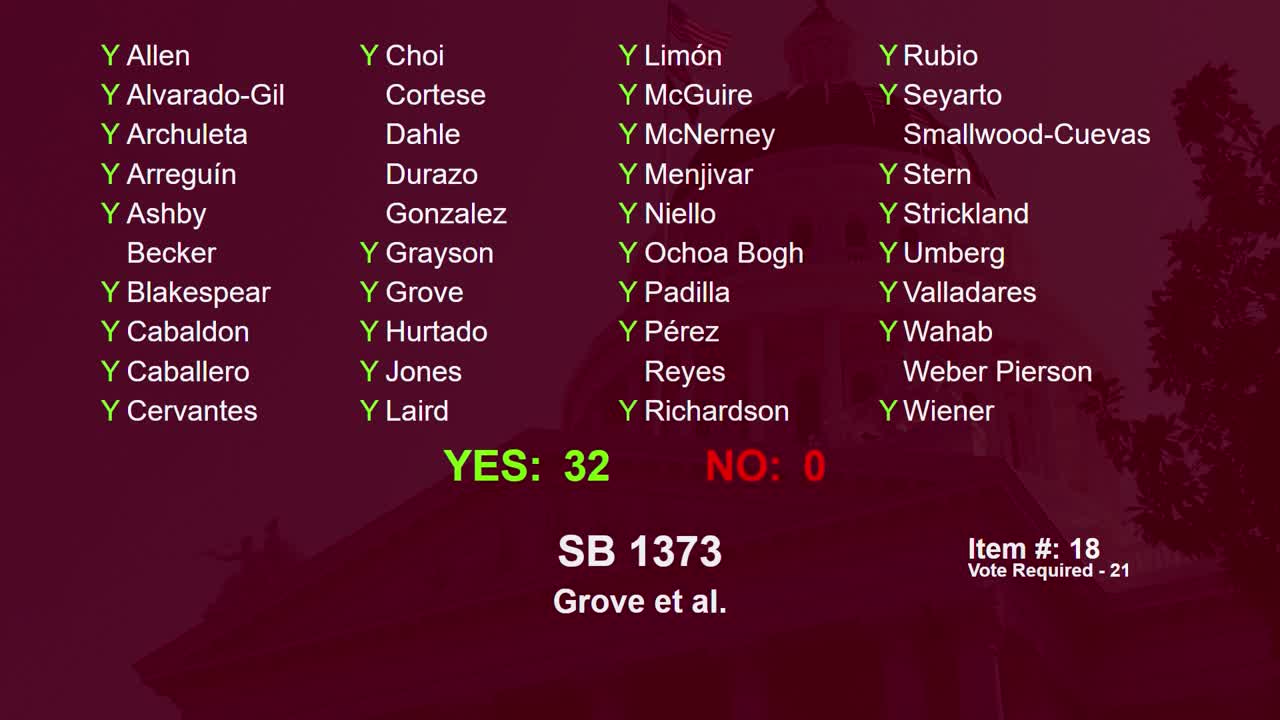
Bill Author

Bill Co-Author(s):