SB 1394: State holidays: Cesar Chavez Day: Farmworkers Day.
- Session Year: 2025-2026
- House: Senate
- Latest Version Date: 2026-09-27
Current Status:
Passed
(2026-09-27: Chaptered by Secretary of State. Chapter 708, Statutes of 2026.)
Introduced
In Committee
Awaiting First Chamber Vote
Passed First Chamber
In Committee
Awaiting Second Chamber Vote
Passed Second Chamber
Enacted
Existing law designates specific days as holidays in this state. Existing law designates holidays on which community colleges and public schools are authorized to close pursuant to a memorandum of understanding between the governing board and represented employees, including Cesar Chavez Day on March 31. Existing law entitles state employees, with specified exceptions, and authorizes certain community college and public school employees, to be given time off with pay for specified holidays, as specified. Existing law redesignates March 31 as Farmworkers Day instead of Cesar Chavez Day, and requires the Governor to annually proclaim March 31 as Farmworkers Day.
This bill would remove the designation of March 31 as Cesar Chavez Day for purposes of holidays on which community colleges and public schools are authorized to close, and instead authorize community colleges and public schools to close on April 10, known as Farmworkers Day, as specified. The bill would revise the provisions related to state employees, certain community college employees, and public school employees to instead apply to Farmworkers Day, as specified. The bill would also make conforming changes to designate April 10 as Farmworkers Day, and require the Governor to annually proclaim April 10 as Farmworkers Day.
Existing law designates August 26 as California Farmworker Day, and requires the Governor to annually proclaim August 26 as California Farmworker Day.
This bill would repeal the provisions relating to California Farmworker Day.
This bill would incorporate additional changes to Sections 45203, 79020, and 88203 of the Education Code proposed by AB 2017 to be operative only if this bill and AB 2017 are enacted and this bill is enacted last. The bill also would incorporate additional changes to Section 6700 of the Government Code proposed by AB 2017 and AB 2294 to be operative only if this bill and either or both of those bills are enacted and this bill is enacted last. The bill further would incorporate additional changes to Sections 19853 and 19853.1 of the Government Code proposed by AB 1841 and AB 2017 to be operative only if this bill and either or both of those bills are enacted and this bill is enacted last.
Existing law designates specific days as holidays in this state. Existing law designates holidays on which community colleges and public schools are authorized to close pursuant to a memorandum of understanding between the governing board and represented employees, including Cesar Chavez Day on March 31. Existing law entitles state employees, with specified exceptions, and authorizes certain community college and public school employees, to be given time off with pay for specified holidays, as specified. Existing law redesignates March 31 as Farmworkers Day instead of Cesar Chavez Day, and requires the Governor to annually proclaim March 31 as Farmworkers Day.
This bill would remove the designation of March 31 as Cesar Chavez Day for purposes of holidays on which community colleges and public schools are authorized to close, and instead authorize community colleges and public schools to close on August 6, April 10, known as Farmworkers Day. Day, as specified. The bill would revise the provisions related to state employees, certain community college employees, and public school employees to instead apply to Farmworker Farmworkers Day, as specified. The bill would also make conforming changes to designate August 6 April 10 as Farmworkers Day, and require the Governor to annually proclaim August 6 April 10 as Farmworkers Day.
Existing law designates August 26 as California Farmworker Day, and requires the Governor to annually proclaim August 26 as California Farmworker Day.
This bill would repeal the provisions relating to California Farmworker Day.
This bill would incorporate additional changes to Sections 45203, 79020, and 88203 of the Education Code proposed by AB 2017 to be operative only if this bill and AB 2017 are enacted and this bill is enacted last. The bill also would incorporate additional changes to Section 6700 of the Government Code proposed by AB 2017 and AB 2294 to be operative only if this bill and either or both of those bills are enacted and this bill is enacted last. The bill further would incorporate additional changes to Sections 19853 and 19853.1 of the Government Code proposed by AB 1841 and AB 2017 to be operative only if this bill and either or both of those bills are enacted and this bill is enacted last.
Existing law designates specific days as holidays in this state. Existing law designates holidays on which community colleges and public schools are authorized to close pursuant to a memorandum of understanding between the governing board and represented employees, including Cesar Chavez Day on March 31. Existing law entitles state employees, with specified exceptions, and authorizes certain community college and public school employees, to be given time off with pay for specified holidays, as specified. Existing law redesignates March 31 as Farmworkers Day instead of Cesar Chavez Day, and requires the Governor to annually proclaim March 31 as Farmworkers Day.
This bill would remove the designation of March 31 as Cesar Chavez Day for purposes of holidays on which community colleges and public schools are authorized to close, and instead authorize community colleges and public schools to close on August 6, known as Farmworkers Day. The bill would revise the provisions related to state employees, certain community college employees, and public school employees to instead apply to Farmworker Day, as specified. The bill would also make conforming changes to designate August 6 as Farmworkers Day, and require the Governor to annually proclaim August 6 as Farmworkers Day.
Existing law designates August 26 as California Farmworker Day, and requires the Governor to annually proclaim August 26 as California Farmworker Day.
This bill would repeal the provisions relating to California Farmworker Day.
Existing law provides that it is the goal of the state to conserve at least 30% of Californias lands and coastal waters by the year 2030, known as the 30x30 goal. Existing law requires the Secretary of the Natural Resources Agency to prepare and submit an annual report to the Legislature on progress made in the prior calendar year toward achieving the 30x30 goal. Existing law requires the report to include specified information, including identified barriers to implementing the 30x30 goal and recommended actions taken or needed to address those barriers.This bill would require the report to include sufficient information to accurately quantify and identify the acreage reported to be newly conserved and distinguish it from acreage previously reported as conserved. The bill would require the secretary to post the report on the Natural Resources Agencys internet website where it is publicly accessible.Existing law provides that it is the goal of the state to conserve at least 30% of Californias lands and coastal waters by the year 2030, known as the 30x30 goal. Existing law requires the Secretary of the Natural Resources Agency to prepare and submit an annual report to the Legislature on progress made in the prior calendar year toward achieving the 30x30 goal. Existing law requires the report to include specified information, including identified barriers to implementing the 30x30 goal and recommended actions taken or needed to address those barriers.
This bill would require the report to include sufficient information to accurately quantify and identify the acreage reported to be newly conserved and distinguish it from acreage previously reported as conserved. The bill would require the secretary to post the report on the Natural Resources Agencys internet website where it is publicly accessible.
(a)In addition to the holidays prescribed in Section 37220, public schools may be closed on April 10, known as Farmworkers Day, or the appropriate Monday or Friday following or preceding that date, if the governing board, pursuant to a memorandum of understanding reached pursuant to Chapter 10.7 (commencing with Section 3540) of Division 4 of Title 1 of the Government Code, agrees to close schools for that purpose.
(b)On April 10 or on the day determined by the governing board, public schools and educational institutions throughout the state may include exercises, funded through existing resources, commemorating and directing attention to the history of the farm labor movement in the United States.
(c)To the extent that the amendments to this section made by Senate Bill 1394 of the 202526 Regular Session conflict with a provision of a collective bargaining agreement entered into by a public school employer and an exclusive bargaining representative before January 1, 2027, pursuant to Chapter 10.7 (commencing with Section 3540) of Division 4 of Title 1 of the Government Code, those amendments shall not apply until the expiration or renewal of that collective bargaining agreement.
SEC. 2.Section 45203 of the Education Code is amended to read:45203.All probationary or permanent employees that are a part of the classified service shall be entitled to the following paid holidays provided they are in a paid status during any portion of the working day immediately preceding or succeeding the holiday: January 1, February 12 known as Lincoln Day, the third Monday in February known as Washington Day, the last Monday in May known as Memorial Day, July 4, the first Monday in September known as Labor Day, November 11 known as Veterans Day, that Thursday in November proclaimed by the President as Thanksgiving Day, December 25, every day appointed by the President, or the Governor of this state, as provided for in paragraphs (11) and (12) of subdivision (a) of Section 37220 for a public fast, thanksgiving, or holiday, or any day declared a holiday under Section 1318 or 37222 for classified or certificated employees. School recesses during the Christmas, Easter, and mid-February periods shall not be considered holidays for classified employees who are normally required to work during that period. However, this shall not be construed as affecting vacation rights specified in this section. For purposes of this section, appointed by the President includes the President signing into law legislation that creates a nationwide federal holiday, including the legal public holidays listed in subsection (a) of Section 6103 of Title 5 of the United States Code, but does not include Columbus Day. This definition is declaratory of existing law.
Regular employees of the district who are not normally assigned to duty during the school holidays of December 25 and January 1 shall be paid for those two holidays provided that they were in a paid status during any portion of the working day of their normal assignment immediately preceding or succeeding the holiday period.
When a holiday listed in this section falls on a Sunday, the following Monday shall be deemed to be the holiday in lieu of the day observed. When a holiday listed in this section falls on a Saturday, the preceding Friday shall be deemed to be the holiday in lieu of the day observed. When a classified employee is required to work on any of these holidays, they shall be paid compensation, or given compensating time off, for the work, in addition to the regular pay received for the holiday, at the rate of time and one-half the employees regular rate of pay.
The provisions of Article 3 (commencing with Section 37220) of Chapter 2 of Part 22 shall not be construed to in any way limit the provisions of this section, nor shall anything in this section be construed to prohibit the governing board from adopting separate work schedules for the certificated and the classified services, or from providing holiday pay for employees who have not been in paid status on the days specified herein. Notwithstanding the adoption of separate work schedules for the certificated and the classified services, on any schoolday during which pupils would otherwise have been in attendance but are not and for which certificated personnel receive regular pay, classified personnel shall also receive regular pay whether or not they are required to report for duty that day.
In addition to the other paid holidays specified in this section, the classified service may be entitled to a paid holiday on April 10 known as Farmworkers Day, a paid holiday on April 24 known as Genocide Remembrance Day, a paid holiday on the 15th day of the month of Kartik in the Hindu lunar calendar of each year, known as Diwali, and a paid holiday on the fourth Friday in September known as Native American Day, provided they are in a paid status during any portion of the working day immediately preceding or succeeding the holiday, if the governing board, pursuant to a memorandum of understanding reached pursuant to Chapter 10.7 (commencing with Section 3540) of Division 4 of Title 1 of the Government Code, agrees to the paid holiday. To the extent that the amendments to this paragraph made by Senate Bill 1394 of the 202526 Regular Session conflict with a provision of a collective bargaining agreement entered into by a public school employer and an exclusive bargaining representative before January 1, 2027, pursuant to Chapter 10.7 (commencing with Section 3540) of Division 4 of Title 1 of the Government Code, those amendments shall not apply until the expiration or renewal of that collective bargaining agreement.
This section shall apply to districts that have adopted the merit system in the same manner and effect as if it were a part of Article 6 (commencing with Section 45240).
SEC. 2.5.Section 45203 of the Education Code is amended to read:45203.All probationary or permanent employees that are a part of the classified service shall be entitled to the following paid holidays provided they are in a paid status during any portion of the working day immediately preceding or succeeding the holiday: January 1, February 12 known as Lincoln Day, the third Monday in February known as Washington Day, the last Monday in May known as Memorial Day, July 4, the first Monday in September known as Labor Day, November 11 known as Veterans Day, that Thursday in November proclaimed by the President as Thanksgiving Day, December 25, every day appointed by the President, or the Governor of this state, as provided for in paragraphs (11) and (12) of subdivision (a) of Section 37220 for a public fast, thanksgiving, or holiday, or any day declared a holiday under Section 1318 or 37222 for classified or certificated employees. School recesses during the Christmas, Easter, and mid-February periods shall not be considered holidays for classified employees who are normally required to work during that period. However, this shall not be construed as affecting vacation rights specified in this section. For purposes of this section, appointed by the President includes the President signing into law legislation that creates a nationwide federal holiday, including the legal public holidays listed in subsection (a) of Section 6103 of Title 5 of the United States Code, but does not include Columbus Day. This definition is declaratory of existing law.
Regular employees of the district who are not normally assigned to duty during the school holidays of December 25 and January 1 shall be paid for those two holidays provided that they were in a paid status during any portion of the working day of their normal assignment immediately preceding or succeeding the holiday period.
When a holiday listed in this section falls on a Sunday, the following Monday shall be deemed to be the holiday in lieu of the day observed. When a holiday listed in this section falls on a Saturday, the preceding Friday shall be deemed to be the holiday in lieu of the day observed. When a classified employee is required to work on any of these holidays, they shall be paid compensation, or given compensating time off, for the work, in addition to the regular pay received for the holiday, at the rate of time and one-half the employees regular rate of pay.
The provisions of Article 3 (commencing with Section 37220) of Chapter 2 of Part 22 shall not be construed to in any way limit the provisions of this section, nor shall anything in this section be construed to prohibit the governing board from adopting separate work schedules for the certificated and the classified services, or from providing holiday pay for employees who have not been in paid status on the days specified herein. Notwithstanding the adoption of separate work schedules for the certificated and the classified services, on any schoolday during which pupils would otherwise have been in attendance but are not and for which certificated personnel receive regular pay, classified personnel shall also receive regular pay whether or not they are required to report for duty that day.
In addition to the other paid holidays specified in this section, the classified service may be entitled to a paid holiday on the first day of the month of Shawwal in the Islamic lunar calendar, known as Eid al-Fitr, a paid holiday on April 10, known as Farmworkers Day, a paid holiday on April 24 known as Genocide Remembrance Day, a paid holiday on the 15th day of the month of Kartik in the Hindu lunar calendar of each year, known as Diwali, a paid holiday on the 10th day of the month of Dhu al-Hijjah in the Islamic lunar calendar, known as Eid al-Adha, and a paid holiday on the fourth Friday in September known as Native American Day, provided they are in a paid status during any portion of the working day immediately preceding or succeeding the holiday, if the governing board, pursuant to a memorandum of understanding reached pursuant to Chapter 10.7 (commencing with Section 3540) of Division 4 of Title 1 of the Government Code, agrees to the paid holiday. To the extent that the amendments to this paragraph made by Senate Bill 1394 of the 202526 Regular Session conflict with a provision of a collective bargaining agreement entered into by a public school employer and an exclusive bargaining representative before January 1, 2027, pursuant to Chapter 10.7 (commencing with Section 3540) of Division 4 of Title 1 of the Government Code, those amendments shall not apply until the expiration or renewal of that collective bargaining agreement.
This section shall apply to districts that have adopted the merit system in the same manner and effect as if it were a part of Article 6 (commencing with Section 45240).
SEC. 3.Section 79020 of the Education Code is amended to read:79020.Except as otherwise provided, the community colleges shall continue in session or close on specified holidays as follows:
(a)The community colleges shall close on January 1, the third Monday in January, commencing in the 198990 fiscal year, known as Dr. Martin Luther King, Jr. Day, February 12 known as Lincoln Day, the third Monday in February known as Washington Day, the last Monday in May known as Memorial Day, July 4, the first Monday in September known as Labor Day, November 11 known as Veterans Day, that Thursday in November proclaimed by the President as Thanksgiving Day, and December 25.
(b)Any contractual provision between any community college district and its employees in effect on the effective date of the act that adds this subdivision shall prevail over any conflict regarding Dr. Martin Luther King, Jr. Day until the termination date of the contract or upon termination by mutual agreement of the parties, whichever occurs first.
(c)The Governor in appointing any other day for a public fast, thanksgiving, or holiday may provide whether the community colleges shall close on the day. If the Governor does not provide whether the community colleges shall close, they shall continue in session on all special or limited holidays appointed by the Governor, but shall close on all other days appointed by the Governor for a public fast, thanksgiving, or holiday.
(d)(1)The community colleges shall close on every day appointed by the President as a public fast, thanksgiving, or holiday, unless it is a special or limited holiday.
(2)For purposes of this subdivision, appointed by the President includes the President signing into law legislation that creates a nationwide federal holiday, including the legal public holidays listed in subsection (a) of Section 6103 of Title 5 of the United States Code, but does not include Columbus Day. This definition is declaratory of existing law.
(e)The community colleges shall continue in session on all legal holidays other than those designated by or pursuant to this section, and shall hold proper exercises commemorating the day.
(f)When any of the holidays on which the schools would be closed fall on Sunday, the community colleges shall close on the Monday following, except that (1) if Lincoln Day falls on a Sunday, the community colleges may observe this holiday on the preceding or following Friday, the following Monday, or the following Tuesday, and maintain classes on the date specified in subdivision (a) where applicable, or (2) if Lincoln Day falls on a Monday, the community colleges may observe this holiday on the preceding or following Friday, that Monday, or the following Tuesday, and maintain classes on the date specified in subdivision (a) where applicable.
(g)When any of the holidays on which the schools would be closed, except Lincoln Day, fall on Saturday, the community colleges shall close on the preceding Friday, and that Friday shall be declared a state holiday.
(h)If any holiday on which the community colleges are required to close pursuant to subdivision (a) occurs under federal law on a date different than the date specified in subdivision (a), the governing board of any community college district may close the community colleges of the district on the date recognized by federal law and maintain classes on the date specified in subdivision (a).
(i)When Veterans Day would fall on Tuesday, the governing board of a community college district may close the colleges on the preceding Monday, and maintain classes on the date specified in subdivision (a). When Veterans Day would fall on Wednesday, the governing board of a community college district may close the colleges on either the preceding Monday or the following Friday, and maintain classes on the date specified in subdivision (a). When Veterans Day would fall on Thursday, the governing board of a community college district may close the colleges on the following Friday, and maintain classes on the date specified in subdivision (a).
(j)When Lincoln Day would fall on Tuesday, the governing board of a community college district may close the colleges on the preceding Monday, the preceding Friday, or the following Friday, and maintain classes on the date specified in subdivision (a) where appropriate. When Lincoln Day would fall on Wednesday, the governing board of a community college district may close the colleges on the preceding Monday, the preceding Friday, or the following Friday, and maintain classes on the date specified in subdivision (a). When Lincoln Day would fall on Thursday, the governing board of a community college district may close the colleges on the preceding Friday or the following Friday, and maintain classes on the date specified in subdivision (a). When Lincoln Day falls on Saturday, the governing board of a community college district may close the colleges on the preceding Friday or the following Friday, and maintain classes on the date specified in subdivision (a) where appropriate.
(k)(1)Except as provided in paragraph (2), in addition to the holidays specified in subdivision (a), a community college may close on April 10, known as Farmworkers Day, if the governing board, pursuant to a memorandum of understanding reached pursuant to Chapter 10.7 (commencing with Section 3540) of Division 4 of Title 1 of the Government Code, agrees to close the community college for that purpose.
(2)To the extent that the amendments to this subdivision made by Senate Bill 1394 of the 202526 Regular Session conflict with a provision of a collective bargaining agreement entered into by a higher education employer and an exclusive bargaining representative before January 1, 2027, pursuant to Chapter 12 (commencing with Section 3560) of Division 4 of Title 1 of the Government Code, those amendments shall not apply until the expiration or renewal of that collective bargaining agreement.
(l)In addition to the holidays specified in subdivision (a), a community college may close on April 24, known as Genocide Remembrance Day, the 15th day of the month of Kartik in the Hindu lunar calendar of each year, known as Diwali, and the fourth Friday in September, known as Native American Day, if the governing board, pursuant to a memorandum of understanding reached pursuant to Chapter 10.7 (commencing with Section 3540) of Division 4 of Title 1 of the Government Code, agrees to close the community college for that purpose.
(m)In addition to the holidays specified in subdivision (a), Glendale Community College may close on April 24, known as Genocide Remembrance Day, if the governing board, pursuant to a memorandum of understanding reached pursuant to Chapter 10.7 (commencing with Section 3540) of Division 4 of Title 1 of the Government Code, agrees to close the community college for that purpose.
(n)Notwithstanding subdivision (a), a community college may replace closing on February 12, Lincoln Day, or the third Monday in February, Washington Day, with the date corresponding with the second new moon following the winter solstice, or the third new moon following the winter solstice should an intercalary month intervene, known as Lunar New Year, if the governing board of the community college district, pursuant to a memorandum of understanding reached pursuant to Chapter 10.7 (commencing with Section 3540) of Division 4 of Title 1 of the Government Code, agrees to close the community college for that purpose. When Lunar New Year falls on another holiday, the community college shall observe Lunar New Year on a preceding or following weekday.
(o)This section shall not be interpreted as authorizing a community college district governing board to maintain community colleges in its district for a lesser number of days during the college year than the minimum established by law.
SEC. 3.5.Section 79020 of the Education Code is amended to read:79020.Except as otherwise provided, the community colleges shall continue in session or close on specified holidays as follows:
(a)The community colleges shall close on January 1, the third Monday in January, commencing in the 198990 fiscal year, known as Dr. Martin Luther King, Jr. Day, February 12 known as Lincoln Day, the third Monday in February known as Washington Day, the last Monday in May known as Memorial Day, July 4, the first Monday in September known as Labor Day, November 11 known as Veterans Day, that Thursday in November proclaimed by the President as Thanksgiving Day, and December 25.
(b)Any contractual provision between any community college district and its employees in effect on the effective date of the act that adds this subdivision shall prevail over any conflict regarding Dr. Martin Luther King, Jr. Day until the termination date of the contract or upon termination by mutual agreement of the parties, whichever occurs first.
(c)The Governor in appointing any other day for a public fast, thanksgiving, or holiday may provide whether the community colleges shall close on the day. If the Governor does not provide whether the community colleges shall close, they shall continue in session on all special or limited holidays appointed by the Governor, but shall close on all other days appointed by the Governor for a public fast, thanksgiving, or holiday.
(d)(1)The community colleges shall close on every day appointed by the President as a public fast, thanksgiving, or holiday, unless it is a special or limited holiday.
(2)For purposes of this subdivision, appointed by the President includes the President signing into law legislation that creates a nationwide federal holiday, including the legal public holidays listed in subsection (a) of Section 6103 of Title 5 of the United States Code, but does not include Columbus Day. This definition is declaratory of existing law.
(e)The community colleges shall continue in session on all legal holidays other than those designated by or pursuant to this section, and shall hold proper exercises commemorating the day.
(f)When any of the holidays on which the schools would be closed fall on Sunday, the community colleges shall close on the Monday following, except that (1) if Lincoln Day falls on a Sunday, the community colleges may observe this holiday on the preceding or following Friday, the following Monday, or the following Tuesday, and maintain classes on the date specified in subdivision (a) where applicable, or (2) if Lincoln Day falls on a Monday, the community colleges may observe this holiday on the preceding or following Friday, that Monday, or the following Tuesday, and maintain classes on the date specified in subdivision (a) where applicable.
(g)When any of the holidays on which the schools would be closed, except Lincoln Day, fall on Saturday, the community colleges shall close on the preceding Friday, and that Friday shall be declared a state holiday.
(h)If any holiday on which the community colleges are required to close pursuant to subdivision (a) occurs under federal law on a date different than the date specified in subdivision (a), the governing board of any community college district may close the community colleges of the district on the date recognized by federal law and maintain classes on the date specified in subdivision (a).
(i)When Veterans Day would fall on Tuesday, the governing board of a community college district may close the colleges on the preceding Monday, and maintain classes on the date specified in subdivision (a). When Veterans Day would fall on Wednesday, the governing board of a community college district may close the colleges on either the preceding Monday or the following Friday, and maintain classes on the date specified in subdivision (a). When Veterans Day would fall on Thursday, the governing board of a community college district may close the colleges on the following Friday, and maintain classes on the date specified in subdivision (a).
(j)When Lincoln Day would fall on Tuesday, the governing board of a community college district may close the colleges on the preceding Monday, the preceding Friday, or the following Friday, and maintain classes on the date specified in subdivision (a) where appropriate. When Lincoln Day would fall on Wednesday, the governing board of a community college district may close the colleges on the preceding Monday, the preceding Friday, or the following Friday, and maintain classes on the date specified in subdivision (a). When Lincoln Day would fall on Thursday, the governing board of a community college district may close the colleges on the preceding Friday or the following Friday, and maintain classes on the date specified in subdivision (a). When Lincoln Day falls on Saturday, the governing board of a community college district may close the colleges on the preceding Friday or the following Friday, and maintain classes on the date specified in subdivision (a) where appropriate.
(k)(1)Except as provided in paragraph (2), in addition to the holidays specified in subdivision (a), a community college may close on April 10, known as Farmworkers Day, if the governing board, pursuant to a memorandum of understanding reached pursuant to Chapter 10.7 (commencing with Section 3540) of Division 4 of Title 1 of the Government Code, agrees to close the community college for that purpose.
(2)To the extent that the amendments to this subdivision made by Senate Bill 1394 of the 202526 Regular Session conflict with a provision of a collective bargaining agreement entered into by a higher education employer and an exclusive bargaining representative before January 1, 2027, pursuant to Chapter 12 (commencing with Section 3560) of Division 4 of Title 1 of the Government Code, those amendments shall not apply until the expiration or renewal of that collective bargaining agreement.
(l)In addition to the holidays specified in subdivision (a), a community college may close on the first day of the month of Shawwal in the Islamic lunar calendar, known as Eid al-Fitr, April 24, known as Genocide Remembrance Day, the 15th day of the month of Kartik in the Hindu lunar calendar of each year, known as Diwali, the 10th day of the month of Dhu al-Hijjah in the Islamic lunar calendar, known as Eid al-Adha, and the fourth Friday in September, known as Native American Day, if the governing board, pursuant to a memorandum of understanding reached pursuant to Chapter 10.7 (commencing with Section 3540) of Division 4 of Title 1 of the Government Code, agrees to close the community college for that purpose.
(m)In addition to the holidays specified in subdivision (a), Glendale Community College may close on April 24, known as Genocide Remembrance Day, if the governing board, pursuant to a memorandum of understanding reached pursuant to Chapter 10.7 (commencing with Section 3540) of Division 4 of Title 1 of the Government Code, agrees to close the community college for that purpose.
(n)Notwithstanding subdivision (a), a community college may replace closing on February 12, Lincoln Day, or the third Monday in February, Washington Day, with the date corresponding with the second new moon following the winter solstice, or the third new moon following the winter solstice should an intercalary month intervene, known as Lunar New Year, if the governing board of the community college district, pursuant to a memorandum of understanding reached pursuant to Chapter 10.7 (commencing with Section 3540) of Division 4 of Title 1 of the Government Code, agrees to close the community college for that purpose. When Lunar New Year falls on another holiday, the community college shall observe Lunar New Year on a preceding or following weekday.
(o)This section shall not be interpreted as authorizing a community college district governing board to maintain community colleges in its district for a lesser number of days during the college year than the minimum established by law.
SEC. 4.Section 88203 of the Education Code is amended to read:88203.(a)(1)All probationary or permanent employees who are part of the classified service shall be entitled to the following paid holidays if they are in a paid status during any portion of the working day immediately preceding or succeeding the holiday:
(A)January 1.
(B)February 12 known as Lincoln Day.
(C)The third Monday in February known as Washington Day.
(D)The last Monday in May known as Memorial Day.
(E)July 4.
(F)The first Monday in September known as Labor Day.
(G)November 11 known as Veterans Day.
(H)That Thursday in November proclaimed by the President as Thanksgiving Day.
(I)December 25.
(J)Every day appointed by the President, or the Governor of this state, as provided for in subdivisions (c) and (d) of Section 79020 for a public fast, thanksgiving, or holiday.
(K)Any day declared a holiday under Section 1318 for classified or academic employees.
(2)College recesses during the Christmas and Easter periods shall not be considered holidays for classified employees who are normally required to work during that period; provided, however, that this shall not be construed as affecting vacation rights specified in this section.
(3)For purposes of this section, appointed by the President includes the President signing into law legislation that creates a nationwide federal holiday, including the legal public holidays listed in subsection (a) of Section 6103 of Title 5 of the United States Code, but does not include Columbus Day. This definition is declaratory of existing law.
(b)Regular employees of the community college district who are not normally assigned to duty during the community college holidays of December 25 and January 1 shall be paid for those two holidays if they were in a paid status during any portion of the working day of their normal assignment immediately preceding or succeeding the holiday period.
(c)When a holiday listed in this section falls on a Sunday, the following Monday shall be deemed to be the holiday in lieu of the day observed. When a holiday listed in this section falls on a Saturday, the preceding Friday shall be deemed to be the holiday in lieu of the day observed. When a classified employee is required to work on any of the holidays listed in this section, they shall be paid compensation, or given compensating time off, for such work, in addition to the regular pay received for the holiday, at the rate of time and one-half their regular rate of pay.
(d)Article 3 (commencing with Section 79020) of Chapter 8 of Part 48 shall not be construed to in any way limit this section, nor shall anything in this section be construed to prohibit the governing board of a community college district from adopting separate work schedules for the academic and the classified services, or from providing holiday pay for employees who have not been in paid status on the days specified in this section. Notwithstanding the adoption of separate work schedules for the academic and the classified services, on any schoolday during which students would otherwise have been in attendance, but are not and for which faculty receive regular pay, classified personnel shall also receive regular pay whether or not they are required to report for duty that day.
(e)(1)In addition to the other paid holidays specified in this section, the classified service may be entitled to a paid holiday on April 10 known as Farmworkers Day, a paid holiday on April 24 known as Genocide Remembrance Day, a paid holiday on the 15th day of the month of Kartik in the Hindu lunar calendar of each year, known as Diwali, and a paid holiday on the fourth Friday in September known as Native American Day, if they are in a paid status during any portion of the working day immediately preceding or succeeding the holiday, if the governing board of the community college district, pursuant to a memorandum of understanding reached pursuant to Chapter 10.7 (commencing with Section 3540) of Division 4 of Title 1 of the Government Code, agrees to the paid holiday.
(2)To the extent that the amendments to this subdivision made by Senate Bill 1394 of the 202526 Regular Session conflict with a provision of a collective bargaining agreement entered into by a higher education employer and an exclusive bargaining representative before January 1, 2027, pursuant to Chapter 12 (commencing with Section 3560) of Division 4 of Title 1 of the Government Code, those amendments shall not apply until the expiration or renewal of that collective bargaining agreement.
(f)In lieu of a paid holiday on February 12, Lincoln Day, or the third Monday in February, Washington Day, as specified in this section, the classified service shall be entitled to a paid holiday on the date corresponding to the Lunar New Year holiday selected pursuant to subdivision (n) of Section 79020, if they are in a paid status during any portion of the working day immediately preceding or succeeding the Lunar New Year holiday, if the governing board of the community college district, pursuant to a memorandum of understanding reached pursuant to Chapter 10.7 (commencing with Section 3540) of Division 4 of Title 1 of the Government Code, agrees to the replacement holiday pursuant to subdivision (n) of Section 79020.
(g)This section shall apply to community college districts that have adopted the merit system in the same manner and effect as if it were a part of Article 3 (commencing with Section 88060).
SEC. 4.5.Section 88203 of the Education Code is amended to read:88203.(a)(1)All probationary or permanent employees who are part of the classified service shall be entitled to the following paid holidays if they are in a paid status during any portion of the working day immediately preceding or succeeding the holiday:
(A)January 1.
(B)February 12 known as Lincoln Day.
(C)The third Monday in February known as Washington Day.
(D)The last Monday in May known as Memorial Day.
(E)July 4.
(F)The first Monday in September known as Labor Day.
(G)November 11 known as Veterans Day.
(H)That Thursday in November proclaimed by the President as Thanksgiving Day.
(I)December 25.
(J)Every day appointed by the President, or the Governor of this state, as provided for in subdivisions (c) and (d) of Section 79020 for a public fast, thanksgiving, or holiday.
(K)Any day declared a holiday under Section 1318 for classified or academic employees.
(2)College recesses during the Christmas and Easter periods shall not be considered holidays for classified employees who are normally required to work during that period; provided, however, that this shall not be construed as affecting vacation rights specified in this section.
(3)For purposes of this section, appointed by the President includes the President signing into law legislation that creates a nationwide federal holiday, including the legal public holidays listed in subsection (a) of Section 6103 of Title 5 of the United States Code, but does not include Columbus Day. This definition is declaratory of existing law.
(b)Regular employees of the community college district who are not normally assigned to duty during the community college holidays of December 25 and January 1 shall be paid for those two holidays if they were in a paid status during any portion of the working day of their normal assignment immediately preceding or succeeding the holiday period.
(c)When a holiday listed in this section falls on a Sunday, the following Monday shall be deemed to be the holiday in lieu of the day observed. When a holiday listed in this section falls on a Saturday, the preceding Friday shall be deemed to be the holiday in lieu of the day observed. When a classified employee is required to work on any of the holidays listed in this section, they shall be paid compensation, or given compensating time off, for such work, in addition to the regular pay received for the holiday, at the rate of time and one-half their regular rate of pay.
(d)Article 3 (commencing with Section 79020) of Chapter 8 of Part 48 shall not be construed to in any way limit this section, nor shall anything in this section be construed to prohibit the governing board of a community college district from adopting separate work schedules for the academic and the classified services, or from providing holiday pay for employees who have not been in paid status on the days specified in this section. Notwithstanding the adoption of separate work schedules for the academic and the classified services, on any schoolday during which students would otherwise have been in attendance, but are not and for which faculty receive regular pay, classified personnel shall also receive regular pay whether or not they are required to report for duty that day.
(e)(1)In addition to the other paid holidays specified in this section, the classified service may be entitled to a paid holiday on the first day of the month of Shawwal in the Islamic lunar calendar, known as Eid al-Fitr, a paid holiday on April 10 known as Farmworkers Day, a paid holiday on April 24 known as Genocide Remembrance Day, a paid holiday on the 15th day of the month of Kartik in the Hindu lunar calendar of each year, known as Diwali, a paid holiday on the 10th day of the month of Dhu al-Hijjah in the Islamic lunar calendar, known as Eid al-Adha, and a paid holiday on the fourth Friday in September known as Native American Day, if they are in a paid status during any portion of the working day immediately preceding or succeeding the holiday, if the governing board of the community college district, pursuant to a memorandum of understanding reached pursuant to Chapter 10.7 (commencing with Section 3540) of Division 4 of Title 1 of the Government Code, agrees to the paid holiday.
(2)To the extent that the amendments to this subdivision made by Senate Bill 1394 of the 202526 Regular Session conflict with a provision of a collective bargaining agreement entered into by a higher education employer and an exclusive bargaining representative before January 1, 2027, pursuant to Chapter 12 (commencing with Section 3560) of Division 4 of Title 1 of the Government Code, those amendments shall not apply until the expiration or renewal of that collective bargaining agreement.
(f)In lieu of a paid holiday on February 12, Lincoln Day, or the third Monday in February, Washington Day, as specified in this section, the classified service shall be entitled to a paid holiday on the date corresponding to the Lunar New Year holiday selected pursuant to subdivision (n) of Section 79020, if they are in a paid status during any portion of the working day immediately preceding or succeeding the Lunar New Year holiday, if the governing board of the community college district, pursuant to a memorandum of understanding reached pursuant to Chapter 10.7 (commencing with Section 3540) of Division 4 of Title 1 of the Government Code, agrees to the replacement holiday pursuant to subdivision (n) of Section 79020.
(g)This section shall apply to community college districts that have adopted the merit system in the same manner and effect as if it were a part of Article 3 (commencing with Section 88060).
SEC. 5.Section 6700 of the Government Code is amended to read:6700.(a)The holidays in this state are:
(1)Every Sunday.
(2)January 1.
(3)The third Monday in January, known as Dr. Martin Luther King, Jr. Day.
(4)The date corresponding with the second new moon following the winter solstice, or the third new moon following the winter solstice should an intercalary month intervene, known as Lunar New Year.
(5)February 12, known as Lincoln Day.
(6)The third Monday in February.
(7)April 10, known as Farmworkers Day.
(8)April 24, known as Genocide Remembrance Day.
(9)The 15th day of the month of Kartik in the Hindu lunar calendar of each year, known as Diwali.
(10)The last Monday in May.
(11)June 19, known as Juneteenth.
(12)July 4.
(13)The first Monday in September.
(14)September 9, known as Admission Day.
(15)The fourth Friday in September, known as Native American Day.
(16)The second Monday in October, known as Columbus Day.
(17)November 11, known as Veterans Day.
(18)December 25.
(19)Good Friday from 12 noon until 3 p.m.
(20)(A)Every day appointed by the President or Governor for a public fast, thanksgiving, or holiday.
(B)Except for the Thursday in November appointed as Thanksgiving Day, this paragraph and paragraphs (3), (4), and (7) shall not apply to a city, county, or district unless made applicable by charter, or by ordinance or resolution of the governing body thereof.
(b)If this section is in conflict with the provisions of a memorandum of understanding reached pursuant to Chapter 12 (commencing with Section 3560) of Division 4 of Title 1, the memorandum of understanding shall be controlling without further legislative action, except that if those provisions of a memorandum of understanding require the expenditure of funds, the provisions shall not become effective unless approved by the Legislature in the annual Budget Act.
SEC. 5.1.Section 6700 of the Government Code is amended to read:6700.(a)The holidays in this state are:
(1)Every Sunday.
(2)January 1.
(3)The third Monday in January, known as Dr. Martin Luther King, Jr. Day.
(4)The date corresponding with the second new moon following the winter solstice, or the third new moon following the winter solstice should an intercalary month intervene, known as Lunar New Year.
(5)February 12, known as Lincoln Day.
(6)The third Monday in February.
(7)The first day of the month of Shawwal in the Islamic lunar calendar, known as Eid al-Fitr.
(8)April 10, known as Farmworkers Day.
(9)April 24, known as Genocide Remembrance Day.
(10)The 15th day of the month of Kartik in the Hindu lunar calendar of each year, known as Diwali.
(11)The 10th day of the month of Dhu al-Hijjah in the Islamic lunar calendar, known as Eid al-Adha.
(12)The last Monday in May.
(13)June 19, known as Juneteenth.
(14)July 4.
(15)The first Monday in September.
(16)September 9, known as Admission Day.
(17)The fourth Friday in September, known as Native American Day.
(18)The second Monday in October, known as Columbus Day.
(19)November 11, known as Veterans Day.
(20)December 25.
(21)Good Friday from 12 noon until 3 p.m.
(22)(A)Every day appointed by the President or Governor for a public fast, thanksgiving, or holiday.
(B)Except for the Thursday in November appointed as Thanksgiving Day, this paragraph and paragraphs (3), (4), and (7) shall not apply to a city, county, or district unless made applicable by charter, or by ordinance or resolution of the governing body thereof.
(b)If this section is in conflict with the provisions of a memorandum of understanding reached pursuant to Chapter 12 (commencing with Section 3560) of Division 4 of Title 1, the memorandum of understanding shall be controlling without further legislative action, except that if those provisions of a memorandum of understanding require the expenditure of funds, the provisions shall not become effective unless approved by the Legislature in the annual Budget Act.
SEC. 5.2.Section 6700 of the Government Code is amended to read:6700.(a)The holidays in this state are:
(1)Every Sunday.
(2)January 1.
(3)The third Monday in January, known as Dr. Martin Luther King, Jr. Day.
(4)The date corresponding with the second new moon following the winter solstice, or the third new moon following the winter solstice should an intercalary month intervene, known as Lunar New Year.
(5)February 12, known as Lincoln Day.
(6)The third Monday in February.
(7)April 10, known as Farmworkers Day.
(8)April 24, known as Genocide Remembrance Day.
(9)The 15th day of the month of Kartik in the Hindu lunar calendar of each year, known as Diwali.
(10)The last Monday in May.
(11)June 19, known as Juneteenth.
(12)July 4.
(13)The first Monday in September.
(14)September 9, known as Admission Day.
(15)The fourth Friday in September, known as Native American Day.
(16)The second Monday in October, known as Columbus Day.
(17)November 11, known as Veterans Day.
(18)December 25.
(19)Good Friday from 12 noon until 3 p.m.
(20)April 14, known as Sylvia Mendez Day.
(21)(A)Every day appointed by the President or Governor for a public fast, thanksgiving, or holiday.
(B)Except for the Thursday in November appointed as Thanksgiving Day, this paragraph and paragraphs (3), (4), and (7) shall not apply to a city, county, or district unless made applicable by charter, or by ordinance or resolution of the governing body thereof.
(b)If this section is in conflict with the provisions of a memorandum of understanding reached pursuant to Chapter 12 (commencing with Section 3560) of Division 4 of Title 1, the memorandum of understanding shall be controlling without further legislative action, except that if those provisions of a memorandum of understanding require the expenditure of funds, the provisions shall not become effective unless approved by the Legislature in the annual Budget Act.
SEC. 5.3.Section 6700 of the Government Code is amended to read:6700.(a)The holidays in this state are:
(1)Every Sunday.
(2)January 1.
(3)The third Monday in January, known as Dr. Martin Luther King, Jr. Day.
(4)The date corresponding with the second new moon following the winter solstice, or the third new moon following the winter solstice should an intercalary month intervene, known as Lunar New Year.
(5)February 12, known as Lincoln Day.
(6)The third Monday in February.
(7)The first day of the month of Shawwal in the Islamic lunar calendar, known as Eid al-Fitr.
(8)April 10, known as Farmworkers Day.
(9)April 24, known as Genocide Remembrance Day.
(10)The 15th day of the month of Kartik in the Hindu lunar calendar of each year, known as Diwali.
(11)The 10th day of the month of Dhu al-Hijjah in the Islamic lunar calendar, known as Eid al-Adha.
(12)The last Monday in May.
(13)June 19, known as Juneteenth.
(14)July 4.
(15)The first Monday in September.
(16)September 9, known as Admission Day.
(17)The fourth Friday in September, known as Native American Day.
(18)The second Monday in October, known as Columbus Day.
(19)November 11, known as Veterans Day.
(20)December 25.
(21)Good Friday from 12 noon until 3 p.m.
(22)April 14, known as Sylvia Mendez Day.
(23)(A)Every day appointed by the President or Governor for a public fast, thanksgiving, or holiday.
(B)Except for the Thursday in November appointed as Thanksgiving Day, this paragraph and paragraphs (3), (4), and (7) shall not apply to a city, county, or district unless made applicable by charter, or by ordinance or resolution of the governing body thereof.
(b)If this section is in conflict with the provisions of a memorandum of understanding reached pursuant to Chapter 12 (commencing with Section 3560) of Division 4 of Title 1, the memorandum of understanding shall be controlling without further legislative action, except that if those provisions of a memorandum of understanding require the expenditure of funds, the provisions shall not become effective unless approved by the Legislature in the annual Budget Act.
SEC. 6.Section 6701 of the Government Code is amended to read:6701.(a)If January 1, February 12, April 10, July 4, September 9, November 11, or December 25 falls upon a Sunday, the Monday following is a holiday.
(b)If November 11 falls upon a Saturday, the preceding Friday is a holiday.
(c)If April 10 falls upon a Tuesday, Wednesday, or Thursday, the Legislature may observe the holiday on one of the following:
(1)The preceding Friday.
(2)The preceding Monday.
(3)The following Friday.
(d)If any holiday designated in Section 6700 falls on a Saturday, the board of supervisors of any county may by ordinance or resolution provide that an alternate day shall be a holiday for the employees of the county, except those employees of the county working as court attaches.
SEC. 7.Section 6717 of the Government Code is amended to read:6717.The Governor shall annually proclaim April 10 as Farmworkers Day.
SEC. 8.Section 6731 of the Government Code is repealed.SEC. 9.Section 19853 of the Government Code is amended to read:19853.(a)All state employees shall be entitled to the following holidays: January 1, the third Monday in January, the third Monday in February, April 10, the last Monday in May, July 4, the first Monday in September, November 11, Thanksgiving Day, the day after Thanksgiving, December 25, the day chosen by an employee pursuant to Section 19854, and every day appointed by the Governor of this state for a public fast, thanksgiving, or holiday.
(b)If a day described in subdivision (a) falls on a Sunday, the following Monday shall be deemed to be the holiday in lieu of the day observed. If November 11 falls upon a Saturday, the preceding Friday shall be deemed to be the holiday in lieu of the day observed.
(c)(1)Any state employee who may be required to work on any of the holidays included in this section, and who does work on any of these holidays, shall be entitled to receive straight-time pay and eight hours of holiday credit.
(2)Notwithstanding paragraph (1), an employee who is excluded from the definition of state employee in subdivision (c) of Section 3513 and who is required to work on January 1, the last Monday in May, July 4, the first Monday in September, Thanksgiving Day, or December 25 shall be subject to the following:
(A)Excluded employees who are eligible for overtime payments under the federal Fair Labor Standards Act shall be paid one and one-half times their salary rate for all hours worked on the holiday and up to eight hours of holiday credit. This pay shall count toward any premium overtime compensation earned during the same workweek. Part-time employees shall receive prorated amounts subject to department rules.
(B)Excluded employees who are ineligible for overtime payments under the federal Fair Labor Standards Act shall receive up to eight hours of holiday credit and four hours of informal time off. Part-time employees shall receive prorated amounts of holiday credit and informal time off, subject to department rules.
(d)For the purpose of computing the number of hours worked, time when an employee is excused from work because of holidays, sick leave, vacation, annual leave, compensating time off, or any other leave shall not be considered as time worked by the employee for the purpose of computing cash compensation for overtime or compensating time off for overtime.
(e)Any state employee, as defined in subdivision (c) of Section 3513, may elect to receive eight hours of holiday credit for the date corresponding with the new moon following the winter solstice, or the third new moon following the winter solstice should an intercalary month intervene, known as Lunar New Year, April 24, known as Genocide Remembrance Day, the 15th day of the month of Kartik in the Hindu lunar calendar of each year, known as Diwali, June 19, known as Juneteenth, or the fourth Friday in September, known as Native American Day, in lieu of receiving eight hours of personal holiday credit in accordance with Section 19854.
(f)Persons employed on less than a full-time basis shall receive holidays in accordance with the Department of Human Resources rules.
(g)If subdivision (a), (c), or (d) is in conflict with the provisions of a memorandum of understanding executed or amended pursuant to Section 3517.5 on or after February 1, 2009, or the date that the act adding this section takes effect, whichever is later, the memorandum of understanding shall be controlling without further legislative action, except that if those provisions of the memorandum of understanding require the expenditure of funds, the provisions shall not become effective unless approved by the Legislature in the annual Budget Act.
SEC. 9.1.Section 19853 of the Government Code is amended to read:19853.(a)(1)All state employees shall be entitled to the following holidays: January 1, the third Monday in January, the third Monday in February, April 10, the last Monday in May, July 4, the first Monday in September, November 11, Thanksgiving Day, the day after Thanksgiving, December 25, the day chosen by an employee pursuant to Section 19854, and every day appointed by the Governor of this state for a public fast, thanksgiving, or holiday.
(2)Upon appropriation by the Legislature, all state employees shall be entitled to a holiday on the fourth Friday in September, known as Native American Day, in lieu of the election described in subdivision (e).
(b)If a day described in subdivision (a) falls on a Sunday, the following Monday shall be deemed to be the holiday in lieu of the day observed. If November 11 falls upon a Saturday, the preceding Friday shall be deemed to be the holiday in lieu of the day observed.
(c)(1)Any state employee who may be required to work on any of the holidays included in this section, and who does work on any of these holidays, shall be entitled to receive straight-time pay and eight hours of holiday credit.
(2)Notwithstanding paragraph (1), an employee who is excluded from the definition of state employee in subdivision (c) of Section 3513 and who is required to work on January 1, the last Monday in May, July 4, the first Monday in September, Thanksgiving Day, or December 25 shall be subject to the following:
(A)Excluded employees who are eligible for overtime payments under the federal Fair Labor Standards Act shall be paid one and one-half times their salary rate for all hours worked on the holiday and up to eight hours of holiday credit. This pay shall count toward any premium overtime compensation earned during the same workweek. Part-time employees shall receive prorated amounts subject to department rules.
(B)Excluded employees who are ineligible for overtime payments under the federal Fair Labor Standards Act shall receive up to eight hours of holiday credit and four hours of informal time off. Part-time employees shall receive prorated amounts of holiday credit and informal time off, subject to department rules.
(d)For the purpose of computing the number of hours worked, time when an employee is excused from work because of holidays, sick leave, vacation, annual leave, compensating time off, or any other leave shall not be considered as time worked by the employee for the purpose of computing cash compensation for overtime or compensating time off for overtime.
(e)Any state employee, as defined in subdivision (c) of Section 3513, may elect to receive eight hours of holiday credit for the date corresponding with the new moon following the winter solstice, or the third new moon following the winter solstice should an intercalary month intervene, known as Lunar New Year, April 24, known as Genocide Remembrance Day, the 15th day of the month of Kartik in the Hindu lunar calendar of each year, known as Diwali, June 19, known as Juneteenth, or the fourth Friday in September, known as Native American Day, except as provided in paragraph (2) of subdivision (a), in lieu of receiving eight hours of personal holiday credit in accordance with Section 19854.
(f)Persons employed on less than a full-time basis shall receive holidays in accordance with the Department of Human Resources rules.
(g)If subdivision (a), (c), or (d) is in conflict with the provisions of a memorandum of understanding executed or amended pursuant to Section 3517.5 on or after February 1, 2009, or the date that the act adding this section takes effect, whichever is later, the memorandum of understanding shall be controlling without further legislative action, except that if those provisions of the memorandum of understanding require the expenditure of funds, the provisions shall not become effective unless approved by the Legislature in the annual Budget Act.
SEC. 9.2.Section 19853 of the Government Code is amended to read:19853.(a)All state employees shall be entitled to the following holidays: January 1, the third Monday in January, the third Monday in February, April 10, the last Monday in May, July 4, the first Monday in September, November 11, Thanksgiving Day, the day after Thanksgiving, December 25, the day chosen by an employee pursuant to Section 19854, and every day appointed by the Governor of this state for a public fast, thanksgiving, or holiday.
(b)If a day described in subdivision (a) falls on a Sunday, the following Monday shall be deemed to be the holiday in lieu of the day observed. If November 11 falls upon a Saturday, the preceding Friday shall be deemed to be the holiday in lieu of the day observed.
(c)(1)Any state employee who may be required to work on any of the holidays included in this section, and who does work on any of these holidays, shall be entitled to receive straight-time pay and eight hours of holiday credit.
(2)Notwithstanding paragraph (1), an employee who is excluded from the definition of state employee in subdivision (c) of Section 3513 and who is required to work on January 1, the last Monday in May, July 4, the first Monday in September, Thanksgiving Day, or December 25 shall be subject to the following:
(A)Excluded employees who are eligible for overtime payments under the federal Fair Labor Standards Act shall be paid one and one-half times their salary rate for all hours worked on the holiday and up to eight hours of holiday credit. This pay shall count toward any premium overtime compensation earned during the same workweek. Part-time employees shall receive prorated amounts subject to department rules.
(B)Excluded employees who are ineligible for overtime payments under the federal Fair Labor Standards Act shall receive up to eight hours of holiday credit and four hours of informal time off. Part-time employees shall receive prorated amounts of holiday credit and informal time off, subject to department rules.
(d)For the purpose of computing the number of hours worked, time when an employee is excused from work because of holidays, sick leave, vacation, annual leave, compensating time off, or any other leave shall not be considered as time worked by the employee for the purpose of computing cash compensation for overtime or compensating time off for overtime.
(e)Any state employee, as defined in subdivision (c) of Section 3513, may elect to receive eight hours of holiday credit for the date corresponding with the new moon following the winter solstice, or the third new moon following the winter solstice should an intercalary month intervene, known as Lunar New Year, the first day of the month of Shawwal in the Islamic lunar calendar, known as Eid al-Fitr, April 24, known as Genocide Remembrance Day, the 15th day of the month of Kartik in the Hindu lunar calendar of each year, known as Diwali, June 19, known as Juneteenth, the 10th day of the month of Dhu al-Hijjah in the Islamic lunar calendar, known as Eid al-Adha, or the fourth Friday in September, known as Native American Day, in lieu of receiving eight hours of personal holiday credit in accordance with Section 19854. For those holidays whose dates vary annually, the employee may instead make the election on the dates designated by their group.
(f)Persons employed on less than a full-time basis shall receive holidays in accordance with the Department of Human Resources rules.
(g)If subdivision (a), (c), or (d) is in conflict with the provisions of a memorandum of understanding executed or amended pursuant to Section 3517.5 on or after February 1, 2009, or the date that the act adding this section takes effect, whichever is later, the memorandum of understanding shall be controlling without further legislative action, except that if those provisions of the memorandum of understanding require the expenditure of funds, the provisions shall not become effective unless approved by the Legislature in the annual Budget Act.
SEC. 9.3.Section 19853 of the Government Code is amended to read:19853.(a)(1)All state employees shall be entitled to the following holidays: January 1, the third Monday in January, the third Monday in February, April 10, the last Monday in May, July 4, the first Monday in September, November 11, Thanksgiving Day, the day after Thanksgiving, December 25, the day chosen by an employee pursuant to Section 19854, and every day appointed by the Governor of this state for a public fast, thanksgiving, or holiday.
(2)Upon appropriation by the Legislature, all state employees shall be entitled to a holiday on the fourth Friday in September, known as Native American Day, in lieu of the election described in subdivision (e).
(b)If a day described in subdivision (a) falls on a Sunday, the following Monday shall be deemed to be the holiday in lieu of the day observed. If November 11 falls upon a Saturday, the preceding Friday shall be deemed to be the holiday in lieu of the day observed.
(c)(1)Any state employee who may be required to work on any of the holidays included in this section, and who does work on any of these holidays, shall be entitled to receive straight-time pay and eight hours of holiday credit.
(2)Notwithstanding paragraph (1), an employee who is excluded from the definition of state employee in subdivision (c) of Section 3513 and who is required to work on January 1, the last Monday in May, July 4, the first Monday in September, Thanksgiving Day, or December 25 shall be subject to the following:
(A)Excluded employees who are eligible for overtime payments under the federal Fair Labor Standards Act shall be paid one and one-half times their salary rate for all hours worked on the holiday and up to eight hours of holiday credit. This pay shall count toward any premium overtime compensation earned during the same workweek. Part-time employees shall receive prorated amounts subject to department rules.
(B)Excluded employees who are ineligible for overtime payments under the federal Fair Labor Standards Act shall receive up to eight hours of holiday credit and four hours of informal time off. Part-time employees shall receive prorated amounts of holiday credit and informal time off, subject to department rules.
(d)For the purpose of computing the number of hours worked, time when an employee is excused from work because of holidays, sick leave, vacation, annual leave, compensating time off, or any other leave shall not be considered as time worked by the employee for the purpose of computing cash compensation for overtime or compensating time off for overtime.
(e)Any state employee, as defined in subdivision (c) of Section 3513, may elect to receive eight hours of holiday credit for the date corresponding with the new moon following the winter solstice, or the third new moon following the winter solstice should an intercalary month intervene, known as Lunar New Year, the first day of the month of Shawwal in the Islamic lunar calendar, known as Eid al-Fitr, April 24, known as Genocide Remembrance Day, the 15th day of the month of Kartik in the Hindu lunar calendar of each year, known as Diwali, June 19, known as Juneteenth, the 10th day of the month of Dhu al-Hijjah in the Islamic lunar calendar, known as Eid al-Adha, or the fourth Friday in September, known as Native American Day, except as provided in paragraph (2) of subdivision (a), in lieu of receiving eight hours of personal holiday credit in accordance with Section 19854. For those holidays whose dates vary annually, the employee may instead make the election on the dates designated by their group.
(f)Persons employed on less than a full-time basis shall receive holidays in accordance with the Department of Human Resources rules.
(g)If subdivision (a), (c), or (d) is in conflict with the provisions of a memorandum of understanding executed or amended pursuant to Section 3517.5 on or after February 1, 2009, or the date that the act adding this section takes effect, whichever is later, the memorandum of understanding shall be controlling without further legislative action, except that if those provisions of the memorandum of understanding require the expenditure of funds, the provisions shall not become effective unless approved by the Legislature in the annual Budget Act.
SEC. 10.Section 19853.1 of the Government Code is amended to read:19853.1.(a)Notwithstanding Section 19853, this section shall apply to state employees in State Bargaining Unit 5.
(b)Except as provided in subdivision (c), all employees shall be entitled to the following holidays: January 1, the third Monday in January, the third Monday in February, April 10, the last Monday in May, July 4, the first Monday in September, November 11, the day after Thanksgiving, December 25, and every day appointed by the Governor of this state for a public fast, thanksgiving, or holiday.
If a day listed in this subdivision falls on a Sunday, the following Monday shall be deemed to be the holiday in lieu of the day observed. If November 11 falls upon a Saturday, the preceding Friday shall be deemed to be the holiday in lieu of the day observed. Any employee who may be required to work on any of the holidays included in this section and who does work on any of these holidays shall be entitled to be paid compensation or given compensating time off for that work in accordance with their classifications assigned workweek group.
(c)If the provisions of subdivision (b) are in conflict with the provisions of a memorandum of understanding reached pursuant to Section 3517.5, the memorandum of understanding shall be controlling without further legislative action, except that if the provisions of a memorandum of understanding require the expenditure of funds, the provisions shall not become effective unless approved by the Legislature in the annual Budget Act.
(d)Any employee who either is excluded from the definition of state employee in subdivision (c) of Section 3513, or is a nonelected officer or employee of the executive branch of government who is not a member of the civil service, is entitled to the following holidays, with pay, in addition to any official state holiday appointed by the Governor:
(1)January 1, the third Monday in January, the third Monday in February, April 10, the last Monday in May, July 4, the first Monday in September, November 11, Thanksgiving Day, the day after Thanksgiving, and December 25.
(2)When November 11 falls on a Saturday, employees shall be entitled to the preceding Friday as a holiday with pay.
(3)When a holiday, other than a personal holiday, falls on a Saturday, an employee shall, regardless of whether the employee works on the holiday, accrue only an additional eight hours of personal holiday credit per fiscal year for the holiday. The holiday credit shall be accrued on the actual date of the holiday and shall be used within the same fiscal year.
(4)When a holiday other than a personal holiday falls on Sunday, employees shall be entitled to the following Monday as a holiday with pay.
(5)Employees who are required to work on a holiday shall be entitled to pay or compensating time off for this work in accordance with their classifications assigned workweek group.
(6)Persons employed on less than a full-time basis shall receive holidays in accordance with the Department of Human Resources rules.
(e)Any employee, as defined in subdivision (c) of Section 3513, may elect to use eight hours of vacation, annual leave, or compensating time off consistent with departmental operational needs and collective bargaining agreements for the date corresponding with the second new moon following the winter solstice, or the third new moon following the winter solstice should an intercalary month intervene, known as Lunar New Year, April 24, known as Genocide Remembrance Day, the 15th day of the month of Kartik in the Hindu lunar calendar of each year, known as Diwali, June 19, known as Juneteenth, and the fourth Friday in September, known as Native American Day.
SEC. 10.1.Section 19853.1 of the Government Code is amended to read:19853.1.(a)Notwithstanding Section 19853, this section shall apply to state employees in State Bargaining Unit 5.
(b)(1)Except as provided in subdivision (c), all employees shall be entitled to the following holidays: January 1, the third Monday in January, the third Monday in February, April 10, the last Monday in May, July 4, the first Monday in September, November 11, the day after Thanksgiving, December 25, and every day appointed by the Governor of this state for a public fast, thanksgiving, or holiday.
If a day described in this subdivision falls on a Sunday, the following Monday shall be deemed to be the holiday in lieu of the day observed. If November 11 falls upon a Saturday, the preceding Friday shall be deemed to be the holiday in lieu of the day observed. Any employee who may be required to work on any of the holidays included in this section and who does work on any of these holidays shall be entitled to be paid compensation or given compensating time off for that work in accordance with their classifications assigned workweek group.
(2)Upon appropriation by the Legislature as described in paragraph (2) of subdivision (a) of Section 19853, all employees shall be entitled to a holiday on the fourth Friday in September, known as Native American Day, in lieu of the election described in subdivision (e).
(c)If the provisions of subdivision (b) are in conflict with the provisions of a memorandum of understanding reached pursuant to Section 3517.5, the memorandum of understanding shall be controlling without further legislative action, except that if the provisions of a memorandum of understanding require the expenditure of funds, the provisions shall not become effective unless approved by the Legislature in the annual Budget Act.
(d)Any employee who either is excluded from the definition of state employee in subdivision (c) of Section 3513, or is a nonelected officer or employee of the executive branch of government who is not a member of the civil service, is entitled to the following holidays, with pay, in addition to any official state holiday appointed by the Governor:
(1)January 1, the third Monday in January, the third Monday in February, April 10, the last Monday in May, July 4, the first Monday in September, November 11, Thanksgiving Day, the day after Thanksgiving, and December 25.
(2)Upon appropriation by the Legislature as described in paragraph (2) of subdivision (a) of Section 19853, the fourth Friday in September, known as Native American Day.
(3)When November 11 falls on a Saturday, employees shall be entitled to the preceding Friday as a holiday with pay.
(4)When a holiday, other than a personal holiday, falls on a Saturday, an employee shall, regardless of whether the employee works on the holiday, accrue only an additional eight hours of personal holiday credit per fiscal year for the holiday. The holiday credit shall be accrued on the actual date of the holiday and shall be used within the same fiscal year.
(5)When a holiday other than a personal holiday falls on Sunday, employees shall be entitled to the following Monday as a holiday with pay.
(6)Employees who are required to work on a holiday shall be entitled to pay or compensating time off for this work in accordance with their classifications assigned workweek group.
(7)Persons employed on less than a full-time basis shall receive holidays in accordance with the Department of Human Resources rules.
(e)Any employee, as defined in subdivision (c) of Section 3513, may elect to use eight hours of vacation, annual leave, or compensating time off consistent with departmental operational needs and collective bargaining agreements for the date corresponding with the second new moon following the winter solstice, or the third new moon following the winter solstice should an intercalary month intervene, known as Lunar New Year, April 24, known as Genocide Remembrance Day, the 15th day of the month of Kartik in the Hindu lunar calendar of each year, known as Diwali, June 19, known as Juneteenth, and the fourth Friday in September, known as Native American Day, except as provided in paragraph (2) of subdivision (b).
SEC. 10.2.Section 19853.1 of the Government Code is amended to read:19853.1.(a)Notwithstanding Section 19853, this section shall apply to state employees in State Bargaining Unit 5.
(b)Except as provided in subdivision (c), all employees shall be entitled to the following holidays: January 1, the third Monday in January, the third Monday in February, April 10, the last Monday in May, July 4, the first Monday in September, November 11, the day after Thanksgiving, December 25, and every day appointed by the Governor of this state for a public fast, thanksgiving, or holiday.
If a day listed in this subdivision falls on a Sunday, the following Monday shall be deemed to be the holiday in lieu of the day observed. If November 11 falls upon a Saturday, the preceding Friday shall be deemed to be the holiday in lieu of the day observed. Any employee who may be required to work on any of the holidays included in this section and who does work on any of these holidays shall be entitled to be paid compensation or given compensating time off for that work in accordance with their classifications assigned workweek group.
(c)If the provisions of subdivision (b) are in conflict with the provisions of a memorandum of understanding reached pursuant to Section 3517.5, the memorandum of understanding shall be controlling without further legislative action, except that if the provisions of a memorandum of understanding require the expenditure of funds, the provisions shall not become effective unless approved by the Legislature in the annual Budget Act.
(d)Any employee who either is excluded from the definition of state employee in subdivision (c) of Section 3513, or is a nonelected officer or employee of the executive branch of government who is not a member of the civil service, is entitled to the following holidays, with pay, in addition to any official state holiday appointed by the Governor:
(1)January 1, the third Monday in January, the third Monday in February, April 10, the last Monday in May, July 4, the first Monday in September, November 11, Thanksgiving Day, the day after Thanksgiving, and December 25.
(2)When November 11 falls on a Saturday, employees shall be entitled to the preceding Friday as a holiday with pay.
(3)When a holiday, other than a personal holiday, falls on a Saturday, an employee shall, regardless of whether the employee works on the holiday, accrue only an additional eight hours of personal holiday credit per fiscal year for the holiday. The holiday credit shall be accrued on the actual date of the holiday and shall be used within the same fiscal year.
(4)When a holiday other than a personal holiday falls on Sunday, employees shall be entitled to the following Monday as a holiday with pay.
(5)Employees who are required to work on a holiday shall be entitled to pay or compensating time off for this work in accordance with their classifications assigned workweek group.
(6)Persons employed on less than a full-time basis shall receive holidays in accordance with the Department of Human Resources rules.
(e)Any employee, as defined in subdivision (c) of Section 3513, may elect to use eight hours of vacation, annual leave, or compensating time off consistent with departmental operational needs and collective bargaining agreements for the date corresponding with the second new moon following the winter solstice, or the third new moon following the winter solstice should an intercalary month intervene, known as Lunar New Year, the first day of the month of Shawwal in the Islamic lunar calendar, known as Eid al-Fitr, April 24, known as Genocide Remembrance Day, the 15th day of the month of Kartik in the Hindu lunar calendar of each year, known as Diwali, June 19, known as Juneteenth, the 10th day of the month of Dhu al-Hijjah in the Islamic lunar calendar, known as Eid al-Adha, and the fourth Friday in September, known as Native American Day. For those holidays whose dates vary annually, the employee may instead make the election on the dates designated by their group.
SEC. 10.3.Section 19853.1 of the Government Code is amended to read:19853.1.(a)Notwithstanding Section 19853, this section shall apply to state employees in State Bargaining Unit 5.
(b)(1)Except as provided in subdivision (c), all employees shall be entitled to the following holidays: January 1, the third Monday in January, the third Monday in February, April 10, the last Monday in May, July 4, the first Monday in September, November 11, the day after Thanksgiving, December 25, and every day appointed by the Governor of this state for a public fast, thanksgiving, or holiday.
If a day described in this subdivision falls on a Sunday, the following Monday shall be deemed to be the holiday in lieu of the day observed. If November 11 falls upon a Saturday, the preceding Friday shall be deemed to be the holiday in lieu of the day observed. Any employee who may be required to work on any of the holidays included in this section and who does work on any of these holidays shall be entitled to be paid compensation or given compensating time off for that work in accordance with their classifications assigned workweek group.
(2)Upon appropriation by the Legislature as described in paragraph (2) of subdivision (a) of Section 19853, all employees shall be entitled to a holiday on the fourth Friday in September, known as Native American Day, in lieu of the election described in subdivision (e).
(c)If the provisions of subdivision (b) are in conflict with the provisions of a memorandum of understanding reached pursuant to Section 3517.5, the memorandum of understanding shall be controlling without further legislative action, except that if the provisions of a memorandum of understanding require the expenditure of funds, the provisions shall not become effective unless approved by the Legislature in the annual Budget Act.
(d)Any employee who either is excluded from the definition of state employee in subdivision (c) of Section 3513, or is a nonelected officer or employee of the executive branch of government who is not a member of the civil service, is entitled to the following holidays, with pay, in addition to any official state holiday appointed by the Governor:
(1)January 1, the third Monday in January, the third Monday in February, April 10, the last Monday in May, July 4, the first Monday in September, November 11, Thanksgiving Day, the day after Thanksgiving, and December 25.
(2)Upon appropriation by the Legislature as described in paragraph (2) of subdivision (a) of Section 19853, the fourth Friday in September, known as Native American Day.
(3)When November 11 falls on a Saturday, employees shall be entitled to the preceding Friday as a holiday with pay.
(4)When a holiday, other than a personal holiday, falls on a Saturday, an employee shall, regardless of whether the employee works on the holiday, accrue only an additional eight hours of personal holiday credit per fiscal year for the holiday. The holiday credit shall be accrued on the actual date of the holiday and shall be used within the same fiscal year.
(5)When a holiday other than a personal holiday falls on Sunday, employees shall be entitled to the following Monday as a holiday with pay.
(6)Employees who are required to work on a holiday shall be entitled to pay or compensating time off for this work in accordance with their classifications assigned workweek group.
(7)Persons employed on less than a full-time basis shall receive holidays in accordance with the Department of Human Resources rules.
(e)Any employee, as defined in subdivision (c) of Section 3513, may elect to use eight hours of vacation, annual leave, or compensating time off consistent with departmental operational needs and collective bargaining agreements for the date corresponding with the second new moon following the winter solstice, or the third new moon following the winter solstice should an intercalary month intervene, known as Lunar New Year, the first day of the month of Shawwal in the Islamic lunar calendar, known as Eid al-Fitr, April 24, known as Genocide Remembrance Day, the 15th day of the month of Kartik in the Hindu lunar calendar of each year, known as Diwali, June 19, known as Juneteenth, the 10th day of the month of Dhu al-Hijjah in the Islamic lunar calendar, known as Eid al-Adha, and the fourth Friday in September, known as Native American Day, except as provided in paragraph (2) of subdivision (b). For those holidays whose dates vary annually, the employee may instead make the election on the dates designated by their group.
SEC. 11.(a)Section 2.5 of this bill incorporates amendments to Section 45203 of the Education Code proposed by both this bill and Assembly Bill 2017. That section of this bill shall only become operative if (1) both bills are enacted and become effective on or before January 1, 2027, (2) each bill amends Section 45203 of the Education Code, and (3) this bill is enacted after Assembly Bill 2017, in which case Section 2 of this bill shall not become operative.
(b)Section 3.5 of this bill incorporates amendments to Section 79020 of the Education Code proposed by both this bill and Assembly Bill 2017. That section of this bill shall only become operative if (1) both bills are enacted and become effective on or before January 1, 2027, (2) each bill amends Section 79020 of the Education Code, and (3) this bill is enacted after Assembly Bill 2017, in which case Section 3 of this bill shall not become operative.
(c)Section 4.5 of this bill incorporates amendments to Section 88203 of the Education Code proposed by both this bill and Assembly Bill 2017. That section of this bill shall only become operative if (1) both bills are enacted and become effective on or before January 1, 2027, (2) each bill amends Section 88203 of the Education Code, and (3) this bill is enacted after Assembly Bill 2017, in which case Section 4 of this bill shall not become operative.
(d)(1)Section 5.1 of this bill incorporates amendments to Section 6700 of the Government Code proposed by both this bill and Assembly Bill 2017. That section of this bill shall only become operative if (A) both bills are enacted and become effective on or before January 1, 2027, (B) each bill amends Section 6700 of the Government Code, (C) Assembly Bill 2294 is not enacted or as enacted does not amend that section, and (D) this bill is enacted after Assembly Bill 2017, in which case Sections 5, 5.2, and 5.3 of this bill shall not become operative.
(2)Section 5.2 of this bill incorporates amendments to Section 6700 of the Government Code proposed by both this bill and Assembly Bill 2294. That section of this bill shall only become operative if (A) both bills are enacted and become effective on or before January 1, 2027, (B) each bill amends Section 6700 of the Government Code, (C) Assembly Bill 2017 is not enacted or as enacted does not amend that section, and (D) this bill is enacted after Assembly Bill 2294, in which case Sections 5, 5.1, and 5.3 of this bill shall not become operative.
(3)Section 5.3 of this bill incorporates amendments to Section 6700 of the Government Code proposed by this bill, Assembly Bill 2017, and Assembly Bill 2294. That section of this bill shall only become operative if (A) all three bills are enacted and become effective on or before January 1, 2027, (B) all three bills amend Section 6700 of the Government Code, and (C) this bill is enacted after Assembly Bill 2017 and Assembly Bill 2294, in which case Sections 5, 5.1, and 5.2 of this bill shall not become operative.
(e)(1)Section 9.1 of this bill incorporates amendments to Section 19853 of the Government Code proposed by both this bill and Assembly Bill 1841. That section of this bill shall only become operative if (A) both bills are enacted and become effective on or before January 1, 2027, (B) each bill amends Section 19853 of the Government Code, (C) Assembly Bill 2017 is not enacted or as enacted does not amend that section, and (D) this bill is enacted after Assembly Bill 1841, in which case Sections 9, 9.2, and 9.3 of this bill shall not become operative.
(2)Section 9.2 of this bill incorporates amendments to Section 19853 of the Government Code proposed by both this bill and Assembly Bill 2017. That section of this bill shall only become operative if (A) both bills are enacted and become effective on or before January 1, 2027, (B) each bill amends Section 19853 of the Government Code, (C) Assembly Bill 1841 is not enacted or as enacted does not amend that section, and (D) this bill is enacted after Assembly Bill 2017, in which case Sections 9, 9.1, and 9.3 of this bill shall not become operative.
(3)Section 9.3 of this bill incorporates amendments to Section 19853 of the Government Code proposed by this bill, Assembly Bill 1841, and Assembly Bill 2017. That section of this bill shall only become operative if (A) all three bills are enacted and become effective on or before January 1, 2027, (B) all three bills amend Section 19853 of the Government Code, and (C) this bill is enacted after Assembly Bill 1841 and Assembly Bill 2017, in which case Sections 9, 9.1, and 9.2 of this bill shall not become operative.
(f)(1)Section 10.1 of this bill incorporates amendments to Section 19853.1 of the Government Code proposed by both this bill and Assembly Bill 1841. That section of this bill shall only become operative if (A) both bills are enacted and become effective on or before January 1, 2027, (B) each bill amends Section 19853.1 of the Government Code, (C) Assembly Bill 2017 is not enacted or as enacted does not amend that section, and (D) this bill is enacted after Assembly Bill 1841, in which case Sections 10, 10.2, and 10.3 of this bill shall not become operative.
(2)Section 10.2 of this bill incorporates amendments to Section 19853.1 of the Government Code proposed by both this bill and Assembly Bill 2017. That section of this bill shall only become operative if (A) both bills are enacted and become effective on or before January 1, 2027, (B) each bill amends Section 19853.1 of the Government Code, (C) Assembly Bill 1841 is not enacted or as enacted does not amend that section, and (D) this bill is enacted after Assembly Bill 2017, in which case Sections 10, 10.1, and 10.3 of this bill shall not become operative.
(3)Section 10.3 of this bill incorporates amendments to Section 19853.1 of the Government Code proposed by this bill, Assembly Bill 1841, and Assembly Bill 2017. That section of this bill shall only become operative if (A) all three bills are enacted and become effective on or before January 1, 2027, (B) all three bills amend Section 19853.1 of the Government Code, and (C) this bill is enacted after Assembly Bill 1841 and Assembly Bill 2017, in which case Sections 10, 10.1, and 10.2 of this bill shall not become operative.
(a)In addition to the holidays prescribed in Section 37220, public schools may be closed on August 6, April 10, known as Farmworkers Day, or the appropriate Monday or Friday following or preceding that date, if the governing board, pursuant to a memorandum of understanding reached pursuant to Chapter 10.7 (commencing with Section 3540) of Division 4 of Title 1 of the Government Code, agrees to close schools for that purpose.
(b)On August 6 April 10 or on the day determined by the governing board, public schools and educational institutions throughout the state may include exercises, funded through existing resources, commemorating and directing attention to the history of the farm labor movement in the United States.
(c)To the extent that the amendments to this section made by Senate Bill 1394 of the 202526 Regular Session conflict with a provision of a collective bargaining agreement entered into by a public school employer and an exclusive bargaining representative before January 1, 2027, pursuant to Chapter 10.7 (commencing with Section 3540) of Division 4 of Title 1 of the Government Code, those amendments shall not apply until the expiration or renewal of that collective bargaining agreement.
SEC. 2.Section 45203 of the Education Code is amended to read:45203.All probationary or permanent employees that are a part of the classified service shall be entitled to the following paid holidays provided they are in a paid status during any portion of the working day immediately preceding or succeeding the holiday: January 1, February 12 known as Lincoln Day, the third Monday in February known as Washington Day, the last Monday in May known as Memorial Day, July 4, the first Monday in September known as Labor Day, November 11 known as Veterans Day, that Thursday in November proclaimed by the President as Thanksgiving Day, December 25, every day appointed by the President, or the Governor of this state, as provided for in paragraphs (11) and (12) of subdivision (a) of Section 37220 for a public fast, thanksgiving, or holiday, or any day declared a holiday under Section 1318 or 37222 for classified or certificated employees. School recesses during the Christmas, Easter, and mid-February periods shall not be considered holidays for classified employees who are normally required to work during that period. However, this shall not be construed as affecting vacation rights specified in this section. For purposes of this section, appointed by the President includes the President signing into law legislation that creates a nationwide federal holiday, including the legal public holidays listed in subsection (a) of Section 6103 of Title 5 of the United States Code, but does not include Columbus Day. This definition is declaratory of existing law.
Regular employees of the district who are not normally assigned to duty during the school holidays of December 25 and January 1 shall be paid for those two holidays provided that they were in a paid status during any portion of the working day of their normal assignment immediately preceding or succeeding the holiday period.
When a holiday listed in this section falls on a Sunday, the following Monday shall be deemed to be the holiday in lieu of the day observed. When a holiday listed in this section falls on a Saturday, the preceding Friday shall be deemed to be the holiday in lieu of the day observed. When a classified employee is required to work on any of these holidays, they shall be paid compensation, or given compensating time off, for such the work, in addition to the regular pay received for the holiday, at the rate of time and one-half the employees regular rate of pay.
The provisions of Article 3 (commencing with Section 37220) of Chapter 2 of Part 22 shall not be construed to in any way limit the provisions of this section, nor shall anything in this section be construed to prohibit the governing board from adopting separate work schedules for the certificated and the classified services, or from providing holiday pay for employees who have not been in paid status on the days specified herein. Notwithstanding the adoption of separate work schedules for the certificated and the classified services, on any schoolday during which pupils would otherwise have been in attendance but are not and for which certificated personnel receive regular pay, classified personnel shall also receive regular pay whether or not they are required to report for duty that day.
In addition to the other paid holidays specified in this section, the classified service may be entitled to a paid holiday on April 10 known as Farmworkers Day, a paid holiday on April 24 known as Genocide Remembrance Day, a paid holiday on the 15th day of the month of Kartik in the Hindu lunar calendar of each year, known as Diwali, a paid holiday on August 6 known as Farmworkers Day, and a paid holiday on the fourth Friday in September known as Native American Day, provided they are in a paid status during any portion of the working day immediately preceding or succeeding the holiday, if the governing board, pursuant to a memorandum of understanding reached pursuant to Chapter 10.7 (commencing with Section 3540) of Division 4 of Title 1 of the Government Code, agrees to the paid holiday. To the extent that the amendments to this paragraph made by Senate Bill 1394 of the 202526 Regular Session conflict with a provision of a collective bargaining agreement entered into by a public school employer and an exclusive bargaining representative before January 1, 2027, pursuant to Chapter 10.7 (commencing with Section 3540) of Division 4 of Title 1 of the Government Code, those amendments shall not apply until the expiration or renewal of that collective bargaining agreement.
This section shall apply to districts that have adopted the merit system in the same manner and effect as if it were a part of Article 6 (commencing with Section 45240).
SEC. 2.5.Section 45203 of the Education Code is amended to read:45203.All probationary or permanent employees that are a part of the classified service shall be entitled to the following paid holidays provided they are in a paid status during any portion of the working day immediately preceding or succeeding the holiday: January 1, February 12 known as Lincoln Day, the third Monday in February known as Washington Day, the last Monday in May known as Memorial Day, July 4, the first Monday in September known as Labor Day, November 11 known as Veterans Day, that Thursday in November proclaimed by the President as Thanksgiving Day, December 25, every day appointed by the President, or the Governor of this state, as provided for in paragraphs (11) and (12) of subdivision (a) of Section 37220 for a public fast, thanksgiving, or holiday, or any day declared a holiday under Section 1318 or 37222 for classified or certificated employees. School recesses during the Christmas, Easter, and mid-February periods shall not be considered holidays for classified employees who are normally required to work during that period. However, this shall not be construed as affecting vacation rights specified in this section. For purposes of this section, appointed by the President includes the President signing into law legislation that creates a nationwide federal holiday, including the legal public holidays listed in subsection (a) of Section 6103 of Title 5 of the United States Code, but does not include Columbus Day. This definition is declaratory of existing law.
Regular employees of the district who are not normally assigned to duty during the school holidays of December 25 and January 1 shall be paid for those two holidays provided that they were in a paid status during any portion of the working day of their normal assignment immediately preceding or succeeding the holiday period.
When a holiday listed in this section falls on a Sunday, the following Monday shall be deemed to be the holiday in lieu of the day observed. When a holiday listed in this section falls on a Saturday, the preceding Friday shall be deemed to be the holiday in lieu of the day observed. When a classified employee is required to work on any of these holidays, they shall be paid compensation, or given compensating time off, for such the work, in addition to the regular pay received for the holiday, at the rate of time and one-half the employees regular rate of pay.
The provisions of Article 3 (commencing with Section 37220) of Chapter 2 of Part 22 shall not be construed to in any way limit the provisions of this section, nor shall anything in this section be construed to prohibit the governing board from adopting separate work schedules for the certificated and the classified services, or from providing holiday pay for employees who have not been in paid status on the days specified herein. Notwithstanding the adoption of separate work schedules for the certificated and the classified services, on any schoolday during which pupils would otherwise have been in attendance but are not and for which certificated personnel receive regular pay, classified personnel shall also receive regular pay whether or not they are required to report for duty that day.
In addition to the other paid holidays specified in this section, the classified service may be entitled to a paid holiday on March 31 known as Cesar Chavez Day, the first day of the month of Shawwal in the Islamic lunar calendar, known as Eid al-Fitr, a paid holiday on April 10, known as Farmworkers Day, a paid holiday on April 24 known as Genocide Remembrance Day, a paid holiday on the 15th day of the month of Kartik in the Hindu lunar calendar of each year, known as Diwali, a paid holiday on the 10th day of the month of Dhu al-Hijjah in the Islamic lunar calendar, known as Eid al-Adha, and a paid holiday on the fourth Friday in September known as Native American Day, provided they are in a paid status during any portion of the working day immediately preceding or succeeding the holiday, if the governing board, pursuant to a memorandum of understanding reached pursuant to Chapter 10.7 (commencing with Section 3540) of Division 4 of Title 1 of the Government Code, agrees to the paid holiday. To the extent that the amendments to this paragraph made by Senate Bill 1394 of the 202526 Regular Session conflict with a provision of a collective bargaining agreement entered into by a public school employer and an exclusive bargaining representative before January 1, 2027, pursuant to Chapter 10.7 (commencing with Section 3540) of Division 4 of Title 1 of the Government Code, those amendments shall not apply until the expiration or renewal of that collective bargaining agreement.
This section shall apply to districts that have adopted the merit system in the same manner and effect as if it were a part of Article 6 (commencing with Section 45240).
SEC. 3.Section 79020 of the Education Code is amended to read:79020.Except as otherwise provided, the community colleges shall continue in session or close on specified holidays as follows:
(a)The community colleges shall close on January 1, the third Monday in January, commencing in the 198990 fiscal year, known as Dr. Martin Luther King, Jr. Day, February 12 known as Lincoln Day, the third Monday in February known as Washington Day, the last Monday in May known as Memorial Day, July 4, the first Monday in September known as Labor Day, November 11 known as Veterans Day, that Thursday in November proclaimed by the President as Thanksgiving Day, and December 25.
(b)Any contractual provision between any community college district and its employees in effect on the effective date of the act that adds this subdivision shall prevail over any conflict regarding Dr. Martin Luther King, Jr. Day until the termination date of the contract or upon termination by mutual agreement of the parties, whichever occurs first.
(c)The Governor in appointing any other day for a public fast, thanksgiving, or holiday may provide whether the community colleges shall close on the day. If the Governor does not provide whether the community colleges shall close, they shall continue in session on all special or limited holidays appointed by the Governor, but shall close on all other days appointed by the Governor for a public fast, thanksgiving, or holiday.
(d)(1)The community colleges shall close on every day appointed by the President as a public fast, thanksgiving, or holiday, unless it is a special or limited holiday.
(2)For purposes of this subdivision, appointed by the President includes the President signing into law legislation that creates a nationwide federal holiday, including the legal public holidays listed in subsection (a) of Section 6103 of Title 5 of the United States Code, but does not include Columbus Day. This definition is declaratory of existing law.
(e)The community colleges shall continue in session on all legal holidays other than those designated by or pursuant to this section, and shall hold proper exercises commemorating the day.
(f)When any of the holidays on which the schools would be closed fall on Sunday, the community colleges shall close on the Monday following, except that (1) if Lincoln Day falls on a Sunday, the community colleges may observe this holiday on the preceding or following Friday, the following Monday, or the following Tuesday, and maintain classes on the date specified in subdivision (a) where applicable, or (2) if Lincoln Day falls on a Monday, the community colleges may observe this holiday on the preceding or following Friday, that Monday, or the following Tuesday, and maintain classes on the date specified in subdivision (a) where applicable.
(g)When any of the holidays on which the schools would be closed, except Lincoln Day, fall on Saturday, the community colleges shall close on the preceding Friday, and that Friday shall be declared a state holiday.
(h)If any holiday on which the community colleges are required to close pursuant to subdivision (a) occurs under federal law on a date different than the date specified in subdivision (a), the governing board of any community college district may close the community colleges of the district on the date recognized by federal law and maintain classes on the date specified in subdivision (a).
(i)When Veterans Day would fall on Tuesday, the governing board of a community college district may close the colleges on the preceding Monday, and maintain classes on the date specified in subdivision (a). When Veterans Day would fall on Wednesday, the governing board of a community college district may close the colleges on either the preceding Monday or the following Friday, and maintain classes on the date specified in subdivision (a). When Veterans Day would fall on Thursday, the governing board of a community college district may close the colleges on the following Friday, and maintain classes on the date specified in subdivision (a).
(j)When Lincoln Day would fall on Tuesday, the governing board of a community college district may close the colleges on the preceding Monday, the preceding Friday, or the following Friday, and maintain classes on the date specified in subdivision (a) where appropriate. When Lincoln Day would fall on Wednesday, the governing board of a community college district may close the colleges on the preceding Monday, the preceding Friday, or the following Friday, and maintain classes on the date specified in subdivision (a). When Lincoln Day would fall on Thursday, the governing board of a community college district may close the colleges on the preceding Friday or the following Friday, and maintain classes on the date specified in subdivision (a). When Lincoln Day falls on Saturday, the governing board of a community college district may close the colleges on the preceding Friday or the following Friday, and maintain classes on the date specified in subdivision (a) where appropriate.
(k)In (1)Except as provided in paragraph (2), in addition to the holidays specified in subdivision (a), a community college may close on August 6, April 10, known as Farmworkers Day, if the governing board, pursuant to a memorandum of understanding reached pursuant to Chapter 10.7 (commencing with Section 3540) of Division 4 of Title 1 of the Government Code, agrees to close the community college for that purpose.
(2)To the extent that the amendments to this subdivision made by Senate Bill 1394 of the 202526 Regular Session conflict with a provision of a collective bargaining agreement entered into by a higher education employer and an exclusive bargaining representative before January 1, 2027, pursuant to Chapter 12 (commencing with Section 3560) of Division 4 of Title 1 of the Government Code, those amendments shall not apply until the expiration or renewal of that collective bargaining agreement.
(l)In addition to the holidays specified in subdivision (a), a community college may close on April 24, known as Genocide Remembrance Day, the 15th day of the month of Kartik in the Hindu lunar calendar of each year, known as Diwali, and the fourth Friday in September, known as Native American Day, if the governing board, pursuant to a memorandum of understanding reached pursuant to Chapter 10.7 (commencing with Section 3540) of Division 4 of Title 1 of the Government Code, agrees to close the community college for that purpose.
(m)In addition to the holidays specified in subdivision (a), Glendale Community College may close on April 24, known as Genocide Remembrance Day, if the governing board, pursuant to a memorandum of understanding reached pursuant to Chapter 10.7 (commencing with Section 3540) of Division 4 of Title 1 of the Government Code, agrees to close the community college for that purpose.
(n)Notwithstanding subdivision (a), a community college may replace closing on February 12, Lincoln Day, or the third Monday in February, Washington Day, with the date corresponding with the second new moon following the winter solstice, or the third new moon following the winter solstice should an intercalary month intervene, known as Lunar New Year, if the governing board of the community college district, pursuant to a memorandum of understanding reached pursuant to Chapter 10.7 (commencing with Section 3540) of Division 4 of Title 1 of the Government Code, agrees to close the community college for that purpose. When Lunar New Year falls on another holiday, the community college shall observe Lunar New Year on a preceding or following weekday.
(o)This section shall not be interpreted as authorizing a community college district governing board to maintain community colleges in its district for a lesser number of days during the college year than the minimum established by law.
SEC. 3.5.Section 79020 of the Education Code is amended to read:79020.Except as otherwise provided, the community colleges shall continue in session or close on specified holidays as follows:
(a)The community colleges shall close on January 1, the third Monday in January, commencing in the 198990 fiscal year, known as Dr. Martin Luther King, Jr. Day, February 12 known as Lincoln Day, the third Monday in February known as Washington Day, the last Monday in May known as Memorial Day, July 4, the first Monday in September known as Labor Day, November 11 known as Veterans Day, that Thursday in November proclaimed by the President as Thanksgiving Day, and December 25.
(b)Any contractual provision between any community college district and its employees in effect on the effective date of the act that adds this subdivision shall prevail over any conflict regarding Dr. Martin Luther King, Jr. Day until the termination date of the contract or upon termination by mutual agreement of the parties, whichever occurs first.
(c)The Governor in appointing any other day for a public fast, thanksgiving, or holiday may provide whether the community colleges shall close on the day. If the Governor does not provide whether the community colleges shall close, they shall continue in session on all special or limited holidays appointed by the Governor, but shall close on all other days appointed by the Governor for a public fast, thanksgiving, or holiday.
(d)(1)The community colleges shall close on every day appointed by the President as a public fast, thanksgiving, or holiday, unless it is a special or limited holiday.
(2)For purposes of this subdivision, appointed by the President includes the President signing into law legislation that creates a nationwide federal holiday, including the legal public holidays listed in subsection (a) of Section 6103 of Title 5 of the United States Code, but does not include Columbus Day. This definition is declaratory of existing law.
(e)The community colleges shall continue in session on all legal holidays other than those designated by or pursuant to this section, and shall hold proper exercises commemorating the day.
(f)When any of the holidays on which the schools would be closed fall on Sunday, the community colleges shall close on the Monday following, except that (1) if Lincoln Day falls on a Sunday, the community colleges may observe this holiday on the preceding or following Friday, the following Monday, or the following Tuesday, and maintain classes on the date specified in subdivision (a) where applicable, or (2) if Lincoln Day falls on a Monday, the community colleges may observe this holiday on the preceding or following Friday, that Monday, or the following Tuesday, and maintain classes on the date specified in subdivision (a) where applicable.
(g)When any of the holidays on which the schools would be closed, except Lincoln Day, fall on Saturday, the community colleges shall close on the preceding Friday, and that Friday shall be declared a state holiday.
(h)If any holiday on which the community colleges are required to close pursuant to subdivision (a) occurs under federal law on a date different than the date specified in subdivision (a), the governing board of any community college district may close the community colleges of the district on the date recognized by federal law and maintain classes on the date specified in subdivision (a).
(i)When Veterans Day would fall on Tuesday, the governing board of a community college district may close the colleges on the preceding Monday, and maintain classes on the date specified in subdivision (a). When Veterans Day would fall on Wednesday, the governing board of a community college district may close the colleges on either the preceding Monday or the following Friday, and maintain classes on the date specified in subdivision (a). When Veterans Day would fall on Thursday, the governing board of a community college district may close the colleges on the following Friday, and maintain classes on the date specified in subdivision (a).
(j)When Lincoln Day would fall on Tuesday, the governing board of a community college district may close the colleges on the preceding Monday, the preceding Friday, or the following Friday, and maintain classes on the date specified in subdivision (a) where appropriate. When Lincoln Day would fall on Wednesday, the governing board of a community college district may close the colleges on the preceding Monday, the preceding Friday, or the following Friday, and maintain classes on the date specified in subdivision (a). When Lincoln Day would fall on Thursday, the governing board of a community college district may close the colleges on the preceding Friday or the following Friday, and maintain classes on the date specified in subdivision (a). When Lincoln Day falls on Saturday, the governing board of a community college district may close the colleges on the preceding Friday or the following Friday, and maintain classes on the date specified in subdivision (a) where appropriate.
(k)In (1)Except as provided in paragraph (2), in addition to the holidays specified in subdivision (a), a community college may close on March 31, April 10, known as Cesar Chavez Day, Farmworkers Day, if the governing board, pursuant to a memorandum of understanding reached pursuant to Chapter 10.7 (commencing with Section 3540) of Division 4 of Title 1 of the Government Code, agrees to close the community college for that purpose.
(2)To the extent that the amendments to this subdivision made by Senate Bill 1394 of the 202526 Regular Session conflict with a provision of a collective bargaining agreement entered into by a higher education employer and an exclusive bargaining representative before January 1, 2027, pursuant to Chapter 12 (commencing with Section 3560) of Division 4 of Title 1 of the Government Code, those amendments shall not apply until the expiration or renewal of that collective bargaining agreement.
(l)In addition to the holidays specified in subdivision (a), a community college may close on the first day of the month of Shawwal in the Islamic lunar calendar, known as Eid al-Fitr, April 24, known as Genocide Remembrance Day, the 15th day of the month of Kartik in the Hindu lunar calendar of each year, known as Diwali, the 10th day of the month of Dhu al-Hijjah in the Islamic lunar calendar, known as Eid al-Adha, and the fourth Friday in September, known as Native American Day, if the governing board, pursuant to a memorandum of understanding reached pursuant to Chapter 10.7 (commencing with Section 3540) of Division 4 of Title 1 of the Government Code, agrees to close the community college for that purpose.
(m)In addition to the holidays specified in subdivision (a), Glendale Community College may close on April 24, known as Genocide Remembrance Day, if the governing board, pursuant to a memorandum of understanding reached pursuant to Chapter 10.7 (commencing with Section 3540) of Division 4 of Title 1 of the Government Code, agrees to close the community college for that purpose.
(n)Notwithstanding subdivision (a), a community college may replace closing on February 12, Lincoln Day, or the third Monday in February, Washington Day, with the date corresponding with the second new moon following the winter solstice, or the third new moon following the winter solstice should an intercalary month intervene, known as Lunar New Year, if the governing board of the community college district, pursuant to a memorandum of understanding reached pursuant to Chapter 10.7 (commencing with Section 3540) of Division 4 of Title 1 of the Government Code, agrees to close the community college for that purpose. When Lunar New Year falls on another holiday, the community college shall observe Lunar New Year on a preceding or following weekday.
(o)This section shall not be interpreted as authorizing a community college district governing board to maintain community colleges in its district for a lesser number of days during the college year than the minimum established by law.
SEC. 4.Section 88203 of the Education Code is amended to read:88203.(a)(1)All probationary or permanent employees who are part of the classified service shall be entitled to the following paid holidays if they are in a paid status during any portion of the working day immediately preceding or succeeding the holiday:
(A)January 1.
(B)February 12 known as Lincoln Day.
(C)The third Monday in February known as Washington Day.
(D)The last Monday in May known as Memorial Day.
(E)July 4.
(F)The first Monday in September known as Labor Day.
(G)November 11 known as Veterans Day.
(H)That Thursday in November proclaimed by the President as Thanksgiving Day.
(I)December 25.
(J)Every day appointed by the President, or the Governor of this state, as provided for in subdivisions (c) and (d) of Section 79020 for a public fast, thanksgiving, or holiday.
(K)Any day declared a holiday under Section 1318 for classified or academic employees.
(2)College recesses during the Christmas and Easter periods shall not be considered holidays for classified employees who are normally required to work during that period; provided, however, that this shall not be construed as affecting vacation rights specified in this section.
(3)For purposes of this section, appointed by the President includes the President signing into law legislation that creates a nationwide federal holiday, including the legal public holidays listed in subsection (a) of Section 6103 of Title 5 of the United States Code, but does not include Columbus Day. This definition is declaratory of existing law.
(b)Regular employees of the community college district who are not normally assigned to duty during the community college holidays of December 25 and January 1 shall be paid for those two holidays if they were in a paid status during any portion of the working day of their normal assignment immediately preceding or succeeding the holiday period.
(c)When a holiday listed in this section falls on a Sunday, the following Monday shall be deemed to be the holiday in lieu of the day observed. When a holiday listed in this section falls on a Saturday, the preceding Friday shall be deemed to be the holiday in lieu of the day observed. When a classified employee is required to work on any of the holidays listed in this section, they shall be paid compensation, or given compensating time off, for such work, in addition to the regular pay received for the holiday, at the rate of time and one-half their regular rate of pay.
(d)Article 3 (commencing with Section 79020) of Chapter 8 of Part 48 shall not be construed to in any way limit this section, nor shall anything in this section be construed to prohibit the governing board of a community college district from adopting separate work schedules for the academic and the classified services, or from providing holiday pay for employees who have not been in paid status on the days specified in this section. Notwithstanding the adoption of separate work schedules for the academic and the classified services, on any schoolday during which students would otherwise have been in attendance, but are not and for which faculty receive regular pay, classified personnel shall also receive regular pay whether or not they are required to report for duty that day.
(e)(1)In addition to the other paid holidays specified in this section, the classified service may be entitled to a paid holiday on April 10 known as Farmworkers Day, a paid holiday on April 24 known as Genocide Remembrance Day, a paid holiday on the 15th day of the month of Kartik in the Hindu lunar calendar of each year, known as Diwali, a paid holiday on August 6 known as Farmworkers Day, and a paid holiday on the fourth Friday in September known as Native American Day, if they are in a paid status during any portion of the working day immediately preceding or succeeding the holiday, if the governing board of the community college district, pursuant to a memorandum of understanding reached pursuant to Chapter 10.7 (commencing with Section 3540) of Division 4 of Title 1 of the Government Code, agrees to the paid holiday.
(2)To the extent that the amendments to this subdivision made by Senate Bill 1394 of the 202526 Regular Session conflict with a provision of a collective bargaining agreement entered into by a higher education employer and an exclusive bargaining representative before January 1, 2027, pursuant to Chapter 12 (commencing with Section 3560) of Division 4 of Title 1 of the Government Code, those amendments shall not apply until the expiration or renewal of that collective bargaining agreement.
(f)In lieu of a paid holiday on February 12, Lincoln Day, or the third Monday in February, Washington Day, as specified in this section, the classified service shall be entitled to a paid holiday on the date corresponding to the Lunar New Year holiday selected pursuant to subdivision (n) of Section 79020, if they are in a paid status during any portion of the working day immediately preceding or succeeding the Lunar New Year holiday, if the governing board of the community college district, pursuant to a memorandum of understanding reached pursuant to Chapter 10.7 (commencing with Section 3540) of Division 4 of Title 1 of the Government Code, agrees to the replacement holiday pursuant to subdivision (n) of Section 79020.
(g)This section shall apply to community college districts that have adopted the merit system in the same manner and effect as if it were a part of Article 3 (commencing with Section 88060).
SEC. 4.5.Section 88203 of the Education Code is amended to read:88203.(a)(1)All probationary or permanent employees who are part of the classified service shall be entitled to the following paid holidays if they are in a paid status during any portion of the working day immediately preceding or succeeding the holiday:
(A)January 1.
(B)February 12 known as Lincoln Day.
(C)The third Monday in February known as Washington Day.
(D)The last Monday in May known as Memorial Day.
(E)July 4.
(F)The first Monday in September known as Labor Day.
(G)November 11 known as Veterans Day.
(H)That Thursday in November proclaimed by the President as Thanksgiving Day.
(I)December 25.
(J)Every day appointed by the President, or the Governor of this state, as provided for in subdivisions (c) and (d) of Section 79020 for a public fast, thanksgiving, or holiday.
(K)Any day declared a holiday under Section 1318 for classified or academic employees.
(2)College recesses during the Christmas and Easter periods shall not be considered holidays for classified employees who are normally required to work during that period; provided, however, that this shall not be construed as affecting vacation rights specified in this section.
(3)For purposes of this section, appointed by the President includes the President signing into law legislation that creates a nationwide federal holiday, including the legal public holidays listed in subsection (a) of Section 6103 of Title 5 of the United States Code, but does not include Columbus Day. This definition is declaratory of existing law.
(b)Regular employees of the community college district who are not normally assigned to duty during the community college holidays of December 25 and January 1 shall be paid for those two holidays if they were in a paid status during any portion of the working day of their normal assignment immediately preceding or succeeding the holiday period.
(c)When a holiday listed in this section falls on a Sunday, the following Monday shall be deemed to be the holiday in lieu of the day observed. When a holiday listed in this section falls on a Saturday, the preceding Friday shall be deemed to be the holiday in lieu of the day observed. When a classified employee is required to work on any of the holidays listed in this section, they shall be paid compensation, or given compensating time off, for such work, in addition to the regular pay received for the holiday, at the rate of time and one-half their regular rate of pay.
(d)Article 3 (commencing with Section 79020) of Chapter 8 of Part 48 shall not be construed to in any way limit this section, nor shall anything in this section be construed to prohibit the governing board of a community college district from adopting separate work schedules for the academic and the classified services, or from providing holiday pay for employees who have not been in paid status on the days specified in this section. Notwithstanding the adoption of separate work schedules for the academic and the classified services, on any schoolday during which students would otherwise have been in attendance, but are not and for which faculty receive regular pay, classified personnel shall also receive regular pay whether or not they are required to report for duty that day.
(e)(1)In addition to the other paid holidays specified in this section, the classified service may be entitled to a paid holiday on March 31 known as Cesar Chavez Day, the first day of the month of Shawwal in the Islamic lunar calendar, known as Eid al-Fitr, a paid holiday on April 10 known as Farmworkers Day, a paid holiday on April 24 known as Genocide Remembrance Day, a paid holiday on the 15th day of the month of Kartik in the Hindu lunar calendar of each year, known as Diwali, a paid holiday on the 10th day of the month of Dhu al-Hijjah in the Islamic lunar calendar, known as Eid al-Adha, and a paid holiday on the fourth Friday in September known as Native American Day, if they are in a paid status during any portion of the working day immediately preceding or succeeding the holiday, if the governing board of the community college district, pursuant to a memorandum of understanding reached pursuant to Chapter 10.7 (commencing with Section 3540) of Division 4 of Title 1 of the Government Code, agrees to the paid holiday.
(2)To the extent that the amendments to this subdivision made by Senate Bill 1394 of the 202526 Regular Session conflict with a provision of a collective bargaining agreement entered into by a higher education employer and an exclusive bargaining representative before January 1, 2027, pursuant to Chapter 12 (commencing with Section 3560) of Division 4 of Title 1 of the Government Code, those amendments shall not apply until the expiration or renewal of that collective bargaining agreement.
(f)In lieu of a paid holiday on February 12, Lincoln Day, or the third Monday in February, Washington Day, as specified in this section, the classified service shall be entitled to a paid holiday on the date corresponding to the Lunar New Year holiday selected pursuant to subdivision (n) of Section 79020, if they are in a paid status during any portion of the working day immediately preceding or succeeding the Lunar New Year holiday, if the governing board of the community college district, pursuant to a memorandum of understanding reached pursuant to Chapter 10.7 (commencing with Section 3540) of Division 4 of Title 1 of the Government Code, agrees to the replacement holiday pursuant to subdivision (n) of Section 79020.
(g)This section shall apply to community college districts that have adopted the merit system in the same manner and effect as if it were a part of Article 3 (commencing with Section 88060).
SEC. 5.Section 6700 of the Government Code is amended to read:6700.(a)The holidays in this state are:(1)Every Sunday.(2)January 1.(3)The third Monday in January, known as Dr. Martin Luther King, Jr. Day.(4)The date corresponding with the second new moon following the winter solstice, or the third new moon following the winter solstice should an intercalary month intervene, known as Lunar New Year.(5)February 12, known as Lincoln Day.(6)The third Monday in February.(7)April 24, known as Genocide Remembrance Day.(8)The 15th day of the month of Kartik in the Hindu lunar calendar of each year, known as Diwali.(9)The last Monday in May.(10)June 19, known as Juneteenth.(11)July 4.(12)August 6, known as Farmworkers Day.(13)The first Monday in September.(14)September 9, known as Admission Day.(15)The fourth Friday in September, known as Native American Day.(16)The second Monday in October, known as Columbus Day.(17)November 11, known as Veterans Day.(18)December 25.(19)Good Friday from 12 noon until 3 p.m.(20)(A)Every day appointed by the President or Governor for a public fast, thanksgiving, or holiday.(B)Except for the Thursday in November appointed as Thanksgiving Day, this paragraph and paragraphs (3), (4), and (7) shall not apply to a city, county, or district unless made applicable by charter, or by ordinance or resolution of the governing body thereof.(b)If this section is in conflict with the provisions of a memorandum of understanding reached pursuant to Chapter 12 (commencing with Section 3560) of Division 4 of Title 1, the memorandum of understanding shall be controlling without further legislative action, except that if those provisions of a memorandum of understanding require the expenditure of funds, the provisions shall not become effective unless approved by the Legislature in the annual Budget Act.SEC. 5.Section 6700 of the Government Code is amended to read:6700.(a)The holidays in this state are:
(1)Every Sunday.
(2)January 1.
(3)The third Monday in January, known as Dr. Martin Luther King, Jr. Day.
(4)The date corresponding with the second new moon following the winter solstice, or the third new moon following the winter solstice should an intercalary month intervene, known as Lunar New Year.
(5)February 12, known as Lincoln Day.
(6)The third Monday in February.
(7)March 31, April 10, known as Farmworkers Day.
(8)April 24, known as Genocide Remembrance Day.
(9)The 15th day of the month of Kartik in the Hindu lunar calendar of each year, known as Diwali.
(10)The last Monday in May.
(11)June 19, known as Juneteenth.
(12)July 4.
(13)The first Monday in September.
(14)September 9, known as Admission Day.
(15)The fourth Friday in September, known as Native American Day.
(16)The second Monday in October, known as Columbus Day.
(17)November 11, known as Veterans Day.
(18)December 25.
(19)Good Friday from 12 noon until 3 p.m.
(20)(A)Every day appointed by the President or Governor for a public fast, thanksgiving, or holiday.
(B)Except for the Thursday in November appointed as Thanksgiving Day, this paragraph and paragraphs (3), (4), and (7) shall not apply to a city, county, or district unless made applicable by charter, or by ordinance or resolution of the governing body thereof.
(b)If this section is in conflict with the provisions of a memorandum of understanding reached pursuant to Chapter 12 (commencing with Section 3560) of Division 4 of Title 1, the memorandum of understanding shall be controlling without further legislative action, except that if those provisions of a memorandum of understanding require the expenditure of funds, the provisions shall not become effective unless approved by the Legislature in the annual Budget Act.
SEC. 5.1.Section 6700 of the Government Code is amended to read:6700.(a)The holidays in this state are:
(1)Every Sunday.
(2)January 1.
(3)The third Monday in January, known as Dr. Martin Luther King, Jr. Day.
(4)The date corresponding with the second new moon following the winter solstice, or the third new moon following the winter solstice should an intercalary month intervene, known as Lunar New Year.
(5)February 12, known as Lincoln Day.
(6)The third Monday in February.
(7)The first day of the month of Shawwal in the Islamic lunar calendar, known as Eid al-Fitr.
(7)March 31,(8)April 10, known as Farmworkers Day.
(8)(9)April 24, known as Genocide Remembrance Day.
(9)(10)The 15th day of the month of Kartik in the Hindu lunar calendar of each year, known as Diwali.
(11)The 10th day of the month of Dhu al-Hijjah in the Islamic lunar calendar, known as Eid al-Adha.
(10)(12)The last Monday in May.
(11)(13)June 19, known as Juneteenth.
(12)(14)July 4.
(13)(15)The first Monday in September.
(14)(16)September 9, known as Admission Day.
(15)(17)The fourth Friday in September, known as Native American Day.
(16)(18)The second Monday in October, known as Columbus Day.
(17)(19)November 11, known as Veterans Day.
(18)(20)December 25.
(19)(21)Good Friday from 12 noon until 3 p.m.
(20)(22)(A)Every day appointed by the President or Governor for a public fast, thanksgiving, or holiday.
(B)Except for the Thursday in November appointed as Thanksgiving Day, this paragraph and paragraphs (3), (4), and (7) shall not apply to a city, county, or district unless made applicable by charter, or by ordinance or resolution of the governing body thereof.
(b)If this section is in conflict with the provisions of a memorandum of understanding reached pursuant to Chapter 12 (commencing with Section 3560) of Division 4 of Title 1, the memorandum of understanding shall be controlling without further legislative action, except that if those provisions of a memorandum of understanding require the expenditure of funds, the provisions shall not become effective unless approved by the Legislature in the annual Budget Act.
SEC. 5.2.Section 6700 of the Government Code is amended to read:6700.(a)The holidays in this state are:
(1)Every Sunday.
(2)January 1.
(3)The third Monday in January, known as Dr. Martin Luther King, Jr. Day.
(4)The date corresponding with the second new moon following the winter solstice, or the third new moon following the winter solstice should an intercalary month intervene, known as Lunar New Year.
(5)February 12, known as Lincoln Day.
(6)The third Monday in February.
(7)March 31, April 10, known as Farmworkers Day.
(8)April 24, known as Genocide Remembrance Day.
(9)The 15th day of the month of Kartik in the Hindu lunar calendar of each year, known as Diwali.
(10)The last Monday in May.
(11)June 19, known as Juneteenth.
(12)July 4.
(13)The first Monday in September.
(14)September 9, known as Admission Day.
(15)The fourth Friday in September, known as Native American Day.
(16)The second Monday in October, known as Columbus Day.
(17)November 11, known as Veterans Day.
(18)December 25.
(19)Good Friday from 12 noon until 3 p.m.
(20)April 14, known as Sylvia Mendez Day.
(20)(21)(A)Every day appointed by the President or Governor for a public fast, thanksgiving, or holiday.
(B)Except for the Thursday in November appointed as Thanksgiving Day, this paragraph and paragraphs (3), (4), and (7) shall not apply to a city, county, or district unless made applicable by charter, or by ordinance or resolution of the governing body thereof.
(b)If this section is in conflict with the provisions of a memorandum of understanding reached pursuant to Chapter 12 (commencing with Section 3560) of Division 4 of Title 1, the memorandum of understanding shall be controlling without further legislative action, except that if those provisions of a memorandum of understanding require the expenditure of funds, the provisions shall not become effective unless approved by the Legislature in the annual Budget Act.
SEC. 5.3.Section 6700 of the Government Code is amended to read:6700.(a)The holidays in this state are:
(1)Every Sunday.
(2)January 1.
(3)The third Monday in January, known as Dr. Martin Luther King, Jr. Day.
(4)The date corresponding with the second new moon following the winter solstice, or the third new moon following the winter solstice should an intercalary month intervene, known as Lunar New Year.
(5)February 12, known as Lincoln Day.
(6)The third Monday in February.
(7)The first day of the month of Shawwal in the Islamic lunar calendar, known as Eid al-Fitr.
(7)March 31,(8)April 10, known as Farmworkers Day.
(8)(9)April 24, known as Genocide Remembrance Day.
(9)(10)The 15th day of the month of Kartik in the Hindu lunar calendar of each year, known as Diwali.
(11)The 10th day of the month of Dhu al-Hijjah in the Islamic lunar calendar, known as Eid al-Adha.
(10)(12)The last Monday in May.
(11)(13)June 19, known as Juneteenth.
(12)(14)July 4.
(13)(15)The first Monday in September.
(14)(16)September 9, known as Admission Day.
(15)(17)The fourth Friday in September, known as Native American Day.
(16)(18)The second Monday in October, known as Columbus Day.
(17)(19)November 11, known as Veterans Day.
(18)(20)December 25.
(19)(21)Good Friday from 12 noon until 3 p.m.
(22)April 14, known as Sylvia Mendez Day.
(20)(23)(A)Every day appointed by the President or Governor for a public fast, thanksgiving, or holiday.
(B)Except for the Thursday in November appointed as Thanksgiving Day, this paragraph and paragraphs (3), (4), and (7) shall not apply to a city, county, or district unless made applicable by charter, or by ordinance or resolution of the governing body thereof.
(b)If this section is in conflict with the provisions of a memorandum of understanding reached pursuant to Chapter 12 (commencing with Section 3560) of Division 4 of Title 1, the memorandum of understanding shall be controlling without further legislative action, except that if those provisions of a memorandum of understanding require the expenditure of funds, the provisions shall not become effective unless approved by the Legislature in the annual Budget Act.
SEC. 6.Section 6701 of the Government Code is amended to read:6701.(a)If January 1, February 12, April 10, July 4, August 6, September 9, November 11, or December 25 falls upon a Sunday, the Monday following is a holiday.
(b)If November 11 falls upon a Saturday, the preceding Friday is a holiday.
(c)If August 6 April 10 falls upon a Tuesday, Wednesday, or Thursday, the Legislature may observe the holiday on one of the following:
(1)The preceding Friday.
(2)The preceding Monday.
(3)The following Friday.
(d)If any holiday designated in Section 6700 falls on a Saturday, the board of supervisors of any county may by ordinance or resolution provide that an alternate day shall be a holiday for the employees of the county, except those employees of the county working as court attaches.
SEC. 7.Section 6717 of the Government Code is amended to read:6717.The Governor shall annually proclaim August 6 April 10 as Farmworkers Day.
SEC. 8.Section 6731 of the Government Code is repealed.SEC. 9.Section 19853 of the Government Code is amended to read:19853.(a)All state employees shall be entitled to the following holidays: January 1, the third Monday in January, the third Monday in February, April 10, the last Monday in May, July 4, August 6, the first Monday in September, November 11, Thanksgiving Day, the day after Thanksgiving, December 25, the day chosen by an employee pursuant to Section 19854, and every day appointed by the Governor of this state for a public fast, thanksgiving, or holiday.
(b)If a day listed described in this subdivision (a) falls on a Sunday, the following Monday shall be deemed to be the holiday in lieu of the day observed. If November 11 falls upon a Saturday, the preceding Friday shall be deemed to be the holiday in lieu of the day observed.
(c)(1)Any state employee who may be required to work on any of the holidays included in this section, and who does work on any of these holidays, shall be entitled to receive straight-time pay and eight hours of holiday credit.
(2)Notwithstanding paragraph (1), an employee who is excluded from the definition of state employee in subdivision (c) of Section 3513 and who is required to work on January 1, the last Monday in May, July 4, the first Monday in September, Thanksgiving Day, or December 25 shall be subject to the following:
(A)Excluded employees who are eligible for overtime payments under the federal Fair Labor Standards Act shall be paid one and one-half times their salary rate for all hours worked on the holiday and up to eight hours of holiday credit. This pay shall count toward any premium overtime compensation earned during the same workweek. Part-time employees shall receive prorated amounts subject to department rules.
(B)Excluded employees who are ineligible for overtime payments under the federal Fair Labor Standards Act shall receive up to eight hours of holiday credit and four hours of informal time off. Part-time employees shall receive prorated amounts of holiday credit and informal time off, subject to department rules.
(d)For the purpose of computing the number of hours worked, time when an employee is excused from work because of holidays, sick leave, vacation, annual leave, compensating time off, or any other leave shall not be considered as time worked by the employee for the purpose of computing cash compensation for overtime or compensating time off for overtime.
(e)Any state employee, as defined in subdivision (c) of Section 3513, may elect to receive eight hours of holiday credit for the date corresponding with the new moon following the winter solstice, or the third new moon following the winter solstice should an intercalary month intervene, known as Lunar New Year, April 24, known as Genocide Remembrance Day, the 15th day of the month of Kartik in the Hindu lunar calendar of each year, known as Diwali, June 19, known as Juneteenth, or the fourth Friday in September, known as Native American Day, in lieu of receiving eight hours of personal holiday credit in accordance with Section 19854.
(f)Persons employed on less than a full-time basis shall receive holidays in accordance with the Department of Human Resources rules.
(g)If subdivision (a), (c), or (d) is in conflict with the provisions of a memorandum of understanding executed or amended pursuant to Section 3517.5 on or after February 1, 2009, or the date that the act adding this section takes effect, whichever is later, the memorandum of understanding shall be controlling without further legislative action, except that if those provisions of the memorandum of understanding require the expenditure of funds, the provisions shall not become effective unless approved by the Legislature in the annual Budget Act.
SEC. 9.1.Section 19853 of the Government Code is amended to read:19853.(a)(1)All state employees shall be entitled to the following holidays: January 1, the third Monday in January, the third Monday in February, March 31, April 10, the last Monday in May, July 4, the first Monday in September, November 11, Thanksgiving Day, the day after Thanksgiving, December 25, the day chosen by an employee pursuant to Section 19854, and every day appointed by the Governor of this state for a public fast, thanksgiving, or holiday.
(2)Upon appropriation by the Legislature, all state employees shall be entitled to a holiday on the fourth Friday in September, known as Native American Day, in lieu of the election described in subdivision (e).
(b)If a day listed described in this subdivision (a) falls on a Sunday, the following Monday shall be deemed to be the holiday in lieu of the day observed. If November 11 falls upon a Saturday, the preceding Friday shall be deemed to be the holiday in lieu of the day observed.
(c)(1)Any state employee who may be required to work on any of the holidays included in this section, and who does work on any of these holidays, shall be entitled to receive straight-time pay and eight hours of holiday credit.
(2)Notwithstanding paragraph (1), an employee who is excluded from the definition of state employee in subdivision (c) of Section 3513 and who is required to work on January 1, the last Monday in May, July 4, the first Monday in September, Thanksgiving Day, or December 25 shall be subject to the following:
(A)Excluded employees who are eligible for overtime payments under the federal Fair Labor Standards Act shall be paid one and one-half times their salary rate for all hours worked on the holiday and up to eight hours of holiday credit. This pay shall count toward any premium overtime compensation earned during the same workweek. Part-time employees shall receive prorated amounts subject to department rules.
(B)Excluded employees who are ineligible for overtime payments under the federal Fair Labor Standards Act shall receive up to eight hours of holiday credit and four hours of informal time off. Part-time employees shall receive prorated amounts of holiday credit and informal time off, subject to department rules.
(d)For the purpose of computing the number of hours worked, time when an employee is excused from work because of holidays, sick leave, vacation, annual leave, compensating time off, or any other leave shall not be considered as time worked by the employee for the purpose of computing cash compensation for overtime or compensating time off for overtime.
(e)Any state employee, as defined in subdivision (c) of Section 3513, may elect to receive eight hours of holiday credit for the date corresponding with the new moon following the winter solstice, or the third new moon following the winter solstice should an intercalary month intervene, known as Lunar New Year, April 24, known as Genocide Remembrance Day, the 15th day of the month of Kartik in the Hindu lunar calendar of each year, known as Diwali, June 19, known as Juneteenth, or the fourth Friday in September, known as Native American Day, except as provided in paragraph (2) of subdivision (a), in lieu of receiving eight hours of personal holiday credit in accordance with Section 19854.
(f)Persons employed on less than a full-time basis shall receive holidays in accordance with the Department of Human Resources rules.
(g)If subdivision (a), (c), or (d) is in conflict with the provisions of a memorandum of understanding executed or amended pursuant to Section 3517.5 on or after February 1, 2009, or the date that the act adding this section takes effect, whichever is later, the memorandum of understanding shall be controlling without further legislative action, except that if those provisions of the memorandum of understanding require the expenditure of funds, the provisions shall not become effective unless approved by the Legislature in the annual Budget Act.
SEC. 9.2.Section 19853 of the Government Code is amended to read:19853.(a)All state employees shall be entitled to the following holidays: January 1, the third Monday in January, the third Monday in February, March 31, April 10, the last Monday in May, July 4, the first Monday in September, November 11, Thanksgiving Day, the day after Thanksgiving, December 25, the day chosen by an employee pursuant to Section 19854, and every day appointed by the Governor of this state for a public fast, thanksgiving, or holiday.
(b)If a day listed described in this subdivision (a) falls on a Sunday, the following Monday shall be deemed to be the holiday in lieu of the day observed. If November 11 falls upon a Saturday, the preceding Friday shall be deemed to be the holiday in lieu of the day observed.
(c)(1)Any state employee who may be required to work on any of the holidays included in this section, and who does work on any of these holidays, shall be entitled to receive straight-time pay and eight hours of holiday credit.
(2)Notwithstanding paragraph (1), an employee who is excluded from the definition of state employee in subdivision (c) of Section 3513 and who is required to work on January 1, the last Monday in May, July 4, the first Monday in September, Thanksgiving Day, or December 25 shall be subject to the following:
(A)Excluded employees who are eligible for overtime payments under the federal Fair Labor Standards Act shall be paid one and one-half times their salary rate for all hours worked on the holiday and up to eight hours of holiday credit. This pay shall count toward any premium overtime compensation earned during the same workweek. Part-time employees shall receive prorated amounts subject to department rules.
(B)Excluded employees who are ineligible for overtime payments under the federal Fair Labor Standards Act shall receive up to eight hours of holiday credit and four hours of informal time off. Part-time employees shall receive prorated amounts of holiday credit and informal time off, subject to department rules.
(d)For the purpose of computing the number of hours worked, time when an employee is excused from work because of holidays, sick leave, vacation, annual leave, compensating time off, or any other leave shall not be considered as time worked by the employee for the purpose of computing cash compensation for overtime or compensating time off for overtime.
(e)Any state employee, as defined in subdivision (c) of Section 3513, may elect to receive eight hours of holiday credit for the date corresponding with the new moon following the winter solstice, or the third new moon following the winter solstice should an intercalary month intervene, known as Lunar New Year, the first day of the month of Shawwal in the Islamic lunar calendar, known as Eid al-Fitr, April 24, known as Genocide Remembrance Day, the 15th day of the month of Kartik in the Hindu lunar calendar of each year, known as Diwali, June 19, known as Juneteenth, the 10th day of the month of Dhu al-Hijjah in the Islamic lunar calendar, known as Eid al-Adha, or the fourth Friday in September, known as Native American Day, in lieu of receiving eight hours of personal holiday credit in accordance with Section 19854. For those holidays whose dates vary annually, the employee may instead make the election on the dates designated by their group.
(f)Persons employed on less than a full-time basis shall receive holidays in accordance with the Department of Human Resources rules.
(g)If subdivision (a), (c), or (d) is in conflict with the provisions of a memorandum of understanding executed or amended pursuant to Section 3517.5 on or after February 1, 2009, or the date that the act adding this section takes effect, whichever is later, the memorandum of understanding shall be controlling without further legislative action, except that if those provisions of the memorandum of understanding require the expenditure of funds, the provisions shall not become effective unless approved by the Legislature in the annual Budget Act.
SEC. 9.3.Section 19853 of the Government Code is amended to read:19853.(a)(1)All state employees shall be entitled to the following holidays: January 1, the third Monday in January, the third Monday in February, March 31, April 10, the last Monday in May, July 4, the first Monday in September, November 11, Thanksgiving Day, the day after Thanksgiving, December 25, the day chosen by an employee pursuant to Section 19854, and every day appointed by the Governor of this state for a public fast, thanksgiving, or holiday.
(2)Upon appropriation by the Legislature, all state employees shall be entitled to a holiday on the fourth Friday in September, known as Native American Day, in lieu of the election described in subdivision (e).
(b)If a day listed described in this subdivision (a) falls on a Sunday, the following Monday shall be deemed to be the holiday in lieu of the day observed. If November 11 falls upon a Saturday, the preceding Friday shall be deemed to be the holiday in lieu of the day observed.
(c)(1)Any state employee who may be required to work on any of the holidays included in this section, and who does work on any of these holidays, shall be entitled to receive straight-time pay and eight hours of holiday credit.
(2)Notwithstanding paragraph (1), an employee who is excluded from the definition of state employee in subdivision (c) of Section 3513 and who is required to work on January 1, the last Monday in May, July 4, the first Monday in September, Thanksgiving Day, or December 25 shall be subject to the following:
(A)Excluded employees who are eligible for overtime payments under the federal Fair Labor Standards Act shall be paid one and one-half times their salary rate for all hours worked on the holiday and up to eight hours of holiday credit. This pay shall count toward any premium overtime compensation earned during the same workweek. Part-time employees shall receive prorated amounts subject to department rules.
(B)Excluded employees who are ineligible for overtime payments under the federal Fair Labor Standards Act shall receive up to eight hours of holiday credit and four hours of informal time off. Part-time employees shall receive prorated amounts of holiday credit and informal time off, subject to department rules.
(d)For the purpose of computing the number of hours worked, time when an employee is excused from work because of holidays, sick leave, vacation, annual leave, compensating time off, or any other leave shall not be considered as time worked by the employee for the purpose of computing cash compensation for overtime or compensating time off for overtime.
(e)Any state employee, as defined in subdivision (c) of Section 3513, may elect to receive eight hours of holiday credit for the date corresponding with the new moon following the winter solstice, or the third new moon following the winter solstice should an intercalary month intervene, known as Lunar New Year, the first day of the month of Shawwal in the Islamic lunar calendar, known as Eid al-Fitr, April 24, known as Genocide Remembrance Day, the 15th day of the month of Kartik in the Hindu lunar calendar of each year, known as Diwali, June 19, known as Juneteenth, the 10th day of the month of Dhu al-Hijjah in the Islamic lunar calendar, known as Eid al-Adha, or the fourth Friday in September, known as Native American Day, except as provided in paragraph (2) of subdivision (a), in lieu of receiving eight hours of personal holiday credit in accordance with Section 19854. For those holidays whose dates vary annually, the employee may instead make the election on the dates designated by their group.
(f)Persons employed on less than a full-time basis shall receive holidays in accordance with the Department of Human Resources rules.
(g)If subdivision (a), (c), or (d) is in conflict with the provisions of a memorandum of understanding executed or amended pursuant to Section 3517.5 on or after February 1, 2009, or the date that the act adding this section takes effect, whichever is later, the memorandum of understanding shall be controlling without further legislative action, except that if those provisions of the memorandum of understanding require the expenditure of funds, the provisions shall not become effective unless approved by the Legislature in the annual Budget Act.
SEC. 10.Section 19853.1 of the Government Code is amended to read:19853.1.(a)Notwithstanding Section 19853, this section shall apply to state employees in State Bargaining Unit 5.
(b)Except as provided in subdivision (c), all employees shall be entitled to the following holidays: January 1, the third Monday in January, the third Monday in February, April 10, the last Monday in May, July 4, August 6, the first Monday in September, November 11, the day after Thanksgiving, December 25, and every day appointed by the Governor of this state for a public fast, thanksgiving, or holiday.
If a day listed in this subdivision falls on a Sunday, the following Monday shall be deemed to be the holiday in lieu of the day observed. If November 11 falls upon a Saturday, the preceding Friday shall be deemed to be the holiday in lieu of the day observed. Any employee who may be required to work on any of the holidays included in this section and who does work on any of these holidays shall be entitled to be paid compensation or given compensating time off for that work in accordance with their classifications assigned workweek group.
(c)If the provisions of subdivision (b) are in conflict with the provisions of a memorandum of understanding reached pursuant to Section 3517.5, the memorandum of understanding shall be controlling without further legislative action, except that if the provisions of a memorandum of understanding require the expenditure of funds, the provisions shall not become effective unless approved by the Legislature in the annual Budget Act.
(d)Any employee who either is excluded from the definition of state employee in subdivision (c) of Section 3513, or is a nonelected officer or employee of the executive branch of government who is not a member of the civil service, is entitled to the following holidays, with pay, in addition to any official state holiday appointed by the Governor:
(1)January 1, the third Monday in January, the third Monday in February, April 10, the last Monday in May, July 4, August 6, the first Monday in September, November 11, Thanksgiving Day, the day after Thanksgiving, and December 25.
(2)When November 11 falls on a Saturday, employees shall be entitled to the preceding Friday as a holiday with pay.
(3)When a holiday, other than a personal holiday, falls on a Saturday, an employee shall, regardless of whether the employee works on the holiday, accrue only an additional eight hours of personal holiday credit per fiscal year for the holiday. The holiday credit shall be accrued on the actual date of the holiday and shall be used within the same fiscal year.
(4)When a holiday other than a personal holiday falls on Sunday, employees shall be entitled to the following Monday as a holiday with pay.
(5)Employees who are required to work on a holiday shall be entitled to pay or compensating time off for this work in accordance with their classifications assigned workweek group.
(6)Persons employed on less than a full-time basis shall receive holidays in accordance with the Department of Human Resources rules.
(e)Any employee, as defined in subdivision (c) of Section 3513, may elect to use eight hours of vacation, annual leave, or compensating time off consistent with departmental operational needs and collective bargaining agreements for the date corresponding with the second new moon following the winter solstice, or the third new moon following the winter solstice should an intercalary month intervene, known as Lunar New Year, April 24, known as Genocide Remembrance Day, the 15th day of the month of Kartik in the Hindu lunar calendar of each year, known as Diwali, June 19, known as Juneteenth, and the fourth Friday in September, known as Native American Day.
SEC. 10.1.Section 19853.1 of the Government Code is amended to read:19853.1.(a)Notwithstanding Section 19853, this section shall apply to state employees in State Bargaining Unit 5.
(b)(1)Except as provided in subdivision (c), all employees shall be entitled to the following holidays: January 1, the third Monday in January, the third Monday in February, March 31, April 10, the last Monday in May, July 4, the first Monday in September, November 11, the day after Thanksgiving, December 25, and every day appointed by the Governor of this state for a public fast, thanksgiving, or holiday.
If a day listed described in this subdivision falls on a Sunday, the following Monday shall be deemed to be the holiday in lieu of the day observed. If November 11 falls upon a Saturday, the preceding Friday shall be deemed to be the holiday in lieu of the day observed. Any employee who may be required to work on any of the holidays included in this section and who does work on any of these holidays shall be entitled to be paid compensation or given compensating time off for that work in accordance with their classifications assigned workweek group.
(2)Upon appropriation by the Legislature as described in paragraph (2) of subdivision (a) of Section 19853, all employees shall be entitled to a holiday on the fourth Friday in September, known as Native American Day, in lieu of the election described in subdivision (e).
(c)If the provisions of subdivision (b) are in conflict with the provisions of a memorandum of understanding reached pursuant to Section 3517.5, the memorandum of understanding shall be controlling without further legislative action, except that if the provisions of a memorandum of understanding require the expenditure of funds, the provisions shall not become effective unless approved by the Legislature in the annual Budget Act.
(d)Any employee who either is excluded from the definition of state employee in subdivision (c) of Section 3513, or is a nonelected officer or employee of the executive branch of government who is not a member of the civil service, is entitled to the following holidays, with pay, in addition to any official state holiday appointed by the Governor:
(1)January 1, the third Monday in January, the third Monday in February, March 31, April 10, the last Monday in May, July 4, the first Monday in September, November 11, Thanksgiving Day, the day after Thanksgiving, and December 25.
(2)Upon appropriation by the Legislature as described in paragraph (2) of subdivision (a) of Section 19853, the fourth Friday in September, known as Native American Day.
(2)(3)When November 11 falls on a Saturday, employees shall be entitled to the preceding Friday as a holiday with pay.
(3)(4)When a holiday, other than a personal holiday, falls on a Saturday, an employee shall, regardless of whether the employee works on the holiday, accrue only an additional eight hours of personal holiday credit per fiscal year for the holiday. The holiday credit shall be accrued on the actual date of the holiday and shall be used within the same fiscal year.
(4)(5)When a holiday other than a personal holiday falls on Sunday, employees shall be entitled to the following Monday as a holiday with pay.
(5)(6)Employees who are required to work on a holiday shall be entitled to pay or compensating time off for this work in accordance with their classifications assigned workweek group.
(6)(7)Persons employed on less than a full-time basis shall receive holidays in accordance with the Department of Human Resources rules.
(e)Any employee, as defined in subdivision (c) of Section 3513, may elect to use eight hours of vacation, annual leave, or compensating time off consistent with departmental operational needs and collective bargaining agreements for the date corresponding with the second new moon following the winter solstice, or the third new moon following the winter solstice should an intercalary month intervene, known as Lunar New Year, April 24, known as Genocide Remembrance Day, the 15th day of the month of Kartik in the Hindu lunar calendar of each year, known as Diwali, June 19, known as Juneteenth, and the fourth Friday in September, known as Native American Day. Day, except as provided in paragraph (2) of subdivision (b).
(f)This section shall become effective with regard to the March 31 holiday only when the Department of Human Resources notifies the Legislature that the language contained in this section has been agreed to by all exclusive representatives, and the Department of Human Resources authorizes this holiday to be applied to employees designated as excluded from the Ralph C. Dills Act (Chapter 10.3 (commencing with Section 3512), Division 4, Title 1), and the necessary statutes are amended to reflect this change.SEC. 10.2.Section 19853.1 of the Government Code is amended to read:19853.1.(a)Notwithstanding Section 19853, this section shall apply to state employees in State Bargaining Unit 5.
(b)Except as provided in subdivision (c), all employees shall be entitled to the following holidays: January 1, the third Monday in January, the third Monday in February, March 31, April 10, the last Monday in May, July 4, the first Monday in September, November 11, the day after Thanksgiving, December 25, and every day appointed by the Governor of this state for a public fast, thanksgiving, or holiday.
If a day listed in this subdivision falls on a Sunday, the following Monday shall be deemed to be the holiday in lieu of the day observed. If November 11 falls upon a Saturday, the preceding Friday shall be deemed to be the holiday in lieu of the day observed. Any employee who may be required to work on any of the holidays included in this section and who does work on any of these holidays shall be entitled to be paid compensation or given compensating time off for that work in accordance with their classifications assigned workweek group.
(c)If the provisions of subdivision (b) are in conflict with the provisions of a memorandum of understanding reached pursuant to Section 3517.5, the memorandum of understanding shall be controlling without further legislative action, except that if the provisions of a memorandum of understanding require the expenditure of funds, the provisions shall not become effective unless approved by the Legislature in the annual Budget Act.
(d)Any employee who either is excluded from the definition of state employee in subdivision (c) of Section 3513, or is a nonelected officer or employee of the executive branch of government who is not a member of the civil service, is entitled to the following holidays, with pay, in addition to any official state holiday appointed by the Governor:
(1)January 1, the third Monday in January, the third Monday in February, March 31, April 10, the last Monday in May, July 4, the first Monday in September, November 11, Thanksgiving Day, the day after Thanksgiving, and December 25.
(2)When November 11 falls on a Saturday, employees shall be entitled to the preceding Friday as a holiday with pay.
(3)When a holiday, other than a personal holiday, falls on a Saturday, an employee shall, regardless of whether the employee works on the holiday, accrue only an additional eight hours of personal holiday credit per fiscal year for the holiday. The holiday credit shall be accrued on the actual date of the holiday and shall be used within the same fiscal year.
(4)When a holiday other than a personal holiday falls on Sunday, employees shall be entitled to the following Monday as a holiday with pay.
(5)Employees who are required to work on a holiday shall be entitled to pay or compensating time off for this work in accordance with their classifications assigned workweek group.
(6)Persons employed on less than a full-time basis shall receive holidays in accordance with the Department of Human Resources rules.
(e)Any employee, as defined in subdivision (c) of Section 3513, may elect to use eight hours of vacation, annual leave, or compensating time off consistent with departmental operational needs and collective bargaining agreements for the date corresponding with the second new moon following the winter solstice, or the third new moon following the winter solstice should an intercalary month intervene, known as Lunar New Year, the first day of the month of Shawwal in the Islamic lunar calendar, known as Eid al-Fitr, April 24, known as Genocide Remembrance Day, the 15th day of the month of Kartik in the Hindu lunar calendar of each year, known as Diwali, June 19, known as Juneteenth, the 10th day of the month of Dhu al-Hijjah in the Islamic lunar calendar, known as Eid al-Adha, and the fourth Friday in September, known as Native American Day. For those holidays whose dates vary annually, the employee may instead make the election on the dates designated by their group.
(f)This section shall become effective with regard to the March 31 holiday only when the Department of Human Resources notifies the Legislature that the language contained in this section has been agreed to by all exclusive representatives, and the Department of Human Resources authorizes this holiday to be applied to employees designated as excluded from the Ralph C. Dills Act (Chapter 10.3 (commencing with Section 3512), Division 4, Title 1), and the necessary statutes are amended to reflect this change.SEC. 10.3.Section 19853.1 of the Government Code is amended to read:19853.1.(a)Notwithstanding Section 19853, this section shall apply to state employees in State Bargaining Unit 5.
(b)(1)Except as provided in subdivision (c), all employees shall be entitled to the following holidays: January 1, the third Monday in January, the third Monday in February, March 31, April 10, the last Monday in May, July 4, the first Monday in September, November 11, the day after Thanksgiving, December 25, and every day appointed by the Governor of this state for a public fast, thanksgiving, or holiday.
If a day listed described in this subdivision falls on a Sunday, the following Monday shall be deemed to be the holiday in lieu of the day observed. If November 11 falls upon a Saturday, the preceding Friday shall be deemed to be the holiday in lieu of the day observed. Any employee who may be required to work on any of the holidays included in this section and who does work on any of these holidays shall be entitled to be paid compensation or given compensating time off for that work in accordance with their classifications assigned workweek group.
(2)Upon appropriation by the Legislature as described in paragraph (2) of subdivision (a) of Section 19853, all employees shall be entitled to a holiday on the fourth Friday in September, known as Native American Day, in lieu of the election described in subdivision (e).
(c)If the provisions of subdivision (b) are in conflict with the provisions of a memorandum of understanding reached pursuant to Section 3517.5, the memorandum of understanding shall be controlling without further legislative action, except that if the provisions of a memorandum of understanding require the expenditure of funds, the provisions shall not become effective unless approved by the Legislature in the annual Budget Act.
(d)Any employee who either is excluded from the definition of state employee in subdivision (c) of Section 3513, or is a nonelected officer or employee of the executive branch of government who is not a member of the civil service, is entitled to the following holidays, with pay, in addition to any official state holiday appointed by the Governor:
(1)January 1, the third Monday in January, the third Monday in February, March 31, April 10, the last Monday in May, July 4, the first Monday in September, November 11, Thanksgiving Day, the day after Thanksgiving, and December 25.
(2)Upon appropriation by the Legislature as described in paragraph (2) of subdivision (a) of Section 19853, the fourth Friday in September, known as Native American Day.
(2)(3)When November 11 falls on a Saturday, employees shall be entitled to the preceding Friday as a holiday with pay.
(3)(4)When a holiday, other than a personal holiday, falls on a Saturday, an employee shall, regardless of whether the employee works on the holiday, accrue only an additional eight hours of personal holiday credit per fiscal year for the holiday. The holiday credit shall be accrued on the actual date of the holiday and shall be used within the same fiscal year.
(4)(5)When a holiday other than a personal holiday falls on Sunday, employees shall be entitled to the following Monday as a holiday with pay.
(5)(6)Employees who are required to work on a holiday shall be entitled to pay or compensating time off for this work in accordance with their classifications assigned workweek group.
(6)(7)Persons employed on less than a full-time basis shall receive holidays in accordance with the Department of Human Resources rules.
(e)Any employee, as defined in subdivision (c) of Section 3513, may elect to use eight hours of vacation, annual leave, or compensating time off consistent with departmental operational needs and collective bargaining agreements for the date corresponding with the second new moon following the winter solstice, or the third new moon following the winter solstice should an intercalary month intervene, known as Lunar New Year, the first day of the month of Shawwal in the Islamic lunar calendar, known as Eid al-Fitr, April 24, known as Genocide Remembrance Day, the 15th day of the month of Kartik in the Hindu lunar calendar of each year, known as Diwali, June 19, known as Juneteenth, the 10th day of the month of Dhu al-Hijjah in the Islamic lunar calendar, known as Eid al-Adha, and the fourth Friday in September, known as Native American Day. Day, except as provided in paragraph (2) of subdivision (b). For those holidays whose dates vary annually, the employee may instead make the election on the dates designated by their group.
(f)This section shall become effective with regard to the March 31 holiday only when the Department of Human Resources notifies the Legislature that the language contained in this section has been agreed to by all exclusive representatives, and the Department of Human Resources authorizes this holiday to be applied to employees designated as excluded from the Ralph C. Dills Act (Chapter 10.3 (commencing with Section 3512), Division 4, Title 1), and the necessary statutes are amended to reflect this change.SEC. 11.(a)Section 2.5 of this bill incorporates amendments to Section 45203 of the Education Code proposed by both this bill and Assembly Bill 2017. That section of this bill shall only become operative if (1) both bills are enacted and become effective on or before January 1, 2027, (2) each bill amends Section 45203 of the Education Code, and (3) this bill is enacted after Assembly Bill 2017, in which case Section 2 of this bill shall not become operative.
(b)Section 3.5 of this bill incorporates amendments to Section 79020 of the Education Code proposed by both this bill and Assembly Bill 2017. That section of this bill shall only become operative if (1) both bills are enacted and become effective on or before January 1, 2027, (2) each bill amends Section 79020 of the Education Code, and (3) this bill is enacted after Assembly Bill 2017, in which case Section 3 of this bill shall not become operative.
(c)Section 4.5 of this bill incorporates amendments to Section 88203 of the Education Code proposed by both this bill and Assembly Bill 2017. That section of this bill shall only become operative if (1) both bills are enacted and become effective on or before January 1, 2027, (2) each bill amends Section 88203 of the Education Code, and (3) this bill is enacted after Assembly Bill 2017, in which case Section 4 of this bill shall not become operative.
(d)(1)Section 5.1 of this bill incorporates amendments to Section 6700 of the Government Code proposed by both this bill and Assembly Bill 2017. That section of this bill shall only become operative if (A) both bills are enacted and become effective on or before January 1, 2027, (B) each bill amends Section 6700 of the Government Code, (C) Assembly Bill 2294 is not enacted or as enacted does not amend that section, and (D) this bill is enacted after Assembly Bill 2017, in which case Sections 5, 5.2, and 5.3 of this bill shall not become operative.
(2)Section 5.2 of this bill incorporates amendments to Section 6700 of the Government Code proposed by both this bill and Assembly Bill 2294. That section of this bill shall only become operative if (A) both bills are enacted and become effective on or before January 1, 2027, (B) each bill amends Section 6700 of the Government Code, (C) Assembly Bill 2017 is not enacted or as enacted does not amend that section, and (D) this bill is enacted after Assembly Bill 2294, in which case Sections 5, 5.1, and 5.3 of this bill shall not become operative.
(3)Section 5.3 of this bill incorporates amendments to Section 6700 of the Government Code proposed by this bill, Assembly Bill 2017, and Assembly Bill 2294. That section of this bill shall only become operative if (A) all three bills are enacted and become effective on or before January 1, 2027, (B) all three bills amend Section 6700 of the Government Code, and (C) this bill is enacted after Assembly Bill 2017 and Assembly Bill 2294, in which case Sections 5, 5.1, and 5.2 of this bill shall not become operative.
(e)(1)Section 9.1 of this bill incorporates amendments to Section 19853 of the Government Code proposed by both this bill and Assembly Bill 1841. That section of this bill shall only become operative if (A) both bills are enacted and become effective on or before January 1, 2027, (B) each bill amends Section 19853 of the Government Code, (C) Assembly Bill 2017 is not enacted or as enacted does not amend that section, and (D) this bill is enacted after Assembly Bill 1841, in which case Sections 9, 9.2, and 9.3 of this bill shall not become operative.
(2)Section 9.2 of this bill incorporates amendments to Section 19853 of the Government Code proposed by both this bill and Assembly Bill 2017. That section of this bill shall only become operative if (A) both bills are enacted and become effective on or before January 1, 2027, (B) each bill amends Section 19853 of the Government Code, (C) Assembly Bill 1841 is not enacted or as enacted does not amend that section, and (D) this bill is enacted after Assembly Bill 2017, in which case Sections 9, 9.1, and 9.3 of this bill shall not become operative.
(3)Section 9.3 of this bill incorporates amendments to Section 19853 of the Government Code proposed by this bill, Assembly Bill 1841, and Assembly Bill 2017. That section of this bill shall only become operative if (A) all three bills are enacted and become effective on or before January 1, 2027, (B) all three bills amend Section 19853 of the Government Code, and (C) this bill is enacted after Assembly Bill 1841 and Assembly Bill 2017, in which case Sections 9, 9.1, and 9.2 of this bill shall not become operative.
(f)(1)Section 10.1 of this bill incorporates amendments to Section 19853.1 of the Government Code proposed by both this bill and Assembly Bill 1841. That section of this bill shall only become operative if (A) both bills are enacted and become effective on or before January 1, 2027, (B) each bill amends Section 19853.1 of the Government Code, (C) Assembly Bill 2017 is not enacted or as enacted does not amend that section, and (D) this bill is enacted after Assembly Bill 1841, in which case Sections 10, 10.2, and 10.3 of this bill shall not become operative.
(2)Section 10.2 of this bill incorporates amendments to Section 19853.1 of the Government Code proposed by both this bill and Assembly Bill 2017. That section of this bill shall only become operative if (A) both bills are enacted and become effective on or before January 1, 2027, (B) each bill amends Section 19853.1 of the Government Code, (C) Assembly Bill 1841 is not enacted or as enacted does not amend that section, and (D) this bill is enacted after Assembly Bill 2017, in which case Sections 10, 10.1, and 10.3 of this bill shall not become operative.
(3)Section 10.3 of this bill incorporates amendments to Section 19853.1 of the Government Code proposed by this bill, Assembly Bill 1841, and Assembly Bill 2017. That section of this bill shall only become operative if (A) all three bills are enacted and become effective on or before January 1, 2027, (B) all three bills amend Section 19853.1 of the Government Code, and (C) this bill is enacted after Assembly Bill 1841 and Assembly Bill 2017, in which case Sections 10, 10.1, and 10.2 of this bill shall not become operative.
(a)In addition to the holidays prescribed in Section 37220, public schools may be closed on March 31, known as Cesar Chavez Day, August 6, known as Farmworkers Day, or the appropriate Monday or Friday following or preceding that date, if the governing board, pursuant to a memorandum of understanding reached pursuant to Chapter 10.7 (commencing with Section 3540) of Division 4 of Title 1 of the Government Code, agrees to close schools for that purpose.
(b)On March 31 August 6 or on the day determined by the governing board, public schools and educational institutions throughout the state may include exercises, funded through existing resources, commemorating and directing attention to the history of the farm labor movement in the United States and particularly the role therein of Cesar Chavez. The State Board of Education shall adopt a model curriculum guide to be available for use by public schools for exercises related to Cesar Chavez Day. States.
SEC. 2.Section 45203 of the Education Code is amended to read:45203.All probationary or permanent employees that are a part of the classified service shall be entitled to the following paid holidays provided they are in a paid status during any portion of the working day immediately preceding or succeeding the holiday: January 1, February 12 known as Lincoln Day, the third Monday in February known as Washington Day, the last Monday in May known as Memorial Day, July 4, the first Monday in September known as Labor Day, November 11 known as Veterans Day, that Thursday in November proclaimed by the President as Thanksgiving Day, December 25, every day appointed by the President, or the Governor of this state, as provided for in paragraphs (11) and (12) of subdivision (a) of Section 37220 for a public fast, thanksgiving, or holiday, or any day declared a holiday under Section 1318 or 37222 for classified or certificated employees. School recesses during the Christmas, Easter, and mid-February periods shall not be considered holidays for classified employees who are normally required to work during that period. However, this shall not be construed as affecting vacation rights specified in this section. For purposes of this section, appointed by the President includes the President signing into law legislation that creates a nationwide federal holiday, including the legal public holidays listed in subsection (a) of Section 6103 of Title 5 of the United States Code, but does not include Columbus Day. This definition is declaratory of existing law.
Regular employees of the district who are not normally assigned to duty during the school holidays of December 25 and January 1 shall be paid for those two holidays provided that they were in a paid status during any portion of the working day of their normal assignment immediately preceding or succeeding the holiday period.
When a holiday listed in this section falls on a Sunday, the following Monday shall be deemed to be the holiday in lieu of the day observed. When a holiday listed in this section falls on a Saturday, the preceding Friday shall be deemed to be the holiday in lieu of the day observed. When a classified employee is required to work on any of these holidays, they shall be paid compensation, or given compensating time off, for such work, in addition to the regular pay received for the holiday, at the rate of time and one-half the employees regular rate of pay.
The provisions of Article 3 (commencing with Section 37220) of Chapter 2 of Part 22 shall not be construed to in any way limit the provisions of this section, nor shall anything in this section be construed to prohibit the governing board from adopting separate work schedules for the certificated and the classified services, or from providing holiday pay for employees who have not been in paid status on the days specified herein. Notwithstanding the adoption of separate work schedules for the certificated and the classified services, on any schoolday during which pupils would otherwise have been in attendance but are not and for which certificated personnel receive regular pay, classified personnel shall also receive regular pay whether or not they are required to report for duty that day.
In addition to the other paid holidays specified in this section, the classified service may be entitled to a paid holiday on March 31 known as Cesar Chavez Day, a paid holiday on April 24 known as Genocide Remembrance Day, a paid holiday on the 15th day of the month of Kartik in the Hindu lunar calendar of each year, known as Diwali, a paid holiday on August 6 known as Farmworkers Day, and a paid holiday on the fourth Friday in September known as Native American Day, provided they are in a paid status during any portion of the working day immediately preceding or succeeding the holiday, if the governing board, pursuant to a memorandum of understanding reached pursuant to Chapter 10.7 (commencing with Section 3540) of Division 4 of Title 1 of the Government Code, agrees to the paid holiday.
This section shall apply to districts that have adopted the merit system in the same manner and effect as if it were a part of Article 6 (commencing with Section 45240).
SEC. 3.Section 79020 of the Education Code is amended to read:79020.Except as otherwise provided, the community colleges shall continue in session or close on specified holidays as follows:
(a)The community colleges shall close on January 1, the third Monday in January, commencing in the 198990 fiscal year, known as Dr. Martin Luther King, Jr. Day, February 12 known as Lincoln Day, the third Monday in February known as Washington Day, the last Monday in May known as Memorial Day, July 4, the first Monday in September known as Labor Day, November 11 known as Veterans Day, that Thursday in November proclaimed by the President as Thanksgiving Day, and December 25.
(b)Any contractual provision between any community college district and its employees in effect on the effective date of the act that adds this subdivision shall prevail over any conflict regarding Dr. Martin Luther King, Jr. Day until the termination date of the contract or upon termination by mutual agreement of the parties, whichever occurs first.
(c)The Governor in appointing any other day for a public fast, thanksgiving, or holiday may provide whether the community colleges shall close on the day. If the Governor does not provide whether the community colleges shall close, they shall continue in session on all special or limited holidays appointed by the Governor, but shall close on all other days appointed by the Governor for a public fast, thanksgiving, or holiday.
(d)(1)The community colleges shall close on every day appointed by the President as a public fast, thanksgiving, or holiday, unless it is a special or limited holiday.
(2)For purposes of this subdivision, appointed by the President includes the President signing into law legislation that creates a nationwide federal holiday, including the legal public holidays listed in subsection (a) of Section 6103 of Title 5 of the United States Code, but does not include Columbus Day. This definition is declaratory of existing law.
(e)The community colleges shall continue in session on all legal holidays other than those designated by or pursuant to this section, and shall hold proper exercises commemorating the day.
(f)When any of the holidays on which the schools would be closed fall on Sunday, the community colleges shall close on the Monday following, except that (1) if Lincoln Day falls on a Sunday, the community colleges may observe this holiday on the preceding or following Friday, the following Monday, or the following Tuesday, and maintain classes on the date specified in subdivision (a) where applicable, or (2) if Lincoln Day falls on a Monday, the community colleges may observe this holiday on the preceding or following Friday, that Monday, or the following Tuesday, and maintain classes on the date specified in subdivision (a) where applicable.
(g)When any of the holidays on which the schools would be closed, except Lincoln Day, fall on Saturday, the community colleges shall close on the preceding Friday, and that Friday shall be declared a state holiday.
(h)If any holiday on which the community colleges are required to close pursuant to subdivision (a) occurs under federal law on a date different than the date specified in subdivision (a), the governing board of any community college district may close the community colleges of the district on the date recognized by federal law and maintain classes on the date specified in subdivision (a).
(i)When Veterans Day would fall on Tuesday, the governing board of a community college district may close the colleges on the preceding Monday, and maintain classes on the date specified in subdivision (a). When Veterans Day would fall on Wednesday, the governing board of a community college district may close the colleges on either the preceding Monday or the following Friday, and maintain classes on the date specified in subdivision (a). When Veterans Day would fall on Thursday, the governing board of a community college district may close the colleges on the following Friday, and maintain classes on the date specified in subdivision (a).
(j)When Lincoln Day would fall on Tuesday, the governing board of a community college district may close the colleges on the preceding Monday, the preceding Friday, or the following Friday, and maintain classes on the date specified in subdivision (a) where appropriate. When Lincoln Day would fall on Wednesday, the governing board of a community college district may close the colleges on the preceding Monday, the preceding Friday, or the following Friday, and maintain classes on the date specified in subdivision (a). When Lincoln Day would fall on Thursday, the governing board of a community college district may close the colleges on the preceding Friday or the following Friday, and maintain classes on the date specified in subdivision (a). When Lincoln Day falls on Saturday, the governing board of a community college district may close the colleges on the preceding Friday or the following Friday, and maintain classes on the date specified in subdivision (a) where appropriate.
(k)In addition to the holidays specified in subdivision (a), a community college may close on March 31, known as Cesar Chavez Day, August 6, known as Farmworkers Day, if the governing board, pursuant to a memorandum of understanding reached pursuant to Chapter 10.7 (commencing with Section 3540) of Division 4 of Title 1 of the Government Code, agrees to close the community college for that purpose.
(l)In addition to the holidays specified in subdivision (a), a community college may close on April 24, known as Genocide Remembrance Day, the 15th day of the month of Kartik in the Hindu lunar calendar of each year, known as Diwali, and the fourth Friday in September, known as Native American Day, if the governing board, pursuant to a memorandum of understanding reached pursuant to Chapter 10.7 (commencing with Section 3540) of Division 4 of Title 1 of the Government Code, agrees to close the community college for that purpose.
(m)In addition to the holidays specified in subdivision (a), Glendale Community College may close on April 24, known as Genocide Remembrance Day, if the governing board, pursuant to a memorandum of understanding reached pursuant to Chapter 10.7 (commencing with Section 3540) of Division 4 of Title 1 of the Government Code, agrees to close the community college for that purpose.
(n)Notwithstanding subdivision (a), a community college may replace closing on February 12, Lincoln Day, or the third Monday in February, Washington Day, with the date corresponding with the second new moon following the winter solstice, or the third new moon following the winter solstice should an intercalary month intervene, known as Lunar New Year, if the governing board of the community college district, pursuant to a memorandum of understanding reached pursuant to Chapter 10.7 (commencing with Section 3540) of Division 4 of Title 1 of the Government Code, agrees to close the community college for that purpose. When Lunar New Year falls on another holiday, the community college shall observe Lunar New Year on a preceding or following weekday.
(o)This section shall not be interpreted as authorizing a community college district governing board to maintain community colleges in its district for a lesser number of days during the college year than the minimum established by law.
SEC. 4.Section 88203 of the Education Code is amended to read:88203.(a)(1)All probationary or permanent employees who are part of the classified service shall be entitled to the following paid holidays if they are in a paid status during any portion of the working day immediately preceding or succeeding the holiday:
(A)January 1.
(B)February 12 known as Lincoln Day.
(C)The third Monday in February known as Washington Day.
(D)The last Monday in May known as Memorial Day.
(E)July 4.
(F)The first Monday in September known as Labor Day.
(G)November 11 known as Veterans Day.
(H)That Thursday in November proclaimed by the President as Thanksgiving Day.
(I)December 25.
(J)Every day appointed by the President, or the Governor of this state, as provided for in subdivisions (c) and (d) of Section 79020 for a public fast, thanksgiving, or holiday.
(K)Any day declared a holiday under Section 1318 for classified or academic employees.
(2)College recesses during the Christmas and Easter periods shall not be considered holidays for classified employees who are normally required to work during that period; provided, however, that this shall not be construed as affecting vacation rights specified in this section.
(3)For purposes of this section, appointed by the President includes the President signing into law legislation that creates a nationwide federal holiday, including the legal public holidays listed in subsection (a) of Section 6103 of Title 5 of the United States Code, but does not include Columbus Day. This definition is declaratory of existing law.
(b)Regular employees of the community college district who are not normally assigned to duty during the community college holidays of December 25 and January 1 shall be paid for those two holidays if they were in a paid status during any portion of the working day of their normal assignment immediately preceding or succeeding the holiday period.
(c)When a holiday listed in this section falls on a Sunday, the following Monday shall be deemed to be the holiday in lieu of the day observed. When a holiday listed in this section falls on a Saturday, the preceding Friday shall be deemed to be the holiday in lieu of the day observed. When a classified employee is required to work on any of the holidays listed in this section, they shall be paid compensation, or given compensating time off, for such work, in addition to the regular pay received for the holiday, at the rate of time and one-half their regular rate of pay.
(d)Article 3 (commencing with Section 79020) of Chapter 8 of Part 48 shall not be construed to in any way limit this section, nor shall anything in this section be construed to prohibit the governing board of a community college district from adopting separate work schedules for the academic and the classified services, or from providing holiday pay for employees who have not been in paid status on the days specified in this section. Notwithstanding the adoption of separate work schedules for the academic and the classified services, on any schoolday during which students would otherwise have been in attendance, but are not and for which faculty receive regular pay, classified personnel shall also receive regular pay whether or not they are required to report for duty that day.
(e)In addition to the other paid holidays specified in this section, the classified service may be entitled to a paid holiday on March 31 known as Cesar Chavez Day, a paid holiday on April 24 known as Genocide Remembrance Day, a paid holiday on the 15th day of the month of Kartik in the Hindu lunar calendar of each year, known as Diwali, a paid holiday on August 6 known as Farmworkers Day, and a paid holiday on the fourth Friday in September known as Native American Day, if they are in a paid status during any portion of the working day immediately preceding or succeeding the holiday, if the governing board of the community college district, pursuant to a memorandum of understanding reached pursuant to Chapter 10.7 (commencing with Section 3540) of Division 4 of Title 1 of the Government Code, agrees to the paid holiday.
(f)In lieu of a paid holiday on February 12, Lincoln Day, or the third Monday in February, Washington Day, as specified in this section, the classified service shall be entitled to a paid holiday on the date corresponding to the Lunar New Year holiday selected pursuant to subdivision (n) of Section 79020, if they are in a paid status during any portion of the working day immediately preceding or succeeding the Lunar New Year holiday, if the governing board of the community college district, pursuant to a memorandum of understanding reached pursuant to Chapter 10.7 (commencing with Section 3540) of Division 4 of Title 1 of the Government Code, agrees to the replacement holiday pursuant to subdivision (n) of Section 79020.
(g)This section shall apply to community college districts that have adopted the merit system in the same manner and effect as if it were a part of Article 3 (commencing with Section 88060).
SEC. 5.Section 6700 of the Government Code is amended to read:6700.(a)The holidays in this state are:
(1)Every Sunday.
(2)January 1.
(3)The third Monday in January, known as Dr. Martin Luther King, Jr. Day.
(4)The date corresponding with the second new moon following the winter solstice, or the third new moon following the winter solstice should an intercalary month intervene, known as Lunar New Year.
(5)February 12, known as Lincoln Day.
(6)The third Monday in February.
(7)March 31, known as Farmworkers Day.(8)(7)April 24, known as Genocide Remembrance Day.
(9)(8)The 15th day of the month of Kartik in the Hindu lunar calendar of each year, known as Diwali.
(10)(9)The last Monday in May.
(11)(10)June 19, known as Juneteenth.
(12)(11)July 4.
(12)August 6, known as Farmworkers Day.
(13)The first Monday in September.
(14)September 9, known as Admission Day.
(15)The fourth Friday in September, known as Native American Day.
(16)The second Monday in October, known as Columbus Day.
(17)November 11, known as Veterans Day.
(18)December 25.
(19)Good Friday from 12 noon until 3 p.m.
(20)(A)Every day appointed by the President or Governor for a public fast, thanksgiving, or holiday.
(B)Except for the Thursday in November appointed as Thanksgiving Day, this paragraph and paragraphs (3), (4), and (7) shall not apply to a city, county, or district unless made applicable by charter, or by ordinance or resolution of the governing body thereof.
(b)If this section is in conflict with the provisions of a memorandum of understanding reached pursuant to Chapter 12 (commencing with Section 3560) of Division 4 of Title 1, the memorandum of understanding shall be controlling without further legislative action, except that if those provisions of a memorandum of understanding require the expenditure of funds, the provisions shall not become effective unless approved by the Legislature in the annual Budget Act.
SEC. 6.Section 6701 of the Government Code is amended to read:6701.(a)If January 1, February 12, March 31, July 4, August 6, September 9, November 11, or December 25 falls upon a Sunday, the Monday following is a holiday.
(b)If November 11 falls upon a Saturday, the preceding Friday is a holiday.
(c)If March 31 August 6 falls upon a Tuesday, Wednesday, or Thursday, the Legislature may observe the holiday on one of the following:
(1)The preceding Friday.
(2)The preceding Monday.
(3)The following Friday.
(d)If any holiday designated in Section 6700 falls on a Saturday, the board of supervisors of any county may by ordinance or resolution provide that an alternate day shall be a holiday for the employees of the county, except those employees of the county working as court attaches.
SEC. 7.Section 6717 of the Government Code is amended to read:6717.The Governor shall annually proclaim March 31 August 6 as Farmworkers Day.
SEC. 8.Section 6731 of the Government Code is repealed.6731.(a)August 26 of each year shall be designated as California Farmworker Day to highlight, remember, and appreciate the work that farmworkers contribute daily in California.(b)The Governor shall annually proclaim August 26 as California Farmworker Day.SEC. 9.Section 19853 of the Government Code is amended to read:19853.(a)All state employees shall be entitled to the following holidays: January 1, the third Monday in January, the third Monday in February, March 31, the last Monday in May, July 4, August 6, the first Monday in September, November 11, Thanksgiving Day, the day after Thanksgiving, December 25, the day chosen by an employee pursuant to Section 19854, and every day appointed by the Governor of this state for a public fast, thanksgiving, or holiday.
(b)If a day listed in this subdivision falls on a Sunday, the following Monday shall be deemed to be the holiday in lieu of the day observed. If November 11 falls upon a Saturday, the preceding Friday shall be deemed to be the holiday in lieu of the day observed.
(c)(1)Any state employee who may be required to work on any of the holidays included in this section, and who does work on any of these holidays, shall be entitled to receive straight-time pay and eight hours of holiday credit.
(2)Notwithstanding paragraph (1), an employee who is excluded from the definition of state employee in subdivision (c) of Section 3513 and who is required to work on January 1, the last Monday in May, July 4, the first Monday in September, Thanksgiving Day, or December 25 shall be subject to the following:
(A)Excluded employees who are eligible for overtime payments under the federal Fair Labor Standards Act shall be paid one and one-half times their salary rate for all hours worked on the holiday and up to eight hours of holiday credit. This pay shall count toward any premium overtime compensation earned during the same workweek. Part-time employees shall receive prorated amounts subject to department rules.
(B)Excluded employees who are ineligible for overtime payments under the federal Fair Labor Standards Act shall receive up to eight hours of holiday credit and four hours of informal time off. Part-time employees shall receive prorated amounts of holiday credit and informal time off, subject to department rules.
(d)For the purpose of computing the number of hours worked, time when an employee is excused from work because of holidays, sick leave, vacation, annual leave, compensating time off, or any other leave shall not be considered as time worked by the employee for the purpose of computing cash compensation for overtime or compensating time off for overtime.
(e)Any state employee, as defined in subdivision (c) of Section 3513, may elect to receive eight hours of holiday credit for the date corresponding with the new moon following the winter solstice, or the third new moon following the winter solstice should an intercalary month intervene, known as Lunar New Year, April 24, known as Genocide Remembrance Day, the 15th day of the month of Kartik in the Hindu lunar calendar of each year, known as Diwali, June 19, known as Juneteenth, or the fourth Friday in September, known as Native American Day, in lieu of receiving eight hours of personal holiday credit in accordance with Section 19854.
(f)Persons employed on less than a full-time basis shall receive holidays in accordance with the Department of Human Resources rules.
(g)If subdivision (a), (c), or (d) is in conflict with the provisions of a memorandum of understanding executed or amended pursuant to Section 3517.5 on or after February 1, 2009, or the date that the act adding this section takes effect, whichever is later, the memorandum of understanding shall be controlling without further legislative action, except that if those provisions of the memorandum of understanding require the expenditure of funds, the provisions shall not become effective unless approved by the Legislature in the annual Budget Act.
SEC. 10.Section 19853.1 of the Government Code is amended to read:19853.1.(a)Notwithstanding Section 19853, this section shall apply to state employees in State Bargaining Unit 5.
(b)Except as provided in subdivision (c), all employees shall be entitled to the following holidays: January 1, the third Monday in January, the third Monday in February, March 31, the last Monday in May, July 4, August 6, the first Monday in September, November 11, the day after Thanksgiving, December 25, and every day appointed by the Governor of this state for a public fast, thanksgiving, or holiday.
If a day listed in this subdivision falls on a Sunday, the following Monday shall be deemed to be the holiday in lieu of the day observed. If November 11 falls upon a Saturday, the preceding Friday shall be deemed to be the holiday in lieu of the day observed. Any employee who may be required to work on any of the holidays included in this section and who does work on any of these holidays shall be entitled to be paid compensation or given compensating time off for that work in accordance with their classifications assigned workweek group.
(c)If the provisions of subdivision (b) are in conflict with the provisions of a memorandum of understanding reached pursuant to Section 3517.5, the memorandum of understanding shall be controlling without further legislative action, except that if the provisions of a memorandum of understanding require the expenditure of funds, the provisions shall not become effective unless approved by the Legislature in the annual Budget Act.
(d)Any employee who either is excluded from the definition of state employee in subdivision (c) of Section 3513, or is a nonelected officer or employee of the executive branch of government who is not a member of the civil service, is entitled to the following holidays, with pay, in addition to any official state holiday appointed by the Governor:
(1)January 1, the third Monday in January, the third Monday in February, March 31, the last Monday in May, July 4, August 6, the first Monday in September, November 11, Thanksgiving Day, the day after Thanksgiving, and December 25.
(2)When November 11 falls on a Saturday, employees shall be entitled to the preceding Friday as a holiday with pay.
(3)When a holiday, other than a personal holiday, falls on a Saturday, an employee shall, regardless of whether the employee works on the holiday, accrue only an additional eight hours of personal holiday credit per fiscal year for the holiday. The holiday credit shall be accrued on the actual date of the holiday and shall be used within the same fiscal year.
(4)When a holiday other than a personal holiday falls on Sunday, employees shall be entitled to the following Monday as a holiday with pay.
(5)Employees who are required to work on a holiday shall be entitled to pay or compensating time off for this work in accordance with their classifications assigned workweek group.
(6)Persons employed on less than a full-time basis shall receive holidays in accordance with the Department of Human Resources rules.
(e)Any employee, as defined in subdivision (c) of Section 3513, may elect to use eight hours of vacation, annual leave, or compensating time off consistent with departmental operational needs and collective bargaining agreements for the date corresponding with the second new moon following the winter solstice, or the third new moon following the winter solstice should an intercalary month intervene, known as Lunar New Year, April 24, known as Genocide Remembrance Day, the 15th day of the month of Kartik in the Hindu lunar calendar of each year, known as Diwali, June 19, known as Juneteenth, and the fourth Friday in September, known as Native American Day.
(f)This section shall become effective with regard to the March 31 holiday only when the Department of Human Resources notifies the Legislature that the language contained in this section has been agreed to by all exclusive representatives, and the Department of Human Resources authorizes this holiday to be applied to employees designated as excluded from the Ralph C. Dills Act (Chapter 10.3 (commencing with Section 3512), Division 4, Title 1), and the necessary statutes are amended to reflect this change.SECTION 1.Section 71452 of the Public Resources Code is amended to read:71452.(a)Notwithstanding Section 10231.5 of the Government Code, the Secretary of the Natural Resources Agency shall prepare and submit, on or before March 31, 2024, and annually thereafter, a report to the Legislature on the progress made in the prior calendar year toward achieving the 30x30 goal. The report shall include, but is not limited to, all of the following information:(1)The number of acres conserved in the prior calendar year and the number of acres remaining that need to be conserved to meet the 30x30 goal, including information on how that goal is conserving Californias imperiled biodiversity.(2)A summary of the progress made in the prior calendar year to advance toward the 30x30 goal and the near-term priority actions identified in the Pathways to 30x30 Report.(3)How and where state funding that was expended in the prior calendar year was used in furtherance of the 30x30 goal, including the amount of funding expended by each partnering state agency and department for land and water conservation, science and research, public outreach and engagement, and managing, monitoring, and restoring conserved lands and water.(4)The progress made by the 30x30 Partnership in the prior calendar year, including by the 30x30 Coordinating Committee, California Biodiversity Council, and California Biodiversity Network.(5)The status of, and progress made by, CA Nature, which is the suite of interactive mapping and visualization tools developed pursuant to the 30x30 goal, and other scientific research or tools developed in the prior calendar year to support the 30x30 goal.(6)The coordination between local, state, and federal agencies in support of the 30x30 goal.(7)The progress made in the prior calendar year to address equity as part of the 30x30 goal, including state funding invested in community engagement, planning, acquisition and restoration, equitable outdoor access, and expenditures for efforts by tribes or community-based groups.(8)Identified barriers to implementing the 30x30 goal and recommended actions taken or needed to address those barriers.(9)Interim benchmarks for the next calendar year to help meet the 30x30 goal and specific actions to implement the 30x30 goal.(b)A report to be submitted pursuant to this section shall be submitted in compliance with Section 9795 of the Government Code.(c)The report prepared pursuant to subdivision (a) shall include sufficient information to accurately quantify and identify the acreage reported to be newly conserved and distinguish it from acreage previously reported as conserved.(d)The Secretary of the Natural Resources Agency shall post the report on the Natural Resources Agencys internet website where it is publicly accessible.(a)Notwithstanding Section 10231.5 of the Government Code, the Secretary of the Natural Resources Agency shall prepare and submit, on or before March 31, 2024, and annually thereafter, a report to the Legislature on the progress made in the prior calendar year toward achieving the 30x30 goal. The report shall include, but is not limited to, all of the following information:
(1)The number of acres conserved in the prior calendar year and the number of acres remaining that need to be conserved to meet the 30x30 goal, including information on how that goal is conserving Californias imperiled biodiversity.
(2)A summary of the progress made in the prior calendar year to advance toward the 30x30 goal and the near-term priority actions identified in the Pathways to 30x30 Report.
(3)How and where state funding that was expended in the prior calendar year was used in furtherance of the 30x30 goal, including the amount of funding expended by each partnering state agency and department for land and water conservation, science and research, public outreach and engagement, and managing, monitoring, and restoring conserved lands and water.
(4)The progress made by the 30x30 Partnership in the prior calendar year, including by the 30x30 Coordinating Committee, California Biodiversity Council, and California Biodiversity Network.
(5)The status of, and progress made by, CA Nature, which is the suite of interactive mapping and visualization tools developed pursuant to the 30x30 goal, and other scientific research or tools developed in the prior calendar year to support the 30x30 goal.
(6)The coordination between local, state, and federal agencies in support of the 30x30 goal.
(7)The progress made in the prior calendar year to address equity as part of the 30x30 goal, including state funding invested in community engagement, planning, acquisition and restoration, equitable outdoor access, and expenditures for efforts by tribes or community-based groups.
(8)Identified barriers to implementing the 30x30 goal and recommended actions taken or needed to address those barriers.
(9)Interim benchmarks for the next calendar year to help meet the 30x30 goal and specific actions to implement the 30x30 goal.
(b)A report to be submitted pursuant to this section shall be submitted in compliance with Section 9795 of the Government Code.
(c)The report prepared pursuant to subdivision (a) shall include sufficient information to accurately quantify and identify the acreage reported to be newly conserved and distinguish it from acreage previously reported as conserved.
(d)The Secretary of the Natural Resources Agency shall post the report on the Natural Resources Agencys internet website where it is publicly accessible.
|
Date
|
Status
|
|---|---|
| Sep 27, 2026 | Chaptered by Secretary of State. Chapter 708, Statutes of 2026. |
| Sep 27, 2026 | Approved by the Governor. |
| Sep 8, 2026 | Enrolled and presented to the Governor at 4 p.m. |
| Aug 30, 2026 | Assembly amendments concurred in. (Ayes 39. Noes 1. Page 6155.) Ordered to engrossing and enrolling. |
| Aug 30, 2026 | Assembly amendments concurred in. (Ayes 38. Noes 1.) Ordered to engrossing and enrolling. |
| Aug 30, 2026 | In Senate. Concurrence in Assembly amendments pending. |
| Aug 30, 2026 | Read third time. Passed. (Ayes 79. Noes 0. Page 6862.) Ordered to the Senate. |
| Aug 30, 2026 | Read third time. Passed. Ordered to the Senate. |
| Aug 27, 2026 | Joint Rule 61(b)(16) suspended. (Ayes 58. Noes 1. Page 6727.) |
| Aug 27, 2026 | Ordered to third reading. |
| Aug 27, 2026 | Read third time and amended. |
| Aug 27, 2026 | Joint Rule 61(b)(16) suspended. |
| Aug 13, 2026 | Read second time. Ordered to third reading. |
| Aug 13, 2026 | From committee: Do pass. (Ayes 15. Noes 0.) (August 13). |
| Aug 13, 2026 | Assembly Rule 63 suspended. |
| Aug 5, 2026 | August 5 set for first hearing. Placed on suspense file. |
| Jun 25, 2026 | From committee: Do pass and re-refer to Com. on APPR. with recommendation: To consent calendar. (Ayes 19. Noes 0.) (June 24). Re-referred to Com. on APPR. |
| Jun 15, 2026 | Re-referred to Com. on G.O. pursuant to Assembly Rule 96. |
| Jun 11, 2026 | From committee with author's amendments. Read second time and amended. Re-referred to Com. on NAT. RES. |
| Jun 11, 2026 | June 22 set for first hearing canceled at the request of author. |
| Jun 1, 2026 | Referred to Coms. on NAT. RES. and W., P., & W. |
| May 22, 2026 | In Assembly. Read first time. Held at Desk. |
| May 22, 2026 | Read third time. Passed. (Ayes 33. Noes 0. Page 4421.) Ordered to the Assembly. |
| May 22, 2026 | Read third time. Passed. (Ayes 33. Noes 0.) Ordered to the Assembly. |
| May 20, 2026 | Ordered to special consent calendar. |
| May 14, 2026 | From committee: Do pass. (Ayes 7. Noes 0. Page 4275.) (May 14). |
| May 14, 2026 | Read second time. Ordered to third reading. |
| May 14, 2026 | From committee: Do pass. (Ayes 7. Noes 0.) (May 14). |
| May 8, 2026 | Set for hearing May 14. |
| Apr 20, 2026 | April 20 hearing: Placed on APPR. suspense file. |
| Apr 10, 2026 | Set for hearing April 20. |
| Apr 8, 2026 | From committee: Do pass and re-refer to Com. on APPR. (Ayes 7. Noes 0. Page 3759.) (April 7). Re-referred to Com. on APPR. |
| Apr 8, 2026 | From committee: Do pass and re-refer to Com. on APPR. (Ayes 7. Noes 0.) (April 7). Re-referred to Com. on APPR. |
| Mar 24, 2026 | Set for hearing April 7. |
| Mar 4, 2026 | Referred to Com. on N.R. & W. |
| Feb 23, 2026 | Read first time. |
| Feb 23, 2026 | From printer. May be acted upon on or after March 23. |
| Feb 20, 2026 | Introduced. To Com. on RLS. for assignment. To print. |
|
Date
|
Description
|
Location
|
Votes
|
|
|---|---|---|---|---|
| Aug 30, 2026 | Unfinished Business SB1394 Gonzalez et al. Concurrence | Senate Floor |
Passed |
|
| Aug 30, 2026 | SB 1394 Gonzalez Senate Third Reading By Celeste Rodriguez | Assembly Floor |
Passed |
|
| Aug 13, 2026 | Do pass. | Assembly Standing Committee on Appropriations |
Passed |
|
| Jun 24, 2026 | Do pass and be re-referred to the Committee on [Appropriations] with recommendation: To Consent Calendar | Assembly Standing Committee on Governmental Organization |
Passed |
|
| May 22, 2026 | Special Consent SB1394 Limón | Senate Floor |
Passed |
|
| May 14, 2026 | Do pass | Senate Standing Committee on Appropriations |
Passed |
|
| Apr 20, 2026 | Placed on suspense file | Senate Standing Committee on Appropriations |
Passed |
|
| Apr 7, 2026 | Do pass, but first be re-referred to the Committee on [Appropriations] | Senate Standing Committee on Natural Resources and Water |
Passed |
This list shows positions taken on this bill by organizations on the date displayed, which is linked to the original source.
Positions by individuals are not included.
|
Organization
|
Position
|
Date
|
|---|---|---|
| California School Employees Association | ** Support | |
| Sierra Consortium | ** Support | |
| The Trust For Public Land | ** Support |
SENATE RULES COMMITTEE Office of Senate Floor Analyses (916) 651-4171 | SB 1394 |
UNFINISHED BUSINESS
Bill No: SB 1394
Author: Gonzalez (D), et al.
Amended: 8/27/26
SENATE NATURAL RES. & WATER COMMITTEE: 7-0, 4/7/26
AYES: Becker, Seyarto, Allen, Blakespear, Cabaldon, Grove, Stern
SENATE APPROPRIATIONS COMMITTEE: 7-0, 4/20/26
AYES: Cervantes, Seyarto, Cabaldon, Dahle, Grayson, Richardson, Wahab
SENATE APPROPRIATIONS COMMITTEE: 7-0, 5/14/26
AYES: Cervantes, Seyarto, Cabaldon, Dahle, Grayson, Richardson, Wahab
SENATE FLOOR: 33-0, 5/22/26
AYES: Archuleta, Arreguín, Ashby, Blakespear, Cabaldon, Caballero, Cervantes, Choi, Cortese, Dahle, Durazo, Gonzalez, Grayson, Grove, Jones, Laird, Limón, McGuire, McNerney, Menjivar, Ochoa Bogh, Pérez, Reyes, Richardson, Rubio, Seyarto, Smallwood-Cuevas, Strickland, Umberg, Valladares, Wahab, Weber Pierson, Wiener
NO VOTE RECORDED: Allen, Alvarado-Gil, Becker, Hurtado, Niello, Padilla,
Stern
ASSEMBLY FLOOR: Passed, 8/30/26
SUBJECT: State holidays: Cesar Chavez Day: Farmworkers Day
SOURCE: Author
DIGEST:
This bill amends existing statutory provisions to remove references to Cesar Chavez Day and replaces them with the designation of “Farmworkers Day” for purposes of holiday schedules and employee benefits. Additionally, this bill changes Farmworkers day from March 31 to April 10, as specified.
Assembly Amendments
delete the previous contents of the bill and instead remove references to Cesar Chavez day in various statutory provisions and replaces them with “Farmworkers Day.” Additionally, amendments change Farmworkers Day from March 31 to April 10, as specified.
ANALYSIS:
Existing law:
- Recognizes various state holidays including:
- January 1st (New Year);
- Third Monday in January (Dr. Martin Luther King, Jr. Day);
- February 12th (Lincoln Day);
- Third Monday in February (Washington Day);
- March 31st (Farmworkers Day);
- April 24, known as “Genocide Remembrance Day”;
- Last Monday in May (Memorial Day);
- June 19, known as “Juneteenth;”
- July 4th;
- September 9 (Admission day);
- Fourth Friday in September (Native American Day);
- Second Monday in October (Columbus Day);
- November 11th (Veterans Day);
- December 25th;
- Good Friday from 12 noon until 3 p.m.
- Specifies that if the above holidays are in conflict with the provisions of a memorandum of understanding, the memorandum of understanding shall be controlling without further legislative action.
- Designates August 26 of each year as California Farmworker Day and requires the Governor to annually proclaim August 26 as California Farmworker Day.
- Adopts state holidays as judicial holidays, with certain exceptions, including Admission Day and Columbus day.
This bill:
- Establishes April 10, known as “Farmworkers Day” as a state holiday.
- Removes the designation of March 31 as Cesar Chavez Day for purposes of holidays on which community colleges and public schools are authorized to close, and instead would authorize community colleges and public schools to close, if the governing board agrees, on April 10, known as Farmworkers Day.
- Revises statutory references and provisions applicable to state employees, certain community college employees, and public-school employees to recognize April 10 as Farmworkers Day, as specified. If this bill conflicts with a provision of a collective bargaining agreement entered into by a public school employer and an exclusive bargaining representative before January 1, 2027, those amendments shall not apply until the expiration or renewal of that collective bargaining.
- Requires the Governor to annually proclaim April 10, instead of March 31, as Farmworkers Day, and repeals the proclamation of August 26 as California Farmworkers Day.
- Includes language to avoid chaptering issues with AB 1841 (Ramos), AB 2017 (Haney), and AB 2294 (Ta).
Background
Author’s Statement. According to the author’s office, “California’s Farmworkers, the essential workers who feed the nation, sustain our state’s agricultural industry, and fuel our economy, deserve a holiday that appropriately recognizes and celebrates their achievements. Moving Farmworkers Day from March 31 to April 10 aligns the holiday with a historic event for the farm labor movement, the end of the Delano Grape Strike March in 1966. Designating Farmworkers Day on a date with immense historical significance to the farmworker labor movement honors our state’s tireless farmworkers. It recognizes their indispensable contributions, celebrates their resilience and sacrifice, and reminds us of the continuing importance of ensuring dignity, safety and fairness for those who work in our fields.”
AB 2156 (Rivas, Chapter 7, Statutes of 2026). In March 2026, the Legislature passed AB 2156 (Rivas Chapter 7, Statutes of 2026), which renamed Cesar Chavez Day as Farmworkers Day. The change was made following a New York Times investigative report that outlined a series of allegations against César Chávez describing a pattern of sexual abuse and misconduct during his time as leader in the farmworker movement. Supporters noted that the bill shifted recognition from an individual to the broader farmworker movement. Due to time constraints and continuity, the holiday remained on March 31, while consideration of a different date was deferred.
This bill revisits that issue by establishing a date that more appropriately recognizes and celebrates California′s farmworkers. SB 1394 seeks to change Farmworkers Day from March 31 to April 10. This date corresponds to a historic event for the farm labor movement, the end of the Delano Grape Strike March. Marchers travelled from Delano to Sacramento from March 17 to April 10 in 1966. Over 300 miles, the once modest march grew from 70 striking farmworkers to over 10,000 supporters. By the end of the march the first contract with grape growers was signed by farmworkers.
New York Times Investigation. On March 18, 2026, the New York Times published the results of an investigation that outlined a series of allegations against César Chávez describing a pattern of sexual abuse and misconduct during his time as leader in the farmworker movement. According to the report, Chávez allegedly abused at least two young girls in the 1970s. One account describes inappropriate contact when the young girl was around 12 years old, followed by rape at age 15. Another young girl described repeated sexual encounters over several years starting when the girl was about 13 years old.
Among the most significant accounts are allegations from Dolores Huerta, co-founder of what eventually became the Farmworkers Union, who issued a public statement in response to the report by The New York Times. In her statement, Dolores Huerta confirmed that she experienced sexual coercion by Chávez in the 1960s. She described that Chávez exerted power and control over her in ways that led to nonconsensual encounters resulting in two pregnancies. Dolores Huerta framed her experience in terms of survival rather than victimhood, stating that she now understands herself “as a survivor” of abuse and coercion, and emphasizing that power dynamics and loyalty to the farmworker movement contributed to her decision not to report earlier. In her own words, Dolores Huerta wrote:
I have never identified myself as a victim, but now I understand that I am a survivor – of violence, sexual abuse, of domineering men who saw me, and other women, as property, of things to control. The knowledge that he hurt young girls sickens me. My heart aches for everyone who suffered alone and in silence for years. There are no words strong enough to condemn those deplorable actions [Chávez] did. Cesar’s actions do not reflect the values of our community and movement. The farmworker movement has always been bigger and far more important than any one individual I have kept this secret long enough. My silence ends here.
Advocate Response. Following these allegations, advocates have emphasized that listening to survivors, believing their accounts, and offering meaningful support can play a critical role in the healing process. In public statements, the Rape, Abuse, & Incest National Network (RAINN), describes the allegations as “grave and deeply distressing” noting that when prominent figures are accused of such profound betrayals of trust, the effects can reverberate across entire communities and may retraumatize survivors of sexual violence.
RAINN further underscored and reminded the public that there is no “right’ time or “standard way” for a survivor to come forward. The organization emphasized that survivors, “cite personal or family reasons for not disclosing rape, and others are deterred by the stigma they perceive within their community or because they fear the outcome of reporting. The calculus is even harder when the person who committed the rape is such a prominent figure, which can lead survivors to fear they will not be believed or will be blamed for bringing down someone who is admired in their community. Ultimately, we need to trust survivors to make the decision that is right for them.”
Farmworkers in California. With approximately $50 billion in agricultural annual revenue, California is the leading agricultural state in the United States. California produces more than 350 commodities; including about one-third of the nation’s vegetables and nearly two-thirds of the nation’s fruits and nuts.
According to the Center for Farmworker Families, between one-third to one-half of all farmworkers in the United States reside in California, or approximately 500,000-800,000 farmworkers. The Salinas Valley, the “Salad Bowl of the Nation,” employs more than 50,000 farmworkers. However, this number could be much higher given the difficulty with tracking data on immigrant farmworkers. Approximately 75% of all farmworkers in California are undocumented. Roughly, one-third of farmworkers are women.
According to the U.S. Bureau of Labor statistics, agriculture is considered one of the most dangerous industries in the nation. Common injuries involve exposure to the elements, health-related symptoms related to pesticide exposure in both farmworkers and their children, and farm equipment injuries. Even though farmworkers work in one of the most dangerous industries, they receive very little benefits and protections.
Related/Prior Legislation
AB 2156 (Rivas, Chapter 7, Statutes of 2026) designates March 31 as Farmworkers Day and requires the Governor to annually proclaim March 31, as Farmworkers Day.
AB 268 (Kalra, Chapter 358, Statutes of 2025) added Diwali to the list of state holidays, and authorizes public schools and state employees to take certain type of leave in recognition of Diwali, as specified.
SB 721 (Hueso, Chapter 496, Statutes of 2021) designates August 26 of each year as California Farmworker Day and requires the Governor to annually proclaim August 26 as California Farmworker Day.
AB 1655 (Jones-Sawyer, Chapter 753, Statutes of 2022) adds June 19, known as “Juneteenth,” to the list of state holidays and authorize state employees to elect to take time off with pay in recognition of Juneteenth, as specified.
AB 1801 (Nazarian, Chapter 761, Statutes of 2022) added April 24, known as “Genocide Awareness Day,” to the list of state holidays and authorize community colleges and public schools to close on April 24, known as “Genocide Awareness Day,” as specified. Additionally, the bill would authorize state employees to elect to take time off with pay in recognition of “Genocide Awareness Day,” as specified.
AB 2596 (Low, Chapter 792, Statutes of 2022) repealed provisions requiring the Governor to annually proclaim the Lunar New year, and instead recognized the Lunar Year as a state holiday and authorizes state employees, with specified exceptions, to elect to receive eight hours of holiday credit for the Lunar New Year in lieu of receiving eight hours of personal holiday credit, as specified.
AB 2644 (Reyes, Chapter 130, Statutes of 2018) requires the Governor to annually proclaim April 10 as Dolores Huerta Day, set apart that date as a date having special significance, and encouraged all public schools and educational institutions to conduct exercises remembering the life of Dolores Huerta.
AB 7 (Bonta, Chapter 29, Statutes of 2015) requires the Governor to annually proclaim October 25 as Larry Itliong Day, designated that date each year as having special significance, and encouraged all public schools and educational institutions to conduct exercises remembering the life of Larry Itliong and the contributions he made to the state.
AB 1973 (Hernandez, Chapter, Statutes of 2014) established the Fourth Friday in September as a state holiday known as Native American Day.
AB 1953 (Baca, Chapter 637, Statutes of 1998) renamed "American Indian Day" to "Native American Day" and authorized the State Board of Education to adopt a model curriculum guide related to "Native American Day."
SB 984 (Polanco, Chapter 213, Statutes of 2000) established a paid holiday for state employees each March 31, which would be designated as “Cesar Chavez Day.”
SB 1373 (Torres, Chapter 1011, Statutes of 1994) requires the Governor to annually proclaim March 31 as Cesar Chavez Day, and included March 31, known as Cesar Chavez Day, in the list of state holidays.
FISCAL EFFECT: Appropriation: No Fiscal Com.: Yes Local: No
According to the Assembly Appropriations Committee, costs of an unknown, but potentially significant amount, in excess of $150,000, across school districts and community college districts by entitling classified employees to a paid holiday on Farmworkers Day, subject to a memorandum of understanding (MOU), instead of Cesar Chavez Day (General Fund). Although this bill does not increase the total number of holidays for a classified employee, this bill would impact those districts that previously celebrated Cesar Chavez Day and opt to celebrate Farmworkers Day or not replace the holiday, necessitating changes through the bargaining process.
For example, the California Community Colleges (CCC) notes that August 6 generally falls outside of the academic calendar, as summer sessions usually end prior to the date and fall sessions usually begin after the date, so districts are not likely to designate Farmworkers Day as a local holiday. Impacted districts would need to update MOUs to reflect holiday changes, resulting in workload costs in the low thousands of dollars per district, and certain districts may not be able to comply with this bill until current MOUs expire. There are 73 community college districts and over 900 school districts in California. Additionally, CCC notes that many colleges have set their calendars well in advance of the start of the school year and estimates minor costs to update guidance and other documents related to college holidays.
Additionally, minor and absorbable costs to the California Department of Human Resources (CalHR) to update calendars, policies, informational materials, and collective bargaining references to reflect the new holiday date for state employees. It is unknown whether shifting the state holiday from May to August would impact staff workload pressures across state agencies, as the date change may result in more or less efficiencies depending on each agency’s operational needs.
Similarly, likely minor and absorbable costs to the Judicial Council to make conforming updates, as existing law requires the courts to close for the March 31 judicial holiday.
SUPPORT: (Verified 8/24/26)
California School Employees Association
OPPOSITION: (Verified 8/24/26)
Prepared by: Felipe Lopez / G.O. / (916) 651-1530
8/30/26 17:02:50
**** END ****
SENATE THIRD READING
STR Bill Id:SB 1394
Author:(Gonzalez)
As Amended Ver:August 27, 2026
Majority vote
SUMMARY
This bill amends existing statutory provisions to remove references to Cesar Chavez Day, replacing them with the designation of Farmworkers Day for purposes of holiday schedules and employee benefits. This bill further modifies the statutory date for Farmworkers Day, replacing March 31 with April 10, as specified.
Major Provisions
1) Establishes April 10, known as ″Farmworkers Day″ as a state holiday.
2) Removes the designation of March 31 as Cesar Chavez Day for purposes of holidays on which community colleges and public schools are authorized to close, and instead would authorize community colleges and public schools to close, if the governing board agrees, on April 10, known as Farmworkers Day.
3) Revises statutory references and provisions applicable to state employees, certain community college employees, and public-school employees to recognize April 10 as Farmworkers Day, as specified. If this bill conflicts with a provision of a collective bargaining agreement entered into by a public school employer and an exclusive bargaining representative before January 1, 2027, those amendments shall not apply until the expiration or renewal of that collective bargaining
4) Requires the Governor to annually proclaim April 10, instead of March 31, as Farmworkers Day, and repeals the proclamation of August 26 as California Farmworker Day.
5) Includes language to avoid chaptering issues with AB 1841, AB 2017, and AB 2294.
COMMENTS
Background.
What problem does this bill solve? In March 2026, the Legislature passed AB 2156 (Rivas) Chapter 7, Statutes of 2026, which renamed Cesar Chavez Day as Farmworkers Day. The change was made following a New York Times investigative report that outlined a series of allegations against César Chávez describing a pattern of sexual abuse and misconduct during his time as leader in the farmworker movement. Supporters noted that the bill shifted recognition from an individual to the broader farmworker movement. Due to time constraints and continuity, the holiday remained on March 31, while consideration of a different date was deferred. This bill revisits that issue by establishing a date that more appropriately recognizes and celebrates California′s farmworkers.
SB 1394 seeks to change Farmworkers Day from March 31 to April 10. This date corresponds to a historic event for the farm labor movement, the end of the Delano Grape Strike March. Marchers travelled from Delano to Sacramento from March 17 to April 10 in 1966. Over 300 miles, the once modest march grew from 70 striking farmworkers to over 10,000 supporters. By the end of the march the first contract with grape growers was signed by farmworkers.
As highlighted in Governor Newsom′s Proclamation declaring Farmworkers Day, California is home to over one‑third of all farmworkers in the United States, and these workers quite literally feed the nation. As the country′s largest agricultural state, California produces one‑third of the nation′s vegetables and nearly two‑thirds of its fruits and nuts. As the proclamation notes, ″We are the fourth‑largest economy in the world because farmworkers make it possible.″
The author states, ″Designating Farmworkers Day on a date with immense historical significance to the farmworker labor movement honors farmworkers and is a fitting way to celebrate the thousands of essential workers who sustain California′s agricultural industry.″
Farmworkers in California. With approximately $50 billion in annual agricultural revenue, California is the leading agricultural state in the United States. The state produces more than 350 commodities, including approximately one-third of the nation′s vegetables and nearly two-thirds of its fruits and nuts. It is estimated that between one-third and one-half of all farmworkers in the United States reside in California, representing approximately 500,000 to 800,000 workers.
According to the U.S. Bureau of Labor Statistics, agriculture is one of the most dangerous industries in the nation. Common risks include exposure to extreme weather conditions, health issues related to pesticide exposure affecting both farmworkers and their children, and injuries from farm equipment. Despite working in such hazardous conditions, farmworkers often receive minimal benefits and protections.
According to the Author
The author states, ″California′s Farmworkers, the essential workers who feed the nation, sustain our state′s agricultural industry, and fuel our economy, deserve a holiday that appropriately recognizes and celebrates their achievements. Moving Farmworkers Day from March 31 to April 10 aligns the holiday with a historic event for the farm labor movement, the end of the Delano Grape Strike March in 1966. Designating Farmworkers Day on a date with immense significance to the farmworker labor movement honors our state′s tireless farmworkers. It recognizes their indispensable contributions, celebrates their resilience and sacrifice, and reminds us of the continuing importance of ensuring dignity, safety and fairness for those who work in our fields.″
Arguments in Support
None on file
Arguments in Opposition
None on file.
FISCAL COMMENTS
Unknown.
VOTES
SENATE FLOOR: 33-0-7
YES: Archuleta, Arreguín, Ashby, Blakespear, Cabaldon, Caballero, Cervantes, Choi, Cortese, Dahle, Durazo, Gonzalez, Grayson, Grove, Jones, Laird, Limón, McGuire, McNerney, Menjivar, Ochoa Bogh, Pérez, Reyes, Richardson, Rubio, Seyarto, Smallwood-Cuevas, Strickland, Umberg, Valladares, Wahab, Weber Pierson, Wiener
ABS, ABST OR NV: Allen, Alvarado-Gil, Becker, Hurtado, Niello, Padilla, Stern
ASM GOVERNMENTAL ORGANIZATION: 19-0-3
YES: Blanca Rubio, Davies, Alvarez, Bryan, Chen, Dixon, Fong, Gabriel, Gipson, Macedo, Nguyen, Pacheco, Ramos, Michelle Rodriguez, Solache, Soria, Ta, Valencia, Wallis
ABS, ABST OR NV: Berman, Carrillo, McKinnor
ASM APPROPRIATIONS: 15-0-0
YES: Wicks, Hoover, Arambula, Calderon, Caloza, Dixon, Fong, Mark González, Krell, Pacheco, Pellerin, Sharp-Collins, Solache, Ta, Tangipa
UPDATED
VERSION: August 27, 2026
CONSULTANT: Eric Johnson / G.O. / (916) 319-2531 FN: 0004296
SENATE THIRD READING
STR Bill Id:SB 1394
Author:(Gonzalez)
As Amended Ver:June 11, 2026
Majority vote
SUMMARY
This bill amends existing statutory provisions to remove references to Cesar Chavez Day, replacing them with the designation of Farmworkers Day for purposes of holiday schedules and employee benefits. This bill further modifies the statutory date for Farmworkers Day, replacing March 31 with August 6, as specified.
Major Provisions
- Establishes August 6, known as "Farmworkers Day" as a state holiday.
- Removes the designation of March 31 as Cesar Chavez Day for purposes of holidays on which community colleges and public schools are authorized to close, and instead would authorize community colleges and public schools to close, if the governing board agrees, on August 6, known as Farmworkers Day.
- Revises statutory references and provisions applicable to state employees, certain community college employees, and public-school employees to recognize August 6 as Farmworkers Day, as specified.
- Requires the Governor to annually proclaim August 6, instead of March 31, as Farmworkers Day, and repeals the proclamation of August 26 as California Farmworker Day.
COMMENTS
Background.
What problem does this bill solve? According to information provided by the author's office, "In March 2026, the Legislature passed AB 2156 (Rivas) Chapter 7, Statutes of 2026, which renamed Cesar Chavez Day as Farmworkers Day. The change was made following a New York Times investigative report that outlined a series of allegations against César Chávez describing a pattern of sexual abuse and misconduct during his time as leader in the farmworker movement. Supporters noted that the bill shifted recognition from an individual to the broader farmworker movement. Due to time constraints and the need for continuity, the holiday remained on March 31, while consideration of an alternative date was deferred. This bill revisits that issue by establishing a date that more appropriately recognizes and celebrates California's farmworkers.
This bill seeks to change Farmworkers Day from March 31 to August 6. This date corresponds to the National Farmworkers Appreciation Day, which was officially designated by President Bill Clinton in 1994. Designating Farmworkers Day on a date already recognized nationally to honor farmworkers is a fitting way to celebrate the thousands of essential workers who sustain California’s agricultural industry. It recognizes their indispensable contributions, celebrates their resilience and sacrifice, and reminds us of the continuing importance of ensuring dignity, safety and fairness for those who work in our fields. As highlighted in Governor Newsom's Proclamation declaring Farmworkers Day, California is home to over one‑third of all farmworkers in the United States, and these workers quite literally feed the nation. As the country’s largest agricultural state, California produces one‑third of the nation's vegetables and nearly two‑thirds of its fruits and nuts. As the proclamation notes, "We are the fourth‑largest economy in the world because farmworkers make it possible."
Farmworkers in California. With approximately $50 billion in annual agricultural revenue, California is the leading agricultural state in the United States. The state produces more than 350 commodities, including about one-third of the nation's vegetables and nearly two-thirds of its fruits and nuts.
According to the Center for Farmworker Families, between one-third and one-half of all farmworkers in the United States reside in California—an estimated 500,000 to 800,000 farmworkers. The Salinas Valley, often referred to as the "Salad Bowl of the Nation," alone employs more than 50,000 farmworkers. However, this number may be significantly higher due to the challenges of accurately tracking immigrant farmworker populations.
According to the U.S. Bureau of Labor Statistics, agriculture is one of the most dangerous industries in the nation. Common risks include exposure to extreme weather conditions, health issues related to pesticide exposure affecting both farmworkers and their children, and injuries from farm equipment. Despite working in such hazardous conditions, farmworkers often receive minimal benefits and protections.
According to the Author
California's Farmworkers, the essential workers who feed the nation, sustain our state's agricultural industry, and fuel our economy, deserve a holiday that appropriately recognizes and celebrates their achievements. Moving Farmworkers Day from March 31 to August 6 aligns the holiday with National Farmworker Appreciation Day, which was designated by President Bill Clinton in 1994.
Arguments in Support
None on file.
Arguments in Opposition
The California School Employees Association writes, "By moving Farm Workers Day from March 31 to August 6 it will not apply to many classified school employees. While some classified school employees work a 12 month schedule many work 11, 10 or even 9 months, depending on the needs of their position. For classified school employees working less than a full annual year this may cause them to lose a pre-established paid holiday. This will mean some classified school employees will use a vacation day to make up for the holiday, the vacation day would otherwise be paid out upon their resignation or retirement. Establishing fair wages and benefits, including paid holidays, for as many of our members as possible is core to CSEA's mission. We are supportive of the renaming of Cesar Chavez Day but not of the rescheduling of the day to a time of year when many classified school employees (and virtually all teachers) will not benefit."
FISCAL COMMENTS
According to the Assembly Committee on Appropriations analysis,
- Costs of an unknown, but potentially significant amount, in excess of $150,000, across school districts and community college districts by entitling classified employees to a paid holiday on Farmworkers Day, subject to a memorandum of understanding (MOU), instead of Cesar Chavez Day (General Fund). Although this bill does not increase the total number of holidays for a classified employee, this bill would impact those districts that previously celebrated Cesar Chavez Day and opt to celebrate Farmworkers Day or not replace the holiday, necessitating changes through the bargaining process.
For example, the California Community Colleges (CCC) notes that August 6 generally falls outside of the academic calendar, as summer sessions usually end prior to the date and fall sessions usually begin after the date, so districts are not likely to designate Farmworkers Day as a local holiday. Impacted districts would need to update MOUs to reflect holiday changes, resulting in workload costs in the low thousands of dollars per district, and certain districts may not be able to comply with this bill until current MOUs expire. There are 73 community college districts and over 900 school districts in California. Additionally, CCC notes that many colleges have set their calendars well in advance of the start of the school year and estimates minor costs to update guidance and other documents related to college holidays.
- Minor and absorbable costs to the California Department of Human Resources (CalHR) to update calendars, policies, informational materials, and collective bargaining references to reflect the new holiday date for state employees. It is unknown whether shifting the state holiday from May to August would impact staff workload pressures across state agencies, as the date change may result in more or less efficiencies depending on each agency’s operational needs.
Similarly, likely minor and absorbable costs to the Judicial Council to make conforming updates, as existing law requires the courts to close for the March 31 judicial holiday."
VOTES
SENATE FLOOR: 33-0-7
YES: Archuleta, Arreguín, Ashby, Blakespear, Cabaldon, Caballero, Cervantes, Choi, Cortese, Dahle, Durazo, Gonzalez, Grayson, Grove, Jones, Laird, Limón, McGuire, McNerney, Menjivar, Ochoa Bogh, Pérez, Reyes, Richardson, Rubio, Seyarto, Smallwood-Cuevas, Strickland, Umberg, Valladares, Wahab, Weber Pierson, Wiener
ABS, ABST OR NV: Allen, Alvarado-Gil, Becker, Hurtado, Niello, Padilla, Stern
ASM GOVERNMENTAL ORGANIZATION: 19-0-3
YES: Blanca Rubio, Davies, Alvarez, Bryan, Chen, Dixon, Fong, Gabriel, Gipson, Macedo, Nguyen, Pacheco, Ramos, Michelle Rodriguez, Solache, Soria, Ta, Valencia, Wallis
ABS, ABST OR NV: Berman, Carrillo, McKinnor
ASM APPROPRIATIONS: 15-0-0
YES: Wicks, Hoover, Arambula, Calderon, Caloza, Dixon, Fong, Mark González, Krell, Pacheco, Pellerin, Sharp-Collins, Solache, Ta, Tangipa
UPDATED
VERSION: June 11, 2026
CONSULTANT: Eric Johnson / G.O. / (916) 319-2531 FN: 0003491
SENATE THIRD READING
STR Bill Id:SB 1394
Author:(Gonzalez)
As Amended Ver:August 21, 2026
Majority vote
SUMMARY
This bill amends existing statutory provisions to remove references to Cesar Chavez Day, replacing them with the designation of Farmworkers Day for purposes of holiday schedules and employee benefits. This bill further modifies the statutory date for Farmworkers Day, replacing March 31 with March 17, as specified.
Major Provisions
- Establishes March 17, known as "Farmworkers Day" as a state holiday.
- Removes the designation of March 31 as Cesar Chavez Day for purposes of holidays on which community colleges and public schools are authorized to close, and instead would authorize community colleges and public schools to close, if the governing board agrees, on March 17, known as Farmworkers Day.
- Revises statutory references and provisions applicable to state employees, certain community college employees, and public-school employees to recognize March 17 as Farmworkers Day, as specified. If this bill conflicts with a provision of a collective bargaining agreement entered into by a public school employer and an exclusive bargaining representative before January 1, 2027, those amendments shall not apply until the expiration or renewal of that collective bargaining.
- Requires the Governor to annually proclaim March 17, instead of March 31, as Farmworkers Day, and repeals the proclamation of August 26 as California Farmworker Day.
- Includes language to avoid chaptering issues with SB 1394 of the 2025–26 Regular Session.
COMMENTS
Background.
What problem does this bill solve? In March 2026, the Legislature passed AB 2156 (Rivas) Chapter 7, Statutes of 2026, which renamed Cesar Chavez Day as Farmworkers Day. The change was made following a New York Times investigative report that outlined a series of allegations against César Chávez describing a pattern of sexual abuse and misconduct during his time as leader in the farmworker movement. Supporters noted that the bill shifted recognition from an individual to the broader farmworker movement. Due to time constraints and continuity, the holiday remained on March 31, while consideration of a different date was deferred. This bill revisits that issue by establishing a date that more appropriately recognizes and celebrates California's farmworkers.
SB 1394 seeks to change Farmworkers Day from March 31 to March 17. This date corresponds to a historic event for the farm labor movement, the start of the Delano Grape Strike March. Marchers travelled from Delano to Sacramento from March 17 to April 10 in 1966. Over 300 miles, the once modest march grew from 70 striking farmworkers to over 10,000 supporters. By the end of the march the first contract with grape growers was signed by farmworkers.
As highlighted in Governor Newsom's Proclamation declaring Farmworkers Day, California is home to over one‑third of all farmworkers in the United States, and these workers quite literally feed the nation. As the country’s largest agricultural state, California produces one‑third of the nation's vegetables and nearly two‑thirds of its fruits and nuts. As the proclamation notes, "We are the fourth‑largest economy in the world because farmworkers make it possible."
The author states, “Designating Farmworkers Day on a date with immense historical significance to the farmworker labor movement honors farmworkers and is a fitting way to celebrate the thousands of essential workers who sustain California's agricultural industry.”
Farmworkers in California. With approximately $50 billion in annual agricultural revenue, California is the leading agricultural state in the United States. The state produces more than 350 commodities, including approximately one-third of the nation’s vegetables and nearly two-thirds of its fruits and nuts. It is estimated that between one-third and one-half of all farmworkers in the United States reside in California, representing approximately 500,000 to 800,000 workers.
According to the U.S. Bureau of Labor Statistics, agriculture is one of the most dangerous industries in the nation. Common risks include exposure to extreme weather conditions, health issues related to pesticide exposure affecting both farmworkers and their children, and injuries from farm equipment. Despite working in such hazardous conditions, farmworkers often receive minimal benefits and protections.
According to the Author
According to the author, "California's Farmworkers, the essential workers who feed the nation, sustain our state's agricultural industry, and fuel our economy, deserve a holiday that appropriately recognizes and celebrates their achievements. Moving Farmworkers Day from March 31 to March 17 aligns the holiday with a historic event for the farm labor movement, the start of the Delano Grape Strike March in 1966. Designating Farmworkers Day on a date with immense historical significance to the farmworker labor movement honors our state's tireless farmworkers. It recognizes their indispensable contributions, celebrates their resilience and sacrifice, and reminds us of the continuing importance of ensuring dignity, safety and fairness for those who work in our fields."
Arguments in Support
The California School Employees Association, AFL-CIO, announced that it is "officially removing our opposition to SB 1394, which would move the state holiday formerly known as Cesar Chavez Day from March 31 to August 6. By changing the new date of Farmworkers Day from August 6 to March 17, our issues with the bill are resolved and we have changed our position to support."
Arguments in Opposition
None on file.
FISCAL COMMENTS
Unknown.
VOTES
SENATE FLOOR: 33-0-7
YES: Archuleta, Arreguín, Ashby, Blakespear, Cabaldon, Caballero, Cervantes, Choi, Cortese, Dahle, Durazo, Gonzalez, Grayson, Grove, Jones, Laird, Limón, McGuire, McNerney, Menjivar, Ochoa Bogh, Pérez, Reyes, Richardson, Rubio, Seyarto, Smallwood-Cuevas, Strickland, Umberg, Valladares, Wahab, Weber Pierson, Wiener
ABS, ABST OR NV: Allen, Alvarado-Gil, Becker, Hurtado, Niello, Padilla, Stern
ASM GOVERNMENTAL ORGANIZATION: 19-0-3
YES: Blanca Rubio, Davies, Alvarez, Bryan, Chen, Dixon, Fong, Gabriel, Gipson, Macedo, Nguyen, Pacheco, Ramos, Michelle Rodriguez, Solache, Soria, Ta, Valencia, Wallis
ABS, ABST OR NV: Berman, Carrillo, McKinnor
ASM APPROPRIATIONS: 15-0-0
YES: Wicks, Hoover, Arambula, Calderon, Caloza, Dixon, Fong, Mark González, Krell, Pacheco, Pellerin, Sharp-Collins, Solache, Ta, Tangipa
UPDATED
VERSION: August 21, 2026
CONSULTANT: Eric Johnson / G.O. / (916) 319-2531 FN: 0003977
SENATE THIRD READING
STR Bill Id:SB 1394
Author:(Gonzalez)
As Amended Ver:June 11, 2026
Majority vote
SUMMARY
This bill replaces the March 31 holiday of Cesar Chavez Day with an August 6 holiday for
Farmworkers Day.
Major Provisions
- Establishes August 6, known as "Farmworkers Day" as a state holiday.
- Removes the designation of March 31 as Cesar Chavez Day for purposes of holidays on which community colleges and public schools are authorized to close, and instead would authorize community colleges and public schools to close, if the governing board agrees, on August 6, known as Farmworkers Day.
- Revises statutory references and provisions applicable to state employees, certain community college employees, and public-school employees to recognize August 6 as Farmworkers Day, as specified.
- Requires the Governor to annually proclaim August 6, instead of March 31, as Farmworkers Day, and repeals the proclamation of August 26 as California Farmworker Day.
COMMENTS
Background.
What problem does this bill solve? According to information provided by the author's office, "In March 2026, the Legislature passed AB 2156 (Rivas) Chapter 7, Statutes of 2026, which renamed Cesar Chavez Day as Farmworkers Day. The change was made following a New York Times investigative report that outlined a series of allegations against César Chávez describing a pattern of sexual abuse and misconduct during his time as leader in the farmworker movement. Supporters noted that the bill shifted recognition from an individual to the broader farmworker movement. Due to time constraints and the need for continuity, the holiday remained on March 31, while consideration of an alternative date was deferred. This bill revisits that issue by establishing a date that more appropriately recognizes and celebrates California's farmworkers.
This bill seeks to change Farmworkers Day from March 31 to August 6. This date corresponds to the National Farmworkers Appreciation Day, which was officially designated by President Bill Clinton in 1994. Designating Farmworkers Day on a date already recognized nationally to honor farmworkers is a fitting way to celebrate the thousands of essential workers who sustain California’s agricultural industry. It recognizes their indispensable contributions, celebrates their resilience and sacrifice, and reminds us of the continuing importance of ensuring dignity, safety and fairness for those who work in our fields. As highlighted in Governor Newsom's Proclamation declaring Farmworkers Day, California is home to over one‑third of all farmworkers in the United States, and these workers quite literally feed the nation. As the country’s largest agricultural state, California produces one‑third of the nation's vegetables and nearly two‑thirds of its fruits and nuts. As the proclamation notes, "We are the fourth‑largest economy in the world because farmworkers make it possible."
Farmworkers in California. With approximately $50 billion in annual agricultural revenue, California is the leading agricultural state in the United States. The state produces more than 350 commodities, including about one-third of the nation's vegetables and nearly two-thirds of its fruits and nuts.
According to the Center for Farmworker Families, between one-third and one-half of all farmworkers in the United States reside in California—an estimated 500,000 to 800,000 farmworkers. The Salinas Valley, often referred to as the "Salad Bowl of the Nation," alone employs more than 50,000 farmworkers. However, this number may be significantly higher due to the challenges of accurately tracking immigrant farmworker populations.
According to the U.S. Bureau of Labor Statistics, agriculture is one of the most dangerous industries in the nation. Common risks include exposure to extreme weather conditions, health issues related to pesticide exposure affecting both farmworkers and their children, and injuries from farm equipment. Despite working in such hazardous conditions, farmworkers often receive minimal benefits and protections.
According to the Author
California's Farmworkers, the essential workers who feed the nation, sustain our state's agricultural industry, and fuel our economy, deserve a holiday that appropriately recognizes and celebrates their achievements. Moving Farmworkers Day from March 31 to August 6 aligns the holiday with National Farmworker Appreciation Day, which was designated by President Bill Clinton in 1994.
Arguments in Support
None on file.
Arguments in Opposition
The California School Employees Association writes, "By moving Farm Workers Day from March 31 to August 6 it will not apply to many classified school employees. While some classified school employees work a 12 month schedule many work 11, 10 or even 9 months, depending on the needs of their position. For classified school employees working less than a full annual year this may cause them to lose a pre-established paid holiday. This will mean some classified school employees will use a vacation day to make up for the holiday, the vacation day would otherwise be paid out upon their resignation or retirement. Establishing fair wages and benefits, including paid holidays, for as many of our members as possible is core to CSEA's mission. We are supportive of the renaming of Cesar Chavez Day but not of the rescheduling of the day to a time of year when many classified school employees (and virtually all teachers) will not benefit."
FISCAL COMMENTS
According to the Assembly Committee on Appropriations analysis,
- Costs of an unknown, but potentially significant amount, in excess of $150,000, across school districts and community college districts by entitling classified employees to a paid holiday on Farmworkers Day, subject to a memorandum of understanding (MOU), instead of Cesar Chavez Day (General Fund). Although this bill does not increase the total number of holidays for a classified employee, this bill would impact those districts that previously celebrated Cesar Chavez Day and opt to celebrate Farmworkers Day or not replace the holiday, necessitating changes through the bargaining process.
For example, the California Community Colleges (CCC) notes that August 6 generally falls outside of the academic calendar, as summer sessions usually end prior to the date and fall sessions usually begin after the date, so districts are not likely to designate Farmworkers Day as a local holiday. Impacted districts would need to update MOUs to reflect holiday changes, resulting in workload costs in the low thousands of dollars per district, and certain districts may not be able to comply with this bill until current MOUs expire. There are 73 community college districts and over 900 school districts in California. Additionally, CCC notes that many colleges have set their calendars well in advance of the start of the school year and estimates minor costs to update guidance and other documents related to college holidays.
- Minor and absorbable costs to the California Department of Human Resources (CalHR) to update calendars, policies, informational materials, and collective bargaining references to reflect the new holiday date for state employees. It is unknown whether shifting the state holiday from May to August would impact staff workload pressures across state agencies, as the date change may result in more or less efficiencies depending on each agency’s operational needs.
Similarly, likely minor and absorbable costs to the Judicial Council to make conforming updates, as existing law requires the courts to close for the March 31 judicial holiday."
VOTES
SENATE FLOOR: 33-0-7
YES: Archuleta, Arreguín, Ashby, Blakespear, Cabaldon, Caballero, Cervantes, Choi, Cortese, Dahle, Durazo, Gonzalez, Grayson, Grove, Jones, Laird, Limón, McGuire, McNerney, Menjivar, Ochoa Bogh, Pérez, Reyes, Richardson, Rubio, Seyarto, Smallwood-Cuevas, Strickland, Umberg, Valladares, Wahab, Weber Pierson, Wiener
ABS, ABST OR NV: Allen, Alvarado-Gil, Becker, Hurtado, Niello, Padilla, Stern
ASM GOVERNMENTAL ORGANIZATION: 19-0-3
YES: Blanca Rubio, Davies, Alvarez, Bryan, Chen, Dixon, Fong, Gabriel, Gipson, Macedo, Nguyen, Pacheco, Ramos, Michelle Rodriguez, Solache, Soria, Ta, Valencia, Wallis
ABS, ABST OR NV: Berman, Carrillo, McKinnor
ASM APPROPRIATIONS: 15-0-0
YES: Wicks, Hoover, Arambula, Calderon, Caloza, Dixon, Fong, Mark González, Krell, Pacheco, Pellerin, Sharp-Collins, Solache, Ta, Tangipa
UPDATED
VERSION: June 11, 2026
CONSULTANT: Eric Johnson / G.O. / (916) 319-2531 FN: 0003491
Date of Hearing: August 5, 2026
ASSEMBLY COMMITTEE ON APPROPRIATIONS
Buffy Wicks, Chair
SBPCA Bill Id:SB 1394
Author:(Gonzalez) – As Amended Ver:June 11, 2026
Policy Committee: | Governmental Organization | Vote: | 19 - 0 |
|
| ||
|
|
Urgency: No State Mandated Local Program: No Reimbursable: No
SUMMARY:
This bill replaces the March 31 holiday of Cesar Chavez Day with an August 6 holiday for Farmworkers Day.
Specifically, this bill:
- Replaces the designation of March 31 as Cesar Chavez Day with the designation of August 6 as Farmworkers Day for purposes of a holiday recognized by public schools, community colleges, and state employees.
- Requires the Governor to annually proclaim August 6, instead of March 31, as Farmworkers Day, and repeals the proclamation of August 26 as California Farmworker Day.
FISCAL EFFECT:
- Costs of an unknown, but potentially significant amount, in excess of $150,000, across school districts and community college districts by entitling classified employees to a paid holiday on Farmworkers Day, subject to a memorandum of understanding (MOU), instead of Cesar Chavez Day (General Fund). Although this bill does not increase the total number of holidays for a classified employee, this bill would impact those districts that previously celebrated Cesar Chavez Day and opt to celebrate Farmworkers Day or not replace the holiday, necessitating changes through the bargaining process.
For example, the California Community Colleges (CCC) notes that August 6 generally falls outside of the academic calendar, as summer sessions usually end prior to the date and fall sessions usually begin after the date, so districts are not likely to designate Farmworkers Day as a local holiday. Impacted districts would need to update MOUs to reflect holiday changes, resulting in workload costs in the low thousands of dollars per district, and certain districts may not be able to comply with this bill until current MOUs expire. There are 73 community college districts and over 900 school districts in California. Additionally, CCC notes that many colleges have set their calendars well in advance of the start of the school year and estimates minor costs to update guidance and other documents related to college holidays.
- Minor and absorbable costs to the California Department of Human Resources (CalHR) to update calendars, policies, informational materials, and collective bargaining references to reflect the new holiday date for state employees. It is unknown whether shifting the state holiday from May to August would impact staff workload pressures across state agencies, as the date change may result in more or less efficiencies depending on each agency’s operational needs.
Similarly, likely minor and absorbable costs to the Judicial Council to make conforming updates, as existing law requires the courts to close for the March 31 judicial holiday.
COMMENTS:
- Purpose. According to the author:
California’s Farmworkers, the essential workers who feed the nation, sustain our state’s agricultural industry, and fuel our economy, deserve a holiday that appropriately recognizes and celebrates their achievements. Moving Farmworkers Day from March 31 to August 6 aligns the holiday with National Farmworker Appreciation Day, which was designated by President Bill Clinton in 1994.
- State Holidays. AB 2156 (Rivas), Chapter 7, Statutes of 2026, was an urgency measure that replaced the designation of March 31 as Cesar Chavez Day with Farmworkers Day for purposes of being a state holiday and a day that the Governor must annually proclaim.
However, other provisions of existing law designate holidays on which K-12 public schools and community colleges are authorized to close if agreed to by the governing board and employees pursuant to a memorandum of understanding, including March 31 as Cesar Chavez Day. This bill shifts the allowable holiday to August 6 as Farmworkers Day. Existing law also provides state employees with paid time off for certain holidays, including March 31 as Cesar Chavez Day, which this bill shifts to August 6 as Farmworkers Day.
- Related Legislation. AB 268 (Kalra), Chapter 358, Statutes of 2025, added Diwali to the list of state holidays and authorizes public schools to close and state employees to take a certain type of leave in recognition.
AB 2017 (Haney) adds Eid al-Fitr and Eid al-Adha to the list of state holidays, and authorizes public schools and community colleges to close and state employees to take a certain type of leave in recognition of those holidays. AB 2017 is pending hearing by the Senate Appropriations Committee.
AB 1841 (Ramos) makes Native American Day (fourth Friday in September) a paid holiday for state employees upon CalHR’s determination that sufficient funds exist. AB 1841 is pending hearing by the Senate Appropriations Committee.
Analysis Prepared by: Irene Ho / APPR. / (916) 319-2081
Date of Hearing: June 24, 2026
ASSEMBLY COMMITTEE ON GOVERNMENTAL ORGANIZATION
Blanca Rubio, Chair
SBPCA Bill Id:SB 1394
Author:(Gonzalez) – As Amended Ver:June 11, 2026
SENATE VOTE: 33-0
SUBJECT: State holidays: Cesar Chavez Day: Farmworkers Day
SUMMARY: This bill amends existing statutory provisions to remove references to Cesar Chavez Day, replacing them with the designation of Farmworkers Day for purposes of holiday schedules and employee benefits. This bill further modifies the statutory date for Farmworkers Day, replacing March 31 with August 6, as specified. Specifically, this bill:
1) Establishes August 6, known as “Farmworkers Day” as a state holiday.
2) Removes the designation of March 31 as Cesar Chavez Day for purposes of holidays on which community colleges and public schools are authorized to close, and instead would authorize community colleges and public schools to close, if the governing board agrees, on August 6, known as Farmworkers Day.
3) Revises statutory references and provisions applicable to state employees, certain community college employees, and public-school employees to recognize August 6 as Farmworkers Day, as specified.
4) Requires the Governor to annually proclaim August 6 as Farmworkers Day.
5) Repeals a provision in current law that requires the Governor to issue an annual proclamation recognizing August 26 as California Farmworker Day.
EXISTING LAW:
1) Establishes the holidays of the state as: Every Sunday; January 1; Dr. Martin Luther King; Jr. Day (the third Monday in January); Lunar New Year (date corresponding with the second new moon following the winter solstice, or the third new moon following the winter solstice should an intercalary month intervene); Lincoln Day (February 12); the third Monday in February; Farmworkers Day (March 31); Genocide Remembrance Day (April 24); Diwali (the 15th day of the month of Kartik in the Hindu calendar each year); the last Monday in May; Juneteenth (June 19); July 4; the first Monday in September, Admission Day (September 9); Native American Day (the fourth Friday in September); Columbus Day (the second Monday in October); Veterans Day (November 11); December 25; Good Friday (from 12 noon until 3 p.m.); and every day appointed by the President or Governor as a public fast, thanksgiving, or holiday, as provided. (Section 6700, Gov. Code.)
2) Entitles state employees to the following holidays: January 1; the third Monday in January; the third Monday in February; March 31; the last Monday in May; July 4; the first Monday in September; November 11; Thanksgiving Day and day after; December 25; the day chosen by an employee as a personal holiday; and every day appointed by the Governor of this state for a public fast, thanksgiving, or holiday. (Section 19853(a), Gov. Code.)
3) Allows a state employee to elect to receive eight hours of holiday credit for the Lunar New Year, Genocide Remembrance Day, Juneteenth, Native American Day, and Diwali in lieu of receiving eight hours of personal holiday credit. (Section 19853(e), Government (Gov.) Code.)
4) Authorizes certain state employees to elect to receive holiday credit to observe their religion, culture, or heritage, among other provisions, including those relating to collective bargaining. (Section 19853.2, Gov. Code.)
5) Establishes the day for observance of a state holiday when the holiday falls on a Saturday or Sunday. (Section 6701, Gov. Code.)
6) Provides a community college may close on March 31, known as “Cesar Chavez Day,” if the governing board, as described, agrees to close the community college for that purpose. (Section 79020, Education Code)
7) Provides public schools may be closed on March 31, known as “Cesar Chavez Day,” or the appropriate Monday or Friday following or preceding that date, if the governing board, pursuant to a memorandum of understanding, as described, agrees to close schools for that purpose. (Section 37220.5, Education Code)
8) States the Governor shall annually proclaim March 31 as “Farmworkers Day.” (Section 6717, Gov. Code.)
FISCAL EFFECT: This bill is keyed fiscal by Legislative Counsel.
COMMENTS:
Purpose of the bill. According to the author, “California’s Farmworkers, the essential workers who feed the nation, sustain our state’s agricultural industry, and fuel our economy, deserve a holiday that appropriately recognizes and celebrates their achievements. Moving Farmworkers Day from March 31 to August 6 aligns the holiday with National Farmworker Appreciation Day, which was designated by President Bill Clinton in 1994. This day already recognizes Farmworkers’ indispensable contributions, celebrates their resilience and sacrifice, and reminds us of the continuing importance of ensuring dignity, safety and fairness for those who work in our fields. What better way to salute our most vital workers than by redesignating their named holiday to this nationally recognized day of honor.”
What problem does this bill solve? According to information provided by the author’s office, “In March 2026, the Legislature passed AB 2156 (Rivas), which renamed Cesar Chavez Day as Farmworkers Day. The change was made following a New York Times investigative report that outlined a series of allegations against César Chávez describing a pattern of sexual abuse and misconduct during his time as leader in the farmworker movement. Supporters noted that the bill shifted recognition from an individual to the broader farmworker movement. Due to time constraints and the need for continuity, the holiday remained on March 31, while consideration of an alternative date was deferred. This bill revisits that issue by establishing a date that more appropriately recognizes and celebrates California’s farmworkers.
SB 1394 seeks to change Farmworkers Day from March 31 to August 6. This date corresponds to the National Farmworkers Appreciation Day, which was officially designated by President Bill Clinton in 1994. Designating Farmworkers Day on a date already recognized nationally to honor farmworkers is a fitting way to celebrate the thousands of essential workers who sustain California’s agricultural industry. It recognizes their indispensable contributions, celebrates their resilience and sacrifice, and reminds us of the continuing importance of ensuring dignity, safety and fairness for those who work in our fields. As highlighted in Governor Newsom’s Proclamation declaring Farmworkers Day, California is home to over one‑third of all farmworkers in the United States, and these workers quite literally feed the nation. As the country’s largest agricultural state, California produces one‑third of the nation’s vegetables and nearly two‑thirds of its fruits and nuts. As the proclamation notes, “We are the fourth‑largest economy in the world because farmworkers make it possible.”
Though only eight states recognized Cesar Chavez Day in some form, most either repealed the governing statute or renamed the holiday as Farmworkers Day.
Background.
Farmworkers in California. With approximately $50 billion in annual agricultural revenue,
California is the leading agricultural state in the United States. The state produces more than 350
commodities, including about one-third of the nation's vegetables and nearly two-thirds of its
fruits and nuts.
According to the Center for Farmworker Families, between one-third and one-half of all
farmworkers in the United States reside in California—an estimated 500,000 to 800,000
farmworkers. The Salinas Valley, often referred to as the "Salad Bowl of the Nation," alone
employs more than 50,000 farmworkers. However, this number may be significantly higher due
to the challenges of accurately tracking immigrant farmworker populations.
According to the U.S. Bureau of Labor Statistics, agriculture is one of the most dangerous
industries in the nation. Common risks include exposure to extreme weather conditions, health
issues related to pesticide exposure affecting both farmworkers and their children, and injuries
from farm equipment. Despite working in such hazardous conditions, farmworkers often receive
minimal benefits and protections.
National Farmworker Appreciation Day. August 6 is observed as Farmworker Appreciation Day in the United States, a day dedicated to recognizing the essential contributions of the nation’s agricultural workforce. The observance has roots in the farmworker labor movements of the 1960s, which sought to improve wages, working conditions, and labor protections for agricultural workers. The Centers for Disease Control and Prevention and agencies like the U.S. Department of Health and Human Services utilize this day to promote health, safety, and workplace rights.
Farmworkers are essential to planting, cultivating, and harvesting the crops that sustain the country’s food supply. In 2022, an estimated 2.6 million farmworkers were employed in the United States, and in 2023 their labor contributed more than $203 billion to the national economy. The day also raises awareness of the demanding and often hazardous conditions many agricultural workers face, including long hours, exposure to extreme weather, and workplace safety risks. Ultimately, the observance honors the millions of agricultural workers whose labor sustains the nation’s food system and supports communities across the country.
Related legislation. AB 1841 (Ramos) of 2026. This bill would entitle all state employees to a holiday on the fourth Friday in September, known as "Native American Day," in lieu of that day as an elective holiday under existing law, upon determination by the California Department of Human Resources that sufficient funds exist to provide the holiday for all state employes. (Senate Committee on Governmental Organization)
AB 2017 (Haney) of 2026. This bill would add Eid al-Fitr and Eid al-Adha to the list of state holidays, and authorizes public schools to close and state employees to take a certain type of leave in recognition of those holidays. (Senate Committee on Governmental Organization)
AB 2294 (Ta) of 2026. This bill would designate April 14, a state holiday, as Sylvia Mendez Day. Additionally, the bill exempts Sylvia Mendez Day from being a judicial holiday, as specified. (Pending on the Senate floor)
Prior legislation. AB 2156 (Rivas), Chapter 7, Statutes of 2026. Deleted the designation of March 31 as Cesar Chavez Day and instead designated March 31 as Farmworkers Day. The bill also deleted the requirement that the Governor proclaim March 31 as Cesar Chavez Day and instead requires the Governor to proclaim March 31 as Farmworkers Day.
SB 984 (Polanco), Chapter 213, Statutes of 2000. Established a paid holiday for state employees each March 31, which would be designated as “Cesar Chavez Day.”
SB 1373 (Torres, Chapter 1011, Statutes of 1994. Required the Governor to annually proclaim March 31 as Cesar Chavez Day, and included March 31, known as Cesar Chavez Day, in the list of state holidays.
REGISTERED SUPPORT / OPPOSITION:
Support
None on file
Opposition
None on file
Analysis Prepared by: Eric Johnson / G.O. / (916) 319-2531
SENATE RULES COMMITTEE Office of Senate Floor Analyses (916) 651-4171 | SB 1394 |
THIRD READING
Bill No: SB 1394
Author: Limón (D)
Introduced: 2/20/26
Vote: 21
SENATE NATURAL RES. & WATER COMMITTEE: 7-0, 4/7/26
AYES: Becker, Seyarto, Allen, Blakespear, Cabaldon, Grove, Stern
SENATE APPROPRIATIONS COMMITTEE: 7-0, 5/14/26
AYES: Cervantes, Seyarto, Cabaldon, Dahle, Grayson, Richardson, Wahab
SUBJECT: Environmental protection: lands and coastal waters: conservation goals: reports
SOURCE: Author
DIGEST:
This bill requires the report on the progress made in the prior calendar year toward achieving the goal to conserve 30% of California’s land and coastal waters by 2030 (“30x30”) to include sufficient information to accurately quantify and identify the acreage reported to be newly conserved and distinguish it from acreage previously reported as conserved. The bill requires the secretary to post the report on the Natural Resources Agency’s (CNRA) internet website where it is publicly accessible.
ANALYSIS:
Existing law:
- Authorizes, pursuant to the Safe Drinking Water, Wildfire Prevention, Drought Preparedness, and Clean Air Bond Act of 2024 (Proposition 4), $1.2 billion to protect California’s biodiversity and to protect nature and restore landscape health to achieve California’s climate change goals (Public Resources Code (PRC) § 93000).
- Establishes CNRA and vests it with the responsibility to restore, protect, and manage the state’s natural, historical, and cultural resources for current and future generations (Government Code § 12805).
- Establishes a goal to conserve 30 percent of California’s land and coastal waters by 2030 (PRC § 71450 and Executive Order No. N-82-20).
- Requires the Secretary of CNRA to annually submit a report to the Legislature on the progress made in the prior calendar year toward achieving the 30x30 goal (PRC § 71452).
This bill:
- Requires the report on the progress toward achieving 30x30 include sufficient information to accurately quantify and identify the acreage reported to be newly conserved and distinguish it from acreage previously reported as conserved.
- Requires the Secretary of CNRA to post the progress report on the CNRA website where it is publicly accessible.
Background
30x30. California’s 30x30 initiative to conserve 30% of the state’s land and coastal waters by 2030 is part of an international movement to conserve natural areas across our planet, through which scores of countries have established their own 30x30 commitments. California’s initiative seeks to protect and restore biodiversity, expand access to nature, and mitigate and build resilience to climate change.
30x30 progress. According to the CNRA July 2025 annual progress report, the state has conserved 26.1% of lands and 21.9% of coastal waters for 30x30, adding approximately 1.044 million acres to lands and coastal waters conserved over the past year. In order to reach the 30x30 goal, the report indicates the state must conserve approximately 4 million more acres of land and 283,000 acres of coastal waters.
Clarity in accounting. This bill requires CNRA to provide greater specificity when, in the annual 30x30 report, they calculate new acres saved each year, to distinguish the new acres saved from acres saved in previous years. To establish additional clarity, this bill would also require the report be posted on its website, where it is publicly accessible.
Related/Prior Legislation
AB 900 (Papan, Chapter 385, Statutes of 2025) required CNRA to develop strategies to reduce barriers and increase support for stewardship of conserved lands.
AB 2440 (Reyes, Chapter 716, Statutes of 2024) required CNRA to prioritize promoting and supporting partnering state agencies and departments that acquire and steward state land, and required the progress report include information on the amount of funding expended by each partnering state agency and department for land and water conservation, science and research, public outreach and engagement, and managing, monitoring, and restoring conserved lands and water, as well as information on state funding invested in equitable outdoor access.
SB 1402 (Min, 2024) would have required all state agencies, departments, boards, offices, commissions, and conservancies to consider the 30x30 goal when adopting, revising, or establishing plans, policies, or regulations that directly affect the use of coastal waters or land, management of natural resources, or biodiversity conservation. The bill was held on the Assembly Appropriations suspense file.
FISCAL EFFECT: Appropriation: No Fiscal Com.: Yes Local: No
According to the Senate Appropriations analysis, CNRA estimates one-time costs of $915,000 (General Fund) for set up and initial implementation as well as ongoing costs of $640,000 or more annually (General Fund) for ongoing data collection and management.
SUPPORT: (Verified 5/14/26)
Sierra Consortium
The Trust for Public Land
OPPOSITION: (Verified 5/14/26)
None received
ARGUMENTS IN SUPPORT: According to the author, “In 2020, California established the goal of conserving 30% of our land and coastal waters by 2030. This bill makes minor changes to the reporting requirements to ensure the reporting is standardized and widely available. It requires reporting to include which lands are newly conserved and for that information to be published online.”
Prepared by: Edith Hannigan / N.R. & W. / (916) 651-4116
5/14/26 16:58:03
SENATE COMMITTEE ON
Senator Sabrina Cervantes, Chair
2025 - 2026 Regular Session
SB 1394 (Limón) - Environmental protection: lands and coastal waters: conservation goals: reports
Version: | Policy Vote: |
Urgency: | Mandate: |
Hearing Date: | Consultant: |
Bill Summary:
This bill would require that the annual report on progress toward achieving the “30x30” conservation goal include sufficient information to accurately quantify and identify the acreage reported to be newly conserved and distinguish it from acreage previously reported as conserved, and that the California Natural Resources Agency (CNRA) post the report on its website.
Fiscal Impact:
- CNRA estimates one-time costs of $915,000 (General Fund) for set up and initial implementation as well as ongoing costs of $640,000 or more annually (General Fund) for ongoing data collection and management.
Background:
30x30. California’s 30x30 initiative to conserve 30% of the state’s land and coastal waters by 2030 is part of an international movement to conserve natural areas across our planet, through which scores of countries have established their own 30x30 commitments. California’s initiative seeks to protect and restore biodiversity, expand access to nature, and mitigate and build resilience to climate change.
Existing law:
- Authorizes, pursuant to the Safe Drinking Water, Wildfire Prevention, Drought Preparedness, and Clean Air Bond Act of 2024 (Proposition 4), $1.2 billion to protect California’s biodiversity and to protect nature and restore landscape health to achieve California’s climate change goals (Public Resources Code (PRC) § 93000).
- Establishes CNRA and vests it with the responsibility to restore, protect, and manage the state’s natural, historical, and cultural resources for current and future generations (Government Code § 12805).
- Establishes a goal to conserve 30 percent of California’s land and coastal waters by 2030 (“30x30”) (PRC § 71450 and Executive Order No. N-82-20).
- Requires the Secretary of CNRA to annually submit a report to the Legislature on the progress made in the prior calendar year toward achieving the 30x30 goal (PRC § 71452).
Proposed Law:
This bill would:
- Require the report on the progress toward achieving 30x30 include sufficient information to accurately quantify and identify the acreage reported to be newly conserved and distinguish it from acreage previously reported as conserved.
- Require the Secretary of CNRA to post the progress report on the CNRA website where it is publicly accessible.
Related Legislation:
AB 900 (Papan, Chapter 385, Statutes of 2025) requires CNRA to develop strategies to reduce barriers and increase support for stewardship of conserved lands.
AB 2440 (Reyes, Chapter 716, Statutes of 2024) requires CNRA to prioritize promoting and supporting partnering state agencies and departments that acquire and steward state land, and requires the progress report include information on the amount of funding expended by each partnering state agency and department for land and water conservation, science and research, public outreach and engagement, and managing, monitoring, and restoring conserved lands and water, as well as information on state funding invested in equitable outdoor access.
SB 1402 (Min, 2024) would have required all state agencies, departments, boards, offices, commissions, and conservancies to consider the 30x30 goal when adopting, revising, or establishing plans, policies, or regulations that directly affect the use of coastal waters or land, management of natural resources, or biodiversity conservation. This bill was held on the Assembly Appropriations suspense file.
Staff Comments:
CNRA anticipates it would require significant work to restructure existing databases and to perform the necessary research to collect and update existing data sets. CNRA would implement this work in a phased approached. Estimated costs provided for each phase. 1) Pre-project planning and scoping to establish scale and collection approach for updating datasets, estimated at $125,000 for staff hours and consulting. 2) Outreach, data review, and collection. Costs would fluctuate depending on how quickly and how widely the data review and updates would need to occur but estimated at 2 PYs ($415,000) over two years, and consulting $100,000). 3) Restructuring of existing databases and increased ongoing costs to maintaining datasets through existing consulting contracts ($150,000 for restructuring work, and $125,000/year for ongoing data management.
-- END --
SENATE COMMITTEE ON NATURAL RESOURCES AND WATER
Senator Josh Becker, Chair
2025 - 2026 Regular
Bill No: SB Hearing Date: April 7, 2026
Author: | |||
Version: | Introduced | ||
Urgency: | Fiscal: | ||
Consultant: | |||
Subject: Environmental protection: lands and coastal waters: conservation goals: reports
SUMMARY
This bill would require that the annual report on progress toward achieving the “30x30” conservation goal include sufficient information to accurately quantify and identify the acreage reported to be newly conserved and distinguish it from acreage previously reported as conserved, and that the California Natural Resources Agency post the report on its website.
BACKGROUND AND EXISTING LAW
30x30. California’s 30x30 initiative to conserve 30% of the state’s land and coastal waters by 2030 is part of an international movement to conserve natural areas across our planet, through which scores of countries have established their own 30x30 commitments. California’s initiative seeks to protect and restore biodiversity, expand access to nature, and mitigate and build resilience to climate change.
Existing law:
- Authorizes, pursuant to the Safe Drinking Water, Wildfire Prevention, Drought Preparedness, and Clean Air Bond Act of 2024 (Proposition 4), $1.2 billion to protect California’s biodiversity and to protect nature and restore landscape health to achieve California’s climate change goals (Public Resources Code (PRC) § 93000).
- Establishes CNRA and vests it with the responsibility to restore, protect, and manage the state’s natural, historical, and cultural resources for current and future generations (Government Code § 12805).
- Establishes a goal to conserve 30 percent of California’s land and coastal waters by 2030 (“30x30”) (PRC § 71450 and Executive Order No. N-82-20).
- Requires the Secretary of CNRA to annually submit a report to the Legislature on the progress made in the prior calendar year toward achieving the 30x30 goal (PRC § 71452).
PROPOSED LAW
This bill would:
- Require the report on the progress toward achieving 30x30 include sufficient information to accurately quantify and identify the acreage reported to be newly conserved and distinguish it from acreage previously reported as conserved.
- Require the Secretary of CNRA to post the progress report on the CNRA website where it is publicly accessible.
ARGUMENTS IN SUPPORT
According to the author, “In 2020, California established the goal of conserving 30% of our land and coastal waters by 2030. This bill makes minor changes to the reporting requirements to ensure the reporting is standardized and widely available. It requires reporting to include which lands are newly conserved and for that information to be published online.”
ARGUMENTS IN OPPOSITION
None received.
COMMENTS
30x30 progress. According to the CNRA July 2025 annual progress report, the state has conserved 26.1% of lands and 21.9% of coastal waters for 30x30, adding approximately 1.044 million acres to lands and coastal waters conserved over the past year. In order to reach the 30x30 goal, the report indicates the state must conserve approximately 4 million more acres of land and 283,000 acres of coastal waters.
Clarity in accounting. This bill requires CNRA to provide greater specificity when, in the annual 30x30 report, they calculate new acres saved each year, to distinguish the new acres saved from acres saved in previous years. To establish additional clarity, this bill would also require the report be posted on its website, where it is publicly accessible.
Related legislation
AB 900 (Papan, Chapter 385, Statutes of 2025) requires CNRA to develop strategies to reduce barriers and increase support for stewardship of conserved lands.
AB 2440 (Reyes, Chapter 716, Statutes of 2024) requires CNRA to prioritize promoting and supporting partnering state agencies and departments that acquire and steward state land, and requires the progress report include information on the amount of funding expended by each partnering state agency and department for land and water conservation, science and research, public outreach and engagement, and managing, monitoring, and restoring conserved lands and water, as well as information on state funding invested in equitable outdoor access.
SB 1402 (Min, 2024) would have required all state agencies, departments, boards, offices, commissions, and conservancies to consider the 30x30 goal when adopting, revising, or establishing plans, policies, or regulations that directly affect the use of coastal waters or land, management of natural resources, or biodiversity conservation. This bill was held on the Assembly Appropriations suspense file.
SUGGESTED AMENDMENTS: none
SUPPORTThe Trust for Public Land | OPPOSITIONNone Received |
-- END --
Discussed in Hearing
 7MIN
Assembly Floor
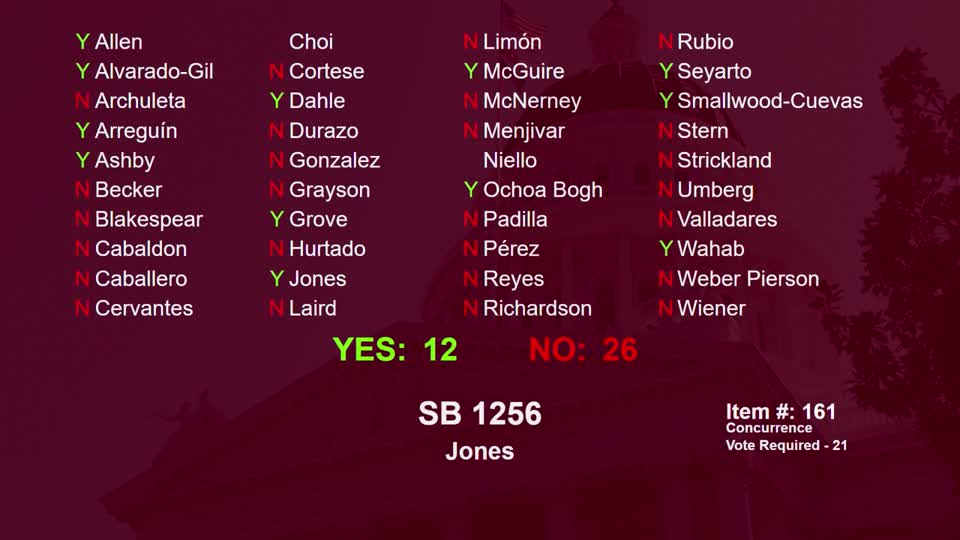 2MIN
Senate Floor
 2MIN