SB 1404: Wildfire prevention: state responsibility areas: fire prevention fee.
- Session Year: 2025-2026
- House: Senate
- Latest Version Date: 2026-04-20
Current Status:
In Progress
(2026-05-14: May 14 hearing: Held in committee and under submission.)
Introduced
In Committee
Awaiting First Chamber Vote
Passed First Chamber
In Committee
Awaiting Second Chamber Vote
Passed Second Chamber
Enacted
Existing law requires the State Board of Forestry and Fire Protection, on or before September 1, 2011, to adopt emergency regulations to establish a fire prevention fee in an amount not to exceed $150 to be charged on each habitable structure on a parcel that is within a state responsibility area, as specified, and authorizes the board to annually adjust the fire prevention fee using prescribed methods.
Existing law requires that the fire prevention fees collected, except as provided, be deposited into the State Responsibility Area Fire Prevention Fund and be made available to the board and the Department of Forestry and Fire Protection for certain specified fire prevention activities that benefit the owners of habitable structures in state responsibility areas who are required to pay the fee.
Existing law, effective July 1, 2017, suspends the fire prevention fee and requires any moneys held in reserve in the fund to be appropriated by the Legislature in a manner consistent with the purposes of the fund.
Existing law repeals the fire prevention fee program on January 1, 2031.
This bill would reinstate the fire prevention fee effective January 1, 2027, subject to the January 1, 2031, repeal. 2027. The bill would delete the repeal date of the above-described provisions, thereby extending the operation of those provisions indefinitely.
Existing law requires the State Board of Forestry and Fire Protection, on or before September 1, 2011, to adopt emergency regulations to establish a fire prevention fee in an amount not to exceed $150 to be charged on each habitable structure on a parcel that is within a state responsibility area, as specified, and authorizes the board to annually adjust the fire prevention fee using prescribed methods.
Existing law requires that the fire prevention fees collected, except as provided, be deposited into the State Responsibility Area Fire Prevention Fund and be made available to the board and the Department of Forestry and Fire Protection for certain specified fire prevention activities that benefit the owners of habitable structures in state responsibility areas who are required to pay the fee.
Existing law, effective July 1, 2017, suspends the fire prevention fee and requires any moneys held in reserve in the fund to be appropriated by the Legislature in a manner consistent with the purposes of the fund.
Existing law repeals the fire prevention fee program on January 1, 2031.
This bill would reinstate the fire prevention fee effective January 1, 2027, subject to the January 1, 2031, repeal.
Existing law requires the Wildfire and Forest Resilience Task Force, beginning March 1, 2026, and every 5 years thereafter, to update the states Wildfire and Forest Resilience Action Plan. Existing law also requires the task force to develop and update a comprehensive implementation strategy to track and ensure the achievement of the goals and key actions identified in the action plan, as provided. Existing law requires the implementation strategy to address specified actions, including actions related to strengthening the protection of communities and reducing their fire risk, through, among other things, a statewide framework, including performance measures, to support local and regional community fire risk reduction and adaptation programs and projects. This bill would require the statewide framework to include quantified risk-based planning and outcomes-based performance metrics, to support local and community fire risk reduction and adaptation programs and projects.Existing law requires the Wildfire and Forest Resilience Task Force, beginning March 1, 2026, and every 5 years thereafter, to update the states Wildfire and Forest Resilience Action Plan. Existing law also requires the task force to develop and update a comprehensive implementation strategy to track and ensure the achievement of the goals and key actions identified in the action plan, as provided.
Existing law requires the implementation strategy to address specified actions, including actions related to strengthening the protection of communities and reducing their fire risk, through, among other things, a statewide framework, including performance measures, to support local and regional community fire risk reduction and adaptation programs and projects.
This bill would require the statewide framework to include quantified risk-based planning and outcomes-based performance metrics, to support local and community fire risk reduction and adaptation programs and projects.
The Legislature finds and declares all of the following:
(a)Reinstating the fire prevention fee ensures dedicated, sustainable funding for fire prevention in state responsibility areas, reducing risk to residents.
(b)Funding supports proactive forest management and vegetation treatments designed to reduce the severity of wildfires, allowing forests within state responsibility areas to better withstand ignition and reducing the intensity of wildfire behavior.
(c)Revenue allows for updated fire hazard severity mapping and the development of comprehensive emergency evacuation plans, providing homeowners with essential information to improve household safety.
(d)Fees provide vital grants to local fire safe councils and community conservation corps for fire prevention projects, augmenting the ability of local fire agencies to manage risks in the wildland-urban interface.
(e)Funding sustains fire prevention education programs for residents and supports fire-related law enforcement activities, including arson investigations and fire cause determinations, which are essential for reducing wildfires caused by humans.
SEC. 2.Section 4213.05 of the Public Resources Code is amended to read:4213.05.(a)The fire prevention fee imposed pursuant to Section 4212 shall be reinstated, effective January 1, 2027. Any moneys held in the State Responsibility Area Fire Prevention Fund shall be appropriated by the Legislature in a manner consistent with subdivision (d) of Section 4214.(b)It is the intent of the Legislature that moneys derived from the auction or sale of allowances pursuant to a market-based compliance mechanism established pursuant to Division 25.5 (commencing with Section 38500) of the Health and Safety Code shall be used to replace the moneys that would have otherwise been collected pursuant to Section 4212 from July 1, 2017, to January 1, 2027, inclusive, to continue fire prevention activities.(c)The amount appropriated in the annual Budget Act pursuant to subdivision (b) shall not be included in determining the amount of annual proceeds of the fund for purposes of the calculations in Section 39719 of the Health and Safety Code.SEC. 2.Section 4213.05 of the Public Resources Code is amended to read:4213.05.(a)Commencing with the 201718 fiscal year, the fire prevention fee imposed pursuant to Section 4212 shall be suspended, effective July 1, 2017. 2017, to January 1, 2027, inclusive. Any moneys held in reserve in the State Responsibility Area Fire Prevention Fund shall be appropriated by the Legislature in a manner consistent with subdivision (d) of Section 4214.
(b)It is the intent of the Legislature that moneys derived from the auction or sale of allowances pursuant to a market-based compliance mechanism established pursuant to Division 25.5 (commencing with Section 38500) of the Health and Safety Code shall be used to replace the moneys that would have otherwise been collected under Section 4212 to continue fire prevention activities. activities from January 1, 2017, until January 1, 2028, inclusive.
(c)The amount appropriated in the annual Budget Act pursuant to subdivision (b) shall not be included in determining the amount of annual proceeds of the fund for purposes of the calculations in Section 39719 of the Health and Safety Code.
(d)This section shall become inoperative on January 1, 2031.SEC. 3.Article 3 (commencing with Section 4229) of Chapter 1.5 of Part 2 of Division 4 of the Public Resources Code is repealed.The Legislature finds and declares all of the following:
(a)Reinstating the fire prevention fee ensures dedicated, sustainable funding for fire prevention in state responsibility areas, reducing risk to residents.
(b)Funding supports proactive forest management and vegetation treatments designed to reduce the severity of wildfires, allowing forests within state responsibility areas to better withstand ignition and reducing the intensity of wildfire behavior.
(c)Revenue allows for updated fire hazard severity mapping and the development of comprehensive emergency evacuation plans, providing homeowners with essential information to improve household safety.
(d)Fees provide vital grants to local fire safe councils and community conservation corps for fire prevention projects, augmenting the ability of local fire agencies to manage risks in the wildland-urban interface.
(e)Funding sustains fire prevention education programs for residents and supports fire-related law enforcement activities, including arson investigations and fire cause determinations, which are essential for reducing wildfires caused by humans.
SEC. 2.Section 4213.05 of the Public Resources Code is amended to read:4213.05.(a)Commencing with the 201718 fiscal year, the The fire prevention fee imposed pursuant to Section 4212 shall be suspended, reinstated, effective July 1, 2017. January 1, 2027. Any moneys held in reserve in the State Responsibility Area Fire Prevention Fund shall be appropriated by the Legislature in a manner consistent with subdivision (d) of Section 4214.
(b)It is the intent of the Legislature that moneys derived from the auction or sale of allowances pursuant to a market-based compliance mechanism established pursuant to Division 25.5 (commencing with Section 38500) of the Health and Safety Code shall be used to replace the moneys that would have otherwise been collected under pursuant to Section 4212 from July 1, 2017, to January 1, 2027, inclusive, to continue fire prevention activities.
(c)The amount appropriated in the annual Budget Act pursuant to subdivision (b) shall not be included in determining the amount of annual proceeds of the fund for purposes of the calculations in Section 39719 of the Health and Safety Code.
(d)This section shall become inoperative on January 1, 2031.SECTION 1.Section 4771 of the Public Resources Code is amended to read:4771.(a)On January 1, 2022, the task force, including, but not limited to, the Natural Resources Agency, the California Environmental Protection Agency, the Office of Planning and Research, and the department, in coordination with the relevant lead federal, state, local, and tribal agencies, shall develop a comprehensive implementation strategy to track and ensure the achievement of the goals and key actions identified in the states Wildfire and Forest Resilience Action Plan issued by the task force in January 2021.(b)The implementation strategy required by subdivision (a) shall include, but not be limited to, the identification of lead agencies and a description of the activities completed and still necessary to achieve the goals and key actions identified in the states Wildfire and Forest Resilience Action Plan. Implementation that is appropriate to the states different regions shall be included in the strategy.(c)The implementation strategy required by subdivision (a) shall, in addition to the contents identified in subdivision (b), address all of the following actions:(1)Increasing the pace and scale of wildfire and forest resilience activities. This includes all of the following:(A)A joint strategy to annually treat 500,000 acres of federal land and 500,000 acres of nonfederal land by 2025. The type of the treatments shall be monitored, tracked, and reported pursuant to subdivision (e).(B)A comprehensive strategy, developed in partnership with state agencies that own state land, to expand forest management and improve the health and resilience of forested state lands.(C)A comprehensive program to coordinate and align state and federal assistance programs for small private landowners, including grant programs, stewardship education workshops, and postfire rapid response teams.(D)A strategic action plan to expand the use of prescribed fire.(E)Expansion of the Department of Conservations Regional Fire and Forest Capacity Program through the development of a statewide network of regional forest and community fire resilience plans.(F)A comprehensive statewide reforestation strategy.(G)A permit synchronization plan to align permitting under the Zberg-Nejedly Forest Practice Act of 1973 (Chapter 8 (commencing with Section 4511)) and forest practice rules and regulations adopted by the board with relevant permitting and regulatory requirements of the State Water Resources Control Board, the applicable regional water quality control boards, and the Department of Fish and Wildlife. The permit synchronization plan shall ensure, to the extent feasible, that the board, the department, the State Water Resources Control Board, the applicable regional water quality control boards, and the Department of Fish and Wildlife align their permitting requirements in order to reduce regulatory barriers for fire prevention and forest resilience activities.(H)A science-based review and recommendations to guide and inform state investments and regional strategies on actions needed to improve the health and fire resilience of chaparral, shrublands, and surrounding communities.(2)Strengthening the protection of communities and reducing their fire risk, including all of the following:(A)A statewide framework, including quantified risk-based planning and outcomes-based performance metrics, to support local and regional community fire risk reduction and adaptation programs and projects.(B)Development and maintenance of a network of more than 500 fuel break projects across the state.(C)Expansion and modernization of existing defensible space and home hardening programs, particularly targeting high fire threat communities, including, but not limited to, inclusion of the ember-resistant zone and assistance programs for defensible space and home hardening, with priority given to the most vulnerable communities in the state.(D)Strengthening of investor-owned utility wildfire mitigation plans.(E)A framework for collaborative fuels reduction projects to protect roadway travelers and communities along highways, and to reduce roadside ignitions along primary and secondary emergency evacuation routes.(F)A Smoke Ready California campaign to provide coordinated messaging and content to help Californians plan for and protect themselves from wildfire smoke impacts.(3)Creating a sustainable wood products market in California, including both of the following:(A)A comprehensive framework and market strategy to align the states wood use policies and priorities, and to create economic opportunities for the use of forest materials that store carbon, reduce emissions, and contribute to sustainable local economies.(B)A catalyst fund to provide low-cost financing for businesses that use forest biomass and encourage private sector innovation.(4)Sustaining and expanding outdoor recreation on forestland, including both of the following:(A)Updating the Department of Parks and Recreations Statewide Comprehensive Outdoor Recreation Plan (SCORP).(B)Creating a joint strategy with the United States Forest Service to expand sustainable recreation across the states forested regions, emphasizing equitable access to underserved communities and rural recreation-dependent communities.(5)Protecting and expanding urban canopy and forestry, including a comprehensive program, with regional targets, to significantly increase Californias urban tree canopy, targeting disadvantaged and low-income communities and low-canopy areas.(6)Driving innovation and measuring progress in achieving these goals, including both of the following:(A)An applied research plan.(B)A forest data hub to serve as a multiple institutional clearinghouse for supporting, integrating, evaluating, and synthesizing reporting and monitoring efforts.(d)In developing the implementation strategy required by subdivision (a), the task force shall seek to coordinate and integrate the implementation strategy with the key goals and priorities of all of the following frameworks:(1)The Natural and Working Lands Climate Smart Strategy, the Pathways to 30x30 Document, and biodiversity strategies, all developed pursuant to Executive Order No. N-82-20.(2)The states climate adaptation strategy, known as the Safeguarding California Plan, adopted pursuant to Section 71153.(3)The 2022 scoping plan update, and subsequent updates, developed pursuant to the California Global Warming Solutions Act of 2006 (Division 25.5 (commencing with Section 38500) of the Health and Safety Code).(4)Any other related natural resources policy frameworks.(e)(1)On or before January 1, 2023, and annually thereafter on or before March 1, until March 1, 2048, the task force shall submit, as part of the implementation strategy required pursuant to subdivision (a), a report to the appropriate policy and budget committees of the Legislature on progress made in achieving the goals and key actions identified in the states Wildfire and Forest Resilience Action Plan, on state expenditures made to implement these key actions, and on additional resources and policy changes needed to achieve these goals and key actions.(2)(A)The annual report described in paragraph (1) shall also include information on the prior years acreage treatment goals, including treatment described in subparagraph (A) of paragraph (1) of subdivision (c), to (i) ensure compliance with the goals and (ii) assess annually additional resource requirements to achieve those goals. Metrics for reporting shall include total acres treated, type of treatment, level of risk for catastrophic fires within treated areas, statewide fire risk reduction, acres that received maintenance treatment, and resources expended for treatment, including resources expended for implementation and alignment of relevant permitting and regulatory requirements of the board, the department, the State Water Resources Control Board, the applicable regional water quality control boards, and the Department of Fish and Wildlife for fire prevention and forest resilience activities and barriers to treatment, if any.(B)Information contained in the report required pursuant to Section 4137 may be incorporated by reference, as applicable, to comply with the annual report required pursuant to this subdivision.(C)When establishing yearly treatment goals, described in subparagraph (A), the task force shall use the most advanced predictive tools to determine priority areas for treatment, with the goal of most effectively and efficiently reducing the overall fire risk to the state and achieving other goals outlined in this article.(3)Pursuant to Section 10231.5 of the Government Code, the requirement for submitting a report to the Legislature pursuant to this subdivision is inoperative on January 1, 2052.(f)On or before March 1, 2026, and every five years thereafter, the task force, or its successor entity, shall update the states Wildfire and Forest Resilience Action Plan. The Natural Resources Agency shall coordinate development of the update with the related state frameworks identified in subdivision (d), and with the phased development of the 20-year plan identified in the Agreement for Shared Stewardship of Californias Forests and Rangelands entered into between the state and the Pacific Southwest Region of the United States Forest Service.(g)The task force shall invite the participation of the United States Forest Service and other federal entities, as applicable, in the creation, alignment, and coordination of joint efforts pursuant to this section.(a)On January 1, 2022, the task force, including, but not limited to, the Natural Resources Agency, the California Environmental Protection Agency, the Office of Planning and Research, and the department, in coordination with the relevant lead federal, state, local, and tribal agencies, shall develop a comprehensive implementation strategy to track and ensure the achievement of the goals and key actions identified in the states Wildfire and Forest Resilience Action Plan issued by the task force in January 2021.
(b)The implementation strategy required by subdivision (a) shall include, but not be limited to, the identification of lead agencies and a description of the activities completed and still necessary to achieve the goals and key actions identified in the states Wildfire and Forest Resilience Action Plan. Implementation that is appropriate to the states different regions shall be included in the strategy.
(c)The implementation strategy required by subdivision (a) shall, in addition to the contents identified in subdivision (b), address all of the following actions:
(1)Increasing the pace and scale of wildfire and forest resilience activities. This includes all of the following:
(A)A joint strategy to annually treat 500,000 acres of federal land and 500,000 acres of nonfederal land by 2025. The type of the treatments shall be monitored, tracked, and reported pursuant to subdivision (e).
(B)A comprehensive strategy, developed in partnership with state agencies that own state land, to expand forest management and improve the health and resilience of forested state lands.
(C)A comprehensive program to coordinate and align state and federal assistance programs for small private landowners, including grant programs, stewardship education workshops, and postfire rapid response teams.
(D)A strategic action plan to expand the use of prescribed fire.
(E)Expansion of the Department of Conservations Regional Fire and Forest Capacity Program through the development of a statewide network of regional forest and community fire resilience plans.
(F)A comprehensive statewide reforestation strategy.
(G)A permit synchronization plan to align permitting under the Zberg-Nejedly Forest Practice Act of 1973 (Chapter 8 (commencing with Section 4511)) and forest practice rules and regulations adopted by the board with relevant permitting and regulatory requirements of the State Water Resources Control Board, the applicable regional water quality control boards, and the Department of Fish and Wildlife. The permit synchronization plan shall ensure, to the extent feasible, that the board, the department, the State Water Resources Control Board, the applicable regional water quality control boards, and the Department of Fish and Wildlife align their permitting requirements in order to reduce regulatory barriers for fire prevention and forest resilience activities.
(H)A science-based review and recommendations to guide and inform state investments and regional strategies on actions needed to improve the health and fire resilience of chaparral, shrublands, and surrounding communities.
(2)Strengthening the protection of communities and reducing their fire risk, including all of the following:
(A)A statewide framework, including quantified risk-based planning and outcomes-based performance measures, metrics, to support local and regional community fire risk reduction and adaptation programs and projects.
(B)Development and maintenance of a network of more than 500 fuel break projects across the state.
(C)Expansion and modernization of existing defensible space and home hardening programs, particularly targeting high fire threat communities, including, but not limited to, inclusion of the ember-resistant zone and assistance programs for defensible space and home hardening, with priority given to the most vulnerable communities in the state.
(D)Strengthening of investor-owned utility wildfire mitigation plans.
(E)A framework for collaborative fuels reduction projects to protect roadway travelers and communities along highways, and to reduce roadside ignitions along primary and secondary emergency evacuation routes.
(F)A Smoke Ready California campaign to provide coordinated messaging and content to help Californians plan for and protect themselves from wildfire smoke impacts.
(3)Creating a sustainable wood products market in California, including both of the following:
(A)A comprehensive framework and market strategy to align the states wood use policies and priorities, and to create economic opportunities for the use of forest materials that store carbon, reduce emissions, and contribute to sustainable local economies.
(B)A catalyst fund to provide low-cost financing for businesses that use forest biomass and encourage private sector innovation.
(4)Sustaining and expanding outdoor recreation on forestland, including both of the following:
(A)Updating the Department of Parks and Recreations Statewide Comprehensive Outdoor Recreation Plan (SCORP).
(B)Creating a joint strategy with the United States Forest Service to expand sustainable recreation across the states forested regions, emphasizing equitable access to underserved communities and rural recreation-dependent communities.
(5)Protecting and expanding urban canopy and forestry, including a comprehensive program, with regional targets, to significantly increase Californias urban tree canopy, targeting disadvantaged and low-income communities and low-canopy areas.
(6)Driving innovation and measuring progress in achieving these goals, including both of the following:
(A)An applied research plan.
(B)A forest data hub to serve as a multiple institutional clearinghouse for supporting, integrating, evaluating, and synthesizing reporting and monitoring efforts.
(d)In developing the implementation strategy required by subdivision (a), the task force shall seek to coordinate and integrate the implementation strategy with the key goals and priorities of all of the following frameworks:
(1)The Natural and Working Lands Climate Smart Strategy, the Pathways to 30x30 Document, and biodiversity strategies, all developed pursuant to Executive Order No. N-82-20.
(2)The states climate adaptation strategy, known as the Safeguarding California Plan, adopted pursuant to Section 71153.
(3)The 2022 scoping plan update, and subsequent updates, developed pursuant to the California Global Warming Solutions Act of 2006 (Division 25.5 (commencing with Section 38500) of the Health and Safety Code).
(4)Any other related natural resources policy frameworks.
(e)(1)On or before January 1, 2023, and annually thereafter on or before March 1, until March 1, 2048, the task force shall submit, as part of the implementation strategy required pursuant to subdivision (a), a report to the appropriate policy and budget committees of the Legislature on progress made in achieving the goals and key actions identified in the states Wildfire and Forest Resilience Action Plan, on state expenditures made to implement these key actions, and on additional resources and policy changes needed to achieve these goals and key actions.
(2)(A)The annual report described in paragraph (1) shall also include information on the prior years acreage treatment goals, including treatment described in subparagraph (A) of paragraph (1) of subdivision (c), to (i) ensure compliance with the goals and (ii) assess annually additional resource requirements to achieve those goals. Metrics for reporting shall include total acres treated, type of treatment, level of risk for catastrophic fires within treated areas, statewide fire risk reduction, acres that received maintenance treatment, and resources expended for treatment, including resources expended for implementation and alignment of relevant permitting and regulatory requirements of the board, the department, the State Water Resources Control Board, the applicable regional water quality control boards, and the Department of Fish and Wildlife for fire prevention and forest resilience activities and barriers to treatment, if any.
(B)Information contained in the report required pursuant to Section 4137 may be incorporated by reference, as applicable, to comply with the annual report required pursuant to this subdivision.
(C)When establishing yearly treatment goals, described in subparagraph (A), the task force shall use the most advanced predictive tools to determine priority areas for treatment, with the goal of most effectively and efficiently reducing the overall fire risk to the state and achieving other goals outlined in this article.
(3)Pursuant to Section 10231.5 of the Government Code, the requirement for submitting a report to the Legislature pursuant to this subdivision is inoperative on January 1, 2052.
(f)On or before March 1, 2026, and every five years thereafter, the task force, or its successor entity, shall update the states Wildfire and Forest Resilience Action Plan. The Natural Resources Agency shall coordinate development of the update with the related state frameworks identified in subdivision (d), and with the phased development of the 20-year plan identified in the Agreement for Shared Stewardship of Californias Forests and Rangelands entered into between the state and the Pacific Southwest Region of the United States Forest Service.
(g)The task force shall invite the participation of the United States Forest Service and other federal entities, as applicable, in the creation, alignment, and coordination of joint efforts pursuant to this section.
|
Date
|
Status
|
|---|---|
| May 14, 2026 | May 14 hearing: Held in committee and under submission. |
| May 8, 2026 | Set for hearing May 14. |
| May 4, 2026 | May 4 hearing: Placed on APPR. suspense file. |
| Apr 24, 2026 | Set for hearing May 4. |
| Apr 22, 2026 | From committee: Do pass and re-refer to Com. on APPR. (Ayes 4. Noes 1. Page 4016.) (April 22). Re-referred to Com. on APPR. |
| Apr 22, 2026 | From committee: Do pass and re-refer to Com. on APPR. (Ayes 4. Noes 1.) (April 22). Re-referred to Com. on APPR. |
| Apr 20, 2026 | From committee with author's amendments. Read second time and amended. Re-referred to Com. on REV. & TAX. |
| Apr 15, 2026 | Set for hearing April 22. |
| Apr 14, 2026 | From committee: Do pass and re-refer to Com. on REV. & TAX. (Ayes 4. Noes 2. Page 3871.) (April 14). Re-referred to Com. on REV. & TAX. |
| Apr 14, 2026 | From committee: Do pass and re-refer to Com. on REV. & TAX. (Ayes 4. Noes 2.) (April 14). Re-referred to Com. on REV. & TAX. |
| Apr 9, 2026 | Set for hearing April 14. |
| Apr 8, 2026 | Re-referred to Coms. on N.R. & W. and REV. & TAX. |
| Apr 6, 2026 | Re-referred to Com. on RLS. |
| Apr 6, 2026 | Withdrawn from committee. |
| Mar 31, 2026 | April 7 set for first hearing canceled at the request of author. |
| Mar 25, 2026 | From committee with author's amendments. Read second time and amended. Re-referred to Com. on N.R. & W. |
| Mar 24, 2026 | Set for hearing April 7. |
| Mar 4, 2026 | Referred to Com. on N.R. & W. |
| Feb 23, 2026 | Read first time. |
| Feb 23, 2026 | From printer. May be acted upon on or after March 23. |
| Feb 20, 2026 | Introduced. To Com. on RLS. for assignment. To print. |
|
Date
|
Description
|
Location
|
Votes
|
|
|---|---|---|---|---|
| May 4, 2026 | Placed on suspense file | Senate Standing Committee on Appropriations |
Passed |
|
| Apr 22, 2026 | Do pass, but first be re-referred to the Committee on [Appropriations] | Senate Standing Committee on Revenue and Taxation |
Passed |
|
| Apr 14, 2026 | Do pass, but first be re-referred to the Committee on [Revenue and Taxation] | Senate Standing Committee on Natural Resources and Water |
Passed |
This list shows positions taken on this bill by organizations on the date displayed, which is linked to the original source.
Positions by individuals are not included.
|
Organization
|
Position
|
Date
|
|---|---|---|
| 350 Humboldt | ** Support | |
| California Association Of Realtors | ** Against | |
| California State Association Of Counties | ** Against | |
| California Taxpayers Association | ** Against | |
| Climate Resolve | ** Support | |
| County of Butte | ** Against | |
| Elevate California | ** Support | |
| Environmental Defense Fund | ** Support | |
| Environmental Protection Information Center | ** Support | |
| Howard Jarvis Taxpayers Association | ** Against | |
| Jill Cox | ** Against | |
| Natural Resources Defense Council | ** Support | |
| Natural Resources Defense Council (NRDC) | ** Support | |
| Rural County Representatives of California | ** Against |
SENATE COMMITTEE ON
Senator Sabrina Cervantes, Chair
2025 - 2026 Regular Session
SB 1404 (Stern) - Wildfire prevention: state responsibility areas: fire prevention fee
Version: | Policy Vote: |
Urgency: | Mandate: |
Hearing Date: | Consultant: |
Bill Summary:
This bill would end the suspension of the State Responsibility Area Fire Prevention Fee (SRA Fee), effective January 1, 2027.
Fiscal Impact:
- Increased state revenues, likely in the high tens of millions of dollars annually (State Responsibility Area Fire Prevention Fund [SRA Fund]) due to reinstated collection of the SRA Fee. This revenue increase would go on indefinitely due to the deletion of the current SRA Fee sunset in this bill. Of this amount, roughly 10% would likely be needed by the Board of Equalization (BOE) for its costs to collect the fee.
- Significant ongoing costs, likely in the high millions of dollars annually (SRA Fund), for BOE to administer and collect the SRA fee. (See staff comments for details.)
- Ongoing cost savings, likely commensurate to the amount of SRA Fee revenue less BOE expenditures, to the Greenhouse Gas Reduction Fund [GGRF]) starting in 2028. These costs savings could be offset elsewhere by increased expenditures on other GGRF programs.
- To the extent that the bill encourages increased activity by homeowners on defensible space and home hardening efforts or increased state spending on fire prevention efforts that reduce the occurrence of or damage from catastrophic wildfires from what otherwise would have occurred, this bill could result in unknown potential ongoing savings due to reduced fire suppression costs.
Background:
While fires have always been present in the state, the number of days with extreme fire risk has more than doubled in the last 40 years. This is likely to continue to increase, and one of the impacts of climate change in the state is an increase in the frequency and intensity of wildfires. In forested regions, decades of fire suppression, historic logging practices, and drought have produced unhealthy forests. In some forests, the current tree density is up to an order of magnitude greater than the density a century ago which increases the likelihood of damaging high-intensity fire when it burns.
Forest management in California is complicated by its patchwork of ownership. Close to 60 percent (nearly 19 million acres) of forestlands in California are owned by the federal government, including by the U.S. Forest Service (USFS), Bureau of Land Management (BLM), and National Park Service. Private nonindustrial entities own about one‑quarter (8 million acres) acres of forestland. These include families, individuals, conservation and natural resource organizations, and Native American tribes. Industrial owners—primarily timber companies—own 14 percent (4.5 million acres) of forestland. State and local governments own a comparatively small share—only 3 percent (1 million acres) combined.
Although the state owns only a small share of forestlands, state law tasks CalFire with certain responsibilities on privately owned lands. Specifically, CalFire’s historic mission has been two‑fold: (1) the protection of commercial timber on all nonfederal lands from improper logging activities and (2) the protection of watersheds from wildland fire in lands identified as part of the “State Responsibility Area” (SRA). The SRA includes about 13.2 million acres of forestland across the state—most of the forest not owned by federal agencies. CalFire’s SRA responsibilities include (1) enforcing fire prevention measures such as checking that homes have the required “defensible space” clear of brush, (2) fire suppression and other emergency response activities, and (3) providing financial and technical forest management assistance to private landowners.
The state funds programs in several different state departments that are intended to encourage activities that support California’s forests, including to reduce wildfire risk. Many of these programs are designed to assist private landowners in effectively managing their lands, given they own a significant portion of the state’s forests.
Fire protection. Most Californians pay for structural fire protection through property taxes or benefit assessments that fund firefighting services provided by city and county fire departments or special districts. Generally, local agencies provide structure protection and basic medical assistance in the SRA, while CalFire must provide wildland fire protection there and may provide structural fire protection as well. Because SRA residents get a significant benefit from CalFire protection paid for by the state General Fund, which is not directly provided to urban residents, the Legislature began to consider proposals for a fee that applies in the SRA to complement General Fund CalFire spending in the 2000s.
The SRA Fee. In 2011, the Legislature imposed a fee on owners of structures in SRAs to pay for the state’s costs of protecting them against fires (ABx1 29, Blumenfield), known as the SRA Fire Prevention Fee. CalFire provided a list to the Board of Equalization (BOE) of owners of habitable structures located in the SRA and the amount of fees to be assessed on each structure. BOE then issued bills and collected the fees, which were due and payable within 30 days of receiving the bill.
Habitable structures included single family homes, multi-dwelling structures, mobile homes, manufactured homes, and condominiums on July 1 of the fiscal year for which the fee is due, but not commercial, industrial, or incidental buildings such as detached garages, barns, outdoor sanitation facilities and sheds. Initially set at $150 per habitable structure on a parcel within the SRA, the Board could increase the fee for inflation according to the Implicit Price Deflator for State and Local Government Purchases of Goods and Services for the United States. The Board subsequently exempted structures deemed uninhabitable as a result of a natural disaster, and allowed a discount of $35 for owners of habitable structures who were also within the boundaries of a local fire protection agency or district by regulation.
The Legislature could then appropriate fee proceeds for the following purposes, after reimbursing BOE for expenses:
- A local assistance grant program.
- Grants to Fire Safe Councils, the California Conservation Corps, or certified local conservation corps for fire prevention projects and activities in the SRA.
- Grants to a qualified nonprofit organization with a demonstrated ability to satisfactorily plan, implement, and complete a fire prevention project applicable to the SRA. The Department may establish other qualifying criteria.
- CalFire inspections for compliance with defensible space requirements around habitable structures in the SRA.
- Public education to reduce fire risk in the SRA.
- Fire severity and fire hazard mapping by CalFire in the SRA.
- Other fire prevention projects in the SRA.
Approved by the Legislature as a majority-vote fee, not a 2/3 vote tax, the SRA Fee was controversial from inception. The Legislature considered but did not enact several proposals to repeal, limit, or modify the fee before enacting AB 2048 (Dahle, 2014), which made several consensus administrative changes to the SRA Fee. Additionally, the Howard Jarvis Taxpayers Association (HJTA) sued CalFire in October 2012, arguing that the fee was a tax and therefore should have been subject to a two-thirds vote, as required under Section Three of Article XIIA of the California Constitution.
The SRA Fee was also administratively problematic. CalFire sent SRA boundaries to county assessor offices, which then provided CalFire with parcels within those boundaries, which were then sent to BOE to bill. CalFire adjusts the SRA map every five years, or more frequently when local agency boundaries change, which can alter which property owners are subject to the fee. Determining the correct names of property owners and identifying specific parcels was difficult and often imprecise. Property changed ownership, and with it, the name of the property owner on the bill. Structures were demolished, converted, or newly constructed. BOE-administered special taxes and fees are usually collected or paid by businesses—not individuals, where enforcement is more difficult.
As a result, costs incurred to collect the SRA fee were about 10% of fee proceeds, among the worst cost-to-revenue ratios for any of the state’s special fees and taxes. Taxpayers filed approximately 90,000 petitions for redetermination in 2012-2013 challenging the application and amount of the fee, largely due to HJTA’s outreach, although that later dwindled to 40,000. Additionally, 10% of property owners simply didn’t pay the fee. Despite these difficulties, the fee generated around $80 million annually for its specified purposes, with a spike of $143 million in 2013-14, for a total of almost one half of one billion dollars during its five-year existence.
AB 398. In 2017, the Legislature enacted AB 398 (Eduardo Garcia) which, among other provisions, suspended the SRA Fee from July 1, 2017 until January 1, 2031, at which point it would be repealed. One part of AB 398 extended the California Air Resources Board’s authority to establish and utilize, through regulations, a cap-and-trade program, with proceeds allocated to the Greenhouse Gas Reduction Fund (GGRF). As a result, BOE did not issue bills for the 2017-2018 year. AB 398 also stated the intent of the Legislature to replace the moneys that would have been collected from the fee with money from GGRF to fund fire prevention activities.
AB 398’s enactment also blunted legal challenges against the SRA Fee. In September of 2020, the Third District Court of Appeals dismissed HJTA’s legal challenges, finding that the Plaintiff failed to bring the action to trial within the 5-year period required by statute. The Sacramento Superior Court also ruled against an individual plaintiff who sued BOE on similar grounds.
AB 102. Enacted the month before AB 398, the Taxpayer Transparency and Fairness Act of 2017 created the California Department of Tax and Fee Administration (CDTFA) and shifted the Board of Equalization’s (BOE’s) statutory tax administration functions to the newly formed Department (AB 102, Committee on Budget). As a result, CDTFA now operates almost all tax and fee programs previously administered by BOE. BOE continues to administer its core property tax functions as provided in the California Constitution. CDTFA never administered the SRA Fee, but would administer the fee if the Legislature revived it.
Funding CalFire. CalFire’s funding to perform wildfire resilience activities has grown over the past ten years—from about $100 million in 2015-2016 to about $700 million in 2025-2026. CalFire’s wildfire resilience activities, however, are a relatively small percentage (10% - 20%) of its overall budget. Most of CalFire’s budget remains dedicated to its base fire protection program (such as firefighting personnel and equipment) and emergency fire suppression program (emergency fire response resources) funded by the Emergency Fund.
Last year, the Legislature extended the cap‑and‑invest program, formerly known as cap-and-trade, and modified the methodology for allocating the associated GGRF revenues, including creating new allocation “tiers” (AB 1207, Irwin, and SB 840, Limón). SB 840 provided that CalFire’s fire prevention activities that would have been funded by the SRA Fee are in Tier One, and thus granted a variable continuous appropriation from GGRF depending on GGRF revenues beginning in the 2026-2027 fiscal year. Prior to SB 840, GGRF provided CalFire a fixed annual allocation of $200 million GGRF for wildfire resilience activities.
In his 2026‑2027 GGRF expenditure plan, the Governor proposes to allocate a total of over $1.6 billion to discretionary activities, including $1.25 billion to backfill CalFire costs that otherwise would be paid by the General Fund. The administration does not anticipate GGRF will have adequate revenues to support the full amounts identified in SB 840 for certain programs.
Proposed Law:
This bill would end the suspension of the SRA Fee, effective
January 1, 2027. The measure would also modify the legislative finding made in AB 398, to replace the moneys that would have been collected from the Fee with money from GGRF to fund fire prevention activities, to apply only between January 1, 2017 and January 1, 2028. This bill would also delete the section of law that would have repealed the SRA Fee as of January 1, 2031.
Related Legislation:
SB 840 (Limón, Chapter 121, Statutes of 2025) authorizes GGRF to continuously fund fire prevention activities that would have otherwise been funded by the SRA Fee in the amounts described in statute.
SB 901 (Dodd, Chapter 626, Statutes of 2018) specified that the amount appropriated to the Department in the annual Budget Act for the purposes of funding fire prevention projects in lieu of the SRA Fee shall not be included when determining the amount of annual GGRF proceeds in the fund when making certain appropriation calculations.
SB 398 (Eduardo Garcia, Chapter 135, Statutes of 2017) suspended the SRA Fee beginning January 1, 2017, and established the intent of the Legislature to use GGRF funding to pay for fire prevention projects in lieu of the SRA Fund.
SB 9 (Gaines, 2016) would have repealed the SRA Fee. This bill died in the Senate Natural Resources and Water Committee.
SB 520 (Berryhill, 2015) would have repealed the SRA Fee. This bill died in the Senate Natural Resources and Water Committee.
AB 93 (Weber, Chapter 10, Statutes of 2015), as the Budget Act of 2015, appropriated $8.6 million from the SRA Fund to the BOE for costs associated with the collection of the SRA Fee. This bill authorized the Director of Finance to augment this expenditure, if necessary.
AB 2048 (Dahle, Chapter 895, Statutes of 2014) authorized the Board to adjust the fee for inflation, rather than require it.
AB 929 (Jones, 2013) would have required the BOE reimburse everyone who paid the SRA Fee between January 1, 2015, and December 31, 2016, if their structure was determined to not be in the SRA. This bill died in the Assembly Natural Resources Committee.
AB 23 (Donnelly, 2013) would have repealed the SRA Fee. This bill died on the Assembly Appropriations suspense file.
SB 1040 (Evans, 2012) would have repealed the SRA Fee. This bill died in the Assembly Budget Committee.
AB 1506 (Jeffries, Cook, et al, 2012) would have repealed the SRA Fee. This bill died on the Assembly Appropriations suspense file.
Abx1 29 (Blumenfield, Chapter 8, Statutes of 2011) authorized the State Responsibility Area Fire Prevention Fee and created the State Responsibility Area Fire Prevention Fee Fund in the State Treasury.
Staff Comments:
Administration of the SRA Fee. The SRA Fee was administered by BOE through the California Department of Tax and Fee Administration (CDTFA). CalFire provided the boundaries of the SRA to county assessor offices, who then provided CalFire with parcels in those boundaries, which CalFire sent to CDTFA to bill. The process was circular, bureaucratic, and prone to error. The Fee also had an unusually high administrative cost, nearing 10% of annual billings. CDTFA typically sees administrative costs of taxes and fees closer to, if not under, 5%.
SRA Fee Collection: CDTFA expenditures and revenues
FY | Budgeted | Actual | Revenues |
2011-2012 | $0 | $1,114,730 | $0 |
2012-2013 | $6,524,000 | $8,048,096 | $75,202,000 |
2013-2014 | $6,437,000 | $9,829,964 | $143,500,000 |
2014-2015 | $9,227,000 | $9,370,319 | $81,860,000 |
2015-2016 | $9,068,000 | $8,914,175 | $81,728,000 |
2016-2017 | $7,566,000 | $7,505,947 | $81,479,000 |
2017-2018 | $0 | $2,322,126 | $15,330,000 |
2018-2019 | $0 | $0 | $0 |
Total | $38,822,000 | $47,105,357 | $479,099,000 |
Variability in SRA Fee amount and base. Statute authorizes BOE to charge a fee “in an amount not to exceed one hundred fifty dollars ($150).” The Board could, at any time, amend its regulations to charge less than $150, if desired.
Additionally, as new habitable structures are constructed in the SRA, they would be charged the fee each year. As land moves in and out of SRA boundaries, especially after the major five-year reviews, those structures would then not, or perhaps could newly, pay the fee.
In addition, BOE is authorized to adjust the fee for inflation (PRC § 4212(b)). The Board could amend the amount of the fee in regulation to adjust for inflation.
Board regulations offer a $35 discount on the fee if the structure is in the boundary of a local fire agency (14 CCR § 1665.7(a)). As local fire agencies are established or dissolved, a habitable structure’s eligibility for this discount might change.
Appropriate uses of the SRA Fee. There are limits to what the SRA Fee may be used for (PRC § 4214):
- The costs of administering the SRA Fee by CDTFA.
- Local assistance grants administered by the Board.
- Grants to Fire Safe Councils, the California Conservation Corps, or certified local conservation corps for fire prevention projects and activities in the SRA.
- Grants to a qualified nonprofit organization with a demonstrated ability to satisfactorily plan, implement, and complete a fire prevention project applicable to the SRA. The Department may establish other qualifying criteria.
- Inspections by CalFire for compliance with defensible space requirements around structures in the SRA as required by Section 4291 of the Public Resources Code.
- Public education to reduce fire risk in the SRA.
- Fire severity and fire hazard mapping by CalFire in the SRA.
- Other fire prevention projects in the SRA, authorized by the Board.
When the SRA Fee was suspended in 2017, the GGRF (the proceeds and income from the cap-and-invest program, as noted above) was authorized to fund these programs instead.
Projects funded by the SRA Fee. According to the latest annual report on the SRA Fee by the Department, fire prevention services and programs funded by the fee included:
- Fuel reduction projects that lessened the risk of wildfire to communities, evacuation routes, and infrastructure.
- Defensible space inspections.
- Assisting communities with updating wildfire mitigation plans.
- Fire prevention education.
- Fire hazard severity mapping.
- Implementation of State and local fire plans.
- Fire related law enforcement activities.
The Legislative Analyst’s Office (LAO) considers reinstatement of the SRA fee. According to the LAO, most of CalFire’s budget ($3.3 billion out of $3.8 billion in fiscal year 2022-23) funds wildfire suppression. In addition to the base budget, CalFire is budgeted funds for emergency fire protection, known as the E-Fund. The amount the state budgets for the E‑Fund each year is based on an average of the fund’s expenditures in recent prior years. For example, for 2022‑23, the enacted budget included $843 million for the E‑Fund. Some of that money is from the General Fund, but other moneys come from reimbursements from the federal and local governments, such as when CalFire conducts fire suppression on federal lands.
In their report titled “Framework for Approaching the Natural Resources, Environmental Protection, and Agriculture [2026-27] Budget,” the LAO notes that the Legislature has the option of using money from the GGRF to support almost any purpose. Given the pressures on the General Fund, the report encourages the Legislature to find alternative sources to General Fund dollars through the use of the GGRF. However, the LAO notes that certain programs, such as CalFire’s Defensible Space Inspector Program, would need to find other funding if GGRF was used in lieu of the General Fund. The report suggests the Legislature consider reinstating the SRA Fee to cover the increased costs of these inspections.
Emergency fire suppression costs and savings. CalFire spends roughly $1 billion annually (General Fund) on “emergency fire suppression” – additional fire suppression resources needed when a fire continues to spread after the “initial attack” or about the first 24 hours. The vast majority of fires are contained during initial attack – the ones that are not usually grow to be the largest and most expensive wildfires. According to CalFire, defensible space and home hardening can reduce the risk of catastrophic wildfire and prevent or minimize property damage in the event of wildfire.
-- END --
SENATE COMMITTEE ON REVENUE AND TAXATION
Senator Jerry McNerney, Chair
2025 - 2026 Regular
Bill No: | SB 1404 | Hearing Date: | 4/22/26 |
Author: | Stern | Tax Levy: | No |
Version: | 4/20/26 Amended | Fiscal: | Yes |
Consultant: | Grinnell | ||
Wildfire prevention: state responsibility areas: fire prevention fee
Ends the suspension of the State Responsibility Area Fire Prevention Fee, effective January 1, 2027.
Background
The California Department of Forestry and Fire Protection (CAL FIRE) provides wildland fire protection on non-federal lands outside cities. To meet this duty, the State Board of Forestry and Fire Protection (“the Board”) designates the State Responsibility Area (SRA) every five years. When designating the SRA, the Board determines the areas in which the financial responsibility of preventing and suppressing fires is primarily the responsibility of the state. Lands in the SRA include:
- Lands covered wholly or in part by forests or by trees producing or capable of producing forest products.
- Lands covered wholly or in part by timber, brush, undergrowth, or grass, whether of commercial value or not, which protects the soil from excessive erosion, retard runoff of water, or accelerate water percolation, if such lands are sources of water that is available for irrigation or for domestic or industrial use.
- Lands in areas that are principally used or useful for range or forage purposes, which are contiguous to the lands described above.
Lands that are not in the SRA are in the local or federal responsibility area, as specified in statute:
- Lands owned or controlled by the federal government or any agency of the federal government.
- Lands within the exterior boundaries of any city.
- Any other lands within the state which do not come within any of the classes that are described above.
Additionally, the Board is authorized to designate roads, pipelines, streams, or other recognizable landmarks within the SRA. Nearly one-third of the state’s total acreage is in the SRA. Last updated in 2020, California’s Open Data Portal posts a GIS map of the SRA.[1]
Most Californians pay for structural fire protection through property taxes or benefit assessments that fund firefighting services provided by city and county fire departments or special districts. Generally, local agencies provide structure protection and basic medical assistance in the SRA, while CAL FIRE must provide wildland fire protection there and may provide structural fire protection as well. Because SRA residents get a significant benefit from CAL FIRE protection paid for by the state General Fund, which is not directly provided to urban residents, the Legislature began to consider proposals for a fee that applies in the SRA to complement General Fund CAL FIRE spending in the 2000s.
SRA Fee. In 2011, the Legislature imposed a fee on owners of structures in SRAs to pay for the state’s costs of protecting them against fires (ABx1 29, Blumenfield), known as the SRA Fire Prevention Fee. CAL FIRE provided a list to the Board of Equalization (BOE) of owners of habitable structures located in the SRA and the amount of fees to be assessed on each structure. BOE then issued bills and collected the fees, which were due and payable within 30 days of receiving the bill.
Habitable structures included single family homes, multi-dwelling structures, mobile homes, manufactured homes, and condominiums on July 1 of the fiscal year for which the fee is due, but not commercial, industrial, or incidental buildings such as detached garages, barns, outdoor sanitation facilities and sheds. Initially set at $150 per habitable structure on a parcel within the SRA, the Board could increase the fee for inflation according to the Implicit Price Deflator for State and Local Government Purchases of Goods and Services for the United States. The Board subsequently exempted structures deemed uninhabitable as a result of a natural disaster, and allowed a discount of $35 for owners of habitable structures who were also within the boundaries of a local fire protection agency or district by regulation.
The Legislature could then appropriate fee proceeds for the following purposes, after reimbursing BOE for expenses:
- A local assistance grant program.
- Grants to Fire Safe Councils, the California Conservation Corps, or certified local conservation corps for fire prevention projects and activities in the SRA.
- Grants to a qualified nonprofit organization with a demonstrated ability to satisfactorily plan, implement, and complete a fire prevention project applicable to the SRA. The Department may establish other qualifying criteria.
- CAL FIRE inspections for compliance with defensible space requirements around habitable structures in the SRA.
- Public education to reduce fire risk in the SRA.
- Fire severity and fire hazard mapping by the Department in the SRA.
- Other fire prevention projects in the SRA.
Approved by the Legislature as a majority-vote fee, not a 2/3 vote tax, the SRA Fee was controversial from inception. The Legislature considered but did not enact several proposals to repeal, limit, or modify the fee before enacting AB 2048 (Dahle, 2014), which made several consensus administrative changes to the SRA Fee. Additionally, the Howard Jarvis Taxpayers Association (HJTA) sued CAL FIRE in October 2012, arguing that the fee was a tax and therefore should have been subject to a two-thirds vote, as required under Section Three of Article XIIA of the California Constitution.
The SRA Fee was also administratively problematic. CAL FIRE sent SRA boundaries to county assessor offices, which then provided CAL FIRE with parcels within those boundaries, which were then sent to BOE to bill. CAL FIRE adjusts the SRA map every five years, or more frequently when local agency boundaries change, which can alter which property owners are subject to the fee. Determining the correct names of property owners and identifying specific parcels was difficult and often imprecise. Property changed ownership, and with it, the name of the property owner on the bill. Structures were demolished, converted, or newly constructed. BOE-administered special taxes and fees are usually collected or paid by businesses—not individuals, where enforcement is more difficult.
As a result, costs incurred to collect the SRA fee were about 10% of fee proceeds, among the worst cost-to-revenue ratios for any of the state’s special fees and taxes. Taxpayers filed approximately 90,000 petitions for redetermination in 2012-2013 challenging the application and amount of the fee, largely due to HJTA’s outreach, although that later dwindled to 40,000. Additionally, 10% of property owners simply didn’t pay the fee. Despite these difficulties, the fee generated around $80 million annually for its specified purposes, with a spike of $143 million in 2013-14, for a total of almost one half of one billion dollars during its five-year existence.
AB 398. In 2017, the Legislature enacted AB 398 (Eduardo Garcia) which, among other provisions, suspended the SRA Fee from July 1, 2017 until January 1, 2031, at which point it would be repealed. One part of AB 398 extended the California Air Resources Board’s authority to establish and utilize, through regulations, a cap-and-trade program, with proceeds allocated to the Greenhouse Gas Reduction Fund (GGRF). As a result, BOE did not issue bills for the 2017-2018 year. AB 398 also stated the intent of the Legislature to replace the moneys that would have been collected from the fee with money from GGRF to fund fire prevention activities.
AB 398’s enactment also blunted legal challenges against the SRA Fee. In September of 2020, the Third District Court of Appeals dismissed HJTA’s legal challenges, finding that the Plaintiff failed to bring the action to trial within the 5-year period required by statute. The Sacramento Superior Court also ruled against an individual plaintiff who sued BOE on similar grounds.[2]
AB 102. Enacted the month before AB 398, the Taxpayer Transparency and Fairness Act of 2017 created the California Department of Tax and Fee Administration (CDTFA) and shifted the Board of Equalization’s (BOE’s) statutory tax administration functions to the newly formed Department (AB 102, Committee on Budget). As a result, CDTFA now operates almost all tax and fee programs previously administered by BOE. BOE continues to administer its core property tax functions as provided in the California Constitution. CDTFA never administered the SRA Fee, but would administer the fee if the Legislature revived it.
Funding CAL FIRE. CAL FIRE’s funding to perform wildfire resilience activities has grown over the past ten years—from about $100 million in 2015-2016 to about $700 million in 2025-2026. CAL FIRE’s wildfire resilience activities, however, are a relatively small percentage (10% - 20%) of its overall budget. Most of CAL FIRE’s budget remains dedicated to its base fire protection program (such as firefighting personnel and equipment) and emergency fire suppression program (emergency fire response resources) funded by the Emergency Fund.
Last year, the Legislature extended the cap‑and‑invest program, formerly known as cap-and-trade, and modified the methodology for allocating the associated GGRF revenues, including creating new allocation “tiers” (AB 1207, Irwin, and SB 840, Limón). SB 840 provided that CAL FIRE’s fire prevention activities that would have been funded by the SRA Fee are in Tier One, and thus granted a variable continuous appropriation from GGRF depending on GGRF revenues beginning in the 2026-2027 fiscal year. Prior to SB 840, GGRF provided CAL FIRE a fixed annual allocation of $200 million GGRF for wildfire resilience activities.
In his 2026‑2027 GGRF expenditure plan, the Governor proposes to allocate a total of over $1.6 billion to discretionary activities, including $1.25 billion to backfill CAL FIRE costs that otherwise would be paid by the General Fund. The administration does not anticipate GGRF will have adequate revenues to support the full amounts identified in SB 840 for certain programs.
Seeking to maintain the state’s wildfire prevention and mitigation efforts, the author wants to reinstate the SRA Fee.
Proposed Law
Senate Bill 1404 ends the suspension of the SRA Fee, effective January 1, 2027. The measure also modifies the legislative finding made in AB 398, to replace the moneys that would have been collected from the Fee with money from GGRF to fund fire prevention activities, to apply only between January 1, 2017 and January 1, 2028. The bill also deletes the section of law that would have repealed the SRA Fee as of January 1, 2031.
State Revenue Impact
No estimate.
Comments
1. Purpose of the bill. According to the author, “California must be strategic in how it uses limited resources to meet two urgent priorities: reducing emissions and strengthening wildfire resilience. SB 1404 strikes that balance by reinstating the State Responsibility Area (SRA) Fee, a proven, adjustable mechanism that ensures communities in high-risk areas contribute to and receive dedicated wildfire prevention services. While the state may have been able to withstand the fee suspension in budget surplus years with a growing cap-and-invest market, California’s standing today requires thoughtful, grounded approaches to how it achieves both its climate and fire resiliency goals. At a time when the federal government has abdicated its responsibility to reduce pollution and hamstrung California’s efforts to protect its own citizens, reinstating the SRA Fee allows the state to maintain current fire prevention efforts while allowing flexibility for state dollars to go towards climate change mitigation initiatives.”
2. Who pays? The SRA Fee is predicated on similar logic as benefit assessments: that property owners receiving a specific benefit should pay for it in proportion to the benefit received, instead of shifting the costs of providing the benefit to the general public. In the last decade, wildfires of unprecedented ferocity have ravaged many areas of the state, driving the state’s costs to prevent and mitigate wildfires higher, so assigning at least some of these costs to those who benefit most makes sense. However, while CAL FIRE’s wildland fire protection primarily benefits those property owners, preventing and mitigating wildfires benefit all the state’s residents to some degree. Additionally, the SRA Fee is just one way the state pays these increased costs of preventing and mitigating wildfires. Home insurance premiums generally account for fire risk. Utilities collect billions of dollars from ratepayers each year for fire prevention activities such as undergrounding power lines and clearing vegetation. Opponents of the bill state that almost all property owners in the SRA have a local fire agency responsible for structure protection, and few saw the benefit of SRA Fee-funded projects. The Committee may wish to consider whether removing AB 398’s SRA Fee suspension results in an appropriate assignment of CAL FIRE’s costs between SRA landowners and the general public.
3. Logistics. As noted above, the SRA Fee posed distinct challenges for state agencies seeking to effectively administer it. It’s unclear whether previous experience, the passage of time, and improved information technology can resolve or mitigate those challenges should the Legislature reinstate the fee. CDTFA will administer the fee should it be reinstated, but CAL FIRE will have to provide updated information to the Department. Notably, SRA maps have not been generally updated since 2020, and accurate maps are necessary to ensure that those who benefit most pay appropriate costs. CAL FIRE will receive petitions for redetermination from taxpayers who challenge whether they are subject to the fee or are charged too much. Given that the SRA includes one third of the state’s acreage, it’s likely that both agencies will need more time, additional resources, or both, to implement SB 1404. The Legislature will have to appropriate funds to pay those costs before any fee can generate revenue. Additionally, those who previously litigated the Legislature’s enactment of the SRA Fee by majority vote could choose to do so again if the Legislature ends its suspension.
4. Exemptions. The SRA Fee’s sole exemption was for structures rendered uninhabitable as a result of a natural disaster. Qualifying for an exemption required two specific certifications. First, the property owner must certify that a structure is not habitable as a result of a natural disaster. Second, the property owner must either document that the habitable structure passed a defensible space inspection conducted by CAL FIRE within one year of the date the structure was damaged or destroyed, or certify that clearance was in place at the time that the structure was damaged or destroyed. While additional exemptions could enhance fairness and equity for affected property owners should the Legislature reinstate the fee, exemptions pose tradeoffs for effective implementation. Specifically, like the existing exemption, there are additional burdens on property owners to supply information necessary to qualify. Depending on the type of exemption, state agencies will incur additional costs to verify that the information the property owner supplies to qualify for the exemption is true and correct, especially if verification is required annually.
4. A deal’s a deal? As noted above, AB 398’s SRA Fee suspension was part of a larger agreement to extend the state’s cap-and-trade program. Approving AB 398 required a series of agreements to reach the required 2/3 vote, which SB 1404 would undo by reinstating the fee, which is set to be repealed on January 1, 2031. While the Legislature extended and renamed cap-and-trade last year, the state sales and use tax exemption on manufacturing equipment, also extended and expanded by AB 398, is set to sunset on July 1, 2030. Opponents argue that SB 1404 violates this nearly ten-year-old agreement.
5. Double referred. The Senate Committee on Natural Resources and Water approved SB 1404 by a vote of 4 to 2 on April 14th. The Committee on Revenue & Taxation is considering the measure as the committee of second reference.
6. Related legislation. At its May 6th hearing, the Committee will consider SB 1084 (Alvarado-Gil), which enacts the Fire Safe Home Tax Credits Act and would authorize a home hardening credit and vegetation management credits against the Personal Income Tax. The Committee approved a similar bill last year, SB 269 (Choi), which subsequently died on the Senate Appropriation Committee’s Suspense File.
Support and Opposition
(4/20/26)
Support: Climate Resolve
Elevate California
Environmental Defense Fund
Environmental Protection Information Center
Natural Resources Defense Council
350 Humboldt
Opposition: Jill Cox, Trinity County Supervisor, District 2
California Association of Realtors
California State Association of Counties
California Taxpayers Association
County of Butte
Howard Jarvis Taxpayers Association
Rural County Representatives of California
3 Individuals
-- END --
https://calfire-forestry.maps.arcgis.com/apps/webappviewer/index.html?id=468717e399fa4238ad86861638765ce1 ↑
Gregory Steshenko v. California Board of Equalization, et al. Sacramento County Superior Court: 34-2016-00202671-CU-CR-GDS; Santa Cruz County Superior Court: 16CV007757 ↑
SENATE COMMITTEE ON NATURAL RESOURCES AND WATER
Senator Josh Becker, Chair
2025 - 2026 Regular
Bill No: SB Hearing Date: April 14, 2026
Author: | |||
Version: | Amended | ||
Urgency: | Fiscal: | ||
Consultant: | |||
Subject: Wildfire prevention: state responsibility areas: fire prevention fee
SUMMARY
This bill would reinstate the State Responsibility Area Fire Prevention Fee, effective January 1, 2027.
BACKGROUND AND EXISTING LAW
Department of Forestry and Fire Protection (Department). The Department, in accordance with a plan approved by the Board of Forestry and Fire Protection, is responsible for the prevention and suppression of forest fires (Public Resources Code (PRC) §§4113, 4114).
Office of the State Fire Marshal (OSFM). In the mid-1990s, the OSFM was moved from the State and Consumer Services Agency to the Department. The State Fire Marshal (SFM) is established as a Chief Deputy Director of Forestry and Fire Protection in the Department (Health and Safety Code (HSC) § 13100). The mission of the OSFM is to “[protect] life and property through the development and application of fire prevention, engineering, training and education, and enforcement.”
State Board of Forestry and Fire Protection (Board). In 1885, the Governor of California approved an act that authorized the appointment of a three-man State Board of Forestry, the first such body in the nation. That original Board was abolished in 1893. In 1905, an “Act of March 18, 1905,” became law, creating a new Board of Forestry and the first State Forester.
The Board consists of nine members appointed by the Governor and approved by the Senate. There are five public members, three members from the forest products industry, and one member from the range livestock industry. The Governor designates the chair of the Board, who continues to serve in that capacity at the pleasure of the Governor, and the vice chair is elected by the members. The members serve four-year terms.
The Board is responsible for developing the general forest policy of the state, determining the guidance policies of the Department, and representing the state's interest in federal forestland in California. Together, the Board and the Department work to carry out their mandate to protect and enhance the state's unique forest and wildland resources.
State Responsibility Area (SRA). The SRA is the area of the state where the state has the financial responsibility for preventing and suppressing wildfires (PRC § 4102). The Board is required to classify all lands within the state to determine the SRA (PRC § 4125). Lands in the SRA include:
- Lands covered wholly or in part by forests or by trees producing or capable of producing forest products.
- Lands covered wholly or in part by timber, brush, undergrowth, or grass, whether of commercial value or not, which protect the soil from excessive erosion, retard runoff of water, or accelerate water percolation, if such lands are sources of water that is available for irrigation or for domestic or industrial use.
- Lands in areas that are principally used or useful for range or forage purposes, which are contiguous to the lands described above (PRC § 4126).
Lands that are not in SRA are in local or federal responsibility areas (LRA and FRA), as appropriate. Lands that do not qualify as SRA are specified in statute:
- Lands owned or controlled by the federal government or any agency of the federal government (FRA).
- Lands within the exterior boundaries of any city (LRA).
- Any other lands within the state which do not come within any of the classes that are described in PRC § 4126 (PRC § 4127).
Additionally, the Board is authorized, for the purposes of administrative convenience, to designate roads, pipelines, streams, or other recognizable landmarks as arbitrary boundaries in the SRA (PRC § 4128).
These definitions provide the basis for the field evaluation of SRA.
Contract Counties. In most areas of the state, the Department directly protects the 31 million acres of SRA by dividing the state into 21 administrative units. However, in Kern, Los Angeles, Marin, Orange, Santa Barbara, and Ventura Counties, the SRA is protected by those counties under a contract with the Department. They are known as “contract counties,” and protect about 3.4 million acres of SRA.
The Department provides funding to the contract counties for the prevention and suppression of wildland fires in the SRA, including salary and wages, facility maintenance, pre-fire management, and administrative services. Projects in contract counties can also be funded through urban forestry grants, resource management assistance, fire investigation support, and training.
Classification of SRA. Land is classified as SRA based on a process established by the Board in Article 1, Chapter 7, Division 1.5 of Title 14 in the California Code of Regulations (CCR) and the publication entitled “State Responsibility Area Classification System,” updated October 6, 2010.
SRA was first designated in 1970. It was intermittently reviewed by the Board until the Joint Legislative Budget Committee, in its supplement to the 1980-81 Budget Act, directed the Board to conduct a comprehensive review of the SRA classifications.
The Board began reviewing the SRA boundaries on a five-year basis in 2010; a special review took place in 2013 after the SRA Fire Prevention Fee was instituted. The most recent SRA review took place in 2025.
The SRA designation process has four goals:
- To provide a procedure that ensures statewide consistency in classifying SRA.
- To provide an ongoing procedure that will enable the Department to respond in a timely manner to land-use changes.
- To provide local government sufficient time to plan for changes in the classification of SRA.
- To involve the public in decisions about the classification of SRA.
To accomplish these goals, the classification process has five levels of review:
- Field evaluation
The field evaluation is conducted by the Department Unit or contract county. Locally-based Department staff identify land that may warrant reclassification, consult with other local agencies to determine areas that may be reclassified, and forward those areas for regional review.
- Regional review
At the region level, staff ensure the classification criteria has been applied consistently during field review. The region staff then forward areas identified for potential reclassification to the state-level review team.
- State review
The state review team evaluates the region’s determinations and documentation and conducts on-site inspections as necessary. The state review team forwards their recommendations for reclassification to the Director.
- Director’s approval
The Department Director reviews all proposed classification changes, submits approved changes to the Board, and notifies affected local governments of the proposed changes and their potential impacts.
- Board of Forestry and Fire Protection approval
The Board schedules a public hearing to review the changes and accept public comments on the proposed changes. The Board is the final approving authority for changes to the SRA classifications; the proposed changes are then made effective on July 1.
There are automatic changes that are effective every year on July 1 without this review process – such as when land is incorporated into a local jurisdiction.
SRA Fire Hazard Severity Zones (FHSZ). The director of the Department was given the authority to identify FHSZ, based on fuel loading, slope, fire weather, and other relevant factors, in the SRA in the 1980s (PRC § 4202). Recent amendments to Public Resources Code added winds to those factors, transitioned this authority to the SFM, and required the SFM to identify areas of moderate and high fire hazard severity (SB 63, Stern, Chapter 382, Statutes of 2021). There are no requirements for when these identifications need to be re-reviewed or adjusted. The most recent adjustment became effective on April 1, 2024.
Bates Bill, Municipal Affairs, and FHSZ. After the devastating Oakland Hills “Tunnel Fire” in 1991, the “Bates Bill” (AB 337, Bates, Chapter 1188, Statutes of 1992) was signed into law. The Bates Bill established that the prevention of fires is not a municipal affair as that term is used in the California Constitution, but rather a statewide concern (Government Code (GOV) § 51175).
The bill also required the director of the Department to identify LRAs of the state as very high FHSZ based on fuel loading, slope, fire weather, and other relevant factors. Recent amendments to the Government Code added winds to those factors, transitioned this authority to the SFM, and required the SFM to identify areas of moderate and high fire hazard severity (SB 63, Stern, Chapter 382, Statutes of 2021).
Impact of FHSZ designation. Many fire safety requirements correspond to an area’s designated FHSZ. In particular, the state’s defensible space, minimum fire safety standards, and Wildland-Urban Interface (WUI) Code building standards apply in the SRA and very high FHSZs in the LRA. Existing law also requires at least Class A or Class B roofs, as defined, for certain structures located in very high FHSZs, and imposes property disclosure requirements for homes built in high or very high FHSZs in the LRA or SRA.
According to the OSFM website:
Fire Hazard Severity Zone maps evaluate “hazard,” not “risk”. They are like flood zone maps, where lands are described in terms of the probability level of a particular area being inundated by floodwaters, and not specifically prescriptive of impacts. “Hazard” is based on the physical conditions that create a likelihood and expected fire behavior over a 30 to 50-year period without considering mitigation measures such as home hardening, recent wildfire, or fuel reduction efforts. “Risk” is the potential damage a fire can do to the area under existing conditions, accounting for any modifications such as fuel reduction projects, defensible space, and ignition resistant building construction.
The WUI Code building standards specifically apply to new home construction in FHSZs, requiring that siding, windows, roofs, and other features be ignition-resistant. California’s building standards are updated every 18 months, and new editions of the codes are published every three years. While a few WUI-related provisions took effect in 2005, the first “full” iteration of WUI fire safety standards took effect in 2008. Since then, there have been six subsequent updates of this code; the 2024 code was adopted on February 26, 2025.
SRA Fire Prevention Fee (SRA Fee). In 2011, the California Legislature passed Assembly Bill X1 29 (Blumenfield), which established the SRA Fee to provide funding for statewide fire prevention activities in areas designated as SRA. The fee was applied to all “habitable structures.”[1]
The Legislature authorized the Board to charge the SRA Fee in an amount not to exceed $150 per habitable structure, and the Board was authorized to increase the SRA Fee annually for inflation.[2] Owners of habitable structures who were also within the boundaries of a local fire protection agency or district received a reduction of $35 per habitable structure (14 CCR § 1665.7).
In 2017, Governor Edmund G. Brown signed Assembly Bill 398 (Garcia, Chapter 135, Statutes of 2017), which suspended the SRA Fee from July 1, 2017, until 2031. AB 398 also stated the intent of the Legislature to replace the moneys that would have been collected from the Fee with money from the program now known as Cap and Invest (formerly Cap and Trade; the fund is known as the Greenhouse Gas Reduction Fund, or GGRF) to fund fire prevention activities (PRC § 4213.05(b)).
Administration of the Fee. The SRA Fee was administered by the Board of Equalization (BOE) through the California Department of Tax and Fee Administration (CDTFA). The Department provided the boundaries of the SRA to county assessor offices, who then provided the Department with parcels in those boundaries, which the Department sent to CDTFA to bill. The process was circular, bureaucratic, and prone to error. The Fee also had an unusually high administrative cost, nearing 10% of annual billings. CDTFA typically sees administrative costs of taxes and fees closer to, if not under, 5%.
CDTFA Budgeted Expenditures, Actual Expenditures, & Total Fee Revenues, by fiscal year:
FY | Budgeted | Actual | Revenues |
2011-2012 | $0 | $1,114,730 | $0 |
2012-2013 | $6,524,000 | $8,048,096 | $75,202,000 |
2013-2014 | $6,437,000 | $9,829,964 | $143,500,000 |
2014-2015 | $9,227,000 | $9,370,319 | $81,860,000 |
2015-2016 | $9,068,000 | $8,914,175 | $81,728,000 |
2016-2017 | $7,566,000 | $7,505,947 | $81,479,000 |
2017-2018 | $0 | $2,322,126 | $15,330,000 |
2018-2019 | $0 | $0 | $0 |
Total | $38,822,000 | $47,105,357 | $479,099,000 |
CDTFA estimates that 10% of people did not pay the SRA Fee, resulting in an arrears balance of $56 million by FY 16-17. Fee payers could file a “petition for redetermination” to require CDTFA to evaluate whether they were being billed properly.
FY Year | Petitions Received |
12/13 | 90,081 |
13/14 | 42,897 |
14/15 | 20,930 |
15/16 | 41,593 |
16/17 | 23,127 |
17/18 | 7,739 |
Total | 226,367 |
Howard Jarvis Taxpayers Association v. Department of Forestry. The Howard Jarvis Taxpayers Association (HJTA) was the primary legal voice leading the crusade against the SRA Fee over its life. They created a website to share information with feepayers, FireTaxProtest.org. Although they encouraged people to pay the fee to avoid late fines, interest, and other penalties, HJTA provided information on submitting petitions for redetermination and recommended feepayers write “under protest” on their checks, to ensure they would be reimbursed if a court overturned the fee.
HJTA filed a class-action lawsuit against the Department in Sacramento County Superior Court on October 4, 2012, arguing that the SRA Fee was actually a tax that required a two-thirds vote of the Legislature, and that feepayers were entitled to a refund.
After the SRA Fee was suspended in 2017, HJTA requested a hearing on a motion for summary judgment they intended to file. The motion for summary judgment was filed September 20, 2017, but the earliest hearing date was in December 2017.
The Department filed a motion to dismiss the case on October 5, 2017, arguing that the plaintiffs had not brought the case to trial within five years, as required by section 583.310 of the Code of Civil Procedure. The court granted the motion to dismiss and vacated the motion for summary judgment.
Existing law:
- Establishes the Department (PRC § 4113).
- Establishes the OSFM within the Department and the SFM as a Chief Deputy Director at the Department (HSC § 13100).
- Requires the Board of Forestry and Fire Protection (Board) to classify all lands within the state for the purposes of determining areas in which the financial responsibility for the prevention and suppression of fire is primarily the responsibility of the state (PRC § 4125).
- Provides for the classification of lands within the SRA in accordance with the severity of fire hazard present for the purpose of identifying measures to be taken to slow the rate of fire spread and reduce the potential intensity of uncontrolled fires that threaten to destroy resources, life, or property (PRC § 4201).
- Requires those fire hazard zones to be based on fuel loading, slope, fire weather, other relevant factors, and winds (PRC § 4202).
- Requires the SFM to designate FHSZs and assign to each zone a rating reflecting the degree severity of fire hazard expected to prevail in the zone. Requires those zones to be adopted via regulation and a public hearing to be held in each county (PRC § 4203).
- Requires the SFM to periodically review the zones (PRC § 4204).
- Requires the SFM to identify areas in the state as moderate, high, and very high fire hazard severity zones based on fuel loading, slope, fire weather, other relevant factors, and wind (GOV § 51178).
- Requires those fire hazard zones to be based on fuel loading, slope, fire weather, other relevant factors, and winds (PRC § 4202).
- Requires the SFM to designate fire hazard severity zones and assign to each zone a rating reflecting the degree severity of fire hazard expected to prevail in the zone (PRC § 4203).
- Requires the SFM to periodically review the zones (PRC § 4204).
- Requires the Board to adopt emergency regulations to establish an SRA Fee to be charged on each habitable structure on a parcel within the SRA (PRC § 4212(a)(1)).
- The Legislature established that a fee of not more than $150 was reasonable for funding the necessary fire prevention activities of the state that benefit owners of habitable structures in the SRA (PRC § 4212(a)(2)).
- Authorizes the Board to annually adjust the SRA Fee for inflation (PRC § 4212(b)).
- Requires the Department annually transmit to the BOE the name and address of each person liable for the SRA Fee and the amount to be assessed (PRC § 4213(c)).
- Establishes the SRA Fire Prevention Fund (SRA Fund) in the State Treasury, and authorizes the Board and the Department to expend those funds for fire prevention activities that benefit the owners of habitable structures within the SRA who are required to pay the fee (PRC § 4214(a)(2)).
- Establishes that, if in any given fiscal year there is enough money in the SRA Fund to finance the costs of the program, the SRA Fee may not be collected that year (PRC § 4213(d)).
- Authorizes the Board to exempt a habitable structure from the SRA Fee that is deemed uninhabitable due to a natural disaster during the year for which the SRA Fee is due, and one year afterward (PRC § 4213.1(b)).
- Requires the BOE to retain moneys necessary for the payment of refunds of the SRA Fee and for the reimbursement of the BOE for expenses incurred in the collection of the SRA Fee (PRC § 4214(a)(1)).
- Requires that the SRA Fund be used only for certain purposes:
- Local assistance grants.
- The Board is required to establish a local assistance grant program (PRC § 4214(e)).
- Grants to Fire Safe Councils, the California Conservation Corps, or certified local conservation corps for fire prevention projects and activities in the SRA.
- Grants to a qualified nonprofit organization with a demonstrated ability to satisfactorily plan, implement, and complete a fire prevention project applicable to the SRA. The Department may establish other qualifying criteria.
- Inspections by the Department for compliance with defensible space requirements around habitable structures in the SRA as required by Section 4291.
- Public education to reduce fire risk in the SRA.
- Fire severity and fire hazard mapping by the Department in the SRA.
- Other fire prevention projects in the SRA, authorized by the Board (PRC § 4214(d)).
- Local assistance grants.
- Requires the Board, by January 31, 2015, and annually thereafter, to submit a report to the Legislature on the status and uses of the SRA Fund, including:
- Evaluation of the benefits received by counties based on the number of habitable structures in the SRA within their jurisdictions,
- The effectiveness of the Board’s grant programs,
- The number of defensible space inspections in the reporting period,
- The degree of compliance with defensible space requirements,
- Measures to increase compliance, if any, and
- Any recommendations to the Legislature (PRC § 4214(f)).
- Sunsets the reporting requirement on January 31, 2017 (PRC § 4214(g)).
- Suspends the SRA Fee effective January 1, 2017 (PRC § 4213.05(a)).
- Establishes the intent of the Legislature to use moneys derived from the auction or sale of allowances pursuant to a market-based compliance mechanism established pursuant to Division 25.5 (commencing with Section 38500) of the Health and Safety Code (“Cap and Invest”) to fund fire prevention activities that otherwise would have been funded by the SRA Fee (PRC § 4213.05(b)).
- Makes the section of law suspending the SRA Fee inoperative on January 1, 2031 (PRC § 4213.05(d)).
- Repeals the Chapter in PRC authorizing the SRA Fee on January 1, 2031 (PRC § 4229).
- Establishes a continuous appropriation from GGRF in the amount that would have been collected by the SRA Fee (HSC § 39719.4).
PROPOSED LAW
This bill would:
- Reinstate the SRA Fee effective January 1, 2027.
- Require that Cap and Invest moneys be used to fund fire prevention activities that would have otherwise been funded by the SRA Fee from July 1, 2017, to January 1, 2027, inclusive.
- Repeal the provision of law making the SRA Fee suspension inoperable on January 1, 2031.
- Make relevant findings and declarations.
ARGUMENTS IN SUPPORT
According to the author, “California must be strategic in how it uses limited resources to meet two urgent priorities: reducing emissions and strengthening wildfire resilience. SB 1404 strikes that balance by reinstating the State Responsibility Area (SRA) Fee, a proven, adjustable mechanism that ensures communities in high-risk areas contribute to and receive dedicated wildfire prevention services.”
“While the state may have been able to withstand the fee suspension in budget surplus years with a growing cap-and-invest market, California’s standing today requires thoughtful, grounded approaches to how it achieves both its climate and fire resiliency goals. At a time when the federal government has abdicated its responsibility to reduce pollution and hamstrung California’s efforts to protect its own citizens, reinstating the SRA Fee allows the state to maintain current fire prevention efforts while allowing flexibility for state dollars to go towards climate change mitigation initiatives.”
In support, the Natural Resources Defense Council (NRDC) writes:
“California’s budgetary spending on wildfire prevention lags severely, resulting in an upward pressure on costs elsewhere throughout the state.
- Climate change is rapidly accelerating wildfire damage in California, particularly within SRA areas, increasing value of damage to homes and communities, and increasing civilian and firefighter deaths.
- Wildfire-related spending was the primary driver of electricity bill increases between 2018 and 2024, with rates rising by 80 percent. Electricity ratepayers are now the top contributor to wildfire prevention, providing $14.2 billion to wildfire prevention as compared to only $3.623 from the state budget and bonding in the last half decade. These costs are disproportionately paid for by low-income inland customers who depend on air conditioning in the summer, and discourage building and vehicle electrification.
- State budget spending on fire suppression has grown 86 percent between 2017 and 2025, crowding out other important funding within the budget.
- Home insurance premiums have risen 25 percent from 2021 to 2024. As a result, an unprecedented, growing number of families are forced to go uninsured or to opt for the lower coverage insurer of last resort.”
“Investment in wildfire prevention now not only can counteract these cost pressures but also maintains positive economic activity. The U.S. Chamber of Commerce and Allstate find that for every $1 invested in wildfire prevention within the Western US, $22 of future economy activity is retained.”
Climate Resolve writes:
“We are deeply concerned that the increasing number and size of wildfires could undo the hard work California has done to lower greenhouse gas levels. When forests burn, they release massive amounts of carbon back into the air. This makes it much harder for us to meet our climate goals and protect our environment for the future.”
“Furthermore, we are worried about the health of people living in the Los Angeles basin. When big fires break out, smoke often covers our city for days or weeks. This air pollution is especially dangerous for our most vulnerable neighbors who already face health challenges or live in areas with high pollution. By funding fire prevention, we can help keep our air cleaner and our communities safer.”
“SB 1404 brings back a necessary fee to fund the Department of Forestry and Fire Protection. These funds will go directly toward activities that prevent fires before they start. While no one likes an extra cost, the price of doing nothing is much higher for our health, our air, and our climate.”
ARGUMENTS IN OPPOSITION
Writing in a joint letter, Rural County Representatives of California (RCRC) and the California State Association of Counties (CSAC) argue:
“The SRA fee was discontinued in 2017 by the California Legislature on the condition of continuing the Cap-and-Trade program, now known as Cap-and-Invest. The agreement is reflected in Assembly Bill 398 (Chapter 135, Statutes of 2017), which repealed the fee through 2031. By reinstituting the SRA fee, the Legislature is reneging on its promise to relieve residents living in the wildland urban interface of a burdensome and unfair fee so that CAL FIRE can remain fully funded in a tough budget landscape. Forest resilience and wildfire mitigation has already been deprioritized in the reauthorized version of the program in order to fund other projects. Our organizations believe it is inappropriate to violate the 2017 agreement in order to backfill these reprioritized funds.”
“Approximately 4 million Californians live in the Wildland Urban Interface (WUI), many of which are socioeconomically disadvantaged. A large percentage of rural residents in the WUI consists of elderly residents on fixed incomes. Residents in the SRA are already grappling with the affordability issues surrounding property insurance. Similarly, the state is asking residents across California to invest in wildfire retrofits that cost $40,000-60,000 per home in order to secure insurance that may not even be affordable. Many of these Californians already cannot afford the costs associated with living in the WUI.”
“Furthermore, implementation of the original SRA fee was logistically and administratively confusing for both the administrators and fee payors. Homeowners that did not even live in the SRA were routinely charged fees, while upfront costs to launch the program approached $15 million—nearly 19 percent of the total revenue of the program. The time, staffing, and effort to relaunch the fee could very well outpace the overall benefits of collecting the funds, just as it did in 2012.”
“Finally, many rural county residents already pay for local fire services, even if they have no CAL FIRE presence in their areas at all. The proposed SRA fees will result in double or triple taxation with no added benefit for many rural Californians and hurt local fire departments by making the already-difficult task of raising local revenues to support local firefighting efforts nearly impossible. In turn, this could very well impact urban areas by weakening the state’s mutual aid system that allows it to respond to any type of major disaster.”
COMMENTS
Double referral. This bill is double referred to this Committee and the Committee on Revenue and Taxation. This Committee is the committee of first referral. Comments regarding issues under the portfolio of the Revenue and Taxation Committee are included here for context and completeness only.
Legislative statements on fire prevention cost burdens. AB x1 29 (Blumenfield, 2011), the Resources Budget Trailer bill, made several key findings and declarations regarding the presence of structures in the state’s wildlands and their impact on potential fire damage to the wildlands and watersheds and who should bear the costs of fire prevention activities aimed at reducing the effects of structures in the wildlands.
The findings made several clear statements:
- The presence of structures within the SRA can pose an increased risk of fire ignition and an increased potential for fire damage within the state’s wildlands and watersheds.
- The presence of structures within the SRA can also impair wild land firefighting techniques and could result in greater damage to state lands caused by wildfires.
- The costs of fire prevention activities aimed at reducing the effects of structures in the SRA should be borne by the owners of these structures.
- Individual owners of structures within the SRA receive a disproportionately larger benefit from fire prevention activities than the state’s citizens generally.
- A fire prevention fee is necessary to pay for fire prevention activities in the SRA that specifically benefit owners of structures in the SRA.
Appropriate uses of the SRA Fee. There are limits to what the SRA Fee may be used for (PRC § 4214):
- The costs of administering the SRA Fee by CDTFA.
- Local assistance grants administered by the Board.[3]
- Grants to Fire Safe Councils, the California Conservation Corps, or certified local conservation corps for fire prevention projects and activities in the SRA.
- Grants to a qualified nonprofit organization with a demonstrated ability to satisfactorily plan, implement, and complete a fire prevention project applicable to the SRA. The Department may establish other qualifying criteria.
- Inspections by the Department for compliance with defensible space requirements around structures in the SRA as required by Section 4291 of the Public Resources Code.
- Public education to reduce fire risk in the SRA.
- Fire severity and fire hazard mapping by the Department in the SRA.
- Other fire prevention projects in the SRA, authorized by the Board.
When the SRA Fee was suspended in 2017, the GGRF (the proceeds and income from the cap-and-invest program, as noted above) was authorized to fund these programs instead.
Groundhog Day, but make it budget crises. The Great Recession caused lingering effects in California’s budget through the early 2010s thanks to a volatile revenue system dependent on high income earners and sales and use taxes. Proposition 13 has limited the degree to which California can rely on property tax, which is a relatively stable revenue source compared to income and sales taxes.
This volatile revenue system again caused budget shortfalls when, after capital gains spikes caused state tax revenues to rise 55% in fiscal year 2021-22, Governor Newsom’s staff predicted those spikes would continue and even grow, projecting revenues for fiscal years 2022-23 and 2023-24 that were $80 billion higher than what was realized.
Based on these assumptions, the state increased its spending, but the unrealized gains led to budget deficits in the mid-2020s. The budget deficits were further pressured by drops in federal spending by the Trump Administration on programs like Medi-Cal.
Legislative Analyst’s Office (LAO) Take. According to the LAO, most of the Department’s budget ($3.3 billion out of $3.8 billion in fiscal year 2022-23) funds wildfire suppression. In addition to the base budget, the Department is budgeted funds for emergency fire protection, known as the E-Fund. The amount the state budgets for the E‑Fund each year is based on an average of the fund’s expenditures in recent prior years. For example, for 2022‑23, the enacted budget included $843 million for the E‑Fund. Some of that money is from the General Fund, but other moneys come from reimbursements from the federal and local governments, such as when the Department conducts fire suppression on federal lands.
In their report titled “Framework for Approaching the Natural Resources, Environmental Protection, and Agriculture [2026-27] Budget,” the LAO notes that the Legislature has the option of using money from the GGRF to support almost any purpose. Given the pressures on the General Fund, the report encourages the Legislature to find alternative sources to General Fund dollars through the use of the GGRF. However, the LAO notes that certain programs, such as the Department’s Defensible Space Inspector Program, would need to find other funding if GGRF was used in lieu of the General Fund. The report suggests the Legislature consider reinstating the SRA Fee to cover the increased costs of these inspections.
Please cancel my subscription. The SRA Fee was not met with rejoicing among feepayers. There were errors in billing, start up was costly, and feepayers were not clear about what projects were paid for by the SRA Fee and how those projects benefited them, specifically, as fees are required to do.
Some of the common complaints about the SRA Fee included:
- The fee provided for no special benefit to feepayers, thus the fee was actually a tax requiring a two thirds vote of the Legislature (the fee was passed with a simple majority vote[4]).
- Fire prevention projects were not “visible” to feepayers, so they did not feel they were getting value out of the fee, even if in fact a project was implemented nearby.
- The use of lines of convenience caused some awkwardness between neighbors – if a major road was used to divide the SRA from the LRA or FRA, folks on one side of the road might be paying the fee and folks on the other side wouldn’t.
- Early attempts to properly bill feepayers were so discombobulated the Board initiated an interim review of SRA parcels in 2013, rather than waiting until 2015 for the next statutory review.
- Start up costs were twice the usual proportion of fee costs, compared to other fees implemented by the BOE and CDTFA.
- The SRA Fee was not a deductible item under the federal real property tax deduction, according to a memorandum issued by the Internal Revenue Service.[5]
If they wanted to, they would. The opposition letter from RCRC and CSAC illuminates the history of the SRA Fee suspension – to secure passage of the re-authorization of the Cap and Invest program, the Legislature suspended the SRA Fee until January 1, 2031, and used the proceeds from Cap and Invest to fund projects previously funded by the SRA Fee.
The opposition argues that the Legislature is going back on a promise to relieve residents in the SRA of the SRA Fee. However, residents were not relieved of the SRA Fee. The SRA Fee was temporarily suspended until 2031.
The structure of the SRA Fee takes up an entire Chapter in Part 2, Division 4, of the Public Resources Code. If the Legislature intended to permanently relieve SRA residents of the SRA Fee, they could have repealed the entire Chapter authorizing the SRA Fee or the specific authorizing sections (PRC § 4212, 4213, and 4213.1). Instead, the Legislature authorized a new section of code (PRC § 4213.05) to temporarily suspend the fee.
At the same time, the Legislature adopted a new section of code, PRC § 4229, that states:
This chapter shall remain in effect only until January 1, 2031, and as of that date is repealed, unless a later enacted statute that is enacted on or before January 1, 2031, deletes or extends that date.
The Legislature, in this compromise, left open the possibility that the SRA Fee would not be repealed, and in fact could be re-authorized and assessed once again on habitable structures in the SRA.
Given the current budgetary landscape, it is reasonable to expect that the Legislature may lift the SRA Fee suspension early.
Fire prevention funding is scarce across the state. Over the last ten years, since the SRA Fee was suspended, local governments have tried to raise local funds to support fire prevention services, to varying levels of success:
- Placer Hills Fire Protection District: Residents in its 34-square mile service area authorized the District to levy a parcel tax of $185 to fund paramedic and fire response, firefighter staffing, and emergency response equipment.
- Marin County: Voters in Marin County approved a parcel tax in March 2020 to prevent and mitigate wildfires in the county. There is a low-income senior exemption available, as well as exemptions for mobile homes, house boats, and other structures that are typically exempt from ad valorum taxes.
- Los Angeles County: Voters passed the Emergency Response and Infrastructure Special Parcel Tax in 2024, levied at a rate of six cents per square foot of structural improvements. There is a low-income senior exemption available.
- Mono County: In the November 2024 election, voters in Mono County approved Measure M to authorize the Mammoth Lakes Fire Protection District to levy $98 per parcel for nine years to fund, among other fire-related projects, defensible space inspections. The measure authorized senior and low-income exemptions.
- Tuolumne County: On the other hand, in 2021, Tuolumne County voters rejected a ballot measure that would authorize a $150 annual parcel tax, adjusted annually for inflation.
- Calaveras Consolidated Fire Protection District: Voters in this district also rejected an annual parcel tax, declining to fund fire protection and emergency services with a $96 tax on residential units.
Utah’s approach. Utah passed House Bill (HB) 48, “Wildland Urban Interface Modifications,” in their 2025 General Legislative Session. HB 48 requires all structures within the High Risk Wildland Urban Interface Boundary to pay a fee. The fee funds the costs of implementing the law and the costs of lot assessments. Lot assessments are performed to determine what a structure owner can do to reduce their risk of loss from wildfire. As recommendations and mitigations from the lot assessment are implemented on the structure, the fee is reduced.
Consider exemptions or reductions. As this bill moves through the Legislative process, the author may wish to consider a more nuanced fee that considers what, if any, exemptions or reductions would reduce the burden of the fee, while maintaining an appropriate level of funding. Feepayers already receive a $35 discount if they are served by a local fire agency. Would a fee reduction or exemption for a structure with sufficient defensible space or home hardening mitigation measures be appropriate? Would a low income or senior exemption make the fee more palatable? A reduction of the SRA Fee if the feepayer already pays a local parcel tax for fire prevention?
The Committee may wish to encourage the author to investigate these options as the bill is heard in future Committees.
Consider whether the appropriate parcels are being charged, as the prevention of fires is a statewide concern. Most ignitions in the SRA are the direct result of human incursion into the wildlands: electrical infrastructure, vehicles, campfires, fireworks, home wiring, and arson are frequent causes of wildfires. In 2024, 85% of wildfires in the SRA were human caused (3% natural; 12% undetermined).
Regardless of jurisdiction, out of the top 20 most destructive wildfires in California, 14 were caused by humans. 10 of the top 20 largest and 14 of the top 20 deadliest wildfires were human-caused.
Human-caused wildfires resulted in $527,299,834 of property and contents loss (“dollar damage”) in the SRA (excluding contract counties) in 2024.
The Legislature acknowledges that “[t]he wildfire front is not the only source of risk since embers, or firebrands, travel far beyond the area impacted by the front and pose a risk of ignition to a structure or fuel on a site for a longer time” and that “[s]ince fires ignore civil boundaries, it is necessary that cities, counties, special districts, state agencies, and federal agencies work together to bring raging fires under control” (GOV § 51175).
The Legislature continues: “[p]reventive measures are therefore needed to ensure the preservation of the public peace, health, or safety…[t]he prevention of wildland fires is not a municipal affair, … but is instead, a matter of statewide concern” (GOV § 51175).
The Legislature made those findings in the 1990s via the Bates Bill, in the context of mapping FHSZ in the LRA and applying wildfire prevention mitigation requirements to those areas. These LRA FHSZ requirements, such as WUI Code compliance, fire safe development regulations, and defensible space requirements, are the same requirements imposed on structures in the SRA to reduce structure ignition and the resulting negative impacts.
Reopening the conversation around the SRA Fee asks the Legislature to confront the question: is there a point at which the cost of fire prevention activities in the SRA that benefit structures in the LRA should be borne by those owners in the LRA?
The recent Eaton and Palisades fires and the 2013 Rim Fire provide interesting hypothetical situations where structures in the LRA very high FHSZ, and even LRA not in a FHSZ, may have been protected by projects funded by the SRA Fee, demonstrating how fire prevention in the SRA and LRA are inextricably linked to each other’s health and success.
The Eaton Fire began on January 7, 2025, in Eaton Canyon in the San Gabriel Mountains. High tension power lines operated by Southern California Edison (SCE) sparked the fire.[6]
The Eaton Fire burned more than 9,000 structures and killed 19 people in the LRA communities of Altadena and Sierra Madre. Altadena and Sierra Madre are LRA lands tucked into the foothills of the San Gabriel Mountains, bordered by SRA land that transitions into the Angeles National Forest. Being in the LRA, structures in the Eaton Fire footprint would not have had to pay the SRA Fee. However, the SCE power lines found responsible for the fire would not have been present but for the structures in the LRA. Theoretically, SRA Fee-funded fuel reduction projects in the SRA in the San Gabriel Mountains may have mitigated some of the impacts to the structures in the Eaton Fire.
The Palisades Fire began almost simultaneously with the Eaton Fire on January 7, 2025, and has a very similar story. The fire began in the Santa Monica Mountains and destroyed foothill communities in Pacific Palisades, Topanga, and Malibu. It burned 6,837 structures and killed 12 people. Federal authorities have charged a 29-year-old man with starting the fire near a popular hiking area.[7]
The Palisades Fire burned in a mix of LRA and SRA mountainous areas. Many of the structures destroyed in Malibu burned in very high FHSZ LRA adjacent to SRA (see maps below). Much like in the San Gabriel Mountains, SRA Fee-funded fuel reduction work in the Santa Monica Mountains might have mitigated the impact of the Palisades fire on structures in the community.

Approximate location of the Palisades Fire ignition point. LRA is in gray; SRA in yellow; FRA in green.

Palisades Fire area. LRA very high FHSZ in striped bright red; SRA FHSZ in muted red and orange.

Palisades Fire Damage Inspection Map. Structures more or less on the south and east side of the map are in LRA very high FHSZ, structures in the mountainous areas to the west of the map are in SRA (to the right and left, respectively, of the road in white in the middle of the map).
The Rim Fire began from an illegal, abandoned campfire on August 17, 2013, in the Stanislaus National Forest.[8] It burned over 255,000 acres and destroyed 112 structures, including 11 residences. Approximately 77,254 acres burned in Yosemite National Park. At the time, it was the largest forest fire in California history and the largest in Park history. It threatened thousands of residential structures in Tuolumne County. The lack of fire prevention activities in the Rim Fire footprint – in this case, prescribed fire – led to higher burn severities in areas that had not experienced fire in the last 14 years.[9]
On August 22, 2013, Governor Edmund G. “Jerry” Brown issued a state of emergency for Tuolumne County, where the fire was burning.
The next day, August 23, the Governor issued an emergency proclamation for the City and County of San Francisco. The fire was threatening critical infrastructure that provided power and water to San Francisco, and the emergency proclamation declared “the circumstances of this emergency, by reason of their magnitude, are or are likely to be beyond the control of the services, personnel, equipment and facilities of any single county, city and county, or city and require the combined forces of a mutual aid region or regions to combat.”
The health of the Central Sierra watershed that burned in the Rim Fire had a direct impact on San Francisco’s power and water supplies. Admittedly, the Rim Fire was burning on federal land, but many of the watersheds that provide clean water and energy to the state are in the SRA – such as land owned by the East Bay Municipal Utility District in the Sierra Foothills. If the Rim Fire had been burning in the SRA, where a fire prevention project funded by the SRA Fee could have been implemented, San Francisco – a LRA hundreds of miles from the fire front – would have benefitted from such fire prevention work.
In fact, the enabling legislation for the SRA Fee states the “[f]ire protection of the public trust resources on lands in the state responsibility areas remains a vital interest to California” (PRC § 4210). Protecting those public trust resources isn’t a limited interest to the SRA, but instead to the whole state.
Considering the impact that the health of SRA watersheds have on the state’s residents as whole, should structures in the LRA – even those not classified in a FHSZ – bear the cost of fire prevention work in the SRA that benefits them?
As this bill moves through the Legislative process, the author may wish to consider balancing additional exemptions or reductions of the fee with expanding the scope of the fee. The feepayers might expand to include LRA residents that gain a special benefit from fire prevention projects in the SRA, or fee revenues might be increased by applying the fee to other types of structures in the SRA that are subject to defensible space and WUI Code requirements and also benefit from SRA fire prevention work, but are not habitable, such as commercial buildings. The author may wish to be mindful of expansions of the fee that might turn the fee into a tax, and the corresponding changes to Legislative processes that would result.
Projects funded by the SRA Fee. According to the latest annual report on the SRA Fee by the Department,[10] fire prevention services and programs funded by the fee included:
- Fuel reduction projects that lessened the risk of wildfire to communities, evacuation routes, and infrastructure.
- Defensible space inspections.
- Assisting communities with updating wildfire mitigation plans.
- Fire prevention education.
- Fire hazard severity mapping.
- Implementation of State and local fire plans.
- Fire related law enforcement activities.
As opposed to new capital projects such as a fire station or truck, these kinds of projects often happen in either forested environments that are not heavily populated, or “behind the scenes” to improve fire prevention and mitigation in the SRA. The impacts of the fee that were benefitting SRA residents were not as visible to residents as feepayers might have expected them to be, given the structure of the SRA Fee as a specific benefit fee rather than a tax.
As this bill moves through the process, the author may wish to consider amendments that would improve feepayers’ understanding of the benefits of the fee accruing to them – such as roadside signs near fuel reduction projects, as federally funded transportation projects often do, or a “paid by the SRA Fee” logo to be used on mitigation plans or program websites that are funded by the fee. A dashboard with live updates on projects funded by the fee, and maps showing where the projects are located vis-à-vis SRA feepayers, may also help garner greater public support and knowledge about the SRA Fee, its uses, and how it benefits feepayers.
Adjust the administrative mechanics of the SRA Fee. Given the difficulties and expense of implementing the SRA Fee from the administrative side, the author may wish to consider amendments to the bill to ease the administrative burden of implementing the SRA Fee. Technical assistance from CDFTA and the Department may be of benefit. Reducing administrative costs would free up additional money that could be invested in more fire prevention projects or make up for lost revenue due to exemptions or reductions.
GGRF Continuous Appropriation. Beginning in the 2026-2027 fiscal year, fire prevention activities that would have been funded by the SRA Fee are granted a continuous appropriation from GGRF, in “[a]mounts described in Sections 4210 to 4214, inclusive, of the Public Resources Code” (HSC § 39719.4).
The amounts in sections 4210 to 4214 of PRC could vary over time, if the fee was active. It is of note that the statute authorizes the Board to charge a fee “in an amount not to exceed one hundred fifty dollars ($150).” The Board could, at any time, amend its regulations to charge less than $150, if desired.
Additionally, as new habitable structures are constructed in the SRA, they would be charged the fee each year. As land moves in and out of SRA boundaries, especially after the major five-year reviews, those structures would then not, or perhaps could newly, pay the fee.
In addition, the Board is authorized to adjust the fee for inflation (PRC § 4212(b)). The Board could amend the amount of the fee in regulation to adjust for inflation.
Board regulations offer a $35 discount on the fee if the structure is in the boundary of a local fire agency (14 CCR § 1665.7(a)). As local fire agencies are established or dissolved, a habitable structure’s eligibility for this discount might change.
Would the GGRF appropriation change to account for the difference in fees that might result because of these changes?
As this bill moves through the Legislative process, the author may wish to contemplate if any amendments are necessary to this bill (SB 1404) or section 39719.4 of the HSC to address how the reinstatement of the SRA Fee might affect this continuous appropriation.
Committee may wish to recommend amendments. The Committee may wish to recommend amendments to this bill to clarify when the SRA Fee is reinstated, specify the timelines for the use of GGRF, and repeal the statutes repealing the SRA Fee chapter in PRC.
An NRDC “FAQ” circulating in support of the bill states that funds coming from the reinstatement of the SRA Fee would be in addition to, not in lieu of, fire prevention funding coming from GGRF in lieu of the SRA fee.
The author’s intent, as communicated to the Committee via the author’s Fact Sheet, is for the reinstated SRA Fee to replace the annual GGRF appropriations to free up approximately 90 million dollars annually of the GGRF to go to other projects, as the LAO report recommends. The author writes:
“In 2024-2025, $87 million in Greenhouse Gas Reduction Funds were allocated to CalFire to backfill SRA fee revenue. The cumulative impact since the fee’s suspension sits at roughly $640-720 million of redirected funding that the SRA fee would otherwise cover.”
The proposed bill reinstates the SRA Fee beginning January 1, 2027, and ends the in lieu GGRF funding on the same date. However, the fee won’t be billed until July 1, 2027, which results in up to a year where projects being implemented during 2027 that under existing law would be funded by GGRF are not able to access funding by either the SRA Fee or GGRF.
The Committee may wish to authorize GGRF in lieu funding until January 1, 2028, to account for the time it would take moneys from the SRA Fee collection to be deposited into the SRA Fee Fund, so critical fire prevention projects do not lose funding, even if temporarily. [SEE AMENDMENT #1]
This bill proposes to make the timing of the suspension and reinstatement and GGRF in lieu funding more specific. If there is ever a question about the history of the budget authorizations during this time period, or the desire to again suspend the fee, this section should remain for future Legislators to contemplate.
The Committee may wish to amend the bill to repeal the subsection of code that makes the suspension of the fee and GGRF in lieu funding inoperable on January 1, 2031. [SEE AMENDMENT #1]
This Legislative ping-pong game with the SRA Fee – enacting it, suspending it temporarily, reinstating it, and plans to repeal it entirely in 2031 “unless a later enacted statute that is enacted on or before January 1, 2031, deletes or extends that date”[11] – is causing confusion, unpredictability, and instability in the budgets of every day Californians and in the Legislative process.
The Committee may wish to recommend an amendment to delete the statute that requires the chapter to be repealed on January 1, 2031, unless a later enacted statute that is enacted on or before January 1, 2031, deletes that.
In layman’s terms, the Committee may wish to recommend an amendment to repeal section 4229 of the PRC. [SEE AMENDMENT #2]
Committee amendments will be taken in Senate Emergency Management Committee. Due to Legislative time constraints, if the committee wishes to amend the bill and the bill is passed out of this committee, the amendments will be taken in the Senate Emergency Management Committee’s hearing on this bill.
Related legislation
SB 840 (Limón, Chapter 121, Statutes of 2025) authorizes GGRF to continuously fund fire prevention activities that would have otherwise been funded by the SRA Fee in the amounts described in statute.
SB 901 (Dodd, Chapter 626, Statutes of 2018) specified that the amount appropriated to the Department in the annual Budget Act for the purposes of funding fire prevention projects in lieu of the SRA Fee shall not be included when determining the amount of annual GGRF proceeds in the fund when making certain appropriation calculations.
SB 398 (Eduardo Garcia, Chapter 135, Statutes of 2017) suspended the SRA Fee beginning January 1, 2017, and established the intent of the Legislature to use GGRF funding to pay for fire prevention projects in lieu of the SRA Fund.
SB 9 (Gaines, 2016) would have repealed the SRA Fee. This bill died in the Senate Natural Resources and Water Committee.
SB 520 (Berryhill, 2015) would have repealed the SRA Fee. This bill died in the Senate Natural Resources and Water Committee.
AB 93 (Weber, Chapter 10, Statutes of 2015), as the Budget Act of 2015, appropriated $8.6 million from the SRA Fund to the BOE for costs associated with the collection of the SRA Fee. This bill authorized the Director of Finance to augment this expenditure, if necessary.
AB 2048 (Dahle, Chapter 895, Statutes of 2014) authorized the Board to adjust the fee for inflation, rather than require it.
AB 929 (Jones, 2013) would have required the BOE reimburse everyone who paid the SRA Fee between January 1, 2015, and December 31, 2016, if their structure was determined to not be in the SRA. This bill died in the Assembly Natural Resources Committee.
AB 23 (Donnelly, 2013) would have repealed the SRA Fee. This bill died on the Assembly Appropriations suspense file.
SB 1040 (Evans, 2012) would have repealed the SRA Fee. This bill died in the Assembly Budget Committee.
AB 1506 (Jeffries, Cook, et al, 2012) would have repealed the SRA Fee. This bill died on the Assembly Appropriations suspense file.
Abx1 29 (Blumenfield, Chapter 8, Statutes of 2011) authorized the State Responsibility Area Fire Prevention Fee and created the State Responsibility Area Fire Prevention Fee Fund in the State Treasury.
SUGGESTED AMENDMENTS
AMENDMENT 1
Amend Section 4213.05 of the Public Resources Code as follows:
4213.05. (a) Commencing with the 2017–18 fiscal year, the fire prevention fee imposed pursuant to Section 4212 shall be suspended, effective July 1, 2017, until January 1, 2027. Any moneys held in reserve in the State Responsibility Area Fire Prevention Fund shall be appropriated by the Legislature in a manner consistent with subdivision (d) of Section 4214.
(b) It is the intent of the Legislature that moneys derived from the auction or sale of allowances pursuant to a market-based compliance mechanism established pursuant to Division 25.5 (commencing with Section 38500) of the Health and Safety Code shall be used to replace the moneys that would have otherwise been collected under Section 4212 to continue fire prevention activities from January 1, 2017 until January 1, 2028.
(c) The amount appropriated in the annual Budget Act pursuant to subdivision (b) shall not be included in determining the amount of annual proceeds of the fund for purposes of the calculations in Section 39719 of the Health and Safety Code.
(d) This section shall become inoperative on January 1, 2031.
AMENDMENT 2
Repeal section 4229 of the Public Resources Code.
SUPPORT
Climate Resolve
Elevate California
Natural Resources Defense Council (NRDC)
OPPOSITION
California Association of Realtors (CAR)
California State Association of Counties (CSAC)
Rural County Representatives of California (RCRC)
One individual
-- END --
“Habitable structure” is defined as “a building that contains one or more dwelling units or that can be occupied for residential use. Buildings occupied for residential use include single family homes, multidwelling structures, mobile and manufactured homes, and condominiums. Habitable structures do not include commercial, industrial, or incidental buildings such as detached garages, barns, outdoor sanitation facilities, and sheds” (PRC § 4211). ↑
Initially, the Board was required to annually adjust the fee for inflation. AB 2048 (Dahle, Chapter 895, Statutes of 2014) changed this requirement to an authorization. After one Legislatively-mandated inflation increase in February 2014, bringing the fee to $152.33, the Board declined to authorize additional adjustments for inflation. ↑
This program was enacted by the Board (see Title 14 of the California Code of Regulations, §§ 1666.0-1666.16, inclusive) but was never funded by the Legislature. ↑
ABX1 29 was passed in the Assembly with a 52-26 vote, and the Senate 23-16. ↑
ILM 201310029; https://www.taxnotes.com/research/federal/irs-private-rulings/legal-memorandums/california-fire-prevention-fee-isnt-deductible-real-property-tax/1fgf1 ↑
“Feds say Southern California Edison started Eaton fire, sue for damages” https://calmatters.org/environment/wildfires/2025/09/edison-caused-eaton-fire-feds-say/ ↑
“A ‘reignition’ led to the Palisades fire, a finding sure to enrage thousands of victims” https://www.latimes.com/california/newsletter/2025-10-09/essential-california-reignition-caused-palisades-fire ↑
“California Rim Fire Was Started By Hunter's 'Illegal' Fire” https://www.npr.org/sections/thetwo-way/2013/09/05/219356523/california-rim-fire-was-started-hunters-illegal-fire ↑
Lydersen, J.M.; North, M.P.; Collins, B.M. 2014. Severity of an uncharacteristically large wildfire, the Rim Fire, in forests with relatively restored frequent fire regimes. Forest Ecology and Management 328, 326-334. ↑
Given the suspension of the fee in 2017, the last published report covers the 2016-17 fiscal year. ↑
PRC § 4229: This chapter shall remain in effect only until January 1, 2031, and as of that date is repealed, unless a later enacted statute that is enacted on or before January 1, 2031, deletes or extends that date. ↑
Discussed in Hearing
 23MIN
Senate Standing Committee on Revenue and Taxation
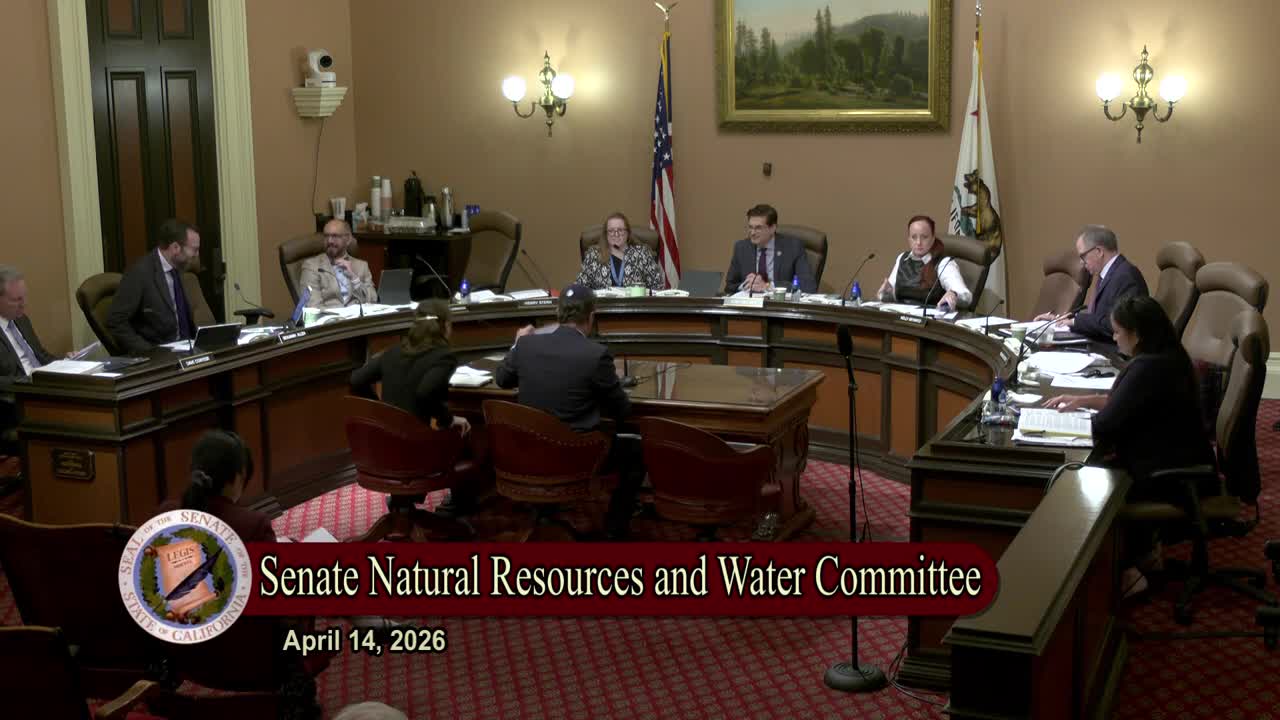 17MIN
Senate Standing Committee on Natural Resources and Water
Bill Author


