SB 1406: Sales and Use Tax Law: vehicles: shell companies.
- Session Year: 2025-2026
- House: Senate
- Latest Version Date: 2026-09-30
Current Status:
Passed
(2026-09-30: Chaptered by Secretary of State. Chapter 1036, Statutes of 2026.)
Introduced
In Committee
Awaiting First Chamber Vote
Passed First Chamber
In Committee
Awaiting Second Chamber Vote
Passed Second Chamber
Enacted
The Sales and Use Tax Law imposes a tax on retailers measured by the gross receipts from the sale of tangible personal property sold at retail in this state, or on the storage, use, or other consumption in this state of tangible personal property purchased from a retailer for storage, use, or other consumption in this state, measured by sales price. Under the Sales and Use Tax Law, there is a presumption that a vehicle, vessel, or aircraft shipped or brought into this state within 12 months from the date of its purchase was acquired for storage, use, or other consumption in this state and is subject to the use tax if any of specified conditions are satisfied, including where the vehicle is purchased by a resident of this state, as defined. Existing law provides that, for purposes of this presumption, a closely held company or limited liability company is considered a resident of this state if 50% or more of the shares or membership interests are held by shareholders or members who are residents of this state.
This bill would additionally provide that a partnership, limited partnership, or limited liability partnership is a resident of this state if 50% of the partnership, limited partnership, or limited liability partnership interests are held by partners that are residents of this state. The bill would also provide that, for purposes of the above-described presumption, a shell company, as defined, is a resident of this state if any shareholder, partner, member, or beneficial owner is a resident of this state. The bill would hold any officer, manager, partner, beneficial owner, or member of a shell company personally liable for any unpaid taxes, and any interest and penalties on those taxes, the nonpayment of which may constitute a crime, due on the purchase of a vehicle, vessel, or aircraft. By expanding the scope of crimes related to the violation of the Sales and Use Tax Law, this bill would impose a state-mandated local program. The bill would also make nonsubstantive and conforming changes to these provisions.
This bill would include a change in state statute that would result in a taxpayer paying a higher tax within the meaning of Section 3 of Article XIIIA of the California Constitution, and thus would require for passage the approval of 2/3 of the membership of each house of the Legislature.
The California Constitution requires the state to reimburse local agencies and school districts for certain costs mandated by the state. Statutory provisions establish procedures for making that reimbursement.
This bill would provide that no reimbursement is required by this act for a specified reason.
This bill would take effect immediately as a tax levy.
The Sales and Use Tax Law imposes a tax on retailers measured by the gross receipts from the sale of tangible personal property sold at retail in this state, or on the storage, use, or other consumption in this state of tangible personal property purchased from a retailer for storage, use, or other consumption in this state, measured by sales price. Under the Sales and Use Tax Law, there is a presumption that a vehicle, vessel, or aircraft shipped or brought into this state within 12 months from the date of its purchase was acquired for storage, use, or other consumption in this state and is subject to the use tax if any of specified conditions are satisfied, including where the vehicle is purchased by a resident of this state, as defined. Existing law provides that, for purposes of this presumption, a closely held company or limited liability company is considered a resident of this state if 50% or more of the shares or membership interests are held by shareholders or members who are residents of this state.
This bill would additionally provide that a partnership, limited partnership, or limited liability partnership is a resident of this state if 50% of the partnership, limited partnership, or limited liability partnership interests are held by partners that are residents of this state. The bill would also provide that, for purposes of the above-described presumption, a shell company, as defined, is a resident of this state if any shareholder, partner, member, or beneficial owner is a resident of this state. The bill would hold any officer, manager, partner, beneficial owner, or member of a shell company personally liable for any unpaid taxes, and any interest and penalties on those taxes, the nonpayment of which may constitute a crime, due on the purchase of a vehicle, vessel, or aircraft. By expanding the scope of crimes related to the violation of the Sales and Use Tax Law, this bill would impose a state-mandated local program. The bill would also make nonsubstantive and conforming changes to these provisions.
This bill would include a change in state statute that would result in a taxpayer paying a higher tax within the meaning of Section 3 of Article XIIIA of the California Constitution, and thus would require for passage the approval of 2/3 of the membership of each house of the Legislature.
The California Constitution requires the state to reimburse local agencies and school districts for certain costs mandated by the state. Statutory provisions establish procedures for making that reimbursement.
This bill would provide that no reimbursement is required by this act for a specified reason.
This bill would take effect immediately as a tax levy.
The Sales and Use Tax Law imposes a tax on retailers measured by the gross receipts from the sale of tangible personal property sold at retail in this state, or on the storage, use, or other consumption in this state of tangible personal property purchased from a retailer for storage, use, or other consumption in this state, measured by sales price. Under the Sales and Use Tax Law, there is a presumption that a vehicle, vessel, or aircraft shipped or brought into this state within 12 months from the date of its purchase was acquired for storage, use, or other consumption in this state and is subject to the use tax if any of specified conditions are satisfied, including where the vehicle is purchased by a resident of this state, as defined. Existing law provides that, for purposes of this presumption, a closely held company or limited liability company is considered a resident of this state if 50% or more of the shares or membership interests are held by shareholders or members who are residents of this state.
This bill would additionally provide that a partnership, limited partnership, or limited liability partnership is a resident of this state if 50% of the partnership, limited partnership, or limited liability partnership interests are held by partners that are residents of this state. The bill would also provide that, for purposes of the above-described presumption, a shell company, as defined, is a resident of this state if any shareholder, partner, member, or beneficial owner is a resident of this state. The bill would hold any officer, manager, partner, beneficial owner, or member of a shell company personally liable for any unpaid taxes, and any interest and penalties on those taxes, the nonpayment of which may constitute a crime, due on the purchase of a vehicle, vessel, or aircraft. By expanding the scope of crimes related to the violation of the Sales and Use Tax Law, this bill would impose a state-mandated local program. The bill would also make nonsubstantive and conforming changes to these provisions.
This bill would include a change in state statute that would result in a taxpayer paying a higher tax within the meaning of Section 3 of Article XIIIA of the California Constitution, and thus would require for passage the approval of 2/3 of the membership of each house of the Legislature.
The California Constitution requires the state to reimburse local agencies and school districts for certain costs mandated by the state. Statutory provisions establish procedures for making that reimbursement.
This bill would provide that no reimbursement is required by this act for a specified reason.
This bill would take effect immediately as a tax levy.
The Sales and Use Tax Law imposes a tax on retailers measured by the gross receipts from the sale of tangible personal property sold at retail in this state, or on the storage, use, or other consumption in this state of tangible personal property purchased from a retailer for storage, use, or other consumption in this state, measured by sales price. Under the Sales and Use Tax Law, there is a presumption that a vehicle, vessel, or aircraft shipped or brought into this state within 12 months from the date of its purchase was acquired for storage, use, or other consumption in this state and is subject to the use tax if any of specified conditions are satisfied, including where the vehicle is purchased by a resident of this state, as defined. Existing law provides that, for purposes of this presumption, a closely held company or limited liability company is considered a resident of this state if 50% or more of the shares or membership interests are held by shareholders or members who are residents of this state.
This bill would additionally provide that a partnership, limited partnership, or limited liability partnership is a resident of this state if 50% of the partnership, limited partnership, or limited liability partnership interests are held by partners that are residents of this state. The bill would also provide that, for purposes of the above-described presumption, a shell company, as defined, is a resident of this state if any shareholder, partner, member, or beneficial owner is a resident of this state. The bill would hold any officer, manager, partner, beneficial owner, or member of a shell company personally liable for any unpaid taxes, and any interest and penalties on those taxes, the nonpayment of which may constitute a crime, due on the purchase of a vehicle, vessel, or aircraft. By expanding the scope of crimes related to the violation of the Sales and Use Tax Law, this bill would impose a state-mandated local program. The bill would also make nonsubstantive and conforming changes to these provisions.
This bill would include a change in state statute that would result in a taxpayer paying a higher tax within the meaning of Section 3 of Article XIIIA of the California Constitution, and thus would require for passage the approval of 2/3 of the membership of each house of the Legislature.
The California Constitution requires the state to reimburse local agencies and school districts for certain costs mandated by the state. Statutory provisions establish procedures for making that reimbursement.
This bill would provide that no reimbursement is required by this act for a specified reason.
This bill would take effect immediately as a tax levy.
Existing law vests the Public Utilities Commission with broad regulatory jurisdiction and authority over public utilities, including common carriers, electrical corporations, gas corporations, telephone corporations, and water corporations. Existing law requires the commission to make available on its internet website audits of the commissions contracting practices conducted by the Department of General Services.This bill would make nonsubstantive changes to that requirement.Existing law vests the Public Utilities Commission with broad regulatory jurisdiction and authority over public utilities, including common carriers, electrical corporations, gas corporations, telephone corporations, and water corporations. Existing law requires the commission to make available on its internet website audits of the commissions contracting practices conducted by the Department of General Services.
This bill would make nonsubstantive changes to that requirement.
(a)On and after the effective date of this section, it shall be presumed that tangible personal property delivered outside this state to a purchaser known by the retailer to be a resident of this state, as defined in Section 6248, was purchased from a retailer for storage, use, or other consumption in this state and stored, used, or otherwise consumed in this state.
(b)This presumption may be controverted by a written statement, signed by the purchaser or their authorized representative, and retained by the vendor, that the property was purchased for use at a designated point or points outside this state. This presumption may also be controverted by other evidence satisfactory to the California Department of Tax and Fee Administration that the property was not purchased for storage, use, or other consumption in this state.
SEC. 2.Section 6248 of the Revenue and Taxation Code is amended to read:6248.(a)There shall be a rebuttable presumption that any vehicle, vessel, or aircraft bought outside of this state on or after the effective date of this section, and which is brought into California within 12 months from the date of its purchase, was acquired for storage, use, or other consumption in this state and is subject to use tax if any of the following occurs:
(1)The vehicle, vessel, or aircraft was purchased by a resident of California, as defined in Section 516 of the Vehicle Code.
(A)For purposes of this section, a closely held corporation, partnership, limited partnership, limited liability partnership, or limited liability company shall also be considered a California resident if 50 percent or more of the shares, partnership interests, limited partnership interests, limited liability partnership interests, or limited liability company membership interests are held by shareholders, partners, or members who are residents of California, as defined in Section 516 of the Vehicle Code.
(B)Notwithstanding subparagraph (A), a shell company shall be deemed to be a California resident if any shareholder, partner, member, or beneficial owner is a resident of California, as defined in Section 516 of the Vehicle Code.
(C)For purposes of this section, shell company means a closely held corporation, partnership, limited partnership, limited liability partnership, or limited liability company used for the purpose of evading the payment of taxes due under this part. Evidence that an entity is a shell company used for the purpose of evading the tax includes, but is not limited to, any of the following:
(i)It lacks a specific business activity or purpose.
(ii)It fails to maintain a physical location outside California.
(iii)It fails to employ individual persons and provide those persons with Internal Revenue Service Form W-2 wage and tax statements.
(iv)It fails to file federal tax returns or fails to file a required state tax return in a state other than California.
(2)In the case of a vehicle, the vehicle was subject to registration under Chapter 1 (commencing with Section 4000) of Division 3 of the Vehicle Code during the first 12 months of ownership.
(3)In the case of a vessel or aircraft, that vessel or aircraft was subject to property tax in this state during the first 12 months of ownership.
(4)If purchased by a nonresident of California, the vehicle, vessel, or aircraft is used or stored in this state more than one-half of the time during the first 12 months of ownership.
(b)This presumption may be controverted by documentary evidence that the vehicle, vessel, or aircraft was purchased for use outside of this state during the first 12 months of ownership. This evidence may include, but is not limited to, evidence of registration of that vehicle, vessel, or aircraft, with the proper authority, outside of this state.
(c)This section shall not apply to any vehicle, vessel, or aircraft used in interstate or foreign commerce pursuant to regulations prescribed by the department.
(d)The amendments made to this section by the act adding this subdivision shall not apply to any vehicle, vessel, or aircraft that is either purchased, or is the subject of a binding purchase contract that is entered into, on or before the operative date of this subdivision.
(e)Notwithstanding subdivision (a), any aircraft or vessel brought into this state exclusively for the purpose of repair, retrofit, or modification shall not be deemed to be acquired for storage, use, or other consumption in this state if the repair, retrofit, or modification is, in the case of a vessel, performed by a repair facility that holds an appropriate permit issued by the department and is licensed to do business by the city, county, or city and county in which it is located if the city, county, or city and county so requires, or, in the case of an aircraft, performed by a repair station certified by the Federal Aviation Administration or a manufacturers maintenance facility.
(f)The presumption set forth in subdivision (a) may be controverted by documentary evidence that the vehicle was brought into this state for the exclusive purpose of warranty or repair service and was used or stored in this state for that purpose for 30 days or less. The 30-day period begins when the vehicle enters this state, includes any time of travel to and from the warranty or repair facility, and ends when the vehicle is returned to a point outside the state. The documentary evidence shall include a work order stating the dates that the vehicle is in the possession of the warranty or repair facility and a statement by the owner of the vehicle specifying dates of travel to and from the warranty or repair facility.
SEC. 3.Section 6829.5 is added to the Revenue and Taxation Code, to read:6829.5.(a)Any officer, manager, partner, beneficial owner, or member of a shell company, as that term is defined in Section 6248, shall, notwithstanding any provision in the Corporations Code, be personally liable for any unpaid taxes, and any interest and penalties on those taxes, due under this part on the purchase of a vehicle, vessel, or aircraft.
(b)Personal liability may be imposed pursuant to this section only if the department can establish that the shell company stored, used, or otherwise consumed the vehicle, vessel, or aircraft in this state within 12 months from the date of purchase and failed to pay the tax to the seller or to remit the tax to the department or the Department of Motor Vehicles.
(c)Except as provided in subdivision (d), the sum due for the liability under this section may be collected by determination and collection in the manner provided in Chapter 5 (commencing with Section 6451) and Chapter 6 (commencing with Section 6701).
(d)A notice of deficiency determination under this section shall be served within three years after the last day of the calendar month following the quarterly period in which the department obtains actual knowledge, through its audit or compliance activities, that the shell company stored, used, or consumed the vehicle, vessel, or aircraft in this state.
SEC. 4.No reimbursement is required by this act pursuant to Section 6 of Article XIIIB of the California Constitution because the only costs that may be incurred by a local agency or school district will be incurred because this act creates a new crime or infraction, eliminates a crime or infraction, or changes the penalty for a crime or infraction, within the meaning of Section 17556 of the Government Code, or changes the definition of a crime within the meaning of Section 6 of Article XIIIB of the California Constitution.
SEC. 5.This act provides for a tax levy within the meaning of Article IV of the California Constitution and shall go into immediate effect.
(a)On and after the effective date of this section, it shall be presumed that tangible personal property delivered outside this state to a purchaser known by the retailer to be a resident of this state, as defined in Section 6248, was purchased from a retailer for storage, use, or other consumption in this state and stored, used, or otherwise consumed in this state.
(b)This presumption may be controverted by a written statement, signed by the purchaser or their authorized representative, and retained by the vendor, that the property was purchased for use at a designated point or points outside this state. This presumption may also be controverted by other evidence satisfactory to the California Department of Tax and Fee Administration that the property was not purchased for storage, use, or other consumption in this state.
SEC. 2.Section 6248 of the Revenue and Taxation Code is amended to read:6248.(a)There shall be a rebuttable presumption that any vehicle, vessel, or aircraft bought outside of this state on or after the effective date of this section, and which is brought into California within 12 months from the date of its purchase, was acquired for storage, use, or other consumption in this state and is subject to use tax if any of the following occurs:
(1)The vehicle, vessel, or aircraft was purchased by a resident of California, as defined in Section 516 of the Vehicle Code.
(A)For purposes of this section, a closely held corporation, partnership, limited partnership, limited liability partnership, or limited liability company shall also be considered a California resident if 50 percent or more of the shares, partnership interests, limited partnership interests, limited liability partnership interests, or limited liability company membership interests are held by shareholders, partners, or members who are residents of California, as defined in Section 516 of the Vehicle Code.
(B)Notwithstanding subparagraph (A), a shell company shall be deemed to be a California resident if any shareholder, partner, member, or beneficial owner is a resident of California, as defined in Section 516 of the Vehicle Code.
(C)For purposes of this section, shell company means a closely held corporation, partnership, limited partnership, limited liability partnership, or limited liability company used for the purpose of evading the payment of taxes due under this part. Evidence that an entity is a shell company used for the purpose of evading the tax includes, but is not limited to, any of the following:
(i)It lacks a specific business activity or purpose.
(ii)It fails to maintain a physical location outside California.
(iii)It fails to employ individual persons and provide those persons with Internal Revenue Service Form W-2 wage and tax statements.
(iv)It fails to file federal tax returns or fails to file a required state tax return in a state other than California.
(2)In the case of a vehicle, the vehicle was subject to registration under Chapter 1 (commencing with Section 4000) of Division 3 of the Vehicle Code during the first 12 months of ownership.
(3)In the case of a vessel or aircraft, that vessel or aircraft was subject to property tax in this state during the first 12 months of ownership.
(4)If purchased by a nonresident of California, the vehicle, vessel, or aircraft is used or stored in this state more than one-half of the time during the first 12 months of ownership.
(b)This presumption may be controverted by documentary evidence that the vehicle, vessel, or aircraft was purchased for use outside of this state during the first 12 months of ownership. This evidence may include, but is not limited to, evidence of registration of that vehicle, vessel, or aircraft, with the proper authority, outside of this state.
(c)This section shall not apply to any vehicle, vessel, or aircraft used in interstate or foreign commerce pursuant to regulations prescribed by the department.
(d)The amendments made to this section by the act adding this subdivision shall not apply to any vehicle, vessel, or aircraft that is either purchased, or is the subject of a binding purchase contract that is entered into, on or before the operative date of this subdivision.
(e)Notwithstanding subdivision (a), any aircraft or vessel brought into this state exclusively for the purpose of repair, retrofit, or modification shall not be deemed to be acquired for storage, use, or other consumption in this state if the repair, retrofit, or modification is, in the case of a vessel, performed by a repair facility that holds an appropriate permit issued by the department and is licensed to do business by the city, county, or city and county in which it is located if the city, county, or city and county so requires, or, in the case of an aircraft, performed by a repair station certified by the Federal Aviation Administration or a manufacturers maintenance facility.
(f)The presumption set forth in subdivision (a) may be controverted by documentary evidence that the vehicle was brought into this state for the exclusive purpose of warranty or repair service and was used or stored in this state for that purpose for 30 days or less. The 30-day period begins when the vehicle enters this state, includes any time of travel to and from the warranty or repair facility, and ends when the vehicle is returned to a point outside the state. The documentary evidence shall include a work order stating the dates that the vehicle is in the possession of the warranty or repair facility and a statement by the owner of the vehicle specifying dates of travel to and from the warranty or repair facility.
SEC. 3.Section 6829.5 is added to the Revenue and Taxation Code, to read:6829.5.(a)Any officer, manager, partner, beneficial owner, or member of a shell company, as that term is defined in Section 6248, shall, notwithstanding any provision in the Corporations Code, be personally liable for any unpaid taxes, and any interest and penalties on those taxes, due under this part on the purchase of a vehicle, vessel, or aircraft.
(b)Personal liability may be imposed pursuant to this section only if the department can establish that the shell company stored, used, or otherwise consumed the vehicle, vessel, or aircraft in this state within 12 months from the date of purchase and failed to pay the tax to the seller or to remit the tax to the department or the Department of Motor Vehicles.
(c)Except as provided in subdivision (d), the sum due for the liability under this section may be collected by determination and collection in the manner provided in Chapter 5 (commencing with Section 6451) and Chapter 6 (commencing with Section 6701).
(d)A notice of deficiency determination under this section shall be served within three years after the last day of the calendar month following the quarterly period in which the department obtains actual knowledge, through its audit or compliance activities, that the shell company stored, used, or consumed the vehicle, vessel, or aircraft in this state.
SEC. 4.No reimbursement is required by this act pursuant to Section 6 of Article XIIIB of the California Constitution because the only costs that may be incurred by a local agency or school district will be incurred because this act creates a new crime or infraction, eliminates a crime or infraction, or changes the penalty for a crime or infraction, within the meaning of Section 17556 of the Government Code, or changes the definition of a crime within the meaning of Section 6 of Article XIIIB of the California Constitution.
SEC. 5.This act provides for a tax levy within the meaning of Article IV of the California Constitution and shall go into immediate effect.
(a)On and after the effective date of this section, it shall be further presumed that tangible personal property delivered outside this state to a purchaser known by the retailer to be a resident of this state, as defined in Section 6248, was purchased from a retailer for storage, use, or other consumption in this state and stored, used, or otherwise consumed in this state.
(b)This presumption may be controverted by a written statement, signed by the purchaser or their authorized representative, and retained by the vendor, that the property was purchased for use at a designated point or points outside this state. This presumption may also be controverted by other evidence satisfactory to the board California Department of Tax and Fee Administration that the property was not purchased for storage, use, or other consumption in this state.
SEC. 2.Section 6248 of the Revenue and Taxation Code is amended to read:6248.(a)There shall be a rebuttable presumption that any vehicle, vessel, or aircraft bought outside of this state on or after the effective date of this section, and which is brought into California within 12 months from the date of its purchase, was acquired for storage, use, or other consumption in this state and is subject to use tax if any of the following occurs:
(1)The vehicle, vessel, or aircraft was purchased by a resident of California, as defined in Section 516 of the Vehicle Code.
(A)For purposes of this section, a closely held corporation, partnership, limited partnership, limited liability partnership, or limited liability company shall also be considered a California resident if 50 percent or more of the shares, partnership interests, limited partnership interests, limited liability partnership interests, or limited liability company membership interests are held by shareholders, partners, or members who are residents of California, as defined in Section 516 of the Vehicle Code.
(B)Notwithstanding subparagraph (A), a shell company shall be deemed to be a California resident if any shareholder, partner, member, or beneficial owner is a resident of California, as defined in Section 516 of the Vehicle Code.
(C)For purposes of this section, shell company means a closely held corporation, partnership, limited partnership, limited liability partnership, or limited liability company used for the purpose of evading the payment of taxes due under this part. Evidence that an entity is a shell company used for the purpose of evading the tax includes, but is not limited to, any of the following:
(i)It lacks a specific business activity or purpose.
(ii)It fails to maintain a physical location outside California.
(iii)It fails to employ individual persons and provide those persons with Internal Revenue Service Form W-2 wage and tax statements.
(iv)It fails to file federal tax returns or fails to file a required state tax return in a state other than California.
(2)In the case of a vehicle, the vehicle was subject to registration under Chapter 1 (commencing with Section 4000) of Division 3 of the Vehicle Code during the first 12 months of ownership.
(3)In the case of a vessel or aircraft, that vessel or aircraft was subject to property tax in this state during the first 12 months of ownership.
(4)If purchased by a nonresident of California, the vehicle, vessel, or aircraft is used or stored in this state more than one-half of the time during the first 12 months of ownership.
(b)This presumption may be controverted by documentary evidence that the vehicle, vessel, or aircraft was purchased for use outside of this state during the first 12 months of ownership. This evidence may include, but is not limited to, evidence of registration of that vehicle, vessel, or aircraft, with the proper authority, outside of this state.
(c)This section shall not apply to any vehicle, vessel, or aircraft used in interstate or foreign commerce pursuant to regulations prescribed by the department.
(d)The amendments made to this section by the act adding this subdivision shall not apply to any vehicle, vessel, or aircraft that is either purchased, or is the subject of a binding purchase contract that is entered into, on or before the operative date of this subdivision.
(e)Notwithstanding subdivision (a), any aircraft or vessel brought into this state exclusively for the purpose of repair, retrofit, or modification shall not be deemed to be acquired for storage, use, or other consumption in this state if the repair, retrofit, or modification is, in the case of a vessel, performed by a repair facility that holds an appropriate permit issued by the department and is licensed to do business by the city, county, or city and county in which it is located if the city, county, or city and county so requires, or, in the case of an aircraft, performed by a repair station certified by the Federal Aviation Administration or a manufacturers maintenance facility.
(f)The presumption set forth in subdivision (a) may be controverted by documentary evidence that the vehicle was brought into this state for the exclusive purpose of warranty or repair service and was used or stored in this state for that purpose for 30 days or less. The 30-day period begins when the vehicle enters this state, includes any time of travel to and from the warranty or repair facility, and ends when the vehicle is returned to a point outside the state. The documentary evidence shall include a work order stating the dates that the vehicle is in the possession of the warranty or repair facility and a statement by the owner of the vehicle specifying dates of travel to and from the warranty or repair facility.
SEC. 3.Section 6829.5 is added to the Revenue and Taxation Code, to read:6829.5.(a)Any officer, manager, partner, beneficial owner, or member of a shell company, as that term is defined in Section 6248, shall, notwithstanding any provision in the Corporations Code, be personally liable for any unpaid taxes, and any interest and penalties on those taxes, due under this part on the purchase of a vehicle, vessel, or aircraft.
(b)Personal liability may be imposed pursuant to this section only if the department can establish that the shell company stored, used, or otherwise consumed the vehicle, vessel, or aircraft in this state within 12 months from the date of purchase and failed to pay the tax to the seller or to remit the tax to the department or the Department of Motor Vehicles.
(c)Except as provided in subdivision (d), the sum due for the liability under this section may be collected by determination and collection in the manner provided in Chapter 5 (commencing with Section 6451) and Chapter 6 (commencing with Section 6701).
(d)A notice of deficiency determination under this section shall be served within three years after the last day of the calendar month following the quarterly period in which the department obtains actual knowledge, through its audit or compliance activities, that the shell company stored, used, or consumed the vehicle, vessel, or aircraft in this state.
SEC. 4.No reimbursement is required by this act pursuant to Section 6 of Article XIIIB of the California Constitution because the only costs that may be incurred by a local agency or school district will be incurred because this act creates a new crime or infraction, eliminates a crime or infraction, or changes the penalty for a crime or infraction, within the meaning of Section 17556 of the Government Code, or changes the definition of a crime within the meaning of Section 6 of Article XIIIB of the California Constitution.
SEC. 5.This act provides for a tax levy within the meaning of Article IV of the California Constitution and shall go into immediate effect.
(a)On and after the effective date of this section, it shall be further presumed that tangible personal property delivered outside this State state to a purchaser known by the retailer to be a resident of this State state, as defined in Section 6248, was purchased from a retailer for storage, use use, or other consumption in this State state and stored, used used, or otherwise consumed in this State. state.
This(b)This presumption may be controverted by a statement in writing, written statement, signed by the purchaser or his their authorized representative, and retained by the vendor, that the property was purchased for use at a designated point or points outside this State. state. This presumption may also be controverted by other evidence satisfactory to the board that the property was not purchased for storage, use, or other consumption in this State. state.
SEC. 2.Section 6248 of the Revenue and Taxation Code is amended to read:6248.(a)There shall be a rebuttable presumption that any vehicle, vessel, or aircraft bought outside of this state on or after the effective date of this section, and which is brought into California within 12 months from the date of its purchase, was acquired for storage, use, or other consumption in this state and is subject to use tax if any of the following occurs:
(1)The vehicle, vessel, or aircraft was purchased by a resident of California, as defined in Section 516 of the Vehicle Code.
(1)The vehicle, vessel, or aircraft was purchased by a California resident as defined in Section 516 of the Vehicle Code. For(A)For purposes of this section, a closely held corporation corporation, partnership, limited partnership, limited liability partnership, or limited liability company shall also be considered a California resident if 50 percent or more of the shares shares, partnership interests, limited partnership interests, limited liability partnership interests, or limited liability company membership interests are held by shareholders shareholders, partners, or members who are residents of California California, as defined in Section 516 of the Vehicle Code.
(B)Notwithstanding subparagraph (A), a shell company shall be deemed to be a California resident if any shareholder, partner, member, or beneficial owner is a resident of California, as defined in Section 516 of the Vehicle Code.
(C)For purposes of this section, shell company means a closely held corporation, partnership, limited partnership, limited liability partnership, or limited liability company used for the purpose of evading the payment of taxes due under this part. Evidence that an entity is a shell company used for the purpose of evading the tax includes, but is not limited to, any of the following:
(i)It lacks a specific business activity or purpose.
(ii)It fails to maintain a physical location outside California.
(iii)It fails to employ individual persons and provide those persons with Internal Revenue Service Form W-2 wage and tax statements.
(iv)It fails to file federal tax returns or fails to file a required state tax return in a state other than California.
(2)In the case of a vehicle, the vehicle was subject to registration under Chapter 1 (commencing with Section 4000) of Division 3 of the Vehicle Code during the first 12 months of ownership.
(3)In the case of a vessel or aircraft, that vessel or aircraft was subject to property tax in this state during the first 12 months of ownership.
(4)If purchased by a nonresident of California, the vehicle, vessel, or aircraft is used or stored in this state more than one-half of the time during the first 12 months of ownership.
(b)This presumption may be controverted by documentary evidence that the vehicle, vessel, or aircraft was purchased for use outside of this state during the first 12 months of ownership. This evidence may include, but is not limited to, evidence of registration of that vehicle, vessel, or aircraft, with the proper authority, outside of this state.
(c)This section shall not apply to any vehicle, vessel, or aircraft used in interstate or foreign commerce pursuant to regulations prescribed by the board. department.
(d)The amendments made to this section by the act adding this subdivision shall not apply to any vehicle, vessel, or aircraft that is either purchased, or is the subject of a binding purchase contract that is entered into, on or before the operative date of this subdivision.
(e)Notwithstanding subdivision (a), any aircraft or vessel brought into this state exclusively for the purpose of repair, retrofit, or modification shall not be deemed to be acquired for storage, use, or other consumption in this state if the repair, retrofit, or modification is, in the case of a vessel, performed by a repair facility that holds an appropriate permit issued by the board department and is licensed to do business by the city, county, or city and county in which it is located if the city, county, or city and county so requires, or, in the case of an aircraft, performed by a repair station certified by the Federal Aviation Administration or a manufacturers maintenance facility.
(f)The presumption set forth in subdivision (a) may be controverted by documentary evidence that the vehicle was brought into this state for the exclusive purpose of warranty or repair service and was used or stored in this state for that purpose for 30 days or less. The 30-day period begins when the vehicle enters this state, includes any time of travel to and from the warranty or repair facility, and ends when the vehicle is returned to a point outside the state. The documentary evidence shall include a work order stating the dates that the vehicle is in the possession of the warranty or repair facility and a statement by the owner of the vehicle specifying dates of travel to and from the warranty or repair facility.
SEC. 3.Section 6829.5 is added to the Revenue and Taxation Code, to read:6829.5.(a)Any officer, manager, partner, beneficial owner, or member of a shell company, as that term is defined in Section 6248, shall, notwithstanding any provision in the Corporations Code, be personally liable for any unpaid taxes, and any interest and penalties on those taxes, due under this part on the purchase of a vehicle, vessel, or aircraft.
(b)Personal liability may be imposed pursuant to this section only if the department can establish that the shell company stored, used, or otherwise consumed the vehicle, vessel, or aircraft in this state within 12 months from the date of purchase and failed to pay the tax to the seller or to remit the tax to the department or the Department of Motor Vehicles.
(c)Except as provided in subdivision (d), the sum due for the liability under this section may be collected by determination and collection in the manner provided in Chapter 5 (commencing with Section 6451) and Chapter 6 (commencing with Section 6701).
(d)A notice of deficiency determination under this section shall be served within three years after the last day of the calendar month following the quarterly period in which the department obtains actual knowledge, through its audit or compliance activities, that the shell company stored, used, or consumed the vehicle, vessel, or aircraft in this state.
SEC. 4.No reimbursement is required by this act pursuant to Section 6 of Article XIIIB of the California Constitution because the only costs that may be incurred by a local agency or school district will be incurred because this act creates a new crime or infraction, eliminates a crime or infraction, or changes the penalty for a crime or infraction, within the meaning of Section 17556 of the Government Code, or changes the definition of a crime within the meaning of Section 6 of Article XIIIB of the California Constitution.
SEC. 5.This act provides for a tax levy within the meaning of Article IV of the California Constitution and shall go into immediate effect.
SECTION 1.Section 324.8 of the Public Utilities Code is amended to read:324.8.The commission shall make available on its internet website audits of the commissions contracting practices conducted by the Department of General Services.The commission shall make available on its Internet Web site internet website audits of the commissions contracting practices conducted by the Department of General Services of the commissions contracting practices. Services.
|
Date
|
Status
|
|---|---|
| Sep 30, 2026 | Chaptered by Secretary of State. Chapter 1036, Statutes of 2026. |
| Sep 30, 2026 | Approved by the Governor. |
| Sep 3, 2026 | Enrolled and presented to the Governor at 3 p.m. |
| Aug 27, 2026 | In Senate. Ordered to engrossing and enrolling. |
| Aug 26, 2026 | Read third time. Passed. (Ayes 59. Noes 19. Page 6619.) Ordered to the Senate. |
| Aug 26, 2026 | Read third time. Passed. Ordered to the Senate. |
| Aug 13, 2026 | Read second time. Ordered to third reading. |
| Aug 13, 2026 | From committee: Do pass. (Ayes 11. Noes 4.) (August 13). |
| Aug 13, 2026 | Assembly Rule 63 suspended. |
| Aug 5, 2026 | August 5 set for first hearing. Placed on suspense file. |
| Jun 30, 2026 | From committee: Do pass and re-refer to Com. on APPR. (Ayes 5. Noes 2.) (June 29). Re-referred to Com. on APPR. |
| Jun 15, 2026 | June 15 set for first hearing. Placed on suspense file. |
| May 26, 2026 | Referred to Com. on REV. & TAX. |
| May 20, 2026 | In Assembly. Read first time. Held at Desk. |
| May 19, 2026 | Read third time. Passed. (Ayes 31. Noes 8. Page 4339.) Ordered to the Assembly. |
| May 19, 2026 | Read third time. Passed. (Ayes 31. Noes 8.) Ordered to the Assembly. |
| May 12, 2026 | Read second time. Ordered to third reading. |
| May 11, 2026 | From committee: Be ordered to second reading pursuant to Senate Rule 28.8. |
| May 7, 2026 | Set for hearing May 11. |
| May 6, 2026 | From committee: Do pass and re-refer to Com. on APPR. (Ayes 4. Noes 0. Page 4154.) (May 6). Re-referred to Com. on APPR. |
| May 6, 2026 | From committee: Do pass and re-refer to Com. on APPR. (Ayes 4. Noes 0.) (May 6). Re-referred to Com. on APPR. |
| Apr 23, 2026 | From committee with author's amendments. Read second time and amended. Re-referred to Com. on REV. & TAX. |
| Apr 9, 2026 | Set for hearing May 6. |
| Apr 8, 2026 | Re-referred to Com. on REV. & TAX. |
| Mar 23, 2026 | From committee with author's amendments. Read second time and amended. Re-referred to Com. on RLS. |
| Mar 4, 2026 | Referred to Com. on RLS. |
| Feb 23, 2026 | Read first time. |
| Feb 23, 2026 | From printer. May be acted upon on or after March 23. |
| Feb 20, 2026 | Introduced. To Com. on RLS. for assignment. To print. |
|
Date
|
Description
|
Location
|
Votes
|
|
|---|---|---|---|---|
| Aug 26, 2026 | SB 1406 McNerney Senate Third Reading By Aguiar-Curry | Assembly Floor |
Passed |
|
| Aug 13, 2026 | Do pass. | Assembly Standing Committee on Appropriations |
Passed |
|
| Jun 29, 2026 | Do pass and be re-referred to the Committee on [Appropriations] | Assembly Standing Committee on Revenue and Taxation |
Passed |
|
| May 19, 2026 | Senate 3rd Reading SB1406 McNerney et al. | Senate Floor |
Passed |
|
| May 6, 2026 | Do pass, but first be re-referred to the Committee on [Appropriations] | Senate Standing Committee on Revenue and Taxation |
Passed |
This list shows positions taken on this bill by organizations on the date displayed, which is linked to the original source.
Positions by individuals are not included.
|
Organization
|
Position
|
Date
|
|---|---|---|
| California Teachers Association | ** Support | |
| Capitol Business Alliance | ** Against | |
| SEIU California | ** Support |
SENATE THIRD READING
STR Bill Id:SB 1406
Author:(McNerney)
As Amended Ver:April 23, 2026
2/3 vote. Tax Levy
SUMMARY
Prevents the evasion of California sales and use tax (SUT) on purchases of vehicles, vessels, and aircraft made by a "shell company", as defined, that is domiciled in another state.
Major Provisions
- Provides that a partnership, limited partnership (LP), or limited liability partnership (LLP) is a resident of the state if 50% of the entity's interests are held by partners that are residents of the state.
- Provides that a "shell company" is a resident of the state if a shareholder, partner, member, or beneficial owner is a resident of the state; requires such an individual be personally liable for unpaid taxes, interest, and penalties due on a vehicle, vessel, or aircraft, the nonpayment of which may constitute a crime; and provides how the Department of Tax and Fee Administration (CDTFA) may establish and collect on the liability.
- Defines a "shell company" as a closely held corporation, partnership, LP, LLP, or limited liability corporation (LLC) used to evade the payment of use tax and provides the evidentiary factors used to make such a determination, such as the entity’s lack of a specific business activity or purpose.
COMMENTS
- Purchasing vehicles and vessels: When a vehicle or vessel is purchased from a person who is engaged in business in California as a vehicle or vessel dealer, that person is responsible for registering with the CDTFA and collecting, reporting, and paying applicable sales tax. When a vehicle or vessel is bought from a person who is not a California dealer, including a private party selling a used vehicle, the purchaser is generally required to pay use tax for the use of the property in California unless an exception applies. Common exceptions where use tax does not apply include vehicles received as gifts, purchases from certain family members, and vehicles purchased or delivered out-of-state and are not used or stored in California.
The use tax is based on the total purchase price of the vehicle or vessel. The total purchase price includes cash, the payment or assumption of a loan or debt, and the fair market value of any property and/or services traded or exchanged for the vehicle or vessel. The tax rate for use tax is the same as that for sales tax and it is determined by the address where the vehicle is registered with the Department of Motor Vehicles (DMV) or the vessel is moored.
- Montana Tax Evasion Scheme: According to the CDTFA, California loses approximately $20 million in use tax revenues each year from the purchase of luxury vehicles, yachts, RVs, and aircraft due to a well-known tax loophole involving LLCs domiciled in Montana. To avoid tax on their California purchases, some Californians form a "shell company" domiciled in Montana (Montana LLC) and buy the vehicle in the Montana LLC's name. Subsequently, they take delivery outside the state and register the vehicle in Montana, where no sales or use tax applies, and return the vehicle to California for use or storage within 12 months following purchase. This allows them to avoid any taxes on the purchase, including California use tax and vehicle registration fees. Some California dealers may be complicit in this tax avoidance strategy as they can lower the cost of the transaction and relieve themselves of any related sales tax liability by delivering the vehicle to the purchaser outside the state.
Once a tax evader is identified, CDTFA may not hold the individual personally liable for the taxes owed by their LLC. The Montana LLC is generally a "shell company" with no assets other than the vehicle for which there is no record of registration in California. Accordingly, recovering the tax from a Montana LLC is extremely difficult.
The Montana LLC loophole is popular due to its simplicity. In just a few hours, any person may easily form a Montana LLC online through a Montana registered agent, avoiding thousands of dollars in California use tax. Entity formation services can promise quick registration in a state with no sales tax, transporters can produce fake shipping paperwork listing out-of-state delivery addresses, and storage facilities can hold vehicles long enough to create the appearance of compliance.
For example, a Bloomberg Tax investigation found:
Kalispell-based 1 Dollar Montana LLC boasts that it can provide license plates and registration documents to clients in two weeks. Neither the purchaser nor the vehicle need to be in Montana to close the deal. The cost depends on the services, but 1 Dollar Montana says it's willing to handle the job for as little as $1,049. Dirt Legal, a Florida-based agent with a broad social media footprint, says it has formed Montana LLCs for nearly 47,000 customers, with clients in every state…
There is no distinct database tracking the number of vehicles owned by Montana LLCs. However, Montana's 2.68 vehicles per licensed driver suggests thousands of out-of-staters are driving with Montana plates. Former Montana revenue director Dan Bucks said there are likely more than 600,000 vehicles registered in Montana but operated in other states.
- Recent enforcement operation: In March of this year, California recovered $4 million in unpaid taxes and fees from thousands of car owners and dealers. Attorney General Rob Bonta, working with the CDTFA and DMV, brought criminal charges against 14 people as part of a crackdown on luxury vehicles plated in Montana to evade state taxes and registration costs. The 57-count complaint, filed by the California Department of Justice on February 23 in the Sacramento County Superior Court, accuses the defendants of conspiracy to commit tax evasion, filing false sales tax returns, money laundering, and perjury. The defendants arranged vehicle sales valued at $18.8 million, resulting in $1.6 million in unpaid taxes.
According to the Author
The Montana Loophole costs California up to $20 million a year in lost revenue and the loophole is widening, with increasing numbers of tax evaders creating phony shell companies so they can avoid paying sales taxes on Ferraris, Porsches and pricey RVs.
SB 1406 would strengthen California law by making it easier to collect taxes from tax evaders that create shell companies to buy exotic luxury cars or expensive recreational vehicles in Montana or other states.
Arguments in Support
This bill is supported by SEIU California, which notes, in part:
This bill would strengthen California law by making it easier to collect taxes from tax evaders that create an out-of-state shell company to buy exotic luxury cars or expensive recreational vehicles in Montana or other states.
Due to the so-called "Montana Tax Loophole," California loses approximately $20 million in tax revenue annually. Tax loopholes like these reduce the amount of revenue the state collects and hurts working people and their families, like the ones SEIU represents. It is fundamentally unfair for California residents to pay taxes when others use shell companies to avoid them.
Arguments in Opposition
The Capitol Business Alliance, writing in opposition to this bill unless it is amended, notes, in part:
Our greatest concern is the personal-liability provision. SB 1406 would expose officers, managers, partners, beneficial owners, and members of an alleged shell company to unpaid tax, interest, and penalties. That is a significant expansion of personal liability and could undermine ordinary limited-liability protections. Passive owners, minority members, family participants, and beneficial owners should not face personal liability unless they actually controlled, authorized, participated in, or knowingly benefited from the transaction at issue.
California can close abusive loopholes without creating uncertainty for legitimate entrepreneurs. Small-business entities should not have to fear that ordinary operational facts--such as having no W-2 employees or no out-of-state office--could later be characterized as evidence of tax evasion.
FISCAL COMMENTS
According to the Assembly Committee on Appropriations:
- Annual General Fund (GF) and vehicle registration fee revenue gain of an unknown, but likely significant amount, in excess of $150,000, by creating a means to collect use tax and fees legally owed, but unremitted.
- Absorbable ongoing costs to CDTFA for enhanced enforcement and collection activities and likely similar ongoing costs to DMV to assist CDTFA with disputes and investigation of cases. Minor one-time costs to DMV to update forms, publications, and industry memos.
- By making additional individuals liable for use tax payments under the SUT Law, the nonpayment of which may be a misdemeanor or felony depending on the nature of the violation, ongoing cost pressures of an unknown amount to the courts to adjudicate a criminal charge (GF or Trial Court Trust Fund (TCTF)) and costs to the Department of Corrections and Rehabilitation or cost pressures to the counties of an unknown amount to incarcerate a convicted individual (GF).
VOTES
SENATE FLOOR: 31-8-1
YES: Allen, Archuleta, Arreguín, Ashby, Becker, Blakespear, Cabaldon, Caballero, Cervantes, Choi, Cortese, Durazo, Gonzalez, Grayson, Hurtado, Laird, Limón, McGuire, McNerney, Menjivar, Padilla, Pérez, Reyes, Richardson, Rubio, Smallwood-Cuevas, Stern, Umberg, Wahab, Weber Pierson, Wiener
NO: Alvarado-Gil, Dahle, Grove, Jones, Ochoa Bogh, Seyarto, Strickland, Valladares
ABS, ABST OR NV: Niello
ASM REVENUE AND TAXATION: 5-2-0
YES: Gipson, Carrillo, McKinnor, Quirk-Silva, Michelle Rodriguez
NO: Sanchez, DeMaio
ASM APPROPRIATIONS: 11-4-0
YES: Wicks, Arambula, Calderon, Caloza, Fong, Mark González, Krell, Pacheco, Pellerin, Sharp-Collins, Solache
NO: Hoover, Dixon, Ta, Tangipa
UPDATED
VERSION: April 23, 2026
CONSULTANT: Wesley Whitaker / REV. & TAX. / (916) 319-2098 FN: 0003496
Date of Hearing: August 5, 2026
ASSEMBLY COMMITTEE ON APPROPRIATIONS
Buffy Wicks, Chair
SBPCA Bill Id:SB 1406
Author:(McNerney) – As Amended Ver:April 23, 2026
Policy Committee: | Revenue and Taxation | Vote: | 5 - 2 |
|
| ||
|
|
Urgency: No State Mandated Local Program: Yes Reimbursable: No
SUMMARY:
This bill deems certain “shell companies” to be residents of the state and holds member individuals personally liable for unpaid use tax due on a vehicle, vessel, or aircraft.
Specifically, this bill:
- Provides that a partnership, limited partnership (LP), or limited liability partnership (LLP) is a resident of the state if 50% of the entity’s interests are held by partners that are residents of the state.
- Provides that a “shell company” is a resident of the state if a shareholder, partner, member, or beneficial owner is a resident of the state; requires such an individual be personally liable for unpaid taxes, interest, and penalties due on a vehicle, vessel, or aircraft, the nonpayment of which may constitute a crime; and provides how the Department of Tax and Fee Administration (CDTFA) may establish and collect on the liability.
- Defines a “shell company” as a closely held corporation, partnership, LP, LLP, or limited liability corporation (LLC) used to evade the payment of use tax and provides the evidentiary factors used to make such a determination, such as the entity’s lack of a specific business activity or purpose.
FISCAL EFFECT:
- Annual General Fund (GF) and vehicle registration fee revenue gain of an unknown, but likely significant amount, in excess of $150,000, by creating a means to collect use tax and fees legally owed, but unremitted.
- Absorbable costs to CDTFA for enhanced enforcement and collection activities.
- By making additional individuals liable for use tax payments under the Sales and Use Tax (SUT) Law, the nonpayment of which may be a misdemeanor or felony depending on the nature of the violation, ongoing cost pressures of an unknown amount to the courts to adjudicate a criminal charge (GF or Trial Court Trust Fund (TCTF)) and costs to the Department of Corrections and Rehabilitation or cost pressures to the counties of an unknown amount to incarcerate a convicted individual (GF).
COMMENTS:
- Purpose. According to the author:
The Montana Loophole costs California up to $20 million a year in lost revenue and the loophole is widening, with increasing numbers of tax evaders creating phony shell companies so they can avoid paying sales taxes on Ferraris, Porsches and pricey RVs.
SB 1406 would strengthen California law by making it easier to collect taxes from tax evaders that create shell companies to buy exotic luxury cars or expensive [RVs] in Montana or other states.
- Montana Tax Evasion Scheme. When a vehicle is bought from a person who is not a California dealer required to remit sales tax, including a private party selling a used vehicle, the purchaser is required to pay use tax for the privilege of using the property in California. Under the SUT Law, the use tax is applied at the same rate as the sales tax. Existing law provides a rebuttable presumption that a vehicle, vessel, or aircraft purchased outside California, first functionally used outside of California, and brought into the state within 12 months of purchase is being used in California, and thus subject use tax if certain conditions apply, including that the item was purchased by a “California resident.” For purposes of the presumption, an LLC is considered a California resident if 50% or more of the shares of membership interests are held by shareholders or members who are state residents.
According to CDTFA, California loses approximately $20 million in use tax revenues each year from the purchases of vehicles, vessels, and aircraft outside California due to a well-known tax loophole involving LLCs domiciled in Montana. To avoid tax on purchases, a Californian may form a “shell company” domiciled in Montana (Montana LLC), buy a vehicle in the Montana LLC’s name, take delivery of the vehicle outside the state, and register the vehicle in Montana where no sales or use tax for the individual applies, before returning the vehicle to California for use. If a tax evader is identified, CDTFA is unable to hold the individual personally liable for the use tax owed by the LLC. And, since the Montana LLC generally has no assets other than the vehicle for which there is no record of registration in California, recovering the tax from the Montana LLC is extremely difficult.
In March 2026, Attorney General Rob Bonta, in conjunction with CDTFA and the Department of Motor Vehicles, recovered $4 million in unpaid taxes and fees from thousands of car owners and dealers and brought criminal charges against 14 people as part of a crackdown on luxury vehicles plated in Montana to evade state taxes and registration fees. While such enforcement highlighted the state’s ability to uncover tax evasion, the effort also revealed the limits of the existing presumption. This bill broadens the types of entities that may be considered a “California resident” to include partnerships, LPs, and LLPs, as well as a new “shell company” entity deemed a California resident if a shareholder, partner, member, or beneficial owner is a resident of the state. This bill also provides that such individuals related to a shell company are personally liable for unpaid taxes, interest, and penalties.
- Support and Opposition. This bill is supported by labor organizations, with SEIU California arguing, “Tax loopholes like these reduce the amount of revenue the state collects and hurts working people and their families…It is fundamentally unfair for California residents to pay taxes when others use shell companies to avoid them.”
This bill is opposed by the Capitol Business Alliance, unless amended and “narrowed so it catches intentional tax evasion without chilling the ordinary use of LLCs, partnerships, and other lawful entities by small businesses, entrepreneurs, and family businesses.”
Analysis Prepared by: Irene Ho / APPR. / (916) 319-2081
Date of Hearing: June 29, 2026
ASSEMBLY COMMITTEE ON REVENUE AND TAXATION
Mike Gipson, Chair
SBPCA Bill Id:SB 1406
Author:(McNerney) – As Amended Ver:April 23, 2026
SUSPENSE
2/3 vote. Tax levy. Fiscal committee.
SENATE VOTE: 31-8
SUBJECT: Sales and Use Tax Law: vehicles: shell companies
SUMMARY: Prevents the evasion of California sales and use tax (SUT) on purchases of vehicles, vessels, and aircraft made by a "shell company", as defined, that is domiciled in another state. Specifically, this bill:
- Deems a "shell company" to be a California resident if any shareholder, partner, member, or beneficial owner is a California resident for purposes of the existing rebuttable presumption that any vehicle, vessel, or aircraft bought outside California and which is brought into California was acquired for storage, use, or other consumption in California.
- Defines "shell company" as a closely held corporation, partnership, limited partnership, limited liability partnership (LLP), or limited liability company (LLC) used to evade the payment of SUT. Evidence that an entity is a shell company used for the purpose of evading SUT includes, but is not limited to, any of the following:
- The entity lacks a specific business activity or purpose;
- The entity fails to maintain a physical location outside California;
- The entity fails to employ individual persons and provide those persons with Internal Revenue Service Form W-2 wage and tax statements; or,
- The entity fails to file federal tax returns or fails to file a required state tax return in a state other than California.
- Allows the California Department of Tax and Fee Administration (CDTFA) to hold any officer, manager, partner, beneficial owner, or member of a shell company personally liable for any unpaid taxes, interest, and penalties due on the purchase of a vehicle, vessel, or aircraft if the CDTFA can establish that the shell company stored, used, or consumed the vehicle, vessel, or aircraft in California and failed to pay tax to the seller or remit the tax to CDTFA or the Department of Motor Vehicles (DMV).
- Provides that a notice of deficiency determination for personal liability relating to purchases of vehicles, vessels, or aircraft must be served within three years after the last day of the calendar month following the quarterly period in which CDTFA obtains actual knowledge, through its audit or compliance activities, that the shell company stored, used, or consumed the vehicle, vessel, or aircraft in California.
- Takes immediate effect as a tax levy.
EXISTING LAW:
- Imposes, subject to specified exemptions and exclusions, a sales tax on all retailers on the retail sale of tangible personal property (TPP) in California. If the sales tax does not apply, the SUT Law imposes a complimentary use tax on the storage, use, or other consumption in this state of TPP purchased from a retailer. (Revenue and Taxation Code (R&TC) Section 6001 et seq.)
- Provides a rebuttable presumption that any TPP delivered outside of California to a purchaser known by the retailer to be a California resident was purchased for storage, use, or other consumption in California. This presumption may be controverted by either:
- A written statement, signed by the purchaser (or their authorized representative), retained by the vendor, which states that the property was purchased for use at a designated point or points outside California; or,
- Any other evidence satisfactory to CDTFA that the property was not purchased for storage, use, or other consumption in California. (R&TC Section 6247.)
- Provides a rebuttable presumption that any vehicle, vessel, or aircraft purchased outside California, first functionally used outside California, and brought into this state within 12 months from the date of purchase is being stored, used, or consumed in California. These purchases are subject to use tax if any of the following apply:
- The vehicle, vessel, or aircraft was purchased by a "California resident", as defined;
- If the purchaser was not a California resident, the vehicle, vessel, or aircraft was used or stored in California for more than one-half of the time during the first 12 months of ownership;
- The vehicle was subject to California vehicle registration during the first 12 months of ownership; or,
- The vessel or aircraft was subject to California property tax during the first 12 months of ownership. (R&TC Section 6248.)
- Provides that, for purposes of the presumption relating to out-of-state purchases of vehicles, vessels, or aircraft, "California resident" means:
- Any person who meets the definition in Vehicle Code (VC) Section 516, which provides that a person is considered a resident if they intend to live or be located in California on more than a temporary or transient basis. A person who is physically present in the state for six months or more in any 12-month period is rebuttably presumed to be a resident; and,
- A closely held corporation or limited liability company (LLC), if 50% or more of the shares or membership interests are held by shareholders or members who qualify as California residents pursuant to VC Section 516. (R&TC Section 6248(a)(1).)
- Provides that, the presumption relating to out-of-state purchases of vehicles, vessels, or aircraft does not apply to any vehicle, vessel, or aircraft used in interstate or foreign commerce pursuant to regulations prescribed by CDTFA. (R&TC Section 6248(c).)
- Provides that the presumption relating to out-of-state purchases of vehicles, vessels, or aircraft does not apply to any vessel or aircraft brought into California exclusively for the purpose of repair, retrofit, or modification performed by an appropriately licensed repair facility. (R&TC Section 6248(e).)
- Provides that the presumption relating to out-of-state purchases of vehicles, vessels, or aircraft can be controverted by either:
- Documentary evidence that the vehicle, vessel, or aircraft was purchased for use outside this state during the first 12 months of ownership. This evidence may include, but is not limited to, evidence of vehicle, vessel, or aircraft registration with the proper authority outside this state (R&TC Section 6248(b)); or,
- Documentary evidence that the vehicle was brought into California for the exclusive purpose of warranty or repair service and was used or stored in California for that purpose for 30 days or less. The 30-day period begins when the vehicle enters this state, includes any time of travel to and from the warranty or repair facility, and ends when the vehicle is returned to a point outside the state. The documentary evidence must include a work order stating the dates that the vehicle is in the possession of the warranty or repair facility and a statement by the owner of the vehicle specifying dates of travel to and from the warranty or repair facility. (R&TC Section 6248(e).)
- Provides, for purposes of the SUT Law, that officers, members, managers, partners, or other persons, if proven, may be held personally liable for certain unpaid taxes, interest, and penalties when a business (whether a corporation, partnership, or LLC, among others) is dissolved, terminated, or abandoned, and certain elements are met, including being a "responsible person" and "willfully failing" to pay those taxes. Personal liability can only be imposed if the CDTFA establishes that, while the person was a "responsible person", the entity:
- Sold TPP in the conduct of its business and collected sales tax reimbursement on the selling price and failed to remit such tax when due;
- Consumed TPP in California and failed to pay the applicable tax to the seller; or,
- Included use tax on the billing and collected the tax, or issued a receipt for use tax, and failed to report and pay the tax. (R&TC Section 6829.)
- Imposes similar personal liability under the Cannabis Tax Law against a "responsible person" with respect to unpaid cannabis taxes, interest, and penalties, when a business is dissolved, terminated, or abandoned. (R&TC Section 34015.2.)
FISCAL EFFECT: The CDTFA has not published an estimate of the fiscal effect of this bill, however, by providing additional tools to collect taxes that are legally owed but remain uncollected, this bill would likely increase both state and local revenues by an unknown amount.
COMMENTS:
- The author has provided the following statement in support of this bill:
The Montana Loophole costs California up to $20 million a year in lost revenue and the loophole is widening, with increasing numbers of tax evaders creating phony shell companies so they can avoid paying sales taxes on Ferraris, Porsches and pricey RVs.
SB 1406 would strengthen California law by making it easier to collect taxes from tax evaders that create shell companies to buy exotic luxury cars or expensive recreational vehicles in Montana or other states.
- This bill is supported by SEIU California, which notes, in part:
This bill would strengthen California law by making it easier to collect taxes from tax evaders that create an out-of-state shell company to buy exotic luxury cars or expensive recreational vehicles in Montana or other states.
Due to the so-called "Montana Tax Loophole," California loses approximately $20 million in tax revenue annually. Tax loopholes like these reduce the amount of revenue the state collects and hurts working people and their families, like the ones SEIU represents. It is fundamentally unfair for California residents to pay taxes when others use shell companies to avoid them.
- The Capitol Business Alliance, writing in opposition to this bill unless it is amended, notes, in part:
Our greatest concern is the personal-liability provision. SB 1406 would expose officers, managers, partners, beneficial owners, and members of an alleged shell company to unpaid tax, interest, and penalties. That is a significant expansion of personal liability and could undermine ordinary limited-liability protections. Passive owners, minority members, family participants, and beneficial owners should not face personal liability unless they actually controlled, authorized, participated in, or knowingly benefited from the transaction at issue.
California can close abusive loopholes without creating uncertainty for legitimate entrepreneurs. Small-business entities should not have to fear that ordinary operational facts--such as having no W-2 employees or no out-of-state office--could later be characterized as evidence of tax evasion.
- Committee Staff Comments:
- Sales vs. use taxes: Since 1933, the state has imposed a sales tax on California retailers for the privilege of selling TPP, absent a specific exemption. The tax is based upon the retailer's gross receipts from TPP sales in California. In 1935, California adopted a complementary "use tax" on the storage, use, or other consumption of TPP purchased out-of-state but subsequently used in California. The use tax is applied at the same rate as the sales tax and was designed to protect California merchants who would otherwise be at a competitive disadvantage because customers could buy the same or similar product from an out-of-state retailer tax-free. Unlike the sales tax, the use tax was imposed on the purchaser and not the out-of-state retailer because, at the time, the state did not have jurisdiction over retailers that lack any physical presence within the taxing state's borders. See Quill Corp. v. North Dakota (1992), 504 U.S. 298.
After the United State Supreme Court's landmark decision South Dakota v. Wayfair, Inc. (2018), 585 U.S. 162, however, states can now require that remote sellers without a physical presence in the state collect use tax on all sales being made into the state if the remote seller exceeds a specified level of economic activity in the taxing jurisdiction. In other words, Wayfair recognized that the modern economy and rise of e-commerce were incompatible with the traditional physical presence test, affirming that states could impose a collection obligation out-of-state businesses that lacked any physical presence in the taxing jurisdiction without violating the commerce clause of the United States Constitution.
- Collecting, remitting, and allocating SUT revenue: Automobiles, vessels, and planes are all considered TPP and sales of these items result in significant revenues for both the State and local governments. The table below shows the incremental structure of the SUT at its current statewide rate of 7.25%. Additionally, cities and counties may increase the SUT rate up to 2% with voter approval for specific or general purposes pursuant to the California Constitution's vote requirements.
Rate | Jurisdiction | Purpose/Authority |
|---|---|---|
3.9375% | State (General Fund) | State general purposes |
1.0625% | Local Revenue Fund (2011 Realignment) | Local governments to fund local public safety services |
0.50% | State (1991 Realignment) | Local governments to fund health and welfare programs |
0.50% | State (Proposition 172 - 1993) | Local governments to fund public safety services |
1.25% | Local (City/County) 1.00% City and County | City and county general operations Dedicated to county transportation purposes |
7.25% | Total Statewide Rate |
CDTFA collects sales taxes from sellers, deposits the state share in the General Fund, and then allocates the local share of the Bradley-Burns sales tax and any district tax to the appropriate jurisdiction.
- Purchasing vehicles and vessels: When a vehicle or vessel is purchased from a person who is engaged in business in California as a vehicle or vessel dealer, that person is responsible for registering with the CDTFA and collecting, reporting, and paying applicable sales tax. When a vehicle or vessel is bought from a person who is not a California dealer, including a private party selling a used vehicle, the purchaser is generally required to pay use tax for the use of the property in California unless an exception applies. Common exceptions where use tax does not apply include vehicles received as gifts, purchases from certain family members, and vehicles purchased or delivered out-of-state and are not used or stored in California.[1]
The use tax is based on the total purchase price of the vehicle or vessel. The total purchase price includes cash, the payment or assumption of a loan or debt, and the fair market value of any property and/or services traded or exchanged for the vehicle or vessel. The tax rate for use tax is the same as that for sales tax and it is determined by the address where the vehicle is registered with the DMV or the vessel is moored. - Montana Tax Evasion Scheme: According to the CDTFA, California loses approximately $20 million in use tax revenues each year from the purchase of luxury vehicles, yachts, RVs, and aircraft due to a well-known tax loophole involving LLCs domiciled in Montana. To avoid tax on their California purchases, some Californians form a "shell company" domiciled in Montana (Montana LLC) and buy the vehicle in the Montana LLC's name. Subsequently, they take delivery outside the state and register the vehicle in Montana, where no sales or use tax applies, and return the vehicle to California for use or storage within 12 months following purchase. This allows them to avoid any taxes on the purchase, including California use tax and vehicle registration fees. Some California dealers may be complicit in this tax avoidance strategy as they can lower the cost of the transaction and relieve themselves of any related sales tax liability by delivering the vehicle to the purchaser outside the state.
- Purchasing vehicles and vessels: When a vehicle or vessel is purchased from a person who is engaged in business in California as a vehicle or vessel dealer, that person is responsible for registering with the CDTFA and collecting, reporting, and paying applicable sales tax. When a vehicle or vessel is bought from a person who is not a California dealer, including a private party selling a used vehicle, the purchaser is generally required to pay use tax for the use of the property in California unless an exception applies. Common exceptions where use tax does not apply include vehicles received as gifts, purchases from certain family members, and vehicles purchased or delivered out-of-state and are not used or stored in California.[1]
Once a tax evader is identified, CDTFA may not hold the individual personally liable for the taxes owed by their LLC. The Montana LLC is generally a "shell company" with no assets other than the vehicle for which there is no record of registration in California. Accordingly, recovering the tax from a Montana LLC is extremely difficult.
The Montana LLC loophole is popular due to its simplicity. In just a few hours, any person may easily form a Montana LLC online through a Montana registered agent, avoiding thousands of dollars in California use tax. Entity formation services can promise quick registration in a state with no sales tax, transporters can produce fake shipping paperwork listing out-of-state delivery addresses, and storage facilities can hold vehicles long enough to create the appearance of compliance.
For example, a Bloomberg Tax investigation found:
Kalispell-based 1 Dollar Montana LLC boasts that it can provide license plates and registration documents to clients in two weeks. Neither the purchaser nor the vehicle need to be in Montana to close the deal. The cost depends on the services, but 1 Dollar Montana says it's willing to handle the job for as little as $1,049. Dirt Legal, a Florida-based agent with a broad social media footprint, says it has formed Montana LLCs for nearly 47,000 customers, with clients in every state…
There is no distinct database tracking the number of vehicles owned by Montana LLCs. However, Montana's 2.68 vehicles per licensed driver suggests thousands of out-of-staters are driving with Montana plates. Former Montana revenue director Dan Bucks said there are likely more than 600,000 vehicles registered in Montana but operated in other states.[2]
These findings led Andrew Leahey, an assistant professor of law at Drexel Kline School of Law who specializes in state taxes, to conclude that, "fraud is a predictable result under such a system."[3]
- Recent enforcement operation: In March of this year, California recovered $4 million in unpaid taxes and fees from thousands of car owners and dealers. Attorney General Rob Bonta, working with the CDTFA and DMV, brought criminal charges against 14 people as part of a crackdown on luxury vehicles plated in Montana to evade state taxes and registration costs. The 57-count complaint, filed by the California Department of Justice on February 23 in the Sacramento County Superior Court, accuses the defendants of conspiracy to commit tax evasion, filing false sales tax returns, money laundering, and perjury. The defendants arranged vehicle sales valued at $18.8 million, resulting in $1.6 million in unpaid taxes.[4]
Text messages featured in the complaint show dealership personnel, shipping agents, and customers boasting about setting up tax-free transactions involving luxury brands including Aston Martin, Ferrari, and Lamborghini. The vehicles included a $1.8 million McLaren Elva, $1.5 million Porsche 918 Spyder, and $1.26 million Ferrari F12TDF, among others. One defendant allegedly wrote to his wife via text:
- Recent enforcement operation: In March of this year, California recovered $4 million in unpaid taxes and fees from thousands of car owners and dealers. Attorney General Rob Bonta, working with the CDTFA and DMV, brought criminal charges against 14 people as part of a crackdown on luxury vehicles plated in Montana to evade state taxes and registration costs. The 57-count complaint, filed by the California Department of Justice on February 23 in the Sacramento County Superior Court, accuses the defendants of conspiracy to commit tax evasion, filing false sales tax returns, money laundering, and perjury. The defendants arranged vehicle sales valued at $18.8 million, resulting in $1.6 million in unpaid taxes.[4]
"70k saved — I can't believe the registration lasts for 5 years — that's crazy. Stupid California… Paid 3k to own a 600k car for 5 years— lol in Cali that's like 75k for 5 years. Hella dumb."
- What does this bill do? While the recent enforcement actions have highlighted CDTFA's strong track record of uncovering and addressing tax evasion by shell companies formed in zero- or low-tax states to purchase high‑value vehicles, they also reveal the limits of current SUT Law and existing rebuttable presumptions. The rebuttable presumptions under R&TC Sections 6247 and 6248 do not apply to many types of legal entities, including "shell companies."
- What does this bill do? While the recent enforcement actions have highlighted CDTFA's strong track record of uncovering and addressing tax evasion by shell companies formed in zero- or low-tax states to purchase high‑value vehicles, they also reveal the limits of current SUT Law and existing rebuttable presumptions. The rebuttable presumptions under R&TC Sections 6247 and 6248 do not apply to many types of legal entities, including "shell companies."
This bill closes these gaps by broadening the types of entities that may be considered a "California resident" to include partnerships, limited partnerships, and limited liability partnerships. This bill also creates a new entity category, "shell company", which includes any of the entities described above, as well as closely held corporations and LLCs, used for the purpose of evading the tax due. The rebuttable presumptions would apply to a "shell company" if any of its shareholders, partners, members, or beneficial owners are California residents. These strengthened rebuttable presumptions would help the CDTFA collect tax where the facts clearly indicate an entity used TPP, specifically vehicles, vessels, and aircraft, in California, preventing evaders from hiding behind manipulated documentation and business structures.
Additionally, when a "shell company" lacks any attachable assets (other than the vehicle for which there is no record of registration in California), the LLC structure shields the individual owner, stalling the CDTFA's collection efforts. This bill directly resolves that problem by allowing the CDTFA to hold officers, members, partners, or beneficial owners of "shell companies" personally liable.
- Imposing personal liability: The SUT Law has long imposed personal liability on responsible individuals under R&TC Section 6829 when a business terminates, dissolves, or is abandoned. The Cannabis Tax Law has imposed similar personal liability since the passage of AB 195 (Committee on Budget), Chapter 56, Statutes of 2022. Nevertheless, personal liability generally applies only to situations where a business has collected SUT in the ordinary course of its operations. Imposing personal liability in situations where, for example, an individual purchases a vehicle through an LLC to avoid California use tax but never collected SUT as part of its ordinary operations, represents a novel tool for taxing authorities.
In Wayfair, the Supreme Court held that a state's taxing powers can extend to out-of-state businesses without running afoul of the commerce clause if the out-of-state business is selling sufficient amounts of TPP into the taxing jurisdiction. By allowing states to impose use tax collection obligations on these out-of-state businesses, the Supreme Court sanctioned the use of a new tool for states to prevent the gaming and avoidance of state taxes. While this bill does not impose collection obligations on out-of-state shell companies because they are not selling TPP into California, it seeks to address the same issue of consumers being incentivized to shift economic activity – at least on paper – to low- or no-tax jurisdictions. The activities of these shell companies are still directed at California when their shareholders, partners, members, or beneficial owners are California residents, and the shell company was created for the purpose of evading California taxes and registration fees. This bill would allow the CDTFA to disregard the out-of-state shell company and instead hold its officers, managers, partners, beneficial owners, or members personally liable for unpaid SUT.
- Imposing personal liability: The SUT Law has long imposed personal liability on responsible individuals under R&TC Section 6829 when a business terminates, dissolves, or is abandoned. The Cannabis Tax Law has imposed similar personal liability since the passage of AB 195 (Committee on Budget), Chapter 56, Statutes of 2022. Nevertheless, personal liability generally applies only to situations where a business has collected SUT in the ordinary course of its operations. Imposing personal liability in situations where, for example, an individual purchases a vehicle through an LLC to avoid California use tax but never collected SUT as part of its ordinary operations, represents a novel tool for taxing authorities.
REGISTERED SUPPORT / OPPOSITION:
Support
California Teachers Association
SEIU California
Oppose Unless Amended
Capitol Business Alliance
Analysis Prepared by: Wesley Whitaker / REV. & TAX. / (916) 319-2098
"Pub. 52 – Vehicles and Vessels: Use Tax." CDTFA. November 2025. https://cdtfa.ca.gov/formspubs/pub52.pdf. ↑
Bologna and Mahoney, "Got Montana Plates? States Ramp Up the Scrutiny on Tax Dodgers." Bloomberg Tax (April 29, 2025). https://news.bloombergtax.com/daily-tax-report/got-montana-plates-states-ramp-up-the-scrutiny-on-tax-dodgers. ↑
Leahey, Andrew. "California's Car Sales Tax Crackdown Calls for Primary-Use Rule." Bloomberg Tax (March 17, 2026). https://news.bloombergtax.com/tax-insights-and-commentary/californias-car-sales-tax-crackdown-calls-for-primary-use-rule. ↑
"Attorney General Bonta Exposes Bay Area Tax Evasion Scheme Involving Luxury Vehicles Registered Out of State." California Department of Justice (March 6, 2026). https://oag.ca.gov/news/press-releases/attorney-general-bonta-exposes-bay-area-tax-evasion-scheme-involving-luxury. ↑
Date of Hearing: June 15, 2026
ASSEMBLY COMMITTEE ON REVENUE AND TAXATION
Mike Gipson, Chair
SBPCA Bill Id:SB 1406
Author:(McNerney) – As Amended Ver:April 23, 2026
2/3 vote. Tax levy. Fiscal committee.
SENATE VOTE: 31-8
SUBJECT: Sales and Use Tax Law: vehicles: shell companies
SUMMARY: Prevents the evasion of California sales and use tax (SUT) on purchases of vehicles, vessels, and aircraft made by a "shell company", as defined, that is domiciled in another state. Specifically, this bill:
- Deems a "shell company" to be a California resident if any shareholder, partner, member, or beneficial owner is a California resident for purposes of the existing rebuttable presumption that any vehicle, vessel, or aircraft bought outside California and which is brought into California was acquired for storage, use, or other consumption in California.
- Defines "shell company" as a closely held corporation, partnership, limited partnership, limited liability partnership (LLP), or limited liability company (LLC) used to evade the payment of SUT. Evidence that an entity is a shell company used for the purpose of evading SUT includes, but is not limited to, any of the following:
- The entity lacks a specific business activity or purpose;
- The entity fails to maintain a physical location outside California;
- The entity fails to employ individual persons and provide those persons with Internal Revenue Service Form W-2 wage and tax statements; or,
- The entity fails to file federal tax returns or fails to file a required state tax return in a state other than California.
- Allows the California Department of Tax and Fee Administration (CDTFA) to hold any officer, manager, partner, beneficial owner, or member of a shell company personally liable for any unpaid taxes, interest, and penalties due on the purchase of a vehicle, vessel, or aircraft if the CDTFA can establish that the shell company stored, used, or consumed the vehicle, vessel, or aircraft in California and failed to pay tax to the seller or remit the tax to CDTFA or the Department of Motor Vehicles (DMV).
- Provides that a notice of deficiency determination for personal liability relating to purchases of vehicles, vessels, or aircraft must be served within three years after the last day of the calendar month following the quarterly period in which CDTFA obtains actual knowledge, through its audit or compliance activities, that the shell company stored, used, or consumed the vehicle, vessel, or aircraft in California.
- Takes immediate effect as a tax levy.
EXISTING LAW:
- Imposes, subject to specified exemptions and exclusions, a sales tax on all retailers on the retail sale of tangible personal property (TPP) in California. If the sales tax does not apply, the SUT Law imposes a complimentary use tax on the storage, use, or other consumption in this state of TPP purchased from a retailer. (Revenue and Taxation Code (R&TC) Section 6001 et seq.)
- Provides a rebuttable presumption that any TPP delivered outside of California to a purchaser known by the retailer to be a California resident was purchased for storage, use, or other consumption in California. This presumption may be controverted by either:
- A written statement, signed by the purchaser (or their authorized representative), retained by the vendor, which states that the property was purchased for use at a designated point or points outside California; or,
- Any other evidence satisfactory to CDTFA that the property was not purchased for storage, use, or other consumption in California. (R&TC Section 6247.)
- Provides a rebuttable presumption that any vehicle, vessel, or aircraft purchased outside California, first functionally used outside California, and brought into this state within 12 months from the date of purchase is being stored, used, or consumed in California. These purchases are subject to use tax if any of the following apply:
- The vehicle, vessel, or aircraft was purchased by a "California resident", as defined;
- If the purchaser was not a California resident, the vehicle, vessel, or aircraft was used or stored in California for more than one-half of the time during the first 12 months of ownership;
- The vehicle was subject to California vehicle registration during the first 12 months of ownership; or,
- The vessel or aircraft was subject to California property tax during the first 12 months of ownership. (R&TC Section 6248.)
- Provides that, for purposes of the presumption relating to out-of-state purchases of vehicles, vessels, or aircraft, "California resident" means:
- Any person who meets the definition in Vehicle Code (VC) Section 516, which provides that a person is considered a resident if they intend to live or be located in California on more than a temporary or transient basis. A person who is physically present in the state for six months or more in any 12-month period is rebuttably presumed to be a resident; and,
- A closely held corporation or limited liability company (LLC), if 50% or more of the shares or membership interests are held by shareholders or members who qualify as California residents pursuant to VC Section 516. (R&TC Section 6248(a)(1).)
- Provides that, the presumption relating to out-of-state purchases of vehicles, vessels, or aircraft does not apply to any vehicle, vessel, or aircraft used in interstate or foreign commerce pursuant to regulations prescribed by CDTFA. (R&TC Section 6248(c).)
- Provides that the presumption relating to out-of-state purchases of vehicles, vessels, or aircraft does not apply to any vessel or aircraft brought into California exclusively for the purpose of repair, retrofit, or modification performed by an appropriately licensed repair facility. (R&TC Section 6248(e).)
- Provides that the presumption relating to out-of-state purchases of vehicles, vessels, or aircraft can be controverted by either:
- Documentary evidence that the vehicle, vessel, or aircraft was purchased for use outside this state during the first 12 months of ownership. This evidence may include, but is not limited to, evidence of vehicle, vessel, or aircraft registration with the proper authority outside this state (R&TC Section 6248(b)); or,
- Documentary evidence that the vehicle was brought into California for the exclusive purpose of warranty or repair service and was used or stored in California for that purpose for 30 days or less. The 30-day period begins when the vehicle enters this state, includes any time of travel to and from the warranty or repair facility, and ends when the vehicle is returned to a point outside the state. The documentary evidence must include a work order stating the dates that the vehicle is in the possession of the warranty or repair facility and a statement by the owner of the vehicle specifying dates of travel to and from the warranty or repair facility. (R&TC Section 6248(e).)
- Provides, for purposes of the SUT Law, that officers, members, managers, partners, or other persons, if proven, may be held personally liable for certain unpaid taxes, interest, and penalties when a business (whether a corporation, partnership, or LLC, among others) is dissolved, terminated, or abandoned, and certain elements are met, including being a "responsible person" and "willfully failing" to pay those taxes. Personal liability can only be imposed if the CDTFA establishes that, while the person was a "responsible person", the entity:
- Sold TPP in the conduct of its business and collected sales tax reimbursement on the selling price and failed to remit such tax when due;
- Consumed TPP in California and failed to pay the applicable tax to the seller; or,
- Included use tax on the billing and collected the tax, or issued a receipt for use tax, and failed to report and pay the tax. (R&TC Section 6829.)
- Imposes similar personal liability under the Cannabis Tax Law against a "responsible person" with respect to unpaid cannabis taxes, interest, and penalties, when a business is dissolved, terminated, or abandoned. (R&TC Section 34015.2.)
FISCAL EFFECT: The CDTFA has not published an estimate of the fiscal effect of this bill, however, by providing additional tools to collect taxes that are legally owed but remain uncollected, this bill would likely increase both state and local revenues by an unknown amount.
COMMENTS:
- The author has provided the following statement in support of this bill:
The Montana Loophole costs California up to $20 million a year in lost revenue and the loophole is widening, with increasing numbers of tax evaders creating phony shell companies so they can avoid paying sales taxes on Ferraris, Porsches and pricey RVs.
SB 1406 would strengthen California law by making it easier to collect taxes from tax evaders that create shell companies to buy exotic luxury cars or expensive recreational vehicles in Montana or other states.
- This bill is supported by SEIU California, which notes, in part:
This bill would strengthen California law by making it easier to collect taxes from tax evaders that create an out-of-state shell company to buy exotic luxury cars or expensive recreational vehicles in Montana or other states.
Due to the so-called "Montana Tax Loophole," California loses approximately $20 million in tax revenue annually. Tax loopholes like these reduce the amount of revenue the state collects and hurts working people and their families, like the ones SEIU represents. It is fundamentally unfair for California residents to pay taxes when others use shell companies to avoid them.
- Committee Staff Comments:
- Sales vs. use taxes: Since 1933, the state has imposed a sales tax on California retailers for the privilege of selling TPP, absent a specific exemption. The tax is based upon the retailer's gross receipts from TPP sales in California. In 1935, California adopted a complementary "use tax" on the storage, use, or other consumption of TPP purchased out-of-state but subsequently used in California. The use tax is applied at the same rate as the sales tax and was designed to protect California merchants who would otherwise be at a competitive disadvantage because customers could buy the same or similar product from an out-of-state retailer tax-free. Unlike the sales tax, the use tax was imposed on the purchaser and not the out-of-state retailer because, at the time, the state did not have jurisdiction over retailers that lack any physical presence within the taxing state's borders. See Quill Corp. v. North Dakota (1992), 504 U.S. 298.
After the United State Supreme Court's landmark decision South Dakota v. Wayfair, Inc. (2018), 585 U.S. 162, however, states can now require that remote sellers without a physical presence in the state collect use tax on all sales being made into the state if the remote seller exceeds a specified level of economic activity in the taxing jurisdiction. In other words, Wayfair recognized that the modern economy and rise of e-commerce were incompatible with the traditional physical presence test, affirming that states could impose a collection obligation out-of-state businesses that lacked any physical presence in the taxing jurisdiction without violating the commerce clause of the United States Constitution.
- Collecting, remitting, and allocating SUT revenue: Automobiles, vessels, and planes are all considered TPP and sales of these items result in significant revenues for both the State and local governments. The table below shows the incremental structure of the SUT at its current statewide rate of 7.25%. Additionally, cities and counties may increase the SUT rate up to 2% with voter approval for specific or general purposes pursuant to the California Constitution's vote requirements.
Rate | Jurisdiction | Purpose/Authority |
|---|---|---|
3.9375% | State (General Fund) | State general purposes |
1.0625% | Local Revenue Fund (2011 Realignment) | Local governments to fund local public safety services |
0.50% | State (1991 Realignment) | Local governments to fund health and welfare programs |
0.50% | State (Proposition 172 - 1993) | Local governments to fund public safety services |
1.25% | Local (City/County) 1.00% City and County | City and county general operations Dedicated to county transportation purposes |
7.25% | Total Statewide Rate |
CDTFA collects sales taxes from sellers, deposits the state share in the General Fund, and then allocates the local share of the Bradley-Burns sales tax and any district tax to the appropriate jurisdiction.
- Purchasing vehicles and vessels: When a vehicle or vessel is purchased from a person who is engaged in business in California as a vehicle or vessel dealer, that person is responsible for registering with the CDTFA and collecting, reporting, and paying applicable sales tax. When a vehicle or vessel is bought from a person who is not a California dealer, including a private party selling a used vehicle, the purchaser is generally required to pay use tax for the use of the property in California unless an exception applies. Common exceptions where use tax does not apply include vehicles received as gifts, purchases from certain family members, and vehicles purchased or delivered out-of-state and are not used or stored in California.[1]
The use tax is based on the total purchase price of the vehicle or vessel. The total purchase price includes cash, the payment or assumption of a loan or debt, and the fair market value of any property and/or services traded or exchanged for the vehicle or vessel. The tax rate for use tax is the same as that for sales tax and it is determined by the address where the vehicle is registered with the DMV or the vessel is moored. - Montana Tax Evasion Scheme: According to the CDTFA, California loses approximately $20 million in use tax revenues each year from the purchase of luxury vehicles, yachts, RVs, and aircraft due to a well-known tax loophole involving LLCs domiciled in Montana. To avoid tax on their California purchases, some Californians form a "shell company" domiciled in Montana (Montana LLC) and buy the vehicle in the Montana LLC's name. Subsequently, they take delivery outside the state and register the vehicle in Montana, where no sales or use tax applies, and return the vehicle to California for use or storage within 12 months following purchase. This allows them to avoid any taxes on the purchase, including California use tax and vehicle registration fees. Some California dealers may be complicit in this tax avoidance strategy as they can lower the cost of the transaction and relieve themselves of any related sales tax liability by delivering the vehicle to the purchaser outside the state.
- Purchasing vehicles and vessels: When a vehicle or vessel is purchased from a person who is engaged in business in California as a vehicle or vessel dealer, that person is responsible for registering with the CDTFA and collecting, reporting, and paying applicable sales tax. When a vehicle or vessel is bought from a person who is not a California dealer, including a private party selling a used vehicle, the purchaser is generally required to pay use tax for the use of the property in California unless an exception applies. Common exceptions where use tax does not apply include vehicles received as gifts, purchases from certain family members, and vehicles purchased or delivered out-of-state and are not used or stored in California.[1]
Once a tax evader is identified, CDTFA may not hold the individual personally liable for the taxes owed by their LLC. The Montana LLC is generally a "shell company" with no assets other than the vehicle for which there is no record of registration in California. Accordingly, recovering the tax from a Montana LLC is extremely difficult.
The Montana LLC loophole is popular due to its simplicity. In just a few hours, any person may easily form a Montana LLC online through a Montana registered agent, avoiding thousands of dollars in California use tax. Entity formation services can promise quick registration in a state with no sales tax, transporters can produce fake shipping paperwork listing out-of-state delivery addresses, and storage facilities can hold vehicles long enough to create the appearance of compliance.
For example, a Bloomberg Tax investigation found:
Kalispell-based 1 Dollar Montana LLC boasts that it can provide license plates and registration documents to clients in two weeks. Neither the purchaser nor the vehicle need to be in Montana to close the deal. The cost depends on the services, but 1 Dollar Montana says it's willing to handle the job for as little as $1,049. Dirt Legal, a Florida-based agent with a broad social media footprint, says it has formed Montana LLCs for nearly 47,000 customers, with clients in every state…
There is no distinct database tracking the number of vehicles owned by Montana LLCs. However, Montana's 2.68 vehicles per licensed driver suggests thousands of out-of-staters are driving with Montana plates. Former Montana revenue director Dan Bucks said there are likely more than 600,000 vehicles registered in Montana but operated in other states.[2]
These findings led Andrew Leahey, an assistant professor of law at Drexel Kline School of Law who specializes in state taxes, to conclude that, "fraud is a predictable result under such a system."[3]
- Recent enforcement operation: In March of this year, California recovered $4 million in unpaid taxes and fees from thousands of car owners and dealers. Attorney General Rob Bonta, working with the CDTFA and DMV, brought criminal charges against 14 people as part of a crackdown on luxury vehicles plated in Montana to evade state taxes and registration costs. The 57-count complaint, filed by the California Department of Justice on February 23 in the Sacramento County Superior Court, accuses the defendants of conspiracy to commit tax evasion, filing false sales tax returns, money laundering, and perjury. The defendants arranged vehicle sales valued at $18.8 million, resulting in $1.6 million in unpaid taxes.[4]
Text messages featured in the complaint show dealership personnel, shipping agents, and customers boasting about setting up tax-free transactions involving luxury brands including Aston Martin, Ferrari, and Lamborghini. The vehicles included a $1.8 million McLaren Elva, $1.5 million Porsche 918 Spyder, and $1.26 million Ferrari F12TDF, among others. One defendant allegedly wrote to his wife via text:
- Recent enforcement operation: In March of this year, California recovered $4 million in unpaid taxes and fees from thousands of car owners and dealers. Attorney General Rob Bonta, working with the CDTFA and DMV, brought criminal charges against 14 people as part of a crackdown on luxury vehicles plated in Montana to evade state taxes and registration costs. The 57-count complaint, filed by the California Department of Justice on February 23 in the Sacramento County Superior Court, accuses the defendants of conspiracy to commit tax evasion, filing false sales tax returns, money laundering, and perjury. The defendants arranged vehicle sales valued at $18.8 million, resulting in $1.6 million in unpaid taxes.[4]
"70k saved — I can't believe the registration lasts for 5 years — that's crazy. Stupid California… Paid 3k to own a 600k car for 5 years— lol in Cali that's like 75k for 5 years. Hella dumb."
- What does this bill do? While the recent enforcement actions have highlighted CDTFA's strong track record of uncovering and addressing tax evasion by shell companies formed in zero- or low-tax states to purchase high‑value vehicles, they also reveal the limits of current SUT Law and existing rebuttable presumptions. The rebuttable presumptions under R&TC Sections 6247 and 6248 do not apply to many types of legal entities, including "shell companies."
- What does this bill do? While the recent enforcement actions have highlighted CDTFA's strong track record of uncovering and addressing tax evasion by shell companies formed in zero- or low-tax states to purchase high‑value vehicles, they also reveal the limits of current SUT Law and existing rebuttable presumptions. The rebuttable presumptions under R&TC Sections 6247 and 6248 do not apply to many types of legal entities, including "shell companies."
This bill closes these gaps by broadening the types of entities that may be considered a "California resident" to include partnerships, limited partnerships, and limited liability partnerships. This bill also creates a new entity category, "shell company", which includes any of the entities described above, as well as closely held corporations and LLCs, used for the purpose of evading the tax due. The rebuttable presumptions would apply to a "shell company" if any of its shareholders, partners, members, or beneficial owners are California residents. These strengthened rebuttable presumptions would help the CDTFA collect tax where the facts clearly indicate an entity used TPP, specifically vehicles, vessels, and aircraft, in California, preventing evaders from hiding behind manipulated documentation and business structures.
Additionally, when a "shell company" lacks any attachable assets (other than the vehicle for which there is no record of registration in California), the LLC structure shields the individual owner, stalling the CDTFA's collection efforts. This bill directly resolves that problem by allowing the CDTFA to hold officers, members, partners, or beneficial owners of "shell companies" personally liable.
- Imposing personal liability: The SUT Law has long imposed personal liability on responsible individuals under R&TC Section 6829 when a business terminates, dissolves, or is abandoned. The Cannabis Tax Law has imposed similar personal liability since the passage of AB 195 (Committee on Budget), Chapter 56, Statutes of 2022. Nevertheless, personal liability generally applies only to situations where a business has collected SUT in the ordinary course of its operations. Imposing personal liability in situations where, for example, an individual purchases a vehicle through an LLC to avoid California use tax but never collected SUT as part of its ordinary operations, represents a novel tool for taxing authorities.
In Wayfair, the Supreme Court held that a state's taxing powers can extend to out-of-state businesses without running afoul of the commerce clause if the out-of-state business is selling sufficient amounts of TPP into the taxing jurisdiction. By allowing states to impose use tax collection obligations on these out-of-state businesses, the Supreme Court sanctioned the use of a new tool for states to prevent the gaming and avoidance of state taxes. While this bill does not impose collection obligations on out-of-state shell companies because they are not selling TPP into California, it seeks to address the same issue of consumers being incentivized to shift economic activity – at least on paper – to low- or no-tax jurisdictions. The activities of these shell companies are still directed at California when their shareholders, partners, members, or beneficial owners are California residents, and the shell company was created for the purpose of evading California taxes and registration fees. This bill would allow the CDTFA to disregard the out-of-state shell company and instead hold its officers, managers, partners, beneficial owners, or members personally liable for unpaid SUT.
- Imposing personal liability: The SUT Law has long imposed personal liability on responsible individuals under R&TC Section 6829 when a business terminates, dissolves, or is abandoned. The Cannabis Tax Law has imposed similar personal liability since the passage of AB 195 (Committee on Budget), Chapter 56, Statutes of 2022. Nevertheless, personal liability generally applies only to situations where a business has collected SUT in the ordinary course of its operations. Imposing personal liability in situations where, for example, an individual purchases a vehicle through an LLC to avoid California use tax but never collected SUT as part of its ordinary operations, represents a novel tool for taxing authorities.
REGISTERED SUPPORT / OPPOSITION:
Support
California Teachers Association
SEIU California
Opposition
None on file
Analysis Prepared by: Wesley Whitaker / REV. & TAX. / (916) 319-2098
"Pub. 52 – Vehicles and Vessels: Use Tax." CDTFA. November 2025. https://cdtfa.ca.gov/formspubs/pub52.pdf. ↑
Bologna and Mahoney, "Got Montana Plates? States Ramp Up the Scrutiny on Tax Dodgers." Bloomberg Tax. April 29, 2025. https://news.bloombergtax.com/daily-tax-report/got-montana-plates-states-ramp-up-the-scrutiny-on-tax-dodgers. ↑
Leahey, Andrew. "California's Car Sales Tax Crackdown Calls for Primary-Use Rule." Bloomberg Tax. March 17, 2026. https://news.bloombergtax.com/tax-insights-and-commentary/californias-car-sales-tax-crackdown-calls-for-primary-use-rule. ↑
"Attorney General Bonta Exposes Bay Area Tax Evasion Scheme Involving Luxury Vehicles Registered Out of State." California Department of Justice. March 6, 2026. https://oag.ca.gov/news/press-releases/attorney-general-bonta-exposes-bay-area-tax-evasion-scheme-involving-luxury. ↑
SENATE RULES COMMITTEE Office of Senate Floor Analyses (916) 651-4171 | SB 1406 |
THIRD READING
Bill No: SB 1406
Author: McNerney (D), et al.
Amended: 4/23/26
Vote: 27- Urgency
SENATE REVENUE AND TAXATION COMMITTEE: 4-0, 5/6/26
AYES: McNerney, Ashby, Becker, Grayson
NO VOTE RECORDED: Alvarado-Gil
SENATE APPROPRIATIONS COMMITTEE: Senate Rule 28.8
SUBJECT: Sales and Use Tax Law: vehicles: shell companies
SOURCE: Author
DIGEST:
This bill allows the California Department of Tax and Fee Administration (CDTFA) to hold personally liable any officer, manager, partner, beneficial owner, or member of a shell company for any unpaid taxes on the purchase of a vehicle, vessel, or aircraft.
ANALYSIS:
Existing law:
- Imposes the sales tax on every retailer “engaged in business in this state” that sells tangible personal property and requires them to register with the CDTFA, as well as remit taxes collected from purchasers to CDTFA.
- Applies the sales tax whenever a retail sale occurs, which is generally any sale other than one for resale in the regular course of business.
- Provides that unless the purchaser pays the sales tax to the retailer, they are liable for the use tax, which is imposed on any person consuming tangible personal property in the state, and requires the purchaser to remit use tax to CDTFA.
- Sets the state sales and use tax rate at 7.25% of the sales price of the property sold or used, of which 3.9375% flows to the state General Fund.
- Imposes use tax on all original registration and transfer applications for vehicles and vessels purchased from someone other than a licensed California dealer, manufacturer, or dismantler.
- Does not impose sales or use tax when a California resident purchases a vehicle for use outside of California.
- Establishes a rebuttable presumption that when a vehicle is purchased outside of California, is first functionally used outside of California, and is brought into California within 12 months from the date of its purchase, the vehicle was purchased for use in California and is subject to use tax if any of the following occur:
- The vehicle is purchased by a California resident.
- The vehicle is subject to California Department of Motor Vehicles (DMV) registration during the first 12 months of ownership.
- If purchased by a nonresident of California, the vehicle is used or stored in California more than one-half of the time during the first 12 months of ownership.
- Authorizes CDTFA to impose and collect taxes for the vehicles purchased by a closely held corporation or limited liability company out of state and subsequently brought into California within the first 12 months of ownership, from the company but not its member owners.
This bill:
- Allows CDTFA to hold personally liable any officer, manager, partner, beneficial owner, or member of a shell company for any unpaid taxes on the purchase of a vehicle, vessel, or aircraft.
- Defines “shell company” as a closely held corporation, partnership, limited partnership, limited liability partnership, or limited liability company used for the purpose of evading the payment of taxes due under this part.
- Evidence that an entity is a shell company used for the purpose of evading the tax includes, but is not limited to, any of the following:
- It lacks a specific business activity or purpose.
- It fails to maintain a physical location outside California.
- It fails to employ individual persons and provide those persons with Internal Revenue Service Form W-2 wage and tax statements.
- It fails to file federal tax returns or fails to file a required state tax return in a state other than California.
- Expands the list of business types that are considered California “residents” when 50% of the business memberships’ interests are held by a California resident to include partnerships, limited partnerships, and limited liability partnerships.
- Specifies that a shell company shall be deemed to be a California “resident” if any shareholder, partner, member, or beneficial owner is a resident of California.
- Makes other technical amendments.
Background
The “Montana LLC Loophole”. According to CDTFA, California loses approximately $20 million in use tax revenue each year from the purchase of luxury vehicles, yachts, RVs, and aircraft due to a fraudulent tax scheme involving limited liability companies (LLCs) domiciled in Montana. To evade sales and use tax on their purchases, some California residents form a shell company LLC domiciled in Montana and buy the vehicle in the Montana LLC’s name, where they then take delivery of the vehicle outside the state and register the vehicle in Montana, where no sales or use tax applies, and subsequently return the vehicle to California within 12 months of purchase. Some California dealers may be complicit in this tax avoidance strategy, as they can lower the transaction cost and relieve themselves of any related sales tax liability by delivering the vehicle to the purchaser outside the state.
Department of Justice enforcement actions. On March 6, 2026, the California Attorney General, together with the DMV and CDTFA, announced charges against 14 individuals for their alleged roles in a scheme to evade the reporting of over $20 million in luxury vehicle purchases to avoid paying over $1.8 million in California taxes. The vehicles included a $1.8 million McLaren Elva, a $1.5 million Porsche 918 Spyder, and a $1.26 million Ferrari F12TDF, among others. The individuals were charged in a 56-count complaint for criminal sales tax evasion, including conspiracy, filing false sales tax returns, failing to file tax returns, perjury, and money laundering. These charges were filed after a 2024 investigation by DMV, CDTFA, and the California Department of Justice revealed a scheme stretching back to 2018.
FISCAL EFFECT: Appropriation: No Fiscal Com.: Yes Local: Yes
SUPPORT: (Verified 5/12/26)
California Teachers Association
SEIU California
OPPOSITION: (Verified 5/12/26)
None received
ARGUMENTS IN SUPPORT: According to the author, “California loses approximately $20 million in tax revenues a year due to the so-called ‘Montana Loophole,’ which enables California tax evaders to form out-of-state shell companies to purchase and register vehicles tax-free to avoid paying California taxes. SB 1406 would strengthen California law by making it easier to collect taxes from tax evaders that create an out-of-state shell companies to buy exotic luxury cars or expensive recreational vehicles in Montana or other states.”
Prepared by: Haley Summers / REV. & TAX. / (916) 651-4117
5/13/26 16:28:06
**** END ****
SENATE COMMITTEE ON REVENUE AND TAXATION
Senator Jerry McNerney, Chair
2025 - 2026 Regular
Bill No: | SB 1406 | Hearing Date: | 5/6/26 |
Author: | McNerney | Tax Levy: | Yes |
Version: | 4/23/26 Amended | Fiscal: | Yes |
Consultant: | Summers | ||
Sales and Use Tax Law: vehicles: shell companies
Allows the California Department of Tax and Fee Administration to hold personally liable any officer, manager, partner, beneficial owner, or member of a shell company for any unpaid taxes on the purchase of a vehicle, vessel, or aircraft.
Background
Sales and use tax (SUT). State law imposes the sales tax on every retailer selling tangible personal property in this state. Retailers must register with the California Department of Tax and Fee Administration (CDTFA) and remit sales tax amounts collected at sale to CDTFA. If the purchaser does not pay the sales tax to the retailer, the purchaser is liable for paying use tax to the CDTFA. The use tax is imposed on any person consuming tangible personal property in the state. The use tax must be remitted on or before the last day of the month following the quarterly period in which the person made the purchase. The use tax rate is the same as the sales tax rate. The table below shows that the current statewide SUT rate is 7.25%. Additionally, cities and counties may increase the sales and use tax rate up to 2% with voter approval for specific or general purposes pursuant to the California Constitution’s vote requirements.
Rate | Jurisdiction | Purpose/Authority |
|---|---|---|
3.9375% | State (General Fund) | State general purposes |
1.0625% | Local Revenue Fund (2011 Realignment) | Local governments to fund local public safety services |
0.50% | State (1991 Realignment) | Local governments to fund health and welfare programs |
0.50% | State (Proposition 172 - 1993) | Local governments to fund public safety services |
1.25% | Local (City/County) 1.00% City and County | City and county general operations. Dedicated to county transportation purposes |
7.25% | Total Statewide Rate |
Vehicle sales and use tax. When purchasing a vehicle from a dealer, the retailer collects sales tax at the point of sale. For a private-party sale, the buyer pays use tax to the California Department of Motor Vehicles when registering the vehicle within 30 days of the purchase.
Use tax is also due on all original registration and transfer applications for vehicles/vessels purchased from someone other than a licensed California dealer, manufacturer, or dismantler. When a California resident purchases a vehicle for use outside of California, the purchase may not be subject to use tax. However, there is a rebuttable presumption that when a vehicle purchased outside of California is first functionally used outside of California, and is brought into California within 12 months from the date of its purchase, the vehicle was purchased for use in California and is subject to use tax if any of the following occur:
- The vehicle is purchased by a California resident.
- The vehicle is subject to California DMV registration during the first 12 months of ownership.
- If purchased by a nonresident of California, the vehicle is used or stored in California more than one-half of the time during the first 12 months of ownership.
Additionally, a vehicle purchased out of state and brought into California during the first 12 months of ownership for the exclusive purpose of warranty or repair service is not presumed to have been purchased for use in California if the vehicle is used or stored in the state for that purpose for 30 days or less.
The “Montana LLC Loophole”. According to CDTFA, California loses approximately $20 million in use tax revenue each year from the purchase of luxury vehicles, yachts, RVs, and aircraft due to a fraudulent tax scheme involving limited liability companies (LLCs) domiciled in Montana. To evade sales and use tax on their purchases, some California residents form a shell company LLC domiciled in Montana and buy the vehicle in the Montana LLC’s name, where they then take delivery of the vehicle outside the state and register the vehicle in Montana, where no sales or use tax applies, and subsequently return the vehicle to California within 12 months of purchase. Some California dealers may be complicit in this tax avoidance strategy, as they can lower the transaction cost and relieve themselves of any related sales tax liability by delivering the vehicle to the purchaser outside the state.
If the tax evader is identified, CDTFA can only impose and collect taxes for the vehicle on the shell company. However, because many shell companies are sham businesses with no assets, tax agencies cannot lawfully collect taxes without pursuing more aggressive, time-consuming collection methods, such as criminal and civil fraud allegations.
The author wants to strengthen California law by making it easier to collect taxes from tax evaders who create out-of-state shell companies to buy exotic luxury cars or expensive recreational vehicles in Montana or other states.
Proposed Law
Senate Bill 1406 allows CDTFA to hold personally liable any officer, manager, partner, beneficial owner, or member of a shell company for any unpaid taxes on the purchase of a vehicle, vessel, or aircraft. The bill defines “shell company” as a closely held corporation, partnership, limited partnership, limited liability partnership, or limited liability company used for the purpose of evading the payment of taxes due under this part. Evidence that an entity is a shell company used for the purpose of evading the tax includes, but is not limited to, any of the following:
- It lacks a specific business activity or purpose.
- It fails to maintain a physical location outside California.
- It fails to employ individual persons and provide those persons with Internal Revenue Service Form W-2 wage and tax statements.
- It fails to file federal tax returns or fails to file a required state tax return in a state other than California.
This bill also expands the list of bona fide business types that are considered California “residents” when 50% of the business memberships’ interests are held by a California resident; specifies that a shell company shall be deemed to be a California “resident” if any shareholder, partner, member, or beneficial owner is a resident of California; and makes other technical amendments.
State Revenue Impact
According to CDTFA, Senate Bill 1406 would increase sales and use tax and vehicle registration fee revenue by an unknown amount, and CDTFA’s implementation costs would be absorbable.
Comments
1. Purpose of the bill. According to the author, “California loses approximately $20 million in tax revenues a year due to the so-called ‘Montana Loophole,’ which enables California tax evaders to form out-of-state shell companies to purchase and register vehicles tax-free to avoid paying California taxes. SB 1406 would strengthen California law by making it easier to collect taxes from tax evaders that create an out-of-state shell companies to buy exotic luxury cars or expensive recreational vehicles in Montana or other states.”
2. Department of Justice enforcement actions. On March 6, 2026, the California Attorney General, together with the California Department of Motor Vehicles (DMV) and CDTFA, announced charges against 14 individuals for their alleged roles in a scheme to evade the reporting of over $20 million in luxury vehicle purchases to avoid paying over $1.8 million in California taxes.[1] The vehicles included a $1.8 million McLaren Elva, a $1.5 million Porsche 918 Spyder, and a $1.26 million Ferrari F12TDF, among others. The individuals were charged in a 56-count complaint for criminal sales tax evasion, including conspiracy, filing false sales tax returns, failing to file tax returns, perjury, and money laundering. These charges were filed after a 2024 investigation by DMV, CDTFA, and the California Department of Justice revealed a scheme stretching back to 2018.
3. Who benefits? SB 1406 benefits Californians, the General Fund, and local governments that receive sales and use tax revenues. By deeming shell companies to be California residents when any owner is a California resident, and imposing personal liability on shell company members, the bill benefits compliant taxpayers and California vehicle dealers by holding tax evaders liable. It also benefits CDTFA enforcement efforts because the agency would no longer be limited to collecting from assetless shell companies.
Support and Opposition
(5/1/26)
Support: California Teachers Association
Opposition: None received.
-- END --
https://oag.ca.gov/system/files/attachments/press-docs/Complaint_Redacted_1.pdf ↑
Discussed in Hearing
 6MIN
Assembly Standing Committee on Revenue and Taxation
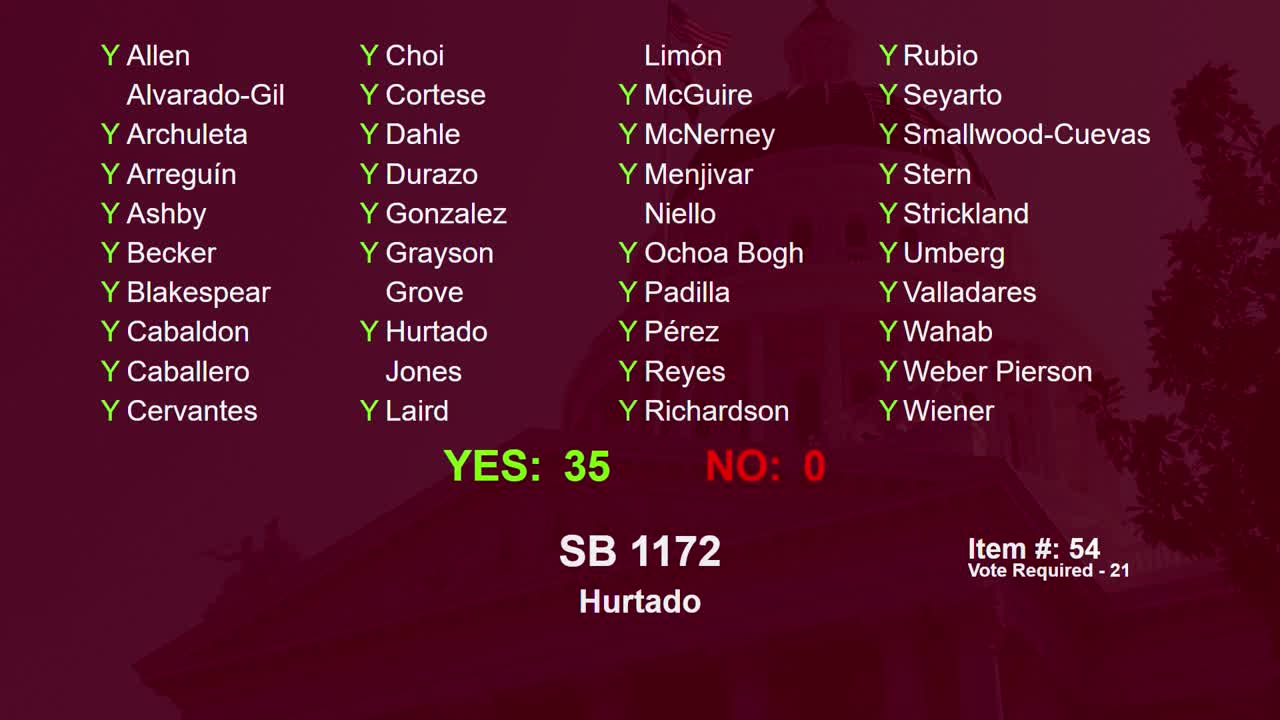 6MIN
Senate Floor
 3MIN
Senate Standing Committee on Revenue and Taxation
Bill Author
Bill Co-Author(s):