SB 1407: Personal Income Tax Law: exclusions: military retirement pay: survivor benefit pay.
- Session Year: 2025-2026
- House: Senate
- Latest Version Date: 2026-05-14
Current Status:
In Progress
(2026-08-13: August 13 hearing: Held in committee and under submission.)
Introduced
In Committee
Awaiting First Chamber Vote
Passed First Chamber
In Committee
Awaiting Second Chamber Vote
Passed Second Chamber
Enacted
The Personal Income Tax Law, in conformity with federal income tax laws, defines gross income as income from whatever source derived, except as specifically excluded, and provides various exclusions from gross income, including, for taxable years beginning on or after January 1, 2025, and before January 1, 2030, an exclusion from gross income for retirement pay received by a qualified taxpayer, as defined, during the taxable year, not to exceed $20,000, from the federal government for service performed in the uniformed services, as defined, and an exclusion for income annuity payments received by a qualified taxpayer, as defined, not to exceed $20,000, pursuant to a United States Department of Defense Survivor Benefit Plan, as specified. Existing law defines qualified taxpayer for the purpose of these exclusions to mean taxpayers that satisfy specified income limitations.
This bill would amend the above-described exclusions to annually adjust the income limitations for taxpayers for inflation, as provided, and to increase the limitation on income eligible for exclusion to $80,000. $40,000. The bill would also extend the exemption exclusions until taxable years beginning before January 1, 2037.
Existing law requires any bill authorizing a new tax expenditure to contain, among other things, specific goals that the tax expenditure will achieve, detailed performance indicators, and data collection requirements.
This bill also would include additional information required for any bill authorizing a new tax expenditure.
This bill would take effect immediately as a tax levy.
The Personal Income Tax Law, in conformity with federal income tax laws, defines gross income as income from whatever source derived, except as specifically excluded, and provides various exclusions from gross income, including, for taxable years beginning on or after January 1, 2025, and before January 1, 2030, an exclusion from gross income for retirement pay received by a qualified taxpayer, as defined, during the taxable year, not to exceed $20,000, from the federal government for service performed in the uniformed services, as defined, and an exclusion for income annuity payments received by a qualified taxpayer, as defined, not to exceed $20,000, pursuant to a United States Department of Defense Survivor Benefit Plan, as specified. Existing law defines qualified taxpayer for the purpose of these exclusions to mean taxpayers that satisfy specified income limitations.
This bill would amend the above-described exclusions to eliminate annually adjust the income limitations for taxpayers for inflation, as provided, and to eliminate the $20,000 increase the limitation on income eligible for exclusion. exclusion to $80,000. The bill would also extend the exemption until taxable years beginning before January 1, 2037.
Existing law requires any bill authorizing a new tax expenditure to contain, among other things, specific goals that the tax expenditure will achieve, detailed performance indicators, and data collection requirements.
This bill also would include additional information required for any bill authorizing a new tax expenditure.
This bill would take effect immediately as a tax levy.
The Personal Income Tax Law, in conformity with federal income tax laws, defines gross income as income from whatever source derived, except as specifically excluded, and provides various exclusions from gross income, including, for taxable years beginning on or after January 1, 2025, and before January 1, 2030, an exclusion from gross income for retirement pay received by a qualified taxpayer, as defined, during the taxable year, not to exceed $20,000, from the federal government for service performed in the uniformed services, as defined, and an exclusion for income annuity payments received by a qualified taxpayer, as defined, not to exceed $20,000, pursuant to a United States Department of Defense Survivor Benefit Plan, as specified. Existing law defines qualified taxpayer for the purpose of these exclusions to mean taxpayers that satisfy specified income limitations.
This bill would amend the above-described exclusions to eliminate the income limitations for taxpayers and to eliminate the $20,000 limitation on income eligible for exclusion. The bill would also extend the exemption until taxable years beginning before January 1, 2037.
Existing law requires any bill authorizing a new tax expenditure to contain, among other things, specific goals that the tax expenditure will achieve, detailed performance indicators, and data collection requirements.
This bill also would include additional information required for any bill authorizing a new tax expenditure.
This bill would take effect immediately as a tax levy.
(a)(1)For taxable years beginning on or after January 1, 2025, and before January 1, 2037, 2026, gross income shall not include retirement pay received by a qualified taxpayer during the taxable year, not to exceed eighty twenty thousand dollars ($80,000), ($20,000), from the federal government for service in the uniformed services.
(2)For taxable years beginning on or after January 1, 2026, and before January 1, 2037, gross income shall not include retirement pay received by a qualified taxpayer during the taxable year, not to exceed forty thousand dollars ($40,000), from the federal government for service in the uniformed services.
(b)For purposes of this section, the following definitions apply:
(1)Qualified taxpayer means a taxpayer that satisfies either of the following:
(A)In the case of a surviving spouse or spouses filing a joint return, adjusted gross income, as required to be shown on the federal tax return for the same taxable year, does not exceed two hundred fifty thousand dollars ($250,000).
(B)In the case of any other individual, adjusted gross income, as required to be shown on the federal tax return for the same taxable year, does not exceed one hundred twenty-five thousand dollars ($125,000).
(2)Uniformed services means the Armed Forces of the United States, the Army National Guard and the Air National Guard when engaged in active duty for training, inactive duty training, or full-time National Guard duty, the commissioned corps of the United States Public Health Service, and the National Oceanic and Atmospheric Administration Commissioned Officer Corps.
(c)For taxable years beginning on or after January 1, 2027, the Franchise Tax Board shall recompute the adjusted gross income specified in subparagraphs (A) and (B) of paragraph (1) of subdivision (b), as follows:
(1)The Department of Industrial Relations shall transmit annually to the Franchise Tax Board the percentage change in the California Consumer Price Index for all items from June of the prior calendar year to June of the current calendar year, no later than August 1 of the current calendar year.
(2)The Franchise Tax Board shall do both of the following:
(A)Compute an inflation adjustment factor by adding 100 percent to the percentage change figure that is furnished pursuant to paragraph (1) and dividing the result by 100.
(B)Multiply the income amounts for the preceding taxable year by the inflation adjustment factor determined in subparagraph (A) and round off the resulting products to the nearest one dollar ($1).
(d)This section shall remain in effect only until December 1, 2037, and as of that date is repealed.
SEC. 2.Section 17132.10 of the Revenue and Taxation Code is amended to read:17132.10.(a)(1)For taxable years beginning on or after January 1, 2025, and before January 1, 2037, 2026, gross income shall not include annuity payments received by a qualified taxpayer during the taxable year, not to exceed eighty twenty thousand dollars ($80,000), ($20,000), pursuant to a United States Department of Defense Survivor Benefit Plan.
(2)For taxable years beginning on or after January 1, 2026, and before January 1, 2037, gross income shall not include retirement pay received by a qualified taxpayer during the taxable year, not to exceed forty thousand dollars ($40,000), from the federal government for service in the uniformed services.
(b)For purposes of this section, the following definitions apply:
(1)Qualified taxpayer means the surviving spouse or other named beneficiary of a plan who satisfies either of the following:
(A)In the case of a surviving spouse or spouses filing a joint return, adjusted gross income, as required to be shown on the federal tax return for the same taxable year, does not exceed two hundred fifty thousand dollars ($250,000).
(B)In the case of any other individual, adjusted gross income, as required to be shown on the federal tax return for the same taxable year, does not exceed one hundred twenty-five thousand dollars ($125,000).
(2)United States Department of Defense Survivor Benefit Plan or plan means a survivor benefit plan established pursuant to Sections 1447 to 1455, inclusive, of Title 10 of the United States Code.
(c)For taxable years beginning on or after January 1, 2027, the Franchise Tax Board shall recompute the adjusted gross income specified in subparagraphs (A) and (B) of paragraph (1) of subdivision (b), as follows:
(1)The Department of Industrial Relations shall transmit annually to the Franchise Tax Board the percentage change in the California Consumer Price Index for all items from June of the prior calendar year to June of the current calendar year, no later than August 1 of the current calendar year.
(2)The Franchise Tax Board shall do both of the following:
(A)Compute an inflation adjustment factor by adding 100 percent to the percentage change figure that is furnished pursuant to paragraph (1) and dividing the result by 100.
(B)Multiply the income amounts for the preceding taxable year by the inflation adjustment factor determined in subparagraph (A) and round off the resulting products to the nearest one dollar ($1).
(d)This section shall remain in effect only until December 1, 2037, and as of that date is repealed.
SEC. 3.(a)For purposes of complying with the requirements of Section 41 of the Revenue and Taxation Code, with respect to the exclusions allowed by Section Sections 17132.9 and 17132.10 of the Revenue and Taxation Code, as extended by this act, hereafter known as the exclusions, the Legislature finds and declares the following:
(1)The specific goals of the exclusions are as follows:
(A)To recognize the loss and sacrifice of our military families and give them the support that our community owes them.
(B)To provide some financial relief to families that have experienced not only the loss of a loved one, but also often the loss of the sole income of the family, and who are now trying to make ends meet on a portion of that original income.
(2)There is no available data to collect or report with respect to the exclusions.
(b)This section shall remain in effect only until December 1, 2037, and as of that date is repealed.
SEC. 4.This act provides for a tax levy within the meaning of Article IV of the California Constitution and shall go into immediate effect.
REVISIONS: HeadingLines 3 and 4.(a)For taxable years beginning on or after January 1, 2025, and before January 1, 2037, gross income shall not include retirement pay received by a qualified taxpayer during the taxable year year, not to exceed eighty thousand dollars ($80,000), from the federal government for service in the uniformed services.
(b)For purposes of this section, uniformed services means the Armed Forces of the United States, the Army National Guard and the Air National Guard when engaged in active duty for training, inactive duty training, or full-time National Guard duty, the commissioned corps of the United States Public Health Service, and the National Oceanic and Atmospheric Administration Commissioned Officer Corps. the following definitions apply:
(1)Qualified taxpayer means a taxpayer that satisfies either of the following:
(A)In the case of a surviving spouse or spouses filing a joint return, adjusted gross income, as required to be shown on the federal tax return for the same taxable year, does not exceed two hundred fifty thousand dollars ($250,000).
(B)In the case of any other individual, adjusted gross income, as required to be shown on the federal tax return for the same taxable year, does not exceed one hundred twenty-five thousand dollars ($125,000).
(2)Uniformed services means the Armed Forces of the United States, the Army National Guard and the Air National Guard when engaged in active duty for training, inactive duty training, or full-time National Guard duty, the commissioned corps of the United States Public Health Service, and the National Oceanic and Atmospheric Administration Commissioned Officer Corps.
(c)For taxable years beginning on or after January 1, 2027, the Franchise Tax Board shall recompute the adjusted gross income specified in subparagraphs (A) and (B) of paragraph (1) of subdivision (b), as follows:
(1)The Department of Industrial Relations shall transmit annually to the Franchise Tax Board the percentage change in the California Consumer Price Index for all items from June of the prior calendar year to June of the current calendar year, no later than August 1 of the current calendar year.
(2)The Franchise Tax Board shall do both of the following:
(A)Compute an inflation adjustment factor by adding 100 percent to the percentage change figure that is furnished pursuant to paragraph (1) and dividing the result by 100.
(B)Multiply the income amounts for the preceding taxable year by the inflation adjustment factor determined in subparagraph (A) and round off the resulting products to the nearest one dollar ($1).
(c)(d)This section shall remain in effect only until December 1, 2037, and as of that date is repealed.
SEC. 2.Section 17132.10 of the Revenue and Taxation Code is amended to read:17132.10.(a)For taxable years beginning on or after January 1, 2025, and before January 1, 2037, gross income shall not include annuity payments received by a qualified taxpayer during the taxable year year, not to exceed eighty thousand dollars ($80,000), pursuant to a United States Department of Defense Survivor Benefit Plan.
(b)For purposes of this section, United States Department of Defense Survivor Benefit Plan or plan means a survivor benefit plan established pursuant to Sections 1447 to 1455, inclusive, of Title 10 of the United States Code. the following definitions apply:
(1)Qualified taxpayer means the surviving spouse or other named beneficiary of a plan who satisfies either of the following:
(A)In the case of a surviving spouse or spouses filing a joint return, adjusted gross income, as required to be shown on the federal tax return for the same taxable year, does not exceed two hundred fifty thousand dollars ($250,000).
(B)In the case of any other individual, adjusted gross income, as required to be shown on the federal tax return for the same taxable year, does not exceed one hundred twenty-five thousand dollars ($125,000).
(2)United States Department of Defense Survivor Benefit Plan or plan means a survivor benefit plan established pursuant to Sections 1447 to 1455, inclusive, of Title 10 of the United States Code.
(c)For taxable years beginning on or after January 1, 2027, the Franchise Tax Board shall recompute the adjusted gross income specified in subparagraphs (A) and (B) of paragraph (1) of subdivision (b), as follows:
(1)The Department of Industrial Relations shall transmit annually to the Franchise Tax Board the percentage change in the California Consumer Price Index for all items from June of the prior calendar year to June of the current calendar year, no later than August 1 of the current calendar year.
(2)The Franchise Tax Board shall do both of the following:
(A)Compute an inflation adjustment factor by adding 100 percent to the percentage change figure that is furnished pursuant to paragraph (1) and dividing the result by 100.
(B)Multiply the income amounts for the preceding taxable year by the inflation adjustment factor determined in subparagraph (A) and round off the resulting products to the nearest one dollar ($1).
(c)(d)This section shall remain in effect only until December 1, 2037, and as of that date is repealed.
SEC. 3.(a)For purposes of complying with the requirements of Section 41 of the Revenue and Taxation Code, with respect to the exclusions allowed by Section 17132.9 and 17132.10 of the Revenue and Taxation Code, as extended by this act, hereafter known as the exclusions, the Legislature finds and declares the following:
(1)The specific goals of the exclusions are as follows:
(A)To recognize the loss and sacrifice of our military families and give them the support that our community owes them.
(B)To provide some financial relief to families that have experienced not only the loss of a loved one, but also often the loss of the sole income of the family, and who are now trying to make ends meet on a portion of that original income.
(2)There is no available data to collect or report with respect to the exclusions.
(b)This section shall remain in effect only until December 1, 2037, and as of that date is repealed.
SEC. 4.This act provides for a tax levy within the meaning of Article IV of the California Constitution and shall go into immediate effect.
(a)For taxable years beginning on or after January 1, 2025, and before January 1, 2030, 2037, gross income shall not include retirement pay received by a qualified taxpayer during the taxable year, not to exceed twenty thousand dollars ($20,000), year from the federal government for service in the uniformed services.
(b)For purposes of this section, the following definitions apply: uniformed services means the Armed Forces of the United States, the Army National Guard and the Air National Guard when engaged in active duty for training, inactive duty training, or full-time National Guard duty, the commissioned corps of the United States Public Health Service, and the National Oceanic and Atmospheric Administration Commissioned Officer Corps.
(1)Qualified taxpayer means a taxpayer that satisfies either of the following:(A)In the case of a surviving spouse or spouses filing a joint return, adjusted gross income, as required to be shown on the federal tax return for the same taxable year, does not exceed two hundred fifty thousand dollars ($250,000).(B)In the case of any other individual, adjusted gross income, as required to be shown on the federal tax return for the same taxable year, does not exceed one hundred twenty-five thousand dollars ($125,000).(2)Uniformed services means the Armed Forces of the United States, the Army National Guard and the Air National Guard when engaged in active duty for training, inactive duty training, or full-time National Guard duty, the commissioned corps of the United States Public Health Service, and the National Oceanic and Atmospheric Administration Commissioned Officer Corps.(c)This section shall remain in effect only until December 1, 2030, 2037, and as of that date is repealed.
SEC. 2.Section 17132.10 of the Revenue and Taxation Code is amended to read:17132.10.(a)For taxable years beginning on or after January 1, 2025, and before January 1, 2030, 2037, gross income shall not include annuity payments received by a qualified taxpayer during the taxable year, not to exceed twenty thousand dollars ($20,000), year pursuant to a United States Department of Defense Survivor Benefit Plan.
(b)For purposes of this section, the following definitions apply: United States Department of Defense Survivor Benefit Plan or plan means a survivor benefit plan established pursuant to Sections 1447 to 1455, inclusive, of Title 10 of the United States Code.
(1)Qualified taxpayer means the surviving spouse or other named beneficiary of a plan who satisfies either of the following:(A)In the case of a surviving spouse or spouses filing a joint return, adjusted gross income, as required to be shown on the federal tax return for the same taxable year, does not exceed two hundred fifty thousand dollars ($250,000).(B)In the case of any other individual, adjusted gross income, as required to be shown on the federal tax return for the same taxable year, does not exceed one hundred twenty-five thousand dollars ($125,000).(2)United States Department of Defense Survivor Benefit Plan or plan means a survivor benefit plan established pursuant to Sections 1447 to 1455, inclusive, of Title 10 of the United States Code.(c)This section shall remain in effect only until December 1, 2030, 2037, and as of that date is repealed.
SEC. 3.(a)For purposes of complying with the requirements of Section 41 of the Revenue and Taxation Code, with respect to the exclusions allowed by Section 17132.9 and 17132.10 of the Revenue and Taxation Code, as extended by this act, hereafter known as the exclusions, the Legislature finds and declares the following:
(1)The specific goals of the exclusions are as follows:
(A)To recognize the loss and sacrifice of our military families and give them the support that our community owes them.
(B)To provide some financial relief to families that have experienced not only the loss of a loved one, but also often the loss of the sole income of the family, and who are now trying to make ends meet on a portion of that original income.
(2)There is no available data to collect or report with respect to the exclusions.
(b)This section shall remain in effect only until December 1, 2037, and as of that date is repealed.
SEC. 4.This act provides for a tax levy within the meaning of Article IV of the California Constitution and shall go into immediate effect.
|
Date
|
Status
|
|---|---|
| Aug 13, 2026 | August 13 hearing: Held in committee and under submission. |
| Aug 5, 2026 | August 5 set for first hearing. Placed on suspense file. |
| Jun 30, 2026 | From committee: Do pass and re-refer to Com. on APPR. (Ayes 7. Noes 0.) (June 29). Re-referred to Com. on APPR. |
| Jun 23, 2026 | June 22 set for first hearing. Placed on suspense file. |
| Jun 17, 2026 | Coauthors revised. |
| Jun 17, 2026 | From committee: Do pass and re-refer to Com. on REV. & TAX. (Ayes 8. Noes 0.) (June 16). Re-referred to Com. on REV. & TAX. |
| Jun 8, 2026 | Re-referred to Coms. on M. & V.A. and REV. & TAX. pursuant to Assembly Rule 96. |
| Jun 4, 2026 | Referred to Coms. on REV. & TAX. and M. & V.A. |
| May 28, 2026 | In Assembly. Read first time. Held at Desk. |
| May 28, 2026 | Read third time. Passed. (Ayes 39. Noes 0. Page 4526.) Ordered to the Assembly. |
| May 28, 2026 | Read third time. Passed. (Ayes 39. Noes 0.) Ordered to the Assembly. |
| May 26, 2026 | Ordered to special consent calendar. |
| May 18, 2026 | Read second time. Ordered to third reading. |
| May 14, 2026 | From committee: Do pass as amended. (Ayes 7. Noes 0. Page 4276.) (May 14). |
| May 14, 2026 | Read second time and amended. Ordered to second reading. |
| May 14, 2026 | From committee: Do pass as amended. (Ayes 7. Noes 0.) (May 14). |
| May 8, 2026 | Set for hearing May 14. |
| Apr 27, 2026 | April 27 hearing: Placed on APPR. suspense file. |
| Apr 22, 2026 | Set for hearing April 27. |
| Apr 21, 2026 | From committee: Do pass and re-refer to Com. on APPR. (Ayes 4. Noes 0. Page 3956.) (April 20). Re-referred to Com. on APPR. |
| Apr 21, 2026 | From committee: Do pass and re-refer to Com. on APPR. (Ayes 4. Noes 0.) (April 20). Re-referred to Com. on APPR. |
| Apr 9, 2026 | Read second time and amended. Re-referred to Com. on M. & V.A. |
| Apr 8, 2026 | From committee: Do pass as amended and re-refer to Com. on M. & V.A. (Ayes 5. Noes 0. Page 3795.) (April 8). |
| Apr 8, 2026 | From committee: Do pass as amended and re-refer to Com. on M. & V.A. (Ayes 5. Noes 0.) (April 8). |
| Mar 25, 2026 | Set for hearing April 8. |
| Mar 12, 2026 | March 25 set for first hearing canceled at the request of author. |
| Mar 11, 2026 | Set for hearing March 25. |
| Mar 4, 2026 | Referred to Coms. on REV. & TAX. and M. & V.A. |
| Feb 23, 2026 | Read first time. |
| Feb 23, 2026 | From printer. May be acted upon on or after March 23. |
| Feb 20, 2026 | Introduced. To Com. on RLS. for assignment. To print. |
|
Date
|
Description
|
Location
|
Votes
|
|
|---|---|---|---|---|
| Jun 29, 2026 | Do pass and be re-referred to the Committee on [Appropriations] | Assembly Standing Committee on Revenue and Taxation |
Passed |
|
| Jun 16, 2026 | Do pass and be re-referred to the Committee on [Revenue and Taxation] | Assembly Standing Committee on Military and Veterans Affairs |
Passed |
|
| May 28, 2026 | Special Consent SB1407 Archuleta et al. | Senate Floor |
Passed |
|
| May 14, 2026 | Do pass as amended | Senate Standing Committee on Appropriations |
Passed |
|
| Apr 27, 2026 | Placed on suspense file | Senate Standing Committee on Appropriations |
Passed |
|
| Apr 20, 2026 | Do pass, but first be re-referred to the Committee on [Appropriations] | Senate Standing Committee on Military and Veterans Affairs |
Passed |
|
| Apr 8, 2026 | Do pass as amended, but first amend, and re-refer to the Committee on [Military and Veterans Affairs] | Senate Standing Committee on Revenue and Taxation |
Passed |
This list shows positions taken on this bill by organizations on the date displayed, which is linked to the original source.
Positions by individuals are not included.
|
Organization
|
Position
|
Date
|
|---|---|---|
| Alaska Airlines | ** Support | |
| American Legion, Department Of California | ** Support | |
| Amvets, Department Of California | ** Support | |
| Armed Services YMCA San Diego | ** Support | |
| Burnham Center for Community Advancement | ** Support | |
| Cal Fire Local 2881 | ** Support | |
| California Association Of County Veterans Service Officers | ** Support | |
| California Association Of Highway Patrolmen | ** Support | |
| California Conference of Carpenters | ** Support | |
| California Hispanic Chambers Of Commerce | ** Support | |
| California State Commanders Veterans Council | ** Support | |
| California State Retirees | ** Support | |
| California State Treasurer | ** Support | |
| California Tax Reform Association | ** Against | |
| California Teachers Association | ** Against | |
| China Lake Alliance | ** Support | |
| County of Monterey | ** Support | |
| Fiona Ma | ** Support | |
| General Atomics Electromagnetic Systems | ** Support | |
| Military Officers Association Of America, California Council Of Chapters | ** Support | |
| National University | ** Support | |
| Peace Officers Research Association of California (PORAC) | ** Support | |
| San Diego Military Advisory Council (SDMAC) | ** Support | |
| San Diego Regional Chamber Of Commerce | ** Support | |
| Schneider Electric | ** Support | |
| Shasta County Board of Supervisors | ** Support | |
| Shasta; County Of | ** Support | |
| The Veterans Beer Club | ** Support | |
| Two individuals | ** Support | |
| Ventura County Chapter of The Military Officers Association of America | ** Support | |
| Ventura County Chapter Of The Military Officers Association Of America (Vcc-Moaa) | ** Support | |
| Veterans Beer Club | ** Support | |
| Veterans of Foreign Wars | ** Support | |
| Veterans Village of San Diego | ** Support | |
| VetFund Foundation | ** Support | |
| VFW | ** Support | |
| Vietnam Veterans Of America, California State Council | ** Support | |
| Western States Regional Council of Carpenters | ** Support | |
| Workshops for Warriors | ** Support | |
| YMCA of San Diego County | ** Support |
Date of Hearing: August 5, 2026
ASSEMBLY COMMITTEE ON APPROPRIATIONS
Buffy Wicks, Chair
SBPCA Bill Id:SB 1407
Author:(Archuleta) – As Amended Ver:May 14, 2026
Policy Committee: | Military and Veterans Affairs | Vote: | 8 - 0 |
Revenue and Taxation | 7 - 0 | ||
|
|
Urgency: No State Mandated Local Program: No Reimbursable: No
SUMMARY:
This bill doubles the amount of retirement and annuity payments that a qualifying military retiree or surviving spouse may exclude from gross income under the Personal Income Tax (PIT) Law.
Specifically, this bill:
- Increases, from $20,000 to $40,000, for taxable years beginning on or after January 1, 2026, and before January 1, 2037, the amount of military retirement and annuity payments excluded from a qualified taxpayer’s gross income.
- Requires the Franchise Tax Board (FTB) to recompute, for taxable years beginning on or after January 1, 2027, the income limitation of a qualified taxpayer to account for inflation, and requires the Department of Industrial Relations (DIR) to annually transmit certain California Consumer Price Index (CPI) data to FTB for this purpose.
- Declares the goal of the exclusion and finds that there is no available data to collect or report with respect to the exclusion.
FISCAL EFFECT:
- General Fund revenue loss of approximately $60 million in fiscal year (FY) 2026-27, $39 million in FY 2027-28, and $39 million in FY 2028-29.
By reducing state PIT revenue, this bill also likely decreases Proposition 98 GF spending by approximately 40% of the revenue loss (the exact amount depends on the operative test of the annual Proposition 98 guarantee).
- Likely absorbable costs to FTB to administer the expanded gross income exclusion and annually adjust for inflation the income limitation of a qualified taxpayer.
- Minor and absorbable costs to DIR to provide FTB with CPI data.
COMMENTS:
- Purpose. According to the author:
For too long our veterans have been faced with a difficult decision: stay in this beautiful state while struggling to make ends meet with rising costs of living or move to a state that financially incentivizes them to join their labor force and feed federal dollars into their economy…Veterans staying in California will pay for sales, property, and use taxes, benefitting local governments. By exempting military retirement pay for retirees, SB 1407 will ensure California retains these highly skilled professionals and keeps the reinvestment of federal dollars and wages from second careers.
- Military Benefits. Generally, a service member may retire from active duty at any age once they have completed at least 20 years of service. In addition, an individual who meets retirement requirements through reserve or National Guard service may receive retirement pay after age 59. The Survivor Benefit Plan allows a military retiree to ensure, after death, a continuous lifetime annuity for their dependents. A military retiree pays premiums from their gross retired pay for such coverage, which is not taxed at the federal or state level. Aside from the nine states that do not have PIT, 29 states do not tax military retirement pay, with the 12 remaining states, including California, providing various levels of exclusions or deductions for such income.
California previously offered a military-specific income exclusion until the 1987 tax year, when the tax benefit morphed into a tax credit equal to 4% of the eligible income received by an individual with adjusted gross income under $27,000. The tax credit sunset on January 1, 1992. After decades without an exclusion, SB 132 (Committee on Budget and Fiscal Review), Chapter 17, Statutes of 2025, excludes up to $20,000 of uniformed services retirement pay and Survivor Benefit Plan annuity payments from gross income for a qualified taxpayer for tax years 2025 through 2030. A qualified taxpayer’s adjusted gross income (AGI) must not be in excess of $250,000 if filing jointly or $125,000 as a single filer. This bill doubles the amount of the exclusion to up to $40,000, requires FTB to adjust the AGI of a qualified taxpayer for inflation, and extends the exclusion through tax year 2036.
- Support and Opposition. This bill is sponsored by State Treasurer Fiona Ma, who argues, “While the enactment of a $20,000 exemption in 2025 marked important progress, it does not go far enough. Many veterans continue to see their retirement savings diminished year after year.” This bill is also supported by a range of veterans, public safety, and business groups.
This bill is opposed by a labor organization and the California Tax Reform Association, the latter of which argues, “The choice of long-term military service is similar to other valuable public servants, such as teachers, police, firefighters, and nurses, who receive no exclusions for their retirement pay.”
- Related Legislation. SB 888 (Seyarto) excludes service-connected disability payments from the calculation of household income when determining whether a veteran qualifies for the low-income disabled veterans’ property tax exemption. SB 888 is pending hearing by this committee.
- Prior Legislation. AB 46 (Ramos), of the 2023-24 Legislative Session, would have excluded, for 10 taxable years, retirement pay and annuity payments that a qualifying military retiree or surviving spouse may exclude from gross income under the PIT Law. AB 46 was held on the Senate Appropriations Committee’s suspense file.
Analysis Prepared by: Irene Ho / APPR. / (916) 319-2081
Date of Hearing: June 29, 2026
ASSEMBLY COMMITTEE ON REVENUE AND TAXATION
Mike Gipson, Chair
SBPCA Bill Id:SB 1407
Author:(Archuleta) – As Amended Ver:May 14, 2026
SUSPENSE
Majority vote. Tax levy. Fiscal committee.
SENATE VOTE: 39-0
SUBJECT: Personal Income Tax Law: exclusions: military retirement pay: survivor benefit pay
SUMMARY: Doubles the amount of uniformed services retirement pay and annuity payments from a United States Department of Defense Survivor Benefit Plan that a qualifying military retiree or surviving spouse are allowed to exclude from their gross income. Specifically, this bill:
- Increases, from $20,000 to $40,000, the amount of uniformed services retirement pay and annuity payments from a United States Department of Defense Survivor Benefit Plan that a qualified taxpayer may exclude from their gross income for taxable years beginning on or after January 1, 2026, and before January 1, 2037.
- Requires the Franchise Tax Board (FTB) to recalculate, on an annual basis, the adjusted gross income (AGI) eligibility limitation by applying an inflation adjustment factor based on the percentage change in the California Consumer Price Index as provided by the Department of Industrial Relations.
- Finds and declares the following for purposes of complying with Revenue and Taxation Code (R&TC) Section 41:
- The specific goals of the exclusions are to recognize the loss and sacrifice of our military families and give them the support that our community owes them and to provide some financial relief to families that have experienced not only the loss of a loved one, but also often the loss of the sole income of the family, and who are now trying to make ends meet on a portion of that original income; and,
- There is no available data to collect or report with respect to the exclusions.
- Repeals both expanded income exclusion provisions on December 1, 2037.
- Takes immediate effect as a tax levy.
EXISTING LAW:
- Conforms to federal law, which provides that "gross income" includes all income from whatever source derived unless expressly excluded. (Internal Revenue Code (IRC) Section 61 and R&TC Section 17071.) Gross income includes compensation for services, business income, gain from selling property, interest, rents, royalties, dividends, and pensions.
- Excludes from gross income, under state and federal law, certain types of income for an individual's active service in the Armed Forces, such as military pay for time served in combat zones, disability compensation, and death benefits paid to qualified survivors. (R&TC Section 17142.5.)
- Excludes from gross income specified death benefits received by the surviving spouse or designated beneficiary of any member of the California National Guard, State Military Reserve, or Naval Militia who dies or is killed in the performance of duty, as specified. (R&TC Section 17132.4.)
- Excludes up to $20,000 of retirement pay received by a taxpayer from the federal government for service in the "uniformed services" during the taxable year from gross income under the Personal Income Tax (PIT) Law for taxable years beginning on or after January 1, 2025, and before January 1, 2030. (R&TC Section 17132.9.)
- Defines the following terms for purposes of the retirement pay exclusion:
- "Qualified taxpayer" is a taxpayer who satisfies either of the following:
- In the case of a surviving spouse or spouses filing a joint return, AGI does not exceed $250,000; or,
- In the case of any other individual, AGI does not exceed $125,000; and,
- "Uniformed services" are the Armed Forces of the United States, the Army National Guard and the Air National Guard when engaged in active duty for training, inactive duty training, or full-time National Guard duty, the commissioned corps of the United States Public Health Service, and the National Oceanic and Atmospheric Administration Commissioned Officer Corps. (R&TC Section 17132.9(b).)
- "Qualified taxpayer" is a taxpayer who satisfies either of the following:
- Excludes up to $20,000 of annuity payments received by a qualified taxpayer under the United States Department of Defense Survivor Benefit Plan during the taxable year from gross income for taxable years beginning on or after January 1, 2025, and before January 1, 2030. (R&TC Section 17132.10.)
- Defines the following terms for purposes of the annuity payment exclusion:
- "Qualified taxpayer" is a taxpayer who satisfies either of the following:
- In the case of a surviving spouse or spouses filing a joint return, AGI does not exceed $250,000; or,
- In the case of any other individual, AGI does not exceed $125,000; and,
- "United States Department of Defense Survivor Benefit Plan" is a survivor benefit plan established pursuant to Sections 1447 to 1455, inclusive, of Title 10 of the United States Code. (R&TC Section 17132.10(b).)
- "Qualified taxpayer" is a taxpayer who satisfies either of the following:
- Sunsets both gross income exclusion provisions on December 1, 2030. (R&TC Sections 17132.9(c) and 17132.10(c).)
FISCAL EFFECT: The FTB estimates General Fund revenue losses of $60 million for fiscal year (FY) 2026-27, $39 million for FY 2027-28, and $39 million for FY 2028-29.
COMMENTS:
- The author has provided the following statement in support of this bill:
For too long our veterans have been faced with a difficult decision: stay in this beautiful state while struggling to make ends meet with rising costs of living or move to a state that financially incentivizes them to join their labor force and feed federal dollars into their economy. I've heard from far too many of my brothers and sisters who say California has become too expensive for them to live in and say a tax exemption on their retirement pay would be the determining factor on whether they stay or leave. California's current tax structure discourages long-term service and drives away mid-career leaders, weakening our state's ability to meet homeland defense, wildfire, disaster response, and civil support missions. As retention challenges grow, we must recognize that fiscal policy plays a role in long-term enlistment decisions. SB 1407 is crucial in strengthening California's commitment to supporting its veterans. Veterans staying in California will pay for sales, property, and use taxes, benefiting local governments. By exempting military retirement pay for retirees, SB 1407 will ensure California retains these highly skilled professionals and keeps the reinvestment of federal dollars and wages from second careers.
- This bill is sponsored by California State Treasurer Fiona Ma, who notes, in part:
While the enactment of a $20,000 exemption in 2025 marked important progress, it does not go far enough. Many veterans continue to see their retirement savings diminished year after year. These are benefits earned through deployments, long separations from loved ones, and the physical and mental demands of military service.
At the same time, California is losing military retirees at an alarming rate. While the national veteran retiree population grew by 17 percent from 2010 to 2021, California experienced a 14 percent decline and was one of only five states to see such a decrease. Between 2010 and 2022, more than 24,000 military retirees left our state, resulting in an estimated annual loss of $700 million in federal retirement and survivor payments that would otherwise strengthen local economies.
- This bill is supported by several veteran's organizations, including the Veterans of Foreign Wars (VFW), which notes, in part:
The average military retirement pay in California is $34,000 annually. Most veterans retire from the military and move on to second careers and most have working spouses and together, they earn significantly more than their retirement pay that could be taxed if they stayed in California along with businesses that many of them lead. Furthermore, veterans bring with them federal dollars to provide medical care that the state benefits from.
Finally, the impact of military retirees in California extends far beyond their economic and fiscal effects. Retired members of the military represent some of the state's most enterprising residents, bringing a strong work ethic, integrity, innovative spirit and respect for others that will drive the state's prosperity. Retaining veterans is more than a financial proposition. Instilled in our veterans and their families is a culture of service. They are community leaders who often coach sports teams, volunteer for nonprofits, help our schools – they are who you want as your neighbor. Let's incentivize our veterans to "stay California".
- Writing in opposition to this bill, the California Teachers Association (CTA), notes, in part:
In fiscal year 2025-26, the Department of Finance estimated a $94 billion dollar loss in general fund revenue due to existing tax expenditures. This is revenue that would have otherwise gone to the General Fund, of which approximately 40% would have gone toward the Proposition 98 minimum guarantee. Once tax credits are passed with a simple majority, it takes a two-thirds vote of the Legislature to repeal them. While we understand the well-meaning intent behind this proposal, CTA does not support this approach, as it would reduce overall funding for education. CTA believes Proposition 98 should be protected from reductions through the creation of new or expanding existing tax expenditures.
- Committee Staff Comments:
- What would this bill do? This bill doubles the amount of income attributable to uniformed services retirement pay and annuity payments from the United States Department of Defense Survivor Benefit Plan that a qualifying taxpayer can exclude from their gross income for California income tax purposes. As currently drafted, this bill does not amend the existing limitations that make ineligible taxpayers with an AGI in excess of $125,000 for single filers ($250,000 for joint filers).
- Partial income exclusion provided in last year's budget: The 2025-26 Governor's January Budget proposed a partial income exclusion of military retirement pay and survivor benefits, which was agreed to by the Legislature and included in the final budget agreement. SB 132 (Committee on Budget and Fiscal Review), Chapter 17, Statutes of 2025, was signed into law on June 27, 2026, and excluded up to $20,000 of military retirement income for qualifying taxpayers for the 2025 through 2030 taxable years. The exemption is limited to taxpayers whose AGI does not exceed $250,000 in income if filing jointly and up to $125,000 for single filers.
- What is AGI? AGI represents a taxpayer's gross income—including wages, salaries, interest, dividends, capital gains, business income, retirement distributions, and other taxable income—minus certain "above-the-line" adjustments such as contributions to Individual Retirement Accounts (IRAs), and student loan interest payments. AGI is calculated before applying the standard deduction or itemized deductions and is used by the FTB to determine a taxpayer's taxable income and eligibility for various tax credits, deductions, and exclusions. Accordingly, a taxpayer's AGI is lower than their annual gross income, which includes income from all sources without any subtractions. For example, a taxpayer that received $150,000 in income from all sources and makes $10,000 in qualifying retirement account contributions in that same year would have an AGI of $140,000. One above-the-line deduction specifically available to military members is the deduction for moving expenses.
- Who receives military retirement payments and survivor annuity payments? As of January 31, 2023, the most recent data available, 127,793 military retirees in California received total monthly payments of over $362 million or about $4.3 billion annually from the United States Department of Defense (DoD).[1] Generally, service members can retire from active duty at any age with at least 20 years of service. In addition, persons who meet retirement requirements partially or entirely through reserve or National Guard service receive retirement pay after age 59.
Also, as of January 31, 2023, 25,705 survivors in California received total monthly payments of just over $39 million or about $468 million annually.[2] The Survivor Benefit Plan allows a military retiree to ensure, after death, a continuous lifetime annuity for their dependents. A military retiree pays premiums for the Survivor Benefit Plan coverage upon retiring. Premiums are paid from gross retired pay and are not taxed at the federal level and are also not taxed at the state level.
- The population of California's military retirees and survivors receiving pay from the DoD has declined at an increasing rate: Committee staff analyzed the DoD Office of Actuary's data. The data show that the population of military retirees receiving pay from the DoD in California has been declining by at least 1% year-over-year (YOY) since 2013, accelerating to declines of over 3% in recent years.[3] California experienced this YOY decline while the world and the U.S. generally had a slight YOY increase. (See "TOTAL MILITARY RETIREES RECEIVING PAY FROM DOD" table below.)
TOTAL MILITARY RETIREES RECEIVING PAY FROM DOD | ||||||
Year | World Total | World YOY | U.S. Total | U.S. YOY | CA Total | CA YOY |
2023 | 2,010,348 | 0.10% | 1,987,172 | 0.07% | 127,793 | -3.44% |
2021 | 2,008,403 | -0.36% | 1,985,852 | -0.32% | 132,344 | -3.28% |
2020 | 2,015,756 | -0.22% | 1,992,319 | -0.18% | 136,833 | -2.27% |
2019 | 2,020,175 | 0.09% | 1,995,969 | 0.07% | 140,015 | -2.11% |
2018 | 2,018,457 | 0.15% | 1,994,526 | 0.16% | 143,030 | -2.09% |
2017 | 2,015,423 | 0.14% | 1,991,414 | 0.14% | 146,088 | -1.55% |
2016 | 2,012,619 | 0.35% | 1,988,655 | 0.35% | 148,394 | -1.48% |
2015 | 2,005,526 | 0.50% | 1,981,625 | 0.50% | 150,628 | -1.02% |
2014 | 1,995,472 | 0.68% | 1,971,829 | 0.67% | 152,182 | -0.72% |
2013 | 1,981,999 |
| 1,958,673 |
| 153,280 |
|
The population of survivors receiving pay from DoD in California has also experienced a persistent YOY decline, at a greater rate than in the world and the U.S. (See "TOTAL SURVIVORS RECEIVING PAY FROM DOD" table below.)
TOTAL SURVIVORS RECEIVING PAY FROM DOD | ||||||
Year | World Total | World YOY | U.S. Total | U.S. YOY | CA Total | CA YOY |
2023 | 304,001 | -1.51% | 303,193 | -1.51% | 25,705 | -5.01% |
2021 | 308,654 | -1.02% | 307,830 | -1.03% | 27,060 | -4.04% |
2020 | 311,825 | 1.00% | 311,030 | 1.52% | 28,199 | -1.63% |
2019 | 308,739 | -0.49% | 306,365 | -0.50% | 28,665 | -2.91% |
2018 | 310,272 | -1.48% | 307,904 | -1.48% | 29,523 | -3.89% |
2017 | 314,928 | -1.28% | 312,542 | -1.28% | 30,718 | -3.48% |
2016 | 319,012 | -0.53% | 316,599 | -0.53% | 31,825 | -2.61% |
2015 | 320,708 | -1.80% | 318,299 | -0.65% | 32,678 | -2.71% |
2014 | 326,583 | -0.43% | 320,397 | -0.43% | 33,587 | -2.22% |
2013 | 327,989 |
| 321,784 |
| 34,351 |
|
- California previously offered military-specific income exclusions and later a targeted tax credit: For taxable years beginning December 22, 1972 through January 1, 1986, California law provided taxpayers an annual $1,000 income exclusion for compensation received during active duty in the Armed Forces or State Military Reserve. State law also provided taxpayers an exclusion of up to $500 per month for any compensation received during active duty in the National Guard in connection with an emergency. Additionally, an income exclusion was applied to pensions or retirement pay received by an individual for their service in the Armed Forces, the State Military Reserve, or the National Guard. (See former R&TC Section 17146.)
For taxable years beginning January 1, 1987 through January 1, 1992, a member of the Armed Forces was allowed a credit, rather than an exclusion from gross income, in an amount equal to 4% of the eligible income received by an individual whose AGI was less than $27,000. Eligible income included salary, wages, bonuses, allowances, pensions, retirement pay, and other compensation received by an individual for their services on extended active duty as a member of the Armed Forces, including the California National Guard or the State Military Reserve. This law remained in effect until its January 1, 1992 sunset. (See former R&TC Section 17053.13.)
- Treatment of military retiree and survivor income by other states: Twenty-eight states with income taxes fully exclude military retirement pay: Alabama, Arizona, Arkansas, Connecticut, Hawaii, Illinois, Indiana, Iowa, Kansas, Louisiana, Maine, Massachusetts, Michigan, Minnesota, Mississippi, Missouri, Nebraska, New Hampshire, New Jersey, New York, North Carolina, North Dakota, Ohio, Pennsylvania, West Virginia, and Wisconsin.
Nine states have no state income tax: Alaska, Florida, Nevada, South Dakota, Tennessee, Texas, Washington, and Wyoming. New Hampshire taxes residents on interest and dividends but does not tax regular earned income or pension income.
Fourteen states tax military retirement income partially through income exemptions and exclusions: Colorado, Delaware, Georgia, Idaho, Kentucky, Maryland, Montana, New Mexico, Oklahoma, Oregon, Rhode Island, South Carolina, Vermont, and Virginia. Some of these states consider the age of the qualified taxpayer in determining the amount of military retirement pay that can be excluded from gross income, as explained below:
- Colorado allows taxpayers under the age of 55 to exclude up to $15,000 in military retirement pay through the 2028 taxable year;[4]
- Delaware allows taxpayers of any age to exclude up to $12,500 in military retirement pay;[5]
- Georgia, starting in 2026, allows taxpayers to exclude up to $65,000 in military retirement pay;[6]
- Idaho allows taxpayers filing jointly to exclude up to $60,210 (up to $40,140 for single filers) in military retirement pay if the taxpayer is classified as disabled or is age 62 or older;[7]
- Kentucky allows any taxpayer to exclude up to $31,110 of any pension income;[8]
- Maryland allows taxpayers to exclude up to $12,500 in military retirement pay, or up to $20,000 if the taxpayer is 55 or older;[9]
- Montana allows, for up to five years after becoming a resident and only if the taxpayer also earns wages, business income, or farming income in Montana, a taxpayer to exclude up to 50% of their military retirement pay;[10]
- New Mexico allows taxpayers of any age to exclude up to $30,000 in military retirement pay;[11]
- Oregon allows taxpayers who earned their pension before October 1, 1991, to fully exclude those amounts from gross income; pensions are taxable if the taxpayer's service was after October 1, 1991;[12]
- Utah generally includes military retirement pay and survivor benefits in one's taxable income but offers nonrefundable credits equal to 4.55% and 4.5% of the reported retirement pay or survivor benefit payments included on that year's tax return;[13]
- Vermont allows exclusions based on the taxpayer's AGI:[14]
- Taxpayers with AGI below $125,000 can fully exclude all military retirement pay and survivor benefit payments;
- Taxpayers with AGI between $125,000 and $175,000 can exclude a portion of their military retirement pay that decreases as their income increases; and,
- Taxpayers with AGI at or above $175,000 cannot exclude military retirement pay; and,
- Taxpayers with AGI below $125,000 can fully exclude all military retirement pay and survivor benefit payments;
- Virginia allows taxpayers to exclude up to $40,000 in military retirement pay.[15]
- Colorado allows taxpayers under the age of 55 to exclude up to $15,000 in military retirement pay through the 2028 taxable year;[4]
- Treatment of military retiree and survivor income by other states: Twenty-eight states with income taxes fully exclude military retirement pay: Alabama, Arizona, Arkansas, Connecticut, Hawaii, Illinois, Indiana, Iowa, Kansas, Louisiana, Maine, Massachusetts, Michigan, Minnesota, Mississippi, Missouri, Nebraska, New Hampshire, New Jersey, New York, North Carolina, North Dakota, Ohio, Pennsylvania, West Virginia, and Wisconsin.
A significant number of states are also not taxing annuity payments from the Survivor Benefit Plan.[16] For example, Arizona, North Carolina, and Utah passed legislation to not tax survivor annuity payments in 2021.[17]
- Taxation may not be the primary reason for the recent increase in migration out of California to other states: According to the Public Policy Institute of California (PPIC), people who move to California are more likely to be working age, to be employed, and to earn high wages—and are less likely to be in poverty—than those who move away.[18] Moreover, a PPIC Statewide Survey found that one-third of Californians have seriously considered leaving the state because of housing costs.[19] PPIC notes that the state's high cost of living, driven almost solely by comparatively high housing costs, remains an ongoing public policy challenge—one that needs resolution if the state is to be a place of opportunity for all of its residents.[20]
- What is a "tax expenditure"? Existing law provides various credits, deductions, exclusions, and exemptions for particular taxpayer groups. In the late 1960s, U.S. Treasury officials began arguing that these tax law features should be referred to as "expenditures" since they are generally enacted to accomplish some governmental purpose, and there is a determinable cost associated with each (in the form of foregone revenues).
As the Department of Finance notes in its annual Tax Expenditure Report, there are several critical differences between tax expenditures and direct expenditures. First, tax expenditures are reviewed less frequently than direct expenditures. Second, there is generally no control over the amount of revenue losses associated with any given tax expenditure. Finally, it takes a two-thirds vote to rescind an existing tax expenditure absent a sunset date. This effectively results in a "one-way ratchet" whereby tax expenditures can be conferred by a majority vote but cannot be rescinded, regardless of efficacy or cost, without a supermajority vote. This bill enacts a new tax expenditure program in the form of gross income exclusions for military retirement pay and annuity payments from the United States Department of Defense Survivor Benefit Plan.
- Committee's tax expenditure policy: This bill complies with R&TC Section 41 because it outlines specific goals, purposes, and objectives that the tax expenditure will achieve. In addition to the R&TC Section 41 requirements, this Committee's policy also requires that all tax expenditure proposals have an appropriate sunset provision to be eligible for a vote. Sunsets are required because eliminating a tax expenditure generally requires a two-thirds vote. According to this policy, an "appropriate sunset provision" means five years, except in the case of a tax expenditure measure providing relief to California veterans, in which case "appropriate sunset provision" means ten years. This bill, as currently drafted, complies with the Committee's policy on sunset dates.
- Policy considerations:
- Nonconformity to federal law: This bill establishes exclusions for which federal law has no counterpart. Generally, nonconformity to federal law adds complexity and additional administrative burdens for taxpayers.
- A slippery slope? It should be noted that California currently taxes the retirement benefits of teachers, first responders like police and fire, and other public service workers. As a result, this Committee may face a slippery slope of choosing which groups should be rewarded with similar income exclusions.
- Related legislation: AB 53 (Ramos) excluded, for taxable years beginning on or after January 1, 2025, and before January 1, 2030, up to $20,000 of uniformed services retirement pay and annuity payments from a United States Department of Defense Survivor Benefit Plan received by qualified taxpayers during the taxable year from gross income under the PIT Law. AB 53 was recently amended to address a non-tax issue and re-referred to the Senate Committee on Natural Resources and Water.
- Prior legislation:
- SB 132 (Committee on Budget and Fiscal Review), Chapter 17, Statutes of 2025, excluded, for taxable years beginning on or after January 1, 2025, and before January 1, 2030, up to $20,000 of uniformed services retirement pay and annuity payments from a United States Department of Defense Survivor Benefit Plan received by qualified taxpayers during the taxable year from gross income under the PIT Law.
- AB 46 (Ramos), of the 2023-24 Legislative Session, would have excluded from gross income uniformed services retirement pay and annuity payments from a United States Department of Defense Survivor Benefit Plan. AB 46 was held on the Senate Appropriations Committee's Suspense File.
- AB 1623 (Ramos), of the 2021-22 Legislative Session, was substantially similar to AB 46. AB 1623 was held on the Assembly Appropriations Committee's Suspense File.
- AB 1629 (Seyarto), of the 2021-22 Legislative Session, would have excluded from gross income survivor benefits or payments, not to exceed $20,000 per taxable year, received under the federal Survivor Benefit Plan for a period of five taxable years. AB 1629 was not heard by this Committee.
- AB 291 (Seyarto), of the 2021-22 Legislative Session, would have excluded from gross income survivor benefits and payments received under the federal Survivor Benefit Plan for five taxable years. AB 291 was not heard by this Committee.
- AB 427 (Brough), of the 2019-20 Legislative Session, would have excluded from gross income specified amounts of retirement pay for 10 taxable years. AB 427 was held on the Assembly Appropriations Committee's Suspense File.
- AB 2380 (Choi), of the 2019-20 Legislative Session, would have excluded from gross income survivor benefits or payments received under the federal Survivor Benefit Plan for five taxable years. AB 2380 was not heard by this Committee.
- SB 1007 (Hueso), of the 2019-20 Legislative Session, would have excluded from gross income military retirement pay for 10 taxable years. SB 1007 was not heard due to the shortened 2020 Legislative Calendar as a result of the COVID-19 pandemic.
- SB 1071 (Wilk), of the 2019-20 Legislative Session, would have excluded from gross income a percentage of military retirement pay for 10 taxable years. SB 1071 was never heard due to the shortened 2020 Legislative Calendar as a result of the COVID-19 pandemic.
REGISTERED SUPPORT / OPPOSITION:
Support
Cal Fire Local 2881
California Association of Highway Patrolmen
California State Retirees
California State Treasurer
County of Monterey
Monterey; County of
National University
Peace Officers Research Association of California (PORAC)
San Diego Military Advisory Council (SDMAC)
VetFund Foundation
Veterans of Foreign Wars
Opposition
California Teachers Association
Analysis Prepared by: Wesley Whitaker / REV. & TAX. / (916) 319-2098
Military retirees and survivors by congressional district as of January 31, 2023 for the 118th congress (CONGDIST 2022), Office of the Actuary, Department of Defense. https://actuary.defense.gov/Portals/15/Cong%20Dist%202022%20v3.pdf?ver=13J1Z-ldxRlvJeXfnkReDg%3d%3d. ↑
Id. ↑
Id. ↑
Retired Servicemembers. Colorado Department of Revenue, Taxation Division. https://tax.colorado.gov/retired-servicemembers ↑
Title 30, DE Code § 1106(b)(3) (2025). ↑
Military Retirement Income Tax Exemption. Georgia Department of Veterans Service. https://veterans.georgia.gov/military-retirement-income-tax-exemption. ↑
FORM 40, 43, 39R, 39NR, TAX TABLES Instructions - Individual Income Tax. Idaho State Tax Commission. March 2, 2026. https://tax.idaho.gov/wp-content/uploads/forms/EIN00046/EIN00046_03-02-2026.pdf. ↑
Military Exemptions. Kentucky Department of Revenue. https://revenue.ky.gov/Individual/Pages/Military-Exemptions.aspx. ↑
Military Retirement Pay Income Tax Deduction. Maryland Department of Veterans Affairs and Military Families. https://veterans.maryland.gov/benefits-services/tax-exemptions/retirement-pay-and-pension-tax-deductions-and-exclusion. ↑
Working Military Retirement Exemption. Montana Department of Revenue. https://revenue.mt.gov/taxes/individual-income-tax/working-military-retirement-exemption ↑
NM Stat § 7-2-5.13 (2025). ↑
Publication OR-PIT-VET Personal Income Tax Items of Interest to Oregon Veterans. Oregon Department of Revenue. https://www.oregon.gov/DOR/forms/FormsPubs/publication-or-pit-vet_101-009.pdf. ↑
Military Personnel Instructions – Publication 57. Utah State Tax Commission. Revised October 2024. https://tax.utah.gov/forms-pubs/pub-57/. ↑
Income Tax Exemption for Military Retirees and Survivors. Vermont Agency of Administration: Department of Taxes. https://tax.vermont.gov/individuals/income-tax-returns/who-needs-to-file/military-personnel. ↑
Military Benefits Subtraction FAQ. Virginia Department of Taxation. https://www.tax.virginia.gov/military-benefits-faq. ↑
Absher, Military.com (January 10, 2022). States tax information for military members and retirees. https://www.military.com/money/personal-finance/state-tax-information.html. ↑
Absher, Military.com (January 11, 2022). 5 more states make military retirement tax free. https://www.military.com/daily-news/2022/01/10/five-more-states-make-military-retirement-tax-free.html. ↑
Johnson, Who's leaving California—and who's moving in?, Public Policy Institute of California (May 6, 2021). https://www.ppic.org/blog/whos-leaving-california-and-whos-moving-in/. ↑
Baldassare, Bonner, Lawler, & Thomas, PPIC statewide survey: Californians and their government, Public Policy Institute. https://www.ppic.org/publication/
ppic-statewide-survey-californians-and-their-government-february-2023/. ↑Johnson (2021). ↑
Date of Hearing: June 22, 2026
ASSEMBLY COMMITTEE ON REVENUE AND TAXATION
Mike Gipson, Chair
SBPCA Bill Id:SB 1407
Author:(Archuleta) – As Amended Ver:May 14, 2026
Majority vote. Tax levy. Fiscal committee.
SENATE VOTE: 39-0
SUBJECT: Personal Income Tax Law: exclusions: military retirement pay: survivor benefit pay
SUMMARY: Doubles the amount of uniformed services retirement pay and annuity payments from a United States Department of Defense Survivor Benefit Plan that a qualifying military retiree or surviving spouse are allowed to exclude from their gross income. Specifically, this bill:
- Increases, from $20,000 to $40,000, the amount of uniformed services retirement pay and annuity payments from a United States Department of Defense Survivor Benefit Plan that a qualified taxpayer may exclude from their gross income for taxable years beginning on or after January 1, 2026, and before January 1, 2037.
- Requires the Franchise Tax Board (FTB) to recalculate, on an annual basis, the adjusted gross income (AGI) eligibility limitation by applying an inflation adjustment factor based on the percentage change in the California Consumer Price Index as provided by the Department of Industrial Relations.
- Finds and declares the following for purposes of complying with Revenue and Taxation Code (R&TC) Section 41:
- The specific goals of the exclusions are to recognize the loss and sacrifice of our military families and give them the support that our community owes them and to provide some financial relief to families that have experienced not only the loss of a loved one, but also often the loss of the sole income of the family, and who are now trying to make ends meet on a portion of that original income; and,
- There is no available data to collect or report with respect to the exclusions.
- Repeals both expanded income exclusion provisions on December 1, 2037.
- Takes immediate effect as a tax levy.
EXISTING LAW:
- Conforms to federal law, which provides that "gross income" includes all income from whatever source derived unless expressly excluded. (Internal Revenue Code (IRC) Section 61 and R&TC Section 17071.) Gross income includes compensation for services, business income, gain from selling property, interest, rents, royalties, dividends, and pensions.
- Excludes from gross income, under state and federal law, certain types of income for an individual's active service in the Armed Forces, such as military pay for time served in combat zones, disability compensation, and death benefits paid to qualified survivors. (R&TC Section 17142.5.)
- Excludes from gross income specified death benefits received by the surviving spouse or designated beneficiary of any member of the California National Guard, State Military Reserve, or Naval Militia who dies or is killed in the performance of duty, as specified. (R&TC Section 17132.4.)
- Excludes up to $20,000 of retirement pay received by a taxpayer from the federal government for service in the "uniformed services" during the taxable year from gross income under the Personal Income Tax (PIT) Law for taxable years beginning on or after January 1, 2025, and before January 1, 2030. (R&TC Section 17132.9.)
- Defines the following terms for purposes of the retirement pay exclusion:
- "Qualified taxpayer" is a taxpayer who satisfies either of the following:
- In the case of a surviving spouse or spouses filing a joint return, AGI does not exceed $250,000; or,
- In the case of any other individual, AGI does not exceed $125,000; and,
- "Uniformed services" are the Armed Forces of the United States, the Army National Guard and the Air National Guard when engaged in active duty for training, inactive duty training, or full-time National Guard duty, the commissioned corps of the United States Public Health Service, and the National Oceanic and Atmospheric Administration Commissioned Officer Corps. (R&TC Section 17132.9(b).)
- "Qualified taxpayer" is a taxpayer who satisfies either of the following:
- Excludes up to $20,000 of annuity payments received by a qualified taxpayer under the United States Department of Defense Survivor Benefit Plan during the taxable year from gross income for taxable years beginning on or after January 1, 2025, and before January 1, 2030. (R&TC Section 17132.10.)
- Defines the following terms for purposes of the annuity payment exclusion:
- "Qualified taxpayer" is a taxpayer who satisfies either of the following:
- In the case of a surviving spouse or spouses filing a joint return, AGI does not exceed $250,000; or,
- In the case of any other individual, AGI does not exceed $125,000; and,
- "United States Department of Defense Survivor Benefit Plan" is a survivor benefit plan established pursuant to Sections 1447 to 1455, inclusive, of Title 10 of the United States Code. (R&TC Section 17132.10(b).)
- "Qualified taxpayer" is a taxpayer who satisfies either of the following:
- Sunsets both gross income exclusion provisions on December 1, 2030. (R&TC Sections 17132.9(c) and 17132.10(c).)
FISCAL EFFECT: The FTB estimates General Fund revenue losses of $60 million for fiscal year (FY) 2026-27, $39 million for FY 2027-28, and $39 million for FY 2028-29.
COMMENTS:
- The author has provided the following statement in support of this bill:
For too long our veterans have been faced with a difficult decision: stay in this beautiful state while struggling to make ends meet with rising costs of living or move to a state that financially incentivizes them to join their labor force and feed federal dollars into their economy. I've heard from far too many of my brothers and sisters who say California has become too expensive for them to live in and say a tax exemption on their retirement pay would be the determining factor on whether they stay or leave. California's current tax structure discourages long-term service and drives away mid-career leaders, weakening our state's ability to meet homeland defense, wildfire, disaster response, and civil support missions. As retention challenges grow, we must recognize that fiscal policy plays a role in long-term enlistment decisions. SB 1407 is crucial in strengthening California's commitment to supporting its veterans. Veterans staying in California will pay for sales, property, and use taxes, benefiting local governments. By exempting military retirement pay for retirees, SB 1407 will ensure California retains these highly skilled professionals and keeps the reinvestment of federal dollars and wages from second careers.
- This bill is sponsored by California State Treasurer Fiona Ma, who notes, in part:
While the enactment of a $20,000 exemption in 2025 marked important progress, it does not go far enough. Many veterans continue to see their retirement savings diminished year after year. These are benefits earned through deployments, long separations from loved ones, and the physical and mental demands of military service.
At the same time, California is losing military retirees at an alarming rate. While the national veteran retiree population grew by 17 percent from 2010 to 2021, California experienced a 14 percent decline and was one of only five states to see such a decrease. Between 2010 and 2022, more than 24,000 military retirees left our state, resulting in an estimated annual loss of $700 million in federal retirement and survivor payments that would otherwise strengthen local economies.
- This bill is supported by several veteran's organizations, including the Veterans of Foreign Wars (VFW), which notes, in part:
The average military retirement pay in California is $34,000 annually. Most veterans retire from the military and move on to second careers and most have working spouses and together, they earn significantly more than their retirement pay that could be taxed if they stayed in California along with businesses that many of them lead. Furthermore, veterans bring with them federal dollars to provide medical care that the state benefits from.
Finally, the impact of military retirees in California extends far beyond their economic and fiscal effects. Retired members of the military represent some of the state's most enterprising residents, bringing a strong work ethic, integrity, innovative spirit and respect for others that will drive the state's prosperity. Retaining veterans is more than a financial proposition. Instilled in our veterans and their families is a culture of service. They are community leaders who often coach sports teams, volunteer for nonprofits, help our schools – they are who you want as your neighbor. Let's incentivize our veterans to "stay California".
- Writing in opposition to this bill, the California Teachers Association (CTA), notes, in part:
In fiscal year 2025-26, the Department of Finance estimated a $94 billion dollar loss in general fund revenue due to existing tax expenditures. This is revenue that would have otherwise gone to the General Fund, of which approximately 40% would have gone toward the Proposition 98 minimum guarantee. Once tax credits are passed with a simple majority, it takes a two-thirds vote of the Legislature to repeal them. While we understand the well-meaning intent behind this proposal, CTA does not support this approach, as it would reduce overall funding for education. CTA believes Proposition 98 should be protected from reductions through the creation of new or expanding existing tax expenditures.
- Committee Staff Comments:
- What would this bill do? This bill doubles the amount of income attributable to uniformed services retirement pay and annuity payments from the United States Department of Defense Survivor Benefit Plan that a qualifying taxpayer can exclude from their gross income for California income tax purposes. As currently drafted, this bill does not amend the existing limitations that make ineligible taxpayers with an AGI in excess of $125,000 for single filers ($250,000 for joint filers).
- Partial income exclusion provided in last year's budget: The 2025-26 Governor's January Budget proposed a partial income exclusion of military retirement pay and survivor benefits, which was agreed to by the Legislature and included in the final budget agreement. SB 132 (Committee on Budget and Fiscal Review), Chapter 17, Statutes of 2025, was signed into law on June 27, 2026, and excluded up to $20,000 of military retirement income for qualifying taxpayers for the 2025 through 2030 taxable years. The exemption is limited to taxpayers whose AGI does not exceed $250,000 in income if filing jointly and up to $125,000 for single filers.
- What is AGI? AGI represents a taxpayer's gross income—including wages, salaries, interest, dividends, capital gains, business income, retirement distributions, and other taxable income—minus certain "above-the-line" adjustments such as contributions to Individual Retirement Accounts (IRAs), and student loan interest payments. AGI is calculated before applying the standard deduction or itemized deductions and is used by the FTB to determine a taxpayer's taxable income and eligibility for various tax credits, deductions, and exclusions. Accordingly, a taxpayer's AGI is lower than their annual gross income, which includes income from all sources without any subtractions. For example, a taxpayer that received $150,000 in income from all sources and makes $10,000 in qualifying retirement account contributions in that same year would have an AGI of $140,000. One above-the-line deduction specifically available to military members is the deduction for moving expenses.
- Who receives military retirement payments and survivor annuity payments? As of January 31, 2023, the most recent data available, 127,793 military retirees in California received total monthly payments of over $362 million or about $4.3 billion annually from the United States Department of Defense (DoD).[1] Generally, service members can retire from active duty at any age with at least 20 years of service. In addition, persons who meet retirement requirements partially or entirely through reserve or National Guard service receive retirement pay after age 59.
Also, as of January 31, 2023, 25,705 survivors in California received total monthly payments of just over $39 million or about $468 million annually.[2] The Survivor Benefit Plan allows a military retiree to ensure, after death, a continuous lifetime annuity for their dependents. A military retiree pays premiums for the Survivor Benefit Plan coverage upon retiring. Premiums are paid from gross retired pay and are not taxed at the federal level and are also not taxed at the state level.
- The population of California's military retirees and survivors receiving pay from the DoD has declined at an increasing rate: Committee staff analyzed the DoD Office of Actuary's data. The data show that the population of military retirees receiving pay from the DoD in California has been declining by at least 1% year-over-year (YOY) since 2013, accelerating to declines of over 3% in recent years.[3] California experienced this YOY decline while the world and the U.S. generally had a slight YOY increase. (See "TOTAL MILITARY RETIREES RECEIVING PAY FROM DOD" table below.)
TOTAL MILITARY RETIREES RECEIVING PAY FROM DOD | ||||||
Year | World Total | World YOY | U.S. Total | U.S. YOY | CA Total | CA YOY |
2023 | 2,010,348 | 0.10% | 1,987,172 | 0.07% | 127,793 | -3.44% |
2021 | 2,008,403 | -0.36% | 1,985,852 | -0.32% | 132,344 | -3.28% |
2020 | 2,015,756 | -0.22% | 1,992,319 | -0.18% | 136,833 | -2.27% |
2019 | 2,020,175 | 0.09% | 1,995,969 | 0.07% | 140,015 | -2.11% |
2018 | 2,018,457 | 0.15% | 1,994,526 | 0.16% | 143,030 | -2.09% |
2017 | 2,015,423 | 0.14% | 1,991,414 | 0.14% | 146,088 | -1.55% |
2016 | 2,012,619 | 0.35% | 1,988,655 | 0.35% | 148,394 | -1.48% |
2015 | 2,005,526 | 0.50% | 1,981,625 | 0.50% | 150,628 | -1.02% |
2014 | 1,995,472 | 0.68% | 1,971,829 | 0.67% | 152,182 | -0.72% |
2013 | 1,981,999 |
| 1,958,673 |
| 153,280 |
|
The population of survivors receiving pay from DoD in California has also experienced a persistent YOY decline, at a greater rate than in the world and the U.S. (See "TOTAL SURVIVORS RECEIVING PAY FROM DOD" table below.)
TOTAL SURVIVORS RECEIVING PAY FROM DOD | ||||||
Year | World Total | World YOY | U.S. Total | U.S. YOY | CA Total | CA YOY |
2023 | 304,001 | -1.51% | 303,193 | -1.51% | 25,705 | -5.01% |
2021 | 308,654 | -1.02% | 307,830 | -1.03% | 27,060 | -4.04% |
2020 | 311,825 | 1.00% | 311,030 | 1.52% | 28,199 | -1.63% |
2019 | 308,739 | -0.49% | 306,365 | -0.50% | 28,665 | -2.91% |
2018 | 310,272 | -1.48% | 307,904 | -1.48% | 29,523 | -3.89% |
2017 | 314,928 | -1.28% | 312,542 | -1.28% | 30,718 | -3.48% |
2016 | 319,012 | -0.53% | 316,599 | -0.53% | 31,825 | -2.61% |
2015 | 320,708 | -1.80% | 318,299 | -0.65% | 32,678 | -2.71% |
2014 | 326,583 | -0.43% | 320,397 | -0.43% | 33,587 | -2.22% |
2013 | 327,989 |
| 321,784 |
| 34,351 |
|
- California previously offered military-specific income exclusions and later a targeted tax credit: For taxable years beginning December 22, 1972 through January 1, 1986, California law provided taxpayers an annual $1,000 income exclusion for compensation received during active duty in the Armed Forces or State Military Reserve. State law also provided taxpayers an exclusion of up to $500 per month for any compensation received during active duty in the National Guard in connection with an emergency. Additionally, an income exclusion was applied to pensions or retirement pay received by an individual for their service in the Armed Forces, the State Military Reserve, or the National Guard. (See former R&TC Section 17146.)
For taxable years beginning January 1, 1987 through January 1, 1992, a member of the Armed Forces was allowed a credit, rather than an exclusion from gross income, in an amount equal to 4% of the eligible income received by an individual whose AGI was less than $27,000. Eligible income included salary, wages, bonuses, allowances, pensions, retirement pay, and other compensation received by an individual for their services on extended active duty as a member of the Armed Forces, including the California National Guard or the State Military Reserve. This law remained in effect until its January 1, 1992 sunset. (See former R&TC Section 17053.13.)
- Treatment of military retiree and survivor income by other states: Twenty-eight states with income taxes fully exclude military retirement pay: Alabama, Arizona, Arkansas, Connecticut, Hawaii, Illinois, Indiana, Iowa, Kansas, Louisiana, Maine, Massachusetts, Michigan, Minnesota, Mississippi, Missouri, Nebraska, New Hampshire, New Jersey, New York, North Carolina, North Dakota, Ohio, Pennsylvania, West Virginia, and Wisconsin.
Nine states have no state income tax: Alaska, Florida, Nevada, South Dakota, Tennessee, Texas, Washington, and Wyoming. New Hampshire taxes residents on interest and dividends but does not tax regular earned income or pension income.
Fourteen states tax military retirement income partially through income exemptions and exclusions: Colorado, Delaware, Georgia, Idaho, Kentucky, Maryland, Montana, New Mexico, Oklahoma, Oregon, Rhode Island, South Carolina, Vermont, and Virginia. Some of these states consider the age of the qualified taxpayer in determining the amount of military retirement pay that can be excluded from gross income, as explained below:
- Colorado allows taxpayers under the age of 55 to exclude up to $15,000 in military retirement pay through the 2028 taxable year;[4]
- Delaware allows taxpayers of any age to exclude up to $12,500 in military retirement pay;[5]
- Georgia, starting in 2026, allows taxpayers to exclude up to $65,000 in military retirement pay;[6]
- Idaho allows taxpayers filing jointly to exclude up to $60,210 (up to $40,140 for single filers) in military retirement pay if the taxpayer is classified as disabled or is age 62 or older;[7]
- Kentucky allows any taxpayer to exclude up to $31,110 of any pension income;[8]
- Maryland allows taxpayers to exclude up to $12,500 in military retirement pay, or up to $20,000 if the taxpayer is 55 or older;[9]
- Montana allows, for up to five years after becoming a resident and only if the taxpayer also earns wages, business income, or farming income in Montana, a taxpayer to exclude up to 50% of their military retirement pay;[10]
- New Mexico allows taxpayers of any age to exclude up to $30,000 in military retirement pay;[11]
- Oregon allows taxpayers who earned their pension before October 1, 1991, to fully exclude those amounts from gross income; pensions are taxable if the taxpayer's service was after October 1, 1991;[12]
- Utah generally includes military retirement pay and survivor benefits in one's taxable income but offers nonrefundable credits equal to 4.55% and 4.5% of the reported retirement pay or survivor benefit payments included on that year's tax return;[13]
- Vermont allows exclusions based on the taxpayer's AGI:[14]
- Taxpayers with AGI below $125,000 can fully exclude all military retirement pay and survivor benefit payments;
- Taxpayers with AGI between $125,000 and $175,000 can exclude a portion of their military retirement pay that decreases as their income increases; and,
- Taxpayers with AGI at or above $175,000 cannot exclude military retirement pay; and,
- Taxpayers with AGI below $125,000 can fully exclude all military retirement pay and survivor benefit payments;
- Virginia allows taxpayers to exclude up to $40,000 in military retirement pay.[15]
- Colorado allows taxpayers under the age of 55 to exclude up to $15,000 in military retirement pay through the 2028 taxable year;[4]
- Treatment of military retiree and survivor income by other states: Twenty-eight states with income taxes fully exclude military retirement pay: Alabama, Arizona, Arkansas, Connecticut, Hawaii, Illinois, Indiana, Iowa, Kansas, Louisiana, Maine, Massachusetts, Michigan, Minnesota, Mississippi, Missouri, Nebraska, New Hampshire, New Jersey, New York, North Carolina, North Dakota, Ohio, Pennsylvania, West Virginia, and Wisconsin.
A significant number of states are also not taxing annuity payments from the Survivor Benefit Plan.[16] For example, Arizona, North Carolina, and Utah passed legislation to not tax survivor annuity payments in 2021.[17]
- Taxation may not be the primary reason for the recent increase in migration out of California to other states: According to the Public Policy Institute of California (PPIC), people who move to California are more likely to be working age, to be employed, and to earn high wages—and are less likely to be in poverty—than those who move away.[18] Moreover, a PPIC Statewide Survey found that one-third of Californians have seriously considered leaving the state because of housing costs.[19] PPIC notes that the state's high cost of living, driven almost solely by comparatively high housing costs, remains an ongoing public policy challenge—one that needs resolution if the state is to be a place of opportunity for all of its residents.[20]
- What is a "tax expenditure"? Existing law provides various credits, deductions, exclusions, and exemptions for particular taxpayer groups. In the late 1960s, U.S. Treasury officials began arguing that these tax law features should be referred to as "expenditures" since they are generally enacted to accomplish some governmental purpose, and there is a determinable cost associated with each (in the form of foregone revenues).
As the Department of Finance notes in its annual Tax Expenditure Report, there are several critical differences between tax expenditures and direct expenditures. First, tax expenditures are reviewed less frequently than direct expenditures. Second, there is generally no control over the amount of revenue losses associated with any given tax expenditure. Finally, it takes a two-thirds vote to rescind an existing tax expenditure absent a sunset date. This effectively results in a "one-way ratchet" whereby tax expenditures can be conferred by a majority vote but cannot be rescinded, regardless of efficacy or cost, without a supermajority vote. This bill enacts a new tax expenditure program in the form of gross income exclusions for military retirement pay and annuity payments from the United States Department of Defense Survivor Benefit Plan.
- Committee's tax expenditure policy: This bill complies with R&TC Section 41 because it outlines specific goals, purposes, and objectives that the tax expenditure will achieve. In addition to the R&TC Section 41 requirements, this Committee's policy also requires that all tax expenditure proposals have an appropriate sunset provision to be eligible for a vote. Sunsets are required because eliminating a tax expenditure generally requires a two-thirds vote. According to this policy, an "appropriate sunset provision" means five years, except in the case of a tax expenditure measure providing relief to California veterans, in which case "appropriate sunset provision" means ten years. This bill, as currently drafted, complies with the Committee's policy on sunset dates.
- Policy considerations:
- Nonconformity to federal law: This bill establishes exclusions for which federal law has no counterpart. Generally, nonconformity to federal law adds complexity and additional administrative burdens for taxpayers.
- A slippery slope? It should be noted that California currently taxes the retirement benefits of teachers, first responders like police and fire, and other public service workers. As a result, this Committee may face a slippery slope of choosing which groups should be rewarded with similar income exclusions.
- Related legislation: AB 53 (Ramos) excluded, for taxable years beginning on or after January 1, 2025, and before January 1, 2030, up to $20,000 of uniformed services retirement pay and annuity payments from a United States Department of Defense Survivor Benefit Plan received by qualified taxpayers during the taxable year from gross income under the PIT Law. AB 53 was recently amended to address a non-tax issue and re-referred to the Senate Committee on Natural Resources and Water.
- Prior legislation:
- SB 132 (Committee on Budget and Fiscal Review), Chapter 17, Statutes of 2025, excluded, for taxable years beginning on or after January 1, 2025, and before January 1, 2030, up to $20,000 of uniformed services retirement pay and annuity payments from a United States Department of Defense Survivor Benefit Plan received by qualified taxpayers during the taxable year from gross income under the PIT Law.
- AB 46 (Ramos), of the 2023-24 Legislative Session, would have excluded from gross income uniformed services retirement pay and annuity payments from a United States Department of Defense Survivor Benefit Plan. AB 46 was held on the Senate Appropriations Committee's Suspense File.
- AB 1623 (Ramos), of the 2021-22 Legislative Session, was substantially similar to AB 46. AB 1623 was held on the Assembly Appropriations Committee's Suspense File.
- AB 1629 (Seyarto), of the 2021-22 Legislative Session, would have excluded from gross income survivor benefits or payments, not to exceed $20,000 per taxable year, received under the federal Survivor Benefit Plan for a period of five taxable years. AB 1629 was not heard by this Committee.
- AB 291 (Seyarto), of the 2021-22 Legislative Session, would have excluded from gross income survivor benefits and payments received under the federal Survivor Benefit Plan for five taxable years. AB 291 was not heard by this Committee.
- AB 427 (Brough), of the 2019-20 Legislative Session, would have excluded from gross income specified amounts of retirement pay for 10 taxable years. AB 427 was held on the Assembly Appropriations Committee's Suspense File.
- AB 2380 (Choi), of the 2019-20 Legislative Session, would have excluded from gross income survivor benefits or payments received under the federal Survivor Benefit Plan for five taxable years. AB 2380 was not heard by this Committee.
- SB 1007 (Hueso), of the 2019-20 Legislative Session, would have excluded from gross income military retirement pay for 10 taxable years. SB 1007 was not heard due to the shortened 2020 Legislative Calendar as a result of the COVID-19 pandemic.
- SB 1071 (Wilk), of the 2019-20 Legislative Session, would have excluded from gross income a percentage of military retirement pay for 10 taxable years. SB 1071 was never heard due to the shortened 2020 Legislative Calendar as a result of the COVID-19 pandemic.
REGISTERED SUPPORT / OPPOSITION:
Support
Cal Fire Local 2881
California Association of Highway Patrolmen
California State Retirees
California State Treasurer
County of Monterey
Monterey; County of
National University
Peace Officers Research Association of California (PORAC)
San Diego Military Advisory Council (SDMAC)
VetFund Foundation
Veterans of Foreign Wars
Opposition
California Teachers Association
Analysis Prepared by: Wesley Whitaker / REV. & TAX. / (916) 319-2098
Military retirees and survivors by congressional district as of January 31, 2023 for the 118th congress (CONGDIST 2022), Office of the Actuary, Department of Defense. https://actuary.defense.gov/Portals/15/Cong%20Dist%202022%20v3.pdf?ver=13J1Z-ldxRlvJeXfnkReDg%3d%3d. ↑
Id. ↑
Id. ↑
Retired Servicemembers. Colorado Department of Revenue, Taxation Division. https://tax.colorado.gov/retired-servicemembers ↑
Title 30, DE Code § 1106(b)(3) (2025). ↑
Military Retirement Income Tax Exemption. Georgia Department of Veterans Service. https://veterans.georgia.gov/military-retirement-income-tax-exemption. ↑
FORM 40, 43, 39R, 39NR, TAX TABLES Instructions - Individual Income Tax. Idaho State Tax Commission. March 2, 2026. https://tax.idaho.gov/wp-content/uploads/forms/EIN00046/EIN00046_03-02-2026.pdf. ↑
Military Exemptions. Kentucky Department of Revenue. https://revenue.ky.gov/Individual/Pages/Military-Exemptions.aspx. ↑
Military Retirement Pay Income Tax Deduction. Maryland Department of Veterans Affairs and Military Families. https://veterans.maryland.gov/benefits-services/tax-exemptions/retirement-pay-and-pension-tax-deductions-and-exclusion. ↑
Working Military Retirement Exemption. Montana Department of Revenue. https://revenue.mt.gov/taxes/individual-income-tax/working-military-retirement-exemption ↑
NM Stat § 7-2-5.13 (2025). ↑
Publication OR-PIT-VET Personal Income Tax Items of Interest to Oregon Veterans. Oregon Department of Revenue. https://www.oregon.gov/DOR/forms/FormsPubs/publication-or-pit-vet_101-009.pdf. ↑
Military Personnel Instructions – Publication 57. Utah State Tax Commission. Revised October 2024. https://tax.utah.gov/forms-pubs/pub-57/. ↑
Income Tax Exemption for Military Retirees and Survivors. Vermont Agency of Administration: Department of Taxes. https://tax.vermont.gov/individuals/income-tax-returns/who-needs-to-file/military-personnel. ↑
Military Benefits Subtraction FAQ. Virginia Department of Taxation. https://www.tax.virginia.gov/military-benefits-faq. ↑
Absher, Military.com (January 10, 2022). States tax information for military members and retirees. https://www.military.com/money/personal-finance/state-tax-information.html. ↑
Absher, Military.com (January 11, 2022). 5 more states make military retirement tax free. https://www.military.com/daily-news/2022/01/10/five-more-states-make-military-retirement-tax-free.html. ↑
Johnson, Who's leaving California—and who's moving in?, Public Policy Institute of California (May 6, 2021). https://www.ppic.org/blog/whos-leaving-california-and-whos-moving-in/. ↑
Baldassare, Bonner, Lawler, & Thomas, PPIC statewide survey: Californians and their government, Public Policy Institute. https://www.ppic.org/publication/
ppic-statewide-survey-californians-and-their-government-february-2023/. ↑Johnson (2021). ↑
Date of Hearing: June 16, 2026
ASSEMBLY COMMITTEE ON MILITARY AND VETERANS AFFAIRS
Pilar Schiavo, Chair
SBPCA Bill Id:SB 1407
Author:(Archuleta) – As Amended Ver:May 14, 2026
SENATE VOTE: 39-0
SUBJECT: Personal Income Tax Law: exclusions: military retirement pay: survivor benefit pay.
SUMMARY: Expands California’s Military Services Retirement and Surviving Spouse Benefit Payment Act gross income exclusions for qualifying military retirement pay and United States Department of Defense (DoD) Survivor Benefit Plan (SBP) annuity payments by annually indexing the adjusted gross income (AGI) limits to account for inflation and increasing the current $20,000 maximum exclusion to $40,000 for taxable years beginning on or after January 1, 2026, and before January 1, 2037. Specifically, this bill:
- Increases, from $20,000 to $40,000, the amount of military retirement pay and SBP annuity payments that a qualified taxpayer may exclude from AGI for taxable years beginning on or after January 1, 2026, and before January 1, 2037.
- Requires the Franchise Tax Board to annually index the AGI limits to account for inflation beginning with taxable years on or after January 1, 2027, and before January 1, 2037.
- Includes legislative findings and declarations to comply with Section 41 of the Revenue and Taxation Code (RTC).
- Defines several terms and complies with Section 41 of the Revenue and Taxation Code (RTC).
- Takes effect immediately upon enactment as a tax levy.
EXISTING LAW:
- Defines gross income and AGI under the Personal Income Tax Law, except as otherwise provided, and specifies limited modifications to the AGI definition. (RTC §§ 17071, 17072)
- For taxable years beginning on or after January 1, 2025, and before January 1, 2030, excludes from gross income up to $20,000 in military retirement pay received for service in the uniformed services and up to $20,000 in annuity payments received pursuant to the SBP by a qualified taxpayer. (RTC §§ 17132.9, 17132.10)
- Defines a qualified taxpayer for purposes of those exclusions as a taxpayer whose federal AGI does not exceed $250,000 for a surviving spouse or spouses filing a joint return, or $125,000 for any other individual. (RTC §§ 17132.9, 17132.10)
- Requires a bill creating a new tax expenditure to include specific goals, detailed performance indicators, and data collection requirements, subject to the exception for certain gross income exclusions when no data is available to collect and report (RTC § 41)
FISCAL EFFECT: This bill, as amended, has not been analyzed by a fiscal committee. Estimates from the FTB on the previous version of this bill that would have excluded a maximum of $80,000 in military retirement pay and SBP annuity payments would have resulted in General Fund revenue losses of $85 million in 2026-27, $55 million in 2027-28, and $55 million in 2028-29. FTB’s implementation costs have yet to be identified.
COMMENTS:
- PURPOSE OF THIS BILL. According to the author, “for too long our veterans have been faced with a difficult decision: stay in this beautiful state while struggling to make ends meet with rising costs of living or move to a state that financially incentivizes them to join their labor force and feed federal dollars into their economy. I’ve heard from far too many of my brothers and sisters who say California has become too expensive for them to live in and say a tax exemption on their retirement pay would be the determining factor on whether they stay or leave. California's current tax structure discourages long-term service and drives away mid-career leaders, weakening our state's ability to meet homeland defense, wildfire, disaster response, and civil support missions. As retention challenges grow, we must recognize that fiscal policy plays a role in long-term enlistment decisions. SB 1407 is crucial in strengthening California’s commitment to supporting its veterans. Veterans staying in California will pay for sales, property, and use taxes, benefiting local governments. By exempting military retirement pay for retirees, SB 1407 will ensure California retains these highly skilled professionals and keeps the reinvestment of federal dollars and wages from second careers.”
- BACKGROUND. California is losing military retirees and veterans to states like Texas, Georgia, and Florida. Since 2000, the number of military retirees in California has dropped by 27.4%, while the overall U.S. military retiree population has grown by 17%. For veterans in the workforce, there's been a 53% decrease in California over the past 20 years, which is higher than the 36% decrease seen nationwide and much more than the 12-27% drops in places like Texas and Florida. This trend is largely due to California's tax policies on veterans’ benefits, along with high housing costs and the overall cost of living, which push veterans to seek better opportunities in other states that actively attract them.
- San Diego Military Advisory Council (SDMAC) study. In 2018, SDMAC published a study titled “Ending Taxation of Military Retiree Pay in California (revalidated in 2024): An Analysis of the Costs and Benefits,” which evaluated the potential effects of exempting retired military pay from state taxes, as if it had been implemented in 2015. The study found that while the state would initially experience some revenue loss from taxing military pensions (averaging $31,369 in 2022), this loss would be offset by the retention of retirees. These individuals and their families would contribute to state revenue through personal income and corporate taxes, sales taxes, and other fees.
By 2025, the projected economic benefits for California were significant, including the creation of 12,600 jobs, an increase of $830 million in personal income, a boost of $1.27 billion to gross state product , and an additional $2 billion in business sales. The study indicated that the overall fiscal impact on state and local finances would be highly positive, estimating a net gain of $28.4 million in state tax revenue and $56.3 million in combined state and local taxes annually.
In conclusion, the 2018 study determined that while California might face an initial revenue decline from ending taxation on military pensions, the long-term economic advantages—such as job creation and increased income—would greatly exceed this initial loss. - Other states. Thirty-eight states currently fully exempt military retirement pay. That includes nine states that do not have personal income tax (Alaska, Florida, Nevada, New Hampshire, South Dakota, Texas, Washington, Wyoming, and Tennessee) and 29 states that do not tax military retirement pay (Alabama, Arizona, Arkansas, Connecticut, Hawaii, Illinois, Indiana, Iowa, Kansas, Louisiana, Maine, Massachusetts, Michigan, Minnesota, Mississippi, Missouri, Nebraska, New Jersey, New York, North Carolina, North Dakota, Ohio, Oklahoma, Pennsylvania, Rhode Island, South Carolina, Utah, West Virginia, and Wisconsin). The remaining states are as follows:
- California: Up to $20,000 excluded for taxpayers with an income of up to $125,000 for those filing single or head-of-household, and up to $250,000 for those filing jointly.
- Colorado: Military retirees under age 55 can exclude up to $15,000; retirees ages 55-64 can exclude up to $20,000; and, those 65 and over can exclude up to $24,000.
- Delaware: Up to $12,500 of military retirement excluded for retirees under 60.
- Georgia: Beginning in the 2026 tax year, retirees of any age can receive a $65,000 exemption from their military pay.
- Idaho: Tax-free for disabled retirees and retirees age 62 and older.
- Kentucky: Up to $31,110 is tax-free. You may be able to exclude more in some situations.
- Maryland: The first $12,500 is tax-free; that amount increases to $20,000 at age 55.
- Montana: Residents who work may deduct up to 50% of military retirement or SBP for up to the first five years of meeting the eligibility requirements. Taxpayers 65 and over receive a $5,500 subtraction from their federal taxable income.
- New Mexico: Up to $30,000 of military retirement is tax-free.
- Oregon: If you had military service before Oct. 1, 1991, you may be able to deduct a portion of your retirement pay.
- Vermont: Starting in the 2025 tax year, military retirement pay is exempt for residents with an AGI of $125,000 or less and partially exempt for retirees with an AGI between $125,000 and $175,000.
- Virginia: Retirees receive a $40,000 exemption in the 2025 tax year and beyond.
- Military retirement pay. According to the most recent data from the DoD, as of September 30, 2022, there were 1,998,452 military retirees; the average gross monthly military retirement pay was $2,823 ($33,876 annually).
- San Diego Military Advisory Council (SDMAC) study. In 2018, SDMAC published a study titled “Ending Taxation of Military Retiree Pay in California (revalidated in 2024): An Analysis of the Costs and Benefits,” which evaluated the potential effects of exempting retired military pay from state taxes, as if it had been implemented in 2015. The study found that while the state would initially experience some revenue loss from taxing military pensions (averaging $31,369 in 2022), this loss would be offset by the retention of retirees. These individuals and their families would contribute to state revenue through personal income and corporate taxes, sales taxes, and other fees.
All Federal Military Retirees Retired as of September 30, 2022, and Receiving Retired Pay by Rank Sorted Lowest to Highest by Average Gross Pay | |||
Rank / grouping | Number of retirees | Gross monthly average | Gross annual average |
E-2 | 1,510 | $702 | $8,424 |
E-1 | 581 | $734 | $8,808 |
E-3 | 5,681 | $832 | $9,984 |
UNKNOWN RANK | 21 | $973 | $11,676 |
E-4 | 25,205 | $1,037 | $12,444 |
E-5 | 96,221 | $1,248 | $14,976 |
O-1 | 502 | $1,545 | $18,540 |
E-6 | 396,636 | $1,658 | $19,896 |
W-1 | 277 | $1,959 | $23,508 |
O-2 | 3,333 | $2,210 | $26,520 |
E-7 | 570,949 | $2,231 | $26,772 |
W-2 | 10,188 | $2,536 | $30,432 |
E-8 | 247,649 | $2,715 | $32,580 |
W-3 | 22,461 | $3,088 | $37,056 |
O-3 | 42,281 | $3,257 | $39,084 |
O-4 | 127,571 | $3,675 | $44,100 |
W-4 | 25,774 | $3,887 | $46,644 |
E-9 | 105,376 | $3,959 | $47,508 |
O-5 | 192,699 | $4,417 | $53,004 |
W-5 | 5,467 | $5,811 | $69,732 |
O-6 | 110,518 | $6,355 | $76,260 |
O-7 | 3,321 | $7,500 | $90,000 |
O-8 | 2,998 | $9,793 | $117,516 |
O-9 | 970 | $14,408 | $172,896 |
O-10 | 263 | $17,020 | $204,240 |
All Commissioned | 484,456 | $4,625 | $55,500 |
All Warrant | 64,167 | $3,549 | $42,588 |
All Officers | 548,623 | $4,499 | $53,988 |
All Enlisted | 1,449,808 | $2,189 | $26,268 |
All retirees | 1,998,452 | $2,823 | $33,876 |
- HOUSE RESOLUTION 39. HR 39 (Gipson), adopted in 2021, encourages the Assembly to assess the equity impact of bills and include information about the potential harms and benefits of proposed legislation for vulnerable communities in committee and floor analyses. Although not specifically listed, veterans are considered a vulnerable population due to the cumulative impacts of military service, including high rates of trauma, service-connected physical disabilities, and systemic challenges adjusting to civilian life. These compounding biopsychosocial stressors elevate their risk for mental health crises, substance abuse, chronic pain, unemployment, and homelessness. Veterans encounter numerous challenges that can impact their lives, including mental health struggles, financial difficulties, and the transition back to civilian life. Financial insecurity, particularly regarding retirement pay or survivor benefits, can heighten these challenges. This bill would ease the financial strain on veterans and their families, ultimately helping to alleviate stress. Furthermore, surviving spouses often face significant financial difficulties following the loss of a partner. State income tax on survivor benefits can jeopardize a family’s economic stability during such a difficult time and this bill could help them achieve greater financial security.
- SUPPORT. This bill is sponsored by California State Treasurer Fiona Ma and supported by numerous veterans’ organizations, several chambers of commerce, counties, the Peace Officers Research Association of California, and others. Supporters highlight that many military retirees successfully transition into second careers, establish businesses, and actively engage in civilian roles, public service, and community leadership. Despite the national growth in retiree populations since 2000, California's military retiree community has seen a significant decline. The current $20,000 partial tax exclusion is a step forward, but it pales in comparison to incentives offered in other states and overlooks certain higher-income households. These veterans, if properly incentivized, could generate substantial earnings, tax revenue, and economic activity through their second careers. Expanding tax relief measures would empower California to retain its veteran families, ensuring that their vital contributions to the economy, workforce, and civic life endure for the long term.
- OPPOSITION. Opponents voice concerns regarding the fiscal implications and the equity of the proposed tax exclusion expansion. The California Teachers Association warns that this would diminish General Fund revenue, which is crucial for funding state priorities, notably Proposition 98 for education. Similarly, the California Tax Reform Association points out that California already offers significant benefits to veterans, including a current retirement pay exclusion. They argue that broadening this exclusion would unfairly grant military retirees a tax advantage not available to other public servants like teachers, police officers, firefighters, and nurses and also that a more extensive exclusion could disproportionately benefit higher-income retirees.
- DOUBLE REFERRAL. This bill is double referred; upon passage in this committee, this bill will be referred to the Assembly Committee on Revenue and Taxation.
- RELATED LEGISLATION.
- AB 53 (Ramos, et al) from 2025 would have excluded, for taxable years beginning on or after January 1, 2025, and before January 1, 2030, up to $20,000 of uniformed services retirement pay and annuity payments from an SBP. AB 53 was referred to but has not been set for hearing in the Senate Revenue and Taxation Committee.
- SB 1 (Seyarto) of 2025 would have, for taxable years 2025 through 2034, excluded from gross income retirement pay received for service in the uniformed services and annuity payments received from an SBP. SB 1 was held under submission on the Suspense File of the Senate Appropriations Committee.
- SB 132 (Senate Committee on Budget and Fiscal Review), Chapter 17, Statutes of 2025, among other provisions, for taxable years 2025 through 2029, excludes from gross income retirement pay received by a qualified taxpayer during the taxable year, not to exceed $20,000, from the federal government for service in the uniformed services and up to $20,000 of annuity payments received from an SBP for qualified taxpayers with AGI levels under specified limitations.
- PREVIOUS LEGISLATION.
- AB 46 (Ramos) of 2023, was similar to AB 53, but would have provided a full gross income exclusion with no AGI cap. AB 46 was held on the Senate Appropriations Committee’s suspense file.
- AB 1623 (Ramos) of 2022, was similar to AB 46, except AB 1623 defined a qualified taxpayer for purposes of the retirement income exclusion to mean a person over age 60. AB 1623 was held on the Assembly Appropriations Committee’s suspense file.
- AB 1629 (Seyarto) of 2022 would have excluded from gross income survivor benefits or payments, not to exceed $20,000 per taxable year, received under the federal Survivor Benefit Plan for a period of five taxable years. AB 1629 was set for hearing, buy not heard by the Assembly Revenue and Taxation Committee.
- AB 291 (Seyarto), of the 2021-22 Legislative Session, would have excluded from gross income survivor benefits and payments received under the federal Survivor Benefit Plan for five taxable years. AB 291 was never set for hearing in the Assembly Revenue and Taxation Committee.
- AB 427 (Brough) of 2019 would have excluded from gross income specified amounts of retirement pay for 10 taxable years. AB 427 was held on the Assembly Appropriations Committee's Suspense File.
- AB 2380 (Choi) of 2020 would have excluded from gross income survivor benefits or payments received under the federal Survivor Benefit Plan for five taxable years. AB 2380 was not heard by the Assembly Revenue and Taxation Committee.
- SB 1007 (Hueso) of 2020 would have excluded from gross income military retirement pay for 10 taxable years. SB 1007 was not heard due to the shortened 2020 Legislative Calendar as a result of the COVID-19 pandemic.
- SB 1071 (Wilk) of 2020 would have excluded from gross income a percentage of military retirement pay for 10 taxable years. SB 1071 was never heard due to the shortened 2020 Legislative Calendar as a result of the COVID-19 pandemic.
REGISTERED SUPPORT / OPPOSITION:
Support
California State Treasurer Fiona Ma (sponsor)
Alaska Airlines
American Legion, Department of California
Amvets, Department of California
Armed Services YMCA San Diego
Burnham Center for Community Advancement
Cal Fire Local 2881
California Association of County Veterans Service Officers
California Association of Highway Patrolmen
California Conference of Carpenters
California Hispanic Chambers of Commerce
California State Commanders Veterans Council
California State Retirees
China Lake Alliance
County of Monterey
General Atomics Electromagnetic Systems
Military Officers Association of America, California Council of Chapters
Monterey; County of
National University
Peace Officers Research Association of California (PORAC)
San Diego Military Advisory Council (SDMAC)
San Diego Regional Chamber of Commerce
Schneider Electric
Shasta County Board of Supervisors
Shasta; County of
The Veterans Beer Club
Ventura County Chapter of the Military Officers Association of America (VCC-MOAA)
Veterans of Foreign Wars
Veterans Village of San Diego
VetFund Foundation
VFW
Vietnam Veterans of America, California State Council
Western States Regional Council of Carpenters
Workshops for Warriors
YMCA of San Diego County
Opposition
California Tax Reform Association
California Teachers Association
Analysis Prepared by: Patty Patten / M. & V.A. / (916) 319-3550
Date of Hearing: June 16, 2026
ASSEMBLY COMMITTEE ON MILITARY AND VETERANS AFFAIRS
Pilar Schiavo, Chair
SBPCA Bill Id:SB 1407
Author:(Archuleta) – As Amended Ver:May 14, 2026
SENATE VOTE: 39-0
SUBJECT: Personal Income Tax Law: exclusions: military retirement pay: survivor benefit pay.
SUMMARY: Expands California’s Military Services Retirement and Surviving Spouse Benefit Payment Act gross income exclusions for qualifying military retirement pay and United States Department of Defense (DoD) Survivor Benefit Plan (SBP) annuity payments by annually indexing the adjusted gross income (AGI) limits to account for inflation and increasing the current $20,000 maximum exclusion to $40,000 for taxable years beginning on or after January 1, 2026, and before January 1, 2037. Specifically, this bill:
- Increases, from $20,000 to $40,000, the amount of military retirement pay and SBP annuity payments that a qualified taxpayer may exclude from AGI for taxable years beginning on or after January 1, 2026, and before January 1, 2037.
- Requires the Franchise Tax Board to annually index the AGI limits to account for inflation beginning with taxable years on or after January 1, 2027, and before January 1, 2037.
- Includes legislative findings and declarations to comply with Section 41 of the Revenue and Taxation Code (RTC).
- Defines several terms and complies with Section 41 of the Revenue and Taxation Code (RTC).
- Takes effect immediately upon enactment as a tax levy.
EXISTING LAW:
- Defines gross income and AGI under the Personal Income Tax Law, except as otherwise provided, and specifies limited modifications to the AGI definition. (RTC §§ 17071, 17072)
- For taxable years beginning on or after January 1, 2025, and before January 1, 2030, excludes from gross income up to $20,000 in military retirement pay received for service in the uniformed services and up to $20,000 in annuity payments received pursuant to the SBP by a qualified taxpayer. (RTC §§ 17132.9, 17132.10)
- Defines a qualified taxpayer for purposes of those exclusions as a taxpayer whose federal AGI does not exceed $250,000 for a surviving spouse or spouses filing a joint return, or $125,000 for any other individual. (RTC §§ 17132.9, 17132.10)
- Requires a bill creating a new tax expenditure to include specific goals, detailed performance indicators, and data collection requirements, subject to the exception for certain gross income exclusions when no data is available to collect and report (RTC § 41)
FISCAL EFFECT: This bill, as amended, has not been analyzed by a fiscal committee. Estimates from the FTB on the previous version of this bill that would have excluded a maximum of $80,000 in military retirement pay and SBP annuity payments would have resulted in General Fund revenue losses of $85 million in 2026-27, $55 million in 2027-28, and $55 million in 2028-29. FTB’s implementation costs have yet to be identified.
COMMENTS:
- PURPOSE OF THIS BILL. According to the author, “for too long our veterans have been faced with a difficult decision: stay in this beautiful state while struggling to make ends meet with rising costs of living or move to a state that financially incentivizes them to join their labor force and feed federal dollars into their economy. I’ve heard from far too many of my brothers and sisters who say California has become too expensive for them to live in and say a tax exemption on their retirement pay would be the determining factor on whether they stay or leave. California's current tax structure discourages long-term service and drives away mid-career leaders, weakening our state's ability to meet homeland defense, wildfire, disaster response, and civil support missions. As retention challenges grow, we must recognize that fiscal policy plays a role in long-term enlistment decisions. SB 1407 is crucial in strengthening California’s commitment to supporting its veterans. Veterans staying in California will pay for sales, property, and use taxes, benefiting local governments. By exempting military retirement pay for retirees, SB 1407 will ensure California retains these highly skilled professionals and keeps the reinvestment of federal dollars and wages from second careers.”
- BACKGROUND. California is losing military retirees and veterans to states like Texas, Georgia, and Florida. Since 2000, the number of military retirees in California has dropped by 27.4%, while the overall U.S. military retiree population has grown by 17%. For veterans in the workforce, there's been a 53% decrease in California over the past 20 years, which is higher than the 36% decrease seen nationwide and much more than the 12-27% drops in places like Texas and Florida. This trend is largely due to California's tax policies on veterans’ benefits, along with high housing costs and the overall cost of living, which push veterans to seek better opportunities in other states that actively attract them.
- San Diego Military Advisory Council (SDMAC) study. In 2018, SDMAC published a study titled “Ending Taxation of Military Retiree Pay in California (revalidated in 2024): An Analysis of the Costs and Benefits,” which evaluated the potential effects of exempting retired military pay from state taxes, as if it had been implemented in 2015. The study found that while the state would initially experience some revenue loss from taxing military pensions (averaging $31,369 in 2022), this loss would be offset by the retention of retirees. These individuals and their families would contribute to state revenue through personal income and corporate taxes, sales taxes, and other fees.
By 2025, the projected economic benefits for California were significant, including the creation of 12,600 jobs, an increase of $830 million in personal income, a boost of $1.27 billion to gross state product , and an additional $2 billion in business sales. The study indicated that the overall fiscal impact on state and local finances would be highly positive, estimating a net gain of $28.4 million in state tax revenue and $56.3 million in combined state and local taxes annually.
In conclusion, the 2018 study determined that while California might face an initial revenue decline from ending taxation on military pensions, the long-term economic advantages—such as job creation and increased income—would greatly exceed this initial loss. - Other states. Thirty-eight states currently fully exempt military retirement pay. That includes nine states that do not have personal income tax (Alaska, Florida, Nevada, New Hampshire, South Dakota, Texas, Washington, Wyoming, and Tennessee) and 29 states that do not tax military retirement pay (Alabama, Arizona, Arkansas, Connecticut, Hawaii, Illinois, Indiana, Iowa, Kansas, Louisiana, Maine, Massachusetts, Michigan, Minnesota, Mississippi, Missouri, Nebraska, New Jersey, New York, North Carolina, North Dakota, Ohio, Oklahoma, Pennsylvania, Rhode Island, South Carolina, Utah, West Virginia, and Wisconsin). The remaining states are as follows:
- California: Up to $20,000 excluded for taxpayers with an income of up to $125,000 for those filing single or head-of-household, and up to $250,000 for those filing jointly.
- Colorado: Military retirees under age 55 can exclude up to $15,000; retirees ages 55-64 can exclude up to $20,000; and, those 65 and over can exclude up to $24,000.
- Delaware: Up to $12,500 of military retirement excluded for retirees under 60.
- Georgia: Beginning in the 2026 tax year, retirees of any age can receive a $65,000 exemption from their military pay.
- Idaho: Tax-free for disabled retirees and retirees age 62 and older.
- Kentucky: Up to $31,110 is tax-free. You may be able to exclude more in some situations.
- Maryland: The first $12,500 is tax-free; that amount increases to $20,000 at age 55.
- Montana: Residents who work may deduct up to 50% of military retirement or SBP for up to the first five years of meeting the eligibility requirements. Taxpayers 65 and over receive a $5,500 subtraction from their federal taxable income.
- New Mexico: Up to $30,000 of military retirement is tax-free.
- Oregon: If you had military service before Oct. 1, 1991, you may be able to deduct a portion of your retirement pay.
- Vermont: Starting in the 2025 tax year, military retirement pay is exempt for residents with an AGI of $125,000 or less and partially exempt for retirees with an AGI between $125,000 and $175,000.
- Virginia: Retirees receive a $40,000 exemption in the 2025 tax year and beyond.
- Military retirement pay. According to the most recent data from the DoD, as of September 30, 2022, there were 1,998,452 military retirees; the average gross monthly military retirement pay was $2,823 ($33,876 annually).
- San Diego Military Advisory Council (SDMAC) study. In 2018, SDMAC published a study titled “Ending Taxation of Military Retiree Pay in California (revalidated in 2024): An Analysis of the Costs and Benefits,” which evaluated the potential effects of exempting retired military pay from state taxes, as if it had been implemented in 2015. The study found that while the state would initially experience some revenue loss from taxing military pensions (averaging $31,369 in 2022), this loss would be offset by the retention of retirees. These individuals and their families would contribute to state revenue through personal income and corporate taxes, sales taxes, and other fees.
All Federal Military Retirees Retired as of September 30, 2022, and Receiving Retired Pay by Rank Sorted Lowest to Highest by Average Gross Pay | |||
Rank / grouping | Number of retirees | Gross monthly average | Gross annual average |
E-2 | 1,510 | $702 | $8,424 |
E-1 | 581 | $734 | $8,808 |
E-3 | 5,681 | $832 | $9,984 |
UNKNOWN RANK | 21 | $973 | $11,676 |
E-4 | 25,205 | $1,037 | $12,444 |
E-5 | 96,221 | $1,248 | $14,976 |
O-1 | 502 | $1,545 | $18,540 |
E-6 | 396,636 | $1,658 | $19,896 |
W-1 | 277 | $1,959 | $23,508 |
O-2 | 3,333 | $2,210 | $26,520 |
E-7 | 570,949 | $2,231 | $26,772 |
W-2 | 10,188 | $2,536 | $30,432 |
E-8 | 247,649 | $2,715 | $32,580 |
W-3 | 22,461 | $3,088 | $37,056 |
O-3 | 42,281 | $3,257 | $39,084 |
O-4 | 127,571 | $3,675 | $44,100 |
W-4 | 25,774 | $3,887 | $46,644 |
E-9 | 105,376 | $3,959 | $47,508 |
O-5 | 192,699 | $4,417 | $53,004 |
W-5 | 5,467 | $5,811 | $69,732 |
O-6 | 110,518 | $6,355 | $76,260 |
O-7 | 3,321 | $7,500 | $90,000 |
O-8 | 2,998 | $9,793 | $117,516 |
O-9 | 970 | $14,408 | $172,896 |
O-10 | 263 | $17,020 | $204,240 |
All Commissioned | 484,456 | $4,625 | $55,500 |
All Warrant | 64,167 | $3,549 | $42,588 |
All Officers | 548,623 | $4,499 | $53,988 |
All Enlisted | 1,449,808 | $2,189 | $26,268 |
All retirees | 1,998,452 | $2,823 | $33,876 |
- HOUSE RESOLUTION 39. HR 39 (Gipson), adopted in 2021, encourages the Assembly to assess the equity impact of bills and include information about the potential harms and benefits of proposed legislation for vulnerable communities in committee and floor analyses. Although not specifically listed, veterans are considered a vulnerable population due to the cumulative impacts of military service, including high rates of trauma, service-connected physical disabilities, and systemic challenges adjusting to civilian life. These compounding biopsychosocial stressors elevate their risk for mental health crises, substance abuse, chronic pain, unemployment, and homelessness. Veterans encounter numerous challenges that can impact their lives, including mental health struggles, financial difficulties, and the transition back to civilian life. Financial insecurity, particularly regarding retirement pay or survivor benefits, can heighten these challenges. This bill would ease the financial strain on veterans and their families, ultimately helping to alleviate stress. Furthermore, surviving spouses often face significant financial difficulties following the loss of a partner. State income tax on survivor benefits can jeopardize a family’s economic stability during such a difficult time and this bill could help them achieve greater financial security.
- SUPPORT. This bill is sponsored by California State Treasurer Fiona Ma and supported by numerous veterans’ organizations, several chambers of commerce, counties, the Peace Officers Research Association of California, and others. Supporters highlight that many military retirees successfully transition into second careers, establish businesses, and actively engage in civilian roles, public service, and community leadership. Despite the national growth in retiree populations since 2000, California's military retiree community has seen a significant decline. The current $20,000 partial tax exclusion is a step forward, but it pales in comparison to incentives offered in other states and overlooks certain higher-income households. These veterans, if properly incentivized, could generate substantial earnings, tax revenue, and economic activity through their second careers. Expanding tax relief measures would empower California to retain its veteran families, ensuring that their vital contributions to the economy, workforce, and civic life endure for the long term.
- OPPOSITION. Opponents voice concerns regarding the fiscal implications and the equity of the proposed tax exclusion expansion. The California Teachers Association warns that this would diminish General Fund revenue, which is crucial for funding state priorities, notably Proposition 98 for education. Similarly, the California Tax Reform Association points out that California already offers significant benefits to veterans, including a current retirement pay exclusion. They argue that broadening this exclusion would unfairly grant military retirees a tax advantage not available to other public servants like teachers, police officers, firefighters, and nurses and also that a more extensive exclusion could disproportionately benefit higher-income retirees.
- DOUBLE REFERRAL. This bill is double referred; upon passage in this committee, this bill will be referred to the Assembly Committee on Revenue and Taxation.
- AMENDMENTS. The proposed amendments will increase the maximum AGI from $250,000 if married filing jointly and $125,000 if filing single to $350,000 and $175,000 respectively and make other nonsubstantive changes.
- RELATED LEGISLATION.
- AB 53 (Ramos, et al) from 2025 would have excluded, for taxable years beginning on or after January 1, 2025, and before January 1, 2030, up to $20,000 of uniformed services retirement pay and annuity payments from an SBP. AB 53 was referred to but has not been set for hearing in the Senate Revenue and Taxation Committee.
- SB 1 (Seyarto) of 2025 would have, for taxable years 2025 through 2034, excluded from gross income retirement pay received for service in the uniformed services and annuity payments received from an SBP. SB 1 was held under submission on the Suspense File of the Senate Appropriations Committee.
- SB 132 (Senate Committee on Budget and Fiscal Review), Chapter 17, Statutes of 2025, among other provisions, for taxable years 2025 through 2029, excludes from gross income retirement pay received by a qualified taxpayer during the taxable year, not to exceed $20,000, from the federal government for service in the uniformed services and up to $20,000 of annuity payments received from an SBP for qualified taxpayers with AGI levels under specified limitations.
- PREVIOUS LEGISLATION.
- AB 46 (Ramos) of 2023, was similar to AB 53, but would have provided a full gross income exclusion with no AGI cap. AB 46 was held on the Senate Appropriations Committee’s suspense file.
- AB 1623 (Ramos) of 2022, was similar to AB 46, except AB 1623 defined a qualified taxpayer for purposes of the retirement income exclusion to mean a person over age 60. AB 1623 was held on the Assembly Appropriations Committee’s suspense file.
- AB 1629 (Seyarto) of 2022 would have excluded from gross income survivor benefits or payments, not to exceed $20,000 per taxable year, received under the federal Survivor Benefit Plan for a period of five taxable years. AB 1629 was set for hearing, buy not heard by the Assembly Revenue and Taxation Committee.
- AB 291 (Seyarto), of the 2021-22 Legislative Session, would have excluded from gross income survivor benefits and payments received under the federal Survivor Benefit Plan for five taxable years. AB 291 was never set for hearing in the Assembly Revenue and Taxation Committee.
- AB 427 (Brough) of 2019 would have excluded from gross income specified amounts of retirement pay for 10 taxable years. AB 427 was held on the Assembly Appropriations Committee's Suspense File.
- AB 2380 (Choi) of 2020 would have excluded from gross income survivor benefits or payments received under the federal Survivor Benefit Plan for five taxable years. AB 2380 was not heard by the Assembly Revenue and Taxation Committee.
- SB 1007 (Hueso) of 2020 would have excluded from gross income military retirement pay for 10 taxable years. SB 1007 was not heard due to the shortened 2020 Legislative Calendar as a result of the COVID-19 pandemic.
- SB 1071 (Wilk) of 2020 would have excluded from gross income a percentage of military retirement pay for 10 taxable years. SB 1071 was never heard due to the shortened 2020 Legislative Calendar as a result of the COVID-19 pandemic.
REGISTERED SUPPORT / OPPOSITION:
Support
California State Treasurer Fiona Ma (sponsor)
Alaska Airlines
American Legion, Department of California
Amvets, Department of California
Armed Services YMCA San Diego
Burnham Center for Community Advancement
Cal Fire Local 2881
California Association of County Veterans Service Officers
California Association of Highway Patrolmen
California Conference of Carpenters
California Hispanic Chambers of Commerce
California State Commanders Veterans Council
California State Retirees
China Lake Alliance
County of Monterey
General Atomics Electromagnetic Systems
Military Officers Association of America, California Council of Chapters
Monterey; County of
National University
Peace Officers Research Association of California (PORAC)
San Diego Military Advisory Council (SDMAC)
San Diego Regional Chamber of Commerce
Schneider Electric
Shasta County Board of Supervisors
Shasta; County of
The Veterans Beer Club
Ventura County Chapter of the Military Officers Association of America (VCC-MOAA)
Veterans of Foreign Wars
Veterans Village of San Diego
VetFund Foundation
VFW
Vietnam Veterans of America, California State Council
Western States Regional Council of Carpenters
Workshops for Warriors
YMCA of San Diego County
Opposition
California Tax Reform Association
California Teachers Association
Analysis Prepared by: Patty Patten / M. & V.A. / (916) 319-3550
SENATE RULES COMMITTEE Office of Senate Floor Analyses (916) 651-4171 | SB 1407 |
THIRD READING
Bill No: SB 1407
Author: Archuleta (D), et al.
Amended: 5/14/26
Vote: 21- Urgency
SENATE REVENUE AND TAXATION COMMITTEE: 5-0, 4/8/26
AYES: McNerney, Alvarado-Gil, Ashby, Becker, Grayson
SENATE MILITARY & VETERANS COMMITTEE: 4-0, 4/20/26
AYES: Archuleta, Grove, McNerney, Umberg
NO VOTE RECORDED: Menjivar
SENATE APPROPRIATIONS COMMITTEE: 7-0, 5/14/26
AYES: Cervantes, Seyarto, Cabaldon, Dahle, Grayson, Richardson, Wahab
SUBJECT: Personal Income Tax Law: exclusions: military retirement pay: survivor benefit pay
SOURCE: California State Treasurer Fiona Ma
Veterans of Foreign Wars
DIGEST:
This bill expands the Military Services Retirement and Surviving Spouse Benefit Payment Act by annually indexing the adjusted gross income limits to account for inflation and increasing the current $20,000 maximum exclusion to $40,000.
ANALYSIS:
Existing law:
- Allows various income tax credits, deductions, exemptions, and exclusions.
- Includes, in conformity with federal law, as gross income all income from any source, including compensation for services, business income, gains from property, interest, dividends, rents, and royalties, unless specifically excluded.
- Excludes from gross income amounts received as a gift or inheritance, certain compensation for injuries and sickness, qualified scholarships, educational assistance programs, foster care payments, and interest received on certain state or federal obligations.
- Excludes certain types of military income from tax, including military death benefits paid to qualified survivors and pay for time served in combat zones.
- Enacts the Military Services Retirement and Surviving Spouse Benefit Payment Act (SB 132, Committee on Budget & Fiscal Review, Chapter 17, Statutes of 2025).
- Allows up to $20,000 to be excluded from income for state income tax purposes by a “qualified taxpayer” for retirement pay received from the federal government for services in the uniformed services, or annuity payments received pursuant to a Department of Defense Survivor Benefit Plan.
- Defines “qualified taxpayer” to mean a surviving spouse or spouses filing a joint return with an adjusted gross income (AGI) of $250,000 or less, or any other individual with an AGI of $125,000 or less.
- Sunsets on January 1, 2030.
This bill:
- Expands the Military Services Retirement and Surviving Spouse Benefit Payment Act by annually indexing the adjusted gross income limits to account for inflation, and increases the $20,000 maximum exclusion cap to $40,000, commencing in the 2026 taxable year.
- Extends the exclusion through the 2036 taxable year.
- Defines several terms.
- Includes legislative findings and declarations to comply with Section 41 of the Revenue and Taxation Code.
Background
Military retirement income. Generally, military service members can retire from active duty at any age after 20 years of service. In addition, persons who meet retirement requirements partially or entirely through reserve or National Guard service receive retirement pay after age 59. Military retirement pay received by a taxpayer is usually taxable for federal and state purposes. However, federal and state law exclude certain types of military income from tax, including military death benefits paid to qualified survivors and pay for time served in combat zones.
The Survivor Benefit Plan (SBP) is a United States Department of Defense (DoD) sponsored and subsidized program that allows a military retiree to ensure, after death, a continuous lifetime annuity for their dependents. Under existing federal law, members of the uniformed services may elect to reduce their retirement pay to provide an annuity to their survivors, and the reduction is excluded from gross income. However, payments received by beneficiaries of the survivor annuity accounts are included in the gross income calculation for those beneficiaries.
According to the most recent publicly available data from the DOD, as of September 30, 2022, there were 1,998,452 military retirees; the average gross monthly military retirement pay was $2,823 ($33,876 annually).
Economic impact of the exodus of military retirees and survivors. Comparing U.S. Census reports with DoD data for 2021 to 2024, California is losing military retirees at a rate forty times greater than its overall population decline. Since 2016, California has slipped from 3rd to 4th in terms of the largest population of military retirees, with a median annual loss rate of 2,698 and a loss of $472.9 million in taxable income from retirement pay from 2016 to 2022. Since 2016, California has gone from having the highest population of survivors in the country to just the third highest, with a median loss rate of 1,078 per year and a loss of $86 million in taxable income from survivor benefits from 2016 to 2022. According to the DoD, as of December 31, 2022, the 127,657 military retirees in California received a combined total of monthly payments over $333.7 million, or about $4.0 billion annually from the DoD. In addition, as of December 31, 2022, the 26,036 survivors in California received total monthly Survivor Benefit Plan payments of $35.8 million or about $429 million annually.
FISCAL EFFECT: Appropriation: No Fiscal Com.: Yes Local: No
According to the Senate Appropriations Committee, the Franchise Tax Board (FTB) estimates that this bill would result in General Fund revenue losses of $60 million in 2026-27, $39 million in 2027-28, and $39 million in 2028-29. FTB’s implementation costs have yet to be identified.
SUPPORT: (Verified 5/16/2026)
California State Treasurer Fiona Ma (Co-source)
Veterans of Foreign Wars (Co-source)
Alaska Airlines
American Legion, Department of California
AMVETS, Department of California
Armed Services YMCA San Diego
Burnham Center for Community Advancement
Cal Fire Local 2881
California Association of County Veterans Service Officers
California Association of Highway Patrolmen
California Conference of Carpenters
California Hispanic Chambers of Commerce
California State Commanders Veterans Council
California State Retirees
China Lake Alliance
County of Monterey
County of Shasta
General Atomics Electromagnetic Systems
Military Officers Association of America, California Council of Chapters
National University
Peace Officers Research Association of California
San Diego Regional Chamber of Commerce
Schneider Electric
Veterans Beer Club; the
Ventura County Chapter of the Military Officers Association of America
Veterans Village of San Diego
VetFund Foundation
Vietnam Veterans of America, California State Council
Western States Regional Council of Carpenters
Workshops for Warriors
YMCA of San Diego County
Two Individuals
OPPOSITION: (Verified 5/16/2026)
California Tax Reform Association
California Teachers Association
ARGUMENTS IN SUPPORT: According to the author, “For too long our veterans have been faced with a difficult decision: stay in this beautiful state while struggling to make ends meet with rising costs of living or move to a state that financially incentivizes them to join their labor force and feed federal dollars into their economy. I’ve heard from far too many of my brothers and sisters who say California has become too expensive for them to live and say a tax exemption on their retirement pay would be the determining factor on whether they stay or leave. California's current tax structure discourages long-term service and drives away mid-career leaders, weakening our state's ability to meet homeland defense, wildfire, disaster response, and civil support missions. As retention challenges grow, we must recognize that fiscal policy plays a role in long-term enlistment decisions. SB 1407 is crucial in strengthening California’s commitment to supporting its veterans. Veterans staying in California will pay sales, property, and use taxes, benefiting local governments. By exempting military retirement pay for retirees, SB 1407 will ensure California retains these highly skilled professionals and keeps the reinvestment of federal dollars and wages from second careers.”
ARGUMENTS IN OPPOSITION: According to the California Tax Reform Association, “California already provides generous benefits to veterans, particularly for disabled veterans, and a substantial retirement pay exclusion for military retirement pay. The choice of long-term military service is similar to other valuable public servants, such as teachers, police, firefighters, and nurses, who receive no exclusions for their retirement pay. Excluding far more and eliminating income restrictions provides tax benefits that other public servants do not receive, and rewards those that may already have high incomes after serving long-term in the military.”
Prepared by: Haley Summers / REV. & TAX. / (916) 651-4117
5/18/26 15:28:56
**** END ****
SENATE COMMITTEE ON
Senator Sabrina Cervantes, Chair
2025 - 2026 Regular Session
SB 1407 (Archuleta) - Personal Income Tax Law: exclusions: military retirement pay: survivor benefit pay
Version: | Policy Vote: |
Urgency: | Mandate: |
Hearing Date: | Consultant: |
Bill Summary:
SB 1407 would expand the State’s gross income exclusion for qualifying military retirement pay and federal Survivor Benefit Plan (SBP) annuity payments, as specified.
*********** ANALYSIS ADDENDUM – SUSPENSE FILE ***********
The following information is revised to reflect amendments
adopted by the committee on May 14, 2026
Fiscal Impact:
The Franchise Tax Board (FTB) estimates that this bill would result in General Fund revenue losses of $60 million in 2026-27, $39 million in 2027-28, and $39 million in 2028-29. FTB’s implementation costs have yet to be identified.
Committee Amendments:
Reduce the exclusion from $80,000 to $40,000, and begin the change in tax year 2026.
-- END --
SENATE COMMITTEE ON
Senator Sabrina Cervantes, Chair
2025 - 2026 Regular Session
SB 1407 (Archuleta) - Personal Income Tax Law: exclusions: military retirement pay: survivor benefit pay
Version: | Policy Vote: |
Urgency: | Mandate: |
Hearing Date: | Consultant: |
Bill Summary:
SB 1407 would expand the State’s gross income exclusion for qualifying military retirement pay and federal Survivor Benefit Plan (SBP) annuity payments, as specified.
Fiscal Impact:
The Franchise Tax Board (FTB) estimates that this bill would result in General Fund revenue losses of $85 million in 2026-27, $55 million in 2027-28, and $55 million in 2028-29. FTB’s implementation costs have yet to be identified.
Background:
Tax expenditure programs (TEPs) are special tax provisions that reduce the amount of revenues the “basic” tax system would otherwise generate in order to provide (1) benefits to certain groups of taxpayers, and/or (2) incentives to encourage certain types of behavior and activities, such as charitable giving. Specifically, current law provides for, among other things, various income and corporation tax credits and deductions, as well as exemptions from the sales and use tax. The Department of Finance is required to publish a list of TEPs (currently totaling several hundred), which currently exceed $94 billion annually.
Military retirement pay received by a taxpayer is usually taxable for federal and state purposes. However, federal and state law exclude certain types of military income from tax, including military death benefits paid to qualified survivors and pay for time served in combat zones.
SBP is a United States Department of Defense (DoD) sponsored and subsidized program that allows a military retiree to ensure, after death, a continuous lifetime annuity for their dependents. Under existing federal law, members of the uniformed services may elect to reduce their retirement pay to provide an annuity to their survivors, and the reduction is excluded from gross income. However, payments received by beneficiaries of the survivor annuity accounts are included in the gross income calculation for those beneficiaries. Publicly available DoD data indicate that, as of September 30, 2022, there were nearly 2 million military retirees, with an average annual gross military retirement pay of nearly $34,000.
The Military Services Retirement and Surviving Spouse Benefit Payment Act, enacted as part of the 2025-26 state budget (SB 132, 2025), excluded up to $20,000 of military retirement pay and survivor benefit pay for taxpayers with an adjusted gross income (AGI) of (1) $250,000 or less, in the case of a surviving spouse or spouses filing a joint return, and (2) $125,000 or less, for any other individual. This exclusion is in effect for taxable years 2025 through 2029.
Proposed Law:
This bill would, among other things, do the following:
- Expand the Military Services Retirement and Surviving Spouse Benefit Payment Act by (1) increasing, from $20,000 to $80,000, the amount of military retirement pay and United States Department of Defense Survivor Benefit Plan annuity payments that a qualified taxpayer may exclude from gross income for taxable years 2025 through 2036.
- Keep the existing adjusted gross income eligibility limits, while requiring FTB to adjust those thresholds annually for inflation beginning in taxable year 2027, as specified.
Related Legislation:
- AB 53 (Ramos, 2025) would, for taxable years 2027 through 2036, exclude from gross income retirement pay received for service in the uniformed services and annuity payments received from a Survivor Benefit Plan. The bill is currently pending in the Senate Revenue and Taxation Committee.
- SB 1 (Seyarto, 2025) would have, for taxable years 2025 through 2034, excluded from gross income retirement pay received for service in the uniformed services and annuity payments received from a Survivor Benefit Plan. The bill was held under submission on the Suspense File of this Committee.
- SB 132 (Senate Committee on Budget and Fiscal Review, Chapter 17, Statutes of 2025), among other provisions, for taxable years 2025 through 2029, excludes from gross income retirement pay received by a qualified taxpayer during the taxable year, not to exceed $20,000, from the federal government for service in the uniformed services and up to $20,000 of annuity payments received from the US Department of Defense Survivor Benefit Plan for qualified taxpayers with AGI levels under specified limitations.
- AB 46 (Ramos, 2023), would have, for taxable years 2024 through 2033, excluded from gross income retirement pay received for service in the uniformed services and annuity payments received from a Survivor Benefit Plan. The bill was held under submission on the Suspense File of this Committee.
Staff Comments: FTB assumes (using DoD data) that, under the bill, about 100,000 uniformed service members in 2026 would receive $4.3 billion in retirement payments that would be excluded from income. This accounts for the majority of the estimated revenue loss. The revenue loss associated with the change to taxation of survivor benefits would be much smaller.
-- END --
SENATE COMMITTEE ON MILITARY AND VETERANS AFFAIRS
Senator Bob Archuleta, Chair
2025 - 2026 Regular
Bill No: SB 1407 Hearing Date: 4/20/26
Author: | Archuleta | ||
Version: | 4/9/26 Amended | ||
Urgency: | Yes | Fiscal: | Yes |
Consultant: | Diego Nelson | ||
Subject: Personal Income Tax Law: exclusions: military retirement pay: survivor benefit pay
DESCRIPTION
Summary:
This bill expands California’s gross income exclusions for qualifying military retirement pay and federal Survivor Benefit Plan (SBP) annuity payments by increasing the existing annual exclusion cap from $20,000 to $80,000, extending the exclusions to taxable years beginning before January 1, 2037, and retaining the existing income thresholds, which would be adjusted annually for inflation beginning in 2027.
Existing law:
- Defines gross income and adjusted gross income under the Personal Income Tax Law, except as otherwise provided, and specifies limited modifications to the adjusted gross income definition (Revenue and Taxation Code §§ 17071, 17072).
- For taxable years beginning on or after January 1, 2025, and before January 1, 2030, excludes from gross income up to $20,000 in military retirement pay received for service in the uniformed services and up to $20,000 in annuity payments received pursuant to the United States Department of Defense Survivor Benefit Plan by a qualified taxpayer (Revenue and Taxation Code §§ 17132.9, 17132.10).
- Defines a qualified taxpayer for purposes of those exclusions as a taxpayer whose federal adjusted gross income does not exceed $250,000 for a surviving spouse or spouses filing a joint return, or $125,000 for any other individual (Revenue and Taxation Code §§ 17132.9, 17132.10).
- Requires a bill creating a new tax expenditure to include specific goals, detailed performance indicators, and data collection requirements, subject to the exception for certain gross income exclusions when no data is available to collect and report (Revenue and Taxation Code § 41).
This bill:
- Increases, from $20,000 to $80,000, the amount of military retirement pay and United States Department of Defense Survivor Benefit Plan annuity payments that a qualified taxpayer may exclude from gross income for taxable years beginning on or after January 1, 2025, and before January 1, 2037.
- Keeps the existing adjusted gross income eligibility limits, while requiring the Franchise Tax Board to adjust those thresholds annually for inflation beginning with taxable years on or after January 1, 2027.
- Extends these exclusions until December 1, 2037, after which they would be repealed.
- Adds the tax expenditure findings required by Section 41 of the Revenue and Taxation Code.
- Take effect immediately as a tax levy.
BACKGROUND
Military retired pay is generally available after a qualifying military career, most often following 20 years of active-duty service. Guard and Reserve members may also qualify based on their service, though they generally begin receiving retired pay at age 60 unless certain active-duty service lowers that age. The federal retirement formula for newer servicemembers also changed under the Blended Retirement System (BRS). Under the prior system, each year of service generally counted for 2.5 percent of the retired pay base, resulting in a 50 percent pension after 20 years. Under BRS, which applies to those entering service on or after January 1, 2018, each year generally counts for 2.0 percent, resulting in a 40 percent pension after 20 years, along with government automatic and matching contributions to the Thrift Savings Plan (TSP). Military retired pay continues to receive annual cost-of-living adjustments, and as of September 30, 2022, average gross annual retired pay was about $33,876 across all retirees, including about $26,268 for enlisted retirees and about $53,988 for officers.
The United States Department of Defense Survivor Benefit Plan (SBP) allows a military retiree to provide continuing financial support to a designated beneficiary after the retiree’s death. In most cases, the retiree elects coverage at retirement and pays premiums through a deduction from retired pay. If the retiree dies, the beneficiary, usually a surviving spouse, former spouse, or eligible child, receives a monthly annuity based on the level of coverage selected.
Under California’s Personal Income Tax Law, tax relief for military retirement-related income is currently limited. For taxable years beginning on or after January 1, 2025, and before January 1, 2030, qualified taxpayers may exclude up to $20,000 in military retirement pay and up to $20,000 in SBP payments. Those exclusions are subject to income limits: adjusted gross income may not exceed $250,000 for a joint return, surviving spouse, or head of household, or $125,000 for any other filing status. As a result, current law provides only partial relief, and military retirement pay and SBP income above those amounts remains taxable in California.
COMMENT
According to the author: “For too long our veterans have been faced with a difficult decision: stay in this beautiful state while struggling to make ends meet with rising costs of living or move to a state that financially incentivizes them to join their labor force and feed federal dollars into their economy. I’ve heard from far too many of my brothers and sisters who say California has become too expensive for them to live in and say a tax exemption on their retirement pay would be the determining factor on whether they stay or leave. California's current tax structure discourages long-term service and drives away mid-career leaders, weakening our state's ability to meet homeland defense, wildfire, disaster response, and civil support missions. As retention challenges grow, we must recognize that fiscal policy plays a role in long-term enlistment decisions. SB 1407 is crucial in strengthening California’s commitment to supporting its veterans. Veterans staying in California will pay for sales, property, and use taxes, benefiting local governments. By exempting military retirement pay for retirees, SB 1407 will ensure California retains these highly skilled professionals and keeps the reinvestment of federal dollars and wages from second careers.”
SB 1407 raises the question of whether expanding California’s existing tax exclusion for military retirement pay, and Survivor Benefit Plan annuity payments could serve as a more effective veteran retention tool. Although the bill would not create a full exemption, it would increase the amount of income that may be excluded and extend the benefit for additional years, providing broader tax relief to military retirees, surviving spouses, and other beneficiaries who choose to remain in California. California has been losing military retirees and veterans to states such as Texas, Georgia, and Florida, and tax policy is one of several factors that may shape where veterans and military families decide to live after leaving military service, along with housing costs, employment opportunities, and the overall cost of living.
Supporters argue that many military retirees go on to second careers, start businesses, and continue contributing through civilian employment, public service, and community leadership. California’s military retiree population has declined significantly since 2000 even as the national retiree population grew, and the current $20,000 partial exclusion is viewed as a welcome but still limited incentive, because it remains relatively limited compared to other states and does not apply to some higher-income households that may later contribute significant earnings, tax revenue, and economic activity through second careers. Broader tax relief could help California retain veteran households and maintain their long-term economic, workforce, and civic contributions.
Opponents raise fiscal and equity concerns. The California Teachers Association argues that expanding this tax exclusion would reduce General Fund revenue that could otherwise support state priorities, including Proposition 98 funding for education. The California Tax Reform Association similarly contends that California already provides substantial veterans’ benefits, including an existing retirement pay exclusion, and argues that expanding it further would give military retirees a tax benefit not available to other public servants such as teachers, police officers, firefighters, and nurses. The California Tax Reform Association also argues that a broader exclusion could provide larger benefits to higher-income retirees.
Pervious Legislation
AB 2016 (Gonzalez) would have excluded from gross income all military retirement pay and Survivor Benefit Plan annuity payments for taxable years from January 1, 2025, through January 1, 2030. The bill was held in the Assembly Committee on Revenue and Taxation.
AB 53 (Ramos, 2025) would have allowed qualified taxpayers to exclude up to $20,000 in military retirement pay and up to $20,000 in Survivor Benefit Plan payments from California taxable income from 2025 through 2036, subject to income limits of $125,000 for single filers and $250,000 for joint filers.
POSITIONS
Sponsor: California State Treasurer, Fiona Ma
Sandiego Military Advisory Council (SDMAC)
Support: Alaska Airlines
American Legion, Department Of California
Amvets, Department Of California
Armed Services Ymca San Diego
Burnham Center For Community Advancement
Cal Fire Local 2881
California Association Of County Veterans Service Officers
California Association Of Highway Patrolmen
California Conference Of Carpenters
California Hispanic Chambers Of Commerce
California State Commanders Veterans Council
California State Treasurer
California State Treasurer Fiona Ma
China Lake Alliance
General Atomics Electromagnetic Systems
Military Officers Association Of America, California Council Of Chapters
National University
Peace Officers Research Association Of California (Porac)
San Diego Regional Chamber Of Commerce
Schneider Electric
Shasta County Board Of Supervisors
Shasta; County Of
The Veterans Beer Club
Ventura County Chapter Of The Military Officers Association Of America (Vcc-Moaa)
Veterans Of Foreign Wars
Veterans Village Of San Diego
Vetfund Foundation
Veterans of Foreign Wars
Vietnam Veterans Of America, California State Council
Western States Regional Council Of Carpenters
Workshops For Warriors
Ymca Of San Diego County
Oppose: California Tax Reform Association
California Teachers association
-- END --
SENATE COMMITTEE ON REVENUE AND TAXATION
Senator Jerry McNerney, Chair
2025 - 2026 Regular
Bill No: | SB 1407 | Hearing Date: | 4/8/26 |
Author: | Archuleta | Tax Levy: | Yes |
Version: | 2/20/26 | Fiscal: | Yes |
Consultant: | Summers | ||
Personal Income Tax Law: exclusions: military retirement pay: survivor benefit pay
Expands the Military Services Retirement and Surviving Spouse Benefit Payment Act by eliminating the adjusted gross income limits and the $20,000 maximum exclusion cap and extending the exclusion to tax year 2036.
Background
Tax expenditures. California law allows various income tax credits, deductions, exemptions, and exclusions. The Legislature enacts such tax incentives to compensate taxpayers for incurring certain expenses, such as child adoption, or to influence certain behavior, such as charitable giving. The Legislature uses tax incentives to encourage taxpayers to do something they would otherwise not do, but for the tax credit. The Department of Finance is required to annually publish a list of tax expenditures, which currently total around $94.2 billion per year.
Income. Existing federal and state laws provide that gross income includes all income from any source, including compensation for services, business income, gains from property, interest, dividends, rents, and royalties, unless specifically excluded. Existing federal and state laws exclude certain types of income from gross income, such as specified amounts received as gifts or by inheritance, certain compensation for injuries and sickness, qualified scholarships, educational assistance programs, foster care payments, and interest received on certain state or federal obligations, among other things.
Military retirement income. Generally, military service members can retire from active duty at any age after 20 years of service. In addition, persons who meet retirement requirements partially or entirely through reserve or National Guard service receive retirement pay after age 59. Military retirement pay received by a taxpayer is usually taxable for federal and state purposes. However, federal and state law exclude certain types of military income from tax, including military death benefits paid to qualified survivors and pay for time served in combat zones.
The Survivor Benefit Plan (SBP) is a United States Department of Defense (DoD) sponsored and subsidized program that allows a military retiree to ensure, after death, a continuous lifetime annuity for their dependents. Under existing federal law, members of the uniformed services may elect to reduce their retirement pay to provide an annuity to their survivors, and the reduction is excluded from gross income. However, payments received by beneficiaries of the survivor annuity accounts are included in the gross income calculation for those beneficiaries.
According to the most recent publicly available data from the DOD, as of September 30, 2022, there were 1,998,452 military retirees; the average gross monthly military retirement pay was $2,823 ($33,876 annually).[1]
All Federal Military Retirees Retired as of September 30, 2022, and Receiving Retired Pay by Rank Sorted Lowest to Highest by Average Gross Pay | |||
RANK/ GROUPING | NUMBER ALL RETIREES | GROSS Monthly Average | GROSS Annual Average |
E-2 | 1,510 | $702 | $ 8,424 |
E-1 | 581 | $734 | $ 8,808 |
E-3 | 5,681 | $832 | $ 9,984 |
UNKNOWN RANK | 21 | $973 | $ 11,676 |
E-4 | 25,205 | $1,037 | $ 12,444 |
E-5 | 96,221 | $1,248 | $ 14,976 |
O-1 | 502 | $1,545 | $ 18,540 |
E-6 | 396,636 | $1,658 | $ 19,896 |
W-1 | 277 | $1,959 | $ 23,508 |
O-2 | 3,333 | $2,210 | $ 26,520 |
E-7 | 570,949 | $2,231 | $ 26,772 |
W-2 | 10,188 | $2,536 | $ 30,432 |
E-8 | 247,649 | $2,715 | $ 32,580 |
W-3 | 22,461 | $3,088 | $ 37,056 |
O-3 | 42,281 | $3,257 | $ 39,084 |
O-4 | 127,571 | $3,675 | $ 44,100 |
W-4 | 25,774 | $3,887 | $ 46,644 |
E-9 | 105,376 | $3,959 | $ 47,508 |
O-5 | 192,699 | $4,417 | $ 53,004 |
W-5 | 5,467 | $5,811 | $ 69,732 |
O-6 | 110,518 | $6,355 | $ 76,260 |
O-7 | 3,321 | $7,500 | $ 90,000 |
O-8 | 2,998 | $9,793 | $ 117,516 |
O-9 | 970 | $14,408 | $ 172,896 |
O-10 | 263 | $17,020 | $ 204,240 |
All Commissioned | 484,456 | $4,625 | $ 55,500 |
All Warrant | 64,167 | $3,549 | $ 42,588 |
All Officers | 548,623 | $4,499 | $ 53,988 |
All Enlisted | 1,449,808 | $2,189 | $ 26,268 |
All retirees | 1,998,452 | $2,823 | $ 33,876 |
Military Services Retirement and Surviving Spouse Benefit Payment Act. Governor Newsom’s 2025-26 Proposed Budget proposed to exclude up to $20,000 of military retirement pay and survivor benefit pay for taxpayers with an adjusted gross income (AGI) of:
- $250,000 or less, in the case of a surviving spouse or spouses filing a joint return, and
- $125,000 or less, for any other individual.
The Legislature subsequently enacted the proposal as the Military Services Retirement and Surviving Spouse Benefit Payment Act as part of the 2025 Budget Act (SB 132, Committee on Budget & Fiscal Review, 2025). The exclusion commenced in the 2025 taxable year and is set to end after the 2029 taxable year.
Economic impact of the exodus of military retirees and survivors. Comparing US Census reports with DoD data for 2021 to 2024, California is losing military retirees at a rate forty times greater than its overall population decline. Since 2016, California has slipped from 3rd to 4th in terms of the largest population of military retirees, with a median annual loss rate of 2,698 and a loss of $472.9 million in taxable income from retirement pay from 2016 to 2022. Since 2016, California has gone from having the highest population of survivors in the country to just the third highest, with a median loss rate of 1,078 per year and a loss of $86 million in taxable income from survivor benefits from 2016 to 2022. According to the DoD, as of December 31, 2022, the 127,657 military retirees in California received a combined total of monthly payments over $333.7 million, or about $4.0 billion annually from the United States DoD. In addition, as of December 31, 2022, the 26,036 survivors in California received total monthly Survivor Benefit Plan payments of $35.8 million or about $429 million annually.
Seeking to honor veterans and create incentives for military retirees to reside in the state, the author wants to exclude all military retirement and survivor benefit payments from state income tax by eliminating the AGI limits and the $20,000 maximum exclusion cap.
Proposed Law
Senate Bill 1407 expands the Military Services Retirement and Surviving Spouse Benefit Payment Act by eliminating the AGI limits and the $20,000 maximum exclusion cap from the state income tax exclusion for:
- Retirement pay received by a taxpayer from the federal government for services in the uniformed services.
- Annuity payments received by a taxpayer pursuant to a DoD Survivor Benefit.
SB 1407 also extends the exclusion seven more years through the 2036 taxable year. The bill also defines several terms and complies with Section 41 of the Revenue and Taxation Code.
State Revenue Impact
According to the Franchise Tax Board, SB 1407 would result in a revenue loss of $100 million in FYs 2026-27, $65 million in 2027-28, and $65 million in 2028-29.
Comments
1. Purpose of the bill. According to the author, “For too long our veterans have been faced with a difficult decision: stay in this beautiful state while struggling to make ends meet with rising costs of living or move to a state that financially incentivizes them to join their labor force and feed federal dollars into their economy. I’ve heard from far too many of my brothers and sisters who say California has become too expensive for them to live and say a tax exemption on their retirement pay would be the determining factor on whether they stay or leave. California's current tax structure discourages long-term service and drives away mid-career leaders, weakening our state's ability to meet homeland defense, wildfire, disaster response, and civil support missions. As retention challenges grow, we must recognize that fiscal policy plays a role in long-term enlistment decisions. SB 1407 is crucial in strengthening California’s commitment to supporting its veterans. Veterans staying in California will pay sales, property, and use taxes, benefiting local governments. By exempting military retirement pay for retirees, SB 1407 will ensure California retains these highly skilled professionals and keeps the reinvestment of federal dollars and wages from second careers.”
2. “Windfall” or “but for” tax benefit? Tax expenditures produce two different outcomes. The first outcome is a “windfall,” in which the tax expenditure rewards behavior that would have occurred regardless of the tax benefit. The second outcome is a “but for tax benefit,” where a particular activity would not have occurred without the incentive created by the tax expenditure. Here, military personnel, like other public servants, agree to serve in exchange for predetermined benefits. In California, income exclusion for retirement income was not an anticipated benefit. Therefore, this would be a windfall for those retirees and their beneficiary survivors. On the other hand, California is losing military retirees at a disproportionate rate compared to other states. Therefore, this exclusion may serve as a “but for” incentive to retain veterans, who would otherwise have relocated to a state with more favorable tax policy.
3. Revenue loss. Existing tax law provides various credits, deductions, exclusions, and exemptions for certain taxpayers, including SB 132’s partial exclusion for military retirement pay and survivor benefit pay. According to the Senate Floor Analysis of SB 132, the bill’s provisions related to the military retirement pay exclusion were estimated to reduce revenues by $130 million in FY 2025-26 and by $80 million annually thereafter. The Legislative Analyst’s Office stated the exclusion would reduce state taxes for 130,000 veterans in the state and would equate to a $600 tax reduction for the average military retiree.[2] By excluding all military retirement and surviving spouse benefit pay from gross income, SB 1407 will result in the State General Fund receiving less revenue. As a result, the state will have to reduce spending or increase taxes to account for the loss. Additionally, its benefits would accrue solely to veterans with income above SB 132’s AGI threshold, and its benefit to veterans would increase the more retirement income they receive. The Committee may wish to consider amending SB 1407 to increase the current exclusion amount rather than eliminating it, and to index the AGI thresholds to inflation rather than striking them.
4. Precedent. Income is generally taxable, regardless of the source from which it is derived. If the Legislature exempts retirement income for one line of work that provides a direct benefit to the public, why should it not extend the same treatment for other commendable professions, such as teachers, firefighters, or police officers? This may lead to a slippery slope where retirement income from other professions is excluded from gross income, thereby eroding the income tax base.
5. Equity. Veterans face a variety of hardships, including mental health issues, financial challenges, and difficulties transitioning to civilian life. Financial insecurity and uncertainty, especially around retirement pay or survivor benefits, can exacerbate these stressors. SB 1407 reduces the economic burden on veterans and their families, which can help reduce overall stress. Additionally, surviving spouses are more vulnerable to financial hardship following the death of a loved one. State income tax on survivor benefits can threaten the economic security of a family after the death of a service member. SB 1407 will help surviving spouses maintain financial stability by reducing state income taxes on survivor benefits.
6. Who benefits? California’s progressive income tax system applies higher marginal rates as annual taxable income grows above certain thresholds. As a result, enacting a gross income exclusion benefits higher income earners more than others; a taxpayer whose income from other sources puts them in the 12.3% bracket has a higher dollar benefit from SB 1407’s exclusion than a taxpayer in the 4% bracket.
7. Conformity. SB 1407 would exempt certain military retirement benefits for state tax purposes that are taxable under federal law unless and until Congress adopts similar treatment. While the bill would provide a financial benefit to military retirees, taxpayers often find different treatment between state and federal taxes for the same item of income confusing and frustrating when filing their taxes.
8. Section 41. Section 41 of the Revenue and Taxation Code requires any bill enacting a new tax expenditure to contain, among other things, specific goals, purposes, and objectives that the tax expenditure will achieve and detailed performance indicators, along with data collection and reporting requirements (SB 1335, Leno, 2014). A bill that would authorize a new gross income exclusion is exempt from the requirement that the bill contain detailed performance indicators and data collection reporting if the Legislature determines there is no available data to collect and report (AB 3289, Committee on Revenue and Taxation, 2024). To satisfy these requirements, SB 1407 states that its specific goals are to recognize the loss and sacrifice of military families, give them the support that our community owes them, and to provide some financial relief to families that have experienced not only the loss of a loved one, but also often the loss of the sole income of the family, who are now trying to make ends meet on a portion of that original income. The bill also states that there is no available data to collect or report with respect to the exclusions.
9. Related legislation. AB 2016 (Jeff Gonzalez, 2026) is substantially similar to SB 1407. The bill excludes from gross income all retirement pay received for service in the uniformed services and annuity payments received from a Survivor Benefit Plan for taxable years beginning on or after January 1, 2025, and before January 1, 2030. This bill is currently pending in the Assembly Committee on Revenue & Taxation.
10. Double-referred. The Senate Rules Committee ordered a double referral for SB 1407: first to the Committee on Revenue and Taxation, and second to the Committee on Military and Veterans Affairs.
Support and Opposition
(4/3/2026)
Support: California State Treasurer Fiona Ma (Sponsor)
Veterans of Foreign Wars (Co-Sponsor)
American Legion, Department of California
AMVETS, Department of California
Armed Services YMCA San Diego
Burnham Center for Community Advancement
Cal Fire Local 2881
California Association of County Veterans Service Officers
California Association of Highway Patrolmen
California Hispanic Chambers of Commerce
California State Commanders Veterans Council
China Lake Alliance
General Atomics Electromagnetic Systems
Military Officers Association of America, California Council of Chapters
National University
Peace Officers Research Association of California
San Diego Regional Chamber of Commerce
Schneider Electric
The Veterans Beer Club
Veterans Village of San Diego
VetFund Foundation
Vietnam Veterans of America, California State Council
Western States Regional Council of Carpenters
Workshops for Warriors
YMCA of San Diego County
Opposition: California Tax Reform Association
California Teachers Association
-- END --
Discussed in Hearing
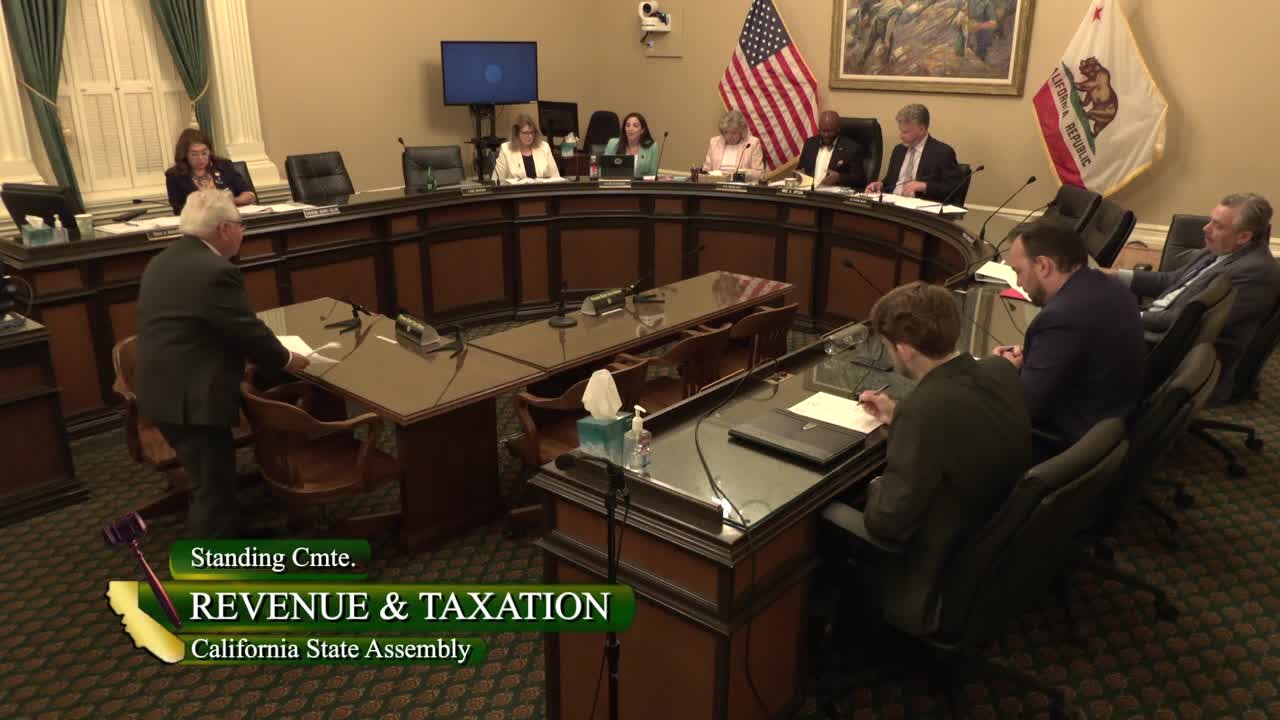 15MIN
Assembly Standing Committee on Revenue and Taxation
 31MIN
Assembly Standing Committee on Military and Veterans Affairs
 9MIN
Senate Standing Committee on Military and Veterans Affairs
 21MIN
Senate Standing Committee on Revenue and Taxation
Bill Author