SB 1411: Greenhouse Gas Reduction Fund: funding conditions: high-speed rail.
- Session Year: 2025-2026
- House: Senate
- Latest Version Date: 2026-04-16
Current Status:
In Progress
(2026-05-14: May 14 hearing: Held in committee and under submission.)
Introduced
In Committee
Awaiting First Chamber Vote
Passed First Chamber
In Committee
Awaiting Second Chamber Vote
Passed Second Chamber
Enacted
Existing law creates the High-Speed Rail Authority to develop and implement a high-speed rail system in the state. Existing law requires moneys collected by the State Air Resources Board from the auction or sale of certain allowances as part of a market-based compliance mechanism to be deposited into the Greenhouse Gas Reduction Fund and continuously appropriates a portion of the moneys in the fund for various purposes, including a specified portion to the authority for certain purposes. Existing law prohibits the authority from entering into new funding commitments with those moneys for activities outside of the Merced to Bakersfield segment, until June 30, 2030, or when that segment is fully funded, whichever is sooner. Notwithstanding that prohibition, existing law authorizes the authority to enter into new funding commitments outside of the Merced to Bakersfield segment for certain purposes, including for additional activities, not to cumulatively exceed $500,000,000, that maximize the efficiency of delivering the project, as specified.
This bill would revise and recast that authorization to instead authorize the authority to enter into new funding commitments with the above-described moneys outside of the Merced to Bakersfield segment in any amount for additional activities that activities related to early works, as defined, and for projects developed through public partnership agreements or public-private partnership agreements, subject to the requirements that those funding commitments maximize the efficiency of delivering the project, project and do not delay the completion of the Merced to Bakersfield segment, as specified. By expanding the purposes for which continuously appropriated moneys may be used, the bill would make an appropriation.
Existing law creates the High-Speed Rail Authority to develop and implement a high-speed rail system in the state. Existing law requires moneys collected by the State Air Resources Board from the auction or sale of certain allowances as part of a market-based compliance mechanism to be deposited into the Greenhouse Gas Reduction Fund and continuously appropriates a portion of the moneys in the fund for various purposes, including a specified portion to the authority for certain purposes. Existing law prohibits the authority from entering into new funding commitments with those moneys for activities outside of the Merced to Bakersfield segment, until June 30, 2030, or when that segment is fully funded, whichever is sooner. Notwithstanding that prohibition, existing law authorizes the authority to enter into new funding commitments outside of the Merced to Bakersfield segment for additional activities, not to cumulatively exceed $500,000,000, that maximize the efficiency of delivering the project, as specified.
This bill would authorize the authority to enter into new funding commitments with the above-described moneys outside of the Merced to Bakersfield segment in any amount for additional activities that maximize the efficiency of delivering the project, as specified. By expanding the purposes for which continuously appropriated moneys may be used, the bill would make an appropriation.
(a)For purposes of this section, the following definitions apply:
(1)Early work means investigative design and engineering work to identify and relocate utilities, geotechnical work to develop baseline reports regarding geotechnical conditions, and the identification and acquisition of long-lead strategic right-of-way parcels.
(1)(2)Fully funded means the High-Speed Rail Authority has secured funding to complete the Merced to Bakersfield segment within the timelines identified in the most recent business plan prepared pursuant to Section 185033 of the Public Utilities Code or project update report prepared pursuant to Section 185033.5 of the Public Utilities Code and the High-Speed Rail Authority Office of the Inspector General has confirmed that the High-Speed Rail Authority has secured that funding.
(2)(3)Merced to Bakersfield segment means a 171-mile electrified dual-track segment that is usable for high-speed rail service in the central valley from Merced to Bakersfield, with a new combined station in downtown Merced, and connections to the Amtrak San Joaquins and the Altamont Corridor Express.
(b)Notwithstanding paragraph (2) of subdivision (b) of Section 39719, 39719 or paragraph (1) of subdivision (b) of Section 39719.4, beginning with the 202223 fiscal year, it is the intent of the Legislature that the High-Speed Rail Authority prioritize use of the funds provided pursuant to Section 39719 or 39719.4 to complete the Merced to Bakersfield segment.
(c)Beginning with the 202223 fiscal year, the High-Speed Rail Authority shall not enter into new funding commitments with funds provided pursuant to paragraph (2) of subdivision (b) of Section 39719 or paragraph (1) of subdivision (b) of Section 39719.4 for activities outside the Merced to Bakersfield segment, except for the following purposes:
(1)Completion of environmental clearance activities and planning activities required by federal grant agreements or other existing agreements.
(2)State operations activities related to construction management and project development and enterprisewide capital expenditures.
(3)(A)Additional activities that maximize the efficiency of delivering the project, excluding paragraphs (1) and (2).(3)(A)(i)Projects developed through public partnership agreements, or public-private partnership agreements, entered into pursuant to Chapter 3 (commencing with Section 185030) of Division 19.5 of the Public Utilities Code.
(ii)Activities related to early works.
(B)Any funding commitments undertaken pursuant to subparagraph (A) shall maximize the efficiency of delivering the project and shall not delay the completion of the Merced to Bakersfield segment.
(B)(C)The High-Speed Rail Authority shall provide advance notification of work described in subparagraph (A) to the High-Speed Rail Authority Office of the Inspector General (OIG) and the chairs of the relevant committees of both houses of the Legislature. The OIG shall conduct a cost-benefit analysis of the proposed work outside the Merced to Bakersfield segment within 60 days of notification and make a finding as to whether or not expenditure of funds for the proposed work will result in a delay in the completion of the Merced to Bakersfield segment. After that time, the OIG shall provide its analysis to chairpersons of the committees of both houses of the Legislature that consider appropriations and the chairpersons of the committees and the appropriate subcommittees of both houses of the Legislature that consider the State Budget before contracts for projects outside of the Merced to Bakersfield segment are considered by the High-Speed Rail Authority for approval.
(C)(D)Before expenditure of funds pursuant to this paragraph, the High-Speed Rail Authority shall provide notification of grant applications to the chairpersons of the committees of both houses of the Legislature that consider appropriations and the chairpersons of the committees and the appropriate subcommittees of both houses of the Legislature that consider the State Budget. Approval of the grant application by the Department of Finance may be authorized no sooner than 30 days after notification in writing to the chairpersons of the committees in each house of the Legislature that consider appropriations and the chairpersons of the committees and the appropriate subcommittees in each house of the Legislature that consider the State Budget.
(d)(1)This section shall become inoperative on June 30, 2030, or when the Merced to Bakersfield segment is fully funded, whichever is sooner, and shall be repealed on January 1 of the following year.
(2)The High-Speed Rail Authority shall inform the Legislature when the Merced to Bakersfield segment is fully funded in compliance with Section 9795 of the Government Code.
(a)For purposes of this section, the following definitions apply:
(1)Fully funded means the High-Speed Rail Authority has secured funding to complete the Merced to Bakersfield segment within the timelines identified in the most recent business plan prepared pursuant to Section 185033 of the Public Utilities Code or project update report prepared pursuant to Section 185033.5 of the Public Utilities Code and the High-Speed Rail Authority Office of the Inspector General has confirmed that the High-Speed Rail Authority has secured that funding.
(2)Merced to Bakersfield segment means a 171-mile electrified dual-track segment that is usable for high-speed rail service in the central valley from Merced to Bakersfield, with a new combined station in downtown Merced, and connections to the Amtrak San Joaquins and the Altamont Corridor Express.
(b)Notwithstanding paragraph (2) of subdivision (b) of Section 39719, beginning with the 202223 fiscal year, it is the intent of the Legislature that the High-Speed Rail Authority prioritize use of the funds provided pursuant to Section 39719 to complete the Merced to Bakersfield segment.
(c)Beginning with the 202223 fiscal year, the High-Speed Rail Authority shall not enter into new funding commitments with funds provided pursuant to paragraph (2) of subdivision (b) of Section 39719 for activities outside the Merced to Bakersfield segment, except for the following purposes:
(1)Completion of environmental clearance activities and planning activities required by federal grant agreements or other existing agreements.
(2)State operations activities related to construction management and project development and enterprisewide capital expenditures.
(3)(A)Additional activities, not to cumulatively exceed five hundred million dollars ($500,000,000), activities that maximize the efficiency of delivering the project, excluding paragraphs (1) and (2).
(B)The High-Speed Rail Authority shall provide advance notification of work described in subparagraph (A) to the High-Speed Rail Authority Office of the Inspector General (OIG) and the chairs of the relevant committees of both houses of the Legislature. The OIG shall conduct a cost-benefit analysis of the proposed work outside the Merced to Bakersfield segment within 60 days of notification and make a finding as to whether or not expenditure of funds for the proposed work will result in a delay in the completion of the Merced to Bakersfield segment. After that time, the OIG shall provide its analysis to chairpersons of the committees of both houses of the Legislature that consider appropriations and the chairpersons of the committees and the appropriate subcommittees of both houses of the Legislature that consider the State Budget before contracts for projects outside of the Merced to Bakersfield segment are considered by the High-Speed Rail Authority for approval.
(C)Before expenditure of funds pursuant to this paragraph, the High-Speed Rail Authority shall provide notification of grant applications to the chairpersons of the committees of both houses of the Legislature that consider appropriations and the chairpersons of the committees and the appropriate subcommittees of both houses of the Legislature that consider the State Budget. Approval of the grant application by the Department of Finance may be authorized no sooner than 30 days after notification in writing to the chairpersons of the committees in each house of the Legislature that consider appropriations and the chairpersons of the committees and the appropriate subcommittees in each house of the Legislature that consider the State Budget.
(d)(1)This section shall become inoperative on June 30, 2030, or when the Merced to Bakersfield segment is fully funded, whichever is sooner, and shall be repealed on January 1 of the following year.
(2)The High-Speed Rail Authority shall inform the Legislature when the Merced to Bakersfield segment is fully funded in compliance with Section 9795 of the Government Code.
|
Date
|
Status
|
|---|---|
| May 14, 2026 | May 14 hearing: Held in committee and under submission. |
| May 8, 2026 | Set for hearing May 14. |
| May 4, 2026 | May 4 hearing: Placed on APPR. suspense file. |
| Apr 24, 2026 | Set for hearing May 4. |
| Apr 22, 2026 | From committee: Do pass and re-refer to Com. on APPR. (Ayes 7. Noes 0. Page 4010.) (April 22). Re-referred to Com. on APPR. |
| Apr 22, 2026 | From committee: Do pass and re-refer to Com. on APPR. (Ayes 7. Noes 0.) (April 22). Re-referred to Com. on APPR. |
| Apr 17, 2026 | Set for hearing April 22. |
| Apr 16, 2026 | Read second time and amended. Re-referred to Com. on E.Q. |
| Apr 15, 2026 | From committee: Do pass as amended and re-refer to Com. on E.Q. (Ayes 11. Noes 1. Page 3874.) (April 14). |
| Apr 15, 2026 | From committee: Do pass as amended and re-refer to Com. on E.Q. (Ayes 11. Noes 1.) (April 14). |
| Apr 2, 2026 | Set for hearing April 14. |
| Apr 1, 2026 | April 7 set for first hearing canceled at the request of author. |
| Mar 17, 2026 | Set for hearing April 7. |
| Mar 4, 2026 | Referred to Coms. on TRANS. and E.Q. |
| Feb 23, 2026 | Read first time. |
| Feb 23, 2026 | From printer. May be acted upon on or after March 23. |
| Feb 20, 2026 | Introduced. To Com. on RLS. for assignment. To print. |
|
Date
|
Description
|
Location
|
Votes
|
|
|---|---|---|---|---|
| May 4, 2026 | Placed on suspense file | Senate Standing Committee on Appropriations |
Passed |
|
| Apr 22, 2026 | Do pass, but first be re-referred to the Committee on [Appropriations] | Senate Standing Committee on Environmental Quality |
Passed |
|
| Apr 14, 2026 | Do pass as amended, but first amend, and re-refer to the Committee on [Environmental Quality] | Senate Standing Committee on Transportation |
Passed |
This list shows positions taken on this bill by organizations on the date displayed, which is linked to the original source.
Positions by individuals are not included.
|
Organization
|
Position
|
Date
|
|---|---|---|
| Associated General Contractors, California Chapters | ** Support | |
| California Conference of Carpenters | ** Support | |
| Californians for Electric Rail | ** Support | |
| City Of Merced | ** Against | |
| Climate Action California (UNREG) | ** Support | |
| Los Angeles County Metropolitan Transportation Authority | ** Support | |
| Merced County Association Of Governments | ** Against | |
| Railpac - Rail Passenger Association of California | ** Support | |
| Southern California Regional Rail Authority (METROLINK) | ** Support | |
| Streets for All | ** Support |
SENATE COMMITTEE ON
Senator Sabrina Cervantes, Chair
2025 - 2026 Regular Session
SB 1411 (Stern) - Greenhouse Gas Reduction Fund: funding conditions: high-speed rail
Version: | Policy Vote: |
Urgency: | Mandate: |
Hearing Date: | Consultant: |
Bill Summary:
SB 1411 would delete a provision that prohibits the High-Speed Rail Authority (HSRA), through June 30, 2030, from entering into new funding agreements that cumulatively exceed $500 million in Greenhouse Gas Reduction Fund (GGRF) revenues for specified activities outside the Merced to Bakersfield segment. The bill would instead allow the HSRA to enter into new agreements with GGRF funds, without limitation through June 30, 2030, for activities outside that segment that are related to early works and projects developed through public partnership or public-private partnership agreements, as specified.
Fiscal Impact:
- Unknown major cost pressures, potentially in the hundreds of millions of dollars through the 2029-30 fiscal year. Because the bill authorizes the HSRA to spend additional GGRF revenues beyond the current cumulative cap of $500 million for activities and projects outside the Merced to Bakersfield segment, this bill would reduce the revenues available to complete the initial segment, creating cost pressures to use funding from other unknown sources, including the General Fund, to complete that segment. Staff notes that these cost pressures may be mitigated to some extent because the bill requires any funding commitments must maximize the efficiency of delivering the project and must not delay the completion of the initial segment.
- Unknown, potentially significant costs for the Office of the High-Speed Rail Inspector General (OIG) to conduct cost-benefit analyses, make findings, and report to the Legislature for any proposed GGRF spending for early works or projects developed through public or public-private partnership agreements, as specified. Actual costs and workload would depend on the number of HSRA proposals for GGRF spending on activities outside the Merced to Bakersfield segment that are submitted to the OIG for review. (Public Transportation Account)
Background:
Existing law establishes the HSRA to develop and implement a high-speed rail system in the state, and vests it with specified powers and duties. Existing law requires the HSRA to submit a biennial business plan to the Legislature that contains specified information that includes project schedule, scope, and cost, as well as forecasted patronage and maintenance and operating costs. Existing law requires the HSRA to submit a biennial project update report (PUR), which must be approved by the Secretary of Transportation and submitted to the Legislature, on the development and implementation of intercity high-speed train service. The report, at a minimum, must include a program-wide summary, and details by project segment, with all information necessary to clearly describe the status of the project, as specified. Existing law establishes the OIG and provides the office with the authority to initiate an audit or review of the HSRA, including specific duties and responsibilities relating to reviewing the HSRA business plans and project update reports.
As part of the 2014-15 Budget, the transportation trailer bill, SB 862 (Budget and Fiscal Review Committee, Chap. 36/2014), continuously appropriated 25% of the revenues derived from the state’s Cap-and-Trade program to the high-speed rail project, providing a permanent source of funding for the high-speed rail project for the life of Cap-and-Trade. Last year, through the enactment of AB 1207 (Irwin, Chap. 117/2025) and SB 840 (Limon and McGuire, Chap. 121/2025), the Cap-and-Trade program was extended through 2045, and renamed as the Cap-and-Invest program. SB 840 also specified allocation priorities of GGRF moneys, beginning with the 2026-27 fiscal year, including a $1 billion continuous appropriation annually to the HSRA, to the extent funds are available after other specified allocations, for certain components of the initial operating segment and Phase I Blended System, as specified.
Existing law, as enacted by SB 198 (Budget and Fiscal Review Committee, Chap. 71/2022), states that, beginning with the 2022-23 fiscal year, it is the intent of the Legislature that the HSRA prioritize the use of GGRF funds to complete the Merced to Bakersfield segment. SB 198 also does the following:
- Defines “Merced to Bakersfield segment” to mean a 171-mile electrified dual‑track segment that is usable for high-speed rail service in the central valley from Merced to Bakersfield, with a new combined station in downtown Merced, and connections to the Amtrak San Joaquins and the Altamont Corridor Express (ACE).
- Beginning with the 2022–23 fiscal year, restricts the HSRA from entering into new funding commitments with funds provided by the GGRF for activities outside the Merced to Bakersfield segment, except for the following purposes:
- Completion of environmental clearance activities and planning activities required by federal grant agreements or other existing agreements.
- State operations activities related to construction management and project development and enterprise-wide capital expenditures.
- Additional activities, not to cumulatively exceed $500 million, that maximize the efficiency of delivering the project.
- Requires HSRA to provide advance notification of these additional activities to the OIG and the Legislature, and requires the OIG to conduct a cost-benefit analysis of the proposed work within 60 days of notification and make a finding as to whether the expenditure of funds for that work will delay completion of the Merced to Bakersfield segment.
- Requires the HSRA to notify the Legislature before the expenditure of funds for proposed additional activities, and restricts the Department of Finance from approving grant applications until at least 30 days after HSRA provides the notification to the Legislature.
- Requires the HSRA to inform the Legislature when the Merced to Bakersfield segment is fully funded.
- Makes the provisions enacted by SB 198 inoperative on June 30, 2030, or whenever the Merced to Bakersfield segment is completed, whichever is sooner.
Proposed Law:
SB 1411 would delete the provision that limits HSRA cumulative spending from the GGRF to $500 million through June 30, 2030 for additional activities outside the Merced to Bakersfield segment, as specified. The bill would instead allow HSRA to enter into new funding commitments with GGRF funds through June 30, 2030, without funding limits, for the following purposes outside the Merced to Bakersfield segment, provided they maximize the efficiency of delivering the project and do not delay the completion of that segment:
- Projects developed through public partnership agreements, or public-private partnership agreements, as specified.
- Activities related to “early works,” which are defined as investigative design and engineering work to identify and relocate utilities, geotechnical work to develop baseline reports regarding geotechnical conditions, and the identification and acquisition of long-lead strategic right-of-way parcels.
Related Legislation:
SB 1425 (Cortese), which is currently pending in this committee, would authorize HSRA to issue permits for activities on its right-of-way, as specified. The bill would also make it a misdemeanor crime for a person to damage the high-speed train system or any portion of the HSRA right-of-way.
SB 840 (Limon), Chap. 121/2025, renamed the cap-and-trade program as Cap-and-Invest and specified allocations of GGRF funding, including, if funds are available, a continuous appropriation of $1 billion annually for the high-speed rail project.
AB 377 (Tangipa), Chap. 81/2025, required the HSRA, as part of the business plan due on or before May 1, 2026, to provide a detailed funding plan for the Merced to Bakersfield segment.
SB 545 (Cortese), which was held on the Assembly Appropriations Committee’s Suspense File last year, would have required the Office of Land Use and Climate Innovation, on or before July 1, 2027, to commission a study and submit a progress report to the Legislature on funding and economic opportunities along high-speed rail corridors, as specified, with a final report due January 1, 2028.
SB 198 (Committee on Budget and Fiscal Review), Chap. 71/2022, appropriated the remaining $4.2 billion Proposition 1A bonds for the high-speed rail project, established the OIG, and limited funding for construction of the project to the Merced to Bakersfield segment until it is fully funded, including limiting cumulative spending from GGRF revenues to $500 million until June 30, 2030, or when the Merced to Bakersfield segment is fully funded.
Staff Comments:
As noted above, existing law requires the HSRA to focus its resources on completing the Merced to Bakersfield segment of the high-speed rail project, specifically stating legislative intent that HRSA prioritize the use of GGRF funds to complete that initial segment. To this end, SB 198 restricts the HSRA’s authority to enter into new funding commitments for activities outside the Merced to Bakersfield segment, with specified exemptions, including any spending beyond a cumulative limit of $500 million in GGRF funds for additional activities outside the initial segment. In addition, the OIG must conduct a cost-benefit analysis of any proposed work for those additional activities and make a finding as to whether or not the expenditure of funds would delay the Merced to Bakersfield segment. These limitations are operative through June 30, 2030, at the end of the 2029-30 fiscal year.
This bill would contradict the direction of the Legislature to focus resources from the GGRF on completion of the Merced to Bakersfield segment, as enacted in the 2022-23 Budget. Specifically, this bill would eliminate the $500 million cumulative cap on GGRF spending for any additional activities outside the Merced to Bakersfield segment, which is operative through the 2029-30 fiscal year, and instead allow the HSRA to use any available GGRF resources for certain activities for early works and for projects developed through public partnership agreements and public-private partnership agreements. Any such funding commitments must maximize the efficiency of delivering the project and must not delay the completion of the Merced to Bakersfield segment. It is unclear how removing this cap would facilitate private sector investment over the next 3-1/2 years, when this statute becomes inoperative. Removing that cap and allowing unlimited GGRF funding for projects outside the initial segment would create major cost pressures as current funding available for the project is finite. As noted by the Legislative Analyst’s Office, “absent funding to complete a larger segment, spending on activities outside of Merced to Bakersfield would leave less money to complete that initial segment and potentially result in stranded assets.”
-- END --
SENATE COMMITTEE ON ENVIRONMENTAL QUALITY
Senator Blakespear, Chair
2025 - 2026 Regular
Bill No: SB 1411
Author: | Stern | ||
Version: | 4/16/2026 | Hearing Date: | 4/22/2026 |
Urgency: | No | Fiscal: | Yes |
Consultant: | Heather Walters | ||
SUBJECT: Greenhouse Gas Reduction Fund: funding conditions: high-speed rail
DIGEST: This bill deletes the restriction for the High-Speed Rail Authority to not enter into funding commitments to cumulatively exceed $500 million in funds from the state’s Cap-and-Invest program, on project activities outside of the Merced to Bakersfield segment, as specified, and adds additional permissible activities said funds can be used for to include projects developed through public-private partnerships and activities related to early works, as defined.
ANALYSIS:
Existing law:
- Establishes the California High-Speed Rail Authority (Authority) and vests with it the responsibility to develop and implement a high-speed rail system in California. (Public Utilities Code (PUC) §185000 et seq.)
- Authorizes the sale of $9 billion in general obligation bonds to partially fund the development and construction of California's high-speed rail system. (Streets and Highways Code (SHC) §2704 et seq.)
- If funds are available, continuously appropriates $1 billion annually the GGRF for the high-speed rail project. (Health and Safety Code (HSC) §39719)
- Establishes the Office of the High-Speed Rail Inspector General (OIG) and gives it the authority to initiate an audit or review of the Authority and gives it specific duties and responsibilities relating to reviewing the Authority’s business plans and project update reports. (PUC §187020)
- Defines “Merced to Bakersfield segment” to mean a 171-mile electrified dual-track segment that is usable for high-speed rail service in the central valley from Merced to Bakersfield, with a new combined station in downtown Merced, and connections to the Amtrak San Joaquins and the Altamont Corridor Express (ACE). (PUC §187010)
- Defines “fully funded” to mean the Authority has secured funding to complete the Merced to Bakersfield segment within the timelines identified in the most recent business plan or project update report and the OIG has confirmed that the Authority has secured that funding. (HSC §39719.3)
- Declares it is the intent of the Legislature that, beginning with the 2022–23 fiscal year, the Authority prioritize use of the funds provided from the GGRF to complete the Merced to Bakersfield segment. (HSC §39719.3)
- Beginning with the 2022–23 fiscal year, restricts the Authority from entering into new funding commitments with funds provided by the GGRF for activities outside the Merced to Bakersfield segment, except for the following purposes:
- Completion of environmental clearance activities and planning activities required by federal grant agreements or other existing agreements;
- State operations activities related to construction management and project development and enterprisewide capital expenditures;
- Additional activities, not to cumulatively exceed $500 million, activities that maximize the efficiency of delivering the project, outside of the Merced to Bakersfield segment. (HSC §39719.3)
This bill:
- Deletes the restriction for the Authority to not enter into funding commitments to cumulatively exceed $500 million in funds from the state’s Cap- and-Invest program, on project activities outside of the Merced to Bakersfield segment, as specified.
- Expands the permissible uses of the continuous GGRF appropriation to HSR to further include:
- Projects developed through public-private partnerships; and
- Activities related to early works.
- States that any funding commitments undertake for the above shall maximize the efficiency of delivering the project and not delay the completion of the Merced-to-Bakersfield segment.
Background
- California High-Speed Rail. Development of high-speed rail in California began nearly 30 years ago. SB 1420 (Kopp, Chapter 796, Statutes of 1996), created the Authority to direct development and implementation of intercity high-speed rail service that would be fully coordinated with other public transportation services. The Authority is part of the California State Transportation Agency (CalSTA), and is governed by an eleven-member Board of Directors. The Governor appoints five members of the board, the Senate Rules Committee appoints two, and the Assembly Speaker appoints two. Additionally, the board includes two ex-officio, non-voting members, one member of the Assembly and one member of the Senate.
In 2008, voters approved Proposition 1A, the Safe, Reliable, High-Speed Passenger Train Bond Act, a $9.95 billion general obligation bond to fund the proposed California high-speed rail project and related improvements. As envisioned at the time of the ballot measure, the project was to consist of an 800-mile dedicated high-speed passenger rail system capable of speeds up to 220 miles per hour, initially serving the major metropolitan market of San Francisco through the Central Valley into Los Angeles and Anaheim (Phase I), with service eventually extending to Sacramento, the Inland Empire, and San Diego (Phase II).
In July 2012, the Legislature approved SB 1029 (Committee on Budget and Fiscal Review, Chapter 152, Statutes of 2012), that appropriated nearly $8 billion in federal and state funds to begin the construction between Madera and Bakersfield. SB 1029 funded three components of the project, including $5.8 billion ($3.2 billion from federal grants and $2.6 billion from Proposition 1A) to fund the construction of the high-speed rail “backbone” in the Central Valley; $819 million of Proposition 1A bonds for “connectivity” projects on existing rail and transit systems throughout the state; and $1.1 billion for the “bookends” projects in the Bay Area and Southern California ($600 million for the electrification of Caltrain and $500 million for projects in the Los Angeles Basin) to improve existing rail corridors for eventual use by the high-speed rail system. Specifically, to date, the funding for the bookends have been allocated as follows: $714 million for Caltrain electrification, $423 million for Los Angeles Union Station (LinkUS) project, $84 million for the San Mateo grade separation, and $77 million for the Rosecrans/Marquardt grade separation. All of these projects are completed except for the LinkUS project, which has not started construction.
Further, the 2014-15 state budget trailer bill SB 862 (Committee on Budget and Fiscal Review, Chapter 36, Statutes of 2014), continuously appropriated 25% of the revenues derived from the state’s Cap-and-Trade program to the project.
Additionally, as a companion measure to the 2022-2023 State Budget that apportioned the remaining $4.1 billion of Proposition 1A bonds to the Authority, the Legislature approved SB 198 (Committee on Budget and Fiscal Review, Chapter 71, Statutes of 2022). SB 198 required the Authority to focus its resources on finishing a usable high-speed segment from Merced to Bakersfield, which is defined as a “171-mile electrified dual-track segment that is usable for high-speed rail service in the Central Valley from Merced to Bakersfield, with a new combined station in downtown Merced, and connections to the Amtrak San Joaquins and the Altamont Corridor Express (ACE).”
Finally, in 2025, through AB 1207 (Irwin, Chapter 117, Statutes of 2025) and SB 840 (Limon and McGuire, Chapter 121, Statutes of 2025), the Legislature extended the Cap-and-Trade program through 2045, renaming it Cap-and-Invest. SB 840 also allocated, if funds are available, $1 billion of Cap-and-Invest funds annually to the Authority through 2045.
Comments
- Purpose of Bill. According to the author, “We cannot build a 21st-century, high-speed rail network without leveraging investment from private capital. Senate Bill 1411 is about removing limitations, specifically the $500 million spending cap on work outside the Central Valley to allow the California High-Speed Rail Authority the flexibility needed to finally tap into the massive influx of private capital waiting on the sidelines. If we are serious about connecting Los Angeles to the Bay Area and maximizing the ridership potential of this project, we have to move beyond just relying on annual state allocations and start leveraging public-private partnerships that can accelerate construction and bring in private expertise to manage costs.
“This isn’t about diverting resources, but rather building a robust, bankable system that allows the private sector to see a realistic return on investment, which in turn benefits the entire statewide portfolio. SB 1411 unlocks that potential by enabling the authority to advance critical, high-yield segments concurrently rather than waiting years, ensuring the project remains viable and competitive. We have a duty to create a structure where private investors, not just taxpayers, are sharing the risk and funding the future of California’s infrastructure, and this bill is the key to unlocking that partnership.” - Still waiting for the train. As described in the background section above, the nearly 30 years since the California HSR project began have been marked with a number of delays, cost overruns, and other unanticipated delays. The ongoing situation was complicated even further by actions taken under the current federal government.
In July 2025, U.S. Department of Transportation (USDOT) Secretary Sean Duffy announced that the Federal Railroad Administration (FRA) was terminating the cooperative grant agreement with the Authority and rescinding roughly $4 billion in federal funds. Specifically, this includes $3.07 billion for the Federal State Partnership program grant awarded to the Authority in 2023 and $929 million from Fiscal Year (FY) 2010 appropriations. The first Trump Administration also attempted to rescind the FY 2010 funds. The funds were restored by the Biden Administration after settling a lawsuit brought by the State of California.
Specifically, the FRA initiated a compliance review of the project and determined that the Authority “will not be able to deliver the operation of a Merced-to-Bakersfield corridor by the end of 2033.” California once again sued. The Authority later announced that they had arrived at an agreement with FRA so that the funds could not be reallocated to other projects unless a new Notice of Funding Opportunity (NOFO) was released. In September 2025, the FRA issued a NOFO which included $2.4 billion in funding previously awarded to the Authority. Subsequently, the state asked the court for an injunction to prevent the reallocation of funds. However, in December 2025, the Authority announced the state was withdrawing their lawsuit and giving up the federal funds. The Authority has stated that they ended the litigation after it became clear that the current federal administration is not a reliable partner. - No brakes, all gas? It bears repeating that the agreement this bill undoes—SB 198 (Chapter 71, Statutes of 2022)—was less than five years ago, and explicitly stated that the Merced-to-Bakersfield segment would receive half of the allocated HSR funds from GGRF. The amendments taken in Senate Transportation Committee made efforts to uphold the spirit of that commitment and required any funds authorized by this bill outside of what would have been eligible under SB 198 do not delay the completion of the Merced-to-Bakersfield segment.
To the extent that SB 1411 is able to attract additional private funding to the HSR project, it may help the project move forward to completion, even in spite of recent loss of federal funds. Attracting said additional private funding appears to be the author’s intent with this bill. Nevertheless, there is nothing in this legislation that specifically would require or suggest such funds. While removing a barrier to funds outside of the Merced-to-Bakersfield segment would be necessary in order to use such funds outside of that segment, it is not alone sufficient.
DOUBLE REFERRAL:
This measure was heard in Senate Transportation Committee on April 14th, 2026, and passed out of committee with a vote of 11-1.
Related/Prior Legislation
SB 1425 (Cortese) -- Would authorize the Authority to issue permits for activities on its right-of-way and establishes process for issuing such permits. Makes any person who damages the high-speed train system or any portion of the Authority’s right-of-way guilty of a misdemeanor. SB 1425 is pending in the Senate Transportation Committee
SB 840 (Limon, Chapter 121, Statutes of 2025) -- Allocates funding from the GGRF, including, if funds are available, continuously appropriates $1 billion annually for the high-speed rail project.
AB 377 (Tangipa, Chapter 81, Statutes of 2025) -- required the Authority as part of the business plan due on or before May 1, 2026, to provide a detailed funding plan for the Merced to Bakersfield segment.
SB 545 (Cortese, 2025) – Would have required the Office of Land Use and Climate Innovation (LCI), on or before July 1, 2027, to commission a study and submit a progress report to the Legislature on funding and economic opportunities along high-speed rail corridors, as specified, with a final report due January 1, 2028. This bill was held in the Assembly Appropriations Committee.
SB 1260 (Niello, 2024) – Would have required Authority Office of Inspector General (OIG) to conduct two independent reviews related to the high-speed rail project. This bill failed passage in the Senate Transportation Committee.
SB 198 (Committee on Budget and Fiscal Review, Chapter 71, Statutes of 2022) -- Appropriated the remaining $4.2 billion Proposition 1A bonds for the high-speed rail project, established the OIG, and limited funding for construction of the project to the Merced to Bakersfield segment, until it is fully funded.
SB 862 (Committee on Budget and Fiscal Review, Chapter 36, Statutes of 2014) – Continuously appropriated 25% of the revenues derived from the state’s Cap-and-Trade program to the project.
SB 1029 (Committee on Budget and Fiscal Review, Chapter 152, Statutes of 2012) – Appropriated nearly $8 billion in federal and state funds to begin the construction between Madera and Bakersfield
SOURCE:
Author
SUPPORT:
California Conference of Carpenters
Californians for Electric Rail
Climate Action California (UNREG)
Los Angeles County Metropolitan Transportation Authority
Railpac - Rail Passenger Association of California
Southern California Regional Rail Authority (METROLINK)
Streets for All
OPPOSITION:
City of Merced
Merced County Association of Governments
-- END --
SENATE COMMITTEE ON TRANSPORTATION
Senator Dave Cortese, Chair
2025 - 2026 Regular
Bill No: Hearing Date: 4/14/2026
Author: | Stern | ||
Version: | 2/20/2026 Introduced | ||
Urgency: | No | Fiscal: | Yes |
Consultant: | Melissa White | ||
SUBJECT:
DIGEST: This bill deletes the restriction for the California High-Speed Rail Authority (Authority) to not enter into funding commitments to cumulatively exceed $500 million in funds from the Greenhouse Gas Reduction Fund (GGRF), on project activities outside of the Merced to Bakersfield segment, as specified.
ANALYSIS:
Existing law:
- Establishes the Authority and vests with it the responsibility to develop and implement a high-speed rail system in California.
- Authorizes the sale of $9 billion in general obligation bonds to partially fund the development and construction of California's high-speed rail system.
- If funds are available, continuously appropriates $1 billion annually from the GGRF for the high-speed rail project.
- Establishes the Office of the High-Speed Rail Inspector General (OIG) and gives it the authority to initiate an audit or review of the Authority and gives it specific duties and responsibilities relating to reviewing the Authority’s business plans and project update reports.
- Defines “Merced to Bakersfield segment” to mean a 171-mile electrified dual‑track segment that is usable for high-speed rail service in the central valley from Merced to Bakersfield, with a new combined station in downtown Merced, and connections to the Amtrak San Joaquins and the Altamont Corridor Express (ACE).
- Defines “fully funded” to mean the Authority has secured funding to complete the Merced to Bakersfield segment within the timelines identified in the most recent business plan or project update report and OIG has confirmed that the Authority has secured that funding.
- Declares it is the intent of the Legislature that, beginning with the 2022–23 fiscal year, the Authority prioritize use of the funds provided from the GGRF to complete the Merced to Bakersfield segment.
- Beginning with the 2022–23 fiscal year, restricts the Authority from entering into new funding commitments with funds provided by the GGRF for activities outside the Merced to Bakersfield segment, except for the following purposes:
- Completion of environmental clearance activities and planning activities required by federal grant agreements or other existing agreements.
- State operations activities related to construction management and project development and enterprisewide capital expenditures.
- Additional activities, not to cumulatively exceed $500 million, activities that maximize the efficiency of delivering the project, outside of the Merced to Bakersfield segment.
- Requires the Authority to provide advance notification of additional activities to OIG and the chairs of the relevant committees of both houses of the Legislature.
- Requires OIG to conduct a cost-benefit analysis of the proposed work outside the Merced to Bakersfield segment within 60 days of notification and make a finding as to whether or not expenditure of funds for the proposed work will result in a delay in the completion of the Merced to Bakersfield segment.
- Requires OIG to provide its analysis to chairpersons of the committees of both houses of the Legislature that consider appropriations and the chairpersons of the committees and the appropriate subcommittees of both houses of the Legislature that consider the State Budget before contracts for projects outside of the Merced to Bakersfield segment are considered by the Authority for approval.
- Requires the Authority, before expenditure of GGRF funds outside of Merced to Bakerfield, to provide notification of grant applications to the chairpersons of the committees of both houses of the Legislature that consider appropriations and the chairpersons of the committees and the appropriate subcommittees of both houses of the Legislature that consider the State Budget.
- Authorizes the Department of Finance to approve the grant application no sooner than 30 days after notification in writing to the chairpersons of the committees in each house of the Legislature that consider appropriations and the chairpersons of the committees and the appropriate subcommittees in each house of the Legislature that consider the State Budget.
- Declares that these requirements will become inoperative on June 30, 2030, or when the Merced to Bakersfield segment is fully funded, whichever is sooner, and shall be repealed on January 1 of the following year.
- Requires the Authority to inform the Legislature when the Merced to Bakersfield segment is fully funded, as specified.
This bill:
- Deletes the restriction for the Authority to not enter into funding commitments to cumulatively exceed $500 million in funds from the state’s Cap-and-Invest program, on project activities outside of the Merced to Bakersfield segment, as specified.
COMMENTS:
- Purpose of the bill. According to the author, “We cannot build a 21st-century, high-speed rail network without leveraging investment from private capital. Senate Bill 1411 is about removing limitations, specifically the $500 million spending cap on work outside the Central Valley to allow the California High-Speed Rail Authority the flexibility needed to finally tap into the massive influx of private capital waiting on the sidelines. If we are serious about connecting Los Angeles to the Bay Area and maximizing the ridership potential of this project, we have to move beyond just relying on annual state allocations and start leveraging public-private partnerships that can accelerate construction and bring in private expertise to manage costs.
“This isn’t about diverting resources, but rather building a robust, bankable system that allows the private sector to see a realistic return on investment, which in turn benefits the entire statewide portfolio. SB 1411 unlocks that potential by enabling the authority to advance critical, high-yield segments concurrently rather than waiting years, ensuring the project remains viable and competitive. We have a duty to create a structure where private investors, not just taxpayers, are sharing the risk and funding the future of California’s infrastructure, and this bill is the key to unlocking that partnership.”
- California High-Speed Rail. Development of high-speed rail in California began nearly 30 years ago. SB 1420 (Kopp, Chapter 796, Statutes of 1996), created the Authority to direct development and implementation of intercity high-speed rail service that would be fully coordinated with other public transportation services. The Authority is part of the California State Transportation Agency (CalSTA) and is governed by an eleven-member Board of Directors. The Governor appoints five members of the board, the Senate Rules Committee appoints two, and the Assembly Speaker appoints two. Additionally, the board includes two ex-officio, non-voting members, one member of the Assembly and one member of the Senate.
In 2008, voters approved Proposition 1A, the Safe, Reliable, High-Speed Passenger Train Bond Act, a $9.95 billion general obligation bond to fund the proposed California high-speed rail project and related improvements. As envisioned at the time of the ballot measure, the project was to consist of an 800-mile dedicated high-speed passenger rail system capable of speeds up to 220 miles per hour, initially serving the major metropolitan market of San Francisco through the Central Valley into Los Angeles and Anaheim (Phase I), with service eventually extending to Sacramento, the Inland Empire, and San Diego (Phase II).
In July 2012, the Legislature approved SB 1029 (Committee on Budget and Fiscal Review, Chapter 152, Statutes of 2012), that appropriated nearly $8 billion in federal and state funds to begin the construction between Madera and Bakersfield. SB 1029 funded three components of the project, including $5.8 billion ($3.2 billion from federal grants and $2.6 billion from Proposition 1A) to fund the construction of the high-speed rail “backbone” in the Central Valley; $819 million of Proposition 1A bonds for “connectivity” projects on existing rail and transit systems throughout the state; and $1.1 billion for the “bookends” projects in the Bay Area and Southern California ($600 million for the electrification of Caltrain and $500 million for projects in the Los Angeles Basin) to improve existing rail corridors for eventual use by the high-speed rail system. Specifically, to date, the funding for the bookends have been allocated as follows: $714 million for Caltrain electrification, $423 million for Los Angeles Union Station (LinkUS) project, $84 million for the San Mateo grade separation, and $77 million for the Rosecrans/Marquardt grade separation. All of these projects are completed except for the LinkUS project, which has not started construction.
Further, the 2014-15 state budget trailer bill SB 862 (Committee on Budget and Fiscal Review, Chapter 36, Statutes of 2014), continuously appropriated 25% of the revenues derived from the state’s Cap-and-Trade program to the project.
Additionally, as a companion measure to the 2022-2023 State Budget that apportioned the remaining $4.1 billion of Proposition 1A bonds to the Authority, the Legislature approved SB 198 (Committee on Budget and Fiscal Review, Chapter 71, Statutes of 2022). SB 198 required the Authority to focus its resources on finishing a usable high-speed segment from Merced to Bakersfield, which is defined as a “171-mile electrified dual-track segment that is usable for high-speed rail service in the Central Valley from Merced to Bakersfield, with a new combined station in downtown Merced, and connections to the Amtrak San Joaquins and the Altamont Corridor Express (ACE).”
Finally, in 2025, through AB 1207 (Irwin, Chapter 117, Statutes of 2025) and SB 840 (Limon and McGuire, Chapter 121, Statutes of 2025), the Legislature extended the Cap-and-Trade program through 2045, renaming it Cap-and-Invest. SB 840 also allocated, if funds are available, $1 billion of Cap-and-Invest funds annually to the Authority through 2045.
- The project evolves under new leadership. In August 2024, Ian Choudri was named as the new Chief Executive Officer (CEO) of the Authority by the Authority Board of Directors. The new CEO set out to revamp the project, both in the Central Valley and beyond into full Phase I. When the Authority released its statutorily required 2025 Project Update Report (PUR), it did not contain numerous required elements, noting “The Authority is undergoing a comprehensive effort to update its design criteria, scope, cost, procurement strategy, ridership and schedule. These updates will be submitted to the Legislature later this year.”
In August 2025, the Authority released the Supplemental Project Update Report (SPUR). According to the Authority, SPUR “represents a reevaluation of the program focusing on completing design reviews to minimize costs, making trade-off decisions for greater efficiency, sequencing construction and making funding go further, and reviewing estimating methods for greater reliability.” SPUR evaluates multiple alternatives to Merced to Bakersfield as potential initial operating segments, including Gilroy to Bakersfield and Gilroy to Palmdale, utilizing the existing Caltrain corridor to connect Gilroy to San Francisco. SPUR highlights the advantages of the other options with higher projected ridership and operating revenues. This reimaging of the initial operating segment appeared to indicate that the Authority would not pursue completing a segment to Merced. As noted, statutory direction is for the Authority to focus on completing the Merced to Bakerfield segment.
SPUR updated project funding, costs, and schedules for Merced to Bakersfield and new alternatives. Specially, the Authority estimates the cost of Merced to Bakersfield segment at $36.7 billion, which is up from the prior estimate of $35 billion included in the 2024 Business Plan, with a target completion date of 2032. Additionally, the Authority estimates the San Francisco to Gilroy to Bakersfield segment at $54 billion, and the San Francisco to Gilroy to Palmdale segment at $87 billion, to be completed in 2038. SPUR also has estimates for these two new segments with the Merced extension included. For these segments to connect to the Bay Area , nearly $3-$6 billion would additionally be needed to upgrade, and electrify the Caltrain corridor between Gilroy and San Jose. This schedule assumes the Authority has no funding constraints and achieves some proposed statutory changes.
SPUR identifies the available funding for the Authority at $43 billion. This total includes an estimated $15 billion from the state’s Cap-and-Invest program and all of the federal grant funds that had been awarded to the project (prior to the loss of roughly $4 billion in federal grant funds).
Finaly, SPUR details the Authority’s need to borrow funds to deal with cash flow timing issues between the receipt of Cap-and-Invest revenues and the project’s funding needs. The Authority identifies the potential of a Public Private Partnership (P3) as an alternative to conventional borrowing and project delivery.
- Authority requests numerous statutory changes. Throughout 2025 in various public meetings, culminating in the release of SPUR and the Draft 2026 Business Plan, the Authority has detailed numerous requests for statutory change to “deliver California’s high-speed rail program with certainty around cost and schedule.” These proposals include:
- CEQA exemptions for renewable power generation facilities – to streamline environmental approvals and accelerate delivery of renewable energy sources needed to power the system.
- Streamlined permitting for utility relocation and third-party management – to establish enforceable timelines, accountability, and cost controls for utility providers and other third parties where associated delays currently threaten projects schedules.
- Dedicated court resources for right-of-way cases – to ensure timely adjudication of property acquisitions and avoid costly delays in construction sequencing.
- Boosted land use authority and value capture mechanisms – to provide regulatory tolls around station areas and along the corridor and allow the Authority to capture value in the form of sales and property tax increment, generated by transit-oriented development. This would include zoning, land use, and permitting controls over land it owns and land within a one-half mile radius of high-speed rail stations.
- Sales tax exemption on purchasing materials – to reduce overall costs and schedule of construction and incentivize efficient in-state procurement.
- Encroachment permit authority – to allow the Authority to issue encroachment permits to allow third-parties to access its right-of-way.
- SB 198 Changes – remove the limitations related to spending outside the Central Valley, to provide flexibility for project sequencing and unlock private sector engagement, allowing the Authority to invest new funds back into the system to continue building.
- Loss of federal funds. In July 2025, U.S. Department of Transportation (USDOT) Secretary Sean Duffy announced that the Federal Railroad Administration (FRA) was terminating the cooperative grant agreement with the Authority and rescinding roughly $4 billion in federal funds. Specifically, this includes $3.07 billion for the Federal State Partnership program grant awarded to the Authority in 2023 and $929 million from Fiscal Year (FY) 2010 appropriations. The first Trump Administration also attempted to rescind the FY 2010 funds. The funds were restored by the Biden Administration after settling a lawsuit brought by the State of California.
Specifically, FRA initiated a compliance review of the project and determined that the Authority “will not be able to deliver the operation of a Merce-to-Bakersfield corridor by the end of 2033.” California once again sued. The Authority later announced that they had arrived at an agreement with FRA so that the funds could not be reallocated to other projects unless a new Notice of Funding Opportunity (NOFO) was released. In September 2025, FRA issued a NOFO which included $2.4 billion in funding previously awarded to the Authority. Subsequently, the state asked the court for an injunction to prevent the reallocation of funds. However, in December 2025, the Authority announced the state was withdrawing their lawsuit and giving up the federal funds. The Authority has stated that they ended the litigation after it became clear that the current federal administration is not a reliable partner.
- 2026 Draft Business Plan. In March, the Authority released its 2026 Draft Business Plan (Plan). The Plan provides updated cost and schedule estimates for the various segments of the high-speed rail project as outlined in SPUR. Specifically, the Authority estimates the cost for the Merced to Bakersfield segment at $34.8 billion, down from $36.7 billion in SPUR, and still on track for 2032. Additionally, the Authority estimates the San Francisco to Gilroy to Bakersfield segment at $60.3 billion up from $58.1 billion, and the San Francisco to Gilroy to Palmdale segment at $96.7 billion up from $90.8 billion. Both estimates include Merced but, as noted above, do not include the cost for upgrading the Gilroy to San Jose Caltrain corridor.
The estimates in the Plan also include a number of cost-saving measures identified during a new “bottom-up cost review” that adjusted the Authority’s overall financial assumptions. This review further included explicit and implicit scope changes to the project, such as moving the Merced and Bakersfield stations outside of the downtown area, projected to save roughly $1.1 billion, and reducing the amount of dual-track rail to 20 miles across the entire segment. This outlook requires that the Legislature approve the aforementioned scope changes to the plan that is currently outlined in SB 198. As noted, these changes include controversial decisions, including relocating the Merced station outside of the downtown.
In addition to major scope changes, the Plan’s cost and schedule estimates assume that all of the statutory changes requested are achieved. It is unclear how much cost and time would be added to the estimates if any or all of the requests of the Legislature are not achieved. The Authority has also laid out plans to explore what they call ancillary revenue sources. These are various forms of value capture, aiming to produce additional revenues based on the overall economic growth facilitated by the project itself. Some of these proposed revenue sources include advertising, baggage fees, station retail, sponsorship deals, telecommunications infrastructure, and ground leases, among others. These ancillary revenues are also included in the Plan’s estimates.
The Authority projects that they currently have the funds to complete the Merced-Bakersfield segment. Specifically, the Plan identifies the available funding at $39.3 billion. Again, this total includes an estimated $15 billion from the state’s Cap-and-Invest program through 2045. As mentioned above, this funding does not mean that they have cash on hand to align with planned construction schedules. As with SPUR, the Authority’s most recent financial outlook assumes that they are able to secure these near-term funds through financing based on their ongoing Cap-and-Invest appropriations. It is unclear what the Authority would need to facilitate this kind of borrowing and how much it would cost. As Cap-and-Invest proceeds are volatile and the Authority is not guaranteed a so-called “first call” on the funds for their $1 billion annual allocation, it may not be attractive to the potential investors for financing. The Authority may seek more guarantees, such as the state agreeing not to make major changes in the program or the state may have to pay a higher interest rate to compensate for the risk that revenues may not materialize.
The Plan also highlights that high-speed rail investments have generated roughly 122,000 job-years of employment, with roughly $9.5 billion in labor income, and over $24 billion in economic output. Specifically, in the Central Valley since construction began, the project has created more than 16,000 good‑paying jobs. In 2025, an average of 1,400 workers report to high-speed rail construction sites across the Central Valley each day.
- What about private investment? In addition to needing to borrow or finance the Cap-and-Invest funds to complete the Merced to Bakersfield segment by 2032, the Authority is looking for P3 opportunities to help fund segments outside the Central Valley and the remaining parts of Phase I. In June 2025, the Authority released a Request for Expressions of Interest (RFEI), to seek detailed feedback from industry participants on the commercial, financial, and technical aspects of upcoming procurement and potential project delivery models. The Authority received 30 submittals, with some common recommendations regarding efficient delivery, attracting investment, and streamlined processes and procurement. Regarding attracting investment, almost all respondents expressed concerns over the volatility of Cap-and-Invest revenues, emphasizing the need for long-term, stable, and predictable revenue streams to attract private investment and support program financing.
In December 2025, the Authority released a Request for Qualifications (RFQ) for a Co-Development Partner (CDP) who would initiate a process to try to bring on private investors and developers. According to the Authority, the CDP would “evaluate opportunities to for a private sector partner to leverage innovation, expertise and efficiency in design construction, systems integration, finance, operations and maintenance of one or more selected project segments and elements. This could result in one or more P3 development agreements.”
It is unclear what types of P3, if any, the Authority may pursue in the future. Regarding financing through a P3, a recent report by the Legislative Analyst’s Office (LAO) states that the Authority, “could pursue financing through a P3, but this has the potential to be a relatively expensive approach, as the P3 would need to be compensated for access to its equity and any risks it absorbs. Ensuring the state gets the lowest price in P3 procurements is also difficult, as the agreements can be complex, and firms do not directly compete on price.”
The LAO called into question whether even the sum total of these efforts will be sufficient to close the Phase I funding gap.
- SB 1411 would upend the Legislature’s mandate to focus on the Central Valley. As discussed, SB 198 requires the Authority to focus on getting the Merced to Bakersfield segment up and running. SB 198 specifically stated the intent of the Legislature that beginning with the 2022–23 fiscal year, the Authority prioritize use of the funds provided from GGRF to complete the Merced to Bakersfield segment.
To that end, SB 198 limits the Authority’s ability to enter into any new funding commitments for activities outside of the Merced to Bakersfield segment, with a few exceptions including completion of the environmental clearances required by the federal grant agreement, and state operations activities related to construction management and project development.
SB 198 caps any other spending of GGRF monies for any additional activities outside of the Merced to Bakersfield segment at cumulatively $500 million. Additionally, SB 198 requires the Authority notify OIG and the Legislature about any of this type of proposed work. OIG is required to conduct a cost-benefit analysis of the proposed work within 60 days and make a finding as to whether or not the expenditure of funds will result in a delay to the Merced to Bakerfield segment.
SB 1411 would delete this $500 million spending cap and allow the Authority to spend GGRF funds systemwide on any segment of high-speed rail as long as it is used to “maximize the efficiency of delivering the project.” According to the author, SB 1411 “is about removing limitations, specifically the $500 million spending cap on work outside the Central Valley to allow the California High-Speed Rail Authority the flexibility needed to finally tap into the massive influx of private capital waiting on the sidelines.”
The Authority has also championed changes to SB 198, specifically removing the $500 million cap. However, it is unclear how removing this cap would facilitate private sector investment or help the Authority borrow the funds necessary to complete the Merced to Bakersfield segment on schedule. As noted by the LAO, “even with $1 billion annually from cap-and-invest, the project has a projected funding gap in the tens of billions of dollars for other alternatives that extend beyond the Central Valley, with no clear plan for filling them. The private sector is unlikely to take revenue or ridership risks, at least until service is operational. State funds, including GGRF and the General Fund, have limited—if any—capacity to take on additional commitments.”
Further, noting that completing work outside to Merced to Bakersfield would divert needed funding, LAO also states, “absent funding to complete a larger segment, spending on activities outside of Merced to Bakersfield would leave less money to complete that initial segment and potentially result in stranded assets.”
- Support and opposition. Writing in support of the bill, Metrolink states, “SB 1411 would authorize the High-Speed Rail Authority to make funding commitments of any amount beyond the current limited cap of $500 million for investment in projects outside the Merced to Bakersfield segment for activities that maximize delivery efficiency. This includes projects near the major population centers of Northern and Southern California that are necessary to develop in parallel with the center segment and which may require higher funding thresholds than presently allowed. This increased flexibility is essential to ensuring that investments in high-speed rail are implemented in a manner that improves coordination and accelerates delivery timelines.”
Writing in opposition, the Merced County Association of Government states, “Local jurisdictions throughout Merced County have advanced station area planning, zoning updates, and economic development strategies specifically tied to the delivery of high-speed rail service. These efforts are intended to catalyze transit-oriented development, expand housing opportunities, and attract job-generating investment in a region that has historically faced economic challenges. Delays or uncertainty in completing the IOS caused by funding instability directly jeopardize these coordinated efforts and risk stranding local and regional investments already underway.
“SB 1411 would undermine this progress by allowing scarce, voter-approved resources to be redirected away from completing the IOS. At a time when the project continues to face funding constraints, any diversion of funds introduces additional risk of delay, increased costs, and diminished public confidence. For Merced and the broader San Joaquin Valley, this is not an abstract concern, it is a direct threat to a once-in-a-generation opportunity to transform regional mobility and economic outcomes.”
- Committee amendments. In order to try to balance the ability of the Authority to fund activities outside of the Merced to Bakersfield segment but not delay the completion of the segment, the author has agreed to the following amendments:
SECTION 1. Section 39719.3 of the Health and Safety Code is amended to read:
39719.3. (a) For purposes of this section, the following definitions apply:
(1) “Early works” means investigative design and engineering work to identify and relocate utilities, geotechnical work to develop baseline reports regarding geotechnical conditions, and the identification and acquisition of long-lead strategic right-of-way parcels.
(1)
(2) “Fully funded” means the High-Speed Rail Authority has secured funding to complete the Merced to Bakersfield segment within the timelines identified in the most recent business plan prepared pursuant to Section 185033 of the Public Utilities Code or project update report prepared pursuant to Section 185033.5 of the Public Utilities Code and the High-Speed Rail Authority Office of the Inspector General has confirmed that the High-Speed Rail Authority has secured that funding.
(2)
(3) “Merced to Bakersfield segment” means a 171-mile electrified dual-track segment that is usable for high-speed rail service in the central valley from Merced to Bakersfield, with a new combined station in downtown Merced, and connections to the Amtrak San Joaquins and the Altamont Corridor Express.
(b) Notwithstanding paragraph (2) of subdivision (b) of Section39719, 39719 or paragraph (1) of subdivision (b) of Section 39719.4, beginning with the 2022–23 fiscal year, it is the intent of the Legislature that the High-Speed Rail Authority prioritize use of the funds provided pursuant to Section 39719 or 39719.4 to complete the Merced to Bakersfield segment.
(c) Beginning with the 2022–23 fiscal year, the High-Speed Rail Authority shall not enter into new funding commitments with funds provided pursuant to paragraph (2) of subdivision (b) of Section 39719 or paragraph (1) of subdivision (b) of Section 39719.4 for activities outside the Merced to Bakersfield segment, except for the following purposes:
(1) Completion of environmental clearance activities and planning activities required by federal grant agreements or other existing agreements.
(2) State operations activities related to construction management and project development and enterprisewide capital expenditures.
(3) (A) Additional activities that maximize the efficiency of delivering the project, excluding paragraphs (1) and (2).
(3) (A) (i) Projects developed through public partnership agreements, or public-private partnership agreements, entered into pursuant to Chapter 3 (commencing with 185030) of Division 19.5 of the Public Utilities Code.
(ii) Activities related to early works.
(B) Any funding commitments undertaken pursuant to subparagraph (A) shall maximize the efficiency of delivering the project and shall not delay the completion of the Merced to Bakersfield segment.
- Double Referral. This bill has been double referred to the Senate Environmental Quality Committee.
Related/PREVIOUS Legislation:
SB 1425 (Cortese) – Would authorize the Authority to issue permits for activities on its right-of-way and establishes process for issuing such permits. Makes any person who damages the high-speed train system or any portion of the Authority’s right-of-way guilty of a misdemeanor. SB 1425 is pending in this committee.
SB 840 (Limon, Chapter 121, Statutes of 2025) – Allocates funding from GGRF, including, if funds are available, continuously appropriates $1 billion annually for the high-speed rail project.
AB 377 (Tangipa, Chapter 81, Statutes of 2025) – Required the Authority as part of the business plan due on or before May 1, 2026, to provide a detailed funding plan for the Merced to Bakersfield segment.
SB 545 (Cortese, 2025) – Would have required the Office of Land Use and Climate Innovation (LCI), on or before July 1, 2027, to commission a study and submit a progress report to the Legislature on funding and economic opportunities along high-speed rail corridors, as specified, with a final report due January 1, 2028. This bill was held in the Assembly Appropriations Committee.
SB 1260 (Niello, 2024) – Would have required OIG to conduct two independent reviews related to the high-speed rail project. This bill failed passage in this committee.
SB 198 (Committee on Budget and Fiscal Review, Chapter 71, Statutes of 2022) – Appropriated the remaining $4.2 billion Proposition 1A bonds for the high-speed rail project, established the OIG, and limited funding for construction of the project to the Merced to Bakersfield segment, until it is fully funded.
SB 862 (Committee on Budget and Fiscal Review, Chapter 36, Statutes of 2014) – Continuously appropriated 25 percent of the revenues derived from the state’s Cap-and-Trade program to the project.
SB 1029 (Committee on Budget and Fiscal Review, Chapter 152, Statutes of 2012) – Appropriated nearly $8 billion in federal and state funds to begin the construction between Madera and Bakersfield
FISCAL EFFECT: Appropriation: Fiscal Com.: Local:
POSITIONS: (Communicated to the committee before noon on Wednesday,
April 8, 2026.)
SUPPORT:
Associated General Contractors, California Chapters
Californians for Electric Rail
Climate Action California (UNREG)
Los Angeles County Metropolitan Transportation Authority
Railpac - Rail Passenger Association of California
Southern California Regional Rail Authority (METROLINK)
Streets for All
OPPOSITION
Merced County Association of Governments
-- END --
Discussed in Hearing
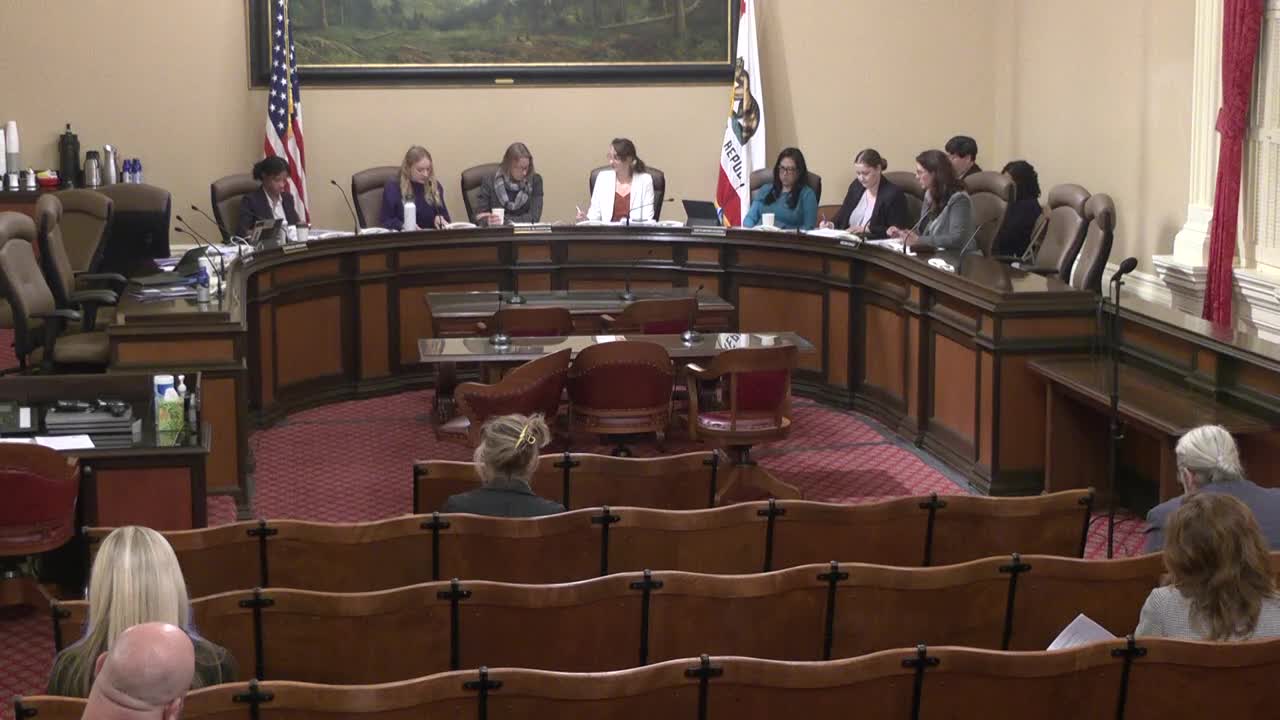 8MIN
Senate Standing Committee on Environmental Quality
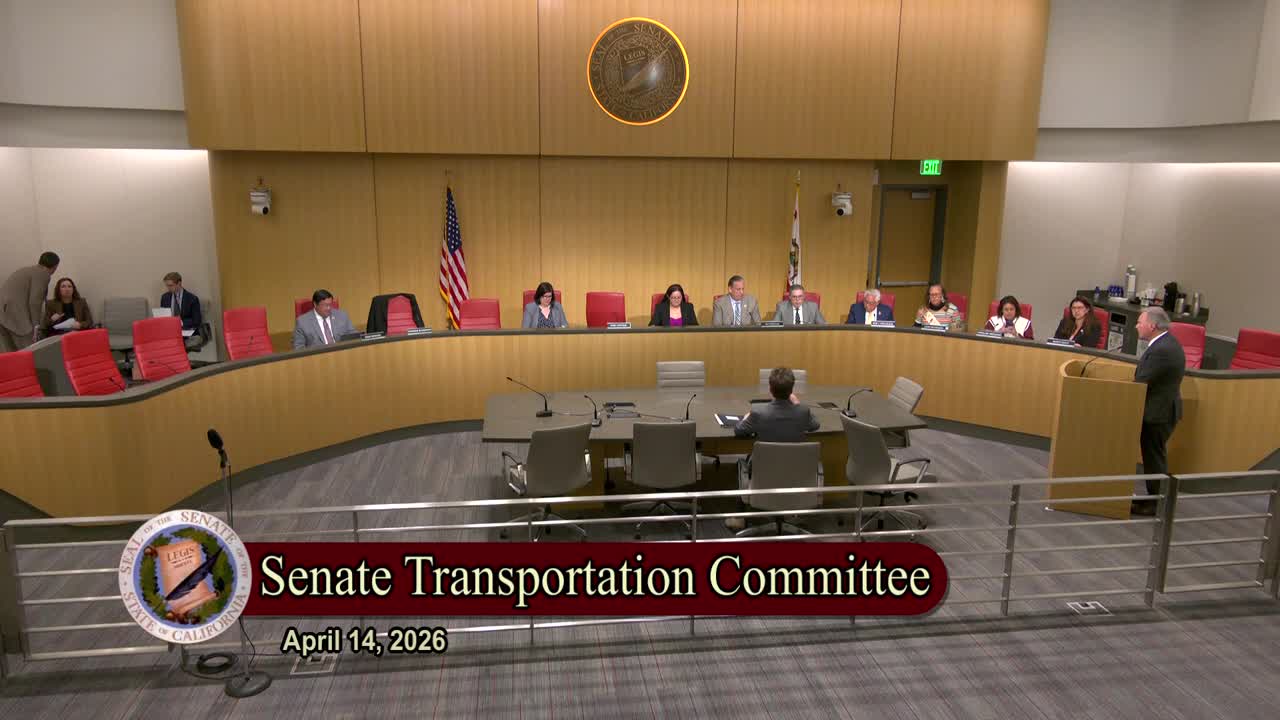 15MIN
Senate Standing Committee on Transportation
Bill Author