SB 1412: Parental communication: teacher meetings.
- Session Year: 2025-2026
- House: Senate
- Latest Version Date: 2026-09-28
Current Status:
Passed
(2026-09-28: Chaptered by Secretary of State. Chapter 736, Statutes of 2026.)
Introduced
In Committee
Awaiting First Chamber Vote
Passed First Chamber
In Committee
Awaiting Second Chamber Vote
Passed Second Chamber
Enacted
Existing law provides that parents and guardians of children enrolled in public schools have the right and should have the opportunity, as mutually supportive and respectful partners in the education of their children within the public schools, to be informed by the school, and to participate in the education of their children, as specified, including by, among other things, meeting with their childs teacher or teachers and the principal of the school in which their child is enrolled within a reasonable time of their request.
This bill would provide that parents, guardians, or educational rights holders of children enrolled in public schools also have the right to communicate with their childs teacher by telephone or a school-approved web conferencing platform if the parent, guardian, or educational rights holder is unable to attend an individual meeting in person about their child, as provided. The bill would prohibit these meetings from being recorded or transcribed. By imposing new duties on public schools, the bill would impose a state-mandated local program.
The bill would delete an obsolete reference.
This bill would incorporate additional changes to Section 51101 of the Education Code proposed by AB 2555 to be operative only if this bill and AB 2555 are enacted and this bill is enacted last.
The California Constitution requires the state to reimburse local agencies and school districts for certain costs mandated by the state. Statutory provisions establish procedures for making that reimbursement.
This bill would provide that, if the Commission on State Mandates determines that the bill contains costs mandated by the state, reimbursement for those costs shall be made pursuant to the statutory provisions noted above.
Existing law provides that parents and guardians of children enrolled in public schools have the right and should have the opportunity, as mutually supportive and respectful partners in the education of their children within the public schools, to be informed by the school, and to participate in the education of their children, as specified, including by, among other things, meeting with their childs teacher or teachers and the principal of the school in which their child is enrolled within a reasonable time of their request.
This bill would provide that parents or guardians parents, guardians, or educational rights holders of children enrolled in publc public schools also have the right to communicate with their childs teacher using a 2-way telephonic service by telephone or a 2-way audiovisual school-approved web conferencing platform if the parent or guardian parent, guardian, or educational rights holder is unable to attend a an individual meeting in person. person about their child, as provided. The bill would prohibit these meetings from being recorded or transcribed. By imposing new duties on public schools, the bill would impose a state-mandated local program.
The bill would delete an obsolete reference.
The California Constitution requires the state to reimburse local agencies and school districts for certain costs mandated by the state. Statutory provisions establish procedures for making that reimbursement.
This bill would provide that, if the Commission on State Mandates determines that the bill contains costs mandated by the state, reimbursement for those costs shall be made pursuant to the statutory provisions noted above.
Existing law provides that parents and guardians of children enrolled in public schools have the right and should have the opportunity, as mutually supportive and respectful partners in the education of their children within the public schools, to be informed by the school, and to participate in the education of their children, as specified, including by, among other things, meeting with their childs teacher or teachers and the principal of the school in which their child is enrolled within a reasonable time of their request.
This bill would provide that parents or guardians of children enrolled in publc schools also have the right to communicate with their childs teacher using a 2-way telephonic service or a 2-way audiovisual platform if the parent or guardian is unable to attend a meeting in person. By imposing new duties on public schools, the bill would impose a state-mandated local program.
The bill would delete an obsolete reference.
The California Constitution requires the state to reimburse local agencies and school districts for certain costs mandated by the state. Statutory provisions establish procedures for making that reimbursement.
This bill would provide that, if the Commission on State Mandates determines that the bill contains costs mandated by the state, reimbursement for those costs shall be made pursuant to the statutory provisions noted above.
Existing law establishes a system of public elementary and secondary schools in this state and authorizes local educational agencies throughout the state to operate schools and provide instruction to pupils in kindergarten and grades 1 to 12, inclusive.This bill would state the intent of the Legislature to enact future legislation relating to elementary and secondary education.Existing law establishes a system of public elementary and secondary schools in this state and authorizes local educational agencies throughout the state to operate schools and provide instruction to pupils in kindergarten and grades 1 to 12, inclusive.
This bill would state the intent of the Legislature to enact future legislation relating to elementary and secondary education.
(a)Except as provided in subdivision (c), the parents and guardians of pupils enrolled in public schools have the right and should have the opportunity, as mutually supportive and respectful partners in the education of their children within the public schools, to be informed by the school, and to participate in the education of their children, as follows:
(1)Within a reasonable period of time following making the request, to observe the classroom or classrooms in which their child is enrolled or for the purpose of selecting the school in which their child will be enrolled in accordance with the requirements of any intradistrict or interdistrict pupil attendance policies or programs.
(2)Within a reasonable time of their request, to meet with their childs teacher or teachers and the principal of the school in which their child is enrolled.
(3)To volunteer their time and resources for the improvement of school facilities and school programs under the supervision of district employees, including, but not limited to, providing assistance in the classroom with the approval, and under the direct supervision, of the teacher. Although volunteer parents may assist with instruction, primary instructional responsibility shall remain with the teacher.
(4)To be notified on a timely basis if their child is absent from school without permission.
(5)To receive the results of their childs performance on standardized tests and statewide tests and information on the performance of the school that their child attends on standardized statewide tests.
(6)To request a particular school for their child, and to receive a response from the school district. This paragraph does not obligate the school district to grant the parents request.
(7)To have a school environment for their child that is safe and supportive of learning.
(8)To examine the curriculum materials of the class or classes in which their child is enrolled.
(9)To be informed of their childs progress in school and of the appropriate school personnel whom they should contact if problems arise with their child.
(10)To have access to the school records of their child.
(11)To receive information concerning the academic performance standards, proficiencies, or skills their child is expected to accomplish.
(12)To be informed in advance about school rules, including disciplinary rules and procedures in accordance with Section 48980, attendance policies, dress codes, and procedures for visiting the school.
(13)To receive information about any psychological testing the school does involving their child and to deny permission to give the test.
(14)To participate as a member of a parent advisory committee, schoolsite council, or site-based management leadership team, in accordance with any rules and regulations governing membership in these organizations. In order to facilitate parental participation, schoolsite councils are encouraged to schedule a biannual open forum for the purpose of informing parents about current school issues and activities and answering parents questions. The meetings should be scheduled on weekends, and prior notice should be provided to parents.
(15)To question anything in their childs record that the parent feels is inaccurate or misleading or is an invasion of privacy and to receive a response from the school.
(16)To be notified, as early in the school year as practicable pursuant to Section 48070.5, if their child is identified as being at risk of retention and of their right to consult with school personnel responsible for a decision to promote or retain their child and to appeal a decision to retain or promote their child.
(17)(A)If a parent, guardian, or educational rights holder is unable to attend an individual meeting in person with a teacher about their child, to communicate with their childs teacher by telephone or a school-approved web conferencing platform. A meeting conducted in this manner shall not be recorded or transcribed.
(B)If a parent, guardian, or educational rights holder elects to attend a meeting in either of the manners described in subparagraph (A), then both of the following shall apply:
(i)The parent, guardian, or educational rights holder, and school, shall comply with existing law related to nonconsensual recording, including Section 51512 of this code and Section 632 of the Penal Code.
(ii)The school shall notify the parent, guardian, or educational rights holder of the potential risks to privacy and confidentiality due to the meeting format or arising from discussing potentially sensitive information.
(b)In addition to the rights described in subdivision (a), parents and guardians of pupils, including those parents and guardians whose primary language is not English, shall have the opportunity to work together in a mutually supportive and respectful partnership with schools, and to help their children succeed in school. Each governing board of a school district shall develop jointly with parents and guardians, and shall adopt, a policy that outlines the manner in which parents or guardians of pupils, school staff, and pupils may share the responsibility for continuing the intellectual, physical, emotional, and social development and well-being of pupils at each schoolsite. The policy shall include, but is not necessarily limited to, the following:
(1)The means by which the school and parents or guardians of pupils may help pupils to achieve academic and other standards of the school.
(2)A description of the schools responsibility to provide a high quality curriculum and instructional program in a supportive and effective learning environment that enables all pupils to meet the academic expectations of the school.
(3)The manner in which the parents and guardians of pupils may support the learning environment of their children, including, but not limited to, the following:
(A)Monitoring attendance of their children.
(B)Ensuring that homework is completed and turned in on a timely basis.
(C)Participation of the children in extracurricular activities.
(D)Monitoring and regulating the television viewed by their children.
(E)Working with their children at home in learning activities that extend learning in the classroom.
(F)Volunteering in their childrens classrooms, or for other activities at the school.
(G)Participating, as appropriate, in decisions relating to the education of their own child or the total school program.
(c)This section does not authorize a school to inform a parent or guardian, as provided in this section, or to permit participation by a parent or guardian in the education of a child, if it conflicts with a valid restraining order, protective order, or order for custody or visitation issued by a court of competent jurisdiction.
SEC. 1.5.Section 51101 of the Education Code is amended to read:51101.(a)Except as provided in subdivision (c), the parents and guardians of pupils enrolled in public schools have the right and should have the opportunity, as mutually supportive and respectful partners in the education of their children within the public schools, to be informed by the school, and to participate in the education of their children, as follows:
(1)Within a reasonable period of time following making the request, to observe the classroom or classrooms in which their child is enrolled or for the purpose of selecting the school in which their child will be enrolled in accordance with the requirements of any intradistrict or interdistrict pupil attendance policies or programs.
(2)(A)Within a reasonable time of their request, to meet with their childs teacher or teachers and the principal of the school in which their child is enrolled.
(B)Within a reasonable time of their request, for parents of English learners, to meet with their childs teacher or teachers to discuss their childs progress toward reaching proficiency in English, the process by which their child may be reclassified as fully English proficient, any opportunities for pupils to develop biliteracy in English and one or more other languages, and to earn the State Seal of Biliteracy.
(3)To volunteer their time and resources for the improvement of school facilities and school programs under the supervision of district employees, including, but not limited to, providing assistance in the classroom with the approval, and under the direct supervision, of the teacher. Although volunteer parents may assist with instruction, primary instructional responsibility shall remain with the teacher.
(4)To be notified on a timely basis if their child is absent from school without permission.
(5)To receive the results of their childs performance on standardized tests and statewide tests and information on the performance of the school that their child attends on standardized statewide tests, including the results of state assessments of English language proficiency.
(6)To request a particular school for their child, and to receive a response from the school district. This paragraph does not obligate the school district to grant the parents request.
(7)To have a school environment for their child that is safe and supportive of learning.
(8)To examine the curriculum materials of the class or classes in which their child is enrolled.
(9)To be informed through communication, including, but not limited to, parent-teacher conferences or report cards, of their childs progress in school and of the appropriate school personnel whom they should contact if problems arise with their child, including, for the parent of a child who is an English learner, their childs progress in developing English proficiency and being reclassified as fully English proficient.
(10)To have access to the school records of their child.
(11)To receive information concerning the academic performance standards, proficiencies, or skills their child is expected to accomplish, including, for pupils who are English learners, information on the proficiencies necessary to become reclassified as fully English proficient.
(12)To be informed in advance about school rules, including disciplinary rules and procedures in accordance with Section 48980, attendance policies, dress codes, and procedures for visiting the school.
(13)To receive information about any psychological testing the school does involving their child and to deny permission to give the test.
(14)To participate as a member of a parent advisory committee, schoolsite council, or site-based management leadership team, in accordance with any rules and regulations governing membership in these organizations. In order to facilitate parental participation, schoolsite councils are encouraged to schedule a biannual open forum for the purpose of informing parents about current school issues and activities and answering parents questions. The meetings should be scheduled on weekends, and prior notice should be provided to parents.
(15)To question anything in their childs record that the parent feels is inaccurate or misleading or is an invasion of privacy and to receive a response from the school.
(16)To be notified, as early in the school year as practicable pursuant to Section 48070.5, if their child is identified as being at risk of retention and of their right to consult with school personnel responsible for a decision to promote or retain their child and to appeal a decision to retain or promote their child.
(17)(A)If a parent, guardian, or educational rights holder is unable to attend an individual meeting in person with a teacher about their child, to communicate with their childs teacher by telephone or a school-approved web conferencing platform. A meeting conducted in this manner shall not be recorded or transcribed.
(B)If a parent, guardian, or educational rights holder elects to attend a meeting in either of the manners described in subparagraph (A), then both of the following shall apply:
(i)The parent, guardian, or educational rights holder, and school, shall comply with existing law related to nonconsensual recording, including Section 51512 of this code and Section 632 of the Penal Code.
(ii)The school shall notify the parent, guardian, or educational rights holder of the potential risks to privacy and confidentiality due to the meeting format or arising from discussing potentially sensitive information.
(b)In addition to the rights described in subdivision (a), parents and guardians of pupils, including those parents and guardians whose primary language is not English, shall have the opportunity to work together in a mutually supportive and respectful partnership with schools, and to help their children succeed in school. Each governing board of a school district shall develop jointly with parents and guardians, and shall adopt, a policy that outlines the manner in which parents or guardians of pupils, school staff, and pupils may share the responsibility for continuing the intellectual, physical, emotional, and social development and well-being of pupils at each schoolsite. The policy shall include, but is not necessarily limited to, the following:
(1)The means by which the school and parents or guardians of pupils may help pupils to achieve academic and other standards of the school.
(2)A description of the schools responsibility to provide a high quality curriculum and instructional program in a supportive and effective learning environment that enables all pupils to meet the academic expectations of the school.
(3)The manner in which the parents and guardians of pupils may support the learning environment of their children, including, but not limited to, the following:
(A)Monitoring attendance of their children.
(B)Ensuring that homework is completed and turned in on a timely basis.
(C)Participation of the children in extracurricular activities.
(D)Monitoring and regulating the television viewed by their children.
(E)Working with their children at home in learning activities that extend learning in the classroom.
(F)Volunteering in their childrens classrooms, or for other activities at the school.
(G)Participating, as appropriate, in decisions relating to the education of their own child or the total school program.
(c)This section does not authorize a school to inform a parent or guardian, as provided in this section, or to permit participation by a parent or guardian in the education of a child, if it conflicts with a valid restraining order, protective order, or order for custody or visitation issued by a court of competent jurisdiction.
SEC. 2.Section 1.5 of this bill incorporates amendments to Section 51101 of the Education Code proposed by both this bill and Assembly Bill 2555. That section of this bill shall only become operative if (1) both bills are enacted and become effective on or before January 1, 2027, (2) each bill amends Section 51101 of the Education Code, and (3) this bill is enacted after Assembly Bill 2555, in which case Section 1 of this bill shall not become operative.
SEC. 3.If the Commission on State Mandates determines that this act contains costs mandated by the state, reimbursement to local agencies and school districts for those costs shall be made pursuant to Part 7 (commencing with Section 17500) of Division 4 of Title 2 of the Government Code.
(a)Except as provided in subdivision (c), the parents and guardians of pupils enrolled in public schools have the right and should have the opportunity, as mutually supportive and respectful partners in the education of their children within the public schools, to be informed by the school, and to participate in the education of their children, as follows:
(1)Within a reasonable period of time following making the request, to observe the classroom or classrooms in which their child is enrolled or for the purpose of selecting the school in which their child will be enrolled in accordance with the requirements of any intradistrict or interdistrict pupil attendance policies or programs.
(2)Within a reasonable time of their request, to meet with their childs teacher or teachers and the principal of the school in which their child is enrolled.
(3)To volunteer their time and resources for the improvement of school facilities and school programs under the supervision of district employees, including, but not limited to, providing assistance in the classroom with the approval, and under the direct supervision, of the teacher. Although volunteer parents may assist with instruction, primary instructional responsibility shall remain with the teacher.
(4)To be notified on a timely basis if their child is absent from school without permission.
(5)To receive the results of their childs performance on standardized tests and statewide tests and information on the performance of the school that their child attends on standardized statewide tests.
(6)To request a particular school for their child, and to receive a response from the school district. This paragraph does not obligate the school district to grant the parents request.
(7)To have a school environment for their child that is safe and supportive of learning.
(8)To examine the curriculum materials of the class or classes in which their child is enrolled.
(9)To be informed of their childs progress in school and of the appropriate school personnel whom they should contact if problems arise with their child.
(10)To have access to the school records of their child.
(11)To receive information concerning the academic performance standards, proficiencies, or skills their child is expected to accomplish.
(12)To be informed in advance about school rules, including disciplinary rules and procedures in accordance with Section 48980, attendance policies, dress codes, and procedures for visiting the school.
(13)To receive information about any psychological testing the school does involving their child and to deny permission to give the test.
(14)To participate as a member of a parent advisory committee, schoolsite council, or site-based management leadership team, in accordance with any rules and regulations governing membership in these organizations. In order to facilitate parental participation, schoolsite councils are encouraged to schedule a biannual open forum for the purpose of informing parents about current school issues and activities and answering parents questions. The meetings should be scheduled on weekends, and prior notice should be provided to parents.
(15)To question anything in their childs record that the parent feels is inaccurate or misleading or is an invasion of privacy and to receive a response from the school.
(16)To be notified, as early in the school year as practicable pursuant to Section 48070.5, if their child is identified as being at risk of retention and of their right to consult with school personnel responsible for a decision to promote or retain their child and to appeal a decision to retain or promote their child.
(17)(A)If a parent, guardian, or educational rights holder is unable to attend an individual meeting in person with a teacher about their child, to communicate with their childs teacher by telephone or a school-approved web conferencing platform. A meeting conducted in this manner shall not be recorded or transcribed.
(B)If a parent, guardian, or educational rights holder elects to attend a meeting in either of the manners described in subparagraph (A), then both of the following shall apply:
(i)The parent, guardian, or educational rights holder, and school, shall comply with existing law related to nonconsensual recording, including Section 51512 of this code and Section 632 of the Penal Code.
(ii)The school shall notify the parent, guardian, or educational rights holder of the potential risks to privacy and confidentiality due to the meeting format or arising from discussing potentially sensitive information.
(b)In addition to the rights described in subdivision (a), parents and guardians of pupils, including those parents and guardians whose primary language is not English, shall have the opportunity to work together in a mutually supportive and respectful partnership with schools, and to help their children succeed in school. Each governing board of a school district shall develop jointly with parents and guardians, and shall adopt, a policy that outlines the manner in which parents or guardians of pupils, school staff, and pupils may share the responsibility for continuing the intellectual, physical, emotional, and social development and well-being of pupils at each schoolsite. The policy shall include, but is not necessarily limited to, the following:
(1)The means by which the school and parents or guardians of pupils may help pupils to achieve academic and other standards of the school.
(2)A description of the schools responsibility to provide a high quality curriculum and instructional program in a supportive and effective learning environment that enables all pupils to meet the academic expectations of the school.
(3)The manner in which the parents and guardians of pupils may support the learning environment of their children, including, but not limited to, the following:
(A)Monitoring attendance of their children.
(B)Ensuring that homework is completed and turned in on a timely basis.
(C)Participation of the children in extracurricular activities.
(D)Monitoring and regulating the television viewed by their children.
(E)Working with their children at home in learning activities that extend learning in the classroom.
(F)Volunteering in their childrens classrooms, or for other activities at the school.
(G)Participating, as appropriate, in decisions relating to the education of their own child or the total school program.
(c)This section does not authorize a school to inform a parent or guardian, as provided in this section, or to permit participation by a parent or guardian in the education of a child, if it conflicts with a valid restraining order, protective order, or order for custody or visitation issued by a court of competent jurisdiction.
SEC. 1.5.Section 51101 of the Education Code is amended to read:51101.(a)Except as provided in subdivision (d), (c), the parents and guardians of pupils enrolled in public schools have the right and should have the opportunity, as mutually supportive and respectful partners in the education of their children within the public schools, to be informed by the school, and to participate in the education of their children, as follows:
(1)Within a reasonable period of time following making the request, to observe the classroom or classrooms in which their child is enrolled or for the purpose of selecting the school in which their child will be enrolled in accordance with the requirements of any intradistrict or interdistrict pupil attendance policies or programs.
(2)(A)Within a reasonable time of their request, to meet with their childs teacher or teachers and the principal of the school in which their child is enrolled.
(B)Within a reasonable time of their request, for parents of English learners, to meet with their childs teacher or teachers to discuss their childs progress toward reaching proficiency in English, the process by which their child may be reclassified as fully English proficient, any opportunities for pupils to develop biliteracy in English and one or more other languages, and to earn the State Seal of Biliteracy.
(3)To volunteer their time and resources for the improvement of school facilities and school programs under the supervision of district employees, including, but not limited to, providing assistance in the classroom with the approval, and under the direct supervision, of the teacher. Although volunteer parents may assist with instruction, primary instructional responsibility shall remain with the teacher.
(4)To be notified on a timely basis if their child is absent from school without permission.
(5)To receive the results of their childs performance on standardized tests and statewide tests and information on the performance of the school that their child attends on standardized statewide tests. tests, including the results of state assessments of English language proficiency.
(6)To request a particular school for their child, and to receive a response from the school district. This paragraph does not obligate the school district to grant the parents request.
(7)To have a school environment for their child that is safe and supportive of learning.
(8)To examine the curriculum materials of the class or classes in which their child is enrolled.
(9)To be informed through communication, including, but not limited to, parent-teacher conferences or report cards, of their childs progress in school and of the appropriate school personnel whom they should contact if problems arise with their child. child, including, for the parent of a child who is an English learner, their childs progress in developing English proficiency and being reclassified as fully English proficient.
(10)To have access to the school records of their child.
(11)To receive information concerning the academic performance standards, proficiencies, or skills their child is expected to accomplish. accomplish, including, for pupils who are English learners, information on the proficiencies necessary to become reclassified as fully English proficient.
(12)To be informed in advance about school rules, including disciplinary rules and procedures in accordance with Section 48980, attendance policies, dress codes, and procedures for visiting the school.
(13)To receive information about any psychological testing the school does involving their child and to deny permission to give the test.
(14)To participate as a member of a parent advisory committee, schoolsite council, or site-based management leadership team, in accordance with any rules and regulations governing membership in these organizations. In order to facilitate parental participation, schoolsite councils are encouraged to schedule a biannual open forum for the purpose of informing parents about current school issues and activities and answering parents questions. The meetings should be scheduled on weekends, and prior notice should be provided to parents.
(15)To question anything in their childs record that the parent feels is inaccurate or misleading or is an invasion of privacy and to receive a response from the school.
(16)To be notified, as early in the school year as practicable pursuant to Section 48070.5, if their child is identified as being at risk of retention and of their right to consult with school personnel responsible for a decision to promote or retain their child and to appeal a decision to retain or promote their child.
(17)(A)If a parent, guardian, or educational rights holder is unable to attend an individual meeting in person with a teacher about their child, to communicate with their childs teacher by telephone or a school-approved web conferencing platform. A meeting conducted in this manner shall not be recorded or transcribed.
(B)If a parent, guardian, or educational rights holder elects to attend a meeting in either of the manners described in subparagraph (A), then both of the following shall apply:
(i)The parent, guardian, or educational rights holder, and school, shall comply with existing law related to nonconsensual recording, including Section 51512 of this code and Section 632 of the Penal Code.
(ii)The school shall notify the parent, guardian, or educational rights holder of the potential risks to privacy and confidentiality due to the meeting format or arising from discussing potentially sensitive information.
(b)In addition to the rights described in subdivision (a), parents and guardians of pupils, including those parents and guardians whose primary language is not English, shall have the opportunity to work together in a mutually supportive and respectful partnership with schools, and to help their children succeed in school. Each governing board of a school district shall develop jointly with parents and guardians, and shall adopt, a policy that outlines the manner in which parents or guardians of pupils, school staff, and pupils may share the responsibility for continuing the intellectual, physical, emotional, and social development and well-being of pupils at each schoolsite. The policy shall include, but is not necessarily limited to, the following:
(1)The means by which the school and parents or guardians of pupils may help pupils to achieve academic and other standards of the school.
(2)A description of the schools responsibility to provide a high quality curriculum and instructional program in a supportive and effective learning environment that enables all pupils to meet the academic expectations of the school.
(3)The manner in which the parents and guardians of pupils may support the learning environment of their children, including, but not limited to, the following:
(A)Monitoring attendance of their children.
(B)Ensuring that homework is completed and turned in on a timely basis.
(C)Participation of the children in extracurricular activities.
(D)Monitoring and regulating the television viewed by their children.
(E)Working with their children at home in learning activities that extend learning in the classroom.
(F)Volunteering in their childrens classrooms, or for other activities at the school.
(G)Participating, as appropriate, in decisions relating to the education of their own child or the total school program.
(c)All schools that participate in the High Priority Schools Grant Program established pursuant to Article 3.5 (commencing with Section 52055.600) of Chapter 6.1 of Part 28 and that maintain kindergarten or any of grades 1 to 5, inclusive, shall jointly develop with parents or guardians for all children enrolled at that schoolsite, a school-parent compact pursuant to Section 6319 of Title 20 of the United States Code.(d)(c)This section does not authorize a school to inform a parent or guardian, as provided in this section, or to permit participation by a parent or guardian in the education of a child, if it conflicts with a valid restraining order, protective order, or order for custody or visitation issued by a court of competent jurisdiction.
SEC. 2.Section 1.5 of this bill incorporates amendments to Section 51101 of the Education Code proposed by both this bill and Assembly Bill 2555. That section of this bill shall only become operative if (1) both bills are enacted and become effective on or before January 1, 2027, (2) each bill amends Section 51101 of the Education Code, and (3) this bill is enacted after Assembly Bill 2555, in which case Section 1 of this bill shall not become operative.
SEC. 2.SEC. 3.If the Commission on State Mandates determines that this act contains costs mandated by the state, reimbursement to local agencies and school districts for those costs shall be made pursuant to Part 7 (commencing with Section 17500) of Division 4 of Title 2 of the Government Code.
(a)Except as provided in subdivision (c), the parents and guardians of pupils enrolled in public schools have the right and should have the opportunity, as mutually supportive and respectful partners in the education of their children within the public schools, to be informed by the school, and to participate in the education of their children, as follows:
(1)Within a reasonable period of time following making the request, to observe the classroom or classrooms in which their child is enrolled or for the purpose of selecting the school in which their child will be enrolled in accordance with the requirements of any intradistrict or interdistrict pupil attendance policies or programs.
(2)Within a reasonable time of their request, to meet with their childs teacher or teachers and the principal of the school in which their child is enrolled.
(3)To volunteer their time and resources for the improvement of school facilities and school programs under the supervision of district employees, including, but not limited to, providing assistance in the classroom with the approval, and under the direct supervision, of the teacher. Although volunteer parents may assist with instruction, primary instructional responsibility shall remain with the teacher.
(4)To be notified on a timely basis if their child is absent from school without permission.
(5)To receive the results of their childs performance on standardized tests and statewide tests and information on the performance of the school that their child attends on standardized statewide tests.
(6)To request a particular school for their child, and to receive a response from the school district. This paragraph does not obligate the school district to grant the parents request.
(7)To have a school environment for their child that is safe and supportive of learning.
(8)To examine the curriculum materials of the class or classes in which their child is enrolled.
(9)To be informed of their childs progress in school and of the appropriate school personnel whom they should contact if problems arise with their child.
(10)To have access to the school records of their child.
(11)To receive information concerning the academic performance standards, proficiencies, or skills their child is expected to accomplish.
(12)To be informed in advance about school rules, including disciplinary rules and procedures in accordance with Section 48980, attendance policies, dress codes, and procedures for visiting the school.
(13)To receive information about any psychological testing the school does involving their child and to deny permission to give the test.
(14)To participate as a member of a parent advisory committee, schoolsite council, or site-based management leadership team, in accordance with any rules and regulations governing membership in these organizations. In order to facilitate parental participation, schoolsite councils are encouraged to schedule a biannual open forum for the purpose of informing parents about current school issues and activities and answering parents questions. The meetings should be scheduled on weekends, and prior notice should be provided to parents.
(15)To question anything in their childs record that the parent feels is inaccurate or misleading or is an invasion of privacy and to receive a response from the school.
(16)To be notified, as early in the school year as practicable pursuant to Section 48070.5, if their child is identified as being at risk of retention and of their right to consult with school personnel responsible for a decision to promote or retain their child and to appeal a decision to retain or promote their child.
(17)(A)If a parent or guardian parent, guardian, or educational rights holder is unable to attend a an individual meeting in person with a teacher, teacher about their child, to communicate with their childs teacher using a two-way telephonic service by telephone or a two-way audiovisual school-approved web conferencing platform. A meeting conducted in this manner shall not be recorded or transcribed.
(B)If a parent, guardian, or educational rights holder elects to attend a meeting in either of the manners described in subparagraph (A), then both of the following shall apply:
(i)The parent, guardian, or educational rights holder, and school, shall comply with existing law related to nonconsensual recording, including Section 51512 of this code and Section 632 of the Penal Code.
(ii)The school shall notify the parent, guardian, or educational rights holder of the potential risks to privacy and confidentiality due to the meeting format or arising from discussing potentially sensitive information.
(b)In addition to the rights described in subdivision (a), parents and guardians of pupils, including those parents and guardians whose primary language is not English, shall have the opportunity to work together in a mutually supportive and respectful partnership with schools, and to help their children succeed in school. Each governing board of a school district shall develop jointly with parents and guardians, and shall adopt, a policy that outlines the manner in which parents or guardians of pupils, school staff, and pupils may share the responsibility for continuing the intellectual, physical, emotional, and social development and well-being of pupils at each schoolsite. The policy shall include, but is not necessarily limited to, the following:
(1)The means by which the school and parents or guardians of pupils may help pupils to achieve academic and other standards of the school.
(2)A description of the schools responsibility to provide a high quality curriculum and instructional program in a supportive and effective learning environment that enables all pupils to meet the academic expectations of the school.
(3)The manner in which the parents and guardians of pupils may support the learning environment of their children, including, but not limited to, the following:
(A)Monitoring attendance of their children.
(B)Ensuring that homework is completed and turned in on a timely basis.
(C)Participation of the children in extracurricular activities.
(D)Monitoring and regulating the television viewed by their children.
(E)Working with their children at home in learning activities that extend learning in the classroom.
(F)Volunteering in their childrens classrooms, or for other activities at the school.
(G)Participating, as appropriate, in decisions relating to the education of their own child or the total school program.
(c)This section does not authorize a school to inform a parent or guardian, as provided in this section, or to permit participation by a parent or guardian in the education of a child, if it conflicts with a valid restraining order, protective order, or order for custody or visitation issued by a court of competent jurisdiction.
SEC. 2.If the Commission on State Mandates determines that this act contains costs mandated by the state, reimbursement to local agencies and school districts for those costs shall be made pursuant to Part 7 (commencing with Section 17500) of Division 4 of Title 2 of the Government Code.
(a)Except as provided in subdivision (d), (c), the parents and guardians of pupils enrolled in public schools have the right and should have the opportunity, as mutually supportive and respectful partners in the education of their children within the public schools, to be informed by the school, and to participate in the education of their children, as follows:
(1)Within a reasonable period of time following making the request, to observe the classroom or classrooms in which their child is enrolled or for the purpose of selecting the school in which their child will be enrolled in accordance with the requirements of any intradistrict or interdistrict pupil attendance policies or programs.
(2)Within a reasonable time of their request, to meet with their childs teacher or teachers and the principal of the school in which their child is enrolled.
(3)To volunteer their time and resources for the improvement of school facilities and school programs under the supervision of district employees, including, but not limited to, providing assistance in the classroom with the approval, and under the direct supervision, of the teacher. Although volunteer parents may assist with instruction, primary instructional responsibility shall remain with the teacher.
(4)To be notified on a timely basis if their child is absent from school without permission.
(5)To receive the results of their childs performance on standardized tests and statewide tests and information on the performance of the school that their child attends on standardized statewide tests.
(6)To request a particular school for their child, and to receive a response from the school district. This paragraph does not obligate the school district to grant the parents request.
(7)To have a school environment for their child that is safe and supportive of learning.
(8)To examine the curriculum materials of the class or classes in which their child is enrolled.
(9)To be informed of their childs progress in school and of the appropriate school personnel whom they should contact if problems arise with their child.
(10)To have access to the school records of their child.
(11)To receive information concerning the academic performance standards, proficiencies, or skills their child is expected to accomplish.
(12)To be informed in advance about school rules, including disciplinary rules and procedures in accordance with Section 48980, attendance policies, dress codes, and procedures for visiting the school.
(13)To receive information about any psychological testing the school does involving their child and to deny permission to give the test.
(14)To participate as a member of a parent advisory committee, schoolsite council, or site-based management leadership team, in accordance with any rules and regulations governing membership in these organizations. In order to facilitate parental participation, schoolsite councils are encouraged to schedule a biannual open forum for the purpose of informing parents about current school issues and activities and answering parents questions. The meetings should be scheduled on weekends, and prior notice should be provided to parents.
(15)To question anything in their childs record that the parent feels is inaccurate or misleading or is an invasion of privacy and to receive a response from the school.
(16)To be notified, as early in the school year as practicable pursuant to Section 48070.5, if their child is identified as being at risk of retention and of their right to consult with school personnel responsible for a decision to promote or retain their child and to appeal a decision to retain or promote their child.
(17)If a parent or guardian is unable to attend a meeting in person with a teacher, to communicate with their childs teacher using a two-way telephonic service or a two-way audiovisual platform.
(b)In addition to the rights described in subdivision (a), parents and guardians of pupils, including those parents and guardians whose primary language is not English, shall have the opportunity to work together in a mutually supportive and respectful partnership with schools, and to help their children succeed in school. Each governing board of a school district shall develop jointly with parents and guardians, and shall adopt, a policy that outlines the manner in which parents or guardians of pupils, school staff, and pupils may share the responsibility for continuing the intellectual, physical, emotional, and social development and well-being of pupils at each schoolsite. The policy shall include, but is not necessarily limited to, the following:
(1)The means by which the school and parents or guardians of pupils may help pupils to achieve academic and other standards of the school.
(2)A description of the schools responsibility to provide a high quality curriculum and instructional program in a supportive and effective learning environment that enables all pupils to meet the academic expectations of the school.
(3)The manner in which the parents and guardians of pupils may support the learning environment of their children, including, but not limited to, the following:
(A)Monitoring attendance of their children.
(B)Ensuring that homework is completed and turned in on a timely basis.
(C)Participation of the children in extracurricular activities.
(D)Monitoring and regulating the television viewed by their children.
(E)Working with their children at home in learning activities that extend learning in the classroom.
(F)Volunteering in their childrens classrooms, or for other activities at the school.
(G)Participating, as appropriate, in decisions relating to the education of their own child or the total school program.
(c)All schools that participate in the High Priority Schools Grant Program established pursuant to Article 3.5 (commencing with Section 52055.600) of Chapter 6.1 of Part 28 and that maintain kindergarten or any of grades 1 to 5, inclusive, shall jointly develop with parents or guardians for all children enrolled at that schoolsite, a school-parent compact pursuant to Section 6319 of Title 20 of the United States Code.(d)(c)This section does not authorize a school to inform a parent or guardian, as provided in this section, or to permit participation by a parent or guardian in the education of a child, if it conflicts with a valid restraining order, protective order, or order for custody or visitation issued by a court of competent jurisdiction.
SEC. 2.If the Commission on State Mandates determines that this act contains costs mandated by the state, reimbursement to local agencies and school districts for those costs shall be made pursuant to Part 7 (commencing with Section 17500) of Division 4 of Title 2 of the Government Code.
SECTION 1.It is the intent of the Legislature to enact future legislation relating to elementary and secondary education.It is the intent of the Legislature to enact future legislation relating to elementary and secondary education.
|
Date
|
Status
|
|---|---|
| Sep 28, 2026 | Chaptered by Secretary of State. Chapter 736, Statutes of 2026. |
| Sep 28, 2026 | Approved by the Governor. |
| Aug 30, 2026 | Enrolled and presented to the Governor at 6 p.m. |
| Aug 25, 2026 | Assembly amendments concurred in. (Ayes 40. Noes 0. Page 5744.) Ordered to engrossing and enrolling. |
| Aug 25, 2026 | Assembly amendments concurred in. (Ayes 40. Noes 0.) Ordered to engrossing and enrolling. |
| Aug 24, 2026 | In Senate. Concurrence in Assembly amendments pending. |
| Aug 24, 2026 | Read third time. Passed. (Ayes 78. Noes 0. Page 6416.) Ordered to the Senate. |
| Aug 24, 2026 | Read third time. Passed. Ordered to the Senate. |
| Aug 19, 2026 | Ordered to third reading. |
| Aug 19, 2026 | Read third time and amended. |
| Aug 13, 2026 | Read second time. Ordered to third reading. |
| Aug 13, 2026 | From committee: Do pass. (Ayes 15. Noes 0.) (August 13). |
| Aug 13, 2026 | Assembly Rule 63 suspended. |
| Aug 5, 2026 | August 5 set for first hearing. Placed on suspense file. |
| Jun 22, 2026 | Read second time and amended. Re-referred to Com. on APPR. |
| Jun 18, 2026 | From committee: Do pass as amended and re-refer to Com. on APPR. with recommendation: To consent calendar. (Ayes 8. Noes 0.) (June 17). |
| Jun 1, 2026 | Referred to Com. on ED. |
| May 22, 2026 | In Assembly. Read first time. Held at Desk. |
| May 22, 2026 | Read third time. Passed. (Ayes 33. Noes 0. Page 4422.) Ordered to the Assembly. |
| May 22, 2026 | Read third time. Passed. (Ayes 33. Noes 0.) Ordered to the Assembly. |
| May 20, 2026 | Ordered to special consent calendar. |
| May 14, 2026 | From committee: Do pass. (Ayes 7. Noes 0. Page 4276.) (May 14). |
| May 14, 2026 | Read second time. Ordered to third reading. |
| May 14, 2026 | From committee: Do pass. (Ayes 7. Noes 0.) (May 14). |
| May 8, 2026 | Set for hearing May 14. |
| Apr 27, 2026 | April 27 hearing: Placed on APPR. suspense file. |
| Apr 17, 2026 | Set for hearing April 27. |
| Apr 15, 2026 | From committee: Do pass and re-refer to Com. on APPR. with recommendation: To consent calendar. (Ayes 7. Noes 0. Page 3899.) (April 15). Re-referred to Com. on APPR. |
| Apr 15, 2026 | From committee: Do pass and re-refer to Com. on APPR. with recommendation: To consent calendar. (Ayes 7. Noes 0.) (April 15). Re-referred to Com. on APPR. |
| Apr 9, 2026 | Set for hearing April 15. |
| Apr 8, 2026 | Re-referred to Com. on ED. |
| Mar 25, 2026 | From committee with author's amendments. Read second time and amended. Re-referred to Com. on RLS. |
| Mar 4, 2026 | Referred to Com. on RLS. |
| Feb 23, 2026 | Read first time. |
| Feb 23, 2026 | From printer. May be acted upon on or after March 23. |
| Feb 20, 2026 | Introduced. To Com. on RLS. for assignment. To print. |
|
Date
|
Description
|
Location
|
Votes
|
|
|---|---|---|---|---|
| Aug 25, 2026 | Unfinished Business SB1412 Rubio Concurrence | Senate Floor |
Passed |
|
| Aug 24, 2026 | SB 1412 Rubio Senate Third Reading By Patel | Assembly Floor |
Passed |
|
| Aug 13, 2026 | Do pass. | Assembly Standing Committee on Appropriations |
Passed |
|
| Jun 17, 2026 | Do pass as amended, and be re-referred to the Committee on [Appropriations] with recommendation: To Consent Calendar | Assembly Standing Committee on Education |
Passed |
|
| May 22, 2026 | Special Consent SB1412 Rubio | Senate Floor |
Passed |
|
| May 14, 2026 | Do pass | Senate Standing Committee on Appropriations |
Passed |
|
| Apr 27, 2026 | Placed on suspense file | Senate Standing Committee on Appropriations |
Passed |
|
| Apr 15, 2026 | Do pass, but first be re-referred to the Committee on [Appropriations] with the recommendation: To Consent Calendar | Senate Standing Committee on Education |
Passed |
This list shows positions taken on this bill by organizations on the date displayed, which is linked to the original source.
Positions by individuals are not included.
|
Organization
|
Position
|
Date
|
|---|---|---|
| California State PTA | ** Support |
SENATE RULES COMMITTEE Office of Senate Floor Analyses (916) 651-4171 | SB 1412 |
UNFINISHED BUSINESS
Bill No: SB 1412
Author: Rubio (D)
Amended: 8/19/26
Vote: 21
SENATE EDUCATION COMMITTEE: 7-0, 4/15/26
AYES: Pérez, Ochoa Bogh, Cabaldon, Choi, Cortese, Gonzalez, Reyes
SENATE APPROPRIATIONS COMMITTEE: 7-0, 5/14/26
AYES: Cervantes, Seyarto, Cabaldon, Dahle, Grayson, Richardson, Wahab
SENATE FLOOR: 33-0, 5/22/26
AYES: Archuleta, Arreguín, Ashby, Blakespear, Cabaldon, Caballero, Cervantes, Choi, Cortese, Dahle, Durazo, Gonzalez, Grayson, Grove, Jones, Laird, Limón, McGuire, McNerney, Menjivar, Ochoa Bogh, Pérez, Reyes, Richardson, Rubio, Seyarto, Smallwood-Cuevas, Strickland, Umberg, Valladares, Wahab, Weber Pierson, Wiener
NO VOTE RECORDED: Allen, Alvarado-Gil, Becker, Hurtado, Niello, Padilla, Stern
ASSEMBLY FLOOR: Passed, 8/24/26
SUBJECT: Parental communication: teacher meetings
SOURCE: Author
DIGEST:
This bill provides that a parent, guardian, or educational rights holder of a student has the right to communicate with their child’s teacher by telephone or a school-approved web conferencing platform, if a parent, guardian, or educational rights holder is unable to attend an individual meeting in person with a teacher about their child.
Assembly Amendments
(1) provide the provisions of this bill apply if an educational rights holder, in addition to a parent or a guardian, is unable to attend an individual meeting in person with a teacher about their child; (2) replace “two-way audiovisual platform” with “school-approved web conferencing platform”; (3) prohibit the specified meeting from being recorded or transcribed; (4) require the school and the parent, guardian, or educational rights holder to comply with existing law related to nonconsensual recording; (5) require the school to notify the parent, guardian, or educational rights holder of the potential risks to privacy and confidentiality due to the meeting format or arising from discussing potentially sensitive information; and (6) include double jointing language for this bill and AB 2555 (Patel, 2026).
ANALYSIS:
Existing law:
- Provides that parents and guardians of students enrolled in public schools have the right and should have the opportunity to be informed by the school and to participate in the education of their children, as specified, including meeting with their child’s teacher or teachers and the principal of the school in which their child is enrolled, within a reasonable time of their request. (Education Code (EC) § 51101)
- Provides that parents and guardians of students enrolled in public schools are mutually supportive and respectful partners in the education of their children within the public schools. (EC § 51101)
This bill:
- Provides that a parent, guardian, or educational rights holder of a student has the right to communicate with their child’s teacher by telephone or a school-approved web conferencing platform, if a parent, guardian, or educational rights holder is unable to attend an individual meeting in person with a teacher about their child.
- Prohibit the specified meeting from being recorded or transcribed.
- Requires that both of the following apply if a parent, guardian, or educational rights holder elects to attend a meeting as specified in #1:
- Require the school and the parent, guardian, or educational rights holder to comply with existing law related to nonconsensual recording.
- Require the school to notify the parent, guardian, or educational rights holder of the potential risks to privacy and confidentiality due to the meeting format or arising from discussing potentially sensitive information.
- Deletes an obsolete reference to a program that has since been repealed.
- Includes double jointing language for this bill and AB 2555 (Patel, 2026).
Comments
Need for the bill. According to the author, “existing law does not require schools to provide remote or virtual options for parent-teacher conferences outside of the special education context, leaving such decisions to Local Educational Agencies (LEAs). … As a result, parents and guardians who are unable to attend conferences in person due to work schedules, transportation barriers, or other constraints may face challenges in engaging with educators. … SB 1412 ensures that schools provide remote participation options, helping families who may struggle with transportation or are navigating the complexities of immigration to actively participate in their child’s education. … By expanding access in this way, the bill supports equity, strengthens school-family communication, and helps ensure every student has the support needed to reach their full potential.”
Parents and guardians of children enrolled in public schools have the right to participate in the education of their children. State law provides that parents and guardians of children enrolled in public schools have the right, and should have the opportunity, to participate in the education of their children in specified ways, including observing the classrooms in which their child is enrolled, being notified on a timely basis if their child is absent from school without permission, and being informed of their child’s progress in school and the appropriate school personnel to be contacted if problems arise with their child.
One of these rights includes meeting with their child’s teacher and the principal of the school in which their child is enrolled, within a reasonable time of their request. This statute was last amended in 2004, and with the widespread adoption of smartphones and web conferencing platforms such as Zoom, this bill provides an additional right for a parent or guardian of a student to communicate and meet with their child’s teacher with a phone call or a school-approved web conferencing platform, if the parent, guardian, or educational rights holder is unable to attend an individual meeting in person with a teacher about their child, allowing for greater flexibility for the parent or guardian.
FISCAL EFFECT: Appropriation: No Fiscal Com.: Yes Local: Yes
According to the Assembly Appropriations Committee:
To the extent this bill results in local educational agencies (LEAs) needing to update policies, provide notice to parents, and purchase software license rights or memberships to allow for the use of telephone or audio-visual remote communication options to parents, the bill could create one-time Proposition 98 General Fund costs of an unknown but potentially significant amount, possibly in the tens of thousands to hundreds of thousands of dollars, collectively statewide.
SUPPORT: (Verified 8/24/26)
None received
OPPOSITION: (Verified 8/24/26)
None received
Prepared by: Michelle Nguyen / ED. / (916) 651-4105
8/24/26 17:08:53
**** END ****
SENATE THIRD READING
STR Bill Id:SB 1412
Author:(Rubio)
As Amended Ver:August 19, 2026
Majority vote
SUMMARY
Provides that a parent, guardian, or educational rights holder unable to attend an individual meeting with their child's teacher shall have the right to communicate with the teacher instead by telephone or a school-approved web conferencing platform.
Major Provisions
- Prohibits a meeting conducted in this manner from being recorded or transcribed.
- Requires a parent, guardian, or educational rights holder and public school to comply with existing law related to non-consensual recording.
- Requires the school to notify the parent, guardian, or educational rights holder of the potential risks to privacy and confidentiality due to the meeting format arising from discussing potentially sensitive information.
- Add double-jointing language to ensure that the amendments made by both this bill and AB 2555 (Patel) to Education Code Section 17250.20 become operative if both bills are enacted and this bill is enacted last.
COMMENTS
Parents, guardians, and educational rights holders of children enrolled in public schools have the right to participate in the education of their children. Current law provides that parents and guardians of children enrolled in California public schools have the right, and should have the opportunity, to participate in the education of their children in specified ways. Current law includes observing the classrooms in which their child is enrolled, being notified on a timely basis if their child is absent from school without permission and being informed of their child's progress in school and of the appropriate school personnel to contact if problems arise with their child.
One of the rights listed in current law includes meeting with their child's teacher and the principal of the school in which their child is enrolled, within a reasonable time of their request. This statute was last amended in 2004, and with the widespread adoption of smartphones and remote audiovisual platforms such as Zoom, this bill provides an additional right for a parent or guardian of a student to communicate and meet with their child's teacher with a telephone or a school-approved web conferencing platform if the parent, guardian, or educational rights holder of a student is unable to attend an in-person meeting with a teacher, allowing for greater flexibility for the parent or guardian. This proposal will create additional local flexibility, authorizing both teachers and parents to meet via alternative formats. Further, this authorization may be particularly helpful for working parents or those with disabilities.
According to the Author
"Parent teacher conferences are a vital way for families to stay engaged in their child's education, yet many parents, particularly working-class families and immigrant parents face barriers such as demanding work schedules, transportation challenges, childcare needs, and language obstacles. As a teacher, I have seen firsthand what a lack of access can do to a student. Some families are unable or unwilling to attend conferences due to these challenges, including language barriers. Student success is deeply rooted in the active participation of parents, but too often, economically disadvantaged families do not have the flexibility to miss work or overcome logistical hurdles. SB 1412 ensures that schools provide remote participation options, helping families who may struggle with transportation or are navigating the complexities of immigration to actively participate in their child's education. This bill is about providing equitable access to parents who might otherwise be excluded, ensuring that all families, regardless of circumstance, can engage with educators. By expanding access in this way, the bill supports equity, strengthens school-family communication, and helps ensure every student has the support needed to reach their full potential."
Arguments in Support
The California State PTA writes, "A parent's ability to engage in their child's education should not depend on their job, schedule, or access to transportation. Parents work multiple jobs or caring for other children are not lacking commitment, they lack access. We know that when parents are involved, students do better, and this flexibility is already recognized in special education meetings. SB 1412 extends that same opportunity to all families. This is not about technology, but about fairness, access, and meaningful family engagement. By removing barriers, the bill supports stronger communication, stronger relationships, and better outcomes for students, ensuring every parent has a seat at the table, even if that seat is virtual."
Arguments in Opposition
None on file
FISCAL COMMENTS
According to the Assembly Appropriations Committee:
To the extent this bill results in local educational agencies (LEAs) needing to update policies, provide notice to parents, and purchase software license rights or memberships to allow for the use of telephone or audio-visual remote communication options to parents, the bill could create one-time Proposition 98 General Fund costs of an unknown but potentially significant amount, possibly in the tens of thousands to hundreds of thousands of dollars, collectively statewide.
VOTES
SENATE FLOOR: 33-0-7
YES: Archuleta, Arreguín, Ashby, Blakespear, Cabaldon, Caballero, Cervantes, Choi, Cortese, Dahle, Durazo, Gonzalez, Grayson, Grove, Jones, Laird, Limón, McGuire, McNerney, Menjivar, Ochoa Bogh, Pérez, Reyes, Richardson, Rubio, Seyarto, Smallwood-Cuevas, Strickland, Umberg, Valladares, Wahab, Weber Pierson, Wiener
ABS, ABST OR NV: Allen, Alvarado-Gil, Becker, Hurtado, Niello, Padilla, Stern
ASM EDUCATION: 8-0-1
YES: Patel, Hoover, Ahrens, Bonta, Castillo, Garcia, Lowenthal, Pellerin
ABS, ABST OR NV: Zbur
ASM APPROPRIATIONS: 15-0-0
YES: Wicks, Hoover, Arambula, Calderon, Caloza, Dixon, Fong, Mark González, Krell, Pacheco, Pellerin, Sharp-Collins, Solache, Ta, Tangipa
UPDATED
VERSION: August 19, 2026
CONSULTANT: Marguerite Ries / ED. / (916) 319-2087 FN: 0003772
SENATE THIRD READING
STR Bill Id:SB 1412
Author:(Rubio)
As Amended Ver:June 22, 2026
Majority vote
SUMMARY
Provides that a parent, guardian, or educational rights holder unable to attend an individual meeting with their child's teacher shall have the right to communicate with the teacher instead by telephone or a school-approved web conferencing platform.
Major Provisions
- Prohibits a meeting conducted in this manner from being recorded or transcribed.
- Requires a parent, guardian, or educational rights holder and public school to comply with existing law related to non-consensual recording.
- Requires the school to notify the parent, guardian, or educational rights holder of the potential risks to privacy and confidentiality due to the meeting format arising from discussing potentially sensitive information.
COMMENTS
Parents, guardians, and educational rights holders of children enrolled in public schools have the right to participate in the education of their children. Current law provides that parents and guardians of children enrolled in California public schools have the right, and should have the opportunity, to participate in the education of their children in specified ways. Current law includes observing the classrooms in which their child is enrolled, being notified on a timely basis if their child is absent from school without permission and being informed of their child's progress in school and of the appropriate school personnel to contact if problems arise with their child.
One of the rights listed in current law includes meeting with their child's teacher and the principal of the school in which their child is enrolled, within a reasonable time of their request. This statute was last amended in 2004, and with the widespread adoption of smartphones and remote audiovisual platforms such as Zoom, this bill provides an additional right for a parent or guardian of a student to communicate and meet with their child's teacher with a telephone or a school-approved web conferencing platform if the parent, guardian, or educational rights holder of a student is unable to attend an in-person meeting with a teacher, allowing for greater flexibility for the parent or guardian. This proposal will create additional local flexibility, authorizing both teachers and parents to meet via alternative formats. Further, this authorization may be particularly helpful for working parents or those with disabilities.
According to the Author
"Parent teacher conferences are a vital way for families to stay engaged in their child's education, yet many parents, particularly working-class families and immigrant parents face barriers such as demanding work schedules, transportation challenges, childcare needs, and language obstacles. As a teacher, I have seen firsthand what a lack of access can do to a student. Some families are unable or unwilling to attend conferences due to these challenges, including language barriers. Student success is deeply rooted in the active participation of parents, but too often, economically disadvantaged families do not have the flexibility to miss work or overcome logistical hurdles. SB 1412 ensures that schools provide remote participation options, helping families who may struggle with transportation or are navigating the complexities of immigration to actively participate in their child's education. This bill is about providing equitable access to parents who might otherwise be excluded, ensuring that all families, regardless of circumstance, can engage with educators. By expanding access in this way, the bill supports equity, strengthens school-family communication, and helps ensure every student has the support needed to reach their full potential."
Arguments in Support
The California State PTA writes, "A parent's ability to engage in their child’s education should not depend on their job, schedule, or access to transportation. Parents work multiple jobs or caring for other children are not lacking commitment, they lack access. We know that when parents are involved, students do better, and this flexibility is already recognized in special education meetings. SB 1412 extends that same opportunity to all families. This is not about technology, but about fairness, access, and meaningful family engagement. By removing barriers, the bill supports stronger communication, stronger relationships, and better outcomes for students, ensuring every parent has a seat at the table, even if that seat is virtual."
Arguments in Opposition
None on file
FISCAL COMMENTS
According to the Assembly Appropriations Committee:
- To the extent this bill results in local educational agencies (LEAs) needing to update policies, provide notice to parents, and purchase software license rights or memberships to allow for the use of telephone or audio-visual remote communication options to parents, the bill could create one-time Proposition 98 General Fund costs of an unknown but potentially significant amount, possibly in the tens of thousands to hundreds of thousands of dollars, collectively statewide.
VOTES
SENATE FLOOR: 33-0-7
YES: Archuleta, Arreguín, Ashby, Blakespear, Cabaldon, Caballero, Cervantes, Choi, Cortese, Dahle, Durazo, Gonzalez, Grayson, Grove, Jones, Laird, Limón, McGuire, McNerney, Menjivar, Ochoa Bogh, Pérez, Reyes, Richardson, Rubio, Seyarto, Smallwood-Cuevas, Strickland, Umberg, Valladares, Wahab, Weber Pierson, Wiener
ABS, ABST OR NV: Allen, Alvarado-Gil, Becker, Hurtado, Niello, Padilla, Stern
ASM EDUCATION: 8-0-1
YES: Patel, Hoover, Ahrens, Bonta, Castillo, Garcia, Lowenthal, Pellerin
ABS, ABST OR NV: Zbur
ASM APPROPRIATIONS: 15-0-0
YES: Wicks, Hoover, Arambula, Calderon, Caloza, Dixon, Fong, Mark González, Krell, Pacheco, Pellerin, Sharp-Collins, Solache, Ta, Tangipa
UPDATED
VERSION: June 22, 2026
CONSULTANT: Marguerite Ries / ED. / (916) 319-2087 FN: 0003540
Date of Hearing: August 5, 2026
ASSEMBLY COMMITTEE ON APPROPRIATIONS
Buffy Wicks, Chair
SBPCA Bill Id:SB 1412
Author:(Rubio) – As Amended Ver:June 22, 2026
Policy Committee: | Education | Vote: | 8 - 0 |
|
| ||
|
|
Urgency: No State Mandated Local Program: Yes Reimbursable: Yes
SUMMARY:
This bill provides that a parent, guardian, or educational rights holder unable to attend an individual meeting with their child’s teacher shall have the right to communicate with the teacher instead by telephone or a school-approved web conferencing platform.
FISCAL EFFECT:
To the extent this bill results in local educational agencies (LEAs) needing to update policies, provide notice to parents, and purchase software license rights or memberships to allow for the use of telephone or audio-visual remote communication options to parents, the bill could create one-time Proposition 98 General Fund costs of an unknown but potentially significant amount, possibly in the tens of thousands to hundreds of thousands of dollars, collectively statewide.
COMMENTS:
- Purpose. According to the author:
SB 1412 ensures that schools provide remote participation options, helping families who may struggle with transportation or are navigating the complexities of immigration to actively participate in their child’s education. This bill is about providing equitable access to parents who might otherwise be excluded, ensuring that all families, regardless of circumstance, can engage with educators. By expanding access in this way, the bill supports equity, strengthens school-family communication, and helps ensure every student has the support needed to reach their full potential.
- Background. Current law provides the right for a parent, guardian, or educational rights holder to interact with their child’s teachers and administrators, extending even to the right to observe them in the classroom setting. However, these statutes have not been updated to account for the increase in the use of remote communication platforms, like Zoom, that allow a child’s parent, guardian, or educational rights holder to interact with school officials even when the parent, guardian, or educational rights holder is unable to attend in person. This bill authorizes a parent, guardian, or educational rights holder to attend a meeting with a teacher about their child remotely and prohibits the meeting from being recorded or transcribed.
Analysis Prepared by: Aaron Heredia / APPR. / (916) 319-2081
Date of Hearing: June 17, 2026
ASSEMBLY COMMITTEE ON EDUCATION
Darshana R. Patel, Chair
SBPCA Bill Id:SB 1412
Author:(Rubio) – As Amended Ver:March 25, 2026
SENATE VOTE: 33-0
SUBJECT: Parental communication: teacher meetings
SUMMARY: States that if a parent or guardian is unable to attend a meeting in person with a teacher, they have the right to communicate with their child’s teacher using a two-way telephonic service or a two-way audiovisual platform.
EXISTING LAW:
- States that parents and guardians of pupils enrolled in public schools have the right and should have the opportunity, as mutually supportive and respectful partners in the education of their children within the public schools, to be informed by the school, and to participate in the education of their children, as specified, including meeting with their child’s teacher or teachers and the principal of the school in which their child is enrolled, within a reasonable time of their request. (Education Code (EC) 51101)
- States that parents and guardians of students enrolled in public schools are mutually supportive and respectful partners in the education of their children within the public schools. (EC 51101)
FISCAL EFFECT:
According to the Senate Appropriations Committee: requiring schools to allow the use of telephones or audiovisual systems when parents are unable to meet with teachers in person, this bill could result in one-time General Fund costs for schools to update their policies and issue guidance to parents. The extent of these costs is unknown, but could be in the tens of thousands to low hundreds of thousands of dollars. These activities could be determined to be reimbursable by the Commission on State Mandates.
COMMENTS:
Need for the bill. According to the author, “Parent teacher conferences are a vital way for families to stay engaged in their child’s education, yet many parents, particularly working-class families and immigrant parents face barriers such as demanding work schedules, transportation challenges, childcare needs, and language obstacles. As a teacher, I have seen firsthand what a lack of access can do to a student. Some families are unable or unwilling to attend conferences due to these challenges, including language barriers. Student success is deeply rooted in the active participation of parents, but too often, economically disadvantaged families do not have the flexibility to miss work or overcome logistical hurdles.
SB 1412 ensures that schools provide remote participation options, helping families who may struggle with transportation or are navigating the complexities of immigration to actively participate in their child’s education. This bill is about providing equitable access to parents who might otherwise be excluded, ensuring that all families, regardless of circumstance, can engage with educators. By expanding access in this way, the bill supports equity, strengthens school-family communication, and helps ensure every student has the support needed to reach their full potential.”
Parents and guardians of children enrolled in public schools have the right to participate in the education of their children. Current law provides that parents and guardians of children enrolled in California public schools have the right, and should have the opportunity, to participate in the education of their children in specified ways. Current law includes observing the classrooms in which their child is enrolled, being notified on a timely basis if their child is absent from school without permission and being informed of their child’s progress in school and of the appropriate school personnel to contact if problems arise with their child.
One of the rights listed in current law includes meeting with their child’s teacher and the principal of the school in which their child is enrolled, within a reasonable time of their request. This statute was last amended in 2004, and with the widespread adoption of smartphones and remote audiovisual platforms such as Zoom, this bill provides an additional right for a parent or guardian of a student to communicate and meet with their child’s teacher with a phone call or audiovisual system if the parent or guardian of a student is unable to attend an in-person meeting with a teacher, allowing for greater flexibility for the parent or guardian. This proposal will create additional local flexibility, authorizing both teachers and parents to meet via alternative formats. Further, this authorization may be particularly helpful for working parents or those with disabilities.
Arguments in support. The California State PTA writes, “A parent’s ability to engage in their child’s education should not depend on their job, schedule, or access to transportation. Parents work multiple jobs or caring for other children are not lacking commitment, they lack access. We know that when parents are involved, students do better, and this flexibility is already recognized in special education meetings. SB 1412 extends that same opportunity to all families. This is not about technology, but about fairness, access, and meaningful family engagement. By removing barriers, the bill supports stronger communication, stronger relationships, and better outcomes for students, ensuring every parent has a seat at the table, even if that seat is virtual.”
Recommended Committee Amendments. Staff recommends that the bill be amended as follows:
- Clarify that parents, guardians, or educational rights holders may attend an individual meeting about their child to communicate with their child’s teacher by phone or an LEA-approved web conferencing platform.
- Prohibit a meeting conducted in this manner from being recorded or transcribed.
- Require a parent or guardian and public school to comply with existing law related to non-consensual recording.
- Require the public school to notify the parent or guardian of the potential risks to privacy and confidentiality due to the meeting format arising from discussing potentially sensitive information.
Related legislation. AB 1665 (Torlakson), Chapter 864, Statutes of 1998, expands current law regarding the rights and responsibilities of parents and guardians of pupils enrolled in public school including a list of sixteen parental and guardian rights and responsibilities, including the right to observe the classroom in which the pupil is enrolled, the right to meet with their child's teacher and principal, the right to volunteer time and resources for the improvement of school facilities and school programs, and the right to request a particular school or teacher for their child.
REGISTERED SUPPORT / OPPOSITION:
Support
California State PTA
Opposition
None on file
Analysis Prepared by: Marguerite Ries / ED. / (916) 319-2087
SENATE RULES COMMITTEE Office of Senate Floor Analyses (916) 651-4171 | SB 1412 |
THIRD READING
Bill No: SB 1412
Author: Rubio (D)
Amended: 3/25/26
Vote: 21
SENATE EDUCATION COMMITTEE: 7-0, 4/15/26
AYES: Pérez, Ochoa Bogh, Cabaldon, Choi, Cortese, Gonzalez, Reyes
SENATE APPROPRIATIONS COMMITTEE: 7-0, 5/14/26
AYES: Cervantes, Seyarto, Cabaldon, Dahle, Grayson, Richardson, Wahab
SUBJECT: Parental communication: teacher meetings
SOURCE: Author
DIGEST:
This bill provides that a parent or guardian of a student has the right to communicate with their child’s teacher using a two-way telephonic service or a two-way audiovisual platform if the parent or guardian is unable to attend a meeting in person with a teacher.
ANALYSIS:
Existing law:
- Provides that parents and guardians of students enrolled in public schools have the right and should have the opportunity to be informed by the school and to participate in the education of their children, as specified, including meeting with their child’s teacher or teachers and the principal of the school in which their child is enrolled, within a reasonable time of their request. (Education Code (EC) § 51101)
- Provides that parents and guardians of students enrolled in public schools are mutually supportive and respectful partners in the education of their children within the public schools. (EC § 51101)
This bill provides that a parent or guardian of a student has the right to communicate with their child’s teacher using a two-way telephonic service or a two-way audiovisual platform if the parent or guardian is unable to attend a meeting in person with a teacher. This bill also deletes an obsolete reference to a program that has since been repealed.
Comments
- Need for the bill. According to the author, “existing law does not require schools to provide remote or virtual options for parent-teacher conferences outside of the special education context, leaving such decisions to Local Educational Agencies (LEAs). … As a result, parents and guardians who are unable to attend conferences in person due to work schedules, transportation barriers, or other constraints may face challenges in engaging with educators. … SB 1412 ensures that schools provide remote participation options, helping families who may struggle with transportation or are navigating the complexities of immigration to actively participate in their child’s education. … By expanding access in this way, the bill supports equity, strengthens school-family communication, and helps ensure every student has the support needed to reach their full potential.”
- Parents and guardians of children enrolled in public schools have the right to participate in the education of their children. State law provides that parents and guardians of children enrolled in public schools have the right, and should have the opportunity, to participate in the education of their children in specified ways, including observing the classrooms in which their child is enrolled, being notified on a timely basis if their child is absent from school without permission, and being informed of their child’s progress in school and the appropriate school personnel to be contacted if problems arise with their child.
One of these rights includes meeting with their child’s teacher and the principal of the school in which their child is enrolled, within a reasonable time of their request. This statute was last amended in 2004, and with the widespread adoption of smartphones and remote audiovisual platforms such as Zoom, this bill provides an additional right for a parent or guardian of a student to communicate and meet with their child’s teacher with a phone call or audiovisual system if the parent or guardian of a student is unable to attend an in-person meeting with a teacher, allowing for greater flexibility for the parent or guardian.
FISCAL EFFECT: Appropriation: No Fiscal Com.: Yes Local: Yes
According to the Senate Appropriations Committee:
By requiring schools to allow the use of telephones or audiovisual systems when parents are unable to meet with teachers in person, this bill could result in one-time General Fund costs for schools to update their policies and issue guidance to parents. The extent of these costs is unknown but could be in the tens of thousands to low hundreds of thousands of dollars. These activities could be determined to be reimbursable by the Commission on State Mandates.
SUPPORT: (Verified 5/14/26)
None received
OPPOSITION: (Verified 5/14/26)
Prepared by: Michelle Nguyen / ED. / (916) 651-4105
5/16/26 11:26:54
**** END ****
SENATE COMMITTEE ON
Senator Sabrina Cervantes, Chair
2025 - 2026 Regular Session
SB 1412 (Rubio) - Parental communication: teacher meetings
Version: | Policy Vote: |
Urgency: | Mandate: |
Hearing Date: | Consultant: |
Bill Summary:
This bill provides that a parent or guardian has the right to communicate with their child’s teacher using a two-way telephonic service or a two-way audiovisual platform if the parent or guardian is unable to attend a meeting in person.
Fiscal Impact:
By requiring schools to allow the use of telephones or audiovisual systems when parents are unable to meet with teachers in person, this bill could result in one-time General Fund costs for schools to update their policies and issue guidance to parents. The extent of these costs is unknown but could be in the tens of thousands to low hundreds of thousands of dollars. These activities could be determined to be reimbursable by the Commission on State Mandates.
Background:
Existing law provides that parents and guardians of students enrolled in public schools have the right and should have the opportunity to be informed by the school and to participate in the education of their children, as specified, including meeting with their child’s teacher or teachers and the principal of the school in which their child is enrolled, within a reasonable time of their request.
Proposed Law:
This bill provides that a parent or guardian of a student has the right to communicate with their child’s teacher using a two-way telephonic service or a two-way audiovisual platform if the parent or guardian is unable to attend a meeting in person with a teacher. This bill also deletes an obsolete reference to a program.
Staff Comments:
This bill is intended to provide an additional mechanism for parents to communicate and meet with their child’s teacher with a phone call or audiovisual system if they cannot meet with the teacher in person. This would provide great flexibility, especially with the availability of smartphones and remote audiovisual platforms such as Zoom. According to the author, “existing law does not require schools to provide remote or virtual options for parent-teacher conferences outside of the special education context, leaving such decisions to Local Educational Agencies (LEAs). … As a result, parents and guardians who are unable to attend conferences in person due to work schedules, transportation barriers, or other constraints may face challenges in engaging with educators. … SB 1412 ensures that schools provide remote participation options, helping families who may struggle with transportation or are navigating the complexities of immigration to actively participate in their child’s education. … By expanding access in this way, the bill supports equity, strengthens school-family communication, and helps ensure every student has the support needed to reach their full potential.”
- END --
SENATE COMMITTEE ON EDUCATION
Senator Sasha Renée Pérez, Chair
2025 - 2026 Regular
Bill No: Hearing Date: April 15, 2026
Author: | |||
Version: |
| ||
Urgency: | Fiscal: | ||
Consultant: | |||
Subject: .
SUMMARY
This bill provides that a parent or guardian of a student has the right to communicate with their child’s teacher using a two-way telephonic service or a two-way audiovisual platform if the parent or guardian is unable to attend a meeting in person with a teacher.
BACKGROUND
Existing law:
- Provides that parents and guardians of students enrolled in public schools have the right and should have the opportunity to be informed by the school and to participate in the education of their children, as specified, including meeting with their child’s teacher or teachers and the principal of the school in which their child is enrolled, within a reasonable time of their request. (Education Code (EC) § 51101)
- Provides that parents and guardians of students enrolled in public schools are mutually supportive and respectful partners in the education of their children within the public schools. (EC § 51101)
ANALYSIS
This bill provides that a parent or guardian of a student has the right to communicate with their child’s teacher using a two-way telephonic service or a two-way audiovisual platform if the parent or guardian is unable to attend a meeting in person with a teacher. This bill also deletes an obsolete reference to a program that has since been repealed.
STAFF COMMENTS
- Need for the bill. According to the author, “existing law does not require schools to provide remote or virtual options for parent-teacher conferences outside of the special education context, leaving such decisions to Local Educational Agencies (LEAs). … As a result, parents and guardians who are unable to attend conferences in person due to work schedules, transportation barriers, or other constraints may face challenges in engaging with educators. … SB 1412 ensures that schools provide remote participation options, helping families who may struggle with transportation or are navigating the complexities of immigration to actively participate in their child’s education. … By expanding access in this way, the bill supports equity, strengthens school-family communication, and helps ensure every student has the support needed to reach their full potential.”
- Parents and guardians of children enrolled in public schools have the right to participate in the education of their children. State law provides that parents and guardians of children enrolled in public schools have the right, and should have the opportunity, to participate in the education of their children in specified ways, including observing the classrooms in which their child is enrolled, being notified on a timely basis if their child is absent from school without permission, and being informed of their child’s progress in school and the appropriate school personnel to be contacted if problems arise with their child.
One of these rights includes meeting with their child’s teacher and the principal of the school in which their child is enrolled, within a reasonable time of their request. This statute was last amended in 2004, and with the widespread adoption of smartphones and remote audiovisual platforms such as Zoom, this bill provides an additional right for a parent or guardian of a student to communicate and meet with their child’s teacher with a phone call or audiovisual system if the parent or guardian of a student is unable to attend an in-person meeting with a teacher, allowing for greater flexibility for the parent or guardian.
SUPPORT
None received
OPPOSITION
None received
-- END --
Discussed in Hearing
View Older Hearings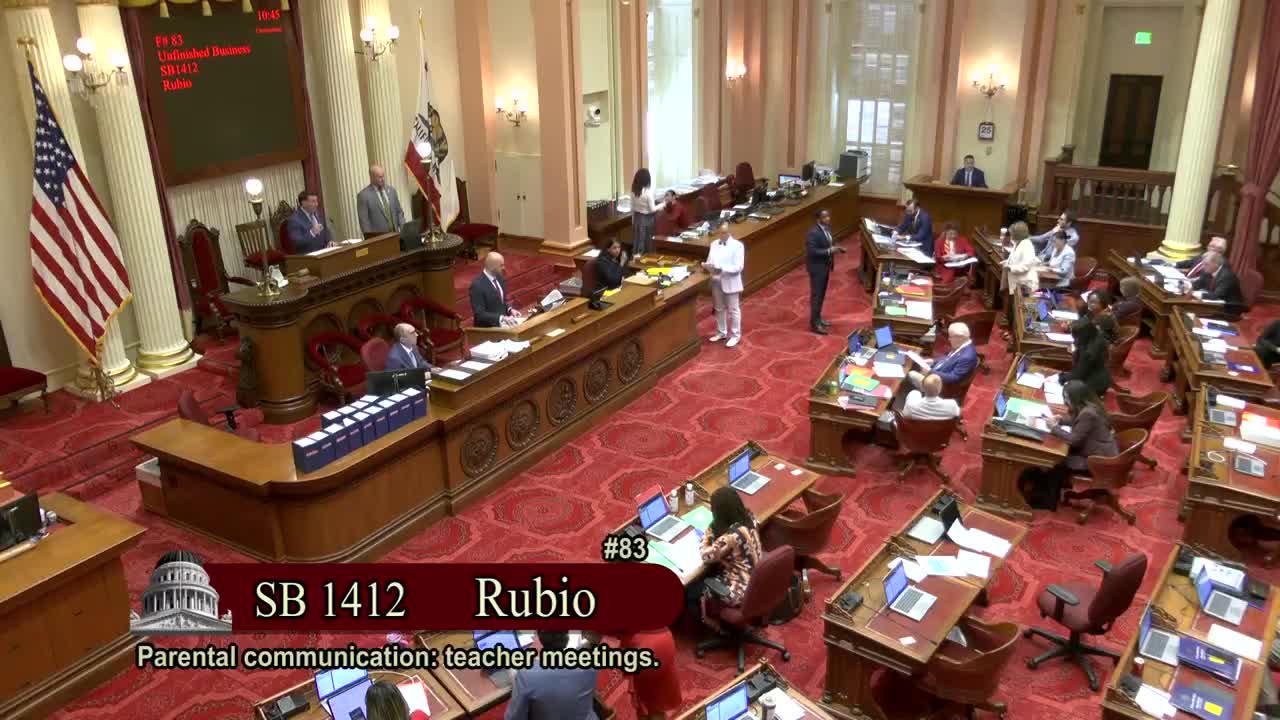
Bill Author

Bill Co-Author(s):