SB 1425: High-Speed Rail Authority: property: operating right-of-way.
- Session Year: 2025-2026
- House: Senate
- Latest Version Date: 2026-09-27
Current Status:
Passed
(2026-09-27: Chaptered by Secretary of State. Chapter 713, Statutes of 2026.)
Introduced
In Committee
Awaiting First Chamber Vote
Passed First Chamber
In Committee
Awaiting Second Chamber Vote
Passed Second Chamber
Enacted
The California High-Speed Rail Act creates the High-Speed Rail Authority to develop and implement a high-speed rail system in the state, with specified powers and duties, including the power to acquire rights-of-way through purchase or eminent domain, as specified.
This bill would establish a permit program, administered by the authority, for encroachments on the authoritys operating right-of-way. The bill would make any person who installs or performs an encroachment within the authoritys operating right-of-way, without a permit, guilty of a misdemeanor, except as provided. The bill would also make any person who willfully damages any feature of the high-speed train system or any portion of the authoritys operating right-of-way guilty of a misdemeanor. The bill would provide for civil penalties for specified categories of encroachment and, unless authorized by law or an encroachment permit, would make it unlawful to manage water flows in certain ways that impact the high-speed train system or the authoritys operating right-of-way, as specified. The bill would authorize the authority or the Attorney General to recover these civil penalties. The bill would require all moneys, including moneys from permit fees and civil penalties, collected pursuant to its provisions to be deposited into the High-Speed Rail Property Fund, except for the award of any reasonable attorneys fees and costs provided to the recovering agency to recoup the cost of litigation, as provided. The bill would, upon appropriation by the Legislature, make the penalty moneys available to the authority for use in the development, improvement, and maintenance of the high-speed rail system, and the fee revenues collected under the permit program available to the authority to administer the program.
By creating new crimes, this bill would impose a state-mandated local program.
The California Constitution requires the state to reimburse local agencies and school districts for certain costs mandated by the state. Statutory provisions establish procedures for making that reimbursement.
This bill would provide that no reimbursement is required by this act for a specified reason.
The California High-Speed Rail Act creates the High-Speed Rail Authority to develop and implement a high-speed rail system in the state, with specified powers and duties, including the power to acquire rights-of-way through purchase or eminent domain, as specified.
This bill would establish a permit program, administered by the authority, for encroachments on the authoritys operating right-of-way. The bill would make any person who installs or performs an encroachment within the authoritys operating right-of-way, without a permit, guilty of a misdemeanor, except as provided. The bill would also make any person who willfully damages any feature of the high-speed train system or any portion of the authoritys operating right-of-way guilty of a misdemeanor. The bill would provide for civil penalties for specified categories of encroachment and, unless authorized by law or an encroachment permit, would make it unlawful to manage water flows in certain ways that impact the high-speed train system or the authoritys operating right-of-way, as specified. The bill would authorize the authority or the Attorney General to recover these civil penalties. The bill would require all moneys, including moneys from permit fees and civil penalties, collected pursuant to its provisions to be deposited into the High-Speed Rail Property Fund, except for the award of any reasonable attorneys fees and costs provided to the recovering agency to recoup the cost of litigation, as provided. The bill would, upon appropriation by the Legislature, make the penalty moneys available to the authority for use in the development, improvement, and maintenance of the high-speed rail system, and the other moneys in the fund available for administering these provisions.
By creating new crimes, this bill would impose a state-mandated local program.
The California Constitution requires the state to reimburse local agencies and school districts for certain costs mandated by the state. Statutory provisions establish procedures for making that reimbursement.
This bill would provide that no reimbursement is required by this act for a specified reason.
The California High-Speed Rail Act creates the High-Speed Rail Authority to develop and implement a high-speed rail system in the state, with specified powers and duties, including the power to acquire rights-of-way through purchase or eminent domain, as specified.
This bill would establish a permit program, administered by the authority, for encroachments on the authoritys rights-of-way. operating right-of-way. The bill would make any person who installs or performs an encroachment within the authoritys operating right-of-way, without a permit, guilty of a misdemeanor. misdemeanor, except as provided. The bill would also make any person who willfully damages any feature of the high-speed train system or any portion of the authoritys operating right-of-way guilty of a misdemeanor. The bill would provide for civil penalties for specified categories of encroachment and, unless authorized by law or an encroachment permit, would make it unlawful to manage water flows in certain ways that impact the high-speed train system or the authoritys operating right-of-way, as specified. The bill would authorize the authority or the Attorney General to recover these civil penalties. The bill would require all moneys, including moneys from permit fees and civil penalties, collected pursuant to its provisions to be deposited into the High-Speed Rail Property Fund, except for the award of any reasonable attorneys fees and costs provided to the recovering agency to recoup the cost of litigation, as provided. The bill would, upon appropriation by the Legislature, make the penalty moneys available to the authority for use in the development, improvement, and maintenance of the high-speed rail system, and the other moneys in the fund available for administering these provisions.
By creating new crimes, this bill would impose a state-mandated local program.
The California Constitution requires the state to reimburse local agencies and school districts for certain costs mandated by the state. Statutory provisions establish procedures for making that reimbursement.
This bill would provide that no reimbursement is required by this act for a specified reason.
The California High-Speed Rail Act creates the High-Speed Rail Authority to develop and implement a high-speed rail system in the state, with specified powers and duties, including the power to acquire rights-of-way through purchase or eminent domain, as specified.
This bill would establish a permit program, administered by the authority, for encroachments on the authoritys rights-of-way. The bill would make any person who installs or performs an encroachment within the authoritys right-of-way, without a permit, guilty of a misdemeanor. The bill would also make any person who willfully damages any feature of the high-speed train system or any portion of the authoritys right-of-way guilty of a misdemeanor. The bill would provide for civil penalties for specified categories of encroachment and, unless authorized by law or an encroachment permit, would make it unlawful to manage water flows in certain ways that impact the high-speed train system or the authoritys right-of-way, as specified. The bill would authorize the authority or the Attorney General to recover these civil penalties. The bill would require all moneys, including moneys from permit fees and civil penalties, collected pursuant to its provisions to be deposited into the High-Speed Rail Property Fund. Fund, except for the award of any reasonable attorneys fees and costs provided to the recovering agency to recoup the cost of litigation, as provided. The bill would, upon appropriation by the Legislature, make the penalty moneys available to the authority for use in the development, improvement, and maintenance of the high-speed rail system, and the other moneys in the fund available for administering these provisions.
By creating new crimes, this bill would impose a state-mandated local program.
The California Constitution requires the state to reimburse local agencies and school districts for certain costs mandated by the state. Statutory provisions establish procedures for making that reimbursement.
This bill would provide that no reimbursement is required by this act for a specified reason.
The California High-Speed Rail Act creates the High-Speed Rail Authority to develop and implement a high-speed rail system in the state, with specified powers and duties, including the power to acquire rights-of-way through purchase or eminent domain, as specified.
This bill would establish a permit program, administered by the authority, for encroachments on the authoritys rights-of-way. The bill would make any person who installs or performs an encroachment within the authoritys right-of-way, without a permit, guilty of a misdemeanor. The bill would also make any person who willfully damages any feature of the high-speed train system or any portion of the authoritys right-of-way guilty of a misdemeanor. The bill would provide for civil penalties for specified categories of encroachment and, unless authorized by law or an encroachment permit, would make it unlawful to manage water flows in certain ways that impact the high-speed train system or the authoritys right-of-way, as specified. The bill would require all moneys, including moneys from permit fees and civil penalties, collected pursuant to its provisions to be deposited into the High-Speed Rail Property Fund. The bill would, upon appropriation by the Legislature, make the penalty moneys available to the authority for use in the development, improvement, and maintenance of the high-speed rail system, and the other moneys available for administering these provisions.
By creating new crimes, this bill would impose a state-mandated local program.
The California Constitution requires the state to reimburse local agencies and school districts for certain costs mandated by the state. Statutory provisions establish procedures for making that reimbursement.
This bill would provide that no reimbursement is required by this act for a specified reason.
The California High-Speed Rail Act creates the High-Speed Rail Authority to develop and implement a high-speed rail system in the state, with specified powers and duties, including the power to acquire rights-of-way through purchase or eminent domain, as specified.This bill would state the intent of the Legislature to enact subsequent legislation to provide the authority with the ability to issue encroachment permits for third-party access to its right-of-way.The California High-Speed Rail Act creates the High-Speed Rail Authority to develop and implement a high-speed rail system in the state, with specified powers and duties, including the power to acquire rights-of-way through purchase or eminent domain, as specified.
This bill would state the intent of the Legislature to enact subsequent legislation to provide the authority with the ability to issue encroachment permits for third-party access to its right-of-way.
(a)The High-Speed Rail Property Fund is hereby created in the State Treasury for the deposit of both of the following:
(1)Revenue received from the sale, lease, or grant of any interest in or use of real property owned or managed by the High-Speed Rail Authority.
(2)Moneys deposited in the fund pursuant to Chapter 6 (commencing with Section 185520).
(b)(1)Revenues in the fund described in paragraph (1) of subdivision (a) and revenues in the fund collected from any penalties imposed pursuant to Chapter 6 (commencing with Section 185520) shall be available to the authority, upon appropriation by the Legislature, for use in the development, improvement, and maintenance of the high-speed rail system, consistent with appropriate uses for each funding source.
(2)Revenues in the fund collected from any fees imposed pursuant to Chapter 6 (commencing with Section 185520) shall be available to the authority, upon appropriation by the Legislature, for the administration of Chapter 6 (commencing with Section 185520), consistent with the appropriate use for each of those fees.
SEC. 2.Chapter 6 (commencing with Section 185520) is added to Division 19.5 of the Public Utilities Code, to read:6.Care and Protection of the High-Speed Train System185520.Unless the provisions or context requires otherwise, the following definitions govern the construction of this chapter:
(a)Emergency means a sudden, unexpected occurrence that poses a clear and imminent danger, requiring immediate action to prevent or mitigate the loss or impairment of life, health, property, or essential public services.
(b)Encroachment means any of the following:
(1)Installation of any tower, pole, pipe, fence, building, structure, sign, billboard, vegetation, object, or improvement of any kind or character not particularly mentioned in this chapter, that is placed in, on, under, or over any portion of the authoritys operating right-of-way.
(2)Performance of any activity, event, use, access, or other intrusion of any kind or character not particularly mentioned in this chapter, that occurs in, under, or over any portion of the authoritys operating right-of-way.
(c)Encroachment permit means the authoritys written authorization for a person to install or perform an encroachment within the authoritys operating right-of-way that is not inconsistent with the function, operation, maintenance, enlargement, rehabilitation, safety, or security of any portion of the authoritys operating right-of-way or any feature of the high-speed train system.
(d)High-speed train system means the high-speed train system described in subdivision (e) of Section 2704.01 of the Streets and Highways Code.
(e)Operating right-of-way means any property interest, including, but not limited to, an easement, license, permit, joint-use agreement, or fee ownership, that is acquired by the authority for the function, operation, maintenance, enlargement, rehabilitation, safety, or security of the high-speed train system, including land needed for tracks, stations, maintenance facilities, communications facilities, energy generation and storage facilities, and any other land serving the corridor, such as embankments, drainage, access roads, and safety buffers. Operating right-of-way does not include property acquired or held by the authority that is not necessary for the high-speed train systems construction, operation, or maintenance.
(f)Person means any person, firm, partnership, association, corporation, other business entity, nonprofit organization, utility company, or government entity.
(g)Protected agreement means an agreement entered into, or a permit issued, pursuant to Chapter 5 (commencing with Section 185500) with respect to a facility located within, or affecting, the authoritys operating right-of-way or high-speed rail property.
(h)Qualified installation means a crossing, facility, or infrastructure installed on the authoritys operating right-of-way on or after January 1, 2027.
(i)Qualified work means work necessary to implement a qualified installation on the authoritys operating right-of-way, or to repair, maintain, expand, or relocate an existing crossing or structure. Qualified work does not include an emergency response necessary to prevent or mitigate a threat to life, health, property, or essential public services.
185521.(a)This chapter shall not limit the powers and duties vested by law in the Public Utilities Commission, and if there is any conflict with regard to the powers and duties given to the authority by this chapter, those of the Public Utilities Commission shall prevail.
(b)This chapter shall not limit the powers and duties vested by federal law in the Federal Railroad Administration or the federal Surface Transportation Board, and if there is any conflict with regard to the powers and duties given to the authority by this chapter, those of the Federal Railroad Administration and the federal Surface Transportation Board shall prevail.
(c)This chapter does not alter or impair any right that a person obtained pursuant to an agreement entered into, or a permit issued, pursuant to a protected agreement.
185522.(a)Except as provided in subdivision (b), a person shall not install or perform any encroachment within the authoritys operating right-of-way without first obtaining an encroachment permit from the authority.
(b)(1)The requirement to obtain an encroachment permit under this chapter shall apply only to qualified installations and qualified work.
(2)A party that has entered into a protected agreement shall be required to obtain a permit under the procedures set forth in the protected agreement, but if the protected agreement does not prescribe a procedure for obtaining a permit, the party shall be required to obtain a permit pursuant to this chapter.
(c)Crossings, facilities, or infrastructure that must be relocated to accommodate the high-speed train system shall be relocated pursuant to Chapter 5 (commencing with Section 185500).
(d)(1)A person shall not enter into the authoritys operating right-of-way, including under emergency situations, without the authoritys prior express consent, except where such entry is reasonable and necessary to respond to, and mitigate, an emergency situation and provided that the entry does not further impede public safety.
(2)The authority shall establish reasonable notification and coordination rules for emergencies related to encroachments that facilitate an emergency response necessary to protect life, health, property, essential public services, utility reliability, or public safety. A person performing emergency work shall immediately notify the authority of that work.
(e)Any person who violates subdivision (a) shall be guilty of a misdemeanor.
185523.(a)Except as provided in subdivision (b), no person has any franchise rights within the authoritys operating right-of-way.
(b)(1)Subject to paragraph (2), this chapter does not do any of the following:
(A)Alter or impair any right of a city, county, city and county, or state agency to grant a franchise in a street, highway, or freeway controlled by the city, county, city and county, or state agency.
(B)Alter or impair any right of a utility to exercise its franchise rights in a street, highway, or freeway controlled by a city, county, city and county, or state agency.
(2)In cases where a street, highway, or freeway crosses the authoritys operating right-of-way and the grades of the authoritys operating right-of-way and the street, highway, or freeway are separated, a franchise shall be exercised only on the street, highway, or freeway, shall not authorize the installation of a facility without the authoritys prior approval in writing, and shall be subject to the requirements of Section 185525 when work is performed on the facility installed pursuant to the franchise.
185524.(a)The authority may issue an encroachment permit, in accordance with this chapter, that authorizes a permittee to install or perform any kind of encroachment that is not inconsistent with the function, operation, maintenance, enlargement, rehabilitation, safety, or security of the high-speed train system or the authoritys operating right-of-way.
(b)By issuing an encroachment permit, the authority is not responsible for the competence or reliability of the permittee or the encroachment.
185525.(a)Any person proposing to install or perform an encroachment within the authoritys operating right-of-way shall apply to the authority on a form prescribed by the authority, along with all reports, studies, plans, analyses, and other supporting documents as required by the authority.
(b)(1)Except as provided in paragraph (2), the authority shall approve or deny an application for an encroachment permit no later than 60 days from the date of receipt of the complete application, as determined by the authority. An application for an encroachment permit is complete when all applicable requirements and statutory requirements, including, but not limited to, the California Environmental Quality Act (Division 13 (commencing with Section 21000) of the Public Resources Code), have been met. No later than 30 days from the date on which the application is received, the authority shall determine whether the application is complete.
(2)An application for an encroachment permit under this chapter that is submitted pursuant to subdivision (a) by a city, county, city and county, or public agency that possesses a real property interest under or over the authoritys right-of-way shall not be denied. Every applicant described in this paragraph is entitled to an encroachment permit as a matter of right, but is otherwise subject to the provisions of this chapter and to all reasonable terms and conditions of the permit.
(c)If the authority denies an application for an encroachment permit, it shall provide reasons for the denial at the time of notifying the applicant of the denial.
(d)The applicant may choose to address the reasons for denial and resubmit a revised encroachment permit application for reconsideration by the authority. The authority shall approve or deny a resubmitted application no later than 60 days from the date of receipt of a complete resubmitted application addressing all the reasons of denial.
(e)If the applicant cannot complete the encroachment project design without the authoritys involvement and support, the authority may support the applicant with the project development, notwithstanding the timelines and requirements set forth in subdivision (b). The authority may establish the processes and requirements for those projects, as appropriate. The applicant shall reimburse the authority for all the costs expended by the authority in accordance with the authoritys fee schedule established pursuant to Section 185529.
(f)An appeal of a denial of an encroachment permit application shall be made in writing to the authoritys executive director or the designee of the executive director. There shall be a final written determination by the executive director or designee of the executive director within 60 calendar days after receipt of the applicants written appeal. The appellant shall pay to the authority a fee of not more than 50 percent of the estimated administrative cost to the authority for conducting the appeal.
(g)Nothing in this chapter precludes an applicant and the authority from mutually agreeing to an extension of any time limit provided by this section.
185526.The authority may adopt regulations to implement this chapter, including regulations that provide for the filing of an application for an encroachment permit, related administrative review and inspection, the imposition of fees, the terms and conditions of encroachment permits, an administrative appeal process, and a process for administrative review and regulation of existing encroachments in accordance with this chapter.
185527.(a)Any act performed under the authority of an encroachment permit issued pursuant to this chapter shall be in accordance with the applicable provisions of this chapter and the terms and conditions of the encroachment permit.
(b)The authority may prescribe requirements in the encroachment permit, including a requirement that the permittee pay the entire expense of restoring the portions of the authoritys operating right-of-way or features of the high-speed train system affected by a permittees encroachment to a condition equivalent to that before the encroachment was installed or performed, and requirements relating to the location and manner in which the restoration work shall be performed, as determined by the authority to be necessary for the function, operation, maintenance, and protection of the high-speed train system, including protecting the health and safety of the passengers or workers of the high-speed rail.
(c)An encroachment permit shall include a provision that requires the permittee to relocate or remove the encroachment if the encroachment is deemed by the authority to impact high-speed train system operations, safety, or maintenance at any point of time or if future repair, rehabilitation, or improvement of the high-speed train system requires the relocation or removal of that encroachment, at the sole expense of the permittee.
(d)(1)Except as otherwise agreed in writing between the authority and permittee, an encroachment permit shall be unalterable and nontransferable. Any modification or transfer may only occur with written approval of the authority.
(2)An encroachment permit may be revoked for failure to comply with the requirements prescribed in the permit.
(3)An encroachment shall be removed upon the revocation of the applicable encroachment permit. The permittee shall remove the encroachment in the manner as may be specified by the authority in the notice revoking the encroachment permit and within the time specified by the authority, which time shall not be less than five days, unless the revoked encroachment permit otherwise provides.
(e)The authority may inspect the work performed under any encroachment permit issued under this chapter, in which event the permittee shall pay the cost of that inspection to the authority at the authoritys hourly rate, as determined by the authority.
(f)Before issuing an encroachment permit, the authority may require any applicant, other than a county, city, city and county, or public agency that is authorized by law to establish and maintain any works or facilities within the authoritys operating right-of-way, to file with the authority a satisfactory bond payable to the authority in an amount that the authority determines to be sufficient, conditioned on the proper compliance by the permittee with this chapter. The authority may require a bond, in an amount that the authority determines to be sufficient, from a county, city, city and county, or public agency that, before submitting an encroachment permit application, failed to comply with this chapter or with the conditions of a previous encroachment permit.
(g)Before issuing or executing an encroachment permit, the authority may require any applicant to provide proof of insurance naming the authority, its directors, and its employees as additional insureds in an amount reasonably necessary to protect the states interest.
185528.Except as otherwise provided in a written agreement between the authority and a landowner or predecessor in interest, any person possessing a real property interest over a portion of the authoritys operating right-of-way shall be required to obtain an encroachment permit before commencing any activity within the authoritys operating right-of-way. The authority may waive the fee for obtaining an encroachment permit described in this section.
185529.The authority may establish a fee schedule and charge fees in accordance with this chapter, except that a fee shall not be charged by the authority pursuant to this chapter to a county, city, city and county, or public agency. The fee schedule established by the authority shall not produce a total estimated revenue more than the estimated total cost to the authority for administering the provisions of this chapter, excluding the cost of issuing permits exempted by statute or regulation from the payment of fees. Funds from fees collected pursuant to this chapter shall be deposited into the High-Speed Rail Property Fund established pursuant to Section 185045.
185530.(a)Except as authorized by the authority and agreed to in writing between the authority and a person, as provided by Section 185524, the authority may require the removal of an encroachment in the manner provided in this section if the encroachment exists within the authoritys operating right-of-way.
(b)(1)Except as provided in subdivision (e), notice shall be given to the owner, occupant, or person in possession of the encroachment, or to any other person causing or permitting the encroachment to exist, by serving a notice that includes a demand for the immediate removal of the encroachment from the authoritys operating right-of-way. The notice shall describe the encroachment with reasonable certainty as to its character and location.
(2)In lieu of service upon the person, service of the notice may also be made by registered mail, express mail, overnight delivery, or facsimile transmission. Electronic service, by either electronic transmission or electronic notification, of the notice may be made if service of the notice is also made by mail and posting for a period of five days followed by notification by express mail, overnight delivery, or facsimile transmission. Electronic service of any notice made pursuant to this chapter is deemed complete at the time of the electronic transmission of the document or at the time that the electronic notification of service of the document is sent.
(3)If an owner, occupant, or person in possession of an encroachment is not present in the county in which the encroachment is located, the notice may be given to an agent of the owner, occupant, or possessor of the encroachment.
(c)The authority may remove from the authoritys operating right-of-way any encroachment that meets both of the following criteria:
(1)Not later than 60 days from the date on which a notice was given pursuant to subdivision (b), the owner, occupant, or person in possession of the encroachment has not asserted a right to be in possession consistent with Section 185528, and has not removed, or commenced to remove in a diligent manner, the encroachment.
(2)The encroachment obstructs, threatens, or prevents the proper operation, maintenance, or rehabilitation of the high-speed train system, or threatens the safety or health of the passengers or workers of the high-speed rail.
(d)The authority may immediately remove from the authoritys operating right-of-way any encroachment that meets both of the following criteria:
(1)Not later than three days from the date on which a notice is served pursuant to subdivision (b), the owner, occupant, or person in possession of the encroachment has not asserted a right to be in possession consistent with Section 185528, and has not removed, or commenced removing in a diligent manner, the encroachment.
(2)The encroachment poses an imminent threat to the integrity of one or more features of the high-speed train system, or to the safety and health of the passengers and workers of the high-speed rail.
(e)In the case of an emergency, the authority may take any action necessary to avert, alleviate, repair, or mitigate any threat to the high-speed train system, including the passengers or workers of the high-speed rail.
(f)(1)If the authority removes any encroachment upon the failure of the owner, occupant, or person in possession of the encroachment to comply with the notice given pursuant to this section, the authority or the Attorney General may file a civil action seeking the recovery of the expense of the removal and related costs.
(2)In addition to the recovery provided in paragraph (1), the authority or the Attorney General may seek the recovery of civil penalties of five thousand dollars ($5,000) for each day the encroachment remains after the expiration of the applicable response period described in subdivision (c) or (d).
(3)A prevailing plaintiff in an action brought pursuant to this subdivision shall be entitled to reasonable attorneys fees and costs.
(g)(1)If the owner, occupant, or person in possession of the encroachment, or person causing or suffering the encroachment to exist, or the agent of any of these parties, disputes or denies the existence of the encroachment or asserts a right to be in possession consistent with Section 185528, the authority or the Attorney General may file a civil action to abate the encroachment as a public nuisance.
(2)If judgment is recovered by the authority or the Attorney General, the prevailing plaintiff may, in addition to having the encroachment adjudged a nuisance and abated, seek the recovery of a civil penalty of five thousand dollars ($5,000) for each day the encroachment remains after the expiration of the applicable response period described in subdivision (c) or (d).
(3)A prevailing plaintiff in an action brought pursuant to this subdivision shall be entitled to reasonable attorneys fees and costs.
185531.(a)Unless a person is otherwise authorized, by law or by an encroachment permit obtained by the person pursuant to Section 185524, it is unlawful for any person to do any of the following acts:
(1)Drain water, or permit water to be drained, from the persons lands onto the authoritys operating right-of-way by any means, which results in damage to the high-speed train system or the authoritys operating right-of-way, except where the water naturally drains onto the authoritys operating right-of-way.
(2)Obstruct any natural watercourse in a manner that does any of the following:
(A)Prevents, impedes, or restricts the natural flow of waters from any portion of the authoritys operating right-of-way into or through the watercourse or high-speed train systems cross drainage structures.
(B)Causes waters to be impounded within the authoritys operating right-of-way that damages the high-speed train system or the authoritys operating right-of-way, except where the water naturally drains onto the authoritys operating right-of-way.
(C)Causes interference with, or damages or makes hazardous the operation, maintenance, and rehabilitation of, the high-speed train system, or threatens the health or safety of the passengers or workers of the high-speed rail.
(3)Store or distribute water for any purpose to permit the water to overflow onto, or saturate by seepage, causing damage to, or to obstruct or damage any feature of the high-speed train system or any portion of the authoritys operating right-of-way.
(b)When notice is given by the authority, in the manner provided in Section 185530, to any person permitting a condition to exist, as described in subdivision (a), the person shall immediately cease and discontinue the diversion of waters or shall discontinue and prevent the drainage, seepage, or overflow and shall pay for the repair of any damage to the high-speed train system or the authoritys operating right-of-way. The person to whom the notice is provided may challenge, administratively in accordance with regulations adopted pursuant to Section 185526, or in a court of competent jurisdiction, the propriety of the determination by the authority.
(c)(1)If any person is notified pursuant to subdivision (b) and fails, neglects, or refuses to cease and discontinue the diversion, drainage, seepage, or overflow of the waters or to pay for the repairs, the authority may make repairs and perform work as it determines necessary to prevent the further drainage, diversion, overflow, or seepage of the waters.
(2)If the authority conducts repairs or performs work pursuant to paragraph (1), the authority or the Attorney General may file a civil action seeking the amount expended for those repairs and work, and a civil penalty of five thousand dollars ($5,000) for each day the drainage, diversion, overflow, or seepage of the waters is permitted to continue, after the service of the notice in the manner specified in this chapter.
(3)A prevailing plaintiff in an action brought pursuant to this subdivision shall be entitled to reasonable attorneys fees and costs.
185532.(a)(1)Any person who by any means injures or damages any feature of the high-speed train system or the authoritys operating right-of-way is liable for necessary repairs, and the authority or the Attorney General may file a civil action seeking the amount expended for the repairs.
(2)A prevailing plaintiff in an action brought pursuant to paragraph (1) shall be entitled to reasonable attorneys fees and costs.
(3)Any repairs required pursuant to paragraph (1) shall be performed exclusively by the authority or its authorized contractors.
(b)Any person who willfully damages any feature of the high-speed train system or any portion of the authoritys operating right-of-way is guilty of a misdemeanor.
185533.(a)A person shall not, by any means, without a permit issued by the authority, dig up, cut down, destroy, prune, trim, or otherwise injure any shrub or tree within the authoritys operating right-of-way.
(b)A person who violates subdivision (a) shall be liable for a civil penalty in the sum of five thousand dollars ($5,000) for each shrub or tree so damaged in an action brought by the authority or the Attorney General.
(c)In addition to the civil penalty provided in subdivision (b), the authority or the Attorney General may file a civil action seeking the actual costs incurred because of the damage to any shrub or tree on the authoritys operating right-of-way.
(d)A prevailing plaintiff in an action brought pursuant to subdivision (b) or (c) shall be entitled to reasonable attorneys fees and costs.
185534.Survey monuments shall be preserved, referenced, or replaced pursuant to Section 8771 of the Business and Professions Code.
185535.All moneys recovered under the provisions of this chapter, except the award of any reasonable attorneys fees and costs, which shall be provided to the recovering agency to recoup the cost of litigation, shall be deposited into the High-Speed Rail Property Fund established pursuant to Section 185045.
185536.The procedures and remedies provided in this chapter are not exclusive and shall not prohibit the authority from exercising any other remedy provided by law to prevent damage to, or to protect, the high-speed train system, including the health and safety of the passengers and workers of the high-speed rail and the authoritys operating right-of-way.
185537.The Department of the California Highway Patrol and all peace officers from local law enforcement agencies may enforce the provisions of this chapter with respect to the areas of the authoritys operating right-of-way under their respective jurisdiction and shall cooperate with the authority to that end.
SEC. 3.No reimbursement is required by this act pursuant to Section 6 of Article XIIIB of the California Constitution because the only costs that may be incurred by a local agency or school district will be incurred because this act creates a new crime or infraction, eliminates a crime or infraction, or changes the penalty for a crime or infraction, within the meaning of Section 17556 of the Government Code, or changes the definition of a crime within the meaning of Section 6 of Article XIIIB of the California Constitution.
(a)The High-Speed Rail Property Fund is hereby created in the State Treasury for the deposit of both of the following:
(1)Revenue received from the sale, lease, or grant of any interest in or use of real property owned or managed by the High-Speed Rail Authority.
(2)Moneys deposited in the fund pursuant to Chapter 6 (commencing with Section 185520).
(b)(1)Revenues in the fund described in paragraph (1) of subdivision (a) and revenues in the fund collected from any penalties imposed pursuant to Chapter 6 (commencing with Section 185520) shall be available to the authority, upon appropriation by the Legislature, for use in the development, improvement, and maintenance of the high-speed rail system, consistent with appropriate uses for each funding source.
(2)Revenues in the fund collected from any fees imposed pursuant to Chapter 6 (commencing with Section 185520) shall be available to the authority, upon appropriation by the Legislature, for the administration of Chapter 6 (commencing with Section 185520), consistent with the appropriate use for each of those fees.
SEC. 2.Chapter 6 (commencing with Section 185520) is added to Division 19.5 of the Public Utilities Code, to read:6.Care and Protection of the High-Speed Train System185520.Unless the provisions or context requires otherwise, the following definitions govern the construction of this chapter:
(a)Emergency means a sudden, unexpected occurrence that poses a clear and imminent danger, requiring immediate action to prevent or mitigate the loss or impairment of life, health, property, or essential public services.
(b)Encroachment means any of the following:
(1)Installation of any tower, pole, pipe, fence, building, structure, sign, billboard, vegetation, object, or improvement of any kind or character not particularly mentioned in this chapter, that is placed in, on, under, or over any portion of the authoritys operating right-of-way.
(2)Performance of any activity, event, use, access, or other intrusion of any kind or character not particularly mentioned in this chapter, that occurs in, under, or over any portion of the authoritys operating right-of-way.
(c)Encroachment permit means the authoritys written authorization for a person to install or perform an encroachment within the authoritys operating right-of-way that is not inconsistent with the function, operation, maintenance, enlargement, rehabilitation, safety, or security of any portion of the authoritys operating right-of-way or any feature of the high-speed train system.
(d)High-speed train system means the high-speed train system described in subdivision (e) of Section 2704.01 of the Streets and Highways Code.
(e)Operating right-of-way means any property interest, including, but not limited to, an easement, license, permit, joint-use agreement, or fee ownership, that is acquired by the authority for the function, operation, maintenance, enlargement, rehabilitation, safety, or security of the high-speed train system, including land needed for tracks, stations, maintenance facilities, communications facilities, energy generation and storage facilities, and any other land serving the corridor, such as embankments, drainage, access roads, and safety buffers. Operating right-of-way does not include property acquired or held by the authority that is not necessary for the high-speed train systems construction, operation, or maintenance.
(f)Person means any person, firm, partnership, association, corporation, other business entity, nonprofit organization, utility company, or government entity.
(g)Protected agreement means an agreement entered into, or a permit issued, pursuant to Chapter 5 (commencing with Section 185500) with respect to a facility located within, or affecting, the authoritys operating right-of-way or high-speed rail property.
(h)Qualified installation means a crossing, facility, or infrastructure installed on the authoritys operating right-of-way on or after January 1, 2027.
(i)Qualified work means work necessary to implement a qualified installation on the authoritys operating right-of-way, or to repair, maintain, expand, or relocate an existing crossing or structure. Qualified work does not include an emergency response necessary to prevent or mitigate a threat to life, health, property, or essential public services.
185521.(a)This chapter shall not limit the powers and duties vested by law in the Public Utilities Commission, and if there is any conflict with regard to the powers and duties given to the authority by this chapter, those of the Public Utilities Commission shall prevail.
(b)This chapter shall not limit the powers and duties vested by federal law in the Federal Railroad Administration or the federal Surface Transportation Board, and if there is any conflict with regard to the powers and duties given to the authority by this chapter, those of the Federal Railroad Administration and the federal Surface Transportation Board shall prevail.
(c)This chapter does not alter or impair any right that a person obtained pursuant to an agreement entered into, or a permit issued, pursuant to a protected agreement.
185522.(a)Except as provided in subdivision (b), a person shall not install or perform any encroachment within the authoritys operating right-of-way without first obtaining an encroachment permit from the authority.
(b)(1)The requirement to obtain an encroachment permit under this chapter shall apply only to qualified installations and qualified work.
(2)A party that has entered into a protected agreement shall be required to obtain a permit under the procedures set forth in the protected agreement, but if the protected agreement does not prescribe a procedure for obtaining a permit, the party shall be required to obtain a permit pursuant to this chapter.
(c)Crossings, facilities, or infrastructure that must be relocated to accommodate the high-speed train system shall be relocated pursuant to Chapter 5 (commencing with Section 185500).
(d)(1)A person shall not enter into the authoritys operating right-of-way, including under emergency situations, without the authoritys prior express consent, except where such entry is reasonable and necessary to respond to, and mitigate, an emergency situation and provided that the entry does not further impede public safety.
(2)The authority shall establish reasonable notification and coordination rules for emergencies related to encroachments that facilitate an emergency response necessary to protect life, health, property, essential public services, utility reliability, or public safety. A person performing emergency work shall immediately notify the authority of that work.
(e)Any person who violates subdivision (a) shall be guilty of a misdemeanor.
185523.No (a)Except as provided in subdivision (b), no person has any franchise rights within the authoritys operating right-of-way.
(b)(1)Subject to paragraph (2), this chapter does not do any of the following:
(A)Alter or impair any right of a city, county, city and county, or state agency to grant a franchise in a street, highway, or freeway controlled by the city, county, city and county, or state agency.
(B)Alter or impair any right of a utility to exercise its franchise rights in a street, highway, or freeway controlled by a city, county, city and county, or state agency.
(2)In cases where a street, highway, or freeway crosses the authoritys operating right-of-way and the grades of the authoritys operating right-of-way and the street, highway, or freeway are separated, a franchise shall be exercised only on the street, highway, or freeway, shall not authorize the installation of a facility without the authoritys prior approval in writing, and shall be subject to the requirements of Section 185525 when work is performed on the facility installed pursuant to the franchise.
185524.(a)The authority may issue an encroachment permit, in accordance with this chapter, that authorizes a permittee to install or perform any kind of encroachment that is not inconsistent with the function, operation, maintenance, enlargement, rehabilitation, safety, or security of the high-speed train system or the authoritys operating right-of-way.
(b)By issuing an encroachment permit, the authority is not responsible for the competence or reliability of the permittee or the encroachment.
185525.(a)Any person proposing to install or perform an encroachment within the authoritys operating right-of-way shall apply to the authority on a form prescribed by the authority, along with all reports, studies, plans, analyses, and other supporting documents as required by the authority.
(b)The (1)Except as provided in paragraph (2), the authority shall approve or deny an application for an encroachment permit no later than 60 days from the date of receipt of the complete application, as determined by the authority. An application for an encroachment permit is complete when all applicable requirements and statutory requirements, including, but not limited to, the California Environmental Quality Act (Division 13 (commencing with Section 21000) of the Public Resources Code), have been met. No later than 30 days from the date on which the application is received, the authority shall determine whether the application is complete.
(2)An application for an encroachment permit under this chapter that is submitted pursuant to subdivision (a) by a city, county, city and county, or public agency that possesses a real property interest under or over the authoritys right-of-way shall not be denied. Every applicant described in this paragraph is entitled to an encroachment permit as a matter of right, but is otherwise subject to the provisions of this chapter and to all reasonable terms and conditions of the permit.
(c)If the authority denies an application for an encroachment permit, it shall provide reasons for the denial at the time of notifying the applicant of the denial.
(d)The applicant may choose to address the reasons for denial and resubmit a revised encroachment permit application for reconsideration by the authority. The authority shall approve or deny a resubmitted application no later than 60 days from the date of receipt of a complete resubmitted application addressing all the reasons of denial.
(e)If the applicant cannot complete the encroachment project design without the authoritys involvement and support, the authority may support the applicant with the project development, notwithstanding the timelines and requirements set forth in subdivision (b). The authority may establish the processes and requirements for those projects, as appropriate. The applicant shall reimburse the authority for all the costs expended by the authority in accordance with the authoritys fee schedule established pursuant to Section 185529.
(f)An appeal of a denial of an encroachment permit application shall be made in writing to the authoritys executive director or the designee of the executive director. There shall be a final written determination by the executive director or designee of the executive director within 60 calendar days after receipt of the applicants written appeal. The appellant shall pay to the authority a fee of not more than 50 percent of the estimated administrative cost to the authority for conducting the appeal.
(g)Nothing in this chapter precludes an applicant and the authority from mutually agreeing to an extension of any time limit provided by this section.
185526.The authority may adopt regulations to implement this chapter, including regulations that provide for the filing of an application for an encroachment permit, related administrative review and inspection, the imposition of fees, the terms and conditions of encroachment permits, an administrative appeal process, and a process for administrative review and regulation of existing encroachments in accordance with this chapter.
185527.(a)Any act performed under the authority of an encroachment permit issued pursuant to this chapter shall be in accordance with the applicable provisions of this chapter and the terms and conditions of the encroachment permit.
(b)The authority may prescribe requirements in the encroachment permit, including a requirement that the permittee pay the entire expense of restoring the portions of the authoritys operating right-of-way or features of the high-speed train system affected by a permittees encroachment to a condition equivalent to that before the encroachment was installed or performed, and requirements relating to the location and manner in which the restoration work shall be performed, as determined by the authority to be necessary for the function, operation, maintenance, and protection of the high-speed train system, including protecting the health and safety of the passengers or workers of the high-speed rail.
(c)An encroachment permit shall include a provision that requires the permittee to relocate or remove the encroachment if the encroachment is deemed by the authority to impact high-speed train system operations, safety, or maintenance at any point of time or if future repair, rehabilitation, or improvement of the high-speed train system requires the relocation or removal of that encroachment, at the sole expense of the permittee.
(d)(1)Except as otherwise agreed in writing between the authority and permittee, an encroachment permit shall be unalterable and nontransferable. Any modification or transfer may only occur with written approval of the authority.
(2)An encroachment permit may be revoked for failure to comply with the requirements prescribed in the permit.
(3)An encroachment shall be removed upon the revocation of the applicable encroachment permit. The permittee shall remove the encroachment in the manner as may be specified by the authority in the notice revoking the encroachment permit and within the time specified by the authority, which time shall not be less than five days, unless the revoked encroachment permit otherwise provides.
(e)The authority may inspect the work performed under any encroachment permit issued under this chapter, in which event the permittee shall pay the cost of that inspection to the authority at the authoritys hourly rate, as determined by the authority.
(f)Before issuing an encroachment permit, the authority may require any applicant, other than a county, city, city and county, or public agency that is authorized by law to establish and maintain any works or facilities within the authoritys operating right-of-way, to file with the authority a satisfactory bond payable to the authority in an amount that the authority determines to be sufficient, conditioned on the proper compliance by the permittee with this chapter. The authority may require a bond, in an amount that the authority determines to be sufficient, from a county, city, city and county, or public agency that, before submitting an encroachment permit application, failed to comply with this chapter or with the conditions of a previous encroachment permit.
(g)Before issuing or executing an encroachment permit, the authority may require any applicant to provide proof of insurance naming the authority, its directors, and its employees as additional insureds in an amount reasonably necessary to protect the states interest.
185528.Except as otherwise provided in a written agreement between the authority and a landowner or predecessor in interest, any person possessing a real property interest over a portion of the authoritys operating right-of-way shall be required to obtain an encroachment permit before commencing any activity within the authoritys operating right-of-way. The authority may waive the fee for obtaining an encroachment permit described in this section.
185529.The authority may establish a fee schedule and charge fees in accordance with this chapter, except that a fee shall not be charged by the authority pursuant to this chapter to a county, city, city and county, or public agency. The fee schedule established by the authority shall not produce a total estimated revenue more than the estimated total cost to the authority for administering the provisions of this chapter, excluding the cost of issuing permits exempted by statute or regulation from the payment of fees. Funds from fees collected pursuant to this chapter shall be deposited into the High-Speed Rail Property Fund established pursuant to Section 185045.
185530.(a)Except as authorized by the authority and agreed to in writing between the authority and a person, as provided by Section 185524, the authority may require the removal of an encroachment in the manner provided in this section if the encroachment exists within the authoritys operating right-of-way.
(b)(1)Except as provided in subdivision (e), notice shall be given to the owner, occupant, or person in possession of the encroachment, or to any other person causing or permitting the encroachment to exist, by serving a notice that includes a demand for the immediate removal of the encroachment from the authoritys operating right-of-way. The notice shall describe the encroachment with reasonable certainty as to its character and location.
(2)In lieu of service upon the person, service of the notice may also be made by registered mail, express mail, overnight delivery, or facsimile transmission. Electronic service, by either electronic transmission or electronic notification, of the notice may be made if service of the notice is also made by mail and posting for a period of five days followed by notification by express mail, overnight delivery, or facsimile transmission. Electronic service of any notice made pursuant to this chapter is deemed complete at the time of the electronic transmission of the document or at the time that the electronic notification of service of the document is sent.
(3)If an owner, occupant, or person in possession of an encroachment is not present in the county in which the encroachment is located, the notice may be given to an agent of the owner, occupant, or possessor of the encroachment.
(c)The authority may remove from the authoritys operating right-of-way any encroachment that meets both of the following criteria:
(1)Not later than 60 days from the date on which a notice was given pursuant to subdivision (b), the owner, occupant, or person in possession of the encroachment has not asserted a right to be in possession consistent with Section 185528, and has not removed, or commenced to remove in a diligent manner, the encroachment.
(2)The encroachment obstructs, threatens, or prevents the proper operation, maintenance, or rehabilitation of the high-speed train system, or threatens the safety or health of the passengers or workers of the high-speed rail.
(d)The authority may immediately remove from the authoritys operating right-of-way any encroachment that meets both of the following criteria:
(1)Not later than three days from the date on which a notice is served pursuant to subdivision (b), the owner, occupant, or person in possession of the encroachment has not asserted a right to be in possession consistent with Section 185528, and has not removed, or commenced removing in a diligent manner, the encroachment.
(2)The encroachment poses an imminent threat to the integrity of one or more features of the high-speed train system, or to the safety and health of the passengers and workers of the high-speed rail.
(e)In the case of an emergency, the authority may take any action necessary to avert, alleviate, repair, or mitigate any threat to the high-speed train system, including the passengers or workers of the high-speed rail.
(f)(1)If the authority removes any encroachment upon the failure of the owner, occupant, or person in possession of the encroachment to comply with the notice given pursuant to this section, the authority or the Attorney General may file a civil action seeking the recovery of the expense of the removal and related costs.
(2)In addition to the recovery provided in paragraph (1), the authority or the Attorney General may seek the recovery of civil penalties of five thousand dollars ($5,000) for each day the encroachment remains after the expiration of the applicable response period described in subdivision (c) or (d).
(3)A prevailing plaintiff in an action brought pursuant to this subdivision shall be entitled to reasonable attorneys fees and costs.
(g)(1)If the owner, occupant, or person in possession of the encroachment, or person causing or suffering the encroachment to exist, or the agent of any of these parties, disputes or denies the existence of the encroachment or asserts a right to be in possession consistent with Section 185528, the authority or the Attorney General may file a civil action to abate the encroachment as a public nuisance.
(2)If judgment is recovered by the authority or the Attorney General, the prevailing plaintiff may, in addition to having the encroachment adjudged a nuisance and abated, seek the recovery of a civil penalty of five thousand dollars ($5,000) for each day the encroachment remains after the expiration of the applicable response period described in subdivision (c) or (d).
(3)A prevailing plaintiff in an action brought pursuant to this subdivision shall be entitled to reasonable attorneys fees and costs.
185531.(a)Unless a person is otherwise authorized, by law or by an encroachment permit obtained by the person pursuant to Section 185524, it is unlawful for any person to do any of the following acts:
(1)Drain water, or permit water to be drained, from the persons lands onto the authoritys operating right-of-way by any means, which results in damage to the high-speed train system or the authoritys operating right-of-way, except where the water naturally drains onto the authoritys operating right-of-way.
(2)Obstruct any natural watercourse in a manner that does any of the following:
(A)Prevents, impedes, or restricts the natural flow of waters from any portion of the authoritys operating right-of-way into or through the watercourse or high-speed train systems cross drainage structures.
(B)Causes waters to be impounded within the authoritys operating right-of-way that damages the high-speed train system or the authoritys operating right-of-way, except where the water naturally drains onto the authoritys operating right-of-way.
(C)Causes interference with, or damages or makes hazardous the operation, maintenance, and rehabilitation of, the high-speed train system, or threatens the health or safety of the passengers or workers of the high-speed rail.
(3)Store or distribute water for any purpose to permit the water to overflow onto, or saturate by seepage, causing damage to, or to obstruct or damage any feature of the high-speed train system or any portion of the authoritys operating right-of-way.
(b)When notice is given by the authority, in the manner provided in Section 185530, to any person permitting a condition to exist, as described in subdivision (a), the person shall immediately cease and discontinue the diversion of waters or shall discontinue and prevent the drainage, seepage, or overflow and shall pay for the repair of any damage to the high-speed train system or the authoritys operating right-of-way. The person to whom the notice is provided may challenge, administratively in accordance with regulations adopted pursuant to Section 185526, or in a court of competent jurisdiction, the propriety of the determination by the authority.
(c)(1)If any person is notified pursuant to subdivision (b) and fails, neglects, or refuses to cease and discontinue the diversion, drainage, seepage, or overflow of the waters or to pay for the repairs, the authority may make repairs and perform work as it determines necessary to prevent the further drainage, diversion, overflow, or seepage of the waters.
(2)If the authority conducts repairs or performs work pursuant to paragraph (1), the authority or the Attorney General may file a civil action seeking the amount expended for those repairs and work, and a civil penalty of five thousand dollars ($5,000) for each day the drainage, diversion, overflow, or seepage of the waters is permitted to continue, after the service of the notice in the manner specified in this chapter.
(3)A prevailing plaintiff in an action brought pursuant to this subdivision shall be entitled to reasonable attorneys fees and costs.
185532.(a)(1)Any person who by any means injures or damages any feature of the high-speed train system or the authoritys operating right-of-way is liable for necessary repairs, and the authority or the Attorney General may file a civil action seeking the amount expended for the repairs.
(2)A prevailing plaintiff in an action brought pursuant to paragraph (1) shall be entitled to reasonable attorneys fees and costs.
(3)Any repairs required pursuant to paragraph (1) shall be performed exclusively by the authority or its authorized contractors.
(b)Any person who willfully damages any feature of the high-speed train system or any portion of the authoritys operating right-of-way is guilty of a misdemeanor.
185533.(a)A person shall not, by any means, without a permit issued by the authority, dig up, cut down, destroy, prune, trim, or otherwise injure any shrub or tree within the authoritys operating right-of-way.
(b)A person who violates subdivision (a) shall be liable for a civil penalty in the sum of five thousand dollars ($5,000) for each shrub or tree so damaged in an action brought by the authority or the Attorney General.
(c)In addition to the civil penalty provided in subdivision (b), the authority or the Attorney General may file a civil action seeking the actual costs incurred because of the damage to any shrub or tree on the authoritys operating right-of-way.
(d)A prevailing plaintiff in an action brought pursuant to subdivision (b) or (c) shall be entitled to reasonable attorneys fees and costs.
185534.Survey monuments shall be preserved, referenced, or replaced pursuant to Section 8771 of the Business and Professions Code.
185535.All moneys recovered under the provisions of this chapter, except the award of any reasonable attorneys fees and costs, which shall be provided to the recovering agency to recoup the cost of litigation, shall be deposited into the High-Speed Rail Property Fund established pursuant to Section 185045.
185536.The procedures and remedies provided in this chapter are not exclusive and shall not prohibit the authority from exercising any other remedy provided by law to prevent damage to, or to protect, the high-speed train system, including the health and safety of the passengers and workers of the high-speed rail and the authoritys operating right-of-way.
185537.The Department of the California Highway Patrol and all peace officers from local law enforcement agencies may enforce the provisions of this chapter with respect to the areas of the authoritys operating right-of-way under their respective jurisdiction and shall cooperate with the authority to that end.
SEC. 3.No reimbursement is required by this act pursuant to Section 6 of Article XIIIB of the California Constitution because the only costs that may be incurred by a local agency or school district will be incurred because this act creates a new crime or infraction, eliminates a crime or infraction, or changes the penalty for a crime or infraction, within the meaning of Section 17556 of the Government Code, or changes the definition of a crime within the meaning of Section 6 of Article XIIIB of the California Constitution.
(a)The High-Speed Rail Property Fund is hereby created in the State Treasury for the deposit of both of the following:
(1)Revenue received from the sale, lease, or grant of any interest in or use of real property owned or managed by the High-Speed Rail Authority.
(2)Moneys deposited in the fund pursuant to Chapter 6 (commencing with Section 185520).
(b)(1)Revenues in the fund described in paragraph (1) of subdivision (a) and revenues in the fund collected from any penalties imposed pursuant to Chapter 6 (commencing with Section 185520) shall be available to the authority, upon appropriation by the Legislature, for use in the development, improvement, and maintenance of the high-speed rail system, consistent with appropriate uses for each funding source.
(2)Revenues in the fund collected from any fees imposed pursuant to Chapter 6 (commencing with Section 185520) shall be available to the authority, upon appropriation by the Legislature, for the administration of Chapter 6 (commencing with Section 185520), consistent with the appropriate use for each of those fees.
SEC. 2.Chapter 6 (commencing with Section 185520) is added to Division 19.5 of the Public Utilities Code, to read:6.Care and Protection of the High-Speed Train System185520.Unless the provisions or context requires otherwise, the following definitions govern the construction of this chapter:
(a)Emergency means a sudden, unexpected occurrence that poses a clear and imminent danger, requiring immediate action to prevent or mitigate the loss or impairment of life, health, property, or essential public services.
(b)Encroachment means any of the following:
(1)Installation of any tower, pole, pipe, fence, building, structure, sign, billboard, vegetation, object, or improvement of any kind or character not particularly mentioned in this chapter, that is placed in, on, under, or over any portion of the authoritys operating right-of-way.
(2)Performance of any activity, event, use, access, or other intrusion of any kind or character not particularly mentioned in this chapter, that occurs in, under, or over any portion of the authoritys operating right-of-way.
(c)Encroachment permit means the authoritys written authorization for a person to install or perform an encroachment within the authoritys operating right-of-way that is not inconsistent with the function, operation, maintenance, enlargement, rehabilitation, safety, or security of any portion of the authoritys operating right-of-way or any feature of the high-speed train system.
(d)High-speed train system means the high-speed train system described in subdivision (e) of Section 2704.01 of the Streets and Highways Code.
(e)Operating right-of-way means any property interest, including, but not limited to, an easement, license, permit, joint-use agreement, or fee ownership, that is acquired by the authority for the function, operation, maintenance, enlargement, rehabilitation, safety, or security of the high-speed train system, including land needed for tracks, stations, maintenance facilities, communications facilities, energy generation and storage facilities, and any other land serving the corridor, such as embankments, drainage, access roads, and safety buffers. Operating right-of-way does not include property acquired or held by the authority that is not necessary for the high-speed train systems construction, operation, or maintenance.
(f)Person means any person, firm, partnership, association, corporation, other business entity, nonprofit organization, utility company, or government entity.
(g)Protected agreement means an agreement entered into, or a permit issued, pursuant to Chapter 5 (commencing with Section 185500) with respect to a facility located within, or affecting, the authoritys operating right-of-way or high-speed rail property.
(h)Qualified installation means a crossing, facility, or infrastructure installed on the authoritys operating right-of-way on or after January 1, 2027.
(i)Qualified work means work necessary to implement a qualified installation on the authoritys operating right-of-way, or to repair, maintain, expand, or relocate an existing crossing or structure. Qualified work does not include an emergency response necessary to prevent or mitigate a threat to life, health, property, or essential public services.
185521.(a)This chapter shall not limit the powers and duties vested by law in the Public Utilities Commission, and if there is any conflict with regard to the powers and duties given to the authority by this chapter, those of the Public Utilities Commission shall prevail.
(b)This chapter shall not limit the powers and duties vested by federal law in the Federal Railroad Administration or the federal Surface Transportation Board, and if there is any conflict with regard to the powers and duties given to the authority by this chapter, those of the Federal Railroad Administration and the federal Surface Transportation Board shall prevail.
(c)This chapter does not alter or impair any right that a person obtained pursuant to an agreement entered into, or a permit issued, pursuant to a protected agreement.
185522.(a)Except as provided in subdivision (b), a person shall not install or perform any encroachment within the authoritys operating right-of-way without first obtaining an encroachment permit from the authority.
(b)(1)The requirement to obtain an encroachment permit under this chapter shall apply only to qualified installations and qualified work.
(2)A party that has entered into a protected agreement shall be required to obtain a permit under the procedures set forth in the protected agreement, but if the protected agreement does not prescribe a procedure for obtaining a permit, the party shall be required to obtain a permit pursuant to this chapter.
(c)Crossings, facilities, or infrastructure that must be relocated to accommodate the high-speed train system shall be relocated pursuant to Chapter 5 (commencing with Section 185500).
(d)(1)A person shall not enter into the authoritys operating right-of-way, including under emergency situations, without the authoritys prior express consent. consent, except where such entry is reasonable and necessary to respond to, and mitigate, an emergency situation and provided that the entry does not further impede public safety.
(2)The authority shall establish reasonable notification and coordination rules for emergencies related to encroachments. encroachments that facilitate an emergency response necessary to protect life, health, property, essential public services, utility reliability, or public safety. A person performing emergency work shall immediately notify the authority of that work.
(e)Any person who violates subdivision (a) shall be guilty of a misdemeanor.
185523.No person has any franchise rights within the authoritys operating right-of-way.
185524.(a)The authority may issue an encroachment permit, in accordance with this chapter, that authorizes a permittee to install or perform any kind of encroachment that is not inconsistent with the function, operation, maintenance, enlargement, rehabilitation, safety, or security of the high-speed train system or the authoritys operating right-of-way.
(b)By issuing an encroachment permit, the authority is not responsible for the competence or reliability of the permittee or the encroachment.
185525.(a)Any person proposing to install or perform an encroachment within the authoritys operating right-of-way shall apply to the authority on a form prescribed by the authority, along with all reports, studies, plans, analyses, and other supporting documents as required by the authority.
(b)The authority shall approve or deny an application for an encroachment permit no later than 60 days from the date of receipt of the complete application, as determined by the authority. An application for an encroachment permit is complete when all applicable requirements and statutory requirements, including, but not limited to, the California Environmental Quality Act (Division 13 (commencing with Section 21000) of the Public Resources Code), have been met. No later than 30 days from the date on which the application is received, the authority shall determine whether the application is complete.
(c)If the authority denies an application for an encroachment permit, it shall provide reasons for the denial at the time of notifying the applicant of the denial.
(d)The applicant may choose to address the reasons for denial and resubmit a revised encroachment permit application for reconsideration by the authority. The authority shall approve or deny a resubmitted application no later than 60 days from the date of receipt of a complete resubmitted application addressing all the reasons of denial.
(e)If the applicant cannot complete the encroachment project design without the authoritys involvement and support, the authority may support the applicant with the project development, notwithstanding the timelines and requirements set forth in subdivision (b). The authority may establish the processes and requirements for those projects, as appropriate. The applicant shall reimburse the authority for all the costs expended by the authority in accordance with the authoritys fee schedule established pursuant to Section 185529.
(f)An appeal of a denial of an encroachment permit application shall be made in writing to the authoritys executive director or the designee of the executive director. There shall be a final written determination by the executive director or designee of the executive director within 60 calendar days after receipt of the applicants written appeal. The appellant shall pay to the authority a fee of not more than 50 percent of the estimated administrative cost to the authority for conducting the appeal.
(g)Nothing in this chapter precludes an applicant and the authority from mutually agreeing to an extension of any time limit provided by this section.
185526.The authority may adopt regulations to implement this chapter, including regulations that provide for the filing of an application for an encroachment permit, related administrative review and inspection, the imposition of fees, the terms and conditions of encroachment permits, an administrative appeal process, and a process for administrative review and regulation of existing encroachments in accordance with this chapter.
185527.(a)Any act performed under the authority of an encroachment permit issued pursuant to this chapter shall be in accordance with the applicable provisions of this chapter and the terms and conditions of the encroachment permit.
(b)The authority may prescribe requirements in the encroachment permit, including a requirement that the permittee pay the entire expense of restoring the portions of the authoritys operating right-of-way or features of the high-speed train system affected by a permittees encroachment to a condition equivalent to that before the encroachment was installed or performed, and requirements relating to the location and manner in which the restoration work shall be performed, as determined by the authority to be necessary for the function, operation, maintenance, and protection of the high-speed train system, including protecting the health and safety of the passengers or workers of the high-speed rail.
(c)An encroachment permit shall include a provision that requires the permittee to relocate or remove the encroachment if the encroachment is deemed by the authority to impact high-speed train system operations, safety, or maintenance at any point of time or if future repair, rehabilitation, or improvement of the high-speed train system requires the relocation or removal of that encroachment, at the sole expense of the permittee.
(d)(1)Except as otherwise agreed in writing between the authority and permittee, an encroachment permit shall be unalterable and and nontransferable. Any modification or transfer may only occur with written approval of the authority.
(2)An encroachment permit may be revoked for failure to comply with the requirements prescribed in the permit.
(3)An encroachment shall be removed upon the revocation of the applicable encroachment permit. The permittee shall remove the encroachment in the manner as may be specified by the authority in the notice revoking the encroachment permit and within the time specified by the authority, which time shall not be less than five days, unless the revoked encroachment permit otherwise provides.
(e)The authority may inspect the work performed under any encroachment permit issued under this chapter, in which event the permittee shall pay the cost of that inspection to the authority at the authoritys hourly rate, as determined by the authority.
(f)Before issuing an encroachment permit, the authority may require any applicant, other than a county, city, city and county, or public agency that is authorized by law to establish and maintain any works or facilities within the authoritys operating right-of-way, to file with the authority a satisfactory bond payable to the authority in an amount that the authority determines to be sufficient, conditioned on the proper compliance by the permittee with this chapter. The authority may require a bond, in an amount that the authority determines to be sufficient, from a county, city, city and county, or public agency that, before submitting an encroachment permit application, failed to comply with this chapter or with the conditions of a previous encroachment permit.
(g)Before issuing or executing an encroachment permit, the authority may require any applicant to provide proof of insurance naming the authority, its directors, and its employees as additional insureds in an amount reasonably necessary to protect the states interest.
185528.Except as otherwise provided in a written agreement between the authority and a landowner or predecessor in interest, any person possessing a real property interest over a portion of the authoritys operating right-of-way shall be required to obtain an encroachment permit before commencing any activity within the authoritys operating right-of-way. The authority may waive the fee for obtaining an encroachment permit described in this section.
185529.The authority may establish a fee schedule and charge fees in accordance with this chapter, except that a fee shall not be charged by the authority pursuant to this chapter to a county, city, city and county, or public agency. The fee schedule established by the authority shall not produce a total estimated revenue more than the estimated total cost to the authority for administering the provisions of this chapter, excluding the cost of issuing permits exempted by statute or regulation from the payment of fees. Funds from fees collected pursuant to this chapter shall be deposited into the High-Speed Rail Property Fund established pursuant to Section 185045.
185530.(a)Except as authorized by the authority and agreed to in writing between the authority and a person, as provided by Section 185524, the authority may require the removal of an encroachment in the manner provided in this section if the encroachment exists within the authoritys operating right-of-way.
(b)(1)Except as provided in subdivision (e), notice shall be given to the owner, occupant, or person in possession of the encroachment, or to any other person causing or permitting the encroachment to exist, by serving a notice that includes a demand for the immediate removal of the encroachment from the authoritys operating right-of-way. The notice shall describe the encroachment with reasonable certainty as to its character and location.
(2)In lieu of service upon the person, service of the notice may also be made by registered mail, express mail, overnight delivery, or facsimile transmission. Electronic service, by either electronic transmission or electronic notification, of the notice may be made if service of the notice is also made by mail and posting for a period of five days followed by notification by express mail, overnight delivery, or facsimile transmission. Electronic service of any notice made pursuant to this chapter is deemed complete at the time of the electronic transmission of the document or at the time that the electronic notification of service of the document is sent.
(3)If an owner, occupant, or person in possession of an encroachment is not present in the county in which the encroachment is located, the notice may be given to an agent of the owner, occupant, or possessor of the encroachment.
(c)The authority may remove from the authoritys operating right-of way right-of-way any encroachment that meets both of the following criteria:
(1)Not later than 60 days from the date on which a notice was given pursuant to subdivision (b), the owner, occupant, or person in possession of the encroachment has not asserted a right to be in possession consistent with Section 185528, and has not removed, or commenced to remove in a diligent manner, the encroachment.
(2)The encroachment obstructs, threatens, or prevents the proper operation, maintenance, or rehabilitation of the high-speed train system, or threatens the safety or health of the passengers or workers of the high-speed rail.
(d)The authority may immediately remove from the authoritys operating right-of-way any encroachment that meets both of the following criteria:
(1)Not later than three days from the date on which a notice is served pursuant to subdivision (b), the owner, occupant, or person in possession of the encroachment has not asserted a right to be in possession consistent with Section 185528, and has not removed, or commenced removing in a diligent manner, the encroachment.
(2)The encroachment poses an imminent threat to the integrity of one or more features of the high-speed train system, or to the safety and health of the passengers and workers of the high-speed rail.
(e)In the case of an emergency, the authority may take any action necessary to avert, alleviate, repair, or mitigate any threat to the high-speed train system, including the passengers or workers of the high-speed rail.
(f)(1)If the authority removes any encroachment upon the failure of the owner, occupant, or person in possession of the encroachment to comply with the notice given pursuant to this section, the authority or the Attorney General may file a civil action seeking the recovery of the expense of the removal and related costs.
(2)In addition to the recovery provided in paragraph (1), the authority or the Attorney General may seek the recovery of civil penalties of five thousand dollars ($5,000) for each day the encroachment remains after the expiration of the applicable response period described in subdivision (c) or (d).
(3)A prevailing plaintiff in an action brought pursuant to this subdivision shall be entitled to reasonable attorneys fees and costs.
(g)(1)If the owner, occupant, or person in possession of the encroachment, or person causing or suffering the encroachment to exist, or the agent of any of these parties, disputes or denies the existence of the encroachment or asserts a right to be in possession consistent with Section 185528, the authority or the Attorney General may file a civil action to abate the encroachment as a public nuisance.
(2)If judgment is recovered by the authority or the Attorney General, the prevailing plaintiff may, in addition to having the encroachment adjudged a nuisance and abated, seek the recovery of a civil penalty of five thousand dollars ($5,000) for each day the encroachment remains after the expiration of the applicable response period described in subdivision (c) or (d).
(3)A prevailing plaintiff in an action brought pursuant to this subdivision shall be entitled to reasonable attorneys fees and costs.
185531.(a)Unless a person is otherwise authorized, by law or by an encroachment permit obtained by the person pursuant to Section 185524, it is unlawful for any person to do any of the following acts:
(1)Drain water, or permit water to be drained, from the persons lands onto the authoritys operating right-of-way by any means, which results in damage to the high-speed train system or the authoritys operating right-of-way, except where the water naturally drains onto the authoritys operating right-of-way.
(2)Obstruct any natural watercourse in a manner that does any of the following:
(A)Prevents, impedes, or restricts the natural flow of waters from any portion of the authoritys operating right-of-way into or through the watercourse or high-speed train systems cross drainage structures.
(B)Causes waters to be impounded within the authoritys operating right-of-way that damages the high-speed train system or the authoritys operating right-of-way, except where the water naturally drains onto the authoritys operating right-of-way.
(C)Causes interference with, or damages or makes hazardous the operation, maintenance, and rehabilitation of, the high-speed train system, or threatens the health or safety of the passengers or workers of the high-speed rail.
(3)Store or distribute water for any purpose to permit the water to overflow onto, or saturate by seepage, causing damage to, or to obstruct or damage any feature of the high-speed train system or any portion of the authoritys operating right-of-way.
(b)When notice is given by the authority, in the manner provided in Section 185530, to any person permitting a condition to exist, as described in subdivision (a), the person shall immediately cease and discontinue the diversion of waters or shall discontinue and prevent the drainage, seepage, or overflow and shall pay for the repair of any damage to the high-speed train system or the authoritys operating right-of-way. The person to whom the notice is provided may challenge, administratively in accordance with regulations adopted pursuant to Section 185526, or in a court of competent jurisdiction, the propriety of the determination by the authority.
(c)(1)If any person is notified pursuant to subdivision (b) and fails, neglects, or refuses to cease and discontinue the diversion, drainage, seepage, or overflow of the waters or to pay for the repairs, the authority may make repairs and perform work as it determines necessary to prevent the further drainage, diversion, overflow, or seepage of the waters.
(2)If the authority conducts repairs or performs work pursuant to paragraph (1), the authority or the Attorney General may file a civil action seeking the amount expended for those repairs and work, and a civil penalty of five thousand dollars ($5,000) for each day the drainage, diversion, overflow, or seepage of the waters is permitted to continue, after the service of the notice in the manner specified in this chapter.
(3)A prevailing plaintiff in an action brought pursuant to this subdivision shall be entitled to reasonable attorneys fees and costs.
185532.(a)(1)Any person who by any means injures or damages any feature of the high-speed train system or the authoritys operating right-of-way is liable for necessary repairs, and the authority or the Attorney General may file a civil action seeking the amount expended for the repairs.
(2)A prevailing plaintiff in an action brought pursuant to paragraph (1) shall be entitled to reasonable attorneys fees and costs.
(3)Any repairs required pursuant to paragraph (1) shall be performed exclusively by the authority or its authorized contractors.
(b)Any person who willfully damages any feature of the high-speed train system or any portion of the authoritys operating right-of-way is guilty of a misdemeanor.
185533.(a)A person shall not, by any means, without a permit issued by the authority, dig up, cut down, destroy, prune, trim, or otherwise injure any shrub or tree within the authoritys operating right-of-way.
(b)A person who violates subdivision (a) shall be liable for a civil penalty in the sum of five thousand dollars ($5,000) for each shrub or tree so damaged in an action brought by the authority or the Attorney General.
(c)In addition to the civil penalty provided in subdivision (b), the authority or the Attorney General may file a civil action seeking the actual costs incurred because of the damage to any shrub or tree on the authoritys operating right-of-way.
(d)A prevailing plaintiff in an action brought pursuant to subdivision (b) or (c) shall be entitled to reasonable attorneys fees and costs.
185534.Survey monuments shall be preserved, referenced, or replaced pursuant to Section 8771 of the Business and Professions Code.
185535.All moneys recovered under the provisions of this chapter, except the award of any reasonable attorneys fees and costs, which shall be provided to the recovering agency to recoup the cost of litigation, shall be deposited into the High-Speed Rail Property Fund established pursuant to Section 185045.
185536.The procedures and remedies provided in this chapter are not exclusive and shall not prohibit the authority from exercising any other remedy provided by law to prevent damage to, or to protect, the high-speed train system, including the health and safety of the passengers and workers of the high-speed rail and the authoritys operating right-of-way.
185537.The Department of the California Highway Patrol and all peace officers from local law enforcement agencies may enforce the provisions of this chapter with respect to the areas of the authoritys operating right-of-way under their respective jurisdiction and shall cooperate with the authority to that end.
SEC. 3.No reimbursement is required by this act pursuant to Section 6 of Article XIIIB of the California Constitution because the only costs that may be incurred by a local agency or school district will be incurred because this act creates a new crime or infraction, eliminates a crime or infraction, or changes the penalty for a crime or infraction, within the meaning of Section 17556 of the Government Code, or changes the definition of a crime within the meaning of Section 6 of Article XIIIB of the California Constitution.
(a)The High-Speed Rail Property Fund is hereby created in the State Treasury for the deposit of both of the following:
(1)Revenue received from the sale, lease, or grant of any interest in or use of real property owned or managed by the High-Speed Rail Authority.
(2)Moneys deposited in the fund pursuant to Chapter 6 (commencing with Section 185520).
(b)(1)Revenues in the fund described in paragraph (1) of subdivision (a) and revenues in the fund collected from any penalties imposed pursuant to Chapter 6 (commencing with Section 185520) shall be available to the authority, upon appropriation by the Legislature, for use in the development, improvement, and maintenance of the high-speed rail system, consistent with appropriate uses for each funding source.
(2)Revenues in the fund collected from any fees imposed pursuant to Chapter 6 (commencing with Section 185520) shall be available to the authority, upon appropriation by the Legislature, for the administration of Chapter 6 (commencing with Section 185520), consistent with the appropriate use for each of those fees.
SEC. 2.Chapter 6 (commencing with Section 185520) is added to Division 19.5 of the Public Utilities Code, to read:6.Care and Protection of the High-Speed Train System185520.Unless the provisions or context requires otherwise, the following definitions govern the construction of this chapter:
(a)Emergency means a sudden, unexpected occurrence that poses a clear and imminent danger, requiring immediate action to prevent or mitigate the loss or impairment of life, health, property, or essential public services.
(b)Encroachment means any of the following:
(1)Installation of any tower, pole, pipe, fence, building, structure, sign, billboard, vegetation, object, or improvement of any kind or character not particularly mentioned in this chapter, that is placed in, on, under, or over any portion of the authoritys operating right-of-way.
(2)Performance of any activity, event, use, access, or other intrusion of any kind or character not particularly mentioned in this chapter, that occurs in, under, or over any portion of the authoritys operating right-of-way.
(c)Encroachment permit means the authoritys written authorization for a person to install or perform an encroachment within the authoritys operating right-of-way that is not inconsistent with the function, operation, maintenance, enlargement, rehabilitation, safety, or security of any portion of the authoritys operating right-of-way or any feature of the high-speed train system.
(d)High-speed train system means the high-speed train system described in subdivision (e) of Section 2704.01 of the Streets and Highways Code.
(e)Operating right-of-way means any property interest, including, but not limited to, an easement, license, permit, joint-use agreement, or fee ownership, that is acquired by the authority for the function, operation, maintenance, enlargement, rehabilitation, safety, or security of the high-speed train system, including land needed for tracks, stations, maintenance facilities, communications facilities, energy generation and storage facilities, and any other land serving the corridor, such as embankments, drainage, access roads, and safety buffers. Operating right-of-way does not include property acquired or held by the authority that is not necessary for the high-speed train systems construction, operation, or maintenance.
(f)Person means any person, firm, partnership, association, corporation, other business entity, nonprofit organization, utility company, or government entity.
(g)Protected agreement means an agreement entered into, or a permit issued, pursuant to Chapter 5 (commencing with Section 185500) with respect to a facility located within, or affecting, the authoritys operating right-of-way or high-speed rail property.
(e)New crossing(h)Qualified installation means a new crossing, facility, or infrastructure installed on the authoritys operating right-of-way installed to accommodate new crossings or facilities. on or after January 1, 2027.
(f)New(i)Qualified work means work necessary to implement a new qualified installation on the authoritys operating right-of-way, or to repair, maintain, expand, or relocate an existing crossing or structure that was previously installed, relocated, or replaced. structure. Qualified work does not include an emergency response necessary to prevent or mitigate a threat to life, health, property, or essential public services.
(g)Person means any person, firm, partnership, association, corporation, other business entity, nonprofit organization, utility company, or government entity.(h)Right-of-way means any property interest, including, but not limited to, an easement, license, permit, joint-use agreement, or fee ownership, that is acquired by the authority for high-speed rail purposes.185521.(a)This chapter shall not limit the powers and duties vested by law in the Public Utilities Commission, and if there is any conflict with regard to the powers and duties given to the authority by this chapter, those of the Public Utilities Commission shall prevail.
(b)This chapter shall not limit the powers and duties vested by federal law in the Federal Railroad Administration or the federal Surface Transportation Board, and if there is any conflict with regard to the powers and duties given to the authority by this chapter, those of the Federal Railroad Administration and the federal Surface Transportation Board shall prevail.
(c)This chapter does not alter or impair any right that a person obtained pursuant to an agreement entered into, or a permit issued, pursuant to Chapter 5 (commencing with Section 185500) with respect to a facility located within, or affecting, the authoritys right-of-way. a protected agreement.
185522.(a)(1)A Except as provided in subdivision (b), a person shall not install or perform any encroachment within the authoritys operating right-of-way without first obtaining an encroachment permit from the authority.
(2)(b)(1)The requirement to obtain an encroachment permit under this chapter shall apply only to a new crossing of, or new entry into, the authoritys right-of-way, and to new work on an existing crossing of, or entry into, the authoritys right-of-way. qualified installations and qualified work.
(2)A party that has entered into a protected agreement shall be required to obtain a permit under the procedures set forth in the protected agreement, but if the protected agreement does not prescribe a procedure for obtaining a permit, the party shall be required to obtain a permit pursuant to this chapter.
(c)Crossings, facilities, or infrastructure that must be relocated to accommodate the high-speed train system shall be relocated pursuant to Chapter 5 (commencing with Section 185500).
(d)(1)A person shall not enter into the authoritys operating right-of-way, including under emergency situations, without the authoritys prior express consent.
(2)The authority shall establish reasonable notification and coordination rules for emergencies related to encroachments.
(b)(e)Any person who installs or performs an encroachment within the authoritys right-of-way without an encroachment permit from the authority violates subdivision (a) shall be guilty of a misdemeanor.
185523.No person has any franchise rights within the authoritys operating right-of-way.
185524.(a)The authority may issue an encroachment permit, in accordance with this chapter, that authorizes a permittee to install or perform any kind of encroachment that is not inconsistent with the function, operation, maintenance, enlargement, rehabilitation, safety, or security of the high-speed train system or the authoritys operating right-of-way.
(b)By issuing an encroachment permit, the authority is not responsible for the competence or reliability of the permittee or the encroachment.
185525.(a)Any person proposing to install or perform an encroachment within the authoritys operating right-of-way shall apply to the authority on a form prescribed by the authority, along with all reports, studies, plans, analyses, and other supporting documents as required by the authority.
(b)The authority shall approve or deny an application for an encroachment permit no later than 60 days from the date of receipt of the complete application, as determined by the authority. An application for an encroachment permit is complete when all applicable requirements and statutory requirements, including, but not limited to, the California Environmental Quality Act (Division 13 (commencing with Section 21000) of the Public Resources Code), have been met. No later than 30 days from the date on which the application is received, the authority shall determine whether the application is complete.
(c)If the authority denies an application for an encroachment permit, it shall provide reasons for the denial at the time of notifying the applicant of the denial.
(d)The applicant may choose to address the reasons for denial and resubmit a revised encroachment permit application for reconsideration by the authority. The authority shall approve or deny a resubmitted application no later than 60 days from the date of receipt of a complete resubmitted application addressing all the reasons of denial.
(e)If the applicant cannot complete the encroachment project design without the authoritys involvement and support, the authority may support the applicant with the project development, notwithstanding the timelines and requirements set forth in subdivision (b). The authority may establish the processes and requirements for those projects, as appropriate. The applicant shall reimburse the authority for all the costs expended by the authority in accordance with the authoritys fee schedule established pursuant to Section 185529.
(f)An appeal of a denial of an encroachment permit application shall be made in writing to the authoritys executive director or the designee of the executive director. There shall be a final written determination by the executive director or designee of the executive director within 60 calendar days after receipt of the applicants written appeal. The appellant shall pay to the authority a fee of not more than 50 percent of the estimated administrative cost to the authority for conducting the appeal.
(g)Nothing in this chapter precludes an applicant and the authority from mutually agreeing to an extension of any time limit provided by this section.
185526.The authority may adopt regulations to implement this chapter, including regulations that provide for the filing of an application for an encroachment permit, related administrative review and inspection, the imposition of fees, the terms and conditions of encroachment permits, an administrative appeal process, and a process for administrative review and regulation of existing encroachments in accordance with this chapter.
185527.(a)Any act performed under the authority of an encroachment permit issued pursuant to this chapter shall be in accordance with the applicable provisions of this chapter and the terms and conditions of the encroachment permit.
(b)The authority may prescribe requirements in the encroachment permit, including a requirement that the permittee pay the entire expense of restoring the portions of the authoritys operating right-of-way or features of the high-speed train system affected by a permittees encroachment to a condition equivalent to that before the encroachment was installed or performed, and requirements relating to the location and manner in which the restoration work shall be performed, as determined by the authority to be necessary for the function, operation, maintenance, and protection of the high-speed train system, including protecting the health and safety of the passengers or workers of the high-speed rail.
(c)An encroachment permit shall include a provision that requires the permittee to relocate or remove the encroachment if the encroachment is deemed by the authority to impact high-speed train system operations, safety, or maintenance at any point of time or if future repair, rehabilitation, or improvement of the high-speed train system requires the relocation or removal of that encroachment, at the sole expense of the permittee.
(d)(1)Except as otherwise agreed in writing between the authority and permittee, an encroachment permit shall be revocable unalterable and and nontransferable and nontransferable. Any modification or transfer may only be modified or transferred occur with written approval of the authority.
(2)An encroachment permit may be revoked for failure to comply with the requirements prescribed in the permit.
(2)(3)An encroachment shall be removed upon the revocation of the applicable encroachment permit. The permittee shall remove the encroachment in the manner as may be specified by the authority in the notice revoking the encroachment permit and within the time specified by the authority, which time shall not be less than five days, unless the revoked encroachment permit otherwise provides.
(e)The authority may inspect the work performed under any encroachment permit issued under this chapter, in which event the permittee shall pay the cost of that inspection to the authority at the authoritys hourly rate, as determined by the authority.
(f)Before issuing an encroachment permit, the authority may require any applicant, other than a county, city, city and county, or public agency that is authorized by law to establish and maintain any works or facilities within the authoritys operating right-of-way, to file with the authority a satisfactory bond payable to the authority in an amount that the authority determines to be sufficient, conditioned on the proper compliance by the permittee with this chapter. The authority may require a bond, in an amount that the authority determines to be sufficient, from a county, city, city and county, or public agency that, before submitting an encroachment permit application, failed to comply with this chapter or with the conditions of a previous encroachment permit.
(g)Before issuing or executing an encroachment permit, the authority may require any applicant to provide proof of insurance naming the authority, its directors, and its employees as additional insureds in an amount reasonably necessary to protect the states interest.
185528.Except as otherwise provided in a written agreement between the authority and a landowner or predecessor in interest, any person possessing a real property interest over a portion of the authoritys operating right-of-way shall be required to obtain an encroachment permit before commencing any activity within the authoritys operating right-of-way. The authority may waive the fee for obtaining an encroachment permit described in this section.
185529.The authority may establish a fee schedule and charge fees in accordance with this chapter, except that a fee shall not be charged by the authority pursuant to this chapter to any public corporation. a county, city, city and county, or public agency. The fee schedule established by the authority shall not produce a total estimated revenue more than the estimated total cost to the authority for administering the provisions of this chapter, excluding the cost of issuing permits exempted by statute or regulation from the payment of fees. Funds from fees collected pursuant to this chapter shall be deposited into the High-Speed Rail Property Fund established pursuant to Section 185045.
185530.(a)Except as authorized by the authority and agreed to in writing between the authority and a person, as provided by Section 185524, the authority may require the removal of an encroachment in the manner provided in this section if the encroachment exists within the authoritys operating right-of-way.
(b)(1)Except as provided in subdivision (e), notice shall be given to the owner, occupant, or person in possession of the encroachment, or to any other person causing or permitting the encroachment to exist, by serving a notice that includes a demand for the immediate removal of the encroachment from the authoritys operating right-of-way. The notice shall describe the encroachment with reasonable certainty as to its character and location.
(2)In lieu of service upon the person, service of the notice may also be made by registered mail, express mail, overnight delivery, or facsimile transmission. Electronic service, by either electronic transmission or electronic notification, of the notice may be made if service of the notice is also made by mail and posting for a period of five days followed by notification by express mail, overnight delivery, or facsimile transmission. Electronic service of any notice made pursuant to this chapter is deemed complete at the time of the electronic transmission of the document or at the time that the electronic notification of service of the document is sent.
(3)If an owner, occupant, or person in possession of an encroachment is not present in the county in which the encroachment is located, the notice may be given to an agent of the owner, occupant, or possessor of the encroachment.
(c)The authority may remove from the authoritys operating right-of way any encroachment that meets both of the following criteria:
(1)Not later than 60 days from the date on which a notice was given pursuant to subdivision (b), the owner, occupant, or person in possession of the encroachment has not asserted a right to be in possession consistent with Section 185528, and has not removed, or commenced to remove in a diligent manner, the encroachment.
(2)The encroachment obstructs, threatens, or prevents the proper operation, maintenance, or rehabilitation of the high-speed train system, or threatens the safety or health of the passengers or workers of the high-speed rail.
(d)The authority may immediately remove from the authoritys operating right-of-way any encroachment that meets both of the following criteria:
(1)Not later than three days from the date on which a notice is served pursuant to subdivision (b), the owner, occupant, or person in possession of the encroachment has not asserted a right to be in possession consistent with Section 185528, and has not removed, or commenced removing in a diligent manner, the encroachment.
(2)The encroachment poses an imminent threat to the integrity of one or more features of the high-speed train system, or to the safety and health of the passengers and workers of the high-speed rail.
(e)In the case of an emergency, the authority may take any action necessary to avert, alleviate, repair, or mitigate any threat to the high-speed train system, including the passengers or workers of the high-speed rail.
(f)(1)If the authority removes any encroachment upon the failure of the owner, occupant, or person in possession of the encroachment to comply with the notice given pursuant to this section, the authority or the Attorney General may file a civil action seeking the recovery of the expense of the removal and related costs.
(2)In addition to the recovery provided in paragraph (1), the authority or the Attorney General may seek the recovery of civil penalties of five thousand dollars ($5,000) for each day the encroachment remains after the expiration of the applicable response period described in subdivision (c) or (d).
(3)A prevailing plaintiff in an action brought pursuant to this subdivision shall be entitled to reasonable attorneys fees and costs.
(g)(1)If the owner, occupant, or person in possession of the encroachment, or person causing or suffering the encroachment to exist, or the agent of any of these parties, disputes or denies the existence of the encroachment or asserts a right to be in possession consistent with Section 185528, the authority or the Attorney General may file a civil action to abate the encroachment as a public nuisance.
(2)If judgment is recovered by the authority or the Attorney General, the prevailing plaintiff may, in addition to having the encroachment adjudged a nuisance and abated, seek the recovery of a civil penalty of five thousand dollars ($5,000) for each day the encroachment remains after the expiration of the applicable response period described in subdivision (c) or (d).
(3)A prevailing plaintiff in an action brought pursuant to this subdivision shall be entitled to reasonable attorneys fees and costs.
185531.(a)Unless a person is otherwise authorized, by law or by an encroachment permit obtained by the person pursuant to Section 185524, it is unlawful for any person to do any of the following acts:
(1)Drain water, or permit water to be drained, from the persons lands onto the authoritys operating right-of-way by any means, which results in damage to the high-speed train system or the authoritys operating right-of-way, except where the water naturally drains onto the authoritys operating right-of-way.
(2)Obstruct any natural watercourse in a manner that does any of the following:
(A)Prevents, impedes, or restricts the natural flow of waters from any portion of the authoritys operating right-of-way into or through the watercourse or high-speed train systems cross drainage structures.
(B)Causes waters to be impounded within the authoritys operating right-of-way that damages the high-speed train system or the authoritys operating right-of-way, except where the water naturally drains onto the authoritys operating right-of-way.
(C)Causes interference with, or damages or makes hazardous the operation, maintenance, and rehabilitation of, the high-speed train system, or threatens the health or safety of the passengers or workers of the high-speed rail.
(3)Store or distribute water for any purpose to permit the water to overflow onto, or saturate by seepage, causing damage to, or to obstruct or damage any feature of the high-speed train system or any portion of the authoritys operating right-of-way.
(b)When notice is given by the authority, in the manner provided in Section 185530, to any person permitting a condition to exist, as described in subdivision (a), the person shall immediately cease and discontinue the diversion of waters or shall discontinue and prevent the drainage, seepage, or overflow and shall pay for the repair of any damage to the high-speed train system or the authoritys operating right-of-way. The person to whom the notice is provided may challenge, administratively in accordance with regulations adopted pursuant to Section 185526, or in a court of competent jurisdiction, the propriety of the determination by the authority.
(c)(1)If any person is notified pursuant to subdivision (b) and fails, neglects, or refuses to cease and discontinue the diversion, drainage, seepage, or overflow of the waters or to pay for the repairs, the authority may make repairs and perform work as it determines necessary to prevent the further drainage, diversion, overflow, or seepage of the waters.
(2)If the authority conducts repairs or performs work pursuant to paragraph (1), the authority or the Attorney General may file a civil action seeking the amount expended for those repairs and work, and a civil penalty of five thousand dollars ($5,000) for each day the drainage, diversion, overflow, or seepage of the waters is permitted to continue, after the service of the notice in the manner specified in this chapter.
(3)A prevailing plaintiff in an action brought pursuant to this subdivision shall be entitled to reasonable attorneys fees and costs.
185532.(a)(1)Any person who by any means injures or damages any feature of the high-speed train system or the authoritys operating right-of-way is liable for necessary repairs, and the authority or the Attorney General may file a civil action seeking the amount expended for the repairs.
(2)A prevailing plaintiff in an action brought pursuant to paragraph (1) shall be entitled to reasonable attorneys fees and costs.
(3)Any repairs required pursuant to paragraph (1) shall be performed exclusively by the authority or its authorized contractors.
(b)Any person who willfully damages any feature of the high-speed train system or any portion of the authoritys operating right-of-way is guilty of a misdemeanor.
185533.(a)A person shall not, by any means, without a permit issued by the authority, dig up, cut down, destroy, prune, trim, or otherwise injure any shrub or tree within the authoritys operating right-of-way.
(b)A person who violates subdivision (a) shall be liable for a civil penalty in the sum of five thousand dollars ($5,000) for each shrub or tree so damaged in an action brought by the authority or the Attorney General.
(c)In addition to the civil penalty provided in subdivision (b), the authority or the Attorney General may file a civil action seeking the actual costs incurred because of the damage to any shrub or tree on the authoritys operating right-of-way.
(d)A prevailing plaintiff in an action brought pursuant to subdivision (b) or (c) shall be entitled to reasonable attorneys fees and costs.
185534.Survey monuments shall be preserved, referenced, or replaced pursuant to Section 8771 of the Business and Professions Code.
185535.All moneys recovered under the provisions of this chapter, except the award of any reasonable attorneys fees and costs, which shall be provided to the recovering agency to recoup the cost of litigation, shall be deposited into the High-Speed Rail Property Fund established pursuant to Section 185045.
185536.The procedures and remedies provided in this chapter are not exclusive and shall not prohibit the authority from exercising any other remedy provided by law to prevent damage to, or to protect, the high-speed train system, including the health and safety of the passengers and workers of the high-speed rail and the authoritys operating right-of-way.
185537.The Department of the California Highway Patrol and all peace officers from local law enforcement agencies may enforce the provisions of this chapter with respect to the areas of the authoritys operating right-of-way under their respective jurisdiction and shall cooperate with the authority to that end.
SEC. 3.No reimbursement is required by this act pursuant to Section 6 of Article XIIIB of the California Constitution because the only costs that may be incurred by a local agency or school district will be incurred because this act creates a new crime or infraction, eliminates a crime or infraction, or changes the penalty for a crime or infraction, within the meaning of Section 17556 of the Government Code, or changes the definition of a crime within the meaning of Section 6 of Article XIIIB of the California Constitution.
(a)The High-Speed Rail Property Fund is hereby created in the State Treasury for the deposit of both of the following:
(1)Revenue received from the sale, lease, or grant of any interest in or use of real property owned or managed by the High-Speed Rail Authority.
(2)Moneys deposited in the fund pursuant to Chapter 6 (commencing with Section 185520).
(b)(1)Revenues in the fund described in paragraph (1) of subdivision (a) and revenues in the fund collected from any penalties imposed pursuant to Chapter 6 (commencing with Section 185520) shall be available to the authority, upon appropriation by the Legislature, for use in the development, improvement, and maintenance of the high-speed rail system, consistent with appropriate uses for each funding source.
(2)Revenues in the fund collected from any fees imposed pursuant to Chapter 6 (commencing with Section 185520) shall be available to the authority, upon appropriation by the Legislature, for the administration of Chapter 6 (commencing with Section 185520), consistent with the appropriate use for each of those fees.
SEC. 2.Chapter 6 (commencing with Section 185520) is added to Division 19.5 of the Public Utilities Code, to read:6.Care and Protection of the High-Speed RailTrain Train System185520.Unless the provisions or context requires otherwise, the following definitions govern the construction of this chapter:
(a)Emergency means a sudden, unexpected occurrence that poses a clear and imminent danger, requiring immediate action to prevent or mitigate the loss or impairment of life, health, property, or essential public services.
(b)Encroachment means any of the following:
(1)Installation of any tower, pole, pipe, fence, building, structure, sign, billboard, vegetation, object, or improvement of any kind or character not particularly mentioned in this chapter, that is placed in, on, under, or over any portion of the authoritys right-of-way.
(2)Performance of any activity, event, use, access, or other intrusion of any kind or character not particularly mentioned in this chapter, that occurs in, under, or over any portion of the authoritys right-of-way.
(c)Encroachment permit means the authoritys written authorization for a person to install or perform an encroachment within the authoritys right-of-way that is not inconsistent with the function, operation, maintenance, enlargement, rehabilitation, safety, or security of any portion of the authoritys right-of-way or any feature of the high-speed train system.
(d)High-speed train system means the high-speed train system described in subdivision (e) of Section 2704.01 of the Streets and Highways Code.
(e)New crossing means a new crossing, facility, or infrastructure on the authoritys right-of-way installed to accommodate new crossings or facilities.
(f)New work means work necessary to implement a new installation on the authoritys right-of-way, or to repair, maintain, expand, or relocate an existing crossing or structure that was previously installed, relocated, or replaced.
(g)Person means any person, firm, partnership, association, corporation, other business entity, nonprofit organization, utility company, or government entity.
(h)Right-of-way means any property interest, including, but not limited to, an easement, license, permit, joint-use agreement, or fee ownership, that is acquired by the authority for high-speed rail purposes.
185521.(a)This chapter shall not limit the powers and duties vested by law in the Public Utilities Commission, and if there is any conflict with regard to the powers and duties given to the authority by this chapter, those of the Public Utilities Commission shall prevail.
(b)This chapter shall not limit the powers and duties vested by federal law in the Federal Railroad Administration or the federal Surface Transportation Board, and if there is any conflict with regard to the powers and duties given to the authority by this chapter, those of the Federal Railroad Administration and the federal Surface Transportation Board shall prevail.
(c)This chapter does not alter or impair any right that a person obtained pursuant to an agreement entered into, or a permit issued, pursuant to Chapter 5 (commencing with Section 185500) with respect to a facility located within, or affecting, the authoritys right-of-way.
185522.(a)(1)A person shall not install or perform any encroachment within the authoritys right-of-way without first obtaining an encroachment permit from the authority.
(2)The requirement to obtain an encroachment permit under this chapter shall apply only to a new crossing of, or new entry into, the authoritys right-of-way, and to new work on an existing crossing of, or entry into, the authoritys right-of-way.
(b)Any person who installs or performs an encroachment within the authoritys right-of-way without an encroachment permit from the authority shall be guilty of a misdemeanor.
185523.No person has any franchise rights within the authoritys right-of-way.
185524.(a)The authority may issue an encroachment permit, in accordance with this chapter, that authorizes a permittee to install or perform any kind of encroachment that is not inconsistent with the function, operation, maintenance, enlargement, rehabilitation, safety, or security of the high-speed train system or the authoritys right-of-way.
(b)By issuing an encroachment permit, the authority is not responsible for the competence or reliability of the permittee or the encroachment.
185525.(a)Any person proposing to install or perform an encroachment within the authoritys right-of-way shall apply to the authority on a form prescribed by the authority, along with all reports, studies, plans, analyses, and other supporting documents as required by the authority.
(b)The authority shall approve or deny an application for an encroachment permit no later than 60 days from the date of receipt of the complete application, as determined by the authority. An application for an encroachment permit is complete when all applicable requirements and statutory requirements, including, but not limited to, the California Environmental Quality Act (Division 13 (commencing with Section 21000) of the Public Resources Code), have been met. No later than 30 days from the date on which the application is received, the authority shall determine whether the application is complete.
(c)If the authority denies an application for an encroachment permit, it shall provide reasons for the denial at the time of notifying the applicant of the denial.
(d)The applicant may choose to address the reasons for denial and resubmit a revised encroachment permit application for reconsideration by the authority. The authority shall approve or deny a resubmitted application no later than 60 days from the date of receipt of a complete resubmitted application addressing all the reasons of denial.
(e)If the applicant cannot complete the encroachment project design without the authoritys involvement and support, the authority may support the applicant with the project development, notwithstanding the timelines and requirements set forth in subdivision (b). The authority may establish the processes and requirements for those projects, as appropriate. The applicant shall reimburse the authority for all the costs expended by the authority in accordance with the authoritys fee schedule established pursuant to Section 185529.
(f)An appeal of a denial of an encroachment permit application shall be made in writing to the authoritys executive director or the designee of the executive director. There shall be a final written determination by the executive director or designee of the executive director within 60 calendar days after receipt of the applicants written appeal. The appellant shall pay to the authority a fee of not more than 50 percent of the estimated administrative cost to the authority for conducting the appeal.
(g)Nothing in this chapter precludes an applicant and the authority from mutually agreeing to an extension of any time limit provided by this section.
185526.The authority may adopt regulations to implement this chapter, including regulations that provide for the filing of an application for an encroachment permit, related administrative review and inspection, the imposition of fees, the terms and conditions of encroachment permits, an administrative appeal process, and a process for administrative review and regulation of existing encroachments in accordance with this chapter.
185527.(a)Any act performed under the authority of an encroachment permit issued pursuant to this chapter shall be in accordance with the applicable provisions of this chapter and the terms and conditions of the encroachment permit.
(b)The authority may prescribe requirements in the encroachment permit, including a requirement that the permittee pay the entire expense of restoring the portions of the authoritys right-of-way or features of the high-speed train system affected by a permittees encroachment to a condition equivalent to that before the encroachment was installed or performed, and requirements relating to the location and manner in which the restoration work shall be performed, as determined by the authority to be necessary for the function, operation, maintenance, and protection of the high-speed train system, including protecting the health and safety of the passengers or workers of the high-speed rail.
(c)An encroachment permit shall include a provision that requires the permittee to relocate or remove the encroachment if the encroachment is deemed by the authority to impact high-speed train system operations, safety, or maintenance at any point of time or if future repair, rehabilitation, or improvement of the high-speed train system requires the relocation or removal of that encroachment, at the sole expense of the permittee.
(d)(1)Except as otherwise agreed in writing between the authority and permittee, an encroachment permit shall be revocable and nontransferable and may only be modified or transferred with written approval of the authority.
(2)An encroachment shall be removed upon the revocation of the applicable encroachment permit. The permittee shall remove the encroachment in the manner as may be specified by the authority in the notice revoking the encroachment permit and within the time specified by the authority, which time shall not be less than five days, unless the revoked encroachment permit otherwise provides.
(e)The authority may inspect the work performed under any encroachment permit issued under this chapter, in which event the permittee shall pay the cost of that inspection to the authority at the authoritys hourly rate, as determined by the authority.
(f)Before issuing an encroachment permit, the authority may require any applicant, other than a county, city, city and county, or public agency that is authorized by law to establish and maintain any works or facilities within the authoritys right-of-way, to file with the authority a satisfactory bond payable to the authority in an amount that the authority determines to be sufficient, conditioned on the proper compliance by the permittee with this chapter. The authority may require a bond, in an amount that the authority determines to be sufficient, from a county, city, city and county, or public agency that, before submitting an encroachment permit application, failed to comply with this chapter or with the conditions of a previous encroachment permit.
(g)Before issuing or executing an encroachment permit, the authority may require any applicant to provide proof of insurance naming the authority, its directors, and its employees as additional insureds in an amount reasonably necessary to protect the states interest.
185528.Except as otherwise provided in a written agreement between the authority and a landowner or predecessor in interest, any person possessing a real property interest over a portion of the authoritys right-of-way shall be required to obtain an encroachment permit before commencing any activity within the authoritys right-of-way. The authority may waive the fee for obtaining an encroachment permit described in this section.
185529.The authority may establish a fee schedule and charge fees in accordance with this chapter, except that a fee shall not be charged by the authority pursuant to this chapter to any public corporation. The fee schedule established by the authority shall not produce a total estimated revenue more than the estimated total cost to the authority for administering the provisions of this chapter, excluding the cost of issuing permits exempted by statute or regulation from the payment of fees. Funds from fees collected pursuant to this chapter shall be deposited into the High-Speed Rail Property Fund established pursuant to Section 185045.
185530.(a)Except as authorized by the authority and agreed to in writing between the authority and a person, as provided by Section 185524, the authority may require the removal of an encroachment in the manner provided in this section if the encroachment exists within the authoritys right-of-way.
(b)(1)Except as provided in subdivision (e), notice shall be given to the owner, occupant, or person in possession of the encroachment, or to any other person causing or permitting the encroachment to exist, by serving a notice that includes a demand for the immediate removal of the encroachment from the authoritys right-of-way. The notice shall describe the encroachment with reasonable certainty as to its character and location.
(2)In lieu of service upon the person, service of the notice may also be made by registered mail, express mail, overnight delivery, or facsimile transmission. Electronic service, by either electronic transmission or electronic notification, of the notice may be made if service of the notice is also made by mail and posting for a period of five days followed by notification by express mail, overnight delivery, or facsimile transmission. Electronic service of any notice made pursuant to this chapter is deemed complete at the time of the electronic transmission of the document or at the time that the electronic notification of service of the document is sent.
(3)If an owner, occupant, or person in possession of an encroachment is not present in the county in which the encroachment is located, the notice may be given to an agent of the owner, occupant, or possessor of the encroachment.
(c)The authority may remove from the authoritys right-of way any encroachment that meets both of the following criteria:
(1)Not later than 60 days from the date on which a notice was given pursuant to subdivision (b), the owner, occupant, or person in possession of the encroachment has not asserted a right to be in possession consistent with Section 185528, and has not removed, or commenced to remove in a diligent manner, the encroachment.
(2)The encroachment obstructs, threatens, or prevents the proper operation, maintenance, or rehabilitation of the high-speed train system, or threatens the safety or health of the passengers or workers of the high-speed rail.
(d)The authority may immediately remove from the authoritys right-of-way any encroachment that meets both of the following criteria:
(1)Not later than three days from the date on which a notice is served pursuant to subdivision (b), the owner, occupant, or person in possession of the encroachment has not asserted a right to be in possession consistent with Section 185528, and has not removed, or commenced removing in a diligent manner, the encroachment.
(2)The encroachment poses an imminent threat to the integrity of one or more features of the high-speed train system, or to the safety and health of the passengers and workers of the high-speed rail.
(e)In the case of an emergency, the authority may take any action necessary to avert, alleviate, repair, or mitigate any threat to the high-speed train system, including the passengers or workers of the high-speed rail.
(f)(1)If the authority removes any encroachment upon the failure of the owner, occupant, or person in possession of the encroachment to comply with the notice given pursuant to this section, the authority or the Attorney General may recover file a civil action seeking the recovery of the expense of the removal, costs and expenses of suit, including attorneys fees, and, in addition, the sum of five removal and related costs.
(2)In addition to the recovery provided in paragraph (1), the authority or the Attorney General may seek the recovery of civil penalties of five thousand dollars ($5,000) for each day the encroachment remains after the expiration of the applicable response period described in subdivision (c) or (d).
(3)A prevailing plaintiff in an action brought pursuant to this subdivision shall be entitled to reasonable attorneys fees and costs.
(g)(1)If the owner, occupant, or person in possession of the encroachment, or person causing or suffering the encroachment to exist, or the agent of any of these parties, disputes or denies the existence of the encroachment or asserts a right to be in possession consistent with Section 185528, the authority or the Attorney General may commence, in any court of competent jurisdiction, an file a civil action to abate the encroachment as a public nuisance. If
(2)If judgment is recovered by the authority, it authority or the Attorney General, the prevailing plaintiff may, in addition to having the encroachment adjudged a nuisance and abated, recover seek the recovery of a civil penalty of five thousand dollars ($5,000) for each day the encroachment remains after the expiration of the applicable response period described in subdivision (c) or (d), and may also recover the expense of that removal, and costs and expenses of the suit, including attorneys fees. (d).
(3)A prevailing plaintiff in an action brought pursuant to this subdivision shall be entitled to reasonable attorneys fees and costs.
185531.Unless an encroachment is authorized by the authority pursuant to Section 185524, any person owning, controlling, placing, or causing or suffering to exist, any encroachment within the authoritys right-of-way after notice has been served upon the person in the manner provided under Section 185530, is, in addition to any civil liability therefor, guilty of a misdemeanor.185532.185531.(a)Unless a person is otherwise authorized, by law or by an encroachment permit obtained by the person pursuant to Section 185524, it is unlawful for any person to do any of the following acts:
(1)Drain water, or permit water to be drained, from the persons lands onto the authoritys right-of-way by any means, which results in damage to the high-speed train system or the authoritys right-of-way, except where the water naturally drains onto the authoritys right-of-way.
(2)Obstruct any natural watercourse in a manner that does any of the following:
(A)Prevents, impedes, or restricts the natural flow of waters from any portion of the authoritys right-of-way into or through the watercourse or high-speed train systems cross drainage structures.
(B)Causes waters to be impounded within the authoritys right-of-way that damages the high-speed train system or the authoritys right-of-way, except where the water naturally drains onto the authoritys right-of-way.
(C)Causes interference with, or damages or makes hazardous the operation, maintenance, and rehabilitation of, the high-speed train system, or threatens the health or safety of the passengers or workers of the high-speed rail.
(3)Store or distribute water for any purpose to permit the water to overflow onto, or saturate by seepage, causing damage to, or to obstruct or damage any feature of the high-speed train system or any portion of the authoritys right-of-way.
(b)When notice is given by the authority, in the manner provided in Section 185530, to any person permitting a condition to exist, as described in subdivision (a), the person shall immediately cease and discontinue the diversion of waters or shall discontinue and prevent the drainage, seepage, or overflow and shall pay for the repair of any damage to the high-speed train system or the authoritys right-of-way. The person to whom the notice is provided may challenge, administratively in accordance with regulations adopted pursuant to Section 185526, or in a court of competent jurisdiction, the propriety of the determination by the authority.
(c)(1)If any person is notified pursuant to subdivision (b) and fails, neglects, or refuses to cease and discontinue the diversion, drainage, seepage, or overflow of the waters or to pay for the repairs, the authority may make repairs and perform work as it determines necessary to prevent the further drainage, diversion, overflow, or seepage of the waters. The authority may recover in an action at law, in any court of competent jurisdiction, the
(2)If the authority conducts repairs or performs work pursuant to paragraph (1), the authority or the Attorney General may file a civil action seeking the amount expended for those repairs and work, and in addition, the sum of a civil penalty of five thousand dollars ($5,000) for each day the drainage, diversion, overflow, or seepage of the waters is permitted to continue, after the service of the notice in the manner specified in this chapter, together with the costs and expenses, including attorneys fees, incurred in the action. chapter.
(3)A prevailing plaintiff in an action brought pursuant to this subdivision shall be entitled to reasonable attorneys fees and costs.
185533.185532.(a)(1)Any person who by any means injures or damages any feature of the high-speed train system or the authoritys right-of-way is liable for necessary repairs, and the authority or the Attorney General may recover in an action at law file a civil action seeking the amount expended for the repairs, together with the costs and expenses, including attorneys fees, incurred in that action. repairs.
(2)A prevailing plaintiff in an action brought pursuant to paragraph (1) shall be entitled to reasonable attorneys fees and costs.
(2)(3)Any repairs required pursuant to paragraph (1) shall be performed exclusively by the authority or its authorized contractors.
(b)Any person who willfully damages any feature of the high-speed train system or any portion of the authoritys right-of-way is guilty of a misdemeanor.
185534.185533.(a)Any A person who shall not, by any means, without a permit issued by the authority, digs dig up, cuts cut down, destroys, prunes, trims, destroy, prune, trim, or otherwise injures injure any shrub or tree within the authoritys right-of-way shall right-of-way.
(b)A person who violates subdivision (a) shall be liable for a civil penalty in the sum of five thousand dollars ($5,000) for each shrub or tree so damaged. The authority, in the name of the people of the State of California, may recover the penalty in an action at law, in a court of competent jurisdiction, together with the costs and expenses, including attorneys and expert fees, incurred in the action and the damaged in an action brought by the authority or the Attorney General.
(c)In addition to the civil penalty provided in subdivision (b), the authority or the Attorney General may file a civil action seeking the actual costs incurred because of the damage to any shrub or tree on the authoritys right-of-way.
(b)The authority, in the name of the people of the State of California, may bring an action in a court of competent jurisdiction, and recover damages, pursuant to Section 3346 of the Civil Code and Section 733 of the Code of Civil Procedure for an injury to, or removal of, a tree on the authoritys right-of-way. In an action brought pursuant to Section 3346 of the Civil Code or Section 733 of the Code of Civil Procedure, the authority may also recover costs and expenses, including attorneys and expert fees, incurred in the action.(d)A prevailing plaintiff in an action brought pursuant to subdivision (b) or (c) shall be entitled to reasonable attorneys fees and costs.
185535.185534.Survey monuments shall be preserved, referenced, or replaced pursuant to Section 8771 of the Business and Professions Code.
185536.185535.All moneys recovered under the provisions of this chapter chapter, except the award of any reasonable attorneys fees and costs, which shall be provided to the recovering agency to recoup the cost of litigation, shall be deposited into the High-Speed Rail Property Fund established pursuant to Section 185045.
185537.185536.The procedures and remedies provided in this chapter are not exclusive and shall not prohibit the authority from exercising any other remedy provided by law to prevent damage to, or to protect, the high-speed train system, including the health and safety of the passengers and workers of the high-speed rail and the authoritys right-of-way.
185538.185537.The Department of the California Highway Patrol and all peace officers from local law enforcement agencies may enforce the provisions of this chapter with respect to the areas of the authoritys right-of-way under their respective jurisdiction and shall cooperate with the authority to that end.
SEC. 3.No reimbursement is required by this act pursuant to Section 6 of Article XIIIB of the California Constitution because the only costs that may be incurred by a local agency or school district will be incurred because this act creates a new crime or infraction, eliminates a crime or infraction, or changes the penalty for a crime or infraction, within the meaning of Section 17556 of the Government Code, or changes the definition of a crime within the meaning of Section 6 of Article XIIIB of the California Constitution.
(a)The High-Speed Rail Property Fund is hereby created in the State Treasury for the deposit of revenue both of the following:
(1)Revenue received from the sale, lease, or grant of any interest in or use of real property owned or managed by the High-Speed Rail Authority. Revenues
(2)Moneys deposited in the fund pursuant to Chapter 6 (commencing with Section 185520).
(b)(1)Revenues in the fund described in paragraph (1) of subdivision (a) and revenues in the fund collected from any penalties imposed pursuant to Chapter 6 (commencing with Section 185520) shall be available to the authority, upon appropriation by the Legislature, for use in the development, improvement, and maintenance of the high-speed rail system, consistent with appropriate uses for each funding source.
(2)Revenues in the fund collected from any fees imposed pursuant to Chapter 6 (commencing with Section 185520) shall be available to the authority, upon appropriation by the Legislature, for the administration of Chapter 6 (commencing with Section 185520), consistent with the appropriate use for each of those fees.
SEC. 2.Chapter 6 (commencing with Section 185520) is added to Division 19.5 of the Public Utilities Code, to read:6.Care and Protection of the High-Speed RailTrain System185520.Unless the provisions or context requires otherwise, the following definitions govern the construction of this chapter:
(a)Emergency means a sudden, unexpected occurrence that poses a clear and imminent danger, requiring immediate action to prevent or mitigate the loss or impairment of life, health, property, or essential public services.
(b)Encroachment means any of the following:
(1)Installation of any tower, pole, pipe, fence, building, structure, sign, billboard, vegetation, object, or improvement of any kind or character not particularly mentioned in this chapter, that is placed in, on, under, or over any portion of the authoritys right-of-way.
(2)Performance of any activity, event, use, access, or other intrusion of any kind or character not particularly mentioned in this chapter, that occurs in, under, or over any portion of the authoritys right-of-way.
(c)Encroachment permit means the authoritys written authorization for a person to install or perform an encroachment within the authoritys right-of-way that is not inconsistent with the function, operation, maintenance, enlargement, rehabilitation, safety, or security of any portion of the authoritys right-of-way or any feature of the high-speed train system.
(d)High-speed train system means the high-speed train system described in subdivision (e) of Section 2704.01 of the Streets and Highways Code.
(e)New crossing means a new crossing, facility, or infrastructure on the authoritys right-of-way installed to accommodate new crossings or facilities.
(f)New work means work necessary to implement a new installation on the authoritys right-of-way, or to repair, maintain, expand, or relocate an existing crossing or structure that was previously installed, relocated, or replaced.
(e)(g)Person means any person, firm, partnership, association, corporation, other business entity, nonprofit organization, utility company, or government entity.
(f)(h)Right-of-way means any property interest, including, but not limited to, an easement, license, permit, joint-use agreement, or fee ownership, that is acquired by the authority for high-speed rail purposes.
185521.(a)This chapter shall not limit the powers and duties vested by law in the Public Utilities Commission, and if there is any conflict with regard to the powers and duties given to the authority by this chapter, those of the Public Utilities Commission shall prevail.
(b)This chapter shall not limit the powers and duties vested by federal law in the Federal Railroad Administration or the federal Surface Transportation Board, and if there is any conflict with regard to the powers and duties given to the authority by this chapter, those of the Federal Railroad Administration and the federal Surface Transportation Board shall prevail.
(c)This chapter does not alter or impair any right that a person obtained pursuant to an agreement entered into, or a permit issued, pursuant to Chapter 5 (commencing with Section 185500) with respect to a facility located within, or affecting, the authoritys right-of-way.
185522.(a)(1)A person shall not install or perform any encroachment within the authoritys right-of-way without first obtaining an encroachment permit from the authority.
(2)The requirement to obtain an encroachment permit under this chapter shall apply only to a new crossing of, or new entry into, the authoritys right-of-way, and to new work on an existing crossing of, or entry into, the authoritys right-of-way.
(b)Any person who installs or performs an encroachment within the authoritys right-of-way without an encroachment permit from the authority shall be guilty of a misdemeanor.
185523.No person has any franchise rights within the authoritys right-of-way, and no county, city, or city and county has any right to grant a franchise within the authoritys right-of-way.
185524.(a)The authority may issue an encroachment permit, in accordance with this chapter, that authorizes a permittee to install or perform any kind of encroachment that is not inconsistent with the function, operation, maintenance, enlargement, rehabilitation, safety, or security of the high-speed train system or the authoritys right-of-way.
(b)By issuing an encroachment permit, the authority is not responsible for the competence or reliability of the permittee or the encroachment.
185525.(a)Any person proposing to install or perform an encroachment within the authoritys right-of-way shall apply to the authority on a form prescribed by the authority, along with all reports, studies, plans, analyses, and other supporting documents as required by the authority.
(b)The authority shall approve or deny an application for an encroachment permit no later than 60 days from the date of receipt of the complete application, as determined by the authority. An application for an encroachment permit is complete when all applicable requirements and statutory requirements, including, but not limited to, the California Environmental Quality Act (Division 13 (commencing with Section 21000) of the Public Resources Code), have been met. No later than 30 days from the date on which the application is received, the authority shall determine whether the application is complete.
(c)If the authority denies an application for an encroachment permit, it shall provide reasons for the denial at the time of notifying the applicant of the denial.
(d)The applicant may choose to address the reasons for denial and resubmit a revised encroachment permit application for reconsideration by the authority. The authority shall approve or deny a resubmitted application no later than 60 days from the date of receipt of a complete resubmitted application addressing all the reasons of denial.
(e)If the applicant cannot complete the encroachment project design without the authoritys involvement and support, the authority may support the applicant with the project development, notwithstanding the timelines and requirements set forth in subdivision (b). The authority may establish the processes and requirements for those projects, as appropriate. The applicant shall reimburse the authority for all the costs expended by the authority in accordance with the authoritys fee schedule established pursuant to Section 185529.
(f)An appeal of a denial of an encroachment permit application shall be made in writing to the authoritys executive director or the designee of the executive director. There shall be a final written determination by the executive director or designee of the executive director within 60 calendar days after receipt of the applicants written appeal. The appellant shall pay to the authority a fee of not more than 50 percent of the estimated administrative cost to the authority for conducting the appeal.
(g)Nothing in this chapter precludes an applicant and the authority from mutually agreeing to an extension of any time limit provided by this section.
185526.The authority may adopt regulations to implement this chapter, including regulations that provide for the filing of an application for an encroachment permit, related administrative review and inspection, the imposition of fees, the terms and conditions of encroachment permits, an administrative appeal process, and a process for administrative review and regulation of existing encroachments in accordance with this chapter.
185527.(a)Any act performed under the authority of an encroachment permit issued pursuant to this chapter shall be in accordance with the applicable provisions of this chapter and the terms and conditions of the encroachment permit.
(b)The authority may prescribe requirements in the encroachment permit, including a requirement that the permittee pay the entire expense of restoring the portions of the authoritys right-of-way or features of the high-speed train system affected by a permittees encroachment to a condition equivalent to that before the encroachment was installed or performed, and requirements relating to the location and manner in which the restoration work shall be performed, as determined by the authority to be necessary for the function, operation, maintenance, and protection of the high-speed train system, including protecting the health and safety of the passengers or workers of the high-speed rail.
(c)An encroachment permit shall include a provision that requires the permittee to relocate or remove the encroachment if the encroachment is deemed by the authority to impact high-speed train system operations, safety, or maintenance at any point of time or if future repair, rehabilitation, or improvement of the high-speed train system requires the relocation or removal of that encroachment, at the sole expense of the permittee.
(d)(1)Except as otherwise agreed in writing between the authority and permittee, an encroachment permit shall be revocable and nontransferable and may only be modified or transferred with written approval of the authority.
(2)An encroachment shall be removed upon the revocation of the applicable encroachment permit. The permittee shall remove the encroachment in the manner as may be specified by the authority in the notice revoking the encroachment permit and within the time specified by the authority, which time shall not be less than five days, unless the revoked encroachment permit otherwise provides.
(e)The authority may inspect the work performed under any encroachment permit issued under this chapter, in which event the permittee shall pay the cost of that inspection to the authority at the authoritys hourly rate, as determined by the authority.
(f)Before issuing an encroachment permit, the authority may require any applicant, other than a county, city, city and county, or public agency that is authorized by law to establish and maintain any works or facilities within the authoritys right-of-way, to file with the authority a satisfactory bond payable to the authority in an amount that the authority determines to be sufficient, conditioned on the proper compliance by the permittee with this chapter. The authority may require a bond, in an amount that the authority determines to be sufficient, from a county, city, city and county, or public agency that, before submitting an encroachment permit application, failed to comply with this chapter or with the conditions of a previous encroachment permit.
(g)Before issuing or executing an encroachment permit, the authority may require any applicant to provide proof of insurance naming the authority, its directors, and its employees as additional insureds in an amount reasonably necessary to protect the states interest.
185528.Except as otherwise provided in a written agreement between the authority and a landowner or predecessor in interest, any person possessing a real property interest over a portion of the authoritys right-of-way shall be required to obtain an encroachment permit before commencing any activity within the authoritys right-of-way. The authority may waive the fee for obtaining an encroachment permit described in this section.
185529.The authority may establish a fee schedule and charge fees in accordance with this chapter, except that a fee shall not be charged by the authority pursuant to this chapter to any public corporation. The fee schedule established by the authority shall not produce a total estimated revenue more than the estimated total cost to the authority for administering the provisions of this chapter, excluding the cost of issuing permits exempted by statute or regulation from the payment of fees. Funds from fees collected pursuant to this chapter shall be deposited into the High-Speed Rail Property Fund established pursuant to Section 185045.
185530.(a)Except as authorized by the authority and agreed to in writing between the authority and a person, as provided by Section 185524, the authority may require the removal of an encroachment in the manner provided in this section if the encroachment exists within the authoritys right-of-way.
(b)(1)Except as provided in subdivision (e), notice shall be given to the owner, occupant, or person in possession of the encroachment, or to any other person causing or permitting the encroachment to exist, by serving a notice that includes a demand for the immediate removal of the encroachment from the authoritys right-of-way. The notice shall describe the encroachment with reasonable certainty as to its character and location.
(2)In lieu of service upon the person, service of the notice may also be made by registered mail, express mail, overnight delivery, or facsimile transmission. Electronic service, by either electronic transmission or electronic notification, of the notice may be made if service of the notice is also made by mail and posting for a period of five days followed by notification by express mail, overnight delivery, or facsimile transmission. Electronic service of any notice made pursuant to this chapter is deemed complete at the time of the electronic transmission of the document or at the time that the electronic notification of service of the document is sent.
(3)If an owner, occupant, or person in possession of an encroachment is not present in the county in which the encroachment is located, the notice may be given to an agent of the owner, occupant, or possessor of the encroachment.
(c)The authority may remove from the authoritys right-of way any encroachment that meets both of the following criteria:
(1)Not later than 60 days from the date on which a notice was given pursuant to subdivision (b), the owner, occupant, or person in possession of the encroachment has not asserted a right to be in possession consistent with Section 185528, and has not removed, or commenced to remove in a diligent manner, the encroachment.
(2)The encroachment obstructs, threatens, or prevents the proper operation, maintenance, or rehabilitation of the high-speed train system, or threatens the safety or health of the passengers or workers of the high-speed rail.
(d)The authority may immediately remove from the authoritys right-of-way any encroachment that meets both of the following criteria:
(1)Not later than three days from the date on which a notice is served pursuant to subdivision (b), the owner, occupant, or person in possession of the encroachment has not asserted a right to be in possession consistent with Section 185528, and has not removed, or commenced removing in a diligent manner, the encroachment.
(2)The encroachment poses an imminent threat to the integrity of one or more features of the high-speed train system, or to the safety and health of the passengers and workers of the high-speed rail.
(e)In the case of an emergency, the authority may take any action necessary to avert, alleviate, repair, or mitigate any threat to the high-speed train system, including the passengers or workers of the high-speed rail.
(f)If the authority removes any encroachment upon the failure of the owner, occupant, or person in possession of the encroachment to comply with the notice given pursuant to this section, the authority may recover the expense of the removal, costs and expenses of suit, including attorneys fees, and, in addition, the sum of five thousand dollars ($5,000) for each day the encroachment remains after the expiration of the applicable response period described in subdivision (c) or (d).
(g)If the owner, occupant, or person in possession of the encroachment, or person causing or suffering the encroachment to exist, or the agent of any of these parties, disputes or denies the existence of the encroachment or asserts a right to be in possession consistent with Section 185528, the authority may commence, in any court of competent jurisdiction, an action to abate the encroachment as a public nuisance. If judgment is recovered by the authority, it may, in addition to having the encroachment adjudged a nuisance and abated, recover five thousand dollars ($5,000) for each day the encroachment remains after the expiration of the applicable response period described in subdivision (c) or (d), and may also recover the expense of that removal, and costs and expenses of the suit, including attorneys fees.
185531.Unless an encroachment is authorized by the authority pursuant to Section 185524, any person owning, controlling, placing, or causing or suffering to exist, any encroachment within the authoritys right-of-way after notice has been served upon the person in the manner provided under Section 185530, is, in addition to any civil liability therefor, guilty of a misdemeanor.
185532.(a)Unless a person is otherwise authorized, by law or by an encroachment permit obtained by the person pursuant to Section 185524, it is unlawful for any person to do any of the following acts:
(1)Drain water, or permit water to be drained, from the persons lands onto the authoritys right-of-way by any means, which results in damage to the high-speed train system or the authoritys right-of-way, except where the water naturally drains onto the authoritys right-of-way.
(2)Obstruct any natural watercourse in a manner that does any of the following:
(A)Prevents, impedes, or restricts the natural flow of waters from any portion of the authoritys right-of-way into or through the watercourse or high-speed train systems cross drainage structures.
(B)Causes waters to be impounded within the authoritys right-of-way that damages the high-speed train system or the authoritys right-of-way, except where the water naturally drains onto the authoritys right-of-way.
(C)Causes interference with, or damages or makes hazardous the operation, maintenance, and rehabilitation of, the high-speed train system, or threatens the health or safety of the passengers or workers of the high-speed rail.
(3)Store or distribute water for any purpose to permit the water to overflow onto, or saturate by seepage, causing damage to, or to obstruct or damage any feature of the high-speed train system or any portion of the authoritys right-of-way.
(b)When notice is given by the authority, in the manner provided in Section 185530, to any person permitting a condition to exist, as described in subdivision (a), the person shall immediately cease and discontinue the diversion of waters or shall discontinue and prevent the drainage, seepage, or overflow and shall repair, or pay for the repair of, of any damage to the high-speed train system or the authoritys right-of-way. The person to whom the notice is provided may challenge, administratively in accordance with regulations adopted pursuant to Section 185526, or in a court of competent jurisdiction, the propriety of the determination by the authority.
(c)If any person is notified pursuant to subdivision (b) and fails, neglects, or refuses to cease and discontinue the diversion, drainage, seepage, or overflow of the waters or to make or pay for the repairs, the authority may make repairs and perform work as it determines necessary to prevent the further drainage, diversion, overflow, or seepage of the waters. The authority may recover in an action at law, in any court of competent jurisdiction, the amount expended for those repairs and work, and in addition, the sum of five thousand dollars ($5,000) for each day the drainage, diversion, overflow, or seepage of the waters is permitted to continue, after the service of the notice in the manner specified in this chapter, together with the costs and expenses, including attorneys fees, incurred in the action.
185533.(a)(1)Any person who by any means injures or damages any feature of the high-speed train system or the authoritys right-of-way is liable for necessary repairs, and the authority may recover in an action at law the amount expended for the repairs, together with the costs and expenses, including attorneys fees, incurred in that action.
(2)Any repairs required pursuant to paragraph (1) shall be performed exclusively by the authority or its authorized contractors.
(b)Any person who willfully damages any feature of the high-speed train system or any portion of the authoritys right-of-way is guilty of a misdemeanor.
185534.(a)Any person who by any means, without a permit issued by the authority, digs up, cuts down, destroys, prunes, trims, or otherwise injures any shrub within the authoritys right-of-way shall be liable for a penalty in the sum of five thousand dollars ($5,000) for each shrub so damaged. The authority, in the name of the people of the State of California, may recover the penalty in an action at law, in a court of competent jurisdiction, together with the costs and expenses, including attorneys and expert fees, incurred in the action and the actual costs incurred because of the damage to any shrub on the authoritys right-of-way.
(b)The authority, in the name of the people of the State of California, may bring an action in a court of competent jurisdiction, and recover damages, pursuant to Section 3346 of the Civil Code and Section 733 of the Code of Civil Procedure for an injury to, or removal of, a tree on the authoritys right-of-way. In an action brought pursuant to Section 3346 of the Civil Code or Section 733 of the Code of Civil Procedure, the authority may also recover costs and expenses, including attorneys and expert fees, incurred in the action.
185535.Survey monuments shall be preserved, referenced, or replaced pursuant to Section 8771 of the Business and Professions Code.
185536.All moneys recovered under the provisions of this chapter shall be deposited into the High-Speed Rail Property Fund established pursuant to Section 185045.
185537.The procedures and remedies provided in this chapter are not exclusive and shall not prohibit the authority from exercising any other remedy provided by law to prevent damage to, or to protect, the high-speed train system, including the health and safety of the passengers and workers of the high-speed rail and the authoritys right-of-way.
185538.The Department of the California Highway Patrol and all peace officers from local law enforcement agencies may enforce the provisions of this chapter with respect to the areas of the authoritys right-of-way under their respective jurisdiction and shall cooperate with the authority to that end.
SEC. 3.No reimbursement is required by this act pursuant to Section 6 of Article XIIIB of the California Constitution because the only costs that may be incurred by a local agency or school district will be incurred because this act creates a new crime or infraction, eliminates a crime or infraction, or changes the penalty for a crime or infraction, within the meaning of Section 17556 of the Government Code, or changes the definition of a crime within the meaning of Section 6 of Article XIIIB of the California Constitution.
(a)The High-Speed Rail Property Fund is hereby created in the State Treasury for the deposit of both of the following:
(1)Revenue received from the sale, lease, or grant of any interest in or use of real property owned or managed by the High-Speed Rail Authority.
(2)Moneys deposited in the fund pursuant to Chapter 6 (commencing with Section 185520).
The High-Speed Rail Property Fund is hereby created(b)(1)Revenues in the State Treasury for the deposit of revenue received from the sale, lease, or grant of any interest fund described in or use paragraph (1) of real property owned or managed by the High-Speed Rail Authority. Revenues in the fund subdivision (a) and revenues in the fund collected from any penalties imposed pursuant to Chapter 6 (commencing with Section 185520) shall be available to the authority, upon appropriation by the Legislature, for use in the development, improvement, and maintenance of the high-speed rail system, consistent with appropriate uses for each funding source.
(2)Revenues in the fund collected from any fees imposed pursuant to Chapter 6 (commencing with Section 185520) shall be available to the authority, upon appropriation by the Legislature, for the administration of Chapter 6 (commencing with Section 185520), consistent with the appropriate use for each of those fees.
SEC. 2.Chapter 6 (commencing with Section 185520) is added to Division 19.5 of the Public Utilities Code, to read:6.Care and Protection of the High-Speed Rail Train System185520.Unless the provisions or context requires otherwise, the following definitions govern the construction of this chapter:
(a)Emergency means a sudden, unexpected occurrence that poses a clear and imminent danger, requiring immediate action to prevent or mitigate the loss or impairment of life, health, property, or essential public services.
(b)Encroachment means any of the following:
(1)Installation of any tower, pole, pipe, fence, building, structure, sign, billboard, vegetation, object, or improvement of any kind or character not particularly mentioned in this chapter, that is placed in, on, under, or over any portion of the authoritys right-of-way.
(2)Performance of any activity, event, use, access, or other intrusion of any kind or character not particularly mentioned in this chapter, that occurs in, under, or over any portion of the authoritys right-of-way.
(c)Encroachment permit means the authoritys written authorization for a person to install or perform an encroachment within the authoritys right-of-way that is not inconsistent with the function, operation, maintenance, enlargement, rehabilitation, safety, or security of any portion of the authoritys right-of-way or any feature of the high-speed train system.
(d)High-speed train system means the high-speed train system described in subdivision (e) of Section 2704.01 of the Streets and Highways Code.
(e)Person means any person, firm, partnership, association, corporation, other business entity, nonprofit organization, utility company, or government entity.
(f)Right-of-way means any property interest, including, but not limited to, an easement, license, permit, joint-use agreement, or fee ownership, that is acquired by the authority for high-speed rail purposes.
185521.(a)This chapter shall not limit the powers and duties vested by law in the Public Utilities Commission, and if there is any conflict with regard to the powers and duties given to the authority by this chapter, those of the Public Utilities Commission shall prevail.
(b)This chapter shall not limit the powers and duties vested by federal law in the Federal Railroad Administration or the federal Surface Transportation Board, and if there is any conflict with regard to the powers and duties given to the authority by this chapter, those of the Federal Railroad Administration and the federal Surface Transportation Board shall prevail.
185522.(a)A person shall not install or perform any encroachment within the authoritys right-of-way without first obtaining an encroachment permit from the authority.
(b)Any person who installs or performs an encroachment within the authoritys right-of-way without an encroachment permit from the authority shall be guilty of a misdemeanor.
185523.No person has any franchise rights within the authoritys right-of-way, and no county, city, or city and county has any right to grant a franchise within the authoritys right-of-way.
185524.(a)The authority may issue an encroachment permit, in accordance with this chapter, that authorizes a permittee to install or perform any kind of encroachment that is not inconsistent with the function, operation, maintenance, enlargement, rehabilitation, safety, or security of the high-speed train system or the authoritys right-of-way.
(b)By issuing an encroachment permit, the authority is not responsible for the competence or reliability of the permittee or the encroachment.
185525.(a)Any person proposing to install or perform an encroachment within the authoritys right-of-way shall apply to the authority on a form prescribed by the authority, along with all reports, studies, plans, analyses, and other supporting documents as required by the authority.
(b)The authority shall approve or deny an application for an encroachment permit no later than 60 days from the date of receipt of the complete application, as determined by the authority. An application for an encroachment permit is complete when all applicable requirements and statutory requirements, including, but not limited to, the California Environmental Quality Act (Division 13 (commencing with Section 21000) of the Public Resources Code), have been met. No later than 30 days from the date on which the application is received, the authority shall determine whether the application is complete.
(c)If the authority denies an application for an encroachment permit, it shall provide reasons for the denial at the time of notifying the applicant of the denial.
(d)The applicant may choose to address the reasons for denial and resubmit a revised encroachment permit application for reconsideration by the authority. The authority shall approve or deny a resubmitted application no later than 60 days from the date of receipt of a complete resubmitted application addressing all the reasons of denial.
(e)If the applicant cannot complete the encroachment project design without the authoritys involvement and support, the authority may support the applicant with the project development, notwithstanding the timelines and requirements set forth in subdivision (b). The authority may establish the processes and requirements for those projects, as appropriate. The applicant shall reimburse the authority for all the costs expended by the authority in accordance with the authoritys fee schedule established pursuant to Section 185529.
(f)An appeal of a denial of an encroachment permit application shall be made in writing to the authoritys executive director or the designee of the executive director. There shall be a final written determination by the executive director or designee of the executive director within 60 calendar days after receipt of the applicants written appeal. The appellant shall pay to the authority a fee of not more than 50 percent of the estimated administrative cost to the authority for conducting the appeal.
(g)Nothing in this chapter precludes an applicant and the authority from mutually agreeing to an extension of any time limit provided by this section.
185526.The authority may adopt regulations to implement this chapter, including regulations that provide for the filing of an application for an encroachment permit, related administrative review and inspection, the imposition of fees, the terms and conditions of encroachment permits, an administrative appeal process, and a process for administrative review and regulation of existing encroachments in accordance with this chapter.
185527.(a)Any act performed under the authority of an encroachment permit issued pursuant to this chapter shall be in accordance with the applicable provisions of this chapter and the terms and conditions of the encroachment permit.
(b)The authority may prescribe requirements in the encroachment permit, including a requirement that the permittee pay the entire expense of restoring the portions of the authoritys right-of-way or features of the high-speed train system affected by a permittees encroachment to a condition equivalent to that before the encroachment was installed or performed, and requirements relating to the location and manner in which the restoration work shall be performed, as determined by the authority to be necessary for the function, operation, maintenance, and protection of the high-speed train system, including protecting the health and safety of the passengers or workers of the high-speed rail.
(c)An encroachment permit shall include a provision that requires the permittee to relocate or remove the encroachment if the encroachment is deemed by the authority to impact high-speed train system operations, safety, or maintenance at any point of time or if future repair, rehabilitation, or improvement of the high-speed train system requires the relocation or removal of that encroachment, at the sole expense of the permittee.
(d)(1)Except as otherwise agreed in writing between the authority and permittee, an encroachment permit shall be revocable and nontransferable and may only be modified or transferred with written approval of the authority.
(2)An encroachment shall be removed upon the revocation of the applicable encroachment permit. The permittee shall remove the encroachment in the manner as may be specified by the authority in the notice revoking the encroachment permit and within the time specified by the authority, which time shall not be less than five days, unless the revoked encroachment permit otherwise provides.
(e)The authority may inspect the work performed under any encroachment permit issued under this chapter, in which event the permittee shall pay the cost of that inspection to the authority at the authoritys hourly rate, as determined by the authority.
(f)Before issuing an encroachment permit, the authority may require any applicant, other than a county, city, city and county, or public agency that is authorized by law to establish and maintain any works or facilities within the authoritys right-of-way, to file with the authority a satisfactory bond payable to the authority in an amount that the authority determines to be sufficient, conditioned on the proper compliance by the permittee with this chapter. The authority may require a bond, in an amount that the authority determines to be sufficient, from a county, city, city and county, or public agency that, before submitting an encroachment permit application, failed to comply with this chapter or with the conditions of a previous encroachment permit.
(g)Before issuing or executing an encroachment permit, the authority may require any applicant to provide proof of insurance naming the authority, its directors, and its employees as additional insureds in an amount reasonably necessary to protect the states interest.
185528.Except as otherwise provided in a written agreement between the authority and a landowner or predecessor in interest, any person possessing a real property interest over a portion of the authoritys right-of-way shall be required to obtain an encroachment permit before commencing any activity within the authoritys right-of-way. The authority may waive the fee for obtaining an encroachment permit described in this section.
185529.The authority may establish a fee schedule and charge fees in accordance with this chapter, except that a fee shall not be charged by the authority pursuant to this chapter to any public corporation. The fee schedule established by the authority shall not produce a total estimated revenue more than the estimated total cost to the authority for administering the provisions of this chapter, excluding the cost of issuing permits exempted by statute or regulation from the payment of fees. Funds from fees collected pursuant to this chapter shall be deposited into the High-Speed Rail Property Fund established pursuant to Section 185045.
185530.(a)Except as authorized by the authority and agreed to in writing between the authority and a person, as provided by Section 185524, the authority may require the removal of an encroachment in the manner provided in this section if the encroachment exists within the authoritys right-of-way.
(b)(1)Except as provided in subdivision (e), notice shall be given to the owner, occupant, or person in possession of the encroachment, or to any other person causing or permitting the encroachment to exist, by serving a notice that includes a demand for the immediate removal of the encroachment from the authoritys right-of-way. The notice shall describe the encroachment with reasonable certainty as to its character and location.
(2)In lieu of service upon the person, service of the notice may also be made by registered mail, express mail, overnight delivery, or facsimile transmission. Electronic service, by either electronic transmission or electronic notification, of the notice may be made if service of the notice is also made by mail and posting for a period of five days followed by notification by express mail, overnight delivery, or facsimile transmission. Electronic service of any notice made pursuant to this chapter is deemed complete at the time of the electronic transmission of the document or at the time that the electronic notification of service of the document is sent.
(3)If an owner, occupant, or person in possession of an encroachment is not present in the county in which the encroachment is located, the notice may be given to an agent of the owner, occupant, or possessor of the encroachment.
(c)The authority may remove from the authoritys right-of way any encroachment that meets both of the following criteria:
(1)Not later than 60 days from the date on which a notice was given pursuant to subdivision (b), the owner, occupant, or person in possession of the encroachment has not asserted a right to be in possession consistent with Section 185528, and has not removed, or commenced to remove in a diligent manner, the encroachment.
(2)The encroachment obstructs, threatens, or prevents the proper operation, maintenance, or rehabilitation of the high-speed train system, or threatens the safety or health of the passengers or workers of the high-speed rail.
(d)The authority may immediately remove from the authoritys right-of-way any encroachment that meets both of the following criteria:
(1)Not later than three days from the date on which a notice is served pursuant to subdivision (b), the owner, occupant, or person in possession of the encroachment has not asserted a right to be in possession consistent with Section 185528, and has not removed, or commenced removing in a diligent manner, the encroachment.
(2)The encroachment poses an imminent threat to the integrity of one or more features of the high-speed train system, or to the safety and health of the passengers and workers of the high-speed rail.
(e)In the case of an emergency, the authority may take any action necessary to avert, alleviate, repair, or mitigate any threat to the high-speed train system, including the passengers or workers of the high-speed rail.
(f)If the authority removes any encroachment upon the failure of the owner, occupant, or person in possession of the encroachment to comply with the notice given pursuant to this section, the authority may recover the expense of the removal, costs and expenses of suit, including attorneys fees, and, in addition, the sum of five thousand dollars ($5,000) for each day the encroachment remains after the expiration of the applicable response period described in subdivision (c) or (d).
(g)If the owner, occupant, or person in possession of the encroachment, or person causing or suffering the encroachment to exist, or the agent of any of these parties, disputes or denies the existence of the encroachment or asserts a right to be in possession consistent with Section 185528, the authority may commence, in any court of competent jurisdiction, an action to abate the encroachment as a public nuisance. If judgment is recovered by the authority, it may, in addition to having the encroachment adjudged a nuisance and abated, recover five thousand dollars ($5,000) for each day the encroachment remains after the expiration of the applicable response period described in subdivision (c) or (d), and may also recover the expense of that removal, and costs and expenses of the suit, including attorneys fees.
185531.Unless an encroachment is authorized by the authority pursuant to Section 185524, any person owning, controlling, placing, or causing or suffering to exist, any encroachment within the authoritys right-of-way after notice has been served upon the person in the manner provided under Section 185530, is, in addition to any civil liability therefor, guilty of a misdemeanor.
185532.(a)Unless a person is otherwise authorized, by law or by an encroachment permit obtained by the person pursuant to Section 185524, it is unlawful for any person to do any of the following acts:
(1)Drain water, or permit water to be drained, from the persons lands onto the authoritys right-of-way by any means, which results in damage to the high-speed train system or the authoritys right-of-way, except where the water naturally drains onto the authoritys right-of-way.
(2)Obstruct any natural watercourse in a manner that does any of the following:
(A)Prevents, impedes, or restricts the natural flow of waters from any portion of the authoritys right-of-way into or through the watercourse or high-speed train systems cross drainage structures.
(B)Causes waters to be impounded within the authoritys right-of-way that damages the high-speed train system or the authoritys right-of-way, except where the water naturally drains onto the authoritys right-of-way.
(C)Causes interference with, or damages or makes hazardous the operation, maintenance, and rehabilitation of, the high-speed train system, or threatens the health or safety of the passengers or workers of the high-speed rail.
(3)Store or distribute water for any purpose to permit the water to overflow onto, or saturate by seepage, causing damage to, or to obstruct or damage any feature of the high-speed train system or any portion of the authoritys right-of-way.
(b)When notice is given by the authority, in the manner provided in Section 185530, to any person permitting a condition to exist, as described in subdivision (a), the person shall immediately cease and discontinue the diversion of waters or shall discontinue and prevent the drainage, seepage, or overflow and shall repair, or pay for the repair of, any damage to the high-speed train system or the authoritys right-of-way. The person to whom the notice is provided may challenge, administratively in accordance with regulations adopted pursuant to Section 185526, or in a court of competent jurisdiction, the propriety of the determination by the authority.
(c)If any person is notified pursuant to subdivision (b) and fails, neglects, or refuses to cease and discontinue the diversion, drainage, seepage, or overflow of the waters or to make or pay for the repairs, the authority may make repairs and perform work as it determines necessary to prevent the further drainage, diversion, overflow, or seepage of the waters. The authority may recover in an action at law, in any court of competent jurisdiction, the amount expended for those repairs and work, and in addition, the sum of five thousand dollars ($5,000) for each day the drainage, diversion, overflow, or seepage of the waters is permitted to continue, after the service of the notice in the manner specified in this chapter, together with the costs and expenses, including attorneys fees, incurred in the action.
185533.(a)Any person who by any means injures or damages any feature of the high-speed train system or the authoritys right-of-way is liable for necessary repairs, and the authority may recover in an action at law the amount expended for the repairs, together with the costs and expenses, including attorneys fees, incurred in that action.
(b)Any person who willfully damages any feature of the high-speed train system or any portion of the authoritys right-of-way is guilty of a misdemeanor.
185534.(a)Any person who by any means, without a permit issued by the authority, digs up, cuts down, destroys, prunes, trims, or otherwise injures any shrub within the authoritys right-of-way shall be liable for a penalty in the sum of five thousand dollars ($5,000) for each shrub so damaged. The authority, in the name of the people of the State of California, may recover the penalty in an action at law, in a court of competent jurisdiction, together with the costs and expenses, including attorneys and expert fees, incurred in the action and the actual costs incurred because of the damage to any shrub on the authoritys right-of-way.
(b)The authority, in the name of the people of the State of California, may bring an action in a court of competent jurisdiction, and recover damages, pursuant to Section 3346 of the Civil Code and Section 733 of the Code of Civil Procedure for an injury to, or removal of, a tree on the authoritys right-of-way. In an action brought pursuant to Section 3346 of the Civil Code or Section 733 of the Code of Civil Procedure, the authority may also recover costs and expenses, including attorneys and expert fees, incurred in the action.
185535.Survey monuments shall be preserved, referenced, or replaced pursuant to Section 8771 of the Business and Professions Code.
185536.All moneys recovered under the provisions of this chapter shall be deposited into the High-Speed Rail Property Fund established pursuant to Section 185045.
185537.The procedures and remedies provided in this chapter are not exclusive and shall not prohibit the authority from exercising any other remedy provided by law to prevent damage to, or to protect, the high-speed train system, including the health and safety of the passengers and workers of the high-speed rail and the authoritys right-of-way.
185538.The Department of the California Highway Patrol and all peace officers from local law enforcement agencies may enforce the provisions of this chapter with respect to the areas of the authoritys right-of-way under their respective jurisdiction and shall cooperate with the authority to that end.
SEC. 3.No reimbursement is required by this act pursuant to Section 6 of Article XIIIB of the California Constitution because the only costs that may be incurred by a local agency or school district will be incurred because this act creates a new crime or infraction, eliminates a crime or infraction, or changes the penalty for a crime or infraction, within the meaning of Section 17556 of the Government Code, or changes the definition of a crime within the meaning of Section 6 of Article XIIIB of the California Constitution.
SECTION 1.It is the intent of the Legislature to enact subsequent legislation to provide the High-Speed Rail Authority with the ability to issue encroachment permits for third-party access to its right-of-way.It is the intent of the Legislature to enact subsequent legislation to provide the High-Speed Rail Authority with the ability to issue encroachment permits for third-party access to its right-of-way.
|
Date
|
Status
|
|---|---|
| Sep 27, 2026 | Chaptered by Secretary of State. Chapter 713, Statutes of 2026. |
| Sep 27, 2026 | Approved by the Governor. |
| Aug 31, 2026 | Enrolled and presented to the Governor at 6 p.m. |
| Aug 26, 2026 | Assembly amendments concurred in. (Ayes 29. Noes 9. Page 5919.) Ordered to engrossing and enrolling. |
| Aug 26, 2026 | Assembly amendments concurred in. (Ayes 29. Noes 9.) Ordered to engrossing and enrolling. |
| Aug 25, 2026 | In Senate. Concurrence in Assembly amendments pending. |
| Aug 25, 2026 | Read third time. Passed. (Ayes 53. Noes 16. Page 6500.) Ordered to the Senate. |
| Aug 25, 2026 | Read third time. Passed. Ordered to the Senate. |
| Aug 21, 2026 | Ordered to third reading. |
| Aug 21, 2026 | Read third time and amended. |
| Aug 17, 2026 | Read second time. Ordered to third reading. |
| Aug 13, 2026 | Read second time and amended. Ordered to second reading. |
| Aug 13, 2026 | From committee: Do pass as amended. (Ayes 11. Noes 4.) (August 13). |
| Aug 13, 2026 | Assembly Rule 63 suspended. |
| Aug 5, 2026 | August 5 set for first hearing. Placed on suspense file. |
| Jul 2, 2026 | From committee: Do pass as amended and re-refer to Com. on APPR. (Ayes 11. Noes 3.) (July 1). |
| Jul 2, 2026 | Read second time and amended. Re-referred to Com. on APPR. |
| Jun 24, 2026 | Read second time and amended. Re-referred to Com. on U. & E. |
| Jun 23, 2026 | From committee: Do pass as amended and re-refer to Com. on U. & E. (Ayes 9. Noes 3.) (June 23). |
| Jun 23, 2026 | From committee: Do pass and re-refer to Com. on JUD. (Ayes 11. Noes 3.) (June 22). Re-referred to Com. on JUD. |
| Jun 18, 2026 | Assembly Rule 56 suspended. |
| Jun 15, 2026 | Assembly Rule 56 suspended. |
| Jun 4, 2026 | Referred to Coms. on TRANS., JUD., and U. & E. |
| May 20, 2026 | In Assembly. Read first time. Held at Desk. |
| May 19, 2026 | Read third time. Passed. (Ayes 28. Noes 8. Page 4360.) Ordered to the Assembly. |
| May 19, 2026 | Read third time. Passed. (Ayes 28. Noes 8.) Ordered to the Assembly. |
| May 18, 2026 | Read second time. Ordered to third reading. |
| May 14, 2026 | From committee: Do pass as amended. (Ayes 6. Noes 1. Page 4276.) (May 14). |
| May 14, 2026 | Read second time and amended. Ordered to second reading. |
| May 14, 2026 | From committee: Do pass as amended. (Ayes 6. Noes 1.) (May 14). |
| May 12, 2026 | Set for hearing May 14. |
| May 11, 2026 | May 11 hearing: Placed on APPR. suspense file. |
| May 5, 2026 | Set for hearing May 11. |
| May 4, 2026 | May 4 hearing postponed by committee. |
| Apr 24, 2026 | Set for hearing May 4. |
| Apr 22, 2026 | From committee: Do pass and re-refer to Com. on APPR. (Ayes 11. Noes 1. Page 3981.) (April 21). Re-referred to Com. on APPR. |
| Apr 22, 2026 | From committee: Do pass and re-refer to Com. on APPR. (Ayes 11. Noes 1.) (April 21). Re-referred to Com. on APPR. |
| Apr 16, 2026 | Set for hearing April 21. |
| Apr 15, 2026 | From committee: Do pass and re-refer to Com. on JUD. (Ayes 10. Noes 2. Page 3874.) (April 14). Re-referred to Com. on JUD. |
| Apr 15, 2026 | From committee: Do pass and re-refer to Com. on JUD. (Ayes 10. Noes 2.) (April 14). Re-referred to Com. on JUD. |
| Apr 9, 2026 | Set for hearing April 14. |
| Apr 8, 2026 | Re-referred to Coms. on TRANS. and JUD. |
| Mar 25, 2026 | From committee with author's amendments. Read second time and amended. Re-referred to Com. on RLS. |
| Mar 4, 2026 | Referred to Com. on RLS. |
| Feb 23, 2026 | Read first time. |
| Feb 23, 2026 | From printer. May be acted upon on or after March 23. |
| Feb 20, 2026 | Introduced. To Com. on RLS. for assignment. To print. |
|
Date
|
Description
|
Location
|
Votes
|
|
|---|---|---|---|---|
| Aug 26, 2026 | Unfinished Business SB1425 Cortese Concurrence | Senate Floor |
Passed |
|
| Aug 25, 2026 | SB 1425 Cortese Senate Third Reading By Kalra | Assembly Floor |
Passed |
|
| Aug 13, 2026 | Do pass as amended. | Assembly Standing Committee on Appropriations |
Passed |
|
| Jul 1, 2026 | Do pass as amended and be re-referred to the Committee on [Appropriations] | Assembly Standing Committee on Utilities and Energy |
Passed |
|
| Jun 23, 2026 | Do pass as amended and be re-referred to the Committee on [Utilities and Energy] | Assembly Standing Committee on Judiciary |
Passed |
|
| Jun 22, 2026 | Do pass and be re-referred to the Committee on [Judiciary] | Assembly Standing Committee on Transportation |
Passed |
|
| May 19, 2026 | Senate 3rd Reading SB1425 Cortese | Senate Floor |
Passed |
|
| May 14, 2026 | Do pass as amended | Senate Standing Committee on Appropriations |
Passed |
|
| May 11, 2026 | Placed on suspense file | Senate Standing Committee on Appropriations |
Passed |
|
| Apr 21, 2026 | Do pass, but first be re-referred to the Committee on [Appropriations] | Senate Standing Committee on Judiciary |
Passed |
|
| Apr 14, 2026 | Do pass, but first be re-referred to the Committee on [Judiciary] | Senate Standing Committee on Transportation |
Passed |
This list shows positions taken on this bill by organizations on the date displayed, which is linked to the original source.
Positions by individuals are not included.
|
Organization
|
Position
|
Date
|
|---|---|---|
| 350 Humboldt: Grass Roots Climate Action | ** Support | |
| Associated General Contractors, California Chapters | ** Support | |
| Burbank | ** Against | |
| Burbank Redevelopment Agency | ** Against | |
| California Federation of Labor Unions | ** Support | |
| California Municipal Utilities Association | ** Against | |
| California State Council Of Laborers | ** Support | |
| City Of Burbank | ** Against | |
| Climate Action California | ** Support | |
| International Union of Operating Engineers, California -Nevada Conference | ** Support | |
| International Union of Operating Engineers, Cal-Nevada Conference | ** Support | |
| Los Angeles Department of Water and Power (LADWP) | ** Against | |
| Pacific Gas And Electric Company | ** Against | |
| Railpac - Rail Passenger Association of California | ** Support | |
| San Diego Gas and Electric Company | ** Against | |
| Southern California Edison | ** Against | |
| Southern California Gas Company | ** Against | |
| Southern California Public Power Authority (Scppa) | ** Against | |
| State Building & Construction Trades Council Of California | ** Support | |
| Streets for All | ** Support | |
| UNITED STATES TELECOM ASSOCIATION DBA USTELECOM - THE BROADBAND ASSOCIATION | ** Against | |
| United States Telecom Association (US Telecom - the Broadband Association) | ** Against | |
| U.S. High Speed Rail | ** Support | |
| U.S. High-Speed Rail Association | ** Support | |
| US High Speed Rail Association | ** Support | |
| U.S. HIGH SPEED RAIL ASSOCIATION | ** Support |
SENATE RULES COMMITTEE Office of Senate Floor Analyses (916) 651-4171 | SB 1425 |
UNFINISHED BUSINESS
Bill No: SB 1425
Author: Cortese (D)
Amended: 8/21/26
Vote: 21
SENATE TRANSPORTATION COMMITTEE: 10-2, 4/14/26
AYES: Cortese, Archuleta, Arreguín, Blakespear, Dahle, Gonzalez, Grayson, Menjivar, Richardson, Wiener
NOES: Strickland, Seyarto
NO VOTE RECORDED: Valladares
SENATE JUDICIARY COMMITTEE: 11-1, 4/21/26
AYES: Umberg, Allen, Ashby, Caballero, Durazo, Laird, Reyes, Stern, Wahab, Weber Pierson, Wiener
NOES: Niello
NO VOTE RECORDED: Valladares
SENATE APPROPRIATIONS COMMITTEE: 6-1, 5/14/26
AYES: Cervantes, Cabaldon, Dahle, Grayson, Richardson, Wahab
NOES: Seyarto
SENATE FLOOR: 28-8, 5/19/26
AYES: Allen, Archuleta, Arreguín, Ashby, Becker, Blakespear, Cabaldon, Caballero, Cervantes, Cortese, Durazo, Gonzalez, Grayson, Laird, Limón, McGuire, McNerney, Padilla, Pérez, Reyes, Richardson, Rubio, Smallwood-Cuevas, Stern, Umberg, Wahab, Weber Pierson, Wiener
NOES: Alvarado-Gil, Choi, Grove, Jones, Ochoa Bogh, Seyarto, Strickland, Valladares
NO VOTE RECORDED: Dahle, Hurtado, Menjivar, Niello
ASSEMBLY FLOOR: 53-16, 8/25/26 - See last page for vote
SUBJECT: High-Speed Rail Authority: property: operating right-of-way
SOURCE: U.S. High Speed Rail Association
DIGEST:
This bill authorizes the California High-Speed Rail Authority (Authority) to issue encroachment permits for activities on its operating right-of-way and establishes a process for issuing such permits. Makes any person who damages the high-speed train system or any portion of the Authority’s right-of-way guilty of a misdemeanor.
Assembly Amendments
add definitions; clarify the Attorney General, in addition to the Authority, can file needed civil actions for non-compliance; clarify that persons can enter Authority operating right-of-way for emergency response, and require the Authority to establish emergency encroachment response coordination rules.
ANALYSIS:
Existing law:
- Establishes the Authority and vests with it the responsibility to develop and implement a high-speed rail system in California.
- Provides the Authority with the powers and duties related to acquisition of rights-of-way through purchase and eminent domain, as specified.
- Authorizes the California Department of Transportation (Caltrans) to issue permits for encroachments on its right-of-way. Defines encroachment and establishes a process for the issuance of such permits, including the development of a fee schedule and a timeline for review of applications, as specified.
- Authorizes the California Department of Water Resources (DWR) to issue permits for encroachments on its right-of-way. Defines encroachment and establishes a process for the issuance of such permits, including the development of a fee schedule and a timeline for review of applications, as specified.
- Authorizes Caltrans and DWR to inspect and supervise any work done under any permit and requires the permittee to pay the reasonable cost of such supervision.
- Requires Caltrans and DWR to establish an appeals procedure for an applicant to appeal the denial of a permit.
- Authorizes Caltrans and DWR to remove a permit and establishes a process for the removal, including notice to the permit holder.
- Declares that any person who does an activity for which an encroachment permit is required, including making an alteration, improvement, encroachment, or excavation within the right-of-way without a Caltrans or DWR permit is guilty of a misdemeanor.
This bill:
- Defines “emergency” to mean a sudden, unexpected occurrence that poses a clear and imminent danger, requiring immediate action to prevent or mitigate the loss or impairment of life, health, property, or essential public services.
- Defines “encroachment” to mean any of the following:
- Installation of any tower, pole, pipe, fence, building, structure, sign, billboard, vegetation, object, or improvement of any kind or character not particularly mentioned in this chapter, that is placed in, on, under, or over any portion of the Authority’s operating right-of-way.
- Performance of any activity, event, use, access, or other intrusion of any kind or character not particularly mentioned in this chapter, that occurs in, under, or over any portion of the Authority’s operating right-of-way.
- Defines “encroachment permit” to mean the Authority’s written authorization for a person to install or perform an encroachment within the Authority’s operating right-of-way that is not inconsistent with the function, operation, maintenance, enlargement, rehabilitation, safety, or security of any portion of the Authority’s operating right-of-way or any feature of the high-speed train system.
- Defines “high-speed train system” to mean the high-speed train system described as defined in the Safe, Reliable High-Speed Passenger Train Bond Act for the 21st Century.
- Defines “operating right-of-way” to mean any property interest, including, but not limited to, an easement, license, permit, joint-use agreement, or fee ownership, that is acquired by the authority for the function, operation, maintenance, enlargement, rehabilitation, safety, or security of the high-speed train system, including land needed for tracks, stations, maintenance facilities, communications facilities, energy generation and storage facilities, and any other land serving the corridor, such as embankments, drainage, access roads, and safety buffers. Declares “operating right-of-way” does not mean property acquired or held by the authority that is not necessary for the high-speed train system’s construction, operation, or maintenance.
- Defines “person” to mean any person, firm, partnership, association, corporation, other business entity, nonprofit organization, utility company, or government entity.
- Defines “protected agreement” to mean an agreement entered into, or a permit issued, pursuant to provisions of the bill with respect to a facility located within, or affecting, the authority’s operating right-of-way or high-speed rail property.
- Defines “qualified installation” to mean a crossing, facility, or infrastructure installed on the Authority’s operating right-of-way on or after January 1, 2027.
- Defines “qualified work” to mean work necessary to implement a qualified installation on the Authority’s right-of-way, or to repair, maintain, expand, or relocate an existing crossing. Defines “qualified work” to not include an emergency response necessary to prevent or mitigate a threat to life, health, property, or essential public services.
- Authorizes the Authority to issue an encroachment permit, as specified, that authorizes a permittee to install or perform any kind of encroachment that is not inconsistent with the function, operation, maintenance, enlargement, rehabilitation, safety, or security of the high-speed train system or the Authority’s right-of-way. Declares that by issuing an encroachment permit, the Authority is not responsible for the competence or reliability of the permittee or the encroachment.
- Requires any person proposing to install or perform an encroachment within the Authority’s right-of-way to apply to the Authority on a form prescribed by the Authority, along with all reports, studies, plans, analyses, and other supporting documents as required by the Authority.
- Prohibits a person from installing or performing any encroachment within the Authority’s operating right-of-way without first obtaining an encroachment permit from the Authority. Stipulates that this requirement applies only to qualified installations and qualified work.
- Requires a party that has entered into a protected agreement to obtain a permit under the procedures set forth in the protected agreement, but if the protected agreement does not prescribe a procedure for obtaining a permit, requires the party to obtain a permit pursuant to the bill.
- Declares that crossings, facilities, or infrastructure that must be relocated to accommodate the high-speed train system will be relocated pursuant to the bill.
- Requires a person to not enter into the Authority’s operating right-of-way, including under emergency situations, without the Authority’s prior express consent, except where entry is reasonable and necessary to respond to an emergency situation, as specified. Requires the Authority to establish reasonable notification and coordination rules for emergencies related to encroachments, as specified.
- Requires any person possessing a real property interest over a portion of the Authority’s right-of-way to obtain an encroachment permit before commencing any activity within the Authority’s right-of-way. Authorizes the Authority to waive the fee for obtaining an encroachment permit.
- Requires the Authority to approve or deny an application for an encroachment permit no later than 60 days from the date of receipt of the complete application, as determined by the Authority, as specified.
- Requires the Authority to approve an application for an encroachment permit that is submitted by a city, county, or public agency that possesses a real property interest under or over the Authority’s right-of-way.
- Requires the Authority to determine whether the application is complete no later than 30 days from the date on which the application is received.
- If the Authority denies an application for an encroachment permit, requires the Authority to provide reasons for the denial at the time of notifying the applicant. Authorizes the applicant to address the reasons for denial and resubmit a revised encroachment permit application for reconsideration by the Authority. Requires the Authority to approve or deny a resubmitted application no later than 60 days from the date of receipt of a complete resubmitted application addressing all the reasons of denial.
- Requires an appeal of a denial of an encroachment permit application be made in writing to the Authority’s executive director or the designee of the executive director. Requires a final written determination within 60 calendar days after receipt of the applicant’s written appeal. Requires the appellant to pay to the Authority a fee of not more than 50% of the estimated administrative cost to the authority for conducting the appeal.
- Authorizes the Authority to support the applicant with project development, as specified, if the applicant cannot complete the encroachment project design without the Authority’s involvement and support. Authorizes the Authority to establish the processes and requirements for those projects. Requires the applicant to reimburse the Authority for all the costs expended by the Authority in accordance with the Authority’s fee schedule.
- Declares that nothing in this bill precludes an applicant and the Authority from mutually agreeing to an extension of any required time limit.
- Authorizes the Authority to prescribe requirements in the encroachment permit, including a requirement that the permittee pay the entire expense of restoring the portions of the Authority’s right-of-way or features of the high-speed train system affected by a permittee’s encroachment to a condition equivalent to that before the encroachment was installed or performed, and requirements relating to the location and manner in which the restoration work shall be performed, as determined by the Authority, as specified.
- Requires an encroachment permit to include a provision that requires the permittee to relocate or remove the encroachment if the encroachment is deemed by the Authority to impact high-speed train system operations, safety, or maintenance at any point of time or if future repair, rehabilitation, or improvement of the high-speed train system requires the relocation or removal of that encroachment, at the sole expense of the permittee.
- Requires an encroachment permit to be unalterable and nontransferable and any modification or transfer may only occur with written approval of the Authority. Authorizes an encroachment permit to be revoked for failure to comply with the requirements in the permit.
- Requires an encroachment to be removed upon the revocation of the applicable encroachment permit. Requires the permittee to remove the encroachment in the manner and time specified by the Authority.
- Authorizes the Authority to inspect the work performed under any encroachment permit, in which event the permittee is required to pay the cost of that inspection to the Authority, as specified.
- Authorizes the Authority to require any applicant, other than a county, city, city and county, or public agency, as specified, to file with the Authority a satisfactory bond payable to the Authority in an amount that the Authority determines to be sufficient. Authorizes the Authority to require a bond, in an amount that the Authority determines to be sufficient, from a county, city, city and county, or public agency that failed to comply with the conditions of a previous encroachment permit.
- Authorizes the Authority to require any applicant to provide proof of insurance naming the Authority, its directors, and its employees as additional insureds in an amount reasonably necessary to protect the state’s interest.
- Authorizes the Authority to establish a fee schedule and charge fees, except to any city, county, or public agency. Requires the fee schedule established by the Authority not produce a total estimated revenue more than the estimated total cost to the Authority for administering the permit process, as specified. Requires funds from fees collected be deposited into the High-Speed Rail Property Fund
- Authorizes revenue collected from fees and penalties created by the bill, except for attorney’s fees and costs, to be deposited in the High-Speed Rail Property Fund in the State Treasury. Requires funds to be available to the Authority, upon appropriation by the Legislature, for the administration of the permit process created by the bill and for use in the development, improvement, and maintenance of the high-speed rail system.
- Declares that any person who installs or performs an encroachment within the Authority’s operating right-of-way without an encroachment permit from the Authority shall be guilty of a misdemeanor.
- Requires notice to be given to the owner, occupant, or person in possession of the encroachment, or to any other person causing or permitting the encroachment to exist, by serving a notice that includes a demand for the immediate removal of the encroachment from the Authority’s operating right-of-way, as specified. If an owner, occupant, or person in possession of an encroachment is not present in the county in which the encroachment is located, the notice may be given to an agent of the owner, occupant, or possessor of the encroachment.
- Authorizes the Authority to remove any encroachment that meets both of the following criteria:
- Not later than 60 days from the date on which a notice was given, the owner, occupant, or person in possession of the encroachment has not asserted a right to be in possession, and has not removed, or commenced to remove the encroachment.
- The encroachment obstructs, threatens, or prevents the proper operation, maintenance, or rehabilitation of the high-speed train system, or threatens the safety or health of the passengers or workers of the high-speed rail.
- Authorizes the Authority to immediately remove any encroachment that meets both of the following criteria:
- Not later than three days from the date on which a notice is served, the owner, occupant, or person in possession of the encroachment has not asserted a right to be in possession, and has not removed, or commenced removing in a diligent manner, the encroachment.
- The encroachment poses an imminent threat to the integrity of one or more features of the high-speed train system, or to the safety and health of the passengers and workers of the high-speed rail.
- Authorizes the Authority, in the case of an emergency, to take any action necessary to avert, alleviate, repair, or mitigate any threat to the high-speed train system, including the passengers or workers of the high-speed rail.
- Authorizes the Authority or the California Attorney General to file a civil action seeking the recovery of the expense of the removal and related costs if it removes any encroachment upon the failure of the owner, occupant, or person in possession of the encroachment to comply with the notice, as specified. Authorizes the Authority or Attorney General to also seek the recovery of civil penalties and $5,000 for each day the encroachment remains. Requires that a prevailing plaintiff in an action to be entitled to reasonable attorney’s fees and costs.
- Authorizes the Authority or Attorney General to commence an action to abate the encroachment as a public nuisance if the owner, occupant, or person in possession of the encroachment, or person causing or suffering the encroachment to exist, or the agent of any of these parties, disputes or denies the existence of the encroachment or asserts a right to be in possession. If judgment is recovered by the Authority or attorney General, the prevailing plaintiff may, in addition to having the encroachment adjudged a nuisance and abated, recover $5,000 for each day the encroachment remains after the expiration of the applicable response period, as specified, and will be entitled to reasonable attorney’s fees and costs.
- Declares that unless a person is otherwise authorized, by law or by an encroachment permit, it is unlawful for any person to do any of the following acts:
- Drain water, or permit water to be drained, from the person’s lands onto the Authority’s operating right-of-way by any means, which results in damage to the high-speed train system or the Authority’s operating right-of-way, except where the water naturally drains onto the Authority’s operating right-of-way.
- Obstruct any natural watercourse in a manner that does any of the following: prevents, impedes, or restricts the natural flow of waters from any portion of the Authority’s operating right-of-way into or through the watercourse or high-speed train system’s cross drainage structures; causes waters to be impounded within the Authority’s operating right-of-way that damages the high-speed train system or the Authority’s operating right-of-way, except where the water naturally drains onto the Authority’s operating right-of-way, or causes interference with, or damages or makes hazardous the operation, maintenance, and rehabilitation of, the high-speed train system, or threatens the health or safety of the passengers or workers of the high-speed rail.
- Store or distribute water for any purpose to permit the water to overflow onto, or saturate by seepage, causing damage to, or to obstruct or damage any feature of the high-speed train system or any portion of the Authority’s operating right-of-way.
- If any person is notified, as specified, and fails, neglects, or refuses to cease and discontinue the diversion, drainage, seepage, or overflow of the waters or to pay for the repairs, authorizes the Authority to make repairs and perform work as it determines necessary, as specified. If the Authority conducts repairs, authorizes the Authority or Attorney General to file a civil action to seek the amount expended for those repairs and work, and a civil penalty of $5,000 for each day the drainage, diversion, overflow, or seepage of the waters is permitted to continue. Declares that a prevailing plaintiff shall be entitled to reasonable attorney’s fees and costs.
- Requires when notice is given by the Authority, to any person permitting a condition to exist, as specified, the person to immediately cease and discontinue the activities, as specified and shall pay for the repair of, any damage to the high-speed train system or the Authority’s operating right-of-way. Authorizes the person to challenge, administratively in accordance with regulations, or in a court of competent jurisdiction, the propriety of the determination by the Authority.
- Declares that any person who by any means injures or damages any feature of the high-speed train system or the Authority’s operating right-of-way is liable for necessary repairs, and the Authority or Attorney General may file a civil action seeking the amount expended for the repairs. Declares that a prevailing plaintiff shall be entitled to reasonable attorney’s fees and costs. Requires any needed repairs to be performed exclusively by the Authority or its authorized contractors. Any person who willfully damages any feature of the high-speed train system or any portion of the authority’s operating right-of-way is guilty of a misdemeanor.
- Declares that any person will not, without a permit issued by the Authority, dig up, cut down, destroy, prune, trim, or otherwise injure any shrub or tree within the Authority’s operating right-of-way and if they do, they shall be liable for a civil penalty of $5,000 for each shrub or tree so damaged in an action brought by the Authority or the Attorney General. Declares that a prevailing plaintiff shall be entitled to reasonable attorney’s fees and costs.
- Declares that no person has any franchise rights within the Authority’s operating right‑of-way, except in cases where a street, highway, or freeway crosses the Authority’s operating right-of-way, as specified, requires a franchise be exercised only on the street, highway, or freeway, but does not allow for installation of a facility without prior Authority approval, as specified.
- Declares that the provisions of this bill do not alter or impair any right of a city, county, city and county, or state agency to grant a franchise in a street, highway, or freeway controlled by the city, county, city and county, or state agency; nor alter or impair any right of a utility to exercise its franchise rights in a street, highway, or freeway controlled by a city, county, city and county, or state agency.
- Authorizes the Authority to adopt regulations to implement the provisions of this bill, including regulations that provide for the filing of an application for an encroachment permit, related administrative review and inspection, the imposition of fees, the terms and conditions of encroachment permits, an administrative appeal process, and a process for administrative review and regulation of existing encroachments.
- Authorizes the California Highway Patrol (CHP) and all peace officers from local law enforcement agencies to enforce the provisions of this bill with respect to the areas of the Authority’s operating right-of-way under their respective jurisdiction and requires them to cooperate with the Authority.
- Declares that survey monuments be preserved, referenced, or replaced pursuant existing state law.
- Declares that this bill does not limit the powers and duties vested by law in the California Public Utilities Commission (CPUC), as specified.
- Declares that this bill does not limit the powers and duties vested by federal law in the Federal Railroad Administration (FRA) or the federal Surface Transportation Board (STB), as specified.
- Declares that this bill does not alter or impair any right that a person obtained pursuant to an agreement entered into or a protected agreement.
Comments
- Purpose of the bill. According to the author, “California is building the nation's first 220 mph, fully electrified, high-speed rail system, and there will be massive development potential along the 500-mile corridor. It is vital that the HSR Authority be able to protect these rights-of-way from encroachments that may interfere with or delay this transformational project. SB 1425 will facilitate timely construction by establishing a permitting program for encroachments that are consistent with the functions and operations of the project's right-of-way. A clear encroachment permitting process will help ensure that the Authority can protect the project's land and work more effectively with local property owners, businesses and public entities to bolster the surrounding communities.”
- California High-Speed Rail. Development of high-speed rail in California began nearly 30 years ago. SB 1420 (Kopp, Chapter 796, Statutes of 1996), created the Authority to direct development and implementation of intercity high-speed rail service that would be fully coordinated with other public transportation services. The Authority is part of the California State Transportation Agency (CalSTA) and is governed by an eleven-member Board of Directors.
In 2008, voters approved Proposition 1A, the Safe, Reliable, High-Speed Passenger Train Bond Act, a $9.95 billion general obligation bond to fund the proposed California high-speed rail project and related improvements. As envisioned at the time of the ballot measure, the project was to consist of an 800-mile dedicated high-speed passenger rail system capable of speeds up to 220 miles per hour, initially serving the major metropolitan market of San Francisco through the Central Valley into Los Angeles and Anaheim (Phase I), with service eventually extending to Sacramento, the Inland Empire, and San Diego (Phase II).
In July 2012, the Legislature approved SB 1029 (Committee on Budget and Fiscal Review, Chapter 152, Statutes of 2012), that appropriated nearly $8 billion in federal and state funds to begin the construction between Madera and Bakersfield. SB 1029 funded three components of the project, including $5.8 billion ($3.2 billion from federal grants and $2.6 billion from Proposition 1A) to fund the construction of the high-speed rail “backbone” in the Central Valley; $819 million of Proposition 1A bonds for “connectivity” projects on existing rail and transit systems throughout the state; and $1.1 billion for the “bookends” projects in the Bay Area and Southern California ($600 million for the electrification of Caltrain and $500 million for projects in the Los Angeles Basin) to improve existing rail corridors for eventual use by the high-speed rail system. Further, the 2014-15 state budget trailer bill SB 862 (Committee on Budget and Fiscal Review, Chapter 36, Statutes of 2014), continuously appropriated 25% of the revenues derived from the state’s Cap-and-Trade program to the project.
Additionally, as a companion measure to the 2022-2023 State Budget that apportioned the remaining $4.1 billion of Proposition 1A bonds to the Authority, the Legislature approved SB 198 (Committee on Budget and Fiscal Review, Chapter 71, Statutes of 2022). SB 198 required the Authority to focus its resources on finishing a usable high-speed segment from Merced to Bakersfield, which is defined as a “171-mile electrified dual-track segment that is usable for high-speed rail service in the Central Valley from Merced to Bakersfield, with a new combined station in downtown Merced, and connections to the Amtrak San Joaquins and the Altamont Corridor Express (ACE).”
Finally, in 2025, through AB 1207 (Irwin, Chapter 117, Statutes of 2025) and SB 840 (Limon and McGuire, Chapter 121, Statutes of 2025), the Legislature extended the Cap-and-Trade program through 2045, renaming it Cap-and-Invest. SB 840 also allocated, if funds are available, $1 billion of Cap-and-Invest funds annually to the Authority through 2045.
- Authority requests numerous statutory changes. Throughout 2025 in various public meetings, culminating in the release of the Supplemental Project Update Report (SPUR) in 2025 and the Draft 2026 Business Plan, the Authority has detailed numerous requests for statutory change to “deliver California’s high-speed rail program with certainty around cost and schedule.” These proposals include:
- CEQA exemptions for renewable power generation facilities – to streamline environmental approvals and accelerate delivery of renewable energy sources needed to power the system.
- Streamlined permitting for utility relocation and third-party management – to establish enforceable timelines, accountability, and cost controls for utility providers and other third parties where associated delays currently threaten projects schedules.
- Dedicated court resources for right-of-way cases – to ensure timely adjudication of property acquisitions and avoid costly delays in construction sequencing.
- Boosted land use authority and value capture mechanisms – to provide regulatory tolls around station areas and along the corridor and allow the Authority to capture value, sales and property tax increment, generated by transit-oriented development. This would include zoning, land use, and permitting controls over land it owns and land within a one-half mile radius of high-speed rail stations.
- Sales tax exemption on purchasing materials – to reduce overall costs and schedule of construction and incentivize efficient in-state procurement.
- SB 198 Changes – remove the limitations related to spending outside the Central Valley, to provide flexibility for project sequencing and unlock private sector engagement, allowing the Authority to invest new funds back into the system to continue building.
- Encroachment permit authority – to allow the Authority to issue encroachment permits to allow third-parties to access its right-of-way.
- Right-of-way acquisition in the Central Valley and beyond. According to the 2026 Business Plan, to date the Authority has acquired 2,284 parcels of land in the 119-mile segment and delivered these to the construction teams. That equates to roughly 99.7% of what is needed to complete the 119 miles. The Authority estimates that the combined Merced and Bakersfield extensions are expected to require acquisition of more than 500 parcels total, but the extensions remain in design.
Throughout project development, the Authority will be acquiring hundreds of thousands of properties along the alignment. In fact, as part of early works, the Authority plans to identify and possibly acquire what they refer to as long-lead strategic right-of-way parcels. The Authority must manage the day-to-day needs of the properties and be able to make agreements for activities such as utility relocations, but additionally the Authority has big plans to leverage their right-of-way and financially contribute to the project.
- Encroachment authority and future plans for the right-of-way. Whenever anyone, such as a local government, developer, utility company, or a private citizen wants to do work on any portion of the Authority’s right-of-way, they must be legally authorized by the Authority to do so. For Caltrans current law defines right-of-way for the state highways as, “all, or any part, of the entire width of right-of-way of a state highway, whether or not the entire area is actually used for highway purposes.” This includes any airspace over and under state highways as well. For Caltrans, encroachment permits are issued for activities such as the installation, maintenance, or removal of utilities; landscaping and hardscaping; commercial filming activities; special events; surveys; temporary traffic control; and modifications and improvements to the highway infrastructure.
Unlike Caltrans, current law is very limiting for the Authority. Specifically, the Authority can issue access permits, through Joint Use Agreements or Consent to Common Use Agreements, but only for utilities that had initially been identified as being impacted by the project, so-called impacted entities. These would be entities that were identified in the scoping of the project, requiring them to relocate or replace their utility. For other entities, not initially identified as impacted, or non-impacted entities, that may request access to the Authority’s right-of way, there is no law allowing the Authority to issue such permits. If the Authority does have the ability to issue broader encroachment permits, it would continue to impede the operations of these non-impacted applicants. According to the Authority, the lack of a formal encroachment permitting process has prevented them from authorizing access in recent events for the following non-impacted entities:
- An expanding renewable energy company is unable to connect a new generating facility to the public power grid. This regulatory gap has stalled both the business’ expansion and the broader delivery of renewable energy to the region.
- A water/irrigation district that recently acquired property on both sides of the Authority’s alignment for recharge basins is unable to install new equalizer pipes.
- A city along the alignment is unable to install a new sewer mainline through Authority property.
- During heavy rains, a Central Valley farmer was unable to divert his drainpipe across the Authority’s right-of-way to prevent property from flooding.
- A very large electric utility service provider seeking to cross the Authority’s right-of-way at multiple locations is currently stalled and unable to link newly developed generation facilities to the grid or provide service to new customers.
Additionally, the Authority is planning future opportunities for the commercial use of the high-speed rail right-of-way. The Authority describes specific options for use of the corridor, “the Authority explored more than 100 opportunities for asset commercialization and identified four that are best suited for the program to pursue, such as electric transmission by developing a high-voltage direct current (HVDC) line within the Authority’s unique infrastructure corridor.”
- SB 1425 would create an encroachment permit process that is similar to Caltrans and DWR. As detailed above, the Authority has highlighted numerous requests for statutory change, with one of those being encroachment permitting authority. SB 1425 would authorize the Authority to develop and implement a formal encroachment permit process that authorizes and regulates activities within the Authority’s operating right-of-way. The process laid out in this bill is similar to the current statutory framework for both Caltrans and DWR.
Specifically, this bill defines encroachment activities; sets specific timelines for the Authority to determine completeness of the application (30 days) and approve or deny the application (60 days); sets up an appeals process for permit applicants if a permit is denied; authorizes requirements the Authority can prescribe in the permits; and establishes a process for revoking a permit and removal of an encroachment, including in an emergency situation.
Additionally, regarding fees, SB 1425 authorizes the Authority to establish a fee schedule for the permit process, except they cannot charge a fee to any public agency, such as local governments and special districts; and requires any fees collected be deposited into the High-Speed Rail Property Fund.
This bill also authorizes the Authority or Attorney General to recover costs in court for numerous encroachment violations, including conducting certain activities on the right-of-way without an encroachment permit; and creates a misdemeanor offense for performing an encroachment without a permit or willfully damaging any portion of the Authority’s right-of-way.
Finally, this bill authorizes CHP and all peace officers from local law enforcement agencies to enforce the provisions of this bill in their respective jurisdictions.
FISCAL EFFECT: Appropriation: No Fiscal Com.: Yes Local: Yes
According to the Assembly Appropriations Committee:
- HSRA will need to dedicate significant resources to the development, implementation and administration of the encroachment permitting program this bill authorizes. Costs will likely be in hundreds of thousands of dollars to millions of dollars (special fund).
The HSRA contends it does not anticipate a need for additional positions to implement this program “at this time” and describes the proposed permit program as designed to “generate sufficient revenue to offset any resulting administrative costs.”
- The Department of Justice (DOJ) anticipates significant new costs resulting from an increase in litigation in which DOJ will represent state agencies (Legal Services Revolving Fund). The DOJ estimates these costs at $267,000 in fiscal year 2026-27 and $432,000 annually thereafter to fund a deputy attorney general and a legal secretary in DOJ’s Tort and Condemnation Section within the Civil Law Division.
In addition, the DOJ projects costs to its Land Use and Conservation Section to file civil actions to recover the expenses of removing encroachments, seek civil penalties for encroachment violations and to abate encroachment as a public nuisance. However, the DOJ describes these costs as “currently unquantifiable.”
- Cost pressure on the courts, to the extent this bill results in significant new court activity (General Fund (GF), Trial Court Trust Fund (TCTF). Judicial Council estimates the workload cost of one hour of court time is $1,000. Although courts are not funded on the basis of workload, increased pressure on staff and the TCTF may create a need for increased court funding from the GF to perform existing duties. The state budget provides annual GF backfills to the TCTG to offset revenue reductions; the Budget Act of 2025 includes $117.3 million for such a backfill.
SUPPORT: (Verified 8/25/26)
U.S. High Speed Rail Association (source)
Associated General Contractors, California Chapters
California State Council of Laborers
Climate Action California
Climate Action California
International Union of Operating Engineers, Cal-Nevada Conference
Railpac - Rail Passenger Association of California
State Building & Construction Trades Council of California
Streets for All
OPPOSITION: (Verified 8/25/26)
United States Telecom Association Dba Ustelecom - the Broadband Association (oppose unless amended)
ARGUMENTS IN SUPPORT: According to the U.S. High-Speed Rail Association, the sponsors of SB 1425, “the Authority is tasked, among other things, with developing and implementing the high-speed rail system, including the power to acquire and maintain rights-of-way. While the Authority is charged with managing these lands, it lacks the legal authority to regulate encroachments that interfere with high-speed rail operations. Common encroachments include utility and broadband lines, signage, fencing, water pipes, sewage drainage, vegetation management – all of which are critical in the region the project is developing.
“It is vital that the Authority be able to protect the infrastructure from encroachments that may interfere with, or delay the construction, operation or maintenance of the High-Speed Rail project. Without statutory authority, the Project will continue to experience unauthorized encroachments and barriers to land development. Simultaneously, residents, businesses, and corporations will continue to face artificial barriers because of legal ambiguity.”
ARGUMENTS IN OPPOSITION: United States Telecom Association Dba Ustelecom - the Broadband Association, writes, “For well over 100 years, state law has granted communications companies the right to occupy
the right-of-way to build their networks. SB 1425 would abruptly deny those rights exist, as well as related laws and agreements on utility management of rights of way and public utility easements, upending years of legal interpretation and cooperation with local governments to manage these public spaces. It is essential that those existing franchise rights be protected and preserved.”
Prepared by: Melissa White / TRANS. / (916) 651-4121
8/26/26 10:14:56
**** END ****
SENATE RULES COMMITTEE Office of Senate Floor Analyses (916) 651-4171 | SB 1425 |
UNFINISHED BUSINESS
Bill No: SB 1425
Author: Cortese (D)
Amended: 8/21/26
Vote: 21
SENATE TRANSPORTATION COMMITTEE: 10-2, 4/14/26
AYES: Cortese, Archuleta, Arreguín, Blakespear, Dahle, Gonzalez, Grayson, Menjivar, Richardson, Wiener
NOES: Strickland, Seyarto
NO VOTE RECORDED: Valladares
SENATE JUDICIARY COMMITTEE: 11-1, 4/21/26
AYES: Umberg, Allen, Ashby, Caballero, Durazo, Laird, Reyes, Stern, Wahab, Weber Pierson, Wiener
NOES: Niello
NO VOTE RECORDED: Valladares
SENATE APPROPRIATIONS COMMITTEE: 6-1, 5/14/26
AYES: Cervantes, Cabaldon, Dahle, Grayson, Richardson, Wahab
NOES: Seyarto
SENATE FLOOR: 28-8, 5/19/26
AYES: Allen, Archuleta, Arreguín, Ashby, Becker, Blakespear, Cabaldon, Caballero, Cervantes, Cortese, Durazo, Gonzalez, Grayson, Laird, Limón, McGuire, McNerney, Padilla, Pérez, Reyes, Richardson, Rubio, Smallwood-Cuevas, Stern, Umberg, Wahab, Weber Pierson, Wiener
NOES: Alvarado-Gil, Choi, Grove, Jones, Ochoa Bogh, Seyarto, Strickland, Valladares
NO VOTE RECORDED: Dahle, Hurtado, Menjivar, Niello
ASSEMBLY FLOOR: Passed, 8/25/26
SUBJECT: High-Speed Rail Authority: property: operating right-of-way
SOURCE: U.S. High Speed Rail Association
DIGEST:
This bill authorizes the California High-Speed Rail Authority (Authority) to issue encroachment permits for activities on its operating right-of-way and establishes a process for issuing such permits. Makes any person who damages the high-speed train system or any portion of the Authority’s right-of-way guilty of a misdemeanor.
Assembly Amendments
add definitions; clarify the Attorney General, in addition to the Authority, can file needed civil actions for non-compliance; clarify that persons can enter Authority operating right-of-way for emergency response, and require the Authority to establish emergency encroachment response coordination rules.
ANALYSIS:
Existing law:
- Establishes the Authority and vests with it the responsibility to develop and implement a high-speed rail system in California.
- Provides the Authority with the powers and duties related to acquisition of rights-of-way through purchase and eminent domain, as specified.
- Authorizes the California Department of Transportation (Caltrans) to issue permits for encroachments on its right-of-way. Defines encroachment and establishes a process for the issuance of such permits, including the development of a fee schedule and a timeline for review of applications, as specified.
- Authorizes the California Department of Water Resources (DWR) to issue permits for encroachments on its right-of-way. Defines encroachment and establishes a process for the issuance of such permits, including the development of a fee schedule and a timeline for review of applications, as specified.
- Authorizes Caltrans and DWR to inspect and supervise any work done under any permit and requires the permittee to pay the reasonable cost of such supervision.
- Requires Caltrans and DWR to establish an appeals procedure for an applicant to appeal the denial of a permit.
- Authorizes Caltrans and DWR to remove a permit and establishes a process for the removal, including notice to the permit holder.
- Declares that any person who does an activity for which an encroachment permit is required, including making an alteration, improvement, encroachment, or excavation within the right-of-way without a Caltrans or DWR permit is guilty of a misdemeanor.
This bill:
- Defines “emergency” to mean a sudden, unexpected occurrence that poses a clear and imminent danger, requiring immediate action to prevent or mitigate the loss or impairment of life, health, property, or essential public services.
- Defines “encroachment” to mean any of the following:
- Installation of any tower, pole, pipe, fence, building, structure, sign, billboard, vegetation, object, or improvement of any kind or character not particularly mentioned in this chapter, that is placed in, on, under, or over any portion of the Authority’s operating right-of-way.
- Performance of any activity, event, use, access, or other intrusion of any kind or character not particularly mentioned in this chapter, that occurs in, under, or over any portion of the Authority’s operating right-of-way.
- Defines “encroachment permit” to mean the Authority’s written authorization for a person to install or perform an encroachment within the Authority’s operating right-of-way that is not inconsistent with the function, operation, maintenance, enlargement, rehabilitation, safety, or security of any portion of the Authority’s operating right-of-way or any feature of the high-speed train system.
- Defines “high-speed train system” to mean the high-speed train system described as defined in the Safe, Reliable High-Speed Passenger Train Bond Act for the 21st Century.
- Defines “operating right-of-way” to mean any property interest, including, but not limited to, an easement, license, permit, joint-use agreement, or fee ownership, that is acquired by the authority for the function, operation, maintenance, enlargement, rehabilitation, safety, or security of the high-speed train system, including land needed for tracks, stations, maintenance facilities, communications facilities, energy generation and storage facilities, and any other land serving the corridor, such as embankments, drainage, access roads, and safety buffers. Declares “operating right-of-way” does not mean property acquired or held by the authority that is not necessary for the high-speed train system’s construction, operation, or maintenance.
- Defines “person” to mean any person, firm, partnership, association, corporation, other business entity, nonprofit organization, utility company, or government entity.
- Defines “protected agreement” to mean an agreement entered into, or a permit issued, pursuant to provisions of the bill with respect to a facility located within, or affecting, the authority’s operating right-of-way or high-speed rail property.
- Defines “qualified installation” to mean a crossing, facility, or infrastructure installed on the Authority’s operating right-of-way on or after January 1, 2027.
- Defines “qualified work” to mean work necessary to implement a qualified installation on the Authority’s right-of-way, or to repair, maintain, expand, or relocate an existing crossing. Defines “qualified work” to not include an emergency response necessary to prevent or mitigate a threat to life, health, property, or essential public services.
- Authorizes the Authority to issue an encroachment permit, as specified, that authorizes a permittee to install or perform any kind of encroachment that is not inconsistent with the function, operation, maintenance, enlargement, rehabilitation, safety, or security of the high-speed train system or the Authority’s right-of-way. Declares that by issuing an encroachment permit, the Authority is not responsible for the competence or reliability of the permittee or the encroachment.
- Requires any person proposing to install or perform an encroachment within the Authority’s right-of-way to apply to the Authority on a form prescribed by the Authority, along with all reports, studies, plans, analyses, and other supporting documents as required by the Authority.
- Prohibits a person from installing or performing any encroachment within the Authority’s operating right-of-way without first obtaining an encroachment permit from the Authority. Stipulates that this requirement applies only to qualified installations and qualified work.
- Requires a party that has entered into a protected agreement to obtain a permit under the procedures set forth in the protected agreement, but if the protected agreement does not prescribe a procedure for obtaining a permit, requires the party to obtain a permit pursuant to the bill.
- Declares that crossings, facilities, or infrastructure that must be relocated to accommodate the high-speed train system will be relocated pursuant to the bill.
- Requires a person to not enter into the Authority’s operating right-of-way, including under emergency situations, without the Authority’s prior express consent, except where entry is reasonable and necessary to respond to an emergency situation, as specified. Requires the Authority to establish reasonable notification and coordination rules for emergencies related to encroachments, as specified.
- Requires any person possessing a real property interest over a portion of the Authority’s right-of-way to obtain an encroachment permit before commencing any activity within the Authority’s right-of-way. Authorizes the Authority to waive the fee for obtaining an encroachment permit.
- Requires the Authority to approve or deny an application for an encroachment permit no later than 60 days from the date of receipt of the complete application, as determined by the Authority, as specified.
- Requires the Authority to approve an application for an encroachment permit that is submitted by a city, county, or public agency that possesses a real property interest under or over the Authority’s right-of-way.
- Requires the Authority to determine whether the application is complete no later than 30 days from the date on which the application is received.
- If the Authority denies an application for an encroachment permit, requires the Authority to provide reasons for the denial at the time of notifying the applicant. Authorizes the applicant to address the reasons for denial and resubmit a revised encroachment permit application for reconsideration by the Authority. Requires the Authority to approve or deny a resubmitted application no later than 60 days from the date of receipt of a complete resubmitted application addressing all the reasons of denial.
- Requires an appeal of a denial of an encroachment permit application be made in writing to the Authority’s executive director or the designee of the executive director. Requires a final written determination within 60 calendar days after receipt of the applicant’s written appeal. Requires the appellant to pay to the Authority a fee of not more than 50% of the estimated administrative cost to the authority for conducting the appeal.
- Authorizes the Authority to support the applicant with project development, as specified, if the applicant cannot complete the encroachment project design without the Authority’s involvement and support. Authorizes the Authority to establish the processes and requirements for those projects. Requires the applicant to reimburse the Authority for all the costs expended by the Authority in accordance with the Authority’s fee schedule.
- Declares that nothing in this bill precludes an applicant and the Authority from mutually agreeing to an extension of any required time limit.
- Authorizes the Authority to prescribe requirements in the encroachment permit, including a requirement that the permittee pay the entire expense of restoring the portions of the Authority’s right-of-way or features of the high-speed train system affected by a permittee’s encroachment to a condition equivalent to that before the encroachment was installed or performed, and requirements relating to the location and manner in which the restoration work shall be performed, as determined by the Authority, as specified.
- Requires an encroachment permit to include a provision that requires the permittee to relocate or remove the encroachment if the encroachment is deemed by the Authority to impact high-speed train system operations, safety, or maintenance at any point of time or if future repair, rehabilitation, or improvement of the high-speed train system requires the relocation or removal of that encroachment, at the sole expense of the permittee.
- Requires an encroachment permit to be unalterable and nontransferable and any modification or transfer may only occur with written approval of the Authority. Authorizes an encroachment permit to be revoked for failure to comply with the requirements in the permit.
- Requires an encroachment to be removed upon the revocation of the applicable encroachment permit. Requires the permittee to remove the encroachment in the manner and time specified by the Authority.
- Authorizes the Authority to inspect the work performed under any encroachment permit, in which event the permittee is required to pay the cost of that inspection to the Authority, as specified.
- Authorizes the Authority to require any applicant, other than a county, city, city and county, or public agency, as specified, to file with the Authority a satisfactory bond payable to the Authority in an amount that the Authority determines to be sufficient. Authorizes the Authority to require a bond, in an amount that the Authority determines to be sufficient, from a county, city, city and county, or public agency that failed to comply with the conditions of a previous encroachment permit.
- Authorizes the Authority to require any applicant to provide proof of insurance naming the Authority, its directors, and its employees as additional insureds in an amount reasonably necessary to protect the state’s interest.
- Authorizes the Authority to establish a fee schedule and charge fees, except to any city, county, or public agency. Requires the fee schedule established by the Authority not produce a total estimated revenue more than the estimated total cost to the Authority for administering the permit process, as specified. Requires funds from fees collected be deposited into the High-Speed Rail Property Fund
- Authorizes revenue collected from fees and penalties created by the bill, except for attorney’s fees and costs, to be deposited in the High-Speed Rail Property Fund in the State Treasury. Requires funds to be available to the Authority, upon appropriation by the Legislature, for the administration of the permit process created by the bill and for use in the development, improvement, and maintenance of the high-speed rail system.
- Declares that any person who installs or performs an encroachment within the Authority’s operating right-of-way without an encroachment permit from the Authority shall be guilty of a misdemeanor.
- Requires notice to be given to the owner, occupant, or person in possession of the encroachment, or to any other person causing or permitting the encroachment to exist, by serving a notice that includes a demand for the immediate removal of the encroachment from the Authority’s operating right-of-way, as specified. If an owner, occupant, or person in possession of an encroachment is not present in the county in which the encroachment is located, the notice may be given to an agent of the owner, occupant, or possessor of the encroachment.
- Authorizes the Authority to remove any encroachment that meets both of the following criteria:
- Not later than 60 days from the date on which a notice was given, the owner, occupant, or person in possession of the encroachment has not asserted a right to be in possession, and has not removed, or commenced to remove the encroachment.
- The encroachment obstructs, threatens, or prevents the proper operation, maintenance, or rehabilitation of the high-speed train system, or threatens the safety or health of the passengers or workers of the high-speed rail.
- Authorizes the Authority to immediately remove any encroachment that meets both of the following criteria:
- Not later than three days from the date on which a notice is served, the owner, occupant, or person in possession of the encroachment has not asserted a right to be in possession, and has not removed, or commenced removing in a diligent manner, the encroachment.
- The encroachment poses an imminent threat to the integrity of one or more features of the high-speed train system, or to the safety and health of the passengers and workers of the high-speed rail.
- Authorizes the Authority, in the case of an emergency, to take any action necessary to avert, alleviate, repair, or mitigate any threat to the high-speed train system, including the passengers or workers of the high-speed rail.
- Authorizes the Authority or the California Attorney General to file a civil action seeking the recovery of the expense of the removal and related costs if it removes any encroachment upon the failure of the owner, occupant, or person in possession of the encroachment to comply with the notice, as specified. Authorizes the Authority or Attorney General to also seek the recovery of civil penalties and $5,000 for each day the encroachment remains. Requires that a prevailing plaintiff in an action to be entitled to reasonable attorney’s fees and costs.
- Authorizes the Authority or Attorney General to commence an action to abate the encroachment as a public nuisance if the owner, occupant, or person in possession of the encroachment, or person causing or suffering the encroachment to exist, or the agent of any of these parties, disputes or denies the existence of the encroachment or asserts a right to be in possession. If judgment is recovered by the Authority or attorney General, the prevailing plaintiff may, in addition to having the encroachment adjudged a nuisance and abated, recover $5,000 for each day the encroachment remains after the expiration of the applicable response period, as specified, and will be entitled to reasonable attorney’s fees and costs.
- Declares that unless a person is otherwise authorized, by law or by an encroachment permit, it is unlawful for any person to do any of the following acts:
- Drain water, or permit water to be drained, from the person’s lands onto the Authority’s operating right-of-way by any means, which results in damage to the high-speed train system or the Authority’s operating right-of-way, except where the water naturally drains onto the Authority’s operating right-of-way.
- Obstruct any natural watercourse in a manner that does any of the following: prevents, impedes, or restricts the natural flow of waters from any portion of the Authority’s operating right-of-way into or through the watercourse or high-speed train system’s cross drainage structures; causes waters to be impounded within the Authority’s operating right-of-way that damages the high-speed train system or the Authority’s operating right-of-way, except where the water naturally drains onto the Authority’s operating right-of-way, or causes interference with, or damages or makes hazardous the operation, maintenance, and rehabilitation of, the high-speed train system, or threatens the health or safety of the passengers or workers of the high-speed rail.
- Store or distribute water for any purpose to permit the water to overflow onto, or saturate by seepage, causing damage to, or to obstruct or damage any feature of the high-speed train system or any portion of the Authority’s operating right-of-way.
- If any person is notified, as specified, and fails, neglects, or refuses to cease and discontinue the diversion, drainage, seepage, or overflow of the waters or to pay for the repairs, authorizes the Authority to make repairs and perform work as it determines necessary, as specified. If the Authority conducts repairs, authorizes the Authority or Attorney General to file a civil action to seek the amount expended for those repairs and work, and a civil penalty of $5,000 for each day the drainage, diversion, overflow, or seepage of the waters is permitted to continue. Declares that a prevailing plaintiff shall be entitled to reasonable attorney’s fees and costs.
- Requires when notice is given by the Authority, to any person permitting a condition to exist, as specified, the person to immediately cease and discontinue the activities, as specified and shall pay for the repair of, any damage to the high-speed train system or the Authority’s operating right-of-way. Authorizes the person to challenge, administratively in accordance with regulations, or in a court of competent jurisdiction, the propriety of the determination by the Authority.
- Declares that any person who by any means injures or damages any feature of the high-speed train system or the Authority’s operating right-of-way is liable for necessary repairs, and the Authority or Attorney General may file a civil action seeking the amount expended for the repairs. Declares that a prevailing plaintiff shall be entitled to reasonable attorney’s fees and costs. Requires any needed repairs to be performed exclusively by the Authority or its authorized contractors. Any person who willfully damages any feature of the high-speed train system or any portion of the authority’s operating right-of-way is guilty of a misdemeanor.
- Declares that any person will not, without a permit issued by the Authority, dig up, cut down, destroy, prune, trim, or otherwise injure any shrub or tree within the Authority’s operating right-of-way and if they do, they shall be liable for a civil penalty of $5,000 for each shrub or tree so damaged in an action brought by the Authority or the Attorney General. Declares that a prevailing plaintiff shall be entitled to reasonable attorney’s fees and costs.
- Declares that no person has any franchise rights within the Authority’s operating right‑of-way, except in cases where a street, highway, or freeway crosses the Authority’s operating right-of-way, as specified, requires a franchise be exercised only on the street, highway, or freeway, but does not allow for installation of a facility without prior Authority approval, as specified.
- Declares that the provisions of this bill do not alter or impair any right of a city, county, city and county, or state agency to grant a franchise in a street, highway, or freeway controlled by the city, county, city and county, or state agency; nor alter or impair any right of a utility to exercise its franchise rights in a street, highway, or freeway controlled by a city, county, city and county, or state agency.
- Authorizes the Authority to adopt regulations to implement the provisions of this bill, including regulations that provide for the filing of an application for an encroachment permit, related administrative review and inspection, the imposition of fees, the terms and conditions of encroachment permits, an administrative appeal process, and a process for administrative review and regulation of existing encroachments.
- Authorizes the California Highway Patrol (CHP) and all peace officers from local law enforcement agencies to enforce the provisions of this bill with respect to the areas of the Authority’s operating right-of-way under their respective jurisdiction and requires them to cooperate with the Authority.
- Declares that survey monuments be preserved, referenced, or replaced pursuant existing state law.
- Declares that this bill does not limit the powers and duties vested by law in the California Public Utilities Commission (CPUC), as specified.
- Declares that this bill does not limit the powers and duties vested by federal law in the Federal Railroad Administration (FRA) or the federal Surface Transportation Board (STB), as specified.
- Declares that this bill does not alter or impair any right that a person obtained pursuant to an agreement entered into or a protected agreement.
Comments
- Purpose of the bill. According to the author, “California is building the nation's first 220 mph, fully electrified, high-speed rail system, and there will be massive development potential along the 500-mile corridor. It is vital that the HSR Authority be able to protect these rights-of-way from encroachments that may interfere with or delay this transformational project. SB 1425 will facilitate timely construction by establishing a permitting program for encroachments that are consistent with the functions and operations of the project's right-of-way. A clear encroachment permitting process will help ensure that the Authority can protect the project's land and work more effectively with local property owners, businesses and public entities to bolster the surrounding communities.”
- California High-Speed Rail. Development of high-speed rail in California began nearly 30 years ago. SB 1420 (Kopp, Chapter 796, Statutes of 1996), created the Authority to direct development and implementation of intercity high-speed rail service that would be fully coordinated with other public transportation services. The Authority is part of the California State Transportation Agency (CalSTA) and is governed by an eleven-member Board of Directors.
In 2008, voters approved Proposition 1A, the Safe, Reliable, High-Speed Passenger Train Bond Act, a $9.95 billion general obligation bond to fund the proposed California high-speed rail project and related improvements. As envisioned at the time of the ballot measure, the project was to consist of an 800-mile dedicated high-speed passenger rail system capable of speeds up to 220 miles per hour, initially serving the major metropolitan market of San Francisco through the Central Valley into Los Angeles and Anaheim (Phase I), with service eventually extending to Sacramento, the Inland Empire, and San Diego (Phase II).
In July 2012, the Legislature approved SB 1029 (Committee on Budget and Fiscal Review, Chapter 152, Statutes of 2012), that appropriated nearly $8 billion in federal and state funds to begin the construction between Madera and Bakersfield. SB 1029 funded three components of the project, including $5.8 billion ($3.2 billion from federal grants and $2.6 billion from Proposition 1A) to fund the construction of the high-speed rail “backbone” in the Central Valley; $819 million of Proposition 1A bonds for “connectivity” projects on existing rail and transit systems throughout the state; and $1.1 billion for the “bookends” projects in the Bay Area and Southern California ($600 million for the electrification of Caltrain and $500 million for projects in the Los Angeles Basin) to improve existing rail corridors for eventual use by the high-speed rail system. Further, the 2014-15 state budget trailer bill SB 862 (Committee on Budget and Fiscal Review, Chapter 36, Statutes of 2014), continuously appropriated 25% of the revenues derived from the state’s Cap-and-Trade program to the project.
Additionally, as a companion measure to the 2022-2023 State Budget that apportioned the remaining $4.1 billion of Proposition 1A bonds to the Authority, the Legislature approved SB 198 (Committee on Budget and Fiscal Review, Chapter 71, Statutes of 2022). SB 198 required the Authority to focus its resources on finishing a usable high-speed segment from Merced to Bakersfield, which is defined as a “171-mile electrified dual-track segment that is usable for high-speed rail service in the Central Valley from Merced to Bakersfield, with a new combined station in downtown Merced, and connections to the Amtrak San Joaquins and the Altamont Corridor Express (ACE).”
Finally, in 2025, through AB 1207 (Irwin, Chapter 117, Statutes of 2025) and SB 840 (Limon and McGuire, Chapter 121, Statutes of 2025), the Legislature extended the Cap-and-Trade program through 2045, renaming it Cap-and-Invest. SB 840 also allocated, if funds are available, $1 billion of Cap-and-Invest funds annually to the Authority through 2045.
- Authority requests numerous statutory changes. Throughout 2025 in various public meetings, culminating in the release of the Supplemental Project Update Report (SPUR) in 2025 and the Draft 2026 Business Plan, the Authority has detailed numerous requests for statutory change to “deliver California’s high-speed rail program with certainty around cost and schedule.” These proposals include:
- CEQA exemptions for renewable power generation facilities – to streamline environmental approvals and accelerate delivery of renewable energy sources needed to power the system.
- Streamlined permitting for utility relocation and third-party management – to establish enforceable timelines, accountability, and cost controls for utility providers and other third parties where associated delays currently threaten projects schedules.
- Dedicated court resources for right-of-way cases – to ensure timely adjudication of property acquisitions and avoid costly delays in construction sequencing.
- Boosted land use authority and value capture mechanisms – to provide regulatory tolls around station areas and along the corridor and allow the Authority to capture value, sales and property tax increment, generated by transit-oriented development. This would include zoning, land use, and permitting controls over land it owns and land within a one-half mile radius of high-speed rail stations.
- Sales tax exemption on purchasing materials – to reduce overall costs and schedule of construction and incentivize efficient in-state procurement.
- SB 198 Changes – remove the limitations related to spending outside the Central Valley, to provide flexibility for project sequencing and unlock private sector engagement, allowing the Authority to invest new funds back into the system to continue building.
- Encroachment permit authority – to allow the Authority to issue encroachment permits to allow third-parties to access its right-of-way.
- Right-of-way acquisition in the Central Valley and beyond. According to the 2026 Business Plan, to date the Authority has acquired 2,284 parcels of land in the 119-mile segment and delivered these to the construction teams. That equates to roughly 99.7% of what is needed to complete the 119 miles. The Authority estimates that the combined Merced and Bakersfield extensions are expected to require acquisition of more than 500 parcels total, but the extensions remain in design.
Throughout project development, the Authority will be acquiring hundreds of thousands of properties along the alignment. In fact, as part of early works, the Authority plans to identify and possibly acquire what they refer to as long-lead strategic right-of-way parcels. The Authority must manage the day-to-day needs of the properties and be able to make agreements for activities such as utility relocations, but additionally the Authority has big plans to leverage their right-of-way and financially contribute to the project.
- Encroachment authority and future plans for the right-of-way. Whenever anyone, such as a local government, developer, utility company, or a private citizen wants to do work on any portion of the Authority’s right-of-way, they must be legally authorized by the Authority to do so. For Caltrans current law defines right-of-way for the state highways as, “all, or any part, of the entire width of right-of-way of a state highway, whether or not the entire area is actually used for highway purposes.” This includes any airspace over and under state highways as well. For Caltrans, encroachment permits are issued for activities such as the installation, maintenance, or removal of utilities; landscaping and hardscaping; commercial filming activities; special events; surveys; temporary traffic control; and modifications and improvements to the highway infrastructure.
Unlike Caltrans, current law is very limiting for the Authority. Specifically, the Authority can issue access permits, through Joint Use Agreements or Consent to Common Use Agreements, but only for utilities that had initially been identified as being impacted by the project, so-called impacted entities. These would be entities that were identified in the scoping of the project, requiring them to relocate or replace their utility. For other entities, not initially identified as impacted, or non-impacted entities, that may request access to the Authority’s right-of way, there is no law allowing the Authority to issue such permits. If the Authority does have the ability to issue broader encroachment permits, it would continue to impede the operations of these non-impacted applicants. According to the Authority, the lack of a formal encroachment permitting process has prevented them from authorizing access in recent events for the following non-impacted entities:
- An expanding renewable energy company is unable to connect a new generating facility to the public power grid. This regulatory gap has stalled both the business’ expansion and the broader delivery of renewable energy to the region.
- A water/irrigation district that recently acquired property on both sides of the Authority’s alignment for recharge basins is unable to install new equalizer pipes.
- A city along the alignment is unable to install a new sewer mainline through Authority property.
- During heavy rains, a Central Valley farmer was unable to divert his drainpipe across the Authority’s right-of-way to prevent property from flooding.
- A very large electric utility service provider seeking to cross the Authority’s right-of-way at multiple locations is currently stalled and unable to link newly developed generation facilities to the grid or provide service to new customers.
Additionally, the Authority is planning future opportunities for the commercial use of the high-speed rail right-of-way. The Authority describes specific options for use of the corridor, “the Authority explored more than 100 opportunities for asset commercialization and identified four that are best suited for the program to pursue, such as electric transmission by developing a high-voltage direct current (HVDC) line within the Authority’s unique infrastructure corridor.”
- SB 1425 would create an encroachment permit process that is similar to Caltrans and DWR. As detailed above, the Authority has highlighted numerous requests for statutory change, with one of those being encroachment permitting authority. SB 1425 would authorize the Authority to develop and implement a formal encroachment permit process that authorizes and regulates activities within the Authority’s operating right-of-way. The process laid out in this bill is similar to the current statutory framework for both Caltrans and DWR.
Specifically, this bill defines encroachment activities; sets specific timelines for the Authority to determine completeness of the application (30 days) and approve or deny the application (60 days); sets up an appeals process for permit applicants if a permit is denied; authorizes requirements the Authority can prescribe in the permits; and establishes a process for revoking a permit and removal of an encroachment, including in an emergency situation.
Additionally, regarding fees, SB 1425 authorizes the Authority to establish a fee schedule for the permit process, except they cannot charge a fee to any public agency, such as local governments and special districts; and requires any fees collected be deposited into the High-Speed Rail Property Fund.
This bill also authorizes the Authority or Attorney General to recover costs in court for numerous encroachment violations, including conducting certain activities on the right-of-way without an encroachment permit; and creates a misdemeanor offense for performing an encroachment without a permit or willfully damaging any portion of the Authority’s right-of-way.
Finally, this bill authorizes CHP and all peace officers from local law enforcement agencies to enforce the provisions of this bill in their respective jurisdictions.
FISCAL EFFECT: Appropriation: No Fiscal Com.: Yes Local: Yes
According to the Assembly Appropriations Committee:
- HSRA will need to dedicate significant resources to the development, implementation and administration of the encroachment permitting program this bill authorizes. Costs will likely be in hundreds of thousands of dollars to millions of dollars (special fund).
The HSRA contends it does not anticipate a need for additional positions to implement this program “at this time” and describes the proposed permit program as designed to “generate sufficient revenue to offset any resulting administrative costs.”
- The Department of Justice (DOJ) anticipates significant new costs resulting from an increase in litigation in which DOJ will represent state agencies (Legal Services Revolving Fund). The DOJ estimates these costs at $267,000 in fiscal year 2026-27 and $432,000 annually thereafter to fund a deputy attorney general and a legal secretary in DOJ’s Tort and Condemnation Section within the Civil Law Division.
In addition, the DOJ projects costs to its Land Use and Conservation Section to file civil actions to recover the expenses of removing encroachments, seek civil penalties for encroachment violations and to abate encroachment as a public nuisance. However, the DOJ describes these costs as “currently unquantifiable.”
- Cost pressure on the courts, to the extent this bill results in significant new court activity (General Fund (GF), Trial Court Trust Fund (TCTF). Judicial Council estimates the workload cost of one hour of court time is $1,000. Although courts are not funded on the basis of workload, increased pressure on staff and the TCTF may create a need for increased court funding from the GF to perform existing duties. The state budget provides annual GF backfills to the TCTG to offset revenue reductions; the Budget Act of 2025 includes $117.3 million for such a backfill.
SUPPORT: (Verified 8/25/26)
U.S. High Speed Rail Association (source)
Associated General Contractors, California Chapters
California State Council of Laborers
Climate Action California
Climate Action California
International Union of Operating Engineers, Cal-Nevada Conference
Railpac - Rail Passenger Association of California
State Building & Construction Trades Council of California
Streets for All
OPPOSITION: (Verified 8/25/26)
Pacific Gas and Electric Company (oppose unless amended)
San Diego Gas and Electric Company (oppose unless amended)
Southern California Edison (oppose unless amended)
Southern California Gas Company (oppose unless amended)
United States Telecom Association Dba Ustelecom - the Broadband Association (oppose unless amended)
ARGUMENTS IN SUPPORT: According to the U.S. High-Speed Rail Association, the sponsors of SB 1425, “the Authority is tasked, among other things, with developing and implementing the high-speed rail system, including the power to acquire and maintain rights-of-way. While the Authority is charged with managing these lands, it lacks the legal authority to regulate encroachments that interfere with high-speed rail operations. Common encroachments include utility and broadband lines, signage, fencing, water pipes, sewage drainage, vegetation management – all of which are critical in the region the project is developing.
“It is vital that the Authority be able to protect the infrastructure from encroachments that may interfere with, or delay the construction, operation or maintenance of the High-Speed Rail project. Without statutory authority, the Project will continue to experience unauthorized encroachments and barriers to land development. Simultaneously, residents, businesses, and corporations will continue to face artificial barriers because of legal ambiguity.”
ARGUMENTS IN OPPOSITION: According to a coalition of private utilities, “While the bill has evolved considerably, we remain concerned that several provisions could unintentionally affect existing utility property rights and emergency response activities. As drafted, SB 1425 creates a new permitting and property management structure for facilities located within or near High-Speed Rail Authority property that may inadvertently disrupt established legal rights and operational practices that utilities rely upon to safely serve millions of Californians.”
Prepared by: Melissa White / TRANS. / (916) 651-4121
8/25/26 17:43:09
**** END ****
SENATE THIRD READING
STR Bill Id:SB 1425
Author:(Cortese)
As Amended Ver:August 21, 2026
Majority vote
SUMMARY
Authorizes the High-Speed Rail Authority (HSRA) to establish a process and issue encroachment permits within its operating right-of-way (ROW) and makes any person who damages the high-speed train system or any portion of the Authority's operating ROW guilty of a misdemeanor.
Major Provisions
- Authorizes the Authority to issue an encroachment permit within its operating right-of-way, as specified, that authorizes a permittee to install or perform any kind of encroachment that is not inconsistent with the function, operation, maintenance, enlargement, rehabilitation, safety, or security of the high-speed train system or the Authority's ROW. Declares that by issuing an encroachment permit, the Authority is not responsible for the competence or reliability of the permittee or the encroachment.
- Prohibits a person from installing or performing any encroachment within the Authority's operating ROW without first obtaining an encroachment permit from the Authority.
- Clarifies that the requirement to obtain an encroachment permit only applies qualified installations and qualified work.
- Requires any person proposing to install or perform an encroachment within the Authority's operating ROW to apply to the Authority on a form prescribed by the Authority, along with all reports, studies, plans, analyses, and other supporting documents as required by the Authority.
- Requires that any person possessing a real property interest over a portion of the Authority's operating ROW obtain an encroachment permit before commencing any activity within the its operating ROW. Authorizes the Authority to waive the fee for obtaining an encroachment permit.
- Requires the Authority to approve or deny an application for an encroachment permit no later than 60 days from the date of receipt of the complete application, as determined by the Authority, except that an application for an encroachment permit that is submitted by a city, county, city and county, or public agency that possesses a real property interest under or over the authority's right-of-way shall not be denied.
- Requires the Authority to determine whether the application is complete no later than 30 days from the date on which the application is received.
- If the Authority denies an application for an encroachment permit, requires the Authority to provide reasons for the denial at the time of notifying the applicant. Authorizes the applicant to address the reasons for denial and resubmit a revised encroachment permit application for reconsideration by the Authority. Requires the Authority to approve or deny a resubmitted application no later than 60 days from the date of receipt of a complete resubmitted application addressing all the reasons of denial.
- Requires an appeal of a denial of an encroachment permit application be made in writing to the Authority's executive director or the designee of the executive director. Requires a final written determination within 60 calendar days after receipt of the applicant's written appeal. Requires the appellant to pay to the Authority a fee of not more than 50% of the estimated administrative cost to the authority for conducting the appeal.
- Authorizes the Authority to support the applicant with project development, as specified, if the applicant cannot complete the encroachment project design without the Authority's involvement and support. Authorizes the Authority to establish the processes and requirements for those projects. Requires the applicant to reimburse the Authority for all the costs expended by the Authority in accordance with the Authority's fee schedule.
- Declares that nothing in this bill precludes an applicant and the Authority from mutually agreeing to an extension of any required time limit.
- Authorizes the Authority to prescribe requirements in the encroachment permit, including a requirement that the permittee pay the entire expense of restoring the portions of the Authority's operating ROW or features of the high-speed train system affected by a permittee's encroachment to a condition equivalent to that before the encroachment was installed or performed, and requirements relating to the location and manner in which the restoration work shall be performed, as determined by the Authority, as specified.
- Requires an encroachment permit to include a provision that requires the permittee to relocate or remove the encroachment if the encroachment is deemed by the Authority to impact high-speed train system operations, safety, or maintenance at any point of time or if future repair, rehabilitation, or improvement of the high-speed train system requires the relocation or removal of that encroachment, at the sole expense of the permittee.
- Requires an encroachment permit to be unalterable and nontransferable and may only be modified or transferred with written approval of the authority, unless as otherwise agreed in writing between the Authority and permittee. Allows an encroachment permit to be revoked for failure to comply with the requirements described in the permit.
- Requires an encroachment to be removed upon the revocation of the applicable encroachment permit. Requires the permittee to remove the encroachment in the manner and time specified by the Authority.
- Authorizes the Authority to inspect the work performed under any encroachment permit, in which event the permittee is required to pay the cost of that inspection to the Authority, as specified.
- Authorizes the Authority to require any applicant, other than a county, city, city and county, or public agency, as specified, to file with the Authority a satisfactory bond payable to the Authority in an amount that the Authority determines to be sufficient. Authorizes the Authority to require a bond, in an amount that the Authority determines to be sufficient, from a county, city, city and county, or public agency that failed to comply with the conditions of a previous encroachment permit.
- Authorizes the Authority to require any applicant to provide proof of insurance naming the Authority, its directors, and its employees as additional insureds in an amount reasonably necessary to protect the state's interest.
- Authorizes the Authority to establish a fee schedule and charge fees, except to a county, city, city and county, or public agency. Requires the fee schedule established by the Authority not produce a total estimated revenue more than the estimated total cost to the Authority for administering the permit process, as specified. Requires funds from fees collected be deposited into the High-Speed Rail Property Fund
- Authorizes revenue collected from fees and penalties created by the bill to be deposited in the High-Speed Rail Property Fund in the State Treasury. Requires funds to be available to the Authority, upon appropriation by the Legislature, for the administration of the permit process created by the bill and for use in the development, improvement, and maintenance of the high-speed rail system.
- Declares that any person who installs or performs an encroachment within the Authority's operating ROW without an encroachment permit from the Authority shall be guilty of a misdemeanor.
- Requires notice to be given to the owner, occupant, or person in possession of the encroachment, or to any other person causing or permitting the encroachment to exist, by serving a notice that includes a demand for the immediate removal of the encroachment from the Authority's operating ROW, as specified. If an owner, occupant, or person in possession of an encroachment is not present in the county in which the encroachment is located, the notice may be given to an agent of the owner, occupant, or possessor of the encroachment.
- Authorizes the Authority to remove any encroachment that meets both of the following criteria:
- Not later than 60 days from the date on which a notice was given, the owner, occupant, or person in possession of the encroachment has not asserted a right to be in possession, and has not removed, or commenced to remove the encroachment; and,
- The encroachment obstructs, threatens, or prevents the proper operation, maintenance, or rehabilitation of the high-speed train system, or threatens the safety or health of the passengers or workers of the high-speed rail.
- Authorizes the Authority to immediately remove any encroachment that meets both of the following criteria:
- Not later than three days from the date on which a notice is served, the owner, occupant, or person in possession of the encroachment has not asserted a right to be in possession, and has not removed, or commenced removing in a diligent manner, the encroachment; and,
- The encroachment poses an imminent threat to the integrity of one or more features of the high-speed train system, or to the safety and health of the passengers and workers of the high-speed rail.
- Authorizes the Authority, in the case of an emergency, to take any action necessary to avert, alleviate, repair, or mitigate any threat to the high-speed train system, including the passengers or workers of the high-speed rail.
- Authorizes the Authority to recover the expense of the removal, costs and expenses of suit, including attorney's fees, if it removes any encroachment upon the failure of the owner, occupant, or person in possession of the encroachment to comply with the notice, as specified.
- Authorizes the Authority to commence an action to abate the encroachment as a public nuisance if the owner, occupant, or person in possession of the encroachment, or person causing or suffering the encroachment to exist, or the agent of any of these parties, disputes or denies the existence of the encroachment or asserts a right to be in possession. If judgment is recovered by the authority, it may, in addition to having the encroachment adjudged a nuisance and abated, recover $5,000 for each day the encroachment remains after the expiration of the applicable response period, as specified, and may also recover the expense of that removal, and costs and expenses of the suit, including attorney's fees.
- Declares that any person owning, controlling, placing, or causing or suffering to exist, any encroachment within the Authority's operating ROW after notice has been served upon the person, as specified, is, in addition to any civil liability, guilty of a misdemeanor.
- Declares that unless a person is otherwise authorized, by law or by an encroachment permit, it is unlawful for any person to do any of the following acts:
- Drain water, or permit water to be drained, from the person's lands onto the authority's operating ROW by any means, which results in damage to the high-speed train system or the authority's ROW, except where the water naturally drains onto the authority's ROW;
- Obstruct any natural watercourse in a manner that does any of the following: prevents, impedes, or restricts the natural flow of waters from any portion of the authority's ROW into or through the watercourse or high-speed train system's cross drainage structures; causes waters to be impounded within the authority's ROW that damages the high-speed train system or the authority's ROW, except where the water naturally drains onto the authority's ROW, or causes interference with, or damages or makes hazardous the operation, maintenance, and rehabilitation of, the high-speed train system, or threatens the health or safety of the passengers or workers of the high-speed rail; and,
- Store or distribute water for any purpose to permit the water to overflow onto, or saturate by seepage, causing damage to, or to obstruct or damage any feature of the high-speed train system or any portion of the authority's ROW.
- If any person is notified, as specified, and fails, neglects, or refuses to cease and discontinue the diversion, drainage, seepage, or overflow of the waters or to pay for the repairs, authorizes the Authority to make repairs and perform work as it determines necessary, as specified and recover the amount expended for those repairs and work, and in addition, the sum of $5,000 for each day the drainage, diversion, overflow, or seepage of the waters is permitted to continue.
- Requires when notice is given by the Authority, to any person permitting a condition to exist, as specified, the person to immediately cease and discontinue the activities, as specified and shall pay for the repair of, any damage to the high-speed train system or the Authority's ROW. Authorizes the person to challenge, administratively in accordance with regulations, or in a court of competent jurisdiction, the propriety of the determination by the Authority.
- Declares that any person who by any means injures or damages any feature of the high-speed train system or the Authority's operating ROW is liable for necessary repairs, and the authority may recover in an action at law the amount expended for the repairs, together with the costs and expenses, including attorney's fees, incurred in that action. Requires any needed repairs to be performed exclusively by the Authority or its authorized contractors. Any person who willfully damages any feature of the high-speed train system or any portion of the authority's operating ROW is guilty of a misdemeanor.
- Declares that any person, without a permit issued by the Authority, that digs up, cuts down, destroys, prunes, trims, or otherwise injures any shrub within the Authority's operating ROW shall be liable for a penalty in the sum of $5,000 for each shrub so damaged. Authorizes the Authority to recover the penalty in court, including attorney's and expert fees, incurred in the action and the actual costs incurred because of the damage to any shrub on the Authority's ROW.
- Authorizes the Authority to recover damages in court, as specified, for an injury to, or removal of, a tree on the Authority's operating ROW. Authorizes the Authority to also recover costs and expenses, including attorney's and expert fees, incurred in the action.
- Declares that no person has any franchise rights within the Authority's right of-way, except the bill does not:
- Alter or impair any right of a city, county, city and county, or state agency to grant a franchise in a street, highway, or freeway controlled by the city, county, city and county, or state agency; and,
- Alter or impair any right of a utility to exercise its franchise rights in a street, highway, or freeway controlled by a city, county, city and county, or state agency.
- In cases where a street, highway, or freeway crosses the authority's operating right-of-way and the grades of the authority's operating right-of-way and the street, highway, or freeway are separated, a franchise shall be exercised only on the street, highway, or freeway, shall not authorize the installation of a facility without the authority's prior approval in writing and shall be subject to specific requirements.
- Authorizes the Authority to adopt regulations to implement the provisions of this bill, including regulations that provide for the filing of an application for an encroachment permit, related administrative review and inspection, the imposition of fees, the terms and conditions of encroachment permits, an administrative appeal process, and a process for administrative review and regulation of existing encroachments.
- Authorizes the California Highway Patrol (CHP) and all peace officers from local law enforcement agencies to enforce the provisions of this bill with respect to the areas of the Authority's operating ROW under their respective jurisdiction and requires them to cooperate with the Authority.
- Declares that survey monuments be preserved, referenced, or replaced pursuant existing state law.
- Declares that this bill does not limit the powers and duties vested by law in the California Public Utilities Commission (CPUC), as specified.
- Declares that this bill does not limit the powers and duties vested by federal law in the Federal Railroad Administration (FRA) or the federal Surface Transportation Board (STB), as specified.
- Declares that the bill does not alter or impair any right that a person obtained pursuant to an agreement entered into, or a permit issued, pursuant to the bill with respect to a facility located within, or affecting, the Authority's operating ROW.
- Defines "emergency" to mean a sudden, unexpected occurrence that poses a clear and imminent danger, requiring immediate action to prevent or mitigate the loss or impairment of life, health, property, or essential public services.
- Defines "encroachment" to mean any of the following:
- Installation of any tower, pole, pipe, fence, building, structure, sign, billboard, vegetation, object, or improvement of any kind or character not particularly mentioned in this chapter, that is placed in, on, under, or over any portion of the Authority's operating ROW; and,
- Performance of any activity, event, use, access, or other intrusion of any kind or character not particularly mentioned in this chapter, that occurs in, under, or over any portion of the Authority's ROW.
- Defines "encroachment permit" to mean the Authority's written authorization for a person to install or perform an encroachment within the Authority's operating ROW that is not inconsistent with the function, operation, maintenance, enlargement, rehabilitation, safety, or security of any portion of the Authority's operating ROW or any feature of the high-speed train system.
- Requires that a person shall not enter the authority's operating ROW without its express consent except where such entry is reasonable and necessary to respond to and mitigate an emergency situation. Requires a person performing emergency work to immediately notify the authority.
- Defines "high-speed train system" to mean the high-speed train system described as defined in the Safe, Reliable High-Speed Passenger Train Bond Act for the 21st Century.
- Defines "operating right of way" to mean any property interest, including, but not limited to, an easement, license, permit, joint-use agreement, or fee ownership, that is acquired by the authority for the function, operation, maintenance, enlargement, rehabilitation, safety, or security of the high-speed train system, including land needed for tracks, stations, maintenance facilities, communications facilities, energy generation and storage facilities, and any other land serving the corridor, such as embankments, drainage, access roads, and safety buffers. "Operating right-of-way" does not include property acquired or held by the authority that is not necessary for the high-speed train system's construction, operation, or maintenance.
- "Person" means any person, firm, partnership, association, corporation, other business entity, nonprofit organization, utility company, or government entity.
- "Protected agreement" means an agreement entered into, or a permit issued, pursuant to Chapter 5 (commencing with Section 185500) with respect to a facility located within, or affecting, the authority's operating right-of-way or high-speed rail property.
- "Qualified installation: means a crossing, facility, or infrastructure installed on the Authority's operating ROW on or after January 1, 2027.
- Defines "qualified work" to mean work necessary to implement a qualified installation on the Authority's operating ROW, or to repair, maintain, expand, or relocate an existing crossing. Qualified work does not include an emergency response necessary to prevent or mitigate a threat to life, health, property, or essential public services.
COMMENTS
Prior legislation and funding created a path for the development of high-speed rail in California. SB 1420 (Kopp), Chapter 796, Statutes of 1996, established HSRA to plan and construct a high‑speed rail system that would link the state's major population centers. In November 2008, voters approved Proposition 1A, which authorized the state to sell $10 billion in general obligation bonds to partially fund the system and related projects. Proposition 1A also specified certain criteria and conditions that the system must ultimately achieve. For example, the measure requires that the system be designed to be capable of specified travel times along certain routes, such as nonstop travel from San Francisco to Los Angeles within two hours and forty minutes. The measure also specifies that passenger rail service operated by HSRA, or pursuant to its authority, will not require an operating subsidy.
In July 2012, the Legislature approved SB 1029 (Committee on Budget and Fiscal Review) Chapter 152, Statutes of 2012 that appropriated nearly $8 billion in federal and state funds to begin construction between Madera and Bakersfield. SB 1029 funded three components of the project including $5.8 billion ($3.2 billion from federal grants and $2.6 billion from Proposition 1A) to fund the construction of the high-speed rail "backbone" in the Central Valley; $819 million of Proposition 1A bonds for "connectivity" projects on existing rail and transit systems throughout the state; and $1.1 billion for the "bookends" projects in the Bay Area and Southern California ($600 million for the electrification of Caltrain and $500 million for projects in the Los Angeles Basin) to improve existing rail corridors.
SB 862 (Committee on Budget and Fiscal Review) Chapter 36, Statutes of 2014) continuously appropriated 25% of the revenues derived from the state's Cap-and-Trade program to the project.
The 2022-2023 State Budget appropriated the remaining $4.1 billion of Proposition 1A bonds to the Authority. The Legislature also approved SB 198 (Committee on Budget and Fiscal Review), Chapter 71, Statutes of 2022, which required the Authority to focus its resources on finishing a usable high-speed segment from Merced to Bakersfield, which is defined as a "171-mile electrified dual-track segment that is usable for high-speed rail service in the Central Valley from Merced to Bakersfield, with a new combined station in downtown Merced, and connections to the Amtrak San Joaquins and the Altamont Corridor Express (ACE)."
In 2025, AB 1207 (Irwin) Chapter 117, Statutes of 2025 and SB 840 (Limon and McGuire) Chapter 121, Statutes of 2025 extended the Cap-and-Trade program through 2045, renaming it Cap-and-Invest. SB 840 also allocated, if funds are available, $1 billion of Cap-and-Invest funds annually to the Authority through 2045.
2026 Business Plan identifies changes needed to deliver the project. The HSR project has faced significant challenges since its inception that have delayed the project and increased costs. For example, the acquisition of ROW on the initial 119-mile segment from Madera County to Poplar Avenue north of the city of Shafter in Kern County delayed construction for years. Recently, HSRA has acquired these properties helping to ensure that the newly selected track-laying consortium has access to the guideway. On June 1, 2026 the Authority's Board of Directors approved a Track and Systems Construction Contract to begin installing electrified track and signaling.
In an attempt to mitigate some of the difficulties the project has faced, the HSRA identifies the need for numerous, significant, and likely controversial changes (some statutory) in its 2026 Business Plan. These include CEQA exemptions, streamlined utility relocation and third-party management, dedicated legal resources for ROW cases, boosted land use authority and value capture mechanisms, joint development and commercial opportunities, changes to SB 198, and encroachment permit authority. HSRA has not yet requested the authority to pursue these changes.
Recently adopted California Air Resources Board (CARB) Cap-and-Invest regulations increase funding uncertainty for High-Speed Rail. In addition to the Proposition 1A bonds, the primary source of funding for the high-speed rail project has been auction revenues from the state's Cap-and-Invest program. CARB recently adopted updates to the program, effective September 1, 2026, that tighten emissions caps, reduce overall allowance budgets, and create a new Manufacturing Decarbonization Incentive to support industrial decarbonization. The most significant impact of these changes to the HSR project is a reduction in the number of allowances dedicated to the Greenhouse Gas Reduction Fund. CARB's estimates suggest that GGRF revenues would total about $2 billion per year—roughly half the amount of revenue in recent years. This amount would be inadequate to fully support Tier 2 programs within SB 840's framework and leave no funding for Tier 3 programs. The HSR project is a Tier 2 program.
Encroachment authority and future plans for the ROW. Whenever anyone, such as a local government, developer, utility company, or a private citizen wants work on any portion of the Authority's ROW the Authority must legally authorize them to do so.
Caltrans defines ROW for the state highways as, "all, or any part, of the entire width of ROW of a state highway, whether or not the entire area is actually used for highway purposes." This includes any airspace over and under state highways as well. For Caltrans, encroachment permits are issued for activities such as the installation, maintenance, or removal of utilities; landscaping and hardscaping; commercial filming activities; special events; surveys; temporary traffic control; and modifications and improvements to the highway infrastructure.
Unlike the encroachment authority that Caltrans has for the State Highway System and the Department of Water Resources has for the State Water Project, current law is very limiting for the Authority. Specifically, the Authority can issue access permits through Joint Use Agreements or Consent to Common Use Agreements but only for utilities that had initially been identified as being impacted by the project, so-called impacted entities. These would be entities that were identified in the scoping of the project, requiring them to relocate or replace their utility. For other entities not initially identified as impacted or non-impacted entities that may request access to the Authority's ROW, there is no law allowing the Authority to issue such permits.
According to the Authority, the lack of a formal encroachment permitting process has prevented it from authorizing access to its ROW for the following non-impacted entities:
- An expanding renewable energy company is unable to connect a new generating facility to the public power grid. This regulatory gap has stalled both the business' expansion and the broader delivery of renewable energy to the region.
- A water/irrigation district that recently acquired property on both sides of the Authority's alignment for recharge basins is unable to install new equalizer pipes.
- A city located along the HSR corridor is unable to install a new sewer mainline through Authority property.
- During heavy rains, a Central Valley farmer is unable to divert his drainpipe across the Authority's ROW to prevent property from flooding.
- A very large electric utility service provider seeking to cross the Authority's ROW at multiple locations is currently stalled and unable to link newly developed generation facilities to the grid or provide service to new customers.
Additionally, as mentioned, the Authority is planning future opportunities for the commercial use of the high-speed rail ROW. Specifically, the Plan states that "asset commercialization is a strategic imperative for the Authority to generate new revenue by utilizing high-speed rail ROW and surplus land for a multifaceted utility corridor. This vision repositions the transportation infrastructure as a platform capable of carrying electricity and data while supporting California's clean energy and technology goals. By systematically leveraging infrastructure assets, this approach turns a traditional cost center into a dynamic, revenue generating platform that creates value beyond primary transportation services."
The Authority has identified four commercialization opportunities that it believes are best suited for the program to pursue:
- Electric Transmission: Developing a high-voltage direct current (HVDC) line within the Authority's unique infrastructure corridor.
- Broadband: Installing and leasing fiber optic cable.
- Power Generation: Developing utility-scale solar and battery storage on its non-operational land, creating a long-term revenue source from energy sales and leases.
- Power-Related Facilities/Data Centers: Leasing Authority land for data centers.
This bill creates an encroachment permit process for new crossings based on the current statutory framework for both Caltrans and DWR. As detailed above, the Authority has highlighted numerous requests justifying a statutory change, with one of those being encroachment permitting authority. This bill would authorize the Authority to develop and implement a formal encroachment permit process within its righ-of-way that authorizes and regulates certain activities within the Authority's ROW.
Specifically, this bill defines encroachment activities; sets specific timelines for the Authority to determine completeness of the application (30 days) and approve or deny the application (60 days); establishes that an application for an encroachment permit submitted by a city, county, city and county, or public agency that possesses a real property interest under or over the authority's right-of-way shall not be denied.; sets up an appeals process for permit applicants if a permit is denied; authorizes requirements the Authority can prescribe in the permits; and establishes a process for revoking a permit and removal of an encroachment, including in an emergency situation.
Additionally, this bill authorizes the Authority to establish a fee schedule for the permit process and requires any fees collected be deposited into the High-Speed Rail Property Fund.
This bill also authorizes the Authority to recover its legal costs for encroachment violations, including conducting certain activities on the ROW without an encroachment permit; and creates a misdemeanor offense for performing an encroachment without a permit or willfully damaging any portion of the Authority's operating ROW.
Finally, this bill authorizes CHP and all peace officers from local law enforcement agencies to enforce the provisions of the bill in their respective jurisdictions.
According to the Author
"California is building the nation's first 220 mph, fully electrified, high-speed rail system, and there will be massive development potential along the 500-mile corridor. It is vital that the HSR Authority be able to protect these rights-of-way from encroachments that may interfere with or delay this transformational project. SB 1425 will facilitate timely construction by establishing a permitting program for encroachments that are consistent with the functions and operations of the project's right-of-way. A clear encroachment permitting process will help ensure that the Authority can protect the project's land and work more effectively with local property owners, businesses and public entities to bolster the surrounding communities."
Arguments in Support
California Federation of Labor Unions states, "It is vital that the Authority be able to protect the infrastructure from encroachments that may interfere with or delay the construction or maintenance of the High-Speed Rail project. Without statutory authority, the project will continue to experience unauthorized encroachments and barriers to land development. Simultaneously, residents, businesses, and corporations will continue to face artificial barriers because of legal ambiguity.
"SB 1425 will facilitate the timely construction of this transformational project by removing unnecessary barriers to its completion. A codified permitting process will help ensure that the Authority can protect the project's land, facilities, and rights-of-way and work more effectively with local property owners and businesses."
Arguments in Opposition
Southern California Gas Company (SoCalGas) San Diego Gas and Electric (SDG&E), and Southern California Edison (SCE) state "While the bill has evolved considerably, we remain concerned that several provisions could unintentionally affect existing utility property rights and emergency response activities. As drafted, SB 1425 creates a new permitting and property management structure for facilities located within or near High-Speed Rail Authority property that may inadvertently disrupt established legal rights and operational practices that utilities rely upon to safely serve millions of Californians.
"Our requested amendments are intended to improve the bill while preserving its core objectives. Specifically, the amendments would:
"Protect Existing Utility Rights: Preserves existing franchises, easements, licenses, and other property interests so utilities do not lose long-standing legal rights when property becomes part of the High-Speed Rail corridor.
"Focus Permitting on Activities that Actually Affect Rail Operations: Narrows the definition of the High-Speed Rail operating right-of-way and exempts routine utility maintenance and repair work from unnecessary permitting requirements.
"Ensure Utilities Can Respond to Emergencies: Clarifies that utilities may immediately respond to gas leaks, electric outages, and other emergency situations without awaiting permits or prior authorization, while providing notice as soon as practicable.
"Preserve Existing Cost and Agreement Frameworks: Maintains established relocation cost responsibility rules and ensures existing agreements continue to govern where applicable, rather than imposing new costs on utilities, which impact affordability.
"Provide Certainty and Avoid Unintended Consequences: Aligns the bill with existing utility agreements, federal safety requirements, vegetation management obligations, and dispute resolution protections while supporting the Authority's safety and operational objectives.
"These changes are not intended to undermine the Authority's ability to protect the rail system. Rather, they are designed to provide greater clarity and certainty, avoid unintended operational consequences, and maintain the safe and reliable operation of critical utility infrastructure while advancing the bill's objectives. We believe these amendments represent a balanced approach that supports both high-speed rail operations and the public services Californians depend on every day."
FISCAL COMMENTS
According to the Assembly Appropriations Committee,
- HSRA will need to dedicate significant resources to the development, implementation and administration of the encroachment permitting program this bill authorizes. Costs will likely be in hundreds of thousands of dollars to millions of dollars (special fund).
The HSRA contends it does not anticipate a need for additional positions to implement this program "at this time" and describes the proposed permit program as designed to "generate sufficient revenue to offset any resulting administrative costs."
- The Department of Justice (DOJ) anticipates significant new costs resulting from an increase in litigation in which DOJ will represent state agencies (Legal Services Revolving Fund). The DOJ estimates these costs at $267,000 in fiscal year 2026-27 and $432,000 annually thereafter to fund a deputy attorney general and a legal secretary in DOJ's Tort and Condemnation Section within the Civil Law Division.
In addition, the DOJ projects costs to its Land Use and Conservation Section to file civil actions to recover the expenses of removing encroachments, seek civil penalties for encroachment violations and to abate encroachment as a public nuisance. However, the DOJ describes these costs as "currently unquantifiable."
- Cost pressure on the courts, to the extent this bill results in significant new court activity (General Fund [GF]), Trial Court Trust Fund (TCTF). Judicial Council estimates the workload cost of one hour of court time is $1,000. Although courts are not funded on the basis of workload, increased pressure on staff and the TCTF may create a need for increased court funding from the GF to perform existing duties. The state budget provides annual GF backfills to the TCTG to offset revenue reductions; the Budget Act of 2025 includes $117.3 million for such a backfill.
VOTES
SENATE FLOOR: 28-8-4
YES: Allen, Archuleta, Arreguín, Ashby, Becker, Blakespear, Cabaldon, Caballero, Cervantes, Cortese, Durazo, Gonzalez, Grayson, Laird, Limón, McGuire, McNerney, Padilla, Pérez, Reyes, Richardson, Rubio, Smallwood-Cuevas, Stern, Umberg, Wahab, Weber Pierson, Wiener
NO: Alvarado-Gil, Choi, Grove, Jones, Ochoa Bogh, Seyarto, Strickland, Valladares
ABS, ABST OR NV: Dahle, Hurtado, Menjivar, Niello
ASM TRANSPORTATION: 11-3-2
YES: Wilson, Ahrens, Ávila Farías, Carrillo, Elhawary, Harabedian, Hart, Jackson, Papan, Ransom, Rogers
NO: Davies, Hoover, Macedo
ABS, ABST OR NV: Lackey, Ward
ASM JUDICIARY: 9-3-0
YES: Kalra, Bauer-Kahan, Bryan, Connolly, Harabedian, Pacheco, Papan, Stefani, Zbur
NO: Macedo, Dixon, Sanchez
ASM UTILITIES AND ENERGY: 11-3-4
YES: Petrie-Norris, Calderon, Mark González, Hart, Irwin, Kalra, Papan, Rogers, Schiavo, Schultz, Zbur
NO: Patterson, Davies, Ta
ABS, ABST OR NV: Boerner, Chen, Harabedian, Wallis
ASM APPROPRIATIONS: 11-4-0
YES: Wicks, Arambula, Calderon, Caloza, Fong, Mark González, Krell, Pacheco, Pellerin, Sharp-Collins, Solache
NO: Hoover, Dixon, Ta, Tangipa
UPDATED
VERSION: August 21, 2026
CONSULTANT: Farra Bracht / TRANS. / (916) 319-2093 FN: 0003940
SENATE THIRD READING
STR Bill Id:SB 1425
Author:(Cortese)
As Amended Ver:August 13, 2026
Majority vote
SUMMARY
Authorizes the High-Speed Rail Authority (HSRA) to establish a process and issue encroachment permits within its operating right of way (ROW) and makes any person who damages the high-speed train system or any portion of the Authority′s operating ROW guilty of a misdemeanor.
Major Provisions
- Authorizes the Authority to issue an encroachment permit within its operating right-of-way, as specified, that authorizes a permittee to install or perform any kind of encroachment that is not inconsistent with the function, operation, maintenance, enlargement, rehabilitation, safety, or security of the high-speed train system or the Authority′s ROW. Declares that by issuing an encroachment permit, the Authority is not responsible for the competence or reliability of the permittee or the encroachment.
- Prohibits a person from installing or performing any encroachment within the Authority′s operating ROW without first obtaining an encroachment permit from the Authority.
- Clarifies that the requirement to obtain an encroachment permit only applies qualified installations and qualified work.
- Requires any person proposing to install or perform an encroachment within the Authority′s operating ROW to apply to the Authority on a form prescribed by the Authority, along with all reports, studies, plans, analyses, and other supporting documents as required by the Authority.
- Requires that any person possessing a real property interest over a portion of the Authority′s operating ROW obtain an encroachment permit before commencing any activity within the its operating ROW. Authorizes the Authority to waive the fee for obtaining an encroachment permit.
- Requires the Authority to approve or deny an application for an encroachment permit no later than 60 days from the date of receipt of the complete application, as determined by the Authority, as specified.
- Requires the Authority to determine whether the application is complete no later than 30 days from the date on which the application is received.
- If the Authority denies an application for an encroachment permit, requires the Authority to provide reasons for the denial at the time of notifying the applicant. Authorizes the applicant to address the reasons for denial and resubmit a revised encroachment permit application for reconsideration by the Authority. Requires the Authority to approve or deny a resubmitted application no later than 60 days from the date of receipt of a complete resubmitted application addressing all the reasons of denial.
- Requires an appeal of a denial of an encroachment permit application be made in writing to the Authority′s executive director or the designee of the executive director. Requires a final written determination within 60 calendar days after receipt of the applicant′s written appeal. Requires the appellant to pay to the Authority a fee of not more than 50% of the estimated administrative cost to the authority for conducting the appeal.
- Authorizes the Authority to support the applicant with project development, as specified, if the applicant cannot complete the encroachment project design without the Authority′s involvement and support. Authorizes the Authority to establish the processes and requirements for those projects. Requires the applicant to reimburse the Authority for all the costs expended by the Authority in accordance with the Authority′s fee schedule.
- Declares that nothing in this bill precludes an applicant and the Authority from mutually agreeing to an extension of any required time limit.
- Authorizes the Authority to prescribe requirements in the encroachment permit, including a requirement that the permittee pay the entire expense of restoring the portions of the Authority′s operating ROW or features of the high-speed train system affected by a permittee′s encroachment to a condition equivalent to that before the encroachment was installed or performed, and requirements relating to the location and manner in which the restoration work shall be performed, as determined by the Authority, as specified.
- Requires an encroachment permit to include a provision that requires the permittee to relocate or remove the encroachment if the encroachment is deemed by the Authority to impact high-speed train system operations, safety, or maintenance at any point of time or if future repair, rehabilitation, or improvement of the high-speed train system requires the relocation or removal of that encroachment, at the sole expense of the permittee.
- Requires an encroachment permit to be unalterable and nontransferable and may only be modified or transferred with written approval of the authority, unless as otherwise agreed in writing between the Authority and permittee. Allows an encroachment permit to be revoked for failure to comply with the requirements described in the permit.
- Requires an encroachment to be removed upon the revocation of the applicable encroachment permit. Requires the permittee to remove the encroachment in the manner and time specified by the Authority.
- Authorizes the Authority to inspect the work performed under any encroachment permit, in which event the permittee is required to pay the cost of that inspection to the Authority, as specified.
- Authorizes the Authority to require any applicant, other than a county, city, city and county, or public agency, as specified, to file with the Authority a satisfactory bond payable to the Authority in an amount that the Authority determines to be sufficient. Authorizes the Authority to require a bond, in an amount that the Authority determines to be sufficient, from a county, city, city and county, or public agency that failed to comply with the conditions of a previous encroachment permit.
- Authorizes the Authority to require any applicant to provide proof of insurance naming the Authority, its directors, and its employees as additional insureds in an amount reasonably necessary to protect the state′s interest.
- Authorizes the Authority to establish a fee schedule and charge fees, except to a county, city, city and county, or public agency. Requires the fee schedule established by the Authority not produce a total estimated revenue more than the estimated total cost to the Authority for administering the permit process, as specified. Requires funds from fees collected be deposited into the High-Speed Rail Property Fund
- Authorizes revenue collected from fees and penalties created by the bill to be deposited in the High-Speed Rail Property Fund in the State Treasury. Requires funds to be available to the Authority, upon appropriation by the Legislature, for the administration of the permit process created by the bill and for use in the development, improvement, and maintenance of the high-speed rail system.
- Declares that any person who installs or performs an encroachment within the Authority′s operating ROW without an encroachment permit from the Authority shall be guilty of a misdemeanor.
- Requires notice to be given to the owner, occupant, or person in possession of the encroachment, or to any other person causing or permitting the encroachment to exist, by serving a notice that includes a demand for the immediate removal of the encroachment from the Authority′s operating ROW, as specified. If an owner, occupant, or person in possession of an encroachment is not present in the county in which the encroachment is located, the notice may be given to an agent of the owner, occupant, or possessor of the encroachment.
- Authorizes the Authority to remove any encroachment that meets both of the following criteria:
- Not later than 60 days from the date on which a notice was given, the owner, occupant, or person in possession of the encroachment has not asserted a right to be in possession, and has not removed, or commenced to remove the encroachment; and,
- The encroachment obstructs, threatens, or prevents the proper operation, maintenance, or rehabilitation of the high-speed train system, or threatens the safety or health of the passengers or workers of the high-speed rail.
- Authorizes the Authority to immediately remove any encroachment that meets both of the following criteria:
- Not later than three days from the date on which a notice is served, the owner, occupant, or person in possession of the encroachment has not asserted a right to be in possession, and has not removed, or commenced removing in a diligent manner, the encroachment; and,
- The encroachment poses an imminent threat to the integrity of one or more features of the high-speed train system, or to the safety and health of the passengers and workers of the high-speed rail.
- Authorizes the Authority, in the case of an emergency, to take any action necessary to avert, alleviate, repair, or mitigate any threat to the high-speed train system, including the passengers or workers of the high-speed rail.
- Authorizes the Authority to recover the expense of the removal, costs and expenses of suit, including attorney′s fees, if it removes any encroachment upon the failure of the owner, occupant, or person in possession of the encroachment to comply with the notice, as specified.
- Authorizes the Authority to commence an action to abate the encroachment as a public nuisance if the owner, occupant, or person in possession of the encroachment, or person causing or suffering the encroachment to exist, or the agent of any of these parties, disputes or denies the existence of the encroachment or asserts a right to be in possession. If judgment is recovered by the authority, it may, in addition to having the encroachment adjudged a nuisance and abated, recover $5,000 for each day the encroachment remains after the expiration of the applicable response period, as specified, and may also recover the expense of that removal, and costs and expenses of the suit, including attorney′s fees.
- Declares that any person owning, controlling, placing, or causing or suffering to exist, any encroachment within the Authority′s operating ROW after notice has been served upon the person, as specified, is, in addition to any civil liability, guilty of a misdemeanor.
- Declares that unless a person is otherwise authorized, by law or by an encroachment permit, it is unlawful for any person to do any of the following acts:
- Drain water, or permit water to be drained, from the person′s lands onto the authority′s operating ROW by any means, which results in damage to the high-speed train system or the authority′s ROW, except where the water naturally drains onto the authority′s ROW.
- Obstruct any natural watercourse in a manner that does any of the following: prevents, impedes, or restricts the natural flow of waters from any portion of the authority′s ROW into or through the watercourse or high-speed train system′s cross drainage structures; causes waters to be impounded within the authority′s ROW that damages the high-speed train system or the authority′s ROW, except where the water naturally drains onto the authority′s ROW, or causes interference with, or damages or makes hazardous the operation, maintenance, and rehabilitation of, the high-speed train system, or threatens the health or safety of the passengers or workers of the high-speed rail.
- Store or distribute water for any purpose to permit the water to overflow onto, or saturate by seepage, causing damage to, or to obstruct or damage any feature of the high-speed train system or any portion of the authority′s ROW.
- If any person is notified, as specified, and fails, neglects, or refuses to cease and discontinue the diversion, drainage, seepage, or overflow of the waters or to pay for the repairs, authorizes the Authority to make repairs and perform work as it determines necessary, as specified and recover the amount expended for those repairs and work, and in addition, the sum of $5,000 for each day the drainage, diversion, overflow, or seepage of the waters is permitted to continue.
- Requires when notice is given by the Authority, to any person permitting a condition to exist, as specified, the person to immediately cease and discontinue the activities, as specified and shall pay for the repair of, any damage to the high-speed train system or the Authority′s ROW. Authorizes the person to challenge, administratively in accordance with regulations, or in a court of competent jurisdiction, the propriety of the determination by the Authority.
- Declares that any person who by any means injures or damages any feature of the high-speed train system or the Authority′s operating ROW is liable for necessary repairs, and the authority may recover in an action at law the amount expended for the repairs, together with the costs and expenses, including attorney′s fees, incurred in that action. Requires any needed repairs to be performed exclusively by the Authority or its authorized contractors. Any person who willfully damages any feature of the high-speed train system or any portion of the authority′s operating ROW is guilty of a misdemeanor.
- Declares that any person, without a permit issued by the Authority, that digs up, cuts down, destroys, prunes, trims, or otherwise injures any shrub within the Authority′s operating ROW shall be liable for a penalty in the sum of $5,000 for each shrub so damaged. Authorizes the Authority to recover the penalty in court, including attorney′s and expert fees, incurred in the action and the actual costs incurred because of the damage to any shrub on the Authority′s ROW.
- Authorizes the Authority to recover damages in court, as specified, for an injury to, or removal of, a tree on the Authority′s operating ROW. Authorizes the Authority to also recover costs and expenses, including attorney′s and expert fees, incurred in the action.
- Declares that no person has any franchise rights within the Authority′s right of-way.
- Authorizes the Authority to adopt regulations to implement the provisions of this bill, including regulations that provide for the filing of an application for an encroachment permit, related administrative review and inspection, the imposition of fees, the terms and conditions of encroachment permits, an administrative appeal process, and a process for administrative review and regulation of existing encroachments.
- Authorizes the California Highway Patrol (CHP) and all peace officers from local law enforcement agencies to enforce the provisions of this bill with respect to the areas of the Authority′s operating ROW under their respective jurisdiction and requires them to cooperate with the Authority.
- Declares that survey monuments be preserved, referenced, or replaced pursuant existing state law.
- Declares that this bill does not limit the powers and duties vested by law in the California Public Utilities Commission (CPUC), as specified.
- Declares that this bill does not limit the powers and duties vested by federal law in the Federal Railroad Administration (FRA) or the federal Surface Transportation Board (STB), as specified.
- Declares that the bill does not alter or impair any right that a person obtained pursuant to an agreement entered into, or a permit issued, pursuant to the bill with respect to a facility located within, or affecting, the Authority′s operating ROW.
- Defines ″emergency″ to mean a sudden, unexpected occurrence that poses a clear and imminent danger, requiring immediate action to prevent or mitigate the loss or impairment of life, health, property, or essential public services.
- Defines ″encroachment″ to mean any of the following:
- Installation of any tower, pole, pipe, fence, building, structure, sign, billboard, vegetation, object, or improvement of any kind or character not particularly mentioned in this chapter, that is placed in, on, under, or over any portion of the Authority′s operating ROW; and,
- Performance of any activity, event, use, access, or other intrusion of any kind or character not particularly mentioned in this chapter, that occurs in, under, or over any portion of the Authority′s ROW.
- Defines ″encroachment permit″ to mean the Authority′s written authorization for a person to install or perform an encroachment within the Authority′s operating ROW that is not inconsistent with the function, operation, maintenance, enlargement, rehabilitation, safety, or security of any portion of the Authority′s operating ROW or any feature of the high-speed train system.
- Requires that a person shall not enter the authority′s operating ROW without its express consent except where such entry is reasonable and necessary to respond to and mitigate an emergency situation. Requires a person performing emergency work to immediately notify the authority.
- Defines ″high-speed train system″ to mean the high-speed train system described as defined in the Safe, Reliable High-Speed Passenger Train Bond Act for the 21st Century.
- Defines ″operating right of way″ to mean any property interest, including, but not limited to, an easement, license, permit, joint-use agreement, or fee ownership, that is acquired by the authority for the function, operation, maintenance, enlargement, rehabilitation, safety, or security of the high-speed train system, including land needed for tracks, stations, maintenance facilities, communications facilities, energy generation and storage facilities, and any other land serving the corridor, such as embankments, drainage, access roads, and safety buffers. ″Operating right-of-way″ does not include property acquired or held by the authority that is not necessary for the high-speed train system′s construction, operation, or maintenance.
- ″Person″ means any person, firm, partnership, association, corporation, other business entity, nonprofit organization, utility company, or government entity.
- ″Protected agreement″ means an agreement entered into, or a permit issued, pursuant to Chapter 5 (commencing with Section 185500) with respect to a facility located within, or affecting, the authority′s operating right-of-way or high-speed rail property.
- ″Qualified installation: means a crossing, facility, or infrastructure installed on the Authority′s operating ROW on or after January 1, 2027.
- Defines ″qualified work″ to mean work necessary to implement a qualified installation on the Authority′s operating ROW, or to repair, maintain, expand, or relocate an existing crossing. Qualified work does not include an emergency response necessary to prevent or mitigate a threat to life, health, property, or essential public services.
COMMENTS
Prior legislation and funding created a path for the development of high-speed rail in California. SB 1420 (Kopp), Chapter 796, Statutes of 1996, established HSRA to plan and construct a high‑speed rail system that would link the state′s major population centers. In November 2008, voters approved Proposition 1A, which authorized the state to sell $10 billion in general obligation bonds to partially fund the system and related projects. Proposition 1A also specified certain criteria and conditions that the system must ultimately achieve. For example, the measure requires that the system be designed to be capable of specified travel times along certain routes, such as nonstop travel from San Francisco to Los Angeles within two hours and forty minutes. The measure also specifies that passenger rail service operated by HSRA, or pursuant to its authority, will not require an operating subsidy.
In July 2012, the Legislature approved SB 1029 (Committee on Budget and Fiscal Review) Chapter 152, Statutes of 2012 that appropriated nearly $8 billion in federal and state funds to begin construction between Madera and Bakersfield. SB 1029 funded three components of the project including $5.8 billion ($3.2 billion from federal grants and $2.6 billion from Proposition 1A) to fund the construction of the high-speed rail ″backbone″ in the Central Valley; $819 million of Proposition 1A bonds for ″connectivity″ projects on existing rail and transit systems throughout the state; and $1.1 billion for the ″bookends″ projects in the Bay Area and Southern California ($600 million for the electrification of Caltrain and $500 million for projects in the Los Angeles Basin) to improve existing rail corridors.
SB 862 (Committee on Budget and Fiscal Review) Chapter 36, Statutes of 2014) continuously appropriated 25% of the revenues derived from the state′s Cap-and-Trade program to the project.
The 2022-2023 State Budget appropriated the remaining $4.1 billion of Proposition 1A bonds to the Authority. The Legislature also approved SB 198 (Committee on Budget and Fiscal Review), Chapter 71, Statutes of 2022, which required the Authority to focus its resources on finishing a usable high-speed segment from Merced to Bakersfield, which is defined as a ″171-mile electrified dual-track segment that is usable for high-speed rail service in the Central Valley from Merced to Bakersfield, with a new combined station in downtown Merced, and connections to the Amtrak San Joaquins and the Altamont Corridor Express (ACE).″
In 2025, AB 1207 (Irwin) Chapter 117, Statutes of 2025 and SB 840 (Limon and McGuire) Chapter 121, Statutes of 2025 extended the Cap-and-Trade program through 2045, renaming it Cap-and-Invest. SB 840 also allocated, if funds are available, $1 billion of Cap-and-Invest funds annually to the Authority through 2045.
2026 Business Plan identifies changes needed to deliver the project. The HSR project has faced significant challenges since its inception that have delayed the project and increased costs. For example, the acquisition of ROW on the initial 119-mile segment from Madera County to Poplar Avenue north of the city of Shafter in Kern County delayed construction for years. Recently, HSRA has acquired these properties helping to ensure that the newly selected track-laying consortium has access to the guideway. On June 1, 2026 the Authority′s Board of Directors approved a Track and Systems Construction Contract to begin installing electrified track and signaling.
In an attempt to mitigate some of the difficulties the project has faced, the HSRA identifies the need for numerous, significant, and likely controversial changes (some statutory) in its 2026 Business Plan. These include CEQA exemptions, streamlined utility relocation and third-party management, dedicated legal resources for ROW cases, boosted land use authority and value capture mechanisms, joint development and commercial opportunities, changes to SB 198, and encroachment permit authority. HSRA has not yet requested the authority to pursue these changes.
Recently adopted California Air Resources Board (CARB) Cap-and-Invest regulations increase funding uncertainty for High-Speed Rail. In addition to the Proposition 1A bonds, the primary source of funding for the high-speed rail project has been auction revenues from the state′s Cap-and-Invest program. CARB recently adopted updates to the program, effective September 1, 2026, that tighten emissions caps, reduce overall allowance budgets, and create a new Manufacturing Decarbonization Incentive to support industrial decarbonization. The most significant impact of these changes to the HSR project is a reduction in the number of allowances dedicated to the Greenhouse Gas Reduction Fund. CARB′s estimates suggest that GGRF revenues would total about $2 billion per year—roughly half the amount of revenue in recent years. This amount would be inadequate to fully support Tier 2 programs within SB 840′s framework and leave no funding for Tier 3 programs. The HSR project is a Tier 2 program.
Encroachment authority and future plans for the ROW. Whenever anyone, such as a local government, developer, utility company, or a private citizen wants work on any portion of the Authority′s ROW the Authority must legally authorize them to do so.
Caltrans defines ROW for the state highways as, ″all, or any part, of the entire width of ROW of a state highway, whether or not the entire area is actually used for highway purposes.″ This includes any airspace over and under state highways as well. For Caltrans, encroachment permits are issued for activities such as the installation, maintenance, or removal of utilities; landscaping and hardscaping; commercial filming activities; special events; surveys; temporary traffic control; and modifications and improvements to the highway infrastructure.
Unlike the encroachment authority that Caltrans has for the State Highway System and the Department of Water Resources has for the State Water Project, current law is very limiting for the Authority. Specifically, the Authority can issue access permits through Joint Use Agreements or Consent to Common Use Agreements but only for utilities that had initially been identified as being impacted by the project, so-called impacted entities. These would be entities that were identified in the scoping of the project, requiring them to relocate or replace their utility. For other entities not initially identified as impacted or non-impacted entities that may request access to the Authority′s ROW, there is no law allowing the Authority to issue such permits.
According to the Authority, the lack of a formal encroachment permitting process has prevented it from authorizing access to its ROW for the following non-impacted entities:
- An expanding renewable energy company is unable to connect a new generating facility to the public power grid. This regulatory gap has stalled both the business′ expansion and the broader delivery of renewable energy to the region.
- A water/irrigation district that recently acquired property on both sides of the Authority′s alignment for recharge basins is unable to install new equalizer pipes.
- A city located along the HSR corridor is unable to install a new sewer mainline through Authority property.
- During heavy rains, a Central Valley farmer is unable to divert his drainpipe across the Authority′s ROW to prevent property from flooding.
- A very large electric utility service provider seeking to cross the Authority′s ROW at multiple locations is currently stalled and unable to link newly developed generation facilities to the grid or provide service to new customers.
Additionally, as mentioned, the Authority is planning future opportunities for the commercial use of the high-speed rail ROW. Specifically, the Plan states that ″asset commercialization is a strategic imperative for the Authority to generate new revenue by utilizing high-speed rail ROW and surplus land for a multifaceted utility corridor. This vision repositions the transportation infrastructure as a platform capable of carrying electricity and data while supporting California′s clean energy and technology goals. By systematically leveraging infrastructure assets, this approach turns a traditional cost center into a dynamic, revenue generating platform that creates value beyond primary transportation services.″
The Authority has identified four commercialization opportunities that it believes are best suited for the program to pursue:
- Electric Transmission: Developing a high-voltage direct current (HVDC) line within the Authority′s unique infrastructure corridor.
- Broadband: Installing and leasing fiber optic cable.
- Power Generation: Developing utility-scale solar and battery storage on its non-operational land, creating a long-term revenue source from energy sales and leases.
- Power-Related Facilities/Data Centers: Leasing Authority land for data centers.
This bill creates an encroachment permit process for new crossings based on the current statutory framework for both Caltrans and DWR. As detailed above, the Authority has highlighted numerous requests justifying a statutory change, with one of those being encroachment permitting authority. This bill would authorize the Authority to develop and implement a formal encroachment permit process within its righ-of-way that authorizes and regulates certain activities within the Authority′s ROW.
Specifically, this bill defines encroachment activities; sets specific timelines for the Authority to determine completeness of the application (30 days) and approve or deny the application (60 days); sets up an appeals process for permit applicants if a permit is denied; authorizes requirements the Authority can prescribe in the permits; and establishes a process for revoking a permit and removal of an encroachment, including in an emergency situation.
Additionally, this bill authorizes the Authority to establish a fee schedule for the permit process and requires any fees collected be deposited into the High-Speed Rail Property Fund.
This bill also authorizes the Authority to recover its legal costs for encroachment violations, including conducting certain activities on the ROW without an encroachment permit; and creates a misdemeanor offense for performing an encroachment without a permit or willfully damaging any portion of the Authority′s operating ROW.
Finally, this bill authorizes CHP and all peace officers from local law enforcement agencies to enforce the provisions of the bill in their respective jurisdictions.
According to the Author
″California is building the nation′s first 220 mph, fully electrified, high-speed rail system, and there will be massive development potential along the 500-mile corridor. It is vital that the HSR Authority be able to protect these rights-of-way from encroachments that may interfere with or delay this transformational project. SB 1425 will facilitate timely construction by establishing a permitting program for encroachments that are consistent with the functions and operations of the project′s right-of-way. A clear encroachment permitting process will help ensure that the Authority can protect the project′s land and work more effectively with local property owners, businesses and public entities to bolster the surrounding communities.″
Arguments in Support
California Federation of Labor Unions states, ″It is vital that the Authority be able to protect the infrastructure from encroachments that may interfere with or delay the construction or maintenance of the High-Speed Rail project. Without statutory authority, the project will continue to experience unauthorized encroachments and barriers to land development. Simultaneously, residents, businesses, and corporations will continue to face artificial barriers because of legal ambiguity.
″SB 1425 will facilitate the timely construction of this transformational project by removing unnecessary barriers to its completion. A codified permitting process will help ensure that the Authority can protect the project′s land, facilities, and rights-of-way and work more effectively with local property owners and businesses.″
Arguments in Opposition
Southern California Gas Company (SoCalGas) San Diego Gas and Electric (SDG&E), and Southern California Edison (SCE) state ″At its core, SB 1425 continues to present the following fundamental problems:
″Franchise and property rights remain at risk. The non-impairment clause protects only rights arising under Chapter 5 agreements with CHSRA, not the full range of the Joint Utilities′ local franchise rights, pre-existing easements, fee interests, or other independent property interests. Section 185523 continues to categorically extinguish franchise rights without temporal limitation or savings clause, raising serious U.S. Constitutional Contract Clause and Takings concerns.
″Permit relief is limited to passive presence. The narrowed permit trigger exempts only the continued physical existence of existing facilities, not the routine maintenance, emergency repair, integrity-management, and safety-driven work that a gas and electric utility performs daily. A gas pipeline or electric line that cannot be maintained, repaired, or inspected as- and when-needed is not meaningfully ″preserved.″
″Emergency response remains subject to permitting and criminal exposure. Field personnel responding to a gas leak, a downed wire, or a hazardous condition within the CHSRA right-of-way could still face misdemeanor prosecution and civil penalties if they act before obtaining formal authorization, an outcome that is incompatible with federal pipeline safety law and basic public safety.
″Sole-expense relocation applies to every new permit. The mandatory clause in § 185527(c) still attaches to all permitted work, meaning that even safety-driven, integrity-mandated repairs trigger an obligation to accept future relocation at the Joint Utilities′ sole expense, directly contradicting the negotiated cost-sharing framework in the existing Master Agreement – these costs will impact affordability.
″No utility carve-out exists. Unlike the Caltrans encroachment framework, which expressly preserves utility prior rights and exempts franchise holders from fees, bonds, and revocability provisions, this bill provides no equivalent protection.
″Cost-recovery and due process concerns persist. The bill creates uncertainty about whether compliance costs will be recoverable through CPUC rate proceedings, and its internal-only, appellant-funded appeal process lacks basic procedural safeguards.
″The Joint Utilities do not oppose the concept of a reasonable encroachment-permit framework for the high-speed rail right-of-way. In fact, we have demonstrated our commitment to the safe and successful construction of the high-speed rail system through more than a decade of good-faith negotiation and collaboration with CHSRA, resulting in executed agreements that balance rail development with gas system safety and reliability.″
FISCAL COMMENTS
According to the Assembly Appropriations Committee,
- HSRA will need to dedicate significant resources to the development, implementation and administration of the encroachment permitting program this bill authorizes. Costs will likely be in hundreds of thousands of dollars to millions of dollars (special fund).
The HSRA contends it does not anticipate a need for additional positions to implement this program ″at this time″ and describes the proposed permit program as designed to ″generate sufficient revenue to offset any resulting administrative costs.″
- The Department of Justice (DOJ) anticipates significant new costs resulting from an increase in litigation in which DOJ will represent state agencies (Legal Services Revolving Fund). The DOJ estimates these costs at $267,000 in fiscal year 2026-27 and $432,000 annually thereafter to fund a deputy attorney general and a legal secretary in DOJ′s Tort and Condemnation Section within the Civil Law Division.
In addition, the DOJ projects costs to its Land Use and Conservation Section to file civil actions to recover the expenses of removing encroachments, seek civil penalties for encroachment violations and to abate encroachment as a public nuisance. However, the DOJ describes these costs as ″currently unquantifiable.″
- Cost pressure on the courts, to the extent this bill results in significant new court activity (General Fund [GF]), Trial Court Trust Fund (TCTF). Judicial Council estimates the workload cost of one hour of court time is $1,000. Although courts are not funded on the basis of workload, increased pressure on staff and the TCTF may create a need for increased court funding from the GF to perform existing duties. The state budget provides annual GF backfills to the TCTG to offset revenue redusw\ ctions; the Budget Act of 2025 includes $117.3 million for such a backfill.
VOTES
SENATE FLOOR: 28-8-4
YES: Allen, Archuleta, Arreguín, Ashby, Becker, Blakespear, Cabaldon, Caballero, Cervantes, Cortese, Durazo, Gonzalez, Grayson, Laird, Limón, McGuire, McNerney, Padilla, Pérez, Reyes, Richardson, Rubio, Smallwood-Cuevas, Stern, Umberg, Wahab, Weber Pierson, Wiener
NO: Alvarado-Gil, Choi, Grove, Jones, Ochoa Bogh, Seyarto, Strickland, Valladares
ABS, ABST OR NV: Dahle, Hurtado, Menjivar, Niello
ASM TRANSPORTATION: 11-3-2
YES: Wilson, Ahrens, Ávila Farías, Carrillo, Elhawary, Harabedian, Hart, Jackson, Papan, Ransom, Rogers
NO: Davies, Hoover, Macedo
ABS, ABST OR NV: Lackey, Ward
ASM JUDICIARY: 9-3-0
YES: Kalra, Bauer-Kahan, Bryan, Connolly, Harabedian, Pacheco, Papan, Stefani, Zbur
NO: Macedo, Dixon, Sanchez
ASM UTILITIES AND ENERGY: 11-3-4
YES: Petrie-Norris, Calderon, Mark González, Hart, Irwin, Kalra, Papan, Rogers, Schiavo, Schultz, Zbur
NO: Patterson, Davies, Ta
ABS, ABST OR NV: Boerner, Chen, Harabedian, Wallis
ASM APPROPRIATIONS: 11-4-0
YES: Wicks, Arambula, Calderon, Caloza, Fong, Mark González, Krell, Pacheco, Pellerin, Sharp-Collins, Solache
NO: Hoover, Dixon, Ta, Tangipa
UPDATED
VERSION: August 13, 2026
CONSULTANT: Farra Bracht / TRANS. / (916) 319-2093 FN: 0003570
Date of Hearing: August 5, 2026
ASSEMBLY COMMITTEE ON APPROPRIATIONS
Buffy Wicks, Chair
SBPCA Bill Id:SB 1425
Author:(Cortese) – As Amended Ver:July 2, 2026
Policy Committee: | Transportation | Vote: | 11 - 3 |
Judiciary | 9 - 3 | ||
Utilities and Energy | 11 - 3 |
Urgency: No State Mandated Local Program: Yes Reimbursable: No
SUMMARY:
This bill grants the High-Speed Rail Authority (HSRA) the power to issue encroachment permits within the HSRA’s right-of-way.
More specifically, this bill, among other things:
- Empowers the HSRA to issue an encroachment permit to allow a permittee to install or operate an encroachment in the HSRA’s right-of-way that is not inconsistent with the purpose, operation or security of the high-speed rail system and authorizes the HSRA to charge a fee for this purpose.
- Provides that a person that installs or performs an encroachment in the HSRA’s right-of-way without first obtaining a permit from the HSRA or that enters into the right-of way without the HSRA’s prior express consent, including under emergency situations, is guilty of a misdemeanor.
- Prescribes procedures and timelines by which the HSRA is to accept and consider applications for encroachment permits, including denials and appeals of denials.
- Establishes procedures by which the HSRA is to notify an encroachee of the need to remove an encroachment and empowers the HSRA to remove an encroachment under certain circumstances.
- Authorizes the HSRA or the Attorney General (AG) to seek civil penalties of $5,000 for each day an encroachment remains beyond specified response periods and authorizes the HSRA or the AG to file a civil action to abate such an encroachment as a public nuisance.
- Generally prohibits a person from draining water from their land onto HSRA’s right-of-way, or taking similar actions on the HSRA’s right-of-way, and authorizes the HSRA or AG to seek civil penalties similar to those described in item 5, above, as well as any amount the HSRA expends for resulting repairs.
- Empowers the Department of the California Highway Patrol (CHP) and any peace officer to enforce the provisions of this bill.
- Requires any money recovered pursuant to this bill, other than any reasonable attorney’s fees, be deposited in the High-Speed Rail Property Fund, to be used, upon appropriation, for specified purposes and, if the money is the proceed of fees, consistent with the appropriate use of fee revenue.
- Provides the authority given by the bill does not limit the powers and duties of the California Public Utilities Commission (CPUC) and that, in the case of conflict, the powers and duties of the CPUC prevail and makes parallel provisions regarding the powers and duties vested by specified federal law.
FISCAL EFFECT:
- HSRA will need to dedicate significant resources to the development, implementation and administration of the encroachment permitting program this bill authorizes. Costs will likely be in hundreds of thousands of dollars to millions of dollars (special fund).
The HSRA contends it does not anticipate a need for additional positions to implement this program “at this time” and describes the proposed permit program as designed to “generate sufficient revenue to offset any resulting administrative costs.”
- The Department of Justice (DOJ) anticipates significant new costs resulting from an increase in litigation in which DOJ will represent state agencies (Legal Services Revolving Fund). The DOJ estimates these costs at $267,000 in fiscal year 2026-27 and $432,000 annually thereafter to fund a deputy attorney general and a legal secretary in DOJ’s Tort and Condemnation Section within the Civil Law Division.
In addition, the DOJ projects costs to its Land Use and Conservation Section to file civil actions to recover the expenses of removing encroachments, seek civil penalties for encroachment violations and to abate encroachment as a public nuisance. However, the DOJ describes these costs as “currently unquantifiable.”
- Cost pressure on the courts, to the extent this bill results in significant new court activity (General Fund (GF), Trial Court Trust Fund (TCTF)). Judicial Council estimates the workload cost of one hour of court time is $1,000. Although courts are not funded on the basis of workload, increased pressure on staff and the TCTF may create a need for increased court funding from the GF to perform existing duties. The state budget provides annual GF backfills to the TCTG to offset revenue reductions; the Budget Act of 2025 includes $117.3 million for such a backfill.
COMMENTS:
- Purpose. The author describes it as “vital” that the HSRA be able to protect its rights-of-way from encroachments that may interfere with or delay construction or operation of the high-speed rail system. The author contends this bill “will facilitate timely construction by establishing a permitting program for encroachments that are consistent with the functions and operations of the project’s right-of-way” and that “A clear encroachment permitting process will help ensure that the Authority can protect the project’s land and work more effectively.”
- Background. Statute in 1996 created the HSRA to plan and construct a high-speed rail system that would link the state’s major population centers. In November 2008, voters approved Proposition 1A, which authorized the state to sell $10 billion in general obligation bonds to partially fund the system, as well as related projects.
Over the years, the project has faced challenges, including inadequate funding (despite more than $14 billion in expenditures) and delays caused by right of way acquisition and utility relocations. To date, no high-speed train operates on the line.
In 2022, the Legislature created the HSRA-Office of Inspector General (OIG). The Legislature provided the HSRA-OIG with broad oversight authority and assigned to it several specific duties, among them: (a) conduct independent fiscal estimates and reviews of HSRA’s plans and estimates for project advancement and make findings of their reasonableness, (b) conduct audits and investigations, (c) identify best practices and recommend policies to HSRA and (d) review HSARA’s contracts and contracting practices to determine whether they are executed consistent with state and federal laws and policies and are conducted in a fair and reasonable manner, providing the state with valued services at reasonable cost.
In February of 2025, the HSRA-OIG released a report (“Report 25-R-01”) on its review of the HSRA’s progress on the Merced-to-Bakersfield segment of the high-speed rail corridor and the likelihood HSRA would complete the segment by the target set by HSRA, 2033. The HSRA-OIG warned of “the potential for significant uncertainty and risk” and concluded “staying within the 2033 schedule envelope is unlikely.” In a subsequent report published that same month (“Report 25-R-02”), the HSRA-OIG found HSRA “lacks leverage to help ensure that third parties do not themselves needlessly delay negotiations” and recommended HSRA work with the Legislature “to implement changes to state law to improve its ability to resolve third-party delays in a timely manner.”
In its 2026 business plan, the HSRA made a number of recommendations to better allow it to successfully build and, eventually, operate the high-speed rail system. Among those recommendations:
The Authority is in need of explicit authority to issue encroachment permits within its right-of-way, allowing utilities and businesses to build, install, or cross infrastructure on Authority property.
Many organizations have already expressed the need for reliable access to the corridor. This authority could be modeled after Caltrans and the Department of Water Resources authorities that would help streamline coordination, improve project efficiency, and support economic activity along the corridor.
The HSRA has been heavily involved with the development of this bill.
- Support and Opposition. This bill is supported by, among others, the State Building and Construction Trades Council, which writes:
SB 1425 will facilitate the timely construction of this transformational project by removing unnecessary barriers to its completion. A codified permitting process will help ensure that the Authority can protect the project’s land, facilities, and rights-of-way and work more effectively with local property owners and businesses.
The bill is opposed by many public and private utilities. For example, the California Municipal Utilities Association asserts the bill “raises concerns regarding cost responsibility, operational impacts, and the balance of authority between the Authority and publicly owned utilities.” Similarly, the state’s largest privately owned utilities—Pacific Gas and Electric, Southern California Edison and Southern California Gas—together object to the bill, describing it as establishing “an encroachment-permit regime that threatens the safety, reliability, and affordability of natural gas and electric service for millions of Californians and does so in ways that go well beyond what is necessary to achieve the bill's stated objectives.”
Analysis Prepared by: Jay Dickenson / APPR. / (916) 319-2081
Date of Hearing: July 1, 2026
ASSEMBLY COMMITTEE ON UTILITIES AND ENERGY
Cottie Petrie-Norris, Chair
SBPCA Bill Id:SB 1425
Author:(Cortese) – As Amended Ver:June 24, 2026
SENATE VOTE: 28-8
SUBJECT: High-Speed Rail Authority: property: right-of-way
SUMMARY: Authorizes the California High-Speed Rail Authority (HSRA) to issue permits for activities that encroach on the HSRA’s right-of-way (ROW) and grants HSRA broad enforcement powers, including removal of unpermitted encroachments, civil penalties of $5,000 per day, and recovery of costs through litigation. Specifically, this bill:
- Adopts numerous definitions governing the chapter, including:
- “New crossing” which means a new crossing, facility, or infrastructure on the HSRA’s ROW installed to accommodate new crossings or facilities.
- “New work” which means work necessary to implement a new installation on the HSRA’s ROW, or to repair, maintain, expand, or relocate an existing crossing or structure that was previously installed, relocated, or replaced.
- “Right-of-way” which means any property interest, including, but not limited to, an easement, license, permit, joint-use agreement, or fee ownership, that is acquired by the HSRA for high-speed rail purposes.
- Prohibits a person from installing or performing any encroachment within the California HSRA’s ROW without first obtaining an encroachment permit from the HSRA.
- Provides that no person has any franchise rights within the HSRA’s ROW.
- Authorizes the HSRA to issue an encroachment permit, in accordance with this bill, that authorizes a permittee to install or perform any kind of encroachment that is not inconsistent with the function, operation, maintenance, enlargement, rehabilitation, safety, or security of the high-speed train system or the HSRA’s ROW, as specified.
- Provides that by issuing a permit the HSRA is not responsible for the competence or reliability of the permittee or the encroachment.
- Requires a person seeking a permit to provide the HSRA with all reports, studies, plans, analyses, and other supporting documents as required by the HSRA.
- Requires the HSRA to approve or deny an application for an encroachment permit no later than 60 days from the date of receipt of the complete application, as specified.
- Provides that, except as provided in writing between the permittee and the HSRA, an encroachment permit is to be revocable and nontransferable and may only be modified or transferred with written approval of the HSRA.
- Requires an encroachment to be removed if a permit is revoked.
- Authorizes, before issuing or executing an encroachment permit, the HSRA to require any applicant to provide proof of insurance naming the authority, its directors, and its employees as additional insureds in an amount reasonably necessary to protect the state’s interest.
- Authorizes the HSRA to adopt a fee schedule for encroachment permits, as specified.
- Requires notice to be given to the owner, occupant, or person in possession of the encroachment, or to any other person causing or permitting the encroachment to exist, by serving a notice that includes a demand for the immediate removal of the encroachment from the HSRA’s ROW, as specified.
- Authorizes the HSRA to remove any encroachment that meets both of the following criteria:
- Not later than 60 days from the date on which a notice was given, the owner, occupant, or person in possession of the encroachment has not asserted a right to be in possession, and has not removed, or commenced to remove the encroachment; and
- The encroachment obstructs, threatens, or prevents the proper operation, maintenance, or rehabilitation of the high-speed train system, or threatens the safety or health of the passengers or workers of the high-speed rail.
- Authorizes the HSRA to immediately remove any encroachment that meets both of the following criteria:
- Not later than three days from the date on which a notice is served, the owner, occupant, or person in possession of the encroachment has not asserted a right to be in possession, and has not removed, or commenced removing in a diligent manner, the encroachment; and
- The encroachment poses an imminent threat to the integrity of one or more features of the high-speed train system, or to the safety and health of the passengers and workers of the high-speed rail.
- Authorizes the HSRA, in the case of an emergency, to take any action necessary to avert, alleviate, repair, or mitigate any threat to the high-speed train system, including the passengers or workers of the high-speed rail.
- Provides that if the HSRA removes any encroachment upon the failure of the owner, occupant, or person in possession of the encroachment to comply with the notice given, the Authority or the Attorney General may bring a civil action seeking the recovery the expense of the removal and related costs.
- Provides that the HSRA or the Attorney General may seek the recovery of civil penalties of the sum of five thousand dollars ($5,000) for each day the encroachment remains after the expiration of the applicable response period and recover attorney’s fees and costs.
- Provides that if the owner, occupant, or person in possession of the encroachment, or person causing or suffering the encroachment to exist, or the agent of any of these parties, disputes or denies the existence of the encroachment or asserts a right to be in possession of the encroachment pursuant to a valid permit, the HSRA or the Attorney General may commence an action to abate the encroachment as a public nuisance.
- Prohibits a person, unless permitted by existing law or subject to an encroachment permit, from draining water from or onto the HSRA’s ROW, as specified.
- Provides that if a person who violates the prohibition of 19) is notified of the violation and fails, neglects, or refuses to cease and discontinue the diversion, drainage, seepage, or overflow of the waters or to pay for the repairs, the HSRA may make repairs and perform work as it determines necessary to prevent the further drainage, diversion, overflow, or seepage of the waters.
- Authorizes, if the HSRA undertakes repairs pursuant to 20), the HSRA or the Attorney General to file a civil action seeking the amount expended for those repairs and work, and a civil penalty of five thousand dollars ($5,000) for each day the drainage, diversion, overflow, or seepage of the waters is permitted to continue, after the service of the notice.
- Provides that any person who injures or damages any feature of the high-speed train system or the HSRA’s ROW is liable for necessary repairs, and the HSRA or the Attorney General may file a civil action seeking the amount expended for the repairs, and attorney’s fees and costs for a prevailing plaintiff.
- Prohibits any person, without a permit from the HSRA, from digging up, cutting down, pruning, trimming, or otherwise injuring any tree or shrub within the HSRA’s ROW.
- Provides that a person who violates 23) is liable for a civil penalty in the sum of five thousand dollars ($5,000) for each shrub or tree so damaged in an action brought by the HSRA or the Attorney General.
- Requires that all monies recovered in action, except the award of any reasonable attorney’s fees and costs which must be provided to the recovering agency to recoup the cost of litigation, be deposited into the High-Speed Rail Property Fund.
- Creates the High-Speed Rail Property Fund.
- Authorizes the HSRA to adopt regulations to implement this bill.
- Establishes the HSRA to develop and implement a high-speed rail system in the state, and vests it with specified powers and duties, including those related to the acquisition of rights-of-way through purchase and eminent domain proceedings, as specified. (Public Utilities Code §§ 185000, et seq.)
- Requires the HSRA to submit a biennial project update report, which must be approved by the Secretary of Transportation and submitted to the Legislature, on the development and implementation of intercity high-speed train service. The report, at a minimum, must include a program-wide summary and details by project segment, with all information necessary to clearly describe the status of the project, as specified. (Public Utilities Code § 185033.5)
- Authorizes the HSRA to acquire rights-of-way (ROW) through purchase or eminent domain. (Public Utilities Code § 185036 (b))
- Authorizes the HSRA to sell or lease excess ROW parcels to municipalities or other local agencies for public purposes, and may accept as all or part of the consideration for the sale or lease any substantial benefits the state will derive from the municipality or other local agency’s undertaking maintenance or landscaping costs that would otherwise be the obligation of the state. (Public Utilities Code § 185040)
- Requires, when the HSRA needs any utility to remove any utility facility lawfully maintained in the ROW of any HSRA property to a location entirely outside the HSRA property ROW, the HSRA to pay the reasonable and necessary cost of the removal and relocation, as specified. (Public Utilities Code § 185501 (A))
- Establishes a process for encroachment permitting and to prevent unauthorized encroachments for the State Water Project operated by the Department of Water Resources. (Water Code § 12899, et seq.)
- Establishes a process for encroachment permitting and to prevent unauthorized encroachments for the Department of Transportation. (Streets and Highways Code § 660, et seq.)
- Defines the state highway’s “ROW” as “all, or any part, of the entire width of ROW of a state highway, whether or not the entire area is actually used for highway purposes.” This includes any airspace over and under state highways as well. For Caltrans, encroachment permits are issued for activities such as the installation, maintenance, or removal of utilities; landscaping and hardscaping; commercial filming activities; special events; surveys; temporary traffic control; and modifications and improvements to the highway infrastructure. (Streets and Highways Code § 660)
- Defines encroachment as any tower, pole, pole line, pipe, pipeline, fence, billboard, stand or building, or any structure, object of any kind, or special event such as a street festival, sidewalk sale, community-sponsored activity, or community-approved activity which is in, under, or over any portion of the state highway right of way. (Streets and Highways Code § 660)
FISCAL EFFECT: According to the Senate Committee on Appropriations, this bill may result in significant cost to the HSRA, at least in the high hundreds of thousands of dollars into the near future. However, the committee notes that HSRA indicated it does not anticipate the need for additional positions to implement this bill and expects the permit process to generate sufficient revenues to offset costs.
BACKGROUND:
 The HSRA – The California High-Speed Rail Authority (HSRA) was created by SB 1420 (Kopp, Chapter 796, Statutes of 1996) to plan and build a high-speed rail system connecting major population centers in the state. In 2008, voters approved Proposition 1A, which authorized $10 billion in general obligation bonds to help fund the project and set performance requirements, including a maximum travel time of 2 hours and 40 minutes between San Francisco and Los Angeles. Since then, the project has faced major obstacles, primarily due to insufficient funding, delays in acquiring land, and issues from relocating utilities. As of May 31, 2025, $14.4 billion has been spent, mostly on the Merced to Bakersfield segment, as shown in Figure 1.[1]
Various efforts to effectively fund the train have been made over the years. SB 1029 (Committee on Budget and Fiscal Review, Chapter 152, Statutes of 2012) appropriated nearly $8 billion to begin the Central Valley construction. SB 862 (Committee on Budget and Fiscal Review, Chapter 36, Statutes of 2014) dedicated 25% of Cap-and-Trade revenues to the project on an ongoing basis. The 2022-23 Budget appropriated the remaining $4.1 billion in Prop 1A bonds, and SB 198 (Committee on Budget and Fiscal Review, Chapter 71, Statutes of 2022) refocused the HSRA on completing the Merced-to-Bakersfield segment as its priority. Most recently, AB 1207 (Irwin, Chapter 117, Statutes of 2025) and SB 840 (Limon and McGuire, Chapter 121, Statutes of 2025) extended the Cap-and-Trade program (now Cap-and-Invest) through 2045 and committed $1 billion annually to the HSRA through 2045. However, new California Air Resources Board regulations effective September 2026 are expected to cut Greenhouse Gas Reduction Fund revenues roughly in half – to about $2 billion annually – creating significant funding uncertainty for the high-speed rail project, which as a Tier 2 program under SB 840 may receive inadequate funding.
Changes Proposed in HSRA’s 2026 Business Plan – The HSR project has faced significant challenges from the beginning that have delayed the project and increased costs. For example, the acquisition of ROW on the initial 119-mile segment from Madera County to Poplar Avenue north of the city of Shafter in Kern County delayed construction for years. Recently, HSRA has acquired these properties, helping to ensure that the newly selected track-laying consortium has access to the guideway. On June 1, 2026, the Authority’s Board of Directors approved a Track and Systems Construction Contract to begin installing electrified track and signaling.
In an attempt to mitigate some of the difficulties the project has faced, the HSRA identifies the need for numerous, significant, and likely controversial changes (some statutory) in its 2026 Business Plan.[2] These include CEQA exemptions, streamlined utility relocation and third-party management, dedicated legal resources for ROW cases, boosted land use authority and value capture mechanisms, joint development and commercial opportunities, and encroachment permit authority.
On encroachment permitting specifically, the plan identifies it as one of the policy gaps impeding both construction and commercialization. The HSRA notes that it currently lacks explicit authority to issue encroachment permits within its ROW, preventing it from authorizing utilities and businesses to build, install, or cross infrastructure on HSRA property, despite many organizations having already expressed a need for such access. The plan calls for the Legislature to grant this authority, modeled on the existing Caltrans and Department of Water Resources frameworks, describing it as essential to streamlining coordination, improving project efficiency, and supporting the economic activity and asset commercialization strategy the HSRA is counting on to generate revenue before train service begins.
COMMENTS:
- Author’s Statement. According to the author, “California is building the nation’s first 220 mph, fully electrified, high-speed rail system, and there will be massive development potential along the 500-mile corridor. It is vital that the HSR Authority be able to protect these rights-of-way from encroachments that may interfere with or delay this transformational project. SB 1425 will facilitate timely construction by establishing a permitting program for encroachments that are consistent with the functions and operations of the project’s right-of-way. A clear encroachment permitting process will help ensure that the Authority can protect the project’s land and work more effectively with local property owners, businesses and public entities to bolster the surrounding communities.”
- Purpose of Bill. This bill seeks to fill a gap in the HSRA’s legal toolkit. Unlike Caltrans and the Department of Water Resources (DWR), the HSRA currently has no explicit statutory authority to regulate who can access or build within its ROW, leaving it unable to authorize requests from utilities, cities, developers, and others who need to cross or work within the corridor. The bill addresses this by creating a formal encroachment permit system – modeled on the frameworks used by Caltrans and DWR – that allows the Authority to grant, condition, and revoke access to its ROW, while also giving it civil and criminal enforcement tools to protect the integrity and safety of a system where trains will eventually travel at over 200 miles per hour.
- Utility Concerns at the Forefront. The state’s largest electric and gas investor-owned utilities[3] (IOUs) and the local publicly-owned utilities (POUs) argue the bill goes beyond what is a necessary encroachment power for HSRA, pointing to specific problems in the bill’s construction: namely, that the definitions of “encroachment,” “new crossing,” and “new work” could require permits even for routine maintenance and emergency repairs on existing infrastructure. This could mean utility workers responding to a gas leak or downed wire within the ROW could face misdemeanor prosecution and civil penalties if they act before obtaining a permit. The utilities also argue the bill’s blanket elimination of franchise rights raises constitutional Takings and Contract Clause concerns, particularly for utilities with pre-existing easements and agreements that predate HSRA’s acquisition of the ROW. Finally, they note that a sole-expense relocation requirement attached to every new permit contradicts the negotiated cost-sharing frameworks in existing master agreements and prescribed in the Public Utilities Code, and those costs will ultimately be passed on to ratepayers. Moreover, since HSRA has already been managing encroachments through cooperative agreements without this statutory authority, it is unclear what this bill adds for existing utilities in the Central Valley — where construction is actively underway — versus simply creating new legal exposure for them.
- Scoping Issues. Anyone seeking to work within the HSRA’s ROW – whether a local government, utility, developer, or private citizen – must have legal authorization to do so. Caltrans and the Department of Water Resources both have encroachment permit frameworks that cover a wide range of activities, from utility installation and landscaping to surveys and special events. The HSRA, however, lacks equivalent authority. Under current law, it can only issue access permits to utilities that were originally identified during project scoping as needing to relocate or replace their infrastructure, so called “impacted utilities” that operate under existing protected agreements. For anyone else – so-called non-impacted entities – there is no legal mechanism for the HSRA to grant access to its ROW.
The HSRA has identified several pending requests it states it cannot legally accommodate under current law, including a renewable energy company seeking to connect a new generation facility to the grid, a water district seeking to install pipes between properties it owns on both sides of the alignment, a city seeking to run a sewer mainline through HSRA property, a farmer seeking to divert drainage water across the ROW during heavy rains, and a utility seeking to cross the HSRA’s ROW at multiple locations to serve new customers. The Authority contends that the absence of a formal encroachment permitting process is creating delays for these requests, though opponents note that the Authority has in practice been managing similar situations through cooperative agreements without explicit statutory authority.
While the case for granting HSRA encroachment permitting authority seems reasonable, the specific drafting of this bill raises legitimate questions about how these new powers would be applied in practice. Most notably, the bill’s broad definitions and expansive scope have prompted concern from utilities that have negotiated master agreements governing the utilities’ existing infrastructure within the HSRA ROW. These so-called impacted utilities argue that the bill as written could effectively supersede those negotiated agreements, subjecting infrastructure that is already operating under established frameworks to a new permitting regime, mandatory relocation at the utility’s sole expense, and potential criminal and civil liability for routine utility work. Currently, the bill includes a non-impairment clause noting that the chapter does not alter nor impair any right that a person obtained pursuant to these protected agreements. How adequately this clause protects rights arising under those existing agreements is a central unresolved question, and one with significant implications for both utility operations and ratepayers.
As a result, the committee recommends amendments to refine the definitions of “new crossing” to instead be “qualified installation” which means a crossing, facility, or infrastructure installed on the authority’s right-of-way on or after January 1, 2027; and of “new work” to instead be “qualified work” which means work necessary to implement a qualified installation. The committee also recommends defining “protected agreement” as those agreements entered into pursuant to existing Public Utilities Code statutory authorities, and explicitly stating that only parties with protected agreements that do not address permitting will be subject to the provisions of the bill.
- The Right-of-Way is Bigger than the Railroad. The bill defines ROW broadly to include any property interest acquired by the HSRA for high-speed rail “purposes,” which could encompass not just the active train corridor itself but potentially adjacent parcels being developed for commercial, energy, or other ancillary purposes. As noted above, the HSRA’s 2026 Business Plan proposes a new vision for the train system. It frames the corridor as one of the world’s most commercially compelling high-speed rail opportunities – connecting the Bay Area and Los Angeles area through the Central Valley – but additionally lays out a strategy to achieve operating profitability by commercializing the ROW before trains even run. This vision is proposed to be achieved through energy transmission, broadband, solar generation, and data center leasing.
The safety and engineering justifications for tightly regulating encroachments near high-speed rail infrastructure operating at 200 miles per hour are self-evident. In those circumstances, the margin for error is vanishingly small and the consequences of a compromised structure or unauthorized intrusion could be catastrophic. But those same justifications do not apply with equal force to a solar farm on surplus HSRA land or a data center on a non-operational parcel. Yet the bill as drafted applies a single permitting framework uniformly across the entire ROW, with the same standards, timelines, fees, and enforcement mechanisms regardless of whether the encroachment is adjacent to live track or on a piece of HSRA property serving an entirely different commercial purpose. A more calibrated approach might distinguish between the active rail corridor — where rigorous safety-based permitting standards are clearly warranted — and other HSRA-owned property, where a lighter-touch framework more akin to standard land use authorization may be more appropriate.
To illustrate, Southern California Edison has requested amendments to the bill seeking authorization – outside the permitting process required in the bill – to stage their vehicles and equipment within the ROW prior to responding to utility outage events. According to Edison, this is common practice with existing agreements related to highway ROWs. However, the reasonableness of this request depends entirely on where within the ROW the staging would occur. Parking utility vehicles and equipment adjacent to a data center or solar installation on surplus HSRA land is a very different proposition than doing so alongside track where trains will be traveling at 200 miles per hour. In order to adequately grapple with this distinction, the committee recommends amending the definition of ROW to instead identify an “operating right-of-way” that is specific to the “function, operation, maintenance, enlargement, rehabilitation, safety, or security of the high-speed rail system” but excludes property acquired or held by the authority that is not necessary for the train’s construction, operation, or maintenance. The committee also recommends amendments throughout clarifying that the provisions of the bill only apply within the “operating right-of-way.”
- Competing Points on Safety. Even setting aside questions about the ROW’s broader commercial footprint, the utilities raise a legitimate and narrower concern: that even within the active rail corridor, the bill’s enforcement framework is poorly suited to emergency situations. A gas leak, a downed power line, or a failing pipeline should not wait for a 60-day permitting cycle, and utility field crews responding to such events are already operating under their own mandatory federal and state safety obligations that may require immediate action regardless of whether HSRA authorization has been obtained. The bill does include an emergency exception, but it only authorizes the Authority – not a utility or third party – to take any action necessary in an emergency. The utilities argue this is written too narrowly and that the threat of misdemeanor prosecution and civil penalties for acting without a permit creates unacceptable legal exposure for workers responding to exactly the kinds of urgent, public-safety-driven situations where speed is paramount.
That said, the counterpoint is equally compelling. Just as staging utility vehicles alongside active high-speed rail track raises obvious safety concerns, so too does the prospect of utility crews entering the rail corridor unannounced and uncoordinated in the midst of an emergency – even with the best of intentions. A train traveling at 200 miles per hour cannot stop quickly, and the consequences of an uncoordinated incursion onto active track, even by trained utility workers, could be catastrophic for everyone involved. These situations require careful, advanced coordination between the HSRA and utility operators so that when an emergency does occur, all parties know exactly what the protocols are, who has authority to act, and how access to the ROW will be safely managed. The prudent direction is not to exempt utilities from any coordination requirement, but rather to work out those protocols in advance – likely through the very kinds of master agreements the utilities already have in place – so that emergency access is pre-authorized, clearly defined, and subject to agreed-upon safety conditions, rather than leaving it to be sorted out in the middle of a crisis. The current structure of the bill does not envision this. Therefore, the committee recommends amendments directing HSRA and the utilities to establish reasonable rules related to encroachments in emergency situations.
- Additional Amendments. The committee recommends further amendments to clarify various provisions of the bill, including that encroachment permits may be revoked for failure to comply with the permitting requirements, and that any infrastructure that must be relocated to accommodate the train will be relocated pursuant to existing statutory rules.
- Related Legislation.
SB 1411 (Stern, 2026) deletes the restriction for the HSRA to not enter into funding commitments to cumulatively exceed $500 million in funds from the Greenhouse Gas Reduction Fund (GGRF), on project activities outside of the Merced to Bakersfield segment. Status: Held under submission in the Senate Committee on Appropriations.
- Prior Legislation.
SB 445 (Wiener, 2025) would have required HSRA to develop and adopt regulations governing third-party permits and approvals. Of relevance to this committee, these HSRA regulations would include requirements on both investor-owned (IOU) and publicly-owned (POU) utilities – broadly inclusive of electric, gas, water, telecommunications, and other utilities – and largely involve relocation agreements between utilities and the HSRA to move utility infrastructure in the project’s path. Status: Held under submission in the Assembly Committee on Appropriations.
SB 1172 (Beall) authorizes the HSRA to carry out a variety of procedures related to property acquisition. Status: Chapter 790, Statutes of 2018.
AB 481 (Lowenthal) exempted the HSRA from certain requirements of property and ROW management, like Caltrans. Status: Chapter 481, Statutes of 2013.
AB 615 (Lowenthal) originally would have transferred additional personal and real property acquisition authority to the HSRA. AB 615 was amended into a bill to appropriate $4 million from the High-Speed Passenger Train Bond Fund to the HSRA for the Los Angeles to San Diego segment. Status: Chapter 530, Statutes of 2011.
SB 543 (Margett) established an encroachment process at the Department of Water Resources. Status: Chapter 263, Statutes of 2005.
SB 1420 (Kopp) created the HSRA to direct development and implementation of intercity high-speed rail service that would be fully coordinated with other public transportation services. Status: Chapter 769, Statutes of 1996.
- Triple Referral. This bill is triple referred. Prior to this committee, this bill was heard in both the Assembly Committee on Transportation and the Assembly Committee on Judiciary, where it passed out on 11-3-2 and 9-3-0 votes, respectively.
REGISTERED SUPPORT / OPPOSITION:
Support
350 Humboldt: Grass Roots Climate Action
Associated General Contractors, California Chapters
California Federation of Labor Unions, FL-CIO
California State Council of Laborers
Climate Action California
Climate Action California (UNREG)
International Union of Operating Engineers, Cal-Nevada Conference
RailPAC - Rail Passenger Association of California
State Building & Construction Trades Council of California
Streets for All
U.S. High Speed Rail Association
Oppose
Burbank/Burbank Redevelopment Agency; City of
California Municipal Utilities Association
Pacific Gas and Electric Company
San Diego Gas and Electric Company
Southern California Edison
Southern California Gas Company
Southern California Public Power Authority (SCPPA)
Oppose Unless Amended
Los Angeles Department of Water and Power (LADWP)
United States Telecom Association (US Telecom - the Broadband Association)
Analysis Prepared by: Laura Shybut / U. & E. / (916) 319-2083
CHSRA Office of the Inspector General, Pre-Construction Activities for the Merced and Bakersfield Extensions: Persistent Delays in Securing Agreements with Third Parties Require New Solutions; February 21, 2025; https://hsr.ca.gov/wp-content/uploads/2025/02/Early-Works-Engagement-FINAL-A11Y.pdf ↑
https://hsr.ca.gov/wp-content/uploads/2026/06/2026-Final-Business-Plan-060126-A11Y.pdf ↑
Pacific Gas & Electric (PG&E), Southern California Edison (SCE), Southern California Gas (SoCalGas), and San Diego Gas & Electric (SDG&E) ↑
Date of Hearing: June 22, 2026
ASSEMBLY COMMITTEE ON TRANSPORTATION
Lori D. Wilson, Chair
SBPCA Bill Id:SB 1425
Author:(Cortese) – As Amended Ver:May 14, 2026
SENATE VOTE: 28-8
SUBJECT: High-Speed Rail Authority: property: right-of-way.
SUMMARY: Authorizes the High-Speed Rail Authority (HSRA) to establish a process and issue encroachment permits for new crossings or new entry into its right-of-way (ROW) and for new work on an existing crossing, or entry into its ROW, and makes any person who damages the high-speed train system or any portion of the Authority’s ROW guilty of a misdemeanor. Specifically, this bill:
- Authorizes the Authority to issue an encroachment permit, as specified, that authorizes a permittee to install or perform any kind of encroachment that is not inconsistent with the function, operation, maintenance, enlargement, rehabilitation, safety, or security of the high-speed train system or the Authority’s ROW. Declares that by issuing an encroachment permit, the Authority is not responsible for the competence or reliability of the permittee or the encroachment.
- Prohibits a person from installing or performing any encroachment within the Authority’s ROW without first obtaining an encroachment permit from the Authority.
- Clarifies that the requirement to obtain an encroachment permit only applies to a new crossing of, or new entry into, the authority’s ROW, and to new work on an existing crossing or, or entry into, the Authority’s ROW.
- Requires any person proposing to install or perform an encroachment within the Authority’s ROW to apply to the Authority on a form prescribed by the Authority, along with all reports, studies, plans, analyses, and other supporting documents as required by the Authority.
- Requires that any person possessing a real property interest over a portion of the Authority’s ROW obtain an encroachment permit before commencing any activity within the Authority’s ROW. Authorizes the Authority to waive the fee for obtaining an encroachment permit.
- Requires the Authority to approve or deny an application for an encroachment permit no later than 60 days from the date of receipt of the complete application, as determined by the Authority, as specified.
- Requires the Authority to determine whether the application is complete no later than 30 days from the date on which the application is received.
- If the Authority denies an application for an encroachment permit, requires the Authority to provide reasons for the denial at the time of notifying the applicant. Authorizes the applicant to address the reasons for denial and resubmit a revised encroachment permit application for reconsideration by the Authority. Requires the Authority to approve or deny a resubmitted application no later than 60 days from the date of receipt of a complete resubmitted application addressing all the reasons of denial.
- Requires an appeal of a denial of an encroachment permit application be made in writing to the Authority’s executive director or the designee of the executive director. Requires a final written determination within 60 calendar days after receipt of the applicant’s written appeal. Requires the appellant to pay to the Authority a fee of not more than 50% of the estimated administrative cost to the authority for conducting the appeal.
- Authorizes the Authority to support the applicant with project development, as specified, if the applicant cannot complete the encroachment project design without the Authority’s involvement and support. Authorizes the Authority to establish the processes and requirements for those projects. Requires the applicant to reimburse the Authority for all the costs expended by the Authority in accordance with the Authority’s fee schedule.
- Declares that nothing in this bill precludes an applicant and the Authority from mutually agreeing to an extension of any required time limit.
- Authorizes the Authority to prescribe requirements in the encroachment permit, including a requirement that the permittee pay the entire expense of restoring the portions of the Authority’s ROW or features of the high-speed train system affected by a permittee’s encroachment to a condition equivalent to that before the encroachment was installed or performed, and requirements relating to the location and manner in which the restoration work shall be performed, as determined by the Authority, as specified.
- Requires an encroachment permit to include a provision that requires the permittee to relocate or remove the encroachment if the encroachment is deemed by the Authority to impact high-speed train system operations, safety, or maintenance at any point of time or if future repair, rehabilitation, or improvement of the high-speed train system requires the relocation or removal of that encroachment, at the sole expense of the permittee.
- Requires an encroachment permit to be revocable and nontransferable and may only be modified or transferred with written approval of the authority, unless as otherwise agreed in writing between the Authority and permittee.
- Requires an encroachment to be removed upon the revocation of the applicable encroachment permit. Requires the permittee to remove the encroachment in the manner and time specified by the Authority.
- Authorizes the Authority to inspect the work performed under any encroachment permit, in which event the permittee is required to pay the cost of that inspection to the Authority, as specified.
- Authorizes the Authority to require any applicant, other than a county, city, city and county, or public agency, as specified, to file with the Authority a satisfactory bond payable to the Authority in an amount that the Authority determines to be sufficient. Authorizes the Authority to require a bond, in an amount that the Authority determines to be sufficient, from a county, city, city and county, or public agency that failed to comply with the conditions of a previous encroachment permit.
- Authorizes the Authority to require any applicant to provide proof of insurance naming the Authority, its directors, and its employees as additional insureds in an amount reasonably necessary to protect the state’s interest.
- Authorizes the Authority to establish a fee schedule and charge fees, except to any public corporation. Requires the fee schedule established by the Authority not produce a total estimated revenue more than the estimated total cost to the Authority for administering the permit process, as specified. Requires funds from fees collected be deposited into the High-Speed Rail Property Fund
- Authorizes revenue collected from fees and penalties created by the bill to be deposited in the High-Speed Rail Property Fund in the State Treasury. Requires funds to be available to the Authority, upon appropriation by the Legislature, for the administration of the permit process created by the bill and for use in the development, improvement, and maintenance of the high-speed rail system.
- Declares that any person who installs or performs an encroachment within the Authority’s ROW without an encroachment permit from the Authority shall be guilty of a misdemeanor.
- Requires notice to be given to the owner, occupant, or person in possession of the encroachment, or to any other person causing or permitting the encroachment to exist, by serving a notice that includes a demand for the immediate removal of the encroachment from the Authority’s ROW, as specified. If an owner, occupant, or person in possession of an encroachment is not present in the county in which the encroachment is located, the notice may be given to an agent of the owner, occupant, or possessor of the encroachment.
- Authorizes the Authority to remove any encroachment that meets both of the following criteria:
- Not later than 60 days from the date on which a notice was given, the owner, occupant, or person in possession of the encroachment has not asserted a right to be in possession, and has not removed, or commenced to remove the encroachment; and,
- The encroachment obstructs, threatens, or prevents the proper operation, maintenance, or rehabilitation of the high-speed train system, or threatens the safety or health of the passengers or workers of the high-speed rail.
- Authorizes the Authority to immediately remove any encroachment that meets both of the following criteria:
- Not later than three days from the date on which a notice is served, the owner, occupant, or person in possession of the encroachment has not asserted a right to be in possession, and has not removed, or commenced removing in a diligent manner, the encroachment; and,
- The encroachment poses an imminent threat to the integrity of one or more features of the high-speed train system, or to the safety and health of the passengers and workers of the high-speed rail.
- Authorizes the Authority, in the case of an emergency, to take any action necessary to avert, alleviate, repair, or mitigate any threat to the high-speed train system, including the passengers or workers of the high-speed rail.
- Authorizes the Authority to recover the expense of the removal, costs and expenses of suit, including attorney’s fees, if it removes any encroachment upon the failure of the owner, occupant, or person in possession of the encroachment to comply with the notice, as specified.
- Authorizes the Authority to commence an action to abate the encroachment as a public nuisance if the owner, occupant, or person in possession of the encroachment, or person causing or suffering the encroachment to exist, or the agent of any of these parties, disputes or denies the existence of the encroachment or asserts a right to be in possession. If judgment is recovered by the authority, it may, in addition to having the encroachment adjudged a nuisance and abated, recover $5,000 for each day the encroachment remains after the expiration of the applicable response period, as specified, and may also recover the expense of that removal, and costs and expenses of the suit, including attorney’s fees.
- Declares that any person owning, controlling, placing, or causing or suffering to exist, any encroachment within the Authority’s ROW after notice has been served upon the person, as specified, is, in addition to any civil liability, guilty of a misdemeanor.
- Declares that unless a person is otherwise authorized, by law or by an encroachment permit, it is unlawful for any person to do any of the following acts:
- Drain water, or permit water to be drained, from the person’s lands onto the authority’s ROW by any means, which results in damage to the high-speed train system or the authority’s ROW, except where the water naturally drains onto the authority’s ROW.
- Obstruct any natural watercourse in a manner that does any of the following: prevents, impedes, or restricts the natural flow of waters from any portion of the authority’s ROW into or through the watercourse or high-speed train system’s cross drainage structures; causes waters to be impounded within the authority’s ROW that damages the high-speed train system or the authority’s ROW, except where the water naturally drains onto the authority’s ROW, or causes interference with, or damages or makes hazardous the operation, maintenance, and rehabilitation of, the high-speed train system, or threatens the health or safety of the passengers or workers of the high-speed rail.
- Store or distribute water for any purpose to permit the water to overflow onto, or saturate by seepage, causing damage to, or to obstruct or damage any feature of the high-speed train system or any portion of the authority’s ROW.
- If any person is notified, as specified, and fails, neglects, or refuses to cease and discontinue the diversion, drainage, seepage, or overflow of the waters or to pay for the repairs, authorizes the Authority to make repairs and perform work as it determines necessary, as specified and recover the amount expended for those repairs and work, and in addition, the sum of $5,000 for each day the drainage, diversion, overflow, or seepage of the waters is permitted to continue.
- Requires when notice is given by the Authority, to any person permitting a condition to exist, as specified, the person to immediately cease and discontinue the activities, as specified and shall pay for the repair of, any damage to the high-speed train system or the Authority’s ROW. Authorizes the person to challenge, administratively in accordance with regulations, or in a court of competent jurisdiction, the propriety of the determination by the Authority.
- Declares that any person who by any means injures or damages any feature of the high-speed train system or the Authority’s ROW is liable for necessary repairs, and the authority may recover in an action at law the amount expended for the repairs, together with the costs and expenses, including attorney’s fees, incurred in that action. Requires any needed repairs to be performed exclusively by the Authority or its authorized contractors. Any person who willfully damages any feature of the high-speed train system or any portion of the authority’s ROW is guilty of a misdemeanor.
- Declares that any person, without a permit issued by the Authority, that digs up, cuts down, destroys, prunes, trims, or otherwise injures any shrub within the Authority’s ROW shall be liable for a penalty in the sum of $5,000 for each shrub so damaged. Authorizes the Authority to recover the penalty in court, including attorney’s and expert fees, incurred in the action and the actual costs incurred because of the damage to any shrub on the Authority’s ROW.
- Authorizes the Authority to recover damages in court, as specified, for an injury to, or removal of, a tree on the Authority’s ROW. Authorizes the Authority to also recover costs and expenses, including attorney’s and expert fees, incurred in the action.
- Declares that no person has any franchise rights within the Authority’s right of-way.
- Authorizes the Authority to adopt regulations to implement the provisions of this bill, including regulations that provide for the filing of an application for an encroachment permit, related administrative review and inspection, the imposition of fees, the terms and conditions of encroachment permits, an administrative appeal process, and a process for administrative review and regulation of existing encroachments.
- Authorizes the California Highway Patrol (CHP) and all peace officers from local law enforcement agencies to enforce the provisions of this bill with respect to the areas of the Authority’s ROW under their respective jurisdiction and requires them to cooperate with the Authority.
- Declares that survey monuments be preserved, referenced, or replaced pursuant existing state law.
- Declares that this bill does not limit the powers and duties vested by law in the California Public Utilities Commission (CPUC), as specified.
- Declares that this bill does not limit the powers and duties vested by federal law in the Federal Railroad Administration (FRA) or the federal Surface Transportation Board (STB), as specified.
- Declares that the bill does not alter or impair any right that a person obtained pursuant to an agreement entered into, or a permit issued, pursuant to the bill with respect to a facility located within, or affecting, the Authority’s ROW.
- Defines “emergency” to mean a sudden, unexpected occurrence that poses a clear and imminent danger, requiring immediate action to prevent or mitigate the loss or impairment of life, health, property, or essential public services.
- Defines “encroachment” to mean any of the following:
- Installation of any tower, pole, pipe, fence, building, structure, sign, billboard, vegetation, object, or improvement of any kind or character not particularly mentioned in this chapter, that is placed in, on, under, or over any portion of the Authority’s ROW; and,
- Performance of any activity, event, use, access, or other intrusion of any kind or character not particularly mentioned in this chapter, that occurs in, under, or over any portion of the Authority’s ROW.
- Defines “encroachment permit” to mean the Authority’s written authorization for a person to install or perform an encroachment within the Authority’s ROW that is not inconsistent with the function, operation, maintenance, enlargement, rehabilitation, safety, or security of any portion of the Authority’s ROW or any feature of the high-speed train system.
- Defines “high-speed train system” to mean the high-speed train system described as defined in the Safe, Reliable High-Speed Passenger Train Bond Act for the 21st Century.
- Defines “new crossing” to mean a new crossing, facility, or infrastructure on the Authority’s ROW installed to accommodate new crossings or facilities.
- Defines “new work” to mean work necessary to implement a new installation on the Authority’s ROW, or to repair, maintain, expand, or relocate an existing crossing or structure that was previously installed, relocated, or replaced.
- Defines “person” to mean any person, firm, partnership, association, corporation, other business entity, nonprofit organization, utility company, or government entity.
- Defines “ROW” to mean any property interest, including, but not limited to, an easement, license, permit, joint-use agreement, or fee ownership, that is acquired by the authority for high-speed rail purposes.
EXISTING LAW:
- Establishes the HSRA to develop and implement a high-speed rail system in the state, and vests it with specified powers and duties, including those related to the acquisition of rights-of-way through purchase and eminent domain proceedings, as specified. (Public Utilities Code (PUC) §185030; §185036)
- Requires the HSRA to submit a biennial business plan to the Legislature that contains specified information that includes project schedule, scope, and cost, as well as forecasted patronage and maintenance and operating costs. PUC §185033
- Requires the HSRA to submit a biennial project update report (PUR), which must be approved by the Secretary of Transportation and submitted to the Legislature, on the development and implementation of intercity high-speed train service. The report, at a minimum, must include a program-wide summary, and details by project segment, with all information necessary to clearly describe the status of the project, as specified. PUC §185033.5
- Establishes the California Department of Transportation (Caltrans) and provides that it has full possession and control of all state highways and property and rights in property acquired for state highway purposes, construct all state highways. (Streets and Highways Code (SHC) §90)
- Defines the state highway’s “ROW” as “all, or any part, of the entire width of ROW of a state highway, whether or not the entire area is actually used for highway purposes.” This includes any airspace over and under state highways as well. For Caltrans, encroachment permits are issued for activities such as the installation, maintenance, or removal of utilities; landscaping and hardscaping; commercial filming activities; special events; surveys; temporary traffic control; and modifications and improvements to the highway infrastructure. (SHC §660)
- Defines encroachment as any tower, pole, pole line, pipe, pipeline, fence, billboard, stand or building, or any structure, object of any kind, or special event such as a street festival, sidewalk sale, community-sponsored activity, or community-approved activity which is in, under, or over any portion of the state highway right of way. (SHC §660)
- Existing law authorizes Caltrans and the Department of Water Resources to issue permits for encroachments, including the development of a fee schedule and a timeline for review of permit applications, as specified. SHC §670 et seq and WAT 12899.1
- Requires a permittee to pay the sole expense to relocate or remove the encroachment if necessitated by a future improvement of the highway and requires the permittee to commence the relocation or removal within the time specified in the permit. Allows Caltrans to exempt a permittee from bearing the sole expense of relocating or removing an encroachment, if the encroachment consists of a track or roadway that serves as an exclusive public mass transit guideway owned, operated, and maintained by a publicly owned mass transit authority. (SHC §673)
- Caltrans may require any person who has placed and maintained any pole, pole line, pipe, pipeline, conduit, street railroad tracks, or other structures or facilities upon any state highway, whether under that or any franchise, to move it at his or her own cost and expense to such different location in the highway as is specified in a written demand of the department, whenever necessary to insure the safety of the traveling public or to permit the improvement of the highway. (SHC §680)
- Requires Caltrans to pay the cost of relocating a publicly owned utility within a freeway which was not a state highway at the time such utility facility was originally installed and similarly for private utilities unless the private utility is under express contractual obligation to relocate the facility at its own expense. SHC §703
- Authorizes Caltrans and the California Department of Water Resources (DWR) to issue (and remove) permits for encroachments on its ROW. Defines encroachment and establishes a process for the issuance (and removal) of such permits, including the development of a fee schedule and a timeline for review of applications, and inspections of work performed, as specified. Authorizes Caltrans and DWR to inspect and supervise any work done under any permit and requires the permittee to pay the reasonable cost of such supervision. (Water Code (WAT) §12899 et seq and SHC 671, 672, 673, and 677)
- Authorizes Caltrans and DWR to issue regulations related to encroachment permits and establish an appeals procedure for an applicant to appeal the denial of a permit. SHC 671.5 and WAT 12899.9
- Declares that any person who does an activity for which an encroachment permit is required, including making an alteration, improvement, encroachment, or excavation within the ROW without a Caltrans or DWR permit is guilty of a misdemeanor. SHC 670, SHC 724, and WAT 12899.1
FISCAL EFFECT: According to the Senate Appropriations Committee:
- HSRA administrative costs: The HSRA indicates that it does not anticipate the need for additional positions at this time, and expects the permit process to generate sufficient revenues to offset costs. Staff estimates, however, that the HSRA would be required to dedicate significant staff time, at a cost that would be at least in the high hundreds of thousands of dollars in the near term, for workload associated with establishing and implementing an encroachment permit program. Specifically, HSRA would need to develop and adopt regulations to establish permit application processes and procedures, establish a program of permitting fees, and prescribe a process for adjudicating appeals of permitting decisions. HSRA would incur ongoing administrative costs for reviewing and approving permits, conducting inspection and supervision of work within the rights-of-way to ensure compliance with permitting conditions, and undertaking legal action for violations. Once the program is fully operational and the corridor expands, HSRA would likely need to add positions through the annual budget process, and costs to administer the encroachment permitting program would likely eventually be in the low millions annually. Staff notes that ongoing costs are anticipated to be fully offset by encroachment permit fees. (High-Speed Rail Property Fund, Greenhouse Gas Reduction Fund [GGRF])
- Unknown encroachment permit fee revenues and penalty revenue gains. The bill authorizes the HSRA to establish a schedule of fees for permit applications and specifies various fines and civil penalties for encroachment violations, performing encroachments without a permit, and willfully damaging any portion of the HSRA right-of-way, as specified. All revenues would be deposited into the High-Speed Rail Property Fund, which would be available, upon appropriation by the Legislature, for administering the encroachment permit program and for the development, improvement, and maintenance of the high-speed rail system.
- Unknown, potentially significant court cost pressures for new workload to adjudicate additional actions for the recovery of specified damages, penalties for various new violations, and recovery of costs and expenses, including attorney’s and expert fees. (Trial Court Trust Fund, General Fund). The actual fiscal impact on the courts will depend on many unknown factors, including the number of cases filed and the factors unique to each case.
COMMENTS: Prior legislation and funding created a path for the development of high-speed rail in California. SB 1420 (Kopp), Chapter 796, Statutes of 1996, established HSRA to plan and construct a high‑speed rail system that would link the state’s major population centers. In November 2008, voters approved Proposition 1A, which authorized the state to sell $10 billion in general obligation bonds to partially fund the system and related projects. Proposition 1A also specified certain criteria and conditions that the system must ultimately achieve. For example, the measure requires that the system be designed to be capable of specified travel times along certain routes, such as nonstop travel from San Francisco to Los Angeles within two hours and forty minutes. The measure also specifies that passenger rail service operated by HSRA, or pursuant to its authority, will not require an operating subsidy.
In July 2012, the Legislature approved SB 1029 (Committee on Budget and Fiscal Review) Chapter 152, Statutes of 2012 that appropriated nearly $8 billion in federal and state funds to begin construction between Madera and Bakersfield. SB 1029 funded three components of the project including $5.8 billion ($3.2 billion from federal grants and $2.6 billion from Proposition 1A) to fund the construction of the high-speed rail “backbone” in the Central Valley; $819 million of Proposition 1A bonds for “connectivity” projects on existing rail and transit systems throughout the state; and $1.1 billion for the “bookends” projects in the Bay Area and Southern California ($600 million for the electrification of Caltrain and $500 million for projects in the Los Angeles Basin) to improve existing rail corridors.
SB 862 (Committee on Budget and Fiscal Review) Chapter 36, Statutes of 2014) continuously appropriated 25% of the revenues derived from the state’s Cap-and-Trade program to the project.
The 2022-2023 State Budget appropriated the remaining $4.1 billion of Proposition 1A bonds to the Authority. The Legislature also approved SB 198 (Committee on Budget and Fiscal Review), Chapter 71, Statutes of 2022, which required the Authority to focus its resources on finishing a usable high-speed segment from Merced to Bakersfield, which is defined as a “171-mile electrified dual-track segment that is usable for high-speed rail service in the Central Valley from Merced to Bakersfield, with a new combined station in downtown Merced, and connections to the Amtrak San Joaquins and the Altamont Corridor Express (ACE).”
In 2025, AB 1207 (Irwin) Chapter 117, Statutes of 2025 and SB 840 (Limon and McGuire) Chapter 121, Statutes of 2025 extended the Cap-and-Trade program through 2045, renaming it Cap-and-Invest. SB 840 also allocated, if funds are available, $1 billion of Cap-and-Invest funds annually to the Authority through 2045.
2026 Business Plan identifies changes needed to deliver the project. The HSR project has faced significant challenges since its inception that have delayed the project and increased costs. For example, the acquisition of ROW on the initial 119-mile segment from Madera County to Poplar Avenue north of the city of Shafter in Kern County delayed construction for years. Recently, HSRA has acquired these properties helping to ensure that the newly selected track-laying consortium has access to the guideway. On June 1, 2026 the Authority’s Board of Directors approved a Track and Systems Construction Contract to begin installing electrified track and signaling.
In an attempt to mitigate some of the difficulties the project has faced, the HSRA identifies the need for numerous, significant, and likely controversial changes (some statutory) in its 2026 Business Plan. These include CEQA exemptions, streamlined utility relocation and third-party management, dedicated legal resources for ROW cases, boosted land use authority and value capture mechanisms, joint development and commercial opportunities, changes to SB 198, and encroachment permit authority. HSRA has not yet requested the authority to pursue these changes.
Recently adopted California Air Resources Board (CARB) Cap-and-Invest regulations increase funding uncertainty for High-Speed Rail. In addition to the Proposition 1A bonds, the primary source of funding for the high-speed rail project has been auction revenues from the state’s Cap-and-Invest program. CARB recently adopted updates to the program, effective September 1, 2026, that tighten emissions caps, reduce overall allowance budgets, and create a new Manufacturing Decarbonization Incentive to support industrial decarbonization. The most significant impact of these changes to the HSR project is a reduction in the number of allowances dedicated to the Greenhouse Gas Reduction Fund. CARB’s estimates suggest that GGRF revenues would total about $2 billion per year—roughly half the amount of revenue in recent years. This amount would be inadequate to fully support Tier 2 programs within SB 840’s framework and leave no funding for Tier 3 programs. The HSR project is a Tier 2 program.
Encroachment authority and future plans for the ROW. Whenever anyone, such as a local government, developer, utility company, or a private citizen wants work on any portion of the Authority’s ROW the Authority must legally authorize them to do so.
Caltrans defines ROW for the state highways as, “all, or any part, of the entire width of ROW of a state highway, whether or not the entire area is actually used for highway purposes.” This includes any airspace over and under state highways as well. For Caltrans, encroachment permits are issued for activities such as the installation, maintenance, or removal of utilities; landscaping and hardscaping; commercial filming activities; special events; surveys; temporary traffic control; and modifications and improvements to the highway infrastructure.
Unlike the encroachment authority that Caltrans has for the State Highway System and the Department of Water Resources has for the State Water Project, current law is very limiting for the Authority. Specifically, the Authority can issue access permits through Joint Use Agreements or Consent to Common Use Agreements but only for utilities that had initially been identified as being impacted by the project, so-called impacted entities. These would be entities that were identified in the scoping of the project, requiring them to relocate or replace their utility. For other entities not initially identified as impacted or non-impacted entities that may request access to the Authority’s ROW, there is no law allowing the Authority to issue such permits.
According to the Authority, the lack of a formal encroachment permitting process has prevented it from authorizing access to its ROW for the following non-impacted entities:
- An expanding renewable energy company is unable to connect a new generating facility to the public power grid. This regulatory gap has stalled both the business’ expansion and the broader delivery of renewable energy to the region.
- A water/irrigation district that recently acquired property on both sides of the Authority’s alignment for recharge basins is unable to install new equalizer pipes.
- A city located along the HSR corridor is unable to install a new sewer mainline through Authority property.
- During heavy rains, a Central Valley farmer is unable to divert his drainpipe across the Authority’s ROW to prevent property from flooding.
- A very large electric utility service provider seeking to cross the Authority’s ROW at multiple locations is currently stalled and unable to link newly developed generation facilities to the grid or provide service to new customers.
Additionally, as mentioned, the Authority is planning future opportunities for the commercial use of the high-speed rail ROW. Specifically, the Plan states that “asset commercialization is a strategic imperative for the Authority to generate new revenue by utilizing high-speed rail ROW and surplus land for a multifaceted utility corridor. This vision repositions the transportation infrastructure as a platform capable of carrying electricity and data while supporting California's clean energy and technology goals. By systematically leveraging infrastructure assets, this approach turns a traditional cost center into a dynamic, revenue generating platform that creates value beyond primary transportation services.”
The Authority has identified four commercialization opportunities that it believes are best suited for the program to pursue:
- Electric Transmission: Developing a high-voltage direct current (HVDC) line within the Authority’s unique infrastructure corridor.
- Broadband: Installing and leasing fiber optic cable.
- Power Generation: Developing utility-scale solar and battery storage on its non-operational land, creating a long-term revenue source from energy sales and leases.
- Power-Related Facilities/Data Centers: Leasing Authority land for data centers.
This bill creates an encroachment permit process for new crossings based on the current statutory framework for both Caltrans and DWR. As detailed above, the Authority has highlighted numerous requests justifying a statutory change, with one of those being encroachment permitting authority. This bill would authorize the Authority to develop and implement a formal encroachment permit process that authorizes and regulates certain activities within the Authority’s ROW.
Specifically, this bill defines encroachment activities; sets specific timelines for the Authority to determine completeness of the application (30 days) and approve or deny the application (60 days); sets up an appeals process for permit applicants if a permit is denied; authorizes requirements the Authority can prescribe in the permits; and establishes a process for revoking a permit and removal of an encroachment, including in an emergency situation.
Additionally, this bill authorizes the Authority to establish a fee schedule for the permit process and requires any fees collected be deposited into the High-Speed Rail Property Fund.
This bill also authorizes the Authority to recover its legal costs for encroachment violations, including conducting certain activities on the ROW without an encroachment permit; and creates a misdemeanor offense for performing an encroachment without a permit or willfully damaging any portion of the Authority’s ROW.
Finally, this bill authorizes CHP and all peace officers from local law enforcement agencies to enforce the provisions of the bill in their respective jurisdictions.
According to the author. “California is building the nation's first 220 mph, fully electrified, high-speed rail system, and there will be massive development potential along the 500-mile corridor. It is vital that the HSR Authority be able to protect these rights-of-way from encroachments that may interfere with or delay this transformational project. SB 1425 will facilitate timely construction by establishing a permitting program for encroachments that are consistent with the functions and operations of the project's right-of-way. A clear encroachment permitting process will help ensure that the Authority can protect the project's land and work more effectively with local property owners, businesses and public entities to bolster the surrounding communities.”
Writing in support, the California Federation of Labor Unions states, “It is vital that the Authority be able to protect the infrastructure from encroachments that may interfere with or delay the construction or maintenance of the High-Speed Rail project. Without statutory authority, the project will continue to experience unauthorized encroachments and barriers to land development. Simultaneously, residents, businesses, and corporations will continue to face artificial barriers because of legal ambiguity.
“SB 1425 will facilitate the timely construction of this transformational project by removing unnecessary barriers to its completion. A codified permitting process will help ensure that the Authority can protect the project’s land, facilities, and rights-of-way and work more effectively with local property owners and businesses.”
Writing in opposition, Southern California Gas Company (SoCalGas) San Diego Gas and Electric (SDG&E), and Southern California Edison (SCE) state “At its core, SB 1425 continues to present the following fundamental problems:
“Franchise and property rights remain at risk. The non-impairment clause protects only rights arising under Chapter 5 agreements with CHSRA, not the full range of the Joint Utilities’ local franchise rights, pre-existing easements, fee interests, or other independent property interests. Section 185523 continues to categorically extinguish franchise rights without temporal limitation or savings clause, raising serious U.S. Constitutional Contract Clause and Takings concerns.
“Permit relief is limited to passive presence. The narrowed permit trigger exempts only the continued physical existence of existing facilities, not the routine maintenance, emergency repair, integrity-management, and safety-driven work that a gas and electric utility performs daily. A gas pipeline or electric line that cannot be maintained, repaired, or inspected as- and when-needed is not meaningfully "preserved."
“Emergency response remains subject to permitting and criminal exposure. Field personnel responding to a gas leak, a downed wire, or a hazardous condition within the CHSRA right-of-way could still face misdemeanor prosecution and civil penalties if they act before obtaining formal authorization, an outcome that is incompatible with federal pipeline safety law and basic public safety.
“Sole-expense relocation applies to every new permit. The mandatory clause in § 185527(c) still attaches to all permitted work, meaning that even safety-driven, integrity-mandated repairs trigger an obligation to accept future relocation at the Joint Utilities’ sole expense, directly contradicting the negotiated cost-sharing framework in the existing Master Agreement – these costs will impact affordability.
“No utility carve-out exists. Unlike the Caltrans encroachment framework, which expressly preserves utility prior rights and exempts franchise holders from fees, bonds, and revocability provisions, this bill provides no equivalent protection.
“Cost-recovery and due process concerns persist. The bill creates uncertainty about whether compliance costs will be recoverable through CPUC rate proceedings, and its internal-only, appellant-funded appeal process lacks basic procedural safeguards.
“The Joint Utilities do not oppose the concept of a reasonable encroachment-permit framework for the high-speed rail right-of-way. In fact, we have demonstrated our commitment to the safe and successful construction of the high-speed rail system through more than a decade of good-faith negotiation and collaboration with CHSRA, resulting in executed agreements that balance rail development with gas system safety and reliability.”
Staff comments. Currently, HSRA is developing the high-speed rail project in the Central Valley without the statutory authority being requested in this bill. As an alternative to this statutory authority and to perform the work that is currently underway, HSRA has negotiated agreements with utilities that have existing infrastructure within its ROW and also for those utilities requesting to install new infrastructure using alternative tools such as cooperative agreements.
It is unclear how the statutory authority being requested in this bill replicates or improves upon the use of cooperative agreements or would work in conjunction with existing cooperative agreements particularly for those utilities in the Central Valley.
Some utilities in Southern California have raised numerous concerns about the statutory changes being proposed and are concerned that this bill proposes “broad new powers to administer an encroachment permit program and impose criminal and civil penalties for unauthorized activities within its right-of-way”, according to the Los Angeles Department of Water and Power. In addition, there are concerns about specific definitions in this bill such as “new crossing” and “new work”. The concerns are that these definitions expand the intent of the bill beyond new encroachment requests from utilities looking to operate within the HSRA’s ROW and may impact the ability of existing utilities to perform work on their infrastructure located within the Authority’s ROW.
These concerns are important, however, it is very unclear if and when development of the project would occur in Southern California and it will be important to understand why utilities in the Central Valley and the Bay Area—where the train infrastructure is either under development or more likely to occur—are not raising concerns at this time.
This bill is triple-referred to the Judiciary and Utilities and Energy Committees and their assessment of how this authority would work and this bill’s impact on existing utilities within the Authority’s ROW will be critical.
Pending and related legislation. SB 1411 (Stern) deletes the restriction for the Authority to not enter into funding commitments to cumulatively exceed $500 million in funds from the Greenhouse Gas Reduction Fund (GGRF), on project activities outside of the Merced to Bakersfield segment.
SB 445 (Wiener) of 2025 would have required Caltrans to develop and adopt project intake, evaluation, and encroachment permit review processes for completed street facilities that were sponsored by a local jurisdiction or a transit agency.
SB 1172 (Beall), Chapter 790, Statutes of 2018 authorized the Authority to carry out a variety of procedures related to property acquisition.
AB 481 (Lowenthal), Chapter 481, Statutes of 2013 exempted the Authority from certain requirements of property and ROW management, similar to Caltrans.
AB 615 (Lowenthal), Chapter 530, Statutes of 2011 originally would have transferred additional personal and real property acquisition authority to the Authority. AB 615 was amended into a bill to appropriate $4 million from the High-Speed Passenger Train Bond Fund to the Authority for the Los Angeles to San Diego segment.
SB 543 (Margett), Chapter 263, Statutes of 2005 established an encroachment process at the Department of Water Resources.
SB 1420 (Kopp), Chapter 769, Statutes of 1996 created the Authority to direct development and implementation of intercity high-speed rail service that would be fully coordinated with other public transportation services.
Streets and Highways Code § 660 et. seq. enacted by Statutes of 1935, Chapter 29 gives Caltrans the authority to operate the Caltrans Encroachment Permit System (CEPS) to receive applications for encroachment permits on Caltrans rights-of-way.
REGISTERED SUPPORT / OPPOSITION:
Support
Associated General Contractors, CA Chapters
California Federation of Labor Unions, AFL-CIO
California State Council of Laborers
Climate Action California
International Union of Operating Engineers, Cal-Nevada Conference
State Building & Construction Trades Council of California
Streets for All
U.S. High Speed Rail Association
Opposition
San Diego Gas and Electric Company
Southern California Edison
Southern California Gas Company
Oppose Unless Amended
Los Angeles Department of Water and Power
Analysis Prepared by: Farra Bracht / TRANS. / (916) 319-2093
Date of Hearing: June 23, 2026
ASSEMBLY COMMITTEE ON JUDICIARY
Ash Kalra, Chair
SBPCA Bill Id:SB 1425
Author:(Cortese) – As Amended Ver:May 14, 2026
As Proposed to be Amended
SENATE VOTE: 28-8
SUBJECT: High-Speed Rail Authority: property: right-of-way
SYNOPSIS
California’s High-Speed Rail Authority has existed in state government for nearly thirty years; however, the agency was given a sweeping new mandate when voters approved Proposition 1A in 2008 to authorize the state to sell bonds to finance a high-speed rail project in the state. However, the development of California’s high-speed rail line has been plagued with delays and cost overruns. Nonetheless, if the state can successfully develop this critical infrastructure project, the trains operating on the line will be capable of reaching speeds in excess of 200 miles per hour along some portions of the system. Accordingly, protecting the safety of the tracks and related infrastructure is paramount. One critical aspect of maintaining safety is to ensure that the right-of-way maintaining the high-speed rail tracks are protected.
This bill would enact a permit process whereby the California High-Speed Rail Authority can issue right-of-way encroachment permits for parties, namely utilities, needing permits to encroach on the Authority’s right-of-way. This bill is largely modeled after similar grants of authority to the Department of Transportation and the Department of Water Resources. In keeping with those statutes this bill would grant new civil enforcement authority to the High-Speed Rail Authority to enforce its right-of-way using civil penalties and to seek reimbursement for the cost of any damages inflicted on the system by an unlawful encroachment to its right-of-way. Given that the other agencies’ statutes are decades old, proposed amendments will modernize the drafting of the civil enforcement provisions to improve clarity and better align them with modern drafting conventions for civil penalty statutes.
This bill is co-sponsored by the California State Council of Laborers, the Conference of Operating Engineers, and US High Speed Rail, and enjoys support from several other labor organizations and clean transportation advocates. The proponents of the bill contend that permitting the High-Speed Rail Authority to protect its right-of-way is critical to the safety of the project. The bill is opposed by several local governments and utility companies that utilize encroachments to the High-Speed Rail Authority’s right-of-way. The utility companies argue this bill undermines existing master agreements and will hamper utility service near the rail lines. The opposition’s issues are largely in the jurisdiction of the Committee on Utilities and Energy who will hear the bill if approved by this Committee. If heard by this Committee this bill will have been heard and approved by the Committee on Transportation, who maintains primary oversight over the High-Speed Rail Authority.
SUMMARY: Authorizes the California High-Speed Rail Authority to issue permits for activities that encroach on the Authority’s right-of-way and authorizes specified civil penalties for violations of those permits. Specifically, this bill:
- Prohibits a person from installing or performing any encroachment within the California High Speed Rail Authority’s right-of-way without first obtaining an encroachment permit from the Authority.
- Provides that no person has any franchise rights within the High-Speed Rail Authority’s right-of-way.
- Authorizes the High-Speed Rail Authority to issue an encroachment permit, in accordance with this bill, that authorizes a permittee to install or perform any kind of encroachment that is not inconsistent with the function, operation, maintenance, enlargement, rehabilitation, safety, or security of the high-speed train system or the Authority’s right-of-way, as specified.
- Provides that by issuing a permit in accordance with 3) the High-Speed Rail Authority is not responsible for the competence or reliability of the permittee or the encroachment.
- Requires a person seeking a permit in accordance with 3) to provide the High-Speed Rail Authority all reports, studies, plans, analyses, and other supporting documents as required by the Authority.
- Requires the High-Speed Rail Authority to approve or deny an application for an encroachment permit no later than 60 days from the date of receipt of the complete application, as specified.
- Provides that, except as provided in writing between the permittee and the High-Speed Rail Authority, an encroachment permit is to be revocable and nontransferable and may only be modified or transferred with written approval of the Authority.
- Requires an encroachment to be removed if a permit is revoked.
- Authorizes, before issuing or executing an encroachment permit, the High-Speed Rail Authority to require any applicant to provide proof of insurance naming the authority, its directors, and its employees as additional insureds in an amount reasonably necessary to protect the state’s interest.
- Authorizes the High-Speed Rail Authority to adopt a fee schedule for encroachment permits, as specified.
- Requires notice to be given to the owner, occupant, or person in possession of the encroachment, or to any other person causing or permitting the encroachment to exist, by serving a notice that includes a demand for the immediate removal of the encroachment from the High-Speed Rail Authority’s right-of-way, as specified.
- Authorizes the High-Speed Rail Authority to remove any encroachment that meets both of the following criteria:
- Not later than 60 days from the date on which a notice was given, the owner, occupant, or person in possession of the encroachment has not asserted a right to be in possession, and has not removed, or commenced to remove the encroachment; and
- The encroachment obstructs, threatens, or prevents the proper operation, maintenance, or rehabilitation of the high-speed train system, or threatens the safety or health of the passengers or workers of the high-speed rail.
- Authorizes the High-Speed Rail Authority to immediately remove any encroachment that meets both of the following criteria:
- Not later than three days from the date on which a notice is served, the owner, occupant, or person in possession of the encroachment has not asserted a right to be in possession, and has not removed, or commenced removing in a diligent manner, the encroachment; and
- The encroachment poses an imminent threat to the integrity of one or more features of the high-speed train system, or to the safety and health of the passengers and workers of the high-speed rail.
- Authorizes the High-Speed Rail Authority, in the case of an emergency, to take any action necessary to avert, alleviate, repair, or mitigate any threat to the high-speed train system, including the passengers or workers of the high-speed rail.
- Provides that if the High-Speed Rail authority removes any encroachment upon the failure of the owner, occupant, or person in possession of the encroachment to comply with the notice given pursuant 11) through 13), the Authority or the Attorney General may bring a civil action seeking the recovery the expense of the removal and related costs.
- Provides that in addition to the recovery specified in 15), the High-Speed Rail Authority or the Attorney General may seek the recovery of civil penalties of the sum of five thousand dollars ($5,000) for each day the encroachment remains after the expiration of the applicable response period described in 11) through 13), and recover attorney’s fees and costs.
- Provides that if the owner, occupant, or person in possession of the encroachment, or person causing or suffering the encroachment to exist, or the agent of any of these parties, disputes or denies the existence of the encroachment or asserts a right to be in possession of the encroachment pursuant to a valid permit, the High Speed Rail Authority or the Attorney General may commence an action to abate the encroachment as a public nuisance.
- Provides that if the High-Speed Rail Authority or the Attorney General prevail in an action pursuant to 17) the prevailing plaintiff may seek recovery of a civil penalty five thousand dollars ($5,000) for each day the encroachment remains after the expiration of the applicable response period in 11) through 13), and recover attorney’s fees and costs.
- Prohibits a person, unless permitted by existing law or subject to an encroachment permit, from draining water from or onto the right-of-way of the High-Speed Rail Authority, as specified.
- Provides that if a person who violates the prohibition of 19) is notified of the violation and fails, neglects, or refuses to cease and discontinue the diversion, drainage, seepage, or overflow of the waters or to pay for the repairs, the High Speed Rail Authority may make repairs and perform work as it determines necessary to prevent the further drainage, diversion, overflow, or seepage of the waters.
- Authorizes, if the High-Speed Rail Authority undertakes repairs pursuant to 20) the Authority or the Attorney General to file a civil action seeking the amount expended for those repairs and work, and a civil penalty of five thousand dollars ($5,000) for each day the drainage, diversion, overflow, or seepage of the waters is permitted to continue, after the service of the notice specified in 11) through 13).
- Provides that any person who injures or damages any feature of the high-speed train system or the authority’s right-of-way is liable for necessary repairs, and the High-Speed Rail Authority or the Attorney General may file a civil action seeking the amount expended for the repairs, and attorney’s fees and costs for a prevailing plaintiff.
- Prohibits any person, without a permit from the High-Speed Rail Authority, from digging up, cutting down, pruning, trimming, or otherwise injuring any tree or shrub within the Authority’s right-of-way.
- Provides that a person who violates 23) is liable for a civil penalty in the sum of five thousand dollars ($5,000) for each shrub or tree so damaged in an action brought by the High-Speed Rail Authority or the Attorney General.
- Requires that all moneys recovered in action brought in accordance with 15) through 24), except the award of any reasonable attorney’s fees and costs which must be provided to the recovering agency to recoup the cost of litigation, is to be deposited into the High-Speed Rail Property Fund.
- Creates the High-Speed Rail Property Fund.
- Authorizes the High-Speed Rail Authority to adopt regulations to implement this bill.
- Adopts numerous definitions.
EXISTING LAW:
- Establishes the California High Speed Rail Authority as an eleven member body appointed to direct the development and implementation of intercity high-speed rail service that is fully integrated with the state’s existing intercity rail and bus network, consisting of interlinked conventional and high-speed rail lines and associated feeder buses. (Public Utilities Code Section 185000 et seq.)
- Authorizes the High-Speed Rail Authority to acquire rights-of-way through purchase or eminent domain. (Public Utilities Code Section 185036 (b).)
- Authorizes the California High Speed Rail Authority to sell or lease excess right-of-way parcels to municipalities or other local agencies for public purposes, and may accept as all or part of the consideration for the sale or lease any substantial benefits the state will derive from the municipality or other local agency’s undertaking maintenance or landscaping costs that would otherwise be the obligation of the state. (Public Utilities Code Section 185040.)
- Requires, when the California High-Speed Rail Authority, needs any utility to remove any utility facility lawfully maintained in the right-of-way of any high-speed rail property to a location entirely outside the high-speed rail property right-of-way, the Authority to pay the reasonable and necessary cost of the removal and relocation, as specified. (Public Utilities Code Section 185501 (A).)
- Establishes a process for encroachment permitting and to prevent unauthorized encroachments for the State Water Project operated by the Department of Water Resources. (Water Code Section 12899 et seq.)
- Establishes a process for encroachment permitting and to prevent unauthorized encroachments for the Department of Transportation. (Streets and Highways Code Section 660 et seq.)
FISCAL EFFECT: As currently in print this bill is keyed fiscal.
COMMENTS: When, and if, California’s high-speed rail system becomes operational, portions of the line are expected to see trains traveling at speeds in excess of 200 miles per hour. In order to protect the safety of the riders, it is imperative that the tracks remain clear and that the integrity of all structures associated with the system remain in good working order. Accordingly, this bill would require any party seeking to encroach on the right-of-way utilized by the system to obtain a permit from the High-Speed Rail Authority. The bill would authorize the imposition of civil penalties for various violations of the permit process. In support of the bill, the author states:
California is building the nation’s first 220 mph, fully electrified, high-speed rail system, and there will be massive development potential along the 500-mile corridor. It is vital that the HSR Authority be able to protect these rights-of-way from encroachments that may interfere with or delay this transformational project. SB 1425 will facilitate timely construction by establishing a permitting program for encroachments that are consistent with the functions and operations of the project’s right-of-way. A clear encroachment permitting process will help ensure that the Authority can protect the project’s land and work more effectively with local property owners, businesses and public entities to bolster the surrounding communities.
California’s High-Speed Rail Project has struggled to meet its ambitious goals. In 1996, the Legislature created the High-Speed Rail Authority to plan and construct a high‑speed rail system that would link the state’s major population centers. (SB 1420 (Kopp) Chap. 796, Stats. 1996.) The push for high-speed rail in California received a major boost when voters approved Proposition 1A in 2008, to provide for $10 billion in General obligation bonds to fund the project. Despite the $10 billion bond authority and semi-regular infusions of money from the state’s Cap and Invest program, the High-Speed Rail Authority has struggled to finance a high-speed rail project. Compounding these issues have been the Authority’s struggles to obtain right-of-way access for the tracks needed to complete the rail project and the near-complete lack of federal support for the project. (Assem. Com. on Transportation, Background Report: Oversight Hearing on the California High-Speed Rail Project (2025-26 Reg. Session) available at: https://atrn.assembly.ca.gov/media/3510.)
Seeking to make up for the inconsistent funding, the High-Speed Rail Authority has consistently sought to find innovative funding sources, including pursuing public-private partnerships and other means to leverage private investment into the project. To date, it does not appear that sufficient private-sector investment has been generated to address the high-speed rail project’s needs. As a result of the funding inconsistencies and gaps, various aspects of the project have been reformed since the passage of Proposition 1A. Nonetheless, at least for the portions of the project planned to operate through the Central Valley, project planners still anticipate trains running in excess of 200 miles per hour. Given safety concerns stemming from the very small margin for error regarding trains traveling at that speed, protecting the integrity of the tracks and the rail system’s right-of-way are imperative to protect the safety of riders.
The Department of Transportation and the Department of Water Resources maintain right-of-way permitting processes to protect the critical infrastructure overseen by the Departments. The High-Speed Rail Authority is not the first state agency to grapple with how to safely manage large-scale, state-owned infrastructure. Indeed, both the Department of Water Resources and the Department of Transportation manage massive rights-of-way on behalf of the people of this state. Dating back to at least 1935, what is now the Department of Transportation has maintained the right to require permits to encroach on the right-of-way held for the state highway system. (SB 147 (Edwards) Chap. 29, Stats. 1935.) Eighty years later, similar permit rights were given to the Department of Water Resources to ensure that encroachments upon the right-of-way of the State Water Project could be managed safely. (SB 543 (Margett) Chap. 263, Stats. 2005.)
The right-of-way management powers conferred to both agencies essentially require a party to seek a permit from the agency to encroach on the right-of-way, prohibit unlawful encroachments, authorize actions to recover the cost of repairing damage to the infrastructure from an encroachment, and adopt appropriate provisions related to land ownership and the transfer of encroachment permits.
This bill would authorize the High-Speed Rail Authority to develop an encroachment permit and management process. Given that, once constructed, the state’s high speed rail network will need the same critical protections as the state’s highways and water distribution system, this bill adopts an encroachment permit process largely modeled after those managed by the Department of Water Resources and the Department of Transportation.
Much of the actual permit and right-of-way issues are in the jurisdiction of the Committees on Transportation and Utilities and Energy, who will also consider this bill. As it relates to the jurisdiction of this Committee, the bill provides that if the Authority removes any encroachment upon the failure of the owner, occupant, or person in possession of the encroachment to comply with the notice required, the Authority or the Attorney General may recover the expense of the removal, costs and expenses of suit, including attorney’s fees, and, in addition, $5,000 for each day the encroachment remains after the expiration of the applicable response period, as specified. The bill also provides that if the owner, occupant, or person in possession of the encroachment, or person causing or suffering the encroachment to exist, or the agent of any of these parties, disputes or denies the existence of the encroachment or asserts a right to be in possession, as specified, the High Speed Rail Authority or the Attorney General may commence an action to abate the encroachment as a public nuisance. The bill would provide that if the plaintiffs are able to deem an encroachment a nuisance, they may then seek $5,000 civil penalties. Finally, the bill adopts similar civil penalties for persons who impermissibly alter a water course within the High-Speed Rail Authority’s right-of-way or impermissibly remove shrubs and trees from the right of way.
Proposed amendments revise and recast several enforcement provisions to promote clarity. As noted, the bill in print largely utilizes the framework for enforcing right-of-way violations held by both Department of Water Resources and the Department of Transportation. As also noted, that framework is, in part, nearly 100 years old. As a result, the enforcement provisions of the bill in print are somewhat confusing, lack clarity around when a violation may specifically trigger a penalty, and do not confer simultaneous enforcement authority to the Attorney General as most modern statutes vesting state civil enforcement powers do. Accordingly, the author is proposing amendments to modernize the enforcement provisions of this bill, including vesting powers with the Attorney General. While extensive, these amendments reorganize the existing provisions of the bill and are thus largely technical. The proposed Public Utilities Code Sections 185530, 185532, 185533, 185534, and 185536 will be amended as follows while the proposed Section 185531 will be entirely deleted. The relevant portions of the bill will now read:
185530. (a) Except as authorized by the authority and agreed to in writing between the authority and a person, as provided by Section 185524, the authority may require the removal of an encroachment in the manner provided in this section if the encroachment exists within the authority’s right-of-way.
(b) (1) Except as provided in subdivision (e), notice shall be given to the owner, occupant, or person in possession of the encroachment, or to any other person causing or permitting the encroachment to exist, by serving a notice that includes a demand for the immediate removal of the encroachment from the authority’s right-of-way. The notice shall describe the encroachment with reasonable certainty as to its character and location.
(2) In lieu of service upon the person, service of the notice may also be made by registered mail, express mail, overnight delivery, or facsimile transmission. Electronic service, by either electronic transmission or electronic notification, of the notice may be made if service of the notice is also made by mail and posting for a period of five days followed by notification by express mail, overnight delivery, or facsimile transmission. Electronic service of any notice made pursuant to this chapter is deemed complete at the time of the electronic transmission of the document or at the time that the electronic notification of service of the document is sent.
(3) If an owner, occupant, or person in possession of an encroachment is not present in the county in which the encroachment is located, the notice may be given to an agent of the owner, occupant, or possessor of the encroachment.
(c) The authority may remove from the authority’s right-of way any encroachment that meets both of the following criteria:
(1) Not later than 60 days from the date on which a notice was given pursuant to subdivision (b), the owner, occupant, or person in possession of the encroachment has not asserted a right to be in possession consistent with Section 185528, and has not removed, or commenced to remove in a diligent manner, the encroachment.
(2) The encroachment obstructs, threatens, or prevents the proper operation, maintenance, or rehabilitation of the high-speed train system, or threatens the safety or health of the passengers or workers of the high-speed rail.
(d) The authority may immediately remove from the authority’s right-of-way any encroachment that meets both of the following criteria:
(1) Not later than three days from the date on which a notice is served pursuant to subdivision (b), the owner, occupant, or person in possession of the encroachment has not asserted a right to be in possession consistent with Section 185528, and has not removed, or commenced removing in a diligent manner, the encroachment.
(2) The encroachment poses an imminent threat to the integrity of one or more features of the high-speed train system, or to the safety and health of the passengers and workers of the high-speed rail.
(e) In the case of an emergency, the authority may take any action necessary to avert, alleviate, repair, or mitigate any threat to the high-speed train system, including the passengers or workers of the high-speed rail.
(f) (1) If the authority removes any encroachment upon the failure of the owner, occupant, or person in possession of the encroachment to comply with the notice given pursuant to this section, the authority or the attorney general may bring a civil action seeking the recovery of recover the expense of the removal and related costs and expenses of suit, including attorney’s fees, and, in addition, .
(2) In addition to the recovery provided in paragraph (1), the authority or the attorney general may seek the recovery of civil penalties of the sum of five thousand dollars ($5,000) for each day the encroachment remains after the expiration of the applicable response period described in subdivision (c) or (d).
(3) A prevailing plaintiff in an action brought pursuant to this subdivision shall be entitled to reasonable attorney’s fees and costs.
(g) (1) If the owner, occupant, or person in possession of the encroachment, or person causing or suffering the encroachment to exist, or the agent of any of these parties, disputes or denies the existence of the encroachment or asserts a right to be in possession consistent with Section 185528, the authority or the attorney general may commence, in any court of competent jurisdiction, an action to abate the encroachment as a public nuisance.
(2) If judgment is recovered by the authority or the attorney general, the prevailing plaintiff it may, in addition to having the encroachment adjudged a nuisance and abated, seek the recovery of a civil penalty of recover five thousand dollars ($5,000) for each day the encroachment remains after the expiration of the applicable response period described in subdivision (c) or (d), .
(3) A prevailing plaintiff in an action brought pursuant to this subdivision shall be entitled to reasonable attorney’s fees and costs.and may also recover the expense of that removal, and costs and expenses of the suit, including attorney’s fees.
…
185532. (a) Unless a person is otherwise authorized, by law or by an encroachment permit obtained by the person pursuant to Section 185524, it is unlawful for any person to do any of the following acts:
(1) Drain water, or permit water to be drained, from the person’s lands onto the authority’s right-of-way by any means, which results in damage to the high-speed train system or the authority’s right-of-way, except where the water naturally drains onto the authority’s right-of-way.
(2) Obstruct any natural watercourse in a manner that does any of the following:
(A) Prevents, impedes, or restricts the natural flow of waters from any portion of the authority’s right-of-way into or through the watercourse or high-speed train system’s cross drainage structures.
(B) Causes waters to be impounded within the authority’s right-of-way that damages the high-speed train system or the authority’s right-of-way, except where the water naturally drains onto the authority’s right-of-way.
(C) Causes interference with, or damages or makes hazardous the operation, maintenance, and rehabilitation of, the high-speed train system, or threatens the health or safety of the passengers or workers of the high-speed rail.
(3) Store or distribute water for any purpose to permit the water to overflow onto, or saturate by seepage, causing damage to, or to obstruct or damage any feature of the high-speed train system or any portion of the authority’s right-of-way.
(b) When notice is given by the authority, in the manner provided in Section 185530, to any person permitting a condition to exist, as described in subdivision (a), the person shall immediately cease and discontinue the diversion of waters or shall discontinue and prevent the drainage, seepage, or overflow and shall pay for the repair of any damage to the high-speed train system or the authority’s right-of-way. The person to whom the notice is provided may challenge, administratively in accordance with regulations adopted pursuant to Section 185526, or in a court of competent jurisdiction, the propriety of the determination by the authority.
(c) (1) If any person is notified pursuant to subdivision (b) and fails, neglects, or refuses to cease and discontinue the diversion, drainage, seepage, or overflow of the waters or to pay for the repairs, the authority may make repairs and perform work as it determines necessary to prevent the further drainage, diversion, overflow, or seepage of the waters.
(2) If the authority is required to conduct repairs pursuant to paragraph (1) the authority or the attorney general may file a civil action seeking The authority may recover in an action at law, in any court of competent jurisdiction, the amount expended for those repairs and work, and a civil penalty in addition, the sum of five thousand dollars ($5,000) for each day the drainage, diversion, overflow, or seepage of the waters is permitted to continue, after the service of the notice in the manner specified in this chapter, together with the costs and expenses, including attorney’s fees, incurred in the action.
(3) A prevailing plaintiff in an action brought pursuant to this subdivision shall be entitled to reasonable attorney’s fees and costs.
185533. (a) (1) Any person who by any means injures or damages any feature of the high-speed train system or the authority’s right-of-way is liable for necessary repairs, and the authority or the attorney general may file a civil action seeking recover in an action at law the amount expended for the repairs, together with the costs and expenses, including attorney’s fees, incurred in that action.
(2) A prevailing plaintiff in an action brough pursuant to paragraph (1) shall be entitled to reasonable attorney’s fees and costs.
(3)(2) Any repairs required pursuant to paragraph (1) shall be performed exclusively by the authority or its authorized contractors.
(b) Any person who willfully damages any feature of the high-speed train system or any portion of the authority’s right-of-way is guilty of a misdemeanor.
185534. (a) (1) Any No person who by any means, shall without a permit issued by the authority, digs up, cut down, destroy, prune, trim, or otherwise injure any shrub or tree within the authority’s right-of-way.
(2) A person who violates the provisions of paragraph (1) shall be liable for a civil penalty in the sum of five thousand dollars ($5,000) for each shrub or tree so damaged in an action brought by the authority or the attorney general.. The authority, in the name of the people of the State of California, may recover the penalty in an action at law, in a court of competent jurisdiction, together with the costs and expenses, including attorney’s and expert fees, incurred in the action and the
(3) In addition to the civil penalty provided in paragraph (2) the authority or the attorney general may file a civil action seeking the actual costs incurred because of the damage to any shrub or tree on the authority’s right-of-way.
(4) A prevailing plaintiff in an action brough pursuant to paragraphs (2) or (3) shall be entitled to reasonable attorney’s fees and costs.
(b) The authority, in the name of the people of the State of California, may bring an action in a court of competent jurisdiction, and recover damages, pursuant to Section 3346 of the Civil Code and Section 733 of the Code of Civil Procedure for an injury to, or removal of, a tree on the authority’s right-of-way. In an action brought pursuant to Section 3346 of the Civil Code or Section 733 of the Code of Civil Procedure, the authority may also recover costs and expenses, including attorney’s and expert fees, incurred in the action.
…
185536. All moneys recovered under the provisions of this chapter, except the award of any reasonable attorney’s fees and costs which shall be provided to the recovering agency to recoup the cost of litigation, shall be deposited into the High-Speed Rail Property Fund established pursuant to Section 185045.
Stakeholder discussions regarding utility encroachments. This bill is opposed by several local governments within the potential right-of-way of the future rail network as well as many of the state’s largest utility companies. The opposition is primarily focused on how this bill will impact existing right-of-way master agreements with the High Speed Rail Authority and how emergency access to encroachments will be handled. None of the opposition has raised specific concerns regarding the enforcement provisions of the bill.
These issues are largely within the jurisdiction of the Committee on Utilities and Energy, who will hear the bill if it is approved by this Committee. Accordingly, no amendments are presently being proposed by this Committee on the opposition’s concerns.
ARGUMENTS IN SUPPORT: This bill is co-sponsored by the California State Council of Laborers, the Conference of Operating Engineers, and US High Speed Rail. In support of the measure, US High Speed Rail writes:
A coalition of over 50 leading unions, public agencies, and companies, U.S. High Speed Rail (USHSR) is co-chaired by former U.S. Department of Transportation Secretaries Ray LaHood and Anthony Foxx (and formerly, Rod Diridon Sr.). USHSR works with its members and allied progressive and environmental groups to advocate for public support for world-class high-speed rail projects across the United States, including California High-Speed Rail, the High Desert Corridor, and Brightline West. By establishing a formal permit process and enforcement mechanisms, USHSR believes SB 1425 provides the Authority with the necessary tools to appropriately protect facilities and rights-of-way while continuing to expand along the corridor.
The Authority is tasked, among other things, with developing and implementing the high-speed rail system, including the power to acquire and maintain rights-of-way. While the Authority is charged with managing these lands, it lacks the legal authority to regulate encroachments that interfere with high-speed rail operations. Common encroachments include utility and broadband lines, water pipes, sewage drainage, vegetation management – all of which are critical in the region the project is developing.
It is vital that the Authority be able to protect the infrastructure from encroachments that may interfere with or delay the construction or maintenance of the High-Speed Rail project. Without statutory authority, the Project will continue to experience unauthorized encroachments and barriers to land development. Simultaneously, residents, businesses, and corporations will continue to face artificial barriers because of legal ambiguity.
ARGUMENTS IN OPPOSITION: As noted the bill is opposed by several local governments and several large utilities. A coalition letter from the state’s four largest investor-owned utilities states:
Southern California Gas Company (SoCalGas) San Diego Gas and Electric (SDG&E), Southern California Edison (SCE), and Pacific Gas & Electric (PG&E) (collectively, the Joint Utilities) respectfully oppose SB 1425 (Cortese) as currently amended (May 14, 2026). While we acknowledge the California High-Speed Rail Authority's (CHSRA) legitimate interest in managing its right-of-way and protecting the integrity of the high-speed rail system, the bill as drafted establishes an encroachment-permit regime that threatens the safety, reliability, and affordability of natural gas and electric service for millions of Californians and does so in ways that go well beyond what is necessary to achieve the bill's stated objectives.
The Joint Utilities operate extensive distribution and transmission systems that traverse or cross the planned high-speed rail alignment in numerous locations across Southern California. Our infrastructure and appurtenances are located within real property held under a range of legal interests, including owned (fee) property, easements, licenses, leases, and local franchise ordinances, many of which predate CHSRA's acquisition of its right-of-way by decades.
Since at least 2014, SoCalGas has engaged in good-faith negotiations with CHSRA, resulting in a statewide Master Agreement, project-specific Utility Agreements for individual construction packages, long-term and temporary encroachment permits, and templates for recorded documents such as Joint Use Agreements (JUAs) and Consent to Common Use Agreements (CCUAs). In 2015, SCE executed a statewide Master Agreement with the CHSRA, leading to a comprehensive contractual framework and implemented through numerous project-specific Utility Agreements, relocation addenda, and JUAs. Collectively, these agreements reflect years of careful collaboration and embody negotiated cost-sharing, scheduling, prior-rights classifications, and operational accommodations designed to protect the high-speed rail project and gas and electrical system safety.
SB 1425 puts this framework at risk. On its face, the bill establishes a comprehensive permit program covering any encroachment, activity, use, access, or intrusion placed in, on, under, or over any portion of CHSRA's right-of-way. The bill's definitions are extraordinarily broad and its protections for existing rights are incomplete and in many instances, non-existent.
The Joint Utilities do not oppose the concept of a reasonable encroachment-permit framework for the high-speed rail right-of-way. In fact, we have demonstrated our commitment to the safe and successful construction of the high-speed rail system through more than a decade of good-faith negotiation and collaboration with CHSRA, resulting in executed agreements that balance rail development with gas system safety and reliability.
REGISTERED SUPPORT / OPPOSITION:
Support
California State Council of Laborers (co-sponsor)
International Union of Operating Engineers, California -Nevada Conference
US High Speed Rail Association (co-sponsor)
Climate Action California
State Building & Construction Trades Council of California
Streets for All
Opposition
City of Burbank/Burbank Redevelopment Agency
Los Angeles Department of Water and Power
Pacific Gas and Electric Company
San Diego Gas and Electric Company
Southern California Edison
Southern California Gas Company
Analysis Prepared by: Nicholas Liedtke / JUD. / (916) 319-2334
SENATE RULES COMMITTEE Office of Senate Floor Analyses (916) 651-4171 | SB 1425 |
THIRD READING
Bill No: SB 1425
Author: Cortese (D)
Amended: 5/14/26
Vote: 21
SENATE TRANSPORTATION COMMITTEE: 10-2, 4/14/26
AYES: Cortese, Archuleta, Arreguín, Blakespear, Dahle, Gonzalez, Grayson, Menjivar, Richardson, Wiener
NOES: Strickland, Seyarto
NO VOTE RECORDED: Valladares
SENATE JUDICIARY COMMITTEE: 11-1, 4/21/26
AYES: Umberg, Allen, Ashby, Caballero, Durazo, Laird, Reyes, Stern, Wahab, Weber Pierson, Wiener
NOES: Niello
NO VOTE RECORDED: Valladares
SENATE APPROPRIATIONS COMMITTEE: 6-1, 5/14/26
AYES: Cervantes, Cabaldon, Dahle, Grayson, Richardson, Wahab
NOES: Seyarto
SUBJECT: High-Speed Rail Authority: property: right-of-way
SOURCE: U.S. High Speed Rail Association
DIGEST:
This bill authorizes the California High-Speed Rail Authority (Authority) to issue encroachment permits for activities on its right-of-way and establishes process for issuing such permits. Makes any person who damages the high-speed train system or any portion of the Authority’s right-of-way guilty of a misdemeanor.
ANALYSIS:
Existing law:
- Establishes the Authority and vests with it the responsibility to develop and implement a high-speed rail system in California.
- Provides the Authority with the powers and duties related to acquisition of rights-of-way through purchase and eminent domain, as specified.
- Authorizes the California Department of Transportation (Caltrans) to issue permits for encroachments on its right-of-way. Defines encroachment and establishes a process for the issuance of such permits, including the development of a fee schedule and a timeline for review of applications, as specified.
- Authorizes the California Department of Water Resources (DWR) to issue permits for encroachments on its right-of-way. Defines encroachment and establishes a process for the issuance of such permits, including the development of a fee schedule and a timeline for review of applications, as specified.
- Authorizes Caltrans and DWR to inspect and supervise any work done under any permit and requires the permittee to pay the reasonable cost of such supervision.
- Requires Caltrans and DWR to establish an appeals procedure for an applicant to appeal the denial of a permit.
- Authorizes Caltrans and DWR to remove a permit and establishes a process for the removal, including notice to the permit holder.
- Declares that any person who does an activity for which an encroachment permit is required, including making an alteration, improvement, encroachment, or excavation within the right-of-way without a Caltrans or DWR permit is guilty of a misdemeanor.
This bill:
- Defines “emergency” to mean a sudden, unexpected occurrence that poses a clear and imminent danger, requiring immediate action to prevent or mitigate the loss or impairment of life, health, property, or essential public services.
- Defines “encroachment” to mean any of the following:
- Installation of any tower, pole, pipe, fence, building, structure, sign, billboard, vegetation, object, or improvement of any kind or character not particularly mentioned in this chapter, that is placed in, on, under, or over any portion of the Authority’s right-of-way.
- Performance of any activity, event, use, access, or other intrusion of any kind or character not particularly mentioned in this chapter, that occurs in, under, or over any portion of the Authority’s right-of-way.
- Defines “encroachment permit” to mean the Authority’s written authorization for a person to install or perform an encroachment within the Authority’s right-of-way that is not inconsistent with the function, operation, maintenance, enlargement, rehabilitation, safety, or security of any portion of the Authority’s right-of-way or any feature of the high-speed train system.
- Defines “high-speed train system” to mean the high-speed train system described as defined in the Safe, Reliable High-Speed Passenger Train Bond Act for the 21st Century.
- Defines “new crossing” to mean a new crossing, facility, or infrastructure on the Authority’s right-of-way installed to accommodate new crossings or facilities.
- Defines “new work” to mean work necessary to implement a new installation on the Authority’s right-of-way, or to repair, maintain, expand, or relocate an existing crossing or structure that was previously installed, relocated, or replaced.
- Defines “person” to mean any person, firm, partnership, association, corporation, other business entity, nonprofit organization, utility company, or government entity.
- Defines “right-of-way” to mean any property interest, including, but not limited to, an easement, license, permit, joint-use agreement, or fee ownership, that is acquired by the authority for high-speed rail purposes.
- Authorizes the Authority to issue an encroachment permit, as specified, that authorizes a permittee to install or perform any kind of encroachment that is not inconsistent with the function, operation, maintenance, enlargement, rehabilitation, safety, or security of the high-speed train system or the Authority’s right-of-way. Declares that by issuing an encroachment permit, the Authority is not responsible for the competence or reliability of the permittee or the encroachment.
- Requires any person proposing to install or perform an encroachment within the Authority’s right-of-way to apply to the Authority on a form prescribed by the Authority, along with all reports, studies, plans, analyses, and other supporting documents as required by the Authority.
- Prohibits a person from installing or performing any encroachment within the Authority’s right-of-way without first obtaining an encroachment permit from the Authority. Stipulates that this requirement applies only to a new crossing of, or new entry into, the Authority’s right-of-way, and to new work on an existing crossing of, or entry into, the Authority’s right-of-way.
- Requires that any person possessing a real property interest over a portion of the Authority’s right-of-way to obtain an encroachment permit before commencing any activity within the Authority’s right-of-way. Authorizes the Authority to waive the fee for obtaining an encroachment permit.
- Requires the Authority to approve or deny an application for an encroachment permit no later than 60 days from the date of receipt of the complete application, as determined by the Authority, as specified.
- Requires the Authority to determine whether the application is complete no later than 30 days from the date on which the application is received.
- If the Authority denies an application for an encroachment permit, requires the Authority to provide reasons for the denial at the time of notifying the applicant. Authorizes the applicant to address the reasons for denial and resubmit a revised encroachment permit application for reconsideration by the Authority. Requires the Authority to approve or deny a resubmitted application no later than 60 days from the date of receipt of a complete resubmitted application addressing all the reasons of denial.
- Requires an appeal of a denial of an encroachment permit application be made in writing to the Authority’s executive director or the designee of the executive director. Requires a final written determination within 60 calendar days after receipt of the applicant’s written appeal. Requires the appellant to pay to the Authority a fee of not more than 50% of the estimated administrative cost to the authority for conducting the appeal.
- Authorizes the Authority to support the applicant with project development, as specified, if the applicant cannot complete the encroachment project design without the Authority’s involvement and support. Authorizes the Authority to establish the processes and requirements for those projects. Requires the applicant to reimburse the Authority for all the costs expended by the Authority in accordance with the Authority’s fee schedule.
- Declares that nothing in this bill precludes an applicant and the Authority from mutually agreeing to an extension of any required time limit.
- Authorizes the Authority to prescribe requirements in the encroachment permit, including a requirement that the permittee pay the entire expense of restoring the portions of the Authority’s right-of-way or features of the high-speed train system affected by a permittee’s encroachment to a condition equivalent to that before the encroachment was installed or performed, and requirements relating to the location and manner in which the restoration work shall be performed, as determined by the Authority, as specified.
- Requires an encroachment permit to include a provision that requires the permittee to relocate or remove the encroachment if the encroachment is deemed by the Authority to impact high-speed train system operations, safety, or maintenance at any point of time or if future repair, rehabilitation, or improvement of the high-speed train system requires the relocation or removal of that encroachment, at the sole expense of the permittee.
- Requires an encroachment permit to be revocable and nontransferable and may only be modified or transferred with written approval of the authority, unless as otherwise agreed in writing between the Authority and permittee.
- Requires an encroachment to be removed upon the revocation of the applicable encroachment permit. Requires the permittee to remove the encroachment in the manner and time specified by the Authority.
- Authorizes the Authority to inspect the work performed under any encroachment permit, in which event the permittee is required to pay the cost of that inspection to the Authority, as specified.
- Authorizes the Authority to require any applicant, other than a county, city, city and county, or public agency, as specified, to file with the Authority a satisfactory bond payable to the Authority in an amount that the Authority determines to be sufficient. Authorizes the Authority to require a bond, in an amount that the Authority determines to be sufficient, from a county, city, city and county, or public agency that failed to comply with the conditions of a previous encroachment permit.
- Authorizes the Authority to require any applicant to provide proof of insurance naming the Authority, its directors, and its employees as additional insureds in an amount reasonably necessary to protect the state’s interest.
- Authorizes the Authority to establish a fee schedule and charge fees, except to any public corporation. Requires the fee schedule established by the Authority not produce a total estimated revenue more than the estimated total cost to the Authority for administering the permit process, as specified. Requires funds from fees collected be deposited into the High-Speed Rail Property Fund
- Authorizes revenue collected from fees and penalties created by the bill to be deposited in the High-Speed Rail Property Fund in the State Treasury. Requires funds to be available to the Authority, upon appropriation by the Legislature, for the administration of the permit process created by the bill and for use in the development, improvement, and maintenance of the high-speed rail system.
- Declares that any person who installs or performs an encroachment within the Authority’s right-of-way without an encroachment permit from the Authority shall be guilty of a misdemeanor.
- Requires notice to be given to the owner, occupant, or person in possession of the encroachment, or to any other person causing or permitting the encroachment to exist, by serving a notice that includes a demand for the immediate removal of the encroachment from the Authority’s right-of-way, as specified. If an owner, occupant, or person in possession of an encroachment is not present in the county in which the encroachment is located, the notice may be given to an agent of the owner, occupant, or possessor of the encroachment.
- Authorizes the Authority to remove any encroachment that meets both of the following criteria:
- Not later than 60 days from the date on which a notice was given, the owner, occupant, or person in possession of the encroachment has not asserted a right to be in possession, and has not removed, or commenced to remove the encroachment.
- The encroachment obstructs, threatens, or prevents the proper operation, maintenance, or rehabilitation of the high-speed train system, or threatens the safety or health of the passengers or workers of the high-speed rail.
- Authorizes the Authority to immediately remove any encroachment that meets both of the following criteria:
- Not later than three days from the date on which a notice is served, the owner, occupant, or person in possession of the encroachment has not asserted a right to be in possession, and has not removed, or commenced removing in a diligent manner, the encroachment.
- The encroachment poses an imminent threat to the integrity of one or more features of the high-speed train system, or to the safety and health of the passengers and workers of the high-speed rail.
- Authorizes the Authority, in the case of an emergency, to take any action necessary to avert, alleviate, repair, or mitigate any threat to the high-speed train system, including the passengers or workers of the high-speed rail.
- Authorizes the Authority to recover the expense of the removal, costs and expenses of suit, including attorney’s fees, if it removes any encroachment upon the failure of the owner, occupant, or person in possession of the encroachment to comply with the notice, as specified.
- Authorizes the Authority to commence an action to abate the encroachment as a public nuisance if the owner, occupant, or person in possession of the encroachment, or person causing or suffering the encroachment to exist, or the agent of any of these parties, disputes or denies the existence of the encroachment or asserts a right to be in possession. If judgment is recovered by the authority, it may, in addition to having the encroachment adjudged a nuisance and abated, recover $5,000 for each day the encroachment remains after the expiration of the applicable response period, as specified, and may also recover the expense of that removal, and costs and expenses of the suit, including attorney’s fees.
- Declares that any person owning, controlling, placing, or causing or suffering to exist, any encroachment within the Authority’s right-of-way after notice has been served upon the person, as specified, is, in addition to any civil liability, guilty of a misdemeanor.
- Declares that unless a person is otherwise authorized, by law or by an encroachment permit, it is unlawful for any person to do any of the following acts:
- Drain water, or permit water to be drained, from the person’s lands onto the authority’s right-of-way by any means, which results in damage to the high-speed train system or the authority’s right-of-way, except where the water naturally drains onto the authority’s right-of-way.
- Obstruct any natural watercourse in a manner that does any of the following: prevents, impedes, or restricts the natural flow of waters from any portion of the authority’s right-of-way into or through the watercourse or high-speed train system’s cross drainage structures; causes waters to be impounded within the authority’s right-of-way that damages the high-speed train system or the authority’s right-of-way, except where the water naturally drains onto the authority’s right-of-way, or causes interference with, or damages or makes hazardous the operation, maintenance, and rehabilitation of, the high-speed train system, or threatens the health or safety of the passengers or workers of the high-speed rail.
- Store or distribute water for any purpose to permit the water to overflow onto, or saturate by seepage, causing damage to, or to obstruct or damage any feature of the high-speed train system or any portion of the authority’s right-of-way.
- If any person is notified, as specified, and fails, neglects, or refuses to cease and discontinue the diversion, drainage, seepage, or overflow of the waters or to pay for the repairs, authorizes the Authority to make repairs and perform work as it determines necessary, as specified and recover the amount expended for those repairs and work, and in addition, the sum of $5,000 for each day the drainage, diversion, overflow, or seepage of the waters is permitted to continue.
- Requires when notice is given by the Authority, to any person permitting a condition to exist, as specified, the person to immediately cease and discontinue the activities, as specified and shall pay for the repair of, any damage to the high-speed train system or the Authority’s right-of-way. Authorizes the person to challenge, administratively in accordance with regulations, or in a court of competent jurisdiction, the propriety of the determination by the Authority.
- Declares that any person who by any means injures or damages any feature of the high-speed train system or the Authority’s right-of-way is liable for necessary repairs, and the authority may recover in an action at law the amount expended for the repairs, together with the costs and expenses, including attorney’s fees, incurred in that action. Requires any needed repairs to be performed exclusively by the Authority or its authorized contractors. Any person who willfully damages any feature of the high-speed train system or any portion of the authority’s right-of-way is guilty of a misdemeanor.
- Declares that any person, without a permit issued by the Authority, that digs up, cuts down, destroys, prunes, trims, or otherwise injures any shrub within the Authority’s right-of-way shall be liable for a penalty in the sum of $5,000 for each shrub so damaged. Authorizes the Authority to recover the penalty in court, including attorney’s and expert fees, incurred in the action and the actual costs incurred because of the damage to any shrub on the Authority’s right-of-way.
- Authorizes the Authority to recover damages in court, as specified, for an injury to, or removal of, a tree on the Authority’s right-of-way. Authorizes the Authority to also recover costs and expenses, including attorney’s and expert fees, incurred in the action.
- Declares that no person has any franchise rights within the Authority’s right‑of-way.
- Authorizes the Authority to adopt regulations to implement the provisions of this bill, including regulations that provide for the filing of an application for an encroachment permit, related administrative review and inspection, the imposition of fees, the terms and conditions of encroachment permits, an administrative appeal process, and a process for administrative review and regulation of existing encroachments.
- Authorizes the California Highway Patrol (CHP) and all peace officers from local law enforcement agencies to enforce the provisions of this bill with respect to the areas of the Authority’s right-of-way under their respective jurisdiction and requires them to cooperate with the Authority.
- Declares that survey monuments be preserved, referenced, or replaced pursuant existing state law.
- Declares that this bill does not limit the powers and duties vested by law in the California Public Utilities Commission (CPUC), as specified.
- Declares that this bill does not limit the powers and duties vested by federal law in the Federal Railroad Administration (FRA) or the federal Surface Transportation Board (STB), as specified.
- Declares that the bill does not alter or impair any right that a person obtained pursuant to an agreement entered into, or a permit issued, pursuant to the bill with respect to a facility located within, or affecting, the Authority’s right-of-way.
Comments
- Purpose of the bill. According to the author, “California is building the nation's first 220 mph, fully electrified, high-speed rail system, and there will be massive development potential along the 500-mile corridor. It is vital that the HSR Authority be able to protect these rights-of-way from encroachments that may interfere with or delay this transformational project. SB 1425 will facilitate timely construction by establishing a permitting program for encroachments that are consistent with the functions and operations of the project's right-of-way. A clear encroachment permitting process will help ensure that the Authority can protect the project's land and work more effectively with local property owners, businesses and public entities to bolster the surrounding communities.”
- California High-Speed Rail. Development of high-speed rail in California began nearly 30 years ago. SB 1420 (Kopp, Chapter 796, Statutes of 1996), created the Authority to direct development and implementation of intercity high-speed rail service that would be fully coordinated with other public transportation services. The Authority is part of the California State Transportation Agency (CalSTA) and is governed by an eleven-member Board of Directors.
In 2008, voters approved Proposition 1A, the Safe, Reliable, High-Speed Passenger Train Bond Act, a $9.95 billion general obligation bond to fund the proposed California high-speed rail project and related improvements. As envisioned at the time of the ballot measure, the project was to consist of an 800-mile dedicated high-speed passenger rail system capable of speeds up to 220 miles per hour, initially serving the major metropolitan market of San Francisco through the Central Valley into Los Angeles and Anaheim (Phase I), with service eventually extending to Sacramento, the Inland Empire, and San Diego (Phase II).
In July 2012, the Legislature approved SB 1029 (Committee on Budget and Fiscal Review, Chapter 152, Statutes of 2012), that appropriated nearly $8 billion in federal and state funds to begin the construction between Madera and Bakersfield. SB 1029 funded three components of the project, including $5.8 billion ($3.2 billion from federal grants and $2.6 billion from Proposition 1A) to fund the construction of the high-speed rail “backbone” in the Central Valley; $819 million of Proposition 1A bonds for “connectivity” projects on existing rail and transit systems throughout the state; and $1.1 billion for the “bookends” projects in the Bay Area and Southern California ($600 million for the electrification of Caltrain and $500 million for projects in the Los Angeles Basin) to improve existing rail corridors for eventual use by the high-speed rail system. Further, the 2014-15 state budget trailer bill SB 862 (Committee on Budget and Fiscal Review, Chapter 36, Statutes of 2014), continuously appropriated 25% of the revenues derived from the state’s Cap-and-Trade program to the project.
Additionally, as a companion measure to the 2022-2023 State Budget that apportioned the remaining $4.1 billion of Proposition 1A bonds to the Authority, the Legislature approved SB 198 (Committee on Budget and Fiscal Review, Chapter 71, Statutes of 2022). SB 198 required the Authority to focus its resources on finishing a usable high-speed segment from Merced to Bakersfield, which is defined as a “171-mile electrified dual-track segment that is usable for high-speed rail service in the Central Valley from Merced to Bakersfield, with a new combined station in downtown Merced, and connections to the Amtrak San Joaquins and the Altamont Corridor Express (ACE).”
Finally, in 2025, through AB 1207 (Irwin, Chapter 117, Statutes of 2025) and SB 840 (Limon and McGuire, Chapter 121, Statutes of 2025), the Legislature extended the Cap-and-Trade program through 2045, renaming it Cap-and-Invest. SB 840 also allocated, if funds are available, $1 billion of Cap-and-Invest funds annually to the Authority through 2045.
- Authority requests numerous statutory changes. Throughout 2025 in various public meetings, culminating in the release of the Supplemental Project Update Report (SPUR) in 2025 and the Draft 2026 Business Plan, the Authority has detailed numerous requests for statutory change to “deliver California’s high-speed rail program with certainty around cost and schedule.” These proposals include:
- CEQA exemptions for renewable power generation facilities – to streamline environmental approvals and accelerate delivery of renewable energy sources needed to power the system.
- Streamlined permitting for utility relocation and third-party management – to establish enforceable timelines, accountability, and cost controls for utility providers and other third parties where associated delays currently threaten projects schedules.
- Dedicated court resources for right-of-way cases – to ensure timely adjudication of property acquisitions and avoid costly delays in construction sequencing.
- Boosted land use authority and value capture mechanisms – to provide regulatory tolls around station areas and along the corridor and allow the Authority to capture value, sales and property tax increment, generated by transit-oriented development. This would include zoning, land use, and permitting controls over land it owns and land within a one-half mile radius of high-speed rail stations.
- Sales tax exemption on purchasing materials – to reduce overall costs and schedule of construction and incentivize efficient in-state procurement.
- SB 198 Changes – remove the limitations related to spending outside the Central Valley, to provide flexibility for project sequencing and unlock private sector engagement, allowing the Authority to invest new funds back into the system to continue building.
- Encroachment permit authority – to allow the Authority to issue encroachment permits to allow third-parties to access its right-of-way.
- 2026 Draft Business Plan. In March, the Authority released its 2026 Draft Business Plan (Plan). The Plan provides updated cost and schedule estimates for the various segments of the high-speed rail project as outlined in the SPUR. Specifically, the Authority estimates the cost for the Merced to Bakersfield segment at $34.8 billion, down from $36.7 billion in the SPUR, and still on track for 2032. Additionally, the Authority estimates the San Francisco to Gilroy to Bakersfield segment at $60.3 billion up from $58.1 billion, and the San Francisco to Gilroy to Palmdale segment at $96.7 billion up from $90.8 billion.
The estimates in the Plan also include a number of cost-saving measures identified during a new “bottom-up cost review” that adjusted the Authority’s overall financial assumptions. This review further included explicit and implicit scope changes to the project, such as moving the Merced and Bakersfield stations outside of the downtown area, projected to save roughly $1.1 billion, and reducing the amount of dual-track rail to 20 miles across the entire segment.
In addition to major scope changes, the Plan’s cost and schedule estimates assume that all of the statutory changes requested are achieved. It is unclear how much cost and time would be added to the estimates if any or all of the requests of the Legislature are not achieved.
- Right-of-way acquisition in the Central Valley and beyond. According to the Plan, to date the Authority has acquired 2,284 parcels of land in the 119-mile segment and delivered these to the construction teams. That equates to roughly 99.7% of what is needed to complete the 119 miles. The Authority estimates that the combined Merced and Bakersfield extensions are expected to require acquisition of more than 500 parcels total, but the extensions remain in design.
Throughout project development, the Authority will be acquiring hundreds of thousands of properties along the alignment. In fact, as part of early works, the Authority plans to identify and possibly acquire what they refer to as long-lead strategic right-of-way parcels. The Authority must manage the day-to-day needs of the properties and be able to make agreements for activities such as utility relocations, but additionally the Authority has big plans to leverage their right-of-way and financially contribute to the project.
- Encroachment authority and future plans for the right-of-way. Whenever anyone, such as a local government, developer, utility company, or a private citizen wants to do work on any portion of the Authority’s right-of-way, they must be legally authorized by the Authority to do so. For Caltrans current law defines right-of-way for the state highways as, “all, or any part, of the entire width of right-of-way of a state highway, whether or not the entire area is actually used for highway purposes.” This includes any airspace over and under state highways as well. For Caltrans, encroachment permits are issued for activities such as the installation, maintenance, or removal of utilities; landscaping and hardscaping; commercial filming activities; special events; surveys; temporary traffic control; and modifications and improvements to the highway infrastructure.
Unlike Caltrans, current law is very limiting for the Authority. Specifically, the Authority can issue access permits, through Joint Use Agreements or Consent to Common Use Agreements, but only for utilities that had initially been identified as being impacted by the project, so-called impacted entities. These would be entities that were identified in the scoping of the project, requiring them to relocate or replace their utility. For other entities, not initially identified as impacted, or non-impacted entities, that may request access to the Authority’s right-of way, there is no law allowing the Authority to issue such permits. If the Authority does have the ability to issue broader encroachment permits, it would continue to impede the operations of these non-impacted applicants.
According to the Authority, the lack of a formal encroachment permitting process has prevented them from authorizing access in recent events for the following non-impacted entities:
- An expanding renewable energy company is unable to connect a new generating facility to the public power grid. This regulatory gap has stalled both the business’ expansion and the broader delivery of renewable energy to the region.
- A water/irrigation district that recently acquired property on both sides of the Authority’s alignment for recharge basins is unable to install new equalizer pipes.
- A city along the alignment is unable to install a new sewer mainline through Authority property.
- During heavy rains, a Central Valley farmer was unable to divert his drainpipe across the Authority’s right-of-way to prevent property from flooding.
- A very large electric utility service provider seeking to cross the Authority’s right-of-way at multiple locations is currently stalled and unable to link newly developed generation facilities to the grid or provide service to new customers.
Additionally, the Authority is planning future opportunities for the commercial use of the high-speed rail right-of-way. The Authority describes specific options for use of the corridor, “the Authority explored more than 100 opportunities for asset commercialization and identified four that are best suited for the program to pursue, such as electric transmission by developing a high-voltage direct current (HVDC) line within the Authority’s unique infrastructure corridor.
- SB 1425 would create an encroachment permit process that mirrors Caltrans and DWR. As detailed above, the Authority has highlighted numerous requests for statutory change, with one of those being encroachment permitting authority. SB 1425 would authorize the Authority to develop and implement a formal encroachment permit process that authorizes and regulates activities within the Authority’s right-of-way. The process laid out in the bill mirrors the current statutory framework for both Caltrans and DWR.
Specifically, the bill defines encroachment activities; sets specific timelines for the Authority to determine completeness of the application (30 days) and approve or deny the application (60 days); sets up an appeals process for permit applicants if a permit is denied; authorizes requirements the Authority can prescribe in the permits; and establishes a process for revoking a permit and removal of an encroachment, including in an emergency situation.
Additionally, regarding fees, this bill authorizes the Authority to establish a fee schedule for the permit process, except they cannot charge a fee to any public corporation, such as local governments and special districts; and requires any fees collected be deposited into the High-Speed Rail Property Fund.
This bill also authorizes the Authority to recover costs in court for numerous encroachment violations, including conducting certain activities on the right-of-way without an encroachment permit; and creates a misdemeanor offense for performing an encroachment without a permit or willfully damaging any portion of the Authority’s right-of-way.
Finally, this bill authorizes CHP and all peace officers from local law enforcement agencies to enforce the provisions of this bill in their respective jurisdictions.
FISCAL EFFECT: Appropriation: No Fiscal Com.: Yes Local: Yes
According to the Senate Appropriations Committee:
- HSRA administrative costs: The HSRA indicates that it does not anticipate the need for additional positions at this time, and expects the permit process to generate sufficient revenues to offset costs. Staff estimates, however, that the HSRA would be required to dedicate significant staff time, at a cost that would be at least in the high hundreds of thousands of dollars in the near term, for workload associated with establishing and implementing an encroachment permit program. Specifically, HSRA would need to develop and adopt regulations to establish permit application processes and procedures, establish a program of permitting fees, and prescribe a process for adjudicating appeals of permitting decisions. HSRA would incur ongoing administrative costs for reviewing and approving permits, conducting inspection and supervision of work within the rights-of-way to ensure compliance with permitting conditions, and undertaking legal action for violations. Once the program is fully operational and the corridor expands, HSRA would likely need to add positions through the annual budget process, and costs to administer the encroachment permitting program would likely eventually be in the low millions annually. Staff notes that ongoing costs are anticipated to be fully offset by encroachment permit fees. (High-Speed Rail Property Fund, Greenhouse Gas Reduction Fund [GGRF])
- Unknown encroachment permit fee revenues and penalty revenue gains. The bill authorizes the HSRA to establish a schedule of fees for permit applications, and specifies various fines and civil penalties for encroachment violations, performing encroachments without a permit, and willfully damaging any portion of the HSRA right-of-way, as specified. All revenues would be deposited into the High-Speed Rail Property Fund, which would be available, upon appropriation by the Legislature, for administering the encroachment permit program and for the development, improvement, and maintenance of the high-speed rail system.
- Unknown, potentially significant court cost pressures for new workload to adjudicate additional actions for the recovery of specified damages, penalties for various new violations, and recovery of costs and expenses, including attorney’s and expert fees. (Trial Court Trust Fund, General Fund). The actual fiscal impact on the courts will depend on many unknown factors, including the number of cases filed and the factors unique to each case.
SUPPORT: (Verified 5/14/26)
U.S. High Speed Rail Association (source)
Associated General Contractors, California Chapters
California State Council of Laborers
Climate Action California (UNREG)
Railpac - Rail Passenger Association of California
Streets for All
OPPOSITION: (Verified 5/14/26)
City of Burbank/Burbank Redevelopment Agency
ARGUMENTS IN SUPPORT: The U.S. High-Speed Rail Association states, “the Authority is tasked, among other things, with developing and implementing the high-speed rail system, including the power to acquire and maintain rights-of-way. While the Authority is charged with managing these lands, it lacks the legal authority to regulate encroachments that interfere with high-speed rail operations. Common encroachments include utility and broadband lines, signage, fencing, water pipes, sewage drainage, vegetation management – all of which are critical in the region the project is developing.
“It is vital that the Authority be able to protect the infrastructure from encroachments that may interfere with, or delay the construction, operation or maintenance of the High-Speed Rail project. Without statutory authority, the Project will continue to experience unauthorized encroachments and barriers to land development. Simultaneously, residents, businesses, and corporations will continue to face artificial barriers because of legal ambiguity.”
ARGUMENTS IN OPPOSITION: According to the City of Burbank, “SB 1425 creates a structural imbalance in how utility relocation costs are determined by allowing the project sponsor to narrowly define what constitutes a “necessary” relocation, while treating essential system modifications as discretionary upgrades.
This approach reflects a fundamental misunderstanding of how utility systems operate. Specifically for the City of Burbank, the proposed legislation could impose design changes that would impact safety, reliability, and regulatory compliance. By constraining cost responsibility in this way, the bill shifts financial risk onto local utilities and their ratepayers, limits the ability of utilities to ensure infrastructure is rebuilt to appropriate standards, and introduces uncertainty into critical infrastructure planning and operations.”
Further, “HSR has previously committed to fully replacing impacted utility infrastructure. SB 1425 appears to walk back that commitment, potentially shifting costs onto Burbank ratepayers to subsidize the project. The City of Burbank does not oppose HSR; however, the project should not disproportionately burden the communities that host and are directly impacted by it.”
Prepared by: Melissa White / TRANS. / (916) 651-4121
5/18/26 15:28:59
**** END ****
SENATE COMMITTEE ON
Senator Sabrina Cervantes, Chair
2025 - 2026 Regular Session
SB 1425 (Cortese) - High-Speed Rail Authority: property: right-of-way
Version: | Policy Vote: |
Urgency: | Mandate: |
Hearing Date: | Consultant: |
Bill Summary:
SB 1425 would establish a permit program administered by the High-Speed Rail Authority (HSRA) to issue encroachment permits for activities within its right-of-way, as specified. The bill would also create new rights of action and new misdemeanor violations for placing unpermitted encroachments in the HSRA right-of-way and for damaging the right-of-way, and establish authority to recover damages and costs, as specified.
*********** ANALYSIS ADDENDUM – SUSPENSE FILE ***********
The following information is revised to reflect amendments
adopted by the committee on May 14, 2026
Fiscal Impact:
- HSRA administrative costs: The HSRA indicates that it does not anticipate the need for additional positions at this time, and expects the permit process to generate sufficient revenues to offset costs. Staff estimates, however, that the HSRA would be required to dedicate significant staff time, at a cost that would be at least in the high hundreds of thousands of dollars in the near term, for workload associated with establishing and implementing an encroachment permit program. Specifically, HSRA would need to develop and adopt regulations to establish permit application processes and procedures, establish a program of permitting fees, and prescribe a process for adjudicating appeals of permitting decisions. HSRA would incur ongoing administrative costs for reviewing and approving permits, conducting inspection and supervision of work within the rights-of-way to ensure compliance with permitting conditions, and undertaking legal action for violations. Once the program is fully operational and the corridor expands, HSRA would likely need to add positions through the annual budget process, and costs to administer the encroachment permitting program would likely eventually be in the low millions annually. Staff notes that ongoing costs are anticipated to be fully offset by encroachment permit fees. (High-Speed Rail Property Fund, Greenhouse Gas Reduction Fund [GGRF])
- Unknown encroachment permit fee revenues and penalty revenue gains. The bill authorizes the HSRA to establish a schedule of fees for permit applications, and specifies various fines and civil penalties for encroachment violations, performing encroachments without a permit, and willfully damaging any portion of the HSRA right-of-way, as specified. All revenues would be deposited into the High-Speed Rail Property Fund, which would be available, upon appropriation by the Legislature, for administering the encroachment permit program and for the development, improvement, and maintenance of the high-speed rail system.
- Unknown, potentially significant court cost pressures for new workload to adjudicate additional actions for the recovery of specified damages, penalties for various new violations, and recovery of costs and expenses, including attorney’s and expert fees. (Trial Court Trust Fund, General Fund). The actual fiscal impact on the courts will depend on many unknown factors, including the number of cases filed and the factors unique to each case.
Author Amendments:
- Define “new crossing” as a new crossing, facility, or infrastructure on the HSRA right-of-way installed to accommodate new crossings or facilities.
- Define “new work” as work necessary to implement a new installation of the HSRA’s right-of-way, or to repair, maintain, expand, or relocate an existing crossing or structure that was previously installed, relocated, or replaced.
- Specify that the bill’s encroachment permitting requirements only apply to new crossings and new work within the HSRA’s right-of-way, as specified.
- Specify that the bill would not alter or impair any pre-existing agreements related to permits and easements granted prior to the effective date of the bill.
- Clarify that no franchises will be granted within the HSRAs right-of-way.
- Require any repairs to HSRA property to be performed by the HSRA or its contractore.
- Make clarifying changes.
-- END --
SENATE COMMITTEE ON
Senator Sabrina Cervantes, Chair
2025 - 2026 Regular Session
SB 1425 (Cortese) - High-Speed Rail Authority: property: right-of-way
Version: | Policy Vote: |
Urgency: | Mandate: |
Hearing Date: | Consultant: |
Bill Summary:
SB 1425 would establish a permit program administered by the High-Speed Rail Authority (HSRA) to issue encroachment permits for activities within its right-of-way, as specified. The bill would also create new rights of action and new misdemeanor violations for placing unpermitted encroachments in the HSRA right-of-way and for damaging the right-of-way, and establish authority to recover damages and costs, as specified.
Fiscal Impact:
- HSRA administrative costs: The HSRA indicates that it does not anticipate the need for additional positions at this time, and expects the permit process to generate sufficient revenues to offset costs. Staff estimates, however, that the HSRA would be required to dedicate significant staff time, at a cost that would be at least in the high hundreds of thousands of dollars in the near term, for workload associated with establishing and implementing an encroachment permit program. Specifically, HSRA would need to develop and adopt regulations to establish permit application processes and procedures, establish a program of permitting fees, and prescribe a process for adjudicating appeals of permitting decisions. HSRA would incur ongoing administrative costs for reviewing and approving permits, conducting inspection and supervision of work within the rights-of-way to ensure compliance with permitting conditions, and undertaking legal action for violations. Once the program is fully operational and the corridor expands, HSRA would likely need to add positions through the annual budget process, and costs to administer the encroachment permitting program would likely eventually be in the low millions annually. Staff notes that ongoing costs are anticipated to be fully offset by encroachment permit fees. (High-Speed Rail Property Fund, Greenhouse Gas Reduction Fund [GGRF])
- Unknown encroachment permit fee revenues and penalty revenue gains. The bill authorizes the HSRA to establish a schedule of fees for permit applications, and specifies various fines and civil penalties for encroachment violations, performing encroachments without a permit, and willfully damaging any portion of the HSRA right-of-way, as specified. All revenues would be deposited into the High-Speed Rail Property Fund, which would be available, upon appropriation by the Legislature, for administering the encroachment permit program and for the development, improvement, and maintenance of the high-speed rail system.
- Unknown, potentially significant court cost pressures for new workload to adjudicate additional actions for the recovery of specified damages, penalties for various new violations, and recovery of costs and expenses, including attorney’s and expert fees. (Trial Court Trust Fund, General Fund). The actual fiscal impact on the courts will depend on many unknown factors, including the number of cases filed and the factors unique to each case. (See Staff Comments)
Background:
Existing law establishes the HSRA to develop and implement a high-speed rail system in the state, and vests it with specified powers and duties, including those related to the acquisition of rights-of-way through purchase and eminent domain proceedings, as specified. Existing law requires the HSRA to submit a biennial business plan to the Legislature that contains specified information that includes project schedule, scope, and cost, as well as forecasted patronage and maintenance and operating costs. Existing law requires the HSRA to submit a biennial project update report (PUR), which must be approved by the Secretary of Transportation and submitted to the Legislature, on the development and implementation of intercity high-speed train service. The report, at a minimum, must include a program-wide summary, and details by project segment, with all information necessary to clearly describe the status of the project, as specified. Existing law establishes the Office of the Inspector General and provides the office with the authority to initiate an audit or review of the HSRA, including specific duties and responsibilities relating to reviewing the HSRA business plans and project update reports.
Existing law establishes the Department of Transportation (Caltrans), and provides the Department with various powers and duties, including but not limited to, planning, designing, constructing, operating, and maintaining the State’s highway system, as specified. Existing law authorizes Caltrans to issue permits for encroachments on its right-of-way, and establishes a process for issuance of encroachment permits, including the development of a fee schedule and a timeline for review of permit applications, as specified. Existing law defines right-of-way for the state highways as, “all, or any part, of the entire width of right-of-way of a state highway, whether or not the entire area is actually used for highway purposes.” This includes any airspace over and under state highways as well. For Caltrans, encroachment permits are issued for activities such as the installation, maintenance, or removal of utilities; landscaping and hardscaping; commercial filming activities; special events; surveys; temporary traffic control; and modifications and improvements to the highway infrastructure.
Unlike Caltrans, current law limits HSRA’s authority to control its right-of-way. Specifically, the HSRA can issue access permits, through Joint Use Agreements or Consent to Common Use Agreements, but only for utilities that had initially been identified as being impacted by the project. These so-called impacted entities are those that were identified in the scoping of the project, requiring them to relocate or replace their utility infrastructure. For other entities that were not initially identified as impacted, or non-impacted entities, that may request access to the HSRA’s right-of way, there is no law providing for the issuance of encroachment permits.
Proposed Law:
SB 1425 would establish a permit process that authorizes the HSRA to issue encroachment permits for accessing the HSRA’s right-of-way, as specified. (See the Senate Transportation Committee’s analysis for a full description of this bill’s provisions). Among other things, this bill would do the following:
- Define an “encroachment” as any of the following:
- Installation of any tower, pole, pipe, fence, building, structure, sign, billboard, vegetation, object, or improvement of any kind or character not particularly mentioned in this chapter, that is placed in, on, under, or over any portion of the HSRA’s right-of-way.
- Performance of any activity, event, use, access, or other intrusion of any kind or character not particularly mentioned in this chapter, that occurs in, under, or over any portion of the HSRA’s right-of-way.
- Define an “encroachment permit” as the HSRA’s written authorization for a person to install or perform an encroachment within the HSRA’s right-of-way that is not inconsistent with the function, operation, maintenance, enlargement, rehabilitation, safety, or security of any portion of the right-of-way or any feature of the high-speed train system.
- Require any person proposing to install or perform an encroachment within the HSRA right-of-way to submit an application, along with all reports, studies, plans, analyses, and other supporting documents as required by the HSRA.
- Authorize the HSRA to issue an encroachment permit, as specified, that authorizes a permittee to install or perform any kind of encroachment that is not inconsistent with the function, operation, maintenance, enlargement, rehabilitation, safety, or security of the high-speed train system or the HSRA right-of-way. Declares that by issuing an encroachment permit, the HSRA is not responsible for the competence or reliability of the permittee or the encroachment.
- Require the HSRA to approve or deny a permit application no later than 60 days from the date of receipt of a complete application. The HSRA must determine whether the application is complete within 30 days of receiving an application.
- Require the HSRA, if it denies a permit application, to provide reasons for the denial. The applicant may address the reasons for denial and resubmit a revised permit application, and the HSRA must approve or deny a resubmitted application no later than 60 days from the date of receipt of a complete resubmitted application.
- Require an appeal of a denied permit application to be made in writing to the HSRA Executive Director. A final written determination must be made within 60 days of receipt of a written appeal, and an appellant must pay a fee to the HSRA of not more than 50% of the estimated administrative cost for conducting the appeal.
- Authorize the HSRA to prescribe requirements in the encroachment permit, including a requirement that the permittee pay the entire expense of restoring the portions of the right-of-way or features of the high-speed train system affected by a permittee’s encroachment to a condition equivalent to that before the encroachment was installed or performed, and requirements relating to the location and manner in which the restoration work shall be performed, as specified.
- Require an encroachment permit to include a provision that requires the permittee to relocate or remove the encroachment if the encroachment is deemed to impact high-speed train system operations, safety, or maintenance at any point of time or if future repair, rehabilitation, or improvement of the high-speed train system requires the relocation or removal of that encroachment, at the sole expense of the permittee.
- Authorize the HSRA to inspect the work performed under any encroachment permit, and require the permittee to pay for the cost of any inspections.
- Authorize the HSRA to establish a fee schedule and charge fees, except to any public corporation. The fee schedule must not produce a total estimated revenue more than the estimated total cost to the HSRA for administering the permit process, as specified. All fee revenues collected under the encroachment permit program must be deposited into the High-Speed Rail Property Fund.
- Declare that any person who installs or performs an encroachment within the HSRA right-of-way without an encroachment permit is guilty of a misdemeanor.
- Authorize the HSRA to commence an action to abate an unauthorized encroachment as a public nuisance, and recover $5,000 for each day that the encroachment remains after provided notice and expiration of a response period, as specified, and may also recover the expense of removal, and costs and expenses of the suit, including attorney’s fees.
- Declare that any person who by any means injures or damages any feature of the high-speed train system or the HSRA right-of-way is liable for necessary repairs, and the HSRA may recover in an action at law the amount expended for the repairs, together with the costs and expenses, including attorney’s fees, incurred in that action. Any person who willfully damages any feature of the high-speed train system or any portion of the authority’s right-of-way is guilty of a misdemeanor.
- Declare that any person that digs up, cuts down, destroys, prunes, trims, or otherwise injures any shrub within the HSRA right-of-way without a permit shall be liable for a penalty in the sum of $5,000 for each shrub so damaged. The HSRA may recover the penalty in court, including attorney’s and expert fees, incurred in the action and the actual costs incurred because of the damage to any shrub on the HSRA right-of-way.
- Provide for civil penalties for specified categories of encroachment and, unless authorized by law or an encroachment permit, makes it unlawful to manage water flows in certain ways that impact the high-speed train system or the HSRA right-of-way, as specified.
- Require revenues deposited into the High-Speed Rail Property Fund from encroachment permit fees to be available, upon appropriation by the Legislature, for the administration of the permit program, as specified.
- Require revenues deposited into the Fund from any penalties imposed pursuant to this bill to be available to the HSRA, upon appropriation by the Legislature, for use in the development, improvement, and maintenance of the high-speed rail system.
Related Legislation:
SB 1411 (Stern), which is currently pending in this Committee, would delete a provision that prohibits the HSRA, through June 30, 2030, from entering into new funding agreements that cumulatively exceed $500 million in GGRF revenues for specified activities outside the Merced to Bakersfield segment. The bill would instead allow the HSRA to enter into new agreements with GGRF funds, without limitation through June 30, 2030, for activities outside that segment that are related to early works and projects developed through public partnership or public-private partnership agreements, as specified.
Staff Comments:
As noted above, this bill creates several new misdemeanor violations and new rights of action to recover penalties for various violations specified in the bill, and to recover costs and expenses, including attorney’s and expert fees, as well as damages. The specific number of new actions that would be filed under the bill is unknown, and actual fiscal impacts on the courts will depend upon many unknown factors that would be unique to each case. Staff notes that it generally costs about $10,500 to operate a courtroom for one eight-hour day. If cases brought as a result of this bill take an additional 40 hours of court time in the aggregate in a given year, the cost pressures to the courts would surpass the Suspense File threshold. Although courts are not funded on the basis of workload, increased staff time and resources resulting from additional case filings may result in delayed court services and create a need for enhanced support from the General Fund to fund court operations. Staff notes that trial court operations have cumulatively received over $1 billion from the General Fund over the last five Budget Acts to improve service levels. The Governor’s Proposed 2026-27 Budget includes $70 million in ongoing support from the General Fund to continue to backfill the fund imbalance in the Trial Court Trust Fund and help pay for trial court operations. The Proposed Budget includes total funding of $5.3 billion ($3.3 billion General Fund and $2 billion other funds) in 2026-27 for the Judicial Branch, of which $3 billion is provided to support trial court operations.
-- END --
Senator Thomas Umberg, Chair
2025-2026 Regular Session
Bill No: SB 1425 (Author:Cortese)
Version: March 25, 2026
Hearing Date: April 21, 2026
Fiscal: Yes
Urgency: No
Consultant: ME
SUBJECT
High-Speed Rail Authority: property: right-of-way
DIGEST
This bill establishes a permit program, administered by the California High-Speed Rail Authority (Authority), for encroachments on the Authority’s rights-of-way.
EXECUTIVE SUMMARY
This bill establishes a permit program, administered by the California High-Speed Rail Authority, for encroachments on the Authority’s rights-of-way. The statutory scheme implemented in this bill is similar to that of CalTrans and the State Water Project. The bill creates a right for the Authority to resolve specified disputes in court and also to seek attorney fees. The sponsor of the bill, U.S. High Speed Rail, asserts that it is vital that the Authority be able to protect the infrastructure from encroachments that may interfere with, or delay the construction, operation or maintenance of the High-Speed Rail project. Sponsors contend that without statutory authority, the project will continue to experience unauthorized encroachments and barriers to land development.
The bill is supported by the Associated General Contractors of California, the California State Council of Laborers, Climate Action California, and Streets for All. The bill is opposed by the City of Burbank. The bill passed out of the Senate Transportation Committee with a vote of 10-2.
PROPOSED CHANGES TO THE LAW
Existing law:
- Created the High-Speed Rail Authority (Authority) to develop and implement a high-speed rail system in the state, with specified powers and duties, including the power to acquire rights-of-way through purchase or eminent domain, as specified. (Pub. Util. Code §§ 185000 et seq.)
- Establishes a process for encroachment permitting and to prevent unauthorized encroachments for the State Water Project. (Water Code §§ 12899 et seq.)
- Establishes a process for encroachment permitting and to prevent unauthorized encroachments for CalTrans. (Streets and Highways Code §§ 660 et seq.)
This bill:
- Establishes a permit program, administered by the Authority, for encroachments on the Authority’s rights-of-way.
- Makes any person who installs or performs an encroachment within the Authority’s right-of-way, without a permit, guilty of a misdemeanor.
- Provides that any person who willfully damages any feature of the high-speed train system or any portion of the Authority’s right-of-way is guilty of a misdemeanor.
- Provides for civil penalties for specified categories of encroachment and, unless authorized by law or an encroachment permit, makes it unlawful to manage water flows in certain ways that impact the high-speed train system or the Authority’s right-of-way, as specified.
- Requires all moneys, including moneys from permit fees and civil penalties collected pursuant to its provisions, to be deposited into the High-Speed Rail Property Fund.
- Upon appropriation by the Legislature, makes the penalty moneys available to the Authority for use in the development, improvement, and maintenance of the high-speed rail system, and the other moneys available for administering these provisions.
COMMENTS
- Stated need for the bill
According to the author:
California is building the nation’s first 220 mph, fully electrified, high-speed rail system, and there will be massive development potential along the 500-mile corridor. It is vital that the HSR Authority be able to protect these rights-of-way from encroachments that may interfere with or delay this transformational project. SB 1425 will facilitate timely construction by establishing a permitting program for encroachments that are consistent with the functions and operations of the project’s right-of-way. A clear encroachment permitting process will help ensure that the Authority can protect the project’s land and work more effectively with local property owners, businesses and public entities to bolster the surrounding communities.
2. Permits the Authority to seek specified civil penalties and attorney fees
This bill addresses the issue of unauthorized encroachments with regard to the High-Speed Rail Authority. The bill follows the process laid out in statute for encroachment permitting and to prevent unauthorized encroachments for the State Water Project at Water Code §§ 12899 et seq. and CalTrans at Streets and Highways Code §§ 660 et seq. The provisions of the bill that are within the jurisdiction of the Senate Judiciary Committee are the civil penalties provisions and the opportunity for parties to access the courts in order to resolve disputes. The Senate Transportation Committee’s analysis for this bill contains a detailed review of the legislative and initiative path to high-speed rail in California.
According to the Senate Transportation Committee analysis:
California High-Speed Rail. Development of high-speed rail in California began nearly 30 years ago. SB 1420 (Kopp, Chapter 796, Statutes of 1996), created the Authority to direct development and implementation of intercity high-speed rail service that would be fully coordinated with other public transportation services. The Authority is part of the California State Transportation Agency (CalSTA) and is governed by an eleven-member Board of Directors. The Governor appoints five members of the board, the Senate Rules Committee appoints two, and the Assembly Speaker appoints two. Additionally, the board includes two ex-officio, non-voting members, one member of the Assembly and one member of the Senate.
U.S. High Speed Rail is the sponsor of this bill to provide the Authority with the right to issue encroachment permits that allow third-parties to access the authority’s rights-of-way. The Authority would get the type of authority that CalTrans and the State Water Project possess with regard to encroachment permits and third-party access to Authority rights-of-way. Projects were prevented because the Authority lacks a formal encroachment permitting process. This bill would provide the Authority with a statutory right to create a formal encroachment permitting process.
With regard to this Committee’s jurisdiction, the bill provides that if the Authority removes any encroachment upon the failure of the owner, occupant, or person in possession of the encroachment to comply with the notice required, the Authority may recover the expense of the removal, costs and expenses of suit, including attorney’s fees, and, in addition, $5,000 for each day the encroachment remains after the expiration of the applicable response period, as specified.
Additionally, if the owner, occupant, or person in possession of the encroachment, or person causing or suffering the encroachment to exist, or the agent of any of these parties, disputes or denies the existence of the encroachment or asserts a right to be in possession, as specified, the Authority may commence, in any court of competent jurisdiction, an action to abate the encroachment as a public nuisance. If judgment is recovered by the Authority, it may, in addition to having the encroachment adjudged a nuisance and abated, recover $5,000 for each day the encroachment remains after the expiration of the applicable response period, and may also recover the expense of that removal, and costs and expenses of the suit, including attorney fees.
The bill would also allow civil penalties for specified categories of encroachment and, unless authorized by law or an encroachment permit, would make it unlawful to manage water flows in certain ways that impact the high-speed train system or the Authority’s right-of-way, as specified. When required notice is given by the Authority, the person shall immediately cease and discontinue the diversion of waters or shall discontinue and prevent the drainage, seepage, or overflow and shall repair, or pay for the repair of, any damage to the high-speed train system or the Authority’s right-of-way. The person to whom the notice is provided may challenge, administratively as specified, or in a court of competent jurisdiction, the propriety of the determination by the Authority.
If any person is notified, as required, and fails, neglects, or refuses to cease and discontinue the diversion, drainage, seepage, or overflow of the waters or to make or pay for the repairs, the Authority may make repairs and perform work as it determines necessary to prevent the further drainage, diversion, overflow, or seepage of the waters. The Authority may recover in an action at law, in any court of competent jurisdiction, the amount expended for those repairs and work, and in addition, the sum of $5,000 for each day the drainage, diversion, overflow, or seepage of the waters is permitted to continue, after the service of the notice in the manner specified in this chapter, together with the costs and expenses, including attorney fees, incurred in the action.
Additionally, the bill provides that any person who by any means injures or damages any feature of the high-speed train system or the Authority’s right-of-way is liable for necessary repairs, and the Authority may recover in an action at law the amount expended for the repairs, together with the costs and expenses, including attorney fees, incurred in that action.
3. Support
U.S. High Speed Rail is a coalition of over 50 unions, public agencies, and companies. They are the sponsors of this bill and write the following in support:
[ . . . ] By establishing a formal permit process and enforcement mechanisms, USHSR believes SB 1425 provides the Authority with the necessary tools to appropriately protect facilities and rights-of-way while continuing to expand along the corridor.
The Authority is tasked, among other things, with developing and implementing the high-speed rail system, including the power to acquire and maintain rights-of-way. While the Authority is charged with managing these lands, it lacks the legal authority to regulate encroachments that interfere with high-speed rail operations. Common encroachments include utility and broadband lines, signage, fencing, water pipes, sewage drainage, vegetation management – all of which are critical in the region the project is developing.
It is vital that the Authority be able to protect the infrastructure from encroachments that may interfere with, or delay the construction, operation or maintenance of the High-Speed Rail project. Without statutory authority, the Project will continue to experience unauthorized encroachments and barriers to land development. Simultaneously, residents, businesses, and corporations will continue to face artificial barriers because of legal ambiguity.
SB 1425 will facilitate the timely construction of this transformational project by removing unnecessary barriers to its completion. A clear permitting process will help ensure that the Authority can protect the project’s land, facilities, and rights-of-way and work more effectively with local property owners and businesses.
3. Opposition
The City of Burbank writes the following in opposition to the bill:
SB 1425 creates a structural imbalance in how utility relocation costs are determined by allowing the project sponsor to narrowly define what constitutes a “necessary” relocation, while treating essential system modifications as discretionary upgrades.
This approach reflects a fundamental misunderstanding of how utility systems operate. Specifically for the City of Burbank, the proposed legislation could impose design changes that would impact safety, reliability, and regulatory compliance. By constraining cost responsibility in this way, the bill shifts financial risk onto local utilities and their ratepayers, limits the ability of utilities to ensure infrastructure is rebuilt to appropriate standards, and introduces uncertainty into critical infrastructure planning and operations.
The City also maintains multiple utility easements crossing existing railroad rights-of-way. If those rights-of-way are acquired for high-speed rail, these crossings may no longer be viable due to stricter requirements. Under current practice, necessary relocations are treated as project impacts and funded by the project sponsor; however, the proposed language creates uncertainty as to whether those responsibilities would continue to apply.
HSR has previously committed to fully replacing impacted utility infrastructure. SB 1425 appears to walk back that commitment, potentially shifting costs onto Burbank ratepayers to subsidize the project. The City of Burbank does not oppose HSR; however, the project should not disproportionately burden the communities that host and are directly impacted by it.
SUPPORT
U.S. High Speed Rail (sponsor)
Associated General Contractors of California
California State Council of Laborers
Climate Action California
Streets For All
OPPOSITION
City of Burbank
RELATED LEGISLATION
Pending Legislation: None known.
Prior Legislation: None known.
PRIOR VOTES:
Senate Transportation Committee (Ayes 10, Noes 2)
**************
SENATE COMMITTEE ON TRANSPORTATION
Senator Dave Cortese, Chair
2025 - 2026 Regular
Bill No: Hearing Date: 4/14/2026
Author: | Cortese | ||
Version: | 3/25/2026 Amended | ||
Urgency: | No | Fiscal: | Yes |
Consultant: | Melissa White | ||
SUBJECT:
DIGEST: This bill authorizes the California High-Speed Rail Authority (Authority) to issue encroachment permits for activities on its right-of-way and establishes process for issuing such permits. Makes any person who damages the high-speed train system or any portion of the Authority’s right-of-way guilty of a misdemeanor.
ANALYSIS:
Existing law:
- Establishes the Authority and vests with it the responsibility to develop and implement a high-speed rail system in California.
- Provides the Authority with the powers and duties related to acquisition of rights-of-way through purchase and eminent domain, as specified.
- Authorizes the California Department of Transportation (Caltrans) to issue permits for encroachments on its right-of-way. Defines encroachment and establishes a process for the issuance of such permits, including the development of a fee schedule and a timeline for review of applications, as specified.
- Authorizes the California Department of Water Resources (DWR) to issue permits for encroachments on its right-of-way. Defines encroachment and establishes a process for the issuance of such permits, including the development of a fee schedule and a timeline for review of applications, as specified.
- Authorizes Caltrans and DWR to inspect and supervise any work done under any permit and requires the permittee to pay the reasonable cost of such supervision.
- Requires Caltrans and DWR to establish an appeals procedure for an applicant to appeal the denial of a permit.
- Authorizes Caltrans and DWR to remove a permit and establishes a process for the removal, including notice to the permit holder.
- Declares that any person who does an activity for which an encroachment permit is required, including making an alteration, improvement, encroachment, or excavation within the right-of-way without a Caltrans or DWR permit is guilty of a misdemeanor.
This bill:
- Defines “emergency” to mean a sudden, unexpected occurrence that poses a clear and imminent danger, requiring immediate action to prevent or mitigate the loss or impairment of life, health, property, or essential public services.
- Defines “encroachment” to mean any of the following:
- Installation of any tower, pole, pipe, fence, building, structure, sign, billboard, vegetation, object, or improvement of any kind or character not particularly mentioned in this chapter, that is placed in, on, under, or over any portion of the Authority’s right-of-way.
- Performance of any activity, event, use, access, or other intrusion of any kind or character not particularly mentioned in this chapter, that occurs in, under, or over any portion of the Authority’s right-of-way.
- Defines “encroachment permit” to mean the Authority’s written authorization for a person to install or perform an encroachment within the Authority’s right-of-way that is not inconsistent with the function, operation, maintenance, enlargement, rehabilitation, safety, or security of any portion of the Authority’s right-of-way or any feature of the high-speed train system.
- Defines “high-speed train system” to mean the high-speed train system described as defined in the Safe, Reliable High-Speed Passenger Train Bond Act for the 21st Century.
- Defines “person” to mean any person, firm, partnership, association, corporation, other business entity, nonprofit organization, utility company, or government entity.
- Defines “right-of-way” to mean any property interest, including, but not limited to, an easement, license, permit, joint-use agreement, or fee ownership, that is acquired by the authority for high-speed rail purposes.
- Authorizes the Authority to issue an encroachment permit, as specified, that authorizes a permittee to install or perform any kind of encroachment that is not inconsistent with the function, operation, maintenance, enlargement, rehabilitation, safety, or security of the high-speed train system or the Authority’s right-of-way. Declares that by issuing an encroachment permit, the Authority is not responsible for the competence or reliability of the permittee or the encroachment.
- Requires any person proposing to install or perform an encroachment within the Authority’s right-of-way to apply to the Authority on a form prescribed by the Authority, along with all reports, studies, plans, analyses, and other supporting documents as required by the Authority.
- Prohibits a person from installing or performing any encroachment within the Authority’s right-of-way without first obtaining an encroachment permit from the Authority.
- Requires that any person possessing a real property interest over a portion of the Authority’s right-of-way to obtain an encroachment permit before commencing any activity within the Authority’s right-of-way. Authorizes the Authority to waive the fee for obtaining an encroachment permit.
- Requires the Authority to approve or deny an application for an encroachment permit no later than 60 days from the date of receipt of the complete application, as determined by the Authority, as specified.
- Requires the Authority to determine whether the application is complete no later than 30 days from the date on which the application is received.
- If the Authority denies an application for an encroachment permit, requires the Authority to provide reasons for the denial at the time of notifying the applicant. Authorizes the applicant to address the reasons for denial and resubmit a revised encroachment permit application for reconsideration by the Authority. Requires the Authority to approve or deny a resubmitted application no later than 60 days from the date of receipt of a complete resubmitted application addressing all the reasons of denial.
- Requires an appeal of a denial of an encroachment permit application be made in writing to the Authority’s executive director or the designee of the executive director. Requires a final written determination within 60 calendar days after receipt of the applicant’s written appeal. Requires the appellant to pay to the Authority a fee of not more than 50% of the estimated administrative cost to the authority for conducting the appeal.
- Authorizes the Authority to support the applicant with project development, as specified, if the applicant cannot complete the encroachment project design without the Authority’s involvement and support. Authorizes the Authority to establish the processes and requirements for those projects. Requires the applicant to reimburse the Authority for all the costs expended by the Authority in accordance with the Authority’s fee schedule.
- Declares that nothing in this bill precludes an applicant and the Authority from mutually agreeing to an extension of any required time limit.
- Authorizes the Authority to prescribe requirements in the encroachment permit, including a requirement that the permittee pay the entire expense of restoring the portions of the Authority’s right-of-way or features of the high-speed train system affected by a permittee’s encroachment to a condition equivalent to that before the encroachment was installed or performed, and requirements relating to the location and manner in which the restoration work shall be performed, as determined by the Authority, as specified.
- Requires an encroachment permit to include a provision that requires the permittee to relocate or remove the encroachment if the encroachment is deemed by the Authority to impact high-speed train system operations, safety, or maintenance at any point of time or if future repair, rehabilitation, or improvement of the high-speed train system requires the relocation or removal of that encroachment, at the sole expense of the permittee.
- Requires an encroachment permit to be revocable and nontransferable and may only be modified or transferred with written approval of the authority, unless as otherwise agreed in writing between the Authority and permittee.
- Requires an encroachment to be removed upon the revocation of the applicable encroachment permit. Requires the permittee to remove the encroachment in the manner and time specified by the Authority.
- Authorizes the Authority to inspect the work performed under any encroachment permit, in which event the permittee is required to pay the cost of that inspection to the Authority, as specified.
- Authorizes the Authority to require any applicant, other than a county, city, city and county, or public agency, as specified, to file with the Authority a satisfactory bond payable to the Authority in an amount that the Authority determines to be sufficient. Authorizes the Authority to require a bond, in an amount that the Authority determines to be sufficient, from a county, city, city and county, or public agency that failed to comply with the conditions of a previous encroachment permit.
- Authorizes the Authority to require any applicant to provide proof of insurance naming the Authority, its directors, and its employees as additional insureds in an amount reasonably necessary to protect the state’s interest.
- Authorizes the Authority to establish a fee schedule and charge fees, except to any public corporation. Requires the fee schedule established by the Authority not produce a total estimated revenue more than the estimated total cost to the Authority for administering the permit process, as specified. Requires funds from fees collected be deposited into the High-Speed Rail Property Fund
- Authorizes funds collected from fees created by the bill to be deposited in the High-Speed Rail Property Fund in the State Treasury. Requires funds to be available to the Authority, upon appropriation by the Legislature, for the administration of the permit process created by the bill and for use in the development, improvement, and maintenance of the high-speed rail system.
- Declares that any person who installs or performs an encroachment within the Authority’s right-of-way without an encroachment permit from the Authority shall be guilty of a misdemeanor.
- Requires notice to be given to the owner, occupant, or person in possession of the encroachment, or to any other person causing or permitting the encroachment to exist, by serving a notice that includes a demand for the immediate removal of the encroachment from the Authority’s right-of-way, as specified. If an owner, occupant, or person in possession of an encroachment is not present in the county in which the encroachment is located, the notice may be given to an agent of the owner, occupant, or possessor of the encroachment.
- Authorizes the Authority to remove any encroachment that meets both of the following criteria:
- Not later than 60 days from the date on which a notice was given, the owner, occupant, or person in possession of the encroachment has not asserted a right to be in possession, and has not removed, or commenced to remove the encroachment.
- The encroachment obstructs, threatens, or prevents the proper operation, maintenance, or rehabilitation of the high-speed train system, or threatens the safety or health of the passengers or workers of the high-speed rail.
- Authorizes the Authority to immediately remove any encroachment that meets both of the following criteria:
- Not later than three days from the date on which a notice is served, the owner, occupant, or person in possession of the encroachment has not asserted a right to be in possession, and has not removed, or commenced removing in a diligent manner, the encroachment.
- The encroachment poses an imminent threat to the integrity of one or more features of the high-speed train system, or to the safety and health of the passengers and workers of the high-speed rail.
- Authorizes the Authority, in the case of an emergency, to take any action necessary to avert, alleviate, repair, or mitigate any threat to the high-speed train system, including the passengers or workers of the high-speed rail.
- Authorizes the Authority to recover the expense of the removal, costs and expenses of suit, including attorney’s fees, if it removes any encroachment upon the failure of the owner, occupant, or person in possession of the encroachment to comply with the notice, as specified.
- Authorizes the Authority to commence an action to abate the encroachment as a public nuisance if the owner, occupant, or person in possession of the encroachment, or person causing or suffering the encroachment to exist, or the agent of any of these parties, disputes or denies the existence of the encroachment or asserts a right to be in possession. If judgment is recovered by the authority, it may, in addition to having the encroachment adjudged a nuisance and abated, recover $5,000 for each day the encroachment remains after the expiration of the applicable response period, as specified, and may also recover the expense of that removal, and costs and expenses of the suit, including attorney’s fees.
- Declares that any person owning, controlling, placing, or causing or suffering to exist, any encroachment within the Authority’s right-of-way after notice has been served upon the person, as specified, is, in addition to any civil liability, guilty of a misdemeanor.
- Declares that unless a person is otherwise authorized, by law or by an encroachment permit, it is unlawful for any person to do any of the following acts:
- Drain water, or permit water to be drained, from the person’s lands onto the authority’s right-of-way by any means, which results in damage to the high-speed train system or the authority’s right-of-way, except where the water naturally drains onto the authority’s right-of-way.
- Obstruct any natural watercourse in a manner that does any of the following: prevents, impedes, or restricts the natural flow of waters from any portion of the authority’s right-of-way into or through the watercourse or high-speed train system’s cross drainage structures; causes waters to be impounded within the authority’s right-of-way that damages the high-speed train system or the authority’s right-of-way, except where the water naturally drains onto the authority’s right-of-way, or causes interference with, or damages or makes hazardous the operation, maintenance, and rehabilitation of, the high-speed train system, or threatens the health or safety of the passengers or workers of the high-speed rail.
- Store or distribute water for any purpose to permit the water to overflow onto, or saturate by seepage, causing damage to, or to obstruct or damage any feature of the high-speed train system or any portion of the authority’s right-of-way.
- If any person is notified, as specified, and fails, neglects, or refuses to cease and discontinue the diversion, drainage, seepage, or overflow of the waters or to make or pay for the repairs, Authorizes the Authority may make repairs and perform work as it determines necessary, as specified and recover the amount expended for those repairs and work, and in addition, the sum of $5,000 for each day the drainage, diversion, overflow, or seepage of the waters is permitted to continue.
- Requires when notice is given by the Authority, to any person permitting a condition to exist, as specified, the person to immediately cease and discontinue the activities, as specified and shall repair, or pay for the repair of, any damage to the high-speed train system or the Authority’s right-of-way. Authorizes the person to challenge, administratively in accordance with regulations, or in a court of competent jurisdiction, the propriety of the determination by the Authority.
- Declares that any person who by any means injures or damages any feature of the high-speed train system or the Authority’s right-of-way is liable for necessary repairs, and the authority may recover in an action at law the amount expended for the repairs, together with the costs and expenses, including attorney’s fees, incurred in that action. Any person who willfully damages any feature of the high-speed train system or any portion of the authority’s right-of-way is guilty of a misdemeanor.
- Declares that any person, without a permit issued by the Authority, that digs up, cuts down, destroys, prunes, trims, or otherwise injures any shrub within the Authority’s right-of-way shall be liable for a penalty in the sum of $5,000 for each shrub so damaged. Authorizes the Authority to recover the penalty in court, including attorney’s and expert fees, incurred in the action and the actual costs incurred because of the damage to any shrub on the Authority’s right-of-way.
- Authorizes the Authority to recover damages in court, as specified, for an injury to, or removal of, a tree on the Authority’s right-of-way. Authorizes the Authority to also recover costs and expenses, including attorney’s and expert fees, incurred in the action.
- Declares that no person has any franchise rights within the Authority’s right‑of-way, and no county, city, or city and county has any right to grant a franchise within the Authority’s right-of-way.
- Authorizes the Authority to adopt regulations to implement the provisions of this bill, including regulations that provide for the filing of an application for an encroachment permit, related administrative review and inspection, the imposition of fees, the terms and conditions of encroachment permits, an administrative appeal process, and a process for administrative review and regulation of existing encroachments.
- Authorizes the California Highway Patrol (CHP) and all peace officers from local law enforcement agencies to enforce the provisions of this bill with respect to the areas of the Authority’s right-of-way under their respective jurisdiction and requires them to cooperate with the Authority.
- Declares that survey monuments be preserved, referenced, or replaced pursuant existing state law.
- Declares that this bill does not limit the powers and duties vested by law in the California Public Utilities Commission (CPUC), as specified.
- Declares that this bill does not limit the powers and duties vested by federal law in the Federal Railroad Administration (FRA) or the federal Surface Transportation Board (STB), as specified.
COMMENTS:
- Purpose of the bill. According to the author, “California is building the nation's first 220 mph, fully electrified, high-speed rail system, and there will be massive development potential along the 500-mile corridor. It is vital that the HSR Authority be able to protect these rights-of-way from encroachments that may interfere with or delay this transformational project. SB 1425 will facilitate timely construction by establishing a permitting program for encroachments that are consistent with the functions and operations of the project's right-of-way. A clear encroachment permitting process will help ensure that the Authority can protect the project's land and work more effectively with local property owners, businesses and public entities to bolster the surrounding communities.”
- California High-Speed Rail. Development of high-speed rail in California began nearly 30 years ago. SB 1420 (Kopp, Chapter 796, Statutes of 1996), created the Authority to direct development and implementation of intercity high-speed rail service that would be fully coordinated with other public transportation services. The Authority is part of the California State Transportation Agency (CalSTA) and is governed by an eleven-member Board of Directors. The Governor appoints five members of the board, the Senate Rules Committee appoints two, and the Assembly Speaker appoints two. Additionally, the board includes two ex-officio, non-voting members, one member of the Assembly and one member of the Senate.
In 2008, voters approved Proposition 1A, the Safe, Reliable, High-Speed Passenger Train Bond Act, a $9.95 billion general obligation bond to fund the proposed California high-speed rail project and related improvements. As envisioned at the time of the ballot measure, the project was to consist of an 800-mile dedicated high-speed passenger rail system capable of speeds up to 220 miles per hour, initially serving the major metropolitan market of San Francisco through the Central Valley into Los Angeles and Anaheim (Phase I), with service eventually extending to Sacramento, the Inland Empire, and San Diego (Phase II).
In July 2012, the Legislature approved SB 1029 (Committee on Budget and Fiscal Review, Chapter 152, Statutes of 2012), that appropriated nearly $8 billion in federal and state funds to begin the construction between Madera and Bakersfield. SB 1029 funded three components of the project, including $5.8 billion ($3.2 billion from federal grants and $2.6 billion from Proposition 1A) to fund the construction of the high-speed rail “backbone” in the Central Valley; $819 million of Proposition 1A bonds for “connectivity” projects on existing rail and transit systems throughout the state; and $1.1 billion for the “bookends” projects in the Bay Area and Southern California ($600 million for the electrification of Caltrain and $500 million for projects in the Los Angeles Basin) to improve existing rail corridors for eventual use by the high-speed rail system.
Further, the 2014-15 state budget trailer bill SB 862 (Committee on Budget and Fiscal Review, Chapter 36, Statutes of 2014), continuously appropriated 25% of the revenues derived from the state’s Cap-and-Trade program to the project.
Additionally, as a companion measure to the 2022-2023 State Budget that apportioned the remaining $4.1 billion of Proposition 1A bonds to the Authority, the Legislature approved SB 198 (Committee on Budget and Fiscal Review, Chapter 71, Statutes of 2022). SB 198 required the Authority to focus its resources on finishing a usable high-speed segment from Merced to Bakersfield, which is defined as a “171-mile electrified dual-track segment that is usable for high-speed rail service in the Central Valley from Merced to Bakersfield, with a new combined station in downtown Merced, and connections to the Amtrak San Joaquins and the Altamont Corridor Express (ACE).”
Finally, in 2025, through AB 1207 (Irwin, Chapter 117, Statutes of 2025) and SB 840 (Limon and McGuire, Chapter 121, Statutes of 2025), the Legislature extended the Cap-and-Trade program through 2045, renaming it Cap-and-Invest. SB 840 also allocated, if funds are available, $1 billion of Cap-and-Invest funds annually to the Authority through 2045.
- The project evolves under new leadership. In August 2024, Ian Choudri was named as the new Chief Executive Officer (CEO) of the Authority by the Authority Board of Directors. The new CEO set out to revamp the project, both in the Central Valley and beyond into full Phase I. In August 2025, the Authority released a Supplemental Project Update Report (SPUR). According to the Authority, the SPUR “represents a reevaluation of the program focusing on completing design reviews to minimize costs, making trade-off decisions for greater efficiency, sequencing construction and making funding go further, and reviewing estimating methods for greater reliability.” The SPUR evaluates multiple alternatives to Merced to Bakersfield as potential initial operating segments, including Gilroy to Bakersfield and Gilroy to Palmdale, utilizing the existing Caltrain corridor to connect Gilroy to San Francisco.
- Authority requests numerous statutory changes. Throughout 2025 in various public meetings, culminating in the release of the SPUR and the Draft 2026 Business Plan, the Authority has detailed numerous requests for statutory change to “deliver California’s high-speed rail program with certainty around cost and schedule.” These proposals include:
- CEQA exemptions for renewable power generation facilities – to streamline environmental approvals and accelerate delivery of renewable energy sources needed to power the system.
- Streamlined permitting for utility relocation and third-party management – to establish enforceable timelines, accountability, and cost controls for utility providers and other third parties where associated delays currently threaten projects schedules.
- Dedicated court resources for right-of-way cases – to ensure timely adjudication of property acquisitions and avoid costly delays in construction sequencing.
- Boosted land use authority and value capture mechanisms – to provide regulatory tolls around station areas and along the corridor and allow the Authority to capture value, sales and property tax increment, generated by transit-oriented development. This would include zoning, land use, and permitting controls over land it owns and land within a one-half mile radius of high-speed rail stations.
- Sales tax exemption on purchasing materials – to reduce overall costs and schedule of construction and incentivize efficient in-state procurement.
- SB 198 Changes – remove the limitations related to spending outside the Central Valley, to provide flexibility for project sequencing and unlock private sector engagement, allowing the Authority to invest new funds back into the system to continue building.
- Encroachment permit authority – to allow the Authority to issue encroachment permits to allow third-parties to access its right-of-way.
- 2026 Draft Business Plan. In March, the Authority released its 2026 Draft Business Plan (Plan). The Plan provides updated cost and schedule estimates for the various segments of the high-speed rail project as outlined in the SPUR. Specifically, the Authority estimates the cost for the Merced to Bakersfield segment at $34.8 billion, down from $36.7 billion in the SPUR, and still on track for 2032. Additionally, the Authority estimates the San Francisco to Gilroy to Bakersfield segment at $60.3 billion up from $58.1 billion, and the San Francisco to Gilroy to Palmdale segment at $96.7 billion up from $90.8 billion. Both estimates include Merced but does not include the cost for upgrading the Gilroy to San Jose Caltrain corridor.
The estimates in the Plan also include a number of cost-saving measures identified during a new “bottom-up cost review” that adjusted the Authority’s overall financial assumptions. This review further included explicit and implicit scope changes to the project, such as moving the Merced and Bakersfield stations outside of the downtown area, projected to save roughly $1.1 billion, and reducing the amount of dual-track rail to 20 miles across the entire segment. This outlook requires that the Legislature approve the aforementioned scope changes to the plan that is currently outlined in SB 198. As noted, these changes include controversial decisions, including relocating the Merced station outside of the downtown.
In addition to major scope changes, the Plan’s cost and schedule estimates assume that all of the statutory changes requested are achieved. It is unclear how much cost and time would be added to the estimates if any or all of the requests of the Legislature are not achieved. The Authority has also laid out plans to explore what they call ancillary revenue sources. These are various forms of value capture, aiming to produce additional revenues based on the overall economic growth facilitated by the project itself. Some of these proposed revenue sources include advertising, baggage fees, parking fees, station retail, sponsorship deals, telecommunications infrastructure, and ground leases, among others. These ancillary revenues are also included in the Plan’s estimates.
The Authority projects that they currently have the funds to complete the Merced-Bakersfield segment, even with the recent loss of roughly $4 billion in federal grant funds. Specifically, the Plan identifies the available funding at $39.3 billion. Again, this total includes an estimated $15 billion from the state’s Cap-and-Invest program through 2045. However, this funding does not mean that they have cash on hand to align with planned construction schedules. The Authority’s most recent financial outlook assumes that they are able to secure these near-term funds through financing based on their ongoing Cap-and-Invest appropriations. It is unclear what the Authority would need to facilitate this kind of borrowing and how much it would cost. As Cap-and-Invest proceeds are volatile and if the Authority is not guaranteed a so-called “first call” on the funds for their $1 billion annual allocation, it may not be attractive to the potential investors for financing. The Authority may seek more guarantees, such as the state agreeing not to make major changes in the program or the state may have to pay a higher interest rate to compensate for the risk that revenues may not materialize.
- Right-of-way acquisition in the Central Valley and beyond. As described, the Authority is focused on an operational system in the Central Valley from Merced to Bakersfield (M-B segment) by 2032. The Authority is currently constructing 119 miles of the segment from Madera County to Poplar Avenue north of the city of Shafter in Kern County. To complete the segment, the Authority is currently designing two extensions from Madera north to Merced (Merced extension) and the other from Poplar Avenue south to Bakersfield (Bakersfield extension). Looking back on the delays that have plagued the project, the Authority has stated that starting construction on the initial 119-mile segment before completing appropriate pre-construction activities resulted in unforeseen and underestimated costs to the project. These critical pre-construction activities are referred to as early works, which include identifying and acquiring the parcels of land needed for the rail system’s right of way. Other early works can include activities such as design and engineering work for relocating utilities, and testing physical conditions of the corridor, such as geo-testing for potential tunnel locations.
According to the Plan, to date the Authority has acquired 2,284 parcels of land in the 119-mile segment and delivered these to the construction teams. That equates to roughly 99.7% of what is needed to complete the 119 miles. The Authority estimates that the combined Merced and Bakersfield extensions are expected to require acquisition of more than 500 parcels total, but the extensions remain in design.
Throughout project development, the Authority will be acquiring hundreds of thousands of properties along the alignment. In fact, as part of early works, the Authority plans to identify and possibly acquire what they refer to as long-lead strategic right-of-way parcels. The Authority must manage the day-to-day needs of the properties and be able to make agreements for activities such as utility relocations, but additionally the Authority has big plans to leverage their right-of-way and financially contribute to the project.
- Encroachment authority and future plans for the right-of-way. Whenever anyone, such as a local government, developer, utility company, or a private citizen wants to do work on any portion of the Authority’s right-of-way, they must be legally authorized by the Authority to do so. For Caltrans current law defines right-of-way for the state highways as, “all, or any part, of the entire width of right-of-way of a state highway, whether or not the entire area is actually used for highway purposes.” This includes any airspace over and under state highways as well. For Caltrans, encroachment permits are issued for activities such as the installation, maintenance, or removal of utilities; landscaping and hardscaping; commercial filming activities; special events; surveys; temporary traffic control; and modifications and improvements to the highway infrastructure.
Unlike Caltrans, current law is very limiting for the Authority. Specifically, the Authority can issue access permits, through Joint Use Agreements or Consent to Common Use Agreements, but only for utilities that had initially been identified as being impacted by the project, so-called impacted entities. These would be entities that were identified in the scoping of the project, requiring them to relocate or replace their utility. For other entities, not initially identified as impacted, or non-impacted entities, that may request access to the Authority’s right-of way, there is no law allowing the Authority to issue such permits. If the Authority does have the ability to issue broader encroachment permits, it would continue to impede the operations of these non-impacted applicants.
According to the Authority, the lack of a formal encroachment permitting process has prevented them from authorizing access in recent events for the following non-impacted entities:
- An expanding renewable energy company is unable to connect a new generating facility to the public power grid. This regulatory gap has stalled both the business’ expansion and the broader delivery of renewable energy to the region.
- A water/irrigation district that recently acquired property on both sides of the Authority’s alignment for recharge basins is unable to install new equalizer pipes.
- A city along the alignment is unable to install a new sewer mainline through Authority property.
- During heavy rains, a Central Valley farmer was unable to divert his drainpipe across the Authority’s right-of-way to prevent property from flooding.
- A very large electric utility service provider seeking to cross the Authority’s right-of-way at multiple locations is currently stalled and unable to link newly developed generation facilities to the grid or provide service to new customers.
Additionally, as mentioned, the Authority is planning future opportunities for the commercial use of the high-speed rail right-of-way. Specifically, the Plan states that “asset commercialization is a strategic imperative for the Authority to generate new revenue by utilizing high-speed rail right-of-way for a multifaceted utility corridor. This vision repositions the transportation infrastructure as a platform capable of carrying electricity and data while supporting California's clean energy and technology goals. By systematically leveraging infrastructure assets, this approach turns a traditional cost center into a dynamic, revenue generating platform that creates value beyond primary transportation services.”
Further, the Authority describes specific options for use of the corridor, “the Authority explored more than 100 opportunities for asset commercialization and identified four that are best suited for the program to pursue:
- Electric Transmission: developing a high-voltage direct current (HVDC) line within the Authority’s unique infrastructure corridor.
- Broadband: installing and leasing fiber optic cable.
- Power Generation: developing utility-scale solar and battery storage on non-linear parcels, creating a long-term revenue source from energy sales and leases, reducing reliance on public funding.
- Power-Related Facilities: Data Centers: leasing Authority land for data centers.
- SB 1425 would create an encroachment permit process that mirrors Caltrans and DWR. As detailed above, the Authority has highlighted numerous requests for statutory change, with one of those being encroachment permitting authority. SB 1425 would authorize the Authority to develop and implement a formal encroachment permit process that authorizes and regulates activities within the Authority’s right-of-way. The process laid out in the bill mirrors the current statutory framework for both Caltrans and DWR.
Specifically, the bill defines encroachment activities; sets specific timelines for the Authority to determine completeness of the application (30 days) and approve or deny the application (60 days); sets up an appeals process for permit applicants if a permit is denied; authorizes requirements the Authority can prescribe in the permits; and establishes a process for revoking a permit and removal of an encroachment, including in an emergency situation.
Additionally, regarding fees, SB 1425 authorizes the Authority to establish a fee schedule for the permit process, except they cannot charge a fee to any public corporation, such as local governments and special districts; and requires any fees collected be deposited into the High-Speed Rail Property Fund.
The bill also authorizes the Authority to recover costs in court for numerous encroachment violations, including conducting certain activities on the right-of-way without an encroachment permit; and creates a misdemeanor offense for performing an encroachment without a permit or willfully damaging any portion of the Authority’s right-of-way.
Finally, the bill authorizes CHP and all peace officers from local law enforcement agencies to enforce the provisions of the bill in their respective jurisdictions.
Writing as the sponsor of the bill, the U.S. High-Speed Rail Association states, “the Authority is tasked, among other things, with developing and implementing the high-speed rail system, including the power to acquire and maintain rights-of-way. While the Authority is charged with managing these lands, it lacks the legal authority to regulate encroachments that interfere with high-speed rail operations. Common encroachments include utility and broadband lines, signage, fencing, water pipes, sewage drainage, vegetation management – all of which are critical in the region the project is developing.
“It is vital that the Authority be able to protect the infrastructure from encroachments that may interfere with, or delay the construction, operation or maintenance of the High-Speed Rail project. Without statutory authority, the Project will continue to experience unauthorized encroachments and barriers to land development. Simultaneously, residents, businesses, and corporations will continue to face artificial barriers because of legal ambiguity.”
- Double Referral. This bill has been double referred to the Senate Judiciary Committee.
Related/PREVIOUS Legislation:
SB 1411 (Stern) – Deletes the restriction for the Authority to not enter into funding commitments to cumulatively exceed $500 million in funds from the Greenhouse Gas Reduction Fund (GGRF), on project activities outside of the Merced to Bakersfield segment. SB 1411 is pending in this committee.
SB 1172 (Beall, Chapter 790, Statutes of 2018) – Authorized the Authority to carry out a variety of procedures related to property acquisition.
SB 1307 (Galgiani, 2018) – Contained the same provisions as SB 1172. SB 1307 died on the Senate Inactive file.
AB 481 (Lowenthal, Chapter 481, Statutes of 2013) – Exempted the Authority from certain requirements of property and ROW management, similar to Caltrans.
AB 615 (Lowenthal, Chapter 530, Statutes of 2011) – Originally would have transferred additional personal and real property acquisition authority to the Authority. AB 615 was amended into a bill to appropriate $4 million from the High-Speed Passenger Train Bond Fund to the Authority for the Los Angeles to San Diego segment.
FISCAL EFFECT: Appropriation: Fiscal Com.: Local:
POSITIONS: (Communicated to the committee before noon on Wednesday,
April 8, 2026.)
SUPPORT:
U.S. High-Speed Rail Association (sponsor)
Climate Action California (UNREG)
OPPOSITION:
None received
-- END --
Discussed in Hearing
 5MIN
Senate Floor
 5MIN
Assembly Floor
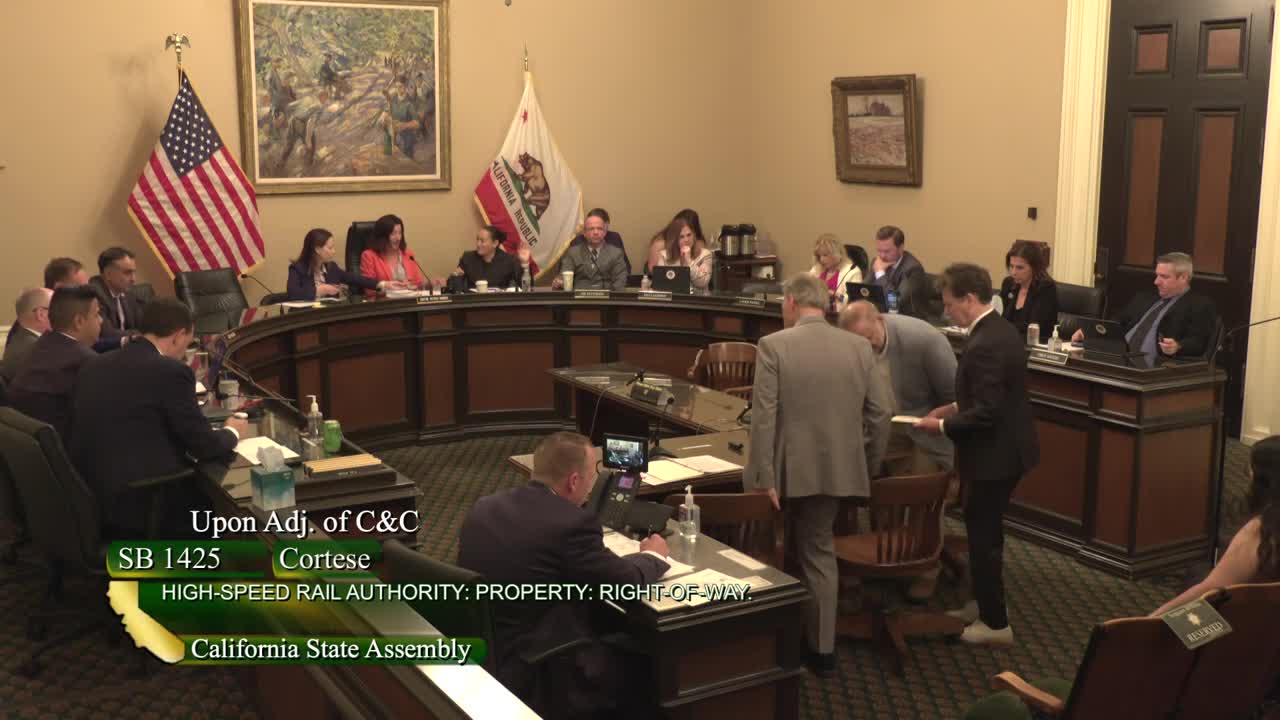 19MIN
Assembly Standing Committee on Utilities and Energy
 14MIN
Assembly Standing Committee on Judiciary
 5MIN
Assembly Standing Committee on Judiciary
 10MIN
Assembly Standing Committee on Transportation
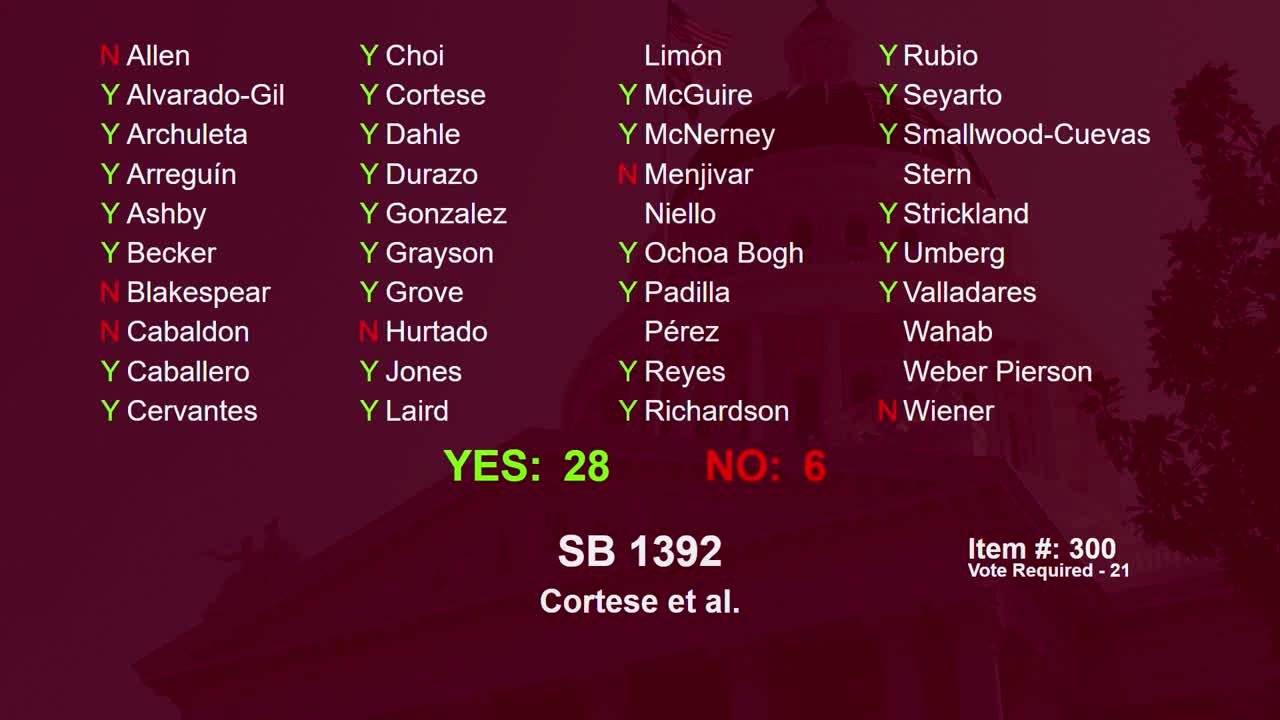 12MIN
Senate Floor
 9MIN
Senate Standing Committee on Judiciary
Bill Author

Bill Co-Author(s):