SB 19: Crimes: threats.
- Session Year: 2025-2026
- House: Senate
- Latest Version Date: 2025-10-11
Current Status:
Passed
(2025-10-11: Chaptered by Secretary of State. Chapter 594, Statutes of 2025.)
Introduced
In Committee
Awaiting First Chamber Vote
Passed First Chamber
In Committee
Awaiting Second Chamber Vote
Passed Second Chamber
Enacted
Existing law makes it a crime to willfully threaten to commit a crime that will result in death or great bodily injury to another person, with the specific intent that the statement is to be taken as a threat that, on its face and under the circumstances in which it is made, is so unequivocal, unconditional, immediate, and specific as to convey to the person threatened a gravity of purpose and an immediate prospect of execution of the threat, and thereby reasonably causes the threatened person to be in sustained fear for their own safety or the safety of their immediate family, as defined. Under existing law, this crime is punishable by imprisonment in a county jail for no more than one year for a misdemeanor, or by imprisonment in state prison for a felony.
This bill would make it a crime for a person to willfully threaten, by any means, including, but not limited to, an image or threat posted or published on an internet web page, to commit a crime at specified locations, including a daycare and workplace, with specific intent that the statement is be taken as a threat, even if there is no intent of actually carrying it out, if the threat, on its face and under the circumstances in which it is made is so unequivocal, unconditional, immediate, and specific as to convey to the person or persons threatened a gravity of purpose and an immediate prospect of execution of the threat, and if the threat causes a person or person to reasonably be in sustained fear for their own safety or the safety of others at the specified locations. This bill would make this crime, for a person 18 years of age or older, punishable as a wobbler by imprisonment in the county jail for not more than one year or by imprisonment in the county jail for 16 months or 2 or 3 years. If a person under 18 years of age commits this crime, the bill would require the person to be referred to specified services in lieu of being declared a ward of the court, if eligible. If the person is ineligible, the bill would require the offense to be punished as a misdemeanor. By creating a new crime and imposing additional duties on local governments, this bill would create a state-mandated local program.
The California Constitution requires the state to reimburse local agencies and school districts for certain costs mandated by the state. Statutory provisions establish procedures for making that reimbursement.
This bill would provide that with regard to certain mandates no reimbursement is required by this act for a specified reason.
With regard to any other mandates, this bill would provide that, if the Commission on State Mandates determines that the bill contains costs so mandated by the state, reimbursement for those costs shall be made pursuant to the statutory provisions noted above.
Existing law makes it a crime to willfully threaten to commit a crime that will result in death or great bodily injury to another person, with the specific intent that the statement is to be taken as a threat that, on its face and under the circumstances in which it is made, is so unequivocal, unconditional, immediate, and specific as to convey to the person threatened a gravity of purpose and an immediate prospect of execution of the threat, and thereby reasonably causes the threatened person to be in sustained fear for their own safety or the safety of their immediate family, as defined. Under existing law, this crime is punishable by imprisonment in a county jail for no more than one year for a misdemeanor, or by imprisonment in state prison for a felony.This bill would make a person who willfully threatens to commit a crime which will result in death or great bodily injury to any person who may be on the grounds of a school or place of worship, with specific intent and under certain circumstances, and if the threat causes a person or persons reasonably to be in sustained fear for their own safety or the safety of another person, guilty of a misdemeanor or felony punishable by imprisonment in a county jail for a specified term, except that if the person is under 18 years of age, the bill would make the person guilty of an infraction and require the person to be referred to specified services in lieu of being declared a ward of the court, as specified. By creating a new crime and imposing additional duties on local governments this bill would impose a state-mandated local program.The California Constitution requires the state to reimburse local agencies and school districts for certain costs mandated by the state. Statutory provisions establish procedures for making that reimbursement.This bill would provide that with regard to certain mandates no reimbursement is required by this act for a specified reason.With regard to any other mandates, this bill would provide that, if the Commission on State Mandates determines that the bill contains costs so mandated by the state, reimbursement for those costs shall be made pursuant to the statutory provisions noted above.Existing law makes it a crime to willfully threaten to commit a crime that will result in death or great bodily injury to another person, with the specific intent that the statement is to be taken as a threat that, on its face and under the circumstances in which it is made, is so unequivocal, unconditional, immediate, and specific as to convey to the person threatened a gravity of purpose and an immediate prospect of execution of the threat, and thereby reasonably causes the threatened person to be in sustained fear for their own safety or the safety of their immediate family, as defined. Under existing law, this crime is punishable by imprisonment in a county jail for no more than one year for a misdemeanor, or by imprisonment in state prison for a felony.
This bill would make a person who willfully threatens to commit a crime which will result in death or great bodily injury to any person who may be on the grounds of a school or place of worship, with specific intent and under certain circumstances, and if the threat causes a person or persons reasonably to be in sustained fear for their own safety or the safety of another person, guilty of a misdemeanor or felony punishable by imprisonment in a county jail for a specified term, except that if the person is under 18 years of age, the bill would make the person guilty of a misdemeanor. an infraction and require the person to be referred to specified services in lieu of being declared a ward of the court, as specified. By creating a new crime, crime and imposing additional duties on local governments this bill would impose a state-mandated local program.
The California Constitution requires the state to reimburse local agencies and school districts for certain costs mandated by the state. Statutory provisions establish procedures for making that reimbursement.This bill would provide that no reimbursement is required by this act for a specified reason.The California Constitution requires the state to reimburse local agencies and school districts for certain costs mandated by the state. Statutory provisions establish procedures for making that reimbursement.
This bill would provide that with regard to certain mandates no reimbursement is required by this act for a specified reason.
With regard to any other mandates, this bill would provide that, if the Commission on State Mandates determines that the bill contains costs so mandated by the state, reimbursement for those costs shall be made pursuant to the statutory provisions noted above.
Existing law makes it a crime to willfully threaten to commit a crime that will result in death or great bodily injury to another person, with the specific intent that the statement is to be taken as a threat that, on its face and under the circumstances in which it is made, is so unequivocal, unconditional, immediate, and specific as to convey to the person threatened a gravity of purpose and an immediate prospect of execution of the threat, and thereby reasonably causes the threatened person to be in sustained fear for their own safety or the safety of their immediate family, as defined. Under existing law, this crime is punishable by imprisonment in a county jail for no more than one year for a misdemeanor, or by imprisonment in state prison for a felony.
Existing law allows a search warrant to be issued upon probable cause, supported by affidavit, naming or describing the person to be searched or searched for, and particularly describing the property, thing, or things and the place to be searched, and enumerates the grounds upon which a search warrant may be issued, including, among others, when the property or things were used as a means of committing a felony.This bill would make a person who willfully threatens to commit a crime which will result in death or great bodily injury to any person who may be on the grounds of a school or place of worship, with specific intent and under certain circumstances, and if the threat causes a person or persons reasonably to be in sustained fear for their own safety or the safety of another person, guilty of a misdemeanor or felony punishable by imprisonment in a county jail for a specified term, except that if the person is under 18 years of age, the bill would make the person guilty of a misdemeanor. By creating a new crime, this bill would impose a state-mandated local program. The bill would additionally allow a warrant to be issued when the property or things consists of evidence that tends to show a misdemeanor or felony violation of that crime, or tends to show that a particular person has violated that crime.
The California Constitution requires the state to reimburse local agencies and school districts for certain costs mandated by the state. Statutory provisions establish procedures for making that reimbursement.
This bill would provide that no reimbursement is required by this act for a specified reason.
Existing law makes it a crime to willfully threaten to commit a crime that will result in death or great bodily injury to another person, with the specific intent that the statement is to be taken as a threat that, on its face and under the circumstances in which it is made, is so unequivocal, unconditional, immediate, and specific as to convey to the person threatened a gravity of purpose and an immediate prospect of execution of the threat, and thereby reasonably causes the threatened person to be in sustained fear for their own safety or the safety of their immediate family, as defined. Under existing law, this crime is punishable by imprisonment in a county jail for no more than one year for a misdemeanor, or by imprisonment in state prison for a felony.
Existing law allows a search warrant to be issued upon probable cause, supported by affidavit, naming or describing the person to be searched or searched for, and particularly describing the property, thing, or things and the place to be searched, and enumerates the grounds upon which a search warrant may be issued, including, among others, when the property or things were used as a means of committing a felony.
This bill would make a person who willfully threatens to commit a crime which will result in death or great bodily injury to any person who may be on the grounds of a school or place of worship, with specific intent and under certain circumstances, and if the threat causes a person or persons reasonably to be in sustained fear for their own safety or the safety of another person, guilty of a misdemeanor or felony punishable by imprisonment in a county jail for a specified term, except that if the person is under 18 years of age, the bill would make the person guilty of a misdemeanor. By creating a new crime, this bill would impose a state-mandated local program. The bill would additionally allow a warrant to be issued when the property or things consists of evidence that tends to show a misdemeanor or felony violation of that crime, or tends to show that a particular person has violated that crime.
The California Constitution requires the state to reimburse local agencies and school districts for certain costs mandated by the state. Statutory provisions establish procedures for making that reimbursement.
This bill would provide that no reimbursement is required by this act for a specified reason.
Existing law makes it a crime to willfully threaten to commit a crime that will result in death or great bodily injury to another person, with the specific intent that the statement is to be taken as a threat that, on its face and under the circumstances in which it is made, is so unequivocal, unconditional, immediate, and specific as to convey to the person threatened a gravity of purpose and an immediate prospect of execution of the threat, and thereby reasonably causes the threatened person to be in sustained fear for their own safety or the safety of their immediate family, as defined. Under existing law, this crime is punishable by imprisonment in a county jail for no more than one year for a misdemeanor, or by imprisonment in state prison for a felony.
This bill would make a person who willfully threatens to commit a crime which will result in death or great bodily injury to any person who may be on the grounds of a school or place of worship, with specific intent and under certain circumstances, and if the threat causes a person or persons reasonably to be in sustained fear for their own safety or the safety of another person, guilty of a misdemeanor or felony punishable by imprisonment in a county jail for a specified term, except that if the person is under 18 years of age, the bill would make the person guilty of a misdemeanor. By creating a new crime, this bill would impose a state-mandated local program.
The California Constitution requires the state to reimburse local agencies and school districts for certain costs mandated by the state. Statutory provisions establish procedures for making that reimbursement.
This bill would provide that no reimbursement is required by this act for a specified reason.
(a)Except as provided in subdivision (b), any person who willfully threatens, by any means, including, but not limited to, an image or threat posted or published on an internet web page, to commit a crime that will result in death or great bodily injury to another person or persons at a daycare, school, university, workplace, house of worship, or medical facility with specific intent that the statement is to be taken as a threat, even if there is no intent of actually carrying it out, if the threat on its face and under the circumstances in which it is made is so unequivocal, unconditional, immediate, and specific as to convey to the person or persons threatened a gravity of purpose and an immediate prospect of execution of the threat, and if that threat causes a person or persons to reasonably be in sustained fear for their own safety or the safety of others at these locations, shall be punished by imprisonment in the county jail not to exceed one year or by imprisonment pursuant to subdivision (h) of Section 1170.
(b)If a person who commits an act in violation of subdivision (a) is under 18 years of age, the person shall be referred to services pursuant to Section 654 of the Welfare and Institutions Code, if eligible. If ineligible, the offense shall be punished as a misdemeanor.
(c)This section does not preclude or prohibit prosecution under any other law, except that a person shall not be convicted for the same threat under both this section and Section 422.
SEC. 2.No reimbursement is required by this act pursuant to Section 6 of Article XIIIB of the California Constitution for certain costs that may be incurred by a local agency or school district because, in that regard, this act creates a new crime or infraction, eliminates a crime or infraction, or changes the penalty for a crime or infraction, within the meaning of Section 17556 of the Government Code, or changes the definition of a crime within the meaning of Section 6 of Article XIIIB of the California Constitution.
However, if the Commission on State Mandates determines that this act contains other costs mandated by the state, reimbursement to local agencies and school districts for those costs shall be made pursuant to Part 7 (commencing with Section 17500) of Division 4 of Title 2 of the Government Code.
SECTION 1.This act shall be known, and may be cited, as the Safe Schools and Places of Worship Act.SEC. 2.The Legislature finds and declares both of the following:(a)Schools across the United States and in California have seen an increase in the number of threats of violence. Research shows that educational facilities are now the most common target for bomb threats. Threats of mass shootings, bombings, and other attacks disrupt student learning, create communitywide anxiety about school safety, and cause school attendance rates to decrease because worried parents keep their children home. These threats can be extremely costly, with research showing that emergency response can cost at least $100,000 per incident. Criminal threats have also targeted places of worship, where California, in particular, has seen an increase in religious-based hate crimes. Threats to schools and places of worship create constant fear, trauma, and instability. Whether it is a bomb threat, shooting threat, or any form of threat, it disrupts the entire learning and safety environment for all individuals. Students, parents, children, and individuals all have to suffer from the stress, anxiety, distraction, and sometimes permanent trauma caused by these threats.(b)Swatting is a growing issue across California and the country. Swatting is the malicious act of fraudulently reporting an emergency, in hopes of generating a large law enforcement response to an unsuspecting victims location. Swatting calls and hoax threats are a daily occurrence, and often come in clusters, targeting high-profile public figures, as well as schools, hospitals, places of worship, and centers of mass transportation. Swatting may be conducted to harass, intimidate, or retaliate against intended targets. It is a serious crime that can have deadly consequences due to confusion on the part of victims and responding officials, and it also diverts limited public safety resources from valid emergencies. SEC. 3.Section 422.2 is added to the Penal Code, to read:422.2.(a)A person who, by any means, including, but not limited to, an electronic act, willfully threatens to commit a crime which will result in death or great bodily injury to any person who may be on the grounds of a school or place of worship, with the specific intent that the statement is to be taken as a threat, even if there is no intent of carrying it out, if the threat on its face and under the circumstances in which it is made, is so unequivocal, unconditional, immediate, and specific as to convey a gravity of purpose and an immediate prospect of execution of the threat, and if the threat causes a person or persons reasonably to be in sustained fear for their own safety or the safety of another person, shall be punished by imprisonment in a county jail for a term not exceeding one year, or by imprisonment pursuant to subdivision (h) of Section 1170.(b)Notwithstanding subdivision (a), a person under 18 years of age who violates this section is guilty of a an infraction and shall be referred to services pursuant to Section 654 of the Welfare and Institutions Code, if eligible.(c)This section does not preclude or prohibit prosecution under any other law, except that a person shall not be convicted for the same threat under both this section and Section 422.(d)For purposes of this section, the following terms have the following meanings:(1)Electronic act has the same meaning as in paragraph (2) of subdivision (r) of Section 48900 of the Education Code.(2)Place of worship means any church, synagogue, temple, mosque, or other building where religious services are regularly conducted.(3)School means a state preschool, a private or public elementary, middle, vocational, junior high, or high school, a community college, a public or private university, or a location where a school-sponsored event is or will be taking place and the threat is related to both the school-sponsored event and to the time period during which the school-sponsored event will occur.SEC. 4.No reimbursement is required by this act pursuant to Section 6 of Article XIIIB of the California Constitution for certain costs that may be incurred by a local agency or school district because, in that regard, this act creates a new crime or infraction, eliminates a crime or infraction, or changes the penalty for a crime or infraction, within the meaning of Section 17556 of the Government Code, or changes the definition of a crime within the meaning of Section 6 of Article XIIIB of the California Constitution.However, if the Commission on State Mandates determines that this act contains other costs mandated by the state, reimbursement to local agencies and school districts for those costs shall be made pursuant to Part 7 (commencing with Section 17500) of Division 4 of Title 2 of the Government Code.This act shall be known, and may be cited, as the Safe Schools and Places of Worship Act.
SEC. 2.The Legislature finds and declares both of the following:
(a)Schools across the United States and in California have seen an increase in the number of threats of violence. Research shows that educational facilities are now the most common target for bomb threats. Threats of mass shootings, bombings, and other attacks disrupt student learning, create communitywide anxiety about school safety, and cause school attendance rates to decrease because worried parents keep their children home. These threats can be extremely costly, with research showing that emergency response can cost at least $100,000 per incident. Criminal threats have also targeted places of worship, where California, in particular, has seen an increase in religious-based hate crimes. Threats to schools and places of worship create constant fear, trauma, and instability. Whether it is a bomb threat, shooting threat, or any form of threat, it disrupts the entire learning and safety environment for all individuals. Students, parents, children, and individuals all have to suffer from the stress, anxiety, distraction, and sometimes permanent trauma caused by these threats.
(b)Swatting is a growing issue across California and the country. Swatting is the malicious act of fraudulently reporting an emergency, in hopes of generating a large law enforcement response to an unsuspecting victims location. Swatting calls and hoax threats are a daily occurrence, and often come in clusters, targeting high-profile public figures, as well as schools, hospitals, places of worship, and centers of mass transportation. Swatting may be conducted to harass, intimidate, or retaliate against intended targets. It is a serious crime that can have deadly consequences due to confusion on the part of victims and responding officials, and it also diverts limited public safety resources from valid emergencies.
SEC. 2.SEC. 3.Section 422.2 is added to the Penal Code, to read:422.2.(a)A person who, by any means, including, but not limited to, an electronic act, willfully threatens to commit a crime which will result in death or great bodily injury to any person who may be on the grounds of a school or place of worship, with the specific intent that the statement is to be taken as a threat, even if there is no intent of carrying it out, if the threat on its face and under the circumstances in which it is made, is so unequivocal, unconditional, immediate, and specific as to convey a gravity of purpose and an immediate prospect of execution of the threat, and if the threat causes a person or persons reasonably to be in sustained fear for their own safety or the safety of another person, shall be punished by imprisonment in a county jail for a term not exceeding one year, or by imprisonment pursuant to subdivision (h) of Section 1170.
(b)Notwithstanding subdivision (a), a person under 18 years of age who violates this section is guilty of a misdemeanor. an infraction and shall be referred to services pursuant to Section 654 of the Welfare and Institutions Code, if eligible.
(c)This section does not preclude or prohibit prosecution under any other law, except that a person shall not be convicted for the same threat under both this section and Section 422.
(d)For purposes of this section, the following terms have the following meanings:
(1)Electronic act has the same meaning as in paragraph (2) of subdivision (r) of Section 48900 of the Education Code.
(2)Place of worship means any church, synagogue, temple, mosque, or other building where religious services are regularly conducted.
(3)School means a state preschool, a private or public elementary, middle, vocational, junior high, or high school, a community college, a public or private university, or a location where a school-sponsored event is or will be taking place and the threat is related to both the school-sponsored event and to the time period during which the school-sponsored event will occur.
SEC. 3.No reimbursement is required by this act pursuant to Section 6 of Article XIIIB of the California Constitution because the only costs that may be incurred by a local agency or school district will be incurred because this act creates a new crime or infraction, eliminates a crime or infraction, or changes the penalty for a crime or infraction, within the meaning of Section 17556 of the Government Code, or changes the definition of a crime within the meaning of Section 6 of Article XIIIB of the California Constitution.SEC. 4.No reimbursement is required by this act pursuant to Section 6 of Article XIIIB of the California Constitution for certain costs that may be incurred by a local agency or school district because, in that regard, this act creates a new crime or infraction, eliminates a crime or infraction, or changes the penalty for a crime or infraction, within the meaning of Section 17556 of the Government Code, or changes the definition of a crime within the meaning of Section 6 of Article XIIIB of the California Constitution.
However, if the Commission on State Mandates determines that this act contains other costs mandated by the state, reimbursement to local agencies and school districts for those costs shall be made pursuant to Part 7 (commencing with Section 17500) of Division 4 of Title 2 of the Government Code.
REVISIONS: HeadingLine 3.This act shall be known, and may be cited, as the Safe Schools and Places of Worship Act.
SEC. 2.Section 422.2 is added to the Penal Code, to read:422.2.(a)A person who, by any means, including, but not limited to, an electronic act, willfully threatens to commit a crime which will result in death or great bodily injury to any person who may be on the grounds of a school or place of worship, with the specific intent that the statement is to be taken as a threat, even if there is no intent of carrying it out, if the threat on its face and under the circumstances in which it is made, is so unequivocal, unconditional, immediate, and specific as to convey a gravity of purpose and an immediate prospect of execution of the threat, and if the threat causes a person or persons reasonably to be in sustained fear for their own safety or the safety of another person, shall be punished by imprisonment in a county jail for a term not exceeding one year, or by imprisonment pursuant to subdivision (h) of Section 1170.
(b)Notwithstanding subdivision (a), a person under 18 years of age who violates this section is guilty of a misdemeanor.
(c)This section does not preclude or prohibit prosecution under any other law, except that a person shall not be convicted for the same threat under both this section and Section 422.
(d)For purposes of this section, the following terms have the following meanings:
(1)Electronic act has the same meaning as in paragraph (2) of subdivision (r) of Section 48900 of the Education Code.
(2)Place of worship means any church, synagogue, temple, mosque, or other building where religious services are regularly conducted.
(3)School means a state preschool, a private or public elementary, middle, vocational, junior high, or high school, a community college, a public or private university, or a location where a school-sponsored event is or will be taking place and the threat is related to both the school-sponsored event and to the time period during which the school-sponsored event will occur.
SEC. 3.Section 1524 of the Penal Code, as added by Section 11.5 of Chapter 544 of the Statutes of 2024, is amended to read:1524.(a)A search warrant may be issued upon any of the following grounds:(1)When the property was stolen or embezzled.(2)When the property or things were used as the means of committing a felony.(3)When the property or things are in the possession of a person with the intent to use them as a means of committing a public offense, or in the possession of another to whom that person may have delivered them for the purpose of concealing them or preventing them from being discovered.(4)When the property or things to be seized consist of an item or constitute evidence that tends to show a felony has been committed, or tends to show that a particular person has committed a felony.(5)When the property or things to be seized consist of evidence that tends to show that sexual exploitation of a child, in violation of Section 311.3, or possession of matter depicting sexual conduct of a person under 18 years of age, in violation of Section 311.11, has occurred or is occurring.(6)When there is a warrant to arrest a person.(7)When a provider of electronic communication service or remote computing service has records or evidence, as specified in Section 1524.3, showing that property was stolen or embezzled constituting a misdemeanor, or that property or things are in the possession of a person with the intent to use them as a means of committing a misdemeanor public offense, or in the possession of another to whom that person may have delivered them for the purpose of concealing them or preventing their discovery.(8)When the property or things to be seized include an item or evidence that tends to show a violation of Section 3700.5 of the Labor Code or tends to show that a particular person has violated Section 3700.5 of the Labor Code.(9)When the property or things to be seized include a firearm or other deadly weapon at the scene of, or at the premises occupied or under the control of the person arrested in connection with, a domestic violence incident involving a threat to human life or a physical assault as provided in Section 18250. This section does not affect warrantless seizures otherwise authorized by Section 18250.(10)When the property or things to be seized include a firearm or other deadly weapon that is owned by, or in the possession of, or in the custody or control of, a person described in subdivision (a) of Section 8102 of the Welfare and Institutions Code.(11)When the property or things to be seized include a firearm that is owned by, or in the possession of, or in the custody or control of, a person who is subject to the prohibitions regarding firearms or ammunition or both pursuant to Section 6389 of the Family Code, if a prohibited firearm or ammunition or both is possessed, owned, in the custody of, or controlled by a person against whom a protective order has been issued pursuant to Section 6218 of the Family Code, the person has been lawfully served with that order, and the person has failed to relinquish the firearm or ammunition or both as required by law.(12)When the information to be received from the use of a tracking device constitutes evidence that tends to show that either a felony, a misdemeanor violation of the Fish and Game Code, or a misdemeanor violation of the Public Resources Code has been committed or is being committed, tends to show that a particular person has committed a felony, a misdemeanor violation of the Fish and Game Code, or a misdemeanor violation of the Public Resources Code, or is committing a felony, a misdemeanor violation of the Fish and Game Code, or a misdemeanor violation of the Public Resources Code, or will assist in locating an individual who has committed or is committing a felony, a misdemeanor violation of the Fish and Game Code, or a misdemeanor violation of the Public Resources Code. A tracking device search warrant issued pursuant to this paragraph shall be executed in a manner meeting the requirements specified in subdivision (b) of Section 1534.(13)When a sample of the blood of a person constitutes evidence that tends to show a violation of Section 23140, 23152, or 23153 of the Vehicle Code and the person from whom the sample is being sought has refused an officers request to submit to, or has failed to complete, a blood test as required by Section 23612 of the Vehicle Code, and the sample will be drawn from the person in a reasonable, medically approved manner. This paragraph is not intended to abrogate a courts mandate to determine the propriety of the issuance of a search warrant on a case-by-case basis.(14)Beginning January 1, 2016, the property or things to be seized are firearms or ammunition or both that are owned by, in the possession of, or in the custody or control of a person who is the subject of a gun violence restraining order that has been issued pursuant to Division 3.2 (commencing with Section 18100) of Title 2 of Part 6, if a prohibited firearm or ammunition or both is possessed, owned, in the custody of, or controlled by a person against whom a gun violence restraining order has been issued, the person has been lawfully served with that order, and the person has failed to relinquish the firearm as required by law.(15)Beginning January 1, 2018, the property or things to be seized include a firearm that is owned by, or in the possession of, or in the custody or control of, a person who is subject to the prohibitions regarding firearms pursuant to Section 29800, 29805, 29815, or 29825, and the court has made a finding pursuant to subdivision (c) of Section 29810 that the person has failed to relinquish the firearm as required by law.(16)When the property or things to be seized are controlled substances or a device, contrivance, instrument, or paraphernalia used for unlawfully using or administering a controlled substance pursuant to the authority described in Section 11472 of the Health and Safety Code.(17)(A)When all of the following apply:(i)A sample of the blood of a person constitutes evidence that tends to show a violation of subdivision (b), (c), (d), (e), or (f) of Section 655 of the Harbors and Navigation Code.(ii)The person from whom the sample is being sought has refused an officers request to submit to, or has failed to complete, a blood test as required by Section 655.1 of the Harbors and Navigation Code.(iii)The sample will be drawn from the person in a reasonable, medically approved manner.(B)This paragraph is not intended to abrogate a courts mandate to determine the propriety of the issuance of a search warrant on a case-by-case basis.(18)When the property or things to be seized consists of evidence that tends to show that a violation of paragraph (1), (2), or (3) of subdivision (j) of Section 647 has occurred or is occurring.(19)(A)When the property or things to be seized are data, from a recording device installed by the manufacturer of a motor vehicle, that constitutes evidence that tends to show the commission of a felony or misdemeanor offense involving a motor vehicle, resulting in death or serious bodily injury to a person. The data accessed by a warrant pursuant to this paragraph shall not exceed the scope of the data that is directly related to the offense for which the warrant is issued.(B)For the purposes of this paragraph, recording device has the same meaning as defined in subdivision (b) of Section 9951 of the Vehicle Code. The scope of the data accessible by a warrant issued pursuant to this paragraph shall be limited to the information described in subdivision (b) of Section 9951 of the Vehicle Code.(C)For the purposes of this paragraph, serious bodily injury has the same meaning as defined in paragraph (4) of subdivision (f) of Section 243.(20)When the property or things to be seized consists of evidence that tends to show that a violation of Section 647.9 has occurred or is occurring. Evidence to be seized pursuant to this paragraph shall be limited to evidence of a violation of Section 647.9 and shall not include evidence of a violation of a departmental rule or guideline that is not a public offense under California law.(21)If the property to be seized includes ammunition and all of the following criteria are satisfied:(A)The property is owned by, in the possession of, or in the custody or control of a person who is subject to the prohibition set forth in Section 8103 of the Welfare and Institutions Code.(B)The person has been lawfully served with the order required by Section 8103 of the Welfare and Institutions Code.(C)The person has failed to relinquish the ammunition as required by law.(22)When the property or things to be seized include a firearm or ammunition or both that is owned by, or in the possession of, or in the custody or control of, a person who is subject to the prohibitions regarding firearms pursuant to Section 527.9 of the Code of Civil Procedure, the person has been lawfully served with that order, and the person has failed to relinquish the firearm or ammunition or both as required by law.(23)When the property or things to be seized consists of evidence that tends to show a misdemeanor or felony violation of Section 422.2, or tends to show that a particular person has violated Section 422.2.(b)The property, things, person, or persons described in subdivision (a) may be taken on the warrant from a place or from a person in whose possession the property or things may be.(c)Notwithstanding subdivision (a) or (b), a search warrant shall not be issued for documentary evidence in the possession or under the control of a person who is a lawyer as defined in Section 950 of the Evidence Code, a physician as defined in Section 990 of the Evidence Code, a psychotherapist as defined in Section 1010 of the Evidence Code, or a member of the clergy as defined in Section 1030 of the Evidence Code, and who is not reasonably suspected of engaging or having engaged in criminal activity related to the documentary evidence for which a warrant is requested unless the following procedure has been complied with:(1)At the time of the issuance of the warrant, the court shall appoint a special master in accordance with subdivision (d) to accompany the person who will serve the warrant. Upon service of the warrant, the special master shall inform the party served of the specific items being sought and that the party shall have the opportunity to provide the items requested. If the party, in the judgment of the special master, fails to provide the items requested, the special master shall conduct a search for the items in the areas indicated in the search warrant.(2)(A)If the party who has been served states that an item or items should not be disclosed, they shall be sealed by the special master and taken to court for a hearing.(B)At the hearing, the party searched shall be entitled to raise an issue that may be raised pursuant to Section 1538.5 as well as a claim that the item or items are privileged, as provided by law. The hearing shall be held in the superior court. The court shall provide sufficient time for the parties to obtain counsel and make motions or present evidence. The hearing shall be held within three days of the service of the warrant unless the court makes a finding that the expedited hearing is impracticable. In that case, the matter shall be heard at the earliest possible time.(C)If an item or items are taken to court for a hearing, a limitation of time prescribed in Chapter 2 (commencing with Section 799) of Title 3 shall be tolled from the time of the seizure until the final conclusion of the hearing, including an associated writ or appellate proceedings.(3)The warrant shall, whenever practicable, be served during normal business hours. In addition, the warrant shall be served upon a party who appears to have possession or control of the items sought. If, after reasonable efforts, the party serving the warrant is unable to locate the person, the special master shall seal and return to the court, for determination by the court, an item that appears to be privileged as provided by law.(d)(1)As used in this section, a special master is an attorney who is a member in good standing of the California State Bar and who has been selected from a list of qualified attorneys that is maintained by the State Bar particularly for the purposes of conducting the searches described in this section. These attorneys shall serve without compensation. A special master shall be considered a public employee, and the governmental entity that caused the search warrant to be issued shall be considered the employer of the special master and the applicable public entity, for purposes of Division 3.6 (commencing with Section 810) of Title 1 of the Government Code, relating to claims and actions against public entities and public employees. In selecting the special master, the court shall make every reasonable effort to ensure that the person selected has no relationship with any of the parties involved in the pending matter. Information obtained by the special master shall be confidential and may not be divulged except in direct response to inquiry by the court.(2)In a case in which the magistrate determines that, after reasonable efforts have been made to obtain a special master, a special master is not available and would not be available within a reasonable period of time, the magistrate may direct the party seeking the order to conduct the search in the manner described in this section in lieu of the special master.(e)A search conducted pursuant to this section by a special master may be conducted in a manner that permits the party serving the warrant or that partys designee to accompany the special master as the special master conducts the search. However, that party or that partys designee may not participate in the search nor shall they examine any of the items being searched by the special master except upon agreement of the party upon whom the warrant has been served.(f)As used in this section, documentary evidence includes, but is not limited to, writings, documents, blueprints, drawings, photographs, computer printouts, microfilms, x-rays, files, diagrams, ledgers, books, tapes, audio and video recordings, films, and papers of any type or description.(g)No warrant shall issue for an item or items described in Section 1070 of the Evidence Code.(h)No warrant shall issue for an item or items that pertain to an investigation into a prohibited violation, as defined in Section 629.51.(i)Notwithstanding any other law, no claim of attorney work product as described in Chapter 4 (commencing with Section 2018.010) of Title 4 of Part 4 of the Code of Civil Procedure shall be sustained where there is probable cause to believe that the lawyer is engaging or has engaged in criminal activity related to the documentary evidence for which a warrant is requested unless it is established at the hearing with respect to the documentary evidence seized under the warrant that the services of the lawyer were not sought or obtained to enable or aid anyone to commit or plan to commit a crime or a fraud.(j)Nothing in this section is intended to limit an attorneys ability to request an in-camera hearing pursuant to the holding of the Supreme Court of California in People v. Superior Court (Laff) (2001) 25 Cal.4th 703.(k)In addition to any other circumstance permitting a magistrate to issue a warrant for a person or property in another county, when the property or things to be seized consist of any item or constitute evidence that tends to show a violation of Section 530.5, the magistrate may issue a warrant to search a person or property located in another county if the person whose identifying information was taken or used resides in the same county as the issuing court.(l)This section does not create a cause of action against a foreign or California corporation, its officers, employees, agents, or other specified persons for providing location information.(m)This section shall become operative on January 1, 2026.SEC. 4.SEC. 3.No reimbursement is required by this act pursuant to Section 6 of Article XIIIB of the California Constitution because the only costs that may be incurred by a local agency or school district will be incurred because this act creates a new crime or infraction, eliminates a crime or infraction, or changes the penalty for a crime or infraction, within the meaning of Section 17556 of the Government Code, or changes the definition of a crime within the meaning of Section 6 of Article XIIIB of the California Constitution.
This act shall be known, and may be cited, as the Safe Schools and Places of Worship Act.
SEC. 2.Section 422.2 is added to the Penal Code, to read:422.2.(a)A person who, by any means, including, but not limited to, an electronic act, willfully threatens to commit a crime which will result in death or great bodily injury to any person who may be on the grounds of a school or place of worship, with the specific intent that the statement is to be taken as a threat, even if there is no intent of carrying it out, if the threat on its face and under the circumstances in which it is made, is so unequivocal, unconditional, immediate, and specific as to convey a gravity of purpose and an immediate prospect of execution of the threat, and if the threat causes a person or persons reasonably to be in sustained fear for their own safety or the safety of another person, shall be punished by imprisonment in a county jail for a term not exceeding one year, or by imprisonment pursuant to subdivision (h) of Section 1170.
(b)Notwithstanding subdivision (a), a person under 18 years of age who violates this section is guilty of a misdemeanor.
(c)This section does not preclude or prohibit prosecution under any other law, except that a person shall not be convicted for the same threat under both this section and Section 422.
(d)For purposes of this section, the following terms have the following meanings:
(1)Electronic act has the same meaning as in paragraph (2) of subdivision (r) of Section 48900 of the Education Code.
(2)Place of worship means any church, synagogue, temple, mosque, or other building where religious services are regularly conducted.
(3)School means a state preschool, a private or public elementary, middle, vocational, junior high, or high school, a community college, a public or private university, or a location where a school-sponsored event is or will be taking place and the threat is related to both the school-sponsored event and to the time period during which the school-sponsored event will occur.
SEC. 3.Section 1524 of the Penal Code, as added by Section 11.5 of Chapter 544 of the Statutes of 2024, is amended to read:1524.(a)A search warrant may be issued upon any of the following grounds:
(1)When the property was stolen or embezzled.
(2)When the property or things were used as the means of committing a felony.
(3)When the property or things are in the possession of a person with the intent to use them as a means of committing a public offense, or in the possession of another to whom that person may have delivered them for the purpose of concealing them or preventing them from being discovered.
(4)When the property or things to be seized consist of an item or constitute evidence that tends to show a felony has been committed, or tends to show that a particular person has committed a felony.
(5)When the property or things to be seized consist of evidence that tends to show that sexual exploitation of a child, in violation of Section 311.3, or possession of matter depicting sexual conduct of a person under 18 years of age, in violation of Section 311.11, has occurred or is occurring.
(6)When there is a warrant to arrest a person.
(7)When a provider of electronic communication service or remote computing service has records or evidence, as specified in Section 1524.3, showing that property was stolen or embezzled constituting a misdemeanor, or that property or things are in the possession of a person with the intent to use them as a means of committing a misdemeanor public offense, or in the possession of another to whom that person may have delivered them for the purpose of concealing them or preventing their discovery.
(8)When the property or things to be seized include an item or evidence that tends to show a violation of Section 3700.5 of the Labor Code or tends to show that a particular person has violated Section 3700.5 of the Labor Code.
(9)When the property or things to be seized include a firearm or other deadly weapon at the scene of, or at the premises occupied or under the control of the person arrested in connection with, a domestic violence incident involving a threat to human life or a physical assault as provided in Section 18250. This section does not affect warrantless seizures otherwise authorized by Section 18250.
(10)When the property or things to be seized include a firearm or other deadly weapon that is owned by, or in the possession of, or in the custody or control of, a person described in subdivision (a) of Section 8102 of the Welfare and Institutions Code.
(11)When the property or things to be seized include a firearm that is owned by, or in the possession of, or in the custody or control of, a person who is subject to the prohibitions regarding firearms or ammunition or both pursuant to Section 6389 of the Family Code, if a prohibited firearm or ammunition or both is possessed, owned, in the custody of, or controlled by a person against whom a protective order has been issued pursuant to Section 6218 of the Family Code, the person has been lawfully served with that order, and the person has failed to relinquish the firearm or ammunition or both as required by law.
(12)When the information to be received from the use of a tracking device constitutes evidence that tends to show that either a felony, a misdemeanor violation of the Fish and Game Code, or a misdemeanor violation of the Public Resources Code has been committed or is being committed, tends to show that a particular person has committed a felony, a misdemeanor violation of the Fish and Game Code, or a misdemeanor violation of the Public Resources Code, or is committing a felony, a misdemeanor violation of the Fish and Game Code, or a misdemeanor violation of the Public Resources Code, or will assist in locating an individual who has committed or is committing a felony, a misdemeanor violation of the Fish and Game Code, or a misdemeanor violation of the Public Resources Code. A tracking device search warrant issued pursuant to this paragraph shall be executed in a manner meeting the requirements specified in subdivision (b) of Section 1534.
(13)When a sample of the blood of a person constitutes evidence that tends to show a violation of Section 23140, 23152, or 23153 of the Vehicle Code and the person from whom the sample is being sought has refused an officers request to submit to, or has failed to complete, a blood test as required by Section 23612 of the Vehicle Code, and the sample will be drawn from the person in a reasonable, medically approved manner. This paragraph is not intended to abrogate a courts mandate to determine the propriety of the issuance of a search warrant on a case-by-case basis.
(14)Beginning January 1, 2016, the property or things to be seized are firearms or ammunition or both that are owned by, in the possession of, or in the custody or control of a person who is the subject of a gun violence restraining order that has been issued pursuant to Division 3.2 (commencing with Section 18100) of Title 2 of Part 6, if a prohibited firearm or ammunition or both is possessed, owned, in the custody of, or controlled by a person against whom a gun violence restraining order has been issued, the person has been lawfully served with that order, and the person has failed to relinquish the firearm as required by law.
(15)Beginning January 1, 2018, the property or things to be seized include a firearm that is owned by, or in the possession of, or in the custody or control of, a person who is subject to the prohibitions regarding firearms pursuant to Section 29800, 29805, 29815, or 29825, and the court has made a finding pursuant to subdivision (c) of Section 29810 that the person has failed to relinquish the firearm as required by law.
(16)When the property or things to be seized are controlled substances or a device, contrivance, instrument, or paraphernalia used for unlawfully using or administering a controlled substance pursuant to the authority described in Section 11472 of the Health and Safety Code.
(17)(A)When all of the following apply:
(i)A sample of the blood of a person constitutes evidence that tends to show a violation of subdivision (b), (c), (d), (e), or (f) of Section 655 of the Harbors and Navigation Code.
(ii)The person from whom the sample is being sought has refused an officers request to submit to, or has failed to complete, a blood test as required by Section 655.1 of the Harbors and Navigation Code.
(iii)The sample will be drawn from the person in a reasonable, medically approved manner.
(B)This paragraph is not intended to abrogate a courts mandate to determine the propriety of the issuance of a search warrant on a case-by-case basis.
(18)When the property or things to be seized consists of evidence that tends to show that a violation of paragraph (1), (2), or (3) of subdivision (j) of Section 647 has occurred or is occurring.
(19)(A)When the property or things to be seized are data, from a recording device installed by the manufacturer of a motor vehicle, that constitutes evidence that tends to show the commission of a felony or misdemeanor offense involving a motor vehicle, resulting in death or serious bodily injury to a person. The data accessed by a warrant pursuant to this paragraph shall not exceed the scope of the data that is directly related to the offense for which the warrant is issued.
(B)For the purposes of this paragraph, recording device has the same meaning as defined in subdivision (b) of Section 9951 of the Vehicle Code. The scope of the data accessible by a warrant issued pursuant to this paragraph shall be limited to the information described in subdivision (b) of Section 9951 of the Vehicle Code.
(C)For the purposes of this paragraph, serious bodily injury has the same meaning as defined in paragraph (4) of subdivision (f) of Section 243.
(20)When the property or things to be seized consists of evidence that tends to show that a violation of Section 647.9 has occurred or is occurring. Evidence to be seized pursuant to this paragraph shall be limited to evidence of a violation of Section 647.9 and shall not include evidence of a violation of a departmental rule or guideline that is not a public offense under California law.
(21)If the property to be seized includes ammunition and all of the following criteria are satisfied:
(A)The property is owned by, in the possession of, or in the custody or control of a person who is subject to the prohibition set forth in Section 8103 of the Welfare and Institutions Code.
(B)The person has been lawfully served with the order required by Section 8103 of the Welfare and Institutions Code.
(C)The person has failed to relinquish the ammunition as required by law.
(22)When the property or things to be seized include a firearm or ammunition or both that is owned by, or in the possession of, or in the custody or control of, a person who is subject to the prohibitions regarding firearms pursuant to Section 527.9 of the Code of Civil Procedure, the person has been lawfully served with that order, and the person has failed to relinquish the firearm or ammunition or both as required by law.
(23)When the property or things to be seized consists of evidence that tends to show a misdemeanor or felony violation of Section 422.2, or tends to show that a particular person has violated Section 422.2.
(b)The property, things, person, or persons described in subdivision (a) may be taken on the warrant from a place or from a person in whose possession the property or things may be.
(c)Notwithstanding subdivision (a) or (b), a search warrant shall not be issued for documentary evidence in the possession or under the control of a person who is a lawyer as defined in Section 950 of the Evidence Code, a physician as defined in Section 990 of the Evidence Code, a psychotherapist as defined in Section 1010 of the Evidence Code, or a member of the clergy as defined in Section 1030 of the Evidence Code, and who is not reasonably suspected of engaging or having engaged in criminal activity related to the documentary evidence for which a warrant is requested unless the following procedure has been complied with:
(1)At the time of the issuance of the warrant, the court shall appoint a special master in accordance with subdivision (d) to accompany the person who will serve the warrant. Upon service of the warrant, the special master shall inform the party served of the specific items being sought and that the party shall have the opportunity to provide the items requested. If the party, in the judgment of the special master, fails to provide the items requested, the special master shall conduct a search for the items in the areas indicated in the search warrant.
(2)(A)If the party who has been served states that an item or items should not be disclosed, they shall be sealed by the special master and taken to court for a hearing.
(B)At the hearing, the party searched shall be entitled to raise an issue that may be raised pursuant to Section 1538.5 as well as a claim that the item or items are privileged, as provided by law. The hearing shall be held in the superior court. The court shall provide sufficient time for the parties to obtain counsel and make motions or present evidence. The hearing shall be held within three days of the service of the warrant unless the court makes a finding that the expedited hearing is impracticable. In that case, the matter shall be heard at the earliest possible time.
(C)If an item or items are taken to court for a hearing, a limitation of time prescribed in Chapter 2 (commencing with Section 799) of Title 3 shall be tolled from the time of the seizure until the final conclusion of the hearing, including an associated writ or appellate proceedings.
(3)The warrant shall, whenever practicable, be served during normal business hours. In addition, the warrant shall be served upon a party who appears to have possession or control of the items sought. If, after reasonable efforts, the party serving the warrant is unable to locate the person, the special master shall seal and return to the court, for determination by the court, an item that appears to be privileged as provided by law.
(d)(1)As used in this section, a special master is an attorney who is a member in good standing of the California State Bar and who has been selected from a list of qualified attorneys that is maintained by the State Bar particularly for the purposes of conducting the searches described in this section. These attorneys shall serve without compensation. A special master shall be considered a public employee, and the governmental entity that caused the search warrant to be issued shall be considered the employer of the special master and the applicable public entity, for purposes of Division 3.6 (commencing with Section 810) of Title 1 of the Government Code, relating to claims and actions against public entities and public employees. In selecting the special master, the court shall make every reasonable effort to ensure that the person selected has no relationship with any of the parties involved in the pending matter. Information obtained by the special master shall be confidential and may not be divulged except in direct response to inquiry by the court.
(2)In a case in which the magistrate determines that, after reasonable efforts have been made to obtain a special master, a special master is not available and would not be available within a reasonable period of time, the magistrate may direct the party seeking the order to conduct the search in the manner described in this section in lieu of the special master.
(e)A search conducted pursuant to this section by a special master may be conducted in a manner that permits the party serving the warrant or that partys designee to accompany the special master as the special master conducts the search. However, that party or that partys designee may not participate in the search nor shall they examine any of the items being searched by the special master except upon agreement of the party upon whom the warrant has been served.
(f)As used in this section, documentary evidence includes, but is not limited to, writings, documents, blueprints, drawings, photographs, computer printouts, microfilms, x-rays, files, diagrams, ledgers, books, tapes, audio and video recordings, films, and papers of any type or description.
(g)No warrant shall issue for an item or items described in Section 1070 of the Evidence Code.
(h)No warrant shall issue for an item or items that pertain to an investigation into a prohibited violation, as defined in Section 629.51.
(i)Notwithstanding any other law, no claim of attorney work product as described in Chapter 4 (commencing with Section 2018.010) of Title 4 of Part 4 of the Code of Civil Procedure shall be sustained where there is probable cause to believe that the lawyer is engaging or has engaged in criminal activity related to the documentary evidence for which a warrant is requested unless it is established at the hearing with respect to the documentary evidence seized under the warrant that the services of the lawyer were not sought or obtained to enable or aid anyone to commit or plan to commit a crime or a fraud.
(j)Nothing in this section is intended to limit an attorneys ability to request an in-camera hearing pursuant to the holding of the Supreme Court of California in People v. Superior Court (Laff) (2001) 25 Cal.4th 703.
(k)In addition to any other circumstance permitting a magistrate to issue a warrant for a person or property in another county, when the property or things to be seized consist of any item or constitute evidence that tends to show a violation of Section 530.5, the magistrate may issue a warrant to search a person or property located in another county if the person whose identifying information was taken or used resides in the same county as the issuing court.
(l)This section does not create a cause of action against a foreign or California corporation, its officers, employees, agents, or other specified persons for providing location information.
(m)This section shall become operative on January 1, 2026.
SEC. 3.SEC. 4.No reimbursement is required by this act pursuant to Section 6 of Article XIIIB of the California Constitution because the only costs that may be incurred by a local agency or school district will be incurred because this act creates a new crime or infraction, eliminates a crime or infraction, or changes the penalty for a crime or infraction, within the meaning of Section 17556 of the Government Code, or changes the definition of a crime within the meaning of Section 6 of Article XIIIB of the California Constitution.
This act shall be known, and may be cited, as the Safe Schools and Places of Worship Act.
SEC. 2.Section 422.2 is added to the Penal Code, to read:422.2.(a)A person who, by any means, including, but not limited to, an electronic act, willfully threatens to commit a crime which will result in death or great bodily injury to any person who may be on the grounds of a school or place of worship, with the specific intent that the statement is to be taken as a threat, even if there is no intent of carrying it out, if the threat on its face and under the circumstances in which it is made, is so unequivocal, unconditional, immediate, and specific as to convey a gravity of purpose and an immediate prospect of execution of the threat, and if the threat causes a person or persons reasonably to be in sustained fear for their own safety or the safety of another person, shall be punished by imprisonment in a county jail for a term not exceeding one year, or by imprisonment pursuant to subdivision (h) of Section 1170.
(b)Notwithstanding subdivision (a), a person under 18 years of age who violates this section is guilty of a misdemeanor.
(c)This section does not preclude or prohibit prosecution under any other law, except that a person shall not be convicted for the same threat under both this section and Section 422.
(d)For purposes of this section, the following terms have the following meanings:
(1)Electronic act has the same meaning as in paragraph (2) of subdivision (r) of Section 48900 of the Education Code.
(2)Place of worship means any church, synagogue, temple, mosque, or other building where religious services are regularly conducted.
(3)School means a state preschool, a private or public elementary, middle, vocational, junior high, or high school, a community college, a public or private university, or a location where a school-sponsored event is or will be taking place and the threat is related to both the school-sponsored event and to the time period during which the school-sponsored event will occur.
SEC. 3.No reimbursement is required by this act pursuant to Section 6 of Article XIIIB of the California Constitution because the only costs that may be incurred by a local agency or school district will be incurred because this act creates a new crime or infraction, eliminates a crime or infraction, or changes the penalty for a crime or infraction, within the meaning of Section 17556 of the Government Code, or changes the definition of a crime within the meaning of Section 6 of Article XIIIB of the California Constitution.
|
Date
|
Status
|
|---|---|
| Oct 11, 2025 | Chaptered by Secretary of State. Chapter 594, Statutes of 2025. |
| Oct 11, 2025 | Approved by the Governor. |
| Sep 22, 2025 | Enrolled and presented to the Governor at 11 a.m. |
| Sep 11, 2025 | Assembly amendments concurred in. (Ayes 40. Noes 0. Page 2898.) Ordered to engrossing and enrolling. |
| Sep 9, 2025 | In Senate. Concurrence in Assembly amendments pending. |
| Sep 9, 2025 | Read third time. Passed. (Ayes 74. Noes 0. Page 3072.) Ordered to the Senate. |
| Sep 5, 2025 | Ordered to third reading. |
| Sep 5, 2025 | Read third time and amended. |
| Sep 5, 2025 | Assembly Rule 69(b)(1) suspended. |
| Sep 2, 2025 | Read second time. Ordered to third reading. |
| Aug 29, 2025 | From committee: Do pass. (Ayes 15. Noes 0.) (August 29). |
| Aug 29, 2025 | Coauthors revised. |
| Jul 9, 2025 | July 9 set for first hearing. Placed on APPR. suspense file. |
| Jul 2, 2025 | From committee: Do pass and re-refer to Com. on APPR. (Ayes 8. Noes 0.) (July 1). Re-referred to Com. on APPR. |
| Jun 9, 2025 | Referred to Com. on PUB. S. |
| Jun 3, 2025 | In Assembly. Read first time. Held at Desk. |
| Jun 2, 2025 | Read third time. Passed. (Ayes 38. Noes 0. Page 1371.) Ordered to the Assembly. |
| May 27, 2025 | Read second time. Ordered to third reading. |
| May 23, 2025 | From committee: Do pass as amended. (Ayes 6. Noes 0. Page 1187.) (May 23). |
| May 23, 2025 | Read second time and amended. Ordered to second reading. |
| May 16, 2025 | Set for hearing May 23. |
| Apr 7, 2025 | April 7 hearing: Placed on APPR. suspense file. |
| Mar 28, 2025 | Set for hearing April 7. |
| Mar 25, 2025 | From committee: Do pass and re-refer to Com. on APPR. (Ayes 6. Noes 0. Page 532.) (March 25). Re-referred to Com. on APPR. |
| Mar 13, 2025 | From committee with author's amendments. Read second time and amended. Re-referred to Com. on PUB. S. |
| Mar 10, 2025 | From committee with author's amendments. Read second time and amended. Re-referred to Com. on PUB. S. |
| Mar 7, 2025 | Set for hearing March 25. |
| Jan 29, 2025 | Referred to Com. on PUB. S. |
| Dec 3, 2024 | From printer. May be acted upon on or after January 2. |
| Dec 2, 2024 | Introduced. Read first time. To Com. on RLS. for assignment. To print. |
|
Date
|
Description
|
Location
|
Votes
|
|
|---|---|---|---|---|
| Sep 11, 2025 | Unfinished Business SB19 Rubio et al. Concurrence | Senate Floor |
Passed |
|
| Sep 9, 2025 | SB 19 Rubio Senate Third Reading By Patel | Assembly Floor |
Passed |
|
| Aug 29, 2025 | Do pass. | Assembly Standing Committee on Appropriations |
Passed |
|
| Jul 1, 2025 | Do pass and be re-referred to the Committee on [Appropriations] | Assembly Standing Committee on Public Safety |
Passed |
|
| Jun 2, 2025 | Senate 3rd Reading SB19 Rubio et al. | Senate Floor |
Passed |
|
| May 23, 2025 | Do pass as amended | Senate Standing Committee on Appropriations |
Passed |
|
| Apr 7, 2025 | Placed on suspense file | Senate Standing Committee on Appropriations |
Passed |
|
| Mar 25, 2025 | Do pass, but first be re-referred to the Committee on [Appropriations] | Senate Standing Committee on Public Safety |
Passed |
This list shows positions taken on this bill by organizations on the date displayed, which is linked to the original source.
Positions by individuals are not included.
|
Organization
|
Position
|
Date
|
|---|---|---|
| Aclu California Action | ** Against | |
| Alliance for Boys and Men of Color | ** Against | |
| Arcadia Police Officers' Association | ** Support | |
| Association Of California School Administrators | ** Support | |
| Black Child Development Institute Sacramento | ** Against | |
| Black Parallel School board | ** Against | |
| Brea Police Association | ** Support | |
| Burbank Police Officers' Association | ** Support | |
| California Association Of Highway Patrolmen | ** Support | |
| California Association Of Private School Organizations | ** Support | |
| California Association of School Police Chiefs | ** Support | |
| California Attorneys For Criminal Justice | ** Against | |
| California Catholic Conference | ** Support | |
| California Coalition of School Safety Professionals | ** Support | |
| California District Attorneys Association | ** Support | |
| California Narcotic Officers' Association | ** Support | |
| Californians United for a Responsible Budget | ** Against | |
| California Police Chiefs Association | ** Support | |
| California Public Defenders Association | ** Against | |
| California Reserve Peace Officers Association | ** Support | |
| California School Employees Association | ** Support | |
| California State PTA | ** Against | |
| Central Valley Movement Building Organizing Institute | ** Against | |
| Children's Defense Fund - CA | ** Against | |
| Chino Police Department | ** Support | |
| Church State Council | ** Support | |
| City of Arcadia | ** Support | |
| City of Los Alamitos | ** Support | |
| City of Whittier | ** Support | |
| CLAREMONT POLICE OFFICERS ASSOCIATION | ** Support | |
| Coleman Advocates for Children and Youth | ** Against | |
| Community Asset Development Re-defining Education | ** Against | |
| Community Interventions | ** Against | |
| Culver City Police Officers' Association | ** Support | |
| Disability Rights California | ** Against | |
| East Bay Community Law Center | ** Against | |
| Ella Baker Center For Human Rights | ** Against | |
| Equal Justice Society | ** Against | |
| Fresh Lifelines for Youth | ** Against | |
| Fullerton Police Officers' Association | ** Support | |
| Hindu American Foundation, INC. | ** Support | |
| Initiate Justice Action | ** Against | |
| Leaders of Tomorrow | ** Against | |
| Leaders of Tomorrow Board Member | ** Against | |
| Leaders of Tomorrow Board Members | ** Against | |
| League Of California Cities | ** Support | |
| Legal Services for Prisoners with Children | ** Against | |
| Local 148 Los Angeles County Public Defender's Union | ** Against | |
| Los Angeles County Public Defenders Union Local 148 | ** Against | |
| Los Angeles School Police Management Association | ** Support | |
| los angeles school police officers association | ** Support | |
| Murrieta Police Officers' Association | ** Support | |
| Newport Beach Police Association | ** Support | |
| Oakland Privacy | ** Against | |
| Officers’ Association | ** Support | |
| Ontario Police Department | ** Support | |
| Palos Verdes Police Officers Association | ** Support | |
| Placer County Deputy Sheriffs' Association | ** Support | |
| Pomona Police Officers' Association | ** Support | |
| Rio Hondo College | ** Support | |
| RIVERSIDE POLICE OFFICERS ASSOCIATION | ** Support | |
| Riverside Sheriffs' Association | ** Support | |
| Sacramento County Sheriff Jim Cooper | ** Support | |
| San Diegans For Gun Violence Prevention | ** Support | |
| San Francisco District Attorney Brooke Jenkins | ** Support | |
| San Francisco Public Defender | ** Against | |
| Santa Ana Police Officers Association | ** Support | |
| Southeast Village Neighborhood Association | ** Against | |
| The Collective for Liberatory Lawyering | ** Against |
SENATE RULES COMMITTEE Office of Senate Floor Analyses (916) 651-1520 Fax: (916) 327-4478 | SB 19 |
UNFINISHED BUSINESS
Bill No: SB 19
Author: Rubio (D), et al.
Amended: 10/11/25
Vote: 21
SENATE PUBLIC SAFETY COMMITTEE: 6-0, 3/25/25
AYES: Arreguín, Seyarto, Caballero, Gonzalez, Pérez, Wiener
SENATE APPROPRIATIONS COMMITTEE: 6-0, 5/23/25
AYES: Caballero, Seyarto, Cabaldon, Grayson, Richardson, Wahab
NO VOTE RECORDED: Dahle
SENATE FLOOR: 38-0, 6/2/25
AYES: Allen, Alvarado-Gil, Archuleta, Arreguín, Ashby, Becker, Blakespear, Cabaldon, Caballero, Cervantes, Choi, Cortese, Dahle, Durazo, Gonzalez, Grayson, Grove, Jones, Laird, Limón, McGuire, McNerney, Menjivar, Niello, Ochoa Bogh, Padilla, Pérez, Richardson, Rubio, Seyarto, Smallwood-Cuevas, Stern, Strickland, Umberg, Valladares, Wahab, Weber Pierson, Wiener
NO VOTE RECORDED: Hurtado, Reyes
ASSEMBLY FLOOR: 74-0, 9/9/25 - See last page for vote
SUBJECT: Crimes: threats
SOURCE: Author
DIGEST:
This bill creates a new crime of threatening to commit a crime that will result in death or great bodily injury at a daycare, school, university, workplace, house of worship, or medical facility, punishable as an alternate felony-misdemeanor.
Assembly Amendments
delete the contents of this bill on criminal threats and replace it with the contents of AB 237 (Patel) on criminal threats.
ANALYSIS:
Existing Law:
- States that any person who willfully threatens to commit a crime which will result in death or great bodily injury to another person, with the specific intent that the statement made (either verbally, in writing, or by means of an electronic device) is to be taken as a threat, even if there is no intent of carrying it out, which, on its face and under the circumstances in which it is made, is so unequivocal, unconditional, immediate, and specific as to convey to the person threatened a gravity of purpose and an immediate prospect of execution, and which thereby causes the person reasonably to be in sustained fear for their own safety or that of their family, is guilty of a crime punishable either as a misdemeanor or felony, as specified. (Penal (Pen.) Code, § 422.)
- States that any person who with intent to cause, attempts to cause, or causes, any officer or employee of any public or private educational institution to do, or refrain from doing, any act in the performance of his or her duties, by means of a directly-communicated threat to the person, to inflict unlawful injury upon any person or property, and it reasonably appears to the recipient that such threat could be carried out, is guilty of a crime. (Pen. Code, § 71, subd, (a).)
- States that any person who with intent to annoy, telephones another or contacts him or her by means of an electronic device, and threatens to inflict injury on the person or the person’s family, or to the person’s property is guilty of a misdemeanor. (Pen. Code, § 653m, subd. (a).)
- Provides that any person who with intent to cause, attempts to cause or causes, another to refrain from exercising his or her religion or from engaging in a religious service by means of a threat directly communicated to such a person to inflict an injury upon the person or property, and it reasonably appears to the recipient that such a threat could be carried out, is guilty of a felony. (Pen. Code, § 11412.)
- Provides that any person who knowingly threatens to use a weapon of mass destruction with the specific intent that the statement, as defined, or a statement made by means of an electronic device, is to be taken as a threat, even if there is no intent of carrying it out, which on its face and under the circumstances in which it is made, is so unequivocal, immediate, and specific as to convey to the person threatened, a gravity of purpose and an immediate prospect of execution, and thereby causes the person reasonably to be in sustained fear of for personal safety or that of their family is guilty of a crime. (Pen. Code, § 11418.5, subd. (a).)
- Defines a "hate crime" as a criminal act committed, in whole or in part, because of one or more of the following actual or perceived characteristics of the victim:
- Disability;
- Gender;
- Nationality;
- Race or ethnicity;
- Religion;
- Sexual orientation;
- Association with a person or group with one or more of these actual or perceived characteristics. (Pen. Code, § 422.55, subd. (a).)
- Provides that a “hate crime” includes but is not limited to violating or interfering with the exercise of civil rights, or knowingly defacing, destroying, or damaging property because of actual or perceived characteristics of the victim that fit the “hate crime definition.” (Pen. Code, §§ 422.55, subds. (a) & (b), 422.6, subds. (a) & (b).)
- Provides that a conviction for violating or interfering with the civil rights of another on the basis of actual or perceived characteristics of the victim that fit the “hate crime” definition is punishable by imprisonment in a county jail not to exceed one year, or by a fine not to exceed $5,000, or by both the above imprisonment and fine, and a minimum of community service, not to exceed 400 hours, as specified. (Pen. Code, § 422.6, subd. (c).)
- Makes any other hate crime that is not punishable by imprisonment in the state prison a wobbler (punishable alternatively as a misdemeanor or county jail felony) if the crime is committed against the person or property of another for the purpose of intimidating or interfering with that other person’s free exercise or enjoyment of any constitutional right under any of the following circumstances:
- The crime against the person either includes the present ability to commit a violent injury or causes actual physical injury;
- The crime against property causes damage in excess of $950; or,
- The person charged with a crime under this provision has been convicted previously of a hate crime or conspiracy to commit a hate crime, as specified. (Pen. Code, § 422.7.)
- The crime against the person either includes the present ability to commit a violent injury or causes actual physical injury;
- Provides that unless punishable under the provision above:
- A person who commits a felony that is a hate crime or attempts to do so, shall receive an additional term of one, two, or three years in the state prison, at the court's discretion; and,
- A person who commits a felony that is a hate crime, or attempts to do so, and who voluntarily acted in concert with another person in the commission of the crime shall receive an additional term of two, three, or four years in the state prison. (Pen. Code, § 422.75, subds. (a) & (b).)
- A person who commits a felony that is a hate crime or attempts to do so, shall receive an additional term of one, two, or three years in the state prison, at the court's discretion; and,
- Provides that every person who intentionally disturbs or disquiets any assemblage of people met for religious worship at a tax-exempt place of worship, by profane discourse, rude or indecent behavior, or by any unnecessary noise, either within the place where the meeting is held, or so near it as to disturb the order and solemnity of the meeting, is guilty of a misdemeanor punishable by a fine not exceeding $1,000, or by imprisonment in a county jail for a period not exceeding one year, or by both. (Pen. Code, § 302.)
This Bill:
- Provides that any person who, willfully threatens, by any means, including, but not limited to, an image or threat posted or published on an internet web page, to commit a crime that will result in death or great bodily injury to another person or persons at a daycare, school, university, workplace, house of worship, or medical facility with specific intent that the statement is to be taken as a threat, even if there is no intent of actually carrying it out, if the threat on its face and under the circumstances in which it is made is so unequivocal, unconditional, immediate, and specific as to convey to the person or persons threatened a gravity of purpose and an immediate prospect of execution of the threat, and if that threat causes a person or person to reasonably be in sustained fear for their own safety or the safety of others at these locations, is guilty of a crime.
- States that the new crime is an alternate felony-misdemeanor, punishable by imprisonment in county jail for a term not exceeding one year, or in county jail for 16 months, 2, or 3 years pursuant to realignment.
- Specifies that a person under 18 years of age who commits this crime is guilty of a misdemeanor.
- States that this crime does not preclude punishment under any other law, but prohibits dual conviction for this crime and the general criminal threats statute based on the same threat.
Background:
Under the existing offense of criminal threats, Penal Code section 422, it is unlawful for a person to willfully threaten to commit a crime that will result in death or great bodily injury to another person, with the specific intent that the person’s statement is to be taken as a threat, even if the person had no intent of actually carrying the threat out. To obtain a conviction, such a threat must be so unequivocal, unconditional, immediate, and specific as to convey to the person threatened a gravity of purpose and an immediate prospect of execution of the threat, and the threat must cause the person threatened to be in sustained, reasonable fear for their own safety or for their immediate family’s safety.
Penal Code section 422 applies to all criminal threats which will result in death or great bodily injury regardless of location or the exact type of violence that is threatened. This bill seeks to create the specific crime of criminal threats when the threat is to take place at a daycare, school campus, university, workplace, house of worship, or medical facility. This new crime is very similar to the existing criminal threats statute. Some prosecutors argue that the current criminal threats statute does not fit well into instances of threats to locations in general rather than to specific persons.
However, a recent example illustrating the existing law's application to threats of violence on school grounds notwithstanding no specified target can be found in an appellate court's recent ruling. In In re A.G. (2020) 58 Cal.App.5th 647, A.G., a high school student posted an image of a realistic-looking gun replica with the caption, “Everybody goes to school tomorrow. I’m taking gum [sic],” on his Snapchat account, which was visible to about 60 “friends.” (Id. at p. 650.) Another student saw the post, “worried when she saw the story because she knew school shootings happened regularly”, and alerted a teacher. (Id. at p. 651.) This same student saw a subsequent post by A.G. saying, “Everyone, it wasn't real. I was xanned out.” But this did not alleviate her fear. (Ibid.) The juvenile court found this conduct was sufficient to constitute a violation of the criminal threats statute, Penal Code section 422. (Id. at p. 650.) The minor appealed alleging insufficient evidence to support the adjudication. Specifically, the minor alleged that the evidence failed to show: “(1) he intended his Snapchat post to be understood as a threat; (2) he willfully threatened to unlawfully kill or cause great bodily injury to anyone; (3) he intended to threaten D.J. or Henriquez specifically; (4) any alleged threat was unequivocal or unambiguous to reasonably sustain fear in either D.J. or Henriquez; or (5) any threat to D.J. or Henriquez was sufficiently immediate to place either of them in fear.” (Id. at p. 653.) The appellate court disagreed with all of A.G.’s contentions and affirmed. (Id. at p. 659.)
In other words, courts have upheld convictions/juvenile adjudications in these circumstances. Additionally, as to places of worship, general threats which do not single out an individual can be prosecuted under hate crime laws or a violation of Penal Code section 11412.
The existing crime of criminal threats is punishable as either a misdemeanor or a felony. (Pen. Code, § 422.) When a criminal threats conviction is punished as a felony, it is also becomes a serious felony for purposes of enhanced punishment under the Three Strikes Law (Pen. Code, 1192.7. subd. (c)(38)) and the five-year prison enhancement for prior serious felony convictions (Pen. Code, § 667). Additionally it triggers credit earning limitations. (Pen. Code, § 1170.12; see also People v. Moore (2004) 118 Cal.App.4th 74.)
This bill would also punish the new crime as an alternate felony or misdemeanor, with the felony punishment being served in county jail rather than state prison. However, this bill does not add the newly-created crime of criminal threats directed at a daycare, school, university, workplace, place of worship, or medical facility to the serious-felony list. Therefore, credits limitations and future enhanced penalty provisions for prior convictions would not apply. This bill would also specify that a minor committing this offense can be adjudicated only of a misdemeanor.
Because of the differences in punishment, the creation of this new crime gives prosecutors additional charging options and judges additional sentencing options.
FISCAL EFFECT: Appropriation: No Fiscal Com.: Yes Local: Yes
According to the Assembly Appropriations Committee:
Costs (Trial Court Trust Fund, General Fund) to the courts of an unknown but potentially significant amount to adjudicate cases of the new offense created by this bill. A defendant charged with a misdemeanor or felony is entitled to a jury trial and, if the defendant is indigent, legal representation provided by the government. Actual court costs will depend on the number of cases filed and the amount of court time and resources needed to adjudicate each case. It generally costs approximately $1,000 to operate a courtroom for one hour. Although courts are not funded on the basis of workload, increased pressure on the Trial Court Trust Fund may create a demand for increased funding for courts from the General Fund. The fiscal year 2025-26 state budget provides $82 million ongoing General Fund to the Trial Court Trust Fund for court operations.
Costs (local funds, General Fund) of an unknown but potentially significant amount to the counties and the California Department of Corrections and Rehabilitation to incarcerate people convicted of the offense created by this bill. Actual incarceration costs will depend on the number of convictions, the length of each sentence, and whether each sentence must be served in county jail or state prison. The average annual cost to incarcerate one person in county jail is approximately $29,000. The Legislative Analyst’s Office estimates the average annual cost to incarcerate one person in state prison is $133,000. County incarceration costs are not subject to reimbursement by the state. However, overcrowding in county jails creates cost pressure on the General Fund because the state has historically granted new funding to counties to offset overcrowding resulting from public safety realignment.
SUPPORT: (Verified 9/09/2025)
Arcadia Police Officers' Association
Brea Police Association
Burbank Police Officers' Association
California Association of Highway Patrolmen
California Association of Private School Organizations
California Association of School Police Chiefs
California Catholic Conference
California Coalition of School Safety Professionals
California District Attorneys Association
California Narcotic Officers' Association
California Police Chiefs Association
California Reserve Peace Officers Association
California School Employees Association
Chino Police Department
Church State Council
City of Arcadia
City of Los Alamitos
City of Whittier
Claremont Police Officers Association
Culver City Police Officers' Association
Fullerton Police Officers' Association
Hindu American Foundation, INC.
League of California Cities
Los Angeles School Police Management Association
Los Angeles School Police Officers Association
Murrieta Police Officers' Association
Newport Beach Police Association
Ontario Police Department
Palos Verdes Police Officers Association
Placer County Deputy Sheriffs' Association
Pomona Police Officers' Association
Rio Hondo College
Riverside Police Officers Association
Riverside Sheriffs' Association
Sacramento County Sheriff Jim Cooper
San Diegans for Gun Violence Prevention
San Francisco District Attorney Brooke Jenkins
Santa Ana Police Officers Association
OPPOSITION: (Verified 9/09/2025)
ACLU California Action
Alliance for Boys and Men of Color
Black Child Development Institute Sacramento
Black Parallel School Board
California Attorneys for Criminal Justice
California Public Defenders Association
California State PTA
Californians United for a Responsible Budget
Central Valley Movement Building Organizing Institute
Children's Defense Fund - CA
Coleman Advocates for Children and Youth
Community Asset Development Re-defining Education
Community Interventions
Disability Rights California
East Bay Community Law Center
Ella Baker Center for Human Rights
Equal Justice Society
Fresh Lifelines for Youth
Initiate Justice Action
Leaders of Tomorrow Board Member
Legal Services for Prisoners With Children
Local 148 Los Angeles County Public Defender's Union
Oakland Privacy
San Francisco Public Defender
Southeast Village Neighborhood Association
The Collective for Liberatory Lawyering
1 Individual
ARGUMENTS IN SUPPORT:
According to the California District Attorneys Association:
Currently, prosecutors rely upon Penal Code section 422 to prosecute threats to do violence on school grounds, places of worship or other public places. However, PC 422 has limitations that prevent its effective use as a tool to hold all offenders accountable who make true threats directed at our schools and places of worship. Because PC 422 requires proof that the criminal threat causes a victim to be in sustained fear, these prosecutions are difficult to prove when the offender does not identify a specific target but instead communicates a threat to commit a violent act at a place where many potential people could be in harm’s way such as a school or a place of worship.
Penal Code section 422’s requirement that the threat caused sustained fear in a victim presents real world challenges. In 2023, a 38-year-old man sent hundreds of emails threatening to commit a shooting at Shoal Creek Elementary School in San Diego’s Carmel Mountain Ranch community. The different emails included the same sentence that read “I’m going to commit mass shootings at 11775 Shoal Creek elementary school, San Diego, CA 92128.” At the preliminary hearing, the judge dismissed the Penal Code section 422 prosecution because the threatening emails were not sent directly to the school. The judge ruled that the law requires the threat to be specific towards a targeted person…
Far too often, threats are made to “shoot-up” a place or event, causing fear, trauma, and disruption to the community because of the grim reality that mass-shootings frequently occur in California and around the country. Currently, under Penal Code section 422, these threats are not illegal because a specific person is not named. SB 19 will eliminate this legal loophole. Under your measure, law enforcement will be able to properly act upon and investigate terror-causing events, while also holding accountable those who make these threats.
ARGUMENTS IN OPPOSITION:
According to the California Attorneys for Criminal Justice:
Twenty-four years ago in People v. Toledo (2001) 26 Cal.4th 221, 227-228 (Toledo), the California Supreme Court set out the elements necessary to violate PC 422, the criminal threats law in California. It made clear that not all threats are criminal and enumerated the elements necessary to prove the offense of making criminal threats under section 422. The prosecution must prove “(1) that the defendant ‘willfully threaten[ed] to commit a crime which will result in death or great bodily injury to another person,’ (2) that the defendant made the threat ‘with the specific intent that the statement … is to be taken as a threat, even if there is no intent of actually carrying it out,’ (See also People v. Teal (1998) 61 CA4th 277) (3) that the threat—which may be ‘made verbally, in writing, or by means of an electronic communication device’—was ‘on its face and under the circumstances in which it [was] made, … so unequivocal, unconditional, immediate, and specific as to convey to the person threatened, a gravity of purpose and an immediate prospect of execution of the threat,’ (4) that the threat actually caused the person threatened ‘to be in sustained fear for his or her own safety or for his or her immediate family's safety,’(See also In re Ricky T. (2001) 87 CA4th 1132, 1139-1140) and (5) that the threatened person's fear was ‘reasonabl[e]’ under the circumstances.” (citing People v. Bolin (1998) 18 Cal.4th 297, 337–340, & fn. 13.) We refer you also to California Criminal Jury Instructions, No. 1300 which sets forth the above five (5) elements.
SB 19 expands the target of the alleged threat to any and all persons on a school grounds or in a place of worship. Essentially, if a person threatens to commit a crime at a school or place of worship that might result in death or great bodily injury to persons at that location, then that person is guilty of a felony offense even though no individual or individuals were the target of the threat. SB 19 turns what the law has thus far deemed illegal as criminal threats to persons into criminal threats to selected places.
The holding and reasoning in Toledo was reaffirmed in In re George T. (2004) 33 C.4th 620, 630 where the Supreme Court found that a juvenile who wrote that he could bring a gun to school and kids could be hurt, could not be convicted of violating PC 422. Consider the following scenarios as examples of the potential SB 19 has to bring wrongful charges against our fellow Californians. Mary’s son is wrongly accused of misconduct at school and is expelled. When the principal summons her to come and pick her son up, she shouts out in frustration and anger, “You are all going to hell and I want to see you go there fast.” Seeing an empty gun rack in Mary’s pick-up, the principal panics and calls the police. Or the student athlete at the school who is informed that she is not making the school basketball team and in her anger and frustration tells the coach, “This isn’t over. You and everybody in this school will pay a heavy price for what you have done." SB 19 could subject these individuals to the financial, emotional, and employment/education degradation that any person charged with a crime, in this case a potential felony, even if they are not convicted in the end.
CACJ would also note that the most likely candidates for prosecution under SB 19 should it pass would be students/juveniles who threaten to do harm at their school as the student did in In re George T., supra.
ASSEMBLY FLOOR: 9/9/25:
AYES: Addis, Aguiar-Curry, Ahrens, Alanis, Alvarez, Arambula, Ávila Farías, Bains, Bauer-Kahan, Bennett, Berman, Boerner, Calderon, Caloza, Carrillo, Castillo, Chen, Connolly, Davies, DeMaio, Dixon, Ellis, Flora, Fong, Gabriel, Gallagher, Garcia, Gipson, Jeff Gonzalez, Mark González, Hadwick, Haney, Harabedian, Hart, Hoover, Irwin, Jackson, Johnson, Krell, Lackey, Lee, Lowenthal, Macedo, McKinnor, Muratsuchi, Nguyen, Ortega, Pacheco, Papan, Patel, Patterson, Pellerin, Petrie-Norris, Quirk-Silva, Ramos, Ransom, Michelle Rodriguez, Rogers, Blanca Rubio, Sanchez, Schiavo, Schultz, Solache, Soria, Stefani, Ta, Tangipa, Valencia, Wallis, Ward, Wicks, Wilson, Zbur, Rivas
NO VOTE RECORDED: Bonta, Bryan, Elhawary, Kalra, Celeste Rodriguez, Sharp-Collins
Prepared by: Sandy Uribe / Public Safety
7/15/26 11:21:17
**** END ****
SENATE RULES COMMITTEE Office of Senate Floor Analyses (916) 651-1520 Fax: (916) 327-4478 | SB 19 |
UNFINISHED BUSINESS
Bill No: SB 19
Author: Rubio (D), et al.
Amended: 9/5/25 in Assembly
Vote: 21
SENATE PUBLIC SAFETY COMMITTEE: 6-0, 3/25/25
AYES: Arreguín, Seyarto, Caballero, Gonzalez, Pérez, Wiener
SENATE APPROPRIATIONS COMMITTEE: 6-0, 5/23/25
AYES: Caballero, Seyarto, Cabaldon, Grayson, Richardson, Wahab
NO VOTE RECORDED: Dahle
SENATE FLOOR: 38-0, 6/2/25
AYES: Allen, Alvarado-Gil, Archuleta, Arreguín, Ashby, Becker, Blakespear, Cabaldon, Caballero, Cervantes, Choi, Cortese, Dahle, Durazo, Gonzalez, Grayson, Grove, Jones, Laird, Limón, McGuire, McNerney, Menjivar, Niello, Ochoa Bogh, Padilla, Pérez, Richardson, Rubio, Seyarto, Smallwood-Cuevas, Stern, Strickland, Umberg, Valladares, Wahab, Weber Pierson, Wiener
NO VOTE RECORDED: Hurtado, Reyes
ASSEMBLY FLOOR: 60-0, 9/9/25 – Roll call not available
SUBJECT: Crimes: threats
SOURCE: Author
DIGEST:
This bill creates a new crime of threatening to commit a crime that will result in death or great bodily injury at a daycare, school, university, workplace, house of worship, or medical facility, punishable as an alternate felony-misdemeanor.
Assembly Amendments
delete the contents of this bill on criminal threats and replace it with the contents of AB 237 (Patel) on criminal threats.
ANALYSIS:
Existing Law:
- States that any person who willfully threatens to commit a crime which will result in death or great bodily injury to another person, with the specific intent that the statement made (either verbally, in writing, or by means of an electronic device) is to be taken as a threat, even if there is no intent of carrying it out, which, on its face and under the circumstances in which it is made, is so unequivocal, unconditional, immediate, and specific as to convey to the person threatened a gravity of purpose and an immediate prospect of execution, and which thereby causes the person reasonably to be in sustained fear for their own safety or that of their family, is guilty of a crime punishable either as a misdemeanor or felony, as specified. (Penal (Pen.) Code, § 422.)
- States that any person who with intent to cause, attempts to cause, or causes, any officer or employee of any public or private educational institution to do, or refrain from doing, any act in the performance of his or her duties, by means of a directly-communicated threat to the person, to inflict unlawful injury upon any person or property, and it reasonably appears to the recipient that such threat could be carried out, is guilty of a crime. (Pen. Code, § 71, subd, (a).)
- States that any person who with intent to annoy, telephones another or contacts him or her by means of an electronic device, and threatens to inflict injury on the person or the person’s family, or to the person’s property is guilty of a misdemeanor. (Pen. Code, § 653m, subd. (a).)
- Provides that any person who with intent to cause, attempts to cause or causes, another to refrain from exercising his or her religion or from engaging in a religious service by means of a threat directly communicated to such a person to inflict an injury upon the person or property, and it reasonably appears to the recipient that such a threat could be carried out, is guilty of a felony. (Pen. Code, § 11412.)
- Provides that any person who knowingly threatens to use a weapon of mass destruction with the specific intent that the statement, as defined, or a statement made by means of an electronic device, is to be taken as a threat, even if there is no intent of carrying it out, which on its face and under the circumstances in which it is made, is so unequivocal, immediate, and specific as to convey to the person threatened, a gravity of purpose and an immediate prospect of execution, and thereby causes the person reasonably to be in sustained fear of for personal safety or that of their family is guilty of a crime. (Pen. Code, § 11418.5, subd. (a).)
- Defines a "hate crime" as a criminal act committed, in whole or in part, because of one or more of the following actual or perceived characteristics of the victim:
- Disability;
- Gender;
- Nationality;
- Race or ethnicity;
- Religion;
- Sexual orientation;
- Association with a person or group with one or more of these actual or perceived characteristics. (Pen. Code, § 422.55, subd. (a).)
- Provides that a “hate crime” includes but is not limited to violating or interfering with the exercise of civil rights, or knowingly defacing, destroying, or damaging property because of actual or perceived characteristics of the victim that fit the “hate crime definition.” (Pen. Code, §§ 422.55, subds. (a) & (b), 422.6, subds. (a) & (b).)
- Provides that a conviction for violating or interfering with the civil rights of another on the basis of actual or perceived characteristics of the victim that fit the “hate crime” definition is punishable by imprisonment in a county jail not to exceed one year, or by a fine not to exceed $5,000, or by both the above imprisonment and fine, and a minimum of community service, not to exceed 400 hours, as specified. (Pen. Code, § 422.6, subd. (c).)
- Makes any other hate crime that is not punishable by imprisonment in the state prison a wobbler (punishable alternatively as a misdemeanor or county jail felony) if the crime is committed against the person or property of another for the purpose of intimidating or interfering with that other person’s free exercise or enjoyment of any constitutional right under any of the following circumstances:
- The crime against the person either includes the present ability to commit a violent injury or causes actual physical injury;
- The crime against property causes damage in excess of $950; or,
- The person charged with a crime under this provision has been convicted previously of a hate crime or conspiracy to commit a hate crime, as specified. (Pen. Code, § 422.7.)
- The crime against the person either includes the present ability to commit a violent injury or causes actual physical injury;
- Provides that unless punishable under the provision above:
- A person who commits a felony that is a hate crime or attempts to do so, shall receive an additional term of one, two, or three years in the state prison, at the court's discretion; and,
- A person who commits a felony that is a hate crime, or attempts to do so, and who voluntarily acted in concert with another person in the commission of the crime shall receive an additional term of two, three, or four years in the state prison. (Pen. Code, § 422.75, subds. (a) & (b).)
- A person who commits a felony that is a hate crime or attempts to do so, shall receive an additional term of one, two, or three years in the state prison, at the court's discretion; and,
- Provides that every person who intentionally disturbs or disquiets any assemblage of people met for religious worship at a tax-exempt place of worship, by profane discourse, rude or indecent behavior, or by any unnecessary noise, either within the place where the meeting is held, or so near it as to disturb the order and solemnity of the meeting, is guilty of a misdemeanor punishable by a fine not exceeding $1,000, or by imprisonment in a county jail for a period not exceeding one year, or by both. (Pen. Code, § 302.)
This Bill:
- Provides that any person who, willfully threatens, by any means, including, but not limited to, an image or threat posted or published on an internet web page, to commit a crime that will result in death or great bodily injury to another person or persons at a daycare, school, university, workplace, house of worship, or medical facility with specific intent that the statement is to be taken as a threat, even if there is no intent of actually carrying it out, if the threat on its face and under the circumstances in which it is made is so unequivocal, unconditional, immediate, and specific as to convey to the person or persons threatened a gravity of purpose and an immediate prospect of execution of the threat, and if that threat causes a person or person to reasonably be in sustained fear for their own safety or the safety of others at these locations, is guilty of a crime.
- States that the new crime is an alternate felony-misdemeanor, punishable by imprisonment in county jail for a term not exceeding one year, or in county jail for 16 months, 2, or 3 years pursuant to realignment.
- Specifies that a person under 18 years of age who commits this crime is guilty of a misdemeanor.
- States that this crime does not preclude punishment under any other law, but prohibits dual conviction for this crime and the general criminal threats statute based on the same threat.
Background:
Under the existing offense of criminal threats, Penal Code section 422, it is unlawful for a person to willfully threaten to commit a crime that will result in death or great bodily injury to another person, with the specific intent that the person’s statement is to be taken as a threat, even if the person had no intent of actually carrying the threat out. To obtain a conviction, such a threat must be so unequivocal, unconditional, immediate, and specific as to convey to the person threatened a gravity of purpose and an immediate prospect of execution of the threat, and the threat must cause the person threatened to be in sustained, reasonable fear for their own safety or for their immediate family’s safety.
Penal Code section 422 applies to all criminal threats which will result in death or great bodily injury regardless of location or the exact type of violence that is threatened. This bill seeks to create the specific crime of criminal threats when the threat is to take place at a daycare, school campus, university, workplace, house of worship, or medical facility. This new crime is very similar to the existing criminal threats statute. Some prosecutors argue that the current criminal threats statute does not fit well into instances of threats to locations in general rather than to specific persons.
However, a recent example illustrating the existing law's application to threats of violence on school grounds notwithstanding no specified target can be found in an appellate court's recent ruling. In In re A.G. (2020) 58 Cal.App.5th 647, A.G., a high school student posted an image of a realistic-looking gun replica with the caption, “Everybody goes to school tomorrow. I’m taking gum [sic],” on his Snapchat account, which was visible to about 60 “friends.” (Id. at p. 650.) Another student saw the post, “worried when she saw the story because she knew school shootings happened regularly”, and alerted a teacher. (Id. at p. 651.) This same student saw a subsequent post by A.G. saying, “Everyone, it wasn't real. I was xanned out.” But this did not alleviate her fear. (Ibid.) The juvenile court found this conduct was sufficient to constitute a violation of the criminal threats statute, Penal Code section 422. (Id. at p. 650.) The minor appealed alleging insufficient evidence to support the adjudication. Specifically, the minor alleged that the evidence failed to show: “(1) he intended his Snapchat post to be understood as a threat; (2) he willfully threatened to unlawfully kill or cause great bodily injury to anyone; (3) he intended to threaten D.J. or Henriquez specifically; (4) any alleged threat was unequivocal or unambiguous to reasonably sustain fear in either D.J. or Henriquez; or (5) any threat to D.J. or Henriquez was sufficiently immediate to place either of them in fear.” (Id. at p. 653.) The appellate court disagreed with all of A.G.’s contentions and affirmed. (Id. at p. 659.)
In other words, courts have upheld convictions/juvenile adjudications in these circumstances. Additionally, as to places of worship, general threats which do not single out an individual can be prosecuted under hate crime laws or a violation of Penal Code section 11412.
The existing crime of criminal threats is punishable as either a misdemeanor or a felony. (Pen. Code, § 422.) When a criminal threats conviction is punished as a felony, it is also becomes a serious felony for purposes of enhanced punishment under the Three Strikes Law (Pen. Code, 1192.7. subd. (c)(38)) and the five-year prison enhancement for prior serious felony convictions (Pen. Code, § 667). Additionally it triggers credit earning limitations. (Pen. Code, § 1170.12; see also People v. Moore (2004) 118 Cal.App.4th 74.)
This bill would also punish the new crime as an alternate felony or misdemeanor, with the felony punishment being served in county jail rather than state prison. However, this bill does not add the newly-created crime of criminal threats directed at a daycare, school, university, workplace, place of worship, or medical facility to the serious-felony list. Therefore, credits limitations and future enhanced penalty provisions for prior convictions would not apply. This bill would also specify that a minor committing this offense can be adjudicated only of a misdemeanor.
Because of the differences in punishment, the creation of this new crime gives prosecutors additional charging options and judges additional sentencing options.
FISCAL EFFECT: Appropriation: No Fiscal Com.: Yes Local: Yes
According to the Assembly Appropriations Committee:
Costs (Trial Court Trust Fund, General Fund) to the courts of an unknown but potentially significant amount to adjudicate cases of the new offense created by this bill. A defendant charged with a misdemeanor or felony is entitled to a jury trial and, if the defendant is indigent, legal representation provided by the government. Actual court costs will depend on the number of cases filed and the amount of court time and resources needed to adjudicate each case. It generally costs approximately $1,000 to operate a courtroom for one hour. Although courts are not funded on the basis of workload, increased pressure on the Trial Court Trust Fund may create a demand for increased funding for courts from the General Fund. The fiscal year 2025-26 state budget provides $82 million ongoing General Fund to the Trial Court Trust Fund for court operations.
Costs (local funds, General Fund) of an unknown but potentially significant amount to the counties and the California Department of Corrections and Rehabilitation to incarcerate people convicted of the offense created by this bill. Actual incarceration costs will depend on the number of convictions, the length of each sentence, and whether each sentence must be served in county jail or state prison. The average annual cost to incarcerate one person in county jail is approximately $29,000. The Legislative Analyst’s Office estimates the average annual cost to incarcerate one person in state prison is $133,000. County incarceration costs are not subject to reimbursement by the state. However, overcrowding in county jails creates cost pressure on the General Fund because the state has historically granted new funding to counties to offset overcrowding resulting from public safety realignment.
SUPPORT: (Verified 9/09/2025)
Arcadia Police Officers' Association
Brea Police Association
Burbank Police Officers' Association
California Association of Highway Patrolmen
California Association of Private School Organizations
California Association of School Police Chiefs
California Catholic Conference
California Coalition of School Safety Professionals
California District Attorneys Association
California Narcotic Officers' Association
California Police Chiefs Association
California Reserve Peace Officers Association
California School Employees Association
Chino Police Department
Church State Council
City of Arcadia
City of Los Alamitos
City of Whittier
Claremont Police Officers Association
Culver City Police Officers' Association
Fullerton Police Officers' Association
Hindu American Foundation, INC.
League of California Cities
Los Angeles School Police Management Association
Los Angeles School Police Officers Association
Murrieta Police Officers' Association
Newport Beach Police Association
Ontario Police Department
Palos Verdes Police Officers Association
Placer County Deputy Sheriffs' Association
Pomona Police Officers' Association
Rio Hondo College
Riverside Police Officers Association
Riverside Sheriffs' Association
Sacramento County Sheriff Jim Cooper
San Diegans for Gun Violence Prevention
San Francisco District Attorney Brooke Jenkins
Santa Ana Police Officers Association
OPPOSITION: (Verified 9/09/2025)
ACLU California Action
Alliance for Boys and Men of Color
Black Child Development Institute Sacramento
Black Parallel School Board
California Attorneys for Criminal Justice
California Public Defenders Association
California State PTA
Californians United for a Responsible Budget
Central Valley Movement Building Organizing Institute
Children's Defense Fund - CA
Coleman Advocates for Children and Youth
Community Asset Development Re-defining Education
Community Interventions
Disability Rights California
East Bay Community Law Center
Ella Baker Center for Human Rights
Equal Justice Society
Fresh Lifelines for Youth
Initiate Justice Action
Leaders of Tomorrow Board Member
Legal Services for Prisoners With Children
Local 148 Los Angeles County Public Defender's Union
Oakland Privacy
San Francisco Public Defender
Southeast Village Neighborhood Association
The Collective for Liberatory Lawyering
1 Individual
ARGUMENTS IN SUPPORT:
According to the California District Attorneys Association:
Currently, prosecutors rely upon Penal Code section 422 to prosecute threats to do violence on school grounds, places of worship or other public places. However, PC 422 has limitations that prevent its effective use as a tool to hold all offenders accountable who make true threats directed at our schools and places of worship. Because PC 422 requires proof that the criminal threat causes a victim to be in sustained fear, these prosecutions are difficult to prove when the offender does not identify a specific target but instead communicates a threat to commit a violent act at a place where many potential people could be in harm’s way such as a school or a place of worship.
Penal Code section 422’s requirement that the threat caused sustained fear in a victim presents real world challenges. In 2023, a 38-year-old man sent hundreds of emails threatening to commit a shooting at Shoal Creek Elementary School in San Diego’s Carmel Mountain Ranch community. The different emails included the same sentence that read “I’m going to commit mass shootings at 11775 Shoal Creek elementary school, San Diego, CA 92128.” At the preliminary hearing, the judge dismissed the Penal Code section 422 prosecution because the threatening emails were not sent directly to the school. The judge ruled that the law requires the threat to be specific towards a targeted person…
Far too often, threats are made to “shoot-up” a place or event, causing fear, trauma, and disruption to the community because of the grim reality that mass-shootings frequently occur in California and around the country. Currently, under Penal Code section 422, these threats are not illegal because a specific person is not named. SB 19 will eliminate this legal loophole. Under your measure, law enforcement will be able to properly act upon and investigate terror-causing events, while also holding accountable those who make these threats.
ARGUMENTS IN OPPOSITION:
According to the California Attorneys for Criminal Justice:
Twenty-four years ago in People v. Toledo (2001) 26 Cal.4th 221, 227-228 (Toledo), the California Supreme Court set out the elements necessary to violate PC 422, the criminal threats law in California. It made clear that not all threats are criminal and enumerated the elements necessary to prove the offense of making criminal threats under section 422. The prosecution must prove “(1) that the defendant ‘willfully threaten[ed] to commit a crime which will result in death or great bodily injury to another person,’ (2) that the defendant made the threat ‘with the specific intent that the statement … is to be taken as a threat, even if there is no intent of actually carrying it out,’ (See also People v. Teal (1998) 61 CA4th 277) (3) that the threat—which may be ‘made verbally, in writing, or by means of an electronic communication device’—was ‘on its face and under the circumstances in which it [was] made, … so unequivocal, unconditional, immediate, and specific as to convey to the person threatened, a gravity of purpose and an immediate prospect of execution of the threat,’ (4) that the threat actually caused the person threatened ‘to be in sustained fear for his or her own safety or for his or her immediate family's safety,’(See also In re Ricky T. (2001) 87 CA4th 1132, 1139-1140) and (5) that the threatened person's fear was ‘reasonabl[e]’ under the circumstances.” (citing People v. Bolin (1998) 18 Cal.4th 297, 337–340, & fn. 13.) We refer you also to California Criminal Jury Instructions, No. 1300 which sets forth the above five (5) elements.
SB 19 expands the target of the alleged threat to any and all persons on a school grounds or in a place of worship. Essentially, if a person threatens to commit a crime at a school or place of worship that might result in death or great bodily injury to persons at that location, then that person is guilty of a felony offense even though no individual or individuals were the target of the threat. SB 19 turns what the law has thus far deemed illegal as criminal threats to persons into criminal threats to selected places.
The holding and reasoning in Toledo was reaffirmed in In re George T. (2004) 33 C.4th 620, 630 where the Supreme Court found that a juvenile who wrote that he could bring a gun to school and kids could be hurt, could not be convicted of violating PC 422. Consider the following scenarios as examples of the potential SB 19 has to bring wrongful charges against our fellow Californians. Mary’s son is wrongly accused of misconduct at school and is expelled. When the principal summons her to come and pick her son up, she shouts out in frustration and anger, “You are all going to hell and I want to see you go there fast.” Seeing an empty gun rack in Mary’s pick-up, the principal panics and calls the police. Or the student athlete at the school who is informed that she is not making the school basketball team and in her anger and frustration tells the coach, “This isn’t over. You and everybody in this school will pay a heavy price for what you have done." SB 19 could subject these individuals to the financial, emotional, and employment/education degradation that any person charged with a crime, in this case a potential felony, even if they are not convicted in the end.
CACJ would also note that the most likely candidates for prosecution under SB 19 should it pass would be students/juveniles who threaten to do harm at their school as the student did in In re George T., supra.
Click here to enter text.
Prepared by: Sandy Uribe / PUB. S. /
9/9/25 12:37:01
**** END ****
SENATE THIRD READING
STR Bill Id:SB 19
Author:(Rubio)
As Amended Ver:September 5, 2025
Majority vote
SUMMARY
Creates a new crime for a person who willfully threatens to commit a crime that will result in death or great bodily injury to another person or persons at a daycare, school, university, workplace, house of worship, or medical facility, as specified.
Major Provisions
- States that any person who willfully threatens, by any means, including, but not limited to, an image or threat posted or published on an internet web page, to commit a crime that will result in death or great bodily injury to another person or persons at a daycare, school, university, workplace, house of worship, or medical facility with specific intent that the statement is to be taken as a threat, even if there is no intent of actually carrying it out, if the threat on its face and under the circumstances in which it is made is so unequivocal, unconditional, immediate, and specific as to convey to the person or persons threatened a gravity of purpose and an immediate prospect of execution of the threat, and if that threat causes a person or persons to reasonably be in sustained fear for their own safety or the safety of others at these locations, shall be punished by an alternate felony/misdemeanor ("wobbler").
- Specifies that the penalty for violation of the new crime is either a misdemeanor punishable by imprisonment in county jail not to exceed one year, or as a felony punishable by imprisonment in county jail for 16 months, or two or three years.
- States that notwithstanding the penalty provided for the new crime above, a person under 18 years of age who violates these provisions shall be referred to services through probation, if eligible. If ineligible, the offense shall be punished as a misdemeanor.
- Provides that the provisions of this bill do not preclude or prohibit prosecution under any other law, except that a person shall not be convicted for the same threat under both the provisions of this bill and existing Penal Code section 422 related to criminal threats.
COMMENTS
According to the Author
"SB 19 strengthens the law to ensure that credible threats against schools and places of worship can be prosecuted, even when a specific person isn't named. The bill ensures that action can be taken before it's too late, preventing violence, rather than just responding to it.
"Protecting our communities means more than just punishments; it means ensuring families feel safe sending their kids to school, worshipers feel secure in their faith, and those responsible for public safety have what they need to intervene when credible threats arise. By strengthening the law, we reaffirm a basic truth: safety in schools and places of worship is not negotiable."
Arguments in Support
According to Association of California School Administrators, "Schools across the United States and in California have seen an increase in the number of threats of violence. These threats of mass shootings, bombs, and other attacks disrupt student learning, create community-wide anxiety about school safety, and cause school attendance rates to decrease because worried parents keep their children home. Places of worship have also been targeted by criminal threats. According to the 2023 Hate Crime in California Report by the California Department of Justice, religious-based hate crimes have increased in California.
"Section 422 of the California Penal Code makes it a crime to threaten to commit death or great bodily injury to another person if the threat is so unequivocal and specific as to cause the threatened person to reasonably fear for their safety. However, unless a specific person is identified in the threat, prosecutors are unable to meet the elements of Section 422. This bill clarifies that a threat to commit death or great bodily injury to any person on the grounds of a school or place of worship, even if a specific person is not identified in the threat, is considered criminal activity so long as the other elements of Section 422 are met.
"SB 19 would protect students, teachers, and visitors to places of worship from the fear and trauma of criminal threats by making it unlawful to threaten to commit a crime that will result in death or great bodily injury at a school or place of worship."
Arguments in Opposition
According to Disability Rights California, "California law already criminalizes threats of violence against schools and places of worship, even when no specific individual is named. In fact, the Senate's own Public Safety, Appropriations, and Floor Analyses have consistently confirmed that current statutes, including Penal Code Section 422, are sufficient. The Senate Appropriations Committee rightly noted that courts have upheld convictions for general threats that don't name specific individuals—undermining claims that this bill addresses a gap in the law.
"SB 19 is not 'closing a loophole'—it is expanding California's already bloated criminal code. Former Governor Jerry Brown vetoed a virtually identical bill, SB 110 (2015), cautioning that "the offensive conduct covered by this bill is already illegal," and pointing to the state's over 5,000 criminal statutes as cause for pause. Continuing to pile on new crimes does nothing to improve public safety—and everything to expand mass incarceration.
"Recent court decisions illustrate the dangers of overreach. In one case, a high school student was convicted for posting a photo of a fake gun to Snapchat with the caption, "Everybody goes to school tomorrow. I'm taking gum [sic]." Though clearly a pun and not directed at anyone, the courts still found the post a criminal threat. Cases like these highlight how existing laws already stretch the bounds of fairness—SB 19 would make matters worse.
"Instead of criminalizing youth, we should invest in support. According to the ACLU's 2019 report Cops and No Counselors, millions of students attend schools with police officers but no counselors, nurses, psychologists, or social workers. This over-policing disproportionately harms Black students, students with disabilities, and Black and Native American girls. SB 19 would deepen these disparities and reinforce California's reputation as a leader in incarceration, not education or equity."
FISCAL COMMENTS
According to the Assembly Appropriations Committee:
- Costs (Trial Court Trust Fund, General Fund) to the courts of an unknown but potentially significant amount to adjudicate cases of the new offense created by this bill. A defendant charged with a misdemeanor or felony is entitled to a jury trial and, if the defendant is indigent, legal representation provided by the government. Actual court costs will depend on the number of cases filed and the amount of court time and resources needed to adjudicate each case. It generally costs approximately $1,000 to operate a courtroom for one hour. Although courts are not funded on the basis of workload, increased pressure on the Trial Court Trust Fund may create a demand for increased funding for courts from the General Fund. The fiscal year 2025-26 state budget provides $82 million ongoing General Fund to the Trial Court Trust Fund for court operations.
- Costs (local funds, General Fund) of an unknown but potentially significant amount to the counties and the California Department of Corrections and Rehabilitation to incarcerate people convicted of the offense created by this bill. Actual incarceration costs will depend on the number of convictions, the length of each sentence, and whether each sentence must be served in county jail or state prison. The average annual cost to incarcerate one person in county jail is approximately $29,000. The Legislative Analyst's Office estimates the average annual cost to incarcerate one person in state prison is $133,000. County incarceration costs are not subject to reimbursement by the state. However, overcrowding in county jails creates cost pressure on the General Fund because the state has historically granted new funding to counties to offset overcrowding resulting from public safety realignment.
VOTES
SENATE FLOOR: 38-0-2
YES: Allen, Alvarado-Gil, Archuleta, Arreguín, Ashby, Becker, Blakespear, Cabaldon, Caballero, Cervantes, Choi, Cortese, Dahle, Durazo, Gonzalez, Grayson, Grove, Jones, Laird, Limón, McGuire, McNerney, Menjivar, Niello, Ochoa Bogh, Padilla, Pérez, Richardson, Rubio, Seyarto, Smallwood-Cuevas, Stern, Strickland, Umberg, Valladares, Wahab, Weber Pierson, Wiener
ABS, ABST OR NV: Hurtado, Reyes
ASM PUBLIC SAFETY: 8-0-1
YES: Schultz, Alanis, Mark González, Haney, Harabedian, Lackey, Nguyen, Ramos
ABS, ABST OR NV: Sharp-Collins
ASM APPROPRIATIONS: 15-0-0
YES: Wicks, Sanchez, Arambula, Calderon, Caloza, Dixon, Elhawary, Fong, Mark González, Ahrens, Pacheco, Pellerin, Solache, Ta, Tangipa
UPDATED
VERSION: September 5, 2025
CONSULTANT: Stella Choe / PUB. S. / (916) 319-3744 FN: 0001770
SENATE THIRD READING
STR Bill Id:SB 19
Author:(Rubio)
As Amended Ver:May 23, 2025
Majority vote
SUMMARY
Creates a new crime for a person who willfully threatens to commit a crime which will result in death or great bodily injury to any person who may be on the grounds of a school or place of worship, as specified.
Major Provisions
- States that a person who, by any means, including, but not limited to, an electronic act, willfully threatens to commit a crime which will result in death or great bodily injury to any person who may be on the grounds of a school or place of worship, with the specific intent that the statement is to be taken as a threat, even if there is no intent of carrying it out, if the threat on its face and under the circumstances in which it is made, is so unequivocal, unconditional, immediate, and specific as to convey a gravity of purpose and an immediate prospect of execution of the threat, and if the threat causes a person or persons reasonably to be in sustained fear for their own safety or the safety of another person, shall be punished by an alternate felony/misdemeanor ("wobbler").
- Specifies that the penalty for violation of the new crime is either a misdemeanor punishable by imprisonment in county jail not to exceed one year, or as a felony punishable by imprisonment in county jail for 16 months, or two or three years.
- States that notwithstanding the penalty provided for the new crime, a person under 18 years of age who violates these provisions is guilty of an infraction and shall be referred to services through probation, if eligible.
- Provides that the provisions of this bill do not preclude or prohibit prosecution under any other law, except that a person shall not be convicted for the same threat under both the provisions of this bill and existing Penal Code section 422 related to criminal threats.
- Provides the following definitions:
- "Electronic act" has the same meaning as in Education Code section 49800, specifically "the creation or transmission originated on or off the schoolsite, by means of an electronic device, including, but not limited to, a telephone, wireless telephone, or other wireless communication device, computer, or pager, of a communication," as provided.
- "Place of worship" means "any church, synagogue, temple, mosque, or other building where religious services are regularly conducted."
- "School" means "a state preschool, a private or public elementary, middle, vocational, junior high, or high school, a community college, a public or private university, or a location where a school-sponsored event is or will be taking place and the threat is related to both the school-sponsored event and to the time period during which the school-sponsored event will occur."
- States that this act shall be known, and may be cited, as the "Safe Schools and Places of Worship Act."
- Contains Legislative findings and declarations regarding the impact on the community of criminal threats.
COMMENTS
According to the Author
"SB 19 strengthens the law to ensure that credible threats against schools and places of worship can be prosecuted, even when a specific person isn't named. The bill ensures that action can be taken before it's too late, preventing violence, rather than just responding to it.
"Protecting our communities means more than just punishments; it means ensuring families feel safe sending their kids to school, worshipers feel secure in their faith, and those responsible for public safety have what they need to intervene when credible threats arise. By strengthening the law, we reaffirm a basic truth: safety in schools and places of worship is not negotiable."
Arguments in Support
According to Association of California School Administrators, "Schools across the United States and in California have seen an increase in the number of threats of violence. These threats of mass shootings, bombs, and other attacks disrupt student learning, create community-wide anxiety about school safety, and cause school attendance rates to decrease because worried parents keep their children home. Places of worship have also been targeted by criminal threats. According to the 2023 Hate Crime in California Report by the California Department of Justice, religious-based hate crimes have increased in California.
"Section 422 of the California Penal Code makes it a crime to threaten to commit death or great bodily injury to another person if the threat is so unequivocal and specific as to cause the threatened person to reasonably fear for their safety. However, unless a specific person is identified in the threat, prosecutors are unable to meet the elements of Section 422. This bill clarifies that a threat to commit death or great bodily injury to any person on the grounds of a school or place of worship, even if a specific person is not identified in the threat, is considered criminal activity so long as the other elements of Section 422 are met.
"SB 19 would protect students, teachers, and visitors to places of worship from the fear and trauma of criminal threats by making it unlawful to threaten to commit a crime that will result in death or great bodily injury at a school or place of worship."
Arguments in Opposition
According to Disability Rights California, "California law already criminalizes threats of violence against schools and places of worship, even when no specific individual is named. In fact, the Senate's own Public Safety, Appropriations, and Floor Analyses have consistently confirmed that current statutes, including Penal Code Section 422, are sufficient. The Senate Appropriations Committee rightly noted that courts have upheld convictions for general threats that don't name specific individuals—undermining claims that this bill addresses a gap in the law.
"SB 19 is not 'closing a loophole'—it is expanding California's already bloated criminal code. Former Governor Jerry Brown vetoed a virtually identical bill, SB 110 (2015), cautioning that "the offensive conduct covered by this bill is already illegal," and pointing to the state's over 5,000 criminal statutes as cause for pause. Continuing to pile on new crimes does nothing to improve public safety—and everything to expand mass incarceration.
"Recent court decisions illustrate the dangers of overreach. In one case, a high school student was convicted for posting a photo of a fake gun to Snapchat with the caption, "Everybody goes to school tomorrow. I'm taking gum [sic]." Though clearly a pun and not directed at anyone, the courts still found the post a criminal threat. Cases like these highlight how existing laws already stretch the bounds of fairness—SB 19 would make matters worse.
"Instead of criminalizing youth, we should invest in support. According to the ACLU's 2019 report Cops and No Counselors, millions of students attend schools with police officers but no counselors, nurses, psychologists, or social workers. This over-policing disproportionately harms Black students, students with disabilities, and Black and Native American girls. SB 19 would deepen these disparities and reinforce California's reputation as a leader in incarceration, not education or equity."
FISCAL COMMENTS
According to the Assembly Appropriations Committee:
- Costs (Trial Court Trust Fund, General Fund) to the courts of an unknown but potentially significant amount to adjudicate cases of the new offense created by this bill. A defendant charged with a misdemeanor or felony is entitled to a jury trial and, if the defendant is indigent, legal representation provided by the government. Actual court costs will depend on the number of cases filed and the amount of court time and resources needed to adjudicate each case. It generally costs approximately $1,000 to operate a courtroom for one hour. Although courts are not funded on the basis of workload, increased pressure on the Trial Court Trust Fund may create a demand for increased funding for courts from the General Fund. The fiscal year 2025-26 state budget provides $82 million ongoing General Fund to the Trial Court Trust Fund for court operations.
- Costs (local funds, General Fund) of an unknown but potentially significant amount to the counties and the California Department of Corrections and Rehabilitation to incarcerate people convicted of the offense created by this bill. Actual incarceration costs will depend on the number of convictions, the length of each sentence, and whether each sentence must be served in county jail or state prison. The average annual cost to incarcerate one person in county jail is approximately $29,000. The Legislative Analyst's Office estimates the average annual cost to incarcerate one person in state prison is $133,000. County incarceration costs are not subject to reimbursement by the state. However, overcrowding in county jails creates cost pressure on the General Fund because the state has historically granted new funding to counties to offset overcrowding resulting from public safety realignment.
VOTES
SENATE FLOOR: 38-0-2
YES: Allen, Alvarado-Gil, Archuleta, Arreguín, Ashby, Becker, Blakespear, Cabaldon, Caballero, Cervantes, Choi, Cortese, Dahle, Durazo, Gonzalez, Grayson, Grove, Jones, Laird, Limón, McGuire, McNerney, Menjivar, Niello, Ochoa Bogh, Padilla, Pérez, Richardson, Rubio, Seyarto, Smallwood-Cuevas, Stern, Strickland, Umberg, Valladares, Wahab, Weber Pierson, Wiener
ABS, ABST OR NV: Hurtado, Reyes
ASM PUBLIC SAFETY: 8-0-1
YES: Schultz, Alanis, Mark González, Haney, Harabedian, Lackey, Nguyen, Ramos
ABS, ABST OR NV: Sharp-Collins
ASM APPROPRIATIONS: 15-0-0
YES: Wicks, Sanchez, Arambula, Calderon, Caloza, Dixon, Elhawary, Fong, Mark González, Ahrens, Pacheco, Pellerin, Solache, Ta, Tangipa
UPDATED
VERSION: May 23, 2025
CONSULTANT: Stella Choe / PUB. S. / (916) 319-3744 FN: 0001322
Date of Hearing: July 9, 2025
ASSEMBLY COMMITTEE ON APPROPRIATIONS
Buffy Wicks, Chair
SBPCA Bill Id:SB 19
Author:(Rubio) – As Amended Ver:May 23, 2025
Policy Committee: | Public Safety | Vote: | 8 - 0 |
|
| ||
|
|
Urgency: No State Mandated Local Program: Yes Reimbursable: No
SUMMARY:
This bill creates a new crime for willfully threatening to commit a crime that will result in death or great bodily injury to any person who may be on the grounds of a school or place of worship.
FISCAL EFFECT:
- Costs (Trial Court Trust Fund, General Fund) to the courts of an unknown but potentially significant amount to adjudicate cases of the new offense created by this bill. A defendant charged with a misdemeanor or felony is entitled to a jury trial and, if the defendant is indigent, legal representation provided by the government. Actual court costs will depend on the number of cases filed and the amount of court time and resources needed to adjudicate each case. It generally costs approximately $1,000 to operate a courtroom for one hour. Although courts are not funded on the basis of workload, increased pressure on the Trial Court Trust Fund may create a demand for increased funding for courts from the General Fund. The fiscal year 2025-26 state budget provides $82 million ongoing General Fund to the Trial Court Trust Fund for court operations.
- Costs (local funds, General Fund) of an unknown but potentially significant amount to the counties and the California Department of Corrections and Rehabilitation to incarcerate people convicted of the offense created by this bill. Actual incarceration costs will depend on the number of convictions, the length of each sentence, and whether each sentence must be served in county jail or state prison. The average annual cost to incarcerate one person in county jail is approximately $29,000. The Legislative Analyst’s Office estimates the average annual cost to incarcerate one person in state prison is $133,000. County incarceration costs are not subject to reimbursement by the state. However, overcrowding in county jails creates cost pressure on the General Fund because the state has historically granted new funding to counties to offset overcrowding resulting from public safety realignment.
COMMENTS:
- Background. Under the existing offense of criminal threats, it is unlawful for a person to willfully threaten to commit a crime that will result in death or great bodily injury to another person, with the specific intent that the person’s statement is to be taken as a threat, even if the person had no intent of actually carrying the threat out. To obtain a conviction, such a threat must be so unequivocal, unconditional, immediate, and specific as to convey to the person threatened a gravity of purpose and an immediate prospect of execution of the threat, and the threat must cause the person threatened to be in sustained, reasonable fear for their own safety or for their immediate family’s safety. Criminal threats is a wobbler, meaning the offense may be charged as a felony or a misdemeanor at the discretion of a prosecutor. Misdemeanor criminal threats is punishable by up to one year in county jail. Felony criminal threats is punishable by up to three years in state prison.
- Purpose. This bill is sponsored by the California Police Chiefs Association, which writes:
Under existing law, it is not always clear that threats made against a school or place of worship fit into the definition of “criminal threats” (Penal Code 422), which requires the threat to be made against a person. As such, because the threat against a school or place of worship is not directed against one or many specifically named individuals, pursuing a criminal threat prosecution is impractical and largely unsuccessful resulting in a lack of consequences for those purposefully causing fear in communities.
This bill creates a new wobbler for willfully threatening to commit a crime that will result in death or great bodily injury to any person who may be on the grounds of a school or place of worship. This offense is punishable as a misdemeanor by up to one year in county jail. As a felony, the offense is punishable by 16 months, two years, or three years in county jail, or by a term in state prison if the defendant has certain prior convictions. If the offense is committed by a minor, the offense is punishable only as an infraction, and, if eligible, the minor must be referred to services by the probation department.
- Related Legislation. AB 237 (Patel) creates a wobbler for threatening to commit a crime that will result in death or great bodily injury to another person or persons at a daycare, school, university, workplace, house of worship, or medical facility. AB 237 specifies a minor who commits the new offense is punishable only by a misdemeanor. AB 237 is pending in the Senate Appropriations Committee.
- Prior Legislation. SB 796 (Alvarado-Gil), of the 2023-24 Legislative Session, was similar to SB 19 but would have imposed misdemeanor liability on a minor who committed the offense. SB 796 was held on this committee’s suspense file.
Analysis Prepared by: Annika Carlson / APPR. / (916) 319-2081
SENATE RULES COMMITTEE Office of Senate Floor Analyses (916) 651-1520 Fax: (916) 327-4478 | SB 19 |
THIRD READING
Bill No: SB 19
Author: Rubio (D), et al.
Amended: 5/23/25
Vote: 21
SENATE PUBLIC SAFETY COMMITTEE: 6-0, 3/25/25
AYES: Arreguín, Seyarto, Caballero, Gonzalez, Pérez, Wiener
SENATE APPROPRIATIONS COMMITTEE: 6-0, 5/23/25
AYES: Caballero, Seyarto, Cabaldon, Grayson, Richardson, Wahab
NO VOTE RECORDED: Dahle
SUBJECT: Threats: schools and places of worship
SOURCE: California Police Chiefs Association
DIGEST:
This bill creates a new crime of threatening to commit a crime that will result in death or great bodily injury at a school or place of worship, punishable as an alternate felony-misdemeanor, or as an infraction when committed by a juvenile.
ANALYSIS:
Existing Law states that any person who willfully threatens to commit a crime which will result in death or great bodily injury to another person, with the specific intent that the statement made (either verbally, in writing, or by means of an electronic device) is to be taken as a threat, even if there is no intent of carrying it out, which, on its face and under the circumstances in which it is made, is so unequivocal, unconditional, immediate, and specific as to convey to the person threatened a gravity of purpose and an immediate prospect of execution, and which thereby causes the person reasonably to be in sustained fear for their own safety or that of their family, is guilty of a crime punishable either as a misdemeanor or felony, as specified. (Penal (Pen.) Code, § 422.)
This Bill:
- Provides that any person who, by any means including via an electronic act, willfully threatens to commit a crime which is reasonably likely to result in death or great bodily injury to any person who may by on the grounds of a school or place of worship, with the specific intent that the statement be taken as a threat, even if there is no intent to carry it out, and where the statement on its face and under the circumstances in which it is made is so unequivocal, unconditional, and specific as to convey a gravity of purpose and immediate prospect of execution of the threat, and which causes a person or persons reasonably to be in sustained fear for their own safety or that of another, is guilty of a crime.
- Classifies this crime as an alternate felony-misdemeanor, punishable by imprisonment in county jail for a term not exceeding one year, or in county jail for 16 months, or two or three years pursuant to realignment.
- Specifies that a person under 18 years of age who commits this crime is guilty of an infraction and shall be referred to informal supervision services, if eligible.
- States that these provisions do not preclude punishment under any other law, but do prohibit dual conviction for this crime and the general criminal threats statute based on the same threat.
- Contains legislative findings and declarations.
Background
In order to convict a person under the current criminal threat statute, Penal Code section 422, the prosecutor must prove the following:
- that the defendant willfully threatened to commit a crime which will result in death or great bodily injury to another person;
- that the defendant made the threat;
- that the defendant intended that the statement is to be taken as a threat, even if there is no intent of actually carrying it out;
- that the threat was so unequivocal, unconditional, immediate, and specific as to convey to the person threatened, a gravity of purpose and an immediate prospect of execution of the threat;
- that the threat actually caused the person threatened to be in sustained fear for his or her own safety or for his or her immediate family's safety; and,
- that the threatened person's fear was reasonable under the circumstances. (Pen. Code, §422; CALCRIM No. 1300; see also People v. Toledo (2001) 26 Cal.4th 221, 227-228.)
Penal Code section 422 applies to all criminal threats which will result in death or great bodily injury regardless of location or the exact type of violence that is threatened.
This bill seeks to create the specific crime of criminal threats when the threat is to take place on a school campus or place of worship. This new crime is very similar to the existing criminal threats statute. Some prosecutors argue that the current criminal threats statute does fit well into instances of threats of shootings at schools because often times these threats do not specify who the target is. Rather, the threat typically applies to all students or staff at the school. However, courts have upheld convictions in these scenarios.
A recent example illustrating the existing law's application to threats of violence on school grounds notwithstanding no specified target can be found in the case of In re A.G. (2020) 58 Cal.App.5th 647. A.G., a high school student, posted an image of a realistic-looking gun replica with the caption, “Everybody goes to school tomorrow. I’m taking gum [sic],” on his Snapchat account, which was visible to about 60 “friends.” (Id. at p. 650.) Another student saw the post, “worried when she saw the story because she knew school shootings happened regularly”, and alerted a teacher. (Id. at p. 651.) This same student saw a subsequent post by A.G. saying, “Everyone, it wasn't real. I was xanned out.” But this did not alleviate her fear. (Ibid.) The juvenile court found this conduct was sufficient to constitute a violation of the criminal threats statute, Penal Code section 422. (Id. at p. 650.) The minor appealed alleging insufficient evidence to support the adjudication. Specifically, the minor alleged that the evidence failed to show: “(1) he intended his Snapchat post to be understood as a threat; (2) he willfully threatened to unlawfully kill or cause great bodily injury to anyone; (3) he intended to threaten D.J. or Henriquez specifically; (4) any alleged threat was unequivocal or unambiguous to reasonably sustain fear in either D.J. or Henriquez; or (5) any threat to D.J. or Henriquez was sufficiently immediate to place either of them in fear.” (Id. at p. 653.) The appellate court disagreed with all of A.G.’s contentions and affirmed. (Id. at p. 659.)
The existing crime of criminal threats is punishable as either a misdemeanor or a felony. (Pen. Code, § 422.) When a criminal threats conviction is punished as a felony, it is also becomes a serious felony for purposes of enhanced punishment under the Three Strikes Law (Pen. Code, 1192.7. subd. (c)(38)) and the five-year prison enhancement for prior serious felony convictions (Pen. Code, § 667). Additionally it triggers credit earning limitations. (Pen. Code, § 1170.12.)
This bill would also punish the new crime as an alternate felony or misdemeanor, with the felony punishment being served in county jail rather than state prison. This bill, however, does not add the newly-created crime of criminal threats directed at a school or place of worship to the serious-felony list. Therefore, credits limitations and future enhanced penalty provisions for prior convictions would not apply. This bill would also specify that a minor committing this offense can be adjudicated only of an infraction.
This bill would specify that a perpetrator can be prosecuted for a threat under the general criminal threats statute, Penal Code section 422, or any other law; but that the person cannot be convicted for both the general statute and this more particularized one.
Because of the differences in punishment, the creation of this new crime gives prosecutors additional charging options and judges additional sentencing options.
FISCAL EFFECT: Appropriation: No Fiscal Com.: Yes Local: Yes
According to the Senate Appropriations Committee:
- Trial Courts: Unknown, potentially significant cost to the state funded trial court system (Trial Court Trust Fund, General Fund) to adjudicate criminal penalties created by this bill.
- Incarceration: Costs (local funds, General Fund) to the counties and the Department of Corrections and Rehabilitation of an unknown but significant amount to incarcerate people for this new crime.
- Local Supervision: Costs (local funds, General Fund) to county probation departments of an unknown, but potentially significant amount, if individuals convicted of the new crimes created by this bill are supervised locally in the community in lieu of or in addition to incarceration. Local costs to comply with this measure would be subject to reimbursement by the state to the extent that the Commission on State Mandates determines that this bill imposes a state-mandated local program.
SUPPORT: (Verified 05/23/25)
California Police Chiefs Association (Source)
Arcadia Police Officers’ Association
Brea Police Association
Burbank Police Officers’ Association;
California Association of Highway Patrolmen
California Association of Private School Organizations
California Association of School Police Chiefs
California Coalition of School Safety Professionals
California District Attorneys Association; California Narcotic
Officers’ Association
California Reserve Peace Officers Association
California School Employees Association
Chino Police Department
City of Los Alamitos
City of Whittier
Claremont Police Officers Association
Culver City Police Officers’ Association
Fullerton Police Officers’ Association
Hindu American Foundation, Inc.
League of California Cities
Los Angeles School Police Management Association
Los Angeles School Police Officers Association
Murrieta Police Officers’ Association
Newport Beach Police Association
Ontario Police Department
Palos Verdes Police Officers Association
Placer County Deputy Sheriffs’ Association
Pomona Police Officers’ Association
Rio Hondo College
Riverside Police Officers Association
Riverside Sheriffs’ Association
San Diegans for Gun Violence Prevention
San Francisco District Attorney, Brooke Jenkins
Santa Ana Police Officers Association
5 Individuals
OPPOSITION: (Verified 05/23/25)
ACLU California Action
Alliance for Boys and Men of Color
Black Child Development Institute Sacramento
Black Parallel School Board
California Attorneys for Criminal Justice
California Public Defenders Association
Central Valley Movement Building Organizing Institute
Children’s Defense Fund – CA
Coleman Advocates for Children and Youth
Community Interventions
Disability Rights California
Ella Baker Center for Human Rights
Equal Justice Society
Fresh Lifelines for Youth
Initiate Justice Action
Leaders of Tomorrow Board Members
Legal Services for Prisoners with Children
Los Angeles County Public Defenders Union – Local 148
Oakland Privacy
San Francisco Public Defender
Southeast Village Neighborhood Association
The Collective for Liberatory Lawyering
2 Individuals
ARGUMENTS IN SUPPORT:
According to the League of California Cities:
Over the past decade California has seen increases in hate crimes across the state. The California Department of Justice most recent data shows an increase in hate crimes in California by 146% over the last decade against protected classes of race, religion, and sexual orientation. According to a report by the California Department of Justice, religious-based hate crimes have increased in California.
This bill would address ambiguities in existing California law to make it easier to successfully prosecute people who make criminal threats against schools and places of worship. Section 422 of the California Penal Code makes it a crime to threaten to commit death or great bodily injury to another person if the threat is so unequivocal and specific as to cause the threatened person to reasonably fear for their safety. However, unless a specific person is identified in the threat, prosecutors are unable to meet the elements of Section 422. SB 19 clarifies that a threat to commit death or great bodily injury to any person on the grounds of a school or place of worship, even if a specific person is not identified in the threat, is considered criminal activity so long as the other elements of Section 422 are met.
According to ACLU California Action:
Ensuring that our schools and places of worship are safe spaces is of the utmost importance. However, this proposed legislation is largely unnecessary for accomplishing its stated goals. Penal Code 422 already punishes criminal threats in any setting, including at a school or place of worship, which already addresses the behavior at issue in SB 19.
Instead, SB 19’s expansion of Penal Code 422 would cause significant harm, given that Penal Code 422 is already overbroad and is misused to penalize conduct that does not belong in the criminal justice system. Under Penal Code 422, the person making the threat can be prosecuted and imprisoned even if they did not have the intent or ability to carry out the threat, nor take any action to carry it out. This is particularly problematic for those with mental health conditions, who often suffer from crippling paranoia and delusions. The fear they experience can lead them to say things that are easily misinterpreted or are simply a product of their illness.
SB 19 duplicates this troubling standard and applies it to more situations. For example, SB 19 criminalizes threats made without intent that are communicated by “any means” – adding vagueness to the current Penal Code 422 standard of “verbally, in writing, or by means of an electronic communication device”. Also, SB 19 criminalizes threats made without intent if the threat makes someone fears for the safety of “another person”, including a person they do not know. This could lead to misunderstanding and confusion.
By lowering the standards for criminalizing threats, SB 19 would worsen the criminalization of California’s students. Under Penal Code 422, children have already been prosecuted for schoolyard disagreements, social media speech, and artistic expression, such as a student writing a poem with content about school shootings. When students are criminalized in this way, even if they are found not guilty, they suffer significant harm from their system involvement, such as a lower likelihood of graduating and higher likelihood of future incarceration. These harms disproportionately impact Black and Brown students and those with disabilities, who are more likely than their peers to be perceived as threatening, referred to law enforcement and/or prosecuted for their behaviors. While research shows that Black students are generally not more likely to misbehave than other students, regardless of income status, Black students in California are 3X as likely as white students to be referred to law enforcement….
Last, we are concerned that the crime created by SB 19 may raise First Amendment concerns and chill speech. Threats – however offensive or emotionally distressing they may be – inherently involve speech. Courts have long recognized that the First Amendment “‘demands that contentbased restrictions on speech be presumed invalid [citation] and that the Government bear the burden of showing their constitutionality.’” “[S]tatutes criminalizing threats must be narrowly directed against only those threats that truly pose a danger to society.” Such statutes have been found to impose permissible restrictions on speech only when they involve “true threats.”
Prepared by: Sandy Uribe / PUB. S. /
5/27/25 11:05:50
SENATE COMMITTEE ON APPROPRIATIONS
Senator Anna Caballero, Chair
2025 - 2026 Regular Session
SB 19 (Rubio) - Threats: schools and places of worship
Version: March 13, 2025 | Policy Vote: PUB. S. 6 - 0 |
Urgency: No | Mandate: Yes |
Hearing Date: May 23, 2025 | Consultant: Liah Burnley |
Bill Summary:
SB 19 creates a new crime of threatening to commit a crime that will result in death or great bodily injury at a school or place of worship, punishable as an alternate felony-misdemeanor.
*********** ANALYSIS ADDENDUM – SUSPENSE FILE ***********
The following information is revised to reflect amendments
adopted by the committee on May 23, 2025
Fiscal Impact:
- Trial Courts: Unknown, potentially significant cost to the state funded trial court system (Trial Court Trust Fund, General Fund) to adjudicate criminal penalties created by this bill.
- Incarceration: Costs (local funds, General Fund) to the counties and the Department of Corrections and Rehabilitation of an unknown but significant amount to incarcerate people for this new crime.
- Local Supervision: Costs (local funds, General Fund) to county probation departments of an unknown, but potentially significant amount, if individuals convicted of the new crimes created by this bill are supervised locally in the community in lieu of or in addition to incarceration. Local costs to comply with this measure would be subject to reimbursement by the state to the extent that the Commission on State Mandates determines that this bill imposes a state-mandated local program.
Author Amendments:
Make legislative findings and declarations.
Committee Amendments:
Provide that, if the person is under 18 years of age, they are guilty of an infraction and shall be referred to specified services in lieu of being declared a ward of the court, as specified.
-- END --
SENATE COMMITTEE ON
Senator Anna Caballero, Chair
2025 - 2026 Regular Session
SB 19 (Rubio) - Threats: schools and places of worship
Version: | Policy Vote: |
Urgency: | Mandate: |
Hearing Date: | Consultant: |
Bill Summary:
SB 19 creates a new crime of threatening to commit a crime that will result in death or great bodily injury at a school or place of worship, punishable as an alternate felony-misdemeanor.
Fiscal Impact:
- Trial Courts: Unknown, potentially significant cost to the state funded trial court system (Trial Court Trust Fund, General Fund) to adjudicate criminal penalties created by this bill. Defendants are constitutionally guaranteed certain rights during criminal proceedings, including the right to a jury trial and the right to counsel (at public expense if the defendants are unable to afford the costs of representation). Creating new crimes, with increased penalties, could lead to lengthier and more complex court proceedings with attendant workload and resource costs to the court. The fiscal impact of this bill to the courts will depend on many unknown factors, including the numbers of people charged with an offense and the factors unique to each case. An eight-hour court day costs approximately $10,500 in staff in workload. If court days exceed 10, costs to the trial courts could reach hundreds of thousands of dollars. In 2023–24, over 4.8 million cases were filed statewide in the superior courts, including 179,821 felony cases and 451,647 misdemeanor cases. While the courts are not funded on a workload basis, an increase in workload could result in delayed court services and would put pressure on the General Fund to fund additional staff and resources and to increase the amount appropriated to backfill for trial court operations. The Governor’s 2025-26 budget proposes a $40 million ongoing increase in discretionary funding from the General Fund to help pay for increased trial court operation costs beginning in 2025-26.
- Incarceration: Costs (local funds, General Fund) to the counties and the Department of Corrections and Rehabilitation of an unknown but significant amount to incarcerate people for this new crime. The Legislative Analyst’s Office (LAO) estimates the average annual cost to incarcerate one person in state prison is $133,000. The average annual cost to incarcerate one person in county jail is approximately $77,252 per year. Actual incarceration costs will depend on the number of convictions and the length of each sentence. Although county incarceration costs are generally not considered reimbursable state mandates pursuant to Proposition 30 (2012), overcrowding in county jails creates cost pressure on the General Fund because the state has historically granted new funding to counties to offset overcrowding resulting from 2011 public safety realignment.
- Local Supervision: Costs (local funds, General Fund) to county probation departments of an unknown, but potentially significant amount, if individuals convicted of the new crimes created by this bill are supervised locally in the community in lieu of or in addition to incarceration. In each criminal case, probation departments have a number of responsibilities such as providing pretrial risk assessments to the courts, conducting investigations to provide presentencing reports to the courts, and supervising people to ensure they comply with the terms of their probation. Costs could range from the hundreds of thousands to the millions of dollars annually in the aggregate. Actual costs would depend on the cost of supervision by each county probation department and how many individuals are granted probation for this new offense. According to the LAO, the state has typically provided counties with additional funding when state policy changes temporarily increase the post-release community supervision and probation populations. Local costs to comply with this measure would be subject to reimbursement by the state to the extent that the Commission on State Mandates determines that this bill imposes a state-mandated local program.
Background:
In order to convict a person under the criminal threat statute, Penal Code section 422, a prosecutor must prove the following: that the defendant willfully threatened to commit a crime which will result in death or great bodily injury to another person; that the defendant made the threat; that the defendant intended that the statement is to be taken as a threat, even if there is no intent of actually carrying it out; that the threat was so unequivocal, unconditional, immediate, and specific as to convey to the person threatened, a gravity of purpose and an immediate prospect of execution of the threat; that the threat actually caused the person threatened to be in sustained fear for his or her own safety or for his or her immediate family's safety; and, that the threatened person's fear was reasonable under the circumstances. (Pen. Code, §422; CALCRIM No. 1300; see also People v. Toledo (2001) 26 Cal.4th 221, 227-228.) Penal Code section 422 applies to all criminal threats regardless of location or the exact type of violence that is threatened.
This bill seeks to create the specific crime of criminal threats when the threat is to take place on a school campus or place of worship and does not specify the target. Despite assertions that the current criminal threats statute is insufficient because a general threat to people at a school or place of worship cannot be prosecuted, courts have upheld convictions/juvenile adjudications of general threats that do not target a specific person. (In re A.G. (2020) 58 Cal.App.5th 647; In re L.F. (June 3, 2015, A142296) [nonpub. opn.].)
Proposed Law:
- Provides that any person who, by any means including via an electronic act, willfully threatens to commit a crime which is reasonably likely to result in death or great bodily injury to any person who may by on the grounds of a school or place of worship, with the specific intent that the statement be taken as a threat, even if there is no intent to carry it out, and where the statement on its face and under the circumstances in which it is made is so unequivocal, unconditional, and specific as to convey a gravity of purpose and immediate prospect of execution of the threat, and which causes a person or persons reasonably to be in sustained fear for their own safety or that of another, is guilty of a crime.
- States that the new crime is an alternate felony-misdemeanor, punishable by imprisonment in county jail for a term not exceeding one year, or in county jail for 16 months, or 2 or 3 years pursuant to realignment.
- Specifies that a person under 18 years of age who commits this crime is guilty of a misdemeanor.
- Defines the following terms for purposes of this crime:
- “Place of worship” means “any church, synagogue, temple, mosque, or other building where religious services are regularly conducted”;
- “School” means a “state preschool, a private or public elementary, middle, vocational, junior high, or high school, a community college, a public or private university, or a location where a school-sponsored event is or will be taking place and the threat is related to both the school-sponsored event and to the time period during which the school-sponsored event will occur”; and,
- “Electronic act” means “the creation or transmission originated on or off the schoolsite, by means of an electronic device, including, but not limited to, a telephone, wireless telephone, or other wireless communication device, computer, or pager, of a communication, including, but not limited to, a message, text, sound, video, or image; a post on a social network Internet website; or an act of cyber sexual bullying.”
Related Legislation:
- SB 796 (Alvarado-Gil), 2023, was substantially similar to this bill. SB 796 was held under submission in Assembly Appropriations Committee.
- AB 2768 (Melendez), 2018, was substantially similar to this bill. AB 2768 was held on the Suspense File of the Assembly Committee on Appropriations.
- SB 110 (Fuller), 2015, was substantially similar to this bill. SB 110 was vetoed. In his veto message, Governor Brown stated, “[…] the offensive conduct covered by this bill is already illegal. In recent decades, California has created an unprecedented number of new and detailed criminal laws. Before we keep enacting more, I think we should pause and reflect on the fact that our bulging criminal code now contains in excess of 5,000 separate provisions, covering almost every conceivable form of human misbehavior.”
-- END --
SENATE COMMITTEE ON PUBLIC SAFETY
Senator Jesse Arreguín, Chair
2025 - 2026 Regular
Bill No: SB 19 Hearing Date: March 25, 2025
Author: | Rubio | ||
Version: | March 13, 2025 | ||
Urgency: | No | Fiscal: | Yes |
Consultant: | SU | ||
Subject: Threats: schools and places of worship
HISTORY
Source: California Police Chiefs Association
Prior Legislation: SB 796 (Alvarado-Gil), held in Assembly Approps., 2024
SB 1330 (Borgeas), failed passage Sen. Public Safety, 2022
SB 1391 (Borgeas), held in Sen. Public Safety, 2020
AB 907 (Grayson), held in Sen. Approps., 2019
AB 2768 (Melendez), held in Assembly Approps., 2018
SB 110 (Fuller), vetoed, 2015
SB 456 (Block), vetoed, 2015
Support: Arcadia Police Officers’ Association; Brea Police Association; Burbank Police Officers’ Association; California Association of Highway Patrolmen; California Association of Private School Organizations; California Association of School Police Chiefs; California Coalition of School Safety Professionals; California District Attorneys Association; California Narcotic Officers’ Association; California Reserve Peace Officers Association; California School Employees Association; Chino Police Department; City of Whittier; Claremont Police Officers Association; Culver City Police Officers’ Association; Fullerton Police Officers’ Association; Hindu American Foundation, Inc.; League of California Cities; Los Angeles School Police Management Association; Los Angeles School Police Officers Association; Murrieta Police Officers’ Association; Newport Beach Police Association; Ontario Police Department; Palos Verdes Police Officers Association; Placer County Deputy Sheriffs’ Association; Pomona Police Officers’ Association; Rio Hondo College; Riverside Police Officers Association; Riverside Sheriffs’ Association; San Diegans for Gun Violence Prevention; San Francisco District Attorney, Brooke Jenkins; Santa Ana Police Officers Association
Opposition: ACLU California Action; Alliance for Boys and Men of Color; Black Child Development Institute Sacramento; Black Parallel School Board; California Attorneys for Criminal Justice; California Public Defenders Association; Central Valley Movement Building Organizing Institute; Children’s Defense Fund – CA; Coleman Advocates for Children and Youth; Community Interventions; Disability Rights California; Ella Baker Center for Human Rights; Equal Justice Society; Fresh Lifelines for Youth; Initiate Justice Action; Leaders of Tomorrow
Board Members; Legal Services for Prisoners with Children; Los Angeles County Public Defenders Union – Local 148; Oakland Privacy; San Francisco Public Defender; Southeast Village Neighborhood Association; the Collective for Liberatory Lawyering
PURPOSE
The purpose of this bill is to create a new crime of threatening to commit a crime that will result in death or great bodily injury at a school or place of worship, punishable as an alternate felony-misdemeanor.
Existing law states that any person who willfully threatens to commit a crime which will result in death or great bodily injury to another person, with the specific intent that the statement made (either verbally, in writing, or by means of an electronic device) is to be taken as a threat, even if there is no intent of carrying it out, which, on its face and under the circumstances in which it is made, is so unequivocal, unconditional, immediate, and specific as to convey to the person threatened a gravity of purpose and an immediate prospect of execution, and which thereby causes the person reasonably to be in sustained fear for their own safety or that of their family, is guilty of a crime punishable either as a misdemeanor or felony, as specified. (Pen. Code, § 422.)
Existing law states that any person who with intent to cause, attempts to cause, or causes, any officer or employee of any public or private educational institution to do, or refrain from doing, any act in the performance of his or her duties, by means of a directly-communicated threat to the person, to inflict unlawful injury upon any person or property, and it reasonably appears to the recipient that such threat could be carried out, is guilty of a crime. (Pen. Code, § 71, subd, (a).)
Existing law states that any person who with intent to annoy, telephones another or contacts him or her by means of an electronic device, and threatens to inflict injury on the person or the person’s family, or to the person’s property is guilty of a misdemeanor. (Pen. Code, § 653m, subd. (a).)
Existing law provides that any person who with intent to cause, attempts to cause or causes, another to refrain from exercising his or her religion or from engaging in a religious service by means of a threat directly communicated to such a person to inflict an injury upon the person or property, and it reasonably appears to the recipient that such a threat could be carried out, is guilty of a felony. (Pen. Code, § 11412.)
Existing law provides that any person who knowingly threatens to use a weapon of mass destruction with the specific intent that the statement, as defined, or a statement made by means of an electronic device, is to be taken as a threat, even if there is no intent of carrying it out, which on its face and under the circumstances in which it is made, is so unequivocal, immediate, and specific as to convey to the person threatened, a gravity of purpose and an immediate prospect of execution, and thereby causes the person reasonably to be in sustained fear of for personal safety or that of their family is guilty of a crime. (Pen. Code, § 11418.5, subd. (a).)
Existing law defines a “hate crime” as a criminal act committed, in whole or in part, because of one or more of the following actual or perceived characteristics of the victim:
- Disability;
- Gender;
- Nationality;
- Race or ethnicity;
- Religion;
- Sexual orientation;
- Association with a person or group with one or more of these actual or perceived characteristics. (Pen. Code, § 422.55, subd. (a).)
Existing law provides that a “hate crime” includes but is not limited to violating or interfering with the exercise of civil rights, or knowingly defacing, destroying, or damaging property because of actual or perceived characteristics of the victim that fit the “hate crime definition.” (Pen. Code, §§ 422.55, subds. (a) & (b), 422.6, subds. (a) & (b).)
Existing law provides that a conviction for violating or interfering with the civil rights of another on the basis of actual or perceived characteristics of the victim that fit the “hate crime” definition is punishable by imprisonment in a county jail not to exceed one year, or by a fine not to exceed $5,000, or by both the above imprisonment and fine, and a minimum of community service, not to exceed 400 hours, as specified. (Pen. Code, § 422.6, subd. (c).)
Existing law makes any other hate crime that is not punishable by imprisonment in the state prison a wobbler (punishable alternatively as a misdemeanor or county jail felony) if the crime is committed against the person or property of another for the purpose of intimidating or interfering with that other person’s free exercise or enjoyment of any constitutional right under any of the following circumstances:
- The crime against the person either includes the present ability to commit a violent injury or causes actual physical injury;
- The crime against property causes damage in excess of $950; or,
- The person charged with a crime under this provision has been convicted previously of a hate crime or conspiracy to commit a hate crime, as specified. (Pen. Code, § 422.7.)
Existing law provides that unless punishable under the provision above:
- A person who commits a felony that is a hate crime or attempts to do so, shall receive an additional term of one, two, or three years in the state prison, at the court's discretion; and,
- A person who commits a felony that is a hate crime, or attempts to do so, and who voluntarily acted in concert with another person in the commission of the crime shall receive an additional term of two, three, or four years in the state prison. (Pen. Code, § 422.75, subds (a) & (b).)
Existing law provides that every person who intentionally disturbs or disquiets any assemblage of people met for religious worship at a tax-exempt place of worship, by profane discourse, rude or indecent behavior, or by any unnecessary noise, either within the place where the meeting is held, or so near it as to disturb the order and solemnity of the meeting, is guilty of a misdemeanor punishable by a fine not exceeding $1,000, or by imprisonment in a county jail for a period not exceeding one year, or by both. (Pen. Code, § 302.)
This bill provides that any person who, by any means including via an electronic act, willfully threatens to commit a crime which is reasonably likely to result in death or great bodily injury to any person who may by on the grounds of a school or place of worship, with the specific intent that the statement be taken as a threat, even if there is no intent to carry it out, and where the statement on its face and under the circumstances in which it is made is so unequivocal, unconditional, and specific as to convey a gravity of purpose and immediate prospect of execution of the threat, and which causes a person or persons reasonably to be in sustained fear for their own safety or that of another, is guilty of a crime.
This bill states that the new crime is an alternate felony-misdemeanor, punishable by imprisonment in county jail for a term not exceeding one year, or in county jail for 16 months, or 2 or 3 years pursuant to realignment.
This bill specifies that a person under 18 years of age who commits this crime is guilty of a misdemeanor.
This bill states that this section does not preclude punishment under any other law, but prohibits dual conviction for this crime and the general criminal threats statute based on the same threat.
This bill defines the following terms for purposes of this crime:
- “Place of worship” means “any church, synagogue, temple, mosque, or other building where religious services are regularly conducted.”
- “School” means a “state preschool, a private or public elementary, middle, vocational, junior high, or high school, a community college, a public or private university, or a location where a school-sponsored event is or will be taking place and the threat is related to both the school-sponsored event and to the time period during which the school-sponsored event will occur.”
- “Electronic act” means “the creation or transmission originated on or off the schoolsite, by means of an electronic device, including, but not limited to, a telephone, wireless telephone, or other wireless communication device, computer, or pager, of a communication, including, but not limited to, a message, text, sound, video, or image; a post on a social network Internet website; or an act of cyber sexual bullying.”
COMMENTS
- Need for This Bill
The author states:
“No parent should have to wonder if their child is safe at school. No family should have to second-guess visiting a place of worship out of fear. Yet in today’s world, threats against these spaces have been disturbingly common, causing chaos, spreading fear, and in too many cases, leading to real tragedy.
“Right now, California law falls short. Unless a threat names a specific individual, authorities have limited options to act, even when the danger is clear. The gap isn’t just a loophole – it’s a failure to protect the places where people learn, worship, and gather in community.
“SB 19 strengthens the law to ensure that credible threats against schools and places of worship can be prosecuted, even when a specific person isn’t named. The bill ensures that action can be taken before it’s too late, preventing violence, rather than just responding to it.
Protecting our communities means more than just punishments; it means ensuring families feel safe sending their kids to school, worshipers feel secure in their faith, and those responsible for public safety have what they need to intervene when credible threats arise. By strengthening the law, we reaffirm a basic truth: safety in schools and places of worship is not negotiable.”
- Elements Required for Criminal Threat Prosecutions
In order to convict a person under the current criminal threat statute, Penal Code section 422, the prosecutor must prove the following:
- that the defendant willfully threatened to commit a crime which will result in death or great bodily injury to another person;
- that the defendant made the threat;
- that the defendant intended that the statement is to be taken as a threat, even if there is no intent of actually carrying it out;
- that the threat was so unequivocal, unconditional, immediate, and specific as to convey to the person threatened, a gravity of purpose and an immediate prospect of execution of the threat;
- that the threat actually caused the person threatened to be in sustained fear for his or her own safety or for his or her immediate family's safety; and,
- that the threatened person's fear was reasonable under the circumstances. (Pen. Code, §422; CALCRIM No. 1300; see also People v. Toledo (2001) 26 Cal.4th 221, 227-228.)
Penal Code section 422 applies to all criminal threats which will result in death or great bodily injury regardless of location or the exact type of violence that is threatened.
This bill seeks to create the specific crime of criminal threats when the threat is to take place on a school campus or place of worship. This new crime is very similar to the existing criminal threats statute. Some prosecutors argue that the current criminal threats statute does fit well into instances of threats of shootings at schools because often times these threats do not specify who the target is. Rather, the threat typically applies to all students or staff at the school.
A recent example illustrating the existing law's application to threats of violence on school grounds notwithstanding no specified target can be found in an appellate court's recent ruling. In In re A.G. (2020) 58 Cal.App.5th 647, A.G., a high school student posted an image of a realistic-looking gun replica with the caption, “Everybody goes to school tomorrow. I’m taking gum [sic],” on his Snapchat account, which was visible to about 60 “friends.” (Id. at p. 650.) Another student saw the post, “worried when she saw the story because she knew school shootings happened regularly”, and alerted a teacher. (Id. at p. 651.) This same student saw a subsequent post by A.G. saying, “Everyone, it wasn't real. I was xanned out.” But this did not alleviate her fear. (Ibid.) The juvenile court found this conduct was sufficient to constitute a violation of the criminal threats statute, Penal Code section 422. (Id. at p. 650.) The minor appealed alleging insufficient evidence to support the adjudication. Specifically, the minor alleged that the evidence failed to show: “(1) he intended his Snapchat post to be understood as a threat; (2) he willfully threatened to unlawfully kill or cause great bodily injury to anyone; (3) he intended to threaten D.J. or Henriquez specifically; (4) any alleged threat was unequivocal or unambiguous to reasonably sustain fear in either D.J. or Henriquez; or (5) any threat to D.J. or Henriquez was sufficiently immediate to place either of them in fear.” (Id. at p. 653.) The appellate court disagreed with all of A.G.’s contentions and affirmed. (Id. at p. 659.)
Similar facts were sufficient to uphold a juvenile adjudication in In re L.F. (June 3, 2015, A142296) [nonpub. opn.]. In that case, the adjudged minor was a Fairfield High School student who posted on her Twitter account that she planned to bring a gun to school and shoot people. While she did note specified areas of the school and one of the campus monitors by name in some of her posts, her Tweets were generally targeted at all of the students and staff at the school. The petition filed against the minor alleged that the minor had made criminal threats against "Fairfield High School students and staff" instead of listing specific persons. (Id. at p. 4.) The appellate court affirmed the juvenile court's ruling that the minor had violated the existing criminal threats statute, and found that the minor intended her comments to be taken as threats, even though she contended that she was only joking. (In re L.F., supra, A142296. at p. 8; see also Egelko, Smiling Emojis Aside, Student's Threats Were Serious, Court Says, San Francisco Chronicle, (June 4, 2015) <http://www.sfgate.com/crime/article/Smiling-emojis-aside-student-s-threats-were-6307626.php>.)
In other words, despite assertions that the current criminal threats statute is insufficient because a general threat to people at a school or place of worship cannot be prosecuted, courts have upheld convictions/juvenile adjudications on these facts.
Additionally, it should be noted that as to places of worship, general threats which do not single out an individual can be prosecuted under hate crime laws or a violation of Penal Code section 11412.
- Punishment for This New Crime
The existing crime of criminal threats is punishable as either a misdemeanor or a felony. (Pen. Code, § 422.) When a criminal threats conviction is punished as a felony, it is also becomes a serious felony for purposes of enhanced punishment under the Three Strikes Law (Pen. Code, 1192.7. subd. (c)(38)) and the five-year prison enhancement for prior serious felony convictions (Pen. Code, § 667). Additionally it triggers credit earning limitations. (Pen. Code, § 1170.12.) (See also People v. Moore (2004) 118 Cal.App.4th 74.)
This bill would also punish the new crime as an alternate felony or misdemeanor, with the felony punishment being served in county jail rather than state prison. This bill does not add the newly-created crime of criminal threats directed at a school or place of worship to the serious-felony list. Therefore, credits limitations and future enhanced penalty provisions for prior convictions would not apply. This bill would also specify that a minor committing this offense can be adjudicated only of a misdemeanor.
This bill would specify that a perpetrator can be prosecuted for a threat under the general criminal threats statute, Penal Code section 422, or any other law; but that the person cannot be convicted for both the general statute and this more particularized one.
Because of the differences in punishment, the creation of this new crime gives prosecutors additional charging options and judges additional sentencing options.
- First Amendment Implications
The First Amendment to the United States Constitution provides that, “Congress shall make no law . . . abridging the freedom of speech.” (U.S. Const. Amend. I, Section 1.) The California Constitution also protects free speech. “Every person may freely speak, write and publish his or her sentiments on all subjects, being responsible for the abuse of this right. A law may not restrain or abridge liberty of speech or press.” (Cal. Const. Art. I, § 2.) “[A]s a general matter, the First Amendment means that government has no power to restrict expression because of its message, its ideas, its subject matter, or its content.” (Ashcroft v. American Civil Liberties Union (2002) 535 U.S. 564, 573.)
True threats of violence are outside the bounds of First Amendment protection and punishable as crimes. (See generally, Brandenburg v. Ohio (1969) 395 U.S. 444, 447; Virginia v. Black (2003) 538 U.S. 343, 359.) True threats is defined by the court as “serious expression[s]” conveying that a speaker means to “commit an act of unlawful violence.” (Virginia v. Black, supra, 538 U. S., at 359.) Whether the speaker is aware of, or intends to convey, the threatening aspect of the message is not part of what makes a statement a threat. (Elonis v. United States (2015) 575 U.S. 723, 733.). The existence of a threat depends not on “the mental state of the author,” but on “what the statement conveys” to the person on the other end.” (Ibid.)
As noted above, this statute is very similar to the existing criminal threats statute and requires the same elements. California’s criminal threats statute has been ruled constitutional. (See People v. Maciel (2003) 113 Cal.App.4th 679, 684, citing People v. Heilman (1994) 25 Cal.App.4th 391, 401 [“A criminal statute that prohibits a threat made with the specific intent to place the victim reasonably in fear of death or great bodily injury is not unconstitutionally vague.”].) Given the similarities, it seems likely that this statute will also not be viewed as violating the First Amendment.
- Argument in Support
According to the League of California Cities:
Over the past decade California has seen increases in hate crimes across the state. The California Department of Justice most recent data shows an increase in hate crimes in California by 146% over the last decade against protected classes of race, religion, and sexual orientation. According to a report by the California Department of Justice, religious-based hate crimes have increased in California.
This bill would address ambiguities in existing California law to make it easier to successfully prosecute people who make criminal threats against schools and places of worship. Section 422 of the California Penal Code makes it a crime to threaten to commit death or great bodily injury to another person if the threat is so unequivocal and specific as to cause the threatened person to reasonably fear for their safety. However, unless a specific person is identified in the threat, prosecutors are unable to meet the elements of Section 422. SB 19 clarifies that a threat to commit death or great bodily injury to any person on the grounds of a school or place of worship, even if a specific person is not identified in the threat, is considered criminal activity so long as the other elements of Section 422 are met.
- Argument in Opposition
According to ACLU California Action:
Ensuring that our schools and places of worship are safe spaces is of the utmost importance. However, this proposed legislation is largely unnecessary for accomplishing its stated goals. Penal Code 422 already punishes criminal threats in any setting, including at a school or place of worship, which already addresses the behavior at issue in SB 19.
Instead, SB 19’s expansion of Penal Code 422 would cause significant harm, given that Penal Code 422 is already overbroad and is misused to penalize conduct that does not belong in the criminal justice system. Under Penal Code 422, the person making the threat can be prosecuted and imprisoned even if they did not have the intent or ability to carry out the threat, nor take any action to carry it out. This is particularly problematic for those with mental health conditions, who often suffer from crippling paranoia and delusions. The fear they experience can lead them to say things that are easily misinterpreted or are simply a product of their illness.
SB 19 duplicates this troubling standard and applies it to more situations. For example, SB 19 criminalizes threats made without intent that are communicated by “any means” – adding vagueness to the current Penal Code 422 standard of “verbally, in writing, or by means of an electronic communication device”. Also, SB 19 criminalizes threats made without intent if the threat makes someone fears for the safety of “another person”, including a person they do not know. This could lead to misunderstanding and confusion.
By lowering the standards for criminalizing threats, SB 19 would worsen the criminalization of California’s students. Under Penal Code 422, children have already been prosecuted for schoolyard disagreements, social media speech, and artistic expression, such as a student writing a poem with content about school shootings. When students are criminalized in this way, even if they are found not guilty, they suffer significant harm from their system involvement, such as a lower likelihood of graduating and higher likelihood of future incarceration. These harms disproportionately impact Black and Brown students and those with disabilities, who are more likely than their peers to be perceived as threatening, referred to law enforcement and/or prosecuted for their behaviors. While research shows that Black students are generally not more likely to misbehave than other students, regardless of income status, Black students in California are 3X as likely as white students to be referred to law enforcement….
Last, we are concerned that the crime created by SB 19 may raise First Amendment concerns and chill speech. Threats – however offensive or emotionally distressing they may be – inherently involve speech. Courts have long recognized that the First Amendment “‘demands that contentbased restrictions on speech be presumed invalid [citation] and that the Government bear the burden of showing their constitutionality.’” “[S]tatutes criminalizing threats must be narrowly directed against only those threats that truly pose a danger to society.” Such statutes have been found to impose permissible restrictions on speech only when they involve “true threats.”
-- END –
Discussed in Hearing
 3MIN
Senate Floor
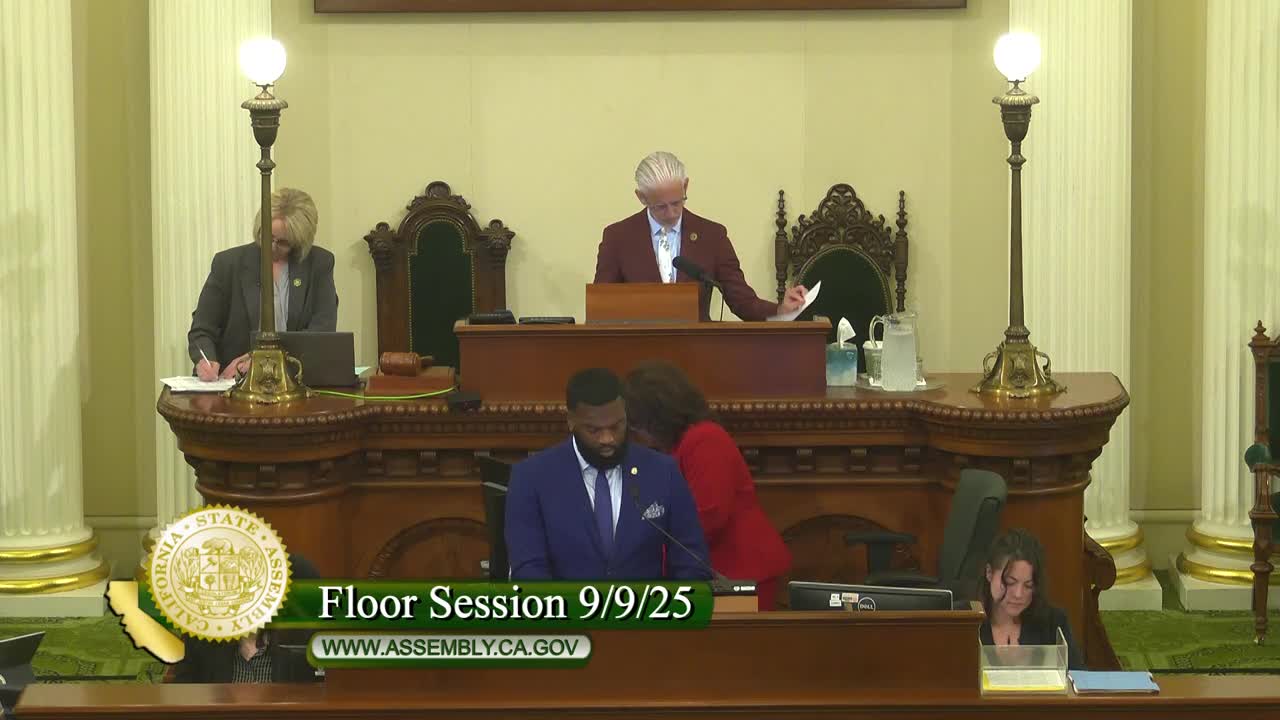 2MIN
Assembly Floor
 27MIN
Assembly Standing Committee on Public Safety
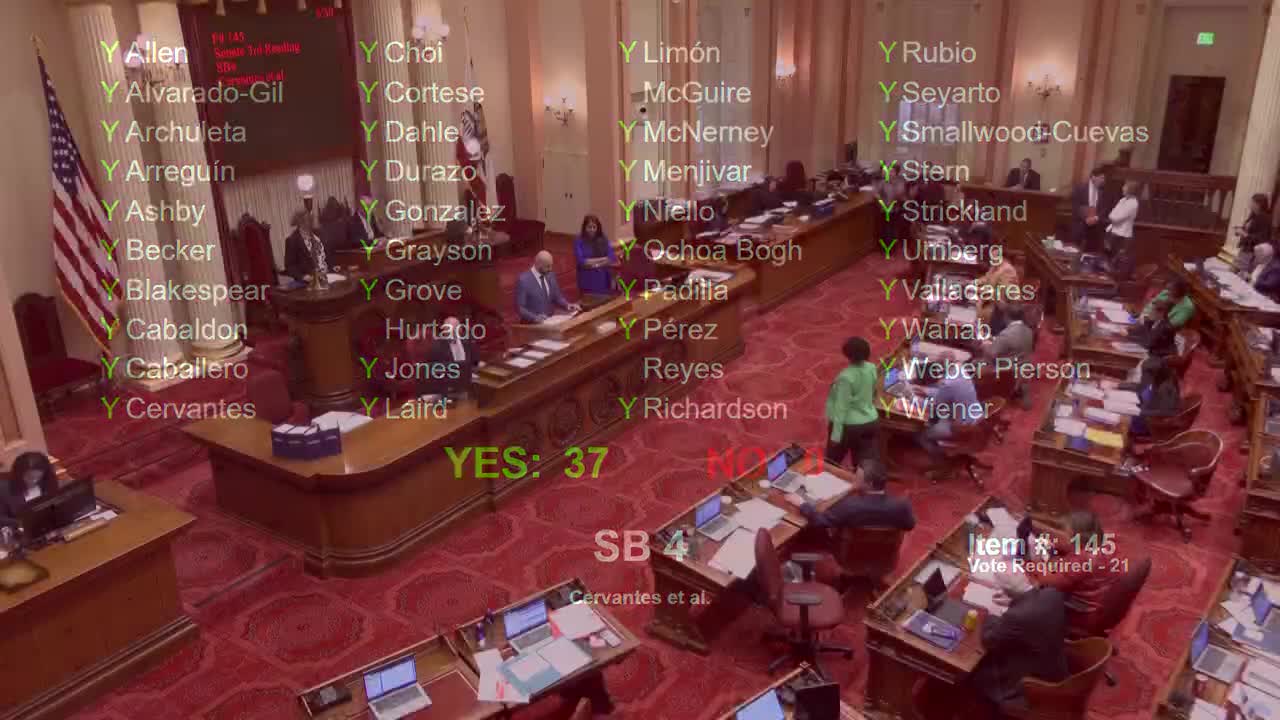 2MIN
Senate Floor
 41SEC
Senate Standing Committee on Appropriations
 35MIN
Senate Standing Committee on Public Safety
Bill Author

Bill Co-Author(s):