SB 2: Low-carbon fuel standard: regulations.
- Session Year: 2025-2026
- House: Senate
- Latest Version Date: 2025-03-12
Current Status:
Failed
(2026-02-02: Returned to Secretary of Senate pursuant to Joint Rule 56.)
Introduced
In Committee
Awaiting First Chamber Vote
Passed First Chamber
In Committee
Awaiting Second Chamber Vote
Passed Second Chamber
Enacted
The California Global Warming Solutions Act of 2006 establishes the State Air Resources Board as the state agency responsible for monitoring and regulating sources emitting greenhouse gases. The act requires the state board to adopt rules and regulations to achieve the maximum technologically feasible and cost-effective greenhouse gas emissions reductions to ensure that the statewide greenhouse gas emissions are reduced to at least 40% below the statewide greenhouse gas emissions limit, as defined, no later than December 31, 2030. Pursuant to the act, the state board has adopted the Low-Carbon Fuel Standard regulations.
This bill would void specified amendments to the Low-Carbon Fuel Standard regulations adopted by the state board on November 8, 2024. 2024, or as subsequently adopted, as specified.
This bill would declare that it is to take effect immediately as an urgency statute.
The California Global Warming Solutions Act of 2006 establishes the State Air Resources Board as the state agency responsible for monitoring and regulating sources emitting greenhouse gases. The act requires the state board to adopt rules and regulations to achieve the maximum technologically feasible and cost-effective greenhouse gas emissions reductions to ensure that the statewide greenhouse gas emissions are reduced to at least 40% below the statewide greenhouse gas emissions limit, as defined, no later than December 31, 2030. Pursuant to the act, the state board has adopted the Low-Carbon Fuel Standard regulations.
This bill would void specified amendments to the Low-Carbon Fuel Standard regulations adopted by the state board on November 8, 2024.
This bill would declare that it is to take effect immediately as an urgency statute.
Notwithstanding any other law, the final regulation order of the state board to amend the Low-Carbon Fuel Standard regulations (Subarticle 7 (commencing with Section 95480) of Article 4 of Subchapter 10 of Chapter 1 of Division 3 of Title 17 of the California Code of Regulations) that adopts Sections 95486.3, 95486.4, and 95491.2 of, and amends Sections 95480, 95481, 95482, 95483, 95483.1, 95483.2, 95483.3, 95484, 95485, 95486, 95486.1, 95486.2, 95487, 95488, 95488.1, 95488.2, 95488.3, 95488.4, 95488.5, 95488.6, 95488.7, 95488.8, 95488.9, 95488.10, 95489, 95490, 95491, 95491.1, 95495, 95500, 95501, 95502, and 95503 of of, Title 17 of the California Code of Regulations, as adopted on November 8, 2024, or as that final regulation order is subsequently rewritten and adopted by the state board in response to the Office of Administrative Laws Notice of Disapproval of Regulatory Action in OAL Matter Number 2025-0103-01, is hereby void.
SEC. 2.This act is an urgency statute necessary for the immediate preservation of the public peace, health, or safety within the meaning of Article IV of the California Constitution and shall go into immediate effect. The facts constituting the necessity are:
Californians need immediate relief from unnecessarily high gasoline prices that will be driven even higher by recent amendments to the Low-Carbon Fuel Standard regulations. California consistently leads the nation with the highest gasoline prices, largely driven by excessive government taxes, fees, and regulations, and it is estimated that these recent amendments to the Low-Carbon Fuel Standard regulations will increase the cost of a gallon of gasoline by sixty-five cents ($0.65) to eighty-five cents ($0.85). This will worsen the current affordability crisis and decimate our economy.
Notwithstanding any other law, the final regulation order of the state board to amend the Low-Carbon Fuel Standard regulations (Subarticle 7 (commencing with Section 95480) of Article 4 of Subchapter 10 of Chapter 1 of Division 3 of Title 17 of the California Code of Regulations) that amends Sections 95481, 95482, 95483, 95483.1, 95483.2, 95483.3, 95484, 95485, 95486, 95486.1, 95486.2, 95487, 95488, 95488.1, 95488.2, 95488.3, 95488.4, 95488.5, 95488.6, 95488.7, 95488.8, 95488.9, 95488.10, 95489, 95490, 95491, 95491.1, 95495, 95500, 95501, 95502, and 95503 of Title 17 of the California Code of Regulations, as adopted on November 8, 2024, is hereby void.
SEC. 2.This act is an urgency statute necessary for the immediate preservation of the public peace, health, or safety within the meaning of Article IV of the California Constitution and shall go into immediate effect. The facts constituting the necessity are:
Californians need immediate relief from unnecessarily high gasoline prices that will be driven even higher by recent amendments to the Low-Carbon Fuel Standard regulations. California consistently leads the nation with the highest gasoline prices, largely driven by excessive government taxes, fees, and regulations, and it is estimated that these recent amendments to the Low-Carbon Fuel Standard regulations will increase the cost of a gallon of gasoline by sixty-five cents ($0.65) to eighty-five cents ($0.85). This will worsen the current affordability crisis and decimate our economy.
CORRECTIONS: HeadingLine 2.|
Date
|
Status
|
|---|---|
| Feb 2, 2026 | Returned to Secretary of Senate pursuant to Joint Rule 56. |
| Mar 19, 2025 | March 19 set for first hearing. Failed passage in committee. (Ayes 3. Noes 2. Page 420.) Reconsideration granted. |
| Mar 12, 2025 | From committee with author's amendments. Read second time and amended. Re-referred to Com. on E.Q. |
| Mar 7, 2025 | Set for hearing March 19. |
| Jan 29, 2025 | Referred to Com. on E.Q. |
| Dec 3, 2024 | (Corrected December 12). |
| Dec 3, 2024 | From printer. May be acted upon on or after January 2. |
| Dec 2, 2024 | Introduced. Read first time. To Com. on RLS. for assignment. To print. |
|
Date
|
Description
|
Location
|
Votes
|
|
|---|---|---|---|---|
| Mar 19, 2025 | The committee on EEP recommend that the measure be PASSED, UNAMENDED. | Senate Standing Committee on Environmental Quality |
Passed |
|
| Mar 19, 2025 | Do pass, but first be re-referred to the Committee on [Appropriations] | Senate Standing Committee on Environmental Quality |
Failed |
This list shows positions taken on this bill by organizations on the date displayed, which is linked to the original source.
Positions by individuals are not included.
|
Organization
|
Position
|
Date
|
|---|---|---|
| Agricultural Energy Consumers Association | ** Against | |
| American Biogas Council | ** Against | |
| Anew Climate LLC | ** Against | |
| Ava Community Energy | ** Against | |
| Bioenergy Association of California | ** Against | |
| Bioferm | ** Against | |
| California Advanced Biofuels Alliance | ** Against | |
| California Electric Transportation Coalition | ** Against | |
| California Hydrogen Business Council | ** Against | |
| California Hydrogen Coalition | ** Against | |
| California Renewable Transportation Alliance | ** Against | |
| Calstart | ** Against | |
| Center For Environmental Health | ** Against | |
| Center for Sustainable Energy | ** Against | |
| Clean Energy | ** Against | |
| Clean Fuels Alliance America | ** Against | |
| Coalition For Renewable Natural Gas | ** Against | |
| Digester Doc LLC | ** Against | |
| Electric Vehicle Charging Association | ** Against | |
| Electrochaea Corporation | ** Against | |
| Ev Realty | ** Against | |
| Ghi Energy, LLC | ** Against | |
| Green Hydrogen Coalition | ** Against | |
| H Cycle, LLC | ** Against | |
| Highland Electric Fleets | ** Against | |
| Honda North America Inc. | ** Against | |
| LF Bioenergy | ** Against | |
| National Federation Of Independent Business | ** Support | |
| Pacific Gas And Electric Company And Its Affiliated Entities | ** Against | |
| Plug In America | ** Against | |
| Ride | ** Against | |
| San Diego Gas and Electric Company | ** Against | |
| Smart Policy Group | ** Against | |
| Southern California Edison | ** Against | |
| The Lion Electric Co. | ** Against | |
| The Transport Project | ** Against | |
| U.S. Energy | ** Against | |
| volvo group north america | ** Against | |
| Weavegrid | ** Against | |
| Wm | ** Against | |
| World Energy | ** Against |
SENATE COMMITTEE ON ENVIRONMENTAL QUALITY
Senator Blakespear, Chair
2025 - 2026 Regular
Bill No: SB 2
Author: | Jones | ||
Version: | 3/12/2025 | Hearing Date: | 3/19/2025 |
Urgency: | Yes | Fiscal: | Yes |
Consultant: | Eric Walters | ||
SUBJECT: Low-carbon fuel standard: regulations
DIGEST: This bill voids amendments the California Air Resources Board made to the Low-Carbon Fuel Standard in November of 2024.
ANALYSIS:
Existing law:
- Authorizes, under AB 32 (Nunez, Chapter 488, Statutes of 2006), the California Air Resources Board (CARB) to, among other things, publish a list of discrete early action greenhouse gas (GHG) emission reduction measures that could be implemented before the adoption of the state’s cap-and-trade program. (Health and Safety Code § 38500 et seq.)
- Defines “market-based compliance mechanism” to mean either: (1) A system of market-based declining annual aggregate emissions limitations for sources or categories of sources that emit GHGs; or GHG emissions exchanges, banking, credits, and other transactions, governed by rules and protocols established by CARB, that result in the same GHG emission reductions, over the same time period, as direct compliance with a GHG emission limit or emission reduction measure adopted by CARB. (HSC § 38505)
- Requires CARB to, prior to the inclusion of a market-based compliance mechanism in the regulations adopted pursuant to AB 32: (1) Consider the potential for direct, indirect, and cumulative emission impacts from these mechanisms, including localized impacts in communities that are already adversely impacted by air pollution; (2) Design any market-based compliance mechanism to prevent any increase in the emissions of toxic air contaminants or criteria air pollutants; and (3) Maximize additional environmental and economic benefits for California, as appropriate. (HSC § 38570)
This bill would void the amendments CARB made to the LCFS regulations on November 8, 2024.
Background
- What is the Low Carbon Fuel Standard (LCFS)? The LCFS is designed to encourage the use of cleaner low-carbon transportation fuels in California, encourage the production of those fuels, and therefore, reduce GHG emissions and decrease petroleum dependence in the transportation sector.
The LCFS standards are expressed in terms of the “carbon intensity” (CI) of gasoline and diesel fuel and their respective substitutes. The program is based on the principle that each fuel has “life cycle” GHG emissions that include CO2, CH4, N2O, and other GHG contributors. This life cycle assessment (or “pathway”) examines the GHG emissions associated with the production, transportation, and use of a given fuel. The life cycle assessment includes direct emissions associated with producing, transporting, and using the fuels, as well as significant indirect effects on GHG emissions, such as changes in land use for some biofuels.
The carbon intensity scores assessed for each fuel produced are compared to a declining CI benchmark for each year. Low carbon fuels with a CI below the benchmark generate credits (tradeable compliance instruments), while fuels above the CI benchmark generate deficits they must purchase credits to cover. This effectively means that producers of fuels with higher CIs are subsidizing the production of lower-carbon fuels. One credit is equal to one ton of CO2-equivalent GHG emission reductions from a low-carbon fuel being delivered.
The original LCFS set a goal of reducing the CI of fuels in the state to 10% below 2010 levels by 2020. Since the original LCFS was adopted, CARB set a new goal to reduce the CI of fuels in the state to 20% below 2010 levels by 2030. CARB is currently in the process of setting an even more ambitious target because of the extent to which the program is exceeding expectations for overall reduction of fuel CI. - A brief history of the LCFS. AB 32 (Nunez, 2006) is best known today as the bill that set the state’s 2020 GHG emission reduction goal (i.e. achieving 1990 levels by 2020) and authorized CARB to enact a “market-based compliance mechanism” (i.e. cap-and-trade). Importantly, due to lingering concerns about cap-and-trade being ineffective at rapid, localized emission and pollution reductions, AB 32 also directed CARB to devise so-called “early action GHG emission reduction measures” that could be implemented before the state’s cap-and-trade program was established.
Although AB 32 did not explicitly contemplate an LCFS, the bill represents the only statutory authority or direction that has been provided for the program.
AB 32 was signed by Governor Schwarzenegger on September 27, 2006, and in June of 2007, CARB adopted the first three (of a total of nine) discrete early action measures pursuant to AB 32, including the LCFS. Since its adoption in 2009, the LCFS has been amended (2011), readopted (2015), amended again (2018), and is currently in the process of being amended once more (2024-2025) all through actions initiated and taken solely by CARB.
- Legislating LCFS. As noted above, the “early action measures” called for in AB 32 are the only statutory authorities or directions provided by the Legislature regarding the LCFS. Between 2007 and today, 102 bills have referenced the LCFS in some form or another, and 22 of those have been signed into law. None of those chaptered bills made any substantial changes to the LCFS regulations; the Legislature has never provided statutory direction to CARB for how to implement LCFS.
- CARB’s November 2024 amendments. The latest amendments to the LCFS (and the subject of SB 2) were, after nearly eight hours of testimony, approved by the CARB Board on a 12-2 vote on November 8, 2024. Broadly speaking, the amendments, according to CARB’s Informative Digest provided with the proposed amendments[1], focused on:
- Increasing the stringency of the program to more aggressively decarbonize fuels and thereby reduce our dependence on fossil fuels;
- Strengthening the program’s equity provisions to promote investment in disadvantaged, low-income and rural communities;
- Supporting electric and hydrogen truck refueling;
- Incentivizing more production of clean fuels needed in the future, such as low-carbon hydrogen;
- Supporting methane emissions reductions and deploying biomethane for best uses across transportation; and
- Strengthening guardrails on crop-based fuels to prevent deforestation or other potential adverse impacts.
Within those general actions, however, many nuances and details were negotiated and discussed at length. In the end, while biofuel producers and some state climate advocates backed the changes, critics—including oil companies and consumer advocates—said the change would increase gasoline prices for Californians. Environmental groups also argued the policy would extend the production of oil and gas and prioritize fuels made from food crops and large dairy operations instead of encouraging a transition to electric vehicles (EVs). Nevertheless, a number of transportation electrification advocacy groups supported the amendments, citing the support for EVs the program does provide, even if they are not as substantial as those for low-carbon fuel-combusting vehicles. CARB’s environmental justice advisory committee had urged it to reject the revisions, citing an exemption for jet fuel producers and large subsidies for dairy methane projects, among other concerns.
The cost impacts of the amendments were particularly controversial in the discussions. In an initial analysis released last year, CARB said the changes could increase the price of gasoline by an average of 37 cents a gallon from 2024 through 2030. But the Board has since said models cannot accurately predict future fuel prices.
Notably, the Office of Administrative Law (OAL) must approve all regulations adopted by Californian regulatory agencies, and on February 18th, 2025, OAL issued a Notice of Disapproval of Regulatory Action stating the adopted regulations did not meet OAL requirements for clarity and correct procedure[2]. While this is not unprecedented, it is not common either. As of March 17, CARB is in the midst of the 120 days it has to revise the regulations to address OAL’s concerns, and so the amendments to the regulation have not yet taken effect.
Comments
- Purpose of Bill. According to the author, “California consumers face highest in the nation gas prices. According to the Public Policy Institute of California, Californians name the economy, including the cost of living, as the most important issue facing the state. With California gasoline already costing $1.50 above the national average, it is not reasonable at this time to ask Californians to take on additional expense at the pump. Nevertheless, on November 8, 2024, CARB adopted updates to its LCFS regulations that are set to dramatically increase the price of gasoline at the pump for California consumers. Multiple legislative requests for cost estimates were submitted to CARB but the Board released no such estimates. Academic projections anticipate that the point of sale price for California gasoline will increase by $0.65-$0.85 per gallon imminently. This bill will repeal the recent updates to CARB’s LCFS regulation and halt the impending, associated price hike on consumers while restoring the LCFS program to its previous iteration.”
- LCFS: Redistributing resources to reformulate our fuels. Fundamentally, the LCFS is about shifting money from high-carbon fuels to low-carbon ones. Increasing the costs of the former to subsidize the production of the latter makes intuitive sense as a way to discourage the continued use of fossil fuels and encourage the production of alternatives. However, the devil is in the details.
Gasoline has notoriously inelastic demand; increasing prices are slow to change demand patterns. Many people who have internal combustion engine (ICE) vehicles may have no alternative to driving for getting to work and other necessities. Moreover, non-ICE vehicles are often (for now) more costly, less available on the secondary market, and require either a significant investment or behavioral change to refuel. So when greater costs are imposed on gasoline producers, they are able to largely pass those costs onto consumers who are a fairly captive audience.
As for where the money generated by those costs goes, there is a further important nuance. Low-carbon fuel producers need not be in California to participate in the LCFS. In fact, according to CARB’s LCFS Data Dashboard[3], only 12.36% of liquid biofuels in the program were made in California in 2023 (the highest share it had been in 5 years). In other words, in 2023, nearly 88% of the liquid biofuel producers generating credits (and thus earning a subsidy funded by Californian gas buyers) were located outside of the state.
And while the minority of LCFS credit-generating fuels are produced in-state, those in-state fuels come with their own tradeoffs and considerations. The local health impacts of renewable natural gas production from dairy biomethane, for example, are striking and well-documented.[4] While producing lower-carbon fuels (such as renewable natural gas, renewable diesel, and ethanol) are in line with state goals, when they are produced in California they tend to be highly concentrated and the impacts of those operations on surrounding communities should not be discounted.
In short, LCFS makes fossil fuels more expensive to make low-carbon options less expensive. The extent to which those impacts are felt by fuel producers and Californians alike is hotly debated. Most of the low-carbon options are still liquid fuels, whose production and combustion are associated with air pollution effects (often concentrated in disadvantaged communities), and most of the low-carbon liquid fuel production subsidized by LCFS is done out-of-state, despite funds largely deriving from costs that are passed through to Californians. On one hand, LCFS is a multi-billion dollar climate program operated almost entirely outside the purview of the Legislature that affects fuel prices, local air pollution, and market-wide technological development. On the other hand, California is not switching to 100% non-combustion technologies tomorrow, and LCFS may represent one of the most effective tools at the state’s disposal to support zero-emission vehicle (ZEV) development and adoption, even if ZEVs are not the program’s central focus. The LCFS program is huge, complicated, and will shape California climate policy for decades to come. - What’s the fix? The November 2024 LCFS amendments increased the stringency of LCFS’s CI target and made other targeted and specific adjustments in an attempt to balance the costs and benefits of the program. By nullifying those amendments, SB 2 would maintain the status quo of LCFS as it has existed for the last six years. The program would continue to have cost impacts on Californians, just less so. The program would still support low-carbon combustion and non-combustion transportation fuel sources, just less so. CARB would still need to adjust the program to reflect evolving market realities as certain technologies take off and others languish, it just would not be able to use the amendments (several years in the making) that were adopted last year.
LCFS is not a perfect program. The Legislature may indeed wish to revisit the decisions that have been made by CARB that affect billions of dollars of climate investment paid by Californian consumers and redistribute them to a variety of in- and out-of-state producers of low-, zero-, and near-zero carbon fuels. However absent a larger and more comprehensive picture of how the Legislature wants CARB to administer the LCFS, SB 2 may be premature and reactive. The committee may wish to consider holding this measure and engaging in future conversations about the role of LCFS in the state’s climate policy portfolio.
Related/Prior Legislation
AB 12 (Wallis, 2025) is identical to this bill. It is currently awaiting hearing in the Assembly Natural Resources Committee.
SB 348 (Hurtado, 2025) would state the Legislature’s intent to make specified changes to the LCFS regulations. It is currently awaiting hearing in this committee.
AB 555 (Jackson, 2025) would require CARB to submit quarterly reports to the relevant policy committees of the Legislature regarding the impacts of LCFS (and other transportation fuel regulations) on California fuel prices. It is currently pending referral in the Assembly Rules Committee.
SOURCE:
Author
SUPPORT:
National Federation of Independent Business (NFIB)
6,459 Individuals
OPPOSITION:
Agricultural Energy Consumer Association
American Biogas Council
Anew Climate LLC
Ava Community Energy
Bioenergy Association of California
Bioferm
California Advanced Biofuels Alliance
California Electric Transportation Coalition
California Hydrogen Business Council
California Hydrogen Coalition
California Renewable Transportation Alliance
Calstart
Center for Environmental Health
Center for Sustainable Energy
Clean Energy
Clean Fuels Alliance America
Coalition for Renewable Natural Gas
Digester Doc LLC
Electric Vehicle Charging Association
Electrochaea Corporation
Ev Realty
Ghi Energy, LLC
Green Hydrogen Coalition
H Cycle, LLC
Highland Electric Fleets
Honda North America, INC.
Lf Bioenergy
Pacific Gas and Electric Company and Its Affiliated Entities
Plug in America
Ride
San Diego Gas and Electric Company
Smart Policy Group
Southern California Edison
The Lion Electric Co.
The Transport Project
U.s. Energy
Volvo Group North America
Weavegrid
Wm
World Energy
2 Individuals
-- END --
Updated Informative Digest: Proposed Amendments to the Low Carbon Fuel Standard. https://ww2.arb.ca.gov/sites/default/files/barcu/regact/2024/lcfs2024/uid.pdf ↑
DECISION OF DISAPPROVAL OF REGULATORY ACTION: OAL Matter Number: 2025-0103-01 https://ww2.arb.ca.gov/sites/default/files/barcu/regact/2024/lcfs2024/disapproval_decision.pdf ↑
https://ww2.arb.ca.gov/resources/documents/lcfs-data-dashboard. Accessed 3/3/25 ↑
California just set rules that trade short-term climate gain for long-term health and safety. Dean Florez and Diane Takvorian for the LA Times. https://www.latimes.com/opinion/story/2024-11-20/methane-air-quality-california-central-valley-dairy-emissions ↑
Discussed in Hearing
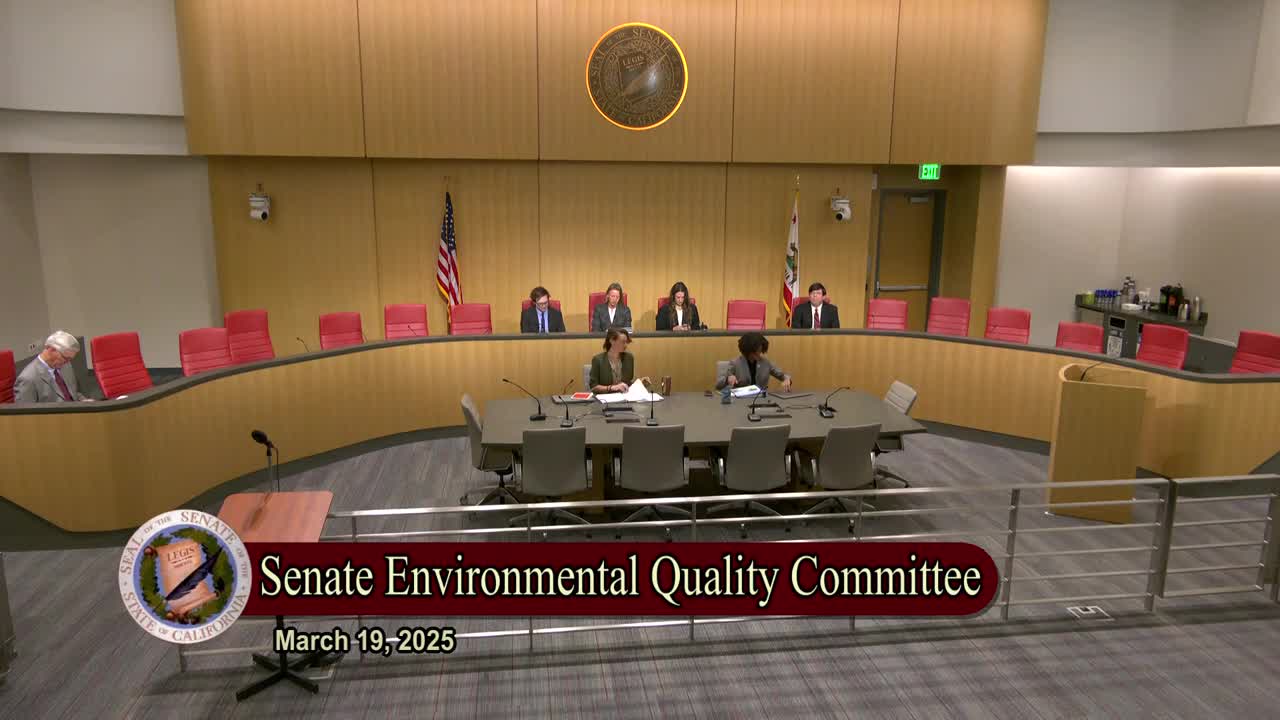 32MIN
Senate Standing Committee on Environmental Quality
Bill Author