SB 236: Cosmetics: chemical hair relaxers.
- Session Year: 2025-2026
- House: Senate
- Latest Version Date: 2025-10-11
Current Status:
Passed
(2025-10-11: Chaptered by Secretary of State. Chapter 598, Statutes of 2025.)
Introduced
In Committee
Awaiting First Chamber Vote
Passed First Chamber
In Committee
Awaiting Second Chamber Vote
Passed Second Chamber
Enacted
Existing law prohibits a person or entity from manufacturing, selling, delivering, holding, or offering for sale in commerce any cosmetic product that contains any of several specified intentionally added ingredients except under specified circumstances.
This bill, the Combating Unsafe ReLaxers (C.U.R.L.) Act, would prohibit any person from manufacturing, distributing, selling, or offering for sale in the state any hair relaxer product, as defined, that contains any of a specified list of intentionally added ingredients. The bill would require the Department of Toxic Substances Control to adopt regulations on or before January 1, 2030, as specified, for the purposes of implementing, interpreting, enforcing, or making specific these provisions. The bill would require the department to identify and publish on its internet website, on or before January 1, 2028, appropriate third-party accreditations for laboratories for the testing of the ingredients described above, and would authorize the department to publish on its internet website a list of accepted testing methods for the testing of hair relaxer products for the presence of those ingredients. The bill would authorize the department to request, and would require a manufacturer of a hair relaxer product to provide upon request, documentation, including test results, to demonstrate compliance with the provisions described above. The bill would authorize the department to test hair relaxer products in order to support enforcement of the provisions described above. The bill would require the department to issue a notice of violation of the provisions described above under specified circumstances and would require the notice to specify the nature of the violation and would authorize the department to either assess a specified penalty, require compliance with specified law, or both. The bill would make a violation of these provisions punishable by administrative or civil penalties, as specified, and would authorize the Attorney General, on behalf of the department or on behalf of the people of the state at the request of the department, to bring an action to enforce these provisions. The bill would create, and would require all moneys collected from penalties to be deposited in, the C.U.R.L. Act Fund. The bill would make the departments duties to initiate, implement, or enforce any of these requirements contingent upon sufficient funds in the Toxic Substances Control Account, as determined by the Department of Finance, and an appropriation by the Legislature for the purposes of implementing and enforcing the requirements. The bill would, upon an appropriation by the Legislature, authorize the Department of Finance, if it determines there are sufficient funds in the Toxic Substances Control Account to finance the development of the regulations and the startup costs of the Department of Toxic Substances Controls activities required by the bill, to loan funds to the department from the account to carry out the activities required by the bill until the C.U.R.L. Act Fund contains revenues sufficient to fund the departments reasonable costs of implementing the bill and to reimburse any outstanding loans made from the account used to finance the development of the regulations and the startup costs of the departments activities.
Existing law prohibits a person or entity from manufacturing, selling, delivering, holding, or offering for sale in commerce any cosmetic product that contains any of several specified intentionally added ingredients except under specified circumstances.
This bill, the Combating Unsafe ReLaxers (C.U.R.L.) Act, would prohibit any person from manufacturing, distributing, selling, or offering for sale in the state any hair relaxer product, as defined, that contains any of a specified list of intentionally added ingredients. The bill would require the Department of Toxic Substances Control to adopt regulations on or before January 1, 2030, as specified, for the purposes of implementing, interpreting, enforcing, or making specific these provisions. The bill would require the department to identify and publish on its internet website, on or before January 1, 2028, appropriate third-party accreditations for laboratories for the testing of the ingredients described above, and would authorize the department to publish on its internet website a list of accepted testing methods for the testing of hair relaxer products for the presence of those ingredients. The bill would require a manufacturer of hair relaxer products to, on or before July 1, 2030, provide to the department the name and a description of each of their hair relaxer products and a statement of compliance certifying that each of their hair relaxer products are in compliance with specified law. The bill would authorize the department to request, and would require a manufacturer of a hair relaxer product to provide upon request, documentation, including test results, to demonstrate compliance with the provisions described above. The bill would authorize the department to test hair relaxer products in order to support enforcement of the provisions described above. The bill would require the department to issue a notice of violation of the provisions described above under specified circumstances and would require the notice to specify the nature of the violation and would authorize the department to either assess a specified penalty, require compliance with specified law, or both. The bill would make a violation of these provisions punishable by administrative or civil penalties, as specified, and would authorize the Attorney General, on behalf of the department or on behalf of the people of the state at the request of the department, to bring an action to enforce these provisions. The bill would create, and would require all moneys collected from penalties to be deposited in, the C.U.R.L. Act Fund. The bill would make the departments duties to initiate, implement, or enforce any of these requirements contingent upon sufficient funds in the Toxic Substances Control Account, as determined by the Department of Finance, and an appropriation by the Legislature for the purposes of implementing and enforcing the requirements. The bill would, upon an appropriation by the Legislature, authorize the Department of Finance, if it determines there are sufficient funds in the Toxic Substances Control Account to finance the development of the regulations and the startup costs of the Department of Toxic Substances Controls activities required by the bill, to loan funds to the department from the account to carry out the activities required by the bill until the C.U.R.L. Act Fund contains revenues sufficient to fund the departments reasonable costs of implementing the bill and to reimburse any outstanding loans made from the account used to finance the development of the regulations and the startup costs of the departments activities.
Existing law prohibits a person or entity from manufacturing, selling, delivering, holding, or offering for sale in commerce any cosmetic product that contains any of several specified intentionally added ingredients except under specified circumstances.
This bill, the C.U.R.L. Combating Unsafe ReLaxers (C.U.R.L.) Act, would prohibit any person from manufacturing, distributing, selling, or offering for sale in the state any hair relaxer product, as defined, that contains any of a specified list of intentionally added ingredients. The bill would require the Department of Toxic Substances Control to adopt regulations on or before January 1, 2030, as specified, for the purposes of implementing, interpreting, enforcing, or making specific these provisions. The bill would require the department to identify and publish on its internet website, on or before January 1, 2028, appropriate third-party accreditations for laboratories and a list of accepted testing methods for testing for the ingredients described above. for the testing of the ingredients described above, and would authorize the department to publish on its internet website a list of accepted testing methods for the testing of hair relaxer products for the presence of those ingredients. The bill would require a manufacturer of hair relaxer products to register with the department, on or before July 1, 2030, and to provide to the department specified information and a registration fee. to, on or before July 1, 2030, provide to the department the name and a description of each of their hair relaxer products and a statement of compliance certifying that each of their hair relaxer products are in compliance with specified law. The bill would authorize the department to request, and would require a manufacturer of a hair relaxer product to provide upon request, documentation, including test results, to demonstrate compliance with the provisions described above. The bill would authorize the department to test hair relaxer products in order to support enforcement of the provisions described above. The bill would require the department to issue a notice of violation of the provisions described above under specified circumstances and would require the notice to specify the nature of the violation and to comply with specified provisions of law. would authorize the department to either assess a specified penalty, require compliance with specified law, or both. The bill would make a violation of these provisions punishable by administrative or civil penalties, as specified, and would authorize the Attorney General, on behalf of the department or on behalf of the people of the state at the request of the department, to bring an action to enforce these provisions. The bill would create, and would require all moneys collected from penalties to be deposited in, the C.U.R.L. Act Fund. The bill would authorize the department to create the C.U.R.L. Act Registration Fee Account within the C.U.R.L. Act Fund. The bill would make the departments duties to initiate, implement, or enforce any of these requirements contingent upon sufficient funds in the Toxic Substances Control Account, as determined by the Department of Finance, and an appropriation by the Legislature for the purposes of implementing and enforcing the requirements. The bill would, upon an appropriation by the Legislature, authorize the Department of Finance, if it determines there are sufficient funds in the Toxic Substances Control Account to finance the development of the regulations and the startup costs of the Department of Toxic Substances Controls activities required by the bill, to loan funds to the department from the account to carry out the activities required by the bill until the C.U.R.L. Act Fund contains revenues sufficient to fund the departments reasonable costs of implementing the bill and to reimburse any outstanding loans made from the account used to finance the development of the regulations and the startup costs of the departments activities.
Existing law prohibits a person or entity from manufacturing, selling, delivering, holding, or offering for sale in commerce any cosmetic product that contains any of several specified intentionally added ingredients except under specified circumstances.
This bill, the C.U.R.L. Act, would prohibit any person from manufacturing, distributing, selling, or offering for sale in the state any hair relaxer product, as defined, that contains any of a specified list of intentionally added ingredients for which the Department of Toxic Substances Control has identified accepted testing methods, as specified. ingredients. The bill would require the department Department of Toxic Substances Control to adopt regulations on or before January 1, 2030, as specified, for the purposes of implementing, interpreting, enforcing, or making specific these provisions. The bill would require the department to identify and publish on its internet website, on or before January 1, 2028, appropriate third-party accreditations for laboratories and a list of accepted testing methods for testing for the ingredients described above. The bill would require a manufacturer of hair relaxer products to register with the department, on or before July 1, 2030, and to provide to the department specified information and a registration fee. The bill would authorize the department to request, and would require a manufacturer of a hair relaxer product to provide upon request, documentation, including test results, to demonstrate compliance with the provisions described above. The bill would authorize the department to test hair relaxer products in order to support enforcement of the provisions described above. The bill would require the department to issue a notice of violation of the provisions described above under specified circumstances. circumstances and would require the notice to specify the nature of the violation and to comply with specified provisions of law. The bill would make a violation of these provisions punishable by administrative or civil penalties, as specified, and would authorize the Attorney General, on behalf of the department or on behalf of the people of the state at the request of the department, to bring an action to enforce these provisions. The bill would create, and would require all moneys collected from penalties to be deposited in, the C.U.R.L. Act Fund. The bill would authorize the department to create the C.U.R.L. Act Registration Fee Account within the C.U.R.L. Act Fund. The bill would make the departments duties to initiate, implement, or enforce any of these requirements contingent upon sufficient funds in the Toxic Substances Control Account, as determined by the Department of Finance, and an appropriation by the Legislature for the purposes of implementing and enforcing the requirements. The bill would, upon an appropriation by the Legislature, authorize the Department of Finance, if it determines there are sufficient funds in the Toxic Substances Control Account to finance the development of the regulations and the startup costs of the Department of Toxic Substances Controls activities required by the bill, to loan funds to the department from the account to carry out the activities required by the bill until the C.U.R.L. Act Fund contains revenues sufficient to fund the departments reasonable costs of implementing the bill and to reimburse any outstanding loans made from the account used to finance the development of the regulations and the startup costs of the departments activities.
Existing law prohibits a person or entity from manufacturing, selling, delivering, holding, or offering for sale in commerce any cosmetic product that contains any of several specified intentionally added ingredients except under specified circumstances.
This bill, the C.U.R.L. Act, would, commencing January 1, 2030, would prohibit any person from manufacturing, distributing, selling, or offering for sale in the state any hair relaxer, as defined, that contains specified chemicals. relaxer product, as defined, that contains any of a specified list of intentionally added ingredients for which the Department of Toxic Substances Control has identified accepted testing methods, as specified. The bill would require the Department of Toxic Substances Control department to adopt regulations on or before January 1, 2030, as specified, for the purposes of implementing, interpreting, enforcing, or making specific these provisions. The bill would require the department to identify and publish on its internet website, on or before January 1, 2028, appropriate third-party accreditations for laboratories and a list of accepted testing methods for testing for the chemicals ingredients described above. The bill would require a manufacturer of hair relaxer products to register with the department, on or before July 1, 2030, and to provide to the department specified information and a registration fee. The bill would authorize the department to request, and would require a manufacturer of a hair relaxer product to provide upon request, documentation, including test results, to demonstrate compliance with the provisions described above. The bill would authorize the department to test hair relaxer products in order to support enforcement of the provisions described above. The bill would require the department to issue a notice of violation of the above provisions described above under specified circumstances. The bill would make a violation of these provisions punishable by administrative or civil penalties, as specified, and would authorize the Attorney General, on behalf of the department or on behalf of the people of the state at the request of the department, to bring an action to enforce these provisions. The bill would create, and would require all moneys collected from penalties to be deposited in, the C.U.R.L. Act Fund. The bill would authorize the department to create the C.U.R.L. Act Registration Fee Account within the C.U.R.L. Act Fund. The bill would make the departments duties to initiate, implement, or enforce any of these requirements contingent upon sufficient funds in the Toxic Substances Control Account, as determined by the Department of Finance, and an appropriation by the Legislature for the purposes of implementing and enforcing the requirements. The bill would, upon an appropriation by the Legislature, authorize the Department of Finance, if it determines there are sufficient funds in the Toxic Substances Control Account to finance the development of the regulations and the startup costs of the Department of Toxic Substances Controls activities required by the bill, to loan funds to the department from the account to carry out the activities required by the bill until the C.U.R.L. Act Fund contains revenues sufficient to fund the departments reasonable costs of implementing the bill and to reimburse any outstanding loans made from the account used to finance the development of the regulations and the startup costs of the departments activities.
Existing law prohibits a person or entity from manufacturing, selling, delivering, holding, or offering for sale in commerce any cosmetic product that contains any of several specified intentionally added ingredients except under specified circumstances.
This bill, the C.U.R.L. Act, would, commencing January 1, 2030, prohibit any person from manufacturing, distributing, selling, or offering for sale in the state any hair relaxer, as defined, that contains specified chemicals. The bill would require the Department of Toxic Substances Control to adopt regulations on or before January 1, 2030, as specified, for the purposes of implementing, interpreting, enforcing, or making specific these provisions. The bill would require the department to publish on its internet website, on or before January 1, 2028, a list of accepted testing methods for testing for the chemicals described above. The bill would require a manufacturer of hair relaxer products to register with the department, on or before July 1, 2030, and to provide to the department specified information and a registration fee. The bill would require the department to issue a notice of violation of the above provisions under specified circumstances. The bill would make a violation of these provisions punishable by administrative or civil penalties, as specified, and would authorize the Attorney General, on behalf of the department or on behalf of the people of the state at the request of the department, to bring an action to enforce these provisions. The bill would create, and would require all moneys collected from penalties to be deposited in, the C.U.R.L. Act Fund. The bill would authorize the department to create the C.U.R.L. Act Registration Fee Account within the C.U.R.L. Act Fund and would require the registration fees described above to be deposited in the account. Fund. The bill would make the departments duties to initiate, implement, or enforce any of these requirements contingent upon sufficient funds in the Toxic Substances Control Account, as determined by the Department of Finance, and an appropriation by the Legislature for the purposes of implementing and enforcing the requirements. The bill would, upon an appropriation by the Legislature, authorize the Department of Finance, if it determines there are sufficient funds in the Toxic Substances Control Account to finance the development of the regulations and the startup costs of the Department of Toxic Substances Controls activities required by the bill, to loan funds to the department from the account to carry out the activities required by the bill until the C.U.R.L. Act Fund contains revenues sufficient to fund the departments reasonable costs of implementing the bill and to reimburse any outstanding loans made from the account used to finance the development of the regulations and the startup costs of the departments activities.
Existing law prohibits a person or entity from manufacturing, selling, delivering, holding, or offering for sale in commerce any cosmetic product that contains any of several specified intentionally added ingredients except under specified circumstances.
This bill bill, the C.U.R.L. Act, would, commencing January 1, 2030, prohibit any person from manufacturing, distributing, selling, or offering for sale in the state any hair relaxer, as defined, that contains specified chemicals in concentrations exceeding specified percentages. chemicals. The bill would require the Department of Toxic Substances Control to adopt regulations on or before January 1, 2030, as specified, for the purposes of implementing, interpreting, enforcing, or making specific these provisions. The bill would require the department to publish on its internet website, on or before January 1, 2028, a list of accepted testing methods for testing for the chemicals described above. The bill would require a manufacturer of hair relaxer products to register with the department, on or before July 1, 2030, and to provide to the department specified information and a registration fee. The bill would require the department to issue a notice of violation of the above provisions under specified circumstances. The bill would make a violation of these provisions punishable by administrative or civil penalties, as specified, and would authorize the Attorney General, on behalf of the department or on behalf of the people of the state at the request of the department, to bring an action to enforce these provisions. The bill would create, and would require all moneys collected from penalties to be deposited in, the C.U.R.L. Act Fund. The bill would create the C.U.R.L. Act Registration Fee Account within the C.U.R.L. Act Fund and would require the registration fees described above to be deposited in the account. The bill would make the departments duties to initiate, implement, or enforce any of these requirements contingent upon sufficient funds in the Toxic Substances Control Account, as determined by the Department of Finance, and an appropriation by the Legislature for the purposes of implementing and enforcing the requirements. The bill would, upon an appropriation by the Legislature, authorize the Department of Finance, if it determines there are sufficient funds in the Toxic Substances Control Account to finance the development of the regulations and the startup costs of the Department of Toxic Substances Controls activities required by the bill, to loan funds to the department from the account to carry out the activities required by the bill until the C.U.R.L. Act Fund contains revenues sufficient to fund the departments reasonable costs of implementing the bill and to reimburse any outstanding loans made from the account used to finance the development of the regulations and the startup costs of the departments activities.
Existing law, the Sherman Food, Drug, and Cosmetic Law, prohibits the manufacture, sale, delivery, holding, or offer for sale of adulterated foods, beverages, or cosmetics. Existing law prescribes when a cosmetic is adulterated, including when it bears or contains a poisonous or deleterious substance that may render it injurious to users under the conditions of use prescribed in the labeling or advertisement of the cosmetic, or under customary or usual conditions of use. Existing law defines cosmetic to mean, for the purposes of the law, any article, other than soap, or its components, intended to be rubbed, poured, sprinkled, or sprayed on, introduced into, or otherwise applied to, the human body, or any part of the human body, for cleansing, beautifying, promoting attractiveness, or altering the appearance. law prohibits a person or entity from manufacturing, selling, delivering, holding, or offering for sale in commerce any cosmetic product that contains any of several specified intentionally added ingredients except under specified circumstances.
This bill would state that it is the intent of the Legislature to enact legislation relating to toxic substances in chemical hair relaxers.This bill would, commencing January 1, 2030, prohibit any person from manufacturing, distributing, selling, or offering for sale in the state any hair relaxer, as defined, that contains specified chemicals in concentrations exceeding specified percentages. The bill would require the Department of Toxic Substances Control to adopt regulations on or before January 1, 2030, as specified, for the purposes of implementing, interpreting, enforcing, or making specific these provisions. The bill would require the department to publish on its internet website, on or before January 1, 2028, a list of accepted testing methods for testing for the chemicals described above. The bill would require a manufacturer of hair relaxer products to register with the department, on or before July 1, 2030, and to provide to the department specified information and a registration fee. The bill would require the department to issue a notice of violation of the above provisions under specified circumstances. The bill would make a violation of these provisions punishable by administrative or civil penalties, as specified, and would authorize the Attorney General, on behalf of the department or on behalf of the people of the state at the request of the department, to bring an action to enforce these provisions. The bill would create, and would require all moneys collected from penalties to be deposited in, the C.U.R.L. Act Fund. The bill would make the departments duties to initiate, implement, or enforce any of these requirements contingent upon sufficient funds in the Toxic Substances Control Account, as determined by the Department of Finance, and an appropriation by the Legislature for the purposes of implementing and enforcing the requirements. The bill would, upon an appropriation by the Legislature, authorize the Department of Finance, if it determines there are sufficient funds in the Toxic Substances Control Account to finance the development of the regulations and the startup costs of the Department of Toxic Substances Controls activities required by the bill, to loan funds to the department from the account to carry out the activities required by the bill until the C.U.R.L. Act Fund contains revenues sufficient to fund the departments reasonable costs of implementing the bill and to reimburse any outstanding loans made from the account used to finance the development of the regulations and the startup costs of the departments activities.
Existing law, the Sherman Food, Drug, and Cosmetic Law, prohibits the manufacture, sale, delivery, holding, or offer for sale of adulterated foods, beverages, or cosmetics. Existing law prescribes when a cosmetic is adulterated, including when it bears or contains a poisonous or deleterious substance that may render it injurious to users under the conditions of use prescribed in the labeling or advertisement of the cosmetic, or under customary or usual conditions of use. Existing law defines cosmetic to mean, for the purposes of the law, any article, other than soap, or its components, intended to be rubbed, poured, sprinkled, or sprayed on, introduced into, or otherwise applied to, the human body, or any part of the human body, for cleansing, beautifying, promoting attractiveness, or altering the appearance.
This bill would state that it is the intent of the Legislature to enact legislation relating to toxic substances in chemical hair relaxers.
This act shall be known, and may be cited, as the Combating Unsafe ReLaxers (C.U.R.L.) Act.
SEC. 2.Chapter 14.5 (commencing with Section 108985) is added to Part 3 of Division 104 of the Health and Safety Code, to read:14.5.Hair Relaxers108985.For the purposes of this chapter, the following terms have the following meanings:
(a)Department means the Department of Toxic Substances Control.
(b)Hair relaxer product means a cosmetic product, as defined in Section 108982, that is sold either as an individual component or as a kit with multiple components and is designed to permanently straighten curly, coiled, or tightly coiled hair by breaking the disulfide bonds found within a persons hair.
108985.1.On or before January 1, 2030, the department shall adopt regulations to implement, interpret, enforce, or make specific this chapter.
108985.2.(a)(1)On or before January 1, 2028, the department shall identify and publish on its internet website appropriate third-party accreditations for laboratories for the testing of hair relaxer products for the presence of all of the following intentionally added ingredients:
(A)Formaldehyde (CAS no. 50-00-0).
(B)Isobutylparaben (CAS no. 4247-02-3).
(C)Isopropylparaben (CAS no. 4191-73-5).
(D)Cyclohexylamine (CAS no. 108-91-8).
(E)Cyclotetrasiloxane (CAS no. 556-67-2),
(F)Diethanolamine perfluorooctane sulfonate (CAS no. 70225-14-8).
(G)Dibutyl phthalate (CAS no. 84-74-2).
(H)Diethylhexyl phthalate (CAS no. 117-81-7).
(I)Lily aldehyde (CAS no. 80-54-6).
(2)The department may publish on its internet website a list of accepted testing methods for the testing of hair relaxer products for the presence of the ingredients described in paragraph (1).
(b)(1)The department may update the list of accepted testing methods as necessary.
(2)The department may update the list of intentionally added ingredients described in subdivision (a) to include additional ingredients described in Chapter 14 (commencing with Section 108980).
108985.3.Hair relaxer products are subject to the prohibition against manufacturing, selling, delivering, holding, or offering for sale in commerce any cosmetic product containing an intentionally added ingredient specified in Chapter 14 (commencing with Section 108980).
108985.4.(a)The department may request, and a manufacturer shall provide upon request, technical documentation, including analytical test results, to demonstrate compliance of a hair relaxer product with Chapter 14 (commencing with Section 108980) for the ingredients described in Section 108985.2.
(b)The department may test hair relaxer products to support enforcement of this chapter.
108985.5.(a)The department shall issue a notice of violation to a person or entity if either of the following occurs:
(1)The departments testing of a hair relaxer product or review of a hair relaxer products ingredient label indicates that a hair relaxer product contains an intentionally added ingredient described in Section 108985.2.
(2)The department finds a violation of this chapter or any rule, regulation, standard, or requirement issued or adopted pursuant to this chapter.
(b)A notice of violation shall indicate the nature of the violation, and may do either or both of the following:
(1)Assess an administrative or civil penalty against the person or entity.
(2)Require compliance with Chapter 14 (commencing with Section 108980) through specified methods, including requiring the person or entity to cease the manufacture, sale, or distribution of a hair relaxer product in this state.
108985.6.(a)A violation of Chapter 14 (commencing with Section 108980) for the unlawful manufacturing, selling, delivering, holding, or offering for sale in commerce of a cosmetic product containing any of the ingredients described in Section 108985.2 is punishable by a civil penalty, by an administrative penalty, or by both a civil and an administrative penalty.
(b)The department shall determine, on a case-by-case basis, the enforcement mechanism and the amount of any administrative or civil penalty assessed pursuant to this chapter. The minimum amount of an administrative or civil penalty assessed shall be ten thousand dollars ($10,000) for the first and any subsequent violation. Penalties may be assessed for each violation of a separate provision or, for continuing violations, for each day that the violation continues.
(c)In assessing the amount of a penalty for a violation of this chapter, the department or court may consider all of the following:
(1)The nature and extent of the violation.
(2)The number and severity of the violations.
(3)The economic effect of the penalty on the violator.
(4)Whether the violator took good faith measures to comply with this chapter and when the measures were taken.
(5)The deterrent effect that the imposition of the penalty would have on both the violator and the regulated community as a whole.
(6)Whether there were contributing environmental factors about which a reasonable person knew or should have known.
(d)The Attorney General, on behalf of the department, may bring an action in superior court and the court shall have jurisdiction upon hearing and for cause shown, to grant a temporary or permanent injunction restraining any person or entity from violating any provision of this chapter. A proceeding under this section shall conform to the requirements of Chapter 3 (commencing with Section 525) of Title 7 of Part 2 of the Code of Civil Procedure, except that the department shall not be required to allege facts necessary to show or tending to show lack of adequate remedy at law or to show or tending to show irreparable damage or loss.
(e)Actions may be brought pursuant to this section by the Attorney General in the name of the people of the state at the request of the department.
(f)A prevailing plaintiff bringing an action pursuant to this chapter shall be awarded attorneys fees and costs by the court.
108985.7.(a)(1)The Combating Unsafe ReLaxers (C.U.R.L.) Act Fund is hereby created in the State Treasury.
(2)Moneys from penalties collected pursuant to Section 108985.6 shall be deposited in the C.U.R.L. Act Fund.
(b)Upon appropriation by the Legislature, moneys in the C.U.R.L. Act Fund shall be available for the departments reasonable costs of implementing this chapter.
(c)(1)The departments duties to initiate, implement, or enforce any requirement of this chapter are contingent upon sufficient funds in the Toxic Substances Control Account, as determined by the Department of Finance, and an appropriation by the Legislature for the purposes of implementing and enforcing the requirements of this chapter.
(2)Upon appropriation by the Legislature and subject to the determination in paragraph (1), if funds in the Toxic Substances Control Account are sufficient to finance the development of the regulations and the startup costs of the departments activities pursuant to this chapter, funds may be used as a loan by the department for the department to carry out this chapter until the C.U.R.L. Act Fund contains revenues sufficient to fund the departments reasonable costs of implementing this chapter and to reimburse any outstanding loans made from the Toxic Substances Control Account used to finance the development of the regulations and the startup costs of the departments activities pursuant to this chapter.
This act shall be known, and may be cited, as the Combating Unsafe ReLaxers (C.U.R.L.) Act.
SEC. 2.Chapter 14.5 (commencing with Section 108985) is added to Part 3 of Division 104 of the Health and Safety Code, to read:14.5.Hair Relaxers108985.For the purposes of this chapter, the following terms have the following meanings:
(a)Department means the Department of Toxic Substances Control.
(b)Hair relaxer product means a cosmetic product, as defined in Section 108982, that is sold either as an individual component or as a kit with multiple components and is designed to permanently straighten curly, coiled, or tightly coiled hair by breaking the disulfide bonds found within a persons hair.
108985.1.On or before January 1, 2030, the department shall adopt regulations to implement, interpret, enforce, or make specific this chapter.
108985.2.(a)(1)On or before January 1, 2028, the department shall identify and publish on its internet website appropriate third-party accreditations for laboratories for the testing of hair relaxer products for the presence of all of the following intentionally added ingredients:
(A)Formaldehyde (CAS no. 50-00-0).
(B)Isobutylparaben (CAS no. 4247-02-3).
(C)Isopropylparaben (CAS no. 4191-73-5).
(D)Cyclohexylamine (CAS no. 108-91-8).
(E)Cyclotetrasiloxane (CAS no. 556-67-2),
(F)Diethanolamine perfluorooctane sulfonate (CAS no. 70225-14-8).
(G)Dibutyl phthalate (CAS no. 84-74-2).
(H)Diethylhexyl phthalate (CAS no. 117-81-7).
(I)Lily aldehyde (CAS no. 80-54-6).
(2)The department may publish on its internet website a list of accepted testing methods for the testing of hair relaxer products for the presence of the ingredients described in paragraph (1).
(b)(1)The department may update the list of accepted testing methods as necessary.
(2)The department may update the list of intentionally added ingredients described in subdivision (a) to include additional ingredients described in Chapter 14 (commencing with Section 108980).
108985.3.Hair relaxer products are subject to the prohibition against manufacturing, selling, delivering, holding, or offering for sale in commerce any cosmetic product containing an intentionally added ingredient specified in Chapter 14 (commencing with Section 108980).
108985.4.(a)On or before July 1, 2030, a manufacturer of a hair relaxer product shall provide to the department both of the following in the manner prescribed by the department pursuant to the regulations adopted pursuant to this chapter:(1)The name and a description of each hair relaxer product manufactured by the manufacturer.(2)A statement of compliance certifying that each hair relaxer product manufactured by the manufacturer is in compliance with Chapter 14 (commencing with Section 108980) for the ingredients described in Section 108985.2.(b)108985.4.(a)The department may request, and a manufacturer shall provide upon request, technical documentation, including analytical test results, to demonstrate compliance of a hair relaxer product with Chapter 14 (commencing with Section 108980) for the ingredients described in Section 108985.2.
(c)(b)The department may test hair relaxer products to support enforcement of this chapter.
108985.5.(a)The department shall issue a notice of violation to a person or entity if either of the following occurs:
(1)The departments testing of a hair relaxer product or review of a hair relaxer products ingredient label indicates that a hair relaxer product contains an intentionally added ingredient described in Section 108985.2.
(2)The department finds a violation of this chapter or any rule, regulation, standard, or requirement issued or adopted pursuant to this chapter.
(b)A notice of violation shall indicate the nature of the violation, and may do either or both of the following:
(1)Assess an administrative or civil penalty against the person or entity.
(2)Require compliance with Chapter 14 (commencing with Section 108980) through specified methods, including requiring the person or entity to cease the manufacture, sale, or distribution of a hair relaxer product in this state.
(c)The department may receive reports of alleged violations, including analytical test results, from consumers, businesses, research institutions, persons, entities, and not-for-profit entities, and shall verify those alleged reports through its own independent testing, verification, or inspection.108985.6.(a)A violation of Chapter 14 (commencing with Section 108980) for the unlawful manufacturing, selling, delivering, holding, or offering for sale in commerce of a cosmetic product containing any of the ingredients described in Section 108985.2 is punishable by a civil penalty, by an administrative penalty, or by both a civil and an administrative penalty.
(b)The department shall determine, on a case-by-case basis, the enforcement mechanism and the amount of any administrative or civil penalty assessed pursuant to this chapter. The minimum amount of an administrative or civil penalty assessed shall be ten thousand dollars ($10,000) for the first and any subsequent violation. Penalties may be assessed for each violation of a separate provision or, for continuing violations, for each day that the violation continues.
(c)In assessing the amount of a penalty for a violation of this chapter, the department or court may consider all of the following:
(1)The nature and extent of the violation.
(2)The number and severity of the violations.
(3)The economic effect of the penalty on the violator.
(4)Whether the violator took good faith measures to comply with this chapter and when the measures were taken.
(5)The deterrent effect that the imposition of the penalty would have on both the violator and the regulated community as a whole.
(6)Whether there were contributing environmental factors about which a reasonable person knew or should have known.
(d)The Attorney General, on behalf of the department, may bring an action in superior court and the court shall have jurisdiction upon hearing and for cause shown, to grant a temporary or permanent injunction restraining any person or entity from violating any provision of this chapter. A proceeding under this section shall conform to the requirements of Chapter 3 (commencing with Section 525) of Title 7 of Part 2 of the Code of Civil Procedure, except that the department shall not be required to allege facts necessary to show or tending to show lack of adequate remedy at law or to show or tending to show irreparable damage or loss.
(e)Actions may be brought pursuant to this section by the Attorney General in the name of the people of the state at the request of the department.
(f)A prevailing plaintiff bringing an action pursuant to this chapter shall be awarded attorneys fees and costs by the court.
108985.7.(a)(1)The Combating Unsafe ReLaxers (C.U.R.L.) Act Fund is hereby created in the State Treasury.
(2)Moneys from penalties collected pursuant to Section 108985.6 shall be deposited in the C.U.R.L. Act Fund.
(b)Upon appropriation by the Legislature, moneys in the C.U.R.L. Act Fund shall be available for the departments reasonable costs of implementing this chapter.
(c)(1)The departments duties to initiate, implement, or enforce any requirement of this chapter are contingent upon sufficient funds in the Toxic Substances Control Account, as determined by the Department of Finance, and an appropriation by the Legislature for the purposes of implementing and enforcing the requirements of this chapter.
(2)Upon appropriation by the Legislature and subject to the determination in paragraph (1), if funds in the Toxic Substances Control Account are sufficient to finance the development of the regulations and the startup costs of the departments activities pursuant to this chapter, funds may be used as a loan by the department for the department to carry out this chapter until the C.U.R.L. Act Fund contains revenues sufficient to fund the departments reasonable costs of implementing this chapter and to reimburse any outstanding loans made from the Toxic Substances Control Account used to finance the development of the regulations and the startup costs of the departments activities pursuant to this chapter.
This act shall be known, and may be cited, as the C.U.R.L. Combating Unsafe ReLaxers (C.U.R.L.) Act.
SEC. 2.Chapter 14.5 (commencing with Section 108985) is added to Part 3 of Division 104 of the Health and Safety Code, to read:14.5.Hair Relaxers108985.For the purposes of this chapter, the following terms have the following meanings:
(a)Department means the Department of Toxic Substances Control.
(b)Hair relaxer product means a cosmetic product, as defined in Section 108982, that is sold either as an individual component or as a kit with multiple components and is designed to permanently straighten curly, coiled, or tightly coiled hair by breaking the disulfide bonds found within a persons hair.
108985.1.On or before January 1, 2030, the department shall adopt regulations to implement, interpret, enforce, or make specific this chapter.
108985.2.(a)(1)On or before January 1, 2028, the department shall identify and publish on its internet website appropriate third-party accreditations for laboratories and a list of accepted testing methods for testing for the testing of hair relaxer products for the presence of all of the following intentionally added ingredients:
(1)(A)Formaldehyde (CAS no. 50-00-0).
(2)(B)Isobutylparaben (CAS no. 4247-02-3).
(3)(C)Isopropylparaben (CAS no. 4191-73-5).
(4)(D)Cyclohexylamine (CAS no. 108-91-8).
(5)(E)Cyclotetrasiloxane (CAS no. 556-67-2),
(6)(F)Diethanolamine perfluorooctane sulfonate (CAS no. 70225-14-8).
(7)(G)Dibutyl phthalate (CAS no. 84-74-2).
(8)(H)Diethylhexyl phthalate (CAS no. 117-81-7).
(9)(I)Lily aldehyde (CAS no. 80-54-6).
(2)The department may publish on its internet website a list of accepted testing methods for the testing of hair relaxer products for the presence of the ingredients described in paragraph (1).
(b)(1)The department may update the list of accepted testing methods as necessary.
(2)The department may update the list of intentionally added ingredients described in subdivision (a) to include additional ingredients described in Chapter 14 (commencing with Section 108980).
108985.3.Hair relaxer products are subject to the prohibition against manufacturing, selling, delivering, holding, or offering for sale in commerce any cosmetic product containing an intentionally added ingredient specified in Chapter 14 (commencing with Section 108980).
108985.4.(a)On or before July 1, 2030, a manufacturer of a hair relaxer product shall register with the department and provide to the department all provide to the department both of the following in the manner prescribed by the department pursuant to the regulations adopted pursuant to this chapter:
(1)The name and a description of each hair relaxer product. product manufactured by the manufacturer.
(2)The applicable registration fee.(3)(A)(2)A statement of compliance certifying that each hair relaxer product manufactured by the manufacturer is in compliance with Chapter 14 (commencing with Section 108980) for the ingredients for which the department has identified accepted testing methods pursuant to Section 108985.2 and this chapter. described in Section 108985.2.
(B)(b)The department may request, and a manufacturer shall provide upon request, technical documentation, including analytical test results, to demonstrate compliance of a hair relaxer product with Chapter 14 (commencing with Section 108980) for the ingredients for which the department has identified accepted testing methods pursuant to Section 108985.2 and this chapter. The department shall only accept test results produced using the accepted testing methods identified pursuant to Section 108985.2. described in Section 108985.2.
(C)(c)The department may test hair relaxer products using the accepted testing methods identified pursuant to Section 108985.2 to support enforcement of this chapter.
(b)The department shall specify in regulation the manner for registering and the registration fee. The registration fee shall not exceed the departments reasonable costs of implementing this chapter.108985.5.(a)The department shall issue a notice of violation to a person or entity in violation of Chapter 14 (commencing with Section 108980) for the ingredients for which the department has identified accepted testing methods pursuant to Section 108985.2 or this chapter if either of the following occurs:
(1)The manufacturers technical documentation, including test results, submitted as a part of the registration process pursuant to Section 108985.4, the departments testing, or the departments departments testing of a hair relaxer product or review of a hair relaxer products ingredient label indicates that a hair relaxer product contains an intentionally added ingredient for which the department has identified accepted testing methods pursuant to described in Section 108985.2.
(2)The department finds a violation of this chapter or any rule, regulation, standard, or requirement issued or adopted pursuant to this chapter.
(b)A notice of violation shall require compliance with Chapter 14 (commencing with Section 108980), for the ingredients for which the department has identified accepted testing methods pursuant to Section 108985.2 and this chapter, shall indicate the nature of the violation, and may do either or both of the following:
(1)Assess an administrative or civil penalty against a person or entity in violation of Chapter 14 (commencing with Section 108980) for the ingredients for which the department has identified accepted testing methods pursuant to Section 108985.2 or this chapter. the person or entity.
(2)Require compliance with Chapter 14 (commencing with Section 108980) for the ingredients for which the department has identified accepted testing methods pursuant to Section 108985.2 and this chapter, through specified methods, including requiring the person or entity to cease the manufacture, sale, or distribution of a hair relaxer product in this state.
(c)The department may receive reports of alleged violations, including analytical test results, from consumers, businesses, research institutions, persons, entities, and not-for-profit entities, and shall verify those alleged reports through its own independent testing, verification, or inspection.
108985.6.(a)A violation of Chapter 14 (commencing with Section 108980) for the ingredients for which the department has identified accepted testing methods pursuant to Section 108985.2 or this chapter unlawful manufacturing, selling, delivering, holding, or offering for sale in commerce of a cosmetic product containing any of the ingredients described in Section 108985.2 is punishable by a civil penalty, by an administrative penalty, or by both a civil and an administrative penalty.
(b)The department shall determine, on a case-by-case basis, the enforcement mechanism and the amount of any administrative or civil penalty assessed pursuant to this chapter. The minimum amount of an administrative or civil penalty assessed shall be ten thousand dollars ($10,000) for the first and any subsequent violation. Penalties may be assessed for each violation of a separate provision or, for continuing violations, for each day that the violation continues.
(c)In assessing the amount of a penalty for a violation of this chapter, the department or court may consider all of the following:
(1)The nature and extent of the violation.
(2)The number and severity of the violations.
(3)The economic effect of the penalty on the violator.
(4)Whether the violator took good faith measures to comply with this chapter and when the measures were taken.
(5)The deterrent effect that the imposition of the penalty would have on both the violator and the regulated community as a whole.
(6)Whether there were contributing environmental factors about which a reasonable person knew or should have known.
(d)The Attorney General, on behalf of the department, may bring an action in superior court and the court shall have jurisdiction upon hearing and for cause shown, to grant a temporary or permanent injunction restraining any person or entity from violating any provision of this chapter. A proceeding under this section shall conform to the requirements of Chapter 3 (commencing with Section 525) of Title 7 of Part 2 of the Code of Civil Procedure, except that the department shall not be required to allege facts necessary to show or tending to show lack of adequate remedy at law or to show or tending to show irreparable damage or loss.
(e)Actions may be brought pursuant to this section by the Attorney General in the name of the people of the state at the request of the department.
(f)A prevailing plaintiff bringing an action pursuant to this chapter shall be awarded attorneys fees and costs by the court.
108985.7.(a)(1)The C.U.R.L. Combating Unsafe ReLaxers (C.U.R.L.) Act Fund is hereby created in the State Treasury.
(2)Moneys from penalties collected pursuant to Section 108985.6 shall be deposited in the C.U.R.L. Act Fund.
(b)The department may create the C.U.R.L. Act Registration Fee Account within the C.U.R.L. Act Fund, for the deposit of moneys from fees collected pursuant to Section 108985.4. If the department does not create the C.U.R.L. Act Registration Fee Account, the moneys from those fees shall be deposited in the C.U.R.L. Act Fund.(c)(b)Upon appropriation by the Legislature, moneys in the C.U.R.L. Act Fund, including the C.U.R.L. Act Registration Fee Account, if it is created, Fund shall be available for the departments reasonable costs of implementing this chapter.
(d)(c)(1)The departments duties to initiate, implement, or enforce any requirement of this chapter are contingent upon sufficient funds in the Toxic Substances Control Account, as determined by the Department of Finance, and an appropriation by the Legislature for the purposes of implementing and enforcing the requirements of this chapter.
(2)Upon appropriation by the Legislature and subject to the determination in paragraph (1), if funds in the Toxic Substances Control Account are sufficient to finance the development of the regulations and the startup costs of the departments activities pursuant to this chapter, funds may be used as a loan by the department for the department to carry out this chapter until the C.U.R.L. Act Fund contains revenues sufficient to fund the departments reasonable costs of implementing this chapter and to reimburse any outstanding loans made from the Toxic Substances Control Account used to finance the development of the regulations and the startup costs of the departments activities pursuant to this chapter.
This act shall be known, and may be cited, as the C.U.R.L. Act.
SEC. 2.Chapter 14.5 (commencing with Section 108985) is added to Part 3 of Division 104 of the Health and Safety Code, to read:14.5.Hair Relaxers108985.For the purposes of this chapter, the following terms have the following meanings:
(a)Department means the Department of Toxic Substances Control.
(b)Hair relaxer product means a cosmetic product, as defined in Section 108982, that is sold either as an individual component or as a kit with multiple components and is designed to straighten curly, coiled, or tightly coiled hair by breaking the disulfide bonds found within a persons hair.
108985.1.On or before January 1, 2030, the department shall adopt regulations to implement, interpret, enforce, or make specific this chapter.
108985.2.(a)On or before January 1, 2028, the department shall identify and publish on its internet website appropriate third-party accreditations for laboratories and a list of accepted testing methods for testing hair relaxer products for the presence of all of the following intentionally added ingredients:
(1)Formaldehyde (CAS no. 50-00-0).
(2)Isobutylparaben (CAS no. 4247-02-3).
(3)Isopropylparaben (CAS no. 4191-73-5).
(4)Cyclohexylamine (CAS no. 108-91-8).
(5)Cyclotetrasiloxane (CAS no. 556-67-2),
(6)Diethanolamine perfluorooctane sulfonate (CAS no. 70225-14-8).
(7)Dibutyl phthalate (CAS no. 84-74-2).
(8)Diethylhexyl phthalate (CAS no. 117-81-7).
(9)Lily aldehyde (CAS no. 80-54-6).
(b)(1)The department may update the list of accepted testing methods as necessary.
(2)The department may update the list of intentionally added ingredients described in subdivision (a) to include additional ingredients described in Chapter 14 (commencing with Section 108980).
108985.3.Hair relaxer products for which the department has identified accepted testing methods pursuant to Section 108985.2 are subject to the prohibition against manufacturing, selling, delivering, holding, or offering for sale in commerce any cosmetic product containing an intentionally added ingredient specified in Chapter 14 (commencing with Section 108980).
108985.4.(a)On or before July 1, 2030, a manufacturer of a hair relaxer product shall register with the department and provide to the department all of the following in the manner prescribed by the department pursuant to the regulations adopted pursuant to this chapter:
(1)The name and a description of each hair relaxer product.
(2)The applicable registration fee.
(3)(A)A statement of compliance certifying that each hair relaxer product is in compliance with Chapter 14 (commencing with Section 108980) for the ingredients for which the department has identified accepted testing methods pursuant to Section 108985.2 and this chapter.
(B)The department may request, and a manufacturer shall provide upon request, technical documentation, including analytical test results, to demonstrate compliance of a hair relaxer product with Chapter 14 (commencing with Section 108980) for the ingredients for which the department has identified accepted testing methods pursuant to Section 108985.2 and this chapter. The department shall only accept test results produced using the accepted testing methods identified pursuant to Section 108985.2.
(C)The department may test hair relaxer products using the accepted testing methods identified pursuant to Section 108985.2 to support enforcement of this chapter.
(b)The department shall specify in regulation the manner for registering and the registration fee. The registration fee shall not exceed the departments reasonable costs of implementing this chapter.
108985.5.(a)The department shall issue a notice of violation to a person or entity in violation of Chapter 14 (commencing with Section 108980) for the ingredients for which the department has identified accepted testing methods pursuant to Section 108985.2 or this chapter if either of the following occurs:
(1)The manufacturers technical documentation, including test results, submitted as a part of the registration process pursuant to Section 108985.4, the departments testing, or the departments review of a hair relaxer products ingredient label indicates that a hair relaxer product contains an intentionally added ingredient for which the department has identified accepted testing methods pursuant to Section 108985.2.
(2)The department finds a violation of this chapter or any rule, regulation, standard, or requirement issued or adopted pursuant to this chapter.
(b)A notice of violation shall require compliance with Chapter 14 (commencing with Section 108980), for the ingredients for which the department has identified accepted testing methods pursuant to Section 108985.2 and this chapter, shall indicate the nature of the violation violation, and may do either or both of the following:
(1)Assess an administrative or civil penalty against a person or entity in violation of Chapter 14 (commencing with Section 108980) for the ingredients for which the department has identified accepted testing methods pursuant to Section 108985.2 or this chapter.
(2)Require compliance with Chapter 14 (commencing with Section 108980) for the ingredients for which the department has identified accepted testing methods pursuant to Section 108985.2 and this chapter, through methods, including requiring the person or entity to cease the manufacture, sale, or distribution of a hair relaxer product in this state.
(c)The department may receive reports of alleged violations, including analytical test results, from consumers, businesses, research institutions, persons, entities, and not-for-profit entities, and shall verify those alleged reports through its own independent testing, verification, or inspection.
108985.6.(a)A violation of Chapter 14 (commencing with Section 108980) for the ingredients for which the department has identified accepted testing methods pursuant to Section 108985.2 or this chapter is punishable by a civil penalty, by an administrative penalty, or by both a civil and an administrative penalty.
(b)The department shall determine, on a case-by-case basis, the enforcement mechanism and the amount of any administrative or civil penalty assessed pursuant to this chapter. The minimum amount of an administrative or civil penalty assessed shall be ten thousand dollars ($10,000) for the first and any subsequent violation. Penalties may be assessed for each violation of a separate provision or, for continuing violations, for each day that the violation continues.
(c)In assessing the amount of a penalty for a violation of this chapter, the department or court may consider all of the following:
(1)The nature and extent of the violation.
(2)The number and severity of the violations.
(3)The economic effect of the penalty on the violator.
(4)Whether the violator took good faith measures to comply with this chapter and when the measures were taken.
(5)The deterrent effect that the imposition of the penalty would have on both the violator and the regulated community as a whole.
(6)Whether there were contributing environmental factors about which a reasonable person knew or should have known.
(d)The Attorney General, on behalf of the department, may bring an action in superior court and the court shall have jurisdiction upon hearing and for cause shown, to grant a temporary or permanent injunction restraining any person or entity from violating any provision of this chapter. A proceeding under this section shall conform to the requirements of Chapter 3 (commencing with Section 525) of Title 7 of Part 2 of the Code of Civil Procedure, except that the department shall not be required to allege facts necessary to show or tending to show lack of adequate remedy at law or to show or tending to show irreparable damage or loss.
(e)Actions may be brought pursuant to this section by the Attorney General in the name of the people of the state at the request of the department.
(f)A prevailing plaintiff bringing an action pursuant to this chapter shall be awarded attorneys fees and costs by the court.
108985.7.(a)(1)The C.U.R.L. Act Fund is hereby created in the State Treasury.
(2)Moneys from penalties collected pursuant to Section 108985.6 shall be deposited in the C.U.R.L. Act Fund.
(b)The department may create the C.U.R.L. Act Registration Fee Account within the C.U.R.L. Act Fund, for the deposit of moneys from fees collected pursuant to Section 108985.4. If the department does not create the C.U.R.L. Act Registration Fee Account, the moneys from those fees shall be deposited in the C.U.R.L. Act Fund.
(c)Upon appropriation by the Legislature, moneys in the C.U.R.L. Act Fund, including the C.U.R.L. Act Registration Fee Account, if it is created, shall be available for the departments reasonable costs of implementing this chapter.
(d)(1)The departments duties to initiate, implement, or enforce any requirement of this chapter are contingent upon sufficient funds in the Toxic Substances Control Account, as determined by the Department of Finance, and an appropriation by the Legislature for the purposes of implementing and enforcing the requirements of this chapter.
(2)Upon appropriation by the Legislature and subject to the determination in paragraph (1), if funds in the Toxic Substances Control Account are sufficient to finance the development of the regulations and the startup costs of the departments activities pursuant to this chapter, funds may be used as a loan by the department for the department to carry out this chapter until the C.U.R.L. Act Fund contains revenues sufficient to fund the departments reasonable costs of implementing this chapter and to reimburse any outstanding loans made from the Toxic Substances Control Account used to finance the development of the regulations and the startup costs of the departments activities pursuant to this chapter.
This act shall be known, and may be cited, as the C.U.R.L. Act.
SEC. 2.Chapter 14.5 (commencing with Section 108985) is added to Part 3 of Division 104 of the Health and Safety Code, to read:14.5.Hair Relaxers108985.For the purposes of this chapter, the following terms have the following meanings:
(a)Department means the Department of Toxic Substances Control.
(b)Hair relaxer means a product that relaxer product means a cosmetic product, as defined in Section 108982, that is sold either as an individual component or as a kit with multiple components and is designed to straighten curly, coiled, or tightly coiled hair by breaking the disulfide bonds found within a persons hair.
108985.1.On or before January 1, 2030, the department shall adopt regulations to implement, interpret, enforce, or make specific this chapter.
108985.2.(a)On or before January 1, 2028, the department shall identify and publish on its internet website appropriate third-party accreditations for laboratories and a list of accepted testing methods for testing for the presence of the regulated chemicals described in Section 108985.3 in hair relaxer products and appropriate third-party accreditations for laboratories. The department may update the list of accepted testing methods as necessary. hair relaxer products for the presence of all of the following intentionally added ingredients:
(1)Formaldehyde (CAS no. 50-00-0).
(2)Isobutylparaben (CAS no. 4247-02-3).
(3)Isopropylparaben (CAS no. 4191-73-5).
(4)Cyclohexylamine (CAS no. 108-91-8).
(5)Cyclotetrasiloxane (CAS no. 556-67-2),
(6)Diethanolamine perfluorooctane sulfonate (CAS no. 70225-14-8).
(7)Dibutyl phthalate (CAS no. 84-74-2).
(8)Diethylhexyl phthalate (CAS no. 117-81-7).
(9)Lily aldehyde (CAS no. 80-54-6).
(b)(1)The department may update the list of accepted testing methods as necessary.
(2)The department may update the list of intentionally added ingredients described in subdivision (a) to include additional ingredients described in Chapter 14 (commencing with Section 108980).
108985.3.Commencing January 1, 2030, a person or entity shall not manufacture, sell, deliver, hold, or offer for sale in commerce in the state a hair relaxer that contains any of the following chemicals:(a)Formaldehyde (CAS no. 50-00-0).(b)Isobutylparaben (CAS no. 4247-02-3).(c)Isopropylparaben (CAS no. 4191-73-5).(d)Cyclohexylamine (CAS no. 108-91-8).(e)Cyclotetrasiloxane (CAS no. 556-67-2),(f)Diethanolamine perfluorooctane sulfonate (CAS no. 70225-14-8).(g)Dibutyl phthalate (CAS no. 84-74-2).(h)Diethylhexyl phthalate (CAS no. 117-81-7).(i)Lily aldehyde (CAS no. 80-54-6).108985.3.Hair relaxer products for which the department has identified accepted testing methods pursuant to Section 108985.2 are subject to the prohibition against manufacturing, selling, delivering, holding, or offering for sale in commerce any cosmetic product containing an intentionally added ingredient specified in Chapter 14 (commencing with Section 108980).
108985.4.(a)On or before July 1, 2030, a manufacturer of a hair relaxer product shall register with the department and provide to the department all of the following in the manner prescribed by the department pursuant to the regulations adopted pursuant to this chapter:
(1)The name and a description of each hair relaxer product.
(2)The applicable registration fee.
(3)(A)A statement of compliance certifying that each hair relaxer product is in compliance with Chapter 14 (commencing with Section 108980) for the ingredients for which the department has identified accepted testing methods pursuant to Section 108985.2 and this chapter.
(B)The department may request, and a manufacturer shall provide upon request, technical documentation, including analytical test results, to demonstrate compliance with this chapter. The certification and analytical tests shall comply with those published on the departments internet website pursuant to Section 108985.2. of a hair relaxer product with Chapter 14 (commencing with Section 108980) for the ingredients for which the department has identified accepted testing methods pursuant to Section 108985.2 and this chapter. The department shall only accept test results produced using the accepted testing methods identified pursuant to Section 108985.2.
(C)The department may test hair relaxer products using the accepted testing methods identified pursuant to Section 108985.2 to support enforcement of this chapter.
(b)The department shall specify in regulation the manner for registering and the registration fee. The registration fee shall not exceed the departments reasonable costs of implementing this chapter.
108985.5.(a)The department shall issue a notice of violation to a person or entity in violation of Chapter 14 (commencing with Section 108980) for the ingredients for which the department has identified accepted testing methods pursuant to Section 108985.2 or this chapter if either of the following occurs:
(1)The departments testing or test results manufacturers technical documentation, including test results, submitted as a part of the registration process pursuant to Section 108985.4 108985.4, the departments testing, or the departments review of a hair relaxer products ingredient label indicates that a hair relaxer product contains a regulated chemical described in Section 108985.3. an intentionally added ingredient for which the department has identified accepted testing methods pursuant to Section 108985.2.
(2)The department finds a violation of this chapter or any rule, regulation, standard, or requirement issued or adopted pursuant to this chapter.
(b)A notice of violation shall indicate the nature of the violation and may do either of the following:
(1)Assess an administrative or civil penalty against a person or entity in violation of Chapter 14 (commencing with Section 108980) for the ingredients for which the department has identified accepted testing methods pursuant to Section 108985.2 or this chapter.
(2)Require compliance with Chapter 14 (commencing with Section 108980) for the ingredients for which the department has identified accepted testing methods pursuant to Section 108985.2 and this chapter, including requiring the person or entity to cease the manufacture, sale, or distribution of a hair relaxer product in this state.
(c)The department may receive reports of alleged violations, including analytical test results, from consumers, businesses, research institutions, persons, entities, and not-for-profit entities, and shall verify those alleged reports through its own independent testing, verification, or inspection.
108985.6.(a)A violation of Chapter 14 (commencing with Section 108980) for the ingredients for which the department has identified accepted testing methods pursuant to Section 108985.2 or this chapter is punishable by a civil penalty, by an administrative penalty, or by both a civil and an administrative penalty.
(b)The department shall determine, on a case-by-case basis, the enforcement mechanism and the amount of any administrative or civil penalty assessed pursuant to this chapter. The minimum amount of an administrative or civil penalty assessed shall be ten thousand dollars ($10,000) for the first and any subsequent violation. Penalties may be assessed for each violation of a separate provision or, for continuing violations, for each day that the violation continues.
(c)In assessing the amount of a penalty for a violation of this chapter, the department or court may consider all of the following:
(1)The nature and extent of the violation.
(2)The number and severity of the violations.
(3)The economic effect of the penalty on the violator.
(4)Whether the violator took good faith measures to comply with this chapter and when the measures were taken.
(5)The deterrent effect that the imposition of the penalty would have on both the violator and the regulated community as a whole.
(6)Whether there were contributing environmental factors about which a reasonable person knew or should have known.
(d)The Attorney General, on behalf of the department, may bring an action in superior court and the court shall have jurisdiction upon hearing and for cause shown, to grant a temporary or permanent injunction restraining any person or entity from violating any provision of this chapter. A proceeding under this section shall conform to the requirements of Chapter 3 (commencing with Section 525) of Title 7 of Part 2 of the Code of Civil Procedure, except that the department shall not be required to allege facts necessary to show or tending to show lack of adequate remedy at law or to show or tending to show irreparable damage or loss.
(e)Actions may be brought pursuant to this section by the Attorney General in the name of the people of the state at the request of the department.
(f)A prevailing plaintiff bringing an action pursuant to this chapter shall be awarded attorneys fees and costs by the court.
108985.7.(a)(1)The C.U.R.L. Act Fund is hereby created in the State Treasury.
(2)Moneys from penalties collected pursuant to Section 108985.6 shall be deposited in the C.U.R.L. Act Fund.
(b)The department may create the C.U.R.L. Act Registration Fee Account within the C.U.R.L. Act Fund, for the deposit of moneys from fees collected pursuant to Section 108985.4. If the department does not create the C.U.R.L. Act Registration Fee Account, the moneys from those fees shall be deposited in the C.U.R.L. Act Fund.
(c)Upon appropriation by the Legislature, moneys in the C.U.R.L. Act Fund, including the C.U.R.L. Act Registration Fee Account, if it is created, shall be available for the departments reasonable costs of implementing this chapter.
(d)(1)The departments duties to initiate, implement, or enforce any requirement of this chapter are contingent upon sufficient funds in the Toxic Substances Control Account, as determined by the Department of Finance, and an appropriation by the Legislature for the purposes of implementing and enforcing the requirements of this chapter.
(2)Upon appropriation by the Legislature and subject to the determination in paragraph (1), if funds in the Toxic Substances Control Account are sufficient to finance the development of the regulations and the startup costs of the departments activities pursuant to this chapter, funds may be used as a loan by the department for the department to carry out this chapter until the C.U.R.L. Act Fund contains revenues sufficient to fund the departments reasonable costs of implementing this chapter and to reimburse any outstanding loans made from the Toxic Substances Control Account used to finance the development of the regulations and the startup costs of the departments activities pursuant to this chapter.
This act shall be known, and may be cited, as the C.U.R.L. Act.
SEC. 2.Chapter 14.5 (commencing with Section 108985) is added to Part 3 of Division 104 of the Health and Safety Code, to read:14.5.Hair Relaxers108985.For the purposes of this chapter, the following terms have the following meanings:
(a)Department means the Department of Toxic Substances Control.
(b)Hair relaxer means a product that is designed to straighten curly, coiled, or tightly coiled hair by breaking the disulfide bonds found within a persons hair.
108985.1.On or before January 1, 2030, the department shall adopt regulations to implement, interpret, enforce, or make specific this chapter.
108985.2.On or before January 1, 2028, the department shall publish on its internet website a list of accepted testing methods for testing for the presence of the regulated chemicals described in Section 108985.3 in hair relaxer products and appropriate third-party accreditations for laboratories. The department may update the list of accepted testing methods as necessary.
108985.3.Commencing January 1, 2030, a person or entity shall not manufacture, sell, deliver, hold, or offer for sale in commerce in the state a hair relaxer that contains any of the following chemicals:
(a)Formaldehyde (CAS no. 50-00-0).
(b)Isobutylparaben (CAS no. 4247-02-3).
(c)Isopropylparaben (CAS no. 4191-73-5).
(d)Cyclohexylamine (CAS no. 108-91-8).
(e)Cyclotetrasiloxane (CAS no. 556-67-2),
(f)Diethanolamine perfluorooctane sulfonate (CAS no. 70225-14-8).
(g)Dibutyl phthalate (CAS no. 84-74-2).
(h)Diethylhexyl phthalate (CAS no. 117-81-7).
(i)Lily aldehyde (CAS no. 80-54-6).
108985.4.(a)On or before July 1, 2030, a manufacturer of a hair relaxer product shall register with the department and provide to the department all of the following in the manner prescribed by the department pursuant to the regulations adopted pursuant to this chapter:
(1)The name and a description of each hair relaxer product.
(2)The applicable registration fee.
(3)(A)A statement of compliance certifying that each hair relaxer product is in compliance with this chapter.
(B)The department may request, and a manufacturer shall provide upon request, technical documentation, including analytical test results, to demonstrate compliance with this chapter. The certification and analytical tests shall comply with those published on the departments internet website pursuant to Section 108985.2.
(b)The department shall specify in regulation the manner for registering and the registration fee. The registration fee shall not exceed the departments reasonable costs of implementing this chapter.
108985.5.(a)The department shall issue a notice of violation to a person or entity in violation of this chapter if either of the following occurs:
(1)The departments testing or test results submitted as a part of the registration process pursuant to Section 108985.4 indicates that a hair relaxer product contains a regulated chemical described in Section 108985.3.
(2)The department finds a violation of this chapter or any rule, regulation, standard, or requirement issued or adopted pursuant to this chapter.
(b)A notice of violation shall indicate the nature of the violation and may do either of the following:
(1)Assess an administrative or civil penalty against a person or entity in violation of this chapter.
(2)Require compliance with this chapter, including requiring the person or entity to cease the manufacture, sale, or distribution of a hair relaxer product in this state.
(c)The department may receive reports of alleged violations, including analytical test results, from consumers, businesses, research institutions, persons, entities, and not-for-profit entities, and shall verify those alleged reports through its own independent testing, verification, or inspection.
108985.6.(a)A violation of this chapter is punishable by a civil penalty, by an administrative penalty, or by both a civil and an administrative penalty.
(b)The department shall determine, on a case-by-case basis, the enforcement mechanism and the amount of any administrative or civil penalty assessed pursuant to this chapter. The minimum amount of an administrative or civil penalty assessed shall be ten thousand dollars ($10,000) for the first and any subsequent violation. Penalties may be assessed for each violation of a separate provision or, for continuing violations, for each day that the violation continues.
(c)In assessing the amount of a civil penalty for a violation of this chapter, the department or court may consider all of the following:
(1)The nature and extent of the violation.
(2)The number and severity of the violations.
(3)The economic effect of the penalty on the violator.
(4)Whether the violator took good faith measures to comply with this chapter and when the measures were taken.
(5)The deterrent effect that the imposition of the penalty would have on both the violator and the regulated community as a whole.
(6)Whether there were contributing environmental factors about which a reasonable person knew or should have known.
(d)The Attorney General, on behalf of the department, may bring an action in superior court and the court shall have jurisdiction upon hearing and for cause shown, to grant a temporary or permanent injunction restraining any person or entity from violating any provision of this chapter. A proceeding under this section shall conform to the requirements of Chapter 3 (commencing with Section 525) of Title 7 of Part 2 of the Code of Civil Procedure, except that the department shall not be required to allege facts necessary to show or tending to show lack of adequate remedy at law or to show or tending to show irreparable damage or loss.
(e)Actions may be brought pursuant to this section by the Attorney General in the name of the people of the state at the request of the department.
(f)A prevailing plaintiff bringing an action pursuant to this chapter shall be awarded attorneys fees and costs by the court.
108985.7.(a)(1)The C.U.R.L. Act Fund is hereby created in the State Treasury.
(2)Moneys from penalties collected pursuant to Section 108985.6 shall be deposited in the C.U.R.L. Act Fund.
(b)(1)The department may create the C.U.R.L. Act Registration Fee Account is hereby created within the C.U.R.L. Act Fund. Fund, for the deposit of moneys from fees collected pursuant to Section 108985.4. If the department does not create the C.U.R.L. Act Registration Fee Account, the moneys from those fees shall be deposited in the C.U.R.L. Act Fund.
(2)Moneys from fees collected pursuant to Section 108985.4 shall be deposited in the C.U.R.L. Act Registration Fee Account.(c)Upon appropriation by the Legislature, moneys in the C.U.R.L. Act Fund, including the C.U.R.L. Act Registration Fee Account, Account, if it is created, shall be available for the departments reasonable costs of implementing this chapter.
(d)(1)The departments duties to initiate, implement, or enforce any requirement of this chapter are contingent upon sufficient funds in the Toxic Substances Control Account, as determined by the Department of Finance, and an appropriation by the Legislature for the purposes of implementing and enforcing the requirements of this chapter.
(2)Upon appropriation by the Legislature and subject to the determination in paragraph (1), if funds in the Toxic Substances Control Account are sufficient to finance the development of the regulations and the startup costs of the departments activities pursuant to this chapter, funds may be used as a loan by the department for the department to carry out this chapter until the C.U.R.L. Act Fund contains revenues sufficient to fund the departments reasonable costs of implementing this chapter and to reimburse any outstanding loans made from the Toxic Substances Control Account used to finance the development of the regulations and the startup costs of the departments activities pursuant to this chapter.
This act shall be known, and may be cited, as the C.U.R.L. Act.
SEC. 2.Chapter 14.5 (commencing with Section 108985) is added to Part 3 of Division 104 of the Health and Safety Code, to read:14.5.Hair Relaxers108985.For the purposes of this chapter, the following terms have the following meanings:
(a)Department means the Department of Toxic Substances Control.
(b)Hair relaxer means a product that is designed to straighten curly, coiled, or tightly coiled hair by breaking the disulfide bonds found within a persons hair.
108985.1.On or before January 1, 2030, the department shall adopt regulations to implement, interpret, enforce, or make specific this chapter.
108985.2.On or before January 1, 2028, the department shall publish on its internet website a list of accepted testing methods for testing for the presence of the regulated chemicals described in Section 108985.3 in hair relaxer products and appropriate third-party accreditations for laboratories. The department may update the list of accepted testing methods as necessary.
108985.3.Commencing January 1, 2030, a person or entity shall not manufacture, sell, deliver, hold, or offer for sale in commerce in the state a hair relaxer that contains any of the following chemicals in the following concentrations: chemicals:
(a)Sodium hydroxide in concentrations exceeding 2 percent.(b)Calcium hydroxide in concentrations exceeding 7 percent.(c)Potassium hydroxide in concentrations exceeding 2 percent.(d)Lithium hydroxide in concentrations exceeding 2 percent if the product is intended for home use.(e)Lithium hydroxide in concentrations exceeding 4.5 percent if the product is intended for professional use.(a)Formaldehyde (CAS no. 50-00-0).
(b)Isobutylparaben (CAS no. 4247-02-3).
(c)Isopropylparaben (CAS no. 4191-73-5).
(d)Cyclohexylamine (CAS no. 108-91-8).
(e)Cyclotetrasiloxane (CAS no. 556-67-2),
(f)Diethanolamine perfluorooctane sulfonate (CAS no. 70225-14-8).
(g)Dibutyl phthalate (CAS no. 84-74-2).
(h)Diethylhexyl phthalate (CAS no. 117-81-7).
(i)Lily aldehyde (CAS no. 80-54-6).
108985.4.(a)On or before July 1, 2030, a manufacturer of a hair relaxer product shall register with the department and provide to the department all of the following in the manner prescribed by the department pursuant to the regulations adopted pursuant to this chapter:
(1)The name and a description of each hair relaxer product.
(2)The applicable registration fee.
(3)(A)A statement of compliance certifying that each hair relaxer product is in compliance with this chapter.
(B)The department may request, and a manufacturer shall provide upon request, technical documentation, including analytical test results, to demonstrate compliance with this chapter. The certification and analytical tests shall comply with those published on the departments internet website pursuant to Section 108985.2.
(b)The department shall specify in regulation the manner for registering and the registration fee. The registration fee shall not exceed the departments reasonable costs of implementing this chapter.
108985.5.(a)The department shall issue a notice of violation to a person or entity in violation of this chapter if either of the following occurs:
(1)The departments testing or test results submitted as a part of the registration process pursuant to Section 108985.4 indicates that a hair relaxer product contains a regulated chemical described in Section 108985.3 in a greater concentration than allowed. 108985.3.
(2)The department finds a violation of this chapter or any rule, regulation, standard, or requirement issued or adopted pursuant to this chapter.
(b)A notice of violation shall indicate the nature of the violation and may do either of the following:
(1)Assess an administrative or civil penalty against a person or entity in violation of this chapter.
(2)Require compliance with this chapter, including requiring the person or entity to cease the manufacture, sale, or distribution of a hair relaxer product in this state.
(c)The department may receive reports of alleged violations, including analytical test results, from consumers, businesses, research institutions, persons, entities, and not-for-profit entities, and shall verify those alleged reports through its own independent testing, verification, or inspection.
108985.6.(a)A violation of this chapter is punishable by a civil penalty, by an administrative penalty, or by both a civil and an administrative penalty.
(b)The department shall determine, on a case-by-case basis, the enforcement mechanism and the amount of any administrative or civil penalty assessed pursuant to this chapter. The minimum amount of an administrative or civil penalty assessed shall be ten thousand dollars ($10,000) for the first and any subsequent violation. Penalties may be assessed for each violation of a separate provision or, for continuing violations, for each day that the violation continues.
(c)In assessing the amount of a civil penalty for a violation of this chapter, the court may consider all of the following:
(1)The nature and extent of the violation.
(2)The number and severity of the violations.
(3)The economic effect of the penalty on the violator.
(4)Whether the violator took good faith measures to comply with this chapter and when the measures were taken.
(5)The deterrent effect that the imposition of the penalty would have on both the violator and the regulated community as a whole.
(6)Whether there were contributing environmental factors about which a reasonable person knew or should have known.
(d)The Attorney General, on behalf of the department, may bring an action in superior court and the court shall have jurisdiction upon hearing and for cause shown, to grant a temporary or permanent injunction restraining any person or entity from violating any provision of this chapter. A proceeding under this section shall conform to the requirements of Chapter 3 (commencing with Section 525) of Title 7 of Part 2 of the Code of Civil Procedure, except that the department shall not be required to allege facts necessary to show or tending to show lack of adequate remedy at law or to show or tending to show irreparable damage or loss.
(e)Actions may be brought pursuant to this section by the Attorney General in the name of the people of the state at the request of the department.
(f)A prevailing plaintiff bringing an action pursuant to this chapter shall be awarded attorneys fees and costs by the court.
108985.7.(a)(1)The C.U.R.L. Act Fund is hereby created in the State Treasury.
(2)Moneys from penalties collected pursuant to Section 108985.6 shall be deposited in the C.U.R.L. Act Fund.
(b)(1)The C.U.R.L. Act Registration Fee Account is hereby created within the C.U.R.L. Act Fund.
(2)Moneys from fees collected pursuant to Section 108985.4 shall be deposited in the C.U.R.L. Act Registration Fee Account.
(c)Upon appropriation by the Legislature, moneys in the C.U.R.L. Act Fund, including the C.U.R.L. Act Registration Fee Account, shall be available for the departments reasonable costs of implementing this chapter.
(d)(1)The departments duties to initiate, implement, or enforce any requirement of this chapter are contingent upon sufficient funds in the Toxic Substances Control Account, as determined by the Department of Finance, and an appropriation by the Legislature for the purposes of implementing and enforcing the requirements of this chapter.
(2)Upon appropriation by the Legislature and subject to the determination in paragraph (1), if funds in the Toxic Substances Control Account are sufficient to finance the development of the regulations and the startup costs of the departments activities pursuant to this chapter, funds may be used as a loan by the department for the department to carry out this chapter until the C.U.R.L. Act Fund contains revenues sufficient to fund the departments reasonable costs of implementing this chapter and to reimburse any outstanding loans made from the Toxic Substances Control Account used to finance the development of the regulations and the startup costs of the departments activities pursuant to this chapter.
This act shall be known, and may be cited, as the C.U.R.L. Act.
SEC. 2.Chapter 14.5 (commencing with Section 108985) is added to Part 3 of Division 104 of the Health and Safety Code, to read:14.5.Hair Relaxers108985.For the purposes of this chapter, the following terms have the following meanings:
(a)Department means the Department of Toxic Substances Control.
(b)Hair relaxer means a product that is designed to straighten curly, coiled, or tightly coiled hair by breaking the disulfide bonds found within a persons hair.
108985.1.On or before January 1, 2030, the department shall adopt regulations to implement, interpret, enforce, or make specific this chapter.
108985.2.On or before January 1, 2028, the department shall publish on its internet website a list of accepted testing methods for testing for the presence of the regulated chemicals described in Section 108985.3 in hair relaxer products and appropriate third-party accreditations for laboratories. The department may update the list of accepted testing methods as necessary.
108985.3.Commencing January 1, 2030, a person or entity shall not manufacture, sell, deliver, hold, or offer for sale in commerce in the state a hair relaxer that contains any of the following chemicals in the following concentrations:
(a)Sodium hydroxide in concentrations exceeding 2 percent.
(b)Calcium hydroxide in concentrations exceeding 7 percent.
(c)Potassium hydroxide in concentrations exceeding 2 percent.
(d)Lithium hydroxide in concentrations exceeding 2 percent if the product is intended for home use.
(e)Lithium hydroxide in concentrations exceeding 4.5 percent if the product is intended for professional use.
108985.4.(a)On or before July 1, 2030, a manufacturer of a hair relaxer product shall register with the department and provide to the department all of the following in the manner prescribed by the department pursuant to the regulations adopted pursuant to this chapter:
(1)The name and a description of each hair relaxer product.
(2)The applicable registration fee.
(3)(A)A statement of compliance certifying that each hair relaxer product is in compliance with this chapter.
(B)The department may request, and a manufacturer shall provide upon request, technical documentation, including analytical test results, to demonstrate compliance with this chapter. The certification and analytical tests shall comply with those published on the departments internet website pursuant to Section 108985.2.
(b)The department shall specify in regulation the manner for registering and the registration fee. The registration fee shall not exceed the departments reasonable costs of implementing this chapter.
108985.5.(a)The department shall issue a notice of violation to a person or entity in violation of this chapter if either of the following occurs:
(1)The departments testing or test results submitted as a part of the registration process pursuant to Section 108985.4 indicates that a hair relaxer product contains a regulated chemical described in Section 108985.3 in a greater concentration than allowed.
(2)The department finds a violation of this chapter or any rule, regulation, standard, or requirement issued or adopted pursuant to this chapter.
(b)A notice of violation shall indicate the nature of the violation and may do either of the following:
(1)Assess an administrative or civil penalty against a person or entity in violation of this chapter.
(2)Require compliance with this chapter, including requiring the person or entity to cease the manufacture, sale, or distribution of a hair relaxer product in this state.
(c)The department may receive reports of alleged violations, including analytical test results, from consumers, businesses, research institutions, persons, entities, and not-for-profit entities, and shall verify those alleged reports through its own independent testing, verification, or inspection.
108985.6.(a)A violation of this chapter is punishable by a civil penalty, by an administrative penalty, or by both a civil and an administrative penalty.
(b)The department shall determine, on a case-by-case basis, the enforcement mechanism and the amount of any administrative or civil penalty assessed pursuant to this chapter. The minimum amount of an administrative or civil penalty assessed shall be ten thousand dollars ($10,000) for the first and any subsequent violation. Penalties may be assessed for each violation of a separate provision or, for continuing violations, for each day that the violation continues.
(c)In assessing the amount of a civil penalty for a violation of this chapter, the court may consider all of the following:
(1)The nature and extent of the violation.
(2)The number and severity of the violations.
(3)The economic effect of the penalty on the violator.
(4)Whether the violator took good faith measures to comply with this chapter and when the measures were taken.
(5)The deterrent effect that the imposition of the penalty would have on both the violator and the regulated community as a whole.
(6)Whether there were contributing environmental factors about which a reasonable person knew or should have known.
(d)The Attorney General, on behalf of the department, may bring an action in superior court and the court shall have jurisdiction upon hearing and for cause shown, to grant a temporary or permanent injunction restraining any person or entity from violating any provision of this chapter. A proceeding under this section shall conform to the requirements of Chapter 3 (commencing with Section 525) of Title 7 of Part 2 of the Code of Civil Procedure, except that the department shall not be required to allege facts necessary to show or tending to show lack of adequate remedy at law or to show or tending to show irreparable damage or loss.
(e)Actions may be brought pursuant to this section by the Attorney General in the name of the people of the state at the request of the department.
(f)A prevailing plaintiff bringing an action pursuant to this chapter shall be awarded attorneys fees and costs by the court.
108985.7.(a)(1)The C.U.R.L. Act Fund is hereby created in the State Treasury.
(2)Moneys from penalties collected pursuant to Section 108985.6 shall be deposited in the C.U.R.L. Act Fund.
(b)(1)The C.U.R.L. Act Registration Fee Account is hereby created within the C.U.R.L. Act Fund.
(2)Moneys from fees collected pursuant to Section 108985.4 shall be deposited in the C.U.R.L. Act Registration Fee Account.
(c)Upon appropriation by the Legislature, moneys in the C.U.R.L. Act Fund, including the C.U.R.L. Act Registration Fee Account, shall be available for the departments reasonable costs of implementing this chapter.
(d)(1)The departments duties to initiate, implement, or enforce any requirement of this chapter are contingent upon sufficient funds in the Toxic Substances Control Account, as determined by the Department of Finance, and an appropriation by the Legislature for the purposes of implementing and enforcing the requirements of this chapter.
(2)Upon appropriation by the Legislature and subject to the determination in paragraph (1), if funds in the Toxic Substances Control Account are sufficient to finance the development of the regulations and the startup costs of the departments activities pursuant to this chapter, funds may be used as a loan by the department for the department to carry out this chapter until the C.U.R.L. Act Fund contains revenues sufficient to fund the departments reasonable costs of implementing this chapter and to reimburse any outstanding loans made from the Toxic Substances Control Account used to finance the development of the regulations and the startup costs of the departments activities pursuant to this chapter.
SECTION 1.It is the intent of the Legislature to enact legislation relating to toxic substances in chemical hair relaxers.It is the intent of the Legislature to enact legislation relating to toxic substances in chemical hair relaxers.
|
Date
|
Status
|
|---|---|
| Oct 11, 2025 | Chaptered by Secretary of State. Chapter 598, Statutes of 2025. |
| Oct 11, 2025 | Approved by the Governor. |
| Sep 22, 2025 | Enrolled and presented to the Governor at 11 a.m. |
| Sep 11, 2025 | Assembly amendments concurred in. (Ayes 40. Noes 0. Page 2901.) Ordered to engrossing and enrolling. |
| Sep 8, 2025 | In Senate. Concurrence in Assembly amendments pending. |
| Sep 8, 2025 | Read third time. Passed. (Ayes 78. Noes 0. Page 2997.) Ordered to the Senate. |
| Sep 4, 2025 | Ordered to third reading. |
| Sep 4, 2025 | Read third time and amended. |
| Sep 3, 2025 | Read second time. Ordered to third reading. |
| Sep 2, 2025 | Read second time and amended. Ordered to second reading. |
| Aug 29, 2025 | From committee: Do pass as amended. (Ayes 11. Noes 0.) (August 29). |
| Aug 20, 2025 | August 20 set for first hearing. Placed on APPR. suspense file. |
| Jul 17, 2025 | Read second time and amended. Re-referred to Com. on APPR. |
| Jul 16, 2025 | From committee: Do pass as amended and re-refer to Com. on APPR. with recommendation: To consent calendar. (Ayes 12. Noes 0.) (July 15). |
| Jul 2, 2025 | From committee: Do pass and re-refer to Com. on JUD. with recommendation: To consent calendar. (Ayes 7. Noes 0.) (July 1). Re-referred to Com. on JUD. |
| Jun 25, 2025 | From committee with author's amendments. Read second time and amended. Re-referred to Com. on E.S & T.M. |
| Jun 5, 2025 | Referred to Coms. on E.S & T.M. and JUD. |
| May 29, 2025 | In Assembly. Read first time. Held at Desk. |
| May 29, 2025 | Read third time. Passed. (Ayes 38. Noes 0. Page 1323.) Ordered to the Assembly. |
| May 27, 2025 | Ordered to special consent calendar. |
| May 23, 2025 | Read second time. Ordered to third reading. |
| May 23, 2025 | From committee: Do pass. (Ayes 6. Noes 0. Page 1192.) (May 23). |
| May 20, 2025 | Set for hearing May 23. |
| May 19, 2025 | May 19 hearing: Placed on APPR. suspense file. |
| May 9, 2025 | Set for hearing May 19. |
| May 1, 2025 | Read second time and amended. Re-referred to Com. on APPR. |
| Apr 30, 2025 | From committee: Do pass as amended and re-refer to Com. on APPR. with recommendation: To consent calendar. (Ayes 13. Noes 0. Page 938.) (April 29). |
| Apr 23, 2025 | From committee: Do pass and re-refer to Com. on JUD. (Ayes 8. Noes 0. Page 866.) (April 23). Re-referred to Com. on JUD. |
| Apr 10, 2025 | Set for hearing April 29 in JUD. pending receipt. |
| Apr 9, 2025 | From committee with author's amendments. Read second time and amended. Re-referred to Com. on E.Q. |
| Apr 4, 2025 | Set for hearing April 23. |
| Apr 2, 2025 | Re-referred to Coms. on E.Q. and JUD. |
| Mar 26, 2025 | From committee with author's amendments. Read second time and amended. Re-referred to Com. on RLS. |
| Feb 5, 2025 | Referred to Com. on RLS. |
| Jan 30, 2025 | From printer. May be acted upon on or after March 1. |
| Jan 29, 2025 | Introduced. Read first time. To Com. on RLS. for assignment. To print. |
|
Date
|
Description
|
Location
|
Votes
|
|
|---|---|---|---|---|
| Sep 11, 2025 | Unfinished Business SB236 Weber Pierson Concurrence | Senate Floor |
Passed |
|
| Sep 8, 2025 | SB 236 Weber Pierson Senate Third Reading By Elhawary | Assembly Floor |
Passed |
|
| Aug 29, 2025 | Do pass as amended. | Assembly Standing Committee on Appropriations |
Passed |
|
| Jul 15, 2025 | Do pass as amended, and be re-referred to the Committee on [Appropriations] with recommendation: To Consent Calendar | Assembly Standing Committee on Judiciary |
Passed |
|
| Jul 1, 2025 | Do pass and be re-referred to the Committee on [Judiciary] with recommendation: To Consent Calendar | Assembly Standing Committee on Environmental Safety and Toxic Materials |
Passed |
|
| May 29, 2025 | Special Consent SB236 Weber Pierson | Senate Floor |
Passed |
|
| May 23, 2025 | Do pass | Senate Standing Committee on Appropriations |
Passed |
|
| May 19, 2025 | Placed on suspense file | Senate Standing Committee on Appropriations |
Passed |
|
| Apr 29, 2025 | Do pass as amended, but first amend, and re-refer to the Committee on [Appropriations] with the recommendation: To Consent Calendar | Senate Standing Committee on Judiciary |
Passed |
|
| Apr 23, 2025 | Do pass, but first be re-referred to the Committee on [Judiciary] | Senate Standing Committee on Environmental Quality |
Passed |
This list shows positions taken on this bill by organizations on the date displayed, which is linked to the original source.
Positions by individuals are not included.
|
Organization
|
Position
|
Date
|
|---|---|---|
| A Voice for Choice Advocacy | ** Support | |
| California Black Chamber of Commerce | ** Support | |
| California Pan - Ethnic Health Network | ** Support | |
| Center For Environmental Health | ** Support | |
| cleanearth4kids.org | ** Support | |
| Environmental Working Group | ** Support |
SENATE RULES COMMITTEE Office of Senate Floor Analyses (916) 651-1520 Fax: (916) 327-4478 | SB 236 |
UNFINISHED BUSINESS
Bill No: SB 236
Author: Weber Pierson (D)
Amended: 9/4/25 in Assembly
Vote: 21
SENATE ENVIRONMENTAL QUALITY COMMITTEE: 8-0, 4/23/25
AYES: Blakespear, Valladares, Dahle, Gonzalez, Hurtado, Menjivar, Padilla, Pérez
SENATE JUDICIARY COMMITTEE: 13-0, 4/29/25
AYES: Umberg, Niello, Allen, Arreguín, Ashby, Caballero, Durazo, Laird, Stern, Valladares, Wahab, Weber Pierson, Wiener
SENATE APPROPRIATIONS COMMITTEE: 6-0, 5/23/25
AYES: Caballero, Seyarto, Cabaldon, Grayson, Richardson, Wahab
NO VOTE RECORDED: Dahle
SENATE FLOOR: 38-0, 5/29/25
AYES: Allen, Alvarado-Gil, Archuleta, Arreguín, Ashby, Becker, Blakespear, Cabaldon, Caballero, Cervantes, Choi, Cortese, Dahle, Durazo, Gonzalez, Grayson, Grove, Hurtado, Jones, Laird, McGuire, McNerney, Menjivar, Niello, Ochoa Bogh, Padilla, Pérez, Richardson, Rubio, Seyarto, Smallwood-Cuevas, Stern, Strickland, Umberg, Valladares, Wahab, Weber Pierson, Wiener
NO VOTE RECORDED: Limón, Reyes
ASSEMBLY FLOOR: 78-0, 9/8/25 - See last page for vote
SUBJECT: Cosmetics: chemical hair relaxers
SOURCE: Author
DIGEST:
This bill, known as the Combating Unsafe ReLaxers (C.U.R.L.) Act, creates compliance mechanisms with the Department of Toxic Substances Control (DTSC) for the prohibition of specified chemicals in hair relaxer products and establishes the C.U.R.L. Act Fund.
Assembly Amendments
of 9/4/25 authorize, instead of require, DTSC to publish testing methods; remove the registration process with DTSC; removes the authorization to receive reports of alleged violations; and make various technical and clarifying amendments.
ANALYSIS:
Existing federal law requires, pursuant to the federal Food, Drug & Cosmetic Act (FD&C Act), cosmetics produced or distributed for retail sale to consumers for their personal care to bear an ingredient declaration. (21 Code of Federal Regulations 701.3)
Existing state law:
- Defines, pursuant to the Sherman Act, "cosmetic" as any article, or its components, intended to be rubbed, poured, sprinkled, or sprayed on, introduced into, or otherwise applied to, the human body, or any part of the human body, for cleansing, beautifying, promoting attractiveness, or altering the appearance. Makes it unlawful for any person to manufacture, sell, deliver, hold, or offer for sale any cosmetic that is adulterated. Makes it unlawful for any person to adulterate any cosmetic. Makes it unlawful for any person to receive in commerce any cosmetic that is adulterated or to deliver or proffer for delivery any such cosmetic. (Health & Safety Code (HSC) § 109900)
- Requires, pursuant to the Safe Consumer Cosmetic Act (Cosmetics Act), a manufacturer of a cosmetic that is subject to regulation by the federal Food and Drug Administration (FDA) to submit to the California Department of Public Health (CDPH) a list of its cosmetic products sold in California that contain any ingredient that is a chemical identified as causing cancer or reproductive toxicity. (HSC § 111792)
- Prohibits, pursuant to the Safe Drinking Water and Toxic Enforcement Act of 1986 (Proposition 65), a person, in the course of doing business, from knowingly and intentionally exposing any individual to a chemical known to the state to cause cancer or reproductive toxicity without first giving clear and reasonable warning to such individual. (HSC § 25249.6)
- Requires DTSC, under the state's Green Chemistry regulations, to establish a process to identify and prioritize chemicals or chemical ingredients in consumer products that may be considered a chemical of concern. (HSC § 25252)
- Requires DTSC to develop and maintain a list of Candidate Chemicals that exhibit a hazard trait and/or an environmental or toxicological endpoint and is either 1) found on one or more of the statutorily specified authoritative lists or 2) is listed by DTSC using specified criteria. (California Code of Regulations § 69502.2 (b))
- Prohibits, under AB 2762 (Muratsuchi, Chapter 314, Statutes of 2020), a person or entity from manufacturing, selling, delivering, holding, or offering for sale in commerce any cosmetic product that contains 24 specified intentionally added chemical ingredients commencing January 1, 2025. Further prohibits, under AB 496 (Friedman, Chapter 441, Statutes of 2023), a person or entity from manufacturing, selling, delivering, holding, or offering for sale in commerce any cosmetic product that contains 41 specified intentionally added chemical ingredients commencing January 1, 2027. (HSC § 108980)
This bill:
- Requires DTSC to identify and publish appropriate third-party accreditations for laboratories for the testing of hair relaxer products for specified intentionally-added ingredients by January 1, 2028.
- States that hair relaxer products are subject to the prohibition against the manufacture, sale, delivery, hold, or offer for sale in commerce any cosmetic product containing specified intentionally-added ingredients.
- Requires DTSC to adopt regulations to implement, interpret, enforce, or make specific this chapter by January 1, 2030.
- Defines “hair relaxer” to mean a cosmetic product sold as either an individual component or a kit with multiple components and is designed to permanently straighten curly, coiled, or tightly coiled hair by breaking the disulfide bonds within a person’s hair.
- Authorizes DTSC to take enforcement actions including issuing notices of violation, assessing civil and administrative penalties, and requiring compliance through cease and desist orders.
- Authorizes the Attorney General to bring an action in superior court upon violations of the proposed statute.
- Establishes the C.U.R.L. Act Fund in the State Treasury, deposits any penalty issued into the Fund, and requires the moneys to be available for administrative costs for implementing these provisions upon appropriation by the Legislature.
- States that the implementation of the proposed statute is contingent on sufficient funding from the Toxic Substances Control Account and an appropriation by the Legislature. Authorizes such funds be used as a loan until the C.U.R.L. Act Fund contains sufficient revenues to fund administrative costs and reimburse any outstanding loans.
Background
- The use of hair relaxers. Hair relaxers are a type of hair straightening product that are designed to permanently straighten coiled hair by breaking and restructuring disulfide bonds within the hair. They contain harmful chemicals, several of which are considered Candidate Chemicals, including but not limited to formaldehyde, cyclosiloxanes, and parabens. These chemicals are associated with cancer, endocrine disruption, developmental and reproductive toxicity, dermal effects, environmental persistence and bioaccumulation.[1]
Exposure to these chemicals is hypothesized to occur through inhalation and dermal uptake through the scalp during the application of hair relaxers.[2] Hair salon workers are also vulnerable to exposure as they face prolonged daily exposure. When rinsed down the drain, the harmful chemicals in hair relaxers contaminate wastewater, which when discharged to the environment could adversely impact water quality and wildlife.[3]
- Regulating cosmetics in California. There are a few laws that regulate cosmetics to protect public health in California. The Sherman Act, which is administered by CDPH, prohibits the adulteration, or tampering, of cosmetics. It broadly defines a cosmetic as any article, or its components, intended to be rubbed, poured, sprinkled, or sprayed on, introduced into, or otherwise applied to, the human body, or any part of the human body, for cleansing, beautifying, promoting attractiveness, or altering the appearance.
The Cosmetics Act, established by SB 484 (Migden, Chapter 729, Statutes of 2005), requires manufacturers of cosmetic products to provide CDPH a list of all cosmetic products that contain any ingredients known or suspected to cause cancer, birth defects, or other reproductive harm. CDPH maintains an active, publicly available database with all of the data collected from manufacturers. CDPH does not have any enforcement authority over the manufacturers that are covered, so not all manufacturers are complying and submitting their products' information. State law does not currently contain a mechanism that would allow the state to compel these manufacturers to comply.
- The unenforceable bans. Over the past several years, the Legislature established two notable bans on cosmetic products. AB 2762 (Muratsuchi, Chapter 314, Statutes of 2020) and AB 496 (Friedman, Chapter 441, Statutes of 2023) prohibit the manufacture, sale, delivery, holding, or offering for sale in commerce any cosmetic product that contains any of the specified 65 intentionally-added ingredients.
Of the 65 banned ingredients, nine of them were identified in hair relaxers. The bans also cover certain types of chemicals within a group of chemicals, but not all the chemicals of concern within that group. For example, AB 2762 bans the endocrine disruptors isopropyl- and isobutylparaben, but methyl-, ethyl-, and butylparaben are not prohibited and are still found in hair relaxers. There remain many chemicals of concern in hair relaxers despite these statutes, and some with no safer alternatives identified.
These bans are established in Chapter 14 of Part 3 of Division 104 in the Health and Safety Code and are otherwise known as orphan codes, meaning there is no regulatory agency governing the provisions of these laws. The Attorney General has the right to enforce the bans, but they lack thorough oversight and enforcement. As a result, there have been recent reports of some of these chemicals still found in hair relaxers. This bill seeks to designate DTSC as the enforcing agency and create an enforcement mechanism to ensure that hair relaxers are rid of the banned ingredients.
- DTSC Safer Consumer Products Program. DTSC administers the Safer Consumer Products Program (SCP, previously known as Green Chemistry), which aims to advance the design, development, and use of products that are chemically safer for people and the environment. DTSC's approach provides science-based criteria and procedures for identifying and evaluating alternatives with the objective of replacing Candidate Chemicals and avoiding the use of substitute chemicals that pose equal or greater harm.
A Priority Product is a consumer product identified by DTSC that contains one or more Candidate Chemicals and that has the potential to contribute to significant or widespread adverse impacts on humans or the environment.
SCP began evaluating products in the Beauty, Personal Care, and Hygiene Products categories under the 2018-2020 Priority Product Work Plan. Many products have been carried over to more recent work plans as the evaluation process continues. DTSC identified hair relaxers as Priority Products within the Beauty, Personal Care, and Hygiene Products category as their impacts tend to reach children, women of childbearing age, communities of color, workers, water quality, and aquatic life.3 As part of the work plan, DTSC produced a background document on chemicals in hair straightening products in 2021, to summarize preliminary findings and outline the public engagement process, which has been ongoing.
After a product has been listed as a Priority Product by DTSC, manufacturers of the Priority Product must submit an alternatives analysis which determines whether there are any safer alternatives to the Candidate Chemical in the product or if there are other ways to make a safer version of the product. The outcomes of the alternatives analysis could lead to alternative ingredients or product design or regulatory responses such as displaying product information or chemical restrictions.
There has yet to be a regulatory response from DTSC regarding hair straightening products because the SCP process is ongoing. It is likely that most of the chemicals requiring oversight in this bill may be part of the Candidate Chemicals evaluated through SCP for hair relaxers. These chemicals are already banned in statute, but there may not have been safer alternatives identified for them in hair relaxers. For formaldehyde, DTSC made the decision to stop work regarding the chemical in SCP, as AB 2762 banned formaldehyde and DTSC cannot duplicate existing regulations. However, there still exist chemicals in hair relaxers that release formaldehyde that have yet to be prohibited.[4] There is more work in SCP to be done for these products, but for the chemicals that are no longer subject to SCP, they may lack the necessary regulation.
Because bans established in the orphan codes tend to rob product-chemical combinations of the appropriate enforcement and oversight mechanisms, this bill creates those mechanisms for a need recently found. Like AB 347 (Ting, Chapter 932, Statutes of 2024) that established an enforcing agency for products in the orphan codes containing per- and polyfluoroalkyl substances (PFAS), SB 236 fills a similar regulatory gap.
Comments
- Author’s statement. According to the author, “This bill strengthens enforcement of existing California law banning toxic chemicals in cosmetics—specifically those commonly found in chemical hair relaxers. Current enforcement relies on self-regulation and consumer-initiated legal action, leaving the potential for harmful legacy products to remain in the market. By requiring that the Department of Toxic Substances Control (DTSC) actively monitors and enforces compliance, we can ensure that we are not simply relying on consumer complaints or lawsuits for true protection for our California residents. Numerous studies, including large-scale cohort data from the Sister Study, have linked frequent use of chemical hair relaxers that contain carcinogens and endocrine-disrupting chemicals to significantly increased risks of breast, ovarian, and uterine cancers, as well as reproductive harm. These products are overwhelmingly marketed to and used by Black and Latina women. This, along with existing health disparities, makes it not only a public health issue, but a racial justice one. No community should face higher risks of hormone-related cancers due to exposure to toxic beauty products. By ensuring that banned chemicals are truly removed from these products, this bill seeks to elevate public health, advance equity, and affirm the state’s commitment to protect all residents.”
- Inequities in hair care. Hair relaxers have historically been marketed towards women of color who wish to change the texture of their hair. People of color, particularly people of African descent, tend to have hair textures that are curly or coily. These groups have historically faced racially-motivated societal and workplace pressures to straighten their hair to adhere to European standards of beauty.2,[5] Girls of African descent use chemical relaxers as early as 4 years old, increasing the likelihood of exposure to toxic chemicals during a critical development window.[6] Black women are 80% more likely to change their natural hair to meet discriminatory norms and workplace expectations, including through the use of hair relaxers.[7] To prohibit discrimination against hair type, textures, and styles in schools and workplaces, California established The CROWN Act with SB 188 (Mitchell, Chapter 58, Statutes of 2019). Still, there is a large disparity in the use of these products and exposure to their toxic chemicals between women of African descent and other women.5,[8] This bill will ensure that these products do not contain the specified prohibited chemicals to protect the safety and health of those who still choose to use these products.
FISCAL EFFECT: Appropriation: No Fiscal Com.: Yes Local: No
According to the Assembly Appropriations Committee, “DTSC will incur costs (TSCA and C.U.R.L Act Fund), likely ranging from the hundreds of thousands to low millions of dollars annually, to develop and implement regulations, compile test methods, establish a registration system, conduct enforcement, and otherwise implement and administer the provisions of this bill.”
“For its part, DTSC estimates costs of approximately $5 million (phased in over five years) to hire 14 staff and to cover costs associated with its Environmental Chemistry Lab as well as IT upgrades. Staff workload includes developing regulations, publishing accepted test methods and third-party lab accreditations, project planning, system design, developing and implementing a registration system, and ongoing registration review to determine compliance and initiate enforcement.”
“DTSC notes it would require a loan from TSCA in the initial years of implementation, which would be repaid with monies in the Fund once sufficient registration fees and penalty revenues are generated. TSCA is supported by the Environmental Fee, which is annually adjusted by the Board of Environmental Safety at a rate sufficient to cover DTSC’s operations. DTSC contends this fee would need to be increased by approximately 4%, spread equally across all tiers, to generate sufficient revenues to support the increase in expenditures until the loan is repaid.”
SUPPORT: (Verified 9/8/25)
A Voice for Choice Advocacy
California Pan - Ethnic Health Network
Center for Environmental Health
Cleanearth4kids.org
Environmental Working Group
OPPOSITION: (Verified 9/8/25)
None received
ASSEMBLY FLOOR: 78-0, 9/8/25
AYES: Addis, Aguiar-Curry, Ahrens, Alanis, Alvarez, Arambula, Ávila Farías, Bains, Bauer-Kahan, Bennett, Berman, Boerner, Bonta, Bryan, Calderon, Caloza, Carrillo, Castillo, Chen, Connolly, Davies, Dixon, Elhawary, Ellis, Flora, Fong, Gabriel, Gallagher, Garcia, Gipson, Jeff Gonzalez, Mark González, Hadwick, Haney, Harabedian, Hart, Hoover, Irwin, Jackson, Johnson, Kalra, Krell, Lackey, Lee, Lowenthal, Macedo, McKinnor, Muratsuchi, Ortega, Pacheco, Papan, Patel, Patterson, Pellerin, Petrie-Norris, Quirk-Silva, Ramos, Ransom, Celeste Rodriguez, Michelle Rodriguez, Rogers, Blanca Rubio, Sanchez, Schiavo, Schultz, Sharp-Collins, Solache, Soria, Stefani, Ta, Tangipa, Valencia, Wallis, Ward, Wicks, Wilson, Zbur, Rivas
NO VOTE RECORDED: DeMaio, Nguyen
Prepared by: Taylor McKie / E.Q. / (916) 651-4108
9/8/25 19:42:31
**** END ****
Department of Toxic Substances Control (2021). Chemicals in hair straightening products background document. ↑
Hernandez, A. M., et. al. (2024). Systematic Review of the Epidemiology of Hair Relaxer Use and Hormone‐Sensitive Reproductive Outcomes Among Black Adult Women in the United States. ↑
Department of Toxic Substances Control. (2021). SCP Three Year Priority Product Work Plan (2021-2023). ↑
Department of Toxic Substances Control. (2024). Decision Document for Hair Straightening Products Containing Formaldehyde. ↑
Zota, A. R., & Shamasunder, B. (2017). The environmental injustice of beauty: framing chemical exposures from beauty products as a health disparities concern. ↑
Wright, D. R., et. al. (2011). Hair care practices and their association with scalp and hair disorders in African American girls. ↑
JOY Collective. (2019). C.R.O.W.N. Research Study. ↑
Eberle, C. E., et. al. (2020). Hair dye and chemical straightener use and breast cancer risk in a large US population of black and white women. ↑
SENATE THIRD READING
STR Bill Id:SB 236
Author:(Weber Pierson)
As Amended Ver:September 04, 2025
Majority vote
SUMMARY
Requires the Department of Toxic Substances Control (DTSC) to identify appropriate third party laboratory accreditations for the testing of hair relaxer products for specified chemicals that are prohibited, under existing law, as intentionally added ingredients in cosmetics; requires DTSC to enforce the prohibition, as provided; establishes the Combating Unsafe ReLaxers (C.U.R.L.) Act Fund (C.U.R.L. Act Fund) for the deposit of penalties, as provided, to support DTSC's implementation and enforcement costs.
Major Provisions
- Defines "hair relaxer product" to mean a cosmetic product, as defined under Chapter 14 of Part 3 of Division 104 of the Health and Safety Code (Chapter 14), that is sold either as an individual component or as a kit with multiple components and designed to permanently straighten curly, coiled, or tightly coiled hair by breaking the disulfide bonds found within a person's hair.
- Requires, on or before January 1, 2030, DTSC to adopt regulations to implement, interpret, enforce, or make specific the provisions established by this bill.
- Requires, on or before January 1, 2028, DTSC to identify and publish on its internet website appropriate third party accreditations for laboratories for the testing of hair relaxer products for the presence of all of the following intentionally added ingredients:
- Formaldehyde (Chemical Abstracts Service number (CAS no.) 50-00-0);
- Isobutylparaben (CAS no. 4247-02-3);
- Isopropylparaben (CAS no. 4191-73-5);
- Cyclohexylamine (CAS no. 108-91-8);
- Cyclotetrasiloxane (CAS no. 556-67-2);
- Diethanolamine perfluorooctane sulfonate (CAS no. 70225-14-8);
- Dibutyl phthalate (CAS no. 84-74-2);
- Diethylhexyl phthalate (CAS no. 117-81-7); and,
- Lily aldehyde (CAS no. 80-54-6).
- Authorizes DTSC to publish and update a list of accepted testing methods, and to update the above list of intentionally added ingredients to include additional ingredients from Chapter 14.
- Authorizes DTSC to request, and requires a manufacturer to provide, technical documentation, including analytical test results, to demonstrate compliance with Chapter 14 for the ingredients listed in this bill.
- Authorizes DTSC to test hair relaxer products to support enforcement of this bill.
- Requires DTSC to issue a notice of violation to a person or entity if a hair relaxer product contains an intentionally added ingredient listed in this bill, or if DTSC finds a violation of this bill, as specified.
- Provides that a violation of Chapter 14 for the unlawful manufacturing, selling, delivering, holding, or offering for sale in commerce of a cosmetic product containing any of the ingredients listed in this bill is punishable by a civil penalty, administrative penalty, or by both a civil and an administrative penalty.
- Requires DTSC to determine, as specified, the enforcement mechanism and the amount of any administrative or civil penalty assessed pursuant to this bill; provides that the minimum penalty shall be $10,000 for the first and any subsequent violation.
- Authorizes the Attorney General, on behalf of DTSC, to bring an action in superior court, as specified.
- Establishes the C.U.R.L. Act Fund in the State Treasury and requires penalties collected pursuant to this bill to be deposited into the C.U.R.L. Act Fund; requires, upon appropriation by the Legislature, moneys in the C.U.R.L. Act Fund to be available for DTSC's reasonable implementation costs.
- Authorizes, as specified, Toxic Substances Control Account (TSCA) funds to be used as a loan, to allow DTSC to carry out the provisions of this bill until the C.U.R.L. Act Fund contains revenues sufficient to fund DTSC's reasonable implementation costs, and to reimburse any outstanding loans made from TSCA to finance the development of regulations and startup costs associated with DTSC's activities under this bill.
COMMENTS
Hair relaxer products and toxic chemical exposures: In 2021, DTSC released "Chemicals in hair straightening products," a background document that summarized DTSC's preliminary findings on hair straightening products. The publication of this document marked the beginning of DTSC's dialogue with interested stakeholders (including manufacturers, civic and nonprofit organizations, and academia), to inform DTSC's decisions about potentially regulating hair straightening products under the Safer Consumer Products Program. Created in 2013, the Safer Consumer Products Program (also known as "Green Chemistry") aims to advance the development, design, and use of products that are chemically safer for people and the environment.
The document includes the following description of DTSC's findings:
"Hair relaxers are chemical treatments designed to permanently straighten highly coiled hair by breaking its disulfide bonds and restructuring them. These products are typically sold as kits consisting of multiple components, including a protective gel, a relaxing cream, a liquid activator, and a neutralizing shampoo…
DTSC is concerned about the potential for adverse impacts from exposure to Candidate Chemicals in hair straightening products. DTSC has evaluated several Candidate Chemicals in these products, including formaldehyde, cyclosiloxanes, parabens, sodium hydroxide, diethanolamine, phthalates, benzophenone-3, and triclosan. Some of these compounds are associated with human health and environmental hazards including respiratory effects, endocrine disruption, developmental and reproductive toxicity, dermal effects, environmental persistence, and bioaccumulation…
Use of hair straightening products in salons and homes has the potential to cause or contribute to adverse impacts from exposure to Candidate Chemicals. A recent study tested three hair relaxer kits and detected 35 different endocrine-disrupting or asthma-associated chemicals. Further, Eberle et al. (2020) found that breast cancer risk increased as the frequency of hair straightener use increased in women who had sisters diagnosed with breast cancer. A higher risk was also evident for hair straightening products applied outside of a professional setting.
Hair salon workers, pregnant women and their fetuses, and children are particularly vulnerable to harm from toxic chemicals. The use of hair straightening products can begin at an early age. A study has observed that girls of African descent may begin using chemical hair straightening products as early as four years old. Moreover, chemicals are more readily absorbed through the scalp compared to other areas of skin. Continuous application of hair straightening products may cause scalp disorders, which in turn could increase likelihood of exposure to a combination of chemicals in these products (e.g., damage to the scalp may leave the skin more permeable for exposure)."
Environmental justice concerns: In its background document, DTSC further states:
"Exposure to harmful chemicals in hair straightening products presents an environmental justice issue. Women of African descent may experience more adverse effects from such exposures, due to higher frequency of use of hair relaxers. Further, low-income communities of color are even more vulnerable, since they frequently encounter multiple environmental and social risk factors and face poorer health outcomes. The presence of endocrine-disrupting chemicals in hair products used by women of African descent has been linked to hormone-related health complications, such as diabetes, obesity, and an earlier start of menstruation."
Chemical bans and the Safer Consumer Products Program: The aim of the Safer Consumer Products Program is to establish a robust and thorough regulatory process rooted in science, to protect consumers from exposure to harmful chemicals. However, it has long been recognized that DTSC does not have the resources to evaluate all, or even a significant percentage of, chemicals in every consumer product application. The permutations of product and chemical combinations are virtually limitless. To that end, the Safer Consumer Products statute does not preclude the Legislature from taking action on the use of chemicals in consumer product applications. When there is credible scientific evidence to support a change in state policy to protect public health, the Legislature can respond to that science more expeditiously than can DTSC. Since the Safer Consumer Products Program was established, the Legislature has enacted policies on various chemical-product applications, which include a prohibition, under Chapter 14, on the manufacture and sale of cosmetic products containing certain intentionally added ingredients.
The statutes in Chapter 14 were established in 2020 by AB 2762 (Muratsuchi, Chapter 314). In 2023, AB 496 (Friedman, Chapter 441) added another 41 chemicals to the list. For both bills, the aim was to prohibit chemicals in California that had already been banned from cosmetics in the European Union, due to their classification as substances with carcinogenic, mutagenic (i.e., capable of causing genetic mutations), or reproductive toxicity properties.
All of the chemicals included in this bill are prohibited, under Chapter 14, as intentionally added ingredients in cosmetic products (some ingredients were prohibited beginning on January 1, 2025; others will be prohibited beginning on January 1, 2027). Chapter 14 exists in a unique location, sometimes referred to as the "orphan codes," in the Health and Safety Code. These code sections do not designate a state agency to provide oversight of the provisions of the law. As a result, at the time of the writing of this analysis, there is no direct enforcement, compliance program, or guidance for the prohibitions established in Chapter 14.
This bill: All of the chemicals listed in SB 236 are already banned as intentionally added ingredients in cosmetic products under existing state law, but this ban currently lacks any enforcement entity or authority. The lack of oversight and enforcement makes it very difficult to know if the bans are working as intended to protect consumers from exposure to harmful chemicals. By establishing an enforcement program, SB 236 addresses the enforcement issue for hair relaxer products, which contain chemicals that have been associated with human health harms and environmental justice concerns, particularly for persons of African descent.
According to the Author
"This bill strengthens enforcement of existing California law banning toxic chemicals in cosmetics—specifically those commonly found in chemical hair relaxers. Current enforcement relies on self-regulation and consumer-initiated legal action, leaving the potential for harmful legacy products to remain in the market. By requiring that [DTSC] actively monitors and enforces compliance, we can ensure that we are not simply relying on consumer complaints or lawsuits for true protection for our California residents. Numerous studies, including large-scale cohort data from the Sister Study, have linked frequent use of chemical hair relaxers that contain carcinogens and endocrine-disrupting chemicals to significantly increased risks of breast, ovarian, and uterine cancers, as well as reproductive harm. These products are overwhelmingly marketed to and used by Black and Latina women. This, along with existing health disparities, makes it not only a public health issue, but a racial justice one. No community should face higher risks of hormone-related cancers due to exposure to toxic beauty products. By ensuring that banned chemicals are truly removed from these products, this bill seeks to elevate public health, advance equity, and affirm the state's commitment to protect all residents."
Arguments in Support
According to the California Black Chamber of Commerce:
"Hair relaxers disproportionately used by Black women and children are too often formulated with carcinogens and endocrine-disrupting chemicals that are linked to breast cancer, uterine cancer, reproductive harm, early puberty, fibroids, and infertility. Despite these well-documented health risks, these products remain aggressively marketed to communities of color without adequate safety warnings or regulatory oversight.
SB 236 is a much-needed and overdue response to a public health and racial justice issue. By banning the use of the most dangerous substances, this bill would bring stronger safety regulations to market while empowering [DTSC] to oversee compliance and take enforcement action. Importantly, the bill prioritizes consumer transparency and reproductive justice, protecting vulnerable populations from long-term exposure to harmful chemicals.
This measure will help close persistent health disparity gaps, particularly those affecting women, children, and communities of color, and ensure our state continues to lead in environmental health and product safety. We thank Senator Weber Pierson for her leadership on this issue and respectfully urge your 'aye' vote on SB 236."
Arguments in Opposition
None on file.
FISCAL COMMENTS
According to the Assembly Appropriations Committee, enactment of this bill could result in annual costs to DTSC in the hundreds of thousands of dollars for implementation and enforcement. DTSC would require a loan from TSCA in the initial years of implementation, which would be repaid in part from the C.U.R.L. Act Fund once sufficient penalty revenues are generated.
VOTES
SENATE FLOOR: 38-0-2
YES: Allen, Alvarado-Gil, Archuleta, Arreguín, Ashby, Becker, Blakespear, Cabaldon, Caballero, Cervantes, Choi, Cortese, Dahle, Durazo, Gonzalez, Grayson, Grove, Hurtado, Jones, Laird, McGuire, McNerney, Menjivar, Niello, Ochoa Bogh, Padilla, Pérez, Richardson, Rubio, Seyarto, Smallwood-Cuevas, Stern, Strickland, Umberg, Valladares, Wahab, Weber Pierson, Wiener
ABS, ABST OR NV: Limón, Reyes
ASM ENVIRONMENTAL SAFETY AND TOXIC MATERIALS: 7-0-0
YES: Connolly, Ellis, Bauer-Kahan, Castillo, Lee, McKinnor, Papan
ASM JUDICIARY: 12-0-0
YES: Kalra, Dixon, Bauer-Kahan, Bryan, Connolly, Harabedian, Macedo, Pacheco, Papan, Sanchez, Stefani, Zbur
ASM APPROPRIATIONS: 11-0-4
YES: Wicks, Arambula, Calderon, Caloza, Elhawary, Fong, Mark González, Ahrens, Pacheco, Pellerin, Solache
ABS, ABST OR NV: Sanchez, Dixon, Ta, Tangipa
UPDATED
VERSION: September 04, 2025
CONSULTANT: Naomi Ondrasek / E.S. & T.M. / (916) 319-3965 FN: 0001661
SENATE THIRD READING
STR Bill Id:SB 236
Author:(Weber Pierson)
As Amended Ver:September 02, 2025
Majority vote
SUMMARY
Requires the Department of Toxic Substances Control (DTSC) to identify appropriate third party laboratory accreditations for the testing of hair relaxer products for specified chemicals that are prohibited, under existing law, as intentionally added ingredients in cosmetics; requires DTSC to enforce the prohibition, as provided; establishes the Combating Unsafe ReLaxers (C.U.R.L.) Act Fund (C.U.R.L. Act Fund) for the deposit of penalties, as provided, to support DTSC's implementation and enforcement costs.
Major Provisions
- Defines "hair relaxer product" to mean a cosmetic product, as defined under Chapter 14 of Part 3 of Division 104 of the Health and Safety Code (Chapter 14), that is sold either as an individual component or as a kit with multiple components and designed to permanently straighten curly, coiled, or tightly coiled hair by breaking the disulfide bonds found within a person's hair.
- Requires, on or before January 1, 2030, DTSC to adopt regulations to implement, interpret, enforce, or make specific the provisions established by this bill.
- Requires, on or before January 1, 2028, DTSC to identify and publish on its internet website appropriate third party accreditations for laboratories for the testing of hair relaxer products for the presence of all of the following intentionally added ingredients:
- Formaldehyde (Chemical Abstracts Service number (CAS no.) 50-00-0);
- Isobutylparaben (CAS no. 4247-02-3);
- Isopropylparaben (CAS no. 4191-73-5);
- Cyclohexylamine (CAS no. 108-91-8);
- Cyclotetrasiloxane (CAS no. 556-67-2);
- Diethanolamine perfluorooctane sulfonate (CAS no. 70225-14-8);
- Dibutyl phthalate (CAS no. 84-74-2);
- Diethylhexyl phthalate (CAS no. 117-81-7); and,
- Lily aldehyde (CAS no. 80-54-6).
- Authorizes DTSC to publish and update a list of accepted testing methods, and to update the above list of intentionally added ingredients to include additional ingredients from Chapter 14.
- Requires, on or before July 1, 2030, a manufacturer of a hair relaxer product to provide specified information to DTSC, including the name and a description of each hair relaxer product made by the manufacturer.
- Authorizes DTSC to request, and requires a manufacturer to provide, technical documentation, including analytical test results, to demonstrate compliance with Chapter 14 for the ingredients listed in this bill.
- Authorizes DTSC to test hair relaxer products to support enforcement of this bill.
- Requires DTSC to issue a notice of violation to a person or entity if a hair relaxer product contains an intentionally added ingredient listed in this bill, or if DTSC finds a violation of this bill, as specified.
- Provides that a violation of Chapter 14 for the unlawful manufacturing, selling, delivering, holding, or offering for sale in commerce of a cosmetic product containing any of the ingredients listed in this bill is punishable by a civil penalty, administrative penalty, or by both a civil and an administrative penalty.
- Requires DTSC to determine, as specified, the enforcement mechanism and the amount of any administrative or civil penalty assessed pursuant to this bill; provides that the minimum penalty shall be $10,000 for the first and any subsequent violation.
- Authorizes the Attorney General, on behalf of DTSC, to bring an action in superior court, as specified.
- Establishes the C.U.R.L. Act Fund in the State Treasury and requires penalties collected pursuant to this bill to be deposited into the C.U.R.L. Act Fund; requires, upon appropriation by the Legislature, moneys in the C.U.R.L. Act Fund to be available for DTSC's reasonable implementation costs.
- Authorizes, as specified, Toxic Substances Control Account (TSCA) funds to be used as a loan, to allow DTSC to carry out the provisions of this bill until the C.U.R.L. Act Fund contains revenues sufficient to fund DTSC's reasonable implementation costs, and to reimburse any outstanding loans made from TSCA to finance the development of regulations and startup costs associated with DTSC's activities under this bill.
COMMENTS
Hair relaxer products and toxic chemical exposures: In 2021, DTSC released "Chemicals in hair straightening products," a background document that summarized DTSC's preliminary findings on hair straightening products. The publication of this document marked the beginning of DTSC's dialogue with interested stakeholders (including manufacturers, civic and nonprofit organizations, and academia), to inform DTSC's decisions about potentially regulating hair straightening products under the Safer Consumer Products Program. Created in 2013, the Safer Consumer Products Program (also known as "Green Chemistry") aims to advance the development, design, and use of products that are chemically safer for people and the environment.
The document includes the following description of DTSC's findings:
"Hair relaxers are chemical treatments designed to permanently straighten highly coiled hair by breaking its disulfide bonds and restructuring them. These products are typically sold as kits consisting of multiple components, including a protective gel, a relaxing cream, a liquid activator, and a neutralizing shampoo…
DTSC is concerned about the potential for adverse impacts from exposure to Candidate Chemicals in hair straightening products. DTSC has evaluated several Candidate Chemicals in these products, including formaldehyde, cyclosiloxanes, parabens, sodium hydroxide, diethanolamine, phthalates, benzophenone-3, and triclosan. Some of these compounds are associated with human health and environmental hazards including respiratory effects, endocrine disruption, developmental and reproductive toxicity, dermal effects, environmental persistence, and bioaccumulation…
Use of hair straightening products in salons and homes has the potential to cause or contribute to adverse impacts from exposure to Candidate Chemicals. A recent study tested three hair relaxer kits and detected 35 different endocrine-disrupting or asthma-associated chemicals. Further, Eberle et al. (2020) found that breast cancer risk increased as the frequency of hair straightener use increased in women who had sisters diagnosed with breast cancer. A higher risk was also evident for hair straightening products applied outside of a professional setting.
Hair salon workers, pregnant women and their fetuses, and children are particularly vulnerable to harm from toxic chemicals. The use of hair straightening products can begin at an early age. A study has observed that girls of African descent may begin using chemical hair straightening products as early as four years old. Moreover, chemicals are more readily absorbed through the scalp compared to other areas of skin. Continuous application of hair straightening products may cause scalp disorders, which in turn could increase likelihood of exposure to a combination of chemicals in these products (e.g., damage to the scalp may leave the skin more permeable for exposure)."
Environmental justice concerns: In its background document, DTSC further states:
"Exposure to harmful chemicals in hair straightening products presents an environmental justice issue. Women of African descent may experience more adverse effects from such exposures, due to higher frequency of use of hair relaxers. Further, low-income communities of color are even more vulnerable, since they frequently encounter multiple environmental and social risk factors and face poorer health outcomes. The presence of endocrine-disrupting chemicals in hair products used by women of African descent has been linked to hormone-related health complications, such as diabetes, obesity, and an earlier start of menstruation."
Chemical bans and the Safer Consumer Products Program: The aim of the Safer Consumer Products Program is to establish a robust and thorough regulatory process rooted in science, to protect consumers from exposure to harmful chemicals. However, it has long been recognized that DTSC does not have the resources to evaluate all, or even a significant percentage of, chemicals in every consumer product application. The permutations of product and chemical combinations are virtually limitless. To that end, the Safer Consumer Products statute does not preclude the Legislature from taking action on the use of chemicals in consumer product applications. When there is credible scientific evidence to support a change in state policy to protect public health, the Legislature can respond to that science more expeditiously than can DTSC. Since the Safer Consumer Products Program was established, the Legislature has enacted policies on various chemical-product applications, which include a prohibition, under Chapter 14, on the manufacture and sale of cosmetic products containing certain intentionally added ingredients.
The statutes in Chapter 14 were established in 2020 by AB 2762 (Muratsuchi, Chapter 314). In 2023, AB 496 (Friedman, Chapter 441) added another 41 chemicals to the list. For both bills, the aim was to prohibit chemicals in California that had already been banned from cosmetics in the European Union, due to their classification as substances with carcinogenic, mutagenic (i.e., capable of causing genetic mutations), or reproductive toxicity properties.
All of the chemicals included in this bill are prohibited, under Chapter 14, as intentionally added ingredients in cosmetic products (some ingredients were prohibited beginning on January 1, 2025; others will be prohibited beginning on January 1, 2027). Chapter 14 exists in a unique location, sometimes referred to as the "orphan codes," in the Health and Safety Code. These code sections do not designate a state agency to provide oversight of the provisions of the law. As a result, at the time of the writing of this analysis, there is no direct enforcement, compliance program, or guidance for the prohibitions established in Chapter 14.
This bill: All of the chemicals listed in SB 236 are already banned as intentionally added ingredients in cosmetic products under existing state law, but this ban currently lacks any enforcement entity or authority. The lack of oversight and enforcement makes it very difficult to know if the bans are working as intended to protect consumers from exposure to harmful chemicals. By establishing an enforcement program, SB 236 addresses the enforcement issue for hair relaxer products, which contain chemicals that have been associated with human health harms and environmental justice concerns, particularly for persons of African descent.
According to the Author
"This bill strengthens enforcement of existing California law banning toxic chemicals in cosmetics—specifically those commonly found in chemical hair relaxers. Current enforcement relies on self-regulation and consumer-initiated legal action, leaving the potential for harmful legacy products to remain in the market. By requiring that [DTSC] actively monitors and enforces compliance, we can ensure that we are not simply relying on consumer complaints or lawsuits for true protection for our California residents. Numerous studies, including large-scale cohort data from the Sister Study, have linked frequent use of chemical hair relaxers that contain carcinogens and endocrine-disrupting chemicals to significantly increased risks of breast, ovarian, and uterine cancers, as well as reproductive harm. These products are overwhelmingly marketed to and used by Black and Latina women. This, along with existing health disparities, makes it not only a public health issue, but a racial justice one. No community should face higher risks of hormone-related cancers due to exposure to toxic beauty products. By ensuring that banned chemicals are truly removed from these products, this bill seeks to elevate public health, advance equity, and affirm the state's commitment to protect all residents."
Arguments in Support
According to the California Black Chamber of Commerce:
"Hair relaxers disproportionately used by Black women and children are too often formulated with carcinogens and endocrine-disrupting chemicals that are linked to breast cancer, uterine cancer, reproductive harm, early puberty, fibroids, and infertility. Despite these well-documented health risks, these products remain aggressively marketed to communities of color without adequate safety warnings or regulatory oversight.
SB 236 is a much-needed and overdue response to a public health and racial justice issue. By banning the use of the most dangerous substances, this bill would bring stronger safety regulations to market while empowering [DTSC] to oversee compliance and take enforcement action. Importantly, the bill prioritizes consumer transparency and reproductive justice, protecting vulnerable populations from long-term exposure to harmful chemicals.
This measure will help close persistent health disparity gaps, particularly those affecting women, children, and communities of color, and ensure our state continues to lead in environmental health and product safety. We thank Senator Weber Pierson for her leadership on this issue and respectfully urge your 'aye' vote on SB 236."
Arguments in Opposition
None on file.
FISCAL COMMENTS
According to the Assembly Appropriations Committee,
DTSC will incur costs (TSCA and C.U.R.L Act Fund), likely in the hundreds of thousands of dollars annually, to develop and implement regulations, compile test methods, conduct enforcement, and otherwise implement and administer the provisions of this bill.
DTSC notes it would require a loan from TSCA in the initial years of implementation, which would be repaid in part with monies in the Fund once sufficient penalty revenues are generated. TSCA is supported by the Environmental Fee, which is annually adjusted by the Board of Environmental Safety at a rate sufficient to cover DTSC’s operations. The fee may need to be increased to generate sufficient revenues to support the increase in expenditures until the loan is repaid.
VOTES
SENATE FLOOR: 38-0-2
YES: Allen, Alvarado-Gil, Archuleta, Arreguín, Ashby, Becker, Blakespear, Cabaldon, Caballero, Cervantes, Choi, Cortese, Dahle, Durazo, Gonzalez, Grayson, Grove, Hurtado, Jones, Laird, McGuire, McNerney, Menjivar, Niello, Ochoa Bogh, Padilla, Pérez, Richardson, Rubio, Seyarto, Smallwood-Cuevas, Stern, Strickland, Umberg, Valladares, Wahab, Weber Pierson, Wiener
ABS, ABST OR NV: Limón, Reyes
ASM ENVIRONMENTAL SAFETY AND TOXIC MATERIALS: 7-0-0
YES: Connolly, Ellis, Bauer-Kahan, Castillo, Lee, McKinnor, Papan
ASM JUDICIARY: 12-0-0
YES: Kalra, Dixon, Bauer-Kahan, Bryan, Connolly, Harabedian, Macedo, Pacheco, Papan, Sanchez, Stefani, Zbur
ASM APPROPRIATIONS: 11-0-4
YES: Wicks, Arambula, Calderon, Caloza, Elhawary, Fong, Mark González, Ahrens, Pacheco, Pellerin, Solache
ABS, ABST OR NV: Sanchez, Dixon, Ta, Tangipa
UPDATED
VERSION: September 02, 2025
CONSULTANT: Naomi Ondrasek / E.S. & T.M. / (916) 319-3965 FN: 0001474
Date of Hearing: August 20, 2025
ASSEMBLY COMMITTEE ON APPROPRIATIONS
Buffy Wicks, Chair
SBPCA Bill Id:SB 236
Author:(Weber Pierson) – As Amended Ver:July 17, 2025
Policy Committee: | Environmental Safety and Toxic Materials | Vote: | 7 - 0 |
Judiciary | 12 - 0 | ||
|
|
Urgency: No State Mandated Local Program: No Reimbursable: No
SUMMARY:
This bill prohibits the manufacture, sale, delivery, holding, or offering for sale hair relaxer products containing certain ingredients and requires the Department of Toxic Substances Control (DTSC) to implement and enforce this prohibition, as provided.
Specifically, this bill, among other things:
- Requires DTSC, by January 1, 2030, to adopt regulations to implement, interpret, enforce, or make specific provisions established by this bill.
- Requires DTSC, by January 1, 2028, to identify and publish on its website, and update as necessary, appropriate third-party accreditations for laboratories and a list of accepted testing methods, to test hair relaxer products (as defined) for the presence of specified intentionally added ingredients. Authorizes DTSC to update this list of ingredients to include additional ingredients, as specified.
- Provides that hair relaxer products are subject to the prohibition against manufacturing, selling, delivering, holding, or offering for sale in commerce any cosmetic product containing an intentionally added ingredient specified in Chapter 14 of the Health and Safety Code.
- Requires a manufacturer of a hair relaxer product, by July 1, 2030, to register with and provide to DTSC, among other things, the applicable registration fee. Authorizes DTSC to request from a manufacturer, and requires a manufacturer of a hair relaxer product to provide, technical documentation to demonstrate compliance of a hair relaxer product with Chapter 14, as specified. Authorizes DTSC to test hair relaxer products using accepted testing methods to support enforcement, as specified.
- Requires DTSC to issue a notice of violation to a person or entity in violation of Chapter 14 for the ingredients for which the department has identified accepted testing methods pursuant to item 2, above, if specified violations occur. Makes a violation of this bill punishable by a civil penalty, an administrative penalty, or both. Enumerates the factors DTSC or a court may consider in assessing the amount of any penalty. Authorizes the Attorney General, on behalf of DTSC, to bring an action in superior court, as specified.
- Creates, and require all moneys collected from penalties to be deposited in, the C.U.R.L. Act Fund (Fund). Authorizes DTSC to create the C.U.R.L. Act Registration Fee Account (Account) within the Fund for the deposit of moneys from fees collected pursuant to item 4, above. Provides that upon appropriation, moneys in the Fund, including the Account, shall be available for DTSC’s reasonable costs of implementing this bill.
- Provides that DTSC's duties to initiate, implement, or enforce any requirement under this bill are contingent upon sufficient funds in the Toxic Substances Control Account (TSCA), as determined by the Department of Finance, and an appropriation by the Legislature for the purposes of implementing and enforcing this bill.
- Authorizes, as specified, TSCA funds to be used as a loan, to allow DTSC to carry out the provisions established under this bill until the Fund contains revenues sufficient to fund DTSC's reasonable implementation costs, and to reimburse any outstanding loans made from TSCA to finance the development of regulations and startup costs associated with DTSC's activities under this bill.
FISCAL EFFECT:
DTSC will incur costs (TSCA and C.U.R.L Act Fund), likely ranging from the hundreds of thousands to low millions of dollars annually, to develop and implement regulations, compile test methods, establish a registration system, conduct enforcement, and otherwise implement and administer the provisions of this bill.
For its part, DTSC estimates costs of approximately $5 million (phased in over five years) to hire 14 staff and to cover costs associated with its Environmental Chemistry Lab as well as IT upgrades. Staff workload includes developing regulations, publishing accepted test methods and third-party lab accreditations, project planning, system design, developing and implementing a registration system, and ongoing registration review to determine compliance and initiate enforcement.
DTSC notes it would require a loan from TSCA in the initial years of implementation, which would be repaid with monies in the Fund once sufficient registration fees and penalty revenues are generated. TSCA is supported by the Environmental Fee, which is annually adjusted by the Board of Environmental Safety at a rate sufficient to cover DTSC’s operations. DTSC contends this fee would need to be increased by approximately 4%, spread equally across all tiers, to generate sufficient revenues to support the increase in expenditures until the loan is repaid.
COMMENTS:
1) Purpose. According to the author:
This bill strengthens enforcement of existing California law banning toxic chemicals in cosmetics—specifically those commonly found in chemical hair relaxers. Current enforcement relies on self-regulation and consumer-initiated legal action, leaving the potential for harmful legacy products to remain in the market. By requiring that the Department of Toxic Substances Control (DTSC) actively monitors and enforces compliance, we can ensure that we are not simply relying on consumer complaints or lawsuits for true protection for our California residents.
2) Background. DTSC’s Safer Consumer Products (SCP) regulations establish a science-based process to identify specific products that contain potentially harmful chemicals and to evaluate potential safer alternatives. The SCP statute does not preclude the Legislature from taking legislative action on the use of chemicals in consumer product applications. In fact, since SCP was established, the Legislature has enacted policies on various chemical-product applications, which include a prohibition, under Chapter 14 (established by AB 2762 (Muratsuchi), Chapter 314, Statutes of 2020), on the manufacture and sale of cosmetic products containing certain intentionally added ingredients. AB 496 (Friedman), Chapter 441, Statutes of 2023, added 41 more chemicals to the list.
A number of chemical prohibition laws – including those that established or updated Chapter 14 – are placed in unique sections of the Health and Safety Code, sometimes referred to as the "orphan codes." In these code sections, no state agency is designated to provide oversight of the provisions of the law. As a result, there is no direct enforcement, compliance program, guidance for manufacturers seeking to comply with these laws, related information for consumers, regulations or public guidance documents clarifying the intent of the law, or state entity investigating complaints, testing affected products for compliance, or bringing enforcement actions against violators.
All the chemicals listed in this bill are already banned in cosmetic products under existing state law, but this ban currently lacks any enforcement entity or authority. Similar to AB 347 (Ting), Chapter 932, Statutes of 2024, which established enforcement for orphan code prohibitions on per- and polyfluoroalkyl substances, this bill establishes an enforcement program for nine of the chemicals listed in Chapter 14, for hair relaxer products.
The California Black Chamber of Commerce writes in support:
Hair relaxers disproportionately used by Black women and children are too often formulated with carcinogens and endocrine-disrupting chemicals that are linked to breast cancer, uterine cancer, reproductive harm, early puberty, fibroids, and infertility. Despite these well-documented health risks, these products remain aggressively marketed to communities of color without adequate safety warnings or regulatory oversight. SB 236 is a much-needed and overdue response to a public health and racial justice issue. By banning the use of the most dangerous substances, this bill would bring stronger safety regulations to market while empowering [DTSC] to oversee compliance and take enforcement action. Importantly, the bill prioritizes consumer transparency and reproductive justice, protecting vulnerable populations from long-term exposure to harmful chemicals.
Analysis Prepared by: Nikita Koraddi / APPR. / (916) 319-2081
Date of Hearing: July 15, 2025
ASSEMBLY COMMITTEE ON JUDICIARY
Ash Kalra, Chair
SBPCA Bill Id:SB 236
Author:(Weber Pierson) – As Amended Ver:June 25, 2025
PROPOSED CONSENT (As Proposed to be Amended)
SENATE VOTE: 38-0
SUBJECT: Cosmetics: chemical hair relaxers
KEY ISSUE: should the department of Toxic Substances Control identify accepted testing methods in hair relaxers, require manufacturers to register with the department, require the department to develop enforcement regulations, and establish a fund for deposit of penalties and fees?
SYNOPSIS
Hair relaxers – lotions or creams that straighten curly hair – often contain harmful chemicals. According to the author and supporters, the marketing for these potentially dangerous products are targeted to African American women and girls. Therefore, the issue raises questions about racial justice as well as public health. In 2022, a study conducted by the National Institute of Environmental Health Sciences linked the chemicals in these products to a substantially increased risk of cancer, especially uterine, ovarian, and endometrial cancer in women and girls who used them. Since the publication of the study, a number of lawsuits have been filed against manufacturers, several of which have been consolidated into a pending multi-district litigation (MDL) lawsuit.
As the author suggests, both the risks and the lawsuits could be reduced by better regulation and administrative enforcement. Therefore, this bill would require the Department of Toxic Substances Control (DTSC) to identify accepted testing methods in hair relaxer products; reiterate that these products are prohibited under existing law; require manufacturers to register their hair relaxer products with DTSC; and require DTSC to develop regulations and enforce prohibitions against specified chemicals. The bill would also establish the C.U.R.L. Act Fund to receive penalties and fees and support implementation costs.
This bill, to be known as the C.U.R.L. Act, passed off the Senate Floor on a 38-0 vote and recently passed out of the Committee on Environmental Safety and Toxic Materials on consent. The bill is supported by Pan-Ethnic Health Network, The California Black Chamber of Commerce, and environmental justice advocates. There is no registered opposition. The author will take clarifying amendments in this Committee. Those amendments are reflected in the bill summary.
SUMMARY: Requires the Department of Toxic Substances Control (DTSC) to identify testing methods of hair relaxer products, requires manufacturers to register products, requires DTSC to develop and enforce regulations, and creates a fund to support DTSC implementation costs. Specifically, this bill:
- Defines "hair relaxer product" to mean a cosmetic product, as defined, that is sold either as an individual component or as a kit with multiple components and designed to straighten curly, coiled, or tightly coiled hair by breaking the disulfide bonds found within a person's hair.
- Requires, on or before January 1, 2030, DTSC to adopt regulations to implement, interpret, and enforce the provisions established by this bill.
- Requires, on or before January 1, 2028, DTSC to identify and publish, and update as necessary, on its internet website appropriate third party accreditations for laboratories and a list of accepted testing methods, to test hair relaxer products for the presence of specified chemicals.
- Provides that hair relaxer products are subject existing prohibition against manufacturing, selling, delivering, holding, or offering for sale in commerce any cosmetic product containing an intentionally added specified ingredient.
- Requires, on or before July 1, 2030, a manufacturer of a hair relaxer product to register with DTSC and provide all of the following information, in a manner prescribed by the department pursuant to regulations adopted under this bill:
- The name and a description of each hair relaxer product;
- The applicable registration fee; and,
- A statement of compliance certifying that each hair relaxer product is in compliance with the provisions of this bill and existing applicable law.
- Authorizes DTSC to request from a manufacturer, and requires a manufacturer to provide, technical documentation, including analytical test results, as specified.
- Authorizes DTSC to identify accepted testing methods, to support enforcement pursuant to this bill.
- Requires DTSC to issue a notice of violation, as specified, if either of the following occurs:
- The manufacturer's technical documentation, including test results, submitted as part of the registration process; DTSC's testing; or DTSC's review of a hair relaxer product's ingredient label indicates that a hair relaxer product contains an intentionally added ingredient for which DTSC has identified accepted testing methods.
- DTSC finds a violation of any rule, regulation, standard, or requirement established pursuant to this bill.
- Authorizes DTSC to receive reports of alleged violations, including analytical test results, from consumers, businesses, research institutions, persons, entities, and not-for-profit entities; requires DTSC to verify alleged reports through its own independent testing, verification, or inspection.
- Makes a violation of this bill punishable by a civil penalty, administrative penalty, or by both a civil and an administrative penalty and enumerates the factors that DTSC or a court may consider in assessing the amount of any penalty.
- Creates, and would require all moneys collected from penalties to be deposited in, the C.U.R.L. Act Fund. The bill would authorize the department to create the C.U.R.L. Act Registration Fee Account within the C.U.R.L. Act Fund and makes DTSC’s duty to initiate, implement, or enforce any of these requirements contingent upon sufficient funds, as specified.
- Authorizes the Attorney General, on behalf of DTSC, to bring an action in superior court, as specified.
EXISTING LAW:
- Defines "cosmetic product" to mean an article for retail sale or professional use intended to be rubbed, poured, sprinkled, or sprayed on, introduced into, or otherwise applied to the human body for cleansing, beautifying, promoting attractiveness, or altering the appearance. (Health and Safety Code Section 108982 (a). Subsequent citations refer to this code.)
- Prohibits a person or entity from manufacturing, selling, delivering, holding, or offering for sale in commerce any cosmetic product that contains specified chemicals as intentionally added agreements. (Section 108980 (a)-(b).)
- Provides trace quantities of certain prohibited chemicals shall not cause a cosmetic product to be in violation, if the trace quantity is technically unavoidable and stems from ingredient impurities, the manufacturing process, storage, or migration from packaging. (Section 108980 (c).)
- Requires DTSC to adopt regulations to establish a process to identify and prioritize chemicals or chemical ingredients in consumer products that may be considered chemicals of concern, as specified. (Section 25252.)
- Requires DTSC to adopt regulations to establish a process to evaluate chemicals of concern in consumer products, and potential alternatives, to determine how to best limit exposure or to reduce the level of hazard posed by a chemical of concern. (Section 25253 (a).)
- Specifies, but does not limit, regulatory responses that DTSC can take following the completion of an alternatives analysis, ranging from no action, to a prohibition of the chemical in the product. (Section 25253.)
FISCAL EFFECT: As currently in print this bill is keyed fiscal.
COMMENTS: According to the author:
This bill strengthens enforcement of existing California law banning toxic chemicals in cosmetics—specifically those commonly found in chemical hair relaxers. Current enforcement relies on self-regulation and consumer-initiated legal action, leaving the potential for harmful legacy products to remain in the market. By requiring that the Department of Toxic Substances Control (DTSC) actively monitors and enforces compliance, we can ensure that we are not simply relying on consumer complaints or lawsuits for true protection for our California residents.
Numerous studies, including large-scale cohort data from the Sister Study, have linked frequent use of chemical hair relaxers that contain carcinogens and endocrine-disrupting chemicals to significantly increased risks of breast, ovarian, and uterine cancers, as well as reproductive harm. These products are overwhelmingly marketed to and used by Black and Latina women. This, along with existing health disparities, makes it not only a public health issue, but a racial justice one. No community should face higher risks of hormone-related cancers due to exposure to toxic beauty products. By ensuring that banned chemicals are truly removed from these products, this bill seeks to elevate public health, advance equity, and affirm the state’s commitment to protect all residents.
The dangers of hair straightening products and the MDL lawsuit. Hair relaxers – lotions or creams that straighten curly hair – often contain harmful chemicals. According to the author and supporters, the marketing for these potentially dangerous products are targeted to African American women and girls. The 2022, “Sister Study,” conducted by the National Institute of Environmental Health Sciences – a division of the National Institutes of Health – linked the chemicals in these products to increased risk of cancer, especially uterine, ovarian, and endometrial cancer. This longitudinal study tracked the use of these products by over 33,000 U.S. women, ages 35-74, over a period of eleven years. The researchers found that women who reported frequent use of hair straightening products, defined as more than four times in the previous year, were more than twice as likely to develop uterine cancer compared to those who did not use the products. The study also showed that more than 60% of those who reported using straighteners in the previous year self-identified as Black women. Given these disparities, dangerous chemicals are not only a matter of public health, but a question of racial justice. (National Institutes of Health, “Hair Straightening Chemicals Associated with Higher Uterine Cancer Risk,” available at http://www.nih.)
After the publication of the Sister Study, a number of lawsuits were filed against manufacturers, alleging that the defendants manufactured and sold toxic hair relaxer products that caused plaintiffs to develop cancers and other injuries. In February of 2023, the United States Judicial Panel on Multidistrict Litigation (MDL) consolidated these cases into a single MDL lawsuit, which is still pending. The MDL complaint contains fifteen counts, including negligent and fraudulent misrepresentation, breach of the implied warranty of merchantability, violation of various consumer protection statutes, and wrongful death, among others. The case is still pending. [In re: Hair Relaxer Marketing Sales Practices and Products Liability Litigation MDL No. 3060, Case No. 23-cv-00818 (2025) U.S. District Court for the Northern District of Illinois.]
As the New York Times recently noted, while litigation is ongoing, the federal Food and Administration (FDA), in October of 2023, announced that it would decide by April of 2024 on a proposal to ban the use of formaldehyde, a common ingredient in hair relaxers, citing its link to cancer and other adverse health problems. However, in April of 2024, the FDA missed its own deadline and had not issued the order by the end of 2024. Unfortunately, nothing had been done by the time that President Donald Trump signed an executive order pausing any new federal regulations. (See e.g. “The Disturbing Truth about Hair Relaxers,” New York Times Magazine, June 13, 2024; and Michelle Garcia and Berkeley Lovelace, Jr., “Federal regulations paused, halting FDA’s proposed ban on formaldehyde,” NBC News, January 22, 2025.) If a solution is to be had, it will not come from the federal government any time soon.
Regulation of cosmetics under existing federal and state law. Given the pause in federal regulations, a solution may need to come from the states. Existing California law prohibits any person or entity from selling or delivering any cosmetic product that contains certain harmful chemicals. Federal law requires all cosmetics to list active ingredients, whether harmful or not, and imposes certain labeling requirements for cosmetics. While states are preempted by federal law from adopting labeling requirements that are inconsistent with federal law, nothing prevents the state from imposing other kinds of restrictions or regulations, including requiring manufacturers to register with state agencies. For example, California’s “Safe Consumer Cosmetic Act” requires a manufacturer of a cosmetic that is subject to regulation by the federal Food and Drug Administration to submit to the California Department of Public Health (CDPH) a list of its cosmetic products sold in California that contain any ingredient that is a chemical identified as causing cancer or reproductive toxicity. (Health & Safety Code Section 111792.) Existing law also authorizes the DTSC, in administering the Safer Consumer Products Program to identify chemicals that pose known toxicological and environmental risks (known as “Candidate Chemicals”) and to identity and advance the use of safer alternative products.
DTSC has, in the last five years, issued two reports focused on the problem of hair straightening products. Its 2021 report summarized findings and started “a dialogue with interested stakeholders . . . to inform them of DTSC’s decisions about which hair products containing one or more Candidate Chemicals” should be subject to the Safer Consumer Products regulations. (California DTSC, Work Plan Implementation: Chemicals in Hair Straightening Products Background Document, May 2021.) DTSC’s more recent 2024 report focused more specifically on the dangers of formaldehyde in hair straightening products, but its conclusion suggested that the existing statutory framework within California “has limited [the Safe Consumer Products Program] ability to contribute to the regulation of formaldehyde in hair straightening products.” (DTSC, Decision Document for Hair Straightening Products Containing Formaldehyde, May 2024.)
The Legislature has attempted to amend the statutory framework to provide for meaningful regulations and enforcement than is provided under the Safe Consumer Products Program, including by banning certain products. For example, in AB 2762 (Muratsuchi) Chap. 314, Stats. 2020 prohibited, beginning January 1, 2025, the manufacture, delivery, or sale of any cosmetic product that contained one of 24 specified ingredients. AB 496 (Friedman) Chap. 441, Stats. 2023, prohibited, beginning January 1, 2027, the manufacture, delivery, or sale of any cosmetics containing one of an additional 41 specified ingredients. The lists include harmful products, including formaldehyde, that are typically added to hair relaxer products.
While existing law already bans (or will ban by January 1, 2027) the dangerous products found in hair relaxers, the existing statutory scheme does not clearly designate any specific entity to enforce these prohibitions. This means that the state must rely on manufacturers’ voluntary compliance with the law or have the Attorney General to exercise its plenary authority, under the California Constitution, to enforce any state law. However, the Attorney General does not have the administrative capacity or expertise to monitor these products, let alone efficiently enforce the unlawful manufacture, delivery, or sale of the products within California. The other enforcement option would be through civil actions brought by persons who are harmed by the products, as evidenced by the MDL case discussed above.
As the author’s statement suggests, both the risks of harm, and perhaps even the lawsuits, could be reduced by better regulation and enforcement. “Current enforcement relies on self-regulation and consumer-initiated legal action,” the author notes, “leaving the potential for harmful legacy products to remain in the market.” A good starting point, the author believes, would be to identify a responsible agency.
This bill would designate DTSC as that agency and, at least initially, require the agency to focus on the chemicals used in hair relaxers. Specifically, the bill would require DTSC, on or before January 1, 2030, to adopt regulations to implement, interpret, and enforce the bill’s provisions. On or before January 1, 2028, the bill requires DTSC to identify and publish, and update as necessary, on its internet website, accredited laboratories and a list of accepted testing methods. On or before July 1, 2030, the bill would require any manufacturer of a hair relaxer product to register with DTSC and provide specified information about the content of its products. The bill would specify that that hair relaxer products listed in this bill are subject to the existing prohibitions against manufacturing, delivering, or selling any cosmetic product containing specified ingredients. Finally, the bill would also establish the C.U.R.L. Act Fund to receive penalties and fees that would, in turn, support DTSC’s implementation costs.
Proposed amendments. The author will take the following clarifying amendments in this Committee:
- On page 4 lines 22-27 amend Section 108985.3 as follows:
108985.3. Hair relaxer products for which the department has identified accepted testing methods pursuant to Section 108985.2 are subject to the prohibition against manufacturing, selling, delivering, holding, or offering for sale in commerce any cosmetic product containing an intentionally added ingredient specified in Chapter 14 (commencing with Section 108980).
- On page 5 starting on line 36 amendment subdivision (b) as follows:
(b) A notice of violation shall require compliance with Chapter 14 of this part, for the ingredients for which the department has identified accepted testing methods pursuant to Section 108985.2, and this chapter, and indicate the nature of the violation, and may do either or both of the following:
- Assess an administrative or civil penalty against a person or entity in violation of Chapter 14 (commencing with Section 108980), for the ingredients for which the department has identified accepted testing methods pursuant to Section 108985.2, or this chapter.
- Require compliance with Chapter 14 (commencing with Section 108980) for the ingredients for which the department has identified accepted testing methods pursuant to Section 108985.2, and this chapter, through methods including requiring the person or entity to cease the manufacture, sale, or distribution of a hair relaxer product in this state.
ARGUMENTS IN SUPPORT: The California Pan-Ethnic Health Network (CPEHN) writes in support of SB 236:
Hair relaxers frequently contain toxic chemicals such as formaldehyde linked to a variety of serious health conditions. Studies have shown that frequent use of chemical hair relaxers which disproportionately affect Black women and children is linked to increased risk of uterine cancer, breast cancer, early puberty, fibroids, infertility, etc. Despite these risks, the personal care industry continues to market these products aggressively to Black women and children, and other communities of color, often without adequate safety warnings or full transparency.
BIPOC communities have historically borne the brunt of exposure to toxic substances, whether in their homes, neighborhoods, or daily-use consumer products. SB 236 addresses this systemic neglect by regulating and restricting the sale of products that perpetuate this harm.
The California Black Chamber of Commerce writes in support:
Hair relaxers disproportionately used by Black women and children are too often formulated with carcinogens and endocrine-disrupting chemicals that are linked to breast cancer, uterine cancer, reproductive harm, early puberty, fibroids, and infertility. Despite these well-documented health risks, these products remain aggressively marketed to communities of color without adequate safety warnings or regulatory oversight. SB 236 is a much-needed and overdue response to a public health and racial justice issue.
By banning the use of the most dangerous substances, this bill would bring stronger safety regulations to market while empowering the Department of Toxic Substances Control to oversee compliance and take enforcement action. Importantly, the bill prioritizes consumer transparency and reproductive justice, protecting vulnerable populations from long-term exposure to harmful chemicals.
This measure will help close persistent health disparity gaps, particularly those affecting women, children, and communities of color, and ensure our state continues to lead in environmental health and product safety.
REGISTERED SUPPORT / OPPOSITION:
Support
Voice for Choice Advocacy
California Black Chamber of Commerce
California Pan - Ethnic Health Network
Center for Environmental Health
Cleanearth4kids.org
Environmental Working Group
Opposition
None on file
Analysis Prepared by: Tom Clark / JUD. / (916) 319-2334
Date of Hearing: July 1, 2025
ASSEMBLY COMMITTEE ON ENVIRONMENTAL SAFETY AND TOXIC MATERIALS
Damon Connolly, Chair
SBPCA Bill Id:SB 236
Author:(Weber Pierson) – As Amended Ver:June 25, 2025
SENATE VOTE: 38-0
SUBJECT: Cosmetics: chemical hair relaxers
SUMMARY: Requires the Department of Toxic Substances Control (DTSC) to identify accepted testing methods in hair relaxer products, for specified chemicals that are prohibited under existing law; requires manufacturers to register their hair relaxer products with DTSC; requires DTSC to enforce the prohibitions for the specified chemicals, as provided; establishes the C.U.R.L. Act Fund (Fund) for the deposit of penalties and fees, as provided, to support DTSC's implementation costs. Specifically, this bill:
- Defines "department" to mean DTSC.
- Defines "hair relaxer product" to mean a cosmetic product, as defined under Chapter 14 of Part 3 of Division 104 of the Health and Safety Code (Chapter 14), that is sold either as an individual component or as a kit with multiple components and designed to straighten curly, coiled, or tightly coiled hair by breaking the disulfide bonds found within a person's hair.
- Requires, on or before January 1, 2030, DTSC to adopt regulations to implement, interpret, enforce, or make specific the provisions established by this bill.
- Requires, on or before January 1, 2028, DTSC to identify and publish on its internet website appropriate third party accreditations for laboratories and a list of accepted testing methods, to test hair relaxer products for the presence of all of the following intentionally added ingredients:
- Formaldehyde (Chemical Abstracts Service number (CAS no.) 50-00-0);
- Isobutylparaben (CAS no. 4247-02-3);
- Isopropylparaben (CAS no. 4191-73-5);
- Cyclohexylamine (CAS no. 108-91-8);
- Cyclotetrasiloxane (CAS no. 556-67-2);
- Diethanolamine perfluorooctane sulfonate (CAS no. 70225-14-8);
- Dibutyl phthalate (CAS no. 84-74-2);
- Diethylhexyl phthalate (CAS no. 117-81-7); and,
- Lily aldehyde (CAS no. 80-54-6).
- Authorizes DTSC to update the list of accepted testing methods, as necessary, and to update the above list of intentionally added ingredients to include additional ingredients from Chapter 14.
- Provides that hair relaxer products for which DTSC has identified accepted testing methods, pursuant to this bill, are subject to an existing prohibition against manufacturing, selling, delivering, holding, or offering for sale in commerce any cosmetic product containing an intentionally added ingredient specified in Chapter 14.
- Requires, on or before July 1, 2030, a manufacturer of a hair relaxer product to register with DTSC and provide all of the following information, in a manner prescribed by the department pursuant to regulations adopted under this bill:
- The name and a description of each hair relaxer product;
- The applicable registration fee; and,
- A statement of compliance certifying that each hair relaxer product is in compliance with this bill and Chapter 14, for the ingredients for which DTSC has identified accepted testing methods.
- Authorizes DTSC to request from a manufacturer, and requires a manufacturer to provide, technical documentation, including analytical test results, to demonstrate compliance with this bill and Chapter 14, for the ingredients for which DTSC has identified accepted testing methods; provides that DTSC shall only accept test results produced using the accepted testing methods identified pursuant to this bill.
- Authorizes DTSC to test hair relaxer products using its accepted testing methods, to support enforcement pursuant to this bill.
- Requires DTSC to specify in regulation the manner for registering and the registration fee; prohibits the registration fee from exceeding DTSC's reasonable costs of implementing the provisions of this bill.
- Requires DTSC to issue a notice of violation to a person or entity in violation of this bill or Chapter 14, for the ingredients for which DTSC has identified accepted testing methods, if either of the following occurs:
- The manufacturer's technical documentation, including test results, submitted as part of the registration process; DTSC's testing; or DTSC's review of a hair relaxer product's ingredient label indicates that a hair relaxer product contains an intentionally added ingredient for which DTSC has identified accepted testing methods; or,
- DTSC finds a violation of any rule, regulation, standard, or requirement established pursuant to this bill.
- Requires that a notice of violation indicate the nature of the violation; authorizes a notice of violation to do either of the following:
- Assess an administrative or civil penalty against a person or entity in violation of this bill or Chapter 14, for the ingredients for which DTSC has identified accepted testing methods; or,
- Require compliance with this bill and Chapter 14, for the ingredients for which DTSC has identified accepted testing methods, to include requiring a person or entity to cease the manufacture, sale, or distribution of a hair relaxer product in this state.
- Authorizes DTSC to receive reports of alleged violations, including analytical test results, from consumers, businesses, research institutions, persons, entities, and not-for-profit entities; requires DTSC to verify alleged reports through its own independent testing, verification, or inspection.
- Provides that a violation of this bill or Chapter 14, for the ingredients for which DTSC has identified accepted testing methods, is punishable by a civil penalty, administrative penalty, or by both a civil and an administrative penalty.
- Requires DTSC to determine, on a case-by-case basis, the enforcement mechanism and the amount of any administrative or civil penalty assessed pursuant to this bill; provides that the minimum amount of an administrative or civil penalty shall be $10,000 for the first and any subsequent violation; authorizes DTSC to assess penalties for each violation of a separate provision or, for continuing violations, for each day that the violation continues.
- Authorizes DTSC or a court to consider all of the following in assessing the amount of a penalty for a violation:
- The nature and extent of the violation;
- The number and severity of the violation;
- The economic effect of the penalty on the violator;
- Whether the violator took good faith measures to comply with the requirements under this bill, and whether measures were taken;
- The deterrent effect that the penalty would have on both the violator and the regulated community as a whole; and,
- Whether there were contributing environmental factors that a reasonable person knew or should have known.
- Authorizes the Attorney General, on behalf of DTSC, to bring an action in superior court, as specified.
- Establishes the Fund in the State Treasury and requires penalties collected pursuant to this bill to be deposited into the Fund.
- Authorizes DTSC to create the C.U.R.L. Act Registration Fee Account within the Fund, for the deposit of moneys from fees collected pursuant to this bill; provides that if DTSC does not create the C.U.R.L. Act Registration Fee Account, then moneys from registration fees shall be deposited into the Fund.
- Provides that DTSC's duties to initiate, implement, or enforce any requirement under this bill are contingent upon sufficient funds in the Toxic Substances Control Account (TSCA) and an appropriation by the Legislature for the purposes of implementing this bill.
- Authorizes, as specified, TSCA funds to be used as a loan, to allow DTSC to carry out the provisions established under this bill until the Fund contains revenues sufficient to fund DTSC's reasonable implementation costs, and to reimburse any outstanding loans made from TSCA to finance the development of regulations and startup costs associated with DTSC's activities under this bill.
EXISTING LAW:
- Defines, under Chapter 14, "cosmetic product" to mean an article for retail sale or professional use intended to be rubbed, poured, sprinkled, or sprayed on, introduced into, or otherwise applied to the human body for cleansing, beautifying, promoting attractiveness, or altering the appearance. (Health and Safety Code (HSC) § 108982(a))
- Prohibits, under Chapter 14, commencing January 1, 2025, a person or entity from manufacturing, selling, delivering, holding, or offering for sale in commerce any cosmetic product that contains any of 24 specified chemicals as intentionally added ingredients, including all of the following:
- Formaldehyde (CAS no. 50-00-0);
- Isobutylparaben (CAS no. 4247-02-3);
- Isopropylparaben (CAS no. 4191-73-5);
- Diethanolamine perfluorooctane sulfonate (CAS no. 70225-14-8);
- Dibutyl phthalate (CAS no. 84-74-2); and,
- Diethylhexyl phthalate (CAS no. 117-81-7). (HSC § 108980(a))
- Prohibits, under Chapter 14, commencing January 1, 2027, a person or entity from manufacturing, selling, delivering, holding, or offering for sale in commerce any cosmetic product that contains any of 41 specified chemicals as intentionally added ingredients, including all of the following:
- Cyclohexylamine (CAS no. 108-91-8);
- Cyclotetrasiloxane (CAS no. 556-67-2); and,
- Lily aldehyde (CAS no. 80-54-6). (HSC § 108980(b))
- Provides, under Chapter 14, that trace quantities of a chemical prohibited under HSC § 108980 shall not cause a cosmetic product to be in violation, if the trace quantity is technically unavoidable and stems from ingredient impurities, the manufacturing process, storage, or migration from packaging. (HSC § 108980(c))
- Requires DTSC to adopt regulations to establish a process to identify and prioritize chemicals or chemical ingredients in consumer products that may be considered chemicals of concern, as specified. (HSC § 25252)
- Requires DTSC to adopt regulations to establish a process to evaluate chemicals of concern in consumer products, and their potential alternatives, to determine how to best limit exposure or to reduce the level of hazard posed by a chemical of concern. (HSC § 25253 (a))
- Specifies, but does not limit, regulatory responses that DTSC can take following the completion of an alternatives analysis, ranging from no action, to a prohibition of the chemical in the product. (HSC § 25253)
FISCAL EFFECT: Unknown.
COMMENTS:
Need for the bill: According to the author:
"This bill strengthens enforcement of existing California law banning toxic chemicals in cosmetics—specifically those commonly found in chemical hair relaxers. Current enforcement relies on self-regulation and consumer-initiated legal action, leaving the potential for harmful legacy products to remain in the market. By requiring that [DTSC] actively monitors and enforces compliance, we can ensure that we are not simply relying on consumer complaints or lawsuits for true protection for our California residents. Numerous studies, including large-scale cohort data from the Sister Study, have linked frequent use of chemical hair relaxers that contain carcinogens and endocrine-disrupting chemicals to significantly increased risks of breast, ovarian, and uterine cancers, as well as reproductive harm. These products are overwhelmingly marketed to and used by Black and Latina women. This, along with existing health disparities, makes it not only a public health issue, but a racial justice one. No community should face higher risks of hormone-related cancers due to exposure to toxic beauty products. By ensuring that banned chemicals are truly removed from these products, this bill seeks to elevate public health, advance equity, and affirm the state’s commitment to protect all residents."
The Safer Consumer Products Program: Created in 2013 and administered by DTSC, the Safer Consumer Products Program (also known as "Green Chemistry") aims to advance the development, design, and use of products that are chemically safer for people and the environment. Under this program, DTSC identifies chemicals to be added to a list of candidate chemicals, which have known hazard traits and/or environmental or toxicological risks. Through a formal regulatory process, DTSC may then designate "priority products," identified based on whether they contain one or more candidate chemicals that have the potential to harm people or the environment. If a candidate chemical is identified as part of a priority product, it becomes a "chemical of concern." Once identified, DTSC works to analyze alternatives to those chemicals and to encourage producers to use less toxic alternatives.
Hair relaxer products and toxic chemical exposures: In 2021, DTSC released "Chemicals in hair straightening products," a background document that summarized DTSC's preliminary findings on hair straightening products. The publication of this document marked the beginning of DTSC's dialogue with interested stakeholders (including manufacturers, civic and nonprofit organizations, and academia), to inform the department's decisions about potentially regulating hair straightening products under the Safer Consumer Products Program.
The document includes the following description of DTSC's findings:
"Hair relaxers are chemical treatments designed to permanently straighten highly coiled hair by breaking its disulfide bonds and restructuring them. These products are typically sold as kits consisting of multiple components, including a protective gel, a relaxing cream, a liquid activator, and a neutralizing shampoo…
DTSC is concerned about the potential for adverse impacts from exposure to Candidate Chemicals in hair straightening products. DTSC has evaluated several Candidate Chemicals in these products, including formaldehyde, cyclosiloxanes, parabens, sodium hydroxide, diethanolamine, phthalates, benzophenone-3, and triclosan. Some of these compounds are associated with human health and environmental hazards including respiratory effects, endocrine disruption, developmental and reproductive toxicity, dermal effects, environmental persistence, and bioaccumulation…
Use of hair straightening products in salons and homes has the potential to cause or contribute to adverse impacts from exposure to Candidate Chemicals. A recent study tested three hair relaxer kits and detected 35 different endocrine-disrupting or asthma-associated chemicals. Further, Eberle et al. (2020) found that breast cancer risk increased as the frequency of hair straightener use increased in women who had sisters diagnosed with breast cancer. A higher risk was also evident for hair straightening products applied outside of a professional setting.
Hair salon workers, pregnant women and their fetuses, and children are particularly vulnerable to harm from toxic chemicals. The use of hair straightening products can begin at an early age. A study has observed that girls of African descent may begin using chemical hair straightening products as early as 4 years old. Moreover, chemicals are more readily absorbed through the scalp compared to other areas of skin. Continuous application of hair straightening products may cause scalp disorders, which in turn could increase likelihood of exposure to a combination of chemicals in these products (e.g., damage to the scalp may leave the skin more permeable for exposure)."
Hair relaxer products and equity concerns: In its background document, DTSC summarizes research pointing to equity concerns associated with harmful chemicals in hair straightening products:
"Exposure to harmful chemicals in hair straightening products presents an environmental justice issue. Women of African descent may experience more adverse effects from such exposures, due to higher frequency of use of hair relaxers. Further, low-income communities of color are even more vulnerable, since they frequently encounter multiple environmental and social risk factors and face poorer health outcomes. The presence of endocrine-disrupting chemicals in hair products used by women of African descent has been linked to hormone-related health complications, such as diabetes, obesity, and an earlier start of menstruation."
Chemical bans and the Safer Consumer Products Program: A search of DTSC's Candidate Chemicals list by CAS number (these numbers are used by scientists, manufacturers, and regulators worldwide to identify individual chemicals) shows that all of the chemicals listed in this bill, except for cyclohexylamine and cyclotetrasiloxane, are identified as Candidate Chemicals.
The aim of the Safer Consumer Products Program is to establish a robust and thorough regulatory process rooted in science, to protect consumers from exposure to harmful chemicals. However, it has long been recognized that DTSC does not have the resources to evaluate all, or even a significant percentage of, chemicals in every consumer product application. The permutations of product and chemical combinations are virtually limitless. To that end, the Safer Consumer Products statute does not preclude the Legislature from taking legislative action on the use of chemicals in consumer product applications. When there is credible scientific evidence to support a change in state policy to protect public health, the Legislature can respond to that science more expeditiously than can DTSC. Since the Safer Consumer Products Program was established, the Legislature has enacted policies on various chemical-product applications, which include a prohibition, under Chapter 14, on the manufacture and sale of cosmetic products containing certain intentionally added ingredients.
The statutes in Chapter 14 were established in 2020 by AB 2762 (Muratsuchi, Chapter 314). In 2023, AB 496 (Friedman, Chapter 441) added another 41 chemicals to the list. For both bills, the aim was to prohibit chemicals in California that had already been banned from cosmetics in the European Union, due to their classification as substances with carcinogenic, mutagenic (i.e., capable of causing genetic mutations), or reproductive toxicity properties.
All of the chemicals included in this bill are specified in the Chapter 14 list of prohibited ingredients, with the following prohibition dates:
- Prohibited as intentionally added ingredients in cosmetic products beginning on January 1, 2025:
- Formaldehyde (CAS no. 50-00-0);
- Isobutylparaben (CAS no. 4247-02-3);
- Isopropylparaben (CAS no. 4191-73-5);
- Diethanolamine perfluorooctane sulfonate (CAS no. 70225-14-8);
- Dibutyl phthalate (CAS no. 84-74-2); and,
- Diethylhexyl phthalate (CAS no. 117-81-7)
- Prohibited as intentionally added ingredients in cosmetic products beginning on January 1, 2027:
- Cyclohexylamine (CAS no. 108-91-8);
- Cyclotetrasiloxane (CAS no. 556-67-2); and,
- Lily aldehyde (CAS no. 80-54-6)
In its background document on hair straightening products, DTSC referenced the chemical prohibitions established under AB 2762, stating that the bill would inform the department's decisions about which chemicals to prioritize under the Safer Consumer Products Program. According to the Senate Environmental Quality Committee's analysis for this bill, DTSC has decided to stop work on formaldehyde, since AB 2762 banned formaldehyde in cosmetic products and DTSC cannot duplicate existing regulations.
Enforcement and compliance for chemical ban laws: A number of chemical prohibition bills in California state law—including those that established or updated Chapter 14—are placed in a unique location in the California Codes, sometimes referred to as the "orphan codes." In these code sections, no state agency is designated to provide oversight of the provisions of the law. As a result, there is no direct enforcement, no compliance program, no guidance for manufacturers seeking to comply with these laws, and no related information for consumers. This means there are no regulations or public guidance documents clarifying the intent of the law and no state entity investigating complaints, testing affected products for compliance, or bringing enforcement actions against violators. Because of these deficiencies, it is challenging for some manufacturers to comply and difficult or impossible to know if any manufacturers are complying with the requirements of laws in the orphan codes.
Similar to AB 347 (Ting, Chapter 932, Statutes of 2024), which established enforcement for orphan code prohibitions on per- and polyfluoroalkyl substances (PFAS), this bill establishes an enforcement program for nine of the chemicals listed in Chapter 14, for hair relaxer products.
Additional federal and state laws pertaining to cosmetics: At the federal level, the Food, Drug, and Cosmetic Act (FD&C) authorizes the United States Food and Drug Administration (FDA) to oversee and regulate the production, sale, and distribution of food, drugs, medical devices, and cosmetics. Under the FD&C, a cosmetic is defined as an article "intended to be rubbed, poured, sprinkled, or sprayed on, introduced into, or otherwise applied to the human body or any part thereof for cleansing, beautifying, promoting attractiveness, or altering the appearance," as well as any substance intended for use as a component in a cosmetic product. One of the FDA's primary tools for regulating cosmetics is the ability to prohibit the marketing of adulterated or misbranded cosmetics in interstate commerce. Adulteration refers to violations involving product composition, whether they result from ingredients, contaminants, processing, packaging, or shipping and handling. For example, a cosmetic is adulterated under the FD&C if "it bears or contains any poisonous or deleterious substance which may render it injurious to users under the conditions of use prescribed in the labeling thereof, or under conditions of use as are customary and usual." "Misbranding" refers to violations involving improperly labeled or deceptively packaged products. For example, a cosmetic may be deemed misbranded due to failure to provide material facts, including any directions for safe use and warning statements needed to ensure a product's safe use.
Before January 2021, California's primary state law for governing the safety of cosmetics was the state's Sherman Food, Drug, and Cosmetic Law (Sherman Law). The Sherman Law (HSC § 109875, et seq.) is administered by the California Department of Public Health (CDPH) and serves as California's state level, implementing legislation for the federal FD&C. Under the Sherman Law, selling misbranded cosmetics can lead to civil and administrative penalties, embargoes, and even bans on products.
In addition, the California Safe Cosmetics Act of 2005 (Cosmetics Act; HSC § 111791, et seq.), housed under Sherman Law, requires manufacturers of any cosmetic product, sold into California and subject to regulation by the FDA, to provide CDPH with a complete and accurate list of cosmetic products that contain any ingredient that is a carcinogen or reproductive toxicant. The Cosmetics Act further requires CDPH to maintain a consumer-friendly, searchable online database that contains product information collected by CDPH pursuant to the Act.
This bill: All of the chemicals listed in SB 236 are already banned in cosmetic products under existing state law, but this ban currently lacks any enforcement entity or authority. As noted above, the lack of oversight and enforcement makes it very difficult to know if the bans are working as intended to protect consumers from exposure to harmful chemicals. By establishing an enforcement program, this bill addresses this issue for hair relaxer products, which contain chemicals that have been associated with human health harms and environmental justice concerns, particularly for persons of African descent.
Arguments in support: According to the California Black Chamber of Commerce:
"Hair relaxers disproportionately used by Black women and children are too often formulated with carcinogens and endocrine-disrupting chemicals that are linked to breast cancer, uterine cancer, reproductive harm, early puberty, fibroids, and infertility. Despite these well-documented health risks, these products remain aggressively marketed to communities of color without adequate safety warnings or regulatory oversight.
SB 236 is a much-needed and overdue response to a public health and racial justice issue. By banning the use of the most dangerous substances, this bill would bring stronger safety regulations to market while empowering [DTSC] to oversee compliance and take enforcement action. Importantly, the bill prioritizes consumer transparency and reproductive justice, protecting vulnerable populations from long-term exposure to harmful chemicals.
This measure will help close persistent health disparity gaps, particularly those affecting women, children, and communities of color, and ensure our state continues to lead in environmental health and product safety. We thank Senator Weber Pierson for her leadership on this issue and respectfully urge your "aye" vote on SB 236."
Arguments in opposition: None on file.
Related legislation:
- AB 60 (Papan). Prohibits, commencing January 1, 2027, a person or entity from manufacturing, selling, delivering, holding, or offering for sale in commerce any cosmetic product that contains any of five specified ingredients. This bill is pending in the Senate Environmental Quality Committee.
- SB 39 (Weber Pierson). Requires, commencing on January 1, 2027, a person or entity that manufactures or sells a vaginal boric acid suppository (BAS) product to include specified language on the product label; prohibits, beginning on January 1, 2035, a person or entity from manufacturing or selling a BAS product; provides that neither of these provisions apply if a BAS product becomes regulated as a drug under the FDA. This bill is pending on the Senate floor.
- AB 347 (Ting, Chapter 932, Statutes of 2024). Requires DTSC to enforce and ensure compliance with three existing laws that set limits for PFAS in food packaging, textiles, and juvenile products.
- AB 496 (Friedman, Chapter 441, Statutes of 2023). Prohibits, beginning January 1, 2027, the manufacture, sale, delivery, holding, or offering for sale in commerce of any cosmetic product containing 41 specified intentionally added ingredients.
- AB 2771 (Friedman, Chapter 804, Statutes of 2022). Prohibits any person or entity from manufacturing, selling, delivering, holding, or offering for sale in commerce any cosmetic product that contains PFAS.
- AB 2762 (Muratsuchi, Chapter 314, Statutes of 2020). Prohibits, beginning January 1, 2025, the manufacture, sale, delivery, holding, or offering for sale in commerce of any cosmetic product containing 24 specified intentionally added ingredients.
REGISTERED SUPPORT / OPPOSITION:
Support
A Voice for Choice Advocacy
California Black Chamber of Commerce
Opposition
None on file.
Analysis Prepared by: Naomi Ondrasek / E.S. & T.M. / (916) 319-3965
SENATE RULES COMMITTEE Office of Senate Floor Analyses (916) 651-1520 Fax: (916) 327-4478 | SB 236 |
THIRD READING
Bill No: SB 236
Author: Weber Pierson (D)
Amended: 5/1/25
Vote: 21
SENATE ENVIRONMENTAL QUALITY COMMITTEE: 8-0, 4/23/25
AYES: Blakespear, Valladares, Dahle, Gonzalez, Hurtado, Menjivar, Padilla, Pérez
SENATE JUDICIARY COMMITTEE: 13-0, 4/29/25
AYES: Umberg, Niello, Allen, Arreguín, Ashby, Caballero, Durazo, Laird, Stern, Valladares, Wahab, Weber Pierson, Wiener
SENATE APPROPRIATIONS COMMITTEE: 6-0, 5/23/25
AYES: Caballero, Seyarto, Cabaldon, Grayson, Richardson, Wahab
NO VOTE RECORDED: Dahle
SUBJECT: Cosmetics: chemical hair relaxers
SOURCE: Author
DIGEST:
This bill known as the C.U.R.L. Act, prohibits the manufacture, sale, delivery, holding, or offering for sale hair relaxers containing specified chemicals; establishes oversight and enforcement mechanisms; and creates the C.U.R.L. Act Fund to cover administrative costs.
ANALYSIS:
Existing federal law requires, pursuant to the federal Food, Drug & Cosmetic Act, cosmetics produced or distributed for retail sale to consumers for their personal care to bear an ingredient declaration. (21 Code of Federal Regulations 701.3)
Existing state law:
- Defines, pursuant to the Sherman Act, "cosmetic" as any article, or its components, intended to be rubbed, poured, sprinkled, or sprayed on, introduced into, or otherwise applied to, the human body, or any part of the human body, for cleansing, beautifying, promoting attractiveness, or altering the appearance. Makes it unlawful for any person to manufacture, sell, deliver, hold, or offer for sale any cosmetic that is adulterated. Makes it unlawful for any person to adulterate any cosmetic. Makes it unlawful for any person to receive in commerce any cosmetic that is adulterated or to deliver or proffer for delivery any such cosmetic. (Health & Safety Code (HSC) § 109900)
- Requires, pursuant to the Safe Consumer Cosmetic Act (Cosmetics Act), a manufacturer of a cosmetic that is subject to regulation by the federal Food and Drug Administration to submit to the California Department of Public Health (CDPH) a list of its cosmetic products sold in California that contain any ingredient that is a chemical identified as causing cancer or reproductive toxicity. (HSC § 111792)
- Prohibits, pursuant to the Safe Drinking Water and Toxic Enforcement Act of 1986 (Proposition 65), a person, in the course of doing business, from knowingly and intentionally exposing any individual to a chemical known to the state to cause cancer or reproductive toxicity without first giving clear and reasonable warning to such individual. (HSC § 25249.6)
- Requires the Department of Toxic Substances Control (DTSC), under the state's Green Chemistry regulations, to establish a process to identify and prioritize chemicals or chemical ingredients in consumer products that may be considered a chemical of concern. (HSC § 25252)
- Requires DTSC to develop and maintain a list of Candidate Chemicals that exhibit a hazard trait and/or an environmental or toxicological endpoint and is either 1) found on one or more of the statutorily specified authoritative lists or 2) is listed by DTSC using specified criteria. (California Code of Regulations § 69502.2 (b))
- Prohibits, under AB 2762 (Muratsuchi, Chapter 314, Statutes of 2020), a person or entity from manufacturing, selling, delivering, holding, or offering for sale in commerce any cosmetic product that contains 24 specified intentionally added chemical ingredients commencing January 1, 2025. Further prohibits, under AB 496 (Friedman, Chapter 441, Statutes of 2023), a person or entity from manufacturing, selling, delivering, holding, or offering for sale in commerce any cosmetic product that contains 41 specified intentionally added chemical ingredients commencing January 1, 2027. (HSC § 108980)
This bill:
- Prohibits the manufacture, sale, delivery, holding, or offering for sale in the state a hair relaxer that contains specified chemicals beginning January 1, 2030.
- Requires hair relaxer product manufacturers to register with DTSC and provide:
- The name and description of the hair relaxer product;
- A registration fee; and,
- A statement of compliance.
- Requires DTSC to publish a list of accepted testing methods to test for the regulated chemicals and accreditations for laboratories on its internet website by January 1, 2028.
- Requires DTSC to adopt regulations to implement, interpret, enforce, or make specific this chapter by January 1, 2030.
- Defines "hair relaxer".
- Authorizes DTSC to take enforcement actions including issuing notices of violation, assessing civil and administrative penalties, and requiring compliance through cease and desist orders.
- Authorizes the Attorney General to bring an action in superior court upon violations of the proposed statute.
- Establishes the C.U.R.L. Act Fund in the State Treasury, deposits any penalty issued into the Fund or a specified account authorized by the department, and requires the moneys to be available for administrative costs upon appropriation by the Legislature.
- States that the implementation of the proposed statute is contingent on sufficient funding from the Toxic Substances Control Account and an appropriation by the Legislature. Authorizes such funds be used as a loan until the C.U.R.L. Act Fund contains sufficient revenues to fund administrative costs and reimburse any outstanding loans.
Background
- The use of hair relaxers. Hair relaxers are a type of hair straightening product that are designed to permanently straighten coiled hair by breaking and restructuring disulfide bonds within the hair. They contain harmful chemicals, several of which are considered Candidate Chemicals, including but not limited to formaldehyde, cyclosiloxanes, and parabens. These chemicals are associated with cancer, endocrine disruption, developmental and reproductive toxicity, dermal effects, environmental persistence and bioaccumulation.[1]
Exposure to these chemicals is hypothesized to occur through inhalation and dermal uptake through the scalp during the application of hair relaxers.[2] Hair salon workers are also vulnerable to exposure as they face prolonged daily exposure. When rinsed down the drain, the harmful chemicals in hair relaxers contaminate wastewater, which when discharged to the environment could adversely impact water quality and wildlife.[3]
- Regulating cosmetics in California. There are a few laws that regulate cosmetics to protect public health in California. The Sherman Act, which is administered by CDPH, prohibits the adulteration, or tampering, of cosmetics. It broadly defines a cosmetic as any article, or its components, intended to be rubbed, poured, sprinkled, or sprayed on, introduced into, or otherwise applied to, the human body, or any part of the human body, for cleansing, beautifying, promoting attractiveness, or altering the appearance.
The Cosmetics Act, established by SB 484 (Migden, Chapter 729, Statutes of 2005), requires manufacturers of cosmetic products to provide CDPH a list of all cosmetic products that contain any ingredients known or suspected to cause cancer, birth defects, or other reproductive harm. CDPH maintains an active, publicly available database with all of the data collected from manufacturers. CDPH does not have any enforcement authority over the manufacturers that are covered, so not all manufacturers are complying and submitting their products' information. State law does not currently contain a mechanism that would allow the state to compel these manufacturers to comply.
- The unenforceable bans. Over the past several years, the Legislature established two notable bans on cosmetic products. AB 2762 and AB 496 prohibit the manufacture, sale, delivery, holding, or offering for sale in commerce any cosmetic product that contains any of the specified 65 intentionally-added ingredients.
Of the 65 banned ingredients, nine of them were identified in hair relaxers. The bans also cover certain types of chemicals within a group of chemicals, but not all the chemicals of concern within that group. For example, AB 2762 bans the endocrine disruptors isopropyl- and isobutylparaben, but methyl-, ethyl-, and butylparaben are not prohibited and are still found in hair relaxers. There remain many chemicals of concern in hair relaxers despite these statutes, and some with no safer alternatives identified.
These bans are established in Chapter 14 of Part 3 of Division 104 in the Health and Safety Code and are otherwise known as orphan codes, meaning there is no regulatory agency governing the provisions of these laws. The Attorney General has the right to enforce the bans, but they lack thorough oversight and enforcement. As a result, there have been recent reports of some of these chemicals still found in hair relaxers. This bill seeks to designate DTSC as the enforcing agency and create an enforcement mechanism to ensure that hair relaxers are rid of the banned ingredients.
- DTSC Safer Consumer Products Program. DTSC administers the Safer Consumer Products Program (SCP, previously known as Green Chemistry), which aims to advance the design, development, and use of products that are chemically safer for people and the environment. DTSC's approach provides science-based criteria and procedures for identifying and evaluating alternatives with the objective of replacing Candidate Chemicals and avoiding the use of substitute chemicals that pose equal or greater harm.
A Priority Product is a consumer product identified by DTSC that contains one or more Candidate Chemicals and that has the potential to contribute to significant or widespread adverse impacts on humans or the environment.
SCP began evaluating products in the Beauty, Personal Care, and Hygiene Products categories under the 2018-2020 Priority Product Work Plan. Many products have been carried over to more recent work plans as the evaluation process continues. DTSC identified hair relaxers as Priority Products within the Beauty, Personal Care, and Hygiene Products category as their impacts tend to reach children, women of childbearing age, communities of color, workers, water quality, and aquatic life.3 As part of the work plan, DTSC produced a background document on chemicals in hair straightening products in 2021, to summarize preliminary findings and outline the public engagement process, which has been ongoing.
After a product has been listed as a Priority Product by DTSC, manufacturers of the Priority Product must submit an alternatives analysis which determines whether there are any safer alternatives to the Candidate Chemical in the product or if there are other ways to make a safer version of the product. The outcomes of the alternatives analysis could lead to alternative ingredients or product design or regulatory responses such as displaying product information or chemical restrictions.
There has yet to be a regulatory response from DTSC regarding hair straightening products because the SCP process is ongoing. It is likely that most of the chemicals requiring oversight in this bill may be part of the Candidate Chemicals evaluated through SCP for hair relaxers. These chemicals are already banned in statute, but there may not have been safer alternatives identified for them in hair relaxers. For formaldehyde, DTSC made the decision to stop work regarding the chemical in SCP, as AB 2762 banned formaldehyde and DTSC cannot duplicate existing regulations. However, there still exist chemicals in hair relaxers that release formaldehyde that have yet to be prohibited.[4] There is more work in SCP to be done for these products, but for the chemicals that are no longer subject to SCP, they may lack the necessary regulation.
Because bans established in the orphan codes tend to rob product-chemical combinations of the appropriate enforcement and oversight mechanisms, this bill creates those mechanisms for a need recently found. Like AB 347 (Ting, Chapter 932, Statutes of 2024) that established an enforcing agency for products in the orphan codes containing per- and polyfluoroalkyl substances (PFAS), SB 236 fills a similar regulatory gap.
Comments
- Author’s statement. According to the author, “This bill strengthens enforcement of existing California law banning toxic chemicals in cosmetics—specifically those commonly found in chemical hair relaxers. Current enforcement relies on self-regulation and consumer-initiated legal action, leaving the potential for harmful legacy products to remain in the market. By requiring that the DTSC actively monitors and enforces compliance, we can ensure that we are not simply relying on consumer complaints or lawsuits for true protection for our California residents. Numerous studies, including large-scale cohort data from the Sister Study, have linked frequent use of chemical hair relaxers that contain carcinogens and endocrine-disrupting chemicals to significantly increased risks of breast, ovarian, and uterine cancers, as well as reproductive harm. These products are overwhelmingly marketed to and used by Black and Latina women. This, along with existing health disparities, makes it not only a public health issue, but a racial justice one. No community should face higher risks of hormone-related cancers due to exposure to toxic beauty products. By ensuring that banned chemicals are truly removed from these products, this bill seeks to elevate public health, advance equity, and affirm the state’s commitment to protect all residents.”
- Inequities in hair care. Hair relaxers have historically been marketed towards women of color who wish to change the texture of their hair. People of color, particularly people of African descent, tend to have hair textures that are curly or coily. These groups have historically faced racially-motivated societal and workplace pressures to straighten their hair to adhere to European standards of beauty.2,[5] Girls of African descent use chemical relaxers as early as 4 years old, increasing the likelihood of exposure to toxic chemicals during a critical development window.[6] Black women are 80% more likely to change their natural hair to meet discriminatory norms and workplace expectations, including through the use of hair relaxers.[7] To prohibit discrimination against hair type, textures, and styles in schools and workplaces, California established The CROWN Act with SB 188 (Mitchell, Chapter 58, Statutes of 2019). Still, there is a large disparity in the use of these products and exposure to their toxic chemicals between women of African descent and other women.5,[8] This bill will ensure that these products do not contain the specified prohibited chemicals to protect the safety and health of those who still choose to use these products.
FISCAL EFFECT: Appropriation: No Fiscal Com.: Yes Local: No
According to the Senate Appropriations Committee, “DTSC estimates ongoing costs of $2.1 million and 9 positions in 2026-27, $3.1 million and 10 positions in 2027-28, and $3.4 million and 14 positions beginning in 2029-30 and annually thereafter (Toxic Substance Control Account [TSCA] and C.U.R.L. Act Fund) to develop and implement regulations, compile test methods, establish a registration system, provide enforcement, and otherwise implement and administer the provisions of this bill.”
SUPPORT: (Verified 5/23/25)
A Voice for Choice Advocacy
California Pan - Ethnic Health Network
Center for Environmental Health
Cleanearth4kids.org
Environmental Working Group
OPPOSITION: (Verified 5/23/25)
None received
Prepared by: Taylor McKie / E.Q. / (916) 651-4108
5/25/25 14:01:09
**** END ****
Department of Toxic Substances Control (2021). Chemicals in hair straightening products background document. ↑
Hernandez, A. M., et. al. (2024). Systematic Review of the Epidemiology of Hair Relaxer Use and Hormone‐Sensitive Reproductive Outcomes Among Black Adult Women in the United States. ↑
Department of Toxic Substances Control. (2021). SCP Three Year Priority Product Work Plan (2021-2023). ↑
Department of Toxic Substances Control. (2024). Decision Document for Hair Straightening Products Containing Formaldehyde. ↑
Zota, A. R., & Shamasunder, B. (2017). The environmental injustice of beauty: framing chemical exposures from beauty products as a health disparities concern. ↑
Wright, D. R., et. al. (2011). Hair care practices and their association with scalp and hair disorders in African American girls. ↑
JOY Collective. (2019). C.R.O.W.N. Research Study. ↑
Eberle, C. E., et. al. (2020). Hair dye and chemical straightener use and breast cancer risk in a large US population of black and white women. ↑
SENATE COMMITTEE ON
Senator Anna Caballero, Chair
2025 - 2026 Regular Session
SB 236 (Weber Pierson) - Cosmetics: chemical hair relaxers
Version: | Policy Vote: |
Urgency: | Mandate: |
Hearing Date: | Consultant: |
Bill Summary:
This bill would prohibit the manufacture, sale, delivery, holding, or offering for sale hair relaxers containing specified chemicals at specified concentrations, and would require the Department of Toxic Substances Control (DTSC) to implement and enforce this prohibition, as provided.
Fiscal Impact:
- DTSC estimates ongoing costs of $2.1 million and 9 positions in 2026-27, $3.1 million and 10 positions in 2027-28, and $3.4 million and 14 positions beginning in 2029-30 and annually thereafter (Toxic Substance Control Account [TSCA] and C.U.R.L. Act Fund) to develop and implement regulations, compile test methods, establish a registration system, provide enforcement, and otherwise implement and administer the provisions of this bill.
Background:
Hair relaxers are a type of hair straightening product. They contain harmful chemicals, several of which are considered Candidate Chemicals, including but not limited to formaldehyde, cyclosiloxanes, parabens, sodium hydroxide, diethanolamine, and phthalates. These chemicals are associated with cancer, respiratory effects, endocrine disruption, developmental and reproductive toxicity, dermal effects, environmental persistence and bioaccumulation.
There are a few laws that regulate cosmetics to protect public health in California. The Sherman Act, which is administered by CDPH, prohibits the adulteration, or tampering, of cosmetics. The Cosmetics Act, established by SB 484 (Migden, Chapter 729, Statutes of 2005), requires manufacturers of cosmetic products to provide CDPH a list of all cosmetic products that contain any ingredients known or suspected to cause cancer, birth defects, or other reproductive harm. CDPH maintains an active, publicly available database with all of the data collected from manufacturers. CDPH does not have any enforcement authority over the manufacturers that are covered, so not all manufacturers are complying and submitting their products' information. State law does not currently contain a mechanism that would allow the state to compel these manufacturers to comply.
The unenforceable bans. Over the past several years, the Legislature established two notable bans on cosmetic products. AB 2762 (Muratsuchi, Chapter 314, Statutes of 2020) and AB 496 (Friedman, Chapter 441, Statutes of 2023) prohibit the manufacture, sale, delivery, holding, or offering for sale in commerce any cosmetic product that contains any of the specified 65 intentionally-added ingredients.
Of the 65 banned ingredients, nine of them were identified in hair straightening products, including hair relaxers. The bans also cover certain types of chemicals within a group of chemicals, but not all the chemicals of concern within that group. For example, AB 2762 bans the endocrine disruptors isopropylparaben and isobutylparaben, but methyl-, ethyl-, and butylparaben are not prohibited and are still found in hair relaxers. There remain many chemicals of concern in hair relaxers despite these statutes, and some with no safer alternatives identified.
These bans are established in Chapter 14 of Part 3 of Division 104 in the Health and Safety Code and are otherwise known as orphan codes, meaning there is no regulatory agency governing the provisions of these laws. The Attorney General has the right to enforce the bans, but they lack thorough oversight and enforcement. As a result, there have been recent reports of some of these chemicals still found in hair relaxers. This bill seeks to designate DTSC as the enforcing agency and create an enforcement mechanism to ensure that hair relaxers are rid of the banned ingredients.
DTSC Safer Consumer Products Program. DTSC administers the Safer Consumer Products Program (SCP, previously known as Green Chemistry), which aims to advance the design, development, and use of products that are chemically safer for people and the environment. DTSC's approach provides science-based criteria and procedures for identifying and evaluating alternatives with the objective of replacing chemicals of concern, known as Candidate Chemicals, with safer chemicals and avoiding the use of substitute chemicals that pose equal or greater harm.
A Priority Product is a consumer product identified by DTSC that contains one or more Candidate Chemicals and that has the potential to contribute to significant or widespread adverse impacts on humans or the environment.
SCP began evaluating products in the Beauty, Personal Care, and Hygiene Products categories under the 2018-2020 Priority Product Work Plan. Many products have been carried over to more recent work plans as the evaluation process continues. DTSC identified hair relaxers as Priority Products within the Beauty, Personal Care, and Hygiene Products category as their impacts tend to reach children, women of childbearing age, communities of color, workers, water quality, and aquatic life.3 As part of the work plan, DTSC produced a background document on chemicals in hair straightening products in 2021, to summarize preliminary findings and outline the public engagement process, which has been ongoing.
After a product has been listed as a Priority Product by DTSC, manufacturers of the Priority Product must submit an alternatives analysis which determines whether there are any safer alternatives to the Candidate Chemical in the product or if there are other ways to make a safer version of the product. The outcomes of the alternatives analysis could lead to alternative ingredients or product design or regulatory responses including, but not limited to: requiring the display of product information, chemical restrictions, product prohibitions, or end-of-life management requirements.
There has yet to be a regulatory response from DTSC regarding hair straightening products because the SCP process is ongoing. It is likely that most of the chemicals requiring oversight in this bill may be part of the Candidate Chemicals evaluated through SCP for hair relaxers. These chemicals are already banned in statute, but there may not have been safer alternatives identified for them in hair relaxers. For formaldehyde, DTSC made the decision to stop work regarding the chemical in SCP, as AB 2762 banned formaldehyde and DTSC cannot duplicate existing regulations. However, there still exist chemicals in hair relaxers that release formaldehyde that have yet to be prohibited. There is more work in SCP to be done for these products, but for the chemicals that are no longer subject to SCP, they may lack the necessary regulation.
Because bans established in the orphan codes tend to rob product-chemical combinations of the appropriate enforcement and oversight mechanisms, this bill creates those mechanisms for a need recently found. Similar to AB 347 (Ting, Chapter 932, Statutes of 2024) that established an enforcing agency for products in the orphan codes containing per- and polyfluoroalkyl substances (PFAS), SB 236 fills the regulatory gap between the findings of SCP and where the cosmetic bans lack, specifically for hair relaxers.
Proposed Law:
This bill would ban hair relaxers containing specified chemicals. In particular, this bill would:
- Prohibit the manufacture, sale, delivery, holding, or offering for sale in the state a hair relaxer that contains specified chemicals at specified concentrations by January 1, 2030.
- Require hair relaxer manufacturers to register with DTSC and provide:
- The name and description of the hair relaxer product
- A statement of compliance
- A registration fee
- Require DTSC to publish a list of accepted testing methods to test for the regulated chemicals and accreditations for laboratories on its internet website by January 1, 2028.
- Require DTSC to adopt regulations to implement, interpret, enforce, or make specific this chapter by January 1, 2030.
- Define "hair relaxer".
- Authorize DTSC to take enforcement actions including issuing notices of violation, assessing civil and administrative penalties, and requiring compliance through cease and desist orders.
- Authorize the Attorney General to bring an action in superior court upon violations of the proposed statute.
- Establish the C.U.R.L. Act Fund in the State Treasury and deposits any penalty issued into the Fund, and further would:
- Authorize DTSC to establish the C.U.R.L. Act Registration Fee Account within the C.U.R.L. Act Fund to deposit registration fees; and
- Require moneys in the Fund to be available for administrative costs upon appropriation by the Legislature.
- State that the implementation of the proposed statute is contingent on sufficient funding from TSCA and an appropriation by the Legislature. Authorize such funds be used as a loan until the C.U.R.L. Act Fund contains sufficient revenues to fund administrative costs and reimburse any outstanding loans.
Related Legislation:
AB 496 (Friedman, Chapter 441, Statutes of 2023) prohibited the manufacture, sale, delivery, hold, or offering for sale in commerce any cosmetic product that contains any specified intentionally added ingredients starting January 1, 2027.
AB 2771 (Friedman, Chapter 804, Statutes of 2022) prohibits any person or entity from manufacturing, selling, delivering, holding, or offering for sale in commerce any cosmetic product that contains any PFAS.
AB 2762 (Muratsuchi, Chapter 314, Statutes of 2020) prohibited the manufacture, sale, delivery, hold, or offering for sale in commerce any cosmetic product that contains any specified intentionally added ingredients starting January 1, 2025.
SB 312 (Leyva, Chapter 315, Statutes of 2020) required a manufacturer of a cosmetic product to provide a list of each fragrance or flavor ingredient that is included on a designated list and present in the cosmetic product in specified concentrations.
SB 484 (Migden, Chapter 729, Statutes of 2005) established the California Safe Cosmetics Act which required a manufacturer of any cosmetic product to provide a list of products that contain any ingredient that is a chemical identified as causing cancer or reproductive toxicity.
Staff Comments:
According to DTSC, initial costs to implement this bill would require a loan from TSCA until sufficient registration and penalty revenues are generated. TSCA is supported by the Environmental Fee. DTSC estimates that, based on current assumptions, the fee would need to be increased by approximately 3%, spread equally across all tiers, to generate sufficient revenues to support the increase in expenditures until the loan is repaid. The C.U.R.L. Act Fund’s ability to timely repay the loan to TSCA would depend on the amount it would take to generate sufficient revenues to sustain the fund and repay the loan.
-- END --
Senator Thomas Umberg, Chair
2025-2026 Regular Session
Bill No: SB 236 (Author:Weber Pierson)
Version: April 9, 2025
Hearing Date: April 29, 2025
Fiscal: Yes
Urgency: No
Consultant: AM
SUBJECT
Cosmetics: chemical hair relaxers
DIGEST
This bill establishes the C.U.R.L. act, which prohibits any person from manufacturing, distributing, selling, or offering for sale in the state any hair relaxer that contains specified chemicals. The bill makes a violation of this prohibition punishable by a minimal civil or administrative penalty of $10,000, and authorizes the Attorney General (AG) to bring an action seeking a temporary or permanent injunction restraining a person or entity from violating this prohibition.
EXECUTIVE SUMMARY
This bill seeks to ban certain chemicals in hair relaxers because they have been found to be associated with various health issues, including, among others, uterine[1] and breast cancer[2] and fertility issues.[3] The bill provides enforcement by the Department of Toxic Substances Control (DTSC). The author agreed to make amendments in the Senate Environmental Quality Committee, which due to timing, are being taken in this Committee. A mockup of these amendments can be found in Comment 3, below. The bill is author-sponsored. The bill is supported by the California Pan-Ethnic Health Network, the Center for Environmental Health, the Environmental Working Group, and the California Pan-Ethnic Health Network. The Committee received no timely opposition. This bill passed the Senate Environmental Quality Committee on a vote of 8 to 0.
PROPOSED CHANGES TO THE LAW
Existing federal law requires, pursuant to the federal Food, Drug & Cosmetic Act (FDC Act), cosmetics produced or distributed for retail sale to consumers for their personal care to bear an ingredient declaration. (21 C.F.R. § 701.3.)
Existing state law:
- Establishes the Sherman Food, Drug, and Cosmetic Law. (Health & Saf. Code §§ 109875 et seq.)
- Makes it unlawful for any person to manufacture, sell, deliver, hold, or offer for sale any cosmetic that is adulterated. (Health & Saf. Code § 111700.)
- Makes it unlawful for any person to adulterate any cosmetic. (Health & Saf. Code § 111705.)
- Makes it unlawful for any person to receive in commerce any cosmetic that is adulterated or to deliver or proffer for delivery any such cosmetic. (Health & Saf. Code § 111710.)
- Defines, pursuant to the Sherman Law, "cosmetic" as any article, or its components, intended to be rubbed, poured, sprinkled, or sprayed on, introduced into, or otherwise applied to, the human body, or any part of the human body, for cleansing, beautifying, promoting attractiveness, or altering the appearance. Provides that the term "cosmetic" does not include soap. (Health & Saf. Code § 109900.)
- Specifies what makes a cosmetic adulterated. (Heath & Saf. Code §§ 111680-111695.)
- Requires, pursuant to the Safe Consumer Cosmetic Act (Cosmetics Act), a manufacturer of a cosmetic subject to regulation by the federal Food and Drug Administration (FDA) to submit to the California Department of Public Health (CDPH) a list of its cosmetic products sold in California that contain any ingredient that is a chemical identified as causing cancer or reproductive toxicity. (Health & Saf. Code § 111792.)
- Prohibits, pursuant to the Safe Drinking Water and Toxic Enforcement Act of 1986 (Proposition 65), a person, in the course of doing business, from knowingly and intentionally exposing any individual to a chemical known to the state to cause cancer or reproductive toxicity without first giving clear and reasonable warning to such individual. (Health & Saf. Code § 25249.6)
- Requires the Department of Toxic Substances Control (DTSC), under the State's Green Chemistry regulations, to establish a process to identify and prioritize chemicals or chemical ingredients in consumer products that may be considered a chemical of concern. (Health & Saf. Code § 25252.)
- Requires DTSC to develop and maintain a list of Candidate Chemicals that exhibit a hazard trait and/or an environmental or toxicological endpoint and is either: a) found on one or more of the statutorily specified authoritative lists, or 2) is listed by DTSC using specified criteria. (Cal. Code of Reg. § 69502.2(b).)
This bill:
- Bans, commencing January 1, 2023, a person or entity from manufacturing, selling, delivering, holding or offering for sale in this state a hair relaxer that contains any of the following chemicals:
- formaldehyde (CAS no. 50-00-0);
- isobutylparaben (CAS no. 4247-02-3);
- isopropylparaben (CAS no. 4191-73-5);
- cyclohexylamine (CAS no. 108-91-8);
- cyclotetrasiloxane (CAS no. 556-67-2);
- diethanolamine perfluorooctane sulfonate (CAS no. 70225-14-8);
- dibutyl phthalate (CAS no. 84-74-2);
- diethylhexyl phthalate (CAS no. 117-81-7); and
- lily aldehyde (CAS no. 80-54-6).
- Defines “hair relaxer” to mean a product that is designed to straighten curly, coiled, or tightly coiled hair by breaking the disulfide bonds found within a person’s hair
- Requires DTSC to publish on its website a list of accepted testing methods for testing for the presence of the banned chemicals in 1), above, and any appropriate third-party accreditations for laboratories.
- Requires a manufacturer of a hair relaxer product to register with the DTSC and provide to DTSC all of the following:
- the name and a description of each hair relaxer product;
- any applicable registration fee; and
- a statement of compliance certifying that each hair relaxer product is in compliance.
- Requires DTSC to specify in regulation the manner for registering and the registration fee, which is not to exceed DTSC’s reasonable costs of implementing the C.U.R.L. Act.
- Requires DTSC to issue a notice of violation, as provided, to a person or entity in violation of the C.U.R.L. Act if either of the following occurs:
- DTSC’s testing or test results submitted as a part of the registration process indicate that a hair relaxer product contains a banned chemical; or
- DTSC finds a violation of the C.U.R.L. Act or any rule, regulation, standard, or requirement issued or adopted thereto.
- Authorizes DTSC to receive reports of alleged violations, including analytical test results, from consumers, businesses, research institutions, persons, entities, and not-for-profit entities, and shall verify those alleged reports through its own independent testing, verification, or inspection.
- Provides violation of the C.U.R.L. Act is punishable by a civil penalty, by an administrative penalty, or by both a civil and an administrative penalty.
- The minimum amount of an assessed penalty is $10,000 for the first and any subsequent violation, and penalties can be assessed for each day that the violation continues.
- Requires DTSC to determine, on a case-by-case basis, the enforcement mechanism and the amount of any administrative or civil penalty assessed.
- Authorizes the court to consider the following when assessing a civil penalty:
- the nature and extent of the violation;
- the number and severity of the violations.
- the economic effect of the penalty on the violator;
- whether the violator took good faith measures to comply with this chapter and when the measures were taken;
- the deterrent effect that the imposition of the penalty would have on both the violator and the regulated community as a whole; and
- whether there were contributing environmental factors about which a reasonable person knew or should have known.
- Authorizes the Attorney General (AG) to bring an action to enforce the C.U.R.L. Act in the name of the people of the state at the request of DTSC, and specifies that a prevailing plaintiff is to be awarded attorney’s fees and costs by the court.
- Authorizes the AG, on behalf of DTSC, to bring an action seeking a temporary or permanent injunction restraining a person or entity from violating the C.U.R.L. Act.
- Specifies that the AG t does not have to allege facts necessary: to show, or tending to show, lack of adequate remedy at law or irreparable damage or loss.
- Establishes the C.U.R.L. Act Fund, and authorizes DTSC to establish the C.U.R.L. Act Registration Fee Account.
- Provides that DTSC’s duty to initiate, implement, or enforce the C.U.R.L. Act is contingent upon sufficient funds in the Toxic Substances Control Account, as determined by the Department of Finance, and an appropriation by the Legislature for these purposes.
COMMENTS
- Stated need for the bill
The author writes:
This bill strengthens enforcement of existing California law banning toxic chemicals in cosmetics—specifically those commonly found in chemical hair relaxers. Current enforcement relies on self-regulation and consumer-initiated legal action, leaving the potential for harmful legacy products to remain in the market. By requiring that the Department of Toxic Substances Control (DTSC) actively monitors and enforces compliance, we can ensure that we are not simply relying on consumer complaints or lawsuits for true protection for our California residents. Numerous studies, including large-scale cohort data from the Sister Study, have linked frequent use of chemical hair relaxers that contain carcinogens and endocrine-disrupting chemicals to significantly increased risks of breast, ovarian, and uterine cancers, as well as reproductive harm. These products are overwhelmingly marketed to and used by Black and Latina women. This, along with existing health disparities, makes it not only a public health issue, but a racial justice one. No community should face higher risks of hormone-related cancers due to exposure to toxic beauty products. By ensuring that banned chemicals are truly removed from these products, this bill seeks to elevate public health, advance equity, and affirm the state’s commitment to protect all residents.
- The C.U.R.L. Act
The provisions in this bill in this Committee’s jurisdiction are the civil penalty enforcement provisions. As such, the analysis will focus on those provisions.
- Ban on certain chemicals in hair relaxers beginning January 1, 2030
This bill bans, commencing January 1, 2023, a person or entity from manufacturing, selling, delivering, holding or offering for sale in this state a hair relaxer that contains any of the following chemicals:
- formaldehyde (CAS no. 50-00-0);
- isobutylparaben (CAS no. 4247-02-3);
- isopropylparaben (CAS no. 4191-73-5);
- cyclohexylamine (CAS no. 108-91-8);
- cyclotetrasiloxane (CAS no. 556-67-2);
- diethanolamine perfluorooctane sulfonate (CAS no. 70225-14-8);
- dibutyl phthalate (CAS no. 84-74-2);
- diethylhexyl phthalate (CAS no. 117-81-7); and
- lily aldehyde (CAS no. 80-54-6).
The bill requires DTSC to publish on its website a list of accepted testing methods for testing for the presence of the banned chemicals and any appropriate third-party accreditations for laboratories. A manufacturer of a hair relaxer product is required to register with DTSC, provide specified information, pay a registration fee, and submit a statement of compliance certifying that each hair relaxer product is in compliance with the C.U.R.L. Act on or before July 1, 2030.
- Civil penalties
A violation of the C.U.R.L. Act is punishable by a civil penalty, by an administrative penalty, or by both a civil and an administrative penalty. The minimum amount of an assessed penalty is $10,000 for the first and any subsequent violation, and penalties can be assessed for each day that the violation continues. Under the bill, DTSC is to determine, on a case-by-case basis, the enforcement mechanism and the amount of any administrative or civil penalty assessed. The bill authorizes a court to consider all of the following when assessing a civil penalty amount:
- the nature and extent of the violation;
- the number and severity of the violations.
- the economic effect of the penalty on the violator;
- whether the violator took good faith measures to comply with this chapter and when the measures were taken;
- the deterrent effect that the imposition of the penalty would have on both the violator and the regulated community as a whole; and
- whether there were contributing environmental factors about which a reasonable person knew or should have known.
The bill authorizes the Attorney General to bring an action to enforce the C.U.R.L. Act in the name of the people of the state at the request of DTSC, and specifies that a prevailing plaintiff is to be awarded attorney’s fees and costs by the court.
- Authority for AG to seek a temporary or permanent injunction
This bill authorizes the AG, on behalf of DTSC, to bring an action seeking a temporary or permanent injunction restraining a person or entity from violating the C.U.R.L. Act. Under existing law, a plaintiff seeking to obtain a preliminary injunction is generally required to demonstrate irreparable injury or interim harm that will suffer if the temporary injunction is not issued pending adjudication on the merits of the case. (White v. Davis (2003) 30 Cal.4th 528, 554.) Additionally, Section 1086 of the Code of Civil procedure requires that a writ is to be issued in cases where there is not a plain, speedy, and adequate remedy, in the ordinary course of law. This bill would provide that when the AG seeks a temporary or permanent injunction it does not have to allege facts necessary: to show or tending to show lack of adequate remedy at law or to show or tending to show irreparable damage or loss. This is identical to the authority given to the AG to seek injunctions under the under the Sherman Law. (Health & Saf. Code § 111910.)
- Senate Environmental Quality Committee Amendments
The author agreed to make the following amendments in the Senate Environmental Quality Committee, which due to timing, are being taken in this Committee.
The specific amendments are as follows:
Section 108985.7 of the Health and Safety Code is amended to read:
108985.7. (a) (1) The C.U.R.L. Act Fund is hereby created in the State Treasury.
(2) Moneys from penalties collected pursuant to Section 108985.6 shall be deposited in the C.U.R.L. Act Fund.
(b) (1) The department may create the C.U.R.L. Act Registration Fee Account is hereby created within the C.U.R.L. Act Fund. Fund, for the deposit of moneys from fees collected pursuant to Section 108985.4. If the department does not create the C.U.R.L. Act Registration Fee Account, the moneys from those fees shall be deposited in the C.U.R.L. Act Fund.
(2) Moneys from fees collected pursuant to Section 108985.4 shall be deposited in the C.U.R.L. Act Registration Fee Account.
(c) Upon appropriation by the Legislature, moneys in the C.U.R.L. Act Fund, including the C.U.R.L. Act Registration Fee Account, Account, if it is created, shall be available for the department’s reasonable costs of implementing this chapter. […]
- Senate Judiciary Committee Amendment
The author has agreed to take the following clarifying amendment to provide that DTSC or the court can take certain factors into consideration when assessing a penalty under the C.U.R.L. Act. The bill in print just says a court may consider certain factors.
The specific amendment is as follows:
Section 108985.6 of the Health and Safety Code is amended to read:
108985.6. (a) A violation of this chapter is punishable by a civil penalty, by an administrative penalty, or by both a civil and an administrative penalty.
(b) The department shall determine, on a case-by-case basis, the enforcement mechanism and the amount of any administrative or civil penalty assessed pursuant to this chapter. The minimum amount of an administrative or civil penalty assessed shall be ten thousand dollars ($10,000) for the first and any subsequent violation. Penalties may be assessed for each violation of a separate provision or, for continuing violations, for each day that the violation continues.
(c) In assessing the amount of a civil penalty for a violation of this chapter, the department or court may consider all of the following:
(1) The nature and extent of the violation.
(2) The number and severity of the violations.
(3) The economic effect of the penalty on the violator.
(4) Whether the violator took good faith measures to comply with this chapter and when the measures were taken.
(5) The deterrent effect that the imposition of the penalty would have on both the violator and the regulated community as a whole.
(6) Whether there were contributing environmental factors about which a reasonable person knew or should have known. […]
- Statements in support
The Environmental Working Group writes in support, stating:
The Scientific research conducted by EWG and numerous public health institutions has documented the presence of harmful endocrine-disrupting and carcinogenic chemicals in hair relaxers. These substances include formaldehyde, parabens, phthalates, and other compounds listed in SB 236. According to recent reports, over a quarter of the hair relaxer products had at least one formaldehyde-releasing preservative.
The presence of these chemicals can have dire public health impacts and further widen health outcome disparities across racial groups. Recent health outcome studies have reported associations between the use of hair dye and hair straighteners and risk of developing breast cancer was more pronounced for Black women. Data from the Black Women’s Health Study showed an increased risk of uterine cancer for postmenopausal women who had frequently used hair relaxers.
Despite these risks, hair relaxers remain largely unregulated at the federal level. SB 236 fills this gap by eliminating the most hazardous chemicals, ensuring proper testing protocols, and empowering the Department of Toxic Substances Control (DTSC) to take enforcement action. When enacted, SB 236 will provide essential protection for public health, improve transparency, and prevent harm to vulnerable populations especially women and people of color.
SUPPORT
California Pan-Ethnic Health Network
Center for Environmental Health
Environmental Working Group
OPPOSITION
None received
RELATED LEGISLATION
Pending Legislation: None known.
Prior Legislation: None known.
PRIOR VOTES:
Senate Environmental Quality Committee (8 Ayes, 0 Noes)
**************
Nat. Inst. Of Health, Hair straightening chemicals associated with higher uterine cancer risk (Oct. 17, 2022), available at https://www.nih.gov/news-events/news-releases/hair-straightening-chemicals-associated-higher-uterine-cancer-risk. ↑
Kimberly Bertrand, 25-year-long study of Black women links frequent use of lye-based hair relaxers to a higher risk of breast cancer, PBS (Jul. 14, 2021), available at https://www.pbs.org/newshour/health/25-year-long-study-of-black-women-links-frequent-use-of-lye-based-hair-relaxers-to-a-higher-risk-of-breast-cancer. ↑
Claretta Bellamy, What Black women should know about hair relaxers and their health, NBC News (Oct. 18, 2023), available at https://www.nbcnews.com/news/nbcblk/black-women-hair-relaxers-cancer-rcna117685. ↑
SENATE COMMITTEE ON ENVIRONMENTAL QUALITY
Senator Blakespear, Chair
2025 - 2026 Regular
Bill No: SB 236
Author: | Weber Pierson | ||
Version: | 4/9/2025 | Hearing Date: | 4/23/2025 |
Urgency: | No | Fiscal: | Yes |
Consultant: | Taylor McKie | ||
SUBJECT: Cosmetics: chemical hair relaxers
DIGEST: This bill, known as the C.U.R.L. Act, would prohibit the manufacture, sale, delivery, holding, or offering for sale hair relaxers containing specified chemicals at specified concentrations. Establishes oversight and enforcement mechanisms, and the C.U.R.L. Act Fund to cover administrative costs.
ANALYSIS:
Existing federal law:
- Requires, pursuant to the federal Food, Drug & Cosmetic Act (FD&C Act), cosmetics produced or distributed for retail sale to consumers for their personal care to bear an ingredient declaration. (21 Code of Federal Regulations 701.3)
Existing state law:
- Defines, pursuant to the Sherman Act, "cosmetic" as any article, or its components, intended to be rubbed, poured, sprinkled, or sprayed on, introduced into, or otherwise applied to, the human body, or any part of the human body, for cleansing, beautifying, promoting attractiveness, or altering the appearance. Makes it unlawful for any person to manufacture, sell, deliver, hold, or offer for sale any cosmetic that is adulterated. Makes it unlawful for any person to adulterate any cosmetic. Makes it unlawful for any person to receive in commerce any cosmetic that is adulterated or to deliver or proffer for delivery any such cosmetic. (Health & Safety Code (HSC) § 109900)
- Requires, pursuant to the Safe Consumer Cosmetic Act (Cosmetics Act), a manufacturer of a cosmetic that is subject to regulation by the federal Food and Drug Administration (FDA) to submit to the California Department of Public Health (CDPH) a list of its cosmetic products sold in California that contain any ingredient that is a chemical identified as causing cancer or reproductive toxicity. (HSC § 111792)
- Prohibits, pursuant to the Safe Drinking Water and Toxic Enforcement Act of 1986 (Proposition 65), a person, in the course of doing business, from knowingly and intentionally exposing any individual to a chemical known to the state to cause cancer or reproductive toxicity without first giving clear and reasonable warning to such individual. (HSC § 25249.6)
- Requires the Department of Toxic Substances Control (DTSC), under the state's Green Chemistry regulations, to establish a process to identify and prioritize chemicals or chemical ingredients in consumer products that may be considered a chemical of concern. (HSC § 25252)
- Requires DTSC to develop and maintain a list of Candidate Chemicals that exhibit a hazard trait and/or an environmental or toxicological endpoint and is either 1) found on one or more of the statutorily specified authoritative lists or 2) is listed by DTSC using specified criteria. (California Code of Regulations § 69502.2 (b))
- Prohibits, under AB 2762 (Muratsuchi, Chapter 314, Statutes of 2020), a person or entity from manufacturing, selling, delivering, holding, or offering for sale in commerce any cosmetic product that contains 24 specified intentionally added chemical ingredients commencing January 1, 2025. Further prohibits, under AB 496 (Friedman, Chapter 441, Statutes of 2023), a person or entity from manufacturing, selling, delivering, holding, or offering for sale in commerce any cosmetic product that contains 41 specified intentionally added chemical ingredients commencing January 1, 2027. (HSC § 108980)
This bill:
- Prohibits the manufacture, sale, delivery, holding, or offering for sale in the state a hair relaxer that contains specified chemicals at specified concentrations by January 1, 2030.
- Requires hair relaxer manufacturers to register with DTSC and provide:
- The name and description of the hair relaxer product
- A statement of compliance
- A registration fee
- Requires DTSC to publish a list of accepted testing methods to test for the regulated chemicals and accreditations for laboratories on its internet website by January 1, 2028.
- Requires DTSC to adopt regulations to implement, interpret, enforce, or make specific this chapter by January 1, 2030.
- Defines "hair relaxer".
- Authorizes DTSC to take enforcement actions including issuing notices of violation, assessing civil and administrative penalties, and requiring compliance through cease and desist orders.
- Authorizes the Attorney General to bring an action in superior court upon violations of the proposed statute.
- Establishes the C.U.R.L. Act Fund in the State Treasury and deposits any penalty issued into the Fund, and further:
- Establishes the C.U.R.L. Act Registration Fee Account within the C.U.R.L. Act Fund to deposit registration fees; and
- Requires moneys in the Fund to be available for administrative costs upon appropriation by the Legislature.
- States that the implementation of the proposed statute is contingent on sufficient funding from the Toxic Substances Control Account and an appropriation by the Legislature. Authorizes such funds be used as a loan until the C.U.R.L. Act Fund contains sufficient revenues to fund administrative costs and reimburse any outstanding loans.
Background
- The use of hair relaxers. Hair relaxers are a type of hair straightening product that are designed to permanently straighten coiled hair by breaking and restructuring disulfide bonds within the hair. They contain harmful chemicals, several of which are considered Candidate Chemicals, including but not limited to formaldehyde, cyclosiloxanes, parabens, sodium hydroxide, diethanolamine, and phthalates. These chemicals are associated with cancer, respiratory effects, endocrine disruption, developmental and reproductive toxicity, dermal effects, environmental persistence and bioaccumulation.[1]
Exposure to these chemicals is hypothesized to occur through inhalation and dermal uptake through the scalp during the application of hair relaxers.[2] Hair salon workers are also vulnerable to exposure as they face daily exposure and tend to work more hours than employees in other sectors. When rinsed down the drain, the harmful chemicals in hair relaxers contaminate wastewater, which when discharged to the environment could adversely impact water quality and wildlife.[3]
- Regulating cosmetics in California. There are a few laws that regulate cosmetics to protect public health in California. The Sherman Act, which is administered by CDPH, prohibits the adulteration, or tampering, of cosmetics. It broadly defines a cosmetic as any article, or its components, intended to be rubbed, poured, sprinkled, or sprayed on, introduced into, or otherwise applied to, the human body, or any part of the human body, for cleansing, beautifying, promoting attractiveness, or altering the appearance.
The Cosmetics Act, established by SB 484 (Migden, Chapter 729, Statutes of 2005), requires manufacturers of cosmetic products to provide CDPH a list of all cosmetic products that contain any ingredients known or suspected to cause cancer, birth defects, or other reproductive harm. CDPH maintains an active, publicly available database with all of the data collected from manufacturers. CDPH does not have any enforcement authority over the manufacturers that are covered, so not all manufacturers are complying and submitting their products' information. State law does not currently contain a mechanism that would allow the state to compel these manufacturers to comply.
- The unenforceable bans. Over the past several years, the Legislature established two notable bans on cosmetic products. AB 2762 (Muratsuchi, Chapter 314, Statutes of 2020) and AB 496 (Friedman, Chapter 441, Statutes of 2023) prohibit the manufacture, sale, delivery, holding, or offering for sale in commerce any cosmetic product that contains any of the specified 65 intentionally-added ingredients.
Of the 65 banned ingredients, nine of them were identified in hair straightening products, including hair relaxers. The bans also cover certain types of chemicals within a group of chemicals, but not all the chemicals of concern within that group. For example, AB 2762 bans the endocrine disruptors isopropylparaben and isobutylparaben, but methyl-, ethyl-, and butylparaben are not prohibited and are still found in hair relaxers. There remain many chemicals of concern in hair relaxers despite these statutes, and some with no safer alternatives identified.
These bans are established in Chapter 14 of Part 3 of Division 104 in the Health and Safety Code and are otherwise known as orphan codes, meaning there is no regulatory agency governing the provisions of these laws. The Attorney General has the right to enforce the bans, but they lack thorough oversight and enforcement. As a result, there have been recent reports of some of these chemicals still found in hair relaxers. This bill seeks to designate DTSC as the enforcing agency and create an enforcement mechanism to ensure that hair relaxers are rid of the banned ingredients.
- DTSC Safer Consumer Products Program. DTSC administers the Safer Consumer Products Program (SCP, previously known as Green Chemistry), which aims to advance the design, development, and use of products that are chemically safer for people and the environment. DTSC's approach provides science-based criteria and procedures for identifying and evaluating alternatives with the objective of replacing chemicals of concern, known as Candidate Chemicals, with safer chemicals and avoiding the use of substitute chemicals that pose equal or greater harm.
A Priority Product is a consumer product identified by DTSC that contains one or more Candidate Chemicals and that has the potential to contribute to significant or widespread adverse impacts on humans or the environment.
SCP began evaluating products in the Beauty, Personal Care, and Hygiene Products categories under the 2018-2020 Priority Product Work Plan. Many products have been carried over to more recent work plans as the evaluation process continues. DTSC identified hair relaxers as Priority Products within the Beauty, Personal Care, and Hygiene Products category as their impacts tend to reach children, women of childbearing age, communities of color, workers, water quality, and aquatic life.3 As part of the work plan, DTSC produced a background document on chemicals in hair straightening products in 2021, to summarize preliminary findings and outline the public engagement process, which has been ongoing.
After a product has been listed as a Priority Product by DTSC, manufacturers of the Priority Product must submit an alternatives analysis which determines whether there are any safer alternatives to the Candidate Chemical in the product or if there are other ways to make a safer version of the product. The outcomes of the alternatives analysis could lead to alternative ingredients or product design or regulatory responses including, but not limited to: requiring the display of product information, chemical restrictions, product prohibitions, or end-of-life management requirements.
There has yet to be a regulatory response from DTSC regarding hair straightening products because the SCP process is ongoing. It is likely that most of the chemicals requiring oversight in this bill may be part of the Candidate Chemicals evaluated through SCP for hair relaxers. These chemicals are already banned in statute, but there may not have been safer alternatives identified for them in hair relaxers. For formaldehyde, DTSC made the decision to stop work regarding the chemical in SCP, as AB 2762 banned formaldehyde and DTSC cannot duplicate existing regulations. However, there still exist chemicals in hair relaxers that release formaldehyde that have yet to be prohibited.[4] There is more work in SCP to be done for these products, but for the chemicals that are no longer subject to SCP, they may lack the necessary regulation.
Because bans established in the orphan codes tend to rob product-chemical combinations of the appropriate enforcement and oversight mechanisms, this bill creates those mechanisms for a need recently found. Similar to AB 347 (Ting, Chapter 932, Statutes of 2024) that established an enforcing agency for products in the orphan codes containing per- and polyfluoroalkyl substances (PFAS), SB 236 fills the regulatory gap between the findings of SCP and where the cosmetic bans lack, specifically for hair relaxers.
Comments
- Purpose of Bill. According to the author, “This bill strengthens enforcement of existing California law banning toxic chemicals in cosmetics—specifically those commonly found in chemical hair relaxers. Current enforcement relies on self-regulation and consumer-initiated legal action, leaving the potential for harmful legacy products to remain in the market. By requiring that the Department of Toxic Substances Control (DTSC) actively monitors and enforces compliance, we can ensure that we are not simply relying on consumer complaints or lawsuits for true protection for our California residents. Numerous studies, including large-scale cohort data from the Sister Study, have linked frequent use of chemical hair relaxers that contain carcinogens and endocrine-disrupting chemicals to significantly increased risks of breast, ovarian, and uterine cancers, as well as reproductive harm. These products are overwhelmingly marketed to and used by Black and Latina women. This, along with existing health disparities, makes it not only a public health issue, but a racial justice one. No community should face higher risks of hormone-related cancers due to exposure to toxic beauty products. By ensuring that banned chemicals are truly removed from these products, this bill seeks to elevate public health, advance equity, and affirm the state’s commitment to protect all residents.”
- Inequities in hair care. Hair relaxers have historically been marketed towards women of color who wish to change the texture of their hair. People of color, particularly people of African descent, tend to have hair textures that are curly or coily. These groups have historically faced racially-motivated societal and workplace pressures to straighten their hair to adhere to European standards of beauty.2,[5] Girls of African descent use chemical relaxers and hair straighteners as early as 4 years old, increasing the likelihood of exposure to toxic chemicals during a critical development window.[6] Black women are 80% more likely to change their natural hair to meet discriminatory norms and workplace expectations, including through the use of hair relaxers.[7] To prohibit discrimination against hair type, textures, and styles in schools and workplaces, California established The CROWN Act with SB 188 (Mitchell, Chapter 58, Statutes of 2019). Still, there is a large disparity in the use of these products and exposure to their toxic chemicals between women of African descent and other women.5,[8] This bill will ensure that these products do not contain the specified prohibited chemicals to protect the safety and health of those who still choose to use these products.
- Frequency of testing. This bill mirrors the provisions adopted in AB 347 (Ting, Chapter 932, Statutes of 2024) to require DTSC to test covered products for per- and polyfluoroalkyl substances (PFAS), except this bill requires manufacturers to submit testing results upon the department’s request. AB 347 only requires this testing once as it also requires a one-time report to the Legislature. There is also no requirement to retest if a product is found to be out of compliance, rather a penalty is issued and/or compliance is required which may include ceasing the sale of the product. Similarly, it is unclear whether this bill requires a manufacturer to retest their product if it is found to be out of compliance. The author may wish to consider provisions to verify that manufacturers come into compliance after being penalized, if such a process is deemed necessary.
- DTSC oversight and enforcement. This bill requires multiple administrative actions that have not been required of DTSC in statute in the past. This includes establishing a website for testing methods specific to these products and chemicals, a registration and submission process for these specific products, a registration fee, a new fund in the State Treasury, and accounts within the new fund. It will be important to discuss the appropriate timelines in which the department would be able to build out the necessary infrastructure and processes upon appropriation by the Legislature. The author may wish to discuss the appropriate timelines for regulation adoption and implementation with DTSC and adjust the timelines accordingly.
Additionally, creating accounts within funds can create an additional administrative burden and costs for the department. The department should have authority to establish accounts within funds and manage them within their discretion. It may be best to deposit registration fees into the C.U.R.L. Act Fund rather than into an account established within the fund. Given that creating a separate account for registration fees provides minimal benefit for added cost and complexity, the author and committee may wish to consider granting DTSC the authority to establish the C.U.R.L. Act Registration Fee Account and instead deposit registration fees into the C.U.R.L. Act Fund until that account is created.
- Committee Amendments. Staff recommends the committee adopt the bolded amendment contained in comment 4. Due to timing constraints, these changes must be amended into the bill as part of the actions taken by the next committee. Should the author commit to taking these amendments, the motion in this committee will be “do pass” with that understanding.
DOUBLE REFERRAL:
If this measure is approved by the Senate Environmental Quality Committee, the do pass motion must include the action to re-refer the bill to the Senate Committee on Judiciary.
Related/Prior Legislation
AB 496 (Friedman, Chapter 441, Statutes of 2023) prohibited the manufacture, sale, delivery, hold, or offering for sale in commerce any cosmetic product that contains any specified intentionally added ingredients starting January 1, 2027.
AB 2771 (Friedman, Chapter 804, Statutes of 2022) prohibits any person or entity from manufacturing, selling, delivering, holding, or offering for sale in commerce any cosmetic product that contains any per- or polyfluoroalkyl substance (PFAS).
AB 2762 (Muratsuchi, Chapter 314, Statutes of 2020) prohibited the manufacture, sale, delivery, hold, or offering for sale in commerce any cosmetic product that contains any specified intentionally added ingredients starting January 1, 2025.
SB 312 (Leyva, Chapter 315, Statutes of 2020) required a manufacturer of a cosmetic product to provide a list of each fragrance or flavor ingredient that is included on a designated list and present in the cosmetic product in specified concentrations.
SB 484 (Migden, Chapter 729, Statutes of 2005) established the California Safe Cosmetics Act which required a manufacturer of any cosmetic product to provide a list of products that contain any ingredient that is a chemical identified as causing cancer or reproductive toxicity.
SOURCE:
Author.
SUPPORT:
Center for Environmental Health
Environmental Working Group
OPPOSITION:
None received
-- END --
Department of Toxic Substances Control (2021). Chemicals in hair straightening products background document. ↑
Hernandez, A. M., et. al. (2024). Systematic Review of the Epidemiology of Hair Relaxer Use and Hormone‐Sensitive Reproductive Outcomes Among Black Adult Women in the United States. ↑
Department of Toxic Substances Control. (2021). SCP Three Year Priority Product Work Plan (2021-2023). ↑
Department of Toxic Substances Control. (2024). Decision Document for Hair Straightening Products Containing Formaldehyde ↑
Zota, A. R., & Shamasunder, B. (2017). The environmental injustice of beauty: framing chemical exposures from beauty products as a health disparities concern. ↑
Wright, D. R., et. al. (2011). Hair care practices and their association with scalp and hair disorders in African American girls. ↑
JOY Collective. (2019). C.R.O.W.N. Research Study. ↑
Eberle, C. E., et. al. (2020). Hair dye and chemical straightener use and breast cancer risk in a large US population of black and white women. ↑
Discussed in Hearing
 1MIN
Senate Floor
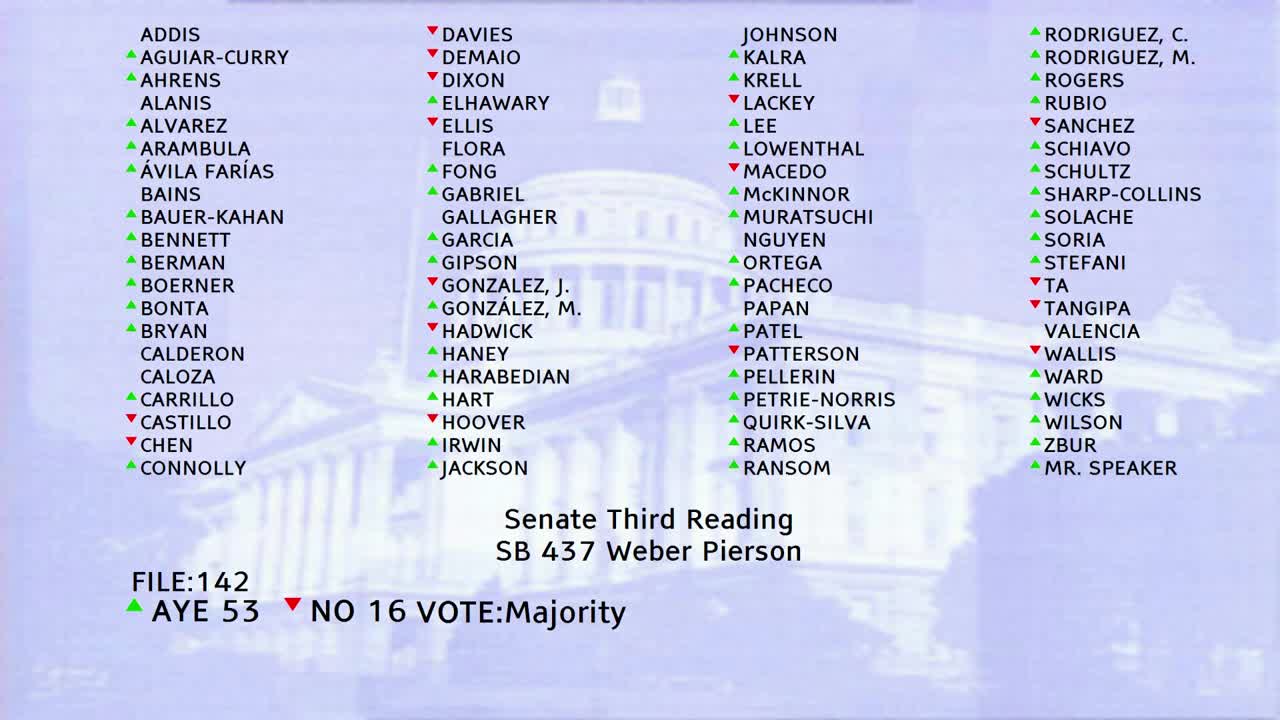 1MIN
Assembly Floor
 8MIN
Senate Standing Committee on Environmental Quality
Bill Author

Bill Co-Author(s):