SB 239: Crimes: criminal threats.
- Session Year: 2025-2026
- House: Senate
- Latest Version Date: 2026-09-20
Current Status:
Passed
(2026-09-20: Chaptered by Secretary of State. Chapter 412, Statutes of 2026.)
Introduced
In Committee
Awaiting First Chamber Vote
Passed First Chamber
In Committee
Awaiting Second Chamber Vote
Passed Second Chamber
Enacted
Existing law makes it a crime to willfully threaten to commit a crime that will result in death or great bodily injury to another person, as specified. Under existing law, this crime is punishable as a misdemeanor or by imprisonment in state prison as a felony. Existing law, for the purposes of sentencing for a felony violation of these provisions, authorizes the court to consider, as a factor in aggravation, that the defendant willfully threatened to commit a crime that would result in the death or great bodily injury of a state constitutional officer, a Member of the Legislature, or a judge or court commissioner, as specified.
This bill would additionally authorize the court to consider, as a factor in aggravation, that the defendant willfully threatened to commit a crime that would result in the death or great bodily injury of an elections official of a city, county, city and county, or public district, or an elected local agency official, as specified.
Existing law makes it a crime to willfully threaten to commit a crime that will result in death or great bodily injury to another person, as specified. Under existing law, this crime is punishable as a misdemeanor or by imprisonment in state prison as a felony. Existing law, for the purposes of sentencing for a felony violation of these provisions, authorizes the court to consider, as a factor in aggravation, that the defendant willfully threatened to commit a crime that would result in the death or great bodily injury of a state constitutional officer, a Member of the Legislature, or a judge or court commissioner, as specified.
This bill would additionally authorize the court to consider, as a factor in aggravation, that the defendant willfully threatened to commit a crime that would result in the death or great bodily injury of an elections official of a city, county, city and county, or public district, or a an elected local agency official, as specified.
Existing law makes it a crime to willfully threaten to commit a crime that will result in death or great bodily injury to another person, as specified. Under existing law, this crime is punishable as a misdemeanor or by imprisonment in state prison as a felony. Existing law, for the purposes of sentencing for a felony violation of these provisions, authorizes the court to consider, as a factor in aggravation, that the defendant willfully threatened to commit a crime that would result in the death or great bodily injury of a state constitutional officer, a Member of the Legislature, or a judge or court commissioner, as specified.
This bill would additionally authorize the court to consider, as a factor in aggravation, that the defendant willfully threatened to commit a crime that would result in the death or great bodily injury of a county or city elections official, an elections official of a city, county, city and county, or public district, or a local agency official, as specified.
Existing law makes it a crime to willfully threaten to commit a crime that will result in death or great bodily injury to another person, as specified. Under existing law, this crime is punishable as a misdemeanor or by imprisonment in state prison as a felony. Existing law, for the purposes of sentencing for a felony violation of these provisions, authorizes the court to consider, as a factor in aggravation, that the defendant willfully threatened to commit a crime that would result in the death or great bodily injury of a state constitutional officer, a Member of the Legislature, or a judge or court commissioner, as specified.
This bill would additionally authorize the court to consider, as a factor in aggravation, that the defendant willfully threatened to commit a crime that would result in the death or great bodily injury of a county or city elections official, or a local agency official, as specified.
Existing law, the Ralph M. Brown Act, requires, with specified exceptions, that all meetings of a legislative body, as defined, of a local agency be open and public and that all persons be permitted to attend and participate. The act generally requires for teleconferencing that the legislative body of a local agency that elects to use teleconferencing post agendas at all teleconference locations, identify each teleconference location in the notice and agenda of the meeting or proceeding, and have each teleconference location be accessible to the public. Existing law also requires that, during the teleconference, at least a quorum of the members of the legislative body participate from locations within the boundaries of the territory over which the local agency exercises jurisdiction, except as specified. Existing law, until January 1, 2026, authorizes specified neighborhood city councils to use alternate teleconferencing provisions related to notice, agenda, and public participation, as prescribed, if, among other requirements, the city council has adopted an authorizing resolution and 2/3 of the neighborhood city council votes to use alternate teleconference provisions, as specified. This bill would authorize a subsidiary body, as defined, to use alternative teleconferencing provisions and would impose requirements for notice, agenda, and public participation, as prescribed. The bill would require the subsidiary body to post the agenda at each physical meeting location designated by the subsidiary body, as specified. The bill would require the members of the subsidiary body to visibly appear on camera during the open portion of a meeting that is publicly accessible via the internet or other online platform, as specified. The bill would also require the subsidiary body to list a member of the subsidiary body who participates in a teleconference meeting from a remote location in the minutes of the meeting.The bill would require the legislative body that established the subsidiary body electing to use teleconferencing pursuant to these provisions to establish the subsidiary body by charter, ordinance, resolution, or other formal action to make specified findings by majority vote, before the subsidiary body uses teleconferencing for the first time and every 12 months thereafter. The bill would require the subsidiary body to approve the use of teleconference by 2/3 vote before using teleconference pursuant to these provisions.The bill would exempt from these alternative teleconferencing provisions a subsidiary body that has subject matter jurisdiction over police oversight, elections, or budgets. The bill would require any member of a subsidiary body who is an elected official to comply with specified agenda and quorum requirements to participate in a meeting through teleconferencing pursuant to this section, and would require any final recommendations adopted by a subsidiary body to be presented at a regular meeting of the legislative body that established the subsidiary body. The bill would repeal these provisions on January 1, 2030, and thereby remove the authorization for subsidiary bodies to use the alternative teleconferencing provisions as described above.Existing constitutional provisions require that a statute that limits the right of access to the meetings of public bodies or the writings of public officials and agencies be adopted with findings demonstrating the interest protected by the limitation and the need for protecting that interest.This bill would make legislative findings to that effect.The California Constitution requires local agencies, for the purpose of ensuring public access to the meetings of public bodies and the writings of public officials and agencies, to comply with a statutory enactment that amends or enacts laws relating to public records or open meetings and contains findings demonstrating that the enactment furthers the constitutional requirements relating to this purpose.This bill would make legislative findings to that effect.Existing law, the Ralph M. Brown Act, requires, with specified exceptions, that all meetings of a legislative body, as defined, of a local agency be open and public and that all persons be permitted to attend and participate. The act generally requires for teleconferencing that the legislative body of a local agency that elects to use teleconferencing post agendas at all teleconference locations, identify each teleconference location in the notice and agenda of the meeting or proceeding, and have each teleconference location be accessible to the public. Existing law also requires that, during the teleconference, at least a quorum of the members of the legislative body participate from locations within the boundaries of the territory over which the local agency exercises jurisdiction, except as specified.
Existing law, until January 1, 2026, authorizes specified neighborhood city councils to use alternate teleconferencing provisions related to notice, agenda, and public participation, as prescribed, if, among other requirements, the city council has adopted an authorizing resolution and 2/3 of the neighborhood city council votes to use alternate teleconference provisions, as specified.
This bill would authorize a subsidiary body, as defined, to use alternative teleconferencing provisions and would impose requirements for notice, agenda, and public participation, as prescribed. The bill would require the subsidiary body to post the agenda at the primary each physical meeting location. location designated by the subsidiary body, as specified. The bill would require the members of the subsidiary body to visibly appear on camera during the open portion of a meeting that is publicly accessible via the internet or other online platform, as specified. The bill would also require the subsidiary body to list a member of the subsidiary body who participates in a teleconference meeting from a remote location in the minutes of the meeting.
The bill would require the legislative body that established the subsidiary body electing to use teleconferencing pursuant to these provisions to establish the subsidiary body by charter, ordinance, resolution, or other formal action to make specified findings by majority vote, before the subsidiary body uses teleconferencing for the first time and every 12 months thereafter. The bill would require the subsidiary body to approve the use of teleconference by 2/3 vote before using teleconference pursuant to these provisions.
The bill would exempt from these alternative teleconferencing provisions a subsidiary body that has subject matter jurisdiction over police oversight, elections, or budgets. The bill would require any member of a subsidiary body who is an elected official to comply with specified agenda and quorum requirements to participate in a meeting through teleconferencing pursuant to this section, and would require any final recommendations adopted by a subsidiary body to be presented at a regular meeting of the legislative body that established the subsidiary body. The bill would repeal these provisions on January 1, 2030, and thereby remove the authorization for subsidiary bodies to use the alternative teleconferencing provisions as described above.
Existing constitutional provisions require that a statute that limits the right of access to the meetings of public bodies or the writings of public officials and agencies be adopted with findings demonstrating the interest protected by the limitation and the need for protecting that interest.
This bill would make legislative findings to that effect.
The California Constitution requires local agencies, for the purpose of ensuring public access to the meetings of public bodies and the writings of public officials and agencies, to comply with a statutory enactment that amends or enacts laws relating to public records or open meetings and contains findings demonstrating that the enactment furthers the constitutional requirements relating to this purpose.
This bill would make legislative findings to that effect.
Existing law, the Ralph M. Brown Act, requires, with specified exceptions, that all meetings of a legislative body, as defined, of a local agency be open and public and that all persons be permitted to attend and participate. The act generally requires for teleconferencing that the legislative body of a local agency that elects to use teleconferencing post agendas at all teleconference locations, identify each teleconference location in the notice and agenda of the meeting or proceeding, and have each teleconference location be accessible to the public. Existing law also requires that, during the teleconference, at least a quorum of the members of the legislative body participate from locations within the boundaries of the territory over which the local agency exercises jurisdiction, except as specified.
Existing law, until January 1, 2026, authorizes specified neighborhood city councils to use alternate teleconferencing provisions related to notice, agenda, and public participation, as prescribed, if, among other requirements, the city council has adopted an authorizing resolution and 2/3 of the neighborhood city council votes to use alternate teleconference provisions, as specified.
This bill would authorize a subsidiary body, as defined, to use alternative teleconferencing provisions and would impose requirements for notice, agenda, and public participation, as prescribed. The bill would require the subsidiary body to post the agenda at the primary physical meeting location. The bill would require the members of the subsidiary body to visibly appear on camera during the open portion of a meeting that is publicly accessible via the internet or other online platform, as specified. The bill would also require the subsidiary body to list a member of the subsidiary body who participates in a teleconference meeting from a remote location in the minutes of the meeting.
The bill would require the legislative body that established the subsidiary body electing to use teleconferencing pursuant to these provisions to establish the subsidiary body by charter, ordinance, resolution, or other formal action to make specified findings by majority vote, before the subsidiary body uses teleconferencing for the first time and every 12 months thereafter. The bill would require the subsidiary body to approve the use of teleconference by 2/3 vote before using teleconference pursuant to these provisions.
The bill would exempt from these alternative teleconferencing provisions a subsidiary body that has subject matter jurisdiction over police oversight, elections, or budgets. The bill would require any member of a subsidiary body who is an elected official to comply with specified agenda and quorum requirements to participate in a meeting through teleconferencing pursuant to this section, and would require any final recommendations adopted by a subsidiary body to be presented at a regular meeting of the legislative body that established the subsidiary body.
Existing constitutional provisions require that a statute that limits the right of access to the meetings of public bodies or the writings of public officials and agencies be adopted with findings demonstrating the interest protected by the limitation and the need for protecting that interest.
This bill would make legislative findings to that effect.
The California Constitution requires local agencies, for the purpose of ensuring public access to the meetings of public bodies and the writings of public officials and agencies, to comply with a statutory enactment that amends or enacts laws relating to public records or open meetings and contains findings demonstrating that the enactment furthers the constitutional requirements relating to this purpose.
This bill would make legislative findings to that effect.
(a)Any person who willfully threatens to commit a crime which will result in death or great bodily injury to another person, with the specific intent that the statement, made verbally, in writing, or by means of an electronic communication device, is to be taken as a threat, even if there is no intent of actually carrying it out, which, on its face and under the circumstances in which it is made, is so unequivocal, unconditional, immediate, and specific as to convey to the person threatened, a gravity of purpose and an immediate prospect of execution of the threat, and thereby causes that person reasonably to be in sustained fear for their own safety or for their immediate familys safety, shall be punished by imprisonment in the county jail not to exceed one year, or by imprisonment in the state prison.
(b)In sentencing a person convicted of a felony violation of subdivision (a), the court may consider, as a factor in aggravation, that the defendant willfully threatened to commit a crime that would result in the death or great bodily injury of a person the defendant knew was a state constitutional officer, a Member of the Legislature, or a judge or court commissioner, as defined in subdivisions (a), (b), (c), (n), and (q) of Section 7920.500 of the Government Code, an elections official of a city, county, city and county, or public district, or an elected local agency official.
(c)(1)For purposes of this section, immediate family means any spouse, whether by marriage or not, parent, child, any person related by consanguinity or affinity within the second degree, or any other person who regularly resides in the household, or who, within the prior six months, regularly resided in the household.
(2)For purposes of this section, electronic communication device includes, but is not limited to, telephones, cellular telephones, computers, video recorders, fax machines, or pagers. Electronic communication has the same meaning as the term is defined in Subsection 12 of Section 2510 of Title 18 of the United States Code.
(a)Any person who willfully threatens to commit a crime which will result in death or great bodily injury to another person, with the specific intent that the statement, made verbally, in writing, or by means of an electronic communication device, is to be taken as a threat, even if there is no intent of actually carrying it out, which, on its face and under the circumstances in which it is made, is so unequivocal, unconditional, immediate, and specific as to convey to the person threatened, a gravity of purpose and an immediate prospect of execution of the threat, and thereby causes that person reasonably to be in sustained fear for their own safety or for their immediate familys safety, shall be punished by imprisonment in the county jail not to exceed one year, or by imprisonment in the state prison.
(b)In sentencing a person convicted of a felony violation of subdivision (a), the court may consider, as a factor in aggravation, that the defendant willfully threatened to commit a crime that would result in the death or great bodily injury of a person the defendant knew was a state constitutional officer, a Member of the Legislature, or a judge or court commissioner, as defined in subdivisions (a), (b), (c), (n), and (q) of Section 7920.500 of the Government Code, an elections official of a city, county, city and county, or public district, or a local agency official as defined in subdivision (b) of Section 53237 of the Government Code. an elected local agency official.
(c)(1)For purposes of this section, immediate family means any spouse, whether by marriage or not, parent, child, any person related by consanguinity or affinity within the second degree, or any other person who regularly resides in the household, or who, within the prior six months, regularly resided in the household.
(2)For purposes of this section, electronic communication device includes, but is not limited to, telephones, cellular telephones, computers, video recorders, fax machines, or pagers. Electronic communication has the same meaning as the term is defined in Subsection 12 of Section 2510 of Title 18 of the United States Code.
(a)Any person who willfully threatens to commit a crime which will result in death or great bodily injury to another person, with the specific intent that the statement, made verbally, in writing, or by means of an electronic communication device, is to be taken as a threat, even if there is no intent of actually carrying it out, which, on its face and under the circumstances in which it is made, is so unequivocal, unconditional, immediate, and specific as to convey to the person threatened, a gravity of purpose and an immediate prospect of execution of the threat, and thereby causes that person reasonably to be in sustained fear for their own safety or for their immediate familys safety, shall be punished by imprisonment in the county jail not to exceed one year, or by imprisonment in the state prison.
(b)In sentencing a person convicted of a felony violation of subdivision (a), the court may consider, as a factor in aggravation, that the defendant willfully threatened to commit a crime that would result in the death or great bodily injury of a person the defendant knew was a state constitutional officer, a Member of the Legislature, or a judge or court commissioner, as defined in subdivisions (a), (b), (c), (n), and (q) of Section 7920.500 of the Government Code, a county or city elections official, an elections official of a city, county, city and county, or public district, or a local agency official as defined in subdivision (b) of Section 53237 of the Government Code.
(c)(1)For purposes of this section, immediate family means any spouse, whether by marriage or not, parent, child, any person related by consanguinity or affinity within the second degree, or any other person who regularly resides in the household, or who, within the prior six months, regularly resided in the household.
(2)For purposes of this section, electronic communication device includes, but is not limited to, telephones, cellular telephones, computers, video recorders, fax machines, or pagers. Electronic communication has the same meaning as the term is defined in Subsection 12 of Section 2510 of Title 18 of the United States Code.
(a)Any person who willfully threatens to commit a crime which will result in death or great bodily injury to another person, with the specific intent that the statement, made verbally, in writing, or by means of an electronic communication device, is to be taken as a threat, even if there is no intent of actually carrying it out, which, on its face and under the circumstances in which it is made, is so unequivocal, unconditional, immediate, and specific as to convey to the person threatened, a gravity of purpose and an immediate prospect of execution of the threat, and thereby causes that person reasonably to be in sustained fear for their own safety or for their immediate familys safety, shall be punished by imprisonment in the county jail not to exceed one year, or by imprisonment in the state prison.
(b)In sentencing a person convicted of a felony violation of subdivision (a), the court may consider, as a factor in aggravation, that the defendant willfully threatened to commit a crime that would result in the death or great bodily injury of a person the defendant knew was a state constitutional officer, a Member of the Legislature, or a judge or court commissioner, as defined in subdivisions (a), (b), (c), (n), and (q) of Section 7920.500 of the Government Code. Code, a county or city elections official, or a local agency official as defined in subdivision (b) of Section 53237 of the Government Code.
(c)(1)For purposes of this section, immediate family means any spouse, whether by marriage or not, parent, child, any person related by consanguinity or affinity within the second degree, or any other person who regularly resides in the household, or who, within the prior six months, regularly resided in the household.
(2)For purposes of this section, electronic communication device includes, but is not limited to, telephones, cellular telephones, computers, video recorders, fax machines, or pagers. Electronic communication has the same meaning as the term is defined in Subsection 12 of Section 2510 of Title 18 of the United States Code.
SECTION 1.Section 54953.05 is added to the Government Code, to read:54953.05.(a)(1)The definitions in Section 54953, as that section may be amended from time to time, apply for purposes of this section.(2)For purposes of this section, subsidiary body means a legislative body that meets all of the following:(A)Is described in subdivision (b) of Section 54952.(B)Serves exclusively in an advisory capacity.(C)Is not authorized to take final action on legislation, regulations, contracts, licenses, grants, permits, or other entitlements.(b)A subsidiary body may use teleconferencing without complying with paragraph (3) of subdivision (b) of Section 54953, if the subsidiary body complies with all of the following:(1)The teleconferenced meetings shall be conducted in a manner that protects the statutory and constitutional rights of the parties or the public appearing before the subsidiary body.(2)Each member of the subsidiary body shall participate through both audio and visual technology.(3)The subsidiary body shall provide at least one of the following as a means by which the public may remotely hear and visually observe the meeting, and remotely address the subsidiary body:(A)A two-way audiovisual platform.(B)A two-way telephonic service and a live webcasting of the meeting.(4)The subsidiary body shall give notice of the meeting and post agendas as otherwise required by this chapter.(5)The subsidiary body shall designate at least one physical meeting location within the boundaries of the legislative body that created the subsidiary body where members of the public may physically attend, observe, hear, and participate in the meeting. At least one staff member of the subsidiary body or the legislative body that created the subsidiary body shall be present at each physical meeting location during the meeting. The subsidiary body shall post the agenda at each physical meeting location, but need not post the agenda at a remote location.(6)In each instance in which notice of the time of the teleconferenced meeting is otherwise given or the agenda for the meeting is otherwise posted, the subsidiary body shall also give notice of the means by which members of the public may access the meeting and offer public comment.(7)The agenda shall identify and include an opportunity for all persons to attend and address the subsidiary body directly pursuant to Section 54954.3 via a call-in option or via an internet-based service option.(8)In the event of a disruption that prevents the subsidiary body from broadcasting the meeting to members of the public using the call-in option or internet-based service option, or in the event of a disruption within the subsidiary bodys control that prevents members of the public from offering public comments using the call-in option or internet-based service option, the subsidiary body shall take no further action on items appearing on the meeting agenda until public access to the meeting via the call-in option or internet-based service option is restored. Actions taken on agenda items during a disruption that prevents the subsidiary body from broadcasting the meeting may be challenged pursuant to Section 54960.1.(9)Notwithstanding Section 54953.3, an individual desiring to provide public comment through the use of an internet website, or other online platform, not under the control of the subsidiary body, that requires registration to log in to a teleconference may be required to register as required by the third-party internet website or online platform to participate.(10)The members of the subsidiary body shall visibly appear on camera during the open portion of a meeting that is publicly accessible via the internet or other online platform.(A)The visual appearance of a member of the subsidiary body on camera may cease only when the appearance would be technologically impracticable, including, but not limited to, when the member experiences a lack of reliable broadband or internet connectivity that would be remedied by joining without video, or when the visual display of meeting materials, information, or speakers on the internet or other online platform requires the visual appearance of a member of a subsidiary body on camera to cease.(B)If a member of the advisory body does not appear on camera due to challenges with internet connectivity, the member shall announce the reason for their nonappearance when they turn off their camera.(C)A member shall publicly disclose at the meeting before any action is taken, whether any other individuals 18 years of age or older are present in the room at the remote location with the member, and the general nature of the members relationship with any such individuals.(11)The subsidiary body shall not require public comments to be submitted in advance of the meeting and must provide an opportunity for the public to address the subsidiary body and offer comment in real time.(A)A subsidiary body that provides a timed public comment period for each agenda item shall not close the public comment period for the agenda item, or the opportunity to register, pursuant to paragraph (9), to provide public comment until that timed public comment period has elapsed.(B)A subsidiary body that does not provide a timed public comment period, but takes public comment separately on each agenda item, shall allow a reasonable amount of time per agenda item to allow public members the opportunity to provide public comment, including time for members of the public to register pursuant to paragraph (9), or otherwise be recognized for the purpose of providing public comment.(C)A subsidiary body that provides a timed general public comment period that does not correspond to a specific agenda item shall not close the public comment period or the opportunity to register, pursuant to paragraph (9), until the timed general public comment period has elapsed.(12)A member of the subsidiary body who participates in a teleconference meeting from a remote location shall be listed in the minutes of the meeting.(c)In order to use teleconferencing pursuant to this section, the legislative body that established the subsidiary body by charter, ordinance, resolution, or other formal action shall make the following findings by majority vote before the subsidiary body uses teleconferencing pursuant to this section for the first time, and every 12 months thereafter:(1)The legislative body has considered the circumstances of the subsidiary body.(2)Teleconference meetings of the subsidiary body would enhance public access to meetings of the subsidiary body.(3)Teleconference meetings of the subsidiary body would promote the attraction, retention, and diversity of subsidiary body members.(d)The subsidiary body shall approve the use of teleconferencing by two-thirds vote before using teleconference pursuant to this section.(e)This section shall not apply to a subsidiary body that has subject matter jurisdiction over police oversight, elections, or budgets.(f)Notwithstanding subdivision (b), any member of a subsidiary body who is an elected official shall comply with paragraph (3) of subdivision (b) of Section 54953 to participate in a meeting through teleconferencing pursuant to this section.(g)Any final recommendations adopted by a subsidiary body shall be presented at a regular meeting of the legislative body that established the subsidiary body. (h)This section shall remain in effect only until January 1, 2030, and as of that date is repealed.SEC. 2.The Legislature finds and declares that Section 1 of this act, which adds Section 54953.05 to the Government Code, imposes a limitation on the publics right of access to the meetings of public bodies or the writings of public officials and agencies within the meaning of Section 3 of Article I of the California Constitution. Pursuant to that constitutional provision, the Legislature makes the following findings to demonstrate the interest protected by this limitation and the need for protecting that interest:By removing the requirement for agendas to be placed at the location of each public official participating in a public meeting remotely, this act protects the personal, private information of public officials and their families while preserving the publics right to access information concerning the conduct of the peoples business.SEC. 3.The Legislature finds and declares that Section 1 of this act, which adds Section 54953.05 to the Government Code, furthers, within the meaning of paragraph (7) of subdivision (b) of Section 3 of Article I of the California Constitution, the purposes of that constitutional section as it relates to the right of public access to the meetings of local public bodies or the writings of local public officials and local agencies. Pursuant to paragraph (7) of subdivision (b) of Section 3 of Article I of the California Constitution, the Legislature makes the following findings:This act is necessary to provide opportunities for public participation in meetings of specified public agencies and to promote the attraction and retention of members of those agencies.(a)(1)The definitions in Section 54953, as that section may be amended from time to time, apply for purposes of this section.
(2)For purposes of this section, subsidiary body means a legislative body that meets all of the following:
(A)Is described in subdivision (b) of Section 54952.
(B)Serves exclusively in an advisory capacity.
(C)Is not authorized to take final action on legislation, regulations, contracts, licenses, grants, permits, or other entitlements.
(b)A subsidiary body may use teleconferencing without complying with paragraph (3) of subdivision (b) of Section 54953, if the subsidiary body complies with all of the following:
(1)The teleconferenced meetings shall be conducted in a manner that protects the statutory and constitutional rights of the parties or the public appearing before the subsidiary body.
(2)Each member of the subsidiary body shall participate through both audio and visual technology.
(3)The subsidiary body shall provide at least one of the following as a means by which the public may remotely hear and visually observe the meeting, and remotely address the subsidiary body:
(A)A two-way audiovisual platform.
(B)A two-way telephonic service and a live webcasting of the meeting.
(4)The subsidiary body shall give notice of the meeting and post agendas as otherwise required by this chapter.
(5)The subsidiary body shall designate a primary at least one physical meeting location within the boundaries of the legislative body that created the subsidiary body where members of the public may physically attend, observe, hear, and participate in the meeting. At least one staff member of the subsidiary body or the legislative body that created the subsidiary body shall be present at the primary each physical meeting location during the meeting. The subsidiary body shall post the agenda at the primary each physical meeting location, but need not post the agenda at a remote location.
(6)In each instance in which notice of the time of the teleconferenced meeting is otherwise given or the agenda for the meeting is otherwise posted, the subsidiary body shall also give notice of the means by which members of the public may access the meeting and offer public comment.
(7)The agenda shall identify and include an opportunity for all persons to attend and address the subsidiary body directly pursuant to Section 54954.3 via a call-in option or via an internet-based service option.
(8)In the event of a disruption that prevents the subsidiary body from broadcasting the meeting to members of the public using the call-in option or internet-based service option, or in the event of a disruption within the subsidiary bodys control that prevents members of the public from offering public comments using the call-in option or internet-based service option, the subsidiary body shall take no further action on items appearing on the meeting agenda until public access to the meeting via the call-in option or internet-based service option is restored. Actions taken on agenda items during a disruption that prevents the subsidiary body from broadcasting the meeting may be challenged pursuant to Section 54960.1.
(9)Notwithstanding Section 54953.3, an individual desiring to provide public comment through the use of an internet website, or other online platform, not under the control of the subsidiary body, that requires registration to log in to a teleconference may be required to register as required by the third-party internet website or online platform to participate.
(10)The members of the subsidiary body shall visibly appear on camera during the open portion of a meeting that is publicly accessible via the internet or other online platform.
(A)The visual appearance of a member of the subsidiary body on camera may cease only when the appearance would be technologically impracticable, including, but not limited to, when the member experiences a lack of reliable broadband or internet connectivity that would be remedied by joining without video, or when the visual display of meeting materials, information, or speakers on the internet or other online platform requires the visual appearance of a member of a subsidiary body on camera to cease.
(B)If a member of the advisory body does not appear on camera due to challenges with internet connectivity, the member shall announce the reason for their nonappearance when they turn off their camera.
(C)A member shall publicly disclose at the meeting before any action is taken, whether any other individuals 18 years of age or older are present in the room at the remote location with the member, and the general nature of the members relationship with any such individuals.
(11)The subsidiary body shall not require public comments to be submitted in advance of the meeting and must provide an opportunity for the public to address the subsidiary body and offer comment in real time.
(A)A subsidiary body that provides a timed public comment period for each agenda item shall not close the public comment period for the agenda item, or the opportunity to register, pursuant to paragraph (9), to provide public comment until that timed public comment period has elapsed.
(B)A subsidiary body that does not provide a timed public comment period, but takes public comment separately on each agenda item, shall allow a reasonable amount of time per agenda item to allow public members the opportunity to provide public comment, including time for members of the public to register pursuant to paragraph (9), or otherwise be recognized for the purpose of providing public comment.
(C)A subsidiary body that provides a timed general public comment period that does not correspond to a specific agenda item shall not close the public comment period or the opportunity to register, pursuant to paragraph (9), until the timed general public comment period has elapsed.
(12)A member of the subsidiary body who participates in a teleconference meeting from a remote location shall be listed in the minutes of the meeting.
(c)In order to use teleconferencing pursuant to this section, the legislative body that established the subsidiary body by charter, ordinance, resolution, or other formal action shall make the following findings by majority vote before the subsidiary body uses teleconferencing pursuant to this section for the first time, and every 12 months thereafter:
(1)The legislative body has considered the circumstances of the subsidiary body.
(2)Teleconference meetings of the subsidiary body would enhance public access to meetings of the subsidiary body.
(3)Teleconference meetings of the subsidiary body would promote the attraction, retention, and diversity of subsidiary body members.
(d)The legislative subsidiary body shall approve the use of teleconferencing by two-thirds vote before using teleconference pursuant to this section.
(e)This section shall not apply to a subsidiary body that has subject matter jurisdiction over police oversight, elections, or budgets.
(f)Notwithstanding subdivision (b), any member of a subsidiary body who is an elected official shall comply with paragraph (3) of subdivision (b) of Section 54953 to participate in a meeting through teleconferencing pursuant to this section.
(g)Any final recommendations adopted by a subsidiary body shall be presented at a regular meeting of the legislative body that established the subsidiary body.
(h)This section shall remain in effect only until January 1, 2030, and as of that date is repealed.
SEC. 2.The Legislature finds and declares that Section 1 of this act, which adds Section 54953.05 to the Government Code, imposes a limitation on the publics right of access to the meetings of public bodies or the writings of public officials and agencies within the meaning of Section 3 of Article I of the California Constitution. Pursuant to that constitutional provision, the Legislature makes the following findings to demonstrate the interest protected by this limitation and the need for protecting that interest:
By removing the requirement for agendas to be placed at the location of each public official participating in a public meeting remotely, this act protects the personal, private information of public officials and their families while preserving the publics right to access information concerning the conduct of the peoples business.
SEC. 3.The Legislature finds and declares that Section 1 of this act, which adds Section 54953.05 to the Government Code, furthers, within the meaning of paragraph (7) of subdivision (b) of Section 3 of Article I of the California Constitution, the purposes of that constitutional section as it relates to the right of public access to the meetings of local public bodies or the writings of local public officials and local agencies. Pursuant to paragraph (7) of subdivision (b) of Section 3 of Article I of the California Constitution, the Legislature makes the following findings:
This act is necessary to provide opportunities for public participation in meetings of specified public agencies and to promote the attraction and retention of members of those agencies.
(a)(1)The definitions in Section 54953, as that section may be amended from time to time, apply for purposes of this section.
(2)For purposes of this section, subsidiary body means a legislative body that meets all of the following:
(A)Is described in subdivision (b) of Section 54952.
(B)Serves exclusively in an advisory capacity.
(C)Is not authorized to take final action on legislation, regulations, contracts, licenses, grants, permits, or other entitlements.
(b)A subsidiary body may use teleconferencing without complying with paragraph (3) of subdivision (b) of Section 54953, if the subsidiary body complies with all of the following:
(1)The teleconferenced meetings shall be conducted in a manner that protects the statutory and constitutional rights of the parties or the public appearing before the subsidiary body.
(2)Each member of the subsidiary body shall participate through both audio and visual technology.
(3)The subsidiary body shall provide at least one of the following as a means by which the public may remotely hear and visually observe the meeting, and remotely address the subsidiary body:
(A)A two-way audiovisual platform.
(B)A two-way telephonic service and a live webcasting of the meeting.
(4)The subsidiary body shall give notice of the meeting and post agendas as otherwise required by this chapter.
(5)The subsidiary body shall designate a primary physical meeting location where members of the public may physically attend, observe, hear, and participate in the meeting. At least one staff member of the subsidiary body shall be present at the primary physical meeting location during the meeting. The subsidiary body shall post the agenda at the primary physical meeting location, but need not post the agenda at a remote location.
(6)In each instance in which notice of the time of the teleconferenced meeting is otherwise given or the agenda for the meeting is otherwise posted, the subsidiary body shall also give notice of the means by which members of the public may access the meeting and offer public comment.
(7)The agenda shall identify and include an opportunity for all persons to attend and address the subsidiary body directly pursuant to Section 54954.3 via a call-in option or via an internet-based service option.
(8)In the event of a disruption that prevents the subsidiary body from broadcasting the meeting to members of the public using the call-in option or internet-based service option, or in the event of a disruption within the subsidiary bodys control that prevents members of the public from offering public comments using the call-in option or internet-based service option, the subsidiary body shall take no further action on items appearing on the meeting agenda until public access to the meeting via the call-in option or internet-based service option is restored. Actions taken on agenda items during a disruption that prevents the subsidiary body from broadcasting the meeting may be challenged pursuant to Section 54960.1.
(9)Notwithstanding Section 54953.3, an individual desiring to provide public comment through the use of an internet website, or other online platform, not under the control of the subsidiary body, that requires registration to log in to a teleconference may be required to register as required by the third-party internet website or online platform to participate.
(10)The members of the subsidiary body shall visibly appear on camera during the open portion of a meeting that is publicly accessible via the internet or other online platform.
(A)The visual appearance of a member of the subsidiary body on camera may cease only when the appearance would be technologically impracticable, including, but not limited to, when the member experiences a lack of reliable broadband or internet connectivity that would be remedied by joining without video, or when the visual display of meeting materials, information, or speakers on the internet or other online platform requires the visual appearance of a member of a subsidiary body on camera to cease.
(B)If a member of the advisory body does not appear on camera due to challenges with internet connectivity, the member shall announce the reason for their nonappearance when they turn off their camera.
(C)A member shall publicly disclose at the meeting before any action is taken, whether any other individuals 18 years of age or older are present in the room at the remote location with the member, and the general nature of the members relationship with any such individuals.
(11)The subsidiary body shall not require public comments to be submitted in advance of the meeting and must provide an opportunity for the public to address the subsidiary body and offer comment in real time.
(A)A subsidiary body that provides a timed public comment period for each agenda item shall not close the public comment period for the agenda item, or the opportunity to register, pursuant to paragraph (9), to provide public comment until that timed public comment period has elapsed.
(B)A subsidiary body that does not provide a timed public comment period, but takes public comment separately on each agenda item, shall allow a reasonable amount of time per agenda item to allow public members the opportunity to provide public comment, including time for members of the public to register pursuant to paragraph (9), or otherwise be recognized for the purpose of providing public comment.
(C)A subsidiary body that provides a timed general public comment period that does not correspond to a specific agenda item shall not close the public comment period or the opportunity to register, pursuant to paragraph (9), until the timed general public comment period has elapsed.
(12)A member of the subsidiary body who participates in a teleconference meeting from a remote location shall be listed in the minutes of the meeting.
(c)In order to use teleconferencing pursuant to this section, the legislative body that established the subsidiary body by charter, ordinance, resolution, or other formal action shall make the following findings by majority vote before the subsidiary body uses teleconferencing pursuant to this section for the first time, and every 12 months thereafter:
(1)The legislative body has considered the circumstances of the subsidiary body.
(2)Teleconference meetings of the subsidiary body would enhance public access to meetings of the subsidiary body.
(3)Teleconference meetings of the subsidiary body would promote the attraction, retention, and diversity of subsidiary body members.
(d)The legislative body shall approve the use of teleconferencing by two-thirds vote before using teleconference pursuant to this section.
(e)This section shall not apply to a subsidiary body that has subject matter jurisdiction over police oversight, elections, or budgets.
(f)Notwithstanding subdivision (b), any member of a subsidiary body who is an elected official shall comply with paragraph (3) of subdivision (b) of Section 54953 to participate in a meeting through teleconferencing pursuant to this section.
(g)Any final recommendations adopted by a subsidiary body shall be presented at a regular meeting of the legislative body that established the subsidiary body.
SEC. 2.The Legislature finds and declares that Section 1 of this act, which adds Section 54953.05 to the Government Code, imposes a limitation on the publics right of access to the meetings of public bodies or the writings of public officials and agencies within the meaning of Section 3 of Article I of the California Constitution. Pursuant to that constitutional provision, the Legislature makes the following findings to demonstrate the interest protected by this limitation and the need for protecting that interest:
By removing the requirement for agendas to be placed at the location of each public official participating in a public meeting remotely, this act protects the personal, private information of public officials and their families while preserving the publics right to access information concerning the conduct of the peoples business.
SEC. 3.The Legislature finds and declares that Section 1 of this act, which adds Section 54953.05 to the Government Code, furthers, within the meaning of paragraph (7) of subdivision (b) of Section 3 of Article I of the California Constitution, the purposes of that constitutional section as it relates to the right of public access to the meetings of local public bodies or the writings of local public officials and local agencies. Pursuant to paragraph (7) of subdivision (b) of Section 3 of Article I of the California Constitution, the Legislature makes the following findings:
This act is necessary to provide opportunities for public participation in meetings of specified public agencies and to promote the attraction and retention of members of those agencies.
|
Date
|
Status
|
|---|---|
| Sep 20, 2026 | Chaptered by Secretary of State. Chapter 412, Statutes of 2026. |
| Sep 20, 2026 | Approved by the Governor. |
| Sep 2, 2026 | Enrolled and presented to the Governor at 3 p.m. |
| Aug 27, 2026 | Assembly amendments concurred in. (Ayes 40. Noes 0. Page 6022.) Ordered to engrossing and enrolling. |
| Aug 27, 2026 | Assembly amendments concurred in. (Ayes 39. Noes 0.) Ordered to engrossing and enrolling. |
| Aug 26, 2026 | From committee: That the Assembly amendments be concurred in. (Ayes 6. Noes 0. Page 5926.) |
| Aug 26, 2026 | From committee: That the Assembly amendments be concurred in. (Ayes 6. Noes 0.) |
| Aug 24, 2026 | From committee: Be re-referred to Com. on PUB. S. pursuant to Senate Rule 29.10(d). (Ayes 5. Noes 0. Page 5618.) Re-referred to Com. on PUB. S. |
| Aug 24, 2026 | From committee: Be re-referred to Com. on PUB. S. pursuant to Senate Rule 29.10(d). (Ayes 5. Noes 0.) Re-referred to Com. on PUB. S. |
| Aug 24, 2026 | Re-referred to Com. on RLS. pursuant to Senate Rule 29.10(d). |
| Aug 20, 2026 | In Senate. Concurrence in Assembly amendments pending. |
| Aug 20, 2026 | Read third time. Passed. (Ayes 78. Noes 0. Page 6298.) Ordered to the Senate. |
| Aug 20, 2026 | Read third time. Passed. Ordered to the Senate. |
| Aug 13, 2026 | Read second time. Ordered to third reading. |
| Aug 13, 2026 | From committee: Do pass. (Ayes 15. Noes 0.) (August 13). |
| Aug 13, 2026 | Assembly Rule 63 suspended. |
| Aug 5, 2026 | August 5 set for first hearing. Placed on suspense file. |
| Jul 2, 2026 | Read second time and amended. Re-referred to Com. on APPR. |
| Jul 1, 2026 | From committee: Do pass as amended and re-refer to Com. on APPR. with recommendation: To consent calendar. (Ayes 9. Noes 0.) (June 30). |
| Jun 17, 2026 | From committee with author's amendments. Read second time and amended. Re-referred to Com. on PUB. S. |
| Jun 1, 2026 | Re-referred to Com. on PUB. S. pursuant to Assembly Rule 96. |
| May 28, 2026 | From committee with author's amendments. Read second time and amended. Re-referred to Com. on L. GOV. |
| May 11, 2026 | Referred to Com. on L. GOV. |
| Jan 27, 2026 | In Assembly. Read first time. Held at Desk. |
| Jan 27, 2026 | Read third time. Passed. (Ayes 29. Noes 11. Page 3306.) Ordered to the Assembly. |
| Jan 26, 2026 | Read second time. Ordered to third reading. |
| Jan 22, 2026 | Ordered to second reading. |
| Jan 22, 2026 | From inactive file on motion of Senator Arreguín. |
| Jun 3, 2025 | Ordered to inactive file on request of Senator Arreguín. |
| May 8, 2025 | Read second time. Ordered to third reading. |
| May 7, 2025 | From committee: Do pass. (Ayes 10. Noes 1. Page 1026.) (May 6). |
| Apr 8, 2025 | Set for hearing May 6. |
| Apr 7, 2025 | Read second time and amended. Re-referred to Com. on JUD. |
| Apr 3, 2025 | From committee: Do pass as amended and re-refer to Com. on JUD. (Ayes 5. Noes 2. Page 636.) (April 2). |
| Mar 24, 2025 | Set for hearing April 2. |
| Feb 14, 2025 | Referred to Coms. on L. GOV. and JUD. |
| Feb 3, 2025 | From printer. May be acted upon on or after March 2. |
| Jan 30, 2025 | Introduced. Read first time. To Com. on RLS. for assignment. To print. |
|
Date
|
Description
|
Location
|
Votes
|
|
|---|---|---|---|---|
| Aug 27, 2026 | Unfinished Business SB239 Arreguín Concurrence | Senate Floor |
Passed |
|
| Aug 26, 2026 | That the Assembly amendments be concurred in | Senate Standing Committee on Public Safety |
Passed |
|
| Aug 20, 2026 | SB 239 Arreguín Senate Third Reading By Pacheco | Assembly Floor |
Passed |
|
| Aug 13, 2026 | Do pass. | Assembly Standing Committee on Appropriations |
Passed |
|
| Jun 30, 2026 | Do pass as amended, and be re-referred to the Committee on [Appropriations] with recommendation: To Consent Calendar | Assembly Standing Committee on Public Safety |
Passed |
|
| Jan 27, 2026 | Senate 3rd Reading SB239 Arreguín | Senate Floor |
Passed |
|
| May 6, 2025 | Do pass | Senate Standing Committee on Judiciary |
Passed |
|
| Apr 2, 2025 | Do pass as amended, but first amend, and re-refer to the Committee on [Judiciary] | Senate Standing Committee on Local Government |
Passed |
This list shows positions taken on this bill by organizations on the date displayed, which is linked to the original source.
Positions by individuals are not included.
|
Organization
|
Position
|
Date
|
|---|---|---|
| Aclu California Action | ** Against | |
| Agency on Aging Area 4 | ** Support | |
| Alameda-Contra Costa Transit District | ** Support | |
| Alameda County Transportation Commission | ** Support | |
| Association Of Bay Area Governments | ** Support | |
| Association Of California School Administrators | ** Support | |
| Association Of California Water Agencies | ** Support | |
| Bet Tzedek | ** Support | |
| CA In-home Supportive Services Consumer Alliance | ** Support | |
| California Association Of Area Agencies On Aging | ** Support | |
| California Association Of Councils Of Governments | ** Support | |
| California Association Of Joint Powers Authorities | ** Support | |
| California Association Of Public Authorities For Ihss | ** Support | |
| California Association of Public Authorities for In-Home Supportive Services | ** Support | |
| California Association Of Recreation & Park Districts | ** Support | |
| California Broadcasters Association | ** Against | |
| California Clerk Of The Board Of Supervisors Association | ** Support | |
| California Collaborative for Long-Term Services and Supports | ** Support | |
| California Commission on Aging | ** Support | |
| California Contract Cities Association | ** Support | |
| California Contract Cities Associations | ** Support | |
| California Foundation For Independent Living Centers | ** Support | |
| California Municipal Clerks Association | ** Support | |
| California News Publishers Association | ** Against | |
| Californians for Disability Rights | ** Support | |
| California Senior Legislature | ** Support | |
| California Special Districts Association | ** Support | |
| California State Association Of Counties | ** Support | |
| California Transit Association | ** Support | |
| California Travel Association | ** Support | |
| CCNMA Latino Journalists of California | ** Against | |
| City Clerks Association of California | ** Support | |
| City/County Association of Governments of San Mateo County | ** Support | |
| City of Alameda | ** Support | |
| City of Belmont | ** Support | |
| City Of Beverly Hills | ** Support | |
| city of carlsbad | ** Support | |
| City of Colton | ** Support | |
| City of Corona | ** Support | |
| City of Foster City | ** Support | |
| City of Hanford | ** Support | |
| City of La Verne | ** Support | |
| City of Rancho Cucamonga | ** Support | |
| City of Redwood City | ** Support | |
| City of Thousand Oaks | ** Support | |
| City Of Tustin | ** Support | |
| Clean Power Alliance of Southern California | ** Support | |
| County of Contra Costa | ** Support | |
| County of Glenn | ** Support | |
| County of Humboldt | ** Support | |
| County of Imperial | ** Support | |
| County Of Los Angeles | ** Support | |
| County of Los Angeles Board of Supervisors | ** Support | |
| County of Marin | ** Support | |
| County of Mendocino | ** Support | |
| County Of Mono | ** Support | |
| County of Monterey | ** Support | |
| County of Nevada | ** Support | |
| County of Riverside | ** Support | |
| county of sacramento | ** Support | |
| County Of San Diego | ** Support | |
| County of San Mateo | ** Support | |
| County of Solano | ** Support | |
| County of Sonoma | ** Support | |
| County of Yolo | ** Support | |
| County Welfare Directors Association of California | ** Support | |
| Democracy Winters | ** Support | |
| Disability Rights California | ** Support | |
| Disability Rights Education & Defense Fund | ** Support | |
| Elsinore Valley Municipal Water District | ** Support | |
| First Amendment Coalition | ** Against | |
| Freedom Of The Press Foundation | ** Against | |
| Hand in Hand: The Domestic Employers Network | ** Support | |
| Hispanas Organized for Political Equality | ** Support | |
| Homebridge | ** Support | |
| Howard Jarvis Taxpayers Association | ** Against | |
| Justice in Aging | ** Support | |
| Latino Journalists of California | ** Against | |
| League Of California Cities | ** Support | |
| League Of Women Voters Of California | ** Against | |
| Madera County Transportation Commission | ** Support | |
| Marin Center for Independent Living | ** Support | |
| Media Alliance | ** Against | |
| Media Guild of The West, NewsGuild-CWA Local 39213 | ** Against | |
| Metropolitan Transportation Commission | ** Support | |
| National Press Photographers Association | ** Against | |
| Oakland Privacy | ** Against | |
| Orange County Power Authority | ** Support | |
| Orange County Press Club | ** Against | |
| Pacific Media Workers Guild | ** Against | |
| Placer Independent Resource Services | ** Support | |
| Radio Television Digital News Association | ** Against | |
| Rural County Representatives of California | ** Support | |
| San Diego Community Power | ** Support | |
| San Francisco Bay Area Rapid Transit District | ** Support | |
| San Gabriel Valley Council Of Governments | ** Support | |
| shasta regional transportation agency | ** Support | |
| Society of Professional Journalists, Northern California Chapter | ** Against | |
| Sourcewise | ** Support | |
| Southern California Association Of Governments | ** Support | |
| Town of Hillsborough | ** Support | |
| Transportation Agency For Monterey County | ** Support | |
| Transportation Authority Of Marin | ** Support | |
| Urban Counties of California | ** Support | |
| VALLEY INDUSTRY AND COMMERCE ASSOCIATION | ** Support | |
| Yolo County In-home Supportive Services Advisory Committee | ** Support |
SENATE RULES COMMITTEE Office of Senate Floor Analyses (916) 651-4171 | SB 239 |
UNFINISHED BUSINESS
Bill No: SB 239
Author: Arreguín (D)
Amended: 7/2/26
Vote: 21
SENATE PUBLIC SAFETY COMMITTEE: 6-0, 8/26/26
AYES: Arreguín, Seyarto, Caballero, Cortese, Pérez, Wiener
ASSEMBLY FLOOR: 78-0, 8/20/26 - See last page for vote
SUBJECT: Crimes: criminal threats
SOURCE: Author
DIGEST:
This bill authorizes the court to consider, as a factor in aggravation in sentencing a person for making criminal threats, that the defendant willfully threatened to commit a crime that would result in the death or great bodily injury of an elections official of a city, county, city and county, or public district, or an elected local agency official.
Assembly Amendments
delete the prior version of this bill and amend this bill to the current version.
ANALYSIS:
Existing law:
- States that any person who willfully threatens to commit a crime which will result in death or great bodily injury to another person, with the specific intent that the statement, made verbally, in writing, or by means of an electronic communication device, is to be taken as a threat, even if there is no intent of actually carrying it out, which, on its face and under the circumstances in which it is made, is so unequivocal, unconditional, immediate, and specific as to convey to the person threatened, a gravity of purpose and an immediate prospect of execution of the threat, and thereby causes that person reasonably to be in sustained fear for their own safety or for their immediate family’s safety, shall be punished by imprisonment in the county jail not to exceed one year, or by imprisonment in the state prison. (Penal (Pen.) Code, § 422, subd. (a).)
- Provides that in sentencing a person convicted of making felony criminal threats, the court may consider, as a factor in aggravation, that the defendant willfully threatened to commit a crime that would result in death or great bodily injury of a person the defendant knew was a state constitutional officer, a Member of the Legislature, or a judge or court commissioner. (Pen. Code, § 422, subd. (b).)
- Makes a felony violation of Penal Code section 422 a “serious felony,” and therefore a “strike” for purposes of Three Strikes sentencing. (Pen. Code, § 1192.7, subd. (c).)
- States that any person who, with intent to annoy, telephones another, or contacts him or her by means of an electronic device, and threatens to inflict injury on the person or the person’s family, or to the person’s property, is guilty of a misdemeanor. (Pen. Code, § 653m, subd. (a).)
- Provides that every person who attempts, by means of any threat or violence, to deter or prevent an executive officer from performing any duty imposed upon the officer by law, or who knowingly resists, by the use of force or violence, the officer, in the performance of his or her duty, is punishable as an alternate felony-misdemeanor. (Pen. Code, § 69, subd. (a).)
- States that every person who knowingly and willingly threatens the life of, or threatens serious bodily harm to, any elected public official, county public defender, county clerk, exempt appointee of the Governor, judge, or Deputy Commissioner of the Board of Prison Terms, or the staff, immediate family, or immediate family of the staff of any elected public official, county public defender, county clerk, exempt appointee of the Governor, judge, or Deputy Commissioner of the Board of Prison Terms, with the specific intent that the statement is to be taken as a threat, and the apparent ability to carry out that threat by any means, is guilty of a public offense. (Pen. Code, § 76, subd. (a).)
- States that no person shall knowingly post the home address or telephone number of any elected or appointed official, or of the official’s residing spouse or child, on the internet knowing that person is an elected or appointed official and intending to cause imminent great bodily harm that is likely to occur or threatening to cause imminent great bodily harm to that individual. Punishes the crime as a misdemeanor, or a felony, depending on the circumstances. (Pen. Code, § 76.5.)
- States that any person who commits assault upon specified public officials or attempts to commit murder against any of those specified officials in retaliation for or to prevent the performance of the victim’s official duties, shall be punished by a felony, as specified. (Pen. Code, § 217.1.)
- Provides that when a judgment of imprisonment is to be imposed and the statute specifies three possible terms, the court shall in its sound discretion order imposition of a sentence not to exceed the middle term, except as specified. (Pen. Code, § 1170, subd. (b)(1).)
- Provides that the court may impose a sentence exceeding the middle term only when there are circumstances in aggravation of the crime that justify the imposition of a term of imprisonment exceeding the middle term and the facts underlying those circumstances have been stipulated to by the defendant or have been found true beyond a reasonable doubt at trial by the jury or by the judge in a court trial. (Pen. Code, § 1170, subd. (b)(2).)
- States that notwithstanding the presumption for the middle term, and unless the court finds that the aggravating circumstances outweigh the mitigating circumstances and that imposition of the lower term would be contrary to the interests of justice, the court shall order imposition of the lower term if the defendant experienced psychological, physical, or childhood trauma, is a youth (under age 26), or is or has been a victim of domestic violence or human trafficking. (Pen. Code, § 1170, subd. (b)(6).)
- Defines “local agency official” to mean any member of a local agency legislative body and any elected local agency official. (Gov. Code, § 53237, subd. (b).)
- Prohibits any state or local agency from publicly posting the home address, telephone number, or the name and assessor parcel number associated with the home address of any elected or appointed official on the internet without first obtaining the written permission of that individual. (Gov. Code, § 7928.205, subd. (a).)
This bill authorizes a court to, in sentencing a person convicted of a felony criminal threat, consider as an aggravating factor that the threat was made against an elections official of a city, county, city and county, or public district, or an elected local agency official.
Background
Existing law punishes criminal threats. (Pen. Code, § 422.) A law that restricts speech has First Amendment implications. The First Amendment to the United States Constitution states: “Congress shall make no law . . . abridging the freedom of speech. . . .” This fundamental right is applicable to the states through the due process clause of the Fourteenth Amendment. (Aguilar v. Avis Rent A Car System, Inc. (1999) 21 Cal.4th 121, 133-134, citing Gitlow v. People of New York (1925) 268 U.S. 652, 666.) The California Constitution provides that: “Every person may freely speak, write and publish his or her sentiments on all subjects, being responsible for the abuse of this right. A law may not restrain or abridge liberty of speech or press.” (Cal. Const., art. I, § 2, subd. (a).)
While these guarantees are stated in broad terms, “the right to free speech is not absolute.” (Aguilar v. Avis Rent A Car System, Inc., supra, 21 Cal.4th at p. 134, citing Near v. Minnesota (1931) 283 U.S. 697, 708). As the U.S. Supreme Court has acknowledged: “Many crimes can consist solely of spoken words, such as soliciting a bribe, perjury, or making a terrorist threat.” (Ibid.; See Pen. Code, §§ 653f; 118; 422).
Content-based restrictions on speech are presumptively invalid (R.A.V. v. St. Paul (1992) 505 U.S. 382), however, courts have upheld restrictions on content-based speech when the speech is “ ‘of such slight social value as a step to truth that any benefit that may be derived from them is clearly outweighed by the social interest in order and morality.’ Thus, for example, a State may punish those words ‘which by their very utterance inflict injury or tend to incite an immediate breach of the peace.’ ” (In re J.M. (2019) 36 Cal.App.5th 668, 674, citing Virginia v. Black (2003) 538 U.S. 343, 358-359.)
True threats are not protected by the First Amendment. (In re M.S. (1995) 10 Cal.4th 698, 709.) Existing Penal Code section 422 has been found to be constitutional because it is narrowly tailored to apply only to true threats, which are defined as threats “to commit a crime which will result in death or great bodily injury to another person . . . which, on its face and under the circumstances in which it is made, is so unequivocal, unconditional, immediate, and specific as to convey to the person threatened, a gravity of purpose and an immediate prospect of execution of the threat.” (People v. Toledo (2001) 26 Cal.4th 221, 233.)
To convict a person under Penal Code section 422, the prosecutor must prove the following:
- That the defendant willfully threatened to commit a crime which will result in death or great bodily injury to another person;
- That the defendant made the threat;
- That the defendant intended that the statement be taken as a threat, even if there is no intent of actually carrying it out;
- That the threat was so unequivocal, unconditional, immediate, and specific as to convey to the person threatened a gravity of purpose and an immediate prospect of execution of the threat;
- That the threat actually caused the person threatened to be in sustained fear for his or her own safety or for his or her immediate family’s safety; and
- That the threatened person’s fear was reasonable under the circumstances. (Pen. Code, § 422; CALCRIM No. 1300; see also People v. Toledo (2001) 26 Cal.4th 221, 227-228.)
Penal Code section 422 applies to all criminal threats that will result in death or great bodily injury regardless of the person threatened, the location, or the exact type of violence that is threatened. A violation of Section 422 is punishable as either a misdemeanor or a felony. (Pen. Code, § 422.) When a criminal threats conviction is punished as a felony, it is also a serious felony for purposes of enhanced punishment under the Three Strikes Law (Pen. Code, § 1192.7, subd. (c)(38)) and the five-year prison enhancement for prior serious felony convictions (Pen. Code, § 667). Additionally, it triggers credit earning limitations. (Pen. Code, § 1170.12.)
California’s sentencing scheme is, for the most part, determinate—it is referred to as the determinate sentencing law (DSL). (Pen. Code, § 1170, subd. (b)(1).) Any person convicted of a felony is sentenced to one of three sentence terms (known as a sentencing triad). For example, a person convicted of a first-degree burglary may be sentenced to two, four, or six years in the state prison. The court must consider factors in aggravation, and those factors must be proven to the trier of fact beyond a reasonable doubt before imposing the upper term. (Pen. Code, § 1170, subd. (b)(2) & (6).)
Existing law, enacted last year through AB 352 (Pacheco, Chapter 554, Statutes of 2025), added criminal threats against a state constitutional officer, a Member of the Legislature, or a judge or commissioner as a factor in aggravation that may authorize imposition of the upper term if the jury finds it true beyond a reasonable doubt. The California Rules of Court enumerate circumstances in aggravation and mitigation, relating both to the crime and to the defendant. (Cal. Rules of Court, rules 4.421, 4.423.) In addition, any other factors statutorily declared to be circumstances in aggravation or mitigation that reasonably relate to the defendant or the circumstances under which the crime was committed can be considered in aggravation.
This bill expands existing law to add criminal threats against a city, county, city and county, or public district, or a local agency official. In order to consider this a factor in aggravation, it will have to be either admitted by the defendant, or found to be true beyond a reasonable doubt by the jury, or by the judge in the case of a bench trial.
FISCAL EFFECT: Appropriation: No Fiscal Com.: Yes Local: No
According to the Assembly Appropriations Committee:
Potential increase in state incarceration costs (General Fund) of an unknown, but potentially significant amount, to the extent the new aggravating factor results in imposition of the upper term rather than the middle term in felony criminal threats cases involving the specified officials. Potential court cost pressures (Trial Court Trust Fund) of an unknown, but likely minor amount, to the extent pleading and proving the new aggravating factor to the trier of fact marginally lengthens some trials and sentencing proceedings.
SUPPORT: (Verified 8/24/26)
California Association of Joint Powers Authorities
California Contract Cities Association
California Municipal Clerks Association
California Special Districts Association
Valley Industry and Commerce Association
OPPOSITION: (Verified 8/24/26)
None received
ARGUMENT IN SUPPORT:
The California Municipal Clerks Association writes:
In recent years, the public servants who administer our elections and deliver essential local services have faced a troubling rise in threats and intimidation. These individuals carry out duties that are fundamental to democratic governance and to the daily functioning of our communities, yet they are increasingly targeted for harassment intended to coerce, silence, or endanger them.
SB 239 recognizes the seriousness of this conduct and affirms that those who serve the public deserve protection from violence and the threat of violence. By allowing courts to weigh such threats as a factor in aggravation, this bill provides a measured and appropriate sentencing tool that reflects the gravity of intimidating public officials in the performance of their duties. The bill preserves judicial discretion while signaling clearly that threats against local elections officials and local agency officials will not be treated as ordinary offenses. We believe this approach will help deter future misconduct, support the recruitment and retention of dedicated public servants, and safeguard the integrity of the local functions on which our residents rely.
ASSEMBLY FLOOR: 78-0, 8/20/26
Ayes: Addis, Aguiar-Curry, Ahrens, Alanis, Alvarez, Arambula, Ávila Farías, Bains, Bauer-Kahan, Bennett, Berman, Boerner, Bonta, Bryan, Calderon, Caloza, Carrillo, Castillo, Connolly, Davies, DeMaio, Dixon, Elhawary, Ellis, Flora, Fong, Gabriel, Garcia, Gipson, Jeff Gonzalez, Mark González, Hadwick, Haney, Harabedian, Hart, Hoover, Irwin, Jackson, Johnson, Kalra, Krell, Lackey, Lee, Lowenthal, Macedo, McKinnor, Muratsuchi, Nguyen, Ortega, Pacheco, Papan, Patel, Patterson, Pellerin, Petrie-Norris, Quirk-Silva, Ramos, Ransom, Celeste Rodriguez, Michelle Rodriguez, Rogers, Blanca Rubio, Sanchez, Schiavo, Schultz, Sharp-Collins, Solache, Soria, Stefani, Ta, Tangipa, Valencia, Wallis, Ward, Wicks, Wilson, Zbur, Rivas
No Vote Recorded: Chen
Prepared by: Marshal Lawler / PUB. S. /
8/26/26 13:02:07
SENATE THIRD READING
STR Bill Id:SB 239
Author:(Arreguín)
As Amended Ver:July 2, 2026
Majority vote
SUMMARY
Authorizes the court to consider, as a factor in aggravation in sentencing a person for making criminal threats, that the defendant willfully threatened to commit a crime that would result in the death or great bodily injury of an elections official of a city, county, city and county, or public district, or an elected local agency official.
Major Provisions
- States that any person who willfully threatens to commit a crime which will result in death or great bodily injury to another person, with the specific intent that the statement, made verbally, in writing, or by means of an electronic communication device, is to be taken as a threat, even if there is no intent of actually carrying it out, which, on its face and under the circumstances in which it is made, is so unequivocal, unconditional, immediate, and specific as to convey to the person threatened, a gravity of purpose and an immediate prospect of execution of the threat, and thereby causes that person reasonably to be in sustained fear for their own safety or for their immediate family′s safety, shall be punished by imprisonment in the county jail not to exceed one year, or by imprisonment in the state prison. (Penal. Code, Section 422, subdivision. (a).)
- Provides that in sentencing a person convicted of making felony criminal threats, the court may consider, as a factor in aggravation, that the defendant willfully threatened to commit a crime that would result in death or great bodily injury of a person the defendant knew was a state constitutional officer, a Member of the Legislature, or a judge or court commissioner. (Penal. Code, Section 422, subdivision. (b).)
- Makes a felony violation of Penal Code section 422 a ″serious felony,″ and therefore a ″strike″ for purposes of Three Strikes sentencing. (Penal. Code, Section 1192.7, subdivision. (c).)
- States that any person who with intent to annoy, telephones another or contacts him or her by means of an electronic device, and threatens to inflict injury on the person or the person′s family, or to the person′s property is guilty of a misdemeanor. (Penal. Code, Section 653m, subdivision. (a).)
- Provides that every person who attempts, by means of any threat or violence, to deter or prevent an executive officer from performing any duty imposed upon the officer by law, or who knowingly resists, by the use of force or violence, the officer, in the performance of his or her duty, is punishable as an alternate felony-misdemeanor. (Penal. Code, Section 69, subdivision. (a).)
- States that every person who knowingly and willingly threatens the life of, or threatens serious bodily harm to, any elected public official, county public defender, county clerk, exempt appointee of the Governor, judge, or Deputy Commissioner of the Board of Prison Terms, or the staff, immediate family, or immediate family of the staff of any elected public official, county public defender, county clerk, exempt appointee of the Governor, judge, or Deputy Commissioner of the Board of Prison Terms, with the specific intent that the statement is to be taken as a threat, and the apparent ability to carry out that threat by any means, is guilty of a public offense. (Penal. Code, Section 76, subdivision. (a).)
- States that no person shall knowingly post the home address or telephone number of any elected or appointed official, or of the official′s residing spouse or child, on the internet knowing that person is an elected or appointed official and intending to cause imminent great bodily harm that is likely to occur or threatening to cause imminent great bodily harm to that individual. Punishes the crime as a misdemeanor, or a felony depending on the circumstances. (Penal. Code, Section 76.5.)
- States that any person who commits assault upon specified public officials or attempts to commit murder against any of those specified officials in retaliation for or to prevent the performance of the victim′s official duties, shall be punished by a felony, as specified. (Penal. Code, Section 217.1.)
- Provides that when a judgment of imprisonment is to be imposed and the statute specifies three possible terms, the court shall in its sound discretion order imposition of a sentence not to exceed the middle term, except as specified. (Penal. Code, Section 1170, subdivision. (b)(1).)
- Provides that the court may impose a sentence exceeding the middle term only when there are circumstances in aggravation of the crime that justify the imposition of a term of imprisonment exceeding the middle term and the facts underlying those circumstances have been stipulated to by the defendant or have been found true beyond a reasonable doubt at trial by the jury or by the judge in a court trial. (Penal. Code, Section 1170, subdivision. (b)(2).)
- States that notwithstanding the presumption for the middle term, and unless the court finds that the aggravating circumstances outweigh the mitigating circumstances and that imposition of the lower term would be contrary to the interests of justice, the court shall order imposition of the lower term if the defendant experienced psychological, physical, or childhood trauma, is a youth (under age 26), or is or has been a victim of domestic violence or human trafficking. (Penal. Code, Section 1170, subdivision. (b)(6).)
- Enumerates circumstances in aggravation, relating both to the crime and to the defendant, as specified. In addition, any other factors statutorily declared to be circumstances in aggravation or that reasonably relate to the defendant or the circumstances under which the crime was committed can be considered in aggravation. (Cal. Rules of Court, rule 4.421.)
- Enumerates circumstances in mitigation, relating both to the crime and to the defendant, as specified. In addition, any other factors statutorily declared to be circumstances in mitigation or that reasonably relate to the defendant or the circumstances under which the crime was committed can be considered. (Cal. Rules of Court, rule 4.423.)
- Defines ″local agency official″ to mean any member of a local agency legislative body and any elected local agency official. (Gov. Code, Section 53237, subdivision. (b).)
- Prohibits any state or local agency from publicly posting the home address, telephone number, or the name and assessor parcel number associated with the home address of any elected or appointed official on the internet without first obtaining the written permission of that individual. (Gov. Code, Section 7928.205, subdivision. (a).)
COMMENTS
According to the Author
According to the author, ″In recent years, election officials and elected local agency officials (County Supervisors, Mayors, Council members, special district board members) across the U.S. have reported increased threats, harassment, and intimidation. Sometimes these threats have sadly escalated to violence and death. Last year, the Legislature passed, and the Governor signed into law AB 352, which amended Penal Code Section 422. The bill allows the court to consider as part of felony sentencing of the criminal threats statute as a factor in aggravation, that the defendant willfully threatened to commit a crime that could result in the death or great bodily injury of a judge or court commissioner, a state constitutional officer, or member of the Legislature. The reason for this change was the increase in threats against judges and state elected officials and the fear and intimidation caused.
″SB 239 would amend Penal Code Section 422 to also include election officials and local agency officials. SB 239 recognizes that threats against election officials and local public officials are not just attacks on individuals, they are attacks on the democratic institutions and public services that Californians rely on every day. This bill promotes public safety, strengthens confidence in our democratic process and recognizes the unique harm caused when threats are used to interfere with the functioning of government.″
Arguments in Support
According to California Contract Cities Associations, ″Over the past few years federal, state, and local elected officials have reported instances of grave threats, harassment, and intimidation at alarming levels. In 2025, the Legislature passed AB 352 (Pacheco), Chapter 554, Statutes of 2025,to address the issue, which allows for harsher sentencing when an individual is making threats against state officials that could result in death or great bodily injury. SB 239 expands upon AB 352, ensuring that offenders could face similar sentencing when threatening local elected officials, including County election officials, City election officials, and other local agency officials. We applaud Senator Arreguin for his leadership on this important issue, as it is critical that elected officials at all levels of government are given special recognition under this state law as a means of protecting their welfare and strengthening public safety.″
Arguments in Opposition
No longer applicable.
FISCAL COMMENTS
According to the Assembly Appropriations Committee:
- Potential increase in state incarceration costs (General Fund) of an unknown, but potentially significant amount, to the extent the new aggravating factor results in imposition of the upper term rather than the middle term in felony criminal threats cases involving the specified officials. Because felony criminal threats is a serious felony, defendants sentenced to imprisonment serve those terms in state prison rather than county jail, so any marginal increase in sentence length accrues to the California Department of Corrections and Rehabilitation (CDCR). The annual incidence of felony convictions for threats against elections officials or elected local agency officials in California is unknown, but data from CDCR shows 590 new felony admissions in 2025 for which criminal threats was the primary offense. The Legislative Analyst′s Office estimates the average annual cost to incarcerate one person in state prison is $133,000. If even two people serve an additional one year each in prison because of this bill, the resulting incarceration costs to CDCR would exceed this committee′s Penal threshold. Actual costs will Penal on the number of relevant offenses, whether the factor is admitted or found true beyond a reasonable doubt, and judicial discretion in selecting the term.
- Potential court cost pressures (Trial Court Trust Fund) of an unknown, but likely minor amount, to the extent pleading and proving the new aggravating factor to the trier of fact marginally lengthens some trials and sentencing proceedings.
VOTES
SENATE FLOOR: 29-11-0
YES: Allen, Archuleta, Arreguín, Ashby, Becker, Blakespear, Cabaldon, Cervantes, Cortese, Durazo, Gonzalez, Grayson, Hurtado, Laird, Limón, McGuire, McNerney, Menjivar, Padilla, Pérez, Reyes, Richardson, Rubio, Smallwood-Cuevas, Stern, Umberg, Wahab, Weber Pierson, Wiener
NO: Alvarado-Gil, Caballero, Choi, Dahle, Grove, Jones, Niello, Ochoa Bogh, Seyarto, Strickland, Valladares
ASM PUBLIC SAFETY: 9-0-0
YES: Schultz, Alanis, Mark González, Haney, Harabedian, Lackey, Nguyen, Ramos, Sharp-Collins
ASM APPROPRIATIONS: 15-0-0
YES: Wicks, Hoover, Arambula, Calderon, Caloza, Dixon, Fong, Mark González, Krell, Pacheco, Pellerin, Sharp-Collins, Solache, Ta, Tangipa
UPDATED
VERSION: July 2, 2026
CONSULTANT: Stella Choe / PUB. S. / (916) 319-3744 FN: 0003505
Date of Hearing: August 5, 2026
ASSEMBLY COMMITTEE ON APPROPRIATIONS
Buffy Wicks, Chair
SBPCA Bill Id:SB 239
Author:(Arreguín) – As Amended Ver:July 2, 2026
Policy Committee: | Public Safety | Vote: | 9 - 0 |
|
| ||
|
|
Urgency: No State Mandated Local Program: No Reimbursable: No
SUMMARY:
This bill authorizes a court, in sentencing a person convicted of felony criminal threats, to consider as a factor in aggravation that the defendant willfully threatened to commit a crime that would result in the death or great bodily injury of an elections official of a city, county, city and county, or public district, or an elected local agency official.
FISCAL EFFECT:
- Potential increase in state incarceration costs (General Fund) of an unknown, but potentially significant amount, to the extent the new aggravating factor results in imposition of the upper term rather than the middle term in felony criminal threats cases involving the specified officials. Because felony criminal threats is a serious felony, defendants sentenced to imprisonment serve those terms in state prison rather than county jail, so any marginal increase in sentence length accrues to the California Department of Corrections and Rehabilitation (CDCR). The annual incidence of felony convictions for threats against elections officials or elected local agency officials in California is unknown, but data from CDCR shows 590 new felony admissions in 2025 for which criminal threats was the primary offense. The Legislative Analyst’s Office estimates the average annual cost to incarcerate one person in state prison is $133,000. If even two people serve an additional one year each in prison because of this bill, the resulting incarceration costs to CDCR would exceed this committee’s suspense threshold. Actual costs will depend on the number of relevant offenses, whether the factor is admitted or found true beyond a reasonable doubt, and judicial discretion in selecting the term.
- Potential court cost pressures (Trial Court Trust Fund) of an unknown, but likely minor amount, to the extent pleading and proving the new aggravating factor to the trier of fact marginally lengthens some trials and sentencing proceedings.
COMMENTS:
- Purpose. According to the author:
SB 239 recognizes that threats against election officials and local public officials are not just attacks on individuals, they are attacks on the democratic institutions and public services that Californians rely on every day. This bill promotes public safety, strengthens confidence in our democratic process and recognizes the unique harm caused when threats are used to interfere with the functioning of government.
- Background. Existing law punishes as an alternate felony-misdemeanor a willful threat to commit a crime that will result in death or great bodily injury to another person, made with the specific intent that the statement be taken as a threat and causing the threatened person to be in sustained reasonable fear. A felony conviction is a serious felony for purposes of the Three Strikes law. As a result, a felony criminal threats conviction counts as a strike prior that can double the sentence for any subsequent felony or trigger a 25-years-to-life term on a third strike.
Under California’s determinate sentencing law, a court may impose a sentence exceeding the middle term of the applicable triad only where circumstances in aggravation justify the upper term and the facts underlying those circumstances have been stipulated to by the defendant or found true beyond a reasonable doubt by the trier of fact. In 2025, the Legislature added a specific aggravating factor to the criminal threats statute for threats against a person the defendant knew was a state constitutional officer, a member of the Legislature, or a judge or court commissioner (AB 352 (Pacheco), Chapter 554, Statutes of 2025). This bill expands that aggravating factor to threats against elections officials of a city, county, city and county, or public district, and elected local agency officials, including mayors, city council members, and county supervisors.
The criminal threats statute has been upheld against First Amendment challenge because the statute is narrowly tailored to apply only to true threats, which are not protected speech. To the extent the bill is challenged in court, any defense costs would be borne by the Department of Justice.
Analysis Prepared by: Shiran Zohar / APPR. / (916) 319-2081
Date of Hearing: June 30, 2026
Deputy Chief Counsel: Stella Choe
ASSEMBLY COMMITTEE ON PUBLIC SAFETY
Nick Schultz, Chair
SBPCA Bill Id:SB 239
Author:(Arreguín) – As Amended Ver:June 17, 2026
As Proposed to be Amended in Committee
SUMMARY: Authorizes the court to consider, as a factor in aggravation in sentencing a person for making criminal threats, that the defendant willfully threatened to commit a crime that would result in the death or great bodily injury of an elections official of a city, county, city and county, or public district, or an elected local agency official.
EXISTING LAW:
- States that any person who willfully threatens to commit a crime which will result in death or great bodily injury to another person, with the specific intent that the statement, made verbally, in writing, or by means of an electronic communication device, is to be taken as a threat, even if there is no intent of actually carrying it out, which, on its face and under the circumstances in which it is made, is so unequivocal, unconditional, immediate, and specific as to convey to the person threatened, a gravity of purpose and an immediate prospect of execution of the threat, and thereby causes that person reasonably to be in sustained fear for their own safety or for their immediate family’s safety, shall be punished by imprisonment in the county jail not to exceed one year, or by imprisonment in the state prison. (Pen. Code, § 422, subd. (a).)
- Provides that in sentencing a person convicted of making felony criminal threats, the court may consider, as a factor in aggravation, that the defendant willfully threatened to commit a crime that would result in death or great bodily injury of a person the defendant knew was a state constitutional officer, a Member of the Legislature, or a judge or court commissioner. (Pen. Code, § 422, subd. (b).)
- Makes a felony violation of Penal Code section 422 a “serious felony,” and therefore a “strike” for purposes of Three Strikes sentencing. (Pen. Code, § 1192.7, subd. (c).)
- States that any person who with intent to annoy, telephones another or contacts him or her by means of an electronic device, and threatens to inflict injury on the person or the person’s family, or to the person’s property is guilty of a misdemeanor. (Pen. Code, § 653m, subd. (a).)
- Provides that every person who attempts, by means of any threat or violence, to deter or prevent an executive officer from performing any duty imposed upon the officer by law, or who knowingly resists, by the use of force or violence, the officer, in the performance of his or her duty, is punishable as an alternate felony-misdemeanor. (Pen. Code, § 69, subd. (a).)
- States that every person who knowingly and willingly threatens the life of, or threatens serious bodily harm to, any elected public official, county public defender, county clerk, exempt appointee of the Governor, judge, or Deputy Commissioner of the Board of Prison Terms, or the staff, immediate family, or immediate family of the staff of any elected public official, county public defender, county clerk, exempt appointee of the Governor, judge, or Deputy Commissioner of the Board of Prison Terms, with the specific intent that the statement is to be taken as a threat, and the apparent ability to carry out that threat by any means, is guilty of a public offense. (Pen. Code, § 76, subd. (a).)
- States that no person shall knowingly post the home address or telephone number of any elected or appointed official, or of the official’s residing spouse or child, on the internet knowing that person is an elected or appointed official and intending to cause imminent great bodily harm that is likely to occur or threatening to cause imminent great bodily harm to that individual. Punishes the crime as a misdemeanor, or a felony depending on the circumstances. (Pen. Code, § 76.5.)
- States that any person who commits assault upon specified public officials or attempts to commit murder against any of those specified officials in retaliation for or to prevent the performance of the victim’s official duties, shall be punished by a felony, as specified. (Pen. Code, § 217.1.)
- Provides that when a judgment of imprisonment is to be imposed and the statute specifies three possible terms, the court shall in its sound discretion order imposition of a sentence not to exceed the middle term, except as specified. (Pen. Code, § 1170, subd. (b)(1).)
- Provides that the court may impose a sentence exceeding the middle term only when there are circumstances in aggravation of the crime that justify the imposition of a term of imprisonment exceeding the middle term and the facts underlying those circumstances have been stipulated to by the defendant or have been found true beyond a reasonable doubt at trial by the jury or by the judge in a court trial. (Pen. Code, § 1170, subd. (b)(2).)
- States that notwithstanding the presumption for the middle term, and unless the court finds that the aggravating circumstances outweigh the mitigating circumstances and that imposition of the lower term would be contrary to the interests of justice, the court shall order imposition of the lower term if the defendant experienced psychological, physical, or childhood trauma, is a youth (under age 26), or is or has been a victim of domestic violence or human trafficking. (Pen. Code, § 1170, subd. (b)(6).)
- Enumerates circumstances in aggravation, relating both to the crime and to the defendant, as specified. In addition, any other factors statutorily declared to be circumstances in aggravation or that reasonably relate to the defendant or the circumstances under which the crime was committed can be considered in aggravation. (Cal. Rules of Court, rule 4.421.)
- Enumerates circumstances in mitigation, relating both to the crime and to the defendant, as specified. In addition, any other factors statutorily declared to be circumstances in mitigation or that reasonably relate to the defendant or the circumstances under which the crime was committed can be considered. (Cal. Rules of Court, rule 4.423.)
- Defines “local agency official” to mean any member of a local agency legislative body and any elected local agency official. (Gov. Code, § 53237, subd. (b).)
- Prohibits any state or local agency from publicly posting the home address, telephone number, or the name and assessor parcel number associated with the home address of any elected or appointed official on the internet without first obtaining the written permission of that individual. (Gov. Code, § 7928.205, subd. (a).)
FISCAL EFFECT: Unknown.
COMMENTS:
- Sponsor: Author-sponsored
- Author's Statement: According to the author, “In recent years, election officials and elected local agency officials (County Supervisors, Mayors, Council members, special district board members) across the U.S. have reported increased threats, harassment, and intimidation. Sometimes these threats have sadly escalated to violence and death. Last year, the Legislature passed, and the Governor signed into law AB 352, which amended Penal Code Section 422. The bill allows the court to consider as part of felony sentencing of the criminal threats statute as a factor in aggravation, that the defendant willfully threatened to commit a crime that could result in the death or great bodily injury of a judge or court commissioner, a state constitutional officer, or member of the Legislature. The reason for this change was the increase in threats against judges and state elected officials and the fear and intimidation caused.
“SB 239 would amend Penal Code Section 422 to also include election officials and local agency officials. SB 239 recognizes that threats against election officials and local public officials are not just attacks on individuals, they are attacks on the democratic institutions and public services that Californians rely on every day. This bill promotes public safety, strengthens confidence in our democratic process and recognizes the unique harm caused when threats are used to interfere with the functioning of government.”
- Criminal Threats: Existing law punishes criminal threats. (Pen. Code, § 422.) A law that restricts speech has First Amendment implications. The First Amendment to the United States Constitution states: “Congress shall make no law . . . abridging the freedom of speech. . . .” This fundamental right is applicable to the states through the due process clause of the Fourteenth Amendment. (Aguilar v. Avis Rent A Car System, Inc. (1999) 21 Cal.4th 121, 133-134, citing Gitlow v. People of New York (1925) 268 U.S. 652, 666.) Article I, section 2, subdivision (a) of the California Constitution provides that: "Every person may freely speak, write and publish his or her sentiments on all subjects, being responsible for the abuse of this right. A law may not restrain or abridge liberty of speech or press."
While these guarantees are stated in broad terms, “the right to free speech is not absolute.” (Aguilar v. Avis Rent A Car System, Inc., supra, 21 Cal.4th at p. 134, citing Near v. Minnesota (1931) 283 U.S. 697, 708; and Stromberg v. California (1931) 283 U.S. 359.) As the United States Supreme Court has acknowledged: “Many crimes can consist solely of spoken words, such as soliciting a bribe (Pen. Code, § 653f), perjury (Pen. Code, § 118), or making a terrorist threat (Pen. Code, § 422).”
Content-based restrictions on speech are presumptively invalid (R.A.V. v. St. Paul (1992) 505 U.S. 377, 382), however, courts have upheld restrictions on content-based speech when the speech is “‘of such slight social value as a step to truth that any benefit that may be derived from them is clearly outweighed by the social interest in order and morality.’ Thus, for example, a State may punish those words ‘which by their very utterance inflict injury or tend to incite an immediate breach of the peace.’” (In re J.M. (2019) 36 Cal.App.5th 668, 674, citing Virginia v. Black (2003) 538 U.S. 343, 358–359.)
True threats are not protected by the First Amendment. (In re M.S. (1995) 10 Cal.4th 698.) Existing Penal Code section 422 has been found to be constitutional because it is narrowly tailored to apply only to true threats, which is defined as a threat "to commit a crime which will result in death or great bodily injury to another person . . . which, on its face and under the circumstances in which it is made, is so unequivocal, unconditional, immediate, and specific as to convey to the person threatened, a gravity of purpose and an immediate prospect of execution of the threat.” (People v. Toledo (2001) 26 Cal.4th 221, 233.)
In order to convict a person under the criminal threat statute, Penal Code section 422, the prosecutor must prove the following:
- That the defendant willfully threatened to commit a crime which will result in death or great bodily injury to another person;
- That the defendant made the threat;
- That the defendant intended that the statement be taken as a threat, even if there is no intent of actually carrying it out;
- That the threat was so unequivocal, unconditional, immediate, and specific as to convey to the person threatened a gravity of purpose and an immediate prospect of execution of the threat;
- That the threat actually caused the person threatened to be in sustained fear for his or her own safety or for his or her immediate family’s safety; and,
- That the threatened person’s fear was reasonable under the circumstances. (Pen. Code, §422; CALCRIM No. 1300; see also People v. Toledo (2001) 26 Cal.4th 221, 227-228.)
Penal Code section 422 applies to all criminal threats which will result in death or great bodily injury regardless of the person threatened, the location, or the exact type of violence that is threatened.
The crime of criminal threats is punishable as either a misdemeanor or a felony. (Pen. Code, § 422.) When a criminal threats conviction is punished as a felony, it is also a serious felony for purposes of enhanced punishment under the Three Strikes Law (Pen. Code, 1192.7, subd. (c)(38)) and the five-year prison enhancement for prior serious felony convictions (Pen. Code, § 667). Additionally, it triggers credit earning limitations. (Pen. Code, § 1170.12.) (See also People v. Moore (2004) 118 Cal.App.4th 74.)
Last year, Penal Code section 422 was amended to add that in sentencing a person convicted of making felony criminal threats, the court may consider, as a factor in aggravation, that the defendant willfully threatened to commit a crime that would result in death or great bodily injury of a person the defendant knew was a state constitutional officer, a Member of the Legislature, or a judge or court commissioner. (AB 352 (Pacheco), Ch. 554, Stats. 2025; Pen. Code, § 422, subd. (b).) The new provision went into effect January 1 of this year. This bill would greatly expand who this provision applies to by adding an elections official of a city, county, city and county, or public district, or a local agency official, as defined in subdivision (b) of Government Code section 53237. That section defines “local agency official” to mean “any member of a local agency legislative body and any elected local agency official.”
Because the definition of “local agency official” includes such a broad category of persons, many of which may not be well-known to the public, this bill, as proposed to be amended in committee, will limit local agency officials to elected local agency officials, which would include mayors, city council members, county board of supervisors, and other local officials who are elected.
Notably, unlike some of the existing offenses that require specifically targeting or retaliating against judges or elected officials[1], the aggravating factor provision in Penal Code Section 422 only requires that the defendant knew the person threatened is a state constitutional officer, a Member of the Legislature, or a judge or court commissioner, not that they were motivated in any way by that person’s position.
- Determinate Sentencing and Factors in Aggravation: California’s sentencing scheme is, for the most part, determinate – it is referred to as the determinate sentencing law (DSL). (Pen. Code, § 1170, subd. (b)(1).) Any person convicted of a felony is sentenced to one of three sentences referred to as the “triad.” For instance, a person convicted or a felony offense that may be charged as either a misdemeanor or felony (known as a “wobbler”) shall be sentenced to 16 months, two years, or three years in either county jail or state prison, unless the statute specifies another sentence. Burglary of a home or occupied residence, for example, may be sentenced to two, three, or four years. The court must consider factors in aggravation and those factors must be proven to the trier of fact beyond a reasonable doubt before imposing the upper term. (Pen. Code, § 1170, subd. (b)(2) & (6).)
The Sixth Amendment right to a jury trial applies to any factual finding, other than that of a prior conviction, necessary to warrant any sentence beyond the presumptive maximum. (Apprendi v. New Jersey (2000) 530 U.S. 466, 490; Blakely v. Washington (2004) 524 U.S. 296, 301, 303-04.) Prior to 2007, the DSL required imposition of the middle term. However, the Supreme Court, following its ruling in Blakely upended the way California sentenced a defendant convicted of a felony.
In Cunningham v. California (2007) 549 U.S. 270, the United States Supreme Court held California’s Determinate Sentencing Law (DSL) violated a defendant’s right to trial by jury by placing sentence-elevating fact findings within the judge’s province. (Id. at p. 274.) The DSL authorized the court to increase the defendant’s sentence by finding facts not reflected in the jury verdict. Specifically, the trial judge could find factors in aggravation by a preponderance of evidence to increase the defendant’s sentence from the presumptive middle term to the upper term and, as such, was constitutionally flawed. The Court stated, “Because the DSL authorizes the judge, not the jury, to find the facts permitting an upper term sentence, the sentence cannot withstand measurement against our Sixth Amendment precedent.” (Id. at p. 293.)
The Supreme Court provided direction as to what steps the Legislature could take to address the constitutional infirmities in the DSL:
"As to the adjustment of California's sentencing system in light of our decision, the ball . . . lies in [California's] court. We note that several States have modified their systems in the wake of Apprendi and Blakely to retain determinate sentencing. They have done so by calling upon the jury - either at trial or in a separate sentencing proceeding - to find any fact necessary to the imposition of an elevated sentence. As earlier noted, California already employs juries in this manner to determine statutory sentencing enhancements. Other States have chosen to permit judges genuinely to exercise broad discretion . . . within a statutory range, which, everyone agrees, encounters no Sixth Amendment shoal. California may follow the paths taken by its sister States or otherwise alter its system, so long as the State observes Sixth Amendment limitations declared in this Court's decisions." (Cunningham, supra, 549 U.S. at pp. 293-294.)
Following Cunningham, the Legislature amended the DSL, specifically Penal Code sections 1170 and 1170.1, to make the choice of the lower, middle, or upper prison term one within the sound discretion of the court. (See SB 40 (Romero), Ch. 3, Stats. 2007.) This approach was embraced by the California Supreme Court in People v. Sandoval (2007) 41 Cal.4th 825, 843-852. The new procedure removes the mandatory middle term and the requirement of weighing aggravation against mitigation before imposition of the upper term.
In 2021, the Legislature enacted SB 567 (Bradford), Chapter 731, Statutes of 2021 which requires that any aggravating factors, except for prior convictions, relied upon by the court to impose a sentence exceeding the middle term either for a criminal offense or for an enhancement be submitted to the trier of fact and found to be true, or be admitted by the defendant. “The court may impose a sentence exceeding the middle term only when there are circumstances in aggravation of the crime that justify the imposition of a term of imprisonment exceeding the middle term and the facts underlying those circumstances have been stipulated to by the defendant or have been found true beyond a reasonable doubt at trial by the jury or by the judge in a court trial.” (Pen. Code, § 1170, subd. (b)(2).)
Additionally, where certain factors contributed to the offense, the court is required to impose the low term unless aggravating circumstances outweigh mitigating circumstances. These factors are where the defendant experienced psychological, physical, or childhood trauma, is a youth (under age 26), or is or has been a victim of domestic violence or human trafficking. (Pen. Code, § 1170, subd. (b)(6).)
“In sentencing the convicted person, the court shall apply the sentencing rules of the Judicial Council.” (Pen. Code, § 1170, subd. (a)(3).) The California Rules of Court, rule 4.421 states that circumstances in aggravation include factors relating to the crime (12 enumerated criteria) and factors relating to the defendant (five enumerated criteria). Finally the rule notes that the court can consider “[a]ny other factors statutorily declared to be circumstances in aggravation or that reasonably relate to the defendant or the circumstances under which the crime was committed.” (Cal. Rules of Court, rule 4.421(c).)
Similarly, rule 4.423 states circumstances in mitigation that a court should consider. There are 10 enumerated criteria in mitigation relating to the crime, 15 enumerated criteria related to the defendant, and a residual clause allowing the court to consider any other factors statutorily enumerated or that reasonably related to the defendant or the circumstances under which the crime was committed. (Ibid.)
Existing law, enacted last year through AB 352 (Pacheco), Chapter 554, Statutes of 2025, added criminal threats against a state constitutional officer, a Member of the Legislature, or a judge or commissioner as a factor in aggravation that may authorize imposition of the upper term if the jury finds it true beyond a reasonable doubt. This bill would expand this newly created provision to add criminal threats against a city, county, city and county, or public district, or a local agency official. In order to consider this factor in aggravation, it will have to be either admitted by the defendant, or found to be true beyond a reasonable doubt by the jury, or by the judge in the case of a court trial.
- Argument in Support: According to California Contract Cities Associations, “Over the past few years federal, state, and local elected officials have reported instances of grave threats, harassment, and intimidation at alarming levels. In 2025, the Legislature passed AB 352 (Pacheco) to address the issue, which allows for harsher sentencing when an individual is making threats against state officials that could result in death or great bodily injury. SB 239 expands upon AB 352, ensuring that offenders could face similar sentencing when threatening local elected officials, including County election officials, City election officials, and other local agency officials. We applaud Senator Arreguin for his leadership on this important issue, as it is critical that elected officials at all levels of government are given special recognition under this state law as a means of protecting their welfare and strengthening public safety.”
- Argument in Opposition: No longer applicable.
- Related Legislation: SB 73 (Cervantes), Chapter 10, Statutes of 2026, among other things, prohibited a peace officer from interfering in any manner with the administration of any election in this state and in the discharge of duties by the Secretary of State, a county elections official, an election official, or a volunteer performing required elections-related tasks prescribed by law except as necessary to respond to urgent threats to public health and safety.
- Prior Legislation:
- AB 352 (Pacheco), Chapter 554, Statutes of 2025, authorized the court to consider, as a factor in aggravation for purposes of a felony criminal threats violation, that the defendant willfully threatened to commit a crime that would result in the death or great bodily injury of a person the defendant knew was a state constitutional officer, a Member of the Legislature, or a judge or court commissioner.
- AB 848 (Soria), Chapter 625, Statutes of 2025, explicitly allowed the court to consider as a factor in aggravation for purposes of sentencing a defendant convicted of sexual battery that the defendant was employed at a hospital where the offense occurred and that victim was in the defendant’s care or seeking medical care at the hospital.
- SB 567 (Bradford), Chapter 731, Statutes of 2021, made the middle term presumptive and to limit the court’s ability to impose the upper term. As noted above, now the upper term may be imposed only “when there are circumstances in aggravation of the crime that justify the imposition of a term of imprisonment exceeding the middle term and the facts underlying those circumstances have been stipulated to by the defendant or have been found true beyond a reasonable doubt at trial by the jury or by the judge in a court trial.
REGISTERED SUPPORT / OPPOSITION:
Support
California Association of Joint Powers Authorities
California Contract Cities Association
California Municipal Clerks Association (CMCA)
California Special Districts Association
Valley Industry and Commerce Association (VICA)
Opposition
No longer applicable
Analysis Prepared by: Stella Choe / PUB. S. / (916) 319-3744
See Penal Code §§ 69, 71, 76, 217.1. ↑
SENATE RULES COMMITTEE Office of Senate Floor Analyses (916) 651-1520 Fax: (916) 327-4478 | SB 239 |
THIRD READING
Bill No: SB 239
Author: Arreguín (D)
Amended: 4/7/25
Vote: 21
SENATE LOCAL GOVERNMENT COMMITTEE: 5-2, 4/2/25
AYES: Durazo, Arreguín, Cabaldon, Laird, Wiener
NOES: Choi, Seyarto
SENATE JUDICIARY COMMITTEE: 10-1, 5/6/25
AYES: Umberg, Allen, Arreguín, Ashby, Durazo, Laird, Stern, Wahab, Weber Pierson, Wiener
NOES: Niello
NO VOTE RECORDED: Caballero, Valladares
SUBJECT: Open meetings: teleconferencing: subsidiary body
SOURCE: Association of Bay Area Governments
California Association of Public Authorities for IHSS
California State Association of Counties
City Clerks Association of California
League of California Cities
Metropolitan Transportation Commission
DIGEST:
This bill allows subsidiary bodies of a local agency to teleconference meetings without having to notice and make publicly accessible each teleconference location.
ANALYSIS:
Existing law:
- Guarantees, pursuant to Article I, Section 3 of the California Constitution, that “the people have the right to instruct their representatives, petition government for redress of grievances, and assemble freely to consult for the common good.” This includes a right to access information concerning the meetings and writings of public officials.
- Requires, pursuant to the Constitution, local agencies to comply with certain state laws that outline the basic requirements for public access to meetings and public records. If a subsequent bill modifies these laws, it must include findings demonstrating how it furthers the public’s access to local agencies and their officials.
- Provides, under the Ralph M. Brown Act (Brown Act), guidelines for how local agencies must hold public meetings:
- Defines a “meeting” as “any congregation of a majority of the members of a legislative body at the same time and location, including teleconference locations, to hear, discuss, deliberate, or take action on any item that is within the subject matter jurisdiction of the legislative body.”
- Requires local agencies to notice meetings in advance, including the posting of an agenda, and requires these meetings to be open and accessible to the public.
- Requires members of the public to have an opportunity to comment on agenda items, and generally prohibits deliberation or action on items not listed on the agenda.
- If a member of the public, including the respective district attorney, believes a local agency violated the Brown Act, it must first send an order to the local agency to correct the violation. If the local agency disagrees with the complaint and does not correct it, the submitter can pursue the complaint through the courts. If the court agrees with the complaint, outcomes range from invalidating certain actions of the local agency to a misdemeanor.
- Authorizes the legislative body of a local agency to use teleconferencing for the benefit of the public and the legislative body of a local agency in connection with any meeting or proceeding authorized by law, provided that the teleconferenced meeting complies with all of the following conditions:
- Teleconferencing, as authorized, may be used for all purposes in connection with any meeting within the subject matter jurisdiction of the legislative body. All votes taken during a teleconferenced meeting must be by rollcall.
- If the legislative body elects to use teleconferencing, it must post agendas at all teleconference locations and conduct teleconference meetings in a manner that protects the statutory and constitutional rights of the parties or in the public appearing before the legislative body of the local agency.
- Each teleconferencing location must be identified in the notice and agenda of the meeting or proceeding, and each teleconference location must be accessible to the public.
- During the teleconference, at least a quorum of the members of the legislative body shall participate from locations within the boundaries of the territory over which the local agency exercised jurisdiction, except as otherwise specified.
- The agenda must provide an opportunity for members of the public to address the legislative body directly, as the Brown Act requires for in-person meetings, at each teleconference location.
- For purposes of these requirements, “teleconference” means a meeting of a legislative body, the members of which are in different locations, connected by electronic means, through either audio or video, or both.
- Authorizes, until January 1, 2026, a local agency to use teleconferencing for a public meeting without complying with the Brown Act’s teleconferencing quorum, meeting notice, and agenda requirements, in any of the following circumstances:
- The legislative body holds a meeting during a proclaimed state of emergency as specified;
- Allows members of legislative bodies to participate remotely for “just cause” and “emergency circumstances” as specified.
- The legislative body is a community college student organization or a neighborhood council.
This bill:
- Authorizes a subsidiary body to use teleconferencing without posting agendas at all teleconferencing locations and without making those teleconferencing locations accessible to the public if the subsidiary body complies with the requirements described below.
- Each member participates through both audio and visual technology.
- The subsidiary body provides at least one of the following as a means by which the public may remotely hear and visually observe the meeting, and remotely address the subsidiary body: 1) a two-way audiovisual platform; or 2) a two-way telephonic service and a live webcasting of the meeting.
- The subsidiary body designates at least one physical meeting location within the boundaries of the legislative body that created the subsidiary body where members of the public may physically attend, observe, hear, and participate in the meeting. At least one staff member of the subsidiary body or the legislative body that created the subsidiary body must be present at each physical meeting location during the meeting. An agenda is to be posted at each physical meeting location, but is not required to be posted at a remote location.
- The members of the subsidiary body shall visibly appear on camera during the open portion of a meeting that is publicly accessible via the internet or other online platform as specified.
- A member of the subsidiary body who participates in a teleconference meeting from a remote location must be listed in the minutes of the meeting.
- Requires the legislative body that established the subsidiary body by charter, ordinance, resolution, or other formal action to make findings by majority vote before the subsidiary body uses the alternative teleconferencing provisions authorized by this bill for the first time, and every 12 months thereafter on how teleconferencing meetings enhances public access, and/or promotes attraction, retention, and diversity of subsidiary body members.
- Requires the subsidiary body to approve the use of teleconferencing by a two-thirds vote before first using the alternative teleconferencing provisions.
- Provides that any final recommendations adopted by a subsidiary body must be presented at a regular meeting of the legislative body that established the subsidiary body.
- Provides that these provisions do apply to a subsidiary body that has subject matter jurisdiction over police oversight, elections, or budgets.
- Defines a subsidiary body as a body that meets all of the following:
- A commission, committee, board, or other body of a local agency, whether permanent or temporary, decision making or advisory, created by charter, ordinance, resolution, or formal action of a legislative body;
- Serves exclusively in an advisory capacity;
- Is not authorized to take final action on legislation, regulations, contracts, licenses, grants, permits, or other entitlements.
- Repeals these provisions on January 1, 2030.
Background
On March 19, 2025, the Senate Local Government Committee held a hearing on the Brown Act called Meeting the Moment: Strengthening Community Voices in Local Government Meetings. At this hearing, the Committee:
- Heard from experts on the factors that make for effective local meetings;
- Learned strategies for communicating with the community throughout disasters;
- Considered different local agencies’ experiences holding public meetings; and
- Engaged with community groups to identify strategies to improve local agency meetings.
The Committee heard that public meetings are an imperfect, but valuable, tool for public participation, and key to democratic responsibility. The challenge local agencies face is a gap between what is administratively sustainable and politically acceptable. The City of Los Angeles brought up their recent experiences dealing with the aftermath of the January 2025 fires, and setting up disaster recovery centers as well as worker and family support centers, ensuring those affected, regardless of their language ability, had access to services. Various local agencies highlighted the challenges they have faced with disruptions during teleconferenced meetings, and, along with some community groups, expressed an interest in further expansion of recent teleconference flexibility. Finally, the Committee heard concerns about how additional flexibility could lead to public transparency challenges. For more information on the Brown Act, please see the Committee’s backgrounder and recording of the meeting.
Comments
Purpose of the bill. According to the author, “The COVID-19 pandemic showed us all that meeting remotely can improve efficiency and accessibility for everything from routine work meetings to public meetings subject to the Brown Act. However, the end of pandemic-era remote meeting flexibility has caused many community members to resign from local advisory bodies due to conflicts with work, caregiving, disabilities, or long driving distances needed to attend meetings in person. SB 239 would allow members of public bodies that are simply advisory in nature, with no decision-making powers, to meet remotely without needing to post their home address or open their home to the public, while also removing barriers to public participation on local advisory bodies, ensuring that those bodies can represent the true diversity of our communities.”
Live within the limits. Teleconferencing has been part of the Brown Act since 1988. Legislative bodies could use teleconferencing so long as they did so in a way that provides the public notice of the locations they were teleconferencing from and made them publicly accessible. Recently, the Legislature expanded teleconferencing provisions to provide flexibility for specific events, or to members that need certain accommodations. This ensures the public can directly address members of a legislative body in person, except when a member needs a particular accommodation, or to ensure public health and safety. These limits also ensure that a member of a legislative body does not routinely participate remotely to avoid public scrutiny. SB 239 applies to any subsidiary body, and does not require members to have a specific reason or any limits on how often they can participate remotely. Since SB 239 does not require an in-person quorum, its flexibility could move countless meetings online. While the public could still go to a staffed, physical location to view and participate in the meeting, they would be looking at a screen, unable to confront their local officials face-to-face. The Committee may wish to consider whether an in-person quorum requirement would more effectively balance teleconferencing flexibility with public access.
FISCAL EFFECT: Appropriation: No Fiscal Com.: No Local: No
SUPPORT: (Verified 5/7/25)
Association of Bay Area Governments (Co-Source)
California Association of Public Authorities for IHSS (Co-Source)
California State Association of Counties (Co-Source)
City Clerks Association of California (Co-Source)
League of California Cities (Co-Source)
Metropolitan Transportation Commission (Co-Source)
Agency on Aging Area 4
Alameda County Transportation Commission
Alameda-Contra Costa Transit District
Association of California School Administrators
Association of California Water Agencies
Bet Tzedek
CA In-home Supportive Services Consumer Alliance
California Association of Area Agencies on Aging
California Association of Councils of Governments
California Association of Recreation & Park Districts
California Clerk of The Board of Supervisors Association
California Collaborative for Long-term Services and Supports
California Commission on Aging
California Foundation for Independent Living Centers
California Municipal Clerks Association
California Senior Legislature
California Special Districts Association
California Transit Association
California Travel Association
Californians for Disability Rights
City of Alameda
City of Belmont
City of Beverly Hills
City of Carlsbad
City of Colton
City of Corona
City of Foster City
City of Hanford
City of LA Verne
City of Rancho Cucamonga
City of Redwood City
City of Thousand Oaks
City of Tustin
City/County Association of Governments of San Mateo County
Clean Power Alliance of Southern California
County of Contra Costa
County of Glenn
County of Humboldt
County of Imperial
County of Los Angeles
County of Los Angeles Board of Supervisors
County of Marin
County of Mendocino
County of Mono
County of Monterey
County of Nevada
County of Riverside
County of Sacramento
County of San Diego
County of San Mateo
County of Solano
County of Sonoma
County of Yolo
County Welfare Directors Association of California
Democracy Winters
Disability Rights California
Disability Rights Education & Defense Fund
Elsinore Valley Municipal Water District
Hand in Hand: the Domestic Employers Network
Hispanas Organized for Political Equality
Homebridge
Justice in Aging
Madera County Transportation Commission
Marin Center for Independent Living
Orange County Power Authority
Placer Independent Resource Services
Rural County Representatives of California
San Diego Community Power
San Francisco Bay Area Rapid Transit District
San Gabriel Valley Council of Governments
Shasta Regional Transportation Agency
Sourcewise
Southern California Association of Governments
Town of Hillsborough
Transportation Agency for Monterey County
Transportation Authority of Marin
Urban Counties of California
Yolo County In-home Supportive Services Advisory Committee
OPPOSITION: (Verified 5/7/25)
ACLU California Action
California Broadcasters Association
California News Publishers Association
CCNMA: Latino Journalists of California
First Amendment Coalition
Freedom of The Press Foundation
Howard Jarvis Taxpayers Association
League of Women Voters of California
Media Alliance
Media Guild of The West, Newsguild-CWA Local 39213
National Press Photographers Association
Oakland Privacy
Orange County Press Club
Pacific Media Workers Guild (the Newsguild-CWA Local 39521)
Radio Television Digital News Association
Society of Professional Journalists, Northern California Chapter
Prepared by: Jonathan Peterson / L. GOV. / (916) 651-4119
5/9/25 13:37:34
**** END ****
Senator Thomas Umberg, Chair
2025-2026 Regular Session
Bill No: SB 239 (Author:Arreguín)
Version: April 7, 2025
Hearing Date: May 6, 2025
Fiscal: No
Urgency: No
AMConsultant:
SUBJECT
Open meetings: teleconferencing: subsidiary body
DIGEST
This bill authorizes a subsidiary body, as defined, to meet via teleconferencing without providing notice of all remote locations, making the remote locations accessible to the public, or requiring an in-person quorum of the members of the subsidiary body, if certain conditions are met. The bill does not apply to a subsidiary body that has subject matter jurisdiction over police oversight, elections, or budgets. The bill repeals these provisions on January 1, 2030.
EXECUTIVE SUMMARY
The California Constitution and the Ralph M. Brown Act (Brown Act) protects public access to meetings of the legislative bodies of local agencies and prescribes specific requirements local agencies must follow if they want to hold a meeting via teleconferencing. A local agency is authorized to use teleconferencing without complying with the requirement that each teleconference location be identified in the notice and agenda and that each teleconference location be accessible to the public, under specified circumstances. In order to use this alternative teleconferencing provision, at least a quorum of the members of the legislative body must participate in person from a singular physical location that is open to the public and situated within the local agency’s jurisdiction. Existing law also grants various types of local agencies exceptions to these teleconferencing requirements, such as neighborhood councils, multijurisdictional bodies, student body associations, and student-run community college organizations. This bill establishes alternative teleconferencing provisions for a subsidiary body under the Brown Act until January 1, 2030. The author claims this bill is needed to prevent community members from resigning from local advisory bodies and to attract community members to join local advisory bodies. This bill is substantially similar to AB 817 (Pacheco, 2023), which was held in the Senate Local Government Committee.
The bill is sponsored by the Association of Bay Area Governments, the California State Association of Counties, the California Municipal Clerks Association, the League of California Cities, and the Metropolitan Transportation Commission. The bill is supported by numerous local governments, local government associations, organizations representing older individuals, and other entities. The bill is opposed by a coalition of diverse organizations representing journalists, businesses, taxpayers, women voters, and first amendment rights advocates, including the ACLU, First Amendment Coalition, California News Publishers Association, and the League of Women Voters of California. The bill passed the Senate Local Government Committee on a vote of 5 to 2.
PROPOSED CHANGES TO THE LAW
Existing law:
- Affirms that the people have the right of access to information concerning the conduct of the people’s business, and, therefore, the meetings of public bodies and the writings of public officials and agencies shall be open to public scrutiny. (Cal. Const., art. I, § 3(b)(1).)
- Requires a statute that limits the public’s right of access to be adopted with findings demonstrating the interest protected by the limitation and the need for protecting that interest. (Cal. const. art. I, § 3(b)(1).)
- Establishes the Brown Act, which secures public access to the meetings of public commissions, boards, councils, and agencies in the state. (Gov. Code, tit. 5, div. 2, pt. 1, ch. 9, §§ 54950 et seq.) The Brown Act defines the following relevant terms:
- A “local agency” is a county, city, whether general law or chartered, city and county, town, school district, municipal corporation, district, political subdivision, or any board, commission, or agency thereof, or any other local public agency. (Gov. Code, § 54951.)
- A “legislative body” is the governing board of a local agency or any other local body created by state or federal statute; a commission, committee, board, or other body of a local agency, as specified; a board, commission, or other multimember body that governs a private corporation, limited liability company, or other entity that is either created by an elected legislative body to exercise delegated authority or receives funds from a local agency and includes a member of the legislative body of the local agency; or the lessee of any hospital leased pursuant to Health and Safety Code section 21131, where the lessee exercises any material authority delegated by the legislative body. (Gov. Code, § 54952.)
- Requires all meetings of the legislative body of a local agency to be open and public, and all persons shall be permitted to attend any meeting of the legislative body of a local agency, except as otherwise provided in the Brown Act. (Gov. Code, § 54953.)
- Authorizes the legislative body of a local agency to use teleconferencing for the benefit of the public and the legislative body of a local agency in connection with any meeting or proceeding authorized by law, provided that the teleconferenced meeting complies with all of the following conditions and all otherwise applicable laws:
- Teleconferencing, as authorized, may be used for all purposes in connection with any meeting within the subject matter jurisdiction of the legislative body. All votes taken during a teleconferenced meeting shall be by rollcall. (Gov. Code, § 54953(b)(2).)
- If the legislative body elects to use teleconferencing, it must post agendas at all teleconference locations and conduct teleconference meetings in a manner that protects the statutory and constitutional rights of the parties or the public appearing before the legislative body of the local agency. (Gov. Code, § 54953(b)(3).)
- Each teleconferencing location shall be identified in the notice and agenda of the meeting or proceeding, and each teleconference location shall be accessible to the public. (Gov. Code, § 54953(b)(3).)
- During the teleconference, at least a quorum of the members of the legislative body shall participate from locations within the boundaries of the territory over which the local agency exercises jurisdiction, except as provided in 6). (Gov. Code, § 54953(b)(3).)
- The agenda shall provide an opportunity for members of the public to address the legislative body directly, as the Brown Act requires for in-person meetings, at each teleconference location. (Gov. Code, § 54953(b)(3).)
- For purposes of these requirements, “teleconference” means a meeting of a legislative body, the members of which are in different locations, connected by electronic means, through either audio or video, or both. (Gov. Code, § 54953(b)(4).)
- Provides an exception to the teleconferencing quorum requirements in 4) as follows:
- If a health authority conducts a teleconference meeting, members who are outside the jurisdiction of the authority may be counted toward the establishment of a quorum when participating in the teleconference if at least 50 percent of the number of members that would establish a quorum are present within the boundaries of the territory over which the authority exercises jurisdiction, and the health authority provides a teleconference number, and associated access codes, if any, that allows any person to call in to participate in the meeting and the number and access codes are identified in the notice and agenda of the meeting.
- This exception may not be construed as discouraging health authority members from regularly meeting at a common physical site within the jurisdiction of the authority or from using teleconference locations within or near the jurisdiction of the authority. (Gov. Code, § 54953(d).)
- Authorizes a local agency to use teleconferencing for a public meeting without complying with the Brown Act’s teleconferencing quorum, meeting notice, and agenda requirements described in 4), in any of the following circumstances:
- the legislative body holds a meeting during a proclaimed state of emergency, and state or local officials have imposed or recommended measures to promote social distancing;
- the legislative body holds a meeting during a proclaimed state of emergency for purposes of determining, by majority vote, whether as a result of the emergency, meeting in person would present imminent risks to the health and safety of attendees; and
- the legislative body holds a meeting during a proclaimed state of emergency and has determined by majority vote pursuant to b), above, that because of the emergency meeting in person would present imminent risks to the health or safety of attendees. (Gov. Code, § 54953(e)(1).)
- Authorizes, until January 1, 2026, members of a legislative body of a local agency to use teleconferencing without noticing each teleconference location or making it publicly accessible, provided at least a quorum of the members of the body participates in person at a singular physical location and complies with the requirements in 8) through 16), below.
- The location of the in-person meeting must be clearly identified on the agenda, must be open to the public, and must be within the boundaries of the local agency’s jurisdiction. (Gov. Code, § 54953(f).)
- Requires the legislative body to meet the following requirements:
- provide a two-way audio-visual platform or a two-way telephonic service and a live webcasting of the meeting by which the public may remotely hear and visually observe the meeting and also remotely address the legislative body;
- give notice of the means for the public to access the meeting and offer public comment in each instance the legislative body notices the meeting or posts the agenda;
- identify and include an opportunity for all persons to attend and address the legislative body directly via a call-in or internet-based service option, and at the in-person location of the meeting; and
- provide an opportunity for the public to address the legislative body and offer comment in real time. A third-party internet website or online platform not under the control of the legislative body may require members of the public to login or register to provide public comment. (Gov. Code, § 54953(f)(1).)
- Prohibits a local agency from requiring public comments to be submitted in advance of the meeting. (Gov. Code, § 54953(f)(1)(E).)
- Prohibits a local agency from taking further action in the event of a disruption that prevents the legislative body from broadcasting the meeting to the public, or in the event of a disruption within the local agency’s control that prevents the public from offering public comments remotely, until it can restore public access to the meeting.
- The public can challenge actions taken on agenda items during such disruptions pursuant to Section 54960.1 of the Government Code. (Gov. Code, § 54953(f)(1)(D).)
- Authorizes a member of a legislative body to participate in a meeting remotely only if one of the following circumstances applies:
- the member notifies the legislative body at the earliest opportunity possible, including at the start of a regular meeting, of their need to participate remotely for “just cause”, including a general description of the circumstances relating to their need to appear remotely at the given meeting; or
- the member requests the legislative body to allow them to participate in the meeting remotely due to emergency circumstances and the legislative body takes action to approve the request.
- The legislative body is required to request a general description of the circumstances relating to the member’s need to appear remotely at the given meeting. A general description of an item generally need not exceed 20 words and does not require the member to disclose any medical diagnosis or disability, or any personal medical information that is already exempt under existing law, such as the Confidentiality of Medical Information Act.
- The legislative body may take action on the member’s request to participate remotely under b) at the earliest opportunity, including the beginning of the meeting at which the member has requested the ability to participate remotely.
- The member is required to make such a request at each meeting they desire to participate remotely pursuant to b). (Gov. Code, § 54953(f)(2)(A).)
- Requires a member who is participating remotely to participate through both audio and visual technology.
- The member must publicly disclose at the meeting before any action is taken, whether any other individuals 18 years of age or older are present in the room at the remote location with the member, and the general nature of the member’s relationship with any such individuals. (Gov. Code, § 54953(f)(2)(B)-(C).)
- The provisions of 10), above, cannot serve as a means for any member of a legislative body to participate in meetings of the legislative body solely by teleconference from a remote location for more than the following number of meetings:
- two meetings per year, if the legislative body regularly meets once per month or less;
- five meetings per year, if the legislative body regularly meets twice per month; or
- seven meetings per year, if the legislative body regularly meets three or more times per month. (Gov. Code, § 54953(f)(3).)
- Defines “just cause” as any of the following:
- childcare or caregiving of a child, parent, grandparent, grandchild, sibling, spouse, or domestic partner that requires them to participate remotely;
- a contagious illness that prevents a member from attending in person;
- a need related to a physical or mental disability as defined in Sections 12926 and 12926.1 not otherwise accommodated by 14) below; and
- travel while on official business of the legislative body or another state or local agency. (Gov. Code, § 54953(j)(2).)
- Defines “emergency circumstances” as a physical or family medical emergency that prevents a member from attending in person. (Gov. Code, § 54953(j)(1).)
- Requires the legislative body to have and implement a procedure for receiving and swiftly resolving requests for reasonable accommodation for individuals with disabilities, consistent with the federal Americans with Disabilities Act of 1990 (42 U.S.C. Sec. 12132) (hereafter ADA), and resolving any doubt in favor of accessibility. In each instance in which notice of the time of the meeting is otherwise given or the agenda for the meeting is otherwise posted, the legislative body shall also give notice of the procedure for receiving and resolving requests for accommodation. (Gov. Code, § 54953(g).)
- Requires the legislative body to conduct meetings subject to the Brown Act consistent with applicable state and federal civil rights, language access, and other nondiscrimination laws. (Gov. Code, § 54953(h).)
- Repeals the provisions in 8) through 16) on January 1, 2026. (Gov. Code, § 54953(k).)
- Provides alternative teleconferencing provisions for neighborhood councils, student body associations, and student-run community college organizations until January 1, 2026. (Gov. Code §§ 54953.8 & 54953.9.)
This bill:
- Defines a subsidiary body as a body that meets all of the following:
- a commission, committee, board, or other body of a local agency, whether permanent or temporary, decisionmaking or advisory, created by charter, ordinance, resolution, or formal action of a legislative body;
- serves exclusively in an advisory capacity;
- is not authorized to take final action on legislation, regulations, contracts, licenses, grants, permits, or other entitlements.
- Authorizes a subsidiary body to use teleconferencing without posting agendas at all teleconferencing locations and without making those teleconferencing locations accessible to the public if the subsidiary body complies with the requirements described below.
- The teleconferenced meetings are conducted in a manner that protects the statutory and constitutional rights of the parties or the public appearing before the subsidiary body.
- Each member participates through both audio and visual technology.
- The subsidiary body provides at least one of the following as a means by which the public may remotely hear and visually observe the meeting, and remotely address the subsidiary body: 1) a two-way audiovisual platform; or 2) a two-way telephonic service and a live webcasting of the meeting.
- The subsidiary body gives notice of the meeting and post agendas as otherwise required by the Brown Act.
- The subsidiary body designates at least one physical meeting location within the boundaries of the legislative body that created the subsidiary body where members of the public may physically attend, observe, hear, and participate in the meeting. At least one staff member of the subsidiary body or the legislative body that created the subsidiary body must be present at each physical meeting location during the meeting. An agenda is to be posted at each physical meeting location, but is not required to be posted at a remote location.
- The subsidiary body gives notice of the means by which members of the public may access the meeting and offer public comment in each instance in which notice of the time of the teleconferenced meeting is otherwise given or the agenda for the meeting is otherwise posted.
- The agenda shall identify and include an opportunity for all persons to attend and address the subsidiary body directly via a call-in option or via an internet-based service option.
- In the event of a disruption that prevents the subsidiary body from broadcasting the meeting to members of the public using the call-in option or internet-based service option, or in the event of a disruption within the subsidiary body’s control that prevents members of the public from offering public comments using the call-in option or internet-based service option, the subsidiary body must not take any further action on items appearing on the meeting agenda until public access to the meeting via the call-in option or internet-based service option is restored. Actions taken on agenda items during a disruption that prevents the subsidiary body from broadcasting the meeting may be challenged as provide under the Brown Act.
- An individual desiring to provide public comment through the use of an internet website, or other online platform, not under the control of the subsidiary body, that requires registration to log in to a teleconference may be required to register as required by the third-party internet website or online platform to participate.
- The members of the subsidiary body shall visibly appear on camera during the open portion of a meeting that is publicly accessible via the internet or other online platform.
- The visual appearance of a member of the subsidiary body on camera may cease only when the appearance would be technologically impracticable, including, but not limited to, when the member experiences a lack of reliable broadband or internet connectivity that would be remedied by joining without video, or when the visual display of meeting materials, information, or speakers on the internet or other online platform requires the visual appearance of a member of a subsidiary body on camera to cease.
- If a member of the advisory body does not appear on camera due to challenges with internet connectivity, the member must announce the reason for their nonappearance when they turn off their camera.
- A member must publicly disclose at the meeting before any action is taken whether any other individuals 18 years of age or older are present in the room at the remote location with the member, and the general nature of the member’s relationship with any such individuals.
- A member of the subsidiary body who participates in a teleconference meeting from a remote location must be listed in the minutes of the meeting.
- Requires the legislative body that established the subsidiary body by charter, ordinance, resolution, or other formal action to make the following findings by majority vote before the subsidiary body uses the alternative teleconferencing provisions authorized by this bill for the first time, and every 12 months thereafter:
- the legislative body has considered the circumstances of the subsidiary body;
- teleconference meetings of the subsidiary body would enhance public access to meetings of the subsidiary body; and
- teleconference meetings of the subsidiary body would promote the attraction, retention, and diversity of subsidiary body members.
- Requires the subsidiary body to approve the use of teleconferencing by a two-thirds vote before first using the alternative teleconferencing provisions.
- Provides that any final recommendations adopted by a subsidiary body must be presented at a regular meeting of the legislative body that established the subsidiary body.
- Provides that these provisions do apply to a subsidiary body that has subject matter jurisdiction over police oversight, elections, or budgets.
- Makes Legislative findings and declarations of the Legislature on the need for limiting access to public meetings.
- Repeals these provisions on January 1, 2030.
COMMENTS
- Stated need for the bill
The author writes:
The COVID-19 pandemic showed us all that meeting remotely can improve efficiency and accessibility for everything from routine work meetings to public meetings subject to the Brown Act. However, the end of pandemic-era remote meeting flexibility has caused many community members to resign from local advisory bodies due to conflicts with work, caregiving, disabilities, or long driving distances needed to attend meetings in person. SB 239 would allow members of public bodies that are simply advisory in nature, with no decision-making powers, to meet remotely without needing to post their home address or open their home to the public, while also removing barriers to public participation on local advisory bodies, ensuring that those bodies can represent the true diversity of our communities.
- Background
- Right to access public meetings and COVID-19 pandemic
In 2004, the right of public access was enshrined in the California Constitution with the passage of Proposition 59 (Nov. 3, 2004, statewide general election),[1] which amended the California Constitution to specifically protect the right of the public to access the meetings of public bodies: “The people have the right of access to information concerning the conduct of the people’s business, and therefore the meetings of public bodies and the writings of public officials and agencies shall be open to public scrutiny.” (Cal. Const., art. I, sec. 3 (b)(1).) The California Constitution requires a statute to be broadly construed if it furthers the people’s right of access, and narrowly construed if it limits the right of access, and requires a statute that limits the public’s right of access to be adopted with findings demonstrating the interest protected by the limitation and the need for protecting that interest. (Cal. const. art. I, § 3(b)(1).)
The Brown Act provides guidelines and requirements for how local bodies must guarantee open and public access to their meetings. The legislative intent of the Brown Act was expressly declared in its original statute, and has remained unchanged despite numerous amendments to the Brown Act over the years:
The Legislature finds and declares that the public commissions, boards and councils and other public agencies in this State exist to aid in the conduct of the people’s business. It is the intent of the law that their actions be taken openly and that their deliberations be conducted openly.
The people of this State do not yield their sovereignty to the agencies which serve them. The people, in delegating authority, do not give their public servants the right to decide what is good for the people to know and what is not good for them to know. The people insist on remaining informed so that they may retain control over the instruments they have created. (Gov. Code § 54950.)
The Brown Act generally requires that meetings of the legislative body of a local agency be open and accessible to the public, and requires local agencies to provide notice of the meeting, its agenda, and its location in advance of a meeting to ensure that the people have adequate notice and opportunity to attend.
In March 2020, due to the COVID-19 pandemic, the Governor issued executive orders suspending portions of the Brown Act requiring in-person meetings, thereby allowing members of a local legislative body to attend meetings remotely without having to publicly post their location information or allow members of the public to attend meetings from those locations.[2] Throughout the pandemic, many state and local bodies relied on teleconference or internet streaming services to conduct meetings on a regular basis, avoiding the COVID-19 transmission risks posed by large public gatherings.
- AB 361 (Robert Rivas, Ch. 165, Stats. 2021)
AB 361 authorized a local agency to use teleconferencing for a public meeting without complying with the Brown Act’s teleconferencing quorum, meeting notice, and agenda requirements in any of the following circumstances until January 1, 2024:
- The legislative body holds a meeting during a proclaimed state of emergency, and state or local officials have imposed or recommended measures to promote social distancing.
- The legislative body holds a meeting during a proclaimed state of emergency for purposes of determining, by majority vote, whether as a result of the emergency, meeting in person would present imminent risks to the health and safety of attendees.
- The legislative body holds a meeting during a proclaimed state of emergency and has determined by majority vote as described above that, as a result of the emergency, meeting in person would present imminent risks to the health or safety of attendees. (Gov. Code § 54953 (e)(1).)
AB 361 provided that a legislative body holding a teleconferenced meeting pursuant to this exception is subject to various requirements, including :
- The legislative body must allow members of the public to access the meeting, and the agenda must provide an opportunity for members of the public to address the legislative body directly pursuant to Brown Act requirements. In each instance where notice of the time of the teleconferenced meeting is otherwise given or the agenda for the meeting is otherwise posted, the legislative body must also give notice of the means by which members of the public may access the meeting and offer public comment. The agenda must identify and include an opportunity for all persons to attend via call-in option or an internet-based service option. The legislative body need not provide a physical location from which the public may attend or comment.
- In the event of a disruption that prevents the public agency from broadcasting the meeting to members of the public using the call-in or internet-based service options, or in the event of a disruption within the local agency’s control that prevents members of the public from offering public comments using the call-in or internet-based service options, the legislative body must take no further action on items appearing on the meeting agenda until public access to the meeting is restored. Actions taken on agenda items during a disruption preventing the broadcast of the meeting may be challenged as provided in the Brown Act.
- The legislative body may not require public comments to be submitted in advance of the meeting, and it must provide an opportunity for the public to address the legislative body and offer comment in real time.
- The legislative body may use an online third-party system for individuals to provide public comment that requires an individual to register with the system prior to providing comment.
- If a legislative body provides a timed public comment period, it may not close the comment period or the time to register to provide comment until the timed period has elapsed. If the legislative body does not provide a time-limited comment period, it must allow a reasonable time for the public to comment on each agenda item and to register as necessary. (Gov. Code § 54953 (e)(2).)
- AB 2449 (Blanca Rubio, Ch. 285, Stats. 2022)
AB 2449 authorized members of legislative bodies more teleconferencing flexibility in non-emergency circumstances. It allowed members of legislative bodies to participate remotely for “just cause” and “emergency circumstances” without noticing their teleconference location or making that location public. Under the measure, just cause includes:
- childcare or caregiving need that requires them to participate remotely;
- a contagious illness that prevents a member from attending in person;
- a need related to a physical or mental disability not otherwise accommodated;
- Travel while on official business of the legislative body or another state or local agency; and
- when a physical or family medical emergency circumstance exists that prevents a member from attending in person. (Gov. Code § 54953 (f)(1) & (j)(2).)
To use the teleconference flexibility authorized under AB 2449, at least a quorum of the legislative body must participate in person at one physical location, which must be identified on the agenda, open to the public, and within the boundaries of the local agency’s jurisdiction. AB 2449 included additional requirements on local agencies using its provisions that were modeled after many of the provisions included in AB 361.
When a member participates remotely under these provisions, they are required to participate through both audio and visual technology, and publicly disclose whether any other individuals 18 years of age or older are present at the teleconference location and the member’s relationship with any such individuals. AB 2302 (Addis, Ch. 389, Stats. 2024) revised the AB 2499 limits on how often a member could participate remotely from a remote location as follows:
- two meetings per year, if the legislative body regularly meets once per month or less;
- five meetings per year, if the legislative body regularly meets twice per month; or
- seven meetings per year, if the legislative body regularly meets three or more times per month.
AB 2449’s alternative teleconferencing provisions sunset on January 1, 2026.
- Other alternative teleconferencing provisions
AB 1855 (Arambula, Ch. 232, Stats. 2024) provided alternative teleconferencing
provisions for student body associations and other specified student-run community college organizations until January 1, 2026. SB 411 (Portantino, Ch. 605, Stats. 2023) provided alternative teleconferencing provisions for neighborhood councils until January 1, 2026. Both of these bills allowed for teleconferencing without having a quorum of the members present at a physical location, so long as least a quorum of the members of participate from locations within the boundaries of the city in which the eligible legislative body is established. Under SB 411, before a neighborhood city council can use the alternative teleconferencing provisions, the city council must consider whether to adopt a resolution to authorize neighborhood city councils to use teleconferencing. If the city council adopts such a resolution, a neighborhood city council may elect to use teleconferencing pursuant to the bill’s provisions if two-thirds of the neighborhood city council votes to do so, and notifies the city council if it elects to do so and its justification for doing so.
- Senate Local Government Committee information hearing - Meeting the Moment: Strengthening Community Voices in Local Government Meetings
On March 19, 2025, the Senate Local Government Committee held an informational hearing on the Brown Act, titled Meeting the Moment: Strengthening Community Voices in Local Government Meetings. According to the Senate Local Government Committee analysis of this bill, the informational hearing demonstrated that “public meetings are an imperfect, but valuable, tool for public participation, and key to democratic responsibility. The challenge local agencies face is a gap between what is administratively sustainable and politically acceptable. The City of Los Angeles brought up their recent experiences dealing with the aftermath of the January 2025 fires, and setting up disaster recovery centers as well as worker and family support centers, ensuring those affected, regardless of their language ability, had access to services. Various local agencies highlighted the challenges they have faced with disruptions during teleconferenced meetings, and, along with some community groups, expressed an interest in further expansion of recent teleconference flexibility. Finally, the [Senate Local Government] Committee heard concerns about how additional flexibility could lead to public transparency challenges.”
- SB 707 (Durazo, 2025)
SB 707 (Durazo, 2025) enacts various changes to the Brown Act that seek to address many of the issues identified in the Senate Local Government Committee informational hearing of this year. SB 707 revises and recasts existing alternative teleconferencing provisions under the Brown Act and additionally provides for alternative teleconferencing provisions for subsidiary bodies and multijurisdictional bodies. Under SB 707, at least a quorum of the members of the eligible subsidiary body must participate from a singular physical location that is accessible to the public and is within the jurisdiction of the eligible subsidiary body, with certain exceptions. SB 707 passed this Committee on a vote of 9 to 0.
- This bill limits access to public meetings under the Brown Act by authorizing alternative teleconferencing provisions for subsidiary bodies.
This bill establishes alternative teleconferencing provisions under the Brown Act for subsidiary bodies. The bill defines a subsidiary body as a body that meets all of the following:
- a commission, committee, board, or other body of a local agency, whether permanent or temporary, decisionmaking or advisory, created by charter, ordinance, resolution, or formal action of a legislative body;
- serves exclusively in an advisory capacity;
- is not authorized to take final action on legislation, regulations, contracts, licenses, grants, permits, or other entitlements.
A subsidiary body is authorized to use teleconferencing without posting agendas at all teleconferencing locations and without making those teleconferencing locations accessible to the public if the requirements described in 2) of the This bill section of the analysis, above. The alternative teleconferencing provisions under this bill would not require any member of the subsidiary body to be present at the physical location provided for the public, but only requires a staff member to be present. These alternative teleconference provisions also allow members of the subsidiary body to participate remotely for any reason, not for “just cause” or “emergency circumstances” as required under the AB 2449 alternative teleconferencing provisions require. The authorization under this bill is more aligned with the alternative teleconferencing provisions for neighborhood councils, student body associations, and student-run community college organizations. The bill excludes any subsidiary body that has subject matter jurisdiction over police oversight, elections, or budgets from its provisions. The bill provides that this limitation on access to public meetings is needed to provide opportunities for public participation in meetings of specified public agencies and to promote the attraction and retention of members of those agencies.
This bill is substantially similar to AB 817 (Pacheco, 2023), which was held in the Senate Local Government Committee. One of the main differences is that AB 817 did not include the limitation on its provisions not applying to any subsidiary body that has subject matter jurisdiction over police oversight, elections, or budgets from its provisions. The coalition opposition states that they appreciate the author including this limitation but writes:
“However, those are just a few of the subject-matter areas that subsidiary bodies take up that may touch on controversial or complex topics. Look to the City of Berkeley’s dozens of boards and commissions that may fit this bill’s definition of a “subsidiary body” and touch on hot-button topics related to the environment, mental health and housing. This illustrates why legislation that creates different rules for different types of legislative bodies based on subject matter will only frustrate meaningful democratic participation.
The opposition also raises concerns with the fact that subsidiary body can meet without having an member of the body physically present at the in-person location required to be provided to the public. The opposition writes:
As we discussed in our February 25 meeting with you, SB 239 also lacks a fundamental protection essential for the press to be able to perform its watchdog role and the public to have a guaranteed seat at the table: And that is a requirement that a majority of members of the body meet in a single physical location. By contrast, that quorum requirement is included in SB 707 (Durazo), which is also being considered by the Legislature this year.
- Statements in support
The sponsors of the bill, write in support, stating:
Advisory bodies exist to serve as the voices of our communities on a variety of issues, including civic matters impacting seniors, accessibility concerns for those with disabilities, representation for the LGBTQIA+ community, or the needs of youth who are homeless or at risk of homelessness. However, many advisory bodies frequently fail to meet due to inability to establish a quorum and difficulties to recruit and retain members of the community to serve. Over 90% of counties surveyed report challenges in establishing a quorum and 84% report difficulties in recruiting and retaining members to serve.
The in-person requirement to participate in local governance bodies presents a disproportionate challenge for those with physical or economic limitations, including seniors, persons with a disability, single parents or caretakers, or those who live in rural areas and face prohibitive driving distances. During the COVID-19 global pandemic, individuals who could not otherwise accommodate the time, distance, or mandatory physical participation requirements were able to participate remotely, gaining them access to leadership opportunities and providing communities with greater diversified input on critical community proposals.
SB 239 would address these problems by allowing members to participate in meetings remotely without posting their home address or making it available to the public. The measure would improve transparency and ease of participation by the public by ensuring that meetings are available both in person and remotely whenever a member participates remotely or in person. […]
- Statements in opposition
The opposition is a coalition of diverse organizations representing journalists, businesses, taxpayers, women voters, and first amendment rights advocates, including the ACLU, First Amendment Coalition, California News Publishers Association, and the League of Women Voters of California. They write:
[…] SB 239 prioritizes the convenience desired by public officials over the interests of the public being served by local government.
We enthusiastically support increased use of technology in ways that improve transparency and public participation — such as a guarantee of video livestreams and remote public comment options. And we recognize the need for people with disabilities and other hardships to be able to participate remotely under certain circumstances. However, we oppose this bill because it forces Californians to make a tradeoff: Give up their seat at the table in exchange for a seat before a computer screen. That’s a tradeoff Californians should not be forced to make. By contrast, SB 707 (Durazo) seeks to provide a comprehensive scheme that strikes a more appropriate balance between public access and public officials’ desire for more flexibility. […]
SB 239 defines “subsidiary body” to mean a legislative body that “serves exclusively in an advisory capacity” “is not authorized to take final action on legislation, regulations, contracts, licenses, permits, or any other entitlements.” To determine if a given body meets this definition, it requires analysis of the particulars of the body. You can understand how one may strain to define differently “exclusively advisory capacity” and “not authorized to take final action on legislation, regulations, contracts, licenses, permits, or any other entitlements” when they mean, in effect, the same thing. How will the public or public agencies, or courts, if there is a dispute, understand the drafter's intended distinction between the second and third prongs of the “subsidiary body” definition? And even if there was a path to write a definition less ambiguous and and less susceptible to different interpretations, requiring such an analysis to determine if a body can avail itself to more relaxed teleconferencing rules will inevitably lead to disputes. […]
Teleconferencing flexibility has been part of the Brown Act for decades. Elected and appointed officials can participate remotely — for an unlimited number of meetings — from publicly accessible locations, without giving a reason, when certain rules are followed. During a state of emergency, local governments can relax rules to meet virtually. Additionally, carefully negotiated provisions of AB 2449 (Rubio), signed into law in 2022, allow members to participate from private locations for a limited number of meetings when a member has, for example, a caregiving need, illness or disability. Two bills introduced this year — SB 707 (Durazo) and AB 259 (Rubio) — seek to extend those measures beyond the current sunset date of Jan. 1, 2026. Additionally, California has obligations to make reasonable accommodations, pursuant to the Americans with Disabilities Act, as the California Attorney General’s Office advised in an opinion issued in 2024. […]
SUPPORT
Association of Bay Area Governments (sponsor)
California State Association of Counties (sponsor)
California Municipal Clerks Association (sponsor)
League of California Cities (sponsor)
Metropolitan Transportation Commission (sponsor)
Agency on Aging Area 4
Alameda County Transportation Commission
Alameda-Contra Costa Transit District
Bet Tzedek
CA In-Home Supportive Services Consumer Alliance
California Association of Area Agencies on Aging
California Association of Public Authorities for In-Home Support Services
California Clerk of the Board of Supervisors Association
California Collaborative for Long-term Services and Supports
California Foundation for Independent Living Centers
California Senior Legislature
California Special Districts Association
California Transit Association
California Travel Association
Californians for Disability Rights
City of Alameda
City of Belmont
City of Carlsbad
City of Colton
City of Corona
City of Foster City
City of La Verne
City of Rancho Cucamonga
City of Thousand Oaks
City of Tustin
City/County Association of Governments of San Mateo County
Clean Power Alliance of Southern California
Contra Costa County
County of Humboldt
County of Imperial
County of Los Angeles
County of Marin
County of Mendocino
County of Mono
County of Monterey
County of Sacramento
County of San Diego
County of San Mateo
County of Sonoma
County of Yolo
County Welfare Directors Association of California
Democracy Winters
Disability Rights California
Disability Rights Education and Defense Fund
Elsinore Valley Municipal Water District
Hand in Hand: the Domestic Employers Network
Hispanas Organized for Political Equality
Homebridge
Imperial County
Justice in Aging
Madera County Transportation Commission
Marin Center for Independent Living
Orange County Power Authority
Placer Independent Resource Services
Rural County Representatives of California
San Diego Community Power
San Francisco Bay Area Rapid Transit District (BART)
San Gabriel Valley Council of Governments
Sourcewise
Southern California Association of Governments
Transportation Authority of Marin
Urban Counties of California
Yolo County In-Home Supportive Services Advisory Committee
OPPOSITION
ACLU California Action
California Broadcasters Association
California News Publishers Association
Latino Journalists of California
First Amendment Coalition
Freedom of the Press Foundation
Howard Jarvis Taxpayers Association
League of Women Voters of California
Media Alliance
Media Guild of the West, Newsguild-CWA Local 39213
National Press Photographers Association
Oakland Privacy
Orange County Press Club
Pacific Media Workers Guild
Radio Television Digital News Association
Society of Professional Journalists, Northern California Chapter
RELATED LEGISLATION
Pending Legislation:
SB 707 (Durazo, 2025) among other things, revises and recasts existing alternative teleconferencing provisions under the Ralph M. Brown Act and adds authority for subsidiary bodies to meet via teleconferencing under certain conditions. Sb 707 is currently pending in the Senate Appropriations Committee.
AB 259 (Blanca Rubio, 2025) removes the January 1, 2026 sunset date on the provisions enacted in AB 2499, thereby extending them indefinitely. AB 259 is currently pending on the Assembly Floor.
AB 409 (Arambula, 2025) removes the January 1, 2026 sunset date on alternative teleconferencing provisions for student body association and other specified student-run community college organizations thereby extending them indefinitely. AB 409 is currently pending on the Assembly Floor.
AB 467 (Fong, 2025) extends the sunset date on alternative teleconferencing provisions for neighborhood city councils until January 1, 2031. AB 467 is currently pending on the Assembly Floor.
Prior Legislation:
SB 411 (Portantino, Ch. 605, Stats. 2023) provided alternative teleconferencing
provisions for neighborhood councils until January 1, 2026.
AB 1855 (Arambula, Ch. 232, Stats. 2024) provided alternative teleconferencing
provisions for student body association and other specified student-run community college organizations until January 1, 2026.
AB 2302 (Addis, Ch. 389, Stats. 2024) revised the AB 2499 limits on how many meetings a member could participate remotely.
AB 557 (Hart, Ch. 534, Stats. 2023) removed the sunset under AB 361 (Robert Rivas, Ch. 165, Stats. 2021), and extended the 30-day reauthorization requirement to 45 days.
AB 817 (Pacheco, 2023) was substantially similar to this bill. AB 817 was held in the Senate Local Government Committee.
AB 2449 (Blanca Rubio, Ch. 285, Stats. 2022) see Comment 2)c) above.
AB 361 (Robert Rivas, Ch. 165, Stats. 2021) see Comment 2)b) above.
PRIOR VOTES
Senate Local Government Committee (Ayes 5, Noes 2)
**************
SENATE COMMITTEE ON LOCAL GOVERNMENT
Senator María Elena Durazo, Chair
2025 - 2026 Regular
Bill No: | SB 239 | Hearing Date: | 4/2/25 |
Author: | Arreguín | Fiscal: | No |
Version: | 1/30/25 | Consultant: | Peterson |
Open meetings: teleconferencing: subsidiary body
Allows subsidiary bodies of a local agency to teleconference meetings without having to notice and make publicly accessible each teleconference location.
Background
Brown Act. The Ralph M. Brown Act provides guidelines for how local agencies must hold public meetings. Among other provisions, the Act requires meetings of the legislative body of a local agency be open and public. The Legislature originally enacted the Brown Act in 1953 and has since amended it numerous times. The Legislature expressly declared the intent of the Brown Act in its original statute, which remains unchanged today:
The Legislature finds and declares that the public commissions, boards and councils and other public agencies in this State exist to aid in the conduct of the people’s business. It is the intent of the law that their actions be taken openly and that their deliberations be conducted openly. The people of this State do not yield their sovereignty to the agencies which serve them. The people, in delegating authority, do not give their public servants the right to decide what is good for the people to know and what is not good for them to know. The people insist on remaining informed so that they may retain control over the instruments they have created.
The Brown Act generally requires local agencies to notice meetings in advance, including the posting of an agenda, and requires these meetings to be open and accessible to the public. The Brown Act defines a “meeting” as “any congregation of a majority of the member of a legislative body at the same time and location, including teleconference locations, to hear, discuss, deliberate, or take action on any item that is within the subject matter jurisdiction of the legislative body.” The Brown Act applies not just to governing bodies of local agency like a city council or county board of supervisors. It also applies to these other legislative bodies of a local agency:
- Bodies of a local agency, whether permanent or temporary, decisionmaking or advisory, created by charter, ordinance, resolution, or formal action of a legislative body;
- Standing committees of a legislative body, regardless of their composition, that have a continuing subject matter jurisdiction, or a meeting schedule fixed by charter, ordinance, resolution, or formal action of a legislative body; and
- Boards, commissions, committees, or other multimember bodies that govern a private corporation, limited liability company, or other entity that either is created by an elected legislative body to exercise authority delegated to it, or receives funds from a local agency and the membership includes a full voting member from that legislative body.
The Brown Act lays out certain requirements for public participation. The legislative body cannot require members of the public to register or provide information as a condition of participation. The Brown Act also generally requires every agenda for meetings to provide an opportunity for the public to directly address the legislative body on any item of public interest, before or during its consideration of the item, within its jurisdiction. While the Brown Act requires local agencies to provide opportunities for public comment, it also allows local agencies to adopt reasonable regulations to carry out public participation requirements, such as limiting the amount of time for public testimony on each item and for each speaker. These restrictions must be content-neutral. For example, the local agency cannot restrict public criticism of its actions.
If a member of the public, including the respective district attorney, believes a local agency violated the Brown Act, it must first send an order to the local agency to correct the violation. If the local agency disagrees with the complaint and does not correct it, the submitter can pursue the complaint through the courts. If the court agrees with the complaint, outcomes range from invalidating certain actions of the local agency to a misdemeanor criminal conviction.
Teleconferencing and the Brown Act. The Brown Act first allowed teleconference meetings in 1988. At the time, San Diego County was considering the use of video teleconferencing for meetings and hearings of the board of supervisors due to concerns about the long distances some of their constituents travelled to participate, and were concerned these distances prohibited some people from attending at all. AB 3191 (Frazee, 1988) responded to these concerns by authorizing the legislative body of a local agency to use teleconferencing, meaning both members of the legislative body and the public have the opportunity to participate remotely.
Since that time, a number of bills have made modifications to this original authorization.
The Brown Act allows the legislative body of a local agency to use teleconferencing for the benefit of the public and the legislative body in connection with any meeting or proceeding authorized by law. The teleconferenced meeting or proceeding must comply with all requirements of the Brown Act and all otherwise applicable provisions of law relating to a specific type of meeting or proceeding.
When AB 3191 authorized teleconferencing, technology did not provide members of a legislative body with many options to participate from home. More likely than not, it gave an option for members to participate from an office, the address of which the member would have to notice in the agenda and make publicly available. As broadband internet access increased in availability and speed, video streaming services became accessible almost anywhere, including homes and businesses. If a member participated from one of these locations, the Brown Act requires them to notice the location and make it publicly accessible.
New forms of “teleconferencing flexibility.” In response to the impacts of the COVID-19 pandemic, including mandatory “stay-at-home” orders, the Legislature provided local agencies with more flexibility to use teleconferencing. “Teleconferencing flexibility” means that a meeting can be teleconferenced without meeting all of the requirements that generally apply to teleconferencing, including:
- Each teleconference location must be accessible to the public;
- Each teleconference location must be identified in the notice and agenda of the meeting or proceeding;
- The legislative body must post agendas at all teleconference locations; and
- During the teleconference, at least a quorum of the members of the legislative body must participate from locations within the boundaries of the territory over which the local agency exercises jurisdiction, with specified exceptions.
Flexibility during emergencies. First, the Legislature enacted AB 361 (Robert Rivas, 2021) which allowed, until January 1, 2024, local agencies to use teleconferencing without complying with specified Brown Act restrictions in certain state-declared emergencies. If a state of emergency remains active, the legislative body must make findings to continue using the exemptions AB 361 provides every 45 days. AB 557 (Hart, 2023) eliminated the sunset, among other changes.
Flexibility in non-emergency circumstances. While AB 361 allowed local agencies flexibility to teleconference meetings without noticing teleconferencing locations or making them publicly accessible during state-declared emergencies, once local agencies became accustomed to this flexibility, they pushed for similar flexibility during non-emergency circumstances. AB 2449 (Blanca Rubio, 2022) gave members of legislative bodies more teleconferencing flexibility in non-emergency circumstances. It allowed members of legislative bodies to participate remotely for “just cause” and “emergency circumstances” without noticing their teleconference location or making that location public. Under the measure, just cause includes:
- Childcare or caregiving need that requires a member to participate remotely;
- A contagious illness that prevents a member from attending in person;
- A need related to a physical or mental disability not otherwise accommodated; and
- Travel while on official business of the legislative body or another state or local agency.
Emergency circumstances are a physical or family medical emergency that prevents a member from attending in person.
To use this flexibility, at least a quorum of the legislative body must participate in person at one physical location, which must be identified on the agenda, open to the public, and within the boundaries of the local agency’s jurisdiction. The bill also placed additional requirements on local agencies using provisions modeled after AB 361.
When a member uses this flexibility, they must participate through both audio and visual technology, and publicly disclose whether any other individuals 18 years of age or older are present in the same room at the teleconference location and the member’s relationship with any such individuals. Additionally, members are limited to using this flexibility for roughly 20 percent of a legislative body’s meetings depending on how frequent that legislative body meets.
AB 2449 sunsets on January 1, 2026.
Informational hearing. On March 19, 2025, the Senate Local Government held a hearing on the Brown Act called Meeting the Moment: Strengthening Community Voices in Local Government Meetings. At this hearing, the Committee:
- Heard from experts on the factors that make for effective local meetings;
- Learned strategies for communicating with the community throughout disasters;
- Considered different local agencies’ experiences holding public meetings; and
- Engaged with community groups to identify strategies to improve local agency meetings.
The Committee heard that public meetings are an imperfect, but valuable, tool for public participation, and key to democratic responsibility. The challenge local agencies face is a gap between what is administratively sustainable and politically acceptable. The City of Los Angeles brought up their recent experiences dealing with the aftermath of the January 2025 fires, and setting up disaster recovery centers as well as worker and family support centers, ensuring those affected, regardless of their language ability, had access to services. Various local agencies highlighted the challenges they have faced with disruptions during teleconferenced meetings, and, along with some community groups, expressed an interest in further expansion of recent teleconference flexibility. Finally, the Committee heard concerns about how additional flexibility could lead to public transparency challenges. For more information on the Brown Act, please see the Committee’s backgrounder and recording of the meeting.
The California State Association of Counties and the League of California Cities want to expand teleconferencing flexibility to advisory bodies.
Proposed Law
Senate Bill 239 allows a subsidiary body of a local agency to teleconference their meetings without having to notice and make publicly accessible each teleconference location, or have at least a quorum participate from locations within the boundaries of the agency.
The measure defines “subsidiary body” to mean:
- An advisory body that meets the Brown Act’s definition of a legislative body;
- Serves exclusively in an advisory capacity; and
- Is not authorized to take final action on legislation, regulations, contracts, licenses, permits, or any other entitlements.
To use this flexibility, the legislative body that created the subsidiary body must approve the subsidiary body’s use with a 2/3 vote, and make findings on the need for this flexibility by majority vote before the subsidiary body can use SB 239’s teleconferencing provisions. They have to renew these findings every 12 months. These findings must include that:
- The legislative body has considered the circumstances of the subsidiary body;
- Teleconference meetings of the subsidiary body would enhance public access to meetings of the subsidiary body; and
- Teleconference meetings of the subsidiary body would promote the attraction, retention, and diversity of subsidiary body members.
To use this flexibility, subsidiary bodies must:
- Not have subject matter jurisdiction over police oversight, elections, or budgets;
- Designate a primary physical meeting location in the notice of the meeting where the public can physically attend, observe, hear, and participate. At least one staff member of the local agency must be present at the location during the meeting;
- When posting notices of the time of the meeting or the agenda, give notice as to how members of the public may access the meeting and offer public comment. The agenda must identify and include an opportunity for all persons to attend via a call-in option or an internet-based service option;
- In the event of a disruption that prevents the subsidiary body from broadcasting the meeting to the public, or in the event of a disruption within the local agency’s control that prevents the public from offering comments remotely, the local agency cannot take further action until it can restore public access. The public can challenge actions taken on agenda items during such disruptions;
- Provide an opportunity for the public to address the legislative body and offer comments in real time and not require public comments to be submitted in advance of the meeting;
- Provide an opportunity for the public to address the legislative body and offer comments in real time. A third-party internet website or online platform not under the control of the legislative body may require members of public to login or register to provide public comment; and
- List each member of the subsidiary body participating remotely in the minutes of the meeting.
Members participating remotely must visibly appear on camera during the open portion of the meeting that is publicly accessible via the internet or other online platform. The visual appearance of a member on camera can cease only when the appearance would be technologically impracticable, including when a member experiences a lack of reliable broadband or internet connectivity that they could remedy by joining without video, or when the visual display of meeting materials, information, or speakers requires the visual appearance of a member of the subsidiary body to cease. If the member does not appear for internet connectivity reasons, they must announce the reason for their nonappearance when they turn off their cameras.
They must also publicly disclose at the meeting before any action is taken, whether any other individuals 18 years of age or older are present in the room at the remote location with the member, and the general nature of the member’s relationship with any such individuals.
Members who are elected officials cannot use SB 239’s flexibility. A subsidiary body must present any final recommendations it adopts at a regular meeting of the legislative body that established the subsidiary body.
SB 239 makes findings and declarations to further its intent.
Comments
1. Purpose of the bill. According to the author, “The COVID-19 pandemic showed us all that meeting remotely can improve efficiency and accessibility for everything from routine work meetings to public meetings subject to the Brown Act. However, the end of pandemic-era remote meeting flexibility has caused many community members to resign from local advisory bodies due to conflicts with work, caregiving, disabilities, or long driving distances needed to attend meetings in person. SB 239 would allow members of public bodies that are simply advisory in nature, with no decision-making powers, to meet remotely without needing to post their home address or open their home to the public, while also removing barriers to public participation on local advisory bodies, ensuring that those bodies can represent the true diversity of our communities.”
2. Public access. SB 239 includes a finding that its provisions impose a limitation on the public’s constitutional right of access to public meetings. In such a case, the Constitution requires the legislation to demonstrate the interest this limitation protects and the need for protecting that interest. SB 239 states:
By removing the requirement for agendas to be placed at the location of each public official participating in a public meeting remotely, this act protects the personal, private information of public officials and their families while preserving the public’s right to access information concerning the conduct of the people’s business.
While teleconferencing does make it easier for the legislative body to participate, it has drawbacks in terms of public access. If the teleconferencing flexibility does not require an in-person meeting location or quorum, the public’s only opportunity to participate is over the internet, or in the case of this bill a staffed location where they can address members on a screen. This limits the public’s ability to participate in local meetings for a few reasons. First, in-person testimony can be more effective because it is more difficult to ignore the intensity of the public’s feedback when members are face-to-face with the public. Second, it is difficult to determine whether outside forces are influencing a member’s decisions when the public cannot see who else is in the room with the member, or how members communicate with each other. Third, moving meetings online could create participation challenges to residents without broadband internet access. While SB 239 requires teleconferencing members to disclose who is in the room with them, it does not require an in-person quorum. SB 239 argues the purported benefits of increased public participation and diversity of the members that serve on these boards outweigh the loss of additional public scrutiny that noticing teleconference locations and making them publicly accessible provides. Does SB 239 adequately balance public access with the ability for members of subsidiary bodies to participate remotely more easily?
3. Live within the limits. Teleconferencing has been part of the Brown Act since 1988. Legislative bodies could use teleconferencing so long as they did so in a way that provides the public notice of the locations they were teleconferencing from and made them publicly accessible. Recently, the Legislature expanded teleconferencing provisions to provide flexibility for specific events, or to members that need certain accommodations. This ensures the public can directly address members of a legislative body in person, except when a member needs a particular accommodation, or to ensure public health and safety. These limits also ensure that a member of a legislative body does not routinely participate remotely to avoid public scrutiny.
SB 239 applies to any subsidiary body, and does not require members to have a specific reason or any limits on how often they can participate remotely. Since SB 239 does not require an in-person quorum, its flexibility could move countless meetings online. While the public could still go to a staffed, physical location to view and participate in the meeting, they would be looking at a screen, unable to confront their local officials face-to-face. The Committee may wish to consider whether an in-person quorum requirement would more effectively balance teleconferencing flexibility with public access.
4. Let’s be clear. Various provisions of SB 239 could benefit from additional clarity. To ensure SB 239 can be implemented effectively, the Committee may wish to consider the following clarifying amendments:
- SB 239 requires subsidiary bodies to identify a staffed primary physical location where the public can physically attend and participate in a meeting. However, the measure does not specify whether subsidiary bodies can provide more than one physical meeting location. The Committee may wish to consider amending the bill to require subsidiary bodies to have at least one physical meeting location;
- SB 239 does not specify whether the physical meeting location needs to be within the jurisdiction of the legislative agency that created the subsidiary body. This could be read to allow subsidiary bodies to select a location outside its jurisdictional boundaries. The Committee may wish to consider amending the bill to require that physical meeting locations need to be within the boundaries of the legislative body that created the subsidiary body;
- SB 239 requires staff of the subsidiary body to staff the physical meeting location. However, subsidiary bodies do not necessarily have their own staff. The Committee may wish to consider amending the bill to specify that staff can be from the subsidiary body or the legislative body that created the subsidiary body; and
- SB 239 requires the legislative body that created the subsidiary body to make annual findings allowing a subsidiary body to use the measure’s teleconferencing flexibility provisions. It then requires the legislative body to vote again with a 2/3 vote before it can use the flexibility. Instead of having the legislative body vote twice with different vote thresholds, the Committee may wish to consider amending the bill to require both the legislative body and the subsidiary body to vote before it can use the flexibility.
5. The midnight sun. Since the pandemic, when the Legislature has added new types of teleconferencing flexibility, it has added a sunset provision. Limiting the flexibility to a set number of years allows the Legislature the opportunity to evaluate how teleconferencing flexibility affects public access. SB 239 is the first such bill that does not include a sunset. The Committee may wish to consider amending the bill to add a sunset.
6. Related legislation. SB 707 (Durazo) makes various changes to the rules for local agencies to hold public meetings pursuant to the Ralph M. Brown Act. Among its provisions are different teleconferencing flexibility provisions for subsidiary bodies. The key difference between SB 707 and SB 239’s provisions for subsidiary body teleconferencing flexibility is that SB 239 requires subsidiary bodies to staff a physical location where the public can attend and participate in the meeting. SB 707, on the other hand, requires subsidiary bodies to have an in-person quorum, except that some individuals, like those with a disability accommodation, can count towards that in-person quorum requirement even if they participate remotely. The measure is also scheduled for the Committee’s April 2nd hearing.
7. Coming and going. The Senate Rules Committee has ordered a double referral of SB 239: first to the Senate Local Government Committee to hear issues related to local government meetings, and second to the Senate Judiciary Committee.
Support and Opposition
(3/28/2025)
Support: Association of Bay Area Governments (ABAG) (Co-Sponsor)
California Association of Public Authorities for IHSS (Co-Sponsor)
California State Association of Counties (CSAC) (Co-Sponsor)
City Clerks Association of California (Co-Sponsor)
League of California Cities (Co-Sponsor)
Metropolitan Transportation Commission (Co-Sponsor)
Agency on Aging / Area 4
Associaiton of California School Administrators
Association of California Water Agencies (ACWA)
Bet Tzedek
CA In-home Supportive Services Consumer Alliance
California Association of Area Agencies on Aging
California Association of Councils of Governments
California Association of Recreation & Park Districts
California Clerk of The Board of Supervisors Association
California Foundation for Independent Living Centers
California Senior Legislature
California Special Districts Association
California Transit Association
California Travel Association (CALTRAVEL)
City of Corona
City/county Association of Governments of San Mateo County
County of Contra Costa
County of Glenn
County of Humboldt
County of Imperial
County of Los Angeles Board of Supervisors
County of Marin
County of Mendocino
County of Mono
County of Monterey
County of Riverside
County of Sacramento
County of San Mateo
County of Yolo
County Welfare Directors Association of California (CWDA)
Democracy Winters
Disability Rights California
Disability Rights Education & Defense Fund (DREDF)
Hand in Hand: the Domestic Employers Network
Homebridge
Justice in Aging
Marin Center for Independent Living
Placer Independent Resource Services
Rural County Representatives of California (RCRC)
San Diego Community Power
Sourcewise
Town of Hillsborough
Urban Counties of California (UCC)
Yolo County In-home Supportive Services Advisory Committee
Opposition: ACLU California Action
California Broadcasters Association
California News Publishers Association
CCNMA: Latino Journalists of California
First Amendment Coalition
Freedom of The Press Foundation
Howard Jarvis Taxpayers Association
League of Women Voters of California
Media Alliance
Media Guild of The West, Newsguild-CWA Local 39213
National Press Photographers Association
Oakland Privacy
Orange County Press Club
Pacific Media Workers Guild (the Newsguild-Communications Workers of America Local 39521)
Radio Television Digital News Association
Society of Professional Journalists, Northern California Chapter
-- END --
Discussed in Hearing
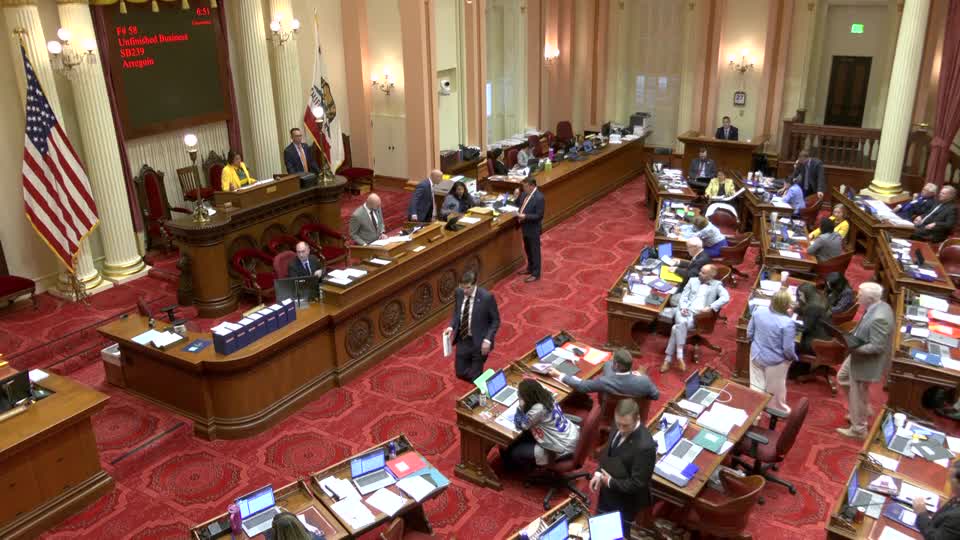 2MIN
Senate Floor
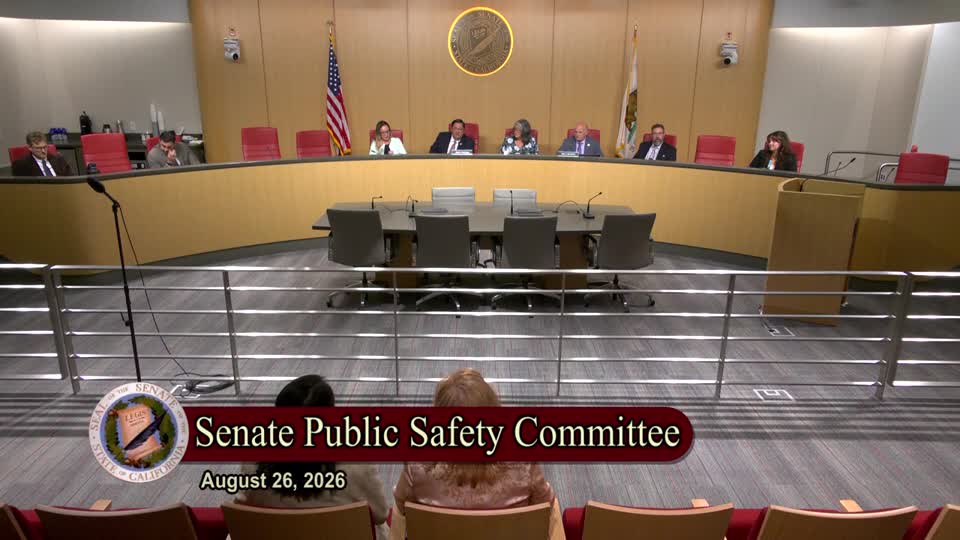 2MIN
Senate Standing Committee on Public Safety
 1MIN
Assembly Floor
 2MIN
Senate Floor
 22MIN
Senate Standing Committee on Judiciary
 24MIN
Senate Standing Committee on Local Government
Bill Author

Bill Co-Author(s):