SB 254: Energy.
- Session Year: 2025-2026
- House: Senate
- Latest Version Date: 2025-09-19
Current Status:
Passed
(2025-09-19: Chaptered by Secretary of State. Chapter 119, Statutes of 2025.)
Introduced
In Committee
Awaiting First Chamber Vote
Passed First Chamber
In Committee
Awaiting Second Chamber Vote
Passed Second Chamber
Enacted
(1)Existing law establishes the Governors Office of Business and Economic Development (GO-Biz) within the Governors office and requires the office to serve the Governor as the lead entity for economic strategy and the marketing of California on issues relating to business development, private sector investment, and economic growth, as provided. Existing law, the Bergeson-Peace Infrastructure and Economic Development Bank Act (bank act), establishes the California Infrastructure and Economic Development Bank (I-Bank) within GO-Biz, under the direction of an executive director and governed by, and its corporate power exercised by, a board of directors (bank board). Existing law, among other things, authorizes the bank to make loans, issue bonds, and provide financial assistance for various types of projects that qualify as economic development or public development facilities, as provided. Existing law prohibits the financing of economic development facilities unless the bank determines that the financing or assistance meets specified public interest criteria.
Existing law, the Safe Drinking Water, Wildfire Prevention, Drought Preparedness, and Clean Air Bond Act of 2024 (bond act), approved by the voters as Proposition 4 at the November 5, 2024, statewide general election, authorizes the issuance of bonds in the amount of $10,000,000,000 pursuant to the State General Obligation Bond Law to finance projects for safe drinking water, drought, flood, and water resilience, wildfire and forest resilience, coastal resilience, extreme heat mitigation, biodiversity and nature-based climate solutions, climate-smart, sustainable, and resilient farms, ranches, and working lands, park creation and outdoor access, and clean air programs. Existing law makes $850,000,000 of that amount available, upon appropriation of the Legislature, for clean energy projects, as provided.
This bill would deem the financing of projects related to the clean energy projects funded by the bond act, as described above, to be in the public interest and eligible for financing by the I-Bank or by a special purpose trust established pursuant to the bank act and would, except as specified, require that any such financing be treated as financing of an economic development facility for purposes of the bank act. The bill would authorize the I-Bank to provide any form of financial assistance, including issuing bonds, as provided.
The bill would authorize the I-Bank to provide financial assistance under the California Transmission Accelerator Revolving Fund Program to any eligible participating party, either directly or to a lending or financial institution, in connection with the financing or refinancing of an accelerator project, in accordance with an agreement or agreements between the I-Bank and the participating party, either as a sole lender or in participation or syndication with other lenders. The bill would define various terms for these purposes. The bill would require that eligible projects for financing under these provisions meet specified conditions. The bill would require the I-Bank to prepare, and the bank board to approve, guidelines for the provision of financial assistance under the Accelerator Revolving Fund Program, and would exempt the accelerator financing plan and guidelines to administer the program from the rulemaking provisions of the Administrative Procedure Act.
Existing law creates the California Infrastructure and Economic Development Bank Fund (bank fund) in the State Treasury for purposes of implementing the objectives and provisions of the bank act. Except as specified, existing law continuously appropriates all moneys in the bank fund for support of the I-Bank and for expenditure for the purposes stated in the bank act.
This bill would provide that moneys in the bank fund are available for expenditure for California Transmission Accelerator financing, as described above, only upon appropriation by the Legislature. The bill would create the Accelerator Revolving Fund within the State Treasury for the purpose of providing financial assistance under the Accelerator Revolving Fund Program. The bill would make the moneys in the fund, except as specified, continuously appropriated, without regard to fiscal year, for the support of eligible entities, as defined, and available for expenditure for the above-described purposes. By establishing a continuously appropriated fund, the bill would make an appropriation.
(2)Existing law creates within Go-Biz the Energy Unit to accelerate the planning, financing, and execution of critical energy infrastructure projects, as specified.
This bill would require the Energy Unit to establish a Transmission Infrastructure Accelerator (accelerator), in coordination with certain entities, to develop a financing and development strategy for eligible transmission projects receiving California Transmission Accelerator financing, established by this bills provisions as described above, and would require the accelerator to take the necessary steps to accelerate the development and deployment of those projects to maximize ratepayer savings. The bill would require the accelerator, before December 31, 2026, to coordinate the states ongoing activities related to transmission planning and development and to ensure accelerator projects meet specified criteria. The bill would also require the accelerator to evaluate the results of the Independent System Operators transmission planning process, to select which accelerator projects have the opportunity to receive public financing, and to develop a public-private partnership plan to develop financing options that maximize debt financing, among other things.
(3)The Personal Income Tax Law and the Corporation Tax Law allow various credits against the taxes imposed by those laws.
This bill would allow a credit against those taxes for each taxable year beginning on or after January 1, 2026, and before January 1, 2036, in an amount equal to 20% of the qualified expenditures paid or incurred by the qualified taxpayer during the taxable year, not to exceed $20,000,000 per qualified taxpayer per taxable year. The bill would define qualified expenditures for these purposes to mean costs paid or incurred for planning, design, engineering, permitting, construction, and equipment directly related to an eligible transmission project, as defined, or qualified wages, as defined, paid or incurred to employees of a qualified taxpayer that perform services directly related to the eligible transmission project. The bill would define qualified taxpayer for these purposes to mean a taxpayer that is a participating entity under the Accelerator Revolving Fund Program, as described above. If the credit allowed under these provisions is claimed by the qualified taxpayer, the bill would prohibit the taxpayer from earning a return on equity for the eligible transmission project for the portion of the project for which the credit is claimed. The bill would require the I-Bank to inform the Franchise Tax Board of any eligible transmission project that the bank approves for financial assistance and to provide any other information the Franchise Tax Board requires for administration of the credits allowed by the bill.
Existing law requires a bill authorizing a new tax expenditure to contain, among other things, specific goals the tax expenditure will achieve, detailed performance indicators, and data collection requirements.
This bill would provide that this requirement does not apply to the credits allowed by the bills provisions.
(4)The California Consumer Power and Conservation Financing Authority Act creates the California Consumer Power and Conservation Financing Authority. The act authorizes the authority, before January 1, 2007, to establish, finance, purchase, lease, own, operate, acquire, or construct generating facilities and other projects and enterprises, or provide financial assistance for projects or programs by participating parties, to supplement private and public sector power supplies to ensure a sufficient and reliable supply of electricity for Californias consumers at just and reasonable rates, to finance programs for consumers and businesses to invest in cost-effective energy efficient appliances, renewable energy projects, and other programs that will reduce the demand for energy in California, to finance natural gas transportation and storage projects, to achieve an adequate energy reserve capacity in California, and to provide financing for owners of aged, inefficient, electric powerplants to perform necessary retrofits to improve the efficiency and environmental performances of those powerplants.
This bill would additionally authorize the authority to sponsor, finance, purchase, lease, own, operate, acquire, or construct new transmission projects, as defined. The bill would authorize the authority to seek financing assistance from any entity eligible to access the California Transmission Accelerator Revolving Fund.
Existing law authorizes the authority to incur indebtedness and to issue securities of any kind or class, at public or private sale by the Treasurer, and to renew the same, if the indebtedness is payable solely from revenues. Existing law authorizes the authority to issue bonds, as specified, in an amount not to exceed $5,000,000,000, exclusive of any refunds.
This bill would delete that $5,000,000,000 limit.
Existing law prohibits the authority from financing or approving any new program, enterprise, or project on or after January 1, 2007, unless authority to approve such an activity is granted by statute enacted on or before January 1, 2007.
This bill would repeal that provision.
(5)Existing law vests the State Energy Resources Conservation and Development Commission (Energy Commission) with the exclusive jurisdiction to certify the construction of certain eligible facilities, as defined. Existing law prohibits a person from constructing such a facility unless that person obtains a certificate from the commission, as provided. Existing law authorizes a person proposing an eligible facility to file an application no later than June 30, 2029, for certification with the commission to certify a site and related facility, as provided.
This bill would extend the date that a person proposing an eligible facility is authorized to apply by to June 30, 2030.
Existing law requires an application for a site and related facility to be in a form prescribed by the Energy Commission, contain specified information, and be further supported by other information as the Energy Commission may require to support the preparation of an environmental impact report and issuance of a certification. Existing law requires the Energy Commission to review the application and make a determination of completeness within 30 days of the submission of the application, and authorizes the executive director of the Energy Commission to require the applicant to submit additional information, documents, or data determined to be reasonably necessary to prepare the environmental impact report for the application, as provided.
This bill would explicitly authorize the Energy Commission to require certain supporting information to support the preparation of an environmental impact report, mitigated negative declaration, or negative declaration, and would make related conforming changes. The bill would require the application to include evidence that the applicant has sufficient real property rights to the proposed location to currently access, build, and operate the proposed facility. The bill would instead authorize the executive director to require an applicant to submit missing information in the application before an application can be deemed complete and would require that any further requests by the executive director for missing information in response to additional information provided by the applicant be made within 45 days, or as soon as practicable thereafter, of receipt of that information.
Existing law requires each person proposing to construct a thermal powerplant or electrical transmission line to submit to the Energy Commission a notice of intention to file an application for the certification of the site and related facility or facilities, requires the approval of the notice by the Energy Commission to be based upon specified findings, and requires an application for certification of the site and related facility to be filed with the Energy Commission. Existing law requires, for the consideration of an application and the issuance of a certification, the Energy Commission to comply with the requirements to prepare a written decision after a public hearing on an application that includes specified things, including findings regarding the conformity of the proposed site and related facilities with standards adopted by the Energy Commission, as provided, and applies these requirements to an application for an eligible facility, as provided.
This bill would remove findings regarding the conformity of the proposed site and related facilities with standards adopted by the Energy Commission from that application requirement for an eligible facility.
Existing law prohibits the Energy Commission from certifying a site and related facility unless the Energy Commission finds that the construction or operation of the facility will have an overall net positive economic benefit to the local government that would have had permitting authority over the site and related facility.
This bill would establish a rebuttable presumption that the construction or operation of the facility will have an overall net positive economic benefit to the local government that would have had permitting authority over the site and related facility.
Existing law prohibits the Energy Commission from certifying a site and related facility unless it finds that the applicant has entered into one or more legally binding and enforceable agreements with, or that benefit, a coalition of one or more community-based organizations, including, but not limited to, workforce development and training organizations, labor unions, social justice advocates, local governmental entities, and California Native American tribes.
This bill would add community foundations to the list of community-based organizations described above.
Existing law, until July 1, 2025, provides that an agreement entered into for purposes of the above-described provisions does not require competitive bidding, or the review, consent, or approval of the Department of General Services or any other state department or agency and is not required to comply with certain contracting requirements.
This bill would extend that exemption until July 1, 2027.
(6)The California Environmental Quality Act (CEQA) requires a lead agency, as defined, to prepare, or cause to be prepared, and certify the completion of an environmental impact report (EIR) on a project that it proposes to carry out or approve that may have a significant effect on the environment or to adopt a negative declaration if it finds that the project will not have that effect. CEQA also requires a lead agency to prepare a mitigated negative declaration for a project that may have a significant effect on the environment if revisions in the project would avoid or mitigate that effect and there is no substantial evidence that the project, as revised, would have a significant effect on the environment.
CEQA authorizes a lead agency for a later project, if a prior EIR has been prepared and certified for a program, plan, policy, or ordinance, commonly known as a program EIR, to examine significant effects of the later project upon the environment by using a tiered EIR and provides that the tiered EIR is not required to examine effects that meet certain requirements.
Existing law establishes a process for the certification of facilities related to clean energy infrastructure by the Energy Commission.
This bill would require the Energy Commission to prepare a program EIR to analyze the development of a class or classes of facility for which the Energy Commission has received an application under a specific certification program, as provided. The bill would authorize a public agency considering the approval of a specific facility that is within a class or classes of facility described in the program EIR prepared under these provisions to tier from that program EIR, as provided.
(7)Existing law generally requires an operator of a subsurface installation to become a member of, participate in, and share in the costs of, a regional notification center. Existing law requires a record of all notifications by an excavator or operator to the regional notification center to be maintained for a period of not less than 3 years and available for inspection, as specified. Existing law requires an operator to maintain certain records on subsurface installations. Existing law establishes prescribed notification procedures for an excavator who discovers or damages a subsurface installation. Existing law requires a regional notification center to quarterly provide notification records to the California Underground Facilities Safe Excavation Board and to provide notifications of damage to the board within 5 business days of receipt at the regional notification center.
This bill would require a regional notification center to facilitate the exchange of planning and design information for infrastructure projects, as described, and would require operators to participate in this exchange, as provided. The bill would require a regional notification center, upon request, to notify a California Native American tribe of proposed excavations within the geographic area with which the tribe is traditionally and culturally affiliated. The bill would require the California Underground Facilities Safe Excavation Board to report to the Legislature on the advantages, barriers, and funding options for the development of an internet web-based planning and design platform for accomplishing the exchange of planning and design information and for allowing tribes to view plans for projects and to communicate with plan submitters.
(8)Existing law requires electrical corporations to construct, maintain, and operate their electrical lines and equipment in a manner that will minimize the risk of catastrophic wildfire posed by those electrical lines and equipment.
This bill would require those actions to take into account the time required to implement proposed mitigations and the amount of risk reduced for the cost and risk remaining.
(9)Existing law requires each electrical corporation to annually prepare and submit a wildfire mitigation plan that covers at least a 3-year period and authorizes the office to allow for annual submissions to be updates to the last approved comprehensive wildfire mitigation plan, but requires the electrical corporation to submit a comprehensive wildfire mitigation plan at least once every 3 years for review. Existing law requires wildfire mitigation plans to include, among other things, a list that identifies, describes, and prioritizes all wildfire risks, and drivers for those risks, throughout the electrical corporations service territory, and a description of the actions the electrical corporation will take to ensure its system will achieve the highest level of safety, reliability, and resiliency, as specified.
This bill instead would require each electrical corporation to submit a wildfire mitigation plan to the office for review at least once every 4 years. The bill would require each electrical corporation, beginning January 1, 2027, to submit a preliminary wildfire mitigation plan to the office at the earliest date of one year before the filing of its general rate case application or concurrent with the filing of its Risk Assessment Mitigation Phase application with the Public Utilities Commission (PUC). The bill would revise those wildfire mitigation plan requirements to, among other things, require the list to also include particular risks and risk drivers associated with the speed with which wildfire risk mitigation measures can and will be deployed by the electrical corporation and an estimate of cost-per-avoided ignition for each risk, or an explanation on why such a value could not be assigned to a particular risk, and require the presentation of certain cost-efficiency measures adopted by the PUC, as specified.
(10)Existing law requires the office to approve or deny each wildfire mitigation plan and update submitted by an electrical corporation within 3 months of its submission. Existing law establishes procedures for the office to oversee compliance with an approved wildfire mitigation plan. Existing law requires the PUC to consider whether the cost of implementing an electrical corporations wildfire mitigation plan is just and reasonable in the electrical corporations general rate case application.
This bill instead would require the office to approve or deny a wildfire mitigation plan submitted by an electrical corporation within 9 months of its submission. The bill would, for a general rate case application filed on or after January 1, 2027, require an electrical corporation to file the wildfire mitigation plan approved by the office or, if the plan has not been approved by the office, the preliminary wildfire plan filed with the office, and any applicable decision from the office, with the general rate case application. The bill would require an electrical corporation, within 45 days of the PUCs decision on whether the cost of implementing the electrical corporations wildfire mitigation plan is just and reasonable in the electrical corporations general rate case or any PUC order modifying that decision, to submit to the office a revised wildfire mitigation plan that conforms to the PUCs revenue authorization. The bill would require the office to approve the revised wildfire mitigation plan within 2 months of submission and would require the electrical corporation to file the approved revised wildfire mitigation plan as an information-only submittal with the PUC. The bill would revise and recast provisions related to the oversight by the office in the implementation of, and the enforcement by the PUC of, the finally approved wildfire mitigation plan.
(11)Existing law requires the PUC to establish an expedited utility distribution infrastructure undergrounding program for large electrical corporations. In order to participate in the program, existing law requires a large electrical corporation to submit to the office a distribution infrastructure undergrounding plan, as provided. Upon approval of the plan by the office, existing law requires the large electrical corporation to submit to the PUC an application requesting review and conditional approval of the plans costs and other specified information.
This bill would revise the provisions related to the expedited utility distribution infrastructure undergrounding program to, among other things, specify that the approval of a distribution infrastructure undergrounding plan is not a project for purposes of the California Environmental Quality Act, as specified.
(12)Existing law requires the California Wildfire Safety Advisory Board to annually make recommendations to the office on various topics, including the appropriate scope and process for assessing the safety culture of an electrical corporation. Existing law requires the office to annually issue an analysis and recommendation to the PUC on the recommendations provided by the board. Existing law requires the PUC to annually adopt and approve, among other things, a process for the office to conduct annual safety culture assessments for each electrical corporation.
This bill would repeal those provisions.
(13)Existing law requires local publicly owned electric utilities and electrical cooperatives to annually prepare and submit to the board, on or before July 1 of each year, wildfire mitigation plans.
This bill instead would require, after January 1, 2026, local publicly owned electric utilities and electrical cooperatives to prepare and submit to the board wildfire mitigation plans at least once every 4 years on a schedule determined by the board.
(14)Existing law establishes the Wildfire Fund, administered by the Wildfire Fund Administrator, and continuously appropriates moneys in the fund to pay eligible claims, as defined, from participating electrical corporations arising from wildfires ignited on or after July 12, 2019, that are determined to be caused by the electrical corporation. Existing law requires each large electrical corporation, by certain dates, to notify the Public Utilities Commission of its election to participate in the fund by making a commitment to provide an initial contribution and annual contributions to the fund, as provided. Existing law authorizes large electrical corporations providing the notification and commitment (participating electrical corporations) to seek payment from the fund to satisfy settled and finally adjudicated eligible claims. Existing law authorizes a participating electrical corporation to file an application with the commission to recover costs and expenses arising from a wildfire ignited on or after July 12, 2019, that is caused by the electrical corporation that the commission determines to be just and reasonable. Existing law requires a participating electrical corporation, within 6 months of the commissions decision in the application for the recovery of costs and expenses arising from the wildfire, to reimburse the fund, as provided, for any payment of costs and expenses determined not to be just and reasonable. Existing law requires the commission to initiate a rulemaking proceeding to consider using its authority to require participating electrical corporations to collect a nonbypassable charge from their ratepayers to support the fund, including the payment of any bonds issued for the support of the fund, as provided. The bill would authorize the Department of Water Resources to issue bonds, in an aggregate amount up to $10,000,000,000, as provided, to support the fund.
This bill would require the administrator, on or before April 1, 2026, to prepare and submit to the Legislature and to the Governor, a report that evaluates and sets forth recommendations on new models or approaches that mitigate damage, accelerate recovery, and responsibly and equitably allocate the burdens from natural catastrophes, across stakeholders, to complement or replace the fund, as specified.
This bill would create the Continuation Account within the fund, which is separate and distinct from moneys in the fund, to be administered by the administrator, and would continuously appropriate moneys in the account for purposes of payment of eligible claims arising from wildfires ignited on or after the effective date of the bill, as provided, thereby making an appropriation. The bill would require each large electrical corporation, within 15 days of the effective date of the bill, to provide to the commission a written notification of its election to participate, or not to participate, in the account. The bill would specify that the election by participating electrical corporations to participate in the account constitutes an agreement of the large electrical corporations to certain matters, including a revision of how the large electrical corporations are required to reimburse the fund for any costs and expenses arising from a wildfire that are found not to be just and reasonable and limiting the obligation of the fund to provide payments for eligible claims arising from wildfires ignited on or before the effective date of the bill. The bill would require the commission, if all participating electrical corporations have provided their election to participate in the account, to provide the administrator and other entities notification of their elections. The bill would authorize the administrator, on or after the date the commission provides the notification, but not later than December 31, 2028, to determine if additional annual contributions are needed, and to provide notification of its determination to the commission and the department. The bill would require the commission, within 15 days of receiving the notification from the administrator, to initiate a rulemaking proceeding to consider using its authority to require the large electrical corporations to collect a nonbypassable charge from ratepayers to support the account, including the payment of any bond issued for the support of the account, as provided. The bill would authorize the department to issue bonds, in an aggregate amount up to $9,000,000,000, as provided, to support the account. The bill would, if the commission imposes the nonbypassable charge to support the account, require the large electrical corporations, from calendar years 2029 to 2045, inclusive, to provide to the administrator their annual contributions, as specified, for deposit into the account. The bill would, if the administrator determines that an additional contribution of $3,900,000,000 is needed to support the account, authorize the administrator to require the large electrical corporations to provided their proportionate share of that amount in equal installment payments over a 5-year period, as provided. The bill would authorize a large electrical corporation to seek payment from the account to satisfy settled or finally adjudicated eligible claims arising from wildfires ignited on or after the effective date of the bill, as provided. The bill would require the large electrical corporations, within 6 months of the commissions decision in the application for the recovery of costs and expenses arising from the wildfire, to reimburse the fund, as provided, for any payment of costs and expenses determined not to be just and reasonable. The bill would make the above provisions inoperative if one of the large electrical corporations elects not to participate in the account.
This bill would, except as provided, for an agreement by a property insurer to sell, assign, or transfer, in whole or in part, to a third-party entity, a right of subrogation, reimbursement, or recovery resulting from a wildfire that is ignited on or after the effective date of this act and that destroys 1,000 or more structures, require the property insurer to first offer to settle that right, on the same terms and conditions as the proposed agreement, to a large electrical corporation, if any, that provides electrical service to the service area in which the wildfire ignited. The bill would require the large electrical corporation to accept or reject the offer or to reach agreement on mutually agreeable terms for the settlement of that right within 30 days of the property insurer making the offer. The bill would, except as provided, require the agreement and exchange of information, including the offer made and other documentation related to the offer, to be subject to a nondisclosure agreement and would prohibit the disclosure of that information. The bill would specify that the information provided to a public agency pursuant to law is not subject to public disclosure under the California Public Records Act or any other law.
(15)Existing law authorizes an electrical corporation to file an application requesting the commission to issue a financing order to authorize the recovery of certain costs and expenses, including those related to catastrophic wildfires, that are determined to be just and reasonable through the issuance of recovery bonds by the electrical corporations that are secured by a rate component, as provided.
This bill would, for a catastrophic wildfire that was ignited between January 1, 2025, and the effective date of the bill, authorize an electrical corporation, before filing an application for a determination of just and reasonableness of the settled or finally adjudicated claims associated with the catastrophic wildfire, to a file an application for a determination that those claims cannot be paid by the fund and for the issuance of a financing order in the amount of those claims. The bill would require the commission to issue a financing order if it makes certain determinations, as provided. The bill would require a large electrical corporation, if it issues recovery bonds pursuant to the financing order, to file an application for a just and reasonableness determination for the costs and expenses included in the recovery bonds, as provided. The bill would authorize the commission to order a large electrical corporation to provide a credit to its ratepayers for any disallowed costs and expenses plus any cost and expense resulting from the inclusion of the disallowed costs and expenses in the recovery bonds.
Existing law, until December 31, 2035, authorizes the commission to issue the financing order. Existing law requires the commission to prohibit a large electrical corporation from including in its equity rate base its share for the first $5,000,000,000 expended in aggregate by large electrical corporations on fire risk mitigation capital expenditures, as provided, and authorizes those expenditures to be financed through the financing order.
This bill would, in addition to the amount of fire risk mitigation capital expenditure described above, require the commission to prohibit a large electrical corporation from including in its equity rate base its share of the first $6,000,000,000 expended in aggregate by large electrical corporations on fire risk mitigation capital expenditures approved by the commission on or after January 1, 2026. The bill would authorize an electrical corporations share of the fire risk mitigation capital expenditures and the debt financing costs of these fire risk mitigation capital expenditures to be financed through a financing order, as specified. The bill would provide that these provisions do not apply to expenditures made after December 31, 2035.
(16)Existing law requires the PUC, by May 1 of each year, to prepare and submit a written report to the Legislature with certain information, including information regarding electrical corporations utility costs and rate increases.
This bill would require the report to include additional certain information on the transmission assets, distribution assets, and generation assets of each large electrical corporation, including information on the amount or ratebase for those assets with 10 years of historical values and the total amount for return on equity and debt collected in the revenue requirement for those assets.
(17)Existing law requires the PUC to establish reasonable average and maximum target energization time periods, as defined, and a procedure for customers to report energization delays to the PUC, as provided. Existing law requires the PUC to require an electrical corporation to take remedial actions necessary to achieve the PUCs targets and would require all reports to be publicly available, among other reporting requirements.
This bill would require the PUC to evaluate and report to the Legislature on or before January 1, 2027, whether to require an electrical corporation to have an executive incentive compensation structure that includes incentive compensation based on meeting the above-described targets for all executive officers. The bill would require, on or before January 1, 2027, the commission to establish an enforcement policy for the those targets that include penalties for not complying with the remedial actions, as specified.
This bill would require the PUC to require each electrical corporation to retain an independent third-party auditor to review the electrical corporations business practices and procedures for energizing new customers and how the electrical corporation is planning for demand growth, including new customer energizations. The bill would require the third-party auditor to review specified factors and to evaluate the electrical corporations current and future energization performance and make recommendations as to whether the electrical corporation is adequately meeting and anticipating customer demand, adequately training and retaining an adequate workforce, and is funded at sufficient levels to meet forecasted demand growth. The bill would require the third-party auditor to report to the PUC on a biannual basis, as specified. The bill would authorize the PUC to require an electrical corporation to take remedial actions necessary to address deficiencies identified in the report provided by the third-party auditor or to achieve the above-described targets. The bill would repeal these provisions on January 1, 2032.
(18)Under existing law, a violation of the Public Utilities Act or any order, decision, rule, direction, demand, or requirement of the PUC is a crime.
Because certain of the above-described provisions would be part of the act and a violation of a PUC action implementing the above-described provisions would be a crime, this bill would impose a state-mandated local program.
(19)Existing constitutional provisions require that a statute that limits the right of access to the meetings of public bodies or the writings of public officials and agencies be adopted with findings demonstrating the interest protected by the limitation and the need for protecting that interest.
This bill would make legislative findings to that effect.
(20)The California Constitution requires the state to reimburse local agencies and school districts for certain costs mandated by the state. Statutory provisions establish procedures for making that reimbursement.
This bill would provide that no reimbursement is required by this act for a specified reason.
(21)This bill would declare that it is to take effect immediately as an urgency statute.
(1)Existing law establishes the Wildfire Safety Division and requires the division to perform certain regulatory functions related to the wildfire mitigation plans of electrical corporations. Existing law transferred all functions of the Wildfire Safety Division to the Office of Energy Infrastructure Safety effective July 1, 2021.This bill would repeal the Wildfire Safety Division.Existing law requires electrical corporations to construct, maintain, and operate their electrical lines and equipment in a manner that will minimize the risk of catastrophic wildfire posed by those electrical lines and equipment.This bill would require those actions to take into account the time required to implement proposed mitigations and the amount of risk reduced for the cost and risk remaining.Existing law requires each electrical corporation to annually prepare and submit a wildfire mitigation plan that covers at least a 3-year period and authorizes the office to allow for annual submissions to be updates to the last approved comprehensive wildfire mitigation plan, but requires the electrical corporation to submit a comprehensive wildfire mitigation plan at least once every 3 years for review. Existing law requires wildfire mitigation plans to include, among other things, a list that identifies, describes, and prioritizes all wildfire risks, and drivers for those risks, throughout the electrical corporations service territory, and a description of the actions the electrical corporation will take to ensure its system will achieve the highest level of safety, reliability, and resiliency, as specified.This bill instead would require each electrical corporation to submit a wildfire mitigation plan to the office for review at least once every 4 years. The bill would require each electrical corporation, beginning January 1, 2026, to submit a preliminary wildfire mitigation plan to the office at the earliest date of one year before the filing of its general rate case application or concurrent with the filing of its Risk Assessment Mitigation Phase application with the Public Utilities Commission (PUC). The bill would revise those wildfire mitigation plan requirements to, among other things, require the list to also include particular risks and risk drivers associated with the speed with which wildfire risk mitigation measures can and will be deployed by the electrical corporation, and require the presentation of certain cost-efficiency measures adopted by the PUC, as specified.Existing law requires the office to approve or deny each wildfire mitigation plan and update submitted by an electrical corporation within 3 months of its submission. Existing law establishes procedures for the office to oversee compliance with an approved wildfire mitigation plan. Existing law prohibits the PUC from allowing a large electrical corporation to include in its equity rate base its share of the first $5,000,000,000 expended in aggregate by large electrical corporations on fire risk mitigation capital expenditures included in the electrical corporations wildfire mitigation plans. Existing law requires the PUC to consider whether the cost of implementing an electrical corporations wildfire mitigation plan is just and reasonable in the electrical corporations general rate case application.This bill instead would require the office to approve or deny a wildfire mitigation plan submitted by an electrical corporation within 9 months of its submission. The bill would additionally prohibit the PUC from allowing a large electrical corporation to include in its equity rate base its share of the $5,000,000,000 that the large electrical corporations collectively first expend on fire risk mitigation capital expenditures approved by the PUC on or after January 1, 2025. The bill would, for a general rate case application filed on or after the effective date of the bill, or that is filed before but not approved by the commission before the effective date of the bill, require an electrical corporation to file the wildfire mitigation plan approved by the office or, if the plan has not been approved by the office, the preliminary wildfire plan filed with the office, and any applicable decision from the office, with the general rate case application. The bill would require an electrical corporation, within 45 days of the PUCs decision on whether the cost of implementing the electrical corporations wildfire mitigation plan is just and reasonable in the electrical corporations general rate case or any PUC order modifying that decision, to submit to the office a revised wildfire mitigation plan that conforms to the PUCs revenue authorization. The bill would require the office to approve the revised wildfire mitigation plan within 2 months of submission and would require the electrical corporation to file the approved revised wildfire mitigation plan as an information-only submittal with the PUC. The bill would revise and recast provisions related to the oversight by the office in the implementation of, and the enforcement by the PUC of, the finally approved wildfire mitigation plan.Existing law requires the PUC to establish an expedited utility distribution infrastructure undergrounding program for large electrical corporations. In order to participate in the program, existing law requires a large electrical corporation to submit to the office a distribution infrastructure undergrounding plan, as provided. Upon approval of the plan by the office, existing law requires the large electrical corporation to submit to the PUC an application requesting review and conditional approval of the plans costs and other specified information.This bill would revise the provisions related to the expedited utility distribution infrastructure undergrounding program to, among other things, specify that the approval of a distribution infrastructure undergrounding plan is not a project for purposes of the California Environmental Quality Act, as specified.Existing law requires the California Wildfire Safety Advisory Board to annually make recommendations to the office on various topics, including the appropriate scope and process for assessing the safety culture of an electrical corporation. Existing law requires the office to annually issue an analysis and recommendation to the PUC on the recommendations provided by the board. Existing law requires the PUC to annually adopt and approve, among other things, a process for the office to conduct annual safety culture assessments for each electrical corporation.This bill would repeal those provisions.Existing law requires local publicly owned electric utilities and electrical cooperatives to annually prepare and submit to the board, on or before July 1 of each year, wildfire mitigation plans.This bill instead would require, after January 1, 2026, local publicly owned electric utilities and electrical cooperatives to prepare and submit to the board wildfire mitigation plans at least once every 4 years on a schedule determined by the board.(2)The California Global Warming Solutions Act of 2006 establishes the State Air Resources Board as the state agency responsible for monitoring and regulating sources emitting greenhouse gases. The act requires the state board to adopt a statewide greenhouse gas emissions limit, as defined, to be achieved by 2020, equivalent to the statewide greenhouse gas emissions level in 1990. The state board is authorized to include market-based compliance mechanisms to comply with the regulations. The implementing regulations adopted by the state board provide for the direct allocation of greenhouse gas allowances to electrical corporations pursuant to a market-based compliance mechanism.Existing law vests the PUC with regulatory authority over public utilities, including electrical corporations. Existing law requires the PUC to continue a program of assistance to low-income electric and gas customers with annual household incomes that are no greater than 200% of the federal poverty guidelines, as specified, which is referred to as the California Alternate Rates for Energy (CARE) program. Existing law also requires the PUC to continue a program of assistance to residential customers of the states 3 largest electrical corporations consisting of households of 3 or more persons with total household annual gross income levels between 200% and 250% of the federal poverty guideline level, which is referred to as the Family Electric Rate Assistance (FERA) program.Existing law requires the PUC to require certain revenues received by an electrical corporation as a result of the direct allocation of greenhouse gas allowances to be directly credited to the residential, small business, and emissions-intensive trade-exposed retail customers of the electrical corporation, except as specified.This bill would, on and after January 1, 2026, require the PUC to require a larger credit be allocated to CARE program and FERA program customers, as provided, and would require the credit to be excluded from any calculation of the average effective CARE or FERA program discount. The bill would require the PUC to direct the credit to be divided among, and applied to, customer bills during the months with the highest average electricity demand.(3)Existing law requires the PUC to establish, on or before September 30, 2024, reasonable average and maximum target energization time periods, as defined, and a procedure for customers to report energization delays to the PUC, as provided.If an electrical corporation submits an application for recovery of costs and expenses for energization projects and the PUC finds that some or all of the costs and expenses are just and reasonable, this bill would authorize the electrical corporation to request the PUC to issue a financing order to authorize the recovery of those just and reasonable costs and expenses through the issuance of bonds by the electrical corporation that are secured by a rate component, as provided. The bill would prohibit, except as provided, the PUC from allowing a large electrical corporation, as defined, to include in its equity rate base its share of $10,000,000,000 that the large electrical corporations collectively first expend on energization capital expenditures approved by the PUC on or after January 1, 2025. The bill would authorize an electrical corporations energization capital expenditures and the debt financing costs of these energization capital expenditures to be financed through a financing order for the recovery of costs and expenses for energization projects.(4)Existing law authorizes the PUC to fix the rates and charges for every public utility and requires that those rates and charges be just and reasonable.This bill would require the PUC to require all electrical and gas corporations, as part of every general rate case application, to submit an inflation-constrained rate case scenario in which cumulative increases in annual expenditures proposed to be authorized in that proceeding do not exceed the projected federal social security beneficiary cost-of-living adjustment and to compare the inflation-constrained rate case scenario with the primary rate case proposal submitted by the electrical or gas corporation. The bill would authorize the PUC to authorize expenditures in excess of the inflation-constrained rate case scenario if it determines that the corporation has provided clear and convincing evidence that a higher level of expenditures is necessary to ensure the safe and reliable operation of its electric or gas system, and would require the PUC to apply heightened scrutiny to any other request submitted by each electrical corporation and gas corporation that is likely to increase total systemwide expenditures beyond the projected federal social security beneficiary cost-of-living adjustment.This bill would require the PUC to adopt formal public findings when it approves an electrical rate increase that include an explanation of why the rate increase was approved and what the rate increase will cost on the average customer bill. The bill would require the PUC to annually include those public findings in each customers monthly bill.(5)Existing law requires the PUC, by May 1 of each year, to prepare and submit a written report to the Legislature with certain information, including information regarding electrical corporations utility costs and rate increases.This bill would require the report to include additional certain information on the transmission assets, distribution assets, and generation assets of each large electrical corporation, including information on the amount or ratebase for those assets with 10 years of historical values and the total amount for return on equity and debt collected in the revenue requirement for those assets.This bill would require the commission to post on its internet website the authorized and the actual return on equity amounts and the authorized and the actual mix of debt and equity capital for each large electrical corporation, as defined, with 10 years of historical values.(6)Existing law requires the PUC, on a triennial basis, to submit a report to the Legislature on the energy efficiency and conservation programs it oversees.This bill would instead require the PUC to submit a report to the Legislature on the demand-side management programs it oversees or that are paid for by ratepayers of community choice aggregators, electrical corporations, or gas corporations. The bill would revise the information required to be included in the report.(7)Existing law requires the State Energy Resources Conservation and Development Commission (Energy Commission) to administer the Electric Program Investment Charge Fund for research, development, and demonstration program that will benefit electricity ratepayers.This bill would require the Energy Commission, in consultation with the PUC, to develop and implement the Policy-Oriented and Wildfire Electric Reimbursement (POWER) Program to reduce the costs to ratepayers by providing reimbursement to electric utilities for expenditures driven by public policy goals that provide a benefit to the general public, as provided. The bill would establish the POWER Fund in the State Treasury and would require that moneys in the fund, upon appropriation by the Legislature, be expended by the Energy Commission for purposes of the program. The bill would require the commission, when developing and implementing the POWER Program, to do specified things, including establish guidance and criteria for allocating reimbursements from the fund that require, among other things, that the proportion of any expenditures by an electrical corporation that are reimbursed pursuant to the POWER Program are excluded from the electrical corporations ratebase and any asset funded by those reimbursed expenditures be funded without return on equity, as provided. The bill would require the Energy Commission to annually report to the Legislature actual utility bill impacts in order to ensure the mechanism is helping to reduce electric utility costs for ratepayers. The bill would limit the amount of moneys appropriated for the program that may be used for administrative and overhead costs each year to the lesser of 3% or $5,000,000.(8)Existing law vests the Energy Commission with the exclusive jurisdiction to certify the construction of certain eligible facilities, as defined, including a discretionary project, as specified, for which the applicant has certified that a capital investment of at least $250,000,000 will be made over a period of 5 years. Existing law prohibits a person from constructing such a facility unless that person obtains a certificate from the commission, as provided. Existing law authorizes a person proposing an eligible facility to file an application no later than June 30, 2029, for certification with the commission to certify a site and related facility, as provided.This bill would lower the above-described amount to $100,000,000. The bill would extend the date that a person proposing an eligible facility is authorized to apply by to June 30, 2034.Existing law requires an application for a site and related facility to be in a form prescribed by the Energy Commission, contain specified information, and be further supported by other information as the Energy Commission may require. Existing law requires the Energy Commission to review the application and make a determination of completeness within 30 days of the submission of the application, and authorizes the executive director of the Energy Commission to require the applicant to submit additional information, documents, or data determined to be reasonably necessary to prepare the environmental impact report for the application, as provided.This bill would explicitly authorize the Energy Commission to require certain supporting information. The bill would require the application to include evidence that the applicant has sufficient real property rights to the proposed location to currently access, build, and operate the proposed facility. The bill would require that any further requests by the executive director for additional information in response to additional information provided by the applicant be made within 30 days of receipt of that information.For sites and related facilities located in the geographic jurisdiction of the California Coastal Commission or the San Francisco Bay Conservation and Development Commission, existing law requires the Energy Commission to consult with the applicable agency to coordinate processing and sequencing of the applications to expedite the permitting process of those agencies, as specified. This bill would require the Energy Commission, the California Coastal Commission, and the San Francisco Bay Conservation and Development Commission to develop a plan that ensures timely and effective consultation between them, as provided.Existing law requires each person proposing to construct a thermal powerplant or electric transmission line to submit to the Energy Commission a notice of intention to file an application for the certification of the site and related facility or facilities, requires the approval of the notice by the Energy Commission to be based upon specified findings, and requires an application for certification of the site and related facility to be filed with the Energy Commission. Existing law requires, for the consideration of an application and the issuance of a certification, the Energy Commission to comply with the requirements to prepare a written decision after a public hearing on an application that includes specified things, including findings regarding the conformity of the proposed site and related facilities with standards adopted by the Energy Commission, as provided, and applies these requirements to an application for an eligible facility, as provided. Existing law prohibits the Energy Commission from certifying a facility contained in the application when it finds that the facility does not conform to any applicable state, local, or regional standards, ordinances, or laws, as specified, unless the Energy Commission determines that the facility is required for public convenience and necessity and that there are not more prudent and feasible means of achieving public convenience and necessity.This bill would remove findings regarding the conformity of the proposed site and related facilities with standards adopted by the Energy Commission from that application requirement for an eligible facility. This bill would apply the above prohibition to an application for an eligible facility, as provided.Existing law prohibits the Energy Commission from certifying a site and related facility unless the Energy Commission finds that the construction or operation of the facility will have an overall net positive economic benefit to the local government that would have had permitting authority over the site and related facility.This bill would establish a rebuttable presumption that the construction or operation of the facility will have an overall net positive economic benefit to the local government that would have had permitting authority over the site and related facility for a project for an energy storage system if the energy storage system is proposed to be adjacent to an operating utility substation or adjacent to an operating or retiring gas powerplant.Existing law prohibits the Energy Commission from certifying a site and related facility unless it finds that the applicant has entered into one or more legally binding and enforceable agreements with, or that benefit, a coalition of one or more community-based organizations, including, but not limited to, workforce development and training organizations, labor unions, social justice advocates, local governmental entities, and California Native American tribes.This bill would add community foundations to the list of community-based organizations described above.This bill would require the Energy Commission, in coordination with the Office of Land Use and Climate Innovation, to pilot the use of permitting management software to provide greater efficiency in the opt-in certification process, as provided, and would require the Energy Commission to share the findings of the pilot in a final report to the Legislature and other state permitting agencies, as specified. The bill would require the Energy Commission to report specified things about applications and projects to the Legislature quarterly that the commission would be permitted to report by the use of a dashboard on its internet website, including, among other things, the status of projects that have been approved by the commission, as provided.(9)The California Environmental Quality Act (CEQA) requires a lead agency, as defined, to prepare, or cause to be prepared, and certify the completion of an environmental impact report (EIR) on a project that it proposes to carry out or approve that may have a significant effect on the environment or to adopt a negative declaration if it finds that the project will not have that effect. CEQA also requires a lead agency to prepare a mitigated negative declaration for a project that may have a significant effect on the environment if revisions in the project would avoid or mitigate that effect and there is no substantial evidence that the project, as revised, would have a significant effect on the environment.CEQA authorizes a lead agency for a later project, if a prior EIR has been prepared and certified for a program, plan, policy, or ordinance, commonly known as a program EIR, to examine significant effects of the later project upon the environment by using a tiered EIR and provides that the tiered EIR is not required to examine effects that meet certain requirements.Existing law establishes a process for the certification of facilities related to clean energy infrastructure by the Energy Commission.This bill would authorize the Energy Commission to prepare a program EIR to analyze the development of a class or classes of facility related to clean energy infrastructure, as provided. The bill would authorize a public agency considering the approval of a specific facility that is within a class or classes of facility described in the program EIR prepared under these provisions to tier from that program EIR, as provided.(10)Existing law establishes the Independent System Operator (ISO) as a nonprofit public benefit corporation and requires the ISO to ensure efficient use and reliable operation of the electrical transmission grid consistent with achieving planning and operating reserve criteria no less stringent than those established by the Western Electricity Coordinating Council and the North American Electric Reliability Corporation.Under existing law, it is the policy of the state that eligible renewable energy resources and zero-carbon resources supply 100% of all retail sales of electricity to California end-use customers and 100% of electricity procured to serve all state agencies by December 31, 2045.This bill would create the Clean Energy Infrastructure Authority as a public instrumentality of the state for the purpose of leading the states efforts to build critical clean energy infrastructure necessary to enable the state to transition to 100% clean energy, as specified. The bill would require the authority to do any and all things necessary or proper to accomplish that purpose. The bill would authorize the authority, among other things, to identify and establish corridors for the transmission of electricity within the state, to coordinate, investigate, plan, prioritize, and negotiate with entities within and outside the state to establish interstate transmission corridors, to finance, plan, develop, acquire, own, maintain, sell, or operate electrical transmission infrastructure and transmission-related energy storage systems, to exercise the power of eminent domain to acquire property or rights-of-way for public use, to issue bonds as necessary to undertake electrical transmission infrastructure or transmission-related energy storage system projects, and to act as the lead agency for purposes of the California Environmental Quality Act and other environmental reviews, as specified. Before beginning construction of electrical transmission infrastructure that will be located in the service territory of, or connected directly to the electrical transmission infrastructure of, an electrical corporation with 250,000 or more customer accounts within the state and owned by the authority, the bill would require the authority to enter into a lease or other agreement with that electrical corporation to construct, operate, and maintain the electrical transmission infrastructure. The bill would authorize the authority to propose, and plan for, new electrical transmission infrastructure, but would prohibit the authority from developing electrical transmission infrastructure unless the applicable California balancing authority, including the ISO, has approved the project, in which case the approval of the PUC would not be required. The bill would provide that the authority is not subject to the supervision or control of the PUC or any other board, bureau, department, or agency of the state, except as specifically provided. The bill would require the authority to annually report to the Legislature on the authoritys activities, including a complete operating and financial statement covering its operations.The bill would require the California Infrastructure and Economic Development Bank (I-Bank), upon request by the authority, to issue taxable or tax-exempt revenue bonds on behalf of the authority, as specified.The bill would require the Department of Finance, among other things, to monitor and oversee the authoritys operations, to receive and review reports from the authority, and to annually report its findings and recommendations to the Governor, PUC, and Legislature.The bill would require the California State Auditor, or its designee, to conduct an annual financial and legal compliance audit of the accounts of the authority and file copies with the Governor and the Legislature.The bill would require that information obtained by the authority that is proprietary technical or business information be confidential and not subject to inspection pursuant to the California Public Records Act.(11)Existing constitutional provisions require that a statute that limits the right of access to the meetings of public bodies or the writings of public officials and agencies be adopted with findings demonstrating the interest protected by the limitation and the need for protecting that interest.This bill would make legislative findings to that effect.(12)Under existing law, a violation of an order, decision, rule, direction, demand, or requirement of the PUC is a crime.Because a violation of a PUC action implementing the requirements of this bill would be a crime, the bill would impose a state-mandated local program.The bill would include findings that changes proposed by this bill address a matter of statewide concern rather than a municipal affair and, therefore, apply to all cities, including charter cities.The California Constitution requires the state to reimburse local agencies and school districts for certain costs mandated by the state. Statutory provisions establish procedures for making that reimbursement.This bill would provide that no reimbursement is required by this act for a specified reason.(13)This bill would declare that it is to take effect immediately as an urgency statute.(1)Existing law establishes the Wildfire Safety Division and requires the division to perform certain regulatory functions related to the wildfire mitigation plans of electrical corporations. Existing law transferred all functions of the Wildfire Safety Division to the Office of Energy Infrastructure Safety effective July 1, 2021.
This bill would repeal the Wildfire Safety Division.
Existing law requires electrical corporations to construct, maintain, and operate their electrical lines and equipment in a manner that will minimize the risk of catastrophic wildfire posed by those electrical lines and equipment.
This bill would require those actions to take into account the time required to implement proposed mitigations and the amount of risk reduced for the cost and risk remaining.
Existing law requires each electrical corporation to annually prepare and submit a wildfire mitigation plan that covers at least a 3-year period and authorizes the office to allow for annual submissions to be updates to the last approved comprehensive wildfire mitigation plan, but requires the electrical corporation to submit a comprehensive wildfire mitigation plan at least once every 3 years for review. Existing law requires wildfire mitigation plans to include, among other things, a list that identifies, describes, and prioritizes all wildfire risks, and drivers for those risks, throughout the electrical corporations service territory, and a description of the actions the electrical corporation will take to ensure its system will achieve the highest level of safety, reliability, and resiliency, as specified.
This bill instead would require each electrical corporation to submit a wildfire mitigation plan to the office for review at least once every 4 years. The bill would require each electrical corporation, beginning January 1, 2026, to submit a preliminary wildfire mitigation plan to the office at the earliest date of one year before the filing of its general rate case application or concurrent with the filing of its Risk Assessment Mitigation Phase application with the Public Utilities Commission (PUC). The bill would revise those wildfire mitigation plan requirements to, among other things, require the list to also include particular risks and risk drivers associated with the speed with which wildfire risk mitigation measures can and will be deployed by the electrical corporation, and require the presentation of certain cost-efficiency measures adopted by the PUC, as specified.
Existing law requires the office to approve or deny each wildfire mitigation plan and update submitted by an electrical corporation within 3 months of its submission. Existing law establishes procedures for the office to oversee compliance with an approved wildfire mitigation plan. Existing law prohibits the PUC from allowing a large electrical corporation to include in its equity rate base its share of the first $5,000,000,000 expended in aggregate by large electrical corporations on fire risk mitigation capital expenditures included in the electrical corporations wildfire mitigation plans. Existing law requires the PUC to consider whether the cost of implementing an electrical corporations wildfire mitigation plan is just and reasonable in the electrical corporations general rate case application.
This bill instead would require the office to approve or deny a wildfire mitigation plan submitted by an electrical corporation within 9 months of its submission. The bill would additionally prohibit the PUC from allowing a large electrical corporation to include in its equity rate base its share of the $5,000,000,000 that the large electrical corporations collectively first expend on fire risk mitigation capital expenditures approved by the PUC on or after January 1, 2025. The bill would, for a general rate case application filed on or after the effective date of the bill, or that is filed before but not approved by the commission before the effective date of the bill, require an electrical corporation to file the wildfire mitigation plan approved by the office or, if the plan has not been approved by the office, the preliminary wildfire plan filed with the office, and any applicable decision from the office, with the general rate case application. The bill would require an electrical corporation, within 45 days of the PUCs decision on whether the cost of implementing the electrical corporations wildfire mitigation plan is just and reasonable in the electrical corporations general rate case or any PUC order modifying that decision, to submit to the office a revised wildfire mitigation plan that conforms to the PUCs revenue authorization. The bill would require the office to approve the revised wildfire mitigation plan within 2 months of submission and would require the electrical corporation to file the approved revised wildfire mitigation plan as an information-only submittal with the PUC. The bill would revise and recast provisions related to the oversight by the office in the implementation of, and the enforcement by the PUC of, the finally approved wildfire mitigation plan.
Existing law requires the PUC to establish an expedited utility distribution infrastructure undergrounding program for large electrical corporations. In order to participate in the program, existing law requires a large electrical corporation to submit to the office a distribution infrastructure undergrounding plan, as provided. Upon approval of the plan by the office, existing law requires the large electrical corporation to submit to the PUC an application requesting review and conditional approval of the plans costs and other specified information.
This bill would revise the provisions related to the expedited utility distribution infrastructure undergrounding program to, among other things, specify that the approval of a distribution infrastructure undergrounding plan is not a project for purposes of the California Environmental Quality Act, as specified.
Existing law requires the California Wildfire Safety Advisory Board to annually make recommendations to the office on various topics, including the appropriate scope and process for assessing the safety culture of an electrical corporation. Existing law requires the office to annually issue an analysis and recommendation to the PUC on the recommendations provided by the board. Existing law requires the PUC to annually adopt and approve, among other things, a process for the office to conduct annual safety culture assessments for each electrical corporation.
This bill would repeal those provisions.
Existing law requires local publicly owned electric utilities and electrical cooperatives to annually prepare and submit to the board, on or before July 1 of each year, wildfire mitigation plans.
This bill instead would require, after January 1, 2026, local publicly owned electric utilities and electrical cooperatives to prepare and submit to the board wildfire mitigation plans at least once every 4 years on a schedule determined by the board.
(2)The California Global Warming Solutions Act of 2006 establishes the State Air Resources Board as the state agency responsible for monitoring and regulating sources emitting greenhouse gases. The act requires the state board to adopt a statewide greenhouse gas emissions limit, as defined, to be achieved by 2020, equivalent to the statewide greenhouse gas emissions level in 1990. The state board is authorized to include market-based compliance mechanisms to comply with the regulations. The implementing regulations adopted by the state board provide for the direct allocation of greenhouse gas allowances to electrical corporations pursuant to a market-based compliance mechanism.
Existing law vests the PUC with regulatory authority over public utilities, including electrical corporations. Existing law requires the PUC to continue a program of assistance to low-income electric and gas customers with annual household incomes that are no greater than 200% of the federal poverty guidelines, as specified, which is referred to as the California Alternate Rates for Energy (CARE) program. Existing law also requires the PUC to continue a program of assistance to residential customers of the states 3 largest electrical corporations consisting of households of 3 or more persons with total household annual gross income levels between 200% and 250% of the federal poverty guideline level, which is referred to as the Family Electric Rate Assistance (FERA) program.
Existing law requires the PUC to require certain revenues received by an electrical corporation as a result of the direct allocation of greenhouse gas allowances to be directly credited to the residential, small business, and emissions-intensive trade-exposed retail customers of the electrical corporation, except as specified.
This bill would, on and after January 1, 2026, require the PUC to require a larger credit be allocated to CARE program and FERA program customers, as provided, and would require the credit to be excluded from any calculation of the average effective CARE or FERA program discount. The bill would require the PUC to direct the credit to be divided among, and applied to, customer bills during the months with the highest average electricity demand.
(3)Existing law requires the PUC to establish, on or before September 30, 2024, reasonable average and maximum target energization time periods, as defined, and a procedure for customers to report energization delays to the PUC, as provided.
If an electrical corporation submits an application for recovery of costs and expenses for energization projects and the PUC finds that some or all of the costs and expenses are just and reasonable, this bill would authorize the electrical corporation to request the PUC to issue a financing order to authorize the recovery of those just and reasonable costs and expenses through the issuance of bonds by the electrical corporation that are secured by a rate component, as provided. The bill would prohibit, except as provided, the PUC from allowing a large electrical corporation, as defined, to include in its equity rate base its share of $10,000,000,000 that the large electrical corporations collectively first expend on energization capital expenditures approved by the PUC on or after January 1, 2025. The bill would authorize an electrical corporations energization capital expenditures and the debt financing costs of these energization capital expenditures to be financed through a financing order for the recovery of costs and expenses for energization projects.
(4)Existing law authorizes the PUC to fix the rates and charges for every public utility and requires that those rates and charges be just and reasonable.
This bill would require the PUC to require all electrical and gas corporations, as part of every general rate case application, to submit an inflation-constrained rate case scenario in which cumulative increases in annual expenditures proposed to be authorized in that proceeding do not exceed the projected federal social security beneficiary cost-of-living adjustment and to compare the inflation-constrained rate case scenario with the primary rate case proposal submitted by the electrical or gas corporation. The bill would authorize the PUC to authorize expenditures in excess of the inflation-constrained rate case scenario if it determines that the corporation has provided clear and convincing evidence that a higher level of expenditures is necessary to ensure the safe and reliable operation of its electric or gas system, and would require the PUC to apply heightened scrutiny to any other request submitted by each electrical corporation and gas corporation that is likely to increase total systemwide expenditures beyond the projected federal social security beneficiary cost-of-living adjustment.
This bill would require the PUC to adopt formal public findings when it approves an electrical rate increase that include an explanation of why the rate increase was approved and what the rate increase will cost on the average customer bill. The bill would require the PUC to annually include those public findings in each customers monthly bill.
(5)Existing law requires the PUC, by May 1 of each year, to prepare and submit a written report to the Legislature with certain information, including information regarding electrical corporations utility costs and rate increases.
This bill would require the report to include additional certain information on the transmission assets, distribution assets, and generation assets of each large electrical corporation, including information on the amount or ratebase for those assets with 10 years of historical values and the total amount for return on equity and debt collected in the revenue requirement for those assets.
This bill would require the commission to post on its internet website the authorized and the actual return on equity amounts and the authorized and the actual mix of debt and equity capital for each large electrical corporation, as defined, with 10 years of historical values.
(6)Existing law requires the PUC, on a triennial basis, to submit a report to the Legislature on the energy efficiency and conservation programs it oversees.
This bill would instead require the PUC to submit a report to the Legislature on the demand-side management programs it oversees or that are paid for by ratepayers of community choice aggregators, electrical corporations, or gas corporations. The bill would revise the information required to be included in the report.
(7)Existing law requires the State Energy Resources Conservation and Development Commission (Energy Commission) to administer the Electric Program Investment Charge Fund for research, development, and demonstration program that will benefit electricity ratepayers.
This bill would require the Energy Commission, in consultation with the PUC, to develop and implement the Policy-Oriented and Wildfire Electric Reimbursement (POWER) Program to reduce the costs to ratepayers by providing reimbursement to electric utilities for expenditures driven by public policy goals that provide a benefit to the general public, as provided. The bill would establish the POWER Fund in the State Treasury and would require that moneys in the fund, upon appropriation by the Legislature, be expended by the Energy Commission for purposes of the program. The bill would require the commission, when developing and implementing the POWER Program, to do specified things, including establish guidance and criteria for allocating reimbursements from the fund that require, among other things, that the proportion of any expenditures by an electrical corporation that are reimbursed pursuant to the POWER Program are excluded from the electrical corporations corporations ratebase and any asset funded by those reimbursed expenditures be funded without return on equity, as provided. The bill would require the Energy Commission to annually report to the Legislature actual utility bill impacts in order to ensure the mechanism is helping to reduce electric utility costs for ratepayers. The bill would limit the amount of moneys appropriated for the program that may be used for administrative and overhead costs each year to the lesser of 3% or $5,000,000.
(8)Existing law vests the Energy Commission with the exclusive jurisdiction to certify the construction of certain eligible facilities, as defined, including a discretionary project, as specified, for which the applicant has certified that a capital investment of at least $250,000,000 will be made over a period of 5 years. Existing law prohibits a person from constructing such a facility unless that person obtains a certificate from the commission, as provided. Existing law authorizes a person proposing an eligible facility to file an application no later than June 30, 2029, for certification with the commission to certify a site and related facility, as provided.
This bill would lower the above-described amount to $100,000,000. The bill would extend the date that a person proposing an eligible facility is authorized to apply by to June 30, 2034.
Existing law requires an application for a site and related facility to be in a form prescribed by the Energy Commission, contain specified information, and be further supported by other information as the Energy Commission may require. Existing law requires the Energy Commission to review the application and make a determination of completeness within 30 days of the submission of the application, and authorizes the executive director of the Energy Commission to require the applicant to submit additional information, documents, or data determined to be reasonably necessary to prepare the environmental impact report for the application, as provided.
This bill would explicitly authorize the Energy Commission to require certain supporting information. The bill would require the application to include evidence that the applicant has sufficient real property rights to the proposed location to currently access, build, and operate the proposed facility. The bill would require that any further requests by the executive director for additional information in response to additional information provided by the applicant be made within 30 days of receipt of that information.
For sites and related facilities located in the geographic jurisdiction of the California Coastal Commission or the San Francisco Bay Conservation and Development Commission, existing law requires the Energy Commission to consult with the applicable agency to coordinate processing and sequencing of the applications to expedite the permitting process of those agencies, as specified.
This bill would require the Energy Commission, the California Coastal Commission, and the San Francisco Bay Conservation and Development Commission to develop a plan that ensures timely and effective consultation between them, as provided.
Existing law requires each person proposing to construct a thermal powerplant or electric transmission line to submit to the Energy Commission a notice of intention to file an application for the certification of the site and related facility or facilities, requires the approval of the notice by the Energy Commission to be based upon specified findings, and requires an application for certification of the site and related facility to be filed with the Energy Commission. Existing law requires, for the consideration of an application and the issuance of a certification, the Energy Commission to comply with the requirements to prepare a written decision after a public hearing on an application that includes specified things, including findings regarding the conformity of the proposed site and related facilities with standards adopted by the Energy Commission, as provided, and applies these requirements to an application for an eligible facility, as provided. Existing law prohibits the Energy Commission from certifying a facility contained in the application when it finds that the facility does not conform to any applicable state, local, or regional standards, ordinances, or laws, as specified, unless the Energy Commission determines that the facility is required for public convenience and necessity and that there are not more prudent and feasible means of achieving public convenience and necessity.
This bill would remove findings regarding the conformity of the proposed site and related facilities with standards adopted by the Energy Commission from that application requirement for an eligible facility. This bill would apply the above prohibition to an application for an eligible facility, as provided.
Existing law prohibits the Energy Commission from certifying a site and related facility unless the Energy Commission finds that the construction or operation of the facility will have an overall net positive economic benefit to the local government that would have had permitting authority over the site and related facility.
This bill would establish a rebuttable presumption that the construction or operation of the facility will have an overall net positive economic benefit to the local government that would have had permitting authority over the site and related facility for a project for an energy storage system if the energy storage system is proposed to be adjacent to an operating utility substation or adjacent to an operating or retiring gas powerplant.
Existing law prohibits the Energy Commission from certifying a site and related facility unless it finds that the applicant has entered into one or more legally binding and enforceable agreements with, or that benefit, a coalition of one or more community-based organizations, including, but not limited to, workforce development and training organizations, labor unions, social justice advocates, local governmental entities, and California Native American tribes.
This bill would add community foundations to the list of community-based organizations described above.
This bill would require the Energy Commission, in coordination with the Office of Land Use and Climate Innovation, to pilot the use of permitting management software to provide greater efficiency in the opt-in certification process, as provided, and would require the Energy Commission to share the findings of the pilot in a final report to the Legislature and other state permitting agencies, as specified. The bill would require the Energy Commission to report specified things about applications and projects to the Legislature quarterly that the commission would be permitted to report by the use of a dashboard on its internet website, including, among other things, the status of projects that have been approved by the commission, as provided.
(9)The California Environmental Quality Act (CEQA) requires a lead agency, as defined, to prepare, or cause to be prepared, and certify the completion of an environmental impact report (EIR) on a project that it proposes to carry out or approve that may have a significant effect on the environment or to adopt a negative declaration if it finds that the project will not have that effect. CEQA also requires a lead agency to prepare a mitigated negative declaration for a project that may have a significant effect on the environment if revisions in the project would avoid or mitigate that effect and there is no substantial evidence that the project, as revised, would have a significant effect on the environment.
CEQA authorizes a lead agency for a later project, if a prior EIR has been prepared and certified for a program, plan, policy, or ordinance, commonly known as a program EIR, to examine significant effects of the later project upon the environment by using a tiered EIR and provides that the tiered EIR is not required to examine effects that meet certain requirements.
Existing law establishes a process for the certification of facilities related to clean energy infrastructure by the Energy Commission.
This bill would authorize the Energy Commission to prepare a program EIR to analyze the development of a class or classes of facility related to clean energy infrastructure, as provided. The bill would authorize a public agency considering the approval of a specific facility that is within a class or classes of facility described in the program EIR prepared under these provisions to tier from that program EIR, as provided.
(10)Existing law establishes the Independent System Operator (ISO) as a nonprofit public benefit corporation and requires the ISO to ensure efficient use and reliable operation of the electrical transmission grid consistent with achieving planning and operating reserve criteria no less stringent than those established by the Western Electricity Coordinating Council and the North American Electric Reliability Corporation.
Under existing law, it is the policy of the state that eligible renewable energy resources and zero-carbon resources supply 100% of all retail sales of electricity to California end-use customers and 100% of electricity procured to serve all state agencies by December 31, 2045.
This bill would create the Clean Energy Infrastructure Authority as a public instrumentality of the state for the purpose of leading the states efforts to build critical clean energy infrastructure necessary to enable the state to transition to 100% clean energy, as specified. The bill would require the authority to do any and all things necessary or proper to accomplish that purpose. The bill would authorize the authority, among other things, to identify and establish corridors for the transmission of electricity within the state, to coordinate, investigate, plan, prioritize, and negotiate with entities within and outside the state to establish interstate transmission corridors, to finance, plan, develop, acquire, own, maintain, sell, or operate electrical transmission infrastructure and transmission-related energy storage systems, to exercise the power of eminent domain to acquire property or rights-of-way for public use, to issue bonds as necessary to undertake electrical transmission infrastructure or transmission-related energy storage system projects, and to act as the lead agency for purposes of the California Environmental Quality Act and other environmental reviews, as specified. Before beginning construction of electrical transmission infrastructure that will be located in the service territory of, or connected directly to the electrical transmission infrastructure of, an electrical corporation with 250,000 or more customer accounts within the state and owned by the authority, the bill would require the authority to enter into a lease or other agreement with that electrical corporation to construct, operate, and maintain the electrical transmission infrastructure. The bill would authorize the authority to propose, and plan for, new electrical transmission infrastructure, but would prohibit the authority from developing electrical transmission infrastructure unless the applicable California balancing authority, including the ISO, has approved the project, in which case the approval of the PUC would not be required. The bill would provide that the authority is not subject to the supervision or control of the PUC or any other board, bureau, department, or agency of the state, except as specifically provided. The bill would require the authority to annually report to the Legislature on the authoritys activities, including a complete operating and financial statement covering its operations.
The bill would require the California Infrastructure and Economic Development Bank (I-Bank), upon request by the authority, to issue taxable or tax-exempt revenue bonds on behalf of the authority, as specified.
The bill would require the Department of Finance, among other things, to monitor and oversee the authoritys operations, to receive and review reports from the authority, and to annually report its findings and recommendations to the Governor, PUC, and Legislature.
The bill would require the California State Auditor, or its designee, to conduct an annual financial and legal compliance audit of the accounts of the authority and file copies with the Governor and the Legislature.
The bill would require that information obtained by the authority that is proprietary technical or business information be confidential and not subject to inspection pursuant to the California Public Records Act.
(11)Existing constitutional provisions require that a statute that limits the right of access to the meetings of public bodies or the writings of public officials and agencies be adopted with findings demonstrating the interest protected by the limitation and the need for protecting that interest.
This bill would make legislative findings to that effect.
(12)Under existing law, a violation of an order, decision, rule, direction, demand, or requirement of the PUC is a crime.
Because a violation of a PUC action implementing the requirements of this bill would be a crime, the bill would impose a state-mandated local program.
The bill would include findings that changes proposed by this bill address a matter of statewide concern rather than a municipal affair and, therefore, apply to all cities, including charter cities.
The California Constitution requires the state to reimburse local agencies and school districts for certain costs mandated by the state. Statutory provisions establish procedures for making that reimbursement.
This bill would provide that no reimbursement is required by this act for a specified reason.
(13)This bill would declare that it is to take effect immediately as an urgency statute.
(1)Existing law establishes the Wildfire Safety Division and requires the division to perform certain regulatory functions related to the wildfire mitigation plans of electrical corporations. Existing law transferred all functions of the Wildfire Safety Division to the Office of Energy Infrastructure Safety effective July 1, 2021.
This bill would repeal the Wildfire Safety Division.
Existing law requires electrical corporations to construct, maintain, and operate their electrical lines and equipment in a manner that will minimize the risk of catastrophic wildfire posed by those electrical lines and equipment.
This bill would require those actions to take into account the time required to implement proposed mitigations and the amount of risk reduced for the cost and risk remaining.
Existing law requires each electrical corporation to annually prepare and submit a wildfire mitigation plan that covers at least a 3-year period and authorizes the office to allow for annual submissions to be updates to the last approved comprehensive wildfire mitigation plan, but requires the electrical corporation to submit a comprehensive wildfire mitigation plan at least once every 3 years for review. Existing law requires wildfire mitigation plans to include, among other things, a list that identifies, describes, and prioritizes all wildfire risks, and drivers for those risks, throughout the electrical corporations service territory, and a description of the actions the electrical corporation will take to ensure its system will achieve the highest level of safety, reliability, and resiliency, as specified.
This bill instead would require each electrical corporation to submit a wildfire mitigation plan to the office for review at least once every 4 years. The bill would require each electrical corporation, beginning January 1, 2026, to submit a preliminary wildfire mitigation plan to the office at the earliest date of one year before the filing of its general rate case application or concurrent with the filing of its Risk Assessment Mitigation Phase application with the Public Utilities Commission (PUC). The bill would revise those wildfire mitigation plan requirements to, among other things, require the list to also include particular risks and risk drivers associated with the speed with which wildfire risk mitigation measures can and will be deployed by the electrical corporation, and require the presentation of certain cost-efficiency measures adopted by the PUC, as specified.
Existing law requires the office to approve or deny each wildfire mitigation plan and update submitted by an electrical corporation within 3 months of its submission. Existing law establishes procedures for the office to oversee compliance with an approved wildfire mitigation plan. Existing law prohibits the PUC from allowing a large electrical corporation to include in its equity rate base its share of the first $5,000,000,000 expended in aggregate by large electrical corporations on fire risk mitigation capital expenditures included in the electrical corporations wildfire mitigation plans. Existing law requires the PUC to consider whether the cost of implementing an electrical corporations wildfire mitigation plan is just and reasonable in the electrical corporations general rate case application.
This bill instead would require the office to approve or deny a wildfire mitigation plan submitted by an electrical corporation within 9 months of its submission. The bill would additionally prohibit the PUC from allowing a large electrical corporation to include in its equity rate base its share of the $5,000,000,000 that the large electrical corporations collectively first expend on fire risk mitigation capital expenditures approved by the PUC on or after January 1, 2025. The bill would, for a general rate case application filed on or after the effective date of the bill, or that is filed before but not approved by the commission before the effective date of the bill, require an electrical corporation to file the wildfire mitigation plan approved by the office or, if the plan has not been approved by the office, the preliminary wildfire plan filed with the office, and any applicable decision from the office, with the general rate case application. The bill would require an electrical corporation, within 45 days of the PUCs decision on whether the cost of implementing the electrical corporations wildfire mitigation plan is just and reasonable in the electrical corporations general rate case or any PUC order modifying that decision, to submit to the office a revised wildfire mitigation plan that conforms to the PUCs revenue authorization. The bill would require the office to approve the revised wildfire mitigation plan within 2 months of submission and would require the electrical corporation to file the approved revised wildfire mitigation plan as an information-only submittal with the PUC. The bill would revise and recast provisions related to the oversight by the office in the implementation of, and the enforcement by the PUC of, the finally approved wildfire mitigation plan.
Existing law requires the PUC to establish an expedited utility distribution infrastructure undergrounding program for large electrical corporations. In order to participate in the program, existing law requires a large electrical corporation to submit to the office a distribution infrastructure undergrounding plan, as provided. Upon approval of the plan by the office, existing law requires the large electrical corporation to submit to the PUC an application requesting review and conditional approval of the plans costs and other specified information.
This bill would revise the provisions related to the expedited utility distribution infrastructure undergrounding program to, among other things, specify that the approval of a distribution infrastructure undergrounding plan is not a project for purposes of the California Environmental Quality Act, as specified.
Existing law requires the California Wildfire Safety Advisory Board to annually make recommendations to the office on various topics, including the appropriate scope and process for assessing the safety culture of an electrical corporation. Existing law requires the office to annually issue an analysis and recommendation to the PUC on the recommendations provided by the board. Existing law requires the PUC to annually adopt and approve, among other things, a process for the office to conduct annual safety culture assessments for each electrical corporation.
This bill would repeal those provisions.
Existing law requires local publicly owned electric utilities and electrical cooperatives to annually prepare and submit to the board, on or before July 1 of each year, wildfire mitigation plans.
This bill instead would require, after January 1, 2026, local publicly owned electric utilities and electrical cooperatives to prepare and submit to the board wildfire mitigation plans at least once every 4 years on a schedule determined by the board.
(2)The California Global Warming Solutions Act of 2006 establishes the State Air Resources Board as the state agency responsible for monitoring and regulating sources emitting greenhouse gases. The act requires the state board to adopt a statewide greenhouse gas emissions limit, as defined, to be achieved by 2020, equivalent to the statewide greenhouse gas emissions level in 1990. The state board is authorized to include market-based compliance mechanisms to comply with the regulations. The implementing regulations adopted by the state board provide for the direct allocation of greenhouse gas allowances to electrical corporations pursuant to a market-based compliance mechanism.
Existing law vests the PUC with regulatory authority over public utilities, including electrical corporations. Existing law requires the PUC to continue a program of assistance to low-income electric and gas customers with annual household incomes that are no greater than 200% of the federal poverty guidelines, as specified, which is referred to as the California Alternate Rates for Energy (CARE) program. Existing law also requires the PUC to continue a program of assistance to residential customers of the states 3 largest electrical corporations consisting of households of 3 or more persons with total household annual gross income levels between 200% and 250% of the federal poverty guideline level, which is referred to as the Family Electric Rate Assistance (FERA) program.
Existing law requires the PUC to require certain revenues received by an electrical corporation as a result of the direct allocation of greenhouse gas allowances to be directly credited to the residential, small business, and emissions-intensive trade-exposed retail customers of the electrical corporation, except as specified.
This bill would, on and after January 1, 2026, require the PUC to require a larger credit be allocated to CARE program and FERA program customers, as provided, and would require the credit to be excluded from any calculation of the average effective CARE or FERA program discount. The bill would require the PUC to direct the credit to be divided among, and applied to, customer bills during the months with the highest average electricity demand.
(3)Existing law requires the PUC to establish, on or before September 30, 2024, reasonable average and maximum target energization time periods, as defined, and a procedure for customers to report energization delays to the PUC, as provided.
If an electrical corporation submits an application for recovery of costs and expenses for energization projects and the PUC finds that some or all of the costs and expenses are just and reasonable, this bill would authorize the electrical corporation to request the PUC to issue a financing order to authorize the recovery of those just and reasonable costs and expenses through the issuance of bonds by the electrical corporation that are secured by a rate component, as provided. The bill would prohibit, except as provided, the PUC from allowing a large electrical corporation, as defined, to include in its equity rate base its share of $10,000,000,000 that the large electrical corporations collectively first expend on energization capital expenditures approved by the PUC on or after January 1, 2025. The bill would authorize an electrical corporations energization capital expenditures and the debt financing costs of these energization capital expenditures to be financed through a financing order for the recovery of costs and expenses for energization projects.
(4)Existing law authorizes the PUC to fix the rates and charges for every public utility and requires that those rates and charges be just and reasonable.
This bill would require the PUC to require all electrical and gas corporations, as part of every general rate case application, to submit an inflation-constrained rate case scenario in which cumulative increases in annual expenditures proposed to be authorized in that proceeding do not exceed the projected federal social security beneficiary cost-of-living adjustment and to compare the inflation-constrained rate case scenario with the primary rate case proposal submitted by the electrical or gas corporation. The bill would authorize the PUC to authorize expenditures in excess of the inflation-constrained rate case scenario if it determines that the corporation has provided clear and convincing evidence that a higher level of expenditures is necessary to ensure the safe and reliable operation of its electric or gas system, and would require the PUC to apply heightened scrutiny to any other request submitted by each electrical corporation and gas corporation that is likely to increase total systemwide expenditures beyond the projected federal social security beneficiary cost-of-living adjustment.
This bill would require the PUC to adopt formal public findings when it approves an electrical rate increase that include an explanation of why the rate increase was approved and what the rate increase will cost on the average customer bill. The bill would require the PUC to annually include those public findings in each customers monthly bill.
(5)Existing law requires the PUC, by May 1 of each year, to prepare and submit a written report to the Legislature with certain information, including information regarding electrical corporations utility costs and rate increases.
This bill would require the report to include additional certain information on the transmission assets, distribution assets, and generation assets of each large electrical corporation, including information on the amount or ratebase for those assets with 10 years of historical values and the total amount for return on equity and debt collected in the revenue requirement for those assets.
This bill would require the commission to post on its internet website the authorized and the actual return on equity amounts and the authorized and the actual mix of debt and equity capital for each large electrical corporation, as defined, with 10 years of historical values.
(6)Existing law requires the PUC, on a triennial basis, to submit a report to the Legislature on the energy efficiency and conservation programs it oversees.
This bill would instead require the PUC to submit a report to the Legislature on the demand-side management programs it oversees or that are paid for by ratepayers of community choice aggregators, electrical corporations, or gas corporations. The bill would revise the information required to be included in the report.
(7)Existing law requires the State Energy Resources Conservation and Development Commission (Energy Commission) to administer the Electric Program Investment Charge Fund for research, development, and demonstration program that will benefit electricity ratepayers.
This bill would require the Energy Commission, in consultation with the PUC, to develop and implement the Policy-Oriented and Wildfire Electric Reimbursement (POWER) Program to reduce the costs to ratepayers by providing reimbursement to electric utilities for expenditures driven by public policy goals that provide a benefit to the general public, as provided. The bill would establish the POWER Fund in the State Treasury and would require that moneys in the fund, upon appropriation by the Legislature, be expended by the Energy Commission for purposes of the program. The bill would require the commission, when developing and implementing the POWER Program, to do specified things, including establish guidance and criteria for allocating reimbursements from the fund that require, among other things, that the proportion of any expenditures by an electrical corporation that are reimbursed pursuant to the POWER Program are excluded from the electrical corporations ratebase and any asset funded by those reimbursed expenditures be funded without return on equity, as provided. The bill would require the Energy Commission to annually report to the Legislature actual utility bill impacts in order to ensure the mechanism is helping to reduce electric utility costs for ratepayers. The bill would limit the amount of moneys appropriated for the program that may be used for administrative and overhead costs each year to the lesser of 3% or $5,000,000.
(8)Existing law vests the Energy Commission with the exclusive jurisdiction to certify the construction of certain eligible facilities, as defined, including a discretionary project, as specified, for which the applicant has certified that a capital investment of at least $250,000,000 will be made over a period of 5 years. Existing law prohibits a person from constructing such a facility unless that person obtains a certificate from the commission, as provided. Existing law authorizes a person proposing an eligible facility to file an application no later than June 30, 2029, for certification with the commission to certify a site and related facility, as provided.
This bill would lower the above-described amount to $100,000,000. The bill would extend the date that a person proposing an eligible facility is authorized to apply by to June 30, 2034.
Existing law requires an application for a site and related facility to be in a form prescribed by the Energy Commission, contain specified information, and be further supported by other information as the Energy Commission may require. Existing law requires the Energy Commission to review the application and make a determination of completeness within 30 days of the submission of the application, and authorizes the executive director of the Energy Commission to require the applicant to submit additional information, documents, or data determined to be reasonably necessary to prepare the environmental impact report for the application, as provided.
This bill would explicitly authorize the Energy Commission to require certain supporting information. The bill would require the application to include evidence that the applicant has sufficient real property rights to the proposed location to currently access, build, and operate the proposed facility. The bill would require that any further requests by the executive director for additional information in response to additional information provided by the applicant be made within 30 days of receipt of that information.
For sites and related facilities located in the geographic jurisdiction of the California Coastal Commission or the San Francisco Bay Conservation and Development Commission, existing law requires the Energy Commission to consult with the applicable agency to coordinate processing and sequencing of the applications to expedite the permitting process of those agencies, as specified.
This bill would require the Energy Commission, the California Coastal Commission, and the San Francisco Bay Conservation and Development Commission to develop a plan that ensures timely and effective consultation between them, as provided.
Existing law requires each person proposing to construct a thermal powerplant or electric transmission line to submit to the Energy Commission a notice of intention to file an application for the certification of the site and related facility or facilities, requires the approval of the notice by the Energy Commission to be based upon specified findings, and requires an application for certification of the site and related facility to be filed with the Energy Commission. Existing law requires, for the consideration of an application and the issuance of a certification, the Energy Commission to comply with the requirements to prepare a written decision after a public hearing on an application that includes specified things, including findings regarding the conformity of the proposed site and related facilities with standards adopted by the Energy Commission, as provided, and applies these requirements to an application for an eligible facility, as provided. Existing law prohibits the Energy Commission from certifying a facility contained in the application when it finds that the facility does not conform to any applicable state, local, or regional standards, ordinances, or laws, as specified, unless the Energy Commission determines that the facility is required for public convenience and necessity and that there are not more prudent and feasible means of achieving public convenience and necessity.
This bill would remove findings regarding the conformity of the proposed site and related facilities with standards adopted by the Energy Commission from that application requirement for an eligible facility. This bill would apply the above prohibition to an application for an eligible facility, as provided.
Existing law prohibits the Energy Commission from certifying a site and related facility unless the Energy Commission finds that the construction or operation of the facility will have an overall net positive economic benefit to the local government that would have had permitting authority over the site and related facility.
This bill would establish a rebuttable presumption that the construction or operation of the facility will have an overall net positive economic benefit to the local government that would have had permitting authority over the site and related facility for a project for an energy storage system if the energy storage system is proposed to be adjacent to an operating utility substation or adjacent to an operating or retiring gas powerplant.
Existing law prohibits the Energy Commission from certifying a site and related facility unless it finds that the applicant has entered into one or more legally binding and enforceable agreements with, or that benefit, a coalition of one or more community-based organizations, including, but not limited to, workforce development and training organizations, labor unions, social justice advocates, local governmental entities, and California Native American tribes.
This bill would add community foundations to the list of community-based organizations described above.
This bill would require the Energy Commission, in coordination with the Office of Land Use and Climate Innovation, to pilot the use of permitting management software to provide greater efficiency in the opt-in certification process, as provided, and would require the Energy Commission to share the findings of the pilot in a final report to the Legislature and other state permitting agencies, as specified. The bill would require the Energy Commission to report specified things about applications and projects to the Legislature quarterly that the commission would be permitted to report by the use of a dashboard on its internet website, including, among other things, the status of projects that have been approved by the commission, as provided.
(9)The California Environmental Quality Act (CEQA) requires a lead agency, as defined, to prepare, or cause to be prepared, and certify the completion of an environmental impact report (EIR) on a project that it proposes to carry out or approve that may have a significant effect on the environment or to adopt a negative declaration if it finds that the project will not have that effect. CEQA also requires a lead agency to prepare a mitigated negative declaration for a project that may have a significant effect on the environment if revisions in the project would avoid or mitigate that effect and there is no substantial evidence that the project, as revised, would have a significant effect on the environment.
CEQA authorizes a lead agency for a later project, if a prior EIR has been prepared and certified for a program, plan, policy, or ordinance, commonly known as a program EIR, to examine significant effects of the later project upon the environment by using a tiered EIR and provides that the tiered EIR is not required to examine effects that meet certain requirements.
Existing law establishes a process for the certification of facilities related to clean energy infrastructure by the Energy Commission.
This bill would authorize the Energy Commission to prepare a program EIR to analyze the development of a class or classes of facility related to clean energy infrastructure, as provided. The bill would authorize a public agency considering the approval of a specific facility that is within a class or classes of facility described in the program EIR prepared under these provisions to tier from that program EIR, as provided.
(10)Existing law establishes the Independent System Operator (ISO) as a nonprofit public benefit corporation and requires the ISO to ensure efficient use and reliable operation of the electrical transmission grid consistent with achieving planning and operating reserve criteria no less stringent than those established by the Western Electricity Coordinating Council and the North American Electric Reliability Corporation.
Under existing law, it is the policy of the state that eligible renewable energy resources and zero-carbon resources supply 100% of all retail sales of electricity to California end-use customers and 100% of electricity procured to serve all state agencies by December 31, 2045.
This bill would create the Clean Energy Infrastructure Authority as a public instrumentality of the state for the purpose of leading the states efforts to build critical clean energy infrastructure necessary to enable the state to transition to 100% clean energy, as specified. The bill would require the authority to do any and all things necessary or proper to accomplish that purpose. The bill would authorize the authority, among other things, to identify and establish corridors for the transmission of electricity within the state, to coordinate, investigate, plan, prioritize, and negotiate with entities within and outside the state to establish interstate transmission corridors, to finance, plan, develop, acquire, own, maintain, sell, or operate electrical transmission infrastructure and transmission-related energy storage systems, to exercise the power of eminent domain to acquire property or rights-of-way for public use, to issue bonds as necessary to undertake electrical transmission infrastructure or transmission-related energy storage system projects, and to act as the lead agency for purposes of the California Environmental Quality Act and other environmental reviews, as specified. Before beginning construction of electrical transmission infrastructure that will be located in the service territory of, or connected directly to the electrical transmission infrastructure of, an electrical corporation with 250,000 or more customer accounts within the state and owned by the authority, the bill would require the authority to enter into a lease or other agreement with that electrical corporation to construct, operate, and maintain the electrical transmission infrastructure. The bill would authorize the authority to propose, and plan for, new electrical transmission infrastructure, but would prohibit the authority from developing electrical transmission infrastructure unless the applicable California balancing authority, including the ISO, has approved the project, in which case the approval of the PUC would not be required. The bill would provide that the authority is not subject to the supervision or control of the PUC or any other board, bureau, department, or agency of the state, except as specifically provided. The bill would require the authority to annually report to the Legislature on the authoritys activities, including a complete operating and financial statement covering its operations.
The bill would require the California Infrastructure and Economic Development Bank (I-Bank), upon request by the authority, to issue taxable or tax-exempt revenue bonds on behalf of the authority, as specified.
The bill would require the Department of Finance, among other things, to monitor and oversee the authoritys operations, to receive and review reports from the authority, and to annually report its findings and recommendations to the Governor, PUC, and Legislature.
The bill would require the California State Auditor, or its designee, to conduct an annual financial and legal compliance audit of the accounts of the authority and file copies with the Governor and the Legislature.
The bill would require that information obtained by the authority that is proprietary technical or business information be confidential and not subject to inspection pursuant to the California Public Records Act.
(11)Existing constitutional provisions require that a statute that limits the right of access to the meetings of public bodies or the writings of public officials and agencies be adopted with findings demonstrating the interest protected by the limitation and the need for protecting that interest.
This bill would make legislative findings to that effect.
(12)Under existing law, a violation of an order, decision, rule, direction, demand, or requirement of the PUC is a crime.
Because a violation of a PUC action implementing the requirements of this bill would be a crime, the bill would impose a state-mandated local program.
The bill would include findings that changes proposed by this bill address a matter of statewide concern rather than a municipal affair and, therefore, apply to all cities, including charter cities.
The California Constitution requires the state to reimburse local agencies and school districts for certain costs mandated by the state. Statutory provisions establish procedures for making that reimbursement.
This bill would provide that no reimbursement is required by this act for a specified reason.
(13)This bill would declare that it is to take effect immediately as an urgency statute.
Existing law vests the Public Utilities Commission with regulatory authority over public utilities, including electrical corporations. Existing law requires the commission to continue a program of assistance to residential customers of the states 3 largest electrical corporations consisting of households of 3 or more persons with total household annual gross income levels between 200% and 250% of the federal poverty guideline level, which is referred to as the Family Electric Rate Assistance (FERA) program.Existing law requires the commission, by March 1, 2025, and each year thereafter, to require the states 3 largest electrical corporations to report on their efforts to enroll customers in the FERA program. Existing law requires the commission, by June 1, 2025, and each year thereafter, to review each electrical corporations report to ensure it has made reasonable efforts to enroll eligible households in the FERA program commensurate with the proportion of households the commission determines to be eligible within the electrical corporations service territory. If the commission, in its review of a report, determines an electrical corporation has not made reasonable efforts to enroll eligible households in the FERA program, existing law requires the commission to require the electrical corporation to develop a strategy and plan to sufficiently enroll eligible households within 3 years of the adoption of the strategy and plan.This bill would additionally require each electrical corporations report to provide a breakdown of the number of eligible households and FERA program enrollment by disadvantaged community, as defined by the commission. The bill would also require the above-described strategy and plan to include strategies to reach households in disadvantaged communities.Under existing law, a violation of the Public Utilities Act, or any order, decision, rule, direction, demand, or requirement of the commission, is a crime.Because the provisions of this bill would be a part of the act and a violation of a commission action implementing the bills provisions would be a crime, the bill would impose a state-mandated local program.The California Constitution requires the state to reimburse local agencies and school districts for certain costs mandated by the state. Statutory provisions establish procedures for making that reimbursement.This bill would provide that no reimbursement is required by this act for a specified reason.Existing law vests the Public Utilities Commission with regulatory authority over public utilities, including electrical corporations. Existing law requires the commission to continue a program of assistance to residential customers of the states 3 largest electrical corporations consisting of households of 3 or more persons with total household annual gross income levels between 200% and 250% of the federal poverty guideline level, which is referred to as the Family Electric Rate Assistance (FERA) program.
Existing law requires the commission, by March 1, 2025, and each year thereafter, to require the states 3 largest electrical corporations to report on their efforts to enroll customers in the FERA program. Existing law requires the commission, by June 1, 2025, and each year thereafter, to review each electrical corporations report to ensure it has made reasonable efforts to enroll eligible households in the FERA program commensurate with the proportion of households the commission determines to be eligible within the electrical corporations service territory. If the commission, in its review of a report, determines an electrical corporation has not made reasonable efforts to enroll eligible households in the FERA program, existing law requires the commission to require the electrical corporation to develop a strategy and plan to sufficiently enroll eligible households within 3 years of the adoption of the strategy and plan.
This bill would additionally require each electrical corporations report to provide a breakdown of the number of eligible households and FERA program enrollment by disadvantaged community, as defined by the commission. The bill would also require the above-described strategy and plan to include strategies to reach households in disadvantaged communities.
Under existing law, a violation of the Public Utilities Act, or any order, decision, rule, direction, demand, or requirement of the commission, is a crime.
Because the provisions of this bill would be a part of the act and a violation of a commission action implementing the bills provisions would be a crime, the bill would impose a state-mandated local program.
The California Constitution requires the state to reimburse local agencies and school districts for certain costs mandated by the state. Statutory provisions establish procedures for making that reimbursement.
This bill would provide that no reimbursement is required by this act for a specified reason.
Existing law requires each electrical corporation to identify a separate rate component that is required to be a nonbypassable element of the local distribution service. Existing law requires the Public Utilities Commission to allocate these funds for certain programs that enhance system reliability and provide in-state benefits.This bill would make nonsubstantive changes to the latter requirement.Existing law requires each electrical corporation to identify a separate rate component that is required to be a nonbypassable element of the local distribution service. Existing law requires the Public Utilities Commission to allocate these funds for certain programs that enhance system reliability and provide in-state benefits.
This bill would make nonsubstantive changes to the latter requirement.
The Legislature finds and declares all of the following:
(a)Climate change is driving an increase in the frequency and severity of extreme weather events globally and in California, including heatwaves, droughts, flooding, and a significant increase in the incidence and severity of catastrophic wildfires. These extreme weather events impose profound risks to public health, natural resources, infrastructure, and Californias economy.
(b)In California, wildfires have grown significantly more intense and destructive in recent years, with 15 of the 20 most destructive wildfires on record occurring in the last 10 years. The 2025 wildfire season is already surpassing previous years in acreage burned and destruction. As of July 15, 2025, 4,195 wildfires had burned 201,295 acres, dramatically higher than the five-year average of 116,218 acres by this point in the year. For comparison, as of July 15, 2024, 3,629 wildfires had burned 77,925 acres.
(c)The risk to life and property from catastrophic fires has been aggravated by historical land use policies that place more people and property in the wildland-urban interface (WUI). Simultaneously, climate change has dramatically increased the number of acres in California considered high fire risk areas. Under the Department of Forestry and Fire Protections (CalFires) recently updated fire hazard severity maps, 1,400,000 acres not previously classified as having high fire risk are now designated as high or very high fire hazard severity zones, reflecting the growing risk of wildfires across the state.
(d)Wildfire risk is destabilizing the homeowners insurance market, increasing the number of California homeowners who are unable to obtain insurance from admitted carriers. In response, beginning in 2022, the Department of Insurance undertook a series of actions to promote fire resilience, including new regulations to provide incentives for homeowners to harden homes and implement mitigation actions in their communities to reduce vulnerabilities to future wildfire losses.
(e)The risk of wildfires is also impacting utility rates. Utilities and their customers bear the immediate and long-term financial burden of infrastructure upgrades, wildfire prevention, and post-fire liabilities, driven in part by Californias application of inverse condemnation, which holds utilities liable for all damage caused by their equipment regardless of fault.
(f)In recognition of the potential impacts of climate change on California, the state has taken bold steps relating to, and made significant investments in, mitigation and adaptation.
(g)California is a national leader in both mitigating climate change and adapting to its impacts. The state has adopted ambitious, enforceable goals for decarbonization and reducing reliance on fossil fuels, including enactment of the California Global Warming Solutions Act of 2006 (Division 25.5 (commencing with Section 38500) of the Health and Safety Code), which established the goal to reduce the statewide emissions of greenhouse gases to 1990 levels by 2020 and tasked the State Air Resources Board with developing a comprehensive plan to achieve this goal, and Section 454.53 of the Public Utilities Code to transition Californias electrical grid to 100 percent eligible renewable energy and zero-carbon resources by December 31, 2045.
(h)California has empowered local governments to reduce hazards and vulnerability to wildfires, including authorizing climate resilience districts to address local climate adaptation priorities and creating model defensible space laws that can be readily applied in local jurisdictions, among other actions.
(i)California also has taken significant steps to reduce the incidence and severity of utility-sparked wildfires. In 2019, the Legislature enacted Chapters 79 and 81 of the Statutes of 2019, which imposed comprehensive safety and accountability requirements on investor-owned utilities to incentivize those utilities to prioritize safety, invest in wildfire mitigation, and improve accountability for their roles in preventing catastrophic wildfires in California.
(j)Among other safety and accountability requirements, the 2019 legislation did all of the following:
(1)Created the Office of Energy Infrastructure Safety with expertise to review and approve investor-owned utility wildfire mitigation plans and oversee mandated investor-owned utility safety requirements.
(2)Mandated electrical corporations to develop, and submit to the Office of Energy Infrastructure Safety for evaluation and approval, wildfire mitigation plans to minimize the risk of their electrical equipment causing wildfires.
(3)Required executive compensation of electrical corporations to be tied to annual safety performance to align leadership incentives toward robust safety outcomes and promote public safety.
(4)Mandated each electrical corporation to have a safety committee on their board of directors with relevant safety experience to strengthen governance and oversight of safety matters within the electrical corporation.
(5)Imposed board-level reporting by electrical corporations to the Public Utilities Commission on safety issues to promote transparency and accountability at the highest levels of management of the electrical corporations.
(6)Implemented an annual safety culture assessment for each electrical corporation, performed initially by the Wildfire Safety Division and currently by the Office of Energy Infrastructure Safety, to ensure ongoing evaluation and improvement of safety practices and behaviors.
(7)Increased the Public Utilities Commissions authority to impose penalties on electrical corporations for safety violations.
(8)Established the Wildfire Fund to stabilize electrical corporations, protect customers from wildfire liabilities, and expeditiously compensate fire victims, and incentivized electrical corporations to obtain annual safety certifications in order to fully access the Wildfire Fund.
(k)Despite these efforts and investments, in January 2025, during a period of unprecedented drought and winds up to 100 miles per hour, the Eaton Fire in the communities of Altadena, Pasadena, and Sierra Madre, and the Palisades Fire in the Palisades community of the City of Los Angeles, unincorporated area of the County of Los Angeles, and the City of Malibu, erupted into urban conflagrations that took the lives of 12 people and destroyed more than 15,000 structures.
(l)Those January 2025 wildfires also created significant uncertainty regarding the adequacy of the Wildfire Fund to protect against electrical corporation bankruptcy risks and undermined confidence in the financial stability of the states electrical corporations. The prospect that electrical corporations and their customers could be required to bear, on an ongoing basis, losses of the magnitude of those wildfires is unsustainable.
(m)Any financial instability of the states electrical corporations threatens to increase costs to ratepayers, worsening utility bill affordability, delaying timely payment of utility-caused wildfire victims claims, and delaying and undermining infrastructure investments necessary to ensure timely customer energization and electric grid decarbonization.
(n)The Wildfire Funds durability is being further compromised by hedge funds and other speculators seeking to profit from the fund.
(o)The destabilization of the energy sector caused by these events is part of a much larger financial disruption California is experiencing from climate change. As the impacts of climate change become more devastating and unpredictable, the capacity to insure against them is eroding. Neither ratepayers nor utility shareholders can bear the magnitude of damages California experienced during the January 2025 wildfires. Likewise, insurance markets have been destabilized in California, and across the country as a result of the increasing scale and uncertainty of disasters. Home and auto insurance rates are increasing, and, in some areas, traditional insurance products are now completely unavailable.
(p)To address this emerging climate-fueled economic crisis, California must evaluate new models to equitably socialize risk that balance the states goals of providing Californians with safe, affordable, and reliable energy, maintaining progress toward the states climate goals, stabilizing the insurance markets to protect both insurance access and affordability, mitigating the incidence of and harm from wildfires and other disasters, and providing swift and fair compensation to those harmed.
(q)The comprehensive assessment set forth in this act should analyze and develop long-term reforms that protect access to insurance, reduce litigation costs, provide fair and expeditious compensation to claimants, support wildfire mitigation, safety, and community resilience, and ensure large electrical corporations are accountable for safety and also have the financial health to attract low-cost capital on behalf of ratepayers.
(r)As longer term solutions are developed, it is necessary to establish an interim framework to provide the Wildfire Fund with access to additional assets, if needed.
SEC. 2.Section 4216.1 of the Government Code is amended to read:4216.1.(a)Every operator of a subsurface installation, except the Department of Transportation, shall become a member of, participate in, and share in the costs of, a regional notification center. Operators of subsurface installations who are members of, participate in, and share in, the costs of a regional notification center, including, but not limited to, the Underground Service AlertNorthern California or the Underground Service AlertSouthern California are in compliance with this section and Section 4216.9. A regional notification center shall not charge a fee to a person for notifying the regional notification center to obtain a ticket or to renew a ticket.
(b)(1)A regional notification center shall facilitate the exchange of planning and design information for infrastructure projects, including, but not limited to, electrical infrastructure undergrounding projects, and every operator, except the Department of Transportation, shall participate in this information exchange. The board shall determine through regulation the appropriate timelines and standard processes associated with this information exchange, the information required to be shared, and the format in which it shall be shared, and any requirements that excavators and operators are required to fulfill to accomplish this information exchange.
(2)To facilitate the expedient and efficient implementation of electrical infrastructure undergrounding projects, the board shall determine through regulation whether and under what circumstances an excavator is required to notify the regional notification center more than two working days before the legal excavation start date and time, if the excavator is submitting a volume of concurrent notifications in excess of the capacity of the operators in the area to complete their responsibilities under paragraph (1) of subdivision (a) of Section 4216.3 within the minimum legal excavation start date and time. The board shall not implement regulations that would do either of the following:
(A)Restrict the ability of the excavator to submit a notification pursuant to subdivision (b) of Section 4216.2.
(B)Restrict the ability of the excavator to submit notifications for emergency excavations.
(3)On or before July 1, 2027, the board shall adopt regulations implementing paragraphs (1) and (2).
(4)Before implementing procedures to implement this subdivision, a regional notification center shall submit its proposed procedures to the board for review and approval, including before implementing any substantive changes to these procedures. The board shall engage with affected stakeholder groups and allow for public comment before approving the procedures.
(5)For purposes of this subdivision, electrical infrastructure undergrounding project includes, but is not limited to, undergrounding projects in an electrical corporations or local publicly owned electric utilitys distribution undergrounding and wildfire mitigation plans submitted pursuant to Sections 8386, 8387, and 8388.5 of the Public Utilities Code.
(c)Upon request by a federally recognized or nonfederally recognized California Native American tribe, a regional notification center shall notify the tribe of proposed excavations pursuant to subdivision (b) of this section and pursuant to subdivision (b) of Section 4216.2 within the geographic area with which the tribe is traditionally and culturally affiliated.
(d)The board shall report to the Legislature, as part of the report filed pursuant to Section 4216.23, on the advantages, barriers, and funding options for the development of an internet web-based planning and design platform for accomplishing the communication processes identified in subdivision (b) and for allowing tribes to view plans for projects and to communicate with plan submitters.
SEC. 3.Section 8557 of the Government Code is amended to read:8557.(a)State agency means any department, division, independent establishment, or agency of the executive branch of the state government.
(b)Political subdivision includes any city, city and county, county, district, or other local governmental agency or public agency authorized by law.
(c)Governing body means the legislative body, trustees, or directors of a political subdivision.
(d)Chief executive means that individual authorized by law to act for the governing body of a political subdivision.
(e)Disaster council and disaster service worker have the meaning prescribed in Chapter 1 (commencing with Section 3200) of Part 1 of Division 4 of the Labor Code.
(f)Public facility means any facility of the state or a political subdivision, which facility is owned, operated, or maintained, or any combination thereof, through moneys derived by taxation or assessment.
(g) Sudden and severe energy shortage means a rapid, unforeseen shortage of energy, resulting from, but not limited to, events such as an embargo, sabotage, or natural disasters, and that has a statewide, regional, or local impact.
(h)For purposes of this chapter, a deenergization event means a planned power outage, undertaken by an electrical corporation, as defined in Section 218 of the Public Utilities Code, to reduce the risk of wildfires caused by utility equipment, pursuant to Public Utilities Commission Resolution ESRB-8 and any decisions issued by the commission, the former Wildfire Safety Division, as set forth in former Section 326 of the Public Utilities Code, the Office of Energy Infrastructure Safety, or any other agency with authority over electrical corporations. A deenergization event begins when an electrical corporation provides notice to any state agency or political subdivision of the potential need to initiate a planned deenergization of the electrical grid, and ends when the electrical corporation restores electrical services to all deenergized customers, or when the electrical corporation cancels the deenergization event for some or all of its affected customers, and rescinds the notice of the potential need to initiate the deenergization event. A deenergization event does not include any planned outages in connection with regular utility work.
SEC. 4.Section 12100.110 of the Government Code is amended to read:12100.110.(a)The Energy Unit is hereby created within the Governors Office of Business and Economic Development.
(b)The Governor shall appoint a deputy director who shall have direct authority over the Energy Unit and serve at the pleasure of the Governor.
(c)The purpose of the Energy Unit is to accelerate the planning, financing, and execution of critical energy infrastructure projects that are necessary for the state to reach its climate, energy, and sustainability policy goals.
(d)The Energy Unit shall work with energy project developers and load-serving entities, as defined in Section 380 of the Public Utilities Code, to identify barriers to construction and development of critical energy infrastructure projects and to make recommendations to relevant state agencies and local governments on how to overcome those barriers.
(e)The Energy Unit shall create a working group that includes local and federal partners to address land use issues related to critical energy infrastructure projects.
(f)In organizing and managing the Energy Unit, the deputy director shall establish and implement a process to coordinate between the states climate and energy agencies in order to identify the critical energy infrastructure projects that will form the operational mandate of the Energy Unit.
(g)In operating the Energy Unit, the deputy director shall cooperate with local, regional, federal, and California public and private businesses and investors to eliminate barriers to the completion of critical energy infrastructure projects.
(h)The Energy Unit, in coordination with the Public Utilities Commission, the State Energy Resources Conservation and Development Commission, the Independent System Operator, the California Infrastructure and Economic Development Bank, and other agencies and external parties as appropriate and necessary, shall establish a Transmission Infrastructure Accelerator to develop a financing and development strategy for eligible transmission projects to receive California Transmission Accelerator financing under Article 10.5 (commencing with Section 63049.71) of Chapter 2 of Division 1 of Title 6.7. The accelerator shall take the necessary steps within its purview to accelerate the development and deployment of those projects to maximize ratepayer savings.
(i)The Energy Units work shall complement, not conflict with, efforts by the states climate and energy agencies.
(j)This section, and the Energy Units implementation of this section, does not change the regulatory authority of the states climate and energy agencies.
(k)(1)On or before February 1 of each year, the Energy Unit shall annually submit a report to the relevant policy and fiscal committees of the Legislature that includes all of the following information:
(A)The infrastructure priorities identified for purposes of the prior calendar year.
(B)The constituencies coordinated with in order to advance those infrastructure priorities in the prior calendar year.
(C)The strategies implemented and steps taken to address barriers to and advance critical energy infrastructure projects in the prior calendar year.
(D)Any recommendations to the Legislature that would accelerate the Energy Units progress.
(2)A report to be submitted pursuant to this subdivision shall be submitted in compliance with Section 9795.
SEC. 5.Section 12100.111 is added to the Government Code, to read:12100.111.(a)The Transmission Infrastructure Accelerator established pursuant to Section 12100.110 shall coordinate, as soon as practicable after the effective date of this section but no later than December 31, 2026, the states ongoing activities related to transmission planning and development, in order to minimize duplicative efforts and efficiently achieve the objectives of this section and Article 10.5 (commencing with Section 63049.71) of Chapter 2 of Division 1 of Title 6.7. The accelerator shall sequence its activities in identifying and developing eligible transmission projects in a manner consistent with the Independent System Operators procedures and requirements and shall provide maximum transparency. Core objectives of the accelerator shall be to drive efficiencies in state transmission development efforts, coordinate existing workstreams to maximize effectiveness, and minimize duplicative activity across all relevant venues.
(b)The accelerator shall ensure that the accelerator projects meet the following criteria:
(1)Have at least one interconnection point within the Independent System Operator balancing authority area.
(2)The applicant or its affiliates have previously completed a transmission project in the state.
(3)Support new high voltage transmission facilities that are subject to the competitive solicitation process administered by the Independent System Operator that are consistent with the states reliability and greenhouse gas policy objectives.
(4)Reduce its cost recovery requests by the amount of savings achieved through tax credits received under Sections 17039 and 23036 of the Revenue and Taxation Code.
(5)Commit to requesting a revenue requirement at the Federal Energy Regulatory Commission that reflects only its actual capital structure and the actual cost of capital to minimize the costs collected through the transmission access charge.
(6)Financial considerations, as determined by the accelerator.
(7)Consistency with state policy as determined by the state agencies coordinating with the accelerator.
(c)The accelerator shall evaluate the results of the Independent System Operators transmission planning process and shall select which accelerator projects have the opportunity to receive public financing using the California Transmission Accelerator Revolving Fund established under Article 10.5 (commencing with Section 63049.71) of Chapter 2 of Division 1 of Title 6.7. The selection of accelerator projects under this section shall happen within 60 days of the release of the Independent System Operators Transmission Planning Process document that identifies competitive transmission projects.
(d)The accelerator shall maintain a list of qualified public entities interested in participating in eligible transmission projects.
(e)The accelerator shall continuously monitor project development performance and engage to support effective implementation using all appropriate powers and authorities available to the accelerator and coordinating agencies. These actions may include, but are not limited to, all of the following:
(1)Engaging local public and private actors relevant to project development success.
(2)Supporting efforts of the project applicant to secure necessary permits and other relevant authorities.
(3)Leveraging state incentives and supply chain facilitation services to ensure timely and cost-effective acquisition of physical components of the project.
(f)For purposes of this section, the definitions in Section 63049.71 shall apply.
SEC. 6.Section 12100.112 is added to the Government Code, to read:12100.112.(a)The accelerator shall develop a public-private partnership plan to develop financing options that maximize debt financing to reduce overall capital costs and facilitate public-private partnership development of eligible transmission projects to achieve ratepayer savings.
(b)The plan shall do both of the following:
(1)Evaluate the role of the accelerator to identify and develop public-private partnerships and matching participating parties with public sponsors, including, but not limited to, the accelerator designating a public entity to support the implementation of eligible transmission projects under Article 10.5 (commencing with Section 63049.71) of Chapter 2 of Division 1 of Title 6.7 before the Independent System Operator receives bids and determines the outcome of the competitive bidding process.
(2)Effectuate eligible transmission project development that is consistent with the Independent System Operators procedures and requirements.
(c)The accelerator shall submit its public private partnership plan to the Legislature on or before July 1, 2027.
(d)For purposes of this section, the definitions in Section 63049.71 shall apply.
SEC. 7.Section 15472 of the Government Code is amended to read:15472.For purposes of this part, all of the following definitions apply:
(a)Commission means the Public Utilities Commission.
(b)Director means the Director of the Office of Energy Infrastructure Safety.
(c)Electrical corporation has the same meaning as set forth in Section 218 of the Public Utilities Code.
(d)Office means Office of Energy Infrastructure Safety.
SEC. 8.Section 15473 of the Government Code is amended to read:15473.(a)There is in state government, within the Natural Resources Agency, the Office of Energy Infrastructure Safety. The office shall be under the supervision of the Director of the Office of Energy Infrastructure Safety, who shall have all rights and powers of a head of an office as provided by this code.
(b)The director shall be appointed by, and hold office at the pleasure of, the Governor. The appointment of the director is subject to confirmation by the Senate.
(1)The director shall receive an annual salary as set forth in Section 11552.
(2)The Governor may appoint a deputy director of the office. The deputy director shall hold office at the pleasure of the Governor.
(c)In carrying out the provisions of this part, the director may:
(1)Cooperate and contract with public and private agencies for the performance of acts, the rendition of services, and the affording of facilities as may be necessary and proper.
(2)Do other acts and things as may be necessary and incidental to the exercise of powers and the discharge of duties conferred or imposed by the provisions of this part, including, but not limited to, all of the following:
(A)Employ and prescribe duties of staff members as necessary to carry out the duties of the office.
(B)Conduct investigations in any part of the state, compel information, and hold hearings, public meetings, or workshops as necessary to carry out the powers, duties, and responsibilities of the office, consistent with the exercise of its authority pursuant to this part and Chapter 6 (commencing with Section 8385) of Division 4.1 of the Public Utilities Code, or other statutes pertaining to the office.
(C)Adopt, amend, and repeal regulations as necessary to carry out the powers, duties, and responsibilities of the office, consistent with Section 15475. The adoption, amendment, or repeal of regulations shall be deemed to be an emergency and necessary for the immediate preservation of the public peace, health and safety, or general welfare.
(D)Require a regulated entity under the offices jurisdiction to file an incident report with the office concerning any matter regulated by the office concerning a regulated entitys infrastructure.
(d)The director and deputy director may administer oaths, certify to all official acts, serve warrants, and issue subpoenas for the attendance of witnesses and the production of papers, including computer modeling, programs, maps, geographic information systems data, and other digital records, waybills, books, accounts, documents, and testimony in any inquiry, investigation, or hearing in any part of the state.
(e)The director has the power of a head of a department pursuant to Article 2 (commencing with Section 11180) of Chapter 2 of Part 1.
SEC. 9.Section 15475 of the Government Code is amended to read:15475.(a)The office may compel information and conduct investigations. In carrying out its duties, powers, and responsibilities pursuant to this part and Chapter 6 (commencing with Section 8385) of Division 4.1 of the Public Utilities Code, or other statutes pertaining to the office, the following powers, duties, and responsibilities vested in the office are acknowledged and confirmed:
(1)The office shall adopt, amend, or repeal emergency regulations to implement this part in accordance with the Administrative Procedure Act (Chapter 3.5 (commencing with Section 11340) of Part 1). The adoption, amendment, or repeal of these regulations shall be deemed to be an emergency for the purpose of Section 11342.545 and shall be considered by the Office of Administrative Law as necessary for the immediate preservation of the public peace, health and safety, or general welfare.
(2)The office may require information and data, including monitoring, verification of every regulated entity under the offices jurisdiction and any business that is a subsidiary or affiliate of a regulated entity with respect to or that may influence any matter concerning wildfire safety, or that is necessary or useful for the office to perform and exercise its duties, powers, and responsibilities.
(3)The office shall provide for the confidentiality of records, the protection of proprietary information, and the protection of the reasonable expectation of customers of public utilities in the privacy of customer-specific records maintained by the regulated entity under the offices jurisdiction. As the successor entity to the former Wildfire Safety Division, the office shall continue to have access to and transfer any confidential information received by the former Wildfire Safety Division under the authority of the Public Utilities Commission to the office consistent with appropriate protections to maintain the confidentiality of that information. The office and the Public Utilities Commission shall agree upon provisions for the transfer of that information.
(4)The office may require the production, within this state, at a time and place as it designates, of any books, accounts, papers, records, including computer modeling, programs, and other digital records, kept by a regulated entity under the offices jurisdiction in any office or place within this state, or, at its option, verified copies in lieu thereof, so that an examination thereof may be made by the office or under its direction to the extent the production of the records relates to an investigation that falls within the duties, powers, and responsibilities of the office.
(5)The office and persons employed by the office, may, at any time, inspect the accounts, books, papers, and documents, including any digital information, of any regulated entity under the offices jurisdiction. The office and any of its designees or employees authorized to administer oaths may examine under oath any officer, agent, or employee of a regulated entity under the offices jurisdiction in relation to its business and affairs concerning matters within the duties, powers, and responsibilities of the office. This subdivision also applies to inspections of the accounts, books, papers, and documents of any business that is a subsidiary or affiliate, or a corporation that holds a controlling interest in a regulated entity under the offices jurisdiction.
(6)Each regulated entity under the offices jurisdiction shall cooperate fully with the office in any investigation conducted consistent with this section, regardless of pending litigation or other investigations, including, but not limited to, those that may be related to investigations conducted by the Public Utilities Commission, or the Department of Forestry and Fire Protection. The office and the Public Utilities Commission will cooperate and coordinate consistent with the memorandum of understanding required by Section 15476.
(7)Every regulated entity under the offices jurisdiction shall furnish to the office, in the form and detail as the office prescribes, all tabulations, computations, and other information required for the office to perform its duties, powers, and responsibilities, and shall make specific answers to all questions submitted by the office. Every regulated entity under the offices jurisdiction receiving from the office any blanks with directions to fill them shall answer fully and correctly each question propounded to it, and if it is unable to answer any question, it shall give a good and sufficient reason for that failure.
(8)Every regulated entity under the offices jurisdiction shall furnish those reports to the office at the time and in the form as the office may require in which the regulated entity shall specifically answer all questions propounded by the office. The office may require any entity under the offices jurisdiction to file reports or periodic special reports, or both, concerning any matter about which the office is authorized by any law to inquire or to keep itself informed, or that it is required to enforce. All reports shall be under oath when required by the office.
(9)The office and persons employed by or acting on behalf of the office may enter and inspect the property, records, and equipment of any regulated entity under the offices jurisdiction at any time and anywhere within the state. Any member of the inspection party may use whatever measurement and evaluation devices, including, but not limited to, photographic equipment and temperature measurement devices, that are determined to be necessary. Documentation of the inspection shall be the property of the office. This paragraph is not a limitation upon the authority of any agency to inspect pursuant to any other law.
(10)The office and persons employed by or acting on behalf of the office may inspect at any time and anywhere within the state, all regulated entities properties and equipment for purposes of carrying out the duties, powers, and responsibilities of the former Wildfire Safety Division as set forth in this part or Chapter 6 (commencing with Section 8385) of Division 4.1 of the Public Utilities Code, which are vested in the office as the divisions successor, or other statute pertaining to the office.
(b)The office shall do all of the following:
(1)Oversee electrical corporations performance with wildfire safety pursuant to Chapter 6 (commencing with Section 8385) of Division 4.1 of the Public Utilities Code.
(2)Develop performance metrics to achieve maximum feasible risk reduction to be used to develop the wildfire mitigation plan and evaluate an electrical corporations performance relative to the implementation of that plan. For this purpose, maximum feasible means capable of being accomplished in a successful manner within a reasonable period of time, taking into account economic, environmental, legal, social, and technological factors.
(3)Develop a field audit and performance oversight program to assess wildfire mitigation plan implementation by each electrical corporation.
(4)Support efforts to assess and analyze fire weather data and other atmospheric conditions that could lead to catastrophic wildfires and to reduce the likelihood and severity of wildfire incidents that could endanger the safety of persons, properties, and the environment within the state.
(5)Retain appropriate staff that includes experts in wildfire, weather, climate change, emergency response, and other relevant subject matters.
(6)Review, as necessary, in coordination with the California Wildfire Safety Advisory Board and necessary commission staff, safety requirements for electrical transmission and distribution infrastructure and infrastructure and equipment attached to that electrical infrastructure, and provide recommendations to the commission to address the dynamic risk of climate change and to mitigate wildfire risk.
SEC. 10.Section 15475.1 of the Government Code is amended to read:15475.1.(a)The offices primary objective is to ensure that regulated entities under the offices jurisdiction are reducing wildfire risk and adhering to their approved wildfire mitigation plans.
(b)The office shall assess and evaluate electrical corporations performance of the mitigation activities and strategies outlined in the wildfire mitigation plans. The office shall assess whether electrical corporations deviate from their plans and evaluate the strength and quality of their performance relative to the plan.
SEC. 11.Section 15475.2 of the Government Code is amended to read:15475.2.(a)(1)The office may issue a notice of nonperformance to direct an electrical corporation to correct any nonperformance with the approved wildfire mitigation plan.
(2)The notice of nonperformance shall identify deficiencies and may prescribe corrective actions and timelines.
(3)The notice of nonperformance shall be posted on the offices internet website and shall be served electronically on the electrical corporation.
(b)The office shall adopt guidelines pursuant to Section 15475.6 setting forth the policies and procedures for administering the duties of this section.
SEC. 12.Section 15475.4 of the Government Code is repealed.SEC. 13.Section 15475.5 of the Government Code is repealed.SEC. 14.Section 15475.6 of the Government Code is amended to read:15475.6.(a)(1)The office shall adopt guidelines setting forth the requirements, format, timing, and any other matters required to exercise its powers, perform its duties, and meet its responsibilities described in this part and Sections 326.1 and 326.2 of, and Chapter 6 (commencing with Section 8385) of Division 4.1 of, the Public Utilities Code.
(2)Before adopting guidelines, the office shall hold at least one public meeting or workshop and allow all interested stakeholders and members of the public an opportunity to comment. Not less than 10 days public notice shall be given of any meetings or workshops required by this section.
(b)Substantive changes to the guidelines shall not be adopted without at least 30 days written notice to the public and opportunity to comment. This notice period may run concurrently with the meeting notice requirements in subdivision (a). If a substantive change is made after the 30-day public comment period and before the adoption of the guidelines, the full text of the resulting guidelines, with the change clearly indicated, shall be made available to the public for comments for at least 10 days before the office adopts the guidelines.
(c)The Any guidelines adopted pursuant to this section are exempt from the requirements of Chapter 3.5 (commencing with Section 11340) of Part 1 of Division 3 of Title 2. Any duly adopted rules or guidelines in effect and used by the former Wildfire Safety Division as of July 1, 2021, shall remain valid and in effect as to the office pending the adoption of new or amended guidelines by the office pursuant to this section.
SEC. 15.Article 10.5 (commencing with Section 63049.71) is added to Chapter 2 of Division 1 of Title 6.7 of the Government Code, to read:10.5.California Transmission Accelerator Financing63049.71.The following definitions contained in this section are in addition to the definitions contained in Section 63010 and together with the definitions contained in that section shall govern the construction of this article, unless the context requires otherwise:
(a)Accelerator financing plan means a report by the bank for accelerator projects identified in subdivision (e) of Section 63049.73. The accelerator financing plan shall be based on the banks direct consultation with the accelerator.
(b)California Transmission Accelerator project or accelerator project means any building, structure, equipment, infrastructure, or other improvement within this state, or financing the general needs, including working capital, of any participating party for operations or activities within this state that are consistent with, and intended to, develop transmission projects for the public benefit to further Californias clean energy goals and to reduce or offset ratepayer costs.
(c)California Transmission Accelerator Revolving Fund or Accelerator Revolving Fund means any revolving fund by that name created under, and administered pursuant to, this article to provide financial assistance for eligible transmission projects.
(d)California Transmission Accelerator Revolving Fund Program or Accelerator Revolving Fund Program means the program authorized by this article to administer the California Transmission Accelerator Revolving Fund and to provide financial assistance for eligible transmission projects, to be administered by the bank pursuant to this article and any guidelines adopted by the accelerator.
(e)Eligible transmission project means a project as described in subdivision (f) of Section 63049.73, selected by the accelerator, and approved by the bank for financial assistance pursuant to subdivision (i) of Section 63049.73.
(f)Funded without return on equity, as that term is used in Section 94510 of the Public Resources Code, means, solely for the portion of a project funded by the California Transmission Accelerator Revolving Fund provided by this article, that no return on equity shall be generated and distributed to shareholders.
(g)(1)Participating party has the same meaning as defined in Section 63010 and includes an eligible applicant, as that term is used in Chapter 1 (commencing with Section 90000) of Division 50 of the Public Resources Code.
(2)For purposes of providing financial assistance to projects related to Chapter 9 (commencing with Section 94500) of Division 50 of the Public Resources Code, the participating party shall be limited to eligible applicants as defined in Chapter 1 of Division 50 of the Public Resources Code.
(h)Transmission Infrastructure Accelerator or accelerator means the Transmission Infrastructure Accelerator established pursuant to Section 12100.110 of the Government Code.
63049.72.(a)The financing of projects related to Chapter 9 (commencing with Section 94500) of Division 50 of the Public Resources Code shall be deemed to be in the public interest and eligible for financing by the bank or by a special purpose trust established pursuant to this division. That financing shall be treated as financing of an economic development facility for purposes of this division, except that Article 3 (commencing with Section 63040) and Article 5 (commencing with Section 63043) shall not apply to any financing under this article. The bank shall consider an eligible transmission project for financing upon filing of an application by an appropriate participating party following the selection of the project by the accelerator. The review may be concurrent with the Public Utilities Commissions processing of an application for the pertinent financing. Nothing in this division grants the bank authority over matters that are within the jurisdiction of the Public Utilities Commission.
(b)The bank may provide any form of financial assistance, including issuing bonds pursuant to Chapter 5 (commencing with Section 63070), and may loan the proceeds of those bonds, deposit the proceeds into a separate account in the California Transmission Accelerator Revolving Fund, or use the proceeds to refund bonds previously issued under this article. Bond proceeds may also be used to fund necessary reserves, capitalized interest, credit enhancement costs, or costs of issuance.
(c)Bonds issued under this article shall not be deemed to constitute a debt or liability of the state or of any political subdivision thereof or a pledge of the faith and credit of the state or of any political subdivision, other than the bank, but shall be payable solely from either or both the California Transmission Accelerator Revolving Fund or other revenues and assets securing the bonds. All bonds issued under this article shall contain on the face of the bonds a statement to that effect.
63049.73.(a)The bank is hereby authorized and empowered to provide financial assistance under the Accelerator Revolving Fund Program to any eligible participating party, either directly or to a lending or financial institution, in connection with the financing or refinancing of an accelerator project, in accordance with an agreement or agreements between the bank and the participating party, either as a sole lender or in participation or syndication with other lenders.
(b)Chapter 3.5 (commencing with Section 11340) of Part 1 of Division 3 of Title 2 shall not apply to any accelerator financing plan or any guidelines adopted by the bank pursuant to subdivision (i) in connection with the Accelerator Revolving Fund Program.
(c)(1)Repayments of financing made under the Accelerator Revolving Fund Program shall be deposited into the appropriate account created within the Accelerator Revolving Fund.
(2)The bank may establish separate accounts for accelerator projects within the Accelerator Revolving Fund.
(d)(1)(A)The bank shall meet and confer with the accelerator for accelerator projects.
(B)(i)The bank shall respond to requests from the accelerator and collaborating agencies to evaluate and consult on the credit and financial aspects of eligible accelerator projects.
(ii)Final authority to provide financial support to an accelerator project shall reside with the accelerator, and the accelerator shall direct the bank, at its discretion, to effectuate approved financing in the form and at the terms the accelerator deems optimal, consistent with the objectives and requirements contained in Section 12100.111.
(2)Consultation on a potential transmission project shall not constitute approval of that project by the Public Utilities Commission or the State Energy Resources Conservation and Development Commission under their decisionmaking authority, to the extent that authority exists under other law.
(3)Consultation on, or evaluation of, a transmission project by the bank shall not indicate the banks approval.
(e)The accelerator financing shall set forth conditions, including, but not limited to, the following:
(1)Priority shall be given to transmission projects with public sponsors partnering with private entities.
(2)Actions to maximum savings to ratepayers, as determined by the accelerator and its coordinating entities, by minimizing equity in the capital structure, minimizing return on equity, and reducing tax obligations through the use of public ownership structures, to the fullest extent possible, consistent with project risk and viability.
(3)Actions to collaborate with prospective participating parties to inform bid proposals for the Independent System Operator competitive solicitation process.
(f)All financial assistance under the Accelerator Revolving Fund Program approved by the bank board shall be consistent with the applicable accelerator financing plan then in effect, and may include the necessary technical cost elements of transmission infrastructure, including, but not limited to, environmental planning, permitting, and preconstruction costs for a project.
(g)The bank shall inform the Franchise Tax Board of any accelerator projects that are approved by bank for financial assistance pursuant to subdivision (h) and shall provide any other information the Franchise Tax Board requires for administration of the tax credits under Sections 17053.40 and 23640 of the Revenue and Taxation Code.
(h)(1)The bank shall prepare, and the bank board shall approve, guidelines for the provision of financial assistance under the Accelerator Revolving Fund Program for eligible transmission projects selected by the accelerator. The bank boards approval of any financial assistance for an accelerator project shall take into consideration those guidelines, together with the applicable accelerator financing plan currently in effect. The guidelines shall include, as factors for determining whether to approve the provision of financial assistance, the ability of the participating party potentially receiving financial assistance to satisfy any obligation incurred and the return of capital to the Accelerator Revolving Fund.
(2)The bank board may consider additional factors when determining whether to approve financial assistance for an accelerator project, taking into consideration the relevant accelerator financing plan.
(3)The bank shall consider applications for financial assistance by eligible transmission projects selected by the accelerator as they are received, on an ongoing basis, if there are available moneys remaining within the Accelerator Revolving Fund to provide that financial assistance. The bank boards determination of whether to approve applications for financial assistance shall be based on the accelerator financing plan and the guidelines in effect at the time the bank received the application.
(4)A participating party shall comply with the terms and conditions that control the use of the funds provided, if any.
(i)The bank shall provide financial assistance only for an accelerator project that both the accelerator selected and the bank board has approved.
(j)The bank is hereby authorized to enter into an agreement with the accelerator to operate a program to provide financial assistance to any eligible participating party, either directly or to a lending or financial institution, in connection with the financing or refinancing of an eligible project, in accordance with the agreement or agreements. Information shared among consulting agencies and the bank, or between any consulting agency and the bank, shall not constitute the waiver of any exemption under the California Public Records Act (Division 10 (commencing with Section 7920.000) of Title 1) applicable to each entity.
(k)(1)This section shall remain in effect only until January 1, 2031, and as of that date is repealed.
(2)Any project approved for financing by the Bank pursuant to this section before January 1, 2031, shall have its financing terms remain in force for the duration of the contract.
63049.74.(a)There is hereby created the California Transmission Accelerator Revolving Fund in the State Treasury for the purpose of providing financial assistance under the Accelerator Revolving Fund Program in accordance with this article.
(b)The Accelerator Revolving Fund shall be eligible to receive funding from other sources determined by the Legislature.
(c)Revenues of, and all other income collected by, participating entities to support the Accelerator Revolving Fund Program shall be deposited into the Accelerator Revolving Fund.
(d)Proceeds of revenue bonds issued pursuant to this division article shall be deposited into the Accelerator Revolving Fund.
(e)(1)Eligible entities may pledge any or all of the moneys in the Accelerator Revolving Fund as security for payment of the principal of, and interest on, any particular issuance of bonds issued for the purposes of this article.
(2)The bank may use any or all of the moneys in the Accelerator Revolving Fund to retain or purchase for retention or sale, subordinated bonds issued by the bank, by a special purpose trust, or by a sponsor, all in connection with the purposes of this article.
(f)(1)Notwithstanding Section 13340, moneys, except as provided in paragraphs (2) and (3), in the Accelerator Revolving Fund are continuously appropriated, without regard to fiscal year, for the support of eligible entities and shall be available for expenditure for the purposes as stated in this article.
(2)Moneys in the Accelerator Revolving Fund received pursuant to a federal appropriation are available for expenditure only upon appropriation by the Legislature.
(3)Moneys in the Accelerator Revolving Fund shall be available for expenditure to support administrative costs only upon appropriation by the Legislature.
SEC. 16.Section 63050 of the Government Code is amended to read:63050.(a)There is hereby created in the State Treasury the California Infrastructure and Economic Development Bank Fund for the purpose of implementing the objectives and provisions of this division. Within the fund there shall also be established a Sponsor Revenue Bond Account, a Participating Party Revenue Bond Account, a State Infrastructure Revolving Account, and additional accounts and subaccounts that the bank may establish from time to time.
(b)Notwithstanding Section 13340 and except as provided in subdivisions (c) and (d), all moneys in the infrastructure bank fund are continuously appropriated without regard to fiscal years for the support of the bank and shall be available for expenditure for the purposes stated in this division.
(c)Moneys in the infrastructure bank fund shall be available for expenditure for general administration only upon appropriation by the Legislature. This subdivision shall not limit the authority of the bank to expend funds directly related to the servicing of approved debt. Moneys in the fund shall be available for the purpose of general administration of the authority only upon appropriation by the Legislature, but not more than 5 percent of any bond proceeds administered by the authority may be expended to cover the costs of issuance, as that terminology is defined under Section 147 (G) of the Internal Revenue Code.
(d)Moneys in the infrastructure bank fund shall be available for expenditure for California Transmission Accelerator financing under Article 10.5 (commencing with Section 63049.71) of Chapter 2 only upon appropriation by the Legislature.
(e)Notwithstanding any other provision of this division, not more than 15 percent of the financing annually approved by the executive director that utilizes state funds from the infrastructure bank fund may be expended upon educational facilities, environmental mitigation measures, and parks and recreational facilities.
(f)The executive director may transfer funds between the infrastructure bank fund and the guarantee trust fund when appropriate to accomplish the financing objectives of this division.
SEC. 17.Article 7 (commencing with Section 21159.30) is added to Chapter 4.5 of Division 13 of the Public Resources Code, to read:7.Program Environmental Impact Report for Clean Infrastructure Projects21159.30.The Legislature finds and declares that it is in the interest of the state to ensure that Californias environmental review processes are streamlined and optimized to ensure the most efficient process to approve clean infrastructure projects in a manner that does not weaken environmental protections or public participation.
21159.31.For purposes of this article, the following definitions apply:
(a)Energy Commission means the State Energy Resources Conservation and Development Commission.
(b)Facility has the same meaning as set forth in subdivision (b) of Section 25545, except for paragraph (4).
21159.32.(a)The Energy Commission shall prepare a program environmental impact report to analyze the development of a class or classes of facility for which the Energy Commission has received an application under the certification program established by Chapter 6.2 (commencing with Section 25545) of Division 15.
(b)The program environmental impact report shall comply with all requirements of this division, and shall contain all of the following:
(1)A description of the class or classes of facility being analyzed.
(2)A description of potential project locations.
(3)An analysis, to the extent feasible, of the potential environmental impacts of developing the class or classes of facility identified in paragraph (1).
(4)A description of potentially feasible mitigation measures to avoid or minimize the impacts identified in paragraph (3).
(5)An identification of trustee and potential responsible agencies with regulatory authority over the class or classes of facility identified in paragraph (1).
(6)An analysis of cumulative impacts and project alternatives.
(c)The Energy Commission shall consult with the public agencies identified in paragraph (5) of subdivision (b) in conducting the analysis of environmental impacts and identification of potentially feasible mitigation measures and alternatives.
(d)The development of a class or classes of facility constitutes a program for the purposes of Section 21094.
21159.33.A public agency considering approval of a specific facility that is within the class or classes of facility described in the program environmental impact report prepared pursuant to Section 21159.32 may tier from that program environmental impact report pursuant to Section 21094 only if the project meets the requirements of Sections 25545.3.3 and 25545.3.5.
SEC. 18.Section 25545.1 of the Public Resources Code is amended to read:25545.1.(a)A person proposing an eligible facility may file an application no later than June 30, 2030, for certification with the commission to certify a site and related facility in accordance with this chapter, including a person who has an application for certification or small powerplant exemption filed with the commission pursuant to Chapter 6 (commencing with Section 25500) pending as of June 30, 2022. Upon receipt of the application, the commission shall have the exclusive power to certify the site and related facility, whether the application proposes a new site and related facility or a change or addition to an existing facility. This section does not modify the Public Utilities Commissions jurisdiction, including the issuance of a certificate of public convenience and necessity under Chapter 5 (commencing with Section 1001) of Part 1 of Division 1 of the Public Utilities Code for a facility that is proposed by a utility regulated by the Public Utilities Commission.
(b)(1)Except as provided in paragraph (2), the issuance of a certificate by the commission for a site and related facility pursuant to this chapter shall be in lieu of any permit, certificate, or similar document required by any state, local, or regional agency, or federal agency to the extent permitted by federal law, for the use of the site and related facilities, and shall supersede any applicable statute, ordinance, or regulation of any state, local, or regional agency, or federal agency to the extent permitted by federal law.
(2)Paragraph (1) does not supersede the authority of the State Lands Commission to require leases and receive lease revenues, if applicable, or the authority of the California Coastal Commission, the San Francisco Bay Conservation and Development Commission, the State Water Resources Control Board, or the applicable regional water quality control boards.
(3)For facilities described in paragraph (4) of subdivision (b) of Section 25545, this subdivision does not supersede the authority of local air quality management districts or the Department of Toxic Substances Control.
(c)The Legislature finds and declares that this section addresses a matter of statewide concern rather than a municipal affair as that term is used in Section 5 of Article XI of the California Constitution. Therefore, this section applies to all cities, including charter cities.
SEC. 19.Section 25545.2 of the Public Resources Code is amended to read:25545.2.An application for a site and related facility submitted pursuant to this chapter shall be in a form prescribed by the commission and shall contain all of the information required by Section 25520 and be further supported by other information as the commission may require, including, but not limited to, the informational requirements in Section 1877 of Title 20 of the California Code of Regulations, to support the preparation of an environmental impact report, mitigated negative declaration, or negative declaration and issuance of a certification. The application shall include evidence that the applicant has sufficient real property rights to the proposed location to currently access, build, and operate the proposed facility.
SEC. 20.Section 25545.4 of the Public Resources Code is amended to read:25545.4.(a)Within 30 days of the submission of the application, the commission shall review the application and make a determination of completeness.
(b)(1)The executive director may require the applicant to submit missing information in the application before an application can be deemed complete. The executive director shall transmit the request for additional information within 30 days of the submission of the application. Any further requests by the executive director for missing information in response to additional information provided by the applicant shall be made within 45 days, or as soon as practicable thereafter, of receipt of that information.
(2)The commission shall establish clear project developer permit application requirements.
(c)An application is deemed completed as follows:
(1)Thirty days after the submission of the application, if the executive director does not require the submission of missing information pursuant to subdivision (b).
(2)Immediately upon a written statement from the executive director accepting all missing information requested pursuant to subdivision (b), if the executive director requires the submission of missing information pursuant to subdivision (b).
(d)After the application is deemed complete, the executive director may request additional information from the applicant as follows:
(1)To address comments by public agencies on the scope and content of the information that is required to be included in an environmental impact report, mitigated negative declaration, or negative declaration for certification. The applicant shall provide to the commission the requested information within 30 days of receiving the request.
(2)If, at any time during the review of an application, the executive director determines that additional information is reasonably necessary to complete the staff assessment.
(3)The applicant shall provide to the commission the information requested pursuant to this subdivision within 30 days of receiving the request. Receipt of requested information by the commission beyond the 30-day due date may extend the 270-day period in paragraph (1) of subdivision (e) by a period equivalent to the delay.
(e)(1)Except as provided in paragraph (2), no later than 270 days after the application is deemed complete, or as soon as practicable thereafter, the commission shall determine whether to certify the environmental impact report, mitigated negative declaration, or negative declaration and to issue a certificate for the site and related facilities pursuant to this chapter.
(2)Notwithstanding paragraph (1), the time to certify the environmental impact report, mitigated negative declaration, or negative declaration or issue a certificate for the site and related facilities pursuant to this chapter may be extended if one or more of the following occurs:
(A)The commission is required to recirculate the environmental impact report, mitigated negative declaration, or negative declaration pursuant to Section 15088.5 of Title 14 of the California Code of Regulations.
(B)Substantial changes are proposed in the project that may involve new significant environmental effects or a substantial increase in the severity of previously identified significant effects.
(C)Substantial changes occur with respect to the circumstances under which the project is undertaken that may involve new significant environmental effects or a substantial increase in the severity of previously identified significant effects.
(D)New information of substantial importance, which was not known and could not have been known with the exercise of reasonable diligence before the commission publishes the notice of availability pursuant to Section 25545.7.6, is submitted that may require additional analysis and consideration.
(E)The commission, in consultation with the Department of Fish and Wildlife or the State Water Resources Control Board, if applicable, determines that additional time is necessary to obtain information and conduct surveys, including due to seasonal constraints.
(F)The applicant files into the docket a written request that demonstrates a reasonable need for extending the time to certify the environmental impact report or issue a certificate for the site and related facilities pursuant to this chapter.
(3)Following the occurrence of any circumstance described in paragraph (2), the executive director may establish a new schedule for staff to complete its review of the application that extends the 270-day period in paragraph (1) by a period attributable to the employment of paragraph (2).
SEC. 21.Section 25545.5 of the Public Resources Code is amended to read:25545.5.(a)On or before September 28, 2022, the commission shall, in coordination with the Department of Fish and Wildlife, develop a plan that ensures timely and effective consultation between the commission and the Department of Fish and Wildlife with respect to any proposed commission findings and actions to authorize the taking of endangered, threatened, and candidate species pursuant to the California Endangered Species Act (Chapter 1.5 (commencing with Section 2050) of Division 3 of the Fish and Game Code) or impacts to fish and wildlife resources pursuant to Section 1602 of the Fish and Game Code. The commission shall also consult with the Department of Fish and Wildlife with respect to any proposed commission findings and actions regarding potential impacts to fish, wildlife, and plant resources and the habitats upon which they depend. The plan shall include a process to ensure that all such taking and impacts are consistent with Chapter 6 (commencing with Section 1600) of Division 2 of, and Chapter 1.5 (commencing with Section 2050) of Division 3 of, the Fish and Game Code.
(b)On or before September 28, 2022, the commission shall, in coordination with the State Water Resources Control Board, develop a plan that ensures timely and effective consultation between the commission and the State Water Resources Control Board and the applicable regional water quality control board with respect to any proposed commission findings and actions related to discharges of waste that could affect the quality of waters of the state. The plan shall include provisions to ensure that all discharges are consistent with all applicable provisions of Division 7 (commencing with Section 13000) of the Water Code.
(c)The commission shall, in coordination with the Department of Toxic Substances Control, develop a plan on or before September 28, 2022, that ensures timely and effective consultation between the commission and the Department of Toxic Substances Control with respect to any proposed commission findings and actions related to hazardous waste control laws.
(d)(1)For sites and related facilities located in the geographic jurisdiction of the California Coastal Commission or the San Francisco Bay Conservation and Development Commission, the commission shall consult with the applicable agency to coordinate processing and sequencing of the applications to expedite the permitting process of those agencies. In areas of the coastal zone covered by a certified local coastal program, the California Coastal Commission shall assume coastal development review authority, using the certified local coastal program as guidance. In the Suisun Marsh Secondary Management Area and the portions of the Primary Management Area with a local protection program, the San Francisco Bay Conservation and Development Commission shall assume permitting authority for processing and issuing marsh development permits using the local protection programs as guidance.
(2)The California Coastal Commission, the San Francisco Bay Conservation and Development Commission, the State Water Resources Control Board, the applicable regional water quality control boards, the applicable local air quality management districts, or the Department of Toxic Substances Control, as applicable, shall take final action on the eligible facility within 90 days after the certification by the commission of the environmental impact report, mitigated negative declaration, or negative declaration for the site and related facilities, if the applicant has filed a complete, final application for a permit or waste discharge requirement, as applicable, with those agencies before the certification of the environmental impact report, mitigated negative declaration, or negative declaration.
SEC. 22.Section 25545.6 of the Public Resources Code is amended to read:25545.6.Notwithstanding any other law, an application submitted pursuant to this chapter shall be reviewed by commission staff. The executive director shall prepare a recommendation for the commissions consideration at a publicly noticed meeting on whether to certify an environmental impact report, mitigated negative declaration, or negative declaration and issue a certificate for the site and related facilities pursuant to this chapter.
SEC. 23.Section 25545.7 of the Public Resources Code is amended to read:25545.7.(a)The commission is the lead agency for purposes of the California Environmental Quality Act (Division 13 (commencing with Section 21000)) and, except as provided in this chapter, shall prepare an environmental impact report, mitigated negative declaration, or negative declaration pursuant to Division 13 (commencing with Section 21000).
(b)The regulatory program that implements this chapter is not a certified regulatory program under Section 21080.5.
(c)The commission may prepare an initial study pursuant to Section 15063 of Title 14 of the California Code of Regulations to help identify the significant effects of an action taken pursuant to this chapter.
SEC. 24.Section 25545.7.2 of the Public Resources Code is amended to read:25545.7.2.The commission shall conduct public outreach to solicit input on an application to identify the range of actions, alternatives, mitigation measures, and significant effects to be analyzed in depth in the environmental impact report, mitigated negative declaration, or negative declaration as follows:
(a)Within three days after the application is deemed complete pursuant to Section 25545.4, the commission shall issue a notice of preparation, if applicable, pursuant to Section 15082 of Title 14 of the California Code of Regulations.
(b)(1)No sooner than 10 days and no later than 30 days after the application is deemed complete pursuant to Section 25545.4, the commission shall conduct a public informational meeting as close as practicable to the proposed site. The commission shall provide notice of the informational meeting at least 10 days before the meeting. The notice shall be sent electronically to all persons who have requested to receive a notice from the commission on action related to certification pursuant to this chapter and to all persons who the commissions executive director, in consultation with the public advisor of the commission, determines to be concerned with the application. The informational meeting shall provide all of the following:
(A)Information on the proposed site and related facility from the applicant and from commission staff.
(B)Information on how to participate in the commissions review of the application.
(C)A reasonable opportunity for the public to comment on the application.
(2)No sooner than 10 days after the application is deemed complete pursuant to Section 25545.4 and, if applicable, no later than 60 days after the issuance of the notice of availability pursuant to section 25545.7.6, the commission shall conduct a public workshop in the community nearest to the proposed site. The commission shall provide the notice in the same manner as required for the notice of the informational meeting pursuant to paragraph (1).
(3)Not later than 30 days after the issuance of the notice of preparation, the commission shall conduct a public scoping meeting pursuant to subdivision (c) of Section 15082 of Title 14 of the California Code of Regulations as close as practicable to the proposed site.
(c)The commission may conduct the informational meeting at the same time as the scoping meeting.
SEC. 25.Section 25545.7.6 of the Public Resources Code is amended to read:25545.7.6.(a)No sooner than 30 days and no later than 60 days after the issuance of the notice of availability of the draft environmental impact report, mitigated negative declaration, or negative declaration, the commission shall hold at least one public meeting on the draft environmental impact report, mitigated negative declaration, or negative declaration as close as practicable to the proposed site.
(b)Notwithstanding subdivision (a) of Section 21091, the public review and comment period for the draft environmental impact report, mitigated negative declaration, or negative declaration for an application shall be at least 60 days.
(c)No sooner than 30 days after the completion of the final environmental impact report, mitigated negative declaration, or negative declaration, the commission shall consider the certification of the environmental impact report, mitigated negative declaration, or negative declaration of the application at a public meeting.
(d)This chapter does not limit the commission from holding additional public meetings.
SEC. 26.Section 25545.8 of the Public Resources Code is amended to read:25545.8.(a)For the consideration of an application and the issuance of a certification under this chapter, the commission shall comply with the requirements of subdivisions (a), (e), (g), and (h), inclusive, of Section 25523.
(b)Subdivisions (f), (g), (j), and (k) of Section 25519 and Sections 25527 and 25538 apply to an application submitted pursuant to this chapter.
SEC. 27.Section 25545.9 of the Public Resources Code is amended to read:25545.9.(a)The commission shall not certify a site and related facility under this chapter unless the commission finds that the construction or operation of the facility will have an overall net positive economic benefit to the local government that would have had permitting authority over the site and related facility. For purposes of this section, economic benefits may include, but are not limited to, any of the following:
(1)Employment growth.
(2)Housing development.
(3)Infrastructure and environmental improvements.
(4)Assistance to public schools and education.
(5)Assistance to public safety agencies and departments.
(6)Property taxes and sales and use tax revenues.
(b)There shall be a rebuttable presumption that the construction or operation of the facility will have an overall net positive economic benefit to the local government that would have had permitting authority over the site and related facility.
SEC. 28.Section 25545.10 of the Public Resources Code is amended to read:25545.10.(a)The commission shall not certify a site and related facility under this chapter unless the commission finds that the applicant has entered into one or more legally binding and enforceable agreements with, or that benefit, a coalition of one or more community-based organizations, such as workforce development and training organizations, labor unions, social justice advocates, community foundations, local governmental entities, California Native American tribes, or other organizations that represent community interests, where there is mutual benefit to the parties to the agreement. The topics and specific terms in the community benefits agreements may vary and may include workforce development, job quality, and job access provisions that include, but are not limited to, any of the following:
(1)Terms of employment, such as wages and benefits, employment status, workplace health and safety, scheduling, and career advancement opportunities.
(2)Worker recruitment, screening, and hiring strategies and practices, targeted hiring planning and execution, investment in workforce training and education, and worker voice and representation in decisionmaking affecting employment and training.
(3)Establishing a high road training partnership, as defined in Section 14005 of the Unemployment Insurance Code.
(b)The topics and specific terms in the community benefits agreement may also include, but not be limited to, funding for or providing specific community improvements or amenities such as park and playground equipment, urban greening, enhanced safety crossings, paving roads and bike paths, and annual contributions to a nonprofit or community-based organization or a community foundation that awards grants to organizations delivering community-based services and amenities.
(c)The topics and specific terms in agreements with California Native American tribes may include, but not be limited to, cultural preservation and revitalization programs, joint management and stewardship agreements, open-space preservation agreements, repatriation and reparations agreements, and other compensatory mitigation programs.
SEC. 29.Section 25545.12 of the Public Resources Code is amended to read:25545.12.(a)Regulations adopted to implement this chapter, or any amendment to those regulations, shall be adopted by the commission in accordance with Chapter 3.5 (commencing with Section 11340) of Part 1 of Division 3 of Title 2 of the Government Code. The adoption of these regulations shall be considered by the Office of Administrative Law as an emergency, and necessary for the immediate preservation of the public peace, health, safety, and general welfare. Notwithstanding any other of law, the emergency regulations adopted to implement this chapter shall remain in effect until amended by the commission.
(b)(1)Notwithstanding any other law, until July 1, 2027, an agreement entered into for purposes of this chapter shall not require competitive bidding, or the review, consent, or approval of the Department of General Services or any other state department or agency and is not required to comply with the requirements of the State Contracting Manual, the Public Contract Code, or the personal services contracting requirements of Article 4 (commencing with Section 19130) of Chapter 5 of Part 2 of Division 5 of Title 2 of the Government Code.
(2)If the commission enters into an agreement with a local government pursuant to this subdivision, the commission may advance funds to the local government for purposes of the agreement.
SEC. 30.Section 326.1 of the Public Utilities Code is amended to read:326.1.(a)There is hereby established the California Wildfire Safety Advisory Board. The board shall advise the Office of Energy Infrastructure Safety established pursuant to Section 15473 of the Government Code.
(b)The board shall consist of seven members. Five members shall be appointed by the Governor, one member shall be appointed by the Speaker of the Assembly, and one member shall be appointed by the Senate Committee on Rules. The members of the board shall serve four-year staggered terms. The initial members of the board shall be appointed by January 1, 2020. The Governor shall designate three of the initial members who shall serve two-year terms. Members of the board shall be selected from industry experts, academics, and persons with labor and workforce safety experience or other relevant qualifications and shall represent a cross-section of relevant expertise including, at all times, at least three members experienced in the safe operation, design, and engineering of electrical infrastructure.
(c)The board shall meet at least quarterly and alternate meeting locations between northern, central, and southern California, when feasible.
(d)Members of the board who are not salaried state service employees shall be eligible for reasonable compensation, not to exceed a per diem of four hundred dollars ($400), for attendance at board meetings.
(e)All reasonable costs incurred by the board, including staffing, travel at state travel reimbursement rates, and administrative costs, shall be reimbursed through the Public Utilities Commission Utilities Reimbursement Account provided for in Section 402 and shall be part of the budget of the Office of Energy Infrastructure Safety. The office shall consult with the board in the preparation of this portion of the offices proposed annual budget.
(f)Communications by the board, its staff, and individual members of the board are not subject to the commissions ex parte rules set forth in Article 1 (commencing with Section 1701) of Chapter 9.
SEC. 31.Section 326.2 of the Public Utilities Code is amended to read:326.2.The California Wildfire Safety Advisory Board shall do both of the following:
(a)Review and provide comments and advisory opinions to local publicly owned electric utilities and electrical cooperatives regarding the content and sufficiency of their wildfire mitigation plans and recommendations on how to mitigate wildfire risk.
(b)Provide other advice and recommendations related to wildfire safety as requested by the Office of Energy Infrastructure Safety.
SEC. 32.Section 719 is added to the Public Utilities Code, to read:719.(a)For purposes of this section, terms used in this section shall have the same meaning as those terms are defined in Section 3280.
(b)On or before April 1, 2026, the administrator, in consultation with the commission, the Office of Energy Infrastructure Safety, the Department of Insurance, the Office of Emergency Services, and the Department of Forestry and Fire Protection, and with feedback solicited from stakeholders, including, but not limited to, ratepayer advocates, insurance policyholder advocates, electrical corporations, insurance companies, and claimant attorneys, shall prepare and submit to the Legislature, and to the Governor, a report that evaluates and sets forth recommendations on new models or approaches that mitigate damage, accelerate recovery, and responsibly and equitably allocate the burdens from natural catastrophes, including catastrophic wildfires, earthquakes, and other natural disasters, across stakeholders, including insurers, communities, homeowners, landowners, governments, electrical corporations, and local publicly owned electric utilities, to complement or replace the fund.
(c)The report shall include specific recommendations, including, but not limited to, on all of the following:
(1)Accessibility and affordability of property insurance in California in light of the accelerating costs of climate change-induced and other natural catastrophes.
(2)An evaluation of alternative structures to socialize risk of damage from natural catastrophes, including catastrophic wildfires, that most efficiently and expeditiously compensate those harmed while maintaining accessibility to property insurance and access to safe, affordable, and reliable energy for Californians.
(3)Additional mitigation measures and technology solutions to reduce the risk of ignition of wildfires and limit the spread of and damage from wildfires.
(4)Financing, insurance, and other mechanisms to expedite recovery for communities impacted by natural catastrophes, including wildfires, and to expedite compensation for property loss.
(5)Additional measures to benefit ratepayers through reducing costs caused by fiscal uncertainty while holding electrical corporations accountable for improving safety and reducing the risk of catastrophic wildfires.
(6)Options for enactment of a streamlined, low-cost mechanism to provide injured parties full compensation for damages resulting from wildfires.
(7)An analysis of the potential benefits and potential negative impacts on homeowners related to reasonable limitations on changes to recoveries in wildfire litigation arising from ignitions caused by electrical or gas utility infrastructure, including, but not limited to, restrictions on the recovery of attorneys fees, limitations on economic and noneconomic damages, including claims by insurers, limitations on public entity claims, limitations on claims by those outside the fire perimeter, and aggregate limitations on liability per event.
(8)Options for enactment of programs to reduce the risk of wildfires spreading and becoming high-severity catastrophes, including improved state and local catastrophic event response capability, home fire risk reduction standards, vegetation management practices, and communitywide wildfire hardening requirements.
(9)Options for reducing the economic damage resulting from wildfires and potentially other catastrophic natural disasters, including minimum insurance requirements, mechanisms to ensure insurance rates appropriately account for home and community hardening measures taken, special assessments to support infrastructure investments and emergency response, and improved land use planning.
(10)Options for new models to complement or replace the fund, such as state-supported property insurance, or reinsurance, or both insurance and reinsurance, for wildfires and potential catastrophic natural disasters; a mutual wildfire insurance fund; a publicly supported financial safety net to enhance long-term resilience and utility and insurance rate affordability; and improvements to the fund to enhance its durability.
(d)The administrator may retain consultants, academic experts, and other professionals as may be necessary for the efficient preparation of the report pursuant to this section and may compensate those retained consultants, academic experts, and other professionals using the Wildfire Fund assets or account assets.
(e)(1)The report to be submitted pursuant to this section shall be submitted in compliance with Section 9795 of the Government Code.
(2)Pursuant to Section 10231.5 of the Government Code, this section is repealed on January 1, 2030.
SEC. 33.Section 850 of the Public Utilities Code is amended to read:850.(a)This article applies in any of the following circumstances:
(1)If an electrical corporation applies to the commission for recovery of costs and expenses related to a catastrophic wildfire and the commission finds some or all of the costs and expenses to be reasonable pursuant to Section 451.1, or for the amount of costs and expenses determined pursuant to subdivision (c) of Section 451.2, then the electrical corporation may file an application requesting the commission to issue a financing order to authorize these costs and expenses to be recovered through fixed recovery charges pursuant to this article.
(2)If an electrical corporation submits an application for recovery of costs and expenses related to catastrophic wildfires, including fire risk mitigation capital expenditures identified in subdivision (e) of Section 8386.3 or subdivision (a) of Section 8386.10, in a proceeding to recover costs and expenses in rates and the commission finds that some or all of the costs and expenses identified in the electrical corporations application are just and reasonable pursuant to Section 451, the electrical corporation may file an application requesting the commission to issue a financing order to authorize the recovery of those just and reasonable costs and expenses by means of a financing order, with those costs and expenses being recovered through a fixed charge pursuant to this article. This paragraph does not apply for costs and expenses incurred by the electrical corporation after December 31, 2035.
(3)Notwithstanding paragraphs (1) and (2), for a catastrophic wildfire that was ignited between January 1, 2025, and the effective date of this paragraph, if a large electrical corporation has settled or finally adjudicated claims and the Wildfire Fund assets are exhausted, the electrical corporation, before filing an application for a just and reasonable determination pursuant to Section 451 or 451.1, may file an application requesting the commission to issue a financing order to authorize the costs and expenses of those settled and finally adjudicated claims that cannot be paid by the Wildfire Fund to be recovered through fixed recovery charges pursuant to this article. For purposes of this paragraph, large electrical corporation and Wildfire Fund assets have the same meanings as set forth in Section 3280.
(4)(A)An electrical corporation may file an application requesting the commission to issue a financing order to authorize the recovery of verified incremental undercollection amounts for calendar year 2020 through fixed recovery charges pursuant to this article, if an electrical corporations annual true-up advice letter is accepted and either or both of the following incremental undercollection amounts are verified for calendar year 2020:
(i)An incremental undercollection amount equal to the difference between the forecasted amount of billed revenues for that year, based on the authorized sales forecast, and the revenues actually billed by an electrical corporation with respect to all revenue balancing accounts, if the incremental amount as a percent of the forecasted amount of billed revenues for that year is at least 5 percent.
(ii)An incremental undercollection amount equal to the residential and small business customer bad debt expense recorded for that year that exceeds the bad debt expense for that year that was adopted by the commission in the general rate case, if the incremental undercollection amount is otherwise eligible for recovery in rates.
(B)The incremental undercollection amounts subject to a commission-approved financing order shall be prohibited from being recovered through any other cost recovery application, mechanism, or request by the electrical corporation.
(C)The commission shall ensure any costs included in incremental undercollections described in this paragraph and subject to a financing order are just and reasonable consistent with the requirements of subdivision (a) of Section 850.1.
(D)In resolving a request for the issuance of a financing order, the commission may assign cost recovery to each customer class based on their contribution to the incremental undercollection described in this paragraph.
(b)For purposes of this article, the following terms shall have the following meanings:
(1)Ancillary agreement means a bond insurance policy, letter of credit, reserve account, surety bond, swap arrangement, hedging arrangement, liquidity or credit support arrangement, or other similar agreement or arrangement entered into in connection with the issuance of recovery bonds that is designed to promote the credit quality and marketability of the bonds or to mitigate the risk of an increase in interest rates.
(2)Catastrophic wildfire amounts means the portion of costs and expenses the commission finds to be just and reasonable pursuant to Section 451.1 or the amount determined pursuant to subdivision (c) of Section 451.2.
(3)Consumer means any individual, governmental body, trust, business entity, or nonprofit organization that consumes electricity that has been transmitted or distributed by means of electrical transmission or distribution facilities, whether those electrical transmission or distribution facilities are owned by the consumer, the electrical corporation, or any other party.
(4)Financing costs means the costs to issue, service, repay, or refinance recovery bonds, whether incurred or paid upon issuance of the recovery bonds or over the life of the recovery bonds, if they are approved for recovery by the commission in a financing order. Financing costs may include any of the following:
(A)Principal, interest, and redemption premiums that are payable on recovery bonds.
(B)A payment required under an ancillary agreement.
(C)An amount required to fund or replenish reserve accounts or other accounts established under an indenture, ancillary agreement, or other financing document relating to the recovery bonds.
(D)Taxes, franchise fees, or license fees imposed on fixed recovery charges.
(E)Costs related to issuing and servicing recovery bonds or the application for a financing order, including, without limitation, servicing fees and expenses, trustee fees and expenses, legal fees and expenses, accounting fees, administrative fees, underwriting and placement fees, financial advisory fees, original issue discount, capitalized interest, rating agency fees, and any other related costs that are approved for recovery in the financing order.
(F)Other costs as specifically authorized by a financing order.
(5)Financing entity means the electrical corporation or any subsidiary or affiliate of the electrical corporation that is authorized by the commission to issue recovery bonds or acquire recovery property, or both.
(6)Financing order means an order of the commission adopted in accordance with this article, which shall include, without limitation, a procedure to require the expeditious approval by the commission of periodic adjustments to fixed recovery charges and to any associated fixed recovery tax amounts included in that financing order to ensure recovery of all recovery costs and the costs associated with the proposed recovery, financing, or refinancing thereof, including the costs of servicing and retiring the recovery bonds contemplated by the financing order.
(7)Fixed recovery charges means those nonbypassable rates and other charges, including, but not limited to, distribution, connection, disconnection, and termination rates and charges, that are authorized by the commission in a financing order to recover both of the following:
(A)Recovery costs specified in the financing order.
(B)The costs of recovering, financing, or refinancing those recovery costs through a plan approved by the commission in the financing order, including the costs of servicing and retiring recovery bonds.
(8)Fixed recovery tax amounts means those nonbypassable rates and other charges, including, but not limited to, distribution, connection, disconnection, and termination rates and charges, that are needed to recover federal and State of California income and franchise taxes associated with fixed recovery charges authorized by the commission in a financing order, but are not approved as financing costs financed from proceeds of recovery bonds.
(9)Recovery bonds means bonds, notes, certificates of participation or beneficial interest, or other evidences of indebtedness or ownership, issued pursuant to an executed indenture or other agreement of a financing entity, the proceeds of which are used, directly or indirectly, to recover, finance, or refinance recovery costs, and that are directly or indirectly secured by, or payable from, recovery property.
(10)Recovery costs means any of the following:
(A)The catastrophic wildfire amounts or costs pursuant to paragraph (2) of subdivision (a) authorized by the commission in a financing order for recovery.
(B)The incremental undercollection amounts that the commission authorizes for recovery in a financing order pursuant to paragraph (3) of subdivision (a).
(C)Federal and State of California income and franchise taxes associated with recovery of the amounts pursuant to subparagraph (A) or (B).
(D)Financing costs.
(E)Professional fees, consultant fees, redemption premiums, tender premiums, and other costs incurred by the electrical corporation in using proceeds of recovery bonds to acquire outstanding securities of the electrical corporation, as authorized by the commission in a financing order.
(11)(A)Recovery property means the property right created pursuant to this article, including, without limitation, the right, title, and interest of the electrical corporation or its transferee:
(i)In and to the fixed recovery charges established pursuant to a financing order, including all rights to obtain adjustments to the fixed recovery charges in accordance with Section 850.1 and the financing order.
(ii)To be paid the amount that is determined in a financing order to be the amount that the electrical corporation or its transferee is lawfully entitled to receive pursuant to the provisions of this article and the proceeds thereof, and in and to all revenues, collections, claims, payments, moneys, or proceeds of or arising from the fixed recovery charges that are the subject of a financing order.
(B)Recovery property shall not include a right to be paid fixed recovery tax amounts.
(C)Recovery property shall constitute a current property right, notwithstanding the fact that the value of the property right will depend on consumers using electricity or, in those instances where consumers are customers of the electrical corporation, the electrical corporation performing certain services.
(12)(A)Revenue balancing account means a balancing account reflecting the balance between the electrical corporations authorized revenue requirements relating to the volumetric sale of electricity and billed revenues associated with those sales. A revenue balancing account includes accounts reflecting the balance between the electrical corporations authorized distribution base revenue requirements and recorded billed revenues from authorized distribution rates, and accounts reflecting the difference between the amount of the discount provided to consumers enrolled in the California Alternative Rates for Energy (CARE) program and the CARE surcharge charged to non-CARE consumers.
(B)Revenue balancing account shall not include amounts reflecting the balance between costs and expenses relating to fuel and purchased electricity by the electrical corporation.
(13)Service territory means the geographical area that the electrical corporation provides with electrical distribution service.
(14)True-up adjustment means a formulaic adjustment to the fixed recovery charges as they appear on customer bills that is necessary to correct for any overcollection or undercollection of the fixed recovery charges authorized by a financing order and to otherwise ensure the timely and complete payment and recovery of recovery costs over the authorized repayment term.
SEC. 34.Section 850.1 of the Public Utilities Code is amended to read:850.1.(a)If an electrical corporation files for recovery of recovery costs and the commission finds some or all of those costs and expenses to be just and reasonable pursuant to Section 451 or 451.1, as applicable, or the commission allocates to the ratepayers some or all of those costs and expenses pursuant to subdivision (c) of Section 451.2, the commission may issue a financing order to allow recovery through fixed recovery charges, which would therefore constitute recovery property under this article, and order that any portion of the electrical corporations federal and State of California income and franchise taxes associated with those fixed recovery charges and not financed from proceeds of recovery bonds may be recovered through fixed recovery tax amounts.
(1)(A)(i)Except as provided in clause (ii), following application by an electrical corporation, the commission shall issue a financing order if the commission determines that both of the following conditions are satisfied:
(I)The recovery cost to be reimbursed from the recovery bonds have been found to be just and reasonable pursuant to Section 451 or 451.1, as applicable, or are allocated to the ratepayers pursuant to subdivision (c) of Section 451.2.
(II)The issuance of the recovery bonds, including all material terms and conditions of the recovery bonds, including, without limitation, interest rates, rating, amortization redemption, and maturity, and the imposition and collection of fixed recovery charges as set forth in an application satisfy all of the following conditions, as applicable:
(ia)They are just and reasonable.
(ib)They are consistent with the public interest.
(ic)The recovery of recovery costs through the designation of the fixed recovery charges and any associated fixed recovery tax amounts, and the issuance of recovery bonds in connection with the fixed recovery charges, would reduce, to the maximum extent possible, the rates on a present value basis that consumers within the electrical corporations service territory would pay as compared to the use of traditional utility financing mechanisms, which shall be calculated using the electrical corporations corporate debt and equity in the ratio approved by the commission at the time of the financing order.
(ii)(I)Notwithstanding clause (i), following application by an electrical corporation pursuant to paragraph (3) of subdivision (a) of Section 850, the commission shall issue a financing order if the commission makes a determination that the conditions set forth in subclause (II) of clause (i) are satisfied. The issuance of recovery bonds pursuant to this clause is deemed to be consistent with the public interest. However, the commission may authorize recovery through fixed recovery charges of less than the full amount sought in the application if the commission determines that the recovery of the full amount of costs and expenses through a financing order pursuant to this subclause would not be cost effective for ratepayers.
(II)If the commission subsequently determines any costs or expenses included in the recovery bonds authorized by a financing order issued pursuant to subclause (i) are not just and reasonable pursuant to Section 451 or 451.1, the commission shall order the electrical corporation to credit ratepayers the disallowed costs and expenses plus any costs and expenses resulting from the inclusion of the disallowed costs and expenses in the recovery bonds with the credit provided over a period that matches the remaining duration of the bonds.
(B)The electrical corporation may request the determination specified in subparagraph (A) by the commission in a separate proceeding or in an existing proceeding or both. If the commission makes the determination specified in subparagraph (A), the commission shall establish, as part of the financing order, a procedure for the electrical corporation to submit applications from time to time to request the issuance of additional financing orders designating fixed recovery charges and any associated fixed recovery tax amounts as recoverable. The electrical corporation may submit an application with respect to recovery costs that an electrical corporation (i) has paid, (ii) has an existing legal obligation to pay, or (iii) would be obligated to pay pursuant to an executed settlement agreement. The commission shall, within 180 days of the filing of that application, issue a financing order, which may take the form of a resolution, if the commission determines that the amounts identified in the application are recovery costs.
(2)Fixed recovery charges and any associated fixed recovery tax amounts shall be imposed only on existing and future consumers in the service territory. Consumers within the service territory shall continue to pay fixed recovery charges and any associated fixed recovery tax amounts until the recovery bonds and associated financing costs are paid in full by the financing entity.
(3)An electrical corporation may exercise the same rights and remedies under its tariff and applicable law and regulation based upon a consumers nonpayment of fixed recovery charges and any associated fixed recovery tax as it could for a consumers failure to pay any other charge payable to that electrical corporation.
(b)The commission may establish in a financing order an effective mechanism that ensures recovery of recovery costs through nonbypassable fixed recovery charges and any associated fixed recovery tax amounts from existing and future consumers in the service territory, and those consumers shall be required to pay those charges until the recovery bonds and all associated financing costs are paid in full by the financing entity, at which time those charges shall be terminated. Fixed recovery charges shall be irrevocable, notwithstanding the true-up adjustment pursuant to subdivision (g).
(c)Recovery bonds authorized by the commissions financing orders may be issued in one or more series on or before December 31, 2035.
(d)The commission shall issue financing orders in accordance with this article to facilitate the recovery, financing, or refinancing of recovery costs. A financing order may be adopted only upon the application of the electrical corporation and shall become effective in accordance with its terms only after the electrical corporation files with the commission the electrical corporations written consent to all terms and conditions of the financing order. A financing order may specify how amounts collected from a consumer shall be allocated between fixed recovery charges, any associated fixed recovery tax amounts, and other charges.
(e)Notwithstanding Section 455.5 or 1708, or any other law, and except as otherwise provided in subdivision (g), with respect to recovery property that has been made the basis for the issuance of recovery bonds and with respect to any associated fixed recovery tax amounts, the financing order, the fixed recovery charges, and any associated fixed recovery tax amounts shall be irrevocable. The commission shall not, either by rescinding, altering, or amending the financing order or otherwise, revalue or revise for ratemaking purposes the recovery costs or the costs of recovering, financing, or refinancing the recovery costs, in any way reduce or impair the value of recovery property or of the right to receive any associated fixed recovery tax amounts either directly or indirectly by taking fixed recovery charges or any associated fixed recovery tax amounts into account when setting other rates for the electrical corporation or when setting charges for the Department of Water Resources. The amount of revenues shall not be subject to reduction, impairment, postponement, or termination. The State of California does hereby pledge and agree with the electrical corporation, owners of recovery property, financing entities, and holders of recovery bonds that the state shall neither limit nor alter, except as otherwise provided with respect to the true-up adjustment of the fixed recovery charges pursuant to subdivision (i), the fixed recovery charges, any associated fixed recovery tax amounts, recovery property, financing orders, or any rights under a financing order until the recovery bonds, together with the interest on the recovery bonds and associated financing costs, are fully paid and discharged, and any associated fixed recovery tax amounts have been satisfied or, in the alternative, have been refinanced through an additional issue of recovery bonds, provided that nothing contained in this section shall preclude the limitation or alteration if and when adequate provision shall be made by law for the protection of the electrical corporation and of owners and holders of the recovery bonds. The financing entity is authorized to include this pledge and undertaking for the state in these recovery bonds. When setting other rates for the electrical corporation, nothing in this subdivision shall prevent the commission from taking into account either of the following:
(1)Any collection of fixed recovery charges in excess of amounts actually required to pay recovery costs financed or refinanced by recovery bonds.
(2)Any collection of fixed recovery tax amounts in excess of amounts actually required to pay federal and State of California income and franchise taxes associated with fixed recovery charges, provided that this would not result in a recharacterization of the tax, accounting, and other intended characteristics of the financing, including, but not limited to, either of the following:
(A)Treating the recovery bonds as debt of the electrical corporation or its affiliates for federal income tax purposes.
(B)Treating the transfer of the recovery property by the electrical corporation as a true sale for bankruptcy purposes.
(f)(1)Neither financing orders nor recovery bonds issued under this article shall constitute a debt or liability of the state or of any political subdivision thereof, nor shall they constitute a pledge of the full faith and credit of the state or any of its political subdivisions, but are payable solely from the funds provided therefor under this article and shall be consistent with Sections 1 and 18 of Article XVI of the California Constitution. All recovery bonds shall contain on the face thereof a statement to the following effect: Neither the full faith and credit nor the taxing power of the State of California is pledged to the payment of the principal of, or interest on, this bond.
(2)The issuance of recovery bonds under this article shall not directly, indirectly, or contingently obligate the state or any political subdivision thereof to levy or to pledge any form of taxation therefor or to make any appropriation for their payment.
(g)The commission shall establish procedures for the expeditious processing of an application for a financing order, which shall provide for the approval or disapproval of the application within 120 days of the application. Any fixed recovery charge authorized by a financing order shall appear on consumer bills. The commission shall, in any financing order, provide for a procedure for periodic true-up adjustments to fixed recovery charges, which shall be made at least annually and may be made more frequently. The electrical corporation shall file an application with the commission to implement any true-up adjustment.
(h)Fixed recovery charges are recovery property when, and to the extent that, a financing order authorizing the fixed recovery charges has become effective in accordance with this article, and the recovery property shall thereafter continuously exist as property for all purposes, and all of the rights and privileges relating to that property accorded by this article shall continuously exist for the period and to the extent provided in the financing order, but in any event until the recovery bonds are paid in full, including all principal, premiums, if any, and interest with respect to the recovery bonds, and all associated financing costs are paid in full. A financing order may provide that the creation of recovery property shall be simultaneous with the sale of the recovery property to a transferee or assignee as provided in the application of the pledge of the recovery property to secure the recovery bonds.
(i)Recovery costs shall not be imposed upon customers participating in the California Alternative Rates for Energy or Family Electric Rate Assistance programs discount pursuant to Section 739.1.
(j)Any successor to a financing entity shall be bound by the requirements of this article and shall perform and satisfy all obligations of, and have the same rights under a financing order as and to the same extent as, the financing entity, including the obligation to collect and pay energy transition revenues to persons entitled to receive the revenues.
(k)This article and any financing order made pursuant to this article do not amend, reduce, modify, or otherwise affect the right of the Department of Water Resources to recover its revenue requirements and to receive the charges that it is to recover and receive pursuant to Division 27 (commencing with Section 80000) and Division 28 (commencing with Section 80500) of the Water Code, or pursuant to any agreement entered into by the commission and the Department of Water Resources pursuant to the applicable division.
SEC. 35.Section 913.2 is added to the Public Utilities Code, to read:913.2.In addition to the information required to be submitted pursuant to Section 913, for each large electrical corporation, as defined in Section 3280, the report required by Section 913 shall also include all of the following information:
(a)The amount of ratebase for the transmission assets, distribution assets, and generation assets for the large electrical corporation with 10 years of historical values.
(b)The total amount for return on equity and return on debt, reported separately, collected in the revenue requirement for the transmission assets, distribution assets, and generation assets for the large electrical corporation.
(c)The total amount of federal, state, and local taxes associated with the return on equity collected in the revenue requirements for the transmission, distribution, and generation assets for the large electrical corporation.
(d)The portion of the annual revenue requirement associated with the return on equity, total return on ratebase, and the associated federal, state, and local taxes associated with the return on equity of the large electrical corporation.
(e)The actual mix of equity and debt capital in the large electrical corporations capital structure compared to the mix of equity and debt capital authorized by the commission.
SEC. 36.Section 934 of the Public Utilities Code is amended to read:934.(a)On or before September 30, 2024, the commission shall do both of the following:
(1)Establish reasonable average and maximum target energization time periods. The targets shall ensure that work is completed in a manner that minimizes delay in meeting the date requested by the customer to the greatest extent possible and prioritizes work in a manner consistent with Sections 932 and 933. The targets may vary depending on the complexity and magnitude of the work required and uncertainties regarding the readiness of the customer project needing energization. The targets may also recognize any factors beyond the electrical corporations control.
(2)Establish a procedure for customers to report energization delays to the commission.
(b)If energization time periods exceed the commissions target averages or if an electrical corporation has a substantial number of energization projects that exceed the commissions target maximums, the electrical corporation shall include in its annual report a strategy for meeting the targets in the future. The commission may request modification of the electrical corporations strategy to ensure the electrical corporation meets targets promptly and consistent with the policies set forth in Section 933.
(c)Each electrical corporation shall report anonymized or averaged data to the extent necessary to prevent identifying individual customers. The commission shall require all reports to be publicly available.
(d)The commission shall require an electrical corporation to take remedial actions necessary to achieve the targets established pursuant to paragraph (1) of subdivision (a).
(e)The commission shall periodically update the energization time periods established in paragraph (1) of subdivision (a) and the electrical corporations annual reporting requirements to reflect changed circumstances, new information, and experience.
(f)The commission shall evaluate and report to the Legislature, in compliance with Section 9795 of the Government Code, on or before January 1, 2027, whether to require an electrical corporation to have an executive incentive compensation structure that includes incentive compensation based on meeting the targets adopted in paragraph (1) of subdivision (a) for all executive officers.
(g)On or before January 1, 2027, the commission shall establish an enforcement policy for the targets adopted in paragraph (1) of subdivision (a) that include penalties for not complying with the remedial actions required pursuant to subdivision (d).
SEC. 37.Section 940 is added to the Public Utilities Code, to read:940.(a)The commission shall require each electrical corporation to retain an independent third-party auditor, which shall be selected by the commission based on nonbinding recommendations from the electrical corporation, to review the electrical corporations business practices and procedures for energizing new customers and how the electrical corporation is planning for demand growth, including new customer energizations.
(b)The third-party auditor shall review all of the following:
(1)The electrical corporations customer energization requests for the previous three years.
(2)The electrical corporations projections of customer demand growth included in the electrical corporations distribution plan, including growth in new customers and growth in demand from existing customers.
(3)The electrical corporations qualified staffing levels and future anticipated staffing needs to meet projections for customer demand growth, including the ability of the electrical corporation to sufficiently build its workforce.
(4)Funding requested by the electrical corporation to support energization requests for the previous three years in the general rate case or any other proceeding, and the efficacy of those previous requests in meeting customer demand.
(5)Commission authorized funding for the electrical corporation to support energization for the previous three years, future authorized funding, and authorized changes to the electrical corporations business practices or structures to improve its ability to respond to changing customer demand.
(6)The electrical corporations performance in meeting the reasonable average and maximum target energization time periods pursuant Section 934.
(7)Any other metrics deemed relevant by the commission or third-party auditor to support a thorough evaluation of the electrical corporations energization performance, including to identify and correct past flaws and to identify future best practices.
(c)The third-party auditor shall evaluate the electrical corporations current and future energization performance and make recommendations as to whether the electrical corporation is adequately meeting and anticipating customer demand, adequately training and retaining an adequate workforce, and is funded at sufficient levels to meet forecasted demand growth.
(d)The third-party auditor shall report to the commission on a biannual basis. The reports of the auditor shall be posted on the commissions internet website and reported to the appropriate policy committees of the Legislature.
(e)The commission may require an electrical corporation to take remedial actions necessary to address deficiencies identified in the report provided by the third-party auditor pursuant to subdivision (d), or to achieve the targets established pursuant to paragraph (1) of subdivision (a) of Section 934.
(f)For purposes of this section, energization means connecting customers to the electrical distribution grid and establishing adequate electrical distribution capacity or upgrading electrical distribution or transmission capacity to provide electrical service for a new customer, or to provide upgraded electrical service to an existing customer. The determination of adequate electrical distribution capacity includes consideration of future load. Energization does not include activities related to connecting electrical supply resources.
(g)This section shall remain in effect only until January 1, 2032, and as of that date is repealed.
SEC. 38.Section 1701.8 of the Public Utilities Code is amended to read:1701.8.(a)For purposes of this section, the following definitions apply:
(1)Covered wildfire means any wildfire ignited on or after July 12, 2019, for which either of the following is satisfied:
(A)The governmental agency responsible for determining causation or a court of competent jurisdiction determines the wildfire was caused by an electrical corporation.
(B)Asserted to have been caused by an electrical corporation and results in a court-approved dismissal resulting from the settlement of third-party damage claims.
(2)Wildfire Fund means the Wildfire Fund created pursuant to Section 3284.
(b)The following procedures and standards apply to a catastrophic wildfire proceeding:
(1)(A)An electrical corporation may file an application pursuant to Section 451 or 451.1, as applicable, at any time after it has paid, or entered into binding commitments to pay, all or, if authorized by the commission for good cause, substantially all third-party damage claims, including payments made pursuant to judgments or settlement agreements related to a covered wildfire. Except as authorized by the commission for good cause, before filing the application, the electrical corporation shall exhaust all rights to indemnification or other claims, contractual or otherwise, against any third parties, including collecting insurance proceeds, related to the covered wildfire.
(B)If an electrical corporation has received payments from the Wildfire Fund for a third-party damage claim for the covered wildfire, the electrical corporation shall file an application to recover the costs pursuant to subparagraph (A) no later than the earlier of the following:
(i)The date when it has resolved all third-party damage claims and exhausted all right to indemnification or other claims, contractual or otherwise, against any third parties, including collecting insurance proceeds, related to the covered wildfire.
(ii)The date that is 45 days after the date the administrator requests the electrical corporation to file the application.
(C)If an electrical corporation issues recovery bonds authorized pursuant to a financing order issued pursuant to subparagraph (B) of paragraph (1) of subdivision (a) of Section 850.1, the electrical corporation shall file an application pursuant to subparagraph (A) for a determination of the just and reasonableness of the costs and expenses included in the recovery bonds no later than the earlier of the following:
(i)The date when the electrical corporation has resolved all third-party damage claims and exhausted all rights to indemnification or other claims, contractual or otherwise, against any third parties, including collecting insurance proceeds, related to the covered wildfire.
(ii)The date that is 45 days after the date the commission requests the electrical corporation to file the application.
(2)The president of the commission, upon the initiation of a catastrophic wildfire proceeding by the filing of an application pursuant to paragraph (1), shall assign a commissioner to act as the presiding officer in the proceeding and an administrative law judge to assist in conducting the proceeding.
(3)Within 15 days of the filing date of the application, the commission shall notice a prehearing conference, which shall be held within 25 days of the filing date.
(4)(A)Within 30 days of the filing date of the application, the assigned commissioner shall prepare and issue, by order or ruling, a scoping memorandum that states that the scope of the proceeding shall be whether the electrical corporations costs and expenses for the covered wildfire are just and reasonable pursuant to Section 451 or 451.1, as applicable.
(B)The scoping memorandum shall establish a schedule for the proceeding, including the date of issuance of a proposed decision that is no later than 12 months after the filing date of the application.
(C)The assigned commissioner may extend the time established in the scoping memorandum for the date of issuance of a proposed decision by up to six months upon a showing of good cause.
SEC. 39.The heading of Part 6 (commencing with Section 3280) of Division 1 of the Public Utilities Code is amended to read:6.WildfireSEC. 40.Section 3280 of the Public Utilities Code is amended to read:3280.For purposes of this part, all of the following definitions apply:
(a)Account means the Continuation Account created pursuant to Section 3298. This subdivision shall become operative upon all large electrical corporations electing to participate in the account pursuant to Section 3299.
(b)Account assets means the sum of all moneys and invested assets held in the account, which shall include, without limitation, any loans or other investments made by the state to the account, all interest or other income from the investment of money held in the account, any other funds specifically designated for the account by applicable law, the proceeds of any special charge or continuation of existing charge allocated to and deposited into the account, reinsurance, and the proceeds of any bonds issued for the benefit of the account. This subdivision shall become operative upon all large electrical corporations electing to participate in the account pursuant to Section 3299.
(c)Administrator means the Wildfire Fund Administrator appointed pursuant to Section 8899.72 of the Government Code.
(d)Annual contribution means either of the following:
(1)For purposes of Chapter 2 (commencing with Section 3281) and Chapter 3 (commencing with Section 3291), 10 installments totaling either of the following:
(A)For an electrical corporation that qualifies as a large electrical corporation at the end of the prior calendar year, an amount equal to three hundred million dollars ($300,000,000) multiplied by the Wildfire Fund allocation metric.
(B)For an electrical corporation that qualifies as a regional electrical corporation at the end of the prior calendar year, an amount equal to twenty-five dollars ($25) multiplied by the number of customer accounts serviced by the electrical corporation within the state at the end of that calendar year.
(2)For purposes of Chapter 4 (commencing with Section 3298) and Chapter 5 (commencing with Section 3299), for a large electrical corporation, the amount determined pursuant to Section 3299.3. This paragraph shall become operative upon all large electrical corporations electing to participate in the account pursuant to Section 3299.
(e)Council means the California Catastrophe Response Council created pursuant to Section 8899.70 of the Government Code.
(f)(1)(A)For purposes of Chapter 2 (commencing with Section 3281) and Chapter 3 (commencing with Section 3291), covered wildfire has the same meaning as set forth in Section 1701.8. This subparagraph shall become inoperative upon all large electrical corporations electing to participate in the account pursuant to Section 3299.
(B)For purposes of Chapter 2 (commencing with Section 3281) and Chapter 3 (commencing with Section 3291), covered wildfire means a wildfire ignited before the effective date of this subparagraph and that meets the requirements of subparagraph (A) or (B) of paragraph (1) of subdivision (a) of Section 1701.8. This subparagraph shall become operative upon all large electrical corporations electing to participate in the account pursuant to Section 3299.
(2)For purposes of Chapter 4 (commencing with Section 3298) and Chapter 5 (commencing with Section 3299), covered wildfire means a wildfire ignited on or after the effective date of this paragraph and that meets the requirements of subparagraph (A) or (B) of paragraph (1) of subdivision (a) of Section 1701.8. This paragraph shall become operative upon all large electrical corporations electing to participate in the account pursuant to Section 3299.
(g)Electrical corporation has the same meaning as set forth in Section 218.
(h)Eligible claims means claims for third-party damages against an electrical corporation resulting from covered wildfires exceeding the greater of (1) one billion dollars ($1,000,000,000) in the aggregate in any year, or (2) the amount of the insurance coverage required to be in place for the electrical corporation pursuant to Section 3293 or 3299.4, as appropriate, measured by the amount of that excess.
(i)Fund means the Wildfire Fund created pursuant to Section 3284.
(j)High fire-threat district means areas identified as tier 2 (elevated) or tier 3 (extreme) fire risk on the fire-threat map maintained by the commission.
(k)Initial contribution means either of the following:
(1)For a large electrical corporation, an amount equal to seven billion five hundred million dollars ($7,500,000,000) multiplied by the Wildfire Fund allocation metric.
(2)For a regional electrical corporation, an amount equal to six hundred twenty-five dollars ($625) multiplied by the number of customer accounts serviced by the electrical corporation within the state as of July 12, 2019.
(l)Insolvency proceeding means a bankruptcy, insolvency, liquidation, reorganization, or similar proceeding brought pursuant to Title 11 of the United States Code.
(m)Large electrical corporation means an electrical corporation with 250,000 or more customer accounts within the state.
(n)Participating electrical corporation means an electrical corporation that satisfies the conditions to participate in the fund pursuant to Section 3291 or 3292, as applicable.
(o)Regional electrical corporation means an electrical corporation with less than 250,000 customer accounts within the state.
(p)Wildfire Fund allocation metric means, for each large electrical corporation, the arithmetic average of (1) the land area of the electrical corporations territory, measured in square miles, in the high fire-threat districts as a proportion of all large electrical corporations territory in the high fire-threat districts and (2) the electrical corporations line miles of transmission and distribution lines in the high fire-threat districts as a proportion of all large electrical corporations line miles of transmission and distribution lines in the high fire-threat districts. The large electrical corporations averages shall then be adjusted to account for risk mitigation efforts. This adjustment shall reduce the allocation to electrical corporations that have invested historically in mitigation efforts and those allocations shall be reallocated to the other electrical corporations based on their proportionate share resulting from the initial calculation above. The Wildfire Fund allocation metric shall be determined by the Director of Finance no later than July 17, 2019. It is the expectation of the Legislature that the Wildfire Fund allocation metric is 64.2 percent for Pacific Gas and Electric Company, 31.5 percent for Southern California Edison Company, and 4.3 percent for San Diego Gas and Electric Company. If a new electrical corporation that is a large electrical corporation is admitted to the Wildfire Fund, the administrator shall promptly determine and publish a revised Wildfire Fund allocation metric based on the factors set forth in this subdivision.
(q)Wildfire Fund assets means the sum of all moneys and invested assets held in the fund, which shall include, without limitation, any loans or other investments made by the state to the fund, all interest or other income from the investment of money held in the fund, any other funds specifically designated for the fund by applicable law, the proceeds of any special charge or continuation of existing charge allocated to and deposited into the fund, reinsurance, and the proceeds of any bonds issued for the benefit of the fund.
SEC. 41.Section 3283 of the Public Utilities Code is repealed.SEC. 42.Section 3283 is added to the Public Utilities Code, to read:3283.(a)The administrator shall prepare and submit to the council an annual report on the operations, financial condition, and activities of the fund and the account that includes, but is not limited to, all of the following:
(1)The Wildfire Fund assets and the account assets.
(2)Projections for the durability of the fund and the account.
(3)Information on claims received and paid.
(4)Summary of actions of the council or the administrator.
(5)A plan for winding up the fund or the account if projections demonstrate that the Wildfire Fund assets or the account assets will be exhausted within the next three years.
(b)(1)Notwithstanding Section 10231.5 of the Government Code, upon approval of the council, the report shall be submitted no later than August 15 of each year to the appropriate policy committees of the Legislature.
(2)The report required by paragraph (1) shall be submitted in accordance with Section 9795 of the Government Code.
SEC. 43.Section 3287 of the Public Utilities Code is repealed.SEC. 44.Section 3292 of the Public Utilities Code is amended to read:3292.(a)If, no later than July 27, 2019, each large electrical corporation not subject to an insolvency proceeding on July 12, 2019, notifies the commission of its commitment to provide the initial contribution and the annual contributions, and subsequently provides its initial contribution as set forth in paragraph (3) of subdivision (b), the fund shall be established to pay eligible claims as set forth in subdivision (f) and obtain reimbursement from electrical corporations as set forth in subdivision (h).
(b)Except as provided in subdivision (d), to participate in the fund established pursuant to subdivision (a), an electrical corporation shall satisfy the following conditions by no later than June 30, 2020:
(1)The electrical corporation is not, and has not been since July 12, 2019, the subject of an insolvency proceeding or on criminal probation unless the electrical corporation meets the following conditions:
(A)The electrical corporations insolvency proceeding has been resolved pursuant to a plan or similar document not subject to a stay.
(B)The bankruptcy court or a court of competent jurisdiction, in the insolvency proceeding, has determined that the resolution of the insolvency proceeding provides funding or establishes reserves for, provides for assumption of, or otherwise provides for satisfying any prepetition wildfire claims asserted against the electrical corporation in the insolvency proceeding in the amounts agreed upon in any pre-insolvency proceeding settlement agreements or any post-insolvency settlement agreements, authorized by the court through an estimation process or otherwise allowed by the court.
(C)The commission has approved the reorganization plan and other documents resolving the insolvency proceeding, including the electrical corporations resulting governance structure as being acceptable in light of the electrical corporations safety history, criminal probation, recent financial condition, and other factors deemed relevant by the commission.
(D)The commission has determined that the reorganization plan and other documents resolving the insolvency proceeding are (i) consistent with the states climate goals as required pursuant to the California Renewables Portfolio Standard Program and related procurement requirements of the state and (ii) neutral, on average, to the ratepayers of the electrical corporation.
(E)The commission has determined that the reorganization plan and other documents resolving the insolvency proceeding recognize the contributions of ratepayers, if any, and compensate them accordingly through mechanisms approved by the commission, which may include sharing of value appreciation.
(2)For a regional electrical corporation, it has voluntarily established a charge required by the commission pursuant to Section 3289. This charge shall be included on monthly bills for customers. Collections on that charge shall be remitted, on a monthly basis, to the administrator for deposit into the fund.
(3)Except as provided in subdivision (e), the electrical corporation has provided its initial contribution to the fund no later than September 10, 2019. Initial contributions shall not be recovered from the ratepayers of an electrical corporation, except Golden State Energy.
(c)Each participating electrical corporation shall make its annual contribution by January 1 of each calendar year, including, without limitation, any annual contributions for calendar years in which the electrical corporation, or another electrical corporation to which the electrical corporation is the successor, was not a participating electrical corporation. Annual contributions shall not be recovered from the ratepayers of an electrical corporation, except Golden State Energy.
(d)(1)The administrator may, and in the case of Golden State Energy shall, authorize an electrical corporation that is formed after July 12, 2019, to participate in the fund if the administrator determines that the electrical corporation meets the requirements of this section. Authorization of an electrical corporation that is formed after July 12, 2019, shall be effective as of a date determined by the administrator and shall apply to covered wildfires after the date of authorization.
(2)If Golden State Energy is the successor to Pacific Gas and Electric Company and Pacific Gas and Electric Company made its initial contribution and, if applicable, annual contributions to the fund, the administrator shall not require Golden State Energy to commit to making, or make, its own initial contribution, or annual contributions for a period for which Pacific Gas and Electric Company already made its annual contributions, in order to participate in the fund and the administrator shall authorize Golden State Energy to participate in the fund if Golden State Energy, within 15 days of closing of the acquisition of Pacific Gas and Electric Company, notifies the commission of its commitment to make annual contributions to the fund.
(e)An electrical corporation that is the subject of an insolvency proceeding on July 12, 2019, that wishes to participate in the fund shall (1) no later than July 27, 2019, provide written notification to the commission of its election to participate in the fund, and (2) no later than September 10, 2019, obtain approval from the bankruptcy court or a court of competent jurisdiction of its determination to pay, and approval of its payment of, the initial contribution and, as they become due, annual contributions to the fund, provided that the contributions shall not be due to the fund until the date the electrical corporation exits the insolvency proceeding. The electrical corporation shall not be entitled to seek payments from the fund pursuant to subdivision (f) until it has funded its initial contribution and has met the other conditions provided in subdivision (b). Participation of an electrical corporation that is the subject of an insolvency proceeding that satisfies the requirements of this subdivision shall be effective as of July 12, 2019, and shall apply to covered wildfires, provided that the fund shall not pay more than 40 percent of the allowed amount of a claim arising between July 12, 2019, and the date the electrical corporation exits bankruptcy, with the balance of those claims being addressed through the insolvency proceeding.
(f)(1)An electrical corporation meeting the applicable requirements of subdivision (b) may seek payment from the fund to satisfy settled or finally adjudicated eligible claims. Only eligible claims shall be made against or paid by the fund. In accordance with the procedures established by the administrator, the administrator shall review and approve any settlement of an eligible claim as being in the reasonable business judgment of the electrical corporation before releasing funds to the electrical corporation for payment. Settlements of subrogation claims that are less than or equal to 40 percent of total asserted claim value as determined by the administrator shall be paid unless the administrator finds that the exceptional facts and circumstances surrounding the underlying claim do not justify the electrical corporations exercise of such business judgment. To the extent approved by the administrator, a settlement shall not be subject to further review by the commission.
(2)The administrator shall approve a settlement of an eligible claim that is a subrogation claim if the settlement exceeds 40 percent of the total asserted claim value, as determined by the administrator, and includes a full release of the balance of the asserted claim so long as the administrator finds that the electrical corporation exercised its reasonable business judgment in determining to settle for a higher percentage or on different terms based on a determination that the specific facts and circumstances surrounding the underlying claim justify a higher settlement percentage or different terms. A subrogation claim that is finally adjudicated shall be paid in the full judgment amount.
(g)Except for Golden State Energy, all initial and annual contributions shall be excluded from the measurement of the authorized capital structure.
(h)(1)Except as provided in paragraph (2), within six months after the commission adopts a decision in an application filed pursuant to Section 1701.8, the electrical corporation shall reimburse the fund for the full amount of costs and expenses the commission determined were disallowed pursuant to Section 1701.8.
(2)(A)The obligation of an electrical corporation to reimburse the fund shall be the lesser amount of subparagraph (B) or (C).
(B)The costs and expenses determined not to be just and reasonable pursuant to Section 1701.8.
(C)(i)(I)The amount determined pursuant to sub-subclause (ia) minus the amount determined pursuant to sub-subclause (ib).
(ia)(IA)Except as specified in sub-sub-subclause (IB), for each electrical corporation, 20 percent of the electrical corporations total transmission and distribution equity rate base, including, but not limited to, its Federal Energy Regulatory Commission (FERC) assets, as determined by the administrator for the calendar year in which the disallowance occurred.
(IB)For Golden State Energys first twelve months of participation in the fund, an amount equal to 20 percent of Pacific Gas and Electric Companys total transmission and distribution equity rate base, including, but not limited to, its Federal Energy Regulatory Commission assets, at the time of the closing of the acquisition of Pacific Gas and Electric Company, as determined by the commission. For Golden State Energys subsequent years of participation in the fund, an amount determined by the commission that is equivalent to the amount specified in subclause (I) for electrical corporations with an equity rate base.
(ib)The sum of the amounts actually reimbursed to the fund for costs and expenses that were determined not to be just and reasonable pursuant to Section 1701.8 during the measurement period, added to the amount of any reimbursements to the fund owed by the electrical corporation for costs and expenses disallowed during the measurement period that have not yet been paid.
(II)For purposes of this clause, measurement period means the period of three consecutive calendar years ending on December 31 of the year in which the calculation is being performed.
(III)This clause shall become inoperative upon all large electrical corporations electing to participate in the account pursuant to Section 3299.
(ii)(I)The amount determined pursuant to sub-subclause (ia) minus the amount determined pursuant to sub-subclause (ib).
(ia)Twenty percent of the electrical corporations total transmission and distribution equity base, including, but not limited to, its Federal Energy Regulatory Commission (FERC) assets, as determined by the administrator for the calendar year in which the ignition of the covered wildfire occurred.
(ib)The sum of the amounts actually reimbursed to the fund for measurement costs that were determined not to be just and reasonable pursuant to Section 1701.8 added to the amount of any reimbursements to the fund owed by the electrical corporation for measurement costs disallowed that have not yet been paid.
(II)For purposes of this clause, measurement costs means costs and expenses that arose out of any covered wildfire ignited within three years of the ignition of the wildfire that is the subject to the application and any measurement costs as defined in subparagraph (C) of paragraph (2) of subdivision (b) of Section 3299.10.
(III)This clause shall become operative upon all large electrical corporations electing to participate in the account pursuant to Section 3299.
(D)The administrator shall publish calculations of the amounts determined pursuant to subparagraphs (B) and (C) on or before January 1 of each calendar year for each electrical corporation.
(E)Except as provided in paragraph (3), the electrical corporation shall not be required to reimburse the fund for any additional amounts in any three-calendar-year period.
(F)The limitation set forth in this section shall apply only so long as the fund has not been terminated pursuant to subdivision (i).
(3)Paragraph (2) does not apply under either of the following circumstances:
(A)If the administrator determines that the electrical corporations actions or inactions that resulted in the covered wildfire constituted conscious or willful disregard of the rights and safety of others.
(B)If the electrical corporation failed to maintain a valid safety certification on the date of the ignition.
(i)(1)The administrator shall, to the extent practicable, manage the fund to prioritize the use of electrical corporation contributions before the use of ratepayer contributions.
(2)The fund shall terminate when the administrator determines that the fund resources are exhausted, taking into account the amount of any unpaid liabilities including necessary reserves, any remaining unpaid annual contributions from participating electrical corporations, and the charges authorized pursuant to Section 3289. Upon the determination of the administrator that the fund shall be terminated, the administrator shall pay all remaining eligible claims and fund expenses, and liquidate any remaining assets. The remaining funds shall be transferred to the General Fund. It is the intent of the Legislature that any funds transferred to the General Fund pursuant to this paragraph shall be appropriated to support wildfire mitigation. Termination of the fund pursuant to this paragraph does not terminate the account within the fund, which shall continue until terminated pursuant to paragraph (2) of subdivision (d) of Section 3298.
(j)Notwithstanding subdivision (f), a regional electrical corporations access to the fund to pay eligible claims shall be limited to three times the sum of the regional electrical corporations initial contribution and any funded annual contributions per covered wildfire.
(k)(1)Each electrical corporation shall, upon determining that all of its claims, if any, for payment from the fund for a covered wildfire pursuant to subdivision (f) have been fully satisfied and that the large electrical corporation does not anticipate any further claims from a covered wildfire, shall notify the administrator that its claims for payment from the fund for a covered wildfire are fully satisfied.
(2)Upon receipt of all notifications pursuant to paragraph (1), the administrator shall determine whether there is any outstanding obligation on the fund to provide a payment pursuant to subdivision (f) to a large electrical corporation for a covered wildfire or whether any large electrical corporation is likely to submit any additional claims from a covered wildfire. If the administrator reasonably determines that there are no outstanding obligations on the fund to provide payment for a covered wildfire and that no large electrical corporation is likely to submit any additional claims from a covered wildfire, the administrator shall transfer any remaining Wildfire Fund assets, including all contributions and reimbursements to the fund pursuant to subdivision (h) that are made after the operative date of this subdivision, into the account.
(3)This subdivision shall become operative upon all large electrical corporations electing to participate in the account pursuant to Section 3299.
SEC. 45.Chapter 4 (commencing with Section 3298) is added to Part 6 of Division 1 of the Public Utilities Code, to read:4.The Continuation Account3298.(a)There is hereby created the Continuation Account in the Wildfire Fund, which is hereby continued in existence, which is administered by the administrator. Moneys and invested assets in the account are separate and distinct from any moneys in the fund and shall be allocated solely for purposes of Chapter 5 (commencing with Section 3299).
(b)All of the following revenues shall be deposited into the account:
(1)The annual contribution and any additional contribution from a large electrical corporation pursuant to Section 3299.3.
(2)Revenues generated from the ratepayers of each large electrical corporation through a nonbypassable charge extended by the commission pursuant to Section 3299.2.
(3)Proceeds of bonds allocated to the account as provided in Section 80540 of the Water Code.
(c)Notwithstanding Section 13340 of the Government Code, the moneys in the account are continuously appropriated, without regard to fiscal years, to the administrator for purposes of Chapter 5 (commencing with Section 3299).
(d)(1)To the extent practicable, the administrator shall manage the account to prioritize the use of contributions from large electrical corporations before the use of contributions from ratepayers.
(2)The account shall terminate when the administrator determines that the resources are exhausted, taking into account the amount of any unpaid liability, including necessary reserves, any unpaid annual contributions and additional contributions from large electrical corporations, and the nonbypassable charge authorized pursuant to Section 3299.2. Upon the determination of the administrator that the account shall be terminated, the administrator shall pay all remaining eligible claims and account expenses, and liquidate any remaining assets.
3298.1.The administrator shall carry out the duties of this part and may do all of the following, subject to the oversight of the council:
(a)Retain, employ, or contract with officers, experts, employees, accountants, actuaries, financial professionals, and other executives, advisers, consultants, attorneys, and professionals as may be necessary in the administrators judgment for the efficient operation and administration of the account.
(b)Enter into contracts and other obligations relating to the operation, management, and administration of the account.
(c)Invest the moneys in the account in those securities eligible under Section 16430 of the Government Code.
(d)Review and approve claims and settlements, and provide funds to large electrical corporations for the purposes of paying eligible claims.
(e)Buy insurance or take other actions to maximize the claims-paying resources of the account.
(f)Pay costs, expenses, and other obligations of the account from account assets.
(g)Take any actions necessary to collect any amounts owing to the account from large electrical corporations.
(h)Undertake other activities related to the operation, management, and administration of the account, as approved by the council.
3298.2.There shall be a limited civil immunity, and no criminal liability in a private capacity, as a result of any act performed or omitted or obligation entered into in an official capacity, when done or omitted in good faith and without intent to defraud, on the part of the council, the administrator, or on the part of any officer, employee, or agent of the account. The State of California shall have no liability for payment of claims in excess of funds available pursuant to this part. The State of California, and any of the funds of the State of California, shall have no obligations whatsoever for payment of claims or costs arising from this part, except as specifically provided in this chapter.
3298.3.Upon the determination by the administrator that additional annual contributions are necessary pursuant to Section 3299.1, the council shall direct the administrator to prepare and present for approval a plan of operations related to the operations, management, and administration of the account on an annual basis. At least annually, the council shall direct the administrator to present the plan of operations to the appropriate policy committees of the Legislature. The plan of operations shall include, but not be limited to, reporting on the account assets, projections for the durability of the account, the success of the account, whether or not the account is serving its purpose, and a plan for winding up the account if projections demonstrate that the account will be exhausted within the next three years.
3298.4.The Director of Finance may, at any time, examine the books and records of the council and the administrator relating to the operation, management, and administration of the account.
3298.5.(a)On January 1 of the year following the date on which the administrator determines that additional annual contributions are necessary pursuant to Section 3299.1, and annually thereafter, the council, with the assistance of the administrator, shall prepare and file with the Legislature and the Department of Finance reports regarding the formation, administration, and disposition of the account.
(b)A report submitted to the Legislature pursuant to this section shall be submitted in compliance with Section 9795 of the Government Code.
3298.6.This chapter shall become inoperative if a large electrical corporation elects not to participate pursuant to Section 3299 and is repealed on January 1 of the year following the notification by the commission pursuant to subdivision (c) of Section 3299.
SEC. 46.Chapter 5 (commencing with Section 3299) is added to Part 6 of Division 1 of the Public Utilities Code, to read:5.Operation of the Account3299.(a)(1)(A)Within 15 days of the effective date of this chapter, each large electrical corporation shall provide to the commission a written notification of its election to participate, or not to participate, in the account and provide, if applicable, annual contributions and additional contributions pursuant to this chapter.
(B)A large electrical corporations election to participate in the account shall be considered as its agreement to do all of the following:
(i)To authorize the administration of the account by the administrator pursuant to this chapter and Chapter 4 (commencing with Section 3298).
(ii)To provide an annual contribution pursuant to subdivision (a) of Section 3299.3 and any additional contributions pursuant to subdivision (b) of Section 3299.3.
(iii)To consent to the changes in the operation of the fund as provided in clause (ii) of subparagraph (C) of paragraph (2) of subdivision (h) of, and subdivision (k) of, Section 3292, as those provisions read on the effective date of this chapter.
(iv)To authorize the use of the Wildfire Fund assets and account assets for purposes of Section 719, as added by the measure adding this chapter.
(2)A large electrical corporation that fails to provide the notification pursuant to this subdivision is deemed to have elected not to participate in the account.
(b)If all large electrical corporations provide written notification to the commission of their election to participate in the account and their commitment to provide annual contributions and additional contributions pursuant to this chapter, the commission shall notify the administrator, the Secretary of State, and the relevant policy committees of the Legislature of the election.
(c)If a notification provided pursuant to subdivision (a) indicates that a large electrical corporation has elected not to participate in the account, or if a large electrical corporation fails to provide the notification pursuant to subdivision (a), the commission shall provide notification of the nonparticipation to the administrator, Secretary of State, and the relevant policy committees of the Legislature and this chapter shall become inoperative on the date of the notification and is repealed on January 1 of the year following the notification.
3299.1.(a)On or after the date the commission provides the notification pursuant to subdivision (b) of Section 3299, but not later than December 31, 2028, the administrator may determine if additional annual contributions pursuant to subdivision (b) of Section 3299.3 are required for either of the following reasons:
(1)Absent additional annual contributions, the administrator would provide a plan for winding up the fund pursuant to Section 3283.
(2)The administrator receives a notification from a large electrical corporation that it has a reasonable belief that it likely will have eligible claims for a single coverage year resulting from one or more covered wildfires.
(b)If the administrator determines that additional contributions are required, the administrator shall provide notification to the commission, the Department of Water Resources, and each large electrical corporation of its determination.
3299.2.(a)Within 15 days of receiving the notification pursuant to Section 3299.1, the commission shall initiate a rulemaking proceeding to consider using its authority pursuant to Section 701 to require each large electrical corporation to collect a nonbypassable charge from ratepayers of each large electrical corporation to support the account, including the payment of bonds issued pursuant to paragraph (2) of subdivision (a) of Section 80540 of the Water Code, in an amount sufficient to fund the revenue requirement as established pursuant to Section 80524 of the Water Code.
(b)If the commission determines that the imposition of the charge described in subdivision (a) is just and reasonable, and that it is just and reasonable to exercise its authority pursuant to Section 701 to do so, the commission shall direct each large electrical corporation to impose and collect that charge commencing February 1, 2036. The charge shall be collected in the same manner as that for the payments made to reimburse the Department of Water Resources under paragraph (2) of subdivision (a) of Section 3289.
(c)Notwithstanding other law, no later than 90 days after the initiation of the rulemaking proceeding, the commission shall adopt a decision regarding the imposition of the charge.
(d)Notwithstanding Sections 455.5 and 1708, or any other law, the commission shall not revise, amend, or otherwise modify a decision to impose a charge imposed pursuant to this section before January 1, 2046.
3299.3.(a)(1)If the commission imposes a nonbypassable charge pursuant to Section 3299.2, each large electrical corporation shall provide to the administrator for deposit into the account its annual contribution, as determined pursuant to paragraph (2), by January 1 of each year from calendar year 2029 to 2045, inclusive, except, if the commissions decision to impose the nonbypassable charge was made on or after January 1, 2029, the annual contribution for calendar year 2029 shall be made within 90 days of the commissions decision.
(2)The aggregate total of the annual contributions from the large electrical corporations for each year shall be three hundred million dollars ($300,000,000) and shall be allocated as follows:
(A)47.85 percent for Pacific Gas and Electric Company.
(B)47.85 percent for Southern California Edison Company.
(C)4.30 percent for San Diego Gas and Electric Company.
(b)(1)In addition to subdivision (a), if the administrator determines that additional contributions from large electrical corporations are needed to enable the account to fund the timely payment of eligible claims due to the likelihood of exhaustion of revenues in the account, including the proceeds to bonds issued pursuant to Section 80540 of the Water Code, the administrator shall notify each large electrical corporation that additional contributions, with an aggregate total of three billion nine hundred million dollars ($3,900,000,000), is required. The proportionate share of those additional contributions shall be allocated to large electrical corporations as described in paragraph (2) of subdivision (a) and each large electrical corporation shall pay its proportionate share of the additional contributions to the administrator in equal installments over a five-year period. Each large electrical corporation shall pay its proportionate share of the additional contributions within 120 days of the administrator notifying the large electrical corporation and on the anniversary of its first installment payment each year thereafter.
(2)If the administrator winds up and terminates the account before the final installment payment is paid pursuant to paragraph (1), the large electrical corporation shall provide one-half of the remaining unpaid installment payments pursuant to paragraph (1) as rate credits to its ratepayers.
(c)Contributions made pursuant to this section shall not be recovered from the ratepayers of a large electrical corporation and shall be excluded from the measurement of its authorized capital structure.
(d)If a large electrical corporation is required to reimburse the account in accordance with subdivision (b) of Section 3299.10, the large electrical corporation may reduce the amount required to be reimbursed by the amount of contributions it has paid pursuant to this section for which the large electrical corporation has not claimed a reduction pursuant to this subdivision.
3299.4.A large electrical corporation shall maintain reasonable insurance coverage. The administrator shall periodically review and make a recommendation as to the appropriate amount of insurance coverage required, taking into account the availability of insurance, the large electrical corporations service territory, including the fire risk of the territory, the size of the territory, and the value of the real estate in the territory, the safety record of the large electrical corporation, the wildfire mitigation measures implemented by the large electrical corporation, the impact to the ratepayers, and other factors deemed appropriate by the administrator.
3299.10.(a)A large electrical corporation may seek payment from the account to satisfy settled or finally adjudicated eligible claims. Only eligible claims shall be made against or paid by the account. In accordance with the procedures established by the administrator, the administrator shall review and approve any settlement of an eligible claim as being in the reasonable business judgment of the large electrical corporation before releasing funds to the large electrical corporation for payment. To the extent approved by the administrator, a settlement shall not be subject to further review by the commission.
(b)(1)Except as provided in paragraph (2), within six months of the commission adopting a decision for an application filed pursuant to Section 1701.8, a large electrical corporation shall reimburse the account for the full amount of costs and expenses the commission determined were disallowed pursuant to Section 1701.8.
(2)(A)The requirement on a large electrical corporation to reimburse the account shall be the lesser amount of subparagraph (B) or (C).
(B)The costs and expenses determined not to be just and reasonable pursuant to Section 1701.8.
(C)(i)The amount determined pursuant to clause (ii) minus the amount determined pursuant to clause (iii).
(ii)Twenty percent of the large electrical corporations total transmission and distribution equity rate base, including, but not limited to, its Federal Energy Regulatory Commission (FERC) assets, as determined by the administrator for the calendar year in which the ignition of the covered wildfire occurred.
(iii)The sum of the amounts actually reimbursed to the account for measurement costs that were determined not to be just and reasonable pursuant to Section 1701.8 added to the amount of any reimbursements to the account owed by the large electrical corporation for measurement costs disallowed that have not yet been paid.
(iv)For purposes of this subparagraph, measurement costs means costs and expenses that arose out of any covered wildfire ignited within three years of the ignition of the wildfire that is the subject of the application and any measurement costs as defined in subparagraph (C) of paragraph (2) of subdivision (h) of Section 3292.
(D)The administrator shall publish calculations of the amounts determined pursuant to subparagraphs (B) and (C) on or before January 1 of each calendar year for each large electrical corporation.
(E)Except as provided in paragraph (3), a large electrical corporation shall not be required to reimburse the account for any additional amounts for any measurement period.
(F)The limitation set forth in this section shall apply only so long as the account has not been terminated pursuant to paragraph (2) of subdivision (d) of Section 3298.
(3)Paragraph (2) does not apply under either of the following circumstances:
(A)If the administrator determines that the large electrical corporations actions or inactions that resulted in the covered wildfire constituted conscious or willful disregard of the rights and safety of others.
(B)If the large electrical corporation failed to maintain a valid safety certification on the date of the ignition.
3299.20.This chapter shall become inoperative if a large electrical corporation elects not to participate pursuant to Section 3299 and is repealed on January 1 of the year following a notification by the commission pursuant to subdivision (c) of Section 3299.
SEC. 47.Chapter 6 (commencing with Section 3299.100) is added to Part 6 of Division 1 of the Public Utilities Code, to read:6.Right of First Refusal of an electrical Corporation3299.100.(a)For purposes of this section, third-party entity means an entity, other than a large electrical corporation, other insurer or reinsurer admitted to conduct the business of insurance in California or in compliance with Sections 1765.1 and 1765.2 of the Insurance Code, or a law firm or business retained by an insurer for the purpose of assisting with the pursuit of the property insurers subrogation rights, that seeks to enter into an agreement with a property insurer.
(b)Any agreement entered into on or after the effective date of this chapter by a property insurer to sell, assign, or transfer, in whole or in part, to a third-party entity, a right of subrogation, reimbursement, or recovery, as applicable, including a right to recover attorney fees, resulting from a wildfire that is ignited on or after the effective date of this chapter and that destroys 1,000 or more structures is subject to all of the following:
(1)Before entering into an agreement with the third-party entity, the property insurer shall first offer to settle its right of subrogation, reimbursement, or recovery, as applicable, on the same terms and conditions as the proposed agreement, to the large electrical corporation, if any, that provides electrical service to the service area in which the wildfire ignited.
(2)Within 30 days of the property insurer making the offer to settle pursuant to paragraph (1), the large electrical corporation shall accept or reject the offer to settle or otherwise reach an agreement on mutually agreeable terms with the property insurer for the settlement of that right with the large electrical corporation.
(3)If the large electrical corporation accepts the property insurers offer to settle, or otherwise reaches an agreement with the property insurer on mutually agreeable terms, the property insurer shall execute a release that will release the large electrical corporation from, and bar the property insurer from bringing or pursuing, any lawsuit, claim, arbitration, or other legal action of any kind against the large electrical corporation for damages resulting from the applicable fire with respect to the rights sold, assigned, or transferred to the electrical corporation. The release shall not preclude actions to enforce the terms of the accepted offer or agreement between the electrical corporation and the property insurer.
(4)If the large electrical corporation rejects the offer made, or fails to reach an agreement within 30 days, pursuant to paragraph (2), the property insurer and the third-party entity may enter into an agreement for the sale, assignment, or transfer of the right under either of the following conditions:
(A)The agreement is on the same terms and conditions as the offer made to the large electrical corporation pursuant to paragraph (1).
(B)If the agreement is on different financial terms and conditions from the offer that was initially rejected by the large electrical corporation, the property insurer has first made an offer on those new terms and conditions to the large electrical corporation pursuant to paragraph (1), and the large electrical corporation has rejected that offer.
(5)An agreement for the sale, assignment, or transfer of the right described in this subdivision between a property insurer and a third-party entity that fails to conform to the requirements of this subdivision shall be void and unenforceable.
(c)(1)Any agreement and exchange of information, including the offers made or documentation or other evidence submitted for purposes of reviewing, approving, or denying offers and any acceptance or rejection of an offer made to or by a large electrical corporation, pursuant to subdivision (b) shall be subject to a nondisclosure agreement and shall not be disclosed unless any of the following applies:
(A)Disclosure shall be made to the administrator or a public agency to the extent required by law. Information disclosed pursuant to this subparagraph is not a public writing and shall not be subject to public disclosure pursuant to the California Public Records Act (Division 10 (commencing with Section 7920.000) of Title 1 of the Government Code) or any other law.
(B)For a property insurer, disclosure to a third-party insurer or reinsurer that is a party to a contract with the property insurer related to the right if the person or entity to whom disclosure is made agrees to the same nondisclosure terms.
(C)Internal disclosure as necessary for internal business purposes, including, but not limited to, underwriting if the person or entity to whom disclosure is made agrees to the same nondisclosure terms.
(2)Any agreement and exchange of information, including an offer made or documentation or other evidence submitted for purposes of reviewing, approving, or denying offers and any acceptance or rejection of an offer made to an electrical corporation, pursuant to subdivision (b) shall not be admissible, and shall not be used, subject to discovery or compulsion, in any proceeding, including civil litigation, except for a judicial or administrative proceeding involving either of the following:
(A)An action to enforce the agreement following a breach of the agreement between the large electrical corporation and the property insurer entered into pursuant to this section.
(B)A violation of this section.
(d)An agreement between a property insurer and a third party entity shall not provide for financial participation by the third-party entity in an agreement entered into between the property insurer and a large electrical corporation pursuant to subdivision (b).
(e)A nondisclosure agreement between a property insurer and a third-party entity prohibiting the disclosure of the terms and conditions of an offer for an agreement subject to this section shall not prohibit the disclosure of those terms and conditions to the large electrical corporation as required pursuant to paragraph (1) of subdivision (b). A large electrical corporation to which those terms and conditions are disclosed shall not disclose that information to any third-party that is not subject to the nondisclosure agreement.
(f)This section does not apply to a California domestic insurer if its annual property line direct written premiums are less than three hundred million dollars ($300,000,000).
SEC. 48.Section 3310 of the Public Utilities Code is amended to read:3310.The authority may only exercise its powers pursuant to Article 4 (commencing with Section 3340) of Chapter 3 for the following purposes:
(a)Establish, finance, purchase, lease, own, operate, acquire, or construct generating facilities and other projects and enterprises, on its own or through agreements with public and private third parties or joint ventures with public or private entities, or provide financial assistance for projects or programs by participating parties, to supplement private and public sector power supplies, taking into account generation facilities in operation or under development as of August 13, 2001, and to ensure a sufficient and reliable supply of electricity for Californias consumers at just and reasonable rates.
(b)Sponsor, finance, purchase, lease, own, operate, acquire, or construct an eligible transmission project, as defined in Section 63049.71 of the Government Code.
(c)Finance programs, administered by the Energy Commission, the commission, and other approved participating parties for consumers and businesses to invest in cost-effective energy efficient appliances, renewable energy projects, and other programs that will reduce the demand for energy in California.
(d)Finance natural gas transportation and storage projects under Article 7 (commencing with Section 3368) of Chapter 3.
(e)Achieve an adequate energy reserve capacity in California within five years of August 13, 2001.
(f)Provide financing for owners of aged, inefficient, electric powerplants to perform necessary retrofits to improve the efficiency and environmental performances of those powerplants.
SEC. 49.Section 3380.1 of the Public Utilities Code is amended to read:3380.1.For purposes of this division, the authority may incur indebtedness and issue securities of any kind or class, at public or private sale by the Treasurer, and to renew the same, if all such indebtedness, howsoever evidenced, shall be payable solely from revenues.
SEC. 50.Section 3380.2 of the Public Utilities Code is amended to read:3380.2.In connection with the issuance of bonds, in addition to the powers otherwise provided in this division, the authority may do all of the following:
(a)Issue, from time to time, bonds payable from and secured by a pledge of all or any part of the revenues in order to finance the activities authorized by this division, including, without limitation, an enterprise or multiple enterprises, a single project for a single participating party, a series of projects for a single participating party, a single project for several participating parties, or several projects for several participating parties, and to sell those bonds at public or private sale by the Treasurer, in the form and on those terms and conditions as the Treasurer, as agent for sale, shall approve.
(b)Pledge all or any part of the revenues to secure bonds and any repayment or reimbursement obligations of the authority to any provider of insurance or a guarantee of liquidity or credit facility entered into to provide for the payment or debt service on any bond.
(c)Employ and compensate bond counsel, financial consultants, underwriters, and other advisers determined necessary and appointed by the Treasurer in connection with the issuance and sale of any bond.
(d)Issue bonds to refund or purchase or otherwise acquire bonds on terms and conditions as the Treasurer, as agent for sale, shall approve.
(e)Perform all acts that relate to the function and purpose of the authority under this division, whether or not specifically designated in this chapter.
(f)Seek financial assistance from any entity eligible to access the California Transmission Accelerator Revolving Fund pursuant to Article 10.5 (commencing with Section 63049.71) of Chapter 2 of Division 1 of Title 6.7 of the Government Code.
SEC. 51.Section 3384 of the Public Utilities Code is repealed.SEC. 52.Section 8385 of the Public Utilities Code is amended to read:8385.(a)For purposes of this chapter, all of the following definitions apply:
(1)Deenergization event means the proactive interruption of electrical service for the purpose of mitigating or avoiding the risk of causing a wildfire.
(2)Electrical cooperative has the same meaning as defined in Section 2776.
(3)Electrical corporation has the same meaning as defined in Section 218.
(4)Large electrical corporation has the same meaning as defined in Section 3280.
(5)Local publicly owned electric utility has the same meaning as defined in Section 224.3.
(6)Office means the Office of Energy Infrastructure Safety, within the Natural Resources Agency.
(b)Beginning July 1, 2021, the office shall supervise an electrical corporations compliance with the requirements of this chapter pursuant to the Public Utilities Act (Part 1 (commencing with Section 201) of Division 1). This chapter does not affect the commissions authority or jurisdiction over an electrical corporation, electrical cooperative, or local publicly owned electric utility.
SEC. 53.Section 8386 of the Public Utilities Code is amended to read:8386.(a)Each electrical corporation shall construct, maintain, and operate its electrical lines and equipment in a manner that will minimize the risk of catastrophic wildfire posed by those electrical lines and equipment, taking into account both the time required to implement the proposed mitigation and the amount of risk reduced for the cost and risk remaining.
(b)Each electrical corporation shall submit a wildfire mitigation plan to the office for review at least once every four years. The office shall establish a schedule for the submission of subsequent comprehensive wildfire mitigation plans, which may allow for the staggering of evaluation and performance periods for each electrical corporation.
(c)(1)Beginning January 1, 2027, each electrical corporation shall submit a preliminary wildfire mitigation plan to the office at the earliest date of one year before the filing of its general rate case application or concurrent with the filing of its Risk Assessment Mitigation Phase application with the commission. The wildfire mitigation plan shall cover the same period as the general rate case period.
(2)Paragraph (1) does not apply to independent transmission owners.
(d)The wildfire mitigation plan shall include all of the following:
(1)An accounting of the responsibilities of persons responsible for executing the plan.
(2)The objectives of the plan.
(3)A description of the preventive strategies and programs to be adopted by the electrical corporation to minimize the risk of its electrical lines and equipment causing catastrophic wildfires, including consideration of dynamic climate change risks.
(4)A description of the metrics the electrical corporation plans to use to measure and track the implementation of the plan and the assumptions that underlie the use of those metrics.
(5)A discussion of how the application of previously identified metrics to previous plan performances has informed the plan.
(6)A description of the electrical corporations protocols for disabling reclosers and deenergizing portions of the electrical distribution system that consider the associated impacts on public safety. As part of these protocols, each electrical corporation shall include protocols related to mitigating the public safety impacts of disabling reclosers and deenergizing portions of the electrical distribution system that consider the impacts on all of the following:
(A)Critical first responders.
(B)Health and communication infrastructure.
(C)Customers who receive medical baseline allowances pursuant to subdivision (c) of Section 739. The electrical corporation may deploy backup electrical resources or provide financial assistance for backup electrical resources to a customer receiving a medical baseline allowance for a customer who meets all of the following requirements:
(i)The customer relies on life-support equipment that operates on electricity to sustain life.
(ii)The customer demonstrates financial need, including through enrollment in the California Alternate Rates for Energy program continued pursuant to Section 739.1.
(iii)The customer is not eligible for backup electrical resources provided through medical services, medical insurance, or community resources.
(D)Subparagraph (C) does not prevent an electrical corporation from deploying backup electrical resources or providing financial assistance for backup electrical resources under any other authority.
(7)A description of the electrical corporations appropriate and feasible procedures for notifying a customer who may be impacted by the deenergizing of electrical lines, including procedures for those customers receiving medical baseline allowances as described in paragraph (6). The procedures shall direct notification to all public safety offices, critical first responders, health care facilities, and operators of telecommunications infrastructure with premises within the footprint of potential deenergization for a given event. The procedures shall comply with any orders of the commission regarding notifications of deenergization events.
(8)Identification of circuits that have frequently been deenergized pursuant to a deenergization event to mitigate the risk of wildfire and the measures taken, or planned to be taken, by the electrical corporation to reduce the need for, and impact of, future deenergization of those circuits, including, but not limited to, the estimated annual decline in circuit deenergization and deenergization impact on customers, and replacing, hardening, or undergrounding any portion of the circuit or of upstream transmission or distribution lines.
(9)Plans for vegetation management.
(10)Plans for inspections of the electrical corporations electrical infrastructure.
(11)A description of the electrical corporations protocols for the deenergization of the electrical corporations transmission infrastructure, for instances when the deenergization may impact customers who, or entities that, are dependent upon the infrastructure. The protocols shall comply with any order of the commission regarding deenergization events.
(12)A list that identifies, describes, and prioritizes all wildfire risks, and drivers for those risks, throughout the electrical corporations service territory, including all relevant wildfire risk and risk mitigation information that is required by the commissions risk-based decisionmaking framework established in commission Application 15-05-002 or Rulemaking 20-07-013, or subsequent safety model assessment proceedings, and the Risk Assessment Mitigation Phase filings. The list shall include, but not be limited to, all of the following:
(A)Risks and risk drivers associated with design, construction, operations, and maintenance of the electrical corporations equipment and facilities.
(B)Particular risks and risk drivers associated with topographic and climatological risk factors throughout the different parts of the electrical corporations service territory.
(C)Particular risks and risk drivers associated with the speed with which wildfire risk mitigation measures can and will be deployed by an electrical corporation within its service territory.
(D)An estimate of cost-per-avoided ignition for each risk, or an explanation on why such a value could not be assigned to a particular risk.
(13)A description of how the plan accounts for the wildfire risk identified in the electrical corporations Risk Assessment Mitigation Phase filing, if applicable.
(14)A description of the actions the electrical corporation will take to ensure its system will achieve the highest level of safety, reliability, and resiliency, taking into account the cost and time required to achieve those benefits, and to ensure that its system is prepared for a major event, including hardening and modernizing its infrastructure with improved engineering, system design, standards, equipment, and facilities, such as undergrounding, insulating of distribution wires, and replacing poles. The electrical corporation shall present the cost-efficiency measures adopted by the commission, calculated consistently with the direction provided by the commissions most recent risk-based decisionmaking framework proceeding, for at least two reasonable mitigation alternatives for a given identified wildfire risk.
(15)A description of where and how the electrical corporation considered undergrounding electrical distribution lines within those areas of its service territory identified to have the highest wildfire risk in a commission fire threat map.
(16)A showing that the electrical corporation has an adequately sized and trained workforce to promptly restore service after a major event, taking into account employees of other utilities pursuant to mutual aid agreements and employees of entities that have entered into contracts with the electrical corporation.
(17)Identification of any geographic area in the electrical corporations service territory that is a higher wildfire threat than is currently identified in a commission fire threat map, and where the commission should consider expanding the high fire threat district based on new information or changes in the environment.
(18)A methodology for identifying and presenting enterprisewide safety risk and wildfire-related risk that is consistent with the methodology used by other electrical corporations unless the commission determines otherwise.
(19)A description of how the plan is consistent with the electrical corporations disaster and emergency preparedness plan prepared pursuant to Section 768.6, including both of the following:
(A)Plans to prepare for, and to restore service after, a wildfire, including workforce mobilization and prepositioning equipment and employees.
(B)Plans for community outreach and public awareness before, during, and after a wildfire, including language notification in English, Spanish, and the top three primary languages used in the state other than English or Spanish, as determined by the commission based on the United States Census data.
(20)A statement of how the electrical corporation will restore service after a wildfire.
(21)Protocols for compliance with requirements adopted by the commission regarding activities to support customers during and after a wildfire, outage reporting, support for low-income customers, billing adjustments, deposit waivers, extended payment plans, suspension of disconnection and nonpayment fees, repair processing and timing, access to electrical corporation representatives, and emergency communications.
(22)A description of the processes and procedures the electrical corporation will use to do all of the following:
(A)Monitor and audit the implementation of the plan.
(B)Identify any deficiencies in the plan or the plans implementation and correct those deficiencies.
(C)Monitor and audit the effectiveness of electrical line and equipment inspections, including inspections performed by contractors, carried out under the plan and other applicable statutes and commission rules.
(23)Any other information that the office may require.
(e)The office shall post all wildfire mitigation plans submitted pursuant to this section on the offices internet website beginning July 1, 2021, for no less than two months before the offices decision regarding approval of the plan. The office shall accept comments on each plan from the public, other local and state agencies, and interested parties, and verify that the plan complies with all applicable rules, regulations, and standards, as appropriate.
SEC. 54.Section 8386.1 of the Public Utilities Code is amended to read:8386.1.The commission may assess penalties on an electrical corporation that fails to comply with its plan. In determining an appropriate amount of the penalty, the commission shall consider all of the following:
(a)The nature and severity of any noncompliance, including whether the noncompliance resulted in harm.
(b)The extent to which the commission has found that the electrical corporation failed to comply with its plans in prior years.
(c)Whether the electrical corporation self-reported the circumstances constituting noncompliance.
(d)Whether the electrical corporation implemented corrective actions with respect to the noncompliance.
(e)Whether the electrical corporation knew or in the exercise of reasonable care should have known of the circumstances constituting noncompliance.
(f)Whether the electrical corporation had previously engaged in conduct of a similar nature that caused significant property damage or injury.
(g)Any other factors established by the commission in an order assessing penalties for noncompliance, consistent with this chapter.
SEC. 55.Section 8386.2 of the Public Utilities Code is amended to read:8386.2.(a) The commission shall require a safety culture assessment of each electrical corporation to be conducted by an independent third-party evaluator. The commission shall set the schedule for each assessment, including updates to the assessment at least every five years. The electrical corporation shall not seek reimbursement for the costs of the assessment from ratepayers.
(b)The office shall conduct a wildfire-focused safety culture assessment of each electrical corporation at least once every two years.
SEC. 56.Section 8386.3 of the Public Utilities Code is amended to read:8386.3.(a)(1)(A)The office shall approve or deny each wildfire mitigation plan within nine months of its submission.
(B)Notwithstanding subparagraph (A), for an electrical corporation that is not an independent transmission owner, the wildfire mitigation plan is subject to approval pursuant to Section 8386.4.
(2)The office shall consult with the Office of the State Fire Marshal on the review of each wildfire mitigation plan and update. In rendering its decision, the office shall consider comments submitted pursuant to subdivision(e) of Section 8386. Before approval, the office may require modifications of the plan.
(3)The office may extend any deadlines established pursuant to this subdivision. The decision to extend deadlines shall be made in writing and include reasons supporting the determination that the deadline cannot be met.
(4) An approval of a plan pursuant to this section is not a project as defined in Division 13 (commencing with Section 21000) of the Public Resources Code, provided that environmental review otherwise required by Division 13 (commencing with Section 21000) of the Public Resources Code occurs before any project approval that would authorize physical changes being made to the environment.
(b)Following approval of a wildfire mitigation plan pursuant to subdivision (a) of this section or Section 8386.4, the office shall oversee the implementation of the plan consistent with all of the following:
(1) On or before April 1, 2026, and on or before each April 1 thereafter, each electrical corporation shall file with the office a self-evaluation report addressing the electrical corporations implementation of its approved plan during the prior calendar year.
(2)(A) On or before March 1, 2021, and on or before each March 1 thereafter, the office, in consultation with the Office of the State Fire Marshal, shall make available a list of qualified independent evaluators with experience in assessing the safe operation of electrical infrastructure.
(B)(i)Each electrical corporation shall engage an independent evaluator listed pursuant to subparagraph (A) to review and assess the electrical corporations implementation of its approved plan. The engaged independent evaluator shall consult with, and operate under the direction of, the office. The independent evaluator shall issue a report on or before July 1 of each year in which a report required by paragraph (1) is filed.
(ii)The office shall consider the independent evaluators findings, but the independent evaluators findings are not binding on the office.
(3)The commission shall authorize the electrical corporation to recover in rates the costs of the independent evaluator.
(4)The office shall complete its performance review of an electrical corporations implementation of its plan within 18 months after the submission of the electrical corporations self-evaluation report.
(5)(A) Following the end of the performance period, the office may, consistent with its authority pursuant to paragraph (1) of subdivision(b) of Section 15475 of the Government Code, conduct audits of the vegetation management work performed by, or on behalf of, the electrical corporation. The initial audit shall identify deficiencies in the electrical corporations implementation of the vegetation management commitments in the wildfire mitigation plan. The office shall provide the initial audit report to the electrical corporation. The electrical corporation shall have a reasonable time, as determined by the office, to respond to and develop corrective actions for any deficiency specified in the initial audit report.
(B)The office may engage its own independent auditor who shall be a certified arborist and shall have any other qualifications determined appropriate by the office, to conduct the audit specified in subparagraph (A). The independent auditor shall consult with, and operate under the direction of, the office.
(C) Following the expiration of the time period for an electrical corporation to respond to and develop corrective actions for any deficiency identified in the initial audit, the office or the independent auditor shall issue an updated audit report to the electrical corporation identifying any outstanding deficiency in the electrical corporations implementation or planned corrective actions relative to its vegetation management commitments in the electrical corporations wildfire mitigation plan. The report shall be made publicly available. The office shall include, if available, the report in its performance review prepared pursuant to paragraph (4).
(6)Each electrical corporation shall reimburse the office for the offices costs to implement this section with respect to that electrical corporation.
(c)(1)An electrical corporation shall not divert revenues authorized by the commission to implement the approved wildfire mitigation plan to any programs or activities outside of the plan approved pursuant to Section 8386.4. An electrical corporation shall notify the commission by advice letter of both of the following:
(A)The date when the electrical corporation projects that it will have spent, or incurred obligations to spend, its entire annual revenue requirement for vegetation management in its wildfire mitigation plan not less than 30 days before that date.
(B)A detailed summary of the electrical corporations workforce development efforts completed in compliance with the Office of Federal Contract Compliance Programs, including, but not limited to, all of the following:
(i)A description of and data on the extent to which the electrical corporation advertises job openings to members of California Conservation Corps crews and members of community conservation corps, as defined in Section 14507.5 of the Public Resources Code.
(ii)A description of and data on the extent to which the electrical corporation, in seeking to develop potential members of its workforce, has links to or otherwise works with community-based or other organizations that work with current members of California Conservation Corps crews and current members of community conservation corps, as defined in Section 14507.5 of the Public Resources Code, and formerly incarcerated conservation crew members.
(iii)A description of the extent to which the electrical corporation supports skill-development efforts that would assist current and former members of California Conservation Corps crews, members of community conservation corps, as defined in Section 14507.5 of the Public Resources Code, formerly incarcerated conservation crew members, and others with similar skillsets in acquiring skills needed to complete work on or near electrical facilities. This clause does not alter the requirements imposed on an employer pursuant to Section 12952 of the Government Code.
(2)An electrical corporation shall provide to the office a copy of the advice letter pursuant to paragraph (1) at the same time the advice letter is submitted to the commission.
(d)This section does not impose any liability on the office regarding the performance of its duties.
(e)The commission shall not allow a large electrical corporation to include in its equity rate base its share, as determined pursuant to the Wildfire Fund allocation metric specified in Section 3280, of the first five billion dollars ($5,000,000,000) expended in aggregate by large electrical corporations on fire risk mitigation capital expenditures included in the electrical corporations approved wildfire mitigation plans. An electrical corporations share of the fire risk mitigation capital expenditures and the debt financing costs of these fire risk mitigation capital expenditures may be financed through a financing order pursuant to Section 850.1 subject to the requirements of that financing order.
SEC. 57.Section 8386.4 of the Public Utilities Code is amended to read:8386.4.(a)(1)The commission shall consider the cost of implementing each electrical corporations plan in its general rate case proceeding and shall approve the costs for wildfire risk mitigation programs and activities it determines are just and reasonable.
(2)In the commissions discretion, each electrical corporation may establish a memorandum account to track costs incurred for wildfire risk mitigation that are unforeseen and incremental to the wildfire risk mitigation programs and activities authorized in the electrical corporations revenue requirements. The commission shall review the costs in the memorandum accounts and disallow recovery of those costs the commission deems unreasonable.
(3)The chief executive officer of an electrical corporation shall certify in each general rate case application that the electrical corporation has not received authorization from the commission to recover the costs in a previous proceeding, including wildfire cost recovery applications.
(b)For a general rate case application filed after January 1, 2027, all of the following apply:
(1)The electrical corporation shall file its preliminary wildfire mitigation plan approved pursuant to subdivision (a) of Section 8386.3, or, if no plan has been approved by the office, the wildfire mitigation plan filed pursuant to subdivision (c) of Section 8386, and any applicable decision from the office, with the general rate case application and shall include testimony establishing the forecast of costs necessary to implement the programs and activities in the plan.
(2)The commission shall consult with the office regarding the programs and activities in the plan in rendering its decision pursuant to paragraph (1) of subdivision (a). The commissions decision shall constitute approval of the revenue requirement necessary to implement the electrical corporations wildfire mitigation plan.
(3)Within 45 days of the commissions decision rendered pursuant to paragraph (1) of subdivision (a) or any commission order modifying that decision, the electrical corporation shall submit a revised wildfire mitigation plan to the office that conforms to the commissions revenue authorization. The office shall review and either approve or request modifications to the revised wildfire mitigation plan submitted in accordance with the revenue authorized pursuant to paragraph (1) of subdivision (a). The office shall approve the revised wildfire mitigation plan within two months of submission. After approval by the office, the electrical corporation shall file the approved revised wildfire mitigation plan as an information-only submittal with the commission.
(c)Nothing in this section shall be interpreted as a restriction or limitation on Article 1 (commencing with Section 451) of Chapter 3 of Part 1 of Division 1.
SEC. 58.Section 8386.5 of the Public Utilities Code is amended to read:8386.5.The commission, the office, and the Department of Forestry and Fire Protection shall enter into a memorandum of understanding to cooperatively develop consistent approaches and share data related to fire prevention, safety, vegetation management, and energy distribution systems. The commission, the office, and the department shall share results from various fire prevention activities, including relevant inspections and fire ignition data.
SEC. 59.Section 8386.10 is added to the Public Utilities Code, to read:8386.10.(a)The commission shall not allow a large electrical corporation to include in its equity rate base its share, as determined pursuant to the Wildfire Fund allocation metric specified in Section 3280, of the six billion dollars ($6,000,000,000) that the large electrical corporations collectively first expend on fire risk mitigation capital expenditures approved by the commission on or after January 1, 2026. These amounts are in addition to the amounts the large electrical corporations shall not include in their equity rate base pursuant to subdivision (e) of Section 8386.3. An electrical corporations share of the fire risk mitigation capital expenditures and the debt financing costs of these fire risk mitigation capital expenditures may be financed through a financing order pursuant to Section 850.1, subject to the requirements of that financing order.
(b)Subdivision (a) does not apply to an expenditure made after December 31, 2035.
SEC. 60.Section 8387 of the Public Utilities Code is amended to read:8387.(a)Each local publicly owned electric utility and electrical cooperative shall construct, maintain, and operate its electrical lines and equipment in a manner that will minimize the risk of wildfire posed by those electrical lines and equipment.
(b)(1)The local publicly owned electric utility or electrical cooperative shall, before January 1, 2020, prepare a wildfire mitigation plan. After January 1, 2026, a local publicly owned electric utility or electrical cooperative shall prepare a wildfire mitigation plan and shall submit the plan to the California Wildfire Safety Advisory Board at least once every four years on a schedule determined by the California Wildfire Safety Advisory Board.
(2)The wildfire mitigation plan shall consider as necessary, at minimum, all of the following:
(A)An accounting of the responsibilities of persons responsible for executing the plan.
(B)The objectives of the wildfire mitigation plan.
(C)A description of the preventive strategies and programs to be adopted by the local publicly owned electric utility or electrical cooperative to minimize the risk of its electrical lines and equipment causing catastrophic wildfires, including consideration of dynamic climate change risks.
(D)A description of the metrics the local publicly owned electric utility or electrical cooperative plans to use to measure and track the implementation of the plan and the assumptions that underlie the use of those metrics.
(E)A discussion of how the application of previously identified metrics to previous wildfire mitigation plan performances has informed the wildfire mitigation plan.
(F)Protocols for disabling reclosers and deenergizing portions of the electrical distribution system that consider the associated impacts on public safety, and protocols related to mitigating the public safety impacts of those protocols, including impacts on critical first responders and on health and communication infrastructure.
(G)Appropriate and feasible procedures for notifying a customer who may be impacted by the deenergizing of electrical lines. The procedures shall direct notification to all public safety offices, critical first responders, health care facilities, and operators of telecommunications infrastructure with premises within the footprint of potential deenergization for a given event.
(H)Plans for vegetation management.
(I)Plans for inspections of the local publicly owned electric utilitys or electrical cooperatives electrical infrastructure.
(J)A list that identifies, describes, and prioritizes all wildfire risks, and drivers for those risks, throughout the local publicly owned electric utilitys or electrical cooperatives service territory. The list shall include, but not be limited to, both of the following:
(i)Risks and risk drivers associated with design, construction, operation, and maintenance of the local publicly owned electric utilitys or electrical cooperatives equipment and facilities.
(ii)Particular risks and risk drivers associated with topographic and climatological risk factors throughout the different parts of the local publicly owned electric utilitys or electrical cooperatives service territory.
(K)Identification of any geographic area in the local publicly owned electric utilitys or electrical cooperatives service territory that is a higher wildfire threat than is identified in a commission fire threat map, and identification of where the commission should expand a high fire-threat district based on new information or changes to the environment.
(L)A methodology for identifying and presenting enterprisewide safety risk and wildfire-related risk.
(M)A statement of how the local publicly owned electric utility or electrical cooperative will restore service after a wildfire.
(N)A description of the processes and procedures the local publicly owned electric utility or electrical cooperative shall use to do all of the following:
(i)Monitor and audit the implementation of the wildfire mitigation plan.
(ii)Identify any deficiencies in the wildfire mitigation plan or its implementation, and correct those deficiencies.
(iii)Monitor and audit the effectiveness of electrical line and equipment inspections, including inspections performed by contractors, that are carried out under the plan, other applicable statutes, or commission rules.
(3)In each year it is required to submit a plan, the local publicly owned electric utility or electrical cooperative shall present its wildfire mitigation plan in an appropriately noticed public meeting. The local publicly owned electric utility or electrical cooperative shall accept comments on its wildfire mitigation plan from the public, other local and state agencies, and interested parties, and shall verify that the wildfire mitigation plan complies with all applicable rules, regulations, and standards, as appropriate.
(c)The local publicly owned electric utility or electrical cooperative shall contract with a qualified independent evaluator with experience in assessing the safe operation of electrical infrastructure to review and assess the comprehensiveness of its wildfire mitigation plan. The independent evaluator shall issue a report that shall be made available on the internet website of the local publicly owned electric utility or electrical cooperative, and shall present the report at a public meeting of the local publicly owned electric utilitys or electrical cooperatives governing board.
SEC. 61.Section 8388.5 of the Public Utilities Code is amended to read:8388.5.(a)The commission shall establish an expedited utility distribution infrastructure undergrounding program consistent with this section.
(b)Only a large electrical corporation may participate in the program.
(c)In order to participate in the program, a large electrical corporation shall submit to the office a distribution infrastructure undergrounding plan that shall address or include, at minimum, all of the following components:
(1)A 10-year plan for undergrounding distribution infrastructure.
(2)Identification of the undergrounding projects that will be constructed as part of the program, including a means of prioritizing undergrounding projects based on wildfire risk reduction, public safety, cost efficiency, and reliability benefits. Only undergrounding projects located in tier 2 or 3 high fire-threat districts or rebuild areas may be considered and constructed as part of the program.
(3)Timelines for the completion of identified and prioritized undergrounding projects, and unit cost targets and mileage completion targets for each year covered by the plan.
(4)A comparison of undergrounding versus aboveground hardening of electrical infrastructure and wildfire mitigation for achieving comparable risk reduction, or any other alternative mitigation strategy, such as covered conductor and rapid earth fault current limiter devices, for those prioritized undergrounding projects, evaluating the scope, cost, extent, and risk reduction of each activity, separately and collectively, over the duration of the plan. The comparison shall emphasize risk reduction and include an analysis of the cost of each activity for reducing wildfire risk, separately and collectively, over the duration of the plan.
(5)A plan for utility and contractor workforce development.
(6)An evaluation of project costs, projected economic benefits over the life of the assets, and any cost containment assumptions, including the economies of scale necessary to reduce wildfire risk and mitigation costs and establish a sustainable supply chain.
(d)Upon a large electrical corporation submitting a plan to the office, the office shall do both of the following:
(1)Publish the plan for public comment.
(2)Within nine months, review and approve or deny the plan. The office may only approve the plan if the large electrical corporation has shown that the plan will substantially increase electrical reliability by reducing the use of public safety power shut off, enhanced powerline safety settings, deenergization events, and any other outage programs, and substantially reduce the risk of wildfire. Before approving the plan, the office may require the large electrical corporation to modify the plan or to modify and resubmit the plan.
(e)(1)Upon the office approving a plan pursuant to paragraph (2) of subdivision (d), the large electrical corporation shall, within 60 days, submit to the commission a copy of the plan and an application requesting review and conditional approval of the plans costs and including all of the following:
(A)Any substantial improvements in safety risk and reduction in costs compared to other hardening and risk mitigation measures over the duration of the plan.
(B)The cost targets, at a minimum, that result in feasible and attainable cost reductions as compared to the large electrical corporations historical undergrounding costs.
(C)How the cost targets are expected to decline over time due to cost efficiencies and economies of scale.
(D)A strategy for achieving cost reductions over time.
(2)The assigned commissioner may waive the requirements of subdivisions (b), (d), (f), and (i) of Section 1701.3 for an application submitted to the commission pursuant to paragraph (1).
(3)In reviewing an application submitted to the commission pursuant to paragraph (1), the commission shall consider not revisiting cost or mileage completion targets approved, or pending approval, in the electrical corporations general rate case or a commission-approved balancing account ratemaking mechanism for system hardening.
(4)Upon the commission receiving an application pursuant to paragraph (1), the commission shall facilitate a public workshop for presentation of the plan and take public comment for at least 30 days.
(5)On or before nine months, the commission shall review and approve or deny the application. Before approving the application, the commission may require the large electrical corporation to modify or modify and resubmit the application.
(6)The commission shall consider continuing an existing commission-approved balancing account ratemaking mechanism for system hardening for the duration of a plan, as determined by the commission, and shall authorize recovery of recorded costs that are determined to be just and reasonable.
(f)If the plan is approved by the office and commission, the large electrical corporation shall do all of the following:
(1)Every six months, file a progress report with the office and the commission. The large electrical corporation and the office shall publish these progress reports on their internet websites.
(2)Include ongoing work plans and progress in wildfire mitigation plan filings.
(3)Hire an independent monitor, selected by the office, to review and assess the large electrical corporations adherence to its plan and submit a report with the office each December 1 over the course of the plan.
(g)(1)In reviewing and assessing the large electrical corporations adherence to its plan pursuant to paragraph (3) of subdivision (f), the independent monitor shall assess whether the large electrical corporations progress on undergrounding work has been consistent with the objectives identified in its plan. The independent monitors report shall specify any failure, delays, or shortcomings of the large electrical corporation and provide recommendations for improvements to accomplish the objectives set forth in the plan.
(2)The large electrical corporation shall have 180 days to correct and eliminate any deficiency specified in the independent monitors report.
(3)On or before December 1 of each year the plan is in effect, the independent monitor shall submit the report to the office.
(h)The office shall publish reports received pursuant to paragraph (3) of subdivision (g) on its internet website.
(i)(1)The office shall consider the independent monitors report and whether the large electrical corporation has cured any deficiencies, and may provide an assessment to the commission for consideration.
(2)The commission may assess penalties on a large electrical corporation that fails to comply with a commission decision approving its plan.
(j)Each large electrical corporation participating in the program shall apply for available federal, state, and other nonratepayer moneys throughout the duration of its approved undergrounding plan, and any moneys received as a result of those applications shall be used to reduce the programs costs on the large electrical corporations ratepayers.
(k)An approval of a plan pursuant to this section is not a project as defined in Division 13 (commencing with Section 21000) of the Public Resources Code, provided that environmental review otherwise required by Division 13 (commencing with Section 21000) of the Public Resources Code occurs before any project approval that would authorize physical changes being made to the environment.
SEC. 62.Section 8389 of the Public Utilities Code is amended to read:8389.(a)The Director of the Office of Energy Infrastructure Safety shall issue a certificate to an electrical corporation if the electrical corporation provides documentation of the following:
(1)The electrical corporation has an approved wildfire mitigation plan pursuant to subdivision (a) of Section 8386.3.
(2)The electrical corporation has agreed to implement the recommendations of its most recent safety culture assessments performed pursuant to Section 8386.2, if applicable.
(3)The electrical corporation has established a safety committee of its board of directors composed of members with relevant safety experience.
(4)The electrical corporation has established an executive incentive compensation structure approved by the office and structured to promote safety as a priority and to ensure public safety and utility financial stability with performance metrics, including incentive compensation based on meeting performance metrics that are measurable and enforceable, for all executive officers, as defined in Section 451.5. This may include tying 100 percent of incentive compensation to safety performance and denying all incentive compensation in the event the electrical corporation causes a catastrophic wildfire that results in one or more fatalities.
(5)The electrical corporation has established board-of-director-level reporting to the commission and office on safety issues.
(6)(A)The electrical corporation has established a compensation structure for any new or amended contracts, plans, or arrangements, whether written or unwritten, for executive officers, as defined in Section 451.5, that is based on the following principles:
(i)(I)Strict limits on guaranteed cash compensation, with the primary portion of the executive officers compensation based on achievement of objective performance metrics.
(II)No guaranteed monetary incentives in the compensation structure.
(ii)It satisfies the compensation principles identified in paragraph (4).
(iii)A long-term structure that provides a significant portion of compensation, which may take the form of grants of the electrical corporations stock, based on the electrical corporations long-term performance and value. This compensation shall be held or deferred for a period of at least three years.
(iv)Minimization or elimination of indirect or ancillary compensation that is not aligned with shareholder and taxpayer interest in the electrical corporation.
(B)The office shall approve the compensation structure of an electrical corporation if it determines the structure meets the principles set forth in subparagraph (A) and paragraph (4).
(C)It is the intent of the Legislature, in enacting this paragraph and paragraph (4), that any approved bankruptcy reorganization plan of an electrical corporation should, in regards to compensation for executive officers of the electrical corporation, comply with the requirements of those paragraphs.
(7)The electrical corporation is implementing the mitigation strategies in its approved wildfire mitigation plan. The electrical corporation shall file a notification of implementation of its wildfire mitigation plan with the office and an information-only submittal with the commission on a quarterly basis that details the implementation of both its approved wildfire mitigation plan and recommendations of the most recent safety culture assessments by the commission and office, and a statement of the recommendations of the board of directors safety committee meetings that occurred during the quarter. The notification and information-only submittal shall also summarize the implementation of the safety committee recommendations from the electrical corporations previous notification and submission. If the office has reason to doubt the veracity of the statements contained in the notification or information-only submittal, it shall perform an audit of the issue of concern. The electrical corporation shall provide a copy of the information-only submittal to the office.
(b)(1)A certificate shall be valid for the 12 consecutive months following the issuance of the certificate.
(2)(A)Before the expiration of a certificate, an electrical corporation shall submit to the office a request for a certificate for the following 12 months. The office shall issue a certificate within 90 days of a request if the electrical corporation has provided documentation that it has satisfied the requirements in subdivision (a).
(B)The office may, for good cause, in writing, extend the 90-day period.
(3)All documents submitted pursuant to this section shall be publicly available on the commissions and the offices internet websites.
(4)(A)Notwithstanding paragraph (1), a certificate shall remain valid until the office acts on the electrical corporations pending request for a certificate.
(B)The office may extend the expiration date of a certificate if the office or the commission has not yet acted on an element of the certificate request required pursuant to subdivision (a).
SEC. 63.Section 17039 of the Revenue and Taxation Code is amended to read:17039.(a)Notwithstanding any provision in this part to the contrary, for the purposes of computing tax credits, the term net tax means the tax imposed under either Section 17041 or 17048 plus the tax imposed under Section 17504 (relating to lump-sum distributions) less the credits allowed by Section 17054 (relating to personal exemption credits) and any amount imposed under paragraph (1) of subdivision (d) and paragraph (1) of subdivision (e) of Section 17560. Notwithstanding the preceding sentence, the net tax shall not be less than the tax imposed under Section 17504 (relating to the separate tax on lump-sum distributions), if any. Credits shall be allowed against net tax in the following order:
(1)Credits that do not contain carryover or refundable provisions, except those described in paragraphs (4) and (5).
(2)Credits that contain carryover provisions but do not contain refundable provisions, except for those that are allowed to reduce net tax below the tentative minimum tax, as defined by Section 17062.
(3)Credits that contain both carryover and refundable provisions, except the credit described in paragraph (9).
(4)The minimum tax credit allowed by Section 17063 (relating to the alternative minimum tax).
(5)(A)For taxable years beginning on or after January 1, 2002, and before January 1, 2022, credits that are allowed to reduce net tax below the tentative minimum tax, as defined by Section 17062.
(B)For taxable years beginning on or after January 1, 2022, credits that are allowed to reduce net tax below the tentative minimum tax, as defined by Section 17062, except the credit described in paragraph (7) and the credit described in paragraph (9).
(6)Credits for taxes paid to other states allowed by Chapter 12 (commencing with Section 18001).
(7)For taxable years beginning on or after January 1, 2022, the credit allowed by Section 17052.10 (relating to the elective tax under the Small Business Relief Act).
(8)For taxable years beginning on or after January 1, 2026, the credit allowed by Section 17052.11 (relating to the elective tax under the Small Business Relief Act).
(9)Credits that contain refundable provisions but do not contain carryover provisions.
(10)For taxable years beginning on or after January 1, 2025, the credit allowed by Section 17053.98.1.
(11)For taxable years beginning on or after January 1, 2027, the credit allowed by Section 17039.5.
(12)The credits provided by Sections 17061 (relating to refunds pursuant to the Unemployment Insurance Code) and 19002 (relating to tax withholding).
(b)The order within each paragraph of subdivision (a) shall be determined by the Franchise Tax Board.
(c)(1)Notwithstanding any other provision of this part, no tax credit shall reduce the tax imposed under Section 17041 or 17048 plus the tax imposed under Section 17504 (relating to the separate tax on lump-sum distributions) below the tentative minimum tax, as defined by Section 17062, except the following credits:
(A)The credit allowed by former Section 17052.2 (relating to teacher retention tax credit, repealed on August 24, 2007).
(B)The credit allowed by former Section 17052.4 (relating to solar energy, repealed on December 1, 1989).
(C)The credit allowed by former Section 17052.5 (relating to solar energy, repealed on January 1, 1987).
(D)The credit allowed by former Section 17052.5 (relating to solar energy, repealed on December 1, 1994).
(E)The credit allowed by Section 17052.12 (relating to research expenses).
(F)The credit allowed by former Section 17052.13 (relating to sales and use tax credit, repealed on January 1, 1997).
(G)The credit allowed by former Section 17052.15 (relating to Los Angeles Revitalization Zone sales tax credit, repealed on December 1, 1998).
(H)The credit allowed by Section 17052.25 (relating to the adoption costs credit).
(I)The credit allowed by Section 17053.5 (relating to the renters credit).
(J)The credit allowed by former Section 17053.8 (relating to enterprise zone hiring credit, repealed on October 3, 1997).
(K)The credit allowed by former Section 17053.10 (relating to Los Angeles Revitalization Zone hiring credit, repealed on December 1, 1998).
(L)The credit allowed by former Section 17053.11 (relating to program area hiring credit, repealed on January 1, 1997).
(M)For each taxable year beginning on or after January 1, 1994, the credit allowed by former Section 17053.17 (relating to Los Angeles Revitalization Zone hiring credit, repealed on December 1, 1998).
(N)The credit allowed by former Section 17053.33 (relating to targeted tax area sales or use tax credit, repealed on December 1, 2015).
(O)The credit allowed by former Section 17053.34 (relating to targeted tax area hiring credit, repealed on December 1, 2019).
(P)The credit allowed by former Section 17053.49 (relating to qualified property, repealed on January 1, 2004).
(Q)The credit allowed by former Section 17053.70 (relating to enterprise zone sales or use tax credit, repealed on December 1, 2015).
(R)The credit allowed by former Section 17053.74 (relating to enterprise zone hiring credit, repealed on December 1, 2019).
(S)The credit allowed by Section 17054 (relating to credits for personal exemption).
(T)The credit allowed by Section 17054.5 (relating to the credits for a qualified joint custody head of household and a qualified taxpayer with a dependent parent).
(U)The credit allowed by Section 17054.7 (relating to the credit for a senior head of household).
(V)The credit allowed by former Section 17057 (relating to clinical testing expenses, repealed on December 1, 1993).
(W)The credit allowed by Section 17058 (relating to low-income housing).
(X)For taxable years beginning on or after January 1, 2014, the credit allowed by Section 17059.2 (relating to GO-Biz California Competes Credit).
(Y)The credit allowed by Section 17061 (relating to refunds pursuant to the Unemployment Insurance Code).
(Z)Credits for taxes paid to other states allowed by Chapter 12 (commencing with Section 18001).
(AA)The credit allowed by Section 19002 (relating to tax withholding).
(AB)For taxable years beginning on or after January 1, 2014, the credit allowed by former Section 17053.86 (relating to the College Access Tax Credit Fund, repealed on December 1, 2017).
(AC)For taxable years beginning on or after January 1, 2017, the credit allowed by Section 17053.87 (relating to the College Access Tax Credit Fund).
(AD)For taxable years beginning on or after January 1, 2021, the credit allowed by Section 17052.10 (relating to the elective tax under the Small Business Relief Act).
(AE)For taxable years beginning on or after January 1, 2020, the credit allowed by Section 17053.98 (relating to the California Motion Picture and Television Production Credit).
(AF)For taxable years beginning on or after January 1, 2025, the credit allowed by Section 17053.98.1 (relating to the California Motion Picture and Television Production Credit).
(AG)For taxable years beginning on or after January 1, 2027, the credit allowed by Section 17039.5.
(AH)For taxable years beginning on or after January 1, 2026, the credit allowed by Section 17052.11 (relating to the elective tax under the Small Business Relief Act).
(AI)For taxable years beginning on or after January 1, 2026, and before January 1, 2036, the credit allowed by Section 17053.40 (relating to eligible transmission projects).
(2)Any credit that is partially or totally denied under paragraph (1) shall be allowed to be carried over and applied to the net tax in succeeding taxable years, if the provisions relating to that credit include a provision to allow a carryover when that credit exceeds the net tax.
(d)Unless otherwise provided, any remaining carryover of a credit allowed by a section that has been repealed or made inoperative shall continue to be allowed to be carried over under the provisions of that section as it read immediately before being repealed or becoming inoperative.
(e)(1)Unless otherwise provided, if two or more taxpayers (other than spouses) share in costs that would be eligible for a tax credit allowed under this part, each taxpayer shall be eligible to receive the tax credit in proportion to the taxpayers respective share of the costs paid or incurred.
(2)In the case of a partnership, the credit shall be allocated among the partners pursuant to a written partnership agreement in accordance with Section 704 of the Internal Revenue Code, relating to partners distributive share.
(3)In the case of spouses who file separate returns, the credit may be taken by either or equally divided between them.
(f)Unless otherwise provided, in the case of a partnership, any credit allowed by this part shall be computed at the partnership level, and any limitation on the expenses qualifying for the credit or limitation upon the amount of the credit shall be applied to the partnership and to each partner.
(g)(1)With respect to any taxpayer that directly or indirectly owns an interest in a business entity that is disregarded for tax purposes pursuant to Section 23038 and any regulations thereunder, the amount of any credit or credit carryforward allowable for any taxable year attributable to the disregarded business entity shall be limited in accordance with paragraphs (2) and (3).
(2)The amount of any credit otherwise allowed under this part, including any credit carryover from prior years, that may be applied to reduce the taxpayers net tax, as defined in subdivision (a), for the taxable year shall be limited to an amount equal to the excess of the taxpayers regular tax (as defined in Section 17062), determined by including income attributable to the disregarded business entity that generated the credit or credit carryover, over the taxpayers regular tax (as defined in Section 17062), determined by excluding the income attributable to that disregarded business entity. A credit shall not be allowed if the taxpayers regular tax (as defined in Section 17062), determined by including the income attributable to the disregarded business entity, is less than the taxpayers regular tax (as defined in Section 17062), determined by excluding the income attributable to the disregarded business entity.
(3)If the amount of a credit allowed pursuant to the section establishing the credit exceeds the amount allowable under this subdivision in any taxable year, the excess amount may be carried over to subsequent taxable years pursuant to subdivisions (c) and (d).
(h)(1)Unless otherwise specifically provided, in the case of a taxpayer that is a partner or shareholder of an eligible pass-thru entity described in paragraph (2), any credit passed through to the taxpayer in the taxpayers first taxable year beginning on or after the date the credit is no longer operative may be claimed by the taxpayer in that taxable year, notwithstanding the repeal of the statute authorizing the credit before the close of that taxable year.
(2)For purposes of this subdivision, eligible pass-thru entity means any partnership or S corporation that files its return on a fiscal year basis pursuant to Section 18566, and that is entitled to a credit pursuant to this part for the taxable year that begins during the last year the credit is operative.
(3)This subdivision applies to credits that become inoperative on or after January 1, 2002.
(i)The amendments made to this section by Chapter 3 of the Statutes of 2022 shall apply as follows:
(1)The amendments to subdivisions (a), (e), and (h) shall be operative for taxable years beginning on or after January 1, 2022.
(2)The amendments to subdivision (c) shall be operative for taxable years beginning on or after January 1, 2021.
(j)The amendments made to this section by Chapter 56 of the Statutes of 2023 shall apply as follows:
(1)The amendments to paragraphs (3), (5), and (9) of subdivision (a) shall be operative for taxable years beginning on or after January 1, 2025.
(2)The amendments to subparagraph (AE) of paragraph (1) of subdivision (c) shall be operative for taxable years beginning on or after January 1, 2020.
(3)The amendments to subparagraph (AF) of paragraph (1) of subdivision (c) shall be operative for taxable years beginning on or after January 1, 2025.
SEC. 64.Section 17053.40 is added to the Revenue and Taxation Code, to read:17053.40.(a)For taxable years beginning on or after January 1, 2026, and before January 1, 2036, there shall be allowed to qualified taxpayer, a credit against the net tax, as defined in Section 17039, in an amount equal to 20 percent of the qualified expenditures paid or incurred by the qualified taxpayer during the taxable year, not to exceed twenty million dollars ($20,000,000) per qualified taxpayer per taxable year.
(b)For purposes of this section:
(1)Bank means the California Infrastructure and Economic Development Bank established under Chapter 2 (commencing with Section 63021) of Division 1 of Title 6.7 of the Government Code.
(2)Eligible transmission project has the same meaning as defined in Section 63049.73 of the Government Code.
(3)Qualified expenditures means costs paid or incurred for planning, design, engineering, permitting, construction, and equipment directly related to the eligible transmission project or qualified wages paid or incurred to employees of a qualified taxpayer that perform services directly related to the eligible transmission project.
(4)Qualified taxpayer means a taxpayer that is a participating party, as defined in subdivision (h) of section 63049.71 of the Government Code.
(5)Qualified wages means wages subject to withholding under Division 6 (commencing with Section 13000) of the Unemployment Insurance Code.
(c)In the case where the credit allowed by this section exceeds the net tax, the excess may be carried over to reduce the net tax in the following taxable year, and succeeding seven years if necessary, until the credit is exhausted.
(d)If the credit allowed by this section is claimed by the qualified taxpayer, a deduction otherwise allowed under this part for any amount of qualified expenditures paid or incurred by the qualified taxpayer shall be reduced by the amount of the qualified expenditures taken into account in calculating the credit allowed by this section.
(e)If the credit allowed by this section is claimed by the qualified taxpayer, the taxpayer shall not earn a return on equity for the eligible transmission project pursuant to Article 10.5 (commencing with Section 63049.71) of Chapter 2 of Division 1 of Title 6.7 of the Government Code for the portion of the project for which the credit is claimed.
(f)The bank shall inform the Franchise Tax Board of any eligible transmission project that the bank approves for financial assistance pursuant to subdivision (i) of Section 63049.73 of the Government Code and shall provide any other information the Franchise Tax Board requires for administration of the credit allowed by this section.
(g)The Franchise Tax Board may prescribe regulations that are necessary or appropriate to carry out the purposes of this section.
(h)Section 41 shall not apply to this section.
(i)This section shall remain in effect only until December 1, 2036, and as of that date is repealed.
SEC. 65.Section 23036 of the Revenue and Taxation Code is amended to read:23036.(a)(1)The term tax includes any of the following:
(A)The tax imposed under Chapter 2 (commencing with Section 23101).
(B)The tax imposed under Chapter 3 (commencing with Section 23501).
(C)The tax on unrelated business taxable income, imposed under Section 23731.
(D)The tax on S corporations imposed under Section 23802.
(2)The term tax does not include any amount imposed under paragraph (1) of subdivision (e) of Section 24667 or paragraph (2) of subdivision (f) of Section 24667.
(b)For purposes of Article 5 (commencing with Section 18661) of Chapter 2, Article 3 (commencing with Section 19031) of Chapter 4, Article 6 (commencing with Section 19101) of Chapter 4, and Chapter 7 (commencing with Section 19501) of Part 10.2, and, for purposes of Sections 18601, 19001, and 19005, the term tax also includes all of the following:
(1)The tax on limited partnerships, imposed under Section 17935, the tax on limited liability companies, imposed under Section 17941, and the tax on registered limited liability partnerships and foreign limited liability partnerships imposed under Section 17948.
(2)The alternative minimum tax imposed under Chapter 2.5 (commencing with Section 23400).
(3)The tax on built-in gains of S corporations, imposed under Section 23809.
(4)The tax on excess passive investment income of S corporations, imposed under Section 23811.
(c)Notwithstanding any other provision of this part, credits are allowed against the tax in the following order:
(1)Credits that do not contain carryover provisions.
(2)Credits that, when the credit exceeds the tax, allow the excess to be carried over to offset the tax in succeeding taxable years, except for those credits that are allowed to reduce the tax below the tentative minimum tax, as defined by Section 23455. The order of credits within this paragraph shall be determined by the Franchise Tax Board.
(3)The minimum tax credit allowed by Section 23453.
(4)Credits that are allowed to reduce the tax below the tentative minimum tax, as defined by Section 23455, except the credit described in paragraph (5).
(5)For taxable years beginning on or after January 1, 2025, the credit allowed by Section 23698.1.
(6)For taxable years beginning on or after January 1, 2027, the credit allowed by Section 23036.5.
(7)Credits for taxes withheld under Section 18662.
(d)Notwithstanding any other provision of this part, each of the following applies:
(1)A credit may not reduce the tax below the tentative minimum tax (as defined by paragraph (1) of subdivision (a) of Section 23455), except the following credits:
(A)The credit allowed by former Section 23601 (relating to solar energy).
(B)The credit allowed by former Section 23601.4 (relating to solar energy).
(C)The credit allowed by former Section 23601.5 (relating to solar energy).
(D)The credit allowed by Section 23609 (relating to research expenditures).
(E)The credit allowed by former Section 23609.5 (relating to clinical testing expenses).
(F)The credit allowed by Section 23610.5 (relating to low-income housing).
(G)The credit allowed by former Section 23612 (relating to sales and use tax credit).
(H)The credit allowed by Section 23612.2 (relating to enterprise zone sales or use tax credit).
(I)The credit allowed by former Section 23612.6 (relating to Los Angeles Revitalization Zone sales tax credit).
(J)The credit allowed by former Section 23622 (relating to enterprise zone hiring credit).
(K)The credit allowed by Section 23622.7 (relating to enterprise zone hiring credit).
(L)The credit allowed by former Section 23623 (relating to program area hiring credit).
(M)The credit allowed by former Section 23623.5 (relating to Los Angeles Revitalization Zone hiring credit).
(N)The credit allowed by former Section 23625 (relating to Los Angeles Revitalization Zone hiring credit).
(O)The credit allowed by Section 23633 (relating to targeted tax area sales or use tax credit).
(P)The credit allowed by Section 23634 (relating to targeted tax area hiring credit).
(Q)The credit allowed by former Section 23649 (relating to qualified property).
(R)For taxable years beginning on or after January 1, 2011, the credit allowed by Section 23685 (relating to qualified motion pictures).
(S)For taxable years beginning on or after January 1, 2014, the credit allowed by Section 23689 (relating to GO-Biz California Competes Credit).
(T)For taxable years beginning on or after January 1, 2016, the credit allowed by Section 23695 (relating to qualified motion pictures).
(U)For taxable years beginning on or after January 1, 2014, the credit allowed by Section 23686 (relating to the College Access Tax Credit Fund).
(V)For taxable years beginning on or after January 1, 2017, the credit allowed by Section 23687 (relating to the College Access Tax Credit Fund).
(W)For taxable years beginning on or after January 1, 2020, and before January 1, 2031, the credit allowed by Section 23636 (relating to the new advanced strategic aircraft credit).
(X)For taxable years beginning on or after January 1, 2020, the credit allowed by Section 23698 (relating to the California Motion Picture and Television Production Credit).
(Y)For taxable years beginning on or after January 1, 2025, the credit allowed by Section 23698.1 (relating to the California Motion Picture and Television Production Credit).
(Z)For taxable years beginning on or after January 1, 2027, the credit allowed by Section 23036.5.
(AA)For taxable years beginning on or after January 1, 2026, and before January 1, 2036, the credit allowed by Section 23640 (relating to eligible transmission projects).
(2)A credit against the tax may not reduce the minimum franchise tax imposed under Chapter 2 (commencing with Section 23101).
(e)Any credit which is partially or totally denied under subdivision (d) is allowed to be carried over to reduce the tax in the following year, and succeeding years if necessary, if the provisions relating to that credit include a provision to allow a carryover of the unused portion of that credit.
(f)Unless otherwise provided, any remaining carryover from a credit that has been repealed or made inoperative is allowed to be carried over under the provisions of that section as it read immediately prior to being repealed or becoming inoperative.
(g)Unless otherwise provided, if two or more taxpayers share in costs that would be eligible for a tax credit allowed under this part, each taxpayer is eligible to receive the tax credit in proportion to their respective share of the costs paid or incurred.
(h)Unless otherwise provided, in the case of an S corporation, any credit allowed by this part is computed at the S corporation level, and any limitation on the expenses qualifying for the credit or limitation upon the amount of the credit applies to the S corporation and to each shareholder.
(i)(1)With respect to any taxpayer that directly or indirectly owns an interest in a business entity that is disregarded for tax purposes pursuant to Section 23038 and any regulations thereunder, the amount of any credit or credit carryforward allowable for any taxable year attributable to the disregarded business entity is limited in accordance with paragraphs (2) and (3).
(2)The amount of any credit otherwise allowed under this part, including any credit carryover from prior years, that may be applied to reduce the taxpayers tax, as defined in subdivision (a), for the taxable year is limited to an amount equal to the excess of the taxpayers regular tax (as defined in Section 23455), determined by including income attributable to the disregarded business entity that generated the credit or credit carryover, over the taxpayers regular tax (as defined in Section 23455), determined by excluding the income attributable to that disregarded business entity. A credit is not allowed if the taxpayers regular tax (as defined in Section 23455), determined by including the income attributable to the disregarded business entity is less than the taxpayers regular tax (as defined in Section 23455), determined by excluding the income attributable to the disregarded business entity.
(3)If the amount of a credit allowed pursuant to the section establishing the credit exceeds the amount allowable under this subdivision in any taxable year, the excess amount may be carried over to subsequent taxable years pursuant to subdivisions (d), (e), and (f).
(j)(1)Unless otherwise specifically provided, in the case of a taxpayer that is a partner or shareholder of an eligible pass-thru entity described in paragraph (2), any credit passed through to the taxpayer in the taxpayers first taxable year beginning on or after the date the credit is no longer operative may be claimed by the taxpayer in that taxable year, notwithstanding the repeal of the statute authorizing the credit prior to the close of that taxable year.
(2)For purposes of this subdivision, eligible pass-thru entity means any partnership or S corporation that files its return on a fiscal year basis pursuant to Section 18566, and that is entitled to a credit pursuant to this part for the taxable year that begins during the last year a credit is operative.
(3)This subdivision applies to credits that become inoperative on or after the operative date of the act adding this subdivision.
(k)The amendments made to this section by Chapter 56 of the Statutes of 2023 shall apply as follows:
(1)The amendments to subdivision (c) shall be operative for taxable years beginning on or after January 1, 2025.
(2)The amendments to subparagraph (X) of paragraph (1) of subdivision (d) shall be operative for taxable years beginning on or after January 1, 2020.
(3)The amendments to subparagraph (Y) of paragraph (1) of subdivision (d) shall be operative for taxable years beginning on or after January 1, 2025.
SEC. 66.Section 23640 is added to the Revenue and Taxation Code, to read:23640.(a)For taxable years beginning on or after January 1, 2026, and before January 1, 2036, there shall be allowed to qualified taxpayer, a credit against the tax, as defined in Section 23036, in an amount equal to 20 percent of the qualified expenditures paid or incurred by the qualified taxpayer during the taxable year, not to exceed twenty million dollars ($20,000,000) per qualified taxpayer per taxable year.
(b)For purposes of this section:
(1)Bank means the California Infrastructure and Economic Development Bank established under Chapter 2 (commencing with Section 63021) of Division 1 of Title 6.7 of the Government Code.
(2)Eligible transmission project has the same meaning as defined in Section 63049.73 of the Government Code.
(3)Qualified expenditures means costs paid or incurred for planning, design, engineering, permitting, construction, and equipment directly related to the eligible transmission project or qualified wages paid or incurred to employees of a qualified taxpayer that perform services directly related to the eligible transmission project.
(4)Qualified taxpayer means a taxpayer that is a participating party, as defined in subdivision (h) of section 63049.71 of the Government Code.
(5)Qualified wages means wages subject to withholding under Division 6 (commencing with Section 13000) of the Unemployment Insurance Code.
(c)In the case where the credit allowed by this section exceeds the tax, the excess may be carried over to reduce the tax in the following taxable year, and succeeding seven years if necessary, until the credit is exhausted.
(d)If the credit allowed by this section is claimed by the qualified taxpayer, a deduction otherwise allowed under this part for any amount of qualified expenditures paid or incurred by the qualified taxpayer shall be reduced by the amount of the qualified expenditures taken into account in calculating the credit allowed by this section.
(e)If the credit allowed by this section is claimed by the qualified taxpayer, the taxpayer shall not earn a return on equity for the eligible transmission project pursuant to Article 10.5 (commencing with Section 63049.71) of Chapter 2 of Division 1 of Title 6.7 of the Government Code for the portion of the project for which the credit is claimed.
(f)The bank shall inform the Franchise Tax Board of any eligible transmission project that the bank approves for financial assistance pursuant to subdivision (i) of Section 63049.73 of the Government Code and shall provide any other information the Franchise Tax Board requires for administration of the credit allowed by this section.
(g)The Franchise Tax Board may prescribe regulations that are necessary or appropriate to carry out the purposes of this section.
(h)Section 41 shall not apply to this section.
(i)This section shall remain in effect only until December 1, 2036, and as of that date is repealed.
SEC. 67.Section 351 of the Water Code is amended to read:351.(a)Except in the event of a wildfire, a deenergization event, or a breakage or failure of a dam, pump, pipeline, or conduit causing an immediate emergency, the governing body of a public water supplier shall make a declaration pursuant to Section 350 only after a public hearing at which consumers of the water supply shall have an opportunity to be heard to protest the declaration and to present their respective needs to the governing board.
(b)For purposes of this section, a deenergization event means a planned power outage, undertaken by an electrical corporation, as defined in Section 218 of the Public Utilities Code, to reduce the risk of wildfires caused by utility equipment, pursuant to Public Utilities Commission Resolution ESRB-8 and any decisions issued by the commission, the former Wildfire Safety Division, as set forth in former Section 326 of the Public Utilities Code, the Office of Energy Infrastructure Safety, or any other agency with authority over electrical corporations. A deenergization event commences when an electrical corporation provides notice to any state agency or political subdivision of the potential need to initiate a planned deenergization of the electrical grid, and ceases when the electrical corporation restores electrical services to all deenergized customers, or at such time as the electrical corporation cancels the deenergization event for some or all of its affected customers, and rescinds the notice of the potential need to initiate the deenergization event. A deenergization event does not include any planned outages in connection with regular utility work.
SEC. 68.Section 80506 of the Water Code is amended to read:80506.As used in this division, unless the context otherwise requires, all of the following terms have the following meanings:
(a)Account means the Continuation Account created pursuant to Section 3298 of the Public Utilities Code. This subdivision shall become operative upon all large electrical corporations electing to participate in the account pursuant to Section 3299 of the Public Utilities Code.
(b)Administrator has the same meaning as defined in Section 3280 of the Public Utilities Code.
(c)Bonds means bonds, notes, or other evidences of indebtedness issued solely for purposes of supporting the Wildfire Fund or the account and other related expenses incurred by the department pursuant to this division, or for reimbursing expenditures from the fund or the Wildfire Fund or the account for those purposes; repaying to the Surplus Money Investment Fund any loans made to the Wildfire Fund; establishing or maintaining reserves in connection with the bonds; costs of issuance of bonds or incidental to their payment or security; capitalized interest; or renewing or refunding any bonds.
(d)Commission means the Public Utilities Commission.
(e)Electrical corporation means a large electrical corporation, as defined in Section 3280 of the Public Utilities Code, that participates in the Wildfire Fund or the account, as appropriate.
(f)Fund means the Department of Water Resources Charge Fund established by Section 80550.
(g)Wildfire Fund has the same meaning as defined in Section 3280 of the Public Utilities Code.
SEC. 69.Section 80524 of the Water Code is amended to read:80524.(a)(1)The revenue requirement for each year or, with respect to the first year and last year, the pro rata portion of the year, shall be equal to the average annual amount of collections by the department with respect to charges imposed pursuant to the revenue requirements established by the department under Section 80110 for the period from January 1, 2013, through December 31, 2018. Except as provided in paragraph (2), the revenue requirement shall remain in effect until January 1, 2036.
(2)The revenue requirement specified in paragraph (1) shall remain in effect until January 1, 2046, if the Public Utilities Commission imposes a nonbypassable charge pursuant to Section 3299.2 of the Public Utilities Code. This paragraph shall become operative upon all large electrical corporations electing to participate in the account pursuant to Section 3299 of the Public Utilities Code.
(b)If, pursuant to Section 3289 of the Public Utilities Code, the commission makes a just and reasonable determination with respect to the revenue requirement, then the commission shall enter into an agreement with the department with respect to charges under Section 3289 of the Public Utilities Code with respect to the revenue requirement, and that agreement shall have the force and effect of an irrevocable financing order adopted in accordance with Article 5.5 (commencing with Section 840) of Chapter 4 of Part 1 of Division 1 of the Public Utilities Code, as determined by the commission. The agreement and financing order shall provide for the administration of the revenue requirement, including provisions to the effect that (1) the department shall notify the commission each year of the annual collections received by the department with respect to the revenue requirement and the amount of any excess or deficiency in collections above or below the revenue requirement and that the commission shall adjust charges in the subsequent year to reflect any such excess or deficiency, and (2) during any revenue requirement period if the department forecasts that the revenue requirement for that period will not be met and that collections will not be sufficient to fund any of the amounts in paragraphs (1) to (5), inclusive, of subdivision (a) of Section 80544, then the department shall notify the commission in writing and the commission shall act within 30 days to increase charges so that the amounts collected during that period are sufficient to meet those obligations. For avoidance of doubt, no such adjustment to charges by the commission shall affect in any respect the commissions just and reasonable determination with respect to the revenue requirement.
(c)(1)If, pursuant to Section 3299.2 of the Public Utilities Code, the commission makes a just and reasonable determination with respect to the revenue requirement, then the commission shall enter into an agreement with the department with respect to charges under Section 3299.2 of the Public Utilities Code with respect to the revenue requirement, and that agreement shall have the force and effect of an irrevocable financing order adopted in accordance with Article 5.5 (commencing with Section 840) of Chapter 4 of Part 1 of Division 1 of the Public Utilities Code, as determined by the commission. The agreement and financing order shall provide for the administration of the revenue requirement, including provisions to the effect that: (A) the department shall notify the commission each year of the annual collections received by the department with respect to the revenue requirement and the amount of any excess or deficiency in collections above or below the revenue requirement and that the commission shall adjust charges in the subsequent year to reflect any such excess or deficiency; and (B) during any revenue requirement period, if the department forecasts that the revenue requirement for that period will not be met and that collections will not be sufficient to fund any of the amounts in paragraphs (1) to (4), inclusive, subdivision (a) of Section 80544.5, then the department shall notify the commission in writing and the commission shall act within 30 days to increase charges so that the amounts collected during that period are sufficient to meet those obligations. For avoidance of doubt, no such adjustment to charges by the commission shall affect in any respect the commissions just and reasonable determination with respect to the revenue requirement.
(2)This subdivision shall become operative upon all large electrical corporations electing to participate in the account pursuant to Section 3299 of the Public Utilities Code.
SEC. 70.Section 80540 of the Water Code is amended to read:80540.(a)(1)The department may incur indebtedness and issue bonds as evidence thereof solely for purposes of supporting the Wildfire Fund and other related expenses incurred by the department pursuant to this division, provided that bonds authorized pursuant to this paragraph shall not (A) be issued in an amount the debt service on which, to the extent payable from the fund, is estimated by the department to exceed the amounts estimated to be available in the fund for their payment, and (B) mature after January 1, 2036.
(2)If the administrator provides the notification pursuant to subdivision (b) of Section 3299.1 of the Public Utilities Code, the department may incur indebtedness and issue bonds as evidence thereof solely for purposes of supporting the account and other related expenses incurred by the department pursuant to this division, provided that bonds authorized under this paragraph shall not be issued in an amount the debt service on which, to the extent payable from the account, including the annual contributions and additional contribution pursuant to Section 3299.2 of the Public Utilities Code, is estimated by the department to exceed the amounts estimated to be available in the account for their payment. This paragraph shall become operative upon all large electrical corporations electing to participate in the account pursuant to Section 3299 of the Public Utilities Code.
(b)(1)The department may authorize the issuance of bonds pursuant to paragraph (1) of subdivision (a), excluding any notes issued in anticipation of the issuance of bonds and retired from the proceeds of those bonds, in an aggregate amount up to ten billion five hundred million dollars ($10,500,000,000).
(2)In addition to paragraph (1), if the administrator provides the notification pursuant to subdivision (b) of Section 3299.1 of the Public Utilities Code, the department may authorize the issuance of bonds pursuant to paragraph (2) of subdivision (a), excluding any notes issued in anticipation of the issuance of bonds and retired from the proceeds of those bonds, in an aggregate amount up to nine billion dollars ($9,000,000,000). This paragraph shall become operative upon all large electrical corporations electing to participate in the account pursuant to Section 3299 of the Public Utilities Code.
(c)Refunding bonds for any of the following purposes shall not be included in the calculation of the aggregate amount described in subdivision (b):
(1)Refunding bonds to obtain a lower interest rate.
(2)Refunding bonds bearing a variable interest rate with bonds bearing interest at a fixed rate.
(3)Refunding bonds if any nationally recognized rating agency reduces or withdraws, or proposes to reduce or withdraw, the rating assigned to securities that are secured by bond insurance policies, credit or liquidity facilities issued by the provider of a bond insurance policy, or a credit or liquidity facility securing the bonds being refunded.
(d)Before the issuance of bonds in a public offering, the department shall establish a mechanism to ensure the bonds are sold at investment grade ratings and repaid on a timely basis from pledged revenues. This mechanism may include, but is not limited to, an agreement between the department and the commission as described in Section 80524.
(e)Notwithstanding any provision of this division to the contrary, the department shall not issue any bonds pursuant to this division until the earlier of either of the following:
(1)The date on which the department shall have legally defeased all of its outstanding power supply revenue bonds issued pursuant to Section 80134 and provided written notice to the commission.
(2)The date on which the department shall have paid in full, at maturity, all of its outstanding power supply revenue bonds issued pursuant to Section 80134 and provided written notice to the commission.
SEC. 71.Section 80544 of the Water Code is amended to read:80544.(a)If, pursuant to subdivision (b) of Section 80524, the commission makes a just and reasonable determination with respect to that revenue requirement, the department shall, and in any obligation entered into pursuant to this division may covenant to, at least annually, and more frequently as required, allocate or cause to be allocated moneys collected pursuant to this division to provide any of the following:
(1)The amounts necessary to pay the principal of, and premium, if any, and interest on, bonds issued pursuant to paragraph (1) of subdivision (b) of Section 80540 as and when the bonds shall become due.
(2)The amounts necessary to make payments under any contracts, agreements, or obligations entered into by it pursuant hereto, in the amounts and at the times they shall become due.
(3)Reserves in such amount as may be determined by the department from time to time to be necessary or desirable.
(4)Consistent with Section 3288 of the Public Utilities Code, repayment of loans made from the Surplus Money Investment Fund to the Wildfire Fund.
(5)The administrative costs of the department incurred in administering this division.
(6)After meeting the purposes in paragraphs (1) to (5), inclusive, the transfer of any remaining revenue requirement amount to the Wildfire Fund.
(b)The commission shall not revise the revenue requirement established pursuant to subdivision (b) of Section 80524 at any time before January 1, 2036. For avoidance of doubt, the revenue requirement established pursuant to that subdivision shall not be imposed and collected until the department has legally defeased or paid at maturity the power supply revenue bonds issued pursuant to Section 80134 and provided written notice thereof to the commission.
SEC. 72.Section 80544.5 is added to the Water Code, to read:80544.5.(a)If, pursuant to subdivision (c) of Section 80524, the commission makes a just and reasonable determination with respect to that revenue requirement, the department shall, and in any obligation entered into pursuant to this division may covenant to, at least annually, and more frequently as required, allocate or cause to be allocated moneys collected pursuant to this division to provide any of the following:
(1)The amounts necessary to pay the principal of, and premium, if any, and interest on, bonds issued pursuant to paragraph (2) of subdivision (b) of Section 80540 as and when the bonds shall become due.
(2)The amounts necessary to make payments under any contracts, agreements, or obligations entered into by it pursuant hereto, in the amounts and at the times they shall become due.
(3)Reserves in such amount as may be determined by the department from time to time to be necessary or desirable.
(4)The administrative costs of the department incurred in administering this division.
(5)After meeting the purposes in paragraphs (1) to (4), inclusive, the transfer of any remaining revenue requirement amount to the account.
(b)The commission shall not revise the revenue requirement established pursuant to subdivision (c) of Section 80524 at any time before January 1, 2046. For avoidance of doubt, the revenue requirement established pursuant to subdivision (c) of Section 80524 shall not be imposed and collected until the department has legally defeased or paid at maturity the bonds issued pursuant to paragraph (1) of subdivision (a) of Section 80540 and provided written notice thereof to the commission.
(c)This section shall become inoperative if a large electrical corporation elects not to participate pursuant to Section 3299 of the Public Utilities Code and is repealed on January 1 of the year following the notification by the commission pursuant to subdivision (c) of Section 3299 of the Public Utilities Code.
SEC. 73.The Legislature finds and declares that Section 47 of this act, which adds Section 3299.100 to the Public Utilities Code, imposes a limitation on the publics right of access to the meetings of public bodies or the writings of public officials and agencies within the meaning of Section 3 of Article I of the California Constitution. Pursuant to that constitutional provision, the Legislature makes the following findings to demonstrate the interest protected by this limitation and the need for protecting that interest:
To protect confidential business information that is submitted to a public agency from public disclosure, it is necessary to exempt that confidential business information from disclosure under the California Public Records Act or any other law.
SEC. 74.No reimbursement is required by this act pursuant to Section 6 of Article XIIIB of the California Constitution because the only costs that may be incurred by a local agency or school district will be incurred because this act creates a new crime or infraction, eliminates a crime or infraction, or changes the penalty for a crime or infraction, within the meaning of Section 17556 of the Government Code, or changes the definition of a crime within the meaning of Section 6 of Article XIIIB of the California Constitution.
SEC. 75.This act is an urgency statute necessary for the immediate preservation of the public peace, health, or safety within the meaning of Article IV of the California Constitution and shall go into immediate effect. The facts constituting the necessity are:
To ensure the provision of reliable and affordable electricity to ratepayers by ensuring the financial stability of electrical corporations, which are facing increases liability risks from catastrophic wildfires, and to protect California consumers from high electricity bills, it is necessary for this measure to take effect immediately to preserve the public health and safety.
The Legislature finds and declares all of the following:
(a)Climate change is driving an increase in the frequency and severity of extreme weather events globally and in California, including heatwaves, droughts, flooding, and a significant increase in the incidence and severity of catastrophic wildfires. These extreme weather events impose profound risks to public health, natural resources, infrastructure, and Californias economy.
(b)In California, wildfires have grown significantly more intense and destructive in recent years, with 15 of the 20 most destructive wildfires on record occurring in the last 10 years. The 2025 wildfire season is already surpassing previous years in acreage burned and destruction. As of July 15, 2025, 4,195 wildfires had burned 201,295 acres, dramatically higher than the five-year average of 116,218 acres by this point in the year. For comparison, as of July 15, 2024, 3,629 wildfires had burned 77,925 acres.
(c)The risk to life and property from catastrophic fires has been aggravated by historical land use policies that place more people and property in the wildland-urban interface (WUI). Simultaneously, climate change has dramatically increased the number of acres in California considered high fire risk areas. Under the Department of Forestry and Fire Protections (CalFires) recently updated fire hazard severity maps, 1,400,000 acres not previously classified as having high fire risk are now designated as high or very high fire hazard severity zones, reflecting the growing risk of wildfires across the state.
(d)Wildfire risk is destabilizing the homeowners insurance market, increasing the number of California homeowners who are unable to obtain insurance from admitted carriers. In response, beginning in 2022, the Department of Insurance undertook a series of actions to promote fire resilience, including new regulations to provide incentives for homeowners to harden homes and implement mitigation actions in their communities to reduce vulnerabilities to future wildfire losses.
(e)The risk of wildfires is also impacting utility rates. Utilities and their customers bear the immediate and long-term financial burden of infrastructure upgrades, wildfire prevention, and post-fire liabilities, driven in part by Californias application of inverse condemnation, which holds utilities liable for all damage caused by their equipment regardless of fault.
(f)In recognition of the potential impacts of climate change on California, the state has taken bold steps relating to, and made significant investments in, mitigation and adaptation.
(g)California is a national leader in both mitigating climate change and adapting to its impacts. The state has adopted ambitious, enforceable goals for decarbonization and reducing reliance on fossil fuels, including enactment of the California Global Warming Solutions Act of 2006 (Division 25.5 (commencing with Section 38500) of the Health and Safety Code), which established the goal to reduce the statewide emissions of greenhouse gases to 1990 levels by 2020 and tasked the State Air Resources Board with developing a comprehensive plan to achieve this goal, and Section 454.53 of the Public Utilities Code to transition Californias electrical grid to 100 percent eligible renewable energy and zero-carbon resources by December 31, 2045.
(h)California has empowered local governments to reduce hazards and vulnerability to wildfires, including authorizing climate resilience districts to address local climate adaptation priorities and creating model defensible space laws that can be readily applied in local jurisdictions, among other actions.
(i)California also has taken significant steps to reduce the incidence and severity of utility-sparked wildfires. In 2019, the Legislature enacted Chapters 79 and 81 of the Statutes of 2019, which imposed comprehensive safety and accountability requirements on investor-owned utilities to incentivize those utilities to prioritize safety, invest in wildfire mitigation, and improve accountability for their roles in preventing catastrophic wildfires in California.
(j)Among other safety and accountability requirements, the 2019 legislation did all of the following:
(1)Created the Office of Energy Infrastructure Safety with expertise to review and approve investor-owned utility wildfire mitigation plans and oversee mandated investor-owned utility safety requirements.
(2)Mandated electrical corporations to develop, and submit to the Office of Energy Infrastructure Safety for evaluation and approval, wildfire mitigation plans to minimize the risk of their electrical equipment causing wildfires.
(3)Required executive compensation of electrical corporations to be tied to annual safety performance to align leadership incentives toward robust safety outcomes and promote public safety.
(4)Mandated each electrical corporation to have a safety committee on their board of directors with relevant safety experience to strengthen governance and oversight of safety matters within the electrical corporation.
(5)Imposed board-level reporting by electrical corporations to the Public Utilities Commission on safety issues to promote transparency and accountability at the highest levels of management of the electrical corporations.
(6)Implemented an annual safety culture assessment for each electrical corporation, performed initially by the Wildfire Safety Division and currently by the Office of Energy Infrastructure Safety, to ensure ongoing evaluation and improvement of safety practices and behaviors.
(7)Increased the Public Utilities Commissions authority to impose penalties on electrical corporations for safety violations.
(8)Established the Wildfire Fund to stabilize electrical corporations, protect customers from wildfire liabilities, and expeditiously compensate fire victims, and incentivized electrical corporations to obtain annual safety certifications in order to fully access the Wildfire Fund.
(k)Despite these efforts and investments, in January 2025, during a period of unprecedented drought and winds up to 100 miles per hour, the Eaton Fire in the communities of Altadena, Pasadena, and Sierra Madre, and the Palisades Fire in the Palisades community of the City of Los Angeles, unincorporated area of the County of Los Angeles, and the City of Malibu, erupted into urban conflagrations that took the lives of 12 people and destroyed more than 15,000 structures.
(l)Those January 2025 wildfires also created significant uncertainty regarding the adequacy of the Wildfire Fund to protect against electrical corporation bankruptcy risks and undermined confidence in the financial stability of the states electrical corporations. The prospect that electrical corporations and their customers could be required to bear, on an ongoing basis, losses of the magnitude of those wildfires is unsustainable.
(m)Any financial instability of the states electrical corporations threatens to increase costs to ratepayers, worsening utility bill affordability, delaying timely payment of utility-caused wildfire victims claims, and delaying and undermining infrastructure investments necessary to ensure timely customer energization and electric grid decarbonization.
(n)The Wildfire Funds durability is being further compromised by hedge funds and other speculators seeking to profit from the fund.
(o)The destabilization of the energy sector caused by these events is part of a much larger financial disruption California is experiencing from climate change. As the impacts of climate change become more devastating and unpredictable, the capacity to insure against them is eroding. Neither ratepayers nor utility shareholders can bear the magnitude of damages California experienced during the January 2025 wildfires. Likewise, insurance markets have been destabilized in California, and across the country as a result of the increasing scale and uncertainty of disasters. Home and auto insurance rates are increasing, and, in some areas, traditional insurance products are now completely unavailable.
(p)To address this emerging climate-fueled economic crisis, California must evaluate new models to equitably socialize risk that balance the states goals of providing Californians with safe, affordable, and reliable energy, maintaining progress toward the states climate goals, stabilizing the insurance markets to protect both insurance access and affordability, mitigating the incidence of and harm from wildfires and other disasters, and providing swift and fair compensation to those harmed.
(q)The comprehensive assessment set forth in this act should analyze and develop long-term reforms that protect access to insurance, reduce litigation costs, provide fair and expeditious compensation to claimants, support wildfire mitigation, safety, and community resilience, and ensure large electrical corporations are accountable for safety and also have the financial health to attract low-cost capital on behalf of ratepayers.
(r)As longer term solutions are developed, it is necessary to establish an interim framework to provide the Wildfire Fund with access to additional assets, if needed.
SEC. 2.Section 4216.1 of the Government Code is amended to read:4216.1.(a)Every operator of a subsurface installation, except the Department of Transportation, shall become a member of, participate in, and share in the costs of, a regional notification center. Operators of subsurface installations who are members of, participate in, and share in, the costs of a regional notification center, including, but not limited to, the Underground Service AlertNorthern California or the Underground Service AlertSouthern California are in compliance with this section and Section 4216.9. A regional notification center shall not charge a fee to a person for notifying the regional notification center to obtain a ticket or to renew a ticket.
(b)(1)A regional notification center shall facilitate the exchange of planning and design information for infrastructure projects, including, but not limited to, electrical infrastructure undergrounding projects, and every operator, except the Department of Transportation, shall participate in this information exchange. The board shall determine through regulation the appropriate timelines and standard processes associated with this information exchange, the information required to be shared, and the format in which it shall be shared, and any requirements that excavators and operators are required to fulfill to accomplish this information exchange.
(2)To facilitate the expedient and efficient implementation of electrical infrastructure undergrounding projects, the board shall determine through regulation whether and under what circumstances an excavator is required to notify the regional notification center more than two working days before the legal excavation start date and time, if the excavator is submitting a volume of concurrent notifications in excess of the capacity of the operators in the area to complete their responsibilities under paragraph (1) of subdivision (a) of Section 4216.3 within the minimum legal excavation start date and time. The board shall not implement regulations that would do either of the following:
(A)Restrict the ability of the excavator to submit a notification pursuant to subdivision (b) of Section 4216.2.
(B)Restrict the ability of the excavator to submit notifications for emergency excavations.
(3)On or before July 1, 2027, the board shall adopt regulations implementing paragraphs (1) and (2).
(4)Before implementing procedures to implement this subdivision, a regional notification center shall submit its proposed procedures to the board for review and approval, including before implementing any substantive changes to these procedures. The board shall engage with affected stakeholder groups and allow for public comment before approving the procedures.
(5)For purposes of this subdivision, electrical infrastructure undergrounding project includes, but is not limited to, undergrounding projects in an electrical corporations or local publicly owned electric utilitys distribution undergrounding and wildfire mitigation plans submitted pursuant to Sections 8386, 8387, and 8388.5 of the Public Utilities Code.
(c)Upon request by a federally recognized or nonfederally recognized California Native American tribe, a regional notification center shall notify the tribe of proposed excavations pursuant to subdivision (b) of this section and pursuant to subdivision (b) of Section 4216.2 within the geographic area with which the tribe is traditionally and culturally affiliated.
(d)The board shall report to the Legislature, as part of the report filed pursuant to Section 4216.23, on the advantages, barriers, and funding options for the development of an internet web-based planning and design platform for accomplishing the communication processes identified in subdivision (b) and for allowing tribes to view plans for projects and to communicate with plan submitters.
SEC. 3.Section 8557 of the Government Code is amended to read:8557.(a)State agency means any department, division, independent establishment, or agency of the executive branch of the state government.
(b)Political subdivision includes any city, city and county, county, district, or other local governmental agency or public agency authorized by law.
(c)Governing body means the legislative body, trustees, or directors of a political subdivision.
(d)Chief executive means that individual authorized by law to act for the governing body of a political subdivision.
(e)Disaster council and disaster service worker have the meaning prescribed in Chapter 1 (commencing with Section 3201) 3200) of Part 1 of Division 4 of the Labor Code.
(f)Public facility means any facility of the state or a political subdivision, which facility is owned, operated, or maintained, or any combination thereof, through moneys derived by taxation or assessment.
(g) Sudden and severe energy shortage means a rapid, unforeseen shortage of energy, resulting from, but not limited to, events such as an embargo, sabotage, or natural disasters, and that has a statewide, regional, or local impact.
(h)For purposes of this chapter, a deenergization event means a planned power outage, undertaken by an electrical corporation, as defined in Section 218 of the Public Utilities Code, to reduce the risk of wildfires caused by utility equipment, pursuant to Public Utilities Commission Resolution ESRB-8 and any decisions issued by the commission, the former Wildfire Safety Division, as set forth in former Section 326 of the Public Utilities Code, the Office of Energy Infrastructure Safety, or any other agency with authority over electrical corporations. A deenergization event begins when an electrical corporation provides notice to any state agency or political subdivision of the potential need to initiate a planned deenergization of the electrical grid, and ends when the electrical corporation restores electrical services to all deenergized customers, or when the electrical corporation cancels the deenergization event for some or all of its affected customers, and rescinds the notice of the potential need to initiate the deenergization event. A deenergization event does not include any planned outages in connection with regular utility work.
SEC. 4.Section 12100.110 of the Government Code is amended to read:12100.110.(a)The Energy Unit is hereby created within the Governors Office of Business and Economic Development.
(b)The Governor shall appoint a deputy director who shall have direct authority over the Energy Unit and serve at the pleasure of the Governor.
(c)The purpose of the Energy Unit is to accelerate the planning, financing, and execution of critical energy infrastructure projects that are necessary for the state to reach its climate, energy, and sustainability policy goals.
(d)The Energy Unit shall work with energy project developers and load-serving entities, as defined in Section 380 of the Public Utilities Code, to identify barriers to construction and development of critical energy infrastructure projects and to make recommendations to relevant state agencies and local governments on how to overcome those barriers.
(e)The Energy Unit shall create a working group that includes local and federal partners to address land use issues related to critical energy infrastructure projects.
(f)In organizing and managing the Energy Unit, the deputy director shall establish and implement a process to coordinate between the states climate and energy agencies in order to identify the critical energy infrastructure projects that will form the operational mandate of the Energy Unit.
(g)In operating the Energy Unit, the deputy director shall cooperate with local, regional, federal, and California public and private businesses and investors to eliminate barriers to the completion of critical energy infrastructure projects.
(h)The Energy Unit, in coordination with the Public Utilities Commission, the State Energy Resources Conservation and Development Commission, the Independent System Operator, the California Infrastructure and Economic Development Bank, and other agencies and external parties as appropriate and necessary, shall establish a Transmission Infrastructure Accelerator to develop a financing and development strategy for eligible transmission projects to receive California Transmission Accelerator financing under Article 10.5 (commencing with Section 63049.71) of Chapter 2 of Division 1 of Title 6.7. The accelerator shall take the necessary steps within its purview to accelerate the development and deployment of those projects to maximize ratepayer savings.
(h)(i)The Energy Units work shall complement, not conflict with, efforts by the states climate and energy agencies.
(i)(j)This section, and the Energy Units implementation of this section, does not change the regulatory authority of the states climate and energy agencies.
(j)(k)(1)On or before February 1 of each year, the Energy Unit shall annually submit a report to the relevant policy and fiscal committees of the Legislature that includes all of the following information:
(A)The infrastructure priorities identified for purposes of the prior calendar year.
(B)The constituencies coordinated with in order to advance those infrastructure priorities in the prior calendar year.
(C)The strategies implemented and steps taken to address barriers to and advance critical energy infrastructure projects in the prior calendar year.
(D)Any recommendations to the Legislature that would accelerate the Energy Units progress.
(2)A report to be submitted pursuant to this subdivision shall be submitted in compliance with Section 9795.
SEC. 5.Section 12100.111 is added to the Government Code, to read:12100.111.(a)The Transmission Infrastructure Accelerator established pursuant to Section 12100.110 shall coordinate, as soon as practicable after the effective date of this section but no later than December 31, 2026, the states ongoing activities related to transmission planning and development, in order to minimize duplicative efforts and efficiently achieve the objectives of this section and Article 10.5 (commencing with Section 63049.71) of Chapter 2 of Division 1 of Title 6.7. The accelerator shall sequence its activities in identifying and developing eligible transmission projects in a manner consistent with the Independent System Operators procedures and requirements and shall provide maximum transparency. Core objectives of the accelerator shall be to drive efficiencies in state transmission development efforts, coordinate existing workstreams to maximize effectiveness, and minimize duplicative activity across all relevant venues.
(b)The accelerator shall ensure that the accelerator projects meet the following criteria:
(1)Have at least one interconnection point within the Independent System Operator balancing authority area.
(2)The applicant or its affiliates have previously completed a transmission project in the state.
(3)Support new high voltage transmission facilities that are subject to the competitive solicitation process administered by the Independent System Operator that are consistent with the states reliability and greenhouse gas policy objectives.
(4)Reduce its cost recovery requests by the amount of savings achieved through tax credits received under Sections 17039 and 23036 of the Revenue and Taxation Code.
(5)Commit to requesting a revenue requirement at the Federal Energy Regulatory Commission that reflects only its actual capital structure and the actual cost of capital to minimize the costs collected through the transmission access charge.
(6)Financial considerations, as determined by the accelerator.
(7)Consistency with state policy as determined by the state agencies coordinating with the accelerator.
(c)The accelerator shall evaluate the results of the Independent System Operators transmission planning process and shall select which accelerator projects have the opportunity to receive public financing using the California Transmission Accelerator Revolving Fund established under Article 10.5 (commencing with Section 63049.71) of Chapter 2 of Division 1 of Title 6.7. The selection of accelerator projects under this section shall happen within 60 days of the release of the Independent System Operators Transmission Planning Process document that identifies competitive transmission projects.
(d)The accelerator shall maintain a list of qualified public entities interested in participating in eligible transmission projects.
(e)The accelerator shall continuously monitor project development performance and engage to support effective implementation using all appropriate powers and authorities available to the accelerator and coordinating agencies. These actions may include, but are not limited to, all of the following:
(1)Engaging local public and private actors relevant to project development success.
(2)Supporting efforts of the project applicant to secure necessary permits and other relevant authorities.
(3)Leveraging state incentives and supply chain facilitation services to ensure timely and cost-effective acquisition of physical components of the project.
(f)For purposes of this section, the definitions in Section 63049.71 shall apply.
SEC. 6.Section 12100.112 is added to the Government Code, to read:12100.112.(a)The accelerator shall develop a public-private partnership plan to develop financing options that maximize debt financing to reduce overall capital costs and facilitate public-private partnership development of eligible transmission projects to achieve ratepayer savings.
(b)The plan shall do both of the following:
(1)Evaluate the role of the accelerator to identify and develop public-private partnerships and matching participating parties with public sponsors, including, but not limited to, the accelerator designating a public entity to support the implementation of eligible transmission projects under Article 10.5 (commencing with Section 63049.71) of Chapter 2 of Division 1 of Title 6.7 before the Independent System Operator receives bids and determines the outcome of the competitive bidding process.
(2)Effectuate eligible transmission project development that is consistent with the Independent System Operators procedures and requirements.
(c)The accelerator shall submit its public private partnership plan to the Legislature on or before July 1, 2027.
(d)For purposes of this section, the definitions in Section 63049.71 shall apply.
SEC. 7.Section 15472 of the Government Code is amended to read:15472.For purposes of this part: part, all of the following definitions apply:
(a)Commission means the Public Utilities Commission.
(a)(b)Director means the Director of the Office of Energy Infrastructure Safety.
(c)Electrical corporation has the same meaning as set forth in Section 218 of the Public Utilities Code.
(b)(d)Office means Office of Energy Infrastructure Safety.
(c)Regulated entity means an entity that is regulated by the office. SEC. 8.Section 15473 of the Government Code is amended to read:15473.(a)There is in state government, within the Natural Resources Agency, the Office of Energy Infrastructure Safety. The office shall be under the supervision of the Director of the Office of Energy Infrastructure Safety, who shall have all rights and powers of a head of an office as provided by this code.
(b)The director shall be appointed by, and hold office at the pleasure of, the Governor. The appointment of the director is subject to confirmation by the Senate.
(1)The director shall receive an annual salary as set forth in Section 11552.
(2)The Governor may appoint a deputy director of the office. The deputy director shall hold office at the pleasure of the Governor.
(c)In carrying out the provisions of this part, the director may:
(1)Cooperate and contract with public and private agencies for the performance of acts, the rendition of services, and the affording of facilities as may be necessary and proper.
(2)Do other acts and things as may be necessary and incidental to the exercise of powers and the discharge of duties conferred or imposed by the provisions of this part, including, but not limited to, all of the following:
(A)Employ and prescribe duties of staff members as necessary to carry out the duties of the office.
(B)Employ and prescribe duties for staff designated as investigators. The personnel classification of the investigators shall be consistent with the technical qualifications needed to conduct the investigations. (C)Designate staff as compliance officers or hearing examiners. (D)(B)Conduct investigations in any part of the state, compel information, and hold hearings, public meetings, or workshops as necessary to carry out the powers, duties, and responsibilities of the office, consistent with the exercise of its authority pursuant to this part, Section 326 of, part and Sections 8385 to 8389, inclusive, of, Chapter 6 (commencing with Section 8385) of Division 4.1 of the Public Utilities Code, or other statutes pertaining to the office.
(E)(C)Adopt, amend, and repeal regulations as necessary to carry out the powers, duties, and responsibilities of the office, consistent with Section 15475. The adoption, amendment, or repeal of regulations shall be deemed to be an emergency and necessary for the immediate preservation of the public peace, health and safety, or general welfare.
(F)(D)Require a regulated entity under the offices jurisdiction to file an incident report with the office concerning any matter regulated by the office concerning a regulated entitys infrastructure.
(d)The director and deputy director may administer oaths, certify to all official acts, serve warrants, and issue subpoenas for the attendance of witnesses and the production of papers, including computer modeling, programs, maps, geographic information systems data, and other digital records, waybills, books, accounts, documents, and testimony in any inquiry, investigation, or hearing in any part of the state.
(e)The director has the power of a head of a department pursuant to Article 2 (commencing with Section 11180) of Chapter 2 of Part 1.
SEC. 9.Section 15475 of the Government Code is amended to read:15475.(a)The office is the successor to, and, effective July 1, 2021, is vested with, all of the duties, powers, and responsibilities of the Wildfire Safety Division established pursuant to Section 326 of the Public Utilities Code, including, but not limited to, the power to may compel information and conduct investigations. All laws prescribing the duties, powers, and responsibilities of the Wildfire Safety Division to which the office succeeds, together with all lawful rules and regulations established under those laws, are expressly continued in force. In carrying out its duties, powers, and responsibilities pursuant to this part and Chapter 6 (commencing with Section 326 of, and Sections 8385 to 8389, inclusive, of, 8385) of Division 4.1 of the Public Utilities Code, or other statutes pertaining to the office, the following powers, duties, and responsibilities vested in the office are acknowledged and confirmed:
(a)(1)The office shall adopt, amend, or repeal emergency regulations to implement this part in accordance with the Administrative Procedure Act (Chapter 3.5 (commencing with Section 11340) of Part 1). The adoption, amendment, or repeal of these regulations shall be deemed to be an emergency for the purpose of Section 11342.545 and shall be considered by the Office of Administrative Law as necessary for the immediate preservation of the public peace, health and safety, or general welfare.
(b)(2)The office may require information and data, including monitoring, verification of every regulated entity under the offices jurisdiction and any business that is a subsidiary or affiliate of a regulated entity with respect to or that may influence any matter concerning wildfire safety, or that is necessary or useful for the office to perform and exercise its duties, powers, and responsibilities.
(c)(3)The office shall provide for the confidentiality of records, the protection of proprietary information, and the protection of the reasonable expectation of customers of public utilities in the privacy of customer-specific records maintained by the regulated entity. entity under the offices jurisdiction. As the successor entity to the former Wildfire Safety Division, the office shall continue to have access to and transfer any confidential information received by the former Wildfire Safety Division under the authority of the Public Utilities Commission to the office consistent with appropriate protections to maintain the confidentiality of that information. The office and the Public Utilities Commission shall agree upon provisions for the transfer of that information.
(d)(4)The office may require the production, within this state, at a time and place as it designates, of any books, accounts, papers, records, including computer modeling, programs, and other digital records, kept by a regulated entity under the offices jurisdiction in any office or place within this state, or, at its option, verified copies in lieu thereof, so that an examination thereof may be made by the office or under its direction to the extent the production of the records relates to an investigation that falls within the duties, powers, and responsibilities of the office.
(e)(5)The office and persons employed by the office, may, at any time, inspect the accounts, books, papers, and documents, including any digital information, of any regulated entity. entity under the offices jurisdiction. The office and any of its designees or employees authorized to administer oaths may examine under oath any officer, agent, or employee of a regulated entity under the offices jurisdiction in relation to its business and affairs concerning matters within the duties, powers, and responsibilities of the office. This subdivision also applies to inspections of the accounts, books, papers, and documents of any business that is a subsidiary or affiliate, or a corporation that holds a controlling interest in a regulated entity that is subject to regulation by under the office. offices jurisdiction.
(f)(6)Each regulated entity under the offices jurisdiction shall cooperate fully with the office in any investigation conducted consistent with this section, regardless of pending litigation or other investigations, including, but not limited to, those that may be related to investigations conducted by the Public Utilities Commission, or the Department of Forestry and Fire Protection. The office and the Public Utilities Commission will cooperate and coordinate consistent with the memorandum of understanding required by Section 15476.
(g)(7)Every regulated entity under the offices jurisdiction shall furnish to the office, in the form and detail as the office prescribes, all tabulations, computations, and other information required for the office to perform its duties, powers, and responsibilities, and shall make specific answers to all questions submitted by the office. Every regulated entity under the offices jurisdiction receiving from the office any blanks with directions to fill them shall answer fully and correctly each question propounded to it, and if it is unable to answer any question, it shall give a good and sufficient reason for that failure.
(h)(8)Every regulated entity under the offices jurisdiction shall furnish those reports to the office at the time and in the form as the office may require in which the regulated entity shall specifically answer all questions propounded by the office. The office may require any regulated entity under the offices jurisdiction to file reports or periodic special reports, or both, concerning any matter about which the office is authorized by any law to inquire or to keep itself informed, or that it is required to enforce. All reports shall be under oath when required by the office.
(i)(9)The office and persons employed by or acting on behalf of the office may enter and inspect regulated entity the property, records, and equipment of any regulated entity under the offices jurisdiction at any time and anywhere within the state. Any member of the inspection party may utilize use whatever measurement and evaluation devices, including, but not limited to, photographic equipment and temperature measurement devices, that are determined to be necessary. Documentation of the inspection shall be the property of the office. This subdivision paragraph is not a limitation upon the authority of any agency to inspect pursuant to any other law.
(j)(10)The office and persons employed by or acting on behalf of the office may inspect at any time and anywhere within the state, all regulated entities properties and equipment for purposes of carrying out the duties, powers, and responsibilities of the former Wildfire Safety Division as set forth in this part or Chapter 6 (commencing with Section 326 of, and Sections 8385 to 8389, inclusive, of, 8385) of Division 4.1 of the Public Utilities Code, which are vested in the office as the divisions successor, or other statute pertaining to the office.
(b)The office shall do all of the following:
(1)Oversee electrical corporations performance with wildfire safety pursuant to Chapter 6 (commencing with Section 8385) of Division 4.1 of the Public Utilities Code.
(2)Develop performance metrics to achieve maximum feasible risk reduction to be used to develop the wildfire mitigation plan and evaluate an electrical corporations performance relative to the implementation of that plan. For this purpose, maximum feasible means capable of being accomplished in a successful manner within a reasonable period of time, taking into account economic, environmental, legal, social, and technological factors.
(3)Develop a field audit and performance oversight program to assess wildfire mitigation plan implementation by each electrical corporation.
(4)Support efforts to assess and analyze fire weather data and other atmospheric conditions that could lead to catastrophic wildfires and to reduce the likelihood and severity of wildfire incidents that could endanger the safety of persons, properties, and the environment within the state.
(5)Retain appropriate staff that includes experts in wildfire, weather, climate change, emergency response, and other relevant subject matters.
(6)Review, as necessary, in coordination with the California Wildfire Safety Advisory Board and necessary commission staff, safety requirements for electrical transmission and distribution infrastructure and infrastructure and equipment attached to that electrical infrastructure, and provide recommendations to the commission to address the dynamic risk of climate change and to mitigate wildfire risk.
SEC. 10.Section 15475.1 of the Government Code is amended to read:15475.1. (a)The office may determine that a regulated entity is not in compliance with any matter under the authority of the office. If necessary, the office may undertake an investigation into whether the regulated entity is noncompliant with its duties and responsibilities or has otherwise committed violations of any laws, regulations, or guidelines within the authority of the office. (b)(a)The offices primary objective is to ensure that regulated entities under the offices jurisdiction are reducing wildfire risk and complying with energy infrastructure safety measures as required by law. adhering to their approved wildfire mitigation plans.
(b)The office shall assess and evaluate electrical corporations performance of the mitigation activities and strategies outlined in the wildfire mitigation plans. The office shall assess whether electrical corporations deviate from their plans and evaluate the strength and quality of their performance relative to the plan.
SEC. 11.Section 15475.2 of the Government Code is amended to read:15475.2.(a)(1)The office may issue a notice of defect or violation nonperformance to direct the regulated entity an electrical corporation to correct any defect or noncompliance nonperformance with the approved wildfire mitigation plan or failure to comply with any laws, regulations, or guidelines within the authority of the office. plan.
(2)The notice of nonperformance shall identify deficiencies and may prescribe corrective actions and timelines.
(3)The notice of nonperformance shall be posted on the offices internet website and shall be served electronically on the electrical corporation.
(b)The office shall adopt guidelines pursuant to Section 15475.6 setting forth the policies and procedures for administering the duties of this section.
SEC. 12.Section 15475.4 of the Government Code is repealed.15475.4.(a)A compliance officer designated by the director may issue notices of defect or violation to any regulated entity. The notice of defect or violation shall allege the deficiency, violation, or failure to act. The notice of defect or violation shall be posted on the offices internet website.(b)The notice of defect or violation shall be served electronically on the individual designated by the regulated entity and shall inform the regulated entity so served that a hearing to take public comment or present additional information may be requested by the regulated entity within 30 days after the regulated entity has been served. The hearing shall be presided over by a designated hearing examiner. If a petition for hearing is not filed within the 30-day period, the amount determined and conditions set forth in the citation or notice of defect or violation become final at the expiration of the 30-day period. The hearing process shall be set forth in regulations adopted by the office.(c)If a hearing is requested, after consideration of information presented, the hearing examiner shall issue a proposed determination. The public, stakeholders, and the regulated entity may provide comment on the proposed determination. After considering stakeholder, regulated entity, and public comment, the director may adopt, with or without revision, the proposed determination of the hearing examiner. The director may also reject the proposed determination of the hearing examiner.(d)The office shall adopt regulations setting forth the policies and procedures for administering the duties of this section.SEC. 13.Section 15475.5 of the Government Code is repealed.15475.5.(a)The decisions of the office are subject to judicial review in the superior court. The superior court shall give preference to cases seeking judicial review of decisions of the office over all civil actions or proceedings pending before the superior court. Appeals of the superior courts decision of those cases shall be given preference in hearings before the court of appeal and the Supreme Court.(b)Within 30 days after service of a decision issued by the office pursuant to Section 15475.4, a regulated entity or aggrieved stakeholder may file with the superior court a petition for writ of review. If no petition is filed within the time provided by this section, the determination of the office is not subject to review by any court or agency.(c)The decision of the office shall be sustained by the court unless the court finds that (1) the office proceeded without, or in excess of its jurisdiction, (2) that, based exclusively upon review of the record before the office, the decision is not supported by substantial evidence in light of the whole record, or (3) that the office failed to proceed in a manner required by law.SEC. 14.Section 15475.6 of the Government Code is amended to read:15475.6.(a)(1)The office shall adopt guidelines setting forth the requirements, format, timing, and any other matters required to exercise its powers, perform its duties, and meet its responsibilities described in this part and Sections 326.1 and 326.2 of, and Chapter 6 (commencing with Section 8385) of Division 4.1 of, the Public Utilities Code.
(2)Before adopting guidelines, the office shall hold at least one public meeting or workshop and allow all interested stakeholders and members of the public an opportunity to comment. Not less than 10 days public notice shall be given of any meetings or workshops required by this section.
(b)Substantive changes to the guidelines shall not be adopted without at least 30 days written notice to the public and opportunity to comment. This notice period may run concurrently with the meeting notice requirements in subdivision (a). If a substantive change is made after the 30-day public comment period and before the adoption of the guidelines, the full text of the resulting guidelines, with the change clearly indicated, shall be made available to the public for comments for at least 10 days before the office adopts the guidelines.
(c)The office shall adopt guidelines setting forth the requirements, format, timing, and any other matters required to exercise its powers, perform its duties, and meet its responsibilities described in Sections 326, 326.1, and 326.2 and Chapter 6 (commencing with Section 8385) of Division 4.1 of the Public Utilities Code at a publicly noticed meeting during which the office presents proposed guidelines or guideline amendments and allows all interested stakeholders and members of the public an opportunity to comment. Not less than 10 days public notice shall be given of any meetings required by this section, before the office initially adopts guidelines. Substantive changes to the guidelines shall not be adopted without at least 30 days written notice to the public and opportunity to comment. Any guidelines adopted pursuant to this section are exempt from the requirements of Chapter 3.5 (commencing with Section 11340) of Part 1 of Division 3 of Title 2. Any duly adopted rules or guidelines in effect and utilized used by the former Wildfire Safety Division at the time as of transition to the office July 1, 2021, shall remain valid and in effect as to the office pending the adoption of new or amended guidelines by the office pursuant to this section.
SEC. 15.Article 10.5 (commencing with Section 63049.71) is added to Chapter 2 of Division 1 of Title 6.7 of the Government Code, to read:10.5.California Transmission Accelerator Financing63049.71.The following definitions contained in this section are in addition to the definitions contained in Section 63010 and together with the definitions contained in that section shall govern the construction of this article, unless the context requires otherwise:
(a)Accelerator financing plan means a report by the bank for accelerator projects identified in subdivision (e) of Section 63049.73. The accelerator financing plan shall be based on the banks direct consultation with the accelerator.
(b)California Transmission Accelerator project or accelerator project means any building, structure, equipment, infrastructure, or other improvement within this state, or financing the general needs, including working capital, of any participating party for operations or activities within this state that are consistent with, and intended to, develop transmission projects for the public benefit to further Californias clean energy goals and to reduce or offset ratepayer costs.
(c)California Transmission Accelerator Revolving Fund or Accelerator Revolving Fund means any revolving fund by that name created under, and administered pursuant to, this article to provide financial assistance for eligible transmission projects.
(d)California Transmission Accelerator Revolving Fund Program or Accelerator Revolving Fund Program means the program authorized by this article to administer the California Transmission Accelerator Revolving Fund and to provide financial assistance for eligible transmission projects, to be administered by the bank pursuant to this article and any guidelines adopted by the accelerator.
(e)Eligible transmission project means a project as described in subdivision (f) of Section 63049.73, selected by the accelerator, and approved by the bank for financial assistance pursuant to subdivision (i) of Section 63049.73.
(f)Funded without return on equity, as that term is used in Section 94510 of the Public Resources Code, means, solely for the portion of a project funded by the California Transmission Accelerator Revolving Fund provided by this article, that no return on equity shall be generated and distributed to shareholders.
(g)(1)Participating party has the same meaning as defined in Section 63010 and includes an eligible applicant, as that term is used in Chapter 1 (commencing with Section 90000) of Division 50 of the Public Resources Code.
(2)For purposes of providing financial assistance to projects related to Chapter 9 (commencing with Section 94500) of Division 50 of the Public Resources Code, the participating party shall be limited to eligible applicants as defined in Chapter 1 of Division 50 of the Public Resources Code.
(h)Transmission Infrastructure Accelerator or accelerator means the Transmission Infrastructure Accelerator established pursuant to Section 12100.110 of the Government Code.
63049.72.(a)The financing of projects related to Chapter 9 (commencing with Section 94500) of Division 50 of the Public Resources Code shall be deemed to be in the public interest and eligible for financing by the bank or by a special purpose trust established pursuant to this division. That financing shall be treated as financing of an economic development facility for purposes of this division, except that Article 3 (commencing with Section 63040) and Article 5 (commencing with Section 63043) shall not apply to any financing under this article. The bank shall consider an eligible transmission project for financing upon filing of an application by an appropriate participating party following the selection of the project by the accelerator. The review may be concurrent with the Public Utilities Commissions processing of an application for the pertinent financing. Nothing in this division grants the bank authority over matters that are within the jurisdiction of the Public Utilities Commission.
(b)The bank may provide any form of financial assistance, including issuing bonds pursuant to Chapter 5 (commencing with Section 63070), and may loan the proceeds of those bonds, deposit the proceeds into a separate account in the California Transmission Accelerator Revolving Fund, or use the proceeds to refund bonds previously issued under this article. Bond proceeds may also be used to fund necessary reserves, capitalized interest, credit enhancement costs, or costs of issuance.
(c)Bonds issued under this article shall not be deemed to constitute a debt or liability of the state or of any political subdivision thereof or a pledge of the faith and credit of the state or of any political subdivision, other than the bank, but shall be payable solely from either or both the California Transmission Accelerator Revolving Fund or other revenues and assets securing the bonds. All bonds issued under this article shall contain on the face of the bonds a statement to that effect.
63049.73.(a)The bank is hereby authorized and empowered to provide financial assistance under the Accelerator Revolving Fund Program to any eligible participating party, either directly or to a lending or financial institution, in connection with the financing or refinancing of an accelerator project, in accordance with an agreement or agreements between the bank and the participating party, either as a sole lender or in participation or syndication with other lenders.
(b)Chapter 3.5 (commencing with Section 11340) of Part 1 of Division 3 of Title 2 shall not apply to any accelerator financing plan or any guidelines adopted by the bank pursuant to subdivision (i) in connection with the Accelerator Revolving Fund Program.
(c)(1)Repayments of financing made under the Accelerator Revolving Fund Program shall be deposited into the appropriate account created within the Accelerator Revolving Fund.
(2)The bank may establish separate accounts for accelerator projects within the Accelerator Revolving Fund.
(d)(1)(A)The bank shall meet and confer with the accelerator for accelerator projects.
(B)(i)The bank shall respond to requests from the accelerator and collaborating agencies to evaluate and consult on the credit and financial aspects of eligible accelerator projects.
(ii)Final authority to provide financial support to an accelerator project shall reside with the accelerator, and the accelerator shall direct the bank, at its discretion, to effectuate approved financing in the form and at the terms the accelerator deems optimal, consistent with the objectives and requirements contained in Section 12100.111.
(2)Consultation on a potential transmission project shall not constitute approval of that project by the Public Utilities Commission or the State Energy Resources Conservation and Development Commission under their decisionmaking authority, to the extent that authority exists under other law.
(3)Consultation on, or evaluation of, a transmission project by the bank shall not indicate the banks approval.
(e)The accelerator financing shall set forth conditions, including, but not limited to, the following:
(1)Priority shall be given to transmission projects with public sponsors partnering with private entities.
(2)Actions to maximum savings to ratepayers, as determined by the accelerator and its coordinating entities, by minimizing equity in the capital structure, minimizing return on equity, and reducing tax obligations through the use of public ownership structures, to the fullest extent possible, consistent with project risk and viability.
(3)Actions to collaborate with prospective participating parties to inform bid proposals for the Independent System Operator competitive solicitation process.
(f)All financial assistance under the Accelerator Revolving Fund Program approved by the bank board shall be consistent with the applicable accelerator financing plan then in effect, and may include the necessary technical cost elements of transmission infrastructure, including, but not limited to, environmental planning, permitting, and preconstruction costs for a project.
(g)The bank shall inform the Franchise Tax Board of any accelerator projects that are approved by bank for financial assistance pursuant to subdivision (h) and shall provide any other information the Franchise Tax Board requires for administration of the tax credits under Sections 17053.40 and 23640 of the Revenue and Taxation Code.
(h)(1)The bank shall prepare, and the bank board shall approve, guidelines for the provision of financial assistance under the Accelerator Revolving Fund Program for eligible transmission projects selected by the accelerator. The bank boards approval of any financial assistance for an accelerator project shall take into consideration those guidelines, together with the applicable accelerator financing plan currently in effect. The guidelines shall include, as factors for determining whether to approve the provision of financial assistance, the ability of the participating party potentially receiving financial assistance to satisfy any obligation incurred and the return of capital to the Accelerator Revolving Fund.
(2)The bank board may consider additional factors when determining whether to approve financial assistance for an accelerator project, taking into consideration the relevant accelerator financing plan.
(3)The bank shall consider applications for financial assistance by eligible transmission projects selected by the accelerator as they are received, on an ongoing basis, if there are available moneys remaining within the Accelerator Revolving Fund to provide that financial assistance. The bank boards determination of whether to approve applications for financial assistance shall be based on the accelerator financing plan and the guidelines in effect at the time the bank received the application.
(4)A participating party shall comply with the terms and conditions that control the use of the funds provided, if any.
(i)The bank shall provide financial assistance only for an accelerator project that both the accelerator selected and the bank board has approved.
(j)The bank is hereby authorized to enter into an agreement with the accelerator to operate a program to provide financial assistance to any eligible participating party, either directly or to a lending or financial institution, in connection with the financing or refinancing of an eligible project, in accordance with the agreement or agreements. Information shared among consulting agencies and the bank, or between any consulting agency and the bank, shall not constitute the waiver of any exemption under the California Public Records Act (Division 10 (commencing with Section 7920.000) of Title 1) applicable to each entity.
(k)(1)This section shall remain in effect only until January 1, 2031, and as of that date is repealed.
(2)Any project approved for financing by the Bank pursuant to this section before January 1, 2031, shall have its financing terms remain in force for the duration of the contract.
63049.74.(a)There is hereby created the California Transmission Accelerator Revolving Fund in the State Treasury for the purpose of providing financial assistance under the Accelerator Revolving Fund Program in accordance with this article.
(b)The Accelerator Revolving Fund shall be eligible to receive funding from other sources determined by the Legislature.
(c)Revenues of, and all other income collected by, participating entities to support the Accelerator Revolving Fund Program shall be deposited into the Accelerator Revolving Fund.
(d)Proceeds of revenue bonds issued pursuant to this division article shall be deposited into the Accelerator Revolving Fund.
(e)(1)Eligible entities may pledge any or all of the moneys in the Accelerator Revolving Fund as security for payment of the principal of, and interest on, any particular issuance of bonds issued for the purposes of this article.
(2)The bank may use any or all of the moneys in the Accelerator Revolving Fund to retain or purchase for retention or sale, subordinated bonds issued by the bank, by a special purpose trust, or by a sponsor, all in connection with the purposes of this article.
(f)(1)Notwithstanding Section 13340, moneys, except as provided in paragraphs (2) and (3), in the Accelerator Revolving Fund are continuously appropriated, without regard to fiscal year, for the support of eligible entities and shall be available for expenditure for the purposes as stated in this article.
(2)Moneys in the Accelerator Revolving Fund received pursuant to a federal appropriation are available for expenditure only upon appropriation by the Legislature.
(3)Moneys in the Accelerator Revolving Fund shall be available for expenditure to support administrative costs only upon appropriation by the Legislature.
SEC. 16.Section 63050 of the Government Code is amended to read:63050.(a)There is hereby created in the State Treasury the California Infrastructure and Economic Development Bank Fund for the purpose of implementing the objectives and provisions of this division. Within the fund there shall also be established a Sponsor Revenue Bond Account, a Participating Party Revenue Bond Account, a State Infrastructure Revolving Account, and additional accounts and subaccounts that the bank may establish from time to time.
(b)Notwithstanding Section 13340 and except as provided in subdivision (c), subdivisions (c) and (d), all moneys in the infrastructure bank fund are continuously appropriated without regard to fiscal years for the support of the bank and shall be available for expenditure for the purposes stated in this division.
(c)Moneys in the infrastructure bank fund shall be available for expenditure for general administration only upon appropriation by the Legislature. This subdivision shall not limit the authority of the bank to expend funds directly related to the servicing of approved debt. Moneys in the fund shall be available for the purpose of general administration of the authority only upon appropriation by the Legislature, but not more than 5 percent of any bond proceeds administered by the authority may be expended to cover the costs of issuance, as that terminology is defined under Section 147 (G) of the Internal Revenue Code.
(d)Moneys in the infrastructure bank fund shall be available for expenditure for California Transmission Accelerator financing under Article 10.5 (commencing with Section 63049.71) of Chapter 2 only upon appropriation by the Legislature.
(d)(e)Notwithstanding any other provision of this division, not more than 15 percent of the financing annually approved by the executive director that utilizes state funds from the infrastructure bank fund may be expended upon educational facilities, environmental mitigation measures, and parks and recreational facilities.
(e)(f)The executive director may transfer funds between the infrastructure bank fund and the guarantee trust fund when appropriate to accomplish the financing objectives of this division.
SEC. 17.Article 7 (commencing with Section 21159.30) is added to Chapter 4.5 of Division 13 of the Public Resources Code, to read:7.Program Environmental Impact Report for Clean Infrastructure Projects21159.30.The Legislature finds and declares that it is in the interest of the state to ensure that Californias environmental review processes are streamlined and optimized to ensure the most efficient process to approve clean infrastructure projects in a manner that does not weaken environmental protections or public participation.
21159.31.For purposes of this article, the following definitions apply:
(a)Energy Commission means the State Energy Resources Conservation and Development Commission.
(b)Facility has the same meaning as set forth in subdivision (b) of Section 25545, except for paragraph (4).
21159.32.(a)The Energy Commission shall prepare a program environmental impact report to analyze the development of a class or classes of facility for which the Energy Commission has received an application under the certification program established by Chapter 6.2 (commencing with Section 25545) of Division 15.
(b)The program environmental impact report shall comply with all requirements of this division, and shall contain all of the following:
(1)A description of the class or classes of facility being analyzed.
(2)A description of potential project locations.
(3)An analysis, to the extent feasible, of the potential environmental impacts of developing the class or classes of facility identified in paragraph (1).
(4)A description of potentially feasible mitigation measures to avoid or minimize the impacts identified in paragraph (3).
(5)An identification of trustee and potential responsible agencies with regulatory authority over the class or classes of facility identified in paragraph (1).
(6)An analysis of cumulative impacts and project alternatives.
(c)The Energy Commission shall consult with the public agencies identified in paragraph (5) of subdivision (b) in conducting the analysis of environmental impacts and identification of potentially feasible mitigation measures and alternatives.
(d)The development of a class or classes of facility constitutes a program for the purposes of Section 21094.
21159.33.A public agency considering approval of a specific facility that is within the class or classes of facility described in the program environmental impact report prepared pursuant to Section 21159.32 may tier from that program environmental impact report pursuant to Section 21094 only if the project meets the requirements of Sections 25545.3.3 and 25545.3.5.
SEC. 18.Section 25545.1 of the Public Resources Code is amended to read:25545.1.(a)A person proposing an eligible facility may file an application no later than June 30, 2029, 2030, for certification with the commission to certify a site and related facility in accordance with this chapter, including a person who has an application for certification or small powerplant exemption filed with the commission pursuant to Chapter 6 (commencing with Section 25500) pending as of June 30, 2022. Upon receipt of the application, the commission shall have the exclusive power to certify the site and related facility, whether the application proposes a new site and related facility or a change or addition to an existing facility. This section does not modify the Public Utilities Commissions jurisdiction, including the issuance of a certificate of public convenience and necessity under Chapter 5 (commencing with Section 1001) of Part 1 of Division 1 of the Public Utilities Code for a facility that is proposed by a utility regulated by the Public Utilities Commission.
(b)(1)Except as provided in paragraph (2), the issuance of a certificate by the commission for a site and related facility pursuant to this chapter shall be in lieu of any permit, certificate, or similar document required by any state, local, or regional agency, or federal agency to the extent permitted by federal law, for the use of the site and related facilities, and shall supersede any applicable statute, ordinance, or regulation of any state, local, or regional agency, or federal agency to the extent permitted by federal law.
(2)Paragraph (1) does not supersede the authority of the State Lands Commission to require leases and receive lease revenues, if applicable, or the authority of the California Coastal Commission, the San Francisco Bay Conservation and Development Commission, the State Water Resources Control Board, or the applicable regional water quality control boards.
(3)For facilities described in paragraph (4) of subdivision (b) of Section 25545, this subdivision does not supersede the authority of local air quality management districts or the Department of Toxic Substances Control.
(c)The Legislature finds and declares that this section addresses a matter of statewide concern rather than a municipal affair as that term is used in Section 5 of Article XI of the California Constitution. Therefore, this section applies to all cities, including charter cities.
SEC. 19.Section 25545.2 of the Public Resources Code is amended to read:25545.2.An application for a site and related facility submitted pursuant to this chapter shall be in a form prescribed by the commission and shall contain all of the information required by Section 25520 and be further supported by other information as the commission may require require, including, but not limited to, the informational requirements in Section 1877 of Title 20 of the California Code of Regulations, to support the preparation of an environmental impact report report, mitigated negative declaration, or negative declaration and issuance of a certification. The application shall include evidence that the applicant has sufficient real property rights to the proposed location to currently access, build, and operate the proposed facility.
SEC. 20.Section 25545.4 of the Public Resources Code is amended to read:25545.4.(a)Within 30 days of the submission of the application, the commission shall review the application and make a determination of completeness.
(b)(1)The executive director may require the applicant to submit additional information, documents, or data determined to be reasonably necessary to prepare the environmental impact report for the application and to make a decision on the application. The executive director shall also require the applicant to submit additional information requested by trustee agencies for the purposes of supporting a decision on the application and environmental impact report. missing information in the application before an application can be deemed complete. The executive director shall transmit the request for additional information within 30 days of the submission of the application. Any further requests by the executive director for missing information in response to additional information provided by the applicant shall be made within 45 days, or as soon as practicable thereafter, of receipt of that information.
(2)The commission shall establish clear project developer permit application requirements.
(c)An application is deemed completed as follows:
(1)Thirty days after the submission of the application, if the executive director does not require the submission of additional missing information pursuant to subdivision (b).
(2)Immediately upon acceptance of the additional information requested by the executive director a written statement from the executive director accepting all missing information requested pursuant to subdivision (b), if the executive director requires the submission of additional missing information pursuant to subdivision (b).
(d)The After the application is deemed complete, the executive director may request additional information from the applicant to as follows:
(1)To address comments by public agencies on the scope and content of the information that is required to be included in an environmental impact report report, mitigated negative declaration, or negative declaration for certification. The applicant shall provide to the commission the requested information within 30 days of receiving the request.
(2)If, at any time during the review of an application, the executive director determines that additional information is reasonably necessary to complete the staff assessment.
(3)The applicant shall provide to the commission the information requested pursuant to this subdivision within 30 days of receiving the request. Receipt of requested information by the commission beyond the 30-day due date may extend the 270-day period in paragraph (1) of subdivision (e) by a period equivalent to the delay.
(e)(1)Except as provided in paragraph (2), no later than 270 days after the application is deemed complete, or as soon as practicable thereafter, the commission shall determine whether to certify the environmental impact report report, mitigated negative declaration, or negative declaration and to issue a certificate for the site and related facilities pursuant to this chapter.
(2)Paragraph (1) does not apply, and Notwithstanding paragraph (1), the time to certify the environmental impact report report, mitigated negative declaration, or negative declaration or issue a certificate for the site and related facilities pursuant to this chapter may be extended if one or more of the following occurs:
(A)The commission is required to recirculate the environmental impact report report, mitigated negative declaration, or negative declaration pursuant to Section 15088.5 of Title 14 of the California Code of Regulations.
(B)Substantial changes are proposed in the project that may involve new significant environmental effects or a substantial increase in the severity of previously identified significant effects.
(C)Substantial changes occur with respect to the circumstances under which the project is undertaken that may involve new significant environmental effects or a substantial increase in the severity of previously identified significant effects.
(D)New information of substantial importance, which was not known and could not have been known with the exercise of reasonable diligence before the commission publishes the notice of availability pursuant to Section 25545.7.6, is submitted that may require additional analysis and consideration.
(E)The commission, in consultation with the Department of Fish and Wildlife or the State Water Resources Control Board, if applicable, determines that additional time is necessary to obtain information and conduct surveys, including due to seasonal constraints.
(F)The applicant files into the docket a written request that demonstrates a reasonable need for extending the time to certify the environmental impact report or issue a certificate for the site and related facilities pursuant to this chapter.
(3)Following the occurrence of any circumstance described in paragraph (2), the executive director may establish a new schedule for staff to complete its review of the application that extends the 270-day period in paragraph (1) by a period attributable to the employment of paragraph (2).
SEC. 21.Section 25545.5 of the Public Resources Code is amended to read:25545.5.(a)On or before September 28, 2022, the commission shall, in coordination with the Department of Fish and Wildlife, develop a plan that ensures timely and effective consultation between the commission and the Department of Fish and Wildlife with respect to any proposed commission findings and actions to authorize the taking of endangered, threatened, and candidate species pursuant to the California Endangered Species Act (Chapter 1.5 (commencing with Section 2050) of Division 3 of the Fish and Game Code) or impacts to fish and wildlife resources pursuant to Section 1602 of the Fish and Game Code. The commission shall also consult with the Department of Fish and Wildlife with respect to any proposed commission findings and actions regarding potential impacts to fish, wildlife, and plant resources and the habitats upon which they depend. The plan shall include a process to ensure that all such taking and impacts are consistent with Chapter 6 (commencing with Section 1600) of Division 2 of, and Chapter 1.5 (commencing with Section 2050) of Division 3 of, the Fish and Game Code.
(b)On or before September 28, 2022, the commission shall, in coordination with the State Water Resources Control Board, develop a plan that ensures timely and effective consultation between the commission and the State Water Resources Control Board and the applicable regional water quality control board with respect to any proposed commission findings and actions related to discharges of waste that could affect the quality of waters of the state. The plan shall include provisions to ensure that all discharges are consistent with all applicable provisions of Division 7 (commencing with Section 13000) of the Water Code.
(c)The commission shall, in coordination with the Department of Toxic Substances Control, develop a plan on or before September 28, 2022, that ensures timely and effective consultation between the commission and the Department of Toxic Substances Control with respect to any proposed commission findings and actions related to hazardous waste control laws.
(d)(1)For sites and related facilities located in the geographic jurisdiction of the California Coastal Commission or the San Francisco Bay Conservation and Development Commission, the commission shall consult with the applicable agency to coordinate processing and sequencing of the applications to expedite the permitting process of those agencies. In areas of the coastal zone covered by a certified local coastal program, the California Coastal Commission shall assume coastal development review authority, using the certified local coastal program as guidance. In the Suisun Marsh Secondary Management Area and the portions of the Primary Management Area with a local protection program, the San Francisco Bay Conservation and Development Commission shall assume permitting authority for processing and issuing marsh development permits using the local protection programs as guidance.
(2)The California Coastal Commission, the San Francisco Bay Conservation and Development Commission, the State Water Resources Control Board, the applicable regional water quality control boards, the applicable local air quality management districts, or the Department of Toxic Substances Control, as applicable, shall take final action on the eligible facility within 90 days after the certification by the commission of the environmental impact report report, mitigated negative declaration, or negative declaration for the site and related facilities, if the applicant has filed a complete, final application for a permit or waste discharge requirement, as applicable, with those agencies before the certification of the environmental impact report. report, mitigated negative declaration, or negative declaration.
SEC. 22.Section 25545.6 of the Public Resources Code is amended to read:25545.6.Notwithstanding any other law, an application submitted pursuant to this chapter shall be reviewed by commission staff. The executive director shall prepare a recommendation for the commissions consideration at a publicly noticed meeting on whether to certify an environmental impact report report, mitigated negative declaration, or negative declaration and issue a certificate for the site and related facilities pursuant to this chapter.
SEC. 23.Section 25545.7 of the Public Resources Code is amended to read:25545.7.(a)The commission is the lead agency for purposes of the California Environmental Quality Act (Division 13 (commencing with Section 21000)) and, except as provided in this chapter, shall prepare an environmental impact report report, mitigated negative declaration, or negative declaration pursuant to Division 13 (commencing with Section 21000).
(b)The regulatory program that implements this chapter is not a certified regulatory program under Section 21080.5.
(c)The commission may prepare an initial study pursuant to Section 15063 of Title 14 of the California Code of Regulations to help identify the significant effects of an action taken pursuant to this chapter.
SEC. 24.Section 25545.7.2 of the Public Resources Code is amended to read:25545.7.2.The commission shall conduct public outreach to solicit input on an application to identify the range of actions, alternatives, mitigation measures, and significant effects to be analyzed in depth in the environmental impact report report, mitigated negative declaration, or negative declaration as follows:
(a)Within three days after the application is deemed complete pursuant to Section 25545.4, the commission shall issue a notice of preparation preparation, if applicable, pursuant to Section 15082 of Title 14 of the California Code of Regulations.
(b)(1)No sooner than 10 days and no later than 30 days after the application is deemed complete pursuant to Section 25545.4, the commission shall conduct a public informational meeting as close as practicable to the proposed site. The commission shall provide notice of the informational meeting at least 10 days before the meeting. The notice shall be sent electronically to all persons who have requested to receive a notice from the commission on action related to certification pursuant to this chapter and to all persons who the commissions executive director, in consultation with the public advisor of the commission, determines to be concerned with the application. The informational meeting shall provide all of the following:
(A)Information on the proposed site and related facility from the applicant and from commission staff.
(B)Information on how to participate in the commissions review of the application.
(C)A reasonable opportunity for the public to comment on the application.
(2)No sooner than 10 days after the application is deemed complete pursuant to Section 25545.4 and and, if applicable, no later than 60 days after the issuance of the notice of availability pursuant to section 25545.7.6, the commission shall conduct a public workshop in the community nearest to the proposed site. The commission shall provide the notice in the same manner as required for the notice of the informational meeting pursuant to paragraph (1).
(3)Not later than 30 days after the issuance of the notice of preparation, the commission shall conduct a public scoping meeting pursuant to subdivision (c) of Section 15082 of Title 14 of the California Code of Regulations as close as practicable to the proposed site.
(c)The commission may conduct the informational meeting at the same time as the scoping meeting.
SEC. 25.Section 25545.7.6 of the Public Resources Code is amended to read:25545.7.6.(a)No sooner than 30 days and no later than 60 days after the issuance of the notice of availability of the draft environmental impact report, mitigated negative declaration, or negative declaration, the commission shall hold at least one public meeting on the draft environmental impact report report, mitigated negative declaration, or negative declaration as close as practicable to the proposed site.
(b)Notwithstanding subdivision (a) of Section 21091, the public review and comment period for the draft environmental impact report report, mitigated negative declaration, or negative declaration for an application shall be at least 60 days.
(c)No sooner than 30 days after the completion of the final environmental impact report, mitigated negative declaration, or negative declaration, the commission shall consider the certification of the environmental impact report report, mitigated negative declaration, or negative declaration of the application at a public meeting.
(d)This chapter does not limit the commission from holding additional public meetings.
SEC. 26.Section 25545.8 of the Public Resources Code is amended to read:25545.8.(a)For the consideration of an application and the issuance of a certification under this chapter, the commission shall comply with the requirements of subdivisions (a), (d), (e), (g), and (h), inclusive, of Section 25523.
(b)Subdivisions (f), (g), (j) (j), and (k) of Section 25519, 25519 and Sections 25525, 25527, 25527 and 25538 apply to an application submitted pursuant to this chapter.
SEC. 27.Section 25545.9 of the Public Resources Code is amended to read:25545.9.(a)The commission shall not certify a site and related facility under this chapter unless the commission finds that the construction or operation of the facility will have an overall net positive economic benefit to the local government that would have had permitting authority over the site and related facility. For purposes of this section, economic benefits may include, but are not limited to, any of the following:
(a)(1)Employment growth.
(b)(2)Housing development.
(c)(3)Infrastructure and environmental improvements.
(d)(4)Assistance to public schools and education.
(e)(5)Assistance to public safety agencies and departments.
(f)(6)Property taxes and sales and use tax revenues.
(b)There shall be a rebuttable presumption that the construction or operation of the facility will have an overall net positive economic benefit to the local government that would have had permitting authority over the site and related facility.
SEC. 28.Section 25545.10 of the Public Resources Code is amended to read:25545.10.(a)The commission shall not certify a site and related facility under this chapter unless the commission finds that the applicant has entered into one or more legally binding and enforceable agreements with, or that benefit, a coalition of one or more community-based organizations, such as workforce development and training organizations, labor unions, social justice advocates, community foundations, local governmental entities, California Native American tribes, or other organizations that represent community interests, where there is mutual benefit to the parties to the agreement. The topics and specific terms in the community benefits agreements may vary and may include workforce development, job quality, and job access provisions that include, but are not limited to, any of the following:
(1)Terms of employment, such as wages and benefits, employment status, workplace health and safety, scheduling, and career advancement opportunities.
(2)Worker recruitment, screening, and hiring strategies and practices, targeted hiring planning and execution, investment in workforce training and education, and worker voice and representation in decisionmaking affecting employment and training.
(3)Establishing a high road training partnership, as defined in Section 14005 of the Unemployment Insurance Code.
(b)The topics and specific terms in the community benefits agreement may also include, but not be limited to, funding for or providing specific community improvements or amenities such as park and playground equipment, urban greening, enhanced safety crossings, paving roads and bike paths, and annual contributions to a nonprofit or community-based organization or a community foundation that awards grants to organizations delivering community-based services and amenities.
(c)The topics and specific terms in agreements with California Native American tribes may include, but not be limited to, cultural preservation and revitalization programs, joint management and stewardship agreements, open-space preservation agreements, repatriation and reparations agreements, and other compensatory mitigation programs.
SEC. 29.Section 25545.12 of the Public Resources Code is amended to read:25545.12.(a)Regulations adopted to implement this chapter, or any amendment to those regulations, shall be adopted by the commission in accordance with Chapter 3.5 (commencing with Section 11340) of Part 1 of Division 3 of Title 2 of the Government Code. The adoption of these regulations shall be considered by the Office of Administrative Law as an emergency, and necessary for the immediate preservation of the public peace, health, safety, and general welfare. Notwithstanding any other of law, the emergency regulations adopted to implement this chapter shall remain in effect until amended by the commission.
(b)(1)Notwithstanding any other law, until July 1, 2025, 2027, an agreement entered into for purposes of this chapter shall not require competitive bidding, or the review, consent, or approval of the Department of General Services or any other state department or agency and is not required to comply with the requirements of the State Contracting Manual, the Public Contract Code, or the personal services contracting requirements of Article 4 (commencing with Section 19130) of Chapter 5 of Part 2 of Division 5 of Title 2 of the Government Code.
(2)If the commission enters into an agreement with a local government pursuant to this subdivision, the commission may advance funds to the local government for purposes of the agreement.
SEC. 30.Section 326.1 of the Public Utilities Code is amended to read:326.1.(a)There is hereby established the California Wildfire Safety Advisory Board. The board shall advise the Wildfire Office of Energy Infrastructure Safety Division established pursuant to Section 326. 15473 of the Government Code.
(b)The board shall consist of seven members. Five members shall be appointed by the Governor, one member shall be appointed by the Speaker of the Assembly, and one member shall be appointed by the Senate Committee on Rules. The members of the board shall serve four-year staggered terms. The initial members of the board shall be appointed by January 1, 2020. The Governor shall designate three of the initial members who shall serve two-year terms. Members of the board shall be selected from industry experts, academics, and persons with labor and workforce safety experience or other relevant qualifications and shall represent a cross-section of relevant expertise including, at all times, at least three members experienced in the safe operation, design, and engineering of electrical infrastructure.
(c)The board shall meet at least quarterly and alternate meeting locations between northern, central, and southern California, when feasible.
(d)Members of the board who are not salaried state service employees shall be eligible for reasonable compensation, not to exceed a per diem of four hundred dollars ($400), for attendance at board meetings.
(e)All reasonable costs incurred by the board, including staffing, travel at state travel reimbursement rates, and administrative costs, shall be reimbursed through the Public Utilities Commission Utilities Reimbursement Account provided for in Section 402 and shall be part of the budget of the commission. Office of Energy Infrastructure Safety. The commission office shall consult with the board in the preparation of this portion of the commissions offices proposed annual budget.
(f)Communications by the board, its staff, and individual members of the board are not subject to the commissions ex parte rules set forth in Article 1 (commencing with Section 1701) of Chapter 9.
SEC. 31.Section 326.2 of the Public Utilities Code is amended to read:326.2.The California Wildfire Safety Advisory Board shall do all both of the following:
(a)Develop and make recommendations to the Wildfire Safety Division related to wildfire safety and mitigation performance metrics. (b)Develop and make recommendations related to the contents of wildfire mitigation plans pursuant to Chapter 6 (commencing with Section 8385) of Division 4.1. (c)(a)Review and provide comments and advisory opinions to each local publicly owned electric utility utilities and electrical cooperative cooperatives regarding the content and sufficiency of its their wildfire mitigation plan plans and recommendations on how to mitigate wildfire risk.
(d)(b)Provide other advice and recommendations related to wildfire safety as requested by the Wildfire Safety Division. Office of Energy Infrastructure Safety.
SEC. 32.Section 719 is added to the Public Utilities Code, to read:719.(a)For purposes of this section, terms used in this section shall have the same meaning as those terms are defined in Section 3280.
(b)On or before April 1, 2026, the administrator, in consultation with the commission, the Office of Energy Infrastructure Safety, the Department of Insurance, the Office of Emergency Services, and the Department of Forestry and Fire Protection, and with feedback solicited from stakeholders, including, but not limited to, ratepayer advocates, insurance policyholder advocates, electrical corporations, insurance companies, and claimant attorneys, shall prepare and submit to the Legislature, and to the Governor, a report that evaluates and sets forth recommendations on new models or approaches that mitigate damage, accelerate recovery, and responsibly and equitably allocate the burdens from natural catastrophes, including catastrophic wildfires, earthquakes, and other natural disasters, across stakeholders, including insurers, communities, homeowners, landowners, governments, electrical corporations, and local publicly owned electric utilities, to complement or replace the fund.
(c)The report shall include specific recommendations, including, but not limited to, on all of the following:
(1)Accessibility and affordability of property insurance in California in light of the accelerating costs of climate change-induced and other natural catastrophes.
(2)An evaluation of alternative structures to socialize risk of damage from natural catastrophes, including catastrophic wildfires, that most efficiently and expeditiously compensate those harmed while maintaining accessibility to property insurance and access to safe, affordable, and reliable energy for Californians.
(3)Additional mitigation measures and technology solutions to reduce the risk of ignition of wildfires and limit the spread of and damage from wildfires.
(4)Financing, insurance, and other mechanisms to expedite recovery for communities impacted by natural catastrophes, including wildfires, and to expedite compensation for property loss.
(5)Additional measures to benefit ratepayers through reducing costs caused by fiscal uncertainty while holding electrical corporations accountable for improving safety and reducing the risk of catastrophic wildfires.
(6)Options for enactment of a streamlined, low-cost mechanism to provide injured parties full compensation for damages resulting from wildfires.
(7)An analysis of the potential benefits and potential negative impacts on homeowners related to reasonable limitations on changes to recoveries in wildfire litigation arising from ignitions caused by electrical or gas utility infrastructure, including, but not limited to, restrictions on the recovery of attorneys fees, limitations on economic and noneconomic damages, including claims by insurers, limitations on public entity claims, limitations on claims by those outside the fire perimeter, and aggregate limitations on liability per event.
(8)Options for enactment of programs to reduce the risk of wildfires spreading and becoming high-severity catastrophes, including improved state and local catastrophic event response capability, home fire risk reduction standards, vegetation management practices, and communitywide wildfire hardening requirements.
(9)Options for reducing the economic damage resulting from wildfires and potentially other catastrophic natural disasters, including minimum insurance requirements, mechanisms to ensure insurance rates appropriately account for home and community hardening measures taken, special assessments to support infrastructure investments and emergency response, and improved land use planning.
(10)Options for new models to complement or replace the fund, such as state-supported property insurance, or reinsurance, or both insurance and reinsurance, for wildfires and potential catastrophic natural disasters; a mutual wildfire insurance fund; a publicly supported financial safety net to enhance long-term resilience and utility and insurance rate affordability; and improvements to the fund to enhance its durability.
(d)The administrator may retain consultants, academic experts, and other professionals as may be necessary for the efficient preparation of the report pursuant to this section and may compensate those retained consultants, academic experts, and other professionals using the Wildfire Fund assets or account assets.
(e)(1)The report to be submitted pursuant to this section shall be submitted in compliance with Section 9795 of the Government Code.
(2)Pursuant to Section 10231.5 of the Government Code, this section is repealed on January 1, 2030.
SEC. 33.Section 850 of the Public Utilities Code is amended to read:850.(a)This article applies in any of the following circumstances:
(1)If an electrical corporation applies to the commission for recovery of costs and expenses related to a catastrophic wildfire and the commission finds some or all of the costs and expenses to be reasonable pursuant to Section 451.1, or for the amount of costs and expenses determined pursuant to subdivision (c) of Section 451.2, then the electrical corporation may file an application requesting the commission to issue a financing order to authorize these costs and expenses to be recovered through fixed recovery charges pursuant to this article.
(2)If an electrical corporation submits an application for recovery of costs and expenses related to catastrophic wildfires, including fire risk mitigation capital expenditures identified in subdivision (e) of Section 8386.3, 8386.3 or subdivision (a) of Section 8386.10, in a proceeding to recover costs and expenses in rates and the commission finds that some or all of the costs and expenses identified in the electrical corporations application are just and reasonable pursuant to Section 451, the electrical corporation may file an application requesting the commission to issue a financing order to authorize the recovery of those just and reasonable costs and expenses by means of a financing order, with those costs and expenses being recovered through a fixed charge pursuant to this article. This paragraph does not apply for costs and expenses incurred by the electrical corporation after December 31, 2035.
(3)Notwithstanding paragraphs (1) and (2), for a catastrophic wildfire that was ignited between January 1, 2025, and the effective date of this paragraph, if a large electrical corporation has settled or finally adjudicated claims and the Wildfire Fund assets are exhausted, the electrical corporation, before filing an application for a just and reasonable determination pursuant to Section 451 or 451.1, may file an application requesting the commission to issue a financing order to authorize the costs and expenses of those settled and finally adjudicated claims that cannot be paid by the Wildfire Fund to be recovered through fixed recovery charges pursuant to this article. For purposes of this paragraph, large electrical corporation and Wildfire Fund assets have the same meanings as set forth in Section 3280.
(3)(4)(A)An electrical corporation may file an application requesting the commission to issue a financing order to authorize the recovery of verified incremental undercollection amounts for calendar year 2020 through fixed recovery charges pursuant to this article, if an electrical corporations annual true-up advice letter is accepted and either or both of the following incremental undercollection amounts are verified for calendar year 2020:
(i)An incremental undercollection amount equal to the difference between the forecasted amount of billed revenues for that year, based on the authorized sales forecast, and the revenues actually billed by an electrical corporation with respect to all revenue balancing accounts, if the incremental amount as a percent of the forecasted amount of billed revenues for that year is at least 5 percent.
(ii)An incremental undercollection amount equal to the residential and small business customer bad debt expense recorded for that year that exceeds the bad debt expense for that year that was adopted by the commission in the general rate case, if the incremental undercollection amount is otherwise eligible for recovery in rates.
(B)The incremental undercollection amounts subject to a commission-approved financing order shall be prohibited from being recovered through any other cost recovery application, mechanism, or request by the electrical corporation.
(C)The commission shall ensure any costs included in incremental undercollections described in this paragraph and subject to a financing order are just and reasonable consistent with the requirements of subdivision (a) of Section 850.1.
(D)In resolving a request for the issuance of a financing order, the commission may assign cost recovery to each customer class based on their contribution to the incremental undercollection described in this paragraph.
(b)For the purposes of this article, the following terms shall have the following meanings:
(1)Ancillary agreement means a bond insurance policy, letter of credit, reserve account, surety bond, swap arrangement, hedging arrangement, liquidity or credit support arrangement, or other similar agreement or arrangement entered into in connection with the issuance of recovery bonds that is designed to promote the credit quality and marketability of the bonds or to mitigate the risk of an increase in interest rates.
(2)Catastrophic wildfire amounts means the portion of costs and expenses the commission finds to be just and reasonable pursuant to Section 451.1 or the amount determined pursuant to subdivision (c) of Section 451.2.
(3)Consumer means any individual, governmental body, trust, business entity, or nonprofit organization that consumes electricity that has been transmitted or distributed by means of electric electrical transmission or distribution facilities, whether those electric electrical transmission or distribution facilities are owned by the consumer, the electrical corporation, or any other party.
(4)Financing costs means the costs to issue, service, repay, or refinance recovery bonds, whether incurred or paid upon issuance of the recovery bonds or over the life of the recovery bonds, if they are approved for recovery by the commission in a financing order. Financing costs may include any of the following:
(A)Principal, interest, and redemption premiums that are payable on recovery bonds.
(B)A payment required under an ancillary agreement.
(C)An amount required to fund or replenish reserve accounts or other accounts established under an indenture, ancillary agreement, or other financing document relating to the recovery bonds.
(D)Taxes, franchise fees, or license fees imposed on fixed recovery charges.
(E)Costs related to issuing and servicing recovery bonds or the application for a financing order, including, without limitation, servicing fees and expenses, trustee fees and expenses, legal fees and expenses, accounting fees, administrative fees, underwriting and placement fees, financial advisory fees, original issue discount, capitalized interest, rating agency fees, and any other related costs that are approved for recovery in the financing order.
(F)Other costs as specifically authorized by a financing order.
(5)Financing entity means the electrical corporation or any subsidiary or affiliate of the electrical corporation that is authorized by the commission to issue recovery bonds or acquire recovery property, or both.
(6)Financing order means an order of the commission adopted in accordance with this article, which shall include, without limitation, a procedure to require the expeditious approval by the commission of periodic adjustments to fixed recovery charges and to any associated fixed recovery tax amounts included in that financing order to ensure recovery of all recovery costs and the costs associated with the proposed recovery, financing, or refinancing thereof, including the costs of servicing and retiring the recovery bonds contemplated by the financing order.
(7)Fixed recovery charges means those nonbypassable rates and other charges, including, but not limited to, distribution, connection, disconnection, and termination rates and charges, that are authorized by the commission in a financing order to recover both of the following:
(A)Recovery costs specified in the financing order.
(B)The costs of recovering, financing, or refinancing those recovery costs through a plan approved by the commission in the financing order, including the costs of servicing and retiring recovery bonds.
(8)Fixed recovery tax amounts means those nonbypassable rates and other charges, including, but not limited to, distribution, connection, disconnection, and termination rates and charges, that are needed to recover federal and State of California income and franchise taxes associated with fixed recovery charges authorized by the commission in a financing order, but are not approved as financing costs financed from proceeds of recovery bonds.
(9)Recovery bonds means bonds, notes, certificates of participation or beneficial interest, or other evidences of indebtedness or ownership, issued pursuant to an executed indenture or other agreement of a financing entity, the proceeds of which are used, directly or indirectly, to recover, finance, or refinance recovery costs, and that are directly or indirectly secured by, or payable from, recovery property.
(10)Recovery costs means any of the following:
(A)The catastrophic wildfire amounts or costs pursuant to paragraph (2) of subdivision (a) authorized by the commission in a financing order for recovery.
(B)The incremental undercollection amounts that the commission authorizes for recovery in a financing order pursuant to paragraph (3) of subdivision (a).
(C)Federal and State of California income and franchise taxes associated with recovery of the amounts pursuant to subparagraph (A) or (B).
(D)Financing costs.
(E)Professional fees, consultant fees, redemption premiums, tender premiums, and other costs incurred by the electrical corporation in using proceeds of recovery bonds to acquire outstanding securities of the electrical corporation, as authorized by the commission in a financing order.
(11)(A)Recovery property means the property right created pursuant to this article, including, without limitation, the right, title, and interest of the electrical corporation or its transferee:
(i)In and to the fixed recovery charges established pursuant to a financing order, including all rights to obtain adjustments to the fixed recovery charges in accordance with Section 850.1 and the financing order.
(ii)To be paid the amount that is determined in a financing order to be the amount that the electrical corporation or its transferee is lawfully entitled to receive pursuant to the provisions of this article and the proceeds thereof, and in and to all revenues, collections, claims, payments, moneys, or proceeds of or arising from the fixed recovery charges that are the subject of a financing order.
(B)Recovery property shall not include a right to be paid fixed recovery tax amounts.
(C)Recovery property shall constitute a current property right, notwithstanding the fact that the value of the property right will depend on consumers using electricity or, in those instances where consumers are customers of the electrical corporation, the electrical corporation performing certain services.
(12)(A)Revenue balancing account means a balancing account reflecting the balance between the electrical corporations authorized revenue requirements relating to the volumetric sale of electricity and billed revenues associated with those sales. A revenue balancing account includes accounts reflecting the balance between the electrical corporations authorized distribution base revenue requirements and recorded billed revenues from authorized distribution rates, and accounts reflecting the difference between the amount of the discount provided to consumers enrolled in the California Alternative Rates for Energy (CARE) (CARE) program and the CARE surcharge charged to non-CARE consumers.
(B)Revenue balancing account shall not include amounts reflecting the balance between costs and expenses relating to fuel and purchased electricity by the electrical corporation.
(13)Service territory means the geographical area that the electrical corporation provides with electric electrical distribution service.
(14)True-up adjustment means a formulaic adjustment to the fixed recovery charges as they appear on customer bills that is necessary to correct for any overcollection or undercollection of the fixed recovery charges authorized by a financing order and to otherwise ensure the timely and complete payment and recovery of recovery costs over the authorized repayment term.
SEC. 34.Section 850.1 of the Public Utilities Code is amended to read:850.1.(a)If an electrical corporation files for recovery of recovery costs and the commission finds some or all of those costs and expenses to be just and reasonable pursuant to Section 451 or 451.1, as applicable, or the commission allocates to the ratepayers some or all of those costs and expenses pursuant to subdivision (c) of Section 451.2, the commission may issue a financing order to allow recovery through fixed recovery charges, which would therefore constitute recovery property under this article, and order that any portion of the electrical corporations federal and State of California income and franchise taxes associated with those fixed recovery charges and not financed from proceeds of recovery bonds may be recovered through fixed recovery tax amounts.
(1)(A)Following (i)Except as provided in clause (ii), following application by an electrical corporation, the commission shall issue a financing order if the commission determines that both of the following conditions are satisfied:
(i)(I)The recovery cost to be reimbursed from the recovery bonds have been found to be just and reasonable pursuant to Section 451 or 451.1, as applicable, or are allocated to the ratepayers pursuant to subdivision (c) of Section 451.2.
(ii)(II)The issuance of the recovery bonds, including all material terms and conditions of the recovery bonds, including, without limitation, interest rates, rating, amortization redemption, and maturity, and the imposition and collection of fixed recovery charges as set forth in an application satisfy all of the following conditions, as applicable:
(I)(ia)They are just and reasonable.
(II)(ib)They are consistent with the public interest.
(III)(ic)The recovery of recovery costs through the designation of the fixed recovery charges and any associated fixed recovery tax amounts, and the issuance of recovery bonds in connection with the fixed recovery charges, would reduce, to the maximum extent possible, the rates on a present value basis that consumers within the electrical corporations service territory would pay as compared to the use of traditional utility financing mechanisms, which shall be calculated using the electrical corporations corporate debt and equity in the ratio approved by the commission at the time of the financing order.
(ii)(I)Notwithstanding clause (i), following application by an electrical corporation pursuant to paragraph (3) of subdivision (a) of Section 850, the commission shall issue a financing order if the commission makes a determination that the conditions set forth in subclause (II) of clause (i) are satisfied. The issuance of recovery bonds pursuant to this clause is deemed to be consistent with the public interest. However, the commission may authorize recovery through fixed recovery charges of less than the full amount sought in the application if the commission determines that the recovery of the full amount of costs and expenses through a financing order pursuant to this subclause would not be cost effective for ratepayers.
(II)If the commission subsequently determines any costs or expenses included in the recovery bonds authorized by a financing order issued pursuant to subclause (i) are not just and reasonable pursuant to Section 451 or 451.1, the commission shall order the electrical corporation to credit ratepayers the disallowed costs and expenses plus any costs and expenses resulting from the inclusion of the disallowed costs and expenses in the recovery bonds with the credit provided over a period that matches the remaining duration of the bonds.
(B)The electrical corporation may request the determination specified in subparagraph (A) by the commission in a separate proceeding or in an existing proceeding or both. If the commission makes the determination specified in subparagraph (A), the commission shall establish, as part of the financing order, a procedure for the electrical corporation to submit applications from time to time to request the issuance of additional financing orders designating fixed recovery charges and any associated fixed recovery tax amounts as recoverable. The electrical corporation may submit an application with respect to recovery costs that an electrical corporation (i) has paid, (ii) has an existing legal obligation to pay, or (iii) would be obligated to pay pursuant to an executed settlement agreement. The commission shall, within 180 days of the filing of that application, issue a financing order, which may take the form of a resolution, if the commission determines that the amounts identified in the application are recovery costs.
(2)Fixed recovery charges and any associated fixed recovery tax amounts shall be imposed only on existing and future consumers in the service territory. Consumers within the service territory shall continue to pay fixed recovery charges and any associated fixed recovery tax amounts until the recovery bonds and associated financing costs are paid in full by the financing entity.
(3)An electrical corporation may exercise the same rights and remedies under its tariff and applicable law and regulation based upon a consumers nonpayment of fixed recovery charges and any associated fixed recovery tax as it could for a consumers failure to pay any other charge payable to that electrical corporation.
(b)The commission may establish in a financing order an effective mechanism that ensures recovery of recovery costs through nonbypassable fixed recovery charges and any associated fixed recovery tax amounts from existing and future consumers in the service territory, and those consumers shall be required to pay those charges until the recovery bonds and all associated financing costs are paid in full by the financing entity, at which time those charges shall be terminated. Fixed recovery charges shall be irrevocable, notwithstanding the true-up adjustment pursuant to subdivision (g).
(c)Recovery bonds authorized by the commissions financing orders may be issued in one or more series on or before December 31, 2035.
(d)The commission shall issue financing orders in accordance with this article to facilitate the recovery, financing, or refinancing of recovery costs. A financing order may be adopted only upon the application of the electrical corporation and shall become effective in accordance with its terms only after the electrical corporation files with the commission the electrical corporations written consent to all terms and conditions of the financing order. A financing order may specify how amounts collected from a consumer shall be allocated between fixed recovery charges, any associated fixed recovery tax amounts, and other charges.
(e)Notwithstanding Section 455.5 or 1708, or any other law, and except as otherwise provided in subdivision (g), with respect to recovery property that has been made the basis for the issuance of recovery bonds and with respect to any associated fixed recovery tax amounts, the financing order, the fixed recovery charges, and any associated fixed recovery tax amounts shall be irrevocable. The commission shall not, either by rescinding, altering, or amending the financing order or otherwise, revalue or revise for ratemaking purposes the recovery costs or the costs of recovering, financing, or refinancing the recovery costs, in any way reduce or impair the value of recovery property or of the right to receive any associated fixed recovery tax amounts either directly or indirectly by taking fixed recovery charges or any associated fixed recovery tax amounts into account when setting other rates for the electrical corporation or when setting charges for the Department of Water Resources. The amount of revenues shall not be subject to reduction, impairment, postponement, or termination. The State of California does hereby pledge and agree with the electrical corporation, owners of recovery property, financing entities, and holders of recovery bonds that the state shall neither limit nor alter, except as otherwise provided with respect to the true-up adjustment of the fixed recovery charges pursuant to subdivision (i), the fixed recovery charges, any associated fixed recovery tax amounts, recovery property, financing orders, or any rights under a financing order until the recovery bonds, together with the interest on the recovery bonds and associated financing costs, are fully paid and discharged, and any associated fixed recovery tax amounts have been satisfied or, in the alternative, have been refinanced through an additional issue of recovery bonds, provided that nothing contained in this section shall preclude the limitation or alteration if and when adequate provision shall be made by law for the protection of the electrical corporation and of owners and holders of the recovery bonds. The financing entity is authorized to include this pledge and undertaking for the state in these recovery bonds. When setting other rates for the electrical corporation, nothing in this subdivision shall prevent the commission from taking into account either of the following:
(1)Any collection of fixed recovery charges in excess of amounts actually required to pay recovery costs financed or refinanced by recovery bonds.
(2)Any collection of fixed recovery tax amounts in excess of amounts actually required to pay federal and State of California income and franchise taxes associated with fixed recovery charges, provided that this would not result in a recharacterization of the tax, accounting, and other intended characteristics of the financing, including, but not limited to, either of the following:
(A)Treating the recovery bonds as debt of the electrical corporation or its affiliates for federal income tax purposes.
(B)Treating the transfer of the recovery property by the electrical corporation as a true sale for bankruptcy purposes.
(f)(1)Neither financing orders nor recovery bonds issued under this article shall constitute a debt or liability of the state or of any political subdivision thereof, nor shall they constitute a pledge of the full faith and credit of the state or any of its political subdivisions, but are payable solely from the funds provided therefor under this article and shall be consistent with Sections 1 and 18 of Article XVI of the California Constitution. All recovery bonds shall contain on the face thereof a statement to the following effect: Neither the full faith and credit nor the taxing power of the State of California is pledged to the payment of the principal of, or interest on, this bond.
(2)The issuance of recovery bonds under this article shall not directly, indirectly, or contingently obligate the state or any political subdivision thereof to levy or to pledge any form of taxation therefor or to make any appropriation for their payment.
(g)The commission shall establish procedures for the expeditious processing of an application for a financing order, which shall provide for the approval or disapproval of the application within 120 days of the application. Any fixed recovery charge authorized by a financing order shall appear on consumer bills. The commission shall, in any financing order, provide for a procedure for periodic true-up adjustments to fixed recovery charges, which shall be made at least annually and may be made more frequently. The electrical corporation shall file an application with the commission to implement any true-up adjustment.
(h)Fixed recovery charges are recovery property when, and to the extent that, a financing order authorizing the fixed recovery charges has become effective in accordance with this article, and the recovery property shall thereafter continuously exist as property for all purposes, and all of the rights and privileges relating to that property accorded by this article shall continuously exist for the period and to the extent provided in the financing order, but in any event until the recovery bonds are paid in full, including all principal, premiums, if any, and interest with respect to the recovery bonds, and all associated financing costs are paid in full. A financing order may provide that the creation of recovery property shall be simultaneous with the sale of the recovery property to a transferee or assignee as provided in the application of the pledge of the recovery property to secure the recovery bonds.
(i)Recovery costs shall not be imposed upon customers participating in the California Alternative Rates for Energy or Family Electric Rate Assistance programs discount pursuant to Section 739.1.
(j)Any successor to a financing entity shall be bound by the requirements of this article and shall perform and satisfy all obligations of, and have the same rights under a financing order as and to the same extent as, the financing entity, including the obligation to collect and pay energy transition revenues to persons entitled to receive the revenues.
(k)This article and any financing order made pursuant to this article do not amend, reduce, modify, or otherwise affect the right of the Department of Water Resources to recover its revenue requirements and to receive the charges that it is to recover and receive pursuant to Division 27 (commencing with Section 80000) and Division 28 (commencing with Section 80500) of the Water Code, or pursuant to any agreement entered into by the commission and the Department of Water Resources pursuant to the applicable division.
SEC. 35.Section 913.2 is added to the Public Utilities Code, to read:913.2.In addition to the information required to be submitted pursuant to Section 913, for each large electrical corporation, as defined in Section 3280, the report required by Section 913 shall also include all of the following information:
(a)The amount of ratebase for the transmission assets, distribution assets, and generation assets for the large electrical corporation with 10 years of historical values.
(b)The total amount for return on equity and return on debt, reported separately, collected in the revenue requirement for the transmission assets, distribution assets, and generation assets for the large electrical corporation.
(c)The total amount of federal, state, and local taxes associated with the return on equity collected in the revenue requirements for the transmission, distribution, and generation assets for the large electrical corporation.
(d)The portion of the annual revenue requirement associated with the return on equity, total return on ratebase, and the associated federal, state, and local taxes associated with the return on equity of the large electrical corporation.
(e)The actual mix of equity and debt capital in the large electrical corporations capital structure compared to the mix of equity and debt capital authorized by the commission.
SEC. 36.Section 934 of the Public Utilities Code is amended to read:934.(a)On or before September 30, 2024, the commission shall do both of the following:
(1)Establish reasonable average and maximum target energization time periods. The targets shall ensure that work is completed in a manner that minimizes delay in meeting the date requested by the customer to the greatest extent possible and prioritizes work in a manner consistent with Sections 932 and 933. The targets may vary depending on the complexity and magnitude of the work required and uncertainties regarding the readiness of the customer project needing energization. The targets may also recognize any factors beyond the electrical corporations control.
(2)Establish a procedure for customers to report energization delays to the commission.
(b)If energization time periods exceed the commissions target averages or if the an electrical corporation has a substantial number of energization projects that exceed the commissions target maximums, the electrical corporation shall include in its annual report a strategy for meeting the targets in the future. The commission may request modification of the electrical corporations strategy to ensure the electrical corporation meets targets promptly and consistent with the policies set forth in Section 933.
(c)Each electrical corporation shall report anonymized or averaged data to the extent necessary to prevent identifying individual customers. The commission shall require all reports to be publicly available.
(d)The commission shall require the an electrical corporation to take remedial actions necessary to achieve the targets established pursuant to paragraph (1) of subdivision (a).
(e)The commission shall periodically update the energization time periods established in paragraph (1) of subdivision (a) and the electrical corporations annual reporting requirements to reflect changed circumstances, new information, and experience.
(f)The commission shall evaluate and report to the Legislature, in compliance with Section 9795 of the Government Code, on or before January 1, 2027, whether to require an electrical corporation to have an executive incentive compensation structure that includes incentive compensation based on meeting the targets adopted in paragraph (1) of subdivision (a) for all executive officers.
(g)On or before January 1, 2027, the commission shall establish an enforcement policy for the targets adopted in paragraph (1) of subdivision (a) that include penalties for not complying with the remedial actions required pursuant to subdivision (d).
SEC. 37.Section 940 is added to the Public Utilities Code, to read:940.(a)The commission shall require each electrical corporation to retain an independent third-party auditor, which shall be selected by the commission based on nonbinding recommendations from the electrical corporation, to review the electrical corporations business practices and procedures for energizing new customers and how the electrical corporation is planning for demand growth, including new customer energizations.
(b)The third-party auditor shall review all of the following:
(1)The electrical corporations customer energization requests for the previous three years.
(2)The electrical corporations projections of customer demand growth included in the electrical corporations distribution plan, including growth in new customers and growth in demand from existing customers.
(3)The electrical corporations qualified staffing levels and future anticipated staffing needs to meet projections for customer demand growth, including the ability of the electrical corporation to sufficiently build its workforce.
(4)Funding requested by the electrical corporation to support energization requests for the previous three years in the general rate case or any other proceeding, and the efficacy of those previous requests in meeting customer demand.
(5)Commission authorized funding for the electrical corporation to support energization for the previous three years, future authorized funding, and authorized changes to the electrical corporations business practices or structures to improve its ability to respond to changing customer demand.
(6)The electrical corporations performance in meeting the reasonable average and maximum target energization time periods pursuant Section 934.
(7)Any other metrics deemed relevant by the commission or third-party auditor to support a thorough evaluation of the electrical corporations energization performance, including to identify and correct past flaws and to identify future best practices.
(c)The third-party auditor shall evaluate the electrical corporations current and future energization performance and make recommendations as to whether the electrical corporation is adequately meeting and anticipating customer demand, adequately training and retaining an adequate workforce, and is funded at sufficient levels to meet forecasted demand growth.
(d)The third-party auditor shall report to the commission on a biannual basis. The reports of the auditor shall be posted on the commissions internet website and reported to the appropriate policy committees of the Legislature.
(e)The commission may require an electrical corporation to take remedial actions necessary to address deficiencies identified in the report provided by the third-party auditor pursuant to subdivision (d), or to achieve the targets established pursuant to paragraph (1) of subdivision (a) of Section 934.
(f)For purposes of this section, energization means connecting customers to the electrical distribution grid and establishing adequate electrical distribution capacity or upgrading electrical distribution or transmission capacity to provide electrical service for a new customer, or to provide upgraded electrical service to an existing customer. The determination of adequate electrical distribution capacity includes consideration of future load. Energization does not include activities related to connecting electrical supply resources.
(g)This section shall remain in effect only until January 1, 2032, and as of that date is repealed.
SEC. 38.Section 1701.8 of the Public Utilities Code is amended to read:1701.8.(a)For purposes of this section, the following definitions apply:
(1)Covered wildfire means any wildfire ignited on or after July 12, 2019, for which either of the following is satisfied:
(A)The governmental agency responsible for determining causation or a court of competent jurisdiction determines the wildfire was caused by an electrical corporation.
(B)Asserted to have been caused by an electrical corporation and results in a court-approved dismissal resulting from the settlement of third-party damage claims.
(2)Wildfire Fund means the Wildfire Fund created pursuant to Section 3284.
(b)The following procedures and standards apply to a catastrophic wildfire proceeding:
(1)(A)An electrical corporation may file an application pursuant to Section 451 or 451.1, as applicable, at any time after it has paid, or entered into binding commitments to pay, all or, if authorized by the commission for good cause, substantially all third-party damage claims, including payments made pursuant to judgments or settlement agreements related to a covered wildfire. Except as authorized by the commission for good cause, before filing the application, the electrical corporation shall exhaust all rights to indemnification or other claims, contractual or otherwise, against any third parties, including collecting insurance proceeds, related to the covered wildfire.
(B)If an electrical corporation has received payments from the Wildfire Fund for a third-party damage claim for the covered wildfire, the electrical corporation shall file an application to recover the costs pursuant to subparagraph (A) no later than the earlier of the following:
(i)The date when it has resolved all third-party damage claims and exhausted all right to indemnification or other claims, contractual or otherwise, against any third parties, including collecting insurance proceeds, related to the covered wildfire.
(ii)The date that is 45 days after the date the administrator requests the electrical corporation to file the application.
(C)If an electrical corporation issues recovery bonds authorized pursuant to a financing order issued pursuant to subparagraph (B) of paragraph (1) of subdivision (a) of Section 850.1, the electrical corporation shall file an application pursuant to subparagraph (A) for a determination of the just and reasonableness of the costs and expenses included in the recovery bonds no later than the earlier of the following:
(i)The date when the electrical corporation has resolved all third-party damage claims and exhausted all rights to indemnification or other claims, contractual or otherwise, against any third parties, including collecting insurance proceeds, related to the covered wildfire.
(ii)The date that is 45 days after the date the commission requests the electrical corporation to file the application.
(2)The president of the commission, upon the initiation of a catastrophic wildfire proceeding by the filing of an application pursuant to paragraph (1), shall assign a commissioner to act as the presiding officer in the proceeding and an administrative law judge to assist in conducting the proceeding.
(3)Within 15 days of the filing date of the application, the commission shall notice a prehearing conference, which shall be held within 25 days of the filing date.
(4)(A)Within 30 days of the filing date of the application, the assigned commissioner shall prepare and issue, by order or ruling, a scoping memorandum that states that the scope of the proceeding shall be whether the electrical corporations costs and expenses for the covered wildfire are just and reasonable pursuant to Section 451 or 451.1, as applicable.
(B)The scoping memorandum shall establish a schedule for the proceeding, including the date of issuance of a proposed decision that is no later than 12 months after the filing date of the application.
(C)The assigned commissioner may extend the time established in the scoping memorandum for the date of issuance of a proposed decision by up to six months upon a showing of good cause.
SEC. 39.The heading of Part 6 (commencing with Section 3280) of Division 1 of the Public Utilities Code is amended to read:6.Wildfire FundSEC. 40.Section 3280 of the Public Utilities Code is amended to read:3280.For purposes of this part, all of the following definitions apply:
(a)Account means the Continuation Account created pursuant to Section 3298. This subdivision shall become operative upon all large electrical corporations electing to participate in the account pursuant to Section 3299.
(b)Account assets means the sum of all moneys and invested assets held in the account, which shall include, without limitation, any loans or other investments made by the state to the account, all interest or other income from the investment of money held in the account, any other funds specifically designated for the account by applicable law, the proceeds of any special charge or continuation of existing charge allocated to and deposited into the account, reinsurance, and the proceeds of any bonds issued for the benefit of the account. This subdivision shall become operative upon all large electrical corporations electing to participate in the account pursuant to Section 3299.
(a)(c)Administrator means the Wildfire Fund Administrator appointed pursuant to Section 8899.72 of the Government Code.
(b)(d)Annual contribution means 10 either of the following:
(1)For purposes of Chapter 2 (commencing with Section 3281) and Chapter 3 (commencing with Section 3291), 10 installments totaling either of the following:
(1)(A)For an electrical corporation that qualifies as a large electrical corporation at the end of the prior calendar year, an amount equal to three hundred million dollars ($300,000,000) multiplied by the Wildfire Fund allocation metric.
(2)(B)For an electrical corporation that qualifies as a regional electrical corporation at the end of the prior calendar year, an amount equal to twenty-five dollars ($25) multiplied by the number of customer accounts serviced by the electrical corporation within the state at the end of that calendar year.
(2)For purposes of Chapter 4 (commencing with Section 3298) and Chapter 5 (commencing with Section 3299), for a large electrical corporation, the amount determined pursuant to Section 3299.3. This paragraph shall become operative upon all large electrical corporations electing to participate in the account pursuant to Section 3299.
(c)(e)Council means the California Catastrophe Response Council created pursuant to Section 8899.70 of the Government Code.
(d)Covered(f)(1)(A)For purposes of Chapter 2 (commencing with Section 3281) and Chapter 3 (commencing with Section 3291), covered wildfire has the same meaning as set forth in Section 1701.8. This subparagraph shall become inoperative upon all large electrical corporations electing to participate in the account pursuant to Section 3299.
(B)For purposes of Chapter 2 (commencing with Section 3281) and Chapter 3 (commencing with Section 3291), covered wildfire means a wildfire ignited before the effective date of this subparagraph and that meets the requirements of subparagraph (A) or (B) of paragraph (1) of subdivision (a) of Section 1701.8. This subparagraph shall become operative upon all large electrical corporations electing to participate in the account pursuant to Section 3299.
(2)For purposes of Chapter 4 (commencing with Section 3298) and Chapter 5 (commencing with Section 3299), covered wildfire means a wildfire ignited on or after the effective date of this paragraph and that meets the requirements of subparagraph (A) or (B) of paragraph (1) of subdivision (a) of Section 1701.8. This paragraph shall become operative upon all large electrical corporations electing to participate in the account pursuant to Section 3299.
(e)(g)Electrical corporation has the same meaning as set forth in Section 218.
(f)(h)Eligible claims means claims for third-party damages against an electrical corporation resulting from covered wildfires exceeding the greater of (1) one billion dollars ($1,000,000,000) in the aggregate in any year, or (2) the amount of the insurance coverage required to be in place for the electrical corporation pursuant to Section 3293, 3293 or 3299.4, as appropriate, measured by the amount of that excess.
(g)(i)Fund means the Wildfire Fund created pursuant to Section 3284.
(h)(j)High fire-threat district means areas identified as tier 2 (elevated) or tier 3 (extreme) fire risk on the fire-threat map maintained by the commission.
(i)(k)Initial contribution means either of the following:
(1)For a large electrical corporation, an amount equal to seven billion five hundred million dollars ($7,500,000,000) multiplied by the Wildfire Fund allocation metric.
(2)For a regional electrical corporation, an amount equal to six hundred twenty-five dollars ($625) multiplied by the number of customer accounts serviced by the electrical corporation within the state as of July 12, 2019.
(j)(l)Insolvency proceeding means a bankruptcy, insolvency, liquidation, reorganization, or similar proceeding brought pursuant to Title 11 of the United States Code.
(k)(m)Large electrical corporation means an electrical corporation with 250,000 or more customer accounts within the state.
(l)(n)Participating electrical corporation means an electrical corporation that satisfies the conditions to participate in the fund pursuant to Section 3291 or 3292, as applicable.
(m)(o)Regional electrical corporation means an electrical corporation with less than 250,000 customer accounts within the state.
(n)(p)Wildfire Fund allocation metric means, for each large electrical corporation, the arithmetic average of (1) the land area of the electrical corporations territory, measured in square miles, in the high fire-threat districts as a proportion of all large electrical corporations territory in the high fire-threat districts and (2) the electrical corporations line miles of transmission and distribution lines in the high fire-threat districts as a proportion of all large electrical corporations line miles of transmission and distribution lines in the high fire-threat districts. The large electrical corporations averages shall then be adjusted to account for risk mitigation efforts. This adjustment shall reduce the allocation to electrical corporations that have invested historically in mitigation efforts and those allocations shall be reallocated to the other electrical corporations based on their proportionate share resulting from the initial calculation above. The Wildfire Fund allocation metric shall be determined by the Director of Finance no later than July 17, 2019. It is the expectation of the Legislature that the Wildfire Fund allocation metric is 64.2 percent for Pacific Gas and Electric Company, 31.5 percent for Southern California Edison Company, and 4.3 percent for San Diego Gas and Electric Company. If a new electrical corporation that is a large electrical corporation is admitted to the Wildfire Fund, the administrator shall promptly determine and publish a revised Wildfire Fund allocation metric based on the factors set forth in this subdivision.
(o)(q)Wildfire Fund assets means the sum of all moneys and invested assets held in the fund, which shall include, without limitation, any loans or other investments made by the state to the fund, all interest or other income from the investment of money held in the fund, any other funds specifically designated for the fund by applicable law, the proceeds of any special charge (or or continuation of existing charge) charge allocated to and deposited into the fund, reinsurance, and the proceeds of any bonds issued for the benefit of the fund.
SEC. 41.Section 3283 of the Public Utilities Code is repealed.3283.The council shall direct the administrator to prepare and present for approval a plan of operations related to the operations, management, and administration of the fund on an annual basis. At least annually, the council shall direct the administrator to present the plan of operations to the appropriate policy committees of the Legislature. The plan shall include, but not be limited to, reporting on the Wildfire Fund assets, projections for the durability of the fund, the success of the fund, whether or not the fund is serving its purpose, and a plan for winding up the fund if projections demonstrate that the fund will be exhausted within the next three years.SEC. 42.Section 3283 is added to the Public Utilities Code, to read:3283.(a)The administrator shall prepare and submit to the council an annual report on the operations, financial condition, and activities of the fund and the account that includes, but is not limited to, all of the following:
(1)The Wildfire Fund assets and the account assets.
(2)Projections for the durability of the fund and the account.
(3)Information on claims received and paid.
(4)Summary of actions of the council or the administrator.
(5)A plan for winding up the fund or the account if projections demonstrate that the Wildfire Fund assets or the account assets will be exhausted within the next three years.
(b)(1)Notwithstanding Section 10231.5 of the Government Code, upon approval of the council, the report shall be submitted no later than August 15 of each year to the appropriate policy committees of the Legislature.
(2)The report required by paragraph (1) shall be submitted in accordance with Section 9795 of the Government Code.
SEC. 43.Section 3287 of the Public Utilities Code is repealed.3287.(a)On January 1, 2021, and annually thereafter, the council, with the assistance of the administrator, shall prepare and file with the Legislature and the Department of Finance periodic reports regarding the formation, administration, and disposition of the fund, as the council deems appropriate.(b)A report submitted to the Legislature pursuant to this section shall be submitted in compliance with Section 9795 of the Government Code.SEC. 44.Section 3292 of the Public Utilities Code is amended to read:3292.(a)If, no later than July 27, 2019, each large electrical corporation not subject to an insolvency proceeding on July 12, 2019, notifies the commission of its commitment to provide the initial contribution and the annual contributions, and subsequently provides its initial contribution as set forth in paragraph (3) of subdivision (b), the fund shall be established to pay eligible claims as set forth in subdivision (f) and obtain reimbursement from electrical corporations as set forth in subdivision (h).
(b)Except as provided in subdivision (d), to participate in the fund established pursuant to subdivision (a), an electrical corporation shall satisfy the following conditions by no later than June 30, 2020:
(1)The electrical corporation is not, and has not been since July 12, 2019, the subject of an insolvency proceeding or on criminal probation unless the electrical corporation meets the following conditions:
(A)The electrical corporations insolvency proceeding has been resolved pursuant to a plan or similar document not subject to a stay.
(B)The bankruptcy court or a court of competent jurisdiction, in the insolvency proceeding, has determined that the resolution of the insolvency proceeding provides funding or establishes reserves for, provides for assumption of, or otherwise provides for satisfying any prepetition wildfire claims asserted against the electrical corporation in the insolvency proceeding in the amounts agreed upon in any pre-insolvency proceeding settlement agreements or any post-insolvency settlement agreements, authorized by the court through an estimation process or otherwise allowed by the court.
(C)The commission has approved the reorganization plan and other documents resolving the insolvency proceeding, including the electrical corporations resulting governance structure as being acceptable in light of the electrical corporations safety history, criminal probation, recent financial condition, and other factors deemed relevant by the commission.
(D)The commission has determined that the reorganization plan and other documents resolving the insolvency proceeding are (i) consistent with the states climate goals as required pursuant to the California Renewables Portfolio Standard Program and related procurement requirements of the state and (ii) neutral, on average, to the ratepayers of the electrical corporation.
(E)The commission has determined that the reorganization plan and other documents resolving the insolvency proceeding recognize the contributions of ratepayers, if any, and compensate them accordingly through mechanisms approved by the commission, which may include sharing of value appreciation.
(2)For a regional electrical corporation, it has voluntarily established a charge required by the commission pursuant to Section 3289. This charge shall be included on monthly bills for customers. Collections on that charge shall be remitted, on a monthly basis, to the administrator for deposit into the fund.
(3)Except as provided in subdivision (e), the electrical corporation has provided its initial contribution to the fund no later than September 10, 2019. Initial contributions shall not be recovered from the ratepayers of an electrical corporation, except Golden State Energy.
(c)Each participating electrical corporation shall make its annual contribution by January 1 of each calendar year, including, without limitation, any annual contributions for calendar years in which the electrical corporation, or another electrical corporation to which the electrical corporation is the successor, was not a participating electrical corporation. Annual contributions shall not be recovered from the ratepayers of an electrical corporation, except Golden State Energy.
(d)(1)The administrator may, and in the case of Golden State Energy shall, authorize an electrical corporation that is formed after July 12, 2019, to participate in the fund if the administrator determines that the electrical corporation meets the requirements of this section. Authorization of an electrical corporation that is formed after July 12, 2019, shall be effective as of a date determined by the administrator and shall apply to covered wildfires after the date of authorization.
(2)If Golden State Energy is the successor to Pacific Gas and Electric Company and Pacific Gas and Electric Company made its initial contribution and, if applicable, annual contributions to the fund, the administrator shall not require Golden State Energy to commit to making, or make, its own initial contribution, or annual contributions for a period for which Pacific Gas and Electric Company already made its annual contributions, in order to participate in the fund and the administrator shall authorize Golden State Energy to participate in the fund if Golden State Energy, within 15 days of closing of the acquisition of Pacific Gas and Electric Company, notifies the commission of its commitment to make annual contributions to the fund.
(e)An electrical corporation that is the subject of an insolvency proceeding on July 12, 2019, that wishes to participate in the fund shall (1) no later than July 27, 2019, provide written notification to the commission of its election to participate in the fund, and (2) no later than September 10, 2019, obtain approval from the bankruptcy court or a court of competent jurisdiction of its determination to pay, and approval of its payment of, the initial contribution and, as they become due, annual contributions to the fund, provided that the contributions shall not be due to the fund until the date the electrical corporation exits the insolvency proceeding. The electrical corporation shall not be entitled to seek payments from the fund pursuant to subdivision (f) until it has funded its initial contribution and has met the other conditions provided in subdivision (b). Participation of an electrical corporation that is the subject of an insolvency proceeding that satisfies the requirements of this subdivision shall be effective as of July 12, 2019, and shall apply to covered wildfires, provided that the fund shall not pay more than 40 percent of the allowed amount of a claim arising between July 12, 2019, and the date the electrical corporation exits bankruptcy, with the balance of those claims being addressed through the insolvency proceeding.
(f)(1)An electrical corporation meeting the applicable requirements of subdivision (b) may seek payment from the fund to satisfy settled or finally adjudicated eligible claims. Only eligible claims shall be made against or paid by the fund. In accordance with the procedures established by the administrator, the administrator shall review and approve any settlement of an eligible claim as being in the reasonable business judgment of the electrical corporation before releasing funds to the electrical corporation for payment. Settlements of subrogation claims that are less than or equal to 40 percent of total asserted claim value as determined by the administrator shall be paid unless the administrator finds that the exceptional facts and circumstances surrounding the underlying claim do not justify the electrical corporations exercise of such business judgment. To the extent approved by the administrator, a settlement shall not be subject to further review by the commission.
(2)The administrator shall approve a settlement of an eligible claim that is a subrogation claim if the settlement exceeds 40 percent of the total asserted claim value, as determined by the administrator, and includes a full release of the balance of the asserted claim so long as the administrator finds that the electrical corporation exercised its reasonable business judgment in determining to settle for a higher percentage or on different terms based on a determination that the specific facts and circumstances surrounding the underlying claim justify a higher settlement percentage or different terms. A subrogation claim that is finally adjudicated shall be paid in the full judgment amount.
(g)Except for Golden State Energy, all initial and annual contributions shall be excluded from the measurement of the authorized capital structure.
(h)(1)Except as provided in paragraph (2), within six months after the commission adopts a decision in an application filed pursuant to Section 1701.8, the electrical corporation shall reimburse the fund for the full amount of costs and expenses the commission determined were disallowed pursuant to Section 1701.8.
(2)(A)The obligation of an electrical corporation to reimburse the fund shall be the lesser amount of subparagraph (B) or (C).
(B)The costs and expenses determined not to be just and reasonable pursuant to Section 1701.8.
(C)(i)(I)The amount determined pursuant to clause (i) sub-subclause (ia) minus the amount determined pursuant to clause (ii). sub-subclause (ib).
(i)(I)(ia)(IA)Except as specified in subclause (II), sub-sub-subclause (IB), for each electrical corporation, 20 percent of the electrical corporations total transmission and distribution equity rate base, including, but not limited to, its Federal Energy Regulatory Commission (FERC) assets, as determined by the administrator for the calendar year in which the disallowance occurred.
(II)(IB)For Golden State Energys first twelve months of participation in the fund, an amount equal to 20 percent of Pacific Gas and Electric Companys total transmission and distribution equity rate base, including, but not limited to, its Federal Energy Regulatory Commission assets, at the time of the closing of the acquisition of Pacific Gas and Electric Company, as determined by the commission. For Golden State Energys subsequent years of participation in the fund, an amount determined by the commission that is equivalent to the amount specified in subclause (I) for electrical corporations with an equity rate base.
(ii)(ib)The sum of (I) the amounts actually reimbursed to the fund for costs and expenses that were determined not to be just and reasonable pursuant to Section 1701.8 during the measurement period, added to (II) the amount of any reimbursements to the fund owed by the electrical corporation for costs and expenses disallowed during the measurement period that have not yet been paid.
(iii)(II)For purposes of this subparagraph, clause, measurement period means the period of three consecutive calendar years ending on December 31 of the year in which the calculation is being performed.
(III)This clause shall become inoperative upon all large electrical corporations electing to participate in the account pursuant to Section 3299.
(ii)(I)The amount determined pursuant to sub-subclause (ia) minus the amount determined pursuant to sub-subclause (ib).
(ia)Twenty percent of the electrical corporations total transmission and distribution equity base, including, but not limited to, its Federal Energy Regulatory Commission (FERC) assets, as determined by the administrator for the calendar year in which the ignition of the covered wildfire occurred.
(ib)The sum of the amounts actually reimbursed to the fund for measurement costs that were determined not to be just and reasonable pursuant to Section 1701.8 added to the amount of any reimbursements to the fund owed by the electrical corporation for measurement costs disallowed that have not yet been paid.
(II)For purposes of this clause, measurement costs means costs and expenses that arose out of any covered wildfire ignited within three years of the ignition of the wildfire that is the subject to the application and any measurement costs as defined in subparagraph (C) of paragraph (2) of subdivision (b) of Section 3299.10.
(III)This clause shall become operative upon all large electrical corporations electing to participate in the account pursuant to Section 3299.
(D)The administrator shall publish calculations of the amounts determined pursuant to subparagraphs (B) and (C) on or before January 1 of each calendar year for each electrical corporation.
(E)Except as provided in paragraph (3), the electrical corporation shall not be required to reimburse the fund for any additional amounts in any three-calendar-year period.
(F)The limitation set forth in this section shall apply only so long as the fund has not been terminated pursuant to subdivision (i).
(3)Paragraph (2) does not apply under either of the following circumstances:
(A)If the administrator determines that the electrical corporations actions or inactions that resulted in the covered wildfire constituted conscious or willful disregard of the rights and safety of others.
(B)If the electrical corporation failed to maintain a valid safety certification on the date of the ignition.
(i)(1)The administrator shall, to the extent practicable, manage the fund to prioritize the use of electrical corporation contributions before the use of ratepayer contributions.
(2)The fund shall terminate when the administrator determines that the fund resources are exhausted, taking into account the amount of any unpaid liabilities including necessary reserves, any remaining unpaid annual contributions from participating electrical corporations, and the charges authorized pursuant to Section 3289. Upon the determination of the administrator that the fund shall be terminated, the administrator shall pay all remaining eligible claims and fund expenses, and liquidate any remaining assets. The remaining funds shall be transferred to the General Fund. It is the intent of the Legislature that any funds transferred to the General Fund pursuant to this paragraph shall be appropriated to support wildfire mitigation. Termination of the fund pursuant to this paragraph does not terminate the account within the fund, which shall continue until terminated pursuant to paragraph (2) of subdivision (d) of Section 3298.
(j)Notwithstanding subdivision (f), a regional electrical corporations access to the fund to pay eligible claims shall be limited to three times the sum of the regional electrical corporations initial contribution and any funded annual contributions per covered wildfire.
(k)(1)Each electrical corporation shall, upon determining that all of its claims, if any, for payment from the fund for a covered wildfire pursuant to subdivision (f) have been fully satisfied and that the large electrical corporation does not anticipate any further claims from a covered wildfire, shall notify the administrator that its claims for payment from the fund for a covered wildfire are fully satisfied.
(2)Upon receipt of all notifications pursuant to paragraph (1), the administrator shall determine whether there is any outstanding obligation on the fund to provide a payment pursuant to subdivision (f) to a large electrical corporation for a covered wildfire or whether any large electrical corporation is likely to submit any additional claims from a covered wildfire. If the administrator reasonably determines that there are no outstanding obligations on the fund to provide payment for a covered wildfire and that no large electrical corporation is likely to submit any additional claims from a covered wildfire, the administrator shall transfer any remaining Wildfire Fund assets, including all contributions and reimbursements to the fund pursuant to subdivision (h) that are made after the operative date of this subdivision, into the account.
(3)This subdivision shall become operative upon all large electrical corporations electing to participate in the account pursuant to Section 3299.
SEC. 45.Chapter 4 (commencing with Section 3298) is added to Part 6 of Division 1 of the Public Utilities Code, to read:4.The Continuation Account3298.(a)There is hereby created the Continuation Account in the Wildfire Fund, which is hereby continued in existence, which is administered by the administrator. Moneys and invested assets in the account are separate and distinct from any moneys in the fund and shall be allocated solely for purposes of Chapter 5 (commencing with Section 3299).
(b)All of the following revenues shall be deposited into the account:
(1)The annual contribution and any additional contribution from a large electrical corporation pursuant to Section 3299.3.
(2)Revenues generated from the ratepayers of each large electrical corporation through a nonbypassable charge extended by the commission pursuant to Section 3299.2.
(3)Proceeds of bonds allocated to the account as provided in Section 80540 of the Water Code.
(c)Notwithstanding Section 13340 of the Government Code, the moneys in the account are continuously appropriated, without regard to fiscal years, to the administrator for purposes of Chapter 5 (commencing with Section 3299).
(d)(1)To the extent practicable, the administrator shall manage the account to prioritize the use of contributions from large electrical corporations before the use of contributions from ratepayers.
(2)The account shall terminate when the administrator determines that the resources are exhausted, taking into account the amount of any unpaid liability, including necessary reserves, any unpaid annual contributions and additional contributions from large electrical corporations, and the nonbypassable charge authorized pursuant to Section 3299.2. Upon the determination of the administrator that the account shall be terminated, the administrator shall pay all remaining eligible claims and account expenses, and liquidate any remaining assets.
3298.1.The administrator shall carry out the duties of this part and may do all of the following, subject to the oversight of the council:
(a)Retain, employ, or contract with officers, experts, employees, accountants, actuaries, financial professionals, and other executives, advisers, consultants, attorneys, and professionals as may be necessary in the administrators judgment for the efficient operation and administration of the account.
(b)Enter into contracts and other obligations relating to the operation, management, and administration of the account.
(c)Invest the moneys in the account in those securities eligible under Section 16430 of the Government Code.
(d)Review and approve claims and settlements, and provide funds to large electrical corporations for the purposes of paying eligible claims.
(e)Buy insurance or take other actions to maximize the claims-paying resources of the account.
(f)Pay costs, expenses, and other obligations of the account from account assets.
(g)Take any actions necessary to collect any amounts owing to the account from large electrical corporations.
(h)Undertake other activities related to the operation, management, and administration of the account, as approved by the council.
3298.2.There shall be a limited civil immunity, and no criminal liability in a private capacity, as a result of any act performed or omitted or obligation entered into in an official capacity, when done or omitted in good faith and without intent to defraud, on the part of the council, the administrator, or on the part of any officer, employee, or agent of the account. The State of California shall have no liability for payment of claims in excess of funds available pursuant to this part. The State of California, and any of the funds of the State of California, shall have no obligations whatsoever for payment of claims or costs arising from this part, except as specifically provided in this chapter.
3298.3.Upon the determination by the administrator that additional annual contributions are necessary pursuant to Section 3299.1, the council shall direct the administrator to prepare and present for approval a plan of operations related to the operations, management, and administration of the account on an annual basis. At least annually, the council shall direct the administrator to present the plan of operations to the appropriate policy committees of the Legislature. The plan of operations shall include, but not be limited to, reporting on the account assets, projections for the durability of the account, the success of the account, whether or not the account is serving its purpose, and a plan for winding up the account if projections demonstrate that the account will be exhausted within the next three years.
3298.4.The Director of Finance may, at any time, examine the books and records of the council and the administrator relating to the operation, management, and administration of the account.
3298.5.(a)On January 1 of the year following the date on which the administrator determines that additional annual contributions are necessary pursuant to Section 3299.1, and annually thereafter, the council, with the assistance of the administrator, shall prepare and file with the Legislature and the Department of Finance reports regarding the formation, administration, and disposition of the account.
(b)A report submitted to the Legislature pursuant to this section shall be submitted in compliance with Section 9795 of the Government Code.
3298.6.This chapter shall become inoperative if a large electrical corporation elects not to participate pursuant to Section 3299 and is repealed on January 1 of the year following the notification by the commission pursuant to subdivision (c) of Section 3299.
SEC. 46.Chapter 5 (commencing with Section 3299) is added to Part 6 of Division 1 of the Public Utilities Code, to read:5.Operation of the Account3299.(a)(1)(A)Within 15 days of the effective date of this chapter, each large electrical corporation shall provide to the commission a written notification of its election to participate, or not to participate, in the account and provide, if applicable, annual contributions and additional contributions pursuant to this chapter.
(B)A large electrical corporations election to participate in the account shall be considered as its agreement to do all of the following:
(i)To authorize the administration of the account by the administrator pursuant to this chapter and Chapter 4 (commencing with Section 3298).
(ii)To provide an annual contribution pursuant to subdivision (a) of Section 3299.3 and any additional contributions pursuant to subdivision (b) of Section 3299.3.
(iii)To consent to the changes in the operation of the fund as provided in clause (ii) of subparagraph (C) of paragraph (2) of subdivision (h) of, and subdivision (k) of, Section 3292, as those provisions read on the effective date of this chapter.
(iv)To authorize the use of the Wildfire Fund assets and account assets for purposes of Section 719, as added by the measure adding this chapter.
(2)A large electrical corporation that fails to provide the notification pursuant to this subdivision is deemed to have elected not to participate in the account.
(b)If all large electrical corporations provide written notification to the commission of their election to participate in the account and their commitment to provide annual contributions and additional contributions pursuant to this chapter, the commission shall notify the administrator, the Secretary of State, and the relevant policy committees of the Legislature of the election.
(c)If a notification provided pursuant to subdivision (a) indicates that a large electrical corporation has elected not to participate in the account, or if a large electrical corporation fails to provide the notification pursuant to subdivision (a), the commission shall provide notification of the nonparticipation to the administrator, Secretary of State, and the relevant policy committees of the Legislature and this chapter shall become inoperative on the date of the notification and is repealed on January 1 of the year following the notification.
3299.1.(a)On or after the date the commission provides the notification pursuant to subdivision (b) of Section 3299, but not later than December 31, 2028, the administrator may determine if additional annual contributions pursuant to subdivision (b) of Section 3299.3 are required for either of the following reasons:
(1)Absent additional annual contributions, the administrator would provide a plan for winding up the fund pursuant to Section 3283.
(2)The administrator receives a notification from a large electrical corporation that it has a reasonable belief that it likely will have eligible claims for a single coverage year resulting from one or more covered wildfires.
(b)If the administrator determines that additional contributions are required, the administrator shall provide notification to the commission, the Department of Water Resources, and each large electrical corporation of its determination.
3299.2.(a)Within 15 days of receiving the notification pursuant to Section 3299.1, the commission shall initiate a rulemaking proceeding to consider using its authority pursuant to Section 701 to require each large electrical corporation to collect a nonbypassable charge from ratepayers of each large electrical corporation to support the account, including the payment of bonds issued pursuant to paragraph (2) of subdivision (a) of Section 80540 of the Water Code, in an amount sufficient to fund the revenue requirement as established pursuant to Section 80524 of the Water Code.
(b)If the commission determines that the imposition of the charge described in subdivision (a) is just and reasonable, and that it is just and reasonable to exercise its authority pursuant to Section 701 to do so, the commission shall direct each large electrical corporation to impose and collect that charge commencing February 1, 2036. The charge shall be collected in the same manner as that for the payments made to reimburse the Department of Water Resources under paragraph (2) of subdivision (a) of Section 3289.
(c)Notwithstanding other law, no later than 90 days after the initiation of the rulemaking proceeding, the commission shall adopt a decision regarding the imposition of the charge.
(d)Notwithstanding Sections 455.5 and 1708, or any other law, the commission shall not revise, amend, or otherwise modify a decision to impose a charge imposed pursuant to this section before January 1, 2046.
3299.3.(a)(1)If the commission imposes a nonbypassable charge pursuant to Section 3299.2, each large electrical corporation shall provide to the administrator for deposit into the account its annual contribution, as determined pursuant to paragraph (2), by January 1 of each year from calendar year 2029 to 2045, inclusive, except, if the commissions decision to impose the nonbypassable charge was made on or after January 1, 2029, the annual contribution for calendar year 2029 shall be made within 90 days of the commissions decision.
(2)The aggregate total of the annual contributions from the large electrical corporations for each year shall be three hundred million dollars ($300,000,000) and shall be allocated as follows:
(A)47.85 percent for Pacific Gas and Electric Company.
(B)47.85 percent for Southern California Edison Company.
(C)4.30 percent for San Diego Gas and Electric Company.
(b)(1)In addition to subdivision (a), if the administrator determines that additional contributions from large electrical corporations are needed to enable the account to fund the timely payment of eligible claims due to the likelihood of exhaustion of revenues in the account, including the proceeds to bonds issued pursuant to Section 80540 of the Water Code, the administrator shall notify each large electrical corporation that additional contributions, with an aggregate total of three billion nine hundred million dollars ($3,900,000,000), is required. The proportionate share of those additional contributions shall be allocated to large electrical corporations as described in paragraph (2) of subdivision (a) and each large electrical corporation shall pay its proportionate share of the additional contributions to the administrator in equal installments over a five-year period. Each large electrical corporation shall pay its proportionate share of the additional contributions within 120 days of the administrator notifying the large electrical corporation and on the anniversary of its first installment payment each year thereafter.
(2)If the administrator winds up and terminates the account before the final installment payment is paid pursuant to paragraph (1), the large electrical corporation shall provide one-half of the remaining unpaid installment payments pursuant to paragraph (1) as rate credits to its ratepayers.
(c)Contributions made pursuant to this section shall not be recovered from the ratepayers of a large electrical corporation and shall be excluded from the measurement of its authorized capital structure.
(d)If a large electrical corporation is required to reimburse the account in accordance with subdivision (b) of Section 3299.10, the large electrical corporation may reduce the amount required to be reimbursed by the amount of contributions it has paid pursuant to this section for which the large electrical corporation has not claimed a reduction pursuant to this subdivision.
3299.4.A large electrical corporation shall maintain reasonable insurance coverage. The administrator shall periodically review and make a recommendation as to the appropriate amount of insurance coverage required, taking into account the availability of insurance, the large electrical corporations service territory, including the fire risk of the territory, the size of the territory, and the value of the real estate in the territory, the safety record of the large electrical corporation, the wildfire mitigation measures implemented by the large electrical corporation, the impact to the ratepayers, and other factors deemed appropriate by the administrator.
3299.10.(a)A large electrical corporation may seek payment from the account to satisfy settled or finally adjudicated eligible claims. Only eligible claims shall be made against or paid by the account. In accordance with the procedures established by the administrator, the administrator shall review and approve any settlement of an eligible claim as being in the reasonable business judgment of the large electrical corporation before releasing funds to the large electrical corporation for payment. To the extent approved by the administrator, a settlement shall not be subject to further review by the commission.
(b)(1)Except as provided in paragraph (2), within six months of the commission adopting a decision for an application filed pursuant to Section 1701.8, a large electrical corporation shall reimburse the account for the full amount of costs and expenses the commission determined were disallowed pursuant to Section 1701.8.
(2)(A)The requirement on a large electrical corporation to reimburse the account shall be the lesser amount of subparagraph (B) or (C).
(B)The costs and expenses determined not to be just and reasonable pursuant to Section 1701.8.
(C)(i)The amount determined pursuant to clause (ii) minus the amount determined pursuant to clause (iii).
(ii)Twenty percent of the large electrical corporations total transmission and distribution equity rate base, including, but not limited to, its Federal Energy Regulatory Commission (FERC) assets, as determined by the administrator for the calendar year in which the ignition of the covered wildfire occurred.
(iii)The sum of the amounts actually reimbursed to the account for measurement costs that were determined not to be just and reasonable pursuant to Section 1701.8 added to the amount of any reimbursements to the account owed by the large electrical corporation for measurement costs disallowed that have not yet been paid.
(iv)For purposes of this subparagraph, measurement costs means costs and expenses that arose out of any covered wildfire ignited within three years of the ignition of the wildfire that is the subject of the application and any measurement costs as defined in subparagraph (C) of paragraph (2) of subdivision (h) of Section 3292.
(D)The administrator shall publish calculations of the amounts determined pursuant to subparagraphs (B) and (C) on or before January 1 of each calendar year for each large electrical corporation.
(E)Except as provided in paragraph (3), a large electrical corporation shall not be required to reimburse the account for any additional amounts for any measurement period.
(F)The limitation set forth in this section shall apply only so long as the account has not been terminated pursuant to paragraph (2) of subdivision (d) of Section 3298.
(3)Paragraph (2) does not apply under either of the following circumstances:
(A)If the administrator determines that the large electrical corporations actions or inactions that resulted in the covered wildfire constituted conscious or willful disregard of the rights and safety of others.
(B)If the large electrical corporation failed to maintain a valid safety certification on the date of the ignition.
3299.20.This chapter shall become inoperative if a large electrical corporation elects not to participate pursuant to Section 3299 and is repealed on January 1 of the year following a notification by the commission pursuant to subdivision (c) of Section 3299.
SEC. 47.Chapter 6 (commencing with Section 3299.100) is added to Part 6 of Division 1 of the Public Utilities Code, to read:6.Right of First Refusal of an electrical Corporation3299.100.(a)For purposes of this section, third-party entity means an entity, other than a large electrical corporation, other insurer or reinsurer admitted to conduct the business of insurance in California or in compliance with Sections 1765.1 and 1765.2 of the Insurance Code, or a law firm or business retained by an insurer for the purpose of assisting with the pursuit of the property insurers subrogation rights, that seeks to enter into an agreement with a property insurer.
(b)Any agreement entered into on or after the effective date of this chapter by a property insurer to sell, assign, or transfer, in whole or in part, to a third-party entity, a right of subrogation, reimbursement, or recovery, as applicable, including a right to recover attorney fees, resulting from a wildfire that is ignited on or after the effective date of this chapter and that destroys 1,000 or more structures is subject to all of the following:
(1)Before entering into an agreement with the third-party entity, the property insurer shall first offer to settle its right of subrogation, reimbursement, or recovery, as applicable, on the same terms and conditions as the proposed agreement, to the large electrical corporation, if any, that provides electrical service to the service area in which the wildfire ignited.
(2)Within 30 days of the property insurer making the offer to settle pursuant to paragraph (1), the large electrical corporation shall accept or reject the offer to settle or otherwise reach an agreement on mutually agreeable terms with the property insurer for the settlement of that right with the large electrical corporation.
(3)If the large electrical corporation accepts the property insurers offer to settle, or otherwise reaches an agreement with the property insurer on mutually agreeable terms, the property insurer shall execute a release that will release the large electrical corporation from, and bar the property insurer from bringing or pursuing, any lawsuit, claim, arbitration, or other legal action of any kind against the large electrical corporation for damages resulting from the applicable fire with respect to the rights sold, assigned, or transferred to the electrical corporation. The release shall not preclude actions to enforce the terms of the accepted offer or agreement between the electrical corporation and the property insurer.
(4)If the large electrical corporation rejects the offer made, or fails to reach an agreement within 30 days, pursuant to paragraph (2), the property insurer and the third-party entity may enter into an agreement for the sale, assignment, or transfer of the right under either of the following conditions:
(A)The agreement is on the same terms and conditions as the offer made to the large electrical corporation pursuant to paragraph (1).
(B)If the agreement is on different financial terms and conditions from the offer that was initially rejected by the large electrical corporation, the property insurer has first made an offer on those new terms and conditions to the large electrical corporation pursuant to paragraph (1), and the large electrical corporation has rejected that offer.
(5)An agreement for the sale, assignment, or transfer of the right described in this subdivision between a property insurer and a third-party entity that fails to conform to the requirements of this subdivision shall be void and unenforceable.
(c)(1)Any agreement and exchange of information, including the offers made or documentation or other evidence submitted for purposes of reviewing, approving, or denying offers and any acceptance or rejection of an offer made to or by a large electrical corporation, pursuant to subdivision (b) shall be subject to a nondisclosure agreement and shall not be disclosed unless any of the following applies:
(A)Disclosure shall be made to the administrator or a public agency to the extent required by law. Information disclosed pursuant to this subparagraph is not a public writing and shall not be subject to public disclosure pursuant to the California Public Records Act (Division 10 (commencing with Section 7920.000) of Title 1 of the Government Code) or any other law.
(B)For a property insurer, disclosure to a third-party insurer or reinsurer that is a party to a contract with the property insurer related to the right if the person or entity to whom disclosure is made agrees to the same nondisclosure terms.
(C)Internal disclosure as necessary for internal business purposes, including, but not limited to, underwriting if the person or entity to whom disclosure is made agrees to the same nondisclosure terms.
(2)Any agreement and exchange of information, including an offer made or documentation or other evidence submitted for purposes of reviewing, approving, or denying offers and any acceptance or rejection of an offer made to an electrical corporation, pursuant to subdivision (b) shall not be admissible, and shall not be used, subject to discovery or compulsion, in any proceeding, including civil litigation, except for a judicial or administrative proceeding involving either of the following:
(A)An action to enforce the agreement following a breach of the agreement between the large electrical corporation and the property insurer entered into pursuant to this section.
(B)A violation of this section.
(d)An agreement between a property insurer and a third party entity shall not provide for financial participation by the third-party entity in an agreement entered into between the property insurer and a large electrical corporation pursuant to subdivision (b).
(e)A nondisclosure agreement between a property insurer and a third-party entity prohibiting the disclosure of the terms and conditions of an offer for an agreement subject to this section shall not prohibit the disclosure of those terms and conditions to the large electrical corporation as required pursuant to paragraph (1) of subdivision (b). A large electrical corporation to which those terms and conditions are disclosed shall not disclose that information to any third-party that is not subject to the nondisclosure agreement.
(f)This section does not apply to a California domestic insurer if its annual property line direct written premiums are less than three hundred million dollars ($300,000,000).
SEC. 48.Section 3310 of the Public Utilities Code is amended to read:3310.The authority may only exercise its powers pursuant to Article 4 (commencing with Section 3340) of Chapter 3 for the following purposes:
(a)Establish, finance, purchase, lease, own, operate, acquire, or construct generating facilities and other projects and enterprises, on its own or through agreements with public and private third parties or joint ventures with public or private entities, or provide financial assistance for projects or programs by participating parties, to supplement private and public sector power supplies, taking into account generation facilities in operation or under development as of the effective date of this section, August 13, 2001, and to ensure a sufficient and reliable supply of electricity for Californias consumers at just and reasonable rates.
(b)Sponsor, finance, purchase, lease, own, operate, acquire, or construct an eligible transmission project, as defined in Section 63049.71 of the Government Code.
(b)(c)Finance programs, administered by the Energy Commission, the commission, and other approved participating parties for consumers and businesses to invest in cost-effective energy efficient appliances, renewable energy projects, and other programs that will reduce the demand for energy in California.
(c)(d)Finance natural gas transportation and storage projects under Article 7 (commencing with Section 3368) of Chapter 3.
(d)(e)Achieve an adequate energy reserve capacity in California within five years of the effective date of this division. August 13, 2001.
(e)(f)Provide financing for owners of aged, inefficient, electric powerplants to perform necessary retrofits to improve the efficiency and environmental performances of those powerplants.
SEC. 49.Section 3380.1 of the Public Utilities Code is amended to read:3380.1.For the purposes provided in of this division, the authority is authorized to may incur indebtedness and to issue securities of any kind or class, at public or private sale by the Treasurer, and to renew the same, provided that if all such indebtedness, howsoever evidenced, shall be payable solely from revenues. The authority may issue bonds for the purposes of this division in an amount not to exceed five billion dollars ($5,000,000,000), exclusive of any refundings.
SEC. 50.Section 3380.2 of the Public Utilities Code is amended to read:3380.2.In connection with the issuance of bonds, in addition to the powers otherwise provided in this division, the authority may do all of the following:
(a)Issue, from time to time, bonds payable from and secured by a pledge of all or any part of the revenues in order to finance the activities authorized by this division, including, without limitation, an enterprise or multiple enterprises, a single project for a single participating party, a series of projects for a single participating party, a single project for several participating parties, or several projects for several participating parties, and to sell those bonds at public or private sale by the Treasurer, in the form and on those terms and conditions as the Treasurer, as agent for sale, shall approve.
(b)Pledge all or any part of the revenues to secure bonds and any repayment or reimbursement obligations of the authority to any provider of insurance or a guarantee of liquidity or credit facility entered into to provide for the payment or debt service on any bond.
(c)Employ and compensate bond counsel, financial consultants, underwriters, and other advisers determined necessary and appointed by the Treasurer in connection with the issuance and sale of any bond.
(d)Issue bonds to refund or purchase or otherwise acquire bonds on terms and conditions as the Treasurer, as agent for sale, shall approve.
(e)Perform all acts that relate to the function and purpose of the authority under this division, whether or not specifically designated in this chapter.
(f)Seek financial assistance from any entity eligible to access the California Transmission Accelerator Revolving Fund pursuant to Article 10.5 (commencing with Section 63049.71) of Chapter 2 of Division 1 of Title 6.7 of the Government Code.
SEC. 51.Section 3384 of the Public Utilities Code is repealed.3384.The authority may not finance or approve any new program, enterprise, or project on or after January 1, 2007, unless authority to approve such an activity is granted by statute enacted on or before January 1, 2007.SEC. 52.Section 8385 of the Public Utilities Code is amended to read:8385.(a)For purposes of this chapter, all of the following definitions shall apply:
(1)Compliance period means a period of approximately one year. (2)(1)Deenergization event means the proactive interruption of electrical service for the purpose of mitigating or avoiding the risk of causing a wildfire.
(3)(2)Electrical cooperative has the same meaning as defined in Section 2776.
(3)Electrical corporation has the same meaning as defined in Section 218.
(4)Large electrical corporation has the same meaning as defined in Section 3280.
(5)Local publicly owned electric utility has the same meaning as defined in Section 224.3.
(5)(6)Office means the Office of Energy Infrastructure Safety, within the Natural Resources Agency.
(b)Beginning July 1, 2021, the office shall supervise an electrical corporations compliance with the requirements of this chapter pursuant to the Public Utilities Act (Part 1 (commencing with Section 201) of Division 1). Nothing in this This chapter affects does not affect the commissions authority or jurisdiction over an electrical corporation, electrical cooperative, or local publicly owned electric utility.
SEC. 53.Section 8386 of the Public Utilities Code is amended to read:8386.(a)Each electrical corporation shall construct, maintain, and operate its electrical lines and equipment in a manner that will minimize the risk of catastrophic wildfire posed by those electrical lines and equipment. equipment, taking into account both the time required to implement the proposed mitigation and the amount of risk reduced for the cost and risk remaining.
(b)Each electrical corporation shall annually prepare and submit a wildfire mitigation plan to the Wildfire Safety Division office for review and approval. In calendar year 2020, and thereafter, the plan shall cover at least a three-year period. once every four years. The division office shall establish a schedule for the submission of subsequent comprehensive wildfire mitigation plans, which may allow for the staggering of compliance evaluation and performance periods for each electrical corporation. In its discretion, the division may allow the annual submissions to be updates to the last approved comprehensive wildfire mitigation plan; provided, that each electrical corporation shall submit a comprehensive wildfire mitigation plan at least once every three years.
(c)(1)Beginning January 1, 2027, each electrical corporation shall submit a preliminary wildfire mitigation plan to the office at the earliest date of one year before the filing of its general rate case application or concurrent with the filing of its Risk Assessment Mitigation Phase application with the commission. The wildfire mitigation plan shall cover the same period as the general rate case period.
(2)Paragraph (1) does not apply to independent transmission owners.
(c)(d)The wildfire mitigation plan shall include all of the following:
(1)An accounting of the responsibilities of persons responsible for executing the plan.
(2)The objectives of the plan.
(3)A description of the preventive strategies and programs to be adopted by the electrical corporation to minimize the risk of its electrical lines and equipment causing catastrophic wildfires, including consideration of dynamic climate change risks.
(4)A description of the metrics the electrical corporation plans to use to evaluate measure and track the plans performance implementation of the plan and the assumptions that underlie the use of those metrics.
(5)A discussion of how the application of previously identified metrics to previous plan performances has informed the plan.
(6)A description of the electrical corporations protocols for disabling reclosers and deenergizing portions of the electrical distribution system that consider the associated impacts on public safety. As part of these protocols, each electrical corporation shall include protocols related to mitigating the public safety impacts of disabling reclosers and deenergizing portions of the electrical distribution system that consider the impacts on all of the following:
(A)Critical first responders.
(B)Health and communication infrastructure.
(C)Customers who receive medical baseline allowances pursuant to subdivision (c) of Section 739. The electrical corporation may deploy backup electrical resources or provide financial assistance for backup electrical resources to a customer receiving a medical baseline allowance for a customer who meets all of the following requirements:
(i)The customer relies on life-support equipment that operates on electricity to sustain life.
(ii)The customer demonstrates financial need, including through enrollment in the California Alternate Rates for Energy program continued pursuant to Section 739.1.
(iii)The customer is not eligible for backup electrical resources provided through medical services, medical insurance, or community resources.
(D)Subparagraph (C) shall does not be construed as preventing prevent an electrical corporation from deploying backup electrical resources or providing financial assistance for backup electrical resources under any other authority.
(7)A description of the electrical corporations appropriate and feasible procedures for notifying a customer who may be impacted by the deenergizing of electrical lines, including procedures for those customers receiving medical baseline allowances as described in paragraph (6). The procedures shall direct notification to all public safety offices, critical first responders, health care facilities, and operators of telecommunications infrastructure with premises within the footprint of potential deenergization for a given event. The procedures shall comply with any orders of the commission regarding notifications of deenergization events.
(8)Identification of circuits that have frequently been deenergized pursuant to a deenergization event to mitigate the risk of wildfire and the measures taken, or planned to be taken, by the electrical corporation to reduce the need for, and impact of, future deenergization of those circuits, including, but not limited to, the estimated annual decline in circuit deenergization and deenergization impact on customers, and replacing, hardening, or undergrounding any portion of the circuit or of upstream transmission or distribution lines.
(9)Plans for vegetation management.
(10)Plans for inspections of the electrical corporations electrical infrastructure.
(11)A description of the electrical corporations protocols for the deenergization of the electrical corporations transmission infrastructure, for instances when the deenergization may impact customers who, or entities that, are dependent upon the infrastructure. The protocols shall comply with any order of the commission regarding deenergization events.
(12)A list that identifies, describes, and prioritizes all wildfire risks, and drivers for those risks, throughout the electrical corporations service territory, including all relevant wildfire risk and risk mitigation information that is part of required by the commissions Safety Model Assessment Proceeding (A.15-05-002, et al.) risk-based decisionmaking framework established in commission Application 15-05-002 or Rulemaking 20-07-013, or subsequent safety model assessment proceedings, and the Risk Assessment Mitigation Phase filings. The list shall include, but not be limited to, both all of the following:
(A)Risks and risk drivers associated with design, construction, operations, and maintenance of the electrical corporations equipment and facilities.
(B)Particular risks and risk drivers associated with topographic and climatological risk factors throughout the different parts of the electrical corporations service territory.
(C)Particular risks and risk drivers associated with the speed with which wildfire risk mitigation measures can and will be deployed by an electrical corporation within its service territory.
(D)An estimate of cost-per-avoided ignition for each risk, or an explanation on why such a value could not be assigned to a particular risk.
(13)A description of how the plan accounts for the wildfire risk identified in the electrical corporations Risk Assessment Mitigation Phase filing. filing, if applicable.
(14)A description of the actions the electrical corporation will take to ensure its system will achieve the highest level of safety, reliability, and resiliency, taking into account the cost and time required to achieve those benefits, and to ensure that its system is prepared for a major event, including hardening and modernizing its infrastructure with improved engineering, system design, standards, equipment, and facilities, such as undergrounding, insulating of distribution wires, and replacing poles. The electrical corporation shall present the cost-efficiency measures adopted by the commission, calculated consistently with the direction provided by the commissions most recent risk-based decisionmaking framework proceeding, for at least two reasonable mitigation alternatives for a given identified wildfire risk.
(15)A description of where and how the electrical corporation considered undergrounding electrical distribution lines within those areas of its service territory identified to have the highest wildfire risk in a commission fire threat map.
(16)A showing that the electrical corporation has an adequately sized and trained workforce to promptly restore service after a major event, taking into account employees of other utilities pursuant to mutual aid agreements and employees of entities that have entered into contracts with the electrical corporation.
(17)Identification of any geographic area in the electrical corporations service territory that is a higher wildfire threat than is currently identified in a commission fire threat map, and where the commission should consider expanding the high fire threat district based on new information or changes in the environment.
(18)A methodology for identifying and presenting enterprisewide safety risk and wildfire-related risk that is consistent with the methodology used by other electrical corporations unless the commission determines otherwise.
(19)A description of how the plan is consistent with the electrical corporations disaster and emergency preparedness plan prepared pursuant to Section 768.6, including both of the following:
(A)Plans to prepare for, and to restore service after, a wildfire, including workforce mobilization and prepositioning equipment and employees.
(B)Plans for community outreach and public awareness before, during, and after a wildfire, including language notification in English, Spanish, and the top three primary languages used in the state other than English or Spanish, as determined by the commission based on the United States Census data.
(20)A statement of how the electrical corporation will restore service after a wildfire.
(21)Protocols for compliance with requirements adopted by the commission regarding activities to support customers during and after a wildfire, outage reporting, support for low-income customers, billing adjustments, deposit waivers, extended payment plans, suspension of disconnection and nonpayment fees, repair processing and timing, access to electrical corporation representatives, and emergency communications.
(22)A description of the processes and procedures the electrical corporation will use to do all of the following:
(A)Monitor and audit the implementation of the plan.
(B)Identify any deficiencies in the plan or the plans implementation and correct those deficiencies.
(C)Monitor and audit the effectiveness of electrical line and equipment inspections, including inspections performed by contractors, carried out under the plan and other applicable statutes and commission rules.
(23)Any other information that the Wildfire Safety Division office may require.
(d)(e)The Wildfire Safety Division office shall post all wildfire mitigation plans and annual updates submitted pursuant to this section on the commissions internet website before July 1, 2021, and on the offices internet website beginning July 1, 2021, for no less than two months before the divisions or offices decision regarding approval of the plan. The division or office shall accept comments on each plan from the public, other local and state agencies, and interested parties, and verify that the plan complies with all applicable rules, regulations, and standards, as appropriate.
SEC. 54.Section 8386.1 of the Public Utilities Code is amended to read:8386.1.The commission shall may assess penalties on an electrical corporation that fails to substantially comply with its plan. In determining an appropriate amount of the penalty, the commission shall consider all of the following:
(a)The nature and severity of any noncompliance with the plan, noncompliance, including whether the noncompliance resulted in harm.
(b)The extent to which the commission or office has found that the electrical corporation complied failed to comply with its plans in prior years.
(c)Whether the electrical corporation self-reported the circumstances constituting noncompliance.
(d)Whether the electrical corporation implemented corrective actions with respect to the noncompliance.
(e)Whether the electrical corporation knew or in the exercise of reasonable care should have known of the circumstances constituting noncompliance.
(f)Whether the electrical corporation had previously engaged in conduct of a similar nature that caused significant property damage or injury.
(g)Any other factors established by the commission in a rulemaking proceeding, an order assessing penalties for noncompliance, consistent with this chapter.
SEC. 55.Section 8386.2 of the Public Utilities Code is amended to read:8386.2.(a) The commission shall require a safety culture assessment of each electrical corporation to be conducted by an independent third-party evaluator. The commission shall set the schedule for each assessment, including updates to the assessment at least every five years. The electrical corporation shall not seek reimbursement for the costs of the assessment from ratepayers.
(b)The office shall conduct a wildfire-focused safety culture assessment of each electrical corporation at least once every two years.
SEC. 56.Section 8386.3 of the Public Utilities Code is amended to read:8386.3.(a)(1)(A)The office shall approve or deny each wildfire mitigation plan within nine months of its submission.
(B)Notwithstanding subparagraph (A), for an electrical corporation that is not an independent transmission owner, the wildfire mitigation plan is subject to approval pursuant to Section 8386.4.
(a)(2)The Wildfire Safety Division office shall approve or deny each wildfire mitigation plan and update submitted by an electrical corporation within three months of its submission, unless the division makes a written determination, which shall include reasons supporting the determination, that the three-month deadline cannot be met. Each electrical corporations approved plan shall remain in effect until the division approves the electrical corporations subsequent plan. The division shall consult with the Office of the State Fire Marshal on the review of each wildfire mitigation plan and update. In rendering its decision, the division office shall consider comments submitted pursuant to subdivision (d)(e) of Section 8386. Before approval, the division office may require modifications of the plan. After approval by the division, the commission shall ratify the action of the division.
(3)The office may extend any deadlines established pursuant to this subdivision. The decision to extend deadlines shall be made in writing and include reasons supporting the determination that the deadline cannot be met.
(b)(4) The Wildfire Safety Divisions An approval of a plan pursuant to this section is not a defense to any enforcement action project as defined in Division 13 (commencing with Section 21000) of the Public Resources Code, provided that environmental review otherwise required by Division 13 (commencing with Section 21000) of the office or for a violation of a commission enforcement action, decision, order, or rule. Public Resources Code occurs before any project approval that would authorize physical changes being made to the environment.
(c)(b)Following approval of a wildfire mitigation plan, plan pursuant to subdivision (a) of this section or Section 8386.4, the Wildfire Safety Division office shall oversee compliance with the the implementation of the plan consistent with all of the following:
(1) Three months after the end of an electrical corporations initial compliance period, as established by the Wildfire Safety Division pursuant to subdivision (b) of Section 8386, and annually On or before April 1, 2026, and on or before each April 1 thereafter, each electrical corporation shall file with the division office a self-evaluation report addressing the electrical corporations compliance with the implementation of its approved plan during the prior calendar year.
(2)(A) Before On or before March 1, 2021, and on or before each March 1 thereafter, the Wildfire Safety Division, office, in consultation with the Office of the State Fire Marshal, shall make available a list of qualified independent evaluators with experience in assessing the safe operation of electrical infrastructure.
(B)(i)Each electrical corporation shall engage an independent evaluator listed pursuant to subparagraph (A) to review and assess the electrical corporations compliance with implementation of its approved plan. The engaged independent evaluator shall consult with, and operate under the direction of, the office. The independent evaluator shall issue a report on or before July 1 of each year in which a report required by paragraph (1) is filed. As a part of the independent evaluators report, the independent evaluator shall determine whether the electrical corporation failed to fund any activities included in its plan.
(ii)The Wildfire Safety Division office shall consider the independent evaluators findings, but the independent evaluators findings are not binding on the division, except as otherwise specified. office.
(iii)The independent evaluators findings shall be used by the Wildfire Safety Division to carry out its obligations under Article 1 (commencing with Section 451) of Chapter 3 of Part 1 of Division 1. (iv)The independent evaluators findings do not apply to events that occurred before the initial plan is approved for the electrical corporation.(3)The commission shall authorize the electrical corporation to recover in rates the costs of the independent evaluator.
(4)The Wildfire Safety Division office shall complete its compliance performance review of an electrical corporations implementation of its plan within 18 months after the submission of the electrical corporations compliance self-evaluation report.
(5)(A) An electrical corporation shall notify Following the Wildfire Safety Division, within one month after it completes a substantial portion end of the vegetation management requirements in its wildfire mitigation plan, of performance period, the completion. Upon receiving the notice from the electrical corporation, the division shall, office may, consistent with its authority pursuant to paragraph (1) of subdivision (a)(b) of Section 326, promptly audit 15475 of the Government Code, conduct audits of the vegetation management work performed by, or on behalf of, the electrical corporation. The initial audit shall specify any failure of identify deficiencies in the electrical corporation to fully comply with corporations implementation of the vegetation management requirements commitments in the wildfire mitigation plan. The division office shall provide the initial audit report to the electrical corporation. The electrical corporation shall have a reasonable time, as determined by the division, office, to correct respond to and eliminate develop corrective actions for any deficiency specified in the audit. initial audit report.
(B)The Wildfire Safety Division office may engage its own independent evaluator, auditor who shall be a certified arborist and shall have any other qualifications determined appropriate by the division, office, to conduct the audit specified in subparagraph (A). The independent evaluator auditor shall consult with, and operate under the direction of, the division. office.
(C) Within one year of Following the expiration of the time period for an electrical corporation to correct respond to and eliminate develop corrective actions for any deficiency identified in the initial audit, the office or the independent evaluator auditor shall issue a an updated audit report to the electrical corporation, the Wildfire Safety Division, and the Safety and Enforcement Division of the commission specifically describing corporation identifying any failure of outstanding deficiency in the electrical corporation to substantially comply with the substantial portion of the corporations implementation or planned corrective actions relative to its vegetation management requirements commitments in the electrical corporations wildfire mitigation plan. The report shall be made publicly available. The Wildfire Safety Division office shall include include, if available, the report in its compliance performance review prepared pursuant to paragraph (4).
(6)Each electrical corporation shall reimburse the Wildfire Safety Division office for the divisions offices costs to implement this section with respect to that electrical corporation.
(d)(c)(1)An electrical corporation shall not divert revenues authorized by the commission to implement the approved wildfire mitigation plan to any activities programs or investments activities outside of the plan. plan approved pursuant to Section 8386.4. An electrical corporation shall notify the commission by advice letter of both of the following:
(A)The date when the electrical corporation projects that it will have spent, or incurred obligations to spend, its entire annual revenue requirement for vegetation management in its wildfire mitigation plan not less than 30 days before that date.
(B)A detailed summary of the electrical corporations workforce development efforts completed in compliance with the Office of Federal Contract Compliance Programs, including, but not limited to, all of the following:
(i)A description of and data on the extent to which the electrical corporation advertises job openings to members of California Conservation Corps crews and members of community conservation corps, as defined in Section 14507.5 of the Public Resources Code.
(ii)A description of and data on the extent to which the electrical corporation, in seeking to develop potential members of its workforce, has links to or otherwise works with community-based or other organizations that work with current members of California Conservation Corps crews and current members of community conservation corps, as defined in Section 14507.5 of the Public Resources Code, and formerly incarcerated conservation crew members.
(iii)A description of the extent to which the electrical corporation supports skill-development efforts that would assist current and former members of California Conservation Corps crews, members of community conservation corps, as defined in Section 14507.5 of the Public Resources Code, formerly incarcerated conservation crew members, and others with similar skillsets in acquiring skills needed to complete work on or near electrical facilities. Nothing in this This clause alters does not alter the requirements imposed on an employer pursuant to Section 12952 of the Government Code.
(2)An electrical corporation shall provide to the office a copy of the advice letter pursuant to paragraph (1) at the same time the advice letter is submitted to the commission.
(d)This section does not impose any liability on the office regarding the performance of its duties.
(e)The commission shall not allow a large electrical corporation to include in its equity rate base its share, as determined pursuant to the Wildfire Fund allocation metric specified in Section 3280, of the first five billion dollars ($5,000,000,000) expended in aggregate by large electrical corporations on fire risk mitigation capital expenditures included in the electrical corporations approved wildfire mitigation plans. An electrical corporations share of the fire risk mitigation capital expenditures and the debt financing costs of these fire risk mitigation capital expenditures may be financed through a financing order pursuant to Section 850.1 subject to the requirements of that financing order.
(f)This section does not impose any liability on the Wildfire Safety Division regarding the performance of its duties. SEC. 57.Section 8386.4 of the Public Utilities Code is amended to read:8386.4.(a)At (1)The commission shall consider the time cost of approval of an implementing each electrical corporations wildfire mitigation plan, the commission plan in its general rate case proceeding and shall authorize approve the electrical corporation to establish a memorandum account to track costs incurred to implement the plan. costs for wildfire risk mitigation programs and activities it determines are just and reasonable.
(b)(1)The commission shall consider whether(2)In the cost of implementing commissions discretion, each electrical corporations plan is just and reasonable in its general rate case application. Each electrical corporation shall may establish a memorandum account to track costs incurred for fire wildfire risk mitigation that are not otherwise covered unforeseen and incremental to the wildfire risk mitigation programs and activities authorized in the electrical corporations revenue requirements. The commission shall review the costs in the memorandum accounts and disallow recovery of those costs the commission deems unreasonable.
(2)In lieu of paragraph (1), an electrical corporation may elect to file an application for recovery of the cost of implementing its plan as accounted in the memorandum account at the conclusion of the time period covered by the plan. If the electrical corporation files an application for cost recovery pursuant to this paragraph, the commission shall issue a proposed decision within 12 months of the filing date of the application unless the commission issues an order extending the deadline upon a finding of good cause.(3)The chief executive officer of an electrical corporation shall certify in each general rate case application that the electrical corporation has not received authorization from the commission to recover the costs in a previous proceeding, including wildfire cost recovery applications.
(b)For a general rate case application filed after January 1, 2027, all of the following apply:
(1)The electrical corporation shall file its preliminary wildfire mitigation plan approved pursuant to subdivision (a) of Section 8386.3, or, if no plan has been approved by the office, the wildfire mitigation plan filed pursuant to subdivision (c) of Section 8386, and any applicable decision from the office, with the general rate case application and shall include testimony establishing the forecast of costs necessary to implement the programs and activities in the plan.
(2)The commission shall consult with the office regarding the programs and activities in the plan in rendering its decision pursuant to paragraph (1) of subdivision (a). The commissions decision shall constitute approval of the revenue requirement necessary to implement the electrical corporations wildfire mitigation plan.
(3)Within 45 days of the commissions decision rendered pursuant to paragraph (1) of subdivision (a) or any commission order modifying that decision, the electrical corporation shall submit a revised wildfire mitigation plan to the office that conforms to the commissions revenue authorization. The office shall review and either approve or request modifications to the revised wildfire mitigation plan submitted in accordance with the revenue authorized pursuant to paragraph (1) of subdivision (a). The office shall approve the revised wildfire mitigation plan within two months of submission. After approval by the office, the electrical corporation shall file the approved revised wildfire mitigation plan as an information-only submittal with the commission.
(4)(c)Nothing in this section shall be interpreted as a restriction or limitation on Article 1 (commencing with Section 451) of Chapter 3 of Part 1 of Division 1.
SEC. 58.Section 8386.5 of the Public Utilities Code is amended to read:8386.5.The commission, the office, and the Department of Forestry and Fire Protection shall enter into a memorandum of understanding to cooperatively develop consistent approaches and share data related to fire prevention, safety, vegetation management, and energy distribution systems. The commission commission, the office, and the department shall share results from various fire prevention activities, including relevant inspections and fire ignition data.
SEC. 59.Section 8386.10 is added to the Public Utilities Code, to read:8386.10.(a)The commission shall not allow a large electrical corporation to include in its equity rate base its share, as determined pursuant to the Wildfire Fund allocation metric specified in Section 3280, of the six billion dollars ($6,000,000,000) that the large electrical corporations collectively first expend on fire risk mitigation capital expenditures approved by the commission on or after January 1, 2026. These amounts are in addition to the amounts the large electrical corporations shall not include in their equity rate base pursuant to subdivision (e) of Section 8386.3. An electrical corporations share of the fire risk mitigation capital expenditures and the debt financing costs of these fire risk mitigation capital expenditures may be financed through a financing order pursuant to Section 850.1, subject to the requirements of that financing order.
(b)Subdivision (a) does not apply to an expenditure made after December 31, 2035.
SEC. 60.Section 8387 of the Public Utilities Code is amended to read:8387.(a)Each local publicly owned electric utility and electrical cooperative shall construct, maintain, and operate its electrical lines and equipment in a manner that will minimize the risk of wildfire posed by those electrical lines and equipment.
(b)(1)The local publicly owned electric utility or electrical cooperative shall, before January 1, 2020, prepare a wildfire mitigation plan. After January 1, 2020, 2026, a local publicly owned electric utility or electrical cooperative shall prepare a wildfire mitigation plan annually and shall submit the plan to the California Wildfire Safety Advisory Board on or before July 1 of that calendar year. Each local publicly owned electric utility and electrical cooperative shall update its plan annually and submit at least once every four years on a schedule determined by the update to the California Wildfire Safety Advisory Board by July 1 of each year. At least once every three years, the submission shall be a comprehensive revision of the plan. Board.
(2)The wildfire mitigation plan shall consider as necessary, at minimum, all of the following:
(A)An accounting of the responsibilities of persons responsible for executing the plan.
(B)The objectives of the wildfire mitigation plan.
(C)A description of the preventive strategies and programs to be adopted by the local publicly owned electric utility or electrical cooperative to minimize the risk of its electrical lines and equipment causing catastrophic wildfires, including consideration of dynamic climate change risks.
(D)A description of the metrics the local publicly owned electric utility or electrical cooperative plans to use to evaluate measure and track the wildfire mitigation plans performance implementation of the plan and the assumptions that underlie the use of those metrics.
(E)A discussion of how the application of previously identified metrics to previous wildfire mitigation plan performances has informed the wildfire mitigation plan.
(F)Protocols for disabling reclosers and deenergizing portions of the electrical distribution system that consider the associated impacts on public safety, as well as and protocols related to mitigating the public safety impacts of those protocols, including impacts on critical first responders and on health and communication infrastructure.
(G)Appropriate and feasible procedures for notifying a customer who may be impacted by the deenergizing of electrical lines. The procedures shall direct notification to all public safety offices, critical first responders, health care facilities, and operators of telecommunications infrastructure with premises within the footprint of potential deenergization for a given event.
(H)Plans for vegetation management.
(I)Plans for inspections of the local publicly owned electric utilitys or electrical cooperatives electrical infrastructure.
(J)A list that identifies, describes, and prioritizes all wildfire risks, and drivers for those risks, throughout the local publicly owned electric utilitys or electrical cooperatives service territory. The list shall include, but not be limited to, both of the following:
(i)Risks and risk drivers associated with design, construction, operation, and maintenance of the local publicly owned electric utilitys or electrical cooperatives equipment and facilities.
(ii)Particular risks and risk drivers associated with topographic and climatological risk factors throughout the different parts of the local publicly owned electric utilitys or electrical cooperatives service territory.
(K)Identification of any geographic area in the local publicly owned electric utilitys or electrical cooperatives service territory that is a higher wildfire threat than is identified in a commission fire threat map, and identification of where the commission should expand a high fire-threat district based on new information or changes to the environment.
(L)A methodology for identifying and presenting enterprisewide safety risk and wildfire-related risk.
(M)A statement of how the local publicly owned electric utility or electrical cooperative will restore service after a wildfire.
(N)A description of the processes and procedures the local publicly owned electric utility or electrical cooperative shall use to do all of the following:
(i)Monitor and audit the implementation of the wildfire mitigation plan.
(ii)Identify any deficiencies in the wildfire mitigation plan or its implementation, and correct those deficiencies.
(iii)Monitor and audit the effectiveness of electrical line and equipment inspections, including inspections performed by contractors, that are carried out under the plan, other applicable statutes, or commission rules.
(3)The local publicly owned electric utility or electrical cooperative shall, on or before January 1, 2020, and not less than annually thereafter, In each year it is required to submit a plan, the local publicly owned electric utility or electrical cooperative shall present its wildfire mitigation plan in an appropriately noticed public meeting. The local publicly owned electric utility or electrical cooperative shall accept comments on its wildfire mitigation plan from the public, other local and state agencies, and interested parties, and shall verify that the wildfire mitigation plan complies with all applicable rules, regulations, and standards, as appropriate.
(c)The local publicly owned electric utility or electrical cooperative shall contract with a qualified independent evaluator with experience in assessing the safe operation of electrical infrastructure to review and assess the comprehensiveness of its wildfire mitigation plan. The independent evaluator shall issue a report that shall be made available on the internet website of the local publicly owned electric utility or electrical cooperative, and shall present the report at a public meeting of the local publicly owned electric utilitys or electrical cooperatives governing board.
SEC. 61.Section 8388.5 of the Public Utilities Code is amended to read:8388.5.(a)The commission shall establish an expedited utility distribution infrastructure undergrounding program consistent with this section.
(b)Only a large electrical corporation may participate in the program.
(c)In order to participate in the program, a large electrical corporation shall submit to the office a distribution infrastructure undergrounding plan that shall address or include, at minimum, all of the following components:
(1)A 10-year plan for undergrounding distribution infrastructure.
(2)Identification of the undergrounding projects that will be constructed as part of the program, including a means of prioritizing undergrounding projects based on wildfire risk reduction, public safety, cost efficiency, and reliability benefits. Only undergrounding projects located in tier 2 or 3 high fire-threat districts or rebuild areas may be considered and constructed as part of the program.
(3)Timelines for the completion of identified and prioritized undergrounding projects, and unit cost targets and mileage completion targets for each year covered by the plan.
(4)A comparison of undergrounding versus aboveground hardening of electrical infrastructure and wildfire mitigation for achieving comparable risk reduction, or any other alternative mitigation strategy, such as covered conductor and rapid earth fault current limiter devices, for those prioritized undergrounding projects, evaluating the scope, cost, extent, and risk reduction of each activity, separately and collectively, over the duration of the plan. The comparison shall emphasize risk reduction and include an analysis of the cost of each activity for reducing wildfire risk, separately and collectively, over the duration of the plan.
(5)A plan for utility and contractor workforce development.
(6)An evaluation of project costs, projected economic benefits over the life of the assets, and any cost containment assumptions, including the economies of scale necessary to reduce wildfire risk and mitigation costs and establish a sustainable supply chain.
(d)Upon a large electrical corporation submitting a plan to the office, the office shall do both of the following:
(1)Publish the plan for public comment.
(2)Within nine months, review and approve or deny the plan. The office may only approve the plan if the large electrical corporation has shown that the plan will substantially increase electrical reliability by reducing the use of public safety power shutoffs, shut off, enhanced powerline safety settings, deenergization events, and any other outage programs, and substantially reduce the risk of wildfire. Before approving the plan, the office may require the large electrical corporation to modify the plan or to modify and resubmit the plan.
(e)(1)Upon the office approving a plan pursuant to paragraph (2) of subdivision (d), the large electrical corporation shall, within 60 days, submit to the commission a copy of the plan and an application requesting review and conditional approval of the plans costs and including all of the following:
(A)Any substantial improvements in safety risk and reduction in costs compared to other hardening and risk mitigation measures over the duration of the plan.
(B)The cost targets, at a minimum, that result in feasible and attainable cost reductions as compared to the large electrical corporations historical undergrounding costs.
(C)How the cost targets are expected to decline over time due to cost efficiencies and economies of scale.
(D)A strategy for achieving cost reductions over time.
(2)The assigned commissioner may waive the requirements of subdivisions (b), (d), (f), and (i) of Section 1701.3 for an application submitted to the commission pursuant to paragraph (1).
(3)In reviewing an application submitted to the commission pursuant to paragraph (1), the commission shall consider not revisiting cost or mileage completion targets approved, or pending approval, in the electrical corporations general rate case or a commission-approved balancing account ratemaking mechanism for system hardening.
(4)Upon the commission receiving an application pursuant to paragraph (1), the commission shall facilitate a public workshop for presentation of the plan and take public comment for at least 30 days.
(5)On or before nine months, the commission shall review and approve or deny the application. Before approving the application, the commission may require the large electrical corporation to modify or modify and resubmit the application.
(6)The commission shall consider continuing an existing commission-approved balancing account ratemaking mechanism for system hardening for the duration of a plan, as determined by the commission, and shall authorize recovery of recorded costs that are determined to be just and reasonable.
(f)If the plan is approved by the office and commission, the large electrical corporation shall do all of the following:
(1)Every six months, file a progress report with the office and the commission. The large electrical corporation and the office shall publish these progress reports on their internet websites.
(2)Include ongoing work plans and progress in annual wildfire mitigation plan filings.
(3)Hire an independent monitor, selected by the office, to review and assess the large electrical corporations compliance with adherence to its plan and submit a report with the office each December 1 over the course of the plan.
(g)(1)In reviewing and assessing the large electrical corporations compliance with adherence to its plan pursuant to paragraph (3) of subdivision (f), the independent monitor shall assess whether the large electrical corporations progress on undergrounding work has been consistent with the objectives identified in its plan. The independent monitors report shall specify any failure, delays, or shortcomings of the large electrical corporation and provide recommendations for improvements to accomplish the objectives set forth in the plan.
(2)The large electrical corporation shall have 180 days to correct and eliminate any deficiency specified in the independent monitors report.
(3)On or before December 1 of each year the plan is in effect, the independent monitor shall submit the report to the office.
(h)The office shall publish reports received pursuant to paragraph (3) of subdivision (g) on its internet website.
(i)(1)The office shall consider the independent monitors report and whether the large electrical corporation has cured any deficiencies, and may recommend penalties provide an assessment to the commission. commission for consideration.
(2)The commission may assess penalties on a large electrical corporation that fails to substantially comply with a commission decision approving its plan.
(j)Each large electrical corporation participating in the program shall apply for available federal, state, and other nonratepayer moneys throughout the duration of its approved undergrounding plan, and any moneys received as a result of those applications shall be used to reduce the programs costs on the large electrical corporations ratepayers.
(k)An approval of a plan pursuant to this section is not a project as defined in Division 13 (commencing with Section 21000) of the Public Resources Code, provided that environmental review otherwise required by Division 13 (commencing with Section 21000) of the Public Resources Code occurs before any project approval that would authorize physical changes being made to the environment.
SEC. 62.Section 8389 of the Public Utilities Code is amended to read:8389.(a)For purposes of this section, the following definitions apply: (1)Board means the California Wildfire Safety Advisory Board established pursuant to Section 326.1. (2)Division means the Wildfire Safety Division established pursuant to Section 326. (3)Office means the Office of Energy Infrastructure Safety, within the Natural Resources Agency. (b)By June 30, 2020, and annually thereafter, the board shall make recommendations to the division on all of the following: (1)Appropriate performance metrics and processes for determining an electrical corporations compliance with its approved wildfire mitigation plan. (2)Appropriate requirements in addition to the requirements set forth in Section 8386 for the wildfire mitigation plan. (3)The appropriate scope and process for assessing the safety culture of an electrical corporation. (c)By October 31, 2020, and annually thereafter, the division shall issue an analysis and recommendation to the commission on the recommendations provided by the board pursuant to subdivision (b). (d)By December 1, 2020, and annually thereafter, the commission, after consultation with the division, shall adopt and approve all of the following: (1)Performance metrics for electrical corporations. (2)Additional requirements for wildfire mitigation plans. (3)A wildfire mitigation plan compliance process. (4)A process for the division to conduct annual safety culture assessments for each electrical corporation. (e)(a)The Director of the Office of Energy Infrastructure Safety shall issue a safety certification certificate to an electrical corporation if the electrical corporation provides documentation of the following:
(1)The electrical corporation has an approved wildfire mitigation plan. plan pursuant to subdivision (a) of Section 8386.3.
(2)The electrical corporation is in good standing, which can be satisfied by the electrical corporation having has agreed to implement the findings recommendations of its most recent safety culture assessment assessments performed pursuant to Section 8386.2 and paragraph (4) of subdivision (d), 8386.2, if applicable.
(3)The electrical corporation has established a safety committee of its board of directors composed of members with relevant safety experience.
(4)The electrical corporation has established an executive incentive compensation structure approved by the division office and structured to promote safety as a priority and to ensure public safety and utility financial stability with performance metrics, including incentive compensation based on meeting performance metrics that are measurable and enforceable, for all executive officers, as defined in Section 451.5. This may include tying 100 percent of incentive compensation to safety performance and denying all incentive compensation in the event the electrical corporation causes a catastrophic wildfire that results in one or more fatalities.
(5)The electrical corporation has established board-of-director-level reporting to the commission and office on safety issues.
(6)(A)The electrical corporation has established a compensation structure for any new or amended contracts contracts, plans, or arrangements, whether written or unwritten, for executive officers, as defined in Section 451.5, that is based on the following principles:
(i)(I)Strict limits on guaranteed cash compensation, with the primary portion of the executive officers compensation based on achievement of objective performance metrics.
(II)No guaranteed monetary incentives in the compensation structure.
(ii)It satisfies the compensation principles identified in paragraph (4).
(iii)A long-term structure that provides a significant portion of compensation, which may take the form of grants of the electrical corporations stock, based on the electrical corporations long-term performance and value. This compensation shall be held or deferred for a period of at least three years.
(iv)Minimization or elimination of indirect or ancillary compensation that is not aligned with shareholder and taxpayer interest in the electrical corporation.
(B)The division office shall approve the compensation structure of an electrical corporation if it determines the structure meets the principles set forth in subparagraph (A) and paragraph (4).
(C)It is the intent of the Legislature, in enacting this paragraph and paragraph (4), that any approved bankruptcy reorganization plan of an electrical corporation should, in regards to compensation for executive officers of the electrical corporation, comply with the requirements of those paragraphs.
(7)The electrical corporation is implementing the mitigation strategies in its approved wildfire mitigation plan. The electrical corporation shall file a notification of implementation of its wildfire mitigation plan with the office and an information-only submittal with the commission on a quarterly basis that details the implementation of both its approved wildfire mitigation plan and recommendations of the most recent safety culture assessments by the commission and office, and a statement of the recommendations of the board of directors safety committee meetings that occurred during the quarter. The notification and information-only submittal shall also summarize the implementation of the safety committee recommendations from the electrical corporations previous notification and submission. If the office has reason to doubt the veracity of the statements contained in the notification or information-only submittal, it shall perform an audit of the issue of concern. The electrical corporation shall provide a copy of the information-only submittal to the office.
(f)The office shall issue an initial safety certification within 30 days of receipt of a request for that certification by an electrical corporation if the electrical corporation provides documentation that it is meeting the requirements set forth in paragraphs (1), (2), (3), and (5) of subdivision (e).(b)(1)A safety certification certificate shall be valid for the 12 consecutive months following the issuance of the certification. certificate.
(2)(A)Before the expiration of a certification, certificate, an electrical corporation shall submit to the division office a request for certification a certificate for the following 12 months. The division office shall issue a safety certification certificate within 90 days of a request if the electrical corporation has provided documentation that it has satisfied the requirements in subdivision (e). (a).
(B)The office may, for good cause, in writing, extend the 90-day period.
(3)All documents submitted pursuant to this section shall be publicly available on the commissions internet website. Beginning July 1, 2021, all documents submitted pursuant to this section shall be publicly available on and the offices internet website. The commission is no longer responsible for posting this information as of July 1, 2021; however, nothing in this section prevents the commission from posting this information. websites.
(4)(A)Notwithstanding paragraph (1), a safety certification certificate shall remain valid until the division office acts on the electrical corporations pending request for safety certification. a certificate.
(g)If(B)The office may extend the division determines an electrical corporation is not in compliance with its approved wildfire mitigation plan, it may recommend that the expiration date of a certificate if the office or the commission pursue has not yet acted on an enforcement action against element of the electrical corporation for noncompliance with its approved plan. certificate request required pursuant to subdivision (a).
SEC. 63.Section 17039 of the Revenue and Taxation Code is amended to read:17039.(a)Notwithstanding any provision in this part to the contrary, for the purposes of computing tax credits, the term net tax means the tax imposed under either Section 17041 or 17048 plus the tax imposed under Section 17504 (relating to lump-sum distributions) less the credits allowed by Section 17054 (relating to personal exemption credits) and any amount imposed under paragraph (1) of subdivision (d) and paragraph (1) of subdivision (e) of Section 17560. Notwithstanding the preceding sentence, the net tax shall not be less than the tax imposed under Section 17504 (relating to the separate tax on lump-sum distributions), if any. Credits shall be allowed against net tax in the following order:
(1)Credits that do not contain carryover or refundable provisions, except those described in paragraphs (4) and (5).
(2)Credits that contain carryover provisions but do not contain refundable provisions, except for those that are allowed to reduce net tax below the tentative minimum tax, as defined by Section 17062.
(3)Credits that contain both carryover and refundable provisions, except the credit described in paragraph (9).
(4)The minimum tax credit allowed by Section 17063 (relating to the alternative minimum tax).
(5)(A)For taxable years beginning on or after January 1, 2002, and before January 1, 2022, credits that are allowed to reduce net tax below the tentative minimum tax, as defined by Section 17062.
(B)For taxable years beginning on or after January 1, 2022, credits that are allowed to reduce net tax below the tentative minimum tax, as defined by Section 17062, except the credit described in paragraph (7) and the credit described in paragraph (9).
(6)Credits for taxes paid to other states allowed by Chapter 12 (commencing with Section 18001).
(7)For taxable years beginning on or after January 1, 2022, the credit allowed by Section 17052.10 (relating to the elective tax under the Small Business Relief Act).
(8)For taxable years beginning on or after January 1, 2026, the credit allowed by Section 17052.11 (relating to the elective tax under the Small Business Relief Act).
(9)Credits that contain refundable provisions but do not contain carryover provisions.
(10)For taxable years beginning on or after January 1, 2025, the credit allowed by Section 17053.98.1.
(11)For taxable years beginning on or after January 1, 2027, the credit allowed by Section 17039.5.
(12)The credits provided by Sections 17061 (relating to refunds pursuant to the Unemployment Insurance Code) and 19002 (relating to tax withholding).
(b)The order within each paragraph of subdivision (a) shall be determined by the Franchise Tax Board.
(c)(1)Notwithstanding any other provision of this part, no tax credit shall reduce the tax imposed under Section 17041 or 17048 plus the tax imposed under Section 17504 (relating to the separate tax on lump-sum distributions) below the tentative minimum tax, as defined by Section 17062, except the following credits:
(A)The credit allowed by former Section 17052.2 (relating to teacher retention tax credit, repealed on August 24, 2007).
(B)The credit allowed by former Section 17052.4 (relating to solar energy, repealed on December 1, 1989).
(C)The credit allowed by former Section 17052.5 (relating to solar energy, repealed on January 1, 1987).
(D)The credit allowed by former Section 17052.5 (relating to solar energy, repealed on December 1, 1994).
(E)The credit allowed by Section 17052.12 (relating to research expenses).
(F)The credit allowed by former Section 17052.13 (relating to sales and use tax credit, repealed on January 1, 1997).
(G)The credit allowed by former Section 17052.15 (relating to Los Angeles Revitalization Zone sales tax credit, repealed on December 1, 1998).
(H)The credit allowed by Section 17052.25 (relating to the adoption costs credit).
(I)The credit allowed by Section 17053.5 (relating to the renters credit).
(J)The credit allowed by former Section 17053.8 (relating to enterprise zone hiring credit, repealed on October 3, 1997).
(K)The credit allowed by former Section 17053.10 (relating to Los Angeles Revitalization Zone hiring credit, repealed on December 1, 1998).
(L)The credit allowed by former Section 17053.11 (relating to program area hiring credit, repealed on January 1, 1997).
(M)For each taxable year beginning on or after January 1, 1994, the credit allowed by former Section 17053.17 (relating to Los Angeles Revitalization Zone hiring credit, repealed on December 1, 1998).
(N)The credit allowed by former Section 17053.33 (relating to targeted tax area sales or use tax credit, repealed on December 1, 2015).
(O)The credit allowed by former Section 17053.34 (relating to targeted tax area hiring credit, repealed on December 1, 2019).
(P)The credit allowed by former Section 17053.49 (relating to qualified property, repealed on January 1, 2004).
(Q)The credit allowed by former Section 17053.70 (relating to enterprise zone sales or use tax credit, repealed on December 1, 2015).
(R)The credit allowed by former Section 17053.74 (relating to enterprise zone hiring credit, repealed on December 1, 2019).
(S)The credit allowed by Section 17054 (relating to credits for personal exemption).
(T)The credit allowed by Section 17054.5 (relating to the credits for a qualified joint custody head of household and a qualified taxpayer with a dependent parent).
(U)The credit allowed by Section 17054.7 (relating to the credit for a senior head of household).
(V)The credit allowed by former Section 17057 (relating to clinical testing expenses, repealed on December 1, 1993).
(W)The credit allowed by Section 17058 (relating to low-income housing).
(X)For taxable years beginning on or after January 1, 2014, the credit allowed by Section 17059.2 (relating to GO-Biz California Competes Credit).
(Y)The credit allowed by Section 17061 (relating to refunds pursuant to the Unemployment Insurance Code).
(Z)Credits for taxes paid to other states allowed by Chapter 12 (commencing with Section 18001).
(AA)The credit allowed by Section 19002 (relating to tax withholding).
(AB)For taxable years beginning on or after January 1, 2014, the credit allowed by former Section 17053.86 (relating to the College Access Tax Credit Fund, repealed on December 1, 2017).
(AC)For taxable years beginning on or after January 1, 2017, the credit allowed by Section 17053.87 (relating to the College Access Tax Credit Fund).
(AD)For taxable years beginning on or after January 1, 2021, the credit allowed by Section 17052.10 (relating to the elective tax under the Small Business Relief Act).
(AE)For taxable years beginning on or after January 1, 2020, the credit allowed by Section 17053.98 (relating to the California Motion Picture and Television Production Credit).
(AF)For taxable years beginning on or after January 1, 2025, the credit allowed by Section 17053.98.1 (relating to the California Motion Picture and Television Production Credit).
(AG)For taxable years beginning on or after January 1, 2027, the credit allowed by Section 17039.5.
(AH)For taxable years beginning on or after January 1, 2026, the credit allowed by Section 17052.11 (relating to the elective tax under the Small Business Relief Act).
(AI)For taxable years beginning on or after January 1, 2026, and before January 1, 2036, the credit allowed by Section 17053.40 (relating to eligible transmission projects).
(2)Any credit that is partially or totally denied under paragraph (1) shall be allowed to be carried over and applied to the net tax in succeeding taxable years, if the provisions relating to that credit include a provision to allow a carryover when that credit exceeds the net tax.
(d)Unless otherwise provided, any remaining carryover of a credit allowed by a section that has been repealed or made inoperative shall continue to be allowed to be carried over under the provisions of that section as it read immediately before being repealed or becoming inoperative.
(e)(1)Unless otherwise provided, if two or more taxpayers (other than spouses) share in costs that would be eligible for a tax credit allowed under this part, each taxpayer shall be eligible to receive the tax credit in proportion to the taxpayers respective share of the costs paid or incurred.
(2)In the case of a partnership, the credit shall be allocated among the partners pursuant to a written partnership agreement in accordance with Section 704 of the Internal Revenue Code, relating to partners distributive share.
(3)In the case of spouses who file separate returns, the credit may be taken by either or equally divided between them.
(f)Unless otherwise provided, in the case of a partnership, any credit allowed by this part shall be computed at the partnership level, and any limitation on the expenses qualifying for the credit or limitation upon the amount of the credit shall be applied to the partnership and to each partner.
(g)(1)With respect to any taxpayer that directly or indirectly owns an interest in a business entity that is disregarded for tax purposes pursuant to Section 23038 and any regulations thereunder, the amount of any credit or credit carryforward allowable for any taxable year attributable to the disregarded business entity shall be limited in accordance with paragraphs (2) and (3).
(2)The amount of any credit otherwise allowed under this part, including any credit carryover from prior years, that may be applied to reduce the taxpayers net tax, as defined in subdivision (a), for the taxable year shall be limited to an amount equal to the excess of the taxpayers regular tax (as defined in Section 17062), determined by including income attributable to the disregarded business entity that generated the credit or credit carryover, over the taxpayers regular tax (as defined in Section 17062), determined by excluding the income attributable to that disregarded business entity. A credit shall not be allowed if the taxpayers regular tax (as defined in Section 17062), determined by including the income attributable to the disregarded business entity, is less than the taxpayers regular tax (as defined in Section 17062), determined by excluding the income attributable to the disregarded business entity.
(3)If the amount of a credit allowed pursuant to the section establishing the credit exceeds the amount allowable under this subdivision in any taxable year, the excess amount may be carried over to subsequent taxable years pursuant to subdivisions (c) and (d).
(h)(1)Unless otherwise specifically provided, in the case of a taxpayer that is a partner or shareholder of an eligible pass-thru entity described in paragraph (2), any credit passed through to the taxpayer in the taxpayers first taxable year beginning on or after the date the credit is no longer operative may be claimed by the taxpayer in that taxable year, notwithstanding the repeal of the statute authorizing the credit before the close of that taxable year.
(2)For purposes of this subdivision, eligible pass-thru entity means any partnership or S corporation that files its return on a fiscal year basis pursuant to Section 18566, and that is entitled to a credit pursuant to this part for the taxable year that begins during the last year the credit is operative.
(3)This subdivision applies to credits that become inoperative on or after January 1, 2002.
(i)The amendments made to this section by Chapter 3 of the Statutes of 2022 shall apply as follows:
(1)The amendments to subdivisions (a), (e), and (h) shall be operative for taxable years beginning on or after January 1, 2022.
(2)The amendments to subdivision (c) shall be operative for taxable years beginning on or after January 1, 2021.
(j)The amendments made to this section by Chapter 56 of the Statutes of 2023 shall apply as follows:
(1)The amendments to paragraphs (3), (5), and (9) of subdivision (a) shall be operative for taxable years beginning on or after January 1, 2025.
(2)The amendments to subparagraph (AE) of paragraph (1) of subdivision (c) shall be operative for taxable years beginning on or after January 1, 2020.
(3)The amendments to subparagraph (AF) of paragraph (1) of subdivision (c) shall be operative for taxable years beginning on or after January 1, 2025.
SEC. 64.Section 17053.40 is added to the Revenue and Taxation Code, to read:17053.40.(a)For taxable years beginning on or after January 1, 2026, and before January 1, 2036, there shall be allowed to qualified taxpayer, a credit against the net tax, as defined in Section 17039, in an amount equal to 20 percent of the qualified expenditures paid or incurred by the qualified taxpayer during the taxable year, not to exceed twenty million dollars ($20,000,000) per qualified taxpayer per taxable year.
(b)For purposes of this section:
(1)Bank means the California Infrastructure and Economic Development Bank established under Chapter 2 (commencing with Section 63021) of Division 1 of Title 6.7 of the Government Code.
(2)Eligible transmission project has the same meaning as defined in Section 63049.73 of the Government Code.
(3)Qualified expenditures means costs paid or incurred for planning, design, engineering, permitting, construction, and equipment directly related to the eligible transmission project or qualified wages paid or incurred to employees of a qualified taxpayer that perform services directly related to the eligible transmission project.
(4)Qualified taxpayer means a taxpayer that is a participating party, as defined in subdivision (h) of section 63049.71 of the Government Code.
(5)Qualified wages means wages subject to withholding under Division 6 (commencing with Section 13000) of the Unemployment Insurance Code.
(c)In the case where the credit allowed by this section exceeds the net tax, the excess may be carried over to reduce the net tax in the following taxable year, and succeeding seven years if necessary, until the credit is exhausted.
(d)If the credit allowed by this section is claimed by the qualified taxpayer, a deduction otherwise allowed under this part for any amount of qualified expenditures paid or incurred by the qualified taxpayer shall be reduced by the amount of the qualified expenditures taken into account in calculating the credit allowed by this section.
(e)If the credit allowed by this section is claimed by the qualified taxpayer, the taxpayer shall not earn a return on equity for the eligible transmission project pursuant to Article 10.5 (commencing with Section 63049.71) of Chapter 2 of Division 1 of Title 6.7 of the Government Code for the portion of the project for which the credit is claimed.
(f)The bank shall inform the Franchise Tax Board of any eligible transmission project that the bank approves for financial assistance pursuant to subdivision (i) of Section 63049.73 of the Government Code and shall provide any other information the Franchise Tax Board requires for administration of the credit allowed by this section.
(g)The Franchise Tax Board may prescribe regulations that are necessary or appropriate to carry out the purposes of this section.
(h)Section 41 shall not apply to this section.
(i)This section shall remain in effect only until December 1, 2036, and as of that date is repealed.
SEC. 65.Section 23036 of the Revenue and Taxation Code is amended to read:23036.(a)(1)The term tax includes any of the following:
(A)The tax imposed under Chapter 2 (commencing with Section 23101).
(B)The tax imposed under Chapter 3 (commencing with Section 23501).
(C)The tax on unrelated business taxable income, imposed under Section 23731.
(D)The tax on S corporations imposed under Section 23802.
(2)The term tax does not include any amount imposed under paragraph (1) of subdivision (e) of Section 24667 or paragraph (2) of subdivision (f) of Section 24667.
(b)For purposes of Article 5 (commencing with Section 18661) of Chapter 2, Article 3 (commencing with Section 19031) of Chapter 4, Article 6 (commencing with Section 19101) of Chapter 4, and Chapter 7 (commencing with Section 19501) of Part 10.2, and and, for purposes of Sections 18601, 19001, and 19005, the term tax also includes all of the following:
(1)The tax on limited partnerships, imposed under Section 17935, the tax on limited liability companies, imposed under Section 17941, and the tax on registered limited liability partnerships and foreign limited liability partnerships imposed under Section 17948.
(2)The alternative minimum tax imposed under Chapter 2.5 (commencing with Section 23400).
(3)The tax on built-in gains of S corporations, imposed under Section 23809.
(4)The tax on excess passive investment income of S corporations, imposed under Section 23811.
(c)Notwithstanding any other provision of this part, credits are allowed against the tax in the following order:
(1)Credits that do not contain carryover provisions.
(2)Credits that, when the credit exceeds the tax, allow the excess to be carried over to offset the tax in succeeding taxable years, except for those credits that are allowed to reduce the tax below the tentative minimum tax, as defined by Section 23455. The order of credits within this paragraph shall be determined by the Franchise Tax Board.
(3)The minimum tax credit allowed by Section 23453.
(4)Credits that are allowed to reduce the tax below the tentative minimum tax, as defined by Section 23455, except the credit described in paragraph (5).
(5)For taxable years beginning on or after January 1, 2025, the credit allowed by Section 23698.1.
(6)For taxable years beginning on or after January 1, 2027, the credit allowed by Section 23036.5.
(7)Credits for taxes withheld under Section 18662.
(d)Notwithstanding any other provision of this part, each of the following applies:
(1)A credit may not reduce the tax below the tentative minimum tax (as defined by paragraph (1) of subdivision (a) of Section 23455), except the following credits:
(A)The credit allowed by former Section 23601 (relating to solar energy).
(B)The credit allowed by former Section 23601.4 (relating to solar energy).
(C)The credit allowed by former Section 23601.5 (relating to solar energy).
(D)The credit allowed by Section 23609 (relating to research expenditures).
(E)The credit allowed by former Section 23609.5 (relating to clinical testing expenses).
(F)The credit allowed by Section 23610.5 (relating to low-income housing).
(G)The credit allowed by former Section 23612 (relating to sales and use tax credit).
(H)The credit allowed by Section 23612.2 (relating to enterprise zone sales or use tax credit).
(I)The credit allowed by former Section 23612.6 (relating to Los Angeles Revitalization Zone sales tax credit).
(J)The credit allowed by former Section 23622 (relating to enterprise zone hiring credit).
(K)The credit allowed by Section 23622.7 (relating to enterprise zone hiring credit).
(L)The credit allowed by former Section 23623 (relating to program area hiring credit).
(M)The credit allowed by former Section 23623.5 (relating to Los Angeles Revitalization Zone hiring credit).
(N)The credit allowed by former Section 23625 (relating to Los Angeles Revitalization Zone hiring credit).
(O)The credit allowed by Section 23633 (relating to targeted tax area sales or use tax credit).
(P)The credit allowed by Section 23634 (relating to targeted tax area hiring credit).
(Q)The credit allowed by former Section 23649 (relating to qualified property).
(R)For taxable years beginning on or after January 1, 2011, the credit allowed by Section 23685 (relating to qualified motion pictures).
(S)For taxable years beginning on or after January 1, 2014, the credit allowed by Section 23689 (relating to GO-Biz California Competes Credit).
(T)For taxable years beginning on or after January 1, 2016, the credit allowed by Section 23695 (relating to qualified motion pictures).
(U)For taxable years beginning on or after January 1, 2014, the credit allowed by Section 23686 (relating to the College Access Tax Credit Fund).
(V)For taxable years beginning on or after January 1, 2017, the credit allowed by Section 23687 (relating to the College Access Tax Credit Fund).
(W)For taxable years beginning on or after January 1, 2020, and before January 1, 2031, the credit allowed by Section 23636 (relating to the new advanced strategic aircraft credit).
(X)For taxable years beginning on or after January 1, 2020, the credit allowed by Section 23698 (relating to the California Motion Picture and Television Production Credit).
(Y)For taxable years beginning on or after January 1, 2025, the credit allowed by Section 23698.1 (relating to the California Motion Picture and Television Production Credit).
(Z)For taxable years beginning on or after January 1, 2027, the credit allowed by Section 23036.5.
(AA)For taxable years beginning on or after January 1, 2026, and before January 1, 2036, the credit allowed by Section 23640 (relating to eligible transmission projects).
(2)A credit against the tax may not reduce the minimum franchise tax imposed under Chapter 2 (commencing with Section 23101).
(e)Any credit which is partially or totally denied under subdivision (d) is allowed to be carried over to reduce the tax in the following year, and succeeding years if necessary, if the provisions relating to that credit include a provision to allow a carryover of the unused portion of that credit.
(f)Unless otherwise provided, any remaining carryover from a credit that has been repealed or made inoperative is allowed to be carried over under the provisions of that section as it read immediately prior to being repealed or becoming inoperative.
(g)Unless otherwise provided, if two or more taxpayers share in costs that would be eligible for a tax credit allowed under this part, each taxpayer is eligible to receive the tax credit in proportion to their respective share of the costs paid or incurred.
(h)Unless otherwise provided, in the case of an S corporation, any credit allowed by this part is computed at the S corporation level, and any limitation on the expenses qualifying for the credit or limitation upon the amount of the credit applies to the S corporation and to each shareholder.
(i)(1)With respect to any taxpayer that directly or indirectly owns an interest in a business entity that is disregarded for tax purposes pursuant to Section 23038 and any regulations thereunder, the amount of any credit or credit carryforward allowable for any taxable year attributable to the disregarded business entity is limited in accordance with paragraphs (2) and (3).
(2)The amount of any credit otherwise allowed under this part, including any credit carryover from prior years, that may be applied to reduce the taxpayers tax, as defined in subdivision (a), for the taxable year is limited to an amount equal to the excess of the taxpayers regular tax (as defined in Section 23455), determined by including income attributable to the disregarded business entity that generated the credit or credit carryover, over the taxpayers regular tax (as defined in Section 23455), determined by excluding the income attributable to that disregarded business entity. A credit is not allowed if the taxpayers regular tax (as defined in Section 23455), determined by including the income attributable to the disregarded business entity is less than the taxpayers regular tax (as defined in Section 23455), determined by excluding the income attributable to the disregarded business entity.
(3)If the amount of a credit allowed pursuant to the section establishing the credit exceeds the amount allowable under this subdivision in any taxable year, the excess amount may be carried over to subsequent taxable years pursuant to subdivisions (d), (e), and (f).
(j)(1)Unless otherwise specifically provided, in the case of a taxpayer that is a partner or shareholder of an eligible pass-thru entity described in paragraph (2), any credit passed through to the taxpayer in the taxpayers first taxable year beginning on or after the date the credit is no longer operative may be claimed by the taxpayer in that taxable year, notwithstanding the repeal of the statute authorizing the credit prior to the close of that taxable year.
(2)For purposes of this subdivision, eligible pass-thru entity means any partnership or S corporation that files its return on a fiscal year basis pursuant to Section 18566, and that is entitled to a credit pursuant to this part for the taxable year that begins during the last year a credit is operative.
(3)This subdivision applies to credits that become inoperative on or after the operative date of the act adding this subdivision.
(k)The amendments made to this section by Chapter 56 of the Statutes of 2023 shall apply as follows:
(1)The amendments to subdivision (c) shall be operative for taxable years beginning on or after January 1, 2025.
(2)The amendments to subparagraph (X) of paragraph (1) of subdivision (d) shall be operative for taxable years beginning on or after January 1, 2020.
(3)The amendments to subparagraph (Y) of paragraph (1) of subdivision (d) shall be operative for taxable years beginning on or after January 1, 2025.
SEC. 66.Section 23640 is added to the Revenue and Taxation Code, to read:23640.(a)For taxable years beginning on or after January 1, 2026, and before January 1, 2036, there shall be allowed to qualified taxpayer, a credit against the tax, as defined in Section 23036, in an amount equal to 20 percent of the qualified expenditures paid or incurred by the qualified taxpayer during the taxable year, not to exceed twenty million dollars ($20,000,000) per qualified taxpayer per taxable year.
(b)For purposes of this section:
(1)Bank means the California Infrastructure and Economic Development Bank established under Chapter 2 (commencing with Section 63021) of Division 1 of Title 6.7 of the Government Code.
(2)Eligible transmission project has the same meaning as defined in Section 63049.73 of the Government Code.
(3)Qualified expenditures means costs paid or incurred for planning, design, engineering, permitting, construction, and equipment directly related to the eligible transmission project or qualified wages paid or incurred to employees of a qualified taxpayer that perform services directly related to the eligible transmission project.
(4)Qualified taxpayer means a taxpayer that is a participating party, as defined in subdivision (h) of section 63049.71 of the Government Code.
(5)Qualified wages means wages subject to withholding under Division 6 (commencing with Section 13000) of the Unemployment Insurance Code.
(c)In the case where the credit allowed by this section exceeds the tax, the excess may be carried over to reduce the tax in the following taxable year, and succeeding seven years if necessary, until the credit is exhausted.
(d)If the credit allowed by this section is claimed by the qualified taxpayer, a deduction otherwise allowed under this part for any amount of qualified expenditures paid or incurred by the qualified taxpayer shall be reduced by the amount of the qualified expenditures taken into account in calculating the credit allowed by this section.
(e)If the credit allowed by this section is claimed by the qualified taxpayer, the taxpayer shall not earn a return on equity for the eligible transmission project pursuant to Article 10.5 (commencing with Section 63049.71) of Chapter 2 of Division 1 of Title 6.7 of the Government Code for the portion of the project for which the credit is claimed.
(f)The bank shall inform the Franchise Tax Board of any eligible transmission project that the bank approves for financial assistance pursuant to subdivision (i) of Section 63049.73 of the Government Code and shall provide any other information the Franchise Tax Board requires for administration of the credit allowed by this section.
(g)The Franchise Tax Board may prescribe regulations that are necessary or appropriate to carry out the purposes of this section.
(h)Section 41 shall not apply to this section.
(i)This section shall remain in effect only until December 1, 2036, and as of that date is repealed.
SEC. 67.Section 351 of the Water Code is amended to read:351.(a)Except in the event of a wildfire, a deenergization event, or a breakage or failure of a dam, pump, pipeline, or conduit causing an immediate emergency, the governing body of a public water supplier shall make a declaration pursuant to Section 350 only after a public hearing at which consumers of the water supply shall have an opportunity to be heard to protest the declaration and to present their respective needs to the governing board.
(b)For purposes of this section, a deenergization event means a planned power outage, undertaken by an electrical corporation, as defined in Section 218 of the Public Utilities Code, to reduce the risk of wildfires caused by utility equipment, pursuant to Public Utilities Commission Resolution ESRB-8 and any decisions issued by the commission, the former Wildfire Safety Division, as set forth in former Section 326 of the Public Utilities Code, the Office of Energy Infrastructure Safety, or any other agency with authority over electrical corporations. A deenergization event commences when an electrical corporation provides notice to any state agency or political subdivision of the potential need to initiate a planned deenergization of the electrical grid, and ceases when the electrical corporation restores electrical services to all deenergized customers, or at such time as the electrical corporation cancels the deenergization event for some or all of its affected customers, and rescinds the notice of the potential need to initiate the deenergization event. A deenergization event does not include any planned outages in connection with regular utility work.
SEC. 68.Section 80506 of the Water Code is amended to read:80506.As used in this division, unless the context otherwise requires, all of the following terms have the following meanings:
(a)Account means the Continuation Account created pursuant to Section 3298 of the Public Utilities Code. This subdivision shall become operative upon all large electrical corporations electing to participate in the account pursuant to Section 3299 of the Public Utilities Code.
(a)(b)Administrator has the same meaning as defined in Section 3280 of the Public Utilities Code.
(b)(c)Bonds means bonds, notes, or other evidences of indebtedness issued solely for purposes of supporting the Wildfire Fund or the account and other related expenses incurred by the department pursuant to this division, or for reimbursing expenditures from the fund or the Wildfire Fund or the account for those purposes; repaying to the Surplus Money Investment Fund any loans made to the Wildfire Fund; establishing or maintaining reserves in connection with the bonds; costs of issuance of bonds or incidental to their payment or security; capitalized interest; or renewing or refunding any bonds.
(c)(d)Commission means the Public Utilities Commission.
(d)(e)Electrical corporation means a large electrical corporation, as defined in Section 3280 of the Public Utilities Code, that participates in the Wildfire Fund. Fund or the account, as appropriate.
(e)(f)Fund means the Department of Water Resources Charge Fund established by Section 80550.
(f)(g)Wildfire Fund has the same meaning as defined in Section 3280 of the Public Utilities Code.
SEC. 69.Section 80524 of the Water Code is amended to read:80524.(a)(1)The revenue requirement for each year or, with respect to the first year and last year, the pro rata portion of the year, shall be equal to the average annual amount of collections by the department with respect to charges imposed pursuant to the revenue requirements established by the department under Section 80110 for the period from January 1, 2013, through December 31, 2018. The Except as provided in paragraph (2), the revenue requirement shall remain in effect until January 1, 2036.
(2)The revenue requirement specified in paragraph (1) shall remain in effect until January 1, 2046, if the Public Utilities Commission imposes a nonbypassable charge pursuant to Section 3299.2 of the Public Utilities Code. This paragraph shall become operative upon all large electrical corporations electing to participate in the account pursuant to Section 3299 of the Public Utilities Code.
(b)If, pursuant to Section 3289 of the Public Utilities Code, the commission makes a just and reasonable determination with respect to the revenue requirement, then the commission shall enter into an agreement with the department with respect to charges under Section 3289 of the Public Utilities Code with respect to the revenue requirement, and that agreement shall have the force and effect of an irrevocable financing order adopted in accordance with Article 5.5 (commencing with Section 840) of Chapter 4 of Part 1 of Division 1 of the Public Utilities Code, as determined by the commission. The agreement and financing order shall provide for the administration of the revenue requirement, including provisions to the effect that (1) the department shall notify the commission each year of the annual collections received by the department with respect to the revenue requirement and the amount of any excess or deficiency in collections above or below the revenue requirement and that the commission shall adjust charges in the subsequent year to reflect any such excess or deficiency, and (2) during any revenue requirement period if the department forecasts that the revenue requirement for that period will not be met and that collections will not be sufficient to fund any of the amounts in paragraphs (1) to (5), inclusive, of subdivision (a) of Section 80544, then the department shall notify the commission in writing and the commission shall act within 30 days to increase charges so that the amounts collected during that period are sufficient to meet those obligations. For avoidance of doubt, no such adjustment to charges by the commission shall affect in any respect the commissions just and reasonable determination with respect to the revenue requirement.
(c)(1)If, pursuant to Section 3299.2 of the Public Utilities Code, the commission makes a just and reasonable determination with respect to the revenue requirement, then the commission shall enter into an agreement with the department with respect to charges under Section 3299.2 of the Public Utilities Code with respect to the revenue requirement, and that agreement shall have the force and effect of an irrevocable financing order adopted in accordance with Article 5.5 (commencing with Section 840) of Chapter 4 of Part 1 of Division 1 of the Public Utilities Code, as determined by the commission. The agreement and financing order shall provide for the administration of the revenue requirement, including provisions to the effect that: (A) the department shall notify the commission each year of the annual collections received by the department with respect to the revenue requirement and the amount of any excess or deficiency in collections above or below the revenue requirement and that the commission shall adjust charges in the subsequent year to reflect any such excess or deficiency; and (B) during any revenue requirement period, if the department forecasts that the revenue requirement for that period will not be met and that collections will not be sufficient to fund any of the amounts in paragraphs (1) to (4), inclusive, subdivision (a) of Section 80544.5, then the department shall notify the commission in writing and the commission shall act within 30 days to increase charges so that the amounts collected during that period are sufficient to meet those obligations. For avoidance of doubt, no such adjustment to charges by the commission shall affect in any respect the commissions just and reasonable determination with respect to the revenue requirement.
(2)This subdivision shall become operative upon all large electrical corporations electing to participate in the account pursuant to Section 3299 of the Public Utilities Code.
SEC. 70.Section 80540 of the Water Code is amended to read:80540.(a)(1)The department may incur indebtedness and issue bonds as evidence thereof solely for the purposes of supporting the Wildfire Fund and other related expenses incurred by the department pursuant to this division, provided that bonds may authorized pursuant to this paragraph shall not (A) be issued in an amount the debt service on which, to the extent payable from the fund, is estimated by the department to exceed the amounts estimated to be available in the fund for their payment. payment, and (B) mature after January 1, 2036.
(2)If the administrator provides the notification pursuant to subdivision (b) of Section 3299.1 of the Public Utilities Code, the department may incur indebtedness and issue bonds as evidence thereof solely for purposes of supporting the account and other related expenses incurred by the department pursuant to this division, provided that bonds authorized under this paragraph shall not be issued in an amount the debt service on which, to the extent payable from the account, including the annual contributions and additional contribution pursuant to Section 3299.2 of the Public Utilities Code, is estimated by the department to exceed the amounts estimated to be available in the account for their payment. This paragraph shall become operative upon all large electrical corporations electing to participate in the account pursuant to Section 3299 of the Public Utilities Code.
(b)(1)The department may authorize the issuance of bonds, bonds pursuant to paragraph (1) of subdivision (a), excluding any notes issued in anticipation of the issuance of bonds and retired from the proceeds of those bonds, in an aggregate amount up to ten billion five hundred million dollars ($10,500,000,000).
(2)In addition to paragraph (1), if the administrator provides the notification pursuant to subdivision (b) of Section 3299.1 of the Public Utilities Code, the department may authorize the issuance of bonds pursuant to paragraph (2) of subdivision (a), excluding any notes issued in anticipation of the issuance of bonds and retired from the proceeds of those bonds, in an aggregate amount up to nine billion dollars ($9,000,000,000). This paragraph shall become operative upon all large electrical corporations electing to participate in the account pursuant to Section 3299 of the Public Utilities Code.
(c)Refunding bonds for any of the following purposes shall not be included in the calculation of the aggregate amount described in subdivision (b):
(1)Refunding bonds to obtain a lower interest rate.
(2)Refunding bonds bearing a variable interest rate with bonds bearing interest at a fixed rate.
(3)Refunding bonds if any nationally recognized rating agency reduces or withdraws, or proposes to reduce or withdraw, the rating assigned to securities that are secured by bond insurance policies, credit or liquidity facilities issued by the provider of a bond insurance policy, or a credit or liquidity facility securing the bonds being refunded.
(d)Before the issuance of bonds in a public offering, the department shall establish a mechanism to ensure the bonds are sold at investment grade ratings and repaid on a timely basis from pledged revenues. This mechanism may include, but is not limited to, an agreement between the department and the commission as described in Section 80524.
(e)Notwithstanding any provision of this division to the contrary, the department shall not issue any bonds pursuant to this division until the earlier of either of the following:
(1)The date on which the department shall have legally defeased all of its outstanding power supply revenue bonds issued pursuant to Section 80134 and provided written notice to the commission.
(2)The date on which the department shall have paid in full, at maturity, all of its outstanding power supply revenue bonds issued pursuant to Section 80134 and provided written notice to the commission.
SEC. 71.Section 80544 of the Water Code is amended to read:80544.(a)If, pursuant to subdivision (b) of Section 80524, the commission makes a just and reasonable determination with respect to that revenue requirement, the department shall, and in any obligation entered into pursuant to this division may covenant to, at least annually, and more frequently as required, allocate or cause to be allocated moneys collected pursuant to this division to provide any of the following:
(1)The amounts necessary to pay the principal of, and premium, if any, and interest on, all bonds issued pursuant to paragraph (1) of subdivision (b) of Section 80540 as and when the bonds shall become due.
(2)The amounts necessary to make payments under any contracts, agreements, or obligations entered into by it pursuant hereto, in the amounts and at the times they shall become due.
(3)Reserves in such amount as may be determined by the department from time to time to be necessary or desirable.
(4)Consistent with Section 3288 of the Public Utilities Code, repayment of loans made from the Surplus Money Investment Fund to the Wildfire Fund.
(5)The administrative costs of the department incurred in administering this division.
(6)After meeting the purposes in paragraphs (1) to (5), inclusive, the transfer of any remaining revenue requirement amount to the Wildfire Fund.
(b)The commission shall not revise the revenue requirement established pursuant to this division subdivision (b) of Section 80524 at any time prior to before January 1, 2036. For avoidance of doubt, the revenue requirement established pursuant to this division that subdivision shall not be imposed and collected until the department has legally defeased or paid at maturity the power supply revenue bonds issued pursuant to Section 80134 and provided written notice thereof to the commission.
SEC. 72.Section 80544.5 is added to the Water Code, to read:80544.5.(a)If, pursuant to subdivision (c) of Section 80524, the commission makes a just and reasonable determination with respect to that revenue requirement, the department shall, and in any obligation entered into pursuant to this division may covenant to, at least annually, and more frequently as required, allocate or cause to be allocated moneys collected pursuant to this division to provide any of the following:
(1)The amounts necessary to pay the principal of, and premium, if any, and interest on, bonds issued pursuant to paragraph (2) of subdivision (b) of Section 80540 as and when the bonds shall become due.
(2)The amounts necessary to make payments under any contracts, agreements, or obligations entered into by it pursuant hereto, in the amounts and at the times they shall become due.
(3)Reserves in such amount as may be determined by the department from time to time to be necessary or desirable.
(4)The administrative costs of the department incurred in administering this division.
(5)After meeting the purposes in paragraphs (1) to (4), inclusive, the transfer of any remaining revenue requirement amount to the account.
(b)The commission shall not revise the revenue requirement established pursuant to subdivision (c) of Section 80524 at any time before January 1, 2046. For avoidance of doubt, the revenue requirement established pursuant to subdivision (c) of Section 80524 shall not be imposed and collected until the department has legally defeased or paid at maturity the bonds issued pursuant to paragraph (1) of subdivision (a) of Section 80540 and provided written notice thereof to the commission.
(c)This section shall become inoperative if a large electrical corporation elects not to participate pursuant to Section 3299 of the Public Utilities Code and is repealed on January 1 of the year following the notification by the commission pursuant to subdivision (c) of Section 3299 of the Public Utilities Code.
SEC. 73.The Legislature finds and declares that Section 47 of this act, which adds Section 3299.100 to the Public Utilities Code, imposes a limitation on the publics right of access to the meetings of public bodies or the writings of public officials and agencies within the meaning of Section 3 of Article I of the California Constitution. Pursuant to that constitutional provision, the Legislature makes the following findings to demonstrate the interest protected by this limitation and the need for protecting that interest:
To protect confidential business information that is submitted to a public agency from public disclosure, it is necessary to exempt that confidential business information from disclosure under the California Public Records Act or any other law.
SEC. 74.No reimbursement is required by this act pursuant to Section 6 of Article XIIIB of the California Constitution because the only costs that may be incurred by a local agency or school district will be incurred because this act creates a new crime or infraction, eliminates a crime or infraction, or changes the penalty for a crime or infraction, within the meaning of Section 17556 of the Government Code, or changes the definition of a crime within the meaning of Section 6 of Article XIIIB of the California Constitution.
SEC. 75.This act is an urgency statute necessary for the immediate preservation of the public peace, health, or safety within the meaning of Article IV of the California Constitution and shall go into immediate effect. The facts constituting the necessity are:
To ensure the provision of reliable and affordable electricity to ratepayers by ensuring the financial stability of electrical corporations, which are facing increases liability risks from catastrophic wildfires, and to protect California consumers from high electricity bills, it is necessary for this measure to take effect immediately to preserve the public health and safety.
SECTION 1.Section 8557 of the Government Code is amended to read:8557.(a)State agency means any department, division, independent establishment, or agency of the executive branch of the state government.(b)Political subdivision includes any city, city and county, county, district, or other local governmental agency or public agency authorized by law.(c)Governing body means the legislative body, trustees, or directors of a political subdivision.(d)Chief executive means that individual authorized by law to act for the governing body of a political subdivision.(e)Disaster council and disaster service worker have the meaning prescribed in Chapter 1 (commencing with Section 3200) of Part 1 of Division 4 of the Labor Code.(f)Public facility means any facility of the state or a political subdivision, which facility is owned, operated, or maintained, or any combination thereof, through moneys derived by taxation or assessment.(g)Sudden and severe energy shortage means a rapid, unforeseen shortage of energy, resulting from, but not limited to, events such as an embargo, sabotage, or natural disasters, and that has a statewide, regional, or local impact.(h)For purposes of this chapter, a deenergization event means a planned power outage, undertaken by an electrical corporation, as defined in Section 218 of the Public Utilities Code, to reduce the risk of wildfires caused by utility equipment, pursuant to Public Utilities Commission Resolution ESRB-8 and any decisions issued by the commission, the former Wildfire Safety Division, as set forth in former Section 326 of the Public Utilities Code, the Office of Energy Infrastructure Safety, or any other agency with authority over electrical corporations. A deenergization event begins when an electrical corporation provides notice to any state agency or political subdivision of the potential need to initiate a planned deenergization of the electrical grid, and ends when the electrical corporation restores electrical services to all deenergized customers, or when the electrical corporation cancels the deenergization event for some or all of its affected customers, and rescinds the notice of the potential need to initiate the deenergization event. A deenergization event does not include any planned outages in connection with regular utility work.SEC. 2.Section 15472 of the Government Code is amended to read:15472.For purposes of this part, the following definitions apply:(a)Commission means the Public Utilities Commission.(b)Director means the Director of the Office of Energy Infrastructure Safety.(c)Electrical corporation has the same meaning as set forth in Section 218 of the Public Utilities Code.(d)Office means Office of Energy Infrastructure Safety.SEC. 3.Section 15473 of the Government Code is amended to read:15473.(a)There is in state government, within the Natural Resources Agency, the Office of Energy Infrastructure Safety. The office shall be under the supervision of the Director of the Office of Energy Infrastructure Safety, who shall have all rights and powers of a head of an office as provided by this code.(b)The director shall be appointed by, and hold office at the pleasure of, the Governor. The appointment of the director is subject to confirmation by the Senate.(1)The director shall receive an annual salary as set forth in Section 11552.(2)The Governor may appoint a deputy director of the office. The deputy director shall hold office at the pleasure of the Governor.(c)In carrying out the provisions of this part, the director may:(1)Cooperate and contract with public and private agencies for the performance of acts, the rendition of services, and the affording of facilities as may be necessary and proper.(2)Do other acts and things as may be necessary and incidental to the exercise of powers and the discharge of duties conferred or imposed by the provisions of this part, including, but not limited to, all of the following:(A)Employ and prescribe duties of staff members as necessary to carry out the duties of the office.(B)Conduct investigations in any part of the state, compel information, and hold hearings, public meetings, or workshops as necessary to carry out the powers, duties, and responsibilities of the office, consistent with the exercise of its authority pursuant to this part and Chapter 6 (commencing with Section 8385) of Division 4.1 of the Public Utilities Code, or other statutes pertaining to the office.(C)Adopt, amend, and repeal regulations as necessary to carry out the powers, duties, and responsibilities of the office, consistent with Section 15475. The adoption, amendment, or repeal of regulations shall be deemed to be an emergency and necessary for the immediate preservation of the public peace, health and safety, or general welfare.(D)Require a regulated entity under the offices jurisdiction to file an incident report with the office concerning any matter regulated by the office concerning a regulated entitys infrastructure.(d)The director and deputy director may administer oaths, certify to all official acts, serve warrants, and issue subpoenas for the attendance of witnesses and the production of papers, including computer modeling, programs, maps, geographic information systems data, and other digital records, waybills, books, accounts, documents, and testimony in any inquiry, investigation, or hearing in any part of the state.(e)The director has the power of a head of a department pursuant to Article 2 (commencing with Section 11180) of Chapter 2 of Part 1.SEC. 4.Section 15475 of the Government Code is amended to read:15475.(a)The office may compel information and conduct investigations. In carrying out its duties, powers, and responsibilities pursuant to this part and Chapter 6 (commencing with Section 8385) of Division 4.1 of the Public Utilities Code, or other statutes pertaining to the office, the following powers, duties, and responsibilities vested in the office are acknowledged and confirmed:(1)The office shall adopt, amend, or repeal emergency regulations to implement this part in accordance with the Administrative Procedure Act (Chapter 3.5 (commencing with Section 11340) of Part 1). The adoption, amendment, or repeal of these regulations shall be deemed to be an emergency for the purpose of Section 11342.545 and shall be considered by the Office of Administrative Law as necessary for the immediate preservation of the public peace, health and safety, or general welfare.(2)The office may require information and data, including monitoring, verification of every regulated entity under the offices jurisdiction and any business that is a subsidiary or affiliate of a regulated entity with respect to or that may influence any matter concerning wildfire safety, or that is necessary or useful for the office to perform and exercise its duties, powers, and responsibilities.(3)The office shall provide for the confidentiality of records, the protection of proprietary information, and the protection of the reasonable expectation of customers of public utilities in the privacy of customer-specific records maintained by the regulated entity under the offices jurisdiction. As the successor entity to the former Wildfire Safety Division, the office shall continue to have access to and transfer any confidential information received by the former Wildfire Safety Division under the authority of the Public Utilities Commission to the office consistent with appropriate protections to maintain the confidentiality of that information. The office and the Public Utilities Commission shall agree upon provisions for the transfer of that information.(4)The office may require the production, within this state, at a time and place as it designates, of any books, accounts, papers, records, including computer modeling, programs, and other digital records, kept by a regulated entity under the offices jurisdiction in any office or place within this state, or, at its option, verified copies in lieu thereof, so that an examination thereof may be made by the office or under its direction to the extent the production of the records relates to an investigation that falls within the duties, powers, and responsibilities of the office.(5)The office and persons employed by the office, may, at any time, inspect the accounts, books, papers, and documents, including any digital information, of any regulated entity under the offices jurisdiction. The office and any of its designees or employees authorized to administer oaths may examine under oath any officer, agent, or employee of a regulated entity under the offices jurisdiction in relation to its business and affairs concerning matters within the duties, powers, and responsibilities of the office. This subdivision also applies to inspections of the accounts, books, papers, and documents of any business that is a subsidiary or affiliate, or a corporation that holds a controlling interest in a regulated entity under the offices jurisdiction.(6)Each regulated entity under the offices jurisdiction shall cooperate fully with the office in any investigation conducted consistent with this section, regardless of pending litigation or other investigations, including, but not limited to, those that may be related to investigations conducted by the Public Utilities Commission, or the Department of Forestry and Fire Protection. The office and the Public Utilities Commission will cooperate and coordinate consistent with the memorandum of understanding required by Section 15476.(7)Every regulated entity under the offices jurisdiction shall furnish to the office, in the form and detail as the office prescribes, all tabulations, computations, and other information required for the office to perform its duties, powers, and responsibilities, and shall make specific answers to all questions submitted by the office. Every regulated entity under the offices jurisdiction receiving from the office any blanks with directions to fill them shall answer fully and correctly each question propounded to it, and if it is unable to answer any question, it shall give a good and sufficient reason for that failure.(8)Every regulated entity under the offices jurisdiction shall furnish those reports to the office at the time and in the form as the office may require in which the regulated entity shall specifically answer all questions propounded by the office. The office may require any entity under the offices jurisdiction to file reports or periodic special reports, or both, concerning any matter about which the office is authorized by any law to inquire or to keep itself informed, or that it is required to enforce. All reports shall be under oath when required by the office.(9)The office and persons employed by or acting on behalf of the office may enter and inspect the property, records, and equipment of a regulated entity under the offices jurisdiction at any time and anywhere within the state. Any member of the inspection party may use whatever measurement and evaluation devices, including, but not limited to, photographic equipment and temperature measurement devices, that are determined to be necessary. Documentation of the inspection shall be the property of the office. This paragraph is not a limitation upon the authority of any agency to inspect pursuant to any other law.(10)The office and persons employed by or acting on behalf of the office may inspect at any time and anywhere within the state, all regulated entities properties and equipment for purposes of carrying out the duties, powers, and responsibilities of the former Wildfire Safety Division as set forth in this part or Chapter 6 (commencing with Section 8385) of Division 4.1 of the Public Utilities Code, which are vested in the office as the divisions successor, or other statute pertaining to the office.(b)The office shall do all of the following:(1)Oversee electrical corporations performance with wildfire safety pursuant to Chapter 6 (commencing with Section 8385) of Division 4.1 of the Public Utilities Code.(2)Develop performance metrics to achieve maximum feasible risk reduction to be used to develop the wildfire mitigation plan and evaluate an electrical corporations performance relative to the implementation of that plan. For this purpose, maximum feasible means capable of being accomplished in a successful manner within a reasonable period of time, taking into account economic, environmental, legal, social, and technological factors.(3)Develop a field audit and performance oversight program to assess wildfire mitigation plan implementation by each electrical corporation.(4)Support efforts to assess and analyze fire weather data and other atmospheric conditions that could lead to catastrophic wildfires and to reduce the likelihood and severity of wildfire incidents that could endanger the safety of persons, properties, and the environment within the state.(5)Retain appropriate staff that includes experts in wildfire, weather, climate change, emergency response, and other relevant subject matters.(6)Review, as necessary, in coordination with the California Wildfire Safety Advisory Board and necessary commission staff, safety requirements for electrical transmission and distribution infrastructure and infrastructure and equipment attached to that electrical infrastructure, and provide recommendations to the commission to address the dynamic risk of climate change and to mitigate wildfire risk.SEC. 5.Section 15475.1 of the Government Code is amended to read:15475.1.(a)The offices primary objective is to ensure that regulated entities under the offices jurisdiction are reducing wildfire risk and adhering to their approved wildfire mitigation plans.(b)The office shall assess and evaluate electrical corporations performance of the mitigation activities and strategies outlined in the wildfire mitigation plans. The office shall assess whether electrical corporations deviate from their plans and evaluate the strength and quality of their performance relative to the plan.SEC. 6.Section 15475.2 of the Government Code is amended to read:15475.2.(a)(1)The office may issue a notice of nonperformance to direct an electrical corporation to correct any nonperformance with the approved wildfire mitigation plan.(2)The notice of nonperformance shall identify deficiencies and may prescribe corrective actions and timelines.(3)The notice of nonperformance shall be posted on the offices internet website and shall be served electronically on the electrical corporation.(b)The office shall adopt guidelines pursuant to Section 15475.6 setting forth the policies and procedures for administering the duties of this section.SEC. 7.Section 15475.4 of the Government Code is repealed.SEC. 8.Section 15475.5 of the Government Code is repealed.SEC. 9.Section 15475.6 of the Government Code is amended to read:15475.6.(a)(1)The office shall adopt guidelines setting forth the requirements, format, timing, and any other matters required to exercise its powers, perform its duties, and meet its responsibilities described in this part and Sections 326.1 and 326.2 of, and Chapter 6 (commencing with Section 8385) of Division 4.1 of, the Public Utilities Code.(2)Before adopting guidelines, the office shall hold at least one public meeting or workshop and allow all interested stakeholders and members of the public an opportunity to comment. Not less than 10 days public notice shall be given of any meetings or workshops required by this section.(b)Substantive changes to the guidelines shall not be adopted without at least 30 days written notice to the public and opportunity to comment. This notice period may run concurrently with the meeting notice requirements in subdivision (a). If a substantive change is made after the 30-day public comment period and before the adoption of the guidelines, the full text of the resulting guidelines, with the change clearly indicated, shall be made available to the public for comments for at least 10 days before the office adopts the guidelines. (c)Any guidelines adopted pursuant to this section are exempt from the requirements of Chapter 3.5 (commencing with Section 11340) of Part 1 of Division 3 of Title 2. Any duly adopted rules or guidelines in effect and used by the former Wildfire Safety Division as of July 1, 2021, shall remain valid and in effect as to the office pending the adoption of new or amended guidelines by the office pursuant to this section.SEC. 10.Article 7 (commencing with Section 21159.30) is added to Chapter 4.5 of Division 13 of the Public Resources Code, to read:7.Program Environmental Impact Report for Clean Infrastructure Projects21159.30.The Legislature finds and declares that it is in the interest of the state to ensure that Californias environmental review processes are streamlined and optimized to ensure the most efficient process to approve clean infrastructure projects in a manner that does not weaken environmental protections or public participation.21159.31.For purposes of this article, the following definitions apply:(a)Energy Commission means the State Energy Resources Conservation and Development Commission.(b)Facility has the same meaning as set forth in paragraph (2) of subdivision (b) of Section 25545.21159.32.(a)The Energy Commission shall prepare a program environmental impact report to analyze the development of a class or classes of facility.(b)The program environmental impact report shall comply with all requirements of this division, and shall contain all of the following:(1)A description of the class or classes of facility being analyzed.(2)A description of potential project locations.(3)An analysis, to the extent feasible, of the potential environmental impacts of developing the class or classes of facility identified in paragraph (1).(4)A description of potentially feasible mitigation measures to avoid or minimize the impacts identified in paragraph (3).(5)An identification of trustee and potential responsible agencies with regulatory authority over the class or classes of facility identified in paragraph (1).(6)An analysis of cumulative impacts and project alternatives.(c)The Energy Commission shall consult with the public agencies identified in paragraph (5) of subdivision (b) in conducting the analysis of environmental impacts and identification of potentially feasible mitigation measures and alternatives.(d)The development of a class or classes of facility constitutes a program for the purposes of Section 21094.21159.33.A public agency considering approval of a specific facility that is within the class or classes of facility described in the program environmental impact report prepared pursuant to Section 21159.32 may tier from that program environmental impact report pursuant to Section 21094 only if the project meets the requirements of Sections 25545.3.3 and 25545.3.5.SEC. 11.Section 25545 of the Public Resources Code is amended to read:25545.For purposes of this chapter, the following definitions apply:(a)California Native American tribe has the same meaning as set forth in Section 21073.(b)Facility means any of the following:(1)A solar photovoltaic or terrestrial wind electrical generating powerplant with a generating capacity of 50 megawatts or more and any facilities appurtenant thereto.(2)An energy storage system as defined in Section 2835 of the Public Utilities Code that is capable of storing 200 megawatthours or more of energy.(3)A stationary electrical generating powerplant using any source of thermal energy, with a generating capacity of 50 megawatts or more, excluding any powerplant that burns, uses, or relies on fossil or nuclear fuels.(4)A discretionary project as described in Section 21080 for which the applicant has certified that a capital investment of at least one hundred million dollars ($100,000,000) will be made over a period of five years and the discretionary project is for (A) the manufacture, production, or assembly of an energy storage system or component manufacturing, wind system or component manufacturing, and solar photovoltaic energy system or component manufacturing, or (B) the manufacture, production, or assembly of specialized products, components, or systems that are integral to renewable energy or energy storage technologies.(5)An electrical transmission line carrying electricity from a facility described in paragraph (1), (2), or (3) that is located in the state to a point of junction with any interconnected electrical transmission system.(6)A hydrogen production facility and associated onsite storage and processing facilities that do not derive hydrogen from a fossil fuel feedstock and that receive funding from any of the following:(A)The Hydrogen Program established pursuant to Section 25664.1.(B)Section 91530, as added by the Safe Drinking Water, Wildfire Prevention, Drought Preparedness, and Clean Air Bond Act of 2024 (Section 2 of Chapter 83 of the Statutes of 2024 (Senate Bill No. 867)), if that act is approved by the voters at the November 5, 2024, statewide general election.(C)The Alliance for Renewable Clean Hydrogen Energy Systems (ARCHES) authorized by Article 15 (commencing with Section 12100.160) of Chapter 1.6 of Part 2 of Division 3 of Title 2 of the Government Code, as awarded by the United States Department of Energy Office of Clean Energy Demonstrations.(c)Site means any location on which an eligible facility is constructed or is proposed to be constructed.SEC. 12.Section 25545.1 of the Public Resources Code is amended to read:25545.1.(a)A person proposing an eligible facility may file an application no later than June 30, 2034, for certification with the commission to certify a site and related facility in accordance with this chapter, including a person who has an application for certification or small powerplant exemption filed with the commission pursuant to Chapter 6 (commencing with Section 25500) pending as of June 30, 2022. Upon receipt of the application, the commission shall have the exclusive power to certify the site and related facility, whether the application proposes a new site and related facility or a change or addition to an existing facility. This section does not modify the Public Utilities Commissions jurisdiction, including the issuance of a certificate of public convenience and necessity under Chapter 5 (commencing with Section 1001) of Part 1 of Division 1 of the Public Utilities Code for a facility that is proposed by a utility regulated by the Public Utilities Commission.(b)(1)Except as provided in paragraph (2), the issuance of a certificate by the commission for a site and related facility pursuant to this chapter shall be in lieu of any permit, certificate, or similar document required by any state, local, or regional agency, or federal agency to the extent permitted by federal law, for the use of the site and related facilities, and shall supersede any applicable statute, ordinance, or regulation of any state, local, or regional agency, or federal agency to the extent permitted by federal law.(2)Paragraph (1) does not supersede the authority of the State Lands Commission to require leases and receive lease revenues, if applicable, or the authority of the California Coastal Commission, the San Francisco Bay Conservation and Development Commission, the State Water Resources Control Board, or the applicable regional water quality control boards.(3)For facilities described in paragraph (4) of subdivision (b) of Section 25545, this subdivision does not supersede the authority of local air quality management districts or the Department of Toxic Substances Control.(c)The Legislature finds and declares that this section addresses a matter of statewide concern rather than a municipal affair as that term is used in Section 5 of Article XI of the California Constitution. Therefore, this section applies to all cities, including charter cities.SEC. 13.Section 25545.2 of the Public Resources Code is amended to read:25545.2.An application for a site and related facility submitted pursuant to this chapter shall be in a form prescribed by the commission and shall contain all of the information required by Section 25520 and be further supported by other information as the commission may require, including, but not limited to, the informational requirements in Section 1877 of Title 20 of the California Code of Regulations, to support the preparation of an environmental impact report or other environmental document and issuance of a certification. The application shall include evidence that the applicant has sufficient real property rights to the proposed location to currently access, build, and operate the proposed facility.SEC. 14.Section 25545.4 of the Public Resources Code is amended to read:25545.4.(a)Within 30 days of the submission of the application, the commission shall review the application and make a determination of completeness.(b)(1)The executive director may require the applicant to submit additional information, documents, or data determined to be reasonably necessary to prepare the environmental impact report for the application and to make a decision on the application. The executive director shall also require the applicant to submit additional information requested by trustee agencies for the purposes of supporting a decision on the application and environmental impact report. The executive director shall transmit the request for additional information within 30 days of the submission of the application. Any further requests by the executive director for additional information in response to additional information provided by the applicant, shall be made within 30 days of receipt of that information.(2)The commission shall establish clear project developer permit application requirements.(3)The commission shall have a goal of reducing the time for applications to be deemed complete to no more than 90 days by January 1, 2027.(c)An application is deemed completed as follows:(1)Thirty days after the submission of the application, if the executive director does not require the submission of additional information pursuant to subdivision (b).(2)Immediately upon acceptance of the additional information requested by the executive director pursuant to subdivision (b), if the executive director requires the submission of additional information pursuant to subdivision (b).(d)The executive director may request additional information from the applicant to address comments by public agencies on the scope and content of the information that is required to be included in an environmental impact report for certification. The applicant shall provide to the commission the requested information within 30 days of receiving the request.(e)(1)Except as provided in paragraph (2), no later than 270 days after the application is deemed complete, or as soon as practicable thereafter, the commission shall determine whether to certify the environmental impact report or other environmental document and to issue a certificate for the site and related facilities pursuant to this chapter.(2)Paragraph (1) does not apply, and the time to certify the environmental impact report or issue a certificate for the site and related facilities pursuant to this chapter may be extended if one or more of the following occurs:(A)The commission is required to recirculate the environmental impact report pursuant to Section 15088.5 of Title 14 of the California Code of Regulations.(B)Substantial changes are proposed in the project that may involve new significant environmental effects or a substantial increase in the severity of previously identified significant effects.(C)Substantial changes occur with respect to the circumstances under which the project is undertaken that may involve new significant environmental effects or a substantial increase in the severity of previously identified significant effects.(D)New information of substantial importance, which was not known and could not have been known with the exercise of reasonable diligence before the commission publishes the notice of availability pursuant to Section 25545.7.6, is submitted that may require additional analysis and consideration.(E)The commission, in consultation with the Department of Fish and Wildlife or the State Water Resources Control Board, if applicable, determines that additional time is necessary to obtain information and conduct surveys, including due to seasonal constraints.SEC. 15.Section 25545.5 of the Public Resources Code is amended to read:25545.5.(a)On or before September 28, 2022, the commission shall, in coordination with the Department of Fish and Wildlife, develop a plan that ensures timely and effective consultation between the commission and the Department of Fish and Wildlife with respect to any proposed commission findings and actions to authorize the taking of endangered, threatened, and candidate species pursuant to the California Endangered Species Act (Chapter 1.5 (commencing with Section 2050) of Division 3 of the Fish and Game Code) or impacts to fish and wildlife resources pursuant to Section 1602 of the Fish and Game Code. The commission shall also consult with the Department of Fish and Wildlife with respect to any proposed commission findings and actions regarding potential impacts to fish, wildlife, and plant resources and the habitats upon which they depend. The plan shall include a process to ensure that all such taking and impacts are consistent with Chapter 6 (commencing with Section 1600) of Division 2 of, and Chapter 1.5 (commencing with Section 2050) of Division 3 of, the Fish and Game Code.(b)On or before September 28, 2022, the commission shall, in coordination with the State Water Resources Control Board, develop a plan that ensures timely and effective consultation between the commission and the State Water Resources Control Board and the applicable regional water quality control board with respect to any proposed commission findings and actions related to discharges of waste that could affect the quality of waters of the state. The plan shall include provisions to ensure that all discharges are consistent with all applicable provisions of Division 7 (commencing with Section 13000) of the Water Code.(c)The commission shall, in coordination with the Department of Toxic Substances Control, develop a plan on or before September 28, 2022, that ensures timely and effective consultation between the commission and the Department of Toxic Substances Control with respect to any proposed commission findings and actions related to hazardous waste control laws.(d)(1)For sites and related facilities located in the geographic jurisdiction of the California Coastal Commission or the San Francisco Bay Conservation and Development Commission, the commission shall consult with the applicable agency to coordinate processing and sequencing of the applications to expedite the permitting process of those agencies. In areas of the coastal zone covered by a certified local coastal program, the California Coastal Commission shall assume coastal development review authority, using the certified local coastal program as guidance. In the Suisun Marsh Secondary Management Area and the portions of the Primary Management Area with a local protection program, the San Francisco Bay Conservation and Development Commission shall assume permitting authority for processing and issuing marsh development permits using the local protection programs as guidance.(2)The California Coastal Commission, the San Francisco Bay Conservation and Development Commission, the State Water Resources Control Board, the applicable regional water quality control boards, the applicable local air quality management districts, or the Department of Toxic Substances Control, as applicable, shall take final action on the eligible facility within 90 days after the certification by the commission of the environmental impact report for the site and related facilities, if the applicant has filed a complete, final application for a permit or waste discharge requirement, as applicable, with those agencies before the certification of the environmental impact report.(3)(A)The commission, the California Coastal Commission, and the San Francisco Bay Conservation and Development Commission shall develop a plan that ensures timely and effective consultation between the commissions.(B)The commission shall update the plans described in subdivisions (a) to (c), inclusive, to enable decisions by those entities that retain decisionmaking authority as soon as possible following a decision by the commission.(C)In order to enable the accelerated consideration of project applications, the commission shall invite any agency with regulatory authority over the project to participate in any preapplication and scoping meetings with the applicant and other relevant agencies.SEC. 16.Section 25545.8 of the Public Resources Code is amended to read:25545.8.(a)For the consideration of an application and the issuance of a certification under this chapter, the commission shall comply with the requirements of subdivisions (a), (e), (g), and (h), inclusive, and paragraph (2) of subdivision (d), of Section 25523.(b)Subdivisions (f), (g), (j), and (k) of Section 25519 and Sections 25527 and 25538 apply to an application submitted pursuant to this chapter.(c)Section 25525 applies to an application submitted pursuant to this chapter when the finding pursuant to paragraph (2) of subdivision (d) of Section 25523 is made.SEC. 17.Section 25545.9 of the Public Resources Code is amended to read:25545.9.(a)The commission shall not certify a site and related facility under this chapter unless the commission finds that the construction or operation of the facility will have an overall net positive economic benefit to the local government that would have had permitting authority over the site and related facility. For purposes of this section, economic benefits may include, but are not limited to, any of the following:(1)Employment growth.(2)Housing development.(3)Infrastructure and environmental improvements.(4)Assistance to public schools and education.(5)Assistance to public safety agencies and departments.(6)Property taxes and sales and use tax revenues.(b)There shall be a rebuttable presumption that the construction or operation of the facility will have an overall net positive economic benefit to the local government that would have had permitting authority over the site and related facility for a project for an energy storage system if either of the following are satisfied:(1)The energy storage system is proposed to be adjacent to an operating utility substation.(2)The energy storage system is proposed to be adjacent to an operating or retiring natural gas powerplant.SEC. 18.Section 25545.10 of the Public Resources Code is amended to read:25545.10.(a)The commission shall not certify a site and related facility under this chapter unless the commission finds that the applicant has entered into one or more legally binding and enforceable agreements with, or that benefit, a coalition of one or more community-based organizations, such as workforce development and training organizations, labor unions, social justice advocates, community foundations, local governmental entities, California Native American tribes, or other organizations that represent community interests, where there is mutual benefit to the parties to the agreement. The topics and specific terms in the community benefits agreements may vary and may include workforce development, job quality, and job access provisions that include, but are not limited to, any of the following:(1)Terms of employment, such as wages and benefits, employment status, workplace health and safety, scheduling, and career advancement opportunities.(2)Worker recruitment, screening, and hiring strategies and practices, targeted hiring planning and execution, investment in workforce training and education, and worker voice and representation in decisionmaking affecting employment and training.(3)Establishing a high road training partnership, as defined in Section 14005 of the Unemployment Insurance Code.(b)The topics and specific terms in the community benefits agreement may also include, but not be limited to, funding for or providing specific community improvements or amenities such as park and playground equipment, urban greening, enhanced safety crossings, paving roads and bike paths, and annual contributions to a nonprofit or community-based organization or a community foundation that awards grants to organizations delivering community-based services and amenities.(c)The topics and specific terms in agreements with California Native American tribes may include, but not be limited to, cultural preservation and revitalization programs, joint management and stewardship agreements, open-space preservation agreements, repatriation and reparations agreements, and other compensatory mitigation programs.(d)The commission shall maintain a list of community-based organizations and make available other resources for an applicant to use in developing the community benefits agreement required under subdivision (a).SEC. 19.Section 25545.14 is added to the Public Resources Code, immediately following Section 25545.13, to read:25545.14.(a)The commission shall, in coordination with the Office of Land Use and Climate Innovation, pilot the use of permitting management software to provide greater efficiency in the opt-in certification process, including, but not limited to, by doing all of the following:(1)Enabling project applicants to submit an online application and view their application in an online dashboard.(2)Identifying missing information in an application.(3)Creating efficiencies in how agencies gather and respond to public comments.(b)Notwithstanding Section 10231.5 of, and in accordance with Section 9795 of, the Government Code, findings from the pilot shall be shared in a final report to the Legislature and other state permitting agencies.SEC. 20.Section 25545.18 is added to the Public Resources Code, to read:25545.18.(a)The commission shall report quarterly to the Legislature on all of the following:(1)Applicants within that quarter that have consulted with the commission about a potential project.(2)Applicants within that quarter that have submitted an application.(3)Applications within that quarter that have been deemed complete and are under review.(4)The average time projects under review have been under review within the quarter.(5)Applications that have been approved within the quarter.(6)Status of projects that have been approved by the commission, including whether they are interconnected and online.(b)Notwithstanding Sections 9795 and 10231.5 of the Government Code, the commission may satisfy the reporting requirement of this section by the use of a dashboard on its internet website.SEC. 21.Chapter 20 (commencing with Section 25998) is added to Division 15 of the Public Resources Code, to read:20.Policy-Oriented and Wildfire Electric Reimbursement Program1.Definitions25998.For purposes of this chapter, the following definitions apply:(a)Electric utility means either of the following:(1)An electrical corporation.(2)A local publicly owned electric utility.(b)Electrical corporation has the same meaning as set forth in Section 218 of the Public Utilities Code.(c)Fund means the Policy-Oriented and Wildfire Electric Reimbursement Fund established pursuant to Section 25998.5.(d)Local publicly owned electric utility has the same meaning as set forth in Section 224.3 of the Public Utilities Code.(e)Program means the Policy-Oriented and Wildfire Electric Reimbursement Program established pursuant to Section 25998.1.2.Policy-Oriented and Wildfire Electric Reimbursement Program25998.1.The commission, in consultation with the Public Utilities Commission, shall develop and implement the Policy-Oriented and Wildfire Electric Reimbursement Program to reduce the costs to ratepayers by providing reimbursement to electric utilities for expenditures driven by public policy goals that provide a benefit to the general public.25998.2.In developing and implementing the program, the commission shall do all of the following:(a)Establish guidelines and criteria for allocating reimbursements from the fund and that do all of the following:(1)Require that reimbursement from the fund be made only for electric utility expenditures that are driven by public policy goals, that provide benefit to the general public and not just to ratepayers, and that are not required for the safe and reliable delivery of electricity to the ratepayers of the electric utility. The expenditures include any of the following:(A)Transportation electrification programs and incentives.(B)Building electrification programs and incentives.(C)Public purpose programs, including energy efficiency programs, research and development programs, and low-income customer discounts.(D)Programs to promote equity and affordability for low-income ratepayers.(E)Wildfire mitigation activities.(F)Distributed energy resource incentives.(G)Other purposes specified in statute, including statutes appropriating moneys for purposes of the program.(2)Require that reimbursement from the fund be made for expenditures that are either of the following:(A)For an electrical corporation, the Public Utilities Commission has approved the expenditures as being just and reasonable.(B)For a local publicly owned electric utility, the expenditures are approved by its governing board.(3)Require that reimbursement from the fund be used entirely to reduce the costs paid by the ratepayers of the electric utility and shall not be used for shareholder incentives or return on shareholder equity for an electrical corporation.(4)Require that the proportion of any expenditures by an electrical corporation that are reimbursed pursuant to this section shall be excluded from the electrical corporations ratebase and any asset funded by those reimbursed expenditures shall be funded without return on equity for the lifetime of the proportion of that asset that would have otherwise been borne by ratepayers.(b)Annually adopt a spending plan for available funds and publish the plan on the commissions internet website.(c)Notwithstanding Section 10231.5 of the Government Code, annually report to the Legislature actual utility bill impacts in order to ensure the mechanism is helping to reduce electric utility costs for ratepayers.(d)The report to be submitted pursuant to subdivision (c) shall be submitted in compliance with Section 9795 of the Government Code.25998.3.The commission may use not more than the lesser of 3 percent of the moneys appropriated for the program or five million dollars ($5,000,000) for administrative and overhead costs each year.3.Policy-Oriented and Wildfire Electric Reimbursement Fund25998.5.The Policy-Oriented and Wildfire Electric Reimbursement Fund is hereby established in the State Treasury. Moneys in the fund shall, upon appropriation by the Legislature, be expended by the commission for the purpose of the program.SEC. 22.Section 326 of the Public Utilities Code is repealed.SEC. 23.Section 326.1 of the Public Utilities Code is amended to read:326.1.(a)There is hereby established the California Wildfire Safety Advisory Board. The board shall advise the Office of Energy Infrastructure Safety established pursuant to Section 15473 of the Government Code.(b)The board shall consist of seven members. Five members shall be appointed by the Governor, one member shall be appointed by the Speaker of the Assembly, and one member shall be appointed by the Senate Committee on Rules. The members of the board shall serve four-year staggered terms. The initial members of the board shall be appointed by January 1, 2020. The Governor shall designate three of the initial members who shall serve two-year terms. Members of the board shall be selected from industry experts, academics, and persons with labor and workforce safety experience or other relevant qualifications and shall represent a cross-section of relevant expertise including, at all times, at least three members experienced in the safe operation, design, and engineering of electrical infrastructure.(c)The board shall meet at least quarterly and alternate meeting locations between northern, central, and southern California, when feasible.(d)Members of the board who are not salaried state service employees shall be eligible for reasonable compensation, not to exceed a per diem of four hundred dollars ($400), for attendance at board meetings.(e)All reasonable costs incurred by the board, including staffing, travel at state travel reimbursement rates, and administrative costs, shall be reimbursed through the Public Utilities Commission Utilities Reimbursement Account provided for in Section 402 and shall be part of the budget of the Office of Energy Infrastructure Safety. The office shall consult with the board in the preparation of this portion of the offices proposed annual budget.(f)Communications by the board, its staff, and individual members of the board are not subject to the commissions ex parte rules set forth in Article 1 (commencing with Section 1701) of Chapter 9.SEC. 24.Section 326.2 of the Public Utilities Code is amended to read:326.2.The California Wildfire Safety Advisory Board shall do both of the following:(a)Review and provide comments and advisory opinions to local publicly owned electric utilities and electrical cooperatives regarding the content and sufficiency of their wildfire mitigation plans and recommendations on how to mitigate wildfire risk.(b)Provide other advice and recommendations related to wildfire safety as requested by the Office of Energy Infrastructure Safety.SEC. 25.Section 365.4 is added to the Public Utilities Code, to read:365.4.The commission shall post on its internet website the authorized and the actual return on equity amounts and the authorized and the actual mix of debt and equity capital for each large electrical corporation, as defined in Section 3280, with 10 years of historical values.SEC. 26.Section 451.1 of the Public Utilities Code is amended to read:451.1.(a)For purposes of this section, the following terms have the following meanings:(1)Covered wildfire has the same meaning as defined in Section 1701.8.(2)Wildfire Fund means the Wildfire Fund created pursuant to Section 3284.(b)When determining an application by an electrical corporation to recover costs and expenses arising from a covered wildfire, the commission shall allow cost recovery if the costs and expenses are just and reasonable. Costs and expenses arising from a covered wildfire are just and reasonable if the conduct of the electrical corporation related to the ignition was consistent with actions that a reasonable utility would have undertaken in good faith under similar circumstances, at the relevant point in time, and based on the information available to the electrical corporation at the relevant point in time. Reasonable conduct is not limited to the optimum practice, method, or act to the exclusion of others, but rather encompasses a spectrum of possible practices, methods, or acts consistent with utility system needs, the interest of the ratepayers, and the requirements of governmental agencies of competent jurisdiction. Costs and expenses in the application may be allocated for cost recovery in full or in part taking into account factors both within and beyond the utilitys control that may have exacerbated the costs and expenses, including humidity, temperature, and winds.(c)An electrical corporation bears the burden to demonstrate, based on a preponderance of the evidence, that its conduct was reasonable pursuant to subdivision (b) unless it has a valid certificate pursuant to Section 8389 for the time period in which the covered wildfire that is the subject of the application ignited. If the electrical corporation has received a valid certificate for the time period in which the covered wildfire ignited, an electrical corporations conduct shall be deemed to have been reasonable pursuant to subdivision (b) unless a party to the proceeding creates a serious doubt as to the reasonableness of the electrical corporations conduct. Once serious doubt has been raised, the electrical corporation has the burden of dispelling that doubt and proving the conduct to have been reasonable.(d)If an electrical corporation has drawn amounts from the Wildfire Fund for eligible claims for a covered wildfire, then the electrical corporation shall file an application to recover costs and expenses pursuant to Section 1701.8 after it has paid substantially all third-party liability claims arising from the covered wildfire.(e)Notwithstanding Section 451, this section shall direct the commissions evaluation of applications for recovery of costs and expenses arising from a covered wildfire. This section shall not apply to any other applications for cost recovery.(f)This section shall not affect any civil action, appeal, or other action or proceeding.SEC. 27.Section 739.18 is added to the Public Utilities Code, to read:739.18.(a)The commission shall require each electrical corporation and gas corporation, as part of every general rate case application, to do both of the following:(1)Submit an inflation-constrained rate case scenario in which cumulative increases in annual expenditures proposed to be authorized in that proceeding do not exceed the projected federal social security beneficiary cost-of-living adjustment. This scenario shall include the highest priority spending needs of the electrical or gas corporation.(2)Compare the inflation-constrained rate case scenario with the primary rate case plan submitted by the corporation.(b)The commission may authorize expenditures in excess of the inflation-constrained rate case scenario if it determines that the corporation has provided clear and convincing evidence that a higher level of expenditures is necessary to ensure the safe and reliable operation of its electrical or gas system.(c)The commission shall apply heightened scrutiny to any other request submitted by each electrical corporation or gas corporation that is likely to increase total systemwide expenditures beyond the projected federal social security beneficiary cost-of-living adjustment.SEC. 28.Section 739.19 is added to the Public Utilities Code, to read:739.19.(a)The commission shall adopt formal public findings when it approves an electrical rate increase that include both of the following:(1)An explanation of why the rate increase was approved.(2)What the rate increase will cost on the average customer bill.(b)The commission shall annually include the public findings adopted pursuant to subdivision (a) in each customers monthly bill.SEC. 29.Section 748.5 of the Public Utilities Code is repealed.SEC. 30.Section 748.5 is added to the Public Utilities Code, to read:748.5.(a)On and after January 1, 2026, the commission shall require all revenues, including any accrued interest, received by an electrical corporation as a result of the direct allocation of greenhouse gas allowances to an electrical corporation pursuant to subdivision (b) of Section 95890 of Title 17 of the California Code of Regulations to be credited directly to the residential, small business, and emissions-intensive trade-exposed retail customers of that electrical corporation. This credit shall be known and cited as the Climate Home Energy Bill Reduction Credit, California Energy Rebate, Climate Credit, or Credit. (b)The commission shall require that electrical corporations allocate a larger credit to customers enrolled in CARE or FERA programs compared to the standard credit provided to residential and small business customers not enrolled in those programs. The credit shall be excluded from any calculation of the average effective CARE program discount or the FERA discount.(c)The commission shall direct the credit to be divided among, and applied to, customer bills during the months with the highest average electricity demand in order to maximize reductions to customer bills during the most expensive months.(d)The commission shall require the adoption and implementation of a customer outreach plan for each electrical corporation, including, but not limited to, such measures as notices in bills and through media outlets, for purposes of obtaining the maximum feasible public awareness of the crediting of greenhouse gas allowance revenues to help reduce monthly household bills. Only direct costs associated with the implementation of this plan are subject to recovery in rates pursuant to Section 454.SEC. 31.Article 5.2 (commencing with Section 835) is added to Chapter 4 of Part 1 of Division 1 of the Public Utilities Code, to read:5.2.Energization Project Financing835.(a)If an electrical corporation submits an application for recovery of costs and expenses for energization projects in a proceeding to recover costs and expenses in rates and the commission finds that some or all of the costs and expenses identified in the electrical corporations application are just and reasonable pursuant to Section 451, the electrical corporation may file an application requesting the commission to issue a financing order to authorize the recovery of those just and reasonable costs and expenses by means of a financing order, with those costs and expenses being recovered through a fixed charge pursuant to this article.(b)For purposes of this article, the following terms have the following meanings:(1)Ancillary agreement means a bond insurance policy, letter of credit, reserve account, surety bond, swap arrangement, hedging arrangement, liquidity or credit support arrangement, or other similar agreement or arrangement entered into in connection with the issuance of recovery bonds that is designed to promote the credit quality and marketability of the bonds or to mitigate the risk of an increase in interest rates.(2)Consumer means any individual, governmental body, trust, business entity, or nonprofit organization that consumes electricity that has been transmitted or distributed by means of electrical transmission or distribution facilities, whether those electrical transmission or distribution facilities are owned by the consumer, the electrical corporation, or any other party.(3)Energization has the same meaning as defined in Section 931.(4)Energization amounts means the portion of costs and expenses for energization projects that the commission finds to be just and reasonable pursuant to Section 451.(5)Financing costs means the costs to issue, service, repay, or refinance recovery bonds, whether incurred or paid upon issuance of the recovery bonds or over the life of the recovery bonds, if they are approved for recovery by the commission in a financing order. Financing costs may include any of the following:(A)Principal, interest, and redemption premiums that are payable on recovery bonds.(B)A payment required under an ancillary agreement.(C)An amount required to fund or replenish reserve accounts or other accounts established under an indenture, ancillary agreement, or other financing document relating to the recovery bonds.(D)Taxes, franchise fees, or license fees imposed on fixed recovery charges.(E)Costs related to issuing and servicing recovery bonds or the application for a financing order, including, without limitation, servicing fees and expenses, trustee fees and expenses, legal fees and expenses, accounting fees, administrative fees, underwriting and placement fees, financial advisory fees, original issue discount, capitalized interest, rating agency fees, and any other related costs that are approved for recovery in the financing order.(F)Other costs as specifically authorized by a financing order.(6)Financing entity means the electrical corporation or any subsidiary or affiliate of the electrical corporation that is authorized by the commission to issue recovery bonds or acquire recovery property, or both.(7)Financing order means an order of the commission adopted in accordance with this article, which shall include, without limitation, a procedure to require the expeditious approval by the commission of periodic adjustments to fixed recovery charges and to any associated fixed recovery tax amounts included in that financing order to ensure recovery of all recovery costs and the costs associated with the proposed recovery, financing, or refinancing thereof, including the costs of servicing and retiring the recovery bonds contemplated by the financing order.(8)Fixed recovery charges means those nonbypassable rates and other charges, including, but not limited to, distribution, connection, disconnection, and termination rates and charges, that are authorized by the commission in a financing order to recover both of the following:(A)Recovery costs specified in the financing order.(B)The costs of recovering, financing, or refinancing those recovery costs through a plan approved by the commission in the financing order, including the costs of servicing and retiring recovery bonds.(9)Fixed recovery tax amounts means those nonbypassable rates and other charges, including, but not limited to, distribution, connection, disconnection, and termination rates and charges, that are needed to recover federal and State of California income and franchise taxes associated with fixed recovery charges authorized by the commission in a financing order, but are not approved as financing costs financed from proceeds of recovery bonds.(10)Recovery bonds means bonds, notes, certificates of participation or beneficial interest, or other evidences of indebtedness or ownership, issued pursuant to an executed indenture or other agreement of a financing entity, the proceeds of which are used, directly or indirectly, to recover, finance, or refinance recovery costs, and that are directly or indirectly secured by, or payable from, recovery property.(11)Recovery costs means any of the following:(A)The energization amounts authorized by the commission in a financing order for recovery pursuant to subdivision (a) of Section 835.1.(B)Federal and State of California income and franchise taxes associated with recovery of the amount pursuant to subparagraph (A).(C)Financing costs.(D)Professional fees, consultant fees, redemption premiums, tender premiums, and other costs incurred by the electrical corporation in using proceeds of recovery bonds to acquire outstanding securities of the electrical corporation, as authorized by the commission in a financing order.(12)(A)Recovery property means the property right created pursuant to this article, including, without limitation, the right, title, and interest of the electrical corporation or its transferee:(i)In and to the fixed recovery charges established pursuant to a financing order, including all rights to obtain adjustments to the fixed recovery charges in accordance with Section 835.1 and the financing order.(ii)To be paid the amount that is determined in a financing order to be the amount that the electrical corporation or its transferee is lawfully entitled to receive pursuant to this article and the proceeds thereof, and in and to all revenues, collections, claims, payments, moneys, or proceeds of or arising from the fixed recovery charges that are the subject of a financing order.(B)Recovery property does not include a right to be paid fixed recovery tax amounts.(C)Recovery property constitutes a current property right, notwithstanding the fact that the value of the property right will depend on consumers using electricity or, in those instances where consumers are customers of the electrical corporation, the electrical corporation performing certain services.(13)Service territory means the geographical area that the electrical corporation provides with electrical distribution service.(14)True-up adjustment means a formulaic adjustment to the fixed recovery charges as they appear on customer bills that is necessary to correct for any overcollection or undercollection of the fixed recovery charges authorized by a financing order and to otherwise ensure the timely and complete payment and recovery of recovery costs over the authorized repayment term.835.1.(a)(1)If an electrical corporation files for recovery of recovery costs and the commission finds some or all of those costs and expenses are just and reasonable pursuant to Section 451, the commission may issue a financing order to allow recovery through fixed recovery charges, which would therefore constitute recovery property under this article, and order that any portion of the electrical corporations federal and State of California income and franchise taxes associated with those fixed recovery charges and not financed from proceeds of recovery bonds may be recovered through fixed recovery tax amounts.(2)(A)Following the submission of an application by an electrical corporation pursuant to subdivision (a) of Section 835, the commission shall issue a financing order if the commission determines that both of the following conditions are satisfied:(i)The recovery costs to be reimbursed from the recovery bonds have been found to be just and reasonable pursuant to Section 451.(ii)The issuance of the recovery bonds, including all material terms and conditions of the recovery bonds, including, without limitation, interest rates, rating, amortization redemption, and maturity, and the imposition and collection of fixed recovery charges as set forth in the application satisfy all of the following conditions, as applicable:(I)They are just and reasonable.(II)They are consistent with the public interest.(III)The recovery of recovery costs through the designation of the fixed recovery charges and any associated fixed recovery tax amounts, and the issuance of recovery bonds in connection with the fixed recovery charges, would reduce, to the maximum extent possible, the rates on a present value basis that consumers within the electrical corporations service territory would pay as compared to the use of traditional utility financing mechanisms, which shall be calculated using the electrical corporations corporate debt and equity in the ratio approved by the commission at the time of the financing order.(B)The electrical corporation may request the determination specified in subparagraph (A) by the commission in a separate proceeding, an existing proceeding, or both. If the commission makes the determination specified in subparagraph (A), the commission shall establish, as part of the financing order, a procedure for the electrical corporation to submit applications from time to time to request the issuance of additional financing orders designating fixed recovery charges and any associated fixed recovery tax amounts as recoverable. The electrical corporation may submit an application with respect to recovery costs that an electrical corporation (i) has paid, (ii) has an existing legal obligation to pay, or (iii) would be obligated to pay pursuant to an executed settlement agreement. The commission shall, within 180 days of the filing of that application, issue a financing order if the commission determines that the amounts identified in the application are recovery costs.(3)Fixed recovery charges and any associated fixed recovery tax amounts shall be imposed only on existing and future consumers in the service territory. Consumers within the service territory shall continue to pay fixed recovery charges and any associated fixed recovery tax amounts until the recovery bonds and associated financing costs are paid in full by the financing entity.(4)An electrical corporation may exercise the same rights and remedies under its tariff and applicable laws and regulations based upon a consumers nonpayment of fixed recovery charges and any associated fixed recovery tax amounts as it could for a consumers failure to pay any other charge payable to that electrical corporation.(b)The commission may establish in a financing order an effective mechanism that ensures recovery of recovery costs through nonbypassable fixed recovery charges and any associated fixed recovery tax amounts from existing and future consumers in the service territory, and those consumers shall be required to pay those charges until the recovery bonds and all associated financing costs are paid in full by the financing entity, at which time those charges shall be terminated. Fixed recovery charges shall be irrevocable, notwithstanding the true-up adjustment pursuant to subdivision (g).(c)Recovery bonds authorized by the commissions financing orders may be issued in one or more series on or before January 1, 2035.(d)The commission shall issue financing orders in accordance with this article to facilitate the recovery, financing, or refinancing of recovery costs. A financing order shall become effective in accordance with its terms only after the electrical corporation files with the commission the electrical corporations written consent to all terms and conditions of the financing order. A financing order may specify how amounts collected from a consumer shall be allocated between fixed recovery charges, any associated fixed recovery tax amounts, and other charges.(e)Notwithstanding Section 455.5 or 1708, or any other law, and except as otherwise provided in subdivision (g), with respect to recovery property that has been made the basis for the issuance of recovery bonds and with respect to any associated fixed recovery tax amounts, the financing order, the fixed recovery charges, and any associated fixed recovery tax amounts shall be irrevocable. The commission shall not, either by rescinding, altering, or amending the financing order or otherwise, revalue or revise for ratemaking purposes the recovery costs or the costs of recovering, financing, or refinancing the recovery costs, in any way reduce or impair the value of recovery property or of the right to receive any associated fixed recovery tax amounts either directly or indirectly by taking fixed recovery charges or any associated fixed recovery tax amounts into account when setting other rates for the electrical corporation or when setting charges for the Department of Water Resources. The amount of revenues shall not be subject to reduction, impairment, postponement, or termination. The State of California does hereby pledge and agree with the electrical corporation, owners of recovery property, financing entities, and holders of recovery bonds that the state shall neither limit nor alter, except as otherwise provided with respect to the true-up adjustment of the fixed recovery charges pursuant to subdivision (g), the fixed recovery charges, any associated fixed recovery tax amounts, recovery property, financing orders, or any rights under a financing order until the recovery bonds, together with the interest on the recovery bonds and associated financing costs, are fully paid and discharged, and any associated fixed recovery tax amounts have been satisfied or, in the alternative, have been refinanced through an additional issue of recovery bonds, provided that nothing contained in this section shall preclude the limitation or alteration if and when adequate provision shall be made by law for the protection of the electrical corporation and of owners and holders of the recovery bonds. The financing entity is authorized to include this pledge and undertaking for the state in these recovery bonds. When setting other rates for the electrical corporation, this subdivision does not prevent the commission from taking into account either of the following:(1)Any collection of fixed recovery charges in excess of amounts actually required to pay recovery costs financed or refinanced by recovery bonds.(2)Any collection of fixed recovery tax amounts in excess of amounts actually required to pay federal and State of California income and franchise taxes associated with fixed recovery charges, if this would not result in a recharacterization of the tax, accounting, and other intended characteristics of the financing, including, but not limited to, either of the following:(A)Treating the recovery bonds as debt of the electrical corporation or its affiliates for federal income tax purposes.(B)Treating the transfer of the recovery property by the electrical corporation as a true sale for bankruptcy purposes.(f)(1)Financing orders or recovery bonds issued under this article shall not constitute a debt or liability of the state or of any political subdivision thereof, and shall not constitute a pledge of the full faith and credit of the state or any of its political subdivisions, but are payable solely from the funds provided therefor under this article and shall be consistent with Sections 1 and 18 of Article XVI of the California Constitution. All recovery bonds shall contain on the face thereof a statement to the following effect: Neither the full faith and credit nor the taxing power of the State of California is pledged to the payment of the principal of, or interest on, this bond.(2)The issuance of recovery bonds under this article shall not directly, indirectly, or contingently obligate the state or any political subdivision thereof to levy or to pledge any form of taxation therefor or to make any appropriation for their payment.(g)The commission shall establish procedures for the expeditious processing of an application for a financing order, which shall provide for the approval or disapproval of the application within 120 days of the application. Any fixed recovery charge authorized by a financing order shall appear on consumer bills. The commission shall, in any financing order, provide for a procedure for periodic true-up adjustments to fixed recovery charges, which shall be made at least annually and may be made more frequently.(h)Fixed recovery charges are recovery property when, and to the extent that, a financing order authorizing the fixed recovery charges has become effective in accordance with this article, and the recovery property shall thereafter continuously exist as property for all purposes, and all of the rights and privileges relating to that property accorded by this article shall continuously exist for the period and to the extent provided in the financing order, but in any event until the recovery bonds are paid in full, including all principal, premiums, if any, and interest with respect to the recovery bonds, and all associated financing costs are paid in full. A financing order may provide that the creation of recovery property shall be simultaneous with the sale of the recovery property to a transferee or assignee as provided in the application of the pledge of the recovery property to secure the recovery bonds.(i)Recovery costs shall not be imposed upon customers participating in the California Alternative Rates for Energy program pursuant to Section 739.1 or the Family Electric Rate Assistance program pursuant to Section 739.12.(j)Any successor to a financing entity shall be bound by the requirements of this article and shall perform and satisfy all obligations of, and have the same rights under a financing order as and to the same extent as, the financing entity, including the obligation to collect and pay energy transition revenues to persons entitled to receive the revenues.(k)This article, and any financing order made pursuant to this article, does not amend, reduce, modify, or otherwise affect the right of the Department of Water Resources to recover its revenue requirements and to receive the charges that it is to recover and receive pursuant to Division 28 (commencing with Section 80500) and Division 29.5 (commencing with Section 80800) of the Water Code, or pursuant to any agreement entered into by the commission and the Department of Water Resources pursuant to the applicable division.835.2.(a)The financing entity may issue recovery bonds upon approval by the commission in a financing order. Recovery bonds shall be nonrecourse to the credit or any assets of the electrical corporation, other than the recovery property as specified in that financing order.(b)The electrical corporation may sell and assign all or portions of its interest in recovery property to one or more financing entities that make that recovery property the basis for issuance of recovery bonds, to the extent approved in a financing order. The electrical corporation or financing entity may pledge recovery property as collateral, directly or indirectly, for recovery bonds to the extent approved in the pertinent financing orders providing for a security interest in the recovery property, in the manner set forth in Section 835.3. In addition, recovery property may be sold or assigned by either of the following:(1)The financing entity or a trustee for the holders of recovery bonds or the holders of an ancillary agreement in connection with the exercise of remedies upon a default.(2)Any person acquiring the recovery property after a sale or assignment pursuant to this article.(c)To the extent that an interest in recovery property is sold, assigned, or is pledged as collateral pursuant to subdivision (b), the commission shall authorize the electrical corporation to contract with the financing entity that it will continue to operate its system to provide service to consumers within its service territory, will collect amounts in respect of the fixed recovery charges for the benefit and account of the financing entity, and will account for and remit these amounts to or for the account of the financing entity. Contracting with the financing entity in accordance with that authorization shall not impair or negate the characterization of the sale, assignment, or pledge as an absolute transfer, a true sale, or a security interest, as applicable. To the extent that billing, collection, and other related services with respect to the provision of electrical service are provided to a consumer by any person or entity other than the electrical corporation in whose service territory the consumer is located, that person or entity shall collect the fixed recovery charges and any associated fixed recovery tax amounts from the consumer for the benefit and account of the electrical corporation or financing entity with the associated revenues remitted solely for the benefit and repayment of the recovery bonds and associated financing costs as a condition to the provision of electrical service to that consumer. Each financing order shall impose terms and conditions, consistent with the purposes and objectives of this article, on any person or entity responsible for billing, collection, and other related services, including, without limitation, collection of the fixed recovery charges and any associated fixed recovery tax amounts, that are the subject of the financing order.(d)Recovery property that is specified in a financing order shall constitute an existing, present property right, notwithstanding the fact that the imposition and collection of fixed recovery charges depend on the electrical corporation continuing to provide electrical service or continuing to perform its servicing functions relating to the collection of fixed recovery charges or on the level of future electricity consumption. Recovery property shall exist whether the fixed recovery charges have been billed, have accrued, or have been collected and notwithstanding the fact that the value for a security interest in the recovery property, or amount of the recovery property, is dependent on the future provision of service to consumers. All recovery property specified in a financing order shall continue to exist until the recovery bonds issued pursuant to a financing order and all associated financing costs are paid in full.(e)Recovery property, fixed recovery charges, and the interests of an assignee, bondholder or financing entity, or any pledgee in recovery property and fixed recovery charges are not subject to setoff, counterclaim, surcharge, recoupment, or defense by the electrical corporation or any other person or in connection with the bankruptcy, reorganization, or other insolvency proceeding of the electrical corporation, any affiliate of the electrical corporation, or any other entity.(f)Notwithstanding Section 1708 or any other law, any requirement under this article or a financing order that the commission takes action with respect to the subject matter of a financing order shall be binding upon the commission, as it may be constituted from time to time, and any successor agency exercising functions similar to the commission, and the commission shall have no authority to rescind, alter, or amend that requirement in a financing order. The approval by the commission in a financing order of the issuance by the electrical corporation or a financing entity of recovery bonds shall include the approvals, if any, as may be required by Article 5 (commencing with Section 816) and Section 701.5. Section 701.5 does not prohibit the issuance of recovery bonds upon the terms and conditions as may be approved by the commission in a financing order. Section 851 does not apply to the transfer or pledge of recovery property, the issuance of recovery bonds, or related transactions approved in a financing order.835.3.(a)A security interest in recovery property is valid, is enforceable against the pledgor and third parties, is subject to the rights of any third parties holding security interests in the recovery property perfected in the manner described in this section, and attaches when all of the following have taken place:(1)The commission has issued a financing order authorizing the fixed recovery charges included in the recovery property.(2)Value has been given by the pledgees of the recovery property.(3)The pledgor has signed a security agreement covering the recovery property.(b)A valid and enforceable security interest in recovery property is perfected when it has attached and when a financing statement has been filed in accordance with Chapter 5 (commencing with Section 9501) of Division 9 of the Commercial Code naming the pledgor of the recovery property as debtor and identifying the recovery property. Any description of the recovery property shall be sufficient if it refers to the financing order creating the recovery property. A copy of the financing statement shall be filed with the commission by the electrical corporation that is the pledgor or transferor of the recovery property, and the commission may require the electrical corporation to make other filings with respect to the security interest in accordance with procedures it may establish, provided that the filings shall not affect the perfection of the security interest.(c)A perfected security interest in recovery property is a continuously perfected security interest in all recovery property revenues and proceeds arising with respect thereto, regardless of whether the revenues or proceeds have accrued. Conflicting security interests shall rank according to priority in time of perfection. Recovery property shall constitute property for all purposes, including for contracts securing recovery bonds, regardless of whether the recovery property revenues and proceeds have accrued.(d)Subject to the terms of the security agreement covering the recovery property and the rights of any third parties holding security interests in the recovery property perfected in the manner described in this section, the validity and relative priority of a security interest created under this section is not defeated or adversely affected by the commingling of revenues arising with respect to the recovery property with other funds of the electrical corporation that is the pledgor or transferor of the recovery property, or by any security interest in a deposit account of that electrical corporation perfected under Division 9 (commencing with Section 9101) of the Commercial Code into which the revenues are deposited. Subject to the terms of the security agreement, upon compliance with the requirements of paragraph (1) of subdivision (b) of Section 9312 of the Commercial Code, the pledgees of the recovery property shall have a perfected security interest in all cash and deposit accounts of the electrical corporation in which recovery property revenues have been commingled with other funds, but the perfected security interest shall be limited to an amount not greater than the amount of the recovery property revenues received by the electrical corporation within 12 months before (1) any default under the security agreement or (2) the institution of insolvency proceedings by or against the electrical corporation, less payments from the revenues to the pledgees during that 12-month period.(e)If default occurs under the security agreement covering the recovery property, the pledgees of the recovery property, subject to the terms of the security agreement, shall have all rights and remedies of a secured party upon default under Division 9 (commencing with Section 9101) of the Commercial Code, and are entitled to foreclose or otherwise enforce their security interest in the recovery property, subject to the rights of any third parties holding prior security interests in the recovery property perfected in the manner provided in this section. In addition, the commission may require in the financing order creating the recovery property that, in the event of default by the electrical corporation in payment of recovery property revenues, the commission and any successor thereto, upon the application by the pledgees or transferees, including transferees under Section 835.4, of the recovery property, and without limiting any other remedies available to the pledgees or transferees by reason of the default, shall order the sequestration and payment to the pledgees or transferees of recovery property revenues. Any order shall remain in full force and effect, notwithstanding any bankruptcy, reorganization, or other insolvency proceedings with respect to the debtor, pledgor, or transferor of the recovery property. Any surplus in excess of amounts necessary to pay principal, premiums, if any, interest, costs, and arrearages on the recovery bonds, and associated financing costs arising under the security agreement, shall be remitted to the debtor or to the pledgor or transferor.(f)Section 5451 of the Government Code does not apply to any pledge of recovery property by a financing entity. Sections 9204 and 9205 of the Commercial Code apply to a pledge of recovery property by the electrical corporation, an affiliate of the electrical corporation, or a financing entity.(g)(1)This section sets forth the terms by which a consensual security interest shall be created and perfected in the recovery property. Unless otherwise ordered by the commission with respect to any series of recovery bonds on or before the issuance of the series, there shall exist a statutory lien as provided in this subdivision. Upon the effective date of the financing order, there shall exist a first priority lien on all recovery property then existing or thereafter arising pursuant to the terms of the financing order. This lien shall arise by operation of this section automatically without any action on the part of the electrical corporation, any affiliate thereof, the financing entity, or any other person. This lien shall secure all obligations, then existing or subsequently arising, to the holders of the recovery bonds issued pursuant to the financing order, the trustee or representative for the holders, and any other entity specified in the financing order. The persons for whose benefit this lien is established shall, upon the occurrence of any defaults specified in the financing order, have all rights and remedies of a secured party upon default under Division 9 (commencing with Section 9101) of the Commercial Code, and are entitled to foreclose or otherwise enforce this statutory lien in the recovery property. This lien attaches to the recovery property regardless of who owns, or is subsequently determined to own, the recovery property, including the electrical corporation, any affiliate thereof, the financing entity, or any other person. This lien shall be valid, perfected, and enforceable against the owner of the recovery property and all third parties upon the effectiveness of the financing order without any further public notice; provided, however, that any person may, but is not required to, file a financing statement in accordance with subdivision (b). Financing statements so filed may be protective filings and are not evidence of the ownership of the recovery property.(2)A perfected statutory lien in recovery property is a continuously perfected lien in all recovery property revenues and proceeds, regardless of whether the revenues or proceeds have accrued. Conflicting liens shall rank according to priority in time of perfection. Recovery property shall constitute property for all purposes, including for contracts securing recovery bonds, regardless of whether the recovery property revenues and proceeds have accrued.(3)In addition, the commission may require, in the financing order creating the recovery property, that, in the event of default by the electrical corporation in the payment of recovery property revenues, the commission and any successor thereto, upon the application by the beneficiaries of the statutory lien, and without limiting any other remedies available to the beneficiaries by reason of the default, shall order the sequestration and payment to the beneficiaries of recovery property revenues. Any order shall remain in full force and effect, notwithstanding any bankruptcy, reorganization, or other insolvency proceedings with respect to the debtor. Any surplus in excess of amounts necessary to pay principal, premiums, if any, interest, costs, and arrearages on the recovery bonds, and other costs arising in connection with the documents governing the recovery bonds, shall be remitted to the debtor.835.4.(a)A transfer of recovery property by the electrical corporation to an affiliate or to a financing entity, or by an affiliate of the electrical corporation or a financing entity to another financing entity, which the parties in the governing documentation have expressly stated to be a sale or other absolute transfer, in a transaction approved in a financing order, shall be treated as an absolute transfer of all of the transferors right, title, and interest, as in a true sale, and not as a pledge or other financing, of the recovery property, other than for federal and state income and franchise tax purposes.(b)The characterization of the sale, assignment, or transfer as an absolute transfer and true sale and the corresponding characterization of the property interest of the purchaser shall not be affected or impaired by, among other things, the occurrence of any of the following:(1)Commingling of fixed recovery charge revenues with other amounts.(2)The retention by the seller of either of the following:(A)A partial or residual interest, including an equity interest, in the financing entity or the recovery property, whether direct or indirect, subordinate, or otherwise.(B)The right to recover costs associated with taxes, franchise fees, or license fees imposed on the collection of fixed recovery charges.(3)Any recourse that the purchaser may have against the seller.(4)Any indemnification rights, obligations, or repurchase rights made or provided by the seller.(5)The obligation of the seller to collect fixed recovery charges on behalf of an assignee.(6)The treatment of the sale, assignment, or transfer for tax, financial reporting, or other purposes.(7)Any true-up adjustment of the fixed recovery charges as provided in the financing order.(c)A transfer of recovery property shall be deemed perfected against third persons when both of the following occur:(1)The commission issues the financing order authorizing the fixed recovery charges included in the recovery property.(2)An assignment of the recovery property in writing has been executed and delivered to the transferee.(d)As between bona fide assignees of the same right for value without notice, the assignee first filing a financing statement in accordance with Chapter 5 (commencing with Section 9501) of Division 9 of the Commercial Code naming the assignor of the recovery property as debtor and identifying the recovery property has priority. Any description of the recovery property shall be sufficient if it refers to the financing order creating the recovery property. A copy of the financing statement shall be filed by the assignee with the commission, and the commission may require the assignor or the assignee to make other filings with respect to the transfer in accordance with procedures it may establish, but these filings shall not affect the perfection of the transfer.835.5.Any successor to the electrical corporation, whether pursuant to any bankruptcy, reorganization, or other insolvency proceeding, pursuant to any merger, sale, or transfer, by operation of law, or otherwise, shall perform and satisfy all obligations of the electrical corporation pursuant to this article in the same manner and to the same extent as the electrical corporation, including, but not limited to, collecting and paying to the holders of recovery bonds, or their representatives, or the applicable financing entity revenues arising with respect to the recovery property sold to the applicable financing entity or pledged to secure recovery bonds. Any successor to the electrical corporation is entitled to receive any fixed recovery tax amounts otherwise payable to the electrical corporation.835.6.The authority of the commission to issue financing orders pursuant to this article shall expire on January 1, 2035. The expiration of the authority shall have no effect upon financing orders adopted by the commission pursuant to this article or any recovery property arising therefrom, or upon the charges authorized to be levied thereunder, or the rights, interests, and obligations of the electrical corporation or a financing entity or holders of recovery bonds pursuant to the financing order, or the authority of the commission to monitor, supervise, or take further action with respect to the order in accordance with the terms of this article and of the order.835.7.(a)Notwithstanding subdivision (e) of Section 835.1, if, subsequent to the issuance of a financing order, an electrical corporation receives additional insurance proceeds, tax benefits, or other amounts that reimburse the electrical corporation for costs associated with energization amounts included in the recovery costs addressed in that financing order, the electrical corporation shall credit customers, in a manner to be determined by the commission, with the net after tax amounts of those reimbursements, but the commission shall not adjust, amend, or modify the energization amounts, fixed recovery charges, fixed recovery tax amounts, financing order, recovery costs, recovery property, or recovery bonds.(b)This section does not permit a setoff, counterclaim, surcharge, recoupment, or defense by the electrical corporation or any other person, or in connection with the bankruptcy, reorganization, or other insolvency proceeding of the electrical corporation, any affiliate of the electrical corporation, or any other entity, against the recovery property, the fixed recovery charges, or the interests of an assignee, bondholder, or financing entity, or any pledgee in recovery property or fixed recovery charges.835.8.This article does not affect any civil action or proceeding.SEC. 32.Section 850 of the Public Utilities Code is amended to read:850.(a)This article applies in any of the following circumstances:(1)If an electrical corporation applies to the commission for recovery of costs and expenses related to a catastrophic wildfire and the commission finds some or all of the costs and expenses to be reasonable pursuant to Section 451.1, or for the amount of costs and expenses determined pursuant to subdivision (c) of Section 451.2, then the electrical corporation may file an application requesting the commission to issue a financing order to authorize these costs and expenses to be recovered through fixed recovery charges pursuant to this article.(2)If an electrical corporation submits an application for recovery of costs and expenses related to catastrophic wildfires, including fire risk mitigation capital expenditures identified in subdivisions (d) and (e) of Section 8386.3, in a proceeding to recover costs and expenses in rates and the commission finds that some or all of the costs and expenses identified in the electrical corporations application are just and reasonable pursuant to Section 451, the electrical corporation may file an application requesting the commission to issue a financing order to authorize the recovery of those just and reasonable costs and expenses by means of a financing order, with those costs and expenses being recovered through a fixed charge pursuant to this article. This paragraph does not apply for costs and expenses incurred by the electrical corporation after December 31, 2035.(3)(A)An electrical corporation may file an application requesting the commission to issue a financing order to authorize the recovery of verified incremental undercollection amounts for calendar year 2020 through fixed recovery charges pursuant to this article, if an electrical corporations annual true-up advice letter is accepted and either or both of the following incremental undercollection amounts are verified for calendar year 2020:(i)An incremental undercollection amount equal to the difference between the forecasted amount of billed revenues for that year, based on the authorized sales forecast, and the revenues actually billed by an electrical corporation with respect to all revenue balancing accounts, if the incremental amount as a percent of the forecasted amount of billed revenues for that year is at least 5 percent.(ii)An incremental undercollection amount equal to the residential and small business customer bad debt expense recorded for that year that exceeds the bad debt expense for that year that was adopted by the commission in the general rate case, if the incremental undercollection amount is otherwise eligible for recovery in rates.(B)The incremental undercollection amounts subject to a commission-approved financing order shall be prohibited from being recovered through any other cost recovery application, mechanism, or request by the electrical corporation.(C)The commission shall ensure any costs included in incremental undercollections described in this paragraph and subject to a financing order are just and reasonable consistent with the requirements of subdivision (a) of Section 850.1.(D)In resolving a request for the issuance of a financing order, the commission may assign cost recovery to each customer class based on their contribution to the incremental undercollection described in this paragraph.(b)For purposes of this article, the following terms shall have the following meanings:(1)Ancillary agreement means a bond insurance policy, letter of credit, reserve account, surety bond, swap arrangement, hedging arrangement, liquidity or credit support arrangement, or other similar agreement or arrangement entered into in connection with the issuance of recovery bonds that is designed to promote the credit quality and marketability of the bonds or to mitigate the risk of an increase in interest rates.(2)Catastrophic wildfire amounts means the portion of costs and expenses the commission finds to be just and reasonable pursuant to Section 451.1 or the amount determined pursuant to subdivision (c) of Section 451.2.(3)Consumer means any individual, governmental body, trust, business entity, or nonprofit organization that consumes electricity that has been transmitted or distributed by means of electric transmission or distribution facilities, whether those electric transmission or distribution facilities are owned by the consumer, the electrical corporation, or any other party.(4)Financing costs means the costs to issue, service, repay, or refinance recovery bonds, whether incurred or paid upon issuance of the recovery bonds or over the life of the recovery bonds, if they are approved for recovery by the commission in a financing order. Financing costs may include any of the following:(A)Principal, interest, and redemption premiums that are payable on recovery bonds.(B)A payment required under an ancillary agreement.(C)An amount required to fund or replenish reserve accounts or other accounts established under an indenture, ancillary agreement, or other financing document relating to the recovery bonds.(D)Taxes, franchise fees, or license fees imposed on fixed recovery charges.(E)Costs related to issuing and servicing recovery bonds or the application for a financing order, including, without limitation, servicing fees and expenses, trustee fees and expenses, legal fees and expenses, accounting fees, administrative fees, underwriting and placement fees, financial advisory fees, original issue discount, capitalized interest, rating agency fees, and any other related costs that are approved for recovery in the financing order.(F)Other costs as specifically authorized by a financing order.(5)Financing entity means the electrical corporation or any subsidiary or affiliate of the electrical corporation that is authorized by the commission to issue recovery bonds or acquire recovery property, or both.(6)Financing order means an order of the commission adopted in accordance with this article, which shall include, without limitation, a procedure to require the expeditious approval by the commission of periodic adjustments to fixed recovery charges and to any associated fixed recovery tax amounts included in that financing order to ensure recovery of all recovery costs and the costs associated with the proposed recovery, financing, or refinancing thereof, including the costs of servicing and retiring the recovery bonds contemplated by the financing order.(7)Fixed recovery charges means those nonbypassable rates and other charges, including, but not limited to, distribution, connection, disconnection, and termination rates and charges, that are authorized by the commission in a financing order to recover both of the following:(A)Recovery costs specified in the financing order.(B)The costs of recovering, financing, or refinancing those recovery costs through a plan approved by the commission in the financing order, including the costs of servicing and retiring recovery bonds.(8)Fixed recovery tax amounts means those nonbypassable rates and other charges, including, but not limited to, distribution, connection, disconnection, and termination rates and charges, that are needed to recover federal and State of California income and franchise taxes associated with fixed recovery charges authorized by the commission in a financing order, but are not approved as financing costs financed from proceeds of recovery bonds.(9)Recovery bonds means bonds, notes, certificates of participation or beneficial interest, or other evidences of indebtedness or ownership, issued pursuant to an executed indenture or other agreement of a financing entity, the proceeds of which are used, directly or indirectly, to recover, finance, or refinance recovery costs, and that are directly or indirectly secured by, or payable from, recovery property.(10)Recovery costs means any of the following:(A)The catastrophic wildfire amounts or costs pursuant to paragraph (2) of subdivision (a) authorized by the commission in a financing order for recovery.(B)The incremental undercollection amounts that the commission authorizes for recovery in a financing order pursuant to paragraph (3) of subdivision (a).(C)Federal and State of California income and franchise taxes associated with recovery of the amounts pursuant to subparagraph (A) or (B).(D)Financing costs.(E)Professional fees, consultant fees, redemption premiums, tender premiums, and other costs incurred by the electrical corporation in using proceeds of recovery bonds to acquire outstanding securities of the electrical corporation, as authorized by the commission in a financing order.(11)(A)Recovery property means the property right created pursuant to this article, including, without limitation, the right, title, and interest of the electrical corporation or its transferee:(i)In and to the fixed recovery charges established pursuant to a financing order, including all rights to obtain adjustments to the fixed recovery charges in accordance with Section 850.1 and the financing order.(ii)To be paid the amount that is determined in a financing order to be the amount that the electrical corporation or its transferee is lawfully entitled to receive pursuant to the provisions of this article and the proceeds thereof, and in and to all revenues, collections, claims, payments, moneys, or proceeds of or arising from the fixed recovery charges that are the subject of a financing order.(B)Recovery property shall not include a right to be paid fixed recovery tax amounts.(C)Recovery property shall constitute a current property right, notwithstanding the fact that the value of the property right will depend on consumers using electricity or, in those instances where consumers are customers of the electrical corporation, the electrical corporation performing certain services.(12)(A)Revenue balancing account means a balancing account reflecting the balance between the electrical corporations authorized revenue requirements relating to the volumetric sale of electricity and billed revenues associated with those sales. A revenue balancing account includes accounts reflecting the balance between the electrical corporations authorized distribution base revenue requirements and recorded billed revenues from authorized distribution rates, and accounts reflecting the difference between the amount of the discount provided to consumers enrolled in the California Alternative Rates for Energy (CARE) program and the CARE surcharge charged to non-CARE consumers.(B)Revenue balancing account shall not include amounts reflecting the balance between costs and expenses relating to fuel and purchased electricity by the electrical corporation.(13)Service territory means the geographical area that the electrical corporation provides with electric distribution service.(14)True-up adjustment means a formulaic adjustment to the fixed recovery charges as they appear on customer bills that is necessary to correct for any overcollection or undercollection of the fixed recovery charges authorized by a financing order and to otherwise ensure the timely and complete payment and recovery of recovery costs over the authorized repayment term.SEC. 33.Section 913.2 is added to the Public Utilities Code, to read:913.2.In addition to the information required to be submitted pursuant to Section 913.1, for each large electrical corporation, as defined in Section 3280, the report required by Section 913.1 shall also include all of the following information:(a)The amount of ratebase for the transmission assets, distribution assets, and generation assets for the large electrical corporation with 10 years of historical values.(b)The total amount for return on equity and return on debt, reported separately, collected in the revenue requirement for the transmission assets, distribution assets, and generation assets for the large electrical corporation.(c)The total amount of federal, state, and local taxes associated with the return on equity collected in the revenue requirements for the transmission, distribution, and generation assets for the large electrical corporation.(d)The portion of the annual revenue requirement associated with the return on equity, total return on ratebase, and the associated federal, state, and local taxes associated with the return on equity of the large electrical corporation.(e)The actual mix of equity and debt capital in the large electrical corporations capital structure compared to the mix of equity and debt capital authorized by the commission. SEC. 34.Section 913.5 of the Public Utilities Code is amended to read:913.5.(a)(1)Before July 1, 2022, and every three years thereafter, the commission shall submit a report to the Legislature on the demand-side management programs it oversees or that are paid for by ratepayers of community choice aggregators, electrical corporations, or gas corporations, including, but not limited to, energy efficiency and demand response programs.(2)The report shall include a list of all demand-side management programs, inclusive of codes and standards programs, with evaluations for each program that include, but are not limited to, all of the following:(A)Program description and target population.(B)Authorized utility budgets and actual expenditures.(C)Projected and actual energy savings over the program cycle.(D)Projected and actual bill savings to the average participating and the average nonparticipating ratepayer.(E)Cost-effectiveness analysis, including a total resource cost test and a program administrator cost test.(F)Public interest impacts, as applicable, such as nonenergy effects, emissions reductions, or equity considerations.(G)Actual customers served, aggregated by customer class, geographic distribution, and income level.(H)Peak demand reduction, as applicable.(I)Total system benefits, as adopted in the commissions Decision 21-09-037 (September 23, 2021) Decision Adopting Energy Efficiency Goals for 2022-2032.(3)The commission may provide evaluations at a portfolio level in addition to the individual program evaluation required pursuant to paragraph (2).(b)In the report submitted pursuant to subdivision (a), the commission shall also report to the Legislature on the progress toward achieving the targets established pursuant to subdivision (a) of Section 454.55 and subdivision (a) of Section 454.56. The commission shall include specific strategies for, and an update on, progress toward maximizing the contribution of energy and electricity efficiency bill savings in disadvantaged communities identified pursuant to Section 39711 of the Health and Safety Code.SEC. 35.Section 937.5 is added to the Public Utilities Code, to read:937.5.(a)(1)The commission shall not allow a large electrical corporation to include in its equity rate base its share of the ten billion dollars ($10,000,000,000) that the large electrical corporations collectively first expend on energization capital expenditures approved by the commission on or after January 1, 2025.(2)Of the amount described in paragraph (1), the Pacific Gas and Electric Companys share shall be four billion five hundred million dollars ($4,500,000,000), Southern California Edison Companys share shall be four billion four hundred million dollars ($4,400,000,000), and San Diego Gas and Electric Companys share shall be one billion one hundred million dollars ($1,100,000,000). These shares are based on each of those companies total revenue requirements for 2023.(b)A large electrical corporations energization capital expenditures and the debt financing costs of these energization capital expenditures may be financed through a financing order pursuant to Section 835.1, subject to the requirements of that financing order.(c)For purposes of this section, large electrical corporation has the same meaning as defined in Section 3280.(d)This section shall remain in effect only until January 1, 2035, and as of that date is repealed.SEC. 36.Division 1.8 (commencing with Section 3600) is added to the Public Utilities Code, to read:1.8.Clean Energy Infrastructure Authority Act1.General Provisions3600.(a)This division shall be known, and may be cited, as the Clean Energy Infrastructure Authority Act.(b)The Legislature finds and declares all the following:(1)The 2021 SB 100 Joint Agency Report estimated that the state will need to add 175 gigawatts of new renewable or zero-carbon electrical generation capacity to the electrical grid by 2045 to achieve the goal of serving 100 percent of retail sales of electricity from renewable or zero-carbon sources. This anticipated zero-carbon capacity requirement represents an increase of nearly three times the electrical grids current total generation capacity across all resource types.(2)The Independent System Operator, in its 20-Year Transmission Outlook from January 2022, estimated that $30,500,000,000 will need to be invested in new transmission capacity by 2040 in order to support the increase in new clean energy generation and projected increases in electrical demand.(3)New transmission lines require completing many time-consuming steps before they come online and deliver electricity, including acquiring rights-of-way, obtaining land use and environmental permits, and constructing the transmission lines and related infrastructure. Major new transmission lines can take more than a decade from their initial planning stage to operation.(4)While large investments in clean energy generation and transmission infrastructure are necessary to achieve the states goals for reducing the emissions of greenhouse gases, concerns about the affordability of energy require the state to seek ways to reduce the cost and risk of building this infrastructure.(5)A state infrastructure authority would be able to reduce the cost of building new transmission infrastructure because the state is usually able to raise debt to finance projects at lower interest rates than would be available to private entities or local publicly owned utilities.(6)A state infrastructure authority would be able to spread the impacts of new infrastructure fairly across the state and ensure that state-supported infrastructure projects are aligned with a comprehensive plan for meeting the states clean energy needs, rather than having each proposed project considered in isolation.(7)A state infrastructure authority would be able to reduce risk and accelerate the completion of critical projects by leveraging the states authority to facilitate the acquisition of rights-of-way and thorough, but efficient, permitting processes.3601.For purposes of this division, the following definitions apply:(a)Acquire means to obtain eligible clean energy infrastructure by lease, construction, reconstruction, partnership, or purchase.(b)Authority means the Clean Energy Infrastructure Authority created pursuant to Section 3605.(c)Bank means the California Infrastructure and Economic Development Bank.(d)Bond means a clean energy infrastructure bond, note, commercial paper, fixed or variable interest rate obligations or variable maturity security, and any other evidence of indebtedness issued pursuant to this division.(e)California balancing authority has the same meaning as defined in Section 399.12.(f)Eligible clean energy infrastructure means electrical transmission infrastructure, transmission-related energy storage systems, and all related structures, properties, and supporting infrastructure, including any interests therein, that furthers the states efforts to reduce its net emissions of greenhouse gases, while maintaining safety and reliability.(g)Eligible facility means eligible clean energy infrastructure to be financed or acquired by the authority pursuant to this division.(h)Finance means the lending of bond proceeds by the authority to a public utility, publicly owned utility, or other private person for the purpose of that public utility, publicly owned utility, or other private person, in whole or in part, planning, developing, acquiring, owning, maintaining, or operating eligible clean energy infrastructure.(i)Fund means the Clean Energy Infrastructure Authority Fund established pursuant to Section 3620.(j)Large electrical corporation has the same meaning as defined in Section 3280.(k)Project means an undertaking by the authority to finance or plan, develop, acquire, own, maintain, or operate an eligible facility located, in part or in whole, within the state.(l)Publicly owned utility means a local publicly owned electric utility, as defined in Section 224.3.(m)Public utility has the same meaning as defined in Section 216.(n)Transmission-related energy storage systems means energy storage systems that are used to reduce the need for transmission capacity or to improve reliability in areas with transmission constraints.3602.The purpose of this division is to create the Clean Energy Infrastructure Authority to lead the states efforts to build critical clean energy infrastructure necessary to enable the state to transition to 100 percent clean energy.2.Governance3605.(a)The Clean Energy Infrastructure Authority is hereby created as a public instrumentality of the state.(b)The authoritys board shall be composed of seven members as follows:(1)The President of the Public Utilities Commission, or the presidents designee.(2)The Treasurer, or the Treasurers designee.(3)The Chair of the Energy Commission, or the chairs designee.(4)The Chair of the State Air Resources Board, or the chairs designee.(5)The Secretary of the Natural Resources Agency, or the secretarys designee.(6)The Director of the Governors Office of Business and Economic Development, or the directors designee.(7)The President of the Independent System Operator, or the presidents designee.(c)The Governor shall designate a member of the authoritys board to serve as chair, and the authoritys board may annually elect other officers as it deems necessary.(d)The authoritys board shall meet at the call of the chair or whenever four members request in writing to meet.(e)A majority of the authoritys board members constitutes a quorum for the transaction of business, but the affirmative vote of at least four members is necessary for any action to be taken by the authority.(f)The authority is not created or organized, and its operations are not conducted, for the purpose of making a profit, but the authority is expected to recover its operating costs.(g)The authoritys revenues and assets shall not benefit or be distributable to its members, officers, or other private persons.(h)The authoritys board members who are not salaried state service employees shall be eligible for reasonable compensation, not to exceed a per diem of four hundred dollars ($400), for attendance at board meetings.3606.(a)The authority shall hire an executive director and any other employees or agents, including consultants, financial advisors, and legal advisors, as it deems necessary for the performance of the authoritys powers and duties, and prescribe the powers and duties of, and fix the compensation of, the employees and agents.(b)The executive director of the authority shall direct the affairs and business of the authority, subject to the policies, control, and direction of the authoritys board.3.Powers and Duties3610.The authority shall do all of the following:(a)Any and all things necessary or proper to accomplish the purpose of this division or to comply with state and federal law.(b)Maintain records and accounts of revenues and expenditures as required by the California State Auditor.(c)Coordinate with California balancing authorities, including the Independent System Operator, and the Federal Energy Regulatory Commission, as necessary.3611.The authority may do any of the following:(a)Make and execute agreements, contracts, and other instruments necessary or convenient in the exercise of its powers and functions with any person or governmental entity.(b)Enter into contractual agreements upon terms and conditions the authority considers advisable.(c)Use the services of executive branch departments of the state upon mutually agreeable terms and conditions.(d)Enter into partnerships with public and private entities.(e)Identify and establish corridors for the transmission of electricity within the state.(f)Through participation in appropriate regional transmission forums, coordinate, investigate, plan, prioritize, and negotiate with entities within and outside the state to establish interstate transmission corridors.(g)Finance, plan, develop, acquire, own, maintain, sell, or operate eligible clean energy infrastructure necessary or useful for the accomplishment of the purpose of this division.(h)Exercise the power of eminent domain to acquire property or rights-of-way for public use if both necessary for a project and if doing so would not involve taking the property of a public utility or publicly owned utility or materially diminishing the reliability of the electrical transmission system in the state, as determined by the commission.(i)Receive by gift, grant, donation, or otherwise, any sum of money, aid, or assistance from the United States, any other state, any political subdivision of the state, or any other public or private entity.(j)For any project, provide information and training to employees regarding any unique hazards that may be posed by the project, safety work practices, and emergency procedures.(k)Issue bonds pursuant to this division as necessary to undertake a project.(l)Collect payments of reasonable rates, fees, interest, or other charges from the Independent System Operator or persons using eligible facilities to finance eligible facilities and for other services rendered by the authority if any revenue derived from payments made to the authority is deposited into the fund.(m)Borrow moneys as necessary to carry out the purpose of this division, and mortgage and pledge any leases, loans, or contracts executed and delivered by the authority.(n)Sue and be sued.(o)Adopt reasonable administrative and procedural rules as may be necessary or appropriate for the purpose of this division.(p)Make agreements with local governments to provide community benefits in areas affected by eligible facilities.(q)Act as the lead agency for purposes of the California Environmental Quality Act (Division 13 (commencing with Section 21000) of the Public Resources Code) and other environmental reviews.3612.(a)This section shall only apply to electrical transmission infrastructure that will be located in the service territory of, or connected directly to the electrical transmission infrastructure of, a large electrical corporation and owned by the authority.(b)Before the construction of electrical transmission infrastructure described in subdivision (a) has begun, the authority shall enter into a lease or other agreement with the large electrical corporation described in subdivision (a) to construct, operate, and maintain the electrical transmission infrastructure.3613.The authority shall not enter into a project if a public utility, publicly owned utility, or private person is constructing, or already providing, equivalent electrical transmission infrastructure for the services contemplated by the authority.3614.The authority may propose, and plan for, new electrical transmission infrastructure, but shall not develop electrical transmission infrastructure unless the California balancing authority with control over the area in which the electrical transmission infrastructure will be developed has approved the project.3615.Notwithstanding any other law, upon a project being approved by the California balancing authority with control over the area in which the electrical transmission infrastructure will be developed, approval of the project by the commission shall not be required.3616.Notwithstanding any other law, the authority is not subject to the supervision or control of the commission or any other board, bureau, department, or agency of the state, except as specifically provided in this division.4.Financial Provisions3620.There is hereby created the Clean Energy Infrastructure Authority Fund in the State Treasury for the purpose of financing projects pursuant to this division.3621.(a)Revenues of, and all other income collected by, the authority pursuant to this division shall be deposited into the fund.(b)Proceeds of revenue bonds issued pursuant to this division shall be deposited into the fund. 3622.Upon appropriation by the Legislature, the authority may use moneys in the fund for any of the following purposes:(a)Capital costs.(b)Costs incurred by the authority pursuant to this division for its operations and administration.(c)Debt service and other costs associated with bonds issued pursuant to this division.(d)Administrative costs incurred in implementing this division in an amount determined by the authority and approved by the Department of Finance.(e)Other costs to further the purpose of this division.5.Revenue Bonds3625.(a)(1)Upon request by the authority, the bank shall, on behalf of the authority, issue taxable or tax-exempt revenue bonds pursuant to Chapter 5 (commencing with Section 63070) of Division 1 of Title 6.7 of the Government Code and deposit the proceeds from the bonds into the fund or, with authority approval, use the proceeds to refund bonds previously issued under this part. Bond proceeds may also be used to fund necessary reserves, capitalized interest, or costs of issuance.(2)Except as may be provided in the governing documents with respect to bond anticipation notes, each of the bonds issued under this part shall, to the extent provided in the governing documents, be payable from, and secured by, all or a portion of the revenues in, and assets of, the fund, to the extent the revenues and assets are pledged by the authority for those purposes.(3)Bonds issued pursuant to this part shall not be deemed to constitute a debt or liability of the state or of any political subdivision thereof, other than the bank, or a pledge of the faith and credit of the state or of any political subdivision, but shall be payable solely from the fund, the assets of the fund, and the security provided by the fund. All bonds issued under this part shall contain on the face of the bonds a statement to the same effect.(b)The financing provided pursuant to this division shall not exceed the total value of the projects being financed pursuant to this division.(c)All moneys received for repayment of a loan, and any penalties, interest, and fees in connection with a loan, provided for the purpose of this division shall be deposited into the fund.3626.(a)The authority may pledge all or any part of the revenues of, and all other income collected by, the authority, and other lawfully available moneys of the authority, to bonds entered into pursuant to this division and any repayment or reimbursement obligations of the authority to any provider of bond insurance, letter of credit, line of credit, reserve fund surety, or other facility providing credit or liquidity support for any revenue bonds.(b)The state hereby pledges to, and agrees with, the holders of the revenue bonds that the state will not limit, alter, or restrict the rights hereby vested in the authority to fulfill each pledge of revenues and any other terms of any agreement made with or for the benefit of the bondholders or in any way impair the rights or remedies of the bondholders or the providers of bond insurance, letter of credit, or line of credit facilities.3627.(a)The authority may request that the bank issue revenue bonds pursuant to this part through a resolution adopted by the authoritys board by majority vote.(b)A resolution to request the issuance of revenue bonds shall specify all of the following:(1)The purposes for which the revenue bonds are to be issued.(2)The maximum principal amount of the revenue bonds.(3)The maximum term for the revenue bonds.(4)The maximum rate of interest to be payable on the revenue bonds. That interest rate shall not exceed the maximum rate specified in Section 53531 of the Government Code. The interest rate may be either fixed or variable and shall be payable at the times and in the manner specified in the resolution.6.Oversight3630.The Department of Finance shall do all of the following:(a)Monitor and oversee the authoritys operations.(b)Receive and review reports from the authority on implementation of this division and review rules proposed for adoption pursuant to this division.(c)Review and provide assistance and advice to the authority before the authority enters into a project.(d)Undertake an ongoing examination of the statutes, constitutional provisions, regulations, and court decisions governing energy transmission and renewable energy development.(e)On or before December 15, annually report its findings and recommendations pursuant to this section, including recommended legislation or necessary changes, to the Governor, commission, and Legislature.3631.Once each calendar quarter, the authority shall report to the Legislature on all expenditures made and activities conducted in the fiscal year to date pursuant to this division.3632.The authority, on or before December 1, shall annually submit to the Legislature a report of its activities. Each report shall set forth a complete operating and financial statement covering its operations for the previous fiscal year.3633.The California State Auditor, or the California State Auditors designee, shall conduct an annual financial and legal compliance audit of the accounts of the authority and file copies with the Governor and the Legislature.3634.A report to be submitted pursuant to this part shall be submitted in compliance with Section 9795 of the Government Code.7.Miscellaneous Provisions3640.For a project not subject to rate regulation by the Federal Energy Regulatory Commission, a public utility may recover the capital costs of a project undertaken in partnership with the authority pursuant to this division from its retail customers only if the commission has determined that the recovery of those costs is just and reasonable.3641.Information obtained by the authority that is proprietary technical or business information shall be confidential and not subject to inspection pursuant to the California Public Records Act. Proprietary technical or business information includes, but is not limited to, power purchase agreements, costs of production, costs of transmission, transmission service agreements, credit reviews, detailed power models, and financing statements.SEC. 37.Section 8385 of the Public Utilities Code is amended to read:8385.(a)For purposes of this chapter, the following definitions apply:(1)Deenergization event means the proactive interruption of electrical service for the purpose of mitigating or avoiding the risk of causing a wildfire.(2)Electrical cooperative has the same meaning as defined in Section 2776.(3)Electrical corporation has the same meaning as defined in Section 218.(4)Large electrical corporation has the same meaning as defined in Section 3280.(5)Local publicly owned electric utility has the same meaning as defined in Section 224.3.(6)Office means the Office of Energy Infrastructure Safety, within the Natural Resources Agency.(7)Independent transmission owner means an electrical corporation that owns a transmission asset that is not required by the commission to seek commission approval for general rate increases.(b)Beginning July 1, 2021, the office shall oversee an electrical corporations adherence with the requirements of this chapter pursuant to the Public Utilities Act (Part 1 (commencing with Section 201) of Division 1). This chapter does not affect the commissions authority or jurisdiction over an electrical corporation, electrical cooperative, independent transmission owner, or local publicly owned electric utility.SEC. 38.Section 8386 of the Public Utilities Code is amended to read:8386.(a)Each electrical corporation shall construct, maintain, and operate its electrical lines and equipment in a manner that will minimize the risk of catastrophic wildfire posed by those electrical lines and equipment, taking into account both the time required to implement the proposed mitigations and the amount of risk reduced for the cost and risk remaining.(b)Each electrical corporation shall submit a wildfire mitigation plan to the office for review at least once every four years. The office shall establish a schedule for the submission of wildfire mitigation plans, which may allow for the staggering of evaluation and performance periods for each electrical corporation.(c)(1)Beginning January 1, 2026, each electrical corporation shall submit a preliminary wildfire mitigation plan to the office at the earliest date of one year before the filing of its general rate case application or concurrent with the filing of its Risk Assessment Mitigation Phase application with the commission. The wildfire mitigation plan shall cover the same period as the general rate case period.(2)Paragraph (1) does not apply to independent transmission owners.(d)The wildfire mitigation plan shall include all of the following:(1)An accounting of the responsibilities of persons responsible for executing the plan.(2)The objectives of the plan.(3)A description of the preventive strategies and programs to be adopted by the electrical corporation to minimize the risk of its electrical lines and equipment causing catastrophic wildfires, including consideration of dynamic climate change risks.(4)A description of the metrics the electrical corporation plans to use to measure and track the implementation of the plan and the assumptions that underlie the use of those metrics.(5)A discussion of how the application of previously identified metrics to previous plan performances has informed the plan.(6)A description of the electrical corporations protocols for disabling reclosers and deenergizing portions of the electrical distribution system that consider the associated impacts on public safety. As part of these protocols, each electrical corporation shall include protocols related to mitigating the public safety impacts of disabling reclosers and deenergizing portions of the electrical distribution system that consider the impacts on all of the following:(A)Critical first responders.(B)Health and communication infrastructure.(C)Customers who receive medical baseline allowances pursuant to subdivision (c) of Section 739. The electrical corporation may deploy backup electrical resources or provide financial assistance for backup electrical resources to a customer receiving a medical baseline allowance for a customer who meets all of the following requirements:(i)The customer relies on life-support equipment that operates on electricity to sustain life.(ii)The customer demonstrates financial need, including through enrollment in the California Alternate Rates for Energy program continued pursuant to Section 739.1.(iii)The customer is not eligible for backup electrical resources provided through medical services, medical insurance, or community resources.(D)Subparagraph (C) does not prevent an electrical corporation from deploying backup electrical resources or providing financial assistance for backup electrical resources under any other authority.(7)A description of the electrical corporations appropriate and feasible procedures for notifying a customer who may be impacted by the deenergizing of electrical lines, including procedures for those customers receiving medical baseline allowances as described in paragraph (6). The procedures shall direct notification to all public safety offices, critical first responders, health care facilities, and operators of telecommunications infrastructure with premises within the footprint of potential deenergization for a given event. The procedures shall comply with any orders of the commission regarding notifications of deenergization events.(8)Identification of circuits that have frequently been deenergized pursuant to a deenergization event to mitigate the risk of wildfire and the measures taken, or planned to be taken, by the electrical corporation to reduce the need for, and impact of, future deenergization of those circuits, including, but not limited to, the estimated annual decline in circuit deenergization and deenergization impact on customers, and replacing, hardening, or undergrounding any portion of the circuit or of upstream transmission or distribution lines.(9)Plans for vegetation management.(10)Plans for inspections of the electrical corporations electrical infrastructure.(11)A description of the electrical corporations protocols for the deenergization of the electrical corporations transmission infrastructure, for instances when the deenergization may impact customers who, or entities that, are dependent upon the infrastructure. The protocols shall comply with any order of the commission regarding deenergization events.(12)A list that identifies, describes, and prioritizes all wildfire risks, and drivers for those risks, throughout the electrical corporations service territory, including all relevant wildfire risk and risk mitigation information that is required by the commissions risk-based decisionmaking framework established in commission proceedings A.15-05-002 or R.20-07-013, or subsequent proceedings, and the Risk Assessment Mitigation Phase filings. The list shall include, but not be limited to, all of the following:(A)Risks and risk drivers associated with design, construction, operations, and maintenance of the electrical corporations equipment and facilities.(B)Particular risks and risk drivers associated with topographic and climatological risk factors throughout the different parts of the electrical corporations service territory.(C)Particular risks and risk drivers associated with the speed with which wildfire risk mitigation measures can and will be deployed by an electrical corporation within its service territory.(13)A description of how the plan accounts for the wildfire risk identified in the electrical corporations Risk Assessment Mitigation Phase filing, if applicable.(14)A description of the actions the electrical corporation will take to ensure its system will achieve the highest level of safety, reliability, and resiliency, taking into account the cost and time required to achieve those benefits, and to ensure that its system is prepared for a major event, including hardening and modernizing its infrastructure with improved engineering, system design, standards, equipment, and facilities, such as undergrounding, insulating of distribution wires, and replacing poles. The electrical corporation shall present the cost-efficiency measures adopted by the commission, calculated consistent with the direction provided by the commissions most recent risk-based decisionmaking framework proceeding for at least two reasonable mitigation alternatives for a given identified wildfire risk.(15)A description of where and how the electrical corporation considered undergrounding electrical distribution lines within those areas of its service territory identified to have the highest wildfire risk in a commission fire threat map.(16)A showing that the electrical corporation has an adequately sized and trained workforce to promptly restore service after a major event, taking into account employees of other utilities pursuant to mutual aid agreements and employees of entities that have entered into contracts with the electrical corporation.(17)Identification of any geographic area in the electrical corporations service territory that is a higher wildfire threat than is currently identified in a commission fire threat map, and where the commission should consider expanding the high fire threat district based on new information or changes in the environment.(18)A methodology for identifying and presenting enterprisewide safety risk and wildfire-related risk that is consistent with the methodology used by other electrical corporations unless the commission determines otherwise.(19)A description of how the plan is consistent with the electrical corporations disaster and emergency preparedness plan prepared pursuant to Section 768.6, including both of the following:(A)Plans to prepare for, and to restore service after, a wildfire, including workforce mobilization and prepositioning equipment and employees.(B)Plans for community outreach and public awareness before, during, and after a wildfire, including language notification in English, Spanish, and the top three primary languages used in the state other than English or Spanish, as determined by the commission based on the United States Census data.(20)A statement of how the electrical corporation will restore service after a wildfire.(21)Protocols for compliance with requirements adopted by the commission regarding activities to support customers during and after a wildfire, outage reporting, support for low-income customers, billing adjustments, deposit waivers, extended payment plans, suspension of disconnection and nonpayment fees, repair processing and timing, access to electrical corporation representatives, and emergency communications.(22)A description of the processes and procedures the electrical corporation will use to do all of the following:(A)Monitor and audit the implementation of the plan.(B)Identify any deficiencies in the plan or the plans implementation and correct those deficiencies.(C)Monitor and audit the effectiveness of electrical line and equipment inspections, including inspections performed by contractors, carried out under the plan and other applicable statutes and commission rules.(23)Any other information that the office may require.(e)The office shall post all wildfire mitigation plans submitted pursuant to this section on the offices internet website beginning July 1, 2021, for no less than two months before its decision regarding approval of the plan. The office shall accept comments on each plan from the public, other local and state agencies, and interested parties, and verify that the plan complies with all applicable rules, regulations, and standards, as appropriate.SEC. 39.Section 8386.1 of the Public Utilities Code is amended to read:8386.1.The commission may assess penalties on an electrical corporation that fails to comply with its plan. In determining an appropriate amount of the penalty, the commission shall consider all of the following:(a)The nature and severity of any noncompliance, including whether the noncompliance resulted in harm.(b)The extent to which the commission has found that the electrical corporation failed to comply with its plans in prior years.(c)Whether the electrical corporation self-reported the circumstances constituting noncompliance.(d)Whether the electrical corporation implemented corrective actions with respect to the noncompliance.(e)Whether the electrical corporation knew or in the exercise of reasonable care should have known of the circumstances constituting noncompliance.(f)Whether the electrical corporation had previously engaged in conduct of a similar nature that caused significant property damage or injury.(g)Any other factors established by the commission in an order assessing penalties for noncompliance, consistent with this chapter.SEC. 40.Section 8386.2 of the Public Utilities Code is amended to read:8386.2.(a)The commission shall require a safety culture assessment of each electrical corporation to be conducted by an independent third-party evaluator. The commission shall set the schedule for each assessment, including updates to the assessment at least every five years. The electrical corporation shall not seek reimbursement for the costs of the assessment from ratepayers.(b)The office shall conduct a wildfire-focused safety culture assessment of each electrical corporation at least once every two years.SEC. 41.Section 8386.3 of the Public Utilities Code is amended to read:8386.3.(a)(1)(A)The office shall approve or deny each wildfire mitigation plan within nine months of its submission.(B)Notwithstanding subparagraph (A), for an electrical corporation that is not an independent transmission owner, the wildfire mitigation plan is subject to approval pursuant to Section 8386.4.(2)The office shall consult with the Office of the State Fire Marshal on the review of each wildfire mitigation plan and update. In rendering its decision, the office shall consider comments submitted pursuant to subdivision (e) of Section 8386. Before approval, the office may require modifications of the plan.(3)The office may extend any deadlines established pursuant to this subdivision. The decision to extend deadlines shall be made in writing and include reasons supporting the determination that the deadline cannot be met.(4)An approval of a plan pursuant to this section is not a project as defined in Division 13 (commencing with Section 21000) of the Public Resources Code, provided that environmental review otherwise required by Division 13 (commencing with Section 21000) of the Public Resources Code occurs before any project approval that would authorize physical changes being made to the environment.(b)Following approval of a wildfire mitigation plan pursuant to subdivision (a) of this section or Section 8386.4, the office shall oversee the implementation of the plan consistent with all of the following:(1)On or before April 1, 2026, and on or before each April 1 thereafter, each electrical corporation shall file with the office a self-evaluation report addressing the electrical corporations implementation of its approved plan during the prior calendar year.(2)(A)On or before March 1, 2021, and on or before each March 1 thereafter, the office, in consultation with the Office of the State Fire Marshal, shall make available a list of qualified independent evaluators with experience in assessing the safe operation of electrical infrastructure.(B)(i)Each electrical corporation shall engage an independent evaluator listed pursuant to subparagraph (A) to review and assess the electrical corporations implementation of its approved plan. The engaged independent evaluator shall consult with, and operate under the direction of, the office. The independent evaluator shall issue a report on or before July 1 of each year in which a report required by paragraph (1) is filed.(ii)The office shall consider the independent evaluators findings, but the independent evaluators findings are not binding on the office.(3)The commission shall authorize the electrical corporation to recover in rates the costs of the independent evaluator.(4)The office shall complete its performance review of an electrical corporations implementation of its plan within 18 months after the submission of the electrical corporations self-evaluation report.(5)(A)Following the end of the performance period, the office may, consistent with its authority pursuant to paragraph (1) of subdivision (b) of Section 15475 of the Government Code, conduct audits of the vegetation management work performed by, or on behalf of, the electrical corporation. The initial audit shall identify deficiencies in the electrical corporations implementation of the vegetation management commitments in the wildfire mitigation plan. The office shall provide the initial audit report to the electrical corporation. The electrical corporation shall have a reasonable time, as determined by the office, to respond to and develop corrective actions for any deficiency specified in the initial audit report.(B)The office may engage its own independent auditor, who shall be a certified arborist and shall have any other qualifications determined appropriate by the office, to conduct the audit specified in subparagraph (A). The independent auditor shall consult with, and operate under the direction of, the office.(C)Following the expiration of the time period for an electrical corporation to respond to and develop corrective actions for any deficiency identified in the initial audit, the office or the independent auditor shall issue an updated audit report to the electrical corporation identifying any outstanding deficiency in the electrical corporations implementation or planned corrective actions relative to its vegetation management commitments in the electrical corporations wildfire mitigation plan. The report shall be made publicly available. The office shall include, if available, the report in its performance review prepared pursuant to paragraph (4).(6)Each electrical corporation shall reimburse the office for the offices costs to implement this section with respect to that electrical corporation.(c)(1)An electrical corporation shall not divert revenues authorized by the commission to implement the approved wildfire mitigation plan to any programs or activities outside of the plan approved pursuant to Section 8386.4. An electrical corporation shall notify the commission by advice letter of both of the following:(A)The date when the electrical corporation projects that it will have spent, or incurred obligations to spend, its entire annual revenue requirement for vegetation management in its wildfire mitigation plan not less than 30 days before that date.(B)A detailed summary of the electrical corporations workforce development efforts completed in compliance with the Office of Federal Contract Compliance Programs, including, but not limited to, all of the following:(i)A description of and data on the extent to which the electrical corporation advertises job openings to members of California Conservation Corps crews and members of community conservation corps, as defined in Section 14507.5 of the Public Resources Code.(ii)A description of and data on the extent to which the electrical corporation, in seeking to develop potential members of its workforce, has links to or otherwise works with community-based or other organizations that work with current members of California Conservation Corps crews and current members of community conservation corps, as defined in Section 14507.5 of the Public Resources Code, and formerly incarcerated conservation crew members.(iii)A description of the extent to which the electrical corporation supports skill-development efforts that would assist current and former members of California Conservation Corps crews, members of community conservation corps, as defined in Section 14507.5 of the Public Resources Code, formerly incarcerated conservation crew members, and others with similar skillsets in acquiring skills needed to complete work on or near electrical facilities. This clause does not alter the requirements imposed on an employer pursuant to Section 12952 of the Government Code.(2)An electrical corporation shall provide to the office a copy of the advice letter pursuant to paragraph (1) at the same time the advice letter is submitted to the commission.(d)The commission shall not allow a large electrical corporation to include in its equity rate base its share, as determined pursuant to the Wildfire Fund allocation metric specified in Section 3280, of the first five billion dollars ($5,000,000,000) expended in aggregate by large electrical corporations on fire risk mitigation capital expenditures included in the electrical corporations approved wildfire mitigation plans. An electrical corporations share of the fire risk mitigation capital expenditures and the debt financing costs of these fire risk mitigation capital expenditures may be financed through a financing order pursuant to Section 850.1 subject to the requirements of that financing order.(e)The commission shall not allow a large electrical corporation to include in its equity rate base its share, as determined pursuant to the Wildfire Fund allocation metric specified in Section 3280, of the five billion dollars ($5,000,000,000) that the large electrical corporations collectively first expend on fire risk mitigation capital expenditures approved by the commission on or after January 1, 2025. These amounts are in addition to the amounts the large electrical corporations shall not include in their equity rate base pursuant to subdivision (d). An electrical corporations share of the fire risk mitigation capital expenditures and the debt financing costs of these fire risk mitigation capital expenditures may be financed through a financing order pursuant to Section 850.1 subject to the requirements of that financing order.(f)This section does not impose any liability on the office regarding the performance of its duties.SEC. 42.Section 8386.4 of the Public Utilities Code is amended to read:8386.4.(a)(1)The commission shall consider the cost of implementing each electrical corporations plan in its general rate case proceeding and shall approve the costs for wildfire risk mitigation programs and activities it determines are just and reasonable.(2)In the commissions discretion, each electrical corporation may establish a memorandum account to track costs incurred for wildfire risk mitigation that are unforeseen and incremental to the wildfire risk mitigation programs and activities authorized in the electrical corporations revenue requirements. The commission shall review the costs in the memorandum accounts and disallow recovery of those costs the commission deems unreasonable.(3)The chief executive officer of an electrical corporation shall certify in each general rate case application that the electrical corporation has not received authorization from the commission to recover the costs in a previous proceeding, including wildfire cost recovery applications.(b)For a general rate case application that is filed on or after, or that is filed before but not approved by the commission before, the effective date of the bill that added this subdivision, all of the following shall apply:(1)The electrical corporation shall file its preliminary wildfire mitigation plan approved pursuant to subdivision (a) of Section 8386.3, or, if no plan has been approved by the office, the wildfire mitigation plan filed pursuant to subdivision (c) of Section 8386, and any applicable decision from the office, with the general rate case application and shall include testimony establishing the forecast of costs necessary to implement the programs and activities in the plan.(2)The commission shall consult with the office regarding the programs and activities in the plan in rendering its decision pursuant to paragraph (1) of subdivision (a). The commissions decision shall constitute approval of the revenue requirement necessary to implement the electrical corporations wildfire mitigation plan.(3)Within 45 days of the commissions decision rendered pursuant to paragraph (1) of subdivision (a) or any commission order modifying that decision, the electrical corporation shall submit a revised wildfire mitigation plan to the office that conforms to the commissions revenue authorization. The office shall review and either approve or request modifications to the revised wildfire mitigation plan submitted in accordance with the revenue authorized pursuant to paragraph (1) of subdivision (a). The office shall approve the revised wildfire mitigation plan within two months of submission. After approval by the office, the electrical corporation shall file the approved revised wildfire mitigation plan as an information-only submittal with the commission.(c)Nothing in this section shall be interpreted as a restriction or limitation on Article 1 (commencing with Section 451) of Chapter 3 of Part 1 of Division 1.SEC. 43.Section 8386.5 of the Public Utilities Code is amended to read:8386.5.The commission, the office, and the Department of Forestry and Fire Protection shall enter into a memorandum of understanding to cooperatively develop consistent approaches and share data related to fire prevention, safety, vegetation management, and energy distribution systems. The commission, the office, and the department shall share results from various fire prevention activities, including relevant inspections and fire ignition data.SEC. 44.Section 8387 of the Public Utilities Code is amended to read:8387.(a)Each local publicly owned electric utility and electrical cooperative shall construct, maintain, and operate its electrical lines and equipment in a manner that will minimize the risk of wildfire posed by those electrical lines and equipment.(b)(1)The local publicly owned electric utility or electrical cooperative shall, before January 1, 2020, prepare a wildfire mitigation plan. After January 1, 2026, a local publicly owned electric utility or electrical cooperative shall prepare a wildfire mitigation plan and shall submit the plan to the California Wildfire Safety Advisory Board at least once every four years on a schedule determined by the California Wildfire Safety Advisory Board.(2)The wildfire mitigation plan shall consider as necessary, at minimum, all of the following:(A)An accounting of the responsibilities of persons responsible for executing the plan.(B)The objectives of the wildfire mitigation plan.(C)A description of the preventive strategies and programs to be adopted by the local publicly owned electric utility or electrical cooperative to minimize the risk of its electrical lines and equipment causing catastrophic wildfires, including consideration of dynamic climate change risks.(D)A description of the metrics the local publicly owned electric utility or electrical cooperative plans to use to measure and track the implementation of the plan and the assumptions that underlie the use of those metrics.(E)A discussion of how the application of previously identified metrics to previous wildfire mitigation plan performances has informed the wildfire mitigation plan.(F)Protocols for disabling reclosers and deenergizing portions of the electrical distribution system that consider the associated impacts on public safety, and protocols related to mitigating the public safety impacts of those protocols, including impacts on critical first responders and on health and communication infrastructure.(G)Appropriate and feasible procedures for notifying a customer who may be impacted by the deenergizing of electrical lines. The procedures shall direct notification to all public safety offices, critical first responders, health care facilities, and operators of telecommunications infrastructure with premises within the footprint of potential deenergization for a given event.(H)Plans for vegetation management.(I)Plans for inspections of the local publicly owned electric utilitys or electrical cooperatives electrical infrastructure.(J)A list that identifies, describes, and prioritizes all wildfire risks, and drivers for those risks, throughout the local publicly owned electric utilitys or electrical cooperatives service territory. The list shall include, but not be limited to, both of the following:(i)Risks and risk drivers associated with design, construction, operation, and maintenance of the local publicly owned electric utilitys or electrical cooperatives equipment and facilities.(ii)Particular risks and risk drivers associated with topographic and climatological risk factors throughout the different parts of the local publicly owned electric utilitys or electrical cooperatives service territory.(K)Identification of any geographic area in the local publicly owned electric utilitys or electrical cooperatives service territory that is a higher wildfire threat than is identified in a commission fire threat map, and identification of where the commission should expand a high fire-threat district based on new information or changes to the environment.(L)A methodology for identifying and presenting enterprisewide safety risk and wildfire-related risk.(M)A statement of how the local publicly owned electric utility or electrical cooperative will restore service after a wildfire.(N)A description of the processes and procedures the local publicly owned electric utility or electrical cooperative shall use to do all of the following:(i)Monitor and audit the implementation of the wildfire mitigation plan.(ii)Identify any deficiencies in the wildfire mitigation plan or its implementation, and correct those deficiencies.(iii)Monitor and audit the effectiveness of electrical line and equipment inspections, including inspections performed by contractors, that are carried out under the plan, other applicable statutes, or commission rules.(3)In each year it is required to submit a plan, the local publicly owned electric utility or electrical cooperative shall present its wildfire mitigation plan in an appropriately noticed public meeting. The local publicly owned electric utility or electrical cooperative shall accept comments on its wildfire mitigation plan from the public, other local and state agencies, and interested parties, and shall verify that the wildfire mitigation plan complies with all applicable rules, regulations, and standards, as appropriate.(c)The local publicly owned electric utility or electrical cooperative shall contract with a qualified independent evaluator with experience in assessing the safe operation of electrical infrastructure to review and assess the comprehensiveness of its wildfire mitigation plan. The independent evaluator shall issue a report that shall be made available on the internet website of the local publicly owned electric utility or electrical cooperative, and shall present the report at a public meeting of the local publicly owned electric utilitys or electrical cooperatives governing board.SEC. 45.Section 8388.5 of the Public Utilities Code is amended to read:8388.5.(a)The commission shall establish an expedited utility distribution infrastructure undergrounding program consistent with this section.(b)Only a large electrical corporation may participate in the program.(c)In order to participate in the program, a large electrical corporation shall submit to the office a distribution infrastructure undergrounding plan that shall address or include, at minimum, all of the following components:(1)A 10-year plan for undergrounding distribution infrastructure.(2)Identification of the undergrounding projects that will be constructed as part of the program, including a means of prioritizing undergrounding projects based on wildfire risk reduction, public safety, cost efficiency, and reliability benefits. Only undergrounding projects located in tier 2 or 3 high fire-threat districts or rebuild areas may be considered and constructed as part of the program.(3)Timelines for the completion of identified and prioritized undergrounding projects, and unit cost targets and mileage completion targets for each year covered by the plan.(4)A comparison of undergrounding versus aboveground hardening of electrical infrastructure and wildfire mitigation for achieving comparable risk reduction, or any other alternative mitigation strategy, such as covered conductor and rapid earth fault current limiter devices, for those prioritized undergrounding projects, evaluating the scope, cost, extent, and risk reduction of each activity, separately and collectively, over the duration of the plan. The comparison shall emphasize risk reduction and include an analysis of the cost of each activity for reducing wildfire risk, separately and collectively, over the duration of the plan.(5)A plan for utility and contractor workforce development.(6)An evaluation of project costs, projected economic benefits over the life of the assets, and any cost containment assumptions, including the economies of scale necessary to reduce wildfire risk and mitigation costs and establish a sustainable supply chain.(d)Upon a large electrical corporation submitting a plan to the office, the office shall do both of the following:(1)Publish the plan for public comment.(2)Within nine months, review and approve or deny the plan. The office may only approve the plan if the large electrical corporation has shown that the plan will substantially increase electrical reliability by reducing the use of public safety power shutoffs, enhanced powerline safety settings, deenergization events, and any other outage programs, and substantially reduce the risk of wildfire. Before approving the plan, the office may require the large electrical corporation to modify the plan or to modify and resubmit the plan.(e)(1)Upon the office approving a plan pursuant to paragraph (2) of subdivision (d), the large electrical corporation shall, within 60 days, submit to the commission a copy of the plan and an application requesting review and conditional approval of the plans costs and including all of the following:(A)Any substantial improvements in safety risk and reduction in costs compared to other hardening and risk mitigation measures over the duration of the plan.(B)The cost targets, at a minimum, that result in feasible and attainable cost reductions as compared to the large electrical corporations historical undergrounding costs.(C)How the cost targets are expected to decline over time due to cost efficiencies and economies of scale.(D)A strategy for achieving cost reductions over time.(2)The assigned commissioner may waive the requirements of subdivisions (b), (d), (f), and (i) of Section 1701.3 for an application submitted to the commission pursuant to paragraph (1).(3)In reviewing an application submitted to the commission pursuant to paragraph (1), the commission shall consider not revisiting cost or mileage completion targets approved, or pending approval, in the electrical corporations general rate case or a commission-approved balancing account ratemaking mechanism for system hardening.(4)Upon the commission receiving an application pursuant to paragraph (1), the commission shall facilitate a public workshop for presentation of the plan and take public comment for at least 30 days.(5)On or before nine months, the commission shall review and approve or deny the application. Before approving the application, the commission may require the large electrical corporation to modify or modify and resubmit the application.(6)The commission shall consider continuing an existing commission-approved balancing account ratemaking mechanism for system hardening for the duration of a plan, as determined by the commission, and shall authorize recovery of recorded costs that are determined to be just and reasonable.(f)If the plan is approved by the office and commission, the large electrical corporation shall do all of the following:(1)Every six months, file a progress report with the office and the commission. The large electrical corporation and the office shall publish these progress reports on their internet websites.(2)Include ongoing work plans and progress in annual wildfire mitigation plan filings.(3)Hire an independent monitor, selected by the office, to review and assess the large electrical corporations adherence to its plan and submit a report with the office each December 1 over the course of the plan.(g)(1)In reviewing and assessing the large electrical corporations adherence to its plan pursuant to paragraph (3) of subdivision (f), the independent monitor shall assess whether the large electrical corporations progress on undergrounding work has been consistent with the objectives identified in its plan. The independent monitors report shall specify any failure, delays, or shortcomings of the large electrical corporation and provide recommendations for improvements to accomplish the objectives set forth in the plan.(2)The large electrical corporation shall have 180 days to correct and eliminate any deficiency specified in the independent monitors report.(3)On or before December 1 of each year the plan is in effect, the independent monitor shall submit the report to the office.(h)The office shall publish reports received pursuant to paragraph (3) of subdivision (g) on its internet website.(i)(1)The office shall consider the independent monitors report and whether the large electrical corporation has cured any deficiencies, and may provide an assessment to the commission for consideration.(2)The commission may assess penalties on a large electrical corporation that fails to substantially comply with a commission decision approving its plan.(j)Each large electrical corporation participating in the program shall apply for available federal, state, and other nonratepayer moneys throughout the duration of its approved undergrounding plan, and any moneys received as a result of those applications shall be used to reduce the programs costs on the large electrical corporations ratepayers.(k)An approval of a plan pursuant to this section is not a project as defined in Division 13 (commencing with Section 21000) of the Public Resources Code, provided that environmental review otherwise required by Division 13 (commencing with Section 21000) of the Public Resources Code occurs before any project approval that would authorize physical changes being made to the environment.SEC. 46.Section 8389 of the Public Utilities Code is amended to read:8389.(a)The Director of the Office of Energy Infrastructure Safety shall issue a certificate to an electrical corporation if the electrical corporation provides documentation of the following:(1)The electrical corporation has an approved wildfire mitigation plan pursuant to subdivision (a) of Section 8386.3.(2)The electrical corporation has agreed to implement the recommendations of its most recent safety culture assessments performed pursuant to Section 8386.2, if applicable.(3)The electrical corporation has established a safety committee of its board of directors composed of members with relevant safety experience.(4)The electrical corporation has established an executive incentive compensation structure approved by the office and structured to promote safety as a priority and to ensure public safety and utility financial stability with performance metrics, including incentive compensation based on meeting performance metrics that are measurable and enforceable, for all executive officers, as defined in Section 451.5. This may include tying 100 percent of incentive compensation to safety performance and denying all incentive compensation in the event the electrical corporation causes a catastrophic wildfire that results in one or more fatalities.(5)The electrical corporation has established board-of-director-level reporting to the commission and office on safety issues.(6)(A)The electrical corporation has established a compensation structure for any new or amended contracts, plans, or arrangements, whether written or unwritten, for executive officers, as defined in Section 451.5, that is based on the following principles:(i)(I)Strict limits on guaranteed cash compensation, with the primary portion of the executive officers compensation based on achievement of objective performance metrics.(II)No guaranteed monetary incentives in the compensation structure.(ii)It satisfies the compensation principles identified in paragraph (4).(iii)A long-term structure that provides a significant portion of compensation, which may take the form of grants of the electrical corporations stock, based on the electrical corporations long-term performance and value. This compensation shall be held or deferred for a period of at least three years.(iv)Minimization or elimination of indirect or ancillary compensation that is not aligned with shareholder and taxpayer interest in the electrical corporation.(B)The office shall approve the compensation structure of an electrical corporation if it determines the structure meets the principles set forth in subparagraph (A) and paragraph (4).(C)It is the intent of the Legislature, in enacting this paragraph and paragraph (4), that any approved bankruptcy reorganization plan of an electrical corporation should, in regards to compensation for executive officers of the electrical corporation, comply with the requirements of those paragraphs.(7)The electrical corporation is implementing the mitigation strategies in its approved wildfire mitigation plan. The electrical corporation shall file a notification of implementation of its wildfire mitigation plan with the office and an information-only submittal with the commission on a quarterly basis that details the implementation of both its approved wildfire mitigation plan and recommendations of the most recent safety culture assessments by the commission and office, and a statement of the recommendations of the board of directors safety committee meetings that occurred during the quarter. The notification and information-only submittal shall also summarize the implementation of the safety committee recommendations from the electrical corporations previous notification and submission. If the office has reason to doubt the veracity of the statements contained in the notification or information-only submittal, it shall perform an audit of the issue of concern. The electrical corporation shall provide a copy of the information-only submittal to the office. (b)(1)A certificate shall be valid for the 12 consecutive months following the issuance of the certificate.(2)(A)Before the expiration of a certificate, an electrical corporation shall submit to the office a request for a certificate for the following 12 months. The office shall issue a certificate within 90 days of a request if the electrical corporation has provided documentation that it has satisfied the requirements in subdivision (a).(B)The office may, for good cause, in writing, extend the 90-day period.(3)All documents submitted pursuant to this section shall be publicly available on the commissions and the offices internet websites.(4)(A)Notwithstanding paragraph (1), a certificate shall remain valid until the office acts on the electrical corporations pending request for a certificate.(B)The office may extend the expiration date of a certificate if the office or the commission has not yet acted on an element of the certificate request required pursuant to subdivision (a).SEC. 47.Section 351 of the Water Code is amended to read:351.(a)Except in the event of a wildfire, a deenergization event, or a breakage or failure of a dam, pump, pipeline, or conduit causing an immediate emergency, the governing body of a public water supplier shall make a declaration pursuant to Section 350 only after a public hearing at which consumers of the water supply shall have an opportunity to be heard to protest the declaration and to present their respective needs to the governing board.(b)For purposes of this section, a deenergization event means a planned power outage, undertaken by an electrical corporation, as defined in Section 218 of the Public Utilities Code, to reduce the risk of wildfires caused by utility equipment, pursuant to Public Utilities Commission Resolution ESRB-8 and any decisions issued by the commission, the former Wildfire Safety Division, as set forth in former Section 326 of the Public Utilities Code, the Office of Energy Infrastructure Safety, or any other agency with authority over electrical corporations. A deenergization event commences when an electrical corporation provides notice to any state agency or political subdivision of the potential need to initiate a planned deenergization of the electrical grid, and ceases when the electrical corporation restores electrical services to all deenergized customers, or at such time as the electrical corporation cancels the deenergization event for some or all of its affected customers, and rescinds the notice of the potential need to initiate the deenergization event. A deenergization event does not include any planned outages in connection with regular utility work.SEC. 48.The Legislature finds and declares that Section 36 of this act, which adds Section 3641 to the Public Utilities Code, imposes a limitation on the publics right of access to the meetings of public bodies or the writings of public officials and agencies within the meaning of Section 3 of Article I of the California Constitution. Pursuant to that constitutional provision, the Legislature makes the following findings to demonstrate the interest protected by this limitation and the need for protecting that interest:The benefits of authorizing the Clean Energy Infrastructure Authority to partner with public utilities, local publicly owned utilities, and private persons in order to accelerate the development of clean energy infrastructure, and of maintaining the confidentiality of the proprietary technical and business information shared with the authority for that purpose, outweigh the benefits of public disclosure of that information.SEC. 49.No reimbursement is required by this act pursuant to Section 6 of Article XIIIB of the California Constitution because the only costs that may be incurred by a local agency or school district will be incurred because this act creates a new crime or infraction, eliminates a crime or infraction, or changes the penalty for a crime or infraction, within the meaning of Section 17556 of the Government Code, or changes the definition of a crime within the meaning of Section 6 of Article XIIIB of the California Constitution.SEC. 50.This act is an urgency statute necessary for the immediate preservation of the public peace, health, or safety within the meaning of Article IV of the California Constitution and shall go into immediate effect. The facts constituting the necessity are:To protect California consumers from high electricity bills, it is necessary for this act to take effect immediately. CORRECTIONS: HeadingLine 1.(a)State agency means any department, division, independent establishment, or agency of the executive branch of the state government.
(b)Political subdivision includes any city, city and county, county, district, or other local governmental agency or public agency authorized by law.
(c)Governing body means the legislative body, trustees, or directors of a political subdivision.
(d)Chief executive means that individual authorized by law to act for the governing body of a political subdivision.
(e)Disaster council and disaster service worker have the meaning prescribed in Chapter 1 (commencing with Section 3200) of Part 1 of Division 4 of the Labor Code.
(f)Public facility means any facility of the state or a political subdivision, which facility is owned, operated, or maintained, or any combination thereof, through moneys derived by taxation or assessment.
(g)Sudden and severe energy shortage means a rapid, unforeseen shortage of energy, resulting from, but not limited to, events such as an embargo, sabotage, or natural disasters, and that has a statewide, regional, or local impact.
(h)For purposes of this chapter, a deenergization event means a planned power outage, undertaken by an electrical corporation, as defined in Section 218 of the Public Utilities Code, to reduce the risk of wildfires caused by utility equipment, pursuant to Public Utilities Commission Resolution ESRB-8 and any decisions issued by the commission, the former Wildfire Safety Division, as set forth in former Section 326 of the Public Utilities Code, the Office of Energy Infrastructure Safety, or any other agency with authority over electrical corporations. A deenergization event begins when an electrical corporation provides notice to any state agency or political subdivision of the potential need to initiate a planned deenergization of the electrical grid, and ends when the electrical corporation restores electrical services to all deenergized customers, or when the electrical corporation cancels the deenergization event for some or all of its affected customers, and rescinds the notice of the potential need to initiate the deenergization event. A deenergization event does not include any planned outages in connection with regular utility work.
SEC. 2.Section 15472 of the Government Code is amended to read:15472.For purposes of this part, the following definitions apply:
(a)Commission means the Public Utilities Commission.
(b)Director means the Director of the Office of Energy Infrastructure Safety.
(c)Electrical corporation has the same meaning as set forth in Section 218 of the Public Utilities Code.
(d)Office means Office of Energy Infrastructure Safety.
SEC. 3.Section 15473 of the Government Code is amended to read:15473.(a)There is in state government, within the Natural Resources Agency, the Office of Energy Infrastructure Safety. The office shall be under the supervision of the Director of the Office of Energy Infrastructure Safety, who shall have all rights and powers of a head of an office as provided by this code.
(b)The director shall be appointed by, and hold office at the pleasure of, the Governor. The appointment of the director is subject to confirmation by the Senate.
(1)The director shall receive an annual salary as set forth in Section 11552.
(2)The Governor may appoint a deputy director of the office. The deputy director shall hold office at the pleasure of the Governor.
(c)In carrying out the provisions of this part, the director may:
(1)Cooperate and contract with public and private agencies for the performance of acts, the rendition of services, and the affording of facilities as may be necessary and proper.
(2)Do other acts and things as may be necessary and incidental to the exercise of powers and the discharge of duties conferred or imposed by the provisions of this part, including, but not limited to, all of the following:
(A)Employ and prescribe duties of staff members as necessary to carry out the duties of the office.
(B)Conduct investigations in any part of the state, compel information, and hold hearings, public meetings, or workshops as necessary to carry out the powers, duties, and responsibilities of the office, consistent with the exercise of its authority pursuant to this part and Chapter 6 (commencing with Section 8385) of Division 4.1 of the Public Utilities Code, or other statutes pertaining to the office.
(C)Adopt, amend, and repeal regulations as necessary to carry out the powers, duties, and responsibilities of the office, consistent with Section 15475. The adoption, amendment, or repeal of regulations shall be deemed to be an emergency and necessary for the immediate preservation of the public peace, health and safety, or general welfare.
(D)Require a regulated entity under the offices jurisdiction to file an incident report with the office concerning any matter regulated by the office concerning a regulated entitys infrastructure.
(d)The director and deputy director may administer oaths, certify to all official acts, serve warrants, and issue subpoenas for the attendance of witnesses and the production of papers, including computer modeling, programs, maps, geographic information systems data, and other digital records, waybills, books, accounts, documents, and testimony in any inquiry, investigation, or hearing in any part of the state.
(e)The director has the power of a head of a department pursuant to Article 2 (commencing with Section 11180) of Chapter 2 of Part 1.
SEC. 4.Section 15475 of the Government Code is amended to read:15475.(a)The office may compel information and conduct investigations. In carrying out its duties, powers, and responsibilities pursuant to this part and Chapter 6 (commencing with Section 8385) of Division 4.1 of the Public Utilities Code, or other statutes pertaining to the office, the following powers, duties, and responsibilities vested in the office are acknowledged and confirmed:
(1)The office shall adopt, amend, or repeal emergency regulations to implement this part in accordance with the Administrative Procedure Act (Chapter 3.5 (commencing with Section 11340) of Part 1). The adoption, amendment, or repeal of these regulations shall be deemed to be an emergency for the purpose of Section 11342.545 and shall be considered by the Office of Administrative Law as necessary for the immediate preservation of the public peace, health and safety, or general welfare.
(2)The office may require information and data, including monitoring, verification of every regulated entity under the offices jurisdiction and any business that is a subsidiary or affiliate of a regulated entity with respect to or that may influence any matter concerning wildfire safety, or that is necessary or useful for the office to perform and exercise its duties, powers, and responsibilities.
(3)The office shall provide for the confidentiality of records, the protection of proprietary information, and the protection of the reasonable expectation of customers of public utilities in the privacy of customer-specific records maintained by the regulated entity under the offices jurisdiction. As the successor entity to the former Wildfire Safety Division, the office shall continue to have access to and transfer any confidential information received by the former Wildfire Safety Division under the authority of the Public Utilities Commission to the office consistent with appropriate protections to maintain the confidentiality of that information. The office and the Public Utilities Commission shall agree upon provisions for the transfer of that information.
(4)The office may require the production, within this state, at a time and place as it designates, of any books, accounts, papers, records, including computer modeling, programs, and other digital records, kept by a regulated entity under the offices jurisdiction in any office or place within this state, or, at its option, verified copies in lieu thereof, so that an examination thereof may be made by the office or under its direction to the extent the production of the records relates to an investigation that falls within the duties, powers, and responsibilities of the office.
(5)The office and persons employed by the office, may, at any time, inspect the accounts, books, papers, and documents, including any digital information, of any regulated entity under the offices jurisdiction. The office and any of its designees or employees authorized to administer oaths may examine under oath any officer, agent, or employee of a regulated entity under the offices jurisdiction in relation to its business and affairs concerning matters within the duties, powers, and responsibilities of the office. This subdivision also applies to inspections of the accounts, books, papers, and documents of any business that is a subsidiary or affiliate, or a corporation that holds a controlling interest in a regulated entity under the offices jurisdiction.
(6)Each regulated entity under the offices jurisdiction shall cooperate fully with the office in any investigation conducted consistent with this section, regardless of pending litigation or other investigations, including, but not limited to, those that may be related to investigations conducted by the Public Utilities Commission, or the Department of Forestry and Fire Protection. The office and the Public Utilities Commission will cooperate and coordinate consistent with the memorandum of understanding required by Section 15476.
(7)Every regulated entity under the offices jurisdiction shall furnish to the office, in the form and detail as the office prescribes, all tabulations, computations, and other information required for the office to perform its duties, powers, and responsibilities, and shall make specific answers to all questions submitted by the office. Every regulated entity under the offices jurisdiction receiving from the office any blanks with directions to fill them shall answer fully and correctly each question propounded to it, and if it is unable to answer any question, it shall give a good and sufficient reason for that failure.
(8)Every regulated entity under the offices jurisdiction shall furnish those reports to the office at the time and in the form as the office may require in which the regulated entity shall specifically answer all questions propounded by the office. The office may require any entity under the offices jurisdiction to file reports or periodic special reports, or both, concerning any matter about which the office is authorized by any law to inquire or to keep itself informed, or that it is required to enforce. All reports shall be under oath when required by the office.
(9)The office and persons employed by or acting on behalf of the office may enter and inspect the property, records, and equipment of a regulated entity under the offices jurisdiction at any time and anywhere within the state. Any member of the inspection party may use whatever measurement and evaluation devices, including, but not limited to, photographic equipment and temperature measurement devices, that are determined to be necessary. Documentation of the inspection shall be the property of the office. This paragraph is not a limitation upon the authority of any agency to inspect pursuant to any other law.
(10)The office and persons employed by or acting on behalf of the office may inspect at any time and anywhere within the state, all regulated entities properties and equipment for purposes of carrying out the duties, powers, and responsibilities of the former Wildfire Safety Division as set forth in this part or Chapter 6 (commencing with Section 8385) of Division 4.1 of the Public Utilities Code, which are vested in the office as the divisions successor, or other statute pertaining to the office.
(b)The office shall do all of the following:
(1)Oversee electrical corporations performance with wildfire safety pursuant to Chapter 6 (commencing with Section 8385) of Division 4.1 of the Public Utilities Code.
(2)Develop performance metrics to achieve maximum feasible risk reduction to be used to develop the wildfire mitigation plan and evaluate an electrical corporations performance relative to the implementation of that plan. For this purpose, maximum feasible means capable of being accomplished in a successful manner within a reasonable period of time, taking into account economic, environmental, legal, social, and technological factors.
(3)Develop a field audit and performance oversight program to assess wildfire mitigation plan implementation by each electrical corporation.
(4)Support efforts to assess and analyze fire weather data and other atmospheric conditions that could lead to catastrophic wildfires and to reduce the likelihood and severity of wildfire incidents that could endanger the safety of persons, properties, and the environment within the state.
(5)Retain appropriate staff that includes experts in wildfire, weather, climate change, emergency response, and other relevant subject matters.
(6)Review, as necessary, in coordination with the California Wildfire Safety Advisory Board and necessary commission staff, safety requirements for electrical transmission and distribution infrastructure and infrastructure and equipment attached to that electrical infrastructure, and provide recommendations to the commission to address the dynamic risk of climate change and to mitigate wildfire risk.
SEC. 5.Section 15475.1 of the Government Code is amended to read:15475.1.(a)The offices primary objective is to ensure that regulated entities under the offices jurisdiction are reducing wildfire risk and adhering to their approved wildfire mitigation plans.
(b)The office shall assess and evaluate electrical corporations performance of the mitigation activities and strategies outlined in the wildfire mitigation plans. The office shall assess whether electrical corporations deviate from their plans and evaluate the strength and quality of their performance relative to the plan.
SEC. 6.Section 15475.2 of the Government Code is amended to read:15475.2.(a)(1)The office may issue a notice of nonperformance to direct an electrical corporation to correct any nonperformance with the approved wildfire mitigation plan.
(2)The notice of nonperformance shall identify deficiencies and may prescribe corrective actions and timelines.
(3)The notice of nonperformance shall be posted on the offices internet website and shall be served electronically on the electrical corporation.
(b)The office shall adopt guidelines pursuant to Section 15475.6 setting forth the policies and procedures for administering the duties of this section.
SEC. 7.Section 15475.4 of the Government Code is repealed.SEC. 8.Section 15475.5 of the Government Code is repealed.SEC. 9.Section 15475.6 of the Government Code is amended to read:15475.6.(a)(1)The office shall adopt guidelines setting forth the requirements, format, timing, and any other matters required to exercise its powers, perform its duties, and meet its responsibilities described in this part and Sections 326.1 and 326.2 of, and Chapter 6 (commencing with Section 8385) of Division 4.1 of, the Public Utilities Code.
(2)Before adopting guidelines, the office shall hold at least one public meeting or workshop and allow all interested stakeholders and members of the public an opportunity to comment. Not less than 10 days public notice shall be given of any meetings or workshops required by this section.
(b)Substantive changes to the guidelines shall not be adopted without at least 30 days written notice to the public and opportunity to comment. This notice period may run concurrently with the meeting notice requirements in subdivision (a). If a substantive change is made after the 30-day public comment period and before the adoption of the guidelines, the full text of the resulting guidelines, with the change clearly indicated, shall be made available to the public for comments for at least 10 days before the office adopts the guidelines.
(c)Any guidelines adopted pursuant to this section are exempt from the requirements of Chapter 3.5 (commencing with Section 11340) of Part 1 of Division 3 of Title 2. Any duly adopted rules or guidelines in effect and used by the former Wildfire Safety Division as of July 1, 2021, shall remain valid and in effect as to the office pending the adoption of new or amended guidelines by the office pursuant to this section.
SEC. 10.Article 7 (commencing with Section 21159.30) is added to Chapter 4.5 of Division 13 of the Public Resources Code, to read:7.Program Environmental Impact Report for Clean Infrastructure Projects21159.30.The Legislature finds and declares that it is in the interest of the state to ensure that Californias environmental review processes are streamlined and optimized to ensure the most efficient process to approve clean infrastructure projects in a manner that does not weaken environmental protections or public participation.
21159.31.For purposes of this article, the following definitions apply:
(a)Energy Commission means the State Energy Resources Conservation and Development Commission.
(b)Facility has the same meaning as set forth in paragraph (2) of subdivision (b) of Section 25545.
21159.32.(a)The Energy Commission shall prepare a program environmental impact report to analyze the development of a class or classes of facility.
(b)The program environmental impact report shall comply with all requirements of this division, and shall contain all of the following:
(1)A description of the class or classes of facility being analyzed.
(2)A description of potential project locations.
(3)An analysis, to the extent feasible, of the potential environmental impacts of developing the class or classes of facility identified in paragraph (1).
(4)A description of potentially feasible mitigation measures to avoid or minimize the impacts identified in paragraph (3).
(5)An identification of trustee and potential responsible agencies with regulatory authority over the class or classes of facility identified in paragraph (1).
(6)An analysis of cumulative impacts and project alternatives.
(c)The Energy Commission shall consult with the public agencies identified in paragraph (5) of subdivision (b) in conducting the analysis of environmental impacts and identification of potentially feasible mitigation measures and alternatives.
(d)The development of a class or classes of facility constitutes a program for the purposes of Section 21094.
21159.33.A public agency considering approval of a specific facility that is within the class or classes of facility described in the program environmental impact report prepared pursuant to Section 21159.32 may tier from that program environmental impact report pursuant to Section 21094 only if the project meets the requirements of Sections 25545.3.3 and 25545.3.5.
SEC. 11.Section 25545 of the Public Resources Code is amended to read:25545.For purposes of this chapter, the following definitions apply:
(a)California Native American tribe has the same meaning as set forth in Section 21073.
(b)Facility means any of the following:
(1)A solar photovoltaic or terrestrial wind electrical generating powerplant with a generating capacity of 50 megawatts or more and any facilities appurtenant thereto.
(2)An energy storage system as defined in Section 2835 of the Public Utilities Code that is capable of storing 200 megawatthours or more of energy.
(3)A stationary electrical generating powerplant using any source of thermal energy, with a generating capacity of 50 megawatts or more, excluding any powerplant that burns, uses, or relies on fossil or nuclear fuels.
(4)A discretionary project as described in Section 21080 for which the applicant has certified that a capital investment of at least one hundred million dollars ($100,000,000) will be made over a period of five years and the discretionary project is for (A) the manufacture, production, or assembly of an energy storage system or component manufacturing, wind system or component manufacturing, and solar photovoltaic energy system or component manufacturing, or (B) the manufacture, production, or assembly of specialized products, components, or systems that are integral to renewable energy or energy storage technologies.
(5)An electrical transmission line carrying electricity from a facility described in paragraph (1), (2), or (3) that is located in the state to a point of junction with any interconnected electrical transmission system.
(6)A hydrogen production facility and associated onsite storage and processing facilities that do not derive hydrogen from a fossil fuel feedstock and that receive funding from any of the following:
(A)The Hydrogen Program established pursuant to Section 25664.1.
(B)Section 91530, as added by the Safe Drinking Water, Wildfire Prevention, Drought Preparedness, and Clean Air Bond Act of 2024 (Section 2 of Chapter 83 of the Statutes of 2024 (Senate Bill No. 867)), if that act is approved by the voters at the November 5, 2024, statewide general election.
(C)The Alliance for Renewable Clean Hydrogen Energy Systems (ARCHES) authorized by Article 15 (commencing with Section 12100.160) of Chapter 1.6 of Part 2 of Division 3 of Title 2 of the Government Code, as awarded by the United States Department of Energy Office of Clean Energy Demonstrations.
(c)Site means any location on which an eligible facility is constructed or is proposed to be constructed.
SEC. 12.Section 25545.1 of the Public Resources Code is amended to read:25545.1.(a)A person proposing an eligible facility may file an application no later than June 30, 2034, for certification with the commission to certify a site and related facility in accordance with this chapter, including a person who has an application for certification or small powerplant exemption filed with the commission pursuant to Chapter 6 (commencing with Section 25500) pending as of June 30, 2022. Upon receipt of the application, the commission shall have the exclusive power to certify the site and related facility, whether the application proposes a new site and related facility or a change or addition to an existing facility. This section does not modify the Public Utilities Commissions jurisdiction, including the issuance of a certificate of public convenience and necessity under Chapter 5 (commencing with Section 1001) of Part 1 of Division 1 of the Public Utilities Code for a facility that is proposed by a utility regulated by the Public Utilities Commission.
(b)(1)Except as provided in paragraph (2), the issuance of a certificate by the commission for a site and related facility pursuant to this chapter shall be in lieu of any permit, certificate, or similar document required by any state, local, or regional agency, or federal agency to the extent permitted by federal law, for the use of the site and related facilities, and shall supersede any applicable statute, ordinance, or regulation of any state, local, or regional agency, or federal agency to the extent permitted by federal law.
(2)Paragraph (1) does not supersede the authority of the State Lands Commission to require leases and receive lease revenues, if applicable, or the authority of the California Coastal Commission, the San Francisco Bay Conservation and Development Commission, the State Water Resources Control Board, or the applicable regional water quality control boards.
(3)For facilities described in paragraph (4) of subdivision (b) of Section 25545, this subdivision does not supersede the authority of local air quality management districts or the Department of Toxic Substances Control.
(c)The Legislature finds and declares that this section addresses a matter of statewide concern rather than a municipal affair as that term is used in Section 5 of Article XI of the California Constitution. Therefore, this section applies to all cities, including charter cities.
SEC. 13.Section 25545.2 of the Public Resources Code is amended to read:25545.2.An application for a site and related facility submitted pursuant to this chapter shall be in a form prescribed by the commission and shall contain all of the information required by Section 25520 and be further supported by other information as the commission may require, including, but not limited to, the informational requirements in Section 1877 of Title 20 of the California Code of Regulations, to support the preparation of an environmental impact report or other environmental document and issuance of a certification. The application shall include evidence that the applicant has sufficient real property rights to the proposed location to currently access, build, and operate the proposed facility.
SEC. 14.Section 25545.4 of the Public Resources Code is amended to read:25545.4.(a)Within 30 days of the submission of the application, the commission shall review the application and make a determination of completeness.
(b)(1)The executive director may require the applicant to submit additional information, documents, or data determined to be reasonably necessary to prepare the environmental impact report for the application and to make a decision on the application. The executive director shall also require the applicant to submit additional information requested by trustee agencies for the purposes of supporting a decision on the application and environmental impact report. The executive director shall transmit the request for additional information within 30 days of the submission of the application. Any further requests by the executive director for additional information in response to additional information provided by the applicant, shall be made within 30 days of receipt of that information.
(2)The commission shall establish clear project developer permit application requirements.
(3)The commission shall have a goal of reducing the time for applications to be deemed complete to no more than 90 days by January 1, 2027.
(c)An application is deemed completed as follows:
(1)Thirty days after the submission of the application, if the executive director does not require the submission of additional information pursuant to subdivision (b).
(2)Immediately upon acceptance of the additional information requested by the executive director pursuant to subdivision (b), if the executive director requires the submission of additional information pursuant to subdivision (b).
(d)The executive director may request additional information from the applicant to address comments by public agencies on the scope and content of the information that is required to be included in an environmental impact report for certification. The applicant shall provide to the commission the requested information within 30 days of receiving the request.
(e)(1)Except as provided in paragraph (2), no later than 270 days after the application is deemed complete, or as soon as practicable thereafter, the commission shall determine whether to certify the environmental impact report or other environmental document and to issue a certificate for the site and related facilities pursuant to this chapter.
(2)Paragraph (1) does not apply, and the time to certify the environmental impact report or issue a certificate for the site and related facilities pursuant to this chapter may be extended if one or more of the following occurs:
(A)The commission is required to recirculate the environmental impact report pursuant to Section 15088.5 of Title 14 of the California Code of Regulations.
(B)Substantial changes are proposed in the project that may involve new significant environmental effects or a substantial increase in the severity of previously identified significant effects.
(C)Substantial changes occur with respect to the circumstances under which the project is undertaken that may involve new significant environmental effects or a substantial increase in the severity of previously identified significant effects.
(D)New information of substantial importance, which was not known and could not have been known with the exercise of reasonable diligence before the commission publishes the notice of availability pursuant to Section 25545.7.6, is submitted that may require additional analysis and consideration.
(E)The commission, in consultation with the Department of Fish and Wildlife or the State Water Resources Control Board, if applicable, determines that additional time is necessary to obtain information and conduct surveys, including due to seasonal constraints.
SEC. 15.Section 25545.5 of the Public Resources Code is amended to read:25545.5.(a)On or before September 28, 2022, the commission shall, in coordination with the Department of Fish and Wildlife, develop a plan that ensures timely and effective consultation between the commission and the Department of Fish and Wildlife with respect to any proposed commission findings and actions to authorize the taking of endangered, threatened, and candidate species pursuant to the California Endangered Species Act (Chapter 1.5 (commencing with Section 2050) of Division 3 of the Fish and Game Code) or impacts to fish and wildlife resources pursuant to Section 1602 of the Fish and Game Code. The commission shall also consult with the Department of Fish and Wildlife with respect to any proposed commission findings and actions regarding potential impacts to fish, wildlife, and plant resources and the habitats upon which they depend. The plan shall include a process to ensure that all such taking and impacts are consistent with Chapter 6 (commencing with Section 1600) of Division 2 of, and Chapter 1.5 (commencing with Section 2050) of Division 3 of, the Fish and Game Code.
(b)On or before September 28, 2022, the commission shall, in coordination with the State Water Resources Control Board, develop a plan that ensures timely and effective consultation between the commission and the State Water Resources Control Board and the applicable regional water quality control board with respect to any proposed commission findings and actions related to discharges of waste that could affect the quality of waters of the state. The plan shall include provisions to ensure that all discharges are consistent with all applicable provisions of Division 7 (commencing with Section 13000) of the Water Code.
(c)The commission shall, in coordination with the Department of Toxic Substances Control, develop a plan on or before September 28, 2022, that ensures timely and effective consultation between the commission and the Department of Toxic Substances Control with respect to any proposed commission findings and actions related to hazardous waste control laws.
(d)(1)For sites and related facilities located in the geographic jurisdiction of the California Coastal Commission or the San Francisco Bay Conservation and Development Commission, the commission shall consult with the applicable agency to coordinate processing and sequencing of the applications to expedite the permitting process of those agencies. In areas of the coastal zone covered by a certified local coastal program, the California Coastal Commission shall assume coastal development review authority, using the certified local coastal program as guidance. In the Suisun Marsh Secondary Management Area and the portions of the Primary Management Area with a local protection program, the San Francisco Bay Conservation and Development Commission shall assume permitting authority for processing and issuing marsh development permits using the local protection programs as guidance.
(2)The California Coastal Commission, the San Francisco Bay Conservation and Development Commission, the State Water Resources Control Board, the applicable regional water quality control boards, the applicable local air quality management districts, or the Department of Toxic Substances Control, as applicable, shall take final action on the eligible facility within 90 days after the certification by the commission of the environmental impact report for the site and related facilities, if the applicant has filed a complete, final application for a permit or waste discharge requirement, as applicable, with those agencies before the certification of the environmental impact report.
(3)(A)The commission, the California Coastal Commission, and the San Francisco Bay Conservation and Development Commission shall develop a plan that ensures timely and effective consultation between the commissions.
(B)The commission shall update the plans described in subdivisions (a) to (c), inclusive, to enable decisions by those entities that retain decisionmaking authority as soon as possible following a decision by the commission.
(C)In order to enable the accelerated consideration of project applications, the commission shall invite any agency with regulatory authority over the project to participate in any preapplication and scoping meetings with the applicant and other relevant agencies.
SEC. 16.Section 25545.8 of the Public Resources Code is amended to read:25545.8.(a)For the consideration of an application and the issuance of a certification under this chapter, the commission shall comply with the requirements of subdivisions (a), (e), (g), and (h), inclusive, and paragraph (2) of subdivision (d), of Section 25523.
(b)Subdivisions (f), (g), (j) (j), and (k) of Section 25519 and Sections 25527 and 25538 apply to an application submitted pursuant to this chapter.
(c)Section 25525 applies to an application submitted pursuant to this chapter when the finding pursuant to paragraph (2) of subdivision (d) of Section 25523 is made.
SEC. 17.Section 25545.9 of the Public Resources Code is amended to read:25545.9.(a)The commission shall not certify a site and related facility under this chapter unless the commission finds that the construction or operation of the facility will have an overall net positive economic benefit to the local government that would have had permitting authority over the site and related facility. For purposes of this section, economic benefits may include, but are not limited to, any of the following:
(1)Employment growth.
(2)Housing development.
(3)Infrastructure and environmental improvements.
(4)Assistance to public schools and education.
(5)Assistance to public safety agencies and departments.
(6)Property taxes and sales and use tax revenues.
(b)There shall be a rebuttable presumption that the construction or operation of the facility will have an overall net positive economic benefit to the local government that would have had permitting authority over the site and related facility for a project for an energy storage system if either of the following are satisfied:
(1)The energy storage system is proposed to be adjacent to an operating utility substation.
(2)The energy storage system is proposed to be adjacent to an operating or retiring natural gas powerplant.
SEC. 18.Section 25545.10 of the Public Resources Code is amended to read:25545.10.(a)The commission shall not certify a site and related facility under this chapter unless the commission finds that the applicant has entered into one or more legally binding and enforceable agreements with, or that benefit, a coalition of one or more community-based organizations, such as workforce development and training organizations, labor unions, social justice advocates, community foundations, local governmental entities, California Native American tribes, or other organizations that represent community interests, where there is mutual benefit to the parties to the agreement. The topics and specific terms in the community benefits agreements may vary and may include workforce development, job quality, and job access provisions that include, but are not limited to, any of the following:
(1)Terms of employment, such as wages and benefits, employment status, workplace health and safety, scheduling, and career advancement opportunities.
(2)Worker recruitment, screening, and hiring strategies and practices, targeted hiring planning and execution, investment in workforce training and education, and worker voice and representation in decisionmaking affecting employment and training.
(3)Establishing a high road training partnership, as defined in Section 14005 of the Unemployment Insurance Code.
(b)The topics and specific terms in the community benefits agreement may also include, but not be limited to, funding for or providing specific community improvements or amenities such as park and playground equipment, urban greening, enhanced safety crossings, paving roads and bike paths, and annual contributions to a nonprofit or community-based organization or a community foundation that awards grants to organizations delivering community-based services and amenities.
(c)The topics and specific terms in agreements with California Native American tribes may include, but not be limited to, cultural preservation and revitalization programs, joint management and stewardship agreements, open-space preservation agreements, repatriation and reparations agreements, and other compensatory mitigation programs.
(d)The commission shall maintain a list of community-based organizations and make available other resources for an applicant to use in developing the community benefits agreement required under subdivision (a).
SEC. 19.Section 25545.14 is added to the Public Resources Code, immediately following Section 25545.13, to read:25545.14.(a)The commission shall, in coordination with the Office of Land Use and Climate Innovation, pilot the use of permitting management software to provide greater efficiency in the opt-in certification process, including, but not limited to, by doing all of the following:
(1)Enabling project applicants to submit an online application and view their application in an online dashboard.
(2)Identifying missing information in an application.
(3)Creating efficiencies in how agencies gather and respond to public comments.
(b)Notwithstanding Section 10231.5 of, and in accordance with Section 9795 of, the Government Code, findings from the pilot shall be shared in a final report to the Legislature and other state permitting agencies.
SEC. 20.Section 25545.15 is added to the Public Resources Code, immediately following Section 25545.14, to read:25545.15.SEC. 20.Section 25545.18 is added to the Public Resources Code, to read:25545.18.(a)The commission shall report quarterly to the Legislature on all of the following:
(1)Applicants within that quarter that have consulted with the commission about a potential project.
(2)Applicants within that quarter that have submitted an application.
(3)Applications within that quarter that have been deemed complete and are under review.
(4)The average time projects under review have been under review within the quarter.
(5)Applications that have been approved within the quarter.
(6)Status of projects that have been approved by the commission, including whether they are interconnected and online.
(b)Notwithstanding Sections 9795 and 10231.5 of the Government Code, the commission may satisfy the reporting requirement of this section by the use of a dashboard on its internet website.
SEC. 21.Chapter 16 (commencing with Section 25993) is added to Division 15 of the Public Resources Code, to read:16.Policy-Oriented and Wildfire Electric Reimbursement Program1.Definitions25993.SEC. 21.Chapter 20 (commencing with Section 25998) is added to Division 15 of the Public Resources Code, to read:20.Policy-Oriented and Wildfire Electric Reimbursement Program1.Definitions25998.For purposes of this chapter, the following definitions apply:
(a)Electric utility means either of the following:
(1)An electrical corporation.
(2)A local publicly owned electric utility.
(b)Electrical corporation has the same meaning as set forth in Section 218 of the Public Utilities Code.
(c)Fund means the Policy-Oriented and Wildfire Electric Reimbursement Fund established pursuant to Section 25993.20. 25998.5.
(d)Local publicly owned electric utility has the same meaning as set forth in Section 224.3 of the Public Utilities Code.
(e)Program means the Policy-Oriented and Wildfire Electric Reimbursement Program established pursuant to Section 25993.10. 25998.1.
2.Policy-Oriented and Wildfire Electric Reimbursement Program25593.10.25998.1.The commission, in consultation with the Public Utilities Commission, shall develop and implement the Policy-Oriented and Wildfire Electric Reimbursement Program to reduce the costs to ratepayers by providing reimbursement to electric utilities for expenditures driven by public policy goals that provide a benefit to the general public.
25593.11.25998.2.In developing and implementing the program, the commission shall do all of the following:
(a)Establish guidelines and criteria for allocating reimbursements from the fund and that do all of the following:
(1)Require that reimbursement from the fund be made only for electric utility expenditures that are driven by public policy goals, that provide benefit to the general public and not just to ratepayers, and that are not required for the safe and reliable delivery of electricity to the ratepayers of the electric utility. The expenditures include any of the following:
(A)Transportation electrification programs and incentives.
(B)Building electrification programs and incentives.
(C)Public purpose programs, including energy efficiency programs, research and development programs, and low-income customer discounts.
(D)Programs to promote equity and affordability for low-income ratepayers.
(E)Wildfire mitigation activities.
(F)Distributed energy resource incentives.
(G)Other purposes specified in statute, including statutes appropriating moneys for purposes of the program.
(2)Require that reimbursement from the fund be made for expenditures that are either of the following:
(A)For an electrical corporation, the Public Utilities Commission has approved the expenditures as being just and reasonable.
(B)For a local publicly owned electric utility, the expenditures are approved by its governing board.
(3)Require that reimbursement from the fund be used entirely to reduce the costs paid by the ratepayers of the electric utility and shall not be used for shareholder incentives or return on shareholder equity for an electrical corporation.
(4)Require that the proportion of any expenditures by an electrical corporation that are reimbursed pursuant to this section shall be excluded from the electrical corporations ratebase and any asset funded by those reimbursed expenditures shall be funded without return on equity for the lifetime of the proportion of that asset that would have otherwise been borne by ratepayers.
(b)Annually adopt a spending plan for available funds and publish the plan on the commissions internet website.
(c)Notwithstanding Section 10231.5 of the Government Code, annually report to the Legislature actual utility bill impacts in order to ensure the mechanism is helping to reduce electric utility costs for ratepayers.
(d)The report to be submitted pursuant to subdivision (c) shall be submitted in compliance with Section 9795 of the Government Code.
25593.12.25998.3.The commission may use not more than the lesser of 3 percent of the moneys appropriated for the program or five million dollars ($5,000,000) for administrative and overhead costs each year.
3.Policy-Oriented and Wildfire Electric Reimbursement Fund25593.20.25998.5.The Policy-Oriented and Wildfire Electric Reimbursement Fund is hereby established in the State Treasury. Moneys in the fund shall, upon appropriation by the Legislature, be expended by the commission for the purpose of the program.
SEC. 22.Section 326 of the Public Utilities Code is repealed.SEC. 23.Section 326.1 of the Public Utilities Code is amended to read:326.1.(a)There is hereby established the California Wildfire Safety Advisory Board. The board shall advise the Office of Energy Infrastructure Safety established pursuant to Section 15473 of the Government Code.
(b)The board shall consist of seven members. Five members shall be appointed by the Governor, one member shall be appointed by the Speaker of the Assembly, and one member shall be appointed by the Senate Committee on Rules. The members of the board shall serve four-year staggered terms. The initial members of the board shall be appointed by January 1, 2020. The Governor shall designate three of the initial members who shall serve two-year terms. Members of the board shall be selected from industry experts, academics, and persons with labor and workforce safety experience or other relevant qualifications and shall represent a cross-section of relevant expertise including, at all times, at least three members experienced in the safe operation, design, and engineering of electrical infrastructure.
(c)The board shall meet at least quarterly and alternate meeting locations between northern, central, and southern California, when feasible.
(d)Members of the board who are not salaried state service employees shall be eligible for reasonable compensation, not to exceed a per diem of four hundred dollars ($400), for attendance at board meetings.
(e)All reasonable costs incurred by the board, including staffing, travel at state travel reimbursement rates, and administrative costs, shall be reimbursed through the Public Utilities Commission Utilities Reimbursement Account provided for in Section 402 and shall be part of the budget of the Office of Energy Infrastructure Safety. The office shall consult with the board in the preparation of this portion of the offices proposed annual budget.
(f)Communications by the board, its staff, and individual members of the board are not subject to the commissions ex parte rules set forth in Article 1 (commencing with Section 1701) of Chapter 9.
SEC. 24.Section 326.2 of the Public Utilities Code is amended to read:326.2.The California Wildfire Safety Advisory Board shall do both of the following:
(a)Review and provide comments and advisory opinions to local publicly owned electric utilities and electrical cooperatives regarding the content and sufficiency of their wildfire mitigation plans and recommendations on how to mitigate wildfire risk.
(b)Provide other advice and recommendations related to wildfire safety as requested by the Office of Energy Infrastructure Safety.
SEC. 25.Section 365.4 is added to the Public Utilities Code, to read:365.4.The commission shall post on its internet website the authorized and the actual return on equity amounts and the authorized and the actual mix of debt and equity capital for each large electrical corporation, as defined in Section 3280, with 10 years of historical values.
SEC. 26.Section 451.1 of the Public Utilities Code is amended to read:451.1.(a)For purposes of this section, the following terms have the following meanings:
(1)Covered wildfire has the same meaning as defined in Section 1701.8.
(2)Wildfire Fund means the Wildfire Fund created pursuant to Section 3284.
(b)When determining an application by an electrical corporation to recover costs and expenses arising from a covered wildfire, the commission shall allow cost recovery if the costs and expenses are just and reasonable. Costs and expenses arising from a covered wildfire are just and reasonable if the conduct of the electrical corporation related to the ignition was consistent with actions that a reasonable utility would have undertaken in good faith under similar circumstances, at the relevant point in time, and based on the information available to the electrical corporation at the relevant point in time. Reasonable conduct is not limited to the optimum practice, method, or act to the exclusion of others, but rather encompasses a spectrum of possible practices, methods, or acts consistent with utility system needs, the interest of the ratepayers, and the requirements of governmental agencies of competent jurisdiction. Costs and expenses in the application may be allocated for cost recovery in full or in part taking into account factors both within and beyond the utilitys control that may have exacerbated the costs and expenses, including humidity, temperature, and winds.
(c)An electrical corporation bears the burden to demonstrate, based on a preponderance of the evidence, that its conduct was reasonable pursuant to subdivision (b) unless it has a valid certificate pursuant to Section 8389 for the time period in which the covered wildfire that is the subject of the application ignited. If the electrical corporation has received a valid certificate for the time period in which the covered wildfire ignited, an electrical corporations conduct shall be deemed to have been reasonable pursuant to subdivision (b) unless a party to the proceeding creates a serious doubt as to the reasonableness of the electrical corporations conduct. Once serious doubt has been raised, the electrical corporation has the burden of dispelling that doubt and proving the conduct to have been reasonable.
(d)If an electrical corporation has drawn amounts from the Wildfire Fund for eligible claims for a covered wildfire, then the electrical corporation shall file an application to recover costs and expenses pursuant to Section 1701.8 after it has paid substantially all third-party liability claims arising from the covered wildfire.
(e)Notwithstanding Section 451, this section shall direct the commissions evaluation of applications for recovery of costs and expenses arising from a covered wildfire. This section shall not apply to any other applications for cost recovery.
(f)This section shall not affect any civil action, appeal, or other action or proceeding.
SEC. 27.Section 739.14 is added to the Public Utilities Code, to read:739.14.SEC. 27.Section 739.18 is added to the Public Utilities Code, to read:739.18.(a)The commission shall require each electrical corporation and gas corporation, as part of every general rate case application, to do both of the following:
(1)Submit an inflation-constrained rate case scenario in which cumulative increases in annual expenditures proposed to be authorized in that proceeding do not exceed the projected federal social security beneficiary cost-of-living adjustment. This scenario shall include the highest priority spending needs of the electrical or gas corporation.
(2)Compare the inflation-constrained rate case scenario with the primary rate case plan submitted by the corporation.
(b)The commission may authorize expenditures in excess of the inflation-constrained rate case scenario if it determines that the corporation has provided clear and convincing evidence that a higher level of expenditures is necessary to ensure the safe and reliable operation of its electrical or gas system.
(c)The commission shall apply heightened scrutiny to any other request submitted by each electrical corporation or gas corporation that is likely to increase total systemwide expenditures beyond the projected federal social security beneficiary cost-of-living adjustment.
SEC. 28.Section 739.16 is added to the Public Utilities Code, to read:739.16.SEC. 28.Section 739.19 is added to the Public Utilities Code, to read:739.19.(a)The commission shall adopt formal public findings when it approves an electrical rate increase that include both of the following:
(1)An explanation of why the rate increase was approved.
(2)What the rate increase will cost on the average customer bill.
(b)The commission shall annually include the public findings adopted pursuant to subdivision (a) in each customers monthly bill.
SEC. 29.Section 748.5 of the Public Utilities Code is repealed.SEC. 30.Section 748.5 is added to the Public Utilities Code, to read:748.5.(a)On and after January 1, 2026, the commission shall require all revenues, including any accrued interest, received by an electrical corporation as a result of the direct allocation of greenhouse gas allowances to an electrical corporation pursuant to subdivision (b) of Section 95890 of Title 17 of the California Code of Regulations to be credited directly to the residential, small business, and emissions-intensive trade-exposed retail customers of that electrical corporation. This credit shall be known and cited as the Climate Home Energy Bill Reduction Credit, California Energy Rebate, Climate Credit, or Credit.
(b)The commission shall require that electrical corporations allocate a larger credit to customers enrolled in CARE or FERA programs compared to the standard credit provided to residential and small business customers not enrolled in those programs. The credit shall be excluded from any calculation of the average effective CARE program discount or the FERA discount.
(c)The commission shall direct the credit to be divided among, and applied to, customer bills during the months with the highest average electricity demand in order to maximize reductions to customer bills during the most expensive months.
(d)The commission shall require the adoption and implementation of a customer outreach plan for each electrical corporation, including, but not limited to, such measures as notices in bills and through media outlets, for purposes of obtaining the maximum feasible public awareness of the crediting of greenhouse gas allowance revenues to help reduce monthly household bills. Only direct costs associated with the implementation of this plan are subject to recovery in rates pursuant to Section 454.
SEC. 31.Article 5.2 (commencing with Section 835) is added to Chapter 4 of Part 1 of Division 1 of the Public Utilities Code, to read:5.2.Energization Project Financing835.(a)If an electrical corporation submits an application for recovery of costs and expenses for energization projects in a proceeding to recover costs and expenses in rates and the commission finds that some or all of the costs and expenses identified in the electrical corporations application are just and reasonable pursuant to Section 451, the electrical corporation may file an application requesting the commission to issue a financing order to authorize the recovery of those just and reasonable costs and expenses by means of a financing order, with those costs and expenses being recovered through a fixed charge pursuant to this article.
(b)For purposes of this article, the following terms have the following meanings:
(1)Ancillary agreement means a bond insurance policy, letter of credit, reserve account, surety bond, swap arrangement, hedging arrangement, liquidity or credit support arrangement, or other similar agreement or arrangement entered into in connection with the issuance of recovery bonds that is designed to promote the credit quality and marketability of the bonds or to mitigate the risk of an increase in interest rates.
(2)Consumer means any individual, governmental body, trust, business entity, or nonprofit organization that consumes electricity that has been transmitted or distributed by means of electrical transmission or distribution facilities, whether those electrical transmission or distribution facilities are owned by the consumer, the electrical corporation, or any other party.
(3)Energization has the same meaning as defined in Section 931.
(4)Energization amounts means the portion of costs and expenses for energization projects that the commission finds to be just and reasonable pursuant to Section 451.
(5)Financing costs means the costs to issue, service, repay, or refinance recovery bonds, whether incurred or paid upon issuance of the recovery bonds or over the life of the recovery bonds, if they are approved for recovery by the commission in a financing order. Financing costs may include any of the following:
(A)Principal, interest, and redemption premiums that are payable on recovery bonds.
(B)A payment required under an ancillary agreement.
(C)An amount required to fund or replenish reserve accounts or other accounts established under an indenture, ancillary agreement, or other financing document relating to the recovery bonds.
(D)Taxes, franchise fees, or license fees imposed on fixed recovery charges.
(E)Costs related to issuing and servicing recovery bonds or the application for a financing order, including, without limitation, servicing fees and expenses, trustee fees and expenses, legal fees and expenses, accounting fees, administrative fees, underwriting and placement fees, financial advisory fees, original issue discount, capitalized interest, rating agency fees, and any other related costs that are approved for recovery in the financing order.
(F)Other costs as specifically authorized by a financing order.
(6)Financing entity means the electrical corporation or any subsidiary or affiliate of the electrical corporation that is authorized by the commission to issue recovery bonds or acquire recovery property, or both.
(7)Financing order means an order of the commission adopted in accordance with this article, which shall include, without limitation, a procedure to require the expeditious approval by the commission of periodic adjustments to fixed recovery charges and to any associated fixed recovery tax amounts included in that financing order to ensure recovery of all recovery costs and the costs associated with the proposed recovery, financing, or refinancing thereof, including the costs of servicing and retiring the recovery bonds contemplated by the financing order.
(8)Fixed recovery charges means those nonbypassable rates and other charges, including, but not limited to, distribution, connection, disconnection, and termination rates and charges, that are authorized by the commission in a financing order to recover both of the following:
(A)Recovery costs specified in the financing order.
(B)The costs of recovering, financing, or refinancing those recovery costs through a plan approved by the commission in the financing order, including the costs of servicing and retiring recovery bonds.
(9)Fixed recovery tax amounts means those nonbypassable rates and other charges, including, but not limited to, distribution, connection, disconnection, and termination rates and charges, that are needed to recover federal and State of California income and franchise taxes associated with fixed recovery charges authorized by the commission in a financing order, but are not approved as financing costs financed from proceeds of recovery bonds.
(10)Recovery bonds means bonds, notes, certificates of participation or beneficial interest, or other evidences of indebtedness or ownership, issued pursuant to an executed indenture or other agreement of a financing entity, the proceeds of which are used, directly or indirectly, to recover, finance, or refinance recovery costs, and that are directly or indirectly secured by, or payable from, recovery property.
(11)Recovery costs means any of the following:
(A)The energization amounts authorized by the commission in a financing order for recovery pursuant to subdivision (a) of Section 835.1.
(B)Federal and State of California income and franchise taxes associated with recovery of the amount pursuant to subparagraph (A).
(C)Financing costs.
(D)Professional fees, consultant fees, redemption premiums, tender premiums, and other costs incurred by the electrical corporation in using proceeds of recovery bonds to acquire outstanding securities of the electrical corporation, as authorized by the commission in a financing order.
(12)(A)Recovery property means the property right created pursuant to this article, including, without limitation, the right, title, and interest of the electrical corporation or its transferee:
(i)In and to the fixed recovery charges established pursuant to a financing order, including all rights to obtain adjustments to the fixed recovery charges in accordance with Section 835.1 and the financing order.
(ii)To be paid the amount that is determined in a financing order to be the amount that the electrical corporation or its transferee is lawfully entitled to receive pursuant to this article and the proceeds thereof, and in and to all revenues, collections, claims, payments, moneys, or proceeds of or arising from the fixed recovery charges that are the subject of a financing order.
(B)Recovery property does not include a right to be paid fixed recovery tax amounts.
(C)Recovery property constitutes a current property right, notwithstanding the fact that the value of the property right will depend on consumers using electricity or, in those instances where consumers are customers of the electrical corporation, the electrical corporation performing certain services.
(13)Service territory means the geographical area that the electrical corporation provides with electrical distribution service.
(14)True-up adjustment means a formulaic adjustment to the fixed recovery charges as they appear on customer bills that is necessary to correct for any overcollection or undercollection of the fixed recovery charges authorized by a financing order and to otherwise ensure the timely and complete payment and recovery of recovery costs over the authorized repayment term.
835.1.(a)(1)If an electrical corporation files for recovery of recovery costs and the commission finds some or all of those costs and expenses are just and reasonable pursuant to Section 451, the commission may issue a financing order to allow recovery through fixed recovery charges, which would therefore constitute recovery property under this article, and order that any portion of the electrical corporations federal and State of California income and franchise taxes associated with those fixed recovery charges and not financed from proceeds of recovery bonds may be recovered through fixed recovery tax amounts.
(2)(A)Following the submission of an application by an electrical corporation pursuant to subdivision (a) of Section 835, the commission shall issue a financing order if the commission determines that both of the following conditions are satisfied:
(i)The recovery costs to be reimbursed from the recovery bonds have been found to be just and reasonable pursuant to Section 451.
(ii)The issuance of the recovery bonds, including all material terms and conditions of the recovery bonds, including, without limitation, interest rates, rating, amortization redemption, and maturity, and the imposition and collection of fixed recovery charges as set forth in the application satisfy all of the following conditions, as applicable:
(I)They are just and reasonable.
(II)They are consistent with the public interest.
(III)The recovery of recovery costs through the designation of the fixed recovery charges and any associated fixed recovery tax amounts, and the issuance of recovery bonds in connection with the fixed recovery charges, would reduce, to the maximum extent possible, the rates on a present value basis that consumers within the electrical corporations service territory would pay as compared to the use of traditional utility financing mechanisms, which shall be calculated using the electrical corporations corporate debt and equity in the ratio approved by the commission at the time of the financing order.
(B)The electrical corporation may request the determination specified in subparagraph (A) by the commission in a separate proceeding, an existing proceeding, or both. If the commission makes the determination specified in subparagraph (A), the commission shall establish, as part of the financing order, a procedure for the electrical corporation to submit applications from time to time to request the issuance of additional financing orders designating fixed recovery charges and any associated fixed recovery tax amounts as recoverable. The electrical corporation may submit an application with respect to recovery costs that an electrical corporation (i) has paid, (ii) has an existing legal obligation to pay, or (iii) would be obligated to pay pursuant to an executed settlement agreement. The commission shall, within 180 days of the filing of that application, issue a financing order if the commission determines that the amounts identified in the application are recovery costs.
(3)Fixed recovery charges and any associated fixed recovery tax amounts shall be imposed only on existing and future consumers in the service territory. Consumers within the service territory shall continue to pay fixed recovery charges and any associated fixed recovery tax amounts until the recovery bonds and associated financing costs are paid in full by the financing entity.
(4)An electrical corporation may exercise the same rights and remedies under its tariff and applicable laws and regulations based upon a consumers nonpayment of fixed recovery charges and any associated fixed recovery tax amounts as it could for a consumers failure to pay any other charge payable to that electrical corporation.
(b)The commission may establish in a financing order an effective mechanism that ensures recovery of recovery costs through nonbypassable fixed recovery charges and any associated fixed recovery tax amounts from existing and future consumers in the service territory, and those consumers shall be required to pay those charges until the recovery bonds and all associated financing costs are paid in full by the financing entity, at which time those charges shall be terminated. Fixed recovery charges shall be irrevocable, notwithstanding the true-up adjustment pursuant to subdivision (g).
(c)Recovery bonds authorized by the commissions financing orders may be issued in one or more series on or before January 1, 2035.
(d)The commission shall issue financing orders in accordance with this article to facilitate the recovery, financing, or refinancing of recovery costs. A financing order shall become effective in accordance with its terms only after the electrical corporation files with the commission the electrical corporations written consent to all terms and conditions of the financing order. A financing order may specify how amounts collected from a consumer shall be allocated between fixed recovery charges, any associated fixed recovery tax amounts, and other charges.
(e)Notwithstanding Section 455.5 or 1708, or any other law, and except as otherwise provided in subdivision (g), with respect to recovery property that has been made the basis for the issuance of recovery bonds and with respect to any associated fixed recovery tax amounts, the financing order, the fixed recovery charges, and any associated fixed recovery tax amounts shall be irrevocable. The commission shall not, either by rescinding, altering, or amending the financing order or otherwise, revalue or revise for ratemaking purposes the recovery costs or the costs of recovering, financing, or refinancing the recovery costs, in any way reduce or impair the value of recovery property or of the right to receive any associated fixed recovery tax amounts either directly or indirectly by taking fixed recovery charges or any associated fixed recovery tax amounts into account when setting other rates for the electrical corporation or when setting charges for the Department of Water Resources. The amount of revenues shall not be subject to reduction, impairment, postponement, or termination. The State of California does hereby pledge and agree with the electrical corporation, owners of recovery property, financing entities, and holders of recovery bonds that the state shall neither limit nor alter, except as otherwise provided with respect to the true-up adjustment of the fixed recovery charges pursuant to subdivision (g), the fixed recovery charges, any associated fixed recovery tax amounts, recovery property, financing orders, or any rights under a financing order until the recovery bonds, together with the interest on the recovery bonds and associated financing costs, are fully paid and discharged, and any associated fixed recovery tax amounts have been satisfied or, in the alternative, have been refinanced through an additional issue of recovery bonds, provided that nothing contained in this section shall preclude the limitation or alteration if and when adequate provision shall be made by law for the protection of the electrical corporation and of owners and holders of the recovery bonds. The financing entity is authorized to include this pledge and undertaking for the state in these recovery bonds. When setting other rates for the electrical corporation, this subdivision does not prevent the commission from taking into account either of the following:
(1)Any collection of fixed recovery charges in excess of amounts actually required to pay recovery costs financed or refinanced by recovery bonds.
(2)Any collection of fixed recovery tax amounts in excess of amounts actually required to pay federal and State of California income and franchise taxes associated with fixed recovery charges, if this would not result in a recharacterization of the tax, accounting, and other intended characteristics of the financing, including, but not limited to, either of the following:
(A)Treating the recovery bonds as debt of the electrical corporation or its affiliates for federal income tax purposes.
(B)Treating the transfer of the recovery property by the electrical corporation as a true sale for bankruptcy purposes.
(f)(1)Financing orders or recovery bonds issued under this article shall not constitute a debt or liability of the state or of any political subdivision thereof, and shall not constitute a pledge of the full faith and credit of the state or any of its political subdivisions, but are payable solely from the funds provided therefor under this article and shall be consistent with Sections 1 and 18 of Article XVI of the California Constitution. All recovery bonds shall contain on the face thereof a statement to the following effect: Neither the full faith and credit nor the taxing power of the State of California is pledged to the payment of the principal of, or interest on, this bond.
(2)The issuance of recovery bonds under this article shall not directly, indirectly, or contingently obligate the state or any political subdivision thereof to levy or to pledge any form of taxation therefor or to make any appropriation for their payment.
(g)The commission shall establish procedures for the expeditious processing of an application for a financing order, which shall provide for the approval or disapproval of the application within 120 days of the application. Any fixed recovery charge authorized by a financing order shall appear on consumer bills. The commission shall, in any financing order, provide for a procedure for periodic true-up adjustments to fixed recovery charges, which shall be made at least annually and may be made more frequently.
(h)Fixed recovery charges are recovery property when, and to the extent that, a financing order authorizing the fixed recovery charges has become effective in accordance with this article, and the recovery property shall thereafter continuously exist as property for all purposes, and all of the rights and privileges relating to that property accorded by this article shall continuously exist for the period and to the extent provided in the financing order, but in any event until the recovery bonds are paid in full, including all principal, premiums, if any, and interest with respect to the recovery bonds, and all associated financing costs are paid in full. A financing order may provide that the creation of recovery property shall be simultaneous with the sale of the recovery property to a transferee or assignee as provided in the application of the pledge of the recovery property to secure the recovery bonds.
(i)Recovery costs shall not be imposed upon customers participating in the California Alternative Rates for Energy program pursuant to Section 739.1 or the Family Electric Rate Assistance program pursuant to Section 739.12.
(j)Any successor to a financing entity shall be bound by the requirements of this article and shall perform and satisfy all obligations of, and have the same rights under a financing order as and to the same extent as, the financing entity, including the obligation to collect and pay energy transition revenues to persons entitled to receive the revenues.
(k)This article, and any financing order made pursuant to this article, does not amend, reduce, modify, or otherwise affect the right of the Department of Water Resources to recover its revenue requirements and to receive the charges that it is to recover and receive pursuant to Division 28 (commencing with Section 80500) and Division 29.5 (commencing with Section 80800) of the Water Code, or pursuant to any agreement entered into by the commission and the Department of Water Resources pursuant to the applicable division.
835.2.(a)The financing entity may issue recovery bonds upon approval by the commission in a financing order. Recovery bonds shall be nonrecourse to the credit or any assets of the electrical corporation, other than the recovery property as specified in that financing order.
(b)The electrical corporation may sell and assign all or portions of its interest in recovery property to one or more financing entities that make that recovery property the basis for issuance of recovery bonds, to the extent approved in a financing order. The electrical corporation or financing entity may pledge recovery property as collateral, directly or indirectly, for recovery bonds to the extent approved in the pertinent financing orders providing for a security interest in the recovery property, in the manner set forth in Section 835.3. In addition, recovery property may be sold or assigned by either of the following:
(1)The financing entity or a trustee for the holders of recovery bonds or the holders of an ancillary agreement in connection with the exercise of remedies upon a default.
(2)Any person acquiring the recovery property after a sale or assignment pursuant to this article.
(c)To the extent that an interest in recovery property is sold, assigned, or is pledged as collateral pursuant to subdivision (b), the commission shall authorize the electrical corporation to contract with the financing entity that it will continue to operate its system to provide service to consumers within its service territory, will collect amounts in respect of the fixed recovery charges for the benefit and account of the financing entity, and will account for and remit these amounts to or for the account of the financing entity. Contracting with the financing entity in accordance with that authorization shall not impair or negate the characterization of the sale, assignment, or pledge as an absolute transfer, a true sale, or a security interest, as applicable. To the extent that billing, collection, and other related services with respect to the provision of electrical service are provided to a consumer by any person or entity other than the electrical corporation in whose service territory the consumer is located, that person or entity shall collect the fixed recovery charges and any associated fixed recovery tax amounts from the consumer for the benefit and account of the electrical corporation or financing entity with the associated revenues remitted solely for the benefit and repayment of the recovery bonds and associated financing costs as a condition to the provision of electrical service to that consumer. Each financing order shall impose terms and conditions, consistent with the purposes and objectives of this article, on any person or entity responsible for billing, collection, and other related services, including, without limitation, collection of the fixed recovery charges and any associated fixed recovery tax amounts, that are the subject of the financing order.
(d)Recovery property that is specified in a financing order shall constitute an existing, present property right, notwithstanding the fact that the imposition and collection of fixed recovery charges depend on the electrical corporation continuing to provide electrical service or continuing to perform its servicing functions relating to the collection of fixed recovery charges or on the level of future electricity consumption. Recovery property shall exist whether the fixed recovery charges have been billed, have accrued, or have been collected and notwithstanding the fact that the value for a security interest in the recovery property, or amount of the recovery property, is dependent on the future provision of service to consumers. All recovery property specified in a financing order shall continue to exist until the recovery bonds issued pursuant to a financing order and all associated financing costs are paid in full.
(e)Recovery property, fixed recovery charges, and the interests of an assignee, bondholder or financing entity, or any pledgee in recovery property and fixed recovery charges are not subject to setoff, counterclaim, surcharge, recoupment, or defense by the electrical corporation or any other person or in connection with the bankruptcy, reorganization, or other insolvency proceeding of the electrical corporation, any affiliate of the electrical corporation, or any other entity.
(f)Notwithstanding Section 1708 or any other law, any requirement under this article or a financing order that the commission takes action with respect to the subject matter of a financing order shall be binding upon the commission, as it may be constituted from time to time, and any successor agency exercising functions similar to the commission, and the commission shall have no authority to rescind, alter, or amend that requirement in a financing order. The approval by the commission in a financing order of the issuance by the electrical corporation or a financing entity of recovery bonds shall include the approvals, if any, as may be required by Article 5 (commencing with Section 816) and Section 701.5. Section 701.5 does not prohibit the issuance of recovery bonds upon the terms and conditions as may be approved by the commission in a financing order. Section 851 does not apply to the transfer or pledge of recovery property, the issuance of recovery bonds, or related transactions approved in a financing order.
835.3.(a)A security interest in recovery property is valid, is enforceable against the pledgor and third parties, is subject to the rights of any third parties holding security interests in the recovery property perfected in the manner described in this section, and attaches when all of the following have taken place:
(1)The commission has issued a financing order authorizing the fixed recovery charges included in the recovery property.
(2)Value has been given by the pledgees of the recovery property.
(3)The pledgor has signed a security agreement covering the recovery property.
(b)A valid and enforceable security interest in recovery property is perfected when it has attached and when a financing statement has been filed in accordance with Chapter 5 (commencing with Section 9501) of Division 9 of the Commercial Code naming the pledgor of the recovery property as debtor and identifying the recovery property. Any description of the recovery property shall be sufficient if it refers to the financing order creating the recovery property. A copy of the financing statement shall be filed with the commission by the electrical corporation that is the pledgor or transferor of the recovery property, and the commission may require the electrical corporation to make other filings with respect to the security interest in accordance with procedures it may establish, provided that the filings shall not affect the perfection of the security interest.
(c)A perfected security interest in recovery property is a continuously perfected security interest in all recovery property revenues and proceeds arising with respect thereto, regardless of whether the revenues or proceeds have accrued. Conflicting security interests shall rank according to priority in time of perfection. Recovery property shall constitute property for all purposes, including for contracts securing recovery bonds, regardless of whether the recovery property revenues and proceeds have accrued.
(d)Subject to the terms of the security agreement covering the recovery property and the rights of any third parties holding security interests in the recovery property perfected in the manner described in this section, the validity and relative priority of a security interest created under this section is not defeated or adversely affected by the commingling of revenues arising with respect to the recovery property with other funds of the electrical corporation that is the pledgor or transferor of the recovery property, or by any security interest in a deposit account of that electrical corporation perfected under Division 9 (commencing with Section 9101) of the Commercial Code into which the revenues are deposited. Subject to the terms of the security agreement, upon compliance with the requirements of paragraph (1) of subdivision (b) of Section 9312 of the Commercial Code, the pledgees of the recovery property shall have a perfected security interest in all cash and deposit accounts of the electrical corporation in which recovery property revenues have been commingled with other funds, but the perfected security interest shall be limited to an amount not greater than the amount of the recovery property revenues received by the electrical corporation within 12 months before (1) any default under the security agreement or (2) the institution of insolvency proceedings by or against the electrical corporation, less payments from the revenues to the pledgees during that 12-month period.
(e)If default occurs under the security agreement covering the recovery property, the pledgees of the recovery property, subject to the terms of the security agreement, shall have all rights and remedies of a secured party upon default under Division 9 (commencing with Section 9101) of the Commercial Code, and are entitled to foreclose or otherwise enforce their security interest in the recovery property, subject to the rights of any third parties holding prior security interests in the recovery property perfected in the manner provided in this section. In addition, the commission may require in the financing order creating the recovery property that, in the event of default by the electrical corporation in payment of recovery property revenues, the commission and any successor thereto, upon the application by the pledgees or transferees, including transferees under Section 835.4, of the recovery property, and without limiting any other remedies available to the pledgees or transferees by reason of the default, shall order the sequestration and payment to the pledgees or transferees of recovery property revenues. Any order shall remain in full force and effect, notwithstanding any bankruptcy, reorganization, or other insolvency proceedings with respect to the debtor, pledgor, or transferor of the recovery property. Any surplus in excess of amounts necessary to pay principal, premiums, if any, interest, costs, and arrearages on the recovery bonds, and associated financing costs arising under the security agreement, shall be remitted to the debtor or to the pledgor or transferor.
(f)Section 5451 of the Government Code does not apply to any pledge of recovery property by a financing entity. Sections 9204 and 9205 of the Commercial Code apply to a pledge of recovery property by the electrical corporation, an affiliate of the electrical corporation, or a financing entity.
(g)(1)This section sets forth the terms by which a consensual security interest shall be created and perfected in the recovery property. Unless otherwise ordered by the commission with respect to any series of recovery bonds on or before the issuance of the series, there shall exist a statutory lien as provided in this subdivision. Upon the effective date of the financing order, there shall exist a first priority lien on all recovery property then existing or thereafter arising pursuant to the terms of the financing order. This lien shall arise by operation of this section automatically without any action on the part of the electrical corporation, any affiliate thereof, the financing entity, or any other person. This lien shall secure all obligations, then existing or subsequently arising, to the holders of the recovery bonds issued pursuant to the financing order, the trustee or representative for the holders, and any other entity specified in the financing order. The persons for whose benefit this lien is established shall, upon the occurrence of any defaults specified in the financing order, have all rights and remedies of a secured party upon default under Division 9 (commencing with Section 9101) of the Commercial Code, and are entitled to foreclose or otherwise enforce this statutory lien in the recovery property. This lien attaches to the recovery property regardless of who owns, or is subsequently determined to own, the recovery property, including the electrical corporation, any affiliate thereof, the financing entity, or any other person. This lien shall be valid, perfected, and enforceable against the owner of the recovery property and all third parties upon the effectiveness of the financing order without any further public notice; provided, however, that any person may, but is not required to, file a financing statement in accordance with subdivision (b). Financing statements so filed may be protective filings and are not evidence of the ownership of the recovery property.
(2)A perfected statutory lien in recovery property is a continuously perfected lien in all recovery property revenues and proceeds, regardless of whether the revenues or proceeds have accrued. Conflicting liens shall rank according to priority in time of perfection. Recovery property shall constitute property for all purposes, including for contracts securing recovery bonds, regardless of whether the recovery property revenues and proceeds have accrued.
(3)In addition, the commission may require, in the financing order creating the recovery property, that, in the event of default by the electrical corporation in the payment of recovery property revenues, the commission and any successor thereto, upon the application by the beneficiaries of the statutory lien, and without limiting any other remedies available to the beneficiaries by reason of the default, shall order the sequestration and payment to the beneficiaries of recovery property revenues. Any order shall remain in full force and effect, notwithstanding any bankruptcy, reorganization, or other insolvency proceedings with respect to the debtor. Any surplus in excess of amounts necessary to pay principal, premiums, if any, interest, costs, and arrearages on the recovery bonds, and other costs arising in connection with the documents governing the recovery bonds, shall be remitted to the debtor.
835.4.(a)A transfer of recovery property by the electrical corporation to an affiliate or to a financing entity, or by an affiliate of the electrical corporation or a financing entity to another financing entity, which the parties in the governing documentation have expressly stated to be a sale or other absolute transfer, in a transaction approved in a financing order, shall be treated as an absolute transfer of all of the transferors right, title, and interest, as in a true sale, and not as a pledge or other financing, of the recovery property, other than for federal and state income and franchise tax purposes.
(b)The characterization of the sale, assignment, or transfer as an absolute transfer and true sale and the corresponding characterization of the property interest of the purchaser shall not be affected or impaired by, among other things, the occurrence of any of the following:
(1)Commingling of fixed recovery charge revenues with other amounts.
(2)The retention by the seller of either of the following:
(A)A partial or residual interest, including an equity interest, in the financing entity or the recovery property, whether direct or indirect, subordinate, or otherwise.
(B)The right to recover costs associated with taxes, franchise fees, or license fees imposed on the collection of fixed recovery charges.
(3)Any recourse that the purchaser may have against the seller.
(4)Any indemnification rights, obligations, or repurchase rights made or provided by the seller.
(5)The obligation of the seller to collect fixed recovery charges on behalf of an assignee.
(6)The treatment of the sale, assignment, or transfer for tax, financial reporting, or other purposes.
(7)Any true-up adjustment of the fixed recovery charges as provided in the financing order.
(c)A transfer of recovery property shall be deemed perfected against third persons when both of the following occur:
(1)The commission issues the financing order authorizing the fixed recovery charges included in the recovery property.
(2)An assignment of the recovery property in writing has been executed and delivered to the transferee.
(d)As between bona fide assignees of the same right for value without notice, the assignee first filing a financing statement in accordance with Chapter 5 (commencing with Section 9501) of Division 9 of the Commercial Code naming the assignor of the recovery property as debtor and identifying the recovery property has priority. Any description of the recovery property shall be sufficient if it refers to the financing order creating the recovery property. A copy of the financing statement shall be filed by the assignee with the commission, and the commission may require the assignor or the assignee to make other filings with respect to the transfer in accordance with procedures it may establish, but these filings shall not affect the perfection of the transfer.
835.5.Any successor to the electrical corporation, whether pursuant to any bankruptcy, reorganization, or other insolvency proceeding, pursuant to any merger, sale, or transfer, by operation of law, or otherwise, shall perform and satisfy all obligations of the electrical corporation pursuant to this article in the same manner and to the same extent as the electrical corporation, including, but not limited to, collecting and paying to the holders of recovery bonds, or their representatives, or the applicable financing entity revenues arising with respect to the recovery property sold to the applicable financing entity or pledged to secure recovery bonds. Any successor to the electrical corporation is entitled to receive any fixed recovery tax amounts otherwise payable to the electrical corporation.
835.6.The authority of the commission to issue financing orders pursuant to this article shall expire on January 1, 2035. The expiration of the authority shall have no effect upon financing orders adopted by the commission pursuant to this article or any recovery property arising therefrom, or upon the charges authorized to be levied thereunder, or the rights, interests, and obligations of the electrical corporation or a financing entity or holders of recovery bonds pursuant to the financing order, or the authority of the commission to monitor, supervise, or take further action with respect to the order in accordance with the terms of this article and of the order.
835.7.(a)Notwithstanding subdivision (e) of Section 835.1, if, subsequent to the issuance of a financing order, an electrical corporation receives additional insurance proceeds, tax benefits, or other amounts that reimburse the electrical corporation for costs associated with energization amounts included in the recovery costs addressed in that financing order, the electrical corporation shall credit customers, in a manner to be determined by the commission, with the net after tax amounts of those reimbursements, but the commission shall not adjust, amend, or modify the energization amounts, fixed recovery charges, fixed recovery tax amounts, financing order, recovery costs, recovery property, or recovery bonds.
(b)This section does not permit a setoff, counterclaim, surcharge, recoupment, or defense by the electrical corporation or any other person, or in connection with the bankruptcy, reorganization, or other insolvency proceeding of the electrical corporation, any affiliate of the electrical corporation, or any other entity, against the recovery property, the fixed recovery charges, or the interests of an assignee, bondholder, or financing entity, or any pledgee in recovery property or fixed recovery charges.
835.8.This article does not affect any civil action or proceeding.
SEC. 32.Section 850 of the Public Utilities Code is amended to read:850.(a)This article applies in any of the following circumstances:
(1)If an electrical corporation applies to the commission for recovery of costs and expenses related to a catastrophic wildfire and the commission finds some or all of the costs and expenses to be reasonable pursuant to Section 451.1, or for the amount of costs and expenses determined pursuant to subdivision (c) of Section 451.2, then the electrical corporation may file an application requesting the commission to issue a financing order to authorize these costs and expenses to be recovered through fixed recovery charges pursuant to this article.
(2)If an electrical corporation submits an application for recovery of costs and expenses related to catastrophic wildfires, including fire risk mitigation capital expenditures identified in subdivisions (d) and (e) of Section 8386.3, in a proceeding to recover costs and expenses in rates and the commission finds that some or all of the costs and expenses identified in the electrical corporations application are just and reasonable pursuant to Section 451, the electrical corporation may file an application requesting the commission to issue a financing order to authorize the recovery of those just and reasonable costs and expenses by means of a financing order, with those costs and expenses being recovered through a fixed charge pursuant to this article. This paragraph does not apply for costs and expenses incurred by the electrical corporation after December 31, 2035.
(3)(A)An electrical corporation may file an application requesting the commission to issue a financing order to authorize the recovery of verified incremental undercollection amounts for calendar year 2020 through fixed recovery charges pursuant to this article, if an electrical corporations annual true-up advice letter is accepted and either or both of the following incremental undercollection amounts are verified for calendar year 2020:
(i)An incremental undercollection amount equal to the difference between the forecasted amount of billed revenues for that year, based on the authorized sales forecast, and the revenues actually billed by an electrical corporation with respect to all revenue balancing accounts, if the incremental amount as a percent of the forecasted amount of billed revenues for that year is at least 5 percent.
(ii)An incremental undercollection amount equal to the residential and small business customer bad debt expense recorded for that year that exceeds the bad debt expense for that year that was adopted by the commission in the general rate case, if the incremental undercollection amount is otherwise eligible for recovery in rates.
(B)The incremental undercollection amounts subject to a commission-approved financing order shall be prohibited from being recovered through any other cost recovery application, mechanism, or request by the electrical corporation.
(C)The commission shall ensure any costs included in incremental undercollections described in this paragraph and subject to a financing order are just and reasonable consistent with the requirements of subdivision (a) of Section 850.1.
(D)In resolving a request for the issuance of a financing order, the commission may assign cost recovery to each customer class based on their contribution to the incremental undercollection described in this paragraph.
(b)For purposes of this article, the following terms shall have the following meanings:
(1)Ancillary agreement means a bond insurance policy, letter of credit, reserve account, surety bond, swap arrangement, hedging arrangement, liquidity or credit support arrangement, or other similar agreement or arrangement entered into in connection with the issuance of recovery bonds that is designed to promote the credit quality and marketability of the bonds or to mitigate the risk of an increase in interest rates.
(2)Catastrophic wildfire amounts means the portion of costs and expenses the commission finds to be just and reasonable pursuant to Section 451.1 or the amount determined pursuant to subdivision (c) of Section 451.2.
(3)Consumer means any individual, governmental body, trust, business entity, or nonprofit organization that consumes electricity that has been transmitted or distributed by means of electric transmission or distribution facilities, whether those electric transmission or distribution facilities are owned by the consumer, the electrical corporation, or any other party.
(4)Financing costs means the costs to issue, service, repay, or refinance recovery bonds, whether incurred or paid upon issuance of the recovery bonds or over the life of the recovery bonds, if they are approved for recovery by the commission in a financing order. Financing costs may include any of the following:
(A)Principal, interest, and redemption premiums that are payable on recovery bonds.
(B)A payment required under an ancillary agreement.
(C)An amount required to fund or replenish reserve accounts or other accounts established under an indenture, ancillary agreement, or other financing document relating to the recovery bonds.
(D)Taxes, franchise fees, or license fees imposed on fixed recovery charges.
(E)Costs related to issuing and servicing recovery bonds or the application for a financing order, including, without limitation, servicing fees and expenses, trustee fees and expenses, legal fees and expenses, accounting fees, administrative fees, underwriting and placement fees, financial advisory fees, original issue discount, capitalized interest, rating agency fees, and any other related costs that are approved for recovery in the financing order.
(F)Other costs as specifically authorized by a financing order.
(5)Financing entity means the electrical corporation or any subsidiary or affiliate of the electrical corporation that is authorized by the commission to issue recovery bonds or acquire recovery property, or both.
(6)Financing order means an order of the commission adopted in accordance with this article, which shall include, without limitation, a procedure to require the expeditious approval by the commission of periodic adjustments to fixed recovery charges and to any associated fixed recovery tax amounts included in that financing order to ensure recovery of all recovery costs and the costs associated with the proposed recovery, financing, or refinancing thereof, including the costs of servicing and retiring the recovery bonds contemplated by the financing order.
(7)Fixed recovery charges means those nonbypassable rates and other charges, including, but not limited to, distribution, connection, disconnection, and termination rates and charges, that are authorized by the commission in a financing order to recover both of the following:
(A)Recovery costs specified in the financing order.
(B)The costs of recovering, financing, or refinancing those recovery costs through a plan approved by the commission in the financing order, including the costs of servicing and retiring recovery bonds.
(8)Fixed recovery tax amounts means those nonbypassable rates and other charges, including, but not limited to, distribution, connection, disconnection, and termination rates and charges, that are needed to recover federal and State of California income and franchise taxes associated with fixed recovery charges authorized by the commission in a financing order, but are not approved as financing costs financed from proceeds of recovery bonds.
(9)Recovery bonds means bonds, notes, certificates of participation or beneficial interest, or other evidences of indebtedness or ownership, issued pursuant to an executed indenture or other agreement of a financing entity, the proceeds of which are used, directly or indirectly, to recover, finance, or refinance recovery costs, and that are directly or indirectly secured by, or payable from, recovery property.
(10)Recovery costs means any of the following:
(A)The catastrophic wildfire amounts or costs pursuant to paragraph (2) of subdivision (a) authorized by the commission in a financing order for recovery.
(B)The incremental undercollection amounts that the commission authorizes for recovery in a financing order pursuant to paragraph (3) of subdivision (a).
(C)Federal and State of California income and franchise taxes associated with recovery of the amounts pursuant to subparagraph (A) or (B).
(D)Financing costs.
(E)Professional fees, consultant fees, redemption premiums, tender premiums, and other costs incurred by the electrical corporation in using proceeds of recovery bonds to acquire outstanding securities of the electrical corporation, as authorized by the commission in a financing order.
(11)(A)Recovery property means the property right created pursuant to this article, including, without limitation, the right, title, and interest of the electrical corporation or its transferee:
(i)In and to the fixed recovery charges established pursuant to a financing order, including all rights to obtain adjustments to the fixed recovery charges in accordance with Section 850.1 and the financing order.
(ii)To be paid the amount that is determined in a financing order to be the amount that the electrical corporation or its transferee is lawfully entitled to receive pursuant to the provisions of this article and the proceeds thereof, and in and to all revenues, collections, claims, payments, moneys, or proceeds of or arising from the fixed recovery charges that are the subject of a financing order.
(B)Recovery property shall not include a right to be paid fixed recovery tax amounts.
(C)Recovery property shall constitute a current property right, notwithstanding the fact that the value of the property right will depend on consumers using electricity or, in those instances where consumers are customers of the electrical corporation, the electrical corporation performing certain services.
(12)(A)Revenue balancing account means a balancing account reflecting the balance between the electrical corporations authorized revenue requirements relating to the volumetric sale of electricity and billed revenues associated with those sales. A revenue balancing account includes accounts reflecting the balance between the electrical corporations authorized distribution base revenue requirements and recorded billed revenues from authorized distribution rates, and accounts reflecting the difference between the amount of the discount provided to consumers enrolled in the California Alternative Rates for Energy (CARE) program and the CARE surcharge charged to non-CARE consumers.
(B)Revenue balancing account shall not include amounts reflecting the balance between costs and expenses relating to fuel and purchased electricity by the electrical corporation.
(13)Service territory means the geographical area that the electrical corporation provides with electric distribution service.
(14)True-up adjustment means a formulaic adjustment to the fixed recovery charges as they appear on customer bills that is necessary to correct for any overcollection or undercollection of the fixed recovery charges authorized by a financing order and to otherwise ensure the timely and complete payment and recovery of recovery costs over the authorized repayment term.
SEC. 33.Section 913.2 is added to the Public Utilities Code, to read:913.2.In addition to the information required to be submitted pursuant to Section 913.1, for each large electrical corporation, as defined in Section 3280, the report required by Section 913.1 shall also include all of the following information:
(a)The amount of ratebase for the transmission assets, distribution assets, and generation assets for the large electrical corporation with 10 years of historical values.
(b)The total amount for return on equity and return on debt, reported separately, collected in the revenue requirement for the transmission assets, distribution assets, and generation assets for the large electrical corporation.
(c)The total amount of federal, state, and local taxes associated with the return on equity collected in the revenue requirements for the transmission, distribution, and generation assets for the large electrical corporation.
(d)The portion of the annual revenue requirement associated with the return on equity, total return on ratebase, and the associated federal, state, and local taxes associated with the return on equity of the large electrical corporation.
(e)The actual mix of equity and debt capital in the large electrical corporations capital structure compared to the mix of equity and debt capital authorized by the commission.
SEC. 34.Section 913.5 of the Public Utilities Code is amended to read:913.5.(a)(1)Before July 1, 2022, and every three years thereafter, the commission shall submit a report to the Legislature on the demand-side management programs it oversees or that are paid for by ratepayers of community choice aggregators, electrical corporations, or gas corporations, including, but not limited to, energy efficiency and demand response programs.
(2)The report shall include a list of all demand-side management programs, inclusive of codes and standards programs, with evaluations for each program that include, but are not limited to, all of the following:
(A)Program description and target population.
(B)Authorized utility budgets and actual expenditures.
(C)Projected and actual energy savings over the program cycle.
(D)Projected and actual bill savings to the average participating and the average nonparticipating ratepayer.
(E)Cost-effectiveness analysis, including a total resource cost test and a program administrator cost test.
(F)Public interest impacts, as applicable, such as nonenergy effects, emissions reductions, or equity considerations.
(G)Actual customers served, aggregated by customer class, geographic distribution, and income level.
(H)Peak demand reduction, as applicable.
(I)Total system benefits, as adopted in the commissions Decision 21-09-037 (September 23, 2021) Decision Adopting Energy Efficiency Goals for 2022-2032.
(3)The commission may provide evaluations at a portfolio level in addition to the individual program evaluation required pursuant to paragraph (2).
(b)In the report submitted pursuant to subdivision (a), the commission shall also report to the Legislature on the progress toward achieving the targets established pursuant to subdivision (a) of Section 454.55 and subdivision (a) of Section 454.56. The commission shall include specific strategies for, and an update on, progress toward maximizing the contribution of energy and electricity efficiency bill savings in disadvantaged communities identified pursuant to Section 39711 of the Health and Safety Code.
SEC. 35.Section 937.5 is added to the Public Utilities Code, to read:937.5.(a)(1)The commission shall not allow a large electrical corporation to include in its equity rate base its share of the ten billion dollars ($10,000,000,000) that the large electrical corporations collectively first expend on energization capital expenditures approved by the commission on or after January 1, 2025.
(2)Of the amount described in paragraph (1), the Pacific Gas and Electric Companys share shall be four billion five hundred million dollars ($4,500,000,000), Southern California Edison Companys share shall be four billion four hundred million dollars ($4,400,000,000), and San Diego Gas and Electric Companys share shall be one billion one hundred million dollars ($1,100,000,000). These shares are based on each of those companies total revenue requirements for 2023.
(b)A large electrical corporations energization capital expenditures and the debt financing costs of these energization capital expenditures may be financed through a financing order pursuant to Section 835.1, subject to the requirements of that financing order.
(c)For purposes of this section, large electrical corporation has the same meaning as defined in Section 3280.
(d)This section shall remain in effect only until January 1, 2035, and as of that date is repealed.
SEC. 36.Division 1.8 (commencing with Section 3600) is added to the Public Utilities Code, to read:1.8.Clean Energy Infrastructure Authority Act1.General Provisions3600.(a)This division shall be known, and may be cited, as the Clean Energy Infrastructure Authority Act.
(b)The Legislature finds and declares all the following:
(1)The 2021 SB 100 Joint Agency Report estimated that the state will need to add 175 gigawatts of new renewable or zero-carbon electrical generation capacity to the electrical grid by 2045 to achieve the goal of serving 100 percent of retail sales of electricity from renewable or zero-carbon sources. This anticipated zero-carbon capacity requirement represents an increase of nearly three times the electrical grids current total generation capacity across all resource types.
(2)The Independent System Operator, in its 20-Year Transmission Outlook from January 2022, estimated that $30,500,000,000 will need to be invested in new transmission capacity by 2040 in order to support the increase in new clean energy generation and projected increases in electrical demand.
(3)New transmission lines require completing many time-consuming steps before they come online and deliver electricity, including acquiring rights-of-way, obtaining land use and environmental permits, and constructing the transmission lines and related infrastructure. Major new transmission lines can take more than a decade from their initial planning stage to operation.
(4)While large investments in clean energy generation and transmission infrastructure are necessary to achieve the states goals for reducing the emissions of greenhouse gases, concerns about the affordability of energy require the state to seek ways to reduce the cost and risk of building this infrastructure.
(5)A state infrastructure authority would be able to reduce the cost of building new transmission infrastructure because the state is usually able to raise debt to finance projects at lower interest rates than would be available to private entities or local publicly owned utilities.
(6)A state infrastructure authority would be able to spread the impacts of new infrastructure fairly across the state and ensure that state-supported infrastructure projects are aligned with a comprehensive plan for meeting the states clean energy needs, rather than having each proposed project considered in isolation.
(7)A state infrastructure authority would be able to reduce risk and accelerate the completion of critical projects by leveraging the states authority to facilitate the acquisition of rights-of-way and thorough, but efficient, permitting processes.
3601.For purposes of this division, the following definitions apply:
(a)Acquire means to obtain eligible clean energy infrastructure by lease, construction, reconstruction, partnership, or purchase.
(b)Authority means the Clean Energy Infrastructure Authority created pursuant to Section 3605.
(c)Bank means the California Infrastructure and Economic Development Bank.
(d)Bond means a clean energy infrastructure bond, note, commercial paper, fixed or variable interest rate obligations or variable maturity security, and any other evidence of indebtedness issued pursuant to this division.
(e)California balancing authority has the same meaning as defined in Section 399.12.
(f)Eligible clean energy infrastructure means electrical transmission infrastructure, transmission-related energy storage systems, and all related structures, properties, and supporting infrastructure, including any interests therein, that furthers the states efforts to reduce its net emissions of greenhouse gases, while maintaining safety and reliability.
(g)Eligible facility means eligible clean energy infrastructure to be financed or acquired by the authority pursuant to this division.
(h)Finance means the lending of bond proceeds by the authority to a public utility, publicly owned utility, or other private person for the purpose of that public utility, publicly owned utility, or other private person, in whole or in part, planning, developing, acquiring, owning, maintaining, or operating eligible clean energy infrastructure.
(i)Fund means the Clean Energy Infrastructure Authority Fund established pursuant to Section 3620.
(j)Large electrical corporation has the same meaning as defined in Section 3280.
(k)Project means an undertaking by the authority to finance or plan, develop, acquire, own, maintain, or operate an eligible facility located, in part or in whole, within the state.
(l)Publicly owned utility means a local publicly owned electric utility, as defined in Section 224.3.
(m)Public utility has the same meaning as defined in Section 216.
(n)Transmission-related energy storage systems means energy storage systems that are used to reduce the need for transmission capacity or to improve reliability in areas with transmission constraints.
3602.The purpose of this division is to create the Clean Energy Infrastructure Authority to lead the states efforts to build critical clean energy infrastructure necessary to enable the state to transition to 100 percent clean energy.
2.Governance3605.(a)The Clean Energy Infrastructure Authority is hereby created as a public instrumentality of the state.
(b)The authoritys board shall be composed of seven members as follows:
(1)The President of the Public Utilities Commission, or the presidents designee.
(2)The Treasurer, or the Treasurers designee.
(3)The Chair of the Energy Commission, or the chairs designee.
(4)The Chair of the State Air Resources Board, or the chairs designee.
(5)The Secretary of the Natural Resources Agency, or the secretarys designee.
(6)The Director of the Governors Office of Business and Economic Development, or the directors designee.
(7)The President of the Independent System Operator, or the presidents designee.
(c)The Governor shall designate a member of the authoritys board to serve as chair, and the authoritys board may annually elect other officers as it deems necessary.
(d)The authoritys board shall meet at the call of the chair or whenever four members request in writing to meet.
(e)A majority of the authoritys board members constitutes a quorum for the transaction of business, but the affirmative vote of at least four members is necessary for any action to be taken by the authority.
(f)The authority is not created or organized, and its operations are not conducted, for the purpose of making a profit, but the authority is expected to recover its operating costs.
(g)The authoritys revenues and assets shall not benefit or be distributable to its members, officers, or other private persons.
(h)The authoritys board members who are not salaried state service employees shall be eligible for reasonable compensation, not to exceed a per diem of four hundred dollars ($400), for attendance at board meetings.
3606.(a)The authority shall hire an executive director and any other employees or agents, including consultants, financial advisors, and legal advisors, as it deems necessary for the performance of the authoritys powers and duties, and prescribe the powers and duties of, and fix the compensation of, the employees and agents.
(b)The executive director of the authority shall direct the affairs and business of the authority, subject to the policies, control, and direction of the authoritys board.
3.Powers and Duties3610.The authority shall do all of the following:
(a)Any and all things necessary or proper to accomplish the purpose of this division or to comply with state and federal law.
(b)Maintain records and accounts of revenues and expenditures as required by the California State Auditor.
(c)Coordinate with California balancing authorities, including the Independent System Operator, and the Federal Energy Regulatory Commission, as necessary.
3611.The authority may do any of the following:
(a)Make and execute agreements, contracts, and other instruments necessary or convenient in the exercise of its powers and functions with any person or governmental entity.
(b)Enter into contractual agreements upon terms and conditions the authority considers advisable.
(c)Use the services of executive branch departments of the state upon mutually agreeable terms and conditions.
(d)Enter into partnerships with public and private entities.
(e)Identify and establish corridors for the transmission of electricity within the state.
(f)Through participation in appropriate regional transmission forums, coordinate, investigate, plan, prioritize, and negotiate with entities within and outside the state to establish interstate transmission corridors.
(g)Finance, plan, develop, acquire, own, maintain, sell, or operate eligible clean energy infrastructure necessary or useful for the accomplishment of the purpose of this division.
(h)Exercise the power of eminent domain to acquire property or rights-of-way for public use if both necessary for a project and if doing so would not involve taking the property of a public utility or publicly owned utility or materially diminishing the reliability of the electrical transmission system in the state, as determined by the commission.
(i)Receive by gift, grant, donation, or otherwise, any sum of money, aid, or assistance from the United States, any other state, any political subdivision of the state, or any other public or private entity.
(j)For any project, provide information and training to employees regarding any unique hazards that may be posed by the project, safety work practices, and emergency procedures.
(k)Issue bonds pursuant to this division as necessary to undertake a project.
(l)Collect payments of reasonable rates, fees, interest, or other charges from the Independent System Operator or persons using eligible facilities to finance eligible facilities and for other services rendered by the authority if any revenue derived from payments made to the authority is deposited into the fund.
(m)Borrow moneys as necessary to carry out the purpose of this division, and mortgage and pledge any leases, loans, or contracts executed and delivered by the authority.
(n)Sue and be sued.
(o)Adopt reasonable administrative and procedural rules as may be necessary or appropriate for the purpose of this division.
(p)Make agreements with local governments to provide community benefits in areas affected by eligible facilities.
(q)Act as the lead agency for purposes of the California Environmental Quality Act (Division 13 (commencing with Section 21000) of the Public Resources Code) and other environmental reviews.
3612.(a)This section shall only apply to electrical transmission infrastructure that will be located in the service territory of, or connected directly to the electrical transmission infrastructure of, a large electrical corporation and owned by the authority.
(b)Before the construction of electrical transmission infrastructure described in subdivision (a) has begun, the authority shall enter into a lease or other agreement with the large electrical corporation described in subdivision (a) to construct, operate, and maintain the electrical transmission infrastructure.
3613.The authority shall not enter into a project if a public utility, publicly owned utility, or private person is constructing, or already providing, equivalent electrical transmission infrastructure for the services contemplated by the authority.
3614.The authority may propose, and plan for, new electrical transmission infrastructure, but shall not develop electrical transmission infrastructure unless the California balancing authority with control over the area in which the electrical transmission infrastructure will be developed has approved the project.
3615.Notwithstanding any other law, upon a project being approved by the California balancing authority with control over the area in which the electrical transmission infrastructure will be developed, approval of the project by the commission shall not be required.
3616.Notwithstanding any other law, the authority is not subject to the supervision or control of the commission or any other board, bureau, department, or agency of the state, except as specifically provided in this division.
4.Financial Provisions3620.There is hereby created the Clean Energy Infrastructure Authority Fund in the State Treasury for the purpose of financing projects pursuant to this division.
3621.(a)Revenues of, and all other income collected by, the authority pursuant to this division shall be deposited into the fund.
(b)Proceeds of revenue bonds issued pursuant to this division shall be deposited into the fund.
3622.Upon appropriation by the Legislature, the authority may use moneys in the fund for any of the following purposes:
(a)Capital costs.
(b)Costs incurred by the authority pursuant to this division for its operations and administration.
(c)Debt service and other costs associated with bonds issued pursuant to this division.
(d)Administrative costs incurred in implementing this division in an amount determined by the authority and approved by the Department of Finance.
(e)Other costs to further the purpose of this division.
5.Revenue Bonds3625.(a)(1)Upon request by the authority, the bank shall, on behalf of the authority, issue taxable or tax-exempt revenue bonds pursuant to Chapter 5 (commencing with Section 63070) of Division 1 of Title 6.7 of the Government Code and deposit the proceeds from the bonds into the fund or, with authority approval, use the proceeds to refund bonds previously issued under this part. Bond proceeds may also be used to fund necessary reserves, capitalized interest, or costs of issuance.
(2)Except as may be provided in the governing documents with respect to bond anticipation notes, each of the bonds issued under this part shall, to the extent provided in the governing documents, be payable from, and secured by, all or a portion of the revenues in, and assets of, the fund, to the extent the revenues and assets are pledged by the authority for those purposes.
(3)Bonds issued pursuant to this part shall not be deemed to constitute a debt or liability of the state or of any political subdivision thereof, other than the bank, or a pledge of the faith and credit of the state or of any political subdivision, but shall be payable solely from the fund, the assets of the fund, and the security provided by the fund. All bonds issued under this part shall contain on the face of the bonds a statement to the same effect.
(b)The financing provided pursuant to this division shall not exceed the total value of the projects being financed pursuant to this division.
(c)All moneys received for repayment of a loan, and any penalties, interest, and fees in connection with a loan, provided for the purpose of this division shall be deposited into the fund.
3626.(a)The authority may pledge all or any part of the revenues of, and all other income collected by, the authority, and other lawfully available moneys of the authority, to bonds entered into pursuant to this division and any repayment or reimbursement obligations of the authority to any provider of bond insurance, letter of credit, line of credit, reserve fund surety, or other facility providing credit or liquidity support for any revenue bonds.
(b)The state hereby pledges to, and agrees with, the holders of the revenue bonds that the state will not limit, alter, or restrict the rights hereby vested in the authority to fulfill each pledge of revenues and any other terms of any agreement made with or for the benefit of the bondholders or in any way impair the rights or remedies of the bondholders or the providers of bond insurance, letter of credit, or line of credit facilities.
3627.(a)The authority may request that the bank issue revenue bonds pursuant to this part through a resolution adopted by the authoritys board by majority vote.
(b)A resolution to request the issuance of revenue bonds shall specify all of the following:
(1)The purposes for which the revenue bonds are to be issued.
(2)The maximum principal amount of the revenue bonds.
(3)The maximum term for the revenue bonds.
(4)The maximum rate of interest to be payable on the revenue bonds. That interest rate shall not exceed the maximum rate specified in Section 53531 of the Government Code. The interest rate may be either fixed or variable and shall be payable at the times and in the manner specified in the resolution.
6.Oversight3630.The Department of Finance shall do all of the following:
(a)Monitor and oversee the authoritys operations.
(b)Receive and review reports from the authority on implementation of this division and review rules proposed for adoption pursuant to this division.
(c)Review and provide assistance and advice to the authority before the authority enters into a project.
(d)Undertake an ongoing examination of the statutes, constitutional provisions, regulations, and court decisions governing energy transmission and renewable energy development.
(e)On or before December 15, annually report its findings and recommendations pursuant to this section, including recommended legislation or necessary changes, to the Governor, commission, and Legislature.
3631.Once each calendar quarter, the authority shall report to the Legislature on all expenditures made and activities conducted in the fiscal year to date pursuant to this division.
3632.The authority, on or before December 1, shall annually submit to the Legislature a report of its activities. Each report shall set forth a complete operating and financial statement covering its operations for the previous fiscal year.
3633.The California State Auditor, or the California State Auditors designee, shall conduct an annual financial and legal compliance audit of the accounts of the authority and file copies with the Governor and the Legislature.
3634.A report to be submitted pursuant to this part shall be submitted in compliance with Section 9795 of the Government Code.
7.Miscellaneous Provisions3640.For a project not subject to rate regulation by the Federal Energy Regulatory Commission, a public utility may recover the capital costs of a project undertaken in partnership with the authority pursuant to this division from its retail customers only if the commission has determined that the recovery of those costs is just and reasonable.
3641.Information obtained by the authority that is proprietary technical or business information shall be confidential and not subject to inspection pursuant to the California Public Records Act. Proprietary technical or business information includes, but is not limited to, power purchase agreements, costs of production, costs of transmission, transmission service agreements, credit reviews, detailed power models, and financing statements.
SEC. 37.Section 8385 of the Public Utilities Code is amended to read:8385.(a)For purposes of this chapter, the following definitions apply:
(1)Deenergization event means the proactive interruption of electrical service for the purpose of mitigating or avoiding the risk of causing a wildfire.
(2)Electrical cooperative has the same meaning as defined in Section 2776.
(3)Electrical corporation has the same meaning as defined in Section 218.
(4)Large electrical corporation has the same meaning as defined in Section 3280.
(5)Local publicly owned electric utility has the same meaning as defined in Section 224.3.
(6)Office means the Office of Energy Infrastructure Safety, within the Natural Resources Agency.
(7)Independent transmission owner means an electrical corporation that owns a transmission asset that is not required by the commission to seek commission approval for general rate increases.
(b)Beginning July 1, 2021, the office shall oversee an electrical corporations adherence with the requirements of this chapter pursuant to the Public Utilities Act (Part 1 (commencing with Section 201) of Division 1). This chapter does not affect the commissions authority or jurisdiction over an electrical corporation, electrical cooperative, independent transmission owner, or local publicly owned electric utility.
SEC. 38.Section 8386 of the Public Utilities Code is amended to read:8386.(a)Each electrical corporation shall construct, maintain, and operate its electrical lines and equipment in a manner that will minimize the risk of catastrophic wildfire posed by those electrical lines and equipment, taking into account both the time required to implement the proposed mitigations and the amount of risk reduced for the cost and risk remaining.
(b)Each electrical corporation shall submit a wildfire mitigation plan to the office for review at least once every four years. The office shall establish a schedule for the submission of wildfire mitigation plans, which may allow for the staggering of evaluation and performance periods for each electrical corporation.
(c)(1)Beginning January 1, 2026, each electrical corporation shall submit a preliminary wildfire mitigation plan to the office at the earliest date of one year before the filing of its general rate case application or concurrent with the filing of its Risk Assessment Mitigation Phase application with the commission. The wildfire mitigation plan shall cover the same period as the general rate case period.
(2)Paragraph (1) does not apply to independent transmission owners.
(d)The wildfire mitigation plan shall include all of the following:
(1)An accounting of the responsibilities of persons responsible for executing the plan.
(2)The objectives of the plan.
(3)A description of the preventive strategies and programs to be adopted by the electrical corporation to minimize the risk of its electrical lines and equipment causing catastrophic wildfires, including consideration of dynamic climate change risks.
(4)A description of the metrics the electrical corporation plans to use to measure and track the implementation of the plan and the assumptions that underlie the use of those metrics.
(5)A discussion of how the application of previously identified metrics to previous plan performances has informed the plan.
(6)A description of the electrical corporations protocols for disabling reclosers and deenergizing portions of the electrical distribution system that consider the associated impacts on public safety. As part of these protocols, each electrical corporation shall include protocols related to mitigating the public safety impacts of disabling reclosers and deenergizing portions of the electrical distribution system that consider the impacts on all of the following:
(A)Critical first responders.
(B)Health and communication infrastructure.
(C)Customers who receive medical baseline allowances pursuant to subdivision (c) of Section 739. The electrical corporation may deploy backup electrical resources or provide financial assistance for backup electrical resources to a customer receiving a medical baseline allowance for a customer who meets all of the following requirements:
(i)The customer relies on life-support equipment that operates on electricity to sustain life.
(ii)The customer demonstrates financial need, including through enrollment in the California Alternate Rates for Energy program continued pursuant to Section 739.1.
(iii)The customer is not eligible for backup electrical resources provided through medical services, medical insurance, or community resources.
(D)Subparagraph (C) does not prevent an electrical corporation from deploying backup electrical resources or providing financial assistance for backup electrical resources under any other authority.
(7)A description of the electrical corporations appropriate and feasible procedures for notifying a customer who may be impacted by the deenergizing of electrical lines, including procedures for those customers receiving medical baseline allowances as described in paragraph (6). The procedures shall direct notification to all public safety offices, critical first responders, health care facilities, and operators of telecommunications infrastructure with premises within the footprint of potential deenergization for a given event. The procedures shall comply with any orders of the commission regarding notifications of deenergization events.
(8)Identification of circuits that have frequently been deenergized pursuant to a deenergization event to mitigate the risk of wildfire and the measures taken, or planned to be taken, by the electrical corporation to reduce the need for, and impact of, future deenergization of those circuits, including, but not limited to, the estimated annual decline in circuit deenergization and deenergization impact on customers, and replacing, hardening, or undergrounding any portion of the circuit or of upstream transmission or distribution lines.
(9)Plans for vegetation management.
(10)Plans for inspections of the electrical corporations electrical infrastructure.
(11)A description of the electrical corporations protocols for the deenergization of the electrical corporations transmission infrastructure, for instances when the deenergization may impact customers who, or entities that, are dependent upon the infrastructure. The protocols shall comply with any order of the commission regarding deenergization events.
(12)A list that identifies, describes, and prioritizes all wildfire risks, and drivers for those risks, throughout the electrical corporations service territory, including all relevant wildfire risk and risk mitigation information that is required by the commissions risk-based decisionmaking framework established in commission proceedings A.15-05-002 or R.20-07-013, or subsequent proceedings, and the Risk Assessment Mitigation Phase filings. The list shall include, but not be limited to, all of the following:
(A)Risks and risk drivers associated with design, construction, operations, and maintenance of the electrical corporations equipment and facilities.
(B)Particular risks and risk drivers associated with topographic and climatological risk factors throughout the different parts of the electrical corporations service territory.
(C)Particular risks and risk drivers associated with the speed with which wildfire risk mitigation measures can and will be deployed by an electrical corporation within its service territory.
(13)A description of how the plan accounts for the wildfire risk identified in the electrical corporations Risk Assessment Mitigation Phase filing, if applicable.
(14)A description of the actions the electrical corporation will take to ensure its system will achieve the highest level of safety, reliability, and resiliency, taking into account the cost and time required to achieve those benefits, and to ensure that its system is prepared for a major event, including hardening and modernizing its infrastructure with improved engineering, system design, standards, equipment, and facilities, such as undergrounding, insulating of distribution wires, and replacing poles. The electrical corporation shall present the cost-efficiency measures adopted by the commission, calculated consistent with the direction provided by the commissions most recent risk-based decisionmaking framework proceeding for at least two reasonable mitigation alternatives for a given identified wildfire risk.
(15)A description of where and how the electrical corporation considered undergrounding electrical distribution lines within those areas of its service territory identified to have the highest wildfire risk in a commission fire threat map.
(16)A showing that the electrical corporation has an adequately sized and trained workforce to promptly restore service after a major event, taking into account employees of other utilities pursuant to mutual aid agreements and employees of entities that have entered into contracts with the electrical corporation.
(17)Identification of any geographic area in the electrical corporations service territory that is a higher wildfire threat than is currently identified in a commission fire threat map, and where the commission should consider expanding the high fire threat district based on new information or changes in the environment.
(18)A methodology for identifying and presenting enterprisewide safety risk and wildfire-related risk that is consistent with the methodology used by other electrical corporations unless the commission determines otherwise.
(19)A description of how the plan is consistent with the electrical corporations disaster and emergency preparedness plan prepared pursuant to Section 768.6, including both of the following:
(A)Plans to prepare for, and to restore service after, a wildfire, including workforce mobilization and prepositioning equipment and employees.
(B)Plans for community outreach and public awareness before, during, and after a wildfire, including language notification in English, Spanish, and the top three primary languages used in the state other than English or Spanish, as determined by the commission based on the United States Census data.
(20)A statement of how the electrical corporation will restore service after a wildfire.
(21)Protocols for compliance with requirements adopted by the commission regarding activities to support customers during and after a wildfire, outage reporting, support for low-income customers, billing adjustments, deposit waivers, extended payment plans, suspension of disconnection and nonpayment fees, repair processing and timing, access to electrical corporation representatives, and emergency communications.
(22)A description of the processes and procedures the electrical corporation will use to do all of the following:
(A)Monitor and audit the implementation of the plan.
(B)Identify any deficiencies in the plan or the plans implementation and correct those deficiencies.
(C)Monitor and audit the effectiveness of electrical line and equipment inspections, including inspections performed by contractors, carried out under the plan and other applicable statutes and commission rules.
(23)Any other information that the office may require.
(e)The office shall post all wildfire mitigation plans submitted pursuant to this section on the offices internet website beginning July 1, 2021, for no less than two months before its decision regarding approval of the plan. The office shall accept comments on each plan from the public, other local and state agencies, and interested parties, and verify that the plan complies with all applicable rules, regulations, and standards, as appropriate.
SEC. 39.Section 8386.1 of the Public Utilities Code is amended to read:8386.1.The commission may assess penalties on an electrical corporation that fails to comply with its plan. In determining an appropriate amount of the penalty, the commission shall consider all of the following:
(a)The nature and severity of any noncompliance, including whether the noncompliance resulted in harm.
(b)The extent to which the commission has found that the electrical corporation failed to comply with its plans in prior years.
(c)Whether the electrical corporation self-reported the circumstances constituting noncompliance.
(d)Whether the electrical corporation implemented corrective actions with respect to the noncompliance.
(e)Whether the electrical corporation knew or in the exercise of reasonable care should have known of the circumstances constituting noncompliance.
(f)Whether the electrical corporation had previously engaged in conduct of a similar nature that caused significant property damage or injury.
(g)Any other factors established by the commission in an order assessing penalties for noncompliance, consistent with this chapter.
SEC. 40.Section 8386.2 of the Public Utilities Code is amended to read:8386.2.(a)The commission shall require a safety culture assessment of each electrical corporation to be conducted by an independent third-party evaluator. The commission shall set the schedule for each assessment, including updates to the assessment at least every five years. The electrical corporation shall not seek reimbursement for the costs of the assessment from ratepayers.
(b)The office shall conduct a wildfire-focused safety culture assessment of each electrical corporation at least once every two years.
SEC. 41.Section 8386.3 of the Public Utilities Code is amended to read:8386.3.(a)(1)(A)The office shall approve or deny each wildfire mitigation plan within nine months of its submission.
(B)Notwithstanding subparagraph (A), for an electrical corporation that is not an independent transmission owner, the wildfire mitigation plan is subject to approval pursuant to Section 8386.4.
(2)The office shall consult with the Office of the State Fire Marshal on the review of each wildfire mitigation plan and update. In rendering its decision, the office shall consider comments submitted pursuant to subdivision (e) of Section 8386. Before approval, the office may require modifications of the plan.
(3)The office may extend any deadlines established pursuant to this subdivision. The decision to extend deadlines shall be made in writing and include reasons supporting the determination that the deadline cannot be met.
(4)An approval of a plan pursuant to this section is not a project as defined in Division 13 (commencing with Section 21000) of the Public Resources Code, provided that environmental review otherwise required by Division 13 (commencing with Section 21000) of the Public Resources Code occurs before any project approval that would authorize physical changes being made to the environment.
(b)Following approval of a wildfire mitigation plan pursuant to subdivision (a) of this section or Section 8386.4, the office shall oversee the implementation of the plan consistent with all of the following:
(1)On or before April 1, 2026, and on or before each April 1 thereafter, each electrical corporation shall file with the office a self-evaluation report addressing the electrical corporations implementation of its approved plan during the prior calendar year.
(2)(A)On or before March 1, 2021, and on or before each March 1 thereafter, the office, in consultation with the Office of the State Fire Marshal, shall make available a list of qualified independent evaluators with experience in assessing the safe operation of electrical infrastructure.
(B)(i)Each electrical corporation shall engage an independent evaluator listed pursuant to subparagraph (A) to review and assess the electrical corporations implementation of its approved plan. The engaged independent evaluator shall consult with, and operate under the direction of, the office. The independent evaluator shall issue a report on or before July 1 of each year in which a report required by paragraph (1) is filed.
(ii)The office shall consider the independent evaluators findings, but the independent evaluators findings are not binding on the office.
(3)The commission shall authorize the electrical corporation to recover in rates the costs of the independent evaluator.
(4)The office shall complete its performance review of an electrical corporations implementation of its plan within 18 months after the submission of the electrical corporations self-evaluation report.
(5)(A)Following the end of the performance period, the office may, consistent with its authority pursuant to paragraph (1) of subdivision (b) of Section 15475 of the Government Code, conduct audits of the vegetation management work performed by, or on behalf of, the electrical corporation. The initial audit shall identify deficiencies in the electrical corporations implementation of the vegetation management commitments in the wildfire mitigation plan. The office shall provide the initial audit report to the electrical corporation. The electrical corporation shall have a reasonable time, as determined by the office, to respond to and develop corrective actions for any deficiency specified in the initial audit report.
(B)The office may engage its own independent auditor, who shall be a certified arborist and shall have any other qualifications determined appropriate by the office, to conduct the audit specified in subparagraph (A). The independent auditor shall consult with, and operate under the direction of, the office.
(C)Following the expiration of the time period for an electrical corporation to respond to and develop corrective actions for any deficiency identified in the initial audit, the office or the independent auditor shall issue an updated audit report to the electrical corporation identifying any outstanding deficiency in the electrical corporations implementation or planned corrective actions relative to its vegetation management commitments in the electrical corporations wildfire mitigation plan. The report shall be made publicly available. The office shall include, if available, the report in its performance review prepared pursuant to paragraph (4).
(6)Each electrical corporation shall reimburse the office for the offices costs to implement this section with respect to that electrical corporation.
(c)(1)An electrical corporation shall not divert revenues authorized by the commission to implement the approved wildfire mitigation plan to any programs or activities outside of the plan approved pursuant to Section 8386.4. An electrical corporation shall notify the commission by advice letter of both of the following:
(A)The date when the electrical corporation projects that it will have spent, or incurred obligations to spend, its entire annual revenue requirement for vegetation management in its wildfire mitigation plan not less than 30 days before that date.
(B)A detailed summary of the electrical corporations workforce development efforts completed in compliance with the Office of Federal Contract Compliance Programs, including, but not limited to, all of the following:
(i)A description of and data on the extent to which the electrical corporation advertises job openings to members of California Conservation Corps crews and members of community conservation corps, as defined in Section 14507.5 of the Public Resources Code.
(ii)A description of and data on the extent to which the electrical corporation, in seeking to develop potential members of its workforce, has links to or otherwise works with community-based or other organizations that work with current members of California Conservation Corps crews and current members of community conservation corps, as defined in Section 14507.5 of the Public Resources Code, and formerly incarcerated conservation crew members.
(iii)A description of the extent to which the electrical corporation supports skill-development efforts that would assist current and former members of California Conservation Corps crews, members of community conservation corps, as defined in Section 14507.5 of the Public Resources Code, formerly incarcerated conservation crew members, and others with similar skillsets in acquiring skills needed to complete work on or near electrical facilities. This clause does not alter the requirements imposed on an employer pursuant to Section 12952 of the Government Code.
(2)An electrical corporation shall provide to the office a copy of the advice letter pursuant to paragraph (1) at the same time the advice letter is submitted to the commission.
(d)The commission shall not allow a large electrical corporation to include in its equity rate base its share, as determined pursuant to the Wildfire Fund allocation metric specified in Section 3280, of the first five billion dollars ($5,000,000,000) expended in aggregate by large electrical corporations on fire risk mitigation capital expenditures included in the electrical corporations approved wildfire mitigation plans. An electrical corporations share of the fire risk mitigation capital expenditures and the debt financing costs of these fire risk mitigation capital expenditures may be financed through a financing order pursuant to Section 850.1 subject to the requirements of that financing order.
(e)The commission shall not allow a large electrical corporation to include in its equity rate base its share, as determined pursuant to the Wildfire Fund allocation metric specified in Section 3280, of the five billion dollars ($5,000,000,000) that the large electrical corporations collectively first expend on fire risk mitigation capital expenditures approved by the commission on or after January 1, 2025. These amounts are in addition to the amounts the large electrical corporations shall not include in their equity rate base pursuant to subdivision (d). An electrical corporations share of the fire risk mitigation capital expenditures and the debt financing costs of these fire risk mitigation capital expenditures may be financed through a financing order pursuant to Section 850.1 subject to the requirements of that financing order.
(f)This section does not impose any liability on the office regarding the performance of its duties.
SEC. 42.Section 8386.4 of the Public Utilities Code is amended to read:8386.4.(a)(1)The commission shall consider the cost of implementing each electrical corporations plan in its general rate case proceeding and shall approve the costs for wildfire risk mitigation programs and activities it determines are just and reasonable.
(2)In the commissions discretion, each electrical corporation may establish a memorandum account to track costs incurred for wildfire risk mitigation that are unforeseen and incremental to the wildfire risk mitigation programs and activities authorized in the electrical corporations revenue requirements. The commission shall review the costs in the memorandum accounts and disallow recovery of those costs the commission deems unreasonable.
(3)The chief executive officer of an electrical corporation shall certify in each general rate case application that the electrical corporation has not received authorization from the commission to recover the costs in a previous proceeding, including wildfire cost recovery applications.
(b)For a general rate case application that is filed on or after, or that is filed before but not approved by the commission before, the effective date of the bill that added this subdivision, all of the following shall apply:
(1)The electrical corporation shall file its preliminary wildfire mitigation plan approved pursuant to subdivision (a) of Section 8386.3, or, if no plan has been approved by the office, the wildfire mitigation plan filed pursuant to subdivision (c) of Section 8386, and any applicable decision from the office, with the general rate case application and shall include testimony establishing the forecast of costs necessary to implement the programs and activities in the plan.
(2)The commission shall consult with the office regarding the programs and activities in the plan in rendering its decision pursuant to paragraph (1) of subdivision (a). The commissions decision shall constitute approval of the revenue requirement necessary to implement the electrical corporations wildfire mitigation plan.
(3)Within 45 days of the commissions decision rendered pursuant to paragraph (1) of subdivision (a) or any commission order modifying that decision, the electrical corporation shall submit a revised wildfire mitigation plan to the office that conforms to the commissions revenue authorization. The office shall review and either approve or request modifications to the revised wildfire mitigation plan submitted in accordance with the revenue authorized pursuant to paragraph (1) of subdivision (a). The office shall approve the revised wildfire mitigation plan within two months of submission. After approval by the office, the electrical corporation shall file the approved revised wildfire mitigation plan as an information-only submittal with the commission.
(c)Nothing in this section shall be interpreted as a restriction or limitation on Article 1 (commencing with Section 451) of Chapter 3 of Part 1 of Division 1.
SEC. 43.Section 8386.5 of the Public Utilities Code is amended to read:8386.5.The commission, the office, and the Department of Forestry and Fire Protection shall enter into a memorandum of understanding to cooperatively develop consistent approaches and share data related to fire prevention, safety, vegetation management, and energy distribution systems. The commission, the office, and the department shall share results from various fire prevention activities, including relevant inspections and fire ignition data.
SEC. 44.Section 8387 of the Public Utilities Code is amended to read:8387.(a)Each local publicly owned electric utility and electrical cooperative shall construct, maintain, and operate its electrical lines and equipment in a manner that will minimize the risk of wildfire posed by those electrical lines and equipment.
(b)(1)The local publicly owned electric utility or electrical cooperative shall, before January 1, 2020, prepare a wildfire mitigation plan. After January 1, 2026, a local publicly owned electric utility or electrical cooperative shall prepare a wildfire mitigation plan and shall submit the plan to the California Wildfire Safety Advisory Board at least once every four years on a schedule determined by the California Wildfire Safety Advisory Board.
(2)The wildfire mitigation plan shall consider as necessary, at minimum, all of the following:
(A)An accounting of the responsibilities of persons responsible for executing the plan.
(B)The objectives of the wildfire mitigation plan.
(C)A description of the preventive strategies and programs to be adopted by the local publicly owned electric utility or electrical cooperative to minimize the risk of its electrical lines and equipment causing catastrophic wildfires, including consideration of dynamic climate change risks.
(D)A description of the metrics the local publicly owned electric utility or electrical cooperative plans to use to measure and track the implementation of the plan and the assumptions that underlie the use of those metrics.
(E)A discussion of how the application of previously identified metrics to previous wildfire mitigation plan performances has informed the wildfire mitigation plan.
(F)Protocols for disabling reclosers and deenergizing portions of the electrical distribution system that consider the associated impacts on public safety, and protocols related to mitigating the public safety impacts of those protocols, including impacts on critical first responders and on health and communication infrastructure.
(G)Appropriate and feasible procedures for notifying a customer who may be impacted by the deenergizing of electrical lines. The procedures shall direct notification to all public safety offices, critical first responders, health care facilities, and operators of telecommunications infrastructure with premises within the footprint of potential deenergization for a given event.
(H)Plans for vegetation management.
(I)Plans for inspections of the local publicly owned electric utilitys or electrical cooperatives electrical infrastructure.
(J)A list that identifies, describes, and prioritizes all wildfire risks, and drivers for those risks, throughout the local publicly owned electric utilitys or electrical cooperatives service territory. The list shall include, but not be limited to, both of the following:
(i)Risks and risk drivers associated with design, construction, operation, and maintenance of the local publicly owned electric utilitys or electrical cooperatives equipment and facilities.
(ii)Particular risks and risk drivers associated with topographic and climatological risk factors throughout the different parts of the local publicly owned electric utilitys or electrical cooperatives service territory.
(K)Identification of any geographic area in the local publicly owned electric utilitys or electrical cooperatives service territory that is a higher wildfire threat than is identified in a commission fire threat map, and identification of where the commission should expand a high fire-threat district based on new information or changes to the environment.
(L)A methodology for identifying and presenting enterprisewide safety risk and wildfire-related risk.
(M)A statement of how the local publicly owned electric utility or electrical cooperative will restore service after a wildfire.
(N)A description of the processes and procedures the local publicly owned electric utility or electrical cooperative shall use to do all of the following:
(i)Monitor and audit the implementation of the wildfire mitigation plan.
(ii)Identify any deficiencies in the wildfire mitigation plan or its implementation, and correct those deficiencies.
(iii)Monitor and audit the effectiveness of electrical line and equipment inspections, including inspections performed by contractors, that are carried out under the plan, other applicable statutes, or commission rules.
(3)In each year it is required to submit a plan, the local publicly owned electric utility or electrical cooperative shall present its wildfire mitigation plan in an appropriately noticed public meeting. The local publicly owned electric utility or electrical cooperative shall accept comments on its wildfire mitigation plan from the public, other local and state agencies, and interested parties, and shall verify that the wildfire mitigation plan complies with all applicable rules, regulations, and standards, as appropriate.
(c)The local publicly owned electric utility or electrical cooperative shall contract with a qualified independent evaluator with experience in assessing the safe operation of electrical infrastructure to review and assess the comprehensiveness of its wildfire mitigation plan. The independent evaluator shall issue a report that shall be made available on the internet website of the local publicly owned electric utility or electrical cooperative, and shall present the report at a public meeting of the local publicly owned electric utilitys or electrical cooperatives governing board.
SEC. 45.Section 8388.5 of the Public Utilities Code is amended to read:8388.5.(a)The commission shall establish an expedited utility distribution infrastructure undergrounding program consistent with this section.
(b)Only a large electrical corporation may participate in the program.
(c)In order to participate in the program, a large electrical corporation shall submit to the office a distribution infrastructure undergrounding plan that shall address or include, at minimum, all of the following components:
(1)A 10-year plan for undergrounding distribution infrastructure.
(2)Identification of the undergrounding projects that will be constructed as part of the program, including a means of prioritizing undergrounding projects based on wildfire risk reduction, public safety, cost efficiency, and reliability benefits. Only undergrounding projects located in tier 2 or 3 high fire-threat districts or rebuild areas may be considered and constructed as part of the program.
(3)Timelines for the completion of identified and prioritized undergrounding projects, and unit cost targets and mileage completion targets for each year covered by the plan.
(4)A comparison of undergrounding versus aboveground hardening of electrical infrastructure and wildfire mitigation for achieving comparable risk reduction, or any other alternative mitigation strategy, such as covered conductor and rapid earth fault current limiter devices, for those prioritized undergrounding projects, evaluating the scope, cost, extent, and risk reduction of each activity, separately and collectively, over the duration of the plan. The comparison shall emphasize risk reduction and include an analysis of the cost of each activity for reducing wildfire risk, separately and collectively, over the duration of the plan.
(5)A plan for utility and contractor workforce development.
(6)An evaluation of project costs, projected economic benefits over the life of the assets, and any cost containment assumptions, including the economies of scale necessary to reduce wildfire risk and mitigation costs and establish a sustainable supply chain.
(d)Upon a large electrical corporation submitting a plan to the office, the office shall do both of the following:
(1)Publish the plan for public comment.
(2)Within nine months, review and approve or deny the plan. The office may only approve the plan if the large electrical corporation has shown that the plan will substantially increase electrical reliability by reducing the use of public safety power shutoffs, enhanced powerline safety settings, deenergization events, and any other outage programs, and substantially reduce the risk of wildfire. Before approving the plan, the office may require the large electrical corporation to modify the plan or to modify and resubmit the plan.
(e)(1)Upon the office approving a plan pursuant to paragraph (2) of subdivision (d), the large electrical corporation shall, within 60 days, submit to the commission a copy of the plan and an application requesting review and conditional approval of the plans costs and including all of the following:
(A)Any substantial improvements in safety risk and reduction in costs compared to other hardening and risk mitigation measures over the duration of the plan.
(B)The cost targets, at a minimum, that result in feasible and attainable cost reductions as compared to the large electrical corporations historical undergrounding costs.
(C)How the cost targets are expected to decline over time due to cost efficiencies and economies of scale.
(D)A strategy for achieving cost reductions over time.
(2)The assigned commissioner may waive the requirements of subdivisions (b), (d), (f), and (i) of Section 1701.3 for an application submitted to the commission pursuant to paragraph (1).
(3)In reviewing an application submitted to the commission pursuant to paragraph (1), the commission shall consider not revisiting cost or mileage completion targets approved, or pending approval, in the electrical corporations general rate case or a commission-approved balancing account ratemaking mechanism for system hardening.
(4)Upon the commission receiving an application pursuant to paragraph (1), the commission shall facilitate a public workshop for presentation of the plan and take public comment for at least 30 days.
(5)On or before nine months, the commission shall review and approve or deny the application. Before approving the application, the commission may require the large electrical corporation to modify or modify and resubmit the application.
(6)The commission shall consider continuing an existing commission-approved balancing account ratemaking mechanism for system hardening for the duration of a plan, as determined by the commission, and shall authorize recovery of recorded costs that are determined to be just and reasonable.
(f)If the plan is approved by the office and commission, the large electrical corporation shall do all of the following:
(1)Every six months, file a progress report with the office and the commission. The large electrical corporation and the office shall publish these progress reports on their internet websites.
(2)Include ongoing work plans and progress in annual wildfire mitigation plan filings.
(3)Hire an independent monitor, selected by the office, to review and assess the large electrical corporations adherence to its plan and submit a report with the office each December 1 over the course of the plan.
(g)(1)In reviewing and assessing the large electrical corporations adherence to its plan pursuant to paragraph (3) of subdivision (f), the independent monitor shall assess whether the large electrical corporations progress on undergrounding work has been consistent with the objectives identified in its plan. The independent monitors report shall specify any failure, delays, or shortcomings of the large electrical corporation and provide recommendations for improvements to accomplish the objectives set forth in the plan.
(2)The large electrical corporation shall have 180 days to correct and eliminate any deficiency specified in the independent monitors report.
(3)On or before December 1 of each year the plan is in effect, the independent monitor shall submit the report to the office.
(h)The office shall publish reports received pursuant to paragraph (3) of subdivision (g) on its internet website.
(i)(1)The office shall consider the independent monitors report and whether the large electrical corporation has cured any deficiencies, and may provide an assessment to the commission for consideration.
(2)The commission may assess penalties on a large electrical corporation that fails to substantially comply with a commission decision approving its plan.
(j)Each large electrical corporation participating in the program shall apply for available federal, state, and other nonratepayer moneys throughout the duration of its approved undergrounding plan, and any moneys received as a result of those applications shall be used to reduce the programs costs on the large electrical corporations ratepayers.
(k)An approval of a plan pursuant to this section is not a project as defined in Division 13 (commencing with Section 21000) of the Public Resources Code, provided that environmental review otherwise required by Division 13 (commencing with Section 21000) of the Public Resources Code occurs before any project approval that would authorize physical changes being made to the environment.
SEC. 46.Section 8389 of the Public Utilities Code is amended to read:8389.(a)The Director of the Office of Energy Infrastructure Safety shall issue a certificate to an electrical corporation if the electrical corporation provides documentation of the following:
(1)The electrical corporation has an approved wildfire mitigation plan pursuant to subdivision (a) of Section 8386.3.
(2)The electrical corporation has agreed to implement the recommendations of its most recent safety culture assessments performed pursuant to Section 8386.2, if applicable.
(3)The electrical corporation has established a safety committee of its board of directors composed of members with relevant safety experience.
(4)The electrical corporation has established an executive incentive compensation structure approved by the office and structured to promote safety as a priority and to ensure public safety and utility financial stability with performance metrics, including incentive compensation based on meeting performance metrics that are measurable and enforceable, for all executive officers, as defined in Section 451.5. This may include tying 100 percent of incentive compensation to safety performance and denying all incentive compensation in the event the electrical corporation causes a catastrophic wildfire that results in one or more fatalities.
(5)The electrical corporation has established board-of-director-level reporting to the commission and office on safety issues.
(6)(A)The electrical corporation has established a compensation structure for any new or amended contracts, plans, or arrangements, whether written or unwritten, for executive officers, as defined in Section 451.5, that is based on the following principles:
(i)(I)Strict limits on guaranteed cash compensation, with the primary portion of the executive officers compensation based on achievement of objective performance metrics.
(II)No guaranteed monetary incentives in the compensation structure.
(ii)It satisfies the compensation principles identified in paragraph (4).
(iii)A long-term structure that provides a significant portion of compensation, which may take the form of grants of the electrical corporations stock, based on the electrical corporations long-term performance and value. This compensation shall be held or deferred for a period of at least three years.
(iv)Minimization or elimination of indirect or ancillary compensation that is not aligned with shareholder and taxpayer interest in the electrical corporation.
(B)The office shall approve the compensation structure of an electrical corporation if it determines the structure meets the principles set forth in subparagraph (A) and paragraph (4).
(C)It is the intent of the Legislature, in enacting this paragraph and paragraph (4), that any approved bankruptcy reorganization plan of an electrical corporation should, in regards to compensation for executive officers of the electrical corporation, comply with the requirements of those paragraphs.
(7)The electrical corporation is implementing the mitigation strategies in its approved wildfire mitigation plan. The electrical corporation shall file a notification of implementation of its wildfire mitigation plan with the office and an information-only submittal with the commission on a quarterly basis that details the implementation of both its approved wildfire mitigation plan and recommendations of the most recent safety culture assessments by the commission and office, and a statement of the recommendations of the board of directors safety committee meetings that occurred during the quarter. The notification and information-only submittal shall also summarize the implementation of the safety committee recommendations from the electrical corporations previous notification and submission. If the office has reason to doubt the veracity of the statements contained in the notification or information-only submittal, it shall perform an audit of the issue of concern. The electrical corporation shall provide a copy of the information-only submittal to the office.
(b)(1)A certificate shall be valid for the 12 consecutive months following the issuance of the certificate.
(2)(A)Before the expiration of a certificate, an electrical corporation shall submit to the office a request for a certificate for the following 12 months. The office shall issue a certificate within 90 days of a request if the electrical corporation has provided documentation that it has satisfied the requirements in subdivision (a).
(B)The office may, for good cause, in writing, extend the 90-day period.
(3)All documents submitted pursuant to this section shall be publicly available on the commissions and the offices internet websites.
(4)(A)Notwithstanding paragraph (1), a certificate shall remain valid until the office acts on the electrical corporations pending request for a certificate.
(B)The office may extend the expiration date of a certificate if the office or the commission has not yet acted on an element of the certificate request required pursuant to subdivision (a).
SEC. 47.Section 351 of the Water Code is amended to read:351.(a)Except in the event of a wildfire, a deenergization event, or a breakage or failure of a dam, pump, pipeline, or conduit causing an immediate emergency, the governing body of a public water supplier shall make a declaration pursuant to Section 350 only after a public hearing at which consumers of the water supply shall have an opportunity to be heard to protest the declaration and to present their respective needs to the governing board.
(b)For purposes of this section, a deenergization event means a planned power outage, undertaken by an electrical corporation, as defined in Section 218 of the Public Utilities Code, to reduce the risk of wildfires caused by utility equipment, pursuant to Public Utilities Commission Resolution ESRB-8 and any decisions issued by the commission, the former Wildfire Safety Division, as set forth in former Section 326 of the Public Utilities Code, the Office of Energy Infrastructure Safety, or any other agency with authority over electrical corporations. A deenergization event commences when an electrical corporation provides notice to any state agency or political subdivision of the potential need to initiate a planned deenergization of the electrical grid, and ceases when the electrical corporation restores electrical services to all deenergized customers, or at such time as the electrical corporation cancels the deenergization event for some or all of its affected customers, and rescinds the notice of the potential need to initiate the deenergization event. A deenergization event does not include any planned outages in connection with regular utility work.
SEC. 48.The Legislature finds and declares that Section 36 of this act, which adds Section 3641 to the Public Utilities Code, imposes a limitation on the publics right of access to the meetings of public bodies or the writings of public officials and agencies within the meaning of Section 3 of Article I of the California Constitution. Pursuant to that constitutional provision, the Legislature makes the following findings to demonstrate the interest protected by this limitation and the need for protecting that interest:
The benefits of authorizing the Clean Energy Infrastructure Authority to partner with public utilities, local publicly owned utilities, and private persons in order to accelerate the development of clean energy infrastructure, and of maintaining the confidentiality of the proprietary technical and business information shared with the authority for that purpose, outweigh the benefits of public disclosure of that information.
SEC. 49.No reimbursement is required by this act pursuant to Section 6 of Article XIIIB of the California Constitution because the only costs that may be incurred by a local agency or school district will be incurred because this act creates a new crime or infraction, eliminates a crime or infraction, or changes the penalty for a crime or infraction, within the meaning of Section 17556 of the Government Code, or changes the definition of a crime within the meaning of Section 6 of Article XIIIB of the California Constitution.
SEC. 50.This act is an urgency statute necessary for the immediate preservation of the public peace, health, or safety within the meaning of Article IV of the California Constitution and shall go into immediate effect. The facts constituting the necessity are:
To protect California consumers from high electricity bills, it is necessary for this act to take effect immediately.
(a)State agency means any department, division, independent establishment, or agency of the executive branch of the state government.
(b)Political subdivision includes any city, city and county, county, district, or other local governmental agency or public agency authorized by law.
(c)Governing body means the legislative body, trustees, or directors of a political subdivision.
(d)Chief executive means that individual authorized by law to act for the governing body of a political subdivision.
(e)Disaster council and disaster service worker have the meaning prescribed in Chapter 1 (commencing with Section 3201) 3200) of Part 1 of Division 4 of the Labor Code.
(f)Public facility means any facility of the state or a political subdivision, which facility is owned, operated, or maintained, or any combination thereof, through moneys derived by taxation or assessment.
(g)Sudden and severe energy shortage means a rapid, unforeseen shortage of energy, resulting from, but not limited to, events such as an embargo, sabotage, or natural disasters, and that has a statewide, regional, or local impact.
(h)For purposes of this chapter, a deenergization event means a planned power outage, undertaken by an electrical corporation, as defined in Section 218 of the Public Utilities Code, to reduce the risk of wildfires caused by utility equipment, pursuant to Public Utilities Commission Resolution ESRB-8 and any decisions issued by the commission, the former Wildfire Safety Division, as set forth in former Section 326 of the Public Utilities Code, the Office of Energy Infrastructure Safety, or any other agency with authority over electrical corporations. A deenergization event begins when an electrical corporation provides notice to any state agency or political subdivision of the potential need to initiate a planned deenergization of the electrical grid, and ends when the electrical corporation restores electrical services to all deenergized customers, or when the electrical corporation cancels the deenergization event for some or all of its affected customers, and rescinds the notice of the potential need to initiate the deenergization event. A deenergization event does not include any planned outages in connection with regular utility work.
SEC. 2.Section 15472 of the Government Code is amended to read:15472.For purposes of this part: part, the following definitions apply:
(a)Commission means the Public Utilities Commission.
(a)(b)Director means the Director of the Office of Energy Infrastructure Safety.
(c)Electrical corporation has the same meaning as set forth in Section 218 of the Public Utilities Code.
(b)(d)Office means Office of Energy Infrastructure Safety.
(c)Regulated entity means an entity that is regulated by the office. SEC. 3.Section 15473 of the Government Code is amended to read:15473.(a)There is in state government, within the Natural Resources Agency, the Office of Energy Infrastructure Safety. The office shall be under the supervision of the Director of the Office of Energy Infrastructure Safety, who shall have all rights and powers of a head of an office as provided by this code.
(b)The director shall be appointed by, and hold office at the pleasure of, the Governor. The appointment of the director is subject to confirmation by the Senate.
(1)The director shall receive an annual salary as set forth in Section 11552.
(2)The Governor may appoint a deputy director of the office. The deputy director shall hold office at the pleasure of the Governor.
(c)In carrying out the provisions of this part, the director may:
(1)Cooperate and contract with public and private agencies for the performance of acts, the rendition of services, and the affording of facilities as may be necessary and proper.
(2)Do other acts and things as may be necessary and incidental to the exercise of powers and the discharge of duties conferred or imposed by the provisions of this part, including, but not limited to, all of the following:
(A)Employ and prescribe duties of staff members as necessary to carry out the duties of the office.
(B)Employ and prescribe duties for staff designated as investigators. The personnel classification of the investigators shall be consistent with the technical qualifications needed to conduct the investigations. (C)Designate staff as compliance officers or hearing examiners. (D)(B)Conduct investigations in any part of the state, compel information, and hold hearings, public meetings, or workshops as necessary to carry out the powers, duties, and responsibilities of the office, consistent with the exercise of its authority pursuant to this part, Section 326 of, part and Sections 8385 to 8389, inclusive, of, Chapter 6 (commencing with Section 8385) of Division 4.1 of the Public Utilities Code, or other statutes pertaining to the office.
(E)(C)Adopt, amend, and repeal regulations as necessary to carry out the powers, duties, and responsibilities of the office, consistent with Section 15475. The adoption, amendment, or repeal of regulations shall be deemed to be an emergency and necessary for the immediate preservation of the public peace, health and safety, or general welfare.
(F)(D)Require a regulated entity under the offices jurisdiction to file an incident report with the office concerning any matter regulated by the office concerning a regulated entitys infrastructure.
(d)The director and deputy director may administer oaths, certify to all official acts, serve warrants, and issue subpoenas for the attendance of witnesses and the production of papers, including computer modeling, programs, maps, geographic information systems data, and other digital records, waybills, books, accounts, documents, and testimony in any inquiry, investigation, or hearing in any part of the state.
(e)The director has the power of a head of a department pursuant to Article 2 (commencing with Section 11180) of Chapter 2 of Part 1.
SEC. 4.Section 15475 of the Government Code is amended to read:15475.(a)The office is the successor to, and, effective July 1, 2021, is vested with, all of the duties, powers, and responsibilities of the Wildfire Safety Division established pursuant to Section 326 of the Public Utilities Code, including, but not limited to, the power to may compel information and conduct investigations. All laws prescribing the duties, powers, and responsibilities of the Wildfire Safety Division to which the office succeeds, together with all lawful rules and regulations established under those laws, are expressly continued in force. In carrying out its duties, powers, and responsibilities pursuant to this part and Chapter 6 (commencing with Section 326 of, and Sections 8385 to 8389, inclusive, of, 8385) of Division 4.1 of the Public Utilities Code, or other statutes pertaining to the office, the following powers, duties, and responsibilities vested in the office are acknowledged and confirmed:
(a)(1)The office shall adopt, amend, or repeal emergency regulations to implement this part in accordance with the Administrative Procedure Act (Chapter 3.5 (commencing with Section 11340) of Part 1). The adoption, amendment, or repeal of these regulations shall be deemed to be an emergency for the purpose of Section 11342.545 and shall be considered by the Office of Administrative Law as necessary for the immediate preservation of the public peace, health and safety, or general welfare.
(b)(2)The office may require information and data, including monitoring, verification of every regulated entity under the offices jurisdiction and any business that is a subsidiary or affiliate of a regulated entity with respect to or that may influence any matter concerning wildfire safety, or that is necessary or useful for the office to perform and exercise its duties, powers, and responsibilities.
(c)(3)The office shall provide for the confidentiality of records, the protection of proprietary information, and the protection of the reasonable expectation of customers of public utilities in the privacy of customer-specific records maintained by the regulated entity. entity under the offices jurisdiction. As the successor entity to the former Wildfire Safety Division, the office shall continue to have access to and transfer any confidential information received by the former Wildfire Safety Division under the authority of the Public Utilities Commission to the office consistent with appropriate protections to maintain the confidentiality of that information. The office and the Public Utilities Commission shall agree upon provisions for the transfer of that information.
(d)(4)The office may require the production, within this state, at a time and place as it designates, of any books, accounts, papers, records, including computer modeling, programs, and other digital records, kept by a regulated entity under the offices jurisdiction in any office or place within this state, or, at its option, verified copies in lieu thereof, so that an examination thereof may be made by the office or under its direction to the extent the production of the records relates to an investigation that falls within the duties, powers, and responsibilities of the office.
(e)(5)The office and persons employed by the office, may, at any time, inspect the accounts, books, papers, and documents, including any digital information, of any regulated entity. entity under the offices jurisdiction. The office and any of its designees or employees authorized to administer oaths may examine under oath any officer, agent, or employee of a regulated entity under the offices jurisdiction in relation to its business and affairs concerning matters within the duties, powers, and responsibilities of the office. This subdivision also applies to inspections of the accounts, books, papers, and documents of any business that is a subsidiary or affiliate, or a corporation that holds a controlling interest in a regulated entity that is subject to regulation by under the office. offices jurisdiction.
(f)(6)Each regulated entity under the offices jurisdiction shall cooperate fully with the office in any investigation conducted consistent with this section, regardless of pending litigation or other investigations, including, but not limited to, those that may be related to investigations conducted by the Public Utilities Commission, or the Department of Forestry and Fire Protection. The office and the Public Utilities Commission will cooperate and coordinate consistent with the memorandum of understanding required by Section 15476.
(g)(7)Every regulated entity under the offices jurisdiction shall furnish to the office, in the form and detail as the office prescribes, all tabulations, computations, and other information required for the office to perform its duties, powers, and responsibilities, and shall make specific answers to all questions submitted by the office. Every regulated entity under the offices jurisdiction receiving from the office any blanks with directions to fill them shall answer fully and correctly each question propounded to it, and if it is unable to answer any question, it shall give a good and sufficient reason for that failure.
(h)(8)Every regulated entity under the offices jurisdiction shall furnish those reports to the office at the time and in the form as the office may require in which the regulated entity shall specifically answer all questions propounded by the office. The office may require any regulated entity under the offices jurisdiction to file reports or periodic special reports, or both, concerning any matter about which the office is authorized by any law to inquire or to keep itself informed, or that it is required to enforce. All reports shall be under oath when required by the office.
(i)(9)The office and persons employed by or acting on behalf of the office may enter and inspect regulated entity the property, records, and equipment of a regulated entity under the offices jurisdiction at any time and anywhere within the state. Any member of the inspection party may utilize use whatever measurement and evaluation devices, including, but not limited to, photographic equipment and temperature measurement devices, that are determined to be necessary. Documentation of the inspection shall be the property of the office. This subdivision paragraph is not a limitation upon the authority of any agency to inspect pursuant to any other law.
(j)(10)The office and persons employed by or acting on behalf of the office may inspect at any time and anywhere within the state, all regulated entities properties and equipment for purposes of carrying out the duties, powers, and responsibilities of the former Wildfire Safety Division as set forth in this part or Chapter 6 (commencing with Section 326 of, and Sections 8385 to 8389, inclusive, of, 8385) of Division 4.1 of the Public Utilities Code, which are vested in the office as the divisions successor, or other statute pertaining to the office.
(b)The office shall do all of the following:
(1)Oversee electrical corporations performance with wildfire safety pursuant to Chapter 6 (commencing with Section 8385) of Division 4.1 of the Public Utilities Code.
(2)Develop performance metrics to achieve maximum feasible risk reduction to be used to develop the wildfire mitigation plan and evaluate an electrical corporations performance relative to the implementation of that plan. For this purpose, maximum feasible means capable of being accomplished in a successful manner within a reasonable period of time, taking into account economic, environmental, legal, social, and technological factors.
(3)Develop a field audit and performance oversight program to assess wildfire mitigation plan implementation by each electrical corporation.
(4)Support efforts to assess and analyze fire weather data and other atmospheric conditions that could lead to catastrophic wildfires and to reduce the likelihood and severity of wildfire incidents that could endanger the safety of persons, properties, and the environment within the state.
(5)Retain appropriate staff that includes experts in wildfire, weather, climate change, emergency response, and other relevant subject matters.
(6)Review, as necessary, in coordination with the California Wildfire Safety Advisory Board and necessary commission staff, safety requirements for electrical transmission and distribution infrastructure and infrastructure and equipment attached to that electrical infrastructure, and provide recommendations to the commission to address the dynamic risk of climate change and to mitigate wildfire risk.
SEC. 5.Section 15475.1 of the Government Code is amended to read:15475.1.(a)The office may determine that a regulated entity is not in compliance with any matter under the authority of the office. If necessary, the office may undertake an investigation into whether the regulated entity is noncompliant with its duties and responsibilities or has otherwise committed violations of any laws, regulations, or guidelines within the authority of the office.(b)The15475.1.(a)The offices primary objective is to ensure that regulated entities under the offices jurisdiction are reducing wildfire risk and complying with energy infrastructure safety measures as required by law. adhering to their approved wildfire mitigation plans.
(b)The office shall assess and evaluate electrical corporations performance of the mitigation activities and strategies outlined in the wildfire mitigation plans. The office shall assess whether electrical corporations deviate from their plans and evaluate the strength and quality of their performance relative to the plan.
SEC. 6.Section 15475.2 of the Government Code is amended to read:15475.2.(a)(1)The office may issue a notice of defect or violation nonperformance to direct the regulated entity an electrical corporation to correct any defect or noncompliance nonperformance with the approved wildfire mitigation plan or failure to comply with any laws, regulations, or guidelines within the authority of the office. plan.
(2)The notice of nonperformance shall identify deficiencies and may prescribe corrective actions and timelines.
(3)The notice of nonperformance shall be posted on the offices internet website and shall be served electronically on the electrical corporation.
(b)The office shall adopt guidelines pursuant to Section 15475.6 setting forth the policies and procedures for administering the duties of this section.
SEC. 7.Section 15475.4 of the Government Code is repealed.15475.4.(a)A compliance officer designated by the director may issue notices of defect or violation to any regulated entity. The notice of defect or violation shall allege the deficiency, violation, or failure to act. The notice of defect or violation shall be posted on the offices internet website.(b)The notice of defect or violation shall be served electronically on the individual designated by the regulated entity and shall inform the regulated entity so served that a hearing to take public comment or present additional information may be requested by the regulated entity within 30 days after the regulated entity has been served. The hearing shall be presided over by a designated hearing examiner. If a petition for hearing is not filed within the 30-day period, the amount determined and conditions set forth in the citation or notice of defect or violation become final at the expiration of the 30-day period. The hearing process shall be set forth in regulations adopted by the office.(c)If a hearing is requested, after consideration of information presented, the hearing examiner shall issue a proposed determination. The public, stakeholders, and the regulated entity may provide comment on the proposed determination. After considering stakeholder, regulated entity, and public comment, the director may adopt, with or without revision, the proposed determination of the hearing examiner. The director may also reject the proposed determination of the hearing examiner.(d)The office shall adopt regulations setting forth the policies and procedures for administering the duties of this section.SEC. 8.Section 15475.5 of the Government Code is repealed.15475.5.(a)The decisions of the office are subject to judicial review in the superior court. The superior court shall give preference to cases seeking judicial review of decisions of the office over all civil actions or proceedings pending before the superior court. Appeals of the superior courts decision of those cases shall be given preference in hearings before the court of appeal and the Supreme Court.(b)Within 30 days after service of a decision issued by the office pursuant to Section 15475.4, a regulated entity or aggrieved stakeholder may file with the superior court a petition for writ of review. If no petition is filed within the time provided by this section, the determination of the office is not subject to review by any court or agency.(c)The decision of the office shall be sustained by the court unless the court finds that (1) the office proceeded without, or in excess of its jurisdiction, (2) that, based exclusively upon review of the record before the office, the decision is not supported by substantial evidence in light of the whole record, or (3) that the office failed to proceed in a manner required by law.SEC. 9.Section 15475.6 of the Government Code is amended to read:15475.6.The office shall adopt guidelines setting forth the requirements, format, timing, and any other matters required to exercise its powers, perform its duties, and meet its responsibilities described in Sections 326, 326.1, and 326.2 and Chapter 6 (commencing with Section 8385) of Division 4.1 of the Public Utilities Code at a publicly noticed meeting during which the office presents proposed guidelines or guideline amendments and allows all interested stakeholders and members of the public an opportunity to comment. Not less than 10 days public notice shall be given of any meetings required by this section, before the office initially adopts guidelines. Substantive changes to the guidelines shall not be adopted without at least 30 days written notice to the public and opportunity to comment. Any15475.6.(a)(1)The office shall adopt guidelines setting forth the requirements, format, timing, and any other matters required to exercise its powers, perform its duties, and meet its responsibilities described in this part and Sections 326.1 and 326.2 of, and Chapter 6 (commencing with Section 8385) of Division 4.1 of, the Public Utilities Code.
(2)Before adopting guidelines, the office shall hold at least one public meeting or workshop and allow all interested stakeholders and members of the public an opportunity to comment. Not less than 10 days public notice shall be given of any meetings or workshops required by this section.
(b)Substantive changes to the guidelines shall not be adopted without at least 30 days written notice to the public and opportunity to comment. This notice period may run concurrently with the meeting notice requirements in subdivision (a). If a substantive change is made after the 30-day public comment period and before the adoption of the guidelines, the full text of the resulting guidelines, with the change clearly indicated, shall be made available to the public for comments for at least 10 days before the office adopts the guidelines.
(c)Any guidelines adopted pursuant to this section are exempt from the requirements of Chapter 3.5 (commencing with Section 11340) of Part 1 of Division 3 of Title 2. Any duly adopted rules or guidelines in effect and utilized used by the former Wildfire Safety Division at the time as of transition to the office July 1, 2021, shall remain valid and in effect as to the office pending the adoption of new or amended guidelines by the office pursuant to this section.
SEC. 10.Article 7 (commencing with Section 21159.30) is added to Chapter 4.5 of Division 13 of the Public Resources Code, to read:7.Program Environmental Impact Report for Clean Infrastructure Projects21159.30.The Legislature finds and declares that it is in the interest of the state to ensure that Californias environmental review processes are streamlined and optimized to ensure the most efficient process to approve clean infrastructure projects in a manner that does not weaken environmental protections or public participation.
21159.31.For purposes of this article, the following definitions apply:
(a)Energy Commission means the State Energy Resources Conservation and Development Commission.
(b)Facility has the same meaning as set forth in paragraph (2) of subdivision (b) Section 25545.
21159.32.(a)The Energy Commission shall prepare a program environmental impact report to analyze the development of a class or classes of facility.
(b)The program environmental impact report shall comply with all requirements of this division, and shall contain all of the following:
(1)A description of the class or classes of facility being analyzed.
(2)A description of potential project locations.
(3)An analysis, to the extent feasible, of the potential environmental impacts of developing the class or classes of facility identified in paragraph (1).
(4)A description of potentially feasible mitigation measures to avoid or minimize the impacts identified in paragraph (3).
(5)An identification of trustee and potential responsible agencies with regulatory authority over the class or classes of facility identified in paragraph (1).
(6)An analysis of cumulative impacts and project alternatives.
(c)The Energy Commission shall consult with the public agencies identified in paragraph (5) of subdivision (b) in conducting the analysis of environmental impacts and identification of potentially feasible mitigation measures and alternatives.
(d)The development of a class or classes of facility constitutes a program for the purposes of Section 21094.
21159.33.A public agency considering approval of a specific facility that is within the class or classes of facility described in the program environmental impact report prepared pursuant to Section 21159.32 may tier from that program environmental impact report pursuant to Section 21094 only if the project meets the requirements of Sections 25545.3.3 and 25545.3.5.
SEC. 11.Section 25545 of the Public Resources Code is amended to read:25545.For purposes of this chapter, the following definitions apply:
(a)California Native American tribe has the same meaning as set forth in Section 21073.
(b)Facility means any of the following:
(1)A solar photovoltaic or terrestrial wind electrical generating powerplant with a generating capacity of 50 megawatts or more and any facilities appurtenant thereto.
(2)An energy storage system as defined in Section 2835 of the Public Utilities Code that is capable of storing 200 megawatthours or more of energy.
(3)A stationary electrical generating powerplant using any source of thermal energy, with a generating capacity of 50 megawatts or more, excluding any powerplant that burns, uses, or relies on fossil or nuclear fuels.
(4)A discretionary project as described in Section 21080 for which the applicant has certified that a capital investment of at least two hundred fifty million dollars ($250,000,000) one hundred million dollars ($100,000,000) will be made over a period of five years and the discretionary project is for (A) the manufacture, production, or assembly of an energy storage system or component manufacturing, wind system or component manufacturing, and solar photovoltaic energy system or component manufacturing, or (B) the manufacture, production, or assembly of specialized products, components, or systems that are integral to renewable energy or energy storage technologies.
(5)An electrical transmission line carrying electricity from a facility described in paragraph (1), (2), or (3) that is located in the state to a point of junction with any interconnected electrical transmission system.
(6)A hydrogen production facility and associated onsite storage and processing facilities that do not derive hydrogen from a fossil fuel feedstock and that receive funding from any of the following:
(A)The Hydrogen Program established pursuant to Section 25664.1.
(B)Section 91530, as added by the Safe Drinking Water, Wildfire Prevention, Drought Preparedness, and Clean Air Bond Act of 2024 (Section 2 of Chapter 83 of the Statutes of 2024 (Senate Bill No. 867)), if that act is approved by the voters at the November 5, 2024, statewide general election.
(C)The Alliance for Renewable Clean Hydrogen Energy Systems (ARCHES) authorized by Article 15 (commencing with Section 12100.160) of Chapter 1.6 of Part 2 of Division 3 of Title 2 of the Government Code, as awarded by the United States Department of Energy Office of Clean Energy Demonstrations.
(c)Site means any location on which an eligible facility is constructed or is proposed to be constructed.
SEC. 12.Section 25545.1 of the Public Resources Code is amended to read:25545.1.(a)A person proposing an eligible facility may file an application no later than June 30, 2029, 2034, for certification with the commission to certify a site and related facility in accordance with this chapter, including a person who has an application for certification or small powerplant exemption filed with the commission pursuant to Chapter 6 (commencing with Section 25500) pending as of June 30, 2022. Upon receipt of the application, the commission shall have the exclusive power to certify the site and related facility, whether the application proposes a new site and related facility or a change or addition to an existing facility. This section does not modify the Public Utilities Commissions jurisdiction, including the issuance of a certificate of public convenience and necessity under Chapter 5 (commencing with Section 1001) of Part 1 of Division 1 of the Public Utilities Code for a facility that is proposed by a utility regulated by the Public Utilities Commission.
(b)(1)Except as provided in paragraph (2), the issuance of a certificate by the commission for a site and related facility pursuant to this chapter shall be in lieu of any permit, certificate, or similar document required by any state, local, or regional agency, or federal agency to the extent permitted by federal law, for the use of the site and related facilities, and shall supersede any applicable statute, ordinance, or regulation of any state, local, or regional agency, or federal agency to the extent permitted by federal law.
(2)Paragraph (1) does not supersede the authority of the State Lands Commission to require leases and receive lease revenues, if applicable, or the authority of the California Coastal Commission, the San Francisco Bay Conservation and Development Commission, the State Water Resources Control Board, or the applicable regional water quality control boards.
(3)For facilities described in paragraph (4) of subdivision (b) of Section 25545, this subdivision does not supersede the authority of local air quality management districts or the Department of Toxic Substances Control.
(c)The Legislature finds and declares that this section addresses a matter of statewide concern rather than a municipal affair as that term is used in Section 5 of Article XI of the California Constitution. Therefore, this section applies to all cities, including charter cities.
SEC. 13.Section 25545.2 of the Public Resources Code is amended to read:25545.2.An application for a site and related facility submitted pursuant to this chapter shall be in a form prescribed by the commission and shall contain all of the information required by Section 25520 and be further supported by other information as the commission may require require, including, but not limited to, the informational requirements in Section 1877 of Title 20 of the California Code of Regulations, to support the preparation of an environmental impact report or other environmental document and issuance of a certification. The application shall include evidence that the applicant has sufficient real property rights to the proposed location to currently access, build, and operate the proposed facility.
SEC. 14.Section 25545.4 of the Public Resources Code is amended to read:25545.4.(a)Within 30 days of the submission of the application, the commission shall review the application and make a determination of completeness.
(b)(1)The executive director may require the applicant to submit additional information, documents, or data determined to be reasonably necessary to prepare the environmental impact report for the application and to make a decision on the application. The executive director shall also require the applicant to submit additional information requested by trustee agencies for the purposes of supporting a decision on the application and environmental impact report. The executive director shall transmit the request for additional information within 30 days of the submission of the application. Any further requests by the executive director for additional information in response to additional information provided by the applicant, shall be made within 30 days of receipt of that information.
(2)The commission shall establish clear project developer permit application requirements.
(3)The commission shall have a goal of reducing the time for applications to be deemed complete to no more than 90 days by January 1, 2027.
(c)An application is deemed completed as follows:
(1)Thirty days after the submission of the application, if the executive director does not require the submission of additional information pursuant to subdivision (b).
(2)Immediately upon acceptance of the additional information requested by the executive director pursuant to subdivision (b), if the executive director requires the submission of additional information pursuant to subdivision (b).
(d)The executive director may request additional information from the applicant to address comments by public agencies on the scope and content of the information that is required to be included in an environmental impact report for certification. The applicant shall provide to the commission the requested information within 30 days of receiving the request.
(e)(1)Except as provided in paragraph (2), no later than 270 days after the application is deemed complete, or as soon as practicable thereafter, the commission shall determine whether to certify the environmental impact report or other environmental document and to issue a certificate for the site and related facilities pursuant to this chapter.
(2)Paragraph (1) does not apply, and the time to certify the environmental impact report or issue a certificate for the site and related facilities pursuant to this chapter may be extended if one or more of the following occurs:
(A)The commission is required to recirculate the environmental impact report pursuant to Section 15088.5 of Title 14 of the California Code of Regulations.
(B)Substantial changes are proposed in the project that may involve new significant environmental effects or a substantial increase in the severity of previously identified significant effects.
(C)Substantial changes occur with respect to the circumstances under which the project is undertaken that may involve new significant environmental effects or a substantial increase in the severity of previously identified significant effects.
(D)New information of substantial importance, which was not known and could not have been known with the exercise of reasonable diligence before the commission publishes the notice of availability pursuant to Section 25545.7.6, is submitted that may require additional analysis and consideration.
(E)The commission, in consultation with the Department of Fish and Wildlife or the State Water Resources Control Board, if applicable, determines that additional time is necessary to obtain information and conduct surveys, including due to seasonal constraints.
SEC. 15.Section 25545.5 of the Public Resources Code is amended to read:25545.5.(a)On or before September 28, 2022, the commission shall, in coordination with the Department of Fish and Wildlife, develop a plan that ensures timely and effective consultation between the commission and the Department of Fish and Wildlife with respect to any proposed commission findings and actions to authorize the taking of endangered, threatened, and candidate species pursuant to the California Endangered Species Act (Chapter 1.5 (commencing with Section 2050) of Division 3 of the Fish and Game Code) or impacts to fish and wildlife resources pursuant to Section 1602 of the Fish and Game Code. The commission shall also consult with the Department of Fish and Wildlife with respect to any proposed commission findings and actions regarding potential impacts to fish, wildlife, and plant resources and the habitats upon which they depend. The plan shall include a process to ensure that all such taking and impacts are consistent with Chapter 6 (commencing with Section 1600) of Division 2 of, and Chapter 1.5 (commencing with Section 2050) of Division 3 of, the Fish and Game Code.
(b)On or before September 28, 2022, the commission shall, in coordination with the State Water Resources Control Board, develop a plan that ensures timely and effective consultation between the commission and the State Water Resources Control Board and the applicable regional water quality control board with respect to any proposed commission findings and actions related to discharges of waste that could affect the quality of waters of the state. The plan shall include provisions to ensure that all discharges are consistent with all applicable provisions of Division 7 (commencing with Section 13000) of the Water Code.
(c)The commission shall, in coordination with the Department of Toxic Substances Control, develop a plan on or before September 28, 2022, that ensures timely and effective consultation between the commission and the Department of Toxic Substances Control with respect to any proposed commission findings and actions related to hazardous waste control laws.
(d)(1)For sites and related facilities located in the geographic jurisdiction of the California Coastal Commission or the San Francisco Bay Conservation and Development Commission, the commission shall consult with the applicable agency to coordinate processing and sequencing of the applications to expedite the permitting process of those agencies. In areas of the coastal zone covered by a certified local coastal program, the California Coastal Commission shall assume coastal development review authority, using the certified local coastal program as guidance. In the Suisun Marsh Secondary Management Area and the portions of the Primary Management Area with a local protection program, the San Francisco Bay Conservation and Development Commission shall assume permitting authority for processing and issuing marsh development permits using the local protection programs as guidance.
(2)The California Coastal Commission, the San Francisco Bay Conservation and Development Commission, the State Water Resources Control Board, the applicable regional water quality control boards, the applicable local air quality management districts, or the Department of Toxic Substances Control, as applicable, shall take final action on the eligible facility within 90 days after the certification by the commission of the environmental impact report for the site and related facilities, if the applicant has filed a complete, final application for a permit or waste discharge requirement, as applicable, with those agencies before the certification of the environmental impact report.
(3)(A)The commission, the California Coastal Commission, and the San Francisco Bay Conservation and Development Commission shall develop a plan that ensures timely and effective consultation between the commissions.
(B)The commission shall update the plans described in subdivisions (a) to (c), inclusive, to enable decisions by those entities that retain decisionmaking authority as soon as possible following a decision by the commission.
(C)In order to enable the accelerated consideration of project applications, the commission shall invite any agency with regulatory authority over the project to participate in any preapplication and scoping meetings with the applicant and other relevant agencies.
SEC. 16.Section 25545.8 of the Public Resources Code is amended to read:25545.8.(a)For the consideration of an application and the issuance of a certification under this chapter, the commission shall comply with the requirements of subdivisions (a), (d), (e), (g), and (h), inclusive, and paragraph (2) of subdivision (d), of Section 25523.
(b)Subdivisions (f), (g), (j) and (k) of Section 25519, 25519 and Sections 25525, 25527, 25527 and 25538 apply to an application submitted pursuant to this chapter.
(c)Section 25525 applies to an application submitted pursuant to this chapter when the finding pursuant to paragraph (2) of subdivision (d) of Section 25523 is made.
SEC. 17.Section 25545.9 of the Public Resources Code is amended to read:25545.9.(a)The commission shall not certify a site and related facility under this chapter unless the commission finds that the construction or operation of the facility will have an overall net positive economic benefit to the local government that would have had permitting authority over the site and related facility. For purposes of this section, economic benefits may include, but are not limited to, any of the following:
(a)(1)Employment growth.
(b)(2)Housing development.
(c)(3)Infrastructure and environmental improvements.
(d)(4)Assistance to public schools and education.
(e)(5)Assistance to public safety agencies and departments.
(f)(6)Property taxes and sales and use tax revenues.
(b)There shall be a rebuttable presumption that the construction or operation of the facility will have an overall net positive economic benefit to the local government that would have had permitting authority over the site and related facility for a project for an energy storage system if either of the following are satisfied:
(1)The energy storage system is proposed to be adjacent to an operating utility substation.
(2)The energy storage system is proposed to be adjacent to an operating or retiring natural gas powerplant.
SEC. 18.Section 25545.10 of the Public Resources Code is amended to read:25545.10.(a)The commission shall not certify a site and related facility under this chapter unless the commission finds that the applicant has entered into one or more legally binding and enforceable agreements with, or that benefit, a coalition of one or more community-based organizations, such as workforce development and training organizations, labor unions, social justice advocates, community foundations, local governmental entities, California Native American tribes, or other organizations that represent community interests, where there is mutual benefit to the parties to the agreement. The topics and specific terms in the community benefits agreements may vary and may include workforce development, job quality, and job access provisions that include, but are not limited to, any of the following:
(1)Terms of employment, such as wages and benefits, employment status, workplace health and safety, scheduling, and career advancement opportunities.
(2)Worker recruitment, screening, and hiring strategies and practices, targeted hiring planning and execution, investment in workforce training and education, and worker voice and representation in decisionmaking affecting employment and training.
(3)Establishing a high road training partnership, as defined in Section 14005 of the Unemployment Insurance Code.
(b)The topics and specific terms in the community benefits agreement may also include, but not be limited to, funding for or providing specific community improvements or amenities such as park and playground equipment, urban greening, enhanced safety crossings, paving roads and bike paths, and annual contributions to a nonprofit or community-based organization or a community foundation that awards grants to organizations delivering community-based services and amenities.
(c)The topics and specific terms in agreements with California Native American tribes may include, but not be limited to, cultural preservation and revitalization programs, joint management and stewardship agreements, open-space preservation agreements, repatriation and reparations agreements, and other compensatory mitigation programs.
(d)The commission shall maintain a list of community-based organizations and make available other resources for an applicant to use in developing the community benefits agreement required under subdivision (a).
SEC. 19.Section 25545.14 is added to the Public Resources Code, immediately following Section 25545.13, to read:25545.14.(a)The commission shall, in coordination with the Office of Land Use and Climate Innovation, pilot the use of permitting management software to provide greater efficiency in the opt-in certification process, including, but not limited to, by doing all of the following:
(1)Enabling project applicants to submit an online application and view their application in an online dashboard.
(2)Identifying missing information in an application.
(3)Creating efficiencies in how agencies gather and respond to public comments.
(b)Notwithstanding Section 10231.5 of, and in accordance with Section 9795 of, the Government Code, findings from the pilot shall be shared in a final report to the Legislature and other state permitting agencies.
SEC. 20.Section 25545.15 is added to the Public Resources Code, immediately following Section 25545.14, to read:25545.15.(a)The commission shall report quarterly to the Legislature on all of the following:
(1)Applicants within that quarter that have consulted with the commission about a potential project.
(2)Applicants within that quarter that have submitted an application.
(3)Applications within that quarter that have been deemed complete and are under review.
(4)The average time projects under review have been under review within the quarter.
(5)Applications that have been approved within the quarter.
(6)Status of projects that have been approved by the commission, including whether they are interconnected and online.
(b)Notwithstanding Sections 9795 and 10231.5 of the Government Code, the commission may satisfy the reporting requirement of this section by the use of a dashboard on its internet website.
SEC. 21.Chapter 16 (commencing with Section 25993) is added to Division 15 of the Public Resources Code, to read:16.Policy-Oriented and Wildfire Electric Reimbursement Program1.Definitions25993.For purposes of this chapter, the following definitions apply:
(a)Electric utility means either of the following:
(1)An electrical corporation.
(2)A local publicly owned electric utility.
(b)Electrical corporation has the same meaning as set forth in Section 218 of the Public Utilities Code.
(c)Fund means the Policy-Oriented and Wildfire Electric Reimbursement Fund established pursuant to Section 25993.20.
(d)Local publicly owned electric utility has the same meaning as set forth in Section 224.3 of the Public Utilities Code.
(e)Program means the Policy-Oriented and Wildfire Electric Reimbursement Program established pursuant to Section 25993.10.
2.Policy-Oriented and Wildfire Electric Reimbursement Program25593.10.The commission, in consultation with the Public Utilities Commission, shall develop and implement the Policy-Oriented and Wildfire Electric Reimbursement Program to reduce the costs to ratepayers by providing reimbursement to electric utilities for expenditures driven by public policy goals that provide a benefit to the general public.
25593.11.In developing and implementing the program, the commission shall do all of the following:
(a)Establish guidelines and criteria for allocating reimbursements from the fund and that do all of the following:
(1)Require that reimbursement from the fund be made only for electric utility expenditures that are driven by public policy goals, that provide benefit to the general public and not just to ratepayers, and that are not required for the safe and reliable delivery of electricity to the ratepayers of the electric utility. The expenditures include any of the following:
(A)Transportation electrification programs and incentives.
(B)Building electrification programs and incentives.
(C)Public purpose programs, including energy efficiency programs, research and development programs, and low-income customer discounts.
(D)Programs to promote equity and affordability for low-income ratepayers.
(E)Wildfire mitigation activities.
(F)Distributed energy resource incentives.
(G)Other purposes specified in statute, including statutes appropriating moneys for purposes of the program.
(2)Require that reimbursement from the fund be made for expenditures that are either of the following:
(A)For an electrical corporation, the Public Utilities Commission has approved the expenditures as being just and reasonable.
(B)For a local publicly owned electric utility, the expenditures are approved by its governing board.
(3)Require that reimbursement from the fund be used entirely to reduce the costs paid by the ratepayers of the electric utility and shall not be used for shareholder incentives or return on shareholder equity for an electrical corporation.
(4)Require that the proportion of any expenditures by an electrical corporation that are reimbursed pursuant to this section shall be excluded from the electrical corporations ratebase and any asset funded by those reimbursed expenditures shall be funded without return on equity for the lifetime of the proportion of that asset that would have otherwise been borne by ratepayers.
(b)Annually adopt a spending plan for available funds and publish the plan on the commissions internet website.
(c)Notwithstanding 10231.5 of the Government Code, annually report to the Legislature actual utility bill impacts in order to ensure the mechanism is helping to reduce electric utility costs for ratepayers.
(d)The report to be submitted pursuant to subdivision (c) shall be submitted in compliance with Section 9795 of the Government Code.
25593.12.The commission may use not more than the lesser of 3 percent of the moneys appropriated for the program or five million dollars ($5,000,000) for administrative and overhead costs each year.
3.Policy-Oriented and Wildfire Electric Reimbursement Fund25593.20.The Policy-Oriented and Wildfire Electric Reimbursement Fund is hereby established in the State Treasury. Moneys in the fund shall, upon appropriation by the Legislature, be expended by the commission for the purpose of the program.
SEC. 22.Section 326 of the Public Utilities Code is repealed.326.(a) By January 1, 2020, the commission shall establish the Wildfire Safety Division within the commission, located in Sacramento, California. The Wildfire Safety Division shall do all of the following:(1)Oversee and enforce electrical corporations compliance with wildfire safety pursuant to Chapter 6 (commencing with Section 8385) of Division 4.1.(2)In consultation with the California Wildfire Safety Advisory Board, develop and recommend to the commission performance metrics to achieve maximum feasible risk reduction to be used to develop the wildfire mitigation plan and evaluate an electrical corporations compliance with that plan. For this purpose, maximum feasible means capable of being accomplished in a successful manner within a reasonable period of time, taking into account economic, environmental, legal, social, and technological factors.(3)Develop a field audit program for wildfire mitigation plan compliance by each electrical corporation.(4)Consult with the Office of Emergency Services in the offices management and response to utility public safety power shutoff events and utility actions for compliance with public safety power shutoff program rules and regulations.(5)Support efforts to assess and analyze fire weather data and other atmospheric conditions that could lead to catastrophic wildfires and to reduce the likelihood and severity of wildfire incidents that could endanger the safety of persons, properties, and the environment within the state.(6)Retain appropriate staff that includes experts in wildfire, weather, climate change, emergency response, and other relevant subject matters.(7)Review, as necessary, in coordination with the California Wildfire Safety Advisory Board and necessary commission staff, safety requirements for electrical transmission and distribution infrastructure and infrastructure and equipment attached to that electrical infrastructure, and provide recommendations to the commission to address the dynamic risk of climate change and to mitigate wildfire risk.(b)Effective July 1, 2021, all functions of the Wildfire Safety Division shall be transferred to the Office of Energy Infrastructure Safety established pursuant to Section 15473 of the Government Code.SEC. 23.Section 326.1 of the Public Utilities Code is amended to read:326.1.(a)There is hereby established the California Wildfire Safety Advisory Board. The board shall advise the Wildfire Office of Energy Infrastructure Safety Division established pursuant to Section 326. 15473 of the Government Code.
(b)The board shall consist of seven members. Five members shall be appointed by the Governor, one member shall be appointed by the Speaker of the Assembly, and one member shall be appointed by the Senate Committee on Rules. The members of the board shall serve four-year staggered terms. The initial members of the board shall be appointed by January 1, 2020. The Governor shall designate three of the initial members who shall serve two-year terms. Members of the board shall be selected from industry experts, academics, and persons with labor and workforce safety experience or other relevant qualifications and shall represent a cross-section of relevant expertise including, at all times, at least three members experienced in the safe operation, design, and engineering of electrical infrastructure.
(c)The board shall meet at least quarterly and alternate meeting locations between northern, central, and southern California, when feasible.
(d)Members of the board who are not salaried state service employees shall be eligible for reasonable compensation, not to exceed a per diem of four hundred dollars ($400), for attendance at board meetings.
(e)All reasonable costs incurred by the board, including staffing, travel at state travel reimbursement rates, and administrative costs, shall be reimbursed through the Public Utilities Commission Utilities Reimbursement Account provided for in Section 402 and shall be part of the budget of the commission. Office of Energy Infrastructure Safety. The commission office shall consult with the board in the preparation of this portion of the commissions offices proposed annual budget.
(f)Communications by the board, its staff, and individual members of the board are not subject to the commissions ex parte rules set forth in Article 1 (commencing with Section 1701) of Chapter 9.
SEC. 24.Section 326.2 of the Public Utilities Code is amended to read:326.2.The California Wildfire Safety Advisory Board shall do all both of the following:
(a)Develop and make recommendations to the Wildfire Safety Division related to wildfire safety and mitigation performance metrics. (b)Develop and make recommendations related to the contents of wildfire mitigation plans pursuant to Chapter 6 (commencing with Section 8385) of Division 4.1. (c)(a)Review and provide comments and advisory opinions to each local publicly owned electric utility utilities and electrical cooperative cooperatives regarding the content and sufficiency of its their wildfire mitigation plan plans and recommendations on how to mitigate wildfire risk.
(d)(b)Provide other advice and recommendations related to wildfire safety as requested by the Wildfire Safety Division. Office of Energy Infrastructure Safety.
SEC. 25.Section 365.4 is added to the Public Utilities Code, to read:365.4.The commission shall post on its internet website the authorized and the actual return on equity amounts and the authorized and the actual mix of debt and equity capital for each large electrical corporation, as defined in Section 3280, with 10 years of historical values.
SEC. 26.Section 451.1 of the Public Utilities Code is amended to read:451.1.(a)For purposes of this section, the following terms have the following meanings:
(1)Covered wildfire has the same meaning as defined in Section 1701.8.
(2)Wildfire Fund means the Wildfire Fund created pursuant to Section 3284.
(b)When determining an application by an electrical corporation to recover costs and expenses arising from a covered wildfire, the commission shall allow cost recovery if the costs and expenses are just and reasonable. Costs and expenses arising from a covered wildfire are just and reasonable if the conduct of the electrical corporation related to the ignition was consistent with actions that a reasonable utility would have undertaken in good faith under similar circumstances, at the relevant point in time, and based on the information available to the electrical corporation at the relevant point in time. Reasonable conduct is not limited to the optimum practice, method, or act to the exclusion of others, but rather encompasses a spectrum of possible practices, methods, or acts consistent with utility system needs, the interest of the ratepayers, and the requirements of governmental agencies of competent jurisdiction. Costs and expenses in the application may be allocated for cost recovery in full or in part taking into account factors both within and beyond the utilitys control that may have exacerbated the costs and expenses, including humidity, temperature, and winds.
(c)An electrical corporation bears the burden to demonstrate, based on a preponderance of the evidence, that its conduct was reasonable pursuant to subdivision (b) unless it has a valid safety certification certificate pursuant to Section 8389 for the time period in which the covered wildfire that is the subject of the application ignited. If the electrical corporation has received a valid safety certification certificate for the time period in which the covered wildfire ignited, an electrical corporations conduct shall be deemed to have been reasonable pursuant to subdivision (b) unless a party to the proceeding creates a serious doubt as to the reasonableness of the electrical corporations conduct. Once serious doubt has been raised, the electrical corporation has the burden of dispelling that doubt and proving the conduct to have been reasonable.
(d)If an electrical corporation has drawn amounts from the Wildfire Fund for eligible claims for a covered wildfire, then the electrical corporation shall file an application to recover costs and expenses pursuant to Section 1701.8 after it has paid substantially all third-party liability claims arising from the covered wildfire.
(e)Notwithstanding Section 451, this section shall direct the commissions evaluation of applications for recovery of costs and expenses arising from a covered wildfire. This section shall not apply to any other applications for cost recovery.
(f)This section shall not affect any civil action, appeal, or other action or proceeding.
(g)This section shall become inoperative if Section 3292 becomes inoperative pursuant to subdivision (k) of that section and this section shall be repealed on the first January 1 more than three months after this section becomes inoperative. The commission shall notify the Secretary of State as to whether this section becomes inoperative and is repealed. SEC. 27.Section 739.14 is added to the Public Utilities Code, to read:739.14.(a)The commission shall require each electrical corporation and gas corporation, as part of every general rate case application, to do both of the following:
(1)Submit an inflation-constrained rate case scenario in which cumulative increases in annual expenditures proposed to be authorized in that proceeding do not exceed the projected federal social security beneficiary cost-of-living adjustment. This scenario shall include the highest priority spending needs of the electrical or gas corporation.
(2)Compare the inflation-constrained rate case scenario with the primary rate case plan submitted by the corporation.
(b)The commission may authorize expenditures in excess of the inflation-constrained rate case scenario if it determines that the corporation has provided clear and convincing evidence that a higher level of expenditures is necessary to ensure the safe and reliable operation of its electrical or gas system.
(c)The commission shall apply heightened scrutiny to any other request submitted by each electrical corporation or gas corporation that is likely to increase total systemwide expenditures beyond the projected federal social security beneficiary cost-of-living adjustment.
SEC. 28.Section 739.16 is added to the Public Utilities Code, to read:739.16.(a)The commission shall adopt formal public findings when it approves an electrical rate increase that include both of the following:
(1)An explanation of why the rate increase was approved.
(2)What the rate increase will cost on the average customer bill.
(b)The commission shall annually include the public findings adopted pursuant to subdivision (a) in each customers monthly bill.
SEC. 29.Section 748.5 of the Public Utilities Code is repealed.748.5.(a)Except as provided in subdivision (c), the commission shall require revenues, including any accrued interest, received by an electrical corporation as a result of the direct allocation of greenhouse gas allowances to electric utilities pursuant to subdivision (b) of Section 95890 of Title 17 of the California Code of Regulations to be credited directly to the residential, small business, and emissions-intensive trade-exposed retail customers of the electrical corporation.(b)Not later than January 1, 2013, the commission shall require the adoption and implementation of a customer outreach plan for each electrical corporation, including, but not limited to, such measures as notices in bills and through media outlets, for purposes of obtaining the maximum feasible public awareness of the crediting of greenhouse gas allowance revenues. Costs associated with the implementation of this plan are subject to recovery in rates pursuant to Section 454.(c)The commission may allocate up to 15 percent of the revenues, including any accrued interest, received by an electrical corporation as a result of the direct allocation of greenhouse gas allowances to electrical distribution utilities pursuant to subdivision (b) of Section 95890 of Title 17 of the California Code of Regulations, for clean energy and energy efficiency projects established pursuant to statute that are administered by the electrical corporation, or a qualified third-party administrator as approved by the commission, and that are not otherwise funded by another funding source.SEC. 30.Section 748.5 is added to the Public Utilities Code, to read:748.5.(a)On and after January 1, 2026, the commission shall require all revenues, including any accrued interest, received by an electrical corporation as a result of the direct allocation of greenhouse gas allowances to an electrical corporation pursuant to subdivision (b) of Section 95890 of Title 17 of the California Code of Regulations to be credited directly to the residential, small business, and emissions-intensive trade-exposed retail customers of that electrical corporation. This credit shall be known and cited as the Climate Home Energy Bill Reduction Credit, California Energy Rebate, Climate Credit, or Credit.
(b)The commission shall require that electrical corporations allocate a larger credit to customers enrolled in CARE or FERA programs compared to the standard credit provided to customers not enrolled in those programs. The credit shall be excluded from any calculation of the average effective CARE program discount or the FERA discount.
(c)The commission shall direct the credit to be divided among, and applied to, customer bills during the months with the highest average electricity demand in order to maximize reductions to customer bills during the most expensive months.
(d)The commission shall require the adoption and implementation of a customer outreach plan for each electrical corporation, including, but not limited to, such measures as notices in bills and through media outlets, for purposes of obtaining the maximum feasible public awareness of the crediting of greenhouse gas allowance revenues to help reduce monthly household bills. Only direct costs associated with the implementation of this plan are subject to recovery in rates pursuant to Section 454.
SEC. 31.Article 5.2 (commencing with Section 835) is added to Chapter 4 of Part 1 of Division 1 of the Public Utilities Code, to read:5.2.Energization Project Financing835.(a)If an electrical corporation submits an application for recovery of costs and expenses for energization projects in a proceeding to recover costs and expenses in rates and the commission finds that some or all of the costs and expenses identified in the electrical corporations application are just and reasonable pursuant to Section 451, the electrical corporation may file an application requesting the commission to issue a financing order to authorize the recovery of those just and reasonable costs and expenses by means of a financing order, with those costs and expenses being recovered through a fixed charge pursuant to this article.
(b)For purposes of this article, the following terms have the following meanings:
(1)Ancillary agreement means a bond insurance policy, letter of credit, reserve account, surety bond, swap arrangement, hedging arrangement, liquidity or credit support arrangement, or other similar agreement or arrangement entered into in connection with the issuance of recovery bonds that is designed to promote the credit quality and marketability of the bonds or to mitigate the risk of an increase in interest rates.
(2)Consumer means any individual, governmental body, trust, business entity, or nonprofit organization that consumes electricity that has been transmitted or distributed by means of electrical transmission or distribution facilities, whether those electrical transmission or distribution facilities are owned by the consumer, the electrical corporation, or any other party.
(3)Energization has the same meaning as defined in Section 931.
(4)Energization amounts means the portion of costs and expenses for energization projects that the commission finds to be just and reasonable pursuant to Section 451.
(5)Financing costs means the costs to issue, service, repay, or refinance recovery bonds, whether incurred or paid upon issuance of the recovery bonds or over the life of the recovery bonds, if they are approved for recovery by the commission in a financing order. Financing costs may include any of the following:
(A)Principal, interest, and redemption premiums that are payable on recovery bonds.
(B)A payment required under an ancillary agreement.
(C)An amount required to fund or replenish reserve accounts or other accounts established under an indenture, ancillary agreement, or other financing document relating to the recovery bonds.
(D)Taxes, franchise fees, or license fees imposed on fixed recovery charges.
(E)Costs related to issuing and servicing recovery bonds or the application for a financing order, including, without limitation, servicing fees and expenses, trustee fees and expenses, legal fees and expenses, accounting fees, administrative fees, underwriting and placement fees, financial advisory fees, original issue discount, capitalized interest, rating agency fees, and any other related costs that are approved for recovery in the financing order.
(F)Other costs as specifically authorized by a financing order.
(6)Financing entity means the electrical corporation or any subsidiary or affiliate of the electrical corporation that is authorized by the commission to issue recovery bonds or acquire recovery property, or both.
(7)Financing order means an order of the commission adopted in accordance with this article, which shall include, without limitation, a procedure to require the expeditious approval by the commission of periodic adjustments to fixed recovery charges and to any associated fixed recovery tax amounts included in that financing order to ensure recovery of all recovery costs and the costs associated with the proposed recovery, financing, or refinancing thereof, including the costs of servicing and retiring the recovery bonds contemplated by the financing order.
(8)Fixed recovery charges means those nonbypassable rates and other charges, including, but not limited to, distribution, connection, disconnection, and termination rates and charges, that are authorized by the commission in a financing order to recover both of the following:
(A)Recovery costs specified in the financing order.
(B)The costs of recovering, financing, or refinancing those recovery costs through a plan approved by the commission in the financing order, including the costs of servicing and retiring recovery bonds.
(9)Fixed recovery tax amounts means those nonbypassable rates and other charges, including, but not limited to, distribution, connection, disconnection, and termination rates and charges, that are needed to recover federal and State of California income and franchise taxes associated with fixed recovery charges authorized by the commission in a financing order, but are not approved as financing costs financed from proceeds of recovery bonds.
(10)Recovery bonds means bonds, notes, certificates of participation or beneficial interest, or other evidences of indebtedness or ownership, issued pursuant to an executed indenture or other agreement of a financing entity, the proceeds of which are used, directly or indirectly, to recover, finance, or refinance recovery costs, and that are directly or indirectly secured by, or payable from, recovery property.
(11)Recovery costs means any of the following:
(A)The energization amounts authorized by the commission in a financing order for recovery pursuant to subdivision (a) of Section 835.1.
(B)Federal and State of California income and franchise taxes associated with recovery of the amount pursuant to subparagraph (A).
(C)Financing costs.
(D)Professional fees, consultant fees, redemption premiums, tender premiums, and other costs incurred by the electrical corporation in using proceeds of recovery bonds to acquire outstanding securities of the electrical corporation, as authorized by the commission in a financing order.
(12)(A)Recovery property means the property right created pursuant to this article, including, without limitation, the right, title, and interest of the electrical corporation or its transferee:
(i)In and to the fixed recovery charges established pursuant to a financing order, including all rights to obtain adjustments to the fixed recovery charges in accordance with Section 835.1 and the financing order.
(ii)To be paid the amount that is determined in a financing order to be the amount that the electrical corporation or its transferee is lawfully entitled to receive pursuant to this article and the proceeds thereof, and in and to all revenues, collections, claims, payments, moneys, or proceeds of or arising from the fixed recovery charges that are the subject of a financing order.
(B)Recovery property does not include a right to be paid fixed recovery tax amounts.
(C)Recovery property constitutes a current property right, notwithstanding the fact that the value of the property right will depend on consumers using electricity or, in those instances where consumers are customers of the electrical corporation, the electrical corporation performing certain services.
(13)Service territory means the geographical area that the electrical corporation provides with electrical distribution service.
(14)True-up adjustment means a formulaic adjustment to the fixed recovery charges as they appear on customer bills that is necessary to correct for any overcollection or undercollection of the fixed recovery charges authorized by a financing order and to otherwise ensure the timely and complete payment and recovery of recovery costs over the authorized repayment term.
835.1.(a)(1)If an electrical corporation files for recovery of recovery costs and the commission finds some or all of those costs and expenses are just and reasonable pursuant to Section 451, the commission may issue a financing order to allow recovery through fixed recovery charges, which would therefore constitute recovery property under this article, and order that any portion of the electrical corporations federal and State of California income and franchise taxes associated with those fixed recovery charges and not financed from proceeds of recovery bonds may be recovered through fixed recovery tax amounts.
(2)(A)Following the submission of an application by an electrical corporation pursuant to subdivision (a) of Section 835, the commission shall issue a financing order if the commission determines that both of the following conditions are satisfied:
(i)The recovery costs to be reimbursed from the recovery bonds have been found to be just and reasonable pursuant to Section 451.
(ii)The issuance of the recovery bonds, including all material terms and conditions of the recovery bonds, including, without limitation, interest rates, rating, amortization redemption, and maturity, and the imposition and collection of fixed recovery charges as set forth in the application satisfy all of the following conditions, as applicable:
(I)They are just and reasonable.
(II)They are consistent with the public interest.
(III)The recovery of recovery costs through the designation of the fixed recovery charges and any associated fixed recovery tax amounts, and the issuance of recovery bonds in connection with the fixed recovery charges, would reduce, to the maximum extent possible, the rates on a present value basis that consumers within the electrical corporations service territory would pay as compared to the use of traditional utility financing mechanisms, which shall be calculated using the electrical corporations corporate debt and equity in the ratio approved by the commission at the time of the financing order.
(B)The electrical corporation may request the determination specified in subparagraph (A) by the commission in a separate proceeding, an existing proceeding, or both. If the commission makes the determination specified in subparagraph (A), the commission shall establish, as part of the financing order, a procedure for the electrical corporation to submit applications from time to time to request the issuance of additional financing orders designating fixed recovery charges and any associated fixed recovery tax amounts as recoverable. The electrical corporation may submit an application with respect to recovery costs that an electrical corporation (i) has paid, (ii) has an existing legal obligation to pay, or (iii) would be obligated to pay pursuant to an executed settlement agreement. The commission shall, within 180 days of the filing of that application, issue a financing order if the commission determines that the amounts identified in the application are recovery costs.
(3)Fixed recovery charges and any associated fixed recovery tax amounts shall be imposed only on existing and future consumers in the service territory. Consumers within the service territory shall continue to pay fixed recovery charges and any associated fixed recovery tax amounts until the recovery bonds and associated financing costs are paid in full by the financing entity.
(4)An electrical corporation may exercise the same rights and remedies under its tariff and applicable laws and regulations based upon a consumers nonpayment of fixed recovery charges and any associated fixed recovery tax amounts as it could for a consumers failure to pay any other charge payable to that electrical corporation.
(b)The commission may establish in a financing order an effective mechanism that ensures recovery of recovery costs through nonbypassable fixed recovery charges and any associated fixed recovery tax amounts from existing and future consumers in the service territory, and those consumers shall be required to pay those charges until the recovery bonds and all associated financing costs are paid in full by the financing entity, at which time those charges shall be terminated. Fixed recovery charges shall be irrevocable, notwithstanding the true-up adjustment pursuant to subdivision (g).
(c)Recovery bonds authorized by the commissions financing orders may be issued in one or more series on or before January 1, 2035.
(d)The commission shall issue financing orders in accordance with this article to facilitate the recovery, financing, or refinancing of recovery costs. A financing order shall become effective in accordance with its terms only after the electrical corporation files with the commission the electrical corporations written consent to all terms and conditions of the financing order. A financing order may specify how amounts collected from a consumer shall be allocated between fixed recovery charges, any associated fixed recovery tax amounts, and other charges.
(e)Notwithstanding Section 455.5 or 1708, or any other law, and except as otherwise provided in subdivision (g), with respect to recovery property that has been made the basis for the issuance of recovery bonds and with respect to any associated fixed recovery tax amounts, the financing order, the fixed recovery charges, and any associated fixed recovery tax amounts shall be irrevocable. The commission shall not, either by rescinding, altering, or amending the financing order or otherwise, revalue or revise for ratemaking purposes the recovery costs or the costs of recovering, financing, or refinancing the recovery costs, in any way reduce or impair the value of recovery property or of the right to receive any associated fixed recovery tax amounts either directly or indirectly by taking fixed recovery charges or any associated fixed recovery tax amounts into account when setting other rates for the electrical corporation or when setting charges for the Department of Water Resources. The amount of revenues shall not be subject to reduction, impairment, postponement, or termination. The State of California does hereby pledge and agree with the electrical corporation, owners of recovery property, financing entities, and holders of recovery bonds that the state shall neither limit nor alter, except as otherwise provided with respect to the true-up adjustment of the fixed recovery charges pursuant to subdivision (g), the fixed recovery charges, any associated fixed recovery tax amounts, recovery property, financing orders, or any rights under a financing order until the recovery bonds, together with the interest on the recovery bonds and associated financing costs, are fully paid and discharged, and any associated fixed recovery tax amounts have been satisfied or, in the alternative, have been refinanced through an additional issue of recovery bonds, provided that nothing contained in this section shall preclude the limitation or alteration if and when adequate provision shall be made by law for the protection of the electrical corporation and of owners and holders of the recovery bonds. The financing entity is authorized to include this pledge and undertaking for the state in these recovery bonds. When setting other rates for the electrical corporation, this subdivision does not prevent the commission from taking into account either of the following:
(1)Any collection of fixed recovery charges in excess of amounts actually required to pay recovery costs financed or refinanced by recovery bonds.
(2)Any collection of fixed recovery tax amounts in excess of amounts actually required to pay federal and State of California income and franchise taxes associated with fixed recovery charges, if this would not result in a recharacterization of the tax, accounting, and other intended characteristics of the financing, including, but not limited to, either of the following:
(A)Treating the recovery bonds as debt of the electrical corporation or its affiliates for federal income tax purposes.
(B)Treating the transfer of the recovery property by the electrical corporation as a true sale for bankruptcy purposes.
(f)(1)Financing orders or recovery bonds issued under this article shall not constitute a debt or liability of the state or of any political subdivision thereof, and shall not constitute a pledge of the full faith and credit of the state or any of its political subdivisions, but are payable solely from the funds provided therefor under this article and shall be consistent with Sections 1 and 18 of Article XVI of the California Constitution. All recovery bonds shall contain on the face thereof a statement to the following effect: Neither the full faith and credit nor the taxing power of the State of California is pledged to the payment of the principal of, or interest on, this bond.
(2)The issuance of recovery bonds under this article shall not directly, indirectly, or contingently obligate the state or any political subdivision thereof to levy or to pledge any form of taxation therefor or to make any appropriation for their payment.
(g)The commission shall establish procedures for the expeditious processing of an application for a financing order, which shall provide for the approval or disapproval of the application within 120 days of the application. Any fixed recovery charge authorized by a financing order shall appear on consumer bills. The commission shall, in any financing order, provide for a procedure for periodic true-up adjustments to fixed recovery charges, which shall be made at least annually and may be made more frequently.
(h)Fixed recovery charges are recovery property when, and to the extent that, a financing order authorizing the fixed recovery charges has become effective in accordance with this article, and the recovery property shall thereafter continuously exist as property for all purposes, and all of the rights and privileges relating to that property accorded by this article shall continuously exist for the period and to the extent provided in the financing order, but in any event until the recovery bonds are paid in full, including all principal, premiums, if any, and interest with respect to the recovery bonds, and all associated financing costs are paid in full. A financing order may provide that the creation of recovery property shall be simultaneous with the sale of the recovery property to a transferee or assignee as provided in the application of the pledge of the recovery property to secure the recovery bonds.
(i)Recovery costs shall not be imposed upon customers participating in the California Alternative Rates for Energy program pursuant to Section 739.1 or the Family Electric Rate Assistance program pursuant to Section 739.12.
(j)Any successor to a financing entity shall be bound by the requirements of this article and shall perform and satisfy all obligations of, and have the same rights under a financing order as and to the same extent as, the financing entity, including the obligation to collect and pay energy transition revenues to persons entitled to receive the revenues.
(k)This article, and any financing order made pursuant to this article, does not amend, reduce, modify, or otherwise affect the right of the Department of Water Resources to recover its revenue requirements and to receive the charges that it is to recover and receive pursuant to Division 28 (commencing with Section 80500) and Division 29.5 (commencing with Section 80800) of the Water Code, or pursuant to any agreement entered into by the commission and the Department of Water Resources pursuant to the applicable division.
835.2.(a)The financing entity may issue recovery bonds upon approval by the commission in a financing order. Recovery bonds shall be nonrecourse to the credit or any assets of the electrical corporation, other than the recovery property as specified in that financing order.
(b)The electrical corporation may sell and assign all or portions of its interest in recovery property to one or more financing entities that make that recovery property the basis for issuance of recovery bonds, to the extent approved in a financing order. The electrical corporation or financing entity may pledge recovery property as collateral, directly or indirectly, for recovery bonds to the extent approved in the pertinent financing orders providing for a security interest in the recovery property, in the manner set forth in Section 835.3. In addition, recovery property may be sold or assigned by either of the following:
(1)The financing entity or a trustee for the holders of recovery bonds or the holders of an ancillary agreement in connection with the exercise of remedies upon a default.
(2)Any person acquiring the recovery property after a sale or assignment pursuant to this article.
(c)To the extent that an interest in recovery property is sold, assigned, or is pledged as collateral pursuant to subdivision (b), the commission shall authorize the electrical corporation to contract with the financing entity that it will continue to operate its system to provide service to consumers within its service territory, will collect amounts in respect of the fixed recovery charges for the benefit and account of the financing entity, and will account for and remit these amounts to or for the account of the financing entity. Contracting with the financing entity in accordance with that authorization shall not impair or negate the characterization of the sale, assignment, or pledge as an absolute transfer, a true sale, or a security interest, as applicable. To the extent that billing, collection, and other related services with respect to the provision of electrical service are provided to a consumer by any person or entity other than the electrical corporation in whose service territory the consumer is located, that person or entity shall collect the fixed recovery charges and any associated fixed recovery tax amounts from the consumer for the benefit and account of the electrical corporation or financing entity with the associated revenues remitted solely for the benefit and repayment of the recovery bonds and associated financing costs as a condition to the provision of electrical service to that consumer. Each financing order shall impose terms and conditions, consistent with the purposes and objectives of this article, on any person or entity responsible for billing, collection, and other related services, including, without limitation, collection of the fixed recovery charges and any associated fixed recovery tax amounts, that are the subject of the financing order.
(d)Recovery property that is specified in a financing order shall constitute an existing, present property right, notwithstanding the fact that the imposition and collection of fixed recovery charges depend on the electrical corporation continuing to provide electrical service or continuing to perform its servicing functions relating to the collection of fixed recovery charges or on the level of future electricity consumption. Recovery property shall exist whether the fixed recovery charges have been billed, have accrued, or have been collected and notwithstanding the fact that the value for a security interest in the recovery property, or amount of the recovery property, is dependent on the future provision of service to consumers. All recovery property specified in a financing order shall continue to exist until the recovery bonds issued pursuant to a financing order and all associated financing costs are paid in full.
(e)Recovery property, fixed recovery charges, and the interests of an assignee, bondholder or financing entity, or any pledgee in recovery property and fixed recovery charges are not subject to setoff, counterclaim, surcharge, recoupment, or defense by the electrical corporation or any other person or in connection with the bankruptcy, reorganization, or other insolvency proceeding of the electrical corporation, any affiliate of the electrical corporation, or any other entity.
(f)Notwithstanding Section 1708 or any other law, any requirement under this article or a financing order that the commission takes action with respect to the subject matter of a financing order shall be binding upon the commission, as it may be constituted from time to time, and any successor agency exercising functions similar to the commission, and the commission shall have no authority to rescind, alter, or amend that requirement in a financing order. The approval by the commission in a financing order of the issuance by the electrical corporation or a financing entity of recovery bonds shall include the approvals, if any, as may be required by Article 5 (commencing with Section 816) and Section 701.5. Section 701.5 does not prohibit the issuance of recovery bonds upon the terms and conditions as may be approved by the commission in a financing order. Section 851 does not apply to the transfer or pledge of recovery property, the issuance of recovery bonds, or related transactions approved in a financing order.
835.3.(a)A security interest in recovery property is valid, is enforceable against the pledgor and third parties, is subject to the rights of any third parties holding security interests in the recovery property perfected in the manner described in this section, and attaches when all of the following have taken place:
(1)The commission has issued a financing order authorizing the fixed recovery charges included in the recovery property.
(2)Value has been given by the pledgees of the recovery property.
(3)The pledgor has signed a security agreement covering the recovery property.
(b)A valid and enforceable security interest in recovery property is perfected when it has attached and when a financing statement has been filed in accordance with Chapter 5 (commencing with Section 9501) of Division 9 of the Commercial Code naming the pledgor of the recovery property as debtor and identifying the recovery property. Any description of the recovery property shall be sufficient if it refers to the financing order creating the recovery property. A copy of the financing statement shall be filed with the commission by the electrical corporation that is the pledgor or transferor of the recovery property, and the commission may require the electrical corporation to make other filings with respect to the security interest in accordance with procedures it may establish, provided that the filings shall not affect the perfection of the security interest.
(c)A perfected security interest in recovery property is a continuously perfected security interest in all recovery property revenues and proceeds arising with respect thereto, regardless of whether the revenues or proceeds have accrued. Conflicting security interests shall rank according to priority in time of perfection. Recovery property shall constitute property for all purposes, including for contracts securing recovery bonds, regardless of whether the recovery property revenues and proceeds have accrued.
(d)Subject to the terms of the security agreement covering the recovery property and the rights of any third parties holding security interests in the recovery property perfected in the manner described in this section, the validity and relative priority of a security interest created under this section is not defeated or adversely affected by the commingling of revenues arising with respect to the recovery property with other funds of the electrical corporation that is the pledgor or transferor of the recovery property, or by any security interest in a deposit account of that electrical corporation perfected under Division 9 (commencing with Section 9101) of the Commercial Code into which the revenues are deposited. Subject to the terms of the security agreement, upon compliance with the requirements of paragraph (1) of subdivision (b) of Section 9312 of the Commercial Code, the pledgees of the recovery property shall have a perfected security interest in all cash and deposit accounts of the electrical corporation in which recovery property revenues have been commingled with other funds, but the perfected security interest shall be limited to an amount not greater than the amount of the recovery property revenues received by the electrical corporation within 12 months before (1) any default under the security agreement or (2) the institution of insolvency proceedings by or against the electrical corporation, less payments from the revenues to the pledgees during that 12-month period.
(e)If default occurs under the security agreement covering the recovery property, the pledgees of the recovery property, subject to the terms of the security agreement, shall have all rights and remedies of a secured party upon default under Division 9 (commencing with Section 9101) of the Commercial Code, and are entitled to foreclose or otherwise enforce their security interest in the recovery property, subject to the rights of any third parties holding prior security interests in the recovery property perfected in the manner provided in this section. In addition, the commission may require in the financing order creating the recovery property that, in the event of default by the electrical corporation in payment of recovery property revenues, the commission and any successor thereto, upon the application by the pledgees or transferees, including transferees under Section 835.4, of the recovery property, and without limiting any other remedies available to the pledgees or transferees by reason of the default, shall order the sequestration and payment to the pledgees or transferees of recovery property revenues. Any order shall remain in full force and effect, notwithstanding any bankruptcy, reorganization, or other insolvency proceedings with respect to the debtor, pledgor, or transferor of the recovery property. Any surplus in excess of amounts necessary to pay principal, premiums, if any, interest, costs, and arrearages on the recovery bonds, and associated financing costs arising under the security agreement, shall be remitted to the debtor or to the pledgor or transferor.
(f)Section 5451 of the Government Code does not apply to any pledge of recovery property by a financing entity. Sections 9204 and 9205 of the Commercial Code apply to a pledge of recovery property by the electrical corporation, an affiliate of the electrical corporation, or a financing entity.
(g)(1)This section sets forth the terms by which a consensual security interest shall be created and perfected in the recovery property. Unless otherwise ordered by the commission with respect to any series of recovery bonds on or before the issuance of the series, there shall exist a statutory lien as provided in this subdivision. Upon the effective date of the financing order, there shall exist a first priority lien on all recovery property then existing or thereafter arising pursuant to the terms of the financing order. This lien shall arise by operation of this section automatically without any action on the part of the electrical corporation, any affiliate thereof, the financing entity, or any other person. This lien shall secure all obligations, then existing or subsequently arising, to the holders of the recovery bonds issued pursuant to the financing order, the trustee or representative for the holders, and any other entity specified in the financing order. The persons for whose benefit this lien is established shall, upon the occurrence of any defaults specified in the financing order, have all rights and remedies of a secured party upon default under Division 9 (commencing with Section 9101) of the Commercial Code, and are entitled to foreclose or otherwise enforce this statutory lien in the recovery property. This lien attaches to the recovery property regardless of who owns, or is subsequently determined to own, the recovery property, including the electrical corporation, any affiliate thereof, the financing entity, or any other person. This lien shall be valid, perfected, and enforceable against the owner of the recovery property and all third parties upon the effectiveness of the financing order without any further public notice; provided, however, that any person may, but is not required to, file a financing statement in accordance with subdivision (b). Financing statements so filed may be protective filings and are not evidence of the ownership of the recovery property.
(2)A perfected statutory lien in recovery property is a continuously perfected lien in all recovery property revenues and proceeds, regardless of whether the revenues or proceeds have accrued. Conflicting liens shall rank according to priority in time of perfection. Recovery property shall constitute property for all purposes, including for contracts securing recovery bonds, regardless of whether the recovery property revenues and proceeds have accrued.
(3)In addition, the commission may require, in the financing order creating the recovery property, that, in the event of default by the electrical corporation in the payment of recovery property revenues, the commission and any successor thereto, upon the application by the beneficiaries of the statutory lien, and without limiting any other remedies available to the beneficiaries by reason of the default, shall order the sequestration and payment to the beneficiaries of recovery property revenues. Any order shall remain in full force and effect, notwithstanding any bankruptcy, reorganization, or other insolvency proceedings with respect to the debtor. Any surplus in excess of amounts necessary to pay principal, premiums, if any, interest, costs, and arrearages on the recovery bonds, and other costs arising in connection with the documents governing the recovery bonds, shall be remitted to the debtor.
835.4.(a)A transfer of recovery property by the electrical corporation to an affiliate or to a financing entity, or by an affiliate of the electrical corporation or a financing entity to another financing entity, which the parties in the governing documentation have expressly stated to be a sale or other absolute transfer, in a transaction approved in a financing order, shall be treated as an absolute transfer of all of the transferors right, title, and interest, as in a true sale, and not as a pledge or other financing, of the recovery property, other than for federal and state income and franchise tax purposes.
(b)The characterization of the sale, assignment, or transfer as an absolute transfer and true sale and the corresponding characterization of the property interest of the purchaser shall not be affected or impaired by, among other things, the occurrence of any of the following:
(1)Commingling of fixed recovery charge revenues with other amounts.
(2)The retention by the seller of either of the following:
(A)A partial or residual interest, including an equity interest, in the financing entity or the recovery property, whether direct or indirect, subordinate, or otherwise.
(B)The right to recover costs associated with taxes, franchise fees, or license fees imposed on the collection of fixed recovery charges.
(3)Any recourse that the purchaser may have against the seller.
(4)Any indemnification rights, obligations, or repurchase rights made or provided by the seller.
(5)The obligation of the seller to collect fixed recovery charges on behalf of an assignee.
(6)The treatment of the sale, assignment, or transfer for tax, financial reporting, or other purposes.
(7)Any true-up adjustment of the fixed recovery charges as provided in the financing order.
(c)A transfer of recovery property shall be deemed perfected against third persons when both of the following occur:
(1)The commission issues the financing order authorizing the fixed recovery charges included in the recovery property.
(2)An assignment of the recovery property in writing has been executed and delivered to the transferee.
(d)As between bona fide assignees of the same right for value without notice, the assignee first filing a financing statement in accordance with Chapter 5 (commencing with Section 9501) of Division 9 of the Commercial Code naming the assignor of the recovery property as debtor and identifying the recovery property has priority. Any description of the recovery property shall be sufficient if it refers to the financing order creating the recovery property. A copy of the financing statement shall be filed by the assignee with the commission, and the commission may require the assignor or the assignee to make other filings with respect to the transfer in accordance with procedures it may establish, but these filings shall not affect the perfection of the transfer.
835.5.Any successor to the electrical corporation, whether pursuant to any bankruptcy, reorganization, or other insolvency proceeding, pursuant to any merger, sale, or transfer, by operation of law, or otherwise, shall perform and satisfy all obligations of the electrical corporation pursuant to this article in the same manner and to the same extent as the electrical corporation, including, but not limited to, collecting and paying to the holders of recovery bonds, or their representatives, or the applicable financing entity revenues arising with respect to the recovery property sold to the applicable financing entity or pledged to secure recovery bonds. Any successor to the electrical corporation is entitled to receive any fixed recovery tax amounts otherwise payable to the electrical corporation.
835.6.The authority of the commission to issue financing orders pursuant to this article shall expire on January 1, 2035. The expiration of the authority shall have no effect upon financing orders adopted by the commission pursuant to this article or any recovery property arising therefrom, or upon the charges authorized to be levied thereunder, or the rights, interests, and obligations of the electrical corporation or a financing entity or holders of recovery bonds pursuant to the financing order, or the authority of the commission to monitor, supervise, or take further action with respect to the order in accordance with the terms of this article and of the order.
835.7.(a)Notwithstanding subdivision (e) of Section 835.1, if, subsequent to the issuance of a financing order, an electrical corporation receives additional insurance proceeds, tax benefits, or other amounts that reimburse the electrical corporation for costs associated with energization amounts included in the recovery costs addressed in that financing order, the electrical corporation shall credit customers, in a manner to be determined by the commission, with the net after tax amounts of those reimbursements, but the commission shall not adjust, amend, or modify the energization amounts, fixed recovery charges, fixed recovery tax amounts, financing order, recovery costs, recovery property, or recovery bonds.
(b)This section does not permit a setoff, counterclaim, surcharge, recoupment, or defense by the electrical corporation or any other person, or in connection with the bankruptcy, reorganization, or other insolvency proceeding of the electrical corporation, any affiliate of the electrical corporation, or any other entity, against the recovery property, the fixed recovery charges, or the interests of an assignee, bondholder, or financing entity, or any pledgee in recovery property or fixed recovery charges.
835.8.This article does not affect any civil action or proceeding.
SEC. 32.Section 850 of the Public Utilities Code is amended to read:850.(a)This article applies in any of the following circumstances:
(1)If an electrical corporation applies to the commission for recovery of costs and expenses related to a catastrophic wildfire and the commission finds some or all of the costs and expenses to be reasonable pursuant to Section 451.1, or for the amount of costs and expenses determined pursuant to subdivision (c) of Section 451.2, then the electrical corporation may file an application requesting the commission to issue a financing order to authorize these costs and expenses to be recovered through fixed recovery charges pursuant to this article.
(2)If an electrical corporation submits an application for recovery of costs and expenses related to catastrophic wildfires, including fire risk mitigation capital expenditures identified in subdivision subdivisions (d) and (e) of Section 8386.3, in a proceeding to recover costs and expenses in rates and the commission finds that some or all of the costs and expenses identified in the electrical corporations application are just and reasonable pursuant to Section 451, the electrical corporation may file an application requesting the commission to issue a financing order to authorize the recovery of those just and reasonable costs and expenses by means of a financing order, with those costs and expenses being recovered through a fixed charge pursuant to this article. This paragraph does not apply for costs and expenses incurred by the electrical corporation after December 31, 2035.
(3)(A)An electrical corporation may file an application requesting the commission to issue a financing order to authorize the recovery of verified incremental undercollection amounts for calendar year 2020 through fixed recovery charges pursuant to this article, if an electrical corporations annual true-up advice letter is accepted and either or both of the following incremental undercollection amounts are verified for calendar year 2020:
(i)An incremental undercollection amount equal to the difference between the forecasted amount of billed revenues for that year, based on the authorized sales forecast, and the revenues actually billed by an electrical corporation with respect to all revenue balancing accounts, if the incremental amount as a percent of the forecasted amount of billed revenues for that year is at least 5 percent.
(ii)An incremental undercollection amount equal to the residential and small business customer bad debt expense recorded for that year that exceeds the bad debt expense for that year that was adopted by the commission in the general rate case, if the incremental undercollection amount is otherwise eligible for recovery in rates.
(B)The incremental undercollection amounts subject to a commission-approved financing order shall be prohibited from being recovered through any other cost recovery application, mechanism, or request by the electrical corporation.
(C)The commission shall ensure any costs included in incremental undercollections described in this paragraph and subject to a financing order are just and reasonable consistent with the requirements of subdivision (a) of Section 850.1.
(D)In resolving a request for the issuance of a financing order, the commission may assign cost recovery to each customer class based on their contribution to the incremental undercollection described in this paragraph.
(b)For the purposes of this article, the following terms shall have the following meanings:
(1)Ancillary agreement means a bond insurance policy, letter of credit, reserve account, surety bond, swap arrangement, hedging arrangement, liquidity or credit support arrangement, or other similar agreement or arrangement entered into in connection with the issuance of recovery bonds that is designed to promote the credit quality and marketability of the bonds or to mitigate the risk of an increase in interest rates.
(2)Catastrophic wildfire amounts means the portion of costs and expenses the commission finds to be just and reasonable pursuant to Section 451.1 or the amount determined pursuant to subdivision (c) of Section 451.2.
(3)Consumer means any individual, governmental body, trust, business entity, or nonprofit organization that consumes electricity that has been transmitted or distributed by means of electric transmission or distribution facilities, whether those electric transmission or distribution facilities are owned by the consumer, the electrical corporation, or any other party.
(4)Financing costs means the costs to issue, service, repay, or refinance recovery bonds, whether incurred or paid upon issuance of the recovery bonds or over the life of the recovery bonds, if they are approved for recovery by the commission in a financing order. Financing costs may include any of the following:
(A)Principal, interest, and redemption premiums that are payable on recovery bonds.
(B)A payment required under an ancillary agreement.
(C)An amount required to fund or replenish reserve accounts or other accounts established under an indenture, ancillary agreement, or other financing document relating to the recovery bonds.
(D)Taxes, franchise fees, or license fees imposed on fixed recovery charges.
(E)Costs related to issuing and servicing recovery bonds or the application for a financing order, including, without limitation, servicing fees and expenses, trustee fees and expenses, legal fees and expenses, accounting fees, administrative fees, underwriting and placement fees, financial advisory fees, original issue discount, capitalized interest, rating agency fees, and any other related costs that are approved for recovery in the financing order.
(F)Other costs as specifically authorized by a financing order.
(5)Financing entity means the electrical corporation or any subsidiary or affiliate of the electrical corporation that is authorized by the commission to issue recovery bonds or acquire recovery property, or both.
(6)Financing order means an order of the commission adopted in accordance with this article, which shall include, without limitation, a procedure to require the expeditious approval by the commission of periodic adjustments to fixed recovery charges and to any associated fixed recovery tax amounts included in that financing order to ensure recovery of all recovery costs and the costs associated with the proposed recovery, financing, or refinancing thereof, including the costs of servicing and retiring the recovery bonds contemplated by the financing order.
(7)Fixed recovery charges means those nonbypassable rates and other charges, including, but not limited to, distribution, connection, disconnection, and termination rates and charges, that are authorized by the commission in a financing order to recover both of the following:
(A)Recovery costs specified in the financing order.
(B)The costs of recovering, financing, or refinancing those recovery costs through a plan approved by the commission in the financing order, including the costs of servicing and retiring recovery bonds.
(8)Fixed recovery tax amounts means those nonbypassable rates and other charges, including, but not limited to, distribution, connection, disconnection, and termination rates and charges, that are needed to recover federal and State of California income and franchise taxes associated with fixed recovery charges authorized by the commission in a financing order, but are not approved as financing costs financed from proceeds of recovery bonds.
(9)Recovery bonds means bonds, notes, certificates of participation or beneficial interest, or other evidences of indebtedness or ownership, issued pursuant to an executed indenture or other agreement of a financing entity, the proceeds of which are used, directly or indirectly, to recover, finance, or refinance recovery costs, and that are directly or indirectly secured by, or payable from, recovery property.
(10)Recovery costs means any of the following:
(A)The catastrophic wildfire amounts or costs pursuant to paragraph (2) of subdivision (a) authorized by the commission in a financing order for recovery.
(B)The incremental undercollection amounts that the commission authorizes for recovery in a financing order pursuant to paragraph (3) of subdivision (a).
(C)Federal and State of California income and franchise taxes associated with recovery of the amounts pursuant to subparagraph (A) or (B).
(D)Financing costs.
(E)Professional fees, consultant fees, redemption premiums, tender premiums, and other costs incurred by the electrical corporation in using proceeds of recovery bonds to acquire outstanding securities of the electrical corporation, as authorized by the commission in a financing order.
(11)(A)Recovery property means the property right created pursuant to this article, including, without limitation, the right, title, and interest of the electrical corporation or its transferee:
(i)In and to the fixed recovery charges established pursuant to a financing order, including all rights to obtain adjustments to the fixed recovery charges in accordance with Section 850.1 and the financing order.
(ii)To be paid the amount that is determined in a financing order to be the amount that the electrical corporation or its transferee is lawfully entitled to receive pursuant to the provisions of this article and the proceeds thereof, and in and to all revenues, collections, claims, payments, moneys, or proceeds of or arising from the fixed recovery charges that are the subject of a financing order.
(B)Recovery property shall not include a right to be paid fixed recovery tax amounts.
(C)Recovery property shall constitute a current property right, notwithstanding the fact that the value of the property right will depend on consumers using electricity or, in those instances where consumers are customers of the electrical corporation, the electrical corporation performing certain services.
(12)(A)Revenue balancing account means a balancing account reflecting the balance between the electrical corporations authorized revenue requirements relating to the volumetric sale of electricity and billed revenues associated with those sales. A revenue balancing account includes accounts reflecting the balance between the electrical corporations authorized distribution base revenue requirements and recorded billed revenues from authorized distribution rates, and accounts reflecting the difference between the amount of the discount provided to consumers enrolled in the California Alternative Rates for Energy (CARE) (CARE) program and the CARE surcharge charged to non-CARE consumers.
(B)Revenue balancing account shall not include amounts reflecting the balance between costs and expenses relating to fuel and purchased electricity by the electrical corporation.
(13)Service territory means the geographical area that the electrical corporation provides with electric distribution service.
(14)True-up adjustment means a formulaic adjustment to the fixed recovery charges as they appear on customer bills that is necessary to correct for any overcollection or undercollection of the fixed recovery charges authorized by a financing order and to otherwise ensure the timely and complete payment and recovery of recovery costs over the authorized repayment term.
SEC. 33.Section 913.2 is added to the Public Utilities Code, to read:913.2.In addition to the information required to be submitted pursuant to Section 913.1, for each large electrical corporation, as defined in Section 3280, the report required by Section 913.1 shall also include all of the following information:
(a)The amount of ratebase for the transmission assets, distribution assets, and generation assets for the large electrical corporation with 10 years of historical values.
(b)The total amount for return on equity and return on debt, reported separately, collected in the revenue requirement for the transmission assets, distribution assets, and generation assets for the large electrical corporation.
(c)The total amount of federal, state, and local taxes associated with the return on equity collected in the revenue requirements for the transmission, distribution, and generation assets for the large electrical corporation.
(d)The portion of the annual revenue requirement associated with the return on equity, total return on ratebase, and the associated federal, state, and local taxes associated with the return on equity of the large electrical corporation.
(e)The actual mix of equity and debt capital in the large electrical corporations capital structure compared to the mix of equity and debt capital authorized by the commission.
SEC. 34.Section 913.5 of the Public Utilities Code is amended to read:913.5.(a)(1)Before July 1, 2022, and every three years thereafter, the commission shall submit a report to the Legislature on the demand-side management programs it oversees or that are paid for by ratepayers of community choice aggregators, electrical corporations, or gas corporations, including, but not limited to, energy efficiency and demand response programs.
(2)The report shall include a list of all demand-side management programs, inclusive of codes and standards programs, with evaluations for each program that include, but are not limited to, all of the following:
(A)Program description and target population.
(B)Authorized utility budgets and actual expenditures.
(C)Projected and actual energy savings over the program cycle.
(D)Projected and actual bill savings to the average participating and the average nonparticipating ratepayer.
(E)Cost-effectiveness analysis, including a total resource cost test and a program administrator cost test.
(F)Public interest impacts, as applicable. applicable, such as nonenergy effects, emissions reductions, or equity considerations.
(G)Actual customers served, aggregated by customer class, geographic distribution, and income level.
(H)Peak demand reduction, as applicable.
(I)Total system benefits, as adopted in the commissions Decision 21-09-037 (September 23, 2021) Decision Adopting Energy Efficiency Goals for 2022-2032.
(3)The commission may provide evaluations at a portfolio level in addition to the individual program evaluation required pursuant to paragraph (2).
(b)In the report submitted pursuant to subdivision (a), the commission shall also report to the Legislature on the progress toward achieving the targets established pursuant to subdivision (a) of Section 454.55 and subdivision (a) of Section 454.56. The commission shall include specific strategies for, and an update on, progress toward maximizing the contribution of energy and electricity efficiency bill savings in disadvantaged communities identified pursuant to Section 39711 of the Health and Safety Code.
SEC. 35.Section 937.5 is added to the Public Utilities Code, to read:937.5.(a)(1)The commission shall not allow a large electrical corporation to include in its equity rate base its share of the ten billion dollars ($10,000,000,000) that the large electrical corporations collectively first expend on energization capital expenditures approved by the commission on or after January 1, 2025.
(2)Of the amount described in paragraph (1), the Pacific Gas and Electric Companys share shall be four billion five hundred million dollars ($4,500,000,000), Southern California Edison Companys share shall be four billion four hundred million dollars ($4,400,000,000), and San Diego Gas and Electric Companys share shall be one billion one hundred million dollars ($1,100,000,000). These shares are based on each of those companies total revenue requirements for 2023.
(b)A large electrical corporations energization capital expenditures and the debt financing costs of these energization capital expenditures may be financed through a financing order pursuant to Section 835.1, subject to the requirements of that financing order.
(c)For purposes of this section, large electrical corporation has the same meaning as defined in Section 3280.
(d)This section shall remain in effect only until January 1, 2035, and as of that date is repealed.
SEC. 36.Division 1.8 (commencing with Section 3600) is added to the Public Utilities Code, to read:1.8.Clean Energy Infrastructure Authority Act1.General Provisions3600.(a)This division shall be known, and may be cited, as the Clean Energy Infrastructure Authority Act.
(b)The Legislature finds and declares all the following:
(1)The 2021 SB 100 Joint Agency Report estimated that the state will need to add 175 gigawatts of new renewable or zero-carbon electrical generation capacity to the electrical grid by 2045 to achieve the goal of serving 100 percent of retail sales of electricity from renewable or zero-carbon sources. This anticipated zero-carbon capacity requirement represents an increase of nearly three times the electrical grids current total generation capacity across all resource types.
(2)The Independent System Operator, in its 20-Year Transmission Outlook from January 2022, estimated that $30,500,000,000 will need to be invested in new transmission capacity by 2040 in order to support the increase in new clean energy generation and projected increases in electrical demand.
(3)New transmission lines require completing many time-consuming steps before they come online and deliver electricity, including acquiring rights-of-way, obtaining land use and environmental permits, and constructing the transmission lines and related infrastructure. Major new transmission lines can take more than a decade from their initial planning stage to operation.
(4)While large investments in clean energy generation and transmission infrastructure are necessary to achieve the states goals for reducing the emissions of greenhouse gases, concerns about the affordability of energy require the state to seek ways to reduce the cost and risk of building this infrastructure.
(5)A state infrastructure authority would be able to reduce the cost of building new transmission infrastructure because the state is usually able to raise debt to finance projects at lower interest rates than would be available to private entities or local publicly owned utilities.
(6)A state infrastructure authority would be able to spread the impacts of new infrastructure fairly across the state and ensure that state-supported infrastructure projects are aligned with a comprehensive plan for meeting the states clean energy needs, rather than having each proposed project considered in isolation.
(7)A state infrastructure authority would be able to reduce risk and accelerate the completion of critical projects by leveraging the states authority to facilitate the acquisition of rights-of-way and thorough, but efficient, permitting processes.
3601.For purposes of this division, the following definitions apply:
(a)Acquire means to obtain eligible clean energy infrastructure by lease, construction, reconstruction, partnership, or purchase.
(b)Authority means the Clean Energy Infrastructure Authority created pursuant to Section 3605.
(c)Bank means the California Infrastructure and Economic Development Bank.
(d)Bond means a clean energy infrastructure bond, note, commercial paper, fixed or variable interest rate obligations or variable maturity security, and any other evidence of indebtedness issued pursuant to this division.
(e)California balancing authority has the same meaning as defined in Section 399.12.
(f)Eligible clean energy infrastructure means electrical transmission infrastructure, transmission-related energy storage systems, and all related structures, properties, and supporting infrastructure, including any interests therein, that furthers the states efforts to reduce its net emissions of greenhouse gases, while maintaining safety and reliability.
(g)Eligible facility means eligible clean energy infrastructure to be financed or acquired by the authority pursuant to this division.
(h)Finance means the lending of bond proceeds by the authority to a public utility, publicly owned utility, or other private person for the purpose of that public utility, publicly owned utility, or other private person, in whole or in part, planning, developing, acquiring, owning, maintaining, or operating eligible clean energy infrastructure.
(i)Fund means the Clean Energy Infrastructure Authority Fund established pursuant to Section 3620.
(j)Large electrical corporation has the same meaning as defined in Section 3280.
(k)Project means an undertaking by the authority to finance or plan, develop, acquire, own, maintain, or operate an eligible facility located, in part or in whole, within the state.
(l)Publicly owned utility means a local publicly owned electric utility, as defined in Section 224.3.
(m)Public utility has the same meaning as defined in Section 216.
(n)Transmission-related energy storage systems means energy storage systems that are used to reduce the need for transmission capacity or to improve reliability in areas with transmission constraints.
3602.The purpose of this division is to create the Clean Energy Infrastructure Authority to lead the states efforts to build critical clean energy infrastructure necessary to enable the state to transition to 100 percent clean energy.
2.Governance3605.(a)The Clean Energy Infrastructure Authority is hereby created as a public instrumentality of the state.
(b)The authoritys board shall be composed of seven members as follows:
(1)The President of the Public Utilities Commission, or the presidents designee.
(2)The Treasurer, or the Treasurers designee.
(3)The Chair of the Energy Commission, or the chairs designee.
(4)The Chair of the State Air Resources Board, or the chairs designee.
(5)The Secretary of the Natural Resources Agency, or the secretarys designee.
(6)The Director of the Governors Office of Business and Economic Development, or the directors designee.
(7)The President of the Independent System Operator, or the presidents designee.
(c)The Governor shall designate a member of the authoritys board to serve as chair, and the authoritys board may annually elect other officers as it deems necessary.
(d)The authoritys board shall meet at the call of the chair or whenever four members request in writing to meet.
(e)A majority of the authoritys board members constitutes a quorum for the transaction of business, but the affirmative vote of at least four members is necessary for any action to be taken by the authority.
(f)The authority is not created or organized, and its operations are not conducted, for the purpose of making a profit, but the authority is expected to recover its operating costs.
(g)The authoritys revenues and assets shall not benefit or be distributable to its members, officers, or other private persons.
(h)The authoritys board members who are not salaried state service employees shall be eligible for reasonable compensation, not to exceed a per diem of four hundred dollars ($400), for attendance at board meetings.
3606.(a)The authority shall hire an executive director and any other employees or agents, including consultants, financial advisors, and legal advisors, as it deems necessary for the performance of the authoritys powers and duties, and prescribe the powers and duties of, and fix the compensation of, the employees and agents.
(b)The executive director of the authority shall direct the affairs and business of the authority, subject to the policies, control, and direction of the authoritys board.
3.Powers and Duties3610.The authority shall do all of the following:
(a)Any and all things necessary or proper to accomplish the purpose of this division or to comply with state and federal law.
(b)Maintain records and accounts of revenues and expenditures as required by the California State Auditor.
(c)Coordinate with California balancing authorities, including the Independent System Operator, and the Federal Energy Regulatory Commission, as necessary.
3611.The authority may do any of the following:
(a)Make and execute agreements, contracts, and other instruments necessary or convenient in the exercise of its powers and functions with any person or governmental entity.
(b)Enter into contractual agreements upon terms and conditions the authority considers advisable.
(c)Use the services of executive branch departments of the state upon mutually agreeable terms and conditions.
(d)Enter into partnerships with public and private entities.
(e)Identify and establish corridors for the transmission of electricity within the state.
(f)Through participation in appropriate regional transmission forums, coordinate, investigate, plan, prioritize, and negotiate with entities within and outside the state to establish interstate transmission corridors.
(g)Finance, plan, develop, acquire, own, maintain, sell, or operate eligible clean energy infrastructure necessary or useful for the accomplishment of the purpose of this division.
(h)Exercise the power of eminent domain to acquire property or rights-of-way for public use if both necessary for a project and if doing so would not involve taking the property of a public utility or publicly owned utility or materially diminishing the reliability of the electrical transmission system in the state, as determined by the commission.
(i)Receive by gift, grant, donation, or otherwise, any sum of money, aid, or assistance from the United States, any other state, any political subdivision of the state, or any other public or private entity.
(j)For any project, provide information and training to employees regarding any unique hazards that may be posed by the project, safety work practices, and emergency procedures.
(k)Issue bonds pursuant to this division as necessary to undertake a project.
(l)Collect payments of reasonable rates, fees, interest, or other charges from the Independent System Operator or persons using eligible facilities to finance eligible facilities and for other services rendered by the authority if any revenue derived from payments made to the authority is deposited into the fund.
(m)Borrow moneys as necessary to carry out the purpose of this division, and mortgage and pledge any leases, loans, or contracts executed and delivered by the authority.
(n)Sue and be sued.
(o)Adopt reasonable administrative and procedural rules as may be necessary or appropriate for the purpose of this division.
(p)Make agreements with local governments to provide community benefits in areas affected by eligible facilities.
(q)Act as the lead agency for purposes of the California Environmental Quality Act (Division 13 (commencing with Section 21000) of the Public Resources Code) and other environmental reviews.
3612.(a)This section shall only apply to electrical transmission infrastructure that will be located in the service territory of, or connected directly to the electrical transmission infrastructure of, a large electrical corporation and owned by the authority.
(b)Before the construction of electrical transmission infrastructure described in subdivision (a) has begun, the authority shall enter into a lease or other agreement with the large electrical corporation described in subdivision (a) to construct, operate, and maintain the electrical transmission infrastructure.
3613.The authority shall not enter into a project if a public utility, publicly owned utility, or private person is constructing, or already providing, equivalent electrical transmission infrastructure for the services contemplated by the authority.
3614.The authority may propose, and plan for, new electrical transmission infrastructure, but shall not develop electrical transmission infrastructure unless the California balancing authority with control over the area in which the electrical transmission infrastructure will be developed has approved the project.
3615.Notwithstanding any other law, upon a project being approved by the California balancing authority with control over the area in which the electrical transmission infrastructure will be developed, approval of the project by the commission shall not be required.
3616.Notwithstanding any other law, the authority is not subject to the supervision or control of the commission or any other board, bureau, department, or agency of the state, except as specifically provided in this division.
4.Financial Provisions3620.There is hereby created the Clean Energy Infrastructure Authority Fund in the State Treasury for the purpose of financing projects pursuant to this division.
3621.(a)Revenues of, and all other income collected by, the authority pursuant to this division shall be deposited into the fund.
(b)Proceeds of revenue bonds issued pursuant to this division shall be deposited into the fund.
3622.Upon appropriation by the Legislature, the authority may use moneys in the fund for any of the following purposes:
(a)Capital costs.
(b)Costs incurred by the authority pursuant to this division for its operations and administration.
(c)Debt service and other costs associated with bonds issued pursuant to this division.
(d)Administrative costs incurred in implementing this division in an amount determined by the authority and approved by the Department of Finance.
(e)Other costs to further the purpose of this division.
5.Revenue Bonds3625.(a)(1)Upon request by the authority, the bank shall, on behalf of the authority, issue taxable or tax-exempt revenue bonds pursuant to Chapter 5 (commencing with Section 63070) of Division 1 of Title 6.7 of the Government Code and deposit the proceeds from the bonds into the fund or, with authority approval, use the proceeds to refund bonds previously issued under this part. Bond proceeds may also be used to fund necessary reserves, capitalized interest, or costs of issuance.
(2)Except as may be provided in the governing documents with respect to bond anticipation notes, each of the bonds issued under this part shall, to the extent provided in the governing documents, be payable from, and secured by, all or a portion of the revenues in, and assets of, the fund, to the extent the revenues and assets are pledged by the authority for those purposes.
(3)Bonds issued pursuant to this part shall not be deemed to constitute a debt or liability of the state or of any political subdivision thereof, other than the bank, or a pledge of the faith and credit of the state or of any political subdivision, but shall be payable solely from the fund, the assets of the fund, and the security provided by the fund. All bonds issued under this part shall contain on the face of the bonds a statement to the same effect.
(b)The financing provided pursuant to this division shall not exceed the total value of the projects being financed pursuant to this division.
(c)All moneys received for repayment of a loan, and any penalties, interest, and fees in connection with a loan, provided for the purpose of this division shall be deposited into the fund.
3626.(a)The authority may pledge all or any part of the revenues of, and all other income collected by, the authority, and other lawfully available moneys of the authority, to bonds entered into pursuant to this division and any repayment or reimbursement obligations of the authority to any provider of bond insurance, letter of credit, line of credit, reserve fund surety, or other facility providing credit or liquidity support for any revenue bonds.
(b)The state hereby pledges to, and agrees with, the holders of the revenue bonds that the state will not limit, alter, or restrict the rights hereby vested in the authority to fulfill each pledge of revenues and any other terms of any agreement made with or for the benefit of the bondholders or in any way impair the rights or remedies of the bondholders or the providers of bond insurance, letter of credit, or line of credit facilities.
3627.(a)The authority may request that the bank issue revenue bonds pursuant to this part through a resolution adopted by the authoritys board by majority vote.
(b)A resolution to request the issuance of revenue bonds shall specify all of the following:
(1)The purposes for which the revenue bonds are to be issued.
(2)The maximum principal amount of the revenue bonds.
(3)The maximum term for the revenue bonds.
(4)The maximum rate of interest to be payable on the revenue bonds. That interest rate shall not exceed the maximum rate specified in Section 53531 of the Government Code. The interest rate may be either fixed or variable and shall be payable at the times and in the manner specified in the resolution.
6.Oversight3630.The Department of Finance shall do all of the following:
(a)Monitor and oversee the authoritys operations.
(b)Receive and review reports from the authority on implementation of this division and review rules proposed for adoption pursuant to this division.
(c)Review and provide assistance and advice to the authority before the authority enters into a project.
(d)Undertake an ongoing examination of the statutes, constitutional provisions, regulations, and court decisions governing energy transmission and renewable energy development.
(e)On or before December 15, annually report its findings and recommendations pursuant to this section, including recommended legislation or necessary changes, to the Governor, commission, and Legislature.
3631.Once each calendar quarter, the authority shall report to the Legislature on all expenditures made and activities conducted in the fiscal year to date pursuant to this division.
3632.The authority, on or before December 1, shall annually submit to the Legislature a report of its activities. Each report shall set forth a complete operating and financial statement covering its operations for the previous fiscal year.
3633.The California State Auditor, or the California State Auditors designee, shall conduct an annual financial and legal compliance audit of the accounts of the authority and file copies with the Governor and the Legislature.
3634.A report to be submitted pursuant to this part shall be submitted in compliance with Section 9795 of the Government Code.
7.Miscellaneous Provisions3640.For a project not subject to rate regulation by the Federal Energy Regulatory Commission, a public utility may recover the capital costs of a project undertaken in partnership with the authority pursuant to this division from its retail customers only if the commission has determined that the recovery of those costs is just and reasonable.
3641.Information obtained by the authority that is proprietary technical or business information shall be confidential and not subject to inspection pursuant to the California Public Records Act. Proprietary technical or business information includes, but is not limited to, power purchase agreements, costs of production, costs of transmission, transmission service agreements, credit reviews, detailed power models, and financing statements.
SEC. 37.Section 8385 of the Public Utilities Code is amended to read:8385.(a)For purposes of this chapter, the following definitions shall apply:
(1)Compliance period means a period of approximately one year.(2)(1)Deenergization event means the proactive interruption of electrical service for the purpose of mitigating or avoiding the risk of causing a wildfire.
(3)(2)Electrical cooperative has the same meaning as defined in Section 2776.
(3)Electrical corporation has the same meaning as defined in Section 218.
(4)Large electrical corporation has the same meaning as defined in Section 3280.
(5)Local publicly owned electric utility has the same meaning as defined in Section 224.3.
(5)(6)Office means the Office of Energy Infrastructure Safety, within the Natural Resources Agency.
(7)Independent transmission owner means an electrical corporation that owns a transmission asset that is not required by the commission to seek commission approval for general rate increases.
(b)Beginning July 1, 2021, the office shall supervise oversee an electrical corporations compliance adherence with the requirements of this chapter pursuant to the Public Utilities Act (Part 1 (commencing with Section 201) of Division 1). Nothing in this This chapter affects does not affect the commissions authority or jurisdiction over an electrical corporation, electrical cooperative, independent transmission owner, or local publicly owned electric utility.
SEC. 38.Section 8386 of the Public Utilities Code is amended to read:8386.(a)Each electrical corporation shall construct, maintain, and operate its electrical lines and equipment in a manner that will minimize the risk of catastrophic wildfire posed by those electrical lines and equipment. equipment, taking into account both the time required to implement the proposed mitigations and the amount of risk reduced for the cost and risk remaining.
(b)Each electrical corporation shall annually prepare and submit a wildfire mitigation plan to the Wildfire Safety Division office for review and approval. In calendar year 2020, and thereafter, the plan shall cover at least a three-year period. once every four years. The division office shall establish a schedule for the submission of subsequent comprehensive wildfire mitigation plans, which may allow for the staggering of compliance evaluation and performance periods for each electrical corporation. In its discretion, the division may allow the annual submissions to be updates to the last approved comprehensive wildfire mitigation plan; provided, that each electrical corporation shall submit a comprehensive wildfire mitigation plan at least once every three years.
(c)(1)Beginning January 1, 2026, each electrical corporation shall submit a preliminary wildfire mitigation plan to the office at the earliest date of one year before the filing of its general rate case application or concurrent with the filing of its Risk Assessment Mitigation Phase application with the commission. The wildfire mitigation plan shall cover the same period as the general rate case period.
(2)Paragraph (1) does not apply to independent transmission owners.
(c)(d)The wildfire mitigation plan shall include all of the following:
(1)An accounting of the responsibilities of persons responsible for executing the plan.
(2)The objectives of the plan.
(3)A description of the preventive strategies and programs to be adopted by the electrical corporation to minimize the risk of its electrical lines and equipment causing catastrophic wildfires, including consideration of dynamic climate change risks.
(4)A description of the metrics the electrical corporation plans to use to evaluate measure and track the plans performance implementation of the plan and the assumptions that underlie the use of those metrics.
(5)A discussion of how the application of previously identified metrics to previous plan performances has informed the plan.
(6)A description of the electrical corporations protocols for disabling reclosers and deenergizing portions of the electrical distribution system that consider the associated impacts on public safety. As part of these protocols, each electrical corporation shall include protocols related to mitigating the public safety impacts of disabling reclosers and deenergizing portions of the electrical distribution system that consider the impacts on all of the following:
(A)Critical first responders.
(B)Health and communication infrastructure.
(C)Customers who receive medical baseline allowances pursuant to subdivision (c) of Section 739. The electrical corporation may deploy backup electrical resources or provide financial assistance for backup electrical resources to a customer receiving a medical baseline allowance for a customer who meets all of the following requirements:
(i)The customer relies on life-support equipment that operates on electricity to sustain life.
(ii)The customer demonstrates financial need, including through enrollment in the California Alternate Rates for Energy program continued pursuant to Section 739.1.
(iii)The customer is not eligible for backup electrical resources provided through medical services, medical insurance, or community resources.
(D)Subparagraph (C) shall does not be construed as preventing prevent an electrical corporation from deploying backup electrical resources or providing financial assistance for backup electrical resources under any other authority.
(7)A description of the electrical corporations appropriate and feasible procedures for notifying a customer who may be impacted by the deenergizing of electrical lines, including procedures for those customers receiving medical baseline allowances as described in paragraph (6). The procedures shall direct notification to all public safety offices, critical first responders, health care facilities, and operators of telecommunications infrastructure with premises within the footprint of potential deenergization for a given event. The procedures shall comply with any orders of the commission regarding notifications of deenergization events.
(8)Identification of circuits that have frequently been deenergized pursuant to a deenergization event to mitigate the risk of wildfire and the measures taken, or planned to be taken, by the electrical corporation to reduce the need for, and impact of, future deenergization of those circuits, including, but not limited to, the estimated annual decline in circuit deenergization and deenergization impact on customers, and replacing, hardening, or undergrounding any portion of the circuit or of upstream transmission or distribution lines.
(9)Plans for vegetation management.
(10)Plans for inspections of the electrical corporations electrical infrastructure.
(11)A description of the electrical corporations protocols for the deenergization of the electrical corporations transmission infrastructure, for instances when the deenergization may impact customers who, or entities that, are dependent upon the infrastructure. The protocols shall comply with any order of the commission regarding deenergization events.
(12)A list that identifies, describes, and prioritizes all wildfire risks, and drivers for those risks, throughout the electrical corporations service territory, including all relevant wildfire risk and risk mitigation information that is part of required by the commissions Safety Model Assessment Proceeding (A.15-05-002, et al.) risk-based decisionmaking framework established in commission proceedings A.15-05-002 or R.20-07-013, or subsequent proceedings, and the Risk Assessment Mitigation Phase filings. The list shall include, but not be limited to, both all of the following:
(A)Risks and risk drivers associated with design, construction, operations, and maintenance of the electrical corporations equipment and facilities.
(B)Particular risks and risk drivers associated with topographic and climatological risk factors throughout the different parts of the electrical corporations service territory.
(C)Particular risks and risk drivers associated with the speed with which wildfire risk mitigation measures can and will be deployed by an electrical corporation within its service territory.
(13)A description of how the plan accounts for the wildfire risk identified in the electrical corporations Risk Assessment Mitigation Phase filing. filing, if applicable.
(14)A description of the actions the electrical corporation will take to ensure its system will achieve the highest level of safety, reliability, and resiliency, taking into account the cost and time required to achieve those benefits, and to ensure that its system is prepared for a major event, including hardening and modernizing its infrastructure with improved engineering, system design, standards, equipment, and facilities, such as undergrounding, insulating of distribution wires, and replacing poles. The electrical corporation shall present the cost-efficiency measures adopted by the commission, calculated consistent with the direction provided by the commissions most recent risk-based decisionmaking framework proceeding for at least two reasonable mitigation alternatives for a given identified wildfire risk.
(15)A description of where and how the electrical corporation considered undergrounding electrical distribution lines within those areas of its service territory identified to have the highest wildfire risk in a commission fire threat map.
(16)A showing that the electrical corporation has an adequately sized and trained workforce to promptly restore service after a major event, taking into account employees of other utilities pursuant to mutual aid agreements and employees of entities that have entered into contracts with the electrical corporation.
(17)Identification of any geographic area in the electrical corporations service territory that is a higher wildfire threat than is currently identified in a commission fire threat map, and where the commission should consider expanding the high fire threat district based on new information or changes in the environment.
(18)A methodology for identifying and presenting enterprisewide safety risk and wildfire-related risk that is consistent with the methodology used by other electrical corporations unless the commission determines otherwise.
(19)A description of how the plan is consistent with the electrical corporations disaster and emergency preparedness plan prepared pursuant to Section 768.6, including both of the following:
(A)Plans to prepare for, and to restore service after, a wildfire, including workforce mobilization and prepositioning equipment and employees.
(B)Plans for community outreach and public awareness before, during, and after a wildfire, including language notification in English, Spanish, and the top three primary languages used in the state other than English or Spanish, as determined by the commission based on the United States Census data.
(20)A statement of how the electrical corporation will restore service after a wildfire.
(21)Protocols for compliance with requirements adopted by the commission regarding activities to support customers during and after a wildfire, outage reporting, support for low-income customers, billing adjustments, deposit waivers, extended payment plans, suspension of disconnection and nonpayment fees, repair processing and timing, access to electrical corporation representatives, and emergency communications.
(22)A description of the processes and procedures the electrical corporation will use to do all of the following:
(A)Monitor and audit the implementation of the plan.
(B)Identify any deficiencies in the plan or the plans implementation and correct those deficiencies.
(C)Monitor and audit the effectiveness of electrical line and equipment inspections, including inspections performed by contractors, carried out under the plan and other applicable statutes and commission rules.
(23)Any other information that the Wildfire Safety Division office may require.
(d)(e)The Wildfire Safety Division office shall post all wildfire mitigation plans and annual updates submitted pursuant to this section on the commissions internet website before July 1, 2021, and on the offices internet website beginning July 1, 2021, for no less than two months before the divisions or offices its decision regarding approval of the plan. The division or office shall accept comments on each plan from the public, other local and state agencies, and interested parties, and verify that the plan complies with all applicable rules, regulations, and standards, as appropriate.
SEC. 39.Section 8386.1 of the Public Utilities Code is amended to read:8386.1.The commission shall may assess penalties on an electrical corporation that fails to substantially comply with its plan. In determining an appropriate amount of the penalty, the commission shall consider all of the following:
(a)The nature and severity of any noncompliance with the plan, noncompliance, including whether the noncompliance resulted in harm.
(b)The extent to which the commission or office has found that the electrical corporation complied failed to comply with its plans in prior years.
(c)Whether the electrical corporation self-reported the circumstances constituting noncompliance.
(d)Whether the electrical corporation implemented corrective actions with respect to the noncompliance.
(e)Whether the electrical corporation knew or in the exercise of reasonable care should have known of the circumstances constituting noncompliance.
(f)Whether the electrical corporation had previously engaged in conduct of a similar nature that caused significant property damage or injury.
(g)Any other factors established by the commission in a rulemaking proceeding, an order assessing penalties for noncompliance, consistent with this chapter.
SEC. 40.Section 8386.2 of the Public Utilities Code is amended to read:8386.2.(a)The commission shall require a safety culture assessment of each electrical corporation to be conducted by an independent third-party evaluator. The commission shall set the schedule for each assessment, including updates to the assessment at least every five years. The electrical corporation shall not seek reimbursement for the costs of the assessment from ratepayers.
(b)The office shall conduct a wildfire-focused safety culture assessment of each electrical corporation at least once every two years.
SEC. 41.Section 8386.3 of the Public Utilities Code is amended to read:8386.3.(a)The Wildfire Safety Division (1)(A)The office shall approve or deny each wildfire mitigation plan within nine months of its submission.
(B)Notwithstanding subparagraph (A), for an electrical corporation that is not an independent transmission owner, the wildfire mitigation plan is subject to approval pursuant to Section 8386.4.
(2)The office shall approve or deny each wildfire mitigation plan and update submitted by an electrical corporation within three months of its submission, unless the division makes a written determination, which shall include reasons supporting the determination, that the three-month deadline cannot be met. Each electrical corporations approved plan shall remain in effect until the division approves the electrical corporations subsequent plan. The division shall consult with the Office of the State Fire Marshal on the review of each wildfire mitigation plan and update. In rendering its decision, the division office shall consider comments submitted pursuant to subdivision (d) (e) of Section 8386. Before approval, the division office may require modifications of the plan. After approval by the division, the commission shall ratify the action of the division.
(3)The office may extend any deadlines established pursuant to this subdivision. The decision to extend deadlines shall be made in writing and include reasons supporting the determination that the deadline cannot be met.
(b)The Wildfire Safety Divisions(4)An approval of a plan pursuant to this section is not a defense to any enforcement action project as defined in Division 13 (commencing with Section 21000) of the Public Resources Code, provided that environmental review otherwise required by Division 13 (commencing with Section 21000) of the office or for a violation of a commission enforcement action, decision, order, or rule. Public Resources Code occurs before any project approval that would authorize physical changes being made to the environment.
(c)(b)Following approval of a wildfire mitigation plan, plan pursuant to subdivision (a) of this section or Section 8386.4, the Wildfire Safety Division office shall oversee compliance with the the implementation of the plan consistent with all of the following:
(1)Three months after the end of an electrical corporations initial compliance period, as established by the Wildfire Safety Division pursuant to subdivision (b) of Section 8386, and annually On or before April 1, 2026, and on or before each April 1 thereafter, each electrical corporation shall file with the division office a self-evaluation report addressing the electrical corporations compliance with the implementation of its approved plan during the prior calendar year.
(2)(A)Before On or before March 1, 2021, and on or before each March 1 thereafter, the Wildfire Safety Division, office, in consultation with the Office of the State Fire Marshal, shall make available a list of qualified independent evaluators with experience in assessing the safe operation of electrical infrastructure.
(B)(i)Each electrical corporation shall engage an independent evaluator listed pursuant to subparagraph (A) to review and assess the electrical corporations compliance with implementation of its approved plan. The engaged independent evaluator shall consult with, and operate under the direction of, the office. The independent evaluator shall issue a report on or before July 1 of each year in which a report required by paragraph (1) is filed. As a part of the independent evaluators report, the independent evaluator shall determine whether the electrical corporation failed to fund any activities included in its plan.
(ii)The Wildfire Safety Division office shall consider the independent evaluators findings, but the independent evaluators findings are not binding on the division, except as otherwise specified. office.
(iii)The independent evaluators findings shall be used by the Wildfire Safety Division to carry out its obligations under Article 1 (commencing with Section 451) of Chapter 3 of Part 1 of Division 1. (iv)The independent evaluators findings do not apply to events that occurred before the initial plan is approved for the electrical corporation.(3)The commission shall authorize the electrical corporation to recover in rates the costs of the independent evaluator.
(4)The Wildfire Safety Division office shall complete its compliance performance review of an electrical corporations implementation of its plan within 18 months after the submission of the electrical corporations compliance self-evaluation report.
(5)(A)An electrical corporation shall notify Following the Wildfire Safety Division, within one month after it completes a substantial portion end of the vegetation management requirements in its wildfire mitigation plan, of performance period, the completion. Upon receiving the notice from the electrical corporation, the division shall, office may, consistent with its authority pursuant to paragraph (1) of subdivision (a) (b) of Section 326, promptly audit 15475 of the Government Code, conduct audits of the vegetation management work performed by, or on behalf of, the electrical corporation. The initial audit shall specify any failure of identify deficiencies in the electrical corporation to fully comply with corporations implementation of the vegetation management requirements commitments in the wildfire mitigation plan. The division office shall provide the initial audit report to the electrical corporation. The electrical corporation shall have a reasonable time, as determined by the division, office, to correct respond to and eliminate develop corrective actions for any deficiency specified in the audit. initial audit report.
(B)The Wildfire Safety Division office may engage its own independent evaluator, auditor, who shall be a certified arborist and shall have any other qualifications determined appropriate by the division, office, to conduct the audit specified in subparagraph (A). The independent evaluator auditor shall consult with, and operate under the direction of, the division. office.
(C)Within one year of Following the expiration of the time period for an electrical corporation to correct respond to and eliminate develop corrective actions for any deficiency identified in the initial audit, the office or the independent evaluator auditor shall issue a an updated audit report to the electrical corporation, the Wildfire Safety Division, and the Safety and Enforcement Division of the commission specifically describing corporation identifying any failure of outstanding deficiency in the electrical corporation to substantially comply with the substantial portion of the corporations implementation or planned corrective actions relative to its vegetation management requirements commitments in the electrical corporations wildfire mitigation plan. The report shall be made publicly available. The Wildfire Safety Division office shall include include, if available, the report in its compliance performance review prepared pursuant to paragraph (4).
(6)Each electrical corporation shall reimburse the Wildfire Safety Division office for the divisions offices costs to implement this section with respect to that electrical corporation.
(d)(c)(1)An electrical corporation shall not divert revenues authorized by the commission to implement the approved wildfire mitigation plan to any activities programs or investments activities outside of the plan. plan approved pursuant to Section 8386.4. An electrical corporation shall notify the commission by advice letter of both of the following:
(A)The date when the electrical corporation projects that it will have spent, or incurred obligations to spend, its entire annual revenue requirement for vegetation management in its wildfire mitigation plan not less than 30 days before that date.
(B)A detailed summary of the electrical corporations workforce development efforts completed in compliance with the Office of Federal Contract Compliance Programs, including, but not limited to, all of the following:
(i)A description of and data on the extent to which the electrical corporation advertises job openings to members of California Conservation Corps crews and members of community conservation corps, as defined in Section 14507.5 of the Public Resources Code.
(ii)A description of and data on the extent to which the electrical corporation, in seeking to develop potential members of its workforce, has links to or otherwise works with community-based or other organizations that work with current members of California Conservation Corps crews and current members of community conservation corps, as defined in Section 14507.5 of the Public Resources Code, and formerly incarcerated conservation crew members.
(iii)A description of the extent to which the electrical corporation supports skill-development efforts that would assist current and former members of California Conservation Corps crews, members of community conservation corps, as defined in Section 14507.5 of the Public Resources Code, formerly incarcerated conservation crew members, and others with similar skillsets in acquiring skills needed to complete work on or near electrical facilities. Nothing in this This clause alters does not alter the requirements imposed on an employer pursuant to Section 12952 of the Government Code.
(2)An electrical corporation shall provide to the office a copy of the advice letter pursuant to paragraph (1) at the same time the advice letter is submitted to the commission.
(e)(d)The commission shall not allow a large electrical corporation to include in its equity rate base its share, as determined pursuant to the Wildfire Fund allocation metric specified in Section 3280, of the first five billion dollars ($5,000,000,000) expended in aggregate by large electrical corporations on fire risk mitigation capital expenditures included in the electrical corporations approved wildfire mitigation plans. An electrical corporations share of the fire risk mitigation capital expenditures and the debt financing costs of these fire risk mitigation capital expenditures may be financed through a financing order pursuant to Section 850.1 subject to the requirements of that financing order.
(e)The commission shall not allow a large electrical corporation to include in its equity rate base its share, as determined pursuant to the Wildfire Fund allocation metric specified in Section 3280, of the five billion dollars ($5,000,000,000) that the large electrical corporations collectively first expend on fire risk mitigation capital expenditures approved by the commission on or after January 1, 2025. These amounts are in addition to the amounts the large electrical corporations shall not include in their equity rate base pursuant to subdivision (d). An electrical corporations share of the fire risk mitigation capital expenditures and the debt financing costs of these fire risk mitigation capital expenditures may be financed through a financing order pursuant to Section 850.1 subject to the requirements of that financing order.
(f)This section does not impose any liability on the Wildfire Safety Division office regarding the performance of its duties.
SEC. 42.Section 8386.4 of the Public Utilities Code is amended to read:8386.4.(a)At (1)The commission shall consider the time cost of approval of an implementing each electrical corporations wildfire mitigation plan, the commission plan in its general rate case proceeding and shall authorize approve the electrical corporation to establish a memorandum account to track costs incurred to implement the plan. costs for wildfire risk mitigation programs and activities it determines are just and reasonable.
(b)(1) The commission shall consider whether(2)In the cost of implementing commissions discretion, each electrical corporations plan is just and reasonable in its general rate case application. Each electrical corporation shall may establish a memorandum account to track costs incurred for fire wildfire risk mitigation that are not otherwise covered unforeseen and incremental to the wildfire risk mitigation programs and activities authorized in the electrical corporations revenue requirements. The commission shall review the costs in the memorandum accounts and disallow recovery of those costs the commission deems unreasonable.
(2)In lieu of paragraph (1), an electrical corporation may elect to file an application for recovery of the cost of implementing its plan as accounted in the memorandum account at the conclusion of the time period covered by the plan. If the electrical corporation files an application for cost recovery pursuant to this paragraph, the commission shall issue a proposed decision within 12 months of the filing date of the application unless the commission issues an order extending the deadline upon a finding of good cause.(3)The chief executive officer of an electrical corporation shall certify in each general rate case application that the electrical corporation has not received authorization from the commission to recover the costs in a previous proceeding, including wildfire cost recovery applications.
(b)For a general rate case application that is filed on or after, or that is filed before but not approved by the commission before, the effective date of the bill that added this subdivision, all of the following shall apply:
(1)The electrical corporation shall file its preliminary wildfire mitigation plan approved pursuant to subdivision (a) of Section 8386.3, or, if no plan has been approved by the office, the wildfire mitigation plan filed pursuant to subdivision (c) of Section 8386, and any applicable decision from the office, with the general rate case application and shall include testimony establishing the forecast of costs necessary to implement the programs and activities in the plan.
(2)The commission shall consult with the office regarding the programs and activities in the plan in rendering its decision pursuant to paragraph (1) of subdivision (a). The commissions decision shall constitute approval of the revenue requirement necessary to implement the electrical corporations wildfire mitigation plan.
(3)Within 45 days of the commissions decision rendered pursuant to paragraph (1) of subdivision (a) or any commission order modifying that decision, the electrical corporation shall submit a revised wildfire mitigation plan to the office that conforms to the commissions revenue authorization. The office shall review and either approve or request modifications to the revised wildfire mitigation plan submitted in accordance with the revenue authorized pursuant to paragraph (1) of subdivision (a). The office shall approve the revised wildfire mitigation plan within two months of submission. After approval by the office, the electrical corporation shall file the approved revised wildfire mitigation plan as an information-only submittal with the commission.
(4)(c)Nothing in this section shall be interpreted as a restriction or limitation on Article 1 (commencing with Section 451) of Chapter 3 of Part 1 of Division 1.
SEC. 43.Section 8386.5 of the Public Utilities Code is amended to read:8386.5.The commission, the office, and the Department of Forestry and Fire Protection shall enter into a memorandum of understanding to cooperatively develop consistent approaches and share data related to fire prevention, safety, vegetation management, and energy distribution systems. The commission commission, the office, and the department shall share results from various fire prevention activities, including relevant inspections and fire ignition data.
SEC. 44.Section 8387 of the Public Utilities Code is amended to read:8387.(a)Each local publicly owned electric utility and electrical cooperative shall construct, maintain, and operate its electrical lines and equipment in a manner that will minimize the risk of wildfire posed by those electrical lines and equipment.
(b)(1)The local publicly owned electric utility or electrical cooperative shall, before January 1, 2020, prepare a wildfire mitigation plan. After January 1, 2020, 2026, a local publicly owned electric utility or electrical cooperative shall prepare a wildfire mitigation plan annually and shall submit the plan to the California Wildfire Safety Advisory Board on or before July 1 of that calendar year. Each local publicly owned electric utility and electrical cooperative shall update its plan annually and submit at least once every four years on a schedule determined by the update to the California Wildfire Safety Advisory Board by July 1 of each year. At least once every three years, the submission shall be a comprehensive revision of the plan. Board.
(2)The wildfire mitigation plan shall consider as necessary, at minimum, all of the following:
(A)An accounting of the responsibilities of persons responsible for executing the plan.
(B)The objectives of the wildfire mitigation plan.
(C)A description of the preventive strategies and programs to be adopted by the local publicly owned electric utility or electrical cooperative to minimize the risk of its electrical lines and equipment causing catastrophic wildfires, including consideration of dynamic climate change risks.
(D)A description of the metrics the local publicly owned electric utility or electrical cooperative plans to use to evaluate measure and track the wildfire mitigation plans performance implementation of the plan and the assumptions that underlie the use of those metrics.
(E)A discussion of how the application of previously identified metrics to previous wildfire mitigation plan performances has informed the wildfire mitigation plan.
(F)Protocols for disabling reclosers and deenergizing portions of the electrical distribution system that consider the associated impacts on public safety, as well as and protocols related to mitigating the public safety impacts of those protocols, including impacts on critical first responders and on health and communication infrastructure.
(G)Appropriate and feasible procedures for notifying a customer who may be impacted by the deenergizing of electrical lines. The procedures shall direct notification to all public safety offices, critical first responders, health care facilities, and operators of telecommunications infrastructure with premises within the footprint of potential deenergization for a given event.
(H)Plans for vegetation management.
(I)Plans for inspections of the local publicly owned electric utilitys or electrical cooperatives electrical infrastructure.
(J)A list that identifies, describes, and prioritizes all wildfire risks, and drivers for those risks, throughout the local publicly owned electric utilitys or electrical cooperatives service territory. The list shall include, but not be limited to, both of the following:
(i)Risks and risk drivers associated with design, construction, operation, and maintenance of the local publicly owned electric utilitys or electrical cooperatives equipment and facilities.
(ii)Particular risks and risk drivers associated with topographic and climatological risk factors throughout the different parts of the local publicly owned electric utilitys or electrical cooperatives service territory.
(K)Identification of any geographic area in the local publicly owned electric utilitys or electrical cooperatives service territory that is a higher wildfire threat than is identified in a commission fire threat map, and identification of where the commission should expand a high fire-threat district based on new information or changes to the environment.
(L)A methodology for identifying and presenting enterprisewide safety risk and wildfire-related risk.
(M)A statement of how the local publicly owned electric utility or electrical cooperative will restore service after a wildfire.
(N)A description of the processes and procedures the local publicly owned electric utility or electrical cooperative shall use to do all of the following:
(i)Monitor and audit the implementation of the wildfire mitigation plan.
(ii)Identify any deficiencies in the wildfire mitigation plan or its implementation, and correct those deficiencies.
(iii)Monitor and audit the effectiveness of electrical line and equipment inspections, including inspections performed by contractors, that are carried out under the plan, other applicable statutes, or commission rules.
(3)The local publicly owned electric utility or electrical cooperative shall, on or before January 1, 2020, and not less than annually thereafter, In each year it is required to submit a plan, the local publicly owned electric utility or electrical cooperative shall present its wildfire mitigation plan in an appropriately noticed public meeting. The local publicly owned electric utility or electrical cooperative shall accept comments on its wildfire mitigation plan from the public, other local and state agencies, and interested parties, and shall verify that the wildfire mitigation plan complies with all applicable rules, regulations, and standards, as appropriate.
(c)The local publicly owned electric utility or electrical cooperative shall contract with a qualified independent evaluator with experience in assessing the safe operation of electrical infrastructure to review and assess the comprehensiveness of its wildfire mitigation plan. The independent evaluator shall issue a report that shall be made available on the internet website of the local publicly owned electric utility or electrical cooperative, and shall present the report at a public meeting of the local publicly owned electric utilitys or electrical cooperatives governing board.
SEC. 45.Section 8388.5 of the Public Utilities Code is amended to read:8388.5.(a)The commission shall establish an expedited utility distribution infrastructure undergrounding program consistent with this section.
(b)Only a large electrical corporation may participate in the program.
(c)In order to participate in the program, a large electrical corporation shall submit to the office a distribution infrastructure undergrounding plan that shall address or include, at minimum, all of the following components:
(1)A 10-year plan for undergrounding distribution infrastructure.
(2)Identification of the undergrounding projects that will be constructed as part of the program, including a means of prioritizing undergrounding projects based on wildfire risk reduction, public safety, cost efficiency, and reliability benefits. Only undergrounding projects located in tier 2 or 3 high fire-threat districts or rebuild areas may be considered and constructed as part of the program.
(3)Timelines for the completion of identified and prioritized undergrounding projects, and unit cost targets and mileage completion targets for each year covered by the plan.
(4)A comparison of undergrounding versus aboveground hardening of electrical infrastructure and wildfire mitigation for achieving comparable risk reduction, or any other alternative mitigation strategy, such as covered conductor and rapid earth fault current limiter devices, for those prioritized undergrounding projects, evaluating the scope, cost, extent, and risk reduction of each activity, separately and collectively, over the duration of the plan. The comparison shall emphasize risk reduction and include an analysis of the cost of each activity for reducing wildfire risk, separately and collectively, over the duration of the plan.
(5)A plan for utility and contractor workforce development.
(6)An evaluation of project costs, projected economic benefits over the life of the assets, and any cost containment assumptions, including the economies of scale necessary to reduce wildfire risk and mitigation costs and establish a sustainable supply chain.
(d)Upon a large electrical corporation submitting a plan to the office, the office shall do both of the following:
(1)Publish the plan for public comment.
(2)Within nine months, review and approve or deny the plan. The office may only approve the plan if the large electrical corporation has shown that the plan will substantially increase electrical reliability by reducing the use of public safety power shutoffs, enhanced powerline safety settings, deenergization events, and any other outage programs, and substantially reduce the risk of wildfire. Before approving the plan, the office may require the large electrical corporation to modify the plan or to modify and resubmit the plan.
(e)(1)Upon the office approving a plan pursuant to paragraph (2) of subdivision (d), the large electrical corporation shall, within 60 days, submit to the commission a copy of the plan and an application requesting review and conditional approval of the plans costs and including all of the following:
(A)Any substantial improvements in safety risk and reduction in costs compared to other hardening and risk mitigation measures over the duration of the plan.
(B)The cost targets, at a minimum, that result in feasible and attainable cost reductions as compared to the large electrical corporations historical undergrounding costs.
(C)How the cost targets are expected to decline over time due to cost efficiencies and economies of scale.
(D)A strategy for achieving cost reductions over time.
(2)The assigned commissioner may waive the requirements of subdivisions (b), (d), (f), and (i) of Section 1701.3 for an application submitted to the commission pursuant to paragraph (1).
(3)In reviewing an application submitted to the commission pursuant to paragraph (1), the commission shall consider not revisiting cost or mileage completion targets approved, or pending approval, in the electrical corporations general rate case or a commission-approved balancing account ratemaking mechanism for system hardening.
(4)Upon the commission receiving an application pursuant to paragraph (1), the commission shall facilitate a public workshop for presentation of the plan and take public comment for at least 30 days.
(5)On or before nine months, the commission shall review and approve or deny the application. Before approving the application, the commission may require the large electrical corporation to modify or modify and resubmit the application.
(6)The commission shall consider continuing an existing commission-approved balancing account ratemaking mechanism for system hardening for the duration of a plan, as determined by the commission, and shall authorize recovery of recorded costs that are determined to be just and reasonable.
(f)If the plan is approved by the office and commission, the large electrical corporation shall do all of the following:
(1)Every six months, file a progress report with the office and the commission. The large electrical corporation and the office shall publish these progress reports on their internet websites.
(2)Include ongoing work plans and progress in annual wildfire mitigation plan filings.
(3)Hire an independent monitor, selected by the office, to review and assess the large electrical corporations compliance with adherence to its plan and submit a report with the office each December 1 over the course of the plan.
(g)(1)In reviewing and assessing the large electrical corporations compliance with adherence to its plan pursuant to paragraph (3) of subdivision (f), the independent monitor shall assess whether the large electrical corporations progress on undergrounding work has been consistent with the objectives identified in its plan. The independent monitors report shall specify any failure, delays, or shortcomings of the large electrical corporation and provide recommendations for improvements to accomplish the objectives set forth in the plan.
(2)The large electrical corporation shall have 180 days to correct and eliminate any deficiency specified in the independent monitors report.
(3)On or before December 1 of each year the plan is in effect, the independent monitor shall submit the report to the office.
(h)The office shall publish reports received pursuant to paragraph (3) of subdivision (g) on its internet website.
(i)(1)The office shall consider the independent monitors report and whether the large electrical corporation has cured any deficiencies, and may recommend penalties provide an assessment to the commission. commission for consideration.
(2)The commission may assess penalties on a large electrical corporation that fails to substantially comply with a commission decision approving its plan.
(j)Each large electrical corporation participating in the program shall apply for available federal, state, and other nonratepayer moneys throughout the duration of its approved undergrounding plan, and any moneys received as a result of those applications shall be used to reduce the programs costs on the large electrical corporations ratepayers.
(k)An approval of a plan pursuant to this section is not a project as defined in Division 13 (commencing with Section 21000) of the Public Resources Code, provided that environmental review otherwise required by Division 13 (commencing with Section 21000) of the Public Resources Code occurs before any project approval that would authorize physical changes being made to the environment.
SEC. 46.Section 8389 of the Public Utilities Code is amended to read:8389.(a)For purposes of this section, the following definitions apply: (1)Board means the California Wildfire Safety Advisory Board established pursuant to Section 326.1. (2)Division means the Wildfire Safety Division established pursuant to Section 326. (3)Office means the Office of Energy Infrastructure Safety, within the Natural Resources Agency. (b)By June 30, 2020, and annually thereafter, the board shall make recommendations to the division on all of the following: (1)Appropriate performance metrics and processes for determining an electrical corporations compliance with its approved wildfire mitigation plan. (2)Appropriate requirements in addition to the requirements set forth in Section 8386 for the wildfire mitigation plan. (3)The appropriate scope and process for assessing the safety culture of an electrical corporation. (c)By October 31, 2020, and annually thereafter, the division shall issue an analysis and recommendation to the commission on the recommendations provided by the board pursuant to subdivision (b). (d)By December 1, 2020, and annually thereafter, the commission, after consultation with the division, shall adopt and approve all of the following: (1)Performance metrics for electrical corporations. (2)Additional requirements for wildfire mitigation plans. (3)A wildfire mitigation plan compliance process. (4)A process for the division to conduct annual safety culture assessments for each electrical corporation. (e)8389.(a)The Director of the Office of Energy Infrastructure Safety shall issue a safety certification certificate to an electrical corporation if the electrical corporation provides documentation of the following:
(1)The electrical corporation has an approved wildfire mitigation plan. plan pursuant to subdivision (a) of Section 8386.3.
(2)The electrical corporation is in good standing, which can be satisfied by the electrical corporation having has agreed to implement the findings recommendations of its most recent safety culture assessment assessments performed pursuant to Section 8386.2 and paragraph (4) of subdivision (d), 8386.2, if applicable.
(3)The electrical corporation has established a safety committee of its board of directors composed of members with relevant safety experience.
(4)The electrical corporation has established an executive incentive compensation structure approved by the division office and structured to promote safety as a priority and to ensure public safety and utility financial stability with performance metrics, including incentive compensation based on meeting performance metrics that are measurable and enforceable, for all executive officers, as defined in Section 451.5. This may include tying 100 percent of incentive compensation to safety performance and denying all incentive compensation in the event the electrical corporation causes a catastrophic wildfire that results in one or more fatalities.
(5)The electrical corporation has established board-of-director-level reporting to the commission and office on safety issues.
(6)(A)The electrical corporation has established a compensation structure for any new or amended contracts contracts, plans, or arrangements, whether written or unwritten, for executive officers, as defined in Section 451.5, that is based on the following principles:
(i)(I)Strict limits on guaranteed cash compensation, with the primary portion of the executive officers compensation based on achievement of objective performance metrics.
(II)No guaranteed monetary incentives in the compensation structure.
(ii)It satisfies the compensation principles identified in paragraph (4).
(iii)A long-term structure that provides a significant portion of compensation, which may take the form of grants of the electrical corporations stock, based on the electrical corporations long-term performance and value. This compensation shall be held or deferred for a period of at least three years.
(iv)Minimization or elimination of indirect or ancillary compensation that is not aligned with shareholder and taxpayer interest in the electrical corporation.
(B)The division office shall approve the compensation structure of an electrical corporation if it determines the structure meets the principles set forth in subparagraph (A) and paragraph (4).
(C)It is the intent of the Legislature, in enacting this paragraph and paragraph (4), that any approved bankruptcy reorganization plan of an electrical corporation should, in regards to compensation for executive officers of the electrical corporation, comply with the requirements of those paragraphs.
(7)The electrical corporation is implementing the mitigation strategies in its approved wildfire mitigation plan. The electrical corporation shall file a notification of implementation of its wildfire mitigation plan with the office and an information-only submittal with the commission on a quarterly basis that details the implementation of both its approved wildfire mitigation plan and recommendations of the most recent safety culture assessments by the commission and office, and a statement of the recommendations of the board of directors safety committee meetings that occurred during the quarter. The notification and information-only submittal shall also summarize the implementation of the safety committee recommendations from the electrical corporations previous notification and submission. If the office has reason to doubt the veracity of the statements contained in the notification or information-only submittal, it shall perform an audit of the issue of concern. The electrical corporation shall provide a copy of the information-only submittal to the office.
(f)(1)The office shall issue an initial safety certification within 30 days of receipt of a request for that certification by an electrical corporation if the electrical corporation provides documentation that it is meeting the requirements set forth in paragraphs (1), (2), (3), and (5) of subdivision (e). A safety certification(b)(1)A certificate shall be valid for the 12 consecutive months following the issuance of the certification. certificate.
(2)(A)Before the expiration of a certification, certificate, an electrical corporation shall submit to the division office a request for certification a certificate for the following 12 months. The division office shall issue a safety certification certificate within 90 days of a request if the electrical corporation has provided documentation that it has satisfied the requirements in subdivision (e). (a).
(B)The office may, for good cause, in writing, extend the 90-day period.
(3)All documents submitted pursuant to this section shall be publicly available on the commissions internet website. Beginning July 1, 2021, all documents submitted pursuant to this section shall be publicly available on and the offices internet website. The commission is no longer responsible for posting this information as of July 1, 2021; however, nothing in this section prevents the commission from posting this information. websites.
(4)(A)Notwithstanding paragraph (1), a safety certification certificate shall remain valid until the division office acts on the electrical corporations pending request for safety certification. a certificate.
(g)If(B)The office may extend the division determines an electrical corporation is not in compliance with its approved wildfire mitigation plan, it may recommend that the expiration date of a certificate if the office or the commission pursue has not yet acted on an enforcement action against element of the electrical corporation for noncompliance with its approved plan. certificate request required pursuant to subdivision (a).
SEC. 47.Section 351 of the Water Code is amended to read:351.(a)Except in the event of a wildfire, a deenergization event, or a breakage or failure of a dam, pump, pipeline, or conduit causing an immediate emergency, the governing body of a public water supplier shall make a declaration pursuant to Section 350 only after a public hearing at which consumers of the water supply shall have an opportunity to be heard to protest the declaration and to present their respective needs to the governing board.
(b)For purposes of this section, a deenergization event means a planned power outage, undertaken by an electrical corporation, as defined in Section 218 of the Public Utilities Code, to reduce the risk of wildfires caused by utility equipment, pursuant to Public Utilities Commission Resolution ESRB-8 and any decisions issued by the commission, the former Wildfire Safety Division, as set forth in former Section 326 of the Public Utilities Code, the Office of Energy Infrastructure Safety, or any other agency with authority over electrical corporations. A deenergization event commences when an electrical corporation provides notice to any state agency or political subdivision of the potential need to initiate a planned deenergization of the electrical grid, and ceases when the electrical corporation restores electrical services to all deenergized customers, or at such time as the electrical corporation cancels the deenergization event for some or all of its affected customers, and rescinds the notice of the potential need to initiate the deenergization event. A deenergization event does not include any planned outages in connection with regular utility work.
SEC. 48.The Legislature finds and declares that Section 36 of this act, which adds Section 3641 to the Public Utilities Code, imposes a limitation on the publics right of access to the meetings of public bodies or the writings of public officials and agencies within the meaning of Section 3 of Article I of the California Constitution. Pursuant to that constitutional provision, the Legislature makes the following findings to demonstrate the interest protected by this limitation and the need for protecting that interest:
The benefits of authorizing the Clean Energy Infrastructure Authority to partner with public utilities, local publicly owned utilities, and private persons in order to accelerate the development of clean energy infrastructure, and of maintaining the confidentiality of the proprietary technical and business information shared with the authority for that purpose, outweigh the benefits of public disclosure of that information.
SEC. 49.No reimbursement is required by this act pursuant to Section 6 of Article XIIIB of the California Constitution because the only costs that may be incurred by a local agency or school district will be incurred because this act creates a new crime or infraction, eliminates a crime or infraction, or changes the penalty for a crime or infraction, within the meaning of Section 17556 of the Government Code, or changes the definition of a crime within the meaning of Section 6 of Article XIIIB of the California Constitution.
SEC. 50.This act is an urgency statute necessary for the immediate preservation of the public peace, health, or safety within the meaning of Article IV of the California Constitution and shall go into immediate effect. The facts constituting the necessity are:
To protect California consumers from high electricity bills, it is necessary for this act to take effect immediately.
SECTION 1.Section 739.12 of the Public Utilities Code is amended to read:739.12.(a)The commission shall continue a program of assistance to residential customers of the states three largest electrical corporations consisting of households with total household annual gross income levels between 200 percent and 250 percent of the federal poverty guideline level. The program shall continue to be referred to as the Family Electric Rate Assistance or FERA program.(b)The FERA program discount shall be an 18-percent line-item discount applied to an eligible customers bill calculated at the applicable rate for the billing period.(c)The commission shall authorize the states three largest electrical corporations to increase or expand marketing and outreach efforts beyond those in effect as of December 31, 2018, to increase eligible customer participation in the FERA program.(d)(1)The commission, by March 1, 2025, and by March 1 each year thereafter, shall require the states three largest electrical corporations to report on their efforts to enroll customers in the FERA program.(2)The commission, by June 1, 2025, and by June 1 each year thereafter, shall review each electrical corporations report to ensure it has made reasonable efforts to enroll eligible households in the FERA program commensurate with the proportion of households the commission determines to be eligible within the electrical corporations service territory. Each electrical corporations report shall provide a breakdown of the number of eligible households and FERA program enrollment by disadvantaged community, as defined by the commission.(3)If the commission, in its review of an electrical corporations report, determines the electrical corporation has not made reasonable efforts to enroll eligible households in the FERA program commensurate with the proportion of households the commission determines to be eligible within the electrical corporations service territory, the commission shall require the electrical corporation to develop a strategy and plan to sufficiently enroll eligible households within three years of the adoption of the strategy and plan, including strategies to reach households in disadvantaged communities.(4)An electrical corporation may market enrollment for the FERA program separately from the CARE program and provide a separate FERA program-only application form.SEC. 2.No reimbursement is required by this act pursuant to Section 6 of Article XIIIB of the California Constitution because the only costs that may be incurred by a local agency or school district will be incurred because this act creates a new crime or infraction, eliminates a crime or infraction, or changes the penalty for a crime or infraction, within the meaning of Section 17556 of the Government Code, or changes the definition of a crime within the meaning of Section 6 of Article XIIIB of the California Constitution.(a)The commission shall continue a program of assistance to residential customers of the states three largest electrical corporations consisting of households with total household annual gross income levels between 200 percent and 250 percent of the federal poverty guideline level. The program shall continue to be referred to as the Family Electric Rate Assistance or FERA program.
(b)The FERA program discount shall be an 18-percent line-item discount applied to an eligible customers bill calculated at the applicable rate for the billing period.
(c)The commission shall authorize the states three largest electrical corporations to increase or expand marketing and outreach efforts beyond those in effect as of December 31, 2018, to increase eligible customer participation in the FERA program.
(d)(1)The commission, by March 1, 2025, and by March 1 each year thereafter, shall require the states three largest electrical corporations to report on their efforts to enroll customers in the FERA program.
(2)The commission, by June 1, 2025, and by June 1 each year thereafter, shall review each electrical corporations report to ensure it has made reasonable efforts to enroll eligible households in the FERA program commensurate with the proportion of households the commission determines to be eligible within the electrical corporations service territory. Each electrical corporations report shall provide a breakdown of the number of eligible households and FERA program enrollment by disadvantaged community, as defined by the commission.
(3)If the commission, in its review of an electrical corporations report, determines the electrical corporation has not made reasonable efforts to enroll eligible households in the FERA program commensurate with the proportion of households the commission determines to be eligible within the electrical corporations service territory, the commission shall require the electrical corporation to develop a strategy and plan to sufficiently enroll eligible households within three years of the adoption of the strategy and plan. plan, including strategies to reach households in disadvantaged communities.
(4)An electrical corporation may market enrollment for the FERA program separately from the CARE program and provide a separate FERA program-only application form.
SEC. 2.No reimbursement is required by this act pursuant to Section 6 of Article XIIIB of the California Constitution because the only costs that may be incurred by a local agency or school district will be incurred because this act creates a new crime or infraction, eliminates a crime or infraction, or changes the penalty for a crime or infraction, within the meaning of Section 17556 of the Government Code, or changes the definition of a crime within the meaning of Section 6 of Article XIIIB of the California Constitution.
SECTION 1.Section 381 of the Public Utilities Code is amended to read:381.(a)To ensure that the funding for the programs described in subdivision (b) and Section 382 are not commingled with other revenues, the commission shall require each electrical corporation to identify a separate rate component to collect the revenues used to fund these programs. The rate component shall be a nonbypassable element of the local distribution service.(b)(1)The commission shall allocate funds collected pursuant to subdivision (a), and any interest earned on collected funds, to programs that enhance system reliability and provide in-state benefits as follows:(A)Cost-effective energy efficiency and conservation activities.(B)Public interest research and development not adequately provided by competitive and regulated markets.(C)In-state operation and development of existing and new and emerging eligible renewable energy resources, as defined in Section 399.12.(2)The commission shall order the respective electrical corporations to collect and spend these funds at the levels and for the purposes required in Section 399.8.(3)Each electrical corporation shall allow customers to make voluntary contributions through their utility bill payments as either a fixed amount or a variable amount to support programs established pursuant to subparagraph (C) of paragraph (1). Funds collected by electrical corporations for these purposes shall be forwarded in a timely manner to the appropriate fund as specified by the commission.(a)To ensure that the funding for the programs described in subdivision (b) and Section 382 are not commingled with other revenues, the commission shall require each electrical corporation to identify a separate rate component to collect the revenues used to fund these programs. The rate component shall be a nonbypassable element of the local distribution service.
(b)(1)The commission shall allocate funds collected pursuant to subdivision (a), and any interest earned on collected funds, to programs that enhance system reliability and provide in-state benefits as follows:
(1)(A)Cost-effective energy efficiency and conservation activities.
(2)(B)Public interest research and development not adequately provided by competitive and regulated markets.
(3)(C)In-state operation and development of existing and new and emerging eligible renewable energy resources, as defined in Section 399.12.
(c)(2)The commission shall order the respective electrical corporations to collect and spend these funds at the levels and for the purposes required in Section 399.8.
(d)(3)Each electrical corporation shall allow customers to make voluntary contributions through their utility bill payments as either a fixed amount or a variable amount to support programs established pursuant to subparagraph (C) of paragraph (3) of subdivision (b). (1). Funds collected by electrical corporations for these purposes shall be forwarded in a timely manner to the appropriate fund as specified by the commission.
|
Date
|
Status
|
|---|---|
| Sep 19, 2025 | Chaptered by Secretary of State. Chapter 119, Statutes of 2025. |
| Sep 19, 2025 | Approved by the Governor. |
| Sep 15, 2025 | Enrolled and presented to the Governor at 2 p.m. |
| Sep 13, 2025 | Assembly amendments concurred in. (Ayes 30. Noes 2. Page 3053.) Ordered to engrossing and enrolling. |
| Sep 13, 2025 | In Senate. Concurrence in Assembly amendments pending. |
| Sep 13, 2025 | Read third time. Urgency clause adopted. Passed. (Ayes 69. Noes 0. Page 3485.) Ordered to the Senate. |
| Sep 12, 2025 | Assembly Rule 63 suspended. (Ayes 57. Noes 20. Page 3441.) |
| Sep 12, 2025 | From committee: Do pass. (Ayes 16. Noes 0.) (September 12). |
| Sep 10, 2025 | (Corrected September 10). |
| Sep 10, 2025 | Joint Rule 61 and 62(a) suspended. (Ayes 30. Noes 9. Page 2801.) |
| Sep 10, 2025 | Joint Rule 62(a) suspended. |
| Sep 10, 2025 | Re-referred to Com. on U. & E. pursuant to Assembly Rule 77.2. |
| Sep 10, 2025 | Ordered to third reading. |
| Sep 10, 2025 | Read third time and amended. |
| Sep 9, 2025 | Joint Rule 61(a)(13) suspended. (Ayes 60. Noes 20. Page 3128.) |
| Sep 2, 2025 | Read second time. Ordered to third reading. |
| Aug 29, 2025 | From committee: Do pass. (Ayes 9. Noes 4.) (August 29). |
| Aug 20, 2025 | August 20 set for first hearing. Placed on APPR. suspense file. |
| Jul 17, 2025 | From committee: Do pass and re-refer to Com. on APPR. (Ayes 9. Noes 4.) (July 17). Re-referred to Com. on APPR. |
| Jul 17, 2025 | From committee: Do pass and re-refer to Com. on NAT. RES. (Ayes 11. Noes 5.) (July 16). Re-referred to Com. on NAT. RES. |
| Jul 14, 2025 | Assembly Rule 56 suspended. |
| Jul 8, 2025 | July 9 hearing postponed by committee. |
| Jun 16, 2025 | Referred to Coms. on U. & E. and NAT. RES. |
| Jun 5, 2025 | In Assembly. Read first time. Held at Desk. |
| Jun 4, 2025 | Read third time. Urgency clause adopted. Passed. (Ayes 29. Noes 10. Page 1499.) Ordered to the Assembly. |
| May 28, 2025 | Read second time and amended. Ordered to third reading. |
| May 27, 2025 | From committee: Do pass as amended. (Ayes 5. Noes 1. Page 1193.) (May 23). |
| May 16, 2025 | Set for hearing May 23. |
| May 12, 2025 | May 12 hearing: Placed on APPR. suspense file. |
| May 2, 2025 | Set for hearing May 12. |
| Apr 30, 2025 | From committee: Do pass and re-refer to Com. on APPR. (Ayes 13. Noes 2. Page 934.) (April 29). Re-referred to Com. on APPR. |
| Apr 24, 2025 | Set for hearing April 29. |
| Apr 22, 2025 | From committee with author's amendments. Read second time and amended. Re-referred to Com. on E., U & C. |
| Apr 2, 2025 | Re-referred to Com. on E., U & C. |
| Mar 20, 2025 | From committee with author's amendments. Read second time and amended. Re-referred to Com. on RLS. |
| Feb 14, 2025 | Referred to Com. on RLS. |
| Feb 4, 2025 | From printer. May be acted upon on or after March 6. |
| Feb 3, 2025 | Introduced. Read first time. To Com. on RLS. for assignment. To print. |
|
Date
|
Description
|
Location
|
Votes
|
|
|---|---|---|---|---|
| Sep 13, 2025 | W/O REF. TO FILE SB254 Becker Urgency Clause | Senate Floor |
Passed |
|
| Sep 13, 2025 | W/O REF. TO FILE SB254 Becker | Senate Floor |
Passed |
|
| Sep 13, 2025 | SB 254 Becker Third Reading Urgency By Petrie-Norris | Assembly Floor |
Passed |
|
| Sep 12, 2025 | W/O REF. TO FILE SB254 Becker | Senate Floor |
Passed |
|
| Sep 12, 2025 | Do pass. | Assembly Standing Committee on Utilities and Energy |
Passed |
|
| Aug 29, 2025 | Do pass. | Assembly Standing Committee on Appropriations |
Passed |
|
| Jul 17, 2025 | Do pass and be re-referred to the Committee on [Appropriations] | Assembly Standing Committee on Natural Resources |
Passed |
|
| Jul 16, 2025 | Do pass and be re-referred to the Committee on [Natural Resources] | Assembly Standing Committee on Utilities and Energy |
Passed |
|
| Jun 4, 2025 | Senate 3rd Reading SB254 Becker et al. Urgency Clause | Senate Floor |
Passed |
|
| May 23, 2025 | Do pass as amended | Senate Standing Committee on Appropriations |
Passed |
|
| May 12, 2025 | Placed on suspense file | Senate Standing Committee on Appropriations |
Passed |
|
| Apr 29, 2025 | Do pass, but first be re-referred to the Committee on [Appropriations] | Senate Standing Committee on Energy, Utilities and Communications |
Passed |
This list shows positions taken on this bill by organizations on the date displayed, which is linked to the original source.
Positions by individuals are not included.
|
Organization
|
Position
|
Date
|
|---|---|---|
| 350 Humboldt | ** Support | |
| 350 Sacramento Legislative Team | ** Support | |
| Agricultural Energy Consumers Association | ** Support | |
| An individual | ** Against | |
| Asian Business Association Los Angeles | ** Support | |
| Asian Business Association Orange County | ** Support | |
| Asian Pacific American Leadership Foundation | ** Support | |
| association for energy affordability | ** Against | |
| Ava Community Energy Authority | ** Support | |
| Bay Area Council | ** Support | |
| Bizfed Central Valley | ** Support | |
| Breathe California of the Bay Area, Golden Gate & Central Coast | ** Support | |
| business groups and chambers | ** Against | |
| California African American Chamber Of Commerce | ** Against | |
| California Asian Pacific Chamber Of Commerce | ** Against | |
| California Building Industry Association | ** Support | |
| California Chamber Of Commerce | ** Support | |
| California Community Choice Association | ** Support | |
| California Council For Environmental And Economic Balance | ** Against | |
| California Democratic Party | ** Support | |
| California Electric Transportation Coalition | ** Support | |
| California Environmental Justice Alliance Action | ** Support | |
| California Environmental Voters | ** Support | |
| California Farm Bureau Federation | ** Against | |
| California Fire Chiefs Association | ** Support | |
| California Forward | ** Support | |
| California Greenworks | ** Support | |
| California Hawaii State Conference NAACP | ** Support | |
| California/Hawaii State Conference NAACP | ** Support | |
| California Hispanic Chambers Of Commerce | ** Against | |
| California Large Energy Consumers Association | ** Against | |
| California Large Energy Consumers Association | ** Support | |
| California Municipal Utilities Association | ** Support | |
| California-Nevada Conference Of Operating Engineers | ** Against | |
| California Solar & Storage Association | ** Support | |
| California State Association Of Counties | ** Against | |
| California State Association Of Electrical Workers | ** Support | |
| California State Council Of Laborers | ** Against | |
| California State Pipe Trades Council | ** Support | |
| California Wind Energy Association | ** Support | |
| Center for Sustainable Energy | ** Support | |
| Central Coast Taxpayers Association | ** Support | |
| Chambers of Commerce: Alameda, Atascadero, Buellton, California, California | ** Support | |
| Chinese American Construction Professionals | ** Support | |
| City of Morro Bay | ** Against | |
| Clean Air Task Force | ** Support | |
| Climate Action California | ** Support | |
| Climate Action Campaign | ** Support | |
| Climate Future California | ** Support | |
| Coalition of California Utility Employees | ** Support | |
| County of Fresno | ** Against | |
| County Of San Diego | ** Support | |
| Environmental Working Group | ** Against | |
| Fire Districts Association Of California | ** Support | |
| Gateway Chambers Alliance | ** Support | |
| Independent Energy Producers Association | ** Support | |
| Inland Empire Economic Partnership | ** Support | |
| International Brotherhood Of Electrical Workers Local 1245 | ** Support | |
| International Brotherhood Of Electrical Workers Local 465 | ** Support | |
| Investor-owned utilities (IOUs) | ** Against | |
| Juan Munoz-Guevara | ** Support | |
| labor representatives | ** Against | |
| Latin Business Association | ** Support | |
| League Of California Cities | ** Against | |
| Lincoln Training Center | ** Support | |
| Local Governments | ** Against | |
| Madera County Economic Development Commission | ** Support | |
| Mariposa County Resource Conservation District | ** Support | |
| Natural Resources Defense Council | ** Support | |
| NET-ZERO CALIFORNIA | ** Support | |
| New California Coalition | ** Support | |
| NextGen California | ** Support | |
| North American Wood Pole Council | ** Against | |
| Northern California Power Agency | ** Support | |
| Northern Santa Barbara County United Way | ** Support | |
| Orange County Business Council | ** Support | |
| Orange County Taxpayers Association | ** Support | |
| Orange County United Way | ** Support | |
| Other | ** Against | |
| Pacific Community Fund | ** Support | |
| Pacific Gas and Electric | ** Support | |
| Pacificorp | ** Against | |
| Peninsula Clean Energy | ** Support | |
| Professional Firefighters | ** Support | |
| Public Advocates Office | ** Support | |
| Rising Sun Strategies | ** Support | |
| Rural County Representatives of California | ** Against | |
| San Diego Gas and Electric | ** Support | |
| San Diego North Economic Development Council | ** Support | |
| San Gabriel Valley Civic Alliance | ** Support | |
| San Gabriel Valley Conservation and Service Corps | ** Support | |
| San Gabriel Valley Economic Partnership | ** Support | |
| Santa Barbara County Coalition of Labor, Agriculture and Business | ** Support | |
| Santa Barbara County Econalliance | ** Support | |
| Santa Barbara County Econ Alliance | ** Support | |
| Santa Barbara County Taxpayers Association | ** Support | |
| Santa Ynez Band Of Chumash Indians | ** Support | |
| Several Individual | ** Against | |
| Silicon Valley Clean Energy | ** Support | |
| Silicon Valley Leadership Group | ** Support | |
| South County Economic Development Council | ** Support | |
| Southeast Community Development Corporation | ** Support | |
| Southern California Edison | ** Support | |
| Southern California Leadership Council | ** Support | |
| Southern California Public Power Authority | ** Support | |
| Southern California Service Corps | ** Support | |
| South Orange County Economic Coalition | ** Support | |
| Sustainable Works | ** Support | |
| The Climate Center | ** Support | |
| The Climate Reality Project, Silicon Valley | ** Support | |
| The Utility Reform Network | ** Support | |
| The Utility Wildfire Survivor Coalition | ** Against | |
| Treated Wood Council | ** Against | |
| Tuolumne County Alliance for Resources and Environment | ** Support | |
| Two Individual | ** Support | |
| Underground Service Alert Of Southern California | ** Against | |
| Union Of Concerned Scientists | ** Support | |
| Utility Wildfire Survivor Coalition | ** Against | |
| Utility Workers Union of America, Local 483 | ** Against | |
| Valley Clean Air Now | ** Support | |
| Ventura County Coalition of Labor Agriculture and Business | ** Support | |
| Ventura County Coalition of Labor, Agriculture and Business | ** Support | |
| Ventura County Taxpayers Association | ** Support | |
| Veterans in Business Network | ** Support | |
| Victor A Sanchez | ** Support | |
| Victor Preciado | ** Support | |
| Village Solutions Foundation | ** Support | |
| Western States Council Sheet Metal, Air, Rail And Transportation | ** Support | |
| Western Wood Preservers Institute | ** Against | |
| West Ventura County Business Alliance | ** Support | |
| wood products manufacturers | ** Against | |
| Yuba-Sutter Economic Development Corporation | ** Support |
SENATE RULES COMMITTEE Office of Senate Floor Analyses (916) 651-1520 Fax: (916) 327-4478 | SB 254 |
UNFINISHED BUSINESS
Bill No: SB 254
Author: Becker (D), Petrie-Norris (D) and Wahab (D)
Amended: 9/10/25
Vote: 27- Urgency
SENATE ENERGY, U. & C. COMMITTEE: 13-2, 4/29/25
AYES: Becker, Allen, Archuleta, Arreguín, Ashby, Caballero, Gonzalez, Hurtado, Limón, McNerney, Rubio, Stern, Wahab
NOES: Ochoa Bogh, Strickland
NO VOTE RECORDED: Dahle, Grove
SENATE APPROPRIATIONS COMMITTEE: 5-1, 5/23/25
AYES: Caballero, Cabaldon, Grayson, Richardson, Wahab
NOES: Seyarto
NO VOTE RECORDED: Dahle
SENATE FLOOR: 29-10, 6/4/25
AYES: Allen, Archuleta, Arreguín, Ashby, Becker, Blakespear, Cabaldon, Caballero, Cervantes, Cortese, Durazo, Gonzalez, Grayson, Hurtado, Laird, Limón, McGuire, McNerney, Menjivar, Padilla, Pérez, Richardson, Rubio, Smallwood-Cuevas, Stern, Umberg, Wahab, Weber Pierson, Wiener
NOES: Alvarado-Gil, Choi, Dahle, Grove, Jones, Niello, Ochoa Bogh, Seyarto, Strickland, Valladares
NO VOTE RECORDED: Reyes
ASSEMBLY FLOOR: 69-0, 9/13/25 – See last page for vote.
SUBJECT: Energy
SOURCE: Author
DIGEST:
This urgency bill proposes various policies related to electrical corporations, including authorizing public financing and ownership electric transmission infrastructure; addressing wildfire mitigation spending and financing; liability of wildfire property claims; permitting of clean energy projects; transparency of electrical corporations’ return on equity (ROE); enforcement of timeliness of energization projects; prohibitions on large electrical corporations from including in their equity rate base an additional $6 billion of wildfire mitigation capital expenditures.
Assembly Amendments
make significant changes, including deleting, adding, and recasting various provisions in this bill to reflect negotiated agreements between the Assembly Speaker, Senate pro Tem, and Governor, most notably, added provisions authorizing an extension of the Wildfire Fund to address large electrical corporations’ wildfire-related liabilities.
ANALYSIS:
Existing law:
- Establishes the Federal Energy Regulatory Commission (FERC) has exclusive jurisdiction over the transmission of electricity in interstate commerce and over all facilities for the transmission or sale of electricity in interstate commerce. (Federal Power Act §§§201, 205, 206 (16 USC 824, 824d, 824e))
- Requires that a statute that limits the right of access to the meetings of public bodies or the writings of public officials and agencies be adopted with findings demonstrating the interest protected by the limitation and the need for protecting that interest. (Article I, §3 of the California Constitution)
- Establishes the California Public Utilities Commission (CPUC) has regulatory authority over public utilities, including electrical corporations (also known as electric investor-owned utilities (IOUs). (Article XII of the California Constitution)
- Establishes the Bergeson-Peace Infrastructure and Economic Development Bank Act establishes the California Infrastructure and Economic Development Bank (I-Bank) in the Governor’s Office of Business and Economic Development (Go-Biz). Creates within Go-Biz the Energy Unit to accelerate the planning, financing, and execution of critical energy infrastructure projects, as specified. (Government Code §§63000 et seq., 12096 et seq., and 12100.110)
- Vests the State Energy Resources Conservation and Development Commission (California Energy Commission (CEC)) with the exclusive jurisdiction to certify the construction of certain eligible energy facilities and an optional process to certify certain clean energy project, the AB 205 “Opt-in” certification program. (Public Resources Code §§25200 et seq. and 25500 et seq.)
- Establishes the California Independent System Operator (CAISO) as a nonprofit public benefit corporation and requires it to ensure efficient use and reliable operation of the electrical transmission grid. (Public Utilities Code §345 et seq.)
- Establishes the Office of Energy Infrastructure Safety (OEIS) within the Natural Resources Agency which, as of July 1, 2021, subsumed the Wildfire Safety Division (WSD) responsibilities at the CPUC, including to review the wildfire mitigation plans (WMPs) of electrical corporations. (Government Code §§15740 et seq. and 15475.6, Public Utilities Code §§326 and 8385)
- Establishes the Wildfire Fund to pay eligible claims arising from a covered wildfire, as provided. Requires the CPUC to direct an electrical corporation participating in the Wildfire Fund to collect a nonbypassable charge from the electrical corporation’s ratepayers to support the Wildfire Fund through 2035. (Public Utilities Code §§3281 et seq.)
- Establishes the California Consumer Power and Conservation Financing Authority Act which creates the California Consumer Power and Conservation Financing Authority (CCPCFA) (though created in statutes, it is a defunct entity). (Public Utilities Code §§3300, 3310, 3384)
- Establishes the California Underground Facilities Safe Excavation Board, also known as the Dig Safe Board, within the OEIS. (Government Code §4216 et seq.)
- Authorizes the CPUC to fix the rates and charges for every public utility and requires that those rates and charges be just and reasonable. (Public Utilities Code §451)
- Establishes the Safe Drinking Water, Wildfire Prevention, Drought Preparedness, and Clean Air Bond Act of 2024 (bond act), approved by the voters as Proposition 4 at the November 5, 2024 statewide general election, authorizes the issuance of bonds in the amount of $10 billion to finance projects, and authorizes $850 million of those funds for clean energy projects, upon appropriation of the Legislature. (Public Resources Code §90000 et seq.)
- The California Environmental Quality Act (CEQA) requires lead agencies with the principal responsibility for carrying out or approving a project to prepare a negative declaration (ND), mitigated negative declaration (MND), or environmental impact report (EIR) for the project, unless the project is exempt from CEQA. (Public Resources Code §21000 et seq.)
- Establishes the policy of the state that eligible renewable energy resources and zero-carbon resources supply 90% of all retail sales of electricity by December 31, 2035; 95% of all retail sales of electricity by December 31, 2040; 100% of all retail sales of electricity by December 31, 2045; and 100% of electricity procured to serve all state agencies by December 31, 2035. (Public Utilities Code §454.53)
This bill:
- Makes numerous findings and declarations concerning wildfires, the risks to the durability and adequacy of the Wildfire Fund to address electrical corporation’s wildfire liabilities, and the need for California to evaluate new models to equitably socialize risk that balance the state’s goals, including to provide Californians with safe, affordable, and reliable energy.
- Authorizes public financing and ownership of electrical transmission projects:
- Requires the Energy Unit within Go-Biz to establish a Transmission Infrastructure Accelerator (accelerator) to develop a financing and development strategy for eligible transmission projects receiving California Transmission Accelerator financing and sunsets this authority January 1, 2031. Requires the accelerator, before December 31, 2026, to coordinate the state’s ongoing activities related to transmission planning and development and to ensure accelerator projects meet specified criteria.
- Establishes the California Transmission Accelerator Revolving Fund Program, and related fund in the State Treasury, which authorizes the I-Bank to provide financial assistance to any eligible participating party in connection with the financing or refinancing of an accelerator project.
- Requires that eligible projects for financing under these provisions meet specified conditions.
- Makes the moneys in the fund continuously appropriated.
- Deems the financing of projects (explicitly includes transmission projects) related to the clean energy projects funded by the Safe Drinking Water, Wildfire Prevention, etc. Bond Act of 2024 to be in the public interest and eligible for financing by the I-Bank.
- Authorizes a 20% tax credit for qualified expenditures related to transmission project for each taxable year (2026 through 2036), not to exceed $20 million per year.
- Authorizes the CCPCFA to establish, finance, purchase, lease, own, operate, acquire, or construct new transmission projects and authorizes the CCPCFA to seek financing assistance from any entity eligible to access the California Transmission Accelerator Revolving Fund.
- Relates to siting and permitting clean energy projects:
- Extends the date by one year, to June 30, 2030, that a person proposing an eligible facility is authorized to apply to the CEC for certification within the AB 205 “Opt-in” program.
- Authorizes the CEC to require certain supporting information to support the preparation of an EIR, MND, or ND, and would make related conforming changes. Specifies timeframes by the executive director may request missing information from applicants.
- Removes findings regarding the conformity of the proposed site for a thermal powerplant or electrical transmission line and related facilities with standards adopted by the CEC from an application requirement for an eligible facility.
- Establishes a rebuttable presumption that the construction or operation of the facility will have an overall net positive economic benefit to the local government that would have had permitting authority over the site and related facility, as part of the AB 205 “Opt-in” certification program.
- Requires the CEC to prepare a program EIR (PEIR) to analyze the development of a class or classes of facility applying for certification via the AB 205 “Opt-in” program and authorizes a public agency to tier from the PEIR when considering the approval of a specific facility that is within a class or classes.
- Relates to wildfire mitigation by electric utilities:
- Revises WMP requirements and cadence to include particular risks and risk drivers associated with the speed with which wildfire risk mitigation measures can and will be deployed by the electrical corporation and an estimate of cost-per-avoided ignition for each risk and requires the presentation of certain cost-efficiency measures adopted by the CPUC.
- Requires electrical corporations when minimizing the risk of catastrophic wildfire posed by their electric lines and equipment to take into account the time required to implement proposed mitigations and the amount of risk reduced for the cost and risk remaining.
- Requires the OEIS to approve or deny a WMP submitted by an electrical corporation within nine months of its submission.
- Revises provisions related to the expedited utility distribution infrastructure undergrounding program to specify that the approval of a distribution infrastructure undergrounding plan is not a project for purposes of CEQA.
- Repeals provisions related to the Wildfire Safety Advisory Board (WSAB).
- Relates to the Wildfire Fund:
- Creates the Continuation Account within the Wildfire Fund to be administered by the administrator, and continuously appropriates moneys in the account for purposes of payment of eligible claims arising from wildfires ignited on or after the effective date of this bill, thereby making an appropriation.
- Requires each large electrical corporation, within 15 days of the effective date of this bill, to provide to the CPUC a notification of its election to participate in the account and requires that election constitutes an agreement to certain matters, including a revision of how the large electrical corporations are required to reimburse the fund for any costs and expenses arising from a wildfire that are found not to be just and reasonable. Makes the Account provisions inoperative if one of the large electrical corporations elects not to participate in the account.
- Requires the CPUC to initiate a rulemaking proceeding to consider using its authority to require the large electrical corporations to collect a nonbypassable charge from ratepayers to support the account – extends the existing charge for an additional ten years (to 2045). Authorizes the Department of Water Resources to issue bonds, in an aggregate amount up to $9 billion, to support the account.
- Requires the large electrical corporations, if the CPUC imposes the nonbypassable charge to support the account, to provide to the administrator their annual contributions, and authorizes the administrator to require an additional $3.9 billion collected via the proportionate share by electrical corporation
- Requires the administrator of the Wildfire Fund, by April 1, 2026, to submit to the Legislature and the Governor a report that evaluates and makes recommendations on new models that responsibly and equitably allocate the burdens from natural catastrophes, across stakeholders, to complement or replace the fund.
- Relates to the right of first refusal in relation to wildfire claims:
- Requires the property insurer, for an agreement to sell or transfer to a third-party entity a right of subrogation, to first offer to settle that right on the same terms and conditions as the proposed agreement, to a large electrical corporation that provides electrical service to the service area in which the wildfire ignited.
- Requires the large electrical corporation to accept or reject the offer or to reach agreement on mutually agreeable terms for the settlement of that right within 30 days of the property insurer making the offer.
- Requires the agreement and exchange of information, including the offer made and other documentation related to the offer, to be subject to a nondisclosure agreement and would prohibit the disclosure of that information.
- Relates to financing orders and prohibiting equity rate base of $6 billion of fire risk capital expenditures:
- Requires the CPUC to prohibit a large electrical corporation from including in its equity rate base its share of the first $6 billion expended in aggregate on fire risk mitigation capital expenditures approved by the CPUC on or after January 1, 2026, beyond the $5 billion included in AB 1054 (Holden, Chapter 79, Statutes of 2019). Authorizes an electrical corporation’s share of the fire risk mitigation capital expenditures and the debt financing costs of these fire risk mitigation capital expenditures to be financed through a financing order. This bill provides that these provisions do not apply to expenditures made after December 31, 2035.
- Authorizes an electrical corporation to file an application requesting the CPUC to issue a financing order to authorize the recovery of certain costs and expenses, including those related to catastrophic wildfires that are determined to be just and reasonable through the issuance of recovery bonds by the electrical corporations that are secured by a rate component.
- Authorizes an electrical corporation, for a catastrophic wildfire that was ignited between January 1, 2025, and the effective date of this bill, before filing an application for a determination of just and reasonableness of the settled or finally adjudicated claims associated with the catastrophic wildfire, to a file an application for a determination that those claims cannot be paid by the Wildfire Fund and for the issuance of a financing order in the amount of those claims. Requires the CPUC to issue a financing order if it makes certain determinations.
- Requires a large electrical corporation, if it issues recovery bonds pursuant to the financing order, to file an application for a just and reasonableness determination for the costs and expenses included in the recovery bonds. Authorizes the CPUC to order a large electrical corporation to provide a credit to its ratepayers for any disallowed costs and expenses plus any cost and expense resulting from the inclusion of the disallowed costs and expenses in the recovery bonds.
- Relates to reporting on electrical corporation’s ROE:
- Requires the CPUC to include in an existing annual report additional information on the assets of each large electrical corporation, including information on the rate base for those assets with 10 years of historical values and the total amount for ROE and debt collected in the revenue requirement for those assets.
- Relates to energization projects:
- Requires the CPUC to determine whether to require an electrical corporation to have an executive incentive compensation structure that includes meeting the energization project targets established by the CPUC.
- Requires, by January 1, 2027, the CPUC to establish an enforcement policy for the energization targets adopted by the CPUC that include penalties for not complying with the remedial actions.
- Requires the CPUC to require each electrical corporation to retain an independent third-party auditor to review its practices and procedures for energizing new customers.
- Relates to the Dig Safe Board:
- Requires the Dig Safe Board to determine through regulation the timelines and processes for information exchanges required of the regional notification center, and to determine whether and under what circumstances an excavator is required to notify the regional notification center prior to the excavation.
- Requires the Dig Safe Board report to the Legislature on specified information.
- Relates to legislative findings concerning urgency and confidentiality:
- Makes legislative findings to protect confidential business information.
- Declares that it is to take effect immediately as an urgency statute to ensure the provision of reliable and affordable electricity to ratepayers by ensuring financial stability of electrical corporations and to protect consumers from high electricity bills.
Background
Rising electricity rates. Californians generally enjoyed lower energy bills when compared to the rest of the country, largely due to milder weather and investments in energy efficiency, even as electric rates have been higher than many other states. However, in more recent years, these trends have been changing as California’s higher energy rates are also resulting in higher electricity utility bills. As such, there are growing concerns about the affordability of electricity utility bills on household budgets and commercial and industrial entities’ balance sheets, especially as electricity rates are outpacing inflation. These concerns have been discussed at several hearings, including at an earlier oversight hearing of the Senate Committee on Energy, Utilities, and Communications.
CPUC Response to Governor Executive Order (EO) N-5-24. On October 30, 2024, Governor Newsom issued EO N-5-24 to address California’s rising electricity costs and broader affordability concerns. The EO directed the CPUC and the CEC to conduct a comprehensive review of all electric ratepayer-funded programs under their jurisdiction, identifying those that drive up rates without delivering proportional benefits. It also calls for immediate action to sunset or modify underperforming or underutilized programs and return unused funds to ratepayers through bill credits. The EO also directs the CPUC and CEC to report their findings and proposed actions to the Governor by January 1, 2025.
In February, the CPUC’s response to the EO was released and shared with the Legislature at the oversight hearing. The CPUC’s report noted three areas as “opportunities to control costs and reduce electricity bills.” These included: 1) controlling the growth in utility spending; 2) finding cost-sharing opportunities; and 3) implementing equitable rates to recover wildfire, public purpose program, and fixed costs.
Inverse condemnation. The California Constitution provides the basis for recovery against government entities and public utilities via the theory of inverse condemnation. Section 19 of Article 1, requires that just compensation be paid when private property is taken for public use. This is commonly understood as eminent domain. In the case where a property is damaged by a public improvement project, the application is known as inverse condemnation, unlike in cases of negligence, the responsible entity is held strictly liable where a public improvement causes property damage. The California Supreme Court and appellate courts have held that inverse condemnation is applicable to privately owned public utilities (Gay Law Students Association v. Pacific Telephone & Telegraph Co. (1979) 23 Cal.3d 458, 469), and (Barham v. Southern California Edison Company (1999) 74 Cal. App 4th 744).
Wildfire Fund established. After several catastrophic wildfires ignited or suspected to have been ignited by electric utility infrastructure, including the deadly 2018 Camp Fire, a CPUC decision to disallow costs requested by San Diego Gas & Electric from fires in 2007, and Pacific Gas & Electric’s (PGE’s)2019 decision to file for bankruptcy in part to address claims from several fires (and also affected by the criminal probation from the 2008 San Bruno gas pipeline explosion), the Legislature passed AB 1054 which in addition to the numerous provisions related to addressing wildfires caused by electric utility infrastructure, also included the authorization for an electrical corporation and ratepayer jointly funded Wildfire Fund to address future damages from future fires caused by electric utility infrastructure and subject to inverse condemnation. AB 1054 established the formula for contributions for the fund, including half paid by shareholders and the other collected from ratepayers via a volumetric charge on their utility bills (roughly $0.005/kilowatt-hour) to capitalize up to $21 billion in claims paying capacity if the large electrical corporations elected to participate. The authorizing statute included a sunset date of 2035 on the Wildfire Fund, with the idea that the Fund would not be needed long-term, only as a limited-time additional insurance policy as electrical corporations reduced their wildfire risks by investing and implementing in wildfire mitigation measures.
Comments
Need for this bill. According to the author:
According to the non-partisan Legislative Analyst Office (LAO), ‘California electricity rates also have been increasing rapidly in recent years—not only growing faster than inflation but also outpacing growth in other states.’ The California Energy Modernization and Affordability Act is California’s most ambitious effort yet to rein in these rising energy costs and put ratepayers first. …There is no silver bullet that can immediately lower electricity bills, but collectively these provisions, once fully implemented, will hold utilities accountable and reduce the cost to ratepayers by billions of dollars annually.
Relevant to transmission financing and ownership. This bill authorizes public financing of transmission infrastructure projects as an effort to reduce costs from the buildout of high voltage electric lines needed to serve electricity load. Transmission is a growing cost category on electricity utility bills and likely to continue to increase given estimates in the CAISO’s 20 Year Transmission Outlook of $45-$63 billion in costs related to transmission development to support the state’s 2045 zero carbon and renewable energy goal. This bill authorizes I-Bank to make available public financing program and fund to public entities, including public-private partnerships, in combination with tax credits of 20% annually (capped at $20 million) to reduce costs from these projects as compared privately financed projects by incumbent transmission owners. This bill also revives the CCPCFA to finance, purchase, own, and construct new transmission projects determined to be eligible by the Energy Unit at Go-Biz. Net-Zero estimates public-private partnerships have the potential to provide future savings of $3 billion annually over the next 20 years during the transmission buildout towards the SB 100 goal. Previous language in this bill, AB 825 (Petrie-Norris, 2025), and SB 330 (Padilla, 2025), required public ownership of transmission projects, this bill authorizes public ownership, but does not require it. Under this approach, electrical corporations, who are generally the incumbent transmission owners, can also participate in the bill’s proposed public financing opportunities, as determined by the Energy Unit at Go-Biz.
Streamlining AB 205 “Opt-in” certification program. This bill makes several changes to certification processes at the CEC, including extending the AB 205 “Opt-in” program for an additional year (to 2030), require applicants have site control as a prerequisite for the program, incorporate timelines by when CEC can request missing information of applicants, create a rebuttal presumption that the facility has a positive impact on the local community, and others. The author shares these changes are intended to streamline and lower the costs of permitting needed clean energy projects to help reach the state’s clean energy goals. Rural County Representatives of California, League of California Cities, and California State Association of Counties oppose the repeal of the requirements to ensure projects conform with air and water quality standards, public safety, and others found in subdivision (d) of Section 25545.8 of Public Resources Code.
Clean energy build out - PEIR tradeoffs. As shared by the Senate Committee on Environmental Quality, PEIRs offer streamlining benefits for projects that tier off of that PEIR, as these projects do not have to repeat environmental review that is included in the PEIR. This reduces redundancy and paperwork in environmental review. However, PEIRs are prepared at an earlier planning stage than project specific EIRs, which can make it more challenging to provide detailed comments. However, the PEIR must satisfy certain requirements, including providing enough detail to meaningfully consider the issues raised by the proposal. The criteria for tiering off PEIRs, as developed in the CEQA guidelines and as reflected in SB 254, are designed to prevent or minimize the likelihood of inappropriate tiering and ensure that there is adequate environmental review for every project. As a result, if a PEIR does not fully address environmental review for a project, then the PEIR can be used in conjunction with project specific EIRs to simplify later environmental review, rather than replacing a project EIR.
Reducing costs related to wildfire mitigation. The CPUC has stated that over the next several years, electric utility wildfire mitigation costs are projected to continue their upward trend. In a study by the Energy Institute at Haas “Risk-Cost Tradeoffs in Power Sector Wildfire Prevention”, the authors note that in 2023 WMPs, California electric IOUs proposed investing over nine billion dollars annually to reduce wildfire ignition risk. PG&E’s most recently approved general rate case (GRC) included authorization to underground up to 1200 miles of electric distribution lines (at a cost of roughly $4 million per mile). These costs contributed to the overall rate increases that customers are experiencing with the expectation that more rate increases from these investments are on the horizon. The Energy Institute at Hass report on wildfire mitigation prevention measures notes that undergrounding power lines, despite the higher investment cost, is more cost effective than pruning and removing vegetation. However, new operational controls, especially the use of “fast-trip” settings is significantly more cost effective than other strategies. This bill requires OEIS, the CPUC, and electrical corporations to consider the risk drivers associated with the speed with which wildfire risk mitigation measures can and will be deployed by the electrical corporation, including an estimate of cost-per-avoided ignition for each risk and requires the presentation of certain cost-efficiency measures adopted by the CPUC. The supporters’ intend is to more judiciously deploy wildfire mitigation measures that balance the need to reduce wildfire risks with the need to address utility bill affordability.
Additional wildfire mitigation savings - prohibition on equity rate base of $6 billion in capital infrastructure related to wildfire mitigation. This bill mimics an approach included in AB 1054, which prohibits electrical corporations from $5 billion in the equity rate base of wildfire mitigation investments on their respective systems. This bill expands that effort by prohibiting an additional $6 billion from the equity rate base in the electrical corporations’ aggregated expenses for capital investments in wildfire mitigation. By excluding capital expenditures from equity rate base, the capital-related shareholder ROE, (and associated income taxes) is removed from the utility’s revenue requirement and replaced with less costly debt financing. As a result, implementing the capital exclusion from equity rate base is intended to save utility ratepayers money by reducing financing costs in rates. As the CPUC has noted, financing capital expenditures with debt is less expensive than financing with equity, because debt is viewed as less risky by investors and thus a lower risk premium is required by investors. The utilities have previously raised concerns with related proposals stating that these types of efforts could result in more expensive capital costs overall in order to operate the utility, as investors could be rattled by the prohibition to earn a rate of return on their investments. While AB 1054 included similar provisions, it was packaged with other wildfire-related proposals, including the optional Wildfire Fund to help pay claims from covered wildfires ignited by utility infrastructure that utilities and their investors likely viewed favorably.
Authorizing the extension of the Wildfire Fund for another 10 years. This bill similarly packages a proposal related to the Wildfire Fund, in this case authorizing an extension of the fund of an additional 10 years to address utility wildfire-related liabilities. With increasing speculation that the deadly January Eaton Fire in Southern California may have been ignited by Southern California Edison transmission infrastructure, there have been growing concerns from utilities, their investors, insurance companies, wildfire victims and their attorneys, that the fund is likely to be depleted by the claims from just the one fire. Eaton Fire claims are estimated in the tens of billions of dollars due to the nearly 10,000 structures and other property damaged or destroyed in Altadena, Sierra Madre, and Pasadena, in addition to other losses. The Wildfire Fund is currently capitalized at just over $13 billion. The administrator is currently tracking reported losses from three fires – the October 2019 Kinkade Fire, July 2021 Dixie Fire, and the September 2022 Mosquito Fire. As of July of this year, PG&E had recorded a potential recovery of $925 million from the fund for the Dixie Fire, and been reimbursed for $404 million. This bill proposes a Continuation Account of the Wildfire Fund for an additional ten years (to 2045). If all three large electrical corporations elect to participate, the new account would be capitalized using the existing nonbypassable charge on ratepayers to issue additional recovery bonds, but extended through 2045 (up to an additional $9 billion), and another $9 billion from electrical corporation shareholders (paid in different installments and allocations then the original fund, with the allocations adjusted to address risk and agreed to by the electrical corporations). Since its inception there have been questions about the durability of the Wildfire Fund, but as noted above the theory was that the utilities was have a 10 year limited time insurance while they made the necessary investments to reduce the risk of their equipment igniting wildfires. However, the level of damage from the Eaton Fire, a conflagration in urbanized area, has further raised concerns about the durability of the fund as an adequate insurance mechanism. In this regard, this bill also requires a study by the administrator and others to consider additional approaches to socializing the costs of these and related disasters.
Right of first refusal related to subrogation claims. Additionally, this bill incorporates a right of first refusal mechanism concerning insurance company’s subrogation claims. The meetings this year of the council overseeing the fund there has been discussion about the impacts of insurance subrogation claims being sold to third-parties which increases costs of settled claims seeking reimbursement from the fund. News reports have also reported that hedge funds have been purchasing these claims from insurers often at a discount, as insurers seek to shore up their reserves after a disaster, and with the intent to profit from the settled claims amount with the electrical corporation. While the sale of these claims to third-parties can provide insurance companies additional liquidity, they can also increase the costs of reimbursements, further depleting the fund. AB 1054 recommended, but did not require, a cap of 40% on insurance subrogation claims settled by electrical corporations. Earlier this summer a purported proposal from the administration suggested capping these claims which raised many concerns by insurance companies and others. This bill does not cap the settled amount of the subrogation claims, and instead requires insurers to offer the respective electrical corporation of the service territory affected by the claim with the opportunity to purchase the claim before it is sold to a third-party. The electrical corporations would be afforded 30 days to agree to settle on the terms offered to the third-party, thereby, encouraging direct settlements with the electrical corporations and potentially reducing additional costs on the fund. However, it is not clear whether electrical corporations intend to pursue these options or whether they would result in the intended savings.
Provisions requires enforcement and auditing of energization projects. A provision of this bill requires enforcement and third party auditors to provide oversight regarding timelines established for energization projects. After numerous complaints about the inability to timely connect new customers (including hospitals, affordable housing units, and others) to the electrical distribution grid, especially in PG&E’s territory, the Legislature passed bills to help address these issues. AB 50 (Wood, Chapter 217, Statutes of 2023) and SB 410 (Becker, Chapter 394, Statutes of 2023) require the CPUC to establish timelines to energize, including connecting new customers or increasing service capacity, to the electrical grid. The bills require the CPUC to establish reasonable and average target energization time periods. The CPUC has since adopted a decision in September 2024 which requires that the three large electric IOUs plan and prioritize energization work to meet the new targets and timelines, report on time periods that exceed the targets, and adopt remedial actions if the targets are exceeded. This bill requires the CPUC to implement enforcement of these timelines and requires electrical corporations to contract third-party auditors to evaluate their practices and procedures.
Oversight of electrical corporations ROE. A provision of this bill augments a current annual report required of the CPUC regarding reporting of certain costs for large electrical corporations. This bill requires additional information concerning the amount of rate base for the utility’s assets, including historical assets of 10 years, the total amount for ROE and return on debt, total taxes, and portion of the annual revenue requirement associated with the ROE and total return on rate base.
Additional provisions intended to clarify roles of OEIS, CPUC, and Wildfire Safety Advisory Board (WSAB) relative to wildfire mitigation. This bill incorporates numerous changes to the roles of OEIS, CPUC, and WSAB proposed by the administration in SB 1003 (Dodd, 2024), in order to better align wildfire mitigation with the timing of electric IOUs’ GRCs and to clarify the roles of each agency and the WSAB.
FISCAL EFFECT: Appropriation: Yes Fiscal Com.: Yes Local: Yes
According to the Assembly Appropriations Committee:
This bill’s various measures create significant new costs for several state agencies, in particular the CPUC and CEC, as well as substantial cost pressure. The sections below, organized by the bill’s major provisions, as in the summary above, list the bill’s cost drivers and the affected entities and give a sense of the magnitude of each.
The CPUC provided the committee with an estimate of its costs to implement the bill—$2.9 million ongoing for 12 positions (Public Utilities Commission Utilities Reimbursement Account (PUCURA)).
CEC had not provided the committee with its estimate of cost by the time this analysis was prepared. Nonetheless, CEC’s costs will be significant. CEC’s main funding sources, the Energy Resources Programs Account (ERPA), faces an ongoing structural deficit and is likely not an appropriate funding source for implementation of this bill.
The OEIS maintains it could absorb within existing resources new or modified work required by this bill.
Public Authority to Fund and Finance Electric Transmission Projects
- Cost pressure of an unknown, but significant amount, to establish, staff and administer the Clean Energy Infrastructure Authority (GF and special funds).
- Cost pressure in the tens of millions to hundreds of millions of dollars (GF, bond funds and special funds) to provide funding for the Clean Energy Infrastructure Authority Fund.
- Potential costs of an unknown but significant amount to the I-Bank to issue bonds (GF).
- Significant ongoing costs, likely in the hundreds of thousands of dollars annually, to DOF to monitor and oversee the authority’s operations (GF).
- Significant ongoing costs, likely in the hundreds of thousands of dollars annually, to the State Auditor to conduct an annual audit of the accounts of the authority (GF).
Modifying Wildfire Risk Mitigation Measures
While this section modifies the work of OEIS in reviewing and approving WMPS, OEIS nonetheless contends it could absorb the work with existing resources.
The CPUC concludes it will need two regulatory analysts, at a combined cost of $403,000 annually (PUCURA), to integrate OEIS cost inputs into its ratemaking proceedings.
Modifying Permitting Processes and Procedures for Clean Energy Projects
CEC will face substantial one-time costs, likely in the hundreds of thousands to low millions of dollars, to develop the PEIR, as well as significant costs to (a) establish clear project development application requirements and to meet the 90-day goal for deeming applications complete, (b) develop a plan that ensures timely consultation between the state agencies when making decisions on project applications, (c) pilot the use of permitting management software and report to the Legislature, (d) maintain a list of community-based organizations and (e) report quarterly to the Legislature on AB 205 inquiries, application submissions and application and project status (ERPA).
Similarly, the Coastal Commission and BCDC will each face significant one-time costs, likely in the hundreds of thousands of dollars each (special funds), to develop a plan that ensures timely consultation between the state agencies when making decisions on project applications, and LCI will incur costs, likely minor and absorbable, to coordinate with CEC on the piloting of permitting management software.
Requirements and Restrictions Regarding Private Utility Spending, Financing and Rate Increases
This section will require substantive analytical and legal work of the CPUC. The CPUC estimates ongoing annual costs of $750,000 (PUCURA)
SUPPORT: (Verified 9/12/25)
Juan Munoz-Guevara, Lynwood Councilmember
Victor Preciado, Pomona Councilmember
Victor A Sanchez, Bellflower Councilmember
350 Humboldt
350 Sacramento Legislative Team
Agricultural Energy Consumers Association
Asian Business Association Los Angeles
Asian Business Association Orange County
Asian Pacific American Leadership Foundation
Bay Area Council
BizFed Central Valley
Breathe California of the Bay Area, Golden Gate & Central Coast
California Building Industry Association
California Democratic Party
California Electric Transportation Coalition
California Environmental Voters
California Fire Chiefs Association
California Forward
California Greenworks
California/Hawaii State Conference NAACP
California Large Energy Consumers Association
California Municipal Utilities Association
California Solar & Storage Association
California State Association of Electrical Workers
California State Pipe Trades Council
California Wind Energy Association
Center for Sustainable Energy
Central Coast Taxpayers Association
Chambers of Commerce: Alameda, Atascadero, Buellton, California, California
African American, California Asian Pacific, California Hispanic, Carlsbad,
Chula Vista, Dana Point, Danville Area, Downey, Garden Grove, Greater
Bakersfield, Greater Conejo Valley, Hispanic of San Francisco, Los Angeles
Area, North Orange County, Norwalk, Orange County Black, Paradise
Ridge, Paramount, Rancho Cordova Area, Redondo Beach, San Clemente,
San Diego Regional, Santa Clarita Valley, South Bay Association, South
San Luis Obispo County, Walnut Creek, Wilmington, Yorba Linda, and Yuba-Sutter
Chinese American Construction Professionals
Clean Air Task Force
Climate Action California
Climate Action Campaign
Coalition of California Utility Employees
County of San Diego
Fire Districts Association of California
Gateway Chambers Alliance
Independent Energy Producers Association
Inland Empire Economic Partnership
International Brotherhood of Electrical Workers Local 465
International Brotherhood of Electrical Workers Local 1245
Latin Business Association
Lincoln Training Center
Madera County Economic Development Commission
Mariposa County Resource Conservation District
Natural Resources Defense Council
Net-Zero California
New California Coalition
Northern California Power Agency
Northern Santa Barbara County United Way
Orange County Business Council
Orange County Taxpayers Association
Orange County United Way
Pacific Community Fund
Pacific Gas and Electric
Peninsula Clean Energy
Public Advocates Office
Rising Sun Strategies
San Diego Gas and Electric
San Diego North Economic Development Council
San Gabriel Valley Civic Alliance
San Gabriel Valley Conservation and Service Corps
San Gabriel Valley Economic Partnership
Santa Barbara County Coalition of Labor, Agriculture and Business
Santa Barbara County Econ Alliance
Santa Barbara County Taxpayers Association
Santa Ynez Band of Chumash Indians
Silicon Valley Clean Energy
Silicon Valley Leadership Group
South County Economic Development Council
South Orange County Economic Coalition
Southeast Community Development Corporation
Southern California Edison
Southern California Leadership Council
Southern California Public Power Authority
Southern California Service Corps
Sustainable Works
The Climate Center
The Climate Reality Project, Silicon Valley
The Utility Reform Network
Tuolumne County Alliance for Resources and Environment
Union of Concerned Scientists
Valley Clean Air Now
Ventura County Coalition of Labor Agriculture and Business
Ventura County Taxpayers Association
Veterans in Business Network
Village Solutions Foundation
West Ventura County Business Alliance
Western States Council Sheet Metal, Air, Rail and Transportation
Yuba-Sutter Economic Development Corporation
Two Individual
OPPOSITION: (Verified 9/12/25)
California Farm Bureau Federation
California Large Energy Consumers Association
California State Association of Counties
County of Fresno
Environmental Working Group
League of California Cities
Rural County Representatives of California
The Utility Wildfire Survivor Coalition
Underground Service Alert of Southern California
Several Individual
ARGUMENTS IN SUPPORT: A coalition of organizations, including The Utility Reform Network, Natural Resources Defense Council, California Environmental Voters, Union of Concerned Scientists, and others, state:
California faces an electricity affordability crisis. In just one decade, PG&E rates increased 104%, Southern California Edison rates jumped 83%, and SDG&E bills rose 71%. Without legislative action, electricity bills will continue climbing, placing even greater financial strain on low- and middle-income families. 85% of voters say it's important for their representatives to do everything possible to lower electricity bills this year. SB 254 adopts multiple key measures to reduce electricity bills: Public financing of transmission, securitization, and cost effective wildfire mitigation.
SB 254 also establishes a wildfire fund replenishment mechanism. California's Wildfire Fund could be wiped out entirely by claims from the 2025 Eaton fire. Under this legislation, utility shareholders will contribute 50% of the cost of replenishing the fund, and utility customers will cover the other half. This mechanism will ensure utilities maintain financial stability to continue serving customers.
The sentiments to replenish the Wildfire Fund has also been shared by numerous wildfire survivors from Southern California who lost homes and property in the January 2025 Eaton Fire.
ARGUMENTS IN OPPOSITION: The California State Association of Counties, League of California Cities, and Rural County Representatives of California oppose measures in the bill that expand the AB 205 “Opt-in” permitting program at the CEC for certain clean energy projects. They state:
SB 254 strengthens the CEC’s ability to ignore local laws, regulations, and objections of the community in which the project will be located. SB 254 repeals provisions of Public Resources Code Section 25545.8 that require the CEC to ensure projects conform with public safety standards, air and water quality standards, and other applicable local, regional, state, and federal standards, ordinances, or laws.
The Utility Wildfire Survivor Coalition, representing survivors of the Northern California wildfires that pre-date the Wildfire Fund, express concerns that the bill does not include addressing claims from wildfire victims from the 2015-2018 fires in the service territory of PG&E. They state:
We MUST NOT push aside our commitments to Northern California fire victims while we look to support Southern California fire victims, our utilities and our utility investors. We must ensure that this bill provides EQUITABLE relief for all utility-caused wildfire survivors including those in Northern California that still suffer awaiting their full compensation.
The Underground Service Alert of Southern California expresses concerns with the provisions requiring the California Underground Safety Board to develop two regulations and authorizes property owners that do not own or operate underground utilities to be notified of proposed excavations which they say “pose significant operational problems for DigAlert.”
AYES: Aguiar-Curry, Ahrens, Alanis, Alvarez, Arambula, Ávila Farías, Bauer-Kahan, Bennett, Berman, Boerner, Bonta, Bryan, Calderon, Caloza, Carrillo, Chen, Connolly, Davies, Dixon, Elhawary, Ellis, Flora, Fong, Gabriel, Gipson, Jeff Gonzalez, Mark González, Haney, Harabedian, Hart, Hoover, Irwin, Johnson, Kalra, Krell, Lee, Lowenthal, Macedo, McKinnor, Muratsuchi, Nguyen, Ortega, Pacheco, Papan, Patel, Patterson, Pellerin, Petrie-Norris, Quirk-Silva, Ramos, Ransom, Celeste Rodriguez, Michelle Rodriguez, Rogers, Blanca Rubio, Schiavo, Schultz, Sharp-Collins, Solache, Soria, Stefani, Tangipa, Valencia, Wallis, Ward, Wicks, Wilson, Zbur, Rivas
NO VOTE RECORDED: Addis, Bains, Castillo, DeMaio, Gallagher, Garcia, Hadwick, Jackson, Lackey, Sanchez, Ta
Prepared by: Nidia Bautista / E., U. & C. / (916) 651-4107
9/14/26 12:01:19
**** END ****
SENATE RULES COMMITTEE Office of Senate Floor Analyses (916) 651-1520 Fax: (916) 327-4478 | SB 254 |
UNFINISHED BUSINESS
Bill No: SB 254
Author: Becker (D), Petrie-Norris (D) and Wahab (D)
Amended: 9/10/25 in Assembly
Vote: 27 - Urgency
SENATE ENERGY, U. & C. COMMITTEE: 13-2, 4/29/25
AYES: Becker, Allen, Archuleta, Arreguín, Ashby, Caballero, Gonzalez, Hurtado, Limón, McNerney, Rubio, Stern, Wahab
NOES: Ochoa Bogh, Strickland
NO VOTE RECORDED: Dahle, Grove
SENATE APPROPRIATIONS COMMITTEE: 5-1, 5/23/25
AYES: Caballero, Cabaldon, Grayson, Richardson, Wahab
NOES: Seyarto
NO VOTE RECORDED: Dahle
SENATE FLOOR: 29-10, 6/4/25
AYES: Allen, Archuleta, Arreguín, Ashby, Becker, Blakespear, Cabaldon, Caballero, Cervantes, Cortese, Durazo, Gonzalez, Grayson, Hurtado, Laird, Limón, McGuire, McNerney, Menjivar, Padilla, Pérez, Richardson, Rubio, Smallwood-Cuevas, Stern, Umberg, Wahab, Weber Pierson, Wiener
NOES: Alvarado-Gil, Choi, Dahle, Grove, Jones, Niello, Ochoa Bogh, Seyarto, Strickland, Valladares
NO VOTE RECORDED: Reyes
ASSEMBLY FLOOR: 58-0, 9/13/25 – Roll call is not available
SUBJECT: Energy
SOURCE: Author
DIGEST:
This urgency bill proposes various policies related to electrical corporations, including authorizing public financing and ownership electric transmission infrastructure; addressing wildfire mitigation spending and financing; liability of wildfire property claims; permitting of clean energy projects; transparency of electrical corporations’ return on equity (ROE); enforcement of timeliness of energization projects; prohibitions on large electrical corporations from including in their equity rate base an additional $6 billion of wildfire mitigation capital expenditures.
Assembly Amendments
make significant changes, including deleting, adding, and recasting various provisions in this bill to reflect negotiated agreements between the Assembly Speaker, Senate pro Tem, and Governor, most notably, added provisions authorizing an extension of the Wildfire Fund to address large electrical corporations’ wildfire-related liabilities.
ANALYSIS:
Existing law:
- Establishes the Federal Energy Regulatory Commission (FERC) has exclusive jurisdiction over the transmission of electricity in interstate commerce and over all facilities for the transmission or sale of electricity in interstate commerce. (Federal Power Act §§§201, 205, 206 (16 USC 824, 824d, 824e))
- Requires that a statute that limits the right of access to the meetings of public bodies or the writings of public officials and agencies be adopted with findings demonstrating the interest protected by the limitation and the need for protecting that interest. (Article I, §3 of the California Constitution)
- Establishes the California Public Utilities Commission (CPUC) has regulatory authority over public utilities, including electrical corporations (also known as electric investor-owned utilities (IOUs). (Article XII of the California Constitution)
- Establishes the Bergeson-Peace Infrastructure and Economic Development Bank Act establishes the California Infrastructure and Economic Development Bank (I-Bank) in the Governor’s Office of Business and Economic Development (Go-Biz). Creates within Go-Biz the Energy Unit to accelerate the planning, financing, and execution of critical energy infrastructure projects, as specified. (Government Code §§63000 et seq., 12096 et seq., and 12100.110)
- Vests the State Energy Resources Conservation and Development Commission (California Energy Commission (CEC)) with the exclusive jurisdiction to certify the construction of certain eligible energy facilities and an optional process to certify certain clean energy project, the AB 205 “Opt-in” certification program. (Public Resources Code §§25200 et seq. and 25500 et seq.)
- Establishes the California Independent System Operator (CAISO) as a nonprofit public benefit corporation and requires it to ensure efficient use and reliable operation of the electrical transmission grid. (Public Utilities Code §345 et seq.)
- Establishes the Office of Energy Infrastructure Safety (OEIS) within the Natural Resources Agency which, as of July 1, 2021, subsumed the Wildfire Safety Division (WSD) responsibilities at the CPUC, including to review the wildfire mitigation plans (WMPs) of electrical corporations. (Government Code §§15740 et seq. and 15475.6, Public Utilities Code §§326 and 8385)
- Establishes the Wildfire Fund to pay eligible claims arising from a covered wildfire, as provided. Requires the CPUC to direct an electrical corporation participating in the Wildfire Fund to collect a nonbypassable charge from the electrical corporation’s ratepayers to support the Wildfire Fund through 2035. (Public Utilities Code §§3281 et seq.)
- Establishes the California Consumer Power and Conservation Financing Authority Act which creates the California Consumer Power and Conservation Financing Authority (CCPCFA) (though created in statutes, it is a defunct entity). (Public Utilities Code §§3300, 3310, 3384)
- Establishes the California Underground Facilities Safe Excavation Board, also known as the Dig Safe Board, within the OEIS. (Government Code §4216 et seq.)
- Authorizes the CPUC to fix the rates and charges for every public utility and requires that those rates and charges be just and reasonable. (Public Utilities Code §451)
- Establishes the Safe Drinking Water, Wildfire Prevention, Drought Preparedness, and Clean Air Bond Act of 2024 (bond act), approved by the voters as Proposition 4 at the November 5, 2024 statewide general election, authorizes the issuance of bonds in the amount of $10 billion to finance projects, and authorizes $850 million of those funds for clean energy projects, upon appropriation of the Legislature. (Public Resources Code §90000 et seq.)
- The California Environmental Quality Act (CEQA) requires lead agencies with the principal responsibility for carrying out or approving a project to prepare a negative declaration (ND), mitigated negative declaration (MND), or environmental impact report (EIR) for the project, unless the project is exempt from CEQA. (Public Resources Code §21000 et seq.)
- Establishes the policy of the state that eligible renewable energy resources and zero-carbon resources supply 90% of all retail sales of electricity by December 31, 2035; 95% of all retail sales of electricity by December 31, 2040; 100% of all retail sales of electricity by December 31, 2045; and 100% of electricity procured to serve all state agencies by December 31, 2035. (Public Utilities Code §454.53)
This bill:
- Makes numerous findings and declarations concerning wildfires, the risks to the durability and adequacy of the Wildfire Fund to address electrical corporation’s wildfire liabilities, and the need for California to evaluate new models to equitably socialize risk that balance the state’s goals, including to provide Californians with safe, affordable, and reliable energy.
- Authorizes public financing and ownership of electrical transmission projects:
- Requires the Energy Unit within Go-Biz to establish a Transmission Infrastructure Accelerator (accelerator) to develop a financing and development strategy for eligible transmission projects receiving California Transmission Accelerator financing and sunsets this authority January 1, 2031. Requires the accelerator, before December 31, 2026, to coordinate the state’s ongoing activities related to transmission planning and development and to ensure accelerator projects meet specified criteria.
- Establishes the California Transmission Accelerator Revolving Fund Program, and related fund in the State Treasury, which authorizes the I-Bank to provide financial assistance to any eligible participating party in connection with the financing or refinancing of an accelerator project.
- Requires that eligible projects for financing under these provisions meet specified conditions.
- Makes the moneys in the fund continuously appropriated.
- Deems the financing of projects (explicitly includes transmission projects) related to the clean energy projects funded by the Safe Drinking Water, Wildfire Prevention, etc. Bond Act of 2024 to be in the public interest and eligible for financing by the I-Bank.
- Authorizes a 20% tax credit for qualified expenditures related to transmission project for each taxable year (2026 through 2036), not to exceed $20 million per year.
- Authorizes the CCPCFA to establish, finance, purchase, lease, own, operate, acquire, or construct new transmission projects and authorizes the CCPCFA to seek financing assistance from any entity eligible to access the California Transmission Accelerator Revolving Fund.
- Relates to siting and permitting clean energy projects:
- Extends the date by one year, to June 30, 2030, that a person proposing an eligible facility is authorized to apply to the CEC for certification within the AB 205 “Opt-in” program.
- Authorizes the CEC to require certain supporting information to support the preparation of an EIR, MND, or ND, and would make related conforming changes. Specifies timeframes by the executive director may request missing information from applicants.
- Removes findings regarding the conformity of the proposed site for a thermal powerplant or electrical transmission line and related facilities with standards adopted by the CEC from an application requirement for an eligible facility.
- Establishes a rebuttable presumption that the construction or operation of the facility will have an overall net positive economic benefit to the local government that would have had permitting authority over the site and related facility, as part of the AB 205 “Opt-in” certification program.
- Requires the CEC to prepare a program EIR (PEIR) to analyze the development of a class or classes of facility applying for certification via the AB 205 “Opt-in” program and authorizes a public agency to tier from the PEIR when considering the approval of a specific facility that is within a class or classes.
- Relates to wildfire mitigation by electric utilities:
- Revises WMP requirements and cadence to include particular risks and risk drivers associated with the speed with which wildfire risk mitigation measures can and will be deployed by the electrical corporation and an estimate of cost-per-avoided ignition for each risk and requires the presentation of certain cost-efficiency measures adopted by the CPUC.
- Requires electrical corporations when minimizing the risk of catastrophic wildfire posed by their electric lines and equipment to take into account the time required to implement proposed mitigations and the amount of risk reduced for the cost and risk remaining.
- Requires the OEIS to approve or deny a WMP submitted by an electrical corporation within nine months of its submission.
- Revises provisions related to the expedited utility distribution infrastructure undergrounding program to specify that the approval of a distribution infrastructure undergrounding plan is not a project for purposes of CEQA.
- Repeals provisions related to the Wildfire Safety Advisory Board (WSAB).
- Relates to the Wildfire Fund:
- Creates the Continuation Account within the Wildfire Fund to be administered by the administrator, and continuously appropriates moneys in the account for purposes of payment of eligible claims arising from wildfires ignited on or after the effective date of this bill, thereby making an appropriation.
- Requires each large electrical corporation, within 15 days of the effective date of this bill, to provide to the CPUC a notification of its election to participate in the account and requires that election constitutes an agreement to certain matters, including a revision of how the large electrical corporations are required to reimburse the fund for any costs and expenses arising from a wildfire that are found not to be just and reasonable. Makes the Account provisions inoperative if one of the large electrical corporations elects not to participate in the account.
- Requires the CPUC to initiate a rulemaking proceeding to consider using its authority to require the large electrical corporations to collect a nonbypassable charge from ratepayers to support the account – extends the existing charge for an additional ten years (to 2045). Authorizes the Department of Water Resources to issue bonds, in an aggregate amount up to $9 billion, to support the account.
- Requires the large electrical corporations, if the CPUC imposes the nonbypassable charge to support the account, to provide to the administrator their annual contributions, and authorizes the administrator to require an additional $3.9 billion collected via the proportionate share by electrical corporation
- Requires the administrator of the Wildfire Fund, by April 1, 2026, to submit to the Legislature and the Governor a report that evaluates and makes recommendations on new models that responsibly and equitably allocate the burdens from natural catastrophes, across stakeholders, to complement or replace the fund.
- Relates to the right of first refusal in relation to wildfire claims:
- Requires the property insurer, for an agreement to sell or transfer to a third-party entity a right of subrogation, to first offer to settle that right on the same terms and conditions as the proposed agreement, to a large electrical corporation that provides electrical service to the service area in which the wildfire ignited.
- Requires the large electrical corporation to accept or reject the offer or to reach agreement on mutually agreeable terms for the settlement of that right within 30 days of the property insurer making the offer.
- Requires the agreement and exchange of information, including the offer made and other documentation related to the offer, to be subject to a nondisclosure agreement and would prohibit the disclosure of that information.
- Relates to financing orders and prohibiting equity rate base of $6 billion of fire risk capital expenditures:
- Requires the CPUC to prohibit a large electrical corporation from including in its equity rate base its share of the first $6 billion expended in aggregate on fire risk mitigation capital expenditures approved by the CPUC on or after January 1, 2026, beyond the $5 billion included in AB 1054 (Holden, Chapter 79, Statutes of 2019). Authorizes an electrical corporation’s share of the fire risk mitigation capital expenditures and the debt financing costs of these fire risk mitigation capital expenditures to be financed through a financing order. This bill provides that these provisions do not apply to expenditures made after December 31, 2035.
- Authorizes an electrical corporation to file an application requesting the CPUC to issue a financing order to authorize the recovery of certain costs and expenses, including those related to catastrophic wildfires that are determined to be just and reasonable through the issuance of recovery bonds by the electrical corporations that are secured by a rate component.
- Authorizes an electrical corporation, for a catastrophic wildfire that was ignited between January 1, 2025, and the effective date of this bill, before filing an application for a determination of just and reasonableness of the settled or finally adjudicated claims associated with the catastrophic wildfire, to a file an application for a determination that those claims cannot be paid by the Wildfire Fund and for the issuance of a financing order in the amount of those claims. Requires the CPUC to issue a financing order if it makes certain determinations.
- Requires a large electrical corporation, if it issues recovery bonds pursuant to the financing order, to file an application for a just and reasonableness determination for the costs and expenses included in the recovery bonds. Authorizes the CPUC to order a large electrical corporation to provide a credit to its ratepayers for any disallowed costs and expenses plus any cost and expense resulting from the inclusion of the disallowed costs and expenses in the recovery bonds.
- Relates to reporting on electrical corporation’s ROE:
- Requires the CPUC to include in an existing annual report additional information on the assets of each large electrical corporation, including information on the rate base for those assets with 10 years of historical values and the total amount for ROE and debt collected in the revenue requirement for those assets.
- Relates to energization projects:
- Requires the CPUC to determine whether to require an electrical corporation to have an executive incentive compensation structure that includes meeting the energization project targets established by the CPUC.
- Requires, by January 1, 2027, the CPUC to establish an enforcement policy for the energization targets adopted by the CPUC that include penalties for not complying with the remedial actions.
- Requires the CPUC to require each electrical corporation to retain an independent third-party auditor to review its practices and procedures for energizing new customers.
- Relates to the Dig Safe Board:
- Requires the Dig Safe Board to determine through regulation the timelines and processes for information exchanges required of the regional notification center, and to determine whether and under what circumstances an excavator is required to notify the regional notification center prior to the excavation.
- Requires the Dig Safe Board report to the Legislature on specified information.
- Relates to legislative findings concerning urgency and confidentiality:
- Makes legislative findings to protect confidential business information.
- Declares that it is to take effect immediately as an urgency statute to ensure the provision of reliable and affordable electricity to ratepayers by ensuring financial stability of electrical corporations and to protect consumers from high electricity bills.
Background
Rising electricity rates. Californians generally enjoyed lower energy bills when compared to the rest of the country, largely due to milder weather and investments in energy efficiency, even as electric rates have been higher than many other states. However, in more recent years, these trends have been changing as California’s higher energy rates are also resulting in higher electricity utility bills. As such, there are growing concerns about the affordability of electricity utility bills on household budgets and commercial and industrial entities’ balance sheets, especially as electricity rates are outpacing inflation. These concerns have been discussed at several hearings, including at an earlier oversight hearing of the Senate Committee on Energy, Utilities, and Communications.
CPUC Response to Governor Executive Order (EO) N-5-24. On October 30, 2024, Governor Newsom issued EO N-5-24 to address California’s rising electricity costs and broader affordability concerns. The EO directed the CPUC and the CEC to conduct a comprehensive review of all electric ratepayer-funded programs under their jurisdiction, identifying those that drive up rates without delivering proportional benefits. It also calls for immediate action to sunset or modify underperforming or underutilized programs and return unused funds to ratepayers through bill credits. The EO also directs the CPUC and CEC to report their findings and proposed actions to the Governor by January 1, 2025.
In February, the CPUC’s response to the EO was released and shared with the Legislature at the oversight hearing. The CPUC’s report noted three areas as “opportunities to control costs and reduce electricity bills.” These included: 1) controlling the growth in utility spending; 2) finding cost-sharing opportunities; and 3) implementing equitable rates to recover wildfire, public purpose program, and fixed costs.
Inverse condemnation. The California Constitution provides the basis for recovery against government entities and public utilities via the theory of inverse condemnation. Section 19 of Article 1, requires that just compensation be paid when private property is taken for public use. This is commonly understood as eminent domain. In the case where a property is damaged by a public improvement project, the application is known as inverse condemnation, unlike in cases of negligence, the responsible entity is held strictly liable where a public improvement causes property damage. The California Supreme Court and appellate courts have held that inverse condemnation is applicable to privately owned public utilities (Gay Law Students Association v. Pacific Telephone & Telegraph Co. (1979) 23 Cal.3d 458, 469), and (Barham v. Southern California Edison Company (1999) 74 Cal. App 4th 744).
Wildfire Fund established. After several catastrophic wildfires ignited or suspected to have been ignited by electric utility infrastructure, including the deadly 2018 Camp Fire, a CPUC decision to disallow costs requested by San Diego Gas & Electric from fires in 2007, and Pacific Gas & Electric’s (PGE’s)2019 decision to file for bankruptcy in part to address claims from several fires (and also affected by the criminal probation from the 2008 San Bruno gas pipeline explosion), the Legislature passed AB 1054 which in addition to the numerous provisions related to addressing wildfires caused by electric utility infrastructure, also included the authorization for an electrical corporation and ratepayer jointly funded Wildfire Fund to address future damages from future fires caused by electric utility infrastructure and subject to inverse condemnation. AB 1054 established the formula for contributions for the fund, including half paid by shareholders and the other collected from ratepayers via a volumetric charge on their utility bills (roughly $0.005/kilowatt-hour) to capitalize up to $21 billion in claims paying capacity if the large electrical corporations elected to participate. The authorizing statute included a sunset date of 2035 on the Wildfire Fund, with the idea that the Fund would not be needed long-term, only as a limited-time additional insurance policy as electrical corporations reduced their wildfire risks by investing and implementing in wildfire mitigation measures.
Comments
Need for this bill. According to the author:
According to the non-partisan Legislative Analyst Office (LAO), ‘California electricity rates also have been increasing rapidly in recent years—not only growing faster than inflation but also outpacing growth in other states.’ The California Energy Modernization and Affordability Act is California’s most ambitious effort yet to rein in these rising energy costs and put ratepayers first. …There is no silver bullet that can immediately lower electricity bills, but collectively these provisions, once fully implemented, will hold utilities accountable and reduce the cost to ratepayers by billions of dollars annually.
Relevant to transmission financing and ownership. This bill authorizes public financing of transmission infrastructure projects as an effort to reduce costs from the buildout of high voltage electric lines needed to serve electricity load. Transmission is a growing cost category on electricity utility bills and likely to continue to increase given estimates in the CAISO’s 20 Year Transmission Outlook of $45-$63 billion in costs related to transmission development to support the state’s 2045 zero carbon and renewable energy goal. This bill authorizes I-Bank to make available public financing program and fund to public entities, including public-private partnerships, in combination with tax credits of 20% annually (capped at $20 million) to reduce costs from these projects as compared privately financed projects by incumbent transmission owners. This bill also revives the CCPCFA to finance, purchase, own, and construct new transmission projects determined to be eligible by the Energy Unit at Go-Biz. Net-Zero estimates public-private partnerships have the potential to provide future savings of $3 billion annually over the next 20 years during the transmission buildout towards the SB 100 goal. Previous language in this bill, AB 825 (Petrie-Norris, 2025), and SB 330 (Padilla, 2025), required public ownership of transmission projects, this bill authorizes public ownership, but does not require it. Under this approach, electrical corporations, who are generally the incumbent transmission owners, can also participate in the bill’s proposed public financing opportunities, as determined by the Energy Unit at Go-Biz.
Streamlining AB 205 “Opt-in” certification program. This bill makes several changes to certification processes at the CEC, including extending the AB 205 “Opt-in” program for an additional year (to 2030), require applicants have site control as a prerequisite for the program, incorporate timelines by when CEC can request missing information of applicants, create a rebuttal presumption that the facility has a positive impact on the local community, and others. The author shares these changes are intended to streamline and lower the costs of permitting needed clean energy projects to help reach the state’s clean energy goals. Rural County Representatives of California, League of California Cities, and California State Association of Counties oppose the repeal of the requirements to ensure projects conform with air and water quality standards, public safety, and others found in subdivision (d) of Section 25545.8 of Public Resources Code.
Clean energy build out - PEIR tradeoffs. As shared by the Senate Committee on Environmental Quality, PEIRs offer streamlining benefits for projects that tier off of that PEIR, as these projects do not have to repeat environmental review that is included in the PEIR. This reduces redundancy and paperwork in environmental review. However, PEIRs are prepared at an earlier planning stage than project specific EIRs, which can make it more challenging to provide detailed comments. However, the PEIR must satisfy certain requirements, including providing enough detail to meaningfully consider the issues raised by the proposal. The criteria for tiering off PEIRs, as developed in the CEQA guidelines and as reflected in SB 254, are designed to prevent or minimize the likelihood of inappropriate tiering and ensure that there is adequate environmental review for every project. As a result, if a PEIR does not fully address environmental review for a project, then the PEIR can be used in conjunction with project specific EIRs to simplify later environmental review, rather than replacing a project EIR.
Reducing costs related to wildfire mitigation. The CPUC has stated that over the next several years, electric utility wildfire mitigation costs are projected to continue their upward trend. In a study by the Energy Institute at Haas “Risk-Cost Tradeoffs in Power Sector Wildfire Prevention”, the authors note that in 2023 WMPs, California electric IOUs proposed investing over nine billion dollars annually to reduce wildfire ignition risk. PG&E’s most recently approved general rate case (GRC) included authorization to underground up to 1200 miles of electric distribution lines (at a cost of roughly $4 million per mile). These costs contributed to the overall rate increases that customers are experiencing with the expectation that more rate increases from these investments are on the horizon. The Energy Institute at Hass report on wildfire mitigation prevention measures notes that undergrounding power lines, despite the higher investment cost, is more cost effective than pruning and removing vegetation. However, new operational controls, especially the use of “fast-trip” settings is significantly more cost effective than other strategies. This bill requires OEIS, the CPUC, and electrical corporations to consider the risk drivers associated with the speed with which wildfire risk mitigation measures can and will be deployed by the electrical corporation, including an estimate of cost-per-avoided ignition for each risk and requires the presentation of certain cost-efficiency measures adopted by the CPUC. The supporters’ intend is to more judiciously deploy wildfire mitigation measures that balance the need to reduce wildfire risks with the need to address utility bill affordability.
Additional wildfire mitigation savings - prohibition on equity rate base of $6 billion in capital infrastructure related to wildfire mitigation. This bill mimics an approach included in AB 1054, which prohibits electrical corporations from $5 billion in the equity rate base of wildfire mitigation investments on their respective systems. This bill expands that effort by prohibiting an additional $6 billion from the equity rate base in the electrical corporations’ aggregated expenses for capital investments in wildfire mitigation. By excluding capital expenditures from equity rate base, the capital-related shareholder ROE, (and associated income taxes) is removed from the utility’s revenue requirement and replaced with less costly debt financing. As a result, implementing the capital exclusion from equity rate base is intended to save utility ratepayers money by reducing financing costs in rates. As the CPUC has noted, financing capital expenditures with debt is less expensive than financing with equity, because debt is viewed as less risky by investors and thus a lower risk premium is required by investors. The utilities have previously raised concerns with related proposals stating that these types of efforts could result in more expensive capital costs overall in order to operate the utility, as investors could be rattled by the prohibition to earn a rate of return on their investments. While AB 1054 included similar provisions, it was packaged with other wildfire-related proposals, including the optional Wildfire Fund to help pay claims from covered wildfires ignited by utility infrastructure that utilities and their investors likely viewed favorably.
Authorizing the extension of the Wildfire Fund for another 10 years. This bill similarly packages a proposal related to the Wildfire Fund, in this case authorizing an extension of the fund of an additional 10 years to address utility wildfire-related liabilities. With increasing speculation that the deadly January Eaton Fire in Southern California may have been ignited by Southern California Edison transmission infrastructure, there have been growing concerns from utilities, their investors, insurance companies, wildfire victims and their attorneys, that the fund is likely to be depleted by the claims from just the one fire. Eaton Fire claims are estimated in the tens of billions of dollars due to the nearly 10,000 structures and other property damaged or destroyed in Altadena, Sierra Madre, and Pasadena, in addition to other losses. The Wildfire Fund is currently capitalized at just over $13 billion. The administrator is currently tracking reported losses from three fires – the October 2019 Kinkade Fire, July 2021 Dixie Fire, and the September 2022 Mosquito Fire. As of July of this year, PG&E had recorded a potential recovery of $925 million from the fund for the Dixie Fire, and been reimbursed for $404 million. This bill proposes a Continuation Account of the Wildfire Fund for an additional ten years (to 2045). If all three large electrical corporations elect to participate, the new account would be capitalized using the existing nonbypassable charge on ratepayers to issue additional recovery bonds, but extended through 2045 (up to an additional $9 billion), and another $9 billion from electrical corporation shareholders (paid in different installments and allocations then the original fund, with the allocations adjusted to address risk and agreed to by the electrical corporations). Since its inception there have been questions about the durability of the Wildfire Fund, but as noted above the theory was that the utilities was have a 10 year limited time insurance while they made the necessary investments to reduce the risk of their equipment igniting wildfires. However, the level of damage from the Eaton Fire, a conflagration in urbanized area, has further raised concerns about the durability of the fund as an adequate insurance mechanism. In this regard, this bill also requires a study by the administrator and others to consider additional approaches to socializing the costs of these and related disasters.
Right of first refusal related to subrogation claims. Additionally, this bill incorporates a right of first refusal mechanism concerning insurance company’s subrogation claims. The meetings this year of the council overseeing the fund there has been discussion about the impacts of insurance subrogation claims being sold to third-parties which increases costs of settled claims seeking reimbursement from the fund. News reports have also reported that hedge funds have been purchasing these claims from insurers often at a discount, as insurers seek to shore up their reserves after a disaster, and with the intent to profit from the settled claims amount with the electrical corporation. While the sale of these claims to third-parties can provide insurance companies additional liquidity, they can also increase the costs of reimbursements, further depleting the fund. AB 1054 recommended, but did not require, a cap of 40% on insurance subrogation claims settled by electrical corporations. Earlier this summer a purported proposal from the administration suggested capping these claims which raised many concerns by insurance companies and others. This bill does not cap the settled amount of the subrogation claims, and instead requires insurers to offer the respective electrical corporation of the service territory affected by the claim with the opportunity to purchase the claim before it is sold to a third-party. The electrical corporations would be afforded 30 days to agree to settle on the terms offered to the third-party, thereby, encouraging direct settlements with the electrical corporations and potentially reducing additional costs on the fund. However, it is not clear whether electrical corporations intend to pursue these options or whether they would result in the intended savings.
Provisions requires enforcement and auditing of energization projects. A provision of this bill requires enforcement and third party auditors to provide oversight regarding timelines established for energization projects. After numerous complaints about the inability to timely connect new customers (including hospitals, affordable housing units, and others) to the electrical distribution grid, especially in PG&E’s territory, the Legislature passed bills to help address these issues. AB 50 (Wood, Chapter 217, Statutes of 2023) and SB 410 (Becker, Chapter 394, Statutes of 2023) require the CPUC to establish timelines to energize, including connecting new customers or increasing service capacity, to the electrical grid. The bills require the CPUC to establish reasonable and average target energization time periods. The CPUC has since adopted a decision in September 2024 which requires that the three large electric IOUs plan and prioritize energization work to meet the new targets and timelines, report on time periods that exceed the targets, and adopt remedial actions if the targets are exceeded. This bill requires the CPUC to implement enforcement of these timelines and requires electrical corporations to contract third-party auditors to evaluate their practices and procedures.
Oversight of electrical corporations ROE. A provision of this bill augments a current annual report required of the CPUC regarding reporting of certain costs for large electrical corporations. This bill requires additional information concerning the amount of rate base for the utility’s assets, including historical assets of 10 years, the total amount for ROE and return on debt, total taxes, and portion of the annual revenue requirement associated with the ROE and total return on rate base.
Additional provisions intended to clarify roles of OEIS, CPUC, and Wildfire Safety Advisory Board (WSAB) relative to wildfire mitigation. This bill incorporates numerous changes to the roles of OEIS, CPUC, and WSAB proposed by the administration in SB 1003 (Dodd, 2024), in order to better align wildfire mitigation with the timing of electric IOUs’ GRCs and to clarify the roles of each agency and the WSAB.
FISCAL EFFECT: Appropriation: Yes Fiscal Com.: Yes Local: Yes
According to the Assembly Appropriations Committee:
This bill’s various measures create significant new costs for several state agencies, in particular the CPUC and CEC, as well as substantial cost pressure. The sections below, organized by the bill’s major provisions, as in the summary above, list the bill’s cost drivers and the affected entities and give a sense of the magnitude of each.
The CPUC provided the committee with an estimate of its costs to implement the bill—$2.9 million ongoing for 12 positions (Public Utilities Commission Utilities Reimbursement Account (PUCURA)).
CEC had not provided the committee with its estimate of cost by the time this analysis was prepared. Nonetheless, CEC’s costs will be significant. CEC’s main funding sources, the Energy Resources Programs Account (ERPA), faces an ongoing structural deficit and is likely not an appropriate funding source for implementation of this bill.
The OEIS maintains it could absorb within existing resources new or modified work required by this bill.
Public Authority to Fund and Finance Electric Transmission Projects
- Cost pressure of an unknown, but significant amount, to establish, staff and administer the Clean Energy Infrastructure Authority (GF and special funds).
- Cost pressure in the tens of millions to hundreds of millions of dollars (GF, bond funds and special funds) to provide funding for the Clean Energy Infrastructure Authority Fund.
- Potential costs of an unknown but significant amount to the I-Bank to issue bonds (GF).
- Significant ongoing costs, likely in the hundreds of thousands of dollars annually, to DOF to monitor and oversee the authority’s operations (GF).
- Significant ongoing costs, likely in the hundreds of thousands of dollars annually, to the State Auditor to conduct an annual audit of the accounts of the authority (GF).
Modifying Wildfire Risk Mitigation Measures
While this section modifies the work of OEIS in reviewing and approving WMPS, OEIS nonetheless contends it could absorb the work with existing resources.
The CPUC concludes it will need two regulatory analysts, at a combined cost of $403,000 annually (PUCURA), to integrate OEIS cost inputs into its ratemaking proceedings.
Modifying Permitting Processes and Procedures for Clean Energy Projects
CEC will face substantial one-time costs, likely in the hundreds of thousands to low millions of dollars, to develop the PEIR, as well as significant costs to (a) establish clear project development application requirements and to meet the 90-day goal for deeming applications complete, (b) develop a plan that ensures timely consultation between the state agencies when making decisions on project applications, (c) pilot the use of permitting management software and report to the Legislature, (d) maintain a list of community-based organizations and (e) report quarterly to the Legislature on AB 205 inquiries, application submissions and application and project status (ERPA).
Similarly, the Coastal Commission and BCDC will each face significant one-time costs, likely in the hundreds of thousands of dollars each (special funds), to develop a plan that ensures timely consultation between the state agencies when making decisions on project applications, and LCI will incur costs, likely minor and absorbable, to coordinate with CEC on the piloting of permitting management software.
Requirements and Restrictions Regarding Private Utility Spending, Financing and Rate Increases
This section will require substantive analytical and legal work of the CPUC. The CPUC estimates ongoing annual costs of $750,000 (PUCURA)
SUPPORT: (Verified 9/12/25)
Juan Munoz-Guevara, Lynwood Councilmember
Victor Preciado, Pomona Councilmember
Victor A Sanchez, Bellflower Councilmember
350 Humboldt
350 Sacramento Legislative Team
Agricultural Energy Consumers Association
Asian Business Association Los Angeles
Asian Business Association Orange County
Asian Pacific American Leadership Foundation
Bay Area Council
BizFed Central Valley
Breathe California of the Bay Area, Golden Gate & Central Coast
California Building Industry Association
California Democratic Party
California Electric Transportation Coalition
California Environmental Voters
California Fire Chiefs Association
California Forward
California Greenworks
California/Hawaii State Conference NAACP
California Large Energy Consumers Association
California Municipal Utilities Association
California Solar & Storage Association
California State Association of Electrical Workers
California State Pipe Trades Council
California Wind Energy Association
Center for Sustainable Energy
Central Coast Taxpayers Association
Chambers of Commerce: Alameda, Atascadero, Buellton, California, California
African American, California Asian Pacific, California Hispanic, Carlsbad,
Chula Vista, Dana Point, Danville Area, Downey, Garden Grove, Greater
Bakersfield, Greater Conejo Valley, Hispanic of San Francisco, Los Angeles
Area, North Orange County, Norwalk, Orange County Black, Paradise
Ridge, Paramount, Rancho Cordova Area, Redondo Beach, San Clemente,
San Diego Regional, Santa Clarita Valley, South Bay Association, South
San Luis Obispo County, Walnut Creek, Wilmington, Yorba Linda, and Yuba-Sutter
Chinese American Construction Professionals
Clean Air Task Force
Climate Action California
Climate Action Campaign
Coalition of California Utility Employees
County of San Diego
Fire Districts Association of California
Gateway Chambers Alliance
Independent Energy Producers Association
Inland Empire Economic Partnership
International Brotherhood of Electrical Workers Local 465
International Brotherhood of Electrical Workers Local 1245
Latin Business Association
Lincoln Training Center
Madera County Economic Development Commission
Mariposa County Resource Conservation District
Natural Resources Defense Council
Net-Zero California
New California Coalition
Northern California Power Agency
Northern Santa Barbara County United Way
Orange County Business Council
Orange County Taxpayers Association
Orange County United Way
Pacific Community Fund
Pacific Gas and Electric
Peninsula Clean Energy
Public Advocates Office
Rising Sun Strategies
San Diego Gas and Electric
San Diego North Economic Development Council
San Gabriel Valley Civic Alliance
San Gabriel Valley Conservation and Service Corps
San Gabriel Valley Economic Partnership
Santa Barbara County Coalition of Labor, Agriculture and Business
Santa Barbara County Econ Alliance
Santa Barbara County Taxpayers Association
Santa Ynez Band of Chumash Indians
Silicon Valley Clean Energy
Silicon Valley Leadership Group
South County Economic Development Council
South Orange County Economic Coalition
Southeast Community Development Corporation
Southern California Edison
Southern California Leadership Council
Southern California Public Power Authority
Southern California Service Corps
Sustainable Works
The Climate Center
The Climate Reality Project, Silicon Valley
The Utility Reform Network
Tuolumne County Alliance for Resources and Environment
Union of Concerned Scientists
Valley Clean Air Now
Ventura County Coalition of Labor Agriculture and Business
Ventura County Taxpayers Association
Veterans in Business Network
Village Solutions Foundation
West Ventura County Business Alliance
Western States Council Sheet Metal, Air, Rail and Transportation
Yuba-Sutter Economic Development Corporation
Two Individual
OPPOSITION: (Verified 9/12/25)
California Farm Bureau Federation
California Large Energy Consumers Association
California State Association of Counties
County of Fresno
Environmental Working Group
League of California Cities
Rural County Representatives of California
The Utility Wildfire Survivor Coalition
Underground Service Alert of Southern California
Several Individual
ARGUMENTS IN SUPPORT: A coalition of organizations, including The Utility Reform Network, Natural Resources Defense Council, California Environmental Voters, Union of Concerned Scientists, and others, state:
California faces an electricity affordability crisis. In just one decade, PG&E rates increased 104%, Southern California Edison rates jumped 83%, and SDG&E bills rose 71%. Without legislative action, electricity bills will continue climbing, placing even greater financial strain on low- and middle-income families. 85% of voters say it's important for their representatives to do everything possible to lower electricity bills this year. SB 254 adopts multiple key measures to reduce electricity bills: Public financing of transmission, securitization, and cost effective wildfire mitigation.
SB 254 also establishes a wildfire fund replenishment mechanism. California's Wildfire Fund could be wiped out entirely by claims from the 2025 Eaton fire. Under this legislation, utility shareholders will contribute 50% of the cost of replenishing the fund, and utility customers will cover the other half. This mechanism will ensure utilities maintain financial stability to continue serving customers.
The sentiments to replenish the Wildfire Fund has also been shared by numerous wildfire survivors from Southern California who lost homes and property in the January 2025 Eaton Fire.
ARGUMENTS IN OPPOSITION: The California State Association of Counties, League of California Cities, and Rural County Representatives of California oppose measures in the bill that expand the AB 205 “Opt-in” permitting program at the CEC for certain clean energy projects. They state:
SB 254 strengthens the CEC’s ability to ignore local laws, regulations, and objections of the community in which the project will be located. SB 254 repeals provisions of Public Resources Code Section 25545.8 that require the CEC to ensure projects conform with public safety standards, air and water quality standards, and other applicable local, regional, state, and federal standards, ordinances, or laws.
The Utility Wildfire Survivor Coalition, representing survivors of the Northern California wildfires that pre-date the Wildfire Fund, express concerns that the bill does not include addressing claims from wildfire victims from the 2015-2018 fires in the service territory of PG&E. They state:
We MUST NOT push aside our commitments to Northern California fire victims while we look to support Southern California fire victims, our utilities and our utility investors. We must ensure that this bill provides EQUITABLE relief for all utility-caused wildfire survivors including those in Northern California that still suffer awaiting their full compensation.
The Underground Service Alert of Southern California expresses concerns with the provisions requiring the California Underground Safety Board to develop two regulations and authorizes property owners that do not own or operate underground utilities to be notified of proposed excavations which they say “pose significant operational problems for DigAlert.”
Prepared by: Nidia Bautista / E., U. & C. / (916) 651-4107
9/13/25 11:27:08
**** END ****
SENATE THIRD READING
STR Bill Id:SB 254
Author:(Becker, et al.)
As Amended Ver:September 10, 2025
2/3 vote. Urgency
SUMMARY
Proposes extensive policies affecting regulation, management, and ratepayer costs of the state's electric and gas utilities (i.e., investor-owned utilities or IOUs). These measures include: (1) continuation of the electric IOU Wildfire Fund, including an extension for 10 additional years of an existing ratepayer charge; (2) creation of the California Transmission Accelerator (Accelerator) at the Governor's Office of Business and Economic Development (Go-Biz); (3) a prohibition on electrical corporations including $6 billion in wildfire risk mitigation investments in their rate base for purposes of earning profit and authorizing securitization of those costs;(4) additional authorization of securitization for costs arising from 2025 wildfire liabilities if they are in excess of the existing Wildfire Fund, with a possibility for IOU shareholders repaying costs, as specified; (5) modifications to permitting processes and procedures for "clean" energy projects; (6) modifications on wildfire risk mitigation requirements and conformity of oversight responsibilities between the Office of Energy Infrastructure Safety (Energy Safety) and the California Public Utilities Commission (CPUC); (7) streamlining of planning and design information of infrastructure projects at the California Underground Safety Board (USB); and (8) other reporting and auditing requirements, as detailed below.
Major Provisions
Note to Readers: Given the significant and extensive energy policy contained in this bill, this analysis will organize the details, existing law, background, and comments by major provision, rather than combining those sections to cover bill as a whole, as is the usual practice.
COMMENTS
- CONTINUATION of the IOU WILDFIRE FUND
Summary: Creates an $18 billion "Continuation Account," separate from the Wildfire Fund, with contributions split 50:50 between ratepayers and shareholders ($9b each) to cover electric IOU wildfire liabilities. Ratepayer contributions begin in 2036, extending an existing surcharge set to expire in 2035. Additionally tasks the administrator of the Wildfire Fund with evaluating by April 1, 2026, new models or approaches to "responsibly and equitably allocate the burdens from natural catastrophes," to complement or replace the Fund. Provides a preferential right for IOUs to purchase insurance subrogation claims for wildfires, as specified, to create a faster resolution process between insurers and electric IOUs.
Estimated cost savings: Largely characterized as "cost-avoided" due to the stability the continuation may provide for IOU investor confidence. The Newsom Administration notes avoided rate increases from this proposal could range from approximately $5 month to significantly higher (in the case of an IOU bankruptcy). They note every 1% increase in the cost of IOU financing – which is expected to go up absent a Fund continuation – results in a ~$5 per month rate increase. Additionally, while the Continuation Account will receive approximately $9b in ratepayer contributions, the monthly bills customers receive should not increase given that this proposal extends, not increases, a charge set to expire in 2035.
Major Provisions:
- Requires the administrator of the Wildfire Fund, on or before April 1, 2026, to prepare and submit to the Legislature and to the Governor, a report that evaluates and sets forth recommendations on new models or approaches that mitigate damage, accelerate recovery, and responsibly and equitably allocate the burdens from natural catastrophes, across stakeholders, to complement or replace the fund, as specified.
- Creates the Continuation Account within the Wildfire Fund, which is separate and distinct from moneys in the fund, to be administered by the administrator, and continuously appropriates moneys in the account for purposes of payment of eligible claims arising from wildfires ignited on or after the effective date of the bill, as provided, thereby making an appropriation.
- Requires each large electrical corporation, within 15 days of the effective date of this bill, to provide to the CPUC a written notification of its election to participate, or not to participate, in the account.
- Specifies that the election by participating electrical corporations to participate in the account constitutes an agreement of the large electrical corporations to certain matters, including a revision of how the large electrical corporations are required to reimburse the fund for any costs and expenses arising from a wildfire that are not found to be just and reasonable and limiting the obligation of the fund to provide payments for eligible claims arising from wildfires ignited on or before the effective date of this bill.
- Requires the CPUC, if all participating electrical corporations have provided their election to participate in the account, to provide the administrator and other entities, including the appropriate committees of the Legislature, notification of their elections.
- Authorizes the administrator, on or after the date the CPUC provides the notification, but not later than December 31, 2028, to determine if additional annual contributions are needed, and to provide notification of its determination to the commission and the department.
- Requires the CPUC, within 15 days of receiving the notification from the administrator, to initiate a rulemaking proceeding to consider using its authority to require the large electrical corporations to collect a nonbypassable charge from ratepayers to support the account, including the payment of any bond issued for the support of the account, as provided.
- Authorizes the Department of Water Resources to issue bonds, in an aggregate amount up to $9 billion, to support the account.
- Requires the shareholders of large electrical corporations, if the CPUC imposes the nonbypassable charge to support the account, to provide to the administrator annual contributions for 16 years (2029-2045) for deposit into the account. The annual contributions are $300 million per year, with PG&E and SCE equally paying 47.85% and SDG&E paying 4.3%.
- Requires the shareholders of large electrical corporations to pay in aggregate an additional $3.9 billion if the administrator determines that an additional contribution of is needed to support the account to fund the timely payment of eligible claims. The IOU shareholders are obligated to pay in equal installments over five years, using the same allocation metric as their annual account contributions detailed in (i).
- Authorizes a large electrical corporation to seek payment from the account to satisfy settled or finally adjudicated eligible claims arising from wildfires ignited on or after the effective date of this bill, as provided.
- Require the large electrical corporations, within six months of the CPUC's decision in the application for the recovery of costs and expenses arising from the wildfire, to reimburse the fund, as provided, for any payment of costs and expenses determined not to be just and reasonable. Deducts from this reimbursement amount payments over a three year period the same IOU is reimbursing to the Wildfire Fund, as applicable.
- Makes the Account provisions inoperative if one of the large electrical corporations elects not to participate in the account.
Related to the right of first refusal.
- Requires the property insurer, for an agreement to sell or transfer to a third party entity a right of subrogation, to first offer to settle that right, as specified, on the same terms and conditions as the proposed agreement, to a large electrical corporation, if any, that provides electrical service to the service area in which the wildfire ignited.
- Requires the large electrical corporation to accept or reject the offer or to reach agreement on mutually agreeable terms for the settlement of that right within 30 days of the property insurer making the offer.
- Requires the agreement and exchange of information, including the offer made and other documentation related to the offer, to be subject to a nondisclosure agreement and would prohibit the disclosure of that information.
- Specifies that the information provided to a public agency pursuant to law is not subject to public disclosure under the California Public Records Act or any other law.
Existing Law:
- Creates the California Catastrophe Response Council composed of nine members to oversee the California Earthquake Authority (CEA) and the Wildfire Fund administrator. (Government Code Section 8899.70)
- Requires the Council to appoint the Wildfire Fund administrator and oversee the administrator's operation, management, and administration of the Wildfire Fund. (Government Code Section 8899.72)
- Establishes the Wildfire Fund as a fund separate from the State Treasury. Specifies the Fund is continuously appropriated without regard to fiscal year, and allows the administrator to establish segregated, dedicated accounts within the Fund. (Public Utilities Code Sections 3281-3284)
- Specifies that the Fund shall be a revolving liquidity fund that will pay eligible claims and obtain reimbursement from IOU, as specified. Additionally specifies the Fund shall be continued in existence unless the administrator winds down the Fund. Establishes mechanisms for IOUs to repay the Fund dependent upon the portion of Fund repayment costs that are allowed or disallowed from rate recovery by the CPUC; as well as if the IOU has a valid safety certificate, as detailed below. (Public Utilities Code Sections 3291-3297)
- Establishes an expedited proceeding at the CPUC – the catastrophic wildfire proceeding – to determine rate recovery of settled claims arising from covered wildfires, as defined. Specifies the CPUC shall initiate a prehearing conference within 25 days of the IOU application filing date, issue a scoping memorandum within 30 days to establish a proceeding schedule, and issue a proposed decision within 12 months. Provides the CPUC the ability to extend the decision deadline by 6 additional months upon a showing of good cause. (Public Utilities Code Section 1701.8)
- Requires Energy Safety to issue "safety certificates" to electric IOUs if the IOU has an approved wildfire mitigation plan (WMP); is in good standing, as specified; has established a safety committee of its board of directors, as specified; has an executive incentive compensation structure that promotes safety as a priority; has established board-of-director-level reporting to the CPUC and Energy Safety on safety issues; has established specified compensation structures for executives; and is implementing its approved WMP. (Public Utilities Code Section 8389)
- Provides that an electrical corporation, in its application for rate recovery in a catastrophic wildfire hearing, bears the burden to demonstrate, based on a preponderance of the evidence that its conduct was reasonable, unless it has a valid safety certification for the time period in which the covered wildfire that is the subject of the application ignited. Provides, if the electrical corporation has that valid safety certification, the electrical corporation's conduct would be deemed reasonable unless a party to the proceeding creates a serious doubt as to the reasonableness of the electrical corporation's conduct. (Public Utilities Code Section 451.1)
Background: Following devastating fires in both northern and southern California in both 2017 and 2018, Governor Newsom convened a Strike Force to report steps the state must take to reduce the incidence and severity of wildfires. In April 2019, the Strike Force report was released and included multiple sections, including a section on responding and preventing wildfires, as well as a section on allocating responsibility for wildfire costs. In relation to allocating responsibility for wildfire costs, the report identified three concepts for allocating responsibility for wildfire costs: a liquidity-only fund coupled with modification of cost recovery standards, adopting a fault-based standard in-lieu of the strict liability standard, and the creation of a catastrophic wildfire fund coupled with a revised cost recovery standard.
On July 12, 2019, Governor Newsom signed AB 1054 (Holden), Chapter 79, Statutes of 2019) and AB 111 (Committee on Budget, Chapter 81, Statutes of 2019). These bills enacted a broad set of reforms and programs related to utility-caused wildfires in California, including establishing the Wildfire Fund – the third option posed in the Strike Force report for allocating wildfire cost responsibilities. AB 1054 established the Wildfire Fund as a mechanism to address third-party damages against an electrical IOUs from wildfires ignited by the utility, the costs of which exceed the greater of $1B or the amount of the insurance coverage required of the electric IOU. The Wildfire Fund would be overseen by an appointed administrator. The Fund would be capitalized, initially, with a loan from the state's Surplus Money Investment Fund (SMIF), requiring a minimum of $2b of transfers in the 2019-20 fiscal year. The fund establishes a capitalization structure with multiple revenue streams to provide approximately $21 billion in initial claim-paying capacity. The capitalization was split evenly (50:50) between contributions from IOU shareholders and surcharges on IOUs' non-exempt ratepayers.
Ratepayers contribute via the "extension" of an existing Department of Water Resources (DWR) charge that was scheduled to end around 2021. The existing DWR charge is roughly $0.005 per kilowatt hour (kWh) for most customers of all three of the large electrical IOUs, except qualifying low-income customers and customers needing electricity for medical necessity who are exempted. The charge adds roughly a few dollars to the average residential customer monthly utility bill. The DWR charge was adopted as part of the state's efforts to address the energy crisis in 2000-01, resulting in the collection of roughly $12b to cover the costs of electricity purchased on behalf of electric IOU customers (plus interest).
By April 2023, the Wildfire Fund had repaid the SMIF loan. And as of June 30, 2025, the three participating IOUs' shareholders have provided all their initial and 2019-2024 annual financial contributions to the Fund. The IOU contributions total $9.3b to date. This is in addition to the DWR surcharge the Fund began receiving in January 2021. These combined contributions total to $13.5 billion. The Fund can also issue debt – via DWR – if additional capitalization is needed to meet arising need from wildfire claims.
By 2025, only PG&E, as a result of the 2021 Dixie Fire, has met the criteria to draw from the Fund. As of June 30, 2025, the Fund administrator has reimbursed PG&E for approximately $445k in eligible claims arising from the Dixie Fire. PG&E has yet to file its catastrophic wildfire proceeding application at the CPUC to determine ratepayer obligations for repayment to the Fund.
Despite so many of the cost recovery reforms enacted under AB 1054 being untested – such as reimbursement payments back to the Wildfire Fund, the updated prudency standard at the CPUC for wildfire cost recovery, and the outcomes of expeditious catastrophic wildfire proceedings – the cost recovery structure established under AB 1054 – and in particular, the size and durability of the Wildfire Fund – faced enormous uncertainty following the scale of the devastation from the January 2025 wildfires in Los Angeles County. Given the newness of the cost recovery regime matched with the anticipated scale of liabilities from the fires, investor confidence in California IOUs once again began to waiver. This is still before any determination of cause from these fires has concluded.
Faced with these headwinds, and the continued credit ratings downgrades of California's IOUs, the Newsom Administration put forward the proposal in this bill to establish a Continuation Account of the Fund, as the instability of IOU credit ratings directly impacts customers' access to affordable electric service. As noted by the Public Advocates Office, without the Wildfire Fund, customers could be left solely responsible for paying wildfire liabilities. The Fund establishes a balance of responsibilities from the beginning: equal contributions from both ratepayers and shareholders, with prudency reviews determinative of Fund repayment amounts. The balance – which is preserved in the Continuation Account – is important, as it protects ratepayers from unpredictable wildfire costs while holding shareholders accountable for their share of those costs.
The Newsom Administration has acknowledged the Continuation Account is a stop-gap solution to help stabilize the Fund and assure continued access to wildfire claims capacity. Thus, this bill also includes a report by the Fund administrator, due in early 2026, to evaluate a more comprehensive set of solutions to socialize wildfire costs, protect customer access to insurance, and evaluate utility liability reforms. Finally, the bill includes an interim financing mechanism, discussed in no. 4 below, to add a secondary backstop should the Wildfire Fund be fully exhausted with the 2025 fire liabilities.
- PUBLIC FINANCING for TRANSMISSION INFRASTRUCTURE
Summary: Directs the Go-Biz Energy Unit to establish a Transmission Infrastructure Accelerator (Accelerator) to develop financing opportunities for eligible electric transmission projects. Low-cost public financing would be provided to eligible recipients by the California Infrastructure and Economic Development Bank (I-Bank); the recipients would then pay it back to the Accelerator Revolving Fund (Revolving Fund), enabling the financing to be used for other transmission projects.
Estimated cost savings: The I-Bank has estimated it can leverage 10x in cheaper private capital; therefore, if all $325 million in Proposition 4 dollars were revolved, it could result in approximately $3 billion to support lower cost financing. This monetary value would expand if AB 1207 (Irwin, 2025) were chaptered, as that measure requires 5% of IOU Cap and Invest auction revenues to be remitted to the Revolving Fund for transmission development. This equates to roughly $100-250 million additional pooled dollars per year for five years, depending on the allowance price. This could total to approximately $13 billion available for infrastructure financing that would otherwise be ratepayer funded.
Major Provisions:
- Authorizes the I-Bank to provide financial assistance under the Revolving Fund Program to any eligible participating party, either directly or to a lending or financial institution, in connection with the financing or refinancing of an accelerator project, in accordance with the provisions of the bill. Projects eligible for financing must meet specified conditions, including:
- Have at least one interconnection point within the CAISO balancing authority;
- The applicant (or its affiliates) have previously completed a transmission project in the state;
- Be a project subject to the competitive solicitation process administered by the CAISO;
- Be a project consistent with the state's reliability and greenhouse gas policy objectives;
- Reduce its cost recovery requests by the amount of savings achieved through tax credits received under the provisions of the bill;
- Commit to requesting a revenue requirement at the Federal Energy Regulatory Commission (FERC) that reflects only its actual capital structure to minimize ratepayer impacts;
- Consistency with state policy.
- Requires the I-Bank to prepare, and the I-Bank board to approve, guidelines for the provision of financial assistance under the Accelerator Revolving Fund Program, and exempts the accelerator financing plan and guidelines to administer the program from the rulemaking provisions of the Administrative Procedure Act.
- Creates the Revolving Fund in the State Treasury and provides that moneys in the Revolving Fund are available for expenditure for transmission financing, only upon appropriation by the Legislature. Makes the moneys in the fund continuously appropriated, without regard to fiscal year, for the support of eligible entities. Makes an appropriation by continuously appropriating funds.
- Requires the Energy Unit within Go-Biz to establish the Accelerator to develop a financing and development strategy for eligible transmission projects receiving financing and requires the Accelerator, before December 31, 2026, to coordinate the state's ongoing activities related to transmission planning and development and to ensure accelerator projects meet specified criteria.
- Requires the accelerator to evaluate the results of the CAISO's transmission planning process, to select which accelerator projects have the opportunity to receive public financing, and to develop a public-private partnership plan to develop financing options that maximize debt financing, among other things.
- Allows a 20% tax credit for 10 years (January 1, 2026, and before January 1, 2036), for qualified expenditures paid or incurred by the eligible transmission project developer, not to exceed $20 million per developer per taxable year. Prohibits the taxpayer from earning a return on equity for the eligible transmission project for the portion of the project for which the credit is claimed. Requires the I-Bank to inform the Franchise Tax Board of any eligible transmission project that the bank approves for financial assistance and to provide any other information the Franchise Tax Board requires for administration of the credits allowed by this bill.
- Makes various statutory changes to the authorities of the California Consumer Power and Conservation Financing Authority (CPA) including, authorizing the CPA to sponsor, finance, purchase, lease, own, operate, acquire, or construct new transmission projects, and to seek financing assistance from any entity eligible to access the Revolving Fund. Removes a $5 billion statutory cap on the bonding authority of the CPA, and strikes a January 1, 2007, sunset.
Existing Law:
- Establishes that U.S. Federal Energy Regulatory Commission (FERC) has exclusive jurisdiction over the transmission of electric energy in interstate commerce. Also establishes the process and procedures for establishing transmission of electric energy in interstate commerce by public utilities, i.e., the rates, terms & conditions of interstate electric transmission by public utilities. (Federal Power Act Sections 201, 205, 206 (16 USC 824, 824d, 824e))
- Establishes the California Independent System Operator as a nonprofit, public benefit corporation to manage the transmission grid and related energy markets, as provided. (Public Utilities Code Section 345 et seq.)
- Establishes both the I-Bank and the Energy Unit in the Governor's Office of Business and Economic Development. (Government Code Section 63021 and Section 12100.110, respectively)
- Authorizes the I-Bank to issue loans, bonds, and provide financial assistance for various types of projects that qualify as economic development or public development facilities. (Government Code Section 63045)
- Mandates the establishment of a dedicated account within the Climate Catalyst Fund specifically for clean energy transmission projects. Specifies that the initial projects funded should support the development of new transmission lines delivering zero-carbon, firm electricity from resources located in the Salton Sea region to the system operated by the CAISO. (Government Code Section 63048.93)
- Enacts the Safe Drinking Water, Wildfire Prevention, Drought Preparedness, and Clean Air Bond Act of 2024, approved by the voters as Proposition 4 at the November 5, 2024, statewide general election. The act authorized the issuance of bonds in the amount of $10 billion to finance a range of projects that include safe drinking water, wildfire and forest resilience, extreme heat mitigation, biodiversity and nature-based climate solutions, clean energy and clean air programs. Of these funds, the act made $850 million available, upon appropriation by the Legislature, for clean energy projects, including, among other things, by making $325 million available, upon appropriation by the Legislature, to the I-Bank, CEC, or any other entity chosen by the Legislature, upon appropriation by the Legislature, for the public financing of clean energy transmission projects that are necessary to meet the state's clean energy goals to reduce or offset ratepayer costs associated with the public benefits of transmission projects. (Public Resources Code Sections 90000, et seq.)
- Authorizes the California Consumer Power and Conservation Financing Authority (CPA) to establish, finance, purchase, lease, own, operate, or construct generating facilities and other energy-related projects to supplement California's power supply. (Public Utilities Code Section 3310)
- Authorized the CPA to issue bonds up to $5 billion in revenue bonds for energy-related projects. (Public Utilities Code Section 3370)
- Authorized the CPA to incur indebtedness and to issue securities of any kind or class, and to renew the same, provided that all such indebtedness, however evidenced, shall be payable solely from revenues of the authority. (Public Utilities Code Section 3371)
- Prohibits the CPA from approving any new program, enterprise, or project on or after January 1, 2007, unless the authority to approve such an activity is granted by statute enacted on or before January 1, 2007. (Public Utilities Code Section 3384)
Background: California's electricity rates are among the highest in the country, and are projected to continue to outpace inflation over the next few years. Transmission accounts for approximately 30% of a utility's base revenue, and this share is expected to rise. For instance, the charge customers pay for transmission projects (the Transmission Access Charge, or TAC) is projected to rise by 350% over the 2024 rate by 2045. The need for innovative and cost-effective approaches to financing transmission infrastructure is becoming increasingly urgent.
Currently, infrastructure services – including electricity, transportation, and telecommunications – are funded through a variety of institutional models involving public entities, private companies, or public-private partnerships. Developing "alternative" financing options for electric transmission through a combination of 1) leveraging low-cost public debt 2) structuring projects under tax-exempt public ownership, and 3) reducing or eliminating the rate of return could generate significant cost savings for ratepayers. Recent research by NetZero California estimates that these approaches could achieve more than 50% in cost savings annually relative to conventional utility financing models.
This legislation establishes an Accelerator in Go-Biz and an Accelerator Fund within the State Treasury to finance critical transmission projects needed to meet California's clean energy goals, while helping to reduce or offset costs that would otherwise be passed on to ratepayers. For administration purposes, the bill also creates the Accelerator Revolving Fund Program, administered by the Accelerator and I-Bank to support the public financing of transmission projects. This measure provides that the Program and the Fund would be available to a range of public sponsors, so long as their project meets specified criteria. Finally, the Accelerator is also more than just a project selector; it is also tasked under this bill with monitoring transmission project development performance and provide project support and facilitation of services to ensure timely and cost-effective transmission project delivery.
Securing low-cost financing for transmission projects often requires customized approaches that account for diverse project risks and structures. Therefore, flexibility is critical because transmission projects are typically large, complex, and capital-intensive, with financing needs that may vary significantly depending on project size, ownership structure, and development timeline. By authorizing the I-Bank to operate either independently or in syndication with other lenders, this bill encourages co-investment from private and public financing entities, broadening the pool of available capital and helping to accelerate the development of transmission infrastructure beyond what state resources alone could support. It also establishes the Accelerator Program as a revolving program, so transmission developers would pay back the Fund from their project revenues, growing the pool available for further transmission development.
This measure also proposes to expand the authority of the California Consumer Power and Conservation Financing Authority (CPA). The CPA was originally established in 2001 in response to the state's energy crisis. Its statutory mandate was to ensure a reliable supply of electricity, promote energy efficiency, and facilitate the development of clean, affordable power generation including to construct, own, and operate electric power facilities, and finance energy conservation projects. However, largely due to unfavorable market conditions, the CPA struggled to have a strong operational role, leading to its de facto dissolution by SB 1222 (Hertzberg, Chapter 842, Statutes of 2016). This bill grants new authority to the CPA to develop transmission infrastructure, removes its bonding authority cap, and strikes its statutory sunset. It does not provide staff to do this work; nor any operational guidance should staff be provided. Rather, the bill requires the Accelerator to develop a public private partnership plan by July 1, 2027, that examines financing options to facilitate public-private partnerships for transmission development, through which the CPA could play some future role.
3) LOWERS CUSTOMER COSTS of IOU FINANCING
Summary: Prohibits the IOUs from earning a profit on the first $6 billion in fire risk mitigation capital expenditures approved after January 1, 2026. Also enables the IOUs to finance specified costs via a financial instrument paid by a fixed charge on customers' electric utility bills (i.e., a securitized debt; or via "securitization"). These costs include the $6 billion in fire risk mitigation capital expenditures excluded from profit, as well as any settled claims from a catastrophic wildfire from January 1, 2025, until this bill's chaptering, that cannot be paid by the existing Wildfire Fund because the Fund's assets are exhausted.
Estimated cost savings: The Newsom Administration estimates average monthly electric ratepayer savings from the $6 billion in equity rate base removal and subsequent securitization authorization for that $6 billion expenditure as approximately $1.50 for customers of Pacific Gas & Electric (PG&E), $1.24 for customers of Southern California Edison (SCE), and 30¢ for the customers of San Diego Gas & Electric (SDG&E).
Major Provisions:
- Requires the CPUC to prohibit a large electrical corporation from including in its equity rate base its share of the first $6 billion expended in aggregate by large electrical corporations on fire risk mitigation capital expenditures approved by the CPUC on or after January 1, 2026, beyond the $5 billion in AB 1054 (Holden, Chapter 79, Statutes of 2019).
- Specifies that the IOU's share of the $6 billion as determined by the Wildfire Fund allocation metric of AB 1054.
- Authorizes an electrical corporation's share of the fire risk mitigation capital expenditures and the debt financing costs of these fire risk mitigation capital expenditures to be financed through a financing order, as specified. This bill provides that these provisions do not apply to expenditures made after December 31, 2035.
Existing Law:
- Prohibits a public utility from issuing bonds, or any form of indebtedness at periods of more than 12 months, unless first authorized by the CPUC. (Public Utilities Code Section 818)
- Permits the CPUC to allow for the recovery of costs and expenses arising from a covered wildfire occurring after January 1, 2019, if the CPUC finds the costs and expenses just and reasonable. Establishes a standard of reasonable conduct of an IOU, for purposes of cost recovery, based on whether a reasonable utility would have undertaken the action in good faith under similar circumstances. Specifies the IOU bears the burden to demonstrate that its conduct was reasonable, unless it has a valid safety certificate; at which point, the IOU's conduct is deemed reasonable unless a third party creates serious doubt as to the reasonableness of the IOU's conduct. (Public Utilities Code Section 451.1)
- Authorizes an IOU to request the CPUC issue a financing order to authorize the recovery, through securitization, of costs and expenses related to a catastrophic wildfire (with an ignition date in 2017 or after January 1, 2019) or under collection amounts accrued in 2020. (Public Utilities Code Section 850)
- Specifies the conditions that must be satisfied, as determined by the CPUC, for recovery bonds eligible for securitization. These conditions include that the costs to be recovered in bonds are just and reasonable, the bonds are consistent with the public interest, and the bonds reduce (to the maximum extent possible) the rates consumers would pay compared to traditional financing mechanisms. (Public Utilities Code Section 850.1)
- Authorizes an IOU to request securitization of costs and expenses from 2017 wildfires that were either determined by the CPUC as recoverable from ratepayers or disallowed by the CPUC for rate recovery but in excess of a CPUC determination of the maximum amount the IOU can pay without harming ratepayers or materially impacting its ability to provide service. This CPUC determination was known as the "stress test" or "customer harm threshold." (Public Utilities Code Section 451.2)
- Authorizes an IOU to request securitization to finance its share of the first $5 billion of approved wildfire mitigation capital expenditures and the debt financing costs of those expenditures. Prohibits the CPUC from allowing the large IOUs to earn a return on equity on the mandated fire risk mitigation capital expenditures. (Public Utilities Code Section 8386.3)
Background: State law authorizes the CPUC to allow an IOU to "securitize" – that is, to issue a bond or some other type of financial instrument paid by a guaranteed ratepayer charge – for costs that are approved by the CPUC as just and reasonable and related to catastrophic wildfires occurring in either 2017, or in or after 2019. Securitization is a type of debt issuance. Typically, costs of a capital project are paid for by debt. This is because capital costs tend to be expensive and because the benefits provided by the capital project last over the period of time needed to pay off the cost of the debt: the principal, interest, and financing charges. Hardening of facilities is an example of a capital project.
The Legislature has provided the CPUC with statutory authority to issue "financing orders" that commit electric ratepayers to paying fixed charges on their bills to support an electric IOU bond issuance. Once a financing order is issued, electric IOU ratepayers must pay principal, interest, and other costs of the bonds until those bonds are fully paid off (amortized). These fixed charges are assessed on all bundled and unbundled ratepayer bills. Since a financing order is an unavoidable commitment to charge ratepayers for bond costs until the bonds are fully paid off, these bonds generally yield low interest rates in comparison to unsecured bonds.
While wildfire-related operating expenses, such as vegetation management and liability insurance coverage, make up the majority of recent IOU wildfire cost increases, wildfire-related capital expenses are anticipated to grow in time. Capital-related expenses, such as installing covered conductor or undergrounding portions of a distribution system, have a larger cumulative impact on rates relative to operating expenses, as capital costs are recovered over a much longer time horizon during which the IOUs also earn an authorized profit.
Ratepayers have been shielded from some of the cost impacts of these capital expenses due to two provisions of AB 1054 (Holden, Chapter 79, Statutes of 2019): 1) the first $5 billion of capital spending is excluded from earning a return on equity (i.e. shareholder profit); and 2) the first $5 billion of capital spending may also be securitized through a CPUC financing order rather than through more traditional unsecured bond offerings. The equity rate base exclusion of no. 1 is estimated to save ratepayers as much as $2 billion over the life of those capital assets. The securitization of no. 2 benefits ratepayers by allowing the IOUs to financing wildfire-related capital projects with lower interest rates than would otherwise be available.
This bill creates a slightly greater ratepayer shield than AB 1054, by removing $6 billion in wildfire capital expenses from an IOU return on equity and authorizing these costs and expenses to be securitized. Given the CPUC has estimated roughly $2 billion in customer savings over the life of IOU capital assets due to the first $5 billion of those wildfire capital assets being excluded from the IOU equity rate base and additional savings were achieved by securitizing those costs, it may be prudent to support this strategy to help alleviate customer costs.
- EXPEDITED RATEPAYER FINANCING
Summary: Authorizes electric IOUs to securitize costs arising from any settled claims from a catastrophic wildfire from January 1, 2025, until this bill's chaptering that cannot be paid by the existing Wildfire Fund because the Fund's assets are exhausted. Allows the CPUC to authorize a smaller recovery amount than requested by the IOU if the CPUC determines the full amount requested would not be cost effective for ratepayers. Requires the IOUs to credit ratepayers for any disallowed costs and expenses plus interest on the securitized debt if the CPUC subsequently determines those costs or expenses included in the financing were not just and reasonable.
Estimated cost savings: This securitization, if utilized, would increase bills for the ratepayers of the electric IOU seeking the financing. However, the author and administration note the value in this mechanism arises from avoided costs. They note if the Wildfire Fund were exhausted, ratepayers are likely to pay for fire liability regardless. This financing mechanism is expected to allow both direct savings of approximately $125 million annually for the duration of the debt (assuming a 15-year tenor) and indirect savings of approximately $1.3 billion annually by 2035. These are assumed to arise from avoided interest (direct) and avoided revenue requirement increases (indirect) that would only be avoided if the interim securitization were granted.
Existing Law: same as no. 3
Background: As noted above, state law authorizes the CPUC to allow an IOU to securitize certain costs related to catastrophic wildfires. State law also generally requires the CPUC to find the costs and expenses just and reasonable in order to be eligible for securitization. This just and reasonable determination ensures only prudently incurred and fair costs get financed with long-term debt; otherwise the CPUC risks authorizing financing that locks in ratepayer obligations for bond terms that are legally binding and that carry associated interest costs for payments that are ultimately not the ratepayers' responsibility to bear.
In 2018, following the devastating 2017 fires in the northern Bay Area region (Tubbs, Atlas, Nuns, etc.) and in the southern California counties of Ventura and Santa Barbara (Thomas), the Legislature adopted SB 901 (Dodd, Chapter 626, Statutes of 2018), which allowed for the securitization of both "just and reasonable" and "unjust or unreasonable" costs and expenses arising from the 2017 fires. The bill permitted those "unjust or unreasonable" disallowed costs to be securitized, as long as they were above a CPUC-determined maximum. This maximum was determined by a "Stress Test," or the most an IOU could pay without harming ratepayers or materially impacting the IOU's ability to provide adequate and safe service. This was a historic change in the treatment of these costs, largely promoted as necessary to forestall a cash-strapped Pacific Gas & Electric (PG&E) from filing for bankruptcy.
Despite these efforts, PG&E filed for bankruptcy on January 29, 2019, a few weeks after the effective date of the bill and a few months after the devastating Camp Fire ignited in Butte County. In January 2021, seven months after emerging from bankruptcy, PG&E applied and was authorized (Decision 21-05-015) to issue $7.5 billion in securitized debt. In its application (A. 21-01-004), PG&E stipulated that all of its costs and expenses associated with the 2017 wildfires should be deemed "disallowed" and reviewed for cost recovery and securitization solely pursuant to the Stress Test in SB 901. Given PG&E's recent bankruptcy and outstanding liabilities, the CPUC determined $7.5 billion was above the customer harm threshold established under SB 901. This represented over half of PG&E's fire liability at the time, as they had reached a $13.5 billion settlement with wildfire victims as part of the bankruptcy, covering claims from the 2015 Butte Fire, the 2017 North Bay fires, and the 2018 Camp fire. Because statute only permitted the securitization of disallowed costs for 2017 fires, it could be approximated that all of PG&E's 2017 fire liability was both disallowed and entirely passed on to ratepayers via this mechanism. These are costs that without this change in legal standard would have been paid by shareholders, not ratepayers.
This bill, in the wake of potentially significant liabilities arising from the Eaton Fire in Los Angeles County, takes a different approach. Rather than permanently allowing otherwise disallowed costs to be passed on to ratepayers via securitized debt, this bill temporarily allows undetermined (neither allowed nor disallowed) costs to be passed on to ratepayers via securitized debt. While SB 901 changed the standard for what could be recovered by ratepayers (permitting disallowed costs), this bill changes the process for reviewing these costs by waving the up-front CPUC just and reasonable review.
Instead, IOUs are authorized to securitize any costs from 2025 fires that are in excess of costs paid by the Wildfire Fund, if the Fund is depleted. The bill then requires the IOUs to apply for a just and reasonableness review of these costs; and if the CPUC subsequently determines the cost should be disallowed, the IOU shareholders must credit their ratepayers the disallowed costs plus all financing charges and interests accrued from those costs. Because statute directs IOUs to file cost recovery applications only after it has entered binding commitments to pay all, or substantially all, of its third-party damage claims for wildfires (Public Utilities Code Section 1701.8), there could be a period of years where IOUs keep wildfire liabilities on their balance sheet without clarity as to who pays. (Even though statute also directs the CPUC to resolve these "catastrophic wildfire proceedings" on an expedited timeline.)
The modification proposed in this bill to the timing of the just and reasonable review would allow for an IOU to access capital during this lag time, without the standard of review changing. While this would increase customer bills for those IOUs who apply and receive this financing, it would still preserve the CPUC's core tenant that ratepayers only pay for just and reasonable costs.
5) PERMIT STREAMLINING for CLEAN ENERGY PROJECTS
Summary: Creates program environmental impact reports for specified projects, and updates the CEC's opt-in permitting program for various clean energy and manufacturing projects established under AB 205 (Committee on Budget, Chapter 61, Statutes of 2022).
Estimated cost savings: None provided. The author does note qualitatively that streamlining permitting lowers development costs; how that materially results in lower ratepayer costs is unknown/unquantified.
Major Provisions:
- Requires the CEC to prepare a program environmental impact report (EIR) for facilities eligible under the opt-in permitting program, except for manufacturing facilities, if the CEC has received an application under the opt-in program for that type of facility.
- Extends the date of the CEC's opt-in permitting program by one year, to June 30, 2030.
- Authorizes the CEC to require certain information to support the preparation of an environmental impact report (EIR), mitigated negative declaration (MND), or negative declaration (ND), and would make related conforming changes.
- Requires the opt-in permitting application to include evidence that the applicant has sufficient real property rights to the proposed location.
- Authorizes the CEC's executive director to require applicants to provide missing information before an application can be deemed complete, and requires any follow-up requests for additional information to be made within 45 days, or as soon as practicable, after receiving the applicant's response.
- Repeals the requirement that the CEC ensure projects conform with public safety standards, air and water quality standards, and other applicable local, regional, state, and federal standards, ordinances, or laws.
- Repeals the prohibition that the CEC cannot certify facilities that do not conform with applicable state, local, or regional laws unless the CEC determines that the facility is required for public convenience and necessity and that there are not more prudent and feasible means of achieving public convenience and necessity.
- Establishes a rebuttable presumption that the construction or operation of the facility will have an overall net positive economic benefit to the local government that would have had permitting authority over the site and related facility, as part of the AB 205 "Opt-in" certification program.
- Adds community foundations to the list of community-based organizations an applicant for a facility is required to enter into a legally binding and enforceable agreements.
Existing Law:
- Requires lead agencies with the principal responsibility for carrying out or approving a proposed project to prepare a negative declaration, mitigated negative declaration, or environmental impact report (EIR) for this action, unless the project is exempt from CEQA. (Public Resources Code Sections 21000 et seq.)
- Grants CEC the exclusive authority to license thermal powerplants 50 megawatts (MW) and larger (including related facilities such as fuel supply lines, water pipelines, and electric transmission lines that tie the plant to the bulk transmission grid). The CEC must consult with specified agencies, but the CEC may override any contrary state or local decision. The CEC process is a certified regulatory program (i.e., the functional equivalent of CEQA), so the CEC is exempt from having to prepare an EIR. (Public Resources Code Sections 25500 et seq.).
- Authorizes, pursuant to AB 205 (Committee on Budget, Chapter 61, Statutes of 2022), additional facilities not subject to the CEC's thermal powerplant licensing process to "opt-in" to a CEC process for CEQA review until June 30, 2029, in lieu of review by the appropriate local lead agency. These opt-in permitting procedures apply to the following energy-related projects:
- A solar photovoltaic or terrestrial wind electrical generating powerplant with a generating capacity of 50 MW or more and any facilities appurtenant thereto;
- An energy storage system capable of storing 200 MW hours or more of electrical energy;
- A stationary electrical generating powerplant using any source of thermal energy, with a generating capacity of 50 MW or more, excluding any powerplant that burns, uses, or relies on fossil or nuclear fuels;
- A project for the manufacture, production, or assembly of an energy storage, wind, or photovoltaic system or component, or specialized products, components, or systems that are integral to renewable energy or energy storage technologies, for which the applicant has certified that a capital investment of at least $250 million will be made over a period of five years; and
- An electric transmission line carrying electric power from an eligible solar, wind, thermal, or energy storage facility to a point of junction with any interconnected electrical transmission system.
- Certain publicly-funded, non-fossil hydrogen production facilities.
(Public Resources Code §§25545 et seq.)
- Provides the CEC exclusive power to certify the site and related facilities, and provides that the CEC's approval preempts state, local, or regional authorities, except specified state and local agencies. Requires the CEC to determine whether to certify the EIR and to issue a certificate for the site and related facilities no later than 270 days after the application is deemed complete, or as soon as practicable thereafter. Applies the procedures and requirements applicable to Environmental Leadership Development Projects (ELDPs, Public Resources Code Sections 21178 et seq.), including mitigation of greenhouse gas (GHG) emissions, requiring applicants to pay the costs of expedited administrative and judicial review, and requiring the courts to resolve lawsuits within 270 days, to the extent feasible. (Public Resources Code Sections 25545 et seq.)
- Exempts, pursuant to SB 131 (Budget and Fiscal Review Committee, Chapter 24, Statutes of 2025), "advanced manufacturing" facilities, as defined, on sites zoned exclusively for industrial uses, and not located on natural and protected lands, as defined. (Public Resources Code Section 21080.69)
Background: The CEC established the opt-in permitting program in 2022 following the passage of AB 205 (Committee on Budget, Chapter 61, Statutes of 2022). Eligible clean energy project and relevant advanced manufacturer developers may "opt-in" to this program in lieu of seeking certain permits at the local government level and in lieu of certain state government issued permits. This new program was designed to serve as a permitting process option for developers, and to serve as a "semi-one stop shop" for local and state project permits.
The primary impetus for the opt in CEC permitting process was solar projects facing delays or moratoria from counties resisting their development, in part due to land use conflicts and in part due to the projects' property tax exemption. After three years, nine projects have applied to the CEC under AB 205, representing 2,805 MW. Five projects are battery storage, three are solar and battery storage, and one is wind. The first AB 205 project was approved in June, 20 months after first applying to the CEC. The first applicant to the process, a wind facility in Shasta County, has not been approved; rather the CEC staff recommended rejecting the project, which had already been rejected by the local lead agency.
Throughout the three years of the program, the CEC and stakeholders have identified a series of inefficiencies and duplicative steps that they note are complicating the process, extending the process timeline, and leading to additional costs on the CEC and developers. This bill represents an effort to make adjustments to the process, for the sake of expediency or clarity.
- WILDFIRE RISK MITIGATION EFFICIENCIES
Summary: Requires wildfire spending to be assessed in terms of cost-efficiency, among other factors; and revises duties and timing of wildfire mitigation oversight between Energy Safety and the CPUC.
Estimated cost savings: ~$33 -$492 million annually; $0.06-$2.4 per month per average bill [Note: approximate values; bill savings estimated for residential non-CARE customers. Source: author/administration]
Major Provisions:
- Repeals reference to the Wildfire Safety Division in relevant statutes.
- Requires actions related to wildfire mitigation by electrical corporations to take into account the time required to implement proposed mitigations, an estimate of the cost-per-avoided ignition for each risk, and certain cost-efficiency measures adopted by the CPUC.
- Repeals provisions that require the Wildfire Safety Advisory Board (WSAB) to develop and make recommendations.
- Requires each electrical corporation to submit a wildfire mitigation plan (WMP) to Energy Safety for review at least once every four years (instead of every three years).
- Requires, after January 1, 2026, local publicly owned electric utilities and electrical cooperatives to prepare and submit to the WSAB WMPs at least once every four years on a schedule determined by the WSAB.
- Requires the Energy Safety to approve or deny a WMP submitted by an electrical corporation within nine months (instead of three months) of its submission.
- Requires an electrical corporation within 45 days of the CPUC's decision on whether the cost of implementing the electrical corporation's WMP is just and reasonable in the electrical corporation's GRC to submit to Energy Safety a revised WMP that conforms to the CPUC's revenue authorization. Requires Energy Safety to approve the revised WMP within two months of submission.
- Specifies that the approval of a distribution infrastructure undergrounding plan under the expedited undergrounding program is not a project for purposes of the California Environmental Quality Act (CEQA).
Existing Law:
- Establishes Energy Safety within the Natural Resources Agency which, as of July 1, 2021, subsumed the Wildfire Safety Division responsibilities at the CPUC, including to review the WMPs of IOUs. (Government Code Sections 15740 et seq. and 15475.6, Public Utilities Code Sections 326 and 8385)
- Requires each IOU to annually prepare and submit to Energy Safety a WMP for review and approval. Requires the WMP to include a description of preventative strategies and programs to minimize the risk of catastrophic wildfire, including consideration of dynamic climate change risk; a description of the metrics used to evaluate the plan's performance and underlying assumptions for the use of those metrics; and a list that identifies, describes, and prioritizes all wildfire risks and drivers of those risks throughout the IOU's service territory. (Public Utilities Code Section 8386)
- Requires the CPUC to create an expedited program for undergrounding utility distribution infrastructure to reduce wildfire risk. Only large electrical corporations can participate. To join, a utility must submit a detailed 10-year undergrounding plan to the Office of Energy Infrastructure Safety (Energy Safety), prioritizing projects in high fire-risk areas and justifying undergrounding over other mitigation methods. If Energy Safety approves the plan, the IOU must then seek the CPUC's conditional approval of the plan's costs and targets. Once approved, the utility must regularly report progress, hire an independent monitor to oversee compliance, and apply for external funding to offset costs to ratepayers. The office and CPUC have the authority to require corrections or impose penalties if the utility fails to meet its plan objectives. (Public Utilities Code Section 8388.5)
Background: Over the last five years $16 billion of wildfire mitigation costs have been authorized to be collected from ratepayers, in addition to approximately $11 billion for wildfire insurance premiums and catastrophic event costs. Collectively, these "wildfire-related" costs resulted in over $5 billion per year over the last five years, when averaged amongst the three largest IOUs. These wildfire-related costs have amounted to roughly 18% of overall system costs for PG&E, 12% for SCE, and 9% for SDG&E. For residential customers, these wildfire-related costs have led to a monthly $24 increase on the average 2023 bill for PG&E, a $18 increase for SCE, and a $13 increase for SDG&E; comprising between 7-12% of total monthly bills.
This bill would update how the CPUC and Energy Safety regulate utility wildfire mitigation, aiming to improve efficiency, strengthen coordination, and promote utility investments that reduce wildfire risk at the lowest possible cost to ratepayers. It would clarify the agencies' roles – Energy Safety as advisor, auditor, and evaluator; the CPUC as compliance, safety, and cost-recovery regulator – and tie WMPs more closely to utility oversight and the timing of General Rate Cases. The bill also adds a cost-effectiveness requirement for proposed measures, clarifies cost-recovery mechanisms through GRCs, memorandum accounts, and forecast applications, and removes outdated provisions from when Energy Safety was within the CPUC. While framed as improving oversight and accountability, the changes largely adjust process and structure, marking an incremental step in driving improvements in wildfire risk reduction and ratepayer protection.
- EFFICIENCIES in UNDERGROUND INFRASTRUCTURE PLANNING
Summary: Requires regional notification centers (8-1-1 "call before you dig" centers) to coordinate the exchange of planning and design information for infrastructure projects and requires the operators of the underground infrastructure to participate in the exchange. Requires the California Underground Facilities Safe Excavation Board ("Underground Safety Board") to set standard timelines and procedures for this exchange, as specified.
Estimated cost savings: None provided. The author does note this provision will improve efficiency of planning of undergrounding infrastructure, helping to reduce the high cost of this wildfire risk reduction activity.
Major Provisions:
- Requires the Underground Safety Board to set standard timelines and procedures, by July 1, 2027, for how excavators share planning and design information of electrical undergrounding projects with operators of subsurface infrastructure in the area to be dug.
- Requires the regional notification centers to facilitate the information exchange between the excavators and operators.
- Specifies that notifications are required if the excavator is submitting a volume of concurrent notifications in excess of the capacity of the operators in the area to complete their responsibilities to locate and mark their subsurface infrastructure within the minimum legal excavation start date and time.
- Prohibits the Underground Safety Board from adopting regulations that restrict the ability of the excavators to submit notifications, including emergency notifications, under standard timelines.
- Requires regional notification centers to notify California Native American tribes, upon request, of proposed excavations within the geographic area with which the tribe is traditionally and culturally affiliated.
- Requires the Underground Safety Board to report to the Legislature on developing a website for facilitating these communication efforts.
Existing Law: Establishes the Underground Safety Board within Energy Safety to coordinate education and outreach activities that encourage safe excavation practices, along with developing standards and investigating violations, as specified. (Government Code Section 4216.12)
Background: When burying their equipment, electric utilities often don't find out where other underground utilities are located until just two days before excavation starts. As a result, contractors may have to make expensive last-minute changes during construction to avoid unexpected existing facilities, which increases the overall cost of undergrounding projects.
This bill seeks information sharing and efficiency in infrastructure project planning, by requiring the Underground Safety Board to issue regulations to determine timelines and scope for IOUs to share their undergrounding plans with operators of subsurface infrastructure in the area and with tribal governments. The desire is to avoid overwhelming operators (sometimes small water utilities or other municipalities) with a large volume of requests to locate and mark, with only two days' notice. This has been a recommendation of the Underground Safety Board in their annual reports, and – most recently – in the CPUC's response to Governor Newsom's Executive Order N-5-24.
- OVERSIGHT of IOU PROFIT and ENERGIZATION PROJECTS
Summary: Requires a number of increased transparency and accountability measures to be implemented by the CPUC on IOUs. This includes additional reports regarding existing electrical infrastructure, consideration of new executive compensation incentives, additional penalties, and the implementation of an independent third-party auditor of IOU business practices and procedures related to customer energization.
Estimated cost savings: None provided. The author does note that increased transparency measures could lead to greater scrutiny of IOU spending, resulting in less ratepayer costs.
Major Provisions:
- Requires the CPUC to include in an existing annual report additional information on the transmission assets, distribution assets, and generation assets of each large electrical corporation, including information on the amount or ratebase for those assets with 10 years of historical values and the total amount for return on equity and debt collected in the revenue requirement for those assets.
- Requires the CPUC to evaluate and report to the Legislature on or before January 1, 2027, whether to require an electrical corporation to have an executive incentive compensation structure that includes incentive compensation based on meeting the energization project targets for all executive officers.
- Requires, on or before January 1, 2027, the CPUC to establish an enforcement policy for the energization targets that include penalties for not complying with the remedial actions, as specified.
- Requires the CPUC to require each electrical corporation to retain an independent third-party auditor to review the electrical corporation's business practices and procedures for energizing new customers and how the electrical corporation is planning for demand growth, including new customer energizations.
- Requires the third-party auditor to review specified factors and to evaluate the electrical corporation's current and future energization performance and make recommendations as to whether the electrical corporation is adequately meeting and anticipating customer demand, adequately training and retaining an adequate workforce, and is funded at sufficient levels to meet forecasted demand growth.
- Requires the third-party auditor to report to the CPUC on a biannual basis, as specified. Authorizes the CPUC to require an electrical corporation to take remedial actions necessary to address deficiencies identified in the report provided by the third-party auditor or to achieve the above-described targets. Repeals these provisions on January 1, 2032.
According to the Author
According to the author, "According to the non-partisan Legislative Analyst Office (LAO), 'California electricity rates also have been increasing rapidly in recent years—not only growing faster than inflation but also outpacing growth in other states.' The California Energy Modernization and Affordability Act is California's most ambitious effort yet to rein in these rising energy costs and put ratepayers first. This bill ensures wildfire mitigation dollars are spent where they have the greatest impact and sharpens scrutiny of utility budgets through stronger laws that will help control excessive profits and rate increases. It uses financing innovations, such as securitization and public financing of infrastructure, to lower long-term costs, and it streamlines clean energy permitting so we can build clean projects faster and more affordably. It also strengthen and extends the Wildfire Fund, which insures utilities from wildfire losses caused by their equipment, with new capital funded equally by both ratepayers and utility shareholders. Reducing bankruptcy risk from wildfires will lower utility financing costs for grid infrastructure and ultimately save ratepayers money. Finally, the bill strengthens requirements to make sure utilities provide timely service to support demand growth so that utility inaction doesn't hold back new housing, EV charging, and other economic growth. There is no silver bullet that can immediately lower electricity bills, but collectively these provisions, once fully implemented, will hold utilities accountable and reduce the cost to ratepayers by billions of dollars annually."
Arguments in Support
A coalition of organizations – including The Utility Reform Network, Natural Resources Defense Council, California Environmental Voters, the Union of Concerned Scientists, and others – emphasizes that California is facing an electricity affordability crisis. They note over the past decade, PG&E's rates have more than doubled (up 104%), SCE's rates have risen 83%, and SDG&E's bills have increased 71%, stating: "Without legislative action, electricity bills will continue climbing, placing even greater financial strain on low-and middle-income families." They note "SB 254 adopts key measures to reduce electricity bills: public financing of transmission, securitization, and cost effective wildfire mitigation."
This bill also establishes a new mechanism to replenish the state's Wildfire Fund, which could be fully depleted by claims from the 2025 Eaton Fire. Support for replenishing the Fund has also been expressed by many wildfire survivors from Southern California who lost homes and property in the Eaton Fire, as well as labor organizations, utilities, the Professional Firefighters, and the California Chamber of Commerce, among others.
Arguments in Opposition
Given the scope of the bill, many organizations are opposed to subsets of the legislation; and may even be supportive or neutral of other provisions. A local government coalition – composed of the California State Association of Counties, League of California Cities, and Rural County Representatives of California – are opposed to the provisions related to the CEC's opt-in permitting program, specifically the repeal of certain protective provisions as detailed above. The Utility Wildfire Survivor coalition, representing survivors of the Northern Californian wildfires that predate the Fund, oppose the bill and note that the Fund extension in this measure "unjustly and inequitably excludes 2015-2018 PG&E fire victims who still await full compensation for their losses." Whereas Underground Service Alert of Southern California raises concern "solely related to Section 2" which they note "poses significant operational problems for DigAlert."
FISCAL COMMENTS
According to the Assembly Committee on Appropriations, this bill will result in significant, ongoing costs for several state agencies, including the Department of Finance, CEC, and the CPUC. These various costs are estimated to total into the tens of millions annually.
Recent amendments to the bill removed requirements for some agencies – for instance the requirements on the State Auditor were struck – while significantly increasing the requirements on the CPUC, Go-Biz, and the Wildfire Fund administrator. The committee is uncertain of the fiscal impact of these changes.
VOTES
SENATE FLOOR: 29-10-1
YES: Allen, Archuleta, Arreguín, Ashby, Becker, Blakespear, Cabaldon, Caballero, Cervantes, Cortese, Durazo, Gonzalez, Grayson, Hurtado, Laird, Limón, McGuire, McNerney, Menjivar, Padilla, Pérez, Richardson, Rubio, Smallwood-Cuevas, Stern, Umberg, Wahab, Weber Pierson, Wiener
NO: Alvarado-Gil, Choi, Dahle, Grove, Jones, Niello, Ochoa Bogh, Seyarto, Strickland, Valladares
ABS, ABST OR NV: Reyes
ASM UTILITIES AND ENERGY: 11-5-2
YES: Petrie-Norris, Boerner, Mark González, Harabedian, Hart, Irwin, Kalra, Papan, Rogers, Schiavo, Schultz
NO: Patterson, Chen, Davies, Ta, Wallis
ABS, ABST OR NV: Calderon, Zbur
ASM NATURAL RESOURCES: 9-4-1
YES: Bryan, Connolly, Garcia, Haney, Kalra, Muratsuchi, Pellerin, Schultz, Wicks
NO: Alanis, Ellis, Flora, Hoover
ABS, ABST OR NV: Zbur
ASM APPROPRIATIONS: 9-4-2
YES: Wicks, Arambula, Caloza, Elhawary, Fong, Mark González, Ahrens, Pellerin, Solache
NO: Sanchez, Dixon, Ta, Tangipa
ABS, ABST OR NV: Calderon, Pacheco
UPDATED
VERSION: September 10, 2025
CONSULTANT: Laura Shybut / U. & E. / (916) 319-3744 FN: 0002100
Date of Hearing: September 12, 2025
ASSEMBLY COMMITTEE ON UTILITIES AND ENERGY
Cottie Petrie-Norris, Chair
SBPCA Bill Id:SB 254
Author:(Becker) – As Amended Ver:September 10, 2025
SENATE VOTE: 29-10
SUBJECT: Energy
SUMMARY: Proposes extensive policies affecting regulation, management, and ratepayer costs of the state’s electric and gas utilities (i.e., investor-owned utilities or IOUs). These measures include: (1) continuation of the electric IOU Wildfire Fund, including an extension for 10 additional years of an existing ratepayer charge; (2) creation of the California Transmission Accelerator (Accelerator) at the Governor’s Office of Business and Economic Development (Go-Biz); (3) a prohibition on electrical corporations including $6 billion in wildfire risk mitigation investments in their rate base for purposes of earning profit and authorizing securitization of those costs;(4) additional authorization of securitization for costs arising from 2025 wildfire liabilities if they are in excess of the existing Wildfire Fund, with a possibility for IOU shareholders repaying costs, as specified; (5) modifications to permitting processes and procedures for “clean” energy projects; (6) modifications on wildfire risk mitigation requirements and conformity of oversight responsibilities between the Office of Energy Infrastructure Safety (Energy Safety) and the California Public Utilities Commission (CPUC); (7) streamlining of planning and design information of infrastructure projects at the California Underground Safety Board (USB); and (8) other reporting and auditing requirements, as detailed below.
Note to Readers: Given the significant and extensive energy policy contained in this bill, this analysis will organize the details, existing law, background, and comments by major provision, rather than combining those sections to cover bill as a whole, as is the usual practice.
MAJOR PROVISIONS:
- CONTINUATION of the IOU WILDFIRE FUND
Summary: Creates an $18 billion “Continuation Account,” separate from the Wildfire Fund, with contributions split 50:50 between ratepayers and shareholders ($9b each) to cover electric IOU wildfire liabilities. Ratepayer contributions begin in 2036, extending an existing surcharge set to expire in 2035. Additionally tasks the administrator of the Wildfire Fund with evaluating by April 1, 2026, new models or approaches to “responsibly and equitably allocate the burdens from natural catastrophes,” to complement or replace the Fund. Provides a preferential right for IOUs to purchase insurance subrogation claims for wildfires, as specified, to create a faster resolution process between insurers and electric IOUs.
Estimated cost savings: Largely characterized as “cost-avoided” due to the stability the continuation may provide for IOU investor confidence. The Newsom Administration notes avoided rate increases from this proposal could range from approximately $5 month to significantly higher (in the case of an IOU bankruptcy). They note every 1% increase in the cost of IOU financing – which is expected to go up absent a Fund continuation – results in a ~$5 per month rate increase. Additionally, while the Continuation Account will receive approximately $9b in ratepayer contributions, the monthly bills customers receive should not increase given that this proposal extends, not increases, a charge set to expire in 2035.
Major Provisions:
- Requires the administrator of the Wildfire Fund, on or before April 1, 2026, to prepare and submit to the Legislature and to the Governor, a report that evaluates and sets forth recommendations on new models or approaches that mitigate damage, accelerate recovery, and responsibly and equitably allocate the burdens from natural catastrophes, across stakeholders, to complement or replace the fund, as specified.
- Creates the Continuation Account within the Wildfire Fund, which is separate and distinct from moneys in the fund, to be administered by the administrator, and continuously appropriates moneys in the account for purposes of payment of eligible claims arising from wildfires ignited on or after the effective date of the bill, as provided, thereby making an appropriation.
- Requires each large electrical corporation, within 15 days of the effective date of this bill, to provide to the CPUC a written notification of its election to participate, or not to participate, in the account.
- Specifies that the election by participating electrical corporations to participate in the account constitutes an agreement of the large electrical corporations to certain matters, including a revision of how the large electrical corporations are required to reimburse the fund for any costs and expenses arising from a wildfire that are not found to be just and reasonable and limiting the obligation of the fund to provide payments for eligible claims arising from wildfires ignited on or before the effective date of this bill.
- Requires the CPUC, if all participating electrical corporations have provided their election to participate in the account, to provide the administrator and other entities, including the appropriate committees of the Legislature, notification of their elections.
- Authorizes the administrator, on or after the date the CPUC provides the notification, but not later than December 31, 2028, to determine if additional annual contributions are needed, and to provide notification of its determination to the commission and the department.
- Requires the CPUC, within 15 days of receiving the notification from the administrator, to initiate a rulemaking proceeding to consider using its authority to require the large electrical corporations to collect a nonbypassable charge from ratepayers to support the account, including the payment of any bond issued for the support of the account, as provided.
- Authorizes the Department of Water Resources to issue bonds, in an aggregate amount up to $9 billion, to support the account.
- Requires the shareholders of large electrical corporations, if the CPUC imposes the nonbypassable charge to support the account, to provide to the administrator annual contributions for 16 years (2029-2045) for deposit into the account. The annual contributions are $300 million per year, with PG&E and SCE equally paying 47.85% and SDG&E paying 4.3%.
- Requires the shareholders of large electrical corporations to pay in aggregate an additional $3.9 billion if the administrator determines that an additional contribution of is needed to support the account to fund the timely payment of eligible claims. The IOU shareholders are obligated to pay in equal installments over 5 years, using the same allocation metric as their annual account contributions detailed in (i).
- Authorizes a large electrical corporation to seek payment from the account to satisfy settled or finally adjudicated eligible claims arising from wildfires ignited on or after the effective date of this bill, as provided.
- Require the large electrical corporations, within six months of the CPUC’s decision in the application for the recovery of costs and expenses arising from the wildfire, to reimburse the fund, as provided, for any payment of costs and expenses determined not to be just and reasonable. Deducts from this reimbursement amount payments over a three year period the same IOU is reimbursing to the Wildfire Fund, as applicable.
- Makes the Account provisions inoperative if one of the large electrical corporations elects not to participate in the account.
Related to the right of first refusal.
- Requires the property insurer, for an agreement to sell or transfer to a third party entity a right of subrogation, to first offer to settle that right, as specified, on the same terms and conditions as the proposed agreement, to a large electrical corporation, if any, that provides electrical service to the service area in which the wildfire ignited.
- Requires the large electrical corporation to accept or reject the offer or to reach agreement on mutually agreeable terms for the settlement of that right within 30 days of the property insurer making the offer.
- Requires the agreement and exchange of information, including the offer made and other documentation related to the offer, to be subject to a nondisclosure agreement and would prohibit the disclosure of that information.
- Specifies that the information provided to a public agency pursuant to law is not subject to public disclosure under the California Public Records Act or any other law.
Existing Law:
- Creates the California Catastrophe Response Council composed of nine members to oversee the California Earthquake Authority (CEA) and the Wildfire Fund administrator. (Government Code § 8899.70)
- Requires the Council to appoint the Wildfire Fund administrator and oversee the administrator’s operation, management, and administration of the Wildfire Fund. (Government Code § 8899.72)
- Establishes the Wildfire Fund as a fund separate from the State Treasury. Specifies the Fund is continuously appropriated without regard to fiscal year, and allows the administrator to establish segregated, dedicated accounts within the Fund. (Public Utilities Code §§ 3281-3284)
- Specifies that the Fund shall be a revolving liquidity fund that will pay eligible claims and obtain reimbursement from IOU, as specified. Additionally specifies the Fund shall be continued in existence unless the administrator winds down the Fund. Establishes mechanisms for IOUs to repay the Fund dependent upon the portion of Fund repayment costs that are allowed or disallowed from rate recovery by the CPUC; as well as if the IOU has a valid safety certificate, as detailed below. (Public Utilities Code §§ 3291-3297)
- Establishes an expedited proceeding at the CPUC – the catastrophic wildfire proceeding – to determine rate recovery of settled claims arising from covered wildfires, as defined. Specifies the CPUC shall initiate a prehearing conference within 25 days of the IOU application filing date, issue a scoping memorandum within 30 days to establish a proceeding schedule, and issue a proposed decision within 12 months. Provides the CPUC the ability to extend the decision deadline by 6 additional months upon a showing of good cause. (Public Utilities Code § 1701.8)
- Requires Energy Safety to issue “safety certificates” to electric IOUs if the IOU has an approved wildfire mitigation plan (WMP); is in good standing, as specified; has established a safety committee of its board of directors, as specified; has an executive incentive compensation structure that promotes safety as a priority; has established board-of-director-level reporting to the CPUC and Energy Safety on safety issues; has established specified compensation structures for executives; and is implementing its approved WMP. (Public Utilities Code § 8389)
- Provides that an electrical corporation, in its application for rate recovery in a catastrophic wildfire hearing, bears the burden to demonstrate, based on a preponderance of the evidence that its conduct was reasonable, unless it has a valid safety certification for the time period in which the covered wildfire that is the subject of the application ignited. Provides, if the electrical corporation has that valid safety certification, the electrical corporation’s conduct would be deemed reasonable unless a party to the proceeding creates a serious doubt as to the reasonableness of the electrical corporation’s conduct. (Public Utilities Code § 451.1)
Background: Following devastating fires in both northern and southern California in both 2017 and 2018, Governor Newsom convened a Strike Force to report steps the state must take to reduce the incidence and severity of wildfires. In April 2019, the Strike Force report was released and included multiple sections, including a section on responding and preventing wildfires, as well as a section on allocating responsibility for wildfire costs. In relation to allocating responsibility for wildfire costs, the report identified three concepts for allocating responsibility for wildfire costs: a liquidity-only fund coupled with modification of cost recovery standards, adopting a fault-based standard in-lieu of the strict liability standard, and the creation of a catastrophic wildfire fund coupled with a revised cost recovery standard.
On July 12, 2019, Governor Newsom signed AB 1054 (Holden, Chapter 79, Statutes of 2019) and AB 111 (Committee on Budget, Chapter 81, Statutes of 2019). These bills enacted a broad set of reforms and programs related to utility-caused wildfires in California, including establishing the Wildfire Fund – the third option posed in the Strike Force report for allocating wildfire cost responsibilities. AB 1054 established the Wildfire Fund as a mechanism to address third-party damages against an electrical IOUs from wildfires ignited by the utility, the costs of which exceed the greater of $1B or the amount of the insurance coverage required of the electric IOU. The Wildfire Fund would be overseen by an appointed administrator. The Fund would be capitalized, initially, with a loan from the state’s Surplus Money Investment Fund (SMIF), requiring a minimum of $2 b of transfers in the 2019-20 fiscal year. The fund establishes a capitalization structure with multiple revenue streams to provide approximately $21 billion in initial claim-paying capacity. The capitalization was split evenly (50:50) between contributions from IOU shareholders and surcharges on IOUs’ non-exempt ratepayers.
Ratepayers contribute via the “extension” of an existing Department of Water Resources (DWR) charge that was scheduled to end around 2021. The existing DWR charge is roughly $0.005 per kilowatt hour (kWh) for most customers of all three of the large electrical IOUs, except qualifying low-income customers and customers needing electricity for medical necessity who are exempted. The charge adds roughly a few dollars to the average residential customer monthly utility bill. The DWR charge was adopted as part of the state’s efforts to address the energy crisis in 2000-01, resulting in the collection of roughly $12b to cover the costs of electricity purchased on behalf of electric IOU customers (plus interest).
By April 2023, the Wildfire Fund had repaid the SMIF loan. And as of June 30, 2025, the three participating IOUs’ shareholders have provided all their initial and 2019-2024 annual financial contributions to the Fund. The IOU contributions total $9.3b to date. This is in addition to the DWR surcharge the Fund began receiving in January 2021. These combined contributions total to $13.5 billion. The Fund can also issue debt – via DWR – if additional capitalization is needed to meet arising need from wildfire claims.
By 2025, only PG&E, as a result of the 2021 Dixie Fire, has met the criteria to draw from the Fund. As of June 30, 2025, the Fund administrator has reimbursed PG&E for approximately $445k in eligible claims arising from the Dixie Fire. PG&E has yet to file its catastrophic wildfire proceeding application at the CPUC to determine ratepayer obligations for repayment to the Fund.
Despite so many of the cost recovery reforms enacted under AB 1054 being untested – such as reimbursement payments back to the Wildfire Fund, the updated prudency standard at the CPUC for wildfire cost recovery, and the outcomes of expeditious catastrophic wildfire proceedings – the cost recovery structure established under AB 1054 – and in particular, the size and durability of the Wildfire Fund – faced enormous uncertainty following the scale of the devastation from the January 2025 wildfires in Los Angeles County. Given the newness of the cost recovery regime matched with the anticipated scale of liabilities from the fires, investor confidence in California IOUs once again began to waiver. This is still before any determination of cause from these fires has concluded.
Faced with these headwinds, and the continued credit ratings downgrades of California’s IOUs, the Newsom Administration put forward the proposal in this bill to establish a Continuation Account of the Fund, as the instability of IOU credit ratings directly impacts customers’ access to affordable electric service. As noted by the Public Advocates Office, without the Wildfire Fund, customers could be left solely responsible for paying wildfire liabilities. The Fund establishes a balance of responsibilities from the beginning: equal contributions from both ratepayers and shareholders, with prudency reviews determinative of Fund repayment amounts. The balance – which is preserved in the Continuation Account – is important, as it protects ratepayers from unpredictable wildfire costs while holding shareholders accountable for their share of those costs.
The Newsom Administration has acknowledged the Continuation Account is a stop-gap solution to help stabilize the Fund and assure continued access to wildfire claims capacity. Thus, this bill also includes a report by the Fund administrator, due in early 2026, to evaluate a more comprehensive set of solutions to socialize wildfire costs, protect customer access to insurance, and evaluate utility liability reforms. Finally, the bill includes an interim financing mechanism, discussed in #4 below, to add a secondary backstop should the Wildfire Fund be fully exhausted with the 2025 fire liabilities.
- PUBLIC FINANCING for TRANSMISSION INFRASTRUCTURE
Summary: Directs the Go-Biz Energy Unit to establish a Transmission Infrastructure Accelerator (Accelerator) to develop financing opportunities for eligible electric transmission projects. Low-cost public financing would be provided to eligible recipients by the California Infrastructure and Economic Development Bank (I-Bank); the recipients would then pay it back to the Accelerator Revolving Fund (Revolving Fund), enabling the financing to be used for other transmission projects.
Estimated cost savings: The I-Bank has estimated it can leverage 10x in cheaper private capital; therefore, if all $325 million in Proposition 4 dollars were revolved, it could result in approximately $3 billion to support lower cost financing. This monetary value would expand if AB 1207 (Irwin, 2025) were chaptered, as that measure requires 5% of IOU Cap and Invest auction revenues to be remitted to the Revolving Fund for transmission development. This equates to roughly $100-250 million additional pooled dollars per year for five years, depending on the allowance price. This could total to approximately $13 billion available for infrastructure financing that would otherwise be ratepayer funded.
Major Provisions:
- Authorizes the I-Bank to provide financial assistance under the Revolving Fund Program to any eligible participating party, either directly or to a lending or financial institution, in connection with the financing or refinancing of an accelerator project, in accordance with the provisions of the bill. Projects eligible for financing must meet specified conditions, including:
- Have at least one interconnection point within the CAISO balancing authority;
- The applicant (or its affiliates) have previously completed a transmission project in the state;
- Be a project subject to the competitive solicitation process administered by the CAISO;
- Be a project consistent with the state’s reliability and greenhouse gas policy objectives;
- Reduce its cost recovery requests by the amount of savings achieved through tax credits received under the provisions of the bill;
- Commit to requesting a revenue requirement at the Federal Energy Regulatory Commission (FERC) that reflects only its actual capital structure to minimize ratepayer impacts;
- Consistency with state policy.
- Requires the I-Bank to prepare, and the I-Bank board to approve, guidelines for the provision of financial assistance under the Accelerator Revolving Fund Program, and exempts the accelerator financing plan and guidelines to administer the program from the rulemaking provisions of the Administrative Procedure Act.
- Creates the Revolving Fund in the State Treasury and provides that moneys in the Revolving Fund are available for expenditure for transmission financing, only upon appropriation by the Legislature. Makes the moneys in the fund continuously appropriated, without regard to fiscal year, for the support of eligible entities. Makes an appropriation by continuously appropriating funds.
- Requires the Energy Unit within Go-Biz to establish the Accelerator to develop a financing and development strategy for eligible transmission projects receiving financing and requires the Accelerator, before December 31, 2026, to coordinate the state’s ongoing activities related to transmission planning and development and to ensure accelerator projects meet specified criteria.
- Requires the accelerator to evaluate the results of the CAISO’s transmission planning process, to select which accelerator projects have the opportunity to receive public financing, and to develop a public-private partnership plan to develop financing options that maximize debt financing, among other things.
- Allows a 20% tax credit for 10 years (January 1, 2026, and before January 1, 2036), for qualified expenditures paid or incurred by the eligible transmission project developer, not to exceed $20 million per developer per taxable year. Prohibits the taxpayer from earning a return on equity for the eligible transmission project for the portion of the project for which the credit is claimed. Requires the I-Bank to inform the Franchise Tax Board of any eligible transmission project that the bank approves for financial assistance and to provide any other information the Franchise Tax Board requires for administration of the credits allowed by this bill.
- Makes various statutory changes to the authorities of the California Consumer Power and Conservation Financing Authority (CPA) including, authorizing the CPA to sponsor, finance, purchase, lease, own, operate, acquire, or construct new transmission projects, and to seek financing assistance from any entity eligible to access the Revolving Fund. Removes a $5 billion statutory cap on the bonding authority of the CPA, and strikes a January 1, 2007, sunset.
Existing Law:
- Establishes that U.S. Federal Energy Regulatory Commission (FERC) has exclusive jurisdiction over the transmission of electric energy in interstate commerce. Also establishes the process and procedures for establishing transmission of electric energy in interstate commerce by public utilities, i.e., the rates, terms & conditions of interstate electric transmission by public utilities. (Federal Power Act §§§201, 205, 206 (16 USC 824, 824d, 824e))
- Establishes the California Independent System Operator as a nonprofit, public benefit corporation to manage the transmission grid and related energy markets, as provided. (Public Utilities Code § 345 et seq.)
- Establishes both the I-Bank and the Energy Unit in the Governor’s Office of Business and Economic Development. (Government Code § 63021 and § 12100.110, respectively)
- Authorizes the I-Bank to issue loans, bonds, and provide financial assistance for various types of projects that qualify as economic development or public development facilities. (Government Code § 63045)
- Mandates the establishment of a dedicated account within the Climate Catalyst Fund specifically for clean energy transmission projects. Specifies that the initial projects funded should support the development of new transmission lines delivering zero-carbon, firm electricity from resources located in the Salton Sea region to the system operated by the CAISO. (Government Code § 63048.93)
- Enacts the Safe Drinking Water, Wildfire Prevention, Drought Preparedness, and Clean Air Bond Act of 2024, approved by the voters as Proposition 4 at the November 5, 2024, statewide general election. The act authorized the issuance of bonds in the amount of $10 billion to finance a range of projects that include safe drinking water, wildfire and forest resilience, extreme heat mitigation, biodiversity and nature-based climate solutions, clean energy and clean air programs. Of these funds, the act made $850 million available, upon appropriation by the Legislature, for clean energy projects, including, among other things, by making $325 million available, upon appropriation by the Legislature, to the I-Bank, CEC, or any other entity chosen by the Legislature, upon appropriation by the Legislature, for the public financing of clean energy transmission projects that are necessary to meet the state’s clean energy goals to reduce or offset ratepayer costs associated with the public benefits of transmission projects. (Public Resources Code §§ 90000, et seq.)
- Authorizes the California Consumer Power and Conservation Financing Authority (CPA) to establish, finance, purchase, lease, own, operate, or construct generating facilities and other energy-related projects to supplement California's power supply. (Public Utilities Code §3310)
- Authorized the CPA to issue bonds up to $5 billion in revenue bonds for energy-related projects. (Public Utilities Code § 3370)
- Authorized the CPA to incur indebtedness and to issue securities of any kind or class, and to renew the same, provided that all such indebtedness, however evidenced, shall be payable solely from revenues of the authority. (Public Utilities Code § 3371)
- Prohibits the CPA from approving any new program, enterprise, or project on or after January 1, 2007, unless the authority to approve such an activity is granted by statute enacted on or before January 1, 2007. (Public Utilities Code §3384)
Background: California’s electricity rates are among the highest in the country, and are projected to continue to outpace inflation over the next few years. Transmission accounts for approximately 30% of a utility’s base revenue, and this share is expected to rise. For instance, the charge customers pay for transmission projects (the Transmission Access Charge, or TAC) is projected to rise by 350% over the 2024 rate by 2045. The need for innovative and cost-effective approaches to financing transmission infrastructure is becoming increasingly urgent.
Currently, infrastructure services – including electricity, transportation, and telecommunications – are funded through a variety of institutional models involving public entities, private companies, or public-private partnerships. Developing “alternative” financing options for electric transmission through a combination of 1) leveraging low-cost public debt 2) structuring projects under tax-exempt public ownership, and 3) reducing or eliminating the rate of return could generate significant cost savings for ratepayers. Recent research by NetZero California estimates that these approaches could achieve more than 50% in cost savings annually relative to conventional utility financing models.
This legislation establishes an Accelerator in Go-Biz and an Accelerator Fund within the State Treasury to finance critical transmission projects needed to meet California’s clean energy goals, while helping to reduce or offset costs that would otherwise be passed on to ratepayers. For administration purposes, the bill also creates the Accelerator Revolving Fund Program, administered by the Accelerator and I-Bank to support the public financing of transmission projects. This measure provides that the Program and the Fund would be available to a range of public sponsors, so long as their project meets specified criteria. Finally, the Accelerator is also more than just a project selector; it is also tasked under this bill with monitoring transmission project development performance and provide project support and facilitation of services to ensure timely and cost-effective transmission project delivery.
Securing low-cost financing for transmission projects often requires customized approaches that account for diverse project risks and structures. Therefore, flexibility is critical because transmission projects are typically large, complex, and capital-intensive, with financing needs that may vary significantly depending on project size, ownership structure, and development timeline. By authorizing the I-Bank to operate either independently or in syndication with other lenders, this bill encourages co-investment from private and public financing entities, broadening the pool of available capital and helping to accelerate the development of transmission infrastructure beyond what state resources alone could support. It also establishes the Accelerator Program as a revolving program, so transmission developers would pay back the Fund from their project revenues, growing the pool available for further transmission development.
This measure also proposes to expand the authority of the California Consumer Power and Conservation Financing Authority (CPA). The CPA was originally established in 2001 in response to the state’s energy crisis. Its statutory mandate was to ensure a reliable supply of electricity, promote energy efficiency, and facilitate the development of clean, affordable power generation including to construct, own, and operate electric power facilities, and finance energy conservation projects. However, largely due to unfavorable market conditions, the CPA struggled to have a strong operational role, leading to its de facto dissolution by SB 1222 (Hertzberg, Chapter 842, Statutes of 2016). This bill grants new authority to the CPA to develop transmission infrastructure, removes its bonding authority cap, and strikes its statutory sunset. It does not provide staff to do this work; nor any operational guidance should staff be provided. Rather, the bill requires the Accelerator to develop a public private partnership plan by July 1, 2027, that examines financing options to facilitate public-private partnerships for transmission development, through which the CPA could play some future role.
3) LOWERS CUSTOMER COSTS of IOU FINANCING
Summary: Prohibits the IOUs from earning a profit on the first $6 billion in fire risk mitigation capital expenditures approved after January 1, 2026. Also enables the IOUs to finance specified costs via a financial instrument paid by a fixed charge on customers' electric utility bills (i.e., a securitized debt; or via “securitization”). These costs include the $6 billion in fire risk mitigation capital expenditures excluded from profit, as well as any settled claims from a catastrophic wildfire from January 1, 2025, until this bill’s chaptering, that cannot be paid by the existing Wildfire Fund because the Fund’s assets are exhausted.
Estimated cost savings: The Newsom Administration estimates average monthly electric ratepayer savings from the $6 billion in equity rate base removal and subsequent securitization authorization for that $6 billion expenditure as approximately $1.50 for customers of Pacific Gas & Electric (PG&E), $1.24 for customers of Southern California Edison (SCE), and 30¢ for the customers of San Diego Gas & Electric (SDG&E).
Major Provisions:
- Requires the CPUC to prohibit a large electrical corporation from including in its equity rate base its share of the first $6 billion expended in aggregate by large electrical corporations on fire risk mitigation capital expenditures approved by the CPUC on or after January 1, 2026, beyond the $5 billion in AB 1054 (Holden, Chapter 79, Statutes of 2019).
- Specifies that the IOU’s share of the $6 billion as determined by the Wildfire Fund allocation metric of AB 1054.
- Authorizes an electrical corporation’s share of the fire risk mitigation capital expenditures and the debt financing costs of these fire risk mitigation capital expenditures to be financed through a financing order, as specified. This bill provides that these provisions do not apply to expenditures made after December 31, 2035.
Existing Law:
- Prohibits a public utility from issuing bonds, or any form of indebtedness at periods of more than 12 months, unless first authorized by the CPUC. (Public Utilities Code § 818)
- Permits the CPUC to allow for the recovery of costs and expenses arising from a covered wildfire occurring after January 1, 2019, if the CPUC finds the costs and expenses just and reasonable. Establishes a standard of reasonable conduct of an IOU, for purposes of cost recovery, based on whether a reasonable utility would have undertaken the action in good faith under similar circumstances. Specifies the IOU bears the burden to demonstrate that its conduct was reasonable, unless it has a valid safety certificate; at which point, the IOU’s conduct is deemed reasonable unless a third party creates serious doubt as to the reasonableness of the IOU’s conduct. (Public Utilities Code § 451.1)
- Authorizes an IOU to request the CPUC issue a financing order to authorize the recovery, through securitization, of costs and expenses related to a catastrophic wildfire (with an ignition date in 2017 or after January 1, 2019) or under collection amounts accrued in 2020. (Public Utilities Code § 850)
- Specifies the conditions that must be satisfied, as determined by the CPUC, for recovery bonds eligible for securitization. These conditions include that the costs to be recovered in bonds are just and reasonable, the bonds are consistent with the public interest, and the bonds reduce (to the maximum extent possible) the rates consumers would pay compared to traditional financing mechanisms. (Public Utilities Code § 850.1)
- Authorizes an IOU to request securitization of costs and expenses from 2017 wildfires that were either determined by the CPUC as recoverable from ratepayers or disallowed by the CPUC for rate recovery but in excess of a CPUC determination of the maximum amount the IOU can pay without harming ratepayers or materially impacting its ability to provide service. This CPUC determination was known as the “stress test” or “customer harm threshold.” (Public Utilities Code § 451.2)
- Authorizes an IOU to request securitization to finance its share of the first $5 billion of approved wildfire mitigation capital expenditures and the debt financing costs of those expenditures. Prohibits the CPUC from allowing the large IOUs to earn a return on equity on the mandated fire risk mitigation capital expenditures. (Public Utilities Code § 8386.3)
Background: State law authorizes the CPUC to allow an IOU to "securitize" – that is, to issue a bond or some other type of financial instrument paid by a guaranteed ratepayer charge – for costs that are approved by the CPUC as just and reasonable and related to catastrophic wildfires occurring in either 2017, or in or after 2019. Securitization is a type of debt issuance. Typically, costs of a capital project are paid for by debt. This is because capital costs tend to be expensive and because the benefits provided by the capital project last over the period of time needed to pay off the cost of the debt: the principal, interest, and financing charges. Hardening of facilities is an example of a capital project.
The Legislature has provided the CPUC with statutory authority to issue “financing orders” that commit electric ratepayers to paying fixed charges on their bills to support an electric IOU bond issuance. Once a financing order is issued, electric IOU ratepayers must pay principal, interest, and other costs of the bonds until those bonds are fully paid off (amortized). These fixed charges are assessed on all bundled and unbundled ratepayer bills. Since a financing order is an unavoidable commitment to charge ratepayers for bond costs until the bonds are fully paid off, these bonds generally yield low interest rates in comparison to unsecured bonds.
While wildfire-related operating expenses, such as vegetation management and liability insurance coverage, make up the majority of recent IOU wildfire cost increases, wildfire-related capital expenses are anticipated to grow in time. Capital-related expenses, such as installing covered conductor or undergrounding portions of a distribution system, have a larger cumulative impact on rates relative to operating expenses, as capital costs are recovered over a much longer time horizon during which the IOUs also earn an authorized profit.
Ratepayers have been shielded from some of the cost impacts of these capital expenses due to two provisions of AB 1054 (Holden, Chapter 79, Statutes of 2019): 1) the first $5 billion of capital spending is excluded from earning a return on equity (i.e. shareholder profit); and 2) the first $5 billion of capital spending may also be securitized through a CPUC financing order rather than through more traditional unsecured bond offerings. The equity rate base exclusion of #1 is estimated to save ratepayers as much as $2 billion over the life of those capital assets. The securitization of #2 benefits ratepayers by allowing the IOUs to financing wildfire-related capital projects with lower interest rates than would otherwise be available.
This bill creates a slightly greater ratepayer shield than AB 1054, by removing $6 billion in wildfire capital expenses from an IOU return on equity and authorizing these costs and expenses to be securitized. Given the CPUC has estimated roughly $2 billion in customer savings over the life of IOU capital assets due to the first $5 billion of those wildfire capital assets being excluded from the IOU equity rate base and additional savings were achieved by securitizing those costs, it may be prudent to support this strategy to help alleviate customer costs.
- EXPEDITED RATEPAYER FINANCING
Summary: Authorizes electric IOUs to securitize costs arising from any settled claims from a catastrophic wildfire from January 1, 2025, until this bill’s chaptering that cannot be paid by the existing Wildfire Fund because the Fund’s assets are exhausted. Allows the CPUC to authorize a smaller recovery amount than requested by the IOU if the CPUC determines the full amount requested would not be cost effective for ratepayers. Requires the IOUs to credit ratepayers for any disallowed costs and expenses plus interest on the securitized debt if the CPUC subsequently determines those costs or expenses included in the financing were not just and reasonable.
Estimated cost savings: This securitization, if utilized, would increase bills for the ratepayers of the electric IOU seeking the financing. However, the author and administration note the value in this mechanism arises from avoided costs. They note if the Wildfire Fund were exhausted, ratepayers are likely to pay for fire liability regardless. This financing mechanism is expected to allow both direct savings of approximately $125 million annually for the duration of the debt (assuming a 15-year tenor) and indirect savings of approximately $1.3 billion annually by 2035. These are assumed to arise from avoided interest (direct) and avoided revenue requirement increases (indirect) that would only be avoided if the interim securitization were granted.
Existing Law: same as #3
Background: As noted above, state law authorizes the CPUC to allow an IOU to securitize certain costs related to catastrophic wildfires. State law also generally requires the CPUC to find the costs and expenses just and reasonable in order to be eligible for securitization. This just and reasonable determination ensures only prudently incurred and fair costs get financed with long-term debt; otherwise the CPUC risks authorizing financing that locks in ratepayer obligations for bond terms that are legally binding and that carry associated interest costs for payments that are ultimately not the ratepayers’ responsibility to bear.
In 2018, following the devastating 2017 fires in the northern Bay Area region (Tubbs, Atlas, Nuns, etc.) and in the southern California counties of Ventura and Santa Barbara (Thomas), the Legislature adopted SB 901 (Dodd, Chapter 626, Statutes of 2018), which allowed for the securitization of both “just and reasonable” and “unjust or unreasonable” costs and expenses arising from the 2017 fires. The bill permitted those “unjust or unreasonable” disallowed costs to be securitized, as long as they were above a CPUC-determined maximum. This maximum was determined by a “Stress Test,” or the most an IOU could pay without harming ratepayers or materially impacting the IOU’s ability to provide adequate and safe service. This was a historic change in the treatment of these costs, largely promoted as necessary to forestall a cash-strapped Pacific Gas & Electric (PG&E) from filing for bankruptcy.
Despite these efforts, PG&E filed for bankruptcy on January 29, 2019, a few weeks after the effective date of the bill and a few months after the devastating Camp Fire ignited in Butte County. In January 2021, seven months after emerging from bankruptcy, PG&E applied and was authorized (Decision 21-05-015) to issue $7.5 billion in securitized debt. In its application (A. 21-01-004), PG&E stipulated that all of its costs and expenses associated with the 2017 wildfires should be deemed “disallowed” and reviewed for cost recovery and securitization solely pursuant to the Stress Test in SB 901. Given PG&E’s recent bankruptcy and outstanding liabilities, the CPUC determined $7.5 billion was above the customer harm threshold established under SB 901. This represented over half of PG&E’s fire liability at the time, as they had reached a $13.5 billion settlement with wildfire victims as part of the bankruptcy, covering claims from the 2015 Butte Fire, the 2017 North Bay fires, and the 2018 Camp fire. Because statute only permitted the securitization of disallowed costs for 2017 fires, it could be approximated that all of PG&E’s 2017 fire liability was both disallowed and entirely passed on to ratepayers via this mechanism. These are costs that without this change in legal standard would have been paid by shareholders, not ratepayers.
This bill, in the wake of potentially significant liabilities arising from the Eaton Fire in Los Angeles County, takes a different approach. Rather than permanently allowing otherwise disallowed costs to be passed on to ratepayers via securitized debt, this bill temporarily allows undetermined (neither allowed nor disallowed) costs to be passed on to ratepayers via securitized debt. While SB 901 changed the standard for what could be recovered by ratepayers (permitting disallowed costs), this bill changes the process for reviewing these costs by waving the up-front CPUC just and reasonable review.
Instead, IOUs are authorized to securitize any costs from 2025 fires that are in excess of costs paid by the Wildfire Fund, if the Fund is depleted. The bill then requires the IOUs to apply for a just and reasonableness review of these costs; and if the CPUC subsequently determines the cost should be disallowed, the IOU shareholders must credit their ratepayers the disallowed costs plus all financing charges and interests accrued from those costs. Because statute directs IOUs to file cost recovery applications only after it has entered binding commitments to pay all, or substantially all, of its third-party damage claims for wildfires (Public Utilities Code § 1701.8), there could be a period of years where IOUs keep wildfire liabilities on their balance sheet without clarity as to who pays. (Even though statute also directs the CPUC to resolve these “catastrophic wildfire proceedings” on an expedited timeline.)
The modification proposed in this bill to the timing of the just and reasonable review would allow for an IOU to access capital during this lag time, without the standard of review changing. While this would increase customer bills for those IOUs who apply and receive this financing, it would still preserve the CPUC’s core tenant that ratepayers only pay for just and reasonable costs.
5) PERMIT STREAMLINING for CLEAN ENERGY PROJECTS
Summary: Creates program environmental impact reports for specified projects, and updates the CEC’s opt-in permitting program for various clean energy and manufacturing projects established under AB 205 (Committee on Budget, Chapter 61, Statutes of 2022).
Estimated cost savings: None provided. The author does note qualitatively that streamlining permitting lowers development costs; how that materially results in lower ratepayer costs is unknown/unquantified.
Major Provisions:
- Requires the CEC to prepare a program environmental impact report (EIR) for facilities eligible under the opt-in permitting program, except for manufacturing facilities, if the CEC has received an application under the opt-in program for that type of facility.
- Extends the date of the CEC’s opt-in permitting program by one year, to June 30, 2030.
- Authorizes the CEC to require certain information to support the preparation of an environmental impact report (EIR), mitigated negative declaration (MND), or negative declaration (ND), and would make related conforming changes.
- Requires the opt-in permitting application to include evidence that the applicant has sufficient real property rights to the proposed location.
- Authorizes the CEC’s executive director to require applicants to provide missing information before an application can be deemed complete, and requires any follow-up requests for additional information to be made within 45 days, or as soon as practicable, after receiving the applicant’s response.
- Repeals the requirement that the CEC ensure projects conform with public safety standards, air and water quality standards, and other applicable local, regional, state, and federal standards, ordinances, or laws.
- Repeals the prohibition that the CEC cannot certify facilities that do not conform with applicable state, local, or regional laws unless the CEC determines that the facility is required for public convenience and necessity and that there are not more prudent and feasible means of achieving public convenience and necessity.
- Establishes a rebuttable presumption that the construction or operation of the facility will have an overall net positive economic benefit to the local government that would have had permitting authority over the site and related facility, as part of the AB 205 “Opt-in” certification program.
- Adds community foundations to the list of community-based organizations an applicant for a facility is required to enter into a legally binding and enforceable agreements.
Existing Law:
- Requires lead agencies with the principal responsibility for carrying out or approving a proposed project to prepare a negative declaration, mitigated negative declaration, or environmental impact report (EIR) for this action, unless the project is exempt from CEQA. (Public Resources Code §§ 21000 et seq.)
- Grants CEC the exclusive authority to license thermal powerplants 50 megawatts (MW) and larger (including related facilities such as fuel supply lines, water pipelines, and electric transmission lines that tie the plant to the bulk transmission grid). The CEC must consult with specified agencies, but the CEC may override any contrary state or local decision. The CEC process is a certified regulatory program (i.e., the functional equivalent of CEQA), so the CEC is exempt from having to prepare an EIR. (Public Resources Code §§ 25500 et seq.).
- Authorizes, pursuant to AB 205 (Committee on Budget, Chapter 61, Statutes of 2022), additional facilities not subject to the CEC’s thermal powerplant licensing process to “opt-in” to a CEC process for CEQA review until June 30, 2029, in lieu of review by the appropriate local lead agency. These opt-in permitting procedures apply to the following energy-related projects:
- A solar photovoltaic or terrestrial wind electrical generating powerplant with a generating capacity of 50 MW or more and any facilities appurtenant thereto;
- An energy storage system capable of storing 200 MW hours or more of electrical energy;
- A stationary electrical generating powerplant using any source of thermal energy, with a generating capacity of 50 MW or more, excluding any powerplant that burns, uses, or relies on fossil or nuclear fuels;
- A project for the manufacture, production, or assembly of an energy storage, wind, or photovoltaic system or component, or specialized products, components, or systems that are integral to renewable energy or energy storage technologies, for which the applicant has certified that a capital investment of at least $250 million will be made over a period of five years; and
- An electric transmission line carrying electric power from an eligible solar, wind, thermal, or energy storage facility to a point of junction with any interconnected electrical transmission system.
- Certain publicly-funded, non-fossil hydrogen production facilities.
(Public Resources Code §§25545 et seq.)
- Provides the CEC exclusive power to certify the site and related facilities, and provides that the CEC’s approval preempts state, local, or regional authorities, except specified state and local agencies. Requires the CEC to determine whether to certify the EIR and to issue a certificate for the site and related facilities no later than 270 days after the application is deemed complete, or as soon as practicable thereafter. Applies the procedures and requirements applicable to Environmental Leadership Development Projects (ELDPs, Public Resources Code §§ 21178 et seq.), including mitigation of greenhouse gas (GHG) emissions, requiring applicants to pay the costs of expedited administrative and judicial review, and requiring the courts to resolve lawsuits within 270 days, to the extent feasible. (Public Resources Code §§ 25545 et seq.)
- Exempts, pursuant to SB 131 (Budget and Fiscal Review Committee, Chapter 24, Statutes of 2025), “advanced manufacturing” facilities, as defined, on sites zoned exclusively for industrial uses, and not located on natural and protected lands, as defined. (Public Resources Code § 21080.69)
Background: The CEC established the opt-in permitting program in 2022 following the passage of AB 205 (Committee on Budget, Chapter 61, Statutes of 2022). Eligible clean energy project and relevant advanced manufacturer developers may “opt-in” to this program in lieu of seeking certain permits at the local government level and in lieu of certain state government issued permits. This new program was designed to serve as a permitting process option for developers, and to serve as a “semi-one stop shop” for local and state project permits.
The primary impetus for the opt in CEC permitting process was solar projects facing delays or moratoria from counties resisting their development, in part due to land use conflicts and in part due to the projects’ property tax exemption. After three years, nine projects have applied to the CEC under AB 205, representing 2,805 MW. Five projects are battery storage, three are solar and battery storage, and one is wind. The first AB 205 project was approved in June, 20 months after first applying to the CEC. The first applicant to the process, a wind facility in Shasta County, has not been approved; rather the CEC staff recommended rejecting the project, which had already been rejected by the local lead agency.
Throughout the three years of the program, the CEC and stakeholders have identified a series of inefficiencies and duplicative steps that they note are complicating the process, extending the process timeline, and leading to additional costs on the CEC and developers. This bill represents an effort to make adjustments to the process, for the sake of expediency or clarity.
- WILDFIRE RISK MITIGATION EFFICIENCIES
Summary: Requires wildfire spending to be assessed in terms of cost-efficiency, among other factors; and revises duties and timing of wildfire mitigation oversight between Energy Safety and the CPUC.
Estimated cost savings: ~$33 -$492 million annually; $0.06-$2.4 per month per average bill [Note: approximate values; bill savings estimated for residential non-CARE customers. Source: author/administration]
Major Provisions:
- Repeals reference to the Wildfire Safety Division in relevant statutes.
- Requires actions related to wildfire mitigation by electrical corporations to take into account the time required to implement proposed mitigations, an estimate of the cost-per-avoided ignition for each risk, and certain cost-efficiency measures adopted by the CPUC.
- Repeals provisions that require the Wildfire Safety Advisory Board (WSAB) to develop and make recommendations.
- Requires each electrical corporation to submit a wildfire mitigation plan (WMP) to Energy Safety for review at least once every four years (instead of every three years).
- Requires, after January 1, 2026, local publicly owned electric utilities and electrical cooperatives to prepare and submit to the WSAB WMPs at least once every four years on a schedule determined by the WSAB.
- Requires the Energy Safety to approve or deny a WMP submitted by an electrical corporation within nine months (instead of three months) of its submission.
- Requires an electrical corporation within 45 days of the CPUC’s decision on whether the cost of implementing the electrical corporation's WMP is just and reasonable in the electrical corporation's GRC to submit to Energy Safety a revised WMP that conforms to the CPUC's revenue authorization. Requires Energy Safety to approve the revised WMP within two months of submission.
- Specifies that the approval of a distribution infrastructure undergrounding plan under the expedited undergrounding program is not a project for purposes of the California Environmental Quality Act (CEQA).
Existing Law:
- Establishes Energy Safety within the Natural Resources Agency which, as of July 1, 2021, subsumed the Wildfire Safety Division responsibilities at the CPUC, including to review the WMPs of IOUs. (Government Code §§ 15740 et seq. and 15475.6, Public Utilities Code §§ 326 and 8385)
- Requires each IOU to annually prepare and submit to Energy Safety a WMP for review and approval. Requires the WMP to include a description of preventative strategies and programs to minimize the risk of catastrophic wildfire, including consideration of dynamic climate change risk; a description of the metrics used to evaluate the plan’s performance and underlying assumptions for the use of those metrics; and a list that identifies, describes, and prioritizes all wildfire risks and drivers of those risks throughout the IOU’s service territory. (Public Utilities Code § 8386)
- Requires the CPUC to create an expedited program for undergrounding utility distribution infrastructure to reduce wildfire risk. Only large electrical corporations can participate. To join, a utility must submit a detailed 10-year undergrounding plan to the Office of Energy Infrastructure Safety (Energy Safety), prioritizing projects in high fire-risk areas and justifying undergrounding over other mitigation methods. If Energy Safety approves the plan, the IOU must then seek the CPUC’s conditional approval of the plan’s costs and targets. Once approved, the utility must regularly report progress, hire an independent monitor to oversee compliance, and apply for external funding to offset costs to ratepayers. The office and CPUC have the authority to require corrections or impose penalties if the utility fails to meet its plan objectives. (Public Utilities Code § 8388.5)
Background: Over the last five years $16 billion of wildfire mitigation costs have been authorized to be collected from ratepayers, in addition to approximately $11 billion for wildfire insurance premiums and catastrophic event costs. Collectively, these “wildfire-related” costs resulted in over $5 billion per year over the last 5 years, when averaged amongst the three largest IOUs. These wildfire-related costs have amounted to roughly 18% of overall system costs for PG&E, 12% for SCE, and 9% for SDG&E. For residential customers, these wildfire-related costs have led to a monthly $24 increase on the average 2023 bill for PG&E, a $18 increase for SCE, and a $13 increase for SDG&E; comprising between 7-12% of total monthly bills.
This bill would update how the CPUC and Energy Safety regulate utility wildfire mitigation, aiming to improve efficiency, strengthen coordination, and promote utility investments that reduce wildfire risk at the lowest possible cost to ratepayers. It would clarify the agencies’ roles – Energy Safety as advisor, auditor, and evaluator; the CPUC as compliance, safety, and cost-recovery regulator – and tie WMPs more closely to utility oversight and the timing of General Rate Cases. The bill also adds a cost-effectiveness requirement for proposed measures, clarifies cost-recovery mechanisms through GRCs, memorandum accounts, and forecast applications, and removes outdated provisions from when Energy Safety was within the CPUC. While framed as improving oversight and accountability, the changes largely adjust process and structure, marking an incremental step in driving improvements in wildfire risk reduction and ratepayer protection.
- EFFICIENCIES in UNDERGROUND INFRASTRUCTURE PLANNING
Summary: Requires regional notification centers (8-1-1 “call before you dig” centers) to coordinate the exchange of planning and design information for infrastructure projects and requires the operators of the underground infrastructure to participate in the exchange. Requires the California Underground Facilities Safe Excavation Board (“Underground Safety Board”) to set standard timelines and procedures for this exchange, as specified.
Estimated cost savings: None provided. The author does note this provision will improve efficiency of planning of undergrounding infrastructure, helping to reduce the high cost of this wildfire risk reduction activity.
Major Provisions:
- Requires the Underground Safety Board to set standard timelines and procedures, by July 1, 2027, for how excavators share planning and design information of electrical undergrounding projects with operators of subsurface infrastructure in the area to be dug.
- Requires the regional notification centers to facilitate the information exchange between the excavators and operators.
- Specifies that notifications are required if the excavator is submitting a volume of concurrent notifications in excess of the capacity of the operators in the area to complete their responsibilities to locate and mark their subsurface infrastructure within the minimum legal excavation start date and time.
- Prohibits the Underground Safety Board from adopting regulations that restrict the ability of the excavators to submit notifications, including emergency notifications, under standard timelines.
- Requires regional notification centers to notify California Native American tribes, upon request, of proposed excavations within the geographic area with which the tribe is traditionally and culturally affiliated.
- Requires the Underground Safety Board to report to the Legislature on developing a website for facilitating these communication efforts.
Existing Law: Establishes the Underground Safety Board within Energy Safety to coordinate education and outreach activities that encourage safe excavation practices, along with developing standards and investigating violations, as specified. (Government Code § 4216.12)
Background: When burying their equipment, electric utilities often don’t find out where other underground utilities are located until just two days before excavation starts. As a result, contractors may have to make expensive last-minute changes during construction to avoid unexpected existing facilities, which increases the overall cost of undergrounding projects.
This bill seeks information sharing and efficiency in infrastructure project planning, by requiring the Underground Safety Board to issue regulations to determine timelines and scope for IOUs to share their undergrounding plans with operators of subsurface infrastructure in the area and with tribal governments. The desire is to avoid overwhelming operators (sometimes small water utilities or other municipalities) with a large volume of requests to locate and mark, with only two days’ notice. This has been a recommendation of the Underground Safety Board in their annual reports, and – most recently – in the CPUC’s response to Governor Newsom’s Executive Order N-5-24.
- OVERSIGHT of IOU PROFIT and ENERGIZATION PROJECTS
Summary: Requires a number of increased transparency and accountability measures to be implemented by the CPUC on IOUs. This includes additional reports regarding existing electrical infrastructure, consideration of new executive compensation incentives, additional penalties, and the implementation of an independent third-party auditor of IOU business practices and procedures related to customer energization.
Estimated cost savings: None provided. The author does note that increased transparency measures could lead to greater scrutiny of IOU spending, resulting in less ratepayer costs.
Major Provisions:
- Requires the CPUC to include in an existing annual report additional information on the transmission assets, distribution assets, and generation assets of each large electrical corporation, including information on the amount or ratebase for those assets with 10 years of historical values and the total amount for return on equity and debt collected in the revenue requirement for those assets.
- Requires the CPUC to evaluate and report to the Legislature on or before January 1, 2027, whether to require an electrical corporation to have an executive incentive compensation structure that includes incentive compensation based on meeting the energization project targets for all executive officers.
- Requires, on or before January 1, 2027, the CPUC to establish an enforcement policy for the energization targets that include penalties for not complying with the remedial actions, as specified.
- Requires the CPUC to require each electrical corporation to retain an independent third-party auditor to review the electrical corporation’s business practices and procedures for energizing new customers and how the electrical corporation is planning for demand growth, including new customer energizations.
- Requires the third-party auditor to review specified factors and to evaluate the electrical corporation’s current and future energization performance and make recommendations as to whether the electrical corporation is adequately meeting and anticipating customer demand, adequately training and retaining an adequate workforce, and is funded at sufficient levels to meet forecasted demand growth.
- Requires the third-party auditor to report to the CPUC on a biannual basis, as specified. Authorizes the CPUC to require an electrical corporation to take remedial actions necessary to address deficiencies identified in the report provided by the third-party auditor or to achieve the above-described targets. Repeals these provisions on January 1, 2032.
FISCAL EFFECTS: According to the Assembly Committee on Appropriations, this bill will result in significant, ongoing costs for several state agencies, including the Department of Finance, CEC, and the CPUC. These various costs are estimated to total into the tens of millions annually.
Recent amendments to the bill removed requirements for some agencies – for instance the requirements on the State Auditor were struck – while significantly increasing the requirements on the CPUC, Go-Biz, and the Wildfire Fund administrator. The committee is uncertain of the fiscal impact of these changes.
COMMENTS:
Traditionally, the rates charged by California's electric IOUs have been higher than the average rates charged by electric utilities nationally; this trend has only grown in recent years. According to the Public Advocates Office, the rates for electricity charged by PG&E, SCE and SDG&E have increased over the past ten years by 127%, 91% and 72%, respectively. Similarly, many IOU customers have seen their electric utility bills increase, in some cases dramatically from month to month and year to year.
According to the CPUC, "inequitable rate structures and the need for unprecedented climate impact related investments have created a perfect storm driving electricity rate increases." The CPUC notes, as part of its annual SB 695 report, that one of the biggest drivers of rate increases in recent years has been the growth in spending to address wildfire mitigation. The CPUC also notes that energization and energy-transition related investments in transmission and distribution infrastructure are also putting upward pressure on rates.
This bill seeks to tackle both short- and long-term rate stability, in moving specific capital projects outside of the equity ratebase; establishing a new mechanism to finance transmission projects with more public debt; stabilizing utility wildfire liabilities; and modifying and clarifying the roles between the CPUC and Energy Safety in authorizing electrical corporations' wildfire mitigation plan filings and approvals. In so doing, this bill seeks to take action on the various policies to address electric affordability, many put forward by the CPUC in their February 2025, response to Governor Newsom's Executive Order N-5-24.
As stated by the author, “According to the non-partisan Legislative Analyst Office (LAO), ‘California electricity rates also have been increasing rapidly in recent years—not only growing faster than inflation but also outpacing growth in other states.’ The California Energy Modernization and Affordability Act is California’s most ambitious effort yet to rein in these rising energy costs and put ratepayers first. This bill ensures wildfire mitigation dollars are spent where they have the greatest impact and sharpens scrutiny of utility budgets through stronger laws that will help control excessive profits and rate increases. It uses financing innovations, such as securitization and public financing of infrastructure, to lower long-term costs, and it streamlines clean energy permitting so we can build clean projects faster and more affordably. It also strengthen and extends the Wildfire Fund, which insures utilities from wildfire losses caused by their equipment, with new capital funded equally by both ratepayers and utility shareholders. Reducing bankruptcy risk from wildfires will lower utility financing costs for grid infrastructure and ultimately save ratepayers money. Finally, the bill strengthens requirements to make sure utilities provide timely service to support demand growth so that utility inaction doesn't hold back new housing, EV charging, and other economic growth. There is no silver bullet that can immediately lower electricity bills, but collectively these provisions, once fully implemented, will hold utilities accountable and reduce the cost to ratepayers by billions of dollars annually.”
Need for Amendments. Given its broad scope and complexity, this legislation may be vulnerable to drafting issues or inconsistencies that the Legislature should consider for future action. Some of those issues identified to date include:
- Provisions of the CEC’s opt-in permitting authority that removed requirements on the CEC to ensure projects conform with safety, air and water quality standards; and if the projects do not conform, that the CEC must make findings before certifying the facility that the facility is required for public necessity and more prudent options were unavailable or unknown.
- The allocation of the $6 billion wildfire mitigation exclusion from an IOU’s equity rate base (profit) references the Wildfire Fund metric for the existing fund, not the Continuation Account. The difference is significantly material for PG&E and SCE shareholders who would split this profit exclusion equally under the Continuation Account allocation but not the existing Fund’s, as follows:
- PG&E: 64.2% (Wildfire Fund) vs. 47.85% (Continuation Account)
- SCE: 31.5% vs. 47.85%
- SDG&E: unchanged
3) Provisions related to the transmission accelerator lack any labor standards that eligible project applicants must demonstrate. This is a departure from earlier transmission financing measures this session which had specific requirements for project developers that they must select for construction (or select for any contracted-out maintenance) contractors that have experience with transmission projects within the prior
REGISTERED SUPPORT / OPPOSITION:
Arguments in Support
A coalition of organizations – including The Utility Reform Network, Natural Resources Defense Council, California Environmental Voters, the Union of Concerned Scientists, and others – emphasizes that California is facing an electricity affordability crisis. They note over the past decade, PG&E’s rates have more than doubled (up 104%), SCE’s rates have risen 83%, and SDG&E’s bills have increased 71%, stating: “Without legislative action, electricity bills will continue climbing, placing even greater financial strain on low-and middle-income families.” They note “SB 254 adopts key measures to reduce electricity bills: public financing of transmission, securitization, and cost effective wildfire mitigation.”
This bill also establishes a new mechanism to replenish the state’s Wildfire Fund, which could be fully depleted by claims from the 2025 Eaton Fire. Support for replenishing the Fund has also been expressed by many wildfire survivors from Southern California who lost homes and property in the Eaton Fire, as well as labor organizations, utilities, the Professional Firefighters, and the California Chamber of Commerce, among others.
Arguments in Opposition
Given the scope of the bill, many organizations are opposed to subsets of the legislation; and may even be supportive or neutral of other provisions. A local government coalition – composed of the California State Association of Counties, League of California Cities, and Rural County Representatives of California – are opposed to the provisions related to the CEC’s opt-in permitting program, specifically the repeal of certain protective provisions as detailed above. The Utility Wildfire Survivor coalition, representing survivors of the Northern Californian wildfires that predate the Fund, oppose the bill and note that the Fund extension in this measure “unjustly and inequitably excludes 2015-2018 PG&E fire victims who still await full compensation for their losses.” Whereas Underground Service Alert of Southern California raises concern “solely related to Section 2” which they note “poses significant operational problems for DigAlert.”
Analysis Prepared by: Laura Shybut / U. & E. / (916) 319-2083
SENATE THIRD READING
STR Bill Id:SB 254
Author:(Becker, et al.)
As Amended Ver:September 10, 2025
2/3 vote. Urgency
SUMMARY
Proposes extensive policies affecting regulation, management, and ratepayer costs of the state's electric and gas utilities (i.e., investor-owned utilities or IOUs). These measures include: (1) continuation of the electric IOU Wildfire Fund, including an extension for 10 additional years of an existing ratepayer charge; (2) creation of the California Transmission Accelerator (Accelerator) at the Governor's Office of Business and Economic Development (Go-Biz); (3) a prohibition on electrical corporations including $6 billion in wildfire risk mitigation investments in their rate base for purposes of earning profit and authorizing securitization of those costs;(4) additional authorization of securitization for costs arising from 2025 wildfire liabilities if they are in excess of the existing Wildfire Fund, with a possibility for IOU shareholders repaying costs, as specified; (5) modifications to permitting processes and procedures for "clean" energy projects; (6) modifications on wildfire risk mitigation requirements and conformity of oversight responsibilities between the Office of Energy Infrastructure Safety (Energy Safety) and the California Public Utilities Commission (CPUC); (7) streamlining of planning and design information of infrastructure projects at the California Underground Safety Board (USB); and (8) other reporting and auditing requirements, as detailed below.
Major Provisions
Note to Readers: Given the significant and extensive energy policy contained in this bill, this analysis will organize the details, existing law, background, and comments by major provision, rather than combining those sections to cover bill as a whole, as is the usual practice.
COMMENTS
- CONTINUATION of the IOU WILDFIRE FUND
Summary: Creates an $18 billion "Continuation Account," separate from the Wildfire Fund, with contributions split 50:50 between ratepayers and shareholders ($9b each) to cover electric IOU wildfire liabilities. Ratepayer contributions begin in 2036, extending an existing surcharge set to expire in 2035. Additionally tasks the administrator of the Wildfire Fund with evaluating by April 1, 2026, new models or approaches to "responsibly and equitably allocate the burdens from natural catastrophes," to complement or replace the Fund. Provides a preferential right for IOUs to purchase insurance subrogation claims for wildfires, as specified, to create a faster resolution process between insurers and electric IOUs.
Estimated cost savings: Largely characterized as "cost-avoided" due to the stability the continuation may provide for IOU investor confidence. The Newsom Administration notes avoided rate increases from this proposal could range from approximately $5 month to significantly higher (in the case of an IOU bankruptcy). They note every 1% increase in the cost of IOU financing – which is expected to go up absent a Fund continuation – results in a ~$5 per month rate increase. Additionally, while the Continuation Account will receive approximately $9b in ratepayer contributions, the monthly bills customers receive should not increase given that this proposal extends, not increases, a charge set to expire in 2035.
Major Provisions:
- Requires the administrator of the Wildfire Fund, on or before April 1, 2026, to prepare and submit to the Legislature and to the Governor, a report that evaluates and sets forth recommendations on new models or approaches that mitigate damage, accelerate recovery, and responsibly and equitably allocate the burdens from natural catastrophes, across stakeholders, to complement or replace the fund, as specified.
- Creates the Continuation Account within the Wildfire Fund, which is separate and distinct from moneys in the fund, to be administered by the administrator, and continuously appropriates moneys in the account for purposes of payment of eligible claims arising from wildfires ignited on or after the effective date of the bill, as provided, thereby making an appropriation.
- Requires each large electrical corporation, within 15 days of the effective date of this bill, to provide to the CPUC a written notification of its election to participate, or not to participate, in the account.
- Specifies that the election by participating electrical corporations to participate in the account constitutes an agreement of the large electrical corporations to certain matters, including a revision of how the large electrical corporations are required to reimburse the fund for any costs and expenses arising from a wildfire that are not found to be just and reasonable and limiting the obligation of the fund to provide payments for eligible claims arising from wildfires ignited on or before the effective date of this bill.
- Requires the CPUC, if all participating electrical corporations have provided their election to participate in the account, to provide the administrator and other entities, including the appropriate committees of the Legislature, notification of their elections.
- Authorizes the administrator, on or after the date the CPUC provides the notification, but not later than December 31, 2028, to determine if additional annual contributions are needed, and to provide notification of its determination to the commission and the department.
- Requires the CPUC, within 15 days of receiving the notification from the administrator, to initiate a rulemaking proceeding to consider using its authority to require the large electrical corporations to collect a nonbypassable charge from ratepayers to support the account, including the payment of any bond issued for the support of the account, as provided.
- Authorizes the Department of Water Resources to issue bonds, in an aggregate amount up to $9 billion, to support the account.
- Requires the shareholders of large electrical corporations, if the CPUC imposes the nonbypassable charge to support the account, to provide to the administrator annual contributions for 16 years (2029-2045) for deposit into the account. The annual contributions are $300 million per year, with PG&E and SCE equally paying 47.85% and SDG&E paying 4.3%.
- Requires the shareholders of large electrical corporations to pay in aggregate an additional $3.9 billion if the administrator determines that an additional contribution of is needed to support the account to fund the timely payment of eligible claims. The IOU shareholders are obligated to pay in equal installments over five years, using the same allocation metric as their annual account contributions detailed in (i).
- Authorizes a large electrical corporation to seek payment from the account to satisfy settled or finally adjudicated eligible claims arising from wildfires ignited on or after the effective date of this bill, as provided.
- Require the large electrical corporations, within six months of the CPUC's decision in the application for the recovery of costs and expenses arising from the wildfire, to reimburse the fund, as provided, for any payment of costs and expenses determined not to be just and reasonable. Deducts from this reimbursement amount payments over a three year period the same IOU is reimbursing to the Wildfire Fund, as applicable.
- Makes the Account provisions inoperative if one of the large electrical corporations elects not to participate in the account.
Related to the right of first refusal.
- Requires the property insurer, for an agreement to sell or transfer to a third party entity a right of subrogation, to first offer to settle that right, as specified, on the same terms and conditions as the proposed agreement, to a large electrical corporation, if any, that provides electrical service to the service area in which the wildfire ignited.
- Requires the large electrical corporation to accept or reject the offer or to reach agreement on mutually agreeable terms for the settlement of that right within 30 days of the property insurer making the offer.
- Requires the agreement and exchange of information, including the offer made and other documentation related to the offer, to be subject to a nondisclosure agreement and would prohibit the disclosure of that information.
- Specifies that the information provided to a public agency pursuant to law is not subject to public disclosure under the California Public Records Act or any other law.
Existing Law:
- Creates the California Catastrophe Response Council composed of nine members to oversee the California Earthquake Authority (CEA) and the Wildfire Fund administrator. (Government Code Section 8899.70)
- Requires the Council to appoint the Wildfire Fund administrator and oversee the administrator's operation, management, and administration of the Wildfire Fund. (Government Code Section 8899.72)
- Establishes the Wildfire Fund as a fund separate from the State Treasury. Specifies the Fund is continuously appropriated without regard to fiscal year, and allows the administrator to establish segregated, dedicated accounts within the Fund. (Public Utilities Code Sections 3281-3284)
- Specifies that the Fund shall be a revolving liquidity fund that will pay eligible claims and obtain reimbursement from IOU, as specified. Additionally specifies the Fund shall be continued in existence unless the administrator winds down the Fund. Establishes mechanisms for IOUs to repay the Fund dependent upon the portion of Fund repayment costs that are allowed or disallowed from rate recovery by the CPUC; as well as if the IOU has a valid safety certificate, as detailed below. (Public Utilities Code Sections 3291-3297)
- Establishes an expedited proceeding at the CPUC – the catastrophic wildfire proceeding – to determine rate recovery of settled claims arising from covered wildfires, as defined. Specifies the CPUC shall initiate a prehearing conference within 25 days of the IOU application filing date, issue a scoping memorandum within 30 days to establish a proceeding schedule, and issue a proposed decision within 12 months. Provides the CPUC the ability to extend the decision deadline by 6 additional months upon a showing of good cause. (Public Utilities Code Section 1701.8)
- Requires Energy Safety to issue "safety certificates" to electric IOUs if the IOU has an approved wildfire mitigation plan (WMP); is in good standing, as specified; has established a safety committee of its board of directors, as specified; has an executive incentive compensation structure that promotes safety as a priority; has established board-of-director-level reporting to the CPUC and Energy Safety on safety issues; has established specified compensation structures for executives; and is implementing its approved WMP. (Public Utilities Code Section 8389)
- Provides that an electrical corporation, in its application for rate recovery in a catastrophic wildfire hearing, bears the burden to demonstrate, based on a preponderance of the evidence that its conduct was reasonable, unless it has a valid safety certification for the time period in which the covered wildfire that is the subject of the application ignited. Provides, if the electrical corporation has that valid safety certification, the electrical corporation's conduct would be deemed reasonable unless a party to the proceeding creates a serious doubt as to the reasonableness of the electrical corporation's conduct. (Public Utilities Code Section 451.1)
Background: Following devastating fires in both northern and southern California in both 2017 and 2018, Governor Newsom convened a Strike Force to report steps the state must take to reduce the incidence and severity of wildfires. In April 2019, the Strike Force report was released and included multiple sections, including a section on responding and preventing wildfires, as well as a section on allocating responsibility for wildfire costs. In relation to allocating responsibility for wildfire costs, the report identified three concepts for allocating responsibility for wildfire costs: a liquidity-only fund coupled with modification of cost recovery standards, adopting a fault-based standard in-lieu of the strict liability standard, and the creation of a catastrophic wildfire fund coupled with a revised cost recovery standard.
On July 12, 2019, Governor Newsom signed AB 1054 (Holden), Chapter 79, Statutes of 2019) and AB 111 (Committee on Budget, Chapter 81, Statutes of 2019). These bills enacted a broad set of reforms and programs related to utility-caused wildfires in California, including establishing the Wildfire Fund – the third option posed in the Strike Force report for allocating wildfire cost responsibilities. AB 1054 established the Wildfire Fund as a mechanism to address third-party damages against an electrical IOUs from wildfires ignited by the utility, the costs of which exceed the greater of $1B or the amount of the insurance coverage required of the electric IOU. The Wildfire Fund would be overseen by an appointed administrator. The Fund would be capitalized, initially, with a loan from the state's Surplus Money Investment Fund (SMIF), requiring a minimum of $2b of transfers in the 2019-20 fiscal year. The fund establishes a capitalization structure with multiple revenue streams to provide approximately $21 billion in initial claim-paying capacity. The capitalization was split evenly (50:50) between contributions from IOU shareholders and surcharges on IOUs' non-exempt ratepayers.
Ratepayers contribute via the "extension" of an existing Department of Water Resources (DWR) charge that was scheduled to end around 2021. The existing DWR charge is roughly $0.005 per kilowatt hour (kWh) for most customers of all three of the large electrical IOUs, except qualifying low-income customers and customers needing electricity for medical necessity who are exempted. The charge adds roughly a few dollars to the average residential customer monthly utility bill. The DWR charge was adopted as part of the state's efforts to address the energy crisis in 2000-01, resulting in the collection of roughly $12b to cover the costs of electricity purchased on behalf of electric IOU customers (plus interest).
By April 2023, the Wildfire Fund had repaid the SMIF loan. And as of June 30, 2025, the three participating IOUs' shareholders have provided all their initial and 2019-2024 annual financial contributions to the Fund. The IOU contributions total $9.3b to date. This is in addition to the DWR surcharge the Fund began receiving in January 2021. These combined contributions total to $13.5 billion. The Fund can also issue debt – via DWR – if additional capitalization is needed to meet arising need from wildfire claims.
By 2025, only PG&E, as a result of the 2021 Dixie Fire, has met the criteria to draw from the Fund. As of June 30, 2025, the Fund administrator has reimbursed PG&E for approximately $445k in eligible claims arising from the Dixie Fire. PG&E has yet to file its catastrophic wildfire proceeding application at the CPUC to determine ratepayer obligations for repayment to the Fund.
Despite so many of the cost recovery reforms enacted under AB 1054 being untested – such as reimbursement payments back to the Wildfire Fund, the updated prudency standard at the CPUC for wildfire cost recovery, and the outcomes of expeditious catastrophic wildfire proceedings – the cost recovery structure established under AB 1054 – and in particular, the size and durability of the Wildfire Fund – faced enormous uncertainty following the scale of the devastation from the January 2025 wildfires in Los Angeles County. Given the newness of the cost recovery regime matched with the anticipated scale of liabilities from the fires, investor confidence in California IOUs once again began to waiver. This is still before any determination of cause from these fires has concluded.
Faced with these headwinds, and the continued credit ratings downgrades of California's IOUs, the Newsom Administration put forward the proposal in this bill to establish a Continuation Account of the Fund, as the instability of IOU credit ratings directly impacts customers' access to affordable electric service. As noted by the Public Advocates Office, without the Wildfire Fund, customers could be left solely responsible for paying wildfire liabilities. The Fund establishes a balance of responsibilities from the beginning: equal contributions from both ratepayers and shareholders, with prudency reviews determinative of Fund repayment amounts. The balance – which is preserved in the Continuation Account – is important, as it protects ratepayers from unpredictable wildfire costs while holding shareholders accountable for their share of those costs.
The Newsom Administration has acknowledged the Continuation Account is a stop-gap solution to help stabilize the Fund and assure continued access to wildfire claims capacity. Thus, this bill also includes a report by the Fund administrator, due in early 2026, to evaluate a more comprehensive set of solutions to socialize wildfire costs, protect customer access to insurance, and evaluate utility liability reforms. Finally, the bill includes an interim financing mechanism, discussed in no. 4 below, to add a secondary backstop should the Wildfire Fund be fully exhausted with the 2025 fire liabilities.
- PUBLIC FINANCING for TRANSMISSION INFRASTRUCTURE
Summary: Directs the Go-Biz Energy Unit to establish a Transmission Infrastructure Accelerator (Accelerator) to develop financing opportunities for eligible electric transmission projects. Low-cost public financing would be provided to eligible recipients by the California Infrastructure and Economic Development Bank (I-Bank); the recipients would then pay it back to the Accelerator Revolving Fund (Revolving Fund), enabling the financing to be used for other transmission projects.
Estimated cost savings: The I-Bank has estimated it can leverage 10x in cheaper private capital; therefore, if all $325 million in Proposition 4 dollars were revolved, it could result in approximately $3 billion to support lower cost financing. This monetary value would expand if AB 1207 (Irwin, 2025) were chaptered, as that measure requires 5% of IOU Cap and Invest auction revenues to be remitted to the Revolving Fund for transmission development. This equates to roughly $100-250 million additional pooled dollars per year for five years, depending on the allowance price. This could total to approximately $13 billion available for infrastructure financing that would otherwise be ratepayer funded.
Major Provisions:
- Authorizes the I-Bank to provide financial assistance under the Revolving Fund Program to any eligible participating party, either directly or to a lending or financial institution, in connection with the financing or refinancing of an accelerator project, in accordance with the provisions of the bill. Projects eligible for financing must meet specified conditions, including:
- Have at least one interconnection point within the CAISO balancing authority;
- The applicant (or its affiliates) have previously completed a transmission project in the state;
- Be a project subject to the competitive solicitation process administered by the CAISO;
- Be a project consistent with the state's reliability and greenhouse gas policy objectives;
- Reduce its cost recovery requests by the amount of savings achieved through tax credits received under the provisions of the bill;
- Commit to requesting a revenue requirement at the Federal Energy Regulatory Commission (FERC) that reflects only its actual capital structure to minimize ratepayer impacts;
- Consistency with state policy.
- Requires the I-Bank to prepare, and the I-Bank board to approve, guidelines for the provision of financial assistance under the Accelerator Revolving Fund Program, and exempts the accelerator financing plan and guidelines to administer the program from the rulemaking provisions of the Administrative Procedure Act.
- Creates the Revolving Fund in the State Treasury and provides that moneys in the Revolving Fund are available for expenditure for transmission financing, only upon appropriation by the Legislature. Makes the moneys in the fund continuously appropriated, without regard to fiscal year, for the support of eligible entities. Makes an appropriation by continuously appropriating funds.
- Requires the Energy Unit within Go-Biz to establish the Accelerator to develop a financing and development strategy for eligible transmission projects receiving financing and requires the Accelerator, before December 31, 2026, to coordinate the state's ongoing activities related to transmission planning and development and to ensure accelerator projects meet specified criteria.
- Requires the accelerator to evaluate the results of the CAISO's transmission planning process, to select which accelerator projects have the opportunity to receive public financing, and to develop a public-private partnership plan to develop financing options that maximize debt financing, among other things.
- Allows a 20% tax credit for 10 years (January 1, 2026, and before January 1, 2036), for qualified expenditures paid or incurred by the eligible transmission project developer, not to exceed $20 million per developer per taxable year. Prohibits the taxpayer from earning a return on equity for the eligible transmission project for the portion of the project for which the credit is claimed. Requires the I-Bank to inform the Franchise Tax Board of any eligible transmission project that the bank approves for financial assistance and to provide any other information the Franchise Tax Board requires for administration of the credits allowed by this bill.
- Makes various statutory changes to the authorities of the California Consumer Power and Conservation Financing Authority (CPA) including, authorizing the CPA to sponsor, finance, purchase, lease, own, operate, acquire, or construct new transmission projects, and to seek financing assistance from any entity eligible to access the Revolving Fund. Removes a $5 billion statutory cap on the bonding authority of the CPA, and strikes a January 1, 2007, sunset.
Existing Law:
- Establishes that U.S. Federal Energy Regulatory Commission (FERC) has exclusive jurisdiction over the transmission of electric energy in interstate commerce. Also establishes the process and procedures for establishing transmission of electric energy in interstate commerce by public utilities, i.e., the rates, terms & conditions of interstate electric transmission by public utilities. (Federal Power Act Sections 201, 205, 206 (16 USC 824, 824d, 824e))
- Establishes the California Independent System Operator as a nonprofit, public benefit corporation to manage the transmission grid and related energy markets, as provided. (Public Utilities Code Section 345 et seq.)
- Establishes both the I-Bank and the Energy Unit in the Governor's Office of Business and Economic Development. (Government Code Section 63021 and Section 12100.110, respectively)
- Authorizes the I-Bank to issue loans, bonds, and provide financial assistance for various types of projects that qualify as economic development or public development facilities. (Government Code Section 63045)
- Mandates the establishment of a dedicated account within the Climate Catalyst Fund specifically for clean energy transmission projects. Specifies that the initial projects funded should support the development of new transmission lines delivering zero-carbon, firm electricity from resources located in the Salton Sea region to the system operated by the CAISO. (Government Code Section 63048.93)
- Enacts the Safe Drinking Water, Wildfire Prevention, Drought Preparedness, and Clean Air Bond Act of 2024, approved by the voters as Proposition 4 at the November 5, 2024, statewide general election. The act authorized the issuance of bonds in the amount of $10 billion to finance a range of projects that include safe drinking water, wildfire and forest resilience, extreme heat mitigation, biodiversity and nature-based climate solutions, clean energy and clean air programs. Of these funds, the act made $850 million available, upon appropriation by the Legislature, for clean energy projects, including, among other things, by making $325 million available, upon appropriation by the Legislature, to the I-Bank, CEC, or any other entity chosen by the Legislature, upon appropriation by the Legislature, for the public financing of clean energy transmission projects that are necessary to meet the state's clean energy goals to reduce or offset ratepayer costs associated with the public benefits of transmission projects. (Public Resources Code Sections 90000, et seq.)
- Authorizes the California Consumer Power and Conservation Financing Authority (CPA) to establish, finance, purchase, lease, own, operate, or construct generating facilities and other energy-related projects to supplement California's power supply. (Public Utilities Code Section 3310)
- Authorized the CPA to issue bonds up to $5 billion in revenue bonds for energy-related projects. (Public Utilities Code Section 3370)
- Authorized the CPA to incur indebtedness and to issue securities of any kind or class, and to renew the same, provided that all such indebtedness, however evidenced, shall be payable solely from revenues of the authority. (Public Utilities Code Section 3371)
- Prohibits the CPA from approving any new program, enterprise, or project on or after January 1, 2007, unless the authority to approve such an activity is granted by statute enacted on or before January 1, 2007. (Public Utilities Code Section 3384)
Background: California's electricity rates are among the highest in the country, and are projected to continue to outpace inflation over the next few years. Transmission accounts for approximately 30% of a utility's base revenue, and this share is expected to rise. For instance, the charge customers pay for transmission projects (the Transmission Access Charge, or TAC) is projected to rise by 350% over the 2024 rate by 2045. The need for innovative and cost-effective approaches to financing transmission infrastructure is becoming increasingly urgent.
Currently, infrastructure services – including electricity, transportation, and telecommunications – are funded through a variety of institutional models involving public entities, private companies, or public-private partnerships. Developing "alternative" financing options for electric transmission through a combination of 1) leveraging low-cost public debt 2) structuring projects under tax-exempt public ownership, and 3) reducing or eliminating the rate of return could generate significant cost savings for ratepayers. Recent research by NetZero California estimates that these approaches could achieve more than 50% in cost savings annually relative to conventional utility financing models.
This legislation establishes an Accelerator in Go-Biz and an Accelerator Fund within the State Treasury to finance critical transmission projects needed to meet California's clean energy goals, while helping to reduce or offset costs that would otherwise be passed on to ratepayers. For administration purposes, the bill also creates the Accelerator Revolving Fund Program, administered by the Accelerator and I-Bank to support the public financing of transmission projects. This measure provides that the Program and the Fund would be available to a range of public sponsors, so long as their project meets specified criteria. Finally, the Accelerator is also more than just a project selector; it is also tasked under this bill with monitoring transmission project development performance and provide project support and facilitation of services to ensure timely and cost-effective transmission project delivery.
Securing low-cost financing for transmission projects often requires customized approaches that account for diverse project risks and structures. Therefore, flexibility is critical because transmission projects are typically large, complex, and capital-intensive, with financing needs that may vary significantly depending on project size, ownership structure, and development timeline. By authorizing the I-Bank to operate either independently or in syndication with other lenders, this bill encourages co-investment from private and public financing entities, broadening the pool of available capital and helping to accelerate the development of transmission infrastructure beyond what state resources alone could support. It also establishes the Accelerator Program as a revolving program, so transmission developers would pay back the Fund from their project revenues, growing the pool available for further transmission development.
This measure also proposes to expand the authority of the California Consumer Power and Conservation Financing Authority (CPA). The CPA was originally established in 2001 in response to the state's energy crisis. Its statutory mandate was to ensure a reliable supply of electricity, promote energy efficiency, and facilitate the development of clean, affordable power generation including to construct, own, and operate electric power facilities, and finance energy conservation projects. However, largely due to unfavorable market conditions, the CPA struggled to have a strong operational role, leading to its de facto dissolution by SB 1222 (Hertzberg, Chapter 842, Statutes of 2016). This bill grants new authority to the CPA to develop transmission infrastructure, removes its bonding authority cap, and strikes its statutory sunset. It does not provide staff to do this work; nor any operational guidance should staff be provided. Rather, the bill requires the Accelerator to develop a public private partnership plan by July 1, 2027, that examines financing options to facilitate public-private partnerships for transmission development, through which the CPA could play some future role.
3) LOWERS CUSTOMER COSTS of IOU FINANCING
Summary: Prohibits the IOUs from earning a profit on the first $6 billion in fire risk mitigation capital expenditures approved after January 1, 2026. Also enables the IOUs to finance specified costs via a financial instrument paid by a fixed charge on customers' electric utility bills (i.e., a securitized debt; or via "securitization"). These costs include the $6 billion in fire risk mitigation capital expenditures excluded from profit, as well as any settled claims from a catastrophic wildfire from January 1, 2025, until this bill's chaptering, that cannot be paid by the existing Wildfire Fund because the Fund's assets are exhausted.
Estimated cost savings: The Newsom Administration estimates average monthly electric ratepayer savings from the $6 billion in equity rate base removal and subsequent securitization authorization for that $6 billion expenditure as approximately $1.50 for customers of Pacific Gas & Electric (PG&E), $1.24 for customers of Southern California Edison (SCE), and 30¢ for the customers of San Diego Gas & Electric (SDG&E).
Major Provisions:
- Requires the CPUC to prohibit a large electrical corporation from including in its equity rate base its share of the first $6 billion expended in aggregate by large electrical corporations on fire risk mitigation capital expenditures approved by the CPUC on or after January 1, 2026, beyond the $5 billion in AB 1054 (Holden, Chapter 79, Statutes of 2019).
- Specifies that the IOU's share of the $6 billion as determined by the Wildfire Fund allocation metric of AB 1054.
- Authorizes an electrical corporation's share of the fire risk mitigation capital expenditures and the debt financing costs of these fire risk mitigation capital expenditures to be financed through a financing order, as specified. This bill provides that these provisions do not apply to expenditures made after December 31, 2035.
Existing Law:
- Prohibits a public utility from issuing bonds, or any form of indebtedness at periods of more than 12 months, unless first authorized by the CPUC. (Public Utilities Code Section 818)
- Permits the CPUC to allow for the recovery of costs and expenses arising from a covered wildfire occurring after January 1, 2019, if the CPUC finds the costs and expenses just and reasonable. Establishes a standard of reasonable conduct of an IOU, for purposes of cost recovery, based on whether a reasonable utility would have undertaken the action in good faith under similar circumstances. Specifies the IOU bears the burden to demonstrate that its conduct was reasonable, unless it has a valid safety certificate; at which point, the IOU's conduct is deemed reasonable unless a third party creates serious doubt as to the reasonableness of the IOU's conduct. (Public Utilities Code Section 451.1)
- Authorizes an IOU to request the CPUC issue a financing order to authorize the recovery, through securitization, of costs and expenses related to a catastrophic wildfire (with an ignition date in 2017 or after January 1, 2019) or under collection amounts accrued in 2020. (Public Utilities Code Section 850)
- Specifies the conditions that must be satisfied, as determined by the CPUC, for recovery bonds eligible for securitization. These conditions include that the costs to be recovered in bonds are just and reasonable, the bonds are consistent with the public interest, and the bonds reduce (to the maximum extent possible) the rates consumers would pay compared to traditional financing mechanisms. (Public Utilities Code Section 850.1)
- Authorizes an IOU to request securitization of costs and expenses from 2017 wildfires that were either determined by the CPUC as recoverable from ratepayers or disallowed by the CPUC for rate recovery but in excess of a CPUC determination of the maximum amount the IOU can pay without harming ratepayers or materially impacting its ability to provide service. This CPUC determination was known as the "stress test" or "customer harm threshold." (Public Utilities Code Section 451.2)
- Authorizes an IOU to request securitization to finance its share of the first $5 billion of approved wildfire mitigation capital expenditures and the debt financing costs of those expenditures. Prohibits the CPUC from allowing the large IOUs to earn a return on equity on the mandated fire risk mitigation capital expenditures. (Public Utilities Code Section 8386.3)
Background: State law authorizes the CPUC to allow an IOU to "securitize" – that is, to issue a bond or some other type of financial instrument paid by a guaranteed ratepayer charge – for costs that are approved by the CPUC as just and reasonable and related to catastrophic wildfires occurring in either 2017, or in or after 2019. Securitization is a type of debt issuance. Typically, costs of a capital project are paid for by debt. This is because capital costs tend to be expensive and because the benefits provided by the capital project last over the period of time needed to pay off the cost of the debt: the principal, interest, and financing charges. Hardening of facilities is an example of a capital project.
The Legislature has provided the CPUC with statutory authority to issue "financing orders" that commit electric ratepayers to paying fixed charges on their bills to support an electric IOU bond issuance. Once a financing order is issued, electric IOU ratepayers must pay principal, interest, and other costs of the bonds until those bonds are fully paid off (amortized). These fixed charges are assessed on all bundled and unbundled ratepayer bills. Since a financing order is an unavoidable commitment to charge ratepayers for bond costs until the bonds are fully paid off, these bonds generally yield low interest rates in comparison to unsecured bonds.
While wildfire-related operating expenses, such as vegetation management and liability insurance coverage, make up the majority of recent IOU wildfire cost increases, wildfire-related capital expenses are anticipated to grow in time. Capital-related expenses, such as installing covered conductor or undergrounding portions of a distribution system, have a larger cumulative impact on rates relative to operating expenses, as capital costs are recovered over a much longer time horizon during which the IOUs also earn an authorized profit.
Ratepayers have been shielded from some of the cost impacts of these capital expenses due to two provisions of AB 1054 (Holden, Chapter 79, Statutes of 2019): 1) the first $5 billion of capital spending is excluded from earning a return on equity (i.e. shareholder profit); and 2) the first $5 billion of capital spending may also be securitized through a CPUC financing order rather than through more traditional unsecured bond offerings. The equity rate base exclusion of no. 1 is estimated to save ratepayers as much as $2 billion over the life of those capital assets. The securitization of no. 2 benefits ratepayers by allowing the IOUs to financing wildfire-related capital projects with lower interest rates than would otherwise be available.
This bill creates a slightly greater ratepayer shield than AB 1054, by removing $6 billion in wildfire capital expenses from an IOU return on equity and authorizing these costs and expenses to be securitized. Given the CPUC has estimated roughly $2 billion in customer savings over the life of IOU capital assets due to the first $5 billion of those wildfire capital assets being excluded from the IOU equity rate base and additional savings were achieved by securitizing those costs, it may be prudent to support this strategy to help alleviate customer costs.
- EXPEDITED RATEPAYER FINANCING
Summary: Authorizes electric IOUs to securitize costs arising from any settled claims from a catastrophic wildfire from January 1, 2025, until this bill's chaptering that cannot be paid by the existing Wildfire Fund because the Fund's assets are exhausted. Allows the CPUC to authorize a smaller recovery amount than requested by the IOU if the CPUC determines the full amount requested would not be cost effective for ratepayers. Requires the IOUs to credit ratepayers for any disallowed costs and expenses plus interest on the securitized debt if the CPUC subsequently determines those costs or expenses included in the financing were not just and reasonable.
Estimated cost savings: This securitization, if utilized, would increase bills for the ratepayers of the electric IOU seeking the financing. However, the author and administration note the value in this mechanism arises from avoided costs. They note if the Wildfire Fund were exhausted, ratepayers are likely to pay for fire liability regardless. This financing mechanism is expected to allow both direct savings of approximately $125 million annually for the duration of the debt (assuming a 15-year tenor) and indirect savings of approximately $1.3 billion annually by 2035. These are assumed to arise from avoided interest (direct) and avoided revenue requirement increases (indirect) that would only be avoided if the interim securitization were granted.
Existing Law: same as no. 3
Background: As noted above, state law authorizes the CPUC to allow an IOU to securitize certain costs related to catastrophic wildfires. State law also generally requires the CPUC to find the costs and expenses just and reasonable in order to be eligible for securitization. This just and reasonable determination ensures only prudently incurred and fair costs get financed with long-term debt; otherwise the CPUC risks authorizing financing that locks in ratepayer obligations for bond terms that are legally binding and that carry associated interest costs for payments that are ultimately not the ratepayers' responsibility to bear.
In 2018, following the devastating 2017 fires in the northern Bay Area region (Tubbs, Atlas, Nuns, etc.) and in the southern California counties of Ventura and Santa Barbara (Thomas), the Legislature adopted SB 901 (Dodd, Chapter 626, Statutes of 2018), which allowed for the securitization of both "just and reasonable" and "unjust or unreasonable" costs and expenses arising from the 2017 fires. The bill permitted those "unjust or unreasonable" disallowed costs to be securitized, as long as they were above a CPUC-determined maximum. This maximum was determined by a "Stress Test," or the most an IOU could pay without harming ratepayers or materially impacting the IOU's ability to provide adequate and safe service. This was a historic change in the treatment of these costs, largely promoted as necessary to forestall a cash-strapped Pacific Gas & Electric (PG&E) from filing for bankruptcy.
Despite these efforts, PG&E filed for bankruptcy on January 29, 2019, a few weeks after the effective date of the bill and a few months after the devastating Camp Fire ignited in Butte County. In January 2021, seven months after emerging from bankruptcy, PG&E applied and was authorized (Decision 21-05-015) to issue $7.5 billion in securitized debt. In its application (A. 21-01-004), PG&E stipulated that all of its costs and expenses associated with the 2017 wildfires should be deemed "disallowed" and reviewed for cost recovery and securitization solely pursuant to the Stress Test in SB 901. Given PG&E's recent bankruptcy and outstanding liabilities, the CPUC determined $7.5 billion was above the customer harm threshold established under SB 901. This represented over half of PG&E's fire liability at the time, as they had reached a $13.5 billion settlement with wildfire victims as part of the bankruptcy, covering claims from the 2015 Butte Fire, the 2017 North Bay fires, and the 2018 Camp fire. Because statute only permitted the securitization of disallowed costs for 2017 fires, it could be approximated that all of PG&E's 2017 fire liability was both disallowed and entirely passed on to ratepayers via this mechanism. These are costs that without this change in legal standard would have been paid by shareholders, not ratepayers.
This bill, in the wake of potentially significant liabilities arising from the Eaton Fire in Los Angeles County, takes a different approach. Rather than permanently allowing otherwise disallowed costs to be passed on to ratepayers via securitized debt, this bill temporarily allows undetermined (neither allowed nor disallowed) costs to be passed on to ratepayers via securitized debt. While SB 901 changed the standard for what could be recovered by ratepayers (permitting disallowed costs), this bill changes the process for reviewing these costs by waving the up-front CPUC just and reasonable review.
Instead, IOUs are authorized to securitize any costs from 2025 fires that are in excess of costs paid by the Wildfire Fund, if the Fund is depleted. The bill then requires the IOUs to apply for a just and reasonableness review of these costs; and if the CPUC subsequently determines the cost should be disallowed, the IOU shareholders must credit their ratepayers the disallowed costs plus all financing charges and interests accrued from those costs. Because statute directs IOUs to file cost recovery applications only after it has entered binding commitments to pay all, or substantially all, of its third-party damage claims for wildfires (Public Utilities Code Section 1701.8), there could be a period of years where IOUs keep wildfire liabilities on their balance sheet without clarity as to who pays. (Even though statute also directs the CPUC to resolve these "catastrophic wildfire proceedings" on an expedited timeline.)
The modification proposed in this bill to the timing of the just and reasonable review would allow for an IOU to access capital during this lag time, without the standard of review changing. While this would increase customer bills for those IOUs who apply and receive this financing, it would still preserve the CPUC's core tenant that ratepayers only pay for just and reasonable costs.
5) PERMIT STREAMLINING for CLEAN ENERGY PROJECTS
Summary: Creates program environmental impact reports for specified projects, and updates the CEC's opt-in permitting program for various clean energy and manufacturing projects established under AB 205 (Committee on Budget, Chapter 61, Statutes of 2022).
Estimated cost savings: None provided. The author does note qualitatively that streamlining permitting lowers development costs; how that materially results in lower ratepayer costs is unknown/unquantified.
Major Provisions:
- Requires the CEC to prepare a program environmental impact report (EIR) for facilities eligible under the opt-in permitting program, except for manufacturing facilities, if the CEC has received an application under the opt-in program for that type of facility.
- Extends the date of the CEC's opt-in permitting program by one year, to June 30, 2030.
- Authorizes the CEC to require certain information to support the preparation of an environmental impact report (EIR), mitigated negative declaration (MND), or negative declaration (ND), and would make related conforming changes.
- Requires the opt-in permitting application to include evidence that the applicant has sufficient real property rights to the proposed location.
- Authorizes the CEC's executive director to require applicants to provide missing information before an application can be deemed complete, and requires any follow-up requests for additional information to be made within 45 days, or as soon as practicable, after receiving the applicant's response.
- Repeals the requirement that the CEC ensure projects conform with public safety standards, air and water quality standards, and other applicable local, regional, state, and federal standards, ordinances, or laws.
- Repeals the prohibition that the CEC cannot certify facilities that do not conform with applicable state, local, or regional laws unless the CEC determines that the facility is required for public convenience and necessity and that there are not more prudent and feasible means of achieving public convenience and necessity.
- Establishes a rebuttable presumption that the construction or operation of the facility will have an overall net positive economic benefit to the local government that would have had permitting authority over the site and related facility, as part of the AB 205 "Opt-in" certification program.
- Adds community foundations to the list of community-based organizations an applicant for a facility is required to enter into a legally binding and enforceable agreements.
Existing Law:
- Requires lead agencies with the principal responsibility for carrying out or approving a proposed project to prepare a negative declaration, mitigated negative declaration, or environmental impact report (EIR) for this action, unless the project is exempt from CEQA. (Public Resources Code Sections 21000 et seq.)
- Grants CEC the exclusive authority to license thermal powerplants 50 megawatts (MW) and larger (including related facilities such as fuel supply lines, water pipelines, and electric transmission lines that tie the plant to the bulk transmission grid). The CEC must consult with specified agencies, but the CEC may override any contrary state or local decision. The CEC process is a certified regulatory program (i.e., the functional equivalent of CEQA), so the CEC is exempt from having to prepare an EIR. (Public Resources Code Sections 25500 et seq.).
- Authorizes, pursuant to AB 205 (Committee on Budget, Chapter 61, Statutes of 2022), additional facilities not subject to the CEC's thermal powerplant licensing process to "opt-in" to a CEC process for CEQA review until June 30, 2029, in lieu of review by the appropriate local lead agency. These opt-in permitting procedures apply to the following energy-related projects:
- A solar photovoltaic or terrestrial wind electrical generating powerplant with a generating capacity of 50 MW or more and any facilities appurtenant thereto;
- An energy storage system capable of storing 200 MW hours or more of electrical energy;
- A stationary electrical generating powerplant using any source of thermal energy, with a generating capacity of 50 MW or more, excluding any powerplant that burns, uses, or relies on fossil or nuclear fuels;
- A project for the manufacture, production, or assembly of an energy storage, wind, or photovoltaic system or component, or specialized products, components, or systems that are integral to renewable energy or energy storage technologies, for which the applicant has certified that a capital investment of at least $250 million will be made over a period of five years; and
- An electric transmission line carrying electric power from an eligible solar, wind, thermal, or energy storage facility to a point of junction with any interconnected electrical transmission system.
- Certain publicly-funded, non-fossil hydrogen production facilities.
(Public Resources Code §§25545 et seq.)
- Provides the CEC exclusive power to certify the site and related facilities, and provides that the CEC's approval preempts state, local, or regional authorities, except specified state and local agencies. Requires the CEC to determine whether to certify the EIR and to issue a certificate for the site and related facilities no later than 270 days after the application is deemed complete, or as soon as practicable thereafter. Applies the procedures and requirements applicable to Environmental Leadership Development Projects (ELDPs, Public Resources Code Sections 21178 et seq.), including mitigation of greenhouse gas (GHG) emissions, requiring applicants to pay the costs of expedited administrative and judicial review, and requiring the courts to resolve lawsuits within 270 days, to the extent feasible. (Public Resources Code Sections 25545 et seq.)
- Exempts, pursuant to SB 131 (Budget and Fiscal Review Committee, Chapter 24, Statutes of 2025), "advanced manufacturing" facilities, as defined, on sites zoned exclusively for industrial uses, and not located on natural and protected lands, as defined. (Public Resources Code Section 21080.69)
Background: The CEC established the opt-in permitting program in 2022 following the passage of AB 205 (Committee on Budget, Chapter 61, Statutes of 2022). Eligible clean energy project and relevant advanced manufacturer developers may "opt-in" to this program in lieu of seeking certain permits at the local government level and in lieu of certain state government issued permits. This new program was designed to serve as a permitting process option for developers, and to serve as a "semi-one stop shop" for local and state project permits.
The primary impetus for the opt in CEC permitting process was solar projects facing delays or moratoria from counties resisting their development, in part due to land use conflicts and in part due to the projects' property tax exemption. After three years, nine projects have applied to the CEC under AB 205, representing 2,805 MW. Five projects are battery storage, three are solar and battery storage, and one is wind. The first AB 205 project was approved in June, 20 months after first applying to the CEC. The first applicant to the process, a wind facility in Shasta County, has not been approved; rather the CEC staff recommended rejecting the project, which had already been rejected by the local lead agency.
Throughout the three years of the program, the CEC and stakeholders have identified a series of inefficiencies and duplicative steps that they note are complicating the process, extending the process timeline, and leading to additional costs on the CEC and developers. This bill represents an effort to make adjustments to the process, for the sake of expediency or clarity.
- WILDFIRE RISK MITIGATION EFFICIENCIES
Summary: Requires wildfire spending to be assessed in terms of cost-efficiency, among other factors; and revises duties and timing of wildfire mitigation oversight between Energy Safety and the CPUC.
Estimated cost savings: ~$33 -$492 million annually; $0.06-$2.4 per month per average bill [Note: approximate values; bill savings estimated for residential non-CARE customers. Source: author/administration]
Major Provisions:
- Repeals reference to the Wildfire Safety Division in relevant statutes.
- Requires actions related to wildfire mitigation by electrical corporations to take into account the time required to implement proposed mitigations, an estimate of the cost-per-avoided ignition for each risk, and certain cost-efficiency measures adopted by the CPUC.
- Repeals provisions that require the Wildfire Safety Advisory Board (WSAB) to develop and make recommendations.
- Requires each electrical corporation to submit a wildfire mitigation plan (WMP) to Energy Safety for review at least once every four years (instead of every three years).
- Requires, after January 1, 2026, local publicly owned electric utilities and electrical cooperatives to prepare and submit to the WSAB WMPs at least once every four years on a schedule determined by the WSAB.
- Requires the Energy Safety to approve or deny a WMP submitted by an electrical corporation within nine months (instead of three months) of its submission.
- Requires an electrical corporation within 45 days of the CPUC's decision on whether the cost of implementing the electrical corporation's WMP is just and reasonable in the electrical corporation's GRC to submit to Energy Safety a revised WMP that conforms to the CPUC's revenue authorization. Requires Energy Safety to approve the revised WMP within two months of submission.
- Specifies that the approval of a distribution infrastructure undergrounding plan under the expedited undergrounding program is not a project for purposes of the California Environmental Quality Act (CEQA).
Existing Law:
- Establishes Energy Safety within the Natural Resources Agency which, as of July 1, 2021, subsumed the Wildfire Safety Division responsibilities at the CPUC, including to review the WMPs of IOUs. (Government Code Sections 15740 et seq. and 15475.6, Public Utilities Code Sections 326 and 8385)
- Requires each IOU to annually prepare and submit to Energy Safety a WMP for review and approval. Requires the WMP to include a description of preventative strategies and programs to minimize the risk of catastrophic wildfire, including consideration of dynamic climate change risk; a description of the metrics used to evaluate the plan's performance and underlying assumptions for the use of those metrics; and a list that identifies, describes, and prioritizes all wildfire risks and drivers of those risks throughout the IOU's service territory. (Public Utilities Code Section 8386)
- Requires the CPUC to create an expedited program for undergrounding utility distribution infrastructure to reduce wildfire risk. Only large electrical corporations can participate. To join, a utility must submit a detailed 10-year undergrounding plan to the Office of Energy Infrastructure Safety (Energy Safety), prioritizing projects in high fire-risk areas and justifying undergrounding over other mitigation methods. If Energy Safety approves the plan, the IOU must then seek the CPUC's conditional approval of the plan's costs and targets. Once approved, the utility must regularly report progress, hire an independent monitor to oversee compliance, and apply for external funding to offset costs to ratepayers. The office and CPUC have the authority to require corrections or impose penalties if the utility fails to meet its plan objectives. (Public Utilities Code Section 8388.5)
Background: Over the last five years $16 billion of wildfire mitigation costs have been authorized to be collected from ratepayers, in addition to approximately $11 billion for wildfire insurance premiums and catastrophic event costs. Collectively, these "wildfire-related" costs resulted in over $5 billion per year over the last five years, when averaged amongst the three largest IOUs. These wildfire-related costs have amounted to roughly 18% of overall system costs for PG&E, 12% for SCE, and 9% for SDG&E. For residential customers, these wildfire-related costs have led to a monthly $24 increase on the average 2023 bill for PG&E, a $18 increase for SCE, and a $13 increase for SDG&E; comprising between 7-12% of total monthly bills.
This bill would update how the CPUC and Energy Safety regulate utility wildfire mitigation, aiming to improve efficiency, strengthen coordination, and promote utility investments that reduce wildfire risk at the lowest possible cost to ratepayers. It would clarify the agencies' roles – Energy Safety as advisor, auditor, and evaluator; the CPUC as compliance, safety, and cost-recovery regulator – and tie WMPs more closely to utility oversight and the timing of General Rate Cases. The bill also adds a cost-effectiveness requirement for proposed measures, clarifies cost-recovery mechanisms through GRCs, memorandum accounts, and forecast applications, and removes outdated provisions from when Energy Safety was within the CPUC. While framed as improving oversight and accountability, the changes largely adjust process and structure, marking an incremental step in driving improvements in wildfire risk reduction and ratepayer protection.
- EFFICIENCIES in UNDERGROUND INFRASTRUCTURE PLANNING
Summary: Requires regional notification centers (8-1-1 "call before you dig" centers) to coordinate the exchange of planning and design information for infrastructure projects and requires the operators of the underground infrastructure to participate in the exchange. Requires the California Underground Facilities Safe Excavation Board ("Underground Safety Board") to set standard timelines and procedures for this exchange, as specified.
Estimated cost savings: None provided. The author does note this provision will improve efficiency of planning of undergrounding infrastructure, helping to reduce the high cost of this wildfire risk reduction activity.
Major Provisions:
- Requires the Underground Safety Board to set standard timelines and procedures, by July 1, 2027, for how excavators share planning and design information of electrical undergrounding projects with operators of subsurface infrastructure in the area to be dug.
- Requires the regional notification centers to facilitate the information exchange between the excavators and operators.
- Specifies that notifications are required if the excavator is submitting a volume of concurrent notifications in excess of the capacity of the operators in the area to complete their responsibilities to locate and mark their subsurface infrastructure within the minimum legal excavation start date and time.
- Prohibits the Underground Safety Board from adopting regulations that restrict the ability of the excavators to submit notifications, including emergency notifications, under standard timelines.
- Requires regional notification centers to notify California Native American tribes, upon request, of proposed excavations within the geographic area with which the tribe is traditionally and culturally affiliated.
- Requires the Underground Safety Board to report to the Legislature on developing a website for facilitating these communication efforts.
Existing Law: Establishes the Underground Safety Board within Energy Safety to coordinate education and outreach activities that encourage safe excavation practices, along with developing standards and investigating violations, as specified. (Government Code Section 4216.12)
Background: When burying their equipment, electric utilities often don't find out where other underground utilities are located until just two days before excavation starts. As a result, contractors may have to make expensive last-minute changes during construction to avoid unexpected existing facilities, which increases the overall cost of undergrounding projects.
This bill seeks information sharing and efficiency in infrastructure project planning, by requiring the Underground Safety Board to issue regulations to determine timelines and scope for IOUs to share their undergrounding plans with operators of subsurface infrastructure in the area and with tribal governments. The desire is to avoid overwhelming operators (sometimes small water utilities or other municipalities) with a large volume of requests to locate and mark, with only two days' notice. This has been a recommendation of the Underground Safety Board in their annual reports, and – most recently – in the CPUC's response to Governor Newsom's Executive Order N-5-24.
- OVERSIGHT of IOU PROFIT and ENERGIZATION PROJECTS
Summary: Requires a number of increased transparency and accountability measures to be implemented by the CPUC on IOUs. This includes additional reports regarding existing electrical infrastructure, consideration of new executive compensation incentives, additional penalties, and the implementation of an independent third-party auditor of IOU business practices and procedures related to customer energization.
Estimated cost savings: None provided. The author does note that increased transparency measures could lead to greater scrutiny of IOU spending, resulting in less ratepayer costs.
Major Provisions:
- Requires the CPUC to include in an existing annual report additional information on the transmission assets, distribution assets, and generation assets of each large electrical corporation, including information on the amount or ratebase for those assets with 10 years of historical values and the total amount for return on equity and debt collected in the revenue requirement for those assets.
- Requires the CPUC to evaluate and report to the Legislature on or before January 1, 2027, whether to require an electrical corporation to have an executive incentive compensation structure that includes incentive compensation based on meeting the energization project targets for all executive officers.
- Requires, on or before January 1, 2027, the CPUC to establish an enforcement policy for the energization targets that include penalties for not complying with the remedial actions, as specified.
- Requires the CPUC to require each electrical corporation to retain an independent third-party auditor to review the electrical corporation's business practices and procedures for energizing new customers and how the electrical corporation is planning for demand growth, including new customer energizations.
- Requires the third-party auditor to review specified factors and to evaluate the electrical corporation's current and future energization performance and make recommendations as to whether the electrical corporation is adequately meeting and anticipating customer demand, adequately training and retaining an adequate workforce, and is funded at sufficient levels to meet forecasted demand growth.
- Requires the third-party auditor to report to the CPUC on a biannual basis, as specified. Authorizes the CPUC to require an electrical corporation to take remedial actions necessary to address deficiencies identified in the report provided by the third-party auditor or to achieve the above-described targets. Repeals these provisions on January 1, 2032.
According to the Author
According to the author, "According to the non-partisan Legislative Analyst Office (LAO), 'California electricity rates also have been increasing rapidly in recent years—not only growing faster than inflation but also outpacing growth in other states.' The California Energy Modernization and Affordability Act is California's most ambitious effort yet to rein in these rising energy costs and put ratepayers first. This bill ensures wildfire mitigation dollars are spent where they have the greatest impact and sharpens scrutiny of utility budgets through stronger laws that will help control excessive profits and rate increases. It uses financing innovations, such as securitization and public financing of infrastructure, to lower long-term costs, and it streamlines clean energy permitting so we can build clean projects faster and more affordably. It also strengthen and extends the Wildfire Fund, which insures utilities from wildfire losses caused by their equipment, with new capital funded equally by both ratepayers and utility shareholders. Reducing bankruptcy risk from wildfires will lower utility financing costs for grid infrastructure and ultimately save ratepayers money. Finally, the bill strengthens requirements to make sure utilities provide timely service to support demand growth so that utility inaction doesn't hold back new housing, EV charging, and other economic growth. There is no silver bullet that can immediately lower electricity bills, but collectively these provisions, once fully implemented, will hold utilities accountable and reduce the cost to ratepayers by billions of dollars annually."
Arguments in Support
A coalition of organizations – including The Utility Reform Network, Natural Resources Defense Council, California Environmental Voters, the Union of Concerned Scientists, and others – emphasizes that California is facing an electricity affordability crisis. They note over the past decade, PG&E's rates have more than doubled (up 104%), SCE's rates have risen 83%, and SDG&E's bills have increased 71%, stating: "Without legislative action, electricity bills will continue climbing, placing even greater financial strain on low-and middle-income families." They note "SB 254 adopts key measures to reduce electricity bills: public financing of transmission, securitization, and cost effective wildfire mitigation."
This bill also establishes a new mechanism to replenish the state's Wildfire Fund, which could be fully depleted by claims from the 2025 Eaton Fire. Support for replenishing the Fund has also been expressed by many wildfire survivors from Southern California who lost homes and property in the Eaton Fire, as well as labor organizations, utilities, the Professional Firefighters, and the California Chamber of Commerce, among others.
Arguments in Opposition
Given the scope of the bill, many organizations are opposed to subsets of the legislation; and may even be supportive or neutral of other provisions. A local government coalition – composed of the California State Association of Counties, League of California Cities, and Rural County Representatives of California – are opposed to the provisions related to the CEC's opt-in permitting program, specifically the repeal of certain protective provisions as detailed above. The Utility Wildfire Survivor coalition, representing survivors of the Northern Californian wildfires that predate the Fund, oppose the bill and note that the Fund extension in this measure "unjustly and inequitably excludes 2015-2018 PG&E fire victims who still await full compensation for their losses." Whereas Underground Service Alert of Southern California raises concern "solely related to Section 2" which they note "poses significant operational problems for DigAlert."
FISCAL COMMENTS
According to the Assembly Committee on Appropriations, this bill will result in significant, ongoing costs for several state agencies, including the Department of Finance, CEC, and the CPUC. These various costs are estimated to total into the tens of millions annually.
Recent amendments to the bill removed requirements for some agencies – for instance the requirements on the State Auditor were struck – while significantly increasing the requirements on the CPUC, Go-Biz, and the Wildfire Fund administrator. The committee is uncertain of the fiscal impact of these changes.
VOTES
SENATE FLOOR: 29-10-1
YES: Allen, Archuleta, Arreguín, Ashby, Becker, Blakespear, Cabaldon, Caballero, Cervantes, Cortese, Durazo, Gonzalez, Grayson, Hurtado, Laird, Limón, McGuire, McNerney, Menjivar, Padilla, Pérez, Richardson, Rubio, Smallwood-Cuevas, Stern, Umberg, Wahab, Weber Pierson, Wiener
NO: Alvarado-Gil, Choi, Dahle, Grove, Jones, Niello, Ochoa Bogh, Seyarto, Strickland, Valladares
ABS, ABST OR NV: Reyes
ASM UTILITIES AND ENERGY: 11-5-2
YES: Petrie-Norris, Boerner, Mark González, Harabedian, Hart, Irwin, Kalra, Papan, Rogers, Schiavo, Schultz
NO: Patterson, Chen, Davies, Ta, Wallis
ABS, ABST OR NV: Calderon, Zbur
ASM NATURAL RESOURCES: 9-4-1
YES: Bryan, Connolly, Garcia, Haney, Kalra, Muratsuchi, Pellerin, Schultz, Wicks
NO: Alanis, Ellis, Flora, Hoover
ABS, ABST OR NV: Zbur
ASM APPROPRIATIONS: 9-4-2
YES: Wicks, Arambula, Caloza, Elhawary, Fong, Mark González, Ahrens, Pellerin, Solache
NO: Sanchez, Dixon, Ta, Tangipa
ABS, ABST OR NV: Calderon, Pacheco
UPDATED
VERSION: September 10, 2025
CONSULTANT: Laura Shybut / U. & E. / (916) 319-3744 FN: 0002100
SENATE THIRD READING
STR Bill Id:SB 254
Author:(Becker, et al.)
As Amended Ver:September 10, 2025
2/3 vote. Urgency
SUMMARY
Proposes extensive policies affecting regulation, management, and ratepayer costs of the state’s electric and gas utilities (i.e., investor-owned utilities or IOUs). These measures include: (1) continuation of the electric IOU Wildfire Fund, including an extension for 10 additional years of an existing ratepayer charge; (2) creation of the California Transmission Accelerator (Accelerator) at the Governor’s Office of Business and Economic Development (Go-Biz); (3) a prohibition on electrical corporations including $6 billion in wildfire risk mitigation investments in their rate base for purposes of earning profit and authorizing securitization of those costs;(4) additional authorization of securitization for costs arising from 2025 wildfire liabilities if they are in excess of the existing Wildfire Fund, with a possibility for IOU shareholders repaying costs, as specified; (5) modifications to permitting processes and procedures for “clean” energy projects; (6) modifications on wildfire risk mitigation requirements and conformity of oversight responsibilities between the Office of Energy Infrastructure Safety (Energy Safety) and the California Public Utilities Commission (CPUC); (7) streamlining of planning and design information of infrastructure projects at the California Underground Safety Board (USB); and (8) other reporting and auditing requirements, as detailed below.
Major Provisions
- Continuation of the IOU Wildfire Fund – Creates an $18 billion "Continuation Account," separate from the Wildfire Fund, with contributions split 50:50 between ratepayers and shareholders ($9b each) to cover electric IOU wildfire liabilities. Ratepayer contributions begin in 2036, extending an existing surcharge set to expire in 2035. Additionally tasks the administrator of the Wildfire Fund with evaluating by April 1, 2026, new models or approaches to "responsibly and equitably allocate the burdens from natural catastrophes," to complement or replace the Fund. Provides a preferential right for IOUs to purchase insurance subrogation claims for wildfires, as specified, to create a faster resolution process between insurers and electric IOUs.
- Public Financing for Transmission Infrastructure – Directs the Go-Biz Energy Unit to establish a Transmission Infrastructure Accelerator (Accelerator) to develop financing opportunities for eligible electric transmission projects. Low-cost public financing would be provided to eligible recipients by the California Infrastructure and Economic Development Bank (I-Bank); the recipients would then pay it back to the Accelerator Revolving Fund (Revolving Fund), enabling the financing to be used for other transmission projects.
- Lowers Customer Costs of IOU Financing – Prohibits the IOUs from earning a profit on the first $6 billion in fire risk mitigation capital expenditures approved after January 1, 2026. Also enables the IOUs to finance specified costs via a financial instrument paid by a fixed charge on customers' electric utility bills (i.e., a securitized debt; or via "securitization"). These costs include the $6 billion in fire risk mitigation capital expenditures excluded from profit, as well as any settled claims from a catastrophic wildfire from January 1, 2025, until this bill's chaptering, that cannot be paid by the existing Wildfire Fund because the Fund’s assets are exhausted.
- Expedited Ratepayer Financing – Authorizes electric IOUs to securitize costs arising from any settled claims from a catastrophic wildfire from January 1, 2025, until this bill's chaptering that cannot be paid by the existing Wildfire Fund because the Fund's assets are exhausted. Allows the CPUC to authorize a smaller recovery amount than requested by the IOU if the CPUC determines the full amount requested would not be cost effective for ratepayers. Requires the IOUs to credit ratepayers for any disallowed costs and expenses plus interest on the securitized debt if the CPUC subsequently determines those costs or expenses included in the financing were not just and reasonable.
- Permit Streamlining for Clean Energy Project – Creates program environmental impact reports for specified projects, and updates the CEC’s opt-in permitting program for various clean energy and manufacturing projects established under AB 205 (Committee on Budget, Chapter 61, Statutes of 2022).
- Wildfire Risk Mitigation Efficiencies – Requires wildfire spending to be assessed in terms of cost-efficiency, among other factors; and revises duties and timing of wildfire mitigation oversight between Energy Safety and the CPUC.
- Efficiencies in Underground Infrastructure Planning – Requires regional notification centers (8-1-1 "call before you dig" centers) to coordinate the exchange of planning and design information for infrastructure projects and requires the operators of the underground infrastructure to participate in the exchange. Requires the California Underground Facilities Safe Excavation Board ("Underground Safety Board") to set standard timelines and procedures for this exchange, as specified.
- Oversight of IOU Profit and Energization Projects – Requires a number of increased transparency and accountability measures to be implemented by the CPUC on IOUs. This includes additional reports regarding existing electrical infrastructure, consideration of new executive compensation incentives, additional penalties, and the implementation of an independent third-party auditor of IOU business practices and procedures related to customer energization.
COMMENTS
Traditionally, the rates charged by California's electric IOUs have been higher than the average rates charged by electric utilities nationally; this trend has only grown in recent years. According to the Public Advocates Office, the rates for electricity charged by PG&E, SCE and SDG&E have increased over the past ten years by 127%, 91% and 72%, respectively. Similarly, many IOU customers have seen their electric utility bills increase, in some cases dramatically from month to month and year to year.
According to the CPUC, "inequitable rate structures and the need for unprecedented climate impact related investments have created a perfect storm driving electricity rate increases." The CPUC notes, as part of its annual SB 695 report, that one of the biggest drivers of rate increases in recent years has been the growth in spending to address wildfire mitigation. The CPUC also notes that energization and energy-transition related investments in transmission and distribution infrastructure are also putting upward pressure on rates.
This bill seeks to tackle both short- and long-term rate stability, in moving specific capital projects outside of the equity ratebase; establishing a new mechanism to finance transmission projects with more public debt; stabilizing utility wildfire liabilities; and modifying and clarifying the roles between the CPUC and Energy Safety in authorizing electrical corporations' wildfire mitigation plan filings and approvals. In so doing, this bill seeks to take action on the various policies to address electric affordability, many put forward by the CPUC in their February 2025, response to Governor Newsom's Executive Order N-5-24.
Need for Amendments. Given its broad scope and complexity, this legislation may be vulnerable to drafting issues or inconsistencies that the Legislature should consider for future action. Some of those issues identified to date include:
- Provisions of the CEC's opt-in permitting authority that removed requirements on the CEC to ensure projects conform with safety, air and water quality standards; and if the projects do not conform, that the CEC must make findings before certifying the facility that the facility is required for public necessity and more prudent options were unavailable or unknown.
- The allocation of the $6 billion wildfire mitigation exclusion from an IOU's equity rate base (profit) references the Wildfire Fund metric for the existing fund, not the Continuation Account. The difference is significantly material for PG&E and SCE shareholders who would split this profit exclusion equally under the Continuation Account allocation but not the existing Fund’s, as follows:
- PG&E: 64.2% (Wildfire Fund) vs. 47.85% (Continuation Account)
- SCE: 31.5% vs. 47.85%
- SDG&E: unchanged
- Provisions related to the transmission accelerator lack any labor standards that eligible project applicants must demonstrate. This is a departure from earlier transmission financing measures this session which had specific requirements for project developers that they must select for construction (or select for any contracted-out maintenance) contractors that have experience with transmission projects within the prior 10 years.
According to the Author
According to the author, "According to the non-partisan Legislative Analyst Office (LAO), 'California electricity rates also have been increasing rapidly in recent years—not only growing faster than inflation but also outpacing growth in other states.' The California Energy Modernization and Affordability Act is California's most ambitious effort yet to rein in these rising energy costs and put ratepayers first. This bill ensures wildfire mitigation dollars are spent where they have the greatest impact and sharpens scrutiny of utility budgets through stronger laws that will help control excessive profits and rate increases. It uses financing innovations, such as securitization and public financing of infrastructure, to lower long-term costs, and it streamlines clean energy permitting so we can build clean projects faster and more affordably. It also strengthen and extends the Wildfire Fund, which insures utilities from wildfire losses caused by their equipment, with new capital funded equally by both ratepayers and utility shareholders. Reducing bankruptcy risk from wildfires will lower utility financing costs for grid infrastructure and ultimately save ratepayers money. Finally, the bill strengthens requirements to make sure utilities provide timely service to support demand growth so that utility inaction doesn't hold back new housing, EV charging, and other economic growth. There is no silver bullet that can immediately lower electricity bills, but collectively these provisions, once fully implemented, will hold utilities accountable and reduce the cost to ratepayers by billions of dollars annually."
Arguments in Support
A coalition of organizations – including The Utility Reform Network, Natural Resources Defense Council, California Environmental Voters, the Union of Concerned Scientists, and others – emphasizes that California is facing an electricity affordability crisis. They note over the past decade, PG&E’s rates have more than doubled (up 104%), SCE's rates have risen 83%, and SDG&E's bills have increased 71%, stating: "Without legislative action, electricity bills will continue climbing, placing even greater financial strain on low-and middle-income families." They note "SB 254 adopts key measures to reduce electricity bills: public financing of transmission, securitization, and cost effective wildfire mitigation."
This bill also establishes a new mechanism to replenish the state’s Wildfire Fund, which could be fully depleted by claims from the 2025 Eaton Fire. Support for replenishing the Fund has also been expressed by many wildfire survivors from Southern California who lost homes and property in the Eaton Fire, as well as labor organizations, utilities, the Professional Firefighters, and the California Chamber of Commerce, among others.
Arguments in Opposition
Given the scope of the bill, many organizations are opposed to subsets of the legislation; and may even be supportive or neutral of other provisions. A local government coalition – composed of the California State Association of Counties, League of California Cities, and Rural County Representatives of California – are opposed to the provisions related to the CEC's opt-in permitting program, specifically the repeal of certain protective provisions as detailed above. The Utility Wildfire Survivor coalition, representing survivors of the Northern Californian wildfires that predate the Fund, oppose the bill and note that the Fund extension in this measure "unjustly and inequitably excludes 2015-2018 PG&E fire victims who still await full compensation for their losses." Whereas Underground Service Alert of Southern California raises concern "solely related to Section 2" which they note “poses significant operational problems for DigAlert."
FISCAL COMMENTS
According to the Assembly Committee on Appropriations, this bill will result in significant, ongoing costs for several state agencies, including the Department of Finance, CEC, and the CPUC. These various costs are estimated to total into the tens of millions annually.
Recent amendments to the bill removed requirements for some agencies – for instance the requirements on the State Auditor were struck – while significantly increasing the requirements on the CPUC, Go-Biz, and the Wildfire Fund administrator. The committee is uncertain of the fiscal impact of these changes.
VOTES
SENATE FLOOR: 29-10-1
YES: Allen, Archuleta, Arreguín, Ashby, Becker, Blakespear, Cabaldon, Caballero, Cervantes, Cortese, Durazo, Gonzalez, Grayson, Hurtado, Laird, Limón, McGuire, McNerney, Menjivar, Padilla, Pérez, Richardson, Rubio, Smallwood-Cuevas, Stern, Umberg, Wahab, Weber Pierson, Wiener
NO: Alvarado-Gil, Choi, Dahle, Grove, Jones, Niello, Ochoa Bogh, Seyarto, Strickland, Valladares
ABS, ABST OR NV: Reyes
ASM UTILITIES AND ENERGY: 11-5-2
YES: Petrie-Norris, Boerner, Mark González, Harabedian, Hart, Irwin, Kalra, Papan, Rogers, Schiavo, Schultz
NO: Patterson, Chen, Davies, Ta, Wallis
ABS, ABST OR NV: Calderon, Zbur
ASM NATURAL RESOURCES: 9-4-1
YES: Bryan, Connolly, Garcia, Haney, Kalra, Muratsuchi, Pellerin, Schultz, Wicks
NO: Alanis, Ellis, Flora, Hoover
ABS, ABST OR NV: Zbur
ASM APPROPRIATIONS: 9-4-2
YES: Wicks, Arambula, Caloza, Elhawary, Fong, Mark González, Ahrens, Pellerin, Solache
NO: Sanchez, Dixon, Ta, Tangipa
ABS, ABST OR NV: Calderon, Pacheco
ASM UTILITIES AND ENERGY: 16-0-2
YES: Petrie-Norris, Patterson, Boerner, Calderon, Chen, Davies, Mark González, Harabedian, Hart, Irwin, Kalra, Papan, Rogers, Schultz, Ta, Wallis
ABS, ABST OR NV: Schiavo, Zbur
UPDATED
VERSION: September 10, 2025
CONSULTANT: Laura Shybut / U. & E. / (916) 319-2083 FN: 0002129
SENATE THIRD READING
STR Bill Id:SB 254
Author:(Becker and Wahab)
As Amended Ver:May 28, 2025
2/3 vote. Urgency
SUMMARY
Proposes various policies affecting electrical and gas corporations, specifically measures to address rising utility bills, including adjustments to the wildfire mitigation plan (WMP) regulatory framework; reallocating of the Climate Credit; establishing a public financing mechanism for certain eligible projects; expediting permitting of renewable energy, energy storage, and manufacturing facilities; and prohibiting the inclusion of $15 billion of capital investments in electrical corporations' rate base for purposes of earning equity returns.
Major Provisions
- Modifying wildfire risk mitigation requirements:
- Repeals reference to the Wildfire Safety Division in relevant statutes.
- Requires actions related to wildfire mitigation by electrical corporations to take into account the time required to implement proposed mitigations and the amount of risk reduced for the cost and risk remaining.
- Repeals provisions that require the Wildfire Safety Advisory Board (WSAB) to develop and make recommendations.
- Requires each electrical corporation to submit a WMP to the Office of Energy Infrastructure Safety (Energy Safety) for review at least once every four years (instead of every three years).
- Requires, after January 1, 2026, local publicly owned electric utilities and electrical cooperatives to prepare and submit to the WSAB WMPs at least once every four years on a schedule determined by the WSAB.
- Requires the Energy Safety to approve or deny a WMP submitted by an electrical corporation within nine months (instead of three months) of its submission.
- Prohibits the CPUC from allowing a large electrical corporation to include in its equity rate base its share of the $5 billion that the large electrical corporations collectively expend on fire risk mitigation capital expenditures approved by the CPUC after January 1, 2025.
- Requires an electrical corporation, within 45 days of the California Public Utilities Commission's (CPUC) decision on whether the cost of implementing the electrical corporation's WMP is just and reasonable in the electrical corporation's GRC to submit to the Energy Safety a revised WMP that conforms to the CPUC's revenue authorization. Requires the Energy Safety to approve the revised WMP within two months of submission.
- Specifies that the approval of a distribution infrastructure undergrounding plan under the expedited undergrounding program is not a project for purposes of the California Environmental Quality Act (CEQA).
- Requires all electrical and gas corporations, as part of every GRC, to submit an inflation-constrained rate case scenario in which cumulative increases in annual expenditures proposed do not exceed the projected federal social security beneficiary cost-of-living adjustment (COLA) and to compare that scenario with the primary rate case proposal submitted by the electrical or gas corporation. Allows CPUC to adjust based on clear and convincing evidence.
- Revising the Climate Credit Dispersal:
- Requires the CPUC, after January 1, 2026, to require a larger credit be allocated to low-income eligible customers, and requires the credit to be excluded from any calculation of the average effective program discount. Requires the CPUC to direct the credit to be applied to customer bills during the months with the highest average electricity demand.
- Strikes provisions of statute allowing the CPUC to direct up to 15% of electrical corporation revenues from the sale of greenhouse gas allocations to fund clean energy and energy efficiency projects, as specified. Requires, instead, that all revenues (including interest) be credited as part of the climate credit.
- Public Financing of Electric Transmission Projects: the Clean Energy Infrastructure Authority (CEIA):
- Creates the CEIA as a public instrumentality of the state to build critical clean energy infrastructure, and requires the CEIA to do any and all things necessary or proper to accomplish that purpose, including: establish electricity transmission corridors within and outside the state; finance, acquire, own, and plan electrical transmission infrastructure and related energy systems; exercise eminent domain; to act as CEQA lead agency.
- Requires the CEIA to enter into a lease or other agreement with an electrical corporation to construct, operate, and maintain the electrical transmission infrastructure that will be connected to their infrastructure.
- Authorizes the CEIA to propose and plan for new electrical transmission infrastructure, but prohibits developing the electrical transmission infrastructure unless the applicable California balancing authority (BA) has approved the project.
- Provides that the CEIA is not subject to the supervision or control of the CPUC or any other board, bureau, department, or agency of the state, except as specifically provided.
- Requires the California Infrastructure and Economic Development Bank (I-Bank), upon request by the CEIA, to issue taxable or tax-exempt revenue bonds on behalf of the authority.
- Requires that information obtained by the CEIA that is proprietary technical or business information be confidential and not subject to inspection pursuant to the California Public Records Act.
- Requiring lower-cost financing for electrical corporation energization projects:
- Authorizes the electrical corporation, if it submits an application for recovery of costs and expenses for energization projects and the CPUC finds that some or all of the costs and expenses are just and reasonable to request the CPUC to issue a financing order to authorize the recovery of those just and reasonable costs and expenses through the issuance of bonds by the electrical corporation that are secured by a rate component, as provided.
- Prohibits, except as provided, the CPUC from allowing a large electrical corporation, as defined, to include in its equity rate base its share of $10 billion that the large electrical corporations collectively first expend on energization capital expenditures approved by the CPUC on or after January 1, 2025.
- Authorizes an electrical corporation's energization capital expenditures and the debt financing costs of these energization capital expenditures to be financed through a financing order for the recovery of costs and expenses for energization projects.
- Updated reporting to the Legislature on large electrical corporations' rates and costs:
- Requires the report to the Legislature, regarding recommendations to limit and reduce rate increases by electrical and gas corporations, to include additional information on the transmission assets, distribution assets, and generation assets of each large electrical corporation.
- Requires the CPUC to post on its internet website the authorized and the actual return on equity amounts and the authorized and the actual mix of debt and equity capital for each large electrical corporation with 10 years of historical values.
- Funding Public Benefit Measures: Policy-Oriented and Wildfire Electric Reimbursement (POWER) Program:
- Requires the CEC, in consultation with the CPUC, to develop and implement the POWER Program to reduce the costs to ratepayers by providing reimbursement to electric utilities for expenditures driven by public policy goals that provide a benefit to the general public.
- Requires the CEC to annually report to the Legislature actual utility bill impacts in order to ensure the mechanism is helping to reduce electric utility costs for ratepayers.
- Modifying the AB 205 Opt-in Certification at the CEC for clean energy infrastructure projects:
- Lowers the amount for CEC Opt-in certification eligibility for a project from $250 million to $100 million. Extends, by five years, the date by when a person proposing an eligible facility is authorized to apply to June 30, 2034.
- Explicitly authorizes the CEC to require certain supporting information. Requires the application to include evidence that the applicant has sufficient real property rights to the proposed location to build and operate the proposed facility. Requires that any further requests by the executive director for additional information be made within 30 days of receipt of information provided by the applicant.
- Requires the CEC, the California Coastal Commission, and the San Francisco Bay Conservation and Development Commission to develop a plan that ensures timely and effective consultation between them, as provided.
- Establishes a rebuttable presumption that the construction or operation of the facility will have an overall net positive economic benefit to the local government that would have had permitting authority over the site and related facility for a project for an energy storage system if the energy storage system is proposed to be adjacent to an operating utility substation or gas power plant.
- Requires the CEC, in coordination with the Office of Land Use and Climate Innovation, to pilot the use of permitting management software to provide greater efficiency in the opt-in certification process.
- Establishing a program environmental impact report (PEIR) for energy storage facilities prepared at the CEC.
COMMENTS
Traditionally, the rates charged by California's electric IOUs have been higher than the average rates charged by electric utilities nationally; however, the average bill paid by a customer of a California electric IOU has been lower than the national average. Nonetheless, rates have increased considerably over the past decade. According to the Public Advocates Office, the rates for electricity charged by PG&E, SCE and SDG&E have increased over the past ten years by 127%, 91% and 72%, respectively. Similarly, many IOU customers have seen their electric utility bills increase, in some cases dramatically from month to month and year to year.
According to the CPUC, "inequitable rate structures and the need for unprecedented climate impact related investments have created a perfect storm driving electricity rate increases." The CPUC notes, as part of its annual SB 695 report, that one of the biggest drivers of rate increases in recent years has been the growth in spending to address wildfire mitigation. The CPUC also notes that energization and energy-transition related investments in transmission and distribution infrastructure are also putting upward pressure on rates.
This bill seeks to tackle both short- and long-term rate stability, in moving specific capital projects outside of the equity ratebase; establishing a new transmission authority to pay for infrastructure projects; establishing the POWER Program to provide reimbursement to electric utilities for expenditures driven by public policy goals; and modifying and clarifying the roles between the CPUC and Energy Safety in authorizing electrical corporations' WMP filings and approvals. In so doing, this bill seeks to take action on the various policies to address electric affordability, many put forward by the CPUC in their February response to Governor Newsom's Executive Order N-5-24.
According to the Author
According to the author, "According to the non-partisan Legislative Analyst Office (LAO), 'California electricity rates also have been increasing rapidly in recent years—not only growing faster than inflation but also outpacing growth in other states.' The California Energy Modernization and Affordability Act is California's most ambitious effort yet to rein in these rising energy costs and put ratepayers first. This bill ensures wildfire mitigation dollars are spent where they have the greatest impact and sharpens scrutiny of utility budgets through stronger laws that will help control excessive profits and rate increases. It uses financing innovations, such as securitization and public financing of infrastructure, to lower long-term costs, and it streamlines clean energy permitting so we can build clean projects faster and more affordably. It adjusts the way utility Cap & Trade revenues are returned to customers as a "climate credit" so that 100% of the money available is used to lower bills at the highest cost times of year. It also sets up a new mechanism, the POWER Fund, by which some public purpose costs can be paid for by taxpayer funds or GGRF revenues rather than through electricity bills. There is no silver bullet that can immediately lower electricity bills, but collectively these provisions, once fully implemented, can reduce the cost to ratepayers by billions of dollars annually."
Arguments in Support
This bill is supported by a coalition of clean energy, climate, and ratepayer organizations. The Utility Reform Network (TURN) notes their appreciation of "the comprehensive nature" of the bill, and the inclusion of many initiatives to drive down rates.
Arguments in Opposition
This bill is opposed (or opposed unless amended) by a coalition of investor-owned utilities, businesses groups and chambers, wood products manufacturers, labor representatives, local governments, and the California Farm Bureau. Each of these groups have specific issues they highlight as concerning, given the broad scope of this measure. Broadly, the California Chamber of Commerce notes the bill "is framed as a "rate-payer relief and wildfire-safety" omnibus," but would "merely shift, rather than reduce, costs while introducing additional compliance burden." The IOUs raise a number of issues, but are specifically concerns with the equity ratebase exclusions impacting their investment outlook.
FISCAL COMMENTS
According to the Assembly Committee on Appropriations, this bill will result in significant, ongoing costs for several state agencies, including the CEIA, Department of Finance, State Auditor, CEC, and the CPUC. These various costs are estimated to total into the tens of millions annually. Should the POWER program contemplated under this measure be funded, significantly larger costs would arise and be borne by the state.
VOTES
SENATE FLOOR: 29-10-1
YES: Allen, Archuleta, Arreguín, Ashby, Becker, Blakespear, Cabaldon, Caballero, Cervantes, Cortese, Durazo, Gonzalez, Grayson, Hurtado, Laird, Limón, McGuire, McNerney, Menjivar, Padilla, Pérez, Richardson, Rubio, Smallwood-Cuevas, Stern, Umberg, Wahab, Weber Pierson, Wiener
NO: Alvarado-Gil, Choi, Dahle, Grove, Jones, Niello, Ochoa Bogh, Seyarto, Strickland, Valladares
ABS, ABST OR NV: Reyes
ASM UTILITIES AND ENERGY: 11-5-2
YES: Petrie-Norris, Boerner, Mark González, Harabedian, Hart, Irwin, Kalra, Papan, Rogers, Schiavo, Schultz
NO: Patterson, Chen, Davies, Ta, Wallis
ABS, ABST OR NV: Calderon, Zbur
ASM NATURAL RESOURCES: 9-4-1
YES: Bryan, Connolly, Garcia, Haney, Kalra, Muratsuchi, Pellerin, Schultz, Wicks
NO: Alanis, Ellis, Flora, Hoover
ABS, ABST OR NV: Zbur
ASM APPROPRIATIONS: 9-4-2
YES: Wicks, Arambula, Caloza, Elhawary, Fong, Mark González, Ahrens, Pellerin, Solache
NO: Sanchez, Dixon, Ta, Tangipa
ABS, ABST OR NV: Calderon, Pacheco
UPDATED
VERSION: May 28, 2025
CONSULTANT: Laura Shybut / U. & E. / (916) 319-2083 FN: 0001354
Date of Hearing: August 20, 2025
ASSEMBLY COMMITTEE ON APPROPRIATIONS
Buffy Wicks, Chair
SBPCA Bill Id:SB 254
Author:(Becker) – As Amended Ver:May 28, 2025
Policy Committee: | Utilities and Energy | Vote: | 11 - 5 |
Natural Resources | 9 - 4 | ||
|
|
Urgency: Yes State Mandated Local Program: Yes Reimbursable: No
SUMMARY:
This bill presents a variety of distinct measures affecting regulation and management of the state’s electric and gas utilities. Very generally, these measures (1) create a program and fund to reimburse public and private electric utilities for the cost of measures that provide benefits to the general public; (2) create a public authority and fund to finance electric transmission projects; (3) modify wildfire risk mitigation requirements; (4) modify permitting processes and procedures for “clean” energy projects; (5) make requirements and restrictions regarding private utility spending, financing and rate increases; and (6) revise rules regarding dispersal to utility ratepayers of monies generated by sale of allowances to emit greenhouse gases, known as the California Climate Credit.
Specifically, this bill, among other things:
Funding Measures that Benefit the General Public
- Directs the California Energy Commission (CEC), in consultation with the California Public Utilities Commission (CPUC), to develop and implement the Policy-Oriented and Wildfire Electric Reimbursement (POWER) Program to reduce costs to electric utility ratepayers by providing reimbursement to publicly owned electric utilities (POUs) and electric investor-owned utilities (IOUs) for expenditures driven by public policy goals that benefit the general public.
- Establishes the POWER Fund, monies in which CEC is to expend, upon appropriation, for purposes of the POWER Program.
- Directs CEC to annually adopt a POWER Program spending plan and allows CEC to use no more than 3% of monies appropriated to the program or $5 million, whichever is less, for administration.
- Prohibits an electrical IOU from including the proportion of any of the IOU’s expenditure that is reimbursed by the POWER Program in the IOU’s rate base, meaning the IOU will not receive a return on equity (profit) for the expenditure.
Public Authority and Fund to Finance Electric Transmission Projects
- Establishes the Clean Energy Infrastructure Authority with a seven-member board, as follows: the president of the CPUC, the State Treasurer, the chair of CEC, the chair of the Air Resources Board (ARB), the Secretary of the Natural Resources Agency, the Director of the Governor’s Office of Business and Economic Development (GoBiz) and the president of the California Independent System Operator (CAISO).
- Authorizes the authority to hire an executive director and other employees.
- Provides the authority with numerous powers and charges it with proposing, planning for and developing new electrical transmission infrastructure, but only if the California balancing authority with control over the area in which the electrical transmission infrastructure will be developed has approved the project, and makes the authority the lead agency for any such project for purposes of the California Environmental Quality Act (CEQA).
- Creates the Clean Energy Infrastructure Authority Fund to finance electrical transmission projects undertaken by the authority and their related costs.
- Direct the Infrastructure Development Bank (I-Bank) to issue bonds upon request of the authority, with proceeds of the bonds to be placed in the fund.
- Directs the Department of Finance (DOF) to monitor and oversee the authority’s operations.
- Directs the State Auditor to conduct an annual audit of the accounts of the authority.
Modifying Wildfire Risk Mitigation Requirements
- Establishes new factors an IOU is to consider when managing its electrical lines and equipment in a way that minimizes the risk of catastrophic wildfire—namely, both (a) the time required to implement a proposed mitigation and (b) the amount of risk reduced for the cost and the amount of risk remaining—and requires each IOU’s Wildfire Mitigation Plan (WMP) to include particular wildfire risk drivers the IOU can and will deploy within its service territory.
- Assigns additional and specific responsibilities to the Office of Energy Infrastructure Safety (OEIS) regarding its oversight of electrical IOUs’ MWPs, including, among other things, development of performance metrics used to by an electrical IOU to develop its WMP and by OEIS to evaluate each electrical IOU’s implementation of its WMP, development of a field audit and oversight program and retention of staff experts in wildfire, weather, climate change, emergency response and other relevant subject matters.
- Decreases, from annually to once every four years, the frequency with which an IOU must submit a WMP to OEIS.
- Beginning January 1, 2026, requires each IOU to submit to OIES a preliminary WMP at the earliest date of either one year before the filing of the IOU’s general rate case with the CPUC or concurrent with the IOU’s filing of its Risk Assessment Mitigation Phase (RAMP) with the CPUC, and requires an IOU’s WMP to cover the same period as its general rate case period.
- Directs OEIS to conduct a wildfire-focused safety culture assessment of each IOU at least every two years.
- Authorizes OEIS to conduct audits of an IOU’s vegetation management work.
- Decreases, from annually to once every four years, the frequency with which a publicly owned electrical utility must file a WMP with the Wildfire Safety Advisory Board.
Modifying Permitting Processes and Procedures for Clean Energy Projects
- Directs CEC to prepare a program environmental impact report (PEIR) for certain infrastructure projects—generally, a solar photovoltaic or terrestrial wind electrical generating powerplant; an energy storage system; stationary electrical generating powerplant using any source of thermal energy other than fossil or nuclear fuel; certain facilities to manufacture, produce or assemble a system or component of or related to an energy storage system or renewable energy; certain electricity transmission lines; and a hydrogen production facility.
- Authorizes a public agency to tier off CEC’s PEIR—that is, incorporate by reference the discussion in CEC’s PEIR—for the agency’s consideration of approval of a facility of a type included in CEC’s PEIR.
- Lowers the capital investment threshold—from $250 million to $100 million—a project must surpass to be eligible for permitting by CEC’s opt-in certification program (known as the AB 205 program) and extends CEC’s permitting authority under the AB 205 program, from June 30, 2029, to June 30, 2034.
- Requires an applicant for certification of a facility under the AB 205 program to include evidence the applicant has sufficient property rights to access, build and operate the proposed facility.
- Directs CEC to establish clear project developer permit application requirements and establishes for CEC the goal of reducing to no more than 90 days the time for deeming applications complete.
- Directs CEC, the California Coastal Commission and the San Francisco Bay Conservation and Development Commission (BCDC) to develop a plan that ensures timely consultation between the state agencies when making decisions on project applications.
- Generally establishes a rebuttable presumption that the construction or operation of an energy storage facility under CEC’s AB 205 authority will have an overall net positive economic benefit to the local government that would have otherwise had permitting authority over the site and related facility.
- Requires the CEC, in coordination with the Office of Land Use and Climate Innovation (LUCI), to pilot the use of permitting management software to provide greater efficiency in the AB 205 certification process and report to the Legislature on the pilot.
- Directs CEC to maintain a list of community-based organizations and other resources for use by an AB 205 applicant.
- Requires CEC to report quarterly to the Legislature on AB 205 inquiries, application submissions and application and project status.
- States that the CPUC’s approval of a distribution infrastructure undergrounding plan under the expedited undergrounding program, created pursuant to existing law, is not a project for purposes of CEQA.
Requirements and Restrictions Regarding Utility Spending, Financing and Rate Increases
- Prohibits each of the state’s large electrical IOUs from including in its equity rate base its share of the $10 billion the large electrical IOU first expended on energization as approved by the CPUC on or after January 1, 2025, which translates, for each of the large electrical IOUs, as follows: $4.5 billion for Pacific Gas and Electric (PG&E), $4.4 billion for Southern California Edison (SCE) and $1.1 billion for San Diego Gas and Electric (SDGE).
- Prohibits each of the state’s large electrical IOUs from including in the IOU’s rate base its share, as determined pursuant to existing law, $5 billion that the IOUs collectively first expended on fire risk mitigation capital expenditures approved by the CPUC on or after January 1, 2025, and allows such an IOU to finance its share of these costs through a financing order, consistent with the requirements of existing law.
- Requires the CPUC post on its website the authorized and the actual return on equity amounts and the authorized and the actual mix of debt and equity capital for each large electrical IOU, with 10 years of historical values.
- Allows the CPUC to authorize an electrical or gas IOU expenditures in excess of the rate of inflation (defined as the projected social security beneficiary cost-of-living adjustment) only if the CPUC determines the IOU has provided clear and convincing evidence that a higher level of expenditure is necessary to ensure the safe and reliable operation of its system, and directs the CPUC to apply heightened scrutiny to any other IOU request that is likely to increase total systemwide expenditures beyond the rate of inflation.
- Requires the CPUC to adopt formal public findings when it t approves an electrical rate increase that include (a) an explanation of why the rate increase was approved and (b) what the rate increase will cost on the average customer bill, and directs the CPUC to annually include the public findings in each customer’s monthly bill.
- Authorizes an electrical IOU to file an application with the CPUC to request the CPUC to issue a financing order to authorize the recovery of the IOU’s just and reasonable energization project costs, with the cost being recovered by a fixed charge on the IOU’s ratepayer bills, except for the bills of ratepayers enrolled in certain low-income customer utility bill subsidy programs.
- Adds to the information to be included in an existing CPUC annual report on IOU costs information regarding IOU assets, values, profits and taxes and a comparison of each IOU’s actual mix of equity and debt capital to the mix authorized by the CPUC.
Revising Rules Regarding Dispersal of the California Climate Credit
- Directs the CPUC to require an IOU to credit all revenue the IOU receives from direct allocation of greenhouse gas allowances directly to the IOU’s residential, small business and emissions-intensive trade-exposed retail customers during months with the highest average electricity demand, and with a larger credit to customers enrolled in certain low-income customer utility bill subsidy programs.
- Directs the CPUC to require each electrical IOU to adopt a customer outreach plan to obtain the maximum feasible public awareness of the crediting of greenhouse gas allowance revenues to help reduce monthly household bills.
FISCAL EFFECT:
This bill’s various measures create significant new costs for several state agencies, in particular the CPUC and CEC, as well as substantial cost pressure. The sections below, organized by the bill’s major provisions, as in the summary above, list the bill’s cost drivers and the affected entities and give a sense of the magnitude of each.
The CPUC provided the committee with an estimate of its costs to implement the bill—$2.9 million ongoing for 12 positions (Public Utilities Commission Utilities Reimbursement Account (PUCURA)).
CEC had not provided the committee with its estimate of cost by the time this analysis was prepared. Nonetheless, CEC’s costs will be significant. CEC’s main funding sources, the Energy Resources Programs Account (ERPA), faces an ongoing structural deficit and is likely not an appropriate funding source for implementation of this bill.
The OEIS maintains it could absorb within existing resources new or modified work required by this bill.
Funding Measures that Benefit the General Public
- One-time costs to CEC to establish the POWER Program and Fund and minor costs to the CPUC to consult.
- Ongoing costs to CEC to annually adopt a POWER Program spending plan. The bill limits CEC’s administrative costs to no more than 3% of monies appropriated to the program or $5 million, whichever is less. However, to the extent CEC’s administrative costs to implement the bill exceeds this amount, the bill will create cost pressure in that amount (ERPA).
- Cost pressure in the tens of millions to hundreds of millions of dollars (General Fund (GF), bond funds and special funds) to provide funding for the POWER Fund.
Public Authority to Fund and Finance Electric Transmission Projects
- Cost pressure of an unknown, but significant amount, to establish, staff and administer the Clean Energy Infrastructure Authority (GF and special funds).
- Cost pressure in the tens of millions to hundreds of millions of dollars (GF, bond funds and special funds) to provide funding for the Clean Energy Infrastructure Authority Fund.
- Potential costs of an unknown but significant amount to the I-Bank to issue bonds (GF).
- Significant ongoing costs, likely in the hundreds of thousands of dollars annually, to DOF to monitor and oversee the authority’s operations (GF).
- Significant ongoing costs, likely in the hundreds of thousands of dollars annually, to the State Auditor to conduct an annual audit of the accounts of the authority (GF).
Modifying Wildfire Risk Mitigation Measures
While this section modifies the work of OEIS in reviewing and approving WMPS, OEIS nonetheless contends it could absorb the work with existing resources.
The CPUC concludes it will need two regulatory analysts, at a combined cost of $403,000 annually (PUCURA), to integrate OEIS cost inputs into its ratemaking proceedings.
Modifying Permitting Processes and Procedures for Clean Energy Projects
CEC will face substantial one-time costs, likely in the hundreds of thousands to low millions of dollars, to develop the PEIR, as well as significant costs to (a) establish clear project development application requirements and to meet the 90-day goal for deeming applications complete, (b) develop a plan that ensures timely consultation between the state agencies when making decisions on project applications, (c) pilot the use of permitting management software and report to the Legislature, (d) maintain a list of community-based organizations and (e) report quarterly to the Legislature on AB 205 inquiries, application submissions and application and project status (ERPA).
Similarly, the Coastal Commission and BCDC will each face significant one-time costs, likely in the hundreds of thousands of dollars each (special funds), to develop a plan that ensures timely consultation between the state agencies when making decisions on project applications, and LCI will incur costs, likely minor and absorbable, to coordinate with CEC on the piloting of permitting management software.
Requirements and Restrictions Regarding Private Utility Spending, Financing and Rate Increases
This section will require substantive analytical and legal work of the CPUC. The CPUC estimates ongoing annual costs of $750,000 (PUCURA)
Revising Rules Regarding Dispersal of the California Climate Credit
The CPUC will need to develop and conduct a rulemaking to modify the climate credit dispersal, which the CPUC estimates will require one-time costs of $490,000—$370,000 for 1.5 staff members and $120,000 in travel (PUCURA).
COMMENTS:
Background and Purpose. Traditionally, the rates charged by California’s electric IOUs have been higher than the average rates charged by electric utilities nationally; however, the average bill paid by a customer of a California electric IOU has been lower than the national average. Nonetheless, rates have increased considerably over the past decade. According the Public Advocates Office, the rates for electricity charged by PG&E, SCE and SDG&E have increased over the past ten years by 127%, 91% and 72%, respectively. Similarly, many IOU customers have seen their electric utility bills increase, in some cases dramatically from month to month and year to year.
Electric bill increases are, in part, an effect of electric rate increases, which the Public Advocate attributes, in large part, to wildfire mitigation and transmission and distribution investments, though the Public Advocate also notes higher bills often coincide with increased electricity use, such as greater reliance on air conditioning. In addition, the Public Advocate identifies rooftop solar incentives as causing a substantial shift of costs from the bills of some IOU customers to the bills of other IOU customers.
In any case, the higher cost of electricity, and the jump in monthly electric bills, has led to concerns over affordability and the ability of the state to meet its climate goals through widespread electrification (electric vehicle adoption and installation of heat pumps, for example). Some of the principal cost drivers of rate increases are legislative mandates, such as the requirement that IOUs procure greater amounts of renewable energy (though the cost to procure electricity generated by renewable resources is now oftentimes comparable to, or lower than, that of electricity produced by air-polluting resources).
The author describes this bill as comprised of nine major provisions “to rein in the cost of electricity bills” and as part of the Senate’s “Investing in Your California Dream” bill package. The author contends SB 254’s disparate provisions will “eventually save ratepayers billions of dollars every year.”
This committee has never considered some of the bill’s many proposals. Others the committee has considered, and rejected. For example, this bill proposes to tie approval of an IOU rate increase to the rate of inflation. Specifically, the bill allows the CPUC to authorize an electrical or gas IOU expenditures in excess of the rate of inflation (defined as the projected social security beneficiary cost-of-living adjustment) only if the CPUC determines the IOU has provided clear and convincing evidence that a higher level of expenditure is necessary to ensure the safe and reliable operation of its system. This approach is similar to that of AB 99 (Ta) of this legislative session, which would have prohibited an electrical IOU from proposing as part of its general rate case a rate increase above the rate of inflation. The committee analysis of AB 99 noted:
Implicit to this bill is the conclusion that IOU rate increases that outpace the rate of inflation are inherently unjust and unreasonable, or at least are suspect of being so…. If the CPUC is doing its job, those costs will appear in IOU rates only to the extent they are just and reasonable, regardless of whether, or not, those costs outpace the rate of inflation.
This committee held AB 99 on its suspense file.
Another provision—that an IOU must consider the time required to implement a proposed mitigation and the amount of risk reduced for the cost and the amount of risk remaining—was previously proposed by SB 1003 (Dodd), of the 2023-24 Legislative Session. This committee approved SB 1003 unanimously, though the bill ultimately failed to pass the Legislature.
Analysis Prepared by: Jay Dickenson / APPR. / (916) 319-2081
Date of Hearing: July 17, 2025
ASSEMBLY COMMITTEE ON NATURAL RESOURCES
Isaac G. Bryan, Chair
SBPCA Bill Id:SB 254
Author:(Becker) – As Amended Ver:May 28, 2025
SENATE VOTE: 29-10
SUBJECT: Electricity: wildfire mitigation: rate assistance: Policy-Oriented and Wildfire Electric Reimbursement (POWER) Program
SUMMARY: This bill includes 50 sections addressing disparate policies, primarily affecting electrical and gas corporations, ranging from adjustments to the utility wildfire mitigation plan regulatory framework; reallocating the Climate Credit; establishing a public financing mechanism for certain eligible energy projects; prohibiting the inclusion of $15 billion of capital investments in electrical corporations’ rate base for purposes of earning equity returns; and extending and expanding expedited permitting of renewable energy, energy storage and manufacturing facilities.
Note: This analysis focuses on the California Environmental Quality Act (CEQA) and California Energy Commission (CEC) issues in the bill that are within this committee’s jurisdiction (i.e., Sections 10-20). See Assembly Utilities and Energy Committee analysis for discussion of other issues.
EXISTING LAW:
- Requires lead agencies with the principal responsibility for carrying out or approving a proposed project to prepare a negative declaration, mitigated negative declaration, or environmental impact report (EIR) for this action, unless the project is exempt from CEQA. (Public Resources Code (PRC) 21000 et seq.)
- Defines “tiering” or “tier” as the coverage of general matters and environmental effects in an EIR prepared for a policy, plan, program or ordinance followed by narrower or site-specific EIRs which incorporate by reference the discussion in any prior EIR and which concentrate on the environmental effects which (a) are capable of being mitigated, or (b) were not analyzed as significant effects in the prior EIR. (PRC 21068.5)
- Requires EIRs to be tiered off of prior EIRs whenever feasible, as determined by the lead agency. Tiering applies when the later project is consistent with the program, plan, policy, or ordinance for which an EIR has been prepared and certified, as well as applicable local land use plans and zoning, and there have not been substantial changes or new information, as specified. Provides that the later EIR is not required to examine effects that were mitigated or avoided as a result of the prior EIR or examined in the prior EIR at a level of detail that enables mitigation or avoidance by site-specific revisions, conditions, or other means with the approval of the later project. (PRC 21093 and 21094)
- The CEQA Guidelines define a program EIR (PEIR) as an EIR which may be prepared on a series of actions that can be characterized as one large project and are related either:
- Geographically,
- As logical parts in the chain of contemplated actions,
- In connection with issuance of rules, regulations, plans, or other general criteria to govern the conduct of a continuing program, or
- As individual activities carried out under the same authorizing statutory or regulatory authority and having generally similar environmental effects which can be mitigated in similar ways.
(CEQA Guidelines 15168)
- Grants CEC the exclusive authority to license thermal powerplants 50 megawatts (MW) and larger (including related facilities such as fuel supply lines, water pipelines, and electric transmission lines that tie the plant to the bulk transmission grid). The CEC must consult with specified agencies, but the CEC may override any contrary state or local decision. The CEC process is a certified regulatory program (i.e., the functional equivalent of CEQA), so the CEC is exempt from having to prepare an EIR. (PRC 25500 et seq.).
- Authorizes, pursuant to AB 205 (Budget Committee), Chapter 61, Statutes of 2022, additional facilities not subject to the CEC’s thermal powerplant licensing process to “opt-in” to a CEC process for CEQA review until June 30, 2029, in lieu of review by the appropriate local lead agency. These opt-in permitting procedures apply to the following energy-related projects:
- A solar photovoltaic or terrestrial wind electrical generating powerplant with a generating capacity of 50 MW or more and any facilities appurtenant thereto;
- An energy storage system capable of storing 200 MW hours or more of electrical energy;
- A stationary electrical generating powerplant using any source of thermal energy, with a generating capacity of 50 MW or more, excluding any powerplant that burns, uses, or relies on fossil or nuclear fuels;
- A project for the manufacture, production, or assembly of an energy storage, wind, or photovoltaic system or component, or specialized products, components, or systems that are integral to renewable energy or energy storage technologies, for which the applicant has certified that a capital investment of at least $250 million will be made over a period of five years; and
- An electric transmission line carrying electric power from an eligible solar, wind, thermal, or energy storage facility to a point of junction with any interconnected electrical transmission system.
- Certain publicly-funded, non-fossil hydrogen production facilities.
AB 205 provides the CEC exclusive power to certify the site and related facilities, and provides that the CEC’s approval preempts state, local, or regional authorities, except for the authority of the State Lands Commission to require leases and receive lease revenues, if applicable, or the authority of the California Coastal Commission, the San Francisco Bay Conservation and Development Commission, the State Water Resources Control Board, or the applicable regional water quality control boards, and, for manufacturing facilities, the authority of local air quality management districts or the Department of Toxic Substances Control. Requires the CEC to determine whether to certify the EIR and to issue a certificate for the site and related facilities no later than 270 days after the application is deemed complete, or as soon as practicable thereafter. Applies the procedures and requirements applicable to Environmental Leadership Development Projects (ELDPs, PRC 21178 et seq.), including mitigation of greenhouse gas (GHG) emissions, requiring applicants to pay the costs of expedited administrative and judicial review, and requiring the courts to resolve lawsuits within 270 days, to the extent feasible. (PRC 25545 et seq.)
- Exempts, pursuant to SB 131 (Budget and Fiscal Review Committee), Chapter 24, Statutes of 2025, “advanced manufacturing” facilities, as defined, on sites zoned exclusively for industrial uses, and not located on natural and protected lands, as defined. (PRC 21080.69)
THIS BILL (Sections 10-20):
- Requires the CEC to prepare a PEIR to analyze development of a class or classes of facilities eligible for expedited review pursuant to AB 205. (Section 10)
- Authorizes a public agency to tier from the CEC PIER, but only if the project meets specified labor requirements of AB 205. (Section 10)
- Expands and extends AB 205 as follows:
- Reduces the minimum investment for eligible energy manufacturing, production, or assembly projects from $250 million to $100 million. (Section 11)
- Extends sunset from 2029 to 2034. (Section 12)
- Expands beyond projects where an EIR is prepared to include “other environmental documents.” (This term is not defined in the bill, but in CEQA, “environmental documents” includes EIRs, EIR substitutes, mitigated negative declarations, negative declarations, initial studies, as well as documents prepared pursuant to the National Environmental Policy Act and used in place of CEQA documents.) (Sections 13 and 14)
- Makes other conforming changes and updates to the AB 205 application process.
FISCAL EFFECT: According to the Senate Appropriations Committee, this bill will result in unknown, but significant, ongoing costs to the Clean Energy Infrastructure Authority, Department of Finance, State Auditor, CEC, and the Public Utilities Commission. These various costs are estimated to total into the tens of millions annually. Should the POWER program contemplated under this measure be funded, significantly larger costs would arise and be borne by the state.
COMMENTS:
- Author’s statement:
According to the non-partisan Legislative Analyst Office (LAO), “California electricity rates also have been increasing rapidly in recent years—not only growing faster than inflation but also outpacing growth in other states.” The California Energy Modernization and Affordability Act is California’s most ambitious effort yet to rein in these rising energy costs and put ratepayers first. This bill ensures wildfire mitigation dollars are spent where they have the greatest impact and sharpens scrutiny of utility budgets through stronger laws that will help control excessive profits and rate increases. It uses financing innovations, such as securitization and public financing of infrastructure, to lower long-term costs, and it streamlines clean energy permitting so we can build clean projects faster and more affordably. It adjusts the way utility Cap & Trade revenues are returned to customers as a “climate credit” so that 100% of the money available is used to lower bills at the highest cost times of year. It also sets up a new mechanism, the POWER Fund, by which some public purpose costs can be paid for by taxpayer funds or GGRF revenues rather than through electricity bills. There is no silver bullet that can immediately lower electricity bills, but collectively these provisions, once fully implemented, can reduce the cost to ratepayers by billions of dollars annually.
- Should be the CEC be required to prepare a PEIR? PEIRs, and tiering in subsequent project reviews, are well-established approaches to making CEQA review more efficient. The CEC could prepare a PEIR under current law, or otherwise tier off of prior CEQA reviews to avoid duplicative analysis. However, a PEIR is a practical tool only when there are a foreseeable collection of similar future projects, and it makes sense for the lead agency to pay for the costs of preparation of a PEIR to save time and money going forward.
This bill requires the CEC to prepare a PEIR for AB 205 facilities, apparently focusing on the class of energy storage systems. The CEC would have to front the substantial preparation costs, without any mechanism to recover those costs from later projects that may apply for a permit and benefit from a PEIR.
Because the point of a PEIR is to make CEQA review less duplicative and more efficient, the CEC should be given discretion to prepare a PEIR if it makes sense, rather than required to prepare a PEIR.
- The CEC has nearly 50 years’ experience permitting powerplants, and zero experience permitting manufacturing facilities. The primary impetus for the opt in CEC permitting process was solar projects facing delays or moratoria from counties resisting solar projects in part due to land use conflicts and in part due to the projects’ property tax exemption. It’s not clear why manufacturing facilities were included in AB 205 to begin with, but no manufacturing facility has applied to the CEC under AB 205.
This bill expands the scope of manufacturing facilities eligible for AB 205 by lowering the investment threshold to $100 million. Meanwhile, SB 131 just added a new CEQA exemption for “advanced manufacturing” facilities, which appears to significantly overlap with projects eligible under this bill.
The manufacturing facilities provision of AB 205 also overlaps with provisions more recently enacted by SB 149 (Caballero), Chapter 60, Statutes of 2023, which provides expedited CEQA review for the exact same types of projects in PRC 21189.81(d)(1)(C):
(i) The manufacture, production, or assembly of an energy storage system or component manufacturing, wind system or component manufacturing, and solar photovoltaic energy system or component manufacturing.
(ii) The manufacture, production, or assembly of specialized products, components, or systems that are integral to renewable energy or energy storage technologies.
- Bill provides streamlining for projects that have received little or no environmental review. AB 205, and all other prior expedited CEQA administrative and judicial review bills, required eligible projects to undergo a complete CEQA review via EIR. This bill adds projects reviewed with an “other environmental document.” This term is not defined, but in CEQA “environmental document” applies to a wide range of documents, including very limited review (negative declaration) and no substantive review (initial study). It’s not clear why this is needed or if it makes sense in the real world. For example, a project eligible for a negative declaration by a local lead agency would have little incentive to apply to the CEC under AB 205 and subject itself to AB 205’s expensive environmental and labor requirements.
- Is AB 205 a proven success yet? After three years, nine projects have applied to the CEC under AB 205. Five projects are battery storage, three are solar and battery storage, and one is wind. The first AB 205 project was approved in June, 20 months after first applying to the CEC. CEC staff recommended rejecting the wind project, which had already been rejected by the local lead agency (Shasta County). AB 205 is less than half way through its initial authorization, with more than three years before the current 2029 sunset. At this time, an extension of the sunset may be premature.
- Double referral. This bill was heard and passed by the Utilities and Energy Committee on July 16.
REGISTERED SUPPORT / OPPOSITION:
Support
350 Humboldt: Grass Roots Climate Action
350 Sacramento
Ava Community Energy Authority
California Climate Action
California Community Choice Association
California Wind Energy Association
Clean Air Task Force
Climate Future California
Net-Zero California
NextGen California
The Climate Reality Project: Silicon Valley
The Utility Reform Network (TURN)
Opposition
California Chamber of Commerce
North American Wood Pole Council
PacifiCorp
Treated Wood Council
Western Wood Preservers Institute
Oppose Unless Amended
Association for Energy Affordability
California Center for Sustainable Energy
California Farm Bureau Federation
City of Morro Bay
County of Fresno
Pacific Gas and Electric Company
San Diego Gas and Electric Company
Analysis Prepared by: Lawrence Lingbloom / NAT. RES. /
Date of Hearing: July 16, 2025
ASSEMBLY COMMITTEE ON UTILITIES AND ENERGY
Cottie Petrie-Norris, Chair
SBPCA Bill Id:SB 254
Author:(Becker) – As Amended Ver:May 28, 2025
SENATE VOTE: 29-10
SUBJECT: Electricity: wildfire mitigation: rate assistance: Policy-Oriented and Wildfire Electric Reimbursement (POWER) Program
SUMMARY: Proposes various policies affecting electrical and gas corporations, specifically measures to address rising utility bills, including adjustments to the wildfire mitigation plan (WMP) regulatory framework; reallocating of the Climate Credit; establishing a public financing mechanism for certain eligible projects; expediting permitting of clean energy infrastructure, including energy storage facilities; and prohibiting electrical corporations to include $15 billion of capital investments in their rate base for purposes of earning equity returns. Specifically, this bill:
- Relevant to wildfire mitigation by electrical corporations:
- Repeals reference to the Wildfire Safety Division in relevant statutes.
- Requires actions related to wildfire mitigation by electrical corporations to take into account the time required to implement proposed mitigations and the amount of risk reduced for the cost and risk remaining.
- Requires each electrical corporation to submit a WMP to the Office of Energy Infrastructure Safety (Energy Safety) for review at least once every four years (instead of every three years).
- Requires the Energy Safety to approve or deny a WMP submitted by an electrical corporation within nine months (instead of three months) of its submission.
- Prohibits the CPUC from allowing a large electrical corporation to include in its equity rate base its share of the $5 billion that the large electrical corporations collectively expend on fire risk mitigation capital expenditures approved by the CPUC after January 1, 2025.
- Requires an electrical corporation, within 45 days of the CPUC’s decision on whether the cost of implementing the electrical corporation’s WMP is just and reasonable in the electrical corporation’s GRC to submit to the Energy Safety a revised WMP that conforms to the CPUC’s revenue authorization. Requires the Energy Safety to approve the revised WMP within two months of submission.
- Specifies that the approval of a distribution infrastructure undergrounding plan under the expedited undergrounding program is not a project for purposes of the California Environmental Quality Act (CEQA).
- Repeals provisions that require the Wildfire Safety Advisory Board (WSAB) to develop and make recommendations.
- Requires, after January 1, 2026, local publicly owned electric utilities and electrical cooperatives to prepare and submit to the WSAB WMPs at least once every four years on a schedule determined by the WSAB.
- Relevant to electrical and gas corporations general rate cases (GRCs):
- Requires the California Public Utilities Commission (CPUC) to require all electrical and gas corporations, as part of every GRC application, to submit an inflation-constrained rate case scenario in which cumulative increases in annual expenditures proposed do not exceed the projected federal social security beneficiary cost-of-living adjustment (COLA) and to compare that scenario with the primary rate case proposal submitted by the electrical or gas corporation.
- Grants the CPUC authority to approve expenditures in excess of the inflation-constrained rate case scenario if the CPUC determines that the corporation has provided clear and convincing evidence that a higher level of expenditures is necessary to ensure the safe and reliable operation of its service.
- Relevant to changes to the Climate Credit:
- Requires the CPUC, after January 1, 2026, to require a larger credit be allocated to low-income eligible customers, and requires the credit to be excluded from any calculation of the average effective program discount. Requires the CPUC to direct the credit to be applied to customer bills during the months with the highest average electricity demand.
- Strikes provisions of statute allowing the CPUC to direct up to 15% of electrical corporation revenues from the sale of greenhouse gas allocations to fund clean energy and energy efficiency projects, as specified. Requires, instead, that all revenues (including interest) be credited as part of the climate credit.
- Relevant to creating the Clean Energy Infrastructure Authority (CEIA) for transmission infrastructure projects:
- Creates the CEIA as a public instrumentality of the state for the purpose of leading the state’s efforts to build critical clean energy infrastructure necessary to enable the state to transition to 100% clean energy.
- Requires the CEIA to do any and all things necessary or proper to accomplish that purpose, including: establish electricity transmission corridors within and outside the state; finance, acquire, own, and plan electrical transmission infrastructure and related energy systems; exercise eminent domain; to act as CEQA lead agency.
- Requires the CEIA to enter into a lease or other agreement with an electrical corporation to construct, operate, and maintain the electrical transmission infrastructure that will be connected to their infrastructure.
- Authorizes the CEIA to propose and plan for new electrical transmission infrastructure, but prohibits developing the electrical transmission infrastructure unless the applicable California balancing authority (BA) has approved the project.
- Provides that the CEIA is not subject to the supervision or control of the CPUC or any other board, bureau, department, or agency of the state, except as specifically provided.
- Requires the California Infrastructure and Economic Development Bank (I-Bank), upon request by the CEIA, to issue taxable or tax-exempt revenue bonds on behalf of the authority.
- Requires that information obtained by the CEIA that is proprietary technical or business information be confidential and not subject to inspection pursuant to the California Public Records Act.
- Relevant to energization projects by electrical corporations:
- Authorizes the electrical corporation, if it submits an application for recovery of costs and expenses for energization projects and the CPUC finds that some or all of the costs and expenses are just and reasonable to request the CPUC to issue a financing order to authorize the recovery of those just and reasonable costs and expenses through the issuance of bonds by the electrical corporation that are secured by a rate component, as provided.
- Prohibits, except as provided, the CPUC from allowing a large electrical corporation, as defined, to include in its equity rate base its share of $10 billion that the large electrical corporations collectively first expend on energization capital expenditures approved by the CPUC on or after January 1, 2025.
- Authorizes an electrical corporation’s energization capital expenditures and the debt financing costs of these energization capital expenditures to be financed through a financing order for the recovery of costs and expenses for energization projects.
- Relevant to reporting to the Legislature on large electrical corporations’ rates and costs:
- Requires the report to the Legislature, regarding recommendations to limit and reduce rate increases by electrical and gas corporations, to include additional information on the transmission assets, distribution assets, and generation assets of each large electrical corporation.
- Requires the CPUC to post on its internet website the authorized and the actual return on equity amounts and the authorized and the actual mix of debt and equity capital for each large electrical corporation with 10 years of historical values.
- Relevant to the Policy-Oriented and Wildfire Electric Reimbursement (POWER) Program:
- Requires the CEC, in consultation with the CPUC, to develop and implement the POWER Program to reduce the costs to ratepayers by providing reimbursement to electric utilities for expenditures driven by public policy goals that provide a benefit to the general public.
- Establishes the POWER Fund in the State Treasury and requires that moneys in the fund, upon appropriation by the Legislature, be expended by the CEC for purposes of the program.
- Requires the CEC, when developing and implementing the POWER Program, to establish guidance and criteria for allocating reimbursements from the fund that require that the proportion of any expenditures by an electrical corporation that are reimbursed pursuant to the POWER Program are excluded from the electrical corporations rate base and any asset funded by those reimbursed expenditures be funded without return on equity.
- Requires the CEC to annually report to the Legislature actual utility bill impacts in order to ensure the mechanism is helping to reduce electric utility costs for ratepayers.
- Relevant to the AB 205 Opt-in Certification at the CEC for clean energy infrastructure projects:
- Lowers the amount for CEC Opt-in certification eligibility for a project from $250 million to $100 million. Extends, by five years, the date by when a person proposing an eligible facility is authorized to apply to June 30, 2034.
- Explicitly authorizes the CEC to require certain supporting information. Requires the application to include evidence that the applicant has sufficient real property rights to the proposed location to build and operate the proposed facility. Requires that any further requests by the executive director for additional information be made within 30 days of receipt of information provided by the applicant.
- Requires the CEC, the California Coastal Commission, and the San Francisco Bay Conservation and Development Commission to develop a plan that ensures timely and effective consultation between them, as provided.
- Establishes a rebuttable presumption that the construction or operation of the facility will have an overall net positive economic benefit to the local government that would have had permitting authority over the site and related facility for a project for an energy storage system if the energy storage system is proposed to be adjacent to an operating utility substation or gas power plant.
- Requires the CEC, in coordination with the Office of Land Use and Climate Innovation, to pilot the use of permitting management software to provide greater efficiency in the opt-in certification process.
- Relevant to establishing a program environmental impact report (PEIR) for energy storage facilities:
- Authorizes the CEC to prepare a PEIR to analyze the development of a class or classes of facility related to clean energy infrastructure, specifically an energy storage system that is capable of storing 200 megawatt hours or more of energy. Authorizes a public agency to tier from that PEIR when considering the approval of a specific facility that is within a class of facilities within the PEIR.
EXISTING LAW:
- Establishes and vests the California Public Utilities Commission (CPUC) with regulatory authority over public utilities, including electric IOUs. Authorizes the CPUC to fix the rates and charges for every public utility and requires that those rates and charges be just and reasonable. (Article XII of the California Constitution and Public Utilities Code § 451)
- Authorizes the CPUC to supervise and regulate every public utility in the state and do all things, whether specifically designated in this part or in addition thereto, which are necessary and convenient in the exercise of such power and jurisdiction. (Public Utilities Code § 701)
- Declares the legislative intent that the CPUC reduce rates for electricity and natural gas to the lowest amount possible. (Public Utilities Code § 747)
- Establishes the CEC and requires the CEC to assess trends in energy consumption and analyze the social, economic, and environmental consequences of trends. (Public Resources Code § 25200 et seq.)
- Establishes Energy Safety within the Natural Resources Agency, which, as of July 1, 2021, subsumed the Wildfire Safety Division (WSD) responsibilities at the CPUC, including to review the WMPs of IOUs. (Government Code §§ 15740 et seq. and 15475.6, Public Utilities Code §§ 326 and 8385)
- Establishes the California Independent System Operator as a nonprofit, public benefit corporation to manage the transmission grid and related energy markets, as provided. (Public Utilities Code §§ 345, et seq.)
- Establishes the Cap-and-Trade Program, a market-based compliance mechanism administered by the California Air Resources Board (CARB) to enforce greenhouse gas (GHG) emissions limits and achieve specified, cost-effective reductions. Existing law requires CARB to adopt a Scoping Plan outlining strategies to meet these targets and to update the plan at least once every five years. (Health and Safety Code §§ 38500, et seq.)
- Establishes the allocation of revenues received by electrical corporations from the direct allocation of GHG allowances. Specifically it directs the CPUC, except as provided, to require that all such revenues, including any accrued interest, be credited directly to residential, small business, and emissions-intensive trade-exposed retail customers. This credit is commonly known as the California Climate Credit. (Public Utilities Code § 748.5)
- Authorizes the CPUC to allocate 15% of these revenues, including any accrued interest, received by an electrical corporation from the direct allocation of GHG allowances to electrical distribution utilities for clean energy and energy efficiency projects established pursuant to statute, provided they are not otherwise funded by another source. (Public Utilities Code § 748.5 (c))
- Establishes the policy (100% Clean Energy Policy, or SB 100 Policy) of the state that eligible renewable energy resources and zero-carbon resources supply 90% of all retail sales of electricity to California end-use customers by December 31, 2035, 95% of all retail sales of electricity to California end-use customers by December 31, 2040, 100% of all retail sales of electricity to California end-use customers by December 31, 2045, and 100% of electricity procured to serve all state agencies by December 31, 2035. (Public Utilities Code § 454.53)
- Permits the California Public Utilities Commission (CPUC) to allow for the recovery of costs and expenses arising from a covered wildfire occurring after January 1, 2019, if the CPUC finds the costs and expenses just and reasonable. Establishes a standard of reasonable conduct of an IOU, for purposes of cost recovery, based on whether a reasonable utility would have undertaken the action in good faith under similar circumstances. Specifies the IOU bears the burden to demonstrate that its conduct was reasonable, unless it has a valid safety certificate; at which point, the IOU’s conduct is deemed reasonable unless a third party creates serious doubt as to the reasonableness of the IOU’s conduct. (Public Utilities Code § 451.1)
- Authorizes an IOU to request the CPUC issue a financing order to authorize the recovery, through securitization, of costs and expenses related to a catastrophic wildfire (with an ignition date in 2017 or after January 1, 2019) or undercollection amounts accrued in 2020. (Public Utilities Code § 850)
- Authorizes an IOU to request securitization to finance its share of the first $5 billion of approved wildfire mitigation capital expenditures and the debt financing costs of those expenditures. Prohibits the CPUC from allowing the large IOUs to earn a return on equity on the mandated fire risk mitigation capital expenditures. (Public Utilities Code § 8386.3)
- Requires the CPUC to create an expedited program for undergrounding utility distribution infrastructure to reduce wildfire risk. Only large electrical corporations can participate. To join, a utility must submit a detailed 10-year undergrounding plan to the Office of Energy Infrastructure Safety (Energy Safety), prioritizing projects in high fire-risk areas and justifying undergrounding over other mitigation methods. If Energy Safety approves the plan, the IOU must then seek the CPUC’s conditional approval of the plan’s costs and targets. Once approved, the utility must regularly report progress, hire an independent monitor to oversee compliance, and apply for external funding to offset costs to ratepayers. The office and CPUC have the authority to require corrections or impose penalties if the utility fails to meet its plan objectives. (Public Utilities Code § 8388.5)
- Requires each IOU to annually prepare and submit to Energy Safety a WMP for review and approval. Requires the WMP to include a description of preventative strategies and programs to minimize the risk of catastrophic wildfire, including consideration of dynamic climate change risk; a description of the metrics used to evaluate the plan’s performance and underlying assumptions for the use of those metrics; and a list that identifies, describes, and prioritizes all wildfire risks and drivers of those risks throughout the IOU’s service territory. (Public Utilities Code § 8386)
FISCAL EFFECT: According to the Senate Committee on Appropriations, this bill will result in unknown, but significant, ongoing costs to the CEIA, Department of Finance, State Auditor, CEC, and the CPUC. These various costs are estimated to total into the tens of millions annually. Should the POWER program contemplated under this measure be funded, significantly larger costs would arise and be borne by the state.
CONSUMER COST IMPACTS: This measure seeks to provide a suite of tools to reduce overall cost to electric ratepayers. The full impact of these efforts is unknown to this committee.
BACKGROUND:
Ballooning Utility Costs – According to a recent report by the Legislative Analyst’s Office, residential electricity rates in California are nearly twice the national average, largely due to high charges by the state’s three major IOUs.[1] These rates have been rising quickly, outpacing both inflation and rate growth in other states, and this upward trend is expected to continue.
While the exact contributions of each factor are hard to quantify, according to an analysis by the Public Advocates Office, the primary drivers for these cost increases arise from wildfire mitigation work, transmission and distribution investments, and rooftop solar incentives.[2] A 2023 report by the State Auditor had similar findings.[3] Wildfire costs, including insurance, was noted as a key factor in increased utility expenses. Decreasing electricity sales due to solar system adoption was noted to have led to IOUs raising rates to recover fixed costs. Further, the 2023 audit found increases in IOU operating costs, which may be inclusive of these other categories, as contributing to increased rates; specifically distribution costs for Pacific Gas & Electric (PG&E), administrative costs for Southern California Edison (SCE), and higher property and non-income taxes for San Diego Gas & Electric (SDG&E).[4] These factors tend to affect IOU customers more than those served by POUs. Additionally, within a single utility, residential rates can vary significantly due to subsidies for low-income households and rooftop solar users; costs that are passed on to other ratepayers.
Rising electricity rates place growing financial pressure on households, especially those with lower incomes or those living in hotter parts of the state. These high costs also undermine California’s climate goals by discouraging people from switching to electric vehicles and appliances, slowing the transition away from fossil fuels.
Several emerging challenges could push rates even higher, including more aggressive GHG targets, increased electricity demand, and escalating wildfire-related expenses. Higher rates would add to the cost burden on Californians and make electrification – key to meeting the state’s climate goals – more difficult. As a result, the Legislature faces tough decisions about how to manage electricity rates while advancing affordability, resilience, and climate policy objectives.
Wildfire Spending[5] – Over the last five years[6] $16 billion of wildfire mitigation costs have been authorized to be collected from customers, in addition to approximately $11 billion for wildfire insurance premiums and catastrophic event costs.[7] Collectively, these “wildfire-related” costs resulted in over $5 billion per year over the last 5 years, when averaged amongst the three largest IOUs.[8] These wildfire-related costs have amounted to roughly 18% of overall system costs[9] for PG&E, 12% for SCE, and 9% for SDG&E,[10] as of 2023, as shown in Figure 1. For residential customers, these wildfire-related costs have led to a monthly $24 increase on the average 2023 bill for PG&E, a $18 increase for SCE, and a $13 increase for SDG&E; comprising between 7-12% of total monthly bills.[11]
While wildfire-related operating expenses, such as vegetation management and liability insurance coverage, make up the majority of these recent cost increases, wildfire-related capital expenses are anticipated to grow in time. Capital-related expenses, such as installing covered conductors or undergrounding portions of a distribution system, have a larger cumulative impact on rates relative to operating expenses, as capital costs are recovered over a much longer time horizon during which the IOUs also earn an authorized profit.
Ratepayers have been shielded from some of the cost impacts of these capital expenses due to two provisions of AB 1054 (Holden, Chapter 79, Statutes of 2019): 1) the first $5 billion of capital spending is excluded from earning a Return on Equity (i.e. shareholder profit); and 2) the first $5 billion of capital spending may also be securitized through a CPUC financing order rather than through more traditional unsecured bond offerings. The equity rate base exclusion of #1 is estimated to save ratepayers as much as $2 billion over the life of those capital assets.[12] The securitization of #2 benefits ratepayers by allowing the IOUs to finance wildfire-related capital projects with lower interest rates than would otherwise be available;[13] the overall anticipated savings from this securitization is currently unknown by this Committee.
Utilities and the Cap-and-Trade Program — The cap-and-trade program is designed to reduce statewide greenhouse gas (GHG) emissions in the most cost-effective manner.[14] Facilities which emit more than 25,000 metric tons[15] of carbon dioxide equivalent (CO₂e) per year fall under the program’s jurisdiction. Nearly 400 facilities in the state fall under this threshold,[16] including oil refineries, electricity generators and importers, and large industrial manufacturers.[17] Collectively, these facilities are responsible for over 80% of California’s total GHG emissions.[18] Importantly, CARB determines (a) which types of emissions are covered under the program and (b) the emissions thresholds that generally apply to larger facilities. As a result, not all industrial emissions are subject to the program requirements. For instance, emissions from the energy used to power a dairy processing facility are covered, but methane emissions from the dairy cows themselves are not covered.[19]
CARB sets an annual “cap” for the total emissions allowed from all entities covered by the program. This cap declines over time to ensure continuous reductions in GHG emissions.[20] To implement the cap, CARB issues a limited number of emission allowances[21] – each permitting the emission of one metric ton of carbon dioxide equivalent (MTCO₂e)[22] – in an amount equal to the annual cap. Facilities covered under the cap-and-trade program can obtain allowances through quarterly auctions, limited free allocation (for eligible entities), or by trading with other entities in the program; forming the “trade” component of the program.[23]
CARB issues a set number of allowances annually, in accordance with the overall emissions cap, and allocates 23% to 30% to electric utilities for ratepayer protection. Investor-owned utilities (IOUs) must sell these allowances and return the proceeds to customers in the form of the California Climate Credit. Separately, IOUs are required to purchase allowances for program compliance, such as covering emissions from natural gas-fired power plants. While the associated compliance costs are generally passed on to ratepayers, the Climate Credit is intended to help offset these impacts.[24] Publicly owned electric utilities are not required to immediately sell their allocated allowances, affording them greater flexibility in using allowances to meet compliance obligations.
CPUC Response to Governor Executive Order N-5-24 – On October 30, 2024, Governor Newsom issued Executive Order N-5-24 to address California’s rising electricity costs and broader affordability concerns.[25] The order directed the CPUC and the CEC to conduct a comprehensive review of all electric ratepayer-funded programs under their jurisdiction, identifying those that drive up rates without delivering proportional benefits. It also calls for immediate action to sunset or modify underperforming or underutilized programs and return unused funds to ratepayers through bill credits. Additionally, the order instructs the CPUC and the California Air Resources Board (CARB) to propose improvements to the California Climate Credit, particularly for low-income customers, and requires Energy Safety and the CPUC to recommend adjustments to wildfire oversight processes to improve cost-effectiveness. All agencies were directed to report their findings and proposed actions to the Governor by January 1, 2025.
In February, the CPUC’s response the EO N-5-24 was released.[26] The CPUC’s report noted three areas as “opportunities to control costs and reduce electricity bills.” These included 1) controlling the growth in utility spending; 2) finding cost-sharing opportunities; and 3) implementing equitable rates to recover wildfire, public purpose program, and fixed costs. The report concluded with seven specific strategies:
- All energy–related mandates should be assessed for overall cost-effectiveness;
- Wildfire and emergency response costs should be paid for by non-ratepayer sources;
- Integrate WMP strategies more fully into General Rate Case processes;
- Refine Net Energy Metering;
- Redistribute the Climate Credit volumetrically;
- Fund cost-shifting programs from non-ratepayer sources; and
- Ensure programs benefitting all electric customers are supported by all customers, including POU customers.
COMMENTS:
- Author’s Statement. According to the author, “According to the non-partisan Legislative Analyst Office (LAO), ‘California electricity rates also have been increasing rapidly in recent years—not only growing faster than inflation but also outpacing growth in other states.’ The California Energy Modernization and Affordability Act is California’s most ambitious effort yet to rein in these rising energy costs and put ratepayers first. This bill ensures wildfire mitigation dollars are spent where they have the greatest impact and sharpens scrutiny of utility budgets through stronger laws that will help control excessive profits and rate increases. It uses financing innovations, such as securitization and public financing of infrastructure, to lower long-term costs, and it streamlines clean energy permitting so we can build clean projects faster and more affordably. It adjusts the way utility Cap & Trade revenues are returned to customers as a “climate credit” so that 100% of the money available is used to lower bills at the highest cost times of year. It also sets up a new mechanism, the POWER Fund, by which some public purpose costs can be paid for by taxpayer funds or GGRF revenues rather than through electricity bills. There is no silver bullet that can immediately lower electricity bills, but collectively these provisions, once fully implemented, can reduce the cost to ratepayers by billions of dollars annually.”
- Purpose of Bill. According to the CPUC, “inequitable rate structures and the need for unprecedented climate impact related investments have created a perfect storm driving electricity rate increases.”[27] The CPUC notes, as part of its annual SB 695 report, that one of the biggest drivers of rate increases in recent years has been the growth in spending to address wildfire mitigation.[28] The CPUC also notes that energization and energy-transition related investments in transmission and distribution infrastructure are also putting upward pressure on rates.[29] This bill seeks to tackle both short- and long-term rate stability, in moving specific capital projects outside of the equity ratebase; establishing a new transmission authority to pay for infrastructure projects; establishing the POWER Program to provide reimbursement to electric utilities for expenditures driven by public policy goals; and modifying and clarifying the roles between the CPUC and Energy Safety in authorizing electrical corporations’ WMP filings and approvals. In so doing, this bill seeks to take action on the various policies to address electric affordability, many put forward by the CPUC in their February response to Executive Order N-5-24.
- Inflation-limited rate proposals. This bill requires electric and gas utilities to include in their rate case applications to the CPUC an alternative scenario where rate increases are capped at the federal Social Security cost-of-living adjustment (COLA). The goal is to let the CPUC and other parties compare this lower-cost option with the utility’s main proposal, making it easier to evaluate tradeoffs.
Opponents argue this could limit needed investments in safety or clean energy. However, the bill doesn’t ban those investments; it requires utilities to clearly justify them if they would raise rates above the inflation-capped scenario, and it requires the CPUC to explain any such approval. Utility worker groups are concerned that the Social Security COLA may not be a good fit for this purpose because it is backward-looking, while rate cases are based on future projections. The IOUs have noted that setting an arbitrary limitation on their GRC budgeting, constrained to inflation, does not reflect how a utility incurs costs, which is based on needed safety and reliability investments. Due to this argument, both the IOUs and specifically gas utility unions have cited safety concerns arising from the GRC treatment proposed by this bill, even though the bill specifically allows for “higher level of expenditures” outside of the inflation-limited proposal “to ensure safe …operations.”
- Equity Ratebase Exclusions. This bill follows a similar approach as AB 1054 (Holden, Chapter 79, Statutes of 2019), which granted IOUs the ability to securitize specified wildfire expenditures and barred them from including $5 billion of those costs in their rate base. This new bill goes further by prohibiting rate basing an additional $5 billion for wildfire mitigation and $10 billion for grid energization projects. By excluding these capital costs from the equity portion of the rate base, utilities cannot earn a return on equity (ROE) or charge associated income taxes on them. Instead, the bill encourages cheaper debt financing, through securitization of these capital expenditures, which typically carries lower investor borrowing cost. The author aims to reduce customer rates by these lower financing costs.
IOUs oppose the bill, warning the ratebase exclusions might violate constitutional protections (specifically against “takings”) and deter investment by reducing potential returns. They also argue it could raise their overall cost of capital, ultimately leading to higher rates and an elimination of any potential savings enjoyed by the lower borrowing costs of securitization and reduction in ROE and taxes. Notably, while AB 1054 included similar provisions related to equity exclusions, that measure was also packaged with other wildfire-related proposals, including the Wildfire Fund, that investors likely viewed favorably.
This measure includes both new wildfire spending, as well as energization costs in the category of costs both eligible for securitization as well as excluded from utility ROE. The author notes the extensive future work anticipated for both of these categories of capital expenditures, and seeks this avenue for project financing to limit ratepayer impacts. However, the ratebase exclusion in the wildfire category is limited to those expenditures “approved by the commission on or after January 1, 2025.” The date stamp in this bill may inadvertently run afoul of retroactive ratemaking principles, where an IOU could be approved by the CPUC for certain wildfire costs – including their authorized ROE – prior to this bill’s passage, but then risk that approval – or specifically that financing structure – should this bill be chaptered. At minimum, the committee recommends the author consider moving the date included in this measure to the date this bill were to become law.
Moreover, while the CPUC anticipates both energization and wildfire capital expenditures to grow in the coming years, it is wildfire expenditures that has already been highlighted as contributing greatly to rising customer bills. As indicated in the background above, those increases due to wildfire spending are unlikely to decline in the near future. Rather, with IOUs moving toward more capital-intensive wildfire investment, such as undergrounding,[30] and away from operational investments like enhanced vegetation management,[31] the pace and duration of investments may grow. The CPUC estimates undergrounding distribution lines at $2.3-$5.6 million per mile, while transmission lines are approximately $140 million per mile.[32] With costs ranging from $92-$224 billion to underground every IOU distribution line in high fire threat areas,[33] opportunities to reduce costs to ratepayers will be critical. Even if such extensive undergrounding work is unlikely and unnecessary,[34] some degree of undergrounding will be part of IOUs’ long-term wildfire mitigation strategy, as noted in the recent examples for PG&E and SCE. The committee therefore recommends the author consider limiting the securitization and equity ratebase exclusion provisions of this measure to only wildfire capital expenditures, with a the potential for a specific subset exclusively for utility undergrounding work. Notably, SB 256 (Perez, 2025) and AB 825 (Petrie-Norris, 2025) include (or included) similar provisions, both focused on wildfire work; though AB 825 is specific to undergrounding. Such changes to this measure will help better align its proposals with those found in other bills this session.
- Restructuring the California Climate Credit. Currently, the California Climate Credit is distributed to electric residential customers of IOUs, regardless of income or geographic location, twice per year, typically in April and October, and to residential gas customers during April of each year. This distribution schedule was initially established by the CPUC with the intent to avoid muting energy price signals that encourage conservation during peak demand periods: during summer for electricity and winter for natural gas. It is likely prudent to revisit the electric climate credit allocation given the state’s adoption of electrification as a climate strategy. As customers consume more electricity to meet their housing and transportation needs, customer bills will increase. Reallocating the electric climate credit to periods of high consumption may help encourage – or at least buffer the cost of – electrification.
This bill proposes such an adjustment for electric customers during the months with the “highest average electricity demand.” This is likely to be the summer months, at least for residential customers, due to increased air conditioning demand during peak summer heat. The bill requires all the revenues from the IOU GHG allowances to be returned to retail customers, striking provisions in existing law that allow the CPUC to use up to 15% of the allowance revenues for customer clean energy or energy efficiency programs. Proponents of those programs, principally the Solar on Multifamily Affordable Housing (SOMAH) program, have raised concern with the immediate revocation of their funding created by this provision, and have requested amendments to at least allow that program to continue until its statutory authorization to receive funds ends in June 2026.[35]
Moreover, this bill requires a larger Climate Credit allocation to low-income customers, as well as specific language on customer outreach and marketing of the credit to boost customer awareness. As a result, this bill is implicated in larger discussions, not just on electric bill affordability, but the future structure of California’s Cap and Trade program. Assembly measures, including AB 745 (Irwin, 2025), AB 729 (Zbur, 2025), and AB 942 (Calderon, 2025), have sought redistribution or changes to the Climate Credit and which customers might benefit. Given these larger discussions, the committee recommends the author consider removing the provisions of this bill related to the California Climate Credit to allow for better coordination and strategy, and to ensure electric affordability solutions are harmonized with, rather than isolated from, larger Cap and Trade program reforms.
- Finding the Perfect Transmission Authority. This bill proposes the creation of a new authority, the CEIA, to build transmission via public ownership and financing. This language largely reflects SB 1032 (Becker, 2021), which would have sought a similar authority, largely replicating a model established in New Mexico. A related bill, SB 330 (Padilla, 2025), also proposes public financing and public ownership, but provides the Governor with the authority to determine which projects from among the California Independent System Operator’s (CAISO) identified policy projects in the transmission planning process. Finally, AB 825 (Petrie-Norris, 2025) establishes a Public Transmission Financing Program, managed by the I-Bank, to support public agencies, local governments, tribal organizations, and joint powers authorities to finance and build transmission projects. AB 825 also revives and expands the role of the California Consumer Power and Conservation Financing Authority to focus its efforts on transmission infrastructure, rather than electricity generation as it was originally established.
The various models for financing and public ownership of transmission were discussed at an affordability oversight hearing of this committee on March 26, 2025.[36] These multiple efforts signal the Legislature’s intent to address future utility costs, a significant driver of which is transmission which currently accounts for about 30% of a utility’s revenue base. This share from transmission is expected to grow in the coming years. Moreover, the transmission access charge is projected to rise by 350% over the 2024 rate. Given these trends, identifying alternative, cost-effective approaches to financing transmission infrastructure will be critical to advancing California’s decarbonization goals while minimizing additional costs to ratepayers. The three proposals all seek, to different extents, to leverage the borrowing power of the state to cause lower costs to ratepayers, as the cost to borrow is lower, the financing is often tax-free, and the state receives no ROE on their investments. However, the electric IOUs raise concerns about all three approaches, suggesting the savings intended may not materialize, and that some models undercut their financing structures more than others. In addition, outstanding concerns about workforce impacts or displacement as well as liability and safety requirements for these publicly financed transmission projects remain, with some bills offering potential solutions while others leaving them unaddressed. Given these varied approaches, the committee recommends the author consider removing the provisions in this bill related to CEIA and alternative transmission financing, to allow for larger discussion and collaboration on the preferred models for this transmission development.
- POWER Adjustments. This bill requires the CEC, in consultation with the CPUC, to develop and implement the POWER Program to reduce the costs to ratepayers by providing reimbursement to electric utilities for expenditures driven by public policy goals that provide a benefit to the general public. It additionally requires that the proportion of any expenditures by an IOU that are reimbursed pursuant to the POWER Program be excluded from the electrical IOU’s rate base and any asset funded by those reimbursed expenditures be funded without return on equity. This effort largely reflects earlier legislative proposals seeking to move certain utility costs out of rates and onto the more progressive state tax base;[37] however, those efforts largely sought to move operational expenses out while this effort is inclusive of both operational and capital expenditures. This bill includes a broad list of possible utility-related activities that could be funded, such as wildfire mitigation, transportation electrification, and public purpose programs, among others, to help reduce electric customer bills. While using alternative funding streams to pay for existing ratepayer-funded programs may be more equitable, it does introduce volatility (from the General Fund or GGRF) into the payment structure for many of these long-standing, ratepayer-funded expenditures. Publicly owned electric utilities and electric cooperatives have asked for further clarity in this section to ensure their customers’ eligibility, given that monies would be allocated from all taxpayers of the state. They have also sought to add transmission financing to the list of eligible project types, and to ensure the spending plans the CEC must establish are developed in consultation with them. The committee recommends the author consider incorporating all of these changes.
- Audit Activities. This bill would require the California State Auditor to conduct a new annual financial and legal audit of the newly created CEIA. This new audit would be in addition to the Auditor’s current responsibilities, which include both audits approved by the Joint Legislative Audit Committee (JLAC) and a wide range of existing statutory audit requirements. The State Auditor is already required to perform recurring audits such as the Clery Act every three years, annual audits of the state’s financial reporting systems and cash counts, and periodic audits of the Judicial Council, State Bar, and Tobacco Tax programs. Because these required audits are tied to statutory deadlines, they often take priority, which can delay the start of new JLAC-approved audits by several months. Adding a new, open-ended annual audit without removing any existing obligations would further reduce the Auditor’s ability to take on new JLAC requests. The author may wish to consider an alternative mechanism for reviewing CEIA activities, so as not to overly impact State Auditor resources.
- Resources Provisions. In addition, this bill has numerous provisions related to the CEC’s AB 205 (Committee on Budget, Chapter 61, Statues of 2022) Opt-in Certification for clean energy infrastructure projects, and the establishment of a program environmental impact report (PEIR) for energy storage facilities. These include proposals such as expanding the criteria for project eligibility to projects costing $100 million, rather than $250 million, including for manufacturing facilities; establishing a rebuttable presumption that the construction or operation of the facility will have an overall net positive economic benefit to the local government that would have had permitting authority over the site; and authorizing permitting software pilots. This bill is double referred to the Assembly Committee on Natural Resources where the impact of these provisions may be evaluated in depth.
- Related Legislation.
AB 99 (Ta, 2025) prohibited an electrical corporation from proposing, as part of its GRC, a rate increase above the rate of inflation. Status: Held – Assembly Committee on Appropriations.
AB 745 (Irwin, 2025) an earlier version of this measure would have authorized IOUs to finance undergrounding costs through a fixed charge on customers' electric utility bills, also known as "securitization," and sunsets this authorization in ten years. Also prohibited IOUs from including in their equity rate base any undergrounding activities. The bill has been significantly amended and now is related to the electric California Climate Credit, and specifically requires the credit to be provided volumetrically in July, August, and September. Status: set for hearing in the Senate Committee on Energy, Utilities, and Communications on July 15, 2025.
AB 825 (Petrie-Norris, 2025) substantially similar to this bill, with key differences. Proposes a range of policies affecting electrical corporations, specifically measures to address rising utility bills, including a prohibition on allowing electrical corporations to include $15 billion in undergrounding capital investments in their rate base for purposes of earning equity returns; establishing a public financing mechanism to reduce costs associated with the development of eligible transmission projects; establishing a task force to review various customer demand side management programs; creating a local permitting program to provide incentives and a pool of experts to aide local agencies in siting clean energy projects; and revising wildfire mitigation planning. Status: set for hearing in the Senate Committees on Business, Professions, and Economic Development (July 14, 2025) and on Energy, Utilities, and Communications (July 15, 2025).
SB 256 (Pérez, 2025) requires a number of additional provisions to be included in IOU and POU WMPs. The bill also requires the removal of abandoned electrical facilities, as well as improved coordination efforts between utilities and local emergency response agencies. An earlier version of the measure would have prohibited IOUs from including $5 billion in wildfire mitigation related capital expenditures from their equity rate base. Status: set for hearing in the Assembly Committee on Emergency Management on July 14, 2025, after passage in this committee on July 9, 2025, on a 13-4-1 vote.
SB 330 (Padilla, 2025) would authorize the Governor to establish one or more pilot projects to develop, finance, or operate electrical transmission infrastructure that meet the specified criteria, including, among other things, that the transmission line is identified by the CAISO in its transmission planning process as necessary to support clean energy generation to meet the state’s clean energy goals. Status: set for hearing in this committee on July 16, 2025.
SB 769 (Caballero, 2025) would establish the Golden State Infrastructure Corporation (Corporation) within the State Treasurer’s Office as a not-for-profit corporation for the purpose of financing infrastructure projects. Status: in the Assembly Committee on Appropriations, following passage in the Assembly Committee on Economic Development, Growth, and Household Impact on July 8, 2025, on a 6-0-2 vote.
- Prior Legislation.
AB 3264 (Petrie-Norris) requires a suite of actions by the CPUC to help address energy costs, including developing a total energy framework to be used to evaluate IOU spending requests; requiring IOUs to publish visual representations of certain cost categories; studying alternative financing for transmission infrastructure; and broadening the triennial CPUC report on energy efficiency and conservation programs to include specified metrics and criteria. Status: Chapter 762, Statutes of 2024.
SB 1003 (Dodd, 2024) modified timelines relevant to the submission and approval of wildfire mitigation plans (WMPs) by IOUs to the Office of Energy Infrastructure Safety and the CPUC. Requires IOUs to take into account, in their WMP, both the time required to implement an action and the amount of risk reduced for the cost and risk remaining. Status: Died – Assembly, 3rd Reading.
AB 205 (Committee on Budget), among its many provisions, includes the creation of the Opt-in Certification program at the CEC, which makes the CEC the lead CEQA agency and lead for permitting specified projects, largely clean energy and manufacturing projects. Status: Chapter 61, Statues of 2022.
SB 1032 (Becker, 2022) creates the Clean Energy Infrastructure Authority as a public instrumentality of the state for the purpose of leading the state’s efforts to build critical electrical transmission infrastructure necessary to enable the state to transition to 100 percent clean energy, as specified. Status: Held under submission in the Assembly Committee on Appropriations.
SB 1020 (Laird) establishes interim targets to the statewide 100% clean energy policy. Additionally requires state agencies to accelerate their 100% clean energy policy goal by 10 years. An early version of the bill sought to establish the California Affordable Decarbonization Authority as a nonprofit public benefit organization as a mechanism to help fund various electric utility-related programs and activities. Status: Chapter 361, Statutes of 2022.
SB 100 (De León) established the 100 Percent Clean Energy Act of 2018 which increases the RPS requirement from 50 percent by 2030 to 60 percent, and created the policy of planning to meet all of the state's retail electricity supply with a mix of RPS-eligible and zero-carbon resources by December 31, 2045, for a total of 100 percent clean energy. Status: Chapter 312, Statutes of 2018.
AB 1954 (Skinner) authorizes the CPUC to approve in advance the recovery through electricity rates of the costs of a transmission project proposed to meet the state’s RPS goals. The bill provides that ultimate rate recovery is still subject to review by the CPUC to ensure that the utility incurred the costs reasonably and prudently. Status: Chapter 460, Statutes of 2010.
- Double Referral. This bill is double referred. Upon passage in this committee, it will be referred to the Assembly Committee on Natural Resources for its review.
REGISTERED SUPPORT / OPPOSITION:
Support
350 Humboldt: Grass Roots Climate Action
350 Sacramento
Ava Community Energy Authority
California Climate Action
California Community Choice Association
California Large Energy Consumers Association
California Wind Energy Association
Clean Air Task Force
Net-zero California
Nextgen California
The Climate Reality Project: Silicon Valley
The Utility Reform Network (TURN)
Support If Amended
California Environmental Justice Alliance (CEJA) Action
California Municipal Utilities Association (CMUA)
Northern California Power Agency
Southern California Public Power Authority (SCPPA)
Oppose
CalChamber
North American Wood Pole Council
Pacificorp
Treated Wood Council
Western Wood Preservers Institute
Oppose Unless Amended
Association for Energy Affordability, INC.
California Center for Sustainable Energy
California Farm Bureau Federation
City of Morro Bay
County of Fresno
Pacific Gas and Electric Company and its Affiliated Entities
San Diego Gas and Electric Company
Southern California Gas Company
Other
California African American Chamber of Commerce
California Asian Pacific Chamber of Commerce
California Hispanic Chambers of Commerce
Analysis Prepared by: Laura Shybut / U. & E. / (916) 319-2083
Helen Kerstein, Legislative Analyst’s Office; Assessing California’s Climate Policies – Residential Electricity Rates in California; January 2025; https://lao.ca.gov/reports/2025/4950/Residential-Electricity-Rates-010725.pdf ↑
Slide 6, PAO slidedeck “Q4 2023 Electric Rates Report;” January 19, 2024; https://www.publicadvocates.cpuc.ca.gov/-/media/cal-advocates-website/files/press-room/reports-and-analyses/240119-caladvocates-q4-2023-quarterly-rate-report.pdf ↑
State Auditor, 2023; Ibid. ↑
Pg. 1; State Auditor, 2023; Ibid. ↑
Much of this section is taken from the CPUC’s 2024 SB 695 Report (citation #30), starting on pg. 47; Figure 2 is Figure 22 on pg. 53 of this CPUC 2024 SB 695 Report. https://www.cpuc.ca.gov/-/media/cpuc-website/divisions/office-of-governmental-affairs-division/reports/2024/2024-sb-695-report.pdf ↑
2019 to Q4 2023; pg. 49, CPUC; 2024 Senate Bill 695 Report; July 2024; https://www.cpuc.ca.gov/-/media/cpuc-website/divisions/office-of-governmental-affairs-division/reports/2024/2024-sb-695-report.pdf ↑
Pg. 50, Table 6; CPUC; 2024 Senate Bill 695 Report; July 2024; https://www.cpuc.ca.gov/-/media/cpuc-website/divisions/office-of-governmental-affairs-division/reports/2024/2024-sb-695-report.pdf ↑
PG&E, SCE, and SDG&E ↑
“system costs” means revenue requirement ↑
Pg. 52; Ibid. ↑
Table 8, pg. 53; Ibid. ↑
Finding of Fact 2 of each CPUC Financing Order states the estimated Net Present Value (NPV) savings of each bond issuance authorized. D.20-11-007: $173 million; D.21-06-030: $633 million; D.21-10-025: $403 million; D.22-08-004: $659 million; D.23- 02-023: $493 million; D.24-02-011: $465 million. The CPUC also approved SDG&E AL 4078-E that demonstrated $84.3 million NPV savings. ↑
D.21-06-030 approved PG&E’s first AB 1054 financing order requesting $1.2 billion in AB 1054 CapEx, of which bonds representing about $850 million were issued, D.22-08-004 approved its second AB 1054 financing order totaling about $1.4 billion in AB 1054 CapEx, of which bonds representing about $975 million were issued; and D.24-02-011 approved PG&E’s request to securitize the remaining $1.385 billion AB 1054 CapEx---the bonds have not yet been issued at this time. D.20-11- 007, D.21-10-025 and D.23-02-023 approved SCE’s first, second and third (final) AB 1054 financing orders totaling about $1.575 billion in AB 1054 CapEx of which bonds representing the same amount of CapEx were issued. Recovery bond financing costs apply to all AB 1054 securitizations. ↑
LAO, “California’s Cap-and-Trade Program: Frequently Asked Questions”; https://lao.ca.gov/Publications/Report/4811; Accessed April 9, 2025 ↑
CARB; “Staff Report: PUBLIC HEARING TO CONSIDER THE PROPOSED AMENDMENTS TO THE CALIFORNIA CAP ON GREENHOUSE GAS EMISSIONS AND MARKET-BASED COMPLIANCE MECHANISMS”; September 2016 ↑
CARB, “Cap-and-Trade Program Quick Facts.”; January 2025; Accessed April 9, 2025 ↑
LAO, ““California’s Cap-and-Trade Program: Frequently Asked Questions”; https://lao.ca.gov/Publications/Report/4811; October 24, 2023; Accessed April 9, 2025 ↑
CARB, “Cap-and-Trade Program Quick Facts.” January 2025; Accessed April 9, 2025 ↑
LAO, ““California’s Cap-and-Trade Program: Frequently Asked Questions”; https://lao.ca.gov/Publications/Report/4811; October 24, 2023; Accessed April 9, 2025 ↑
CARB; “cap-and-trade program”; https://ww2.arb.ca.gov/our-work/programs/cap-and-trade-program/about; Accessed April 9, 2025 ↑
An allowance is a tradable permit to emit one metric ton of a carbon dioxide equivalent greenhouse gas emission ↑
CARB; “Cap-and-Trade Program: Allowance Distribution Factsheet”; https://ww2.arb.ca.gov/resources/documents/cap-and-trade-program-allowance-distribution-factsheet; Accessed April 9, 2025 ↑
CARB; “Cap-and-Trade Program: Frequently Asked Questions”; September 1, 2022; Accessed April 16, 2025 ↑
LAO; “Assessing California’s Climate Policies — Residential Electricity Rates in California”; January 2025;
https://lao.ca.gov/reports/2025/4950/Residential-Electricity-Rates-010725.pdf ↑
https://www.gov.ca.gov/wp-content/uploads/2024/10/energy-EO-10-30-24.pdf ↑
https://www.cpuc.ca.gov/-/media/cpuc-website/industries-and-topics/reports/cpuc-response-to-executive-order-n-5-24.pdf ↑
Pg. 4, CPUC Response to Executive Order N-5-24; https://www.cpuc.ca.gov/-/media/cpuc-website/industries-and-topics/reports/cpuc-response-to-executive-order-n-5-24.pdf ↑
CPUC, 2024 Senate Bill 695 Report; July 2024; https://www.cpuc.ca.gov/-/media/cpuc-website/divisions/office-of-governmental-affairs-division/reports/2024/2024-sb-695-report.pdf ↑
Pg. 4, CPUC Response to EO N-5-24; Ibid. ↑
Pursuant to SB 884 (McGuire, Chapter 819, Statutes of 2022) large IOUs may submit a 10-year distribution infrastructure undergrounding plan to Energy Safety for review. ↑
See cost-comparisons across different categories of utility fire spend in Energy Institute at Haas, UC Berkeley; “Risk-Cost Tradeoffs in Power Sector Wildfire Prevention”; February 2024. ↑
Pg. 23; CPUC; Response to Executive Order N-5-24; February 18, 2025; https://www.cpuc.ca.gov/-/media/cpuc-website/industries-and-topics/reports/cpuc-response-to-executive-order-n-5-24.pdf ↑
Pg. 23; CPUC; Response to Executive Order N-5-24; February 18, 2025; https://www.cpuc.ca.gov/-/media/cpuc-website/industries-and-topics/reports/cpuc-response-to-executive-order-n-5-24.pdf ↑
Fowlie, Meredith. “Fighting Fires in the Power Sector” Energy Institute Blog, UC Berkeley, February 20, 2024, https://energyathaas.wordpress.com/2024/02/20/fighting-fires-in-the-power-sector/ ↑
PUC § 2870 (c) ↑
See Committee’s background report, ”Strategies to Reduce California’s Transmission Costs;” here: https://autl.assembly.ca.gov/system/files/2025-03/background-on-transmission-hearing-3.26-final.pdf ↑
For instance, and earlier version of SB 1020 (Laird, Chapter 361, Statutes of 2022) or AB 982 (Villapudua, 2023) and AB 2765 (Santiago, 2022). ↑
SENATE RULES COMMITTEE Office of Senate Floor Analyses (916) 651-1520 Fax: (916) 327-4478 | SB 254 |
THIRD READING
Bill No: SB 254
Author: Becker (D) and Wahab (D), et al.
Amended: 5/28/25
Vote: 27 - Urgency
SENATE ENERGY, U. & C. COMMITTEE: 13-2, 4/29/25
AYES: Becker, Allen, Archuleta, Arreguín, Ashby, Caballero, Gonzalez, Hurtado, Limón, McNerney, Rubio, Stern, Wahab
NOES: Ochoa Bogh, Strickland
NO VOTE RECORDED: Dahle, Grove
SENATE APPROPRIATIONS COMMITTEE: 5-1, 5/23/25
AYES: Caballero, Cabaldon, Grayson, Richardson, Wahab
NOES: Seyarto
NO VOTE RECORDED: Dahle
SUBJECT: Electricity: wildfire mitigation: rate assistance: Policy-Oriented and Wildfire Electric Reimbursement (POWER) Program
SOURCE: Author
DIGEST:
This urgency bill proposes various policies related to electrical corporations, including changes to: wildfire mitigation regulatory framework, the allocation to customers of the Climate Credit, electric transmission infrastructure permitting and deployment, permitting of clean energy infrastructure, including energy storage facilities, and various proposals to address electricity utility bills, including prohibiting equity rate basing by electrical corporations of $15 billion in capital investments.
ANALYSIS:
Existing law:
- Requires that a statute that limits the right of access to the meetings of public bodies or the writings of public officials and agencies be adopted with findings demonstrating the interest protected by the limitation and the need for protecting that interest. (Article I, §3 of the California Constitution)
- Establishes and vests the California Public Utilities Commission (CPUC) with regulatory authority over public utilities, including electrical corporations. Authorizes the CPUC to fix the rates and charges for every public utility and requires that those rates and charges be just and reasonable. (Article XII of the California Constitution and Public Utilities Code §451)
- Establishes the State Energy Resources Conservation and Development Commission (California Energy Commission (CEC)). Requires the CEC to assess trends in energy consumption and analyze the social, economic, and environmental consequences of trends. (Public Resources Code §25200 et seq.)
- Establishes the California Independent System Operator (CAISO) as a nonprofit public benefit corporation and requires it to ensure efficient use and reliable operation of the electrical transmission grid. (Public Utilities Code §345)
- Establishes the Office of Energy Infrastructure Safety (OEIS) within the Natural Resources Agency which, as of July 1, 2021, subsumed the Wildfire Safety Division (WSD) responsibilities at the CPUC, including to review the wildfire mitigation plans (WMPs) of electrical corporations. (Government Code §§15740 et seq. and 15475.6, Public Utilities Code §§326 and 8385)
- Requires, under the California Global Warming Solutions Act of 2006, the California Air Resources Board (CARB) to adopt a statewide greenhouse gas (GHG) emissions limit. Authorized CARB to include market-based compliance mechanisms to comply with the regulations. (Health and Safety Code §38500 et seq.)
This bill:
- Relevant to electrical and gas corporations general rate cases (GRCs):
- Requires the CPUC to require all electrical and gas corporations, as part of every GRC application, to submit an inflation-constrained rate case scenario in which cumulative increases in annual expenditures proposed do not exceed the projected federal social security beneficiary cost-of-living adjustment (COLA) and to compare that scenario with the primary rate case proposal submitted by the electrical or gas corporation.
- Authorizes the CPUC to authorize expenditures in excess of the inflation-constrained rate case scenario if it determines that the corporation has provided clear and convincing evidence that a higher level of expenditures is necessary to ensure the safe and reliable operation.
- Relevant to wildfire mitigation by electrical corporations:
- Repeals the Wildfire Safety Division.
- Requires actions related to wildfire mitigation by electrical corporations to take into account the time required to implement proposed mitigations and the amount of risk reduced for the cost and risk remaining.
- Requires each electrical corporation to submit a WMP to the OEIS for review at least once every four years (instead of every three years).
- Requires the OEIS to approve or deny a WMP submitted by an electrical corporation within nine months (instead of three months) of its submission.
- Prohibits the CPUC from allowing a large electrical corporation to include in its equity rate base its share of the $5 billion that the large electrical corporations collectively expend on fire risk mitigation capital expenditures approved by the CPUC after January 1, 2025.
- Requires an electrical corporation, within 45 days of the CPUC’s decision on whether the cost of implementing the electrical corporation’s WMP is just and reasonable in the electrical corporation’s GRC to submit to the OEIS a revised WMP that conforms to the CPUC’s revenue authorization. Requires the OEIS to approve the revised WMP within two months of submission.
- Specifies that the approval of a distribution infrastructure undergrounding plan under the expedited undergrounding program is not a project for purposes of the California Environmental Quality Act (CEQA).
- Repeals provisions that require the Wildfire Safety Advisory Board (WSAB) to develop and make recommendations.
- Requires, after January 1, 2026, local publicly owned electric utilities and electrical cooperatives to prepare and submit to the WSAB WMPs at least once every four years on a schedule determined by the WSAB.
- Relevant to changes to the Climate Credit:
Requires the CPUC, after January 1, 2026, to require a larger credit be allocated to low-income eligible customers, and requires the credit to be excluded from any calculation of the average effective program discount. Requires the CPUC to direct the credit to be applied to customer bills during the months with the highest average electricity demand.
- Relevant to creating the Clean Energy Infrastructure Authority (CEIA) for transmission infrastructure projects:
- Creates the CEIA as a public instrumentality of the state for the purpose of leading the state’s efforts to build critical clean energy infrastructure necessary to enable the state to transition to 100% clean energy.
- Requires the CEIA to do any and all things necessary or proper to accomplish that purpose, including: establish electricity transmission corridors within and outside the state; finance, acquire, own, and plan electrical transmission infrastructure and related energy systems; exercise eminent domain; to act as CEQA lead agency.
- Requires the CEIA to enter into a lease or other agreement with an electrical corporation to construct, operate, and maintain the electrical transmission infrastructure that will be connected to their infrastructure.
- Authorizes the CEIA to propose, and plan for, new electrical transmission infrastructure, but prohibits developing the electrical transmission infrastructure unless the applicable California balancing authority (BA) has approved the project.
- Provides that the CEIA is not subject to the supervision or control of the CPUC or any other board, bureau, department, or agency of the state, except as specifically provided.
- Requires the California Infrastructure and Economic Development Bank (I-Bank), upon request by the CEIA, to issue taxable or tax-exempt revenue bonds on behalf of the authority.
- Requires that information obtained by the CEIA that is proprietary technical or business information be confidential and not subject to inspection pursuant to the California Public Records Act.
- Relevant to energization projects by electrical corporations:
- Authorizes the electrical corporation, if it submits an application for recovery of costs and expenses for energization projects and the CPUC finds that some or all of the costs and expenses are just and reasonable to request the CPUC to issue a financing order to authorize the recovery of those just and reasonable costs and expenses through the issuance of bonds by the electrical corporation that are secured by a rate component, as provided.
- Prohibits, except as provided, the CPUC from allowing a large electrical corporation, as defined, to include in its equity rate base its share of $10 billion that the large electrical corporations collectively first expend on energization capital expenditures approved by the CPUC on or after January 1, 2025.
- Authorizes an electrical corporation’s energization capital expenditures and the debt financing costs of these energization capital expenditures to be financed through a financing order for the recovery of costs and expenses for energization projects.
- Relevant to reporting to the Legislature on large electrical corporations’ rates and costs:
- Requires the report to the Legislature, regarding recommendations to limit and reduce rate increases by electrical and gas corporations, to include additional information on the transmission assets, distribution assets, and generation assets of each large electrical corporation.
- Requires the CPUC to post on its internet website the authorized and the actual return on equity amounts and the authorized and the actual mix of debt and equity capital for each large electrical corporation with 10 years of historical values.
- Relevant to the Policy-Oriented and Wildfire Electric Reimbursement (POWER) Program:
- Requires the CEC, in consultation with the CPUC, to develop and implement the POWER Program to reduce the costs to ratepayers by providing reimbursement to electric utilities for expenditures driven by public policy goals that provide a benefit to the general public.
- Establishes the POWER Fund in the State Treasury and requires that moneys in the fund, upon appropriation by the Legislature, be expended by the CEC for purposes of the program.
- Requires the CEC, when developing and implementing the POWER Program, to establish guidance and criteria for allocating reimbursements from the fund that require that the proportion of any expenditures by an electrical corporation that are reimbursed pursuant to the POWER Program are excluded from the electrical corporations rate base and any asset funded by those reimbursed expenditures be funded without return on equity.
- Requires the CEC to annually report to the Legislature actual utility bill impacts in order to ensure the mechanism is helping to reduce electric utility costs for ratepayers.
- Relevant to the AB 205 Opt-in Certification at the CEC for clean energy infrastructure projects:
- Lowers the amount for CEC Opt-in certification eligibility for a project from $250 million to $100 million. Extends, by five years, the date by when a person proposing an eligible facility is authorized to apply to June 30, 2034.
- Explicitly authorizes the CEC to require certain supporting information. Requires the application to include evidence that the applicant has sufficient real property rights to the proposed location to build and operate the proposed facility. Requires that any further requests by the executive director for additional information be made within 30 days of receipt of information provided by the applicant.
- Requires the CEC, the California Coastal Commission, and the San Francisco Bay Conservation and Development Commission to develop a plan that ensures timely and effective consultation between them, as provided.
- Establishes a rebuttable presumption that the construction or operation of the facility will have an overall net positive economic benefit to the local government that would have had permitting authority over the site and related facility for a project for an energy storage system if the energy storage system is proposed to be adjacent to an operating utility substation or gas power plant.
- Requires the CEC, in coordination with the Office of Land Use and Climate Innovation, to pilot the use of permitting management software to provide greater efficiency in the opt-in certification process.
- Relevant to establishing a program environmental impact report (EIR) for energy storage facilities:
- Authorizes the CEC to prepare a program EIR to analyze the development of a class or classes of facility related to clean energy infrastructure, specifically an energy storage system that is capable of storing 200 megawatt hours or more of energy. Authorizes a public agency to tier from that program EIR when considering the approval of a specific facility that is within a class of facilities within the program EIR.
Background
This bill includes various proposals related to electrical corporations, many of which reflect previous legislative proposals and recent proposals by stakeholders at an oversight hearing on electric utility bill affordability held by the Senate Energy, Utilities and Communications Committee earlier this session. In general, these proposals seek to address electric utility bill affordability, while advancing efforts to achieve the state’s clean energy policies.
Inflation-constrained GRCs. This bill requires electrical and gas corporations to propose GRC applications to the CPUC to provide inflation-constrained rate case scenarios that do not exceed the federal social security beneficiary COLA. The intent is to provide the CPUC and parties in the CPUC proceeding the opportunity to compare this inflation-constrained proposals with the electrical or gas corporations’ primary rate case, thereby providing an opportunity to better assess the differences, needs, and benefits. Some of the opponents have raised concerns that this approach could undermine necessary investments in safety and efforts to support the state’s clean energy policies. However, this bill does not preclude these investments, but it does require the electrical and gas corporations to provide clear and convincing evidence that these investments are needed and requires the CPUC to provide the justification for authorizing costs over those in the inflation-constrained scenario. The organizations representing utility employees raise concerns that the metric may need adjustment since the Social Security COLA is not adopted on a forward going basis, as is the case with GRCs.
Prohibition on rate basing $5 billion in wildfire mitigation investments and $10 billion energization projects. This bill mimics an approach approved in AB 1054 (Holden, Chapter 79, Statutes of 2019) pursuant to Public Utilities Code §8386.3(e), to prohibit electrical corporations from rate basing $5 billion in wildfire mitigation investments on their respective systems. This bill expands that effort by prohibiting rate basing of an additional $5 billion in the electrical corporations’ aggregated wildfire mitigation expenditures and $10 billion for energization projects. By excluding capital expenditures from equity rate base, the capital-related shareholder return on equity (ROE), (and associated income taxes) is removed from the utility’s revenue requirement and replaced with less costly debt financing. The authors intend to provide savings for customers by implementing the capital exclusion from equity rate base and reduce financing costs in rates. As the CPUC has noted, financing capital expenditures with debt is less expensive than financing with equity, because debt is viewed as less risky by investors and thus a lower risk premium is required by investors. The utilities in opposition to this bill raise concerns that this proposal may violate constitutional takings and could result in more expensive capital to operate the utility overall, as investors could be rattled by the prohibition to earn a rate of return on their investments. Notably, while AB 1054 included similar provisions, it was packaged with other wildfire-related proposals, including the Wildfire Fund to help pay claims from covered wildfires ignited by utility infrastructure that investors likely viewed favorably.
Climate credit. The electrical corporations provide customers with twice yearly Climate Credits stemming from their direct allocation of GHG allowances to electrical corporations pursuant to a market-based compliance mechanism, via the Cap-and-Trade program. This bill proposals a policy discussed at the affordability oversight hearing to structure the credit to provide greater amount to low-income residential customers, timed when electric utility bills are expected to be the highest (likely summer). Industrial customers generally support this bill’s overall proposals but raise concerns about the effects on Emissions-Intensive Trade Exposed (EITC) customers of this provision. They urge changes to address the concerns of EITC customers, which are very large customer users.
Wildfire mitigation plans. Supporters of this bill contend that increasing cost of electric utility bills, particularly due to the costs of wildfire mitigation, necessitate a review of WMP measures that take into consideration the time horizon by when they will be implemented and the cost-effectiveness of these measures. The CPUC in its most recent SB 695 Utility Cost Report has noted that wildfire-related costs are a key driver putting upward pressure on customers’ electric rates. The CPUC has stated that over the next several years, wildfire risk mitigation costs are projected to continue their upward trend. The OEIS has proposed some level of review on interim measures that may be needed when mitigation measures cannot be implemented within a year. Additionally, OEIS reports an intention to incorporate cost-effectiveness criteria, in line with the CPUC’s updated cost-benefit approach within the RAMP and S-MAP processes. This bill would ensure that such considerations are required as part of the WMP process, without prescribing particular strategies. The supporters contend that waiting several years for undergrounding projects does not reduce the risk of wildfire ignitions quickly enough and comes with too high a price tag as compared to other measures that can be deployed sooner. In this regard, there are no shortage of tradeoffs, as deploying some of these measures could result in some continued level of wildfire ignition risk for the long-term, though it may come with a lower price tag overall for ratepayers, and a continued risk of outages with the use of operational controls to prevent wildfires, including PSPS and fast-trips.
Build, baby, build! This bill also includes various provisions to support clean energy infrastructure build-out, including energy storage and transmission. This bill proposes the creation of a new authority, CEIA, to build transmission via public ownership and financing. This language largely reflects SB 1032 (Becker, 2021) which would have sought a similar authority, largely replicating a model established in New Mexico. The public financing and opportunity for public ownership of transmission was discussed at the affordability oversight hearing earlier this session by several stakeholders as an approach to reduce costs for electric utility customers. A related bill, SB 330 (Padilla, 2025), also proposes public financing and public ownership, but provides the Governor with the authority to determine which projects among the CAISO’s identified policy projects in the transmission planning process. Electric utilities raise concerns about both approaches, suggesting the savings intended may not materialize.
FISCAL EFFECT: Appropriation: No Fiscal Com.: Yes Local: Yes
According to the Senate Appropriations Committee:
- This bill would create a Clean Energy Infrastructure Authority (Authority) and provide extensive responsibilities and powers related to building clean energy infrastructure. The cost of the Authority is unknown, but certainly very significant, possibly over $10 million annually (Clean Energy Infrastructure Authority Fund, ratepayer funds).
- Unknown but likely very significant ongoing costs, possibly in the millions of dollars annually (Clean Energy Infrastructure Authority Fund or other fund source), for the Department of Finance to provide significant oversight of the Authority, including overseeing the Authority's operations, assisting and advising the Authority before the Authority enters into a project, and undertaking an ongoing examination of statutes, constitutional provisions, regulations, and court decisions governing energy transmission and renewable energy development.
- Unknown but significant ongoing costs, likely in the hundreds of thousands of dollars annually (General Fund), for the State Auditor to conduct annual financial and legal compliance audits of the Authority.
- The POWER program would reimburse electric utilities for expenditures driven by public policy goals providing a benefit to the general public. The costs of to provide these reimbursements is unknown, but they could be very significant. Eligible expenditures could easily be in the hundreds of millions, or maybe even billions, of dollars annually (General Fund, Greenhouse Gas Reduction Fund [GGRF], or other fund source).
- To the extent that the California Infrastructure and Economic Development Bank, upon request by the Authority, issues revenue bonds as authorized by this bill, unknown but potentially very significant costs, possibly in the hundreds of millions or even billions of dollars.
- The California Energy Commission (CEC) estimates the following costs:
- POWER Program: Ongoing costs of $5 million annually (Energy Resources Program Account [ERPA] or other fund) for 21 positions to implement the POWER program. The CEC notes that this estimate does not consider review and approval of POU reimbursement requests or enforcement actions to ensure compliance with state and guidelines.
- Opt-In Program: Ongoing costs in the low millions of dollars (Energy Facility Licensing and Compliance Fund) to support the Opt-In program through 2034.
- Clean Energy Infrastructure Authority: Ongoing costs of about $457,150 annually (ERPA or other fund) for 2 positions to facilitate participation in the proposed board.
- The California Public Utilities Commission (CPUC) estimates ongoing costs of at least $1.5 million annually (ratepayer funds) due to the significant increase in number and complexity of several CPUC functions, including Advice Letter filings, Climate Credit oversight and forecasting, review of the California Energy Commission’s Opt-In Program CEQA documents, and evaluation of rate cases and rate case intervention.
- The Office of Energy Infrastructure anticipates any costs would be minor and absorbable within existing resources.
- To the extent that this bill impacts electricity rates, it could result in costs or savings to the state as an electric utility ratepayer. The State of California is an electricity customer, purchasing roughly one percent of the state’s electricity. As such, the state incurs costs when rates increase, and realizes cost savings if rates go down (various funds).
SUPPORT: (Verified 6/2/25)
350 Humboldt
Agricultural Energy Consumers Association
California Environmental Voters
California Farm Bureau Federation
California Large Energy Consumers Association
California Solar & Storage Association
California Wind Energy Association
Clean Air Task Force
Climate Action California
Natural Resources Defense Council
Net-Zero California
The Climate Center
The Climate Reality Project, Silicon Valley
The Utility Reform Network
Two Individual
OPPOSITION: (Verified 6/2/25)
California Chamber of Commerce
California Council for Environmental and Economic Balance
California State Association of Counties
California State Council of Laborers
California-Nevada Conference of Operating Engineers
County of Fresno
League of California Cities
Pacific Gas and Electric Company
Rural County Representatives of California
San Diego Gas and Electric Company
Southern California Gas Company
Southern California Edison
Utility Workers Union of America, Local 483
An Individual
ARGUMENTS IN SUPPORT: The Utility Reform Network states:
SB 254 (Becker). This bill contains a series of significant measures designed to reduce long-term utility spending and ratepayer costs while also providing badly needed short-term rate relief. We expect SB 254 would have a material impact on the affordability of electricity over the coming decades. TURN appreciates the comprehensive nature of SB 254 and the inclusion of a wide array of initiatives designed to produce ratepayer benefits.
ARGUMENTS IN OPPOSITION: The California Chamber of Commerce states:
SB 254 (Becker) is framed as a “rate-payer relief and wildfire-safety” omnibus, but in practice it would overlay California’s already complex energy framework with new state authorities, bond-financing schemes, and open-ended reimbursement funds that merely shift, rather than reduce, costs while introducing additional compliance burden and inviting continued expansion of legislative spending mandates without fiscal discipline. …SB 254’s headline promise is lower energy bills, but its mechanics mostly move today’s utility costs around, without eliminating them. By layering state-backed funds, bond instruments and new authorities on top of conventional ratemaking, the bill masks rather than reduces total system costs.
Prepared by: Nidia Bautista / E., U. & C. / (916) 651-4107
6/2/25 13:09:07
**** END ****
SENATE RULES COMMITTEE Office of Senate Floor Analyses (916) 651-1520 Fax: (916) 327-4478 | SB 254 |
THIRD READING
Bill No: SB 254
Author: Becker (D) and Wahab (D), et al.
Amended: 5/28/25
Vote: 27 - Urgency
SENATE ENERGY, U. & C. COMMITTEE: 13-2, 4/29/25
AYES: Becker, Allen, Archuleta, Arreguín, Ashby, Caballero, Gonzalez, Hurtado, Limón, McNerney, Rubio, Stern, Wahab
NOES: Ochoa Bogh, Strickland
NO VOTE RECORDED: Dahle, Grove
SENATE APPROPRIATIONS COMMITTEE: 5-1, 5/23/25
AYES: Caballero, Cabaldon, Grayson, Richardson, Wahab
NOES: Seyarto
NO VOTE RECORDED: Dahle
SUBJECT: Electricity: wildfire mitigation: rate assistance: Policy-Oriented and Wildfire Electric Reimbursement (POWER) Program
SOURCE: Author
DIGEST:
This urgency bill proposes various policies related to electrical corporations, including changes to: wildfire mitigation regulatory framework, the allocation to customers of the Climate Credit, electric transmission infrastructure permitting and deployment, permitting of clean energy infrastructure, including energy storage facilities, and various proposals to address electricity utility bills, including prohibiting equity rate basing by electrical corporations of $15 billion in capital investments.
ANALYSIS:
Existing law:
- Requires that a statute that limits the right of access to the meetings of public bodies or the writings of public officials and agencies be adopted with findings demonstrating the interest protected by the limitation and the need for protecting that interest. (Article I, §3 of the California Constitution)
- Establishes and vests the California Public Utilities Commission (CPUC) with regulatory authority over public utilities, including electrical corporations. Authorizes the CPUC to fix the rates and charges for every public utility and requires that those rates and charges be just and reasonable. (Article XII of the California Constitution and Public Utilities Code §451)
- Establishes the State Energy Resources Conservation and Development Commission (California Energy Commission (CEC)). Requires the CEC to assess trends in energy consumption and analyze the social, economic, and environmental consequences of trends. (Public Resources Code §25200 et seq.)
- Establishes the California Independent System Operator (CAISO) as a nonprofit public benefit corporation and requires it to ensure efficient use and reliable operation of the electrical transmission grid. (Public Utilities Code §345)
- Establishes the Office of Energy Infrastructure Safety (OEIS) within the Natural Resources Agency which, as of July 1, 2021, subsumed the Wildfire Safety Division (WSD) responsibilities at the CPUC, including to review the wildfire mitigation plans (WMPs) of electrical corporations. (Government Code §§15740 et seq. and 15475.6, Public Utilities Code §§326 and 8385)
- Requires, under the California Global Warming Solutions Act of 2006, the California Air Resources Board (CARB) to adopt a statewide greenhouse gas (GHG) emissions limit. Authorized CARB to include market-based compliance mechanisms to comply with the regulations. (Health and Safety Code §38500 et seq.)
This bill:
- Relevant to electrical and gas corporations general rate cases (GRCs):
- Requires the CPUC to require all electrical and gas corporations, as part of every GRC application, to submit an inflation-constrained rate case scenario in which cumulative increases in annual expenditures proposed do not exceed the projected federal social security beneficiary cost-of-living adjustment (COLA) and to compare that scenario with the primary rate case proposal submitted by the electrical or gas corporation.
- Authorizes the CPUC to authorize expenditures in excess of the inflation-constrained rate case scenario if it determines that the corporation has provided clear and convincing evidence that a higher level of expenditures is necessary to ensure the safe and reliable operation.
- Relevant to wildfire mitigation by electrical corporations:
- Repeals the Wildfire Safety Division.
- Requires actions related to wildfire mitigation by electrical corporations to take into account the time required to implement proposed mitigations and the amount of risk reduced for the cost and risk remaining.
- Requires each electrical corporation to submit a WMP to the OEIS for review at least once every four years (instead of every three years).
- Requires the OEIS to approve or deny a WMP submitted by an electrical corporation within nine months (instead of three months) of its submission.
- Prohibits the CPUC from allowing a large electrical corporation to include in its equity rate base its share of the $5 billion that the large electrical corporations collectively expend on fire risk mitigation capital expenditures approved by the CPUC after January 1, 2025.
- Requires an electrical corporation, within 45 days of the CPUC’s decision on whether the cost of implementing the electrical corporation’s WMP is just and reasonable in the electrical corporation’s GRC to submit to the OEIS a revised WMP that conforms to the CPUC’s revenue authorization. Requires the OEIS to approve the revised WMP within two months of submission.
- Specifies that the approval of a distribution infrastructure undergrounding plan under the expedited undergrounding program is not a project for purposes of the California Environmental Quality Act (CEQA).
- Repeals provisions that require the Wildfire Safety Advisory Board (WSAB) to develop and make recommendations.
- Requires, after January 1, 2026, local publicly owned electric utilities and electrical cooperatives to prepare and submit to the WSAB WMPs at least once every four years on a schedule determined by the WSAB.
- Relevant to changes to the Climate Credit:
Requires the CPUC, after January 1, 2026, to require a larger credit be allocated to low-income eligible customers, and requires the credit to be excluded from any calculation of the average effective program discount. Requires the CPUC to direct the credit to be applied to customer bills during the months with the highest average electricity demand.
- Relevant to creating the Clean Energy Infrastructure Authority (CEIA) for transmission infrastructure projects:
- Creates the CEIA as a public instrumentality of the state for the purpose of leading the state’s efforts to build critical clean energy infrastructure necessary to enable the state to transition to 100% clean energy.
- Requires the CEIA to do any and all things necessary or proper to accomplish that purpose, including: establish electricity transmission corridors within and outside the state; finance, acquire, own, and plan electrical transmission infrastructure and related energy systems; exercise eminent domain; to act as CEQA lead agency.
- Requires the CEIA to enter into a lease or other agreement with an electrical corporation to construct, operate, and maintain the electrical transmission infrastructure that will be connected to their infrastructure.
- Authorizes the CEIA to propose, and plan for, new electrical transmission infrastructure, but prohibits developing the electrical transmission infrastructure unless the applicable California balancing authority (BA) has approved the project.
- Provides that the CEIA is not subject to the supervision or control of the CPUC or any other board, bureau, department, or agency of the state, except as specifically provided.
- Requires the California Infrastructure and Economic Development Bank (I-Bank), upon request by the CEIA, to issue taxable or tax-exempt revenue bonds on behalf of the authority.
- Requires that information obtained by the CEIA that is proprietary technical or business information be confidential and not subject to inspection pursuant to the California Public Records Act.
- Relevant to energization projects by electrical corporations:
- Authorizes the electrical corporation, if it submits an application for recovery of costs and expenses for energization projects and the CPUC finds that some or all of the costs and expenses are just and reasonable to request the CPUC to issue a financing order to authorize the recovery of those just and reasonable costs and expenses through the issuance of bonds by the electrical corporation that are secured by a rate component, as provided.
- Prohibits, except as provided, the CPUC from allowing a large electrical corporation, as defined, to include in its equity rate base its share of $10 billion that the large electrical corporations collectively first expend on energization capital expenditures approved by the CPUC on or after January 1, 2025.
- Authorizes an electrical corporation’s energization capital expenditures and the debt financing costs of these energization capital expenditures to be financed through a financing order for the recovery of costs and expenses for energization projects.
- Relevant to reporting to the Legislature on large electrical corporations’ rates and costs:
- Requires the report to the Legislature, regarding recommendations to limit and reduce rate increases by electrical and gas corporations, to include additional information on the transmission assets, distribution assets, and generation assets of each large electrical corporation.
- Requires the CPUC to post on its internet website the authorized and the actual return on equity amounts and the authorized and the actual mix of debt and equity capital for each large electrical corporation with 10 years of historical values.
- Relevant to the Policy-Oriented and Wildfire Electric Reimbursement (POWER) Program:
- Requires the CEC, in consultation with the CPUC, to develop and implement the POWER Program to reduce the costs to ratepayers by providing reimbursement to electric utilities for expenditures driven by public policy goals that provide a benefit to the general public.
- Establishes the POWER Fund in the State Treasury and requires that moneys in the fund, upon appropriation by the Legislature, be expended by the CEC for purposes of the program.
- Requires the CEC, when developing and implementing the POWER Program, to establish guidance and criteria for allocating reimbursements from the fund that require that the proportion of any expenditures by an electrical corporation that are reimbursed pursuant to the POWER Program are excluded from the electrical corporations rate base and any asset funded by those reimbursed expenditures be funded without return on equity.
- Requires the CEC to annually report to the Legislature actual utility bill impacts in order to ensure the mechanism is helping to reduce electric utility costs for ratepayers.
- Relevant to the AB 205 Opt-in Certification at the CEC for clean energy infrastructure projects:
- Lowers the amount for CEC Opt-in certification eligibility for a project from $250 million to $100 million. Extends, by five years, the date by when a person proposing an eligible facility is authorized to apply to June 30, 2034.
- Explicitly authorizes the CEC to require certain supporting information. Requires the application to include evidence that the applicant has sufficient real property rights to the proposed location to build and operate the proposed facility. Requires that any further requests by the executive director for additional information be made within 30 days of receipt of information provided by the applicant.
- Requires the CEC, the California Coastal Commission, and the San Francisco Bay Conservation and Development Commission to develop a plan that ensures timely and effective consultation between them, as provided.
- Establishes a rebuttable presumption that the construction or operation of the facility will have an overall net positive economic benefit to the local government that would have had permitting authority over the site and related facility for a project for an energy storage system if the energy storage system is proposed to be adjacent to an operating utility substation or gas power plant.
- Requires the CEC, in coordination with the Office of Land Use and Climate Innovation, to pilot the use of permitting management software to provide greater efficiency in the opt-in certification process.
- Relevant to establishing a program environmental impact report (EIR) for energy storage facilities:
- Authorizes the CEC to prepare a program EIR to analyze the development of a class or classes of facility related to clean energy infrastructure, specifically an energy storage system that is capable of storing 200 megawatt hours or more of energy. Authorizes a public agency to tier from that program EIR when considering the approval of a specific facility that is within a class of facilities within the program EIR.
Background
This bill includes various proposals related to electrical corporations, many of which reflect previous legislative proposals and recent proposals by stakeholders at an oversight hearing on electric utility bill affordability held by the Senate Energy, Utilities and Communications Committee earlier this session. In general, these proposals seek to address electric utility bill affordability, while advancing efforts to achieve the state’s clean energy policies.
Inflation-constrained GRCs. This bill requires electrical and gas corporations to propose GRC applications to the CPUC to provide inflation-constrained rate case scenarios that do not exceed the federal social security beneficiary COLA. The intent is to provide the CPUC and parties in the CPUC proceeding the opportunity to compare this inflation-constrained proposals with the electrical or gas corporations’ primary rate case, thereby providing an opportunity to better assess the differences, needs, and benefits. Some of the opponents have raised concerns that this approach could undermine necessary investments in safety and efforts to support the state’s clean energy policies. However, this bill does not preclude these investments, but it does require the electrical and gas corporations to provide clear and convincing evidence that these investments are needed and requires the CPUC to provide the justification for authorizing costs over those in the inflation-constrained scenario. The organizations representing utility employees raise concerns that the metric may need adjustment since the Social Security COLA is not adopted on a forward going basis, as is the case with GRCs.
Prohibition on rate basing $5 billion in wildfire mitigation investments and $10 billion energization projects. This bill mimics an approach approved in AB 1054 (Holden, Chapter 79, Statutes of 2019) pursuant to Public Utilities Code §8386.3(e), to prohibit electrical corporations from rate basing $5 billion in wildfire mitigation investments on their respective systems. This bill expands that effort by prohibiting rate basing of an additional $5 billion in the electrical corporations’ aggregated wildfire mitigation expenditures and $10 billion for energization projects. By excluding capital expenditures from equity rate base, the capital-related shareholder return on equity (ROE), (and associated income taxes) is removed from the utility’s revenue requirement and replaced with less costly debt financing. The authors intend to provide savings for customers by implementing the capital exclusion from equity rate base and reduce financing costs in rates. As the CPUC has noted, financing capital expenditures with debt is less expensive than financing with equity, because debt is viewed as less risky by investors and thus a lower risk premium is required by investors. The utilities in opposition to this bill raise concerns that this proposal may violate constitutional takings and could result in more expensive capital to operate the utility overall, as investors could be rattled by the prohibition to earn a rate of return on their investments. Notably, while AB 1054 included similar provisions, it was packaged with other wildfire-related proposals, including the Wildfire Fund to help pay claims from covered wildfires ignited by utility infrastructure that investors likely viewed favorably.
Climate credit. The electrical corporations provide customers with twice yearly Climate Credits stemming from their direct allocation of GHG allowances to electrical corporations pursuant to a market-based compliance mechanism, via the Cap-and-Trade program. This bill proposals a policy discussed at the affordability oversight hearing to structure the credit to provide greater amount to low-income residential customers, timed when electric utility bills are expected to be the highest (likely summer). Industrial customers generally support this bill’s overall proposals but raise concerns about the effects on Emissions-Intensive Trade Exposed (EITC) customers of this provision. They urge changes to address the concerns of EITC customers, which are very large customer users.
Wildfire mitigation plans. Supporters of this bill contend that increasing cost of electric utility bills, particularly due to the costs of wildfire mitigation, necessitate a review of WMP measures that take into consideration the time horizon by when they will be implemented and the cost-effectiveness of these measures. The CPUC in its most recent SB 695 Utility Cost Report has noted that wildfire-related costs are a key driver putting upward pressure on customers’ electric rates. The CPUC has stated that over the next several years, wildfire risk mitigation costs are projected to continue their upward trend. The OEIS has proposed some level of review on interim measures that may be needed when mitigation measures cannot be implemented within a year. Additionally, OEIS reports an intention to incorporate cost-effectiveness criteria, in line with the CPUC’s updated cost-benefit approach within the RAMP and S-MAP processes. This bill would ensure that such considerations are required as part of the WMP process, without prescribing particular strategies. The supporters contend that waiting several years for undergrounding projects does not reduce the risk of wildfire ignitions quickly enough and comes with too high a price tag as compared to other measures that can be deployed sooner. In this regard, there are no shortage of tradeoffs, as deploying some of these measures could result in some continued level of wildfire ignition risk for the long-term, though it may come with a lower price tag overall for ratepayers, and a continued risk of outages with the use of operational controls to prevent wildfires, including PSPS and fast-trips.
Build, baby, build! This bill also includes various provisions to support clean energy infrastructure build-out, including energy storage and transmission. This bill proposes the creation of a new authority, CEIA, to build transmission via public ownership and financing. This language largely reflects SB 1032 (Becker, 2021) which would have sought a similar authority, largely replicating a model established in New Mexico. The public financing and opportunity for public ownership of transmission was discussed at the affordability oversight hearing earlier this session by several stakeholders as an approach to reduce costs for electric utility customers. A related bill, SB 330 (Padilla, 2025), also proposes public financing and public ownership, but provides the Governor with the authority to determine which projects among the CAISO’s identified policy projects in the transmission planning process. Electric utilities raise concerns about both approaches, suggesting the savings intended may not materialize.
FISCAL EFFECT: Appropriation: No Fiscal Com.: Yes Local: Yes
According to the Senate Appropriations Committee:
- This bill would create a Clean Energy Infrastructure Authority (Authority) and provide extensive responsibilities and powers related to building clean energy infrastructure. The cost of the Authority is unknown, but certainly very significant, possibly over $10 million annually (Clean Energy Infrastructure Authority Fund, ratepayer funds).
- Unknown but likely very significant ongoing costs, possibly in the millions of dollars annually (Clean Energy Infrastructure Authority Fund or other fund source), for the Department of Finance to provide significant oversight of the Authority, including overseeing the Authority's operations, assisting and advising the Authority before the Authority enters into a project, and undertaking an ongoing examination of statutes, constitutional provisions, regulations, and court decisions governing energy transmission and renewable energy development.
- Unknown but significant ongoing costs, likely in the hundreds of thousands of dollars annually (General Fund), for the State Auditor to conduct annual financial and legal compliance audits of the Authority.
- The POWER program would reimburse electric utilities for expenditures driven by public policy goals providing a benefit to the general public. The costs of to provide these reimbursements is unknown, but they could be very significant. Eligible expenditures could easily be in the hundreds of millions, or maybe even billions, of dollars annually (General Fund, Greenhouse Gas Reduction Fund [GGRF], or other fund source).
- To the extent that the California Infrastructure and Economic Development Bank, upon request by the Authority, issues revenue bonds as authorized by this bill, unknown but potentially very significant costs, possibly in the hundreds of millions or even billions of dollars.
- The California Energy Commission (CEC) estimates the following costs:
- POWER Program: Ongoing costs of $5 million annually (Energy Resources Program Account [ERPA] or other fund) for 21 positions to implement the POWER program. The CEC notes that this estimate does not consider review and approval of POU reimbursement requests or enforcement actions to ensure compliance with state and guidelines.
- Opt-In Program: Ongoing costs in the low millions of dollars (Energy Facility Licensing and Compliance Fund) to support the Opt-In program through 2034.
- Clean Energy Infrastructure Authority: Ongoing costs of about $457,150 annually (ERPA or other fund) for 2 positions to facilitate participation in the proposed board.
- The California Public Utilities Commission (CPUC) estimates ongoing costs of at least $1.5 million annually (ratepayer funds) due to the significant increase in number and complexity of several CPUC functions, including Advice Letter filings, Climate Credit oversight and forecasting, review of the California Energy Commission’s Opt-In Program CEQA documents, and evaluation of rate cases and rate case intervention.
- The Office of Energy Infrastructure anticipates any costs would be minor and absorbable within existing resources.
- To the extent that this bill impacts electricity rates, it could result in costs or savings to the state as an electric utility ratepayer. The State of California is an electricity customer, purchasing roughly one percent of the state’s electricity. As such, the state incurs costs when rates increase, and realizes cost savings if rates go down (various funds).
SUPPORT: (Verified 5/27/25)
350 Humboldt
Agricultural Energy Consumers Association
California Environmental Voters
California Farm Bureau Federation
California Large Energy Consumers Association
California Solar & Storage Association
California Wind Energy Association
Clean Air Task Force
Climate Action California
Natural Resources Defense Council
Net-Zero California
The Climate Center
The Climate Reality Project, Silicon Valley
The Utility Reform Network
Two Individual
OPPOSITION: (Verified 5/27/25)
California Chamber of Commerce
California Council for Environmental and Economic Balance
California State Association of Counties
California State Council of Laborers
California-Nevada Conference of Operating Engineers
County of Fresno
League of California Cities
Pacific Gas and Electric Company
Rural County Representatives of California
San Diego Gas and Electric Company
Southern California Edison
Utility Workers Union of America, Local 483
An Individual
ARGUMENTS IN SUPPORT: The Utility Reform Network states:
SB 254 (Becker). This bill contains a series of significant measures designed to reduce long-term utility spending and ratepayer costs while also providing badly needed short-term rate relief. We expect SB 254 would have a material impact on the affordability of electricity over the coming decades. TURN appreciates the comprehensive nature of SB 254 and the inclusion of a wide array of initiatives designed to produce ratepayer benefits.
ARGUMENTS IN OPPOSITION: The California Chamber of Commerce states:
SB 254 (Becker) is framed as a “rate-payer relief and wildfire-safety” omnibus, but in practice it would overlay California’s already complex energy framework with new state authorities, bond-financing schemes, and open-ended reimbursement funds that merely shift, rather than reduce, costs while introducing additional compliance burden and inviting continued expansion of legislative spending mandates without fiscal discipline. …SB 254’s headline promise is lower energy bills, but its mechanics mostly move today’s utility costs around, without eliminating them. By layering state-backed funds, bond instruments and new authorities on top of conventional ratemaking, the bill masks rather than reduces total system costs.
Prepared by: Nidia Bautista / E., U. & C. / (916) 651-4107
5/28/25 17:34:41
**** END ****
SENATE COMMITTEE ON
Senator Anna Caballero, Chair
2025 - 2026 Regular Session
SB 254 (Becker) - Electricity: wildfire mitigation: rate assistance: Policy-Oriented and Wildfire Electric Reimbursement (POWER) Program
Version: | Policy Vote: |
Urgency: | Mandate: |
Hearing Date: | Consultant: |
Bill Summary:
This bill proposes various policies related to electrical corporations, including changes to: wildfire mitigation regulatory framework, the allocation to customers of the Climate Credit, electric transmission infrastructure permitting and deployment, permitting of clean energy infrastructure, including energy storage facilities, and various proposals to address electricity utility bills, including prohibiting rate basing by electrical corporations of $15 billion in capital investments.
*********** ANALYSIS ADDENDUM – SUSPENSE FILE ***********
The following information is revised to reflect amendments
adopted by the committee on May 23, 2025
Fiscal Impact:
- This bill would create a Clean Energy Infrastructure Authority (Authority) and provide extensive responsibilities and powers related to building clean energy infrastructure. The cost of the Authority is unknown, but certainly very significant, possibly over $10 million annually (Clean Energy Infrastructure Authority Fund, ratepayer funds).
- Unknown but likely very significant ongoing costs, possibly in the millions of dollars annually (Clean Energy Infrastructure Authority Fund or other fund source), for the Department of Finance to provide significant oversight of the Authority, including overseeing the Authority's operations, assisting and advising the Authority before the Authority enters into a project, and undertaking an ongoing examination of statutes, constitutional provisions, regulations, and court decisions governing energy transmission and renewable energy development.
- Unknown but significant ongoing costs, likely in the hundreds of thousands of dollars annually (General Fund), for the State Auditor to conduct annual financial and legal compliance audits of the Authority.
- The POWER program would reimburse electric utilities for expenditures driven by public policy goals providing a benefit to the general public. The costs of to provide these reimbursements is unknown, but they could be very significant. Eligible expenditures could easily be in the hundreds of millions, or maybe even billions, of dollars annually (General Fund, Greenhouse Gas Reduction Fund [GGRF], or other fund source).
- To the extent that the California Infrastructure and Economic Development Bank, upon request by the Authority, issues revenue bonds as authorized by this bill, unknown but potentially very significant costs, possibly in the hundreds of millions or even billions of dollars.
- The California Energy Commission (CEC) estimates the following costs:
- POWER Program: Ongoing costs of $5 million annually (Energy Resources Program Account [ERPA] or other fund) for 21 positions to implement the POWER program. The CEC notes that this estimate does not consider review and approval of POU reimbursement requests or enforcement actions to ensure compliance with state and guidelines.
- Opt-In Program: Ongoing costs in the low millions of dollars (Energy Facility Licensing and Compliance Fund) to support the Opt-In program through 2034.
- Clean Energy Infrastructure Authority: Ongoing costs of about $457,150 annually (ERPA or other fund) for 2 positions to facilitate participation in the proposed board. .
- The California Public Utilities Commission (CPUC) estimates ongoing costs of at least $1.5 million annually (ratepayer funds) due to the significant increase in number and complexity of several CPUC functions, including Advice Letter filings, Climate Credit oversight and forecasting, review of the California Energy Commission’s Opt-In Program CEQA documents, and evaluation of rate cases and rate case intervention.
- The Office of Energy Infrastructure anticipates any costs would be minor and absorbable within existing resources.
- To the extent that this bill impacts electricity rates, it could result in costs or savings to the state as a an electric utility ratepayer. The State of California is an electricity customer, purchasing roughly one percent of the state’s electricity. As such, the state incurs costs when rates increase, and realizes cost savings if rates go down (various funds).
Committee Amendments:
Committee amendments would clarify that the increased climate credit for customers in the CARE or FERA programs would be a larger credit compared to residential and small business customers not enrolled in those programs.
-- END --
SENATE COMMITTEE ON APPROPRIATIONS
Senator Anna Caballero, Chair
2025 - 2026 Regular Session
SB 254 (Becker) - Electricity: wildfire mitigation: rate assistance: Policy-Oriented and Wildfire Electric Reimbursement (POWER) Program
Version: April 22, 2025 | Policy Vote: E., U. & C. 13 - 2 |
Urgency: Yes | Mandate: Yes |
Hearing Date: May 12, 2025 | Consultant: Ashley Ames |
Bill Summary:
This bill proposes various policies related to electrical corporations, including changes to: wildfire mitigation regulatory framework, the allocation to customers of the Climate Credit, electric transmission infrastructure permitting and deployment, permitting of clean energy infrastructure, including energy storage facilities, and various proposals to address electricity utility bills, including prohibiting rate basing by electrical corporations of $15 billion in capital investments.
Fiscal Impact:
- This bill would create a Clean Energy Infrastructure Authority (Authority) and provide extensive responsibilities and powers related to building clean energy infrastructure. The cost of the Authority is unknown, but certainly very significant, possibly over $10 million annually (Clean Energy Infrastructure Authority Fund, ratepayer funds).
- Unknown but likely very significant ongoing costs, possibly in the millions of dollars annually (Clean Energy Infrastructure Authority Fund or other fund source), for the Department of Finance to provide significant oversight of the Authority, including overseeing the Authority's operations, assisting and advising the Authority before the Authority enters into a project, and undertaking an ongoing examination of statutes, constitutional provisions, regulations, and court decisions governing energy transmission and renewable energy development.
- Unknown but significant ongoing costs, likely in the hundreds of thousands of dollars annually (General Fund), for the State Auditor to conduct annual financial and legal compliance audits of the Authority.
- The POWER program would reimburse electric utilities for expenditures driven by public policy goals providing a benefit to the general public. The costs of to provide these reimbursements is unknown, but they could be very significant. Eligible expenditures could easily be in the hundreds of millions, or maybe even billions, of dollars annually (General Fund, Greenhouse Gas Reduction Fund [GGRF], or other fund source).
- To the extent that the California Infrastructure and Economic Development Bank, upon request by the Authority, issues revenue bonds as authorized by this bill, unknown but potentially very significant costs, possibly in the hundreds of millions or even billions of dollars.
- The California Energy Commission (CEC) estimates the following costs:
- POWER Program: Ongoing costs of $5 million annually (Energy Resources Program Account [ERPA] or other fund) for 21 positions to implement the POWER program. The CEC notes that this estimate does not consider review and approval of POU reimbursement requests or enforcement actions to ensure compliance with state and guidelines.
- Opt-In Program: Ongoing costs in the low millions of dollars (Energy Facility Licensing and Compliance Fund) to support the Opt-In program through 2034.
- Clean Energy Infrastructure Authority: Ongoing costs of about $457,150 annually (ERPA or other fund) for 2 positions to facilitate participation in the proposed board. .
- The California Public Utilities Commission (CPUC) estimates ongoing costs of at least $1.5 million annually (ratepayer funds) due to the significant increase in number and complexity of several CPUC functions, including Advice Letter filings, Climate Credit oversight and forecasting, review of the California Energy Commission’s Opt-In Program CEQA documents, and evaluation of rate cases and rate case intervention.
- The Office of Energy Infrastructure anticipates any costs would be minor and absorbable within existing resources.
- To the extent that this bill impacts electricity rates, it could result in costs or savings to the state as a an electric utility ratepayer. The State of California is an electricty customer, purchasing roughly one percent of the state’s electricity. As such, the state incurs costs when rates increase, and realizes cost savings if rates go down (various funds).
Background:
Climate credit. The electrical corporations provide customers with twice yearly Climate Credits stemming from their direct allocation of GHG allowances to electrical corporations pursuant to a market-based compliance mechanism, via the Cap-and-Trade program.
Wildfire mitigation plans. In addition to the RAMP and S-MAP processes, the state has created a separate entity, the OEIS, and a special process to review wildfire-related risks via electric investor-owned utility (IOU) WMPs. Electric IOUs are required to annually file WMP updates and a comprehensive WMP every three years with guidance by OEIS, which reviews and determines whether to approve these plans and ensures compliance with guidance and statute. Under this framework, the OEIS is responsible for reviewing, approving or denying and overseeing compliance with WMPs, while the CPUC evaluates the reasonableness of costs associated with implementation of the WMPs for purposes of cost recovery and has enforcement authority with regard to electric IOUs’ performance of their WMPs and utility-caused wildfire.
SB 884 (McGuire, Chapter 819, Statutes of 2022). SB 884 requires the CPUC to establish a program for expediting the undergrounding of large electric IOUs distribution infrastructure. Electric IOUs with 250,000 or more customer accounts may participate in the program. Electric IOUs wishing to participate in the program must first submit their 10-year plan to OEIS for review who must approve or deny the plan within nine months. If OEIS approves the plan, the electric IOU submits an application to the CPUC for conditional approval of the plan’s costs. The CPUC adopted guidelines for the new undergrounding expedited program, which includes a three-phase process requiring a review of the plan by OEIS and a second review by the CPUC. The electric IOU must compare the costs and benefits of undergrounding to alternative system hardening and risk mitigation measures. The plan must provide information about how forecasted costs are anticipated to decline over time due to efficiencies and economies of scale. The plan must also include a methodology that demonstrates how any avoided costs might be translated into savings for ratepayers.
Wildfire mitigation as significant driver of costs in electric utility bills. The CPUC in its most recent SB 695 Utility Cost Report has noted that wildfire-related costs are a key driver putting upward pressure on customers’ electric rates. The CPUC has stated that over the next several years, wildfire risk mitigation costs are projected to continue their upward trend. In a recent study by the Energy Institute at Haas “Risk-Cost Tradeoffs in Power Sector Wildfire Prevention”, the authors note that in 2023 WMPs, California electric IOUs proposed investing over nine billion dollars annually to reduce wildfire ignition risk. Pacific Gas & Electric (PG&E’s) recent GRC included authorization to underground up to 1200 miles of electric distribution lines. This contributed to the overall rate increases that customers are experiencing this year, roughly $35 per month more for the average utility bill, with another rate increase approved for a portion of the utility’s wildfire-related expenses, and the expectation that more are on the horizon. PG&E is also pursuing efforts to underground 10,000 miles of electric distribution lines in areas with high-fire risk with the intent to reduce wildfire ignition risk by approximately 99% as the best long-term solution for keeping customers and communities safe. In the case of Southern California Edison (SCE) and San Diego Gas & Electric (SD&G), their wildfire mitigation costs may be on a downward trend in the mid- to long-term, as much of their mitigation has been or will be completed, though they had less reliance on undergrounding lines as a primary strategy.
Ratebasing wildfire mitigation and other investments. AB 1054 (Holden, Chapter 79, Statutes of 2019) pursuant to Public Utilities Code §8386.3(e), prohibited electrical corporations from rate basing $5 billion in wildfire mitigation investments on their respective systems. By excluding capital expenditures from equity rate base, the capital-related shareholder return on equity (ROE), (and associated income taxes) is removed from the utility’s revenue requirement and replaced with less costly debt financing. As a result, implementing the capital exclusion from equity rate base saves utility ratepayers money by reducing financing costs in rates. As the CPUC has noted, financing capital expenditures with debt is less expensive than financing with equity, because debt is viewed as less risky by investors and thus a lower risk premium is required by investors. Utilities have raised concerns that this approach could violate constitutional takings and could result in more expensive capital to operate the utility overall, as investors could be rattled by the prohibition to earn a rate of return on their investments. However, AB 1054 was also packaged with other wildfire-related proposals, including the Wildfire Fund to help pay claims from covered wildfires ignited by utility infrastructure that investors likely viewed favorably
Costs to underground electric utility infrastructure. While the electric utilities incorporate undergrounding efforts in their WMPs, it is a strategy that had been utilized for very few of their electric circuit lines, largely due to costs in comparison to other mitigation options, and the long-lead time for undergrounding projects. According to data gathered from electric IOUs, and analyzed by the CPUC, converting overhead distribution infrastructure to underground can be 10 times more expensive than installing new distribution overhead lines and undergrounding of electric distribution lines can be eight times more expensive than insulating (covering) the conductors (wires) to prevent them from igniting when contacting vegetation and other foreign objects. Per the data collected from PG&E, SCE and SDG&E, the costs for undergrounding existing overhead distribution infrastructure can range between $1.85 million to $6.072 million per mile.
Costs of other mitigation measures. Generally, electric utilities are incorporating other wildfire mitigation measures that can be more cost-effective, including covered conductor, sectionalizing circuit lines, vegetation management, and operational controls such as fast-trips and public safety power shutoffs. Per the data collected by the CPUC, installing new overhead distribution infrastructure is much less expensive. On average, installing new overhead distribution infrastructure costs between $634,000-$760,000 per mile, according to the electric utilities’ Rule 21 interconnection unit cost guides. PG&E has shared that their undergrounding efforts are averaging under $3 million per mile and overhead upgrades are averaging just over $1 million. The Energy Institute at Hass report on wildfire mitigation prevention measures notes that undergrounding power lines, despite the higher investment cost, is more cost effective than pruning and removing vegetation. However, new operational controls, especially the use of “fast-trip” settings is significantly more cost effective than other strategies.
CAISO. The CAISO is a nonprofit public benefit corporation created by California statute as part of the effort to deregulate the electricity market in the late 1990s. The CAISO manages the flow of electricity across the high-voltage bulk power system that makes up 80% of California’s, and a small part of Nevada’s, electric grid. CAISO is registered as both a transmission operator and BA under federal reliability requirements. As a general matter, BAs may contain transmission operators. As with other BAs, the CAISO is regulated by federal statute and regulations with oversight by FERC and the North American Energy Reliability Corporation (NERC).
Transmission planning. Each year, the CAISO conducts its transmission planning process to identify potential system limitations, as well as, opportunities for system reinforcements that improve reliability and efficiency. The CAISO Transmission Plan provides a comprehensive evaluation of the CAISO transmission grid to address grid reliability requirements, identify upgrades needed to successfully meet California’s policy goals, and explore projects that can bring economic benefits to consumers. The plan relies heavily on key inputs from state agencies in translating legislative policy into actionable policy driven inputs. The plan is updated annually, and culminates in a CAISO Board of Governors approved transmission plan that identifies the needed transmission solutions and authorizes cost recovery through CAISO transmission rates, subject to federal regulatory approval, as well as identifying non-transmission solutions that will be pursued in other venues as an alternative to building additional transmission facilities. The plan is prepared in the larger context of supporting important energy and environmental policies while maintaining reliability through a resilient electric system. The plan is developed through a comprehensive stakeholder process and relies heavily on coordination with key energy state agencies – the CPUC and the CEC – for key inputs and assumptions regarding electricity demand side forecast assumptions as well as supply side resource development expectations.
SB 100 (De León, Chapter 312, Statutes of 2018). SB 100 established the 100 Percent Clean Energy Act of 2017 which increases the Renewables Portfolio Standard (RPS) requirement from 50% by 2030 to 60%, and created the policy of planning to meet all of the state's retail electricity supply with a mix of RPS-eligible and zero-carbon resources by December 31, 2045, for a total of 100% clean energy. SB 100 also required CARB, CEC, and CPUC to issue a joint report by January 1, 2021, and at least every four years, that describes technologies, forecasts, affordability, and system and local reliability. The report is required to include an evaluation of costs and benefits to customer rate impacts, as well as, barriers to achieving the SB 100 policy. The first Joint Agency report was issued January 2021 and found that California would need to triple its current electric power capacity to achieve the 2045 goal.
CAISO 20-year Transmission Outlook. The CAISO embarked on creating a 20-Year Transmission Outlook for the electric grid, in collaboration with the CPUC and the CEC, with the goal of exploring the longer-term grid requirements and options for meeting the state’s GHG reduction and renewable energy objectives reliably and cost-effectively. The CAISO also intends for the expanded planning horizon to provide valuable input for resource planning processes conducted by the CPUC and CEC, and to provide a longer-term context and framing of pertinent issues in the CAISO’s ongoing annual 10-Year Transmission Plan. The 20-year Outlook estimates $45-$63 billion in costs related to transmission development to support the 2045 goal.
Transmission Development Forum. The Transmission Development Forum is a recent joint effort between the CAISO and the CPUC to discuss and track Participating Transmission Owners expansion and network upgrade projects and schedules. The Transmission Development Forum creates a single forum to track the status of transmission network upgrade projects that affect generators and all other transmission projects approved in the CAISO’s transmission planning process. The effort allows for increased transparency for all stakeholders about transmission projects and enhances accountability of transmission owners by having them explain schedule changes, delays, and address stakeholders’ questions.
Tracking Energy Development (TED) Task Force. The TED Taskforce is also a recent joint effort of the CPUC, CEC, CAISO, and Office of Business and Economic Development (GO-Biz) to track new energy projects under development. According to the CPUC, the objective is to build on the success of ad hoc 2021 efforts to provide energy resource project development support, as appropriate, and identify barriers and mitigation strategies to accelerate energy project development. Currently, the TED Taskforce is focused on near-term projects, roughly 200 contracted projects needed for summer reliability in 2022 and 2023.
Report to Governor on Priority SB 100 Actions. In September 2021, The CEC, CPUC, CARB, and CAISO published and sent a Report to the Governor on Priority SB 100 Actions to Accelerate the Transition to Carbon-free Energy. Among the many issues and recommendations included in the report was a discussion regarding transmission planning, permitting, and interconnection. The report notes that the build out of new electric transmission lines and upgrades to existing lines is “essential to support the interconnection of new resources.” However, the report noted that over the past 10 years the cost of transmission for the average California ratepayer has increased by over 150%. Large transmission projects were identified as driving much of the increase. As a cost-cutting measure to help mitigate against increasing electric utility rates, the report recommended consideration of “statutory changes for the formation of a new entity for energy and transmission financing.” The report specifically noted creation of a “California transmission authority as a new public benefits corporation that can, either on its own or through public private partnerships, fund and build new transmission projects needed to meet clean energy goals.”
Proposed Law:
This bill:
- Includes findings that changes proposed by this bill address a matter of statewide concern rather than a municipal affair and, therefore, apply to all cities, including charter cities (in relation to extending the AB 205 “Opt-in” certification of clean energy projects by the CEC).
- Declares that it is to take effect immediately as an urgency statute in order to protect California consumers from high electricity bills.
Relevant to electrical and gas corporations general rate cases (GRCs)
- Requires the CPUC to require all electrical and gas corporations, as part of every GRC application, to submit an inflation-constrained rate case scenario in which cumulative increases in annual expenditures proposed to be authorized in that proceeding do not exceed the projected federal social security beneficiary cost-of-living adjustment (COLA) and to compare the inflation-constrained rate case scenario with the primary rate case proposal submitted by the electrical or gas corporation.
- Authorizes the CPUC to authorize expenditures in excess of the inflation-constrained rate case scenario if it determines that the corporation has provided clear and convincing evidence that a higher level of expenditures is necessary to ensure the safe and reliable operation of its electric or gas system, and would require the CPUC to apply heightened scrutiny to any other request submitted by each electrical corporation and gas corporation that is likely to increase total system wide expenditures beyond the projected federal social security beneficiary COLA.
- Requires the CPUC to adopt formal public findings when it approves an electrical rate increase that include an explanation of why the rate increase was approved and what the rate increase will cost on the average customer bill. Requires the CPUC to annually include those public findings in each customer’s monthly bill.
Relevant to wildfire mitigation by electrical corporations
- Repeals the Wildfire Safety Division.
- Requires actions related to wildfire mitigation by electrical corporations to take into account the time required to implement proposed mitigations and the amount of risk reduced for the cost and risk remaining.
- Requires each electrical corporation to submit a WMP to the OEIS for review at least once every four years. Requires each electrical corporation, beginning January 1, 2026, to submit a preliminary WMP to the OEIS at the earliest date of one year before the filing of its GRC application or concurrent with the filing of its Risk Assessment Mitigation Phase application with the CPUC. Revises those WMP requirements to, among other things, require the list to also include particular risks and risk drivers associated with the speed with which wildfire risk mitigation measures can and will be deployed by the electrical corporation, and require the presentation of certain cost-efficiency measures adopted by the CPUC, as specified.
- Requires the OEIS to approve or deny a WMP submitted by an electrical corporation within nine months (instead of three months) of its submission. Additionally, prohibits the CPUC from allowing a large electrical corporation to include in its equity rate base its share of the $5 billion that the large electrical corporations collectively first expend on fire risk mitigation capital expenditures approved by the CPUC on or after January 1, 2025. Requires an electrical corporation, for a GRC application filed on or after the effective date of this bill, or that is filed before but not approved by the CPUC before the effective date of this bill, to file the WMP approved by the OEIS or, if the WMP has not been approved by the OEIS, the preliminary WMP filed with the OEIS, and any applicable decision from the OEIS, with the GRC application.
- Requires an electrical corporation, within 45 days of the CPUC’s decision on whether the cost of implementing the electrical corporation’s WMP is just and reasonable in the electrical corporation’s GRC or any CPUC order modifying that decision, to submit to the OEIS a revised WMP that conforms to the CPUC’s revenue authorization. Requires the OEIS to approve the revised WMP within two months of submission and requires the electrical corporation to file the approved revised WMP as an information-only submittal with the CPUC. Revises and recasts provisions related to the oversight by the OEIS in the implementation of, and the enforcement by the CPUC of, the finally approved WMP.
- Revises the provisions related to the expedited utility distribution infrastructure undergrounding program to, among other things, specify that the approval of a distribution infrastructure undergrounding plan is not a project for purposes of the CEQA, as specified.
- Repeals provisions that require the WSAB to develop and make recommendations to: the WSD related to wildfire safety and mitigation performance metrics and to the contents of WMPs.
- Requires, after January 1, 2026, local publicly owned electric utilities and electrical cooperatives to prepare and submit to the WSAB WMPs at least once every four years on a schedule determined by the WSAB.
Relevant to changes to the Climate Credit
- Requires the CPUC, on and after January 1, 2026, to require a larger credit be allocated to CARE program and FERA program customers, as provided, and would require the credit to be excluded from any calculation of the average effective CARE or FERA program discount. Requires the CPUC to direct the credit to be divided among, and applied to, customer bills during the months with the highest average electricity demand.
- Relevant to creating the Clean Energy Infrastructure Authority for transmission infrastructure projects
- Creates the Clean Energy Infrastructure Authority as a public instrumentality of the state for the purpose of leading the state’s efforts to build critical clean energy infrastructure necessary to enable the state to transition to 100% clean energy, as specified.
- Requires the authority to do any and all things necessary or proper to accomplish that purpose. Authorizes the authority, among other things, to identify and establish corridors for the transmission of electricity within the state, to coordinate, investigate, plan, prioritize, and negotiate with entities within and outside the state to establish interstate transmission corridors, to finance, plan, develop, acquire, own, maintain, sell, or operate electrical transmission infrastructure and transmission-related energy storage systems, to exercise the power of eminent domain to acquire property or rights-of-way for public use, to issue bonds as necessary to undertake electrical transmission infrastructure or transmission-related energy storage system projects, and to act as the lead agency for purposes of the California Environmental Quality Act and other environmental reviews, as specified.
- Requires the authority, before beginning construction of electrical transmission infrastructure that will be located in the service territory of, or connected directly to the electrical transmission infrastructure of, an electrical corporation with 250,000 or more customer accounts within the state and owned by the authority, to enter into a lease or other agreement with that electrical corporation to construct, operate, and maintain the electrical transmission infrastructure.
- Authorizes the authority to propose, and plan for, new electrical transmission infrastructure, but prohibits the authority from developing electrical transmission infrastructure unless the applicable California balancing authority (BA), including the CAISO, has approved the project, in which case the approval of the CPUC would not be required.
- Provides that the authority is not subject to the supervision or control of the CPUC or any other board, bureau, department, or agency of the state, except as specifically provided.
- Requires the authority to annually report to the Legislature on the authority’s activities, including a complete operating and financial statement covering its operations.
- Requires the California Infrastructure and Economic Development Bank (I-Bank), upon request by the authority, to issue taxable or tax-exempt revenue bonds on behalf of the authority, as specified.
- Requires the Department of Finance, among other things, to monitor and oversee the authority’s operations, to receive and review reports from the authority, and to annually report its findings and recommendations to the Governor, CPUC, and Legislature.
- Requires the California State Auditor, or its designee, to conduct an annual financial and legal compliance audit of the accounts of the authority and file copies with the Governor and the Legislature.
- Requires that information obtained by the authority that is proprietary technical or business information be confidential and not subject to inspection pursuant to the California Public Records Act.
Relevant to energization projects by electrical corporations
- Authorizes the electrical corporation, if it submits an application for recovery of costs and expenses for energization projects and the CPUC finds that some or all of the costs and expenses are just and reasonable to request the CPUC to issue a financing order to authorize the recovery of those just and reasonable costs and expenses through the issuance of bonds by the electrical corporation that are secured by a rate component, as provided.
- Prohibits, except as provided, the CPUC from allowing a large electrical corporation, as defined, to include in its equity rate base its share of $10 billion that the large electrical corporations collectively first expend on energization capital expenditures approved by the CPUC on or after January 1, 2025.
- Authorizes an electrical corporation’s energization capital expenditures and the debt financing costs of these energization capital expenditures to be financed through a financing order for the recovery of costs and expenses for energization projects.
- Relevant to reporting to the Legislature on large electrical corporations’ rates and costs
- Requires the report to the Legislature, regarding recommendations to limit and reduce rate increases by electrical and gas corporations, to include additional certain information on the transmission assets, distribution assets, and generation assets of each large electrical corporation, including information on the amount or rate base for those assets with 10 years of historical values and the total amount for return on equity and debt collected in the revenue requirement for those assets.
- Requires the CPUC to post on its internet website the authorized and the actual return on equity amounts and the authorized and the actual mix of debt and equity capital for each large electrical corporation, as defined, with 10 years of historical values.
- Revises the information required to be included in the report to the Legislature on the demand-side management programs it oversees.
- Relevant to the Policy-Oriented and Wildfire Electric Reimbursement (POWER) Program
- Requires the CEC, in consultation with the CPUC, to develop and implement the Policy-Oriented and Wildfire Electric Reimbursement (POWER) Program to reduce the costs to ratepayers by providing reimbursement to electric utilities for expenditures driven by public policy goals that provide a benefit to the general public, as provided.
- Establishes the POWER Fund in the State Treasury and requires that moneys in the fund, upon appropriation by the Legislature, be expended by the CEC for purposes of the program.
- Requires the CEC, when developing and implementing the POWER Program, to do specified things, including establish guidance and criteria for allocating reimbursements from the fund that require, among other things, that the proportion of any expenditures by an electrical corporation that are reimbursed pursuant to the POWER Program are excluded from the electrical corporations rate base and any asset funded by those reimbursed expenditures be funded without return on equity, as provided.
- Requires the CEC to annually report to the Legislature actual utility bill impacts in order to ensure the mechanism is helping to reduce electric utility costs for ratepayers.
- Limits the amount of moneys appropriated for the program that may be used for administrative and overhead costs each year to the lesser of 3% or $5,000,000.
Relevant to the AB 205 Opt-in Certification at the CEC for clean energy infrastructure projects
- Lowers the amount for CEC Opt-in certification eligibility for a project from $250 million to $100 million. Extends the date that a person proposing an eligible facility is authorized to apply by to June 30, 2034 (from June 30, 2029).
- Explicitly authorizes the CEC to require certain supporting information. Requires the application to include evidence that the applicant has sufficient real property rights to the proposed location to currently access, build, and operate the proposed facility. Requires that any further requests by the executive director for additional information in response to additional information provided by the applicant be made within 30 days of receipt of that information.
- Requires the CEC, the California Coastal Commission, and the San Francisco Bay Conservation and Development Commission to develop a plan that ensures timely and effective consultation between them, as provided.
- Removes findings regarding the conformity with any applicable state, local, or regional standards, ordinances, or laws, unless the CEC determines that the facility is required for public convenience and necessity of the proposed site and related facilities with standards adopted by the CEC from that application requirement for an eligible facility. Applies the prohibition of certifying a site that does not conform to any applicable state, local, or regional standards, laws, or ordinances, to an application for an eligible facility, as provided.
- Establishes a rebuttable presumption that the construction or operation of the facility will have an overall net positive economic benefit to the local government that would have had permitting authority over the site and related facility for a project for an energy storage system if the energy storage system is proposed to be adjacent to an operating utility substation or adjacent to an operating or retiring gas power plant.
- Adds community foundations to the list of community-based organizations for which a facility applicant has entered into a legally binding and enforceable agreement. Requires the CEC to maintain a list of community-based organizations for this purpose.
- Requires the CEC, in coordination with the Office of Land Use and Climate Innovation, to pilot the use of permitting management software to provide greater efficiency in the opt-in certification process, as provided, and would require the CEC to share the findings of the pilot in a final report to the Legislature and other state permitting agencies, as specified. Requires the CEC to report specified things about applications and projects to the Legislature quarterly that the CEC would be permitted to report by the use of a dashboard on its internet website, including, among other things, the status of projects that have been approved by the CEC, as provided.
Relevant to establishing a program EIR for energy storage facilities
- Authorizes the CEC to prepare a program EIR to analyze the development of a class or classes of facility related to clean energy infrastructure, specifically an energy storage system that is capable of storing 200 megawatt hours or more of energy. Authorizes a public agency considering the approval of a specific facility that is within a class or classes of facility described in the program EIR prepared under these provisions to tier from that program EIR, as provided.
Related Legislation:
SB 256 (Perez) of the current legislative session, includes various provisions related to addressing wildfire mitigation by electrical corporations.
SB 283 (Laird) of the current legislative session, establishes the Clean Energy Safety Act of 2025 and requires various provisions to address fire safety standards for energy storage systems.
SB 330 (Padilla) of the current legislative session, authorizes the Governor to establish projects to develop, finance, or operate electrical transmission infrastructure that meets specified requirements.
SB 332 (Wahab) of the current legislative session, includes various proposals, including consideration of underground of electrical infrastructure within an electrical corporation’s WMP.
AB 2462 (Petrie Norris, Chapter 762, Statutes of 2024) includes a suite of proposals to help address energy costs, including requiring the CPUC to submit a study to the Legislature on options to reduce costs on ratepayers of expanding the electrical transmission system.
SB 1003 (Dodd) of 2024, (nearly identical to many provisions in this bill) makes numerous changes to the processes for addressing wildfire mitigation by electrical corporations, and other electric utilities, including clarifying the roles of relevant state agencies in addressing wildfire risk; and requires electrical corporations to take into account both the amount of wildfire risk reduction for the cost-effectiveness and time value of the proposed mitigation measure within the utility’s wildfire mitigation plan.
SB 410 (Becker, Chapter 394, Statutes of 2023) among its provisions, required the CPUC to establish by September 30, 2024, reasonable average and maximum target energization time periods in order to connect new customers and upgrade the service of existing customers to the electrical grid.
AB 205 (Committee on Budget, Chapter 61, Statutes of 2022) among its provisions, established the “Opt-in” certification at the CEC for specified clean energy projects in lieu of local permitting.
SB 884 (McGuire, Chapter 819, Statutes of 2022) required the CPUC to establish an expedited electric utility distribution infrastructure undergrounding program for large electrical corporations. Required the OEIS to approve or deny the plan within nine months and requires additional actions and reports.
SB 887 (Becker, Chapter 358, Statutes of 2022) adjusted the planning horizon for the annual electricity transmission plan from 10-years to 15-years, and required approval of at least two transmission projects as part of the CAISO 2022-23 transmission planning process.
SB 1020 (Laird, Chapter 361, Statutes of 2022) in the 4/18/2022 version included a requirement on the CPUC and CEC to create the California Affordable Decarbonization Authority as a nonprofit public benefit corporation to help offset costs on electric utility bills.
SB 1174 (Hertzberg, Chapter 229, Statutes of 2022) required specified reporting related to electric transmission projects, and also requires the CPUC in coordination with other state agencies to identify and advance all interconnections or transmission approvals necessary, as specified.
SB 1032 (Becker) of 2021, (nearly identical to many provisions in this bill) would have established a new Clean Energy Infrastructure Authority as a public instrumentality of the state for the purpose of leading the state’s efforts to build critical electrical transmission infrastructure necessary to enable the state to transition to 100% clean energy.
AB 111 (Committee on Budget, Chapter 81, Statutes of 2019) created OEIS within the Natural Resources Agency, under the supervision of a director appointed by the Governor, to oversee electrical corporations’ wildfire mitigation plans.
AB 1054 (Holden, Chapter 79, Statutes of 2019) included numerous provisions related to addressing wildfires caused by electric utility infrastructure, including: bolstering safety oversight and processes, such as required updates to each electric corporation’s wildfire mitigation plans, recasting recovery of costs from damages to third-parties, including the authorization for an electrical corporation and ratepayer jointly funded Wildfire Fund to address future damages, and changes to provisions concerning the workforce of a change of ownership of a full or portion of an electrical or gas corporation.
SB 901 (Dodd, Chapter 626, Statutes of 2018) addressed numerous issues concerning wildfire prevention, response and recovery, including funding for mutual aid, fuel reduction and forestry policies, WMPs by electric utilities, and cost recovery by electric corporations of wildfire-related damages.
SB 1028 (Hill, Chapter 598, Statutes of 2016) required electric CPUC-regulated utilities to file annual wildfire mitigation plans and requires the CPUC to review and comment on those plans.
Staff Comments:
This bill proposals the creation of a new clean energy authority to build transmission via public ownership and financing. This language largely reflects SB 1032 (Becker, 2021) which would have sought a similar authority, largely replicating a model established in New Mexico. A related bill, SB 330 (Padilla, 2025), also proposes public financing and public ownership, but provides the Governor with the authority to determine which projects among the CAISO’s identified policy projects in the TPP. Electric utilities raise concerns about both approaches, suggesting the savings intended may not materialize. They propose public financing would be helpful, but the intended outcomes of both approaches may not yield the anticipated savings.
This bill would authorize the Authority to collect rates, fees, interest, or other charges from the CAISO or anyone using energy facilities financed or acquired by the Authority. These revenues would be deposited into the Clean Energy Infrastructure Authority Fund, created by this bill. Notably, these revenues ultimately come from electricity ratepayers. Additionally, the Authority will not have revenue-generating assets at the time operations commence, and will likely need to borrow or receive a transfer of a significant amount of funds to support initial operations.
-- END --
SENATE COMMITTEE ON ENERGY, UTILITIES AND COMMUNICATIONS
Senator Josh Becker, Chair
2025 - 2026 Regular
Bill No: Hearing Date: 4/29/2025
Author: | |||
Version: | Amended | ||
Urgency: | Fiscal: | ||
Consultant: | |||
SUBJECT:
DIGEST: This bill proposes various policies related to electrical corporations, including changes to: wildfire mitigation regulatory framework, the allocation to customers of the Climate Credit, electric transmission infrastructure permitting and deployment, permitting of clean energy infrastructure, including energy storage facilities, and various proposals to address electricity utility bills, including prohibiting rate basing by electrical corporations of $15 billion in capital investments.
ANALYSIS:
Existing law:
- Establishes the Federal Energy Regulatory Commission (FERC) which has exclusive jurisdiction over the transmission of electricity in interstate commerce, over the sale of electricity at wholesale in interstate commerce, and over all facilities for the transmission or sale of electricity in interstate commerce. (Federal Power Act §§§201, 205, 206 (16 USC 824, 824d, 824e))
- Requires that a statute that limits the right of access to the meetings of public bodies or the writings of public officials and agencies be adopted with findings demonstrating the interest protected by the limitation and the need for protecting that interest. (Article 1, §3 of the California Constitution)
- Establishes and vests the California Public Utilities Commission (CPUC) with regulatory authority over public utilities, including electrical corporations. (Article XII of the California Constitution)
- Establishes the State Energy Resources Conservation and Development Commission (California Energy Commission (CEC)), consisting of five members appointed by the Governor, and specifies the duties of the CEC. (Public Resources Code §25200 et. seq.)
- Establishes the California Independent System Operator (CAISO) as a nonprofit public benefit corporation and requires the CAISO to ensure efficient use and reliable operation of the electrical transmission grid consistent with achieving planning and operating reserve criteria no less stringent than those established by the Western Electricity Coordinating Council and the North American Electric Reliability Corporation. (Public Utilities Code §345)
- Establishes the Office of Energy Infrastructure Safety (OEIS) within the Natural Resources Agency which, as of July 1, 2021, subsumed the Wildfire Safety Division (WSD) responsibilities at the CPUC, including to review the wildfire mitigation plans (WMPs) of electrical corporations and oversee and enforce electrical corporations’ compliance with wildfire safety. Transferred all functions of the WSD to the OEIS effective July 1, 2021. Requires the OEIS to adopt guidelines setting forth the requirements, format, timing, and any other matters required to exercise its powers, perform its duties, and meet its responsibilities. (Government Code §§15740 et seq. and 15475.6, Public Utilities Code §§326 and 8385)
- Establishes, under the California Global Warming Solutions Act of 2006, the California Air Resources Board (CARB) as the state agency responsible for monitoring and regulating sources emitting greenhouse gases (GHGs). Requires the CARB to adopt a statewide GHG emissions limit, as defined, to be achieved by 2020, equivalent to the statewide GHG emissions level in 1990. Authorized CARB to include market-based compliance mechanisms to comply with the regulations. (Health and Safety Code §38500 et seq.)
- Authorizes the CPUC to fix the rates and charges for every public utility and requires that those rates and charges be just and reasonable. (Public Utilities Code §451)
- Requires the CPUC to ensure that facilities needed to maintain the reliability of the electrical supply remain available and operational. (Public Utilities Code §362)
- Establishes the policy of the state that eligible renewable energy resources and zero-carbon resources supply 100% of all retail sales of electricity to California end-use customers and 100% of electricity procured to serve all state agencies by December 31, 2045. (Public Utilities Code §454.53)
- Requires electrical corporations to construct, maintain, and operate their electrical lines and equipment in a manner that will minimize the risk of catastrophic wildfire posed by those electrical lines and equipment. (Public Utilities Code §8386(a))
- Requires each electrical corporation to annually prepare and submit a WMP that covers at least a three-year period and authorizes the OEIS to allow for annual submissions to be updates to the last approved comprehensive WMP, but requires the electrical corporation to submit a comprehensive WMP at least once every three years for review. Requires WMPs to include, among other things, a list that identifies, describes, and prioritizes all wildfire risks, and drivers for those risks, throughout the electrical corporation’s service territory, and a description of the actions the electrical corporation will take to ensure its system will achieve the highest level of safety, reliability, and resiliency, as specified. (Public Utilities Code §8386(b) and (c))
- Requires the OEIS to approve or deny each WMP and update submitted by an electrical corporation within three months of its submission. Establishes procedures for the OEIS to oversee compliance with an approved WMP. (Public Utilities Code §8386.3)
- Prohibits the CPUC from allowing a large electrical corporation to include in its equity rate base its share of the first $5 billion expended in aggregate by large electrical corporations on fire risk mitigation capital expenditures included in the electrical corporations’ WMPs. Requires the CPUC to consider whether the cost of implementing an electrical corporation’s WMP is just and reasonable in the electrical corporation’s general rate case (GRC) application. (Public Utilities Code §8386.3(e))
- Requires the CPUC to establish an expedited utility distribution infrastructure undergrounding program for large electrical corporations. Requires a large electrical corporation, in order to participate in the program, to submit to the OEIS a distribution infrastructure undergrounding plan, as provided. Requires the large electrical corporation, upon approval of the plan by OEIS, to submit to the CPUC an application requesting review and conditional approval of the plan’s costs and other specified information. (Public Utilities Code §8388.5)
- Requires the California Wildfire Safety Advisory Board (WSAB) to annually make recommendations to the OEIS on various topics, including the appropriate scope and process for assessing the safety culture of an electrical corporation. Requires the OEIS to annually issue an analysis and recommendation to the CPUC on the recommendations provided by the WSAB. Requires the CPUC to annually adopt and approve, among other things, a process for the OEIS to conduct annual safety culture assessments for each electrical corporation. (Public Utilities Code §§326.1 and 8389)
- Requires local publicly owned electric utilities and electrical cooperatives to annually prepare and submit to the WSAB, on or before July 1 of each year, WMPs. (Public Utilities Code §8387)
- Requires the CPUC to continue a program of assistance to low-income electric and gas customers with annual household incomes that are no greater than 200% of the federal poverty guidelines, as specified, which is referred to as the California Alternate Rates for Energy (CARE) program. Requires the CPUC to continue a program of assistance to residential customers of the state’s three largest electrical corporations consisting of total household annual gross income levels between 200% and 250% of the federal poverty guideline level, which is referred to as the Family Electric Rate Assistance (FERA) program. (Public Utilities Code §§739.1 and 739.12)
- Requires the CPUC to require certain revenues received by an electrical corporation as a result of the direct allocation of GHG allowances to be directly credited to the residential, small business, and emissions-intensive trade-exposed retail customers of the electrical corporation, except as specified. (Public Utilities Code §748.5)
- Requires the CPUC to establish, on or before September 30, 2024, reasonable average and maximum target energization time periods, as defined, and a procedure for customers to report energization delays to the CPUC, as provided. (Public Utilities Code §934)
- Requires the CPUC, by May 1 of each year, to prepare and submit a written report to the Legislature with certain information, including information regarding electrical corporations’ utility costs and rate increases. (Public Utilities Code §913.1)
- Requires the CPUC, on a triennial basis, to submit a report to the Legislature on the energy efficiency and conservation programs it oversees or that are paid for by ratepayers of community choice aggregators, electrical corporations, or gas corporations. (Public Utilities Code §913.5)
- Prohibits a person from constructing a facility, including a transmission line, unless that person obtains a certificate of public convenience and necessity (CPCN) from the CPUC, as provided. (Public Utilities Code §1001)
- Requires the CEC to administer the Electric Program Investment Charge (EPIC) Fund for research, development, and demonstration program that will benefit electricity ratepayers. (Public Resources Code §25711)
- Vests the CEC with the exclusive jurisdiction to certify the construction of certain eligible facilities, as defined, including a discretionary project, as specified, for which the applicant has certified that a capital investment of at least $250 million will be made over a period of five years. Authorizes a person proposing an eligible facility to file an application no later than June 30, 2029, for certification with the CEC to certify a site and related facility, as provided. (Public Resources Code §§25545 and 25545.1)
- Requires an application for a site and related facility to be in a form prescribed by the CEC, contain specified information, and be further supported by other information as the CEC may require. Requires the CEC to review the application and make a determination of completeness within 30 days of the submission of the application, and authorizes the executive director of the CEC to require the applicant to submit additional information, documents, or data determined to be reasonably necessary to prepare the environmental impact report (EIR) for the application, as provided. (Public Resources Code §§25545.4)
- Requires the CEC, for sites and related facilities located in the geographic jurisdiction of the California Coastal Commission or the San Francisco Bay Conservation and Development Commission, to consult with the applicable agency to coordinate processing and sequencing of the applications to expedite the permitting process of those agencies, as specified. (Public Resources Code §§25545.5)
- Requires each person proposing to construct a thermal power plant or electric transmission line to submit to the CEC a notice of intention to file an application for the certification of the site and related facility or facilities, requires the approval of the notice by the CEC to be based upon specified findings, and requires an application for certification of the site and related facility to be filed with the CEC. Requires, for the consideration of an application and the issuance of a certification, the CEC to comply with the requirements to prepare a written decision after a public hearing on an application that includes specified things, including findings regarding the conformity of the proposed site and related facilities with standards adopted by the CEC, as provided, and applies these requirements to an application for an eligible facility, as provided. Prohibits the CEC from certifying a facility contained in the application when it finds that the facility does not conform to any applicable state, local, or regional standards, ordinances, or laws, as specified, unless the CEC determines that the facility is required for public convenience and necessity and that there are not more prudent and feasible means of achieving public convenience and necessity. (Public Resources Code §§25502-25525)
- Prohibits the CEC from certifying a site and related facility unless the CEC finds that the construction or operation of the facility will have an overall net positive economic benefit to the local government that would have had permitting authority over the site and related facility. (Public Resources Code §§25545.9)
- Prohibits the CEC from certifying a site and related facility unless it finds that the applicant has entered into one or more legally binding and enforceable agreements with, or that benefit, a coalition of one or more community-based organizations, including, but not limited to, workforce development and training organizations, labor unions, social justice advocates, local governmental entities, and California Native American tribes. (Public Resources Code §§25545.10)
- Requires, via the California Environmental Quality Act (CEQA), a lead agency, as defined, to prepare, or cause to be prepared, and certify the completion of an EIR on a project that it proposes to carry out or approve that may have a significant effect on the environment or to adopt a negative declaration if it finds that the project will not have that effect. CEQA also requires a lead agency to prepare a mitigated negative declaration for a project that may have a significant effect on the environment if revisions in the project would avoid or mitigate that effect and there is no substantial evidence that the project, as revised, would have a significant effect on the environment. (Public Resources Code §21000 et seq.)
- CEQA authorizes a lead agency for a later project, if a prior EIR has been prepared and certified for a program, plan, policy, or ordinance, commonly known as a “program EIR,” to examine significant effects of the later project upon the environment by using a tiered EIR and provides that the tiered EIR is not required to examine effects that meet certain requirements. (Public Resources Code §21094)
- Establishes a process for an “Opt-in” certification process for facilities related to clean energy infrastructure by the CEC. (Public Resources Code §25545 et seq.)
This bill:
- Includes findings that changes proposed by this bill address a matter of statewide concern rather than a municipal affair and, therefore, apply to all cities, including charter cities (in relation to extending the AB 205 “Opt-in” certification of clean energy projects by the CEC).
- Declares that it is to take effect immediately as an urgency statute in order to protect California consumers from high electricity bills.
Relevant to electrical and gas corporations general rate cases (GRCs)
- Requires the CPUC to require all electrical and gas corporations, as part of every GRC application, to submit an inflation-constrained rate case scenario in which cumulative increases in annual expenditures proposed to be authorized in that proceeding do not exceed the projected federal social security beneficiary cost-of-living adjustment (COLA) and to compare the inflation-constrained rate case scenario with the primary rate case proposal submitted by the electrical or gas corporation.
- Authorizes the CPUC to authorize expenditures in excess of the inflation-constrained rate case scenario if it determines that the corporation has provided clear and convincing evidence that a higher level of expenditures is necessary to ensure the safe and reliable operation of its electric or gas system, and would require the CPUC to apply heightened scrutiny to any other request submitted by each electrical corporation and gas corporation that is likely to increase total system wide expenditures beyond the projected federal social security beneficiary COLA.
- Requires the CPUC to adopt formal public findings when it approves an electrical rate increase that include an explanation of why the rate increase was approved and what the rate increase will cost on the average customer bill. Requires the CPUC to annually include those public findings in each customer’s monthly bill.
Relevant to wildfire mitigation by electrical corporations
- Repeals the Wildfire Safety Division.
- Requires actions related to wildfire mitigation by electrical corporations to take into account the time required to implement proposed mitigations and the amount of risk reduced for the cost and risk remaining.
- Requires each electrical corporation to submit a WMP to the OEIS for review at least once every four years. Requires each electrical corporation, beginning January 1, 2026, to submit a preliminary WMP to the OEIS at the earliest date of one year before the filing of its GRC application or concurrent with the filing of its Risk Assessment Mitigation Phase application with the CPUC. Revises those WMP requirements to, among other things, require the list to also include particular risks and risk drivers associated with the speed with which wildfire risk mitigation measures can and will be deployed by the electrical corporation, and require the presentation of certain cost-efficiency measures adopted by the CPUC, as specified.
- Requires the OEIS to approve or deny a WMP submitted by an electrical corporation within nine months (instead of three months) of its submission. Additionally, prohibits the CPUC from allowing a large electrical corporation to include in its equity rate base its share of the $5 billion that the large electrical corporations collectively first expend on fire risk mitigation capital expenditures approved by the CPUC on or after January 1, 2025. Requires an electrical corporation, for a GRC application filed on or after the effective date of this bill, or that is filed before but not approved by the CPUC before the effective date of this bill, to file the WMP approved by the OEIS or, if the WMP has not been approved by the OEIS, the preliminary WMP filed with the OEIS, and any applicable decision from the OEIS, with the GRC application.
- Requires an electrical corporation, within 45 days of the CPUC’s decision on whether the cost of implementing the electrical corporation’s WMP is just and reasonable in the electrical corporation’s GRC or any CPUC order modifying that decision, to submit to the OEIS a revised WMP that conforms to the CPUC’s revenue authorization. Requires the OEIS to approve the revised WMP within two months of submission and requires the electrical corporation to file the approved revised WMP as an information-only submittal with the CPUC. Revises and recasts provisions related to the oversight by the OEIS in the implementation of, and the enforcement by the CPUC of, the finally approved WMP.
- Revises the provisions related to the expedited utility distribution infrastructure undergrounding program to, among other things, specify that the approval of a distribution infrastructure undergrounding plan is not a project for purposes of the CEQA, as specified.
- Repeals provisions that require the WSAB to develop and make recommendations to: the WSD related to wildfire safety and mitigation performance metrics and to the contents of WMPs.
- Requires, after January 1, 2026, local publicly owned electric utilities and electrical cooperatives to prepare and submit to the WSAB WMPs at least once every four years on a schedule determined by the WSAB.
Relevant to changes to the Climate Credit
- Requires the CPUC, on and after January 1, 2026, to require a larger credit be allocated to CARE program and FERA program customers, as provided, and would require the credit to be excluded from any calculation of the average effective CARE or FERA program discount. Requires the CPUC to direct the credit to be divided among, and applied to, customer bills during the months with the highest average electricity demand.
Relevant to creating the Clean Energy Infrastructure Authority for transmission infrastructure projects
- Creates the Clean Energy Infrastructure Authority as a public instrumentality of the state for the purpose of leading the state’s efforts to build critical clean energy infrastructure necessary to enable the state to transition to 100% clean energy, as specified.
- Requires the authority to do any and all things necessary or proper to accomplish that purpose. Authorizes the authority, among other things, to identify and establish corridors for the transmission of electricity within the state, to coordinate, investigate, plan, prioritize, and negotiate with entities within and outside the state to establish interstate transmission corridors, to finance, plan, develop, acquire, own, maintain, sell, or operate electrical transmission infrastructure and transmission-related energy storage systems, to exercise the power of eminent domain to acquire property or rights-of-way for public use, to issue bonds as necessary to undertake electrical transmission infrastructure or transmission-related energy storage system projects, and to act as the lead agency for purposes of the California Environmental Quality Act and other environmental reviews, as specified.
- Requires the authority, before beginning construction of electrical transmission infrastructure that will be located in the service territory of, or connected directly to the electrical transmission infrastructure of, an electrical corporation with 250,000 or more customer accounts within the state and owned by the authority, to enter into a lease or other agreement with that electrical corporation to construct, operate, and maintain the electrical transmission infrastructure.
- Authorizes the authority to propose, and plan for, new electrical transmission infrastructure, but prohibits the authority from developing electrical transmission infrastructure unless the applicable California balancing authority (BA), including the CAISO, has approved the project, in which case the approval of the CPUC would not be required.
- Provides that the authority is not subject to the supervision or control of the CPUC or any other board, bureau, department, or agency of the state, except as specifically provided.
- Requires the authority to annually report to the Legislature on the authority’s activities, including a complete operating and financial statement covering its operations.
- Requires the California Infrastructure and Economic Development Bank (I-Bank), upon request by the authority, to issue taxable or tax-exempt revenue bonds on behalf of the authority, as specified.
- Requires the Department of Finance, among other things, to monitor and oversee the authority’s operations, to receive and review reports from the authority, and to annually report its findings and recommendations to the Governor, CPUC, and Legislature.
- Requires the California State Auditor, or its designee, to conduct an annual financial and legal compliance audit of the accounts of the authority and file copies with the Governor and the Legislature.
- Requires that information obtained by the authority that is proprietary technical or business information be confidential and not subject to inspection pursuant to the California Public Records Act.
Relevant to energization projects by electrical corporations
- Authorizes the electrical corporation, if it submits an application for recovery of costs and expenses for energization projects and the CPUC finds that some or all of the costs and expenses are just and reasonable to request the CPUC to issue a financing order to authorize the recovery of those just and reasonable costs and expenses through the issuance of bonds by the electrical corporation that are secured by a rate component, as provided.
- Prohibits, except as provided, the CPUC from allowing a large electrical corporation, as defined, to include in its equity rate base its share of $10 billion that the large electrical corporations collectively first expend on energization capital expenditures approved by the CPUC on or after January 1, 2025.
- Authorizes an electrical corporation’s energization capital expenditures and the debt financing costs of these energization capital expenditures to be financed through a financing order for the recovery of costs and expenses for energization projects.
Relevant to reporting to the Legislature on large electrical corporations’ rates and costs
- Requires the report to the Legislature, regarding recommendations to limit and reduce rate increases by electrical and gas corporations, to include additional certain information on the transmission assets, distribution assets, and generation assets of each large electrical corporation, including information on the amount or rate base for those assets with 10 years of historical values and the total amount for return on equity and debt collected in the revenue requirement for those assets.
- Requires the CPUC to post on its internet website the authorized and the actual return on equity amounts and the authorized and the actual mix of debt and equity capital for each large electrical corporation, as defined, with 10 years of historical values.
- Revises the information required to be included in the report to the Legislature on the demand-side management programs it oversees.
Relevant to the Policy-Oriented and Wildfire Electric Reimbursement (POWER) Program
- Requires the CEC, in consultation with the CPUC, to develop and implement the Policy-Oriented and Wildfire Electric Reimbursement (POWER) Program to reduce the costs to ratepayers by providing reimbursement to electric utilities for expenditures driven by public policy goals that provide a benefit to the general public, as provided.
- Establishes the POWER Fund in the State Treasury and requires that moneys in the fund, upon appropriation by the Legislature, be expended by the CEC for purposes of the program.
- Requires the CEC, when developing and implementing the POWER Program, to do specified things, including establish guidance and criteria for allocating reimbursements from the fund that require, among other things, that the proportion of any expenditures by an electrical corporation that are reimbursed pursuant to the POWER Program are excluded from the electrical corporations rate base and any asset funded by those reimbursed expenditures be funded without return on equity, as provided.
- Requires the CEC to annually report to the Legislature actual utility bill impacts in order to ensure the mechanism is helping to reduce electric utility costs for ratepayers.
- Limits the amount of moneys appropriated for the program that may be used for administrative and overhead costs each year to the lesser of 3% or $5,000,000.
Relevant to the AB 205 Opt-in Certification at the CEC for clean energy infrastructure projects
- Lowers the amount for CEC Opt-in certification eligibility for a project from $250 million to $100 million. Extends the date that a person proposing an eligible facility is authorized to apply by to June 30, 2034 (from June 30, 2029).
- Explicitly authorizes the CEC to require certain supporting information. Requires the application to include evidence that the applicant has sufficient real property rights to the proposed location to currently access, build, and operate the proposed facility. Requires that any further requests by the executive director for additional information in response to additional information provided by the applicant be made within 30 days of receipt of that information.
- Requires the CEC, the California Coastal Commission, and the San Francisco Bay Conservation and Development Commission to develop a plan that ensures timely and effective consultation between them, as provided.
- Removes findings regarding the conformity with any applicable state, local, or regional standards, ordinances, or laws, unless the CEC determines that the facility is required for public convenience and necessity of the proposed site and related facilities with standards adopted by the CEC from that application requirement for an eligible facility. Applies the prohibition of certifying a site that does not conform to any applicable state, local, or regional standards, laws, or ordinances, to an application for an eligible facility, as provided.
- Establishes a rebuttable presumption that the construction or operation of the facility will have an overall net positive economic benefit to the local government that would have had permitting authority over the site and related facility for a project for an energy storage system if the energy storage system is proposed to be adjacent to an operating utility substation or adjacent to an operating or retiring gas power plant.
- Adds community foundations to the list of community-based organizations for which a facility applicant has entered into a legally binding and enforceable agreement. Requires the CEC to maintain a list of community-based organizations for this purpose.
- Requires the CEC, in coordination with the Office of Land Use and Climate Innovation, to pilot the use of permitting management software to provide greater efficiency in the opt-in certification process, as provided, and would require the CEC to share the findings of the pilot in a final report to the Legislature and other state permitting agencies, as specified. Requires the CEC to report specified things about applications and projects to the Legislature quarterly that the CEC would be permitted to report by the use of a dashboard on its internet website, including, among other things, the status of projects that have been approved by the CEC, as provided.
Relevant to establishing a program EIR for energy storage facilities
- Authorizes the CEC to prepare a program EIR to analyze the development of a class or classes of facility related to clean energy infrastructure, specifically an energy storage system that is capable of storing 200 megawatt hours or more of energy. Authorizes a public agency considering the approval of a specific facility that is within a class or classes of facility described in the program EIR prepared under these provisions to tier from that program EIR, as provided.
Background
Author’s purpose.
According to the non-partisan Legislative Analyst Office (LAO), “California electricity rates also have been increasing rapidly in recent years—not only growing faster than inflation but also outpacing growth in other states.” Over the last ten years, residential rates have gone up by 82% for SDGE customers, 90% for Southern California Edison customers, and 110% for PG&E customers. Edison’s and PG&E’s customers have seen rate increases of 50% in the last three years alone. These trends are on track to continue unless the Legislature takes steps to change this trajectory. These continued rate increases are squeezing everyday Californians. The status quo has to change.
The California Energy Modernization and Affordability Act is California’s most ambitious effort yet to rein in rising energy costs and put ratepayers first. This bill ensures wildfire mitigation dollars are spent where they have the greatest impact and sharpens scrutiny of utility budgets through stronger laws that will help control excessive profits and rate increases. It uses financing innovations, such as securitization and public financing of infrastructure, to lower long-term costs, and it streamlines clean energy permitting so we can build clean projects faster and more affordably. It adjusts the way utility Cap & Trade revenues are returned to customers as a “climate credit” so that 100% of the money available is used to lower bills at the highest cost times of year. It also sets up a new mechanism, the POWER Fund, by which some public purpose costs can be paid for by taxpayer funds or GGRF revenues rather than through electricity bills. There is no silver bullet that can immediately lower electricity bills, but collectively these provisions, once fully implemented, can reduce the cost to ratepayers by billions of dollars annually.
This bill includes various proposals related to electrical corporations, many of which reflect previous legislative proposals and recent proposals by stakeholders at this committee’s oversight hearing on electric utility bill affordability earlier this session. In general, these proposals seek to address electric utility bill affordability, while advancing efforts to achieve the state’s clean energy policies.
Relevant to electrical and gas corporations GRCs. This bill proposes several policies to help address the increasing costs of energy utility bills. This bill requires electrical and gas corporations to propose GRC applications to the CPUC to provide inflation-constrained rate case scenarios that do not exceed the federal social security beneficiary COLA. The intent is to provide the CPUC and parties in the CPUC proceeding the opportunity to compare this inflation-constrained proposals with the electrical or gas corporations’ primary rate case, thereby providing an opportunity to better assess the differences, needs, and benefits. Some of the opponents have raised concerns that this approach could undermine necessary investments in safety and efforts to support the state’s clean energy policies. However, the language as written does not preclude these investments, but it does require the electrical and gas corporations to provide clear and convincing evidence that these investments are needed. The electrical utility organization has raised concerns that the metric may need adjustment since the Social Security COLA is not adopted on a forward going basis, as is the case with GRCs. In this regard, the author may wish to review this approach and determine whether another consumer price index may be better suited.
Prohibition on ratebasing $5 billion in wildfire mitigation investments and $10 billion energization projects. This bill mimics an approach approved in AB 1054 (Holden, Chapter 79, Statutes of 2019) pursuant to Public Utilities Code §8386.3(e), to prohibit electrical corporations from rate basing $5 billion in wildfire mitigation investments on their respective systems. This bill expands that effort by prohibiting rate basing of an additional $5 billion in the electrical corporations’ aggregated wildfire mitigation expenditures and $10 billion for energization projects. By excluding capital expenditures from equity rate base, the capital-related shareholder return on equity (ROE), (and associated income taxes) is removed from the utility’s revenue requirement and replaced with less costly debt financing. As a result, implementing the capital exclusion from equity rate base saves utility ratepayers money by reducing financing costs in rates. As the CPUC has noted, financing capital expenditures with debt is less expensive than financing with equity, because debt is viewed as less risky by investors and thus a lower risk premium is required by investors[1]. The utilities in opposition to this bill raise concerns that this proposal may violate constitutional takings and could result in more expensive capital to operate the utility overall, as investors could be rattled by the prohibition to earn a rate of return on their investments. While AB 1054 included similar provisions, it was packaged with other wildfire-related proposals, including the Wildfire Fund to help pay claims from covered wildfires ignited by utility infrastructure that investors likely viewed favorably. It is unclear whether the approach in this bill would have similar implications.
Climate credit. The electrical corporations provide customers with twice yearly Climate Credits stemming from their direct allocation of GHG allowances to electrical corporations pursuant to a market-based compliance mechanism, via the Cap-and-Trade program. This bill proposals a policy discussed at the affordability oversight hearing to structure the credit to provide greater amount to low-income residential customers, timed when electric utility bills are expected to be the highest (likely summer). Industrial customers generally support the bill’s overall proposals but raise concerns about the effects on Emissions-Intensive Trade Exposed (EITC) customers of this provision. They want to ensure that any changes that address the concerns of EITC customers, which are very large customer users.
Wildfire mitigation plans. In addition to the RAMP and S-MAP processes, the state has created a separate entity, the OEIS, and a special process to review wildfire-related risks via electric investor-owned utility (IOU) WMPs. Electric IOUs are required to annually file WMP updates and a comprehensive WMP every three years with guidance by OEIS, which reviews and determines whether to approve these plans and ensures compliance with guidance and statute. Under this framework, the OEIS is responsible for reviewing, approving or denying and overseeing compliance with WMPs, while the CPUC evaluates the reasonableness of costs associated with implementation of the WMPs for purposes of cost recovery and has enforcement authority with regard to electric IOUs’ performance of their WMPs and utility-caused wildfire.
SB 884 (McGuire, Chapter 819, Statutes of 2022). SB 884 requires the CPUC to establish a program for expediting the undergrounding of large electric IOUs distribution infrastructure. Electric IOUs with 250,000 or more customer accounts may participate in the program. Electric IOUs wishing to participate in the program must first submit their 10-year plan to OEIS for review who must approve or deny the plan within nine months. If OEIS approves the plan, the electric IOU submits an application to the CPUC for conditional approval of the plan’s costs. The CPUC adopted guidelines for the new undergrounding expedited program, which includes a three-phase process requiring a review of the plan by OEIS and a second review by the CPUC. The electric IOU must compare the costs and benefits of undergrounding to alternative system hardening and risk mitigation measures. The plan must provide information about how forecasted costs are anticipated to decline over time due to efficiencies and economies of scale. The plan must also include a methodology that demonstrates how any avoided costs might be translated into savings for ratepayers.
Wildfire mitigation as significant driver of costs in electric utility bills. The CPUC in its most recent SB 695 Utility Cost Report has noted that wildfire-related costs are a key driver putting upward pressure on customers’ electric rates. The CPUC has stated that over the next several years, wildfire risk mitigation costs are projected to continue their upward trend. In a recent study by the Energy Institute at Haas “Risk-Cost Tradeoffs in Power Sector Wildfire Prevention”, the authors note that in 2023 WMPs, California electric IOUs proposed investing over nine billion dollars annually to reduce wildfire ignition risk. Pacific Gas & Electric (PG&E’s) recent GRC included authorization to underground up to 1200 miles of electric distribution lines. This contributed to the overall rate increases that customers are experiencing this year, roughly $35 per month more for the average utility bill, with another rate increase approved for a portion of the utility’s wildfire-related expenses, and the expectation that more are on the horizon. PG&E is also pursuing efforts to underground 10,000 miles of electric distribution lines in areas with high-fire risk with the intent to reduce wildfire ignition risk by approximately 99% as the best long-term solution for keeping customers and communities safe. In the case of Southern California Edison (SCE) and San Diego Gas & Electric (SD&G), their wildfire mitigation costs may be on a downward trend in the mid- to long-term, as much of their mitigation has been or will be completed, though they had less reliance on undergrounding lines as a primary strategy.
Costs to underground electric utility infrastructure. While the electric utilities incorporate undergrounding efforts in their WMPs, it is a strategy that had been utilized for very few of their electric circuit lines, largely due to costs in comparison to other mitigation options, and the long-lead time for undergrounding projects. According to data gathered from electric IOUs, and analyzed by the CPUC, converting overhead distribution infrastructure to underground can be 10 times more expensive than installing new distribution overhead lines and undergrounding of electric distribution lines can be eight times more expensive than insulating (covering) the conductors (wires) to prevent them from igniting when contacting vegetation and other foreign objects. Per the data collected from PG&E, SCE and SDG&E, the costs for undergrounding existing overhead distribution infrastructure can range between $1.85 million to $6.072 million per mile.
Costs of other mitigation measures. Generally, electric utilities are incorporating other wildfire mitigation measures that can be more cost-effective, including covered conductor, sectionalizing circuit lines, vegetation management, and operational controls such as fast-trips and public safety power shutoffs. Per the data collected by the CPUC, installing new overhead distribution infrastructure is much less expensive. On average, installing new overhead distribution infrastructure costs between $634,000-$760,000 per mile, according to the electric utilities’ Rule 21 interconnection unit cost guides. PG&E has shared that their undergrounding efforts are averaging under $3 million per mile and overhead upgrades are averaging just over $1 million. The Energy Institute at Hass report on wildfire mitigation prevention measures notes that undergrounding power lines, despite the higher investment cost, is more cost effective than pruning and removing vegetation. However, new operational controls, especially the use of “fast-trip” settings is significantly more cost effective than other strategies.
Tradeoffs abound! The OEIS has proposed some level of review on interim measures that may be needed when mitigation measures cannot be implemented within a year. Additionally, OEIS reports an intention to incorporate cost-effectiveness criteria, in line with the CPUC’s updated cost-benefit approach within the RAMP and S-MAP processes. This bill would ensure that such considerations are required as part of the WMP process, without prescribing particular strategies. Supporters of this bill contend that increasing cost of electric utility bills, particularly due to the costs of wildfire mitigation, necessitate a review of WMP measures that take into consideration the time horizon by when they will be implemented and the cost-effectiveness of these measures. The supporters contend that waiting several years for undergrounding projects does not reduce the risk of wildfire ignitions quickly enough and comes with too high a price tag as compared to other measures that can be deployed sooner. In this regard, there are no shortage of tradeoffs, as deploying some of these measures could result in some continued level of wildfire ignition risk for the long-term, though it may come with a lower price tag overall for ratepayers, and a continued risk of outages with the use of operational controls to prevent wildfires, including PSPS and fast-trips.
Ratepayer impacts. As noted above, efforts to underground electrical infrastructure can be costly. However, the risk of utility equipment igniting fires can also pose significant costs on utility customers given the associated liability and potential impacts of the borrowing costs to the utility. With the growing risks of fires and the expenses associated with other strategies, including the costs of ongoing vegetation management, electric utilities are reassessing these costs and calculations. In the case of PG&E, the utility contends that undergrounding 10,000 miles of electric distribution utility lines will help to better mitigate the risks for the long-term. This bill intends to require the electric IOUs to consider cost-effectiveness and the time by when a measure will be implemented within its WMP impacts the electric IOU’s wildfire risk reduction efforts. The author and supporters of this bill contend that such an approach will better ensure that costs to ratepayers are better managed and more judiciously targeted.
Additional provisions intended to clarify roles of OEIS, CPUC, and WSAB relative to wildfire mitigation. The bill incorporate numerous changes to the roles of OEIS, CPUC, and WSAB proposed by the administration in SB 1003 (Dodd) of the 2024 legislative session, in order to better align wildfire mitigation with the timing of electric IOUs’ GRCs and to clarify the roles of each agency and the WSAB. The administration contends the proposed changes will further help to bolster review of WMPs and their associated costs by focusing OEIS’ attention on the wildfire mitigation, and the CPUC to continue its role as the rate regulator and overall regulator of the utility, while clarifying the role of the WSAB. Stakeholders have had limited time to review the proposed changes, though there seems to be general support for the conceptual approach, particularly in aligning review of WMP costs as part of the electrical corporation’s GRC.
CAISO. The CAISO is a nonprofit public benefit corporation created by California statute as part of the effort to deregulate the electricity market in the late 1990s. The CAISO manages the flow of electricity across the high-voltage bulk power system that makes up 80% of California’s, and a small part of Nevada’s, electric grid. CAISO is registered as both a transmission operator and BA under federal reliability requirements. As a general matter, BAs may contain transmission operators. As with other BAs, the CAISO is regulated by federal statute and regulations with oversight by FERC and the North American Energy Reliability Corporation (NERC).
Transmission planning. Each year, the CAISO conducts its transmission planning process to identify potential system limitations, as well as, opportunities for system reinforcements that improve reliability and efficiency. The CAISO Transmission Plan provides a comprehensive evaluation of the CAISO transmission grid to address grid reliability requirements, identify upgrades needed to successfully meet California’s policy goals, and explore projects that can bring economic benefits to consumers. The plan relies heavily on key inputs from state agencies in translating legislative policy into actionable policy driven inputs. The plan is updated annually, and culminates in a CAISO Board of Governors approved transmission plan that identifies the needed transmission solutions and authorizes cost recovery through CAISO transmission rates, subject to federal regulatory approval, as well as identifying non-transmission solutions that will be pursued in other venues as an alternative to building additional transmission facilities. The plan is prepared in the larger context of supporting important energy and environmental policies while maintaining reliability through a resilient electric system. The plan is developed through a comprehensive stakeholder process and relies heavily on coordination with key energy state agencies – the CPUC and the CEC – for key inputs and assumptions regarding electricity demand side forecast assumptions as well as supply side resource development expectations.
SB 100 (De León, Chapter 312, Statutes of 2018). SB 100 established the 100 Percent Clean Energy Act of 2017 which increases the Renewables Portfolio Standard (RPS) requirement from 50% by 2030 to 60%, and created the policy of planning to meet all of the state's retail electricity supply with a mix of RPS-eligible and zero-carbon resources by December 31, 2045, for a total of 100% clean energy. SB 100 also required CARB, CEC, and CPUC to issue a joint report by January 1, 2021, and at least every four years, that describes technologies, forecasts, affordability, and system and local reliability. The report is required to include an evaluation of costs and benefits to customer rate impacts, as well as, barriers to achieving the SB 100 policy. The first Joint Agency report was issued January 2021 and found that California would need to triple its current electric power capacity to achieve the 2045 goal.
CAISO 20-year Transmission Outlook. The CAISO embarked on creating a 20-Year Transmission Outlook for the electric grid, in collaboration with the CPUC and the CEC, with the goal of exploring the longer-term grid requirements and options for meeting the state’s GHG reduction and renewable energy objectives reliably and cost-effectively. The CAISO also intends for the expanded planning horizon to provide valuable input for resource planning processes conducted by the CPUC and CEC, and to provide a longer-term context and framing of pertinent issues in the CAISO’s ongoing annual 10-Year Transmission Plan. The 20-year Outlook estimates $45-$63 billion in costs related to transmission development to support the 2045 goal.
Transmission Development Forum. The Transmission Development Forum is a recent joint effort between the CAISO and the CPUC to discuss and track Participating Transmission Owners expansion and network upgrade projects and schedules. The Transmission Development Forum creates a single forum to track the status of transmission network upgrade projects that affect generators and all other transmission projects approved in the CAISO’s transmission planning process. The effort allows for increased transparency for all stakeholders about transmission projects and enhances accountability of transmission owners by having them explain schedule changes, delays, and address stakeholders’ questions.
Tracking Energy Development (TED) Task Force. The TED Taskforce is also a recent joint effort of the CPUC, CEC, CAISO, and Office of Business and Economic Development (GO-Biz) to track new energy projects under development. According to the CPUC, the objective is to build on the success of ad hoc 2021 efforts to provide energy resource project development support, as appropriate, and identify barriers and mitigation strategies to accelerate energy project development. Currently, the TED Taskforce is focused on near-term projects, roughly 200 contracted projects needed for summer reliability in 2022 and 2023.
Report to Governor on Priority SB 100 Actions. In September 2021, The CEC, CPUC, CARB, and CAISO published and sent a Report to the Governor on Priority SB 100 Actions to Accelerate the Transition to Carbon-free Energy. Among the many issues and recommendations included in the report was a discussion regarding transmission planning, permitting, and interconnection. The report notes that the build out of new electric transmission lines and upgrades to existing lines is “essential to support the interconnection of new resources.” However, the report noted that over the past 10 years the cost of transmission for the average California ratepayer has increased by over 150%. Large transmission projects were identified as driving much of the increase. As a cost-cutting measure to help mitigate against increasing electric utility rates, the report recommended consideration of “statutory changes for the formation of a new entity for energy and transmission financing.” The report specifically noted creation of a “California transmission authority as a new public benefits corporation that can, either on its own or through public private partnerships, fund and build new transmission projects needed to meet clean energy goals.”
Build, baby, build! This bill also includes various provisions to support clean energy infrastructure build-out, including energy storage and transmission. This bill proposals the creation of a new clean energy authority to build transmission via public ownership and financing. This language largely reflects SB 1032 (Becker, 2021) which would have sought a similar authority, largely replicating a model established in New Mexico. The for public financing and opportunity for public ownership of transmission was discussed at the affordability oversight hearing earlier this session by several stakeholders as an approach to reduce costs for electric utility customers. A related bill, SB 330 (Padilla, 2025), also proposes public financing and public ownership, but provides the Governor with the authority to determine which projects among the CAISO’s identified policy projects in the TPP. Electric utilities raise concerns about both approaches, suggesting the savings intended may not materialize. They propose public financing would be helpful, but the intended outcomes of both approaches may not yield the anticipated savings.
Prior/Related Legislation
SB 256 (Perez) of the current legislative session, includes various provisions related to addressing wildfire mitigation by electrical corporations. The bill is pending in this committee.
SB 283 (Laird) of the current legislative session, establishes the Clean Energy Safety Act of 2025 and requires various provisions to address fire safety standards for energy storage systems. The bill is pending in the Senate Local Government Committee.
SB 330 (Padilla) of the current legislative session, authorizes the Governor to establish projects to develop, finance, or operate electrical transmission infrastructure that meets specified requirements. The bill is pending in this committee.
SB 332 (Wahab) of the current legislative session, includes various proposals, including consideration of underground of electrical infrastructure within an electrical corporation’s WMP. The bill is pending in the Senate Appropriations Committee.
AB 2462 (Petrie Norris, Chapter 762, Statutes of 2024) includes a suite of proposals to help address energy costs, including requiring the CPUC to submit a study to the Legislature on options to reduce costs on ratepayers of expanding the electrical transmission system.
SB 1003 (Dodd) of 2024, (nearly identical to many provisions in this bill) makes numerous changes to the processes for addressing wildfire mitigation by electrical corporations, and other electric utilities, including clarifying the roles of relevant state agencies in addressing wildfire risk; and requires electrical corporations to take into account both the amount of wildfire risk reduction for the cost-effectiveness and time value of the proposed mitigation measure within the utility’s wildfire mitigation plan.
SB 410 (Becker, Chapter 394, Statutes of 2023) among its provisions, required the CPUC to establish by September 30, 2024, reasonable average and maximum target energization time periods in order to connect new customers and upgrade the service of existing customers to the electrical grid.
AB 205 (Committee on Budget, Chapter 61, Statutes of 2022) among its provisions, established the “Opt-in” certification at the CEC for specified clean energy projects in lieu of local permitting.
SB 884 (McGuire, Chapter 819, Statutes of 2022) required the CPUC to establish an expedited electric utility distribution infrastructure undergrounding program for large electrical corporations. Required the OEIS to approve or deny the plan within nine months and requires additional actions and reports.
SB 887 (Becker, Chapter 358, Statutes of 2022) adjusted the planning horizon for the annual electricity transmission plan from 10-years to 15-years, and required approval of at least two transmission projects as part of the CAISO 2022-23 transmission planning process.
SB 1020 (Laird, Chapter 361, Statutes of 2022) in the 4/18/2022 version included a requirement on the CPUC and CEC to create the California Affordable Decarbonization Authority as a nonprofit public benefit corporation to help offset costs on electric utility bills.
SB 1174 (Hertzberg, Chapter 229, Statutes of 2022) required specified reporting related to electric transmission projects, and also requires the CPUC in coordination with other state agencies to identify and advance all interconnections or transmission approvals necessary, as specified.
SB 1032 (Becker) of 2021, (nearly identical to many provisions in this bill) would have established a new Clean Energy Infrastructure Authority as a public instrumentality of the state for the purpose of leading the state’s efforts to build critical electrical transmission infrastructure necessary to enable the state to transition to 100% clean energy.
AB 111 (Committee on Budget, Chapter 81, Statutes of 2019) created OEIS within the Natural Resources Agency, under the supervision of a director appointed by the Governor, to oversee electrical corporations’ wildfire mitigation plans.
AB 1054 (Holden, Chapter 79, Statutes of 2019) included numerous provisions related to addressing wildfires caused by electric utility infrastructure, including: bolstering safety oversight and processes, such as required updates to each electric corporation’s wildfire mitigation plans, recasting recovery of costs from damages to third-parties, including the authorization for an electrical corporation and ratepayer jointly funded Wildfire Fund to address future damages, and changes to provisions concerning the workforce of a change of ownership of a full or portion of an electrical or gas corporation.
SB 901 (Dodd, Chapter 626, Statutes of 2018) addressed numerous issues concerning wildfire prevention, response and recovery, including funding for mutual aid, fuel reduction and forestry policies, WMPs by electric utilities, and cost recovery by electric corporations of wildfire-related damages.
SB 1028 (Hill, Chapter 598, Statutes of 2016) required electric CPUC-regulated utilities to file annual wildfire mitigation plans and requires the CPUC to review and comment on those plans.
FISCAL EFFECT: Appropriation: Fiscal Com.: Local:
SUPPORT:
350 Humboldt
Agricultural Energy Consumers Association
California Farm Bureau Federation
California Large Energy Consumers Association, if amended
California Solar & Storage Association
Clean Air Task Force
Climate Action California
Natural Resources Defense Council
Net-zero California
The Climate Reality Project, Silicon Valley
The Utility Reform Network
An Individual
OPPOSITION:
California Chamber of Commerce
California State Association of Counties, unless amended
League of California Cities, unless amended
Pacific Gas and Electric Company, unless amended
Rural County Representatives of California, unless amended
San Diego Gas and Electric Company, unless amended
Southern California Edison
ARGUMENTS IN SUPPORT: The Utility Reform Network states:
SB 254 (Becker). This bill contains a series of significant measures designed to reduce long-term utility spending and ratepayer costs while also providing badly needed short-term rate relief. We expect SB 254 would have a material impact on the affordability of electricity over the coming decades. TURN appreciates the comprehensive nature of SB 254 and the inclusion of a wide array of initiatives designed to produce ratepayer benefits.
In particular, TURN expresses strong support for several of this bill’s provisions, including: establishing a new Clean Energy Infrastructure Authority capable of financing and owning new grid infrastructure including electric transmission; requiring the large electrical corporations to finance $15 billion in future capital expenditures related to wildfire mitigation ($5 billion) and customer energization ($10 billion) using ratepayer-backed securitized debt; substituting low-cost bonds for high-cost private capital financing by electrical corporations (which includes shareholder equity), and several others.
ARGUMENTS IN OPPOSITION: The California Chamber of Commerce states:
SB 254 (Becker) is framed as a “rate-payer relief and wildfire-safety” omnibus, but in practice it would overlay California’s already complex energy framework with new state authorities, bond-financing schemes, and open-ended reimbursement funds that merely shift, rather than reduce, costs while introducing additional compliance burden and inviting continued expansion of legislative spending mandates without fiscal discipline. …SB 254’s headline promise is lower energy bills, but its mechanics mostly move today’s utility costs around, without eliminating them. By layering state-backed funds, bond instruments and new authorities on top of conventional ratemaking, the bill masks rather than reduces total system costs.
-- END --
Debt financing for ratemaking does not require additional revenue for income taxes, because the interest expense on debt is deductible from taxable income. ↑
Discussed in Hearing
 21MIN
Senate Floor
 16MIN
Assembly Floor
 55MIN
Assembly Standing Committee on Utilities and Energy
 53MIN
Senate Standing Committee on Energy, Utilities and Communications
 17MIN
Assembly Standing Committee on Natural Resources
 24MIN
Assembly Standing Committee on Utilities and Energy
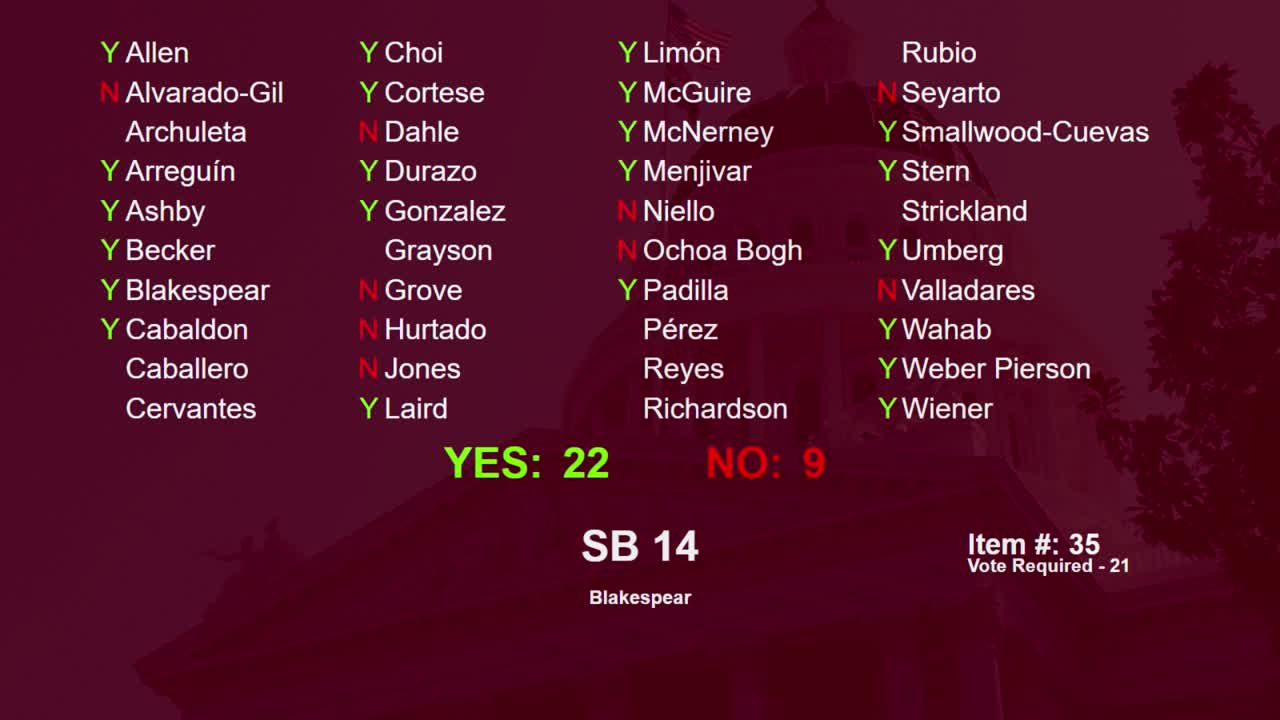 1H
Senate Floor
 40MIN