SB 261: Division of Labor Standards Enforcement: orders, decisions, and awards.
- Session Year: 2025-2026
- House: Senate
- Latest Version Date: 2025-10-13
Current Status:
Passed
(2025-10-13: Chaptered by Secretary of State. Chapter 747, Statutes of 2025.)
Introduced
In Committee
Awaiting First Chamber Vote
Passed First Chamber
In Committee
Awaiting Second Chamber Vote
Passed Second Chamber
Enacted
Existing law establishes the Division of Labor Standards Enforcement, under the direction of the Labor Commissioner, within the Department of Industrial Relations and sets forth its powers and duties regarding the enforcement of labor laws. Existing law authorizes the commissioner to investigate employee complaints and to provide for a hearing in any action to recover wages, penalties, and other demands for compensation, as specified.
Existing law provides that the judgment creditor, or the commissioner, as assignee of the judgment creditor, is entitled to court costs and reasonable attorneys fees for enforcing the judgment, as specified.
This bill would instead require that the judgment creditor, or the Labor Commissioner or public prosecutor as assignee of the judgment creditor, be awarded the above-described court costs and reasonable attorneys fees.
Existing law provides for enforcement if a final judgment against an employer arising from the employers nonpayment of wages for work performed in this state remains unsatisfied after specified periods of time, including prohibiting the employer from conducting business in the state, as specified, if a final judgment against the employer remains unsatisfied for 30 days.
This bill would additionally require the judgment debtor to be subject to a civil penalty not to exceed 3 times the outstanding judgment amount if a final judgment arising from the nonpayment of work performed in this state remains unsatisfied after a period of 180 days, as provided. The bill would require a court to award a prevailing plaintiff all reasonable attorneys fees and costs in any action brought by a judgment creditor, the commissioner, or a public prosecutor to enforce a final judgment arising from the nonpayment of wages, penalties, or other amounts owed arising from work performed in this state, as provided.
This bill would also make findings and declarations related to its provisions.
Existing law establishes the Division of Labor Standards Enforcement, under the direction of the Labor Commissioner, within the Department of Industrial Relations and sets forth its powers and duties regarding the enforcement of labor laws. Existing law authorizes the commissioner to investigate employee complaints and to provide for a hearing in any action to recover wages, penalties, and other demands for compensation, as specified. Existing law requires the Labor Commissioner, within 15 days after the hearing is concluded, to file in the office of the division a copy of the order, decision, or award.
This bill would require the division to post on its internet website specified information about any employer with an unsatisfied order, decision, or award, as prescribed. The bill would require the posting to be removed if, among other conditions, the employer has submitted certification, under penalty of perjury, that all violations identified in the posted information have been remedied or abated. By expanding the crime of perjury, the bill would impose a state-mandated local program.Existing law provides that the judgment creditor, or the commissioner, as assignee of the judgment creditor, is entitled to court costs and reasonable attorneys fees for enforcing the judgment, as specified.
This bill would instead require that the judgment creditor, or the Labor Commissioner or public prosecutor as assignee of the judgment creditor, be awarded the above-described court costs and reasonable attorneys fees.
Existing law provides for enforcement if a final judgment against an employer arising from the employers nonpayment of wages for work performed in this state remains unsatisfied after specified periods of time, including prohibiting the employer from conducting business in the state, as specified, if a final judgment against the employer remains unsatisfied for 30 days.
This bill would additionally require the employer judgment debtor to be subject to a civil penalty not to exceed 3 times the outstanding judgment amount if a final judgment against an employer arising from the employers nonpayment of work performed in this state remains unsatisfied after a period of 180 days, as provided. The bill would require a court to award a prevailing plaintiff all reasonable attorneys fees and costs in any action brought by a judgment creditor, the commissioner, or a public prosecutor to enforce a final judgment against an employer arising from the employers nonpayment of wages for wages, penalties, or other amounts owed arising from work performed in this state, as provided.
This bill would also make findings and declarations related to its provisions.
The California Constitution requires the state to reimburse local agencies and school districts for certain costs mandated by the state. Statutory provisions establish procedures for making that reimbursement.This bill would provide that no reimbursement is required by this act for a specified reason.Existing law establishes the Division of Labor Standards Enforcement, under the direction of the Labor Commissioner, within the Department of Industrial Relations and sets forth its powers and duties regarding the enforcement of labor laws. Existing law authorizes the commissioner to investigate employee complaints and to provide for a hearing in any action to recover wages, penalties, and other demands for compensation, as specified. Existing law requires the commissioner to provide to the parties, among other things, notice advising the parties of their right to appeal, as specified. Labor Commissioner, within 15 days after the hearing is concluded, to file in the office of the division a copy of the order, decision, or award.
This bill would require the commissioner to post a copy of the order, decision, or award on the divisions internet website, as specified, no later than 15 days after the time to appeal from the order, decision, or award has expired and no appeal therefrom is pending. The bill would require the division to redact the name, address, and personal contact information of any employee or other complainant from the order, decision, or award before posting the order, decision, or award on the divisions internet website. The bill would require the division to post on its internet website specified information about any employer with an unsatisfied order, decision, or award issued under the above-described provisions, award, as prescribed. The bill would require the posting pursuant to these provisions to be removed if, among other conditions, the employer has submitted certification, under penalty of perjury, that all violations identified in the posted information have been remedied or abated. By expanding the crime of perjury, the bill would impose a state-mandated local program.
Existing law provides that the judgment creditor, or the commissioner, as assignee of the judgment creditor, is entitled to court costs and reasonable attorneys fees for enforcing the judgment, as specified.
This bill would instead require that the judgment creditor, or the Labor Commissioner or public prosecutor as assignee of the judgment creditor, be awarded the above-described court costs and reasonable attorneys fees.
Existing law provides for enforcement if a final judgment against an employer arising from the employers nonpayment of wages for work performed in this state remains unsatisfied after specified periods of time, including prohibiting the employer from conducting business in the state, as specified, if a final judgment against the employer remains unsatisfied for 30 days.
This bill would additionally require the employer to be subject to a civil penalty not to exceed 3 times the outstanding judgment amount if a final judgment against an employer arising from the employers nonpayment of work performed in this state remains unsatisfied after a period of 180 days, as provided. The bill would require a court to award a prevailing plaintiff all reasonable attorneys fees and costs in any action brought by a judgment creditor, the commissioner, or a public prosecutor, as defined, prosecutor to enforce a final judgment against an employer arising from the employers nonpayment of wages for work performed in this state, as provided.
This bill would also make findings and declarations related to its provisions.
Existing constitutional provisions require that a statute that limits the right of access to the meetings of public bodies or the writings of public officials and agencies be adopted with findings demonstrating the interest protected by the limitation and the need for protecting that interest.This bill would make legislative findings to that effect.The California Constitution requires the state to reimburse local agencies and school districts for certain costs mandated by the state. Statutory provisions establish procedures for making that reimbursement.
This bill would provide that no reimbursement is required by this act for a specified reason.
Existing law establishes the Division of Labor Standards Enforcement, under the direction of the Labor Commissioner, within the Department of Industrial Relations and sets forth its powers and duties regarding the enforcement of labor laws. Existing law authorizes the commissioner to investigate employee complaints and to provide for a hearing in any action to recover wages, penalties, and other demands for compensation, as specified. Existing law requires the commissioner to provide to the parties, among other things, notice advising the parties of their right to appeal, as specified.
This bill would require the commissioner to post a copy of the order, decision, or award on the divisions internet website, as specified, no later than 15 days after the time to appeal from the order, decision, or award has expired and no appeal therefrom is pending. The bill would require the division to redact the name, address, and personal contact information of any employee or other complainant from the order, decision, or award before posting the order, decision, or award on the divisions internet website. The bill would require the division to post on its internet website specified information about any employer with an unsatisfied order, decision, or award issued under the above-described provisions, as prescribed. The bill would require the posting pursuant to these provisions to be removed if, among other conditions, the employer has submitted certification, under penalty of perjury, that all violations identified in the posted information have been remedied or abated. By expanding the crime of perjury, the bill would impose a state-mandated local program.
Existing law provides that the judgment creditor, or the commissioner, as assignee of the judgment creditor, is entitled to court costs and reasonable attorneys fees for enforcing the judgment, as specified.
This bill would instead require that the judgment creditor, or the Labor Commissioner or public prosecutor as assignee of the judgment creditor, be awarded the above-described court costs and reasonable attorneys fees.
Existing law provides for enforcement if a final judgment against an employer arising from the employers nonpayment of wages for work performed in this state remains unsatisfied after specified periods of time, including prohibiting the employer from conducting business in the state, as specified, if a final judgment against the employer remains unsatisfied for 30 days.
This bill would additionally require the employer to be subject to a civil penalty not to exceed 3 times the outstanding judgment amount if a final judgment against an employer arising from the employers nonpayment of work performed in this state remains unsatisfied after a period of 180 days, as provided. The bill would require a court to award a prevailing plaintiff all reasonable attorneys fees and costs in any action brought by a judgment creditor, the commissioner, or a public prosecutor, as defined, to enforce a final judgment against an employer arising from the employers nonpayment of wages for work performed in this state, as provided.
This bill would also make findings and declarations related to its provisions.
Existing constitutional provisions require that a statute that limits the right of access to the meetings of public bodies or the writings of public officials and agencies be adopted with findings demonstrating the interest protected by the limitation and the need for protecting that interest.
This bill would make legislative findings to that effect.
The California Constitution requires the state to reimburse local agencies and school districts for certain costs mandated by the state. Statutory provisions establish procedures for making that reimbursement.
This bill would provide that no reimbursement is required by this act for a specified reason.
Existing law establishes the Division of Labor Standards Enforcement, under the direction of the Labor Commissioner, within the Department of Industrial Relations and sets forth its powers and duties regarding the enforcement of labor laws. Existing law authorizes the commissioner to investigate employee complaints and to provide for a hearing in any action to recover wages, penalties, and other demands for compensation, as specified. Existing law requires the commissioner to provide to the parties, among other things, notice advising the parties of their right to appeal, as specified.
This bill would require the commissioner to post a copy of the order, decision, or award on the divisions internet website, as specified, no later than 15 days after the time to appeal from the order, decision, or award has expired and no appeal therefrom is pending. The bill would require the division to redact the name, address, and personal contact information of any employee or other complainant from the order, decision, or award before posting the order, decision, or award on the divisions internet website, as provided. website. The bill would require the division to post on its internet website specified information about any employer with an unsatisfied order, decision, or award issued under the above-described provisions, as prescribed. The bill would require the posting pursuant to these provisions to be removed if, among other conditions, the employer has submitted certification, under penalty of perjury, that all violations identified in the posted information have been remedied or abated. By expanding the crime of perjury, the bill would impose a state-mandated local program.
Existing law provides that the judgment creditor, or the commissioner, as assignee of the judgment creditor, is entitled to court costs and reasonable attorneys fees for enforcing the judgment, as specified.
This bill would instead require that the judgment creditor, or the Labor Commissioner or public prosecutor as assignee of the judgment creditor, be awarded the above-described court costs and reasonable attorneys fees.
Existing law provides for enforcement if a final judgment against an employer arising from the employers nonpayment of wages for work performed in this state remains unsatisfied after specified periods of time, including prohibiting the employer from conducting business in the state, as specified, if a final judgment against the employer remains unsatisfied for 30 days.
This bill would additionally require the employer to be subject to a civil penalty not to exceed 3 times the outstanding judgment amount if a final judgment against an employer arising from the employers nonpayment of work performed in this state remains unsatisfied after a period of 180 days, as provided. The bill would require a court to award a prevailing plaintiff all reasonable attorneys fees and costs in any action brought by a judgment creditor, the commissioner, or a public prosecutor, as defined, to enforce a final judgment against an employer arising from the employers nonpayment of wages for work performed in this state, as provided.
This bill would also make findings and declarations related to its provisions.
Existing constitutional provisions require that a statute that limits the right of access to the meetings of public bodies or the writings of public officials and agencies be adopted with findings demonstrating the interest protected by the limitation and the need for protecting that interest.
This bill would make legislative findings to that effect.
The California Constitution requires the state to reimburse local agencies and school districts for certain costs mandated by the state. Statutory provisions establish procedures for making that reimbursement.
This bill would provide that no reimbursement is required by this act for a specified reason.
Existing law establishes the Division of Labor Standards Enforcement, under the direction of the Labor Commissioner, within the Department of Industrial Relations and sets forth its powers and duties regarding the enforcement of labor laws. Existing law authorizes the commissioner to investigate employee complaints and to provide for a hearing in any action to recover wages, penalties, and other demands for compensation, as specified. Existing law requires the commissioner to provide to the parties, among other things, notice advising the parties of their right to appeal, as specified.
This bill would require the commissioner to post a copy of the order, decision, or award on the divisions internet website, as specified, no later than 15 days after the time to appeal from the order, decision, or award has expired and no appeal therefrom is pending. The bill would require the division to redact the name, address, and personal contact information of any employee or other complainant from the order, decision, or award before posting the order, decision, or award on the divisions internet website, as provided. The bill would require the division to post on its internet website specified information about any employer with an unsatisfied order, decision, or award issued under the above-described provisions, as prescribed. The bill would require the posting pursuant to these provisions to be removed if, among other conditions, the employer has submitted certification, under penalty of perjury, that all violations identified in the posted information have been remedied or abated. By expanding the crime of perjury, the bill would impose a state-mandated local program.
Existing law provides that the judgment creditor, or the commissioner, as assignee of the judgment creditor, is entitled to court costs and reasonable attorneys fees for enforcing the judgment, as specified.
This bill would instead require that the judgment creditor, or the Labor Commissioner or public prosecutor as assignee of the judgment creditor, be awarded the above-described court costs and reasonable attorneys fees.
Existing law provides for enforcement if a final judgment against an employer arising from the employers nonpayment of wages for work performed in this state remains unsatisfied after specified periods of time, including prohibiting the employer from conducting business in the state, as specified, if a final judgment against the employer remains unsatisfied for 30 days.
This bill would additionally require the employer to be subject to a civil penalty not to exceed 3 times the outstanding judgment amount if a final judgment against an employer arising from the employers nonpayment of work performed in this state remains unsatisfied after a period of 180 days, as provided. The bill would require a court to award a prevailing plaintiff all reasonable attorneys fees and costs in any action brought by a judgment creditor, the commissioner, or a public prosecutor, as defined, to enforce a final judgment against an employer arising from the employers nonpayment of wages for work performed in this state, as provided.
This bill would also make findings and declarations related to its provisions.
The California Constitution requires the state to reimburse local agencies and school districts for certain costs mandated by the state. Statutory provisions establish procedures for making that reimbursement.This bill would provide that no reimbursement is required by this act for a specified reason.Existing constitutional provisions require that a statute that limits the right of access to the meetings of public bodies or the writings of public officials and agencies be adopted with findings demonstrating the interest protected by the limitation and the need for protecting that interest.
This bill would make legislative findings to that effect.
The California Constitution requires the state to reimburse local agencies and school districts for certain costs mandated by the state. Statutory provisions establish procedures for making that reimbursement.
This bill would provide that no reimbursement is required by this act for a specified reason.
Existing law establishes the Division of Labor Standards Enforcement, under the direction of the Labor Commissioner, within the Department of Industrial Relations and sets forth its powers and duties regarding the enforcement of labor laws. Existing law authorizes the commissioner to investigate employee complaints and to provide for a hearing in any action to recover wages, penalties, and other demands for compensation, as specified. Existing law requires the commissioner to provide to the parties, among other things, notice advising the parties of their right to appeal, as specified.
This bill would require the commissioner to post a copy of the order, decision, or award on the divisions internet website, as specified, no later than 15 days after the time to appeal from the order, decision, or award has expired and no appeal therefrom is pending. The bill would require the division to redact the name, address, and personal contact information of any employee or other complainant from the order, decision, or award before posting the order, decision, or award on the divisions internet website, as provided. The bill would require the division to post on its internet website specified information about any employer with an unsatisfied order, decision, or award issued under the above-described provisions, as prescribed. The bill would require the posting pursuant to these provisions to be removed if, among other conditions, the employer has submitted certification, under penalty of perjury, that all violations identified in the posted information have been remedied or abated. By expanding the crime of perjury, the bill would impose a state-mandated local program.
Existing law provides that the judgment creditor, or the commissioner, as assignee of the judgment creditor, is entitled to court costs and reasonable attorneys fees for enforcing the judgment, as specified.
This bill would instead require that the judgment creditor, or the Labor Commissioner or public prosecutor as assignee of the judgment creditor, be awarded the above-described court costs and reasonable attorneys fees.
Existing law provides for enforcement if a final judgment against an employer arising from the employers nonpayment of wages for work performed in this state remains unsatisfied after specified periods of time, including prohibiting the employer from conducting business in the state, as specified, if a final judgment against the employer remains unsatisfied for 30 days.
This bill would additionally require the employer to be subject to a civil penalty not to exceed 3 times the outstanding judgment amount if a final judgment against an employer arising from the employers nonpayment of work performed in this state remains unsatisfied after a period of 180 days, as provided. The bill would require a court to award a prevailing plaintiff all reasonable attorneys fees and costs in any action brought by a judgment creditor, the commissioner, or a public prosecutor, as defined, to enforce a final judgment against an employer arising from the employers nonpayment of wages for work performed in this state, as provided.
This bill would also make findings and declarations related to its provisions.
The California Constitution requires the state to reimburse local agencies and school districts for certain costs mandated by the state. Statutory provisions establish procedures for making that reimbursement.
This bill would provide that no reimbursement is required by this act for a specified reason.
Existing constitutional provisions require that a statute that limits the right of access to the meetings of public bodies or the writings of public officials and agencies be adopted with findings demonstrating the interest protected by the limitation and the need for protecting that interest.
This bill would make legislative findings to that effect.
(a)The Legislature finds and declares all of the following:
(1)The full and prompt payment of wages due to workers is, and has long been, a fundamental public policy of this state. Vindication of this policy, including, where necessary, through effective enforcement, is critical to ensuring that Californias economy is vibrant and equitable for all Californians. The failure to timely pay all wages due robs the individual workers of what they have earned, and also harms the public at large, including by placing additional burdens on public services and unfairly disadvantaging businesses that comply with the law.
(2)Wage theft is a pervasive issue statewide, especially for low-income workers. A report from Rutgers University estimated that in four of Californias largest metropolitan areas, employers unlawfully failed to pay low-wage workers $2.3 to $4.6 billion in earned wages each year between 2014 and 2023. Studies, including by the Economic Policy Institute, also show that workers lose far more through wage theft than retailers lose through shoplifting, drivers lose through carjacking, or residents lose through burglaries.
(3)Provisions of the Labor Code and Civil Code that allow collection of simple interest for nonpayment of a judgment are inadequate to deter prospective violators and ensure workers are promptly paid the judgments they are owed.
(4)The Labor Code and Business and Professions Code authorize public prosecutors to pursue actions against employers based on their failure to satisfy wage theft judgments, and those public prosecutors efforts complement and augment preexisting efforts to enforce wage theft judgments.
(b)Therefore, it is the intent of the Legislature to provide additional tools to enhance enforcement and collection of wage judgments to ensure workers who are victims of wage theft are paid in a timely manner, consistent with public policy of this state.
SEC. 2.Section 98.2 of the Labor Code is amended to read:98.2.(a)Within 10 days after service of notice of an order, decision, or award, the parties may seek review by filing an appeal to the superior court, where the appeal shall be heard de novo. The court shall charge the first paper filing fee under Section 70611 of the Government Code to the party seeking review. The fee shall be distributed as provided in Section 68085.3 of the Government Code. A copy of the appeal request shall be served upon the Labor Commissioner by the appellant. For purposes of computing the 10-day period after service, Section 1013 of the Code of Civil Procedure is applicable.
(b)As a condition to filing an appeal pursuant to this section, an employer shall first post an undertaking with the reviewing court in the amount of the order, decision, or award. The undertaking shall consist of an appeal bond issued by a licensed surety or a cash deposit with the court in the amount of the order, decision, or award. The employer shall provide written notification to the other parties and the Labor Commissioner of the posting of the undertaking. The undertaking shall be on the condition that, if any judgment is entered in favor of the employee, the employer shall pay the amount owed pursuant to the judgment, and if the appeal is withdrawn or dismissed without entry of judgment, the employer shall pay the amount owed pursuant to the order, decision, or award of the Labor Commissioner unless the parties have executed a settlement agreement for payment of some other amount, in which case the employer shall pay the amount that the employer is obligated to pay under the terms of the settlement agreement. If the employer fails to pay the amount owed within 10 days of entry of the judgment, dismissal, or withdrawal of the appeal, or the execution of a settlement agreement, a portion of the undertaking equal to the amount owed, or the entire undertaking if the amount owed exceeds the undertaking, is forfeited to the employee.
(c)If the party seeking review by filing an appeal to the superior court is unsuccessful in the appeal, the court shall determine the costs and reasonable attorneys fees incurred by the other parties to the appeal, and assess that amount as a cost upon the party filing the appeal. An employee is successful if the court awards an amount greater than zero.
(d)If no notice of appeal of the order, decision, or award is filed within the period set forth in subdivision (a), the order, decision, or award shall, in the absence of fraud, be deemed the final order.
(e)The Labor Commissioner shall file, within 10 days of the order becoming final pursuant to subdivision (d), a certified copy of the final order with the clerk of the superior court of the appropriate county unless a settlement has been reached by the parties and approved by the Labor Commissioner. Judgment shall be entered immediately by the court clerk in conformity therewith. The judgment so entered has the same force and effect as, and is subject to all of the provisions of law relating to, a judgment in a civil action, and may be enforced in the same manner as any other judgment of the court in which it is entered. Enforcement of the judgment shall receive court priority.
(f)(1)In order to ensure that judgments are satisfied, the Labor Commissioner may serve upon the judgment debtor, personally or by first-class mail at the last known address of the judgment debtor listed with the division, a form similar to, and requiring the reporting of the same information as, the form approved or adopted by the Judicial Council for purposes of subdivision (a) of Section 116.830 of the Code of Civil Procedure to assist in identifying the nature and location of any assets of the judgment debtor.
(2)The judgment debtor shall complete the form and cause it to be delivered to the division at the address listed on the form within 35 days after the form has been served on the judgment debtor, unless the judgment has been satisfied. In the case of a willful failure by the judgment debtor to comply with this subdivision, the division or the judgment creditor may request the court to apply the sanctions provided in Section 708.170 of the Code of Civil Procedure.
(g)(1)As an alternative to a judgment lien, upon the order becoming final pursuant to subdivision (d), a lien on real property may be created by the Labor Commissioner recording a certificate of lien, for amounts due under the final order and in favor of the employee or employees named in the order, with the county recorder of any county in which the employers real property may be located, at the Labor Commissioners discretion and depending upon information the Labor Commissioner obtains concerning the employers assets. The lien attaches to all interests in real property of the employer located in the county where the lien is created to which a judgment lien may attach pursuant to Section 697.340 of the Code of Civil Procedure.
(2)The certificate of lien shall include information as prescribed by Section 27288.1 of the Government Code.
(3)The recorder shall accept and record the certificate of lien and shall index it as prescribed by law.
(4)Upon payment of the amount due under the final order, the Labor Commissioner shall issue a certificate of release, releasing the lien created under paragraph (1). The certificate of release may be recorded by the employer at the employers expense.
(5)Unless the lien is satisfied or released, a lien under this section shall continue until 10 years from the date of its creation.
(h)Notwithstanding subdivision (e), the Labor Commissioner may stay execution of any judgment entered upon an order, decision, or award that has become final upon good cause appearing therefor and may impose the terms and conditions of the stay of execution. A certified copy of the stay of execution shall be filed with the clerk entering the judgment.
(i)When a judgment is satisfied in fact, other than by execution, the Labor Commissioner may, upon the motion of either party or on its own motion, order entry of satisfaction of judgment. The clerk of the court shall enter a satisfaction of judgment upon the filing of a certified copy of the order.
(j)The Labor Commissioner shall make every reasonable effort to ensure that judgments are satisfied, including taking all appropriate legal action and requiring the employer to deposit a bond as provided in Section 240.
(k)The judgment creditor, or the Labor Commissioner or a public prosecutor, as defined in Section 180, as assignee of the judgment creditor, shall be awarded court costs and reasonable attorneys fees for enforcing the judgment that is rendered pursuant to this section.
SEC. 3.Section 238.05 is added to the Labor Code, to read:238.05.(a)If a final judgment arising from nonpayment of wages for work performed in this state remains unsatisfied after a period of 180 days after the time to appeal therefrom has expired and no appeal therefrom is pending, the judgment debtor shall be subject to a civil penalty not to exceed three times the outstanding judgment amount, including postjudgment interest then due, provided that a judgment debtor shall not be subject to a penalty under this subdivision if the judgment debtor reaches an accord described in subdivision (b) of Section 238 before the 180th day and then remains in full compliance with the accord until its full satisfaction. The court may assess this penalty in any action brought to enforce the judgment or to otherwise induce compliance by or impose lawful consequences on a judgment debtor.
(b)In any action brought to enforce the judgment or to otherwise induce compliance by or impose lawful consequences on a judgment debtor, the court shall assess against the judgment debtor the entire amount of the requested penalty except to the extent that the court finds that the judgment debtor has demonstrated by clear and convincing evidence good cause to reduce the amount of the penalty.
(c)Penalties assessed by a court pursuant to this section shall be distributed as follows:
(1)Fifty percent to the employee or employees in whose favor the judgment was rendered, shared proportionally according to the amount due to each employee in the judgment entered in superior court.
(2)Fifty percent to the Division of Labor Standards Enforcement for enforcement of labor laws, including the administration of this part, and for education of employers and employees about their rights and responsibilities under this code, upon appropriation, to supplement and not supplant the funding to the division for those purposes.
(d)A successor to a judgment debtor, as defined in subdivision (a) of Section 200.3 or by any other law, shall be jointly and severally liable for penalties assessed pursuant to this section.
(e)Penalties assessed pursuant to this section shall be in addition to any other penalties or fines permitted by law.
SEC. 4.Section 238.10 is added to the Labor Code, immediately following Section 238.05, to read:238.10.The court shall award a prevailing plaintiff all reasonable attorneys fees and costs in any action brought by a judgment creditor, the Labor Commissioner, or a public prosecutor, as defined in Section 180, to enforce a final judgment arising from the nonpayment of wages, penalties, or other amounts owed arising from work performed in this state, or to otherwise induce compliance by or impose lawful consequences on a judgment debtor for nonsatisfaction of a final judgment arising from the nonpayment of wages, penalties, or other amounts owed arising from work performed in this state.
(a)The Legislature finds and declares all of the following:
(1)The full and prompt payment of wages due to workers is, and has long been, a fundamental public policy of this state. Vindication of this policy, including, where necessary, through effective enforcement, is critical to ensuring that Californias economy is vibrant and equitable for all Californians. The failure to timely pay all wages due robs the individual workers of what they have earned, and also harms the public at large, including by placing additional burdens on public services and unfairly disadvantaging businesses that comply with the law.
(2)Wage theft is a pervasive issue statewide, especially for low-income workers. A report from Rutgers University estimated that in four of Californias largest metropolitan areas, employers unlawfully failed to pay low-wage workers $2.3 to $4.6 billion in earned wages each year between 2014 and 2023. Studies, including by the Economic Policy Institute, also show that workers lose far more through wage theft than retailers lose through shoplifting, drivers lose through carjacking, or residents lose through burglaries.
(3)Provisions of the Labor Code and Civil Code that allow collection of simple interest for nonpayment of a judgment are inadequate to deter prospective violators and ensure workers are promptly paid the judgments they are owed.
(4)The Labor Code and Business and Professions Code authorize public prosecutors to pursue actions against employers based on their failure to satisfy wage theft judgments, but information about the underlying violations is often needed to make these actions effective. and those public prosecutors efforts complement and augment preexisting efforts to enforce wage theft judgments.
(b)Therefore, it is the intent of the Legislature to provide additional tools to enhance enforcement and collection of wage judgments to ensure workers who are victims of wage theft are paid in a timely manner, consistent with public policy of this state.
SEC. 2.Section 98.15 is added to the Labor Code, immediately following Section 98.1, to read:98.15.(a)(1)(A)The Division of Labor Standards Enforcement shall post on its internet website the names, addresses, and essential information, including, but not limited to, fictitious business names, of any employer with an unsatisfied order, decision, or award issued under this chapter as to which the time to appeal has expired and no appeal therefrom is pending, or with an unsatisfied final court judgment based on the order, decision, or award.(B)The division shall not post the information required under this paragraph on its internet website until the period for all judicial appeals from the order, decision, or award has expired.(C)A posting required by this paragraph shall be removed within 15 business days after the division determines that both of the following are true:(i)There has been full payment of any unsatisfied judgment and any other financial liabilities for all violations identified pursuant to subparagraph (A) or that the employer has entered into an approved settlement dispensing of the judgment and any liabilities.(ii)The employer has submitted certification, under penalty of perjury, that all violations identified pursuant to subparagraph (A) have been remedied or abated.(2)No fewer than 15 business days before posting on its internet website the names, addresses, and essential information for any employer pursuant to paragraph (1), the division shall provide notification by certified mail to the employer that, at a minimum, shall include all of the following:(A)The name, email address, and telephone number of a contact person at the division.(B)The alleged conduct and a copy of the citation, unsatisfied court judgment, assessment, order, decision, or award.(C)A copy of the regulations or rules of practice or procedure adopted pursuant to subdivision (d) for removal of the posting.(b)A waiver of this section is contrary to public policy, and is void and unenforceable.(c)This section shall not apply to orders, decisions, or awards, or final court judgments issued against port drayage motor carriers, as defined in paragraph (5) of subdivision (a) of Section 2810.4.(d)The Labor Commissioner may adopt regulations and rules of practice and procedure necessary to administer and enforce the provisions of this section that are under the commissioners jurisdiction. Unless and until the Labor Commissioner adopts regulations and rules of practice and procedure under this provision, for purposes of this section, the following apply:(1)The term essential information shall have the meaning set forth in regulations adopted pursuant to subdivision (m) of Section 2810.4.(2)Sufficient documentation shall conform to the description set forth in regulations adopted pursuant to clause (ii) of subparagraph (D) of paragraph (1) of subdivision (c) of Section 2810.4.(3)An employer seeking removal under subparagraph (C) of paragraph (1) of subdivision (a) may rely on the removal procedure set forth in the regulation entitled Removal from Public List adopted pursuant to subdivision (m) of Section 2810.4.SEC. 3.SEC. 2.Section 98.2 of the Labor Code is amended to read:98.2.(a)Within 10 days after service of notice of an order, decision, or award, the parties may seek review by filing an appeal to the superior court, where the appeal shall be heard de novo. The court shall charge the first paper filing fee under Section 70611 of the Government Code to the party seeking review. The fee shall be distributed as provided in Section 68085.3 of the Government Code. A copy of the appeal request shall be served upon the Labor Commissioner by the appellant. For purposes of computing the 10-day period after service, Section 1013 of the Code of Civil Procedure is applicable.
(b)As a condition to filing an appeal pursuant to this section, an employer shall first post an undertaking with the reviewing court in the amount of the order, decision, or award. The undertaking shall consist of an appeal bond issued by a licensed surety or a cash deposit with the court in the amount of the order, decision, or award. The employer shall provide written notification to the other parties and the Labor Commissioner of the posting of the undertaking. The undertaking shall be on the condition that, if any judgment is entered in favor of the employee, the employer shall pay the amount owed pursuant to the judgment, and if the appeal is withdrawn or dismissed without entry of judgment, the employer shall pay the amount owed pursuant to the order, decision, or award of the Labor Commissioner unless the parties have executed a settlement agreement for payment of some other amount, in which case the employer shall pay the amount that the employer is obligated to pay under the terms of the settlement agreement. If the employer fails to pay the amount owed within 10 days of entry of the judgment, dismissal, or withdrawal of the appeal, or the execution of a settlement agreement, a portion of the undertaking equal to the amount owed, or the entire undertaking if the amount owed exceeds the undertaking, is forfeited to the employee.
(c)If the party seeking review by filing an appeal to the superior court is unsuccessful in the appeal, the court shall determine the costs and reasonable attorneys fees incurred by the other parties to the appeal, and assess that amount as a cost upon the party filing the appeal. An employee is successful if the court awards an amount greater than zero.
(d)If no notice of appeal of the order, decision, or award is filed within the period set forth in subdivision (a), the order, decision, or award shall, in the absence of fraud, be deemed the final order.
(e)The Labor Commissioner shall file, within 10 days of the order becoming final pursuant to subdivision (d), a certified copy of the final order with the clerk of the superior court of the appropriate county unless a settlement has been reached by the parties and approved by the Labor Commissioner. Judgment shall be entered immediately by the court clerk in conformity therewith. The judgment so entered has the same force and effect as, and is subject to all of the provisions of law relating to, a judgment in a civil action, and may be enforced in the same manner as any other judgment of the court in which it is entered. Enforcement of the judgment shall receive court priority.
(f)(1)In order to ensure that judgments are satisfied, the Labor Commissioner may serve upon the judgment debtor, personally or by first-class mail at the last known address of the judgment debtor listed with the division, a form similar to, and requiring the reporting of the same information as, the form approved or adopted by the Judicial Council for purposes of subdivision (a) of Section 116.830 of the Code of Civil Procedure to assist in identifying the nature and location of any assets of the judgment debtor.
(2)The judgment debtor shall complete the form and cause it to be delivered to the division at the address listed on the form within 35 days after the form has been served on the judgment debtor, unless the judgment has been satisfied. In the case of a willful failure by the judgment debtor to comply with this subdivision, the division or the judgment creditor may request the court to apply the sanctions provided in Section 708.170 of the Code of Civil Procedure.
(g)(1)As an alternative to a judgment lien, upon the order becoming final pursuant to subdivision (d), a lien on real property may be created by the Labor Commissioner recording a certificate of lien, for amounts due under the final order and in favor of the employee or employees named in the order, with the county recorder of any county in which the employers real property may be located, at the Labor Commissioners discretion and depending upon information the Labor Commissioner obtains concerning the employers assets. The lien attaches to all interests in real property of the employer located in the county where the lien is created to which a judgment lien may attach pursuant to Section 697.340 of the Code of Civil Procedure.
(2)The certificate of lien shall include information as prescribed by Section 27288.1 of the Government Code.
(3)The recorder shall accept and record the certificate of lien and shall index it as prescribed by law.
(4)Upon payment of the amount due under the final order, the Labor Commissioner shall issue a certificate of release, releasing the lien created under paragraph (1). The certificate of release may be recorded by the employer at the employers expense.
(5)Unless the lien is satisfied or released, a lien under this section shall continue until 10 years from the date of its creation.
(h)Notwithstanding subdivision (e), the Labor Commissioner may stay execution of any judgment entered upon an order, decision, or award that has become final upon good cause appearing therefor and may impose the terms and conditions of the stay of execution. A certified copy of the stay of execution shall be filed with the clerk entering the judgment.
(i)When a judgment is satisfied in fact, other than by execution, the Labor Commissioner may, upon the motion of either party or on its own motion, order entry of satisfaction of judgment. The clerk of the court shall enter a satisfaction of judgment upon the filing of a certified copy of the order.
(j)The Labor Commissioner shall make every reasonable effort to ensure that judgments are satisfied, including taking all appropriate legal action and requiring the employer to deposit a bond as provided in Section 240.
(k)The judgment creditor, or the Labor Commissioner or a public prosecutor, as defined in Section 180, as assignee of the judgment creditor, shall be awarded court costs and reasonable attorneys fees for enforcing the judgment that is rendered pursuant to this section.
SEC. 4.SEC. 3.Section 238.05 is added to the Labor Code, to read:238.05.(a)If a final judgment against an employer arising from the employers nonpayment of wages for work performed in this state remains unsatisfied after a period of 180 days after the time to appeal therefrom has expired and no appeal therefrom is pending, the employer judgment debtor shall be subject to a civil penalty not to exceed three times the outstanding judgment amount, including postjudgment interest then due, provided that an employer a judgment debtor shall not be subject to a penalty under this subdivision if the employer judgment debtor reaches an accord described in subdivision (b) of Section 238 before the 180th day and then remains in full compliance with the accord until its full satisfaction. The court may assess this penalty in any action brought to enforce the judgment or to otherwise induce compliance by or impose lawful consequences on a judgment debtor.
(b)In any action brought to enforce the judgment or to otherwise induce compliance by or impose lawful consequences on a judgment debtor, the court shall assess against the employer judgment debtor the entire amount of the requested penalty except to the extent that the court finds that the employer judgment debtor has demonstrated by clear and convincing evidence good cause to reduce the amount of the penalty.
(c)Penalties assessed by a court pursuant to this section shall be distributed as follows:
(1)Fifty percent to the employee or employees in whose favor the judgment was rendered, shared proportionally according to the amount due to each employee in the judgment entered in superior court.
(2)Fifty percent to the Division of Labor Standards Enforcement for enforcement of labor laws, including the administration of this part, and for education of employers and employees about their rights and responsibilities under this code, to be continuously appropriated upon appropriation, to supplement and not supplant the funding to the division for those purposes.
(d)A successor to a judgment debtor, as defined in subdivision (a) of Section 200.3 or by any other law, shall be jointly and severally liable for penalties assessed pursuant to this section.
(e)Penalties assessed pursuant to this section shall be in addition to any other penalties or fines permitted by law.
SEC. 5.SEC. 4.Section 238.10 is added to the Labor Code, immediately following Section 238.05, to read:238.10.The court shall award a prevailing plaintiff all reasonable attorneys fees and costs in any action brought by a judgment creditor, the Labor Commissioner, or a public prosecutor, as defined in Section 180, to enforce a final judgment against an employer arising from the employers nonpayment of wages for wages, penalties, or other amounts owed arising from work performed in this state, or to otherwise induce compliance by or impose lawful consequences on a judgment debtor for nonsatisfaction of a final judgment against an employer arising from the employers nonpayment of wages for wages, penalties, or other amounts owed arising from work performed in this state.
SEC. 6.No reimbursement is required by this act pursuant to Section 6 of Article XIIIB of the California Constitution because the only costs that may be incurred by a local agency or school district will be incurred because this act creates a new crime or infraction, eliminates a crime or infraction, or changes the penalty for a crime or infraction, within the meaning of Section 17556 of the Government Code, or changes the definition of a crime within the meaning of Section 6 of Article XIIIB of the California Constitution.(a)The Legislature finds and declares all of the following:
(1)The full and prompt payment of wages due to workers is, and has long been, a fundamental public policy of this state. Vindication of this policy, including, where necessary, through effective enforcement, is critical to ensuring that Californias economy is vibrant and equitable for all Californians. The failure to timely pay all wages due robs the individual workers of what they have earned, and also harms the public at large, including by placing additional burdens on public services and unfairly disadvantaging businesses that comply with the law.
(2)Wage theft is a pervasive issue statewide, especially for low-income workers. A report from Rutgers University estimated that in four of Californias largest metropolitan areas, employers unlawfully failed to pay low-wage workers $2.3 to $4.6 billion in earned wages each year between 2014 and 2023. Studies, including by the Economic Policy Institute, also show that workers lose far more through wage theft than retailers lose through shoplifting, drivers lose through carjacking, or residents lose through burglaries.
(3)Provisions of the Labor Code and Civil Code that allow collection of simple interest for nonpayment of a judgment are inadequate to deter prospective violators and ensure workers are promptly paid the judgments they are owed.
(4)The Labor Code and Business and Professions Code authorize public prosecutors to pursue actions against employers based on their failure to satisfy wage theft judgments, but information about the underlying violations is often needed to make these actions effective.
(b)Therefore, it is the intent of the Legislature to provide additional tools to enhance enforcement and collection of wage judgments to ensure workers who are victims of wage theft are paid in a timely manner, consistent with public policy of this state.
SEC. 2.Section 98.1 of the Labor Code is amended to read:98.1.(a)(1)Within 15 days after the hearing is concluded, the Labor Commissioner shall file in the office of the division a copy of the order, decision, or award. The order, decision, or award shall include a summary of the hearing and the reasons for the decision. Upon filing of the order, decision, or award, the Labor Commissioner shall serve a copy of the decision personally, by first-class mail, or in the manner specified in Section 415.20 of the Code of Civil Procedure on the parties. The notice shall also advise the parties of their right to appeal the order, decision, or award and further advise the parties that failure to do so within the period prescribed by this chapter shall result in the decision or award becoming final and enforceable as a judgment by the superior court.(2)No later than 15 days after the time to appeal from the order, decision, or award has expired and no appeal therefrom is pending, the commissioner shall post a copy of the order, decision, or award on the divisions internet website for seven years. The commissioner shall redact the name, address, and personal contact information of any employee or other complainant from the order, decision, or award before posting the order, decision, or award on the divisions internet website.(b)For the purpose of this section, an award shall include any sums found owing, damages proved, and any penalties awarded pursuant to this code.(c)All awards granted pursuant to a hearing under this chapter shall accrue interest on all due and unpaid wages at the same rate as prescribed by subdivision (b) of Section 3289 of the Civil Code. The interest shall accrue until the wages are paid from the date that the wages were due and payable as provided in Part 1 (commencing with Section 200) of Division 2.SEC. 3.SEC. 2.Section 98.15 is added to the Labor Code, immediately following Section 98.1, to read:98.15.(a)(1)(A)The Division of Labor Standards Enforcement shall post on its internet website the names, addresses, and essential information, including, but not limited to, fictitious business names, of any employer with an unsatisfied order, decision, or award issued under this chapter as to which the time to appeal has expired and no appeal therefrom is pending, or with an unsatisfied final court judgment based on the order, decision, or award.
(B)The division shall not post the information required under this paragraph on its internet website until the period for all judicial appeals from the order, decision, or award has expired.
(C)A posting required by this paragraph shall be removed within 15 business days after the division determines that both of the following are true:
(i)There has been full payment of any unsatisfied judgment and any other financial liabilities for all violations identified pursuant to subparagraph (A) or that the employer has entered into an approved settlement dispensing of the judgment and any liabilities.
(ii)The employer has submitted certification, under penalty of perjury, that all violations identified pursuant to subparagraph (A) have been remedied or abated.
(2)No fewer than 15 business days before posting on its internet website the names, addresses, and essential information for any employer pursuant to paragraph (1), the division shall provide notification by certified mail to the employer that, at a minimum, shall include all of the following:
(A)The name, email address, and telephone number of a contact person at the division.
(B)The alleged conduct and a copy of the citation, unsatisfied court judgment, assessment, order, decision, or award.
(C)A copy of the regulations or rules of practice or procedure adopted pursuant to subdivision (d) for removal of the posting.
(b)A waiver of this section is contrary to public policy, and is void and unenforceable.
(c)This section shall not apply to orders, decisions, or awards, or final court judgments issued against port drayage motor carriers, as defined in paragraph (5) of subdivision (a) of Section 2810.4.
(d)The Labor Commissioner may adopt regulations and rules of practice and procedure necessary to administer and enforce the provisions of this section that are under the commissioners jurisdiction. Unless and until the Labor Commissioner adopts regulations and rules of practice and procedure under this provision, for purposes of this section, the following apply:
(1)The term essential information shall have the meaning set forth in regulations adopted pursuant to subdivision (m) of Section 2810.4.
(2)Sufficient documentation shall conform to the description set forth in regulations adopted pursuant to clause (ii) of subparagraph (D) of paragraph (1) of subdivision (c) of Section 2810.4.
(3)An employer seeking removal under subparagraph (C) of paragraph (1) of subdivision (a) may rely on the removal procedure set forth in the regulation entitled Removal from Public List adopted pursuant to subdivision (m) of Section 2810.4.
SEC. 4.SEC. 3.Section 98.2 of the Labor Code is amended to read:98.2.(a)Within 10 days after service of notice of an order, decision, or award, the parties may seek review by filing an appeal to the superior court, where the appeal shall be heard de novo. The court shall charge the first paper filing fee under Section 70611 of the Government Code to the party seeking review. The fee shall be distributed as provided in Section 68085.3 of the Government Code. A copy of the appeal request shall be served upon the Labor Commissioner by the appellant. For purposes of computing the 10-day period after service, Section 1013 of the Code of Civil Procedure is applicable.
(b)As a condition to filing an appeal pursuant to this section, an employer shall first post an undertaking with the reviewing court in the amount of the order, decision, or award. The undertaking shall consist of an appeal bond issued by a licensed surety or a cash deposit with the court in the amount of the order, decision, or award. The employer shall provide written notification to the other parties and the Labor Commissioner of the posting of the undertaking. The undertaking shall be on the condition that, if any judgment is entered in favor of the employee, the employer shall pay the amount owed pursuant to the judgment, and if the appeal is withdrawn or dismissed without entry of judgment, the employer shall pay the amount owed pursuant to the order, decision, or award of the Labor Commissioner unless the parties have executed a settlement agreement for payment of some other amount, in which case the employer shall pay the amount that the employer is obligated to pay under the terms of the settlement agreement. If the employer fails to pay the amount owed within 10 days of entry of the judgment, dismissal, or withdrawal of the appeal, or the execution of a settlement agreement, a portion of the undertaking equal to the amount owed, or the entire undertaking if the amount owed exceeds the undertaking, is forfeited to the employee.
(c)If the party seeking review by filing an appeal to the superior court is unsuccessful in the appeal, the court shall determine the costs and reasonable attorneys fees incurred by the other parties to the appeal, and assess that amount as a cost upon the party filing the appeal. An employee is successful if the court awards an amount greater than zero.
(d)If no notice of appeal of the order, decision, or award is filed within the period set forth in subdivision (a), the order, decision, or award shall, in the absence of fraud, be deemed the final order.
(e)The Labor Commissioner shall file, within 10 days of the order becoming final pursuant to subdivision (d), a certified copy of the final order with the clerk of the superior court of the appropriate county unless a settlement has been reached by the parties and approved by the Labor Commissioner. Judgment shall be entered immediately by the court clerk in conformity therewith. The judgment so entered has the same force and effect as, and is subject to all of the provisions of law relating to, a judgment in a civil action, and may be enforced in the same manner as any other judgment of the court in which it is entered. Enforcement of the judgment shall receive court priority.
(f)(1)In order to ensure that judgments are satisfied, the Labor Commissioner may serve upon the judgment debtor, personally or by first-class mail at the last known address of the judgment debtor listed with the division, a form similar to, and requiring the reporting of the same information as, the form approved or adopted by the Judicial Council for purposes of subdivision (a) of Section 116.830 of the Code of Civil Procedure to assist in identifying the nature and location of any assets of the judgment debtor.
(2)The judgment debtor shall complete the form and cause it to be delivered to the division at the address listed on the form within 35 days after the form has been served on the judgment debtor, unless the judgment has been satisfied. In the case of a willful failure by the judgment debtor to comply with this subdivision, the division or the judgment creditor may request the court to apply the sanctions provided in Section 708.170 of the Code of Civil Procedure.
(g)(1)As an alternative to a judgment lien, upon the order becoming final pursuant to subdivision (d), a lien on real property may be created by the Labor Commissioner recording a certificate of lien, for amounts due under the final order and in favor of the employee or employees named in the order, with the county recorder of any county in which the employers real property may be located, at the Labor Commissioners discretion and depending upon information the Labor Commissioner obtains concerning the employers assets. The lien attaches to all interests in real property of the employer located in the county where the lien is created to which a judgment lien may attach pursuant to Section 697.340 of the Code of Civil Procedure.
(2)The certificate of lien shall include information as prescribed by Section 27288.1 of the Government Code.
(3)The recorder shall accept and record the certificate of lien and shall index it as prescribed by law.
(4)Upon payment of the amount due under the final order, the Labor Commissioner shall issue a certificate of release, releasing the lien created under paragraph (1). The certificate of release may be recorded by the employer at the employers expense.
(5)Unless the lien is satisfied or released, a lien under this section shall continue until 10 years from the date of its creation.
(h)Notwithstanding subdivision (e), the Labor Commissioner may stay execution of any judgment entered upon an order, decision, or award that has become final upon good cause appearing therefor and may impose the terms and conditions of the stay of execution. A certified copy of the stay of execution shall be filed with the clerk entering the judgment.
(i)When a judgment is satisfied in fact, other than by execution, the Labor Commissioner may, upon the motion of either party or on its own motion, order entry of satisfaction of judgment. The clerk of the court shall enter a satisfaction of judgment upon the filing of a certified copy of the order.
(j)The Labor Commissioner shall make every reasonable effort to ensure that judgments are satisfied, including taking all appropriate legal action and requiring the employer to deposit a bond as provided in Section 240.
(k)The judgment creditor, or the Labor Commissioner or a public prosecutor, as defined in Section 180, as assignee of the judgment creditor, shall be awarded court costs and reasonable attorneys fees for enforcing the judgment that is rendered pursuant to this section.
SEC. 5.SEC. 4.Section 238.05 is added to the Labor Code, to read:238.05.(a)If a final judgment against an employer arising from the employers nonpayment of wages for work performed in this state remains unsatisfied after a period of 180 days after the time to appeal therefrom has expired and no appeal therefrom is pending, the employer shall be subject to a civil penalty not to exceed three times the outstanding judgment amount, including postjudgment interest then due, provided that an employer shall not be subject to a penalty under this subdivision if the employer reaches an accord described in subdivision (b) of Section 238 before the 180th day and then remains in full compliance with the accord until its full satisfaction. The court may assess this penalty in any action brought to enforce the judgment or to otherwise induce compliance by or impose lawful consequences on a judgment debtor.
(b)In any action brought to enforce the judgment or to otherwise induce compliance by or impose lawful consequences on a judgment debtor, the court shall assess against the employer the entire amount of the requested penalty except to the extent that the court finds that the employer has demonstrated by clear and convincing evidence good cause to reduce the amount of the penalty.
(c)Penalties assessed by a court pursuant to this section shall be distributed as follows:
(1)Fifty percent to the employee or employees in whose favor the judgment was rendered, shared proportionally according to the amount due to each employee in the judgment entered in superior court.
(2)Fifty percent to the Division of Labor Standards Enforcement for enforcement of labor laws, including the administration of this part, and for education of employers and employees about their rights and responsibilities under this code, to be continuously appropriated to supplement and not supplant the funding to the division for those purposes.
(d)A successor to a judgment debtor, as defined in subdivision (a) of Section 200.3 or by any other law, shall be jointly and severally liable for penalties assessed pursuant to this section.
(e)Penalties assessed pursuant to this section shall be in addition to any other penalties or fines permitted by law.
SEC. 6.SEC. 5.Section 238.10 is added to the Labor Code, immediately following Section 238.05, to read:238.10.The court shall award a prevailing plaintiff all reasonable attorneys fees and costs in any action brought by a judgment creditor, the Labor Commissioner, or a public prosecutor, as defined in Section 180, to enforce a final judgment against an employer arising from the employers nonpayment of wages for work performed in this state, or to otherwise induce compliance by or impose lawful consequences on a judgment debtor for nonsatisfaction of a final judgment against an employer arising from the employers nonpayment of wages for work performed in this state.
SEC. 7.The Legislature finds and declares that Section 2 of this act, which amends Section 98.1 of the Labor Code, imposes a limitation on the publics right of access to the meetings of public bodies or the writings of public officials and agencies within the meaning of Section 3 of Article I of the California Constitution. Pursuant to that constitutional provision, the Legislature makes the following findings to demonstrate the interest protected by this limitation and the need for protecting that interest:In order to protect the privacy of employees and complainants, while also seeking redress for wage theft, it is necessary to preserve the confidentiality of this information.SEC. 8.SEC. 6.No reimbursement is required by this act pursuant to Section 6 of Article XIIIB of the California Constitution because the only costs that may be incurred by a local agency or school district will be incurred because this act creates a new crime or infraction, eliminates a crime or infraction, or changes the penalty for a crime or infraction, within the meaning of Section 17556 of the Government Code, or changes the definition of a crime within the meaning of Section 6 of Article XIIIB of the California Constitution.
REVISIONS: HeadingLine 3.(a)The Legislature finds and declares all of the following:
(1)The full and prompt payment of wages due to workers is, and has long been, a fundamental public policy of this state. Vindication of this policy, including, where necessary, through effective enforcement, is critical to ensuring that Californias economy is vibrant and equitable for all Californians. The failure to timely pay all wages due robs the individual workers of what they have earned, and also harms the public at large, including by placing additional burdens on public services and unfairly disadvantaging businesses that comply with the law.
(2)Wage theft is a pervasive issue statewide, especially for low-income workers. A report from Rutgers University estimated that in four of Californias largest metropolitan areas, employers unlawfully failed to pay low-wage workers $2.3 to $4.6 billion in earned wages each year between 2014 and 2023. Studies, including by the Economic Policy Institute, also show that workers lose far more through wage theft than retailers lose through shoplifting, drivers lose through carjacking, or residents lose through burglaries.
(3)Provisions of the Labor Code and Civil Code that allow collection of simple interest for nonpayment of a judgment are inadequate to deter prospective violators and ensure workers are promptly paid the judgments they are owed.
(4)The Labor Code and Business and Professions Code authorize public prosecutors to pursue actions against employers based on their failure to satisfy wage theft judgments, but information about the underlying violations is often needed to make these actions effective.
(b)Therefore, it is the intent of the Legislature to provide additional tools to enhance enforcement and collection of wage judgments to ensure workers who are victims of wage theft are paid in a timely manner, consistent with public policy of this state.
SEC. 2.Section 98.1 of the Labor Code is amended to read:98.1.(a)(1)Within 15 days after the hearing is concluded, the Labor Commissioner shall file in the office of the division a copy of the order, decision, or award. The order, decision, or award shall include a summary of the hearing and the reasons for the decision. Upon filing of the order, decision, or award, the Labor Commissioner shall serve a copy of the decision personally, by first-class mail, or in the manner specified in Section 415.20 of the Code of Civil Procedure on the parties. The notice shall also advise the parties of their right to appeal the order, decision, or award and further advise the parties that failure to do so within the period prescribed by this chapter shall result in the decision or award becoming final and enforceable as a judgment by the superior court.
(2)No later than 15 days after the time to appeal from the order, decision, or award has expired and no appeal therefrom is pending, the commissioner shall post a copy of the order, decision, or award on the divisions internet website. website for seven years. The commissioner shall redact the name, address, and personal contact information of any employee or other complainant from the order, decision, or award before posting the order, decision, or award on the divisions internet website.
(b)For the purpose of this section, an award shall include any sums found owing, damages proved, and any penalties awarded pursuant to this code.
(c)All awards granted pursuant to a hearing under this chapter shall accrue interest on all due and unpaid wages at the same rate as prescribed by subdivision (b) of Section 3289 of the Civil Code. The interest shall accrue until the wages are paid from the date that the wages were due and payable as provided in Part 1 (commencing with Section 200) of Division 2.
SEC. 3.Section 98.15 is added to the Labor Code, immediately following Section 98.1, to read:98.15.(a)(1)(A)The Division of Labor Standards Enforcement shall post on its internet website the names, addresses, and essential information, including, but not limited to, fictitious business names, of any employer with an unsatisfied order, decision, or award issued under this chapter as to which the time to appeal has expired and no appeal therefrom is pending, or with an unsatisfied final court judgment based on the order, decision, or award.
(B)The division shall not post the information required under this paragraph on its internet website until the period for all judicial appeals from the order, decision, or award has expired.
(C)A posting required by this paragraph shall be removed within 15 business days after the division determines that both of the following are true:
(i)There has been full payment of any unsatisfied judgment and any other financial liabilities for all violations identified pursuant to subparagraph (A) or that the employer has entered into an approved settlement dispensing of the judgment and any liabilities.
(ii)The employer has submitted certification, under penalty of perjury, that all violations identified pursuant to subparagraph (A) have been remedied or abated.
(2)No fewer than 15 business days before posting on its internet website the names, addresses, and essential information for any employer pursuant to paragraph (1), the division shall provide notification by certified mail to the employer that, at a minimum, shall include all of the following:
(A)The name, email address, and telephone number of a contact person at the division.
(B)The alleged conduct and a copy of the citation, unsatisfied court judgment, assessment, order, decision, or award.
(C)A copy of the regulations or rules of practice or procedure adopted pursuant to subdivision (d) for removal of the posting.
(b)A waiver of this section is contrary to public policy, and is void and unenforceable.
(c)This section shall not apply to orders, decisions, or awards, or final court judgments issued against port drayage motor carriers, as defined in paragraph (5) of subdivision (a) of Section 2810.4.
(d)The Labor Commissioner may adopt regulations and rules of practice and procedure necessary to administer and enforce the provisions of this section that are under the commissioners jurisdiction. Unless and until the Labor Commissioner adopts regulations and rules of practice and procedure under this provision, for purposes of this section, the following apply:
(1)The term essential information shall have the meaning set forth in regulations adopted pursuant to subdivision (m) of Section 2810.4.
(2)Sufficient documentation shall conform to the description set forth in regulations adopted pursuant to clause (ii) of subparagraph (D) of paragraph (1) of subdivision (c) of Section 2810.4.
(3)An employer seeking removal under subparagraph (C) of paragraph (1) of subdivision (a) may rely on the removal procedure set forth in the regulation entitled Removal from Public List adopted pursuant to subdivision (m) of Section 2810.4.
SEC. 4.Section 98.2 of the Labor Code is amended to read:98.2.(a)Within 10 days after service of notice of an order, decision, or award, the parties may seek review by filing an appeal to the superior court, where the appeal shall be heard de novo. The court shall charge the first paper filing fee under Section 70611 of the Government Code to the party seeking review. The fee shall be distributed as provided in Section 68085.3 of the Government Code. A copy of the appeal request shall be served upon the Labor Commissioner by the appellant. For purposes of computing the 10-day period after service, Section 1013 of the Code of Civil Procedure is applicable.
(b)As a condition to filing an appeal pursuant to this section, an employer shall first post an undertaking with the reviewing court in the amount of the order, decision, or award. The undertaking shall consist of an appeal bond issued by a licensed surety or a cash deposit with the court in the amount of the order, decision, or award. The employer shall provide written notification to the other parties and the Labor Commissioner of the posting of the undertaking. The undertaking shall be on the condition that, if any judgment is entered in favor of the employee, the employer shall pay the amount owed pursuant to the judgment, and if the appeal is withdrawn or dismissed without entry of judgment, the employer shall pay the amount owed pursuant to the order, decision, or award of the Labor Commissioner unless the parties have executed a settlement agreement for payment of some other amount, in which case the employer shall pay the amount that the employer is obligated to pay under the terms of the settlement agreement. If the employer fails to pay the amount owed within 10 days of entry of the judgment, dismissal, or withdrawal of the appeal, or the execution of a settlement agreement, a portion of the undertaking equal to the amount owed, or the entire undertaking if the amount owed exceeds the undertaking, is forfeited to the employee.
(c)If the party seeking review by filing an appeal to the superior court is unsuccessful in the appeal, the court shall determine the costs and reasonable attorneys fees incurred by the other parties to the appeal, and assess that amount as a cost upon the party filing the appeal. An employee is successful if the court awards an amount greater than zero.
(d)If no notice of appeal of the order, decision, or award is filed within the period set forth in subdivision (a), the order, decision, or award shall, in the absence of fraud, be deemed the final order.
(e)The Labor Commissioner shall file, within 10 days of the order becoming final pursuant to subdivision (d), a certified copy of the final order with the clerk of the superior court of the appropriate county unless a settlement has been reached by the parties and approved by the Labor Commissioner. Judgment shall be entered immediately by the court clerk in conformity therewith. The judgment so entered has the same force and effect as, and is subject to all of the provisions of law relating to, a judgment in a civil action, and may be enforced in the same manner as any other judgment of the court in which it is entered. Enforcement of the judgment shall receive court priority.
(f)(1)In order to ensure that judgments are satisfied, the Labor Commissioner may serve upon the judgment debtor, personally or by first-class mail at the last known address of the judgment debtor listed with the division, a form similar to, and requiring the reporting of the same information as, the form approved or adopted by the Judicial Council for purposes of subdivision (a) of Section 116.830 of the Code of Civil Procedure to assist in identifying the nature and location of any assets of the judgment debtor.
(2)The judgment debtor shall complete the form and cause it to be delivered to the division at the address listed on the form within 35 days after the form has been served on the judgment debtor, unless the judgment has been satisfied. In the case of a willful failure by the judgment debtor to comply with this subdivision, the division or the judgment creditor may request the court to apply the sanctions provided in Section 708.170 of the Code of Civil Procedure.
(g)(1)As an alternative to a judgment lien, upon the order becoming final pursuant to subdivision (d), a lien on real property may be created by the Labor Commissioner recording a certificate of lien, for amounts due under the final order and in favor of the employee or employees named in the order, with the county recorder of any county in which the employers real property may be located, at the Labor Commissioners discretion and depending upon information the Labor Commissioner obtains concerning the employers assets. The lien attaches to all interests in real property of the employer located in the county where the lien is created to which a judgment lien may attach pursuant to Section 697.340 of the Code of Civil Procedure.
(2)The certificate of lien shall include information as prescribed by Section 27288.1 of the Government Code.
(3)The recorder shall accept and record the certificate of lien and shall index it as prescribed by law.
(4)Upon payment of the amount due under the final order, the Labor Commissioner shall issue a certificate of release, releasing the lien created under paragraph (1). The certificate of release may be recorded by the employer at the employers expense.
(5)Unless the lien is satisfied or released, a lien under this section shall continue until 10 years from the date of its creation.
(h)Notwithstanding subdivision (e), the Labor Commissioner may stay execution of any judgment entered upon an order, decision, or award that has become final upon good cause appearing therefor and may impose the terms and conditions of the stay of execution. A certified copy of the stay of execution shall be filed with the clerk entering the judgment.
(i)When a judgment is satisfied in fact, other than by execution, the Labor Commissioner may, upon the motion of either party or on its own motion, order entry of satisfaction of judgment. The clerk of the court shall enter a satisfaction of judgment upon the filing of a certified copy of the order.
(j)The Labor Commissioner shall make every reasonable effort to ensure that judgments are satisfied, including taking all appropriate legal action and requiring the employer to deposit a bond as provided in Section 240.
(k)The judgment creditor, or the Labor Commissioner or a public prosecutor, as defined in Section 180, as assignee of the judgment creditor, shall be awarded court costs and reasonable attorneys fees for enforcing the judgment that is rendered pursuant to this section.
SEC. 5.Section 238.05 is added to the Labor Code, to read:238.05.(a)If a final judgment against an employer arising from the employers nonpayment of wages for work performed in this state remains unsatisfied after a period of 180 days after the time to appeal therefrom has expired and no appeal therefrom is pending, the employer shall be subject to a civil penalty not to exceed three times the outstanding judgment amount, including postjudgment interest then due. due, provided that an employer shall not be subject to a penalty under this subdivision if the employer reaches an accord described in subdivision (b) of Section 238 before the 180th day and then remains in full compliance with the accord until its full satisfaction. The court may assess this penalty in any action brought to enforce the judgment or to otherwise induce compliance by or impose lawful consequences on a judgment debtor.
(b)In any action brought to enforce the judgment or to otherwise induce compliance by or impose lawful consequences on a judgment debtor, the court shall assess against the employer the entire amount of the requested penalty except to the extent that the court finds that the employer has demonstrated by clear and convincing evidence good cause to reduce the amount of the penalty.
(c)Penalties assessed by a court pursuant to this section shall be distributed as follows:
(1)Fifty percent to the employee or employees in whose favor the judgment was rendered, shared proportionally according to the amount due to each employee in the judgment entered in superior court.
(2)Fifty percent to the Division of Labor Standards Enforcement for enforcement of labor laws, including the administration of this part, and for education of employers and employees about their rights and responsibilities under this code, to be continuously appropriated to supplement and not supplant the funding to the division for those purposes.
(d)A successor to a judgment debtor, as defined in subdivision (a) of Section 200.3 or by any other law, shall be jointly and severally liable for penalties assessed pursuant to this section.
(e)Penalties assessed pursuant to this section shall be in addition to any other penalties or fines permitted by law.
SEC. 6.Section 238.10 is added to the Labor Code, immediately following Section 238.05, to read:238.10.The court shall award a prevailing plaintiff all reasonable attorneys fees and costs in any action brought by a judgment creditor, the Labor Commissioner, or a public prosecutor, as defined in Section 180, to enforce a final judgment against an employer arising from the employers nonpayment of wages for work performed in this state, or to otherwise induce compliance by or impose lawful consequences on a judgment debtor for nonsatisfaction of a final judgment against an employer arising from the employers nonpayment of wages for work performed in this state.
SEC. 7.The Legislature finds and declares that Section 2 of this act, which amends Section 98.1 of the Labor Code, imposes a limitation on the publics right of access to the meetings of public bodies or the writings of public officials and agencies within the meaning of Section 3 of Article I of the California Constitution. Pursuant to that constitutional provision, the Legislature makes the following findings to demonstrate the interest protected by this limitation and the need for protecting that interest:
In order to protect the privacy of employees and complainants, while also seeking redress for wage theft, it is necessary to preserve the confidentiality of this information.
SEC. 8.No reimbursement is required by this act pursuant to Section 6 of Article XIIIB of the California Constitution because the only costs that may be incurred by a local agency or school district will be incurred because this act creates a new crime or infraction, eliminates a crime or infraction, or changes the penalty for a crime or infraction, within the meaning of Section 17556 of the Government Code, or changes the definition of a crime within the meaning of Section 6 of Article XIIIB of the California Constitution.
(a)The Legislature finds and declares all of the following:
(1)The full and prompt payment of wages due to workers is, and has long been, a fundamental public policy of this state. Vindication of this policy, including, where necessary, through effective enforcement, is critical to ensuring that Californias economy is vibrant and equitable for all Californians. The failure to timely pay all wages due robs the individual workers of what they have earned, and also harms the public at large, including by placing additional burdens on public services and unfairly disadvantaging businesses that comply with the law.
(2)Wage theft is a pervasive issue statewide, especially for low-income workers. A report from Rutgers University estimated that in four of Californias largest metropolitan areas, employers unlawfully failed to pay low-wage workers $2.3 to $4.6 billion in earned wages each year between 2014 and 2023. Studies, including by the Economic Policy Institute, also show that workers lose far more through wage theft than retailers lose through shoplifting, drivers lose through carjacking, or residents lose through burglaries.
(3)Provisions of the Labor Code and Civil Code that allow collection of simple interest for nonpayment of a judgment are inadequate to deter prospective violators and ensure workers are promptly paid the judgments they are owed.
(4)The Labor Code and Business and Professions Code authorize public prosecutors to pursue actions against employers based on their failure to satisfy wage theft judgments, but information about the underlying violations is often needed to make these actions effective.
(b)Therefore, it is the intent of the Legislature to provide additional tools to enhance enforcement and collection of wage judgements judgments to ensure workers who are victims of wage theft are paid in a timely manner, consistent with public policy of this state.
SEC. 2.Section 98.1 of the Labor Code is amended to read:98.1.(a)(1)Within 15 days after the hearing is concluded, the Labor Commissioner shall file in the office of the division a copy of the order, decision, or award. The order, decision, or award shall include a summary of the hearing and the reasons for the decision. Upon filing of the order, decision, or award, the Labor Commissioner shall serve a copy of the decision personally, by first-class mail, or in the manner specified in Section 415.20 of the Code of Civil Procedure on the parties. The notice shall also advise the parties of their right to appeal the order, decision, or award and further advise the parties that failure to do so within the period prescribed by this chapter shall result in the decision or award becoming final and enforceable as a judgment by the superior court.
(2)No later than 15 days after the time to appeal from the order, decision, or award has expired and no appeal therefrom is pending, the commissioner shall post a copy of the order, decision, or award on the divisions internet website. The commissioner shall redact the name, address, and personal contact information of any employee or other complainant from the order, decision, or award before posting the order, decision, or award on the divisions internet website. Upon the written request of any employee or other complainant associated with the order, decision, or award, the commissioner shall publish the name, address, and personal contact information of the employee or other complainant making the request.
(b)For the purpose of this section, an award shall include any sums found owing, damages proved, and any penalties awarded pursuant to this code.
(c)All awards granted pursuant to a hearing under this chapter shall accrue interest on all due and unpaid wages at the same rate as prescribed by subdivision (b) of Section 3289 of the Civil Code. The interest shall accrue until the wages are paid from the date that the wages were due and payable as provided in Part 1 (commencing with Section 200) of Division 2.
SEC. 3.Section 98.15 is added to the Labor Code, immediately following Section 98.1, to read:98.15.(a)(1)(A)The Division of Labor Standards Enforcement shall post on its internet website the names, addresses, and essential information, including, but not limited to, fictitious business names, of any employer with an unsatisfied order, decision, or award issued under this chapter as to which the time to appeal has expired and no appeal therefrom is pending, or with an unsatisfied final court judgment based on the order, decision, or award.
(B)The division shall not post the information required under this paragraph on its internet website until the period for all judicial appeals from the order, decision, or award has expired.
(C)A posting required by this paragraph shall be removed within 15 business days after the division determines that both of the following are true:
(i)There has been full payment of any unsatisfied judgment and any other financial liabilities for all violations identified pursuant to subparagraph (A) or that the employer has entered into an approved settlement dispensing of the judgment and any liabilities.
(ii)The employer has submitted certification, under penalty of perjury, that all violations identified pursuant to subparagraph (A) have been remedied or abated.
(2)No fewer than 15 business days before posting on its internet website the names, addresses, and essential information for any employer pursuant to paragraph (1), the division shall provide notification by certified mail to the employer that, at a minimum, shall include all of the following:
(A)The name, email address, and telephone number of a contact person at the division.
(B)The alleged conduct and a copy of the citation, unsatisfied court judgment, assessment, order, decision, or award.
(C)A copy of the regulations or rules of practice or procedure adopted pursuant to subdivision (d) for removal of the posting.
(b)A waiver of this section is contrary to public policy, and is void and unenforceable.
(c)This section shall not apply to orders, decisions, or awards, or final court judgments issued against port drayage motor carriers, as defined in paragraph (5) of subdivision (a) of Section 2810.4.
(d)The Labor Commissioner may adopt regulations and rules of practice and procedure necessary to administer and enforce the provisions of this section that are under the commissioners jurisdiction. Unless and until the Labor Commissioner adopts regulations and rules of practice and procedure under this provision, for purposes of this section, the following apply:
(1)The term essential information shall have the meaning set forth in regulations adopted pursuant to subdivision (m) of Section 2810.4.
(2)Sufficient documentation shall conform to the description set forth in regulations adopted pursuant to clause (ii) of subparagraph (D) of paragraph (1) of subdivision (c) of Section 2810.4.
(3)An employer seeking removal under subparagraph (C) of paragraph (1) of subdivision (a) may rely on the removal procedure set forth in the regulation entitled Removal from Public List adopted pursuant to subdivision (m) of Section 2810.4.
SEC. 4.Section 98.2 of the Labor Code is amended to read:98.2.(a)Within 10 days after service of notice of an order, decision, or award, the parties may seek review by filing an appeal to the superior court, where the appeal shall be heard de novo. The court shall charge the first paper filing fee under Section 70611 of the Government Code to the party seeking review. The fee shall be distributed as provided in Section 68085.3 of the Government Code. A copy of the appeal request shall be served upon the Labor Commissioner by the appellant. For purposes of computing the 10-day period after service, Section 1013 of the Code of Civil Procedure is applicable.
(b)As a condition to filing an appeal pursuant to this section, an employer shall first post an undertaking with the reviewing court in the amount of the order, decision, or award. The undertaking shall consist of an appeal bond issued by a licensed surety or a cash deposit with the court in the amount of the order, decision, or award. The employer shall provide written notification to the other parties and the Labor Commissioner of the posting of the undertaking. The undertaking shall be on the condition that, if any judgment is entered in favor of the employee, the employer shall pay the amount owed pursuant to the judgment, and if the appeal is withdrawn or dismissed without entry of judgment, the employer shall pay the amount owed pursuant to the order, decision, or award of the Labor Commissioner unless the parties have executed a settlement agreement for payment of some other amount, in which case the employer shall pay the amount that the employer is obligated to pay under the terms of the settlement agreement. If the employer fails to pay the amount owed within 10 days of entry of the judgment, dismissal, or withdrawal of the appeal, or the execution of a settlement agreement, a portion of the undertaking equal to the amount owed, or the entire undertaking if the amount owed exceeds the undertaking, is forfeited to the employee.
(c)If the party seeking review by filing an appeal to the superior court is unsuccessful in the appeal, the court shall determine the costs and reasonable attorneys fees incurred by the other parties to the appeal, and assess that amount as a cost upon the party filing the appeal. An employee is successful if the court awards an amount greater than zero.
(d)If no notice of appeal of the order, decision, or award is filed within the period set forth in subdivision (a), the order, decision, or award shall, in the absence of fraud, be deemed the final order.
(e)The Labor Commissioner shall file, within 10 days of the order becoming final pursuant to subdivision (d), a certified copy of the final order with the clerk of the superior court of the appropriate county unless a settlement has been reached by the parties and approved by the Labor Commissioner. Judgment shall be entered immediately by the court clerk in conformity therewith. The judgment so entered has the same force and effect as, and is subject to all of the provisions of law relating to, a judgment in a civil action, and may be enforced in the same manner as any other judgment of the court in which it is entered. Enforcement of the judgment shall receive court priority.
(f)(1)In order to ensure that judgments are satisfied, the Labor Commissioner may serve upon the judgment debtor, personally or by first-class mail at the last known address of the judgment debtor listed with the division, a form similar to, and requiring the reporting of the same information as, the form approved or adopted by the Judicial Council for purposes of subdivision (a) of Section 116.830 of the Code of Civil Procedure to assist in identifying the nature and location of any assets of the judgment debtor.
(2)The judgment debtor shall complete the form and cause it to be delivered to the division at the address listed on the form within 35 days after the form has been served on the judgment debtor, unless the judgment has been satisfied. In the case of a willful failure by the judgment debtor to comply with this subdivision, the division or the judgment creditor may request the court to apply the sanctions provided in Section 708.170 of the Code of Civil Procedure.
(g)(1)As an alternative to a judgment lien, upon the order becoming final pursuant to subdivision (d), a lien on real property may be created by the Labor Commissioner recording a certificate of lien, for amounts due under the final order and in favor of the employee or employees named in the order, with the county recorder of any county in which the employers real property may be located, at the Labor Commissioners discretion and depending upon information the Labor Commissioner obtains concerning the employers assets. The lien attaches to all interests in real property of the employer located in the county where the lien is created to which a judgment lien may attach pursuant to Section 697.340 of the Code of Civil Procedure.
(2)The certificate of lien shall include information as prescribed by Section 27288.1 of the Government Code.
(3)The recorder shall accept and record the certificate of lien and shall index it as prescribed by law.
(4)Upon payment of the amount due under the final order, the Labor Commissioner shall issue a certificate of release, releasing the lien created under paragraph (1). The certificate of release may be recorded by the employer at the employers expense.
(5)Unless the lien is satisfied or released, a lien under this section shall continue until 10 years from the date of its creation.
(h)Notwithstanding subdivision (e), the Labor Commissioner may stay execution of any judgment entered upon an order, decision, or award that has become final upon good cause appearing therefor and may impose the terms and conditions of the stay of execution. A certified copy of the stay of execution shall be filed with the clerk entering the judgment.
(i)When a judgment is satisfied in fact, other than by execution, the Labor Commissioner may, upon the motion of either party or on its own motion, order entry of satisfaction of judgment. The clerk of the court shall enter a satisfaction of judgment upon the filing of a certified copy of the order.
(j)The Labor Commissioner shall make every reasonable effort to ensure that judgments are satisfied, including taking all appropriate legal action and requiring the employer to deposit a bond as provided in Section 240.
(k)The judgment creditor, or the Labor Commissioner or a public prosecutor, as defined in Section 180, as assignee of the judgment creditor, shall be awarded court costs and reasonable attorneys fees for enforcing the judgment that is rendered pursuant to this section.
SEC. 5.Section 238.05 is added to the Labor Code, to read:238.05.(a)If a final judgment against an employer arising from the employers nonpayment of wages for work performed in this state remains unsatisfied after a period of 180 days after the time to appeal therefrom has expired and no appeal therefrom is pending, the employer shall be subject to a civil penalty not to exceed three times the outstanding judgment amount, including postjudgment interest then due. The court may assess this penalty in any action brought to enforce the judgment or to otherwise induce compliance by or impose lawful consequences on a judgment debtor.
(b)In any action brought to enforce the judgment or to otherwise induce compliance by or impose lawful consequences on a judgment debtor, the court shall assess against the employer the entire amount of the requested penalty except to the extent that the court finds that the employer has demonstrated by clear and convincing evidence good cause to reduce the amount of the penalty.
(c)Penalties assessed by a court pursuant to this section shall be distributed as follows:
(1)Fifty percent to the employee or employees in whose favor the judgment was rendered, shared proportionally according to the amount due to each employee in the judgment entered in superior court.
(2)Fifty percent to the Division of Labor Standards Enforcement for enforcement of labor laws, including the administration of this part, and for education of employers and employees about their rights and responsibilities under this code, to be continuously appropriated to supplement and not supplant the funding to the division for those purposes.
(d)A successor to a judgment debtor, as defined in subdivision (a) of Section 200.3 or by any other law, shall be jointly and severally liable for penalties assessed pursuant to this section.
(e)Penalties assessed pursuant to this section shall be in addition to any other penalties or fines permitted by law.
SEC. 6.Section 238.10 is added to the Labor Code, immediately following Section 238.05, to read:238.10.The court shall award a prevailing plaintiff all reasonable attorneys fees and costs in any action brought by a judgment creditor, the Labor Commissioner, or a public prosecutor, as defined in Section 180, to enforce a final judgment against an employer arising from the employers nonpayment of wages for work performed in this state, or to otherwise induce compliance by or impose lawful consequences on a judgment debtor for nonsatisfaction of a final judgment against an employer arising from the employers nonpayment of wages for work performed in this state.
SEC. 7.The Legislature finds and declares that Section 2 of this act, which amends Section 98.1 of the Labor Code, imposes a limitation on the publics right of access to the meetings of public bodies or the writings of public officials and agencies within the meaning of Section 3 of Article I of the California Constitution. Pursuant to that constitutional provision, the Legislature makes the following findings to demonstrate the interest protected by this limitation and the need for protecting that interest:
In order to protect the privacy of employees and complainants, while also seeking redress for wage theft, it is necessary to preserve the confidentiality of this information.
SEC. 8.No reimbursement is required by this act pursuant to Section 6 of Article XIIIB of the California Constitution because the only costs that may be incurred by a local agency or school district will be incurred because this act creates a new crime or infraction, eliminates a crime or infraction, or changes the penalty for a crime or infraction, within the meaning of Section 17556 of the Government Code, or changes the definition of a crime within the meaning of Section 6 of Article XIIIB of the California Constitution.
(a)The Legislature finds and declares all of the following:
(1)The full and prompt payment of wages due to workers is, and has long been, a fundamental public policy of this state. Vindication of this policy, including, where necessary, through effective enforcement, is critical to ensuring that Californias economy is vibrant and equitable for all Californians. The failure to timely pay all wages due not only robs the individual workers of what they have earned, but and also harms the public at large, including by placing additional burdens on public services and unfairly disadvantaging businesses that comply with the law.
(2)Wage theft is a pervasive issue statewide, especially for low-income workers. A report from Rutgers University estimated that in four of Californias largest metropolitan areas, employers unlawfully failed to pay low-wage workers $2.3 to $4.6 billion in earned wages each year between 2014 to and 2023. Studies, including by the Economic Policy Institute, also show that workers lose far more through wage theft than retailers lose through shoplifting, drivers lose through carjacking, or residents lose through burglaries.
(3)Provisions of the Labor Code and Civil Code that allow collection of simple interest for nonpayment of a judgment are inadequate to deter prospective violators and ensure workers are promptly paid the judgments they are owed.
(4)The Labor Code and Business and Professions Code authorize public prosecutors to pursue actions against employers based on their failure to satisfy wage theft judgments, but information about the underlying violations is often needed to make these actions effective.
(b)Therefore, it is the intent of the Legislature to provide additional tools to enhance enforcement and collection of wage judgements to ensure workers who are victims of wage theft are paid in a timely manner, consistent with public policy of this state.
SEC. 2.Section 98.1 of the Labor Code is amended to read:98.1.(a)(1)Within 15 days after the hearing is concluded, the Labor Commissioner shall file in the office of the division a copy of the order, decision, or award. The order, decision, or award shall include a summary of the hearing and the reasons for the decision. Upon filing of the order, decision, or award, the Labor Commissioner shall serve a copy of the decision personally, by first-class mail, or in the manner specified in Section 415.20 of the Code of Civil Procedure on the parties. The notice shall also advise the parties of their right to appeal the order, decision, or award and further advise the parties that failure to do so within the period prescribed by this chapter shall result in the decision or award becoming final and enforceable as a judgment by the superior court.
(2)No later than 15 days after the time to appeal from the order, decision, or award has expired and no appeal therefrom is pending, the commissioner shall post a copy of the order, decision, or award on the divisions internet website. The commissioner shall redact the name, address, and personal contact information of any employee or other complainant from the order, decision, or award before posting the order, decision, or award on the divisions internet website. Upon the written request of any employee or other complainant associated with the order, decision, or award, the commissioner shall publish the name, address, and personal contact information of the employee or other complainant making the request.
(b)For the purpose of this section, an award shall include any sums found owing, damages proved, and any penalties awarded pursuant to this code.
(c)All awards granted pursuant to a hearing under this chapter shall accrue interest on all due and unpaid wages at the same rate as prescribed by subdivision (b) of Section 3289 of the Civil Code. The interest shall accrue until the wages are paid from the date that the wages were due and payable as provided in Part 1 (commencing with Section 200) of Division 2.
SEC. 3.Section 98.15 is added to the Labor Code, immediately following Section 98.1, to read:98.15.(a)(1)(A)The Division of Labor Standards Enforcement shall post on its internet website the names, addresses, and essential information, including, but not limited to, fictitious business names, of any employer with an unsatisfied order, decision, or award issued under this chapter as to which the time to appeal has expired and no appeal therefrom is pending, or with an unsatisfied final court judgment based on the order, decision, or award.
(B)The division shall not post the information required under this paragraph on its internet website until the period for all judicial appeals from the order, decision, or award has expired.
(C)A posting required by this paragraph shall be removed within 15 business days after the division determines that both of the following are true:
(i)There has been full payment of any unsatisfied judgment and any other financial liabilities for all violations identified pursuant to subparagraph (A) or that the employer has entered into an approved settlement dispensing of the judgment and any liabilities.
(ii)The employer has submitted certification, under penalty of perjury, that all violations identified pursuant to subparagraph (A) have been remedied or abated.
(2)No fewer than 15 business days before posting on its internet website the names, addresses, and essential information for any employer pursuant to paragraph (1), the division shall provide notification by certified mail to the employer that, at a minimum, shall include all of the following:
(A)The name, email address, and telephone number of a contact person at the division.
(B)The alleged conduct and a copy of the citation, unsatisfied court judgment, assessment, order, decision, or award.
(C)A copy of the regulations or rules of practice or procedure adopted pursuant to subdivision (d) for removal of the posting.
(b)A waiver of this section is contrary to public policy, and is void and unenforceable.
(c)This section shall not apply to orders, decisions, or awards, or final court judgments issued against port drayage motor carriers, as defined in paragraph (5) of subdivision (a) of Section 2810.4.
(d)The Labor Commissioner may adopt regulations and rules of practice and procedure necessary to administer and enforce the provisions of this section that are under the commissioners jurisdiction. Unless and until the Labor Commissioner adopts regulations and rules of practice and procedure under this provision, for purposes of this section, the following apply:
(1)The term essential information shall have the meaning set forth in regulations adopted pursuant to subdivision (m) of Section 2810.4.
(2)Sufficient documentation shall conform to the description set forth in regulations adopted pursuant to clause (ii) of subparagraph (D) of paragraph (1) of subdivision (c) of Section 2810.4.
(3)An employer seeking removal under subparagraph (C) of paragraph (1) of subdivision (a) may rely on the removal procedure set forth in the regulation entitled Removal from Public List adopted pursuant to subdivision (m) of Section 2810.4.
SEC. 4.Section 98.2 of the Labor Code is amended to read:98.2.(a)Within 10 days after service of notice of an order, decision, or award, the parties may seek review by filing an appeal to the superior court, where the appeal shall be heard de novo. The court shall charge the first paper filing fee under Section 70611 of the Government Code to the party seeking review. The fee shall be distributed as provided in Section 68085.3 of the Government Code. A copy of the appeal request shall be served upon the Labor Commissioner by the appellant. For purposes of computing the 10-day period after service, Section 1013 of the Code of Civil Procedure is applicable.
(b)As a condition to filing an appeal pursuant to this section, an employer shall first post an undertaking with the reviewing court in the amount of the order, decision, or award. The undertaking shall consist of an appeal bond issued by a licensed surety or a cash deposit with the court in the amount of the order, decision, or award. The employer shall provide written notification to the other parties and the Labor Commissioner of the posting of the undertaking. The undertaking shall be on the condition that, if any judgment is entered in favor of the employee, the employer shall pay the amount owed pursuant to the judgment, and if the appeal is withdrawn or dismissed without entry of judgment, the employer shall pay the amount owed pursuant to the order, decision, or award of the Labor Commissioner unless the parties have executed a settlement agreement for payment of some other amount, in which case the employer shall pay the amount that the employer is obligated to pay under the terms of the settlement agreement. If the employer fails to pay the amount owed within 10 days of entry of the judgment, dismissal, or withdrawal of the appeal, or the execution of a settlement agreement, a portion of the undertaking equal to the amount owed, or the entire undertaking if the amount owed exceeds the undertaking, is forfeited to the employee.
(c)If the party seeking review by filing an appeal to the superior court is unsuccessful in the appeal, the court shall determine the costs and reasonable attorneys fees incurred by the other parties to the appeal, and assess that amount as a cost upon the party filing the appeal. An employee is successful if the court awards an amount greater than zero.
(d)If no notice of appeal of the order, decision, or award is filed within the period set forth in subdivision (a), the order, decision, or award shall, in the absence of fraud, be deemed the final order.
(e)The Labor Commissioner shall file, within 10 days of the order becoming final pursuant to subdivision (d), a certified copy of the final order with the clerk of the superior court of the appropriate county unless a settlement has been reached by the parties and approved by the Labor Commissioner. Judgment shall be entered immediately by the court clerk in conformity therewith. The judgment so entered has the same force and effect as, and is subject to all of the provisions of law relating to, a judgment in a civil action, and may be enforced in the same manner as any other judgment of the court in which it is entered. Enforcement of the judgment shall receive court priority.
(f)(1)In order to ensure that judgments are satisfied, the Labor Commissioner may serve upon the judgment debtor, personally or by first-class mail at the last known address of the judgment debtor listed with the division, a form similar to, and requiring the reporting of the same information as, the form approved or adopted by the Judicial Council for purposes of subdivision (a) of Section 116.830 of the Code of Civil Procedure to assist in identifying the nature and location of any assets of the judgment debtor.
(2)The judgment debtor shall complete the form and cause it to be delivered to the division at the address listed on the form within 35 days after the form has been served on the judgment debtor, unless the judgment has been satisfied. In the case of a willful failure by the judgment debtor to comply with this subdivision, the division or the judgment creditor may request the court to apply the sanctions provided in Section 708.170 of the Code of Civil Procedure.
(g)(1)As an alternative to a judgment lien, upon the order becoming final pursuant to subdivision (d), a lien on real property may be created by the Labor Commissioner recording a certificate of lien, for amounts due under the final order and in favor of the employee or employees named in the order, with the county recorder of any county in which the employers real property may be located, at the Labor Commissioners discretion and depending upon information the Labor Commissioner obtains concerning the employers assets. The lien attaches to all interests in real property of the employer located in the county where the lien is created to which a judgment lien may attach pursuant to Section 697.340 of the Code of Civil Procedure.
(2)The certificate of lien shall include information as prescribed by Section 27288.1 of the Government Code.
(3)The recorder shall accept and record the certificate of lien and shall index it as prescribed by law.
(4)Upon payment of the amount due under the final order, the Labor Commissioner shall issue a certificate of release, releasing the lien created under paragraph (1). The certificate of release may be recorded by the employer at the employers expense.
(5)Unless the lien is satisfied or released, a lien under this section shall continue until 10 years from the date of its creation.
(h)Notwithstanding subdivision (e), the Labor Commissioner may stay execution of any judgment entered upon an order, decision, or award that has become final upon good cause appearing therefor and may impose the terms and conditions of the stay of execution. A certified copy of the stay of execution shall be filed with the clerk entering the judgment.
(i)When a judgment is satisfied in fact, other than by execution, the Labor Commissioner may, upon the motion of either party or on its own motion, order entry of satisfaction of judgment. The clerk of the court shall enter a satisfaction of judgment upon the filing of a certified copy of the order.
(j)The Labor Commissioner shall make every reasonable effort to ensure that judgments are satisfied, including taking all appropriate legal action and requiring the employer to deposit a bond as provided in Section 240.
(k)The judgment creditor, or the Labor Commissioner or a public prosecutor, as defined in Section 180, as assignee of the judgment creditor, shall be awarded court costs and reasonable attorneys fees for enforcing the judgment that is rendered pursuant to this section.
SEC. 5.Section 238.05 is added to the Labor Code, to read:238.05.(a)If a final judgment against an employer arising from the employers nonpayment of wages for work performed in this state remains unsatisfied after a period of 180 days after the time to appeal therefrom has expired and no appeal therefrom is pending, the employer shall be subject to a civil penalty not to exceed three times the outstanding judgment amount, including postjudgment interest then due. The court may assess this penalty in any action brought to enforce the judgment or to otherwise induce compliance by or impose lawful consequences on a judgment debtor.
(b)In any action brought to enforce the judgment or to otherwise induce compliance by or impose lawful consequences on a judgment debtor, the court shall assess against the employer the entire amount of the requested penalty except to the extent that the court finds that the employer has demonstrated by clear and convincing evidence good cause to reduce the amount of the penalty.
(c)Penalties assessed by a court pursuant to this section shall be distributed as follows:
(1)Fifty percent to the employee or employees in whose favor the judgment was rendered, shared proportionally according to the amount due to each employee in the judgment entered in superior court.
(2)Fifty percent to the Division of Labor Standards Enforcement for enforcement of labor laws, including the administration of this part, and for education of employers and employees about their rights and responsibilities under this code, to be continuously appropriated to supplement and not supplant the funding to the division for those purposes.
(d)A successor to a judgment debtor, as defined in subdivision (a) of Section 200.3 or by any other law, shall be jointly and severally liable for penalties assessed pursuant to this section.
(e)Penalties assessed pursuant to this section shall be in addition to any other penalties or fines permitted by law.
SEC. 6.Section 238.10 is added to the Labor Code, immediately following Section 238.05, to read:238.10.The court shall award a prevailing plaintiff all reasonable attorneys fees and costs in any action brought by a judgment creditor, the Labor Commissioner, or a public prosecutor, as defined in Section 180, to enforce a final judgment against an employer arising from the employers nonpayment of wages for work performed in this state, or to otherwise induce compliance by or impose lawful consequences on a judgment debtor for nonsatisfaction of a final judgment against an employer arising from the employers nonpayment of wages for work performed in this state.
SEC. 7.The Legislature finds and declares that Section 2 of this act, which amends Section 98.1 of the Labor Code, imposes a limitation on the publics right of access to the meetings of public bodies or the writings of public officials and agencies within the meaning of Section 3 of Article I of the California Constitution. Pursuant to that constitutional provision, the Legislature makes the following findings to demonstrate the interest protected by this limitation and the need for protecting that interest:
In order to protect the privacy of employees and complainants, while also seeking redress for wage theft, it is necessary to preserve the confidentiality of this information.
SEC. 7.SEC. 8.No reimbursement is required by this act pursuant to Section 6 of Article XIIIB of the California Constitution because the only costs that may be incurred by a local agency or school district will be incurred because this act creates a new crime or infraction, eliminates a crime or infraction, or changes the penalty for a crime or infraction, within the meaning of Section 17556 of the Government Code, or changes the definition of a crime within the meaning of Section 6 of Article XIIIB of the California Constitution.
SEC. 8.The Legislature finds and declares that Section 2 of this act, which amends Section 98.1 of the Labor Code, imposes a limitation on the publics right of access to the meetings of public bodies or the writings of public officials and agencies within the meaning of Section 3 of Article I of the California Constitution. Pursuant to that constitutional provision, the Legislature makes the following findings to demonstrate the interest protected by this limitation and the need for protecting that interest:In order to protect the privacy of employees and complainants, while also seeking redress for wage theft, it is necessary to preserve the confidentiality of this information.(a)The Legislature finds and declares all of the following:
(1)The full and prompt payment of wages due to workers is, and has long been, a fundamental public policy of this state. Vindication of this policy, including, where necessary, through effective enforcement, is critical to ensuring that Californias economy is vibrant and equitable for all Californians. The failure to timely pay all wages due not only robs the individual workers of what they have earned, but also harms the public at large, including by placing additional burdens on public services and unfairly disadvantaging businesses that comply with the law.
(2)Wage theft is a pervasive issue statewide, especially for low-income workers. A report from Rutgers University estimated that in four of Californias largest metropolitan areas, employers unlawfully failed to pay low-wage workers $2.3 to $4.6 billion in earned wages each year between 2014 to 2023. Studies, including by the Economic Policy Institute, also show that workers lose far more through wage theft than retailers lose through shoplifting, drivers lose through carjacking, or residents lose through burglaries.
(3)Provisions of the Labor Code and Civil Code that allow collection of simple interest for nonpayment of a judgment are inadequate to deter prospective violators and ensure workers are promptly paid the judgments they are owed.
(4)The Labor Code and Business and Professions Code authorize public prosecutors to pursue actions against employers based on their failure to satisfy wage theft judgments, but information about the underlying violations is often needed to make these actions effective.
(b)Therefore, it is the intent of the Legislature to provide additional tools to enhance enforcement and collection of wage judgements to ensure workers who are victims of wage theft are paid in a timely manner, consistent with public policy of this state.
SEC. 2.Section 98.1 of the Labor Code is amended to read:98.1.(a)(1)Within 15 days after the hearing is concluded, the Labor Commissioner shall file in the office of the division a copy of the order, decision, or award. The order, decision, or award shall include a summary of the hearing and the reasons for the decision. Upon filing of the order, decision, or award, the Labor Commissioner shall serve a copy of the decision personally, by first-class mail, or in the manner specified in Section 415.20 of the Code of Civil Procedure on the parties. The notice shall also advise the parties of their right to appeal the decision order, decision, or award and further advise the parties that failure to do so within the period prescribed by this chapter shall result in the decision or award becoming final and enforceable as a judgment by the superior court.
(2)No later than 15 days after the time to appeal from the order, decision, or award has expired and no appeal therefrom is pending, the commissioner shall post a copy of the order, decision, or award on the divisions internet website. The commissioner shall redact the name, address, and personal contact information of any employee or other complainant from the order, decision, or award before posting the order, decision, or award on the divisions internet website. Upon the written request of any employee or other complainant associated with the order, decision, or award, the commissioner shall publish the name, address, and personal contact information of the employee or other complainant making the request.
(b)For the purpose of this section, an award shall include any sums found owing, damages proved, and any penalties awarded pursuant to this code.
(c)All awards granted pursuant to a hearing under this chapter shall accrue interest on all due and unpaid wages at the same rate as prescribed by subdivision (b) of Section 3289 of the Civil Code. The interest shall accrue until the wages are paid from the date that the wages were due and payable as provided in Part 1 (commencing with Section 200) of Division 2.
SEC. 3.Section 98.15 is added to the Labor Code, immediately following Section 98.1, to read:98.15.(a)(1)(A)The Division of Labor Standards Enforcement shall post on its internet website the names, addresses, and essential information, including, but not limited to, fictitious business names, of any employer with an unsatisfied order, decision, or award issued under this chapter as to which the time to appeal has expired and no appeal therefrom is pending, or with an unsatisfied final court judgment based on the order, decision, or award.
(B)The division shall not post the information required under this paragraph on its internet website until the period for all judicial appeals from the order, decision, or award has expired.
(C)A posting required by this paragraph shall be removed within 15 business days after the division determines that both of the following are true:
(i)There has been full payment of any unsatisfied judgment and any other financial liabilities for all violations identified pursuant to subparagraph (A) or that the employer has entered into an approved settlement dispensing of the judgment and any liabilities.
(ii)The employer has submitted certification, under penalty of perjury, that all violations identified pursuant to subparagraph (A) have been remedied or abated.
(2)No fewer than 15 business days before posting on its internet website the names, addresses, and essential information for any employer pursuant to paragraph (1), the division shall provide notification by certified mail to the employer that, at a minimum, shall include all of the following:
(A)The name, email address, and telephone number of a contact person at the division.
(B)The alleged conduct and a copy of the citation, unsatisfied court judgment, assessment, order, decision, or award.
(C)A copy of the regulations or rules of practice or procedure adopted pursuant to subdivision (d) for removal of the posting.
(b)A waiver of this section is contrary to public policy, and is void and unenforceable.
(c)This section shall not apply to orders, decisions, or awards, or final court judgments issued against port drayage motor carriers, as defined in paragraph (5) of subdivision (a) of Section 2810.4.
(d)The Labor Commissioner may adopt regulations and rules of practice and procedure necessary to administer and enforce the provisions of this section that are under the commissioners jurisdiction. Unless and until the Labor Commissioner adopts regulations and rules of practice and procedure under this provision, for purposes of this section, the following apply:
(1)The term essential information shall have the meaning set forth in regulations adopted pursuant to subdivision (m) of Section 2810.4.
(2)Sufficient documentation shall conform to the description set forth in regulations adopted pursuant to clause (ii) of subparagraph (D) of paragraph (1) of subdivision (c) of Section 2810.4.
(3)An employer seeking removal under subparagraph (C) of paragraph (1) of subdivision (a) may rely on the removal procedure set forth in the regulation entitled Removal from Public List adopted pursuant to subdivision (m) of Section 2810.4.
SEC. 4.Section 98.2 of the Labor Code is amended to read:98.2.(a)Within 10 days after service of notice of an order, decision, or award award, the parties may seek review by filing an appeal to the superior court, where the appeal shall be heard de novo. The court shall charge the first paper filing fee under Section 70611 of the Government Code to the party seeking review. The fee shall be distributed as provided in Section 68085.3 of the Government Code. A copy of the appeal request shall be served upon the Labor Commissioner by the appellant. For purposes of computing the 10-day period after service, Section 1013 of the Code of Civil Procedure is applicable.
(b)As a condition to filing an appeal pursuant to this section, an employer shall first post an undertaking with the reviewing court in the amount of the order, decision, or award. The undertaking shall consist of an appeal bond issued by a licensed surety or a cash deposit with the court in the amount of the order, decision, or award. The employer shall provide written notification to the other parties and the Labor Commissioner of the posting of the undertaking. The undertaking shall be on the condition that, if any judgment is entered in favor of the employee, the employer shall pay the amount owed pursuant to the judgment, and if the appeal is withdrawn or dismissed without entry of judgment, the employer shall pay the amount owed pursuant to the order, decision, or award of the Labor Commissioner unless the parties have executed a settlement agreement for payment of some other amount, in which case the employer shall pay the amount that the employer is obligated to pay under the terms of the settlement agreement. If the employer fails to pay the amount owed within 10 days of entry of the judgment, dismissal, or withdrawal of the appeal, or the execution of a settlement agreement, a portion of the undertaking equal to the amount owed, or the entire undertaking if the amount owed exceeds the undertaking, is forfeited to the employee.
(c)If the party seeking review by filing an appeal to the superior court is unsuccessful in the appeal, the court shall determine the costs and reasonable attorneys fees incurred by the other parties to the appeal, and assess that amount as a cost upon the party filing the appeal. An employee is successful if the court awards an amount greater than zero.
(d)If no notice of appeal of the order, decision, or award is filed within the period set forth in subdivision (a), the order, decision, or award shall, in the absence of fraud, be deemed the final order.
(e)The Labor Commissioner shall file, within 10 days of the order becoming final pursuant to subdivision (d), a certified copy of the final order with the clerk of the superior court of the appropriate county unless a settlement has been reached by the parties and approved by the Labor Commissioner. Judgment shall be entered immediately by the court clerk in conformity therewith. The judgment so entered has the same force and effect as, and is subject to all of the provisions of law relating to, a judgment in a civil action, and may be enforced in the same manner as any other judgment of the court in which it is entered. Enforcement of the judgment shall receive court priority.
(f)(1)In order to ensure that judgments are satisfied, the Labor Commissioner may serve upon the judgment debtor, personally or by first-class mail at the last known address of the judgment debtor listed with the division, a form similar to, and requiring the reporting of the same information as, the form approved or adopted by the Judicial Council for purposes of subdivision (a) of Section 116.830 of the Code of Civil Procedure to assist in identifying the nature and location of any assets of the judgment debtor.
(2)The judgment debtor shall complete the form and cause it to be delivered to the division at the address listed on the form within 35 days after the form has been served on the judgment debtor, unless the judgment has been satisfied. In the case of a willful failure by the judgment debtor to comply with this subdivision, the division or the judgment creditor may request the court to apply the sanctions provided in Section 708.170 of the Code of Civil Procedure.
(g)(1)As an alternative to a judgment lien, upon the order becoming final pursuant to subdivision (d), a lien on real property may be created by the Labor Commissioner recording a certificate of lien, for amounts due under the final order and in favor of the employee or employees named in the order, with the county recorder of any county in which the employers real property may be located, at the Labor Commissioners discretion and depending upon information the Labor Commissioner obtains concerning the employers assets. The lien attaches to all interests in real property of the employer located in the county where the lien is created to which a judgment lien may attach pursuant to Section 697.340 of the Code of Civil Procedure.
(2)The certificate of lien shall include information as prescribed by Section 27288.1 of the Government Code.
(3)The recorder shall accept and record the certificate of lien and shall index it as prescribed by law.
(4)Upon payment of the amount due under the final order, the Labor Commissioner shall issue a certificate of release, releasing the lien created under paragraph (1). The certificate of release may be recorded by the employer at the employers expense.
(5)Unless the lien is satisfied or released, a lien under this section shall continue until 10 years from the date of its creation.
(h)Notwithstanding subdivision (e), the Labor Commissioner may stay execution of any judgment entered upon an order, decision, or award that has become final upon good cause appearing therefor and may impose the terms and conditions of the stay of execution. A certified copy of the stay of execution shall be filed with the clerk entering the judgment.
(i)When a judgment is satisfied in fact, other than by execution, the Labor Commissioner may, upon the motion of either party or on its own motion, order entry of satisfaction of judgment. The clerk of the court shall enter a satisfaction of judgment upon the filing of a certified copy of the order.
(j)The Labor Commissioner shall make every reasonable effort to ensure that judgments are satisfied, including taking all appropriate legal action and requiring the employer to deposit a bond as provided in Section 240.
(k)The judgment creditor, or the Labor Commissioner Commissioner or a public prosecutor, as defined in Section 180, as assignee of the judgment creditor, is entitled to shall be awarded court costs and reasonable attorneys fees for enforcing the judgment that is rendered pursuant to this section.
SEC. 5.Section 238.05 is added to the Labor Code, to read:238.05.(a)If a final judgment against an employer arising from the employers nonpayment of wages for work performed in this state remains unsatisfied after a period of 180 days after the time to appeal therefrom has expired and no appeal therefrom is pending, the employer shall be subject to a civil penalty not to exceed three times the outstanding judgment amount, including postjudgment interest then due. The court may assess this penalty in any action brought to enforce the judgment or to otherwise induce compliance by or impose lawful consequences on a judgment debtor.
(b)In any action brought to enforce the judgment or to otherwise induce compliance by or impose lawful consequences on a judgment debtor, the court shall assess against the employer the entire amount of the requested penalty except to the extent that the court finds that the employer has demonstrated by clear and convincing evidence good cause to reduce the amount of the penalty.
(c)Penalties assessed by a court pursuant to this section shall be distributed as follows:
(1)Fifty percent to the employee or employees in whose favor the judgment was rendered, shared proportionally according to the amount due to each employee in the judgment entered in superior court.
(2)Fifty percent to the Division of Labor Standards Enforcement for enforcement of labor laws, including the administration of this part, and for education of employers and employees about their rights and responsibilities under this code, to be continuously appropriated to supplement and not supplant the funding to the division for those purposes.
(d)A successor to a judgment debtor, as defined in subdivision (a) of Section 200.3 or by any other law, shall be jointly and severally liable for penalties assessed pursuant to this section.
(e)Penalties assessed pursuant to this section shall be in addition to any other penalties or fines permitted by law.
SEC. 6.Section 238.10 is added to the Labor Code, immediately following Section 238.05, to read:238.10.The court shall award a prevailing plaintiff all reasonable attorneys fees and costs in any action brought by a judgment creditor, the Labor Commissioner, or a public prosecutor, as defined in Section 180, to enforce a final judgment against an employer arising from the employers nonpayment of wages for work performed in this state, or to otherwise induce compliance by or impose lawful consequences on a judgment debtor for nonsatisfaction of a final judgment against an employer arising from the employers nonpayment of wages for work performed in this state.
SEC. 7.No reimbursement is required by this act pursuant to Section 6 of Article XIIIB of the California Constitution because the only costs that may be incurred by a local agency or school district will be incurred because this act creates a new crime or infraction, eliminates a crime or infraction, or changes the penalty for a crime or infraction, within the meaning of Section 17556 of the Government Code, or changes the definition of a crime within the meaning of Section 6 of Article XIIIB of the California Constitution.
SEC. 8.The Legislature finds and declares that Section 2 of this act, which amends Section 98.1 of the Labor Code, imposes a limitation on the publics right of access to the meetings of public bodies or the writings of public officials and agencies within the meaning of Section 3 of Article I of the California Constitution. Pursuant to that constitutional provision, the Legislature makes the following findings to demonstrate the interest protected by this limitation and the need for protecting that interest:
In order to protect the privacy of employees and complainants, while also seeking redress for wage theft, it is necessary to preserve the confidentiality of this information.
|
Date
|
Status
|
|---|---|
| Oct 13, 2025 | Chaptered by Secretary of State. Chapter 747, Statutes of 2025. |
| Oct 13, 2025 | Approved by the Governor. |
| Sep 16, 2025 | Enrolled and presented to the Governor at 3 p.m. |
| Sep 9, 2025 | Assembly amendments concurred in. (Ayes 30. Noes 6. Page 2710.) Ordered to engrossing and enrolling. |
| Sep 8, 2025 | In Senate. Concurrence in Assembly amendments pending. |
| Sep 8, 2025 | Read third time. Passed. (Ayes 71. Noes 1. Page 2997.) Ordered to the Senate. |
| Sep 3, 2025 | Read second time. Ordered to third reading. |
| Sep 2, 2025 | Read second time and amended. Ordered to second reading. |
| Aug 29, 2025 | From committee: Do pass as amended. (Ayes 11. Noes 0.) (August 29). |
| Aug 20, 2025 | August 20 set for first hearing. Placed on APPR. suspense file. |
| Jul 16, 2025 | From committee: Do pass and re-refer to Com. on APPR. (Ayes 11. Noes 0.) (July 15). Re-referred to Com. on APPR. |
| Jul 16, 2025 | Coauthors revised. |
| Jul 10, 2025 | From committee: Do pass and re-refer to Com. on JUD. (Ayes 7. Noes 0.) (July 9). Re-referred to Com. on JUD. |
| Jun 16, 2025 | Referred to Coms. on L. & E. and JUD. |
| Jun 5, 2025 | In Assembly. Read first time. Held at Desk. |
| Jun 4, 2025 | Read third time. Passed. (Ayes 29. Noes 6. Page 1514.) Ordered to the Assembly. |
| May 27, 2025 | Read second time. Ordered to third reading. |
| May 23, 2025 | Read second time and amended. Ordered to second reading. |
| May 23, 2025 | From committee: Do pass as amended. (Ayes 5. Noes 0. Page 1193.) (May 23). |
| May 16, 2025 | Set for hearing May 23. |
| Apr 28, 2025 | April 28 hearing: Placed on APPR. suspense file. |
| Apr 17, 2025 | Set for hearing April 28. |
| Apr 10, 2025 | Read second time and amended. Re-referred to Com. on APPR. |
| Apr 9, 2025 | From committee: Do pass as amended and re-refer to Com. on APPR. (Ayes 11. Noes 0. Page 705.) (April 8). |
| Apr 1, 2025 | Set for hearing April 8. |
| Mar 27, 2025 | Read second time and amended. Re-referred to Com. on JUD. |
| Mar 26, 2025 | From committee: Do pass as amended and re-refer to Com. on JUD. (Ayes 4. Noes 1. Page 567.) (March 26). |
| Mar 18, 2025 | Set for hearing March 26. |
| Mar 17, 2025 | From committee with author's amendments. Read second time and amended. Re-referred to Com. on L., P.E. & R. |
| Feb 14, 2025 | Referred to Coms. on L., P.E. & R. and JUD. |
| Feb 4, 2025 | From printer. May be acted upon on or after March 6. |
| Feb 3, 2025 | Introduced. Read first time. To Com. on RLS. for assignment. To print. |
|
Date
|
Description
|
Location
|
Votes
|
|
|---|---|---|---|---|
| Sep 9, 2025 | Unfinished Business SB261 Wahab et al. Concurrence | Senate Floor |
Passed |
|
| Sep 8, 2025 | SB 261 Wahab Senate Third Reading By Kalra | Assembly Floor |
Passed |
|
| Aug 29, 2025 | Do pass as amended. | Assembly Standing Committee on Appropriations |
Passed |
|
| Jul 15, 2025 | Do pass and be re-referred to the Committee on [Appropriations] | Assembly Standing Committee on Judiciary |
Passed |
|
| Jul 9, 2025 | Do pass and be re-referred to the Committee on [Judiciary] | Assembly Standing Committee on Labor and Employment |
Passed |
|
| Jun 4, 2025 | Senate 3rd Reading SB261 Wahab et al. | Senate Floor |
Passed |
|
| May 23, 2025 | Do pass as amended | Senate Standing Committee on Appropriations |
Passed |
|
| Apr 28, 2025 | Placed on suspense file | Senate Standing Committee on Appropriations |
Passed |
|
| Apr 8, 2025 | Do pass as amended, but first amend, and re-refer to the Committee on [Appropriations] | Senate Standing Committee on Judiciary |
Passed |
|
| Mar 26, 2025 | Do pass as amended, but first amend, and re-refer to the Committee on [Judiciary] | Senate Standing Committee on Labor, Public Employment and Retirement |
Passed |
This list shows positions taken on this bill by organizations on the date displayed, which is linked to the original source.
Positions by individuals are not included.
|
Organization
|
Position
|
Date
|
|---|---|---|
| Acclamation Insurance Management Services | ** Against | |
| Allied Managed Care | ** Against | |
| American Federation of State, County and Municipal Employees Local 57 | ** Support | |
| Anaheim Chamber Of Commerce | ** Against | |
| Associated General Contractors California | ** Against | |
| Associated General Contractors, San Diego | ** Against | |
| Attorney General Rob Bonta | ** Support | |
| Brea Chamber of Commerce | ** Against | |
| business associations | ** Against | |
| California Apartment Association | ** Against | |
| California Association Of Sheet Metal Air Conditioning Contractors National Association | ** Against | |
| CALIFORNIA ASSOCIATION OF SHEET METAL & AIR CONDITIONING CONTRACTORS NATIONAL ASSOCIATION | ** Against | |
| California Association Of Winegrape Growers | ** Against | |
| California Builders Alliance | ** Against | |
| California Chamber Of Commerce | ** Against | |
| California Employment Lawyers Association | ** Support | |
| California Farm Bureau | ** Against | |
| California Federation of Labor Unions, Afl-cio | ** Support | |
| California Federation of Teachers – Union of Educators & Classified Professionals | ** Support | |
| California League of Food Producers | ** Against | |
| California Nurses Association/National Nurses United | ** Support | |
| California Restaurant Association | ** Against | |
| California Retailers Association | ** Against | |
| California Rural Legal Assistance Foundation, Inc. | ** Support | |
| California School Employees Association | ** Support | |
| California Teamsters Public Affairs Council | ** Support | |
| California Trucking Association | ** Against | |
| Carlsbad Chamber of Commerce | ** Against | |
| City and County of San Francisco | ** Support | |
| City and County of San Francisco Office of the City Attorney | ** Support | |
| City of San Jose | ** Support | |
| City of Santa Ana | ** Support | |
| Civil Justice Association Of California | ** Against | |
| Civil Prosecutors Coalition | ** Support | |
| Coalition of Small and Disabled Veteran Businesses | ** Against | |
| Colusa County Chamber of Commerce | ** Against | |
| Construction Employers Association | ** Against | |
| Consumer Attorneys Of California | ** Support | |
| Corona Chamber of Commerce | ** Against | |
| County of Santa Clara | ** Support | |
| El Dorado County Chamber of Commerce | ** Against | |
| El Dorado Hills Chamber of Commerce | ** Against | |
| Elk Grove Chamber Of Commerce | ** Against | |
| Flasher Barricade Association | ** Against | |
| Folsom Chamber Of Commerce | ** Against | |
| Garden Grove Chamber Of Commerce | ** Against | |
| Gateway Chambers Alliance | ** Against | |
| Greater Coachella Valley Chamber of Commerce | ** Against | |
| Greater High Desert Chamber of Commerce | ** Against | |
| Hayward Chamber of Commerce | ** Against | |
| LA Canada Flintridge Chamber of Commerce | ** Against | |
| lincoln area chamber of commerce | ** Against | |
| lodi district chamber of commerce | ** Against | |
| Long Beach Area Chamber of Commerce | ** Against | |
| Murrieta/Wildomar Chamber of Commerce | ** Against | |
| National Federation Of Independent Business | ** Against | |
| North San Diego Business Chamber | ** Against | |
| Norwalk Chamber Of Commerce | ** Against | |
| Oceanside Chamber of Commerce | ** Against | |
| Orange County Business Council | ** Against | |
| Palos Verdes Peninsula Chamber Of Commerce | ** Against | |
| Paso Robles and Templeton Chamber of Commerce | ** Against | |
| Porterville Chamber of Commerce | ** Against | |
| poway chamber of commerce | ** Against | |
| Rancho Cordova Chamber of Commerce | ** Against | |
| Rancho Mirage Chamber of Commerce | ** Against | |
| Redondo Beach Chamber of Commerce | ** Against | |
| Rocklin Area Chamber of Commerce | ** Against | |
| Roseville Area Chamber Of Commerce | ** Against | |
| Sacramento Regional Builders Exchange | ** Against | |
| San Diego Regional Chamber Of Commerce | ** Against | |
| San Francisco City Attorney David Chiu | ** Support | |
| Santa Barbara South Coast Chamber of Commerce | ** Against | |
| Santa Clara County Wage Theft Coalition | ** Support | |
| Santa Clarita Valley Chamber of Commerce | ** Against | |
| Santee Chamber of Commerce | ** Against | |
| Seal Beach Chamber of Commerce | ** Against | |
| Shingle Springs/cameron Park Chamber of Commerce | ** Against | |
| South Bay AFL-CIO Labor Council | ** Support | |
| South Bay Association of Chambers of Commerce | ** Against | |
| Southwest California Legislative Council | ** Against | |
| Torrance Area Chamber of Commerce | ** Against | |
| Transport Workers Union of America, AFL-CIO | ** Support | |
| Tri-County Chamber Alliance | ** Against | |
| United Chamber Advocacy Network | ** Against | |
| VALLEY INDUSTRY AND COMMERCE ASSOCIATION | ** Against | |
| Western Center on Law & Poverty, INC. | ** Support | |
| Western Electrical Contractors Association | ** Against | |
| Yuba-Sutter Chamber of Commerce | ** Against |
SENATE RULES COMMITTEE Office of Senate Floor Analyses (916) 651-1520 Fax: (916) 327-4478 | SB 261 |
UNFINISHED BUSINESS
Bill No: SB 261
Author: Wahab (D) and Wiener (D), et al.
Amended: 9/2/25 in Assembly
Vote: 21
SENATE LABOR, PUB. EMP. & RET. COMMITTEE: 4-1, 3/26/25
AYES: Smallwood-Cuevas, Cortese, Durazo, Laird
NOES: Strickland
SENATE JUDICIARY COMMITTEE: 11-0, 4/8/25
AYES: Umberg, Allen, Arreguín, Ashby, Caballero, Durazo, Laird, Stern, Wahab, Weber Pierson, Wiener
NO VOTE RECORDED: Niello, Valladares
SENATE APPROPRIATIONS COMMITTEE: 5-0, 5/23/25
AYES: Caballero, Cabaldon, Grayson, Richardson, Wahab
NO VOTE RECORDED: Seyarto, Dahle
SENATE FLOOR: 29-6, 6/4/25
AYES: Allen, Archuleta, Arreguín, Ashby, Becker, Blakespear, Cabaldon, Caballero, Cervantes, Cortese, Durazo, Gonzalez, Grayson, Hurtado, Laird, Limón, McGuire, McNerney, Menjivar, Padilla, Pérez, Richardson, Rubio, Smallwood-Cuevas, Stern, Umberg, Wahab, Weber Pierson, Wiener
NOES: Alvarado-Gil, Dahle, Grove, Jones, Seyarto, Strickland
NO VOTE RECORDED: Choi, Niello, Ochoa Bogh, Reyes, Valladares
ASSEMBLY FLOOR: 71-1, 9/8/25 - See last page for vote
SUBJECT: Division of Labor Standards Enforcement: orders, decisions, and awards
SOURCE: California Federation of Labor Unions, AFL-CIO
Civil Prosecutors Coalition
County of Santa Clara
DIGEST:
This bill 1) makes an employer liable for a civil penalty of up to three times the outstanding judgment amount if a final judgment from the nonpayment of wages remains unsatisfied after a period of 180 days, as specified; 2) prescribes how the penalties assessed are to be distributed and used; and 3) requires a court to award a prevailing plaintiff specified fees and costs in any action brought by a judgment creditor, the Labor Commissioner, or a public prosecutor to enforce a final judgment against an employer.
Assembly Amendments
of 9/2/25 removed provisions that previously required the Division of Labor Standards Enforcement to post on its internet website specified information about any employer with an unsatisfied order, decision, or award, as prescribed.
ANALYSIS:
Existing law:
- Establishes within the Department of Industrial Relations (DIR), various entities including the Division of Labor Standards Enforcement (DLSE) under the direction of the Labor Commissioner (LC), and empowers the LC with ensuring a just day’s pay in every workplace and promotes economic justice through robust enforcement of labor laws. (Labor Code §79-107)
- Establishes a citation process for the LC to enforce violations of the minimum wage that includes, but is not limited to, the following procedural requirements:
- A citation issued to an employer, as specified.
- The LC shall promptly take all appropriate action to enforce the citation and to recover the civil penalty assessed, wages, liquidated damages, and any applicable penalties, as specified.
- To contest a citation, a person shall, within 15 business days after service of the citation, notify the office of the LC that appears on the citation of their appeal by a request for an informal hearing. The LC or their deputy or agent shall, within 30 days, hold a hearing.
- The decision of the LC shall consist of a notice of findings, findings, and an order, all of which shall be served on all parties to the hearing within 15 days after the hearing by regular first-class mail.
- A person to whom a citation has been issued shall, in lieu of contesting a citation as specified, transmit to the office of the LC designated on the citation the amount specified for the violation within 15 business days after issuance of the citation. (Labor Code §1197.1 et seq.)
- Requires the LC, within 15 days after the hearing is concluded, to file in the office of the division a copy of the order, decision, or award (ODA). The ODA shall include a summary of the hearing and the reasons for the decision. Additionally, the ODA includes any sums found owing, damages proved, and any penalties awarded pursuant to the Labor Code, including interest on all due and unpaid wages, as specified. (Labor Code §98.1)
- Requires, upon filing of the ODA, the LC to:
- Serve a copy of the decision personally, by first-class mail, or in the manner specified in Section 415.20 of the Code of Civil Procedure on the parties.
- Advise the parties of their right to appeal the decision or award and further advise the parties that failure to do so within 10 days shall result in the decision or award becoming final and enforceable as a judgment by the superior court. (Labor Code §98.1 and §98.2)
- Specifies that if no appeal of the ODA is filed within the period specified, the ODA shall, in the absence of fraud, be deemed the final order. Existing law then requires the LC to file, within 10 days of the ODA becoming final, a certified copy of the final order with the clerk of the superior court of the appropriate county unless a settlement has been reached by the parties and approved by the LC. Judgment shall be entered immediately by the court clerk in conformity therewith. (Labor Code §98.2)
- Authorizes, in order to ensure that judgments are satisfied, the LC to serve upon the judgment debtor, personally or by first-class mail at the last known address of the judgment debtor listed with the division, a form, as specified, to assist in identifying the nature and location of any assets of the judgment debtor. (Labor Code §98.2)
- Provides that in case of willful failure by the judgment debtor to comply with a final judgment, the division or the judgment creditor may request the court to apply the sanctions provided in Section 708.170 of the Code of Civil Procedure including an order requiring a person to appear before the court. Failure to appear can result in a warrant to have the person brought before the court to answer for the failure to appear. (Labor Code §98.2)
- Requires the LC to make every reasonable effort to ensure that judgments are satisfied, including taking all appropriate legal action. (Labor Code §98.2)
- Authorizes, until January 1, 2029, a public prosecutor to prosecute an action, either civil or criminal, for a violation of certain provisions of the labor code or to enforce those provisions independently. (Labor Code §181)
This bill:
- Provides that if a final judgment arising from an employer’s nonpayment of wages remains unsatisfied after a period of 180 days after the time to appeal therefrom has expired and no appeal is pending, the judgment debtor shall be subject to a civil penalty not to exceed three times the outstanding judgment amount, including postjudgment interest then due.
- Specifies that a judgment debtor shall not be subject to a penalty if the judgment debtor reaches an accord, pursuant to existing law, before the 180th day and then remains in full compliance with the accord until its full satisfaction.
- In any action brought to enforce the judgment or otherwise induce compliance, requires the court to assess against the judgment debtor the entire amount of the requested penalty except to the extent that the court finds that the judgment debtor has demonstrated by clear and convincing evidence good cause to reduce the amount of the penalty.
- Provides that penalties assessed by a court pursuant to these provisions be distributed as follows:
- Fifty percent to the employee(s) in whose favor the judgment was rendered, shared proportionally according to the amount due to each employee in the judgment.
- Fifty percent to the DLSE for enforcement of labor laws and for education of employers and employees about their rights and responsibilities under the Labor Code, upon appropriation, to supplement and not supplant the funding to the division for those purposes.
- Specifies that a successor to a judgment debtor, as defined, shall be jointly and severally liable for penalties assessed pursuant to these provisions.
- Specifies that penalties assessed pursuant to these provisions shall be in addition to any other penalties or fines permitted by law.
- Requires the court to award a prevailing plaintiff all reasonable attorney’s fees and costs in any action brought by a judgment creditor, the Labor Commissioner, or a public prosecutor, as defined, to enforce a final judgment arising from the nonpayment of wages, penalties, or other amounts owed, or to otherwise induce compliance by or impose lawful consequences on a judgment debtor for nonsatisfaction of a final judgment, as specified.
- Includes findings and declarations relevant to the pervasive issue of wage theft in California and the need for additional tools to enhance enforcement and collection of wage judgments to ensure workers who are victims of wage theft are paid in a timely manner.
Background
Data on Wage Theft. California leads the nation with some of the strongest workplace protections for workers. Unfortunately, those laws are meaningless if they are not implemented or enforced, leaving workers struggling to recoup owed wages. Wage theft in California, which impacts low-wage workers disproportionately, is well documented. Wage theft captures many labor law violations including violations of the minimum wage, overtime, denied meal periods, or misclassification of employees as independent contractors, among others. A 2022 report to the Legislature on the state’s wage claim adjudication process reveals that there were nearly 19,000 wage claims filed in 2021 with a total of $335 million being owed to workers.[1] Due to challenges in staffing, resources, and a growing case backlog, only approximately $40 million has been in paid in awards or settlements through the wage claim adjudication unit of the LC.[2] In 2022, the Labor Commissioner’s office recovered through the wage claim process an average of 63% of wages owed, totaling more than $47 million paid to workers.
Wage theft does not only affect workers, but they also create unfair competition for responsible employers who follow the law. The State of California is also harmed when labor laws are not enforced because more workers fall into poverty, the safety net is eroded, and payroll taxes are not paid.
Need for this bill? According to the author: “Ensuring Californians are paid every penny they have earned is a matter of justice that is critical to addressing socioeconomic disparities. While young workers (16-24) are at the highest risk of being paid below minimum wage, seniors over 65 are also more likely to experience minimum wage violations.
The existing system for recovering stolen wages is not enough. Only 12% of workers who report stolen wages to the Labor Commissioner’s Office (LCO) receive the payment they’re owed, and over half of wage theft judgments go unpaid. SB 261 will give local prosecutors and attorneys the tools to enforce judgments and help workers get paid by requiring transparency from the LCO and adding penalties for employers who refuse to pay.”
[NOTE: Please see the Senate Labor, Public Employment and Retirement Committee analysis on this bill for more background information and information on prior legislation.]
Related/Prior Legislation
SB 310 (Wiener 2025) would permit the penalty for failure to pay wages owed to employees to be recovered through an independent civil action, as specified.
SB 355 (Perez, 2025) would 1) require employers with unsatisfied judgments for owed wages to provide, within specified timelines, documentation to the LC that the judgment is fully satisfied or the judgment debtor entered into an agreement for the judgment to be paid in installments, as prescribed; 2) subject the judgment debtor employer to a civil penalty for violations; and 3) require the LC to notify the Tax Support Division of the Employment Development Department of unsatisfied judgments as a notice of potential tax fraud.
AB 1234 (Ortega, 2025) would, among other things, revise and recast the provisions relating to the process for the LC investigate, hold a hearing, and make determinations relating to an employee’s complaint of wage theft. Among other things, the bill would impose an administrative fee payable in the amount of 30% of the ODA to be deposited into the Wage Recovery Fund, created by the bill, and appropriated to compensate the LC for the staffing required to investigate and recover wages and penalties owed to aggrieved employees.
FISCAL EFFECT: Appropriation: No Fiscal Com.: Yes Local: No
According to the Assembly Appropriations Committee:
- Costs of approximately $3.1 million in the first year and $3 million annually thereafter to DLSE, led by the LC, to manage postings about employers with an unsatisfied ODA and pursue additional enforcement of a final judgment against an employer (Labor Enforcement and Compliance Fund). Costs may be minimally offset by penalty revenue.
- Annual cost pressures (General Fund (GF) or Trial Court Trust Fund (TCTF)) of an unknown, but potentially significant amount, to the courts in additional workload by authorizing a court to impose additional civil penalties against an employer with a final judgment arising from a wage violation, thus allowing further enforcement of the judgment by a creditor, the LC, or a public prosecutor, and requiring the award of attorney’s fees and costs to a prevailing plaintiff. It is unclear how many additional civil actions may be filed statewide, but the estimated workload cost of one hour of court time is $1,000. Although courts are not funded on the basis of workload, increased pressure on staff and the TCTF may create a demand for increased court funding from the GF to perform existing duties. The Budget Act of 2025 provides $82 million ongoing GF to the TCTF for court operations.
SUPPORT: (Verified 9/8/25)
California Federation of Labor Unions, AFL-CIO (Co-source)
Civil Prosecutors Coalition (Co-source)
County of Santa Clara (Co-source)
American Federation of State, County and Municipal Employees Local 57
Attorney General Rob Bonta
California Employment Lawyers Association
California Federation of Teachers – Union of Educators & Classified Professionals
California Nurses Association/National Nurses United
California Rural Legal Assistance Foundation, INC.
California School Employees Association
California Teamsters Public Affairs Council
City and County of San Francisco
City of San Jose
City of Santa Ana
Civil Prosecutors Coalition
Consumer Attorneys of California
San Francisco City Attorney David Chiu
Santa Clara County Wage Theft Coalition
South Bay AFL-CIO Labor Council
Transport Workers Union of America, AFL-CIO
Western Center on Law & Poverty, INC.
OPPOSITION: (Verified 9/8/25)
Tri-Country Chamber Alliance
Valley Industry and Commerce Association
ARGUMENTS IN SUPPORT: According to proponents, “Many wage theft judgments remain unpaid. This may be the result of the lack of consequences for employers who fail to pay. Under current law, employees are only entitled to simple interest when a judgment goes unpaid, even if unpaid for months or years. The Labor Commissioner has authority to impose a small $2,500 penalty on employers operating with unpaid judgments for the first violation, and $100 per day for subsequent violations, but these limited penalties have proven to be insufficient leverage to get employers to pay because they are not tethered to the size of the unpaid wage judgment or the number of workers affected. Equally important, the law does not require those penalties to be distributed to the workers who are harmed by the violations…this bill is a crucial step towards ensuring that workers receive timely justice and that employers adhere to fair labor practices. The additional enforcement tools in SB 261 would provide greater protection for workers’ rights and promote a fairer workplace environment statewide.”
ARGUMENTS IN OPPOSITION: According to opponents, “the bill increases exposure to substantial financial penalties and expands the scope of enforcement without adequate safeguards. Small businesses in particular could face disproportionate consequences that threaten their survival, even for minor or contested infractions. Rather than fostering compliance, this approach creates an adversarial environment that may discourage open dialogue and timely resolution of disputes. We encourage opposition to SB 261 to preserve fairness in the adjudication process and protect small businesses from unintended harm.”
Assembly Floor: 71-1, 9/8/25
Ayes: Addis, Aguiar-Curry, Ahrens, Alanis, Alvarez, Arambula, Ávila Farías, Bains, Bauer-Kahan, Bennett, Berman, Boerner, Bonta, Bryan, Calderon, Caloza, Carrillo, Chen, Connolly, Davies, DeMaio, Dixon, Elhawary, Flora, Fong, Gabriel, Gallagher, Garcia, Gipson, Jeff Gonzalez, Mark González, Haney, Harabedian, Hart, Hoover, Irwin, Jackson, Kalra, Krell, Lee, Lowenthal, McKinnor, Muratsuchi, Ortega, Pacheco, Papan, Patel, Patterson, Pellerin, Petrie-Norris, Quirk-Silva, Ramos, Ransom, Celeste Rodriguez, Michelle Rodriguez, Rogers, Blanca Rubio, Sanchez, Schiavo, Schultz, Sharp-Collins, Solache, Soria, Stefani, Valencia, Wallis, Ward, Wicks, Wilson, Zbur, Rivas
Noes: Johnson
No Vote Recorded: Castillo, Ellis, Hadwick, Lackey, Macedo, Nguyen, Ta, Tangipa
Prepared by: Alma Perez-Schwab / L., P.E. & R. / (916) 651-1556
9/8/25 19:44:50
SENATE THIRD READING
STR Bill Id:SB 261
Author:(Wahab and Wiener)
As Amended Ver:September 02, 2025
Majority vote
SUMMARY
Subjects judgment debtors with final wage theft judgments unsatisfied after a period of 180 days to a civil penalty not to exceed three times the outstanding judgment amount; and requires public prosecutors to be awarded court costs and reasonable attorney's fees for enforcing a wage theft judgment.
Major Provisions
- Requires, if a final judgment arising from nonpayment of wages for work performed in this state remains unsatisfied after a period of 180 days after the time to appeal therefrom has expired and no appeal therefrom is pending, the judgment debtor to be subject to a civil penalty not to exceed three times the outstanding judgment amount, including post-judgment interest then due.
- Specifies that a judgment debtor shall not be subject to a penalty if the judgment debtor reaches an accord, pursuant to existing law, before the 180th day and then remains in full compliance with the accord until its full satisfaction.
- Authorizes the court to assess this penalty in any action brought to enforce the judgment or to otherwise induce compliance by or impose lawful consequences on a judgment debtor.
- Requires the court, in any action brought to enforce the judgment or to otherwise induce compliance by or impose lawful consequences on a judgment debtor, to assess against the judgment debtor the entire amount of the requested penalty except to the extent that the court finds that the judgment debtor has demonstrated by clear and convincing evidence good cause to reduce the amount of the penalty.
- Requires penalties assessed by a court to be distributed as follows:
- Fifty percent to the employee or employees in whose favor the judgment was rendered, shared proportionally according to the amount due to each employee in the judgment entered in superior court.
- Fifty percent to the DLSE for enforcement of labor laws, and for education of employers and employees about their rights and responsibilities under the Labor Code, as specified.
- Requires a successor to a judgment debtor, as defined, to be jointly and severally liable for penalties assessed pursuant to these provisions.
- Specifies that penalties assessed pursuant to these provisions shall be in addition to any other penalties or fines permitted by law.
- Includes public prosecutors in the list of entities required to be awarded court costs and reasonable attorney's fees for enforcing a final wage theft judgment, as specified.
- Makes related findings and declarations.
COMMENTS
Wage theft in California:
Wage theft is the most prevalent type of theft in the country, causing more economic loss than all other types of theft combined. Recent studies estimate that California workers lose more than $2.3 to $4.6 billion in stolen wages each year.[1] In California, workers can bring wage claims either through the Labor Commissioner (LC) or through a civil action in court.
However, even when workers prevail in their wage theft claims, they are more often than not unsuccessful in recovering the stolen money. A 2024 California State Auditor Report found that, between 2018 and 2023, the LC's Judgment Enforcement Unit was successful in collecting the entire amount owed in just 12% of the cases that were referred to the state for enforcement. A 2020 Legislative Analyst's Office report found that, for workers who filed wage claims in 2017, less than half who received an award for unpaid wages were able to collect any wages at all from their employer.
Existing law requires employers with unpaid wage theft judgments to cease business operations unless they have obtained a surety bond or reached an accord with an individual holding an unsatisfied final judgment. If an employer is found to be in violation of this requirement, they are subject to a civil penalty and the LC can file a lien on the employer's personal and real property, as well as issue a stop work order.
According to the Author
"Wage theft is the no. 1 crime taking money out of Californians' pockets in the midst of an affordability crisis when millions of people are struggling to meet their basic needs. Workers are especially vulnerable to both wage violations and cost of living increases right now. When employers violate wage laws, they harm workers, families, and communities that need those dollars the most. Ensuring Californians are paid every penny they have earned is a matter of justice that is critical to addressing socioeconomic disparities.
The existing system for recovering stolen wages is not enough. Most wage theft goes unreported to authorities, and even for those workers who go through the time-consuming and burdensome process to pursue their wage claims and are awarded judgments, the vast majority never see the money they earned. In fact, of the judgments that are referred to the Labor Commissioner's Office for judgment enforcement, over three quarters go entirely unpaid, and only 12% are fully paid. SB 261 will give local prosecutors and attorneys the tools to enforce judgments and help workers get paid by requiring transparency from the LCO and adding penalties for employers who refuse to pay."
Arguments in Support
The County of Santa Clara, co-sponsor of this measure, writes in support that "under current law, employees are only entitled to simple interest when a judgment goes unpaid, even if unpaid for months or years. The Labor Commissioner has authority to impose a small $2,500 penalty on employers operating with unpaid judgments for the first violation, and $100 per day for subsequent violations, but these limited penalties have proven to be insufficient leverage to get employers to pay because they are not tethered to the size of the unpaid wage judgment or the number of workers affected. Equally important, the law does not require those penalties to be distributed to the workers who are harmed by the violations."
Arguments in Opposition
The Valley Industry and Commerce Association is in opposition and states that this bill "mandates automatic attorney's fees for plaintiffs, which could encourage unnecessary litigation and raise costs for employers. At a time when California businesses are already facing high operating costs, SB 261 adds unnecessary risk and undermines fair resolution processes."
FISCAL COMMENTS
According to the Assembly Appropriations Committee:
- Costs of an unknown amount to DLSE, led by the LC, to pursue additional enforcement of a final judgment against an employer (Labor Enforcement and Compliance Fund). Costs may be minimally offset by penalty revenue.
- Annual cost pressures (General Fund (GF) or Trial Court Trust Fund (TCTF)) of an unknown, but potentially significant amount, to the courts in additional workload by authorizing a court to impose additional civil penalties against an employer with a final judgment arising from a wage violation, thus allowing further enforcement of the judgment by a creditor, the LC, or a public prosecutor, and requiring the award of attorney's fees and costs to a prevailing plaintiff. It is unclear how many additional civil actions may be filed statewide, but the estimated workload cost of one hour of court time is $1,000. Although courts are not funded on the basis of workload, increased pressure on staff and the TCTF may create a demand for increased court funding from the GF to perform existing duties. The Budget Act of 2025 provides $82 million ongoing GF to the TCTF for court operations.
VOTES
SENATE FLOOR: 29-6-5
YES: Allen, Archuleta, Arreguín, Ashby, Becker, Blakespear, Cabaldon, Caballero, Cervantes, Cortese, Durazo, Gonzalez, Grayson, Hurtado, Laird, Limón, McGuire, McNerney, Menjivar, Padilla, Pérez, Richardson, Rubio, Smallwood-Cuevas, Stern, Umberg, Wahab, Weber Pierson, Wiener
NO: Alvarado-Gil, Dahle, Grove, Jones, Seyarto, Strickland
ABS, ABST OR NV: Choi, Niello, Ochoa Bogh, Reyes, Valladares
ASM LABOR AND EMPLOYMENT: 7-0-0
YES: Ortega, Flora, Chen, Elhawary, Kalra, Lee, Ward
ASM JUDICIARY: 11-0-1
YES: Kalra, Dixon, Bauer-Kahan, Bryan, Connolly, Harabedian, Pacheco, Papan, Sanchez, Stefani, Zbur
ABS, ABST OR NV: Macedo
ASM APPROPRIATIONS: 11-0-4
YES: Wicks, Arambula, Calderon, Caloza, Elhawary, Fong, Mark González, Ahrens, Pacheco, Pellerin, Solache
ABS, ABST OR NV: Sanchez, Dixon, Ta, Tangipa
UPDATED
VERSION: September 02, 2025
CONSULTANT: Erin Hickey / L. & E. / (916) 319-2091 FN: 0001445
Rutgers School of Management and Labor Relations, May 2024, "Wage Theft in California: Minimum Wage Violations, 2014-2023." https://smlr.rutgers.edu/sites/default/files/Documents/Centers/WJL/California_MinimumWage_Study_May2024.pdf ↑
Date of Hearing: August 20, 2025
ASSEMBLY COMMITTEE ON APPROPRIATIONS
Buffy Wicks, Chair
SBPCA Bill Id:SB 261
Author:(Wahab) – As Amended Ver:May 23, 2025
Policy Committee: | Labor and Employment | Vote: | 7 - 0 |
Judiciary | 11 - 0 | ||
|
|
Urgency: No State Mandated Local Program: Yes Reimbursable: No
SUMMARY:
This bill requires the Division of Labor Standards Enforcement (DLSE) to post information on its website about an employer with an unsatisfied order, decision, or award (ODA) and subjects an employer with an unsatisfied final judgement to an additional civil penalty.
Specifically, this bill:
- Requires DLSE to post on its website the name and other essential information about an employer with an ODA for which the time to appeal has expired and no appeal is pending, or there is an unsatisfied final court judgment. DLSE must provide at least 15 days’ notice to the employer before posting the information and remove the post within 15 days of confirming an employer has: (a) fully paid the judgment or entered into an approved settlement, and (b) submitted certification that all violations identified in the posted information have been remedied or abated.
- Provides that a public prosecutor may be an assignee of a judgment creditor and requires, instead of entitles, a judgment creditor (or the Labor Commissioner (LC) or public prosecutor as the assignee) be awarded court costs and reasonable attorney’s fees for enforcing a judgment rendered pursuant to the ODA process.
- Allows a court to assess a civil penalty on an employer, not to exceed three times the outstanding judgment amount, if a final judgment against an employer arising from a wage violation remains unsatisfied after 180 days. The penalty amount must be split in half between affected employees and DLSE for enforcement of labor laws and education efforts. A court must award a prevailing plaintiff all reasonable attorney’s fees and costs in an action brought by a judgment creditor, the LC, or a public prosecutor to enforce the final judgment.
FISCAL EFFECT:
- Costs of approximately $3.1 million in the first year and $3 million annually thereafter to DLSE, led by the LC, to manage postings about employers with an unsatisfied ODA and pursue additional enforcement of a final judgment against an employer (Labor Enforcement and Compliance Fund). Costs may be minimally offset by penalty revenue.
- Annual cost pressures (General Fund (GF) or Trial Court Trust Fund (TCTF)) of an unknown, but potentially significant amount, to the courts in additional workload by authorizing a court to impose additional civil penalties against an employer with a final judgment arising from a wage violation, thus allowing further enforcement of the judgment by a creditor, the LC, or a public prosecutor, and requiring the award of attorney’s fees and costs to a prevailing plaintiff. It is unclear how many additional civil actions may be filed statewide, but the estimated workload cost of one hour of court time is $1,000. Although courts are not funded on the basis of workload, increased pressure on staff and the TCTF may create a demand for increased court funding from the GF to perform existing duties. The Budget Act of 2025 provides $82 million ongoing GF to the TCTF for court operations.
COMMENTS:
- Purpose. According to the author:
The existing system for recovering stolen wages is not enough. Most wage theft goes unreported to authorities, and even for those workers who go through the time-consuming and burdensome process to pursue their wage claims and are awarded judgments, the vast majority never see the money they earned…SB 261 will give local prosecutors and attorneys the tools to enforce judgments and help workers get paid by requiring transparency from the [LC] and adding penalties for employers who refuse to pay.
- Background. Wage Theft. A May 2024 study by the Rutgers School of Management and Labor Relations found that California workers lose between $2.3 billion to $4.6 billion, or more, each year due to wage theft. In California, a worker may bring a claim against an employer for unpaid wages through the LC or a civil court action. However, even when a worker prevails in a wage theft claim, the worker is often not successful in recovering the stolen money. A 2020 Legislative Analyst’s Office report found that less than half of workers awarded unpaid wages were able to collect any amount of the award from the employer.
“Bad Actors” List. SB 1402 (Lara), Chapter 702, Statutes of 2018, requires DLSE to publish online a list of port drayage motor carriers with unsatisfied final judgements owed for wage, tax, and workers’ compensation violations. SB 338 (Gonzalez), Chapter 333, Statutes of 2021, expanded the types of violations that qualify a carrier for the DLSE list. This bill similarly requires DLSE to create and maintain an online list of any type of employer with an unsatisfied ODA if the time to appeal has been exhausted and no appeal is pending, or there is an unsatisfied final court judgment based on the ODA. This bill also allows a judgment creditor to assign the judgment to a public prosecutor, thus allowing the public prosecutor to enforce the unpaid judgment.
Labor Code Section 238. SB 588 (De León), Chapter 803, Statutes of 2015, established Labor Code Section 238, which requires an employer with an unsatisfied final judgment for non-payment of wages to cease business operations in California after 30 days unless the employer obtains a surety bond or reaches an accord with the unpaid worker. An employer that conducts business in violation of Section 238 is subject to a civil penalty of $2,500 or more. The LC may also issue a stop work order against an employer or file a lien against the employer’s real property or personal property. This bill creates another enforcement tool by authorizing a court to impose an additional civil penalty on an employer of up to three times the outstanding balance of the judgment and requiring the employer to pay attorney’s fees and costs to a prevailing plaintiff.
- Support and Opposition. This bill is sponsored by the California Federation of Labor Unions, Civil Prosecutors Coalition, and County of Santa Clara, with the former arguing this bill “creates a deterrent to prevent employers from avoiding payment of wage theft judgments and gives workers more access to attorneys and public prosecutors to help them collect wages that are due to them.” This bill is also supported by other labor organizations and local jurisdictions, Attorney General Rob Bonta, and economic justice groups.
This bill is opposed by business associations, with the Valley Industry and Commerce Association arguing “this bill risks damaging a business’s reputation before due process is complete” and “mandates automatic attorney’s fees for plaintiffs, which could encourage unnecessary litigation and raise costs for employers.” A larger coalition of business groups, led by the California Chamber of Commerce, has a neutral position on this bill.
- Related Legislation. SB 355 (Perez) requires a judgment debtor employer to provide documentation to the LC confirming payment of the judgment and requires the LC to report a non-compliant employer to the Employment Development Department. SB 355 is pending hearing in this committee.
AB 485 (Ortega) requires a state agency to deny the license or permit of an employer subject to an unsatisfied final judgment for non-payment of wages. AB 485 is pending hearing in the Senate Appropriations Committee.
AB 1234 (Ortega) modifies the LC’s wage claim process to allow an entry of default judgment if an employer fails to respond within a certain time frame and impose an additional administrative fee on the amount owed by an employer. AB 1234 is pending hearing in the Senate Appropriations Committee.
Analysis Prepared by: Irene Ho / APPR. / (916) 319-2081
Date of Hearing: July 15, 2025
ASSEMBLY COMMITTEE ON JUDICIARY
Ash Kalra, Chair
SBPCA Bill Id:SB 261
Author:(Wahab) – As Amended Ver:May 23, 2025
SENATE VOTE: 29-6
SUBJECT: DIVISION OF LABOR STANDARDS ENFORCEMENT: ORDERS, DECISIONS, AND AWARDS
KEY ISSUES:
- IN ORDER TO FACILITATE COLLECTION OF WAGE ORDERS ISSUED BY THE LABOR COMMISSIONER, SHOULD THE DIVISION OF LABOR STANDARDS BE REQUIRED TO POST THE INFORMATION OF EMPLOYERS WHO HAVE AN UNSATISFIED ORDER, DECISION, OR AWARD ISSUED AGAINST THEM FOR WHICH THE TIME TO APPEAL HAS LAPSED OR THERE IS NO APPEAL PENDING?
- IN ORDER TO INCENVITIZE EMPLOYERS TO SATISFY A JUDGMENT, SHOULD THE LEGISLATURE AUTHORIZE CIVIL PENALTIES OF UP TO THREE TIMES AN OUTSTANDING BALANCE ON A JUDGMENT FOR VIOLATIONS OF THE LABOR CODE THAT ARE PENDING FOR AT LEAST 180 DAYS?
SYNOPSIS
Despite California’s impressive labor laws intended to protect workers from countless harms in the work place, wage theft remains pervasive. According to one report studying wage theft in minimum wage industries across the four largest metropolitan areas in California, between 2014 and 2023, workers lost an annual average of $2.3 – $4.6 billion in earned wages due to minimum wage violations. In order to recover wages, workers can pursue an administrative claim before the Labor Commissioner. After evaluating the claim through their administrative proceedings, the Labor Commissioner then enters an order, decision, or award (ODA) reflecting the amount due to the worker. Due in part to the Labor Commissioner’s limited resources, many ODAs go unenforced. A 2023 report from the State Auditor reported that between 2018 and 2023, the Labor Commissioner collected the full amount owed in only 12 percent of cases.
This bill seeks to enhance the statutory tools available to enforce ODAs and recover wages that have already been determined to be owed to workers. First, in order to enhance the information available to prosecutors to enforce ODAs, the bill requires DLSE to post identifying information for each employer with an unsatisfied ODA. Second, this measure seeks to allow a “judgment creditor” to assign the judgment to a public prosecutor, thereby authorizing a public prosecutor to enforce an unpaid judgment. Finally, in order to incentivize employers to pay their judgments in full, this bill proposes to authorize civil penalties of up to three times an outstanding balance on a judgment. This bill is sponsored by the County of Santa Clara, the California Federation of Labor Unions, and the Civil Prosecutors Coalition. The Valley Industry and Commerce Association (VICA) and the Tri-County Chamber Alliance oppose SB 261, although, as noted in the COMMENTS section of this analysis, it appears that their concerns have been addressed by amendments adopted in the Senate. A coalition of local chambers of commerce and other business industry advocates led by the California Chamber of Commerce have removed their opposition. This bill was previously heard by the Assembly Committee on Labor and Employment where it was approved on a vote of 7-0.
SUMMARY: Establishes public posting requirements for employers who have unsatisfied orders, decisions, or awards assessed by the Labor Commissioner and authorizes civil penalties for unpaid amounts pending for at least 180 days. Specifically, this bill:
- Makes several findings and declarations on behalf of the Legislature related to wage theft in California.
- Requires the Division of Labor Standards Enforcement (DLSE) to post on its internet website the names, addresses, and essential information, including, but not limited to, fictitious business names, of any employer with an unsatisfied order, decision, or award as to which the time to appeal has expired and no appeal therefrom is pending, or with an unsatisfied final court judgment based on the order, decision, or award. Prohibits DLSE from posting the information on its internet website until the period for all judicial appeals from the order, decision, or award has expired.
- Requires a posting to be removed within 15 business days after the DLSE determines that both of the following are true:
- There has been full payment of any unsatisfied judgment and any other financial liabilities for all violations or that the employer has entered into an approved settlement dispensing of the judgment of any liabilities;
- The employer has submitted certification, under penalty of perjury, that all violations have been remedied or abated.
- Requires the DLSE to provide notification by certified mail to the employer that, at a minimum, includes all of the following, no fewer than 15 business days before posting on its internet website the names, addresses, and essential information for any employer:
- The name, email address, and telephone number of a contact person at the division;
- The alleged conduct and a copy of the citation, unsatisfied court judgment, assessment, order, decision, or award;
- A copy of the regulations or rules of practice or procedure adopted pursuant to this section for removal of the posting;
- Makes a waiver of this section contrary to public policy, and void and unenforceable.
- Exempts orders, decisions, or awards, or final court judgments issued against port drayage motor carriers, as defined, from this section.
- Authorizes the Labor Commissioner (LC) to adopt regulations and rules of practice and procedure necessary to administer and enforce the provisions of this section that are under their jurisdiction. Unless and until the LC adopts regulations and rules of practice and procedure under this provision, for purposes of this section, defines “essential information” and “sufficient documentation” to have the same meaning as set forth in the specified regulations.
- Authorizes an employer seeking removal of their information from the DLSE’s website as specified.
- Requires a public prosecutor, as defined, as assignee of the judgment creditor to be awarded court costs and reasonable attorney’s fees for enforcing the judgment rendered pursuant to Section 98.2 of the Labor Code.
- Makes an employer liable for a civil penalty of up to three times the outstanding judgment amount if a final judgment against an employer arising from the employer’s nonpayment of wages for work performed in this state remains unsatisfied after a period of 180 days after the time to appeal has expired and no appeal is pending, including postjudgment interest then due.
- Requires the court to assess against the employer the entire amount of the requested penalty in any action brought to enforce the judgment or to otherwise induce compliance by or impose lawful consequences on a judgment debtor, except to the extent that the court finds that the employer has demonstrated by clear and convincing evidence good cause to reduce the amount of the penalty.
- Requires penalties assessed by a court pursuant to this section to be distributed as follows:
- Fifty percent to the employee or employees in whose favor the judgment was rendered, shared proportionally according to the amount due to each employee in the judgment entered in superior court;
- Fifty percent to the DLSE for the enforcement of labor laws, including the administration of this part, and for education of employers and employees about their rights and responsibilities under the Labor Code, to be continuously appropriated to supplement and not supplant the funding to the division for those purposes.
- Makes a successor to a judgment debtor, as defined, jointly and severally liable for penalties assessed pursuant to this section.
- Makes penalties assessed pursuant to this section additional to any other penalties or fines permitted by law.
- Requires a court to award a prevailing plaintiff all reasonable attorney’s fees and costs in any action brought by a judgment creditor, the LC, or a public prosecutor, as defined, to enforce a final judgment against an employer arising from the employer’s nonpayment of wages for work performed in this state, or to otherwise induce compliance by or impose lawful consequences on a judgment debtor for nonsatisfaction of a final judgment against an employer arising from the employer’s nonpayment of wages for work performed in this state.
EXISTING LAW:
- Establishes the Department of Labor Standards Enforcement (DLSE), under the direction of the Labor Commissioner (LC), within the Department of Industrial Relations (DIR) and sets forth its powers and duties regarding the enforcement of labor laws. (Labor Code Section 79 et seq. All further statutory references are to the Labor Code unless otherwise noted.)
- Authorizes the LC to investigate employee complaints and to provide for a hearing in any action to recover wages, penalties, and other demands for compensation, as specified. (Section 98.)
- Requires the LC, within 15 days after the hearing is concluded, to file in the office of the division a copy of the order, decision, or award (ODA), which shall include a summary of the hearing and the reasons for the decision. Additionally, the ODA includes any sums found owing, damages proved, and any penalties awarded pursuant to the Labor Code, including interest on all due and unpaid wages, as specified. (Section 98.1.)
- Requires, upon filing of the ODA, the LC to:
- Serve a copy of the decision personally, by first-class mail, or in the manner specified in Section 415.20 of the Code of Civil Procedure on the parties.
- Advise the parties of their right to appeal the decision or award and further advise the parties that failure to do so within 10 days shall result in the decision or award becoming final and enforceable as a judgment by the superior court. (Sections 98.1, 98.2.)
- Specifies that if no appeal of the ODA is filed within the period specified, the ODA shall, in the absence of fraud, be deemed the final order. Requires the LC to file, within 10 days of the ODA becoming final, a certified copy of the final order with the clerk of the superior court of the appropriate county unless a settlement has been reached by the parties and approved by the LC. Requires the judgment to be entered immediately by the court clerk in conformity therewith. (Section 98.2.)
- Authorizes, until January 1, 2029, a public prosecutor to prosecute an action, either civil or criminal, for a violation of certain provisions of the labor code or to enforce those provisions independently. (Section 181.)
- Requires a successor to a judgment debtor to be liable for any wages, damages, and penalties owed to any of the judgment debtor’s former workforce pursuant to a final judgment, after the time to appeal therefrom has expired and for which no appeal therefrom is pending. Provides criteria for establishing successorship. (Section 200.3 (a).)
- Provides for enforcement if a final judgment against an employer arising from the employer’s nonpayment of wages for work performed in this state remains unsatisfied after specified periods, including prohibiting the employer from conducting business in the state, as specified, if a final judgment against the employer remains unsatisfied for 30 days. (Section 238.)
- Entitles an employee to recover liquidated damages in an amount equal to the wages unlawfully unpaid and interest thereon, as specified, but provides the LC or a court discretionary power to refuse to award liquidated damages if they find the employer acted in good faith. (Section 1194.2.)
- Establishes a citation process for the LC to enforce violations of the minimum wage that includes, but is not limited to, issuing citations, making and noticing findings as prescribed, requiring any amounts due after a hearing be due 45 days after notice of the finding, and taking all appropriate actions to enforce the citation and recover a civil penalty assessed. (Section 1197.1 et seq.)
- Directs the DLSE to post on its website the names, addresses, and essential information for a port drayage motor carrier with an unsatisfied final court judgment, tax assessment, or tax lien, as specified. (Section 2810.4 (c)(1)(A).)
- Directs the DLSE to post on its website a list consisting of the names, addresses, and essential information for a prior offender with a subsequent judgment, ruling, citation, order, decision, or award finding that the port drayage motor carrier has violated a labor or employment law or regulation, even if all periods for appeals have not expired. (Section 2810.4 (c)(1)(B).)
FISCAL EFFECT: As currently in print this bill is keyed fiscal.
COMMENTS: Under the Labor Code, an employer engages in wage theft any time they withhold any amount of money owed to a worker; this includes paying less than minimum wage, withholding tips, and refusing rest breaks. (Labor Code Section 1182.12, Section 351, Section 226.7.) According to one report studying wage theft in minimum wage industries across the four largest metropolitan areas in California, between 2014 and 2023, workers lost an annual average of $2.3 – $4.6 billion in earned wages due to minimum wage violations. The range reflected the differing patterns between the studied cities, each area’s individual minimum wage ordinances, and the wide variety of industries included in the study. (Galvin, Barnes, Fine, and Round, Wage Theft in California: Minimum Wage Violations, 2014 – 2023, (May 2024) Rutgers School of Management and Labor Relations available at: https://smlr.rutgers.edu/sites/default/files/Documents/Centers/WJL/California_MinimumWage_Study_May2024.pdf.)
Existing enforcement mechanisms under the Labor Code. In order to recover wages, workers can pursue an administrative claim before the Labor Commissioner. Workers can also sue in civil court, either on their own behalf to recover their wages or under the Private Attorneys General Act to recover penalties. Labor Code Section 180 et seq. also allows public prosecutors, where authorized, to bring civil claims to enforce again violations of the Labor Code. However, it can be challenging for a worker to retain and pay for a private attorney to pursue their claim in court. Therefore, many workers opt to pursue their claim before the Labor Commissioner. In order to recover wages through the Labor Commissioner, a worker must first file a complaint. After evaluating the claim through their administrative proceedings, the Labor Commissioner then enters an order, decision, or award (ODA) reflecting the amount due to the worker. Once an ODA is finalized, and the time for appeal has lapsed or the appeals process has concluded, the Labor Commissioner then files the ODA with the court, where it is entered by the court as a final judgment. Due in part to the Labor Commissioner’s limited resources, many ODAs go unenforced. (Labor Code Sections 98 – 98.2.) A 2023 report from the State Auditor reported that from 2018 to 2023, the Labor Commissioner collected the full amount owed in only 12 percent of cases. According to the author:
Wage theft is the #1 crime taking money out of Californians’ pockets in the midst of an affordability crisis when millions of people are struggling to meet their basic needs. Workers are especially vulnerable to both wage violations and cost of living increases right now. When employers violate wage laws, they harm workers, families, and communities that need those dollars the most. Ensuring Californians are paid every penny they have earned is a matter of justice that is critical to addressing socioeconomic disparities.
The existing system for recovering stolen wages is not enough. Most wage theft goes unreported to authorities, and even for those workers who go through the time-consuming and burdensome process to pursue their wage claims and are awarded judgments, the vast majority never see the money they earned. In fact, of the judgments that are referred to the Labor Commissioner’s Office (LCO) for judgment enforcement, over three quarters go entirely unpaid, and only 12% are fully paid. SB 261 will give local prosecutors and attorneys the tools to enforce judgments and help workers get paid by requiring transparency from the LCO and adding penalties for employers who refuse to pay.
This bill adds additional transparency and enforcement tools to assist workers in collecting unpaid wages. Specifically, this bill:
- Requires the California Labor Commissioner’s Office (LCO) to create a central list of businesses with outstanding wage theft judgments;
- Authorizes a court to impose additional penalties of up to 3 times the outstanding judgment after 6 months of nonpayment of a wage theft judgment unless the employer is in compliance with an agreed-upon payment plan; and
- Provides that delinquent employers pay attorneys’ fees and court costs for public prosecutors and other attorneys that take judicial action to enforce compliance with wage theft judgments.
This bill seeks to enhance the statutory tools available to enforce ODAs in order to more fully recover wages that have already been determined to be owed to workers. First, in order to enhance the information available to prosecutors to enforce ODAs, the bill requires DLSE to post identifying information for each employer with an unsatisfied ODA. Importantly, the employer’s information is only posted if the time for appealing the order has expired and there is no appeal pending. Additionally, the employer’s information is removed from the DLSE’s website if 1) the remaining payment is satisfied in full or the employer has entered into an approved settlement agreement that addresses the pending liabilities and 2) the employer submits certification that it has satisfied the order. The DLSE is also required to notify the employer that their information is to be posted on their website, and provide the employer with specified contact information for the DLSE, information to inform the employer of the unsatisfied order, and guidance on how to have the posting removed. Each of these elements appear to strike the appropriate balance between providing sufficient information for public prosecutors, where they are able, to enforce judgments against delinquent employers while not overburdening those, such as well-meaning small businesses, who may be in the process of satisfying a judgment.
Second, existing law permits a “judgment creditor,” in this case a worker whose wages were stolen, to assign the judgment to the Labor Commissioner. This allows the Labor Commissioner to enforce the order in civil court on the worker’s behalf. This bill proposes to also allow a “judgment creditor” to assign the judgment to a public prosecutor to do the same. The bill also proposes to amend the statute to require, rather than allow, courts to award both the Labor Commissioner and public prosecutors reasonable attorney’s fees for enforcing the judgment. Acknowledging the already-immense workload of the Labor Commissioner, this minor change in existing law could help shift some of the burden of collecting wages owed to workers from the overburdened agency to local public attorneys better situated to enforce judgments on behalf of workers.
Finally, the bill seeks to increase penalties, thereby encouraging employers to pay the adjudicated wage order in a timely manner, for an employer’s failure to satisfy the final judgment. For each judgment that remains unpaid for at least 180 days, an employer is subject to a civil penalty of up to three times the outstanding balance on the judgment, including post-judgment interest. Again looking to incentivize employers to satisfy outstanding judgments, the bill shields employers from facing this new penalty if they reach an agreement with the person holding the unsatisfied judgment, as provided for in existing law under Labor Code Section 238. The bill requires a court to issue an order for the entire amount requested, but allows for employers to demonstrate, by clear and convincing evidence, that there is good cause to reduce the penalty amount. Any penalty ultimately recovered is split equally between the employee, or employees, on whose behalf the order was recovered and the DLSE. Finally, the bill makes any successor to the debtor jointly and severally liable for any penalties assessed. This provision conforms to existing law under Labor Code Section 200.3 and helps ensure that a worker can collect their earned wages, regardless of what happens to the original debtor.
In sum, SB 261 proposes reasonable measures tailored to provide enhanced enforcement mechanisms for collection of unpaid wages that have already been determined to be owed to workers.
While prior amendments appear to have removed significant portions of opposition to this measure, a couple business industry advocates seem to remain concerned. In a letter dated March 26, the Tri County Chamber Alliance raises concerns with SB 261: “SB 261 goes too far by publicly listing employers with pending or unresolved claims, even before due process has concluded. Mandating the posting of orders and decisions on a public website prior to final resolution undermines legal protections for employers and risks reputational harm regardless of the ultimate outcome.” Similarly, the Valley Industry and Commerce Association (VICA) argues “this bill risks damaging a business’s reputation before due process is complete. The proposed posting and penalties assume guilt and create new liabilities for employers who may still be disputing claims or unaware of judgments.”
However, the bill only allows for the posting of an employer’s information once either an appeal has been adjudicated or the time for an appeal has concluded. Thus, it does not appear that any posting would occur “prior to final resolution,” and would in fact only happen once the ultimate outcome is confirmed.
ARGUMENTS IN SUPPORT: This bill is sponsored by the County of Santa Clara, the California Federation of Labor Unions, and the Civil Prosecutors Coalition. In support of the measure the County of Santa Clara submits:
Between 2010-2024, the California Labor Commissioner’s Office (LCO) issued wage and hour judgements amounting to over $35 million in Santa Clara County alone. From 2022-2023, LCO received over 39,000 wage theft claims. This bill augments existing enforcement tools to help ensure employers will pay the wages they owe—which many employers do not, even when there is an order from the LCO and/or a Superior Court judgment.
Many wage theft judgments remain unpaid. This may be the result of the lack of consequences for employers who fail to pay. Under current law, employees are only entitled to simple interest when a judgment goes unpaid, even if unpaid for months or years. The Labor Commissioner has authority to impose a small $2,500 penalty on employers operating with unpaid judgments for the first violation, and $100 per day for subsequent violations, but these limited penalties have proven to be insufficient leverage to get employers to pay because they are not tethered to the size of the unpaid wage judgment or the number of workers affected. Equally important, the law does not require those penalties to be distributed to the workers who are harmed by the violations.
[…]
The additional transparency and enforcement tools in SB 261 would improve the enforcement of labor standards, provide greater protection for workers’ rights, and promote a fairer workplace environment statewide.
ARGUMENTS IN OPPOSITION: Valley Industry and Commerce Association (VICA) and the Tri-County Chamber Alliance oppose SB 261. VICA submits the following:
The Valley Industry and Commerce Association (VICA) opposes SB 261 (Wahab), which would require the Division of Labor Standards Enforcement to publicly post the names of employers with unsatisfied wage orders and impose severe penalties, including civil fines up to three times the amount of outstanding judgments.
While wage enforcement is important, this bill risks damaging a business’s reputation before due process is complete. The proposed posting and penalties assume guilt and create new liabilities for employers who may still be disputing claims or unaware of judgments. SB 261 also mandates automatic attorney’s fees for plaintiffs, which could encourage unnecessary litigation and raise costs for employers.
At a time when California businesses are already facing high operating costs, SB 261 adds unnecessary risk and undermines fair resolution processes.
REGISTERED SUPPORT / OPPOSITION:
Support
California Federation of Labor Unions, AFL-CIO
Civil Prosecutors Coalition
County of Santa Clara
American Federation of State, County and Municipal Employees (AFSCME) Local 57
American Federation of State, County and Municipal Employees, AFL-CIO
California Employment Lawyers Association
California Nurses Association
California Rural Legal Assistance Foundation, INC.
California School Employees Association
CFT - A Union of Educators & Classified Professionals, AFT, AFL-CIO
City and County of San Francisco
City of Santa Ana
Consumer Attorneys of California
David Chiu, San Francisco City Attorney
Santa Clara County Wage Theft Coalition
South Bay AFL-CIO Labor Council
Western Center on Law & Poverty, INC.
Opposition
Tri County Chamber Alliance
Valley Industry and Commerce Association (VICA)
Analysis Prepared by: Manuela Boucher-de la Cadena / JUD. / (916) 319-2334
Date of Hearing: July 9, 2025
ASSEMBLY COMMITTEE ON LABOR AND EMPLOYMENT
Liz Ortega, Chair
SBPCA Bill Id:SB 261
Author:(Wahab) – As Amended Ver:May 23, 2025
SENATE VOTE: 29-6
SUBJECT: Division of Labor Standards Enforcement: orders, decisions, and awards
SUMMARY: Requires the Division of Labor Standards Enforcement (DLSE) to post on its website information about employers with an unsatisfied order, decision, or award (ODA) resulting from a claim for unpaid wages, prescribes when a posting can be removed, and authorizes the Labor Commissioner (LC) to adopt regulations to enforce these provisions; subjects, for final judgments unsatisfied after a period of 180 days, the employer to a civil penalty not to exceed three times the outstanding judgment amount; and requires public prosecutors to be awarded court costs and reasonable attorney’s fees for enforcing a wage theft judgment. Specifically, this bill:
Requires the DLSE to post on its website information about employers with an unsatisfied ODA resulting from a claim for unpaid wages, prescribes when a posting can be removed, and authorizes the LC to adopt regulations to enforce these provisions:
- Requires the DLSE to post on its website the names, addresses, and essential information, including, but not limited to, fictitious business names, about any employer with an unsatisfied ODA resulting from a wage claim as to which the time to appeal has expired and no appeal therefrom is pending, or with an unsatisfied final court judgment based on the ODA.
- Prohibits the DLSE from posting the information required on its website until the period for all judicial appeals from the ODA has expired.
- Requires the above-referenced posting to be removed within 15 business days after the DLSE determines that both of the following are true:
- There has been full payment of any unsatisfied judgment and any other financial liabilities for all violations identified or that the employer has entered into an approved settlement dispensing of the judgment and any liabilities.
- The employer has submitted certification, under penalty of perjury, that all violations identified have been remedied or abated.
- Requires the DLSE, no fewer than 15 business days before posting on its website the names, addresses, and essential information for any employer, to provide notification by certified mail to the employer that, at a minimum, includes all of the following:
- The name, email address, and telephone number of a contact person at the DLSE.
- The alleged conduct and a copy of the citation, unsatisfied court judgment, assessment, order, decision, or award.
- A copy of the regulations or rules of practice or procedure adopted pursuant to (7) below for removal of the posting.
- Provides that a waiver of the above provisions is contrary to public policy, and is void and unenforceable.
- Specifies that the above provisions do not apply to ODAs or final court judgments issued against port drayage motor carriers, as defined, for which online posting of unpaid judgments already exists.
- Authorizes the LC to adopt regulations and rules of practice and procedure necessary to administer and enforce the above provisions, and requires that, unless and until the LC adopts such regulations and rules of practice and procedure, existing definitions for specified terms and existing procedures for the “Removal from Public List,” prescribed under existing regulations for the port drayage online posting apply.
Subjects, for final judgments unsatisfied after a period of 180 days, the employer to a civil penalty not to exceed three times the outstanding judgment amount:
- Requires, if a final judgment against an employer arising from the employer’s nonpayment of wages for work performed in this state remains unsatisfied after a period of 180 days after the time to appeal therefrom has expired and no appeal therefrom is pending, the employer to be subject to a civil penalty not to exceed three times the outstanding judgment amount, including post-judgment interest then due.
- Specifies that an employer shall not be subject to a penalty if the employer reaches an accord, pursuant to existing law, before the 180th day and then remains in full compliance with the accord until its full satisfaction.
- Authorizes the court to assess this penalty in any action brought to enforce the judgment or to otherwise induce compliance by or impose lawful consequences on a judgment debtor.
- Requires the court, in any action brought to enforce the judgment or to otherwise induce compliance by or impose lawful consequences on a judgment debtor, to assess against the employer the entire amount of the requested penalty except to the extent that the court finds that the employer has demonstrated by clear and convincing evidence good cause to reduce the amount of the penalty.
- Requires penalties assessed by a court to be distributed as follows:
- Fifty percent to the employee or employees in whose favor the judgment was rendered, shared proportionally according to the amount due to each employee in the judgment entered in superior court.
- Fifty percent to the DLSE for enforcement of labor laws, and for education of employers and employees about their rights and responsibilities under the Labor Code, as specified.
- Requires a successor to a judgment debtor, as defined, to be jointly and severally liable for penalties assessed pursuant to these provisions.
- Specifies that penalties assessed pursuant to these provisions shall be in addition to any other penalties or fines permitted by law.
Requires a public prosecutor to be awarded court costs and reasonable attorney’s fees for enforcing a judgment:
- Includes public prosecutors in the list of entities required to be awarded court costs and reasonable attorney’s fees for enforcing a final wage theft judgment, as specified.
- Makes related findings and declarations.
EXISTING LAW:
- Establishes the DLSE, under the direction of the LC, within the Department of Industrial Relations (DIR) and sets forth its powers and duties regarding the enforcement of labor laws. Labor Code § 79 et seq.
- Authorizes the LC to investigate employee complaints and to provide for a hearing in any action to recover wages, penalties, and other demands for compensation, as specified. Labor Code § 98.
- Requires the LC, within 15 days after the hearing is concluded, to file in the office of the division a copy of the ODA, which shall include a summary of the hearing and the reasons for the decision. Additionally, the ODA includes any sums found owing, damages proved, and any penalties awarded pursuant to the Labor Code, including interest on all due and unpaid wages, as specified. Labor Code § 98.1.
- Requires, upon filing of the ODA, the LC to:
- Serve a copy of the decision personally, by first-class mail, or in the manner specified in Section 415.20 of the Code of Civil Procedure on the parties.
- Advise the parties of their right to appeal the decision or award and further advise the parties that failure to do so within 10 days shall result in the decision or award becoming final and enforceable as a judgment by the superior court. Labor Code §98.1 and §98.2.
- Specifies that if no appeal of the ODA is filed within the period specified, the ODA shall, in the absence of fraud, be deemed the final order. Requires the LC to file, within 10 days of the ODA becoming final, a certified copy of the final order with the clerk of the superior court of the appropriate county unless a settlement has been reached by the parties and approved by the LC. Judgment shall be entered immediately by the court clerk in conformity therewith. Labor Code § 98.2
- Authorizes, until January 1, 2029, a public prosecutor to prosecute an action, either civil or criminal, for a violation of certain provisions of the labor code or to enforce those provisions independently. Labor Code § 181.
- Requires a successor to a judgment debtor to be liable for any wages, damages, and penalties owed to any of the judgment debtor’s former workforce pursuant to a final judgment, after the time to appeal therefrom has expired and for which no appeal therefrom is pending. Provides criteria for establishing successorship. Labor Code § Section 200.3(a).
- Provides for enforcement if a final judgment against an employer arising from the employer’s nonpayment of wages for work performed in this state remains unsatisfied after specified periods, including prohibiting the employer from conducting business in the state, as specified, if a final judgment against the employer remains unsatisfied for 30 days. Labor Code § 238.
- Entitles an employee to recover liquidated damages in an amount equal to the wages unlawfully unpaid and interest thereon, as specified, but provides the LC or a court discretionary power to refuse to award liquidated damages if they find the employer acted in good faith. Labor Code § 1194.2.
- Establishes a citation process for the LC to enforce violations of the minimum wage that includes, but is not limited to, issuing citations, making and noticing findings as prescribed, requiring any amounts due after a hearing be due 45 days after notice of the finding, and taking all appropriate actions to enforce the citation and recover a civil penalty assessed. Labor Code § 1197.1 et seq.
- Directs the DLSE to post on its website the names, addresses, and essential information for a port drayage motor carrier with an unsatisfied final court judgment, tax assessment, or tax lien, as specified. Labor Code §2810.4(c)(1)(A).
- Directs the DLSE to post on its website a list consisting of the names, addresses, and essential information for a prior offender with a subsequent judgment, ruling, citation, order, decision, or award finding that the port drayage motor carrier has violated a labor or employment law or regulation, even if all periods for appeals have not expired. Labor Code §2810.4(c)(1)(B).
FISCAL EFFECT: According to the Senate Appropriations Committee:
- “Costs to the Department of Industrial Relations (DIR) from this amended version of the bill have yet to be determined, but would likely be, at a minimum, in the hundreds of thousands of dollars annually.
- To the extent that additional court filings occur because of the bill, it would result in cost pressures to the state funded trial court system (Trial Court Trust Fund, General Fund). It is unclear how many proceedings would be commenced under the bill that would not have otherwise occurred. The fiscal impact of this bill to the courts would depend on many unknown factors, including the number or proceedings and the factors unique to each case. An eight-hour court day costs approximately $10,500 in staff workload. The Governor’s 2025-26 budget proposes a $40 million ongoing increase in discretionary funding from the General Fund to help pay for increased trial court operation costs beginning in 2025-26. Although courts are not funded on the basis of workload, increased pressure on the Trial Court Trust Fund may create a need for increased funding for courts from the General Fund to fund additional staff and resources and to increase the amount appropriated to backfill for trial court operations. If funding is not provided for any new workload created by this bill, it may result in delays and prioritization of court cases.
- This bill could result in an increase in penalty revenue. The magnitude is unknown (Labor Enforcement and Compliance Fund).”
COMMENTS: This bill is double referred to the Assembly Judiciary Committee upon passage out of this Committee.
Wage theft in California:
Wage theft is the most prevalent type of theft in the country, causing more economic loss than all other types of theft combined. Recent studies estimate that California workers lose more than $2.3 to $4.6 billion in stolen wages each year.[1] In California, workers can bring wage claims either through the LC or through a civil action in court.
However, even when workers prevail in their wage theft claims, they are more often than not unsuccessful in recovering the stolen money. A 2024 California State Auditor Report found that, between 2018 and 2023, the LC’s Judgment Enforcement Unit was successful in collecting the entire amount owed in just 12 percent of the cases that were referred to the state for enforcement. A 2020 Legislative Analyst’s Office report found that, for workers who filed wage claims in 2017, less than half who received an award for unpaid wages were able to collect any wages at all from their employer.
Existing law requires employers with unpaid wage theft judgments to cease business operations unless they have obtained a surety bond or reached an accord with an individual holding an unsatisfied final judgment. If an employer is found to be in violation of this requirement, they are subject to a civil penalty and the LC can file a lien on the employer’s personal and real property, as well as issue a stop work order.
Existing port drayage posting of judgments:
Existing law requires the DLSE to list the names and other information of port drayage motor carriers with unsatisfied judgements, assessments, or other awards against them for labor violations, including failure to pay wages and misclassification of employees, as specified.
This bill is modeled after that list and would require the DLSE to post specified information about any employer with an unsatisfied judgment or ODA, provided the time to appeal has been exhausted and no appeal is pending.
According to the author:
“Wage theft is the #1 crime taking money out of Californians’ pockets in the midst of an affordability crisis when millions of people are struggling to meet their basic needs. Workers are especially vulnerable to both wage violations and cost of living increases right now. When employers violate wage laws, they harm workers, families, and communities that need those dollars the most. Ensuring Californians are paid every penny they have earned is a matter of justice that is critical to addressing socioeconomic disparities.
The existing system for recovering stolen wages is not enough. Most wage theft goes unreported to authorities, and even for those workers who go through the time-consuming and burdensome process to pursue their wage claims and are awarded judgments, the vast majority never see the money they earned. In fact, of the judgments that are referred to the Labor Commissioner’s Office for judgment enforcement, over three quarters go entirely unpaid, and only 12% are fully paid. SB 261 will give local prosecutors and attorneys the tools to enforce judgments and help workers get paid by requiring transparency from the LCO and adding penalties for employers who refuse to pay.”
The author adds that the bill helps underserved populations in that “wage theft can affect all workers, but by definition wage theft—including failure to pay minimum wage or comply with other protections for workers who are paid by the hour and are not salaried—disproportionately victimizes low-wage workers and workers from other underserved and marginalized communities. Approximately 2/3 of low-wage workers have been victims of wage theft.
Low-wage workers and their families also suffer disproportionately severe harms when they experience wage theft because low-wage workers suffer especially high marginal costs—in time, money, and otherwise—for each dollar stolen from them. Those costs can have detrimental consequences on their and their families’ housing, food security, education, and mental, physical, and behavioral health. These include long-term consequences that children will suffer throughout their lives.”
Arguments in Support
The County of Santa Clara, co-sponsor of this measure, writes in support that “Many wage theft judgments remain unpaid. This may be the result of the lack of consequences for employers who fail to pay. Under current law, employees are only entitled to simple interest when a judgment goes unpaid, even if unpaid for months or years. The Labor Commissioner has authority to impose a small $2,500 penalty on employers operating with unpaid judgments for the first violation, and $100 per day for subsequent violations, but these limited penalties have proven to be insufficient leverage to get employers to pay because they are not tethered to the size of the unpaid wage judgment or the number of workers affected. Equally important, the law does not require those penalties to be distributed to the workers who are harmed by the violations.”
Arguments in Opposition
The Valley Industry and Commerce Association is in opposition and states that, “While wage enforcement is important, this bill risks damaging a business’s reputation before due process is complete. The proposed posting and penalties assume guilt and create new liabilities for employers who may still be disputing claims or unaware of judgments. SB 261 also mandates automatic attorney’s fees for plaintiffs, which could encourage unnecessary litigation and raise costs for employers. At a time when California businesses are already facing high operating costs, SB 261 adds unnecessary risk and undermines fair resolution processes.”
Prior and Related Legislation
SB 355 (Perez) of 2025 would require employers with wage theft judgments to provide, within specified timelines, documentation to the LC that the judgment is fully satisfied or the judgment debtor entered into an agreement for the judgment to be paid in installments, as prescribed; subjects the judgment debtor employer to a civil penalty for violations; and requires the LC to notify the Tax Support Division of the Employment Development Department of unsatisfied judgments as a notice of potential tax fraud.. This measure is pending before the Assembly Appropriations Committee.
SB 310 (Wiener) of 2025 would authorize workers to recover penalties for lost wages through an independent civil action. This measure was ordered to the Senate inactive file at the author’s request.
AB 485 (Ortega) of 2025 would require state agencies to deny a new license or permit, or the renewal of an existing license or permit, for employers that have outstanding wage theft judgments. This measure is pending before the Senate Labor, Public Employment and Retirement Committee.
AB 1234 (Ortega) of 2025 would require, among other things, the DLSE to promptly notify employers when a worker files a wage claim and requires a full response in a reasonable amount of time; the bill also allows the DLSE to issue an ODA based on the worker’s claim if the employer fails to respond or appear; it additionally adds procedural requirements for employers that challenge claims, including requiring documentation of specific facts and evidence for disputes over the amount of the claim. This measure is pending before the Senate Judiciary Committee.
AB 594 (Maienschein), Chapter 659, Statutes of 2023, authorized the Attorney General, district attorneys, city attorneys, county counsel, or any other city prosecutors to enforce specified provisions of the Labor Code. AB 594 provided for its provisions to be repealed on January 1, 2029.
SB 588 (De León), Chapter 803, Statutes of 2015, allows the LC to file a lien or levy on an employer’s property in order to assist the employee in collecting unpaid wages when there is a judgment against the employer; additionally requires that, if a final judgment against an employer arising from the employer’s nonpayment of wages for work performed in this state remains unsatisfied after a period of 30 days after the time to appeal therefrom has expired, the employer must cease business operations unless the employer has obtained a surety bond or provided the LC with a notarized copy of an accord reached with an individual holding an unsatisfied final judgment.
AB 469 (Swanson), Chapter 655, Statutes of 2011, made numerous changes related to wage theft, employee wage claims, and related provisions including subjecting an employer guilty of wage theft to paying restitution of wages to the employee, and extending the period within which the DLSE may commence a collection action, as defined, from one year to three years.
REGISTERED SUPPORT / OPPOSITION:
Support
California Federation of Labor Unions, AFL-CIO (Co-Sponsor)
County of Santa Clara (Co-Sponsor)
American Federation of State, County and Municipal Employees, AFL-CIO
California Employment Lawyers Association
California Nurses Association
California Rural Legal Assistance Foundation, INC.
California School Employees Association
CFT - a Union of Educators & Classified Professionals, Aft, AFL-CIO
City and County of San Francisco
City of Santa Ana
Civil Prosecutors Coalition
Consumer Attorneys of California
David Chiu, San Francisco City Attorney
Santa Clara County Wage Theft Coalition
South Bay Afl-cio Labor Council
Western Center on Law & Poverty, INC.
Opposition
Tri County Chamber Alliance
Valley Industry and Commerce Association (VICA)
Analysis Prepared by: Erin Hickey / L. & E. /
Rutgers School of Management and Labor Relations, May 2024, “Wage Theft in California: Minimum Wage Violations, 2014-2023.” https://smlr.rutgers.edu/sites/default/files/Documents/Centers/WJL/California_MinimumWage_Study_May2024.pdf ↑
SENATE RULES COMMITTEE Office of Senate Floor Analyses (916) 651-1520 Fax: (916) 327-4478 | SB 261 |
THIRD READING
Bill No: SB 261
Author: Wahab (D) and Wiener (D), et al.
Amended: 5/23/25
Vote: 21
SENATE LABOR, PUB. EMP. & RET. COMMITTEE: 4-1, 3/26/25
AYES: Smallwood-Cuevas, Cortese, Durazo, Laird
NOES: Strickland
SENATE JUDICIARY COMMITTEE: 11-0, 4/8/25
AYES: Umberg, Allen, Arreguín, Ashby, Caballero, Durazo, Laird, Stern, Wahab, Weber Pierson, Wiener
NO VOTE RECORDED: Niello, Valladares
SENATE APPROPRIATIONS COMMITTEE: 5-0, 5/23/25
AYES: Caballero, Cabaldon, Grayson, Richardson, Wahab
NO VOTE RECORDED: Seyarto, Dahle
SUBJECT: Division of Labor Standards Enforcement: orders, decisions, and awards
SOURCE: California Federation of Labor Unions, AFL-CIO
Civil Prosecutors Coalition
County of Santa Clara
DIGEST:
This bill 1) requires the Division of Labor Standards Enforcement (DLSE) to post online information of employers with an unsatisfied order, decision, or award (ODA) on a claim for unpaid wages; 2) prescribes when a posting can be removed; 3) subjects, for final judgments unsatisfied after a period of 180 days, the employer to a civil penalty not to exceed three times the outstanding judgment amount; and 4) authorizes the Labor Commissioner to adopt regulations to enforce these provisions.
ANALYSIS:
Existing law:
- Establishes within the Department of Industrial Relations (DIR), various entities including the Division of Labor Standards Enforcement (DLSE) under the direction of the Labor Commissioner (LC), and empowers the LC with ensuring a just day’s pay in every workplace and promotes economic justice through robust enforcement of labor laws. (Labor Code §79-107)
- Establishes a citation process for the LC to enforce violations of the minimum wage that includes, but is not limited to, the following procedural requirements:
- A citation issued to an employer, as specified.
- The LC shall promptly take all appropriate action to enforce the citation and to recover the civil penalty assessed, wages, liquidated damages, and any applicable penalties, as specified.
- To contest a citation, a person shall, within 15 business days after service of the citation, notify the office of the LC that appears on the citation of their appeal by a request for an informal hearing. The LC or their deputy or agent shall, within 30 days, hold a hearing.
- The decision of the LC shall consist of a notice of findings, findings, and an order, all of which shall be served on all parties to the hearing within 15 days after the hearing by regular first-class mail.
- A person to whom a citation has been issued shall, in lieu of contesting a citation as specified, transmit to the office of the LC designated on the citation the amount specified for the violation within 15 business days after issuance of the citation. (Labor Code §1197.1 et seq.)
- Requires the LC, within 15 days after the hearing is concluded, to file in the office of the division a copy of the order, decision, or award (ODA). The ODA shall include a summary of the hearing and the reasons for the decision. Additionally, the ODA includes any sums found owing, damages proved, and any penalties awarded pursuant to the Labor Code, including interest on all due and unpaid wages, as specified. (Labor Code §98.1)
- Requires, upon filing of the ODA, the LC to:
- Serve a copy of the decision personally, by first-class mail, or in the manner specified in Section 415.20 of the Code of Civil Procedure on the parties.
- Advise the parties of their right to appeal the decision or award and further advise the parties that failure to do so within 10 days shall result in the decision or award becoming final and enforceable as a judgment by the superior court. (Labor Code §98.1 and §98.2)
- Specifies that if no appeal of the ODA is filed within the period specified, the ODA shall, in the absence of fraud, be deemed the final order. Existing law then requires the LC to file, within 10 days of the ODA becoming final, a certified copy of the final order with the clerk of the superior court of the appropriate county unless a settlement has been reached by the parties and approved by the LC. Judgment shall be entered immediately by the court clerk in conformity therewith. (Labor Code §98.2)
- Authorizes, in order to ensure that judgments are satisfied, the LC to serve upon the judgment debtor, personally or by first-class mail at the last known address of the judgment debtor listed with the division, a form, as specified, to assist in identifying the nature and location of any assets of the judgment debtor. (Labor Code §98.2)
- Provides that in case of willful failure by the judgment debtor to comply with a final judgment, the division or the judgment creditor may request the court to apply the sanctions provided in Section 708.170 of the Code of Civil Procedure including an order requiring a person to appear before the court. Failure to appear can result in a warrant to have the person brought before the court to answer for the failure to appear. (Labor Code §98.2)
- Requires the LC to make every reasonable effort to ensure that judgments are satisfied, including taking all appropriate legal action. (Labor Code §98.2)
- Authorizes, until January 1, 2029, a public prosecutor to prosecute an action, either civil or criminal, for a violation of certain provisions of the labor code or to enforce those provisions independently. (Labor Code §181)
This bill:
- Requires the DLSE to post on its internet website the names, addresses, and essential information, including, but not limited to, fictitious business names, of any employer with an unsatisfied order, decision, or award issued under this chapter as to which the time to appeal has expired and no appeal therefrom is pending, or with an unsatisfied final court judgment based on the order, decision, or award.
- Prohibits the DLSE from posting the information required on its internet website until the period for all judicial appeals from the order, decision, or award has expired.
- Requires a posting to be removed within 15 business days after the DLSE determines that both of the following are true:
- There has been full payment of any unsatisfied judgment and any other financial liabilities for all violations identified or that the employer has entered into an approved settlement dispensing of the judgment and any liabilities.
- The employer has submitted certification, under penalty of perjury, that all violations identified have been remedied or abated.
- Requires the DLSE, no fewer than 15 business days before posting on its internet website the names, addresses, and essential information for any employer with owed judgments, to provide notification by certified mail to the employer that, at a minimum, shall include all of the following:
- The name, email address, and telephone number of a contact person at the division.
- The alleged conduct and a copy of the citation, unsatisfied court judgment, assessment, order, decision, or award.
- A copy of the regulations or rules of practice or procedure adopted pursuant to subdivision (d) for removal of the posting.
- Provides that if a final judgment against an employer arising from the employer’s nonpayment of wages remains unsatisfied after a period of 180 days after the time to appeal therefrom has expired and no appeal is pending, the employer shall be subject to a civil penalty not to exceed three times the outstanding judgment amount, including postjudgment interest then due.
- Specifies that an employer shall not be subject to a penalty if the employer reaches an accord, pursuant to existing law, before the 180th day and then remains in full compliance with the accord until its full satisfaction.
- Authorizes the court to assess this penalty in any action brought to enforce the judgment or to otherwise induce compliance by or impose lawful consequences on a judgment debtor.
- Requires the court to assess against the employer the entire amount of the requested penalty except to the extent that the court finds that the employer has demonstrated by clear and convincing evidence good cause to reduce the amount of the penalty.
- Provides that penalties assessed by a court pursuant to these provisions be distributed as follows:
- Fifty percent to the employee(s) in whose favor the judgment was rendered, shared proportionally according to the amount due to each employee in the judgment.
- Fifty percent to the DLSE for enforcement of labor laws and for education of employers and employees about their rights and responsibilities under the Labor Code, as specified.
- Specifies that a successor to a judgment debtor, as defined, shall be jointly and severally liable for penalties assessed pursuant to these provisions.
- Specifies that penalties assessed pursuant to these provisions shall be in addition to any other penalties or fines permitted by law.
- Provides that a waiver of these provisions is contrary to public policy, and is void and unenforceable.
- Specifies that these provisions do not apply to ODA’s or final court judgments issued against port drayage motor carriers, as defined, for which online posting of unpaid judgments already exists.
- Authorizes the LC to adopt regulations and rules of practice and procedure necessary to administer and enforce these provisions and specifies that unless and until such are adopted, existing definitions for specified terms and existing procedures for the “Removal from Public List,” prescribes under existing regulations (for the port drayage online posting) shall apply.
- Authorizes a public prosecutor, as defined in existing Labor Code section 180, in addition to the existing right of a judgment creditor and the LC as assignee of the judgment creditor, to enforce a final judgment and requires the awarding of court costs and reasonable attorney’s fees for any action bought to enforce judgments owed.
- Includes findings and declarations relevant to the pervasive issue of wage theft in California and the need for additional tools to enhance enforcement and collection of wage judgments to ensure workers who are victims of wage theft are paid in a timely manner.
Background
Data on Wage Theft. California leads the nation with some of the strongest workplace protections for workers. Unfortunately, those laws are meaningless if they are not implemented or enforced, leaving workers struggling to recoup owed wages. Wage theft in California, which impacts low-wage workers disproportionately, is well documented. Wage theft captures many labor law violations including violations of the minimum wage, overtime, denied meal periods, or misclassification of employees as independent contractors, among others. A 2022 report to the Legislature on the state’s wage claim adjudication process reveals that there were nearly 19,000 wage claims filed in 2021 with a total of $335 million being owed to workers.[1] Due to challenges in staffing, resources, and a growing case backlog, only approximately $40 million has been in paid in awards or settlements through the wage claim adjudication unit of the LC.[2] In 2022, the Labor Commissioner’s office recovered through the wage claim process an average of 63% of wages owed, totaling more than $47 million paid to workers.
Wage theft does not only affect workers, but they also create unfair competition for responsible employers who follow the law. The State of California is also harmed when labor laws are not enforced because more workers fall into poverty, the safety net is eroded, and payroll taxes are not paid.
Need for this bill?
According to the author: “Wage theft is the #1 crime taking money out of Californians’ pockets in the midst of an affordability crisis when millions of people are struggling to meet their basic needs. Workers are especially vulnerable to both wage violations and cost of living increases right now. When employers violate wage laws, they harm workers, families, and communities that need those dollars the most.
Ensuring Californians are paid every penny they have earned is a matter of justice that is critical to addressing socioeconomic disparities. While young workers (16-24) are at the highest risk of being paid below minimum wage, seniors over 65 are also more likely to experience minimum wage violations.
The existing system for recovering stolen wages is not enough. Only 12% of workers who report stolen wages to the Labor Commissioner’s Office (LCO) receive the payment they’re owed, and over half of wage theft judgments go unpaid. SB 261 will give local prosecutors and attorneys the tools to enforce judgments and help workers get paid by requiring transparency from the LCO and adding penalties for employers who refuse to pay.”
[NOTE: Please see the Senate Labor, Public Employment and Retirement Committee analysis on this bill for more background information and information on prior legislation.]
Related/Prior Legislation
SB 310 (Wiener 2025) would permit the penalty for failure to pay wages owed to employees to be recovered through an independent civil action, as specified.
SB 355 (Perez, 2025) would 1) require employers with unsatisfied judgments for owed wages to provide, within specified timelines, documentation to the LC that the judgment is fully satisfied or the judgment debtor entered into an agreement for the judgment to be paid in installments, as prescribed; 2) subject the judgment debtor employer to a civil penalty for violations; and 3) require the LC to notify the Tax Support Division of the Employment Development Department of unsatisfied judgments as a notice of potential tax fraud.
AB 485 (Ortega, 2025) would require state agencies to deny a new license or permit, or the renewal of an existing license or permit, for employers that have outstanding wage theft judgments and have not obtained a surety bond or reached an accord with the affected employee to satisfy the judgment.
AB 1234 (Ortega, 2025) would, among other things, revise and recast the provisions relating to the process for the LC investigate, hold a hearing, and make determinations relating to an employee’s complaint of wage theft. Among other things, the bill would impose an administrative fee payable in the amount of 30% of the ODA to be deposited into the Wage Recovery Fund, created by the bill, and appropriated to compensate the LC for the staffing required to investigate and recover wages and penalties owed to aggrieved employees.
FISCAL EFFECT: Appropriation: No Fiscal Com.: Yes Local: Yes
According to the Senate Appropriations Committee:
- Costs to the Department of Industrial Relations (DIR) from this amended version of the bill have yet to be determined, but would likely be, at a minimum, in the hundreds of thousands of dollars annually.
- To the extent that additional court filings occur because of the bill, it would result in cost pressures to the state funded trial court system (Trial Court Trust Fund, General Fund). It is unclear how many proceedings would be commenced under the bill that would not have otherwise occurred. The fiscal impact of this bill to the courts would depend on many unknown factors, including the number or proceedings and the factors unique to each case. An eight-hour court day costs approximately $10,500 in staff workload. The Governor’s 2025-26 budget proposes a $40 million ongoing increase in discretionary funding from the General Fund to help pay for increased trial court operation costs beginning in 2025-26. Although courts are not funded on the basis of workload, increased pressure on the Trial Court Trust Fund may create a need for increased funding for courts from the General Fund to fund additional staff and resources and to increase the amount appropriated to backfill for trial court operations. If funding is not provided for any new workload created by this bill, it may result in delays and prioritization of court cases.
- This bill could result in an increase in penalty revenue. The magnitude is unknown (Labor Enforcement and Compliance Fund).
SUPPORT: (Verified 5/23/25)
California Federation of Labor Unions, AFL-CIO (Co-source)
Civil Prosecutors Coalition (Co-source)
County of Santa Clara (Co-source)
American Federation of State, County and Municipal Employees Local 57
California Employment Lawyers Association
California Federation of Teachers – Union of Educators & Classified Professionals
California Nurses Association/National Nurses United
California Rural Legal Assistance Foundation, INC.
California School Employees Association
City and County of San Francisco, Office of the City Attorney
Civil Prosecutors Coalition
Consumer Attorneys of California
Santa Clara County Wage Theft Coalition
South Bay AFL-CIO Labor Council
Transport Workers Union of America, AFL-CIO
Western Center on Law & Poverty, INC.
OPPOSITION: (Verified 5/23/25)
Acclamation Insurance Management Services
Allied Managed Care
Anaheim Chamber of Commerce
Associated General Contractors California
Associated General Contractors San Diego
Brea Chamber of Commerce
California Apartment Association
California Association of Sheet Metal & Air Conditioning Contractors National Association
California Association of Winegrape Growers
California Builders Alliance
California Chamber of Commerce
California Farm Bureau
California League of Food Producers
California Restaurant Association
California Retailers Association
California Trucking Association
Carlsbad Chamber of Commerce
Civil Justice Association of California
Coalition of Small and Disabled Veteran Businesses
Colusa County Chamber of Commerce
Construction Employers’ Association
Corona Chamber of Commerce
El Dorado County Chamber of Commerce
El Dorado Hills Chamber of Commerce
Elk Grove Chamber of Commerce
Flasher Barricade Association
Folsom Chamber of Commerce
Garden Grove Chamber of Commerce
Gateway Chambers Alliance
Greater Coachella Valley Chamber of Commerce
Greater High Desert Chamber of Commerce
Hayward Chamber of Commerce
La Cañada Flintridge Chamber of Commerce
Lincoln Area Chamber of Commerce
Lodi District Chamber of Commerce
Long Beach Area Chamber of Commerce
Murrieta/Wildomar Chamber of Commerce
National Federation of Independent Business
North San Diego Business Chamber
Norwalk Chamber of Commerce
Oceanside Chamber of Commerce
Orange County Business Council
Palos Verdes Peninsula Chamber of Commerce
Paso Robles and Templeton Chamber of Commerce
Porterville Chamber of Commerce
Poway Chamber of Commerce
Rancho Cordova Chamber of Commerce
Rancho Mirage Chamber of Commerce
Redondo Beach Chamber of Commerce
Rocklin Area Chamber of Commerce
Roseville Area Chamber of Commerce
Sacramento Regional Builders Exchange
San Diego Regional Chamber of Commerce
Santa Barbara South Coast Chamber of Commerce
Santa Clarita Valley Chamber of Commerce
Santee Chamber of Commerce
Seal Beach Chamber of Commerce
Shingle Springs/Cameron Park Chamber of Commerce
South Bay Association of Chambers of Commerce
Southwest California Legislative Council
Torrance Area Chamber of Commerce
Tri-Country Chamber Alliance
United Chamber Advocacy Network
Western Electrical Contractors Association
Yuba-Sutter Chamber of Commerce
ARGUMENTS IN SUPPORT: According to proponents, “Many wage theft judgments remain unpaid. This may be the result of the lack of consequences for employers who fail to pay. Under current law, employees are only entitled to simple interest when a judgment goes unpaid, even if unpaid for months or years. The Labor Commissioner has authority to impose a small $2,500 penalty on employers operating with unpaid judgments for the first violation, and $100 per day for subsequent violations, but these limited penalties have proven to be insufficient leverage to get employers to pay because they are not tethered to the size of the unpaid wage judgment or the number of workers affected. Equally important, the law does not require those penalties to be distributed to the workers who are harmed by the violations…this bill is a crucial step towards ensuring that workers receive timely justice and that employers adhere to fair labor practices. The additional enforcement tools in SB 261 would provide greater protection for workers’ rights and promote a fairer workplace environment statewide.”
ARGUMENTS IN OPPOSITION: A coalition of employer organizations, including the California Chamber of Commerce, are opposed unless amended, arguing:
“To be clear, we are not opposing the publishing of unsatisfied judgments where the employer is ignoring their obligation to pay an outstanding ODA. For Sections Two and Five of the bill, we simply request additional clarity that an employer who has entered into an agreement with the employee regarding a payment plan or schedule not be included on the posted list or under the new penalty created in Section Five.”
Opposition to this bill has not been updated since the bill was amended in Senate Appropriations Committee’s suspense hearing. Recent amendments may have addressed some of these concerns.
Prepared by: Alma Perez-Schwab / L., P.E. & R. / (916) 651-1556
5/27/25 13:18:42
**** END ****
SENATE COMMITTEE ON
Senator Anna Caballero, Chair
2025 - 2026 Regular Session
SB 261 (Wahab) - Division of Labor Standards Enforcement: orders, decisions, and awards
Version: | Policy Vote: |
Urgency: | Mandate: |
Hearing Date: | Consultant: |
Bill Summary:
SB 261 would (1) require the Labor Commissioner (LC) to post a copy of an order, decision, or award (ODA) on a claim for unpaid wages online, (2) prescribe when a posting can be removed, (3) require notification by certified mail to employers prior to an ODA’s posting, (4) subject, for final judgments unsatisfied after a period of 180 days, the employer to a civil penalty not to exceed three times the outstanding judgment amount, and (5) authorize the LC to adopt regulations, as specified.
*********** ANALYSIS ADDENDUM – SUSPENSE FILE ***********
The following information is revised to reflect amendments
adopted by the committee on May 23, 2025
Fiscal Impact:
- Costs to the Department of Industrial Relations (DIR) from this amended version of the bill have yet to be determined, but would likely be, at a minimum, in the hundreds of thousands of dollars annually.
- To the extent that additional court filings occur because of the bill, it would result in cost pressures to the state funded trial court system (Trial Court Trust Fund, General Fund). It is unclear how many proceedings would be commenced under the bill that would not have otherwise occurred. The fiscal impact of this bill to the courts would depend on many unknown factors, including the number or proceedings and the factors unique to each case. An eight-hour court day costs approximately $10,500 in staff workload. The Governor’s 2025-26 budget proposes a $40 million ongoing increase in discretionary funding from the General Fund to help pay for increased trial court operation costs beginning in 2025-26. Although courts are not funded on the basis of workload, increased pressure on the Trial Court Trust Fund may create a need for increased funding for courts from the General Fund to fund additional staff and resources and to increase the amount appropriated to backfill for trial court operations. If funding is not provided for any new workload created by this bill, it may result in delays and prioritization of court cases.
- This bill could result in an increase in penalty revenue. The magnitude is unknown (Labor Enforcement and Compliance Fund).
Author Amendments:
Remove the requirement for the Labor Commissioner’s Office to post all Orders, Decisions, and Awards online for seven years.
-- END --
SENATE COMMITTEE ON APPROPRIATIONS
Senator Anna Caballero, Chair
2025 - 2026 Regular Session
SB 261 (Wahab) - Division of Labor Standards Enforcement: orders, decisions, and awards
Version: April 10, 2025 | Policy Vote: L., P.E. & R. 4 - 1, JUD. 11 - 0 |
Urgency: No | Mandate: Yes |
Hearing Date: April 28, 2025 | Consultant: Robert Ingenito |
Bill Summary:
SB 261 would (1) require the Labor Commissioner (LC) to post a copy of an order, decision, or award (ODA) on a claim for unpaid wages online, (2) prescribe when a posting can be removed, (3) require notification by certified mail to employers prior to an ODA’s posting, (4) subject, for final judgments unsatisfied after a period of 180 days, the employer to a civil penalty not to exceed three times the outstanding judgment amount, and (5) authorize the LC to adopt regulations, as specified.
Fiscal Impact:
- The Department of Industrial Relations (DIR) indicates that it would incur annual costs of $3 million to $5 million implement the provisions of the bill (Labor Enforcement and Compliance Fund). Cost drivers would include (1) posting the requisite information on its internet site, (2) performing the related redacting workload, and (3) mailing and judgment enforcement costs.
- To the extent that additional court filings occur because of the bill, it would result in cost pressures to the state funded trial court system (Trial Court Trust Fund, General Fund). It is unclear how many proceedings would be commenced under the bill that would not have otherwise occurred. The fiscal impact of this bill to the courts would depend on many unknown factors, including the number or proceedings and the factors unique to each case. An eight-hour court day costs approximately $10,500 in staff workload. The Governor’s 2025-26 budget proposes a $40 million ongoing increase in discretionary funding from the General Fund to help pay for increased trial court operation costs beginning in 2025-26. Although courts are not funded on the basis of workload, increased pressure on the Trial Court Trust Fund may create a need for increased funding for courts from the General Fund to fund additional staff and resources and to increase the amount appropriated to backfill for trial court operations. If funding is not provided for any new workload created by this bill, it may result in delays and prioritization of court cases.
- This bill could result in an increase in penalty revenue. The magnitude is unknown (Labor Enforcement and Compliance Fund).
Background:
Wage theft is the failure of an employer to pay wages due to an employee. Wage theft affects low-wage workers disproportionately, and captures many labor law violations, including the minimum wage, overtime, denied meal periods, and/or misclassification of employees as independent contractors.
Under current law, a worker may file a wage theft claim with DIR’s Division of Labor Standards Enforcement (DLSE), headed by the LC. The LC is then tasked with resolving wage theft claims by investigating, facilitating a resolution with the worker and employee, and holding a hearing when necessary. In some cases, claims may go directly to civil litigation, skipping the settlement conference and hearing steps.
Once the LC issues an ODA, the employer has a limited time after service of the LC decision to file an appeal. If no appeal is filed within the specified period, the LC must file a certified copy of the decision with the appropriate Superior Court and obtain a judgment against the employer for the amount owed. When the LC does request that the court enter the judgment against the employer, the worker can choose the option of referring the judgment to the LC’s Enforcement Unit for collection or pursue collection on their own or through the use of an external partner, such as a private attorney or advocacy groups.
DLSE’s Enforcement Unit can use a variety of means to collect judgment amounts, including levies against employers’ bank accounts and liens on properties. Additionally, DLSE calculates interest accrued on any outstanding judgment amounts for collection purposes.
Existing law prescribes specified number of days (with a maximum of 135) for each step in the wage theft adjudication process. The timeline under which DLSE is required to respond to a wage theft claim is as follows:
- 30 days from claim submission to gather information and determine if a hearing is necessary or takes no further action and notifies parties.
- Hold a hearing within 90 days of determination that a hearing is necessary.
- Within 15 days after the hearing is concluded, file an order, decision, or award.
- Within 10 days of service of an ODA, parties can appeal or the LC files the ODA with the appropriate Superior Court and the court issues a judgment against the employer.
In May, the California State Auditor released a report summarizing the findings of a DLSE audit. The Auditor reviewed the backlog of wage claims submitted by workers from 2018 to November 2023, and concluded that the LC is not providing timely adjudication of wage claims for workers primarily because of insufficient staffing to process those claims. The backlog of grew from 22,000 at the end of 2017–18 to 47,000 at the end of 2022–23. As of November 1, 2023, more than 2,800 claims had been open for five years or more, reflecting $64 million in unpaid wages. Among other things, the report found:
- The LC often takes two years or longer to process wage claims, with a median of 854 days to issue a decision (more than six times longer than the law allows).
- Field offices have insufficient staffing to process wage claims with vacancy rates equal to or greater than 10 percent, and 13 field offices with vacancy rates greater than 30 percent. The Auditor estimates that the LC’s office needs hundreds of additional positions to resolve its backlog. Contributing to the high vacancy rate is an ineffective and lengthy hiring process and non-competitive salaries.
- DLSE’s Enforcement Unit’s work results in only a small percentage of successful payment to workers. Between January 2018 and November 2023, about 28 percent of employers did not make LC ordered payments. The LC consequently obtained judgments against those employers. In roughly 24 percent of judgments during that time, or about 5,000 cases, the workers referred their judgments to the Enforcement Unit. The unit successfully collected the entire judgment amount in only 12 percent of those judgments, or in about 600 cases.
Proposed Law:
This bill, among other things, would do the following:
- Require the LC, no later than 15 days after the time to appeal from the order, decision, or award has expired and no appeal therefrom is pending, to post a copy of the ODA on the division's internet website for seven years, with specified information redacted.
- Require DLSE to post on its internet website the names, addresses, and essential information, including, but not limited to, fictitious business names, of any employer with an unsatisfied order, decision, or award issued under this chapter as to which the time to appeal has expired and no appeal therefrom is pending, or with an unsatisfied final court judgment based on the order, decision, or award.
- Prohibit DLSE from posting the information required on its internet website until the period for all judicial appeals from the order, decision, or award has expired.
- Require a posting to be removed within 15 business days after the DLSE determines that both of the following are true: (1) there has been full payment of any unsatisfied judgment and any other financial liabilities for all violations identified or that the employer has entered into an approved settlement dispensing of the judgment and any liabilities, and (2) the has submitted certification, under penalty of perjury, that all violations identified have been remedied or abated.
- Require DLSE, no fewer than 15 business days before posting on its internet website the names, addresses, and essential information for any employer with owed judgments, to provide notification by certified mail to the employer that, at a minimum, shall include specified information.
- Provide that if a final judgment against an employer arising from the employer's nonpayment of wages remains unsatisfied after a period of 180 days after the time to appeal therefrom has expired and no appeal is pending, the employer shall be subject to a civil penalty not to exceed three times the outstanding judgment amount, including postjudgment interest then due, provided that an employer shall not be subject to a penalty under this subdivision if the employer reaches an accord, as specified, and then remains in full compliance with the accord until its full satisfaction.
- Authorize the court to assess this penalty in any action brought to enforce the judgment or to otherwise induce compliance by or impose lawful consequences on a judgment debtor.
- Require the court to assess against the employer the entire amount of the requested penalty except to the extent that the court finds that the employer has demonstrated by clear and convincing evidence good cause to reduce the amount of the penalty.
- Provide that penalties assessed by a court pursuant to these provisions be distributed as follows: (1) fifty percent to the employee(s) in whose favor the judgment was rendered, shared proportionally according to the amount due to each employee in the judgment, and (2) fifty to DLSE for enforcement of labor laws and for education of employers and employees about their rights and responsibilities under the Labor Code, as specified.
- Specify that a successor to a judgment debtor, as defined, shall be jointly and severally liable for penalties assessed pursuant to these provisions.
- Specify that penalties assessed pursuant to these provisions shall be in addition to any other penalties or fines permitted by law.
- Provide that a waiver of these provisions is contrary to public policy, and is void and unenforceable.
- Specify that these provisions do not apply to ODA's or final court judgments issued against port drayage motor carriers, as defined, for which online posting of unpaid judgments already exists.
- Authorize the LC to adopt regulations and rules of practice and procedure necessary to administer and enforce these provisions and specifies that unless and until such are adopted, existing definitions for specified terms and existing procedures for the "Removal from Public List," prescribes under existing regulations (for the port drayage online posting) shall apply.
- Authorize a public prosecutor, as defined in existing Labor Code section 180, in addition to the existing right of a judgment creditor and the LC as assignee of the judgment creditor, to enforce a final judgment and be awarded court costs and reasonable attorney's fees for any action bought to enforce judgments owed.
Related Legislation:
- SB 310 (Wiener) would permit the penalty for failure to pay wages owed to employees to be recovered through an independent civil action, as specified. The bill is currently pending in this Committee.
- SB 355 (Perez) would, among other things, require the Department of Motor Vehicles (DMV) to suspend, cancel, or revoke the registration of a commercial vehicle when the Department of Motor Vehicles has received notification from the Labor Commissioner of a noncompliant judgment debtor, as specified. This bill would also require the DMV to suspend the driver’s license of an individual person subject to a judgment for nonpayment of wages, as specified, upon notification from the Labor Commissioner pursuant to the above provisions. The bill is currently pending in the Senate Judiciary Committee.
- AB 485 (Ortega) would require state agencies to deny a new license or permit, or the renewal of an existing license or permit, for employers that have outstanding wage theft judgments and have not obtained a surety bond or reached an accord with the affected employee to satisfy the judgment. The bill is currently pending in the Assembly Appropriations Committee.
- AB 1234 (Ortega, 2025) would, among other things, revise and recast the provisions relating to the process for the LC investigate, hold a hearing, and make determinations relating to an employee’s complaint of wage theft. Among other things, the bill would impose an administrative fee payable in the amount of 30% of the ODA to be deposited into the Wage Recovery Fund, created by the bill, and appropriated to compensate the LC for the staffing required to investigate and recover wages and penalties owed to aggrieved employees. The bill is currently pending in the Assembly Appropriations Committee.
- AB 594 (Maienschein, Chapter 659, Statutes of 2023), until January 1, 2029, clarified and expanded public prosecutors’ authority to enforce the violation of specified labor laws through civil or criminal actions without specific authorization from DLSE.
- SB 338 (Gonzalez, Chapter 333, Statutes of 2021) required DLSE to post on its webpage essential information for a port drayage motor carrier that previously engaged in unlawful conduct related to misclassification and has subsequently been found in violation of a labor and employment law and establishes a process for the carrier to be removed from the posting upon certifying that the violation has been corrected.
Staff Comments:
Any local government costs resulting from the mandate in this measure are not state-reimbursable because the mandate only involves the definition of a crime or the penalty for conviction of a crime.
-- END --
Senator Thomas Umberg, Chair
2025-2026 Regular Session
Bill No: SB 261 (Author:Wahab)
Version: March 27, 2025
Hearing Date: April 8, 2025
Fiscal: Yes
Urgency: No
Consultant: ID
SUBJECT
Division of Labor Standards Enforcement: orders, decisions, and awards
DIGEST
This bill requires the Labor Commissioner to post to its website a copy of orders, decisions, or awards filed by the Labor Commissioner and the information of employers with unsatisfied judgments, as specified, and establishes a civil penalty for a final judgment for nonpayment of wages that remains unpaid for 180 days.
EXECUTIVE SUMMARY
California has some of the strongest protections across the country for workers and for ensuring they can be made whole when they are wronged by their employer. However, laws are only as good as the extent to which they are followed and enforced, and labor law violations continue to be a major problem across the state. When an employee is not paid the wages they are owed, they can file a complaint with the Labor Commissioner’s office, sue for their damages, or sue in place of the state under the Private Attorney’s General Act (PAGA). When the Labor Commissioner enters an order, decision, or award in favor of an employee, recourse against the employer to ensure that the judgment is paid is limited. As a result, many judgments go unsatisfied. To help ensure greater enforcement of the labor laws and of the judgments entered against employers who violate labor laws, SB 261 proposes to require the Labor Commissioner to post a copy of its order, decision, or award on its website no later than 15 days from when the deadline to appeal the decision expired and no appeal is pending. SB 261 also would require the Labor Commissioner to post the information of employers with unsatisfied judgments when the time to appeal has expired and no appeal is pending, with provisions for the removal of such information and advance notice to such an employer. Additionally, SB 261 creates a new civil penalty of three times the outstanding judgment when an employer has a final judgment for nonpayment of wages that has remained unsatisfied for 180 days after the time to appeal has expired and that has no appeal pending. SB 261 is sponsored by the California Federation of Labor Unions, AFL-CIO, the Civil Prosecutors Coalition, and the County of Santa Clara, and is supported by the California Employment Lawyers Association, California Rural Legal Assistance Foundation, Inc., Consumer Attorneys of California, the Santa Clara County Wage Theft Coalition, and a variety of other unions, individuals, and cities and counties. It is opposed by a variety of chambers of commerce and business associations. SB 261 previously passed out of the Senate Labor, Public Employment, and Retirement Committee by a vote of 4 to 1.
PROPOSED CHANGES TO THE LAW
Existing law:
- Establishes within the Department of Industrial Relations (DIR) the Division of Labor Standards Enforcement (DLSE) under the direction of the Labor Commissioner, and empowers the Labor Commissioner to ensure a just day’s pay in every work place and to promote justice through the robust enforcement of labor law. Empowers the Labor Commissioner to enforce, among other things, wage and hour law, anti-retaliation provisions, and employer notice requirements (Lab. Code §§ 79 et seq.)
- Specifies certain requirements relating to an employee’s compensation, allowable hours of work, overtime work and pay, required rest breaks and days off, and guaranteed time off. (Lab. Code §§ 200-2699.8.)
- Authorizes the Labor Commissioner to investigate employee complaints, conduct hearings, and issue orders, decisions, and awards regarding complaints. Requires that the Labor Commissioner notify the parties within 30 days of the filing of a complaint whether a hearing will be held, the Labor Commissioner will prosecute the case, or whether no further action will be taken. Requires that, if the Labor Commissioner will hold a hearing, that the hearing be held within 90 days of the date of that determination, with the option of postponement as specified. Specifies the required notice that the Labor Commissioner must provide the parties regarding the complaint and the proceeding, and allows a defendant to file an answer within 10 days of service of the notice and complaint. (Lab. Code § 98.)
- Requires that the Labor Commissioner file their order, decision, or award within 15 days after the hearing, and requires that the Labor Commissioner serve a copy of the decision on the parties. Requires that the Labor Commissioner’s decision must notify the parties of their right to appeal, and that failing to do so within the prescribed period for appeals will result in the decision becoming final. Specifies that all awards granted by the Labor Commissioner pursuant to a hearing shall accrue interest, as specified. (Lab. Code § 98.1.)
- Specifies that, within 10 days after the service of a notice of an order, decision, or award by the Labor Commissioner, either party may appeal the decision to the superior court, which will hear the appeal de novo. Specifies that, if no notice of appeal is filed within the 10-day period, the order, decision, or award is deemed a final order. Specifies that, as a condition to appeal, an employer appealing the decision must post a bond with the court in the amount of the order, decision, or award. (Lab. Code § 98.2.)
- Authorizes, until January 1, 2029, a public prosecutor, defined as the Attorney General, a district attorney, a city attorney, a county counsel, or any other city or county prosecutor, to prosecute an action, either civil or criminal, for a violation of certain provisions of the labor code. Specifies that such an action by a public prosecutor must be limited to redressing violations that occur within the public prosecutor’s geographic jurisdiction, unless the public prosecutor has statewide authority. Requires the court to award a prevailing plaintiff in actions brought by a public prosecutor reasonable attorney’s fees and costs, including expert witness fees and costs. (Lab. Code §§ 180, 181.)
- Prohibits an employer from conducting business in the state when a final judgment for the employer’s nonpayment of wages remains unsatisfied for more than 30 days after the time for appeal has expired and no appeal is pending, unless the employer has obtained a bond or an accord for payment of the judgment, as specified. (Lab. Code § 238.)
- Provides that an employer that conducts business in the state in violation of (7), above, is subject to a civil penalty of $2,500, and that an employer that has previously been assessed this penalty and failed to pay shall be subject to an additional penalty of $100 per each calendar day that the employer unlawfully conducts business in the state, not to exceed $100,000. (Lab. Code § 238(f).)
- Establishes a citation process for the Labor Commissioner to enforce violations of the minimum wage that includes, but is not limited to, issuing citations, making and noticing findings as prescribed, requiring any amounts due after a hearing be due 45 days after notice of the finding, and taking all appropriate actions to enforce the citation and recover a civil penalty assessed. (Lab. Code §§ 1197 et seq.)
- Establishes the Private Attorneys General Act, providing a process through which an aggrieved employee may bring a civil action to recover a civil penalty for labor law violations on behalf of themselves and other current or former employees who suffered similar harm. Provides a specified civil penalty available through an employee’s action when the provisions of labor code violated do not specifically provide for a civil penalty. (Lab. Code §§ 2699 et seq.)
- Provides, pursuant to the California Constitution, that the people have the right of access to information concerning the conduct of the people’s business, and, therefore, that the meetings of public bodies and the writings of public officials and agencies are required to be open to public scrutiny. (Cal. const. art. I, § 3(b)(1).)
- Requires a statute to be broadly construed if it furthers the people’s right of access, and narrowly construed if it limits the right of access. (Cal. const. art. I, § 3(b)(1).)
- Requires a statute that limits the public’s right of access to be adopted with findings demonstrating the interest protected by the limitation and the need for protecting that interest. (Cal. const. art. I, § 3(b)(1).)
- Governs the disclosure of information collected and maintained by public agencies pursuant to the California Public Records Act. (Gov. Code §§ 7920.000 et seq.)
- States that the Legislature, mindful of the individual right to privacy, finds and declares that access to information concerning the conduct of the people’s business is a fundamental and necessary right of every person in this state. (Gov. Code § 7921.000.)
- Defines “public records” as any writing containing information relating to the conduct of the public’s business that is prepared, owned, used, or retained by any state or local agency regardless of physical form or characteristics. (Gov. Code § 7920.530.)
- Provides that all public records are accessible to the public upon request, unless the record requested is exempt from public disclosure. (Gov. Code § 7922.530.)
This bill:
- Makes various findings and declarations regarding wage theft, the inadequacy of current laws for enforcement of California’s wage theft laws, and the intent of the Legislature to provide additional tools to enhance enforcement and timely collection of wage theft judgements.
- Requires the Labor Commissioner to post a copy of any order, decision, or award made by the Labor Commissioner on its website no later than 15 days after the time to appeal the order, decision, or award has expired and no appeal is pending. Requires the Labor Commissioner to redact the name, address, and personal contact information of any employee or other complainant from the order, decision, or award before posting.
- Requires the DLSE to post on its website, after the period for all judicial appeals has expired, the names, addresses, and essential information, including any fictitious business names, of any employer that:
- has an unsatisfied order, decision, or award issued by the Labor Commissioner when the time to appeal has expired and no appeal is pending; or
- has an unsatisfied final court judgement based on the order, decision, or award.
- Requires, for the postings required by (3), above, that the Labor Commissioner remove the posting within 15 business days after the Labor Commissioner determines that:
- there has been a full payment of any unsatisfied judgement and any other financial liabilities for all violations, or that the employer has entered into an approved settlement dispensing the judgement and any liabilities; and
- the employer has submitted certification, under penalty of perjury, that all violations in the order, decision, or award have been remedied or abated.
- Provides that, for the removal process described in (4), above, an employer may rely on the regulations developed for the removal procedure of a port drayage motor carrier with an unsatisfied final court judgement pursuant to Labor Code section 2810.4(c)(1).
- Requires that the DLSE notify by certified mail an employer whose information will be posted pursuant to (4), above, at least 15 days before posting, and that this notification include at least:
- the name, email address, and telephone number of a contact person at the DLSE;
- the alleged conduct and a copy of the citation, unsatisfied court judgement, assessment, order, decision, or award;
- a copy of the regulations or rules of practice or procedure for the removal of the posting.
- Specifies that a waiver of the procedures described in (3) through (6), above, is contrary to public policy and void and unenforceable, and that those provisions do not apply to orders, decisions, awards, or final court judgements issued against port drayage motor carriers.
- Specifies that the Labor Commissioner may adopt regulations and rules of practice and procedure to administer and enforce the provisions of (3) through (7), above, and provides for specified definitions to apply unless and until the Labor Commissioner adopts such rules and regulations.
- Specifies that a public prosecutor, defined by reference to existing law as the Attorney General, a district attorney, a city attorney, county counsel, or any other city or county prosecutor, as an assignee of the judgment creditor, must be awarded court costs and reasonable attorney’s fees for enforcement of a final judgment.
- Provides that an employer that has an unsatisfied judgment arising out of the employer’s nonpayment of wages that has remained unsatisfied for 180 days after the time to appeal the judgment expired and no appeal is pending is subject to a civil penalty of three times the outstanding judgment amount, including post-judgment interest. Provides that a court must assess this penalty in any action brought to enforce the judgment or to induce compliance, to the amount requested except to the extent that the court finds that the employer has demonstrated by clear and convincing evidence that good cause exists to reduce the amount of the penalty.
- Provides that the civil penalties provided for in (10), above, must be distributed in the following manner:
- 50 percent to the employee or employees in whose favor the judgment was rendered, shared proportionally according to the amount due to each employee in the judgment;
- 50 percent to DLSE for enforcement of the labor laws, and for the education of employers and employees about their rights and responsibilities, to be continuously appropriated to supplement DLSE’s funding for those purposes.
- Provides that the civil penalties provided for in (10), above, are in addition to any other penalties or fines permitted by law.
- Provides that a successor to a judgment debtor, as defined, shall be jointly and severally liable for the civil penalties assessed pursuant to (10), above.
- Specifies that a court must award a prevailing plaintiff all reasonable attorney’s fees and costs in any action brought by a judgment creditor, the Labor Commissioner, or a public prosecutor, to enforce a final judgment against an employer, or to otherwise induce compliance or impose lawful consequences, for the nonsatisfaction of a final judgment against an employer arising from the employer’s nonpayment of wages.
- Makes the following finding and declaration regarding the provisions requiring redaction of an employee or complainant’s information described in (2), above, which imposes a limitation on the public’s right of access to the meetings of public bodies or the writing of public officials and agencies within the meaning of Section three of Article I of the California Constitution:
- It is necessary to preserve the confidentiality of an employee or complainant’s information in order to protect the privacy of employees and complainants while also seeking redress for wage theft.
COMMENTS
- Author’s statement
According to the author:
Wage theft is the #1 crime taking money out of Californians’ pockets in the midst of an affordability crisis when millions of people are struggling to meet their basic needs. Workers are especially vulnerable to both wage violations and cost of living increases right now. When employers violate wage laws, they harm workers, families, and communities that need those dollars the most.
Ensuring Californians are paid every penny they have earned is a matter of justice that is critical to addressing socioeconomic disparities. While young workers (16-24) are at the highest risk of being paid below minimum wage, seniors over 65 are also more likely to experience minimum wage violations.
The existing system for recovering stolen wages is not enough. Only 12% of workers who report stolen wages to the Labor Commissioner’s Office (LCO) receive the payment they’re owed, and over half of wage theft judgments go unpaid. SB 261 will give local prosecutors and attorneys the tools to enforce judgments and help workers get paid by requiring transparency from the LCO and adding penalties for employers who refuse to pay.
- Wage theft is a major issue in California
California has some of the strongest protections across the country for workers and for ensuring they can be made whole when they are wronged by their employer. These laws include rules for a minimum wage, rest and meal breaks, overtime pay, for the timely payment of wages, and rules against retaliation for an employee asserting their rights. Many of California’s labor laws include statutory penalties and fines for employers who violate them. These laws ensure that California’s workforce and economy are the strongest in the world and that workers’ rights, fair treatment and pay, and dignity are respected.
However, laws are only as good as the extent to which they are followed and enforced, and labor law violations continue to be a major problem across the state. A 2017 study found that 19.2% of low-wage workers experience minimum wage violations in California each year, with employers stealing almost two billion dollars from California workers every year though minimum wage violations.[1] Another study found even higher losses for California workers: across three metropolitan areas covering Los Angeles, San Diego, and the Bay Area, employers were estimated to have stolen an average of 2.3 to 4.6 billion dollars in earned wages from workers each year between 2014 and 2023.[2] Furthermore, the number of underpaid workers has more than doubled since 2014, with a dramatic increase of 56 percent from 2022 to 2023.[3] This wage theft disproportionately affects African American, Latinx, noncitizen, and women workers. Given these statistics, wage theft remains a bigger problem of theft in California than all other forms of theft.[4]
Despite these serious and pervasive violations of labor law, employees and the public have limited options to ensure compliance. The main public enforcement agency for the labor code is chronically backlogged with cases. The Labor Commissioner, the office that hears and adjudicates unpaid wage claims and other labor law violations, has been continually dealing with staffing and funding shortages, resulting in cases typically taking 505 days to be adjudicated on average.[5] A Legislative Analyst’s Office analysis found that about 33,000 workers file wage claims with the Labor Commissioner every year, with workers reporting collecting less than 20 percent of unpaid wages owed.[6] Moreover, the State Auditor found that, between 2018 and 2023, about 28 percent of employers liable for wage theft failed to make payments ordered by the Labor Commissioner.[7] With such long processing times in cases before the Labor Commissioner and such low rates of recovery even after the Labor Commissioner finds for the employee, many workers simply give up and withdraw their claims.
Non-enforcement causes serious harm. When an employer violates labor law, it places law-abiding employers at a disadvantage, and if violations are not enforced, it incentivizes a race to the bottom as employers try to compete with their competitors in the market. Moreover, those employees wronged by violations or who have their wages stolen lose thousands of dollars every year, hurting their pocketbooks and livelihoods. Thus, enforcement is essential to ensuring California’s strong labor laws actually protect workers and society from harm.
- California’s current wage laws and avenues for workers to seek redress
The Labor Code outlines the minimum pay, rest and meal breaks, overtime pay, paid sick leave, and other rights and minimum requirements due workers in California. When an employer does not comply with these requirements, it can result in an unpaid wage claim. Examples include when an employer pays an employee less than the minimum wage, fails to pay the employee for their overtime work, prohibits an employee from taking meal or rest breaks or their paid sick leave, or makes unauthorized deductions from an employee’s pay. In addition, some employers must pay workers their wages twice each calendar month on days designated in advance as regular paydays. (Lab. Code § 204.) When a worker is fired or terminated, an employer generally must pay the worker their final due wages immediately. (Lab. Code §§ 201-203.) When an employer fails to timely pay its workers, the worker can also bring a claim for nonpayment of wages. The Labor Code provides for various statutory and civil penalties for violations of its provisions, and also provides that, in an action for the nonpayment of wages, the court must award interest on all due and unpaid wages. (Lab. Code § 218.6.)
When an employer has failed to pay a worker what they are owed under the law, the worker generally must file a wage claim with the Labor Commissioner, sue for damages, or file a representative civil action against the employer through California’s Private Attorneys General Act (PAGA). When a worker files a wage claim with the Labor Commissioner, the Labor Commissioner will notify both parties of the claims made, and set the matter for a hearing within 90 days if the Labor Commissioner determines a hearing is necessary. (Lab. Code § 98.) The Labor Commissioner must file and serve on each party its decision within 15 days after the hearing, after which the parties have 10 days from the date of service to seek review of the Labor Commissioner’s decision in the superior court. (Lab. Code §§ 98.1, 98.2.) If no party appeals the Labor Commissioner’s decision by this deadline, it is deemed final, and the Labor Commissioner has 10 days to file a copy of the final order with the superior court. (Lab. Code § 98.2(d)-(e).) The superior court then enters a judgment pursuant to the final order that has the same force and effect as a judgment in a civil action.
In 2023, the Legislature enacted AB 594 (Maienschein, Ch. 659, Stats. 2023) to help address the lack of enforcement of the state’s labor laws. AB 594 clarified that public prosecutors, defined to include the Attorney General, a district attorney, a city attorney, a county counsel, or any other city or county prosecutor, can prosecute a civil or criminal violation of specified provisions of the Labor Code. (Lab. Code § 181(b).) AB 594 provided this power independent of the Labor Commissioner’s own authority to enforce the labor laws, though AB 594 required that public prosecutors provide a 14-day notice to DLSE before prosecuting an action. (Lab. Code § 181(d).) A public prosecutor is limited to bringing a prosecution related to a labor code violation within the prosecutor’s geographic jurisdiction, except for prosecutors with statewide jurisdiction or other specified authority.
- Current avenues for ensuring payment of wage claim judgments
When there is a final judgment against an employer, the Labor Code currently provides for a variety of mechanisms to ensure the employer satisfies the judgment. Under Labor Code section 238, if a final judgment for unpaid wages remains unsatisfied after 30 days or more from the time to appeal the judgment and no appeal is pending on the judgment, the employer is prohibited from conducting any business in the state, unless it obtains a specified bond or has reached an accord with the holder of the judgment for payment. (Lab. Code § 238.) If an employer continues conducting business despite the unsatisfied judgment, the Labor Commissioner may order a stop order, or create a lien on any of the employer’s real or personal property in California. (Lab. Code §§ 238.1-238.3.) Furthermore, any employer that continues to conduct business after 30 days from when the judgment became unsatisfied is subject to a civil penalty of $2,500, and an additional penalty of $100 for every day that the judgment remains unpaid when the employer has previously been assessed a civil penalty for an unsatisfied judgment. (Lab. Code § 238(f).)
- SB 261 requires the Labor Commissioner and DLSE to publish the names of bad actors and final orders, decisions, and awards against employers for labor law violations
In light of the continuing issue that wage theft poses in California and the significant amounts of wage theft judgments that go unpaid every year, SB 261 proposes a number of new mechanisms for ensuring that employers with wage theft judgments entered against them satisfy those judgments. The first mechanism requires the Labor Commissioner to post a copy of any order, decision, or award made by the Labor Commissioner after a hearing on its website no later than 15 days after the time to appeal the order, decision, or award has expired when no appeal is pending. To ensure the employee or complainant’s confidentiality, SB 261 requires the Labor Commissioner to redact from the order, decision, or award any personal information of an employee or complainant.
The author asserts that the posting of the order, decision, or award is necessary to assist with enforcement of the judgment against an employer because it provides enhanced transparency. Specifically, it would allow public prosecutors to obtain a copy of the underlying order in order to pursue an action against the employer or judgment debtor for failing to satisfy the judgment, as public prosecutors were authorized to do by AB 594. According to the author, without the underlying order, which provides the factual basis for the judgment, it is difficult for a public prosecutor to utilize their authority to enforce the wage theft judgment that was provided by AB 594. Requiring the Labor Commissioner to post a copy of their order, decision, and award would thus allow for greater enforcement of final judgments.
- SB 261 would require the Labor Commissioner to post a list of employers with unsatisfied judgments
In addition to requiring the Labor Commissioner to post its orders, decisions, and awards, SB 261 would require the Labor Commissioner to post on its website a list of all employers that have an unsatisfied order, decision, or award that has no appeal pending after the deadline for appealing has passed, or that have an unsatisfied final court judgment. SB 261 would require that, at least 15 days before the Labor Commissioner post an employer’s information, they must notify the employer and provide the employer with specified information, including information regarding how to request the employer’s information be removed. In addition, SB 261 would provide that the Labor Commissioner must remove the employer’s information within 15 days if the Labor Commissioner determines that the employer has made a full payment of the unsatisfied judgment or has entered into an approved settlement dispensing the judgment, and that the employer provided a certification that all violations have been remedied or abated.
This provision of SB 261 is modeled after the posting scheme for port drayage motor carriers with unsatisfied final judgments for wage theft and other labor law violations pursuant to Labor Code section 2810.4. Those provisions likewise provide a process for the Labor Commissioner to remove the names of port drayage motor carriers within 15 days when they satisfy the final judgment and meet other similar requirements as required by SB 261.
- SB 261 would provide an additional civil penalty for employers who fail to satisfy a final judgment for more than 180 days after the judgment becomes final
SB 261 also creates a new civil penalty for when an employer fails to satisfy a final judgment for the nonpayment of wages for more than 180 days after the deadline to appeal has passed and no appeal is pending. This civil penalty is three times the outstanding judgment amount, including post-judgment interest due. SB 261 specifies that a court must assess the amount of this civil penalty requested, except where the court finds by clear and convincing evidence good cause to reduce the amount. This evidentiary standard is designed to make it difficult for the employer who has failed to pay the outstanding judgment to decrease the penalty sought. This civil penalty would be equally distributed between the aggrieved employee or employees and DLSE. Any successor to the employer, as successor is currently defined for liability in the Labor Code, would be jointly and severally liable for this civil penalty.
This additional civil penalty would provide employers with additional incentive to satisfy outstanding final judgments, and with its specified timeline, would target the most intransigent employers. It is designed to discourage employers from substantially delaying satisfying the judgment, and would be tied to the size of the outstanding judgment. According to the author, the current $2,500 penalty is often an insufficient deterrent to ensure an employer pays the judgement because it is not tied to the size of the wage theft judgment or the number of employees affected. Therefore, employers are not faced with a sufficient financial deterrent to incentivize them to pay unsatisfied judgments. SB 261’s civil penalty is designed to provide that sufficient deterrent, but only when an employer has waited a considerable time to pay the judgment.
Lastly, SB 261 provides for reasonable attorney’s fees and court costs for a judgment creditor, the Labor Commissioner, or a public prosecutor when they prevail in an action to enforce a final judgment for wage theft. This provision ensures that public prosecutors and the Labor Commissioner or another creditor is guaranteed compensation, at the expense of the intransigent employer, for bringing an action to ensure the wage theft judgment is paid by the employer. Without being entitled to attorney’s fees and costs, a public prosecutor may not have the funding needed to cover the expenses of pursuing an enforcement action, thereby frustrating the purpose of Labor Code provisions meant to create additional tools by which the state can enforce wage theft judgements.
- SB 261’s limitation on disclosure of a public record
The California Constitution and laws generally recognize that public access to information regarding the conduct of the people’s business is a fundamental right. However, this right must be balanced against the right to privacy. Thus, the general right of access to public records may be limited where the Legislature finds a public policy justification necessitating limiting access. SB 261 limits access to public records by requiring the Labor Commissioner to redact the personal information of any employee or complainant from the orders, decisions, and awards that it must publish on its website pursuant to Section 2 of the bill. It does so to protect the privacy of employees and complainants. Considering the private and personal nature of the information to be redacted, SB 261’s limitation on the public’s access to this information seems warranted.
- Amendments
The Author has agreed to amendments that will impose a timeline for which final orders, decisions, and awards will remain posted on the Labor Commissioner’s website, and will clarify that the bill’s civil penalty is not available where an employer has entered into an agreement to pay the unsatisfied judgment, such as an agreement to pay through installment payments. A full mock-up of the amendments is attached at the end of this analysis.
- Arguments in support:
According to the California Labor Federation, AFL-CIO, which is a co-sponsor of SB 261:
Despite the best efforts of the Labor Commissioner and other enforcement agencies, state-level enforcement of labor law violations is inadequate. There are numerous barriers to enforcement even if agencies [are] well-funded, but instead, these agencies are underfunded and understaffed – both Cal/OSHA and the Labor Commissioner’s Office have vacancy rates above 30%. Even when workers go through the burdensome and lengthy process to obtain a judgment under the California Labor Code, those judgments often go uncollected. In 2023, the LCO received 39,000 wage theft claims, yet only 12% of workers who reported stolen wages to the LCO received the payment they are owed, and over half of wage theft judgments go unpaid.
Employers generally face no penalties for failing to pay a wage theft judgment once awarded by LCO and entered in Superior Court. Employees are only entitled to simple interest when a judgment goes unpaid, even if unpaid for months or years. The LCO has authority to impose a small $2,500 penalty on certain employers for the first nonpayment violation, and $100 per day for subsequent violations, but these limited penalties have proven to be insufficient leverage to get employers to pay.
SB 261 creates a deterrent to prevent employers from avoiding payment of wage theft judgments and gives workers more access to attorneys and public prosecutors to help them collect wages that are due to them. The bill requires the LCO to broaden the wage theft data available on its public website by posting a copy of any underlying order, decision, or award (ODA) and create a central list of businesses with outstanding wage theft judgments against them. It also creates a real deterrent to irresponsible employers by imposing additional penalties after six months of prolonged nonpayment of a wage theft judgment of up to three times the amount of the judgment. Finally, it expands workers’ access to justice by providing mandatory attorneys’ fees and costs for any entity that takes judicial action to enforce compliance with wage theft judgments.
Wage theft enforcement makes sure workers are properly paid for every hour they work. That puts money back in workers’ pockets at a time when every dollar makes a difference to keep up with the rising cost of living. It also levels the playing field for responsible employers.
- Arguments in opposition:
According to the California Chamber of Commerce, which opposes SB 261:
SB 261 requires the Labor Commissioner to post every order, decision or award (“ODA”) online for public viewing unless it is being appealed. ODAs are issued at the conclusion of hearings before the Labor Commissioner. Just as in court, there are many situations in which the parties may choose to participate in a hearing rather than reach settlement. For example, a genuine dispute about under what circumstances a reimbursement is due or whether a specific manager did or did not offer timely meal breaks. Many claims in labor and employment law arise where there are no concrete records or where the law is highly fact specific, resulting in legitimate, good faith disputes. Our concern is that creating a public list of all employers with ODAs places those in good faith disputes on the same list as those who have an ODA issued against them because they acted maliciously in withholding wages or failed to show up to the hearing at all.
Further, posting every single ODA online effectively creates a shopping list for trial attorneys. The 2024 PAGA Reform legislation codified existing case law providing those higher penalties ($200 per employee per pay period) under PAGA for subsequent violations may be awarded where the LWDA issued a finding or determination to the employer that its policy or practice giving rise to the violation was unlawful. By handing trial attorneys a copy of every ODA issued, the Legislature is handing them a shopping list of employers to go threaten with litigation to see if they can get a higher penalty.
To be clear, we are not opposing the publishing of unsatisfied judgments where the employer is ignoring their obligation to pay an outstanding ODA. For Section Five of the bill, we simply request additional clarity that an employer who has entered into an agreement with the employee regarding a payment plan or schedule not be included under the new penalty created in that section. Our understanding of Section Three is that payment plans are accounted for based on existing regulations on the similar port drayage list and we believe this should apply to the increased penalty as well.
SUPPORT
California Federation of Labor Unions, AFL-CIO (sponsor)
Civil Prosecutors Coalition (sponsor)
County of Santa Clara (sponsor)
American Federation of State, County and Municipal Employees (AFSCME) Local 57
California Employment Lawyers Association
California Nurses Association
California Rural Legal Assistance Foundation, INC.
California School Employees Association
City and County of San Francisco
Consumer Attorneys of California
David Chiu, San Francisco City Attorney
Santa Clara County Wage Theft Coalition
OPPOSITION
Acclamation Insurance Management Services
Allied Managed Care
Anaheim Chamber of Commerce
Associated General Contractors
Associated General Contractors San Diego
Brea Chamber of Commerce
California Apartment Association
California Association of Sheet Metal & Air Conditioning Contractors National Association
California Association of Winegrape Growers
California Builders Alliance
California Chamber of Commerce
California Farm Bureau
California League of Food Producers
California Restaurant Association
California Retailers Association
California Trucking Association
Carlsbad Chamber of Commerce
Civil Justice Association of California (CJAC)
Coalition of Small and Disabled Veteran Businesses
Colusa County Chamber of Commerce
Construction Employers' Association
Corona Chamber of Commerce
El Dorado County Chamber of Commerce
El Dorado Hills Chamber of Commerce
Elk Grove Chamber of Commerce
Flasher Barricade Association
Folsom Chamber of Commerce
Garden Grove Chamber of Commerce
Gateway Chambers Alliance
Greater Coachella Valley Chamber of Commerce
Greater High Desert Chamber of Commerce
Hayward Chamber of Commerce
LA Canada Flintridge Chamber of Commerce
Lincoln Area Chamber of Commerce
Lodi District Chamber of Commerce
Long Beach Area Chamber of Commerce
Murrieta Wildomar Chamber of Commerce
National Federation of Independent Business
North San Diego Business Chamber
Norwalk Chamber of Commerce
Oceanside Chamber of Commerce
Orange County Business Council
Palos Verdes Peninsula Chamber of Commerce
Paso Robles Templeton Chamber of Commerce
Porterville Chamber of Commerce
Poway Chamber of Commerce
Rancho Cordova Chamber of Commerce
Rancho Mirage Chamber of Commerce
Redondo Beach Chamber of Commerce
Rocklin Area Chamber of Commerce
Roseville Area Chamber of Commerce
Sacramento Regional Builders Exchange
San Diego Regional Chamber of Commerce
Santa Barbara South Coast Chamber of Commerce
Santa Clarita Valley Chamber of Commerce
Santee Chamber of Commerce
Seal Beach Chamber of Commerce
Shingle Springs/Cameron Park Chamber of Commerce
South Bay Association of Chambers of Commerce
Southwest California Legislative Council
Torrance Area Chamber of Commerce
United Chamber Advocacy Network
Western Electrical Contractors Association
Yuba Sutter Chamber of Commerce
RELATED LEGISLATION
Pending Legislation:
SB 355 (Pérez, 2025) requires, if a judgment debtor to an order, decision, or award made by the Labor Commissioner fails to provide specified documentation to the Labor Commissioner within 60 days that the order, decision, or award becomes final, that the Department of Motor Vehicles must suspend the judgment debtor’s driver’s license within 90 days of a notice of the unsatisfied judgment. SB 355 is currently pending before the Senate Labor, Public Employment, and Retirement Committee.
SB 648 (Smallwood-Cuevas, 2025) authorizes the Labor Commissioner to investigate and issue a citation or initiate a civil action for a violation of state laws regarding tips, and specifies the procedures for issuing, contesting, or enforcing judgments for any such citation. SB 648 is currently pending before this Committee.
AB 1234 (Ortega, 2025) revises the process for the Labor Commissioner to investigate and hear employee complaints, and would make other changes to the process by which a party may appeal an order, decision, or award made by the Labor Commissioner. AB 1234 is currently pending in the Assembly Labor and Employment Committee.
AB 485 (Ortega, 2025) requires a state agency, if an employer is required to obtain a license or permit from that state agency, to deny a new license or permit or renewal for that employer when the employer is in violation of the prohibition against conducting business in the state for having an unsatisfied final judgment for the nonpayment of wages. AB 485 is currently pending before the Assembly Appropriations Committee.
Prior Legislation:
AB 594 (Maienschein, Ch. 659, Stats. 2023) authorized the Attorney General, district attorneys, city attorneys, county counsel, or any other city prosecutors to enforce specified provisions of the Labor Code. AB 594 provided for its provisions to be repealed on January 1, 2029.
SB 588 (De León, Ch. 803, Stats. 2015) prohibited an employer from conducting business in the state when a final judgment against the employer for unpaid wages remains unsatisfied for 20 days after the deadline for appeal has expired and no appeal is pending, and provided the Labor Commissioner the authority to impose a lien on an employer’s personal and real property for the full amount of wages and other amounts due when the employer violates this provision.
AB 469 (Swanson, Ch. 655, Stats. 2011) made it a misdemeanor for an employer to willfully fail to pay a final court judgment, among other changes.
SB 796 (Dunn, Ch. 906, Stats. 2004) created the Labor Code Private Attorneys General Act of 2004, providing that an employee may bring a civil action on behalf of themselves and other employees who were subjected to a violation of the labor code by their employer, instead of pursuing their claim through the enforcement agency.
PRIOR VOTES:
Senate Labor, Public Employment and Retirement Committee (Ayes 4, Noes 1)
**************
DRAFT OF PROPOSED AMENDMENTS TO SB 261 (Wahab)
(Amendments may be subject to technical changes by Legislative Counsel)
Mock-up based on Version Number 97 - Amended Senate 3/27/25
The people of the State of California do enact as follows:
SECTION 1. (a) The Legislature finds and declares all of the following:
(1) The full and prompt payment of wages due to workers is, and has long been, a fundamental public policy of this state. Vindication of this policy, including, where necessary, through effective enforcement, is critical to ensuring that California’s economy is vibrant and equitable for all Californians. The failure to timely pay all wages due robs the individual workers of what they have earned, and also harms the public at large, including by placing additional burdens on public services and unfairly disadvantaging businesses that comply with the law.
(2) Wage theft is a pervasive issue statewide, especially for low-income workers. A report from Rutgers University estimated that in four of California’s largest metropolitan areas, employers unlawfully failed to pay low-wage workers $2.3 to $4.6 billion in earned wages each year between 2014 and 2023. Studies, including by the Economic Policy Institute, also show that workers lose far more through wage theft than retailers lose through shoplifting, drivers lose through carjacking, or residents lose through burglaries.
(3) Provisions of the Labor Code and Civil Code that allow collection of simple interest for nonpayment of a judgment are inadequate to deter prospective violators and ensure workers are promptly paid the judgments they are owed.
(4) The Labor Code and Business and Professions Code authorize public prosecutors to pursue actions against employers based on their failure to satisfy wage theft judgments, but information about the underlying violations is often needed to make these actions effective.
(b) Therefore, it is the intent of the Legislature to provide additional tools to enhance enforcement and collection of wage judgments to ensure workers who are victims of wage theft are paid in a timely manner, consistent with public policy of this state.
SEC. 2. Section 98.1 of the Labor Code is amended to read:
98.1. (a) (1) Within 15 days after the hearing is concluded, the Labor Commissioner shall file in the office of the division a copy of the order, decision, or award. The order, decision, or award shall include a summary of the hearing and the reasons for the decision. Upon filing of the order, decision, or award, the Labor Commissioner shall serve a copy of the decision personally, by first-class mail, or in the manner specified in Section 415.20 of the Code of Civil Procedure on the parties. The notice shall also advise the parties of their right to appeal the order, decision, or award and further advise the parties that failure to do so within the period prescribed by this chapter shall result in the decision or award becoming final and enforceable as a judgment by the superior court.
(2) No later than 15 days after the time to appeal from the order, decision, or award has expired and no appeal therefrom is pending, the commissioner shall post a copy of the order, decision, or award on the division’s internet website. The commissioner shall redact the name, address, and personal contact information of any employee or other complainant from the order, decision, or award before posting the order, decision, or award on the division’s internet website.
(2) No later than 15 days after the time to appeal from the order, decision, or award has expired and no appeal therefrom is pending, the commissioner shall post a copy of the order, decision, or award on the division’s internet website for seven years. The commissioner shall redact the name, address, and personal contact information of any employee or other complainant from the order, decision, or award before posting the order, decision, or award on the division’s internet website.
(b) For the purpose of this section, an award shall include any sums found owing, damages proved, and any penalties awarded pursuant to this code.
(c) All awards granted pursuant to a hearing under this chapter shall accrue interest on all due and unpaid wages at the same rate as prescribed by subdivision (b) of Section 3289 of the Civil Code. The interest shall accrue until the wages are paid from the date that the wages were due and payable as provided in Part 1 (commencing with Section 200) of Division 2.
SEC. 3. Section 98.15 is added to the Labor Code, immediately following Section 98.1, to read:
98.15. (a) (1) (A) The Division of Labor Standards Enforcement shall post on its internet website the names, addresses, and essential information, including, but not limited to, fictitious business names, of any employer with an unsatisfied order, decision, or award issued under this chapter as to which the time to appeal has expired and no appeal therefrom is pending, or with an unsatisfied final court judgment based on the order, decision, or award.
(B) The division shall not post the information required under this paragraph on its internet website until the period for all judicial appeals from the order, decision, or award has expired.
(C) A posting required by this paragraph shall be removed within 15 business days after the division determines that both of the following are true:
(i) There has been full payment of any unsatisfied judgment and any other financial liabilities for all violations identified pursuant to subparagraph (A) or that the employer has entered into an approved settlement dispensing of the judgment and any liabilities.
(ii) The employer has submitted certification, under penalty of perjury, that all violations identified pursuant to subparagraph (A) have been remedied or abated.
(2) No fewer than 15 business days before posting on its internet website the names, addresses, and essential information for any employer pursuant to paragraph (1), the division shall provide notification by certified mail to the employer that, at a minimum, shall include all of the following:
(A) The name, email address, and telephone number of a contact person at the division.
(B) The alleged conduct and a copy of the citation, unsatisfied court judgment, assessment, order, decision, or award.
(C) A copy of the regulations or rules of practice or procedure adopted pursuant to subdivision (d) for removal of the posting.
(b) A waiver of this section is contrary to public policy, and is void and unenforceable.
(c) This section shall not apply to orders, decisions, or awards, or final court judgments issued against port drayage motor carriers, as defined in paragraph (5) of subdivision (a) of Section 2810.4.
(d) The Labor Commissioner may adopt regulations and rules of practice and procedure necessary to administer and enforce the provisions of this section that are under the commissioner’s jurisdiction. Unless and until the Labor Commissioner adopts regulations and rules of practice and procedure under this provision, for purposes of this section, the following apply:
(1) The term “essential information” shall have the meaning set forth in regulations adopted pursuant to subdivision (m) of Section 2810.4.
(2) “Sufficient documentation” shall conform to the description set forth in regulations adopted pursuant to clause (ii) of subparagraph (D) of paragraph (1) of subdivision (c) of Section 2810.4.
(3) An employer seeking removal under subparagraph (C) of paragraph (1) of subdivision (a) may rely on the removal procedure set forth in the regulation entitled “Removal from Public List” adopted pursuant to subdivision (m) of Section 2810.4.
SEC. 4. Section 98.2 of the Labor Code is amended to read:
98.2. (a) Within 10 days after service of notice of an order, decision, or award, the parties may seek review by filing an appeal to the superior court, where the appeal shall be heard de novo. The court shall charge the first paper filing fee under Section 70611 of the Government Code to the party seeking review. The fee shall be distributed as provided in Section 68085.3 of the Government Code. A copy of the appeal request shall be served upon the Labor Commissioner by the appellant. For purposes of computing the 10-day period after service, Section 1013 of the Code of Civil Procedure is applicable.
(b) As a condition to filing an appeal pursuant to this section, an employer shall first post an undertaking with the reviewing court in the amount of the order, decision, or award. The undertaking shall consist of an appeal bond issued by a licensed surety or a cash deposit with the court in the amount of the order, decision, or award. The employer shall provide written notification to the other parties and the Labor Commissioner of the posting of the undertaking. The undertaking shall be on the condition that, if any judgment is entered in favor of the employee, the employer shall pay the amount owed pursuant to the judgment, and if the appeal is withdrawn or dismissed without entry of judgment, the employer shall pay the amount owed pursuant to the order, decision, or award of the Labor Commissioner unless the parties have executed a settlement agreement for payment of some other amount, in which case the employer shall pay the amount that the employer is obligated to pay under the terms of the settlement agreement. If the employer fails to pay the amount owed within 10 days of entry of the judgment, dismissal, or withdrawal of the appeal, or the execution of a settlement agreement, a portion of the undertaking equal to the amount owed, or the entire undertaking if the amount owed exceeds the undertaking, is forfeited to the employee.
(c) If the party seeking review by filing an appeal to the superior court is unsuccessful in the appeal, the court shall determine the costs and reasonable attorney’s fees incurred by the other parties to the appeal, and assess that amount as a cost upon the party filing the appeal. An employee is successful if the court awards an amount greater than zero.
(d) If no notice of appeal of the order, decision, or award is filed within the period set forth in subdivision (a), the order, decision, or award shall, in the absence of fraud, be deemed the final order.
(e) The Labor Commissioner shall file, within 10 days of the order becoming final pursuant to subdivision (d), a certified copy of the final order with the clerk of the superior court of the appropriate county unless a settlement has been reached by the parties and approved by the Labor Commissioner. Judgment shall be entered immediately by the court clerk in conformity therewith. The judgment so entered has the same force and effect as, and is subject to all of the provisions of law relating to, a judgment in a civil action, and may be enforced in the same manner as any other judgment of the court in which it is entered. Enforcement of the judgment shall receive court priority.
(f) (1) In order to ensure that judgments are satisfied, the Labor Commissioner may serve upon the judgment debtor, personally or by first-class mail at the last known address of the judgment debtor listed with the division, a form similar to, and requiring the reporting of the same information as, the form approved or adopted by the Judicial Council for purposes of subdivision (a) of Section 116.830 of the Code of Civil Procedure to assist in identifying the nature and location of any assets of the judgment debtor.
(2) The judgment debtor shall complete the form and cause it to be delivered to the division at the address listed on the form within 35 days after the form has been served on the judgment debtor, unless the judgment has been satisfied. In the case of a willful failure by the judgment debtor to comply with this subdivision, the division or the judgment creditor may request the court to apply the sanctions provided in Section 708.170 of the Code of Civil Procedure.
(g) (1) As an alternative to a judgment lien, upon the order becoming final pursuant to subdivision (d), a lien on real property may be created by the Labor Commissioner recording a certificate of lien, for amounts due under the final order and in favor of the employee or employees named in the order, with the county recorder of any county in which the employer’s real property may be located, at the Labor Commissioner’s discretion and depending upon information the Labor Commissioner obtains concerning the employer’s assets. The lien attaches to all interests in real property of the employer located in the county where the lien is created to which a judgment lien may attach pursuant to Section 697.340 of the Code of Civil Procedure.
(2) The certificate of lien shall include information as prescribed by Section 27288.1 of the Government Code.
(3) The recorder shall accept and record the certificate of lien and shall index it as prescribed by law.
(4) Upon payment of the amount due under the final order, the Labor Commissioner shall issue a certificate of release, releasing the lien created under paragraph (1). The certificate of release may be recorded by the employer at the employer’s expense.
(5) Unless the lien is satisfied or released, a lien under this section shall continue until 10 years from the date of its creation.
(h) Notwithstanding subdivision (e), the Labor Commissioner may stay execution of any judgment entered upon an order, decision, or award that has become final upon good cause appearing therefor and may impose the terms and conditions of the stay of execution. A certified copy of the stay of execution shall be filed with the clerk entering the judgment.
(i) When a judgment is satisfied in fact, other than by execution, the Labor Commissioner may, upon the motion of either party or on its own motion, order entry of satisfaction of judgment. The clerk of the court shall enter a satisfaction of judgment upon the filing of a certified copy of the order.
(j) The Labor Commissioner shall make every reasonable effort to ensure that judgments are satisfied, including taking all appropriate legal action and requiring the employer to deposit a bond as provided in Section 240.
(k) The judgment creditor, or the Labor Commissioner or a public prosecutor, as defined in Section 180, as assignee of the judgment creditor, shall be awarded court costs and reasonable attorney’s fees for enforcing the judgment that is rendered pursuant to this section.
SEC. 5. Section 238.05 is added to the Labor Code, to read:
238.05. (a) If a final judgment against an employer arising from the employer’s nonpayment of wages for work performed in this state remains unsatisfied after a period of 180 days after the time to appeal therefrom has expired and no appeal therefrom is pending, the employer shall be subject to a civil penalty not to exceed three times the outstanding judgment amount, including postjudgment interest then due, provided that an employer shall not be subject to a penalty under this subdivision if the employer reaches an accord described in subdivision (b) of Section 238 before the 180th day and then remains in full compliance with the accord until its full satisfaction. The court may assess this penalty in any action brought to enforce the judgment or to otherwise induce compliance by or impose lawful consequences on a judgment debtor.
(b) In any action brought to enforce the judgment or to otherwise induce compliance by or impose lawful consequences on a judgment debtor, the court shall assess against the employer the entire amount of the requested penalty except to the extent that the court finds that the employer has demonstrated by clear and convincing evidence good cause to reduce the amount of the penalty.
(c) Penalties assessed by a court pursuant to this section shall be distributed as follows:
(1) Fifty percent to the employee or employees in whose favor the judgment was rendered, shared proportionally according to the amount due to each employee in the judgment entered in superior court.
(2) Fifty percent to the Division of Labor Standards Enforcement for enforcement of labor laws, including the administration of this part, and for education of employers and employees about their rights and responsibilities under this code, to be continuously appropriated to supplement and not supplant the funding to the division for those purposes.
(d) A successor to a judgment debtor, as defined in subdivision (a) of Section 200.3 or by any other law, shall be jointly and severally liable for penalties assessed pursuant to this section.
(e) Penalties assessed pursuant to this section shall be in addition to any other penalties or fines permitted by law.
SEC. 6. Section 238.10 is added to the Labor Code, immediately following Section 238.05, to read:
238.10. The court shall award a prevailing plaintiff all reasonable attorney’s fees and costs in any action brought by a judgment creditor, the Labor Commissioner, or a public prosecutor, as defined in Section 180, to enforce a final judgment against an employer arising from the employer’s nonpayment of wages for work performed in this state, or to otherwise induce compliance by or impose lawful consequences on a judgment debtor for nonsatisfaction of a final judgment against an employer arising from the employer’s nonpayment of wages for work performed in this state.
SEC. 7. The Legislature finds and declares that Section 2 of this act, which amends Section 98.1 of the Labor Code, imposes a limitation on the public’s right of access to the meetings of public bodies or the writings of public officials and agencies within the meaning of Section 3 of Article I of the California Constitution. Pursuant to that constitutional provision, the Legislature makes the following findings to demonstrate the interest protected by this limitation and the need for protecting that interest:
In order to protect the privacy of employees and complainants, while also seeking redress for wage theft, it is necessary to preserve the confidentiality of this information.
SEC. 8. No reimbursement is required by this act pursuant to Section 6 of Article XIII B of the California Constitution because the only costs that may be incurred by a local agency or school district will be incurred because this act creates a new crime or infraction, eliminates a crime or infraction, or changes the penalty for a crime or infraction, within the meaning of Section 17556 of the Government Code, or changes the definition of a crime within the meaning of Section 6 of Article XIII B of the California Constitution.
David Cooper & Teresa Kroeger, “Employers steal billions from workers’ paychecks each year,” Economic Policy Institute (May 10, 2017), https://www.epi.org/publication/employers-steal-billions-from-workers-paychecks-each-year/. ↑
Jake Barnes et al., Wage Theft in California: Minimum wage violations, 2014-2023, Rutgers School of Mgmt. and Lab. Rel. (May 2024), available at https://www.smlr.rutgers.edu/news-events/smlr-news/minimum-wage-theft-rises-sharply-california. ↑
Id. ↑
Ross Eisenbrey & Brady Meixell, “Wage theft is a much bigger problem than other forms of theft – but workers remain mostly unprotected,” Economic Policy Institute (Sept. 18, 2014), https://www.epi.org/publication/wage-theft-bigger-problem-forms-theft-workers/. ↑
Jeanne Kuang, “Agency battling wage theft in California is too short-staffed to do its job,” CalMatters (Oct. 17, 2022), https://calmatters.org/california-divide/2022/10/agency-battling-wage-theft/?series=unpaid-wages-california-workers. ↑
Legislative Analyst’s Office, “The 2020-2021 Budget: Improving the State’s Unpaid Wage Claim Process,” (Feb. 19, 2020), https://lao.ca.gov/Publications/Report/4165. ↑
California State Auditor, “2023-104 The California Labor Commissioner’s Office: Inadequate staffing and poor oversight have weakened protections for workers,” Report No. 2023-104 (May 29, 2024), https://www.auditor.ca.gov/reports/2023-104/. ↑
SENATE COMMITTEE ON LABOR, PUBLIC EMPLOYMENT AND RETIREMENT
Senator Lola Smallwood-Cuevas, Chair
2025 - 2026 Regular
Bill No: SB 261 Hearing Date: March 26, 2025
Author: | Wahab | ||
Version: | March 17, 2025 | ||
Urgency: | No | Fiscal: | Yes |
Consultant: | Alma Perez-Schwab | ||
SUBJECT: Division of Labor Standards Enforcement: orders, decisions, and awards
KEY ISSUES
This bill attempts to recover unpaid wages owed to workers by: 1) requiring the Labor Commissioner (LC) to post a copy of an order, decision, or award (ODA) on a claim for unpaid wages on the division’s internet website; 2) prescribing when a posting can be removed; 3) requiring notification by certified mail to employers prior to the posting of an ODA; 4) subjecting, for final judgments unsatisfied after a period of 180 days, the employer to a civil penalty not to exceed three times the outstanding judgment amount; and 5) authorizing the LC to adopt regulations and rules of practice and procedures to enforce these provisions.
ANALYSIS
Existing law:
- Establishes the Department of Industrial Relations (DIR) in the Labor and Workforce Development Agency (LWDA), and vests it with various powers and duties to foster, promote, and develop the welfare of the wage earners of California, to improve their working conditions, and to advance their opportunities for profitable employment. (Labor Code §50.5)
- Establishes within the DIR, various entities including the Division of Labor Standards Enforcement (DLSE) under the direction of the Labor Commissioner (LC), and empowers the LC with ensuring a just day’s pay in every workplace and promotes economic justice through robust enforcement of labor laws. (Labor Code §79-107)
- Requires the LC and authorized deputies and representatives, upon the filing of a claim by an employee as specified, to, among other things, take assignments of wage claims including claims for loss of wages, as specified. (Labor Code §96)
- Establishes a citation process for the LC to enforce violations of the minimum wage that includes, but is not limited to, the following procedural requirements:
- A citation issued to an employer must be in writing and shall describe the nature of the violation, including reference to the statutory provision alleged to have been violated, if contract wages are unpaid, or both.
- The LC shall promptly take all appropriate action to enforce the citation and to recover the civil penalty assessed, wages, liquidated damages, and any applicable penalties, as specified.
- To contest a citation, a person shall, within 15 business days after service of the citation, notify the office of the LC that appears on the citation of their appeal by a request for an informal hearing. The LC or their deputy or agent shall, within 30 days, hold a hearing.
- The decision of the LC shall consist of a notice of findings, findings, and an order, all of which shall be served on all parties to the hearing within 15 days after the hearing by regular first-class mail.
- Any amount found due by the LC as a result of a hearing shall become due and payable 45 days after notice of the findings, written findings, and order have been mailed to the party assessed. A writ of mandate may be taken from this finding to the appropriate superior court.
- As a condition to filing a petition for a writ of mandate, the petitioner seeking the writ shall first post a bond with the LC equal to the total amount of any minimum wages, contract wages, liquidated damages, and overtime compensation that are due and owing, as specified.
- A person to whom a citation has been issued shall, in lieu of contesting a citation pursuant to this section, transmit to the office of the LC designated on the citation the amount specified for the violation within 15 business days after issuance of the citation. (Labor Code §1197.1 et seq.)
- Requires the LC, within 15 days after the hearing is concluded, to file in the office of the division a copy of the order, decision, or award (ODA). The ODA shall include a summary of the hearing and the reasons for the decision. Additionally, the ODA includes any sums found owing, damages proved, and any penalties awarded pursuant to the Labor Code, including interest on all due and unpaid wages, as specified. (Labor Code §98.1)
- Upon filing of the ODA, requires the LC to:
- Serve a copy of the decision personally, by first-class mail, or in the manner specified in Section 415.20 of the Code of Civil Procedure on the parties.
- Advise the parties of their right to appeal the decision or award and further advise the parties that failure to do so within 10 days shall result in the decision or award becoming final and enforceable as a judgment by the superior court.
(Labor Code §98.1 and §98.2)
- Specifies that if no appeal of the ODA is filed within the period specified, the ODA shall, in the absence of fraud, be deemed the final order. Existing law then requires the LC to file, within 10 days of the ODA becoming final, a certified copy of the final order with the clerk of the superior court of the appropriate county unless a settlement has been reached by the parties and approved by the LC. Judgment shall be entered immediately by the court clerk in conformity therewith. (Labor Code §98.2)
- In order to ensure that judgments are satisfied, authorizes the LC to serve upon the judgment debtor, personally or by first-class mail at the last known address of the judgment debtor listed with the division, a form, as specified, to assist in identifying the nature and location of any assets of the judgment debtor. Requires the judgment debtor to complete the form and cause it to be delivered to the division within 35 days, unless the judgment has been satisfied. (Labor Code §98.2)
- Provides that in case of willful failure by the judgment debtor to comply with a final judgment, the division or the judgment creditor may request the court to apply the sanctions provided in Section 708.170 of the Code of Civil Procedure including an order requiring a person to appear before the court. Failure to appear can result in a warrant to have the person brought before the court to answer for the failure to appear. (Labor Code §98.2)
- As an alternative to a judgment lien, upon the order becoming final, a lien on real property may be created by the LC recording a certificate of lien, for amounts due under the final order and in favor of the employee or employees named in the order, with the county recorder of any county in which the employer’s real property may be located, at the LC’s discretion and depending upon information the LC obtains concerning the employer’s assets. (Labor Code §98.2)
- Provides that, upon payment of the amount due under the final order, the LC shall issue a certificate of release, releasing the lien created per the above. Unless the lien is satisfied or released, a lien under this section shall continue until 10 years from the date of its creation.
(Labor Code §98.2)
- Requires the LC to make every reasonable effort to ensure that judgments are satisfied, including taking all appropriate legal action. (Labor Code §98.2)
- Authorizes, until January 1, 2029, a public prosecutor to prosecute an action, either civil or criminal, for a violation of certain provisions of the labor code or to enforce those provisions independently. (Lab. Code §181)
- Requires the DLSE to post on its internet web page the names, addresses, and essential information for a port drayage motor carrier with an unsatisfied final court judgment, tax assessment, or tax lien that may be released to the public under federal and state disclosure laws, including any ODA obtained by a public or private person or entity pursuant to Labor Code Section 98.1 finding that a port drayage motor carrier has engaged in illegal conduct including failure to pay wages, imposing unlawful expenses on employees, failure to remit payroll taxes, failure to provide workers’ compensation insurance, or misclassification of employees as independent contractors with regard to a port drayage commercial driver. Prohibits DLSE to post such information until the period for all judicial appeals has expired. (Labor Code §2810.4)
This bill:
Online Positing of Orders, Decisions, or Awards
- Requires the LC, no later than 15 days after the time to appeal from the order, decision, or award has expired and no appeal therefrom is pending, to post a copy of the ODA on the division’s internet website.
- Requires the LC to redact the name, address, and personal contact information of any employee or other complainant from the ODA before posting on the division’s internet website.
- Requires the LC, upon the written request of any employee or other complainant associated with the ODA, to publish the name, address, and personal contact information of the employee or other complainant making the request.
- Requires the DLSE to post on its internet website the names, addresses, and essential information, including, but not limited to, fictitious business names, of any employer with an unsatisfied order, decision, or award issued under this chapter as to which the time to appeal has expired and no appeal therefrom is pending, or with an unsatisfied final court judgment based on the order, decision, or award.
- Prohibits the DLSE from posting the information required on its internet website until the period for all judicial appeals from the order, decision, or award has expired.
- Requires a posting to be removed within 15 business days after the DLSE determines that both of the following are true:
- There has been full payment of any unsatisfied judgment and any other financial liabilities for all violations identified or that the employer has entered into an approved settlement dispensing of the judgment and any liabilities.
- The employer has submitted certification, under penalty of perjury, that all violations identified have been remedied or abated.
Notice Prior to Posting
- Requires the DLSE, no fewer than 15 business days before posting on its internet website the names, addresses, and essential information for any employer with owed judgments, to provide notification by certified mail to the employer that, at a minimum, shall include all of the following:
- The name, email address, and telephone number of a contact person at the division.
- The alleged conduct and a copy of the citation, unsatisfied court judgment, assessment, order, decision, or award.
- A copy of the regulations or rules of practice or procedure adopted pursuant to subdivision (d) for removal of the posting.
Increased Penalties for Nonpayment
- Provides that if a final judgment against an employer arising from the employer’s nonpayment of wages remains unsatisfied after a period of 180 days after the time to appeal therefrom has expired and no appeal is pending, the employer shall be subject to a civil penalty not to exceed three times the outstanding judgment amount, including postjudgment interest then due.
- Authorizes the court to assess this penalty in any action brought to enforce the judgment or to otherwise induce compliance by or impose lawful consequences on a judgment debtor.
- Requires the court to assess against the employer the entire amount of the requested penalty except to the extent that the court finds that the employer has demonstrated by clear and convincing evidence good cause to reduce the amount of the penalty.
- Provides that penalties assessed by a court pursuant to these provisions be distributed as follows:
- Fifty percent to the employee(s) in whose favor the judgment was rendered, shared proportionally according to the amount due to each employee in the judgment.
- Fifty percent to the DLSE for enforcement of labor laws and for education of employers and employees about their rights and responsibilities under the Labor Code, as specified.
- Specifies that a successor to a judgment debtor, as defined, shall be jointly and severally liable for penalties assessed pursuant to these provisions.
- Specifies that penalties assessed pursuant to these provisions shall be in addition to any other penalties or fines permitted by law.
Other Provisions
- Provides that a waiver of these provisions is contrary to public policy, and is void and unenforceable.
- Specifies that these provisions do not apply to ODA’s or final court judgments issued against port drayage motor carriers, as defined, for which online posting of unpaid judgments already exists.
- Authorizes the LC to adopt regulations and rules of practice and procedure necessary to administer and enforce these provisions and specifies that unless and until such are adopted, existing definitions for specified terms and existing procedures for the “Removal from Public List,” prescribes under existing regulations (for the port drayage online posting) shall apply.
- Authorizes a public prosecutor, as defined in existing Labor Code section 180, in addition to the existing right of a judgment creditor and the LC as assignee of the judgment creditor, to enforce a final judgment and be awarded court costs and reasonable attorney’s fees for any action bought to enforce judgments owed.
- Includes findings and declarations relevant to the pervasive issue of wage theft in California and the need for additional tools to enhance enforcement and collection of wage judgments to ensure workers who are victims of wage theft are paid in a timely manner.
COMMENTS
1. Background
Data on Wage Theft:
California leads the nation with some of the strongest workplace protections for workers. Unfortunately, those laws are meaningless if they are not implemented or enforced, leaving workers struggling to recoup owed wages. Wage theft in California, which impacts low-wage workers disproportionately, is well documented. Wage theft captures many labor law violations including violations of the minimum wage, overtime, denied meal periods, or misclassification of employees as independent contractors, among others. A 2022 report to the Legislature on the state’s wage claim adjudication process reveals that there were nearly 19,000 wage claims filed in 2021 with a total of $335 million being owed to workers.[1] Due to challenges in staffing, resources, and a growing case backlog, only approximately $40 million has been in paid in awards or settlements through the wage claim adjudication unit of the LC.[2] In 2022, the Labor Commissioner’s office recovered through the wage claim process an average of 63% of wages owed, totaling more than $47 million paid to workers.
A 2024 Rutgers School of Management and Labor Relations report assessed minimum wage violations across four metropolitan statistical areas of interest – Los Angeles/Long Beach/Anaheim, San Jose/Sunnyvale/Santa Clara, San Diego/Carlsbad/San Marcos, and San Francisco/Oakland/Fremont.[3] Among the key findings of the report are the following:
- An average of $2.3 to $4.6 billion in earned wages were lost by workers each year from 2014 to 2023 due to minimum wage violations across these four metro areas.
- The majority of lost wages were in the Los Angeles area, where we estimate an average of $1.6 to $2.5 billion was lost a year during the study period.
- Those that were paid below the minimum wage lost roughly 20 percent of their total paycheck on average, or nearly $4,000 in earned wages a year if working full-time.
- The most impactful violations occurred in the San Francisco area, where workers lost an average of $4,300 to $4,900 annually to minimum wage violations.
- The number of workers paid below both the state and primary metro minimum wages has more than doubled since 2014, growing particularly dramatically over the most recent year of the study (2023).
Wage theft does not only affect workers, but they also create unfair competition for responsible employers who follow the law. The State of California is also harmed when labor laws are not enforced because more workers fall into poverty, the safety net is eroded, and payroll taxes are not paid.
Existing Wage Theft Adjudication Process:
As noted under existing law, a worker may file a wage theft claim with the DLSE. The DLSE, also known as the LC’s office, is then tasked with resolving wage theft claims by investigating, facilitating a resolution with the worker and employee, and holding a hearing when necessary. In some cases, claims may go directly to civil litigation, skipping the settlement conference and hearing steps.
Once the LC issues an order, decision, or award (ODA), the employer has a limited time after service of the LC decision to file an appeal. If no appeal is filed within the specified period, the LC must file a certified copy of the decision with the appropriate Superior Court and obtain a judgment against the employer for the amount owed. When the LC does request that the court enter the judgment against the employer, the worker can choose the option of referring the judgment to the LC’s Enforcement Unit for collection or pursue collection on their own or through the use of an external partner, such as a private attorney or advocacy groups.
The DLSE Enforcement Unit can use a variety of means to collect judgment amounts, including levies against employers’ bank accounts and liens on properties. Additionally, DLSE calculates interest accrued on any outstanding judgment amounts for collection purposes.
Existing law prescribes specified number of days for each step in the wage theft adjudication process, with 135 days being the maximum number of days under which it is to be resolved. Below is the timeline under which the DLSE is required to respond to a wage theft claim:
- 30 days from claim submission to gather information and determine if a hearing is necessary OR takes no further action and notifies parties.
- Hold a hearing within 90 days of determination that a hearing is necessary.
- Within 15 days after the hearing is concluded, file an order, decision, or award.
- Within 10 days of service of an ODA, parties can appeal OR the LC files the ODA with the appropriate Superior Court and the court issues a judgment against the employer.
State Auditor Report on the Labor Commissioner’s Office:
In May 29, 2024, the California State Auditor released a report summarizing the findings of an audit of the Division of Labor Standards Enforcement. The State Auditor reviewed the backlog of wage claims submitted by workers from fiscal years 2017-18 through 2022-23, and determined that the LC is not providing timely adjudication of wage claims for workers primarily because of insufficient staffing to process those claims.[4] The backlog of grew from 22,000 at the end of fiscal year 2017–18 to 47,000 at the end of fiscal year 2022–23. As of November 1, 2023, more than 2,800 claims had been open for five years or more; these claims equated to more than $63.9 million in unpaid wages.
Among other things, the report found:
- The LC’s office often takes two years or longer to process wage claims, with a median of 854 days to issue a decision (more than six times longer than the law allows).
- Field offices have insufficient staffing to process wage claims with vacancy rates equal to or greater than 10 percent, and 13 field offices with vacancy rates greater than 30 percent. The Auditor estimates that the LC’s office needs hundreds of additional positions to resolve its backlog. Contributing to the high vacancy rate is an ineffective and lengthy hiring process and non-competitive salaries.
- The DLSE’s Enforcement Unit’s work results in only a small percentage of successful payment to workers. Between January 2018 and November 2023, about 28 percent of employers did not make LC‑ordered payments. The LC consequently obtained judgments against those employers. In roughly 24 percent of judgments during that time, or about 5,000 cases, the workers referred their judgments to the Enforcement Unit. The unit successfully collected the entire judgment amount in only 12 percent of those judgments, or in about 600 cases.
Existing Port Drayage Posting of Judgments:
Existing law requires the DLSE to post on its internet web page the names, addresses, and essential information for a port drayage motor carrier with an unsatisfied final court judgment, tax assessment, or tax lien. This includes any ODA obtained by a public or private person or entity pursuant to Labor Code Section 98.1 finding that a port drayage motor carrier has engaged in illegal conduct including failure to pay wages, imposing unlawful expenses on employees, failure to remit payroll taxes, failure to provide workers’ compensation insurance, or misclassification of employees as independent contractors with regard to a port drayage commercial driver.
This bill would similarly require the DLSE to post on their internet website, no later than 15 days after the time to appeal from the order, decision, or award has expired and no appeal therefrom is pending, a copy of an ODA issued against any employer for wages owed on the division’s internet website. This bill requires the LC to redact the name, address, and personal contact information of any employee or other complainant from the ODA before posting on the division’s internet website. However, the bill requires the LC, upon the written request of any employee or other complainant associated with the ODA, to publish the name, address, and personal contact information of the employee or other complainant making the request.
Staff Note: existing port drayage provisions requires the posting of unsatisfied final judgments while this bill requires the posting to occur once an ODA is filed and no appeal is pending.
2. Need for this bill?
According to the author:
“Wage theft is the #1 crime taking money out of Californians’ pockets in the midst of an affordability crisis when millions of people are struggling to meet their basic needs. Workers are especially vulnerable to both wage violations and cost of living increases right now. When employers violate wage laws, they harm workers, families, and communities that need those dollars the most.
Ensuring Californians are paid every penny they have earned is a matter of justice that is critical to addressing socioeconomic disparities. While young workers (16-24) are at the highest risk of being paid below minimum wage, seniors over 65 are also more likely to experience minimum wage violations.
The existing system for recovering stolen wages is not enough. Only 12% of workers who report stolen wages to the Labor Commissioner’s Office (LCO) receive the payment they’re owed, and over half of wage theft judgments go unpaid. SB 261 will give local prosecutors and attorneys the tools to enforce judgments and help workers get paid by requiring transparency from the LCO and adding penalties for employers who refuse to pay.”
3. Proponent Arguments:
According to one of the sponsors of the measure, the California Federation of Labor Unions:
“Despite the best efforts of the Labor Commissioner and other enforcement agencies, state-level enforcement of labor law violations is inadequate. There are numerous barriers to enforcement even if agencies were well-funded, but instead, these agencies are underfunded and understaffed – both Cal/OSHA and the Labor Commissioner’s Office have vacancy rates above 30%. Even when workers go through the burdensome and lengthy process to obtain a judgment under the California Labor Code, those judgments often go uncollected. In 2023, the LCO received 39,000 wage theft claims, yet only 12% of workers who reported stolen wages to the LCO received the payment they are owed, and over half of wage theft judgments go unpaid.”
The County of Santa Clara is co-sponsoring the measure and argues:
“Many wage theft judgments remain unpaid. This may be the result of the lack of consequences for employers who fail to pay. Under current law, employees are only entitled to simple interest when a judgment goes unpaid, even if unpaid for months or years. The Labor Commissioner has authority to impose a small $2,500 penalty on employers operating with unpaid judgments for the first violation, and $100 per day for subsequent violations, but these limited penalties have proven to be insufficient leverage to get employers to pay because they are not tethered to the size of the unpaid wage judgment or the number of workers affected. Equally important, the law does not require those penalties to be distributed to the workers who are harmed by the violations.”
The Civil Prosecutors Coalition, also co-sponsors of the measure, conclude by stating that, “this bill is a crucial step towards ensuring that workers receive timely justice and that employers adhere to fair labor practices. The additional enforcement tools in SB 261 would provide greater protection for workers’ rights and promote a fairer workplace environment statewide.”
4. Opponent Arguments:
A coalition of employer organizations, including the California Chamber of Commerce, are opposed unless amended, arguing:
“SB 261 requires the Labor Commissioner to post every order, decision or award (“ODA”) online for public viewing unless it is being appealed. ODAs are issued at the conclusion of hearings before the Labor Commissioner. Just as in court, there are many situations in which the parties may choose to participate in a hearing rather than reach settlement. For example, a genuine dispute about under what circumstances a reimbursement is due or whether a specific manager did or did not offer timely meal breaks. Many claims in labor and employment law arise where there are no concrete records or where the law is highly fact specific, resulting in legitimate, good faith disputes. Our concern is that creating a public list of all employers with ODAs places those in good faith disputes on the same list as those who have an ODA issued against them because they acted maliciously in withholding wages or failed to show up to the hearing at all.
Further, posting every single ODA online effectively creates a shopping list for trial attorneys. The 2024 PAGA Reform legislation codified existing case law providing those higher penalties ($200 per employee per pay period) under PAGA for subsequent violations may be awarded where the LWDA issued a finding or determination to the employer that its policy or practice giving rise to the violation was unlawful. By handing trial attorneys a copy of every ODA issued, the Legislature is handing them a shopping list of employers to go threaten with litigation to see if they can get a higher penalty.
To be clear, we are not opposing the publishing of unsatisfied judgments where the employer is ignoring their obligation to pay an outstanding ODA. For Sections Two and Five of the bill, we simply request additional clarity that an employer who has entered into an agreement with the employee regarding a payment plan or schedule not be included on the posted list or under the new penalty created in Section Five.”
5. Suggested Amendment:
As noted above, this bill is similar to existing online posting requirements of unsatisfied judgments in the port drayage industry. This bill requires the LC to redact the name, address, and personal contact information of any employee or other complainant from the ODA before posting on the division’s internet website. However, the bill requires the LC, upon the written request of any employee or other complainant associated with the ODA, to publish the name, address, and personal contact information of the employee or other complainant making the request.
The opt-in posting of any employee or other complainant’s name, address, and personal contact information is not currently required in the port drayage posting of unsatisfied judgments provisions. Committee staff believes that as this model of public posting of employers with unsatisfied judgments is expanded into other industries, the protection of workers’ personal identifiable information remain a priority.
To this end, committee staff recommends the removal of the provisions allowing any employee or other complainant associated with the order, decision, or award to request that the LC publish their personal information on the internet website. This amendment protects workers’ identity and personal contact information and is consistent with the existing database found in the port drayage industry.
Amendment:
98.1(a)(2) No later than 15 days after the time to appeal from the order, decision, or award has expired and no appeal therefrom is pending, the commissioner shall post a copy of the order, decision, or award on the division’s internet website. The commissioner shall redact the name, address, and personal contact information of any employee or other complainant from the order, decision, or award before posting the order, decision, or award on the division’s internet website. Upon the written request of any employee or other complainant associated with the order, decision, or award, the commissioner shall publish the name, address, and personal contact information of the employee or other complainant making the request.
6. Double Referral:
This bill has been double referred and if approved by this Committee today, will be sent to Senate Judiciary for a hearing.
7. Prior and Related Legislation:
SB 310 (Wiener, 2025) would permit the penalty for failure to pay wages owed to employees to be recovered through an independent civil action, as specified. SB 310 is pending the scheduling of a hearing before this Committee.
SB 355 (Perez, 2025) would, among other things, require the Department of Motor Vehicles (DMV) to suspend, cancel, or revoke the registration of a commercial vehicle when the Department of Motor Vehicles has received notification from the Labor Commissioner of a noncompliant judgment debtor, as specified. This bill would also require the DMV to suspend the driver’s license of an individual person subject to a judgment for nonpayment of wages, as specified, upon notification from the Labor Commissioner pursuant to the above provisions. SB 355 is pending the scheduling of a hearing before this Committee.
AB 485 (Ortega, 2025) would require state agencies to deny a new license or permit, or the renewal of an existing license or permit, for employers that have outstanding wage theft judgments and have not obtained a surety bond or reached an accord with the affected employee to satisfy the judgment.
AB 1234 (Ortega, 2025) would, among other things, revise and recast the provisions relating to the process for the LC investigate, hold a hearing, and make determinations relating to an employee’s complaint of wage theft. Among other things, the bill would impose an administrative fee payable in the amount of 30% of the ODA to be deposited into the Wage Recovery Fund, created by the bill, and appropriated to compensate the LC for the staffing required to investigate and recover wages and penalties owed to aggrieved employees.
AB 594 (Maienschein, Chapter 659, Statutes of 2023), until January 1, 2029, clarified and expanded public prosecutors’ authority to enforce the violation of specified labor laws through civil or criminal actions without specific authorization from the DLSE.
SB 338 (Gonzalez, Chapter 333, Statutes of 2021) required the DLSE to post on its webpage essential information for a port drayage motor carrier that previously engaged in unlawful conduct related to misclassification and has subsequently been found in violation of a labor and employment law and establishes a process for the carrier to be removed from the posting upon certifying that the violation has been corrected.
SUPPORT
California Federation of Labor Unions, AFL-CIO (Co-sponsor)
Civil Prosecutors Coalition (Co-sponsor)
County of Santa Clara (Co-sponsor)
California Employment Lawyers Association
California Rural Legal Assistance Foundation, INC.
California School Employees Association
Civil Prosecutors Coalition
Consumer Attorneys of California
Santa Clara County Wage Theft Coalition
Western Center on Law & Poverty, INC.
OPPOSITION
Acclamation Insurance Management Services
Allied Managed Care
Anaheim Chamber of Commerce
Associated General Contractors California
Associated General Contractors San Diego
Brea Chamber of Commerce
California Apartment Association
California Association of Sheet Metal & Air Conditioning Contractors National Association
California Association of Winegrape Growers
California Chamber of Commerce
California Farm Bureau
California League of Food Producers
California Restaurant Association
California Retailers Association
California Trucking Association
Carlsbad Chamber of Commerce
Civil Justice Association of California
Coalition of Small and Disabled Veteran Businesses
Colusa County Chamber of Commerce
Construction Employers’ Association
Corona Chamber of Commerce
Flasher Barricade Association
Garden Grove Chamber of Commerce
Greater Coachella Valley Chamber of Commerce
Greater High Desert Chamber of Commerce
Hayward Chamber of Commerce
La Cañada Flintridge Chamber of Commerce
Long Beach Area Chamber of Commerce
Murrieta/Wildomar Chamber of Commerce
National Federation of Independent Business
North San Diego Business Chamber
Oceanside Chamber of Commerce
Orange County Business Council
Palos Verdes Peninsula Chamber of Commerce
Paso Robles and Templeton Chamber of Commerce
Porterville Chamber of Commerce
Poway Chamber of Commerce
Rancho Mirage Chamber of Commerce
Redondo Beach Chamber of Commerce
Roseville Area Chamber of Commerce
San Diego Regional Chamber of Commerce
Santa Barbara South Coast Chamber of Commerce
Santa Clarita Valley Chamber of Commerce
Santee Chamber of Commerce
Seal Beach Chamber of Commerce
South Bay Association of Chambers of Commerce
Southwest California Legislative Council
Torrance Chamber of Commerce
Western Electrical Contractors Association
-- END --
Wage Claims Adjudication Unit Annual Report Pursuant to Labor Code Section 96.1, Calendar Year 2021, California Labor Commissioner’s Office, p. 15. ↑
Ibid. ↑
Daniel J. Galvin, Jake Barnes, Janice Fine, and Jenn Round. Wage Theft in California: Minimum Wage Violations, 2014-2023. (Rutgers School of Management and Labor Relations, May 2024) ↑
Auditor of the State of California (May 2024). The California Labor Commissioner’s Office: Inadequate Staffing and Poor Oversight Have Weakened Protections for Workers. (Report 2023-104) https://www.auditor.ca.gov/wp-content/uploads/2024/05/2023-104-Report.pdf ↑
Discussed in Hearing
 3MIN
Senate Floor
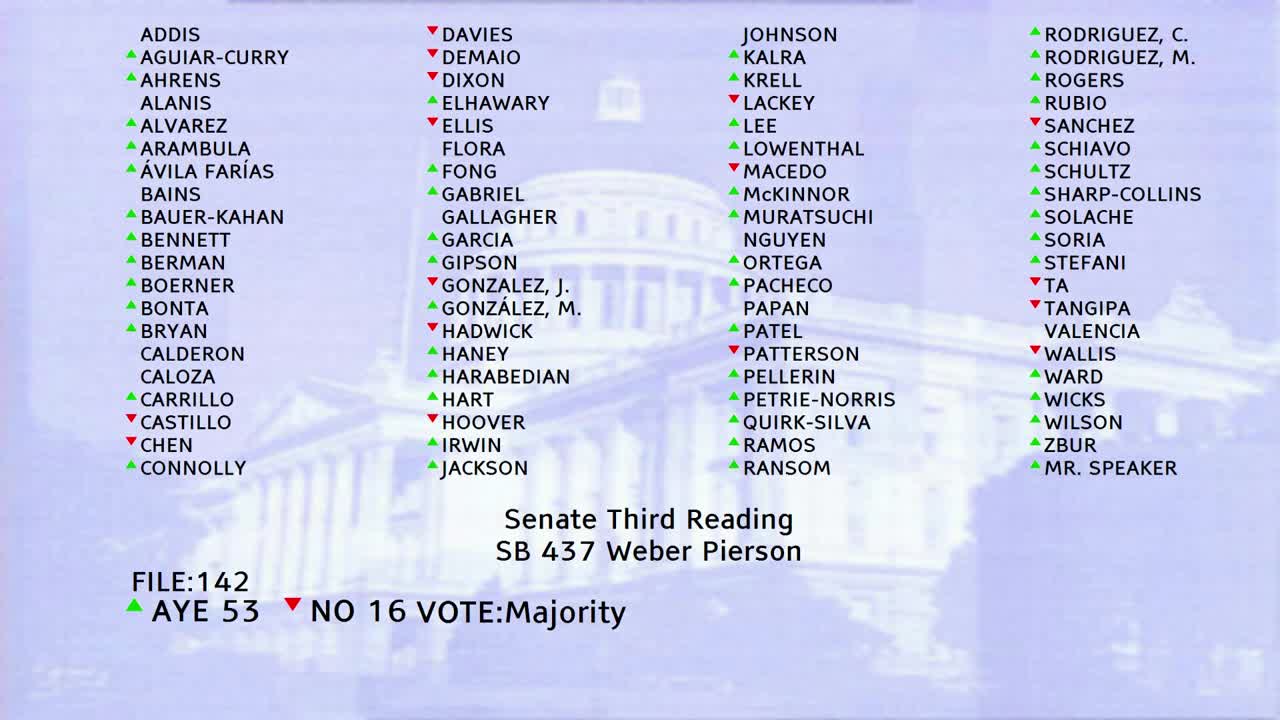 1MIN
Assembly Floor
 8MIN
Assembly Standing Committee on Judiciary
 21MIN
Assembly Standing Committee on Labor and Employment
 2MIN
Senate Floor
 13MIN
Senate Standing Committee on Judiciary
 15MIN



