SB 293: Real property tax: transfer of base year value: generational transfers: wildfire.
- Session Year: 2025-2026
- House: Senate
- Latest Version Date: 2025-10-10
Current Status:
Passed
(2025-10-10: Chaptered by Secretary of State. Chapter 539, Statutes of 2025.)
Introduced
In Committee
Awaiting First Chamber Vote
Passed First Chamber
In Committee
Awaiting Second Chamber Vote
Passed Second Chamber
Enacted
(1)The California Constitution generally limits ad valorem taxes on real property to 1% of the full cash value of that property, defined as the county assessors valuation of real property as shown on the 197576 tax bill and, thereafter, the appraised value of the property when purchased, newly constructed, or a change in ownership occurs after the 1975 assessment, subject to an annual inflation adjustment not to exceed 2%. Existing property tax law provides that the purchase or transfer of the principal residence, and the first $1,000,000 of other real property, of a transferor in the case of a transfer between parents and their children, or between grandparents and their grandchildren if all the parents of those grandchildren are deceased, is not a purchase or change in ownership for purposes of determining the full cash value of property for taxation.
The California Constitution, pursuant to Proposition 19, adopted by the voters at the November 3, 2020, general election, beginning on and after February 16, 2021, excludes from the terms purchase and change in ownership, for purposes of determining the full cash value of property, the purchase or transfer of a family home or family farm, as those terms are defined, of the transferor in the case of a transfer between parents and their children, or between grandparents and their grandchildren if all the parents of those grandchildren are deceased, as specified.
Existing law requires a filing to be made with regard to a transfer that is eligible for the above-referenced exclusions, and sets various deadlines, including a requirement to file six months after the date of mailing of a notice of supplemental or escape assessment, issued as a result of the purchase or transfer of real property for which the claim is filed.
This bill would require a filing for a transfer that is eligible for the above-referenced exclusions to be treated as timely if the filing is made within three years of the date of mailing of a notice of supplemental or escape assessment if specified requirements are met, including a requirement that the assessor reassesses the property as a result of that property being damaged or destroyed by the 2025 Palisades Fire, Eaton Fire, Hurst Fire, Lidia Fire, Sunset Fire, or Woodley Fire, for which the Governor proclaimed a state of emergency. The bill would only apply this exception to claims filed before January 1, 2031. By expanding the duties of local tax officials, this bill would impose a state-mandated local program.
(2)The California Constitution declares that all property is taxable, except as provided, and establishes or authorizes various exemptions from tax for real property, including a homeowners exemption in the amount of $7,000 of the full value of a dwelling that may be applied unless the dwelling receives another real property exemption. The California Constitution and existing property tax law establish a disabled veterans exemption in the amount of $100,000 or $150,000 for the principal place of residence of a veteran or a veterans spouse, as specified. Existing law requires a transferee to file for the homeowners or disabled veterans exemption within a year of the transfer.
This bill would instead require that a filing for the homeowners or disabled veterans exemption be treated as timely if it is filed within a year of the date of mailing of a notice of supplemental or escape assessment if specified requirements are met. The bill would only apply this exception to claims filed before January 1, 2031.
(3)This bill would make legislative findings and declarations as to the necessity of a special statute for the County of Los Angeles.
(4)The California Constitution requires the state to reimburse local agencies and school districts for certain costs mandated by the state. Statutory provisions establish procedures for making that reimbursement.
This bill would provide that, if the Commission on State Mandates determines that the bill contains costs mandated by the state, reimbursement for those costs shall be made pursuant to the statutory provisions noted above.
(1)The California Constitution generally limits ad valorem taxes on real property to 1% of the full cash value of that property, defined as the county assessors valuation of real property as shown on the 197576 tax bill and, thereafter, the appraised value of the property when purchased, newly constructed, or a change in ownership occurs after the 1975 assessment, subject to an annual inflation adjustment not to exceed 2%. Existing property tax law provides that the purchase or transfer of the principal residence, and the first $1,000,000 of other real property, of a transferor in the case of a transfer between parents and their children, or between grandparents and their grandchildren if all the parents of those grandchildren are deceased, is not a purchase or change in ownership for purposes of determining the full cash value of property for taxation.
The California Constitution, pursuant to Proposition 19, adopted by the voters at the November 3, 2020, general election, beginning on and after February 16, 2021, excludes from the terms purchase and change in ownership, for purposes of determining the full cash value of property, the purchase or transfer of a family home or family farm, as those terms are defined, of the transferor in the case of a transfer between parents and their children, or between grandparents and their grandchildren if all the parents of those grandchildren are deceased, as specified.
Existing law requires a filing to be made with regard to a transfer that is eligible for the above-referenced exclusions, and sets various deadlines, including a requirement to file six months after the date of mailing of a notice of supplemental or escape assessment, issued as a result of the purchase or transfer of real property for which the claim is filed.
This bill would require a filing for a transfer that is eligible for the above-referenced exclusions to be treated as timely if the filing is made within three years of the date of mailing of a notice of supplemental or escape assessment if specified requirements are met, including a requirement that the assessor reassesses the property as a result of that property being damaged or destroyed by the 2025 Palisades Fire, Eaton Fire, Hurst Fire, Lidia Fire, Sunset Fire, or Woodley Fire, for which the Governor proclaimed a state of emergency. The bill would only apply this exception to claims filed before January 1, 2031. By expanding the duties of local tax officials, this bill would impose a state-mandated local program.
(2)The California Constitution declares that all property is taxable, except as provided, and establishes or authorizes various exemptions from tax for real property, including a homeowners exemption in the amount of $7,000 of the full value of a dwelling that may be applied unless the dwelling receives another real property exemption. The California Constitution and existing property tax law establish a disabled veterans exemption in the amount of $100,000 or $150,000 for the principal place of residence of a veteran or a veterans spouse, as specified. Existing law requires a transferee to file for the homeowners or disabled veterans exemption within a year of the transfer.
This bill would instead require that a filing for the homeowners or disabled veterans exemption be treated as timely if it is filed within a year of the date of mailing of a notice of supplemental or escape assessment if specified requirements are met. The bill would only apply this exception to claims filed before January 1, 2031.
(3)This bill would make legislative findings and declarations as to the necessity of a special statute for the County of Los Angeles.
(3)(4)The California Constitution requires the state to reimburse local agencies and school districts for certain costs mandated by the state. Statutory provisions establish procedures for making that reimbursement.
This bill would provide that, if the Commission on State Mandates determines that the bill contains costs mandated by the state, reimbursement for those costs shall be made pursuant to the statutory provisions noted above.
(1)The California Constitution generally limits ad valorem taxes on real property to 1% of the full cash value of that property, defined as the county assessors valuation of real property as shown on the 197576 tax bill and, thereafter, the appraised value of the property when purchased, newly constructed, or a change in ownership occurs after the 1975 assessment, subject to an annual inflation adjustment not to exceed 2%. Existing property tax law provides that the purchase or transfer of the principal residence, and the first $1,000,000 of other real property, of a transferor in the case of a transfer between parents and their children, or between grandparents and their grandchildren if all the parents of those grandchildren are deceased, is not a purchase or change in ownership for purposes of determining the full cash value of property for taxation.
The California Constitution, pursuant to Proposition 19, adopted by the voters at the November 3, 2020, general election, beginning on and after February 16, 2021, excludes from the terms purchase and change in ownership, for purposes of determining the full cash value of property, the purchase or transfer of a family home or family farm, as those terms are defined, of the transferor in the case of a transfer between parents and their children, or between grandparents and their grandchildren if all the parents of those grandchildren are deceased, as specified.
Existing law requires a filing to be made with regard to a transfer that is eligible for the above-referenced exclusions, and sets various deadlines, including a requirement to file six months after the date of mailing of a notice of supplemental or escape assessment, issued as a result of the purchase or transfer of real property for which the claim is filed.
This bill would require a filing for a transfer that is eligible for the above-referenced exclusions to be treated as timely if the filing is made within three years of the date of mailing of a notice of supplemental or escape assessment if specified requirements are met, including a requirement that the assessor reassesses the property due to a misfortune or calamity in an area proclaimed a state of emergency, as specified. as a result of that property being damaged or destroyed by the 2025 Palisades Fire, Eaton Fire, Hurst Fire, Lidia Fire, Sunset Fire, or Woodley Fire, for which the Governor proclaimed a state of emergency. By expanding the duties of local tax officials, this bill would impose a state-mandated local program.
(2)The California Constitution declares that all property is taxable, except as provided, and establishes or authorizes various exemptions from tax for real property, including a homeowners exemption in the amount of $7,000 of the full value of a dwelling that may be applied unless the dwelling receives another real property exemption. The California Constitution and existing property tax law establish a disabled veterans exemption in the amount of $100,000 or $150,000 for the principal place of residence of a veteran or a veterans spouse, as specified. Existing law requires a transferee to file for the homeowners or disabled veterans exemption within a year of the transfer.
This bill would instead require that a filing for the homeowners or disabled veterans exemption be treated as timely if it is filed within a year of the date of mailing of a notice of supplemental or escape assessment if specified requirements are met.
This bill would make legislative findings and declarations as to the necessity of a special statute for the County of Los Angeles.
(3)The California Constitution requires the state to reimburse local agencies and school districts for certain costs mandated by the state. Statutory provisions establish procedures for making that reimbursement.
This bill would provide that, if the Commission on State Mandates determines that the bill contains costs mandated by the state, reimbursement for those costs shall be made pursuant to the statutory provisions noted above.
The
(1)The California Constitution generally limits ad valorem taxes on real property to 1% of the full cash value of that property, defined as the county assessors valuation of real property as shown on the 197576 tax bill and, thereafter, the appraised value of the property when purchased, newly constructed, or a change in ownership occurs after the 1975 assessment, subject to an annual inflation adjustment not to exceed 2%. Existing property tax law provides that the purchase or transfer of the principal residence, and the first $1,000,000 of other real property, of a transferor in the case of a transfer between parents and their children, or between grandparents and their grandchildren if all the parents of those grandchildren are deceased, is not a purchase or change in ownership for purposes of determining the full cash value of property for taxation.
The California Constitution, pursuant to Proposition 19, adopted by the voters at the November 3, 2020, general election, beginning on and after February 16, 2021, excludes from the terms purchase and change in ownership, for purposes of determining the full cash value of property, the purchase or transfer of a family home or family farm, as those terms are defined, of the transferor in the case of a transfer between parents and their children, or between grandparents and their grandchildren if all the parents of those grandchildren are deceased, as specified.
Existing law requires a filing to be made with regard to a transfer that is eligible for the above-referenced exclusions, and sets various deadlines, including a requirement to file six months after the date of mailing of a notice of supplemental or escape assessment, issued as a result of the purchase or transfer of real property for which the claim is filed.
This bill would require a filing for a transfer that is eligible for the above-referenced exclusions to be treated as timely if the filing is made within three years of the date of mailing of a notice of supplemental or escape assessment if specified requirements are met, including a requirement that the assessor reassesses the property due to a misfortune or calamity in an area proclaimed a state of emergency, as specified. By expanding the duties of local tax officials, this bill would impose a state-mandated local program.
(2)The California Constitution declares that all property is taxable, except as provided, and establishes or authorizes various exemptions from tax for real property, including a homeowners exemption in the amount of $7,000 of the full value of a dwelling that may be applied unless the dwelling receives another real property exemption. The California Constitution and existing property tax law establish a disabled veterans exemption in the amount of $100,000 or $150,000 for the principal place of residence of a veteran or a veterans spouse, as specified. Existing law requires a transferee to file for the homeowners or disabled veterans exemption within a year of the transfer.
This bill would instead require that a filing for the homeowners or disabled veterans exemption be treated as timely if it is filed within a year of the date of mailing of a notice of supplemental or escape assessment if specified requirements are met.
The(3)The California Constitution requires the state to reimburse local agencies and school districts for certain costs mandated by the state. Statutory provisions establish procedures for making that reimbursement.
This bill would provide that, if the Commission on State Mandates determines that the bill contains costs mandated by the state, reimbursement for those costs shall be made pursuant to the statutory provisions noted above.
The California Constitution generally limits ad valorem taxes on real property to 1% of the full cash value of that property, defined as the county assessors valuation of real property as shown on the 197576 tax bill and, thereafter, the appraised value of the property when purchased, newly constructed, or a change in ownership occurs after the 1975 assessment, subject to an annual inflation adjustment not to exceed 2%. Existing property tax law provides that the purchase or transfer of the principal residence, and the first $1,000,000 of other real property, of a transferor in the case of a transfer between parents and their children, or between grandparents and their grandchildren if all the parents of those grandchildren are deceased, is not a purchase or change in ownership for purposes of determining the full cash value of property for taxation.
The California Constitution, pursuant to Proposition 19, adopted by the voters at the November 3, 2020, general election, beginning on and after February 16, 2021, excludes from the terms purchase and change in ownership, for purposes of determining the full cash value of property, the purchase or transfer of a family home or family farm, as those terms are defined, of the transferor in the case of a transfer between parents and their children, or between grandparents and their grandchildren if all the parents of those grandchildren are deceased, as specified.
Existing law requires a filing to be made with regard to a transfer that is eligible for the above-referenced exclusions, and sets various deadlines, including a requirement to file six months after the date of mailing of a notice of supplemental or escape assessment, issued as a result of the purchase or transfer of real property for which the claim is filed.
This bill would require a filing for a transfer that is eligible for the above-referenced exclusions to be treated as timely if the filing is made within three years of the date of mailing of a notice of supplemental or escape assessment if specified requirements are met, including a requirement that the assessor reassesses the property due to a misfortune or calamity in an area proclaimed a state of emergency, as specified. By expanding the duties of local tax officials, this bill would impose a state-mandated local program.
The California Constitution requires the state to reimburse local agencies and school districts for certain costs mandated by the state. Statutory provisions establish procedures for making that reimbursement.
This bill would provide that, if the Commission on State Mandates determines that the bill contains costs mandated by the state, reimbursement for those costs shall be made pursuant to the statutory provisions noted above.
The California Constitution provides that all property is taxable, and requires that it be assessed at the same percentage of fair market value, unless otherwise provided by the California Constitution or federal law.This bill would state the intent of the Legislature to enact subsequent legislation that would expand current provisions of property tax law that provide relief to taxpayers affected by a disaster in order to support families affected by fires in the County of Los Angeles.The California Constitution provides that all property is taxable, and requires that it be assessed at the same percentage of fair market value, unless otherwise provided by the California Constitution or federal law.
This bill would state the intent of the Legislature to enact subsequent legislation that would expand current provisions of property tax law that provide relief to taxpayers affected by a disaster in order to support families affected by fires in the County of Los Angeles.
(a)Notwithstanding any other provision of this chapter, a change in ownership shall not include the following purchases or transfers for which a claim is filed pursuant to this section:
(1)(A)The purchase or transfer of real property which is the principal residence of an eligible transferor in the case of a purchase or transfer between parents and their children.
(B)A purchase or transfer of a principal residence from a foster child to the childs biological parent shall not be excluded under subparagraph (A) if the transferor child received that principal residence, or interest therein, from a foster parent through a purchase or transfer that was excluded under subparagraph (A).
(2)The purchase or transfer of the first one million dollars ($1,000,000) of full cash value of all other real property of an eligible transferor in the case of a purchase or transfer between parents and their children.
(3)(A)Subject to subparagraph (B), the purchase or transfer of real property described in paragraphs (1) and (2) of subdivision (a) occurring on or after March 27, 1996, between grandparents and their grandchild or grandchildren, if all of the parents of that grandchild or those grandchildren, who qualify as the children of the grandparents, are deceased as of the date of purchase or transfer. Notwithstanding any other provision of law, for the lien date for the 200607 fiscal year and each fiscal year thereafter, in determining whether all of the parents of that grandchild or those grandchildren, who qualify as the children of the grandparents, are deceased as of the date of purchase or transfer, a son-in-law or daughter-in-law of the grandparent that is a stepparent to the grandchild need not be deceased on the date of the transfer.
(B)A purchase or transfer of a principal residence shall not be excluded pursuant to subparagraph (A) if the transferee grandchild or grandchildren also received a principal residence, or interest therein, through another purchase or transfer that was excludable pursuant to paragraph (1) of subdivision (a). The full cash value of any real property, other than a principal residence, that was transferred to the grandchild or grandchildren pursuant to a purchase or transfer that was excludable pursuant to paragraph (2) of subdivision (a) and the full cash value of a principal residence that fails to qualify for exclusion as a result of the preceding sentence shall be included in applying, for purposes of paragraph (2) of subdivision (a), the one million dollar ($1,000,000) full cash value limit specified in paragraph (2) of subdivision (a).
(b)(1)For purposes of paragraph (1) of subdivision (a), principal residence means a dwelling that is eligible for a homeowners exemption or a disabled veterans exemption as a result of the transferors ownership and occupation of the dwelling. Principal residence includes only that portion of the land underlying the residence that consists of an area of reasonable size that is used as a site for the residence.
(2)For purposes of paragraph (2) of subdivision (a), the one-million-dollar ($1,000,000) exclusion shall apply separately to each eligible transferor with respect to all purchases by and transfers to eligible transferees on and after November 6, 1986, of real property, other than the principal residence, of that eligible transferor. The exclusion shall not apply to any property in which the eligible transferors interest was received through a transfer, or transfers, excluded from change in ownership by the provisions of either subdivision (f) of Section 62 or subdivision (b) of Section 65, unless the transferor qualifies as an original transferor under subdivision (b) of Section 65. In the case of any purchase or transfer subject to this paragraph involving two or more eligible transferors, the transferors may elect to combine their separate one-million-dollar ($1,000,000) exclusions and, upon making that election, the combined amount of their separate exclusions shall apply to any property jointly sold or transferred by the electing transferors, provided that in no case shall the amount of full cash value of real property of any one eligible transferor excluded under this election exceed the amount of the transferors separate unused exclusion on the date of the joint sale or transfer.
(c)As used in this section:
(1)Purchase or transfer between parents and their children means either a transfer from a parent or parents to a child or children of the parent or parents or a transfer from a child or children to a parent or parents of the child or children. For purposes of this section, the date of any transfer between parents and their children under a will or intestate succession shall be the date of the decedents death, if the decedent died on or after November 6, 1986.
(2)Purchase or transfer of real property between grandparents and their grandchild or grandchildren means a purchase or transfer on or after March 27, 1996, from a grandparent or grandparents to a grandchild or grandchildren if all of the parents of that grandchild or those grandchildren who qualify as the children of the grandparents are deceased as of the date of the transfer. For purposes of this section, the date of any transfer between grandparents and their grandchildren under a will or by intestate succession shall be the date of the decedents death. Notwithstanding any other provision of law, for the lien date for the 200607 fiscal year and each fiscal year thereafter, in determining whether all of the parents of that grandchild or those grandchildren, who qualify as the children of the grandparents, are deceased as of the date of purchase or transfer, a son-in-law or daughter-in-law of the grandparent that is a stepparent to the grandchild need not be deceased on the date of the transfer.
(3)Children means any of the following:
(A)Any child born of the parent or parents, except a child, as defined in subparagraph (D), who has been adopted by another person or persons.
(B)Any stepchild of the parent or parents and the spouse of that stepchild while the relationship of stepparent and stepchild exists. For purposes of this paragraph, the relationship of stepparent and stepchild shall be deemed to exist until the marriage on which the relationship is based is terminated by divorce, or, if the relationship is terminated by death, until the remarriage of the surviving stepparent.
(C)Any son-in-law or daughter-in-law of the parent or parents. For the purposes of this paragraph, the relationship of parent and son-in-law or daughter-in-law shall be deemed to exist until the marriage on which the relationship is based is terminated by divorce, or, if the relationship is terminated by death, until the remarriage of the surviving son-in-law or daughter-in-law.
(D)Any child adopted by the parent or parents pursuant to statute, other than an individual adopted after reaching 18 years of age.
(E)Any foster child of a state-licensed foster parent, if that child was not, because of a legal barrier, adopted by the foster parent or foster parents before the child aged out of the foster care system. For purposes of this paragraph, the relationship between a foster child and foster parent shall be deemed to exist until terminated by death. However, for purposes of a transfer that occurs on the date of death, the relationship shall be deemed to exist on the date of death.
(4)Grandchild or grandchildren means any child or children of the child or children of the grandparent or grandparents.
(5)Full cash value means full cash value, as defined in Section 2 of Article XIIIA of the California Constitution and Section 110.1, with any adjustments authorized by those sections, and the full value of any new construction in progress, determined as of the date immediately prior to the date of a purchase by or transfer to an eligible transferee of real property subject to this section.
(6)Eligible transferor means a grandparent, parent, or child of an eligible transferee.
(7)Eligible transferee means a parent, child, or grandchild of an eligible transferor.
(8)Real property means real property as defined in Section 104. Real property does not include any interest in a legal entity. For purposes of this section, real property includes any of the following:
(A)An interest in a unit or lot within a cooperative housing corporation, as defined in subdivision (i) of Section 61.
(B)A pro rata ownership interest in a mobilehome park, as defined in subdivision (b) of Section 62.1.
(C)A pro rata ownership in a floating home marina, as defined in subdivision (c) of Section 62.5.
(9)Transfer includes, and is not limited to, any transfer of the present beneficial ownership of property from an eligible transferor to an eligible transferee through the medium of an inter vivos or testamentary trust.
(10)Social security number also includes a taxpayer identification number issued by the Internal Revenue Service in the case in which the taxpayer is a foreign national who cannot obtain a social security number.
(d)(1)The exclusions provided for in subdivision (a) shall not be allowed unless the eligible transferee, the transferees legal representative, the trustee of the transferees trust, or the executor or administrator of the transferees estate files a claim with the assessor for the exclusion sought and furnishes to the assessor each of the following:
(A)A written certification by the transferee, the transferees legal representative, the trustee of the transferees trust, or the executor or administrator of the transferees estate, signed and made under penalty of perjury that the transferee is a parent, child, or grandchild of the transferor and that the transferor is the parent, child, or grandparent of the transferee. In the case of a grandparent-grandchild transfer, the written certification shall also include a certification that all the parents of the grandchild or grandchildren who qualify as children of the grandparents were deceased as of the date of the purchase or transfer and that the grandchild or grandchildren did or did not receive a principal residence excludable under paragraph (1) of subdivision (a) from the deceased parents, and that the grandchild or grandchildren did or did not receive real property other than a principal residence excludable under paragraph (2) of subdivision (a) from the deceased parents. The claimant shall provide legal substantiation of any matter certified pursuant to this subparagraph at the request of the county assessor.
(B)A written certification by the transferor, the transferors legal representative, the trustee of the transferors trust, or the executor or administrator of the transferors estate, signed and made under penalty of perjury that the transferor is a grandparent, parent, or child of the transferee and that the transferor is seeking the exclusion under this section and will not file a claim to transfer the base year value of the property under Section 69.5.
(C)A written certification shall also include either or both of the following:
(i)If the purchase or transfer of real property includes the purchase or transfer of residential real property, a certification that the residential real property is or is not the transferors principal residence.
(ii)If the purchase or transfer of real property includes the purchase or transfer of real property other than the transferors principal residence, a certification that other real property of the transferor that is subject to this section has or has not been previously sold or transferred to an eligible transferee, the total amount of full cash value, as defined in subdivision (c), of any real property subject to this section that has been previously sold or transferred by that transferor to eligible transferees, the location of that real property, the social security number of each eligible transferor, and the names of the eligible transferees of that property.
(D)If there are multiple transferees, the certification and signature may be made by any one of the transferees, if both of the following conditions are met:
(i)The transferee has actual knowledge that, and the certification signed by the transferee states that, all of the transferees are eligible transferees within the meaning of this section.
(ii)The certification is signed by the transferee as a true statement made under penalty of perjury.
(E)In the case of a transfer between a foster parent and foster child, the claim filed with the assessor shall include a certified copy of the court decision regarding the foster child status of the individual and a certified statement from the appropriate county agency stating that the foster child was not, because of a legal barrier, adopted by the foster parent or foster parents. Upon a request by the county assessor, the claimant also shall provide to the assessor legal substantiation of any matter certified under this subparagraph.
(2)If the full cash value of the real property purchased by or transferred to the transferee exceeds the permissible exclusion of the transferor or the combined permissible exclusion of the transferors, in the case of a purchase or transfer from two or more joint transferors, taking into account any previous purchases by or transfers to an eligible transferee from the same transferor or transferors, the transferee shall specify in their claim the amount and the allocation of the exclusion they are seeking. Within any appraisal unit, as determined in accordance with subdivision (d) of Section 51 by the assessor of the county in which the real property is located, the exclusion shall be applied only on a pro rata basis, however, and shall not be applied to a selected portion or portions of the appraisal unit.
(e)(1)The State Board of Equalization shall design the form for claiming eligibility. Except as provided in paragraph (3), any claim under this section shall be filed:
(A)For transfers of real property between parents and their children occurring prior to September 30, 1990, within three years after the date of the purchase or transfer of real property for which the claim is filed.
(B)For transfers of real property between parents and their children occurring on or after September 30, 1990, and for the purchase or transfer of real property between grandparents and their grandchildren occurring on or after March 27, 1996, within three years after the date of the purchase or transfer of real property for which the claim is filed, or prior to transfer of the real property to a third party, whichever is earlier.
(C)Notwithstanding subparagraphs (A) and (B), a claim shall be deemed to be timely filed if it is filed within six months after the date of mailing of a notice of supplemental or escape assessment, issued as a result of the purchase or transfer of real property for which the claim is filed.
(2)(A)Notwithstanding subparagraph (C) of paragraph (1), and subject to subparagraph (B) of this paragraph, a claim shall be deemed to be timely filed within three years after the date of mailing of a notice of supplemental or escape assessment, issued as a result of transfer of real property for which the claim is filed, when all of the following apply:
(i)The assessor reassesses the property, pursuant to Section 170, as a result of that property being damaged or destroyed by the 2025 Palisades Fire, Eaton Fire, Hurst Fire, Lidia Fire, Sunset Fire, or Woodley Fire, for which the Governor proclaimed a state of emergency.
(ii)The assessor issued a supplemental or escape assessment on or after the date of the state of emergency described in paragraph (A) as a result of a purchase or transfer of the real property for which the claim is filed that occurred before the date of the fire, and for which no instrument evidencing a change in ownership of the real property was recorded.
(iii)The transferee acquires ownership of the property, including, but not limited to, pursuant to Chapter 4 (commencing with Section 13600) of Part 2 of Division 8 of the Probate Code, on or after the date of the state of emergency described in paragraph (A).
(B)This paragraph shall only apply to claims filed before January 1, 2031.
(3)In the case in which the real property subject to purchase or transfer has not been transferred to a third party, a claim for exclusion under this section that is filed subsequent to the expiration of the filing periods set forth in paragraph (1) shall be considered by the assessor, subject to all of the following conditions:
(A)Any exclusion granted pursuant to that claim shall apply commencing with the lien date of the assessment year in which the claim is filed.
(B)Under any exclusion granted pursuant to that claim, the adjusted full cash value of the subject real property in the assessment year described in subparagraph (A) shall be the adjusted base year value of the subject real property in the assessment year in which the excluded purchase or transfer took place, factored to the assessment year described in subparagraph (A) for both of the following:
(i)Inflation as annually determined in accordance with paragraph (1) of subdivision (a) of Section 51.
(ii)Any subsequent new construction occurring with respect to the subject real property.
(4)(A)Unless otherwise expressly provided, the provisions of this subdivision shall apply to any purchase or transfer of real property that occurred on or after November 6, 1986.
(B)Paragraph (2) shall apply to purchases or transfers between parents and their children that occurred on or after November 6, 1986, and to purchases or transfers between grandparents and their grandchildren that occurred on or after March 27, 1996.
(5)For purposes of this subdivision, a transfer of real property to a parent or child of the transferor shall not be considered a transfer to a third party.
(f)The assessor may report quarterly to the State Board of Equalization all purchases or transfers, other than purchases or transfers involving a principal residence, for which a claim for exclusion is made pursuant to subdivision (d). Each report shall contain the assessors parcel number for each parcel for which the exclusion is claimed, the amount of each exclusion claimed, the social security number of each eligible transferor, and any other information the board may require in order to monitor the one-million-dollar ($1,000,000) limitation in paragraph (2) of subdivision (a). In recognition of the state and local interests served by the action made optional in this subdivision, the Legislature encourages the assessor to continue taking the action formerly mandated by this subdivision.
(g)This section shall apply to both voluntary transfers and transfers resulting from a court order or judicial decree. Nothing in this subdivision shall be construed as conflicting with paragraph (1) of subdivision (c) or the general principle that transfers by reason of death occur at the time of death.
(h)(1)Except as provided in paragraph (2), this section shall apply to purchases and transfers of real property completed on or after November 6, 1986, and shall not be effective for any change in ownership, including a change in ownership arising on the date of a decedents death, that occurred prior to that date.
(2)This section shall apply to purchases or transfers of real property between grandparents and their grandchildren occurring on or after March 27, 1996, and, with respect to purchases or transfers of real property between grandparents and their grandchildren, shall not be effective for any change in ownership, including a change in ownership arising on the date of a decedents death, that occurred prior to that date.
(i)A claim filed under this section is not a public document and is not subject to public inspection, except that a claim shall be available for inspection by the transferee and the transferor or their respective spouse, the transferees legal representative, the transferors legal representative, the trustee of the transferees trust, the trustee of the transferors trust, and the executor or administrator of the transferees or transferors estate.
(j)(1)If the assessor notifies the transferee in writing of potential eligibility for exclusion from change in ownership under this section, a certified claim for exclusion shall be filed with the assessor within 45 days of the date of the notice of potential eligibility. If a certified claim for exclusion is not filed within 45 days, the assessor may send a second notice of potential eligibility for exclusion, notifying the transferee that a certified claim for exclusion has not been received and that reassessment of the property will commence unless a certified claim for exclusion is filed within 60 days of the date of the second notice of potential eligibility. The second notice of potential eligibility shall indicate whether a certified claim for exclusion that is not filed within 60 days will be subject to a processing fee as provided in paragraph (2).
(2)If a certified claim for exclusion is not filed within 60 days of the date of the second notice of potential eligibility and an eligible transferee subsequently files a claim and qualifies for the exclusion, the assessor may, upon authorization by a county board of supervisors, require an eligible transferee to pay a one-time processing fee, collected at the time the claim is submitted, and reimbursed by the assessor if the claim is ineligible. The fee shall be subject to the provisions of Chapter 12.5 (commencing with Section 54985) of Part 1 of Division 2 of Title 5 of the Government Code and shall not exceed the amount of the actual and reasonable costs incurred by the assessor for reassessment work done due to failure to file the claim for exclusion or one hundred seventy-five dollars ($175), whichever is less.
(3)The failure to file a certified claim for exclusion within the filing periods specified by this subdivision shall not be construed to limit any exclusion from being granted pursuant to a claim filed within the filing periods specified by subdivision (e).
SEC. 2.Section 63.2 of the Revenue and Taxation Code is amended to read:63.2.(a)Notwithstanding any provision of this chapter, beginning on and after February 16, 2021, a change in ownership shall not include, in whole or in part, any of the following purchases or transfers for which a claim is filed:
(1)The purchase or transfer of real property that is the principal residence of an eligible transferor in the case of a purchase or transfer between parents and their children or between grandparents and their grandchildren, if all of the parents, other than stepparents, of that grandchild or those grandchildren, who qualify as the children of the grandparents, are deceased as of the date of purchase or transfer.
(A)The transfer is required to be of a principal residence of the transferor, and become the principal residence of the transferee within one year of the transfer.
(B)The transferee shall file for the homeowners or disabled veterans exemption within a year of the transfer, and the exclusion shall be removed on the date an eligible transferee, or a subsequent eligible transferee who files for the homeowners or disabled veterans exemption within one year, is no longer eligible for either the homeowners or disabled veterans exemption.
(C)If applicable, as of the lien date immediately following the date the eligible transferee or subsequent eligible transferee no longer qualifies for the exclusion provided by this section, the base year value established as of the change in ownership date to which the exclusion applied, adjusted annually in accordance with paragraph (1) of subdivision (a) of Section 51, shall be enrolled.
(2)The purchase or transfer is of a family farm of an eligible transferor in the case of a purchase or transfer between parents and their children or between grandparents and their grandchildren, if all of the parents, other than stepparents, of that grandchild or those grandchildren, who qualify as the children of the grandparents, are deceased as of the date of purchase or transfer.
(A)This exclusion shall apply separately to the transfer of each legal parcel that makes up a family farm.
(B)For purposes of this section, each legal parcel that makes up a family farm shall be deemed to itself be a family farm, except for a legal parcel containing a family home.
(C)A legal parcel containing a family home as described in subparagraph (B) may qualify separately for exclusion under paragraph (1).
(b)The exclusions provided for in this section shall not be allowed unless a claim for the exclusion sought, pursuant to subdivision (f), is filed with the assessor.
(c)A claim filed under this section is not a public document and is not subject to public inspection, except that a claim shall be available for inspection by the transferee and the transferor or their respective spouse, the transferees legal representative, the transferors legal representative, the trustee of the transferees trust, the trustee of the transferors trust, and the executor or administrator of the transferees or transferors estate.
(d)The new taxable value of the family home or family farm shall be the sum of both of the following:
(1)The taxable value of the family home or family farm as determined in accordance with Section 110.1, with the adjustments permitted by subdivision (b) of Section 2 of Article XIIIA of the California Constitution and subdivision (f) of Section 110.1, determined as of the date immediately prior to the date the principal residence or family farm is purchased or transferred to the transferee.
(2)The applicable of the following amounts:
(A)If the fair market value, as defined in subdivision (a) of Section 110, of the family home or family farm upon purchase by, or transfer to, the transferee is less than the sum of the taxable value described in paragraph (1) plus one million dollars ($1,000,000), then zero dollars ($0).
(B)If the fair market value, as defined in subdivision (a) of Section 110, of the family home or family farm upon purchase by, or transfer to, the transferee is equal to or more than the sum of the taxable value described in paragraph (1) plus one million dollars ($1,000,000), an amount equal to the fair market value of the family home upon purchase by, or transfer to, the transferee, minus the sum of the taxable value described in paragraph (1) and one million dollars ($1,000,000).
(e)As used in this section, the following terms have the following meanings:
(1)Children means any of the following:
(A)Any child born of the parent or parents, except a child, as defined in subparagraph (D), who has been adopted by another person or persons.
(B)Any stepchild of the parent or parents and the spouse of that stepchild while the relationship of stepparent and stepchild exists. For purposes of this paragraph, the relationship of stepparent and stepchild shall be deemed to exist until the marriage on which the relationship is based is terminated by divorce, or, if the relationship is terminated by death, until the remarriage of the surviving stepparent.
(C)Any son-in-law or daughter-in-law of the parent or parents. For the purposes of this paragraph, the relationship of parent and son-in-law or daughter-in-law shall be deemed to exist until the marriage on which the relationship is based is terminated by divorce, or, if the relationship is terminated by death, until the remarriage of the surviving son-in-law or daughter-in-law.
(D)Any child adopted by the parent or parents pursuant to statute, other than an individual adopted after reaching 18 years of age.
(E)Any foster child of a state-licensed foster parent, if that child was not, because of a legal barrier, adopted by the foster parent or foster parents before the child aged out of the foster care system. For purposes of this paragraph, the relationship between a foster child and foster parent shall be deemed to exist until terminated by death. However, for purposes of a transfer that occurs on the date of death, the relationship shall be deemed to exist on the date of death.
(2)Eligible transferee means a parent, child, grandparent, or grandchild of an eligible transferor.
(3)Eligible transferor means a grandparent, parent, grandchild, or child of an eligible transferee.
(4)Family farm means any real property under cultivation or which is being used for pasture or grazing, or that is used to produce any agricultural commodity, as that term is defined in Section 51201 of the Government Code as that section read on January 1, 2020.
(5)Family home or principal place of residence means a dwelling that is eligible for a homeowners exemption or a disabled veterans exemption as a result of the transferors ownership and occupation of the dwelling. Family home or principal residence includes only that portion of the land underlying the residence that consists of an area of reasonable size that is used as a site for the residence.
(6)Full cash value means full cash value, as defined in Section 2 of Article XIIIA of the California Constitution and Section 110.1, with any adjustments authorized by those sections, and the full value of any new construction in progress, determined as of the date immediately prior to the date of a purchase by or transfer to an eligible transferee of real property subject to this section.
(7)Grandchild or grandchildren means any child or children of the child or children of the grandparent or grandparents.
(8)Real property means real property as defined in Section 104. Real property does not include any interest in a legal entity. For purposes of this section, real property includes any of the following:
(A)An interest in a unit or lot within a cooperative housing corporation, as defined in subdivision (i) of Section 61.
(B)A pro rata ownership interest in a mobilehome park, as defined in subdivision (b) of Section 62.1.
(C)A pro rata ownership in a floating home marina, as defined in subdivision (c) of Section 62.5.
(9)Transfer includes, and is not limited to, any transfer of the present beneficial ownership of property from an eligible transferor to an eligible transferee through the medium of an inter vivos or testamentary trust.
(f)(1)The State Board of Equalization shall prescribe, after consultation with the California Assessors Association, a form for claiming eligibility. Except as provided in paragraph (3), any claim under this section shall be filed as follows:
(A)Within three years after the date of the purchase or transfer of real property for which the claim is filed, or prior to the transfer of the real property to a third party, or an eligible transferee no longer occupies the residence, whichever is earlier.
(B)Notwithstanding subparagraph (A), a claim shall be deemed to be timely filed if it is filed within six months after the date of mailing of a notice of supplemental or escape assessment, issued as a result of the purchase or transfer of real property for which the claim is filed.
(2)(A)Notwithstanding subparagraph (B) of paragraph (1), and subject to subparagraph (C) of this paragraph, a claim shall be deemed to be timely filed within three years after the date of mailing of a notice of supplemental or escape assessment, issued as a result of transfer of real property for which the claim is filed, when all of the following apply:
(i)The assessor reassesses the property, pursuant to Section 170, as a result of that property being damaged or destroyed by the 2025 Palisades Fire, Eaton Fire, Hurst Fire, Lidia Fire, Sunset Fire, or Woodley Fire, for which the Governor proclaimed a state of emergency.
(ii)The assessor issued a supplemental or escape assessment due to a previously unrecorded change in ownership on or after the date of the state of emergency described in paragraph (A).
(iii)The transferee acquires ownership of the property, including but not limited to, pursuant to Chapter 4 (commencing with Section 13600) of Part 2 of Division 8 of the Probate Code, on or after the date of the state of emergency described in paragraph (A).
(B)If all conditions of subparagraph (A) are satisfied, and notwithstanding subparagraph (B) of paragraph (1) of subdivision (a), a filing to claim the homeowners or disabled veterans exemption shall be treated as timely if it is filed within a year of the date of mailing of a notice of supplemental or escape assessment issued as a result of the transfer of the real property for which the claim is filed.
(C)This paragraph shall only apply to claims filed before January 1, 2031.
(3)In the case in which the real property subject to purchase or transfer has not been transferred to a third party, a claim for exclusion under this section that is filed subsequent to the expiration of the filing periods set forth in paragraph (1) shall be considered by the assessor, subject to both of the following conditions:
(A)Any exclusion granted pursuant to that claim shall apply, commencing with the lien date of the assessment year in which the claim is filed.
(B)Under any exclusion granted pursuant to that claim, the adjusted full cash value of the subject real property in the assessment year described in subparagraph (A) shall be the adjusted base year value of the subject real property in the assessment year in which the excluded purchase or transfer took place, factored to the assessment year described in subparagraph (A) for both of the following:
(i)Inflation as annually determined in accordance with paragraph (1) of subdivision (a) of Section 51.
(ii)Any subsequent new construction occurring with respect to the subject real property.
(g)(1)If the assessor notifies the transferee in writing of potential eligibility for exclusion from change in ownership under this section, a certified claim for exclusion shall be filed with the assessor within 45 days of the date of the notice of potential eligibility. If a certified claim for exclusion is not filed within 45 days, the assessor may send a second notice of potential eligibility for exclusion, notifying the transferee that a certified claim for exclusion has not been received and that reassessment of the property will commence unless a certified claim for exclusion is filed within 60 days of the date of the second notice of potential eligibility. The second notice of potential eligibility shall indicate whether a certified claim for exclusion that is not filed within 60 days will be subject to a processing fee as provided in paragraph (2).
(2)If a certified claim for exclusion is not filed within 60 days of the date of the second notice of potential eligibility and an eligible transferee subsequently files a claim and qualifies for the exclusion, the assessor may, upon authorization by a county board of supervisors, require an eligible transferee to pay a one-time processing fee, collected at the time the claim is submitted, and reimbursed by the assessor if the claim is ineligible. The fee shall be subject to the provisions of Chapter 12.5 (commencing with Section 54985) of Part 1 of Division 2 of Title 5 of the Government Code and shall not exceed the amount of the actual and reasonable costs incurred by the assessor for reassessment work done due to failure to file the claim for exclusion or one hundred seventy-five dollars ($175), whichever is less.
(h)(1)After consultation with the California Assessors Association, the board shall, by emergency regulation, adopt regulations and produce claim forms and instructions necessary to implement this section and Section 2.1 of Article XIIIA of the California Constitution.
(2)Any emergency regulation prescribed, adopted, or enforced pursuant to this section shall be adopted in accordance with Chapter 3.5 (commencing with Section 11340) of Part 1 of Division 3 of Title 2 of the Government Code, and, for purposes of that chapter, including Section 11349.6 of the Government Code, the adoption of the regulation is an emergency and shall be considered by the Office of Administrative Law as necessary for the immediate preservation of the public peace, health and safety, and general welfare.
SEC. 3.The Legislature finds and declares that a special statute is necessary and that a general statute cannot be made applicable within the meaning of Section 16 of Article IV of the California Constitution because of the unique circumstances facing the County of Los Angeles.
SEC. 4.If the Commission on State Mandates determines that this act contains costs mandated by the state, reimbursement to local agencies and school districts for those costs shall be made pursuant to Part 7 (commencing with Section 17500) of Division 4 of Title 2 of the Government Code.
(a)Notwithstanding any other provision of this chapter, a change in ownership shall not include the following purchases or transfers for which a claim is filed pursuant to this section:
(1)(A)The purchase or transfer of real property which is the principal residence of an eligible transferor in the case of a purchase or transfer between parents and their children.
(B)A purchase or transfer of a principal residence from a foster child to the childs biological parent shall not be excluded under subparagraph (A) if the transferor child received that principal residence, or interest therein, from a foster parent through a purchase or transfer that was excluded under subparagraph (A).
(2)The purchase or transfer of the first one million dollars ($1,000,000) of full cash value of all other real property of an eligible transferor in the case of a purchase or transfer between parents and their children.
(3)(A)Subject to subparagraph (B), the purchase or transfer of real property described in paragraphs (1) and (2) of subdivision (a) occurring on or after March 27, 1996, between grandparents and their grandchild or grandchildren, if all of the parents of that grandchild or those grandchildren, who qualify as the children of the grandparents, are deceased as of the date of purchase or transfer. Notwithstanding any other provision of law, for the lien date for the 200607 fiscal year and each fiscal year thereafter, in determining whether all of the parents of that grandchild or those grandchildren, who qualify as the children of the grandparents, are deceased as of the date of purchase or transfer, a son-in-law or daughter-in-law of the grandparent that is a stepparent to the grandchild need not be deceased on the date of the transfer.
(B)A purchase or transfer of a principal residence shall not be excluded pursuant to subparagraph (A) if the transferee grandchild or grandchildren also received a principal residence, or interest therein, through another purchase or transfer that was excludable pursuant to paragraph (1) of subdivision (a). The full cash value of any real property, other than a principal residence, that was transferred to the grandchild or grandchildren pursuant to a purchase or transfer that was excludable pursuant to paragraph (2) of subdivision (a) and the full cash value of a principal residence that fails to qualify for exclusion as a result of the preceding sentence shall be included in applying, for purposes of paragraph (2) of subdivision (a), the one million dollar ($1,000,000) full cash value limit specified in paragraph (2) of subdivision (a).
(b)(1)For purposes of paragraph (1) of subdivision (a), principal residence means a dwelling that is eligible for a homeowners exemption or a disabled veterans exemption as a result of the transferors ownership and occupation of the dwelling. Principal residence includes only that portion of the land underlying the residence that consists of an area of reasonable size that is used as a site for the residence.
(2)For purposes of paragraph (2) of subdivision (a), the one-million-dollar ($1,000,000) exclusion shall apply separately to each eligible transferor with respect to all purchases by and transfers to eligible transferees on and after November 6, 1986, of real property, other than the principal residence, of that eligible transferor. The exclusion shall not apply to any property in which the eligible transferors interest was received through a transfer, or transfers, excluded from change in ownership by the provisions of either subdivision (f) of Section 62 or subdivision (b) of Section 65, unless the transferor qualifies as an original transferor under subdivision (b) of Section 65. In the case of any purchase or transfer subject to this paragraph involving two or more eligible transferors, the transferors may elect to combine their separate one-million-dollar ($1,000,000) exclusions and, upon making that election, the combined amount of their separate exclusions shall apply to any property jointly sold or transferred by the electing transferors, provided that in no case shall the amount of full cash value of real property of any one eligible transferor excluded under this election exceed the amount of the transferors separate unused exclusion on the date of the joint sale or transfer.
(c)As used in this section:
(1)Purchase or transfer between parents and their children means either a transfer from a parent or parents to a child or children of the parent or parents or a transfer from a child or children to a parent or parents of the child or children. For purposes of this section, the date of any transfer between parents and their children under a will or intestate succession shall be the date of the decedents death, if the decedent died on or after November 6, 1986.
(2)Purchase or transfer of real property between grandparents and their grandchild or grandchildren means a purchase or transfer on or after March 27, 1996, from a grandparent or grandparents to a grandchild or grandchildren if all of the parents of that grandchild or those grandchildren who qualify as the children of the grandparents are deceased as of the date of the transfer. For purposes of this section, the date of any transfer between grandparents and their grandchildren under a will or by intestate succession shall be the date of the decedents death. Notwithstanding any other provision of law, for the lien date for the 200607 fiscal year and each fiscal year thereafter, in determining whether all of the parents of that grandchild or those grandchildren, who qualify as the children of the grandparents, are deceased as of the date of purchase or transfer, a son-in-law or daughter-in-law of the grandparent that is a stepparent to the grandchild need not be deceased on the date of the transfer.
(3)Children means any of the following:
(A)Any child born of the parent or parents, except a child, as defined in subparagraph (D), who has been adopted by another person or persons.
(B)Any stepchild of the parent or parents and the spouse of that stepchild while the relationship of stepparent and stepchild exists. For purposes of this paragraph, the relationship of stepparent and stepchild shall be deemed to exist until the marriage on which the relationship is based is terminated by divorce, or, if the relationship is terminated by death, until the remarriage of the surviving stepparent.
(C)Any son-in-law or daughter-in-law of the parent or parents. For the purposes of this paragraph, the relationship of parent and son-in-law or daughter-in-law shall be deemed to exist until the marriage on which the relationship is based is terminated by divorce, or, if the relationship is terminated by death, until the remarriage of the surviving son-in-law or daughter-in-law.
(D)Any child adopted by the parent or parents pursuant to statute, other than an individual adopted after reaching 18 years of age.
(E)Any foster child of a state-licensed foster parent, if that child was not, because of a legal barrier, adopted by the foster parent or foster parents before the child aged out of the foster care system. For purposes of this paragraph, the relationship between a foster child and foster parent shall be deemed to exist until terminated by death. However, for purposes of a transfer that occurs on the date of death, the relationship shall be deemed to exist on the date of death.
(4)Grandchild or grandchildren means any child or children of the child or children of the grandparent or grandparents.
(5)Full cash value means full cash value, as defined in Section 2 of Article XIIIA of the California Constitution and Section 110.1, with any adjustments authorized by those sections, and the full value of any new construction in progress, determined as of the date immediately prior to the date of a purchase by or transfer to an eligible transferee of real property subject to this section.
(6)Eligible transferor means a grandparent, parent, or child of an eligible transferee.
(7)Eligible transferee means a parent, child, or grandchild of an eligible transferor.
(8)Real property means real property as defined in Section 104. Real property does not include any interest in a legal entity. For purposes of this section, real property includes any of the following:
(A)An interest in a unit or lot within a cooperative housing corporation, as defined in subdivision (i) of Section 61.
(B)A pro rata ownership interest in a mobilehome park, as defined in subdivision (b) of Section 62.1.
(C)A pro rata ownership in a floating home marina, as defined in subdivision (c) of Section 62.5.
(9)Transfer includes, and is not limited to, any transfer of the present beneficial ownership of property from an eligible transferor to an eligible transferee through the medium of an inter vivos or testamentary trust.
(10)Social security number also includes a taxpayer identification number issued by the Internal Revenue Service in the case in which the taxpayer is a foreign national who cannot obtain a social security number.
(d)(1)The exclusions provided for in subdivision (a) shall not be allowed unless the eligible transferee, the transferees legal representative, the trustee of the transferees trust, or the executor or administrator of the transferees estate files a claim with the assessor for the exclusion sought and furnishes to the assessor each of the following:
(A)A written certification by the transferee, the transferees legal representative, the trustee of the transferees trust, or the executor or administrator of the transferees estate, signed and made under penalty of perjury that the transferee is a parent, child, or grandchild of the transferor and that the transferor is the parent, child, or grandparent of the transferee. In the case of a grandparent-grandchild transfer, the written certification shall also include a certification that all the parents of the grandchild or grandchildren who qualify as children of the grandparents were deceased as of the date of the purchase or transfer and that the grandchild or grandchildren did or did not receive a principal residence excludable under paragraph (1) of subdivision (a) from the deceased parents, and that the grandchild or grandchildren did or did not receive real property other than a principal residence excludable under paragraph (2) of subdivision (a) from the deceased parents. The claimant shall provide legal substantiation of any matter certified pursuant to this subparagraph at the request of the county assessor.
(B)A written certification by the transferor, the transferors legal representative, the trustee of the transferors trust, or the executor or administrator of the transferors estate, signed and made under penalty of perjury that the transferor is a grandparent, parent, or child of the transferee and that the transferor is seeking the exclusion under this section and will not file a claim to transfer the base year value of the property under Section 69.5.
(C)A written certification shall also include either or both of the following:
(i)If the purchase or transfer of real property includes the purchase or transfer of residential real property, a certification that the residential real property is or is not the transferors principal residence.
(ii)If the purchase or transfer of real property includes the purchase or transfer of real property other than the transferors principal residence, a certification that other real property of the transferor that is subject to this section has or has not been previously sold or transferred to an eligible transferee, the total amount of full cash value, as defined in subdivision (c), of any real property subject to this section that has been previously sold or transferred by that transferor to eligible transferees, the location of that real property, the social security number of each eligible transferor, and the names of the eligible transferees of that property.
(D)If there are multiple transferees, the certification and signature may be made by any one of the transferees, if both of the following conditions are met:
(i)The transferee has actual knowledge that, and the certification signed by the transferee states that, all of the transferees are eligible transferees within the meaning of this section.
(ii)The certification is signed by the transferee as a true statement made under penalty of perjury.
(E)In the case of a transfer between a foster parent and foster child, the claim filed with the assessor shall include a certified copy of the court decision regarding the foster child status of the individual and a certified statement from the appropriate county agency stating that the foster child was not, because of a legal barrier, adopted by the foster parent or foster parents. Upon a request by the county assessor, the claimant also shall provide to the assessor legal substantiation of any matter certified under this subparagraph.
(2)If the full cash value of the real property purchased by or transferred to the transferee exceeds the permissible exclusion of the transferor or the combined permissible exclusion of the transferors, in the case of a purchase or transfer from two or more joint transferors, taking into account any previous purchases by or transfers to an eligible transferee from the same transferor or transferors, the transferee shall specify in their claim the amount and the allocation of the exclusion they are seeking. Within any appraisal unit, as determined in accordance with subdivision (d) of Section 51 by the assessor of the county in which the real property is located, the exclusion shall be applied only on a pro rata basis, however, and shall not be applied to a selected portion or portions of the appraisal unit.
(e)(1)The State Board of Equalization shall design the form for claiming eligibility. Except as provided in paragraph (3), any claim under this section shall be filed:
(A)For transfers of real property between parents and their children occurring prior to September 30, 1990, within three years after the date of the purchase or transfer of real property for which the claim is filed.
(B)For transfers of real property between parents and their children occurring on or after September 30, 1990, and for the purchase or transfer of real property between grandparents and their grandchildren occurring on or after March 27, 1996, within three years after the date of the purchase or transfer of real property for which the claim is filed, or prior to transfer of the real property to a third party, whichever is earlier.
(C)Notwithstanding subparagraphs (A) and (B), a claim shall be deemed to be timely filed if it is filed within six months after the date of mailing of a notice of supplemental or escape assessment, issued as a result of the purchase or transfer of real property for which the claim is filed.
(2)(A)Notwithstanding subparagraph (C) of paragraph (1), and subject to subparagraph (B) of this paragraph, a claim shall be deemed to be timely filed within three years after the date of mailing of a notice of supplemental or escape assessment, issued as a result of transfer of real property for which the claim is filed, when all of the following apply:
(A)(i)The assessor reassesses the property, pursuant to Section 170, as a result of that property being damaged or destroyed by the 2025 Palisades Fire, Eaton Fire, Hurst Fire, Lidia Fire, Sunset Fire, or Woodley Fire, for which the Governor proclaimed a state of emergency.
(B)(ii)The assessor issued a supplemental or escape assessment on or after the date of the state of emergency described in paragraph (A) as a result of a purchase or transfer of the real property for which the claim is filed that occurred before the date of the fire, and for which no instrument evidencing a change in ownership of the real property was recorded.
(C)(iii)The transferee acquires ownership of the property, including, but not limited to, pursuant to Chapter 4 (commencing with Section 13600) of Part 2 of Division 8 of the Probate Code, on or after the date of the state of emergency described in paragraph (A).
(B)This paragraph shall only apply to claims filed before January 1, 2031.
(3)In the case in which the real property subject to purchase or transfer has not been transferred to a third party, a claim for exclusion under this section that is filed subsequent to the expiration of the filing periods set forth in paragraph (1) shall be considered by the assessor, subject to all of the following conditions:
(A)Any exclusion granted pursuant to that claim shall apply commencing with the lien date of the assessment year in which the claim is filed.
(B)Under any exclusion granted pursuant to that claim, the adjusted full cash value of the subject real property in the assessment year described in subparagraph (A) shall be the adjusted base year value of the subject real property in the assessment year in which the excluded purchase or transfer took place, factored to the assessment year described in subparagraph (A) for both of the following:
(i)Inflation as annually determined in accordance with paragraph (1) of subdivision (a) of Section 51.
(ii)Any subsequent new construction occurring with respect to the subject real property.
(4)(A)Unless otherwise expressly provided, the provisions of this subdivision shall apply to any purchase or transfer of real property that occurred on or after November 6, 1986.
(B)Paragraph (2) shall apply to purchases or transfers between parents and their children that occurred on or after November 6, 1986, and to purchases or transfers between grandparents and their grandchildren that occurred on or after March 27, 1996.
(5)For purposes of this subdivision, a transfer of real property to a parent or child of the transferor shall not be considered a transfer to a third party.
(f)The assessor may report quarterly to the State Board of Equalization all purchases or transfers, other than purchases or transfers involving a principal residence, for which a claim for exclusion is made pursuant to subdivision (d). Each report shall contain the assessors parcel number for each parcel for which the exclusion is claimed, the amount of each exclusion claimed, the social security number of each eligible transferor, and any other information the board may require in order to monitor the one-million-dollar ($1,000,000) limitation in paragraph (2) of subdivision (a). In recognition of the state and local interests served by the action made optional in this subdivision, the Legislature encourages the assessor to continue taking the action formerly mandated by this subdivision.
(g)This section shall apply to both voluntary transfers and transfers resulting from a court order or judicial decree. Nothing in this subdivision shall be construed as conflicting with paragraph (1) of subdivision (c) or the general principle that transfers by reason of death occur at the time of death.
(h)(1)Except as provided in paragraph (2), this section shall apply to purchases and transfers of real property completed on or after November 6, 1986, and shall not be effective for any change in ownership, including a change in ownership arising on the date of a decedents death, that occurred prior to that date.
(2)This section shall apply to purchases or transfers of real property between grandparents and their grandchildren occurring on or after March 27, 1996, and, with respect to purchases or transfers of real property between grandparents and their grandchildren, shall not be effective for any change in ownership, including a change in ownership arising on the date of a decedents death, that occurred prior to that date.
(i)A claim filed under this section is not a public document and is not subject to public inspection, except that a claim shall be available for inspection by the transferee and the transferor or their respective spouse, the transferees legal representative, the transferors legal representative, the trustee of the transferees trust, the trustee of the transferors trust, and the executor or administrator of the transferees or transferors estate.
(j)(1)If the assessor notifies the transferee in writing of potential eligibility for exclusion from change in ownership under this section, a certified claim for exclusion shall be filed with the assessor within 45 days of the date of the notice of potential eligibility. If a certified claim for exclusion is not filed within 45 days, the assessor may send a second notice of potential eligibility for exclusion, notifying the transferee that a certified claim for exclusion has not been received and that reassessment of the property will commence unless a certified claim for exclusion is filed within 60 days of the date of the second notice of potential eligibility. The second notice of potential eligibility shall indicate whether a certified claim for exclusion that is not filed within 60 days will be subject to a processing fee as provided in paragraph (2).
(2)If a certified claim for exclusion is not filed within 60 days of the date of the second notice of potential eligibility and an eligible transferee subsequently files a claim and qualifies for the exclusion, the assessor may, upon authorization by a county board of supervisors, require an eligible transferee to pay a one-time processing fee, collected at the time the claim is submitted, and reimbursed by the assessor if the claim is ineligible. The fee shall be subject to the provisions of Chapter 12.5 (commencing with Section 54985) of Part 1 of Division 2 of Title 5 of the Government Code and shall not exceed the amount of the actual and reasonable costs incurred by the assessor for reassessment work done due to failure to file the claim for exclusion or one hundred seventy-five dollars ($175), whichever is less.
(3)The failure to file a certified claim for exclusion within the filing periods specified by this subdivision shall not be construed to limit any exclusion from being granted pursuant to a claim filed within the filing periods specified by subdivision (e).
SEC. 2.Section 63.2 of the Revenue and Taxation Code is amended to read:63.2.(a)Notwithstanding any provision of this chapter, beginning on and after February 16, 2021, a change in ownership shall not include, in whole or in part, any of the following purchases or transfers for which a claim is filed:
(1)The purchase or transfer of real property that is the principal residence of an eligible transferor in the case of a purchase or transfer between parents and their children or between grandparents and their grandchildren, if all of the parents, other than stepparents, of that grandchild or those grandchildren, who qualify as the children of the grandparents, are deceased as of the date of purchase or transfer.
(A)The transfer is required to be of a principal residence of the transferor, and become the principal residence of the transferee within one year of the transfer.
(B)The transferee shall file for the homeowners or disabled veterans exemption within a year of the transfer, and the exclusion shall be removed on the date an eligible transferee, or a subsequent eligible transferee who files for the homeowners or disabled veterans exemption within one year, is no longer eligible for either the homeowners or disabled veterans exemption.
(C)If applicable, as of the lien date immediately following the date the eligible transferee or subsequent eligible transferee no longer qualifies for the exclusion provided by this section, the base year value established as of the change in ownership date to which the exclusion applied, adjusted annually in accordance with paragraph (1) of subdivision (a) of Section 51, shall be enrolled.
(2)The purchase or transfer is of a family farm of an eligible transferor in the case of a purchase or transfer between parents and their children or between grandparents and their grandchildren, if all of the parents, other than stepparents, of that grandchild or those grandchildren, who qualify as the children of the grandparents, are deceased as of the date of purchase or transfer.
(A)This exclusion shall apply separately to the transfer of each legal parcel that makes up a family farm.
(B)For purposes of this section, each legal parcel that makes up a family farm shall be deemed to itself be a family farm, except for a legal parcel containing a family home.
(C)A legal parcel containing a family home as described in subparagraph (B) may qualify separately for exclusion under paragraph (1).
(b)The exclusions provided for in this section shall not be allowed unless a claim for the exclusion sought, pursuant to subdivision (f), is filed with the assessor.
(c)A claim filed under this section is not a public document and is not subject to public inspection, except that a claim shall be available for inspection by the transferee and the transferor or their respective spouse, the transferees legal representative, the transferors legal representative, the trustee of the transferees trust, the trustee of the transferors trust, and the executor or administrator of the transferees or transferors estate.
(d)The new taxable value of the family home or family farm shall be the sum of both of the following:
(1)The taxable value of the family home or family farm as determined in accordance with Section 110.1, with the adjustments permitted by subdivision (b) of Section 2 of Article XIIIA of the California Constitution and subdivision (f) of Section 110.1, determined as of the date immediately prior to the date the principal residence or family farm is purchased or transferred to the transferee.
(2)The applicable of the following amounts:
(A)If the fair market value, as defined in subdivision (a) of Section 110, of the family home or family farm upon purchase by, or transfer to, the transferee is less than the sum of the taxable value described in paragraph (1) plus one million dollars ($1,000,000), then zero dollars ($0).
(B)If the fair market value, as defined in subdivision (a) of Section 110, of the family home or family farm upon purchase by, or transfer to, the transferee is equal to or more than the sum of the taxable value described in paragraph (1) plus one million dollars ($1,000,000), an amount equal to the fair market value of the family home upon purchase by, or transfer to, the transferee, minus the sum of the taxable value described in paragraph (1) and one million dollars ($1,000,000).
(e)As used in this section, the following terms have the following meanings:
(1)Children means any of the following:
(A)Any child born of the parent or parents, except a child, as defined in subparagraph (D), who has been adopted by another person or persons.
(B)Any stepchild of the parent or parents and the spouse of that stepchild while the relationship of stepparent and stepchild exists. For purposes of this paragraph, the relationship of stepparent and stepchild shall be deemed to exist until the marriage on which the relationship is based is terminated by divorce, or, if the relationship is terminated by death, until the remarriage of the surviving stepparent.
(C)Any son-in-law or daughter-in-law of the parent or parents. For the purposes of this paragraph, the relationship of parent and son-in-law or daughter-in-law shall be deemed to exist until the marriage on which the relationship is based is terminated by divorce, or, if the relationship is terminated by death, until the remarriage of the surviving son-in-law or daughter-in-law.
(D)Any child adopted by the parent or parents pursuant to statute, other than an individual adopted after reaching 18 years of age.
(E)Any foster child of a state-licensed foster parent, if that child was not, because of a legal barrier, adopted by the foster parent or foster parents before the child aged out of the foster care system. For purposes of this paragraph, the relationship between a foster child and foster parent shall be deemed to exist until terminated by death. However, for purposes of a transfer that occurs on the date of death, the relationship shall be deemed to exist on the date of death.
(2)Eligible transferee means a parent, child, grandparent, or grandchild of an eligible transferor.
(3)Eligible transferor means a grandparent, parent, grandchild, or child of an eligible transferee.
(4)Family farm means any real property under cultivation or which is being used for pasture or grazing, or that is used to produce any agricultural commodity, as that term is defined in Section 51201 of the Government Code as that section read on January 1, 2020.
(5)Family home or principal place of residence means a dwelling that is eligible for a homeowners exemption or a disabled veterans exemption as a result of the transferors ownership and occupation of the dwelling. Family home or principal residence includes only that portion of the land underlying the residence that consists of an area of reasonable size that is used as a site for the residence.
(6)Full cash value means full cash value, as defined in Section 2 of Article XIIIA of the California Constitution and Section 110.1, with any adjustments authorized by those sections, and the full value of any new construction in progress, determined as of the date immediately prior to the date of a purchase by or transfer to an eligible transferee of real property subject to this section.
(7)Grandchild or grandchildren means any child or children of the child or children of the grandparent or grandparents.
(8)Real property means real property as defined in Section 104. Real property does not include any interest in a legal entity. For purposes of this section, real property includes any of the following:
(A)An interest in a unit or lot within a cooperative housing corporation, as defined in subdivision (i) of Section 61.
(B)A pro rata ownership interest in a mobilehome park, as defined in subdivision (b) of Section 62.1.
(C)A pro rata ownership in a floating home marina, as defined in subdivision (c) of Section 62.5.
(9)Transfer includes, and is not limited to, any transfer of the present beneficial ownership of property from an eligible transferor to an eligible transferee through the medium of an inter vivos or testamentary trust.
(f)(1)The State Board of Equalization shall prescribe, after consultation with the California Assessors Association, a form for claiming eligibility. Except as provided in paragraph (3), any claim under this section shall be filed as follows:
(A)Within three years after the date of the purchase or transfer of real property for which the claim is filed, or prior to the transfer of the real property to a third party, or an eligible transferee no longer occupies the residence, whichever is earlier.
(B)Notwithstanding subparagraph (A), a claim shall be deemed to be timely filed if it is filed within six months after the date of mailing of a notice of supplemental or escape assessment, issued as a result of the purchase or transfer of real property for which the claim is filed.
(2)(A)Notwithstanding subparagraph (B) of paragraph (1), and subject to subparagraph (C) of this paragraph, a claim shall be deemed to be timely filed within three years after the date of mailing of a notice of supplemental or escape assessment, issued as a result of transfer of real property for which the claim is filed, when all of the following apply:
(i)The assessor reassesses the property, pursuant to Section 170, as a result of that property being damaged or destroyed by the 2025 Palisades Fire, Eaton Fire, Hurst Fire, Lidia Fire, Sunset Fire, or Woodley Fire, for which the Governor proclaimed a state of emergency.
(ii)The assessor issued a supplemental or escape assessment due to a previously unrecorded change in ownership on or after the date of the state of emergency described in paragraph (A).
(iii)The transferee acquires ownership of the property, including but not limited to, pursuant to Chapter 4 (commencing with Section 13600) of Part 2 of Division 8 of the Probate Code, on or after the date of the state of emergency described in paragraph (A).
(B)If all conditions of subparagraph (A) are satisfied, and notwithstanding subparagraph (B) of paragraph (1) of subdivision (a), a filing to claim the homeowners or disabled veterans exemption shall be treated as timely if it is filed within a year of the date of mailing of a notice of supplemental or escape assessment issued as a result of the transfer of the real property for which the claim is filed.
(C)This paragraph shall only apply to claims filed before January 1, 2031.
(3)In the case in which the real property subject to purchase or transfer has not been transferred to a third party, a claim for exclusion under this section that is filed subsequent to the expiration of the filing periods set forth in paragraph (1) shall be considered by the assessor, subject to both of the following conditions:
(A)Any exclusion granted pursuant to that claim shall apply, commencing with the lien date of the assessment year in which the claim is filed.
(B)Under any exclusion granted pursuant to that claim, the adjusted full cash value of the subject real property in the assessment year described in subparagraph (A) shall be the adjusted base year value of the subject real property in the assessment year in which the excluded purchase or transfer took place, factored to the assessment year described in subparagraph (A) for both of the following:
(i)Inflation as annually determined in accordance with paragraph (1) of subdivision (a) of Section 51.
(ii)Any subsequent new construction occurring with respect to the subject real property.
(g)(1)If the assessor notifies the transferee in writing of potential eligibility for exclusion from change in ownership under this section, a certified claim for exclusion shall be filed with the assessor within 45 days of the date of the notice of potential eligibility. If a certified claim for exclusion is not filed within 45 days, the assessor may send a second notice of potential eligibility for exclusion, notifying the transferee that a certified claim for exclusion has not been received and that reassessment of the property will commence unless a certified claim for exclusion is filed within 60 days of the date of the second notice of potential eligibility. The second notice of potential eligibility shall indicate whether a certified claim for exclusion that is not filed within 60 days will be subject to a processing fee as provided in paragraph (2).
(2)If a certified claim for exclusion is not filed within 60 days of the date of the second notice of potential eligibility and an eligible transferee subsequently files a claim and qualifies for the exclusion, the assessor may, upon authorization by a county board of supervisors, require an eligible transferee to pay a one-time processing fee, collected at the time the claim is submitted, and reimbursed by the assessor if the claim is ineligible. The fee shall be subject to the provisions of Chapter 12.5 (commencing with Section 54985) of Part 1 of Division 2 of Title 5 of the Government Code and shall not exceed the amount of the actual and reasonable costs incurred by the assessor for reassessment work done due to failure to file the claim for exclusion or one hundred seventy-five dollars ($175), whichever is less.
(h)(1)After consultation with the California Assessors Association, the board shall, by emergency regulation, adopt regulations and produce claim forms and instructions necessary to implement this section and Section 2.1 of Article XIIIA of the California Constitution.
(2)Any emergency regulation prescribed, adopted, or enforced pursuant to this section shall be adopted in accordance with Chapter 3.5 (commencing with Section 11340) of Part 1 of Division 3 of Title 2 of the Government Code, and, for purposes of that chapter, including Section 11349.6 of the Government Code, the adoption of the regulation is an emergency and shall be considered by the Office of Administrative Law as necessary for the immediate preservation of the public peace, health and safety, and general welfare.
SEC. 3.The Legislature finds and declares that a special statute is necessary and that a general statute cannot be made applicable within the meaning of Section 16 of Article IV of the California Constitution because of the unique circumstances facing the County of Los Angeles.
SEC. 4.If the Commission on State Mandates determines that this act contains costs mandated by the state, reimbursement to local agencies and school districts for those costs shall be made pursuant to Part 7 (commencing with Section 17500) of Division 4 of Title 2 of the Government Code.
(a)Notwithstanding any other provision of this chapter, a change in ownership shall not include the following purchases or transfers for which a claim is filed pursuant to this section:
(1)(A)The purchase or transfer of real property which is the principal residence of an eligible transferor in the case of a purchase or transfer between parents and their children.
(B)A purchase or transfer of a principal residence from a foster child to the childs biological parent shall not be excluded under subparagraph (A) if the transferor child received that principal residence, or interest therein, from a foster parent through a purchase or transfer that was excluded under subparagraph (A).
(2)The purchase or transfer of the first one million dollars ($1,000,000) of full cash value of all other real property of an eligible transferor in the case of a purchase or transfer between parents and their children.
(3)(A)Subject to subparagraph (B), the purchase or transfer of real property described in paragraphs (1) and (2) of subdivision (a) occurring on or after March 27, 1996, between grandparents and their grandchild or grandchildren, if all of the parents of that grandchild or those grandchildren, who qualify as the children of the grandparents, are deceased as of the date of purchase or transfer. Notwithstanding any other provision of law, for the lien date for the 200607 fiscal year and each fiscal year thereafter, in determining whether all of the parents of that grandchild or those grandchildren, who qualify as the children of the grandparents, are deceased as of the date of purchase or transfer, a son-in-law or daughter-in-law of the grandparent that is a stepparent to the grandchild need not be deceased on the date of the transfer.
(B)A purchase or transfer of a principal residence shall not be excluded pursuant to subparagraph (A) if the transferee grandchild or grandchildren also received a principal residence, or interest therein, through another purchase or transfer that was excludable pursuant to paragraph (1) of subdivision (a). The full cash value of any real property, other than a principal residence, that was transferred to the grandchild or grandchildren pursuant to a purchase or transfer that was excludable pursuant to paragraph (2) of subdivision (a) and the full cash value of a principal residence that fails to qualify for exclusion as a result of the preceding sentence shall be included in applying, for purposes of paragraph (2) of subdivision (a), the one million dollar ($1,000,000) full cash value limit specified in paragraph (2) of subdivision (a).
(b)(1)For purposes of paragraph (1) of subdivision (a), principal residence means a dwelling that is eligible for a homeowners exemption or a disabled veterans exemption as a result of the transferors ownership and occupation of the dwelling. Principal residence includes only that portion of the land underlying the residence that consists of an area of reasonable size that is used as a site for the residence.
(2)For purposes of paragraph (2) of subdivision (a), the one-million-dollar ($1,000,000) exclusion shall apply separately to each eligible transferor with respect to all purchases by and transfers to eligible transferees on and after November 6, 1986, of real property, other than the principal residence, of that eligible transferor. The exclusion shall not apply to any property in which the eligible transferors interest was received through a transfer, or transfers, excluded from change in ownership by the provisions of either subdivision (f) of Section 62 or subdivision (b) of Section 65, unless the transferor qualifies as an original transferor under subdivision (b) of Section 65. In the case of any purchase or transfer subject to this paragraph involving two or more eligible transferors, the transferors may elect to combine their separate one-million-dollar ($1,000,000) exclusions and, upon making that election, the combined amount of their separate exclusions shall apply to any property jointly sold or transferred by the electing transferors, provided that in no case shall the amount of full cash value of real property of any one eligible transferor excluded under this election exceed the amount of the transferors separate unused exclusion on the date of the joint sale or transfer.
(c)As used in this section:
(1)Purchase or transfer between parents and their children means either a transfer from a parent or parents to a child or children of the parent or parents or a transfer from a child or children to a parent or parents of the child or children. For purposes of this section, the date of any transfer between parents and their children under a will or intestate succession shall be the date of the decedents death, if the decedent died on or after November 6, 1986.
(2)Purchase or transfer of real property between grandparents and their grandchild or grandchildren means a purchase or transfer on or after March 27, 1996, from a grandparent or grandparents to a grandchild or grandchildren if all of the parents of that grandchild or those grandchildren who qualify as the children of the grandparents are deceased as of the date of the transfer. For purposes of this section, the date of any transfer between grandparents and their grandchildren under a will or by intestate succession shall be the date of the decedents death. Notwithstanding any other provision of law, for the lien date for the 200607 fiscal year and each fiscal year thereafter, in determining whether all of the parents of that grandchild or those grandchildren, who qualify as the children of the grandparents, are deceased as of the date of purchase or transfer, a son-in-law or daughter-in-law of the grandparent that is a stepparent to the grandchild need not be deceased on the date of the transfer.
(3)Children means any of the following:
(A)Any child born of the parent or parents, except a child, as defined in subparagraph (D), who has been adopted by another person or persons.
(B)Any stepchild of the parent or parents and the spouse of that stepchild while the relationship of stepparent and stepchild exists. For purposes of this paragraph, the relationship of stepparent and stepchild shall be deemed to exist until the marriage on which the relationship is based is terminated by divorce, or, if the relationship is terminated by death, until the remarriage of the surviving stepparent.
(C)Any son-in-law or daughter-in-law of the parent or parents. For the purposes of this paragraph, the relationship of parent and son-in-law or daughter-in-law shall be deemed to exist until the marriage on which the relationship is based is terminated by divorce, or, if the relationship is terminated by death, until the remarriage of the surviving son-in-law or daughter-in-law.
(D)Any child adopted by the parent or parents pursuant to statute, other than an individual adopted after reaching 18 years of age.
(E)Any foster child of a state-licensed foster parent, if that child was not, because of a legal barrier, adopted by the foster parent or foster parents before the child aged out of the foster care system. For purposes of this paragraph, the relationship between a foster child and foster parent shall be deemed to exist until terminated by death. However, for purposes of a transfer that occurs on the date of death, the relationship shall be deemed to exist on the date of death.
(4)Grandchild or grandchildren means any child or children of the child or children of the grandparent or grandparents.
(5)Full cash value means full cash value, as defined in Section 2 of Article XIIIA of the California Constitution and Section 110.1, with any adjustments authorized by those sections, and the full value of any new construction in progress, determined as of the date immediately prior to the date of a purchase by or transfer to an eligible transferee of real property subject to this section.
(6)Eligible transferor means a grandparent, parent, or child of an eligible transferee.
(7)Eligible transferee means a parent, child, or grandchild of an eligible transferor.
(8)Real property means real property as defined in Section 104. Real property does not include any interest in a legal entity. For purposes of this section, real property includes any of the following:
(A)An interest in a unit or lot within a cooperative housing corporation, as defined in subdivision (i) of Section 61.
(B)A pro rata ownership interest in a mobilehome park, as defined in subdivision (b) of Section 62.1.
(C)A pro rata ownership in a floating home marina, as defined in subdivision (c) of Section 62.5.
(9)Transfer includes, and is not limited to, any transfer of the present beneficial ownership of property from an eligible transferor to an eligible transferee through the medium of an inter vivos or testamentary trust.
(10)Social security number also includes a taxpayer identification number issued by the Internal Revenue Service in the case in which the taxpayer is a foreign national who cannot obtain a social security number.
(d)(1)The exclusions provided for in subdivision (a) shall not be allowed unless the eligible transferee, the transferees legal representative, the trustee of the transferees trust, or the executor or administrator of the transferees estate files a claim with the assessor for the exclusion sought and furnishes to the assessor each of the following:
(A)A written certification by the transferee, the transferees legal representative, the trustee of the transferees trust, or the executor or administrator of the transferees estate, signed and made under penalty of perjury that the transferee is a parent, child, or grandchild of the transferor and that the transferor is the parent, child, or grandparent of the transferee. In the case of a grandparent-grandchild transfer, the written certification shall also include a certification that all the parents of the grandchild or grandchildren who qualify as children of the grandparents were deceased as of the date of the purchase or transfer and that the grandchild or grandchildren did or did not receive a principal residence excludable under paragraph (1) of subdivision (a) from the deceased parents, and that the grandchild or grandchildren did or did not receive real property other than a principal residence excludable under paragraph (2) of subdivision (a) from the deceased parents. The claimant shall provide legal substantiation of any matter certified pursuant to this subparagraph at the request of the county assessor.
(B)A written certification by the transferor, the transferors legal representative, the trustee of the transferors trust, or the executor or administrator of the transferors estate, signed and made under penalty of perjury that the transferor is a grandparent, parent, or child of the transferee and that the transferor is seeking the exclusion under this section and will not file a claim to transfer the base year value of the property under Section 69.5.
(C)A written certification shall also include either or both of the following:
(i)If the purchase or transfer of real property includes the purchase or transfer of residential real property, a certification that the residential real property is or is not the transferors principal residence.
(ii)If the purchase or transfer of real property includes the purchase or transfer of real property other than the transferors principal residence, a certification that other real property of the transferor that is subject to this section has or has not been previously sold or transferred to an eligible transferee, the total amount of full cash value, as defined in subdivision (c), of any real property subject to this section that has been previously sold or transferred by that transferor to eligible transferees, the location of that real property, the social security number of each eligible transferor, and the names of the eligible transferees of that property.
(D)If there are multiple transferees, the certification and signature may be made by any one of the transferees, if both of the following conditions are met:
(i)The transferee has actual knowledge that, and the certification signed by the transferee states that, all of the transferees are eligible transferees within the meaning of this section.
(ii)The certification is signed by the transferee as a true statement made under penalty of perjury.
(E)In the case of a transfer between a foster parent and foster child, the claim filed with the assessor shall include a certified copy of the court decision regarding the foster child status of the individual and a certified statement from the appropriate county agency stating that the foster child was not, because of a legal barrier, adopted by the foster parent or foster parents. Upon a request by the county assessor, the claimant also shall provide to the assessor legal substantiation of any matter certified under this subparagraph.
(2)If the full cash value of the real property purchased by or transferred to the transferee exceeds the permissible exclusion of the transferor or the combined permissible exclusion of the transferors, in the case of a purchase or transfer from two or more joint transferors, taking into account any previous purchases by or transfers to an eligible transferee from the same transferor or transferors, the transferee shall specify in their claim the amount and the allocation of the exclusion they are seeking. Within any appraisal unit, as determined in accordance with subdivision (d) of Section 51 by the assessor of the county in which the real property is located, the exclusion shall be applied only on a pro rata basis, however, and shall not be applied to a selected portion or portions of the appraisal unit.
(e)(1)The State Board of Equalization shall design the form for claiming eligibility. Except as provided in paragraph (3), any claim under this section shall be filed:
(A)For transfers of real property between parents and their children occurring prior to September 30, 1990, within three years after the date of the purchase or transfer of real property for which the claim is filed.
(B)For transfers of real property between parents and their children occurring on or after September 30, 1990, and for the purchase or transfer of real property between grandparents and their grandchildren occurring on or after March 27, 1996, within three years after the date of the purchase or transfer of real property for which the claim is filed, or prior to transfer of the real property to a third party, whichever is earlier.
(C)Notwithstanding subparagraphs (A) and (B), a claim shall be deemed to be timely filed if it is filed within six months after the date of mailing of a notice of supplemental or escape assessment, issued as a result of the purchase or transfer of real property for which the claim is filed.
(2)Notwithstanding subparagraph (C) of paragraph (1), a claim shall be deemed to be timely filed within three years after the date of mailing of a notice of supplemental or escape assessment, issued as a result of transfer of real property for which the claim is filed, when all of the following apply:
(A)The assessor reassesses the property due to a misfortune or calamity, in an area or region subsequently proclaimed by the Governor to be in a state of emergency, if that property was damaged or destroyed by the major misfortune or calamity that caused the Governor to proclaim the area or region to be in a state of emergency pursuant to Section 170 of the Revenue and Taxation Code. property, pursuant to Section 170, as a result of that property being damaged or destroyed by the 2025 Palisades Fire, Eaton Fire, Hurst Fire, Lidia Fire, Sunset Fire, or Woodley Fire, for which the Governor proclaimed a state of emergency.
(B)The assessor issued a supplemental or escape assessment on or after the date of the misfortune or calamity due to a previously unrecorded change in ownership. state of emergency described in paragraph (A) as a result of a purchase or transfer of the real property for which the claim is filed that occurred before the date of the fire, and for which no instrument evidencing a change in ownership of the real property was recorded.
(C)The transferee acquires ownership of the property, including, but not limited to, pursuant to Chapter 4 (commencing with Section 13600) of Part 2 of Division 8 of the Probate Code, on or after the date of the misfortune or calamity. state of emergency described in paragraph (A).
(3)In the case in which the real property subject to purchase or transfer has not been transferred to a third party, a claim for exclusion under this section that is filed subsequent to the expiration of the filing periods set forth in paragraph (1) shall be considered by the assessor, subject to all of the following conditions:
(A)Any exclusion granted pursuant to that claim shall apply commencing with the lien date of the assessment year in which the claim is filed.
(B)Under any exclusion granted pursuant to that claim, the adjusted full cash value of the subject real property in the assessment year described in subparagraph (A) shall be the adjusted base year value of the subject real property in the assessment year in which the excluded purchase or transfer took place, factored to the assessment year described in subparagraph (A) for both of the following:
(i)Inflation as annually determined in accordance with paragraph (1) of subdivision (a) of Section 51.
(ii)Any subsequent new construction occurring with respect to the subject real property.
(4)(A)Unless otherwise expressly provided, the provisions of this subdivision shall apply to any purchase or transfer of real property that occurred on or after November 6, 1986.
(B)Paragraph (2) shall apply to purchases or transfers between parents and their children that occurred on or after November 6, 1986, and to purchases or transfers between grandparents and their grandchildren that occurred on or after March 27, 1996.
(5)For purposes of this subdivision, a transfer of real property to a parent or child of the transferor shall not be considered a transfer to a third party.
(f)The assessor may report quarterly to the State Board of Equalization all purchases or transfers, other than purchases or transfers involving a principal residence, for which a claim for exclusion is made pursuant to subdivision (d). Each report shall contain the assessors parcel number for each parcel for which the exclusion is claimed, the amount of each exclusion claimed, the social security number of each eligible transferor, and any other information the board may require in order to monitor the one-million-dollar ($1,000,000) limitation in paragraph (2) of subdivision (a). In recognition of the state and local interests served by the action made optional in this subdivision, the Legislature encourages the assessor to continue taking the action formerly mandated by this subdivision.
(g)This section shall apply to both voluntary transfers and transfers resulting from a court order or judicial decree. Nothing in this subdivision shall be construed as conflicting with paragraph (1) of subdivision (c) or the general principle that transfers by reason of death occur at the time of death.
(h)(1)Except as provided in paragraph (2), this section shall apply to purchases and transfers of real property completed on or after November 6, 1986, and shall not be effective for any change in ownership, including a change in ownership arising on the date of a decedents death, that occurred prior to that date.
(2)This section shall apply to purchases or transfers of real property between grandparents and their grandchildren occurring on or after March 27, 1996, and, with respect to purchases or transfers of real property between grandparents and their grandchildren, shall not be effective for any change in ownership, including a change in ownership arising on the date of a decedents death, that occurred prior to that date.
(i)A claim filed under this section is not a public document and is not subject to public inspection, except that a claim shall be available for inspection by the transferee and the transferor or their respective spouse, the transferees legal representative, the transferors legal representative, the trustee of the transferees trust, the trustee of the transferors trust, and the executor or administrator of the transferees or transferors estate.
(j)(1)If the assessor notifies the transferee in writing of potential eligibility for exclusion from change in ownership under this section, a certified claim for exclusion shall be filed with the assessor within 45 days of the date of the notice of potential eligibility. If a certified claim for exclusion is not filed within 45 days, the assessor may send a second notice of potential eligibility for exclusion, notifying the transferee that a certified claim for exclusion has not been received and that reassessment of the property will commence unless a certified claim for exclusion is filed within 60 days of the date of the second notice of potential eligibility. The second notice of potential eligibility shall indicate whether a certified claim for exclusion that is not filed within 60 days will be subject to a processing fee as provided in paragraph (2).
(2)If a certified claim for exclusion is not filed within 60 days of the date of the second notice of potential eligibility and an eligible transferee subsequently files a claim and qualifies for the exclusion, the assessor may, upon authorization by a county board of supervisors, require an eligible transferee to pay a one-time processing fee, collected at the time the claim is submitted, and reimbursed by the assessor if the claim is ineligible. The fee shall be subject to the provisions of Chapter 12.5 (commencing with Section 54985) of Part 1 of Division 2 of Title 5 of the Government Code and shall not exceed the amount of the actual and reasonable costs incurred by the assessor for reassessment work done due to failure to file the claim for exclusion or one hundred seventy-five dollars ($175), whichever is less.
(3)The failure to file a certified claim for exclusion within the filing periods specified by this subdivision shall not be construed to limit any exclusion from being granted pursuant to a claim filed within the filing periods specified by subdivision (e).
SEC. 2.Section 63.2 of the Revenue and Taxation Code is amended to read:63.2.(a)Notwithstanding any provision of this chapter, beginning on and after February 16, 2021, a change in ownership shall not include, in whole or in part, any of the following purchases or transfers for which a claim is filed:
(1)The purchase or transfer of real property that is the principal residence of an eligible transferor in the case of a purchase or transfer between parents and their children or between grandparents and their grandchildren, if all of the parents, other than stepparents, of that grandchild or those grandchildren, who qualify as the children of the grandparents, are deceased as of the date of purchase or transfer.
(A)The transfer is required to be of a principal residence of the transferor, and become the principal residence of the transferee within one year of the transfer.
(B)The transferee shall file for the homeowners or disabled veterans exemption within a year of the transfer, and the exclusion shall be removed on the date an eligible transferee, or a subsequent eligible transferee who files for the homeowners or disabled veterans exemption within one year, is no longer eligible for either the homeowners or disabled veterans exemption.
(C)If applicable, as of the lien date immediately following the date the eligible transferee or subsequent eligible transferee no longer qualifies for the exclusion provided by this section, the base year value established as of the change in ownership date to which the exclusion applied, adjusted annually in accordance with paragraph (1) of subdivision (a) of Section 51, shall be enrolled.
(2)The purchase or transfer is of a family farm of an eligible transferor in the case of a purchase or transfer between parents and their children or between grandparents and their grandchildren, if all of the parents, other than stepparents, of that grandchild or those grandchildren, who qualify as the children of the grandparents, are deceased as of the date of purchase or transfer.
(A)This exclusion shall apply separately to the transfer of each legal parcel that makes up a family farm.
(B)For purposes of this section, each legal parcel that makes up a family farm shall be deemed to itself be a family farm, except for a legal parcel containing a family home.
(C)A legal parcel containing a family home as described in subparagraph (B) may qualify separately for exclusion under paragraph (1).
(b)The exclusions provided for in this section shall not be allowed unless a claim for the exclusion sought, pursuant to subdivision (f), is filed with the assessor.
(c)A claim filed under this section is not a public document and is not subject to public inspection, except that a claim shall be available for inspection by the transferee and the transferor or their respective spouse, the transferees legal representative, the transferors legal representative, the trustee of the transferees trust, the trustee of the transferors trust, and the executor or administrator of the transferees or transferors estate.
(d)The new taxable value of the family home or family farm shall be the sum of both of the following:
(1)The taxable value of the family home or family farm as determined in accordance with Section 110.1, with the adjustments permitted by subdivision (b) of Section 2 of Article XIIIA of the California Constitution and subdivision (f) of Section 110.1, determined as of the date immediately prior to the date the principal residence or family farm is purchased or transferred to the transferee.
(2)The applicable of the following amounts:
(A)If the fair market value, as defined in subdivision (a) of Section 110, of the family home or family farm upon purchase by, or transfer to, the transferee is less than the sum of the taxable value described in paragraph (1) plus one million dollars ($1,000,000), then zero dollars ($0).
(B)If the fair market value, as defined in subdivision (a) of Section 110, of the family home or family farm upon purchase by, or transfer to, the transferee is equal to or more than the sum of the taxable value described in paragraph (1) plus one million dollars ($1,000,000), an amount equal to the fair market value of the family home upon purchase by, or transfer to, the transferee, minus the sum of the taxable value described in paragraph (1) and one million dollars ($1,000,000).
(e)As used in this section, the following terms have the following meanings:
(1)Children means any of the following:
(A)Any child born of the parent or parents, except a child, as defined in subparagraph (D), who has been adopted by another person or persons.
(B)Any stepchild of the parent or parents and the spouse of that stepchild while the relationship of stepparent and stepchild exists. For purposes of this paragraph, the relationship of stepparent and stepchild shall be deemed to exist until the marriage on which the relationship is based is terminated by divorce, or, if the relationship is terminated by death, until the remarriage of the surviving stepparent.
(C)Any son-in-law or daughter-in-law of the parent or parents. For the purposes of this paragraph, the relationship of parent and son-in-law or daughter-in-law shall be deemed to exist until the marriage on which the relationship is based is terminated by divorce, or, if the relationship is terminated by death, until the remarriage of the surviving son-in-law or daughter-in-law.
(D)Any child adopted by the parent or parents pursuant to statute, other than an individual adopted after reaching 18 years of age.
(E)Any foster child of a state-licensed foster parent, if that child was not, because of a legal barrier, adopted by the foster parent or foster parents before the child aged out of the foster care system. For purposes of this paragraph, the relationship between a foster child and foster parent shall be deemed to exist until terminated by death. However, for purposes of a transfer that occurs on the date of death, the relationship shall be deemed to exist on the date of death.
(2)Eligible transferee means a parent, child, grandparent, or grandchild of an eligible transferor.
(3)Eligible transferor means a grandparent, parent, grandchild, or child of an eligible transferee.
(4)Family farm means any real property under cultivation or which is being used for pasture or grazing, or that is used to produce any agricultural commodity, as that term is defined in Section 51201 of the Government Code as that section read on January 1, 2020.
(5)Family home or principal place of residence means a dwelling that is eligible for a homeowners exemption or a disabled veterans exemption as a result of the transferors ownership and occupation of the dwelling. Family home or principal residence includes only that portion of the land underlying the residence that consists of an area of reasonable size that is used as a site for the residence.
(6)Full cash value means full cash value, as defined in Section 2 of Article XIIIA of the California Constitution and Section 110.1, with any adjustments authorized by those sections, and the full value of any new construction in progress, determined as of the date immediately prior to the date of a purchase by or transfer to an eligible transferee of real property subject to this section.
(7)Grandchild or grandchildren means any child or children of the child or children of the grandparent or grandparents.
(8)Real property means real property as defined in Section 104. Real property does not include any interest in a legal entity. For purposes of this section, real property includes any of the following:
(A)An interest in a unit or lot within a cooperative housing corporation, as defined in subdivision (i) of Section 61.
(B)A pro rata ownership interest in a mobilehome park, as defined in subdivision (b) of Section 62.1.
(C)A pro rata ownership in a floating home marina, as defined in subdivision (c) of Section 62.5.
(9)Transfer includes, and is not limited to, any transfer of the present beneficial ownership of property from an eligible transferor to an eligible transferee through the medium of an inter vivos or testamentary trust.
(f)(1)The State Board of Equalization shall prescribe, after consultation with the California Assessors Association, a form for claiming eligibility. Except as provided in paragraph (3), any claim under this section shall be filed as follows:
(A)Within three years after the date of the purchase or transfer of real property for which the claim is filed, or prior to the transfer of the real property to a third party, or an eligible transferee no longer occupies the residence, whichever is earlier.
(B)Notwithstanding subparagraph (A), a claim shall be deemed to be timely filed if it is filed within six months after the date of mailing of a notice of supplemental or escape assessment, issued as a result of the purchase or transfer of real property for which the claim is filed.(2)(A)Notwithstanding subparagraph (B) of paragraph (1), a claim shall be deemed to be timely filed within three years after the date of mailing of a notice of supplemental or escape assessment, issued as a result of transfer of real property for which the claim is filed, when all of the following apply:
(i)The assessor reassesses the property due to a misfortune or calamity, in an area or region subsequently proclaimed by the Governor to be in a state of emergency, if that property was damaged or destroyed by the major misfortune or calamity that caused the Governor to proclaim the area or region to be in a state of emergency pursuant to Section 170 of the Revenue and Taxation Code. property, pursuant to Section 170, as a result of that property being damaged or destroyed by the 2025 Palisades Fire, Eaton Fire, Hurst Fire, Lidia Fire, Sunset Fire, or Woodley Fire, for which the Governor proclaimed a state of emergency.
(ii)The assessor issued a supplemental or escape assessment due to a previously unrecorded change in ownership on or after the date of the misfortune or calamity. state of emergency described in paragraph (A).
(iii)The transferee acquires ownership of the property, including but not limited to, pursuant to Chapter 4 (commencing with Section 13600) of Part 2 of Division 8 of the Probate Code, on or after the date of the misfortune or calamity. state of emergency described in paragraph (A).
(B)If all conditions of subparagraph (A) are satisfied, there shall be a rebuttable presumption that the real property is the principal place of residence of the transferor and transferee for purposes of paragraph (1) of subdivision (a).(C)(B)If all conditions of subparagraph (A) are satisfied, and notwithstanding subparagraph (B) of paragraph (1) of subdivision (a), a filing to claim the homeowners or disabled veterans exemption shall be treated as timely if it is filed within a year of the date of mailing of a notice of supplemental or escape assessment issued as a result of the transfer of the real property for which the claim is filed.
(3)In the case in which the real property subject to purchase or transfer has not been transferred to a third party, a claim for exclusion under this section that is filed subsequent to the expiration of the filing periods set forth in paragraph (1) shall be considered by the assessor, subject to both of the following conditions:
(A)Any exclusion granted pursuant to that claim shall apply, commencing with the lien date of the assessment year in which the claim is filed.
(B)Under any exclusion granted pursuant to that claim, the adjusted full cash value of the subject real property in the assessment year described in subparagraph (A) shall be the adjusted base year value of the subject real property in the assessment year in which the excluded purchase or transfer took place, factored to the assessment year described in subparagraph (A) for both of the following:
(i)Inflation as annually determined in accordance with paragraph (1) of subdivision (a) of Section 51.
(ii)Any subsequent new construction occurring with respect to the subject real property.
(g)(1)If the assessor notifies the transferee in writing of potential eligibility for exclusion from change in ownership under this section, a certified claim for exclusion shall be filed with the assessor within 45 days of the date of the notice of potential eligibility. If a certified claim for exclusion is not filed within 45 days, the assessor may send a second notice of potential eligibility for exclusion, notifying the transferee that a certified claim for exclusion has not been received and that reassessment of the property will commence unless a certified claim for exclusion is filed within 60 days of the date of the second notice of potential eligibility. The second notice of potential eligibility shall indicate whether a certified claim for exclusion that is not filed within 60 days will be subject to a processing fee as provided in paragraph (2).
(2)If a certified claim for exclusion is not filed within 60 days of the date of the second notice of potential eligibility and an eligible transferee subsequently files a claim and qualifies for the exclusion, the assessor may, upon authorization by a county board of supervisors, require an eligible transferee to pay a one-time processing fee, collected at the time the claim is submitted, and reimbursed by the assessor if the claim is ineligible. The fee shall be subject to the provisions of Chapter 12.5 (commencing with Section 54985) of Part 1 of Division 2 of Title 5 of the Government Code and shall not exceed the amount of the actual and reasonable costs incurred by the assessor for reassessment work done due to failure to file the claim for exclusion or one hundred seventy-five dollars ($175), whichever is less.
(h)(1)After consultation with the California Assessors Association, the board shall, by emergency regulation, adopt regulations and produce claim forms and instructions necessary to implement this section and Section 2.1 of Article XIIIA of the California Constitution.
(2)Any emergency regulation prescribed, adopted, or enforced pursuant to this section shall be adopted in accordance with Chapter 3.5 (commencing with Section 11340) of Part 1 of Division 3 of Title 2 of the Government Code, and, for purposes of that chapter, including Section 11349.6 of the Government Code, the adoption of the regulation is an emergency and shall be considered by the Office of Administrative Law as necessary for the immediate preservation of the public peace, health and safety, and general welfare.
SEC. 3.The Legislature finds and declares that a special statute is necessary and that a general statute cannot be made applicable within the meaning of Section 16 of Article IV of the California Constitution because of the unique circumstances facing the County of Los Angeles.
SEC. 3.SEC. 4.If the Commission on State Mandates determines that this act contains costs mandated by the state, reimbursement to local agencies and school districts for those costs shall be made pursuant to Part 7 (commencing with Section 17500) of Division 4 of Title 2 of the Government Code.
(a)Notwithstanding any other provision of this chapter, a change in ownership shall not include the following purchases or transfers for which a claim is filed pursuant to this section:
(1)(A)The purchase or transfer of real property which is the principal residence of an eligible transferor in the case of a purchase or transfer between parents and their children.
(B)A purchase or transfer of a principal residence from a foster child to the childs biological parent shall not be excluded under subparagraph (A) if the transferor child received that principal residence, or interest therein, from a foster parent through a purchase or transfer that was excluded under subparagraph (A).
(2)The purchase or transfer of the first one million dollars ($1,000,000) of full cash value of all other real property of an eligible transferor in the case of a purchase or transfer between parents and their children.
(3)(A)Subject to subparagraph (B), the purchase or transfer of real property described in paragraphs (1) and (2) of subdivision (a) occurring on or after March 27, 1996, between grandparents and their grandchild or grandchildren, if all of the parents of that grandchild or those grandchildren, who qualify as the children of the grandparents, are deceased as of the date of purchase or transfer. Notwithstanding any other provision of law, for the lien date for the 200607 fiscal year and each fiscal year thereafter, in determining whether all of the parents of that grandchild or those grandchildren, who qualify as the children of the grandparents, are deceased as of the date of purchase or transfer, a son-in-law or daughter-in-law of the grandparent that is a stepparent to the grandchild need not be deceased on the date of the transfer.
(B)A purchase or transfer of a principal residence shall not be excluded pursuant to subparagraph (A) if the transferee grandchild or grandchildren also received a principal residence, or interest therein, through another purchase or transfer that was excludable pursuant to paragraph (1) of subdivision (a). The full cash value of any real property, other than a principal residence, that was transferred to the grandchild or grandchildren pursuant to a purchase or transfer that was excludable pursuant to paragraph (2) of subdivision (a) and the full cash value of a principal residence that fails to qualify for exclusion as a result of the preceding sentence shall be included in applying, for purposes of paragraph (2) of subdivision (a), the one million dollar ($1,000,000) full cash value limit specified in paragraph (2) of subdivision (a).
(b)(1)For purposes of paragraph (1) of subdivision (a), principal residence means a dwelling that is eligible for a homeowners exemption or a disabled veterans exemption as a result of the transferors ownership and occupation of the dwelling. Principal residence includes only that portion of the land underlying the residence that consists of an area of reasonable size that is used as a site for the residence.
(2)For purposes of paragraph (2) of subdivision (a), the one-million-dollar ($1,000,000) exclusion shall apply separately to each eligible transferor with respect to all purchases by and transfers to eligible transferees on and after November 6, 1986, of real property, other than the principal residence, of that eligible transferor. The exclusion shall not apply to any property in which the eligible transferors interest was received through a transfer, or transfers, excluded from change in ownership by the provisions of either subdivision (f) of Section 62 or subdivision (b) of Section 65, unless the transferor qualifies as an original transferor under subdivision (b) of Section 65. In the case of any purchase or transfer subject to this paragraph involving two or more eligible transferors, the transferors may elect to combine their separate one-million-dollar ($1,000,000) exclusions and, upon making that election, the combined amount of their separate exclusions shall apply to any property jointly sold or transferred by the electing transferors, provided that in no case shall the amount of full cash value of real property of any one eligible transferor excluded under this election exceed the amount of the transferors separate unused exclusion on the date of the joint sale or transfer.
(c)As used in this section:
(1)Purchase or transfer between parents and their children means either a transfer from a parent or parents to a child or children of the parent or parents or a transfer from a child or children to a parent or parents of the child or children. For purposes of this section, the date of any transfer between parents and their children under a will or intestate succession shall be the date of the decedents death, if the decedent died on or after November 6, 1986.
(2)Purchase or transfer of real property between grandparents and their grandchild or grandchildren means a purchase or transfer on or after March 27, 1996, from a grandparent or grandparents to a grandchild or grandchildren if all of the parents of that grandchild or those grandchildren who qualify as the children of the grandparents are deceased as of the date of the transfer. For purposes of this section, the date of any transfer between grandparents and their grandchildren under a will or by intestate succession shall be the date of the decedents death. Notwithstanding any other provision of law, for the lien date for the 200607 fiscal year and each fiscal year thereafter, in determining whether all of the parents of that grandchild or those grandchildren, who qualify as the children of the grandparents, are deceased as of the date of purchase or transfer, a son-in-law or daughter-in-law of the grandparent that is a stepparent to the grandchild need not be deceased on the date of the transfer.
(3)Children means any of the following:
(A)Any child born of the parent or parents, except a child, as defined in subparagraph (D), who has been adopted by another person or persons.
(B)Any stepchild of the parent or parents and the spouse of that stepchild while the relationship of stepparent and stepchild exists. For purposes of this paragraph, the relationship of stepparent and stepchild shall be deemed to exist until the marriage on which the relationship is based is terminated by divorce, or, if the relationship is terminated by death, until the remarriage of the surviving stepparent.
(C)Any son-in-law or daughter-in-law of the parent or parents. For the purposes of this paragraph, the relationship of parent and son-in-law or daughter-in-law shall be deemed to exist until the marriage on which the relationship is based is terminated by divorce, or, if the relationship is terminated by death, until the remarriage of the surviving son-in-law or daughter-in-law.
(D)Any child adopted by the parent or parents pursuant to statute, other than an individual adopted after reaching 18 years of age.
(E)Any foster child of a state-licensed foster parent, if that child was not, because of a legal barrier, adopted by the foster parent or foster parents before the child aged out of the foster care system. For purposes of this paragraph, the relationship between a foster child and foster parent shall be deemed to exist until terminated by death. However, for purposes of a transfer that occurs on the date of death, the relationship shall be deemed to exist on the date of death.
(4)Grandchild or grandchildren means any child or children of the child or children of the grandparent or grandparents.
(5)Full cash value means full cash value, as defined in Section 2 of Article XIIIA of the California Constitution and Section 110.1, with any adjustments authorized by those sections, and the full value of any new construction in progress, determined as of the date immediately prior to the date of a purchase by or transfer to an eligible transferee of real property subject to this section.
(6)Eligible transferor means a grandparent, parent, or child of an eligible transferee.
(7)Eligible transferee means a parent, child, or grandchild of an eligible transferor.
(8)Real property means real property as defined in Section 104. Real property does not include any interest in a legal entity. For purposes of this section, real property includes any of the following:
(A)An interest in a unit or lot within a cooperative housing corporation, as defined in subdivision (i) of Section 61.
(B)A pro rata ownership interest in a mobilehome park, as defined in subdivision (b) of Section 62.1.
(C)A pro rata ownership in a floating home marina, as defined in subdivision (c) of Section 62.5.
(9)Transfer includes, and is not limited to, any transfer of the present beneficial ownership of property from an eligible transferor to an eligible transferee through the medium of an inter vivos or testamentary trust.
(10)Social security number also includes a taxpayer identification number issued by the Internal Revenue Service in the case in which the taxpayer is a foreign national who cannot obtain a social security number.
(d)(1)The exclusions provided for in subdivision (a) shall not be allowed unless the eligible transferee, the transferees legal representative, the trustee of the transferees trust, or the executor or administrator of the transferees estate files a claim with the assessor for the exclusion sought and furnishes to the assessor each of the following:
(A)A written certification by the transferee, the transferees legal representative, the trustee of the transferees trust, or the executor or administrator of the transferees estate, signed and made under penalty of perjury that the transferee is a parent, child, or grandchild of the transferor and that the transferor is the parent, child, or grandparent of the transferee. In the case of a grandparent-grandchild transfer, the written certification shall also include a certification that all the parents of the grandchild or grandchildren who qualify as children of the grandparents were deceased as of the date of the purchase or transfer and that the grandchild or grandchildren did or did not receive a principal residence excludable under paragraph (1) of subdivision (a) from the deceased parents, and that the grandchild or grandchildren did or did not receive real property other than a principal residence excludable under paragraph (2) of subdivision (a) from the deceased parents. The claimant shall provide legal substantiation of any matter certified pursuant to this subparagraph at the request of the county assessor.
(B)A written certification by the transferor, the transferors legal representative, the trustee of the transferors trust, or the executor or administrator of the transferors estate, signed and made under penalty of perjury that the transferor is a grandparent, parent, or child of the transferee and that the transferor is seeking the exclusion under this section and will not file a claim to transfer the base year value of the property under Section 69.5.
(C)A written certification shall also include either or both of the following:
(i)If the purchase or transfer of real property includes the purchase or transfer of residential real property, a certification that the residential real property is or is not the transferors principal residence.
(ii)If the purchase or transfer of real property includes the purchase or transfer of real property other than the transferors principal residence, a certification that other real property of the transferor that is subject to this section has or has not been previously sold or transferred to an eligible transferee, the total amount of full cash value, as defined in subdivision (c), of any real property subject to this section that has been previously sold or transferred by that transferor to eligible transferees, the location of that real property, the social security number of each eligible transferor, and the names of the eligible transferees of that property.
(D)If there are multiple transferees, the certification and signature may be made by any one of the transferees, if both of the following conditions are met:
(i)The transferee has actual knowledge that, and the certification signed by the transferee states that, all of the transferees are eligible transferees within the meaning of this section.
(ii)The certification is signed by the transferee as a true statement made under penalty of perjury.
(E)In the case of a transfer between a foster parent and foster child, the claim filed with the assessor shall include a certified copy of the court decision regarding the foster child status of the individual and a certified statement from the appropriate county agency stating that the foster child was not, because of a legal barrier, adopted by the foster parent or foster parents. Upon a request by the county assessor, the claimant also shall provide to the assessor legal substantiation of any matter certified under this subparagraph.
(2)If the full cash value of the real property purchased by or transferred to the transferee exceeds the permissible exclusion of the transferor or the combined permissible exclusion of the transferors, in the case of a purchase or transfer from two or more joint transferors, taking into account any previous purchases by or transfers to an eligible transferee from the same transferor or transferors, the transferee shall specify in their claim the amount and the allocation of the exclusion they are seeking. Within any appraisal unit, as determined in accordance with subdivision (d) of Section 51 by the assessor of the county in which the real property is located, the exclusion shall be applied only on a pro rata basis, however, and shall not be applied to a selected portion or portions of the appraisal unit.
(e)(1)The State Board of Equalization shall design the form for claiming eligibility. Except as provided in paragraph (3), any claim under this section shall be filed:
(A)For transfers of real property between parents and their children occurring prior to September 30, 1990, within three years after the date of the purchase or transfer of real property for which the claim is filed.
(B)For transfers of real property between parents and their children occurring on or after September 30, 1990, and for the purchase or transfer of real property between grandparents and their grandchildren occurring on or after March 27, 1996, within three years after the date of the purchase or transfer of real property for which the claim is filed, or prior to transfer of the real property to a third party, whichever is earlier.
(C)Notwithstanding subparagraphs (A) and (B), a claim shall be deemed to be timely filed if it is filed within six months after the date of mailing of a notice of supplemental or escape assessment, issued as a result of the purchase or transfer of real property for which the claim is filed.
(2)Notwithstanding subparagraph (C) of paragraph (1), a claim shall be deemed to be timely filed within three years after the date of mailing of a notice of supplemental or escape assessment, issued as a result of transfer of real property for which the claim is filed, when all of the following apply:
(A)The assessor reassesses the property due to a misfortune or calamity, in an area or region subsequently proclaimed by the Governor to be in a state of emergency, if that property was damaged or destroyed by the major misfortune or calamity that caused the Governor to proclaim the area or region to be in a state of emergency pursuant to Section 170 of the Revenue and Taxation Code.
(B)The assessor issued a supplemental or escape assessment on or after the date of the misfortune or calamity due to a previously unrecorded change in ownership.
(C)The transferee acquires ownership of the property, including, but not limited to, pursuant to Chapter 4 (commencing with Section 13600) of Part 2 of Division 8 of the Probate Code, on or after the date of the misfortune or calamity.
(3)In the case in which the real property subject to purchase or transfer has not been transferred to a third party, a claim for exclusion under this section that is filed subsequent to the expiration of the filing periods set forth in paragraph (1) shall be considered by the assessor, subject to all of the following conditions:
(A)Any exclusion granted pursuant to that claim shall apply commencing with the lien date of the assessment year in which the claim is filed.
(B)Under any exclusion granted pursuant to that claim, the adjusted full cash value of the subject real property in the assessment year described in subparagraph (A) shall be the adjusted base year value of the subject real property in the assessment year in which the excluded purchase or transfer took place, factored to the assessment year described in subparagraph (A) for both of the following:
(i)Inflation as annually determined in accordance with paragraph (1) of subdivision (a) of Section 51.
(ii)Any subsequent new construction occurring with respect to the subject real property.
(4)(A)Unless otherwise expressly provided, the provisions of this subdivision shall apply to any purchase or transfer of real property that occurred on or after November 6, 1986.
(B)Paragraph (2) shall apply to purchases or transfers between parents and their children that occurred on or after November 6, 1986, and to purchases or transfers between grandparents and their grandchildren that occurred on or after March 27, 1996.
(5)For purposes of this subdivision, a transfer of real property to a parent or child of the transferor shall not be considered a transfer to a third party.
(f)The assessor may report quarterly to the State Board of Equalization all purchases or transfers, other than purchases or transfers involving a principal residence, for which a claim for exclusion is made pursuant to subdivision (d). Each report shall contain the assessors parcel number for each parcel for which the exclusion is claimed, the amount of each exclusion claimed, the social security number of each eligible transferor, and any other information the board may require in order to monitor the one-million-dollar ($1,000,000) limitation in paragraph (2) of subdivision (a). In recognition of the state and local interests served by the action made optional in this subdivision, the Legislature encourages the assessor to continue taking the action formerly mandated by this subdivision.
(g)This section shall apply to both voluntary transfers and transfers resulting from a court order or judicial decree. Nothing in this subdivision shall be construed as conflicting with paragraph (1) of subdivision (c) or the general principle that transfers by reason of death occur at the time of death.
(h)(1)Except as provided in paragraph (2), this section shall apply to purchases and transfers of real property completed on or after November 6, 1986, and shall not be effective for any change in ownership, including a change in ownership arising on the date of a decedents death, that occurred prior to that date.
(2)This section shall apply to purchases or transfers of real property between grandparents and their grandchildren occurring on or after March 27, 1996, and, with respect to purchases or transfers of real property between grandparents and their grandchildren, shall not be effective for any change in ownership, including a change in ownership arising on the date of a decedents death, that occurred prior to that date.
(i)A claim filed under this section is not a public document and is not subject to public inspection, except that a claim shall be available for inspection by the transferee and the transferor or their respective spouse, the transferees legal representative, the transferors legal representative, the trustee of the transferees trust, the trustee of the transferors trust, and the executor or administrator of the transferees or transferors estate.
(j)(1)If the assessor notifies the transferee in writing of potential eligibility for exclusion from change in ownership under this section, a certified claim for exclusion shall be filed with the assessor within 45 days of the date of the notice of potential eligibility. If a certified claim for exclusion is not filed within 45 days, the assessor may send a second notice of potential eligibility for exclusion, notifying the transferee that a certified claim for exclusion has not been received and that reassessment of the property will commence unless a certified claim for exclusion is filed within 60 days of the date of the second notice of potential eligibility. The second notice of potential eligibility shall indicate whether a certified claim for exclusion that is not filed within 60 days will be subject to a processing fee as provided in paragraph (2).
(2)If a certified claim for exclusion is not filed within 60 days of the date of the second notice of potential eligibility and an eligible transferee subsequently files a claim and qualifies for the exclusion, the assessor may, upon authorization by a county board of supervisors, require an eligible transferee to pay a one-time processing fee, collected at the time the claim is submitted, and reimbursed by the assessor if the claim is ineligible. The fee shall be subject to the provisions of Chapter 12.5 (commencing with Section 54985) of Part 1 of Division 2 of Title 5 of the Government Code and shall not exceed the amount of the actual and reasonable costs incurred by the assessor for reassessment work done due to failure to file the claim for exclusion or one hundred seventy-five dollars ($175), whichever is less.
(3)The failure to file a certified claim for exclusion within the filing periods specified by this subdivision shall not be construed to limit any exclusion from being granted pursuant to a claim filed within the filing periods specified by subdivision (e).
SEC. 2.Section 63.2 of the Revenue and Taxation Code is amended to read:63.2.(a)Notwithstanding any provision of this chapter, beginning on and after February 16, 2021, a change in ownership shall not include, in whole or in part, any of the following purchases or transfers for which a claim is filed:
(1)The purchase or transfer of real property that is the principal residence of an eligible transferor in the case of a purchase or transfer between parents and their children or between grandparents and their grandchildren, if all of the parents, other than stepparents, of that grandchild or those grandchildren, who qualify as the children of the grandparents, are deceased as of the date of purchase or transfer.
(A)The transfer is required to be of a principal residence of the transferor, and become the principal residence of the transferee within one year of the transfer.
(B)The transferee shall file for the homeowners or disabled veterans exemption within a year of the transfer, and the exclusion shall be removed on the date an eligible transferee, or a subsequent eligible transferee who files for the homeowners or disabled veterans exemption within one year, is no longer eligible for either the homeowners or disabled veterans exemption.
(C)If applicable, as of the lien date immediately following the date the eligible transferee or subsequent eligible transferee no longer qualifies for the exclusion provided by this section, the base year value established as of the change in ownership date to which the exclusion applied, adjusted annually in accordance with paragraph (1) of subdivision (a) of Section 51, shall be enrolled.
(2)The purchase or transfer is of a family farm of an eligible transferor in the case of a purchase or transfer between parents and their children or between grandparents and their grandchildren, if all of the parents, other than stepparents, of that grandchild or those grandchildren, who qualify as the children of the grandparents, are deceased as of the date of purchase or transfer.
(A)This exclusion shall apply separately to the transfer of each legal parcel that makes up a family farm.
(B)For purposes of this section, each legal parcel that makes up a family farm shall be deemed to itself be a family farm, except for a legal parcel containing a family home.
(C)A legal parcel containing a family home as described in subparagraph (B) may qualify separately for exclusion under paragraph (1).
(b)The exclusions provided for in this section shall not be allowed unless a claim for the exclusion sought, pursuant to subdivision (f), is filed with the assessor.
(c)A claim filed under this section is not a public document and is not subject to public inspection, except that a claim shall be available for inspection by the transferee and the transferor or their respective spouse, the transferees legal representative, the transferors legal representative, the trustee of the transferees trust, the trustee of the transferors trust, and the executor or administrator of the transferees or transferors estate.
(d)The new taxable value of the family home or family farm shall be the sum of both of the following:
(1)The taxable value of the family home or family farm as determined in accordance with Section 110.1, with the adjustments permitted by subdivision (b) of Section 2 of Article XIIIA of the California Constitution and subdivision (f) of Section 110.1, determined as of the date immediately prior to the date the principal residence or family farm is purchased or transferred to the transferee.
(2)The applicable of the following amounts:
(A)If the fair market value, as defined in subdivision (a) of Section 110, of the family home or family farm upon purchase by, or transfer to, the transferee is less than the sum of the taxable value described in paragraph (1) plus one million dollars ($1,000,000), then zero dollars ($0).
(B)If the fair market value, as defined in subdivision (a) of Section 110, of the family home or family farm upon purchase by, or transfer to, the transferee is equal to or more than the sum of the taxable value described in paragraph (1) plus one million dollars ($1,000,000), an amount equal to the fair market value of the family home upon purchase by, or transfer to, the transferee, minus the sum of the taxable value described in paragraph (1) and one million dollars ($1,000,000).
(e)As used in this section, the following terms have the following meanings:
(1)Children means any of the following:
(A)Any child born of the parent or parents, except a child, as defined in subparagraph (D), who has been adopted by another person or persons.
(B)Any stepchild of the parent or parents and the spouse of that stepchild while the relationship of stepparent and stepchild exists. For purposes of this paragraph, the relationship of stepparent and stepchild shall be deemed to exist until the marriage on which the relationship is based is terminated by divorce, or, if the relationship is terminated by death, until the remarriage of the surviving stepparent.
(C)Any son-in-law or daughter-in-law of the parent or parents. For the purposes of this paragraph, the relationship of parent and son-in-law or daughter-in-law shall be deemed to exist until the marriage on which the relationship is based is terminated by divorce, or, if the relationship is terminated by death, until the remarriage of the surviving son-in-law or daughter-in-law.
(D)Any child adopted by the parent or parents pursuant to statute, other than an individual adopted after reaching 18 years of age.
(E)Any foster child of a state-licensed foster parent, if that child was not, because of a legal barrier, adopted by the foster parent or foster parents before the child aged out of the foster care system. For purposes of this paragraph, the relationship between a foster child and foster parent shall be deemed to exist until terminated by death. However, for purposes of a transfer that occurs on the date of death, the relationship shall be deemed to exist on the date of death.
(2)Eligible transferee means a parent, child, grandparent, or grandchild of an eligible transferor.
(3)Eligible transferor means a grandparent, parent, grandchild, or child of an eligible transferee.
(4)Family farm means any real property under cultivation or which is being used for pasture or grazing, or that is used to produce any agricultural commodity, as that term is defined in Section 51201 of the Government Code as that section read on January 1, 2020.
(5)Family home or principal place of residence means a dwelling that is eligible for a homeowners exemption or a disabled veterans exemption as a result of the transferors ownership and occupation of the dwelling. Family home or principal residence includes only that portion of the land underlying the residence that consists of an area of reasonable size that is used as a site for the residence.
(6)Full cash value means full cash value, as defined in Section 2 of Article XIIIA of the California Constitution and Section 110.1, with any adjustments authorized by those sections, and the full value of any new construction in progress, determined as of the date immediately prior to the date of a purchase by or transfer to an eligible transferee of real property subject to this section.
(7)Grandchild or grandchildren means any child or children of the child or children of the grandparent or grandparents.
(8)Real property means real property as defined in Section 104. Real property does not include any interest in a legal entity. For purposes of this section, real property includes any of the following:
(A)An interest in a unit or lot within a cooperative housing corporation, as defined in subdivision (i) of Section 61.
(B)A pro rata ownership interest in a mobilehome park, as defined in subdivision (b) of Section 62.1.
(C)A pro rata ownership in a floating home marina, as defined in subdivision (c) of Section 62.5.
(9)Transfer includes, and is not limited to, any transfer of the present beneficial ownership of property from an eligible transferor to an eligible transferee through the medium of an inter vivos or testamentary trust.
(f)(1)The State Board of Equalization shall prescribe, after consultation with the California Assessors Association, a form for claiming eligibility. Except as provided in paragraph (3), any claim under this section shall be filed as follows:
(A)Within three years after the date of the purchase or transfer of real property for which the claim is filed, or prior to the transfer of the real property to a third party, or an eligible transferee no longer occupies the residence, whichever is earlier.
(B)Notwithstanding subparagraph (A), a claim shall be deemed to be timely filed if it is filed within six months after the date of mailing of a notice of supplemental or escape assessment, issued as a result of the purchase or transfer of real property for which the claim is filed.
(2)(A)Notwithstanding subparagraph (B) of paragraph (1), a claim shall be deemed to be timely filed within three years after the date of mailing of a notice of supplemental or escape assessment, issued as a result of transfer of real property for which the claim is filed, when all of the following apply:
(A)(i)The assessor reassesses the property due to a misfortune or calamity, in an area or region subsequently proclaimed by the Governor to be in a state of emergency, if that property was damaged or destroyed by the major misfortune or calamity that caused the Governor to proclaim the area or region to be in a state of emergency pursuant to Section 170 of the Revenue and Taxation Code.
(B)(ii)The assessor issued a supplemental or escape assessment due to a previously unrecorded change in ownership on or after the date of the misfortune or calamity.
(C)(iii)The transferee acquires ownership of the property, including but not limited to, pursuant to Chapter 4 (commencing with Section 13600) of Part 2 of Division 8 of the Probate Code, on or after the date of the misfortune or calamity.
(D)When subparagraphs (A), (B), and (C) apply,(B)If all conditions of subparagraph (A) are satisfied, there shall be a rebuttable presumption that the real property is the principal place of residence of the transferor and transferee for purposes of paragraph (1) of subdivision (a).
(C)If all conditions of subparagraph (A) are satisfied, and notwithstanding subparagraph (B) of paragraph (1) of subdivision (a), a filing to claim the homeowners or disabled veterans exemption shall be treated as timely if it is filed within a year of the date of mailing of a notice of supplemental or escape assessment issued as a result of the transfer of the real property for which the claim is filed.
(3)In the case in which the real property subject to purchase or transfer has not been transferred to a third party, a claim for exclusion under this section that is filed subsequent to the expiration of the filing periods set forth in paragraph (1) shall be considered by the assessor, subject to both of the following conditions:
(A)Any exclusion granted pursuant to that claim shall apply, commencing with the lien date of the assessment year in which the claim is filed.
(B)Under any exclusion granted pursuant to that claim, the adjusted full cash value of the subject real property in the assessment year described in subparagraph (A) shall be the adjusted base year value of the subject real property in the assessment year in which the excluded purchase or transfer took place, factored to the assessment year described in subparagraph (A) for both of the following:
(i)Inflation as annually determined in accordance with paragraph (1) of subdivision (a) of Section 51.
(ii)Any subsequent new construction occurring with respect to the subject real property.
(g)(1)If the assessor notifies the transferee in writing of potential eligibility for exclusion from change in ownership under this section, a certified claim for exclusion shall be filed with the assessor within 45 days of the date of the notice of potential eligibility. If a certified claim for exclusion is not filed within 45 days, the assessor may send a second notice of potential eligibility for exclusion, notifying the transferee that a certified claim for exclusion has not been received and that reassessment of the property will commence unless a certified claim for exclusion is filed within 60 days of the date of the second notice of potential eligibility. The second notice of potential eligibility shall indicate whether a certified claim for exclusion that is not filed within 60 days will be subject to a processing fee as provided in paragraph (2).
(2)If a certified claim for exclusion is not filed within 60 days of the date of the second notice of potential eligibility and an eligible transferee subsequently files a claim and qualifies for the exclusion, the assessor may, upon authorization by a county board of supervisors, require an eligible transferee to pay a one-time processing fee, collected at the time the claim is submitted, and reimbursed by the assessor if the claim is ineligible. The fee shall be subject to the provisions of Chapter 12.5 (commencing with Section 54985) of Part 1 of Division 2 of Title 5 of the Government Code and shall not exceed the amount of the actual and reasonable costs incurred by the assessor for reassessment work done due to failure to file the claim for exclusion or one hundred seventy-five dollars ($175), whichever is less.
(h)(1)After consultation with the California Assessors Association, the board shall, by emergency regulation, adopt regulations and produce claim forms and instructions necessary to implement this section and Section 2.1 of Article XIIIA of the California Constitution.
(2)Any emergency regulation prescribed, adopted, or enforced pursuant to this section shall be adopted in accordance with Chapter 3.5 (commencing with Section 11340) of Part 1 of Division 3 of Title 2 of the Government Code, and, for purposes of that chapter, including Section 11349.6 of the Government Code, the adoption of the regulation is an emergency and shall be considered by the Office of Administrative Law as necessary for the immediate preservation of the public peace, health and safety, and general welfare.
SEC. 3.If the Commission on State Mandates determines that this act contains costs mandated by the state, reimbursement to local agencies and school districts for those costs shall be made pursuant to Part 7 (commencing with Section 17500) of Division 4 of Title 2 of the Government Code.
(a)Notwithstanding any other provision of this chapter, a change in ownership shall not include the following purchases or transfers for which a claim is filed pursuant to this section:
(1)(A)The purchase or transfer of real property which is the principal residence of an eligible transferor in the case of a purchase or transfer between parents and their children.
(B)A purchase or transfer of a principal residence from a foster child to the childs biological parent shall not be excluded under subparagraph (A) if the transferor child received that principal residence, or interest therein, from a foster parent through a purchase or transfer that was excluded under subparagraph (A).
(2)The purchase or transfer of the first one million dollars ($1,000,000) of full cash value of all other real property of an eligible transferor in the case of a purchase or transfer between parents and their children.
(3)(A)Subject to subparagraph (B), the purchase or transfer of real property described in paragraphs (1) and (2) of subdivision (a) occurring on or after March 27, 1996, between grandparents and their grandchild or grandchildren, if all of the parents of that grandchild or those grandchildren, who qualify as the children of the grandparents, are deceased as of the date of purchase or transfer. Notwithstanding any other provision of law, for the lien date for the 200607 fiscal year and each fiscal year thereafter, in determining whether all of the parents of that grandchild or those grandchildren, who qualify as the children of the grandparents, are deceased as of the date of purchase or transfer, a son-in-law or daughter-in-law of the grandparent that is a stepparent to the grandchild need not be deceased on the date of the transfer.
(B)A purchase or transfer of a principal residence shall not be excluded pursuant to subparagraph (A) if the transferee grandchild or grandchildren also received a principal residence, or interest therein, through another purchase or transfer that was excludable pursuant to paragraph (1) of subdivision (a). The full cash value of any real property, other than a principal residence, that was transferred to the grandchild or grandchildren pursuant to a purchase or transfer that was excludable pursuant to paragraph (2) of subdivision (a) and the full cash value of a principal residence that fails to qualify for exclusion as a result of the preceding sentence shall be included in applying, for purposes of paragraph (2) of subdivision (a), the one million dollar ($1,000,000) full cash value limit specified in paragraph (2) of subdivision (a).
(b)(1)For purposes of paragraph (1) of subdivision (a), principal residence means a dwelling that is eligible for a homeowners exemption or a disabled veterans exemption as a result of the transferors ownership and occupation of the dwelling. Principal residence includes only that portion of the land underlying the residence that consists of an area of reasonable size that is used as a site for the residence.
(2)For purposes of paragraph (2) of subdivision (a), the one-million-dollar ($1,000,000) exclusion shall apply separately to each eligible transferor with respect to all purchases by and transfers to eligible transferees on and after November 6, 1986, of real property, other than the principal residence, of that eligible transferor. The exclusion shall not apply to any property in which the eligible transferors interest was received through a transfer, or transfers, excluded from change in ownership by the provisions of either subdivision (f) of Section 62 or subdivision (b) of Section 65, unless the transferor qualifies as an original transferor under subdivision (b) of Section 65. In the case of any purchase or transfer subject to this paragraph involving two or more eligible transferors, the transferors may elect to combine their separate one-million-dollar ($1,000,000) exclusions and, upon making that election, the combined amount of their separate exclusions shall apply to any property jointly sold or transferred by the electing transferors, provided that in no case shall the amount of full cash value of real property of any one eligible transferor excluded under this election exceed the amount of the transferors separate unused exclusion on the date of the joint sale or transfer.
(c)As used in this section:
(1)Purchase or transfer between parents and their children means either a transfer from a parent or parents to a child or children of the parent or parents or a transfer from a child or children to a parent or parents of the child or children. For purposes of this section, the date of any transfer between parents and their children under a will or intestate succession shall be the date of the decedents death, if the decedent died on or after November 6, 1986.
(2)Purchase or transfer of real property between grandparents and their grandchild or grandchildren means a purchase or transfer on or after March 27, 1996, from a grandparent or grandparents to a grandchild or grandchildren if all of the parents of that grandchild or those grandchildren who qualify as the children of the grandparents are deceased as of the date of the transfer. For purposes of this section, the date of any transfer between grandparents and their grandchildren under a will or by intestate succession shall be the date of the decedents death. Notwithstanding any other provision of law, for the lien date for the 200607 fiscal year and each fiscal year thereafter, in determining whether all of the parents of that grandchild or those grandchildren, who qualify as the children of the grandparents, are deceased as of the date of purchase or transfer, a son-in-law or daughter-in-law of the grandparent that is a stepparent to the grandchild need not be deceased on the date of the transfer.
(3)Children means any of the following:
(A)Any child born of the parent or parents, except a child, as defined in subparagraph (D), who has been adopted by another person or persons.
(B)Any stepchild of the parent or parents and the spouse of that stepchild while the relationship of stepparent and stepchild exists. For purposes of this paragraph, the relationship of stepparent and stepchild shall be deemed to exist until the marriage on which the relationship is based is terminated by divorce, or, if the relationship is terminated by death, until the remarriage of the surviving stepparent.
(C)Any son-in-law or daughter-in-law of the parent or parents. For the purposes of this paragraph, the relationship of parent and son-in-law or daughter-in-law shall be deemed to exist until the marriage on which the relationship is based is terminated by divorce, or, if the relationship is terminated by death, until the remarriage of the surviving son-in-law or daughter-in-law.
(D)Any child adopted by the parent or parents pursuant to statute, other than an individual adopted after reaching 18 years of age.
(E)Any foster child of a state-licensed foster parent, if that child was not, because of a legal barrier, adopted by the foster parent or foster parents before the child aged out of the foster care system. For purposes of this paragraph, the relationship between a foster child and foster parent shall be deemed to exist until terminated by death. However, for purposes of a transfer that occurs on the date of death, the relationship shall be deemed to exist on the date of death.
(4)Grandchild or grandchildren means any child or children of the child or children of the grandparent or grandparents.
(5)Full cash value means full cash value, as defined in Section 2 of Article XIIIA of the California Constitution and Section 110.1, with any adjustments authorized by those sections, and the full value of any new construction in progress, determined as of the date immediately prior to the date of a purchase by or transfer to an eligible transferee of real property subject to this section.
(6)Eligible transferor means a grandparent, parent, or child of an eligible transferee.
(7)Eligible transferee means a parent, child, or grandchild of an eligible transferor.
(8)Real property means real property as defined in Section 104. Real property does not include any interest in a legal entity. For purposes of this section, real property includes any of the following:
(A)An interest in a unit or lot within a cooperative housing corporation, as defined in subdivision (i) of Section 61.
(B)A pro rata ownership interest in a mobilehome park, as defined in subdivision (b) of Section 62.1.
(C)A pro rata ownership in a floating home marina, as defined in subdivision (c) of Section 62.5.
(9)Transfer includes, and is not limited to, any transfer of the present beneficial ownership of property from an eligible transferor to an eligible transferee through the medium of an inter vivos or testamentary trust.
(10)Social security number also includes a taxpayer identification number issued by the Internal Revenue Service in the case in which the taxpayer is a foreign national who cannot obtain a social security number.
(d)(1)The exclusions provided for in subdivision (a) shall not be allowed unless the eligible transferee, the transferees legal representative, the trustee of the transferees trust, or the executor or administrator of the transferees estate files a claim with the assessor for the exclusion sought and furnishes to the assessor each of the following:
(A)A written certification by the transferee, the transferees legal representative, the trustee of the transferees trust, or the executor or administrator of the transferees estate, signed and made under penalty of perjury that the transferee is a parent, child, or grandchild of the transferor and that the transferor is the parent, child, or grandparent of the transferee. In the case of a grandparent-grandchild transfer, the written certification shall also include a certification that all the parents of the grandchild or grandchildren who qualify as children of the grandparents were deceased as of the date of the purchase or transfer and that the grandchild or grandchildren did or did not receive a principal residence excludable under paragraph (1) of subdivision (a) from the deceased parents, and that the grandchild or grandchildren did or did not receive real property other than a principal residence excludable under paragraph (2) of subdivision (a) from the deceased parents. The claimant shall provide legal substantiation of any matter certified pursuant to this subparagraph at the request of the county assessor.
(B)A written certification by the transferor, the transferors legal representative, the trustee of the transferors trust, or the executor or administrator of the transferors estate, signed and made under penalty of perjury that the transferor is a grandparent, parent, or child of the transferee and that the transferor is seeking the exclusion under this section and will not file a claim to transfer the base year value of the property under Section 69.5.
(C)A written certification shall also include either or both of the following:
(i)If the purchase or transfer of real property includes the purchase or transfer of residential real property, a certification that the residential real property is or is not the transferors principal residence.
(ii)If the purchase or transfer of real property includes the purchase or transfer of real property other than the transferors principal residence, a certification that other real property of the transferor that is subject to this section has or has not been previously sold or transferred to an eligible transferee, the total amount of full cash value, as defined in subdivision (c), of any real property subject to this section that has been previously sold or transferred by that transferor to eligible transferees, the location of that real property, the social security number of each eligible transferor, and the names of the eligible transferees of that property.
(D)If there are multiple transferees, the certification and signature may be made by any one of the transferees, if both of the following conditions are met:
(i)The transferee has actual knowledge that, and the certification signed by the transferee states that, all of the transferees are eligible transferees within the meaning of this section.
(ii)The certification is signed by the transferee as a true statement made under penalty of perjury.
(E)In the case of a transfer between a foster parent and foster child, the claim filed with the assessor shall include a certified copy of the court decision regarding the foster child status of the individual and a certified statement from the appropriate county agency stating that the foster child was not, because of a legal barrier, adopted by the foster parent or foster parents. Upon a request by the county assessor, the claimant also shall provide to the assessor legal substantiation of any matter certified under this subparagraph.
(2)If the full cash value of the real property purchased by or transferred to the transferee exceeds the permissible exclusion of the transferor or the combined permissible exclusion of the transferors, in the case of a purchase or transfer from two or more joint transferors, taking into account any previous purchases by or transfers to an eligible transferee from the same transferor or transferors, the transferee shall specify in their claim the amount and the allocation of the exclusion they are seeking. Within any appraisal unit, as determined in accordance with subdivision (d) of Section 51 by the assessor of the county in which the real property is located, the exclusion shall be applied only on a pro rata basis, however, and shall not be applied to a selected portion or portions of the appraisal unit.
(e)(1)The State Board of Equalization shall design the form for claiming eligibility. Except as provided in paragraph (3), any claim under this section shall be filed:
(A)For transfers of real property between parents and their children occurring prior to September 30, 1990, within three years after the date of the purchase or transfer of real property for which the claim is filed.
(B)For transfers of real property between parents and their children occurring on or after September 30, 1990, and for the purchase or transfer of real property between grandparents and their grandchildren occurring on or after March 27, 1996, within three years after the date of the purchase or transfer of real property for which the claim is filed, or prior to transfer of the real property to a third party, whichever is earlier.
(C)Notwithstanding subparagraphs (A) and (B), a claim shall be deemed to be timely filed if it is filed within six months after the date of mailing of a notice of supplemental or escape assessment, issued as a result of the purchase or transfer of real property for which the claim is filed.
(2)Notwithstanding subparagraph (C) of paragraph (1), a claim shall be deemed to be timely filed within three years after the date of mailing of a notice of supplemental or escape assessment, issued as a result of transfer of real property for which the claim is filed, when all of the following apply:
(A)The assessor reassesses the property due to a misfortune or calamity, in an area or region subsequently proclaimed by the Governor to be in a state of emergency, if that property was damaged or destroyed by the major misfortune or calamity that caused the Governor to proclaim the area or region to be in a state of emergency pursuant to Section 170 of the Revenue and Taxation Code.
(B)The assessor issued a supplemental or escape assessment on or after the date of the misfortune or calamity due to a previously unrecorded change in ownership.
(C)The transferee acquires ownership of the property through Probate administration, property, including, but not limited to, pursuant to Chapter 4 (commencing with Section 13600) of Part 2 of Division 8 of the Probate Code, on or after the date of the misfortune or calamity.
(3)In the case in which the real property subject to purchase or transfer has not been transferred to a third party, a claim for exclusion under this section that is filed subsequent to the expiration of the filing periods set forth in paragraph (1) shall be considered by the assessor, subject to all of the following conditions:
(A)Any exclusion granted pursuant to that claim shall apply commencing with the lien date of the assessment year in which the claim is filed.
(B)Under any exclusion granted pursuant to that claim, the adjusted full cash value of the subject real property in the assessment year described in subparagraph (A) shall be the adjusted base year value of the subject real property in the assessment year in which the excluded purchase or transfer took place, factored to the assessment year described in subparagraph (A) for both of the following:
(i)Inflation as annually determined in accordance with paragraph (1) of subdivision (a) of Section 51.
(ii)Any subsequent new construction occurring with respect to the subject real property.
(4)(A)Unless otherwise expressly provided, the provisions of this subdivision shall apply to any purchase or transfer of real property that occurred on or after November 6, 1986.
(B)Paragraph (2) shall apply to purchases or transfers between parents and their children that occurred on or after November 6, 1986, and to purchases or transfers between grandparents and their grandchildren that occurred on or after March 27, 1996.
(5)For purposes of this subdivision, a transfer of real property to a parent or child of the transferor shall not be considered a transfer to a third party.
(f)The assessor may report quarterly to the State Board of Equalization all purchases or transfers, other than purchases or transfers involving a principal residence, for which a claim for exclusion is made pursuant to subdivision (d). Each report shall contain the assessors parcel number for each parcel for which the exclusion is claimed, the amount of each exclusion claimed, the social security number of each eligible transferor, and any other information the board may require in order to monitor the one-million-dollar ($1,000,000) limitation in paragraph (2) of subdivision (a). In recognition of the state and local interests served by the action made optional in this subdivision, the Legislature encourages the assessor to continue taking the action formerly mandated by this subdivision.
(g)This section shall apply to both voluntary transfers and transfers resulting from a court order or judicial decree. Nothing in this subdivision shall be construed as conflicting with paragraph (1) of subdivision (c) or the general principle that transfers by reason of death occur at the time of death.
(h)(1)Except as provided in paragraph (2), this section shall apply to purchases and transfers of real property completed on or after November 6, 1986, and shall not be effective for any change in ownership, including a change in ownership arising on the date of a decedents death, that occurred prior to that date.
(2)This section shall apply to purchases or transfers of real property between grandparents and their grandchildren occurring on or after March 27, 1996, and, with respect to purchases or transfers of real property between grandparents and their grandchildren, shall not be effective for any change in ownership, including a change in ownership arising on the date of a decedents death, that occurred prior to that date.
(i)A claim filed under this section is not a public document and is not subject to public inspection, except that a claim shall be available for inspection by the transferee and the transferor or their respective spouse, the transferees legal representative, the transferors legal representative, the trustee of the transferees trust, the trustee of the transferors trust, and the executor or administrator of the transferees or transferors estate.
(j)(1)If the assessor notifies the transferee in writing of potential eligibility for exclusion from change in ownership under this section, a certified claim for exclusion shall be filed with the assessor within 45 days of the date of the notice of potential eligibility. If a certified claim for exclusion is not filed within 45 days, the assessor may send a second notice of potential eligibility for exclusion, notifying the transferee that a certified claim for exclusion has not been received and that reassessment of the property will commence unless a certified claim for exclusion is filed within 60 days of the date of the second notice of potential eligibility. The second notice of potential eligibility shall indicate whether a certified claim for exclusion that is not filed within 60 days will be subject to a processing fee as provided in paragraph (2).
(2)If a certified claim for exclusion is not filed within 60 days of the date of the second notice of potential eligibility and an eligible transferee subsequently files a claim and qualifies for the exclusion, the assessor may, upon authorization by a county board of supervisors, require an eligible transferee to pay a one-time processing fee, collected at the time the claim is submitted, and reimbursed by the assessor if the claim is ineligible. The fee shall be subject to the provisions of Chapter 12.5 (commencing with Section 54985) of Part 1 of Division 2 of Title 5 of the Government Code and shall not exceed the amount of the actual and reasonable costs incurred by the assessor for reassessment work done due to failure to file the claim for exclusion or one hundred seventy-five dollars ($175), whichever is less.
(3)The failure to file a certified claim for exclusion within the filing periods specified by this subdivision shall not be construed to limit any exclusion from being granted pursuant to a claim filed within the filing periods specified by subdivision (e).
SEC. 2.Section 63.2 of the Revenue and Taxation Code is amended to read:63.2.(a)Notwithstanding any provision of this chapter, beginning on and after February 16, 2021, a change in ownership shall not include, in whole or in part, any of the following purchases or transfers for which a claim is filed:
(1)The purchase or transfer of real property that is the principal residence of an eligible transferor in the case of a purchase or transfer between parents and their children or between grandparents and their grandchildren, if all of the parents, other than stepparents, of that grandchild or those grandchildren, who qualify as the children of the grandparents, are deceased as of the date of purchase or transfer.
(A)The transfer is required to be of a principal residence of the transferor, and become the principal residence of the transferee within one year of the transfer.
(B)The transferee shall file for the homeowners or disabled veterans exemption within a year of the transfer, and the exclusion shall be removed on the date an eligible transferee, or a subsequent eligible transferee who files for the homeowners or disabled veterans exemption within one year, is no longer eligible for either the homeowners or disabled veterans exemption.
(C)If applicable, as of the lien date immediately following the date the eligible transferee or subsequent eligible transferee no longer qualifies for the exclusion provided by this section, the base year value established as of the change in ownership date to which the exclusion applied, adjusted annually in accordance with paragraph (1) of subdivision (a) of Section 51, shall be enrolled.
(2)The purchase or transfer is of a family farm of an eligible transferor in the case of a purchase or transfer between parents and their children or between grandparents and their grandchildren, if all of the parents, other than stepparents, of that grandchild or those grandchildren, who qualify as the children of the grandparents, are deceased as of the date of purchase or transfer.
(A)This exclusion shall apply separately to the transfer of each legal parcel that makes up a family farm.
(B)For purposes of this section, each legal parcel that makes up a family farm shall be deemed to itself be a family farm, except for a legal parcel containing a family home.
(C)A legal parcel containing a family home as described in subparagraph (B) may qualify separately for exclusion under paragraph (1).
(b)The exclusions provided for in this section shall not be allowed unless a claim for the exclusion sought, pursuant to subdivision (f), is filed with the assessor.
(c)A claim filed under this section is not a public document and is not subject to public inspection, except that a claim shall be available for inspection by the transferee and the transferor or their respective spouse, the transferees legal representative, the transferors legal representative, the trustee of the transferees trust, the trustee of the transferors trust, and the executor or administrator of the transferees or transferors estate.
(d)The new taxable value of the family home or family farm shall be the sum of both of the following:
(1)The taxable value of the family home or family farm as determined in accordance with Section 110.1, with the adjustments permitted by subdivision (b) of Section 2 of Article XIIIA of the California Constitution and subdivision (f) of Section 110.1, determined as of the date immediately prior to the date the principal residence or family farm is purchased or transferred to the transferee.
(2)The applicable of the following amounts:
(A)If the fair market value, as defined in subdivision (a) of Section 110, of the family home or family farm upon purchase by, or transfer to, the transferee is less than the sum of the taxable value described in paragraph (1) plus one million dollars ($1,000,000), then zero dollars ($0).
(B)If the fair market value, as defined in subdivision (a) of Section 110, of the family home or family farm upon purchase by, or transfer to, the transferee is equal to or more than the sum of the taxable value described in paragraph (1) plus one million dollars ($1,000,000), an amount equal to the fair market value of the family home upon purchase by, or transfer to, the transferee, minus the sum of the taxable value described in paragraph (1) and one million dollars ($1,000,000).
(e)As used in this section, the following terms have the following meanings:
(1)Children means any of the following:
(A)Any child born of the parent or parents, except a child, as defined in subparagraph (D), who has been adopted by another person or persons.
(B)Any stepchild of the parent or parents and the spouse of that stepchild while the relationship of stepparent and stepchild exists. For purposes of this paragraph, the relationship of stepparent and stepchild shall be deemed to exist until the marriage on which the relationship is based is terminated by divorce, or, if the relationship is terminated by death, until the remarriage of the surviving stepparent.
(C)Any son-in-law or daughter-in-law of the parent or parents. For the purposes of this paragraph, the relationship of parent and son-in-law or daughter-in-law shall be deemed to exist until the marriage on which the relationship is based is terminated by divorce, or, if the relationship is terminated by death, until the remarriage of the surviving son-in-law or daughter-in-law.
(D)Any child adopted by the parent or parents pursuant to statute, other than an individual adopted after reaching 18 years of age.
(E)Any foster child of a state-licensed foster parent, if that child was not, because of a legal barrier, adopted by the foster parent or foster parents before the child aged out of the foster care system. For purposes of this paragraph, the relationship between a foster child and foster parent shall be deemed to exist until terminated by death. However, for purposes of a transfer that occurs on the date of death, the relationship shall be deemed to exist on the date of death.
(2)Eligible transferee means a parent, child, grandparent, or grandchild of an eligible transferor.
(3)Eligible transferor means a grandparent, parent, grandchild, or child of an eligible transferee.
(4)Family farm means any real property under cultivation or which is being used for pasture or grazing, or that is used to produce any agricultural commodity, as that term is defined in Section 51201 of the Government Code as that section read on January 1, 2020.
(5)Family home or principal place of residence means a dwelling that is eligible for a homeowners exemption or a disabled veterans exemption as a result of the transferors ownership and occupation of the dwelling. Family home or principal residence includes only that portion of the land underlying the residence that consists of an area of reasonable size that is used as a site for the residence.
(6)Full cash value means full cash value, as defined in Section 2 of Article XIIIA of the California Constitution and Section 110.1, with any adjustments authorized by those sections, and the full value of any new construction in progress, determined as of the date immediately prior to the date of a purchase by or transfer to an eligible transferee of real property subject to this section.
(7)Grandchild or grandchildren means any child or children of the child or children of the grandparent or grandparents.
(8)Real property means real property as defined in Section 104. Real property does not include any interest in a legal entity. For purposes of this section, real property includes any of the following:
(A)An interest in a unit or lot within a cooperative housing corporation, as defined in subdivision (i) of Section 61.
(B)A pro rata ownership interest in a mobilehome park, as defined in subdivision (b) of Section 62.1.
(C)A pro rata ownership in a floating home marina, as defined in subdivision (c) of Section 62.5.
(9)Transfer includes, and is not limited to, any transfer of the present beneficial ownership of property from an eligible transferor to an eligible transferee through the medium of an inter vivos or testamentary trust.
(f)(1)The State Board of Equalization shall prescribe, after consultation with the California Assessors Association, a form for claiming eligibility. Except as provided in paragraph (3), any claim under this section shall be filed as follows:
(A)Within three years after the date of the purchase or transfer of real property for which the claim is filed, or prior to the transfer of the real property to a third party, or an eligible transferee no longer occupies the residence, whichever is earlier.
(B)Notwithstanding subparagraph (A), a claim shall be deemed to be timely filed if it is filed within six months after the date of mailing of a notice of supplemental or escape assessment, issued as a result of the purchase or transfer of real property for which the claim is filed.
(2)Notwithstanding subparagraph (B) of paragraph (1), a claim shall be deemed to be timely filed within three years after the date of mailing of a notice of supplemental or escape assessment, issued as a result of transfer of real property for which the claim is filed, when all of the following apply:
(A)The assessor reassesses the property due to a misfortune or calamity, in an area or region subsequently proclaimed by the Governor to be in a state of emergency, if that property was damaged or destroyed by the major misfortune or calamity that caused the Governor to proclaim the area or region to be in a state of emergency pursuant to Section 170 of the Revenue and Taxation Code.
(B)The assessor issued a supplemental or escape assessment due to a previously unrecorded change in ownership on or after the date of the misfortune or calamity.
(C)The transferee acquires ownership of the property, including but not limited to, pursuant to Chapter 4 (commencing with Section 13600) of Part 2 of Division 8 of the Probate Code, on or after the date of the misfortune or calamity.
(D)When subparagraphs (A), (B), and (C) apply, there shall be a rebuttable presumption that the real property is the principal place of residence of the transferor and transferee for purposes of paragraph (1) of subdivision (a).
(3)In the case in which the real property subject to purchase or transfer has not been transferred to a third party, a claim for exclusion under this section that is filed subsequent to the expiration of the filing periods set forth in paragraph (1) shall be considered by the assessor, subject to both of the following conditions:
(A)Any exclusion granted pursuant to that claim shall apply, commencing with the lien date of the assessment year in which the claim is filed.
(B)Under any exclusion granted pursuant to that claim, the adjusted full cash value of the subject real property in the assessment year described in subparagraph (A) shall be the adjusted base year value of the subject real property in the assessment year in which the excluded purchase or transfer took place, factored to the assessment year described in subparagraph (A) for both of the following:
(i)Inflation as annually determined in accordance with paragraph (1) of subdivision (a) of Section 51.
(ii)Any subsequent new construction occurring with respect to the subject real property.
(g)(1)If the assessor notifies the transferee in writing of potential eligibility for exclusion from change in ownership under this section, a certified claim for exclusion shall be filed with the assessor within 45 days of the date of the notice of potential eligibility. If a certified claim for exclusion is not filed within 45 days, the assessor may send a second notice of potential eligibility for exclusion, notifying the transferee that a certified claim for exclusion has not been received and that reassessment of the property will commence unless a certified claim for exclusion is filed within 60 days of the date of the second notice of potential eligibility. The second notice of potential eligibility shall indicate whether a certified claim for exclusion that is not filed within 60 days will be subject to a processing fee as provided in paragraph (2).
(2)If a certified claim for exclusion is not filed within 60 days of the date of the second notice of potential eligibility and an eligible transferee subsequently files a claim and qualifies for the exclusion, the assessor may, upon authorization by a county board of supervisors, require an eligible transferee to pay a one-time processing fee, collected at the time the claim is submitted, and reimbursed by the assessor if the claim is ineligible. The fee shall be subject to the provisions of Chapter 12.5 (commencing with Section 54985) of Part 1 of Division 2 of Title 5 of the Government Code and shall not exceed the amount of the actual and reasonable costs incurred by the assessor for reassessment work done due to failure to file the claim for exclusion or one hundred seventy-five dollars ($175), whichever is less.
(h)(1)After consultation with the California Assessors Association, the board shall, by emergency regulation, adopt regulations and produce claim forms and instructions necessary to implement this section and Section 2.1 of Article XIIIA of the California Constitution.
(2)Any emergency regulation prescribed, adopted, or enforced pursuant to this section shall be adopted in accordance with Chapter 3.5 (commencing with Section 11340) of Part 1 of Division 3 of Title 2 of the Government Code, and, for purposes of that chapter, including Section 11349.6 of the Government Code, the adoption of the regulation is an emergency and shall be considered by the Office of Administrative Law as necessary for the immediate preservation of the public peace, health and safety, and general welfare.
SEC. 3.If the Commission on State Mandates determines that this act contains costs mandated by the state, reimbursement to local agencies and school districts for those costs shall be made pursuant to Part 7 (commencing with Section 17500) of Division 4 of Title 2 of the Government Code.
(a)Notwithstanding any other provision of this chapter, a change in ownership shall not include the following purchases or transfers for which a claim is filed pursuant to this section:
(1)(A)The purchase or transfer of real property which is the principal residence of an eligible transferor in the case of a purchase or transfer between parents and their children.
(B)A purchase or transfer of a principal residence from a foster child to the childs biological parent shall not be excluded under subparagraph (A) if the transferor child received that principal residence, or interest therein, from a foster parent through a purchase or transfer that was excluded under subparagraph (A).
(2)The purchase or transfer of the first one million dollars ($1,000,000) of full cash value of all other real property of an eligible transferor in the case of a purchase or transfer between parents and their children.
(3)(A)Subject to subparagraph (B), the purchase or transfer of real property described in paragraphs (1) and (2) of subdivision (a) occurring on or after March 27, 1996, between grandparents and their grandchild or grandchildren, if all of the parents of that grandchild or those grandchildren, who qualify as the children of the grandparents, are deceased as of the date of purchase or transfer. Notwithstanding any other provision of law, for the lien date for the 200607 fiscal year and each fiscal year thereafter, in determining whether all of the parents of that grandchild or those grandchildren, who qualify as the children of the grandparents, are deceased as of the date of purchase or transfer, a son-in-law or daughter-in-law of the grandparent that is a stepparent to the grandchild need not be deceased on the date of the transfer.
(B)A purchase or transfer of a principal residence shall not be excluded pursuant to subparagraph (A) if the transferee grandchild or grandchildren also received a principal residence, or interest therein, through another purchase or transfer that was excludable pursuant to paragraph (1) of subdivision (a). The full cash value of any real property, other than a principal residence, that was transferred to the grandchild or grandchildren pursuant to a purchase or transfer that was excludable pursuant to paragraph (2) of subdivision (a) and the full cash value of a principal residence that fails to qualify for exclusion as a result of the preceding sentence shall be included in applying, for purposes of paragraph (2) of subdivision (a), the one million dollar ($1,000,000) full cash value limit specified in paragraph (2) of subdivision (a).
(b)(1)For purposes of paragraph (1) of subdivision (a), principal residence means a dwelling that is eligible for a homeowners exemption or a disabled veterans exemption as a result of the transferors ownership and occupation of the dwelling. Principal residence includes only that portion of the land underlying the residence that consists of an area of reasonable size that is used as a site for the residence.
(2)For purposes of paragraph (2) of subdivision (a), the one-million-dollar ($1,000,000) exclusion shall apply separately to each eligible transferor with respect to all purchases by and transfers to eligible transferees on and after November 6, 1986, of real property, other than the principal residence, of that eligible transferor. The exclusion shall not apply to any property in which the eligible transferors interest was received through a transfer, or transfers, excluded from change in ownership by the provisions of either subdivision (f) of Section 62 or subdivision (b) of Section 65, unless the transferor qualifies as an original transferor under subdivision (b) of Section 65. In the case of any purchase or transfer subject to this paragraph involving two or more eligible transferors, the transferors may elect to combine their separate one-million-dollar ($1,000,000) exclusions and, upon making that election, the combined amount of their separate exclusions shall apply to any property jointly sold or transferred by the electing transferors, provided that in no case shall the amount of full cash value of real property of any one eligible transferor excluded under this election exceed the amount of the transferors separate unused exclusion on the date of the joint sale or transfer.
(c)As used in this section:
(1)Purchase or transfer between parents and their children means either a transfer from a parent or parents to a child or children of the parent or parents or a transfer from a child or children to a parent or parents of the child or children. For purposes of this section, the date of any transfer between parents and their children under a will or intestate succession shall be the date of the decedents death, if the decedent died on or after November 6, 1986.
(2)Purchase or transfer of real property between grandparents and their grandchild or grandchildren means a purchase or transfer on or after March 27, 1996, from a grandparent or grandparents to a grandchild or grandchildren if all of the parents of that grandchild or those grandchildren who qualify as the children of the grandparents are deceased as of the date of the transfer. For purposes of this section, the date of any transfer between grandparents and their grandchildren under a will or by intestate succession shall be the date of the decedents death. Notwithstanding any other provision of law, for the lien date for the 200607 fiscal year and each fiscal year thereafter, in determining whether all of the parents of that grandchild or those grandchildren, who qualify as the children of the grandparents, are deceased as of the date of purchase or transfer, a son-in-law or daughter-in-law of the grandparent that is a stepparent to the grandchild need not be deceased on the date of the transfer.
(3)Children means any of the following:
(A)Any child born of the parent or parents, except a child, as defined in subparagraph (D), who has been adopted by another person or persons.
(B)Any stepchild of the parent or parents and the spouse of that stepchild while the relationship of stepparent and stepchild exists. For purposes of this paragraph, the relationship of stepparent and stepchild shall be deemed to exist until the marriage on which the relationship is based is terminated by divorce, or, if the relationship is terminated by death, until the remarriage of the surviving stepparent.
(C)Any son-in-law or daughter-in-law of the parent or parents. For the purposes of this paragraph, the relationship of parent and son-in-law or daughter-in-law shall be deemed to exist until the marriage on which the relationship is based is terminated by divorce, or, if the relationship is terminated by death, until the remarriage of the surviving son-in-law or daughter-in-law.
(D)Any child adopted by the parent or parents pursuant to statute, other than an individual adopted after reaching 18 years of age.
(E)Any foster child of a state-licensed foster parent, if that child was not, because of a legal barrier, adopted by the foster parent or foster parents before the child aged out of the foster care system. For purposes of this paragraph, the relationship between a foster child and foster parent shall be deemed to exist until terminated by death. However, for purposes of a transfer that occurs on the date of death, the relationship shall be deemed to exist on the date of death.
(4)Grandchild or grandchildren means any child or children of the child or children of the grandparent or grandparents.
(5)Full cash value means full cash value, as defined in Section 2 of Article XIIIA of the California Constitution and Section 110.1, with any adjustments authorized by those sections, and the full value of any new construction in progress, determined as of the date immediately prior to the date of a purchase by or transfer to an eligible transferee of real property subject to this section.
(6)Eligible transferor means a grandparent, parent, or child of an eligible transferee.
(7)Eligible transferee means a parent, child, or grandchild of an eligible transferor.
(8)Real property means real property as defined in Section 104. Real property does not include any interest in a legal entity. For purposes of this section, real property includes any of the following:
(A)An interest in a unit or lot within a cooperative housing corporation, as defined in subdivision (i) of Section 61.
(B)A pro rata ownership interest in a mobilehome park, as defined in subdivision (b) of Section 62.1.
(C)A pro rata ownership in a floating home marina, as defined in subdivision (c) of Section 62.5.
(9)Transfer includes, and is not limited to, any transfer of the present beneficial ownership of property from an eligible transferor to an eligible transferee through the medium of an inter vivos or testamentary trust.
(10)Social security number also includes a taxpayer identification number issued by the Internal Revenue Service in the case in which the taxpayer is a foreign national who cannot obtain a social security number.
(d)(1)The exclusions provided for in subdivision (a) shall not be allowed unless the eligible transferee, the transferees legal representative, the trustee of the transferees trust, or the executor or administrator of the transferees estate files a claim with the assessor for the exclusion sought and furnishes to the assessor each of the following:
(A)A written certification by the transferee, the transferees legal representative, the trustee of the transferees trust, or the executor or administrator of the transferees estate, signed and made under penalty of perjury that the transferee is a parent, child, or grandchild of the transferor and that the transferor is his or her the parent, child, or grandparent. grandparent of the transferee. In the case of a grandparent-grandchild transfer, the written certification shall also include a certification that all the parents of the grandchild or grandchildren who qualify as children of the grandparents were deceased as of the date of the purchase or transfer and that the grandchild or grandchildren did or did not receive a principal residence excludable under paragraph (1) of subdivision (a) from the deceased parents, and that the grandchild or grandchildren did or did not receive real property other than a principal residence excludable under paragraph (2) of subdivision (a) from the deceased parents. The claimant shall provide legal substantiation of any matter certified pursuant to this subparagraph at the request of the county assessor.
(B)A written certification by the transferor, the transferors legal representative, the trustee of the transferors trust, or the executor or administrator of the transferors estate, signed and made under penalty of perjury that the transferor is a grandparent, parent, or child of the transferee and that the transferor is seeking the exclusion under this section and will not file a claim to transfer the base year value of the property under Section 69.5.
(C)A written certification shall also include either or both of the following:
(i)If the purchase or transfer of real property includes the purchase or transfer of residential real property, a certification that the residential real property is or is not the transferors principal residence.
(ii)If the purchase or transfer of real property includes the purchase or transfer of real property other than the transferors principal residence, a certification that other real property of the transferor that is subject to this section has or has not been previously sold or transferred to an eligible transferee, the total amount of full cash value, as defined in subdivision (c), of any real property subject to this section that has been previously sold or transferred by that transferor to eligible transferees, the location of that real property, the social security number of each eligible transferor, and the names of the eligible transferees of that property.
(D)If there are multiple transferees, the certification and signature may be made by any one of the transferees, if both of the following conditions are met:
(i)The transferee has actual knowledge that, and the certification signed by the transferee states that, all of the transferees are eligible transferees within the meaning of this section.
(ii)The certification is signed by the transferee as a true statement made under penalty of perjury.
(E)In the case of a transfer between a foster parent and foster child, the claim filed with the assessor shall include a certified copy of the court decision regarding the foster child status of the individual and a certified statement from the appropriate county agency stating that the foster child was not, because of a legal barrier, adopted by the foster parent or foster parents. Upon a request by the county assessor, the claimant also shall provide to the assessor legal substantiation of any matter certified under this subparagraph.
(2)If the full cash value of the real property purchased by or transferred to the transferee exceeds the permissible exclusion of the transferor or the combined permissible exclusion of the transferors, in the case of a purchase or transfer from two or more joint transferors, taking into account any previous purchases by or transfers to an eligible transferee from the same transferor or transferors, the transferee shall specify in his or her their claim the amount and the allocation of the exclusion he or she is they are seeking. Within any appraisal unit, as determined in accordance with subdivision (d) of Section 51 by the assessor of the county in which the real property is located, the exclusion shall be applied only on a pro rata basis, however, and shall not be applied to a selected portion or portions of the appraisal unit.
(e)(1)The State Board of Equalization shall design the form for claiming eligibility. Except as provided in paragraph (2), (3), any claim under this section shall be filed:
(A)For transfers of real property between parents and their children occurring prior to September 30, 1990, within three years after the date of the purchase or transfer of real property for which the claim is filed.
(B)For transfers of real property between parents and their children occurring on or after September 30, 1990, and for the purchase or transfer of real property between grandparents and their grandchildren occurring on or after March 27, 1996, within three years after the date of the purchase or transfer of real property for which the claim is filed, or prior to transfer of the real property to a third party, whichever is earlier.
(C)Notwithstanding subparagraphs (A) and (B), a claim shall be deemed to be timely filed if it is filed within six months after the date of mailing of a notice of supplemental or escape assessment, issued as a result of the purchase or transfer of real property for which the claim is filed.
(2)Notwithstanding subparagraph (C) of paragraph (1), a claim shall be deemed to be timely filed within three years after the date of mailing of a notice of supplemental or escape assessment, issued as a result of transfer of real property for which the claim is filed, when all of the following apply:
(A)The assessor reassesses the property due to a misfortune or calamity, in an area or region subsequently proclaimed by the Governor to be in a state of emergency, if that property was damaged or destroyed by the major misfortune or calamity that caused the Governor to proclaim the area or region to be in a state of emergency pursuant to Section 170 of the Revenue and Taxation Code.
(B)The assessor issued a supplemental or escape assessment on or after the date of the misfortune or calamity due to a previously unrecorded change in ownership.
(C)The transferee acquires ownership of the property through Probate administration, including, but not limited to, pursuant to Chapter 4 (commencing with Section 13600) of Part 2 of Division 8 of the Probate Code, on or after the date of the misfortune or calamity.
(2)(3)In the case in which the real property subject to purchase or transfer has not been transferred to a third party, a claim for exclusion under this section that is filed subsequent to the expiration of the filing periods set forth in paragraph (1) shall be considered by the assessor, subject to all of the following conditions:
(A)Any exclusion granted pursuant to that claim shall apply commencing with the lien date of the assessment year in which the claim is filed.
(B)Under any exclusion granted pursuant to that claim, the adjusted full cash value of the subject real property in the assessment year described in subparagraph (A) shall be the adjusted base year value of the subject real property in the assessment year in which the excluded purchase or transfer took place, factored to the assessment year described in subparagraph (A) for both of the following:
(i)Inflation as annually determined in accordance with paragraph (1) of subdivision (a) of Section 51.
(ii)Any subsequent new construction occurring with respect to the subject real property.
(3)(4)(A)Unless otherwise expressly provided, the provisions of this subdivision shall apply to any purchase or transfer of real property that occurred on or after November 6, 1986.
(B)Paragraph (2) shall apply to purchases or transfers between parents and their children that occurred on or after November 6, 1986, and to purchases or transfers between grandparents and their grandchildren that occurred on or after March 27, 1996.
(4)(5)For purposes of this subdivision, a transfer of real property to a parent or child of the transferor shall not be considered a transfer to a third party.
(f)The assessor may report quarterly to the State Board of Equalization all purchases or transfers, other than purchases or transfers involving a principal residence, for which a claim for exclusion is made pursuant to subdivision (d). Each report shall contain the assessors parcel number for each parcel for which the exclusion is claimed, the amount of each exclusion claimed, the social security number of each eligible transferor, and any other information the board may require in order to monitor the one-million-dollar ($1,000,000) limitation in paragraph (2) of subdivision (a). In recognition of the state and local interests served by the action made optional in this subdivision, the Legislature encourages the assessor to continue taking the action formerly mandated by this subdivision.
(g)This section shall apply to both voluntary transfers and transfers resulting from a court order or judicial decree. Nothing in this subdivision shall be construed as conflicting with paragraph (1) of subdivision (c) or the general principle that transfers by reason of death occur at the time of death.
(h)(1)Except as provided in paragraph (2), this section shall apply to purchases and transfers of real property completed on or after November 6, 1986, and shall not be effective for any change in ownership, including a change in ownership arising on the date of a decedents death, that occurred prior to that date.
(2)This section shall apply to purchases or transfers of real property between grandparents and their grandchildren occurring on or after March 27, 1996, and, with respect to purchases or transfers of real property between grandparents and their grandchildren, shall not be effective for any change in ownership, including a change in ownership arising on the date of a decedents death, that occurred prior to that date.
(i)A claim filed under this section is not a public document and is not subject to public inspection, except that a claim shall be available for inspection by the transferee and the transferor or their respective spouse, the transferees legal representative, the transferors legal representative, the trustee of the transferees trust, the trustee of the transferors trust, and the executor or administrator of the transferees or transferors estate.
(j)(1)If the assessor notifies the transferee in writing of potential eligibility for exclusion from change in ownership under this section, a certified claim for exclusion shall be filed with the assessor within 45 days of the date of the notice of potential eligibility. If a certified claim for exclusion is not filed within 45 days, the assessor may send a second notice of potential eligibility for exclusion, notifying the transferee that a certified claim for exclusion has not been received and that reassessment of the property will commence unless a certified claim for exclusion is filed within 60 days of the date of the second notice of potential eligibility. The second notice of potential eligibility shall indicate whether a certified claim for exclusion that is not filed within 60 days will be subject to a processing fee as provided in paragraph (2).
(2)If a certified claim for exclusion is not filed within 60 days of the date of the second notice of potential eligibility and an eligible transferee subsequently files a claim and qualifies for the exclusion, the assessor may, upon authorization by a county board of supervisors, require an eligible transferee to pay a one-time processing fee, collected at the time the claim is submitted, and reimbursed by the assessor if the claim is ineligible. The fee shall be subject to the provisions of Chapter 12.5 (commencing with Section 54985) of Part 1 of Division 2 of Title 5 of the Government Code and shall not exceed the amount of the actual and reasonable costs incurred by the assessor for reassessment work done due to failure to file the claim for exclusion or one hundred seventy-five dollars ($175), whichever is less.
(3)The failure to file a certified claim for exclusion within the filing periods specified by this subdivision shall not be construed to limit any exclusion from being granted pursuant to a claim filed within the filing periods specified by subdivision (e).
SEC. 2.Section 63.2 of the Revenue and Taxation Code is amended to read:63.2.(a)Notwithstanding any provision of this chapter, beginning on and after February 16, 2021, a change in ownership shall not include, in whole or in part, any of the following purchases or transfers for which a claim is filed:
(1)The purchase or transfer of real property that is the principal residence of an eligible transferor in the case of a purchase or transfer between parents and their children or between grandparents and their grandchildren, if all of the parents, other than stepparents, of that grandchild or those grandchildren, who qualify as the children of the grandparents, are deceased as of the date of purchase or transfer.
(A)The transfer is required to be of a principal residence of the transferor, and become the principal residence of the transferee within one year of the transfer.
(B)The transferee shall file for the homeowners or disabled veterans exemption within a year of the transfer, and the exclusion shall be removed on the date an eligible transferee, or a subsequent eligible transferee who files for the homeowners or disabled veterans exemption within one year, is no longer eligible for either the homeowners or disabled veterans exemption.
(C)If applicable, as of the lien date immediately following the date the eligible transferee or subsequent eligible transferee no longer qualifies for the exclusion provided by this section, the base year value established as of the change in ownership date to which the exclusion applied, adjusted annually in accordance with paragraph (1) of subdivision (a) of Section 51, shall be enrolled.
(2)The purchase or transfer is of a family farm of an eligible transferor in the case of a purchase or transfer between parents and their children or between grandparents and their grandchildren, if all of the parents, other than stepparents, of that grandchild or those grandchildren, who qualify as the children of the grandparents, are deceased as of the date of purchase or transfer.
(A)This exclusion shall apply separately to the transfer of each legal parcel that makes up a family farm.
(B)For purposes of this section, each legal parcel that makes up a family farm shall be deemed to itself be a family farm, except for a legal parcel containing a family home.
(C)A legal parcel containing a family home as described in subparagraph (B) may qualify separately for exclusion under paragraph (1).
(b)The exclusions provided for in this section shall not be allowed unless a claim for the exclusion sought, pursuant to subdivision (f), is filed with the assessor.
(c)A claim filed under this section is not a public document and is not subject to public inspection, except that a claim shall be available for inspection by the transferee and the transferor or their respective spouse, the transferees legal representative, the transferors legal representative, the trustee of the transferees trust, the trustee of the transferors trust, and the executor or administrator of the transferees or transferors estate.
(d)The new taxable value of the family home or family farm shall be the sum of both of the following:
(1)The taxable value of the family home or family farm as determined in accordance with Section 110.1, with the adjustments permitted by subdivision (b) of Section 2 of Article XIIIA of the California Constitution and subdivision (f) of Section 110.1, determined as of the date immediately prior to the date the principal residence or family farm is purchased or transferred to the transferee.
(2)The applicable of the following amounts:
(A)If the fair market value, as defined in subdivision (a) of Section 110, of the family home or family farm upon purchase by, or transfer to, the transferee is less than the sum of the taxable value described in paragraph (1) plus one million dollars ($1,000,000), then zero dollars ($0).
(B)If the fair market value, as defined in subdivision (a) of Section 110, of the family home or family farm upon purchase by, or transfer to, the transferee is equal to or more than the sum of the taxable value described in paragraph (1) plus one million dollars ($1,000,000), an amount equal to the fair market value of the family home upon purchase by, or transfer to, the transferee, minus the sum of the taxable value described in paragraph (1) and one million dollars ($1,000,000).
(e)As used in this section, the following terms have the following meanings:
(1)Children means any of the following:
(A)Any child born of the parent or parents, except a child, as defined in subparagraph (D), who has been adopted by another person or persons.
(B)Any stepchild of the parent or parents and the spouse of that stepchild while the relationship of stepparent and stepchild exists. For purposes of this paragraph, the relationship of stepparent and stepchild shall be deemed to exist until the marriage on which the relationship is based is terminated by divorce, or, if the relationship is terminated by death, until the remarriage of the surviving stepparent.
(C)Any son-in-law or daughter-in-law of the parent or parents. For the purposes of this paragraph, the relationship of parent and son-in-law or daughter-in-law shall be deemed to exist until the marriage on which the relationship is based is terminated by divorce, or, if the relationship is terminated by death, until the remarriage of the surviving son-in-law or daughter-in-law.
(D)Any child adopted by the parent or parents pursuant to statute, other than an individual adopted after reaching 18 years of age.
(E)Any foster child of a state-licensed foster parent, if that child was not, because of a legal barrier, adopted by the foster parent or foster parents before the child aged out of the foster care system. For purposes of this paragraph, the relationship between a foster child and foster parent shall be deemed to exist until terminated by death. However, for purposes of a transfer that occurs on the date of death, the relationship shall be deemed to exist on the date of death.
(2)Eligible transferee means a parent, child, grandparent, or grandchild of an eligible transferor.
(3)Eligible transferor means a grandparent, parent, grandchild, or child of an eligible transferee.
(4)Family farm means any real property under cultivation or which is being used for pasture or grazing, or that is used to produce any agricultural commodity, as that term is defined in Section 51201 of the Government Code as that section read on January 1, 2020.
(5)Family home or principal place of residence means a dwelling that is eligible for a homeowners exemption or a disabled veterans exemption as a result of the transferors ownership and occupation of the dwelling. Family home or principal residence includes only that portion of the land underlying the residence that consists of an area of reasonable size that is used as a site for the residence.
(6)Full cash value means full cash value, as defined in Section 2 of Article XIIIA of the California Constitution and Section 110.1, with any adjustments authorized by those sections, and the full value of any new construction in progress, determined as of the date immediately prior to the date of a purchase by or transfer to an eligible transferee of real property subject to this section.
(7)Grandchild or grandchildren means any child or children of the child or children of the grandparent or grandparents.
(8)Real property means real property as defined in Section 104. Real property does not include any interest in a legal entity. For purposes of this section, real property includes any of the following:
(A)An interest in a unit or lot within a cooperative housing corporation, as defined in subdivision (i) of Section 61.
(B)A pro rata ownership interest in a mobilehome park, as defined in subdivision (b) of Section 62.1.
(C)A pro rata ownership in a floating home marina, as defined in subdivision (c) of Section 62.5.
(9)Transfer includes, and is not limited to, any transfer of the present beneficial ownership of property from an eligible transferor to an eligible transferee through the medium of an inter vivos or testamentary trust.
(f)(1)The State Board of Equalization shall prescribe, after consultation with the California Assessors Association, a form for claiming eligibility. Except as provided in paragraph (2), (3), any claim under this section shall be filed as follows:
(A)Within three years after the date of the purchase or transfer of real property for which the claim is filed, or prior to the transfer of the real property to a third party, or an eligible transferee no longer occupies the residence, whichever is earlier.
(B)Notwithstanding subparagraph (A), a claim shall be deemed to be timely filed if it is filed within six months after the date of mailing of a notice of supplemental or escape assessment, issued as a result of the purchase or transfer of real property for which the claim is filed.
(2)Notwithstanding subparagraph (B) of paragraph (1), a claim shall be deemed to be timely filed within three years after the date of mailing of a notice of supplemental or escape assessment, issued as a result of transfer of real property for which the claim is filed, when all of the following apply:
(A)The assessor reassesses the property due to a misfortune or calamity, in an area or region subsequently proclaimed by the Governor to be in a state of emergency, if that property was damaged or destroyed by the major misfortune or calamity that caused the Governor to proclaim the area or region to be in a state of emergency pursuant to Section 170 of the Revenue and Taxation Code.
(B)The assessor issued a supplemental or escape assessment due to a previously unrecorded change in ownership on or after the date of the misfortune or calamity.
(C)The transferee acquires ownership of the property, including but not limited to, pursuant to Chapter 4 (commencing with Section 13600) of Part 2 of Division 8 of the Probate Code, on or after the date of the misfortune or calamity.
(D)When subparagraphs (A), (B), and (C) apply, there shall be a rebuttable presumption that the real property is the principal place of residence of the transferor and transferee for purposes of paragraph (1) of subdivision (a).
(2)(3)In the case in which the real property subject to purchase or transfer has not been transferred to a third party, a claim for exclusion under this section that is filed subsequent to the expiration of the filing periods set forth in paragraph (1) shall be considered by the assessor, subject to both of the following conditions:
(A)Any exclusion granted pursuant to that claim shall apply, commencing with the lien date of the assessment year in which the claim is filed.
(B)Under any exclusion granted pursuant to that claim, the adjusted full cash value of the subject real property in the assessment year described in subparagraph (A) shall be the adjusted base year value of the subject real property in the assessment year in which the excluded purchase or transfer took place, factored to the assessment year described in subparagraph (A) for both of the following:
(i)Inflation as annually determined in accordance with paragraph (1) of subdivision (a) of Section 51.
(ii)Any subsequent new construction occurring with respect to the subject real property.
(g)(1)If the assessor notifies the transferee in writing of potential eligibility for exclusion from change in ownership under this section, a certified claim for exclusion shall be filed with the assessor within 45 days of the date of the notice of potential eligibility. If a certified claim for exclusion is not filed within 45 days, the assessor may send a second notice of potential eligibility for exclusion, notifying the transferee that a certified claim for exclusion has not been received and that reassessment of the property will commence unless a certified claim for exclusion is filed within 60 days of the date of the second notice of potential eligibility. The second notice of potential eligibility shall indicate whether a certified claim for exclusion that is not filed within 60 days will be subject to a processing fee as provided in paragraph (2).
(2)If a certified claim for exclusion is not filed within 60 days of the date of the second notice of potential eligibility and an eligible transferee subsequently files a claim and qualifies for the exclusion, the assessor may, upon authorization by a county board of supervisors, require an eligible transferee to pay a one-time processing fee, collected at the time the claim is submitted, and reimbursed by the assessor if the claim is ineligible. The fee shall be subject to the provisions of Chapter 12.5 (commencing with Section 54985) of Part 1 of Division 2 of Title 5 of the Government Code and shall not exceed the amount of the actual and reasonable costs incurred by the assessor for reassessment work done due to failure to file the claim for exclusion or one hundred seventy-five dollars ($175), whichever is less.
(h)(1)After consultation with the California Assessors Association, the board shall, by emergency regulation, adopt regulations and produce claim forms and instructions necessary to implement this section and Section 2.1 of Article XIIIA of the California Constitution.
(2)Any emergency regulation prescribed, adopted, or enforced pursuant to this section shall be adopted in accordance with Chapter 3.5 (commencing with Section 11340) of Part 1 of Division 3 of Title 2 of the Government Code, and, for purposes of that chapter, including Section 11349.6 of the Government Code, the adoption of the regulation is an emergency and shall be considered by the Office of Administrative Law as necessary for the immediate preservation of the public peace, health and safety, and general welfare.
SEC. 3.If the Commission on State Mandates determines that this act contains costs mandated by the state, reimbursement to local agencies and school districts for those costs shall be made pursuant to Part 7 (commencing with Section 17500) of Division 4 of Title 2 of the Government Code.
SECTION 1.It is the intent of the Legislature to enact subsequent legislation that would expand current provisions of property tax law that provide relief to taxpayers affected by a disaster in order to support families affected by fires in the County of Los Angeles.It is the intent of the Legislature to enact subsequent legislation that would expand current provisions of property tax law that provide relief to taxpayers affected by a disaster in order to support families affected by fires in the County of Los Angeles.
|
Date
|
Status
|
|---|---|
| Oct 10, 2025 | Chaptered by Secretary of State. Chapter 539, Statutes of 2025. |
| Oct 10, 2025 | Approved by the Governor. |
| Sep 23, 2025 | Enrolled and presented to the Governor at 2 p.m. |
| Sep 12, 2025 | Assembly amendments concurred in. (Ayes 38. Noes 0. Page 2998.) Ordered to engrossing and enrolling. |
| Sep 12, 2025 | In Senate. Concurrence in Assembly amendments pending. |
| Sep 11, 2025 | Read third time. Passed. (Ayes 76. Noes 0. Page 3320.) Ordered to the Senate. |
| Sep 3, 2025 | Read second time. Ordered to third reading. |
| Sep 2, 2025 | Read second time and amended. Ordered to second reading. |
| Aug 29, 2025 | From committee: Do pass as amended. (Ayes 11. Noes 0.) (August 29). |
| Aug 20, 2025 | August 20 set for first hearing. Placed on APPR. suspense file. |
| Jul 15, 2025 | From committee: Do pass and re-refer to Com. on APPR. (Ayes 7. Noes 0.) (July 14). Re-referred to Com. on APPR. |
| Jul 8, 2025 | From committee with author's amendments. Read second time and amended. Re-referred to Com. on REV. & TAX. |
| Jun 24, 2025 | June 23 set for first hearing. Placed on REV. & TAX. suspense file. |
| Jun 16, 2025 | From committee with author's amendments. Read second time and amended. Re-referred to Com. on REV. & TAX. |
| Jun 5, 2025 | Referred to Com. on REV. & TAX. |
| May 29, 2025 | In Assembly. Read first time. Held at Desk. |
| May 29, 2025 | Read third time. Passed. (Ayes 38. Noes 0. Page 1324.) Ordered to the Assembly. |
| May 27, 2025 | Ordered to special consent calendar. |
| May 23, 2025 | Read second time. Ordered to third reading. |
| May 23, 2025 | From committee: Do pass. (Ayes 6. Noes 0. Page 1194.) (May 23). |
| May 16, 2025 | Set for hearing May 23. |
| Apr 28, 2025 | April 28 hearing: Placed on APPR. suspense file. |
| Apr 17, 2025 | Set for hearing April 28. |
| Apr 10, 2025 | Read second time and amended. Re-referred to Com. on APPR. |
| Apr 9, 2025 | From committee: Do pass as amended and re-refer to Com. on APPR. (Ayes 5. Noes 0. Page 740.) (April 9). |
| Apr 4, 2025 | Set for hearing April 9. |
| Apr 2, 2025 | Re-referred to Com. on REV. & TAX. |
| Mar 24, 2025 | From committee with author's amendments. Read second time and amended. Re-referred to Com. on RLS. |
| Feb 19, 2025 | Referred to Com. on RLS. |
| Feb 7, 2025 | From printer. May be acted upon on or after March 9. |
| Feb 6, 2025 | Introduced. Read first time. To Com. on RLS. for assignment. To print. |
|
Date
|
Description
|
Location
|
Votes
|
|
|---|---|---|---|---|
| Sep 12, 2025 | Unfinished Business SB293 Pérez Concurrence | Senate Floor |
Passed |
|
| Sep 11, 2025 | SB 293 Pérez Senate Third Reading By Harabedian | Assembly Floor |
Passed |
|
| Aug 29, 2025 | Do pass as amended. | Assembly Standing Committee on Appropriations |
Passed |
|
| Jul 14, 2025 | Do pass and be re-referred to the Committee on [Appropriations] | Assembly Standing Committee on Revenue and Taxation |
Passed |
|
| May 29, 2025 | Special Consent SB293 Pérez | Senate Floor |
Passed |
|
| May 23, 2025 | Do pass | Senate Standing Committee on Appropriations |
Passed |
|
| Apr 28, 2025 | Placed on suspense file | Senate Standing Committee on Appropriations |
Passed |
|
| Apr 9, 2025 | Do pass as amended, but first amend, and re-refer to the Committee on [Appropriations] | Senate Standing Committee on Revenue and Taxation |
Passed |
This list shows positions taken on this bill by organizations on the date displayed, which is linked to the original source.
Positions by individuals are not included.
|
Organization
|
Position
|
Date
|
|---|---|---|
| California Assessors Association | ** Support | |
| Greenline Housing Foundation | ** Support | |
| Hands in the Soil | ** Support | |
| Harambee Ministries | ** Support | |
| Howard Jarvis Taxpayers Association | ** Support | |
| Jeff Prang, LA County Assessor | ** Support | |
| Lift International | ** Support | |
| local community groups | ** Support | |
| Los Angeles County Assessor Jeffrey Prang | ** Support | |
| NAACP – Altadena Branch | ** Support | |
| NAACP – Pasadena Branch | ** Support | |
| Pasadena Chamber of Commerce and Civic Association | ** Support |
SENATE RULES COMMITTEE Office of Senate Floor Analyses (916) 651-1520 Fax: (916) 327-4478 | SB 293 |
UNFINISHED BUSINESS
Bill No: SB 293
Author: Pérez (D)
Amended: 9/2/25
Vote: 21
SENATE REVENUE AND TAXATION COMMITTEE: 5-0, 4/9/25
AYES: McNerney, Valladares, Ashby, Grayson, Umberg
SENATE APPROPRIATIONS COMMITTEE: 6-0, 5/23/25
AYES: Caballero, Seyarto, Cabaldon, Grayson, Richardson, Wahab
NO VOTE RECORDED: Dahle
SENATE FLOOR: 38-0, 5/29/25
AYES: Allen, Alvarado-Gil, Archuleta, Arreguín, Ashby, Becker, Blakespear, Cabaldon, Caballero, Cervantes, Choi, Cortese, Dahle, Durazo, Gonzalez, Grayson, Grove, Hurtado, Jones, Laird, McGuire, McNerney, Menjivar, Niello, Ochoa Bogh, Padilla, Pérez, Richardson, Rubio, Seyarto, Smallwood-Cuevas, Stern, Strickland, Umberg, Valladares, Wahab, Weber Pierson, Wiener
NO VOTE RECORDED: Limón, Reyes
ASSEMBLY FLOOR: 76-0, 9/11/25 - See last page for vote
SUBJECT: Real property tax: transfer of base year value: generational transfers: wildfire
SOURCE: Author
DIGEST:
This bill extends the current deadline for taxpayers to retroactively apply a Proposition 58, 193, or 19 intergenerational transfer from six months to three years under specified circumstances resulting from the 2025 Los Angeles Fires.
Assembly Amendments
of 9/2/25 (1) for purposes of Proposition 19, deem as timely filed a homeowner’s or disabled veteran’s exemption claim if it is filed within one year of the mailing of the notice of supplemental or escape assessment issued as a result of the transfer, (2) instead of applying to any property in an area or region proclaimed by the Governor to be in a state of emergency, limit its extension only to property being damaged or destroyed by the 2025 Palisades Fire, Eaton Fire, Hurst Fire, Lidia Fire, Sunset Fire, or Woodley Fire, for which the Governor proclaimed a state of emergency, (3) replace references from “previously unrecorded change in ownership” to “purchase or transfer of real property … for which no instrument evidencing a change in ownership of the real property was recorded,” (4) delete the rebuttable presumption that the real property is the principal place of residence of the transferor and transferee for purposes of Proposition 19 transfer exclusions, (5) add a legislative finding stating that a special statute that applies solely in the County of Los Angeles is necessary, and (6) limit its provisions only to claims filed before January 1, 2031.
ANALYSIS:
Existing law:
- Provides that all property is taxable unless explicitly exempted by the Constitution or federal law (California Constitution, Article XIII, Section One).
- Limits the maximum amount of any ad valorem tax on real property at 1% of full cash value, plus any locally-authorized bonded indebtedness, and caps a property’s annual inflationary increase in taxable value to 2%. Provides that assessors reappraise property whenever it is purchased, newly constructed, or when ownership changes (California Constitution, Article XIIIA, as added by Proposition 13, 1978).
- Enacts change in ownership exclusions for transfers of property from one generation to the next, specifically:
- Transfers of property from parents to children (Proposition 58, 1986).
- Transfers of property to grandchildren, so long as the parents are deceased (Proposition 193, 1996).
- Requires a transferee to claim the exclusion within six months from the date of a Notice of Supplemental Assessment or Notice of Proposed Escape Assessment to file a timely claim to retroactively apply the exclusion.
- Enacts the Home Protection for Seniors, Severely Disabled, Families, and Victims of Wildfire or Natural Disasters Act, which limits the above exclusions solely to the transfer of a principal residence when the property continues as the primary residence of the transferee, and requires the transferee to claim the homeowner’s exemption from property tax at the time of transfer or within one year to apply the exclusion (Proposition 19, 2020).
- Provides that an eligible transferee under Proposition 19 has six months from the date of a Notice of Supplemental Assessment or Notice of Proposed Escape Assessment to file a timely claim to retroactively apply the exclusion, similar to Propositions 58 and 193. If this deadline passes, and the transferee still owns the property, they may file a claim for the exclusion to receive prospective relief only, which applies to the lien date of the assessment year and subsequent years (SB 539, Hertzberg, Chapter 427, Statutes of 2021).
- Permits the Legislature to authorize local agencies to provide for the assessment or reassessment of taxable property “physically damaged or destroyed” for property tax purposes (California Constitution, Article XIII, Section 15).
- Requires a transferee to file with the assessor a signed change in ownership statement in the county where the real property is located whenever real property changes ownership.
- Requires a decedent’s representative to let assessors know within 150 days of the death of a property owner, or be subject to a penalty.
- Directs assessors to enroll the correct value for the property when discovering unrecorded changes in ownership, and issue appropriate escape assessments for prior years that fall within the statute of limitations, which is eight years for unrecorded changes in ownership.
- Provides that interest is also due from the date the tax would have become delinquent if the tax had been timely assessed.
This bill:
- Extends to three years the current six-month deadline from the date of notice for supplemental assessment under Propositions 58, 193, and 19 for taxpayers to apply an intergenerational change in ownership exclusion when all of the following circumstances apply:
- The assessor conducts a disaster reassessment as a result of that property being damaged or destroyed by the 2025 Palisades Fire, Eaton Fire, Hurst Fire, Lidia Fire, Sunset Fire, or Woodley Fire, for which the Governor proclaimed a state of emergency.
- The assessor issued a supplemental or escape assessment on or after the date of the state of emergency, as a result of a transfer or purchase of real property in which no instrument evidencing a change in ownership of the real property was recorded.
- The transferee acquires ownership of the property on or after the date of the state of emergency.
- Deems as timely filed a claim for a homeowner’s or disabled veteran’s exemption if it is filed within a year of the date of mailing of a notice of supplemental or escape assessment issued as a result of the transfer of the real property for which the claim is filed.
- Applies its provisions only to claims filed before January 1, 2031.
- Makes technical and conforming changes.
- Includes a legislative finding stating that a special statute that applies solely in the County of Los Angeles is necessary.
Background
The National Weather Service held a conference call with Southern California fire and emergency management officials on January 3, 2025, warning that a “truly historic event” was due in four days, with the possibility of fires that would spread with extraordinary speed. On January 7, 2025, a series of fires exploded in Los Angeles County, for which the Governor declared a state of emergency to exist in Los Angeles and Ventura counties. According to CalFIRE, the Palisades Fire burned 23,448 acres, destroyed 6,833 structures, and killed 12. The Eaton Fire burned 14,021 acres, destroyed 9,418 structures, and killed 18. The Kenneth Fire started two days later, and the Hughes Fire started on January 22nd; neither destroyed structures or resulted in loss of life. The UCLA Anderson School of Management estimates total property and capital losses could range between $76 billion and $131 billion, with insured losses estimated up to $45 billion. The causes of all four fires remain under investigation.
As the assessor conducts disaster reassessments following these fires, they will likely discover properties with unrecorded changes in ownership due to the death of the owner of record. In this case, they must enroll a new base year value, and issue escape assessments back to the owner’s date of death up to eight years prior, plus interest. The assessor must then reduce the property value to reflect its disaster-affected valuation. As a result, property owners suffering from the LA fires could face an additional hardship of a significant unpaid tax liability that is unlikely to be offset by the disaster reassessment, unless an exclusion applies.
Intergenerational transfer exclusions may apply for some taxpayers; however, taxpayers only have six months from the date the assessor issues a notice of escape assessment to file a claim that cancels the escape assessments. For many families, ownership of the property may be unclear or require resolution pursuant to the Probate Code, which typically takes at least two years. As a result, the child or grandchild can apply the exclusion prospectively once they obtain ownership of the property, but they will still be subject to taxes for prior years. SB 293 extends the six-month period to three years for those taxpayers with unrecorded changes in ownership where property was reassessed due to a disaster and who obtain ownership on or after the date of the disaster. However, this longer deadline only applies to those eligible for the Constitutional exclusions; transfers to non-lineal descendants do not qualify.
FISCAL EFFECT: Appropriation: No Fiscal Com.: Yes Local: Yes
According to the Assembly Appropriations Committee:
- Annual property tax revenue loss of an unknown, but likely significant amount, in excess of $300,000. According to the State Board of Equalization (BOE), there is no reasonable way to estimate: (a) how many properties with unrecorded changes in ownership may be eligible for the tax relief under this bill, (b), the assessed values of such properties, and (c) whether the property owner will meet the claims deadline extension. Although property tax is a local government revenue source, reductions in property tax revenues increase Proposition 98 General Fund (GF) spending by up to roughly 50% (the exact amount depends on the specific amount of the annual Proposition 98 guarantee).
- Costs of approximately $27,000 in fiscal year (FY) 2025-26, $154,000 in FY 2026-27, and $113,000 in FY 2027-28, with decreasing costs thereafter, to BOE to issue guidance to impacted county assessors, update informational materials, answer public inquiries, and accommodate other administrative workload (GF).
- Costs of an unknown amount to the Los Angeles and Ventura county assessors to update claims forms and modify administrative practices. If the Commission on State Mandates determines the provisions of this bill create a new program or impose a higher level of service for which the state must reimburse local costs, the two counties could claim reimbursement from the state (GF).
SUPPORT: (Verified 9/3/25)
Los Angeles County Assessor Jeffrey Prang
California Assessors’ Association
Greenline Housing Foundation
Hands in the Soil
Harambee Ministries
Howard Jarvis Taxpayers Association
Lift International
NAACP – Altadena Branch
NAACP – Pasadena Branch
Pasadena Chamber of Commerce and Civic Association
OPPOSITION: (Verified 9/3/25)
None received
ARGUMENTS IN SUPPORT: According to the author, “Altadena experienced the worst of the devastation from the Eaton Fire, which destroyed nearly 10,000 structures. While the physical damage was extensive, we didn’t realize the impact on multigenerational households, particularly in Altadena’s historic Black community. Many of these homes were passed down within families, often, without proper title transfers. Without proper title documentation families risk losing generational wealth, while homeowners may be ineligible for assistance programs further delaying their recovery and rebuilding efforts. Legislation is urgently needed to protect these families and preserve the cultural and historical identity of the community. SB 293, the Generational Homeownership Protection Act, would establish pathway for impacted homeowners to bring their property transfer records up to date without penalty, reducing the immediate tax burden associated with property value reassessments to help homeowners avoid unexpected financial hardships, while ensuring continuity for families who have inherited their homes.”
ASSEMBLY FLOOR: 76-0, 9/11/25
AYES: Addis, Aguiar-Curry, Ahrens, Alanis, Alvarez, Arambula, Ávila Farías, Bains, Bauer-Kahan, Bennett, Berman, Boerner, Bonta, Bryan, Calderon, Caloza, Carrillo, Chen, Connolly, Davies, DeMaio, Elhawary, Ellis, Fong, Gabriel, Gallagher, Garcia, Gipson, Jeff Gonzalez, Mark González, Hadwick, Haney, Harabedian, Hart, Hoover, Irwin, Jackson, Johnson, Kalra, Krell, Lee, Lowenthal, Macedo, McKinnor, Muratsuchi, Nguyen, Ortega, Pacheco, Papan, Patel, Patterson, Pellerin, Petrie-Norris, Quirk-Silva, Ramos, Ransom, Celeste Rodriguez, Michelle Rodriguez, Rogers, Blanca Rubio, Sanchez, Schiavo, Schultz, Sharp-Collins, Solache, Soria, Stefani, Ta, Tangipa, Valencia, Wallis, Ward, Wicks, Wilson, Zbur, Rivas
NO VOTE RECORDED: Castillo, Dixon, Flora, Lackey
Prepared by: Colin Grinnell / REV. & TAX. / (916) 651-4117
9/12/25 9:24:11
**** END ****
SENATE THIRD READING
STR Bill Id:SB 293
Author:(Pérez)
As Amended Ver:September 02, 2025
Majority vote
SUMMARY
Provides that a claim for specified property tax relief is timely filed if certain conditions are met.
Major Provisions
- Provides that a claim for an intergenerational transfer exclusion is timely if filed before January 1, 2031 and within three years after the date of mailing of a notice of supplemental or escape assessment, issued as a result of transfer of real property for which the claim is filed, if all of the following apply:
- The assessor reassesses the property pursuant to misfortune or calamity relief as a result of that property being damaged or destroyed by the 2025 Palisades Fire, Eaton Fire, Hurst Fire, Lidia Fire, Sunset Fire, or Woodley Fire, for which the Governor proclaimed a state of emergency;
- The assessor issued a supplemental or escape assessment as a result of a purchase or transfer of the real property for which the claim is filed that occurred before the misfortune or calamity, and for which no instrument evidencing a change in ownership of the real property was recorded; and,
- The transferee acquires ownership of the property pursuant to probate procedures in existing law on or after the date of the specified fires.
- Provides that, for transfers occurring after February 16, 2021, a claim for the homeowners' or disabled veterans' exemptions is timely if filed within one year of the date of mailing of a notice of supplemental or escape assessment issued as a result of the transfer of the real property for which the exemption was claimed, if the property meets the requirements listed to qualify for this bill's extension.
COMMENTS
- 2025 LA Fires: Beginning in early January 2025, a series of fires began raging in LA County. Exacerbated by hurricane force gusts and drought conditions, these fires rapidly grew, expanding into outlying residential areas of the LA metropolitan area. As the month progressed, the conditions exacerbating these fires led to serious complications for first responders, and the conflagrations grew without containment. After containment of these fires, however, the true depth of destruction began to clarify. According to the UCLA Anderson Forecast, total property and capital losses could range from $76 billion to $131 billion, with a potential decline in county-level gross domestic product of $4.6 billion. This loss from fire is unprecedented in the state. By comparison, the Camp Fire that destroyed the town of Paradise and was the most destructive fire in the state is estimated to have an associated loss of around $17 billion, an order of magnitude less than the 2025 LA Fires.
- UCLA data brief: On January 28, 2025, UCLA released data regarding the impact of the Eaton Fire on the Altadena community. Specifically, the brief found that the Eaton Fire disproportionately impacted Black households, noting that while Black households represented only 18% of residents in the Altadena community, 48% of those households suffered significant damage or destruction of their property. By comparison, 39% of overall households suffered significant damage or destruction[1].
- ACA 11/Proposition 19: In 2020, the Legislature passed ACA 11, which voters subsequently approved in November of that year as Proposition (Prop.) 19. Prop. 19 dramatically restructured a number of provisions related to the retention of base year values for properties with certain eligible owners. Prior to Prop. 19, intergenerational base year value transfers were far more generous, allowing the base year value of a decedent's property to transfer to their qualifying child or grandchild regardless of the property's fair market value. Additionally, $1 million of the aggregate full cash value of all other real property could be excluded from assessment resulting from a change in ownership. Prop. 19 restricted this exclusion, such that only $1 million above the principal residence's factored base year value upon transfer is excluded. Prop. 19 also required that a qualifying transferee must claim the homeowners' or disabled veterans' exemptions within one year of the transfer to qualify for the intergenerational exclusion. A transferee may, however, file a claim for the intergenerational transfer exclusion within three years of the date of a transfer or before transfer to a third party. Additionally, if a notice of supplemental or escape assessment is mailed after either of the noted deadlines, a claimant has an additional six months from the notice to file.
- Intergenerational transfers prior to Prop. 19: Before the passage of Prop. 19, property tax law allowed for the transfer of the entire base year value of the principal residence of the transferor and transferee. In other words, a parent or grandparent could pass their property onto their child or grandchild, and the child or grandchild would pay property tax on the original base year value of the property upon transfer. Additionally, up to $1 million in aggregate value of all other transferred real property was excluded from taxation. Similar to existing law, transfers that occurred before the approval of Prop. 19 required that a homeowners' or disabled veterans' exemption be granted for the property.
- Misfortune or calamity: The owner of a property damaged or destroyed by misfortune or calamity, as defined, may apply to the assessor for a reassessment of their property to reflect its damaged or destroyed state. An assessor may initiate a reassessment if the assessor determines that a property has suffered eligible damage in the past 12 months.
- Disposition of decedent's estate: Generally, a deceased person's assets are distributed through a will or by intestate succession. Usually, assets are subject to probate administration, though there are various mechanisms that allow for the transfer of property without undergoing the formal process. These include trusts and small estates, among others. If, however, assets are required to be processed through standard probate administration, it may take years to fully adjudicate the ownership of the assets.
According to the Author
Altadena experienced the worst of the devastation from the Eaton Fire, which destroyed nearly 10,000 structures. While the physical damage was extensive, we didn't realize the impact on multigenerational households, particularly in Altadena's historic Black community. Many of these homes were passed down within families, often, without proper title transfers. Without proper title documentation families risk losing generational wealth, while homeowners may be ineligible for assistance programs further delaying their recovery and rebuilding efforts. Legislation is urgently needed to protect these families and preserve the cultural and historical identity of the community. SB 293, the Generational Homeownership Protection Act, would establish [a] pathway for impacted homeowners to bring their property transfer records up to date without penalty, reducing the immediate tax burden associated with property value reassessments to help homeowners avoid unexpected financial hardships, while ensuring continuity for families who have inherited their homes.
Arguments in Support
None on file
Arguments in Opposition
None on file
FISCAL COMMENTS
- Annual property tax revenue loss of an unknown, but likely significant amount, in excess of $300,000. According to the State Board of Equalization (BOE), there is no reasonable way to estimate:
(a) How many properties with unrecorded changes in ownership may be eligible for the tax relief under this bill;
(b) The assessed values of such properties; and,
(c) Whether the property owner will meet the claims deadline extension.
Although property tax is a local government revenue source, reductions in property tax revenues increase Proposition 98 General Fund (GF) spending by up to roughly 50% (the exact amount depends on the specific amount of the annual Proposition 98 guarantee).
- Costs of approximately $27,000 in fiscal year (FY) 2025-26, $154,000 in FY 2026-27, and $113,000 in FY 2027-28, with decreasing costs thereafter, to BOE to issue guidance to impacted county assessors, update informational materials, answer public inquiries, and accommodate other administrative workload (GF).
- Costs of an unknown amount to the Los Angeles county assessors to update claims forms and modify administrative practices. If the Commission on State Mandates determines the provisions of this bill create a new program or impose a higher level of service for which the state must reimburse local costs, the county could claim reimbursement from the state (GF).
VOTES
SENATE FLOOR: 38-0-2
YES: Allen, Alvarado-Gil, Archuleta, Arreguín, Ashby, Becker, Blakespear, Cabaldon, Caballero, Cervantes, Choi, Cortese, Dahle, Durazo, Gonzalez, Grayson, Grove, Hurtado, Jones, Laird, McGuire, McNerney, Menjivar, Niello, Ochoa Bogh, Padilla, Pérez, Richardson, Rubio, Seyarto, Smallwood-Cuevas, Stern, Strickland, Umberg, Valladares, Wahab, Weber Pierson, Wiener
ABS, ABST OR NV: Limón, Reyes
ASM REVENUE AND TAXATION: 7-0-0
YES: Gipson, Ta, Bains, Carrillo, DeMaio, McKinnor, Quirk-Silva
ASM APPROPRIATIONS: 11-0-4
YES: Wicks, Arambula, Calderon, Caloza, Elhawary, Fong, Mark González, Ahrens, Pacheco, Pellerin, Solache
ABS, ABST OR NV: Sanchez, Dixon, Ta, Tangipa
UPDATED
VERSION: September 02, 2025
CONSULTANT: Harrison Bowlby / REV. & TAX. / (916) 319-2098 FN: 0001480
Ong, LA Wildfires: Impacts on Altadena's Black Community, UCLA Ralph J. Bunche Center for African American Studies (January 28, 2025). https://newsroom.ucla.edu/releases/altadenas-black-community-disproportionately-affected-eaton-fire-report-shows, accessed June 2025. ↑
Date of Hearing: August 20, 2025
ASSEMBLY COMMITTEE ON APPROPRIATIONS
Buffy Wicks, Chair
SBPCA Bill Id:SB 293
Author:(Pérez) – As Amended Ver:July 8, 2025
Policy Committee: | Revenue and Taxation | Vote: | 7 - 0 |
|
| ||
|
|
Urgency: No State Mandated Local Program: Yes Reimbursable: Yes
SUMMARY:
This bill extends the timeframe within which a claim for an intergenerational base-year value transfer property tax exclusion must be deemed timely filed for certain properties impacted by the January 2025 Los Angeles-area wildfire disaster.
Specifically, this bill:
- Requires a claim for the intergenerational base-year value transfer property tax exclusion be deemed timely filed within three years, instead of six months, after a notice of supplemental or escape assessment is mailed, if all of the following apply:
- The assessor reassesses the property to reflect its damage or destruction by a specified fire for which the Governor proclaimed a state of emergency.
- The assessor issued a supplemental or escape assessment due to the previously unrecorded change in ownership on or after the date of the state of emergency for a property transferred before the date of the fire.
- The transferee acquired ownership of the property on or after the date of the state of emergency.
- Requires, for a transfer occurring after February 16, 2021, a claim for the homeowners’ or disabled veterans’ exemption for such fire-impacted properties be treated as timely filed within one year after a notice of supplemental or escape assessment is mailed, instead of one year after the transfer.
FISCAL EFFECT:
- Annual property tax revenue loss of an unknown, but likely significant amount, in excess of $300,000. According to the State Board of Equalization (BOE), there is no reasonable way to estimate: (a) how many properties with unrecorded changes in ownership may be eligible for the tax relief under this bill, (b), the assessed values of such properties, and (c) whether the property owner will meet the claims deadline extension. Although property tax is a local government revenue source, reductions in property tax revenues increase Proposition 98 General Fund (GF) spending by up to roughly 50% (the exact amount depends on the specific amount of the annual Proposition 98 guarantee).
- Costs of approximately $27,000 in fiscal year (FY) 2025-26, $154,000 in FY 2026-27, and $113,000 in FY 2027-28, with decreasing costs thereafter, to BOE to issue guidance to impacted county assessors, update informational materials, answer public inquiries, and accommodate other administrative workload (GF).
- Costs of an unknown amount to the Los Angeles and Ventura county assessors to update claims forms and modify administrative practices. If the Commission on State Mandates determines the provisions of this bill create a new program or impose a higher level of service for which the state must reimburse local costs, the two counties could claim reimbursement from the state (GF).
COMMENTS:
- Purpose. According to the author:
Altadena experienced the worst of the devastation from the Eaton Fire, which destroyed nearly 10,000 structures. While the physical damage was extensive, we didn’t realize the impact on multigenerational households, particularly in Altadena’s historic Black community…SB 293, the Generational Homeownership Protection Act, would establish [a] pathway for impacted homeowners to bring their property transfer records up to date without penalty, reducing the immediate tax burden associated with property value reassessments to help homeowners avoid unexpected financial hardships, while ensuring continuity for families who have inherited their homes.
This bill is supported by the California Assessors’ Association, Howard Jarvis Taxpayers Association, and local community groups.
- Intergenerational Base-year Value Transfer Exclusion. Existing law provides several exclusions to the required reassessment of real property from its base-year value to its current market value when a change in ownership or new construction occurs. Since Proposition 13 (1978) caps the annual growth of a property’s assessed value and set the tax rate at 1% of assessed value, such exclusions allow the taxpayer to maintain significantly lower property tax bills. For example, the intergenerational base-year value transfer exclusion allows the base-year value of a decedent’s property to transfer to their child or grandchild without triggering full reassessment of the property. Prior to Proposition 19 (2020), the entire base-year value of a property could be transferred to the decedent’s transferee; however, Proposition 19 limited the exclusion to $1 million above the property’s base-year value for a transfer occurring on or after February 16, 2021, among other changes.
Under both pre-and post-Proposition 19 rules, a transferee may file a claim for the intergenerational exclusion within three years of the date of transfer. If the transferee does not file a claim and the assessor becomes aware of the transfer at a later date, the property may be subject to a supplemental or escape assessment to update or correct the property tax roll. In such cases, a transferee has six months from the date the notice of supplemental or escape assessment is mailed to file a claim for the intergenerational exclusion. This bill extends, for properties transferred before, on, or after February 16, 2021, the six-month deadline to three years for certain properties damaged or destroyed by the January 2025 Los Angeles-area wildfire disaster.
For properties transferred on or after February 16, 2021, Proposition 19 requires the transferee to claim the homeowners’ or disabled veterans’ exemption (thus indicating the property will serve as the transferee’s principal residence) within one year of the transfer to qualify for the intergenerational exclusion. This bill provides that such a claim filed within one year after a notice of supplemental or escape assessment is mailed to the transferee must be treated as timely filed for certain properties damaged or destroyed by the January 2025 Los Angeles-area wildfire disaster.
- Related Legislation. AB 245 (Gipson) extends, by three years, the existing five-year deadline to rebuild qualified property damaged or destroyed by the January 2025 Los Angeles-area wildfire disaster while retaining the original property’s base-year value. AB 245 is pending hearing by the Senate Appropriations Committee.
SB 603 (Niello) extends, by three years, the five-year deadline to transfer the base-year value of a damaged or destroyed property to a comparable replacement property in the same county, if the county board of supervisors adopts an authorizing ordinance. SB 603 is pending hearing by this committee.
SB 663 (Allen) is similar to AB 245, but also extends the deadline for rebuilding property damaged or destroyed by certain 2024 fires and provides that certain damaged property continues to be exempt from tax. SB 663 is pending hearing by this committee.
Analysis Prepared by: Irene Ho / APPR. / (916) 319-2081
Date of Hearing: July 14, 2025
ASSEMBLY COMMITTEE ON REVENUE AND TAXATION
Mike Gipson, Chair
SBPCA Bill Id:SB 293
Author:(Pérez) – As Amended Ver:July 8, 2025
SUSPENSE
Majority vote. Fiscal committee.
SENATE VOTE: 38-0
SUBJECT: Real property tax: transfer of base year value: generational transfers: wildfire
SUMMARY: Provides that a claim for specified property tax relief is timely filed if certain conditions are met. Specifically, this bill:
- Provides that a claim for an intergenerational transfer exclusion is timely if filed within three years after the date of mailing of a notice of supplemental or escape assessment, issued as a result of transfer of real property for which the claim is filed, if all of the following apply:
- The assessor reassesses the property pursuant to misfortune or calamity relief as a result of that property being damaged or destroyed by the 2025 Palisades Fire, Eaton Fire, Hurst Fire, Lidia Fire, Sunset Fire, or Woodley Fire, for which the Governor proclaimed a state of emergency;
- The assessor issued a supplemental or escape assessment as a result of a purchase or transfer of the real property for which the claim is filed that occurred before the misfortune or calamity, and for which no instrument evidencing a change in ownership of the real property was recorded; and,
- The transferee acquires ownership of the property pursuant to probate procedures in existing law on or after the date of the specified fires.
- Provides that, for transfers occurring after February 16, 2021, a claim for the homeowners' or disabled veterans' exemptions is timely if filed within one year of the date of mailing of a notice of supplemental or escape assessment issued as a result of the transfer of the real property for which the exemption was claimed, if the property meets the requirements listed to qualify for this bill's extension.
- Requires the state to reimburse local agencies and school districts, if the Commission on State Mandates determines that this bill contains costs mandated by the state.
EXISTING LAW:
- Provides that all property is taxable unless otherwise provided by the California Constitution or the laws of the United States. (California Constitution, Article XIII, Section 1.)
- Limits the maximum amount of ad valorem property taxation to 1% of the full cash value of the property. Generally, the Constitution restricts the full cash value of a property to the assessed value upon a change of ownership in, or new construction on, the property. This is referred to as the base year value, which may be adjusted upwards for inflation at no more than 2% annually. (California Constitution, Article XIIIA, Sections 1 and 2.)
- Requires every assessor to assess all property subject to general property taxation at its full value on the lien date, as specified. (Revenue and Taxation Code (R&TC) Section 401 and 402.)
- Requires an assessor to issue a supplemental assessment if any change in ownership or new construction is completed on or after January 1 but on or before May 31. (R&TC Section 75.11.)
- Exempts from taxation $7,000 of the full cash value of an owner's principal residence, unless the property is receiving another property tax exemption. (California Constitution, Article XIII, Section 3.) The Legislature implements this authorization by requiring the homeowner to submit an affidavit to the assessor providing any required information. Once granted, the homeowner's exemption remains in effect until the title to the property changes, the owner does not occupy the home as a principal residence, or the property is otherwise ineligible. (R&TC Section 235.5.)
- Authorizes the Legislature to partially or wholly exempt from taxation the home of a disabled veteran, as defined, or their spouse. (California Constitution, Article XIII, Section 4.)
- Defines a "change in ownership" as a transfer of a present interest in real property, including the beneficial use thereof, the value of which is substantially equal to the value of the fee interest. (R&TC Section 60.)
- Requires a transferee to file a signed change in ownership statement in the county where any change in ownership of real property, a manufactured home, or a floating home occurs, provided that property is subject to local taxation. (R&TC Section 480.)
- Excludes from the definition of "change in ownership," beginning on or after February 16, 2021, the purchase or transfer of a family home or family farm to a decedent's eligible child or grandchild, as defined by the Legislature. The exclusion is limited to $1 million of the increase in assessed value upon the purchase or transfer over the property's base year value; any additional assessed value is subject to taxation pursuant to existing law. A decedent's child or grandchild must claim the homeowner's or disabled veteran's exemption upon purchase or transfer to qualify, but remain eligible if filing a claim for those exemptions within one year of the purchase or transfer of the property. This exclusion applies to both voluntary transfers, and transfers resulting from a court order or judicial decree. (California Constitution, Article XIIIA, Section 2.1(c).) In implementing this authorization, the Legislature codified a three-year period from the date of transfer to claim the exclusion, provided that the property was not transferred to a third party during that period. The Legislature allowed an additional six months to file a claim if a notice of supplemental or escape assessment was filed after the three year deadline or after a transfer to a third party. (R&TC Section 63.2.)
- Excludes from the definition of "change in ownership," the purchase or transfer of the principal residence of the transferor to a child or grandchild, and the first $1 million of all other real property, for transfers occurring before February 16, 2021. This exclusion applies to both voluntary transfers, and transfers resulting from a court order or judicial decree. (California Constitution, Article XIIIA, Section 2.) In implementing this authorization, the Legislature codified a three-year period from the date of transfer to claim the exclusion, provided that the property was not transferred to a third party during that period. The Legislature allowed an additional six months to file a claim if a notice of supplemental or escape assessment was filed after the three year deadline or after a transfer to a third party. Finally, a principal residence is defined as a property receiving the homeowners' exemption or the disabled veterans' exemption. (R&TC Section 63.1.)
- Authorizes a county board of supervisors to adopt an ordinance permitting every assessee of any taxable property to apply for reassessment of property that was damaged or destroyed, as defined, without the owner's fault. The ordinance may also specify that an assessor may initiate the reassessment when the assessor determines that the taxable property was damaged or destroyed by misfortune or calamity within the preceding 12 months. To be eligible, the property must have suffered damage amounting to greater than a $10,000 reduction in value from a misfortune or calamity, as defined. (R&TC Section 170.)
- Stipulates the process by which a decedent's assets are distributed through intestate succession, or testate succession, as provided. (Probate Code Section 13500 et seq.)
FISCAL EFFECT: The Senate Committee on Appropriations, in its analysis of this bill, states:
This bill would likely result in lower annual property tax revenues compared to current law. The [State] Board of Equalization (BOE) indicates that a reliable revenue estimate cannot be determined because of too many unknown future events, including (1) the number of disasters proclaimed a state of emergency by the Governor, (2) the number of affected properties in proclaimed disaster areas, (3) the assessed values of those properties, and (4) the extent to which affected taxpayers utilize the longer timeline allowed by the bill. BOE's administrative costs have yet to be identified.
Reductions in local property tax revenues, in turn, can increase General Fund Proposition 98 spending by up to roughly 50 percent (the exact amount depends on the specific amount of the annual Proposition 98 guarantee, which in turns depends upon a variety of economic, demographic and budgetary factors). BOE would incur minor administrative costs to implement the provisions of the bill.
By modifying how an assessor values property, this bill creates a state-mandated local program. To the extent the Commission on State Mandates determines that the provisions of this bill create a new program or impose a higher level of service on local agencies, local agencies could claim reimbursement of those costs. The magnitude is unknown (General Fund).
Committee staff notes that the expansive authorization provided by this bill, the uncertainty regarding the prevalence of unrecorded changes in ownership, and the unclear magnitude of future misfortunes and calamities likely qualifies this bill for this Committee's Suspense File.
COMMENTS:
- The author has provided the following statement in support of this bill:
Altadena experienced the worst of the devastation from the Eaton Fire, which destroyed nearly 10,000 structures. While the physical damage was extensive, we didn’t realize the impact on multigenerational households, particularly in Altadena’s historic Black community. Many of these homes were passed down within families, often, without proper title transfers. Without proper title documentation families risk losing generational wealth, while homeowners may be ineligible for assistance programs further delaying their recovery and rebuilding efforts. Legislation is urgently needed to protect these families and preserve the cultural and historical identity of the community. SB 293, the Generational Homeownership Protection Act, would establish [a] pathway for impacted homeowners to bring their property transfer records up to date without penalty, reducing the immediate tax burden associated with property value reassessments to help homeowners avoid unexpected financial hardships, while ensuring continuity for families who have inherited their homes.
- Assessor Jeff Prang of Los Angeles (LA) County, writing in support of this bill, states, in part:
I am writing in strong support of Senate Bill 293 (SB 293), authored by Senator Pérez. This important measure will provide meaningful relief to California families – particularly those impacted by disasters – by extending the filing period for property transfers eligible for the Parent-to-Child or Grandparent-to-Grandchild exclusion.
SB 293 applies in situations where property has been reassessed following a major misfortune or calamity in an area declared by the Governor to be in a state of emergency. Under current law, these exclusion claims must be filed within three years of the transfer, or within six months of receiving a supplemental or escape assessment notice. For disaster victims – especially those displaced by wildfires – meeting these deadlines can be extremely difficult while simultaneously dealing with the loss of property and ongoing recovery efforts.
By extending the filing period to a uniform three years, SB 293 acknowledges the real-world delays that families face in resolving title, ownership, or documentation issues after a disaster. This additional time can make a crucial difference for those attempting to preserve intergenerational family homes or farms while navigating the burdens of recovery.
- Committee Staff Comments:
- 2025 LA Fires: Beginning in early January 2025, a series of fires began raging in LA County. Exacerbated by hurricane force gusts and drought conditions, these fires rapidly grew, expanding into outlying residential areas of the LA metropolitan area. As the month progressed, the conditions exacerbating these fires led to serious complications for first responders, and the conflagrations grew without containment. After containment of these fires, however, the true depth of destruction began to clarify. According to the UCLA Anderson Forecast, total property and capital losses could range from $76 billion to $131 billion, with a potential decline in county-level gross domestic product of $4.6 billion. This loss from fire is unprecedented in the state. By comparison, the Camp Fire that destroyed the town of Paradise and was the most destructive fire in the state is estimated to have an associated loss of around $17 billion, an order of magnitude less than the 2025 LA Fires.
- UCLA data brief: On January 28, 2025, UCLA released data regarding the impact of the Eaton Fire on the Altadena community. Specifically, the brief found that the Eaton Fire disproportionately impacted Black households, noting that while Black households represented only 18% of residents in the Altadena community, 48% of those households suffered significant damage or destruction of their property. By comparison, 39% of overall households suffered significant damage or destruction[1].
- ACA 11/Proposition 19: In 2020, the Legislature passed ACA 11, which voters subsequently approved in November of that year as Proposition (Prop.) 19. Prop. 19 dramatically restructured a number of provisions related to the retention of base year values for properties with certain eligible owners. Prior to Prop. 19, intergenerational base year value transfers were far more generous, allowing the base year value of a decedent's property to transfer to their qualifying child or grandchild regardless of the property's fair market value. Additionally, $1 million of the aggregate full cash value of all other real property could be excluded from assessment resulting from a change in ownership. Prop. 19 restricted this exclusion, such that only $1 million above the principal residence's factored base year vale upon transfer is excluded. Prop. 19 also required that a qualifying transferee must claim the homeowners' or disabled veterans' exemptions within one year of the transfer to qualify for the intergenerational exclusion. A transferee may, however, file a claim for the intergenerational transfer exclusion within three years of the date of a transfer or before transfer to a third party. Additionally, if a notice of supplemental or escape assessment is mailed after either of the noted deadlines, a claimant has an additional six months from the notice to file.
- Intergenerational transfers prior to Prop. 19: Before the passage of Prop. 19, property tax law allowed for the transfer of the entire base year value of the principal residence of the transferor and transferee. In other words, a parent or grandparent could pass their property onto their child or grandchild, and the child or grandchild would pay property tax on the original base year value of the property upon transfer. Additionally, up to $1 million in aggregate value of all other transferred real property was excluded from taxation. Similar to existing law, transfers that occurred before the approval of Prop. 19 required that a homeowners' or disabled veterans' exemption be granted for the property.
- Misfortune or calamity: The owner of a property damaged or destroyed by misfortune or calamity, as defined, may apply to the assessor for a reassessment of their property to reflect its damaged or destroyed state. An assessor may initiate a reassessment if the assessor determines that a property has suffered eligible damage in the past 12 months.
- Disposition of decedent's estate: Generally, a deceased person's assets are distributed through a will or by intestate succession. Usually, assets are subject to probate administration, though there are various mechanisms that allow for the transfer of property without undergoing the formal process. These include trusts and small estates, among others. If, however, assets are required to be processed through standard probate administration, it may take years to fully adjudicate the ownership of the assets.
- This bill: As currently drafted, this bill would provide a three-year extension to file a claim for an intergenerational transfer exclusion, both pre- and post-Prop. 19, if the property was subject to a supplemental or escape assessment due to an unrecorded change in ownership, and was transferred through specified processes in the Probate Code.
Existing law requires that a change in ownership statement be filed with the county assessor upon transfer of a decedent's property. This bill, however, would allow property owners to benefit from an intergenerational transfer despite not having complied with existing law. Moreover, this bill would authorize this treatment for any property meeting this bill's requirements. While a risky proposition, a property owner may consider this bill's treatment as an incentive to forgo complying with existing law to benefit from extended periods of lower property taxation due to otherwise ineligible retention of a prior base year value.
REGISTERED SUPPORT / OPPOSITION:
Support
Harambee Ministries
Jeff Prang, LA County Assessor
Lift International
NAACP – Altadena Beach
NAACP – Pasadena
Opposition
None on file
Analysis Prepared by: Harrison Bowlby / REV. & TAX. / (916) 319-2098
Ong, LA Wildfires: Impacts on Altadena's Black Community, UCLA Ralph J. Bunche Center for African American Studies (January 28, 2025). https://newsroom.ucla.edu/releases/altadenas-black-community-disproportionately-affected-eaton-fire-report-shows, accessed June 2025. ↑
Date of Hearing: June 23, 2025
ASSEMBLY COMMITTEE ON REVENUE AND TAXATION
Mike Gipson, Chair
SBPCA Bill Id:SB 293
Author:(Pérez) – As Amended Ver:June 16, 2025
Majority vote. Fiscal committee.
SENATE VOTE: 38-0
SUBJECT: Real property tax: transfer of base year value: generational transfers
SUMMARY: Provides that a claim for specified property tax relief is timely filed if certain conditions are met. Specifically, this bill:
- Provides that a claim for an intergenerational transfer exclusion is timely if filed within three years after the date of mailing of a notice of supplemental or escape assessment, issued as a result of transfer of real property for which the claim is filed, if all of the following apply:
- The assessor reassesses the property due to a misfortune or calamity, in an area or region subsequently proclaimed by the Governor to be in a state of emergency, and that property was damaged or destroyed by the major misfortune or calamity that caused the Governor to proclaim the area or region to be in a state of emergency, pursuant to existing law;
- The assessor issued a supplemental or escape assessment due to a previously unrecorded change in ownership on or after the date of the misfortune or calamity; and,
- The transferee acquires ownership of the property pursuant to probate procedures in existing law on or after the date of the misfortune or calamity.
- Rebuttably presumes that a property meeting the above requirements that is transferred after February 16, 2021 is the principal place of residence of the transferor and transferee for the purposes of the intergenerational transfer exclusion.
- Provides that, for transfers occurring after February 16, 2021, a claim for the homeowners' or disabled veterans' exemptions is timely if filed within one year of the date of mailing of a notice of supplemental or escape assessment issued as a result of the transfer of the real property for which the exemption was claimed, if the property meets the requirements listed to qualify for this bill's extension.
- Requires the state to reimburse local agencies and school districts, if the Commission on State Mandates determines that this bill contains costs mandated by the state.
EXISTING LAW:
- Provides that all property is taxable unless otherwise provided by the California Constitution or the laws of the United States. (California Constitution, Article XIII, Section 1.)
- Limits the maximum amount of ad valorem property taxation to 1% of the full cash value of the property. Generally, the Constitution restricts the full cash value of a property to the assessed value upon a change of ownership in, or new construction on, the property. This is referred to as the base year value, which may be adjusted upwards for inflation at no more than 2% annually. (California Constitution, Article XIIIA, Sections 1 and 2.)
- Requires every assessor to assess all property subject to general property taxation at its full value on the lien date, as specified. (Revenue and Taxation Code (R&TC) Section 401 and 402.)
- Requires an assessor to issue a supplemental assessment if any change in ownership or new construction is completed on or after January 1 but on or before May 31. (R&TC Section 75.11.)
- Exempts from taxation $7,000 of the full cash value of an owner's principal residence, unless the property is receiving another property tax exemption. (California Constitution, Article XIII, Section 3.) The Legislature implements this authorization by requiring the homeowner to submit an affidavit to the assessor providing any required information. Once granted, the homeowner's exemption remains in effect until the title to the property changes, the owner does not occupy the home as a principal residence, or the property is otherwise ineligible. (R&TC Section 235.5.)
- Authorizes the Legislature to partially or wholly exempt from taxation the home of a disabled veteran, as defined, or their spouse. (California Constitution, Article XIII, Section 4.)
- Defines a "change in ownership" as a transfer of a present interest in real property, including the beneficial use thereof, the value of which is substantially equal to the value of the fee interest. (R&TC Section 60.)
- Requires a transferee to file a signed change in ownership statement in the county where any change in ownership of real property, a manufactured home, or a floating home occurs, provided that property is subject to local taxation. (R&TC Section 480.)
- Excludes from the definition of "change in ownership," beginning on or after February 16, 2021, the purchase or transfer of a family home or family farm to a decedent's eligible child or grandchild, as defined by the Legislature. The exclusion is limited to $1 million of the increase in assessed value upon the purchase or transfer over the property's base year value; any additional assessed value is subject to taxation pursuant to existing law. A decedent's child or grandchild must claim the homeowner's or disabled veteran's exemption upon purchase or transfer to qualify, but remain eligible if filing a claim for those exemptions within one year of the purchase or transfer of the property. This exclusion applies to both voluntary transfers, and transfers resulting from a court order or judicial decree. (California Constitution, Article XIIIA, Section 2.1(c).) In implementing this authorization, the Legislature codified a three-year period from the date of transfer to claim the exclusion, provided that the property was not transferred to a third party during that period. The Legislature allowed an additional six months to file a claim if a notice of supplemental or escape assessment was filed after the three year deadline or after a transfer to a third party. (R&TC Section 63.2.)
- Excludes from the definition of "change in ownership," the purchase or transfer of the principal residence of the transferor to a child or grandchild, and the first $1 million of all other real property, for transfers occurring before February 16, 2021. This exclusion applies to both voluntary transfers, and transfers resulting from a court order or judicial decree. (California Constitution, Article XIIIA, Section 2.) In implementing this authorization, the Legislature codified a three-year period from the date of transfer to claim the exclusion, provided that the property was not transferred to a third party during that period. The Legislature allowed an additional six months to file a claim if a notice of supplemental or escape assessment was filed after the three year deadline or after a transfer to a third party. Finally, a principal residence is defined as a property receiving the homeowners' exemption or the disabled veterans' exemption. (R&TC Section 63.1.)
- Authorizes a county board of supervisors to adopt an ordinance permitting every assessee of any taxable property to apply for reassessment of property that was damaged or destroyed, as defined, without the owner's fault. The ordinance may also specify that an assessor may initiate the reassessment when the assessor determines that the taxable property was damaged or destroyed by misfortune or calamity within the preceding 12 months. To be eligible, the property must have suffered damage amounting to greater than a $10,000 reduction in value from a misfortune or calamity, as defined. (R&TC Section 170.)
- Stipulates the process by which a decedent's assets are distributed through intestate succession, or testate succession, as provided. (Probate Code Section 13500 et seq.)
FISCAL EFFECT: The Senate Committee on Appropriations, in its analysis of this bill, states:
This bill would likely result in lower annual property tax revenues compared to current law. The [State] Board of Equalization (BOE) indicates that a reliable revenue estimate cannot be determined because of too many unknown future events, including (1) the number of disasters proclaimed a state of emergency by the Governor, (2) the number of affected properties in proclaimed disaster areas, (3) the assessed values of those properties, and (4) the extent to which affected taxpayers utilize the longer timeline allowed by the bill. BOE's administrative costs have yet to be identified.
Reductions in local property tax revenues, in turn, can increase General Fund Proposition 98 spending by up to roughly 50 percent (the exact amount depends on the specific amount of the annual Proposition 98 guarantee, which in turns depends upon a variety of economic, demographic and budgetary factors). BOE would incur minor administrative costs to implement the provisions of the bill.
By modifying how an assessor values property, this bill creates a state-mandated local program. To the extent the Commission on State Mandates determines that the provisions of this bill create a new program or impose a higher level of service on local agencies, local agencies could claim reimbursement of those costs. The magnitude is unknown (General Fund).
Committee staff notes that the expansive authorization provided by this bill, the uncertainty regarding the prevalence of unrecorded changes in ownership, and the unclear magnitude of future misfortunes and calamities likely qualifies this bill for this Committee's Suspense File.
COMMENTS:
- The author has provided the following statement in support of this bill:
Altadena experienced the worst of the devastation from the Eaton Fire, which destroyed nearly 10,000 structures. While the physical damage was extensive, we didn’t realize the impact on multigenerational households, particularly in Altadena’s historic Black community. Many of these homes were passed down within families, often, without proper title transfers. Without proper title documentation families risk losing generational wealth, while homeowners may be ineligible for assistance programs further delaying their recovery and rebuilding efforts. Legislation is urgently needed to protect these families and preserve the cultural and historical identity of the community. SB 293, the Generational Homeownership Protection Act, would establish [a] pathway for impacted homeowners to bring their property transfer records up to date without penalty, reducing the immediate tax burden associated with property value reassessments to help homeowners avoid unexpected financial hardships, while ensuring continuity for families who have inherited their homes.
- Assessor Jeff Prang of Los Angeles (LA) County, writing in support of this bill, states, in part:
I am writing in strong support of Senate Bill 293 (SB 293), authored by Senator Pérez. This important measure will provide meaningful relief to California families – particularly those impacted by disasters – by extending the filing period for property transfers eligible for the Parent-to-Child or Grandparent-to-Grandchild exclusion.
SB 293 applies in situations where property has been reassessed following a major misfortune or calamity in an area declared by the Governor to be in a state of emergency. Under current law, these exclusion claims must be filed within three years of the transfer, or within six months of receiving a supplemental or escape assessment notice. For disaster victims – especially those displaced by wildfires – meeting these deadlines can be extremely difficult while simultaneously dealing with the loss of property and ongoing recovery efforts.
By extending the filing period to a uniform three years, SB 293 acknowledges the real-world delays that families face in resolving title, ownership, or documentation issues after a disaster. This additional time can make a crucial difference for those attempting to preserve intergenerational family homes or farms while navigating the burdens of recovery.
- Committee Staff Comments:
- 2025 LA Fires: Beginning in early January 2025, a series of fires began raging in LA County. Exacerbated by hurricane force gusts and drought conditions, these fires rapidly grew, expanding into outlying residential areas of the LA metropolitan area. As the month progressed, the conditions exacerbating these fires led to serious complications for first responders, and the conflagrations grew without containment. After containment of these fires, however, the true depth of destruction began to clarify. According to the UCLA Anderson Forecast, total property and capital losses could range from $76 billion to $131 billion, with a potential decline in county-level gross domestic product of $4.6 billion. This loss from fire is unprecedented in the state. By comparison, the Camp Fire that destroyed the town of Paradise and was the most destructive fire in the state is estimated to have an associated loss of around $17 billion, an order of magnitude less than the 2025 LA Fires.
- UCLA data brief: On January 28, 2025, UCLA released data regarding the impact of the Eaton Fire on the Altadena community. Specifically, the brief found that the Eaton Fire disproportionately impacted Black households, noting that while Black households represented only 18% of residents in the Altadena community, 48% of those households suffered significant damage or destruction of their property. By comparison, 39% of overall households suffered significant damage or destruction[1].
- ACA 11/Proposition 19: In 2020, the Legislature passed ACA 11, which voters subsequently approved in November of that year as Proposition (Prop.) 19. Prop. 19 dramatically restructured a number of provisions related to the retention of base year values for properties with certain eligible owners. Prior to Prop. 19, intergenerational base year value transfers were far more generous, allowing the base year value of a decedent's property to transfer to their qualifying child or grandchild regardless of the property's fair market value. Additionally, $1 million of the aggregate full cash value of all other real property could be excluded from assessment resulting from a change in ownership. Prop. 19 restricted this exclusion, such that only $1 million above the principal residence's factored base year vale upon transfer is excluded. Prop. 19 also required that a qualifying transferee must claim the homeowners' or disabled veterans' exemptions within one year of the transfer to qualify for the intergenerational exclusion. A transferee may, however, file a claim for the intergenerational transfer exclusion within three years of the date of a transfer or before transfer to a third party. Additionally, if a notice of supplemental or escape assessment is mailed after either of the noted deadlines, a claimant has an additional six months from the notice to file.
- Intergenerational transfers prior to Prop. 19: Before the passage of Prop. 19, property tax law allowed for the transfer of the entire base year value of the principal residence of the transferor and transferee. In other words, a parent or grandparent could pass their property onto their child or grandchild, and the child or grandchild would pay property tax on the original base year value of the property upon transfer. Additionally, up to $1 million in aggregate value of all other transferred real property was excluded from taxation. Similar to existing law, transfers that occurred before the approval of Prop. 19 required that a homeowners' or disabled veterans' exemption be granted for the property.
- Misfortune or calamity: The owner of a property damaged or destroyed by misfortune or calamity, as defined, may apply to the assessor for a reassessment of their property to reflect its damaged or destroyed state. An assessor may initiate a reassessment if the assessor determines that a property has suffered eligible damage in the past 12 months.
- Disposition of decedent's estate: Generally, a deceased person's assets are distributed through a will or by intestate succession. Usually, assets are subject to probate administration, though there are various mechanisms that allow for the transfer of property without undergoing the formal process. These include trusts and small estates, among others. If, however, assets are required to be processed through standard probate administration, it may take years to fully adjudicate the ownership of the assets.
- This bill: As currently drafted, this bill would provide a three-year extension to file a claim for an intergenerational transfer exclusion, both pre- and post-Prop. 19, if the property was subject to a supplemental or escape assessment due to an unrecorded change in ownership. While this bill references the process under existing law to dispose of property through probate administration, this bill does not limit a property eligible for this bill's provisions solely to that process. Thus, a property transferred through any mechanism would be eligible for consideration under this bill. The author and Committee may wish to consider specifying the eligible processes to transfer property under this bill's extension.
Additionally, the author points to a very specific fire as the impetus for this bill. This bill does not, however, limit its provisions to solely that fire. Rather, this bill provides an extension for any property that otherwise qualifies for this bill's requirements. The author and Committee may wish to consider specifying that this bill's provisions are specific to property suffering misfortune or calamity resulting from the Eaton Fire.
Existing law requires that a change in ownership statement be filed with the county assessor upon transfer of a decedent's property. This bill, however, would allow property owners to benefit from an intergenerational transfer despite not having complied with existing law. Moreover, this bill would authorize this treatment for any property meeting this bill's requirements. While a risky proposition, a property owner may consider this bill's treatment as an incentive to forgo complying with existing law to benefit from extended periods of lower property taxation due to otherwise ineligible retention of a prior base year value.
Existing law also provides that a property eligible for the intergenerational transfer exclusion be the principal residence of both the transferor and transferee. This bill would rebuttably presume that an eligible property is the principal residence of both the transferor and the transferee. While there would be limited, if any, means for an assessor to substantiate that an eligible property was a deceased transferor's principal residence, this bill requires that a homeowners' or disabled veterans' exemption must be filed within one year of the issuance of a certain supplemental or escape assessment. The filing of these exemptions substantiates the transferee's use of the property as a principal residence, and Committee staff is unclear as to the purpose of presuming the transferee's principal residence.
REGISTERED SUPPORT / OPPOSITION:
Support
Jeff Prang, LA County Assessor
Howard Jarvis Taxpayers Association
Opposition
None on file
Analysis Prepared by: Harrison Bowlby / REV. & TAX. / (916) 319-2098
Ong, LA Wildfires: Impacts on Altadena's Black Community, UCLA Ralph J. Bunche Center for African American Studies (January 28, 2025). https://newsroom.ucla.edu/releases/altadenas-black-community-disproportionately-affected-eaton-fire-report-shows, accessed June 2025. ↑
SENATE RULES COMMITTEE Office of Senate Floor Analyses (916) 651-1520 Fax: (916) 327-4478 | SB 293 |
THIRD READING
Bill No: SB 293
Author: Pérez (D)
Amended: 4/10/25
Vote: 21
SENATE REVENUE AND TAXATION COMMITTEE: 5-0, 4/9/25
AYES: McNerney, Valladares, Ashby, Grayson, Umberg
SENATE APPROPRIATIONS COMMITTEE: 6-0, 5/23/25
AYES: Caballero, Seyarto, Cabaldon, Grayson, Richardson, Wahab
NO VOTE RECORDED: Dahle
SUBJECT: Real property tax: transfer of base year value: generational transfers
SOURCE: Author
DIGEST:
This bill extends the current deadline for taxpayers to retroactively apply a Proposition 58, 193, or 19 intergenerational transfer from six months to three years under specified circumstances resulting from the 2025 Los Angeles Fires.
ANALYSIS:
Existing law:
- Provides that all property is taxable unless explicitly exempted by the Constitution or federal law (California Constitution, Article XIII, Section One).
- Limits the maximum amount of any ad valorem tax on real property at 1% of full cash value, plus any locally-authorized bonded indebtedness, and caps a property’s annual inflationary increase in taxable value to 2%. Provides that assessors reappraise property whenever it is purchased, newly constructed, or when ownership changes (California Constitution, Article XIIIA, as added by Proposition 13, 1978).
- Enacts change in ownership exclusions for transfers of property from one generation to the next, specifically:
- Transfers of property from parents to children (Proposition 58, 1986).
- Transfers of property to grandchildren, so long as the parents are deceased (Proposition 193, 1996).
- Requires a transferee to claim the exclusion within six months from the date of a Notice of Supplemental Assessment or Notice of Proposed Escape Assessment to file a timely claim to retroactively apply the exclusion.
- Enacts the Home Protection for Seniors, Severely Disabled, Families, and Victims of Wildfire or Natural Disasters Act, which limits the above exclusions solely to the transfer of a principal residence when the property continues as the primary residence of the transferee, and requires the transferee to claim the homeowner’s exemption from property tax at the time of transfer or within one year to apply the exclusion (Proposition 19, 2020).
- Provides that an eligible transferee under Proposition 19 has six months from the date of a Notice of Supplemental Assessment or Notice of Proposed Escape Assessment to file a timely claim to retroactively apply the exclusion, similar to Propositions 58 and 193. If this deadline passes, and the transferee still owns the property, they may file a claim for the exclusion to receive prospective relief only, which applies to the lien date of the assessment year and subsequent years (SB 539, Hertzberg, Chapter 427, Statutes of 2021).
- Permits the Legislature to authorize local agencies to provide for the assessment or reassessment of taxable property “physically damaged or destroyed” for property tax purposes (California Constitution, Article XIII, Section 15).
- Requires a transferee to file with the assessor a signed change in ownership statement in the county where the real property is located whenever real property changes ownership.
- Requires a decedent’s representative to let assessors know within 150 days of the death of a property owner, or be subject to a penalty.
- Directs assessors to enroll the correct value for the property when discovering unrecorded changes in ownership, and issue appropriate escape assessments for prior years that fall within the statute of limitations, which is eight years for unrecorded changes in ownership.
- Provides that interest is also due from the date the tax would have become delinquent if the tax had been timely assessed.
This bill:
- Extends to three years the current six-month deadline from the date of notice for supplemental assessment under Propositions 58, 193, and 19 for taxpayers to apply an intergenerational change in ownership exclusion when all of the following circumstances apply:
- The assessor conducts a disaster reassessment, in an area or region subsequently proclaimed by the Governor to be in a state of emergency, and that property was damaged or destroyed by the major misfortune or calamity that caused the Governor to proclaim the area or region to be in a state of emergency.
- The assessor issued a supplemental or escape assessment on or after the date of the misfortune or calamity, due to a previously unrecorded change in ownership.
- The transferee acquires ownership of the property on or after the date of the misfortune or calamity.
- Creates a rebuttable presumption that the real property is the principal place of residence of the transferor and transferee for purposes of Proposition 19 transfer exclusions.
- Makes technical and conforming changes.
Background
The National Weather Service held a conference call with Southern California fire and emergency management officials on January 3, 2025, warning that a “truly historic event” was due in four days, with the possibility of fires that would spread with extraordinary speed. On January 7, 2025, a series of fires exploded in Los Angeles County, for which the Governor declared a state of emergency to exist in Los Angeles and Ventura counties. According to CalFIRE, the Palisades Fire burned 23,448 acres, destroyed 6,833 structures, and killed 12. The Eaton Fire burned 14,021 acres, destroyed 9,418 structures, and killed 17. The Kenneth Fire started two days later, and the Hughes Fire started on January 22nd; neither destroyed structures or resulted in loss of life. The UCLA Anderson School of Management estimates total property and capital losses could range between $76 billion and $131 billion, with insured losses estimated up to $45 billion. The causes of all four fires remain under investigation.
As the assessor conducts disaster reassessments following these fires, they will likely discover properties with unrecorded changes in ownership due to the death of the owner of record. In this case, they must enroll a new base year value, and issue escape assessments back to the owner’s date of death up to eight years prior, plus interest. The assessor must then reduce the property value to reflect its disaster-affected valuation. As a result, property owners suffering from the LA fires could face an additional hardship of a significant unpaid tax liability that is unlikely to be offset by the disaster reassessment, unless an exclusion applies.
Intergenerational transfer exclusions may apply for some taxpayers; however, taxpayers only have six months from the date the assessor issues a notice of escape assessment to file a claim that cancels the escape assessments. For many families, ownership of the property may be unclear or require resolution pursuant to the Probate Code, which typically takes at least two years. As a result, the child or grandchild can apply the exclusion prospectively once they obtain ownership of the property, but they will still be subject to taxes for prior years. SB 293 extends the six-month period to three years for those taxpayers with unrecorded changes in ownership where property was reassessed due to a disaster and who obtain ownership on or after the date of the disaster. However, the measure’s longer deadline only applies to those eligible for the Constitutional exclusions; transfers to non-lineal descendants do not qualify.
FISCAL EFFECT: Appropriation: No Fiscal Com.: Yes Local: Yes
According to the Senate Appropriations Committee:
- This bill would likely result in lower annual property tax revenues compared to current law. The Board of Equalization (BOE) indicates that a reliable revenue estimate cannot be determined because of too many unknown future events, including (1) the number of disasters proclaimed a state of emergency by the Governor, (2) the number of affected properties in proclaimed disaster areas, (3) the assessed values of those properties, and (4) the extent to which affected taxpayers utilize the longer timeline allowed by the bill. BOE’s administrative costs have yet to be identified. Reductions in local property tax revenues, in turn, can increase General Fund Proposition 98 spending by up to roughly 50 percent (the exact amount depends on the specific amount of the annual Proposition 98 guarantee, which in turns depends upon a variety of economic, demographic and budgetary factors). BOE would incur minor administrative costs to implement the provisions of this bill.
- By modifying how an assessor values property, this bill creates a state-mandated local program. To the extent the Commission on State Mandates determines that the provisions of this bill create a new program or impose a higher level of service on local agencies, local agencies could claim reimbursement of those costs. The magnitude is unknown (General Fund).
SUPPORT: (Verified 5/22/25)
Los Angeles County Assessor Jeffrey Prang
Greenline Housing Foundation
Hands in the Soil
Harambee Ministries
Howard Jarvis Taxpayers Association
Lift International
NAACP – Altadena Branch
NAACP – Pasadena Branch
OPPOSITION: (Verified 5/22/25)
None received
ARGUMENTS IN SUPPORT: According to the author, “Altadena experienced the worst of the devastation from the Eaton Fire, which destroyed nearly 10,000 structures. While the physical damage was extensive, we didn’t realize the impact on multigenerational households, particularly in Altadena’s historic Black community. Many of these homes were passed down within families, often, without proper title transfers. Without proper title documentation families risk losing generational wealth, while homeowners may be ineligible for assistance programs further delaying their recovery and rebuilding efforts. Legislation is urgently needed to protect these families and preserve the cultural and historical identity of the community. SB 293, the Generational Homeownership Protection Act, would establish pathway for impacted homeowners to bring their property transfer records up to date without penalty, reducing the immediate tax burden associated with property value reassessments to help homeowners avoid unexpected financial hardships, while ensuring continuity for families who have inherited their homes.”
Prepared by: Colin Grinnell / REV. & TAX. / (916) 651-4117
5/25/25 14:55:54
**** END ****
SENATE COMMITTEE ON
Senator Anna Caballero, Chair
2025 - 2026 Regular Session
SB 293 (Pérez) - Real property tax: transfer of base year value: generational transfers
Version: | Policy Vote: |
Urgency: | Mandate: |
Hearing Date: | Consultant: |
Bill Summary:
SB 293 would extend the current six-month deadline to three years from the date of notice for supplemental assessment under Propositions 58 and 19 for taxpayers whose property has been reassessed due to a disaster and has had an unrecorded change in ownership.
Fiscal Impact:
- This bill would likely result in lower annual property tax revenues compared to current law. The Board of Equalization (BOE) indicates that a reliable revenue estimate cannot be determined because of too many unknown future events, including (1) the number of disasters proclaimed a state of emergency by the Governor, (2) the number of affected properties in proclaimed disaster areas, (3) the assessed values of those properties, and (4) the extent to which affected taxpayers utilize the longer timeline allowed by the bill. BOE’s administrative costs have yet to be identified.
Reductions in local property tax revenues, in turn, can increase General Fund Proposition 98 spending by up to roughly 50 percent (the exact amount depends on the specific amount of the annual Proposition 98 guarantee, which in turns depends upon a variety of economic, demographic and budgetary factors). BOE would incur minor administrative costs to implement the provisions of the bill.
- By modifying how an assessor values property, this bill creates a state-mandated local program. To the extent the Commission on State Mandates determines that the provisions of this bill create a new program or impose a higher level of service on local agencies, local agencies could claim reimbursement of those costs. The magnitude is unknown (General Fund).
Background:
Under the California Constitution, all property is taxable unless explicitly exempted by itself or federal law. The Constitution limits the maximum amount of any ad valorem tax on real property at one percent of full cash value, plus any locally-authorized bonded indebtedness (Proposition 13, 1978). Assessors reappraise property whenever it is purchased, newly constructed, or when ownership changes (as defined by both statute and the Constitution). Current law generally sets a property’s value as its sales price when purchased or, when there is no sales price, at its fair market value when ownership changes (base year value). Thereafter, existing law requires an annual inflation adjustment to that value that cannot exceed 2 percent (factored base year value).
As part of Proposition 13’s implementation, the Legislature defined “change in ownership” as “a transfer of a present interest in real property, including the beneficial use thereof, the value of which is substantially equal to the value of the fee interest.” Two change in ownership exclusions for property transfers from one generation to the next were subsequently enacted: (1) Proposition 58 (1986) excluded transfers of property from parents to children from change in ownership, and (2) Proposition 193 extended the exclusion to transfers of property to grandchildren, if the parents are deceased. These exclusions applied to (1) all inherited primary residences, regardless of value or number of transfers, and (2) up to $1 million in aggregate value of all other types of property, such as second homes or business properties.
Among other things, Proposition 19 (2020) limits the parent-child and grandparent-grandchild exclusion enacted by Propositions 58 and 193 to apply solely to the transfer of a principal residence when the property continues as the primary residence of the transferee. Proposition 19 further repeals the parent-child, grandparent-grandchild exclusion for up to $1 million in aggregate value of all other types of property that is not the principal residence entirely. Among other requirements, transferees are required to claim the homeowners’ or disabled veteran’s exemption at the time of transfer to apply the exclusion.
The Legislature subsequently enacted an omnibus Proposition 19 implementation bill (SB 539, Hertzberg) to resolve several administrative uncertainties, largely based on similar law implementing Propositions 58 and 193. Among these, a transferee has six months from the date of a Notice of Supplemental Assessment or Notice of Proposed Escape Assessment to file a timely claim to retroactively apply the exclusion. If this deadline passes, and the transferee still owns the property, they may only file a claim for the exclusion to receive prospective relief.
Under current law, assessors must assess all the taxable property in their county to the persons owning, claiming, possessing, or controlling it on the lien date of January 1st of each year. Assessors must make diligent inquiry and examination to ascertain that all the property within the county subject to assessment has been assessed on the roll at its value, according to the best of the assessor's judgment, information, and belief. Assessors generally discover changes in ownership when the county recorder sends them information regarding changes in legal title. Additionally, a transferee must file with the assessor a signed change in ownership statement in the county where the real property is located whenever real property changes ownership. State law specifically requires a decedent’s representative to let assessors know within 150 days of the death of a property owner or be subject to a penalty. Failure to file a change in ownership statement results in a penalty of either $100, or 10 percent of the taxes applicable to the new base year value reflecting the change in ownership, whichever is greater. The penalty may not exceed $5,000 if the property is eligible for the homeowners' exemption, or $20,000 if the property is not eligible for the homeowners' exemption, unless the failure to file was willful.
When discovering that any property has escaped assessment, assessors must then enroll the correct value for the property on the county roll, and issue appropriate escape assessments for prior years that fall within the statute of limitations, which is eight years for unrecorded changes in ownership. Interest is also due from the date the tax would have become delinquent if the tax had been timely assessed.
Under current law, a county board of supervisors can enact an ordinance allowing any taxpayer whose property was damaged or destroyed in a major misfortune or calamity, as specified, to apply for reassessment. These provisions apply to large disasters, such as earthquakes or wildfires, or site-specific incidents, like house fires. All 58 counties have enacted such an ordinance. Taxpayers must file a claim with the county assessor within the time specified in its ordinance, or 12 months from the date of damage or destruction, whichever is later. After the taxpayer files a claim with the assessor, the assessor revalues the property to its (generally lower) disaster-affected value and sends the taxpayer a Notice of Proposed New Assessment. The county will then issue a separate supplemental, prorated refund for taxes paid in the current year based on the amount of reduction, if applicable. The property retains its disaster-affected value until fully restored, reconstructed, or rebuilt.
In January 2025, a series of fires erupted in Los Angeles County, for which the Governor declared a state of emergency in Los Angeles and Ventura counties. According to the California Department of Forestry and Fire Protection (CalFIRE), the Palisades Fire burned 23,448 acres, and destroyed 6,833 structures. The Eaton Fire burned 14,021 acres, and destroyed 9,413 structures. The Kenneth Fire and Hughes Fires started a few days later, neither of which destroyed structures. The UCLA Anderson School of Management estimates total property and capital losses could range between $76 billion and $131 billion, with insured losses estimated up to $45 billion.
While conducting disaster reassessments, the assessor will likely discover properties with unrecorded changes in ownership due to the death of the owner of record. Under current law, the assessor must enroll a new base year value, and issue escape assessments back to the owner’s date of death up to eight years prior, plus interest. The assessor must then reduce the property value to reflect its disaster-affected valuation. Consequently, property owners affected by the Los Angeles County fires could have a significant unpaid tax liability that is unlikely to be offset by the disaster reassessment, unless an exclusion applies.
Intergenerational transfer exclusions may apply for some taxpayers; however, taxpayers only have six months from the date the assessor issues a notice of escape assessment to file a claim that cancels the escape assessments. For many families, ownership of the property may be unclear or require resolution pursuant to the Probate Code, which typically takes a minimum of two years.
Proposed Law:
This bill would do the following:
- Extend, to three years, the current six-month deadline from the date of notice for supplemental assessment under Propositions 58 and 19 for taxpayers when the following criteria are met:
- The assessor conducts a disaster reassessment, in an area or region subsequently proclaimed by the Governor to be in a state of emergency, if that property was damaged or destroyed by the major misfortune or calamity that caused the Governor to proclaim the area or region to be in a state of emergency.
- The assessor issued a supplemental or escape assessment on or after the date of the misfortune or calamity, due to a previously unrecorded change in ownership.
- The transferee acquires ownership of the property through Probate administration, including, on, or after the date of the misfortune or calamity.
- Create a rebuttable presumption that the real property is the principal place of residence of the transferor and transferee for purposes of Proposition 19 transfer exclusions.
Related Legislation:
- SB 663 (Allen) would implement three different changes to property tax law resulting from the Los Angeles County Fires. The bill is currently pending in this Committee.
- SB 603 (Niello) would authorize the county board of supervisors of any county affected by a disaster declared by the Governor on or after January 1, 2025, to extend the five-year period to transfer by up to 3 years for properties located in that county. The bill currently pending in the Senate Committee on Revenue and Taxation.
Staff Comments:
As noted above, this bill would extend the six-month period to three years for those taxpayers with unrecorded changes in ownership where property is reassessed due to a disaster and ownership is established on or after the date of the disaster. However, the longer deadline only would apply to those eligible for the aforementioned Constitutional exclusions, not the general population.
-- END --
SENATE COMMITTEE ON REVENUE AND TAXATION
Senator Jerry McNerney, Chair
2025 - 2026 Regular
Bill No: | SB 293 | Hearing Date: | 4/9/25 |
Author: | Pérez | Tax Levy: | No |
Version: | 3/24/25 | Fiscal: | Yes |
Consultant: | Grinnell | ||
Real property tax: transfer of base year value: generational transfers
Extends the current six-month deadline to three years from the date of notice for supplemental assessment under Propositions 58 and 19 for taxpayers whose property has been reassessed due to a disaster and has had an unrecorded change in ownership.
Background
Section One of Article XIII of the California Constitution provides that all property is taxable unless explicitly exempted by the Constitution or federal law. The Constitution limits the maximum amount of any ad valorem tax on real property at 1% of full cash value, plus any locally-authorized bonded indebtedness, and caps a property’s annual inflationary increase in taxable value to 2%. Assessors reappraise property whenever it is purchased, newly constructed, or when there is a change in ownership. The Constitution and statute define those terms.
Change in ownership exclusions. As part of the effort to implement Prop. 13, the Legislature defined “change in ownership” as “a transfer of a present interest in real property, including the beneficial use thereof, the value of which is substantially equal to the value of the fee interest.” The Legislature subsequently enacted, and voters approved, two change in ownership exclusions for transfers of property transfers from one generation to the next. Proposition 58 (1986) excluded transfers of property from parents to children from change in ownership (ACA 2, Hanigan). Ten years later, Proposition 193 extended the exclusion to transfers of property to grandchildren, so long as the parents are deceased (ACA 17, Knowles). These two changes created an exclusion to the requirement that property be reassessed when a change in ownership occurs. These exclusions applied to all inherited primary residences, regardless of value or number of transfers. They also applied to up to $1 million in aggregate value of all other types of property, such as second homes or business properties.
ACA 11/Proposition 19. In 2020, the Legislature enacted, and voters approved as Proposition 19, the Home Protection for Seniors, Severely Disabled, Families, and Victims of Wildfire or Natural Disasters Act (ACA 11, Mullin). Among other provisions, the Act enacted a new section of the California Constitution to limit the parent-child and grandparent-grandchild exclusion enacted by Propositions 58 and 193 to apply solely to the transfer of a principal residence when the property continues as the primary residence of the transferee. The transferee has one year from the date of transfer to reside in the home to be eligible for the exclusion. The Act further repeals the parent-child, grandparent-grandchild exclusion for up to $1 million in aggregate value of all other types of property that is not the principal residence entirely. Among other requirements, the Act requires the transferee to claim the homeowners’ or disabled veteran’s exemption at the time of transfer to apply the exclusion.
After the enactment of Proposition 19, the Legislature enacted an omnibus implementation bill to resolve several administrative uncertainties, largely based on similar law implementing Propositions 58 and 193 (SB 539, Hertzberg). Among these, a transferee has six months from the date of a Notice of Supplemental Assessment or Notice of Proposed Escape Assessment to file a timely claim to retroactively apply the exclusion. If this deadline passes, and the transferee still owns the property, they may file a claim for the exclusion to receive prospective relief only, which applies to the lien date of the assessment year and subsequent years.
Unrecorded changes in ownership. Assessors must assess all the taxable property in their county to the persons owning, claiming, possessing, or controlling it on the lien date of January 1st of each year. Assessors must make diligent inquiry and examination to ascertain that all the property within the county subject to assessment has been assessed on the roll at its value, according to the best of the assessor's judgment, information, and belief. Under California Evidence Code, “the owner of the legal title to property is presumed to be the owner of the full beneficial title.” This presumption, often referred to as the deed presumption, may be rebutted only by clear and convincing proof.
Assessors generally discover changes in ownership when the county recorder sends them information regarding changes in legal title. Additionally, a transferee must file with the assessor a signed change in ownership statement in the county where the real property is located whenever real property changes ownership. State law specifically requires a decedent’s representative to let assessors know within 150 days of the death of a property owner or be subject to a penalty. Failure to file a change in ownership statement results in a penalty of either $100, or 10% of the taxes applicable to the new base year value reflecting the change in ownership, whichever is greater. The penalty may not exceed $5,000 if the property is eligible for the homeowners' exemption, or $20,000 if the property is not eligible for the homeowners' exemption, unless the failure to file was willful.
When discovering that any property has escaped assessment, assessors must then enroll the correct value for the property on the county roll, and issue appropriate escape assessments for prior years that fall within the statute of limitations, which is eight years for unrecorded changes in ownership. Interest is also due from the date the tax would have become delinquent if the tax had been timely assessed.
Disaster reassessment. The California Constitution allows the Legislature to authorize local agencies to provide for the assessment or reassessment of taxable property “physically damaged or destroyed” for property tax purposes. To implement these Constitutional provisions, a county board of supervisors can enact an ordinance allowing any taxpayer whose property was damaged or destroyed in a major misfortune or calamity, and not by the fault of the taxpayer, to apply for reassessment. These provisions apply to large disasters, such as earthquakes or wildfires, or site-specific incidents, like house fires. Every county has enacted such an ordinance.
Upon a taxpayer filing a valid claim, assessors must revalue property affected by the disaster. The loss estimate must be at least $10,000 of current market value to qualify. The assessor will first determine the market value of a property, which often exceeds its assessed value. The assessor then calculates a percentage loss in the market value of the property, and multiplies that percentage by its market value. If the loss exceeds $10,000, the assessor then compares the adjusted market value to its assessed value, and enrolls a new value if the adjusted market value is less than the assessed value. For example, a home with a current taxable value of $475,000 and a land value of $200,000 for a total assessed taxable value of $675,000 is destroyed in a wildfire. In this case, the assessor reduces the assessed value from $675,000 to $200,000 because the home is now worth $0 (the assessor may reduce the land value in some cases).
Taxpayers must file a claim with the county assessor within the time specified in its ordinance, or 12 months from the date of damage or destruction, whichever is later. After the taxpayer files a claim with the assessor, the assessor revalues the property to its disaster-affected value and sends the taxpayer a Notice of Proposed New Assessment. The county will then issue a separate supplemental refund for taxes paid in the current year based on the amount of reduction, if applicable. The refund is prorated from the month in which the disaster occurred to the end of the fiscal year or the completion of new construction, whichever is first. The property retains its disaster-affected value until fully restored, reconstructed, or rebuilt.
Los Angeles County Fires. The National Weather Service held a conference call with Southern California fire and emergency management officials on Jan. 3, warning that a “truly historic event” was due in four days, with the possibility of fires that would spread with extraordinary speed. On January 7, 2025, a series of fires exploded in Los Angeles County, for which the Governor declared a state of emergency to exist in Los Angeles and Ventura counties. According to CalFIRE, the Palisades Fire burned 23,448 acres, destroyed 6,833 structures, and killed 12. The Eaton Fire burned 14,021 acres, destroyed 9,418 structures, and killed 17. The Kenneth Fire started two days later, and the Hughes Fire on January 22nd, neither of which destroyed structures or resulted in loss of life. The UCLA Anderson School of Management estimates total property and capital losses could range between $76 billion and $131 billion, with insured losses estimated up to $45 billion. The causes of all four fires remain under investigation.
As the assessor conducts disaster reassessments, they will likely discover properties with unrecorded changes in ownership due to the death of the owner of record. In this case, they must enroll a new base year value, and issue escape assessments back to the owner’s date of death up to eight years prior, plus interest. The assessor must then reduce the property value to reflect its disaster-affected valuation. As a result, property owners suffering from the LA fires could face an additional hardship of a significant unpaid tax liability that is unlikely to be offset by the disaster reassessment, unless an exclusion applies.
Intergenerational transfer exclusions may apply for some taxpayers; however, taxpayers only have six months from the date the assessor issues a notice of escape assessment to file a claim that cancels the escape assessments. For many families, ownership of the property may be unclear or require resolution pursuant to the Probate Code, which typically takes at least two years. The author wants to extend this six month deadline under Propositions 58 and 19 for taxpayers subject to disaster reassessments.
Proposed Law
Senate Bill 293 extends to three years the current six-month deadline from the date of notice for supplemental assessment under Propositions 58 and 19 for taxpayers:
- The assessor conducts a disaster reassessment, in an area or region subsequently proclaimed by the Governor to be in a state of emergency, if that property was damaged or destroyed by the major misfortune or calamity that caused the Governor to proclaim the area or region to be in a state of emergency.
- The assessor issued a supplemental or escape assessment on or after the date of the misfortune or calamity, due to a previously unrecorded change in ownership.
- The transferee acquires ownership of the property through Probate administration, including, on, or after the date of the misfortune or calamity.
SB 293 also creates a rebuttable presumption that the real property is the principal place of residence of the transferor and transferee for purposes of Proposition 19 transfer exclusions. The measure also makes technical and conforming changes.
State Revenue Impact
Pending.
Comments
1. Purpose of the bill. “Altadena experienced the worst of the devastation from the Eaton Fire, which destroyed nearly 10,000 structures. While the physical damage was extensive, we didn’t realize the impact on multigenerational households, particularly in Altadena’s historic Black community. Many of these homes were passed down within families, often, without proper title transfers. Without proper title documentation families risk losing generational wealth, while homeowners may be ineligible for assistance programs further delaying their recovery and rebuilding efforts. Legislation is urgently needed to protect these families and preserve the cultural and historical identity of the community. SB 293, the Generational Homeownership Protection Act, would establish pathway for impacted homeowners to bring their property transfer records up to date without penalty, reducing the immediate tax burden associated with property value reassessments to help homeowners avoid unexpected financial hardships, while ensuring continuity for families who have inherited their homes.”
2. Free ride. Proposition 13 enacted the country’s most favorable property tax system: a property’s market value can increase exponentially, but its taxable value can only increase by 2% per year until there is new construction or ownership changes, a period that can last several years, if not decades. When ownership changes due to the death of a property owner, state law requires the decedent’s representative to notify the county assessor within 150 days so that a reassessment can occur. Failing to record a change in ownership keeps property taxes low, but triggers a significant retroactive liability and penalty, if and when the assessor becomes aware of the death. SB 293 would result in forgiveness for some taxpayers who failed to comply with the law, if those homes were damaged or destroyed in a disaster proclaimed a state of emergency by the Governor.
3. How does this work? When a person dies, their assets are generally distributed through a will or by intestate succession, and are usually subject to probate administration. There are various other ways to transfer property outside of formal probate administration, such as trusts, payable on death accounts, revocable transfer on death deeds, joint tenancy with right of survivorship, community property with right of survivorship, and small estates. As noted above, when an assessor discovers an unrecorded change in ownership, they will reassess the property as of the date of death for up to eight prior years, unless an exclusion applies. However, only an eligible child or grandchild who clearly owns the property can claim an exclusion, and it is unlikely the child or grandchild can resolve property ownership within the current six-month deadline. As a result, the child or grandchild can apply the exclusion prospectively once they obtain ownership of the property but they will still be subject to taxes for prior years. SB 293 extends the six-month period to three years for those taxpayers with unrecorded changes in ownership where property was reassessed due to a disaster and who obtain ownership on or after the date of the disaster. However, the measure’s longer deadline only applies to those eligible for the Constitutional exclusions; transfers to non-lineal descendants, such as nephews, nieces, or non-family members, do not qualify.
4. Small estates. The Probate Code provides for the disposition of small estates, or portions of estates, without probate administration, based on the dollar value of the estates or assets. These provisions allow heirs and beneficiaries of small estates to avoid the burdens and delays of probate administration, preventing these estates and assets from being further depleted due to the costs of that process. The Legislature raised the dollar value threshold to be eligible for this process, and indexed it to inflation, in 2019 (AB 473, Maienschein), and again last year to $750,000 (AB 2016, Maienschein). As a result, it could be easier for some families affected by the Los Angeles County fires to transfer property more quickly to a child or a grandchild who is eligible for the intergenerational transfer exclusion.
4. Technical. Committee staff recommends amending SB 293 to conform the property acquisition requirement in the Proposition 58 section of the bill to its Proposition 19 section, specifically to ensure that claimants have the three-year deadline even when they acquire ownership of the property in other ways than under the Probate Code.
5. Related legislation. At its April 9th hearing, the Committee will also consider SB 663 (Allen), which makes three different changes to property tax law resulting from the Los Angeles County Fires.
6. Mandate. The California Constitution requires the state to reimburse local governments for the costs of new or expanded state mandated local programs. Because SB 663 changes the way that assessors value real property, Legislative Counsel says that this bill imposes a new state mandate. The measure provides that the state shall not reimburse local agencies for property tax revenue losses, instead stating that, should the Commission on State Mandates determine that the bill imposes a reimbursable mandate, reimbursement must be made pursuant to existing statutory provisions.
Support and Opposition
(4/4/2025)
Support: Los Angeles County Assessor Jeffrey Prang
Greenline Housing Foundation
Hands in the Soil
Harambee Ministries
Lift International
NAACP – Altadena Branch
NAACP – Pasadena Branch
Opposition: None received.
-- END --
Discussed in Hearing
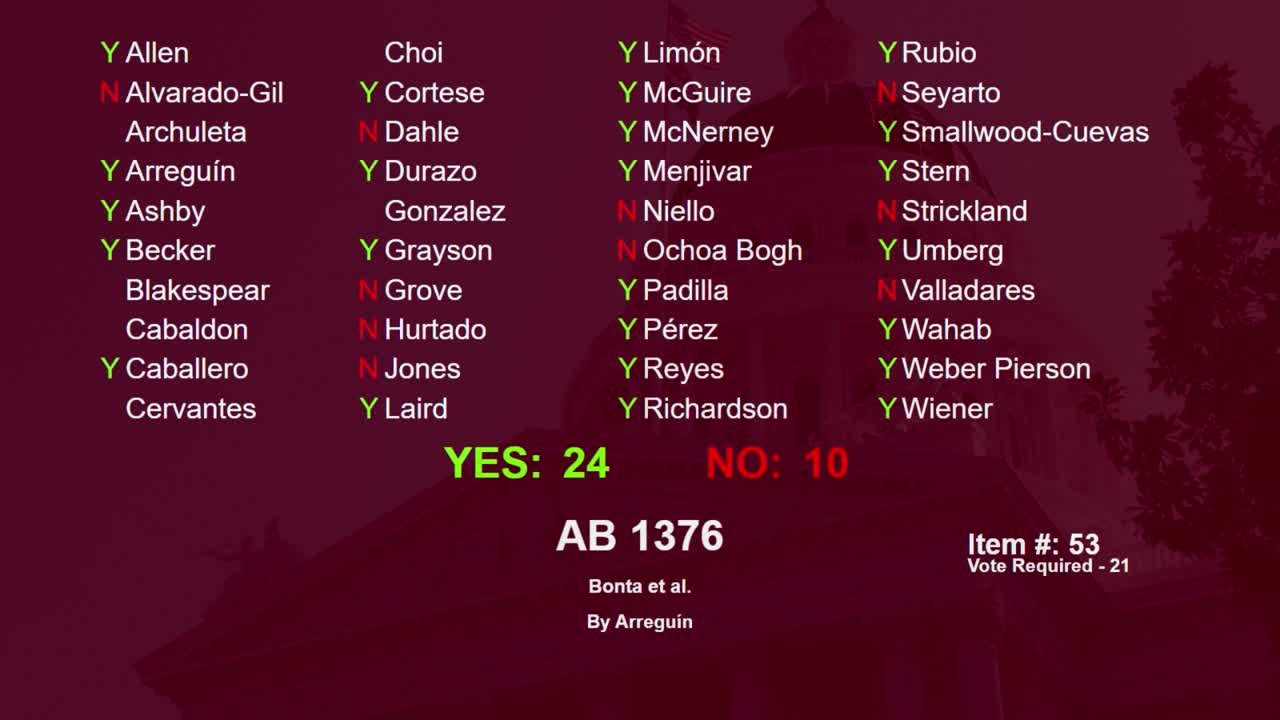 1MIN
Senate Floor
 1MIN
Assembly Floor
 7MIN
Assembly Standing Committee on Revenue and Taxation
 9MIN
Senate Standing Committee on Revenue and Taxation
Bill Author

Bill Co-Author(s):