SB 295: California Preventing Algorithmic Collusion Act of 2025.
- Session Year: 2025-2026
- House: Senate
- Latest Version Date: 2025-09-02
Current Status:
In Progress
(2025-09-13: Motion to reconsider made by Assembly Member Bauer-Kahan.)
Introduced
In Committee
Awaiting First Chamber Vote
Passed First Chamber
In Committee
Awaiting Second Chamber Vote
Passed Second Chamber
Enacted
Existing law establishes the Attorney General as the head of the Department of Justice, with charge of all legal matters in which the state is interested, except as specified. Existing law imposes various responsibilities on the Attorney General related to consumer protection, including, among others, the supervision of charitable trusts and the enforcement of antitrust laws. Existing law, commonly known as the Cartwright Act, identifies certain acts that are unlawful restraints of trade and unlawful trusts and prescribes provisions for its enforcement through civil actions.
This bill would enact the California Preventing Algorithmic Collusion Act of 2025, to prohibit a person person, as described, from distributing or making recommendations based on the use of a pricing algorithm to 2 or more competitors, as defined, under specified circumstances, if the person knows or should know that the pricing algorithm processes competitor data, as defined.
This bill would also prohibit a person from using the recommendation of a pricing algorithm that processes competitor data, as specified, if the person knows or should know that the pricing algorithm uses or incorporates competitor data. The bill would establish an affirmative defense to liability under this prohibition for a person who demonstrates by a preponderance of evidence that they exercised reasonable due diligence before using the recommendations of a pricing algorithm, as specified. The bill would specify when the use, recommendation, or distribution of a pricing algorithm constitutes separate violations. The bill would declare that these provisions do not apply if all of the competitor data processed by the pricing algorithm was collected more than one year before the use, recommendation, or distribution of the pricing algorithm. The bill would declare that a contract that violates these provisions is to that extent void.
This bill would authorize the Attorney General, a district attorney, a county counsel, or a city attorney to bring a civil action for violation of the above-described provisions to seek restitution, punitive damages, a civil penalty of up to $25,000 per violation, and other appropriate relief, as provided.
The bill would declare that its provisions shall not impair or limit the applicability of antitrust laws. laws, as defined. The bill would exempt from its provisions the development, distribution, output, or use of a credit score or other computational tool either subject to specified law or provided by a commercial credit reporting agency, as specified.
Existing law establishes the Attorney General as the head of the Department of Justice, with charge of all legal matters in which the state is interested, except as specified. Existing law imposes various responsibilities on the Attorney General related to consumer protection, including, among others, the supervision of charitable trusts and the enforcement of antitrust laws. Existing law, commonly known as the Cartwright Act, identifies certain acts that are unlawful restraints of trade and unlawful trusts and prescribes provisions for its enforcement through civil actions.
This bill would enact the California Preventing Algorithmic Collusion Act of 2025, to prohibit a person from distributing or making recommendations based on the use of a pricing algorithm to 2 or more competitors, as defined, under specified circumstances, if the person knows or should know that the pricing algorithm processes competitor data, as defined. The
This bill would also prohibit a person from using the recommendation of a pricing algorithm that processes competitor data, as specified, if the person knows or should know that the pricing algorithm uses or incorporates competitor data. The bill would establish an affirmative defense to liability under this prohibition for a person who demonstrates by a preponderance of evidence that they exercised reasonable due diligence before using the recommendations of a pricing algorithm, as specified. The bill would specify when the use, recommendation, or distribution of a pricing algorithm constitutes separate violations. The bill would declare that these provisions do not apply to the distribution or use of a pricing algorithm if all of the competitor data processed by the pricing algorithm was collected more than one year before the use use, recommendation, or distribution of the pricing algorithm. The bill would declare that a contract that violates these provisions is to that extent void.
This bill would authorize the Attorney General, a district attorney, a county counsel, or a city attorney to bring a civil action for violation of the above-described provisions to seek 3 times the actual damages caused by the violation, restitution, punitive damages, a civil penalty of up to $1,000,000, $25,000 per violation, and other appropriate relief, as provided.
The bill would declare that its provisions shall not impair or limit the applicability of antitrust laws.
Existing law establishes the Attorney General as the head of the Department of Justice, with charge of all legal matters in which the state is interested, except as specified. Existing law imposes various responsibilities on the Attorney General related to consumer protection, including, among others, the supervision of charitable trusts and the enforcement of antitrust laws. Existing law, commonly known as the Cartwright Act, identifies certain acts that are unlawful restraints of trade and unlawful trusts and prescribes provisions for its enforcement through civil actions.
This bill would enact the California Preventing Algorithmic Collusion Act of 2025, to require a person, as defined, upon request of the Attorney General, to provide to the Attorney General information related to pricing algorithms, as defined. The bill would require specified officers to certify the accuracy of the report, subject to civil penalties, as specified.
This bill would to prohibit a person from distributing or making recommendations based on the use of a pricing algorithm to two 2 or more competitors, as defined, under specified circumstances, if the person knows or should know that the pricing algorithm processes competitor data, as defined. The bill would prohibit a person from using the recommendation of a pricing algorithm that processes competitor data, as specified, if the person knows or should know that the pricing algorithm uses or incorporates competitor data. The bill would declare that these provisions do not apply to the distribution or use of a pricing algorithm if all of the competitor data processed by the pricing algorithm was collected more than one year before the use or distribution of the pricing algorithm. The bill would declare that a contract that violates these provisions is to that extent void.
This bill would authorize the Attorney General or General, a district attorney attorney, a county counsel, or a city attorney to bring a civil action for violation of the above-described provisions to seek the greater of 3 times the actual damages caused by the violation or violation, a civil penalty of up to $1,000,000, or and other appropriate relief, as provided.
The bill would declare that its provisions shall not impair or limit the applicability of antitrust laws.
Existing law establishes the Attorney General as the head of the Department of Justice, with charge of all legal matters in which the state is interested, except as specified. Existing law imposes various responsibilities on the Attorney General related to consumer protection, including, among others, the supervision of charitable trusts and the enforcement of antitrust laws. Existing law, commonly known as the Cartwright Act, identifies certain acts that are unlawful restraints of trade and unlawful trusts and prescribes provisions for its enforcement through civil actions.
This bill would enact the California Preventing Algorithmic Collusion Act of 2025, to require a person, as defined, upon request of the Attorney General, to provide to the Attorney General information related to pricing algorithms, as defined. The bill would require specified officers to certify the accuracy of the report, subject to civil penalties, as specified.
This bill would prohibit a person from using or distributing any or making recommendations based on the use of a pricing algorithm to two or more competitors, as defined, under specified circumstances, if the person has actual knowledge knows or should know that the pricing algorithm uses or incorporates processes competitor data, as defined. The bill would prohibit a person from distributing using the recommendation of a pricing algorithm, or making recommendations based on the use of a pricing algorithm that uses, incorporates, or was trained with, processes competitor data, as specified, if the person has actual knowledge knows or should know that the pricing algorithm uses or incorporates competitor data. The bill would declare that these provisions do not apply to the distribution or use of a pricing algorithm if all of the competitor data processed by the pricing algorithm was collected more than one year before the use or distribution of the pricing algorithm. The bill would declare that a contract that violates these provisions is to that extent void.
This bill would authorize the Attorney General or a district attorney to bring a civil action for violation of the above-described provisions to seek the greater of the actual damages caused by the violation or a civil penalty of up to $1,000,000, or other appropriate relief, as provided.
Existing law establishes the Attorney General as the head of the Department of Justice, with charge of all legal matters in which the state is interested, except as specified. Existing law imposes various responsibilities on the Attorney General related to consumer protection, including, among others, the supervision of charitable trusts and the enforcement of antitrust laws. Existing law, commonly known as the Cartwright Act, identifies certain acts that are unlawful restraints of trade and unlawful trusts and prescribes provisions for its enforcement through civil actions.
This bill would enact the California Preventing Algorithmic Collusion Act of 2025, to require a person, as defined, upon request of the Attorney General, to provide to the Attorney General information related to pricing algorithms, as defined. The bill would require specified officers to certify the accuracy of the report, subject to civil penalties, as specified.
This bill would prohibit a person from using or distributing any pricing algorithm that uses, incorporates, or was trained with, if the person has actual knowledge that the pricing algorithm uses or incorporates competitor data, as defined. The bill would prohibit a person from distributing a pricing algorithm, or making recommendations based on the use of a pricing algorithm that uses, incorporates, or was trained with, competitor data, as specified. specified, if the person has actual knowledge that the pricing algorithm uses or incorporates competitor data. The bill would declare that a contract that violates these provisions is to that extent void.
This bill would authorize the Attorney General or a district attorney to bring a civil action for violation of the above-described provisions to seek, among other recoveries, specified civil penalties seek the greater of the actual damages caused by the violation or a civil penalty of up to $1,000,000, or other appropriate relief, as provided. This bill would include in these recoveries forfeiture of charter rights, franchises, or privileges and powers exercised by a defendant corporation or association, dissolution of the defendant corporation or association, and revocation of the powers, franchises, or functions of a defendant foreign corporation or association, as provided.
This bill would require a person that has $5,000,000 or more in annual revenue that uses a pricing algorithm to recommend or set a price or commercial term to make certain disclosures, as specified, including to a customer, before the customer purchases the relevant product or service, that the price or a commercial term is set or recommended by a pricing algorithm. The bill would provide that failure to comply with these disclosure provisions constitutes an unfair trade practice, as specified. The bill would authorize the Attorney General to bring a civil action for violation of these disclosure provisions.Existing law establishes the Attorney General as the head of the Department of Justice, with charge of all legal matters in which the state is interested, except as specified. Existing law imposes various responsibilities on the Attorney General related to consumer protection, including, among others, the supervision of charitable trusts and the enforcement of antitrust laws. Existing law, commonly known as the Cartwright Act, identifies certain acts that are unlawful restraints of trade and unlawful trusts and prescribes provisions for its enforcement through civil actions.
This bill would enact the California Preventing Algorithmic Collusion Act of 2025, to require a person, as defined, upon request of the Attorney General, to provide to the Attorney General a written report on each information related to pricing algorithm, algorithms, as defined, identified in the request. defined. The bill would require specified officers to certify, under penalty of perjury, certify the accuracy of the report. By expanding the crime of perjury, this bill would impose a state-mandated local program. report, subject to civil penalties, as specified.
This bill would prohibit a person from using or distributing any pricing algorithm that uses, incorporates, or was trained with, competitor data. data, as defined. The bill would prohibit a person from distributing a pricing algorithm, or making recommendations based on the use of a pricing algorithm that uses, incorporates, or was trained with, competitor data, as specified. The bill would declare that a contract that violates these provisions is to that extent void.
This bill would authorize the Attorney General or a district attorney to bring a civil action for violation of the above-described provisions to seek, among other recoveries, specified civil penalties or other appropriate relief, as provided. This bill would include in these recoveries forfeiture of charter rights, franchises, or privileges and powers exercised by a defendant corporation or association, dissolution of the defendant corporation or association, and revocation of the powers, franchises, or functions of a defendant foreign corporation or association, as provided.
This bill would require a person that has $5,000,000 or more in annual revenue that uses a pricing algorithm to recommend or set a price or commercial term to make certain disclosures, as specified, including to a customer, before the customer purchases the relevant product or service, that the price or a commercial term is set or recommended by a pricing algorithm. The bill would provide that failure to comply with these disclosure provisions constitutes an unfair trade practice, as specified. The bill would authorize the Attorney General to bring a civil action for violation of these disclosure provisions.
The California Constitution requires the state to reimburse local agencies and school districts for certain costs mandated by the state. Statutory provisions establish procedures for making that reimbursement.This bill would provide that no reimbursement is required by this act for a specified reason.Existing law establishes the Attorney General as the head of the Department of Justice, with charge of all legal matters in which the state is interested, except as specified. Existing law imposes various responsibilities on the Attorney General related to consumer protection, including, among others, the supervision of charitable trusts and the enforcement of antitrust laws. Existing law, commonly known as the Cartwright Act, identifies certain acts that are unlawful restraints of trade and unlawful trusts and prescribes provisions for its enforcement through civil actions.
This bill would enact the California Preventing Algorithmic Collusion Act of 2025, to require a person, as defined, upon request of the Attorney General, to provide to the Attorney General a written report on each pricing algorithm, as defined, identified in the request. The bill would require specified officers to certify, under penalty of perjury, the accuracy of the report. By expanding the crime of perjury, this bill would impose a state-mandated local program.
This bill would prohibit a person from using or distributing any pricing algorithm that uses, incorporates, or was trained with, competitor data. The bill would prohibit a person from distributing a pricing algorithm, or making recommendations based on the use of a pricing algorithm that uses, incorporates, or was trained with, competitor data, as specified. The bill would declare that a contract that violates these provisions is to that extent void.
This bill would authorize the Attorney General or a district attorney to bring a civil action for violation of the above-described provisions to seek, among other recoveries, specified civil penalties or other appropriate relief, as provided. This bill would include in these recoveries forfeiture of charter rights, franchises, or privileges and powers exercised by a defendant corporation or association, dissolution of the defendant corporation or association, and revocation of the powers, franchises, or functions of a defendant foreign corporation or association, as provided.
This bill would require a person that has $5,000,000 or more in annual revenue that uses a pricing algorithm to recommend or set a price or commercial term to make certain disclosures, as specified, including to a customer, before the customer purchases the relevant product or service, that the price or a commercial term is set or recommended by a pricing algorithm. The bill would provide that failure to comply with these disclosure provisions constitutes an unfair trade practice, as specified. The bill would authorize the Attorney General to bring a civil action for violation of these disclosure provisions.
The California Constitution requires the state to reimburse local agencies and school districts for certain costs mandated by the state. Statutory provisions establish procedures for making that reimbursement.
This bill would provide that no reimbursement is required by this act for a specified reason.
This chapter shall be known, and may be cited, as the California Preventing Algorithmic Collusion Act of 2025.
17371.For purposes of this chapter, the following definitions apply:
(a)Antitrust laws has the same meaning as defined in the Clayton Act (15 U.S.C. Sec. 12), and includes Section 45 of Title 15 of the United States Code, and this part, including provisions commonly known as the Cartwright Act (Chapter 2 (commencing with Section 16700)). Antitrust laws also includes Section 1853.5 of, Article 4 (commencing with Section 1855) of Chapter 9 of Part 2 of Division 1 of, and subdivision (b) of Section 1861.03 of, the Insurance Code.
(b)Commercial term means any of the following:
(1)Level of service.
(2)Availability.
(3)Output, including quantities of goods, commodities, or products produced or distributed or the amount or level of service provided.
(4)Rebates or discounts made available.(5)(4)Property rental rate, lease term, or occupancy level. Commercial term does not include listings, advertisements or other information regarding rental properties on a multiple listing service, as defined in Section 1087 of the Civil Code.
(c)Competitor data means the confidential, nonpublic, competitively sensitive information of two or more competitors in the same market.
(d)Competitors means two or more businesses that offer a similar good, commodity, product, rental property, or service in the same market to the same customer base.
(e)Distribute, distribution, and distributing include selling, licensing, providing access to, or otherwise making available by any means, including through a subscription or the sale of a service.
(f)Person has the same meaning as defined in Section 16702. Any insurer, as defined by Section 23 of the Insurance Code, including, but not limited to, any insurer subject to the provisions of Article 10 (commencing with Section 1861.01) of Chapter 9 of Part 2 of Division 1 of the Insurance Code and any advisory organization subject to the provisions of Article 4 (commencing with Section 1855) of Chapter 9 of Part 2 of Division 1 of the Insurance Code, shall be exempt from Sections 17372 to 17374, inclusive.
(g)Price means the amount of money or other thing of value, whether tangible or not, expected, required, or given in payment for any good, commodity, product or service, including compensation paid to an employee or independent contractor for services provided. Price includes rental rate.
(h)Pricing algorithm means any computational process, including a computational process derived from machine learning or other artificial intelligence techniques, that processes data to recommend or set a price or commercial term within the jurisdiction of this state.
17372.(a)(1)A person shall not distribute a pricing algorithm, or make recommendations based on the use of a pricing algorithm, to two or more competitors with the intent or reasonable expectation that the pricing algorithm or the recommendations be used by the competitors to set the price or commercial term of similar goods, commodities, products, rental property, or services in the same market if the person knows or should know that the pricing algorithm processes competitor data.
(2)A person shall not use the recommendation of a pricing algorithm that processes competitor data to set a price or commercial term of a good, commodity, product, rental property, or service if the person knows or should know that the pricing algorithm uses or incorporates competitor data and that the pricing algorithm or the recommendation of the pricing algorithm was used by a competitor to set or recommend a price or commercial term of a similar good, commodity, product, rental property, or service in the same market.
(b)It shall be an affirmative defense to liability under paragraph (2) of subdivision (a) if the person demonstrates by a preponderance of evidence that they exercised reasonable due diligence before using the recommendation of a pricing algorithm, including, but not limited to, obtaining written assurances from the person distributing the pricing algorithm, or making recommendations based on the pricing algorithm, that the pricing algorithm does not process competitor data.
(c)(1)For a person who distributes a pricing algorithm in violation of paragraph (1) of subdivision (a), each authorized user of the pricing algorithm constitutes a separate violation.
(2)For a person who makes recommendations based on the use of the pricing algorithm in violation of paragraph (1) of subdivision (a), each instance in which the person makes a recommendation constitutes a separate violation.
(3)For a person who uses the recommendation of a pricing algorithm in violation of paragraph (2) of subdivision (a), each calendar month of use constitutes a separate violation.
(d)This section does not apply if all of the competitor data processed by the pricing algorithm was collected more than one year before the use, recommendation, or distribution of the pricing algorithm.
17373.The Attorney General, a district attorney, a county counsel, or a city attorney may bring a civil action for a violation of Section 17372 in any court of competent jurisdiction to seek to recover, as applicable, any of the following:
(a)(1)Restitution.
(2)Punitive damages.
(3)A civil penalty of up to twenty-five thousand dollars ($25,000) per violation. In assessing the amount of the civil penalty, a court shall consider any relevant circumstances presented by any of the parties to the case, including, but not limited to, all of the following:
(A)The nature and seriousness of the misconduct.
(B)The number of violations committed by the defendant.
(C)The persistence of the defendants misconduct.
(D)The length of time over which the misconduct occurred.
(E)The willfulness of the defendants misconduct.
(F)The defendants assets, liabilities, and net worth.
(G)The extent to which the defendant cooperated with the Attorney Generals or district attorneys, county counsels, or city attorneys investigation and litigation.
(b)Injunctive relief.
(c)Reasonable attorneys fees and costs.
17374.A contract that violates a provision of this chapter is to that extent void.
17375.Nothing in this chapter shall impair or limit the applicability of antitrust laws.
17376.This chapter shall not apply to the development, distribution, output, or use of a credit score or other computational tool either subject to the Fair Credit Reporting Act (15 U.S.C. Sec. 1681 et seq.) or provided by a commercial credit reporting agency, as defined in Section 1785.42 of the Civil Code, and not used to facilitate direct coordination of commercial terms among competitors.
This chapter shall be known, and may be cited, as the California Preventing Algorithmic Collusion Act of 2025.
17371.For purposes of this chapter, the following definitions apply:
(a)Antitrust laws has the same meaning as defined in the Clayton Act (15 U.S.C. Sec. 12), and includes Section 45 of Title 15 of the United States Code, and this part, including provisions commonly known as the Cartwright Act (Chapter 2 (commencing with Section 16700)).
(b)Commercial term means any of the following:
(1)Level of service.
(2)Availability.
(3)Output, including quantities of products produced or distributed or the amount or level of service provided.
(4)Rebates or discounts made available.
(5)Property rental rate, lease term, or occupancy level.
(c)Competitor data means the confidential, nonpublic, competitively sensitive information of two or more competitors in the same market.
(d)Competitors means two or more businesses that offer a similar product product, rental property, or service in the same market to the same customer base.
(e)Distribute, distribution, and distributing include selling, licensing, providing access to, or otherwise making available by any means, including through a subscription or the sale of a service.
(f)Person has the same meaning as defined in Section 16702.
(g)Price means the amount of money or other thing of value, whether tangible or not, expected, required, or given in payment for any product or service, including compensation paid to an employee or independent contractor for services provided. Price includes rental rate.
(h)Pricing algorithm means any computational process, including a computational process derived from machine learning or other artificial intelligence techniques, that processes data to recommend or set a price or commercial term within the jurisdiction of this state.
17372.(a)(1)A person shall not distribute a pricing algorithm, or make recommendations based on the use of a pricing algorithm, to two or more competitors with the intent or reasonable expectation that the pricing algorithm or the recommendations be used by the competitors to set the price or commercial term of similar products products, rental property, or services in the same market if the person knows or should know that the pricing algorithm processes competitor data.
(b)(2)A person shall not use the recommendation of a pricing algorithm that processes competitor data to set a price or commercial term of a product product, rental property, or service if the person knows or should know that the pricing algorithm uses or incorporates competitor data and that the pricing algorithm or the recommendation of the pricing algorithm was used by a competitor to set or recommend a price or commercial term of a similar product product, rental property, or service in the same market.
(b)It shall be an affirmative defense to liability under paragraph (2) of subdivision (a) if the person demonstrates by a preponderance of evidence that they exercised reasonable due diligence before using the recommendation of a pricing algorithm, including, but not limited to, obtaining written assurances from the person distributing the pricing algorithm, or making recommendations based on the pricing algorithm, that the pricing algorithm does not process competitor data.
(c)(1)For a person who distributes a pricing algorithm in violation of paragraph (1) of subdivision (a), each authorized user of the pricing algorithm constitutes a separate violation.
(2)For a person who makes recommendations based on the use of the pricing algorithm in violation of paragraph (1) of subdivision (a), each instance in which the person makes a recommendation constitutes a separate violation.
(3)For a person who uses the recommendation of a pricing algorithm in violation of paragraph (2) of subdivision (a), each calendar month of use constitutes a separate violation.
(c)(d)This section does not apply to the distribution or use of a pricing algorithm if all of the competitor data processed by the pricing algorithm was collected more than one year before the use use, recommendation, or distribution of the pricing algorithm.
17373.The Attorney General, a district attorney, a county counsel, or a city attorney may bring a civil action for a violation of Section 17372 in any court of competent jurisdiction to seek to recover, as applicable, any of the following:
(a)(1)Three times the actual damages caused by the violation.(a)(1)Restitution.
(2)Punitive damages.
(2)(3)A civil penalty of up to one million dollars ($1,000,000). twenty-five thousand dollars ($25,000) per violation. In assessing the amount of the civil penalty, a court shall consider any relevant circumstances presented by any of the parties to the case, including, but not limited to, all of the following:
(A)The nature and seriousness of the misconduct.
(B)The number of violations committed by the defendant.
(C)The persistence of the defendants misconduct.
(D)The length of time over which the misconduct occurred.
(E)The willfulness of the defendants misconduct.
(F)The defendants assets, liabilities, and net worth.
(G)The extent to which the defendant cooperated with the Attorney Generals or district attorneys, county counsels, or city attorneys investigation and litigation.
(b)Injunctive relief.
(c)Reasonable attorneys fees and costs.
17374.A contract that violates a provision of this chapter is to that extent void.
17375.Nothing in this chapter shall impair or limit the applicability of antitrust laws.
This chapter shall be known, and may be cited, as the California Preventing Algorithmic Collusion Act of 2025.
17371.For purposes of this chapter, the following definitions apply:
(a)Antitrust laws has the same meaning as defined in the Clayton Act (15 U.S.C. Sec. 12), and includes Section 45 of Title 15 of the United States Code, and this part, including provisions commonly known as the Cartwright Act (Chapter 2 (commencing with Section 16700)).
(b)Commercial term means any of the following:
(1)Level of service.
(2)Availability.
(3)Output, including quantities of products produced or distributed or the amount or level of service provided.
(4)Rebates or discounts made available.
(c)Competitor data means the confidential, nonpublic, competitively sensitive information of two or more competitors in the same market.
(d)Competitors means two or more businesses that offer a similar product or service in the same market to the same customer base.
(e)Distribute, distribution, and distributing include selling, licensing, providing access to, or otherwise making available by any means, including through a subscription or the sale of a service.
(f)Person has the same meaning as defined in Section 16702.
(g)Price means the amount of money or other thing of value, whether tangible or not, expected, required, or given in payment for any product or service, including compensation paid to an employee or independent contractor for services provided.
(h)Pricing algorithm means any computational process, including a computational process derived from machine learning or other artificial intelligence techniques, that processes data to recommend or set a price or commercial term within the jurisdiction of this state.
17372.(a)Upon written request by the Attorney General, pursuant to the investigatory authority granted under Section 11180 of the Government Code, a person shall, no later than 30 days after the date of the written request or any later date approved by the Attorney General, provide to the Attorney General information related to pricing algorithms.(b)Nothing in this section shall be construed to limit or impair the Attorney Generals authority under existing law, including, but not limited to, the Government Code and the antitrust laws described in Section 17371.(c)(1)The chief executive officer, chief economist, chief technology officer, or a corporate officer of similar authority of a person shall certify the accuracy of a report under subdivision (a).(2)Knowingly certifying the accuracy of false information under subdivision (a) shall be subject to a civil penalty of not more than one thousand five hundred dollars ($1,500), in addition to any other civil remedies at law or equity that might be available.17373.17372.(a)A person shall not distribute a pricing algorithm, or make recommendations based on the use of a pricing algorithm algorithm, to two or more competitors with the intent or reasonable expectation that the pricing algorithm or the recommendations be used by the competitors to set the price or commercial term of similar products or services in the same market if the person knows or should know that the pricing algorithm processes competitor data.
(b)A person shall not use the recommendation of a pricing algorithm that processes competitor data to set a price or commercial term of a product or service if the person knows or should know that the pricing algorithm uses or incorporates competitor data and that the pricing algorithm or the recommendation of the pricing algorithm was used by another a competitor to set or recommend a price or commercial term of a similar product or service in the same market.
(c)This section does not apply to the distribution or use of a pricing algorithm if all of the competitor data processed by the pricing algorithm was collected more than one year before the use or distribution of the pricing algorithm.
17374.17373.The Attorney General or General, a district attorney attorney, a county counsel, or a city attorney may bring a civil action for a violation of Section 17373 17372 in any court of competent jurisdiction to seek to recover, as applicable, any of the following:
(a)(1)The greater of Three times the actual damages caused by the violation or a civil penalty of up to one million dollars ($1,000,000). violation.
(2)A civil penalty of up to one million dollars ($1,000,000). In assessing the amount of the civil penalty pursuant to this subdivision, penalty, a court shall consider any relevant circumstances presented by any of the parties to the case, including, but not limited to, all of the following:
(A)The nature and seriousness of the misconduct.
(B)The number of violations committed by the defendant.
(C)The persistence of the defendants misconduct.
(D)The length of time over which the misconduct occurred.
(E)The willfulness of the defendants misconduct.
(F)The defendants assets, liabilities, and net worth.
(G)The extent to which the defendant cooperated with the Attorney Generals or district attorneys attorneys, county counsels, or city attorneys investigation and litigation.
(b)Injunctive relief and other restraints as the court may deem expedient to deter the defendant from, and insure against, their committing a future violation of this chapter, including such mandatory injunctions as may be reasonably necessary to restore and preserve fair competition in the trade or commerce affected by the violation. relief.
(c)Reasonable attorneys fees and costs.
17375.17374.A contract that violates a provision of this chapter is to that extent void.
17376.17375.Nothing in this chapter shall impair or limit the applicability of antitrust laws.
This chapter shall be known, and may be cited, as the California Preventing Algorithmic Collusion Act of 2025.
17371.For purposes of this chapter, the following definitions apply:
(a)Antitrust laws has the same meaning as defined in the Clayton Act (15 U.S.C. Sec. 12), and includes Section 45 of Title 15 of the United States Code, and this part, including provisions commonly known as the Cartwright Act (Chapter 2 (commencing with Section 16700)).
(b)Commercial term means any of the following:
(1)Level of service.
(2)Availability.
(3)Output, including quantities of products produced or distributed or the amount or level of service provided.
(4)Rebates or discounts made available.
(c)Competitor data includes means the confidential, nonpublic, competitively sensitive information of two or more competitors in the same market. For purposes of this subdivision, the user of a pricing algorithm is considered a competitor if the user provides confidential, competitively sensitive information for use in, or incorporation by, the pricing algorithm.
(d)Competitors means two or more businesses that offer a similar product or service in the same market to the same customer base.
(d)(e)Distribute, distribution, and distributing include selling, licensing, providing access to, or otherwise making available by any means, including through a subscription or the sale of a service.
(e)(f)Person has the same meaning as defined in Section 16702.
(f)(g)Price means the amount of money or other thing of value, whether tangible or not, expected, required, or given in payment for any product or service, including compensation paid to an employee or independent contractor for services provided.
(g)(h)Pricing algorithm means any computational process, including a computational process derived from machine learning or other artificial intelligence techniques, that processes data to recommend or set a price or commercial term within the jurisdiction of this state.
17372.(a)Upon written request by the Attorney General, pursuant to the investigatory authority granted under Section 11180 of the Government Code, a person shall, no later than 30 days after the date of the written request or any later date approved by the Attorney General, provide to the Attorney General information related to pricing algorithms.
(b)Nothing in this section shall be construed to limit or impair the Attorney Generals authority under existing law, including, but not limited to, the Government Code and the antitrust laws described in Section 17371.
(c)(1)The chief executive officer, chief economist, chief technology officer, or a corporate officer of similar authority of a person shall certify the accuracy of a report under subdivision (a).
(2)Knowingly certifying the accuracy of false information under subdivision (a) shall be subject to a civil penalty of not more than one thousand five hundred dollars ($1,500), in addition to any other civil remedies at law or equity that might be available.
17373.(a)A person shall not use or distribute any pricing algorithm if the person has actual knowledge that the pricing algorithm uses or incorporates competitor data.(b)17373.(a)A person shall not distribute a pricing algorithm, or make recommendations based on the use of a pricing algorithm that uses or incorporates competitor data, to two or more persons competitors with the intent or reasonable expectation that the pricing algorithm or its the recommendations be used by the competitors to set the price or commercial term of a product or service similar products or services in the same market or a related market if the person has actual knowledge knows or should know that the pricing algorithm uses or incorporates processes competitor data.
(c)(b)A person shall not use a pricing algorithm or the recommendation of a pricing algorithm that uses or incorporates processes competitor data to set a price or commercial term of a product or service if the person has actual knowledge knows or should know that the pricing algorithm uses or incorporates competitor data and that the pricing algorithm or the recommendation of the pricing algorithm was used by another person competitor to set or recommend a price or commercial term of a similar product or service in the same market or a related market.
(c)This section does not apply to the distribution or use of a pricing algorithm if all of the competitor data processed by the pricing algorithm was collected more than one year before the use or distribution of the pricing algorithm.
17374.The Attorney General or a district attorney may bring a civil action for a violation of Section 17373 in any court of competent jurisdiction to seek to recover, as applicable, any of the following:
(a)(1)The greater of the actual damages caused by the violation or a civil penalty of up to one million dollars ($1,000,000).
(2)In assessing the amount of the civil penalty pursuant to this subdivision, a court shall consider any relevant circumstances presented by any of the parties to the case, including, but not limited to, all of the following:
(A)The nature and seriousness of the misconduct.
(B)The number of violations committed by the defendant.
(C)The persistence of the defendants misconduct.
(D)The length of time over which the misconduct occurred.
(E)The willfulness of the defendants misconduct.
(F)The defendants assets, liabilities, and net worth.
(G)The extent to which the defendant cooperated with the Attorney Generals or district attorneys investigation and litigation.
(b)Injunctive relief and other restraints as the court may deem expedient to deter the defendant from, and insure against, their committing a future violation of this chapter, including such mandatory injunctions as may be reasonably necessary to restore and preserve fair competition in the trade or commerce affected by the violation.
(c)Reasonable attorneys fees and costs.
17375.A contract that violates a provision of this chapter is to that extent void.
17376.Nothing in this chapter shall impair or limit the applicability of antitrust laws.
This chapter shall be known, and may be cited, as the California Preventing Algorithmic Collusion Act of 2025.
17371.For purposes of this chapter, the following definitions apply:
(a)Antitrust laws has the same meaning as defined in the Clayton Act (15 U.S.C. Sec. 12), and includes Section 45 of Title 15 of the United States Code, and this part, including provisions commonly known as the Cartwright Act (Chapter 2 (commencing with Section 16700)).
(b)Commercial term means any of the following:
(1)Level of service.
(2)Availability.
(3)Output, including quantities of products produced or distributed or the amount or level of service provided.
(4)Rebates or discounts made available.
(c)Competitor data includes nonpublic and public information, when the public information, through aggregation and algorithmic processing becomes functionally equivalent to nonpublic, proprietary, or competitively sensitive data. For purposes of this subdivision, public information becomes functionally equivalent to nonpublic, proprietary, or competitively sensitive data if it enables an inference or prediction of a competitors pricing, output, or strategic behavior in a way that facilitates tacit or explicit coordination. the confidential, competitively sensitive information of two or more competitors in the same market. For purposes of this subdivision, the user of a pricing algorithm is considered a competitor if the user provides confidential, competitively sensitive information for use in, or incorporation by, the pricing algorithm.
(d)Distribute, distribution, and distributing include selling, licensing, providing access to, or otherwise making available by any means, including through a subscription or the sale of a service.
(e)Person has the same meaning as defined in Section 16702.
(f)Price means the amount of money or other thing of value, whether tangible or not, expected, required, or given in payment for any product or service, including compensation paid to an employee or independent contractor for services provided.
(g)Pricing algorithm means any computational process, including a computational process derived from machine learning or other artificial intelligence techniques, that processes data to recommend or set a price or commercial term within the jurisdiction of this state.
17372.(a)Upon written request by the Attorney General, pursuant to the investigatory authority granted under Section 11180 of the Government Code, a person shall, no later than 30 days after the date of the written request or any later date approved by the Attorney General, provide to the Attorney General information related to pricing algorithms.
(b)Nothing in this section shall be construed to limit or impair the Attorney Generals authority under existing law, including, but not limited to, the Government Code and the antitrust laws described in Section 17371.
(c)(1)The chief executive officer, chief economist, chief technology officer, or a corporate officer of similar authority of a person shall certify the accuracy of a report under subdivision (a).
(2)Knowingly certifying the accuracy of false information under subdivision (a) shall be subject to a civil penalty of not more than one thousand five hundred dollars ($1,500), in addition to any other civil remedies at law or equity that might be available.
17373.(a)A person shall not use or distribute any pricing algorithm that uses, incorporates, or was trained with if the person has actual knowledge that the pricing algorithm uses or incorporates competitor data.
(b)A person shall not distribute a pricing algorithm, or make recommendations based on the use of a pricing algorithm that uses, incorporates, or was trained with uses or incorporates competitor data, to two or more persons with the intent or reasonable expectation that the pricing algorithm or its recommendations be used to set the price or commercial term of a product or service in the same market or a related market. market if the person has actual knowledge that the pricing algorithm uses or incorporates competitor data.
(c)A person shall not use a pricing algorithm or the recommendation of a pricing algorithm that uses, incorporates, or was trained with uses or incorporates competitor data to set a price or commercial term of a product or service if the person has actual knowledge that the pricing algorithm uses or incorporates competitor data and that the pricing algorithm or the recommendation of the pricing algorithm was used by another person to set or recommend a price or commercial term of a product or service in the same market or a related market.
17374.(a)The Attorney General or a district attorney may bring a civil action for a violation of Section 17373 in any court of competent jurisdiction to seek to recover, as applicable, one or more of the following: any of the following:
(1)A civil penalty of one of the following:(A)Not less than ten thousand dollars ($10,000), adjusted for inflation on the basis of the California Consumer Price Index, for each day during which the violation occurred or continues to occur.(B)The sum of the price of each product or service sold using the pricing algorithm in violation of subdivision (a).(2)Forfeiture of charter rights, franchises, or privileges and powers exercised by a defendant corporation or association, and for the dissolution of the corporation or association.(3)Revocation of the powers, franchises, or functions of a defendant foreign corporation or association. Upon the revocation, the foreign corporation or association shall be prohibited from doing any business in this state. Upon receipt of a certified copy of the judgment and decree of any court of competent jurisdiction finding any foreign corporation or association guilty of violating this chapter and ordering a revocation of its powers, franchises, or functions of a corporation in this state, the Secretary of State shall revoke the license of any such corporation or association heretofore authorized to do business in this state.(4)Reasonable attorneys fees and costs.(5)Other appropriate relief, including an injunction or other equitable relief.(b)Any injunction against a violation of this chapter, whether interim or final, shall cover every article, product, or service, and not merely the particular article, product, or service involved in the action. For purposes of this subdivision, article, product, or service includes, among other things, a pricing algorithm.(c)Any person, who, either as a director, officer, or agent of any firm or corporation or as an agent of any person, violating the provisions of this chapter, assists or aids, directly or indirectly, in that violation is responsible therefor equally with the person, firm, or corporation for which they act. (d)Nothing in this section shall impair or limit the applicability of antitrust laws.(a)(1)The greater of the actual damages caused by the violation or a civil penalty of up to one million dollars ($1,000,000).
(2)In assessing the amount of the civil penalty pursuant to this subdivision, a court shall consider any relevant circumstances presented by any of the parties to the case, including, but not limited to, all of the following:
(A)The nature and seriousness of the misconduct.
(B)The number of violations committed by the defendant.
(C)The persistence of the defendants misconduct.
(D)The length of time over which the misconduct occurred.
(E)The willfulness of the defendants misconduct.
(F)The defendants assets, liabilities, and net worth.
(G)The extent to which the defendant cooperated with the Attorney Generals or district attorneys investigation and litigation.
(b)Injunctive relief and other restraints as the court may deem expedient to deter the defendant from, and insure against, their committing a future violation of this chapter, including such mandatory injunctions as may be reasonably necessary to restore and preserve fair competition in the trade or commerce affected by the violation.
(c)Reasonable attorneys fees and costs.
17375.(a)A person that has five million dollars ($5,000,000) or more in annual revenue that uses a pricing algorithm to recommend or set a price or commercial term shall make, in a clear manner, the following disclosures:(1)To a customer, before the customer purchases the relevant product or service, that the price or a commercial term, as applicable, is set or recommended by a pricing algorithm.(2)To a current or prospective employee or independent contractor that the price or commercial term for services rendered as an employee or independent contractor is set or recommended by a pricing algorithm.(b)(1)If applicable, a disclosure under subdivision (a) shall state that the pricing algorithm sets or recommends different prices for the following:(A)Different customers seeking identical or nearly identical products or services.(B)Employees or independent contractors providing substantially similar services.(2)If applicable, a disclosure under subdivision (a) shall do both of the following:(A)State that the pricing algorithm was developed or distributed by a person other than the person making the disclosure.(B)Provide the identity of the person that developed or distributed the pricing algorithm.(c)If the Attorney General has reason to believe that a person has violated subdivision (a) or (b), the Attorney General may bring a civil action against the person in any court of competent jurisdiction in this state to seek to recover one or both of the following:(1)A civil penalty of not less than five thousand dollars ($5,000), adjusted for inflation on the basis of the California Consumer Price Index, for each day during which the violation occurs or continues to occur.(2)Other appropriate relief, including an injunction or other equitable relief.(d)Nothing in this section shall impair or limit the applicability of antitrust laws.17376.17375.A contract that violates a provision of this chapter is to that extent void.
17376.Nothing in this chapter shall impair or limit the applicability of antitrust laws.
This chapter shall be known, and may be cited, as the California Preventing Algorithmic Collusion Act of 2025.
17371.For purposes of this chapter, the following definitions apply:
(a)Antitrust laws has the same meaning as defined in the Clayton Act (15 U.S.C. Sec. 12), and includes Section 45 of Title 15 of the United States Code, and this part, including provisions commonly known as the Cartwright Act (Chapter 2 (commencing with Section 16700)).
(b)Commercial term means any of the following:
(1)Level of service.
(2)Availability.
(3)Output, including quantities of products produced or distributed or the amount or level of service provided.
(4)Rebates or discounts made available.
(c)Competitor data includes nonpublic and public information, when the public information, through aggregation and algorithmic processing becomes functionally equivalent to nonpublic, proprietary, or competitively sensitive data. For purposes of this subdivision, public information becomes functionally equivalent to nonpublic, proprietary, or competitively sensitive data if it enables an inference or prediction of a competitors pricing, output, or strategic behavior in a way that facilitates tacit or explicit coordination.
(c)(d)Distribute, distribution, and distributing include selling, licensing, providing access to, or otherwise making available by any means, including through a subscription or the sale of a service.
(d)(e)Person has the same meaning as defined in Section 16702.
(e)(f)Price means the amount of money or other thing of value, whether tangible or not, expected, required, or given in payment for any product or service, including compensation paid to an employee or independent contractor for services provided.
(f)(g)Pricing algorithm means any computational process, including a computational process derived from machine learning or other artificial intelligence techniques, that processes data to recommend or set a price or commercial term within the jurisdiction of this state.
17372.(a)Upon written request by the Attorney General, pursuant to the investigatory authority granted under Section 11180 of the Government Code, a person shall, no later than 30 days after the date of the written request or any later date approved by the Attorney General, provide to the Attorney General a written report on each pricing algorithm identified in the request. information related to pricing algorithms.
(b)Each report pursuant to subdivision (a) shall include all of the following:(1)Information on whether the person is responsible for the development or distribution of the pricing algorithm, or whether a third party is responsible for the development or distribution of the pricing algorithm, including the identity and contact information of any other person responsible for the development or distribution of the pricing algorithm.(2)Information on whether the pricing algorithm autonomously sets prices or commercial terms and whether there is human review of any recommendation or decision of the pricing algorithm.(3)An explanation of the rules or processes that the pricing algorithm uses to set or recommend prices or commercial terms.(4)A description of all data the pricing algorithm uses to set or recommend prices or commercial terms, including data used to train the algorithm.(5)All sources and collection processes, including the frequency of collection, of any data that the pricing algorithm uses to set or recommend prices or commercial terms.(6)Whether the pricing algorithm engages in price discrimination by setting or recommending different prices or commercial terms for the following:(A)Different customers seeking identical or nearly identical products or services, and if so, the factors used in differentiating among those customers.(B)Different employees or independent contractors providing substantially similar services, and if so, the factors used in differentiating among those employees or independent contractors.(7)Any changes made to the pricing algorithm between the date of receipt of the request under subdivision (a) and the date of certification under subdivision (c).(b)Nothing in this section shall be construed to limit or impair the Attorney Generals authority under existing law, including, but not limited to, the Government Code and the antitrust laws described in Section 17371.
(c)(1)The chief executive officer, chief economist, chief technology officer, or a corporate officer of similar authority of a person shall certify, under penalty of perjury, certify the accuracy of a report under subdivision (a) submitted by the person. (a).
(d)This section shall not be construed to do either of the following:(1)Limit the ability of the Attorney General to issue a civil investigative demand, to issue a subpoena, to seek discovery in the course of litigation, or to otherwise obtain information through other means available to the Attorney General.(2)Restrict the use of information submitted in a report under subdivision (a) in the course of a formal investigation, enforcement action, litigation, trial, or other proceeding, in accordance with the confidentiality procedures applicable to that proceeding.(2)Knowingly certifying the accuracy of false information under subdivision (a) shall be subject to a civil penalty of not more than one thousand five hundred dollars ($1,500), in addition to any other civil remedies at law or equity that might be available.
17373.(a)A person shall not use or distribute any pricing algorithm that uses, incorporates, or was trained with competitor data.
(b)A person shall not distribute a pricing algorithm, or make recommendations based on the use of a pricing algorithm that uses, incorporates, or was trained with competitor data, to two or more persons with the intent or reasonable expectation that the pricing algorithm or its recommendations be used to set the price or commercial term of a product or service in the same market or a related market.
(c)A person shall not use a pricing algorithm or the recommendation of a pricing algorithm that uses, incorporates, or was trained with competitor data to set a price or commercial term of a product or service if the pricing algorithm or the recommendation of the pricing algorithm was used by another person to set or recommend a price or commercial term of a product or service in the same market or a related market.
17374.(a)The Attorney General or a district attorney may bring a civil action for a violation of Section 17373 in any court of competent jurisdiction to seek to recover, as applicable, one or more of the following:
(1)A civil penalty of one of the following:
(A)Not less than ten thousand dollars ($10,000), adjusted for inflation on the basis of the California Consumer Price Index, for each day during which the violation occurred or continues to occur.
(B)The sum of the price of each product or service sold using the pricing algorithm in violation of subdivision (a).
(2)Forfeiture of charter rights, franchises, or privileges and powers exercised by a defendant corporation or association, and for the dissolution of the corporation or association.
(3)Revocation of the powers, franchises, or functions of a defendant foreign corporation or association. Upon the revocation, the foreign corporation or association shall be prohibited from doing any business in this state. Upon receipt of a certified copy of the judgment and decree of any court of competent jurisdiction finding any foreign corporation or association guilty of violating this chapter and ordering a revocation of its powers, franchises, or functions of a corporation in this state, the Secretary of State shall revoke the license of any such corporation or association heretofore authorized to do business in this state.
(4)Reasonable attorneys fees and costs.
(5)Other appropriate relief, including an injunction or other equitable relief.
(b)Any injunction against a violation of this chapter, whether interim or final, shall cover every article, product, or service, and not merely the particular article, product, or service involved in the action. For purposes of this subdivision, article, product, or service includes, among other things, a pricing algorithm.
(c)Any person, who, either as a director, officer, or agent of any firm or corporation or as an agent of any person, violating the provisions of this chapter, assists or aids, directly or indirectly, in that violation is responsible therefor equally with the person, firm, or corporation for which they act.
(d)Nothing in this section shall impair or limit the applicability of antitrust laws.
17375.(a)A person that has five million dollars ($5,000,000) or more in annual revenue that uses a pricing algorithm to recommend or set a price or commercial term shall make, in a clear manner, the following disclosures:
(1)To a customer, before the customer purchases the relevant product or service, that the price or a commercial term, as applicable, is set or recommended by a pricing algorithm.
(2)To a current or prospective employee or independent contractor that the price or commercial term for services rendered as an employee or independent contractor is set or recommended by a pricing algorithm.
(b)(1)If applicable, a disclosure under subdivision (a) shall state that the pricing algorithm sets or recommends different prices for the following:
(A)Different customers seeking identical or nearly identical products or services.
(B)Employees or independent contractors providing substantially similar services.
(2)If applicable, a disclosure under subdivision (a) shall do both of the following:
(A)State that the pricing algorithm was developed or distributed by a person other than the person making the disclosure.
(B)Provide the identity of the person that developed or distributed the pricing algorithm.
(c)If the Attorney General has reason to believe that a person has violated subdivision (a) or (b), the Attorney General may bring a civil action against the person in any court of competent jurisdiction in this state to seek to recover one or both of the following:
(1)A civil penalty of not less than five thousand dollars ($5,000), adjusted for inflation on the basis of the California Consumer Price Index, for each day during which the violation occurs or continues to occur.
(2)Other appropriate relief, including an injunction or other equitable relief.
(d)Nothing in this section shall impair or limit the applicability of antitrust laws.
17376.A contract that violates a provision of this chapter is to that extent void.
SEC. 2.No reimbursement is required by this act pursuant to Section 6 of Article XIIIB of the California Constitution because the only costs that may be incurred by a local agency or school district will be incurred because this act creates a new crime or infraction, eliminates a crime or infraction, or changes the penalty for a crime or infraction, within the meaning of Section 17556 of the Government Code, or changes the definition of a crime within the meaning of Section 6 of Article XIIIB of the California Constitution.This chapter shall be known, and may be cited, as the California Preventing Algorithmic Collusion Act of 2025.
17371.For purposes of this chapter, the following definitions apply:
(a)Antitrust laws has the same meaning as defined in the Clayton Act (15 U.S.C. Sec. 12), and includes Section 45 of Title 15 of the United States Code, and this part, including provisions commonly known as the Cartwright Act (Chapter 2 (commencing with Section 16700)).
(b)Commercial term means any of the following:
(1)Level of service.
(2)Availability.
(3)Output, including quantities of products produced or distributed or the amount or level of service provided.
(4)Rebates or discounts made available.
(c)Distribute, distribution, and distributing include selling, licensing, providing access to, or otherwise making available by any means, including through a subscription or the sale of a service.
(d)Person has the same meaning as defined in Section 16702.
(e)Price means the amount of money or other thing of value, whether tangible or not, expected, required, or given in payment for any product or service, including compensation paid to an employee or independent contractor for services provided.
(f)Pricing algorithm means any computational process, including a computational process derived from machine learning or other artificial intelligence techniques, that processes data to recommend or set a price or commercial term within the jurisdiction of this state.
17372.(a)Upon written request by the Attorney General, a person shall, no later than 30 days after the date of the written request or any later date approved by the Attorney General, provide to the Attorney General a written report on each pricing algorithm identified in the request.
(b)Each report pursuant to subdivision (a) shall include all of the following:
(1)Information on whether the person is responsible for the development or distribution of the pricing algorithm, or whether a third party is responsible for the development or distribution of the pricing algorithm, including the identity and contact information of any other person responsible for the development or distribution of the pricing algorithm.
(2)Information on whether the pricing algorithm autonomously sets prices or commercial terms and whether there is human review of any recommendation or decision of the pricing algorithm.
(3)An explanation of the rules or processes that the pricing algorithm uses to set or recommend prices or commercial terms.
(4)A description of all data the pricing algorithm uses to set or recommend prices or commercial terms, including data used to train the algorithm.
(5)All sources and collection processes, including the frequency of collection, of any data that the pricing algorithm uses to set or recommend prices or commercial terms.
(6)Whether the pricing algorithm engages in price discrimination by setting or recommending different prices or commercial terms for the following:
(A)Different customers seeking identical or nearly identical products or services, and if so, the factors used in differentiating among those customers.
(B)Different employees or independent contractors providing substantially similar services, and if so, the factors used in differentiating among those employees or independent contractors.
(7)Any changes made to the pricing algorithm between the date of receipt of the request under subdivision (a) and the date of certification under subdivision (c).
(c)The chief executive officer, chief economist, chief technology officer, or a corporate officer of similar authority of a person shall certify, under penalty of perjury, the accuracy of a report under subdivision (a) submitted by the person.
(d)This section shall not be construed to do either of the following:
(1)Limit the ability of the Attorney General to issue a civil investigative demand, to issue a subpoena, to seek discovery in the course of litigation, or to otherwise obtain information through other means available to the Attorney General.
(2)Restrict the use of information submitted in a report under subdivision (a) in the course of a formal investigation, enforcement action, litigation, trial, or other proceeding, in accordance with the confidentiality procedures applicable to that proceeding.
17373.(a)A person shall not use or distribute any pricing algorithm that uses, incorporates, or was trained with competitor data.
(b)A person shall not distribute a pricing algorithm, or make recommendations based on the use of a pricing algorithm that uses, incorporates, or was trained with competitor data, to two or more persons with the intent or reasonable expectation that the pricing algorithm or its recommendations be used to set the price or commercial term of a product or service in the same market or a related market.
(c)A person shall not use a pricing algorithm or the recommendation of a pricing algorithm that uses, incorporates, or was trained with competitor data to set a price or commercial term of a product or service if the pricing algorithm or the recommendation of the pricing algorithm was used by another person to set or recommend a price or commercial term of a product or service in the same market or a related market.
17374.(a)The Attorney General or a district attorney may bring a civil action for a violation of Section 17373 in any court of competent jurisdiction to seek to recover, as applicable, one or more of the following:
(1)A civil penalty of one of the following:
(A)Not less than ten thousand dollars ($10,000), adjusted for inflation on the basis of the California Consumer Price Index, for each day during which the violation occurred or continues to occur.
(B)The sum of the price of each product or service sold using the pricing algorithm in violation of subdivision (a).
(2)Forfeiture of charter rights, franchises, or privileges and powers exercised by a defendant corporation or association, and for the dissolution of the corporation or association.
(3)Revocation of the powers, franchises, or functions of a defendant foreign corporation or association. Upon the revocation, the foreign corporation or association shall be prohibited from doing any business in this state. Upon receipt of a certified copy of the judgment and decree of any court of competent jurisdiction finding any foreign corporation or association guilty of violating this chapter and ordering a revocation of its powers, franchises, or functions of a corporation in this state, the Secretary of State shall revoke the license of any such corporation or association heretofore authorized to do business in this state.
(4)Reasonable attorneys fees and costs.
(5)Other appropriate relief, including an injunction or other equitable relief.
(b)Any injunction against a violation of this chapter, whether interim or final, shall cover every article, product, or service, and not merely the particular article, product, or service involved in the action. For purposes of this subdivision, article, product, or service includes, among other things, a pricing algorithm.
(c)Any person, who, either as a director, officer, or agent of any firm or corporation or as an agent of any person, violating the provisions of this chapter, assists or aids, directly or indirectly, in that violation is responsible therefor equally with the person, firm, or corporation for which they act.
(d)Nothing in this section shall impair or limit the applicability of antitrust laws.
17375.(a)A person that has five million dollars ($5,000,000) or more in annual revenue that uses a pricing algorithm to recommend or set a price or commercial term shall make, in a clear manner, the following disclosures:
(1)To a customer, before the customer purchases the relevant product or service, that the price or a commercial term, as applicable, is set or recommended by a pricing algorithm.
(2)To a current or prospective employee or independent contractor that the price or commercial term for services rendered as an employee or independent contractor is set or recommended by a pricing algorithm.
(b)(1)If applicable, a disclosure under subdivision (a) shall state that the pricing algorithm sets or recommends different prices for the following:
(A)Different customers seeking identical or nearly identical products or services.
(B)Employees or independent contractors providing substantially similar services.
(2)If applicable, a disclosure under subdivision (a) shall do both of the following:
(A)State that the pricing algorithm was developed or distributed by a person other than the person making the disclosure.
(B)Provide the identity of the person that developed or distributed the pricing algorithm.
(c)If the Attorney General has reason to believe that a person has violated subdivision (a) or (b), the Attorney General may bring a civil action against the person in any court of competent jurisdiction in this state to seek to recover one or both of the following:
(1)A civil penalty of not less than five thousand dollars ($5,000), adjusted for inflation on the basis of the California Consumer Price Index, for each day during which the violation occurs or continues to occur.
(2)Other appropriate relief, including an injunction or other equitable relief.
(d)Nothing in this section shall impair or limit the applicability of antitrust laws.
17376.A contract that violates a provision of this chapter is to that extent void.
SEC. 2.No reimbursement is required by this act pursuant to Section 6 of Article XIIIB of the California Constitution because the only costs that may be incurred by a local agency or school district will be incurred because this act creates a new crime or infraction, eliminates a crime or infraction, or changes the penalty for a crime or infraction, within the meaning of Section 17556 of the Government Code, or changes the definition of a crime within the meaning of Section 6 of Article XIIIB of the California Constitution.
|
Date
|
Status
|
|---|---|
| Sep 13, 2025 | Motion to reconsider made by Assembly Member Bauer-Kahan. |
| Sep 13, 2025 | Read third time. Refused passage. (Ayes 13. Noes 24. Page 3448.) |
| Sep 13, 2025 | Joint Rule 61(a)(14) and 51(a)(4) suspended. (Ayes 59. Noes 20. Page 3413.) |
| Sep 9, 2025 | Joint Rule 61(a)(13) suspended. (Ayes 60. Noes 20. Page 3128.) |
| Sep 3, 2025 | Read second time. Ordered to third reading. |
| Sep 2, 2025 | Read second time and amended. Ordered to second reading. |
| Aug 29, 2025 | From committee: Do pass as amended. (Ayes 10. Noes 4.) (August 29). |
| Aug 20, 2025 | August 20 set for first hearing. Placed on APPR. suspense file. |
| Jul 17, 2025 | From committee: Do pass and re-refer to Com. on APPR. (Ayes 9. Noes 4.) (July 16). Re-referred to Com. on APPR. |
| Jul 14, 2025 | From committee with author's amendments. Read second time and amended. Re-referred to Com. on P. & C.P. |
| Jul 2, 2025 | From committee: Do pass and re-refer to Com. on P. & C.P. (Ayes 9. Noes 3.) (July 1). Re-referred to Com. on P. & C.P. |
| Jun 27, 2025 | From committee with author's amendments. Read second time and amended. Re-referred to Com. on JUD. |
| Jun 26, 2025 | From committee with author's amendments. Read second time and amended. Re-referred to Com. on JUD. |
| Jun 9, 2025 | Referred to Coms. on JUD. and P. & C.P. |
| Jun 4, 2025 | In Assembly. Read first time. Held at Desk. |
| Jun 3, 2025 | Read third time. Passed. (Ayes 29. Noes 10. Page 1470.) Ordered to the Assembly. |
| May 23, 2025 | Read second time. Ordered to third reading. |
| May 23, 2025 | From committee: Do pass. (Ayes 5. Noes 1. Page 1194.) (May 23). |
| May 20, 2025 | Set for hearing May 23. |
| May 19, 2025 | May 19 hearing: Placed on APPR. suspense file. |
| May 9, 2025 | Set for hearing May 19. |
| May 6, 2025 | Re-referred to Com. on APPR. |
| May 6, 2025 | Withdrawn from committee. |
| May 5, 2025 | Read second time and amended. Re-referred to Com. on PUB. S. |
| May 1, 2025 | From committee: Do pass as amended and re-refer to Com. on PUB. S. (Ayes 11. Noes 2. Page 939.) (April 29). |
| Apr 22, 2025 | Set for hearing April 29. |
| Apr 17, 2025 | April 22 hearing postponed by committee. |
| Apr 11, 2025 | Set for hearing April 29 in PUB. S. pending receipt. |
| Apr 10, 2025 | From committee with author's amendments. Read second time and amended. Re-referred to Com. on JUD. |
| Apr 3, 2025 | Set for hearing April 22. |
| Feb 19, 2025 | Referred to Coms. on JUD. and PUB. S. |
| Feb 7, 2025 | From printer. May be acted upon on or after March 9. |
| Feb 6, 2025 | Introduced. Read first time. To Com. on RLS. for assignment. To print. |
|
Date
|
Description
|
Location
|
Votes
|
|
|---|---|---|---|---|
| Sep 13, 2025 | SB 295 Hurtado Senate Third Reading By Bauer-Kahan | Assembly Floor |
Failed |
|
| Aug 29, 2025 | Do pass as amended. | Assembly Standing Committee on Appropriations |
Passed |
|
| Jul 16, 2025 | Do pass and be re-referred to the Committee on [Appropriations] | Assembly Standing Committee on Privacy and Consumer Protection |
Passed |
|
| Jul 1, 2025 | Do pass and be re-referred to the Committee on [Privacy and Consumer Protection] | Assembly Standing Committee on Judiciary |
Passed |
|
| Jun 3, 2025 | Senate 3rd Reading SB295 Hurtado et al. | Senate Floor |
Passed |
|
| May 23, 2025 | Do pass | Senate Standing Committee on Appropriations |
Passed |
|
| May 19, 2025 | Placed on suspense file | Senate Standing Committee on Appropriations |
Passed |
|
| Apr 29, 2025 | Do pass as amended, but first amend, and re-refer to the Committee on [Public Safety] | Senate Standing Committee on Judiciary |
Passed |
This list shows positions taken on this bill by organizations on the date displayed, which is linked to the original source.
Positions by individuals are not included.
|
Organization
|
Position
|
Date
|
|---|---|---|
| Aids Healthcare Foundation | ** Support | |
| American Property Casualty Insurance Association | ** Against | |
| Association Of California Life And Health Insurance Companies | ** Against | |
| CalBroadband | ** Against | |
| California Apartment Association | ** Against | |
| California Building Industry Association | ** Against | |
| California Credit Union League | ** Against | |
| California Fuels And Convenience Alliance | ** Against | |
| California Grocers Association | ** Against | |
| California Hospital Association | ** Against | |
| California Hotel & Lodging Association | ** Against | |
| California Restaurant Association | ** Against | |
| California Retailers Association | ** Against | |
| California Travel Association | ** Against | |
| Chamber of Commerce | ** Against | |
| Chamber Of Progress | ** Against | |
| City of Emeryville | ** Support | |
| Civil Justice Association Of California | ** Against | |
| Insights Association | ** Against | |
| Insurance Services Office, Inc. | ** Against | |
| National Association of Mutual Insurance Companies | ** Against | |
| Personal Insurance Federation Of California | ** Against | |
| Private Equity Stakeholder Project | ** Support | |
| Realpage, Inc. | ** Against | |
| Several individuals | ** Against | |
| Software & Information Industry Association | ** Against | |
| Techequity Action | ** Support | |
| Technet | ** Against |
SENATE THIRD READING
STR Bill Id:SB 295
Author:(Hurtado)
As Amended Ver:September 2, 2025
Majority vote
SUMMARY
Establishes the California Preventing Algorithmic Collusion Act of 2025, prohibiting the distribution or use of pricing algorithms that rely on confidential competitor data to set prices or commercial terms when knowingly used across competing firms.
Major Provisions
- Prohibits a person from distributing a pricing algorithm, or making pricing recommendations based on such an algorithm, to two or more competitors with the intent or reasonable expectation that the algorithm will be used to set prices or commercial terms of a good, commodity, product, rental property, or service in the same market, if the person knows or should know that the algorithm processes nonpublic competitor data.
- Prohibits a person from using a pricing algorithm, or recommendations generated by such an algorithm, to set prices or commercial terms if the person knows or should know:
- The algorithm processes nonpublic competitor data;
- That another competitor uses the same algorithm or its recommendations for similar purposes in the same market.
- Defines "competitor data" as confidential, nonpublic, competitively sensitive information from two or more competitors in the same market, and limits "commercial terms" to include price, output, availability, occupancy level, lease term, level of service, rebates or discounts, and housing-related terms such as rent pricing.
- Defines key terms including "person," "pricing algorithm," "competitors," "commercial term," "competitor data," and "distribute."
- Provides that the prohibitions in 1) and 2) do not apply where all competitor data used in the algorithm was collected more than one year before the algorithm's use, recommendation, or distribution.
- Authorizes the Attorney General, district attorneys, city attorneys, or county counsel to bring civil actions to enforce the Act and seek any of the following:
- A civil penalty of up to $25,000;
- Restitution;
- Punitive damages;
- Injunctive relief; and
- Reasonable attorney's fees and costs.
- Directs courts assessing penalties to consider relevant factors, including the nature, duration, and willfulness of the misconduct, the number of violations, and whether the defendant cooperated with the investigation.
- Establishes an affirmative defense to liability for users, if the user demonstrates by a preponderance of the evidence that they exercised reasonable due diligence before using the recommendation, including, but not limited to obtaining written assurances from the distributor that they do not process competitor data.
- Establishes how violations are counted:
- For a person who distributes a pricing algorithm in violation of 1), each authorized user of the pricing algorithm constitutes a separate violation.
- For a person who makes recommendations based on the use of the pricing algorithm in violation of 1), each instance in which the person makes a recommendation constitutes a separate violation.
- For a person who uses the recommendation of a pricing algorithm in violation of 2), each calendar month of use constitutes a separate violation.
- Provides that any contract violating the Act is void to the extent of the violation.
- Clarifies that the Act supplements and does not limit the application of existing antitrust laws, including the Cartwright Act and certain provisions of the Insurance Code.
- Provides that the bill does not apply to the development, distribution, output, or use of a credit score other computational tool, as provided.
COMMENTS
Algorithmic price fixing refers to the use of software—often powered by artificial intelligence—to set or recommend prices in ways that result in coordinated outcomes between competitors without any formal agreement. Third-party vendors now offer pricing tools trained on large datasets, sometimes including nonpublic or sensitive market information, which can be deployed across competing firms. These tools can respond rapidly to market changes, discouraging price competition and creating uniform pricing—all while preserving the outward appearance of independent decision-making. The result is a technologically enabled form of price-fixing that achieves the same anticompetitive effects as traditional collusion, but without overt coordination, making it difficult to detect or prosecute under current antitrust law.
According to the Author
Technology is advancing faster than our laws, and SB 295, the California Preventing Algorithmic Collusion Act of 2025, ensures AI isn't used to manipulate markets and exploit consumers.
Traditionally, price-fixing required secret meetings between competitors. Today, algorithms do the colluding analyzing competitor data, predicting behavior, and adjusting prices in near real-time. This creates a new form of price-fixing that's harder to detect but just as harmful.
The impact is real. Grocery prices have soared as a few corporations dominate the market. Rent prices are artificially inflated by algorithmic tools coordinating hikes among landlords. Online and travel industries use AI-driven pricing to squeeze consumers. Without action, these trends will only worsen. SB 295 stops AI-driven collusion before it becomes the norm. It bans pricing algorithms from using competitor data to fix prices, mandates transparency from companies using these tools, and gives the Attorney General the power to enforce violations.
California has led in innovation and consumer protection and we must continue to lead. Unchecked AI pricing will erode competition, drive up costs, and harm consumers.
Arguments in Support
The bill's sponsors, the AIDS Healthcare Foundation, explains its support of the measure:
The bill defines competitor data and makes it clear that the prohibition only applies when the person knows that the algorithm uses or incorporates competitor data. Civil enforcement of this prohibition lies with the Attorney General or a district attorney.
While the bill is not specific to any industry, it is the use of algorithms in the setting of rental prices that best illustrates the problem that SB 295 seeks to address.
The State of California has a massive problem with people who are homeless or at risk of homelessness. More than 187,000 Californians are homeless, 44% of Californians rent rather than own their homes, 56% of renter households are rent burdened (spending 30% of their income on rent) and 30% are severely rent burdened (spending 50% of their income on rent). According to ipropertymanagement.com, the fair market rent for a 2 bedroom in California has increased by 31% over the past 5 years.
Exacerbating this problem is the recent adoption of algorithms offered by software companies that provide landlords with non-public competitively sensitive data to set rental rates that promise revenue growth even in a down market. Texas-based RealPage is the national leader in algorithmic rent-setting software, promising "to drive outperformance by 2%-7%" through their YieldStar and AI Revenue Management (AIRM) software.
AIRM and YieldStar collect data, such as rental applications, new leases, renewals, concessions, amenities and occupancy rates, directly from competing landlords and use it to generate price recommendations for their clients. They then make it easier for those clients to accept price recommendations than to decline them.
…
Rather than waiting years for litigation by [United States Department of Justice] USDOJ, as well as similar litigation in Arizona and the District of Columbia, to wend their way through the courts, SB 295 amends state law to expressly prohibit the use of algorithmic software to set prices, including rates for rental housing. Every day we wait to stop this pernicious practice the greater harm will befall California renters.
Arguments in Opposition
The opposition coalition, led by the Chamber of Commerce, explain their opposition to what they describe as the "mistaken presumption that pricing algorithms are inherently problematic, if not unlawful." As they explain:
On the contrary, pricing algorithms are extremely common, widely used, tools that enable businesses to enhance efficiencies by avoiding manual pricing, saving money and lowering costs for consumers, and making prices far more responsive to changes in supply and demand - all without engaging in any anti-competitive conduct.
In contrast, price collusion (or price fixing) – whether by humans or machines —is plainly illegal under current federal and state laws, including the federal Clayton Act and the California Cartwright Act. Indeed, existing antitrust laws prohibit competitors from colluding on price in any manner, whether through using a pricing algorithm or otherwise. In other words, whether a price fixing conspiracy is hatched by salespeople conspiring or computers running algorithms, collusion is collusion and is already effectively covered by existing law. To be clear, however, simply using a pricing algorithm does not evidence collusion or inherently constitute price fixing. Yet SB 295 creates vague, broad prohibition that may conflate lawful algorithmic pricing with unlawful conspiracies.
Retailers use pricing algorithms to ensure they are offering the most competitive prices to consumers. Realtors use them to help clients set home prices. Banks use them to set terms (e.g. rates and fees) for services. Hospitality, airlines, transportation network companies, utilities, ticket venues, and many others use them for dynamic pricing. The list goes on.
Yet SB 295 creates vague, broad prohibition that may conflate lawful algorithmic pricing with unlawful conspiracies And in doing so, the bill risks removing a valuable tool for setting dynamic pricing and impose significant costs on all businesses that use pricing algorithms – but especially small businesses – thereby reducing competition, rather than promoting it.
FISCAL COMMENTS
According to the Assembly Appropriations Committee:
- Costs (Unfair Competition Law Fund) to the Department of Justice (DOJ) to bring enforcement actions as authorized by this bill. Actual costs will depend on the number of enforcement actions pursued by DOJ and the amount of additional work created by each action, but costs may be in the hundreds of thousands of dollars annually. DOJ anticipates costs of $371,000 in fiscal year 2025-26 and $665,000 ongoing annually thereafter for an additional attorney, analyst, and legal secretary in its Consumer Protection Section to handle this workload. DOJ reports it cannot implement the requirements of this bill without an appropriation of additional funds.
- Cost pressures (Trial Court Trust Fund, General Fund) of an unknown but potentially significant amount to the courts to adjudicate civil actions authorized by this bill. Actual costs will depend on the number of cases filed and the amount of court time needed to resolve each case. It generally costs approximately $1,000 to operate a courtroom for one hour. Although courts are not funded on the basis of workload, increased pressure on the Trial Court Trust Fund may create a demand for increased funding for courts from the General Fund. The fiscal year 2025-26 state budget provides $82 million ongoing General Fund to the Trial Court Trust Fund for court operations.
VOTES
SENATE FLOOR: 29-10-1
YES: Allen, Archuleta, Arreguín, Ashby, Becker, Blakespear, Cabaldon, Caballero, Cervantes, Cortese, Durazo, Gonzalez, Grayson, Hurtado, Laird, Limón, McGuire, McNerney, Menjivar, Padilla, Pérez, Richardson, Rubio, Smallwood-Cuevas, Stern, Umberg, Wahab, Weber Pierson, Wiener
NO: Alvarado-Gil, Choi, Dahle, Grove, Jones, Niello, Ochoa Bogh, Seyarto, Strickland, Valladares
ABS, ABST OR NV: Reyes
ASM JUDICIARY: 9-3-0
YES: Kalra, Bauer-Kahan, Bryan, Connolly, Harabedian, Pacheco, Papan, Stefani, Zbur
NO: Dixon, Macedo, Sanchez
ASM PRIVACY AND CONSUMER PROTECTION: 9-4-2
YES: Bauer-Kahan, Bryan, Lowenthal, McKinnor, Ortega, Pellerin, Ward, Wicks, Wilson
NO: Dixon, DeMaio, Macedo, Patterson
ABS, ABST OR NV: Irwin, Petrie-Norris
ASM APPROPRIATIONS: 10-4-1
YES: Wicks, Arambula, Calderon, Caloza, Elhawary, Fong, Mark González, Ahrens, Pellerin, Solache
NO: Sanchez, Dixon, Ta, Tangipa
ABS, ABST OR NV: Pacheco
UPDATED
VERSION: September 2, 2025
CONSULTANT: Shiran Zohar / JUD. / (916) 319-2334 FN: 0001375
SENATE THIRD READING
STR Bill Id:SB 295
Author:(Hurtado)
As Amended Ver:September 2, 2025
Majority vote
SUMMARY
Establishes the California Preventing Algorithmic Collusion Act of 2025, prohibiting the distribution or use of pricing algorithms that rely on confidential competitor data to set prices or commercial terms when knowingly used across competing firms.
Major Provisions
- Prohibits a person from distributing a pricing algorithm, or making pricing recommendations based on such an algorithm, to two or more competitors with the intent or reasonable expectation that the algorithm will be used to set prices or commercial terms of a good, commodity, product, rental property, or service in the same market, if the person knows or should know that the algorithm processes nonpublic competitor data.
- Prohibits a person from using a pricing algorithm, or recommendations generated by such an algorithm, to set prices or commercial terms if the person knows or should know:
- The algorithm processes nonpublic competitor data;
- That another competitor uses the same algorithm or its recommendations for similar purposes in the same market.
- Defines "competitor data" as confidential, nonpublic, competitively sensitive information from two or more competitors in the same market, and limits "commercial terms" to include price, output, availability, occupancy level, lease term, level of service, rebates or discounts, and housing-related terms such as rent pricing.
- Defines key terms including "person," "pricing algorithm," "competitors," "commercial term," "competitor data," and "distribute."
- Provides that the prohibitions in 1) and 2) do not apply where all competitor data used in the algorithm was collected more than one year before the algorithm's use, recommendation, or distribution.
- Authorizes the Attorney General, district attorneys, city attorneys, or county counsel to bring civil actions to enforce the Act and seek any of the following:
- A civil penalty of up to $25,000;
- Restitution;
- Punitive damages;
- Injunctive relief; and
- Reasonable attorney's fees and costs.
- Directs courts assessing penalties to consider relevant factors, including the nature, duration, and willfulness of the misconduct, the number of violations, and whether the defendant cooperated with the investigation.
- Establishes an affirmative defense to liability for users, if the user demonstrates by a preponderance of the evidence that they exercised reasonable due diligence before using the recommendation, including, but not limited to obtaining written assurances from the distributor that they do not process competitor data.
- Establishes how violations are counted:
- For a person who distributes a pricing algorithm in violation of 1), each authorized user of the pricing algorithm constitutes a separate violation.
- For a person who makes recommendations based on the use of the pricing algorithm in violation of 1), each instance in which the person makes a recommendation constitutes a separate violation.
- For a person who uses the recommendation of a pricing algorithm in violation of 2), each calendar month of use constitutes a separate violation.
- Provides that any contract violating the Act is void to the extent of the violation.
- Clarifies that the Act supplements and does not limit the application of existing antitrust laws, including the Cartwright Act and certain provisions of the Insurance Code.
- Provides that the bill does not apply to the development, distribution, output, or use of a credit score other computational tool, as provided.
COMMENTS
Algorithmic price fixing refers to the use of software—often powered by artificial intelligence—to set or recommend prices in ways that result in coordinated outcomes between competitors without any formal agreement. Third-party vendors now offer pricing tools trained on large datasets, sometimes including nonpublic or sensitive market information, which can be deployed across competing firms. These tools can respond rapidly to market changes, discouraging price competition and creating uniform pricing—all while preserving the outward appearance of independent decision-making. The result is a technologically enabled form of price-fixing that achieves the same anticompetitive effects as traditional collusion, but without overt coordination, making it difficult to detect or prosecute under current antitrust law.
According to the Author
Technology is advancing faster than our laws, and SB 295, the California Preventing Algorithmic Collusion Act of 2025, ensures AI isn't used to manipulate markets and exploit consumers.
Traditionally, price-fixing required secret meetings between competitors. Today, algorithms do the colluding analyzing competitor data, predicting behavior, and adjusting prices in near real-time. This creates a new form of price-fixing that's harder to detect but just as harmful.
The impact is real. Grocery prices have soared as a few corporations dominate the market. Rent prices are artificially inflated by algorithmic tools coordinating hikes among landlords. Online and travel industries use AI-driven pricing to squeeze consumers. Without action, these trends will only worsen. SB 295 stops AI-driven collusion before it becomes the norm. It bans pricing algorithms from using competitor data to fix prices, mandates transparency from companies using these tools, and gives the Attorney General the power to enforce violations.
California has led in innovation and consumer protection and we must continue to lead. Unchecked AI pricing will erode competition, drive up costs, and harm consumers.
Arguments in Support
The bill's sponsors, the AIDS Healthcare Foundation, explains its support of the measure:
The bill defines competitor data and makes it clear that the prohibition only applies when the person knows that the algorithm uses or incorporates competitor data. Civil enforcement of this prohibition lies with the Attorney General or a district attorney.
While the bill is not specific to any industry, it is the use of algorithms in the setting of rental prices that best illustrates the problem that SB 295 seeks to address.
The State of California has a massive problem with people who are homeless or at risk of homelessness. More than 187,000 Californians are homeless, 44% of Californians rent rather than own their homes, 56% of renter households are rent burdened (spending 30% of their income on rent) and 30% are severely rent burdened (spending 50% of their income on rent). According to ipropertymanagement.com, the fair market rent for a 2 bedroom in California has increased by 31% over the past 5 years.
Exacerbating this problem is the recent adoption of algorithms offered by software companies that provide landlords with non-public competitively sensitive data to set rental rates that promise revenue growth even in a down market. Texas-based RealPage is the national leader in algorithmic rent-setting software, promising "to drive outperformance by 2%-7%" through their YieldStar and AI Revenue Management (AIRM) software.
AIRM and YieldStar collect data, such as rental applications, new leases, renewals, concessions, amenities and occupancy rates, directly from competing landlords and use it to generate price recommendations for their clients. They then make it easier for those clients to accept price recommendations than to decline them.
…
Rather than waiting years for litigation by USDOJ, as well as similar litigation in Arizona and the District of Columbia, to wend their way through the courts, SB 295 amends state law to expressly prohibit the use of algorithmic software to set prices, including rates for rental housing. Every day we wait to stop this pernicious practice the greater harm will befall California renters.
Arguments in Opposition
The opposition coalition, led by the Chamber of Commerce, explain their opposition to what they describe as the "mistaken presumption that pricing algorithms are inherently problematic, if not unlawful." As they explain:
On the contrary, pricing algorithms are extremely common, widely used, tools that enable businesses to enhance efficiencies by avoiding manual pricing, saving money and lowering costs for consumers, and making prices far more responsive to changes in supply and demand - all without engaging in any anti-competitive conduct.
In contrast, price collusion (or price fixing) – whether by humans or machines —is plainly illegal under current federal and state laws, including the federal Clayton Act and the California Cartwright Act. Indeed, existing antitrust laws prohibit competitors from colluding on price in any manner, whether through using a pricing algorithm or otherwise. In other words, whether a price fixing conspiracy is hatched by salespeople conspiring or computers running algorithms, collusion is collusion and is already effectively covered by existing law. To be clear, however, simply using a pricing algorithm does not evidence collusion or inherently constitute price fixing. Yet SB 295 creates vague, broad prohibition that may conflate lawful algorithmic pricing with unlawful conspiracies.
Retailers use pricing algorithms to ensure they are offering the most competitive prices to consumers. Realtors use them to help clients set home prices. Banks use them to set terms (e.g. rates and fees) for services. Hospitality, airlines, transportation network companies, utilities, ticket venues, and many others use them for dynamic pricing. The list goes on.
Yet SB 295 creates vague, broad prohibition that may conflate lawful algorithmic pricing with unlawful conspiracies And in doing so, the bill risks removing a valuable tool for setting dynamic pricing and impose significant costs on all businesses that use pricing algorithms – but especially small businesses – thereby reducing competition, rather than promoting it.
FISCAL COMMENTS
According to the Assembly Appropriations Committee:
- Costs (Unfair Competition Law Fund) to the Department of Justice (DOJ) to bring enforcement actions as authorized by this bill. Actual costs will depend on the number of enforcement actions pursued by DOJ and the amount of additional work created by each action, but costs may be in the hundreds of thousands of dollars annually. DOJ anticipates costs of $371,000 in fiscal year 2025-26 and $665,000 ongoing annually thereafter for an additional attorney, analyst, and legal secretary in its Consumer Protection Section to handle this workload. DOJ reports it cannot implement the requirements of this bill without an appropriation of additional funds.
- Cost pressures (Trial Court Trust Fund, General Fund) of an unknown but potentially significant amount to the courts to adjudicate civil actions authorized by this bill. Actual costs will depend on the number of cases filed and the amount of court time needed to resolve each case. It generally costs approximately $1,000 to operate a courtroom for one hour. Although courts are not funded on the basis of workload, increased pressure on the Trial Court Trust Fund may create a demand for increased funding for courts from the General Fund. The fiscal year 2025-26 state budget provides $82 million ongoing General Fund to the Trial Court Trust Fund for court operations.
VOTES
SENATE FLOOR: 29-10-1
YES: Allen, Archuleta, Arreguín, Ashby, Becker, Blakespear, Cabaldon, Caballero, Cervantes, Cortese, Durazo, Gonzalez, Grayson, Hurtado, Laird, Limón, McGuire, McNerney, Menjivar, Padilla, Pérez, Richardson, Rubio, Smallwood-Cuevas, Stern, Umberg, Wahab, Weber Pierson, Wiener
NO: Alvarado-Gil, Choi, Dahle, Grove, Jones, Niello, Ochoa Bogh, Seyarto, Strickland, Valladares
ABS, ABST OR NV: Reyes
ASM JUDICIARY: 9-3-0
YES: Kalra, Bauer-Kahan, Bryan, Connolly, Harabedian, Pacheco, Papan, Stefani, Zbur
NO: Dixon, Macedo, Sanchez
ASM PRIVACY AND CONSUMER PROTECTION: 9-4-2
YES: Bauer-Kahan, Bryan, Lowenthal, McKinnor, Ortega, Pellerin, Ward, Wicks, Wilson
NO: Dixon, DeMaio, Macedo, Patterson
ABS, ABST OR NV: Irwin, Petrie-Norris
ASM APPROPRIATIONS: 10-4-1
YES: Wicks, Arambula, Calderon, Caloza, Elhawary, Fong, Mark González, Ahrens, Pellerin, Solache
NO: Sanchez, Dixon, Ta, Tangipa
ABS, ABST OR NV: Pacheco
UPDATED
VERSION: September 2, 2025
CONSULTANT: Shiran Zohar / JUD. / (916) 319-2334 FN: 0001375
Date of Hearing: August 20, 2025
ASSEMBLY COMMITTEE ON APPROPRIATIONS
Buffy Wicks, Chair
SBPCA Bill Id:SB 295
Author:(Hurtado) – As Amended Ver:July 14, 2025
Policy Committee: | Judiciary | Vote: | 9 - 3 |
Privacy and Consumer Protection | 9 - 4 | ||
|
|
Urgency: No State Mandated Local Program: No Reimbursable: No
SUMMARY:
This bill prohibits the distribution and use of pricing algorithms that process competitor data and are used to set a price or commercial term of a product, rental property, or service.
Specifically, among other provisions, this bill:
- Prohibits a person from distributing a pricing algorithm, or making recommendations based on a pricing algorithm, to two or more competitors with the intent or reasonable expectation that the algorithm or the recommendations be used by the competitors to set the price or commercial term of similar products, rental property, or services in the same market if the person knows or should know the pricing algorithm processes competitor data.
- Prohibits a person from using the recommendation of a pricing algorithm that processes competitor data to set a price or commercial term of a product, rental property, or service if the person knows or should know the algorithm uses competitor data and the algorithm or the recommendation of the algorithm was used by a competitor to set or recommend a price or commercial term of a similar product, rental property, or service in the same market.
- Provides an affirmative defense to liability for a person who uses the recommendation of a pricing algorithm in violation of this bill if the person demonstrates, by a preponderance of the evidence, that they exercised reasonable due diligence before using the recommendation, as specified.
- Authorizes enforcement by the Attorney General, a district attorney, a county counsel, or a city attorney, who may file a civil action for restitution, punitive damages, injunctive relief, reasonable attorney’s fees and costs, and civil penalties of up to $25,000 per violation.
- Defines a violation as follows:
- For a person who distributes a pricing algorithm in violation of the bill, each authorized user of the pricing algorithm is a separate violation.
- For a person who makes recommendations based on the use of the pricing algorithm in violation of the bill, each instance in which the person makes a recommendation is a separate violation.
- For a person who uses the recommendation of a pricing algorithm in violation of the bill, each calendar month of use constitutes a separate violation.
FISCAL EFFECT:
- Significant costs (Insurance Fund) to the Department of Insurance (CDI). CDI anticipates costs of $196,000 in fiscal year (FY) 2025-26 and $199,000 in FY 2026-27 for additional staffing to manage workload resulting from this bill. CDI explains that insurers are subject to multiple statutory exemptions from antitrust laws. For example, unlike other industries, insurers may act in concert with related insurers on rate setting, participate in certain joint arrangements authorized by law or the insurance commissioner to assure availability of insurance, and share certain data. CDI reports this bill, if applied to insurers, will “upend existing law and industry practice” and “override” these existing antitrust exemptions for the insurance industry. As a result, insurance policies will be voided and insurers will need to file additional forms with CDI, which CDI must process.
- Costs (Unfair Competition Law Fund) to the Department of Justice (DOJ) to bring enforcement actions as authorized by this bill. Actual costs will depend on the number of enforcement actions pursued by DOJ and the amount of additional work created by each action, but costs may be in the hundreds of thousands of dollars annually. DOJ anticipates costs of $371,000 in fiscal year 2025-26 and $665,000 ongoing annually thereafter for an additional attorney, analyst, and legal secretary in its Consumer Protection Section to handle this workload. DOJ reports it cannot implement the requirements of this bill without an appropriation of additional funds.
- Cost pressures (Trial Court Trust Fund, General Fund) of an unknown but potentially significant amount to the courts to adjudicate civil actions authorized by this bill. Actual costs will depend on the number of cases filed and the amount of court time needed to resolve each case. It generally costs approximately $1,000 to operate a courtroom for one hour. Although courts are not funded on the basis of workload, increased pressure on the Trial Court Trust Fund may create a demand for increased funding for courts from the General Fund. The fiscal year 2025-26 state budget provides $82 million ongoing General Fund to the Trial Court Trust Fund for court operations.
COMMENTS:
- Background. Coordinated price-fixing is an anticompetitive business practice prohibited by federal law and the Cartwright Act, California’s primary antitrust statute. The traditional conception of price-fixing involves direct communication by two business competitors who agree to increase their prices in the same market so they each make more money at the expense of consumers. Algorithmic price fixing refers to the use of software to set or recommend prices in ways that result in coordinated outcomes between competitors without any formal agreement. In the contemporary economy, many businesses use algorithms that process huge quantities of data and make recommendations about the prices a business should set. Depending on what data is processed by an algorithm, how many businesses are using the same algorithm in the same market, and other factors, these algorithmic tools can create the same result as coordinated price-fixing: businesses setting similarly high prices to the detriment of consumers. However, the business community reports that use of price-setting algorithms is ubiquitous and not inherently collusive.
- Related Legislation. This bill is one of several this session that tries to define when use and distribution of price-setting algorithms becomes an anticompetitive practice tantamount to price-fixing. SB 384 (Wahab) is similar in scope and approach to this bill: both bills prohibit the distribution and use of algorithms that process nonpublic data and are used by two or more competitors in the same market to set or recommend prices. Both bills cover roughly the same scope of goods or products, services, and rental property. Both bills include an affirmative defense to liability for an algorithm user who demonstrates they exercised due diligence before using the algorithm, including by obtaining assurances from the distributor that the algorithm does not process the kind of data prohibited by each bill. Both bills authorize enforcement by public prosecutors, void contract terms that conflict with the bill’s provisions, and state they do not limit the applicability of other antitrust laws.
However, there are some differences between the bills. For example, the bills authorize different civil penalties: the maximum penalty under SB 295 is $25,000 per violation, while the maximum penalty under SB 384 is $1,000 per violation. In addition to violations for use and distribution of specified algorithms, SB 295 makes it unlawful for a person to make a recommendation based on the use of a pricing algorithm that violates the bill’s terms. SB 384 does not contain a parallel violation. The bills also use different definitions for the algorithms governed by each bill, and slightly different definitions of the type of data that renders use of an algorithm unlawful.
Other bills in this area include SB 52 (Perez), which prohibits specified uses of rental pricing algorithms that process nonpublic competitor data. SB 52 is pending in this committee. AB 325 (Aguiar-Curry) specifies that using or distributing a common pricing algorithm to further a price-fixing conspiracy is a violation of the Cartwright Act. AB 325 is pending on the Senate Appropriations Committee’s suspense file.
Analysis Prepared by: Annika Carlson / APPR. / (916) 319-2081
Date of Hearing: July 16, 2025
Fiscal: Yes
ASSEMBLY COMMITTEE ON PRIVACY AND CONSUMER PROTECTION
Rebecca Bauer-Kahan, Chair
SBPCA Bill Id:SB 295
Author:(Hurtado) – As Amended Ver:July 14, 2025
SENATE VOTE: 29-10
SUBJECT: California Preventing Algorithmic Collusion Act of 2025
SYNOPSIS
Antitrust laws have been on the books for over a century and have evolved along with the means of reaching unlawful price-fixing agreements. As smoke-filled backrooms and handshakes gave way to the phone, fax, pager, and email, the law has adapted to address new challenges. The new frontier is algorithmic price-fixing, which can attain uncompetitive ends with greater efficiency and scale – and yet is even more difficult to detect, let alone prove in court.
While algorithmic collusion appears to be on the rise in certain sectors of the economy, competition in the legislative marketplace of ideas is thriving. Before the Committee today are three overlapping bills – this bill, SB 52 (Pérez), and SB 384 (Wahab) – that, in similar ways, seek to prohibit the distribution and use of algorithmic price-fixing tools that process nonpublic competitor data. Whereas SB 52 focuses specifically on housing, the other two bills apply more broadly: SB 384 applies to goods, services, and rental housing and this bill applies to products, services, and rental property.
Specifically, the bill prohibits a person from distributing, or making recommendations based on, a pricing algorithm if the person intends or reasonably expects that two or more competitors will use the pricing algorithm for the same product, rental property, or services, and the person knows or should know the pricing algorithm processes nonpublic competitor data. The bill similarly prohibits the use of a recommendation of such pricing algorithms if the person knows or should know that a competitor used the product, rental property, or service in the same market. Under the bill, public prosecutors may bring a civil action for a violation.
This measure is sponsored by the AIDS Healthcare Foundation and supported by The City of Emeryville and the Private Equity Stakeholder Project. It is opposed by an industry coalition led by the Chamber of Commerce, among others.
The bill passed the Judiciary Committee on a 9-3 vote.
THIS BILL:
- Defines, among other terms:
- “Commercial term” as level of service, availability, output, rebates or discounts made available, or property rental rate, lease term, or occupancy level.
- “Competitor data” as the confidential, nonpublic, competitively sensitive information of two or more competitors in the same market.
- “Competitors” as two or more businesses that offer a similar product, rental property, or service in the same market to the same customer base.
- “Pricing algorithm” as any computational process, including a computational process derived from machine learning or other artificial intelligence techniques, that processes data to recommend or set a price or commercial term within the jurisdiction of this state.
- Prohibits a person from:
- Distributing, or making recommendations based on, a pricing algorithm to two or more competitors with the intent or reasonable expectation that the pricing algorithm or the recommendations be used by the competitors to set the price or commercial term of similar products, rental property, or services in the same market if the person knows or should know that the pricing algorithm processes competitor data.
- Using the recommendation of a pricing algorithm that processes competitor data to set a price or commercial term of a product, rental property, or service if the person knows or should know that the pricing algorithm uses or incorporates competitor data and that the pricing algorithm or recommendation was used by a competitor to set or recommend a price or commercial term of a similar product, rental property, or service in the same market.
- Provides that it is an affirmative defense to liability if the person demonstrates by a preponderance of evidence that they exercised reasonable due diligence before using the recommendation of a pricing algorithm, including, but not limited to, obtaining written assurances from the person distributing the pricing algorithm, or making recommendations based on the pricing algorithm, that the pricing algorithm does not process competitor data.
- Provides that, for a person who distributes a pricing algorithm, each authorized user of the pricing algorithm constitutes a separate violation. For a person who makes recommendations based on the use of the pricing algorithm, each instance in which the person makes a recommendation constitutes a separate violation. For a person who uses the recommendation of a pricing algorithm, each calendar month of use constitutes a separate violation.
- Does not apply if all of the competitor data processed by the pricing algorithm was collected more than one year before the use, recommendation, or distribution of the pricing algorithm.
- Provides that public prosecutors may bring a civil action for a violation seeking restitution, punitive damages, and a civil penalty of up to $25,000, depending on specified factors a court must consider.
- Provides that a contract that violates a provision of the bill is to that extent void and that the bill does not limit applicability of antitrust laws.
EXISTING LAW:
- Under the federal Sherman Antitrust Act of 1890, prohibits any contract, combination in the form of trust or otherwise, or conspiracy, that unreasonably restrains trade. (15 U.S.C. § 1.) Prohibits monopolizing or attempting to monopolize, or conspiring to monopolize, trade or commerce. (15 U.S.C. § 2.)
- Under California’s Cartwright Act, makes every “trust” unlawful, against public policy, and void. (Bus. & Prof. Code § 16726.) Defines a “trust” as a combination of capital, skill or acts by two or more persons in order to do any of the following:
- Create or carry out restrictions in trade or commerce.
- Limit or reduce the production, or increase the price of merchandise or of any commodity.
- Prevent competition in manufacturing, making, transportation, sale or purchase of merchandise, produce or any commodity.
- Fix at any standard or figure, whereby its price to the public or consumer is in any manner controlled or established, any article or commodity of merchandise, produce or commerce intended for sale, barter, use or consumption in California.
- Make or enter into or execute or carry out any contracts, obligations or agreements of any kind or description, by which they do all or any or any combination of any of the following:
- Bind themselves not to sell, dispose of or transport any article or any commodity or any article of trade, use, merchandise, commerce or consumption below a common standard figure, or fixed value.
- Agree in any manner to keep the price of such article, commodity or transportation at a fixed or graduated figure.
- Establish or settle the price of any article, commodity or transportation between them or themselves and others, so as directly or indirectly to preclude a free and unrestricted competition among themselves, or any purchasers or consumers in the sale or transportation of any such article or commodity.
- Agree to pool, combine or directly or indirectly unite any interests that they may have connected with the sale or transportation of any such article or commodity, that its price might in any manner be affected. (Bus. & Prof. Code § 16720.)
- Provides that the Attorney General and county district attorneys may bring criminal or civil actions to enforce the Cartwright Act. Corporations are subject to fines of up to $1 million; individuals are subject to fines of up to $250,000 and imprisonment for three years. (Bus. & Prof. Code § 16755.)
- Grants a private right of action in which plaintiffs may recover treble damages, injunctive relief, costs, attorney’s fees, and interest on actual damages. (Bus. & Prof. Code §§ 16750, 16761.)
COMMENTS:
1) Author’s statement. According to the author:
Technology is advancing faster than our laws, and SB 295, the California Preventing Algorithmic Collusion Act of 2025, ensures AI isn’t used to manipulate markets and exploit consumers.
Traditionally, price-fixing required secret meetings between competitors. Today, algorithms do the colluding analyzing competitor data, predicting behavior, and adjusting prices in near real-time. This creates a new form of price-fixing that’s harder to detect but just as harmful.
The impact is real. Grocery prices have soared as a few corporations dominate the market. Rent prices are artificially inflated by algorithmic tools coordinating hikes among landlords. Online and travel industries use AI-driven pricing to squeeze consumers. Without action, these trends will only worsen. SB 295 stops AI-driven collusion before it becomes the norm. It bans pricing algorithms from using competitor data to fix prices, mandates transparency from companies using these tools, and gives the Attorney General the power to enforce violations.
California has led in innovation and consumer protection and we must continue to lead. Unchecked AI pricing will erode competition, drive up costs, and harm consumers.
2) Antitrust laws. Two closely related antitrust laws – the federal Sherman Act and the state’s Cartwright Act – are implicated in any form of price-fixing.
Sherman Act. Section 1 of the federal Sherman Act prohibits concerted action that restrains trade, while Section 2 covers concerted action and independent action, but “only when it threatens actual monopolization,” a higher bar than restraint of trade.[1] According to the United States Supreme Court:
The reason Congress treated concerted behavior more strictly than unilateral behavior is readily appreciated. Concerted activity inherently is fraught with anticompetitive risk. It deprives the marketplace of the independent centers of decisionmaking that competition assumes and demands. In any conspiracy, two or more entities that previously pursued their own interests separately are combining to act as one for their common benefit. This not only reduces the diverse directions in which economic power is aimed but suddenly increases the economic power moving in one particular direction. Of course, such mergings of resources may well lead to efficiencies that benefit consumers, but their anticompetitive potential is sufficient to warrant scrutiny even in the absence of incipient monopoly.[2]
“The relevant inquiry” under section 1 “is whether there is a ‘contract, combination . . . , or conspiracy’ amongst ‘separate economic actors pursuing separate economic interests, such that the agreement ‘deprives the marketplace of independent centers of decisionmaking,’ and therefore of ‘diversity of entrepreneurial interests,’ and thus of actual or potential competition.”[3] In other words, “The ‘crucial question’ prompting Section 1 liability is ‘whether the challenged anticompetitive conduct ‘stems from [lawful] independent decision or from an agreement, tacit or express.’”[4]
Cartwright Act. “[B]roader in range and deeper in reach”[5] than its federal counterpart, California’s Cartwright Act (Act) “‘generally outlaws any combinations or agreements which restrain trade or competition or which fix or control prices.’”[6] The Act is “premised on the notion that competition yields efficient resource allocation, lower prices, higher quality, and greater social welfare.”[7] “‘At its heart is a prohibition against agreements that prevent the growth of healthy, competitive markets for goods and services and the establishment of prices through market forces.’”[8] “The [A]ct’s principal goal is the preservation of consumer welfare.”[9]
Under the Act, a violation requires “a combination of capital, skill or acts by two or more persons” that seeks to achieve an anticompetitive end.[10] A complaint pursuant to the Act must allege: “(1) the formation and operation of the conspiracy, (2) the wrongful act or acts done pursuant thereto, and (3) the damage resulting from such act or acts.”[11]
Concerted action. “Two forms of conspiracy may be used to establish a violation of antitrust laws: a horizontal restraint, consisting of a collaboration among competitors; or a vertical restraint, based upon an agreement between business entities occupying different levels of the marketing chain.”[12] A hybrid of horizontal and vertical agreements is sometimes referred to as a “hub-and-spoke” conspiracy, in which a central actor, or hub, enters into vertical agreements with spokes, such as competing manufacturers or distributors. If the spokes have horizontal agreements with each other, the conspiracy is “rimmed”, whereas if they do not, it is a “rimless” hub-and-spoke.
Certain types of agreements that restrain trade are illegal per se because they almost always undermine competition, while others are subject to a “rule of reason” review, which requires the plaintiff to show that the agreement harms competition more than it helps.[13] Most horizontal agreements are per se violations,[14] whereas vertical agreements are usually analyzed under the rule of reason.[15] Price fixing, however, is per se illegal regardless of whether it occurs between competitors or businesses at different economic levels.[16]
On the other hand, merely exchanging information, including about prices, is not itself illegal unless it is part of an express or tacit agreement to fix prices.[17] Agreements “may be inferred on the basis of conscious parallelism, when such interdependent conduct is accompanied by circumstantial evidence and plus factors.”[18] Plus factors can include “a common motive to conspire, evidence that shows that the parallel acts were against the apparent individual economic self-interest of the alleged conspirators, and evidence of a high level of interfirm communications.”[19]
3) Price-fixing algorithms. Pricing algorithms are commonly used to help set prices that are responsive to market conditions, which may increase market efficiency in competitive markets. However, they can also facilitate price-fixing, thereby decreasing market efficiency and hampering competition.
Algorithmic collusion is not new. In 1992, the United States Department of Justice (DOJ) filed suit against eight of the nation’s largest airlines in connection with an algorithmic pricing system, known as the Airline Tariff Publishing Company (ATP), which was used to increase the cost of airplane tickets by potentially upwards of a billion dollars during a four-year period. “By supplying or withdrawing changes in fares, the airlines told each other what fares they wanted to charge in which markets, what competitors’ fares were acceptable to them, and what deals they were willing to make.” [20] The attorney in charge of DOJ’s Antitrust Division stated, ‘The airlines used the ATP fare dissemination system to carry on conversations just as direct and detailed as those traditionally conducted, by conspirators over the telephone or in hotel rooms. Although their method was novel, their conduct amounted to price fixing, plain and simple.’ Two of the airlines entered a consent decree and the other six entered into a settlement with the DOJ.[21]
The rise of machine-learning pricing algorithms has intensified concerns about anti-competitive behavior, particularly tacit collusion.[22] Unlike older rule-based systems, modern algorithms can rapidly assimilate market data, predict demand fluctuations, and adjust prices based on competitor behavior, often reinforcing strategies that maximize profits in an anticompetitive fashion.[23] In particular, models that use reinforcement learning – a training process that uses rewards and punishments to orient a model’s behavior towards attaining a specific goal[24] – and real-time data feedback loops can adapt to function in a manner that sustains high prices, effectively facilitating tacit collusion without explicit human agreement.[25] Moreover, algorithms’ faster response times and improved demand predictions may help firms sustain collusive pricing structures by swiftly detecting and punishing deviations, leading to supra-competitive prices.[26]
With respect to the impact of pricing algorithms in the housing context, in 2024 the White House issued a report concluding as follows: “We find that anticompetitive pricing costs renters in algorithm-utilizing buildings an average of $70 a month. In total, we estimate the costs to renters in 2023 was $3.8 billion. This estimate is likely a lower bound on the true costs.”[27]
4) AI collusion cases. A number of pending federal cases allege that the use of a common pricing algorithms violates the Sherman Act. Some key examples follow.
RealPage. In October of 2022, ProPublica published an investigation of RealPage’s rental housing pricing algorithm. This popular software, used by many of the largest property managers who control thousands of apartments in metropolitan areas throughout the country, collects information from the property managers, including private lease transactions and occupancy data, that is then fed into a common algorithm that recommends optimal rental rates.[28] This led to numerous class-action lawsuits against RealPage, as well as a lawsuit by Attorney General Rob Bonta, along with the DOJ and eight other attorneys general. The litigation is ongoing.[29]
In a filing with the court, the DOJ set forth its view that “[a]s with other actions taken in concert, competitors’ joint use of common algorithms can remove independent decision making. . . . Put another way, whether firms effectuate a price-fixing scheme through a software algorithm or through human-to-human interaction should be of no legal significance. Automating an anticompetitive scheme does not make it less anticompetitive.” The DOJ continued:
The question in this case is whether the defendants have violated Section 1 of the
Sherman Act by allegedly knowingly combining their sensitive, nonpublic pricing and supply information in an algorithm that they rely upon in making pricing decisions, with the knowledge and expectation that other competitors will do the same. Although not every use of an algorithm to set price qualifies as a per se violation of Section 1, taking the allegations set forth in the complaints as true, the alleged scheme meets the legal criteria for per se unlawful price fixing.[30]
RENTmaximizer. Another pending case similarly involves allegations that competing landlords violated section 1 of the Sherman Act by, among other things, unlawfully agreeing to use a centralized pricing algorithm to artificially inflate multifamily rental prices.[31] The DOJ argued that “competitors’ jointly delegating key aspects of their decisionmaking to a common algorithm” amounts to per se concerted action “because doing so ‘joins together separate decisionmakers’ and thus ‘deprives the marketplace of independent centers of decisionmaking.’”[32] Furthermore, “[w]here, as here, plaintiffs’ allegations involve a conspiracy to centralize pricing decisions in a third-party algorithm, it is irrelevant to the scheme whether landlords share confidential information among themselves or with only the pricing agent; the alleged scheme is designed to obviate the need for competitors to share information directly with each other.”[33]
Cendyn. A federal district court recently dismissed a class action lawsuit alleging that Las Vegas hotel operators engaged in illegal price-fixing by using Cendyn’s revenue management software.[34] The court highlighted that the pricing recommendations were not based on nonpublic, competitively sensitive information; rather, it was public information available from online listings and travel agencies. The court also concluded that the plaintiffs failed to allege that hotel operators “agreed to be bound by [Cendyn’s] pricing recommendations, much less that they all agreed to charge the same prices.”[35] The decision is on appeal to the Ninth Circuit. The DOJ has argued that “an invitation for collective action followed by conduct showing acceptance” such as “joint use” of the pricing algorithm amounts to concerted action, which may be a per se violation if the algorithm sets a “default or starting point price,” if the hotel ultimately charges a different price.[36] DOJ also argued that the lower court erred by failing to recognize allegations supporting the conclusion that “Cendyn combines non-public, competitively sensitive information to generate prices.”[37]
A similar case involving use of Cendyn’s pricing software by Atlantic City hotels was also dismissed. Although the DOJ and the Federal Trade Commission argued usage of pricing algorithms is unlawful even when co-conspirators retain pricing discretion and do not communicate directly with each other, the court found that the alleged co-conspirators used the pricing algorithm at different points in time, no confidential or otherwise nonpublic information was exchanged, and the alleged co-conspirators were not bound to accept the algorithm’s pricing recommendations.[38]
Potato cartel. From July 2022 to 2024, potato prices spiked nearly 50%.[39] A pending 2024 class action alleges the four largest potato merchants – which together control 95% of the potato market – used potato price data aggregation services, collective action through trade associations, and direct communication to exchange pricing data and other sensitive information, leading potato prices to spike by nearly 50% between July 2022 and 2024.[40] Among other things, the complaint alleges, “Defendants and their co-conspirators entered into continuing agreement to regularly exchange detailed, timely, competitively sensitive information which is non-public and is about their operations. This agreement is an unreasonable restraint of trade under the Sherman Act.”[41]
Multiplan. A recent lawsuit alleged that Multiplan – a healthcare technology company – colluded with insurers, including Aetna, Cigna, UnitedHealth, and Blue Cross Blue Shield Association, to suppress reimbursement rates using its pricing algorithm. In ruling on the defendants’ motion to dismiss, the court found that the plaintiffs failed to allege sufficient facts showing Multiplan’s algorithm compiles competitively sensitive data from insurers; however, the plaintiffs had sufficiently alleged that Multiplan itself “played an active role as a go-between” for third-party payors.[42]
In sum, these cases and the arguments advanced by DOJ appear to generally emphasize the nonpublic, competitively sensitive nature of pricing information shared via an algorithmic intermediary, as well as the extent to which the competitors have discretion to depart from the recommended prices generated by the algorithm.
5) Law Revision Commission working group report. AR 95 (Cunningham, 2021) called upon the California Law Revision Commission to study whether the Cartwright Act requires updating. To assist in its study, the Commission formed working groups of experts, one of which issued a report on “Competition and Artificial Intelligence.” Regarding algorithmic collusion, the working group concludes:
. . . The Cartwright Act generally prohibits any combinations or agreements which unreasonably restrain trade or fix or control prices. As currently interpreted by the courts, the Cartwright Act requires a “combination” or “concerted action” between 2 or more independent economic entities. Given the increasing use of software programs containing or relying on pricing algorithms, the Legislature might consider declaring that the “concerted action” requirement of the Cartwright Act encompasses multiple competitors that knowingly use the same or similar revenue management software programs containing or relying on pricing algorithms that utilize nonpublic competitor information to train or inform any price recommendations.
Consistent with the position of the DOJ . . ., the Legislature might also clarify that direct communications are not required to show proof of a “combination” or “concerted action” among competitors, as the Cartwright Act covers tacit as well as express agreements. This is in accord with the position of the DOJ . . . that Section 1 of the Sherman Act prohibits “tacit agreements”—that is where one co-conspirator invites participation in an illegal price-fixing scheme and other co-conspirators act in accordance with the scheme, showing acceptance through a course of conduct.
Further, the Legislature might make clear that the Act prohibits competitors from “delegating key aspects of pricing decision making to a common entity, even if the competitors never communicate with each other directly.” Further, to refute the argument that there can be no actionable claim of price fixing because the algorithm’s recommendations are not binding, the Legislature could declare that, under the Cartwright Act, “an agreement among competitors to fix the starting point of pricing is per se unlawful, no matter what prices the competitors ultimately charge.” [43]
6) What this bill would do. This bill prohibits a person from distributing, or making recommendations based on, a pricing algorithm if the person intends or reasonably expects that two or more competitors will use the pricing algorithm for the same product, rental property, or services, and the person knows or should know the pricing algorithm processes nonpublic competitor data. The bill similarly prohibits the use of a recommendation of such pricing algorithms if the person knows or should know that a competitor used the product, rental property, or service in the same market. The bill does not apply if all of the competitor data processed by the pricing algorithm was collected at least one year before the use, recommendation, or distribution of the pricing algorithm.
Enforcement. Under the bill, public prosecutors may bring a civil action for a violation seeking restitution, punitive damages, and a civil penalty of up to $25,000, depending on specified factors a court must consider. The bill also provides that, for a person who distributes a pricing algorithm, each authorized user of the pricing algorithm constitutes a separate violation. For a person who makes recommendations based on the use of the pricing algorithm, each instance in which the person makes a recommendation constitutes a separate violation. For a person who uses the recommendation of a pricing algorithm, each calendar month of use constitutes a separate violation.
An affirmative defense to liability is available if the person demonstrates by a preponderance of evidence that they exercised reasonable due diligence before using the recommendation of a pricing algorithm. This provision draws from a smartly-crafted similar provision in SB 384 (Wahab).
Proponents argue that traditional antitrust law’s focus on the presence of some form of agreement fails to clearly address algorithmically-mediated price coordination that occurs without a collusive meeting of the minds. This bill is necessary, they assert, to combat this growing phenomenon, and thereby help reduce soaring prices.
In describing how the bill would apply, the Assembly Judiciary Committee analysis of the bill set forth the following hypothetical scenarios:
Hypothetical #1 – Lawful under SB 295. A permissible example under the bill would be a travel app such as Hopper or Kayak that aggregates publicly available airfare data from airlines to help consumers identify the best time to purchase tickets. These apps do not rely on nonpublic or competitively sensitive information, nor do they communicate price recommendations back to the airlines. Their use is unilateral and consumer-facing, promoting price transparency rather than coordination. Therefore, such conduct would not be covered by SB 295.
Hypothetical #2 – Unlawful under SB 295. Suppose a dynamic pricing vendor licenses an AI-powered tool to three large grocery chains in the same regional market. The algorithm collects nonpublic pricing data, discounting practices, and volume information from each chain’s internal systems, and uses that data to recommend “market-optimized” pricing strategies across all three. If the vendor knows or reasonably expects that the algorithm will be used to influence pricing decisions across these competitors, and if the grocery chains know or should know the algorithm is trained on confidential data and used across the market, then both the vendor and users could be liable under SB 295.[44]
7) Related legislation. Several legislative proposals that seek to address algorithmic collusion have recently been proposed, including:
- At the federal level, Senator Amy Klobuchar recently reintroduced her “Preventing Algorithmic Collusion Act” (S. 232) which makes it presumptively unlawful for a person to use or distribute a pricing algorithm that uses, incorporates, or was trained with nonpublic competitor data.
- Colorado Governor Jared Polis recently vetoed a bill that would have prohibited the sale, distribution, or use of algorithmic devices using public and nonpublic data to coordinate the setting of price or occupancy levels between two or more landlords, a violation of which would be deemed a violation of the Colorado Antitrust Act of 2023. In his veto message, Governor Polis cited concerns around inadvertently banning tools that may assist in efficiently managing residential real estate to ensure people can access housing. He stated he would open to supporting a bill that “makes a distinction between collusive and non-collusive uses of nonpublic competitor data.”
- AB 325 (Aguiar-Curry, 2025) provides that it is unlawful to use or distribute a common pricing algorithm as part of a contract, combination in the form of a trust, or conspiracy to restrain trade or commerce in violation of the Cartwright Act. The bill also provides that it is unlawful for a person to use or distribute such algorithms if the person coerces another to set or adopt a recommended price or commercial term for the same or similar products or services. The bill additionally changes the pleading standard in Cartwright Act cases. The bill is pending in the Senate Appropriations Committee.
- SB 52 (Pérez, 2025) is similar to this bill, but it applies to rental housing only.
- SB 384 (Wahab, 2025) is similar to this bill, but it applies to goods rather than products, and the civil penalty is capped at $1,000 per violation.
ARGUMENTS IN SUPPORT: The bill’s sponsors, the AIDS Healthcare Foundation, explains its support of the measure:
The bill defines competitor data and makes it clear that the prohibition only applies when the person knows that the algorithm uses or incorporates competitor data. Civil enforcement of this prohibition lies with the Attorney General or a district attorney.
While the bill is not specific to any industry, it is the use of algorithms in the setting of rental prices that best illustrates the problem that SB 295 seeks to address.
The State of California has a massive problem with people who are homeless or at risk of homelessness. More than 187,000 Californians are homeless, 44% of Californians rent rather than own their homes, 56% of renter households are rent burdened (spending 30% of their income on rent) and 30% are severely rent burdened (spending 50% of their income on rent). According to ipropertymanagement.com, the fair market rent for a 2 bedroom in California has increased by 31% over the past 5 years.
Exacerbating this problem is the recent adoption of algorithms offered by software companies that provide landlords with non-public competitively sensitive data to set rental rates that promise revenue growth even in a down market. Texas-based RealPage is the national leader in algorithmic rent-setting software, promising "to drive outperformance by 2%-7%" through their YieldStar and AI Revenue Management (AIRM) software.
AIRM and YieldStar collect data, such as rental applications, new leases, renewals, concessions, amenities and occupancy rates, directly from competing landlords and use it to generate price recommendations for their clients. They then make it easier for those clients to accept price recommendations than to decline them.
[…]
Rather than waiting years for litigation by USDOJ, as well as similar litigation in Arizona and the District of Columbia, to wend their way through the courts, SB 295 amends state law to expressly prohibit the use of algorithmic software to set prices, including rates for rental housing. Every day we wait to stop this pernicious practice the greater harm will befall California renters.
ARGUMENTS IN OPPOSITION: A coalition of opponents, led by Chamber of Commerce, writes:
First and foremost, this bill appears premised on a mistaken presumption that pricing algorithms are inherently problematic, if not unlawful. On the contrary, pricing algorithms are extremely common, widely used, tools that enable businesses to enhance efficiencies by avoiding manual pricing, saving money and lowering costs for consumers, and making prices far more responsive to changes in supply and demand - all without engaging in any anti-competitive conduct.
In contrast, price collusion (or price fixing) – whether by humans or machines – is plainly illegal under current federal and state laws, including the federal Clayton Act and the California Cartwright Act. Indeed, existing antitrust laws prohibit competitors from colluding on price in any manner, whether through using a pricing algorithm or otherwise. In other words, whether a price fixing conspiracy is hatched by salespeople conspiring or computers running algorithms, collusion is collusion and is already effectively covered by existing law. To be clear, however, simply using a pricing algorithm does not evidence collusion or inherently constitute price fixing.
Retailers use pricing algorithms to ensure they are offering the most competitive prices to consumers. Realtors use them to help clients set home prices. Banks use them to set terms (e.g. rates and fees) for services. Hospitality, airlines, transportation network companies, utilities, ticket venues, and many others use them for dynamic pricing. The list goes on. Yet SB 295 creates vague, broad prohibition that may conflate lawful algorithmic pricing with unlawful conspiracies. And in doing so, the bill risks removing a valuable tool for setting dynamic pricing and impose significant costs on all businesses that use pricing algorithms – but especially small businesses – thereby reducing competition, rather than promoting it. (Emphasis in original.)
REGISTERED SUPPORT / OPPOSITION:
Support
AIDS Healthcare Foundation (Sponsor)
City of Emeryville
Private Equity Stakeholder Project
Oppose
American Property Casualty Insurance Association
Association of California Life and Health Insurance Companies
Calbroadband
California Apartment Association
California Apartment Association
California Building Industry Association (CBIA)
California Chamber of Commerce
California Credit Union League
California Fuels and Convenience Alliance
California Grocers Association
California Hospital Association
California Hotel & Lodging Association
California Restaurant Association
California Retailers Association
California Travel Association
Chamber of Progress
Civil Justice Association of California (CJAC)
Insights Association
National Association of Mutual Insurance Companies
Personal Insurance Federation of California
Software Information Industry Association
Technet
Oppose Unless Amended
Insurance Services Office, INC.
Realpage, INC.
Analysis Prepared by: Josh Tosney / P. & C.P. / (916) 319-2200
Copperweld Corp. v. Independence Tube Corp. (1984) 467 U.S. 752, 767. ↑
Id. at pp. 768-769. ↑
Am. Needle, Inc. v. NFL (2010) 560 U.S. 183, 195, citations omitted. ↑
In re Dynamic Random Access Memory (DRAM) Indirect Purchaser Antitrust Litig. (9th Cir. 2022) 28 F.4th 42, 46, quoting Bell Atl. Corp. v. Twombly (2007) 550 U.S. 544, 553. ↑
In re Cipro Cases I & II (2015) 61 Cal.4th 116, 160-161. However, the Cartwright Act does not prohibit unilateral conduct. ↑
Pacific Gas & Electric Co. v. County of Stanislaus (1997) 16 Cal.4th 1143, 1147. ↑
Ahn v. Stewart Title Guaranty Co. (2023) 93 Cal.App.5th 168, 179. ↑
Ibid. ↑
In re Cipro Cases I & II, supra, 61 Cal. 4th at p. 136. ↑
Bus. & Prof. Code § 16720. ↑
Smith v. State Farm Mut. Auto. Ins. Co. (2001) 93 Cal. App. 4th 700, 722; Asahi Kasei Pharma Corp. v. CoTherix, Inc. (2012) 204 Cal.App.4th 1, 8; Olean Wholesale Grocery Coop., Inc. v. Bumble Bee Foods LLC (9th Cir. 2022) 31 F.4th 651, 665, fn. 8. ↑
G.H.I.I. v. MTS, Inc. (1983) 147 Cal.App.3d 256, 267, emphasis in original. ↑
People v. Bldg. Maint. Contractors’ Ass’n (1957) 41 Cal. 2d 719, 727. ↑
See Knevelbaard Dairies v. Kraft Foods, Inc. (9th Cir. 1979) 232 F.3d 979, 986. ↑
In re Musical Instruments & Equip. Antitrust Litig. (9th Cir. 2015) 798 F.3d 1186 n.3; United States v. Joyce (9th Cir. 2018) 895 F.3d 673, 677. ↑
Mailand v. Burckle (1978) 20 Cal.3d 367, 377. ↑
Aguilar v. Atl. Richfield Co. (2001) 25 Cal. 4th 826, 862-863 (“‘Competition does not become less free merely because the conduct of commercial operations becomes more intelligent through the free distribution of knowledge of all the essential factors entering into the commercial transaction’”). ↑
In re Automobile Antitrust Cases I & II (2015) 1 Cal.App.5th 127, 169, citations and nested quotation marks omitted. ↑
Ibid. ↑
“Justice Department Settles Airlines Price Fixing Suit, May Save Consumers Hundreds of Millions of Dollars” (1994), https://www.justice.gov/archive/atr/public/press_releases/1994/211786.htm. ↑
Ibid. ↑
Clark et al, “Pricing Algorithms as Third-Party Facillitators of Collusion” American Bar Association (Dec. 2024), p. 3, https://www.americanbar.org/content/dam/aba/publications/antitrust/source/2024/december/pricing-algorithms-third-party-facilitators-collusion.pdf. ↑
Ibid. ↑
Mummert et al., “What is reinforcement learning?” IBM Developer (September 15, 2022), developer.ibm.com/learningpaths/get-started-automated-ai-for-decision-making-api/what-is-automated-ai-for-decision-making. ↑
“Pricing Algorithms as Third-Party Facillitators of Collusion,” supra, pp. 3-5. ↑
Ibid. ↑
White House, The Cost of Anticompetitive Pricing Algorithms in Rental Housing (Dec. 17, 2024), https://bidenwhitehouse.archives.gov/cea/written-materials/2024/12/17/the-cost-of-anticompetitive-pricing-algorithms-in-rental-housing/. ↑
Heath Vogell, “Rent Going Up? One Company’s Algorithm Could Be Why,” ProPublica (Oct. 15, 2022), https://www.propublica.org/article/yieldstar-rent-increase-realpage-rent. ↑
See In re RealPage, Inc., Rental Software Antitrust Litig. (No. II) (M.D.Tenn. 2023) 709 F. Supp. 3d 478, 492. ↑
Memorandum of Law in Support of Statement of Interest of the United States, In re RealPage, Case No. 3:23-MD-3071 (M.D. Tenn Nov. 15, 2023), https://www.justice.gov/d9/2023-11/418053.pdf. (Emphasis added.) ↑
See Duffy v. Yardi Sys., Inc. (W.D.Wash. Dec. 5, 2024, No. 2:23-cv-01391-RSL) 2024 U.S.Dist.LEXIS 220641. ↑
Statement of Interest (March 1, 2024), in Yardi, supra, pp. 2-3, https://www.justice.gov/d9/2024-03/420301.pdf. ↑
Id. at p. 7, fn. 4. (Emphasis in original.) ↑
Gibson v. Cendyn Grp., LLC (D.Nev. May 8, 2024, No. 2:23-cv-00140-MMD-DJA) 2024 U.S.Dist.LEXIS 83547. ↑
Id. at 6. ↑
Brief for the DOJ as Amicus Curiae, Gibson v. Cendyn Group LLC, No. 24-3576 (9th Cir. filed Oct. 24, 2024), Dkt. No. 28.1, pp. 18, 22-24. ↑
Id. at p. 36. ↑
Cornish-Adebiyi, et al. v. Caesars Entertainment, Inc., et al., No. 1:23-CV-02536-KMW-EAP (D. N.J. Sept. 30, 2024). ↑
Daniel Wu, “‘Potato cartel’ mashed competition to raise french fry prices, lawsuits say” (Nov. 20, 2024), https://www.washingtonpost.com/business/2024/11/20/potato-cartel-price-fixing-lawsuit/. ↑
Govea, et al. v. National Potato Promotion Board, et al., Case No. 1:24-cv-11816, (N.D. Ill. 2024), https://www.classaction.org/media/govea-v-national-potato-promotion-board-et-al.pdf. Emphasis added. ↑
Id. at p. 22. ↑
In re Multiplan Health Ins. Provider Litig. (N.D.Ill. June 3, 2025, No. 24 C 6795) 2025 U.S.Dist.LEXIS 104989, at *72. ↑
“Report to the California Law Review Commission Antitrust Law: Study B-750: Competition and Artificial Intelligence,” p. 5, https://clrc.ca.gov/pub/Misc-Report/ExRpt-B750-Grp8.pdf. Emphasis in first paragraph added; emphasis in third paragraph in original. ↑
Asm. Jud. Comm. Analysis of SB 295 (as amended Jun. 27, 2025), pp. 9-10. ↑
Date of Hearing: July 1, 2025
ASSEMBLY COMMITTEE ON JUDICIARY
Ash Kalra, Chair
SBPCA Bill Id:SB 295
Author:(Hurtado) – As Amended Ver:June 27, 2025
SENATE VOTE: 29-10
SUBJECT: California Preventing Algorithmic Collusion Act of 2025
KEY ISSUE: SHOULD CALIFORNIA PROHIBIT THE DISTRIBUTION AND USE OF PRICING ALGORITHMS THAT ARE TRAINED ON NONPUBLIC COMPETITOR DATA AND THAT ARE INTENDED TO BE USED BY TWO OR MORE COMPETITORS IN THE SAME MARKET TO SET PRICES?
SYNOPSIS
SB 295 (Hurtado) is one of four bills this session targeting algorithmic price coordination—but unlike a price-fixing cartel, the authors have not colluded. SB 52(Perez) and SB 384(Wahab), which target similar behavior, are independently up for consideration by this Committee today.
SB 295 responds to the growing risk that businesses may rely on shared pricing algorithms to achieve coordinated pricing outcomes that suppress competition—without any express agreement or overt collusion. According to the author, modern AI-driven pricing algorithms are capable of scanning competitor data, detecting price trends, and coordinating price movements in a way that mimics traditional collusion without any explicit agreement between businesses. This bill seeks to address this by creating a new statutory cause of action that prohibits distribution of a pricing algorithm that is (1) for use by two or more competitors in the same market, which was (2) knowingly or recklessly trained on nonpublic competitor data, and (3) is intended to set prices or commercial terms. SB 295 creates a civil violation enforceable only by public prosecutors, largely modeled after the Cartwright Act. SB 295 provides for treble damages, penalties of up to $1 million, injunctive relief, and attorney’s fees and costs. The bill includes a narrow safe harbor that exempts conduct if all competitor data processed by the algorithm was collected more than one year prior to use or distribution.
Critics contend the bill is based on “the mistaken presumption that pricing algorithms are inherently problematic, if not unlawful.” But SB 295, as recently amended, is focused on a specific misuse of pricing tools: when multiple firms rely on a shared algorithm that processes their own confidential data to align prices. SB 295 simply attempts to draw a clear legal boundary around an increasingly common practice that could undermine price competition in core commercial markets. Similar amendments have been taken in all three price-fixing bills pending today (SB 384, SB 295 and SB 52) to ensure that these measures address the problem of collusion rather than stifling the promise of technology.
This measure is sponsored by the AIDS Healthcare Foundation and supported by a broad coalition, including public interest and housing advocates. It is opposed by an industry coalition led by the Chamber of Commerce, among others. In the event of its successful passage out of this Committee, this measure will be heard in the Privacy and Consumer Protection Committee.
SUMMARY: Establishes the California Preventing Algorithmic Collusion Act of 2025, prohibiting the distribution or use of pricing algorithms that rely on confidential competitor data to set prices or commercial terms when knowingly used across competing firms. Specifically, this bill:
- Prohibits a person from distributing a pricing algorithm, or making pricing recommendations based on such an algorithm, to two or more competitors with the intent or reasonable expectation that the algorithm will be used to set prices or commercial terms in the same market, if the person knows or should know that the algorithm processes nonpublic competitor data.
- Prohibits a person from using a pricing algorithm, or recommendations generated by such an algorithm, to set prices or commercial terms if the person knows or should know:
- The algorithm processes nonpublic competitor data;
- That another competitor uses the same algorithm or its recommendations for similar purposes in the same market.
- Defines “competitor data” as confidential, nonpublic, competitively sensitive information from two or more competitors in the same market, and limits “commercial terms” to include price, output, availability, level of service, rebates or discounts, and housing-related terms such as rent pricing.
- Defines key terms including “person,” “pricing algorithm,” “competitors,” “commercial term,” “competitor data,” and “distribute.”
- Provides that the prohibitions in 1) and 2) do not apply where all competitor data used in the algorithm was collected more than one year before the algorithm’s use or distribution.
- Authorizes the Attorney General, district attorneys, city attorneys, or county counsel to bring civil actions to enforce the Act and seek any of the following:
- Treble damages and a civil penalty of up to $1,000,000;
- Injunctive relief; and
- Reasonable attorney’s fees and costs.
- Directs courts assessing penalties to consider relevant factors, including the nature, duration, and willfulness of the misconduct, the number of violations, and whether the defendant cooperated with the investigation.
- Provides that any contract violating the Act is void to the extent of the violation.
- Clarifies that the Act supplements and does not limit the application of existing antitrust laws, including the Cartwright Act.
EXISTING LAW:
- Establishes the Sherman Antitrust Act of 1890 (Sherman Act). (15 U.S.C. Sections 1-7.)
- Makes illegal, under the Sherman Act, every contract, combination in the form of trust or otherwise, or conspiracy, in restraint of trade or commerce among the states or with foreign nations. (15 U.S.C. Section 1.)
- Authorizes a state attorney general to bring a civil action in the name of the state in any district court of the United States having jurisdiction over the defendant to secure monetary relief, as provided, for violations of the Sherman Act. (15 U.S.C. Section 15c.)
- Establishes the Clayton Act. (15 U.S.C. Sections 12-27.)
- Defines, under the Clayton Act, “antitrust laws” to include the Sherman Act, certain provisions of the Wilson Tariff Act, and the Clayton Act, as amended. (15 U.S.C. Section 12.)
- Makes illegal, under the Clayton Act, certain exclusive dealing agreements, tying contracts, corporate mergers and acquisitions, and interlocking directorates, as specified. (15 U.S.C. Sections 13-14.)
- Prohibits every contract by which anyone is restrained from engaging in a lawful profession, trade, or business of any kind is, including specified noncompete clauses, subject to specified exemptions. (Business and Professions Code Section 16600 et seq. All further statutory references are to the Business and Professions Code, unless otherwise specified.)
- Establishes the Cartwright Act. (Section 16700 et seq.)
- Defines a “trust” under the Cartwright Act as a combination of capital, skill, or acts by two or more persons for any of the following purposes:
- To create or carry out restrictions in trade or commerce.
- To limit or reduce the production, or increase the price of, merchandise or of any commodity.
- To prevent competition in manufacturing, making, transportation, sale, or purchase of merchandise, produce, or any commodity.
- To fix at any standard or figure, whereby its price to the public or consumer shall be in any manner controlled or established, any article or commodity of merchandise, produce, or commerce intended for sale, barter, use, or consumption in the state.
- To make or enter into or execute or carry out any contracts, obligations, or agreements of any kind or description, by which they do all or any combination of the following:
- Bind themselves not to sell, dispose of, or transport any article or any commodity or any article of trade, use, merchandise, commerce, or consumption below a common standard figure, or fixed value.
- Agree in any manner to keep the price of such article, commodity, or transportation at a fixed or graduated figure.
- Establish or settle the price of any article, commodity, or transportation between them or themselves and others, so as directly or indirectly to preclude a free and unrestricted competition among themselves, or any purchasers or consumers in the sale or transportation of any such article or commodity.
- Agree to pool, combine, or directly or indirectly unite any interests that they may have connected with the sale or transportation of any such article or commodity, that its price in any manner might be affected. (Section 16720.)
- Makes every trust unlawful, against public policy, and void, except as exempted under the Cartwright Act. (Section 16726.)
- Establishes the Unfair Practices Act (UPA), which is intended to safeguard the public against the creation or perpetuation of monopolies and to foster and encourage competition, by prohibiting unfair, dishonest, deceptive, destructive, fraudulent and discriminatory practices by which fair and honest competition is destroyed or prevented. (Section 17000 et seq.)
- Prohibits, under the UPA, a range of behavior that reduces competition in pricing, including specified locality discrimination in pricing, sales under costs or loss leaders made with the intent of injuring competitors or destroying competition, and contracts for the performance of warranty service and repair below the cost of the service or repair. (Sections 17040-17051.)
- Permits the head of any department in the state to make investigations and prosecute actions concerning violations of law; as part of those investigations, the department head may inspect and copy books, records, and other items, issue subpoenas for the attendance of witnesses and the production of documents or other tangible things, and promulgate interrogatories. (Government Code Sections 11180, 11181.)
- For purposes of investigating potential violations of the Cartwright Act and the UPA, extends all of the investigative powers granted to the Attorney General pursuant to 13) to the district attorney of any county when the district attorney reasonably believes that a violation has occurred. (Government Code Section 16759 (a).)
- Establishes that a party has the burden of proof as to each fact the existence or nonexistence of which is essential to the claim for relief or defense that they are asserting. (Evidence Code Section 500.)
- Establishes the Unfair Competition Law (UCL), which provides a statutory cause of action for any unlawful, unfair, or fraudulent business act or practice and unfair, deceptive, untrue, or misleading advertising, including over the internet. (Business and Professions Code Section 17200 et seq.)
- Establishes the Consumers Legal Remedies Act (CLRA), which proscribes certain unfair methods of competition and certain unfair or deceptive acts or practices undertaken by a person in a transaction intended to result or that results in the sale or lease of goods or services to a consumer, including advertising goods or services with intent not to sell them as advertised. (Civil Code Section 1770 et seq.)
FISCAL EFFECT: As currently in print this bill is keyed fiscal.
COMMENTS: SB 295 is one of three measures currently pending before the Assembly Committee on the Judiciary seeking to address “algorithmic price fixing.” The introduced version of SB 295 was similar to SB 1154 (Hurtado, 2024), which was held in Senate Judiciary.
Algorithmic price fixing. Algorithmic price fixing refers to the use of software—often powered by artificial intelligence—to set or recommend prices in ways that result in coordinated outcomes between competitors without any formal agreement. Third-party vendors now offer pricing tools trained on large datasets, sometimes including nonpublic or sensitive market information, which can be deployed across competing firms. These tools can respond rapidly to market changes, discouraging price competition and creating uniform pricing—all while preserving the outward appearance of independent decision-making. The result is a technologically enabled form of price-fixing that achieves the same anticompetitive effects as traditional collusion, but without overt coordination, making it difficult to detect or prosecute under current antitrust law. The author introduces this measure to address this concern.
As the author explains:
Technology is advancing faster than our laws, and SB 295, the California Preventing Algorithmic Collusion Act of 2025, ensures AI isn’t used to manipulate markets and exploit consumers.
Traditionally, price-fixing required secret meetings between competitors. Today, algorithms do the colluding analyzing competitor data, predicting behavior, and adjusting prices in near real-time. This creates a new form of price-fixing that’s harder to detect but just as harmful.
The impact is real. Grocery prices have soared as a few corporations dominate the market. Rent prices are artificially inflated by algorithmic tools coordinating hikes among landlords. Online and travel industries use AI-driven pricing to squeeze consumers. Without action, these trends will only worsen. SB 295 stops AI-driven collusion before it becomes the norm. It bans pricing algorithms from using competitor data to fix prices, mandates transparency from companies using these tools, and gives the Attorney General the power to enforce violations.
California has led in innovation and consumer protection and we must continue to lead. Unchecked AI pricing will erode competition, drive up costs, and harm consumers.
Modern algorithmic coordination has its institutional roots in the aftermath of the Airline Deregulation Act of 1978, which eliminated federal oversight of airline fares. Shortly thereafter, major carriers created the Airline Tariff Publishing Company (ATPCO), a centralized platform for submitting and disseminating fare data. Although ATPCO nominally served as a neutral repository, it allowed airlines to signal pricing intentions and monitor rival responses in near real-time, thereby enabling tacit collusion—a form of price coordination not easily captured by conventional antitrust tools. The Department of Justice (DOJ) challenged ATPCO’s structure in the early 1990s under Section 1 of the Sherman Act, arguing that it facilitated price signaling among competitors. The resulting settlement permitted ATPCO to continue with minimal restrictions, effectively sanctioning data-driven pricing coordination in the absence of direct collusion or express agreements.
Today’s version of this phenomenon has been dramatically amplified by advances in artificial intelligence (AI) and data infrastructure. Third-party vendors now offer algorithmic pricing systems trained on vast market datasets—sometimes including nonpublic or competitively sensitive information—which are simultaneously deployed across competing firms. These systems can rapidly adjust prices in reaction to competitors’ changes, discouraging undercutting and reducing market variability, all while maintaining the appearance of independent decision-making. Unlike traditional cartels, these algorithmic tools do not require express communication between competitors and may even operate without any human intervention at all. The result is a technologically mediated form of price fixing that can achieve the same anticompetitive effect as a classic conspiracy—higher prices, suppressed competition, and consumer harm—but in a way that existing legal frameworks struggle to capture. (David Dayen, Three Algorithms in a Room: How Big Data Supercharged Collusion, The American Prospect (June 5, 2024) https://prospect.org/economy/2024-06-05-three-algorithms-in-a-room.) The absence of legislative action in the wake of ATPCO, and the continued judicial reliance on formal notions of “agreement,” have left a legal gray area in which algorithmic collusion remains both highly illegal in principle and difficult to prosecute in practice.
Existing law - The Cartwright Act. California’s main antitrust statute is the Cartwright Act, codified at Business and Professions Code Sections 16700 to 16770. Enacted in 1907, the Act predates the federal Clayton Act and closely parallels Section 1 of the Sherman Act (15 United States Code Section 1), which prohibits contracts, combinations, and conspiracies in restraint of trade. Like its federal counterpart, the Cartwright Act is designed to preserve and promote free competition in commercial markets. However, California courts have construed it as “broader in range and deeper in reach than the Sherman Act.” (Cianci v. Superior Court (1985) 40 Cal. 3d 903, 920.)
Business and Professions Code Section 16720(e)(4) defines a “trust” to include combinations or agreements in which competitors “agree to pool, combine or directly or indirectly unite any interests that they may have connected with the sale or transportation of any such article or commodity, that its price might in any manner be affected.” In other words, the Cartwright Act proscribes even indirect or subtle forms of coordinated behavior that may affect market prices or restrict trade.
To violate the Act, conduct must typically involve:
- An agreement or concerted action between two or more people (so-called “single firm conduct” is not encompassed by the Act); and
- Conduct that unreasonably restrains trade.
Under the Cartwright Act, an “agreement” or “concerted action” refers to a mutual understanding or coordinated conduct between two or more persons to restrain trade. It is the foundational element of any antitrust claim under both the Cartwright Act and the federal Sherman Act Section 1. (Marin County Bd. of Realtors, Inc. v. Palsson (1976) 16 Cal.3d 920, 928 (Cartwright Act requires concerted action); Texaco, Inc. v. Dagher (2006) 547 U.S. 1, 5 (federal antitrust law also requires concerted action).)
An agreement under the Cartwright Act does not require a written contract or direct evidence of collusion. California courts recognize that circumstantial evidence may be used to infer concerted action, particularly because direct evidence of collusion is often unavailable in antitrust cases. (In re Cipro Cases I & II (2015) 61 Cal.4th 116, 146.) The concerted action may be established through indirect mechanisms, such as the exchange of competitively sensitive information, market signaling, or the shared use of pricing algorithms that lead to parallel pricing behavior.
However, parallel conduct alone is insufficient to prove concerted action. Courts require additional “plus factors” that support an inference of agreement, such as the existence of facilitating practices, opportunities to collude, or monitoring mechanisms that suggest firms are consciously coordinating their behavior.
Once concerted action is established (either through direct or circumstantial evidence), the court turns to the second prong: whether the conduct unreasonably restrains trade.
Under California law, a restraint is considered unreasonable if it harms competition, rather than merely harming individual competitors. (G.H.I.I. v. MTS, Inc. (1983) 147 Cal.App.3d 256, 269.) (“It is often repeated in antitrust cases that the law seeks to protect competition, not competitors; and stiff competition is encouraged, not condemned.”) (internal quotations omitted).) Courts evaluate this through either the per se rule or the rule of reason. Certain types of restraints are deemed per se unlawful—such as horizontal price fixing, market allocation, and bid rigging—because they are presumed to always harm competition and lack any legitimate justification. Other restraints are analyzed under the rule of reason, which requires a case-specific inquiry into the conduct’s actual or likely anticompetitive effects, the parties’ market power, and any procompetitive justifications. (Palsson, supra, 16 Cal.3d at 934-35.)
AB 325 (Aguiar-Curry), which is currently pending in the Senate Judiciary Committee, seeks to amend the Cartwright Act to prohibit the use or distribution of a common pricing algorithm by separate entities if it is part of a conspiracy to restrain trade or if they distribute or use a common pricing algorithm with the intent to fix prices or terms for similar products or services in California, especially if they coerce others to adopt those prices or knowingly participate in a coordinated pricing scheme.
Existing law – the California Legal Remedies Act, the Unfair Competition Law, and the Unfair Practices Act. While the Cartwright Act remains California’s primary vehicle for antitrust enforcement, the state also possesses powerful consumer and commercial protection statutes that play a complementary role in deterring unfair, deceptive, and anticompetitive conduct—including the use of algorithmic pricing tools that distort markets or mislead consumers.
California’s Unfair Competition Law (Business and Professions Code Section 17200 et seq.) prohibits any “unlawful, unfair or fraudulent business act or practice.” The statute is broadly framed to encompass not only conduct that violates other laws (including the Cartwright Act), but also business behavior that is deceptive, anticompetitive, or contrary to public policy, even if not independently unlawful. (See Cel-Tech Communications, Inc. v. Los Angeles Cellular Tel. Co. (1999) 20 Cal.4th 163, 180–182.) Courts have recognized that the UCL provides a flexible enforcement tool for redressing market harms that fall outside traditional antitrust theories, including the coordinated use of information systems or platform tools that suppress price competition or obscure competitive choices. In Cel-Tech, the California Supreme Court affirmed that the UCL is broader than traditional antitrust statutes and can reach “incipient violations of antitrust laws” or conduct that “violates the policy or spirit” of those laws, even if not independently actionable under the Cartwright Act or Sherman Act. (Id. at 187.) The Court emphasized that a “practice may be deemed unfair even if not specifically proscribed by some other law.” (Id. at 180.) While the Court adopted a narrower “tethering” standard for claims between competitors, it made clear that practices that threaten competition through coordination or structural market manipulation may be challenged under the UCL—particularly where the conduct violates antitrust principles in spirit if not in letter. (Id. at 186-87.) Recent court cases are proceeding under that theory. For example, in People v. Amazon.com, Inc. (Super. Ct. San Francisco City & County, No. CGC-22-601202) (2022), the Attorney General alleges that Amazon’s contractual pricing rules and algorithmic pricing enforcement mechanisms operate to suppress price competition across the digital marketplace. The state’s theory is that Amazon discourages sellers from offering lower prices elsewhere by using algorithms to demote or delist those products, thereby distorting competitive outcomes and harming consumers—even without a classic “agreement” among competitors. This case has survived demurrer and is moving forward on the merits.
In tandem, the Consumer Legal Remedies Act (Civil Code Section 1750 et seq.) protects consumers from deceptive methods of competition and unfair or misleading acts or practices in the sale or lease of goods or services. The CLRA prohibits, among other things, misrepresenting the source, characteristics, or benefits of a product or service, as well as bait-and-switch pricing tactics and other forms of consumer manipulation. (Civil Code Section 1770(a).)
What problem is this bill trying to solve? The author of SB 295 explains that the bill responds to a fundamental enforcement gap in California’s antitrust laws: “[E]xisting antitrust laws such as the Sherman Act, the Cartwright Act, and the Unfair Practices Act were designed to prevent traditional price-fixing, where companies explicitly agree to set prices, limit production, or divide markets.” These statutes require proof of an agreement—often through emails, meetings, or direct communication—to establish collusion. But modern AI-driven pricing tools can now replicate the effects of a price-fixing cartel without any express coordination among firms. According to the author, “[SB 295] addresses a new form of collusion—algorithmic price-fixing—that does not rely on human interaction, making it difficult to detect and prosecute under current laws.” As pricing algorithms become increasingly capable of scanning competitor data, identifying pricing patterns, and adjusting prices dynamically in lockstep with rivals, they can generate coordinated pricing outcomes absent any overt conspiracy. This new technological reality makes it difficult to establish the traditional elements of an antitrust violation, particularly the requirement of an “agreement” or “meeting of the minds.”
Who does this bill target? SB 295 applies to both distributors and users of pricing algorithms where the algorithm processes nonpublic competitor data and is distributed or used by two or more competitors in the same market. It targets conduct by “persons”—defined consistent with the Cartwright Act—who either distribute the algorithm with the intent or reasonable expectation that it will be used by competitors to set prices or commercial terms, or who use an algorithm under circumstances suggesting they knew or should have known that it incorporates confidential data and is also being used by another market participant. The bill focuses on conduct by horizontal competitors—defined as two or more businesses that offer a similar product or service in the same market to the same customer base. The targeted entities include software vendors, technology consultants, developers, or platforms that distribute algorithmic pricing tools trained on confidential competitor data, as well as businesses that implement these tools to set their own prices or commercial terms. Unlike SB 52 and SB 384, this measure does not explicitly target landlords. This bill also does not target unilateral algorithmic pricing based solely on a firm’s own data or public information.
Given the stated intent of the measure, the author may wish to consider expressly extending this measure to landlords and rental housing.
What does this bill do? SB 295 establishes a new civil prohibition on distributing or using pricing algorithms that process confidential, nonpublic competitor data in order to set or recommend prices or other commercial terms across multiple competitors in the same market. The bill applies where a person either (1) distributes a pricing algorithm with the intent or reasonable expectation that two or more competitors will use it to set prices or commercial terms, or (2) uses such an algorithm knowing or having reason to know that it is trained on competitor data and has also been used by another market participant in the same market.
Unlike SB 384, SB 295 does not offer an affirmative defense for reasonable diligence, though it includes a one-year data aging safe harbor: if all the competitor data processed by the algorithm is more than one year old, then use or distribution is not covered. This is designed to preserve legitimate historical benchmarking and forecasting applications that do not support contemporaneous coordination. The one-year rule is based on a simple idea: the newer the competitor data, the more likely it is to lead to price coordination. If companies have access to each other’s current or recent pricing, they can quickly adjust their own prices in response—making it harder for them to act independently and increasing the risk of collusion. But if the data is old—like what a competitor charged for coffee a year ago—it’s usually not useful for setting today’s prices. That kind of information is more likely to be used for long-term planning, not real-time coordination.
While the bill draws from the doctrinal structure of California’s Cartwright Act, it creates a distinct liability framework that does not require proof of an explicit agreement or traditional antitrust injury. Instead, it is premised on the concept that the shared use of algorithmic tools trained on nonpublic competitor data can produce the same anticompetitive outcomes as express collusion—namely, higher prices, reduced output, and suppressed price competition—but without direct communication or overt consensus.
By doing so, SB 295 shifts the enforcement paradigm from traditional cartel detection to a per se prohibition on a specific form of algorithmic collusion. The bill eliminates the need to prove market power, define a relevant market, or demonstrate harm to consumers or competition, thereby avoiding the complex economic analysis often required under the rule of reason required under the Cartwright Act. Instead, it identifies the conduct itself—deploying or relying on shared price-setting algorithms trained on nonpublic competitor data—as inherently anticompetitive, and therefore unlawful.
Hypothetical #1 – Lawful under SB 295. A permissible example under the bill would be a travel app such as Hopper or Kayak that aggregates publicly available airfare data from airlines to help consumers identify the best time to purchase tickets. These apps do not rely on nonpublic or competitively sensitive information, nor do they communicate price recommendations back to the airlines. Their use is unilateral and consumer-facing, promoting price transparency rather than coordination. Therefore, such conduct would not be covered by SB 295.
Hypothetical #2 – Unlawful under SB 295. Suppose a dynamic pricing vendor licenses an AI-powered tool to three large grocery chains in the same regional market. The algorithm collects nonpublic pricing data, discounting practices, and volume information from each chain’s internal systems, and uses that data to recommend “market-optimized” pricing strategies across all three. If the vendor knows or reasonably expects that the algorithm will be used to influence pricing decisions across these competitors, and if the grocery chains know or should know the algorithm is trained on confidential data and used across the market, then both the vendor and users could be liable under SB 295.
How will SB 295 be enforced? SB 295 empowers the Attorney General, district attorneys, county counsel, and city attorneys to bring civil enforcement actions for violations of the bill’s core prohibition on algorithmic collusion. These public prosecutors may seek both treble actual damages and civil penalties of up to $1 million per violation—a dual remedy structure that closely tracks enforcement under the Cartwright Act (Business and Professions Code Sections 16700 et seq.).
Specifically, proposed Section 17373(a) of SB 295 provides that courts may award “three times the actual damages caused by the violation and a civil penalty of up to one million dollars.” This means that if an algorithmic pricing scheme causes $500,000 in economic harm, a court could award $1.5 million in treble damages plus a $1 million penalty for the same conduct. Each act of distribution or use of a prohibited pricing algorithm may constitute a separate violation, allowing for cumulative liability in egregious or ongoing cases. This bill does not limit a prosecutor’s authority to simultaneously pursue an antitrust case on the same facts, and if successful, collect treble damages via that separate cause of action as well.
According to the author, SB 295 includes treble damages and penalties, modeled after the Cartwright Act, in order to deter the same conduct that antitrust law seeks to stamp out as a matter of public policy—anticompetitive conduct. It is unusual—but significant—that SB 295 extends this remedy to public enforcement. Public prosecutors rarely have access to treble damages outside of fraud or antitrust contexts. By authorizing both enhanced damages and penalties, SB 295 seeks to maximize the deterrent tools government attorneys have in their arsenal in confronting algorithmic collusion. In addition to monetary relief, SB 295 authorizes injunctive relief and permits prevailing public prosecutors to recover reasonable attorney’s fees and costs. The bill does not authorize a private right of action.
How does this bill compare to SB 52 and SB 384? SB 295 establishes a broad civil prohibition on the use or distribution of pricing algorithms that process nonpublic competitor data, where the actor knows or should know the algorithm will be used by two or more competitors to set prices or commercial terms in the same market. Unlike SB 52, which is limited to rental housing, and SB 384, which focuses on price, supply, rent, or occupancy, SB 295 applies across all sectors and encompasses a wider range of “commercial terms,” including level of service, availability, output, and discounts. However, SB 295 does not expressly reference rent or housing-related terms.
SB 295 also differs in its approach to defenses and carveouts. It does not provide an affirmative defense based on due diligence, unlike SB 384, which protects defendants who obtained written assurances that the algorithm did not process nonpublic input data. Instead, SB 295 includes a narrow safe harbor that exempts conduct if all competitor data processed by the algorithm was collected more than one year prior to use or distribution. SB 52 takes a different approach by expressly excluding algorithms that rely solely on public, aggregated, or de-identified rental data, and enumerates permissible data sources such as government registries and tenant-accessible platforms.
On enforcement, SB 295 authorizes public prosecutors—including the Attorney General, district attorneys, county counsel, and city attorneys—to bring actions for injunctive relief, reasonable attorney’s fees and costs, treble actual damages, and civil penalties of up to $1 million per violation. In contrast, SB 384 caps civil penalties at $1,000 per violation and does not authorize treble damages. SB 52 includes the same $1,000 penalty cap but goes further by authorizing private rights of action and specific remedies for tenants harmed by algorithmic rent-setting.
Opposition’s concerns. A broad industry coalition, spearheaded by the California Chamber of Commerce, oppose an earlier version of this bill. The opposition argues that “[SB 295] is unnecessary and imposes burdensome restrictions on legitimate pricing tools; it imposes onerous and open ended and costly reporting requirements; and it threatens to chill lawful, pro-competitive practices and use of pricing algorithm technologies that benefit consumers and support small businesses by exposing businesses substantial uncertainty, significant costs, and aggressive liability.” Many of these concerns have been addressed by recent amendments. For example, the definition of “competitor data” has been significantly narrowed to mean “the confidential, nonpublic, competitively sensitive information of two or more competitors in the same market.” And the Attorney General reporting mandate, which was staunchly opposed to as “intrusive…open-ended…and costly” has been removed from the bill. Significant concerns likely remain, even as recently amended, as described below. And new amendments, including the replacement of “actual knowledge” with “know or should know” and the inclusion of treble damages is likely to raise additional opposition.
Pending litigation on algorithmic collusion and the California Law Review Commission (CLRC). The simultaneous consideration of SB 295, SB 52, and SB 384 (as well as AB 325 currently pending in the Senate Judiciary Committee) is not happening in a vacuum. As discussed in detail in the Assembly Privacy Committee analysis of AB 325 (Aguiar-Curry, 2025), at pp. 6-8, case law on these issues is evolving and there is an active CLRC working group tasked with studying whether the Cartwright Act needs updating, especially in light of technological changes.
As discussed in Privacy’s analysis of AB 325, a number of high-profile federal and state enforcement actions are actively testing whether algorithmic pricing platforms like RealPage, RENTmaximizer, and Cendyn violate existing antitrust and consumer protection statutes. In the RealPage litigation, for example, the U.S. Department of Justice and multiple state attorneys general, including California’s, are pressing forward with claims under the Sherman Act without needing any new statutory authority. In that case, the DOJ has made clear its position: “Automating an anticompetitive scheme does not make it less anticompetitive.” (Memorandum of Law in Support of Statement of Interest of the United States, In re RealPage, Case No. 3:23-MD-3071 (M.D. Tenn Nov. 15, 2023), https://www.justice.gov/d9/2023-11/418053.pdf.) Similarly, in ongoing cases involving Cendyn’s hotel pricing software, courts are grappling with whether joint use of algorithms constitutes concerted action under existing federal antitrust law.
Furthermore, the CLRC working group has proposed several modest reforms, such as clarifying that concerted action can include the knowing use of common algorithms trained on competitor data, even in the absence of direct communication. The Commission’s final recommendations may offer a more comprehensive and integrated approach to updating California antitrust law.
ARGUMENTS IN SUPPORT: The bill’s sponsors, the AIDS Healthcare Foundation, explains its support of the measure:
The bill defines competitor data and makes it clear that the prohibition only applies when the person knows that the algorithm uses or incorporates competitor data. Civil enforcement of this prohibition lies with the Attorney General or a district attorney.
While the bill is not specific to any industry, it is the use of algorithms in the setting of rental prices that best illustrates the problem that SB 295 seeks to address.
The State of California has a massive problem with people who are homeless or at risk of homelessness. More than 187,000 Californians are homeless, 44% of Californians rent rather than own their homes, 56% of renter households are rent burdened (spending 30% of their income on rent) and 30% are severely rent burdened (spending 50% of their income on rent). According to ipropertymanagement.com, the fair market rent for a 2 bedroom in California has increased by 31% over the past 5 years.
Exacerbating this problem is the recent adoption of algorithms offered by software companies that provide landlords with non-public competitively sensitive data to set rental rates that promise revenue growth even in a down market. Texas-based RealPage is the national leader in algorithmic rent-setting software, promising "to drive outperformance by 2%-7%" through their YieldStar and AI Revenue Management (AIRM) software.
AIRM and YieldStar collect data, such as rental applications, new leases, renewals, concessions, amenities and occupancy rates, directly from competing landlords and use it to generate price recommendations for their clients. They then make it easier for those clients to accept price recommendations than to decline them.
…
Rather than waiting years for litigation by USDOJ, as well as similar litigation in Arizona and the District of Columbia, to wend their way through the courts, SB 295 amends state law to expressly prohibit the use of algorithmic software to set prices, including rates for rental housing. Every day we wait to stop this pernicious practice the greater harm will befall California renters.
ARGUMENTS IN OPPOSITION: The opposition coalition, led by the Chamber of Commerce, explain their opposition to what they describe as the “mistaken presumption that pricing algorithms are inherently problematic, if not unlawful.” As they explain:
On the contrary, pricing algorithms are extremely common, widely used, tools that enable businesses to enhance efficiencies by avoiding manual pricing, saving money and lowering costs for consumers, and making prices far more responsive to changes in supply and demand - all without engaging in any anti-competitive conduct.
In contrast, price collusion (or price fixing) – whether by humans or machines —is plainly illegal under current federal and state laws, including the federal Clayton Act and the California Cartwright Act. Indeed, existing antitrust laws prohibit competitors from colluding on price in any manner, whether through using a pricing algorithm or otherwise. In other words, whether a price fixing conspiracy is hatched by salespeople conspiring or computers running algorithms, collusion is collusion and is already effectively covered by existing law. To be clear, however, simply using a pricing algorithm does not evidence collusion or inherently constitute price fixing. Yet SB 295 creates vague, broad prohibition that may conflate lawful algorithmic pricing with unlawful conspiracies.
Retailers use pricing algorithms to ensure they are offering the most competitive prices to consumers. Realtors use them to help clients set home prices. Banks use them to set terms (e.g. rates and fees) for services. Hospitality, airlines, transportation network companies, utilities, ticket venues, and many others use them for dynamic pricing. The list goes on.
Yet SB 295 creates vague, broad prohibition that may conflate lawful algorithmic pricing with unlawful conspiracies And in doing so, the bill risks removing a valuable tool for setting dynamic pricing and impose significant costs on all businesses that use pricing algorithms – but especially small businesses – thereby reducing competition, rather than promoting it.
REGISTERED SUPPORT / OPPOSITION:
Support
AIDS Healthcare Foundation (sponsor)
Emeryville; City of
Private Equity Stakeholder Project
Techequity Action
Opposition
American Property Casualty Insurance Association
Association of California Life and Health Insurance Companies
Calbroadband
California Apartment Association
California Building Industry Association (CBIA)
California Chamber of Commerce
California Credit Union League
California Fuels and Convenience Alliance
California Hospital Association
California Hotel & Lodging Association
California Restaurant Association
California Retailers Association
California Travel Association
Chamber of Progress
Civil Justice Association of California (CJAC)
Insights Association
National Association of Mutual Insurance Companies
Personal Insurance Federation of California
Realpage, INC.
Software Information Industry Association
Technet
Several Individuals
Analysis Prepared by: Shiran Zohar / JUD. / (916) 319-2334
SENATE RULES COMMITTEE Office of Senate Floor Analyses (916) 651-1520 Fax: (916) 327-4478 | SB 295 |
THIRD READING
Bill No: SB 295
Author: Hurtado (D), et al.
Amended: 5/5/25
Vote: 21
SENATE JUDICIARY COMMITTEE: 11-2, 4/29/25
AYES: Umberg, Allen, Arreguín, Ashby, Caballero, Durazo, Laird, Stern, Wahab, Weber Pierson, Wiener
NOES: Niello, Valladares
SENATE APPROPRIATIONS COMMITTEE: 5-1, 5/23/25
AYES: Caballero, Cabaldon, Grayson, Richardson, Wahab
NOES: Seyarto
NO VOTE RECORDED: Dahle
SUBJECT: California Preventing Algorithmic Collusion Act of 2025
SOURCE: Author
DIGEST:
This bill establishes the California Preventing Algorithmic Collusion Act of 2025, which prohibits the use or distribution of a pricing algorithm that uses, incorporates, or was trained with competitor data.
ANALYSIS:
Existing law:
- Establishes the Cartwright Act. (Business and Professions Code (Bus. & Prof. Code), div. 7, pt. 2, ch. 2, §§ 16700 et seq.)
- Defines “person” within the Cartwright Act to include corporations, firms, partnerships, and associations. (Bus. & Prof. Code, § 16702.)
- Defines a “trust” under the Cartwright Act as a combination of capital, skill, or acts by two or more persons for any specified purposes, including creating or carrying out restrictions in trade or commerce or preventing competition. (Bus. & Prof. Code, § 16720.)
- Makes every trust unlawful, against public policy, and void, except as exempted under the Cartwright Act. (Bus. & Prof. Code, § 16726.)
- Authorizes the Attorney General, or the district attorney of any county, subject to specified notice requirements, to initiate a civil action or criminal proceeding for a violation of the Cartwright Act; and authorizes the Attorney General or a person injured by a Cartwright Act violation to file a civil action for monetary relief, as specified. (Bus. & Prof. Code, §§ 16750, 16754, 16760.)
- Provides that a violation of the Cartwright Act is a conspiracy against trade, and that knowingly engaging or participating in such a conspiracy is a crime, punishable as follows:
- If the violator is a corporation, by a fine of not more than $1 million or the amount under (c), whichever is greater.
- If the violator is an individual, by imprisonment pursuant to Penal Code section 1170(h) for one, two, or three years; by imprisonment for up to one year in a county jail; by a fine of not more $250,000 or the amount under (c), whichever is greater; or by both a fine and imprisonment.
- If any person derives pecuniary gain from a violation of the Cartwright Act, or the violation results in pecuniary loss to a person other than the violator, the violator may be fined not more than twice the amount of the gain or loss. (Bus. & Prof. Code, § 16755(a).)
This bill:
- Establishes the California Preventing Algorithmic Collusion Act of 2025.
- Defines the following terms:
- “Antitrust laws” has the same meaning as defined in the Clayton Act, and includes Section 15 of Title 15 of the United States Code and the Cartwright Act.
- “Commercial term” means any of the following: (1) level of service; (2) availability; (3) output, including quantities of products produced or distributed or the amount or level of service provided; or (4) rebates or discounts made available.
- “Competitor data” includes the confidential, competitively sensitive information of two or more competitors in the same market. For purposes of this subdivision, the user of a pricing algorithm is considered a competitor if the user provides confidential, competitively sensitive information for use in, or incorporation by, the pricing algorithm.
- “Distribute,” “distribution,” and “distributing” include selling, licensing, providing access to, or otherwise making available by any means, including through a subscription or the sale of a service.
- “Person” has the same meaning as in Section 16702 of the Business and Professions Code.
- “Price” means the amount of money or other thing of value, whether tangible or not, expected, required, or given in payment for any product or service, including compensation paid to an employee or independent contractor for services provided.
- “Pricing algorithm” means any computational process, including a computational process derived from machine learning or other artificial intelligence techniques, that processes data to recommend or set a price or commercial term within the jurisdiction of this state.
- Provides that, upon written request by the Attorney General, pursuant to its investigatory authority under Section 11180 of the Government Code, a person shall, no later than 30 days after the date of the written request or any other later date approved by the Attorney General, provide to the Attorney General information relating to pricing algorithms.
- The chief executive officer, chief economist, chief technology officer, or a corporate officer of similar authority of a person shall certify the accuracy of a report submitted to the Attorney General under 3).
- Knowingly certifying the accuracy of false information under 3) shall be subject to a civil penalty of not more than $1,500, in addition to any other civil remedies in law or equity which might be available.
- Provides that nothing in 3) shall be construed to limit or impair the Attorney General’s authority under existing law, including, but not limited to, the Government Code and the antitrust laws.
- Prohibits a person from using or distributing a pricing algorithm if the person has actual knowledge that the pricing algorithm that uses or incorporates competitor data.
- Prohibits a person from distributing a pricing algorithm, or making recommendations based on the use of a pricing algorithm that uses or incorporates competitor data, to two or more persons with the intent or reasonable expectation that the pricing algorithm or its recommendations be used to set the price or commercial term of a product or service in the same market or a related market if the person has actual knowledge that the pricing algorithm uses or incorporates competitor data.
- Prohibits a person from using a pricing algorithm or the recommendation of a pricing algorithm that uses or incorporates competitor data to set a price or commercial term of a product or service if the person has actual knowledge that the pricing algorithm uses or incorporates competitor data and that the pricing algorithm or the recommendation of the pricing algorithm was used by another person to set or recommend a price or commercial term of a product or service in the same or a related market.
- Permits the Attorney General or a district attorney to bring a civil action for a violation of 5)-7) in any court of competent jurisdiction to seek to recover, as applicable, any the following:
- The greater of the actual damages caused by the violation or a civil penalty of up to $1 million; the court must consider specified factors in determining the amount of the civil penalty to assess.
- Injunctive relief and other restraints as the court may deem expedient to deter the defendant from, and insure against, their committing a future violation of this chapter, including such mandatory injunctions as may be reasonably necessary to restore and preserve fair competition in the trade or commerce affected by the violation.
- Reasonable attorney’s fees and costs.
- Provides that nothing in 1)-8) shall impair or limit the applicability of antitrust laws.
- Provides that a contract that violates a provision of the California Preventing Algorithmic Collusion Act of 2025 is void.
Comments
A human setting prices has to (1) take in new information, (2) analyze the effect of the new information on their own prices, and (3) determine whether to raise or lower prices, and by how much. A pricing algorithm, on the other hand, often uses artificial intelligence and machine learning to weigh variables including supply and demand, a competitor’s prices, and anticipated delivery time, as well as any other factors its programmers have baked into the formula, and can set new prices nearly instantaneously in response to new information. Algorithms that rely on public data alone can still give a seller a massive advantage over a consumer who does not have access to the same volume of data.
Recently, some businesses have started to offer algorithmic pricing models that expressly incorporate competitors’ competitively sensitive data—for example, by factoring confidential rental rate and occupancy levels, provided by the users of the algorithm, to make pricing and occupancy recommendations to each landlord on the basis of that confidential information. The federal government and California are in a pending lawsuit against one such algorithm producer, arguing that incorporating the competitively sensitive data of multiple competitors violates the federal Sherman Antitrust Act. But because antitrust laws are drafted in broad terms, rather than prohibiting specific acts and practices, it will likely take substantial time and litigation costs to reach a decision in the pending suit, or other suits against similar algorithm providers.
This bill, the California Preventing Algorithmic Collusion Act of 2025, is intended as a consumer protection measure to supplement, not displace, the Sherman Act or its state counterpart, the Cartwright Act. To that end, this bill prohibits the knowing use or distribution of any pricing algorithm that uses or incorporates competitively sensitive data, as defined, and provides for enforcement in a civil suit brought by the Attorney General or a district attorney, and sets forth a range of forms of recovery that could be imposed for a violation of this bill.
This bill is one of several bills pending in the Legislature relating to pricing algorithms, including SB 52 (Pérez, 2025), SB 384 (Wahab, 2025), and AB 325 (Aguiar-Curry, 2025).
FISCAL EFFECT: Appropriation: No Fiscal Com.: Yes Local: No
According to the Senate Appropriations Committee, the bill’s fiscal impact is as follows:
- Department of Justice (DOJ): The DOJ estimates an ongoing fiscal impact of $700,000 or less (Unfair Competition Law Fund). DOJ notes that implementation of this bill will be dependent upon the appropriation of funds. DOJ will be unable to absorb the costs to comply with or implement the requirements of the bill within existing budgeted resources. According to the DOJ, the Consumer Protection Section (CPS) within its Public Rights Division anticipates increased workloads in enforcing this bill beginning on January 1, 2026, and ongoing. The workload includes investigating and prosecuting violations. The Section will require additional resources consisting of 1.0 Deputy Attorney General, 1.0 Associate Governmental Program Analyst, 1.0 Legal Secretary, and $100,000 in expert witness services to support investigation and enforcement.

- Trial Courts: Unknown, potentially significant cost to the state funded trial court system (Trial Court Trust Fund, General Fund) to adjudicate civil actions brought to enforce this bill. By authorizing a new civil penalty with statutory damages and recovery of attorney’s fees, this bill may lead to additional case filings that otherwise would not have been commenced. Expanding civil penalties and could lead to lengthier and more complex court proceedings with attendant workload and resource costs to the court. The fiscal impact of this bill to the courts will depend on many unknown factors, including the number of cases filed and the factors unique to each case. An eight-hour court day costs approximately $10,500 in staff in workload. If court days exceed 10, costs to the trial courts could reach hundreds of thousands of dollars. In 2023–24, over 4.8 million cases were filed statewide in the superior courts. Filings increased over the past year, driven mostly by misdemeanors and infractions, and civil limited cases. The increase in filings from the previous year is greater than 5% for civil limited and unlimited, appellate division appeals, juvenile delinquency, misdemeanors and infractions, and probate. While the courts are not funded on a workload basis, an increase in workload could result in delayed court services and would put pressure on the General Fund to fund additional staff and resources and to increase the amount appropriated to backfill for trial court operations. The Governor’s 2025-26 budget proposes a $40 million ongoing increase in discretionary funding from the General Fund to help pay for increased trial court operation costs beginning in 2025-26.
SUPPORT: (Verified 5/23/25)
AIDS Healthcare Foundation (source)
Private Equity Stakeholder Project
TechEquity Action
OPPOSITION: (Verified 5/23/25)
American Property Casualty Insurance Association
CalBroadband
California Chamber of Commerce
California Credit Union League
California Hospital Association
California Hotel & Lodging Association
California Retailers Association
Chamber of Progress
Civil Justice Association of California
Insights Association
National Association of Mutual Insurance Companies
Personal Insurance Federation of California
Software Information Industry Association
TechNet
ARGUMENTS IN SUPPORT: According to the AIDS Healthcare Foundation:
While the bill is not specific to any industry, it is the use of algorithms in the setting of rental prices that best illustrates the problem that SB 295 seeks to address.
The State of California has a massive problem with people or are homeless or at risk of homelessness. More than 187,000 Californians are homeless, 44% of Californians rent rather than own their homes, 56% of renter households are rent burdened (spending 30% of their income on rent) and 30% are severely rent burdened (spending 50% of their income on rent). According to ipropertymanagement.com, the fair market rent for a 2 bedroom in California has increased 31% over the past 5 years.
Exacerbating this problem is the recent adoption of algorithm software offered by software companies that provide landlords with non-public competitively sensitive data to set rental rates that promise revenue growth even in a down market. Texas-based RealPage is the national leader in algorithmic rent-setting software, promising to “drive outperformance by 2%-7%” through their YieldStar and AI Revenue Management (AIRM) software…
Rather than waiting years for litigation by USDOJ, as well as similar litigation in Arizona and the District of Columbia, to wend their way through the courts, SB 295 amends state law to expressly prohibit the use of algorithmic software to set prices, including rates for rental housing. Every day we wait to stop this pernicious practice the greater harm will befall California renters.
ARGUMENTS IN OPPOSITION: According to the Chamber of Progress:
Pricing algorithms reduce operational costs by automating the complex, time-consuming task of managing prices. On platforms like Amazon or Etsy, where prices shift constantly, and competition is intense, manually tracking competitors, managing inventory-based pricing, and responding to market changes is labor-intensive and error-prone, particularly for small businesses with limited resources. Algorithms streamline this process by continuously analyzing market data and adjusting prices based on specific goals, allowing sellers to operate more efficiently and focus on other areas of their business.
SB 295 effectively bans the use of these tools, particularly those offered to small sellers by large platforms like Amazon. This would strip small businesses of a critical resource, making it harder for them to stay competitive, respond to market conditions, and manage their operations efficiently.
Prepared by: Allison Whitt Meredith / JUD. / (916) 651-4113
5/25/25 14:55:55
**** END ****
SENATE COMMITTEE ON APPROPRIATIONS
Senator Anna Caballero, Chair
2025 - 2026 Regular Session
SB 295 (Hurtado) - California Preventing Algorithmic Collusion Act of 2025
Version: May 5, 2025 | Policy Vote: JUD. 11 - 2 |
Urgency: No | Mandate: No |
Hearing Date: May 19, 2025 | Consultant: Liah Burnley |
Bill Summary:
SB 295 prohibits the use or distribution of a pricing algorithm that uses, incorporates, or was trained with competitor data.
Fiscal Impact:
- Department of Justice (DOJ): The DOJ estimates an ongoing fiscal impact of $700,000 or less (Unfair Competition Law Fund). DOJ notes that implementation of this bill will be dependent upon the appropriation of funds. DOJ will be unable to absorb the costs to comply with or implement the requirements of the bill within existing budgeted resources. According to the DOJ, the Consumer Protection Section (CPS) within its Public Rights Division anticipates increased workloads in enforcing this bill beginning on January 1, 2026, and ongoing. The workload includes investigating and prosecuting violations. The Section will require additional resources consisting of 1.0 Deputy Attorney General, 1.0 Associate Governmental Program Analyst, 1.0 Legal Secretary, and $100,000 in expert witness services to support investigation and enforcement.
- Trial Courts: Unknown, potentially significant cost to the state funded trial court system (Trial Court Trust Fund, General Fund) to adjudicate civil actions brought to enforce this bill. By authorizing a new civil penalty with statutory damages and recovery of attorneys fees, this bill may lead to additional case filings that otherwise would not have been commenced. Expanding civil penalties and could lead to lengthier and more complex court proceedings with attendant workload and resource costs to the court. The fiscal impact of this bill to the courts will depend on many unknown factors, including the number of cases filed and the factors unique to each case. An eight-hour court day costs approximately $10,500 in staff in workload. If court days exceed 10, costs to the trial courts could reach hundreds of thousands of dollars. In 2023–24, over 4.8 million cases were filed statewide in the superior courts. Filings increased over the past year, driven mostly by misdemeanors and infractions, and civil limited cases. The increase in filings from the previous year is greater than 5% for civil limited and unlimited, appellate division appeals, juvenile delinquency, misdemeanors and infractions, and probate. While the courts are not funded on a workload basis, an increase in workload could result in delayed court services and would put pressure on the General Fund to fund additional staff and resources and to increase the amount appropriated to backfill for trial court operations. The Governor’s 2025-26 budget proposes a $40 million ongoing increase in discretionary funding from the General Fund to help pay for increased trial court operation costs beginning in 2025-26.
Background:
Businesses have offered algorithmic pricing models that expressly incorporate competitors’ competitively sensitive data—for example, by factoring confidential rental rate and occupancy levels, provided by the users of the algorithm, to make pricing and occupancy recommendations to each landlord on the basis of that confidential information. The federal government and California are in a pending lawsuit against one such algorithm producer, arguing that incorporating the competitively sensitive data of multiple competitors violates the federal Sherman Antitrust Act. However, because antitrust laws are drafted in broad terms, rather than prohibiting specific acts and practices, it will likely take substantial time and litigation costs to reach a decision in the pending suit, or other suits against similar algorithm providers.
Proposed Law:
- Defines the following terms:
- “Commercial term” as any of the following:
- Level of service.
- Availability.
- Output, including quantities of products produced or distributed or the amount or level of service provided.
- Rebates or discounts made available.
- “Competitor data” as the confidential, competitively sensitive information of two or more competitors in the same market. The user of a pricing algorithm is considered a competitor if the user provides confidential, competitively sensitive information for use in, or incorporation by, the pricing algorithm.
- “Pricing algorithm” as any computational process, including a computational process derived from machine learning or other artificial intelligence techniques, that processes data to recommend or set a price or commercial term within the jurisdiction of this state.
- “Commercial term” as any of the following:
- Requires a person, , no later than 30 days after the date of a written request by the Attorney General, provide to the Attorney General information related to pricing algorithms.
- The chief executive officer or a corporate officer of similar authority shall certify the accuracy of the report.
- Knowingly certifying the accuracy of false information is subject to a civil penalty of not more $1,500, in addition to any other civil remedies at law or equity that might be available.
- The chief executive officer or a corporate officer of similar authority shall certify the accuracy of the report.
- Provides that a person shall not:
- Use or distribute any pricing algorithm if the person has actual knowledge that the pricing algorithm uses or incorporates competitor data;
- Distribute a pricing algorithm, or make recommendations based on the use of a pricing algorithm that uses or incorporates competitor data, to two or more persons with the intent or reasonable expectation that the pricing algorithm or its recommendations be used to set the price or commercial term of a product or service in the same market or a related market if the person has actual knowledge that the pricing algorithm uses or incorporates competitor data;
- use a pricing algorithm or the recommendation of a pricing algorithm that uses or incorporates competitor data to set a price or commercial term of a product or service if the person has actual knowledge that the pricing algorithm uses or incorporates competitor data and that the pricing algorithm or the recommendation of the pricing algorithm was used by another person to set or recommend a price or commercial term of a product or service in the same market or a related market.
- Use or distribute any pricing algorithm if the person has actual knowledge that the pricing algorithm uses or incorporates competitor data;
- Authorizes the Attorney General or a district attorney to bring a civil action for a violation in any court of competent jurisdiction to seek to recover any of the following:
- The greater of the actual damages caused by the violation or a civil penalty of up to $1,000,000. In assessing the amount of the civil penalty, a court shall consider any relevant circumstances presented by any of the parties to the case, including, but not limited to, all of the following:
- The nature and seriousness of the misconduct;
- The number of violations committed by the defendant;
- The persistence of the defendant’s misconduct;
- The length of time over which the misconduct occurred;
- The willfulness of the defendant’s misconduct;
- The defendant’s assets, liabilities, and net worth; and,
- The extent to which the defendant cooperated with the Attorney General’s or district attorney’s investigation and litigation;
- The nature and seriousness of the misconduct;
- Injunctive relief; and,
- Reasonable attorney’s fees and costs.
- The greater of the actual damages caused by the violation or a civil penalty of up to $1,000,000. In assessing the amount of the civil penalty, a court shall consider any relevant circumstances presented by any of the parties to the case, including, but not limited to, all of the following:
- Provides that a contract that violates these provisions is void.
Related Legislation:
- SB 52 (Perez) would establish civil penalties related to rental pricing algorithms that use nonpublic competitor data. SB 52 is pending on this Committee’s Suspense File.
- SB 384 (Wahab) would prohibit a person from selling or using a price-fixing algorithm, to set a price or supply level of a good or service or rent or occupancy level of rental property. SB 384 is pending on this Committee’s Suspense File.
- AB 325 (Aguiar-Curry) would prohibit distributing pricing algorithms to two or more persons with the intent that it be used to set or recommend prices or commercial terms of the same or similar products. AB 325 is pending in the Assembly Appropriations Committee.
-- END --
Senator Thomas Umberg, Chair
2025-2026 Regular Session
Bill No: SB 295 (Author:Hurtado)
Version: April 10, 2025
Hearing Date: April 29, 2025
Fiscal: Yes
Urgency: No
Consultant: AWM
SUBJECT
California Preventing Algorithmic Collusion Act of 2025
DIGEST
This bill establishes the California Preventing Algorithmic Collusion Act of 2025, which prohibits the use or distribution of a pricing algorithm that uses, incorporates, or was trained with competitor data.
EXECUTIVE SUMMARY
A human setting prices has to (1) take in new information, (2) analyze the effect of the new information on their own prices, and (3) determine whether to raise or lower prices, and by how much. A pricing algorithm, on the other hand, often uses artificial intelligence and machine learning to weigh variables including supply and demand, a competitor’s prices, and anticipated delivery time, as well as any other factors its programmers have baked into the formula, and can set new prices nearly instantaneously in response to new information. Algorithms that rely on public data alone can still give a seller a massive advantage over a consumer who does not have access to the same volume of data.
Recently, some businesses have started to offer algorithmic pricing models that expressly incorporate competitors’ competitively sensitive data—for example, by factoring confidential rental rate and occupancy levels, provided by the users of the algorithm, to make pricing and occupancy recommendations to each landlord on the basis of that confidential information. The federal government and California are in a pending lawsuit against one such algorithm producer, arguing that incorporating the competitively sensitive data of multiple competitors violates the federal Sherman Antitrust Act. But because antitrust laws are drafted in broad terms, rather than prohibiting specific acts and practices, it will likely take substantial time and litigation costs to reach a decision in the pending suit, or other suits against similar algorithm providers.
This bill, the California Preventing Algorithmic Collusion Act of 2025, is intended as a consumer protection measure to supplement, not displace, the Sherman Act or its state counterpart, the Cartwright Act. To that end, this bill prohibits use or distribution of any pricing algorithm that uses, incorporates, or was trained on competitor data, and provides for enforcement in a civil suit brought by the Attorney General or a district attorney, and sets forth a range of forms of recovery that could be imposed for a violation of the bill. The author has agreed to amend the bill to narrow the definition of “competitor data,” add an actual knowledge requirement, remove the prohibitions on training, remove a reporting obligation, and modify the available remedies for a violation.
This bill is sponsored by the AIDS Healthcare Foundation and is supported by TechEquity Action. This bill is opposed by the American Property Casualty Insurance Association, the California Chamber of Commerce, the California Credit Union League, the California Hospital Association, the California Retailers Association, Chamber of Progress, the Civil Justice Association of California, Insights Association, the National Association of Mutual Insurance Companies, the Personal Insurance Federation of California, the Software Information Industry Association, and TechNet.
PROPOSED CHANGES TO THE LAW
Existing federal law:
- Establishes the Sherman Antitrust Act of 1890 (Sherman Act). (15 U.S.C. §§ 1-7.)
- Makes illegal, under the Sherman Act, every contract, combination in the form of trust or otherwise, or conspiracy, in restraint of trade or commerce among the states or with foreign nations. (15 U.S.C. § 1.)
- Authorizes a state attorney general to bring a civil action in the name of the state in any district court of the United States having jurisdiction over the defendant to secure monetary relief, as provided, for violations of the Sherman Act. (15 U.S.C. § 15c.)
- Establishes the Clayton Act. (15 U.S.C. §§ 12-27.)
- Defines, under the Clayton Act, “antitrust laws” to include the Sherman Act, certain provisions of the Wilson Tariff Act, and the Clayton Act, as amended. (15 U.S.C. § 12.)
- Makes illegal, under the Clayton Act, certain exclusive dealing agreements, tying contracts, corporate mergers and acquisitions, and interlocking directorates, as specified. (15 U.S.C. §§ 13-14.)
Existing state law:
- Prohibits that every contract by which anyone is restrained from engaging in a lawful profession, trade, or business of any kind is, to that extent, void, including specified noncompete clauses, subject to specified exemptions. (Bus. & Prof. Code, pt. 2, ch. 1, §§ 16600 et seq.)
- Establishes the Cartwright Act. (Bus. & Prof. Code, div. 7, pt. 2, ch. 2, §§ 16700 et seq.)
- Defines “person” within the Cartwright Act to include corporations, firms, partnerships, and associations. (Bus. & Prof. Code, § 16702.)
- Defines a “trust” under the Cartwright Act as a combination of capital, skill, or acts by two or more persons for any of the following purposes:
- To create or carry out restrictions in trade or commerce.
- To limit or reduce the production, or increase the price of, merchandise, or of any commodity.
- To prevent competition in the manufacturing, making, transportation, sale, or purchase of merchandise, produce, or any commodity.
- To fix at any standard or figure, whereby its price to the public or consumer shall be in any manner controlled or established, any article or commodity of merchandise, produce, or commerce intended for sale, barter, use, or consumption in the state.
- To make or enter into or execute or carry out any contracts, obligations, or agreements of any kind or description, by which they do all or any combination of the following:
- Bind themselves not to sell, dispose of, or transport any article or any commodity or any article of trade, use, merchandise, commerce, or consumption below a common standard figure, or fixed value.
- Agree in any manner to keep the price of such article, commodity, or transportation at a fixed or graduated figure.
- Establish or settle the price of any article, commodity, or transportation between them or themselves and others, so as directly or indirectly to preclude a free and unrestricted competition among themselves, or any purchasers or consumers in the sale or transportation of any such article or commodity.
- Agree to pool, combine, or directly or indirectly unite any interests that they may have connected with the sale or transportation of any such article or commodity, that its price in any manner might be affected. (Bus. & Prof. Code, § 16720.)
- Makes every trust unlawful, against public policy, and void, except as exempted under the Cartwright Act. (Bus. & Prof. Code, § 16726.)
- Permits the head of any department in the state to make investigations and prosecute actions concerning violations of law; as part of those investigations, the department head may inspect and copy books, records, and other items, issue subpoenas for the attendance of witnesses and the production of documents or other tangible things, and promulgate interrogatories. (Gov. Code, §§ 11180, 11181.)
- For purposes of investigating potential violations of the Cartwright Act, extends all of the investigative powers granted to the Attorney General pursuant to 7) to the district attorney of any county when the district attorney reasonably believes that a violation has occurred. (Bus. & Prof. Code, § 16759(a).)
This bill:
- Establishes the California Preventing Algorithmic Collusion Act of 2025.
- Defines the following terms:
- “Antitrust laws” has the same meaning as defined in the Clayton Act, and includes Section 15 of Title 15 of the United States Code and the Cartwright Act.
- “Commercial term” means any of the following: (1) level of service; (2) availability; (3) output, including quantities of products produced or distributed or the amount or level of service provided; or (4) rebates or discounts made available.
- “Competitor data” includes nonpublic and public information, when the public information, through aggregation and algorithmic processing becomes functionally equivalent to nonpublic, proprietary, or competitively sensitive data. Public information becomes functionally equivalent to nonpublic, proprietary, or competitively sensitive data if it enables an inference or prediction of a competitor’s pricing, output, or strategic behavior in a way that facilitates tacit or explicit coordination.
- “Distribute,” “distribution,” and “distributing” include selling, licensing, providing access to, or otherwise making available by any means, including through a subscription or the sale of a service.
- “Person” has the same meaning as in Section 16702 of the Business and Professions Code.
- “Price” means the amount of money or other thing of value, whether tangible or not, expected, required, or given in payment for any product or service, including compensation paid to an employee or independent contractor for services provided.
- “Pricing algorithm” means any computational process, including a computational process derived from machine learning or other artificial intelligence techniques, that processes data to recommend or set a price or commercial term within the jurisdiction of this state.
- Provides that, upon written request by the Attorney General, pursuant to its investigatory authority under Section 11180 of the Government Code, a person shall, no later than 30 days after the date of the written request or any other later date approved by the Attorney General, provide to the Attorney General information relating to pricing algorithms.
- The chief executive officer, chief economist, chief technology officer, or a corporate officer of similar authority of a person shall certify the accuracy of a report submitted to the Attorney General under 3).
- Knowingly certifying the accuracy of false information under 3) shall be subject to a civil penalty of not more than $1,500, in addition to any other civil remedies in law or equity which might be available.
- Provides that nothing in 3) shall be construed to limit or impair the Attorney General’s authority under existing law, including, but not limited to, the Government Code and the antitrust laws.
- Prohibits a person from using or distributing a pricing algorithm that uses, incorporates, or was trained with, competitor data.
- Prohibits a person from distributing a pricing algorithm, or making recommendations based on the use of a pricing algorithm that uses, incorporates, or was trained with competitor data, to two or more persons with the intent or reasonable expectation that the pricing algorithm or its recommendations be used to set the price or commercial term of a product or service in the same market or a related market.
- Prohibits a person from using a pricing algorithm or the recommendation of a pricing algorithm that uses, incorporates, or was trained with competitor data to set a price or commercial term of a product or service if the pricing algorithm or the recommendation of the pricing algorithm was used by another person to set or recommend a price or commercial term of a product or service in the same or a related market.
- Permits the Attorney General or a district attorney to bring a civil action for a violation of 5)-7) in any court of competent jurisdiction to seek to recover, as applicable, one or more of the following:
- A civil penalty of either (1) not less than $10,000, adjusted for inflation on the basis of the California Consumer Price Index, for each day during which the violation occurs or continues to occur; or (2) the sum of the price of each product or service sold using the prohibited algorithm.
- Forfeiture of charter rights, franchises, or privileges and powers exercised by a defendant corporation or association, and for the dissolution of the corporation or association.
- Revocation of the powers, franchises, or functions of a defendant corporation or association; upon revocation, the foreign corporation or association shall be prohibited from doing any business in this state, and upon receipt of a certified copy of the judgment ordering such a revocation, the Secretary of State shall revoke the license as ordered.
- Reasonable attorney’s fees and costs.
- Other appropriate relief, including an injunction or equitable relief.
- Provides that any injunction issued pursuant to 8)(e), whether interim or final, shall cover every article, product, or service, and not merely the particular article, product, or service involved in the action; “article, product, or service” includes, among other things, a pricing algorithm.
- Provides that any person who, either as a director, officer, or agent of any firm or corporation, or as an agent of any person, that violates 5)-7), assists or aids, directly or indirectly, in that violation is responsible therefor equally with the person, firm, or corporation for which they act.
- Provides that nothing in 8)-10) shall impair or limit the applicability of antitrust laws.
- Requires a person that has $5 million or more in annual revenue that uses a pricing algorithm to recommend or set a price or commercial term shall make, in a clear manner, the following disclosures:
- To a customer, before the customer purchases the relevant product or service, that the price or a commercial term, as applicable, is set or recommended by a pricing algorithm.
- To a current or prospective employee or independent contractor that the price or commercial term for services rendered as an employee or independent contractor is set or recommended by a pricing algorithm.
- Requires, as applicable, a disclosure under 12) shall state that the pricing algorithm sets or recommends different prices for the following:
- Different customers seeking identical or nearly identical products or services.
- Employees or independent contractors providing substantially similar services.
- Requires, as applicable, a disclosure under 12) to state that the pricing algorithm was developed or distributed by a person other than the person making the disclosure, and to provide the identity of the person that developed or distributed the algorithm.
- Provides that, if the Attorney General has reason to believe that a person has violated 12)-14), the Attorney General may bring a civil action against the person in any court of competent jurisdiction in this state to seek or recover one or both of the following:
- A civil penalty of not less than $5,000, adjusted for inflation on the basis of the California Consumer Price Index, for each day during which the violation occurs or continues to occur.
- Other appropriate relief, including an injunction or other equitable relief.
- Provides that nothing in 12)-15) shall impair or limit the applicability of antitrust laws.
- Provides that a contract that violates a provision of the California Preventing Algorithmic Collusion Act of 2025 is void.
COMMENTS
- Author’s comment
According to the author:
Technology is advancing faster than our laws, and SB 295, the California Preventing Algorithmic Collusion Act of 2025, ensures AI isn’t used to manipulate markets and exploit consumers.
Traditionally, price-fixing required secret meetings between competitors. Today, algorithms do the colluding—analyzing competitor data, predicting behavior, and adjusting prices in near real-time. This creates a new form of price-fixing that’s harder to detect but just as harmful.
The impact is real. Grocery prices have soared as a few corporations dominate the market. Rent prices are artificially inflated by algorithmic tools coordinating hikes among landlords. Online and travel industries use AI-driven pricing to squeeze consumers. Without action, these trends will only worsen. SB 295 stops AI-driven collusion before it becomes the norm. It bans pricing algorithms from using competitor data to fix prices, mandates transparency from companies using these tools, and gives the Attorney General the power to enforce violations.
California has led in innovation and consumer protection—and we must continue to lead. Unchecked AI pricing will erode competition, drive up costs, and harm consumers.
2. Background on price-fixing algorithms
“Pricing algorithms are intended to help firms determine optimal pricing on a near real-time basis.”[1] A human setting prices has to (1) take in new information, (2) analyze the effect of the new information on their own prices, and (3) determine whether to raise or lower prices, and by how much. A pricing algorithm, on the other hand, often uses artificial intelligence and machine learning “to weigh variables such as supply and demand, competitor pricing, and delivery time,” as well as any other factors its programmers have baked into the formula, and can set new prices nearly instantaneously in response to new information.[2] Studies indicate that the use of certain pricing algorithms results in higher prices for consumers,[3] particularly when one seller is using a more sophisticated reinforced learning algorithm and its competitors are using a rule-based algorithm that incorporates that seller’s price as an input.[4]
As algorithms grew more expansive in the 2010s, scholars raised concerns that algorithms—particularly reinforced learning algorithms—could “learn” to tacitly collude with competitors’ algorithms, thereby keeping prices high.[5] More recently, however, some businesses have offered algorithmic pricing models that expressly incorporate competitors’ nonpublic, competitively sensitive data—for example, by factoring confidential rental rate and occupancy levels, provided by the users of the algorithm, to make pricing and occupancy recommendations to each landlord on the basis of that confidential information. As explained below, there are allegations that these algorithms not only harm consumers, but also violate existing state and federal antitrust laws.
3. Antitrust law and algorithms
Under the federal Sherman Act,[6] “[horizontal] price-fixing agreements are unlawful per se.”[7] This per se bar extends to any “combination formed for the purpose and with the effect of raising, depressing, fixing, pegging, or stabilizing the price of a commodity” in interstate or foreign commerce.[8] Likewise, under the State’s own antitrust law, the Cartwright Act,[9] “agreements fixing or tampering with prices are illegal per se.”[10] These prohibitions “rest on the premise that unrestrained interaction of competitive forces will yield the best allocation of our economic resources, the lowest prices, the highest quality and the greatest material progress, while at the same time providing an environment conducive to the preservation of our democratic political and social institutions.”[11] The Cartwright Act’s prohibitions on anticompetitive behavior are “broader and deeper in range” than the federal Sherman Act’s.[12]
Former Federal Trade Commission (FTC) Chairwoman Maureen K. Ohlhausen argues that the use of a vendor that provides algorithmic pricing services derived from confidential pricing information provided by multiple competitors is not, as an antitrust matter, new territory.[13] She believes such services are merely an updated version of a long-prohibited practice, known as the “hub-and-spoke conspiracy”: “[j]ust as the antitrust laws do not allow competitors to exchange competitively sensitive information directly in an effort to stabilize or control industry pricing, they also prohibit using an intermediary to facilitate the exchange of confidential business information.”[14] To understand why this is such an easy call, Ohlhausen recommended replacing “algorithm” with “ ‘a guy named Bob’ ”:
Is it ok for a guy named Bob to collect confidential price strategy information from all the participants in a market, and then tell everybody how they should price? If it isn’t ok for a guy named Bob to do it, then it probably isn’t ok for an algorithm to do it either.[15]
This approach reflects the longstanding antitrust principle that “competitors cannot simply get around antitrust liability by acting through a third-party intermediary or joint venture.”[16]
Consistent with this interpretation, the U.S Department of Justice (USDOJ) and several states, including California, have filed an antitrust lawsuit against RealPage and several property management companies.[17] According to the First Amended Complaint, RealPage’s Vice President of Revenue Management Advisory Services described RealPage’s benefit to landlords thusly: “ ‘[T]here is greater good in everybody succeeding versus essentially trying to compete against one another in a way that actually keeps the entire industry down.’ ”[18] At the time this analysis was released, RealPage’s motion to dismiss was pending before the court.
4. This bill establishes the California Preventing Algorithmic Collusion Act of 2025
a. The prohibition on pricing algorithms
This bill prohibits any person from using or distributing an algorithm that uses, incorporates, or was trained on “competitor data.” The breadth of the bill hinges on the definition of “competitor data,” which is broken into two parts:
- “Competitor data” means “nonpublic and public information, when the public information, through aggregation and algorithmic processing becomes functionally equivalent to nonpublic, proprietary, or competitively sensitive data.”
- Public information becomes “functionally equivalent to nonpublic, proprietary, or competitively sensitive data” if it enables an inference or prediction of a competitor’s pricing, output, or strategic behavior in a way that facilitates tacit or explicit coordination.
The author’s stated intent, as set forth above in Part 1 of this analysis, is to protect consumers. There is a real concern, however, that the bill’s prohibition on the use of public data represents too far of a departure from existing law. Antitrust and other pro-competitive laws have historically distinguished between conspiracies between competitors and businesses that take independent action based on their competitors’ publicly available information.[19] And while the bill does not expressly prohibit an algorithm that uses any public competitor inputs, the definitions are difficult to work as a practical matter. The bill’s opponents contend that the bill could lead to a prohibition on all pricing algorithms that incorporate, or were trained on, any competitor behavior, including publicly posted prices—which could be a substantial majority of pricing algorithms. It is unclear to what extent this bill would actually harm pro-competitive, rather than anti-competitive algorithms, but the ambiguity raises concerns.
To avoid these issues, the author has agreed to amend the bill to define “competitor data” as follows:
“Competitor data” includes the confidential, competitively sensitive information of two or more competitors in the same market. For purposes of this chapter, the user of the pricing algorithm is considered a competitor if the user provides confidential, competitively sensitive information for use in, or incorporation by, the algorithm, or competes with one or more entity that provides confidential, competitively sensitive information for use in, or incorporation by, the algorithm”
Using the revised definition, the amendments prohibit the use or distribution of a pricing algorithm which the person has actual knowledge uses or incorporates competitor data. The amendments also delete the existing enforcement language and instead permit the Attorney General or district attorney to seek any of the civil remedies available under the Cartwright Act. Finally, the amendments delete a reporting requirement that would have applied to all businesses with $5 million or more in annual revenues using price-setting algorithms. A full mock-up of the amendments are set forth in Appendix A of this analysis.
5. This bill is similar, but not identical, to SB 1154 (Hurtado, 2024)
In 2024, this Committee heard, but did not vote on, SB 1154 (Hurtado, 2024). SB 1154 and this bill are both styled as California Preventing Algorithmic Collusion Acts, and both prohibit the use of certain algorithms to set commercial prices. There are, however, a few key differences between the bills.
SB 1154 targeted algorithms that incorporate nonpublic competitor data, as defined. This bill, as the author has agreed to amend it, prohibits algorithms that use or incorporate confidential, competitively sensitive data. This is a somewhat narrower, but more precise, prohibition. SB 295, as it will be amended, also includes an actual knowledge requirement.
With respect to the penalties, this bill in its to-be-amended form is also narrower than SB 1154. SB 1154 included a presumption that a violation of its prohibitions constituted a violation of several other statutes, and also imposed a daily civil penalty of $10,000 with no maximum cap. This bill, as the author has agreed to amend it, has no presumption, and allows the Attorney General or a district attorney to recover the greater of actual damages or a civil penalty of up to $1 million, plus injunctive relief and attorney’s fees and costs.
SB 295 also imposes fewer obligations than SB 1154 with respect to the Attorney General. SB 295, rather than imposing an entirely new investigatory regime, relies on the Attorney General’s existing powers under the Government Code;[20] and SB 295 does not require the Attorney General to conduct a study or post information on its website.
Finally, SB 1154 included an obligation for a business with $5,000,000 in revenue to disclose their use of algorithms, as specified; the author has agreed to amend that portion out of this bill.
6. Arguments in support
According to the bill’s sponsor, the AIDS Healthcare Foundation:
While the bill is not specific to any industry, it is the use of algorithms in the setting of rental prices that best illustrates the problem that SB 295 seeks to address.
The State of California has a massive problem with people or are homeless or at risk of homelessness. More than 187,000 Californians are homeless, 44% of Californians rent rather than own their homes, 56% of renter households are rent burdened (spending 30% of their income on rent) and 30% are severely rent burdened (spending 50% of their income on rent). According to ipropertymanagement.com, the fair market rent for a 2 bedroom in California has increased 31% over the past 5 years.
Exacerbating this problem is the recent adoption of algorithm software offered by software companies that provide landlords with non-public competitively sensitive data to set rental rates that promise revenue growth even in a down market. Texas-based RealPage is the national leader in algorithmic rent-setting software, promising to “drive outperformance by 2%-7%” through their YieldStar and AI Revenue Management (AIRM) software.
AIRM and YieldStar collect data, such as rental applications, new leases, renewals, concessions, amenities and occupancy rates, directly from competing landlords and use it to generate price recommendations for their clients. They then make it easier for those clients to accept price recommendations to decline them…
Rather than waiting years for litigation by USDOJ, as well as similar litigation in Arizona and the District of Columbia, to wend their way through the courts, SB 295 amends state law to expressly prohibit the use of algorithmic software to set prices, including rates for rental housing. Every day we wait to stop this pernicious practice the greater harm will befall California renters.
7. Arguments in opposition
According to a coalition of the bill’s opponents:
As amended on April 10, SB 295 now provides for a definition of “competitor data” that not only is overly broad and vague, but that also intentionally captures public data – and it does so in a manner that turns public data completely on its head. Specifically, “competitor data” both includes nonpublic information regardless of whether it is proprietary or competitively sensitive data, and public information, “when the public information, through aggregation or algorithmic processing becomes functionally equivalent to nonpublic, proprietary, or competitively sensitive data”.
What this means, however, and where the line falls between public information that meets the “functionally equivalent standard and therefore “become[s]…nonpublic, proprietary, or competitive sensitive data,” and all other types of public information, is entirely unclear.
Unfortunately, the second half of SB 295’s “competitor data” definition does not provide the necessary clarity and objective standards that are missing from the first, nor does it narrow the scope of the term in any reasonable way. It states merely that “public information becomes functionally equivalent to nonpublic, proprietary, or competitively sensitive data if it enables an inference or prediction of a competitor’s pricing, output, or strategic behavior in a way that facilitates tacit or explicit coordination.”
Indeed, as drafted, the mere act of a business looking at the public prices of competitors and using an algorithm to do so when setting its own prices, would seemingly fall within the “functionally equivalent” definition. This includes, for example, even typical price-matching strategies that a business might employ, if the mere act of looking at competitors’ advertised prices and using an algorithm to do so when setting one’s own prices could fall within the scope of the “functional equivalent” standard and the “competitor data” definition.
SUPPORT
AIDS Healthcare Foundation (sponsor)
TechEquity Action
OPPOSITION
American Property Casualty Insurance Association
California Chamber of Commerce
California Credit Union League
California Hospital Association
California Hotel & Lodging Association
California Retailers Association
Chamber of Progress
Civil Justice Association of California
Insights Association
National Association of Mutual Insurance Companies
Personal Insurance Federation of California
Software Information Industry Association
TechNet
RELATED LEGISLATION
Pending legislation:
SB 763 (Hurtado, 2025) bill increases the existing criminal penalties, and permits the Attorney General or a district attorney to seek civil penalties of up to $1 million, for a violation of the Cartwright Act. SB 763 is pending before the Senate Public Safety Committee.
SB 384 (Wahab, 2025) establishes the Preventing Algorithmic Price Fixing Act, which prohibits a business from using a price-fixing algorithm, as defined, to set a price or supply level of a good or service. SB 384 is pending before the Senate Appropriations Committee.
SB 52 (Pérez, 2025) prohibits the sale, licensing, or provision, to two or more persons, a rental pricing algorithm with the intent that it be used by two or more landlords in the same market to set or recommend specified rental terms, and prohibits the use of nonpublic competitor data in an algorithm used to set or recommend specified rental terms. SB 52 is pending before the Senate Appropriations Committee.
AB 325 (Aguiar-Curry, 2025) expressly prohibits, within the Cartwright Act, the use or distribution of pricing algorithms that use, incorporate, or were trained on nonpublic competitor data. AB 325 is pending before the Assembly Privacy and Consumer Protection Committee.
Prior legislation:
SB 1154 (Hurtado, 2024) would have established the California Preventing Algorithmic Collusion Act of 2024, which was substantially similar to this bill. SB 1154 died in this Committee. Part 5 of this analysis discusses SB 1154 in greater detail.
AB 2930 (Bauer-Kahan, 2024) would have prohibited a person or entity from using an automated decision tool, including an algorithm, in a way that results in algorithmic discrimination, as defined, in employment, educational, housing, and other contexts. AB 2930 died on the Assembly Floor.
AB 2230 (Bennett, 2024) would have established the Residential Housing Unfair Practices Act of 2023, which would have amended the Cartwright Act to expressly list certain practices relating to the provision of housing. AB 2230 died in the Assembly Judiciary Committee.
AB 331 (Bauer-Kahan, 2023) was largely similar to AB 2930 (Bauer-Kahan, 2024) and would have prohibited a person or entity from using an automated decision tool, including an algorithm, in a way that results in algorithmic discrimination, as defined, in employment, educational, housing, and other contexts. AB 331 died in the Assembly Appropriations Committee.
AB 2224 (McCarty, 2022) would have required online real estate platforms, known as iBuyers, that use algorithms to determine the value of a property and make offers to purchase a home without the use of a mortgage or other type of financing, to work with a local real estate broker when selling and completing a sale of real property in California. AB 2224 died in the Senate Business, Professions and Economic Development Committee.
**************
Appendix A
The amendments to the bill are set forth below, subject to any nonsubstantive changes the Office of Legislative Counsel may make. Additions are in bold and underline; deletions are in strikethrough.
The people of the State of California do enact as follows:
SECTION 1. Chapter 8 (commencing with Section 17370) is added to Part 2 of Division 7 of the Business and Professions Code, to read:
CHAPTER 8. California Preventing Algorithmic Collusion Act of 2025
17370. This chapter shall be known, and may be cited, as the “California Preventing Algorithmic Collusion Act of 2025.”
17371. For purposes of this chapter, the following definitions apply:
(a) “Antitrust laws” has the same meaning as defined in the Clayton Act (15 U.S.C. Sec. 12), and includes Section 45 of Title 15 of the United States Code, and this part, including provisions commonly known as the Cartwright Act (Chapter 2 (commencing with Section 16700)).
(b) “Commercial term” means any of the following:
(1) Level of service.
(2) Availability.
(3) Output, including quantities of products produced or distributed or the amount or level of service provided.
(4) Rebates or discounts made available.
(c) “Competitor data” includes nonpublic and public information, when the public information, through aggregation and algorithmic processing becomes functionally equivalent to nonpublic, proprietary, or competitively sensitive data. For purposes of this subdivision, public information becomes functionally equivalent to nonpublic, proprietary, or competitively sensitive data if it enables an inference or prediction of a competitor’s pricing, output, or strategic behavior in a way that facilitates tacit or explicit coordination. the confidential, competitively sensitive information of two or more competitors in the same market. For purposes of this chapter, the user of the pricing algorithm is considered a competitor if the user provides confidential, competitively sensitive information for use in, or incorporation by, the algorithm, or competes with one or more entity that provides confidential, competitively sensitive information for use in, or incorporation by, the algorithm.
(d) “Distribute,” “distribution,” and “distributing” include selling, licensing, providing access to, or otherwise making available by any means, including through a subscription or the sale of a service.
(e) “Person” has the same meaning as defined in Section 16702.
(f) “Price” means the amount of money or other thing of value, whether tangible or not, expected, required, or given in payment for any product or service, including compensation paid to an employee or independent contractor for services provided.
(g) “Pricing algorithm” means any computational process, including a computational process derived from machine learning or other artificial intelligence techniques, that processes data to recommend or set a price or commercial term within the jurisdiction of this state.
17372. (a) Upon written request by the Attorney General, pursuant to the investigatory authority granted under Section 11180 of the Government Code, a person shall, no later than 30 days after the date of the written request or any later date approved by the Attorney General, provide to the Attorney General information related to pricing algorithms.
(b) Nothing in this section shall be construed to limit or impair the Attorney General’s authority under existing law, including, but not limited to, the Government Code and the antitrust laws described in Section 17371.
(c) (1) The chief executive officer, chief economist, chief technology officer, or a corporate officer of similar authority of a person shall certify the accuracy of a report under subdivision (a).
(2) Knowingly certifying the accuracy of false information under subdivision (a) shall be subject to a civil penalty of not more than one thousand five hundred dollars ($1,500), in addition to any other civil remedies at law or equity that might be available.
17373. (a) A person shall not use or distribute any pricing algorithm if the person has actual knowledge that the pricing algorithm that uses, or incorporates, or was trained with competitor data.
(b) A person shall not distribute a pricing algorithm, or make recommendations based on the use of a pricing algorithm that uses, or incorporates, or was trained with competitor data, to two or more persons with the intent or reasonable expectation that the pricing algorithm or its recommendations be used to set the price or commercial term of a product or service in the same market or a related market, if the person has actual knowledge that the pricing algorithm uses or incorporates competitor data.
(c) A person shall not use a pricing algorithm or the recommendation of a pricing algorithm that uses, or incorporates, or was trained with competitor data to set a price or commercial term of a product or service if the person has actual knowledge that the pricing algorithm uses or incorporates competitor data and that the pricing algorithm or the recommendation of the pricing algorithm was used by another person to set or recommend a price or commercial term of a product or service in the same market or a related market.
17374. (a) The Attorney General or a district attorney may bring a civil action for a violation of Section 17373 in any court of competent jurisdiction to seek to recover, as applicable:
(a) (1) The greater of the actual damages caused by the violation or a civil penalty of up to $1 million.
(2) In assessing the amount of the civil penalty pursuant to this subdivision, a court shall consider any relevant circumstances presented by any of the parties to the case, including, but not limited to, all of the following:
(A) The nature and seriousness of the misconduct.
(B) The number of violations committed by the defendant.
(C) The persistence of the defendant’s misconduct.
(D) The length of time over which the misconduct occurred.
(E) The willfulness of the defendant’s misconduct.
(F) The defendant’s assets, liabilities, and net worth.
(G) The extent to which the defendant cooperated with the Attorney General’s or district attorney’s investigation and litigation.
(b) Injunctive relief and other restraints as the court may deem expedient to deter the defendant from, and insure against, their committing a future violation of this chapter, including such mandatory injunctions as may be reasonably necessary to restore and preserve fair competition in the trade or commerce affected by the violation.
(c) Reasonable attorney’s fees and costs. , one or more of the following:
(1) A civil penalty of one of the following:
(A) Not less than ten thousand dollars ($10,000), adjusted for inflation on the basis of the California Consumer Price Index, for each day during which the violation occurred or continues to occur.
(B) The sum of the price of each product or service sold using the pricing algorithm in violation of subdivision (a).
(2) Forfeiture of charter rights, franchises, or privileges and powers exercised by a defendant corporation or association, and for the dissolution of the corporation or association.
(3) Revocation of the powers, franchises, or functions of a defendant foreign corporation or association. Upon the revocation, the foreign corporation or association shall be prohibited from doing any business in this state. Upon receipt of a certified copy of the judgment and decree of any court of competent jurisdiction finding any foreign corporation or association guilty of violating this chapter and ordering a revocation of its powers, franchises, or functions of a corporation in this state, the Secretary of State shall revoke the license of any such corporation or association heretofore authorized to do business in this state.
(4) Reasonable attorney’s fees and costs.
(5) Other appropriate relief, including an injunction or other equitable relief.
(b) Any injunction against a violation of this chapter, whether interim or final, shall cover every article, product, or service, and not merely the particular article, product, or service involved in the action. For purposes of this subdivision, “article, product, or service” includes, among other things, a pricing algorithm.
(c) Any person, who, either as a director, officer, or agent of any firm or corporation or as an agent of any person, violating the provisions of this chapter, assists or aids, directly or indirectly, in that violation is responsible therefor equally with the person, firm, or corporation for which they act.
(d) Nothing in this section shall impair or limit the applicability of antitrust laws.
17375. (a) A person that has five million dollars ($5,000,000) or more in annual revenue that uses a pricing algorithm to recommend or set a price or commercial term shall make, in a clear manner, the following disclosures:
(1) To a customer, before the customer purchases the relevant product or service, that the price or a commercial term, as applicable, is set or recommended by a pricing algorithm.
(2) To a current or prospective employee or independent contractor that the price or commercial term for services rendered as an employee or independent contractor is set or recommended by a pricing algorithm.
(b) (1) If applicable, a disclosure under subdivision (a) shall state that the pricing algorithm sets or recommends different prices for the following:
(A) Different customers seeking identical or nearly identical products or services.
(B) Employees or independent contractors providing substantially similar services.
(2) If applicable, a disclosure under subdivision (a) shall do both of the following:
(A) State that the pricing algorithm was developed or distributed by a person other than the person making the disclosure.
(B) Provide the identity of the person that developed or distributed the pricing algorithm.
(c) If the Attorney General has reason to believe that a person has violated subdivision (a) or (b), the Attorney General may bring a civil action against the person in any court of competent jurisdiction in this state to seek to recover one or both of the following:
(1) A civil penalty of not less than five thousand dollars ($5,000), adjusted for inflation on the basis of the California Consumer Price Index, for each day during which the violation occurs or continues to occur.
(2) Other appropriate relief, including an injunction or other equitable relief.
(d) Nothing in this section shall impair or limit the applicability of antitrust laws.
173756. A contract that violates a provision of this chapter is to that extent void.
173756. Nothing in this chapter shall impair or limit the applicability of the antitrust laws.
Bertini & Koenigsberg, The Pitfalls of Pricing Algorithms, Harvard Business Review (Sept.-Oct. 2021), available at https://hbr.org/2021/09/the-pitfalls-of-pricing-algorithms. All links in this analysis are current as of April 24, 2025. ↑
Ibid. ↑
Calvano, et al., Artificial Intelligence, Algorithmic Pricing, and Collusion (2020) 110 Am. Econ. Rev. 3267. ↑
Wang, et al., Algorithms, Artificial Intelligence and Simple Rule-Based Pricing (Jun. 29, 2022) SSRN, p. 40, available at https://papers.ssrn.com/sol3/papers.cfm?abstract_id=4144905. ↑
Calvano, supra, at p. 3268. ↑
15 U.S.C. §§ 1-7. ↑
U.S. v. Socony-Vacuum Oil Co. (1940) 310 U.S. 150, 218. ↑
Id. at p. 223. ↑
Bus. & Prof. Code, pt. 2, ch. 2, §§ 16700 et seq. ↑
Oakland-Alameda County Builders’ Exchange v. F. P. Lathrop Constr. Co. (1971) 4 Cal.3d 354, 363. ↑
Marin County Bd. of Realtors, Inc. v. Palsson (1976) 16 Cal.3d 920, 935 (internal quotation marks omitted). ↑
In re Cipro Cases I & II (2015) 61 Cal.4th 116, 160 (internal quotation marks omitted). ↑
Remarks of Maureen K. Ohlhausen, Acting Chairwoman, U.S. FTC, “Should We Fear The Things That Go Beep In the Night? Some Initial Thoughts on the Intersection of Antitrust Law and Algorithmic Pricing,” Remarks from the Concurrences Antitrust Financial Sector Conference (May 23, 2017), p. 10, available at https://www.ftc.gov/news-events/news/speeches/should-we-fear-things-go-beep-night-some-initial-thoughts-intersection-antitrust-law-algorithmic. ↑
Ibid. ↑
Ibid. ↑
Am. Needle, Inc. v. Nat’l Football League (2010) 560 U.S. 183, 202 (cleaned up). ↑
See U.S. v. RealPage, Inc.(M.D.N.C.) Case No. 1:24-cv-00710-LCB-JLW. ↑
First Amended Complaint, Dkt. No. 47, U.S. v. RealPage, Inc.(M.D.N.C.) Case No. 1:24-cv-00710-LCB-JLW, ¶ 2 (emphasis in original). ↑
E.g., Bell Atlantic v. Twombly (2007) 550 U.S. 544, 553 (The “crucial question” for a Sherman Act claim is “whether the challenged anticompetitive conduct stems from an independent decision or from an agreement, tacit or express”) (cleaned up); Aguilar v. Atlantic Richfield Co. (2001) 25 Cal.4th 826, 862-863 (summary judgment for defendants on Cartwright Act claim was proper when plaintiff failed to introduce evidence excluding the possibility that defendants “acted independently rather than collusively”); see also Asahi Kasei Pharma Corp. v. CoTherix, Inc. (2012) 204 Cal.App.4th 1, 8 (Cartwright Act requires proving the formation and operation of a conspiracy to restrain trade). ↑
See Gov. Code, § 11180. ↑
Discussed in Hearing
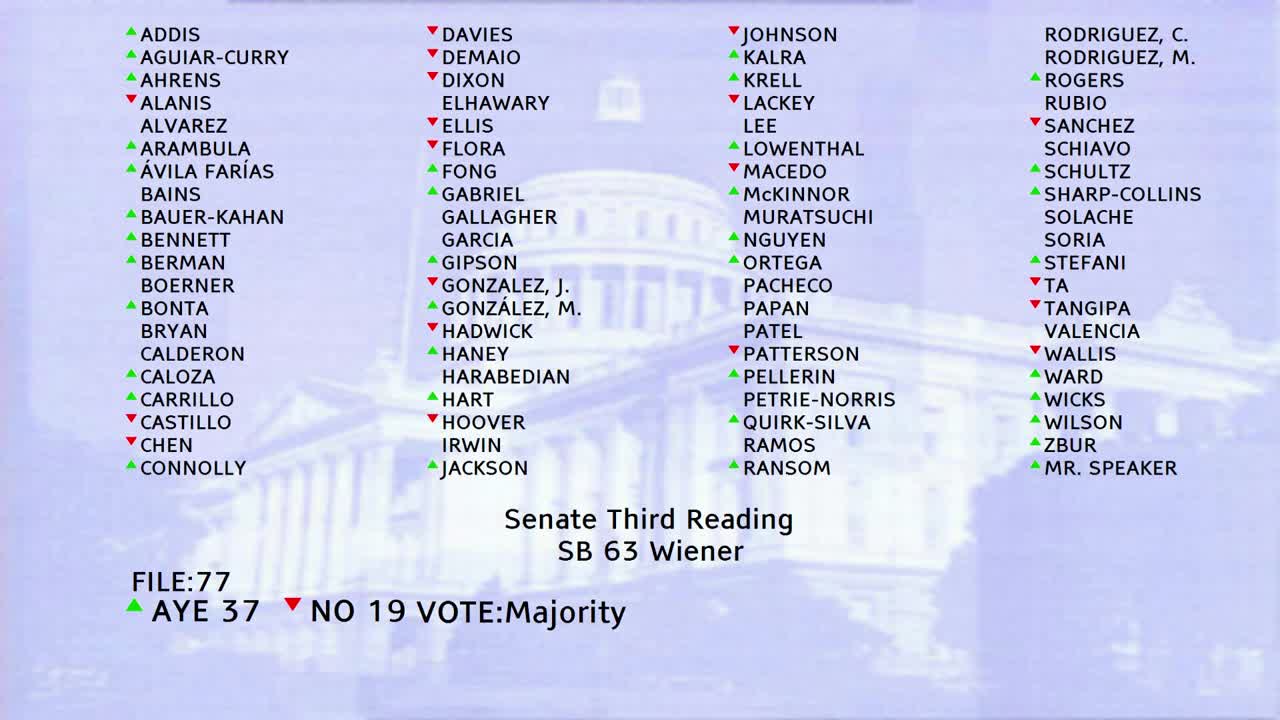 6MIN
Assembly Floor
 2MIN
Assembly Floor
 16MIN
Assembly Standing Committee on Privacy and Consumer Protection
 12MIN
Assembly Standing Committee on Judiciary
 3MIN
Senate Floor
 17MIN
Senate Standing Committee on Judiciary
Bill Author

Bill Co-Author(s):