SB 1005: Marriage.
- Session Year: 2015-2016
- House: Senate
- Latest Version Date: 2016-07-01
Under existing law, a reference to husband and wife, spouses, or married persons, or a comparable term, includes persons who are lawfully married to each other and persons who were previously lawfully married to each other, as is appropriate under the circumstances of the particular case. Under existing law, registered domestic partners have the same rights, protections, and benefits, and are subject to the same responsibilities, obligations, and duties under law, whether they derive from statutes, administrative regulations, court rules, government policies, common law, or any other provisions or sources of law, as are granted to and imposed upon spouses. Existing law requires, where necessary to implement the rights of registered domestic partners, gender-specific terms referring to spouses to be construed to include domestic partners.
The bill would replace references to a husband or wife with references to a spouse, would define spouse as including registered domestic partner, and would make other conforming and related changes.
Under existing law, a reference to husband and wife, spouses, or married persons, or a comparable term, includes persons who are lawfully married to each other and persons who were previously lawfully married to each other, as is appropriate under the circumstances of the particular case. Under existing law, registered domestic partners have the same rights, protections, and benefits, and are subject to the same responsibilities, obligations, and duties under law, whether they derive from statutes, administrative regulations, court rules, government policies, common law, or any other provisions or sources of law, as are granted to and imposed upon spouses. Existing law requires, where necessary to implement the rights of registered domestic partners, gender-specific terms referring to spouses to be construed to include domestic partners.
The bill would replace references to a husband or wife with references to a spouse, would define spouse as including domestic registered domestic partner, and would make other conforming and related changes.
Under existing law, a reference to husband and wife, spouses, or married persons, or a comparable term, includes persons who are lawfully married to each other and persons who were previously lawfully married to each other, as is appropriate under the circumstances of the particular case. Under existing law, registered domestic partners have the same rights, protections, and benefits, and are subject to the same responsibilities, obligations, and duties under law, whether they derive from statutes, administrative regulations, court rules, government policies, common law, or any other provisions or sources of law, as are granted to and imposed upon spouses. Existing law requires, where necessary to implement the rights of registered domestic partners, gender-specific terms referring to spouses to be construed to include domestic partners.
The bill would replace references to a husband or wife with references to a spouse, would define spouse as including domestic partner, and would make other conforming and related changes.
Under existing law, a reference to husband and wife, spouses, or married persons, or a comparable term, includes persons who are lawfully married to each other and persons who were previously lawfully married to each other, as is appropriate under the circumstances of the particular case.
The bill would replace references to a husband or wife with references to a spouse, and would make other conforming and related changes.
Spouse includes registered domestic partner, as required by Section 297.5 of the Family Code.
SEC. 2.Section 17537.1 of the Business and Professions Code is amended to read:17537.1.(a)It is unlawful for any person, or an employee, agent, or independent contractor employed or authorized by that person, by any means, as part of an advertising plan or program, to offer any incentive as an inducement to the recipient to visit a location, attend a sales presentation, or contact a sales agent in person, by telephone, or by mail, unless the offer clearly and conspicuously discloses in writing, in readily understandable language, all of the information required in paragraphs (1) and (2). If the offer is not initially made in writing, the required disclosures shall be received by the recipient in writing prior to any scheduled visit to a location, sales presentation, or contact with a sales agent. For purposes of this section, the term incentive means any item or service of value, including, but not limited to, any prize, gift, money, or other tangible property.
(1)The following disclosures shall appear on the front (or first) page of the offer:
(A)The name and street address of the owner of the real or personal property or the provider of the services which are the subject of the visit, sales presentation, or contact with a sales agent. If the offer is made by an agent or independent contractor employed or authorized by the owner or provider, or is made under a name other than the true name of the owner or provider, the name of the owner or provider shall be more prominently and conspicuously displayed than the name of the agent, independent contractor, or other name.
(B)A general description of the business of the owner or provider identified pursuant to subparagraph (A), and the purpose of any requested visit, sales presentation, or contact with a sales agent, which shall include a general description of the real or personal property or services which are the subject of the sales presentation and a clear statement, if applicable, that there will be a sales presentation and the approximate duration of the visit and sales presentation.
(C)If the recipient is not assured of receiving any particular incentive, a statement of the odds of receiving each incentive offered or, in the alternative, a clear statement describing the location in the offer where the odds can be found. The odds shall be stated in whole Arabic numbers in a format such as: 1 chance in 100,000 or 1:100,000. The odds and, where applicable, the alternative statement describing their location, shall be printed in a type size that is at least equal to that used for the standard text on the front (or first) page of the offer.
(D)A clear statement, if applicable, that the offer is subject to specific restrictions, qualifications, and conditions and a statement describing the location in the offer where the restrictions, qualifications, and conditions may be found. Both statements shall be printed in a type size that is at least equal to that used for the standard text on the front (or first) page of the offer.
(2)The following disclosures shall appear in the offer, but need not appear on the front (or first) page of the offer:
(A)Unless the odds are disclosed on the front (or first) page of the offer, a statement of the odds of receiving each incentive offered, printed in the size and format set forth in subparagraph (C) of paragraph (1).
(B)All restrictions, qualifications, and other conditions which must be satisfied before the recipient is entitled to receive the incentive, including, but not limited to:
(i)Any deadline by which the recipient must visit the location, attend the sales presentation, or contact the sales agent in order to receive an incentive.
(ii)Any other conditions, such as a minimum age qualification, a financial qualification, or a requirement that if the recipient is married or in a registered domestic partnership, both spouses must be present in order to receive the incentive. Any financial qualifications shall be stated with a specificity sufficient to enable the recipient to reasonably determine his or her eligibility.
(C)A statement that the owner or provider identified pursuant to subparagraph (A) of paragraph (1) reserves the right to provide a raincheck, or a substitute or like incentive, if those rights are reserved.
(D)A statement that a recipient who receives an offered incentive may request and will receive evidence showing that the incentive provided matches the incentive randomly or otherwise selected for distribution to that recipient.
(E)All other rules, terms, and conditions of the offer, plan, or program.
(b)It is unlawful for any person making an offer subject to subdivision (a), or any employee, agent, or independent contractor employed or authorized by that person, to offer any incentive when the person knows or has reason to know that the offered item will not be available in a sufficient quantity based upon the reasonably anticipated response to the offer.
(c)It is unlawful for any person making an offer subject to subdivision (a), or any employee, agent, or independent contractor employed or authorized by that person, to fail to provide any offered incentive which any recipient who has responded to the offer in the manner specified therein, who has performed the requirements disclosed therein, and who has met the qualifications described therein, is entitled to receive, unless the offered incentive is not reasonably available and the offer discloses the reservation of a right to provide a raincheck, or a like or substitute incentive, if the offered incentive is unavailable.
(d)If the person making an offer subject to subdivision (a) is unable to provide an offered incentive because of limitations of supply, quantity, or quality that were not reasonably foreseeable or controllable by the person making the offer, the person making the offer shall inform the recipient of the recipients right to receive a raincheck for the incentive offered, unless the person making the offer knows or has reasonable basis for knowing that the incentive will not be reasonably available and shall inform the recipient of the recipients right to at least one of the following additional options:
(1)The person making the offer will provide a like incentive of equivalent or greater retail value or a raincheck therefor.
(2)The person making the offer will provide a substitute incentive of equivalent or greater retail value.
(3)The person making the offer will provide a raincheck for the like or substitute incentive.
(e)If a raincheck is provided, the person making an offer subject to subdivision (a) shall, within a reasonable time, and in no event later than 80 days, deliver the agreed incentive to the recipients address without additional cost or obligation to the recipient, unless the incentive for which the raincheck is provided remains unavailable because of limitations of supply, quantity, or quality not reasonably foreseeable or controllable by the person making the offer. In that case, the person making the offer shall, not later than 30 days after the expiration of the 80 days, deliver a like incentive of equal or greater retail value or, if an incentive is not reasonably available to the person making the offer, a substitute incentive of equal or greater retail value.
(f)Upon the request of a recipient who has received or claims a right to receive any offered incentive, the person making an offer subject to subdivision (a) shall furnish to the person sufficient evidence showing that the incentive provided matches the incentive randomly or otherwise selected for distribution to that recipient.
(g)It is unlawful for any person making an offer subject to subdivision (a), or any employee, agent, or independent contractor employed or authorized by that person, to:
(1)Use any printing styles, graphics, layouts, text, colors, or formats on envelopes or on the offer that imply, create an appearance, or would lead a reasonable person to believe, that the offer originates from or is issued by or on behalf of a government or public agency, public utility, public organization, insurance company, credit reporting agency, bill collecting company, or law firm, unless the same is true.
(2)Misrepresent the size, quantity, identity, value, or qualities of any incentive.
(3)Misrepresent in any manner the odds of receiving any particular incentive.
(4)Represent directly or by implication that the number of participants has been significantly limited or that any person has been selected to receive a particular incentive unless that is the fact.
(5)Label any offer a notice of termination or notice of cancellation.
(6)Misrepresent, in any manner, the offer, plan, or program or the affiliation, connection, association, or contractual relationship between the person making the offer and the owner or provider, if they are not the same.
(h)If the major incentives are awarded or given at random, by the assignment of a number to the incentives, that number shall be actually assigned by the party contractually responsible for doing so. The person making an offer subject to subdivision (a) hereof, or the agent, employee, or independent contractor employed or authorized by that person, if any, shall maintain, for a period of one year after the date the offer is made, the records that show that the winning numbers or opportunity to receive the major incentives have been deposited in the mail or otherwise made available to recipients in accordance with the odds statement provided pursuant to subparagraph (C) of paragraph (1) of subdivision (a) hereof. The records shall be made available to the Attorney General within 30 days after written request therefor. Postal receipt records, affidavits of mailing, or a list of winners or recipients of the major incentives shall be deemed to satisfy the requirements of this section.
SEC. 3.Section 14 of the Civil Code is amended to read:14.(a)Words used in this code in the present tense include the future as well as the present; words used in the masculine gender include the feminine and neuter; the singular number includes the plural, and the plural the singular; the word person includes a corporation as well as a natural person; county includes city and county; writing includes printing and typewriting; oath includes affirmation or declaration; and every mode of oral statement, under oath or affirmation, is embraced by the term testify, and every written one in the term depose; signature or subscription includes mark, when the person cannot write, his name being written near it, by a person who writes his own name as a witness; provided, that when a signature is by mark it must in order that the same may be acknowledged or may serve as the signature to any sworn statement be witnessed by two persons who must subscribe their own names as witnesses thereto.
(b)The following words have in this code the signification attached to them in this section, unless otherwise apparent from the context:
(1)The word property includes property real and personal.
(2)The words real property are coextensive with lands, tenements, and hereditaments.
(3)The words personal property include money, goods, chattels, things in action, and evidences of debt.
(4)The word month means a calendar month, unless otherwise expressed.
(5)The word will includes codicil.
(6)The word section whenever hereinafter employed refers to a section of this code, unless some other code or statute is expressly mentioned.
(7)The word spouse includes a registered domestic partner, as required by Section 297.5 of the Family Code.
SEC. 4.Section 50 of the Civil Code is amended to read:50.Any necessary force may be used to protect from wrongful injury the person or property of oneself, or of a spouse, child, parent, or other relative, or member of ones family, or of a ward, servant, master, or guest.
SEC. 5.Section 51.3 of the Civil Code is amended to read:51.3.(a)The Legislature finds and declares that this section is essential to establish and preserve specially designed accessible housing for senior citizens. There are senior citizens who need special living environments and services, and find that there is an inadequate supply of this type of housing in the state.
(b)For the purposes of this section, the following definitions apply:
(1)Qualifying resident or senior citizen means a person 62 years of age or older, or 55 years of age or older in a senior citizen housing development.
(2)Qualified permanent resident means a person who meets both of the following requirements:
(A)Was residing with the qualifying resident or senior citizen prior to the death, hospitalization, or other prolonged absence of, or the dissolution of marriage with, the qualifying resident or senior citizen.
(B)Was 45 years of age or older, or was a spouse, cohabitant, or person providing primary physical or economic support to the qualifying resident or senior citizen.
(3)Qualified permanent resident also means a disabled person or person with a disabling illness or injury who is a child or grandchild of the senior citizen or a qualified permanent resident as defined in paragraph (2) who needs to live with the senior citizen or qualified permanent resident because of the disabling condition, illness, or injury. For purposes of this section, disabled means a person who has a disability as defined in subdivision (b) of Section 54. A disabling injury or illness means an illness or injury which results in a condition meeting the definition of disability set forth in subdivision (b) of Section 54.
(A)For any person who is a qualified permanent resident under this paragraph whose disabling condition ends, the owner, board of directors, or other governing body may require the formerly disabled resident to cease residing in the development upon receipt of six months written notice; provided, however, that the owner, board of directors, or other governing body may allow the person to remain a resident for up to one year after the disabling condition ends.
(B)The owner, board of directors, or other governing body of the senior citizen housing development may take action to prohibit or terminate occupancy by a person who is a qualified permanent resident under this paragraph if the owner, board of directors, or other governing body finds, based on credible and objective evidence, that the person is likely to pose a significant threat to the health or safety of others that cannot be ameliorated by means of a reasonable accommodation; provided, however, that the action to prohibit or terminate the occupancy may be taken only after doing both of the following:
(i)Providing reasonable notice to and an opportunity to be heard for the disabled person whose occupancy is being challenged, and reasonable notice to the coresident parent or grandparent of that person.
(ii)Giving due consideration to the relevant, credible, and objective information provided in the hearing. The evidence shall be taken and held in a confidential manner, pursuant to a closed session, by the owner, board of directors, or other governing body in order to preserve the privacy of the affected persons.
The affected persons shall be entitled to have present at the hearing an attorney or any other person authorized by them to speak on their behalf or to assist them in the matter.
(4)Senior citizen housing development means a residential development developed, substantially rehabilitated, or substantially renovated for, senior citizens that has at least 35 dwelling units. Any senior citizen housing development which is required to obtain a public report under Section 11010 of the Business and Professions Code and which submits its application for a public report after July 1, 2001, shall be required to have been issued a public report as a senior citizen housing development under Section 11010.05 of the Business and Professions Code. No housing development constructed prior to January 1, 1985, shall fail to qualify as a senior citizen housing development because it was not originally developed or put to use for occupancy by senior citizens.
(5)Dwelling unit or housing means any residential accommodation other than a mobilehome.
(6)Cohabitant refers to persons who live together as spouses or persons who are domestic partners within the meaning of Section 297 of the Family Code.
(7)Permitted health care resident means a person hired to provide live-in, long-term, or terminal health care to a qualifying resident, or a family member of the qualifying resident providing that care. For the purposes of this section, the care provided by a permitted health care resident must be substantial in nature and must provide either assistance with necessary daily activities or medical treatment, or both.
A permitted health care resident shall be entitled to continue his or her occupancy, residency, or use of the dwelling unit as a permitted resident in the absence of the senior citizen from the dwelling unit only if both of the following are applicable:
(A)The senior citizen became absent from the dwelling unit due to hospitalization or other necessary medical treatment and expects to return to his or her residence within 90 days from the date the absence began.
(B)The absent senior citizen or an authorized person acting for the senior citizen submits a written request to the owner, board of directors, or governing board stating that the senior citizen desires that the permitted health care resident be allowed to remain in order to be present when the senior citizen returns to reside in the development.
Upon written request by the senior citizen or an authorized person acting for the senior citizen, the owner, board of directors, or governing board shall have the discretion to allow a permitted health care resident to remain for a time period longer than 90 days from the date that the senior citizens absence began, if it appears that the senior citizen will return within a period of time not to exceed an additional 90 days.
(c)The covenants, conditions, and restrictions and other documents or written policy shall set forth the limitations on occupancy, residency, or use on the basis of age. Any such limitation shall not be more exclusive than to require that one person in residence in each dwelling unit may be required to be a senior citizen and that each other resident in the same dwelling unit may be required to be a qualified permanent resident, a permitted health care resident, or a person under 55 years of age whose occupancy is permitted under subdivision (h) of this section or under subdivision (b) of Section 51.4. That limitation may be less exclusive, but shall at least require that the persons commencing any occupancy of a dwelling unit include a senior citizen who intends to reside in the unit as his or her primary residence on a permanent basis. The application of the rules set forth in this subdivision regarding limitations on occupancy may result in less than all of the dwellings being actually occupied by a senior citizen.
(d)The covenants, conditions, and restrictions or other documents or written policy shall permit temporary residency, as a guest of a senior citizen or qualified permanent resident, by a person of less than 55 years of age for periods of time, not less than 60 days in any year, that are specified in the covenants, conditions, and restrictions or other documents or written policy.
(e)Upon the death or dissolution of marriage, or upon hospitalization, or other prolonged absence of the qualifying resident, any qualified permanent resident shall be entitled to continue his or her occupancy, residency, or use of the dwelling unit as a permitted resident. This subdivision shall not apply to a permitted health care resident.
(f)The condominium, stock cooperative, limited-equity housing cooperative, planned development, or multiple-family residential rental property shall have been developed for, and initially been put to use as, housing for senior citizens, or shall have been substantially rehabilitated or renovated for, and immediately afterward put to use as, housing for senior citizens, as provided in this section; provided, however, that no housing development constructed prior to January 1, 1985, shall fail to qualify as a senior citizen housing development because it was not originally developed for or originally put to use for occupancy by senior citizens.
(g)The covenants, conditions, and restrictions or other documents or written policies applicable to any condominium, stock cooperative, limited-equity housing cooperative, planned development, or multiple-family residential property that contained age restrictions on January 1, 1984, shall be enforceable only to the extent permitted by this section, notwithstanding lower age restrictions contained in those documents or policies.
(h)Any person who has the right to reside in, occupy, or use the housing or an unimproved lot subject to this section on January 1, 1985, shall not be deprived of the right to continue that residency, occupancy, or use as the result of the enactment of this section.
(i)The covenants, conditions, and restrictions or other documents or written policy of the senior citizen housing development shall permit the occupancy of a dwelling unit by a permitted health care resident during any period that the person is actually providing live-in, long-term, or hospice health care to a qualifying resident for compensation. For purposes of this subdivision, the term for compensation shall include provisions of lodging and food in exchange for care.
(j)Notwithstanding any other provision of this section, this section shall not apply to the County of Riverside.
SEC. 6.Section 51.11 of the Civil Code is amended to read:51.11.(a)The Legislature finds and declares that this section is essential to establish and preserve housing for senior citizens. There are senior citizens who need special living environments, and find that there is an inadequate supply of this type of housing in the state.
(b)For the purposes of this section, the following definitions apply:
(1)Qualifying resident or senior citizen means a person 62 years of age or older, or 55 years of age or older in a senior citizen housing development.
(2)Qualified permanent resident means a person who meets both of the following requirements:
(A)Was residing with the qualifying resident or senior citizen prior to the death, hospitalization, or other prolonged absence of, or the dissolution of marriage with, the qualifying resident or senior citizen.
(B)Was 45 years of age or older, or was a spouse, cohabitant, or person providing primary physical or economic support to the qualifying resident or senior citizen.
(3)Qualified permanent resident also means a disabled person or person with a disabling illness or injury who is a child or grandchild of the senior citizen or a qualified permanent resident as defined in paragraph (2) who needs to live with the senior citizen or qualified permanent resident because of the disabling condition, illness, or injury. For purposes of this section, disabled means a person who has a disability as defined in subdivision (b) of Section 54. A disabling injury or illness means an illness or injury which results in a condition meeting the definition of disability set forth in subdivision (b) of Section 54.
(A)For any person who is a qualified permanent resident under paragraph (3) whose disabling condition ends, the owner, board of directors, or other governing body may require the formerly disabled resident to cease residing in the development upon receipt of six months written notice; provided, however, that the owner, board of directors, or other governing body may allow the person to remain a resident for up to one year, after the disabling condition ends.
(B)The owner, board of directors, or other governing body of the senior citizen housing development may take action to prohibit or terminate occupancy by a person who is a qualified permanent resident under paragraph (3) if the owner, board of directors, or other governing body finds, based on credible and objective evidence, that the person is likely to pose a significant threat to the health or safety of others that cannot be ameliorated by means of a reasonable accommodation; provided, however, that action to prohibit or terminate the occupancy may be taken only after doing both of the following:
(i)Providing reasonable notice to and an opportunity to be heard for the disabled person whose occupancy is being challenged, and reasonable notice to the coresident parent or grandparent of that person.
(ii)Giving due consideration to the relevant, credible, and objective information provided in that hearing. The evidence shall be taken and held in a confidential manner, pursuant to a closed session, by the owner, board of directors, or other governing body in order to preserve the privacy of the affected persons.
The affected persons shall be entitled to have present at the hearing an attorney or any other person authorized by them to speak on their behalf or to assist them in the matter.
(4)Senior citizen housing development means a residential development developed with more than 20 units as a senior community by its developer and zoned as a senior community by a local governmental entity, or characterized as a senior community in its governing documents, as these are defined in Section 4150, or qualified as a senior community under the federal Fair Housing Amendments Act of 1988, as amended. Any senior citizen housing development which is required to obtain a public report under Section 11010 of the Business and Professions Code and which submits its application for a public report after July 1, 2001, shall be required to have been issued a public report as a senior citizen housing development under Section 11010.05 of the Business and Professions Code.
(5)Dwelling unit or housing means any residential accommodation other than a mobilehome.
(6)Cohabitant refers to persons who live together as spouses or persons who are domestic partners within the meaning of Section 297 of the Family Code.
(7)Permitted health care resident means a person hired to provide live-in, long-term, or terminal health care to a qualifying resident, or a family member of the qualifying resident providing that care. For the purposes of this section, the care provided by a permitted health care resident must be substantial in nature and must provide either assistance with necessary daily activities or medical treatment, or both.
A permitted health care resident shall be entitled to continue his or her occupancy, residency, or use of the dwelling unit as a permitted resident in the absence of the senior citizen from the dwelling unit only if both of the following are applicable:
(A)The senior citizen became absent from the dwelling unit due to hospitalization or other necessary medical treatment and expects to return to his or her residence within 90 days from the date the absence began.
(B)The absent senior citizen or an authorized person acting for the senior citizen submits a written request to the owner, board of directors, or governing board stating that the senior citizen desires that the permitted health care resident be allowed to remain in order to be present when the senior citizen returns to reside in the development.
Upon written request by the senior citizen or an authorized person acting for the senior citizen, the owner, board of directors, or governing board shall have the discretion to allow a permitted health care resident to remain for a time period longer than 90 days from the date that the senior citizens absence began, if it appears that the senior citizen will return within a period of time not to exceed an additional 90 days.
(c)The covenants, conditions, and restrictions and other documents or written policy shall set forth the limitations on occupancy, residency, or use on the basis of age. Any limitation shall not be more exclusive than to require that one person in residence in each dwelling unit may be required to be a senior citizen and that each other resident in the same dwelling unit may be required to be a qualified permanent resident, a permitted health care resident, or a person under 55 years of age whose occupancy is permitted under subdivision (g) of this section or subdivision (b) of Section 51.12. That limitation may be less exclusive, but shall at least require that the persons commencing any occupancy of a dwelling unit include a senior citizen who intends to reside in the unit as his or her primary residence on a permanent basis. The application of the rules set forth in this subdivision regarding limitations on occupancy may result in less than all of the dwellings being actually occupied by a senior citizen.
(d)The covenants, conditions, and restrictions or other documents or written policy shall permit temporary residency, as a guest of a senior citizen or qualified permanent resident, by a person of less than 55 years of age for periods of time, not more than 60 days in any year, that are specified in the covenants, conditions, and restrictions or other documents or written policy.
(e)Upon the death or dissolution of marriage, or upon hospitalization, or other prolonged absence of the qualifying resident, any qualified permanent resident shall be entitled to continue his or her occupancy, residency, or use of the dwelling unit as a permitted resident. This subdivision shall not apply to a permitted health care resident.
(f)The covenants, conditions, and restrictions or other documents or written policies applicable to any condominium, stock cooperative, limited-equity housing cooperative, planned development, or multiple-family residential property that contained age restrictions on January 1, 1984, shall be enforceable only to the extent permitted by this section, notwithstanding lower age restrictions contained in those documents or policies.
(g)Any person who has the right to reside in, occupy, or use the housing or an unimproved lot subject to this section on or after January 1, 1985, shall not be deprived of the right to continue that residency, occupancy, or use as the result of the enactment of this section by Chapter 1147 of the Statutes of 1996.
(h)A housing development may qualify as a senior citizen housing development under this section even though, as of January 1, 1997, it does not meet the definition of a senior citizen housing development specified in subdivision (b), if the development complies with that definition for every unit that becomes occupied after January 1, 1997, and if the development was once within that definition, and then became noncompliant with the definition as the result of any one of the following:
(1)The development was ordered by a court or a local, state, or federal enforcement agency to allow persons other than qualifying residents, qualified permanent residents, or permitted health care residents to reside in the development.
(2)The development received a notice of a pending or proposed action in, or by, a court, or a local, state, or federal enforcement agency, which action could have resulted in the development being ordered by a court or a state or federal enforcement agency to allow persons other than qualifying residents, qualified permanent residents, or permitted health care residents to reside in the development.
(3)The development agreed to allow persons other than qualifying residents, qualified permanent residents, or permitted health care residents to reside in the development by entering into a stipulation, conciliation agreement, or settlement agreement with a local, state, or federal enforcement agency or with a private party who had filed, or indicated an intent to file, a complaint against the development with a local, state, or federal enforcement agency, or file an action in a court.
(4)The development allowed persons other than qualifying residents, qualified permanent residents, or permitted health care residents to reside in the development on the advice of counsel in order to prevent the possibility of an action being filed by a private party or by a local, state, or federal enforcement agency.
(i)The covenants, conditions, and restrictions or other documents or written policy of the senior citizen housing development shall permit the occupancy of a dwelling unit by a permitted health care resident during any period that the person is actually providing live-in, long-term, or hospice health care to a qualifying resident for compensation.
(j)This section shall only apply to the County of Riverside.
SEC. 7.Section 682 of the Civil Code is amended to read:682.The ownership of property by several persons is either:
(a)Of joint interest.
(b)Of partnership interests.
(c)Of interests in common.
(d)Of community interest of spouses.
SEC. 8.Section 682.1 of the Civil Code is amended to read:682.1.(a)Community property of spouses, when expressly declared in the transfer document to be community property with right of survivorship, and which may be accepted in writing on the face of the document by a statement signed or initialed by the grantees, shall, upon the death of one of the spouses, pass to the survivor, without administration, pursuant to the terms of the instrument, subject to the same procedures, as property held in joint tenancy. Prior to the death of either spouse, the right of survivorship may be terminated pursuant to the same procedures by which a joint tenancy may be severed. Part 1 (commencing with Section 5000) of Division 5 of the Probate Code and Chapter 2 (commencing with Section 13540), Chapter 3 (commencing with Section 13550), and Chapter 3.5 (commencing with Section 13560) of Part 2 of Division 8 of the Probate Code apply to this property.
(b)This section does not apply to a joint account in a financial institution to which Part 2 (commencing with Section 5100) of Division 5 of the Probate Code applies.
(c)This section shall become operative on July 1, 2001, and shall apply to instruments created on or after that date.
SEC. 9.Section 683 of the Civil Code is amended to read:683.(a)A joint interest is one owned by two or more persons in equal shares, by a title created by a single will or transfer, when expressly declared in the will or transfer to be a joint tenancy, or by transfer from a sole owner to himself or herself and others, or from tenants in common or joint tenants to themselves or some of them, or to themselves or any of them and others, or from spouses, when holding title as community property or otherwise to themselves or to themselves and others or to one of them and to another or others, when expressly declared in the transfer to be a joint tenancy, or when granted or devised to executors or trustees as joint tenants. A joint tenancy in personal property may be created by a written transfer, instrument, or agreement.
(b)Provisions of this section do not apply to a joint account in a financial institution if Part 2 (commencing with Section 5100) of Division 5 of the Probate Code applies to such account.
SEC. 10.Section 1099 of the Civil Code is amended to read:1099.(a)As soon as practical before transfer of title of any real property or the execution of a real property sales contract as defined in Section 2985, the transferor, fee owner, or his or her agent, shall deliver to the transferee a copy of a structural pest control inspection report prepared pursuant to Section 8516 of the Business and Professions Code upon which any certification in accordance with Section 8519 of the Business and Professions Code may be made, provided that certification or preparation of a report is a condition of the contract effecting that transfer, or is a requirement imposed as a condition of financing such transfer.
(b)If a notice of work completed as contemplated by Section 8518 of the Business and Professions Code, indicating action by a structural pest control licensee in response to an inspection report delivered or to be delivered under provisions of subdivision (a), or a certification pursuant to Section 8519 of the Business and Professions Code, has been received by a transferor or his or her agent before transfer of title or execution of a real property sales contract as defined in Section 2985, it shall be furnished to the transferee as soon as practical before transfer of title or the execution of such real property sales contract.
(c)Delivery to a transferee as used in this section means delivery in person or by mail to the transferee himself or herself or any person authorized to act for him or her in the transaction or to such additional transferees who have requested such delivery from the transferor or his or her agent in writing. For the purposes of this section, delivery to either spouse shall be deemed delivery to a transferee, unless the contract affecting the transfer states otherwise.
(d)No transfer of title of real property shall be invalidated solely because of the failure of any person to comply with the provisions of this section unless such failure is an act or omission which would be a valid ground for rescission of such transfer in the absence of this section.
SEC. 11.Section 1569 of the Civil Code is amended to read:1569.Duress consists in any of the following:
(a)Unlawful confinement of the person of the party, or of the spouse of such party, or of an ancestor, descendant, or adopted child of such party or spouse.
(b)Unlawful detention of the property of any such person.
(c)Confinement of such person, lawful in form, but fraudulently obtained, or fraudulently made unjustly harassing or oppressive.
SEC. 12.Section 3390 of the Civil Code is amended to read:3390.The following obligations cannot be specifically enforced:
(a)An obligation to render personal service.
(b)An obligation to employ another in personal service.
(c)An agreement to perform an act which the party has not power lawfully to perform when required to do so.
(d)An agreement to procure the act or consent of the spouse of the contracting party, or of any other third person.
(e)An agreement, the terms of which are not sufficiently certain to make the precise act which is to be done clearly ascertainable.
SEC. 13.Section 17 of the Code of Civil Procedure is amended to read:17.(a)Words used in this code in the present tense include the future as well as the present. Words used in the masculine gender include the feminine and neuter. The singular number includes the plural and the plural number includes the singular.
(b)As used in this code, the following words have the following meanings, unless otherwise apparent from the context:
(1)Affinity signifies the connection existing in consequence of marriage, between each of the married persons and the blood relatives of the other when applied to the marriage relation.
(2)County includes city and county.
(3)Electronic signature means an electronic sound, symbol, or process attached to or logically associated with an electronic record and executed or adopted by a person with the intent to sign the electronic record.
(4)Month means a calendar month, unless otherwise expressed.
(5)Oath includes an affirmation or declaration.
(A)Depose includes any written statement made under oath or affirmation.
(B)Testify includes any mode of oral statement made under oath or affirmation.
(6)Person includes a corporation as well as a natural person.
(7)Process signifies a writ or summons issued in the course of a judicial proceeding.
(8)Property includes both personal and real property.
(A)Personal property includes money, goods, chattels, things in action, and evidences of debt.
(B)Real property is coextensive with lands, tenements, and hereditaments.
(9)Section refers to a section of this code, unless some other code or statute is expressly mentioned.
(10)Sheriff includes marshal.
(11)Signature or subscription includes a mark of a persons name, if the person cannot write, with his or her name being written near it by a person who writes his or her own name as a witness. In order that a mark may be acknowledged or serve as the signature to any sworn statement, it shall be witnessed by two persons who shall subscribe their own names as witnesses thereto.
(12)Spouse includes registered domestic partner, as required by Section 297.5 of the Family Code.
(13)State includes the District of Columbia and the territories when applied to the different parts of the United States, and the words United States may include the district and territories.
(14)Will includes codicil.
(15)Writ means an order or precept in writing, issued in the name of the people, or of a court or judicial officer.
(16)Writing includes printing and typewriting.
SEC. 14.Section 116.540 of the Code of Civil Procedure is amended to read:116.540.(a)Except as permitted by this section, no individual other than the plaintiff and the defendant may take part in the conduct or defense of a small claims action.
(b)Except as additionally provided in subdivision (i), a corporation may appear and participate in a small claims action only through a regular employee, or a duly appointed or elected officer or director, who is employed, appointed, or elected for purposes other than solely representing the corporation in small claims court.
(c)A party who is not a corporation or a natural person may appear and participate in a small claims action only through a regular employee, or a duly appointed or elected officer or director, or in the case of a partnership, a partner, engaged for purposes other than solely representing the party in small claims court.
(d)If a party is an individual doing business as a sole proprietorship, the party may appear and participate in a small claims action by a representative and without personally appearing if both of the following conditions are met:
(1)The claim can be proved or disputed by evidence of an account that constitutes a business record as defined in Section 1271 of the Evidence Code, and there is no other issue of fact in the case.
(2)The representative is a regular employee of the party for purposes other than solely representing the party in small claims actions and is qualified to testify to the identity and mode of preparation of the business record.
(e)A plaintiff is not required to personally appear, and may submit declarations to serve as evidence supporting his or her claim or allow another individual to appear and participate on his or her behalf, if (1) the plaintiff is serving on active duty in the United States Armed Forces outside this state, (2) the plaintiff was assigned to his or her duty station after his or her claim arose, (3) the assignment is for more than six months, (4) the representative is serving without compensation, and (5) the representative has appeared in small claims actions on behalf of others no more than four times during the calendar year. The defendant may file a claim in the same action in an amount not to exceed the jurisdictional limits stated in Sections 116.220, 116.221, and 116.231.
(f)A party incarcerated in a county jail, a Department of Corrections and Rehabilitation facility, or a Division of Juvenile Facilities facility is not required to personally appear, and may submit declarations to serve as evidence supporting his or her claim, or may authorize another individual to appear and participate on his or her behalf if that individual is serving without compensation and has appeared in small claims actions on behalf of others no more than four times during the calendar year.
(g)A defendant who is a nonresident owner of real property may defend against a claim relating to that property without personally appearing by (1) submitting written declarations to serve as evidence supporting his or her defense, (2) allowing another individual to appear and participate on his or her behalf if that individual is serving without compensation and has appeared in small claims actions on behalf of others no more than four times during the calendar year, or (3) taking the action described in both (1) and (2).
(h)A party who is an owner of rental real property may appear and participate in a small claims action through a property agent under contract with the owner to manage the rental of that property, if (1) the owner has retained the property agent principally to manage the rental of that property and not principally to represent the owner in small claims court, and (2) the claim relates to the rental property.
(i)A party that is an association created to manage a common interest development, as defined in Section 4100 or in Sections 6528 and 6534 of the Civil Code, may appear and participate in a small claims action through an agent, a management company representative, or bookkeeper who appears on behalf of that association.
(j)At the hearing of a small claims action, the court shall require any individual who is appearing as a representative of a party under subdivisions (b) to (i), inclusive, to file a declaration stating (1) that the individual is authorized to appear for the party, and (2) the basis for that authorization. If the representative is appearing under subdivision (b), (c), (d), (h), or (i), the declaration also shall state that the individual is not employed solely to represent the party in small claims court. If the representative is appearing under subdivision (e), (f), or (g), the declaration also shall state that the representative is serving without compensation, and has appeared in small claims actions on behalf of others no more than four times during the calendar year.
(k)A spouse who sues or who is sued with his or her spouse may appear and participate on behalf of his or her spouse if (1) the claim is a joint claim, (2) the represented spouse has given his or her consent, and (3) the court determines that the interests of justice would be served.
(l)If the court determines that a party cannot properly present his or her claim or defense and needs assistance, the court may in its discretion allow another individual to assist that party.
(m)Nothing in this section shall operate or be construed to authorize an attorney to participate in a small claims action except as expressly provided in Section 116.530.
SEC. 15.Section 371 of the Code of Civil Procedure is amended to read:371.If spouses are sued together, each may defend for his or her own right, but if one spouse neglects to defend, the other spouse may defend for that spouses right also.
SEC. 16.Section 703.140 of the Code of Civil Procedure is amended to read:703.140.(a)In a case under Title 11 of the United States Code, all of the exemptions provided by this chapter, including the homestead exemption, other than the provisions of subdivision (b) are applicable regardless of whether there is a money judgment against the debtor or whether a money judgment is being enforced by execution sale or any other procedure, but the exemptions provided by subdivision (b) may be elected in lieu of all other exemptions provided by this chapter, as follows:
(1)If spouses are joined in the petition, they jointly may elect to utilize the applicable exemption provisions of this chapter other than the provisions of subdivision (b), or to utilize the applicable exemptions set forth in subdivision (b), but not both.
(2)If the petition is filed individually, and not jointly, for a spouse, the exemptions provided by this chapter other than the provisions of subdivision (b) are applicable, except that, if both of the spouses effectively waive in writing the right to claim, during the period the case commenced by filing the petition is pending, the exemptions provided by the applicable exemption provisions of this chapter, other than subdivision (b), in any case commenced by filing a petition for either of them under Title 11 of the United States Code, then they may elect to instead utilize the applicable exemptions set forth in subdivision (b).
(3)If the petition is filed for an unmarried person, that person may elect to utilize the applicable exemption provisions of this chapter other than subdivision (b), or to utilize the applicable exemptions set forth in subdivision (b), but not both.
(b)The following exemptions may be elected as provided in subdivision (a):
(1)The debtors aggregate interest, not to exceed twenty-four thousand sixty dollars ($24,060) in value, in real property or personal property that the debtor or a dependent of the debtor uses as a residence, in a cooperative that owns property that the debtor or a dependent of the debtor uses as a residence.
(2)The debtors interest, not to exceed four thousand eight hundred dollars ($4,800) in value, in one or more motor vehicles.
(3)The debtors interest, not to exceed six hundred dollars ($600) in value in any particular item, in household furnishings, household goods, wearing apparel, appliances, books, animals, crops, or musical instruments, that are held primarily for the personal, family, or household use of the debtor or a dependent of the debtor.
(4)The debtors aggregate interest, not to exceed one thousand four hundred twenty-five dollars ($1,425) in value, in jewelry held primarily for the personal, family, or household use of the debtor or a dependent of the debtor.
(5)The debtors aggregate interest, not to exceed in value one thousand two hundred eighty dollars ($1,280) plus any unused amount of the exemption provided under paragraph (1), in any property.
(6)The debtors aggregate interest, not to exceed seven thousand one hundred seventy-five dollars ($7,175) in value, in any implements, professional books, or tools of the trade of the debtor or the trade of a dependent of the debtor.
(7)Any unmatured life insurance contract owned by the debtor, other than a credit life insurance contract.
(8)The debtors aggregate interest, not to exceed in value twelve thousand eight hundred sixty dollars ($12,860), in any accrued dividend or interest under, or loan value of, any unmatured life insurance contract owned by the debtor under which the insured is the debtor or an individual of whom the debtor is a dependent.
(9)Professionally prescribed health aids for the debtor or a dependent of the debtor.
(10)The debtors right to receive any of the following:
(A)A social security benefit, unemployment compensation, or a local public assistance benefit.
(B)A veterans benefit.
(C)A disability, illness, or unemployment benefit.
(D)Alimony, support, or separate maintenance, to the extent reasonably necessary for the support of the debtor and any dependent of the debtor.
(E)A payment under a stock bonus, pension, profit-sharing, annuity, or similar plan or contract on account of illness, disability, death, age, or length of service, to the extent reasonably necessary for the support of the debtor and any dependent of the debtor, unless all of the following apply:
(i)That plan or contract was established by or under the auspices of an insider that employed the debtor at the time the debtors rights under the plan or contract arose.
(ii)The payment is on account of age or length of service.
(iii)That plan or contract does not qualify under Section 401(a), 403(a), 403(b), 408, or 408A of the Internal Revenue Code of 1986.
(11)The debtors right to receive, or property that is traceable to, any of the following:
(A)An award under a crime victims reparation law.
(B)A payment on account of the wrongful death of an individual of whom the debtor was a dependent, to the extent reasonably necessary for the support of the debtor and any dependent of the debtor.
(C)A payment under a life insurance contract that insured the life of an individual of whom the debtor was a dependent on the date of that individuals death, to the extent reasonably necessary for the support of the debtor and any dependent of the debtor.
(D)A payment, not to exceed twenty-four thousand sixty dollars ($24,060), on account of personal bodily injury of the debtor or an individual of whom the debtor is a dependent.
(E)A payment in compensation of loss of future earnings of the debtor or an individual of whom the debtor is or was a dependent, to the extent reasonably necessary for the support of the debtor and any dependent of the debtor.
SEC. 17.Section 704.930 of the Code of Civil Procedure is amended to read:704.930.(a)A homestead declaration recorded pursuant to this article shall contain all of the following:
(1)The name of the declared homestead owner. Spouses both may be named as declared homestead owners in the same homestead declaration if each owns an interest in the dwelling selected as the declared homestead.
(2)A description of the declared homestead.
(3)A statement that the declared homestead is the principal dwelling of the declared homestead owner or such persons spouse, and that the declared homestead owner or such persons spouse resides in the declared homestead on the date the homestead declaration is recorded.
(b)The homestead declaration shall be executed and acknowledged in the manner of an acknowledgment of a conveyance of real property by at least one of the following persons:
(1)The declared homestead owner.
(2)The spouse of the declared homestead owner.
(3)The guardian or conservator of the person or estate of either of the persons listed in paragraph (1) or (2). The guardian or conservator may execute, acknowledge, and record a homestead declaration without the need to obtain court authorization.
(4)A person acting under a power of attorney or otherwise authorized to act on behalf of a person listed in paragraph (1) or (2).
(c)The homestead declaration shall include a statement that the facts stated in the homestead declaration are known to be true as of the personal knowledge of the person executing and acknowledging the homestead declaration. If the homestead declaration is executed and acknowledged by a person listed in paragraph (3) or (4) of subdivision (b), it shall also contain a statement that the person has authority to so act on behalf of the declared homestead owner or the spouse of the declared homestead owner and the source of the persons authority.
SEC. 18.Section 1201 of the Commercial Code is amended to read:1201.(a)Unless the context otherwise requires, words or phrases defined in this section, or in the additional definitions contained in other divisions of this code that apply to particular divisions or chapters thereof, have the meanings stated.
(b)Subject to definitions contained in other divisions of this code that apply to particular divisions or chapters thereof:
(1)Action, in the sense of a judicial proceeding, includes recoupment, counterclaim, setoff, suit in equity, and any other proceeding in which rights are determined.
(2)Aggrieved party means a party entitled to pursue a remedy.
(3)Agreement, as distinguished from contract, means the bargain of the parties in fact, as found in their language or inferred from other circumstances, including course of performance, course of dealing, or usage of trade as provided in Section 1303.
(4)Bank means a person engaged in the business of banking, and includes a savings bank, savings and loan association, credit union, and trust company.
(5)Bearer means a person in possession of a negotiable instrument, document of title, or certificated security that is payable to bearer or endorsed in blank.
(6)Bill of lading means a document evidencing the receipt of goods for shipment issued by a person engaged in the business of transporting or forwarding goods.
(7)Branch includes a separately incorporated foreign branch of a bank.
(8)Burden of establishing a fact means the burden of persuading the trier of fact that the existence of the fact is more probable than its nonexistence.
(9)Buyer in ordinary course of business means a person that buys goods in good faith, without knowledge that the sale violates the rights of another person in the goods, and in the ordinary course from a person, other than a pawnbroker, in the business of selling goods of that kind. A person buys goods in the ordinary course if the sale to the person comports with the usual or customary practices in the kind of business in which the seller is engaged or with the sellers own usual or customary practices. A person that sells oil, gas, or other minerals at the wellhead or minehead is a person in the business of selling goods of that kind. A buyer in ordinary course of business may buy for cash, by exchange of other property, or on secured or unsecured credit, and may acquire goods or documents of title under a preexisting contract for sale. Only a buyer that takes possession of the goods or has a right to recover the goods from the seller under Division 2 (commencing with Section 2101) may be a buyer in ordinary course of business. Buyer in ordinary course of business does not include a person that acquires goods in a transfer in bulk or as security for or in total or partial satisfaction of a money debt.
(10)Conspicuous, with reference to a term, means so written, displayed, or presented that a reasonable person against whom it is to operate ought to have noticed it. Whether a term is conspicuous or not is a decision for the court. Conspicuous terms include both of the following:
(A)A heading in capitals equal to or greater in size than the surrounding text, or in contrasting type, font, or color to the surrounding text of the same or lesser size.
(B)Language in the body of a record or display in larger type than the surrounding text, or in contrasting type, font, or color to the surrounding text of the same size, or set off from surrounding text of the same size by symbols or other marks that call attention to the language.
(11)[Reserved]
(12)Contract, as distinguished from agreement, means the total legal obligation that results from the parties agreement as determined by this code and as supplemented by any other applicable laws.
(13)Creditor includes a general creditor, a secured creditor, a lien creditor, and any representative of creditors, including an assignee for the benefit of creditors, a trustee in bankruptcy, a receiver in equity, and an executor or administrator of an insolvent debtors or assignors estate.
(14)Defendant includes a person in the position of defendant in a counterclaim, cross-claim, or third-party claim.
(15)Delivery, with respect to an instrument, document of title, or chattel paper means voluntary transfer of possession.
(16)Document of title includes a bill of lading, dock warrant, dock receipt, warehouse receipt, or order for the delivery of goods, and also any other document which in the regular course of business or financing is treated as adequately evidencing that the person in possession of it is entitled to receive, hold, and dispose of the document and the goods it covers. To be a document of title, a document must purport to be issued by or addressed to a bailee and purport to cover goods in the bailees possession which are either identified or are fungible portions of an identified mass.
(17)Fault means a default, breach, or wrongful act or omission.
(18)Fungible goods means:
(A)Goods of which any unit, by nature or usage of trade, is the equivalent of any other like unit; or
(B)Goods that by agreement are treated as equivalent.
(19)Genuine means free of forgery or counterfeiting.
(20)Good faith, except as otherwise provided in Division 5 (commencing with Section 5101), means honesty in fact and the observance of reasonable commercial standards of fair dealing.
(21)Holder, means:
(A)the person in possession of a negotiable instrument that is payable either to bearer or, to an identified person that is the person in possession; or
(B)the person in possession of a document of title if the goods are deliverable either to bearer or to the order of the person in possession.
(22)Insolvency proceeding includes an assignment for the benefit of creditors or other proceeding intended to liquidate or rehabilitate the estate of the person involved.
(23)Insolvent means:
(A)having generally ceased to pay debts in the ordinary course of business other than as a result of bona fide dispute;
(B)being unable to pay debts as they become due; or
(C)being insolvent within the meaning of federal bankruptcy law.
(24)Money means a medium of exchange currently authorized or adopted by a domestic or foreign government. The term includes a monetary unit of account established by an intergovernmental organization or by agreement between two or more countries.
(25)Organization means a person other than an individual.
(26)Party, as distinguished from third party, means a person that has engaged in a transaction or made an agreement subject to this code.
(27)Person means an individual, corporation, business trust, estate, trust, partnership, limited liability company, association, joint venture, government, governmental subdivision, agency, or instrumentality, public corporation, or any other legal or commercial entity.
(28)Present value means the amount as of a date certain of one or more sums payable in the future, discounted to the date certain by use of either an interest rate specified by the parties if that rate is not manifestly unreasonable at the time the transaction is entered into or, if an interest rate is not so specified, a commercially reasonable rate that takes into account the facts and circumstances at the time the transaction is entered into.
(29)Purchase means taking by sale, lease, discount, negotiation, mortgage, pledge, lien, security interest, issue or reissue, gift, or any other voluntary transaction creating an interest in property.
(30)Purchaser means a person that takes by purchase.
(31)Record means information that is inscribed on a tangible medium or that is stored in an electronic or other medium and is retrievable in perceivable form.
(32)Remedy means any remedial right to which an aggrieved party is entitled with or without resort to a tribunal.
(33)Representative means a person empowered to act for another, including an agent, an officer of a corporation or association, and a trustee, executor, or administrator of an estate.
(34)Right includes remedy.
(35)Security interest means an interest in personal property or fixtures which secures payment or performance of an obligation. Security interest includes any interest of a consignor and a buyer of accounts, chattel paper, a payment intangible, or a promissory note in a transaction that is subject to Division 9 (commencing with Section 9101). Security interest does not include the special property interest of a buyer of goods on identification of those goods to a contract for sale under Section 2401, but a buyer may also acquire a security interest by complying with Division 9 (commencing with Section 9101). Except as otherwise provided in Section 2505, the right of a seller or lessor of goods under Division 2 (commencing with Section 2101) or Division 10 (commencing with Section 10101) to retain or acquire possession of the goods is not a security interest, but a seller or lessor may also acquire a security interest by complying with Division 9 (commencing with Section 9101). The retention or reservation of title by a seller of goods notwithstanding shipment or delivery to the buyer under Section 2401 is limited in effect to a reservation of a security interest.
Whether a transaction in the form of a lease creates a security interest is determined pursuant to Section 1203.
(36)Send, in connection with a writing, record, or notice means:
(A)to deposit in the mail or deliver for transmission by any other usual means of communication with postage or cost of transmission provided for and properly addressed and, in the case of an instrument, to an address specified thereon or otherwise agreed or, if there is none, to any address reasonable under the circumstances; or
(B)in any other way to cause to be received any record or notice within the time it would have arrived if properly sent.
(37)Signed includes using any symbol executed or adopted with present intention to adopt or accept a writing.
(38)Spouse includes registered domestic partner, as required by Section 297.5 of the Family Code.
(39)State means a state of the United States, the District of Columbia, Puerto Rico, the United States Virgin Islands, or any territory or insular possession subject to the jurisdiction of the United States.
(40)Surety includes a guarantor or other secondary obligor.
(41)Term means a portion of an agreement that relates to a particular matter.
(42)Unauthorized signature means a signature made without actual, implied, or apparent authority. The term includes a forgery.
(43)Warehouse receipt means a receipt issued by a person engaged in the business of storing goods for hire.
(44)Writing includes printing, typewriting, or any other intentional reduction to tangible form. Written has a corresponding meaning.
SEC. 19.Section 12.2 is added to the Corporations Code, to read:12.2.Spouse includes registered domestic partner, as required by Section 297.5 of the Family Code.
SEC. 20.Section 158 of the Corporations Code is amended to read:158.(a)Close corporation means a corporation, including a close social purpose corporation, whose articles contain, in addition to the provisions required by Section 202, a provision that all of the corporations issued shares of all classes shall be held of record by not more than a specified number of persons, not exceeding 35, and a statement, This corporation is a close corporation.
(b)The special provisions referred to in subdivision (a) may be included in the articles by amendment, but if such amendment is adopted after the issuance of shares only by the affirmative vote of all of the issued and outstanding shares of all classes.
(c)The special provisions referred to in subdivision (a) may be deleted from the articles by amendment, or the number of shareholders specified may be changed by amendment, but if such amendment is adopted after the issuance of shares, only by the affirmative vote of at least two-thirds of each class of the outstanding shares; provided, however, that the articles may provide for a lesser vote, but not less than a majority of the outstanding shares, or may deny a vote to any class, or both.
(d)In determining the number of shareholders for the purposes of the provision in the articles authorized by this section, spouses and the personal representative of either shall be counted as one regardless of how shares may be held by either or both of them, a trust or personal representative of a decedent holding shares shall be counted as one regardless of the number of trustees or beneficiaries, and a partnership or corporation or business association holding shares shall be counted as one (except that any such trust or entity the primary purpose of which was the acquisition or voting of the shares shall be counted according to the number of beneficial interests therein).
(e)A corporation shall cease to be a close corporation upon the filing of an amendment to its articles pursuant to subdivision (c) or, if it shall have more than the maximum number of holders of record of its shares specified in its articles as a result of an inter vivos transfer of shares which is not void under subdivision (d) of Section 418, the transfer of shares on distribution by will or pursuant to the laws of descent and distribution, the dissolution of a partnership or corporation or business association, or the termination of a trust which holds shares, by court decree upon dissolution of a marriage or otherwise by operation of law. Promptly upon acquiring more than the specified number of holders of record of its shares, a close corporation shall execute and file an amendment to its articles deleting the special provisions referred to in subdivision (a) and deleting any other provisions not permissible for a corporation which is not a close corporation, which amendment shall be promptly approved and filed by the board and need not be approved by the outstanding shares.
(f)Nothing contained in this section shall invalidate any agreement among the shareholders to vote for the deletion from the articles of the special provisions referred to in subdivision (a) upon the lapse of a specified period of time or upon the occurrence of a certain event or condition or otherwise.
(g)The following sections contain specific references to close corporations: Sections 186, 202, 204, 300, 418, 421, 1111, 1201, 1800, and 1904.
SEC. 21.Section 704 of the Corporations Code is amended to read:704.(a)If shares stand of record in the names of two or more persons, whether fiduciaries, members of a partnership, joint tenants, tenants in common, spouses as community property, tenants by the entirety, voting trustees, persons entitled to vote under a shareholder voting agreement or otherwise, or if two or more persons (including proxyholders) have the same fiduciary relationship respecting the same shares, unless the secretary of the corporation is given written notice to the contrary and is furnished with a copy of the instrument or order appointing them or creating the relationship wherein it is so provided, their acts with respect to voting shall have the following effect:
(1)If only one votes, such act binds all.
(2)If more than one vote, the act of the majority so voting binds all.
(3)If more than one vote, but the vote is evenly split on any particular matter, each faction may vote the securities in question proportionately.
(b)If the instrument so filed or the registration of the shares shows that any such tenancy is held in unequal interests, a majority or even split for the purpose of this section shall be a majority or even split in interest.
SEC. 22.Section 5612 of the Corporations Code is amended to read:5612.If a membership stands of record in the names of two or more persons, whether fiduciaries, members of a partnership, joint tenants, tenants in common, spouses as community property, tenants by the entirety, or otherwise, or if two or more persons (including proxyholders) have the same fiduciary relationship respecting the same membership, unless the secretary of the corporation is given written notice to the contrary and is furnished with a copy of the instrument or order appointing them or creating the relationship wherein it is so provided, their acts with respect to voting shall have the following effect:
(a)If only one votes, such act binds all;
(b)If more than one vote, the act of the majority so voting binds all.
SEC. 23.Section 7612 of the Corporations Code is amended to read:7612.If a membership stands of record in the names of two or more persons, whether fiduciaries, members of a partnership, joint tenants, tenants in common, spouses as community property, tenants by the entirety, persons entitled to vote under a voting agreement or otherwise, or if two or more persons (including proxyholders) have the same fiduciary relationship respecting the same membership, unless the secretary of the corporation is given written notice to the contrary and is furnished with a copy of the instrument or order appointing them or creating the relationship wherein it is so provided, their acts with respect to voting shall have the following effect:
(a)If only one votes, such act binds all; or
(b)If more than one vote, the act of the majority so voting binds all.
SEC. 24.Section 12482 of the Corporations Code is amended to read:12482.Unless otherwise provided in the articles or bylaws, if a membership stands of record in the names of two or more persons, whether fiduciaries, members of a partnership, joint tenants, tenants in common, spouses as community property, tenants by the entirety, persons entitled to vote under a voting agreement or otherwise, or if two or more persons have the same fiduciary relationship respecting the same membership, unless the secretary of the corporation is given written notice to the contrary and is furnished with a copy of the instrument or order appointing them or creating the relationship wherein it is so provided, their acts with respect to voting shall have the following effect:
(a)If only one vote, such act binds all; or
(b)If more than one vote, the act of the majority so voting binds all.
SEC. 25.Section 25102 of the Corporations Code is amended to read:25102.The following transactions are exempted from the provisions of Section 25110:
(a)Any offer (but not a sale) not involving any public offering and the execution and delivery of any agreement for the sale of securities pursuant to the offer if (1) the agreement contains substantially the following provision: The sale of the securities that are the subject of this agreement has not been qualified with the Commissioner of Corporations of the State of California and the issuance of the securities or the payment or receipt of any part of the consideration therefor prior to the qualification is unlawful, unless the sale of securities is exempt from the qualification by Section 25100, 25102, or 25105 of the California Corporations Code. The rights of all parties to this agreement are expressly conditioned upon the qualification being obtained, unless the sale is so exempt; and (2) no part of the purchase price is paid or received and none of the securities are issued until the sale of the securities is qualified under this law unless the sale of securities is exempt from the qualification by this section, Section 25100, or 25105.
(b)Any offer (but not a sale) of a security for which a registration statement has been filed under the Securities Act of 1933 but has not yet become effective, or for which an offering statement under Regulation A has been filed but has not yet been qualified, if no stop order or refusal order is in effect and no public proceeding or examination looking towards an order is pending under Section 8 of the act and no order under Section 25140 or subdivision (a) of Section 25143 is in effect under this law.
(c)Any offer (but not a sale) and the execution and delivery of any agreement for the sale of securities pursuant to the offer as may be permitted by the commissioner upon application. Any negotiating permit under this subdivision shall be conditioned to the effect that none of the securities may be issued and none of the consideration therefor may be received or accepted until the sale of the securities is qualified under this law.
(d)Any transaction or agreement between the issuer and an underwriter or among underwriters if the sale of the securities is qualified, or exempt from qualification, at the time of distribution thereof in this state, if any.
(e)Any offer or sale of any evidence of indebtedness, whether secured or unsecured, and any guarantee thereof, in a transaction not involving any public offering.
(f)Any offer or sale of any security in a transaction (other than an offer or sale to a pension or profit-sharing trust of the issuer) that meets each of the following criteria:
(1)Sales of the security are not made to more than 35 persons, including persons not in this state.
(2)All purchasers either have a preexisting personal or business relationship with the offeror or any of its partners, officers, directors or controlling persons, or managers (as appointed or elected by the members) if the offeror is a limited liability company, or by reason of their business or financial experience or the business or financial experience of their professional advisers who are unaffiliated with and who are not compensated by the issuer or any affiliate or selling agent of the issuer, directly or indirectly, could be reasonably assumed to have the capacity to protect their own interests in connection with the transaction.
(3)Each purchaser represents that the purchaser is purchasing for the purchasers own account (or a trust account if the purchaser is a trustee) and not with a view to or for sale in connection with any distribution of the security.
(4)The offer and sale of the security is not accomplished by the publication of any advertisement. The number of purchasers referred to above is exclusive of any described in subdivision (i), any officer, director, or affiliate of the issuer, or manager (as appointed or elected by the members) if the issuer is a limited liability company, and any other purchaser who the commissioner designates by rule. For purposes of this section, spouses (together with any custodian or trustee acting for the account of their minor children) are counted as one person and a partnership, corporation, or other organization that was not specifically formed for the purpose of purchasing the security offered in reliance upon this exemption, is counted as one person. The commissioner shall by rule require the issuer to file a notice of transactions under this subdivision.
The failure to file the notice or the failure to file the notice within the time specified by the rule of the commissioner shall not affect the availability of the exemption. Any issuer that fails to file the notice as provided by rule of the commissioner shall, within 15 business days after discovery of the failure to file the notice or after demand by the commissioner, whichever occurs first, file the notice and pay to the commissioner a fee equal to the fee payable had the transaction been qualified under Section 25110. Neither the filing of the notice nor the failure by the commissioner to comment thereon precludes the commissioner from taking any action that the commissioner deems necessary or appropriate under this division with respect to the offer and sale of the securities.
(g)Any offer or sale of conditional sale agreements, equipment trust certificates, or certificates of interest or participation therein or partial assignments thereof, covering the purchase of railroad rolling stock or equipment or the purchase of motor vehicles, aircraft, or parts thereof, in a transaction not involving any public offering.
(h)Any offer or sale of voting common stock by a corporation incorporated in any state if, immediately after the proposed sale and issuance, there will be only one class of stock of the corporation outstanding that is owned beneficially by no more than 35 persons, provided all of the following requirements have been met:
(1)The offer and sale of the stock is not accompanied by the publication of any advertisement, and no selling expenses have been given, paid, or incurred in connection therewith.
(2)The consideration to be received by the issuer for the stock to be issued consists of any of the following:
(A)Only assets (which may include cash) of an existing business enterprise transferred to the issuer upon its initial organization, of which all of the persons who are to receive the stock to be issued pursuant to this exemption were owners during, and the enterprise was operated for, a period of not less than one year immediately preceding the proposed issuance, and the ownership of the enterprise immediately prior to the proposed issuance was in the same proportions as the shares of stock are to be issued.
(B)Only cash or cancellation of indebtedness for money borrowed, or both, upon the initial organization of the issuer, provided all of the stock is issued for the same price per share.
(C)Only cash, provided the sale is approved in writing by each of the existing shareholders and the purchaser or purchasers are existing shareholders.
(D)In a case where after the proposed issuance there will be only one owner of the stock of the issuer, only any legal consideration.
(3)No promotional consideration has been given, paid, or incurred in connection with the issuance. Promotional consideration means any consideration paid directly or indirectly to a person who, acting alone or in conjunction with one or more other persons, takes the initiative in founding and organizing the business or enterprise of an issuer for services rendered in connection with the founding or organizing.
(4)A notice in a form prescribed by rule of the commissioner, signed by an active member of the State Bar of California, is filed with or mailed for filing to the commissioner not later than 10 business days after receipt of consideration for the securities by the issuer. That notice shall contain an opinion of the member of the State Bar of California that the exemption provided by this subdivision is available for the offer and sale of the securities. The failure to file the notice as required by this subdivision and the rules of the commissioner shall not affect the availability of this exemption. An issuer who fails to file the notice within the time specified by this subdivision shall, within 15 business days after discovery of the failure to file the notice or after demand by the commissioner, whichever occurs first, file the notice and pay to the commissioner a fee equal to the fee payable had the transaction been qualified under Section 25110. The notice, except when filed on behalf of a California corporation, shall be accompanied by an irrevocable consent, in the form that the commissioner by rule prescribes, appointing the commissioner or his or her successor in office to be the issuers attorney to receive service of any lawful process in any noncriminal suit, action, or proceeding against it or its successor that arises under this law or any rule or order hereunder after the consent has been filed, with the same force and validity as if served personally on the issuer. An issuer on whose behalf a consent has been filed in connection with a previous qualification or exemption from qualification under this law (or application for a permit under any prior law if the application or notice under this law states that the consent is still effective) need not file another. Service may be made by leaving a copy of the process in the office of the commissioner, but it is not effective unless (A) the plaintiff, who may be the commissioner in a suit, action, or proceeding instituted by him or her, forthwith sends notice of the service and a copy of the process by registered or certified mail to the defendant or respondent at its last address on file with the commissioner, and (B) the plaintiffs affidavit of compliance with this section is filed in the case on or before the return day of the process, if any, or within the further time as the court allows.
(5)Each purchaser represents that the purchaser is purchasing for the purchasers own account, or a trust account if the purchaser is a trustee, and not with a view to or for sale in connection with any distribution of the stock.
For the purposes of this subdivision, all securities held by spouses, whether or not jointly, shall be considered to be owned by one person, and all securities held by a corporation that has issued stock pursuant to this exemption shall be considered to be held by the shareholders to whom it has issued the stock.
All stock issued by a corporation pursuant to this subdivision as it existed prior to the effective date of the amendments to this section made during the 1996 portion of the 199596 Regular Session that required the issuer to have stamped or printed prominently on the face of the stock certificate a legend in a form prescribed by rule of the commissioner restricting transfer of the stock in a manner provided for by that rule shall not be subject to the transfer restriction legend requirement and, by operation of law, the corporation is authorized to remove that transfer restriction legend from the certificates of those shares of stock issued by the corporation pursuant to this subdivision as it existed prior to the effective date of the amendments to this section made during the 1996 portion of the 199596 Regular Session.
(i)Any offer or sale (1) to a bank, savings and loan association, trust company, insurance company, investment company registered under the Investment Company Act of 1940, pension or profit-sharing trust (other than a pension or profit-sharing trust of the issuer, a self-employed individual retirement plan, or individual retirement account), or other institutional investor or governmental agency or instrumentality that the commissioner may designate by rule, whether the purchaser is acting for itself or as trustee, or (2) to any corporation with outstanding securities registered under Section 12 of the Securities Exchange Act of 1934 or any wholly owned subsidiary of the corporation that after the offer and sale will own directly or indirectly 100 percent of the outstanding capital stock of the issuer, provided the purchaser represents that it is purchasing for its own account (or for the trust account) for investment and not with a view to or for sale in connection with any distribution of the security.
(j)Any offer or sale of any certificate of interest or participation in an oil or gas title or lease (including subsurface gas storage and payments out of production) if either of the following apply:
(1)All of the purchasers meet one of the following requirements:
(A)Are and have been during the preceding two years engaged primarily in the business of drilling for, producing, or refining oil or gas (or whose corporate predecessor, in the case of a corporation, has been so engaged).
(B)Are persons described in paragraph (1) of subdivision (i).
(C)Have been found by the commissioner upon written application to be substantially engaged in the business of drilling for, producing, or refining oil or gas so as not to require the protection provided by this law (which finding shall be effective until rescinded).
(2)The security is concurrently hypothecated to a bank in the ordinary course of business to secure a loan made by the bank, provided that each purchaser represents that it is purchasing for its own account for investment and not with a view to or for sale in connection with any distribution of the security.
(k)Any offer or sale of any security under, or pursuant to, a plan of reorganization under Chapter 11 of the federal bankruptcy law that has been confirmed or is subject to confirmation by the decree or order of a court of competent jurisdiction.
(l)Any offer or sale of an option, warrant, put, call, or straddle, and any guarantee of any of these securities, by a person who is not the issuer of the security subject to the right, if the transaction, had it involved an offer or sale of the security subject to the right by the person, would not have violated Section 25110 or 25130.
(m)Any offer or sale of a stock to a pension, profit-sharing, stock bonus, or employee stock ownership plan, provided that (1) the plan meets the requirements for qualification under Section 401 of the Internal Revenue Code, and (2) the employees are not required or permitted individually to make any contributions to the plan. The exemption provided by this subdivision shall not be affected by whether the stock is contributed to the plan, purchased from the issuer with contributions by the issuer or an affiliate of the issuer, or purchased from the issuer with funds borrowed from the issuer, an affiliate of the issuer, or any other lender.
(n)Any offer or sale of any security in a transaction, other than an offer or sale of a security in a rollup transaction, that meets all of the following criteria:
(1)The issuer is (A) a California corporation or foreign corporation that, at the time of the filing of the notice required under this subdivision, is subject to Section 2115, or (B) any other form of business entity, including without limitation a partnership or trust organized under the laws of this state. The exemption provided by this subdivision is not available to a blind pool issuer, as that term is defined by the commissioner, or to an investment company subject to the Investment Company Act of 1940.
(2)Sales of securities are made only to qualified purchasers or other persons the issuer reasonably believes, after reasonable inquiry, to be qualified purchasers. A corporation, partnership, or other organization specifically formed for the purpose of acquiring the securities offered by the issuer in reliance upon this exemption may be a qualified purchaser if each of the equity owners of the corporation, partnership, or other organization is a qualified purchaser. Qualified purchasers include the following:
(A)A person designated in Section 260.102.13 of Title 10 of the California Code of Regulations.
(B)A person designated in subdivision (i) or any rule of the commissioner adopted thereunder.
(C)A pension or profit-sharing trust of the issuer, a self-employed individual retirement plan, or an individual retirement account, if the investment decisions made on behalf of the trust, plan, or account are made solely by persons who are qualified purchasers.
(D)An organization described in Section 501(c)(3) of the Internal Revenue Code, corporation, Massachusetts or similar business trust, or partnership, each with total assets in excess of five million dollars ($5,000,000) according to its most recent audited financial statements.
(E)With respect to the offer and sale of one class of voting common stock of an issuer or of preferred stock of an issuer entitling the holder thereof to at least the same voting rights as the issuers one class of voting common stock, provided that the issuer has only one-class voting common stock outstanding upon consummation of the offer and sale, a natural person who, either individually or jointly with the persons spouse, (i) has a minimum net worth of two hundred fifty thousand dollars ($250,000) and had, during the immediately preceding tax year, gross income in excess of one hundred thousand dollars ($100,000) and reasonably expects gross income in excess of one hundred thousand dollars ($100,000) during the current tax year or (ii) has a minimum net worth of five hundred thousand dollars ($500,000). Net worth shall be determined exclusive of home, home furnishings, and automobiles. Other assets included in the computation of net worth may be valued at fair market value.
Each natural person specified above, by reason of his or her business or financial experience, or the business or financial experience of his or her professional adviser, who is unaffiliated with and who is not compensated, directly or indirectly, by the issuer or any affiliate or selling agent of the issuer, can be reasonably assumed to have the capacity to protect his or her interests in connection with the transaction. The amount of the investment of each natural person shall not exceed 10 percent of the net worth, as determined by this subparagraph, of that natural person.
(F)Any other purchaser designated as qualified by rule of the commissioner.
(3)Each purchaser represents that the purchaser is purchasing for the purchasers own account (or trust account, if the purchaser is a trustee) and not with a view to or for sale in connection with a distribution of the security.
(4)Each natural person purchaser, including a corporation, partnership, or other organization specifically formed by natural persons for the purpose of acquiring the securities offered by the issuer, receives, at least five business days before securities are sold to, or a commitment to purchase is accepted from, the purchaser, a written offering disclosure statement that shall meet the disclosure requirements of Regulation D (17 C.F.R. 230.501 et seq.), and any other information as may be prescribed by rule of the commissioner, provided that the issuer shall not be obligated pursuant to this paragraph to provide this disclosure statement to a natural person qualified under Section 260.102.13 of Title 10 of the California Code of Regulations. The offer or sale of securities pursuant to a disclosure statement required by this paragraph that is in violation of Section 25401, or that fails to meet the disclosure requirements of Regulation D (17 C.F.R. 230.501 et seq.), shall not render unavailable to the issuer the claim of an exemption from Section 25110 afforded by this subdivision. This paragraph does not impose, directly or indirectly, any additional disclosure obligation with respect to any other exemption from qualification available under any other provision of this section.
(5)(A)A general announcement of proposed offering may be published by written document only, provided that the general announcement of proposed offering sets forth the following required information:
(i)The name of the issuer of the securities.
(ii)The full title of the security to be issued.
(iii)The anticipated suitability standards for prospective purchasers.
(iv)A statement that (I) no money or other consideration is being solicited or will be accepted, (II) an indication of interest made by a prospective purchaser involves no obligation or commitment of any kind, and, if the issuer is required by paragraph (4) to deliver a disclosure statement to prospective purchasers, (III) no sales will be made or commitment to purchase accepted until five business days after delivery of a disclosure statement and subscription information to the prospective purchaser in accordance with the requirements of this subdivision.
(v)Any other information required by rule of the commissioner.
(vi)The following legend: For more complete information about (Name of Issuer) and (Full Title of Security), send for additional information from (Name and Address) by sending this coupon or calling (Telephone Number).
(B)The general announcement of proposed offering referred to in subparagraph (A) may also set forth the following information:
(i)A brief description of the business of the issuer.
(ii)The geographic location of the issuer and its business.
(iii)The price of the security to be issued, or, if the price is not known, the method of its determination or the probable price range as specified by the issuer, and the aggregate offering price.
(C)The general announcement of proposed offering shall contain only the information that is set forth in this paragraph.
(D)Dissemination of the general announcement of proposed offering to persons who are not qualified purchasers, without more, shall not disqualify the issuer from claiming the exemption under this subdivision.
(6)No telephone solicitation shall be permitted until the issuer has determined that the prospective purchaser to be solicited is a qualified purchaser.
(7)The issuer files a notice of transaction under this subdivision both (A) concurrent with the publication of a general announcement of proposed offering or at the time of the initial offer of the securities, whichever occurs first, accompanied by a filing fee, and (B) within 10 business days following the close or abandonment of the offering, but in no case more than 210 days from the date of filing the first notice. The first notice of transaction under subparagraph (A) shall contain an undertaking, in a form acceptable to the commissioner, to deliver any disclosure statement required by paragraph (4) to be delivered to prospective purchasers, and any supplement thereto, to the commissioner within 10 days of the commissioners request for the information. The exemption from qualification afforded by this subdivision is unavailable if an issuer fails to file the first notice required under subparagraph (A) or to pay the filing fee. The commissioner has the authority to assess an administrative penalty of up to one thousand dollars ($1,000) against an issuer that fails to deliver the disclosure statement required to be delivered to the commissioner upon the commissioners request within the time period set forth above. Neither the filing of the disclosure statement nor the failure by the commissioner to comment thereon precludes the commissioner from taking any action deemed necessary or appropriate under this division with respect to the offer and sale of the securities.
(o)An offer or sale of any security issued by a corporation or limited liability company pursuant to a purchase plan or agreement, or issued pursuant to an option plan or agreement, where the security at the time of issuance or grant is exempt from registration under the Securities Act of 1933, as amended, pursuant to Rule 701 adopted pursuant to that act (17 C.F.R. 230.701), the provisions of which are hereby incorporated by reference into this section, provided that (1) the terms of any purchase plan or agreement shall comply with Sections 260.140.42, 260.140.45, and 260.140.46 of Title 10 of the California Code of Regulations, (2) the terms of any option plan or agreement shall comply with Sections 260.140.41, 260.140.45, and 260.140.46 of Title 10 of the California Code of Regulations, and (3) the issuer files a notice of transaction in accordance with rules adopted by the commissioner no later than 30 days after the initial issuance of any security under that plan, accompanied by a filing fee as prescribed by subdivision (y) of Section 25608. The failure to file the notice of transaction within the time specified in this subdivision shall not affect the availability of this exemption. An issuer that fails to file the notice shall, within 15 business days after discovery of the failure to file the notice or after demand by the commissioner, whichever occurs first, file the notice and pay the commissioner a fee equal to the maximum aggregate fee payable had the transaction been qualified under Section 25110.
Offers and sales exempt pursuant to this subdivision shall be deemed to be part of a single, discrete offering and are not subject to integration with any other offering or sale, whether qualified under Chapter 2 (commencing with Section 25110), or otherwise exempt, or not subject to qualification.
(p)An offer or sale of nonredeemable securities to accredited investors (Section 28031) by a person licensed under the Capital Access Company Law (Division 3 (commencing with Section 28000) of Title 4), provided that all purchasers either (1) have a preexisting personal or business relationship with the offeror or any of its partners, officers, directors, controlling persons, or managers (as appointed or elected by the members), or (2) by reason of their business or financial experience or the business or financial experience of their professional advisers who are unaffiliated with and who are not compensated by the issuer or any affiliate or selling agent of the issuer, directly or indirectly, could be reasonably assumed to have the capacity to protect their own interests in connection with the transaction. All nonredeemable securities shall be evidenced by certificates that shall have stamped or printed prominently on their face a legend in a form to be prescribed by rule or order of the commissioner restricting transfer of the securities in the manner as the rule or order provides. The exemption under this subdivision shall not be available for any offering that is exempt or asserted to be exempt pursuant to Section 3(a)(11) of the Securities Act of 1933 (15 U.S.C. Sec. 77c(a)(11)) or Rule 147 (17 C.F.R. 230.147) thereunder or otherwise is conducted by means of any form of general solicitation or general advertising.
(q)Any offer or sale of any viatical or life settlement contract or fractionalized or pooled interest therein in a transaction that meets all of the following criteria:
(1)Sales of securities described in this subdivision are made only to qualified purchasers or other persons the issuer reasonably believes, after reasonable inquiry, to be qualified purchasers. A corporation, partnership, or other organization specifically formed for the purpose of acquiring the securities offered by the issuer in reliance upon this exemption may be a qualified purchaser only if each of the equity owners of the corporation, partnership, or other organization is a qualified purchaser. Qualified purchasers include the following:
(A)A person designated in Section 260.102.13 of Title 10 of the California Code of Regulations.
(B)A person designated in subdivision (i) or any rule of the commissioner adopted thereunder.
(C)A pension or profit-sharing trust of the issuer, a self-employed individual retirement plan, or an individual retirement account, if the investment decisions made on behalf of the trust, plan, or account are made solely by persons who are qualified purchasers.
(D)An organization described in Section 501(c)(3) of the Internal Revenue Code, corporation, Massachusetts or similar business trust, or partnership, each with total assets in excess of five million dollars ($5,000,000) according to its most recent audited financial statements.
(E)A natural person who, either individually or jointly with the persons spouse, (i) has a minimum net worth of one hundred fifty thousand dollars ($150,000) and had, during the immediately preceding tax year, gross income in excess of one hundred thousand dollars ($100,000) and reasonably expects gross income in excess of one hundred thousand dollars ($100,000) during the current tax year or (ii) has a minimum net worth of two hundred fifty thousand dollars ($250,000). Net worth shall be determined exclusive of home, home furnishings, and automobiles. Other assets included in the computation of net worth may be valued at fair market value.
Each natural person specified above, by reason of his or her business or financial experience, or the business or financial experience of his or her professional adviser, who is unaffiliated with and who is not compensated, directly or indirectly, by the issuer or any affiliate or selling agent of the issuer, can be reasonably assumed to have the capacity to protect his or her interests in connection with the transaction.
The amount of the investment of each natural person shall not exceed 10 percent of the net worth, as determined by this subdivision, of that natural person.
(F)Any other purchaser designated as qualified by rule of the commissioner.
(2)Each purchaser represents that the purchaser is purchasing for the purchasers own account (or trust account, if the purchaser is a trustee) and not with a view to or for sale in connection with a distribution of the security.
(3)Each natural person purchaser, including a corporation, partnership, or other organization specifically formed by natural persons for the purpose of acquiring the securities offered by the issuer, receives, at least five business days before securities described in this subdivision are sold to, or a commitment to purchase is accepted from, the purchaser, the following information in writing:
(A)The name, principal business and mailing address, and telephone number of the issuer.
(B)The suitability standards for prospective purchasers as set forth in paragraph (1) of this subdivision.
(C)A description of the issuers type of business organization and the state in which the issuer is organized or incorporated.
(D)A brief description of the business of the issuer.
(E)If the issuer retains ownership or becomes the beneficiary of the insurance policy, an audit report of an independent certified public accountant together with a balance sheet and related statements of income, retained earnings, and cashflows that reflect the issuers financial position, the results of the issuers operations, and the issuers cashflows as of a date within 15 months before the date of the initial issuance of the securities described in this subdivision. The financial statements listed in this subparagraph shall be prepared in conformity with generally accepted accounting principles. If the date of the audit report is more than 120 days before the date of the initial issuance of the securities described in this subdivision, the issuer shall provide unaudited interim financial statements.
(F)The names of all directors, officers, partners, members, or trustees of the issuer.
(G)A description of any order, judgment, or decree that is final as to the issuing entity of any state, federal, or foreign country governmental agency or administrator, or of any state, federal, or foreign country court of competent jurisdiction (i) revoking, suspending, denying, or censuring for cause any license, permit, or other authority of the issuer or of any director, officer, partner, member, trustee, or person owning or controlling, directly or indirectly, 10 percent or more of the outstanding interest or equity securities of the issuer, to engage in the securities, commodities, franchise, insurance, real estate, or lending business or in the offer or sale of securities, commodities, franchises, insurance, real estate, or loans, (ii) permanently restraining, enjoining, barring, suspending, or censuring any such person from engaging in or continuing any conduct, practice, or employment in connection with the offer or sale of securities, commodities, franchises, insurance, real estate, or loans, (iii) convicting any such person of, or pleading nolo contendere by any such person to, any felony or misdemeanor involving a security, commodity, franchise, insurance, real estate, or loan, or any aspect of the securities, commodities, franchise, insurance, real estate, or lending business, or involving dishonesty, fraud, deceit, embezzlement, fraudulent conversion, or misappropriation of property, or (iv) holding any such person liable in a civil action involving breach of a fiduciary duty, fraud, deceit, embezzlement, fraudulent conversion, or misappropriation of property. This subparagraph does not apply to any order, judgment, or decree that has been vacated, overturned, or is more than 10 years old.
(H)Notice of the purchasers right to rescind or cancel the investment and receive a refund pursuant to Section 25508.5.
(I)The name, address, and telephone number of the issuing insurance company, and the name, address, and telephone number of the state or foreign country regulator of the insurance company.
(J)The total face value of the insurance policy and the percentage of the insurance policy the purchaser will own.
(K)The insurance policy number, issue date, and type.
(L)If a group insurance policy, the name, address, and telephone number of the group, and, if applicable, the material terms and conditions of converting the policy to an individual policy, including the amount of increased premiums.
(M)If a term insurance policy, the term and the name, address, and telephone number of the person who will be responsible for renewing the policy if necessary.
(N)That the insurance policy is beyond the state statute for contestability and the reason therefor.
(O)The insurance policy premiums and terms of premium payments.
(P)The amount of the purchasers moneys that will be set aside to pay premiums.
(Q)The name, address, and telephone number of the person who will be the insurance policy owner and the person who will be responsible for paying premiums.
)The date on which the purchaser will be required to pay premiums and the amount of the premium, if known.
(S)A statement to the effect that any projected rate of return to the purchaser from the purchase of a viatical or life settlement contract or a fractionalized or pooled interest therein is based on an estimated life expectancy for the person insured under the life insurance policy; that the return on the purchase may vary substantially from the expected rate of return based upon the actual life expectancy of the insured that may be less than, equal to, or may greatly exceed the estimated life expectancy; and that the rate of return would be higher if the actual life expectancy were less than, and lower if the actual life expectancy were greater than the estimated life expectancy of the insured at the time the viatical or life settlement contract was closed.
(T)A statement that the purchaser should consult with his or her tax adviser regarding the tax consequences of the purchase of the viatical or life settlement contract or fractionalized or pooled interest therein and, if the purchaser is using retirement funds or accounts for that purchase, whether or not any adverse tax consequences might result from the use of those funds for the purchase of that investment.
(U)Any other information as may be prescribed by rule of the commissioner.
SEC. 26.Section 25206 of the Corporations Code is amended to read:25206.A broker licensed by the Real Estate Commissioner is exempt from the provisions of Section 25210 when engaged in transactions in any interest in any general or limited partnership, joint venture, unincorporated association, or similar organization (but not a corporation) owned beneficially by no more than 100 persons and formed for the sole purpose of, and engaged solely in, investment in or gain from an interest in real property, including, but not limited to, a sale, exchange, trade, or development. An interest held by spouses shall be considered held by one person for the purposes of this section.
SEC. 27.Section 73.2 is added to the Education Code, to read:73.2.Spouse includes registered domestic partner, as required by Section 297.5 of the Family Code.
SEC. 28.Section 21100 of the Education Code is amended to read:21100.Any person desiring in his or her lifetime to promote the public welfare by founding, endowing, and maintaining within this state a university, college, school, seminary of learning, mechanical institute, museum, botanic garden, public park, or gallery of art, or any or all thereof, may, for such purposes, by grant in writing convey to a trustee, or any number of trustees, named in the grant, and to their successors, any property, real or personal, belonging to him or her and situated within this state. If he or she is married or in a registered domestic partnership and the property is community property, then both spouses shall join in the grant.
SEC. 29.Section 24803 of the Education Code is amended to read:24803.(a)If any benefit is payable by a district retirement system to the estate of a deceased person, whether because the estate is the beneficiary of the person or because no beneficiary was designated or because an allowance payable to the person had accrued and remained unpaid at the date of the death, and the estate would not be administered if no amount were due from the system, then the benefit shall be paid directly without procuring letters of administration to the surviving next of kin of the deceased, or the guardians of the survivors estates, share and share alike. The payment shall be made in the same order in which the following groups are listed:
(1)Spouse.
(2)Children and issue of deceased children by right of representation.
(3)Father and mother.
(4)Brothers and sisters.
(5)Nieces and nephews.
(b)Payment may also be made to persons in the groups listed in subdivision (a) to the extent those persons are the only beneficiaries under the last will and testament of a deceased former member of a district retirement system, without the probate of the will.
SEC. 30.Section 68062 of the Education Code is amended to read:68062.In determining the place of residence the following rules are to be observed:
(a)There can only be one residence.
(b)A residence is the place where one remains when not called elsewhere for labor or other special or temporary purpose, and to which he or she returns in seasons of repose.
(c)A residence cannot be lost until another is gained.
(d)The residence can be changed only by the union of act and intent.
(e)A man or woman may establish his or her residence. A persons residence shall not be derivative from that of his or her spouse.
(f)The residence of the parent with whom an unmarried minor child maintains his or her place of abode is the residence of the unmarried minor child. When the minor lives with neither parent his or her residence is that of the parent with whom he or she maintained his or her last place of abode, provided the minor may establish his or her residence when both parents are deceased and a legal guardian has not been appointed.
(g)The residence of an unmarried minor who has a parent living cannot be changed by his or her own act, by the appointment of a legal guardian, or by relinquishment of a parents right of control.
(h)An alien, including an unmarried minor alien, may establish his or her residence, unless precluded by the Immigration and Nationality Act (8 U.S.C. Sec. 1101 et seq.) from establishing domicile in the United States.
(i)The residence of an unmarried minor alien shall be derived from his or her parents pursuant to the provisions of subdivisions (f) and (g).
SEC. 31.Section 356.5 is added to the Elections Code, to read:356.5.Spouse includes registered domestic partner, as required by Section 297.5 of the Family Code.
SEC. 32.Section 215 is added to the Evidence Code, to read:215.Spouse includes registered domestic partner, as required by Section 297.5 of the Family Code.
SEC. 33.Section 917 of the Evidence Code is amended to read:917.(a)If a privilege is claimed on the ground that the matter sought to be disclosed is a communication made in confidence in the course of the lawyer-client, lawyer referral service-client, physician-patient, psychotherapist-patient, clergy-penitent, marital or domestic partnership, sexual assault counselor-victim, domestic violence counselor-victim, or human trafficking caseworker-victim relationship, the communication is presumed to have been made in confidence and the opponent of the claim of privilege has the burden of proof to establish that the communication was not confidential.
(b)A communication between persons in a relationship listed in subdivision (a) does not lose its privileged character for the sole reason that it is communicated by electronic means or because persons involved in the delivery, facilitation, or storage of electronic communication may have access to the content of the communication.
(c)For purposes of this section, electronic has the same meaning provided in Section 1633.2 of the Civil Code.
SEC. 34.Section 980 of the Evidence Code is amended to read:980.Subject to Section 912 and except as otherwise provided in this article, a spouse (or his or her guardian or conservator when he or she has a guardian or conservator), whether or not a party, has a privilege during the marital or domestic partnership relationship and afterwards to refuse to disclose, and to prevent another from disclosing, a communication if he or she claims the privilege and the communication was made in confidence between him or her and the other spouse while they were spouses.
SEC. 35.Section 143 is added to the Family Code, to read:143.Spouse includes registered domestic partner, as required by Section 297.5.
SEC. 36.Section 11.2 is added to the Financial Code, to read:11.2.Spouse includes registered domestic partner, as required by Section 297.5 of the Family Code.
SEC. 37.Section 14860 of the Financial Code is amended to read:14860.Except as provided in this section and Part 2 (commencing with Section 5100) of Division 5 of the Probate Code, no credit union shall exercise trust powers except upon qualifying as a trust company pursuant to Division 1 (commencing with Section 99).
(a)Notwithstanding any other law relating to trusts and trust authority, subject to the regulations of the commissioner, a credit union may act as a trustee or custodian, and may receive reasonable compensation for so acting, under any written trust instrument or custodial agreement created or organized in the United States which is a part of a pension, education, or medical plan for its members or groups or organizations of its members, which qualifies or has qualified for specific tax treatment under Section 220, 223, 401, 408, 408A, 457, or 530 of the Internal Revenue Code, Title 26 of the United States Code, or any deferred compensation plan for the benefit of the credit unions employees, provided the funds received pursuant to these plans are invested as provided in Section 16040 of the Probate Code. All funds held by a credit union as trustee or in a custodial capacity shall be maintained in accordance with applicable laws and rules and regulations as may be promulgated by the Secretary of Labor, the Secretary of the Treasury, or any other authority exercising jurisdiction over the trust or custodial accounts. The credit union shall maintain individual records for each participant or beneficiary that show in detail all transactions relating to the funds of each participant or beneficiary.
The trust instrument or agreement shall provide for the appointment of a successor trustee or custodian by a person, committee, corporation, or organization other than the credit union or any person acting in his or her capacity as a director, employee, or agent of the credit union, upon notice from the credit union or the commissioner that the credit union is unwilling or unable to continue to act as trustee or custodian.
(b)Shares may be issued in a revocable or irrevocable trust subject to the following:
(1)When shares are issued in a revocable trust, the settlor shall be a member of the credit union issuing the shares in his or her own right. If the trust has joint settlors, who are spouses, then only one settlor need be a member of the credit union.
(2)When shares are issued in an irrevocable trust, the settlor or the beneficiary shall be a member of this credit union in his or her own right. For purposes of this section, shares issued pursuant to a pension plan authorized by this section shall be treated as an irrevocable trust unless otherwise indicated in rules and regulations issued by the commissioner.
(3)This subdivision does not apply to trust accounts established prior to the effective date of this subdivision.
SEC. 38.Section 18220 of the Financial Code is amended to read:18220.An industrial loan company shall not induce any spouses, jointly or severally, to become obligated, directly or contingently or both, under more than one contract of loan at the same time, with the result of obtaining a higher rate of charge than would otherwise be permitted by this division.
SEC. 39.Section 18523 of the Financial Code is amended to read:18523.The following described thrift obligations will be guaranteed by Guaranty Corporation in the amounts hereinafter set forth below:
(a)Single ownership investment certificates. Funds owned by an individual and invested in the manner set forth below shall be added together and guaranteed up to fifty thousand dollars ($50,000) in the aggregate.
(1)Individual investment certificates (or investment certificates of the marital or domestic partnership community of which the individual is a member) and invested in one or more investment certificates in his or her own name shall be guaranteed up to fifty thousand dollars ($50,000) in the aggregate.
(2)Funds owned by a principal and invested in one or more investment certificates in the name or names of agents or nominees shall be added to any individual investment certificates of the principal and guaranteed up to fifty thousand dollars ($50,000) in the aggregate.
(3)Investment certificates held by guardians, custodians, or conservators for the benefit of their wards or for the benefit of a minor under a Uniform Gifts to Minors Act and invested in one or more investment certificates in the name of the guardian, custodian, or conservator shall be added to any individual investment certificates of the ward or minor and guaranteed up to fifty thousand dollars ($50,000) in the aggregate.
(b)Testamentary investment certificates.
(1)Funds owned by an individual and invested in a revocable trust investment certificate, tentative trust investment certificate, payable-on-death investment certificate, or similar investment certificate evidencing an intention that on his or her death the funds shall belong to his or her spouse, child, or grandchild, shall be guaranteed up to fifty thousand dollars ($50,000) in the aggregate, as to each such named beneficiary, separately from any other investment certificates of the owner.
(2)If the named beneficiary of such an investment certificate is other than the owners spouse, child, or grandchild, the funds in the investment certificate shall be added to any individual investment certificates of such owner and guaranteed up to fifty thousand dollars ($50,000) in the aggregate, separately from the individual investment certificates of the beneficiaries of the estate or of the executor or administrator.
(c)Investment certificates held by executors or administrators. Funds of a decedent held in the name of the decedent or in the name of the executor or administrator of his or her estate and invested in one or more investment certificates shall be guaranteed up to fifty thousand dollars ($50,000) in the aggregate, separately from the individual investment certificates of the beneficiaries of the estate or of the executor or administrator.
(d)Corporation or partnership investment certificates. Investment certificates of a corporation or partnership engaged in any independent activity shall be guaranteed up to fifty thousand dollars ($50,000) in the aggregate. An investment certificate of a corporation or partnership not engaged in an independent activity shall be deemed to be owned by the person or persons owning such corporation or comprising such partnership and, for guarantee purposes, the interest of each person in the investment certificate shall be added to any other investment certificates individually owned by such person and guaranteed up to fifty thousand dollars ($50,000) in the aggregate. The term independent activity means any activity other than one directed solely at increasing guarantee coverage under this chapter.
(e)Unincorporated associations. Investment certificates of an unincorporated association engaged in any independent activity shall be guaranteed up to fifty thousand dollars ($50,000) in the aggregate. An investment certificate of an unincorporated association not engaged in an independent activity shall be deemed to be owned by the persons comprising such association and, for guarantee purposes, the interest of each owner in the investment certificate shall be added to any other investment certificates individually owned by such person and guaranteed up to fifty thousand dollars ($50,000) in the aggregate.
(f)Joint investment certificates.
(1)Investment certificates owned jointly, whether as joint tenants with right of survivorship, as tenants by the entireties, as tenants in common, or by spouses as community property, shall be guaranteed separately from investment certificates individually owned by the coowners.
(2)A joint investment certificate shall be deemed to exist, for purposes of guarantee of investment certificates, only if each coowner has personally executed an investment certificate signature card and possesses redemption rights.
(3)An investment certificate owned jointly which does not qualify as a joint investment certificate for purposes of guarantee of investment certificates shall be treated as owned by the named persons as individuals and the actual ownership interest of each such person in such investment certificate shall be added to any other investment certificates individually owned by such person and guaranteed up to fifty thousand dollars ($50,000) in the aggregate.
(4)All joint investment certificates owned by the same combination of individuals shall first be added together and guaranteed up to fifty thousand dollars ($50,000) in the aggregate.
(5)The interest of each coowner in all joint investment certificates owned by different combinations of individuals shall then be added together and guaranteed up to fifty thousand dollars ($50,000) in the aggregate.
(g)Trust investment certificates. All trust interests for the same beneficiary invested in investment certificates established pursuant to valid trust arrangements created by the same settlor (grantor) shall be added together and guaranteed up to fifty thousand dollars ($50,000) in the aggregate, separately from other investment certificates of the trustee of such trust funds or the settlor or beneficiary of such trust arrangements.
(h)Thrift obligations withdrawn by checks that have not cleared a members bank account at the time the commissioner has taken possession of the property and business of a member. The owner of the funds represented by such a check shall be recognized for all purposes of a claim for guaranteed thrift obligations to the same extent as if his or her name and interest were disclosed on the records of the member.
SEC. 40.Section 22327 of the Financial Code is amended to read:22327.No licensee shall knowingly induce any borrower to split up or divide any loan with any other licensee. No licensee shall induce or permit any borrower to be or to become obligated directly or indirectly, or both, under more than one contract of loan at the same time with the same licensee for the purpose or with the result of obtaining a higher rate of charge than would otherwise be permitted by this article, except as otherwise required by the federal Equal Credit Opportunity Act (15 U.S.C. Sec. 1691 et seq.; Public Law 93-495) and Regulation B promulgated by the Board of Governors of the Federal Reserve System (12 C.F.R. 202 et seq.). For the purpose of this section, borrower includes any spouses, whether jointly or severally obligated.
SEC. 41.Section 9.2 is added to the Fish and Game Code, to read:9.2.Spouse includes registered domestic partner, as required by Section 297.5 of the Family Code.
SEC. 42.Section 8552.3 of the Fish and Game Code is amended to read:8552.3.The commission may, in consultation with representatives of the commercial herring roe fishery, and after holding at least one public hearing, adopt regulations intended to facilitate the transfer of herring permits, including, but not limited to, regulations that would do the following:
(a)Allow an individual to own a single permit for each of the different herring gillnet platoons in San Francisco Bay.
(b)Eliminate the point system for qualifying for a herring permit.
(c)Allow a herring permit to be passed from a parent to child, or between spouses.
SEC. 43.Section 36 is added to the Food and Agricultural Code, to read:36.Spouse includes registered domestic partner, as required by Section 297.5 of the Family Code.
SEC. 44.Section 12.2 is added to the Government Code, to read:12.2.Spouse includes registered domestic partner, as required by Section 297.5 of the Family Code.
SEC. 45.Section 9359.9 of the Government Code is amended to read:9359.9.(a)If a beneficiary is not designated, or if the estate is the beneficiary and the estate would not be probated if no amount were due from this system, all of the amount due by reason of the death of a member or retired member, including retirement allowances accrued but not received prior to death, shall be paid directly without probate to the surviving next of kin of the deceased, or the guardians of such survivors estates, share and share alike.
(b)Such payment shall be made in the same order in which the following groups are listed:
(1)Spouse.
(2)Children.
(3)Father and mother.
(4)Grandchildren.
(5)Brothers and sisters.
(6)Nieces and nephews.
SEC. 46.Section 9374 of the Government Code is amended to read:9374.Upon the death of a member before retirement (a) the surviving spouse of the member, who has the care of children, including stepchildren, of the member who are not married or in registered domestic partnerships and are under 18 years of age, or are incapacitated because of disability which began before and has continued without interruption after attainment of that age, or if there is no such spouse, then (b) the guardian of surviving children, including stepchildren, of the member who are not married or in registered domestic partnerships and are under 18 years of age or so incapacitated, if any, or (c) the surviving spouse of the member, who does not qualify under (a), if any, or if no such children under (b) or such spouse under (c), then (d) each surviving parent of the member, shall be paid the following applicable survivor allowance, under the conditions stated and from contributions of the state:
(1)A widow or a widower who was married to, or was in a registered domestic partnership with, the member prior to the occurrence of the injury or onset of the illness that resulted in death, and has the care of children, including stepchildren, of the deceased member who are not married or in registered domestic partnerships and are under 18 years of age or so incapacitated, shall be paid three hundred sixty dollars ($360) if there is one such child, or four hundred thirty dollars ($430) per month if there are two or more such children. If there also are such children who are not in the care of the surviving spouse, the portion of the allowance payable under this paragraph, assuming that these children were in the care of the surviving spouse, which is in excess of one hundred eighty dollars ($180) per month, shall be divided equally among all of those children and payments made to the spouse and other children, as the case may be.
(2)If there is no such surviving spouse, or if such surviving spouse dies, remarries, or enters into a subsequent registered domestic partnership, and if there are children, including stepchildren, of the deceased member who are not married or in registered domestic partnerships and are under 18 years of age, or if there are such children not in the care of such spouse, such children shall be paid an allowance as follows:
(A)If there is only one such child, such child shall be paid one hundred eighty dollars ($180) per month.
(B)If there are two such children, such children shall be paid three hundred sixty dollars ($360) per month divided equally between them.
(C)If there are three or more such children, such children shall be paid four hundred thirty dollars ($430) per month divided equally among them.
(3)A surviving spouse who has attained or attains the age of 62 years, and, regardless of the gender of the surviving spouse, who was married to, or in a registered domestic partnership with, such member prior to the occurrence of the injury or onset of the illness that resulted in death, and has not remarried or entered into a registered domestic partnership subsequent to the members death, shall be paid one hundred eighty dollars ($180) per month. No allowance shall be paid under this paragraph, while the surviving spouse is receiving an allowance under paragraph (1), or while an allowance is being paid under subparagraph (C) of paragraph (2). The allowance paid under this paragraph shall be seventy dollars ($70) per month while an allowance is being paid under subparagraph (B) of paragraph (2).
(4)If there is no surviving spouse, or surviving children who qualify for a survivor allowance, or if such surviving spouse dies, remarries, or enters into a subsequent registered domestic partnership, or if such children reach 18 years of age or die, marry, or enter into a registered domestic partnership prior thereto, each of the members dependent mother and father who has attained or attains 62 years of age, and who received at least one-half of his or her support from the member at the time of the members death, shall be paid one hundred eighty dollars ($180) per month.
Stepchildren, for purposes of this section, shall include only stepchildren of the member living with him or her in a regular parent-child relationship at the time of his or her death.
SEC. 47.Section 21571 of the Government Code is amended to read:21571.(a)If the death benefit provided by Section 21532 is payable on account of a members death that occurs under circumstances other than those described in subparagraph (F) of paragraph (1) of subdivision (a) of Section 21530, or if an allowance under Section 21546 is payable, the payment pursuant to subdivision (b) shall be made, in the following order of priority:
(1)The surviving spouse of the member, who has the care of children, including stepchildren, of the member who are not married or in registered domestic partnerships and are under 22 years of age, or are incapacitated because of disability that began before and has continued without interruption after attainment of that age.
(2)The guardian or conservator of surviving children, including stepchildren, of the member who are not married or in registered domestic partnerships and are under 22 years of age or are so incapacitated.
(3)The surviving spouse of the member, who does not qualify under paragraph (1).
(4)Each surviving parent of the member.
(b)Regardless of the benefit provided by Section 21532 and of the beneficiary designated by the member under that section, or regardless of the allowance provided under Section 21546, the following applicable 1959 survivor allowance, under the conditions stated and from contributions of the state, shall be paid:
(1)A surviving spouse who was either continuously married to, or in a registered domestic partnership with, the member for at least one year prior to death, or was married to, or in a registered domestic partnership with, the member prior to the occurrence of the injury or onset of the illness that resulted in death, and has the care of children, including stepchildren, of the deceased member who are not married or in registered domestic partnerships and are under 22 years of age or are so incapacitated, shall be paid three hundred sixty dollars ($360) if there is one child or four hundred thirty dollars ($430) per month if there are two or more children. If there also are children who are not in the care of the surviving spouse, the portion of the allowance payable under this paragraph, assuming that these children were in the care of the surviving spouse, which is in excess of one hundred eighty dollars ($180) per month, shall be divided equally among all those children and payments made to the spouse and other children, as the case may be.
(2)If there is no surviving spouse, or if the surviving spouse dies, and if there are children, including stepchildren, of the deceased member who are not married or in registered domestic partnerships and are under 22 years of age or are so incapacitated, or if there are children not in the care of the spouse, the children shall be paid an allowance as follows:
(A)If there is only one child, the child shall be paid one hundred eighty dollars ($180) per month.
(B)If there are two children, the children shall be paid three hundred sixty dollars ($360) per month divided equally between them.
(C)If there are three or more children, the children shall be paid four hundred thirty dollars ($430) per month divided equally among them.
(3)A surviving spouse who has attained or attains 62 years of age and, with respect to that surviving spouse, who was either continuously married to, or in a registered domestic partnership with, the member for at least one year prior to death, or who was married to, or in a registered domestic partnership with, the member prior to the occurrence of the injury or onset of the illness which resulted in death, shall be paid one hundred eighty dollars ($180) per month. No allowance shall be paid under this paragraph, while the surviving spouse is receiving an allowance under paragraph (1), or while an allowance is being paid under subparagraph (C) of paragraph (2). The allowance paid under this paragraph shall be seventy dollars ($70) per month while an allowance is being paid under subparagraph (B) of paragraph (2).
(4)If there is no surviving spouse or surviving child who qualifies for a 1959 survivor allowance, or if the surviving spouse dies and there is no surviving child, or if the surviving spouse dies and the children die or marry or, if not incapacitated, reach 22 years of age, each of the members dependent parents who has attained or attains 62 years of age, and who received at least one-half of his or her support from the member at the time of the members death, shall be paid one hundred eighty dollars ($180) per month.
(c)Stepchildren, for purposes of this section, shall include only stepchildren of the member living with him or her in a regular parent-child relationship at the time of his or her death.
(d)The amendments to this section by Chapter 1617 of the Statutes of 1971 shall apply only to 1959 survivor allowances payable April 1, 1972, and thereafter.
(e)This section does not apply to any member in the employ of an employer not subject to this section on January 1, 1994.
(f)On and after the date determined by the board, all assets and liabilities of all contracting agencies subject to this section, and their employees, on account of benefits provided under this article shall be pooled into a single account, and a single employer rate shall be established to provide benefits under this section on account of members employed by a contracting agency that is subject to this section.
(g)The rate of contribution of an employer subject to this section shall be figured using the term insurance valuation method. If a contracting agency that is subject to this section is projected to have a surplus in its 1959 survivor benefit account as of the date the assets and liabilities are first pooled, the surplus shall be applied to reduce its rate of contribution. If a contracting agency that is subject to this section is projected to have a deficit in its 1959 survivor benefit account as of the date the assets and liabilities are first pooled, its rate of contribution shall be increased until the projected deficit is paid.
SEC. 48.Section 21572 of the Government Code is amended to read:21572.(a)In lieu of benefits provided in Section 21571, if the death benefit provided by Section 21532 is payable on account of a state members death that occurs under circumstances other than those described in subparagraph (F) of paragraph (1) of subdivision (a) of Section 21530, or if an allowance under Section 21546 is payable, the payment pursuant to subdivision (b) shall be made in the following order of priority:
(1)The surviving spouse of the member who has the care of children, including stepchildren, of the member who are not married or in registered domestic partnerships and are under 22 years of age or are incapacitated because of a disability that began before and has continued without interruption after attainment of that age.
(2)The guardian of surviving children, including stepchildren, of the member who are not married or in registered domestic partnerships and are under 22 years of age or are so incapacitated.
(3)The surviving spouse of the member who does not qualify under paragraph (1).
(4)Each surviving parent of the member.
(b)Regardless of the benefit provided by Section 21532 and of the beneficiary designated by the member under that section, or regardless of the allowance provided under Section 21546, the following applicable 1959 survivor allowance, under the conditions stated and from contributions of the state, shall be paid:
(1)A surviving spouse who was either continuously married to, or in a registered domestic partnership with, the member for at least one year prior to death, or was married to, or in a registered domestic partnership with, the member prior to the occurrence of the injury or onset of the illness that resulted in death, and has the care of children, including stepchildren, of the deceased member who are not married or in registered domestic partnerships and are under 22 years of age or are so incapacitated, shall be paid four hundred fifty dollars ($450) per month if there is one child or five hundred thirty-eight dollars ($538) per month if there are two or more children. If there also are children who are not in the care of the surviving spouse, the portion of the allowance payable under this paragraph, assuming that these children were in the care of the surviving spouse, that is in excess of two hundred twenty-five dollars ($225) per month, shall be divided equally among all those children and payments made to the spouse and other children, as the case may be.
(2)If there is no surviving spouse, or if the surviving spouse dies, and if there are children, including stepchildren, of the deceased member who are not married or in registered domestic partnerships and are under 22 years of age or are so incapacitated, or if there are children not in the care of the spouse, the children shall be paid an allowance as follows:
(A)If there is only one child, the child shall be paid two hundred twenty-five dollars ($225) per month.
(B)If there are two children, the children shall be paid four hundred fifty dollars ($450) per month divided equally between them.
(C)If there are three or more children, the children shall be paid five hundred thirty-eight dollars ($538) per month divided equally among them.
(3)A surviving spouse who has attained or attains 62 years of age and, with respect to that surviving spouse, who was either continuously married to, or in a registered domestic partnership with, the member for at least one year prior to death, or was married to, or in a registered domestic partnership with, the member prior to the occurrence of the injury or onset of the illness that resulted in death, shall be paid two hundred twenty-five dollars ($225) per month. No allowance shall be paid under this paragraph while the surviving spouse is receiving an allowance under paragraph (1) or while an allowance is being paid under subparagraph (C) of paragraph (2). The allowance paid under this paragraph shall be eighty-eight dollars ($88) per month while an allowance is being paid under subparagraph (B) of paragraph (2).
(4)If there is no surviving spouse or surviving child who qualifies for a 1959 survivor allowance, or if the surviving spouse dies and there is no surviving child, or if the surviving spouse dies and the children die or marry or, if not incapacitated, reach 22 years of age, each of the members dependent parents who has attained or attains 62 years of age, and who received at least one-half of his or her support from the member at the time of the members death, shall be paid two hundred twenty-five dollars ($225) per month.
(c)Stepchildren, for purposes of this section, shall include only stepchildren of the member living with him or her in a regular parent-child relationship at the time of his or her death.
(d)This section shall apply to beneficiaries receiving 1959 survivor allowances on July 1, 1975, as well as to beneficiaries with respect to the death of a state member occurring on or after July 1, 1975.
(e)This section shall apply, with respect to benefits payable on and after July 1, 1981, to all members employed by a school employer, and school safety members employed with a school district or community college district as defined in subdivision (i) of Section 20057, except that it shall not apply, without contract amendment, with respect to safety members who became members after July 1, 1981. All assets and liabilities of all school employers, and their employees, on account of benefits provided under this article shall be pooled into a single account, and a single employer rate shall be established to provide benefits under this section on account of all miscellaneous members employed by a school employer and all safety members who are members on July 1, 1981.
(f)This section does not apply to any member in the employ of an employer not subject to this section on January 1, 1994.
(g)On and after January 1, 2000, all state members covered by this section shall be covered by the benefit provided under Section 21574.7.
(h)On and after the date determined by the board, all assets and liabilities of all contracting agencies subject to this section, and their employees, on account of benefits provided under this article shall be pooled into a single account, and a single employer rate shall be established to provide benefits under this section on account of members employed by a contracting agency that is subject to this section.
(i)The rate of contribution of an employer subject to this section shall be figured using the term insurance valuation method. If a contracting agency that is subject to this section is projected to have a surplus in its 1959 survivor benefit account as of the date the assets and liabilities are first pooled, the surplus shall be applied to reduce its rate of contribution. If a contracting agency that is subject to this section is projected to have a deficit in its 1959 survivor benefit account as of the date the assets and liabilities are first pooled, its rate of contribution shall be increased until the projected deficit is paid.
SEC. 49.Section 21573 of the Government Code is amended to read:21573.(a)In lieu of benefits provided in Section 21571 or Section 21572, if the death benefit provided by Section 21532 is payable on account of a state members death that occurs under circumstances other than those described in subparagraph (F) of paragraph (1) of subdivision (a) of Section 21530, or if an allowance under Section 21546 is payable, the payment pursuant to subdivision (b) shall be made in the following order of priority:
(1)The surviving spouse of the member who has the care of children, including stepchildren, of the member who are not married or in registered domestic partnerships and are under 22 years of age or are incapacitated because of a disability that began before and has continued without interruption after attainment of that age.
(2)The guardian of surviving children, including stepchildren, of the member who are not married or in registered domestic partnerships and are under 22 years of age or are so incapacitated.
(3)The surviving spouse of the member who does not qualify under paragraph (1).
(4)Each surviving parent of the member.
(b)Regardless of the benefit provided by Section 21532 and of the beneficiary designated by the member under that section, or regardless of the allowance provided under Section 21546, the following applicable 1959 survivor allowance, under the conditions stated and from contributions of the state, shall be paid:
(1)A surviving spouse who was either continuously married to, or in a registered domestic partnership with, the member for at least one year prior to death, or who was married to, or in a registered domestic partnership with, the member prior to the occurrence of the injury or onset of the illness that resulted in death, and has the care of children, including stepchildren, of the deceased member who are not married or in registered domestic partnerships and are under 22 years of age or are so incapacitated, shall be paid seven hundred dollars ($700) per month if there is one child, or eight hundred forty dollars ($840) per month if there are two or more children. If there also are children who are not in the care of the surviving spouse, the portion of the allowance payable under this paragraph, assuming that these children were in the care of the surviving spouse, that is in excess of three hundred fifty dollars ($350) per month, shall be divided equally among all those children and payments made to the spouse and other children, as the case may be.
(2)If there is no surviving spouse, or if the surviving spouse dies, and if there are children, including stepchildren, of the deceased member who are not married or in registered domestic partnerships and are under 22 years of age or are so incapacitated, or if there are children not in the care of the spouse, the children shall be paid an allowance as follows:
(A)If there is only one child, the child shall be paid three hundred fifty dollars ($350) per month.
(B)If there are two children, the children shall be paid seven hundred dollars ($700) per month divided equally between them.
(C)If there are three or more children, the children shall be paid eight hundred forty dollars ($840) per month divided equally among them.
(3)A surviving spouse who has attained or attains 62 years of age, and, with respect to that surviving spouse, who was either continuously married to, or in a registered domestic partnership with, the member for at least one year prior to death, or who was married to, or in a registered domestic partnership with, the member prior to the occurrence of the injury or onset of the illness that resulted in death, shall be paid three hundred fifty dollars ($350) per month. No allowance shall be paid under this paragraph while the surviving spouse is receiving an allowance under paragraph (1) or while an allowance is being paid under subparagraph (C) of paragraph (2). The allowance paid under this paragraph shall be one hundred forty dollars ($140) per month while an allowance is being paid under subparagraph (B) of paragraph (2).
(4)If there is no surviving spouse or surviving child who qualifies for the 1959 survivor allowance, or if the surviving spouse dies and there is no surviving child, or if the surviving spouse dies and the children die, marry, or enter into a registered domestic partnership or, if not incapacitated, reach 22 years of age, each of the members dependent parents who has attained or attains 62 years of age, and who received at least one-half of his or her support from the member at the time of the members death, shall be paid three hundred fifty dollars ($350) per month.
(c)Stepchildren, for purposes of this section, shall include only stepchildren of the member living with the member in a regular parent-child relationship at the time of the death of the member.
(d)This section shall apply to beneficiaries of state members whose death occurred before January 1, 1985. Where a surviving spouse attained 62 years of age prior to January 1, 1987, entitlement shall exist retroactive to January 1, 1985, or to his or her 62nd birthday, whichever is later. All assets and liabilities of all state agencies and their employees on account of benefits provided to beneficiaries specified in this subdivision shall be pooled into a single account. The board shall transfer from the reserve for 1959 survivor contributions retained in the retirement fund an amount sufficient to pay the cost of the increased benefits provided by this subdivision for beneficiaries of members who died on or before December 31, 1984.
(e)This section shall not apply to beneficiaries with respect to the death of a state member, except as provided in subdivision (i), occurring on or after January 1, 1985, unless provided for in a memorandum of understanding reached pursuant to Section 3517.5, or authorized by the Director of Personnel Administration for classifications of state employees that are excluded from, or not subject to, collective bargaining. The memorandum of understanding adopting this section shall be controlling without further legislative action, except that if those provisions of a memorandum of understanding require the expenditure of funds, those provisions shall not become effective unless approved by the Legislature as provided by law.
(f)This section shall apply, with respect to benefits payable on and after January 1, 1985, to school members and to school safety members, as defined in Section 20444. All assets and liabilities of all school employers, and their employees, on account of benefits provided under this article shall be pooled into a single account, and a single employer rate shall be established to provide benefits under this section on account of school members employed by a school employer.
(g)This section shall apply to members of a contracting agency that, in its original contract or by amending its contract, first elects effective on or after January 1, 1985, and prior to July 1, 2001, to make this article applicable to local members employed by the agency. On or after January 1, 1985, and prior to July 1, 2001, contracting agencies already subject to Section 21571 or Section 21572 may elect by contract amendment to be subject to this section. All assets and liabilities of all contracting agencies subject to this section, and their employees, on account of benefits provided under this article shall be pooled into a single account, and a single employer rate shall be established to provide benefits under this section on account of members employed by a contracting agency that is subject to this section. Any public agency first contracting with the board on or after January 1, 1994, and prior to July 1, 2001, or any contracting agency amending its contract to remove exclusions of member classifications on or after January 1, 1994, and prior to July 1, 2001, that has not, pursuant to Section 418 of Title 42 of the United States Code, entered into an agreement with the federal government for the coverage of its employees under the federal system, shall be subject to this section.
(h)The rate of contribution of an employer subject to this section shall be figured using the term insurance valuation method. If a contracting agency that is subject to this section has a surplus in its 1959 survivor benefit account as of the date the contracting agency becomes subject to this section, the surplus shall be applied to reduce its rate of contribution. If a contracting agency that is subject to this section has a deficit in its 1959 survivor benefit account as of the date the contracting agency becomes subject to this section, its rate of contribution shall be increased until the deficit is paid.
(i)This section shall not apply to beneficiaries with respect to the death of a state member employed by the California State University occurring on or after January 1, 1988, unless provided for in a memorandum of understanding reached pursuant to Chapter 12 (commencing with Section 3560) of Division 4 of Title 1, or authorized by the Trustees of the California State University for employees excluded from collective bargaining. The memorandum of understanding shall be controlling without further legislative action, except that if the provisions of a memorandum of understanding require the expenditure of funds, the provisions shall not become effective unless approved by the Legislature in the annual Budget Act.
(j)This section shall apply to local members employed by a contracting agency that has included this benefit in its contract with the board on or before June 30, 2001.
(k)This section shall not apply to any contracting agency that first contracts with the board on or after July 1, 2001.
(l)On and after January 1, 2000, all eligible state and school members covered by this section shall be covered by the benefit provided under Section 21574.7.
SEC. 50.Section 12.2 is added to the Harbors and Navigation Code, to read:12.2.Spouse includes registered domestic partner, as required by Section 297.5 of the Family Code.
SEC. 51.Section 12.2 is added to the Health and Safety Code, to read:12.2.Spouse includes registered domestic partner, as required by Section 297.5 of the Family Code.
SEC. 52.Section 1373.5 of the Health and Safety Code is amended to read:1373.5.When spouses are both employed as employees, and both have enrolled themselves and their eligible family members under a group health care service plan provided by their respective employers, and each spouse is covered as an employee under the terms of the same master contract, each spouse may claim on his or her behalf, or on behalf of his or her enrolled dependents, the combined maximum contractual benefits to which an employee is entitled under the terms of the master contract, not to exceed in the aggregate 100 percent of the charge for the covered expense or service.
This section shall apply to every group plan entered into, delivered, amended, or renewed in this state on or after January 1, 1978.
SEC. 53.Section 18080 of the Health and Safety Code is amended to read:18080.Ownership registration and title to a manufactured home, mobilehome, commercial coach, or truck camper, or floating home subject to registration may be held by two or more coowners as follows:
(a) A manufactured home, mobilehome, commercial coach, truck camper, or floating home may be registered in the names of two or more persons as joint tenants. Upon the death of a joint tenant, the interest of the decedent shall pass to the survivor or survivors. The signature of each joint tenant or survivor or survivors, as the case may be, shall be required to transfer or encumber the title to the manufactured home, mobilehome, commercial coach, truck camper, or floating home.
(b) A manufactured home, mobilehome, commercial coach, truck camper, or floating home may be registered in the names of two or more persons as tenants in common. If the names of the tenants in common are separated by the word and, each tenant in common may transfer his or her individual interest in the manufactured home, mobilehome, commercial coach, truck camper, or floating home without the signature of the other tenant or tenants in common. However, the signature of each tenant in common shall be required to transfer full interest in the title to a new registered owner. If the names of the tenants in common are separated by the word or, any one of the tenants in common may transfer full interest in the title to the manufactured home, mobilehome, commercial coach, truck camper, or floating home to a new registered owner without the signature of the other tenant or tenants in common. The signature of each tenant in common is required in all cases to encumber the title to the manufactured home, mobilehome, commercial coach, truck camper, or floating home.
(c) A manufactured home, mobilehome, commercial coach, truck camper, or floating home may be registered as community property in the names of the spouses. The signature of each spouse shall be required to transfer or encumber the title to the manufactured home, mobilehome, commercial coach, truck camper, or floating home.
(d) All manufactured homes, mobilehomes, commercial coaches, truck campers, and floating homes registered, on or before January 1, 1985, in the names of two or more persons as tenants in common, as provided in subdivision (b), shall be considered to be the same as if the names of the tenants in common were separated by the word or, as provided in subdivision (b).
SEC. 54.Section 25299.54 of the Health and Safety Code is amended to read:25299.54.(a)Except as provided in subdivisions (b), (c), (d), (e), (g), and (h), an owner or operator, required to perform corrective action pursuant to Section 25296.10, or an owner or operator who, as of January 1, 1988, is required to perform corrective action, who has initiated this action in accordance with Division 7 (commencing with Section 13000) of the Water Code, who is undertaking corrective action in compliance with waste discharge requirements or other orders issued pursuant to Division 7 (commencing with Section 13000) of the Water Code, or Chapter 6.7 (commencing with Section 25280), may apply to the board for satisfaction of a claim filed pursuant to this article.
(b)A person who has failed to comply with Article 3 (commencing with Section 25299.30) is ineligible to file a claim pursuant to this section.
(c)An owner or operator of an underground storage tank containing petroleum is ineligible to file a claim pursuant to this section if the person meets both of the following conditions:
(1)The person knew, before January 1, 1988, of the unauthorized release of petroleum which is the subject of the claim.
(2)The person did not initiate, on or before June 30, 1988, any corrective action in accordance with Division 7 (commencing with Section 13000) of the Water Code concerning the release, or the person did not, on or before June 30, 1988, initiate corrective action in accordance with Chapter 6.7 (commencing with Section 25280) or the person did not initiate action on or before June 30, 1988, to come into compliance with waste discharge requirements or other orders issued pursuant to Division 7 (commencing with Section 13000) of the Water Code concerning the release.
(d)An owner or operator who violates Section 25296.10 or a corrective action order, directive, notification, or approval order issued pursuant to this chapter, Chapter 6.7 (commencing with Section 25280) of this code, or Division 7 (commencing with Section 13000) of the Water Code, is liable for a corrective action cost that results from the owners or operators violation and is ineligible to file a claim pursuant to this section.
(e)Notwithstanding this chapter, a person who owns a tank located underground that is used to store petroleum may apply to the board for satisfaction of a claim, and the board may pay the claim pursuant to Section 25299.57 without making the finding specified in paragraph (3) of subdivision (d) of Section 25299.57 if all of the following apply:
(1)The tank meets one of the following requirements:
(A)The tank is located at the residence of a person on property used exclusively for residential purposes at the time of discovery of the unauthorized release of petroleum.
(B)The tank owner demonstrates that the tank is located on property that, on and after January 1, 1985, is not used for agricultural purposes, the tank is of a type specified in subparagraph (B) of paragraph (1) of subdivision (y) of Section 25281, and the petroleum in the tank is used solely for the purposes specified in subparagraph (B) of paragraph (1) of subdivision (y) of Section 25281 on and after January 1, 1985.
(2)The tank is not a tank described in subparagraph (A) of paragraph (1) of subdivision (y) of Section 25281 and the tank is not used on or after January 1, 1985, for the purposes specified in that subparagraph.
(3)The claimant has complied with Section 25299.31 and the permit requirements of Chapter 6.7 (commencing with Section 25280), or the claimant is not subject to the requirements of those provisions.
(f)Whenever the board has authorized the prepayment of a claim pursuant to Section 25299.57, and the amount of money available in the fund is insufficient to pay the claim, the owner or operator shall remain obligated to undertake the corrective action in accordance with Section 25296.10.
(g)The board shall not reimburse a claimant for any eligible costs for which the claimant has been, or will be, compensated by another person. This subdivision does not affect reimbursement of a claimant from the fund under either of the following circumstances:
(1)The claimant has a written contract, other than an insurance contract, with another person that requires the claimant to reimburse the person for payments the person has provided the claimant pending receipt of reimbursement from the fund.
(2)An insurer has made payments on behalf of the claimant pursuant to an insurance contract and either of the following applies:
(A)The insurance contract explicitly coordinates insurance benefits with the fund and requires the claimant to do both of the following:
(i)Maintain the claimants eligibility for reimbursement of costs pursuant to this chapter by complying with all applicable eligibility requirements.
(ii)Reimburse the insurer for costs paid by the insurer pending reimbursement of those costs by the fund.
(B)The claimant received a letter of commitment prior to June 30, 1999, for the occurrence and the claimant is required to reimburse the insurer for any costs paid by the insurer pending reimbursement of those costs by the fund.
(h)(1)Except as provided in paragraph (2), a person who purchases or otherwise acquires real property on which an underground storage tank or tank specified in subdivision (e) is situated shall not be reimbursed by the board for a cost attributable to an occurrence that commenced prior to the acquisition of the real property if both of the following conditions apply:
(A)The purchaser or acquirer knew, or in the exercise of reasonable diligence would have discovered, that an underground storage tank or tank specified in subdivision (e) was located on the real property being acquired.
(B)A person who owned the site or owned or operated an underground storage tank or tank specified in subdivision (e) at the site during or after the occurrence and prior to acquisition by the purchaser or acquirer would not have been eligible for reimbursement from the fund.
(2)Notwithstanding paragraph (1), if the claim is filed on or after January 1, 2003, the board may reimburse the eligible costs claimed by a person who purchases or otherwise acquires real property on which an underground storage tank or tank specified in subdivision (e) is situated, if all of the following conditions apply:
(A)The claimant is the owner or operator of the underground storage tank or tank specified in subdivision (e) that had an occurrence that commenced prior to the owners acquisition of the real property.
(B)The claimant satisfies all eligibility requirements, other than those specified in paragraph (1).
(C)The claimant is not an affiliate of a person whose act or omission caused or would cause ineligibility for the fund.
(3)If the board reimburses a claim pursuant to paragraph (2), a person specified in subparagraph (B) of paragraph (1), other than a person who is ineligible for reimbursement from the fund solely because the property was acquired from another person who was ineligible for reimbursement from the fund, shall be liable for the amount paid from the fund. The Attorney General, upon request of the board, shall bring a civil action to recover the liability imposed under this paragraph. All money recovered by the Attorney General under this paragraph shall be deposited in the fund.
(4)The liability established pursuant to paragraph (3) does not limit or supersede liability under any other provision of state or federal law, including common law.
(5)For purposes of this subdivision, the following definitions shall apply:
(A)Affiliate means a person who has one or more of the following relationships with another person:
(i)Familial relationship.
(ii)Fiduciary relationship.
(iii)A relationship of direct or indirect control or shared interests.
(B)Affiliates include, but are not limited to, any of the following:
(i)Parent corporation and subsidiary.
(ii)Subsidiaries that are owned by the same parent corporation.
(iii)Business entities involved in a reorganization, as defined in Section 181 of the Corporations Code.
(iv)Corporate officer and corporation.
(v)Shareholder that owns a controlling block of voting stock and the corporation.
(vi)Partner and the partnership.
(vii)Member and a limited liability company.
(viii)Franchiser and franchisee.
(ix)Settlor, trustee, and beneficiary of a trust.
(x)Debtor and bankruptcy trustee or debtor-in-possession.
(xi)Principal and agent.
(C)Familial relationship means relationships between family members, including, and limited to, a spouse, child, stepchild, parent, grandparent, grandchild, brother, sister, stepbrother, stepsister, stepmother, stepfather, mother-in-law, father-in-law, brother-in-law, sister-in-law, daughter-in-law, son-in-law, and, if related by blood, uncle, aunt, niece, or nephew.
(D)Purchases or otherwise acquires real property means the acquisition of fee title ownership or the acquisition of the lessees interest in a ground lease of real property on which one or more underground storage tanks are located if the lease has an initial original term, including unilateral extension or renewal rights, of not less than 35 years.
(i)The Legislature finds and declares that the changes made to subparagraph (A) of paragraph (1) of subdivision (e) by Chapter 1290 of the Statutes of 1992 are declaratory of existing law.
(j)The Legislature finds and declares that the amendment of subdivisions (a) and (g) by Chapter 328 of the Statutes of 1999 is declaratory of existing law.
SEC. 55.Section 32501 of the Health and Safety Code is amended to read:32501.Any person desiring in his or her lifetime to promote the public welfare by founding, endowing, and having maintained within this state a hospital for the relief of the sick, and for use as a training school for nurses may, by grant in writing, convey to a trustee named in the grant and to the successor of such trustee, any of his or her property situated within this state. If he or she is married or in a registered domestic partnership and the property is community, both spouses shall join in the grant.
SEC. 56.Section 12.2 is added to the Insurance Code, to read:12.2.Spouse includes registered domestic partner, as required by Section 297.5 of the Family Code.
SEC. 57.Section 10112 of the Insurance Code is amended to read:10112.Subject to Section 2459 of the Probate Code, in respect to life or disability insurance, or annuity contracts (except as provided in Sections 2500 to 2507, inclusive, of the Probate Code and Section 3500 of the Probate Code and Chapter 4 (commencing with Section 3600) of Part 8 of Division 4 of the Probate Code), heretofore or hereafter issued to or upon the life of any person not of a full 18 years of age for the benefit of such minor or for the benefit of the father, mother, spouse, child, brother, or sister, of such minor, or issued to such minor, subject to written consent of a parent or guardian, upon the life of any person in whom such minor has an insurable interest for the benefit of himself or herself or such minors father, mother, spouse, child, brother or sister, such minor shall not, by reason only of such minority, be deemed incompetent to contract for such insurance or annuity, or for the surrender thereof, or to exercise all contractual rights thereunder, or, subject to approval of a parent or guardian, to give a valid discharge for any benefit accruing or for any money payable thereunder; provided, that all such contracts made by a minor under 16 years of age, as determined by the nearest birthday, shall have the written consent of a parent or guardian, and that the exercise of all contractual rights under such contracts, or the surrender thereof, or the giving of a valid discharge for any benefit accruing or money payable thereunder, in the case of a minor under 16 years of age, as determined by the nearest birthday, shall have the written consent of a parent or guardian.
All such contracts made by a minor not of a full 18 years of age which may result in any personal liability for assessment shall have the written assumption of any such liability by a parent or guardian in consideration of the issuance of the contract. Such assumption shall be in a form approved by the commissioner, reasonably designed to inform the parent or guardian of the liability thus assumed.
Such assumption of liability may be made a part of and included with any written consent of such parent or guardian required under other provisions of this section and it may be provided therein that such assumption shall cover only up to the anniversary date of the policy nearest to the members birthday at which he or she attains 18 years of age.
SEC. 58.Section 10121.5 of the Insurance Code is amended to read:10121.5.(a)When spouses are both employed as employees, and both have enrolled themselves and their eligible family members under a group policy of disability insurance provided by their respective employers, and each spouse is covered as an employee under the terms of the same master policy, each spouse may claim on his or her behalf, or on behalf of his or her enrolled dependents, the combined maximum contractual benefits to which an employee is entitled under the terms of the master policy, not to exceed in the aggregate 100 percent of the charge for the covered expense or service.
(b)When spouses are both employed as employees, and both have enrolled themselves and their eligible family members under a self-insured employee welfare benefit plan provided by their respective employers, and each spouse is covered as an employee under the terms of the same master contract, each spouse may claim on his or her behalf, or on behalf of his or her enrolled dependents, the combined maximum contractual benefits to which an employee is entitled under the terms of the master contract, not to exceed in the aggregate 100 percent of the charge for the covered expense or service.
(c)This section shall apply to every group disability insurance policy and self-insured employee welfare benefit plan which is entered into, issued, delivered, amended, or renewed in this state on or after January 1, 1978.
SEC. 59.Section 10320 of the Insurance Code is amended to read:10320.No policy of accident and sickness insurance shall be delivered or issued for delivery to any person in this state unless all of the following apply:
(a)The entire money and other considerations therefor are expressed therein.
(b)The time at which the insurance takes effect and terminates is expressed therein.
(c)It purports to insure only one person, except that a policy may insure, originally or by subsequent amendment, upon the application of the head of a family who shall be deemed the policyholder, any two or more eligible members of that family, including spouse, dependent children, or any children under a specified age which shall not exceed 19 years of age and any other person dependent upon the policyholder.
(d)The style, arrangement and over-all appearance of the policy give no undue prominence to any portion of the text, and unless every printed portion of the text of the policy and of any endorsements or attached papers is plainly printed in light-faced type of a style in general use, the size of which shall be uniform and not less than 10-point with a lower case unspaced alphabet length not less than 120-point (the text shall include all printed matter except the name and address of the insurer, name or title of the policy, the brief description, if any, and captions and subcaptions).
(e)The exceptions and reductions of indemnity are set forth in the policy and, except those which are set forth in Article 4a or 5a of this chapter, are printed, at the insurers option, either included with the benefit provision to which they apply, or under an appropriate caption such as Exceptions, or Exceptions and Reductions; provided, that if an exception or reduction specifically applies only to a particular benefit of the policy, a statement of such exception or reduction shall be included with the benefit provision to which it applies.
(f)Each such form, including riders and endorsements, shall be identified by a form number in the lower left-hand corner of the first page thereof.
(g)It contains no provision purporting to make any portion of the charter, rules, constitution, or bylaws of the insurer a part of the policy unless such portion is set forth in full in the policy, except in the case of the incorporation of, or reference to, a statement of rates or classification of risks, or short-rate table filed with the commissioner.
(h)If the policy contains amendment, change, limitation, alteration, or restriction of the printed text by endorsement, or by any means other than rider upon a separate piece of paper made a part of such policy.
(i)If any portion of such policy purports to reduce benefits by reason of age of the insured and such reduction, in accordance with the age of the insured as stated in his or her application, would be effective on the issue date of the policy.
SEC. 60.Section 10493 of the Insurance Code is amended to read:10493.Any incorporated or unincorporated benefit and relief association organized before January 15, 1951, may procure a certificate of exemption from the commissioner if it complies with all of the following:
(a)All of the other requirements of this article.
(b)As respects life or disability or life and disability insurance transacted by it, it is of an entirely nonprofit nature.
(c)Any one of the following requirements as to membership and purpose:
(1)It is composed of and its membership limited to the appointive officers and employees of a public school district or districts and/or the pupils of any such district or districts, or of any private school or schools.
(2)It is composed of and its membership limited to the appointive officers and employees of a municipal playground system, or the systems of two or more municipalities united in a league, federation, or other association for the purpose of promoting intercity competitions or other activities, and/or the participants in dancing, recreational, sporting, educational, social and/or theatrical activities sponsored and/or directed by such system or systems and carried on through the use of any of the facilities of such system or systems.
(3)Its membership in this state is 1,000 or more and it is either an organization of a purely religious or benevolent character or its membership is limited to the members of such an organization.
(4)It is composed of and its membership is limited to the members of another organization which other organization is of a purely religious or benevolent character and has a total membership in this state of not less than 1,000.
(5)It is a domestic organization, lodge, society or order which prior to September 19, 1947, provided life or disability benefits or both such benefits to its members and
(A)Is of a charitable, benevolent or beneficent character or becomes such within one year from September 4, 1951, and in both instances is thereafter of such character, and
(B)Operates in such a manner that the payment of such benefits even though it be one of the express purposes of such organization, lodge or order, is as a matter of fact incidental to its charitable, benevolent or beneficent purposes or within one year from September 4, 1951, operates in such a manner and in both instances thereafter operates in such a manner.
(6)Officers and employees of a common employer, and related dependents of such officers and employees, comprising spouses and dependent children who are not married or in registered domestic partnerships and are under 19 years of age, and living in the same household.
(d)Pays a filing fee in the amount of seven hundred eight dollars ($708).
SEC. 61.Section 10494.6 of the Insurance Code is amended to read:10494.6.Any employer who qualifies for a certificate of exemption under Section 10494.5 by virtue of which certificate he or she maintains a plan for furnishing disability benefits to his or her employees may, if he or she elects, make available for the related dependents of his or her employees, comprising spouses and dependent children who are not married or in registered domestic partnerships living in the same household, a supplemental plan of disability benefits containing any or all of the following benefits, hospital, surgical and medical; provided, that as to the supplemental plan the Insurance Commissioner finds that all of the following exist:
(a)The supplemental plan shall be separately stated, setting out all of the provisions of coverage.
(b)The plan shall set out the respective contributions of the employer and employees. All contributions of employees received or retained by the employer shall be trust funds and shall be separately accounted for by the employer and may not inure to the benefit of the employer in any manner whatsoever.
(c)The plan permits the disabled individual a free choice of physician and surgeon, or podiatrist in the case of those services that are within the scope of practice of podiatric medicine, as defined in Section 2472 of the Business and Professions Code, and hospital.
(d)The employer agrees to assume 50 percent of the cost of maintaining the plan, and he or she further agrees to guarantee the benefits if the contributions required for the supplementary benefits are not sufficient to pay the cost of same. The funds necessary to discharge the employers 50 percent assumption shall be trust funds and shall be separately accounted for by him or her.
SEC. 62.Section 12.2 is added to the Labor Code, to read:12.2.Spouse includes registered domestic partner, as required by Section 297.5 of the Family Code.
SEC. 63.Section 3503 of the Labor Code is amended to read:3503.No person is a dependent of any deceased employee unless in good faith a member of the family or household of the employee, or unless the person bears to the employee the relation of spouse, child, posthumous child, adopted child or stepchild, grandchild, father or mother, father-in-law or mother-in-law, grandfather or grandmother, brother or sister, uncle or aunt, brother-in-law or sister-in-law, or nephew or niece.
SEC. 64.Section 19 is added to the Military and Veterans Code, to read:19.Spouse includes registered domestic partner, as required by Section 297.5 of the Family Code.
SEC. 65.Section 7 of the Penal Code is amended to read:7.Words used in this code in the present tense include the future as well as the present; words used in the masculine gender include the feminine and neuter; the singular number includes the plural, and the plural the singular; the word person includes a corporation as well as a natural person; the word county includes city and county; writing includes printing and typewriting; oath includes affirmation or declaration; and every mode of oral statement, under oath or affirmation, is embraced by the term testify, and every written one in the term depose; signature or subscription includes mark, when the person cannot write, his or her name being written near it, by a person who writes his or her own name as a witness; provided, that when a signature is made by mark it must, in order that the same may be acknowledged or serve as the signature to any sworn statement, be witnessed by two persons who must subscribe their own names as witnesses thereto.
The following words have in this code the signification attached to them in this section, unless otherwise apparent from the context:
(1)The word willfully, when applied to the intent with which an act is done or omitted, implies simply a purpose or willingness to commit the act, or make the omission referred to. It does not require any intent to violate law, or to injure another, or to acquire any advantage.
(2)The words neglect, negligence, negligent, and negligently import a want of such attention to the nature or probable consequences of the act or omission as a prudent man ordinarily bestows in acting in his own concerns.
(3)The word corruptly imports a wrongful design to acquire or cause some pecuniary or other advantage to the person guilty of the act or omission referred to, or to some other person.
(4)The words malice and maliciously import a wish to vex, annoy, or injure another person, or an intent to do a wrongful act, established either by proof or presumption of law.
(5)The word knowingly imports only a knowledge that the facts exist which bring the act or omission within the provisions of this code. It does not require any knowledge of the unlawfulness of such act or omission.
(6)The word bribe signifies anything of value or advantage, present or prospective, or any promise or undertaking to give any, asked, given, or accepted, with a corrupt intent to influence, unlawfully, the person to whom it is given, in his or her action, vote, or opinion, in any public or official capacity.
(7)The word vessel, when used with reference to shipping, includes ships of all kinds, steamboats, canalboats, barges, and every structure adapted to be navigated from place to place for the transportation of merchandise or persons, except that, as used in Sections 192.5 and 193.5, the word vessel means a vessel as defined in subdivision (c) of Section 651 of the Harbors and Navigation Code.
(8)The words peace officer signify any one of the officers mentioned in Chapter 4.5 (commencing with Section 830) of Title 3 of Part 2.
(9)The word magistrate signifies any one of the officers mentioned in Section 808.
(10)The word property includes both real and personal property.
(11)The words real property are coextensive with lands, tenements, and hereditaments.
(12)The words personal property include money, goods, chattels, things in action, and evidences of debt.
(13)The word month means a calendar month, unless otherwise expressed; the word daytime means the period between sunrise and sunset, and the word nighttime means the period between sunset and sunrise.
(14)The word will includes codicil.
(15)The word writ signifies an order or precept in writing, issued in the name of the people, or of a court or judicial officer, and the word process a writ or summons issued in the course of judicial proceedings.
(16)Words and phrases must be construed according to the context and the approved usage of the language; but technical words and phrases, and such others as may have acquired a peculiar and appropriate meaning in law, must be construed according to such peculiar and appropriate meaning.
(17)Words giving a joint authority to three or more public officers or other persons, are construed as giving such authority to a majority of them, unless it is otherwise expressed in the act giving the authority.
(18)When the seal of a court or public officer is required by law to be affixed to any paper, the word seal includes an impression of such seal upon the paper alone, or upon any substance attached to the paper capable of receiving a visible impression. The seal of a private person may be made in like manner, or by the scroll of a pen, or by writing the word seal against his or her name.
(19)The word state, when applied to the different parts of the United States, includes the District of Columbia and the territories, and the words United States may include the district and territories.
(20)The word section, whenever hereinafter employed, refers to a section of this code, unless some other code or statute is expressly mentioned.
(21)To book signifies the recordation of an arrest in official police records, and the taking by the police of fingerprints and photographs of the person arrested, or any of these acts following an arrest.
(22)The word spouse includes registered domestic partner, as required by Section 297.5 of the Family Code.
SEC. 66.Section 152.3 of the Penal Code is amended to read:152.3.(a)Any person who reasonably believes that he or she has observed the commission of any of the following offenses where the victim is a child under 14 years of age shall notify a peace officer, as defined in Chapter 4.5 (commencing with Section 830) of Title 3 of Part 2:
(1)Murder.
(2)Rape.
(3)A violation of paragraph (1) of subdivision (b) of Section 288 of the Penal Code.
(b)This section shall not be construed to affect privileged relationships as provided by law.
(c)The duty to notify a peace officer imposed pursuant to subdivision (a) is satisfied if the notification or an attempt to provide notice is made by telephone or any other means.
(d)Failure to notify as required pursuant to subdivision (a) is a misdemeanor and is punishable by a fine of not more than one thousand five hundred dollars ($1,500), by imprisonment in a county jail for not more than six months, or by both that fine and imprisonment.
(e)The requirements of this section shall not apply to the following:
(1)A person who is related to either the victim or the offender, including a spouse, parent, child, brother, sister, grandparent, grandchild, or other person related by consanguinity or affinity.
(2)A person who fails to report based on a reasonable mistake of fact.
(3)A person who fails to report based on a reasonable fear for his or her own safety or for the safety of his or her family.
SEC. 67.Section 197 of the Penal Code is amended to read:197.Homicide is also justifiable when committed by any person in any of the following cases:
(1)When resisting any attempt to murder any person, or to commit a felony, or to do some great bodily injury upon any person.
(2)When committed in defense of habitation, property, or person, against one who manifestly intends or endeavors, by violence or surprise, to commit a felony, or against one who manifestly intends and endeavors, in a violent, riotous, or tumultuous manner, to enter the habitation of another for the purpose of offering violence to any person therein.
(3)When committed in the lawful defense of such person, or of a spouse, parent, child, master, mistress, or servant of such person, when there is reasonable ground to apprehend a design to commit a felony or to do some great bodily injury, and imminent danger of such design being accomplished; but such person, or the person in whose behalf the defense was made, if he or she was the assailant or engaged in mutual combat, must really and in good faith have endeavored to decline any further struggle before the homicide was committed.
(4)When necessarily committed in attempting, by lawful ways and means, to apprehend any person for any felony committed, or in lawfully suppressing any riot, or in lawfully keeping and preserving the peace.
SEC. 68.Section 270e of the Penal Code is amended to read:270e.No other evidence shall be required to prove marriage or registered domestic partnership of spouses, or that a person is the lawful father or mother of a child or children, than is or shall be required to prove such facts in a civil action. In all prosecutions under either Section 270a or 270 of this code, Sections 970, 971, and 980 of the Evidence Code do not apply, and both spouses or domestic partners shall be competent to testify to any and all relevant matters, including the fact of marriage or registered domestic partnership and the parentage of a child or children. Proof of the abandonment and nonsupport of a spouse, or of the omission to furnish necessary food, clothing, shelter, or of medical attendance for a child or children is prima facie evidence that such abandonment and nonsupport or omission to furnish necessary food, clothing, shelter, or medical attendance is willful. In any prosecution under Section 270, it shall be competent for the people to prove nonaccess of husband to wife or any other fact establishing nonpaternity of a husband. In any prosecution pursuant to Section 270, the final establishment of paternity or nonpaternity in another proceeding shall be admissible as evidence of paternity or nonpaternity.
SEC. 69.Section 273.5 of the Penal Code is amended to read:273.5.(a)Any person who willfully inflicts corporal injury resulting in a traumatic condition upon a victim described in subdivision (b) is guilty of a felony, and upon conviction thereof shall be punished by imprisonment in the state prison for two, three, or four years, or in a county jail for not more than one year, or by a fine of up to six thousand dollars ($6,000), or by both that fine and imprisonment.
(b)Subdivision (a) shall apply if the victim is or was one or more of the following:
(1)The offenders spouse or former spouse.
(2)The offenders cohabitant or former cohabitant.
(3)The offenders fiance or fiancee, or someone with whom the offender has, or previously had, an engagement or dating relationship, as defined in paragraph (10) of subdivision (f) of Section 243.
(4)The mother or father of the offenders child.
(c)Holding oneself out to be the spouse of the person with whom one is cohabiting is not necessary to constitute cohabitation as the term is used in this section.
(d)As used in this section, traumatic condition means a condition of the body, such as a wound, or external or internal injury, including, but not limited to, injury as a result of strangulation or suffocation, whether of a minor or serious nature, caused by a physical force. For purposes of this section, strangulation and suffocation include impeding the normal breathing or circulation of the blood of a person by applying pressure on the throat or neck.
(e)For the purpose of this section, a person shall be considered the father or mother of another persons child if the alleged male parent is presumed the natural father under Sections 7611 and 7612 of the Family Code.
(f)(1)Any person convicted of violating this section for acts occurring within seven years of a previous conviction under subdivision (a), or subdivision (d) of Section 243, or Section 243.4, 244, 244.5, or 245, shall be punished by imprisonment in a county jail for not more than one year, or by imprisonment in the state prison for two, four, or five years, or by both imprisonment and a fine of up to ten thousand dollars ($10,000).
(2)Any person convicted of a violation of this section for acts occurring within seven years of a previous conviction under subdivision (e) of Section 243 shall be punished by imprisonment in the state prison for two, three, or four years, or in a county jail for not more than one year, or by a fine of up to ten thousand dollars ($10,000), or by both that imprisonment and fine.
(g)If probation is granted to any person convicted under subdivision (a), the court shall impose probation consistent with the provisions of Section 1203.097.
(h)If probation is granted, or the execution or imposition of a sentence is suspended, for any defendant convicted under subdivision (a) who has been convicted of any prior offense specified in subdivision (f), the court shall impose one of the following conditions of probation:
(1)If the defendant has suffered one prior conviction within the previous seven years for a violation of any offense specified in subdivision (f), it shall be a condition of probation, in addition to the provisions contained in Section 1203.097, that he or she be imprisoned in a county jail for not less than 15 days.
(2)If the defendant has suffered two or more prior convictions within the previous seven years for a violation of any offense specified in subdivision (f), it shall be a condition of probation, in addition to the provisions contained in Section 1203.097, that he or she be imprisoned in a county jail for not less than 60 days.
(3)The court, upon a showing of good cause, may find that the mandatory imprisonment required by this subdivision shall not be imposed and shall state on the record its reasons for finding good cause.
(i)If probation is granted upon conviction of a violation of subdivision (a), the conditions of probation may include, consistent with the terms of probation imposed pursuant to Section 1203.097, in lieu of a fine, one or both of the following requirements:
(1)That the defendant make payments to a battered womens shelter, up to a maximum of five thousand dollars ($5,000), pursuant to Section 1203.097.
(2)(A)That the defendant reimburse the victim for reasonable costs of counseling and other reasonable expenses that the court finds are the direct result of the defendants offense.
(B)For any order to pay a fine, make payments to a battered womens shelter, or pay restitution as a condition of probation under this subdivision, the court shall make a determination of the defendants ability to pay. An order to make payments to a battered womens shelter shall not be made if it would impair the ability of the defendant to pay direct restitution to the victim or court-ordered child support. If the injury to a person who is married or in a registered domestic partnership is caused in whole or in part by the criminal acts of his or her spouse or domestic partner in violation of this section, the community property may not be used to discharge the liability of the offending spouse or domestic partner for restitution to the injured spouse or domestic partner, required by Section 1203.04, as operative on or before August 2, 1995, or Section 1202.4, or to a shelter for costs with regard to the injured spouse or domestic partner and dependents, required by this section, until all separate property of the offending spouse or domestic partner is exhausted.
(j)Upon conviction under subdivision (a), the sentencing court shall also consider issuing an order restraining the defendant from any contact with the victim, which may be valid for up to 10 years, as determined by the court. It is the intent of the Legislature that the length of any restraining order be based upon the seriousness of the facts before the court, the probability of future violations, and the safety of the victim and his or her immediate family. This protective order may be issued by the court whether the defendant is sentenced to state prison or county jail, or if imposition of sentence is suspended and the defendant is placed on probation.
(k)If a peace officer makes an arrest for a violation of this section, the peace officer is not required to inform the victim of his or her right to make a citizens arrest pursuant to subdivision (b) of Section 836.
SEC. 70.Section 281 of the Penal Code is amended to read:281.(a)Every person having a spouse living, who marries or enters into a registered domestic partnership with any other person, except in the cases specified in Section 282, is guilty of bigamy.
(b)Upon a trial for bigamy, it is not necessary to prove either of the marriages or registered domestic partnerships by the register, certificate, or other record evidence thereof, but the marriages or registered domestic partnerships may be proved by evidence which is admissible to prove a marriage or registered domestic partnership in other cases; and when the second marriage or registered domestic partnership took place out of this state, proof of that fact, accompanied with proof of cohabitation thereafter in this state, is sufficient to sustain the charge.
SEC. 71.Section 282 of the Penal Code is amended to read:282.Section 281 does not extend to any of the following:
(a)To any person by reason of any former marriage or former registered domestic partnership whose spouse by such marriage or registered domestic partnership has been absent for five successive years without being known to such person within that time to be living.
(b)To any person by reason of any former marriage, or any former registered domestic partnership, which has been pronounced void, annulled, or dissolved by the judgment of a competent court.
SEC. 72.Section 284 of the Penal Code is amended to read:284.Every person who knowingly and willfully marries or enters into a registered domestic partnership with the spouse of another, in any case in which such spouse would be punishable under the provisions of this chapter, is punishable by a fine not less than five thousand dollars ($5,000), or by imprisonment pursuant to subdivision (h) of Section 1170.
SEC. 73.Section 534 of the Penal Code is amended to read:534.Every person who is married or in a registered domestic partnership, who falsely and fraudulently represents himself or herself as competent to sell or mortgage any real estate, to the validity of which sale or mortgage the assent or concurrence of his or her spouse is necessary, and under such representations willfully conveys or mortgages the same, is guilty of a felony.
SEC. 74.Section 4002 of the Penal Code is amended to read:4002.(a)Persons committed on criminal process and detained for trial, persons convicted and under sentence, and persons committed upon civil process, shall not be kept or put in the same room, nor shall male and female prisoners, except spouses, sleep, dress or undress, bathe, or perform eliminatory functions in the same room. However, persons committed on criminal process and detained for trial may be kept or put in the same room with persons convicted and under sentence for the purpose of participating in supervised activities and for the purpose of housing, provided, that the housing occurs as a result of a classification procedure that is based upon objective criteria, including consideration of criminal sophistication, seriousness of crime charged, presence or absence of assaultive behavior, age, and other criteria that will provide for the safety of the prisoners and staff.
(b)Inmates who are held pending civil process under the sexually violent predator laws shall be held in administrative segregation. For purposes of this subdivision, administrative segregation means separate and secure housing that does not involve any deprivation of privileges other than what is necessary to protect the inmates and staff. Consistent with Section 1610, to the extent possible, the person shall continue in his or her course of treatment, if any. An alleged sexually violent predator held pending civil process may waive placement in secure housing by petitioning the court for a waiver. In order to grant the waiver, the court must find that the waiver is voluntary and intelligent, and that granting the waiver would not interfere with any treatment programming for the person requesting the waiver. A person granted a waiver shall be placed with inmates charged with similar offenses or with similar criminal histories, based on the objective criteria set forth in subdivision (a).
(c)Nothing in this section shall be construed to impose any requirement upon a county to confine male and female prisoners in the same or an adjoining facility or impose any duty upon a county to establish or maintain programs which involve the joint participation of male and female prisoners.
SEC. 75.Section 13700 of the Penal Code is amended to read:13700.As used in this title:
(a)Abuse means intentionally or recklessly causing or attempting to cause bodily injury, or placing another person in reasonable apprehension of imminent serious bodily injury to himself or herself, or another.
(b)Domestic violence means abuse committed against an adult or a minor who is a spouse, former spouse, cohabitant, former cohabitant, or person with whom the suspect has had a child or is having or has had a dating or engagement relationship. For purposes of this subdivision, cohabitant means two unrelated adult persons living together for a substantial period of time, resulting in some permanency of relationship. Factors that may determine whether persons are cohabiting include, but are not limited to, (1) sexual relations between the parties while sharing the same living quarters, (2) sharing of income or expenses, (3) joint use or ownership of property, (4) whether the parties hold themselves out as spouses, (5) the continuity of the relationship, and (6) the length of the relationship.
(c)Officer means any officer or employee of a local police department or sheriffs office, and any peace officer of the Department of the California Highway Patrol, the Department of Parks and Recreation, the University of California Police Department, or the California State University and College Police Departments, as defined in Section 830.2, a peace officer of the Department of General Services of the City of Los Angeles, as defined in subdivision (c) of Section 830.31, a housing authority patrol officer, as defined in subdivision (d) of Section 830.31, a peace officer as defined in subdivisions (a) and (b) of Section 830.32, or a peace officer as defined in subdivision (a) of Section 830.33.
(d)Victim means a person who is a victim of domestic violence.
SEC. 76.Section 59 of the Probate Code is amended to read:59.Predeceased spouse means a person who died before the decedent while married to the decedent, except that the term does not include any of the following:
(a)A person who obtains or consents to a final decree or judgment of dissolution of marriage from the decedent or a final decree or judgment of annulment of their marriage, which decree or judgment is not recognized as valid in this state, unless they (1) subsequently participate in a marriage ceremony purporting to marry each to the other or (2) subsequently live together as spouses.
(b)A person who, following a decree or judgment of dissolution or annulment of marriage obtained by the decedent, participates in a marriage ceremony to a third person.
(c)A person who was a party to a valid proceeding concluded by an order purporting to terminate all marital property rights.
SEC. 77.Section 72 is added to the Probate Code, to read:72.Spouse includes domestic partner, as defined in Section 37 of this code, as required by Section 297.5 of the Family Code.
SEC. 78.Section 78 of the Probate Code is amended to read:78.Surviving spouse does not include any of the following:
(a)A person whose marriage to, or registered domestic partnership with, the decedent has been dissolved or annulled, unless, by virtue of a subsequent marriage or registered domestic partnership, the person is married to, or in a registered domestic partnership with, the decedent at the time of death.
(b)A person who obtains or consents to a final decree or judgment of dissolution of marriage or termination of registered domestic partnership from the decedent or a final decree or judgment of annulment of their marriage or termination of registered domestic partnership, which decree or judgment is not recognized as valid in this state, unless they (1) subsequently participate in a marriage ceremony purporting to marry each to the other or (2) subsequently live together as spouses.
(c)A person who, following a decree or judgment of dissolution or annulment of marriage or registered domestic partnership obtained by the decedent, participates in a marriage ceremony with a third person.
(d)A person who was a party to a valid proceeding concluded by an order purporting to terminate all marital or registered domestic partnership property rights.
SEC. 79.Section 100 of the Probate Code is amended to read:100.(a)Upon the death of a person who is married or in a registered domestic partnership, one-half of the community property belongs to the surviving spouse and the other one-half belongs to the decedent.
(b)Notwithstanding subdivision (a), spouses may agree in writing to divide their community property on the basis of a non pro rata division of the aggregate value of the community property or on the basis of a division of each individual item or asset of community property, or partly on each basis. Nothing in this subdivision shall be construed to require this written agreement in order to permit or recognize a non pro rata division of community property.
SEC. 80.Section 101 of the Probate Code is amended to read:101.(a)Upon the death of a person who is married or in a registered domestic partnership, and is domiciled in this state, one-half of the decedents quasi-community property belongs to the surviving spouse and the other one-half belongs to the decedent.
(b)Notwithstanding subdivision (a), spouses may agree in writing to divide their quasi-community property on the basis of a non pro rata division of the aggregate value of the quasi-community property, or on the basis of a division of each individual item or asset of quasi-community property, or partly on each basis. Nothing in this subdivision shall be construed to require this written agreement in order to permit or recognize a non pro rata division of quasi-community property.
SEC. 81.Section 103 of the Probate Code is amended to read:103.Except as provided by Section 224, if spouses die leaving community or quasi-community property and it cannot be established by clear and convincing evidence that one spouse survived the other:
(a)One-half of the community property and one-half of the quasi-community property shall be administered or distributed, or otherwise dealt with, as if one spouse had survived and as if that one-half belonged to that spouse.
(b)The other one-half of the community property and the other one-half of the quasi-community property shall be administered or distributed, or otherwise dealt with, as if the other spouse had survived and as if that one-half belonged to that spouse.
SEC. 82.Section 2407 of the Probate Code is amended to read:2407.This chapter applies to property owned by spouses as community property only to the extent authorized by Part 6 (commencing with Section 3000).
SEC. 83.Section 5040 of the Probate Code is amended to read:5040.(a)Except as provided in subdivision (b), a nonprobate transfer to the transferors former spouse, in an instrument executed by the transferor before or during the marriage or registered domestic partnership, fails if, at the time of the transferors death, the former spouse is not the transferors surviving spouse as defined in Section 78, as a result of the dissolution or annulment of the marriage or termination of registered domestic partnership. A judgment of legal separation that does not terminate the status of spouses is not a dissolution for purposes of this section.
(b)Subdivision (a) does not cause a nonprobate transfer to fail in any of the following cases:
(1)The nonprobate transfer is not subject to revocation by the transferor at the time of the transferors death.
(2)There is clear and convincing evidence that the transferor intended to preserve the nonprobate transfer to the former spouse.
(3)A court order that the nonprobate transfer be maintained on behalf of the former spouse is in effect at the time of the transferors death.
(c)Where a nonprobate transfer fails by operation of this section, the instrument making the nonprobate transfer shall be treated as it would if the former spouse failed to survive the transferor.
(d)Nothing in this section affects the rights of a subsequent purchaser or encumbrancer for value in good faith who relies on the apparent failure of a nonprobate transfer under this section or who lacks knowledge of the failure of a nonprobate transfer under this section.
(e)As used in this section, nonprobate transfer means a provision, other than a provision of a life insurance policy, of either of the following types:
(1)A provision of a type described in Section 5000.
(2)A provision in an instrument that operates on death, other than a will, conferring a power of appointment or naming a trustee.
SEC. 84.Section 5042 of the Probate Code is amended to read:5042.(a)Except as provided in subdivision (b), a joint tenancy between the decedent and the decedents former spouse, created before or during the marriage or registered domestic partnership, is severed as to the decedents interest if, at the time of the decedents death, the former spouse is not the decedents surviving spouse as defined in Section 78, as a result of the dissolution or annulment of the marriage or registered domestic partnership. A judgment of legal separation that does not terminate the status of spouses is not a dissolution for purposes of this section.
(b)Subdivision (a) does not sever a joint tenancy in either of the following cases:
(1)The joint tenancy is not subject to severance by the decedent at the time of the decedents death.
(2)There is clear and convincing evidence that the decedent intended to preserve the joint tenancy in favor of the former spouse.
(c)Nothing in this section affects the rights of a subsequent purchaser or encumbrancer for value in good faith who relies on an apparent severance under this section or who lacks knowledge of a severance under this section.
(d)For purposes of this section, property held in joint tenancy includes property held as community property with right of survivorship, as described in Section 682.1 of the Civil Code.
SEC. 85.Section 5203 of the Probate Code is amended to read:5203.(a)Words in substantially the following form in a signature card, passbook, contract, or instrument evidencing an account, or words to the same effect, executed before, on, or after July 1, 1990, create the following accounts:
(1)Joint account: This account or certificate is owned by the named parties. Upon the death of any of them, ownership passes to the survivor(s).
(2)P.O.D. account with single party: This account or certificate is owned by the named party. Upon the death of that party, ownership passes to the named pay-on-death payee(s).
(3)P.O.D. account with multiple parties: This account or certificate is owned by the named parties. Upon the death of any of them, ownership passes to the survivor(s). Upon the death of all of them, ownership passes to the named pay-on-death payee(s).
(4)Joint account of spouses with right of survivorship: This account or certificate is owned by the named parties, who are spouses, and is presumed to be their community property. Upon the death of either of them, ownership passes to the survivor.
(5)Community property account of spouses: This account or certificate is the community property of the named parties who are spouses. The ownership during lifetime and after the death of a spouse is determined by the law applicable to community property generally and may be affected by a will.
(6)Tenancy in common account: This account or certificate is owned by the named parties as tenants in common. Upon the death of any party, the ownership interest of that party passes to the named pay-on-death payee(s) of that party or, if none, to the estate of that party.
(b)Use of the form language provided in this section is not necessary to create an account that is governed by this part. If the contract of deposit creates substantially the same relationship between the parties as an account created using the form language provided in this section, this part applies to the same extent as if the form language had been used.
SEC. 86.Section 6122 of the Probate Code is amended to read:6122.(a)Unless the will expressly provides otherwise, if after executing a will the testators marriage is dissolved or annulled, the dissolution or annulment revokes all of the following:
(1)Any disposition or appointment of property made by the will to the former spouse.
(2)Any provision of the will conferring a general or special power of appointment on the former spouse.
(3)Any provision of the will nominating the former spouse as executor, trustee, conservator, or guardian.
(b)If any disposition or other provision of a will is revoked solely by this section, it is revived by the testators remarriage to the former spouse.
(c)In case of revocation by dissolution or annulment:
(1)Property prevented from passing to a former spouse because of the revocation passes as if the former spouse failed to survive the testator.
(2)Other provisions of the will conferring some power or office on the former spouse shall be interpreted as if the former spouse failed to survive the testator.
(d)For purposes of this section, dissolution or annulment means any dissolution or annulment which would exclude the spouse as a surviving spouse within the meaning of Section 78. A decree of legal separation which does not terminate the status of spouses is not a dissolution for purposes of this section.
(e)Except as provided in Section 6122.1, no change of circumstances other than as described in this section revokes a will.
(f)Subdivisions (a) to (d), inclusive, do not apply to any case where the final judgment of dissolution or annulment of marriage occurs before January 1, 1985. That case is governed by the law in effect prior to January 1, 1985.
SEC. 87.Section 6227 of the Probate Code is amended to read:6227.(a)If after executing a California statutory will the testators marriage is dissolved or annulled, or the testators registered domestic partnership is terminated, the dissolution, annulment, or termination revokes any disposition of property made by the will to the former spouse and any nomination of the former spouse as executor, trustee, guardian, or custodian made by the will. If any disposition or nomination is revoked solely by this section, it is revived by the testators remarriage to, or entry into a subsequent registered domestic partnership with, the former spouse.
(b)In case of revocation by dissolution or annulment:
(1)Property prevented from passing to a former spouse because of the revocation passes as if the former spouse failed to survive the testator.
(2)Provisions nominating the former spouse as executor, trustee, guardian, or custodian shall be interpreted as if the former spouse failed to survive the testator.
(c)For purposes of this section, dissolution or annulment means any dissolution or annulment that would exclude the spouse as a surviving spouse within the meaning of Section 78. A decree of legal separation which does not terminate the status of spouses is not a dissolution or annulment for purposes of this section.
(d)This section applies to any California statutory will, without regard to the time when the will was executed, but this section does not apply to any case where the final judgment of dissolution or annulment of marriage occurs before January 1, 1985; and, if the final judgment of dissolution or annulment of marriage occurs before January 1, 1985, the case is governed by the law that applied prior to January 1, 1985.
SEC. 88.Section 6240 of the Probate Code is amended to read:6240.The following is the California Statutory Will form:
QUESTIONS AND ANSWERS ABOUT THIS CALIFORNIA STATUTORY WILL
The following information, in question and answer form, is not a part of the California Statutory Will. It is designed to help you understand about Wills and to decide if this Will meets your needs. This Will is in a simple form. The complete text of each paragraph of this Will is printed at the end of the Will.
1.What happens if I die without a Will? If you die without a Will, what you own (your assets) in your name alone will be divided among your spouse, domestic partner, children, or other relatives according to state law. The court will appoint a relative to collect and distribute your assets.
2.What can a Will do for me? In a Will you may designate who will receive your assets at your death. You may designate someone (called an executor) to appear before the court, collect your assets, pay your debts and taxes, and distribute your assets as you specify. You may nominate someone (called a guardian) to raise your children who are under age 18. You may designate someone (called a custodian) to manage assets for your children until they reach any age from 18 to 25.
3.Does a Will avoid probate? No. With or without a Will, assets in your name alone usually go through the court probate process. The courts first job is to determine if your Will is valid.
4.What is community property? Can I give away my share in my Will? If you are married or in a domestic partnership and you or your spouse earned money during your marriage or domestic partnership from work and wages, that money (and the assets bought with it) is community property. Your Will can only give away your one-half of community property. Your Will cannot give away your spouses one-half of community property.
5.Does my Will give away all of my assets? Do all assets go through probate? No. Money in a joint tenancy bank account automatically belongs to the other named owner without probate. If your spouse, domestic partner, or child is on the deed to your house as a joint tenant, the house automatically passes to him or her. Life insurance and retirement plan benefits may pass directly to the named beneficiary. A Will does not necessarily control how these types of nonprobate assets pass at your death.
6.Are there different kinds of Wills? Yes. There are handwritten Wills, typewritten Wills, attorney-prepared Wills, and statutory Wills. All are valid if done precisely as the law requires. You should see a lawyer if you do not want to use this Statutory Will or if you do not understand this form.
7.Who may use this Will? This Will is based on California law. It is designed only for California residents. You may use this form if you are single, married, a member of a domestic partnership, or divorced. You must be age 18 or older and of sound mind.
8.Are there any reasons why I should NOT use this Statutory Will? Yes. This is a simple Will. It is not designed to reduce death taxes or other taxes. Talk to a lawyer to do tax planning, especially if (i) your assets will be worth more than $600,000 or the current amount excluded from estate tax under federal law at your death, (ii) you own business-related assets, (iii) you want to create a trust fund for your childrens education or other purposes, (iv) you own assets in some other state, (v) you want to disinherit your spouse, domestic partner, or descendants, or (vi) you have valuable interests in pension or profit-sharing plans. You should talk to a lawyer who knows about estate planning if this Will does not meet your needs. This Will treats most adopted children like natural children. You should talk to a lawyer if you have stepchildren or foster children whom you have not adopted.
9.May I add or cross out any words on this Will? No. If you do, the Will may be invalid or the court may ignore the crossed out or added words. You may only fill in the blanks. You may amend this Will by a separate document (called a codicil). Talk to a lawyer if you want to do something with your assets which is not allowed in this form.
10.May I change my Will? Yes. A Will is not effective until you die. You may make and sign a new Will. You may change your Will at any time, but only by an amendment (called a codicil). You can give away or sell your assets before your death. Your Will only acts on what you own at death.
11.Where should I keep my Will? After you and the witnesses sign the Will, keep your Will in your safe deposit box or other safe place. You should tell trusted family members where your Will is kept.
12.When should I change my Will? You should make and sign a new Will if you marry, divorce, or terminate your domestic partnership after you sign this Will. Divorce, annulment, or termination of a domestic partnership automatically cancels all property stated to pass to a former spouse or domestic partner under this Will, and revokes the designation of a former spouse or domestic partner as executor, custodian, or guardian. You should sign a new Will when you have more children, or if your spouse or a child dies, or a domestic partner dies or marries. You may want to change your Will if there is a large change in the value of your assets. You may also want to change your Will if you enter a domestic partnership or your domestic partnership has been terminated after you sign this Will.
13.What can I do if I do not understand something in this Will? If there is anything in this Will you do not understand, ask a lawyer to explain it to you.
14.What is an executor? An executor is the person you name to collect your assets, pay your debts and taxes, and distribute your assets as the court directs. It may be a person or it may be a qualified bank or trust company.
15.Should I require a bond? You may require that an executor post a bond. A bond is a form of insurance to replace assets that may be mismanaged or stolen by the executor. The cost of the bond is paid from the estates assets.
16.What is a guardian? Do I need to designate one? If you have children under age 18, you should designate a guardian of their persons to raise them.
17.What is a custodian? Do I need to designate one? A custodian is a person you may designate to manage assets for someone (including a child) who is under the age of 25 and who receives assets under your Will. The custodian manages the assets and pays as much as the custodian determines is proper for health, support, maintenance, and education. The custodian delivers what is left to the person when the person reaches the age you choose (from 18 to 25). No bond is required of a custodian.
18.Should I ask people if they are willing to serve before I designate them as executor, guardian, or custodian? Probably yes. Some people and banks and trust companies may not consent to serve or may not be qualified to act.
19.What happens if I make a gift in this Will to someone and that person dies before I do? A person must survive you by 120 hours to take a gift under this Will. If that person does not, then the gift fails and goes with the rest of your assets. If the person who does not survive you is a relative of yours or your spouse, then certain assets may go to the relatives descendants.
20.What is a trust? There are many kinds of trusts, including trusts created by Wills (called testamentary trusts) and trusts created during your lifetime (called revocable living trusts). Both kinds of trusts are long-term arrangements in which a manager (called a trustee) invests and manages assets for someone (called a beneficiary) on the terms you specify. Trusts are too complicated to be used in this Statutory Will. You should see a lawyer if you want to create a trust.
21.What is a domestic partner? You have a domestic partner if you have met certain legal requirements and filed a form entitled Declaration of Domestic Partnership with the Secretary of State. Notwithstanding Section 299.6 of the Family Code, if you have not filed a Declaration of Domestic Partnership with the Secretary of State, you do not meet the required definition and should not use the section of the Statutory Will form that refers to domestic partners even if you have registered your domestic partnership with another governmental entity. If you are unsure if you have a domestic partner or if your domestic partnership meets the required definition, please contact the Secretary of States office.
INSTRUCTIONS
1.READ THE WILL.Read the whole Will first. If you do not understand something, ask a lawyer to explain it to you.
2.FILL IN THE BLANKS.Fill in the blanks. Follow the instructions in the form carefully. Do not add any words to the Will (except for filling in blanks) or cross out any words.
3.DATE AND SIGN THE WILL AND HAVE TWO WITNESSES SIGN IT.Date and sign the Will and have two witnesses sign it. You and the witnesses should read and follow the Notice to Witnesses found at the end of this Will.
*You do not need to have this document notarized. Notarization will not fulfill the witness requirement.
PRINTER PLEASE NOTE: TIP-IN MATERIAL TO BE INSERTEDSEC. 89.Section 13500 of the Probate Code is amended to read:13500.Except as provided in this chapter, when a spouse dies intestate leaving property that passes to the surviving spouse under Section 6401, or dies testate and by his or her will devises all or a part of his or her property to the surviving spouse, the property passes to the survivor subject to the provisions of Chapter 2 (commencing with Section 13540) and Chapter 3 (commencing with Section 13550), and no administration is necessary.
SEC. 90.Section 13600 of the Probate Code is amended to read:13600.(a)At any time after a spouse dies, the surviving spouse or the guardian or conservator of the estate of the surviving spouse may, without procuring letters of administration or awaiting probate of the will, collect salary or other compensation owed by an employer for personal services of the deceased spouse, including compensation for unused vacation, not in excess of fifteen thousand dollars ($15,000) net.
(b)Not more than fifteen thousand dollars ($15,000) net in the aggregate may be collected by or for the surviving spouse under this chapter from all of the employers of the decedent.
(c)For the purposes of this chapter, a guardian or conservator of the estate of the surviving spouse may act on behalf of the surviving spouse without authorization or approval of the court in which the guardianship or conservatorship proceeding is pending.
(d)The fifteen-thousand-dollar ($15,000) net limitation set forth in subdivisions (a) and (b) does not apply to the surviving spouse or the guardian or conservator of the estate of the surviving spouse of a firefighter or peace officer described in subdivision (a) of Section 22820 of the Government Code.
(e)On January 1, 2003, and on January 1 of each year thereafter, the maximum net amount of salary or compensation payable under subdivisions (a) and (b) to the surviving spouse or the guardian or conservator of the estate of the surviving spouse may be adjusted to reflect any increase in the cost of living occurring after January 1 of the immediately preceding year. The United States city average of the Consumer Price Index for All Urban Consumers, as published by the United States Bureau of Labor Statistics, shall be used as the basis for determining the changes in the cost of living. The cost-of-living increase shall equal or exceed 1 percent before any adjustment is made. The net amount payable may not be decreased as a result of the cost-of-living adjustment.
SEC. 91.Section 11005 is added to the Public Contract Code, to read:11005.Spouse, as used in this code, includes registered domestic partner, as required by Section 297.5 of the Family Code.
SEC. 92.Section 12.2 is added to the Public Resources Code, to read:12.2.Spouse includes registered domestic partner, as required by Section 297.5 of the Family Code.
SEC. 93.Section 12.2 is added to the Public Utilities Code, to read:12.2.Spouse includes registered domestic partner, as required by Section 297.5 of the Family Code.
SEC. 94.Section 12.2 is added to the Revenue and Taxation Code, to read:12.2.Spouse includes registered domestic partner, as required by Section 297.5 of the Family Code.
SEC. 95.Section 17021 of the Revenue and Taxation Code is amended to read:17021.As used in this part, if the spouses therein referred to are divorced or their registered domestic partnership has been terminated, wherever appropriate to the meaning of this part, the term spouse shall be read former spouse.
SEC. 96.Section 17039 of the Revenue and Taxation Code is amended to read:17039.(a)Notwithstanding any provision in this part to the contrary, for the purposes of computing tax credits, the term net tax means the tax imposed under either Section 17041 or 17048 plus the tax imposed under Section 17504 (relating to lump-sum distributions) less the credits allowed by Section 17054 (relating to personal exemption credits) and any amount imposed under paragraph (1) of subdivision (d) and paragraph (1) of subdivision (e) of Section 17560. Notwithstanding the preceding sentence, the net tax shall not be less than the tax imposed under Section 17504 (relating to the separate tax on lump-sum distributions), if any. Credits shall be allowed against net tax in the following order:
(1)Credits that do not contain carryover or refundable provisions, except those described in paragraphs (4) and (5).
(2)Credits that contain carryover provisions but do not contain refundable provisions, except for those that are allowed to reduce net tax below the tentative minimum tax, as defined by Section 17062.
(3)Credits that contain both carryover and refundable provisions.
(4)The minimum tax credit allowed by Section 17063 (relating to the alternative minimum tax).
(5)Credits that are allowed to reduce net tax below the tentative minimum tax, as defined by Section 17062.
(6)Credits for taxes paid to other states allowed by Chapter 12 (commencing with Section 18001).
(7)Credits that contain refundable provisions but do not contain carryover provisions.
The order within each paragraph shall be determined by the Franchise Tax Board.
(b)Notwithstanding the provisions of Sections 17061 (relating to refunds pursuant to the Unemployment Insurance Code) and 19002 (relating to tax withholding), the credits provided in those sections shall be allowed in the order provided in paragraph (6) of subdivision (a).
(c)(1)Notwithstanding any other provision of this part, no tax credit shall reduce the tax imposed under Section 17041 or 17048 plus the tax imposed under Section 17504 (relating to the separate tax on lump-sum distributions) below the tentative minimum tax, as defined by Section 17062, except the following credits:
(A)The credit allowed by Section 17052.2 (relating to teacher retention tax credit).
(B)The credit allowed by former Section 17052.4 (relating to solar energy).
(C)The credit allowed by former Section 17052.5 (relating to solar energy, repealed on January 1, 1987).
(D)The credit allowed by former Section 17052.5 (relating to solar energy, repealed on December 1, 1994).
(E)The credit allowed by Section 17052.12 (relating to research expenses).
(F)The credit allowed by former Section 17052.13 (relating to sales and use tax credit).
(G)The credit allowed by former Section 17052.15 (relating to Los Angeles Revitalization Zone sales tax credit).
(H)The credit allowed by Section 17052.25 (relating to the adoption costs credit).
(I)The credit allowed by Section 17053.5 (relating to the renters credit).
(J)The credit allowed by former Section 17053.8 (relating to enterprise zone hiring credit).
(K)The credit allowed by former Section 17053.10 (relating to Los Angeles Revitalization Zone hiring credit).
(L)The credit allowed by former Section 17053.11 (relating to program area hiring credit).
(M)For each taxable year beginning on or after January 1, 1994, the credit allowed by former Section 17053.17 (relating to Los Angeles Revitalization Zone hiring credit).
(N)The credit allowed by Section 17053.33 (relating to targeted tax area sales or use tax credit).
(O)The credit allowed by Section 17053.34 (relating to targeted tax area hiring credit).
(P)The credit allowed by Section 17053.49 (relating to qualified property).
(Q)The credit allowed by Section 17053.70 (relating to enterprise zone sales or use tax credit).
)The credit allowed by Section 17053.74 (relating to enterprise zone hiring credit).
(S)The credit allowed by Section 17054 (relating to credits for personal exemption).
(T)The credit allowed by Section 17054.5 (relating to the credits for a qualified joint custody head of household and a qualified taxpayer with a dependent parent).
(U)The credit allowed by Section 17054.7 (relating to the credit for a senior head of household).
(V)The credit allowed by former Section 17057 (relating to clinical testing expenses).
(W)The credit allowed by Section 17058 (relating to low-income housing).
(X)For taxable years beginning on or after January 1, 2014, the credit allowed by Section 17059.2 (relating to GO-Biz California Competes Credit).
(Y)The credit allowed by Section 17061 (relating to refunds pursuant to the Unemployment Insurance Code).
(Z)Credits for taxes paid to other states allowed by Chapter 12 (commencing with Section 18001).
(AA)The credit allowed by Section 19002 (relating to tax withholding).
(AB)For taxable years beginning on or after January 1, 2014, the credit allowed by Section 17053.86 (relating to the College Access Tax Credit Fund).
(AC)For taxable years beginning on or after January 1, 2017, the credit allowed by Section 17053.87 (relating to the College Access Tax Credit Fund).
(2)Any credit that is partially or totally denied under paragraph (1) shall be allowed to be carried over and applied to the net tax in succeeding taxable years, if the provisions relating to that credit include a provision to allow a carryover when that credit exceeds the net tax.
(d)Unless otherwise provided, any remaining carryover of a credit allowed by a section that has been repealed or made inoperative shall continue to be allowed to be carried over under the provisions of that section as it read immediately prior to being repealed or becoming inoperative.
(e)(1)Unless otherwise provided, if two or more taxpayers (other than spouses) share in costs that would be eligible for a tax credit allowed under this part, each taxpayer shall be eligible to receive the tax credit in proportion to his or her respective share of the costs paid or incurred.
(2)In the case of a partnership, the credit shall be allocated among the partners pursuant to a written partnership agreement in accordance with Section 704 of the Internal Revenue Code, relating to partners distributive share.
(3)In the case of spouses who file separate returns, the credit may be taken by either or equally divided between them.
(f)Unless otherwise provided, in the case of a partnership, any credit allowed by this part shall be computed at the partnership level, and any limitation on the expenses qualifying for the credit or limitation upon the amount of the credit shall be applied to the partnership and to each partner.
(g)(1)With respect to any taxpayer that directly or indirectly owns an interest in a business entity that is disregarded for tax purposes pursuant to Section 23038 and any regulations thereunder, the amount of any credit or credit carryforward allowable for any taxable year attributable to the disregarded business entity shall be limited in accordance with paragraphs (2) and (3).
(2)The amount of any credit otherwise allowed under this part, including any credit carryover from prior years, that may be applied to reduce the taxpayers net tax, as defined in subdivision (a), for the taxable year shall be limited to an amount equal to the excess of the taxpayers regular tax (as defined in Section 17062), determined by including income attributable to the disregarded business entity that generated the credit or credit carryover, over the taxpayers regular tax (as defined in Section 17062), determined by excluding the income attributable to that disregarded business entity. No credit shall be allowed if the taxpayers regular tax (as defined in Section 17062), determined by including the income attributable to the disregarded business entity, is less than the taxpayers regular tax (as defined in Section 17062), determined by excluding the income attributable to the disregarded business entity.
(3)If the amount of a credit allowed pursuant to the section establishing the credit exceeds the amount allowable under this subdivision in any taxable year, the excess amount may be carried over to subsequent taxable years pursuant to subdivisions (c) and (d).
(h)(1)Unless otherwise specifically provided, in the case of a taxpayer that is a partner or shareholder of an eligible pass-thru entity described in paragraph (2), any credit passed through to the taxpayer in the taxpayers first taxable year beginning on or after the date the credit is no longer operative may be claimed by the taxpayer in that taxable year, notwithstanding the repeal of the statute authorizing the credit prior to the close of that taxable year.
(2)For purposes of this subdivision, eligible pass-thru entity means any partnership or S corporation that files its return on a fiscal year basis pursuant to Section 18566, and that is entitled to a credit pursuant to this part for the taxable year that begins during the last year the credit is operative.
(3)This subdivision shall apply to credits that become inoperative on or after the operative date of the act adding this subdivision.
SEC. 97.Section 17045 of the Revenue and Taxation Code is amended to read:17045.In the case of a joint return of spouses under Section 18521, the tax imposed by Section 17041 shall be twice the tax which would be imposed if the taxable income were cut in one-half.
For purposes of this section, a return of a surviving spouse (as defined in Section 17046) shall be treated as a joint return of spouses.
SEC. 98.Section 17053.5 of the Revenue and Taxation Code is amended to read:17053.5.(a)(1)For a qualified renter, there shall be allowed a credit against his or her net tax, as defined in Section 17039. The amount of the credit shall be as follows:
(A)For spouses filing joint returns, heads of household, and surviving spouses, as defined in Section 17046, the credit shall be equal to one hundred twenty dollars ($120) if adjusted gross income is fifty thousand dollars ($50,000) or less.
(B)For other individuals, the credit shall be equal to sixty dollars ($60) if adjusted gross income is twenty-five thousand dollars ($25,000) or less.
(2)Except as provided in subdivision (b), spouses shall receive but one credit under this section. If the spouses file separate returns, the credit may be taken by either or equally divided between them, except as follows:
(A)If one spouse was a resident for the entire taxable year and the other spouse was a nonresident for part or all of the taxable year, the resident spouse shall be allowed one-half the credit allowed to married persons and the nonresident spouse shall be permitted one-half the credit allowed to married persons, prorated as provided in subdivision (e).
(B)If both spouses were nonresidents for part of the taxable year, the credit allowed to married persons shall be divided equally between them subject to the proration provided in subdivision (e).
(b)For spouses, if each spouse maintained a separate place of residence and resided in this state during the entire taxable year, each spouse will be allowed one-half the full credit allowed to married persons provided in subdivision (a).
(c)For purposes of this section, a qualified renter means an individual who satisfies both of the following:
(1)Was a resident of this state, as defined in Section 17014.
(2)Rented and occupied premises in this state which constituted his or her principal place of residence during at least 50 percent of the taxable year.
(d)Qualified renter does not include any of the following:
(1)An individual who for more than 50 percent of the taxable year rented and occupied premises that were exempt from property taxes, except that an individual, otherwise qualified, is deemed a qualified renter if he or she or his or her landlord pays possessory interest taxes, or the owner of those premises makes payments in lieu of property taxes that are substantially equivalent to property taxes paid on properties of comparable market value.
(2)An individual whose principal place of residence for more than 50 percent of the taxable year is with another person who claimed that individual as a dependent for income tax purposes.
(3)An individual who has been granted or whose spouse has been granted the homeowners property tax exemption during the taxable year. This paragraph does not apply to an individual whose spouse has been granted the homeowners property tax exemption if each spouse maintained a separate residence for the entire taxable year.
(e)An otherwise qualified renter who is a nonresident for any portion of the taxable year shall claim the credits set forth in subdivision (a) at the rate of one-twelfth of those credits for each full month that individual resided within this state during the taxable year.
(f)A person claiming the credit provided in this section shall, as part of that claim, and under penalty of perjury, furnish that information as the Franchise Tax Board prescribes on a form supplied by the board.
(g)The credit provided in this section shall be claimed on returns in the form as the Franchise Tax Board may from time to time prescribe.
(h)For purposes of this section, premises means a house or a dwelling unit used to provide living accommodations in a building or structure and the land incidental thereto, but does not include land only, unless the dwelling unit is a mobilehome. The credit is not allowed for any taxable year for the rental of land upon which a mobilehome is located if the mobilehome has been granted a homeowners exemption under Section 218 in that year.
(i)This section shall become operative on January 1, 1998, and applies to any taxable year beginning on or after January 1, 1998.
(j)For each taxable year beginning on or after January 1, 1999, the Franchise Tax Board shall recompute the adjusted gross income amounts set forth in subdivision (a). The computation shall be made as follows:
(1)The Department of Industrial Relations shall transmit annually to the Franchise Tax Board the percentage change in the California Consumer Price Index for all items from June of the prior calendar year to June of the current year, no later than August 1 of the current calendar year.
(2)The Franchise Tax Board shall compute an inflation adjustment factor by adding 100 percent to the portion of the percentage change figure which is furnished pursuant to paragraph (1) and dividing the result by 100.
(3)The Franchise Tax Board shall multiply the amount in subparagraph (B) of paragraph (1) of subdivision (d) for the preceding taxable year by the inflation adjustment factor determined in paragraph (2), and round off the resulting products to the nearest one dollar ($1).
(4)In computing the amounts pursuant to this subdivision, the amounts provided in subparagraph (A) of paragraph (1) of subdivision (a) shall be twice the amount provided in subparagraph (B) of paragraph (1) of subdivision (a).
SEC. 99.Section 17054 of the Revenue and Taxation Code is amended to read:17054.In the case of individuals, the following credits for personal exemption may be deducted from the tax imposed under Section 17041 or 17048, less any increases imposed under paragraph (1) of subdivision (d) or paragraph (1) of subdivision (e), or both, of Section 17560.
(a)In the case of a single individual, a head of household, or a spouse making a separate return, a credit of fifty-two dollars ($52).
(b)In the case of a surviving spouse (as defined in Section 17046), or spouses making a joint return, a credit of one hundred four dollars ($104). If one spouse was a resident for the entire taxable year and the other spouse was a nonresident for all or any portion of the taxable year, the personal exemption shall be divided equally.
(c)In addition to any other credit provided in this section, in the case of an individual who is 65 years of age or over by the end of the taxable year, a credit of fifty-two dollars ($52).
(d)(1)A credit of two hundred twenty-seven dollars ($227) for each dependent (as defined in Section 17056) for whom an exemption is allowable under Section 151(c) of the Internal Revenue Code, relating to additional exemption for dependents. The credit allowed under this subdivision for taxable years beginning on or after January 1, 1999, shall not be adjusted pursuant to subdivision (i) for any taxable year beginning before January 1, 2000.
(2)(A)For taxable years beginning on or after January 1, 2015, a credit shall not be allowed under paragraph (1) with respect to any individual unless the identification number, as defined in Section 6109 of the Internal Revenue Code, of that individual is included on the return claiming the credit.
(B)A disallowance of a credit due to the omission of a correct identification number required under this paragraph, may be assessed by the Franchise Tax Board in the same manner as is provided by Section 19051 in the case of a mathematical error appearing on the return. A claimant shall have the right to claim a credit or refund of adjusted amounts within the period provided in Section 19306, 19307, 19308, or 19311, whichever period expires later.
(3)(A)For taxable years beginning on or after January 1, 2009, the credit allowed under paragraph (1) for each dependent shall be equal to the credit allowed under subdivision (a). This subparagraph shall cease to be operative for taxable years beginning on or after January 1, 2011, unless the Director of Finance makes the notification pursuant to Section 99040 of the Government Code, in which case this subparagraph shall cease to be operative for taxable years beginning on or after January 1, 2013.
(B)For taxable years that subparagraph (A) ceases to be operative, the credit allowed under paragraph (1) for each dependent shall be equal to the amount that would be allowed if subparagraph (A) had never been operative.
(e)A credit for personal exemption of fifty-two dollars ($52) for the taxpayer if he or she is blind at the end of his or her taxable year.
(f)A credit for personal exemption of fifty-two dollars ($52) for the spouse of the taxpayer if a separate return is made by the taxpayer, and if the spouse is blind and, for the calendar year in which the taxable year of the taxpayer begins, has no gross income and is not the dependent of another taxpayer.
(g)For the purposes of this section, an individual is blind only if either (1) his or her central visual acuity does not exceed 20/200 in the better eye with correcting lenses, or (2) his or her visual acuity is greater than 20/200 but is accompanied by a limitation in the fields of vision such that the widest diameter of the visual field subtends an angle no greater than 20 degrees.
(h)In the case of an individual with respect to whom a credit under this section is allowable to another taxpayer for a taxable year beginning in the calendar year in which the individuals taxable year begins, the credit amount applicable to that individual for that individuals taxable year is zero.
(i)For each taxable year beginning on or after January 1, 1989, the Franchise Tax Board shall compute the credits prescribed in this section. That computation shall be made as follows:
(1)The Department of Industrial Relations shall transmit annually to the Franchise Tax Board the percentage change in the California Consumer Price Index for all items from June of the prior calendar year to June of the current calendar year, no later than August 1 of the current calendar year.
(2)The Franchise Tax Board shall add 100 percent to the percentage change figure which is furnished to them pursuant to paragraph (1), and divide the result by 100.
(3)The Franchise Tax Board shall multiply the immediately preceding taxable year credits by the inflation adjustment factor determined in paragraph (2), and round off the resulting products to the nearest one dollar ($1).
(4)In computing the credits pursuant to this subdivision, the credit provided in subdivision (b) shall be twice the credit provided in subdivision (a).
SEC. 100.Section 17077 of the Revenue and Taxation Code is amended to read:17077.Section 68 of the Internal Revenue Code, relating to overall limitation on itemized deductions, shall apply, except as otherwise provided.
(a)Six percent shall be substituted for 3 percent in Section 68(a)(1) of the Internal Revenue Code.
(b)Section 68(b)(1) of the Internal Revenue Code shall not apply and in lieu thereof the term applicable amount in each place it appears in Section 68(a) of the Internal Revenue Code means one hundred thousand dollars ($100,000) in the case of a single individual, or a spouse filing a separate return, one hundred fifty thousand dollars ($150,000) in the case of a head of household, and two hundred thousand dollars ($200,000) in the case of a surviving spouse, or spouses filing a joint return.
(c)Section 68(b)(2) of the Internal Revenue Code, relating to inflation adjustments, shall not apply. However, for any taxable year beginning on or after January 1, 1992, the applicable amounts specified in subdivision (b) shall be recomputed annually in the same manner as the recomputation of income tax brackets under subdivision (h) of Section 17041.
(d)Section 68(f) of the Internal Revenue Code, relating to phaseout of limitation, shall not apply.
(e)Section 68(g) of the Internal Revenue Code, relating to termination, shall not apply.
SEC. 101.Section 17555 of the Revenue and Taxation Code is amended to read:17555.In any case where spouses file separate returns, the Franchise Tax Board may distribute, apportion, or allocate gross income between the spouses, if it is determined that such distribution, apportionment, or allocation is necessary in order to reflect the proper income of the spouses.
SEC. 102.Section 18501 of the Revenue and Taxation Code is amended to read:18501.(a)Every individual taxable under Part 10 (commencing with Section 17001) shall make a return to the Franchise Tax Board, stating specifically the items of the individuals gross income from all sources and the deductions and credits allowable, if the individual has any of the following for the taxable year:
(1)An adjusted gross income from all sources in excess of eight thousand dollars ($8,000), if single.
(2)An adjusted gross income from all sources in excess of sixteen thousand dollars ($16,000), if married or in a registered domestic partnership.
(3)A gross income from all sources in excess of ten thousand dollars ($10,000), if single, and twenty thousand dollars ($20,000), if married or in a registered domestic partnership, regardless of the amount of adjusted gross income.
(4)In the case of an individual described in Section 63(c)(5) of the Internal Revenue Code, relating to limitation on basic standard deduction in the case of certain dependents, a gross income from all sources that exceeds the amount of the standard deduction allowed under that section.
(b)If spouses have for the taxable year an adjusted gross income from all sources in excess of sixteen thousand dollars ($16,000) or a gross income from all sources in excess of twenty thousand dollars ($20,000), each spouse shall make a return or the income of each shall be included on a single joint return as otherwise provided in this article.
(c)For any individual described in paragraph (1) or (2), the Franchise Tax Board shall recompute the amounts provided in subdivision (b) and paragraphs (1) to (3), inclusive, of subdivision (a) as follows:
(1)For any individual eligible to claim the credit described in subdivision (c) of Section 17054, the Franchise Tax Board shall increase the income amounts described in subdivision (b) and paragraphs (1) to (3), inclusive, of subdivision (a), as adjusted by subdivision (d), by the quotient provided by dividing the credit described in subdivision (c) of Section 17054, as adjusted in subdivision (i) of Section 17054, by 2 percent.
(2)For any individual or spouses eligible to claim the credit described in subdivision (d) of Section 17054, the Franchise Tax Board shall increase the income amounts described in subdivision (b) or paragraphs (1) to (3), inclusive, of subdivision (a), as adjusted by subdivision (d), by the quotient provided by dividing each credit described in subdivision (d) of Section 17054, as adjusted in subdivision (i) of Section 17054, by the following:
(A)If the individual or spouses are not eligible to claim the credit allowed in subdivision (c) of Section 17054, 3 percent for the first dependent credit and 4 percent for the second dependent credit, if any.
(B)If the individual or spouses are eligible to claim the credit allowed in subdivision (c) of Section 17054, 4 percent for the first dependent credit and 5 percent for the second dependent credit, if any.
(d)For each taxable year beginning on or after January 1, 1996, the Franchise Tax Board shall recompute the income amounts prescribed in paragraphs (1) to (3), inclusive, of subdivision (a) and in subdivision (b), as follows:
(1)The Department of Industrial Relations shall transmit annually to the Franchise Tax Board the percentage change in the California Consumer Price Index for all items from June of the prior calendar year to June of the current calendar year, no later than August 1 of the current calendar year.
(2)The Franchise Tax Board shall do both of the following:
(A)Compute an inflation adjustment factor by adding 100 percent to the percentage change figure that is furnished pursuant to paragraph (1) and dividing the result by 100.
(B)Multiply the income amounts for the preceding taxable year by the inflation adjustment factor determined in subparagraph (A) and round off the resulting products to the nearest one dollar ($1).
(e)The changes to subdivision (c) made by the act adding this subdivision shall apply to each taxable year beginning on or after January 1, 1999.
SEC. 103.Section 18522 of the Revenue and Taxation Code is amended to read:18522.If an individual has filed a separate return for a taxable year for which a joint return could have been made by him or her and his or her spouse under Section 18521, and the time prescribed for filing the return for that taxable year has expired, that individual and his or her spouse may nevertheless make a joint return for that taxable year, provided a joint federal income tax return is made under the provisions of Section 6013(b) of the Internal Revenue Code. A joint return filed by the spouses in that case shall constitute the return of the spouses for that taxable year, and all payments, credits, refunds, or other repayments made or allowed with respect to the separate return of either spouse for that taxable year shall be taken into account in determining the extent to which the tax based upon the joint return has been paid.
SEC. 104.Section 18530 of the Revenue and Taxation Code is amended to read:18530.Where the amount shown as the tax by the spouses on a joint return made under Section 18522 exceeds the aggregate of the amounts shown as the tax upon the separate return of each spouse, each of the following shall apply:
(a)If any part of the excess is attributable to negligence or intentional disregard of rules and regulations (but without intent to defraud) at the time of the making of the separate return, then 20 percent of the total amount of the excess shall be assessed, collected, and paid, in lieu of the 20-percent addition to the tax provided in subdivision (a) of Section 19164.
(b)If any part of the excess is attributable to fraud with intent to evade tax at the time of the making of the separate return, then 75 percent of the total amount of the excess shall be assessed, collected, and paid, in lieu of the 75-percent addition to the tax provided in subdivision (b) of Section 19164.
SEC. 105.Section 18531.5 of the Revenue and Taxation Code is amended to read:18531.5.For purposes of Section 443 of the Internal Revenue Code, where the spouses have different taxable years because of the death of either spouse, the joint return shall be treated as if the taxable years of both spouses ended on the date of the closing of the surviving spouses taxable year.
SEC. 106.Section 18532 of the Revenue and Taxation Code is amended to read:18532.For the purposes of this article, each of the following shall apply:
(a)The status as spouses of two individuals having taxable years beginning on the same day shall be determined as follows:
(1)If both have the same taxable year, then as of the close of that year.
(2)If one dies before the close of the taxable year of the other, then as of the time of the death.
(b)An individual who is legally separated from his or her spouse under a decree of divorce, termination of registered domestic partnership, or of separate maintenance shall not be considered as married or in a registered domestic partnership.
(c)If a joint return is made, the tax shall be computed on the aggregate income and the liability with respect to the tax shall be joint and several.
SEC. 107.Section 19006 of the Revenue and Taxation Code is amended to read:19006.(a)The spouse who controls the disposition of or who receives or spends community income as well as the spouse who is taxable on the income is liable for the payment of the taxes imposed by Part 10 (commencing with Section 17001) on that income.
(b)Whenever a joint return is filed by spouses, the liability for the tax on the aggregate income is joint and several. The liability may be revised by a court in a proceeding for dissolution of the marriage or for termination of the registered domestic partnership of the spouses, provided:
(1)The order revising tax liability may not relieve a spouse of tax liability on income earned by or subject to the exclusive management and control of the spouse. The liability of the spouse for the tax, penalties, and interest due for the taxable year shall be in the same ratio to total tax, penalties, and interest due for the taxable year as the income earned by or subject to the management and control of the spouse is to total gross income reportable on the return.
(2)The order revising tax liability:
(A)Must separately state the income tax liabilities for the taxable years for which revision of tax liability is granted.
(B)Shall not revise a tax liability that has been fully paid prior to the effective date of the order; however, any unpaid amount may be revised.
(C)Shall become effective when the Franchise Tax Board is served with or acknowledges receipt of the order.
(D)Shall not be effective if the gross income reportable on the return exceeds one hundred fifty thousand dollars ($150,000) or the amount of tax liability the spouse is relieved of exceeds seven thousand five hundred dollars ($7,500), unless a tax revision clearance certificate is obtained from the Franchise Tax Board and filed with the court.
(c)Notwithstanding subdivisions (a) and (b), whenever a joint return is filed by spouses and the tax liability is not fully paid, that liability, including interest and penalties, may be revised by the Franchise Tax Board as to one spouse.
(1)However, the liability shall not be revised:
(A)To relieve a spouse of tax liability on income earned by or subject to the exclusive management and control of the spouse. The liability of the spouse for the tax, penalties, and interest due for the taxable year shall be in the same ratio to total tax, penalties, and interest due for the taxable year as the income earned by or subject to the management and control of the spouse is to total gross income reportable on the return.
(B)To relieve a spouse of liability below the amount actually paid on the liability prior to the granting of relief, including credit from any other taxable year available for application to the liability.
(2)The liability may be revised only if the spouse whose liability is to be revised establishes that he or she did not know of, and had no reason to know of, the nonpayment at the time the return was filed. For purposes of this paragraph, reason to know means whether or not a reasonably prudent person would have had reason to know of the nonpayment.
(3)For purposes of this section, the determination of the spouse to whom items of gross income are attributable shall be made without regard to community property laws.
(4)The determination of the Franchise Tax Board as to whether the liability is to be revised as to one spouse shall be made not less than 30 days after notification of the other spouse and shall be based upon whether, under all of the facts and circumstances surrounding the nonpayment, it would be inequitable to hold the spouse requesting revision liable for the nonpayment. Any action taken under this section shall be treated as though it were action on a protest taken under Section 19044 and shall become final upon the expiration of 30 days from the date that notice of the action is mailed to both spouses, unless, within that 30-day period, one or both spouses appeal the determination to the board as provided in Section 19045.
(5)This subdivision shall apply to all taxable years subject to the provisions of this part, but shall not apply to any taxable year which has been closed by a statute of limitations, res judicata, or otherwise.
SEC. 108.Section 19035 of the Revenue and Taxation Code is amended to read:19035.In the case of a joint return filed by spouses, the notice of proposed deficiency assessment may be a single joint notice, except that if the Franchise Tax Board is notified by either spouse that separate residences have been established, it shall mail to each spouse, in lieu of the single joint notice, duplicate originals of the joint notice.
SEC. 109.Section 19107 of the Revenue and Taxation Code is amended to read:19107.Where an overpayment is made by any individual for any year, and a deficiency is owing from the spouse of the taxpayer for the same year, and both spouses notify the Franchise Tax Board in writing prior to the expiration of the time within which credit for the overpayment may be allowed that the overpayment may be credited against the deficiency, no interest shall be assessed on that portion of the deficiency as is extinguished by the credit for the period of time subsequent to the date the overpayment was made.
SEC. 110.Section 19110 of the Revenue and Taxation Code is amended to read:19110.(a)When the correction of an erroneous inclusion or deduction of an item or items in the computation of income of a trust, estate, parent, or spouse for any year results in an overpayment for that year by the trust, estate, parent, or spouse, and also results in a deficiency for the same year for a grantor of the trust or beneficiary of the estate or trust, or child of the parent, or spouse of the child, or the spouse of the spouse, the overpayment, if the period within which credit for the overpayment may be allowed has not expired, shall be credited on the deficiency, if the period within which the deficiency may be proposed has not expired, and the balance, if any, shall be credited or refunded. No interest shall be assessed on the portion of the deficiency as is extinguished by the credit for the period of time subsequent to the date the overpayment was made.
(b)When the correction of an erroneous inclusion or deduction of an item or items in the computation of income of a grantor of a trust, beneficiary of an estate or trust, a child, or spouse of the child, or a spouse for any year results in an overpayment for that year by the grantor, beneficiary, child, or spouse, and also results in a deficiency for the same year for the grantors or beneficiarys trust, the beneficiarys estate, the childs parent, or spouse of the child, or the beneficiarys spouse, the overpayment, if the period within which credit for the overpayment may be allowed has not expired, shall be credited on the deficiency, if the period within which the deficiency may be proposed has not expired, and the balance, if any, shall be credited or refunded. No interest shall be assessed on the portion of the deficiency as is extinguished by the credit for the period of time subsequent to the date the overpayment was made.
(c)Subdivisions (a) and (b) are not intended, nor shall they be construed as a limitation on the Franchise Tax Boards right to offset or recoup barred assessments against overpayments.
SEC. 111.Section 19701.5 of the Revenue and Taxation Code is amended to read:19701.5.(a)Any person who signs his or her spouses name on any income tax return, or any schedules or attachments thereto, or who files electronically pursuant to Section 18621.5, without the consent of the spouse as provided in subdivision (b), is guilty of a misdemeanor and shall upon conviction be fined an amount not to exceed five thousand dollars ($5,000) or be imprisoned for a term not to exceed one year, or both, at the discretion of the court, together with costs of investigation and prosecution.
(b)Notwithstanding subdivision (a), any person who signs his or her spouses name shall not be guilty of a misdemeanor when one spouse is physically unable by reason of disease or injury to sign a joint return, and the other spouse, with the oral consent of the one who is incapacitated, signs the incapacitated spouses name in the proper place on the return followed by the words By ____, Spouse (or Husband or Wife), and by the signature of the signing spouse in his or her own right, provided that a dated statement signed by the spouse who is signing the return is attached to and made a part of the return stating each of the following:
(1)The name of the return being filed.
(2)The taxable year.
(3)The reason for the inability of the spouse who is incapacitated to sign the return.
(4)That the spouse who is incapacitated consented to the signing of the return and that the taxpayer and his or her agent, if any, are responsible for the return as made and incur liability for the penalties provided for erroneous, false, or fraudulent returns.
(c)The penalties provided by this section are cumulative and shall not be construed as restricting any other penalty provided by law based upon the same facts, including any penalty under Section 470 of the Penal Code. However, an act or omission which is made punishable in different ways by this section and different provisions of the Penal Code shall not be punished under more than one provision.
SEC. 112.Section 20542 of the Revenue and Taxation Code is amended to read:20542.(a)The Franchise Tax Board, pursuant to the provisions of Article 3 (commencing with Section 20561), of this chapter, shall provide assistance to the claimant based on a percentage of the property tax accrued and paid by the claimant on the residential dwelling as provided in Section 20543 or the statutory property tax equivalent pursuant to Section 20544. In case of an owner-claimant, the assistance shall be equal to the applicable percentage of property taxes paid on the full value of the residential dwelling up to, and including, thirty-four thousand dollars ($34,000). No assistance shall be allowed for property taxes paid on that portion of full value of a residential dwelling exceeding thirty-four thousand dollars ($34,000). No assistance shall be provided if the amount of the assistance claim is five dollars ($5) or less.
(b)For purposes of allowing assistance provided for by this section:
(1)(A)Only one owner-claimant from one household each year shall be entitled to assistance under this chapter. When two or more individuals of a household are able to meet the qualifications for an owner-claimant, they may determine who the owner-claimant shall be. If they are unable to agree, the matter shall be referred to the Franchise Tax Board and its decision shall be final.
(B)When two or more individuals pay rent for the same premises and each individual meets the qualifications for a renter-claimant, each qualified individual shall be entitled to assistance under this part.
For the purposes of this subparagraph, spouses residing in the same premises shall be presumed to be one renter.
(2)Except as provided in paragraph (3), the right to file a claim shall be personal to the claimant and shall not survive his or her death; however, when a claimant dies after having filed a timely claim, the amount thereof may be disbursed to the surviving spouse and, if no surviving spouse, to any other member of the household who is a qualified claimant. If there is no surviving spouse or otherwise qualified claimant, the claim shall be disbursed to any other member of the household. In the event two or more individuals qualify for payment as either an otherwise qualified claimant or a member of the household, they may determine which of them will be paid. If they are unable to agree, the matter shall be referred to the Franchise Tax Board and its decision shall be final.
(3)If, after January 1 of the property tax fiscal year for which a claim may be filed, a claimant dies without filing a timely claim, a claim on behalf of such claimant may be filed by the surviving spouse within the filing period prescribed in subdivision (a) or (b) of Section 20563.
(4)If an individual postponed taxes for any given property tax fiscal year under Chapter 2 (commencing with Section 20581), Chapter 3 (commencing with Section 20625), Chapter 3.3 (commencing with Section 20639), or Chapter 3.5 (commencing with Section 20640), then any claim for assistance under this chapter for the same property tax fiscal year shall be filed by such individual (assuming all other eligibility requirements in this chapter are satisfied) and not an otherwise qualified member of the individuals household.
SEC. 113.Section 12.2 is added to the Streets and Highways Code, to read:12.2.Spouse includes registered domestic partner, as required by Section 297.5 of the Family Code.
SEC. 114.Section 2804 of the Streets and Highways Code is amended to read:2804.(a)This division does not apply to irrigation districts, irrigation district improvement districts, fire districts, fire protection districts, or public cemetery districts, or to any proceeding otherwise subject to this division when one or more of the following situations exist:
(1)The proceedings are undertaken by a district or public corporation within one year of its incorporation.
(2)The improvement proceedings are by a chartered city, chartered county, or a county sanitation district which is governed ex officio by the board of supervisors of a chartered county, and the city, county, or district has complied with Section 19 of Article XVI of the California Constitution.
(3)All of the owners of more than 60 percent in area of the property subject to assessment for the proposed improvements have signed and filed with the clerk or secretary of the legislative body undertaking the proceedings a written petition for the improvements meeting the requirements of Section 2804.5.
(b)As used in this section, substantially described means that additional improvements of the same or similar nature may not be provided unless the estimated cost of the improvements does not exceed 10 percent of the estimated cost of the improvements provided in the former report.
(c)As used in this section, owner of land means only a person who, at the time the petition is filed with the clerk or secretary of the legislative body, appears to be the owner upon the assessors roll or, in the case of transfers of land, or parts thereof, subsequent to the date upon which the last assessors roll was prepared, appear to be the owner on the records in the county assessors office which the county assessor will use to prepare the next assessors roll. If any person signing the petition appears on the assessors roll or the records in the county assessors office as an owner of property as a joint tenant or tenant in common, or as a spouse, that property shall be counted as if all those persons had signed the petition.
SEC. 115.Section 11.2 is added to the Unemployment Insurance Code, to read:11.2.Spouse includes registered domestic partner, as required by Section 297.5 of the Family Code.
SEC. 116.Section 13003 of the Unemployment Insurance Code is amended to read:13003.(a)Except where the context otherwise requires, the definitions set forth in this chapter, and in addition the definitions and provisions of the Personal Income Tax Law referred to and hereby incorporated by reference as set forth in the following provisions of the Revenue and Taxation Code, shall apply to and govern the construction of this division:
(1)Corporation as defined by Section 17009.
(2)Fiduciary as defined by Section 17006.
(3)Fiscal year as defined by Section 17011.
(4)Foreign country as defined by Section 17019.
(5)Franchise Tax Board as defined by Section 17003.
(6) Spouse as defined by Section 17021.
(7)Individual as defined by Section 17005.
(8)Military or naval forces as defined by Section 17022.
(9)Nonresident as defined by Section 17015.
(10)Partnership as defined by Section 17008.
(11)Person as defined by Section 17007.
(12)Resident as defined by Sections 17014 and 17016.
(13)State as defined by Section 17018.
(14)Taxable year as defined by Section 17010.
(15)Taxpayer as defined by Section 17004.
(16)Trade or business as defined by Section 17020.
(17)United States as defined by Section 17017.
(b)The provisions of Part 10 (commencing with Section 17001) and Part 10.2 (commencing with Section 18401) of Division 2 of the Revenue and Taxation Code, relating to the following items, are hereby incorporated by reference and shall apply to and govern construction of this division:
(1)Trade or business expense (Article 6 (commencing with Section 17201) of Chapter 3 of Part 10).
(2)Deductions for retirement savings (Article 6 (commencing with Section 17201) of Chapter 3 of Part 10).
(3)Distributions of property by a corporation to a shareholder (Chapter 4 (commencing with Section 17321) of Part 10).
(4)Deferred compensation (Chapter 5 (commencing with Section 17501) of Part 10).
(5)Partners and partnerships (Chapter 10 (commencing with Section 17851) of Part 10).
(6)Gross income of nonresident taxpayers (Chapter 11 (commencing with Section 17951) of Part 10).
(7)Postponement of the time for certain acts by individuals in or in support of the Armed Forces (Article 3 (commencing with Section 18621) of Chapter 2 of Part 10.2).
(8)Disclosure of information (Article 2 (commencing with Section 19542) of Chapter 7 of Part 10.2). For this purpose Franchise Tax Board as used therein shall mean the Employment Development Department in respect to information obtained in the administration of this division.
SEC. 117.Section 12.2 is added to the Vehicle Code, to read:12.2.Spouse includes registered domestic partner, as required by Section 297.5 of the Family Code.
SEC. 118.Section 12.2 is added to the Water Code, to read:12.2.Spouse includes registered domestic partner, as required by Section 297.5 of the Family Code.
SEC. 119.Section 12.2 is added to the Welfare and Institutions Code, to read:12.2.Spouse includes registered domestic partner, as required by Section 297.5 of the Family Code.
SEC. 120.Section 742.16 of the Welfare and Institutions Code is amended to read:742.16.(a)If a minor is found to be a person described in Section 602 of this code by reason of the commission of an act prohibited by Section 594, 594.3, 594.4, 640.5, 640.6, or 640.7 of the Penal Code, and the court does not remove the minor from the physical custody of the parent or guardian, the court as a condition of probation, except in any case in which the court makes a finding and states on the record its reasons why that condition would be inappropriate, shall require the minor to wash, paint, repair, or replace the property defaced, damaged, or destroyed by the minor or otherwise pay restitution to the probation officer of the county for disbursement to the owner or possessor of the property or both. In any case in which the minor is not granted probation or in which the minors cleanup, repair, or replacement of the property will not return the property to its condition before it was defaced, damaged, or destroyed, the court shall make a finding of the amount of restitution that would be required to fully compensate the owner and possessor of the property for their damages. The court shall order the minor or the minors estate to pay that restitution to the probation officer of the county for disbursement to the owner or possessor of the property or both, to the extent the court determines that the minor or the minors estate have the ability to do so, except in any case in which the court makes a finding and states on the record its reasons why full restitution would be inappropriate. If full restitution is found to be inappropriate, the court shall require the minor to perform specified community service, except in any case in which the court makes a finding and states on the record its reasons why that condition would be inappropriate.
(b)If a minor is found to be a person described in Section 602 of this code by reason of the commission of an act prohibited by Section 594, 594.3, 594.4, 640.5, 640.6, or 640.7 of the Penal Code, and the graffiti or other material inscribed by the minor has been removed, or the property defaced by the minor has been repaired or replaced by a public entity that has elected, pursuant to Section 742.14, to have the probation officer of the county recoup its costs through proceedings in accordance with this section and has made cost findings in accordance with subdivision (c) or (d) of Section 742.14, the court shall determine the total cost incurred by the public entity for said removal, repair, or replacement, using, if applicable, the cost findings most recently adopted by the public entity pursuant to subdivision (c) or (d) of Section 742.14. The court shall order the minor or the minors estate to pay those costs to the probation officer of the county to the extent the court determines that the minor or the minors estate have the ability to do so.
(c)If the minor is found to be a person described in Section 602 of this code by reason of the commission of an act prohibited by Section 594, 594.3, 594.4, 640.5, 640.6, or 640.7 of the Penal Code, and the minor was identified or apprehended by the law enforcement agency of a city or county that has elected, pursuant to Section 742.14, to have the probation officer of the county recoup its costs through proceedings in accordance with this section, the court shall determine the cost of identifying or apprehending the minor, or both, using, if applicable, the cost findings adopted by the city or county pursuant to subdivision (b) of Section 742.14. The court shall order the minor or the minors estate to pay those costs to the probation officer of the county to the extent the court determines that the minor or the minors estate has the ability to do so.
(d)If the court determines that the minor or the minors estate is unable to pay in full the costs and damages determined pursuant to subdivisions (a), (b), and (c), and if the minors parent or parents have been cited into court pursuant to Section 742.18, the court shall hold a hearing to determine the liability of the minors parent or parents pursuant to Section 1714.1 of the Civil Code for those costs and damages. Except when the court makes a finding setting forth unusual circumstances in which parental liability would not serve the interests of justice, the court shall order the minors parent or parents to pay those costs and damages to the probation officer of the county to the extent the court determines that the parent or parents have the ability to pay, if the minor was in the custody or control of the parent or parents at the time he or she committed the act that forms the basis for the finding that the minor is a person described in Section 602. In evaluating the parents or parents ability to pay, the court shall take into consideration the family income, the necessary obligations of the family, and the number of persons dependent upon this income.
(e)The hearing described in subdivision (d) may be held immediately following the disposition hearing or at a later date, at the option of the court.
(f)If the amount of costs and damages sought to be recovered in the hearing pursuant to subdivision (d) is five thousand dollars ($5,000) or less, the parent or parents may not be represented by counsel and the probation officer of the county shall be represented by his or her nonattorney designee. The court shall conduct that hearing in accordance with Sections 116.510 and 116.520 of the Code of Civil Procedure. Notwithstanding the foregoing, if the court determines that a parent cannot properly present his or her defense, the court may, in its discretion, allow another individual to assist that parent. In addition, a spouse may appear and participate in the hearing on behalf of his or her spouse if the representatives spouse has given his or her consent and the court determines that the interest of justice would be served thereby.
(g)If the amount of costs and damages sought to be recovered in the hearing pursuant to subdivision (d) exceeds five thousand dollars ($5,000), the parent or parents may be represented by counsel of his or her or their own choosing, and the probation officer of the county shall be represented by the district attorney or an attorney or nonattorney designee of the probation officer. The parent or parents shall not be entitled to court-appointed counsel or to counsel compensated at public expense.
(h)At the hearing conducted pursuant to subdivision (d), there shall be a presumption affecting the burden of proof that the findings of the court made pursuant to subdivisions (a), (b), and (c) represent the actual damages and costs attributable to the act of the minor that forms the basis of the finding that the minor is a person described in Section 602.
(i)If the parent or parents, after having been cited to appear pursuant to Section 742.18, fail to appear as ordered, the court shall order the parent or parents to pay the full amount of the costs and damages determined by the court pursuant to subdivisions (a), (b), and (c).
(j)Execution may be issued on an order issued by the court pursuant to this section in the same manner as on a judgment in a civil action, including any balance unpaid at the termination of the courts jurisdiction over the minor.
(k)At any time prior to the satisfaction of a judgment entered pursuant to this section, a person against whom the judgment was entered may petition the rendering court to modify or vacate the judgment on the showing of a change in circumstances relating to his or her ability to pay the judgment.
(l)For purposes of a hearing conducted pursuant to subdivision (d), the judge of the juvenile court shall have the jurisdiction of a judge of the superior court in a limited civil case, and if the amount of the demand is within the jurisdictional limits stated in Sections 116.220 and 116.221 of the Code of Civil Procedure, the judge of the juvenile court shall have the powers of a judge presiding over the small claims court.
(m)Nothing in this section shall be construed to limit the authority of a juvenile court to provide conditions of probation.
(n)The options available to the court pursuant to subdivisions (a), (b), (c), (d), and (k), to order payment by the minor and his or her parent or parents of less than the full costs described in subdivisions (a), (b), and (c), on grounds of financial inability or for reasons of justice, shall not be available to a superior court in an ordinary civil proceeding pursuant to subdivision (b) of Section 1714.1 of the Civil Code, except that in any proceeding pursuant to either subdivision (b) of Section 1714.1 of the Civil Code or this section, the maximum amount that a parent or a minor may be ordered to pay shall not exceed twenty thousand dollars ($20,000) for each tort of the minor.
SEC. 121.Section 7275 of the Welfare and Institutions Code is amended to read:7275.(a)The spouse, father, mother, or children of a patient in a state hospital, the estates of these persons, and the guardian or conservator and administrator of the estate of the patient shall cause him or her to be properly and suitably cared for and maintained, and shall pay the costs and charges for transportation to a state institution. The spouse, father, mother, or children of a patient in a state hospital and the administrators of their estates, and the estate of the person shall be liable for his or her care, support, and maintenance in a state institution of which he or she is a patient. The liability of these persons and estates shall be a joint and several liability, and the liability shall exist whether the person has become a patient of a state institution pursuant to the provisions of this code or pursuant to the provisions of Sections 1026, 1368, 1369, 1370, and 1372 of the Penal Code.
(b)This section does not impose liability for the care of persons with intellectual disabilities in state hospitals.
SEC. 122.Section 12003 of the Welfare and Institutions Code is amended to read:12003.For the purposes of this chapter, neither the residence nor domicile of the spouse shall be deemed the residence or domicile of the other, but each may have a separate residence or domicile dependent upon proof of the fact and not on legal presumption.
For the purposes of this chapter, a minor child shall be deemed to have resided in the state during any period in which such child has been physically present in the state.
SEC. 123.Section 14140 of the Welfare and Institutions Code is amended to read:14140.The following definitions shall apply to the provisions of this article:
(a)Net worth means:
(1)Personal property, which consists of cash, savings accounts, securities, and similar items; notes, mortgages, and deeds of trust; the cash surrender value of life insurance on the life of the applicant or beneficiary, on the life of the spouse, or any member of the family, except as provided in Section 11158; motor vehicles, except one which meets the transportation needs of the person or family; any other property or equity other than real estate, except that property specified in subdivisions (1), (2), and (3) of Section 11155.
(2)Real property, including any interest in land of more than nominal interest which does not constitute the home of the applicant for aid under this chapter. The home of the applicant shall be exempt from consideration as net worth under this section to the extent of ten thousand dollars ($10,000) in assessed valuation, as assessed by the county assessor.
(3)Income which consists of the sum of adjusted gross income as used for purposes of the Federal Income Tax Law.
(b)Family unit means:
(1)In the case of a patient who is not married or in a registered domestic partnership and is under 21 years of age living with his or her parent or parents, the patient and his or her parents.
(2)In the case of a patient who is married or in a registered domestic partnership and is under 21 years of age, the patient and his or her spouse.
(3)In the case of a patient over 21 years of age, the patient, and if married or in a registered domestic partnership, the patients spouse.
SEC. 124.Section 18291 of the Welfare and Institutions Code is amended to read:18291.For purposes of this chapter:
(a)Domestic violence means abuse committed against an adult or a minor who is a spouse, former spouse, cohabitant, former cohabitant, or person with whom the suspect has had a child or is having or has had a dating or engagement relationship.
(b)Cohabitant means two unrelated adult persons living together for a substantial period of time, resulting in some permanency of relationship. Factors that may determine whether persons are cohabiting include, but are not limited to, all of the following:
(1)Sexual relations between the parties while sharing the same living quarters.
(2)Sharing of income or expenses.
(3)Joint use or ownership of property.
(4)Whether the parties hold themselves out as spouses.
(5)The continuity of the relationship.
(6)The length of the relationship.
(c)Domestic violence shelter means a shelter for domestic violence victims that meets all of the following requirements:
(1)Provides shelter in an undisclosed and secured location.
(2)Provides staff that meet the requirements set forth in Section 1037.1 of the Evidence Code.
(3)Meets the requirements set forth in Section 18294.
(d)Undisclosed means a location that is not advertised or publicized.
SEC. 125.It is the intent of the Legislature that the changes made by this act have only technical and nonsubstantive effect. Hence, no change made by this act shall create any new right, duty, or other obligation that did not exist immediately preceding the effective date of this act, or result in the limitation or termination of any right, duty, or other obligation that existed immediately preceding the effective date of this act.
SEC. 126.Any section of any act, except for Senate Bill 1171, enacted by the Legislature during the 2016 calendar year that takes effect on or before January 1, 2017, and that amends, amends and renumbers, adds, repeals and adds, or repeals a section that is amended, amended and renumbered, added, repealed and added, or repealed by this act, shall prevail over this act, whether that act is enacted prior to, or subsequent to, the enactment of this act.
Spouse includes registered domestic partner, as required by Section 297.5 of the Family Code.
SEC. 2.Section 17537.1 of the Business and Professions Code is amended to read:17537.1.(a)It is unlawful for any person, or an employee, agent, or independent contractor employed or authorized by that person, by any means, as part of an advertising plan or program, to offer any incentive as an inducement to the recipient to visit a location, attend a sales presentation, or contact a sales agent in person, by telephone, or by mail, unless the offer clearly and conspicuously discloses in writing, in readily understandable language, all of the information required in paragraphs (1) and (2). If the offer is not initially made in writing, the required disclosures shall be received by the recipient in writing prior to any scheduled visit to a location, sales presentation, or contact with a sales agent. For purposes of this section, the term incentive means any item or service of value, including, but not limited to, any prize, gift, money, or other tangible property.
(1)The following disclosures shall appear on the front (or first) page of the offer:
(A)The name and street address of the owner of the real or personal property or the provider of the services which are the subject of the visit, sales presentation, or contact with a sales agent. If the offer is made by an agent or independent contractor employed or authorized by the owner or provider, or is made under a name other than the true name of the owner or provider, the name of the owner or provider shall be more prominently and conspicuously displayed than the name of the agent, independent contractor, or other name.
(B)A general description of the business of the owner or provider identified pursuant to subparagraph (A), and the purpose of any requested visit, sales presentation, or contact with a sales agent, which shall include a general description of the real or personal property or services which are the subject of the sales presentation and a clear statement, if applicable, that there will be a sales presentation and the approximate duration of the visit and sales presentation.
(C)If the recipient is not assured of receiving any particular incentive, a statement of the odds of receiving each incentive offered or, in the alternative, a clear statement describing the location in the offer where the odds can be found. The odds shall be stated in whole Arabic numbers in a format such as: 1 chance in 100,000 or 1:100,000. The odds and, where applicable, the alternative statement describing their location, shall be printed in a type size that is at least equal to that used for the standard text on the front (or first) page of the offer.
(D)A clear statement, if applicable, that the offer is subject to specific restrictions, qualifications, and conditions and a statement describing the location in the offer where the restrictions, qualifications, and conditions may be found. Both statements shall be printed in a type size that is at least equal to that used for the standard text on the front (or first) page of the offer.
(2)The following disclosures shall appear in the offer, but need not appear on the front (or first) page of the offer:
(A)Unless the odds are disclosed on the front (or first) page of the offer, a statement of the odds of receiving each incentive offered, printed in the size and format set forth in subparagraph (C) of paragraph (1).
(B)All restrictions, qualifications, and other conditions which must be satisfied before the recipient is entitled to receive the incentive, including, but not limited to:
(i)Any deadline by which the recipient must visit the location, attend the sales presentation, or contact the sales agent in order to receive an incentive.
(ii)Any other conditions, such as a minimum age qualification, a financial qualification, or a requirement that if the recipient is married or in a registered domestic partnership, both spouses must be present in order to receive the incentive. Any financial qualifications shall be stated with a specificity sufficient to enable the recipient to reasonably determine his or her eligibility.
(C)A statement that the owner or provider identified pursuant to subparagraph (A) of paragraph (1) reserves the right to provide a raincheck, or a substitute or like incentive, if those rights are reserved.
(D)A statement that a recipient who receives an offered incentive may request and will receive evidence showing that the incentive provided matches the incentive randomly or otherwise selected for distribution to that recipient.
(E)All other rules, terms, and conditions of the offer, plan, or program.
(b)It is unlawful for any person making an offer subject to subdivision (a), or any employee, agent, or independent contractor employed or authorized by that person, to offer any incentive when the person knows or has reason to know that the offered item will not be available in a sufficient quantity based upon the reasonably anticipated response to the offer.
(c)It is unlawful for any person making an offer subject to subdivision (a), or any employee, agent, or independent contractor employed or authorized by that person, to fail to provide any offered incentive which any recipient who has responded to the offer in the manner specified therein, who has performed the requirements disclosed therein, and who has met the qualifications described therein, is entitled to receive, unless the offered incentive is not reasonably available and the offer discloses the reservation of a right to provide a raincheck, or a like or substitute incentive, if the offered incentive is unavailable.
(d)If the person making an offer subject to subdivision (a) is unable to provide an offered incentive because of limitations of supply, quantity, or quality that were not reasonably foreseeable or controllable by the person making the offer, the person making the offer shall inform the recipient of the recipients right to receive a raincheck for the incentive offered, unless the person making the offer knows or has reasonable basis for knowing that the incentive will not be reasonably available and shall inform the recipient of the recipients right to at least one of the following additional options:
(1)The person making the offer will provide a like incentive of equivalent or greater retail value or a raincheck therefor.
(2)The person making the offer will provide a substitute incentive of equivalent or greater retail value.
(3)The person making the offer will provide a raincheck for the like or substitute incentive.
(e)If a raincheck is provided, the person making an offer subject to subdivision (a) shall, within a reasonable time, and in no event later than 80 days, deliver the agreed incentive to the recipients address without additional cost or obligation to the recipient, unless the incentive for which the raincheck is provided remains unavailable because of limitations of supply, quantity, or quality not reasonably foreseeable or controllable by the person making the offer. In that case, the person making the offer shall, not later than 30 days after the expiration of the 80 days, deliver a like incentive of equal or greater retail value or, if an incentive is not reasonably available to the person making the offer, a substitute incentive of equal or greater retail value.
(f)Upon the request of a recipient who has received or claims a right to receive any offered incentive, the person making an offer subject to subdivision (a) shall furnish to the person sufficient evidence showing that the incentive provided matches the incentive randomly or otherwise selected for distribution to that recipient.
(g)It is unlawful for any person making an offer subject to subdivision (a), or any employee, agent, or independent contractor employed or authorized by that person, to:
(1)Use any printing styles, graphics, layouts, text, colors, or formats on envelopes or on the offer that imply, create an appearance, or would lead a reasonable person to believe, that the offer originates from or is issued by or on behalf of a government or public agency, public utility, public organization, insurance company, credit reporting agency, bill collecting company, or law firm, unless the same is true.
(2)Misrepresent the size, quantity, identity, value, or qualities of any incentive.
(3)Misrepresent in any manner the odds of receiving any particular incentive.
(4)Represent directly or by implication that the number of participants has been significantly limited or that any person has been selected to receive a particular incentive unless that is the fact.
(5)Label any offer a notice of termination or notice of cancellation.
(6)Misrepresent, in any manner, the offer, plan, or program or the affiliation, connection, association, or contractual relationship between the person making the offer and the owner or provider, if they are not the same.
(h)If the major incentives are awarded or given at random, by the assignment of a number to the incentives, that number shall be actually assigned by the party contractually responsible for doing so. The person making an offer subject to subdivision (a) hereof, or the agent, employee, or independent contractor employed or authorized by that person, if any, shall maintain, for a period of one year after the date the offer is made, the records that show that the winning numbers or opportunity to receive the major incentives have been deposited in the mail or otherwise made available to recipients in accordance with the odds statement provided pursuant to subparagraph (C) of paragraph (1) of subdivision (a) hereof. The records shall be made available to the Attorney General within 30 days after written request therefor. Postal receipt records, affidavits of mailing, or a list of winners or recipients of the major incentives shall be deemed to satisfy the requirements of this section.
SEC. 3.Section 14 of the Civil Code is amended to read:14.(a)Words used in this code in the present tense include the future as well as the present; words used in the masculine gender include the feminine and neuter; the singular number includes the plural, and the plural the singular; the word person includes a corporation as well as a natural person; county includes city and county; writing includes printing and typewriting; oath includes affirmation or declaration; and every mode of oral statement, under oath or affirmation, is embraced by the term testify, and every written one in the term depose; signature or subscription includes mark, when the person cannot write, his name being written near it, by a person who writes his own name as a witness; provided, that when a signature is by mark it must in order that the same may be acknowledged or may serve as the signature to any sworn statement be witnessed by two persons who must subscribe their own names as witnesses thereto.
(b)The following words have in this code the signification attached to them in this section, unless otherwise apparent from the context:
(1)The word property includes property real and personal.
(2)The words real property are coextensive with lands, tenements, and hereditaments.
(3)The words personal property include money, goods, chattels, things in action, and evidences of debt.
(4)The word month means a calendar month, unless otherwise expressed.
(5)The word will includes codicil.
(6)The word section whenever hereinafter employed refers to a section of this code, unless some other code or statute is expressly mentioned.
(7)The word spouse includes a registered domestic partner, as required by Section 297.5 of the Family Code.
SEC. 4.Section 50 of the Civil Code is amended to read:50.Any necessary force may be used to protect from wrongful injury the person or property of oneself, or of a spouse, child, parent, or other relative, or member of ones family, or of a ward, servant, master, or guest.
SEC. 5.Section 51.3 of the Civil Code is amended to read:51.3.(a)The Legislature finds and declares that this section is essential to establish and preserve specially designed accessible housing for senior citizens. There are senior citizens who need special living environments and services, and find that there is an inadequate supply of this type of housing in the state.
(b)For the purposes of this section, the following definitions apply:
(1)Qualifying resident or senior citizen means a person 62 years of age or older, or 55 years of age or older in a senior citizen housing development.
(2)Qualified permanent resident means a person who meets both of the following requirements:
(A)Was residing with the qualifying resident or senior citizen prior to the death, hospitalization, or other prolonged absence of, or the dissolution of marriage with, the qualifying resident or senior citizen.
(B)Was 45 years of age or older, or was a spouse, cohabitant, or person providing primary physical or economic support to the qualifying resident or senior citizen.
(3)Qualified permanent resident also means a disabled person or person with a disabling illness or injury who is a child or grandchild of the senior citizen or a qualified permanent resident as defined in paragraph (2) who needs to live with the senior citizen or qualified permanent resident because of the disabling condition, illness, or injury. For purposes of this section, disabled means a person who has a disability as defined in subdivision (b) of Section 54. A disabling injury or illness means an illness or injury which results in a condition meeting the definition of disability set forth in subdivision (b) of Section 54.
(A)For any person who is a qualified permanent resident under this paragraph whose disabling condition ends, the owner, board of directors, or other governing body may require the formerly disabled resident to cease residing in the development upon receipt of six months written notice; provided, however, that the owner, board of directors, or other governing body may allow the person to remain a resident for up to one year after the disabling condition ends.
(B)The owner, board of directors, or other governing body of the senior citizen housing development may take action to prohibit or terminate occupancy by a person who is a qualified permanent resident under this paragraph if the owner, board of directors, or other governing body finds, based on credible and objective evidence, that the person is likely to pose a significant threat to the health or safety of others that cannot be ameliorated by means of a reasonable accommodation; provided, however, that the action to prohibit or terminate the occupancy may be taken only after doing both of the following:
(i)Providing reasonable notice to and an opportunity to be heard for the disabled person whose occupancy is being challenged, and reasonable notice to the coresident parent or grandparent of that person.
(ii)Giving due consideration to the relevant, credible, and objective information provided in the hearing. The evidence shall be taken and held in a confidential manner, pursuant to a closed session, by the owner, board of directors, or other governing body in order to preserve the privacy of the affected persons.
The affected persons shall be entitled to have present at the hearing an attorney or any other person authorized by them to speak on their behalf or to assist them in the matter.
(4)Senior citizen housing development means a residential development developed, substantially rehabilitated, or substantially renovated for, senior citizens that has at least 35 dwelling units. Any senior citizen housing development which is required to obtain a public report under Section 11010 of the Business and Professions Code and which submits its application for a public report after July 1, 2001, shall be required to have been issued a public report as a senior citizen housing development under Section 11010.05 of the Business and Professions Code. No housing development constructed prior to January 1, 1985, shall fail to qualify as a senior citizen housing development because it was not originally developed or put to use for occupancy by senior citizens.
(5)Dwelling unit or housing means any residential accommodation other than a mobilehome.
(6)Cohabitant refers to persons who live together as spouses or persons who are domestic partners within the meaning of Section 297 of the Family Code.
(7)Permitted health care resident means a person hired to provide live-in, long-term, or terminal health care to a qualifying resident, or a family member of the qualifying resident providing that care. For the purposes of this section, the care provided by a permitted health care resident must be substantial in nature and must provide either assistance with necessary daily activities or medical treatment, or both.
A permitted health care resident shall be entitled to continue his or her occupancy, residency, or use of the dwelling unit as a permitted resident in the absence of the senior citizen from the dwelling unit only if both of the following are applicable:
(A)The senior citizen became absent from the dwelling unit due to hospitalization or other necessary medical treatment and expects to return to his or her residence within 90 days from the date the absence began.
(B)The absent senior citizen or an authorized person acting for the senior citizen submits a written request to the owner, board of directors, or governing board stating that the senior citizen desires that the permitted health care resident be allowed to remain in order to be present when the senior citizen returns to reside in the development.
Upon written request by the senior citizen or an authorized person acting for the senior citizen, the owner, board of directors, or governing board shall have the discretion to allow a permitted health care resident to remain for a time period longer than 90 days from the date that the senior citizens absence began, if it appears that the senior citizen will return within a period of time not to exceed an additional 90 days.
(c)The covenants, conditions, and restrictions and other documents or written policy shall set forth the limitations on occupancy, residency, or use on the basis of age. Any such limitation shall not be more exclusive than to require that one person in residence in each dwelling unit may be required to be a senior citizen and that each other resident in the same dwelling unit may be required to be a qualified permanent resident, a permitted health care resident, or a person under 55 years of age whose occupancy is permitted under subdivision (h) of this section or under subdivision (b) of Section 51.4. That limitation may be less exclusive, but shall at least require that the persons commencing any occupancy of a dwelling unit include a senior citizen who intends to reside in the unit as his or her primary residence on a permanent basis. The application of the rules set forth in this subdivision regarding limitations on occupancy may result in less than all of the dwellings being actually occupied by a senior citizen.
(d)The covenants, conditions, and restrictions or other documents or written policy shall permit temporary residency, as a guest of a senior citizen or qualified permanent resident, by a person of less than 55 years of age for periods of time, not less than 60 days in any year, that are specified in the covenants, conditions, and restrictions or other documents or written policy.
(e)Upon the death or dissolution of marriage, or upon hospitalization, or other prolonged absence of the qualifying resident, any qualified permanent resident shall be entitled to continue his or her occupancy, residency, or use of the dwelling unit as a permitted resident. This subdivision shall not apply to a permitted health care resident.
(f)The condominium, stock cooperative, limited-equity housing cooperative, planned development, or multiple-family residential rental property shall have been developed for, and initially been put to use as, housing for senior citizens, or shall have been substantially rehabilitated or renovated for, and immediately afterward put to use as, housing for senior citizens, as provided in this section; provided, however, that no housing development constructed prior to January 1, 1985, shall fail to qualify as a senior citizen housing development because it was not originally developed for or originally put to use for occupancy by senior citizens.
(g)The covenants, conditions, and restrictions or other documents or written policies applicable to any condominium, stock cooperative, limited-equity housing cooperative, planned development, or multiple-family residential property that contained age restrictions on January 1, 1984, shall be enforceable only to the extent permitted by this section, notwithstanding lower age restrictions contained in those documents or policies.
(h)Any person who has the right to reside in, occupy, or use the housing or an unimproved lot subject to this section on January 1, 1985, shall not be deprived of the right to continue that residency, occupancy, or use as the result of the enactment of this section.
(i)The covenants, conditions, and restrictions or other documents or written policy of the senior citizen housing development shall permit the occupancy of a dwelling unit by a permitted health care resident during any period that the person is actually providing live-in, long-term, or hospice health care to a qualifying resident for compensation. For purposes of this subdivision, the term for compensation shall include provisions of lodging and food in exchange for care.
(j)Notwithstanding any other provision of this section, this section shall not apply to the County of Riverside.
SEC. 6.Section 51.11 of the Civil Code is amended to read:51.11.(a)The Legislature finds and declares that this section is essential to establish and preserve housing for senior citizens. There are senior citizens who need special living environments, and find that there is an inadequate supply of this type of housing in the state.
(b)For the purposes of this section, the following definitions apply:
(1)Qualifying resident or senior citizen means a person 62 years of age or older, or 55 years of age or older in a senior citizen housing development.
(2)Qualified permanent resident means a person who meets both of the following requirements:
(A)Was residing with the qualifying resident or senior citizen prior to the death, hospitalization, or other prolonged absence of, or the dissolution of marriage with, the qualifying resident or senior citizen.
(B)Was 45 years of age or older, or was a spouse, cohabitant, or person providing primary physical or economic support to the qualifying resident or senior citizen.
(3)Qualified permanent resident also means a disabled person or person with a disabling illness or injury who is a child or grandchild of the senior citizen or a qualified permanent resident as defined in paragraph (2) who needs to live with the senior citizen or qualified permanent resident because of the disabling condition, illness, or injury. For purposes of this section, disabled means a person who has a disability as defined in subdivision (b) of Section 54. A disabling injury or illness means an illness or injury which results in a condition meeting the definition of disability set forth in subdivision (b) of Section 54.
(A)For any person who is a qualified permanent resident under paragraph (3) whose disabling condition ends, the owner, board of directors, or other governing body may require the formerly disabled resident to cease residing in the development upon receipt of six months written notice; provided, however, that the owner, board of directors, or other governing body may allow the person to remain a resident for up to one year, after the disabling condition ends.
(B)The owner, board of directors, or other governing body of the senior citizen housing development may take action to prohibit or terminate occupancy by a person who is a qualified permanent resident under paragraph (3) if the owner, board of directors, or other governing body finds, based on credible and objective evidence, that the person is likely to pose a significant threat to the health or safety of others that cannot be ameliorated by means of a reasonable accommodation; provided, however, that action to prohibit or terminate the occupancy may be taken only after doing both of the following:
(i)Providing reasonable notice to and an opportunity to be heard for the disabled person whose occupancy is being challenged, and reasonable notice to the coresident parent or grandparent of that person.
(ii)Giving due consideration to the relevant, credible, and objective information provided in that hearing. The evidence shall be taken and held in a confidential manner, pursuant to a closed session, by the owner, board of directors, or other governing body in order to preserve the privacy of the affected persons.
The affected persons shall be entitled to have present at the hearing an attorney or any other person authorized by them to speak on their behalf or to assist them in the matter.
(4)Senior citizen housing development means a residential development developed with more than 20 units as a senior community by its developer and zoned as a senior community by a local governmental entity, or characterized as a senior community in its governing documents, as these are defined in Section 4150, or qualified as a senior community under the federal Fair Housing Amendments Act of 1988, as amended. Any senior citizen housing development which is required to obtain a public report under Section 11010 of the Business and Professions Code and which submits its application for a public report after July 1, 2001, shall be required to have been issued a public report as a senior citizen housing development under Section 11010.05 of the Business and Professions Code.
(5)Dwelling unit or housing means any residential accommodation other than a mobilehome.
(6)Cohabitant refers to persons who live together as spouses or persons who are domestic partners within the meaning of Section 297 of the Family Code.
(7)Permitted health care resident means a person hired to provide live-in, long-term, or terminal health care to a qualifying resident, or a family member of the qualifying resident providing that care. For the purposes of this section, the care provided by a permitted health care resident must be substantial in nature and must provide either assistance with necessary daily activities or medical treatment, or both.
A permitted health care resident shall be entitled to continue his or her occupancy, residency, or use of the dwelling unit as a permitted resident in the absence of the senior citizen from the dwelling unit only if both of the following are applicable:
(A)The senior citizen became absent from the dwelling unit due to hospitalization or other necessary medical treatment and expects to return to his or her residence within 90 days from the date the absence began.
(B)The absent senior citizen or an authorized person acting for the senior citizen submits a written request to the owner, board of directors, or governing board stating that the senior citizen desires that the permitted health care resident be allowed to remain in order to be present when the senior citizen returns to reside in the development.
Upon written request by the senior citizen or an authorized person acting for the senior citizen, the owner, board of directors, or governing board shall have the discretion to allow a permitted health care resident to remain for a time period longer than 90 days from the date that the senior citizens absence began, if it appears that the senior citizen will return within a period of time not to exceed an additional 90 days.
(c)The covenants, conditions, and restrictions and other documents or written policy shall set forth the limitations on occupancy, residency, or use on the basis of age. Any limitation shall not be more exclusive than to require that one person in residence in each dwelling unit may be required to be a senior citizen and that each other resident in the same dwelling unit may be required to be a qualified permanent resident, a permitted health care resident, or a person under 55 years of age whose occupancy is permitted under subdivision (g) of this section or subdivision (b) of Section 51.12. That limitation may be less exclusive, but shall at least require that the persons commencing any occupancy of a dwelling unit include a senior citizen who intends to reside in the unit as his or her primary residence on a permanent basis. The application of the rules set forth in this subdivision regarding limitations on occupancy may result in less than all of the dwellings being actually occupied by a senior citizen.
(d)The covenants, conditions, and restrictions or other documents or written policy shall permit temporary residency, as a guest of a senior citizen or qualified permanent resident, by a person of less than 55 years of age for periods of time, not more than 60 days in any year, that are specified in the covenants, conditions, and restrictions or other documents or written policy.
(e)Upon the death or dissolution of marriage, or upon hospitalization, or other prolonged absence of the qualifying resident, any qualified permanent resident shall be entitled to continue his or her occupancy, residency, or use of the dwelling unit as a permitted resident. This subdivision shall not apply to a permitted health care resident.
(f)The covenants, conditions, and restrictions or other documents or written policies applicable to any condominium, stock cooperative, limited-equity housing cooperative, planned development, or multiple-family residential property that contained age restrictions on January 1, 1984, shall be enforceable only to the extent permitted by this section, notwithstanding lower age restrictions contained in those documents or policies.
(g)Any person who has the right to reside in, occupy, or use the housing or an unimproved lot subject to this section on or after January 1, 1985, shall not be deprived of the right to continue that residency, occupancy, or use as the result of the enactment of this section by Chapter 1147 of the Statutes of 1996.
(h)A housing development may qualify as a senior citizen housing development under this section even though, as of January 1, 1997, it does not meet the definition of a senior citizen housing development specified in subdivision (b), if the development complies with that definition for every unit that becomes occupied after January 1, 1997, and if the development was once within that definition, and then became noncompliant with the definition as the result of any one of the following:
(1)The development was ordered by a court or a local, state, or federal enforcement agency to allow persons other than qualifying residents, qualified permanent residents, or permitted health care residents to reside in the development.
(2)The development received a notice of a pending or proposed action in, or by, a court, or a local, state, or federal enforcement agency, which action could have resulted in the development being ordered by a court or a state or federal enforcement agency to allow persons other than qualifying residents, qualified permanent residents, or permitted health care residents to reside in the development.
(3)The development agreed to allow persons other than qualifying residents, qualified permanent residents, or permitted health care residents to reside in the development by entering into a stipulation, conciliation agreement, or settlement agreement with a local, state, or federal enforcement agency or with a private party who had filed, or indicated an intent to file, a complaint against the development with a local, state, or federal enforcement agency, or file an action in a court.
(4)The development allowed persons other than qualifying residents, qualified permanent residents, or permitted health care residents to reside in the development on the advice of counsel in order to prevent the possibility of an action being filed by a private party or by a local, state, or federal enforcement agency.
(i)The covenants, conditions, and restrictions or other documents or written policy of the senior citizen housing development shall permit the occupancy of a dwelling unit by a permitted health care resident during any period that the person is actually providing live-in, long-term, or hospice health care to a qualifying resident for compensation.
(j)This section shall only apply to the County of Riverside.
SEC. 7.Section 682 of the Civil Code is amended to read:682.The ownership of property by several persons is either:
(a)Of joint interest.
(b)Of partnership interests.
(c)Of interests in common.
(d)Of community interest of spouses.
SEC. 8.Section 682.1 of the Civil Code is amended to read:682.1.(a)Community property of spouses, when expressly declared in the transfer document to be community property with right of survivorship, and which may be accepted in writing on the face of the document by a statement signed or initialed by the grantees, shall, upon the death of one of the spouses, pass to the survivor, without administration, pursuant to the terms of the instrument, subject to the same procedures, as property held in joint tenancy. Prior to the death of either spouse, the right of survivorship may be terminated pursuant to the same procedures by which a joint tenancy may be severed. Part 1 (commencing with Section 5000) of Division 5 of the Probate Code and Chapter 2 (commencing with Section 13540), Chapter 3 (commencing with Section 13550), and Chapter 3.5 (commencing with Section 13560) of Part 2 of Division 8 of the Probate Code apply to this property.
(b)This section does not apply to a joint account in a financial institution to which Part 2 (commencing with Section 5100) of Division 5 of the Probate Code applies.
(c)This section shall become operative on July 1, 2001, and shall apply to instruments created on or after that date.
SEC. 9.Section 683 of the Civil Code is amended to read:683.(a)A joint interest is one owned by two or more persons in equal shares, by a title created by a single will or transfer, when expressly declared in the will or transfer to be a joint tenancy, or by transfer from a sole owner to himself or herself and others, or from tenants in common or joint tenants to themselves or some of them, or to themselves or any of them and others, or from spouses, when holding title as community property or otherwise to themselves or to themselves and others or to one of them and to another or others, when expressly declared in the transfer to be a joint tenancy, or when granted or devised to executors or trustees as joint tenants. A joint tenancy in personal property may be created by a written transfer, instrument, or agreement.
(b)Provisions of this section do not apply to a joint account in a financial institution if Part 2 (commencing with Section 5100) of Division 5 of the Probate Code applies to such account.
SEC. 10.Section 1099 of the Civil Code is amended to read:1099.(a)As soon as practical before transfer of title of any real property or the execution of a real property sales contract as defined in Section 2985, the transferor, fee owner, or his or her agent, shall deliver to the transferee a copy of a structural pest control inspection report prepared pursuant to Section 8516 of the Business and Professions Code upon which any certification in accordance with Section 8519 of the Business and Professions Code may be made, provided that certification or preparation of a report is a condition of the contract effecting that transfer, or is a requirement imposed as a condition of financing such transfer.
(b)If a notice of work completed as contemplated by Section 8518 of the Business and Professions Code, indicating action by a structural pest control licensee in response to an inspection report delivered or to be delivered under provisions of subdivision (a), or a certification pursuant to Section 8519 of the Business and Professions Code, has been received by a transferor or his or her agent before transfer of title or execution of a real property sales contract as defined in Section 2985, it shall be furnished to the transferee as soon as practical before transfer of title or the execution of such real property sales contract.
(c)Delivery to a transferee as used in this section means delivery in person or by mail to the transferee himself or herself or any person authorized to act for him or her in the transaction or to such additional transferees who have requested such delivery from the transferor or his or her agent in writing. For the purposes of this section, delivery to either spouse shall be deemed delivery to a transferee, unless the contract affecting the transfer states otherwise.
(d)No transfer of title of real property shall be invalidated solely because of the failure of any person to comply with the provisions of this section unless such failure is an act or omission which would be a valid ground for rescission of such transfer in the absence of this section.
SEC. 11.Section 1569 of the Civil Code is amended to read:1569.Duress consists in any of the following:
(a)Unlawful confinement of the person of the party, or of the spouse of such party, or of an ancestor, descendant, or adopted child of such party or spouse.
(b)Unlawful detention of the property of any such person.
(c)Confinement of such person, lawful in form, but fraudulently obtained, or fraudulently made unjustly harassing or oppressive.
SEC. 12.Section 3390 of the Civil Code is amended to read:3390.The following obligations cannot be specifically enforced:
(a)An obligation to render personal service.
(b)An obligation to employ another in personal service.
(c)An agreement to perform an act which the party has not power lawfully to perform when required to do so.
(d)An agreement to procure the act or consent of the spouse of the contracting party, or of any other third person.
(e)An agreement, the terms of which are not sufficiently certain to make the precise act which is to be done clearly ascertainable.
SEC. 13.Section 17 of the Code of Civil Procedure is amended to read:17.(a)Words used in this code in the present tense include the future as well as the present. Words used in the masculine gender include the feminine and neuter. The singular number includes the plural and the plural number includes the singular.
(b)As used in this code, the following words have the following meanings, unless otherwise apparent from the context:
(1)Affinity signifies the connection existing in consequence of marriage, between each of the married persons and the blood relatives of the other when applied to the marriage relation.
(2)County includes city and county.
(3)Electronic signature means an electronic sound, symbol, or process attached to or logically associated with an electronic record and executed or adopted by a person with the intent to sign the electronic record.
(4)Month means a calendar month, unless otherwise expressed.
(5)Oath includes an affirmation or declaration.
(A)Depose includes any written statement made under oath or affirmation.
(B)Testify includes any mode of oral statement made under oath or affirmation.
(6)Person includes a corporation as well as a natural person.
(7)Process signifies a writ or summons issued in the course of a judicial proceeding.
(8)Property includes both personal and real property.
(A)Personal property includes money, goods, chattels, things in action, and evidences of debt.
(B)Real property is coextensive with lands, tenements, and hereditaments.
(9)Section refers to a section of this code, unless some other code or statute is expressly mentioned.
(10)Sheriff includes marshal.
(11)Signature or subscription includes a mark of a persons name, if the person cannot write, with his or her name being written near it by a person who writes his or her own name as a witness. In order that a mark may be acknowledged or serve as the signature to any sworn statement, it shall be witnessed by two persons who shall subscribe their own names as witnesses thereto.
(12)Spouse includes registered domestic partner, as required by Section 297.5 of the Family Code.
(13)State includes the District of Columbia and the territories when applied to the different parts of the United States, and the words United States may include the district and territories.
(14)Will includes codicil.
(15)Writ means an order or precept in writing, issued in the name of the people, or of a court or judicial officer.
(16)Writing includes printing and typewriting.
SEC. 14.Section 116.540 of the Code of Civil Procedure is amended to read:116.540.(a)Except as permitted by this section, no individual other than the plaintiff and the defendant may take part in the conduct or defense of a small claims action.
(b)Except as additionally provided in subdivision (i), a corporation may appear and participate in a small claims action only through a regular employee, or a duly appointed or elected officer or director, who is employed, appointed, or elected for purposes other than solely representing the corporation in small claims court.
(c)A party who is not a corporation or a natural person may appear and participate in a small claims action only through a regular employee, or a duly appointed or elected officer or director, or in the case of a partnership, a partner, engaged for purposes other than solely representing the party in small claims court.
(d)If a party is an individual doing business as a sole proprietorship, the party may appear and participate in a small claims action by a representative and without personally appearing if both of the following conditions are met:
(1)The claim can be proved or disputed by evidence of an account that constitutes a business record as defined in Section 1271 of the Evidence Code, and there is no other issue of fact in the case.
(2)The representative is a regular employee of the party for purposes other than solely representing the party in small claims actions and is qualified to testify to the identity and mode of preparation of the business record.
(e)A plaintiff is not required to personally appear, and may submit declarations to serve as evidence supporting his or her claim or allow another individual to appear and participate on his or her behalf, if (1) the plaintiff is serving on active duty in the United States Armed Forces outside this state, (2) the plaintiff was assigned to his or her duty station after his or her claim arose, (3) the assignment is for more than six months, (4) the representative is serving without compensation, and (5) the representative has appeared in small claims actions on behalf of others no more than four times during the calendar year. The defendant may file a claim in the same action in an amount not to exceed the jurisdictional limits stated in Sections 116.220, 116.221, and 116.231.
(f)A party incarcerated in a county jail, a Department of Corrections and Rehabilitation facility, or a Division of Juvenile Facilities facility is not required to personally appear, and may submit declarations to serve as evidence supporting his or her claim, or may authorize another individual to appear and participate on his or her behalf if that individual is serving without compensation and has appeared in small claims actions on behalf of others no more than four times during the calendar year.
(g)A defendant who is a nonresident owner of real property may defend against a claim relating to that property without personally appearing by (1) submitting written declarations to serve as evidence supporting his or her defense, (2) allowing another individual to appear and participate on his or her behalf if that individual is serving without compensation and has appeared in small claims actions on behalf of others no more than four times during the calendar year, or (3) taking the action described in both (1) and (2).
(h)A party who is an owner of rental real property may appear and participate in a small claims action through a property agent under contract with the owner to manage the rental of that property, if (1) the owner has retained the property agent principally to manage the rental of that property and not principally to represent the owner in small claims court, and (2) the claim relates to the rental property.
(i)A party that is an association created to manage a common interest development, as defined in Section 4100 or in Sections 6528 and 6534 of the Civil Code, may appear and participate in a small claims action through an agent, a management company representative, or bookkeeper who appears on behalf of that association.
(j)At the hearing of a small claims action, the court shall require any individual who is appearing as a representative of a party under subdivisions (b) to (i), inclusive, to file a declaration stating (1) that the individual is authorized to appear for the party, and (2) the basis for that authorization. If the representative is appearing under subdivision (b), (c), (d), (h), or (i), the declaration also shall state that the individual is not employed solely to represent the party in small claims court. If the representative is appearing under subdivision (e), (f), or (g), the declaration also shall state that the representative is serving without compensation, and has appeared in small claims actions on behalf of others no more than four times during the calendar year.
(k)A spouse who sues or who is sued with his or her spouse may appear and participate on behalf of his or her spouse if (1) the claim is a joint claim, (2) the represented spouse has given his or her consent, and (3) the court determines that the interests of justice would be served.
(l)If the court determines that a party cannot properly present his or her claim or defense and needs assistance, the court may in its discretion allow another individual to assist that party.
(m)Nothing in this section shall operate or be construed to authorize an attorney to participate in a small claims action except as expressly provided in Section 116.530.
SEC. 15.Section 371 of the Code of Civil Procedure is amended to read:371.If spouses are sued together, each may defend for his or her own right, but if one spouse neglects to defend, the other spouse may defend for that spouses right also.
SEC. 16.Section 703.140 of the Code of Civil Procedure is amended to read:703.140.(a)In a case under Title 11 of the United States Code, all of the exemptions provided by this chapter, including the homestead exemption, other than the provisions of subdivision (b) are applicable regardless of whether there is a money judgment against the debtor or whether a money judgment is being enforced by execution sale or any other procedure, but the exemptions provided by subdivision (b) may be elected in lieu of all other exemptions provided by this chapter, as follows:
(1)If spouses are joined in the petition, they jointly may elect to utilize the applicable exemption provisions of this chapter other than the provisions of subdivision (b), or to utilize the applicable exemptions set forth in subdivision (b), but not both.
(2)If the petition is filed individually, and not jointly, for a spouse, the exemptions provided by this chapter other than the provisions of subdivision (b) are applicable, except that, if both of the spouses effectively waive in writing the right to claim, during the period the case commenced by filing the petition is pending, the exemptions provided by the applicable exemption provisions of this chapter, other than subdivision (b), in any case commenced by filing a petition for either of them under Title 11 of the United States Code, then they may elect to instead utilize the applicable exemptions set forth in subdivision (b).
(3)If the petition is filed for an unmarried person, that person may elect to utilize the applicable exemption provisions of this chapter other than subdivision (b), or to utilize the applicable exemptions set forth in subdivision (b), but not both.
(b)The following exemptions may be elected as provided in subdivision (a):
(1)The debtors aggregate interest, not to exceed twenty-four thousand sixty dollars ($24,060) in value, in real property or personal property that the debtor or a dependent of the debtor uses as a residence, in a cooperative that owns property that the debtor or a dependent of the debtor uses as a residence.
(2)The debtors interest, not to exceed four thousand eight hundred dollars ($4,800) in value, in one or more motor vehicles.
(3)The debtors interest, not to exceed six hundred dollars ($600) in value in any particular item, in household furnishings, household goods, wearing apparel, appliances, books, animals, crops, or musical instruments, that are held primarily for the personal, family, or household use of the debtor or a dependent of the debtor.
(4)The debtors aggregate interest, not to exceed one thousand four hundred twenty-five dollars ($1,425) in value, in jewelry held primarily for the personal, family, or household use of the debtor or a dependent of the debtor.
(5)The debtors aggregate interest, not to exceed in value one thousand two hundred eighty dollars ($1,280) plus any unused amount of the exemption provided under paragraph (1), in any property.
(6)The debtors aggregate interest, not to exceed seven thousand one hundred seventy-five dollars ($7,175) in value, in any implements, professional books, or tools of the trade of the debtor or the trade of a dependent of the debtor.
(7)Any unmatured life insurance contract owned by the debtor, other than a credit life insurance contract.
(8)The debtors aggregate interest, not to exceed in value twelve thousand eight hundred sixty dollars ($12,860), in any accrued dividend or interest under, or loan value of, any unmatured life insurance contract owned by the debtor under which the insured is the debtor or an individual of whom the debtor is a dependent.
(9)Professionally prescribed health aids for the debtor or a dependent of the debtor.
(10)The debtors right to receive any of the following:
(A)A social security benefit, unemployment compensation, or a local public assistance benefit.
(B)A veterans benefit.
(C)A disability, illness, or unemployment benefit.
(D)Alimony, support, or separate maintenance, to the extent reasonably necessary for the support of the debtor and any dependent of the debtor.
(E)A payment under a stock bonus, pension, profit-sharing, annuity, or similar plan or contract on account of illness, disability, death, age, or length of service, to the extent reasonably necessary for the support of the debtor and any dependent of the debtor, unless all of the following apply:
(i)That plan or contract was established by or under the auspices of an insider that employed the debtor at the time the debtors rights under the plan or contract arose.
(ii)The payment is on account of age or length of service.
(iii)That plan or contract does not qualify under Section 401(a), 403(a), 403(b), 408, or 408A of the Internal Revenue Code of 1986.
(11)The debtors right to receive, or property that is traceable to, any of the following:
(A)An award under a crime victims reparation law.
(B)A payment on account of the wrongful death of an individual of whom the debtor was a dependent, to the extent reasonably necessary for the support of the debtor and any dependent of the debtor.
(C)A payment under a life insurance contract that insured the life of an individual of whom the debtor was a dependent on the date of that individuals death, to the extent reasonably necessary for the support of the debtor and any dependent of the debtor.
(D)A payment, not to exceed twenty-four thousand sixty dollars ($24,060), on account of personal bodily injury of the debtor or an individual of whom the debtor is a dependent.
(E)A payment in compensation of loss of future earnings of the debtor or an individual of whom the debtor is or was a dependent, to the extent reasonably necessary for the support of the debtor and any dependent of the debtor.
SEC. 17.Section 704.930 of the Code of Civil Procedure is amended to read:704.930.(a)A homestead declaration recorded pursuant to this article shall contain all of the following:
(1)The name of the declared homestead owner. Spouses both may be named as declared homestead owners in the same homestead declaration if each owns an interest in the dwelling selected as the declared homestead.
(2)A description of the declared homestead.
(3)A statement that the declared homestead is the principal dwelling of the declared homestead owner or such persons spouse, and that the declared homestead owner or such persons spouse resides in the declared homestead on the date the homestead declaration is recorded.
(b)The homestead declaration shall be executed and acknowledged in the manner of an acknowledgment of a conveyance of real property by at least one of the following persons:
(1)The declared homestead owner.
(2)The spouse of the declared homestead owner.
(3)The guardian or conservator of the person or estate of either of the persons listed in paragraph (1) or (2). The guardian or conservator may execute, acknowledge, and record a homestead declaration without the need to obtain court authorization.
(4)A person acting under a power of attorney or otherwise authorized to act on behalf of a person listed in paragraph (1) or (2).
(c)The homestead declaration shall include a statement that the facts stated in the homestead declaration are known to be true as of the personal knowledge of the person executing and acknowledging the homestead declaration. If the homestead declaration is executed and acknowledged by a person listed in paragraph (3) or (4) of subdivision (b), it shall also contain a statement that the person has authority to so act on behalf of the declared homestead owner or the spouse of the declared homestead owner and the source of the persons authority.
SEC. 18.Section 1201 of the Commercial Code is amended to read:1201.(a)Unless the context otherwise requires, words or phrases defined in this section, or in the additional definitions contained in other divisions of this code that apply to particular divisions or chapters thereof, have the meanings stated.
(b)Subject to definitions contained in other divisions of this code that apply to particular divisions or chapters thereof:
(1)Action, in the sense of a judicial proceeding, includes recoupment, counterclaim, setoff, suit in equity, and any other proceeding in which rights are determined.
(2)Aggrieved party means a party entitled to pursue a remedy.
(3)Agreement, as distinguished from contract, means the bargain of the parties in fact, as found in their language or inferred from other circumstances, including course of performance, course of dealing, or usage of trade as provided in Section 1303.
(4)Bank means a person engaged in the business of banking, and includes a savings bank, savings and loan association, credit union, and trust company.
(5)Bearer means a person in possession of a negotiable instrument, document of title, or certificated security that is payable to bearer or endorsed in blank.
(6)Bill of lading means a document evidencing the receipt of goods for shipment issued by a person engaged in the business of transporting or forwarding goods.
(7)Branch includes a separately incorporated foreign branch of a bank.
(8)Burden of establishing a fact means the burden of persuading the trier of fact that the existence of the fact is more probable than its nonexistence.
(9)Buyer in ordinary course of business means a person that buys goods in good faith, without knowledge that the sale violates the rights of another person in the goods, and in the ordinary course from a person, other than a pawnbroker, in the business of selling goods of that kind. A person buys goods in the ordinary course if the sale to the person comports with the usual or customary practices in the kind of business in which the seller is engaged or with the sellers own usual or customary practices. A person that sells oil, gas, or other minerals at the wellhead or minehead is a person in the business of selling goods of that kind. A buyer in ordinary course of business may buy for cash, by exchange of other property, or on secured or unsecured credit, and may acquire goods or documents of title under a preexisting contract for sale. Only a buyer that takes possession of the goods or has a right to recover the goods from the seller under Division 2 (commencing with Section 2101) may be a buyer in ordinary course of business. Buyer in ordinary course of business does not include a person that acquires goods in a transfer in bulk or as security for or in total or partial satisfaction of a money debt.
(10)Conspicuous, with reference to a term, means so written, displayed, or presented that a reasonable person against whom it is to operate ought to have noticed it. Whether a term is conspicuous or not is a decision for the court. Conspicuous terms include both of the following:
(A)A heading in capitals equal to or greater in size than the surrounding text, or in contrasting type, font, or color to the surrounding text of the same or lesser size.
(B)Language in the body of a record or display in larger type than the surrounding text, or in contrasting type, font, or color to the surrounding text of the same size, or set off from surrounding text of the same size by symbols or other marks that call attention to the language.
(11)[Reserved]
(12)Contract, as distinguished from agreement, means the total legal obligation that results from the parties agreement as determined by this code and as supplemented by any other applicable laws.
(13)Creditor includes a general creditor, a secured creditor, a lien creditor, and any representative of creditors, including an assignee for the benefit of creditors, a trustee in bankruptcy, a receiver in equity, and an executor or administrator of an insolvent debtors or assignors estate.
(14)Defendant includes a person in the position of defendant in a counterclaim, cross-claim, or third-party claim.
(15)Delivery, with respect to an instrument, document of title, or chattel paper means voluntary transfer of possession.
(16)Document of title includes a bill of lading, dock warrant, dock receipt, warehouse receipt, or order for the delivery of goods, and also any other document which in the regular course of business or financing is treated as adequately evidencing that the person in possession of it is entitled to receive, hold, and dispose of the document and the goods it covers. To be a document of title, a document must purport to be issued by or addressed to a bailee and purport to cover goods in the bailees possession which are either identified or are fungible portions of an identified mass.
(17)Fault means a default, breach, or wrongful act or omission.
(18)Fungible goods means:
(A)Goods of which any unit, by nature or usage of trade, is the equivalent of any other like unit; or
(B)Goods that by agreement are treated as equivalent.
(19)Genuine means free of forgery or counterfeiting.
(20)Good faith, except as otherwise provided in Division 5 (commencing with Section 5101), means honesty in fact and the observance of reasonable commercial standards of fair dealing.
(21)Holder, means:
(A)the person in possession of a negotiable instrument that is payable either to bearer or, to an identified person that is the person in possession; or
(B)the person in possession of a document of title if the goods are deliverable either to bearer or to the order of the person in possession.
(22)Insolvency proceeding includes an assignment for the benefit of creditors or other proceeding intended to liquidate or rehabilitate the estate of the person involved.
(23)Insolvent means:
(A)having generally ceased to pay debts in the ordinary course of business other than as a result of bona fide dispute;
(B)being unable to pay debts as they become due; or
(C)being insolvent within the meaning of federal bankruptcy law.
(24)Money means a medium of exchange currently authorized or adopted by a domestic or foreign government. The term includes a monetary unit of account established by an intergovernmental organization or by agreement between two or more countries.
(25)Organization means a person other than an individual.
(26)Party, as distinguished from third party, means a person that has engaged in a transaction or made an agreement subject to this code.
(27)Person means an individual, corporation, business trust, estate, trust, partnership, limited liability company, association, joint venture, government, governmental subdivision, agency, or instrumentality, public corporation, or any other legal or commercial entity.
(28)Present value means the amount as of a date certain of one or more sums payable in the future, discounted to the date certain by use of either an interest rate specified by the parties if that rate is not manifestly unreasonable at the time the transaction is entered into or, if an interest rate is not so specified, a commercially reasonable rate that takes into account the facts and circumstances at the time the transaction is entered into.
(29)Purchase means taking by sale, lease, discount, negotiation, mortgage, pledge, lien, security interest, issue or reissue, gift, or any other voluntary transaction creating an interest in property.
(30)Purchaser means a person that takes by purchase.
(31)Record means information that is inscribed on a tangible medium or that is stored in an electronic or other medium and is retrievable in perceivable form.
(32)Remedy means any remedial right to which an aggrieved party is entitled with or without resort to a tribunal.
(33)Representative means a person empowered to act for another, including an agent, an officer of a corporation or association, and a trustee, executor, or administrator of an estate.
(34)Right includes remedy.
(35)Security interest means an interest in personal property or fixtures which secures payment or performance of an obligation. Security interest includes any interest of a consignor and a buyer of accounts, chattel paper, a payment intangible, or a promissory note in a transaction that is subject to Division 9 (commencing with Section 9101). Security interest does not include the special property interest of a buyer of goods on identification of those goods to a contract for sale under Section 2401, but a buyer may also acquire a security interest by complying with Division 9 (commencing with Section 9101). Except as otherwise provided in Section 2505, the right of a seller or lessor of goods under Division 2 (commencing with Section 2101) or Division 10 (commencing with Section 10101) to retain or acquire possession of the goods is not a security interest, but a seller or lessor may also acquire a security interest by complying with Division 9 (commencing with Section 9101). The retention or reservation of title by a seller of goods notwithstanding shipment or delivery to the buyer under Section 2401 is limited in effect to a reservation of a security interest.
Whether a transaction in the form of a lease creates a security interest is determined pursuant to Section 1203.
(36)Send, in connection with a writing, record, or notice means:
(A)to deposit in the mail or deliver for transmission by any other usual means of communication with postage or cost of transmission provided for and properly addressed and, in the case of an instrument, to an address specified thereon or otherwise agreed or, if there is none, to any address reasonable under the circumstances; or
(B)in any other way to cause to be received any record or notice within the time it would have arrived if properly sent.
(37)Signed includes using any symbol executed or adopted with present intention to adopt or accept a writing.
(38)Spouse includes registered domestic partner, as required by Section 297.5 of the Family Code.
(39)State means a state of the United States, the District of Columbia, Puerto Rico, the United States Virgin Islands, or any territory or insular possession subject to the jurisdiction of the United States.
(40)Surety includes a guarantor or other secondary obligor.
(41)Term means a portion of an agreement that relates to a particular matter.
(42)Unauthorized signature means a signature made without actual, implied, or apparent authority. The term includes a forgery.
(43)Warehouse receipt means a receipt issued by a person engaged in the business of storing goods for hire.
(44)Writing includes printing, typewriting, or any other intentional reduction to tangible form. Written has a corresponding meaning.
SEC. 19.Section 12.2 is added to the Corporations Code, to read:12.2.Spouse includes registered domestic partner, as required by Section 297.5 of the Family Code.
SEC. 20.Section 158 of the Corporations Code is amended to read:158.(a)Close corporation means a corporation, including a close social purpose corporation, whose articles contain, in addition to the provisions required by Section 202, a provision that all of the corporations issued shares of all classes shall be held of record by not more than a specified number of persons, not exceeding 35, and a statement, This corporation is a close corporation.
(b)The special provisions referred to in subdivision (a) may be included in the articles by amendment, but if such amendment is adopted after the issuance of shares only by the affirmative vote of all of the issued and outstanding shares of all classes.
(c)The special provisions referred to in subdivision (a) may be deleted from the articles by amendment, or the number of shareholders specified may be changed by amendment, but if such amendment is adopted after the issuance of shares, only by the affirmative vote of at least two-thirds of each class of the outstanding shares; provided, however, that the articles may provide for a lesser vote, but not less than a majority of the outstanding shares, or may deny a vote to any class, or both.
(d)In determining the number of shareholders for the purposes of the provision in the articles authorized by this section, spouses and the personal representative of either shall be counted as one regardless of how shares may be held by either or both of them, a trust or personal representative of a decedent holding shares shall be counted as one regardless of the number of trustees or beneficiaries, and a partnership or corporation or business association holding shares shall be counted as one (except that any such trust or entity the primary purpose of which was the acquisition or voting of the shares shall be counted according to the number of beneficial interests therein).
(e)A corporation shall cease to be a close corporation upon the filing of an amendment to its articles pursuant to subdivision (c) or, if it shall have more than the maximum number of holders of record of its shares specified in its articles as a result of an inter vivos transfer of shares which is not void under subdivision (d) of Section 418, the transfer of shares on distribution by will or pursuant to the laws of descent and distribution, the dissolution of a partnership or corporation or business association, or the termination of a trust which holds shares, by court decree upon dissolution of a marriage or otherwise by operation of law. Promptly upon acquiring more than the specified number of holders of record of its shares, a close corporation shall execute and file an amendment to its articles deleting the special provisions referred to in subdivision (a) and deleting any other provisions not permissible for a corporation which is not a close corporation, which amendment shall be promptly approved and filed by the board and need not be approved by the outstanding shares.
(f)Nothing contained in this section shall invalidate any agreement among the shareholders to vote for the deletion from the articles of the special provisions referred to in subdivision (a) upon the lapse of a specified period of time or upon the occurrence of a certain event or condition or otherwise.
(g)The following sections contain specific references to close corporations: Sections 186, 202, 204, 300, 418, 421, 1111, 1201, 1800, and 1904.
SEC. 21.Section 704 of the Corporations Code is amended to read:704.(a)If shares stand of record in the names of two or more persons, whether fiduciaries, members of a partnership, joint tenants, tenants in common, spouses as community property, tenants by the entirety, voting trustees, persons entitled to vote under a shareholder voting agreement or otherwise, or if two or more persons (including proxyholders) have the same fiduciary relationship respecting the same shares, unless the secretary of the corporation is given written notice to the contrary and is furnished with a copy of the instrument or order appointing them or creating the relationship wherein it is so provided, their acts with respect to voting shall have the following effect:
(1)If only one votes, such act binds all.
(2)If more than one vote, the act of the majority so voting binds all.
(3)If more than one vote, but the vote is evenly split on any particular matter, each faction may vote the securities in question proportionately.
(b)If the instrument so filed or the registration of the shares shows that any such tenancy is held in unequal interests, a majority or even split for the purpose of this section shall be a majority or even split in interest.
SEC. 22.Section 5612 of the Corporations Code is amended to read:5612.If a membership stands of record in the names of two or more persons, whether fiduciaries, members of a partnership, joint tenants, tenants in common, spouses as community property, tenants by the entirety, or otherwise, or if two or more persons (including proxyholders) have the same fiduciary relationship respecting the same membership, unless the secretary of the corporation is given written notice to the contrary and is furnished with a copy of the instrument or order appointing them or creating the relationship wherein it is so provided, their acts with respect to voting shall have the following effect:
(a)If only one votes, such act binds all;
(b)If more than one vote, the act of the majority so voting binds all.
SEC. 23.Section 7612 of the Corporations Code is amended to read:7612.If a membership stands of record in the names of two or more persons, whether fiduciaries, members of a partnership, joint tenants, tenants in common, spouses as community property, tenants by the entirety, persons entitled to vote under a voting agreement or otherwise, or if two or more persons (including proxyholders) have the same fiduciary relationship respecting the same membership, unless the secretary of the corporation is given written notice to the contrary and is furnished with a copy of the instrument or order appointing them or creating the relationship wherein it is so provided, their acts with respect to voting shall have the following effect:
(a)If only one votes, such act binds all; or
(b)If more than one vote, the act of the majority so voting binds all.
SEC. 24.Section 12482 of the Corporations Code is amended to read:12482.Unless otherwise provided in the articles or bylaws, if a membership stands of record in the names of two or more persons, whether fiduciaries, members of a partnership, joint tenants, tenants in common, spouses as community property, tenants by the entirety, persons entitled to vote under a voting agreement or otherwise, or if two or more persons have the same fiduciary relationship respecting the same membership, unless the secretary of the corporation is given written notice to the contrary and is furnished with a copy of the instrument or order appointing them or creating the relationship wherein it is so provided, their acts with respect to voting shall have the following effect:
(a)If only one vote, such act binds all; or
(b)If more than one vote, the act of the majority so voting binds all.
SEC. 25.Section 25102 of the Corporations Code is amended to read:25102.The following transactions are exempted from the provisions of Section 25110:
(a)Any offer (but not a sale) not involving any public offering and the execution and delivery of any agreement for the sale of securities pursuant to the offer if (1) the agreement contains substantially the following provision: The sale of the securities that are the subject of this agreement has not been qualified with the Commissioner of Corporations of the State of California and the issuance of the securities or the payment or receipt of any part of the consideration therefor prior to the qualification is unlawful, unless the sale of securities is exempt from the qualification by Section 25100, 25102, or 25105 of the California Corporations Code. The rights of all parties to this agreement are expressly conditioned upon the qualification being obtained, unless the sale is so exempt; and (2) no part of the purchase price is paid or received and none of the securities are issued until the sale of the securities is qualified under this law unless the sale of securities is exempt from the qualification by this section, Section 25100, or 25105.
(b)Any offer (but not a sale) of a security for which a registration statement has been filed under the Securities Act of 1933 but has not yet become effective, or for which an offering statement under Regulation A has been filed but has not yet been qualified, if no stop order or refusal order is in effect and no public proceeding or examination looking towards an order is pending under Section 8 of the act and no order under Section 25140 or subdivision (a) of Section 25143 is in effect under this law.
(c)Any offer (but not a sale) and the execution and delivery of any agreement for the sale of securities pursuant to the offer as may be permitted by the commissioner upon application. Any negotiating permit under this subdivision shall be conditioned to the effect that none of the securities may be issued and none of the consideration therefor may be received or accepted until the sale of the securities is qualified under this law.
(d)Any transaction or agreement between the issuer and an underwriter or among underwriters if the sale of the securities is qualified, or exempt from qualification, at the time of distribution thereof in this state, if any.
(e)Any offer or sale of any evidence of indebtedness, whether secured or unsecured, and any guarantee thereof, in a transaction not involving any public offering.
(f)Any offer or sale of any security in a transaction (other than an offer or sale to a pension or profit-sharing trust of the issuer) that meets each of the following criteria:
(1)Sales of the security are not made to more than 35 persons, including persons not in this state.
(2)All purchasers either have a preexisting personal or business relationship with the offeror or any of its partners, officers, directors or controlling persons, or managers (as appointed or elected by the members) if the offeror is a limited liability company, or by reason of their business or financial experience or the business or financial experience of their professional advisers who are unaffiliated with and who are not compensated by the issuer or any affiliate or selling agent of the issuer, directly or indirectly, could be reasonably assumed to have the capacity to protect their own interests in connection with the transaction.
(3)Each purchaser represents that the purchaser is purchasing for the purchasers own account (or a trust account if the purchaser is a trustee) and not with a view to or for sale in connection with any distribution of the security.
(4)The offer and sale of the security is not accomplished by the publication of any advertisement. The number of purchasers referred to above is exclusive of any described in subdivision (i), any officer, director, or affiliate of the issuer, or manager (as appointed or elected by the members) if the issuer is a limited liability company, and any other purchaser who the commissioner designates by rule. For purposes of this section, spouses (together with any custodian or trustee acting for the account of their minor children) are counted as one person and a partnership, corporation, or other organization that was not specifically formed for the purpose of purchasing the security offered in reliance upon this exemption, is counted as one person. The commissioner shall by rule require the issuer to file a notice of transactions under this subdivision.
The failure to file the notice or the failure to file the notice within the time specified by the rule of the commissioner shall not affect the availability of the exemption. Any issuer that fails to file the notice as provided by rule of the commissioner shall, within 15 business days after discovery of the failure to file the notice or after demand by the commissioner, whichever occurs first, file the notice and pay to the commissioner a fee equal to the fee payable had the transaction been qualified under Section 25110. Neither the filing of the notice nor the failure by the commissioner to comment thereon precludes the commissioner from taking any action that the commissioner deems necessary or appropriate under this division with respect to the offer and sale of the securities.
(g)Any offer or sale of conditional sale agreements, equipment trust certificates, or certificates of interest or participation therein or partial assignments thereof, covering the purchase of railroad rolling stock or equipment or the purchase of motor vehicles, aircraft, or parts thereof, in a transaction not involving any public offering.
(h)Any offer or sale of voting common stock by a corporation incorporated in any state if, immediately after the proposed sale and issuance, there will be only one class of stock of the corporation outstanding that is owned beneficially by no more than 35 persons, provided all of the following requirements have been met:
(1)The offer and sale of the stock is not accompanied by the publication of any advertisement, and no selling expenses have been given, paid, or incurred in connection therewith.
(2)The consideration to be received by the issuer for the stock to be issued consists of any of the following:
(A)Only assets (which may include cash) of an existing business enterprise transferred to the issuer upon its initial organization, of which all of the persons who are to receive the stock to be issued pursuant to this exemption were owners during, and the enterprise was operated for, a period of not less than one year immediately preceding the proposed issuance, and the ownership of the enterprise immediately prior to the proposed issuance was in the same proportions as the shares of stock are to be issued.
(B)Only cash or cancellation of indebtedness for money borrowed, or both, upon the initial organization of the issuer, provided all of the stock is issued for the same price per share.
(C)Only cash, provided the sale is approved in writing by each of the existing shareholders and the purchaser or purchasers are existing shareholders.
(D)In a case where after the proposed issuance there will be only one owner of the stock of the issuer, only any legal consideration.
(3)No promotional consideration has been given, paid, or incurred in connection with the issuance. Promotional consideration means any consideration paid directly or indirectly to a person who, acting alone or in conjunction with one or more other persons, takes the initiative in founding and organizing the business or enterprise of an issuer for services rendered in connection with the founding or organizing.
(4)A notice in a form prescribed by rule of the commissioner, signed by an active member of the State Bar of California, is filed with or mailed for filing to the commissioner not later than 10 business days after receipt of consideration for the securities by the issuer. That notice shall contain an opinion of the member of the State Bar of California that the exemption provided by this subdivision is available for the offer and sale of the securities. The failure to file the notice as required by this subdivision and the rules of the commissioner shall not affect the availability of this exemption. An issuer who fails to file the notice within the time specified by this subdivision shall, within 15 business days after discovery of the failure to file the notice or after demand by the commissioner, whichever occurs first, file the notice and pay to the commissioner a fee equal to the fee payable had the transaction been qualified under Section 25110. The notice, except when filed on behalf of a California corporation, shall be accompanied by an irrevocable consent, in the form that the commissioner by rule prescribes, appointing the commissioner or his or her successor in office to be the issuers attorney to receive service of any lawful process in any noncriminal suit, action, or proceeding against it or its successor that arises under this law or any rule or order hereunder after the consent has been filed, with the same force and validity as if served personally on the issuer. An issuer on whose behalf a consent has been filed in connection with a previous qualification or exemption from qualification under this law (or application for a permit under any prior law if the application or notice under this law states that the consent is still effective) need not file another. Service may be made by leaving a copy of the process in the office of the commissioner, but it is not effective unless (A) the plaintiff, who may be the commissioner in a suit, action, or proceeding instituted by him or her, forthwith sends notice of the service and a copy of the process by registered or certified mail to the defendant or respondent at its last address on file with the commissioner, and (B) the plaintiffs affidavit of compliance with this section is filed in the case on or before the return day of the process, if any, or within the further time as the court allows.
(5)Each purchaser represents that the purchaser is purchasing for the purchasers own account, or a trust account if the purchaser is a trustee, and not with a view to or for sale in connection with any distribution of the stock.
For the purposes of this subdivision, all securities held by spouses, whether or not jointly, shall be considered to be owned by one person, and all securities held by a corporation that has issued stock pursuant to this exemption shall be considered to be held by the shareholders to whom it has issued the stock.
All stock issued by a corporation pursuant to this subdivision as it existed prior to the effective date of the amendments to this section made during the 1996 portion of the 199596 Regular Session that required the issuer to have stamped or printed prominently on the face of the stock certificate a legend in a form prescribed by rule of the commissioner restricting transfer of the stock in a manner provided for by that rule shall not be subject to the transfer restriction legend requirement and, by operation of law, the corporation is authorized to remove that transfer restriction legend from the certificates of those shares of stock issued by the corporation pursuant to this subdivision as it existed prior to the effective date of the amendments to this section made during the 1996 portion of the 199596 Regular Session.
(i)Any offer or sale (1) to a bank, savings and loan association, trust company, insurance company, investment company registered under the Investment Company Act of 1940, pension or profit-sharing trust (other than a pension or profit-sharing trust of the issuer, a self-employed individual retirement plan, or individual retirement account), or other institutional investor or governmental agency or instrumentality that the commissioner may designate by rule, whether the purchaser is acting for itself or as trustee, or (2) to any corporation with outstanding securities registered under Section 12 of the Securities Exchange Act of 1934 or any wholly owned subsidiary of the corporation that after the offer and sale will own directly or indirectly 100 percent of the outstanding capital stock of the issuer, provided the purchaser represents that it is purchasing for its own account (or for the trust account) for investment and not with a view to or for sale in connection with any distribution of the security.
(j)Any offer or sale of any certificate of interest or participation in an oil or gas title or lease (including subsurface gas storage and payments out of production) if either of the following apply:
(1)All of the purchasers meet one of the following requirements:
(A)Are and have been during the preceding two years engaged primarily in the business of drilling for, producing, or refining oil or gas (or whose corporate predecessor, in the case of a corporation, has been so engaged).
(B)Are persons described in paragraph (1) of subdivision (i).
(C)Have been found by the commissioner upon written application to be substantially engaged in the business of drilling for, producing, or refining oil or gas so as not to require the protection provided by this law (which finding shall be effective until rescinded).
(2)The security is concurrently hypothecated to a bank in the ordinary course of business to secure a loan made by the bank, provided that each purchaser represents that it is purchasing for its own account for investment and not with a view to or for sale in connection with any distribution of the security.
(k)Any offer or sale of any security under, or pursuant to, a plan of reorganization under Chapter 11 of the federal bankruptcy law that has been confirmed or is subject to confirmation by the decree or order of a court of competent jurisdiction.
(l)Any offer or sale of an option, warrant, put, call, or straddle, and any guarantee of any of these securities, by a person who is not the issuer of the security subject to the right, if the transaction, had it involved an offer or sale of the security subject to the right by the person, would not have violated Section 25110 or 25130.
(m)Any offer or sale of a stock to a pension, profit-sharing, stock bonus, or employee stock ownership plan, provided that (1) the plan meets the requirements for qualification under Section 401 of the Internal Revenue Code, and (2) the employees are not required or permitted individually to make any contributions to the plan. The exemption provided by this subdivision shall not be affected by whether the stock is contributed to the plan, purchased from the issuer with contributions by the issuer or an affiliate of the issuer, or purchased from the issuer with funds borrowed from the issuer, an affiliate of the issuer, or any other lender.
(n)Any offer or sale of any security in a transaction, other than an offer or sale of a security in a rollup transaction, that meets all of the following criteria:
(1)The issuer is (A) a California corporation or foreign corporation that, at the time of the filing of the notice required under this subdivision, is subject to Section 2115, or (B) any other form of business entity, including without limitation a partnership or trust organized under the laws of this state. The exemption provided by this subdivision is not available to a blind pool issuer, as that term is defined by the commissioner, or to an investment company subject to the Investment Company Act of 1940.
(2)Sales of securities are made only to qualified purchasers or other persons the issuer reasonably believes, after reasonable inquiry, to be qualified purchasers. A corporation, partnership, or other organization specifically formed for the purpose of acquiring the securities offered by the issuer in reliance upon this exemption may be a qualified purchaser if each of the equity owners of the corporation, partnership, or other organization is a qualified purchaser. Qualified purchasers include the following:
(A)A person designated in Section 260.102.13 of Title 10 of the California Code of Regulations.
(B)A person designated in subdivision (i) or any rule of the commissioner adopted thereunder.
(C)A pension or profit-sharing trust of the issuer, a self-employed individual retirement plan, or an individual retirement account, if the investment decisions made on behalf of the trust, plan, or account are made solely by persons who are qualified purchasers.
(D)An organization described in Section 501(c)(3) of the Internal Revenue Code, corporation, Massachusetts or similar business trust, or partnership, each with total assets in excess of five million dollars ($5,000,000) according to its most recent audited financial statements.
(E)With respect to the offer and sale of one class of voting common stock of an issuer or of preferred stock of an issuer entitling the holder thereof to at least the same voting rights as the issuers one class of voting common stock, provided that the issuer has only one-class voting common stock outstanding upon consummation of the offer and sale, a natural person who, either individually or jointly with the persons spouse, (i) has a minimum net worth of two hundred fifty thousand dollars ($250,000) and had, during the immediately preceding tax year, gross income in excess of one hundred thousand dollars ($100,000) and reasonably expects gross income in excess of one hundred thousand dollars ($100,000) during the current tax year or (ii) has a minimum net worth of five hundred thousand dollars ($500,000). Net worth shall be determined exclusive of home, home furnishings, and automobiles. Other assets included in the computation of net worth may be valued at fair market value.
Each natural person specified above, by reason of his or her business or financial experience, or the business or financial experience of his or her professional adviser, who is unaffiliated with and who is not compensated, directly or indirectly, by the issuer or any affiliate or selling agent of the issuer, can be reasonably assumed to have the capacity to protect his or her interests in connection with the transaction. The amount of the investment of each natural person shall not exceed 10 percent of the net worth, as determined by this subparagraph, of that natural person.
(F)Any other purchaser designated as qualified by rule of the commissioner.
(3)Each purchaser represents that the purchaser is purchasing for the purchasers own account (or trust account, if the purchaser is a trustee) and not with a view to or for sale in connection with a distribution of the security.
(4)Each natural person purchaser, including a corporation, partnership, or other organization specifically formed by natural persons for the purpose of acquiring the securities offered by the issuer, receives, at least five business days before securities are sold to, or a commitment to purchase is accepted from, the purchaser, a written offering disclosure statement that shall meet the disclosure requirements of Regulation D (17 C.F.R. 230.501 et seq.), and any other information as may be prescribed by rule of the commissioner, provided that the issuer shall not be obligated pursuant to this paragraph to provide this disclosure statement to a natural person qualified under Section 260.102.13 of Title 10 of the California Code of Regulations. The offer or sale of securities pursuant to a disclosure statement required by this paragraph that is in violation of Section 25401, or that fails to meet the disclosure requirements of Regulation D (17 C.F.R. 230.501 et seq.), shall not render unavailable to the issuer the claim of an exemption from Section 25110 afforded by this subdivision. This paragraph does not impose, directly or indirectly, any additional disclosure obligation with respect to any other exemption from qualification available under any other provision of this section.
(5)(A)A general announcement of proposed offering may be published by written document only, provided that the general announcement of proposed offering sets forth the following required information:
(i)The name of the issuer of the securities.
(ii)The full title of the security to be issued.
(iii)The anticipated suitability standards for prospective purchasers.
(iv)A statement that (I) no money or other consideration is being solicited or will be accepted, (II) an indication of interest made by a prospective purchaser involves no obligation or commitment of any kind, and, if the issuer is required by paragraph (4) to deliver a disclosure statement to prospective purchasers, (III) no sales will be made or commitment to purchase accepted until five business days after delivery of a disclosure statement and subscription information to the prospective purchaser in accordance with the requirements of this subdivision.
(v)Any other information required by rule of the commissioner.
(vi)The following legend: For more complete information about (Name of Issuer) and (Full Title of Security), send for additional information from (Name and Address) by sending this coupon or calling (Telephone Number).
(B)The general announcement of proposed offering referred to in subparagraph (A) may also set forth the following information:
(i)A brief description of the business of the issuer.
(ii)The geographic location of the issuer and its business.
(iii)The price of the security to be issued, or, if the price is not known, the method of its determination or the probable price range as specified by the issuer, and the aggregate offering price.
(C)The general announcement of proposed offering shall contain only the information that is set forth in this paragraph.
(D)Dissemination of the general announcement of proposed offering to persons who are not qualified purchasers, without more, shall not disqualify the issuer from claiming the exemption under this subdivision.
(6)No telephone solicitation shall be permitted until the issuer has determined that the prospective purchaser to be solicited is a qualified purchaser.
(7)The issuer files a notice of transaction under this subdivision both (A) concurrent with the publication of a general announcement of proposed offering or at the time of the initial offer of the securities, whichever occurs first, accompanied by a filing fee, and (B) within 10 business days following the close or abandonment of the offering, but in no case more than 210 days from the date of filing the first notice. The first notice of transaction under subparagraph (A) shall contain an undertaking, in a form acceptable to the commissioner, to deliver any disclosure statement required by paragraph (4) to be delivered to prospective purchasers, and any supplement thereto, to the commissioner within 10 days of the commissioners request for the information. The exemption from qualification afforded by this subdivision is unavailable if an issuer fails to file the first notice required under subparagraph (A) or to pay the filing fee. The commissioner has the authority to assess an administrative penalty of up to one thousand dollars ($1,000) against an issuer that fails to deliver the disclosure statement required to be delivered to the commissioner upon the commissioners request within the time period set forth above. Neither the filing of the disclosure statement nor the failure by the commissioner to comment thereon precludes the commissioner from taking any action deemed necessary or appropriate under this division with respect to the offer and sale of the securities.
(o)An offer or sale of any security issued by a corporation or limited liability company pursuant to a purchase plan or agreement, or issued pursuant to an option plan or agreement, where the security at the time of issuance or grant is exempt from registration under the Securities Act of 1933, as amended, pursuant to Rule 701 adopted pursuant to that act (17 C.F.R. 230.701), the provisions of which are hereby incorporated by reference into this section, provided that (1) the terms of any purchase plan or agreement shall comply with Sections 260.140.42, 260.140.45, and 260.140.46 of Title 10 of the California Code of Regulations, (2) the terms of any option plan or agreement shall comply with Sections 260.140.41, 260.140.45, and 260.140.46 of Title 10 of the California Code of Regulations, and (3) the issuer files a notice of transaction in accordance with rules adopted by the commissioner no later than 30 days after the initial issuance of any security under that plan, accompanied by a filing fee as prescribed by subdivision (y) of Section 25608. The failure to file the notice of transaction within the time specified in this subdivision shall not affect the availability of this exemption. An issuer that fails to file the notice shall, within 15 business days after discovery of the failure to file the notice or after demand by the commissioner, whichever occurs first, file the notice and pay the commissioner a fee equal to the maximum aggregate fee payable had the transaction been qualified under Section 25110.
Offers and sales exempt pursuant to this subdivision shall be deemed to be part of a single, discrete offering and are not subject to integration with any other offering or sale, whether qualified under Chapter 2 (commencing with Section 25110), or otherwise exempt, or not subject to qualification.
(p)An offer or sale of nonredeemable securities to accredited investors (Section 28031) by a person licensed under the Capital Access Company Law (Division 3 (commencing with Section 28000) of Title 4), provided that all purchasers either (1) have a preexisting personal or business relationship with the offeror or any of its partners, officers, directors, controlling persons, or managers (as appointed or elected by the members), or (2) by reason of their business or financial experience or the business or financial experience of their professional advisers who are unaffiliated with and who are not compensated by the issuer or any affiliate or selling agent of the issuer, directly or indirectly, could be reasonably assumed to have the capacity to protect their own interests in connection with the transaction. All nonredeemable securities shall be evidenced by certificates that shall have stamped or printed prominently on their face a legend in a form to be prescribed by rule or order of the commissioner restricting transfer of the securities in the manner as the rule or order provides. The exemption under this subdivision shall not be available for any offering that is exempt or asserted to be exempt pursuant to Section 3(a)(11) of the Securities Act of 1933 (15 U.S.C. Sec. 77c(a)(11)) or Rule 147 (17 C.F.R. 230.147) thereunder or otherwise is conducted by means of any form of general solicitation or general advertising.
(q)Any offer or sale of any viatical or life settlement contract or fractionalized or pooled interest therein in a transaction that meets all of the following criteria:
(1)Sales of securities described in this subdivision are made only to qualified purchasers or other persons the issuer reasonably believes, after reasonable inquiry, to be qualified purchasers. A corporation, partnership, or other organization specifically formed for the purpose of acquiring the securities offered by the issuer in reliance upon this exemption may be a qualified purchaser only if each of the equity owners of the corporation, partnership, or other organization is a qualified purchaser. Qualified purchasers include the following:
(A)A person designated in Section 260.102.13 of Title 10 of the California Code of Regulations.
(B)A person designated in subdivision (i) or any rule of the commissioner adopted thereunder.
(C)A pension or profit-sharing trust of the issuer, a self-employed individual retirement plan, or an individual retirement account, if the investment decisions made on behalf of the trust, plan, or account are made solely by persons who are qualified purchasers.
(D)An organization described in Section 501(c)(3) of the Internal Revenue Code, corporation, Massachusetts or similar business trust, or partnership, each with total assets in excess of five million dollars ($5,000,000) according to its most recent audited financial statements.
(E)A natural person who, either individually or jointly with the persons spouse, (i) has a minimum net worth of one hundred fifty thousand dollars ($150,000) and had, during the immediately preceding tax year, gross income in excess of one hundred thousand dollars ($100,000) and reasonably expects gross income in excess of one hundred thousand dollars ($100,000) during the current tax year or (ii) has a minimum net worth of two hundred fifty thousand dollars ($250,000). Net worth shall be determined exclusive of home, home furnishings, and automobiles. Other assets included in the computation of net worth may be valued at fair market value.
Each natural person specified above, by reason of his or her business or financial experience, or the business or financial experience of his or her professional adviser, who is unaffiliated with and who is not compensated, directly or indirectly, by the issuer or any affiliate or selling agent of the issuer, can be reasonably assumed to have the capacity to protect his or her interests in connection with the transaction.
The amount of the investment of each natural person shall not exceed 10 percent of the net worth, as determined by this subdivision, of that natural person.
(F)Any other purchaser designated as qualified by rule of the commissioner.
(2)Each purchaser represents that the purchaser is purchasing for the purchasers own account (or trust account, if the purchaser is a trustee) and not with a view to or for sale in connection with a distribution of the security.
(3)Each natural person purchaser, including a corporation, partnership, or other organization specifically formed by natural persons for the purpose of acquiring the securities offered by the issuer, receives, at least five business days before securities described in this subdivision are sold to, or a commitment to purchase is accepted from, the purchaser, the following information in writing:
(A)The name, principal business and mailing address, and telephone number of the issuer.
(B)The suitability standards for prospective purchasers as set forth in paragraph (1) of this subdivision.
(C)A description of the issuers type of business organization and the state in which the issuer is organized or incorporated.
(D)A brief description of the business of the issuer.
(E)If the issuer retains ownership or becomes the beneficiary of the insurance policy, an audit report of an independent certified public accountant together with a balance sheet and related statements of income, retained earnings, and cashflows that reflect the issuers financial position, the results of the issuers operations, and the issuers cashflows as of a date within 15 months before the date of the initial issuance of the securities described in this subdivision. The financial statements listed in this subparagraph shall be prepared in conformity with generally accepted accounting principles. If the date of the audit report is more than 120 days before the date of the initial issuance of the securities described in this subdivision, the issuer shall provide unaudited interim financial statements.
(F)The names of all directors, officers, partners, members, or trustees of the issuer.
(G)A description of any order, judgment, or decree that is final as to the issuing entity of any state, federal, or foreign country governmental agency or administrator, or of any state, federal, or foreign country court of competent jurisdiction (i) revoking, suspending, denying, or censuring for cause any license, permit, or other authority of the issuer or of any director, officer, partner, member, trustee, or person owning or controlling, directly or indirectly, 10 percent or more of the outstanding interest or equity securities of the issuer, to engage in the securities, commodities, franchise, insurance, real estate, or lending business or in the offer or sale of securities, commodities, franchises, insurance, real estate, or loans, (ii) permanently restraining, enjoining, barring, suspending, or censuring any such person from engaging in or continuing any conduct, practice, or employment in connection with the offer or sale of securities, commodities, franchises, insurance, real estate, or loans, (iii) convicting any such person of, or pleading nolo contendere by any such person to, any felony or misdemeanor involving a security, commodity, franchise, insurance, real estate, or loan, or any aspect of the securities, commodities, franchise, insurance, real estate, or lending business, or involving dishonesty, fraud, deceit, embezzlement, fraudulent conversion, or misappropriation of property, or (iv) holding any such person liable in a civil action involving breach of a fiduciary duty, fraud, deceit, embezzlement, fraudulent conversion, or misappropriation of property. This subparagraph does not apply to any order, judgment, or decree that has been vacated, overturned, or is more than 10 years old.
(H)Notice of the purchasers right to rescind or cancel the investment and receive a refund pursuant to Section 25508.5.
(I)The name, address, and telephone number of the issuing insurance company, and the name, address, and telephone number of the state or foreign country regulator of the insurance company.
(J)The total face value of the insurance policy and the percentage of the insurance policy the purchaser will own.
(K)The insurance policy number, issue date, and type.
(L)If a group insurance policy, the name, address, and telephone number of the group, and, if applicable, the material terms and conditions of converting the policy to an individual policy, including the amount of increased premiums.
(M)If a term insurance policy, the term and the name, address, and telephone number of the person who will be responsible for renewing the policy if necessary.
(N)That the insurance policy is beyond the state statute for contestability and the reason therefor.
(O)The insurance policy premiums and terms of premium payments.
(P)The amount of the purchasers moneys that will be set aside to pay premiums.
(Q)The name, address, and telephone number of the person who will be the insurance policy owner and the person who will be responsible for paying premiums.
(R)The date on which the purchaser will be required to pay premiums and the amount of the premium, if known.
(S)A statement to the effect that any projected rate of return to the purchaser from the purchase of a viatical or life settlement contract or a fractionalized or pooled interest therein is based on an estimated life expectancy for the person insured under the life insurance policy; that the return on the purchase may vary substantially from the expected rate of return based upon the actual life expectancy of the insured that may be less than, equal to, or may greatly exceed the estimated life expectancy; and that the rate of return would be higher if the actual life expectancy were less than, and lower if the actual life expectancy were greater than the estimated life expectancy of the insured at the time the viatical or life settlement contract was closed.
(T)A statement that the purchaser should consult with his or her tax adviser regarding the tax consequences of the purchase of the viatical or life settlement contract or fractionalized or pooled interest therein and, if the purchaser is using retirement funds or accounts for that purchase, whether or not any adverse tax consequences might result from the use of those funds for the purchase of that investment.
(U)Any other information as may be prescribed by rule of the commissioner.
SEC. 26.Section 25206 of the Corporations Code is amended to read:25206.A broker licensed by the Real Estate Commissioner is exempt from the provisions of Section 25210 when engaged in transactions in any interest in any general or limited partnership, joint venture, unincorporated association, or similar organization (but not a corporation) owned beneficially by no more than 100 persons and formed for the sole purpose of, and engaged solely in, investment in or gain from an interest in real property, including, but not limited to, a sale, exchange, trade, or development. An interest held by spouses shall be considered held by one person for the purposes of this section.
SEC. 27.Section 73.2 is added to the Education Code, to read:73.2.Spouse includes registered domestic partner, as required by Section 297.5 of the Family Code.
SEC. 28.Section 21100 of the Education Code is amended to read:21100.Any person desiring in his or her lifetime to promote the public welfare by founding, endowing, and maintaining within this state a university, college, school, seminary of learning, mechanical institute, museum, botanic garden, public park, or gallery of art, or any or all thereof, may, for such purposes, by grant in writing convey to a trustee, or any number of trustees, named in the grant, and to their successors, any property, real or personal, belonging to him or her and situated within this state. If he or she is married or in a registered domestic partnership and the property is community property, then both spouses shall join in the grant.
SEC. 29.Section 24803 of the Education Code is amended to read:24803.(a)If any benefit is payable by a district retirement system to the estate of a deceased person, whether because the estate is the beneficiary of the person or because no beneficiary was designated or because an allowance payable to the person had accrued and remained unpaid at the date of the death, and the estate would not be administered if no amount were due from the system, then the benefit shall be paid directly without procuring letters of administration to the surviving next of kin of the deceased, or the guardians of the survivors estates, share and share alike. The payment shall be made in the same order in which the following groups are listed:
(1)Spouse.
(2)Children and issue of deceased children by right of representation.
(3)Father and mother.
(4)Brothers and sisters.
(5)Nieces and nephews.
(b)Payment may also be made to persons in the groups listed in subdivision (a) to the extent those persons are the only beneficiaries under the last will and testament of a deceased former member of a district retirement system, without the probate of the will.
SEC. 30.Section 68062 of the Education Code is amended to read:68062.In determining the place of residence the following rules are to be observed:
(a)There can only be one residence.
(b)A residence is the place where one remains when not called elsewhere for labor or other special or temporary purpose, and to which he or she returns in seasons of repose.
(c)A residence cannot be lost until another is gained.
(d)The residence can be changed only by the union of act and intent.
(e)A man or woman may establish his or her residence. A persons residence shall not be derivative from that of his or her spouse.
(f)The residence of the parent with whom an unmarried minor child maintains his or her place of abode is the residence of the unmarried minor child. When the minor lives with neither parent his or her residence is that of the parent with whom he or she maintained his or her last place of abode, provided the minor may establish his or her residence when both parents are deceased and a legal guardian has not been appointed.
(g)The residence of an unmarried minor who has a parent living cannot be changed by his or her own act, by the appointment of a legal guardian, or by relinquishment of a parents right of control.
(h)An alien, including an unmarried minor alien, may establish his or her residence, unless precluded by the Immigration and Nationality Act (8 U.S.C. Sec. 1101 et seq.) from establishing domicile in the United States.
(i)The residence of an unmarried minor alien shall be derived from his or her parents pursuant to the provisions of subdivisions (f) and (g).
SEC. 31.Section 356.5 is added to the Elections Code, to read:356.5.Spouse includes registered domestic partner, as required by Section 297.5 of the Family Code.
SEC. 32.Section 215 is added to the Evidence Code, to read:215.Spouse includes registered domestic partner, as required by Section 297.5 of the Family Code.
SEC. 33.Section 917 of the Evidence Code is amended to read:917.(a)If a privilege is claimed on the ground that the matter sought to be disclosed is a communication made in confidence in the course of the lawyer-client, lawyer referral service-client, physician-patient, psychotherapist-patient, clergy-penitent, marital or domestic partnership, sexual assault counselor-victim, domestic violence counselor-victim, or human trafficking caseworker-victim relationship, the communication is presumed to have been made in confidence and the opponent of the claim of privilege has the burden of proof to establish that the communication was not confidential.
(b)A communication between persons in a relationship listed in subdivision (a) does not lose its privileged character for the sole reason that it is communicated by electronic means or because persons involved in the delivery, facilitation, or storage of electronic communication may have access to the content of the communication.
(c)For purposes of this section, electronic has the same meaning provided in Section 1633.2 of the Civil Code.
SEC. 34.Section 980 of the Evidence Code is amended to read:980.Subject to Section 912 and except as otherwise provided in this article, a spouse (or his or her guardian or conservator when he or she has a guardian or conservator), whether or not a party, has a privilege during the marital or domestic partnership relationship and afterwards to refuse to disclose, and to prevent another from disclosing, a communication if he or she claims the privilege and the communication was made in confidence between him or her and the other spouse while they were spouses.
SEC. 35.Section 143 is added to the Family Code, to read:143.Spouse includes registered domestic partner, as required by Section 297.5.
SEC. 36.Section 11.2 is added to the Financial Code, to read:11.2.Spouse includes registered domestic partner, as required by Section 297.5 of the Family Code.
SEC. 37.Section 14860 of the Financial Code is amended to read:14860.Except as provided in this section and Part 2 (commencing with Section 5100) of Division 5 of the Probate Code, no credit union shall exercise trust powers except upon qualifying as a trust company pursuant to Division 1 (commencing with Section 99).
(a)Notwithstanding any other law relating to trusts and trust authority, subject to the regulations of the commissioner, a credit union may act as a trustee or custodian, and may receive reasonable compensation for so acting, under any written trust instrument or custodial agreement created or organized in the United States which is a part of a pension, education, or medical plan for its members or groups or organizations of its members, which qualifies or has qualified for specific tax treatment under Section 220, 223, 401, 408, 408A, 457, or 530 of the Internal Revenue Code, Title 26 of the United States Code, or any deferred compensation plan for the benefit of the credit unions employees, provided the funds received pursuant to these plans are invested as provided in Section 16040 of the Probate Code. All funds held by a credit union as trustee or in a custodial capacity shall be maintained in accordance with applicable laws and rules and regulations as may be promulgated by the Secretary of Labor, the Secretary of the Treasury, or any other authority exercising jurisdiction over the trust or custodial accounts. The credit union shall maintain individual records for each participant or beneficiary that show in detail all transactions relating to the funds of each participant or beneficiary.
The trust instrument or agreement shall provide for the appointment of a successor trustee or custodian by a person, committee, corporation, or organization other than the credit union or any person acting in his or her capacity as a director, employee, or agent of the credit union, upon notice from the credit union or the commissioner that the credit union is unwilling or unable to continue to act as trustee or custodian.
(b)Shares may be issued in a revocable or irrevocable trust subject to the following:
(1)When shares are issued in a revocable trust, the settlor shall be a member of the credit union issuing the shares in his or her own right. If the trust has joint settlors, who are spouses, then only one settlor need be a member of the credit union.
(2)When shares are issued in an irrevocable trust, the settlor or the beneficiary shall be a member of this credit union in his or her own right. For purposes of this section, shares issued pursuant to a pension plan authorized by this section shall be treated as an irrevocable trust unless otherwise indicated in rules and regulations issued by the commissioner.
(3)This subdivision does not apply to trust accounts established prior to the effective date of this subdivision.
SEC. 38.Section 18220 of the Financial Code is amended to read:18220.An industrial loan company shall not induce any spouses, jointly or severally, to become obligated, directly or contingently or both, under more than one contract of loan at the same time, with the result of obtaining a higher rate of charge than would otherwise be permitted by this division.
SEC. 39.Section 18523 of the Financial Code is amended to read:18523.The following described thrift obligations will be guaranteed by Guaranty Corporation in the amounts hereinafter set forth below:
(a)Single ownership investment certificates. Funds owned by an individual and invested in the manner set forth below shall be added together and guaranteed up to fifty thousand dollars ($50,000) in the aggregate.
(1)Individual investment certificates (or investment certificates of the marital or domestic partnership community of which the individual is a member) and invested in one or more investment certificates in his or her own name shall be guaranteed up to fifty thousand dollars ($50,000) in the aggregate.
(2)Funds owned by a principal and invested in one or more investment certificates in the name or names of agents or nominees shall be added to any individual investment certificates of the principal and guaranteed up to fifty thousand dollars ($50,000) in the aggregate.
(3) Investment certificates held by guardians, custodians, or conservators for the benefit of their wards or for the benefit of a minor under a Uniform Gifts to Minors Act and invested in one or more investment certificates in the name of the guardian, custodian, or conservator shall be added to any individual investment certificates of the ward or minor and guaranteed up to fifty thousand dollars ($50,000) in the aggregate.
(b)Testamentary investment certificates.
(1)Funds owned by an individual and invested in a revocable trust investment certificate, tentative trust investment certificate, payable-on-death investment certificate, or similar investment certificate evidencing an intention that on his or her death the funds shall belong to his or her spouse, child, or grandchild, shall be guaranteed up to fifty thousand dollars ($50,000) in the aggregate, as to each such named beneficiary, separately from any other investment certificates of the owner.
(2)If the named beneficiary of such an investment certificate is other than the owners spouse, child, or grandchild, the funds in the investment certificate shall be added to any individual investment certificates of such owner and guaranteed up to fifty thousand dollars ($50,000) in the aggregate, separately from the individual investment certificates of the beneficiaries of the estate or of the executor or administrator.
(c) Investment certificates held by executors or administrators. Funds of a decedent held in the name of the decedent or in the name of the executor or administrator of his or her estate and invested in one or more investment certificates shall be guaranteed up to fifty thousand dollars ($50,000) in the aggregate, separately from the individual investment certificates of the beneficiaries of the estate or of the executor or administrator.
(d)Corporation or partnership investment certificates. Investment certificates of a corporation or partnership engaged in any independent activity shall be guaranteed up to fifty thousand dollars ($50,000) in the aggregate. An investment certificate of a corporation or partnership not engaged in an independent activity shall be deemed to be owned by the person or persons owning such corporation or comprising such partnership and, for guarantee purposes, the interest of each person in the investment certificate shall be added to any other investment certificates individually owned by such person and guaranteed up to fifty thousand dollars ($50,000) in the aggregate. The term independent activity means any activity other than one directed solely at increasing guarantee coverage under this chapter.
(e)Unincorporated associations. Investment certificates of an unincorporated association engaged in any independent activity shall be guaranteed up to fifty thousand dollars ($50,000) in the aggregate. An investment certificate of an unincorporated association not engaged in an independent activity shall be deemed to be owned by the persons comprising such association and, for guarantee purposes, the interest of each owner in the investment certificate shall be added to any other investment certificates individually owned by such person and guaranteed up to fifty thousand dollars ($50,000) in the aggregate.
(f)Joint investment certificates.
(1)Investment certificates owned jointly, whether as joint tenants with right of survivorship, as tenants by the entireties, as tenants in common, or by spouses as community property, shall be guaranteed separately from investment certificates individually owned by the coowners.
(2)A joint investment certificate shall be deemed to exist, for purposes of guarantee of investment certificates, only if each coowner has personally executed an investment certificate signature card and possesses redemption rights.
(3)An investment certificate owned jointly which does not qualify as a joint investment certificate for purposes of guarantee of investment certificates shall be treated as owned by the named persons as individuals and the actual ownership interest of each such person in such investment certificate shall be added to any other investment certificates individually owned by such person and guaranteed up to fifty thousand dollars ($50,000) in the aggregate.
(4)All joint investment certificates owned by the same combination of individuals shall first be added together and guaranteed up to fifty thousand dollars ($50,000) in the aggregate.
(5)The interest of each coowner in all joint investment certificates owned by different combinations of individuals shall then be added together and guaranteed up to fifty thousand dollars ($50,000) in the aggregate.
(g)Trust investment certificates. All trust interests for the same beneficiary invested in investment certificates established pursuant to valid trust arrangements created by the same settlor (grantor) shall be added together and guaranteed up to fifty thousand dollars ($50,000) in the aggregate, separately from other investment certificates of the trustee of such trust funds or the settlor or beneficiary of such trust arrangements.
(h)Thrift obligations withdrawn by checks that have not cleared a members bank account at the time the commissioner has taken possession of the property and business of a member. The owner of the funds represented by such a check shall be recognized for all purposes of a claim for guaranteed thrift obligations to the same extent as if his or her name and interest were disclosed on the records of the member.
SEC. 40.Section 22327 of the Financial Code is amended to read:22327.No licensee shall knowingly induce any borrower to split up or divide any loan with any other licensee. No licensee shall induce or permit any borrower to be or to become obligated directly or indirectly, or both, under more than one contract of loan at the same time with the same licensee for the purpose or with the result of obtaining a higher rate of charge than would otherwise be permitted by this article, except as otherwise required by the federal Equal Credit Opportunity Act (15 U.S.C. Sec. 1691 et seq.; Public Law 93-495) and Regulation B promulgated by the Board of Governors of the Federal Reserve System (12 C.F.R. 202 et seq.). For the purpose of this section, borrower includes any spouses, whether jointly or severally obligated.
SEC. 41.Section 9.2 is added to the Fish and Game Code, to read:9.2.Spouse includes registered domestic partner, as required by Section 297.5 of the Family Code.
SEC. 42.Section 8552.3 of the Fish and Game Code is amended to read:8552.3.The commission may, in consultation with representatives of the commercial herring roe fishery, and after holding at least one public hearing, adopt regulations intended to facilitate the transfer of herring permits, including, but not limited to, regulations that would do the following:
(a)Allow an individual to own a single permit for each of the different herring gillnet platoons in San Francisco Bay.
(b)Eliminate the point system for qualifying for a herring permit.
(c)Allow a herring permit to be passed from a parent to child, or between spouses.
SEC. 43.Section 36 is added to the Food and Agricultural Code, to read:36.Spouse includes registered domestic partner, as required by Section 297.5 of the Family Code.
SEC. 44.Section 12.2 is added to the Government Code, to read:12.2.Spouse includes registered domestic partner, as required by Section 297.5 of the Family Code.
SEC. 45.Section 9359.9 of the Government Code is amended to read:9359.9.(a)If a beneficiary is not designated, or if the estate is the beneficiary and the estate would not be probated if no amount were due from this system, all of the amount due by reason of the death of a member or retired member, including retirement allowances accrued but not received prior to death, shall be paid directly without probate to the surviving next of kin of the deceased, or the guardians of such survivors estates, share and share alike.
(b)Such payment shall be made in the same order in which the following groups are listed:
(1)Spouse.
(2)Children.
(3)Father and mother.
(4)Grandchildren.
(5)Brothers and sisters.
(6)Nieces and nephews.
SEC. 46.Section 9374 of the Government Code is amended to read:9374.Upon the death of a member before retirement (a) the surviving spouse of the member, who has the care of children, including stepchildren, of the member who are not married or in registered domestic partnerships and are under 18 years of age, or are incapacitated because of disability which began before and has continued without interruption after attainment of that age, or if there is no such spouse, then (b) the guardian of surviving children, including stepchildren, of the member who are not married or in registered domestic partnerships and are under 18 years of age or so incapacitated, if any, or (c) the surviving spouse of the member, who does not qualify under (a), if any, or if no such children under (b) or such spouse under (c), then (d) each surviving parent of the member, shall be paid the following applicable survivor allowance, under the conditions stated and from contributions of the state:
(1)A widow or a widower who was married to, or was in a registered domestic partnership with, the member prior to the occurrence of the injury or onset of the illness that resulted in death, and has the care of children, including stepchildren, of the deceased member who are not married or in registered domestic partnerships and are under 18 years of age or so incapacitated, shall be paid three hundred sixty dollars ($360) if there is one such child, or four hundred thirty dollars ($430) per month if there are two or more such children. If there also are such children who are not in the care of the surviving spouse, the portion of the allowance payable under this paragraph, assuming that these children were in the care of the surviving spouse, which is in excess of one hundred eighty dollars ($180) per month, shall be divided equally among all of those children and payments made to the spouse and other children, as the case may be.
(2)If there is no such surviving spouse, or if such surviving spouse dies, remarries, or enters into a subsequent registered domestic partnership, and if there are children, including stepchildren, of the deceased member who are not married or in registered domestic partnerships and are under 18 years of age, or if there are such children not in the care of such spouse, such children shall be paid an allowance as follows:
(A)If there is only one such child, such child shall be paid one hundred eighty dollars ($180) per month.
(B)If there are two such children, such children shall be paid three hundred sixty dollars ($360) per month divided equally between them.
(C)If there are three or more such children, such children shall be paid four hundred thirty dollars ($430) per month divided equally among them.
(3)A surviving spouse who has attained or attains the age of 62 years, and, regardless of the gender of the surviving spouse, who was married to, or in a registered domestic partnership with, such member prior to the occurrence of the injury or onset of the illness that resulted in death, and has not remarried or entered into a registered domestic partnership subsequent to the members death, shall be paid one hundred eighty dollars ($180) per month. No allowance shall be paid under this paragraph, while the surviving spouse is receiving an allowance under paragraph (1), or while an allowance is being paid under subparagraph (C) of paragraph (2). The allowance paid under this paragraph shall be seventy dollars ($70) per month while an allowance is being paid under subparagraph (B) of paragraph (2).
(4)If there is no surviving spouse, or surviving children who qualify for a survivor allowance, or if such surviving spouse dies, remarries, or enters into a subsequent registered domestic partnership, or if such children reach 18 years of age or die, marry, or enter into a registered domestic partnership prior thereto, each of the members dependent mother and father who has attained or attains 62 years of age, and who received at least one-half of his or her support from the member at the time of the members death, shall be paid one hundred eighty dollars ($180) per month.
Stepchildren, for purposes of this section, shall include only stepchildren of the member living with him or her in a regular parent-child relationship at the time of his or her death.
SEC. 47.Section 21571 of the Government Code is amended to read:21571.(a)If the death benefit provided by Section 21532 is payable on account of a members death that occurs under circumstances other than those described in subparagraph (F) of paragraph (1) of subdivision (a) of Section 21530, or if an allowance under Section 21546 is payable, the payment pursuant to subdivision (b) shall be made, in the following order of priority:
(1)The surviving spouse of the member, who has the care of children, including stepchildren, of the member who are not married or in registered domestic partnerships and are under 22 years of age, or are incapacitated because of disability that began before and has continued without interruption after attainment of that age.
(2)The guardian or conservator of surviving children, including stepchildren, of the member who are not married or in registered domestic partnerships and are under 22 years of age or are so incapacitated.
(3)The surviving spouse of the member, who does not qualify under paragraph (1).
(4)Each surviving parent of the member.
(b)Regardless of the benefit provided by Section 21532 and of the beneficiary designated by the member under that section, or regardless of the allowance provided under Section 21546, the following applicable 1959 survivor allowance, under the conditions stated and from contributions of the state, shall be paid:
(1)A surviving spouse who was either continuously married to, or in a registered domestic partnership with, the member for at least one year prior to death, or was married to, or in a registered domestic partnership with, the member prior to the occurrence of the injury or onset of the illness that resulted in death, and has the care of children, including stepchildren, of the deceased member who are not married or in registered domestic partnerships and are under 22 years of age or are so incapacitated, shall be paid three hundred sixty dollars ($360) if there is one child or four hundred thirty dollars ($430) per month if there are two or more children. If there also are children who are not in the care of the surviving spouse, the portion of the allowance payable under this paragraph, assuming that these children were in the care of the surviving spouse, which is in excess of one hundred eighty dollars ($180) per month, shall be divided equally among all those children and payments made to the spouse and other children, as the case may be.
(2)If there is no surviving spouse, or if the surviving spouse dies, and if there are children, including stepchildren, of the deceased member who are not married or in registered domestic partnerships and are under 22 years of age or are so incapacitated, or if there are children not in the care of the spouse, the children shall be paid an allowance as follows:
(A)If there is only one child, the child shall be paid one hundred eighty dollars ($180) per month.
(B)If there are two children, the children shall be paid three hundred sixty dollars ($360) per month divided equally between them.
(C)If there are three or more children, the children shall be paid four hundred thirty dollars ($430) per month divided equally among them.
(3)A surviving spouse who has attained or attains 62 years of age and, with respect to that surviving spouse, who was either continuously married to, or in a registered domestic partnership with, the member for at least one year prior to death, or who was married to, or in a registered domestic partnership with, the member prior to the occurrence of the injury or onset of the illness which resulted in death, shall be paid one hundred eighty dollars ($180) per month. No allowance shall be paid under this paragraph, while the surviving spouse is receiving an allowance under paragraph (1), or while an allowance is being paid under subparagraph (C) of paragraph (2). The allowance paid under this paragraph shall be seventy dollars ($70) per month while an allowance is being paid under subparagraph (B) of paragraph (2).
(4)If there is no surviving spouse or surviving child who qualifies for a 1959 survivor allowance, or if the surviving spouse dies and there is no surviving child, or if the surviving spouse dies and the children die or marry or, if not incapacitated, reach 22 years of age, each of the members dependent parents who has attained or attains 62 years of age, and who received at least one-half of his or her support from the member at the time of the members death, shall be paid one hundred eighty dollars ($180) per month.
(c)Stepchildren, for purposes of this section, shall include only stepchildren of the member living with him or her in a regular parent-child relationship at the time of his or her death.
(d)The amendments to this section by Chapter 1617 of the Statutes of 1971 shall apply only to 1959 survivor allowances payable April 1, 1972, and thereafter.
(e)This section does not apply to any member in the employ of an employer not subject to this section on January 1, 1994.
(f)On and after the date determined by the board, all assets and liabilities of all contracting agencies subject to this section, and their employees, on account of benefits provided under this article shall be pooled into a single account, and a single employer rate shall be established to provide benefits under this section on account of members employed by a contracting agency that is subject to this section.
(g)The rate of contribution of an employer subject to this section shall be figured using the term insurance valuation method. If a contracting agency that is subject to this section is projected to have a surplus in its 1959 survivor benefit account as of the date the assets and liabilities are first pooled, the surplus shall be applied to reduce its rate of contribution. If a contracting agency that is subject to this section is projected to have a deficit in its 1959 survivor benefit account as of the date the assets and liabilities are first pooled, its rate of contribution shall be increased until the projected deficit is paid.
SEC. 48.Section 21572 of the Government Code is amended to read:21572.(a)In lieu of benefits provided in Section 21571, if the death benefit provided by Section 21532 is payable on account of a state members death that occurs under circumstances other than those described in subparagraph (F) of paragraph (1) of subdivision (a) of Section 21530, or if an allowance under Section 21546 is payable, the payment pursuant to subdivision (b) shall be made in the following order of priority:
(1)The surviving spouse of the member who has the care of children, including stepchildren, of the member who are not married or in registered domestic partnerships and are under 22 years of age or are incapacitated because of a disability that began before and has continued without interruption after attainment of that age.
(2)The guardian of surviving children, including stepchildren, of the member who are not married or in registered domestic partnerships and are under 22 years of age or are so incapacitated.
(3)The surviving spouse of the member who does not qualify under paragraph (1).
(4)Each surviving parent of the member.
(b)Regardless of the benefit provided by Section 21532 and of the beneficiary designated by the member under that section, or regardless of the allowance provided under Section 21546, the following applicable 1959 survivor allowance, under the conditions stated and from contributions of the state, shall be paid:
(1)A surviving spouse who was either continuously married to, or in a registered domestic partnership with, the member for at least one year prior to death, or was married to, or in a registered domestic partnership with, the member prior to the occurrence of the injury or onset of the illness that resulted in death, and has the care of children, including stepchildren, of the deceased member who are not married or in registered domestic partnerships and are under 22 years of age or are so incapacitated, shall be paid four hundred fifty dollars ($450) per month if there is one child or five hundred thirty-eight dollars ($538) per month if there are two or more children. If there also are children who are not in the care of the surviving spouse, the portion of the allowance payable under this paragraph, assuming that these children were in the care of the surviving spouse, that is in excess of two hundred twenty-five dollars ($225) per month, shall be divided equally among all those children and payments made to the spouse and other children, as the case may be.
(2)If there is no surviving spouse, or if the surviving spouse dies, and if there are children, including stepchildren, of the deceased member who are not married or in registered domestic partnerships and are under 22 years of age or are so incapacitated, or if there are children not in the care of the spouse, the children shall be paid an allowance as follows:
(A)If there is only one child, the child shall be paid two hundred twenty-five dollars ($225) per month.
(B)If there are two children, the children shall be paid four hundred fifty dollars ($450) per month divided equally between them.
(C)If there are three or more children, the children shall be paid five hundred thirty-eight dollars ($538) per month divided equally among them.
(3)A surviving spouse who has attained or attains 62 years of age and, with respect to that surviving spouse, who was either continuously married to, or in a registered domestic partnership with, the member for at least one year prior to death, or was married to, or in a registered domestic partnership with, the member prior to the occurrence of the injury or onset of the illness that resulted in death, shall be paid two hundred twenty-five dollars ($225) per month. No allowance shall be paid under this paragraph while the surviving spouse is receiving an allowance under paragraph (1) or while an allowance is being paid under subparagraph (C) of paragraph (2). The allowance paid under this paragraph shall be eighty-eight dollars ($88) per month while an allowance is being paid under subparagraph (B) of paragraph (2).
(4)If there is no surviving spouse or surviving child who qualifies for a 1959 survivor allowance, or if the surviving spouse dies and there is no surviving child, or if the surviving spouse dies and the children die or marry or, if not incapacitated, reach 22 years of age, each of the members dependent parents who has attained or attains 62 years of age, and who received at least one-half of his or her support from the member at the time of the members death, shall be paid two hundred twenty-five dollars ($225) per month.
(c)Stepchildren, for purposes of this section, shall include only stepchildren of the member living with him or her in a regular parent-child relationship at the time of his or her death.
(d)This section shall apply to beneficiaries receiving 1959 survivor allowances on July 1, 1975, as well as to beneficiaries with respect to the death of a state member occurring on or after July 1, 1975.
(e)This section shall apply, with respect to benefits payable on and after July 1, 1981, to all members employed by a school employer, and school safety members employed with a school district or community college district as defined in subdivision (i) of Section 20057, except that it shall not apply, without contract amendment, with respect to safety members who became members after July 1, 1981. All assets and liabilities of all school employers, and their employees, on account of benefits provided under this article shall be pooled into a single account, and a single employer rate shall be established to provide benefits under this section on account of all miscellaneous members employed by a school employer and all safety members who are members on July 1, 1981.
(f)This section does not apply to any member in the employ of an employer not subject to this section on January 1, 1994.
(g)On and after January 1, 2000, all state members covered by this section shall be covered by the benefit provided under Section 21574.7.
(h)On and after the date determined by the board, all assets and liabilities of all contracting agencies subject to this section, and their employees, on account of benefits provided under this article shall be pooled into a single account, and a single employer rate shall be established to provide benefits under this section on account of members employed by a contracting agency that is subject to this section.
(i)The rate of contribution of an employer subject to this section shall be figured using the term insurance valuation method. If a contracting agency that is subject to this section is projected to have a surplus in its 1959 survivor benefit account as of the date the assets and liabilities are first pooled, the surplus shall be applied to reduce its rate of contribution. If a contracting agency that is subject to this section is projected to have a deficit in its 1959 survivor benefit account as of the date the assets and liabilities are first pooled, its rate of contribution shall be increased until the projected deficit is paid.
SEC. 49.Section 21573 of the Government Code is amended to read:21573.(a)In lieu of benefits provided in Section 21571 or Section 21572, if the death benefit provided by Section 21532 is payable on account of a state members death that occurs under circumstances other than those described in subparagraph (F) of paragraph (1) of subdivision (a) of Section 21530, or if an allowance under Section 21546 is payable, the payment pursuant to subdivision (b) shall be made in the following order of priority:
(1)The surviving spouse of the member who has the care of children, including stepchildren, of the member who are not married or in registered domestic partnerships and are under 22 years of age or are incapacitated because of a disability that began before and has continued without interruption after attainment of that age.
(2)The guardian of surviving children, including stepchildren, of the member who are not married or in registered domestic partnerships and are under 22 years of age or are so incapacitated.
(3)The surviving spouse of the member who does not qualify under paragraph (1).
(4)Each surviving parent of the member.
(b)Regardless of the benefit provided by Section 21532 and of the beneficiary designated by the member under that section, or regardless of the allowance provided under Section 21546, the following applicable 1959 survivor allowance, under the conditions stated and from contributions of the state, shall be paid:
(1)A surviving spouse who was either continuously married to, or in a registered domestic partnership with, the member for at least one year prior to death, or who was married to, or in a registered domestic partnership with, the member prior to the occurrence of the injury or onset of the illness that resulted in death, and has the care of children, including stepchildren, of the deceased member who are not married or in registered domestic partnerships and are under 22 years of age or are so incapacitated, shall be paid seven hundred dollars ($700) per month if there is one child, or eight hundred forty dollars ($840) per month if there are two or more children. If there also are children who are not in the care of the surviving spouse, the portion of the allowance payable under this paragraph, assuming that these children were in the care of the surviving spouse, that is in excess of three hundred fifty dollars ($350) per month, shall be divided equally among all those children and payments made to the spouse and other children, as the case may be.
(2)If there is no surviving spouse, or if the surviving spouse dies, and if there are children, including stepchildren, of the deceased member who are not married or in registered domestic partnerships and are under 22 years of age or are so incapacitated, or if there are children not in the care of the spouse, the children shall be paid an allowance as follows:
(A)If there is only one child, the child shall be paid three hundred fifty dollars ($350) per month.
(B)If there are two children, the children shall be paid seven hundred dollars ($700) per month divided equally between them.
(C)If there are three or more children, the children shall be paid eight hundred forty dollars ($840) per month divided equally among them.
(3)A surviving spouse who has attained or attains 62 years of age, and, with respect to that surviving spouse, who was either continuously married to, or in a registered domestic partnership with, the member for at least one year prior to death, or who was married to, or in a registered domestic partnership with, the member prior to the occurrence of the injury or onset of the illness that resulted in death, shall be paid three hundred fifty dollars ($350) per month. No allowance shall be paid under this paragraph while the surviving spouse is receiving an allowance under paragraph (1) or while an allowance is being paid under subparagraph (C) of paragraph (2). The allowance paid under this paragraph shall be one hundred forty dollars ($140) per month while an allowance is being paid under subparagraph (B) of paragraph (2).
(4)If there is no surviving spouse or surviving child who qualifies for the 1959 survivor allowance, or if the surviving spouse dies and there is no surviving child, or if the surviving spouse dies and the children die, marry, or enter into a registered domestic partnership or, if not incapacitated, reach 22 years of age, each of the members dependent parents who has attained or attains 62 years of age, and who received at least one-half of his or her support from the member at the time of the members death, shall be paid three hundred fifty dollars ($350) per month.
(c)Stepchildren, for purposes of this section, shall include only stepchildren of the member living with the member in a regular parent-child relationship at the time of the death of the member.
(d)This section shall apply to beneficiaries of state members whose death occurred before January 1, 1985. Where a surviving spouse attained 62 years of age prior to January 1, 1987, entitlement shall exist retroactive to January 1, 1985, or to his or her 62nd birthday, whichever is later. All assets and liabilities of all state agencies and their employees on account of benefits provided to beneficiaries specified in this subdivision shall be pooled into a single account. The board shall transfer from the reserve for 1959 survivor contributions retained in the retirement fund an amount sufficient to pay the cost of the increased benefits provided by this subdivision for beneficiaries of members who died on or before December 31, 1984.
(e)This section shall not apply to beneficiaries with respect to the death of a state member, except as provided in subdivision (i), occurring on or after January 1, 1985, unless provided for in a memorandum of understanding reached pursuant to Section 3517.5, or authorized by the Director of Personnel Administration for classifications of state employees that are excluded from, or not subject to, collective bargaining. The memorandum of understanding adopting this section shall be controlling without further legislative action, except that if those provisions of a memorandum of understanding require the expenditure of funds, those provisions shall not become effective unless approved by the Legislature as provided by law.
(f)This section shall apply, with respect to benefits payable on and after January 1, 1985, to school members and to school safety members, as defined in Section 20444. All assets and liabilities of all school employers, and their employees, on account of benefits provided under this article shall be pooled into a single account, and a single employer rate shall be established to provide benefits under this section on account of school members employed by a school employer.
(g)This section shall apply to members of a contracting agency that, in its original contract or by amending its contract, first elects effective on or after January 1, 1985, and prior to July 1, 2001, to make this article applicable to local members employed by the agency. On or after January 1, 1985, and prior to July 1, 2001, contracting agencies already subject to Section 21571 or Section 21572 may elect by contract amendment to be subject to this section. All assets and liabilities of all contracting agencies subject to this section, and their employees, on account of benefits provided under this article shall be pooled into a single account, and a single employer rate shall be established to provide benefits under this section on account of members employed by a contracting agency that is subject to this section. Any public agency first contracting with the board on or after January 1, 1994, and prior to July 1, 2001, or any contracting agency amending its contract to remove exclusions of member classifications on or after January 1, 1994, and prior to July 1, 2001, that has not, pursuant to Section 418 of Title 42 of the United States Code, entered into an agreement with the federal government for the coverage of its employees under the federal system, shall be subject to this section.
(h)The rate of contribution of an employer subject to this section shall be figured using the term insurance valuation method. If a contracting agency that is subject to this section has a surplus in its 1959 survivor benefit account as of the date the contracting agency becomes subject to this section, the surplus shall be applied to reduce its rate of contribution. If a contracting agency that is subject to this section has a deficit in its 1959 survivor benefit account as of the date the contracting agency becomes subject to this section, its rate of contribution shall be increased until the deficit is paid.
(i)This section shall not apply to beneficiaries with respect to the death of a state member employed by the California State University occurring on or after January 1, 1988, unless provided for in a memorandum of understanding reached pursuant to Chapter 12 (commencing with Section 3560) of Division 4 of Title 1, or authorized by the Trustees of the California State University for employees excluded from collective bargaining. The memorandum of understanding shall be controlling without further legislative action, except that if the provisions of a memorandum of understanding require the expenditure of funds, the provisions shall not become effective unless approved by the Legislature in the annual Budget Act.
(j)This section shall apply to local members employed by a contracting agency that has included this benefit in its contract with the board on or before June 30, 2001.
(k)This section shall not apply to any contracting agency that first contracts with the board on or after July 1, 2001.
(l)On and after January 1, 2000, all eligible state and school members covered by this section shall be covered by the benefit provided under Section 21574.7.
SEC. 50.Section 12.2 is added to the Harbors and Navigation Code, to read:12.2.Spouse includes registered domestic partner, as required by Section 297.5 of the Family Code.
SEC. 51.Section 12.2 is added to the Health and Safety Code, to read:12.2.Spouse includes registered domestic partner, as required by Section 297.5 of the Family Code.
SEC. 52.Section 1373.5 of the Health and Safety Code is amended to read:1373.5.When spouses are both employed as employees, and both have enrolled themselves and their eligible family members under a group health care service plan provided by their respective employers, and each spouse is covered as an employee under the terms of the same master contract, each spouse may claim on his or her behalf, or on behalf of his or her enrolled dependents, the combined maximum contractual benefits to which an employee is entitled under the terms of the master contract, not to exceed in the aggregate 100 percent of the charge for the covered expense or service.
This section shall apply to every group plan entered into, delivered, amended, or renewed in this state on or after January 1, 1978.
SEC. 53.Section 18080 of the Health and Safety Code is amended to read:18080.Ownership registration and title to a manufactured home, mobilehome, commercial coach, or truck camper, or floating home subject to registration may be held by two or more coowners as follows:
(a) A manufactured home, mobilehome, commercial coach, truck camper, or floating home may be registered in the names of two or more persons as joint tenants. Upon the death of a joint tenant, the interest of the decedent shall pass to the survivor or survivors. The signature of each joint tenant or survivor or survivors, as the case may be, shall be required to transfer or encumber the title to the manufactured home, mobilehome, commercial coach, truck camper, or floating home.
(b) A manufactured home, mobilehome, commercial coach, truck camper, or floating home may be registered in the names of two or more persons as tenants in common. If the names of the tenants in common are separated by the word and, each tenant in common may transfer his or her individual interest in the manufactured home, mobilehome, commercial coach, truck camper, or floating home without the signature of the other tenant or tenants in common. However, the signature of each tenant in common shall be required to transfer full interest in the title to a new registered owner. If the names of the tenants in common are separated by the word or, any one of the tenants in common may transfer full interest in the title to the manufactured home, mobilehome, commercial coach, truck camper, or floating home to a new registered owner without the signature of the other tenant or tenants in common. The signature of each tenant in common is required in all cases to encumber the title to the manufactured home, mobilehome, commercial coach, truck camper, or floating home.
(c) A manufactured home, mobilehome, commercial coach, truck camper, or floating home may be registered as community property in the names of the spouses. The signature of each spouse shall be required to transfer or encumber the title to the manufactured home, mobilehome, commercial coach, truck camper, or floating home.
(d) All manufactured homes, mobilehomes, commercial coaches, truck campers, and floating homes registered, on or before January 1, 1985, in the names of two or more persons as tenants in common, as provided in subdivision (b), shall be considered to be the same as if the names of the tenants in common were separated by the word or, as provided in subdivision (b).
SEC. 54.Section 25299.54 of the Health and Safety Code is amended to read:25299.54.(a) Except as provided in subdivisions (b), (c), (d), (e), (g), and (h), an owner or operator, required to perform corrective action pursuant to Section 25296.10, or an owner or operator who, as of January 1, 1988, is required to perform corrective action, who has initiated this action in accordance with Division 7 (commencing with Section 13000) of the Water Code, who is undertaking corrective action in compliance with waste discharge requirements or other orders issued pursuant to Division 7 (commencing with Section 13000) of the Water Code, or Chapter 6.7 (commencing with Section 25280), may apply to the board for satisfaction of a claim filed pursuant to this article.
(b)A person who has failed to comply with Article 3 (commencing with Section 25299.30) is ineligible to file a claim pursuant to this section.
(c)An owner or operator of an underground storage tank containing petroleum is ineligible to file a claim pursuant to this section if the person meets both of the following conditions:
(1)The person knew, before January 1, 1988, of the unauthorized release of petroleum which is the subject of the claim.
(2)The person did not initiate, on or before June 30, 1988, any corrective action in accordance with Division 7 (commencing with Section 13000) of the Water Code concerning the release, or the person did not, on or before June 30, 1988, initiate corrective action in accordance with Chapter 6.7 (commencing with Section 25280) or the person did not initiate action on or before June 30, 1988, to come into compliance with waste discharge requirements or other orders issued pursuant to Division 7 (commencing with Section 13000) of the Water Code concerning the release.
(d)An owner or operator who violates Section 25296.10 or a corrective action order, directive, notification, or approval order issued pursuant to this chapter, Chapter 6.7 (commencing with Section 25280) of this code, or Division 7 (commencing with Section 13000) of the Water Code, is liable for a corrective action cost that results from the owners or operators violation and is ineligible to file a claim pursuant to this section.
(e)Notwithstanding this chapter, a person who owns a tank located underground that is used to store petroleum may apply to the board for satisfaction of a claim, and the board may pay the claim pursuant to Section 25299.57 without making the finding specified in paragraph (3) of subdivision (d) of Section 25299.57 if all of the following apply:
(1)The tank meets one of the following requirements:
(A)The tank is located at the residence of a person on property used exclusively for residential purposes at the time of discovery of the unauthorized release of petroleum.
(B)The tank owner demonstrates that the tank is located on property that, on and after January 1, 1985, is not used for agricultural purposes, the tank is of a type specified in subparagraph (B) of paragraph (1) of subdivision (y) of Section 25281, and the petroleum in the tank is used solely for the purposes specified in subparagraph (B) of paragraph (1) of subdivision (y) of Section 25281 on and after January 1, 1985.
(2)The tank is not a tank described in subparagraph (A) of paragraph (1) of subdivision (y) of Section 25281 and the tank is not used on or after January 1, 1985, for the purposes specified in that subparagraph.
(3)The claimant has complied with Section 25299.31 and the permit requirements of Chapter 6.7 (commencing with Section 25280), or the claimant is not subject to the requirements of those provisions.
(f)Whenever the board has authorized the prepayment of a claim pursuant to Section 25299.57, and the amount of money available in the fund is insufficient to pay the claim, the owner or operator shall remain obligated to undertake the corrective action in accordance with Section 25296.10.
(g)The board shall not reimburse a claimant for any eligible costs for which the claimant has been, or will be, compensated by another person. This subdivision does not affect reimbursement of a claimant from the fund under either of the following circumstances:
(1)The claimant has a written contract, other than an insurance contract, with another person that requires the claimant to reimburse the person for payments the person has provided the claimant pending receipt of reimbursement from the fund.
(2)An insurer has made payments on behalf of the claimant pursuant to an insurance contract and either of the following applies:
(A)The insurance contract explicitly coordinates insurance benefits with the fund and requires the claimant to do both of the following:
(i)Maintain the claimants eligibility for reimbursement of costs pursuant to this chapter by complying with all applicable eligibility requirements.
(ii)Reimburse the insurer for costs paid by the insurer pending reimbursement of those costs by the fund.
(B)The claimant received a letter of commitment prior to June 30, 1999, for the occurrence and the claimant is required to reimburse the insurer for any costs paid by the insurer pending reimbursement of those costs by the fund.
(h)(1) Except as provided in paragraph (2), a person who purchases or otherwise acquires real property on which an underground storage tank or tank specified in subdivision (e) is situated shall not be reimbursed by the board for a cost attributable to an occurrence that commenced prior to the acquisition of the real property if both of the following conditions apply:
(A)The purchaser or acquirer knew, or in the exercise of reasonable diligence would have discovered, that an underground storage tank or tank specified in subdivision (e) was located on the real property being acquired.
(B)A person who owned the site or owned or operated an underground storage tank or tank specified in subdivision (e) at the site during or after the occurrence and prior to acquisition by the purchaser or acquirer would not have been eligible for reimbursement from the fund.
(2)Notwithstanding paragraph (1), if the claim is filed on or after January 1, 2003, the board may reimburse the eligible costs claimed by a person who purchases or otherwise acquires real property on which an underground storage tank or tank specified in subdivision (e) is situated, if all of the following conditions apply:
(A)The claimant is the owner or operator of the underground storage tank or tank specified in subdivision (e) that had an occurrence that commenced prior to the owners acquisition of the real property.
(B)The claimant satisfies all eligibility requirements, other than those specified in paragraph (1).
(C)The claimant is not an affiliate of a person whose act or omission caused or would cause ineligibility for the fund.
(3)If the board reimburses a claim pursuant to paragraph (2), a person specified in subparagraph (B) of paragraph (1), other than a person who is ineligible for reimbursement from the fund solely because the property was acquired from another person who was ineligible for reimbursement from the fund, shall be liable for the amount paid from the fund. The Attorney General, upon request of the board, shall bring a civil action to recover the liability imposed under this paragraph. All money recovered by the Attorney General under this paragraph shall be deposited in the fund.
(4)The liability established pursuant to paragraph (3) does not limit or supersede liability under any other provision of state or federal law, including common law.
(5)For purposes of this subdivision, the following definitions shall apply:
(A)Affiliate means a person who has one or more of the following relationships with another person:
(i)Familial relationship.
(ii)Fiduciary relationship.
(iii)A relationship of direct or indirect control or shared interests.
(B)Affiliates include, but are not limited to, any of the following:
(i)Parent corporation and subsidiary.
(ii)Subsidiaries that are owned by the same parent corporation.
(iii)Business entities involved in a reorganization, as defined in Section 181 of the Corporations Code.
(iv)Corporate officer and corporation.
(v)Shareholder that owns a controlling block of voting stock and the corporation.
(vi)Partner and the partnership.
(vii)Member and a limited liability company.
(viii)Franchiser and franchisee.
(ix)Settlor, trustee, and beneficiary of a trust.
(x)Debtor and bankruptcy trustee or debtor-in-possession.
(xi)Principal and agent.
(C)Familial relationship means relationships between family members, including, and limited to, a spouse, child, stepchild, parent, grandparent, grandchild, brother, sister, stepbrother, stepsister, stepmother, stepfather, mother-in-law, father-in-law, brother-in-law, sister-in-law, daughter-in-law, son-in-law, and, if related by blood, uncle, aunt, niece, or nephew.
(D)Purchases or otherwise acquires real property means the acquisition of fee title ownership or the acquisition of the lessees interest in a ground lease of real property on which one or more underground storage tanks are located if the lease has an initial original term, including unilateral extension or renewal rights, of not less than 35 years.
(i)The Legislature finds and declares that the changes made to subparagraph (A) of paragraph (1) of subdivision (e) by Chapter 1290 of the Statutes of 1992 are declaratory of existing law.
(j)The Legislature finds and declares that the amendment of subdivisions (a) and (g) by Chapter 328 of the Statutes of 1999 is declaratory of existing law.
SEC. 55.Section 32501 of the Health and Safety Code is amended to read:32501.Any person desiring in his or her lifetime to promote the public welfare by founding, endowing, and having maintained within this state a hospital for the relief of the sick, and for use as a training school for nurses may, by grant in writing, convey to a trustee named in the grant and to the successor of such trustee, any of his or her property situated within this state. If he or she is married or in a registered domestic partnership and the property is community, both spouses shall join in the grant.
SEC. 56.Section 12.2 is added to the Insurance Code, to read:12.2.Spouse includes registered domestic partner, as required by Section 297.5 of the Family Code.
SEC. 57.Section 10112 of the Insurance Code is amended to read:10112.Subject to Section 2459 of the Probate Code, in respect to life or disability insurance, or annuity contracts (except as provided in Sections 2500 to 2507, inclusive, of the Probate Code and Section 3500 of the Probate Code and Chapter 4 (commencing with Section 3600) of Part 8 of Division 4 of the Probate Code), heretofore or hereafter issued to or upon the life of any person not of a full 18 years of age for the benefit of such minor or for the benefit of the father, mother, spouse, child, brother, or sister, of such minor, or issued to such minor, subject to written consent of a parent or guardian, upon the life of any person in whom such minor has an insurable interest for the benefit of himself or herself or such minors father, mother, spouse, child, brother or sister, such minor shall not, by reason only of such minority, be deemed incompetent to contract for such insurance or annuity, or for the surrender thereof, or to exercise all contractual rights thereunder, or, subject to approval of a parent or guardian, to give a valid discharge for any benefit accruing or for any money payable thereunder; provided, that all such contracts made by a minor under 16 years of age, as determined by the nearest birthday, shall have the written consent of a parent or guardian, and that the exercise of all contractual rights under such contracts, or the surrender thereof, or the giving of a valid discharge for any benefit accruing or money payable thereunder, in the case of a minor under 16 years of age, as determined by the nearest birthday, shall have the written consent of a parent or guardian.
All such contracts made by a minor not of a full 18 years of age which may result in any personal liability for assessment shall have the written assumption of any such liability by a parent or guardian in consideration of the issuance of the contract. Such assumption shall be in a form approved by the commissioner, reasonably designed to inform the parent or guardian of the liability thus assumed.
Such assumption of liability may be made a part of and included with any written consent of such parent or guardian required under other provisions of this section and it may be provided therein that such assumption shall cover only up to the anniversary date of the policy nearest to the members birthday at which he or she attains 18 years of age.
SEC. 58.Section 10121.5 of the Insurance Code is amended to read:10121.5.(a)When spouses are both employed as employees, and both have enrolled themselves and their eligible family members under a group policy of disability insurance provided by their respective employers, and each spouse is covered as an employee under the terms of the same master policy, each spouse may claim on his or her behalf, or on behalf of his or her enrolled dependents, the combined maximum contractual benefits to which an employee is entitled under the terms of the master policy, not to exceed in the aggregate 100 percent of the charge for the covered expense or service.
(b)When spouses are both employed as employees, and both have enrolled themselves and their eligible family members under a self-insured employee welfare benefit plan provided by their respective employers, and each spouse is covered as an employee under the terms of the same master contract, each spouse may claim on his or her behalf, or on behalf of his or her enrolled dependents, the combined maximum contractual benefits to which an employee is entitled under the terms of the master contract, not to exceed in the aggregate 100 percent of the charge for the covered expense or service.
(c)This section shall apply to every group disability insurance policy and self-insured employee welfare benefit plan which is entered into, issued, delivered, amended, or renewed in this state on or after January 1, 1978.
SEC. 59.Section 10320 of the Insurance Code is amended to read:10320.No policy of accident and sickness insurance shall be delivered or issued for delivery to any person in this state unless all of the following apply:
(a)The entire money and other considerations therefor are expressed therein.
(b)The time at which the insurance takes effect and terminates is expressed therein.
(c)It purports to insure only one person, except that a policy may insure, originally or by subsequent amendment, upon the application of the head of a family who shall be deemed the policyholder, any two or more eligible members of that family, including spouse, dependent children, or any children under a specified age which shall not exceed 19 years of age and any other person dependent upon the policyholder.
(d)The style, arrangement and over-all appearance of the policy give no undue prominence to any portion of the text, and unless every printed portion of the text of the policy and of any endorsements or attached papers is plainly printed in light-faced type of a style in general use, the size of which shall be uniform and not less than 10-point with a lower case unspaced alphabet length not less than 120-point (the text shall include all printed matter except the name and address of the insurer, name or title of the policy, the brief description, if any, and captions and subcaptions).
(e)The exceptions and reductions of indemnity are set forth in the policy and, except those which are set forth in Article 4a or 5a of this chapter, are printed, at the insurers option, either included with the benefit provision to which they apply, or under an appropriate caption such as Exceptions, or Exceptions and Reductions; provided, that if an exception or reduction specifically applies only to a particular benefit of the policy, a statement of such exception or reduction shall be included with the benefit provision to which it applies.
(f)Each such form, including riders and endorsements, shall be identified by a form number in the lower left-hand corner of the first page thereof.
(g)It contains no provision purporting to make any portion of the charter, rules, constitution, or bylaws of the insurer a part of the policy unless such portion is set forth in full in the policy, except in the case of the incorporation of, or reference to, a statement of rates or classification of risks, or short-rate table filed with the commissioner.
(h)If the policy contains amendment, change, limitation, alteration, or restriction of the printed text by endorsement, or by any means other than rider upon a separate piece of paper made a part of such policy.
(i)If any portion of such policy purports to reduce benefits by reason of age of the insured and such reduction, in accordance with the age of the insured as stated in his or her application, would be effective on the issue date of the policy.
SEC. 60.Section 10493 of the Insurance Code is amended to read:10493.Any incorporated or unincorporated benefit and relief association organized before January 15, 1951, may procure a certificate of exemption from the commissioner if it complies with all of the following:
(a)All of the other requirements of this article.
(b)As respects life or disability or life and disability insurance transacted by it, it is of an entirely nonprofit nature.
(c)Any one of the following requirements as to membership and purpose:
(1)It is composed of and its membership limited to the appointive officers and employees of a public school district or districts and/or the pupils of any such district or districts, or of any private school or schools.
(2)It is composed of and its membership limited to the appointive officers and employees of a municipal playground system, or the systems of two or more municipalities united in a league, federation, or other association for the purpose of promoting intercity competitions or other activities, and/or the participants in dancing, recreational, sporting, educational, social and/or theatrical activities sponsored and/or directed by such system or systems and carried on through the use of any of the facilities of such system or systems.
(3)Its membership in this state is 1,000 or more and it is either an organization of a purely religious or benevolent character or its membership is limited to the members of such an organization.
(4)It is composed of and its membership is limited to the members of another organization which other organization is of a purely religious or benevolent character and has a total membership in this state of not less than 1,000.
(5)It is a domestic organization, lodge, society or order which prior to September 19, 1947, provided life or disability benefits or both such benefits to its members and
(A)Is of a charitable, benevolent or beneficent character or becomes such within one year from September 4, 1951, and in both instances is thereafter of such character, and
(B)Operates in such a manner that the payment of such benefits even though it be one of the express purposes of such organization, lodge or order, is as a matter of fact incidental to its charitable, benevolent or beneficent purposes or within one year from September 4, 1951, operates in such a manner and in both instances thereafter operates in such a manner.
(6)Officers and employees of a common employer, and related dependents of such officers and employees, comprising spouses and dependent children who are not married or in registered domestic partnerships and are under 19 years of age, and living in the same household.
(d)Pays a filing fee in the amount of seven hundred eight dollars ($708).
SEC. 61.Section 10494.6 of the Insurance Code is amended to read:10494.6.Any employer who qualifies for a certificate of exemption under Section 10494.5 by virtue of which certificate he or she maintains a plan for furnishing disability benefits to his or her employees may, if he or she elects, make available for the related dependents of his or her employees, comprising spouses and dependent children who are not married or in registered domestic partnerships living in the same household, a supplemental plan of disability benefits containing any or all of the following benefits, hospital, surgical and medical; provided, that as to the supplemental plan the Insurance Commissioner finds that all of the following exist:
(a)The supplemental plan shall be separately stated, setting out all of the provisions of coverage.
(b)The plan shall set out the respective contributions of the employer and employees. All contributions of employees received or retained by the employer shall be trust funds and shall be separately accounted for by the employer and may not inure to the benefit of the employer in any manner whatsoever.
(c)The plan permits the disabled individual a free choice of physician and surgeon, or podiatrist in the case of those services that are within the scope of practice of podiatric medicine, as defined in Section 2472 of the Business and Professions Code, and hospital.
(d)The employer agrees to assume 50 percent of the cost of maintaining the plan, and he or she further agrees to guarantee the benefits if the contributions required for the supplementary benefits are not sufficient to pay the cost of same. The funds necessary to discharge the employers 50 percent assumption shall be trust funds and shall be separately accounted for by him or her.
SEC. 62.Section 12.2 is added to the Labor Code, to read:12.2.Spouse includes registered domestic partner, as required by Section 297.5 of the Family Code.
SEC. 63.Section 3503 of the Labor Code is amended to read:3503.No person is a dependent of any deceased employee unless in good faith a member of the family or household of the employee, or unless the person bears to the employee the relation of spouse, child, posthumous child, adopted child or stepchild, grandchild, father or mother, father-in-law or mother-in-law, grandfather or grandmother, brother or sister, uncle or aunt, brother-in-law or sister-in-law, or nephew or niece.
SEC. 64.Section 19 is added to the Military and Veterans Code, to read:19.Spouse includes registered domestic partner, as required by Section 297.5 of the Family Code.
SEC. 65.Section 7 of the Penal Code is amended to read:7.Words used in this code in the present tense include the future as well as the present; words used in the masculine gender include the feminine and neuter; the singular number includes the plural, and the plural the singular; the word person includes a corporation as well as a natural person; the word county includes city and county; writing includes printing and typewriting; oath includes affirmation or declaration; and every mode of oral statement, under oath or affirmation, is embraced by the term testify, and every written one in the term depose; signature or subscription includes mark, when the person cannot write, his or her name being written near it, by a person who writes his or her own name as a witness; provided, that when a signature is made by mark it must, in order that the same may be acknowledged or serve as the signature to any sworn statement, be witnessed by two persons who must subscribe their own names as witnesses thereto.
The following words have in this code the signification attached to them in this section, unless otherwise apparent from the context:
(1)The word willfully, when applied to the intent with which an act is done or omitted, implies simply a purpose or willingness to commit the act, or make the omission referred to. It does not require any intent to violate law, or to injure another, or to acquire any advantage.
(2)The words neglect, negligence, negligent, and negligently import a want of such attention to the nature or probable consequences of the act or omission as a prudent man ordinarily bestows in acting in his own concerns.
(3)The word corruptly imports a wrongful design to acquire or cause some pecuniary or other advantage to the person guilty of the act or omission referred to, or to some other person.
(4)The words malice and maliciously import a wish to vex, annoy, or injure another person, or an intent to do a wrongful act, established either by proof or presumption of law.
(5)The word knowingly imports only a knowledge that the facts exist which bring the act or omission within the provisions of this code. It does not require any knowledge of the unlawfulness of such act or omission.
(6)The word bribe signifies anything of value or advantage, present or prospective, or any promise or undertaking to give any, asked, given, or accepted, with a corrupt intent to influence, unlawfully, the person to whom it is given, in his or her action, vote, or opinion, in any public or official capacity.
(7)The word vessel, when used with reference to shipping, includes ships of all kinds, steamboats, canalboats, barges, and every structure adapted to be navigated from place to place for the transportation of merchandise or persons, except that, as used in Sections 192.5 and 193.5, the word vessel means a vessel as defined in subdivision (c) of Section 651 of the Harbors and Navigation Code.
(8)The words peace officer signify any one of the officers mentioned in Chapter 4.5 (commencing with Section 830) of Title 3 of Part 2.
(9)The word magistrate signifies any one of the officers mentioned in Section 808.
(10)The word property includes both real and personal property.
(11)The words real property are coextensive with lands, tenements, and hereditaments.
(12)The words personal property include money, goods, chattels, things in action, and evidences of debt.
(13)The word month means a calendar month, unless otherwise expressed; the word daytime means the period between sunrise and sunset, and the word nighttime means the period between sunset and sunrise.
(14)The word will includes codicil.
(15)The word writ signifies an order or precept in writing, issued in the name of the people, or of a court or judicial officer, and the word process a writ or summons issued in the course of judicial proceedings.
(16)Words and phrases must be construed according to the context and the approved usage of the language; but technical words and phrases, and such others as may have acquired a peculiar and appropriate meaning in law, must be construed according to such peculiar and appropriate meaning.
(17)Words giving a joint authority to three or more public officers or other persons, are construed as giving such authority to a majority of them, unless it is otherwise expressed in the act giving the authority.
(18)When the seal of a court or public officer is required by law to be affixed to any paper, the word seal includes an impression of such seal upon the paper alone, or upon any substance attached to the paper capable of receiving a visible impression. The seal of a private person may be made in like manner, or by the scroll of a pen, or by writing the word seal against his or her name.
(19)The word state, when applied to the different parts of the United States, includes the District of Columbia and the territories, and the words United States may include the district and territories.
(20)The word section, whenever hereinafter employed, refers to a section of this code, unless some other code or statute is expressly mentioned.
(21)To book signifies the recordation of an arrest in official police records, and the taking by the police of fingerprints and photographs of the person arrested, or any of these acts following an arrest.
(22)The word spouse includes registered domestic partner, as required by Section 297.5 of the Family Code.
SEC. 66.Section 152.3 of the Penal Code is amended to read:152.3.(a)Any person who reasonably believes that he or she has observed the commission of any of the following offenses where the victim is a child under 14 years of age shall notify a peace officer, as defined in Chapter 4.5 (commencing with Section 830) of Title 3 of Part 2:
(1)Murder.
(2)Rape.
(3)A violation of paragraph (1) of subdivision (b) of Section 288 of the Penal Code.
(b)This section shall not be construed to affect privileged relationships as provided by law.
(c)The duty to notify a peace officer imposed pursuant to subdivision (a) is satisfied if the notification or an attempt to provide notice is made by telephone or any other means.
(d)Failure to notify as required pursuant to subdivision (a) is a misdemeanor and is punishable by a fine of not more than one thousand five hundred dollars ($1,500), by imprisonment in a county jail for not more than six months, or by both that fine and imprisonment.
(e)The requirements of this section shall not apply to the following:
(1)A person who is related to either the victim or the offender, including a spouse, parent, child, brother, sister, grandparent, grandchild, or other person related by consanguinity or affinity.
(2)A person who fails to report based on a reasonable mistake of fact.
(3)A person who fails to report based on a reasonable fear for his or her own safety or for the safety of his or her family.
SEC. 67.Section 197 of the Penal Code is amended to read:197.Homicide is also justifiable when committed by any person in any of the following cases:
(1)When resisting any attempt to murder any person, or to commit a felony, or to do some great bodily injury upon any person.
(2)When committed in defense of habitation, property, or person, against one who manifestly intends or endeavors, by violence or surprise, to commit a felony, or against one who manifestly intends and endeavors, in a violent, riotous, or tumultuous manner, to enter the habitation of another for the purpose of offering violence to any person therein.
(3)When committed in the lawful defense of such person, or of a spouse, parent, child, master, mistress, or servant of such person, when there is reasonable ground to apprehend a design to commit a felony or to do some great bodily injury, and imminent danger of such design being accomplished; but such person, or the person in whose behalf the defense was made, if he or she was the assailant or engaged in mutual combat, must really and in good faith have endeavored to decline any further struggle before the homicide was committed.
(4)When necessarily committed in attempting, by lawful ways and means, to apprehend any person for any felony committed, or in lawfully suppressing any riot, or in lawfully keeping and preserving the peace.
SEC. 68.Section 270e of the Penal Code is amended to read:270e.No other evidence shall be required to prove marriage or registered domestic partnership of spouses, or that a person is the lawful father or mother of a child or children, than is or shall be required to prove such facts in a civil action. In all prosecutions under either Section 270a or 270 of this code, Sections 970, 971, and 980 of the Evidence Code do not apply, and both spouses or domestic partners shall be competent to testify to any and all relevant matters, including the fact of marriage or registered domestic partnership and the parentage of a child or children. Proof of the abandonment and nonsupport of a spouse, or of the omission to furnish necessary food, clothing, shelter, or of medical attendance for a child or children is prima facie evidence that such abandonment and nonsupport or omission to furnish necessary food, clothing, shelter, or medical attendance is willful. In any prosecution under Section 270, it shall be competent for the people to prove nonaccess of husband to wife or any other fact establishing nonpaternity of a husband. In any prosecution pursuant to Section 270, the final establishment of paternity or nonpaternity in another proceeding shall be admissible as evidence of paternity or nonpaternity.
SEC. 69.Section 273.5 of the Penal Code is amended to read:273.5.(a)Any person who willfully inflicts corporal injury resulting in a traumatic condition upon a victim described in subdivision (b) is guilty of a felony, and upon conviction thereof shall be punished by imprisonment in the state prison for two, three, or four years, or in a county jail for not more than one year, or by a fine of up to six thousand dollars ($6,000), or by both that fine and imprisonment.
(b)Subdivision (a) shall apply if the victim is or was one or more of the following:
(1)The offenders spouse or former spouse.
(2)The offenders cohabitant or former cohabitant.
(3)The offenders fiance or fiancee, or someone with whom the offender has, or previously had, an engagement or dating relationship, as defined in paragraph (10) of subdivision (f) of Section 243.
(4)The mother or father of the offenders child.
(c)Holding oneself out to be the spouse of the person with whom one is cohabiting is not necessary to constitute cohabitation as the term is used in this section.
(d)As used in this section, traumatic condition means a condition of the body, such as a wound, or external or internal injury, including, but not limited to, injury as a result of strangulation or suffocation, whether of a minor or serious nature, caused by a physical force. For purposes of this section, strangulation and suffocation include impeding the normal breathing or circulation of the blood of a person by applying pressure on the throat or neck.
(e)For the purpose of this section, a person shall be considered the father or mother of another persons child if the alleged male parent is presumed the natural father under Sections 7611 and 7612 of the Family Code.
(f)(1)Any person convicted of violating this section for acts occurring within seven years of a previous conviction under subdivision (a), or subdivision (d) of Section 243, or Section 243.4, 244, 244.5, or 245, shall be punished by imprisonment in a county jail for not more than one year, or by imprisonment in the state prison for two, four, or five years, or by both imprisonment and a fine of up to ten thousand dollars ($10,000).
(2)Any person convicted of a violation of this section for acts occurring within seven years of a previous conviction under subdivision (e) of Section 243 shall be punished by imprisonment in the state prison for two, three, or four years, or in a county jail for not more than one year, or by a fine of up to ten thousand dollars ($10,000), or by both that imprisonment and fine.
(g)If probation is granted to any person convicted under subdivision (a), the court shall impose probation consistent with the provisions of Section 1203.097.
(h)If probation is granted, or the execution or imposition of a sentence is suspended, for any defendant convicted under subdivision (a) who has been convicted of any prior offense specified in subdivision (f), the court shall impose one of the following conditions of probation:
(1)If the defendant has suffered one prior conviction within the previous seven years for a violation of any offense specified in subdivision (f), it shall be a condition of probation, in addition to the provisions contained in Section 1203.097, that he or she be imprisoned in a county jail for not less than 15 days.
(2)If the defendant has suffered two or more prior convictions within the previous seven years for a violation of any offense specified in subdivision (f), it shall be a condition of probation, in addition to the provisions contained in Section 1203.097, that he or she be imprisoned in a county jail for not less than 60 days.
(3)The court, upon a showing of good cause, may find that the mandatory imprisonment required by this subdivision shall not be imposed and shall state on the record its reasons for finding good cause.
(i)If probation is granted upon conviction of a violation of subdivision (a), the conditions of probation may include, consistent with the terms of probation imposed pursuant to Section 1203.097, in lieu of a fine, one or both of the following requirements:
(1)That the defendant make payments to a battered womens shelter, up to a maximum of five thousand dollars ($5,000), pursuant to Section 1203.097.
(2)(A)That the defendant reimburse the victim for reasonable costs of counseling and other reasonable expenses that the court finds are the direct result of the defendants offense.
(B)For any order to pay a fine, make payments to a battered womens shelter, or pay restitution as a condition of probation under this subdivision, the court shall make a determination of the defendants ability to pay. An order to make payments to a battered womens shelter shall not be made if it would impair the ability of the defendant to pay direct restitution to the victim or court-ordered child support. If the injury to a person who is married or in a registered domestic partnership is caused in whole or in part by the criminal acts of his or her spouse or domestic partner in violation of this section, the community property may not be used to discharge the liability of the offending spouse or domestic partner for restitution to the injured spouse or domestic partner, required by Section 1203.04, as operative on or before August 2, 1995, or Section 1202.4, or to a shelter for costs with regard to the injured spouse or domestic partner and dependents, required by this section, until all separate property of the offending spouse or domestic partner is exhausted.
(j)Upon conviction under subdivision (a), the sentencing court shall also consider issuing an order restraining the defendant from any contact with the victim, which may be valid for up to 10 years, as determined by the court. It is the intent of the Legislature that the length of any restraining order be based upon the seriousness of the facts before the court, the probability of future violations, and the safety of the victim and his or her immediate family. This protective order may be issued by the court whether the defendant is sentenced to state prison or county jail, or if imposition of sentence is suspended and the defendant is placed on probation.
(k)If a peace officer makes an arrest for a violation of this section, the peace officer is not required to inform the victim of his or her right to make a citizens arrest pursuant to subdivision (b) of Section 836.
SEC. 70.Section 281 of the Penal Code is amended to read:281.(a)Every person having a spouse living, who marries or enters into a registered domestic partnership with any other person, except in the cases specified in Section 282, is guilty of bigamy.
(b)Upon a trial for bigamy, it is not necessary to prove either of the marriages or registered domestic partnerships by the register, certificate, or other record evidence thereof, but the marriages or registered domestic partnerships may be proved by evidence which is admissible to prove a marriage or registered domestic partnership in other cases; and when the second marriage or registered domestic partnership took place out of this state, proof of that fact, accompanied with proof of cohabitation thereafter in this state, is sufficient to sustain the charge.
SEC. 71.Section 282 of the Penal Code is amended to read:282.Section 281 does not extend to any of the following:
(a)To any person by reason of any former marriage or former registered domestic partnership whose spouse by such marriage or registered domestic partnership has been absent for five successive years without being known to such person within that time to be living.
(b)To any person by reason of any former marriage, or any former registered domestic partnership, which has been pronounced void, annulled, or dissolved by the judgment of a competent court.
SEC. 72.Section 284 of the Penal Code is amended to read:284.Every person who knowingly and willfully marries or enters into a registered domestic partnership with the spouse of another, in any case in which such spouse would be punishable under the provisions of this chapter, is punishable by a fine not less than five thousand dollars ($5,000), or by imprisonment pursuant to subdivision (h) of Section 1170.
SEC. 73.Section 534 of the Penal Code is amended to read:534.Every person who is married or in a registered domestic partnership, who falsely and fraudulently represents himself or herself as competent to sell or mortgage any real estate, to the validity of which sale or mortgage the assent or concurrence of his or her spouse is necessary, and under such representations willfully conveys or mortgages the same, is guilty of a felony.
SEC. 74.Section 4002 of the Penal Code is amended to read:4002.(a)Persons committed on criminal process and detained for trial, persons convicted and under sentence, and persons committed upon civil process, shall not be kept or put in the same room, nor shall male and female prisoners, except spouses, sleep, dress or undress, bathe, or perform eliminatory functions in the same room. However, persons committed on criminal process and detained for trial may be kept or put in the same room with persons convicted and under sentence for the purpose of participating in supervised activities and for the purpose of housing, provided, that the housing occurs as a result of a classification procedure that is based upon objective criteria, including consideration of criminal sophistication, seriousness of crime charged, presence or absence of assaultive behavior, age, and other criteria that will provide for the safety of the prisoners and staff.
(b)Inmates who are held pending civil process under the sexually violent predator laws shall be held in administrative segregation. For purposes of this subdivision, administrative segregation means separate and secure housing that does not involve any deprivation of privileges other than what is necessary to protect the inmates and staff. Consistent with Section 1610, to the extent possible, the person shall continue in his or her course of treatment, if any. An alleged sexually violent predator held pending civil process may waive placement in secure housing by petitioning the court for a waiver. In order to grant the waiver, the court must find that the waiver is voluntary and intelligent, and that granting the waiver would not interfere with any treatment programming for the person requesting the waiver. A person granted a waiver shall be placed with inmates charged with similar offenses or with similar criminal histories, based on the objective criteria set forth in subdivision (a).
(c)Nothing in this section shall be construed to impose any requirement upon a county to confine male and female prisoners in the same or an adjoining facility or impose any duty upon a county to establish or maintain programs which involve the joint participation of male and female prisoners.
SEC. 75.Section 13700 of the Penal Code is amended to read:13700.As used in this title:
(a)Abuse means intentionally or recklessly causing or attempting to cause bodily injury, or placing another person in reasonable apprehension of imminent serious bodily injury to himself or herself, or another.
(b)Domestic violence means abuse committed against an adult or a minor who is a spouse, former spouse, cohabitant, former cohabitant, or person with whom the suspect has had a child or is having or has had a dating or engagement relationship. For purposes of this subdivision, cohabitant means two unrelated adult persons living together for a substantial period of time, resulting in some permanency of relationship. Factors that may determine whether persons are cohabiting include, but are not limited to, (1) sexual relations between the parties while sharing the same living quarters, (2) sharing of income or expenses, (3) joint use or ownership of property, (4) whether the parties hold themselves out as spouses, (5) the continuity of the relationship, and (6) the length of the relationship.
(c)Officer means any officer or employee of a local police department or sheriffs office, and any peace officer of the Department of the California Highway Patrol, the Department of Parks and Recreation, the University of California Police Department, or the California State University and College Police Departments, as defined in Section 830.2, a peace officer of the Department of General Services of the City of Los Angeles, as defined in subdivision (c) of Section 830.31, a housing authority patrol officer, as defined in subdivision (d) of Section 830.31, a peace officer as defined in subdivisions (a) and (b) of Section 830.32, or a peace officer as defined in subdivision (a) of Section 830.33.
(d)Victim means a person who is a victim of domestic violence.
SEC. 76.Section 59 of the Probate Code is amended to read:59.Predeceased spouse means a person who died before the decedent while married to the decedent, except that the term does not include any of the following:
(a)A person who obtains or consents to a final decree or judgment of dissolution of marriage from the decedent or a final decree or judgment of annulment of their marriage, which decree or judgment is not recognized as valid in this state, unless they (1) subsequently participate in a marriage ceremony purporting to marry each to the other or (2) subsequently live together as spouses.
(b)A person who, following a decree or judgment of dissolution or annulment of marriage obtained by the decedent, participates in a marriage ceremony to a third person.
(c)A person who was a party to a valid proceeding concluded by an order purporting to terminate all marital property rights.
SEC. 77.Section 72 is added to the Probate Code, to read:72.Spouse includes domestic partner, as defined in Section 37 of this code, as required by Section 297.5 of the Family Code.
SEC. 78.Section 78 of the Probate Code is amended to read:78.Surviving spouse does not include any of the following:
(a)A person whose marriage to, or registered domestic partnership with, the decedent has been dissolved or annulled, unless, by virtue of a subsequent marriage or registered domestic partnership, the person is married to, or in a registered domestic partnership with, the decedent at the time of death.
(b)A person who obtains or consents to a final decree or judgment of dissolution of marriage or termination of registered domestic partnership from the decedent or a final decree or judgment of annulment of their marriage or termination of registered domestic partnership, which decree or judgment is not recognized as valid in this state, unless they (1) subsequently participate in a marriage ceremony purporting to marry each to the other or (2) subsequently live together as spouses.
(c)A person who, following a decree or judgment of dissolution or annulment of marriage or registered domestic partnership obtained by the decedent, participates in a marriage ceremony with a third person.
(d)A person who was a party to a valid proceeding concluded by an order purporting to terminate all marital or registered domestic partnership property rights.
SEC. 79.Section 100 of the Probate Code is amended to read:100.(a)Upon the death of a person who is married or in a registered domestic partnership, one-half of the community property belongs to the surviving spouse and the other one-half belongs to the decedent.
(b)Notwithstanding subdivision (a), spouses may agree in writing to divide their community property on the basis of a non pro rata division of the aggregate value of the community property or on the basis of a division of each individual item or asset of community property, or partly on each basis. Nothing in this subdivision shall be construed to require this written agreement in order to permit or recognize a non pro rata division of community property.
SEC. 80.Section 101 of the Probate Code is amended to read:101.(a)Upon the death of a person who is married or in a registered domestic partnership, and is domiciled in this state, one-half of the decedents quasi-community property belongs to the surviving spouse and the other one-half belongs to the decedent.
(b)Notwithstanding subdivision (a), spouses may agree in writing to divide their quasi-community property on the basis of a non pro rata division of the aggregate value of the quasi-community property, or on the basis of a division of each individual item or asset of quasi-community property, or partly on each basis. Nothing in this subdivision shall be construed to require this written agreement in order to permit or recognize a non pro rata division of quasi-community property.
SEC. 81.Section 103 of the Probate Code is amended to read:103.Except as provided by Section 224, if spouses die leaving community or quasi-community property and it cannot be established by clear and convincing evidence that one spouse survived the other:
(a)One-half of the community property and one-half of the quasi-community property shall be administered or distributed, or otherwise dealt with, as if one spouse had survived and as if that one-half belonged to that spouse.
(b)The other one-half of the community property and the other one-half of the quasi-community property shall be administered or distributed, or otherwise dealt with, as if the other spouse had survived and as if that one-half belonged to that spouse.
SEC. 82.Section 2407 of the Probate Code is amended to read:2407.This chapter applies to property owned by spouses as community property only to the extent authorized by Part 6 (commencing with Section 3000).
SEC. 83.Section 5040 of the Probate Code is amended to read:5040.(a)Except as provided in subdivision (b), a nonprobate transfer to the transferors former spouse, in an instrument executed by the transferor before or during the marriage or registered domestic partnership, fails if, at the time of the transferors death, the former spouse is not the transferors surviving spouse as defined in Section 78, as a result of the dissolution or annulment of the marriage or termination of registered domestic partnership. A judgment of legal separation that does not terminate the status of spouses is not a dissolution for purposes of this section.
(b)Subdivision (a) does not cause a nonprobate transfer to fail in any of the following cases:
(1)The nonprobate transfer is not subject to revocation by the transferor at the time of the transferors death.
(2)There is clear and convincing evidence that the transferor intended to preserve the nonprobate transfer to the former spouse.
(3)A court order that the nonprobate transfer be maintained on behalf of the former spouse is in effect at the time of the transferors death.
(c)Where a nonprobate transfer fails by operation of this section, the instrument making the nonprobate transfer shall be treated as it would if the former spouse failed to survive the transferor.
(d)Nothing in this section affects the rights of a subsequent purchaser or encumbrancer for value in good faith who relies on the apparent failure of a nonprobate transfer under this section or who lacks knowledge of the failure of a nonprobate transfer under this section.
(e)As used in this section, nonprobate transfer means a provision, other than a provision of a life insurance policy, of either of the following types:
(1)A provision of a type described in Section 5000.
(2)A provision in an instrument that operates on death, other than a will, conferring a power of appointment or naming a trustee.
SEC. 84.Section 5042 of the Probate Code is amended to read:5042.(a)Except as provided in subdivision (b), a joint tenancy between the decedent and the decedents former spouse, created before or during the marriage or registered domestic partnership, is severed as to the decedents interest if, at the time of the decedents death, the former spouse is not the decedents surviving spouse as defined in Section 78, as a result of the dissolution or annulment of the marriage or registered domestic partnership. A judgment of legal separation that does not terminate the status of spouses is not a dissolution for purposes of this section.
(b)Subdivision (a) does not sever a joint tenancy in either of the following cases:
(1)The joint tenancy is not subject to severance by the decedent at the time of the decedents death.
(2)There is clear and convincing evidence that the decedent intended to preserve the joint tenancy in favor of the former spouse.
(c)Nothing in this section affects the rights of a subsequent purchaser or encumbrancer for value in good faith who relies on an apparent severance under this section or who lacks knowledge of a severance under this section.
(d)For purposes of this section, property held in joint tenancy includes property held as community property with right of survivorship, as described in Section 682.1 of the Civil Code.
SEC. 85.Section 5203 of the Probate Code is amended to read:5203.(a)Words in substantially the following form in a signature card, passbook, contract, or instrument evidencing an account, or words to the same effect, executed before, on, or after July 1, 1990, create the following accounts:
(1)Joint account: This account or certificate is owned by the named parties. Upon the death of any of them, ownership passes to the survivor(s).
(2)P.O.D. account with single party: This account or certificate is owned by the named party. Upon the death of that party, ownership passes to the named pay-on-death payee(s).
(3)P.O.D. account with multiple parties: This account or certificate is owned by the named parties. Upon the death of any of them, ownership passes to the survivor(s). Upon the death of all of them, ownership passes to the named pay-on-death payee(s).
(4)Joint account of spouses with right of survivorship: This account or certificate is owned by the named parties, who are spouses, and is presumed to be their community property. Upon the death of either of them, ownership passes to the survivor.
(5)Community property account of spouses: This account or certificate is the community property of the named parties who are spouses. The ownership during lifetime and after the death of a spouse is determined by the law applicable to community property generally and may be affected by a will.
(6)Tenancy in common account: This account or certificate is owned by the named parties as tenants in common. Upon the death of any party, the ownership interest of that party passes to the named pay-on-death payee(s) of that party or, if none, to the estate of that party.
(b)Use of the form language provided in this section is not necessary to create an account that is governed by this part. If the contract of deposit creates substantially the same relationship between the parties as an account created using the form language provided in this section, this part applies to the same extent as if the form language had been used.
SEC. 86.Section 6122 of the Probate Code is amended to read:6122.(a)Unless the will expressly provides otherwise, if after executing a will the testators marriage is dissolved or annulled, the dissolution or annulment revokes all of the following:
(1)Any disposition or appointment of property made by the will to the former spouse.
(2)Any provision of the will conferring a general or special power of appointment on the former spouse.
(3)Any provision of the will nominating the former spouse as executor, trustee, conservator, or guardian.
(b)If any disposition or other provision of a will is revoked solely by this section, it is revived by the testators remarriage to the former spouse.
(c)In case of revocation by dissolution or annulment:
(1)Property prevented from passing to a former spouse because of the revocation passes as if the former spouse failed to survive the testator.
(2)Other provisions of the will conferring some power or office on the former spouse shall be interpreted as if the former spouse failed to survive the testator.
(d)For purposes of this section, dissolution or annulment means any dissolution or annulment which would exclude the spouse as a surviving spouse within the meaning of Section 78. A decree of legal separation which does not terminate the status of spouses is not a dissolution for purposes of this section.
(e)Except as provided in Section 6122.1, no change of circumstances other than as described in this section revokes a will.
(f)Subdivisions (a) to (d), inclusive, do not apply to any case where the final judgment of dissolution or annulment of marriage occurs before January 1, 1985. That case is governed by the law in effect prior to January 1, 1985.
SEC. 87.Section 6227 of the Probate Code is amended to read:6227.(a)If after executing a California statutory will the testators marriage is dissolved or annulled, or the testators registered domestic partnership is terminated, the dissolution, annulment, or termination revokes any disposition of property made by the will to the former spouse and any nomination of the former spouse as executor, trustee, guardian, or custodian made by the will. If any disposition or nomination is revoked solely by this section, it is revived by the testators remarriage to, or entry into a subsequent registered domestic partnership with, the former spouse.
(b)In case of revocation by dissolution or annulment:
(1)Property prevented from passing to a former spouse because of the revocation passes as if the former spouse failed to survive the testator.
(2)Provisions nominating the former spouse as executor, trustee, guardian, or custodian shall be interpreted as if the former spouse failed to survive the testator.
(c)For purposes of this section, dissolution or annulment means any dissolution or annulment that would exclude the spouse as a surviving spouse within the meaning of Section 78. A decree of legal separation which does not terminate the status of spouses is not a dissolution or annulment for purposes of this section.
(d)This section applies to any California statutory will, without regard to the time when the will was executed, but this section does not apply to any case where the final judgment of dissolution or annulment of marriage occurs before January 1, 1985; and, if the final judgment of dissolution or annulment of marriage occurs before January 1, 1985, the case is governed by the law that applied prior to January 1, 1985.
SEC. 88.Section 6240 of the Probate Code is amended to read:6240.The following is the California Statutory Will form:
QUESTIONS AND ANSWERS ABOUT THIS CALIFORNIA STATUTORY WILL
The following information, in question and answer form, is not a part of the California Statutory Will. It is designed to help you understand about Wills and to decide if this Will meets your needs. This Will is in a simple form. The complete text of each paragraph of this Will is printed at the end of the Will.
1.What happens if I die without a Will? If you die without a Will, what you own (your assets) in your name alone will be divided among your spouse, domestic partner, children, or other relatives according to state law. The court will appoint a relative to collect and distribute your assets.
2.What can a Will do for me? In a Will you may designate who will receive your assets at your death. You may designate someone (called an executor) to appear before the court, collect your assets, pay your debts and taxes, and distribute your assets as you specify. You may nominate someone (called a guardian) to raise your children who are under age 18. You may designate someone (called a custodian) to manage assets for your children until they reach any age from 18 to 25.
3.Does a Will avoid probate? No. With or without a Will, assets in your name alone usually go through the court probate process. The courts first job is to determine if your Will is valid.
4.What is community property? Can I give away my share in my Will? If you are married or in a domestic partnership and you or your spouse earned money during your marriage or domestic partnership from work and wages, that money (and the assets bought with it) is community property. Your Will can only give away your one-half of community property. Your Will cannot give away your spouses one-half of community property.
5.Does my Will give away all of my assets? Do all assets go through probate? No. Money in a joint tenancy bank account automatically belongs to the other named owner without probate. If your spouse, domestic partner, or child is on the deed to your house as a joint tenant, the house automatically passes to him or her. Life insurance and retirement plan benefits may pass directly to the named beneficiary. A Will does not necessarily control how these types of nonprobate assets pass at your death.
6.Are there different kinds of Wills? Yes. There are handwritten Wills, typewritten Wills, attorney-prepared Wills, and statutory Wills. All are valid if done precisely as the law requires. You should see a lawyer if you do not want to use this Statutory Will or if you do not understand this form.
7.Who may use this Will? This Will is based on California law. It is designed only for California residents. You may use this form if you are single, married, a member of a domestic partnership, or divorced. You must be age 18 or older and of sound mind.
8.Are there any reasons why I should NOT use this Statutory Will? Yes. This is a simple Will. It is not designed to reduce death taxes or other taxes. Talk to a lawyer to do tax planning, especially if (i) your assets will be worth more than $600,000 or the current amount excluded from estate tax under federal law at your death, (ii) you own business-related assets, (iii) you want to create a trust fund for your childrens education or other purposes, (iv) you own assets in some other state, (v) you want to disinherit your spouse, domestic partner, or descendants, or (vi) you have valuable interests in pension or profit-sharing plans. You should talk to a lawyer who knows about estate planning if this Will does not meet your needs. This Will treats most adopted children like natural children. You should talk to a lawyer if you have stepchildren or foster children whom you have not adopted.
9.May I add or cross out any words on this Will? No. If you do, the Will may be invalid or the court may ignore the crossed out or added words. You may only fill in the blanks. You may amend this Will by a separate document (called a codicil). Talk to a lawyer if you want to do something with your assets which is not allowed in this form.
10.May I change my Will? Yes. A Will is not effective until you die. You may make and sign a new Will. You may change your Will at any time, but only by an amendment (called a codicil). You can give away or sell your assets before your death. Your Will only acts on what you own at death.
11.Where should I keep my Will? After you and the witnesses sign the Will, keep your Will in your safe deposit box or other safe place. You should tell trusted family members where your Will is kept.
12.When should I change my Will? You should make and sign a new Will if you marry, divorce, or terminate your domestic partnership after you sign this Will. Divorce, annulment, or termination of a domestic partnership automatically cancels all property stated to pass to a former spouse or domestic partner under this Will, and revokes the designation of a former spouse or domestic partner as executor, custodian, or guardian. You should sign a new Will when you have more children, or if your spouse or a child dies, or a domestic partner dies or marries. You may want to change your Will if there is a large change in the value of your assets. You may also want to change your Will if you enter a domestic partnership or your domestic partnership has been terminated after you sign this Will.
13.What can I do if I do not understand something in this Will? If there is anything in this Will you do not understand, ask a lawyer to explain it to you.
14.What is an executor? An executor is the person you name to collect your assets, pay your debts and taxes, and distribute your assets as the court directs. It may be a person or it may be a qualified bank or trust company.
15.Should I require a bond? You may require that an executor post a bond. A bond is a form of insurance to replace assets that may be mismanaged or stolen by the executor. The cost of the bond is paid from the estates assets.
16.What is a guardian? Do I need to designate one? If you have children under age 18, you should designate a guardian of their persons to raise them.
17.What is a custodian? Do I need to designate one? A custodian is a person you may designate to manage assets for someone (including a child) who is under the age of 25 and who receives assets under your Will. The custodian manages the assets and pays as much as the custodian determines is proper for health, support, maintenance, and education. The custodian delivers what is left to the person when the person reaches the age you choose (from 18 to 25). No bond is required of a custodian.
18.Should I ask people if they are willing to serve before I designate them as executor, guardian, or custodian? Probably yes. Some people and banks and trust companies may not consent to serve or may not be qualified to act.
19.What happens if I make a gift in this Will to someone and that person dies before I do? A person must survive you by 120 hours to take a gift under this Will. If that person does not, then the gift fails and goes with the rest of your assets. If the person who does not survive you is a relative of yours or your spouse, then certain assets may go to the relatives descendants.
20.What is a trust? There are many kinds of trusts, including trusts created by Wills (called testamentary trusts) and trusts created during your lifetime (called revocable living trusts). Both kinds of trusts are long-term arrangements in which a manager (called a trustee) invests and manages assets for someone (called a beneficiary) on the terms you specify. Trusts are too complicated to be used in this Statutory Will. You should see a lawyer if you want to create a trust.
21.What is a domestic partner? You have a domestic partner if you have met certain legal requirements and filed a form entitled Declaration of Domestic Partnership with the Secretary of State. Notwithstanding Section 299.6 of the Family Code, if you have not filed a Declaration of Domestic Partnership with the Secretary of State, you do not meet the required definition and should not use the section of the Statutory Will form that refers to domestic partners even if you have registered your domestic partnership with another governmental entity. If you are unsure if you have a domestic partner or if your domestic partnership meets the required definition, please contact the Secretary of States office.
INSTRUCTIONS
1.READ THE WILL. Read the whole Will first. If you do not understand something, ask a lawyer to explain it to you.
2.FILL IN THE BLANKS. Fill in the blanks. Follow the instructions in the form carefully. Do not add any words to the Will (except for filling in blanks) or cross out any words.
3.DATE AND SIGN THE WILL AND HAVE TWO WITNESSES SIGN IT. Date and sign the Will and have two witnesses sign it. You and the witnesses should read and follow the Notice to Witnesses found at the end of this Will.
*You do not need to have this document notarized. Notarization will not fulfill the witness requirement.
PRINTER PLEASE NOTE: TIP-IN MATERIAL TO BE INSERTEDSEC. 89.Section 13500 of the Probate Code is amended to read:13500.Except as provided in this chapter, when a spouse dies intestate leaving property that passes to the surviving spouse under Section 6401, or dies testate and by his or her will devises all or a part of his or her property to the surviving spouse, the property passes to the survivor subject to the provisions of Chapter 2 (commencing with Section 13540) and Chapter 3 (commencing with Section 13550), and no administration is necessary.
SEC. 90.Section 13600 of the Probate Code is amended to read:13600.(a)At any time after a spouse dies, the surviving spouse or the guardian or conservator of the estate of the surviving spouse may, without procuring letters of administration or awaiting probate of the will, collect salary or other compensation owed by an employer for personal services of the deceased spouse, including compensation for unused vacation, not in excess of fifteen thousand dollars ($15,000) net.
(b)Not more than fifteen thousand dollars ($15,000) net in the aggregate may be collected by or for the surviving spouse under this chapter from all of the employers of the decedent.
(c)For the purposes of this chapter, a guardian or conservator of the estate of the surviving spouse may act on behalf of the surviving spouse without authorization or approval of the court in which the guardianship or conservatorship proceeding is pending.
(d)The fifteen-thousand-dollar ($15,000) net limitation set forth in subdivisions (a) and (b) does not apply to the surviving spouse or the guardian or conservator of the estate of the surviving spouse of a firefighter or peace officer described in subdivision (a) of Section 22820 of the Government Code.
(e)On January 1, 2003, and on January 1 of each year thereafter, the maximum net amount of salary or compensation payable under subdivisions (a) and (b) to the surviving spouse or the guardian or conservator of the estate of the surviving spouse may be adjusted to reflect any increase in the cost of living occurring after January 1 of the immediately preceding year. The United States city average of the Consumer Price Index for All Urban Consumers, as published by the United States Bureau of Labor Statistics, shall be used as the basis for determining the changes in the cost of living. The cost-of-living increase shall equal or exceed 1 percent before any adjustment is made. The net amount payable may not be decreased as a result of the cost-of-living adjustment.
SEC. 91.Section 11005 is added to the Public Contract Code, to read:11005.Spouse, as used in this code, includes registered domestic partner, as required by Section 297.5 of the Family Code.
SEC. 92.Section 12.2 is added to the Public Resources Code, to read:12.2.Spouse includes registered domestic partner, as required by Section 297.5 of the Family Code.
SEC. 93.Section 12.2 is added to the Public Utilities Code, to read:12.2.Spouse includes registered domestic partner, as required by Section 297.5 of the Family Code.
SEC. 94.Section 12.2 is added to the Revenue and Taxation Code, to read:12.2.Spouse includes registered domestic partner, as required by Section 297.5 of the Family Code.
SEC. 95.Section 17021 of the Revenue and Taxation Code is amended to read:17021.As used in this part, if the spouses therein referred to are divorced or their registered domestic partnership has been terminated, wherever appropriate to the meaning of this part, the term spouse shall be read former spouse.
SEC. 96.Section 17039 of the Revenue and Taxation Code is amended to read:17039.(a)Notwithstanding any provision in this part to the contrary, for the purposes of computing tax credits, the term net tax means the tax imposed under either Section 17041 or 17048 plus the tax imposed under Section 17504 (relating to lump-sum distributions) less the credits allowed by Section 17054 (relating to personal exemption credits) and any amount imposed under paragraph (1) of subdivision (d) and paragraph (1) of subdivision (e) of Section 17560. Notwithstanding the preceding sentence, the net tax shall not be less than the tax imposed under Section 17504 (relating to the separate tax on lump-sum distributions), if any. Credits shall be allowed against net tax in the following order:
(1)Credits that do not contain carryover or refundable provisions, except those described in paragraphs (4) and (5).
(2)Credits that contain carryover provisions but do not contain refundable provisions, except for those that are allowed to reduce net tax below the tentative minimum tax, as defined by Section 17062.
(3)Credits that contain both carryover and refundable provisions.
(4)The minimum tax credit allowed by Section 17063 (relating to the alternative minimum tax).
(5)Credits that are allowed to reduce net tax below the tentative minimum tax, as defined by Section 17062.
(6)Credits for taxes paid to other states allowed by Chapter 12 (commencing with Section 18001).
(7)Credits that contain refundable provisions but do not contain carryover provisions.
The order within each paragraph shall be determined by the Franchise Tax Board.
(b)Notwithstanding the provisions of Sections 17061 (relating to refunds pursuant to the Unemployment Insurance Code) and 19002 (relating to tax withholding), the credits provided in those sections shall be allowed in the order provided in paragraph (6) of subdivision (a).
(c)(1)Notwithstanding any other provision of this part, no tax credit shall reduce the tax imposed under Section 17041 or 17048 plus the tax imposed under Section 17504 (relating to the separate tax on lump-sum distributions) below the tentative minimum tax, as defined by Section 17062, except the following credits:
(A)The credit allowed by Section 17052.2 (relating to teacher retention tax credit).
(B)The credit allowed by former Section 17052.4 (relating to solar energy).
(C)The credit allowed by former Section 17052.5 (relating to solar energy, repealed on January 1, 1987).
(D)The credit allowed by former Section 17052.5 (relating to solar energy, repealed on December 1, 1994).
(E)The credit allowed by Section 17052.12 (relating to research expenses).
(F)The credit allowed by former Section 17052.13 (relating to sales and use tax credit).
(G)The credit allowed by former Section 17052.15 (relating to Los Angeles Revitalization Zone sales tax credit).
(H)The credit allowed by Section 17052.25 (relating to the adoption costs credit).
(I)The credit allowed by Section 17053.5 (relating to the renters credit).
(J)The credit allowed by former Section 17053.8 (relating to enterprise zone hiring credit).
(K)The credit allowed by former Section 17053.10 (relating to Los Angeles Revitalization Zone hiring credit).
(L)The credit allowed by former Section 17053.11 (relating to program area hiring credit).
(M)For each taxable year beginning on or after January 1, 1994, the credit allowed by former Section 17053.17 (relating to Los Angeles Revitalization Zone hiring credit).
(N)The credit allowed by Section 17053.33 (relating to targeted tax area sales or use tax credit).
(O)The credit allowed by Section 17053.34 (relating to targeted tax area hiring credit).
(P)The credit allowed by Section 17053.49 (relating to qualified property).
(Q)The credit allowed by Section 17053.70 (relating to enterprise zone sales or use tax credit).
(R)The credit allowed by Section 17053.74 (relating to enterprise zone hiring credit).
(S)The credit allowed by Section 17054 (relating to credits for personal exemption).
(T)The credit allowed by Section 17054.5 (relating to the credits for a qualified joint custody head of household and a qualified taxpayer with a dependent parent).
(U)The credit allowed by Section 17054.7 (relating to the credit for a senior head of household).
(V)The credit allowed by former Section 17057 (relating to clinical testing expenses).
(W)The credit allowed by Section 17058 (relating to low-income housing).
(X)For taxable years beginning on or after January 1, 2014, the credit allowed by Section 17059.2 (relating to GO-Biz California Competes Credit).
(Y)The credit allowed by Section 17061 (relating to refunds pursuant to the Unemployment Insurance Code).
(Z)Credits for taxes paid to other states allowed by Chapter 12 (commencing with Section 18001).
(AA)The credit allowed by Section 19002 (relating to tax withholding).
(AB)For taxable years beginning on or after January 1, 2014, the credit allowed by Section 17053.86 (relating to the College Access Tax Credit Fund).
(AC)For taxable years beginning on or after January 1, 2017, the credit allowed by Section 17053.87 (relating to the College Access Tax Credit Fund).
(2)Any credit that is partially or totally denied under paragraph (1) shall be allowed to be carried over and applied to the net tax in succeeding taxable years, if the provisions relating to that credit include a provision to allow a carryover when that credit exceeds the net tax.
(d)Unless otherwise provided, any remaining carryover of a credit allowed by a section that has been repealed or made inoperative shall continue to be allowed to be carried over under the provisions of that section as it read immediately prior to being repealed or becoming inoperative.
(e)(1)Unless otherwise provided, if two or more taxpayers (other than spouses) share in costs that would be eligible for a tax credit allowed under this part, each taxpayer shall be eligible to receive the tax credit in proportion to his or her respective share of the costs paid or incurred.
(2)In the case of a partnership, the credit shall be allocated among the partners pursuant to a written partnership agreement in accordance with Section 704 of the Internal Revenue Code, relating to partners distributive share.
(3)In the case of spouses who file separate returns, the credit may be taken by either or equally divided between them.
(f)Unless otherwise provided, in the case of a partnership, any credit allowed by this part shall be computed at the partnership level, and any limitation on the expenses qualifying for the credit or limitation upon the amount of the credit shall be applied to the partnership and to each partner.
(g)(1)With respect to any taxpayer that directly or indirectly owns an interest in a business entity that is disregarded for tax purposes pursuant to Section 23038 and any regulations thereunder, the amount of any credit or credit carryforward allowable for any taxable year attributable to the disregarded business entity shall be limited in accordance with paragraphs (2) and (3).
(2)The amount of any credit otherwise allowed under this part, including any credit carryover from prior years, that may be applied to reduce the taxpayers net tax, as defined in subdivision (a), for the taxable year shall be limited to an amount equal to the excess of the taxpayers regular tax (as defined in Section 17062), determined by including income attributable to the disregarded business entity that generated the credit or credit carryover, over the taxpayers regular tax (as defined in Section 17062), determined by excluding the income attributable to that disregarded business entity. No credit shall be allowed if the taxpayers regular tax (as defined in Section 17062), determined by including the income attributable to the disregarded business entity, is less than the taxpayers regular tax (as defined in Section 17062), determined by excluding the income attributable to the disregarded business entity.
(3)If the amount of a credit allowed pursuant to the section establishing the credit exceeds the amount allowable under this subdivision in any taxable year, the excess amount may be carried over to subsequent taxable years pursuant to subdivisions (c) and (d).
(h)(1)Unless otherwise specifically provided, in the case of a taxpayer that is a partner or shareholder of an eligible pass-thru entity described in paragraph (2), any credit passed through to the taxpayer in the taxpayers first taxable year beginning on or after the date the credit is no longer operative may be claimed by the taxpayer in that taxable year, notwithstanding the repeal of the statute authorizing the credit prior to the close of that taxable year.
(2)For purposes of this subdivision, eligible pass-thru entity means any partnership or S corporation that files its return on a fiscal year basis pursuant to Section 18566, and that is entitled to a credit pursuant to this part for the taxable year that begins during the last year the credit is operative.
(3)This subdivision shall apply to credits that become inoperative on or after the operative date of the act adding this subdivision.
SEC. 97.Section 17045 of the Revenue and Taxation Code is amended to read:17045.In the case of a joint return of spouses under Section 18521, the tax imposed by Section 17041 shall be twice the tax which would be imposed if the taxable income were cut in one-half.
For purposes of this section, a return of a surviving spouse (as defined in Section 17046) shall be treated as a joint return of spouses.
SEC. 98.Section 17053.5 of the Revenue and Taxation Code is amended to read:17053.5.(a)(1)For a qualified renter, there shall be allowed a credit against his or her net tax, as defined in Section 17039. The amount of the credit shall be as follows:
(A)For spouses filing joint returns, heads of household, and surviving spouses, as defined in Section 17046, the credit shall be equal to one hundred twenty dollars ($120) if adjusted gross income is fifty thousand dollars ($50,000) or less.
(B)For other individuals, the credit shall be equal to sixty dollars ($60) if adjusted gross income is twenty-five thousand dollars ($25,000) or less.
(2)Except as provided in subdivision (b), spouses shall receive but one credit under this section. If the spouses file separate returns, the credit may be taken by either or equally divided between them, except as follows:
(A)If one spouse was a resident for the entire taxable year and the other spouse was a nonresident for part or all of the taxable year, the resident spouse shall be allowed one-half the credit allowed to married persons and the nonresident spouse shall be permitted one-half the credit allowed to married persons, prorated as provided in subdivision (e).
(B)If both spouses were nonresidents for part of the taxable year, the credit allowed to married persons shall be divided equally between them subject to the proration provided in subdivision (e).
(b)For spouses, if each spouse maintained a separate place of residence and resided in this state during the entire taxable year, each spouse will be allowed one-half the full credit allowed to married persons provided in subdivision (a).
(c)For purposes of this section, a qualified renter means an individual who satisfies both of the following:
(1)Was a resident of this state, as defined in Section 17014.
(2)Rented and occupied premises in this state which constituted his or her principal place of residence during at least 50 percent of the taxable year.
(d)Qualified renter does not include any of the following:
(1)An individual who for more than 50 percent of the taxable year rented and occupied premises that were exempt from property taxes, except that an individual, otherwise qualified, is deemed a qualified renter if he or she or his or her landlord pays possessory interest taxes, or the owner of those premises makes payments in lieu of property taxes that are substantially equivalent to property taxes paid on properties of comparable market value.
(2)An individual whose principal place of residence for more than 50 percent of the taxable year is with another person who claimed that individual as a dependent for income tax purposes.
(3)An individual who has been granted or whose spouse has been granted the homeowners property tax exemption during the taxable year. This paragraph does not apply to an individual whose spouse has been granted the homeowners property tax exemption if each spouse maintained a separate residence for the entire taxable year.
(e)An otherwise qualified renter who is a nonresident for any portion of the taxable year shall claim the credits set forth in subdivision (a) at the rate of one-twelfth of those credits for each full month that individual resided within this state during the taxable year.
(f)A person claiming the credit provided in this section shall, as part of that claim, and under penalty of perjury, furnish that information as the Franchise Tax Board prescribes on a form supplied by the board.
(g)The credit provided in this section shall be claimed on returns in the form as the Franchise Tax Board may from time to time prescribe.
(h)For purposes of this section, premises means a house or a dwelling unit used to provide living accommodations in a building or structure and the land incidental thereto, but does not include land only, unless the dwelling unit is a mobilehome. The credit is not allowed for any taxable year for the rental of land upon which a mobilehome is located if the mobilehome has been granted a homeowners exemption under Section 218 in that year.
(i)This section shall become operative on January 1, 1998, and applies to any taxable year beginning on or after January 1, 1998.
(j)For each taxable year beginning on or after January 1, 1999, the Franchise Tax Board shall recompute the adjusted gross income amounts set forth in subdivision (a). The computation shall be made as follows:
(1)The Department of Industrial Relations shall transmit annually to the Franchise Tax Board the percentage change in the California Consumer Price Index for all items from June of the prior calendar year to June of the current year, no later than August 1 of the current calendar year.
(2)The Franchise Tax Board shall compute an inflation adjustment factor by adding 100 percent to the portion of the percentage change figure which is furnished pursuant to paragraph (1) and dividing the result by 100.
(3)The Franchise Tax Board shall multiply the amount in subparagraph (B) of paragraph (1) of subdivision (d) for the preceding taxable year by the inflation adjustment factor determined in paragraph (2), and round off the resulting products to the nearest one dollar ($1).
(4)In computing the amounts pursuant to this subdivision, the amounts provided in subparagraph (A) of paragraph (1) of subdivision (a) shall be twice the amount provided in subparagraph (B) of paragraph (1) of subdivision (a).
SEC. 99.Section 17054 of the Revenue and Taxation Code is amended to read:17054.In the case of individuals, the following credits for personal exemption may be deducted from the tax imposed under Section 17041 or 17048, less any increases imposed under paragraph (1) of subdivision (d) or paragraph (1) of subdivision (e), or both, of Section 17560.
(a)In the case of a single individual, a head of household, or a spouse making a separate return, a credit of fifty-two dollars ($52).
(b)In the case of a surviving spouse (as defined in Section 17046), or spouses making a joint return, a credit of one hundred four dollars ($104). If one spouse was a resident for the entire taxable year and the other spouse was a nonresident for all or any portion of the taxable year, the personal exemption shall be divided equally.
(c)In addition to any other credit provided in this section, in the case of an individual who is 65 years of age or over by the end of the taxable year, a credit of fifty-two dollars ($52).
(d)(1)A credit of two hundred twenty-seven dollars ($227) for each dependent (as defined in Section 17056) for whom an exemption is allowable under Section 151(c) of the Internal Revenue Code, relating to additional exemption for dependents. The credit allowed under this subdivision for taxable years beginning on or after January 1, 1999, shall not be adjusted pursuant to subdivision (i) for any taxable year beginning before January 1, 2000.
(2)(A)For taxable years beginning on or after January 1, 2015, a credit shall not be allowed under paragraph (1) with respect to any individual unless the identification number, as defined in Section 6109 of the Internal Revenue Code, of that individual is included on the return claiming the credit.
(B)A disallowance of a credit due to the omission of a correct identification number required under this paragraph, may be assessed by the Franchise Tax Board in the same manner as is provided by Section 19051 in the case of a mathematical error appearing on the return. A claimant shall have the right to claim a credit or refund of adjusted amounts within the period provided in Section 19306, 19307, 19308, or 19311, whichever period expires later.
(3)(A)For taxable years beginning on or after January 1, 2009, the credit allowed under paragraph (1) for each dependent shall be equal to the credit allowed under subdivision (a). This subparagraph shall cease to be operative for taxable years beginning on or after January 1, 2011, unless the Director of Finance makes the notification pursuant to Section 99040 of the Government Code, in which case this subparagraph shall cease to be operative for taxable years beginning on or after January 1, 2013.
(B)For taxable years that subparagraph (A) ceases to be operative, the credit allowed under paragraph (1) for each dependent shall be equal to the amount that would be allowed if subparagraph (A) had never been operative.
(e)A credit for personal exemption of fifty-two dollars ($52) for the taxpayer if he or she is blind at the end of his or her taxable year.
(f)A credit for personal exemption of fifty-two dollars ($52) for the spouse of the taxpayer if a separate return is made by the taxpayer, and if the spouse is blind and, for the calendar year in which the taxable year of the taxpayer begins, has no gross income and is not the dependent of another taxpayer.
(g)For the purposes of this section, an individual is blind only if either (1) his or her central visual acuity does not exceed 20/200 in the better eye with correcting lenses, or (2) his or her visual acuity is greater than 20/200 but is accompanied by a limitation in the fields of vision such that the widest diameter of the visual field subtends an angle no greater than 20 degrees.
(h)In the case of an individual with respect to whom a credit under this section is allowable to another taxpayer for a taxable year beginning in the calendar year in which the individuals taxable year begins, the credit amount applicable to that individual for that individuals taxable year is zero.
(i)For each taxable year beginning on or after January 1, 1989, the Franchise Tax Board shall compute the credits prescribed in this section. That computation shall be made as follows:
(1)The Department of Industrial Relations shall transmit annually to the Franchise Tax Board the percentage change in the California Consumer Price Index for all items from June of the prior calendar year to June of the current calendar year, no later than August 1 of the current calendar year.
(2)The Franchise Tax Board shall add 100 percent to the percentage change figure which is furnished to them pursuant to paragraph (1), and divide the result by 100.
(3)The Franchise Tax Board shall multiply the immediately preceding taxable year credits by the inflation adjustment factor determined in paragraph (2), and round off the resulting products to the nearest one dollar ($1).
(4)In computing the credits pursuant to this subdivision, the credit provided in subdivision (b) shall be twice the credit provided in subdivision (a).
SEC. 100.Section 17077 of the Revenue and Taxation Code is amended to read:17077.Section 68 of the Internal Revenue Code, relating to overall limitation on itemized deductions, shall apply, except as otherwise provided.
(a)Six percent shall be substituted for 3 percent in Section 68(a)(1) of the Internal Revenue Code.
(b)Section 68(b)(1) of the Internal Revenue Code shall not apply and in lieu thereof the term applicable amount in each place it appears in Section 68(a) of the Internal Revenue Code means one hundred thousand dollars ($100,000) in the case of a single individual, or a spouse filing a separate return, one hundred fifty thousand dollars ($150,000) in the case of a head of household, and two hundred thousand dollars ($200,000) in the case of a surviving spouse, or spouses filing a joint return.
(c)Section 68(b)(2) of the Internal Revenue Code, relating to inflation adjustments, shall not apply. However, for any taxable year beginning on or after January 1, 1992, the applicable amounts specified in subdivision (b) shall be recomputed annually in the same manner as the recomputation of income tax brackets under subdivision (h) of Section 17041.
(d)Section 68(f) of the Internal Revenue Code, relating to phaseout of limitation, shall not apply.
(e)Section 68(g) of the Internal Revenue Code, relating to termination, shall not apply.
SEC. 101.Section 17555 of the Revenue and Taxation Code is amended to read:17555.In any case where spouses file separate returns, the Franchise Tax Board may distribute, apportion, or allocate gross income between the spouses, if it is determined that such distribution, apportionment, or allocation is necessary in order to reflect the proper income of the spouses.
SEC. 102.Section 18501 of the Revenue and Taxation Code is amended to read:18501.(a)Every individual taxable under Part 10 (commencing with Section 17001) shall make a return to the Franchise Tax Board, stating specifically the items of the individuals gross income from all sources and the deductions and credits allowable, if the individual has any of the following for the taxable year:
(1)An adjusted gross income from all sources in excess of eight thousand dollars ($8,000), if single.
(2)An adjusted gross income from all sources in excess of sixteen thousand dollars ($16,000), if married or in a registered domestic partnership.
(3)A gross income from all sources in excess of ten thousand dollars ($10,000), if single, and twenty thousand dollars ($20,000), if married or in a registered domestic partnership, regardless of the amount of adjusted gross income.
(4)In the case of an individual described in Section 63(c)(5) of the Internal Revenue Code, relating to limitation on basic standard deduction in the case of certain dependents, a gross income from all sources that exceeds the amount of the standard deduction allowed under that section.
(b)If spouses have for the taxable year an adjusted gross income from all sources in excess of sixteen thousand dollars ($16,000) or a gross income from all sources in excess of twenty thousand dollars ($20,000), each spouse shall make a return or the income of each shall be included on a single joint return as otherwise provided in this article.
(c)For any individual described in paragraph (1) or (2), the Franchise Tax Board shall recompute the amounts provided in subdivision (b) and paragraphs (1) to (3), inclusive, of subdivision (a) as follows:
(1)For any individual eligible to claim the credit described in subdivision (c) of Section 17054, the Franchise Tax Board shall increase the income amounts described in subdivision (b) and paragraphs (1) to (3), inclusive, of subdivision (a), as adjusted by subdivision (d), by the quotient provided by dividing the credit described in subdivision (c) of Section 17054, as adjusted in subdivision (i) of Section 17054, by 2 percent.
(2)For any individual or spouses eligible to claim the credit described in subdivision (d) of Section 17054, the Franchise Tax Board shall increase the income amounts described in subdivision (b) or paragraphs (1) to (3), inclusive, of subdivision (a), as adjusted by subdivision (d), by the quotient provided by dividing each credit described in subdivision (d) of Section 17054, as adjusted in subdivision (i) of Section 17054, by the following:
(A)If the individual or spouses are not eligible to claim the credit allowed in subdivision (c) of Section 17054, 3 percent for the first dependent credit and 4 percent for the second dependent credit, if any.
(B)If the individual or spouses are eligible to claim the credit allowed in subdivision (c) of Section 17054, 4 percent for the first dependent credit and 5 percent for the second dependent credit, if any.
(d)For each taxable year beginning on or after January 1, 1996, the Franchise Tax Board shall recompute the income amounts prescribed in paragraphs (1) to (3), inclusive, of subdivision (a) and in subdivision (b), as follows:
(1)The Department of Industrial Relations shall transmit annually to the Franchise Tax Board the percentage change in the California Consumer Price Index for all items from June of the prior calendar year to June of the current calendar year, no later than August 1 of the current calendar year.
(2)The Franchise Tax Board shall do both of the following:
(A)Compute an inflation adjustment factor by adding 100 percent to the percentage change figure that is furnished pursuant to paragraph (1) and dividing the result by 100.
(B)Multiply the income amounts for the preceding taxable year by the inflation adjustment factor determined in subparagraph (A) and round off the resulting products to the nearest one dollar ($1).
(e)The changes to subdivision (c) made by the act adding this subdivision shall apply to each taxable year beginning on or after January 1, 1999.
SEC. 103.Section 18522 of the Revenue and Taxation Code is amended to read:18522.If an individual has filed a separate return for a taxable year for which a joint return could have been made by him or her and his or her spouse under Section 18521, and the time prescribed for filing the return for that taxable year has expired, that individual and his or her spouse may nevertheless make a joint return for that taxable year, provided a joint federal income tax return is made under the provisions of Section 6013(b) of the Internal Revenue Code. A joint return filed by the spouses in that case shall constitute the return of the spouses for that taxable year, and all payments, credits, refunds, or other repayments made or allowed with respect to the separate return of either spouse for that taxable year shall be taken into account in determining the extent to which the tax based upon the joint return has been paid.
SEC. 104.Section 18530 of the Revenue and Taxation Code is amended to read:18530.Where the amount shown as the tax by the spouses on a joint return made under Section 18522 exceeds the aggregate of the amounts shown as the tax upon the separate return of each spouse, each of the following shall apply:
(a)If any part of the excess is attributable to negligence or intentional disregard of rules and regulations (but without intent to defraud) at the time of the making of the separate return, then 20 percent of the total amount of the excess shall be assessed, collected, and paid, in lieu of the 20-percent addition to the tax provided in subdivision (a) of Section 19164.
(b)If any part of the excess is attributable to fraud with intent to evade tax at the time of the making of the separate return, then 75 percent of the total amount of the excess shall be assessed, collected, and paid, in lieu of the 75-percent addition to the tax provided in subdivision (b) of Section 19164.
SEC. 105.Section 18531.5 of the Revenue and Taxation Code is amended to read:18531.5.For purposes of Section 443 of the Internal Revenue Code, where the spouses have different taxable years because of the death of either spouse, the joint return shall be treated as if the taxable years of both spouses ended on the date of the closing of the surviving spouses taxable year.
SEC. 106.Section 18532 of the Revenue and Taxation Code is amended to read:18532.For the purposes of this article, each of the following shall apply:
(a)The status as spouses of two individuals having taxable years beginning on the same day shall be determined as follows:
(1)If both have the same taxable year, then as of the close of that year.
(2)If one dies before the close of the taxable year of the other, then as of the time of the death.
(b)An individual who is legally separated from his or her spouse under a decree of divorce, termination of registered domestic partnership, or of separate maintenance shall not be considered as married or in a registered domestic partnership.
(c)If a joint return is made, the tax shall be computed on the aggregate income and the liability with respect to the tax shall be joint and several.
SEC. 107.Section 19006 of the Revenue and Taxation Code is amended to read:19006.(a)The spouse who controls the disposition of or who receives or spends community income as well as the spouse who is taxable on the income is liable for the payment of the taxes imposed by Part 10 (commencing with Section 17001) on that income.
(b)Whenever a joint return is filed by spouses, the liability for the tax on the aggregate income is joint and several. The liability may be revised by a court in a proceeding for dissolution of the marriage or for termination of the registered domestic partnership of the spouses, provided:
(1)The order revising tax liability may not relieve a spouse of tax liability on income earned by or subject to the exclusive management and control of the spouse. The liability of the spouse for the tax, penalties, and interest due for the taxable year shall be in the same ratio to total tax, penalties, and interest due for the taxable year as the income earned by or subject to the management and control of the spouse is to total gross income reportable on the return.
(2)The order revising tax liability:
(A)Must separately state the income tax liabilities for the taxable years for which revision of tax liability is granted.
(B)Shall not revise a tax liability that has been fully paid prior to the effective date of the order; however, any unpaid amount may be revised.
(C)Shall become effective when the Franchise Tax Board is served with or acknowledges receipt of the order.
(D)Shall not be effective if the gross income reportable on the return exceeds one hundred fifty thousand dollars ($150,000) or the amount of tax liability the spouse is relieved of exceeds seven thousand five hundred dollars ($7,500), unless a tax revision clearance certificate is obtained from the Franchise Tax Board and filed with the court.
(c)Notwithstanding subdivisions (a) and (b), whenever a joint return is filed by spouses and the tax liability is not fully paid, that liability, including interest and penalties, may be revised by the Franchise Tax Board as to one spouse.
(1)However, the liability shall not be revised:
(A)To relieve a spouse of tax liability on income earned by or subject to the exclusive management and control of the spouse. The liability of the spouse for the tax, penalties, and interest due for the taxable year shall be in the same ratio to total tax, penalties, and interest due for the taxable year as the income earned by or subject to the management and control of the spouse is to total gross income reportable on the return.
(B)To relieve a spouse of liability below the amount actually paid on the liability prior to the granting of relief, including credit from any other taxable year available for application to the liability.
(2)The liability may be revised only if the spouse whose liability is to be revised establishes that he or she did not know of, and had no reason to know of, the nonpayment at the time the return was filed. For purposes of this paragraph, reason to know means whether or not a reasonably prudent person would have had reason to know of the nonpayment.
(3)For purposes of this section, the determination of the spouse to whom items of gross income are attributable shall be made without regard to community property laws.
(4)The determination of the Franchise Tax Board as to whether the liability is to be revised as to one spouse shall be made not less than 30 days after notification of the other spouse and shall be based upon whether, under all of the facts and circumstances surrounding the nonpayment, it would be inequitable to hold the spouse requesting revision liable for the nonpayment. Any action taken under this section shall be treated as though it were action on a protest taken under Section 19044 and shall become final upon the expiration of 30 days from the date that notice of the action is mailed to both spouses, unless, within that 30-day period, one or both spouses appeal the determination to the board as provided in Section 19045.
(5)This subdivision shall apply to all taxable years subject to the provisions of this part, but shall not apply to any taxable year which has been closed by a statute of limitations, res judicata, or otherwise.
SEC. 108.Section 19035 of the Revenue and Taxation Code is amended to read:19035.In the case of a joint return filed by spouses, the notice of proposed deficiency assessment may be a single joint notice, except that if the Franchise Tax Board is notified by either spouse that separate residences have been established, it shall mail to each spouse, in lieu of the single joint notice, duplicate originals of the joint notice.
SEC. 109.Section 19107 of the Revenue and Taxation Code is amended to read:19107.Where an overpayment is made by any individual for any year, and a deficiency is owing from the spouse of the taxpayer for the same year, and both spouses notify the Franchise Tax Board in writing prior to the expiration of the time within which credit for the overpayment may be allowed that the overpayment may be credited against the deficiency, no interest shall be assessed on that portion of the deficiency as is extinguished by the credit for the period of time subsequent to the date the overpayment was made.
SEC. 110.Section 19110 of the Revenue and Taxation Code is amended to read:19110.(a)When the correction of an erroneous inclusion or deduction of an item or items in the computation of income of a trust, estate, parent, or spouse for any year results in an overpayment for that year by the trust, estate, parent, or spouse, and also results in a deficiency for the same year for a grantor of the trust or beneficiary of the estate or trust, or child of the parent, or spouse of the child, or the spouse of the spouse, the overpayment, if the period within which credit for the overpayment may be allowed has not expired, shall be credited on the deficiency, if the period within which the deficiency may be proposed has not expired, and the balance, if any, shall be credited or refunded. No interest shall be assessed on the portion of the deficiency as is extinguished by the credit for the period of time subsequent to the date the overpayment was made.
(b)When the correction of an erroneous inclusion or deduction of an item or items in the computation of income of a grantor of a trust, beneficiary of an estate or trust, a child, or spouse of the child, or a spouse for any year results in an overpayment for that year by the grantor, beneficiary, child, or spouse, and also results in a deficiency for the same year for the grantors or beneficiarys trust, the beneficiarys estate, the childs parent, or spouse of the child, or the beneficiarys spouse, the overpayment, if the period within which credit for the overpayment may be allowed has not expired, shall be credited on the deficiency, if the period within which the deficiency may be proposed has not expired, and the balance, if any, shall be credited or refunded. No interest shall be assessed on the portion of the deficiency as is extinguished by the credit for the period of time subsequent to the date the overpayment was made.
(c)Subdivisions (a) and (b) are not intended, nor shall they be construed as a limitation on the Franchise Tax Boards right to offset or recoup barred assessments against overpayments.
SEC. 111.Section 19701.5 of the Revenue and Taxation Code is amended to read:19701.5.(a)Any person who signs his or her spouses name on any income tax return, or any schedules or attachments thereto, or who files electronically pursuant to Section 18621.5, without the consent of the spouse as provided in subdivision (b), is guilty of a misdemeanor and shall upon conviction be fined an amount not to exceed five thousand dollars ($5,000) or be imprisoned for a term not to exceed one year, or both, at the discretion of the court, together with costs of investigation and prosecution.
(b)Notwithstanding subdivision (a), any person who signs his or her spouses name shall not be guilty of a misdemeanor when one spouse is physically unable by reason of disease or injury to sign a joint return, and the other spouse, with the oral consent of the one who is incapacitated, signs the incapacitated spouses name in the proper place on the return followed by the words By ____, Spouse (or Husband or Wife), and by the signature of the signing spouse in his or her own right, provided that a dated statement signed by the spouse who is signing the return is attached to and made a part of the return stating each of the following:
(1)The name of the return being filed.
(2)The taxable year.
(3)The reason for the inability of the spouse who is incapacitated to sign the return.
(4)That the spouse who is incapacitated consented to the signing of the return and that the taxpayer and his or her agent, if any, are responsible for the return as made and incur liability for the penalties provided for erroneous, false, or fraudulent returns.
(c)The penalties provided by this section are cumulative and shall not be construed as restricting any other penalty provided by law based upon the same facts, including any penalty under Section 470 of the Penal Code. However, an act or omission which is made punishable in different ways by this section and different provisions of the Penal Code shall not be punished under more than one provision.
SEC. 112.Section 20542 of the Revenue and Taxation Code is amended to read:20542.(a)The Franchise Tax Board, pursuant to the provisions of Article 3 (commencing with Section 20561), of this chapter, shall provide assistance to the claimant based on a percentage of the property tax accrued and paid by the claimant on the residential dwelling as provided in Section 20543 or the statutory property tax equivalent pursuant to Section 20544. In case of an owner-claimant, the assistance shall be equal to the applicable percentage of property taxes paid on the full value of the residential dwelling up to, and including, thirty-four thousand dollars ($34,000). No assistance shall be allowed for property taxes paid on that portion of full value of a residential dwelling exceeding thirty-four thousand dollars ($34,000). No assistance shall be provided if the amount of the assistance claim is five dollars ($5) or less.
(b)For purposes of allowing assistance provided for by this section:
(1)(A)Only one owner-claimant from one household each year shall be entitled to assistance under this chapter. When two or more individuals of a household are able to meet the qualifications for an owner-claimant, they may determine who the owner-claimant shall be. If they are unable to agree, the matter shall be referred to the Franchise Tax Board and its decision shall be final.
(B)When two or more individuals pay rent for the same premises and each individual meets the qualifications for a renter-claimant, each qualified individual shall be entitled to assistance under this part.
For the purposes of this subparagraph, spouses residing in the same premises shall be presumed to be one renter.
(2)Except as provided in paragraph (3), the right to file a claim shall be personal to the claimant and shall not survive his or her death; however, when a claimant dies after having filed a timely claim, the amount thereof may be disbursed to the surviving spouse and, if no surviving spouse, to any other member of the household who is a qualified claimant. If there is no surviving spouse or otherwise qualified claimant, the claim shall be disbursed to any other member of the household. In the event two or more individuals qualify for payment as either an otherwise qualified claimant or a member of the household, they may determine which of them will be paid. If they are unable to agree, the matter shall be referred to the Franchise Tax Board and its decision shall be final.
(3)If, after January 1 of the property tax fiscal year for which a claim may be filed, a claimant dies without filing a timely claim, a claim on behalf of such claimant may be filed by the surviving spouse within the filing period prescribed in subdivision (a) or (b) of Section 20563.
(4)If an individual postponed taxes for any given property tax fiscal year under Chapter 2 (commencing with Section 20581), Chapter 3 (commencing with Section 20625), Chapter 3.3 (commencing with Section 20639), or Chapter 3.5 (commencing with Section 20640), then any claim for assistance under this chapter for the same property tax fiscal year shall be filed by such individual (assuming all other eligibility requirements in this chapter are satisfied) and not an otherwise qualified member of the individuals household.
SEC. 113.Section 12.2 is added to the Streets and Highways Code, to read:12.2.Spouse includes registered domestic partner, as required by Section 297.5 of the Family Code.
SEC. 114.Section 2804 of the Streets and Highways Code is amended to read:2804.(a)This division does not apply to irrigation districts, irrigation district improvement districts, fire districts, fire protection districts, or public cemetery districts, or to any proceeding otherwise subject to this division when one or more of the following situations exist:
(1)The proceedings are undertaken by a district or public corporation within one year of its incorporation.
(2)The improvement proceedings are by a chartered city, chartered county, or a county sanitation district which is governed ex officio by the board of supervisors of a chartered county, and the city, county, or district has complied with Section 19 of Article XVI of the California Constitution.
(3)All of the owners of more than 60 percent in area of the property subject to assessment for the proposed improvements have signed and filed with the clerk or secretary of the legislative body undertaking the proceedings a written petition for the improvements meeting the requirements of Section 2804.5.
(b)As used in this section, substantially described means that additional improvements of the same or similar nature may not be provided unless the estimated cost of the improvements does not exceed 10 percent of the estimated cost of the improvements provided in the former report.
(c)As used in this section, owner of land means only a person who, at the time the petition is filed with the clerk or secretary of the legislative body, appears to be the owner upon the assessors roll or, in the case of transfers of land, or parts thereof, subsequent to the date upon which the last assessors roll was prepared, appear to be the owner on the records in the county assessors office which the county assessor will use to prepare the next assessors roll. If any person signing the petition appears on the assessors roll or the records in the county assessors office as an owner of property as a joint tenant or tenant in common, or as a spouse, that property shall be counted as if all those persons had signed the petition.
SEC. 115.Section 11.2 is added to the Unemployment Insurance Code, to read:11.2.Spouse includes registered domestic partner, as required by Section 297.5 of the Family Code.
SEC. 116.Section 13003 of the Unemployment Insurance Code is amended to read:13003.(a)Except where the context otherwise requires, the definitions set forth in this chapter, and in addition the definitions and provisions of the Personal Income Tax Law referred to and hereby incorporated by reference as set forth in the following provisions of the Revenue and Taxation Code, shall apply to and govern the construction of this division:
(1)Corporation as defined by Section 17009.
(2)Fiduciary as defined by Section 17006.
(3)Fiscal year as defined by Section 17011.
(4)Foreign country as defined by Section 17019.
(5)Franchise Tax Board as defined by Section 17003.
(6) Spouse as defined by Section 17021.
(7)Individual as defined by Section 17005.
(8)Military or naval forces as defined by Section 17022.
(9)Nonresident as defined by Section 17015.
(10)Partnership as defined by Section 17008.
(11)Person as defined by Section 17007.
(12)Resident as defined by Sections 17014 and 17016.
(13)State as defined by Section 17018.
(14)Taxable year as defined by Section 17010.
(15)Taxpayer as defined by Section 17004.
(16)Trade or business as defined by Section 17020.
(17)United States as defined by Section 17017.
(b)The provisions of Part 10 (commencing with Section 17001) and Part 10.2 (commencing with Section 18401) of Division 2 of the Revenue and Taxation Code, relating to the following items, are hereby incorporated by reference and shall apply to and govern construction of this division:
(1)Trade or business expense (Article 6 (commencing with Section 17201) of Chapter 3 of Part 10).
(2)Deductions for retirement savings (Article 6 (commencing with Section 17201) of Chapter 3 of Part 10).
(3)Distributions of property by a corporation to a shareholder (Chapter 4 (commencing with Section 17321) of Part 10).
(4)Deferred compensation (Chapter 5 (commencing with Section 17501) of Part 10).
(5)Partners and partnerships (Chapter 10 (commencing with Section 17851) of Part 10).
(6)Gross income of nonresident taxpayers (Chapter 11 (commencing with Section 17951) of Part 10).
(7)Postponement of the time for certain acts by individuals in or in support of the Armed Forces (Article 3 (commencing with Section 18621) of Chapter 2 of Part 10.2).
(8)Disclosure of information (Article 2 (commencing with Section 19542) of Chapter 7 of Part 10.2). For this purpose Franchise Tax Board as used therein shall mean the Employment Development Department in respect to information obtained in the administration of this division.
SEC. 117.Section 12.2 is added to the Vehicle Code, to read:12.2.Spouse includes registered domestic partner, as required by Section 297.5 of the Family Code.
SEC. 118.Section 12.2 is added to the Water Code, to read:12.2.Spouse includes registered domestic partner, as required by Section 297.5 of the Family Code.
SEC. 119.Section 12.2 is added to the Welfare and Institutions Code, to read:12.2.Spouse includes registered domestic partner, as required by Section 297.5 of the Family Code.
SEC. 120.Section 742.16 of the Welfare and Institutions Code is amended to read:742.16.(a)If a minor is found to be a person described in Section 602 of this code by reason of the commission of an act prohibited by Section 594, 594.3, 594.4, 640.5, 640.6, or 640.7 of the Penal Code, and the court does not remove the minor from the physical custody of the parent or guardian, the court as a condition of probation, except in any case in which the court makes a finding and states on the record its reasons why that condition would be inappropriate, shall require the minor to wash, paint, repair, or replace the property defaced, damaged, or destroyed by the minor or otherwise pay restitution to the probation officer of the county for disbursement to the owner or possessor of the property or both. In any case in which the minor is not granted probation or in which the minors cleanup, repair, or replacement of the property will not return the property to its condition before it was defaced, damaged, or destroyed, the court shall make a finding of the amount of restitution that would be required to fully compensate the owner and possessor of the property for their damages. The court shall order the minor or the minors estate to pay that restitution to the probation officer of the county for disbursement to the owner or possessor of the property or both, to the extent the court determines that the minor or the minors estate have the ability to do so, except in any case in which the court makes a finding and states on the record its reasons why full restitution would be inappropriate. If full restitution is found to be inappropriate, the court shall require the minor to perform specified community service, except in any case in which the court makes a finding and states on the record its reasons why that condition would be inappropriate.
(b)If a minor is found to be a person described in Section 602 of this code by reason of the commission of an act prohibited by Section 594, 594.3, 594.4, 640.5, 640.6, or 640.7 of the Penal Code, and the graffiti or other material inscribed by the minor has been removed, or the property defaced by the minor has been repaired or replaced by a public entity that has elected, pursuant to Section 742.14, to have the probation officer of the county recoup its costs through proceedings in accordance with this section and has made cost findings in accordance with subdivision (c) or (d) of Section 742.14, the court shall determine the total cost incurred by the public entity for said removal, repair, or replacement, using, if applicable, the cost findings most recently adopted by the public entity pursuant to subdivision (c) or (d) of Section 742.14. The court shall order the minor or the minors estate to pay those costs to the probation officer of the county to the extent the court determines that the minor or the minors estate have the ability to do so.
(c)If the minor is found to be a person described in Section 602 of this code by reason of the commission of an act prohibited by Section 594, 594.3, 594.4, 640.5, 640.6, or 640.7 of the Penal Code, and the minor was identified or apprehended by the law enforcement agency of a city or county that has elected, pursuant to Section 742.14, to have the probation officer of the county recoup its costs through proceedings in accordance with this section, the court shall determine the cost of identifying or apprehending the minor, or both, using, if applicable, the cost findings adopted by the city or county pursuant to subdivision (b) of Section 742.14. The court shall order the minor or the minors estate to pay those costs to the probation officer of the county to the extent the court determines that the minor or the minors estate has the ability to do so.
(d)If the court determines that the minor or the minors estate is unable to pay in full the costs and damages determined pursuant to subdivisions (a), (b), and (c), and if the minors parent or parents have been cited into court pursuant to Section 742.18, the court shall hold a hearing to determine the liability of the minors parent or parents pursuant to Section 1714.1 of the Civil Code for those costs and damages. Except when the court makes a finding setting forth unusual circumstances in which parental liability would not serve the interests of justice, the court shall order the minors parent or parents to pay those costs and damages to the probation officer of the county to the extent the court determines that the parent or parents have the ability to pay, if the minor was in the custody or control of the parent or parents at the time he or she committed the act that forms the basis for the finding that the minor is a person described in Section 602. In evaluating the parents or parents ability to pay, the court shall take into consideration the family income, the necessary obligations of the family, and the number of persons dependent upon this income.
(e)The hearing described in subdivision (d) may be held immediately following the disposition hearing or at a later date, at the option of the court.
(f)If the amount of costs and damages sought to be recovered in the hearing pursuant to subdivision (d) is five thousand dollars ($5,000) or less, the parent or parents may not be represented by counsel and the probation officer of the county shall be represented by his or her nonattorney designee. The court shall conduct that hearing in accordance with Sections 116.510 and 116.520 of the Code of Civil Procedure. Notwithstanding the foregoing, if the court determines that a parent cannot properly present his or her defense, the court may, in its discretion, allow another individual to assist that parent. In addition, a spouse may appear and participate in the hearing on behalf of his or her spouse if the representatives spouse has given his or her consent and the court determines that the interest of justice would be served thereby.
(g)If the amount of costs and damages sought to be recovered in the hearing pursuant to subdivision (d) exceeds five thousand dollars ($5,000), the parent or parents may be represented by counsel of his or her or their own choosing, and the probation officer of the county shall be represented by the district attorney or an attorney or nonattorney designee of the probation officer. The parent or parents shall not be entitled to court-appointed counsel or to counsel compensated at public expense.
(h)At the hearing conducted pursuant to subdivision (d), there shall be a presumption affecting the burden of proof that the findings of the court made pursuant to subdivisions (a), (b), and (c) represent the actual damages and costs attributable to the act of the minor that forms the basis of the finding that the minor is a person described in Section 602.
(i)If the parent or parents, after having been cited to appear pursuant to Section 742.18, fail to appear as ordered, the court shall order the parent or parents to pay the full amount of the costs and damages determined by the court pursuant to subdivisions (a), (b), and (c).
(j)Execution may be issued on an order issued by the court pursuant to this section in the same manner as on a judgment in a civil action, including any balance unpaid at the termination of the courts jurisdiction over the minor.
(k)At any time prior to the satisfaction of a judgment entered pursuant to this section, a person against whom the judgment was entered may petition the rendering court to modify or vacate the judgment on the showing of a change in circumstances relating to his or her ability to pay the judgment.
(l)For purposes of a hearing conducted pursuant to subdivision (d), the judge of the juvenile court shall have the jurisdiction of a judge of the superior court in a limited civil case, and if the amount of the demand is within the jurisdictional limits stated in Sections 116.220 and 116.221 of the Code of Civil Procedure, the judge of the juvenile court shall have the powers of a judge presiding over the small claims court.
(m)Nothing in this section shall be construed to limit the authority of a juvenile court to provide conditions of probation.
(n)The options available to the court pursuant to subdivisions (a), (b), (c), (d), and (k), to order payment by the minor and his or her parent or parents of less than the full costs described in subdivisions (a), (b), and (c), on grounds of financial inability or for reasons of justice, shall not be available to a superior court in an ordinary civil proceeding pursuant to subdivision (b) of Section 1714.1 of the Civil Code, except that in any proceeding pursuant to either subdivision (b) of Section 1714.1 of the Civil Code or this section, the maximum amount that a parent or a minor may be ordered to pay shall not exceed twenty thousand dollars ($20,000) for each tort of the minor.
SEC. 121.Section 7275 of the Welfare and Institutions Code is amended to read:7275.(a)The spouse, father, mother, or children of a patient in a state hospital, the estates of these persons, and the guardian or conservator and administrator of the estate of the patient shall cause him or her to be properly and suitably cared for and maintained, and shall pay the costs and charges for transportation to a state institution. The spouse, father, mother, or children of a patient in a state hospital and the administrators of their estates, and the estate of the person shall be liable for his or her care, support, and maintenance in a state institution of which he or she is a patient. The liability of these persons and estates shall be a joint and several liability, and the liability shall exist whether the person has become a patient of a state institution pursuant to the provisions of this code or pursuant to the provisions of Sections 1026, 1368, 1369, 1370, and 1372 of the Penal Code.
(b)This section does not impose liability for the care of persons with intellectual disabilities in state hospitals.
SEC. 122.Section 12003 of the Welfare and Institutions Code is amended to read:12003.For the purposes of this chapter, neither the residence nor domicile of the spouse shall be deemed the residence or domicile of the other, but each may have a separate residence or domicile dependent upon proof of the fact and not on legal presumption.
For the purposes of this chapter, a minor child shall be deemed to have resided in the state during any period in which such child has been physically present in the state.
SEC. 123.Section 14140 of the Welfare and Institutions Code is amended to read:14140.The following definitions shall apply to the provisions of this article:
(a)Net worth means:
(1)Personal property, which consists of cash, savings accounts, securities, and similar items; notes, mortgages, and deeds of trust; the cash surrender value of life insurance on the life of the applicant or beneficiary, on the life of the spouse, or any member of the family, except as provided in Section 11158; motor vehicles, except one which meets the transportation needs of the person or family; any other property or equity other than real estate, except that property specified in subdivisions (1), (2), and (3) of Section 11155.
(2)Real property, including any interest in land of more than nominal interest which does not constitute the home of the applicant for aid under this chapter. The home of the applicant shall be exempt from consideration as net worth under this section to the extent of ten thousand dollars ($10,000) in assessed valuation, as assessed by the county assessor.
(3)Income which consists of the sum of adjusted gross income as used for purposes of the Federal Income Tax Law.
(b)Family unit means:
(1)In the case of a patient who is not married or in a registered domestic partnership and is under 21 years of age living with his or her parent or parents, the patient and his or her parents.
(2)In the case of a patient who is married or in a registered domestic partnership and is under 21 years of age, the patient and his or her spouse.
(3)In the case of a patient over 21 years of age, the patient, and if married or in a registered domestic partnership, the patients spouse.
SEC. 124.Section 18291 of the Welfare and Institutions Code is amended to read:18291.For purposes of this chapter:
(a)Domestic violence means abuse committed against an adult or a minor who is a spouse, former spouse, cohabitant, former cohabitant, or person with whom the suspect has had a child or is having or has had a dating or engagement relationship.
(b)Cohabitant means two unrelated adult persons living together for a substantial period of time, resulting in some permanency of relationship. Factors that may determine whether persons are cohabiting include, but are not limited to, all of the following:
(1)Sexual relations between the parties while sharing the same living quarters.
(2)Sharing of income or expenses.
(3)Joint use or ownership of property.
(4)Whether the parties hold themselves out as spouses.
(5)The continuity of the relationship.
(6)The length of the relationship.
(c)Domestic violence shelter means a shelter for domestic violence victims that meets all of the following requirements:
(1)Provides shelter in an undisclosed and secured location.
(2)Provides staff that meet the requirements set forth in Section 1037.1 of the Evidence Code.
(3)Meets the requirements set forth in Section 18294.
(d)Undisclosed means a location that is not advertised or publicized.
SEC. 125.It is the intent of the Legislature that the changes made by this act have only technical and nonsubstantive effect. Hence, no change made by this act shall create any new right, duty, or other obligation that did not exist immediately preceding the effective date of this act, or result in the limitation or termination of any right, duty, or other obligation that existed immediately preceding the effective date of this act.
SEC. 126.Any section of any act, except for Senate Bill 1171, enacted by the Legislature during the 2016 calendar year that takes effect on or before January 1, 2017, and that amends, amends and renumbers, adds, repeals and adds, or repeals a section that is amended, amended and renumbered, added, repealed and added, or repealed by this act, shall prevail over this act, whether that act is enacted prior to, or subsequent to, the enactment of this act.
Spouse includes domestic registered domestic partner, as described in Section 297 required by Section 297.5 of the Family Code.
SEC. 2.Section 17537.1 of the Business and Professions Code is amended to read:17537.1.(a)It is unlawful for any person, or an employee, agent, or independent contractor employed or authorized by that person, by any means, as part of an advertising plan or program, to offer any incentive as an inducement to the recipient to visit a location, attend a sales presentation, or contact a sales agent in person, by telephone, or by mail, unless the offer clearly and conspicuously discloses in writing, in readily understandable language, all of the information required in paragraphs (1) and (2). If the offer is not initially made in writing, the required disclosures shall be received by the recipient in writing prior to any scheduled visit to a location, sales presentation, or contact with a sales agent. For purposes of this section, the term incentive means any item or service of value, including, but not limited to, any prize, gift, money, or other tangible property.
(1)The following disclosures shall appear on the front (or first) page of the offer:
(A)The name and street address of the owner of the real or personal property or the provider of the services which are the subject of the visit, sales presentation, or contact with a sales agent. If the offer is made by an agent or independent contractor employed or authorized by the owner or provider, or is made under a name other than the true name of the owner or provider, the name of the owner or provider shall be more prominently and conspicuously displayed than the name of the agent, independent contractor, or other name.
(B)A general description of the business of the owner or provider identified pursuant to subparagraph (A), and the purpose of any requested visit, sales presentation, or contact with a sales agent, which shall include a general description of the real or personal property or services which are the subject of the sales presentation and a clear statement, if applicable, that there will be a sales presentation and the approximate duration of the visit and sales presentation.
(C)If the recipient is not assured of receiving any particular incentive, a statement of the odds of receiving each incentive offered or, in the alternative, a clear statement describing the location in the offer where the odds can be found. The odds shall be stated in whole Arabic numbers in a format such as: 1 chance in 100,000 or 1:100,000. The odds and, where applicable, the alternative statement describing their location, shall be printed in a type size that is at least equal to that used for the standard text on the front (or first) page of the offer.
(D)A clear statement, if applicable, that the offer is subject to specific restrictions, qualifications, and conditions and a statement describing the location in the offer where the restrictions, qualifications, and conditions may be found. Both statements shall be printed in a type size that is at least equal to that used for the standard text on the front (or first) page of the offer.
(2)The following disclosures shall appear in the offer, but need not appear on the front (or first) page of the offer:
(A)Unless the odds are disclosed on the front (or first) page of the offer, a statement of the odds of receiving each incentive offered, printed in the size and format set forth in subparagraph (C) of paragraph (1).
(B)All restrictions, qualifications, and other conditions which must be satisfied before the recipient is entitled to receive the incentive, including including, but not limited to:
(i)Any deadline by which the recipient must visit the location, attend the sales presentation, or contact the sales agent in order to receive an incentive.
(ii)Any other conditions, such as a minimum age qualification, a financial qualification, or a requirement that if the recipient is married, both spouses, or if the recipient is part of a registered domestic partnership, both domestic partners, married or in a registered domestic partnership, both spouses must be present in order to receive the incentive. Any financial qualifications shall be stated with a specificity sufficient to enable the recipient to reasonably determine his or her eligibility.
(C)A statement that the owner or provider identified pursuant to subparagraph (A) of paragraph (1) reserves the right to provide a raincheck, or a substitute or like incentive, if those rights are reserved.
(D)A statement that a recipient who receives an offered incentive may request and will receive evidence showing that the incentive provided matches the incentive randomly or otherwise selected for distribution to that recipient.
(E)All other rules, terms, and conditions of the offer, plan, or program.
(b)It is unlawful for any person making an offer subject to subdivision (a), or any employee, agent, or independent contractor employed or authorized by that person, to offer any incentive when the person knows or has reason to know that the offered item will not be available in a sufficient quantity based upon the reasonably anticipated response to the offer.
(c)It is unlawful for any person making an offer subject to subdivision (a), or any employee, agent, or independent contractor employed or authorized by that person, to fail to provide any offered incentive which any recipient who has responded to the offer in the manner specified therein, who has performed the requirements disclosed therein, and who has met the qualifications described therein, is entitled to receive, unless the offered incentive is not reasonably available and the offer discloses the reservation of a right to provide a raincheck, or a like or substitute incentive, if the offered incentive is unavailable.
(d)If the person making an offer subject to subdivision (a) is unable to provide an offered incentive because of limitations of supply, quantity, or quality that were not reasonably foreseeable or controllable by the person making the offer, the person making the offer shall inform the recipient of the recipients right to receive a raincheck for the incentive offered, unless the person making the offer knows or has reasonable basis for knowing that the incentive will not be reasonably available and shall inform the recipient of the recipients right to at least one of the following additional options:
(1)The person making the offer will provide a like incentive of equivalent or greater retail value or a raincheck therefor.
(2)The person making the offer will provide a substitute incentive of equivalent or greater retail value.
(3)The person making the offer will provide a raincheck for the like or substitute incentive.
(e)If a raincheck is provided, the person making an offer subject to subdivision (a) shall, within a reasonable time, and in no event later than 80 days, deliver the agreed incentive to the recipients address without additional cost or obligation to the recipient, unless the incentive for which the raincheck is provided remains unavailable because of limitations of supply, quantity, or quality not reasonably foreseeable or controllable by the person making the offer. In that case, the person making the offer shall, not later than 30 days after the expiration of the 80 days, deliver a like incentive of equal or greater retail value or, if an incentive is not reasonably available to the person making the offer, a substitute incentive of equal or greater retail value.
(f)Upon the request of a recipient who has received or claims a right to receive any offered incentive, the person making an offer subject to subdivision (a) shall furnish to the person sufficient evidence showing that the incentive provided matches the incentive randomly or otherwise selected for distribution to that recipient.
(g)It is unlawful for any person making an offer subject to subdivision (a), or any employee, agent, or independent contractor employed or authorized by that person, to:
(1)Use any printing styles, graphics, layouts, text, colors, or formats on envelopes or on the offer that imply, create an appearance, or would lead a reasonable person to believe, that the offer originates from or is issued by or on behalf of a government or public agency, public utility, public organization, insurance company, credit reporting agency, bill collecting company, or law firm, unless the same is true.
(2)Misrepresent the size, quantity, identity, value, or qualities of any incentive.
(3)Misrepresent in any manner the odds of receiving any particular incentive.
(4)Represent directly or by implication that the number of participants has been significantly limited or that any person has been selected to receive a particular incentive unless that is the fact.
(5)Label any offer a notice of termination or notice of cancellation.
(6)Misrepresent, in any manner, the offer, plan, or program or the affiliation, connection, association, or contractual relationship between the person making the offer and the owner or provider, if they are not the same.
(h)If the major incentives are awarded or given at random, by the assignment of a number to the incentives, that number shall be actually assigned by the party contractually responsible for doing so. The person making an offer subject to subdivision (a) hereof, or the agent, employee, or independent contractor employed or authorized by that person, if any, shall maintain, for a period of one year after the date the offer is made, the records that show that the winning numbers or opportunity to receive the major incentives have been deposited in the mail or otherwise made available to recipients in accordance with the odds statement provided pursuant to subparagraph (C) of paragraph (1) of subdivision (a) hereof. The records shall be made available to the Attorney General within 30 days after written request therefor. Postal receipt records, affidavits of mailing, or a list of winners or recipients of the major incentives shall be deemed to satisfy the requirements of this section.
SEC. 3.Section 14 of the Civil Code is amended to read:14.(a)Words used in this code in the present tense include the future as well as the present; words used in the masculine gender include the feminine and neuter; the singular number includes the plural, and the plural the singular; the word person includes a corporation as well as a natural person; county includes city and county; writing includes printing and typewriting; oath includes affirmation or declaration; and every mode of oral statement, under oath or affirmation, is embraced by the term testify, and every written one in the term depose; signature or subscription includes mark, when the person cannot write, his name being written near it, by a person who writes his own name as a witness; provided, that when a signature is by mark it must in order that the same may be acknowledged or may serve as the signature to any sworn statement be witnessed by two persons who must subscribe their own names as witnesses thereto.
(b)The following words have in this code the signification attached to them in this section, unless otherwise apparent from the context:
(1)The word property includes property real and personal.
(2)The words real property are coextensive with lands, tenements, and hereditaments.
(3)The words personal property include money, goods, chattels, things in action, and evidences of debt.
(4)The word month means a calendar month, unless otherwise expressed.
(5)The word will includes codicil.
(6)The word section whenever hereinafter employed refers to a section of this code, unless some other code or statute is expressly mentioned.
(7)The word spouse includes a registered domestic partner, as described in Section 297 required by Section 297.5 of the Family Code.
SEC. 4.Section 50 of the Civil Code is amended to read:50.Any necessary force may be used to protect from wrongful injury the person or property of oneself, or of a spouse, domestic partner, child, parent, or other relative, or member of ones family, or of a ward, servant, master, or guest.
SEC. 5.Section 51.3 of the Civil Code is amended to read:51.3.(a)The Legislature finds and declares that this section is essential to establish and preserve specially designed accessible housing for senior citizens. There are senior citizens who need special living environments and services, and find that there is an inadequate supply of this type of housing in the state.
(b)For the purposes of this section, the following definitions apply:
(1)Qualifying resident or senior citizen means a person 62 years of age or older, or 55 years of age or older in a senior citizen housing development.
(2)Qualified permanent resident means a person who meets both of the following requirements:
(A)Was residing with the qualifying resident or senior citizen prior to the death, hospitalization, or other prolonged absence of, or the dissolution of marriage with, the qualifying resident or senior citizen.
(B)Was 45 years of age or older, or was a spouse, cohabitant, or person providing primary physical or economic support to the qualifying resident or senior citizen.
(3)Qualified permanent resident also means a disabled person or person with a disabling illness or injury who is a child or grandchild of the senior citizen or a qualified permanent resident as defined in paragraph (2) who needs to live with the senior citizen or qualified permanent resident because of the disabling condition, illness, or injury. For purposes of this section, disabled means a person who has a disability as defined in subdivision (b) of Section 54. A disabling injury or illness means an illness or injury which results in a condition meeting the definition of disability set forth in subdivision (b) of Section 54.
(A)For any person who is a qualified permanent resident under this paragraph whose disabling condition ends, the owner, board of directors, or other governing body may require the formerly disabled resident to cease residing in the development upon receipt of six months written notice; provided, however, that the owner, board of directors, or other governing body may allow the person to remain a resident for up to one year after the disabling condition ends.
(B)The owner, board of directors, or other governing body of the senior citizen housing development may take action to prohibit or terminate occupancy by a person who is a qualified permanent resident under this paragraph if the owner, board of directors, or other governing body finds, based on credible and objective evidence, that the person is likely to pose a significant threat to the health or safety of others that cannot be ameliorated by means of a reasonable accommodation; provided, however, that the action to prohibit or terminate the occupancy may be taken only after doing both of the following:
(i)Providing reasonable notice to and an opportunity to be heard for the disabled person whose occupancy is being challenged, and reasonable notice to the coresident parent or grandparent of that person.
(ii)Giving due consideration to the relevant, credible, and objective information provided in the hearing. The evidence shall be taken and held in a confidential manner, pursuant to a closed session, by the owner, board of directors, or other governing body in order to preserve the privacy of the affected persons.
The affected persons shall be entitled to have present at the hearing an attorney or any other person authorized by them to speak on their behalf or to assist them in the matter.
(4)Senior citizen housing development means a residential development developed, substantially rehabilitated, or substantially renovated for, senior citizens that has at least 35 dwelling units. Any senior citizen housing development which is required to obtain a public report under Section 11010 of the Business and Professions Code and which submits its application for a public report after July 1, 2001, shall be required to have been issued a public report as a senior citizen housing development under Section 11010.05 of the Business and Professions Code. No housing development constructed prior to January 1, 1985, shall fail to qualify as a senior citizen housing development because it was not originally developed or put to use for occupancy by senior citizens.
(5)Dwelling unit or housing means any residential accommodation other than a mobilehome.
(6)Cohabitant refers to persons who live together as spouses or persons who are domestic partners within the meaning of Section 297 of the Family Code.
(7)Permitted health care resident means a person hired to provide live-in, long-term, or terminal health care to a qualifying resident, or a family member of the qualifying resident providing that care. For the purposes of this section, the care provided by a permitted health care resident must be substantial in nature and must provide either assistance with necessary daily activities or medical treatment, or both.
A permitted health care resident shall be entitled to continue his or her occupancy, residency, or use of the dwelling unit as a permitted resident in the absence of the senior citizen from the dwelling unit only if both of the following are applicable:
(A)The senior citizen became absent from the dwelling unit due to hospitalization or other necessary medical treatment and expects to return to his or her residence within 90 days from the date the absence began.
(B)The absent senior citizen or an authorized person acting for the senior citizen submits a written request to the owner, board of directors, or governing board stating that the senior citizen desires that the permitted health care resident be allowed to remain in order to be present when the senior citizen returns to reside in the development.
Upon written request by the senior citizen or an authorized person acting for the senior citizen, the owner, board of directors, or governing board shall have the discretion to allow a permitted health care resident to remain for a time period longer than 90 days from the date that the senior citizens absence began, if it appears that the senior citizen will return within a period of time not to exceed an additional 90 days.
(c)The covenants, conditions, and restrictions and other documents or written policy shall set forth the limitations on occupancy, residency, or use on the basis of age. Any such limitation shall not be more exclusive than to require that one person in residence in each dwelling unit may be required to be a senior citizen and that each other resident in the same dwelling unit may be required to be a qualified permanent resident, a permitted health care resident, or a person under 55 years of age whose occupancy is permitted under subdivision (h) of this section or under subdivision (b) of Section 51.4. That limitation may be less exclusive, but shall at least require that the persons commencing any occupancy of a dwelling unit include a senior citizen who intends to reside in the unit as his or her primary residence on a permanent basis. The application of the rules set forth in this subdivision regarding limitations on occupancy may result in less than all of the dwellings being actually occupied by a senior citizen.
(d)The covenants, conditions, and restrictions or other documents or written policy shall permit temporary residency, as a guest of a senior citizen or qualified permanent resident, by a person of less than 55 years of age for periods of time, not less than 60 days in any year, that are specified in the covenants, conditions, and restrictions or other documents or written policy.
(e)Upon the death or dissolution of marriage, or upon hospitalization, or other prolonged absence of the qualifying resident, any qualified permanent resident shall be entitled to continue his or her occupancy, residency, or use of the dwelling unit as a permitted resident. This subdivision shall not apply to a permitted health care resident.
(f)The condominium, stock cooperative, limited-equity housing cooperative, planned development, or multiple-family residential rental property shall have been developed for, and initially been put to use as, housing for senior citizens, or shall have been substantially rehabilitated or renovated for, and immediately afterward put to use as, housing for senior citizens, as provided in this section; provided, however, that no housing development constructed prior to January 1, 1985, shall fail to qualify as a senior citizen housing development because it was not originally developed for or originally put to use for occupancy by senior citizens.
(g)The covenants, conditions, and restrictions or other documents or written policies applicable to any condominium, stock cooperative, limited-equity housing cooperative, planned development, or multiple-family residential property that contained age restrictions on January 1, 1984, shall be enforceable only to the extent permitted by this section, notwithstanding lower age restrictions contained in those documents or policies.
(h)Any person who has the right to reside in, occupy, or use the housing or an unimproved lot subject to this section on January 1, 1985, shall not be deprived of the right to continue that residency, occupancy, or use as the result of the enactment of this section.
(i)The covenants, conditions, and restrictions or other documents or written policy of the senior citizen housing development shall permit the occupancy of a dwelling unit by a permitted health care resident during any period that the person is actually providing live-in, long-term, or hospice health care to a qualifying resident for compensation. For purposes of this subdivision, the term for compensation shall include provisions of lodging and food in exchange for care.
(j)Notwithstanding any other provision of this section, this section shall not apply to the County of Riverside.
SEC. 6.Section 51.11 of the Civil Code is amended to read:51.11.(a)The Legislature finds and declares that this section is essential to establish and preserve housing for senior citizens. There are senior citizens who need special living environments, and find that there is an inadequate supply of this type of housing in the state.
(b)For the purposes of this section, the following definitions apply:
(1)Qualifying resident or senior citizen means a person 62 years of age or older, or 55 years of age or older in a senior citizen housing development.
(2)Qualified permanent resident means a person who meets both of the following requirements:
(A)Was residing with the qualifying resident or senior citizen prior to the death, hospitalization, or other prolonged absence of, or the dissolution of marriage with, the qualifying resident or senior citizen.
(B)Was 45 years of age or older, or was a spouse, cohabitant, or person providing primary physical or economic support to the qualifying resident or senior citizen.
(3)Qualified permanent resident also means a disabled person or person with a disabling illness or injury who is a child or grandchild of the senior citizen or a qualified permanent resident as defined in paragraph (2) who needs to live with the senior citizen or qualified permanent resident because of the disabling condition, illness, or injury. For purposes of this section, disabled means a person who has a disability as defined in subdivision (b) of Section 54. A disabling injury or illness means an illness or injury which results in a condition meeting the definition of disability set forth in subdivision (b) of Section 54.
(A)For any person who is a qualified permanent resident under paragraph (3) whose disabling condition ends, the owner, board of directors, or other governing body may require the formerly disabled resident to cease residing in the development upon receipt of six months written notice; provided, however, that the owner, board of directors, or other governing body may allow the person to remain a resident for up to one year, after the disabling condition ends.
(B)The owner, board of directors, or other governing body of the senior citizen housing development may take action to prohibit or terminate occupancy by a person who is a qualified permanent resident under paragraph (3) if the owner, board of directors, or other governing body finds, based on credible and objective evidence, that the person is likely to pose a significant threat to the health or safety of others that cannot be ameliorated by means of a reasonable accommodation; provided, however, that action to prohibit or terminate the occupancy may be taken only after doing both of the following:
(i)Providing reasonable notice to and an opportunity to be heard for the disabled person whose occupancy is being challenged, and reasonable notice to the coresident parent or grandparent of that person.
(ii)Giving due consideration to the relevant, credible, and objective information provided in that hearing. The evidence shall be taken and held in a confidential manner, pursuant to a closed session, by the owner, board of directors, or other governing body in order to preserve the privacy of the affected persons.
The affected persons shall be entitled to have present at the hearing an attorney or any other person authorized by them to speak on their behalf or to assist them in the matter.
(4)Senior citizen housing development means a residential development developed with more than 20 units as a senior community by its developer and zoned as a senior community by a local governmental entity, or characterized as a senior community in its governing documents, as these are defined in Section 4150, or qualified as a senior community under the federal Fair Housing Amendments Act of 1988, as amended. Any senior citizen housing development which is required to obtain a public report under Section 11010 of the Business and Professions Code and which submits its application for a public report after July 1, 2001, shall be required to have been issued a public report as a senior citizen housing development under Section 11010.05 of the Business and Professions Code.
(5)Dwelling unit or housing means any residential accommodation other than a mobilehome.
(6)Cohabitant refers to persons who live together as spouses or persons who are domestic partners within the meaning of Section 297 of the Family Code.
(7)Permitted health care resident means a person hired to provide live-in, long-term, or terminal health care to a qualifying resident, or a family member of the qualifying resident providing that care. For the purposes of this section, the care provided by a permitted health care resident must be substantial in nature and must provide either assistance with necessary daily activities or medical treatment, or both.
A permitted health care resident shall be entitled to continue his or her occupancy, residency, or use of the dwelling unit as a permitted resident in the absence of the senior citizen from the dwelling unit only if both of the following are applicable:
(A)The senior citizen became absent from the dwelling unit due to hospitalization or other necessary medical treatment and expects to return to his or her residence within 90 days from the date the absence began.
(B)The absent senior citizen or an authorized person acting for the senior citizen submits a written request to the owner, board of directors, or governing board stating that the senior citizen desires that the permitted health care resident be allowed to remain in order to be present when the senior citizen returns to reside in the development.
Upon written request by the senior citizen or an authorized person acting for the senior citizen, the owner, board of directors, or governing board shall have the discretion to allow a permitted health care resident to remain for a time period longer than 90 days from the date that the senior citizens absence began, if it appears that the senior citizen will return within a period of time not to exceed an additional 90 days.
(c)The covenants, conditions, and restrictions and other documents or written policy shall set forth the limitations on occupancy, residency, or use on the basis of age. Any limitation shall not be more exclusive than to require that one person in residence in each dwelling unit may be required to be a senior citizen and that each other resident in the same dwelling unit may be required to be a qualified permanent resident, a permitted health care resident, or a person under 55 years of age whose occupancy is permitted under subdivision (g) of this section or subdivision (b) of Section 51.12. That limitation may be less exclusive, but shall at least require that the persons commencing any occupancy of a dwelling unit include a senior citizen who intends to reside in the unit as his or her primary residence on a permanent basis. The application of the rules set forth in this subdivision regarding limitations on occupancy may result in less than all of the dwellings being actually occupied by a senior citizen.
(d)The covenants, conditions, and restrictions or other documents or written policy shall permit temporary residency, as a guest of a senior citizen or qualified permanent resident, by a person of less than 55 years of age for periods of time, not more than 60 days in any year, that are specified in the covenants, conditions, and restrictions or other documents or written policy.
(e)Upon the death or dissolution of marriage, or upon hospitalization, or other prolonged absence of the qualifying resident, any qualified permanent resident shall be entitled to continue his or her occupancy, residency, or use of the dwelling unit as a permitted resident. This subdivision shall not apply to a permitted health care resident.
(f)The covenants, conditions, and restrictions or other documents or written policies applicable to any condominium, stock cooperative, limited-equity housing cooperative, planned development, or multiple-family residential property that contained age restrictions on January 1, 1984, shall be enforceable only to the extent permitted by this section, notwithstanding lower age restrictions contained in those documents or policies.
(g)Any person who has the right to reside in, occupy, or use the housing or an unimproved lot subject to this section on or after January 1, 1985, shall not be deprived of the right to continue that residency, occupancy, or use as the result of the enactment of this section by Chapter 1147 of the Statutes of 1996.
(h)A housing development may qualify as a senior citizen housing development under this section even though, as of January 1, 1997, it does not meet the definition of a senior citizen housing development specified in subdivision (b), if the development complies with that definition for every unit that becomes occupied after January 1, 1997, and if the development was once within that definition, and then became noncompliant with the definition as the result of any one of the following:
(1)The development was ordered by a court or a local, state, or federal enforcement agency to allow persons other than qualifying residents, qualified permanent residents, or permitted health care residents to reside in the development.
(2)The development received a notice of a pending or proposed action in, or by, a court, or a local, state, or federal enforcement agency, which action could have resulted in the development being ordered by a court or a state or federal enforcement agency to allow persons other than qualifying residents, qualified permanent residents, or permitted health care residents to reside in the development.
(3)The development agreed to allow persons other than qualifying residents, qualified permanent residents, or permitted health care residents to reside in the development by entering into a stipulation, conciliation agreement, or settlement agreement with a local, state, or federal enforcement agency or with a private party who had filed, or indicated an intent to file, a complaint against the development with a local, state, or federal enforcement agency, or file an action in a court.
(4)The development allowed persons other than qualifying residents, qualified permanent residents, or permitted health care residents to reside in the development on the advice of counsel in order to prevent the possibility of an action being filed by a private party or by a local, state, or federal enforcement agency.
(i)The covenants, conditions, and restrictions or other documents or written policy of the senior citizen housing development shall permit the occupancy of a dwelling unit by a permitted health care resident during any period that the person is actually providing live-in, long-term, or hospice health care to a qualifying resident for compensation.
(j)This section shall only apply to the County of Riverside.
SEC. 7.Section 682 of the Civil Code is amended to read:682.The ownership of property by several persons is either:
(a)Of joint interest.
(b)Of partnership interests.
(c)Of interests in common.
(d)Of community interest of spouses or domestic partners. spouses.
SEC. 8.Section 682.1 of the Civil Code is amended to read:682.1.(a)Community property of spouses or domestic partners, spouses, when expressly declared in the transfer document to be community property with right of survivorship, and which may be accepted in writing on the face of the document by a statement signed or initialed by the grantees, shall, upon the death of one of the spouses or domestic partners, spouses, pass to the survivor, without administration, pursuant to the terms of the instrument, subject to the same procedures, as property held in joint tenancy. Prior to the death of either spouse or domestic partner, spouse, the right of survivorship may be terminated pursuant to the same procedures by which a joint tenancy may be severed. Part I 1 (commencing with Section 5000) of Division 5 of the Probate Code and Chapter 2 (commencing with Section 13540), Chapter 3 (commencing with Section 13550) 13550), and Chapter 3.5 (commencing with Section 13560) of Part 2 of Division 8 of the Probate Code apply to this property.
(b)This section does not apply to a joint account in a financial institution to which Part 2 (commencing with Section 5100) of Division 5 of the Probate Code applies.
(c)This section shall become operative on July 1, 2001, and shall apply to instruments created on or after that date.
SEC. 9.Section 683 of the Civil Code is amended to read:683.(a)A joint interest is one owned by two or more persons in equal shares, by a title created by a single will or transfer, when expressly declared in the will or transfer to be a joint tenancy, or by transfer from a sole owner to himself or herself and others, or from tenants in common or joint tenants to themselves or some of them, or to themselves or any of them and others, or from spouses or domestic partners, spouses, when holding title as community property or otherwise to themselves or to themselves and others or to one of them and to another or others, when expressly declared in the transfer to be a joint tenancy, or when granted or devised to executors or trustees as joint tenants. A joint tenancy in personal property may be created by a written transfer, instrument, or agreement.
(b)Provisions of this section do not apply to a joint account in a financial institution if Part 2 (commencing with Section 5100) of Division 5 of the Probate Code applies to such account.
SEC. 10.Section 1099 of the Civil Code is amended to read:1099.(a)As soon as practical before transfer of title of any real property or the execution of a real property sales contract as defined in Section 2985, the transferor, fee owner, or his or her agent, shall deliver to the transferee a copy of a structural pest control inspection report prepared pursuant to Section 8516 of the Business and Professions Code upon which any certification in accordance with Section 8519 of the Business and Professions Code may be made, provided that certification or preparation of a report is a condition of the contract effecting that transfer, or is a requirement imposed as a condition of financing such transfer.
(b)If a notice of work completed as contemplated by Section 8518 of the Business and Professions Code, indicating action by a structural pest control licensee in response to an inspection report delivered or to be delivered under provisions of subdivision (a), or a certification pursuant to Section 8519 of the Business and Professions Code, has been received by a transferor or his or her agent before transfer of title or execution of a real property sales contract as defined in Section 2985, it shall be furnished to the transferee as soon as practical before transfer of title or the execution of such real property sales contract.
(c)Delivery to a transferee as used in this section means delivery in person or by mail to the transferee himself or herself or any person authorized to act for him or her in the transaction or to such additional transferees who have requested such delivery from the transferor or his or her agent in writing. For the purposes of this section, delivery to either spouse or either domestic partner shall be deemed delivery to a transferee, unless the contract affecting the transfer states otherwise.
(d)No transfer of title of real property shall be invalidated solely because of the failure of any person to comply with the provisions of this section unless such failure is an act or omission which would be a valid ground for rescission of such transfer in the absence of this section.
SEC. 11.Section 1569 of the Civil Code is amended to read:1569.Duress consists in any of the following:
(a)Unlawful confinement of the person of the party, or of the spouse or domestic partner of such party, or of an ancestor, descendant, or adopted child of such party, spouse, or domestic partner. party or spouse.
(b)Unlawful detention of the property of any such person.
(c)Confinement of such person, lawful in form, but fraudulently obtained, or fraudulently made unjustly harassing or oppressive.
SEC. 12.Section 3390 of the Civil Code is amended to read:3390.The following obligations cannot be specifically enforced:
(a)An obligation to render personal service.
(b)An obligation to employ another in personal service.
(c)An agreement to perform an act which the party has not power lawfully to perform when required to do so.
(d)An agreement to procure the act or consent of the spouse or domestic partner of the contracting party, or of any other third person.
(e)An agreement, the terms of which are not sufficiently certain to make the precise act which is to be done clearly ascertainable.
SEC. 13.Section 17 of the Code of Civil Procedure is amended to read:17.(a)Words used in this code in the present tense include the future as well as the present. Words used in the masculine gender include the feminine and neuter. The singular number includes the plural and the plural number includes the singular.
(b)As used in this code, the following words have the following meanings, unless otherwise apparent from the context:
(1)Affinity signifies the connection existing in consequence of marriage, between each of the married persons and the blood relatives of the other when applied to the marriage relation.
(2)County includes city and county.
(3)Electronic signature means an electronic sound, symbol, or process attached to or logically associated with an electronic record and executed or adopted by a person with the intent to sign the electronic record.
(4)Month means a calendar month, unless otherwise expressed.
(5)Oath includes an affirmation or declaration.
(A)Depose includes any written statement made under oath or affirmation.
(B)Testify includes any mode of oral statement made under oath or affirmation.
(6)Person includes a corporation as well as a natural person.
(7)Process signifies a writ or summons issued in the course of a judicial proceeding.
(8)Property includes both personal and real property.
(A)Personal property includes money, goods, chattels, things in action, and evidences of debt.
(B)Real property is coextensive with lands, tenements, and hereditaments.
(9)Section refers to a section of this code, unless some other code or statute is expressly mentioned.
(10)Sheriff includes marshal.
(11)Signature or subscription includes a mark of a persons name, if the person cannot write, with his or her name being written near it by a person who writes his or her own name as a witness. In order that a mark may be acknowledged or serve as the signature to any sworn statement, it shall be witnessed by two persons who shall subscribe their own names as witnesses thereto.
(12)Spouse includes domestic registered domestic partner, as described in Section 297 required by Section 297.5 of the Family Code.
(13)State includes the District of Columbia and the territories when applied to the different parts of the United States, and the words United States may include the district and territories.
(14)Will includes codicil.
(15)Writ means an order or precept in writing, issued in the name of the people, or of a court or judicial officer.
(16)Writing includes printing and typewriting.
SEC. 14.Section 116.540 of the Code of Civil Procedure is amended to read:116.540.(a)Except as permitted by this section, no individual other than the plaintiff and the defendant may take part in the conduct or defense of a small claims action.
(b)Except as additionally provided in subdivision (i), a corporation may appear and participate in a small claims action only through a regular employee, or a duly appointed or elected officer or director, who is employed, appointed, or elected for purposes other than solely representing the corporation in small claims court.
(c)A party who is not a corporation or a natural person may appear and participate in a small claims action only through a regular employee, or a duly appointed or elected officer or director, or in the case of a partnership, a partner, engaged for purposes other than solely representing the party in small claims court.
(d)If a party is an individual doing business as a sole proprietorship, the party may appear and participate in a small claims action by a representative and without personally appearing if both of the following conditions are met:
(1)The claim can be proved or disputed by evidence of an account that constitutes a business record as defined in Section 1271 of the Evidence Code, and there is no other issue of fact in the case.
(2)The representative is a regular employee of the party for purposes other than solely representing the party in small claims actions and is qualified to testify to the identity and mode of preparation of the business record.
(e)A plaintiff is not required to personally appear, and may submit declarations to serve as evidence supporting his or her claim or allow another individual to appear and participate on his or her behalf, if (1) the plaintiff is serving on active duty in the United States Armed Forces outside this state, (2) the plaintiff was assigned to his or her duty station after his or her claim arose, (3) the assignment is for more than six months, (4) the representative is serving without compensation, and (5) the representative has appeared in small claims actions on behalf of others no more than four times during the calendar year. The defendant may file a claim in the same action in an amount not to exceed the jurisdictional limits stated in Sections 116.220, 116.221, and 116.231.
(f)A party incarcerated in a county jail, a Department of Corrections and Rehabilitation facility, or a Division of Juvenile Facilities facility is not required to personally appear, and may submit declarations to serve as evidence supporting his or her claim, or may authorize another individual to appear and participate on his or her behalf if that individual is serving without compensation and has appeared in small claims actions on behalf of others no more than four times during the calendar year.
(g)A defendant who is a nonresident owner of real property may defend against a claim relating to that property without personally appearing by (1) submitting written declarations to serve as evidence supporting his or her defense, (2) allowing another individual to appear and participate on his or her behalf if that individual is serving without compensation and has appeared in small claims actions on behalf of others no more than four times during the calendar year, or (3) taking the action described in both (1) and (2).
(h)A party who is an owner of rental real property may appear and participate in a small claims action through a property agent under contract with the owner to manage the rental of that property, if (1) the owner has retained the property agent principally to manage the rental of that property and not principally to represent the owner in small claims court, and (2) the claim relates to the rental property.
(i)A party that is an association created to manage a common interest development, as defined in Section 4100 or in Sections 6528 and 6534 of the Civil Code, may appear and participate in a small claims action through an agent, a management company representative, or bookkeeper who appears on behalf of that association.
(j)At the hearing of a small claims action, the court shall require any individual who is appearing as a representative of a party under subdivisions (b) to (i), inclusive, to file a declaration stating (1) that the individual is authorized to appear for the party, and (2) the basis for that authorization. If the representative is appearing under subdivision (b), (c), (d), (h), or (i), the declaration also shall state that the individual is not employed solely to represent the party in small claims court. If the representative is appearing under subdivision (e), (f), or (g), the declaration also shall state that the representative is serving without compensation, and has appeared in small claims actions on behalf of others no more than four times during the calendar year.
(k)A spouse or domestic partner who sues or who is sued with his or her spouse or domestic partner may appear and participate on behalf of his or her spouse or domestic partner if (1) the claim is a joint claim, (2) the represented spouse or domestic partner has given his or her consent, and (3) the court determines that the interests of justice would be served.
(l)If the court determines that a party cannot properly present his or her claim or defense and needs assistance, the court may in its discretion allow another individual to assist that party.
(m)Nothing in this section shall operate or be construed to authorize an attorney to participate in a small claims action except as expressly provided in Section 116.530.
SEC. 15.Section 371 of the Code of Civil Procedure is amended to read:371.If spouses or domestic partners are sued together, each may defend for his or her own right, but if one spouse or domestic partner neglects to defend, the other spouse or domestic partner may defend for that spouses or domestic partners right also.
SEC. 16.Section 703.140 of the Code of Civil Procedure is amended to read:703.140.(a)In a case under Title 11 of the United States Code, all of the exemptions provided by this chapter, including the homestead exemption, other than the provisions of subdivision (b) are applicable regardless of whether there is a money judgment against the debtor or whether a money judgment is being enforced by execution sale or any other procedure, but the exemptions provided by subdivision (b) may be elected in lieu of all other exemptions provided by this chapter, as follows:
(1)If spouses or domestic partners are joined in the petition, they jointly may elect to utilize the applicable exemption provisions of this chapter other than the provisions of subdivision (b), or to utilize the applicable exemptions set forth in subdivision (b), but not both.
(2)If the petition is filed individually, and not jointly, for a spouse or domestic partner, spouse, the exemptions provided by this chapter other than the provisions of subdivision (b) are applicable, except that, if both of the spouses or domestic partners effectively waive in writing the right to claim, during the period the case commenced by filing the petition is pending, the exemptions provided by the applicable exemption provisions of this chapter, other than subdivision (b), in any case commenced by filing a petition for either of them under Title 11 of the United States Code, then they may elect to instead utilize the applicable exemptions set forth in subdivision (b).
(3)If the petition is filed for an unmarried person, that person may elect to utilize the applicable exemption provisions of this chapter other than subdivision (b), or to utilize the applicable exemptions set forth in subdivision (b), but not both.
(b)The following exemptions may be elected as provided in subdivision (a):
(1)The debtors aggregate interest, not to exceed twenty-four thousand sixty dollars ($24,060) in value, in real property or personal property that the debtor or a dependent of the debtor uses as a residence, in a cooperative that owns property that the debtor or a dependent of the debtor uses as a residence.
(2)The debtors interest, not to exceed four thousand eight hundred dollars ($4,800) in value, in one or more motor vehicles.
(3)The debtors interest, not to exceed six hundred dollars ($600) in value in any particular item, in household furnishings, household goods, wearing apparel, appliances, books, animals, crops, or musical instruments, that are held primarily for the personal, family, or household use of the debtor or a dependent of the debtor.
(4)The debtors aggregate interest, not to exceed one thousand four hundred twenty-five dollars ($1,425) in value, in jewelry held primarily for the personal, family, or household use of the debtor or a dependent of the debtor.
(5)The debtors aggregate interest, not to exceed in value one thousand two hundred eighty dollars ($1,280) plus any unused amount of the exemption provided under paragraph (1), in any property.
(6)The debtors aggregate interest, not to exceed seven thousand one hundred seventy-five dollars ($7,175) in value, in any implements, professional books, or tools of the trade of the debtor or the trade of a dependent of the debtor.
(7)Any unmatured life insurance contract owned by the debtor, other than a credit life insurance contract.
(8)The debtors aggregate interest, not to exceed in value twelve thousand eight hundred sixty dollars ($12,860), in any accrued dividend or interest under, or loan value of, any unmatured life insurance contract owned by the debtor under which the insured is the debtor or an individual of whom the debtor is a dependent.
(9)Professionally prescribed health aids for the debtor or a dependent of the debtor.
(10)The debtors right to receive any of the following:
(A)A social security benefit, unemployment compensation, or a local public assistance benefit.
(B)A veterans benefit.
(C)A disability, illness, or unemployment benefit.
(D)Alimony, support, or separate maintenance, to the extent reasonably necessary for the support of the debtor and any dependent of the debtor.
(E)A payment under a stock bonus, pension, profit-sharing, annuity, or similar plan or contract on account of illness, disability, death, age, or length of service, to the extent reasonably necessary for the support of the debtor and any dependent of the debtor, unless all of the following apply:
(i)That plan or contract was established by or under the auspices of an insider that employed the debtor at the time the debtors rights under the plan or contract arose.
(ii)The payment is on account of age or length of service.
(iii)That plan or contract does not qualify under Section 401(a), 403(a), 403(b), 408, or 408A of the Internal Revenue Code of 1986.
(11)The debtors right to receive, or property that is traceable to, any of the following:
(A)An award under a crime victims reparation law.
(B)A payment on account of the wrongful death of an individual of whom the debtor was a dependent, to the extent reasonably necessary for the support of the debtor and any dependent of the debtor.
(C)A payment under a life insurance contract that insured the life of an individual of whom the debtor was a dependent on the date of that individuals death, to the extent reasonably necessary for the support of the debtor and any dependent of the debtor.
(D)A payment, not to exceed twenty-four thousand sixty dollars ($24,060), on account of personal bodily injury of the debtor or an individual of whom the debtor is a dependent.
(E)A payment in compensation of loss of future earnings of the debtor or an individual of whom the debtor is or was a dependent, to the extent reasonably necessary for the support of the debtor and any dependent of the debtor.
SEC. 17.Section 704.930 of the Code of Civil Procedure is amended to read:704.930.(a)A homestead declaration recorded pursuant to this article shall contain all of the following:
(1)The name of the declared homestead owner. Spouses or domestic partners both may be named as declared homestead owners in the same homestead declaration if each owns an interest in the dwelling selected as the declared homestead.
(2)A description of the declared homestead.
(3)A statement that the declared homestead is the principal dwelling of the declared homestead owner or such persons spouse or domestic partner, spouse, and that the declared homestead owner or such persons spouse or domestic partner resides in the declared homestead on the date the homestead declaration is recorded.
(b)The homestead declaration shall be executed and acknowledged in the manner of an acknowledgment of a conveyance of real property by at least one of the following persons:
(1)The declared homestead owner.
(2)The spouse or domestic partner of the declared homestead owner.
(3)The guardian or conservator of the person or estate of either of the persons listed in paragraph (1) or (2). The guardian or conservator may execute, acknowledge, and record a homestead declaration without the need to obtain court authorization.
(4)A person acting under a power of attorney or otherwise authorized to act on behalf of a person listed in paragraph (1) or (2).
(c)The homestead declaration shall include a statement that the facts stated in the homestead declaration are known to be true as of the personal knowledge of the person executing and acknowledging the homestead declaration. If the homestead declaration is executed and acknowledged by a person listed in paragraph (3) or (4) of subdivision (b), it shall also contain a statement that the person has authority to so act on behalf of the declared homestead owner or the spouse or domestic partner of the declared homestead owner and the source of the persons authority.
SEC. 18.Section 1201 of the Commercial Code is amended to read:1201.(a)Unless the context otherwise requires, words or phrases defined in this section, or in the additional definitions contained in other divisions of this code that apply to particular divisions or chapters thereof, have the meanings stated.
(b)Subject to definitions contained in other divisions of this code that apply to particular divisions or chapters thereof:
(1)Action, in the sense of a judicial proceeding, includes recoupment, counterclaim, setoff, suit in equity, and any other proceeding in which rights are determined.
(2)Aggrieved party means a party entitled to pursue a remedy.
(3)Agreement, as distinguished from contract, means the bargain of the parties in fact, as found in their language or inferred from other circumstances, including course of performance, course of dealing, or usage of trade as provided in Section 1303.
(4)Bank means a person engaged in the business of banking, and includes a savings bank, savings and loan association, credit union, and trust company.
(5)Bearer means a person in possession of a negotiable instrument, document of title, or certificated security that is payable to bearer or endorsed in blank.
(6)Bill of lading means a document evidencing the receipt of goods for shipment issued by a person engaged in the business of transporting or forwarding goods.
(7)Branch includes a separately incorporated foreign branch of a bank.
(8)Burden of establishing a fact means the burden of persuading the trier of fact that the existence of the fact is more probable than its nonexistence.
(9)Buyer in ordinary course of business means a person that buys goods in good faith, without knowledge that the sale violates the rights of another person in the goods, and in the ordinary course from a person, other than a pawnbroker, in the business of selling goods of that kind. A person buys goods in the ordinary course if the sale to the person comports with the usual or customary practices in the kind of business in which the seller is engaged or with the sellers own usual or customary practices. A person that sells oil, gas, or other minerals at the wellhead or minehead is a person in the business of selling goods of that kind. A buyer in ordinary course of business may buy for cash, by exchange of other property, or on secured or unsecured credit, and may acquire goods or documents of title under a preexisting contract for sale. Only a buyer that takes possession of the goods or has a right to recover the goods from the seller under Division 2 (commencing with Section 2101) may be a buyer in ordinary course of business. Buyer in ordinary course of business does not include a person that acquires goods in a transfer in bulk or as security for or in total or partial satisfaction of a money debt.
(10)Conspicuous, with reference to a term, means so written, displayed, or presented that a reasonable person against whom it is to operate ought to have noticed it. Whether a term is conspicuous or not is a decision for the court. Conspicuous terms include both of the following:
(A)a A heading in capitals equal to or greater in size than the surrounding text, or in contrasting type, font, or color to the surrounding text of the same or lesser size; and size.
(B)language Language in the body of a record or display in larger type than the surrounding text, or in contrasting type, font, or color to the surrounding text of the same size, or set off from surrounding text of the same size by symbols or other marks that call attention to the language.
(11)[Reserved]
(12)Contract, as distinguished from agreement, means the total legal obligation that results from the parties agreement as determined by this code and as supplemented by any other applicable laws.
(13)Creditor includes a general creditor, a secured creditor, a lien creditor, and any representative of creditors, including an assignee for the benefit of creditors, a trustee in bankruptcy, a receiver in equity, and an executor or administrator of an insolvent debtors or assignors estate.
(14)Defendant includes a person in the position of defendant in a counterclaim, cross-claim, or third-party claim.
(15)Delivery, with respect to an instrument, document of title, or chattel paper means voluntary transfer of possession.
(16)Document of title includes a bill of lading, dock warrant, dock receipt, warehouse receipt, or order for the delivery of goods, and also any other document which in the regular course of business or financing is treated as adequately evidencing that the person in possession of it is entitled to receive, hold, and dispose of the document and the goods it covers. To be a document of title, a document must purport to be issued by or addressed to a bailee and purport to cover goods in the bailees possession which are either identified or are fungible portions of an identified mass.
(17)Fault means a default, breach, or wrongful act or omission.
(18)Fungible goods means:
(A)Goods of which any unit, by nature or usage of trade, is the equivalent of any other like unit; or
(B)Goods that by agreement are treated as equivalent.
(19)Genuine means free of forgery or counterfeiting.
(20)Good faith, except as otherwise provided in Division 5 (commencing with Section 5101), means honesty in fact and the observance of reasonable commercial standards of fair dealing.
(21)Holder, means:
(A)the person in possession of a negotiable instrument that is payable either to bearer or, to an identified person that is the person in possession; or
(B)the person in possession of a document of title if the goods are deliverable either to bearer or to the order of the person in possession.
(22)Insolvency proceeding includes an assignment for the benefit of creditors or other proceeding intended to liquidate or rehabilitate the estate of the person involved.
(23)Insolvent means:
(A)having generally ceased to pay debts in the ordinary course of business other than as a result of bona fide dispute;
(B)being unable to pay debts as they become due; or
(C)being insolvent within the meaning of federal bankruptcy law.
(24)Money means a medium of exchange currently authorized or adopted by a domestic or foreign government. The term includes a monetary unit of account established by an intergovernmental organization or by agreement between two or more countries.
(25)Organization means a person other than an individual.
(26)Party, as distinguished from third party, means a person that has engaged in a transaction or made an agreement subject to this code.
(27)Person means an individual, corporation, business trust, estate, trust, partnership, limited liability company, association, joint venture, government, governmental subdivision, agency, or instrumentality, public corporation, or any other legal or commercial entity.
(28)Present value means the amount as of a date certain of one or more sums payable in the future, discounted to the date certain by use of either an interest rate specified by the parties if that rate is not manifestly unreasonable at the time the transaction is entered into or, if an interest rate is not so specified, a commercially reasonable rate that takes into account the facts and circumstances at the time the transaction is entered into.
(29)Purchase means taking by sale, lease, discount, negotiation, mortgage, pledge, lien, security interest, issue or reissue, gift, or any other voluntary transaction creating an interest in property.
(30)Purchaser means a person that takes by purchase.
(31)Record means information that is inscribed on a tangible medium or that is stored in an electronic or other medium and is retrievable in perceivable form.
(32)Remedy means any remedial right to which an aggrieved party is entitled with or without resort to a tribunal.
(33)Representative means a person empowered to act for another, including an agent, an officer of a corporation or association, and a trustee, executor, or administrator of an estate.
(34)Right includes remedy.
(35)Security interest means an interest in personal property or fixtures which secures payment or performance of an obligation. Security interest includes any interest of a consignor and a buyer of accounts, chattel paper, a payment intangible, or a promissory note in a transaction that is subject to Division 9 (commencing with Section 9101). Security interest does not include the special property interest of a buyer of goods on identification of those goods to a contract for sale under Section 2401, but a buyer may also acquire a security interest by complying with Division 9 (commencing with Section 9101). Except as otherwise provided in Section 2505, the right of a seller or lessor of goods under Division 2 (commencing with Section 2101) or Division 10 (commencing with Section 10101) to retain or acquire possession of the goods is not a security interest, but a seller or lessor may also acquire a security interest by complying with Division 9 (commencing with Section 9101). The retention or reservation of title by a seller of goods notwithstanding shipment or delivery to the buyer under Section 2401 is limited in effect to a reservation of a security interest.
Whether a transaction in the form of a lease creates a security interest is determined pursuant to Section 1203.
(36)Send, in connection with a writing, record, or notice means:
(A)to deposit in the mail or deliver for transmission by any other usual means of communication with postage or cost of transmission provided for and properly addressed and, in the case of an instrument, to an address specified thereon or otherwise agreed or, if there is none, to any address reasonable under the circumstances; or
(B)in any other way to cause to be received any record or notice within the time it would have arrived if properly sent.
(37)Signed includes using any symbol executed or adopted with present intention to adopt or accept a writing.
(38)Spouse includes domestic registered domestic partner, as described in Section 297 required by Section 297.5 of the Family Code.
(39)State means a state of the United States, the District of Columbia, Puerto Rico, the United States Virgin Islands, or any territory or insular possession subject to the jurisdiction of the United States.
(40)Surety includes a guarantor or other secondary obligor.
(41)Term means a portion of an agreement that relates to a particular matter.
(42)Unauthorized signature means a signature made without actual, implied, or apparent authority. The term includes a forgery.
(43)Warehouse receipt means a receipt issued by a person engaged in the business of storing goods for hire.
(44)Writing includes printing, typewriting, or any other intentional reduction to tangible form. Written has a corresponding meaning.
SEC. 19.Section 12.2 is added to the Corporations Code, to read:12.2.Spouse includes domestic registered domestic partner, as described in Section 297 required by Section 297.5 of the Family Code.
SEC. 20.Section 158 of the Corporations Code is amended to read:158.(a)Close corporation means a corporation, including a close social purpose corporation, whose articles contain, in addition to the provisions required by Section 202, a provision that all of the corporations issued shares of all classes shall be held of record by not more than a specified number of persons, not exceeding 35, and a statement statement, This corporation is a close corporation.
(b)The special provisions referred to in subdivision (a) may be included in the articles by amendment, but if such amendment is adopted after the issuance of shares only by the affirmative vote of all of the issued and outstanding shares of all classes.
(c)The special provisions referred to in subdivision (a) may be deleted from the articles by amendment, or the number of shareholders specified may be changed by amendment, but if such amendment is adopted after the issuance of shares, only by the affirmative vote of at least two-thirds of each class of the outstanding shares; provided, however, that the articles may provide for a lesser vote, but not less than a majority of the outstanding shares, or may deny a vote to any class, or both.
(d)In determining the number of shareholders for the purposes of the provision in the articles authorized by this section, spouses and the personal representative of either or domestic partners and the personal representative of either shall be counted as one regardless of how shares may be held by either or both of them, a trust or personal representative of a decedent holding shares shall be counted as one regardless of the number of trustees or beneficiaries, and a partnership or corporation or business association holding shares shall be counted as one (except that any such trust or entity the primary purpose of which was the acquisition or voting of the shares shall be counted according to the number of beneficial interests therein).
(e)A corporation shall cease to be a close corporation upon the filing of an amendment to its articles pursuant to subdivision (c) or, if it shall have more than the maximum number of holders of record of its shares specified in its articles as a result of an inter vivos transfer of shares which is not void under subdivision (d) of Section 418, the transfer of shares on distribution by will or pursuant to the laws of descent and distribution, the dissolution of a partnership or corporation or business association, or the termination of a trust which holds shares, by court decree upon dissolution of a marriage or otherwise by operation of law. Promptly upon acquiring more than the specified number of holders of record of its shares, a close corporation shall execute and file an amendment to its articles deleting the special provisions referred to in subdivision (a) and deleting any other provisions not permissible for a corporation which is not a close corporation, which amendment shall be promptly approved and filed by the board and need not be approved by the outstanding shares.
(f)Nothing contained in this section shall invalidate any agreement among the shareholders to vote for the deletion from the articles of the special provisions referred to in subdivision (a) upon the lapse of a specified period of time or upon the occurrence of a certain event or condition or otherwise.
(g)The following sections contain specific references to close corporations: Sections 186, 202, 204, 300, 418, 421, 1111, 1201, 1800, and 1904.
SEC. 21.Section 704 of the Corporations Code is amended to read:704.(a)If shares stand of record in the names of two or more persons, whether fiduciaries, members of a partnership, joint tenants, tenants in common, spouses or domestic partners as community property, tenants by the entirety, voting trustees, persons entitled to vote under a shareholder voting agreement or otherwise, or if two or more persons (including proxyholders) have the same fiduciary relationship respecting the same shares, unless the secretary of the corporation is given written notice to the contrary and is furnished with a copy of the instrument or order appointing them or creating the relationship wherein it is so provided, their acts with respect to voting shall have the following effect:
(1)If only one votes, such act binds all; all.
(2)If more than one vote, the act of the majority so voting binds all; all.
(3)If more than one vote, but the vote is evenly split on any particular matter, each faction may vote the securities in question proportionately.
If
(b)If the instrument so filed or the registration of the shares shows that any such tenancy is held in unequal interests, a majority or even split for the purpose of this section shall be a majority or even split in interest.
SEC. 22.Section 5612 of the Corporations Code is amended to read:5612.If a membership stands of record in the names of two or more persons, whether fiduciaries, members of a partnership, joint tenants, tenants in common, spouses or domestic partners as community property, tenants by the entirety, or otherwise, or if two or more persons (including proxyholders) have the same fiduciary relationship respecting the same membership, unless the secretary of the corporation is given written notice to the contrary and is furnished with a copy of the instrument or order appointing them or creating the relationship wherein it is so provided, their acts with respect to voting shall have the following effect:
(a)If only one votes, such act binds all;
(b)If more than one vote, the act of the majority so voting binds all.
SEC. 23.Section 7612 of the Corporations Code is amended to read:7612.If a membership stands of record in the names of two or more persons, whether fiduciaries, members of a partnership, joint tenants, tenants in common, spouses or domestic partners as community property, tenants by the entirety, persons entitled to vote under a voting agreement or otherwise, or if two or more persons (including proxyholders) have the same fiduciary relationship respecting the same membership, unless the secretary of the corporation is given written notice to the contrary and is furnished with a copy of the instrument or order appointing them or creating the relationship wherein it is so provided, their acts with respect to voting shall have the following effect:
(a)If only one votes, such act binds all; or
(b)If more than one vote, the act of the majority so voting binds all.
SEC. 24.Section 12482 of the Corporations Code is amended to read:12482.Unless otherwise provided in the articles or bylaws, if a membership stands of record in the names of two or more persons, whether fiduciaries, members of a partnership, joint tenants, tenants in common, spouses or domestic partners as community property, tenants by the entirety, persons entitled to vote under a voting agreement or otherwise, or if two or more persons have the same fiduciary relationship respecting the same membership, unless the secretary of the corporation is given written notice to the contrary and is furnished with a copy of the instrument or order appointing them or creating the relationship wherein it is so provided, their acts with respect to voting shall have the following effect:
(a)If only one vote, such act binds all; or
(b)If more than one vote, the act of the majority so voting binds all.
SEC. 25.Section 25102 of the Corporations Code is amended to read:25102.The following transactions are exempted from the provisions of Section 25110:
(a)Any offer (but not a sale) not involving any public offering and the execution and delivery of any agreement for the sale of securities pursuant to the offer if (1) the agreement contains substantially the following provision: The sale of the securities that are the subject of this agreement has not been qualified with the Commissioner of Corporations of the State of California and the issuance of the securities or the payment or receipt of any part of the consideration therefor prior to the qualification is unlawful, unless the sale of securities is exempt from the qualification by Section 25100, 25102, or 25105 of the California Corporations Code. The rights of all parties to this agreement are expressly conditioned upon the qualification being obtained, unless the sale is so exempt; and (2) no part of the purchase price is paid or received and none of the securities are issued until the sale of the securities is qualified under this law unless the sale of securities is exempt from the qualification by this section, Section 25100, or 25105.
(b)Any offer (but not a sale) of a security for which a registration statement has been filed under the Securities Act of 1933 but has not yet become effective, or for which an offering statement under Regulation A has been filed but has not yet been qualified, if no stop order or refusal order is in effect and no public proceeding or examination looking towards an order is pending under Section 8 of the act and no order under Section 25140 or subdivision (a) of Section 25143 is in effect under this law.
(c)Any offer (but not a sale) and the execution and delivery of any agreement for the sale of securities pursuant to the offer as may be permitted by the commissioner upon application. Any negotiating permit under this subdivision shall be conditioned to the effect that none of the securities may be issued and none of the consideration therefor may be received or accepted until the sale of the securities is qualified under this law.
(d)Any transaction or agreement between the issuer and an underwriter or among underwriters if the sale of the securities is qualified, or exempt from qualification, at the time of distribution thereof in this state, if any.
(e)Any offer or sale of any evidence of indebtedness, whether secured or unsecured, and any guarantee thereof, in a transaction not involving any public offering.
(f)Any offer or sale of any security in a transaction (other than an offer or sale to a pension or profit-sharing trust of the issuer) that meets each of the following criteria:
(1)Sales of the security are not made to more than 35 persons, including persons not in this state.
(2)All purchasers either have a preexisting personal or business relationship with the offeror or any of its partners, officers, directors or controlling persons, or managers (as appointed or elected by the members) if the offeror is a limited liability company, or by reason of their business or financial experience or the business or financial experience of their professional advisers who are unaffiliated with and who are not compensated by the issuer or any affiliate or selling agent of the issuer, directly or indirectly, could be reasonably assumed to have the capacity to protect their own interests in connection with the transaction.
(3)Each purchaser represents that the purchaser is purchasing for the purchasers own account (or a trust account if the purchaser is a trustee) and not with a view to or for sale in connection with any distribution of the security.
(4)The offer and sale of the security is not accomplished by the publication of any advertisement. The number of purchasers referred to above is exclusive of any described in subdivision (i), any officer, director, or affiliate of the issuer, or manager (as appointed or elected by the members) if the issuer is a limited liability company, and any other purchaser who the commissioner designates by rule. For purposes of this section, spouses or domestic partners (together with any custodian or trustee acting for the account of their minor children) are counted as one person and a partnership, corporation, or other organization that was not specifically formed for the purpose of purchasing the security offered in reliance upon this exemption, is counted as one person. The commissioner shall by rule require the issuer to file a notice of transactions under this subdivision.
The failure to file the notice or the failure to file the notice within the time specified by the rule of the commissioner shall not affect the availability of the exemption. Any issuer that fails to file the notice as provided by rule of the commissioner shall, within 15 business days after discovery of the failure to file the notice or after demand by the commissioner, whichever occurs first, file the notice and pay to the commissioner a fee equal to the fee payable had the transaction been qualified under Section 25110. Neither the filing of the notice nor the failure by the commissioner to comment thereon precludes the commissioner from taking any action that the commissioner deems necessary or appropriate under this division with respect to the offer and sale of the securities.
(g)Any offer or sale of conditional sale agreements, equipment trust certificates, or certificates of interest or participation therein or partial assignments thereof, covering the purchase of railroad rolling stock or equipment or the purchase of motor vehicles, aircraft, or parts thereof, in a transaction not involving any public offering.
(h)Any offer or sale of voting common stock by a corporation incorporated in any state if, immediately after the proposed sale and issuance, there will be only one class of stock of the corporation outstanding that is owned beneficially by no more than 35 persons, provided all of the following requirements have been met:
(1)The offer and sale of the stock is not accompanied by the publication of any advertisement, and no selling expenses have been given, paid, or incurred in connection therewith.
(2)The consideration to be received by the issuer for the stock to be issued consists of any of the following:
(A)Only assets (which may include cash) of an existing business enterprise transferred to the issuer upon its initial organization, of which all of the persons who are to receive the stock to be issued pursuant to this exemption were owners during, and the enterprise was operated for, a period of not less than one year immediately preceding the proposed issuance, and the ownership of the enterprise immediately prior to the proposed issuance was in the same proportions as the shares of stock are to be issued.
(B)Only cash or cancellation of indebtedness for money borrowed, or both, upon the initial organization of the issuer, provided all of the stock is issued for the same price per share.
(C)Only cash, provided the sale is approved in writing by each of the existing shareholders and the purchaser or purchasers are existing shareholders.
(D)In a case where after the proposed issuance there will be only one owner of the stock of the issuer, only any legal consideration.
(3)No promotional consideration has been given, paid, or incurred in connection with the issuance. Promotional consideration means any consideration paid directly or indirectly to a person who, acting alone or in conjunction with one or more other persons, takes the initiative in founding and organizing the business or enterprise of an issuer for services rendered in connection with the founding or organizing.
(4)A notice in a form prescribed by rule of the commissioner, signed by an active member of the State Bar of California, is filed with or mailed for filing to the commissioner not later than 10 business days after receipt of consideration for the securities by the issuer. That notice shall contain an opinion of the member of the State Bar of California that the exemption provided by this subdivision is available for the offer and sale of the securities. The failure to file the notice as required by this subdivision and the rules of the commissioner shall not affect the availability of this exemption. An issuer who fails to file the notice within the time specified by this subdivision shall, within 15 business days after discovery of the failure to file the notice or after demand by the commissioner, whichever occurs first, file the notice and pay to the commissioner a fee equal to the fee payable had the transaction been qualified under Section 25110. The notice, except when filed on behalf of a California corporation, shall be accompanied by an irrevocable consent, in the form that the commissioner by rule prescribes, appointing the commissioner or his or her successor in office to be the issuers attorney to receive service of any lawful process in any noncriminal suit, action, or proceeding against it or its successor that arises under this law or any rule or order hereunder after the consent has been filed, with the same force and validity as if served personally on the issuer. An issuer on whose behalf a consent has been filed in connection with a previous qualification or exemption from qualification under this law (or application for a permit under any prior law if the application or notice under this law states that the consent is still effective) need not file another. Service may be made by leaving a copy of the process in the office of the commissioner, but it is not effective unless (A) the plaintiff, who may be the commissioner in a suit, action, or proceeding instituted by him or her, forthwith sends notice of the service and a copy of the process by registered or certified mail to the defendant or respondent at its last address on file with the commissioner, and (B) the plaintiffs affidavit of compliance with this section is filed in the case on or before the return day of the process, if any, or within the further time as the court allows.
(5)Each purchaser represents that the purchaser is purchasing for the purchasers own account, or a trust account if the purchaser is a trustee, and not with a view to or for sale in connection with any distribution of the stock.
For the purposes of this subdivision, all securities held by spouses or domestic partners, spouses, whether or not jointly, shall be considered to be owned by one person, and all securities held by a corporation that has issued stock pursuant to this exemption shall be considered to be held by the shareholders to whom it has issued the stock.
All stock issued by a corporation pursuant to this subdivision as it existed prior to the effective date of the amendments to this section made during the 1996 portion of the 199596 Regular Session that required the issuer to have stamped or printed prominently on the face of the stock certificate a legend in a form prescribed by rule of the commissioner restricting transfer of the stock in a manner provided for by that rule shall not be subject to the transfer restriction legend requirement and, by operation of law, the corporation is authorized to remove that transfer restriction legend from the certificates of those shares of stock issued by the corporation pursuant to this subdivision as it existed prior to the effective date of the amendments to this section made during the 1996 portion of the 199596 Regular Session.
(i)Any offer or sale (1) to a bank, savings and loan association, trust company, insurance company, investment company registered under the Investment Company Act of 1940, pension or profit-sharing trust (other than a pension or profit-sharing trust of the issuer, a self-employed individual retirement plan, or individual retirement account), or other institutional investor or governmental agency or instrumentality that the commissioner may designate by rule, whether the purchaser is acting for itself or as trustee, or (2) to any corporation with outstanding securities registered under Section 12 of the Securities Exchange Act of 1934 or any wholly owned subsidiary of the corporation that after the offer and sale will own directly or indirectly 100 percent of the outstanding capital stock of the issuer, provided the purchaser represents that it is purchasing for its own account (or for the trust account) for investment and not with a view to or for sale in connection with any distribution of the security.
(j)Any offer or sale of any certificate of interest or participation in an oil or gas title or lease (including subsurface gas storage and payments out of production) if either of the following apply:
(1)All of the purchasers meet one of the following requirements:
(A)Are and have been during the preceding two years engaged primarily in the business of drilling for, producing, or refining oil or gas (or whose corporate predecessor, in the case of a corporation, has been so engaged).
(B)Are persons described in paragraph (1) of subdivision (i).
(C)Have been found by the commissioner upon written application to be substantially engaged in the business of drilling for, producing, or refining oil or gas so as not to require the protection provided by this law (which finding shall be effective until rescinded).
(2)The security is concurrently hypothecated to a bank in the ordinary course of business to secure a loan made by the bank, provided that each purchaser represents that it is purchasing for its own account for investment and not with a view to or for sale in connection with any distribution of the security.
(k)Any offer or sale of any security under, or pursuant to, a plan of reorganization under Chapter 11 of the federal bankruptcy law that has been confirmed or is subject to confirmation by the decree or order of a court of competent jurisdiction.
(l)Any offer or sale of an option, warrant, put, call, or straddle, and any guarantee of any of these securities, by a person who is not the issuer of the security subject to the right, if the transaction, had it involved an offer or sale of the security subject to the right by the person, would not have violated Section 25110 or 25130.
(m)Any offer or sale of a stock to a pension, profit-sharing, stock bonus, or employee stock ownership plan, provided that (1) the plan meets the requirements for qualification under Section 401 of the Internal Revenue Code, and (2) the employees are not required or permitted individually to make any contributions to the plan. The exemption provided by this subdivision shall not be affected by whether the stock is contributed to the plan, purchased from the issuer with contributions by the issuer or an affiliate of the issuer, or purchased from the issuer with funds borrowed from the issuer, an affiliate of the issuer, or any other lender.
(n)Any offer or sale of any security in a transaction, other than an offer or sale of a security in a rollup transaction, that meets all of the following criteria:
(1)The issuer is (A) a California corporation or foreign corporation that, at the time of the filing of the notice required under this subdivision, is subject to Section 2115, or (B) any other form of business entity, including without limitation a partnership or trust organized under the laws of this state. The exemption provided by this subdivision is not available to a blind pool issuer, as that term is defined by the commissioner, or to an investment company subject to the Investment Company Act of 1940.
(2)Sales of securities are made only to qualified purchasers or other persons the issuer reasonably believes, after reasonable inquiry, to be qualified purchasers. A corporation, partnership, or other organization specifically formed for the purpose of acquiring the securities offered by the issuer in reliance upon this exemption may be a qualified purchaser if each of the equity owners of the corporation, partnership, or other organization is a qualified purchaser. Qualified purchasers include the following:
(A)A person designated in Section 260.102.13 of Title 10 of the California Code of Regulations.
(B)A person designated in subdivision (i) or any rule of the commissioner adopted thereunder.
(C)A pension or profit-sharing trust of the issuer, a self-employed individual retirement plan, or an individual retirement account, if the investment decisions made on behalf of the trust, plan, or account are made solely by persons who are qualified purchasers.
(D)An organization described in Section 501(c)(3) of the Internal Revenue Code, corporation, Massachusetts or similar business trust, or partnership, each with total assets in excess of five million dollars ($5,000,000) according to its most recent audited financial statements.
(E)With respect to the offer and sale of one class of voting common stock of an issuer or of preferred stock of an issuer entitling the holder thereof to at least the same voting rights as the issuers one class of voting common stock, provided that the issuer has only one-class voting common stock outstanding upon consummation of the offer and sale, a natural person who, either individually or jointly with the persons spouse or domestic partner, spouse, (i) has a minimum net worth of two hundred fifty thousand dollars ($250,000) and had, during the immediately preceding tax year, gross income in excess of one hundred thousand dollars ($100,000) and reasonably expects gross income in excess of one hundred thousand dollars ($100,000) during the current tax year or (ii) has a minimum net worth of five hundred thousand dollars ($500,000). Net worth shall be determined exclusive of home, home furnishings, and automobiles. Other assets included in the computation of net worth may be valued at fair market value.
Each natural person specified above, by reason of his or her business or financial experience, or the business or financial experience of his or her professional adviser, who is unaffiliated with and who is not compensated, directly or indirectly, by the issuer or any affiliate or selling agent of the issuer, can be reasonably assumed to have the capacity to protect his or her interests in connection with the transaction. The amount of the investment of each natural person shall not exceed 10 percent of the net worth, as determined by this subparagraph, of that natural person.
(F)Any other purchaser designated as qualified by rule of the commissioner.
(3)Each purchaser represents that the purchaser is purchasing for the purchasers own account (or trust account, if the purchaser is a trustee) and not with a view to or for sale in connection with a distribution of the security.
(4)Each natural person purchaser, including a corporation, partnership, or other organization specifically formed by natural persons for the purpose of acquiring the securities offered by the issuer, receives, at least five business days before securities are sold to, or a commitment to purchase is accepted from, the purchaser, a written offering disclosure statement that shall meet the disclosure requirements of Regulation D (17 C.F.R. 230.501 et seq.), and any other information as may be prescribed by rule of the commissioner, provided that the issuer shall not be obligated pursuant to this paragraph to provide this disclosure statement to a natural person qualified under Section 260.102.13 of Title 10 of the California Code of Regulations. The offer or sale of securities pursuant to a disclosure statement required by this paragraph that is in violation of Section 25401, or that fails to meet the disclosure requirements of Regulation D (17 C.F.R. 230.501 et seq.), shall not render unavailable to the issuer the claim of an exemption from Section 25110 afforded by this subdivision. This paragraph does not impose, directly or indirectly, any additional disclosure obligation with respect to any other exemption from qualification available under any other provision of this section.
(5)(A)A general announcement of proposed offering may be published by written document only, provided that the general announcement of proposed offering sets forth the following required information:
(i)The name of the issuer of the securities.
(ii)The full title of the security to be issued.
(iii)The anticipated suitability standards for prospective purchasers.
(iv)A statement that (I) no money or other consideration is being solicited or will be accepted, (II) an indication of interest made by a prospective purchaser involves no obligation or commitment of any kind, and, if the issuer is required by paragraph (4) to deliver a disclosure statement to prospective purchasers, (III) no sales will be made or commitment to purchase accepted until five business days after delivery of a disclosure statement and subscription information to the prospective purchaser in accordance with the requirements of this subdivision.
(v)Any other information required by rule of the commissioner.
(vi)The following legend: For more complete information about (Name of Issuer) and (Full Title of Security), send for additional information from (Name and Address) by sending this coupon or calling (Telephone Number).
(B)The general announcement of proposed offering referred to in subparagraph (A) may also set forth the following information:
(i)A brief description of the business of the issuer.
(ii)The geographic location of the issuer and its business.
(iii)The price of the security to be issued, or, if the price is not known, the method of its determination or the probable price range as specified by the issuer, and the aggregate offering price.
(C)The general announcement of proposed offering shall contain only the information that is set forth in this paragraph.
(D)Dissemination of the general announcement of proposed offering to persons who are not qualified purchasers, without more, shall not disqualify the issuer from claiming the exemption under this subdivision.
(6)No telephone solicitation shall be permitted until the issuer has determined that the prospective purchaser to be solicited is a qualified purchaser.
(7)The issuer files a notice of transaction under this subdivision both (A) concurrent with the publication of a general announcement of proposed offering or at the time of the initial offer of the securities, whichever occurs first, accompanied by a filing fee, and (B) within 10 business days following the close or abandonment of the offering, but in no case more than 210 days from the date of filing the first notice. The first notice of transaction under subparagraph (A) shall contain an undertaking, in a form acceptable to the commissioner, to deliver any disclosure statement required by paragraph (4) to be delivered to prospective purchasers, and any supplement thereto, to the commissioner within 10 days of the commissioners request for the information. The exemption from qualification afforded by this subdivision is unavailable if an issuer fails to file the first notice required under subparagraph (A) or to pay the filing fee. The commissioner has the authority to assess an administrative penalty of up to one thousand dollars ($1,000) against an issuer that fails to deliver the disclosure statement required to be delivered to the commissioner upon the commissioners request within the time period set forth above. Neither the filing of the disclosure statement nor the failure by the commissioner to comment thereon precludes the commissioner from taking any action deemed necessary or appropriate under this division with respect to the offer and sale of the securities.
(o)An offer or sale of any security issued by a corporation or limited liability company pursuant to a purchase plan or agreement, or issued pursuant to an option plan or agreement, where the security at the time of issuance or grant is exempt from registration under the Securities Act of 1933, as amended, pursuant to Rule 701 adopted pursuant to that act (17 C.F.R. 230.701), the provisions of which are hereby incorporated by reference into this section, provided that (1) the terms of any purchase plan or agreement shall comply with Sections 260.140.42, 260.140.45, and 260.140.46 of Title 10 of the California Code of Regulations, (2) the terms of any option plan or agreement shall comply with Sections 260.140.41, 260.140.45, and 260.140.46 of Title 10 of the California Code of Regulations, and (3) the issuer files a notice of transaction in accordance with rules adopted by the commissioner no later than 30 days after the initial issuance of any security under that plan, accompanied by a filing fee as prescribed by subdivision (y) of Section 25608. The failure to file the notice of transaction within the time specified in this subdivision shall not affect the availability of this exemption. An issuer that fails to file the notice shall, within 15 business days after discovery of the failure to file the notice or after demand by the commissioner, whichever occurs first, file the notice and pay the commissioner a fee equal to the maximum aggregate fee payable had the transaction been qualified under Section 25110.
Offers and sales exempt pursuant to this subdivision shall be deemed to be part of a single, discrete offering and are not subject to integration with any other offering or sale, whether qualified under Chapter 2 (commencing with Section 25110), or otherwise exempt, or not subject to qualification.
(p)An offer or sale of nonredeemable securities to accredited investors (Section 28031) by a person licensed under the Capital Access Company Law (Division 3 (commencing with Section 28000) of Title 4), provided that all purchasers either (1) have a preexisting personal or business relationship with the offeror or any of its partners, officers, directors, controlling persons, or managers (as appointed or elected by the members), or (2) by reason of their business or financial experience or the business or financial experience of their professional advisers who are unaffiliated with and who are not compensated by the issuer or any affiliate or selling agent of the issuer, directly or indirectly, could be reasonably assumed to have the capacity to protect their own interests in connection with the transaction. All nonredeemable securities shall be evidenced by certificates that shall have stamped or printed prominently on their face a legend in a form to be prescribed by rule or order of the commissioner restricting transfer of the securities in the manner as the rule or order provides. The exemption under this subdivision shall not be available for any offering that is exempt or asserted to be exempt pursuant to Section 3(a)(11) of the Securities Act of 1933 (15 U.S.C. Sec. 77c(a)(11)) or Rule 147 (17 C.F.R. 230.147) thereunder or otherwise is conducted by means of any form of general solicitation or general advertising.
(q)Any offer or sale of any viatical or life settlement contract or fractionalized or pooled interest therein in a transaction that meets all of the following criteria:
(1)Sales of securities described in this subdivision are made only to qualified purchasers or other persons the issuer reasonably believes, after reasonable inquiry, to be qualified purchasers. A corporation, partnership, or other organization specifically formed for the purpose of acquiring the securities offered by the issuer in reliance upon this exemption may be a qualified purchaser only if each of the equity owners of the corporation, partnership, or other organization is a qualified purchaser. Qualified purchasers include the following:
(A)A person designated in Section 260.102.13 of Title 10 of the California Code of Regulations.
(B)A person designated in subdivision (i) or any rule of the commissioner adopted thereunder.
(C)A pension or profit-sharing trust of the issuer, a self-employed individual retirement plan, or an individual retirement account, if the investment decisions made on behalf of the trust, plan, or account are made solely by persons who are qualified purchasers.
(D)An organization described in Section 501(c)(3) of the Internal Revenue Code, corporation, Massachusetts or similar business trust, or partnership, each with total assets in excess of five million dollars ($5,000,000) according to its most recent audited financial statements.
(E)A natural person who, either individually or jointly with the persons spouse or domestic partner, spouse, (i) has a minimum net worth of one hundred fifty thousand dollars ($150,000) and had, during the immediately preceding tax year, gross income in excess of one hundred thousand dollars ($100,000) and reasonably expects gross income in excess of one hundred thousand dollars ($100,000) during the current tax year or (ii) has a minimum net worth of two hundred fifty thousand dollars ($250,000). Net worth shall be determined exclusive of home, home furnishings, and automobiles. Other assets included in the computation of net worth may be valued at fair market value.
Each natural person specified above, by reason of his or her business or financial experience, or the business or financial experience of his or her professional adviser, who is unaffiliated with and who is not compensated, directly or indirectly, by the issuer or any affiliate or selling agent of the issuer, can be reasonably assumed to have the capacity to protect his or her interests in connection with the transaction.
The amount of the investment of each natural person shall not exceed 10 percent of the net worth, as determined by this subdivision, of that natural person.
(F)Any other purchaser designated as qualified by rule of the commissioner.
(2)Each purchaser represents that the purchaser is purchasing for the purchasers own account (or trust account, if the purchaser is a trustee) and not with a view to or for sale in connection with a distribution of the security.
(3)Each natural person purchaser, including a corporation, partnership, or other organization specifically formed by natural persons for the purpose of acquiring the securities offered by the issuer, receives, at least five business days before securities described in this subdivision are sold to, or a commitment to purchase is accepted from, the purchaser, the following information in writing:
(A)The name, principal business and mailing address, and telephone number of the issuer.
(B)The suitability standards for prospective purchasers as set forth in paragraph (1) of this subdivision.
(C)A description of the issuers type of business organization and the state in which the issuer is organized or incorporated.
(D)A brief description of the business of the issuer.
(E)If the issuer retains ownership or becomes the beneficiary of the insurance policy, an audit report of an independent certified public accountant together with a balance sheet and related statements of income, retained earnings, and cashflows that reflect the issuers financial position, the results of the issuers operations, and the issuers cashflows as of a date within 15 months before the date of the initial issuance of the securities described in this subdivision. The financial statements listed in this subparagraph shall be prepared in conformity with generally accepted accounting principles. If the date of the audit report is more than 120 days before the date of the initial issuance of the securities described in this subdivision, the issuer shall provide unaudited interim financial statements.
(F)The names of all directors, officers, partners, members, or trustees of the issuer.
(G)A description of any order, judgment, or decree that is final as to the issuing entity of any state, federal, or foreign country governmental agency or administrator, or of any state, federal, or foreign country court of competent jurisdiction (i) revoking, suspending, denying, or censuring for cause any license, permit, or other authority of the issuer or of any director, officer, partner, member, trustee, or person owning or controlling, directly or indirectly, 10 percent or more of the outstanding interest or equity securities of the issuer, to engage in the securities, commodities, franchise, insurance, real estate, or lending business or in the offer or sale of securities, commodities, franchises, insurance, real estate, or loans, (ii) permanently restraining, enjoining, barring, suspending, or censuring any such person from engaging in or continuing any conduct, practice, or employment in connection with the offer or sale of securities, commodities, franchises, insurance, real estate, or loans, (iii) convicting any such person of, or pleading nolo contendere by any such person to, any felony or misdemeanor involving a security, commodity, franchise, insurance, real estate, or loan, or any aspect of the securities, commodities, franchise, insurance, real estate, or lending business, or involving dishonesty, fraud, deceit, embezzlement, fraudulent conversion, or misappropriation of property, or (iv) holding any such person liable in a civil action involving breach of a fiduciary duty, fraud, deceit, embezzlement, fraudulent conversion, or misappropriation of property. This subparagraph does not apply to any order, judgment, or decree that has been vacated, overturned, or is more than 10 years old.
(H)Notice of the purchasers right to rescind or cancel the investment and receive a refund pursuant to Section 25508.5.
(I)The name, address, and telephone number of the issuing insurance company, and the name, address, and telephone number of the state or foreign country regulator of the insurance company.
(J)The total face value of the insurance policy and the percentage of the insurance policy the purchaser will own.
(K)The insurance policy number, issue date, and type.
(L)If a group insurance policy, the name, address, and telephone number of the group, and, if applicable, the material terms and conditions of converting the policy to an individual policy, including the amount of increased premiums.
(M)If a term insurance policy, the term and the name, address, and telephone number of the person who will be responsible for renewing the policy if necessary.
(N)That the insurance policy is beyond the state statute for contestability and the reason therefor.
(O)The insurance policy premiums and terms of premium payments.
(P)The amount of the purchasers moneys that will be set aside to pay premiums.
(Q)The name, address, and telephone number of the person who will be the insurance policy owner and the person who will be responsible for paying premiums.
(R)The date on which the purchaser will be required to pay premiums and the amount of the premium, if known.
(S)A statement to the effect that any projected rate of return to the purchaser from the purchase of a viatical or life settlement contract or a fractionalized or pooled interest therein is based on an estimated life expectancy for the person insured under the life insurance policy; that the return on the purchase may vary substantially from the expected rate of return based upon the actual life expectancy of the insured that may be less than, equal to, or may greatly exceed the estimated life expectancy; and that the rate of return would be higher if the actual life expectancy were less than, and lower if the actual life expectancy were greater than the estimated life expectancy of the insured at the time the viatical or life settlement contract was closed.
(T)A statement that the purchaser should consult with his or her tax adviser regarding the tax consequences of the purchase of the viatical or life settlement contract or fractionalized or pooled interest therein and, if the purchaser is using retirement funds or accounts for that purchase, whether or not any adverse tax consequences might result from the use of those funds for the purchase of that investment.
(U)Any other information as may be prescribed by rule of the commissioner.
SEC. 26.Section 25206 of the Corporations Code is amended to read:25206.A broker licensed by the Real Estate Commissioner is exempt from the provisions of Section 25210 when engaged in transactions in any interest in any general or limited partnership, joint venture, unincorporated association, or similar organization (but not a corporation) owned beneficially by no more than 100 persons and formed for the sole purpose of, and engaged solely in, investment in or gain from an interest in real property, including, but not limited to, a sale, exchange, trade, or development. An interest held by spouses or domestic partners shall be considered held by one person for the purposes of this section.
SEC. 27.Section 73.2 is added to the Education Code, to read:73.2.Spouse includes domestic registered domestic partner, as described in Section 297 required by Section 297.5 of the Family Code.
SEC. 28.Section 21100 of the Education Code is amended to read:21100.Any person desiring in his or her lifetime to promote the public welfare by founding, endowing, and maintaining within this state a university, college, school, seminary of learning, mechanical institute, museum, botanic garden, public park, or gallery of art, or any or all thereof, may, for such purposes, by grant in writing convey to a trustee, or any number of trustees, named in the grant, and to their successors, any property, real or personal, belonging to him or her and situated within this state. If he or she is married or in a registered domestic partnership and the property is community property, then both spouses or domestic partners shall join in the grant.
SEC. 29.Section 24803 of the Education Code is amended to read:24803.(a)If any benefit is payable by a district retirement system to the estate of a deceased person, whether because the estate is the beneficiary of the person or because no beneficiary was designated or because an allowance payable to the person had accrued and remained unpaid at the date of the death, and the estate would not be administered if no amount were due from the system, then the benefit shall be paid directly without procuring letters of administration to the surviving next of kin of the deceased, or the guardians of the survivors estates, share and share alike. The payment shall be made in the same order in which the following groups are listed:
(1)Spouse or domestic partner.
(1)Spouse.
(2)Children and issue of deceased children by right of representation.
(3)Father and mother.
(4)Brothers and sisters.
(5)Nieces and nephews.
(b)Payment may also be made to persons in the groups listed in subdivision (a) to the extent those persons are the only beneficiaries under the last will and testament of a deceased former member of a district retirement system, without the probate of the will.
SEC. 30.Section 68062 of the Education Code is amended to read:68062.In determining the place of residence the following rules are to be observed:
(a)There can only be one residence.
(b)A residence is the place where one remains when not called elsewhere for labor or other special or temporary purpose, and to which he or she returns in seasons of repose.
(c)A residence cannot be lost until another is gained.
(d)The residence can be changed only by the union of act and intent.
(e)A man or woman may establish his or her residence. A persons residence shall not be derivative from that of his or her spouse or domestic partner. spouse.
(f)The residence of the parent with whom an unmarried minor child maintains his or her place of abode is the residence of the unmarried minor child. When the minor lives with neither parent his or her residence is that of the parent with whom he or she maintained his or her last place of abode, provided the minor may establish his or her residence when both parents are deceased and a legal guardian has not been appointed.
(g)The residence of an unmarried minor who has a parent living cannot be changed by his or her own act, by the appointment of a legal guardian, or by relinquishment of a parents right of control.
(h)An alien, including an unmarried minor alien, may establish his or her residence, unless precluded by the Immigration and Nationality Act (8 U.S.C. Sec. 1101, 1101 et seq.) from establishing domicile in the United States.
(i)The residence of an unmarried minor alien shall be derived from his or her parents pursuant to the provisions of subdivisions (f) and (g).
SEC. 31.Section 356.5 is added to the Elections Code, to read:356.5.Spouse includes domestic registered domestic partner, as described in Section 297 required by Section 297.5 of the Family Code.
SEC. 32.Section 215 is added to the Evidence Code, to read:215.Spouse includes domestic registered domestic partner, as described in Section 297 required by Section 297.5 of the Family Code.
SEC. 33.Section 917 of the Evidence Code is amended to read:917.(a)If a privilege is claimed on the ground that the matter sought to be disclosed is a communication made in confidence in the course of the lawyer-client, lawyer referral service-client, physician-patient, psychotherapist-patient, clergy-penitent, marital or domestic partnership, sexual assault counselor-victim, domestic violence counselor-victim, or human trafficking caseworker-victim relationship, the communication is presumed to have been made in confidence and the opponent of the claim of privilege has the burden of proof to establish that the communication was not confidential.
(b)A communication between persons in a relationship listed in subdivision (a) does not lose its privileged character for the sole reason that it is communicated by electronic means or because persons involved in the delivery, facilitation, or storage of electronic communication may have access to the content of the communication.
(c)For purposes of this section, electronic has the same meaning provided in Section 1633.2 of the Civil Code.
SEC. 34.Section 980 of the Evidence Code is amended to read:980.Subject to Section 912 and except as otherwise provided in this article, a spouse or domestic partner (or his or her guardian or conservator when he or she has a guardian or conservator), whether or not a party, has a privilege during the marital or domestic partnership relationship and afterwards to refuse to disclose, and to prevent another from disclosing, a communication if he or she claims the privilege and the communication was made in confidence between him or her and the other spouse or domestic partner while they were spouses or domestic partners. spouses.
SEC. 35.Section 143 is added to the Family Code, to read:143.Spouse includes domestic registered domestic partner, as described in Section 297. required by Section 297.5.
SEC. 36.Section 11.2 is added to the Financial Code, to read:11.2.Spouse includes domestic registered domestic partner, as described in Section 297 required by Section 297.5 of the Family Code.
SEC. 37.Section 14860 of the Financial Code is amended to read:14860.Except as provided in this section and Part 2 (commencing with Section 5100) of Division 5 of the Probate Code, no credit union shall exercise trust powers except upon qualifying as a trust company pursuant to Division 1 (commencing with Section 99).
(a)Notwithstanding any other law relating to trusts and trust authority, subject to the regulations of the commissioner, a credit union may act as a trustee or custodian, and may receive reasonable compensation for so acting, under any written trust instrument or custodial agreement created or organized in the United States which is a part of a pension, education, or medical plan for its members or groups or organizations of its members, which qualifies or has qualified for specific tax treatment under Section 220, 223, 401, 408, 408A, 457, or 530 of the Internal Revenue Code, Title 26 of the United States Code, or any deferred compensation plan for the benefit of the credit unions employees, provided the funds received pursuant to these plans are invested as provided in Section 16040 of the Probate Code. All funds held by a credit union as trustee or in a custodial capacity shall be maintained in accordance with applicable laws and rules and regulations as may be promulgated by the Secretary of Labor, the Secretary of the Treasury, or any other authority exercising jurisdiction over the trust or custodial accounts. The credit union shall maintain individual records for each participant or beneficiary that show in detail all transactions relating to the funds of each participant or beneficiary.
The trust instrument or agreement shall provide for the appointment of a successor trustee or custodian by a person, committee, corporation, or organization other than the credit union or any person acting in his or her capacity as a director, employee, or agent of the credit union, upon notice from the credit union or the commissioner that the credit union is unwilling or unable to continue to act as trustee or custodian.
(b)Shares may be issued in a revocable or irrevocable trust subject to the following:
(1)When shares are issued in a revocable trust, the settlor shall be a member of the credit union issuing the shares in his or her own right. If the trust has joint settlors, who are spouses or domestic partners, spouses, then only one settlor need be a member of the credit union.
(2)When shares are issued in an irrevocable trust, the settlor or the beneficiary shall be a member of this credit union in his or her own right. For purposes of this section, shares issued pursuant to a pension plan authorized by this section shall be treated as an irrevocable trust unless otherwise indicated in rules and regulations issued by the commissioner.
(3)This subdivision does not apply to trust accounts established prior to the effective date of this subdivision.
SEC. 38.Section 18220 of the Financial Code is amended to read:18220.An industrial loan company shall not induce any spouses or domestic partners, spouses, jointly or severally, to become obligated, directly or contingently or both, under more than one contract of loan at the same time, with the result of obtaining a higher rate of charge than would otherwise be permitted by this division.
SEC. 39.Section 18523 of the Financial Code is amended to read:18523.The following described thrift obligations will be guaranteed by Guaranty Corporation in the amounts hereinafter set forth below:
(a)Single ownership investment certificates. Funds owned by an individual and invested in the manner set forth below shall be added together and guaranteed up to fifty thousand dollars ($50,000) in the aggregate.
(1)Individual investment certificates (or investment certificates of the marital or domestic partnership community of which the individual is a member) and invested in one or more investment certificates in his or her own name shall be guaranteed up to fifty thousand dollars ($50,000) in the aggregate.
(2)Funds owned by a principal and invested in one or more investment certificates in the name or names of agents or nominees shall be added to any individual investment certificates of the principal and guaranteed up to fifty thousand dollars ($50,000) in the aggregate.
(3) Investment certificates held by guardians, custodians, or conservators for the benefit of their wards or for the benefit of a minor under a Uniform Gifts to Minors Act and invested in one or more investment certificates in the name of the guardian, custodian, or conservator shall be added to any individual investment certificates of the ward or minor and guaranteed up to fifty thousand dollars ($50,000) in the aggregate.
(b)Testamentary investment certificates.
(1)Funds owned by an individual and invested in a revocable trust investment certificate, tentative trust investment certificate, payable-on-death investment certificate, or similar investment certificate evidencing an intention that on his or her death the funds shall belong to his or her spouse, domestic partner, child, or grandchild, shall be guaranteed up to fifty thousand dollars ($50,000) in the aggregate, as to each such named beneficiary, separately from any other investment certificates of the owner.
(2)If the named beneficiary of such an investment certificate is other than the owners spouse, domestic partner, child, or grandchild, the funds in the investment certificate shall be added to any individual investment certificates of such owner and guaranteed up to fifty thousand dollars ($50,000) in the aggregate, separately from the individual investment certificates of the beneficiaries of the estate or of the executor or administrator.
(c) Investment certificates held by executors or administrators. Funds of a decedent held in the name of the decedent or in the name of the executor or administrator of his or her estate and invested in one or more investment certificates shall be guaranteed up to fifty thousand dollars ($50,000) in the aggregate, separately from the individual investment certificates of the beneficiaries of the estate or of the executor or administrator.
(d)Corporation or partnership investment certificates. Investment certificates of a corporation or partnership engaged in any independent activity shall be guaranteed up to fifty thousand dollars ($50,000) in the aggregate. An investment certificate of a corporation or partnership not engaged in an independent activity shall be deemed to be owned by the person or persons owning such corporation or comprising such partnership and, for guarantee purposes, the interest of each person in the investment certificate shall be added to any other investment certificates individually owned by such person and guaranteed up to fifty thousand dollars ($50,000) in the aggregate. The term independent activity means any activity other than one directed solely at increasing guarantee coverage under this chapter.
(e)Unincorporated associations. Investment certificates of an unincorporated association engaged in any independent activity shall be guaranteed up to fifty thousand dollars ($50,000) in the aggregate. An investment certificate of an unincorporated association not engaged in an independent activity shall be deemed to be owned by the persons comprising such association and, for guarantee purposes, the interest of each owner in the investment certificate shall be added to any other investment certificates individually owned by such person and guaranteed up to fifty thousand dollars ($50,000) in the aggregate.
(f)Joint investment certificates.
(1)Investment certificates owned jointly, whether as joint tenants with right of survivorship, as tenants by the entireties, as tenants in common, or by spouses or domestic partners as community property, shall be guaranteed separately from investment certificates individually owned by the coowners.
(2)A joint investment certificate shall be deemed to exist, for purposes of guarantee of investment certificates, only if each coowner has personally executed an investment certificate signature card and possesses redemption rights.
(3)An investment certificate owned jointly which does not qualify as a joint investment certificate for purposes of guarantee of investment certificates shall be treated as owned by the named persons as individuals and the actual ownership interest of each such person in such investment certificate shall be added to any other investment certificates individually owned by such person and guaranteed up to fifty thousand dollars ($50,000) in the aggregate.
(4)All joint investment certificates owned by the same combination of individuals shall first be added together and guaranteed up to fifty thousand dollars ($50,000) in the aggregate.
(5)The interest of each coowner in all joint investment certificates owned by different combinations of individuals shall then be added together and guaranteed up to fifty thousand dollars ($50,000) in the aggregate.
(g)Trust investment certificates. All trust interests for the same beneficiary invested in investment certificates established pursuant to valid trust arrangements created by the same settlor (grantor) shall be added together and guaranteed up to fifty thousand dollars ($50,000) in the aggregate, separately from other investment certificates of the trustee of such trust funds or the settlor or beneficiary of such trust arrangements.
(h)Thrift obligations withdrawn by checks that have not cleared a members bank account at the time the commissioner has taken possession of the property and business of a member. The owner of the funds represented by such a check shall be recognized for all purposes of a claim for guaranteed thrift obligations to the same extent as if his or her name and interest were disclosed on the records of the member.
SEC. 40.Section 22327 of the Financial Code is amended to read:22327.No licensee shall knowingly induce any borrower to split up or divide any loan with any other licensee. No licensee shall induce or permit any borrower to be or to become obligated directly or indirectly, or both, under more than one contract of loan at the same time with the same licensee for the purpose or with the result of obtaining a higher rate of charge than would otherwise be permitted by this article, except as otherwise required by the federal Equal Credit Opportunity Act (15 U.S.C. Sec. 1691 et seq.; Public Law 93-495) and Regulation B promulgated by the Board of Governors of the Federal Reserve System (12 C.F.R. 202 et seq.). For the purpose of this section, borrower includes any spouses or domestic partners, spouses, whether jointly or severally obligated.
SEC. 41.Section 9.2 is added to the Fish and Game Code, to read:9.2.Spouse includes domestic registered domestic partner, as described in Section 297 required by Section 297.5 of the Family Code.
SEC. 42.Section 8552.3 of the Fish and Game Code is amended to read:8552.3.The commission may, in consultation with representatives of the commercial herring roe fishery, and after holding at least one public hearing, adopt regulations intended to facilitate the transfer of herring permits, including, but not limited to, regulations that would do the following:
(a)Allow an individual to own a single permit for each of the different herring gillnet platoons in San Francisco Bay.
(b)Eliminate the point system for qualifying for a herring permit.
(c)Allow a herring permit to be passed from a parent to child, or between spouses or domestic partners. spouses.
SEC. 43.Section 36 is added to the Food and Agricultural Code, to read:36.Spouse includes domestic registered domestic partner, as described in Section 297 required by Section 297.5 of the Family Code.
SEC. 44.Section 12.2 is added to the Government Code, to read:12.2.Spouse includes domestic registered domestic partner, as described in Section 297 required by Section 297.5 of the Family Code.
SEC. 45.Section 9359.9 of the Government Code is amended to read:9359.9.(a)If a beneficiary is not designated, or if the estate is the beneficiary and the estate would not be probated if no amount were due from this system, all of the amount due by reason of the death of a member or retired member, including retirement allowances accrued but not received prior to death, shall be paid directly without probate to the surviving next of kin of the deceased, or the guardians of such survivors estates, share and share alike.
(b)Such payment shall be made in the same order in which the following groups are listed:
(1)Spouse or domestic partner.
(1)Spouse.
(2)Children.
(3)Father and mother.
(4)Grandchildren.
(5)Brothers and sisters.
(6)Nieces and nephews.
SEC. 46.Section 9374 of the Government Code is amended to read:9374.Upon the death of a member before retirement (a) the surviving spouse or surviving domestic partner of the member, who has the care of children, including stepchildren, of the member who are not married or in registered domestic partnerships and are under 18 years of age, or are incapacitated because of disability which began before and has continued without interruption after attainment of that age, or if there is no such spouse or domestic partner, spouse, then (b) the guardian of surviving children, including stepchildren, of the member who are not married or in registered domestic partnerships and are under 18 years of age or so incapacitated, if any, or (c) the surviving spouse or surviving domestic partner of the member, who does not qualify under (a), if any, or if no such children under (b) or such spouse or domestic partner under (c), then (d) each surviving parent of the member, shall be paid the following applicable survivor allowance, under the conditions stated and from contributions of the state:
(1)A widow or a widower who was married to, or a surviving domestic partner who was in a registered domestic partnership with, the member prior to the occurrence of the injury or onset of the illness that resulted in death, and has the care of children, including stepchildren, of the deceased member who are not married or in registered domestic partnerships and are under 18 years of age or so incapacitated, shall be paid three hundred sixty dollars ($360) if there is one such child, or four hundred thirty dollars ($430) per month if there are two or more such children. If there also are such children who are not in the care of the surviving spouse or surviving domestic partner, spouse, the portion of the allowance payable under this paragraph, assuming that these children were in the care of the surviving spouse or surviving domestic partner, spouse, which is in excess of one hundred eighty dollars ($180) per month, shall be divided equally among all of those children and payments made to the spouse or domestic partner and other children, as the case may be.
(2)If there is no such surviving spouse or surviving domestic partner, spouse, or if such surviving spouse or surviving domestic partner dies, remarries, or enters into a subsequent registered domestic partnership, and if there are children, including stepchildren, of the deceased member who are not married or in registered domestic partnerships and are under 18 years of age, or if there are such children not in the care of such spouse or domestic partner, spouse, such children shall be paid an allowance as follows:
(A)If there is only one such child, such child shall be paid one hundred eighty dollars ($180) per month.
(B)If there are two such children, such children shall be paid three hundred sixty dollars ($360) per month divided equally between them.
(C)If there are three or more such children, such children shall be paid four hundred thirty dollars ($430) per month divided equally among them.
(3)A surviving spouse or surviving domestic partner who has attained or attains the age of 62 years, and, regardless of the gender of the surviving spouse or surviving domestic partner, spouse, who was married to, or in a registered domestic partnership with, such member prior to the occurrence of the injury or onset of the illness that resulted in death, and has not remarried or entered into a registered domestic partnership subsequent to the members death, shall be paid one hundred eighty dollars ($180) per month. No allowance shall be paid under this paragraph, while the surviving spouse or surviving domestic partner is receiving an allowance under paragraph (1), or while an allowance is being paid under subparagraph (C) of paragraph (2). The allowance paid under this paragraph shall be seventy dollars ($70) per month while an allowance is being paid under subparagraph (B) of paragraph (2).
(4)If there is no surviving spouse or surviving domestic partner, spouse, or surviving children who qualify for a survivor allowance, or if such surviving spouse or surviving domestic partner dies, remarries, or enters into a subsequent registered domestic partnership, or if such children reach 18 years of age or die, marry, or enter into a registered domestic partnership prior thereto, each of the members dependent mother and father who has attained or attains 62 years of age, and who received at least one-half of his or her support from the member at the time of the members death, shall be paid one hundred eighty dollars ($180) per month.
Stepchildren, for purposes of this section, shall include only stepchildren of the member living with him or her in a regular parent-child relationship at the time of his or her death.
SEC. 47.Section 21571 of the Government Code is amended to read:21571.(a)If the death benefit provided by Section 21532 is payable on account of a members death that occurs under circumstances other than those described in subparagraph (F) of paragraph 1 (1) of subdivision (a) of Section 21530, or if an allowance under Section 21546 is payable, the payment pursuant to subdivision (b) shall be made, in the following order of priority:
(1)The surviving spouse or surviving domestic partner of the member, who has the care of children, including stepchildren, of the member who are not married or in registered domestic partnerships and are under 22 years of age, or are incapacitated because of disability that began before and has continued without interruption after attainment of that age.
(2)The guardian or conservator of surviving children, including stepchildren, of the member who are not married or in registered domestic partnerships and are under 22 years of age or are so incapacitated.
(3)The surviving spouse or surviving domestic partner of the member, who does not qualify under paragraph (1).
(4)Each surviving parent of the member.
(b)Regardless of the benefit provided by Section 21532 and of the beneficiary designated by the member under that section, or regardless of the allowance provided under Section 21546, the following applicable 1959 survivor allowance, under the conditions stated and from contributions of the state, shall be paid:
(1)A surviving spouse or surviving domestic partner who was either continuously married to, or in a registered domestic partnership with, the member for at least one year prior to death, or was married to, or in a registered domestic partnership with, the member prior to the occurrence of the injury or onset of the illness that resulted in death, and has the care of children, including stepchildren, of the deceased member who are not married or in registered domestic partnerships and are under 22 years of age or are so incapacitated, shall be paid three hundred sixty dollars ($360) if there is one child or four hundred thirty dollars ($430) per month if there are two or more children. If there also are children who are not in the care of the surviving spouse or surviving domestic partner, spouse, the portion of the allowance payable under this paragraph, assuming that these children were in the care of the surviving spouse or surviving domestic partner, spouse, which is in excess of one hundred eighty dollars ($180) per month, shall be divided equally among all those children and payments made to the spouse or domestic partner and other children, as the case may be.
(2)If there is no surviving spouse or surviving domestic partner, spouse, or if the surviving spouse or surviving domestic partner dies, and if there are children, including stepchildren, of the deceased member who are not married or in registered domestic partnerships and are under 22 years of age or are so incapacitated, or if there are children not in the care of the spouse or domestic partner, spouse, the children shall be paid an allowance as follows:
(A)If there is only one child, the child shall be paid one hundred eighty dollars ($180) per month.
(B)If there are two children, the children shall be paid three hundred sixty dollars ($360) per month divided equally between them.
(C)If there are three or more children, the children shall be paid four hundred thirty dollars ($430) per month divided equally among them.
(3)A surviving spouse or surviving domestic partner who has attained or attains 62 years of age and, with respect to that surviving spouse or surviving domestic partner, spouse, who was either continuously married to, or in a registered domestic partnership with, the member for at least one year prior to death, or who was married to, or in a registered domestic partnership with, the member prior to the occurrence of the injury or onset of the illness which resulted in death, shall be paid one hundred eighty dollars ($180) per month. No allowance shall be paid under this paragraph, while the surviving spouse or surviving domestic partner is receiving an allowance under paragraph (1), or while an allowance is being paid under subparagraph (C) of paragraph (2). The allowance paid under this paragraph shall be seventy dollars ($70) per month while an allowance is being paid under subparagraph (B) of paragraph (2).
(4)If there is no surviving spouse, surviving domestic partner, spouse or surviving child who qualifies for a 1959 survivor allowance, or if the surviving spouse or surviving domestic partner dies and there is no surviving child, or if the surviving spouse or surviving domestic partner dies and the children die or marry or, if not incapacitated, reach 22 years of age, each of the members dependent parents who has attained or attains 62 years of age, and who received at least one-half of his or her support from the member at the time of the members death, shall be paid one hundred eighty dollars ($180) per month.
(c)Stepchildren, for purposes of this section, shall include only stepchildren of the member living with him or her in a regular parent-child relationship at the time of his or her death.
(d)The amendments to this section by Chapter 1617 of the Statutes of 1971 shall apply only to 1959 survivor allowances payable April 1, 1972, and thereafter.
(e)This section does not apply to any member in the employ of an employer not subject to this section on January 1, 1994.
(f)On and after the date determined by the board, all assets and liabilities of all contracting agencies subject to this section, and their employees, on account of benefits provided under this article shall be pooled into a single account, and a single employer rate shall be established to provide benefits under this section on account of members employed by a contracting agency that is subject to this section.
(g)The rate of contribution of an employer subject to this section shall be figured using the term insurance valuation method. If a contracting agency that is subject to this section is projected to have a surplus in its 1959 survivor benefit account as of the date the assets and liabilities are first pooled, the surplus shall be applied to reduce its rate of contribution. If a contracting agency that is subject to this section is projected to have a deficit in its 1959 survivor benefit account as of the date the assets and liabilities are first pooled, its rate of contribution shall be increased until the projected deficit is paid.
SEC. 48.Section 21572 of the Government Code is amended to read:21572.(a)In lieu of benefits provided in Section 21571, if the death benefit provided by Section 21532 is payable on account of a state members death that occurs under circumstances other than those described in subparagraph (F) of paragraph (1) of subdivision (a) of Section 21530, or if an allowance under Section 21546 is payable, the payment pursuant to subdivision (b) shall be made in the following order of priority:
(1)The surviving spouse or surviving domestic partner of the member who has the care of children, including stepchildren, of the member who are not married or in registered domestic partnerships and are under 22 years of age or are incapacitated because of a disability that began before and has continued without interruption after attainment of that age.
(2)The guardian of surviving children, including stepchildren, of the member who are not married or in registered domestic partnerships and are under 22 years of age or are so incapacitated.
(3)The surviving spouse or surviving domestic partner of the member who does not qualify under paragraph (1).
(4)Each surviving parent of the member.
(b)Regardless of the benefit provided by Section 21532 and of the beneficiary designated by the member under that section, or regardless of the allowance provided under Section 21546, the following applicable 1959 survivor allowance, under the conditions stated and from contributions of the state, shall be paid:
(1)A surviving spouse or surviving domestic partner who was either continuously married to, or in a registered domestic partnership with, the member for at least one year prior to death, or was married to, or in a registered domestic partnership with, the member prior to the occurrence of the injury or onset of the illness that resulted in death, and has the care of children, including stepchildren, of the deceased member who are not married or in registered domestic partnerships and are under 22 years of age or are so incapacitated, shall be paid four hundred fifty dollars ($450) per month if there is one child or five hundred thirty-eight dollars ($538) per month if there are two or more children. If there also are children who are not in the care of the surviving spouse or surviving domestic partner, spouse, the portion of the allowance payable under this paragraph, assuming that these children were in the care of the surviving spouse or surviving domestic partner, spouse, that is in excess of two hundred twenty-five dollars ($225) per month, shall be divided equally among all those children and payments made to the spouse or domestic partner and other children, as the case may be.
(2)If there is no surviving spouse or surviving domestic partner, spouse, or if the surviving spouse or surviving domestic partner dies, and if there are children, including stepchildren, of the deceased member who are not married or in registered domestic partnerships and are under 22 years of age or are so incapacitated, or if there are children not in the care of the spouse or domestic partner, spouse, the children shall be paid an allowance as follows:
(A)If there is only one child, the child shall be paid two hundred twenty-five dollars ($225) per month.
(B)If there are two children, the children shall be paid four hundred fifty dollars ($450) per month divided equally between them.
(C)If there are three or more children, the children shall be paid five hundred thirty-eight dollars ($538) per month divided equally among them.
(3)A surviving spouse or surviving domestic partner who has attained or attains 62 years of age and, with respect to that surviving spouse or surviving domestic partner, spouse, who was either continuously married to, or in a registered domestic partnership with, the member for at least one year prior to death, or was married to, or in a registered domestic partnership with, the member prior to the occurrence of the injury or onset of the illness that resulted in death, shall be paid two hundred twenty-five dollars ($225) per month. No allowance shall be paid under this paragraph while the surviving spouse or surviving domestic partner is receiving an allowance under paragraph (1) or while an allowance is being paid under subparagraph (C) of paragraph (2). The allowance paid under this paragraph shall be eighty-eight dollars ($88) per month while an allowance is being paid under subparagraph (B) of paragraph (2).
(4)If there is no surviving spouse, surviving domestic partner, spouse or surviving child who qualifies for a 1959 survivor allowance, or if the surviving spouse or surviving domestic partner dies and there is no surviving child, or if the surviving spouse or surviving domestic partner dies and the children die or marry or, if not incapacitated, reach 22 years of age, each of the members dependent parents who has attained or attains 62 years of age, and who received at least one-half of his or her support from the member at the time of the members death, shall be paid two hundred twenty-five dollars ($225) per month.
(c)Stepchildren, for purposes of this section, shall include only stepchildren of the member living with him or her in a regular parent-child relationship at the time of his or her death.
(d)This section shall apply to beneficiaries receiving 1959 survivor allowances on July 1, 1975, as well as to beneficiaries with respect to the death of a state member occurring on or after July 1, 1975.
(e)This section shall apply, with respect to benefits payable on and after July 1, 1981, to all members employed by a school employer, and school safety members employed with a school district or community college district as defined in subdivision (i) of Section 20057, except that it shall not apply, without contract amendment, with respect to safety members who became members after July 1, 1981. All assets and liabilities of all school employers, and their employees, on account of benefits provided under this article shall be pooled into a single account, and a single employer rate shall be established to provide benefits under this section on account of all miscellaneous members employed by a school employer and all safety members who are members on July 1, 1981.
(f)This section does not apply to any member in the employ of an employer not subject to this section on January 1, 1994.
(g)On and after January 1, 2000, all state members covered by this section shall be covered by the benefit provided under Section 21574.7.
(h)On and after the date determined by the board, all assets and liabilities of all contracting agencies subject to this section, and their employees, on account of benefits provided under this article shall be pooled into a single account, and a single employer rate shall be established to provide benefits under this section on account of members employed by a contracting agency that is subject to this section.
(i)The rate of contribution of an employer subject to this section shall be figured using the term insurance valuation method. If a contracting agency that is subject to this section is projected to have a surplus in its 1959 survivor benefit account as of the date the assets and liabilities are first pooled, the surplus shall be applied to reduce its rate of contribution. If a contracting agency that is subject to this section is projected to have a deficit in its 1959 survivor benefit account as of the date the assets and liabilities are first pooled, its rate of contribution shall be increased until the projected deficit is paid.
SEC. 49.Section 21573 of the Government Code is amended to read:21573.(a)In lieu of benefits provided in Section 21571 or Section 21572, if the death benefit provided by Section 21532 is payable on account of a state members death that occurs under circumstances other than those described in subparagraph (F) of paragraph (1) of subdivision (a) of Section 21530, or if an allowance under Section 21546 is payable, the payment pursuant to subdivision (b) shall be made in the following order of priority:
(1)The surviving spouse or surviving domestic partner of the member who has the care of children, including stepchildren, of the member who are not married or in registered domestic partnerships and are under 22 years of age or are incapacitated because of a disability that began before and has continued without interruption after attainment of that age.
(2)The guardian of surviving children, including stepchildren, of the member who are not married or in registered domestic partnerships and are under 22 years of age or are so incapacitated.
(3)The surviving spouse or surviving domestic partner of the member who does not qualify under paragraph (1).
(4)Each surviving parent of the member.
(b)Regardless of the benefit provided by Section 21532 and of the beneficiary designated by the member under that section, or regardless of the allowance provided under Section 21546, the following applicable 1959 survivor allowance, under the conditions stated and from contributions of the state, shall be paid:
(1)A surviving spouse or surviving domestic partner who was either continuously married to, or in a registered domestic partnership with, the member for at least one year prior to death, or who was married to, or in a registered domestic partnership with, the member prior to the occurrence of the injury or onset of the illness that resulted in death, and has the care of children, including stepchildren, of the deceased member who are not married or in registered domestic partnerships and are under 22 years of age or are so incapacitated, shall be paid seven hundred dollars ($700) per month if there is one child, or eight hundred forty dollars ($840) per month if there are two or more children. If there also are children who are not in the care of the surviving spouse or surviving domestic partner, spouse, the portion of the allowance payable under this paragraph, assuming that these children were in the care of the surviving spouse or surviving domestic partner, spouse, that is in excess of three hundred fifty dollars ($350) per month, shall be divided equally among all those children and payments made to the spouse or domestic partner and other children, as the case may be.
(2)If there is no surviving spouse or surviving domestic partner, spouse, or if the surviving spouse or surviving domestic partner dies, and if there are children, including stepchildren, of the deceased member who are not married or in registered domestic partnerships and are under 22 years of age or are so incapacitated, or if there are children not in the care of the spouse or domestic partner, spouse, the children shall be paid an allowance as follows:
(A)If there is only one child, the child shall be paid three hundred fifty dollars ($350) per month.
(B)If there are two children, the children shall be paid seven hundred dollars ($700) per month divided equally between them.
(C)If there are three or more children, the children shall be paid eight hundred forty dollars ($840) per month divided equally among them.
(3)A surviving spouse or surviving domestic partner who has attained or attains 62 years of age, and, with respect to that surviving spouse or surviving domestic partner, spouse, who was either continuously married to, or in a registered domestic partnership with, the member for at least one year prior to death, or who was married to, or in a registered domestic partnership with, the member prior to the occurrence of the injury or onset of the illness that resulted in death, shall be paid three hundred fifty dollars ($350) per month. No allowance shall be paid under this paragraph while the surviving spouse or surviving domestic partner is receiving an allowance under paragraph (1) or while an allowance is being paid under subparagraph (C) of paragraph (2). The allowance paid under this paragraph shall be one hundred forty dollars ($140) per month while an allowance is being paid under subparagraph (B) of paragraph (2).
(4)If there is no surviving spouse, surviving domestic partner, spouse or surviving child who qualifies for the 1959 survivor allowance, or if the surviving spouse or surviving domestic partner dies and there is no surviving child, or if the surviving spouse or surviving domestic partner dies and the children die, marry, or enter into a registered domestic partnership or, if not incapacitated, reach 22 years of age, each of the members dependent parents who has attained or attains 62 years of age, and who received at least one-half of his or her support from the member at the time of the members death, shall be paid three hundred fifty dollars ($350) per month.
(c)Stepchildren, for purposes of this section, shall include only stepchildren of the member living with the member in a regular parent-child relationship at the time of the death of the member.
(d)This section shall apply to beneficiaries of state members whose death occurred before January 1, 1985. Where a surviving spouse or surviving domestic partner attained 62 years of age prior to January 1, 1987, entitlement shall exist retroactive to January 1, 1985, or to his or her 62nd birthday, whichever is later. All assets and liabilities of all state agencies and their employees on account of benefits provided to beneficiaries specified in this subdivision shall be pooled into a single account. The board shall transfer from the reserve for 1959 survivor contributions retained in the retirement fund an amount sufficient to pay the cost of the increased benefits provided by this subdivision for beneficiaries of members who died on or before December 31, 1984.
(e)This section shall not apply to beneficiaries with respect to the death of a state member, except as provided in subdivision (i), occurring on or after January 1, 1985, unless provided for in a memorandum of understanding reached pursuant to Section 3517.5, or authorized by the Director of Personnel Administration for classifications of state employees that are excluded from, or not subject to, collective bargaining. The memorandum of understanding adopting this section shall be controlling without further legislative action, except that if those provisions of a memorandum of understanding require the expenditure of funds, those provisions shall not become effective unless approved by the Legislature as provided by law.
(f)This section shall apply, with respect to benefits payable on and after January 1, 1985, to school members and to school safety members, as defined in Section 20444. All assets and liabilities of all school employers, and their employees, on account of benefits provided under this article shall be pooled into a single account, and a single employer rate shall be established to provide benefits under this section on account of school members employed by a school employer.
(g)This section shall apply to members of a contracting agency that, in its original contract or by amending its contract, first elects effective on or after January 1, 1985, and prior to July 1, 2001, to make this article applicable to local members employed by the agency. On or after January 1, 1985, and prior to July 1, 2001, contracting agencies already subject to Section 21571 or Section 21572 may elect by contract amendment to be subject to this section. All assets and liabilities of all contracting agencies subject to this section, and their employees, on account of benefits provided under this article shall be pooled into a single account, and a single employer rate shall be established to provide benefits under this section on account of members employed by a contracting agency that is subject to this section. Any public agency first contracting with the board on or after January 1, 1994, and prior to July 1, 2001, or any contracting agency amending its contract to remove exclusions of member classifications on or after January 1, 1994, and prior to July 1, 2001, that has not, pursuant to Section 418 of Title 42 of the United States Code, entered into an agreement with the federal government for the coverage of its employees under the federal system, shall be subject to this section.
(h)The rate of contribution of an employer subject to this section shall be figured using the term insurance valuation method. If a contracting agency that is subject to this section has a surplus in its 1959 survivor benefit account as of the date the contracting agency becomes subject to this section, the surplus shall be applied to reduce its rate of contribution. If a contracting agency that is subject to this section has a deficit in its 1959 survivor benefit account as of the date the contracting agency becomes subject to this section, its rate of contribution shall be increased until the deficit is paid.
(i)This section shall not apply to beneficiaries with respect to the death of a state member employed by the California State University occurring on or after January 1, 1988, unless provided for in a memorandum of understanding reached pursuant to Chapter 12 (commencing with Section 3560) of Division 4 of Title 1, or authorized by the Trustees of the California State University for employees excluded from collective bargaining. The memorandum of understanding shall be controlling without further legislative action, except that if the provisions of a memorandum of understanding require the expenditure of funds, the provisions shall not become effective unless approved by the Legislature in the annual Budget Act.
(j)This section shall apply to local members employed by a contracting agency that has included this benefit in its contract with the board on or before June 30, 2001.
(k)This section shall not apply to any contracting agency that first contracts with the board on or after July 1, 2001.
(l)On and after January 1, 2000, all eligible state and school members covered by this section shall be covered by the benefit provided under Section 21574.7.
SEC. 50.Section 12.2 is added to the Harbors and Navigation Code, to read:12.2.Spouse includes domestic registered domestic partner, as described in Section 297 required by Section 297.5 of the Family Code.
SEC. 51.Section 12.2 is added to the Health and Safety Code, to read:12.2.Spouse includes domestic registered domestic partner, as described in Section 297 required by Section 297.5 of the Family Code.
SEC. 52.Section 1373.5 of the Health and Safety Code is amended to read:1373.5.When spouses or domestic partners are both employed as employees, and both have enrolled themselves and their eligible family members under a group health care service plan provided by their respective employers, and each spouse or domestic partner is covered as an employee under the terms of the same master contract, each spouse or domestic partner may claim on his or her behalf, or on behalf of his or her enrolled dependents, the combined maximum contractual benefits to which an employee is entitled under the terms of the master contract, not to exceed in the aggregate 100 percent of the charge for the covered expense or service.
This section shall apply to every group plan entered into, delivered, amended, or renewed in this state on or after January 1, 1978.
SEC. 53.Section 18080 of the Health and Safety Code is amended to read:18080.Ownership registration and title to a manufactured home, mobilehome, commercial coach, or truck camper, or floating home subject to registration may be held by two or more coowners as follows:
(a) A manufactured home, mobilehome, commercial coach, truck camper, or floating home may be registered in the names of two or more persons as joint tenants. Upon the death of a joint tenant, the interest of the decedent shall pass to the survivor or survivors. The signature of each joint tenant or survivor or survivors, as the case may be, shall be required to transfer or encumber the title to the manufactured home, mobilehome, commercial coach, truck camper, or floating home.
(b) A manufactured home, mobilehome, commercial coach, truck camper, or floating home may be registered in the names of two or more persons as tenants in common. If the names of the tenants in common are separated by the word and, each tenant in common may transfer his or her individual interest in the manufactured home, mobilehome, commercial coach, truck camper, or floating home without the signature of the other tenant or tenants in common. However, the signature of each tenant in common shall be required to transfer full interest in the title to a new registered owner. If the names of the tenants in common are separated by the word or, any one of the tenants in common may transfer full interest in the title to the manufactured home, mobilehome, commercial coach, truck camper, or floating home to a new registered owner without the signature of the other tenant or tenants in common. The signature of each tenant in common is required in all cases to encumber the title to the manufactured home, mobilehome, commercial coach, truck camper, or floating home.
(c) A manufactured home, mobilehome, commercial coach, truck camper, or floating home may be registered as community property in the names of the spouses or domestic partners. spouses. The signature of each spouse or domestic partner shall be required to transfer or encumber the title to the manufactured home, mobilehome, commercial coach, truck camper, or floating home.
(d) All manufactured homes, mobilehomes, commercial coaches, truck campers, and floating homes registered, on or before January 1, 1985, in the names of two or more persons as tenants in common, as provided in subdivision (b), shall be considered to be the same as if the names of the tenants in common were separated by the word or, as provided in subdivision (b).
SEC. 54.Section 25299.54 of the Health and Safety Code is amended to read:25299.54.(a) Except as provided in subdivisions (b), (c), (d), (e), (g), and (h), an owner or operator, required to perform corrective action pursuant to Section 25296.10, or an owner or operator who, as of January 1, 1988, is required to perform corrective action, who has initiated this action in accordance with Division 7 (commencing with Section 13000) of the Water Code, who is undertaking corrective action in compliance with waste discharge requirements or other orders issued pursuant to Division 7 (commencing with Section 13000) of the Water Code, or Chapter 6.7 (commencing with Section 25280), may apply to the board for satisfaction of a claim filed pursuant to this article.
(b)A person who has failed to comply with Article 3 (commencing with Section 25299.30) is ineligible to file a claim pursuant to this section.
(c)An owner or operator of an underground storage tank containing petroleum is ineligible to file a claim pursuant to this section if the person meets both of the following conditions:
(1)The person knew, before January 1, 1988, of the unauthorized release of petroleum which is the subject of the claim.
(2)The person did not initiate, on or before June 30, 1988, any corrective action in accordance with Division 7 (commencing with Section 13000) of the Water Code concerning the release, or the person did not, on or before June 30, 1988, initiate corrective action in accordance with Chapter 6.7 (commencing with Section 25280) or the person did not initiate action on or before June 30, 1988, to come into compliance with waste discharge requirements or other orders issued pursuant to Division 7 (commencing with Section 13000) of the Water Code concerning the release.
(d)An owner or operator who violates Section 25296.10 or a corrective action order, directive, notification, or approval order issued pursuant to this chapter, Chapter 6.7 (commencing with Section 25280) of this code, or Division 7 (commencing with Section 13000) of the Water Code, is liable for a corrective action cost that results from the owners or operators violation and is ineligible to file a claim pursuant to this section.
(e)Notwithstanding this chapter, a person who owns a tank located underground that is used to store petroleum may apply to the board for satisfaction of a claim, and the board may pay the claim pursuant to Section 25299.57 without making the finding specified in paragraph (3) of subdivision (d) of Section 25299.57 if all of the following apply:
(1)The tank meets one of the following requirements:
(A)The tank is located at the residence of a person on property used exclusively for residential purposes at the time of discovery of the unauthorized release of petroleum.
(B)The tank owner demonstrates that the tank is located on property that, on and after January 1, 1985, is not used for agricultural purposes, the tank is of a type specified in subparagraph (B) of paragraph (1) of subdivision (y) of Section 25281, and the petroleum in the tank is used solely for the purposes specified in subparagraph (B) of paragraph (1) of subdivision (y) of Section 25281 on and after January 1, 1985.
(2)The tank is not a tank described in subparagraph (A) of paragraph (1) of subdivision (y) of Section 25281 and the tank is not used on or after January 1, 1985, for the purposes specified in that subparagraph.
(3)The claimant has complied with Section 25299.31 and the permit requirements of Chapter 6.7 (commencing with Section 25280), or the claimant is not subject to the requirements of those provisions.
(f)Whenever the board has authorized the prepayment of a claim pursuant to Section 25299.57, and the amount of money available in the fund is insufficient to pay the claim, the owner or operator shall remain obligated to undertake the corrective action in accordance with Section 25296.10.
(g)The board shall not reimburse a claimant for any eligible costs for which the claimant has been, or will be, compensated by another person. This subdivision does not affect reimbursement of a claimant from the fund under either of the following circumstances:
(1)The claimant has a written contract, other than an insurance contract, with another person that requires the claimant to reimburse the person for payments the person has provided the claimant pending receipt of reimbursement from the fund.
(2)An insurer has made payments on behalf of the claimant pursuant to an insurance contract and either of the following applies:
(A)The insurance contract explicitly coordinates insurance benefits with the fund and requires the claimant to do both of the following:
(i)Maintain the claimants eligibility for reimbursement of costs pursuant to this chapter by complying with all applicable eligibility requirements.
(ii)Reimburse the insurer for costs paid by the insurer pending reimbursement of those costs by the fund.
(B)The claimant received a letter of commitment prior to June 30, 1999, for the occurrence and the claimant is required to reimburse the insurer for any costs paid by the insurer pending reimbursement of those costs by the fund.
(h)(1) Except as provided in paragraph (2), a person who purchases or otherwise acquires real property on which an underground storage tank or tank specified in subdivision (e) is situated shall not be reimbursed by the board for a cost attributable to an occurrence that commenced prior to the acquisition of the real property if both of the following conditions apply:
(A)The purchaser or acquirer knew, or in the exercise of reasonable diligence would have discovered, that an underground storage tank or tank specified in subdivision (e) was located on the real property being acquired.
(B)A person who owned the site or owned or operated an underground storage tank or tank specified in subdivision (e) at the site during or after the occurrence and prior to acquisition by the purchaser or acquirer would not have been eligible for reimbursement from the fund.
(2)Notwithstanding paragraph (1), if the claim is filed on or after January 1, 2003, the board may reimburse the eligible costs claimed by a person who purchases or otherwise acquires real property on which an underground storage tank or tank specified in subdivision (e) is situated, if all of the following conditions apply:
(A)The claimant is the owner or operator of the underground storage tank or tank specified in subdivision (e) that had an occurrence that commenced prior to the owners acquisition of the real property.
(B)The claimant satisfies all eligibility requirements, other than those specified in paragraph (1).
(C)The claimant is not an affiliate of a person whose act or omission caused or would cause ineligibility for the fund.
(3)If the board reimburses a claim pursuant to paragraph (2), a person specified in subparagraph (B) of paragraph (1), other than a person who is ineligible for reimbursement from the fund solely because the property was acquired from another person who was ineligible for reimbursement from the fund, shall be liable for the amount paid from the fund. The Attorney General, upon request of the board, shall bring a civil action to recover the liability imposed under this paragraph. All money recovered by the Attorney General under this paragraph shall be deposited in the fund.
(4)The liability established pursuant to paragraph (3) does not limit or supersede liability under any other provision of state or federal law, including common law.
(5)For purposes of this subdivision, the following definitions shall apply:
(A)Affiliate means a person who has one or more of the following relationships with another person:
(i)Familial relationship.
(ii)Fiduciary relationship.
(iii)A relationship of direct or indirect control or shared interests.
(B)Affiliates include, but are not limited to, any of the following:
(i)Parent corporation and subsidiary.
(ii)Subsidiaries that are owned by the same parent corporation.
(iii)Business entities involved in a reorganization, as defined in Section 181 of the Corporations Code.
(iv)Corporate officer and corporation.
(v)Shareholder that owns a controlling block of voting stock and the corporation.
(vi)Partner and the partnership.
(vii)Member and a limited liability company.
(viii)Franchiser and franchisee.
(ix)Settlor, trustee, and beneficiary of a trust.
(x)Debtor and bankruptcy trustee or debtor-in-possession.
(xi)Principal and agent.
(C)Familial relationship means relationships between family members, including, and limited to, a spouse, domestic partner, child, stepchild, parent, grandparent, grandchild, brother, sister, stepbrother, stepsister, stepmother, stepfather, mother-in-law, father-in-law, brother-in-law, sister-in-law, daughter-in-law, son-in-law, and, if related by blood, uncle, aunt, niece, or nephew.
(D)Purchases or otherwise acquires real property means the acquisition of fee title ownership or the acquisition of the lessees interest in a ground lease of real property on which one or more underground storage tanks are located if the lease has an initial original term, including unilateral extension or renewal rights, of not less than 35 years.
(i)The Legislature finds and declares that the changes made to subparagraph (A) of paragraph (1) of subdivision (e) by Chapter 1290 of the Statutes of 1992 are declaratory of existing law.
(j)The Legislature finds and declares that the amendment of subdivisions (a) and (g) by Chapter 328 of the Statutes of 1999 is declaratory of existing law.
SEC. 55.Section 32501 of the Health and Safety Code is amended to read:32501.Any person desiring in his or her lifetime to promote the public welfare by founding, endowing, and having maintained within this state a hospital for the relief of the sick, and for use as a training school for nurses may, by grant in writing, convey to a trustee named in the grant and to the successor of such trustee, any of his or her property situated within this state. If he or she is married or in a registered domestic partnership and the property is community, both spouses or domestic partners shall join in the grant.
SEC. 56.Section 12.2 is added to the Insurance Code, to read:12.2.Spouse includes domestic registered domestic partner, as described in Section 297 required by Section 297.5 of the Family Code.
SEC. 57.Section 10112 of the Insurance Code is amended to read:10112.Subject to Section 2459 of the Probate Code, in respect to life or disability insurance, or annuity contracts (except as provided in Sections 2500 to 2507, inclusive, of the Probate Code and Section 3500 of the Probate Code and Chapter 4 (commencing with Section 3600) of Part 8 of Division 4 of the Probate Code), heretofore or hereafter issued to or upon the life of any person not of a full 18 years of age for the benefit of such minor or for the benefit of the father, mother, spouse, domestic partner, child, brother, or sister, of such minor, or issued to such minor, subject to written consent of a parent or guardian, upon the life of any person in whom such minor has an insurable interest for the benefit of himself or herself or such minors father, mother, spouse, domestic partner, child, brother or sister, such minor shall not, by reason only of such minority, be deemed incompetent to contract for such insurance or annuity, or for the surrender thereof, or to exercise all contractual rights thereunder, or, subject to approval of a parent or guardian, to give a valid discharge for any benefit accruing or for any money payable thereunder; provided, that all such contracts made by a minor under 16 years of age, as determined by the nearest birthday, shall have the written consent of a parent or guardian, and that the exercise of all contractual rights under such contracts, or the surrender thereof, or the giving of a valid discharge for any benefit accruing or money payable thereunder, in the case of a minor under 16 years of age, as determined by the nearest birthday, shall have the written consent of a parent or guardian.
All such contracts made by a minor not of a full 18 years of age which may result in any personal liability for assessment shall have the written assumption of any such liability by a parent or guardian in consideration of the issuance of the contract. Such assumption shall be in a form approved by the commissioner, reasonably designed to inform the parent or guardian of the liability thus assumed.
Such assumption of liability may be made a part of and included with any written consent of such parent or guardian required under other provisions of this section and it may be provided therein that such assumption shall cover only up to the anniversary date of the policy nearest to the members birthday at which he or she attains 18 years of age.
SEC. 58.Section 10121.5 of the Insurance Code is amended to read:10121.5.(a)When spouses or domestic partners are both employed as employees, and both have enrolled themselves and their eligible family members under a group policy of disability insurance provided by their respective employers, and each spouse or domestic partner is covered as an employee under the terms of the same master policy, each spouse or domestic partner may claim on his or her behalf, or on behalf of his or her enrolled dependents, the combined maximum contractual benefits to which an employee is entitled under the terms of the master policy, not to exceed in the aggregate 100 percent of the charge for the covered expense or service.
(b)When spouses or domestic partners are both employed as employees, and both have enrolled themselves and their eligible family members under a self-insured employee welfare benefit plan provided by their respective employers, and each spouse or domestic partner is covered as an employee under the terms of the same master contract, each spouse or domestic partner may claim on his or her behalf, or on behalf of his or her enrolled dependents, the combined maximum contractual benefits to which an employee is entitled under the terms of the master contract, not to exceed in the aggregate 100 percent of the charge for the covered expense or service.
(c)This section shall apply to every group disability insurance policy and self-insured employee welfare benefit plan which is entered into, issued, delivered, amended, or renewed in this state on or after January 1, 1978.
SEC. 59.Section 10320 of the Insurance Code is amended to read:10320.No policy of accident and sickness insurance shall be delivered or issued for delivery to any person in this State unless: state unless all of the following apply:
(a)The entire money and other considerations therefor are expressed therein; and therein.
(b)The time at which the insurance takes effect and terminates is expressed therein; and therein.
(c)It purports to insure only one person, except that a policy may insure, originally or by subsequent amendment, upon the application of the head of a family who shall be deemed the policyholder, any two or more eligible members of that family, including spouse or domestic partner, spouse, dependent children, or any children under a specified age which shall not exceed 19 years of age and any other person dependent upon the policyholder; and policyholder.
(d)The style, arrangement and over-all appearance of the policy give no undue prominence to any portion of the text, and unless every printed portion of the text of the policy and of any endorsements or attached papers is plainly printed in light-faced type of a style in general use, the size of which shall be uniform and not less than 10-point with a lower case unspaced alphabet length not less than 120-point (the text shall include all printed matter except the name and address of the insurer, name or title of the policy, the brief description, if any, and captions and subcaptions); and subcaptions).
(e)The exceptions and reductions of indemnity are set forth in the policy and, except those which are set forth in Article 4a or 5a of this chapter, are printed, at the insurers option, either included with the benefit provision to which they apply, or under an appropriate caption such as Exceptions, or Exceptions and Reductions; provided, that if an exception or reduction specifically applies only to a particular benefit of the policy, a statement of such exception or reduction shall be included with the benefit provision to which it applies; and applies.
(f)Each such form, including riders and endorsements, shall be identified by a form number in the lower left-hand corner of the first page thereof; and thereof.
(g)It contains no provision purporting to make any portion of the charter, rules, constitution, or by-laws bylaws of the insurer a part of the policy unless such portion is set forth in full in the policy, except in the case of the incorporation of, or reference to, a statement of rates or classification of risks, or short-rate table filed with the commissioner; and commissioner.
(h)If the policy contains amendment, change, limitation, alteration, or restriction of the printed text by endorsement, or by any means other than rider upon a separate piece of paper made a part of such policy; and policy.
(i)If any portion of such policy purports to reduce benefits by reason of age of the insured and such reduction, in accordance with the age of the insured as stated in his or her application, would be effective on the issue date of the policy.
SEC. 60.Section 10493 of the Insurance Code is amended to read:10493.Any incorporated or unincorporated benefit and relief association organized before January 15, 1951, may procure a certificate of exemption from the commissioner if it complies with all of the following:
(a)All of the other requirements of this article.
(b)As respects life or disability or life and disability insurance transacted by it, it is of an entirely nonprofit nature.
(c)Any one of the following requirements as to membership and purpose:
(1)It is composed of and its membership limited to the appointive officers and employees of a public school district or districts and/or the pupils of any such district or districts, or of any private school or schools.
(2)It is composed of and its membership limited to the appointive officers and employees of a municipal playground system, or the systems of two or more municipalities united in a league, federation federation, or other association for the purpose of promoting intercity competitions or other activities, and/or the participants in dancing, recreational, sporting, educational, social and/or theatrical activities sponsored and/or directed by such system or systems and carried on through the use of any of the facilities of such system or systems.
(3)Its membership in this state is 1,000 or more and it is either an organization of a purely religious or benevolent character or its membership is limited to the members of such an organization.
(4)It is composed of and its membership is limited to the members of another organization which other organization is of a purely religious or benevolent character and has a total membership in this state of not less than 1,000.
(5)It is a domestic organization, lodge, society or order which prior to September 19, 1947, provided life or disability benefits or both such benefits to its members and
(A)Is of a charitable, benevolent or beneficent character or becomes such within one year from September 4, 1951, and in both instances is thereafter of such character, and
(B)Operates in such a manner that the payment of such benefits even though it be one of the express purposes of such organization, lodge or order, is as a matter of fact incidental to its charitable, benevolent or beneficent purposes or within one year from September 4, 1951, operates in such a manner and in both instances thereafter operates in such a manner.
(6)Officers and employees of a common employer, and related dependents of such officers and employees, comprising spouses or domestic partners and dependent children who are not married or in registered domestic partnerships and are under 19 years of age, and living in the same household.
(d)Pays a filing fee in the amount of seven hundred eight dollars ($708).
SEC. 61.Section 10494.6 of the Insurance Code is amended to read:10494.6.Any employer who qualifies for a certificate of exemption under Section 10494.5 by virtue of which certificate he or she maintains a plan for furnishing disability benefits to his or her employees may, if he or she elects, make available for the related dependents of his or her employees, comprising spouses or domestic partners and dependent children who are not married or in registered domestic partnerships living in the same household, a supplemental plan of disability benefits containing any or all of the following benefits, hospital, surgical and medical; provided, that as to the supplemental plan the Insurance Commissioner finds that all of the following exist:
(a)The supplemental plan shall be separately stated, setting out all of the provisions of coverage.
(b)The plan shall set out the respective contributions of the employer and employees. All contributions of employees received or retained by the employer shall be trust funds and shall be separately accounted for by the employer and may not inure to the benefit of the employer in any manner whatsoever.
(c)The plan permits the disabled individual a free choice of physician and surgeon, or podiatrist in the case of those services that are within the scope of practice of podiatric medicine, as defined in Section 2472 of the Business and Professions Code, and hospital.
(d)The employer agrees to assume 50 percent of the cost of maintaining the plan, and he or she further agrees to guarantee the benefits if the contributions required for the supplementary benefits are not sufficient to pay the cost of same. The funds necessary to discharge the employers 50 percent assumption shall be trust funds and shall be separately accounted for by him or her.
SEC. 62.Section 12.2 is added to the Labor Code, to read:12.2.Spouse includes domestic registered domestic partner, as described in Section 297 required by Section 297.5 of the Family Code.
SEC. 63.Section 3503 of the Labor Code is amended to read:3503.No person is a dependent of any deceased employee unless in good faith a member of the family or household of the employee, or unless the person bears to the employee the relation of spouse, domestic partner, child, posthumous child, adopted child or stepchild, grandchild, father or mother, father-in-law or mother-in-law, grandfather or grandmother, brother or sister, uncle or aunt, brother-in-law or sister-in-law, or nephew or niece.
SEC. 64.Section 19 is added to the Military and Veterans Code, to read:19.Spouse includes domestic registered domestic partner, as described in Section 297 required by Section 297.5 of the Family Code.
SEC. 65.Section 7 of the Penal Code is amended to read:7.Words used in this code in the present tense include the future as well as the present; words used in the masculine gender include the feminine and neuter; the singular number includes the plural, and the plural the singular; the word person includes a corporation as well as a natural person; the word county includes city and county; writing includes printing and typewriting; oath includes affirmation or declaration; and every mode of oral statement, under oath or affirmation, is embraced by the term testify, and every written one in the term depose; signature or subscription includes mark, when the person cannot write, his or her name being written near it, by a person who writes his or her own name as a witness; provided, that when a signature is made by mark it must, in order that the same may be acknowledged or serve as the signature to any sworn statement, be witnessed by two persons who must subscribe their own names as witnesses thereto.
The following words have in this code the signification attached to them in this section, unless otherwise apparent from the context:
(1)The word willfully, when applied to the intent with which an act is done or omitted, implies simply a purpose or willingness to commit the act, or make the omission referred to. It does not require any intent to violate law, or to injure another, or to acquire any advantage.
(2)The words neglect, negligence, negligent, and negligently import a want of such attention to the nature or probable consequences of the act or omission as a prudent man ordinarily bestows in acting in his own concerns.
(3)The word corruptly imports a wrongful design to acquire or cause some pecuniary or other advantage to the person guilty of the act or omission referred to, or to some other person.
(4)The words malice and maliciously import a wish to vex, annoy, or injure another person, or an intent to do a wrongful act, established either by proof or presumption of law.
(5)The word knowingly imports only a knowledge that the facts exist which bring the act or omission within the provisions of this code. It does not require any knowledge of the unlawfulness of such act or omission.
(6)The word bribe signifies anything of value or advantage, present or prospective, or any promise or undertaking to give any, asked, given, or accepted, with a corrupt intent to influence, unlawfully, the person to whom it is given, in his or her action, vote, or opinion, in any public or official capacity.
(7)The word vessel, when used with reference to shipping, includes ships of all kinds, steamboats, canalboats, barges, and every structure adapted to be navigated from place to place for the transportation of merchandise or persons, except that, as used in Sections 192.5 and 193.5, the word vessel means a vessel as defined in subdivision (c) of Section 651 of the Harbors and Navigation Code.
(8)The words peace officer signify any one of the officers mentioned in Chapter 4.5 (commencing with Section 830) of Title 3 of Part 2.
(9)The word magistrate signifies any one of the officers mentioned in Section 808.
(10)The word property includes both real and personal property.
(11)The words real property are coextensive with lands, tenements, and hereditaments.
(12)The words personal property include money, goods, chattels, things in action, and evidences of debt.
(13)The word month means a calendar month, unless otherwise expressed; the word daytime means the period between sunrise and sunset, and the word nighttime means the period between sunset and sunrise.
(14)The word will includes codicil.
(15)The word writ signifies an order or precept in writing, issued in the name of the people, or of a court or judicial officer, and the word process a writ or summons issued in the course of judicial proceedings.
(16)Words and phrases must be construed according to the context and the approved usage of the language; but technical words and phrases, and such others as may have acquired a peculiar and appropriate meaning in law, must be construed according to such peculiar and appropriate meaning.
(17)Words giving a joint authority to three or more public officers or other persons, are construed as giving such authority to a majority of them, unless it is otherwise expressed in the act giving the authority.
(18)When the seal of a court or public officer is required by law to be affixed to any paper, the word seal includes an impression of such seal upon the paper alone, or upon any substance attached to the paper capable of receiving a visible impression. The seal of a private person may be made in like manner, or by the scroll of a pen, or by writing the word seal against his or her name.
(19)The word state, when applied to the different parts of the United States, includes the District of Columbia and the territories, and the words United States may include the district and territories.
(20)The word section, whenever hereinafter employed, refers to a section of this code, unless some other code or statute is expressly mentioned.
(21)To book signifies the recordation of an arrest in official police records, and the taking by the police of fingerprints and photographs of the person arrested, or any of these acts following an arrest.
(22)The word spouse includes a domestic partner, registered domestic partner, as described in Section 297 required by Section 297.5 of the Family Code.
SEC. 66.Section 152.3 of the Penal Code is amended to read:152.3.(a)Any person who reasonably believes that he or she has observed the commission of any of the following offenses where the victim is a child under 14 years of age shall notify a peace officer, as defined in Chapter 4.5 (commencing with Section 830) of Title 3 of Part 2:
(1)Murder.
(2)Rape.
(3)A violation of paragraph (1) of subdivision (b) of Section 288 of the Penal Code.
(b)This section shall not be construed to affect privileged relationships as provided by law.
(c)The duty to notify a peace officer imposed pursuant to subdivision (a) is satisfied if the notification or an attempt to provide notice is made by telephone or any other means.
(d)Failure to notify as required pursuant to subdivision (a) is a misdemeanor and is punishable by a fine of not more than one thousand five hundred dollars ($1,500), by imprisonment in a county jail for not more than six months, or by both that fine and imprisonment.
(e)The requirements of this section shall not apply to the following:
(1)A person who is related to either the victim or the offender, including a spouse, domestic partner, parent, child, brother, sister, grandparent, grandchild, or other person related by consanguinity or affinity.
(2)A person who fails to report based on a reasonable mistake of fact.
(3)A person who fails to report based on a reasonable fear for his or her own safety or for the safety of his or her family.
SEC. 67.Section 197 of the Penal Code is amended to read:197.Homicide is also justifiable when committed by any person in any of the following cases:
1.
(1)When resisting any attempt to murder any person, or to commit a felony, or to do some great bodily injury upon any person; or, person.
2.
(2)When committed in defense of habitation, property, or person, against one who manifestly intends or endeavors, by violence or surprise, to commit a felony, or against one who manifestly intends and endeavors, in a violent, riotous, or tumultuous manner, to enter the habitation of another for the purpose of offering violence to any person therein; or, therein.
3.
(3)When committed in the lawful defense of such person, or of a spouse, domestic partner, parent, child, master, mistress, or servant of such person, when there is reasonable ground to apprehend a design to commit a felony or to do some great bodily injury, and imminent danger of such design being accomplished; but such person, or the person in whose behalf the defense was made, if he or she was the assailant or engaged in mutual combat, must really and in good faith have endeavored to decline any further struggle before the homicide was committed; or, committed.
4.
(4)When necessarily committed in attempting, by lawful ways and means, to apprehend any person for any felony committed, or in lawfully suppressing any riot, or in lawfully keeping and preserving the peace.
SEC. 68.Section 270e of the Penal Code is amended to read:270e.No other evidence shall be required to prove marriage or registered domestic partnership of spouses, registered domestic partnership of domestic partners, or that a person is the lawful father or mother of a child or children, than is or shall be required to prove such facts in a civil action. In all prosecutions under either Section 270a or 270 of this code, Sections 970, 971, and 980 of the Evidence Code do not apply, and both spouses or domestic partners shall be competent to testify to any and all relevant matters, including the fact of marriage or registered domestic partnership and the parentage of a child or children. Proof of the abandonment and nonsupport of a spouse or domestic partner, spouse, or of the omission to furnish necessary food, clothing, shelter, or of medical attendance for a child or children is prima facie evidence that such abandonment and nonsupport or omission to furnish necessary food, clothing, shelter, or medical attendance is willful. In any prosecution under Section 270, it shall be competent for the people to prove nonaccess of husband to wife or any other fact establishing nonpaternity of a husband. In any prosecution pursuant to Section 270, the final establishment of paternity or nonpaternity in another proceeding shall be admissible as evidence of paternity or nonpaternity.
SEC. 69.Section 273.5 of the Penal Code is amended to read:273.5.(a)Any person who willfully inflicts corporal injury resulting in a traumatic condition upon a victim described in subdivision (b) is guilty of a felony, and upon conviction thereof shall be punished by imprisonment in the state prison for two, three, or four years, or in a county jail for not more than one year, or by a fine of up to six thousand dollars ($6,000), or by both that fine and imprisonment.
(b)Subdivision (a) shall apply if the victim is or was one or more of the following:
(1)The offenders spouse, domestic partner, former spouse, or former domestic partner. spouse or former spouse.
(2)The offenders cohabitant or former cohabitant.
(3)The offenders fiance or fiancee, or someone with whom the offender has, or previously had, an engagement or dating relationship, as defined in paragraph (10) of subdivision (f) of Section 243.
(4)The mother or father of the offenders child.
(c)Holding oneself out to be the spouse or domestic partner of the person with whom one is cohabiting is not necessary to constitute cohabitation as the term is used in this section.
(d)As used in this section, traumatic condition means a condition of the body, such as a wound, or external or internal injury, including, but not limited to, injury as a result of strangulation or suffocation, whether of a minor or serious nature, caused by a physical force. For purposes of this section, strangulation and suffocation include impeding the normal breathing or circulation of the blood of a person by applying pressure on the throat or neck.
(e)For the purpose of this section, a person shall be considered the father or mother of another persons child if the alleged male parent is presumed the natural father under Sections 7611 and 7612 of the Family Code.
(f)(1)Any person convicted of violating this section for acts occurring within seven years of a previous conviction under subdivision (a), or subdivision (d) of Section 243, or Section 243.4, 244, 244.5, or 245, shall be punished by imprisonment in a county jail for not more than one year, or by imprisonment in the state prison for two, four, or five years, or by both imprisonment and a fine of up to ten thousand dollars ($10,000).
(2)Any person convicted of a violation of this section for acts occurring within seven years of a previous conviction under subdivision (e) of Section 243 shall be punished by imprisonment in the state prison for two, three, or four years, or in a county jail for not more than one year, or by a fine of up to ten thousand dollars ($10,000), or by both that imprisonment and fine.
(g)If probation is granted to any person convicted under subdivision (a), the court shall impose probation consistent with the provisions of Section 1203.097.
(h)If probation is granted, or the execution or imposition of a sentence is suspended, for any defendant convicted under subdivision (a) who has been convicted of any prior offense specified in subdivision (f), the court shall impose one of the following conditions of probation:
(1)If the defendant has suffered one prior conviction within the previous seven years for a violation of any offense specified in subdivision (f), it shall be a condition of probation, in addition to the provisions contained in Section 1203.097, that he or she be imprisoned in a county jail for not less than 15 days.
(2)If the defendant has suffered two or more prior convictions within the previous seven years for a violation of any offense specified in subdivision (f), it shall be a condition of probation, in addition to the provisions contained in Section 1203.097, that he or she be imprisoned in a county jail for not less than 60 days.
(3)The court, upon a showing of good cause, may find that the mandatory imprisonment required by this subdivision shall not be imposed and shall state on the record its reasons for finding good cause.
(i)If probation is granted upon conviction of a violation of subdivision (a), the conditions of probation may include, consistent with the terms of probation imposed pursuant to Section 1203.097, in lieu of a fine, one or both of the following requirements:
(1)That the defendant make payments to a battered womens shelter, up to a maximum of five thousand dollars ($5,000), pursuant to Section 1203.097.
(2)(A)That the defendant reimburse the victim for reasonable costs of counseling and other reasonable expenses that the court finds are the direct result of the defendants offense.
(B)For any order to pay a fine, make payments to a battered womens shelter, or pay restitution as a condition of probation under this subdivision, the court shall make a determination of the defendants ability to pay. An order to make payments to a battered womens shelter shall not be made if it would impair the ability of the defendant to pay direct restitution to the victim or court-ordered child support. If the injury to a person who is married or in a registered domestic partnership is caused in whole or in part by the criminal acts of his or her spouse or domestic partner in violation of this section, the community property may not be used to discharge the liability of the offending spouse or domestic partner for restitution to the injured spouse or domestic partner, required by Section 1203.04, as operative on or before August 2, 1995, or Section 1202.4, or to a shelter for costs with regard to the injured spouse or domestic partner and dependents, required by this section, until all separate property of the offending spouse or domestic partner is exhausted.
(j)Upon conviction under subdivision (a), the sentencing court shall also consider issuing an order restraining the defendant from any contact with the victim, which may be valid for up to 10 years, as determined by the court. It is the intent of the Legislature that the length of any restraining order be based upon the seriousness of the facts before the court, the probability of future violations, and the safety of the victim and his or her immediate family. This protective order may be issued by the court whether the defendant is sentenced to state prison or county jail, or if imposition of sentence is suspended and the defendant is placed on probation.
(k)If a peace officer makes an arrest for a violation of this section, the peace officer is not required to inform the victim of his or her right to make a citizens arrest pursuant to subdivision (b) of Section 836.
SEC. 70.Section 281 of the Penal Code is amended to read:281.(a)Every person having a spouse or domestic partner living, who marries or enters into a registered domestic partnership with any other person, except in the cases specified in Section 282, is guilty of bigamy.
(b)Upon a trial for bigamy, it is not necessary to prove either of the marriages or registered domestic partnerships by the register, certificate, or other record evidence thereof, but the marriages or registered domestic partnerships may be proved by evidence which is admissible to prove a marriage or registered domestic partnership in other cases; and when the second marriage or registered domestic partnership took place out of this state, proof of that fact, accompanied with proof of cohabitation thereafter in this state, is sufficient to sustain the charge.
SEC. 71.Section 282 of the Penal Code is amended to read:282.Section 281 does not extend to any of the following:
(a)To any person by reason of any former marriage or former registered domestic partnership whose spouse by such marriage, or by reason of any former registered domestic partnership whose domestic partner by such registered domestic partnership, marriage or registered domestic partnership has been absent for five successive years without being known to such person within that time to be living.
(b)To any person by reason of any former marriage, or any former registered domestic partnership, which has been pronounced void, annulled, or dissolved by the judgment of a competent court.
SEC. 72.Section 284 of the Penal Code is amended to read:284.Every person who knowingly and willfully marries or enters into a registered domestic partnership with the spouse or domestic partner of another, in any case in which such spouse or domestic partner would be punishable under the provisions of this chapter, is punishable by a fine not less than five thousand dollars ($5,000), or by imprisonment pursuant to subdivision (h) of Section 1170.
SEC. 73.Section 534 of the Penal Code is amended to read:534.Every person who is married or in a registered domestic partnership, who falsely and fraudulently represents himself or herself as competent to sell or mortgage any real estate, to the validity of which sale or mortgage the assent or concurrence of his or her spouse or domestic partner is necessary, and under such representations willfully conveys or mortgages the same, is guilty of a felony.
SEC. 74.Section 4002 of the Penal Code is amended to read:4002.(a)Persons committed on criminal process and detained for trial, persons convicted and under sentence, and persons committed upon civil process, shall not be kept or put in the same room, nor shall male and female prisoners, except spouses or domestic partners, spouses, sleep, dress or undress, bathe, or perform eliminatory functions in the same room. However, persons committed on criminal process and detained for trial may be kept or put in the same room with persons convicted and under sentence for the purpose of participating in supervised activities and for the purpose of housing, provided, that the housing occurs as a result of a classification procedure that is based upon objective criteria, including consideration of criminal sophistication, seriousness of crime charged, presence or absence of assaultive behavior, age, and other criteria that will provide for the safety of the prisoners and staff.
(b)Inmates who are held pending civil process under the sexually violent predator laws shall be held in administrative segregation. For purposes of this subdivision, administrative segregation means separate and secure housing that does not involve any deprivation of privileges other than what is necessary to protect the inmates and staff. Consistent with Section 1610, to the extent possible, the person shall continue in his or her course of treatment, if any. An alleged sexually violent predator held pending civil process may waive placement in secure housing by petitioning the court for a waiver. In order to grant the waiver, the court must find that the waiver is voluntary and intelligent, and that granting the waiver would not interfere with any treatment programming for the person requesting the waiver. A person granted a waiver shall be placed with inmates charged with similar offenses or with similar criminal histories, based on the objective criteria set forth in subdivision (a).
(c)Nothing in this section shall be construed to impose any requirement upon a county to confine male and female prisoners in the same or an adjoining facility or impose any duty upon a county to establish or maintain programs which involve the joint participation of male and female prisoners.
SEC. 75.Section 13700 of the Penal Code is amended to read:13700.As used in this title:
(a)Abuse means intentionally or recklessly causing or attempting to cause bodily injury, or placing another person in reasonable apprehension of imminent serious bodily injury to himself or herself, or another.
(b)Domestic violence means abuse committed against an adult or a minor who is a spouse, former spouse, domestic partner, former domestic partner, cohabitant, former cohabitant, or person with whom the suspect has had a child or is having or has had a dating or engagement relationship. For purposes of this subdivision, cohabitant means two unrelated adult persons living together for a substantial period of time, resulting in some permanency of relationship. Factors that may determine whether persons are cohabiting include, but are not limited to, (1) sexual relations between the parties while sharing the same living quarters, (2) sharing of income or expenses, (3) joint use or ownership of property, (4) whether the parties hold themselves out as spouses, (5) the continuity of the relationship, and (6) the length of the relationship.
(c)Officer means any officer or employee of a local police department or sheriffs office, and any peace officer of the Department of the California Highway Patrol, the Department of Parks and Recreation, the University of California Police Department, or the California State University and College Police Departments, as defined in Section 830.2, a peace officer of the Department of General Services of the City of Los Angeles, as defined in subdivision (c) of Section 830.31, a housing authority patrol officer, as defined in subdivision (d) of Section 830.31, a peace officer as defined in subdivisions (a) and (b) of Section 830.32, or a peace officer as defined in subdivision (a) of Section 830.33.
(d)Victim means a person who is a victim of domestic violence.
SEC. 76.Section 59 of the Probate Code is amended to read:59.Predeceased spouse means a person who died before the decedent while married to the decedent, except that the term does not include any of the following:
(a)A person who obtains or consents to a final decree or judgment of dissolution of marriage from the decedent or a final decree or judgment of annulment of their marriage, which decree or judgment is not recognized as valid in this state, unless they (1) subsequently participate in a marriage ceremony purporting to marry each to the other or (2) subsequently live together as spouses.
(b)A person who, following a decree or judgment of dissolution or annulment of marriage obtained by the decedent, participates in a marriage ceremony to a third person.
(c)A person who was a party to a valid proceeding concluded by an order purporting to terminate all marital property rights.
SEC. 77.Section 72 is added to the Probate Code, to read:72.Spouse includes domestic partner, as defined in Section 37. 37 of this code, as required by Section 297.5 of the Family Code.
SEC. 78.Section 78 of the Probate Code is amended to read:78.Surviving spouse does not include any of the following:
(a)A person whose marriage to, or registered domestic partnership with, the decedent has been dissolved or annulled, unless, by virtue of a subsequent marriage or registered domestic partnership, the person is married to, or in a registered domestic partnership with, the decedent at the time of death.
(b)A person who obtains or consents to a final decree or judgment of dissolution of marriage or termination of registered domestic partnership from the decedent or a final decree or judgment of annulment of their marriage or termination of registered domestic partnership, which decree or judgment is not recognized as valid in this state, unless they (1) subsequently participate in a marriage ceremony purporting to marry each to the other or (2) subsequently live together as spouses or domestic partners. spouses.
(c)A person who, following a decree or judgment of dissolution or annulment of marriage or registered domestic partnership obtained by the decedent, participates in a marriage ceremony with a third person.
(d)A person who was a party to a valid proceeding concluded by an order purporting to terminate all marital or registered domestic partnership property rights.
SEC. 79.Section 100 of the Probate Code is amended to read:100.(a)Upon the death of a person who is married or in a registered domestic partnership, one-half of the community property belongs to the surviving spouse or surviving domestic partner and the other one-half belongs to the decedent.
(b)Notwithstanding subdivision (a), spouses or domestic partners may agree in writing to divide their community property on the basis of a non pro rata division of the aggregate value of the community property or on the basis of a division of each individual item or asset of community property, or partly on each basis. Nothing in this subdivision shall be construed to require this written agreement in order to permit or recognize a non pro rata division of community property.
SEC. 80.Section 101 of the Probate Code is amended to read:101.(a)Upon the death of a person who is married or in a registered domestic partnership, and is domiciled in this state, one-half of the decedents quasi-community property belongs to the surviving spouse or surviving domestic partner and the other one-half belongs to the decedent.
(b)Notwithstanding subdivision (a), spouses or domestic partners may agree in writing to divide their quasi-community property on the basis of a non pro rata division of the aggregate value of the quasi-community property, or on the basis of a division of each individual item or asset of quasi-community property, or partly on each basis. Nothing in this subdivision shall be construed to require this written agreement in order to permit or recognize a non pro rata division of quasi-community property.
SEC. 81.Section 103 of the Probate Code is amended to read:103.Except as provided by Section 224, if spouses or domestic partners die leaving community or quasi-community property and it cannot be established by clear and convincing evidence that one spouse or domestic partner survived the other:
(a)One-half of the community property and one-half of the quasi-community property shall be administered or distributed, or otherwise dealt with, as if one spouse or domestic partner had survived and as if that half one-half belonged to that spouse or domestic partner. spouse.
(b)The other half one-half of the community property and the other half one-half of the quasi-community property shall be administered or distributed, or otherwise dealt with, as if the other spouse or domestic partner had survived and as if that half one-half belonged to that spouse or domestic partner. spouse.
SEC. 82.Section 2407 of the Probate Code is amended to read:2407.This chapter applies to property owned by spouses or domestic partners as community property only to the extent authorized by Part 6 (commencing with Section 3000).
SEC. 83.Section 5040 of the Probate Code is amended to read:5040.(a)Except as provided in subdivision (b), a nonprobate transfer to the transferors former spouse or former domestic partner, spouse, in an instrument executed by the transferor before or during the marriage or registered domestic partnership, fails if, at the time of the transferors death, the former spouse or former domestic partner is not the transferors surviving spouse as defined in Section 78, as a result of the dissolution or annulment of the marriage or termination of registered domestic partnership. A judgment of legal separation that does not terminate the status of spouses or domestic partners is not a dissolution for purposes of this section.
(b)Subdivision (a) does not cause a nonprobate transfer to fail in any of the following cases:
(1)The nonprobate transfer is not subject to revocation by the transferor at the time of the transferors death.
(2)There is clear and convincing evidence that the transferor intended to preserve the nonprobate transfer to the former spouse or former domestic partner. spouse.
(3)A court order that the nonprobate transfer be maintained on behalf of the former spouse or former domestic partner is in effect at the time of the transferors death.
(c)Where a nonprobate transfer fails by operation of this section, the instrument making the nonprobate transfer shall be treated as it would if the former spouse or former domestic partner failed to survive the transferor.
(d)Nothing in this section affects the rights of a subsequent purchaser or encumbrancer for value in good faith who relies on the apparent failure of a nonprobate transfer under this section or who lacks knowledge of the failure of a nonprobate transfer under this section.
(e)As used in this section, nonprobate transfer means a provision, other than a provision of a life insurance policy, of either of the following types:
(1)A provision of a type described in Section 5000.
(2)A provision in an instrument that operates on death, other than a will, conferring a power of appointment or naming a trustee.
SEC. 84.Section 5042 of the Probate Code is amended to read:5042.(a)Except as provided in subdivision (b), a joint tenancy between the decedent and the decedents former spouse or former domestic partner, spouse, created before or during the marriage or registered domestic partnership, is severed as to the decedents interest if, at the time of the decedents death, the former spouse or former domestic partner is not the decedents surviving spouse as defined in Section 78, as a result of the dissolution or annulment of the marriage or registered domestic partnership. A judgment of legal separation that does not terminate the status of spouses or domestic partners is not a dissolution for purposes of this section.
(b)Subdivision (a) does not sever a joint tenancy in either of the following cases:
(1)The joint tenancy is not subject to severance by the decedent at the time of the decedents death.
(2)There is clear and convincing evidence that the decedent intended to preserve the joint tenancy in favor of the former spouse or former domestic partner. spouse.
(c)Nothing in this section affects the rights of a subsequent purchaser or encumbrancer for value in good faith who relies on an apparent severance under this section or who lacks knowledge of a severance under this section.
(d)For purposes of this section, property held in joint tenancy includes property held as community property with right of survivorship, as described in Section 682.1 of the Civil Code.
SEC. 85.Section 5203 of the Probate Code is amended to read:5203.(a)Words in substantially the following form in a signature card, passbook, contract, or instrument evidencing an account, or words to the same effect, executed before, on, or after July 1, 1990, create the following accounts:
(1)Joint account: This account or certificate is owned by the named parties. Upon the death of any of them, ownership passes to the survivor(s).
(2)P.O.D. account with single party: This account or certificate is owned by the named party. Upon the death of that party, ownership passes to the named pay-on-death payee(s).
(3)P.O.D. account with multiple parties: This account or certificate is owned by the named parties. Upon the death of any of them, ownership passes to the survivor(s). Upon the death of all of them, ownership passes to the named pay-on-death payee(s).
(4)Joint account of spouses or domestic partners with right of survivorship: This account or certificate is owned by the named parties, who are spouses or domestic partners, spouses, and is presumed to be their community property. Upon the death of either of them, ownership passes to the survivor.
(5)Community property account of spouses or domestic partners: spouses: This account or certificate is the community property of the named parties who are spouses or domestic partners. spouses. The ownership during lifetime and after the death of a spouse or domestic partner is determined by the law applicable to community property generally and may be affected by a will.
(6)Tenancy in common account: This account or certificate is owned by the named parties as tenants in common. Upon the death of any party, the ownership interest of that party passes to the named pay-on-death payee(s) of that party or, if none, to the estate of that party.
(b)Use of the form language provided in this section is not necessary to create an account that is governed by this part. If the contract of deposit creates substantially the same relationship between the parties as an account created using the form language provided in this section, this part applies to the same extent as if the form language had been used.
SEC. 86.Section 6122 of the Probate Code is amended to read:6122.(a)Unless the will expressly provides otherwise, if after executing a will the testators marriage is dissolved or annulled, the dissolution or annulment revokes all of the following:
(1)Any disposition or appointment of property made by the will to the former spouse.
(2)Any provision of the will conferring a general or special power of appointment on the former spouse.
(3)Any provision of the will nominating the former spouse as executor, trustee, conservator, or guardian.
(b)If any disposition or other provision of a will is revoked solely by this section, it is revived by the testators remarriage to the former spouse.
(c)In case of revocation by dissolution or annulment:
(1)Property prevented from passing to a former spouse because of the revocation passes as if the former spouse failed to survive the testator.
(2)Other provisions of the will conferring some power or office on the former spouse shall be interpreted as if the former spouse failed to survive the testator.
(d)For purposes of this section, dissolution or annulment means any dissolution or annulment which would exclude the spouse as a surviving spouse within the meaning of Section 78. A decree of legal separation which does not terminate the status of spouses is not a dissolution for purposes of this section.
(e)Except as provided in Section 6122.1, no change of circumstances other than as described in this section revokes a will.
(f)Subdivisions (a) to (d), inclusive, do not apply to any case where the final judgment of dissolution or annulment of marriage occurs before January 1, 1985. That case is governed by the law in effect prior to January 1, 1985.
SEC. 87.Section 6227 of the Probate Code is amended to read:6227.(a)If after executing a California statutory will the testators marriage is dissolved or annulled, or the testators registered domestic partnership is terminated, the dissolution, annulment, or termination revokes any disposition of property made by the will to the former spouse or former domestic partner and any nomination of the former spouse or former domestic partner as executor, trustee, guardian, or custodian made by the will. If any disposition or nomination is revoked solely by this section, it is revived by the testators remarriage to, or entry into a subsequent registered domestic partnership with, the former spouse or former domestic partner. spouse.
(b)In case of revocation by dissolution or annulment:
(1)Property prevented from passing to a former spouse or former domestic partner because of the revocation passes as if the former spouse or former domestic partner failed to survive the testator.
(2)Provisions nominating the former spouse or former domestic partner as executor, trustee, guardian, or custodian shall be interpreted as if the former spouse or former domestic partner failed to survive the testator.
(c)For purposes of this section, dissolution or annulment means any dissolution or annulment that would exclude the spouse or domestic partner as a surviving spouse within the meaning of Section 78. A decree of legal separation which does not terminate the status of spouses or domestic partners is not a dissolution or annulment for purposes of this section.
(d)This section applies to any California statutory will, without regard to the time when the will was executed, but this section does not apply to any case where the final judgment of dissolution or annulment of marriage occurs before January 1, 1985; and, if the final judgment of dissolution or annulment of marriage occurs before January 1, 1985, the case is governed by the law that applied prior to January 1, 1985.
SEC. 88.Section 6240 of the Probate Code is amended to read:6240.The following is the California Statutory Will form:
QUESTIONS AND ANSWERS ABOUT THIS CALIFORNIA STATUTORY WILL
The following information, in question and answer form, is not a part of the California Statutory Will. It is designed to help you understand about Wills and to decide if this Will meets your needs. This Will is in a simple form. The complete text of each paragraph of this Will is printed at the end of the Will.
1.What happens if I die without a Will? If you die without a Will, what you own (your assets) in your name alone will be divided among your spouse, domestic partner, children, or other relatives according to state law. The court will appoint a relative to collect and distribute your assets.
2.What can a Will do for me? In a Will you may designate who will receive your assets at your death. You may designate someone (called an executor) to appear before the court, collect your assets, pay your debts and taxes, and distribute your assets as you specify. You may nominate someone (called a guardian) to raise your children who are under age 18. You may designate someone (called a custodian) to manage assets for your children until they reach any age from 18 to 25.
3.Does a Will avoid probate? No. With or without a Will, assets in your name alone usually go through the court probate process. The courts first job is to determine if your Will is valid.
4.What is community property? Can I give away my share in my Will? If you are married or in a domestic partnership and you or your spouse or domestic partner earned money during your marriage or domestic partnership from work and wages, that money (and the assets bought with it) is community property. Your Will can only give away your one-half of community property. Your Will cannot give away your spouses or domestic partners one-half of community property.
5.Does my Will give away all of my assets? Do all assets go through probate? No. Money in a joint tenancy bank account automatically belongs to the other named owner without probate. If your spouse, domestic partner, or child is on the deed to your house as a joint tenant, the house automatically passes to him or her. Life insurance and retirement plan benefits may pass directly to the named beneficiary. A Will does not necessarily control how these types of nonprobate assets pass at your death.
6.Are there different kinds of Wills? Yes. There are handwritten Wills, typewritten Wills, attorney-prepared Wills, and statutory Wills. All are valid if done precisely as the law requires. You should see a lawyer if you do not want to use this Statutory Will or if you do not understand this form.
7.Who may use this Will? This Will is based on California law. It is designed only for California residents. You may use this form if you are single, married, a member of a domestic partnership, or divorced. You must be age 18 or older and of sound mind.
8.Are there any reasons why I should NOT use this Statutory Will? Yes. This is a simple Will. It is not designed to reduce death taxes or other taxes. Talk to a lawyer to do tax planning, especially if (i) your assets will be worth more than $600,000 or the current amount excluded from estate tax under federal law at your death, (ii) you own business-related assets, (iii) you want to create a trust fund for your childrens education or other purposes, (iv) you own assets in some other state, (v) you want to disinherit your spouse, domestic partner, or descendants, or (vi) you have valuable interests in pension or profit-sharing plans. You should talk to a lawyer who knows about estate planning if this Will does not meet your needs. This Will treats most adopted children like natural children. You should talk to a lawyer if you have stepchildren or foster children whom you have not adopted.
9.May I add or cross out any words on this Will? No. If you do, the Will may be invalid or the court may ignore the crossed out or added words. You may only fill in the blanks. You may amend this Will by a separate document (called a codicil). Talk to a lawyer if you want to do something with your assets which is not allowed in this form.
10.May I change my Will? Yes. A Will is not effective until you die. You may make and sign a new Will. You may change your Will at any time, but only by an amendment (called a codicil). You can give away or sell your assets before your death. Your Will only acts on what you own at death.
11.Where should I keep my Will? After you and the witnesses sign the Will, keep your Will in your safe deposit box or other safe place. You should tell trusted family members where your Will is kept.
12.When should I change my Will? You should make and sign a new Will if you marry, divorce, or terminate your domestic partnership after you sign this Will. Divorce, annulment, or termination of a domestic partnership automatically cancels all property stated to pass to a former spouse or domestic partner under this Will, and revokes the designation of a former spouse or domestic partner as executor, custodian, or guardian. You should sign a new Will when you have more children, or if your spouse or a child dies, or a domestic partner dies or marries. You may want to change your Will if there is a large change in the value of your assets. You may also want to change your Will if you enter a domestic partnership or your domestic partnership has been terminated after you sign this Will.
13.What can I do if I do not understand something in this Will? If there is anything in this Will you do not understand, ask a lawyer to explain it to you.
14.What is an executor? An executor is the person you name to collect your assets, pay your debts and taxes, and distribute your assets as the court directs. It may be a person or it may be a qualified bank or trust company.
15.Should I require a bond? You may require that an executor post a bond. A bond is a form of insurance to replace assets that may be mismanaged or stolen by the executor. The cost of the bond is paid from the estates assets.
16.What is a guardian? Do I need to designate one? If you have children under age 18, you should designate a guardian of their persons to raise them.
17.What is a custodian? Do I need to designate one? A custodian is a person you may designate to manage assets for someone (including a child) who is under the age of 25 and who receives assets under your Will. The custodian manages the assets and pays as much as the custodian determines is proper for health, support, maintenance, and education. The custodian delivers what is left to the person when the person reaches the age you choose (from 18 to 25). No bond is required of a custodian.
18.Should I ask people if they are willing to serve before I designate them as executor, guardian, or custodian? Probably yes. Some people and banks and trust companies may not consent to serve or may not be qualified to act.
19.What happens if I make a gift in this Will to someone and that person dies before I do? A person must survive you by 120 hours to take a gift under this Will. If that person does not, then the gift fails and goes with the rest of your assets. If the person who does not survive you is a relative of yours or your spouse or domestic partner, spouse, then certain assets may go to the relatives descendants.
20.What is a trust? There are many kinds of trusts, including trusts created by Wills (called testamentary trusts) and trusts created during your lifetime (called revocable living trusts). Both kinds of trusts are long-term arrangements in which a manager (called a trustee) invests and manages assets for someone (called a beneficiary) on the terms you specify. Trusts are too complicated to be used in this Statutory Will. You should see a lawyer if you want to create a trust.
21.What is a domestic partner? You have a domestic partner if you have met certain legal requirements and filed a form entitled Declaration of Domestic Partnership with the Secretary of State. Notwithstanding Section 299.6 of the Family Code, if you have not filed a Declaration of Domestic Partnership with the Secretary of State, you do not meet the required definition and should not use the section of the Statutory Will form that refers to domestic partners even if you have registered your domestic partnership with another governmental entity. If you are unsure if you have a domestic partner or if your domestic partnership meets the required definition, please contact the Secretary of States office.
INSTRUCTIONS
1.READ THE WILL. Read the whole Will first. If you do not understand something, ask a lawyer to explain it to you.
2.FILL IN THE BLANKS. Fill in the blanks. Follow the instructions in the form carefully. Do not add any words to the Will (except for filling in blanks) or cross out any words.
3.DATE AND SIGN THE WILL AND HAVE TWO WITNESSES SIGN IT. Date and sign the Will and have two witnesses sign it. You and the witnesses should read and follow the Notice to Witnesses found at the end of this Will.
*You do not need to have this document notarized. Notarization will not fulfill the witness requirement.
PRINTER PLEASE NOTE: TIP-IN MATERIAL TO BE INSERTEDSEC. 89.Section 13500 of the Probate Code is amended to read:13500.Except as provided in this chapter, when a spouse or domestic partner dies intestate leaving property that passes to the surviving spouse or surviving domestic partner under Section 6401, or dies testate and by his or her will devises all or a part of his or her property to the surviving spouse or surviving domestic partner, spouse, the property passes to the survivor subject to the provisions of Chapter 2 (commencing with Section 13540) and Chapter 3 (commencing with Section 13550), and no administration is necessary.
SEC. 90.Section 13600 of the Probate Code is amended to read:13600.(a)At any time after a spouse or domestic partner dies, the surviving spouse, surviving domestic partner, spouse or the guardian or conservator of the estate of the surviving spouse or surviving domestic partner may, without procuring letters of administration or awaiting probate of the will, collect salary or other compensation owed by an employer for personal services of the deceased spouse or deceased domestic partner, spouse, including compensation for unused vacation, not in excess of fifteen thousand dollars ($15,000) net.
(b)Not more than fifteen thousand dollars ($15,000) net in the aggregate may be collected by or for the surviving spouse or surviving domestic partner under this chapter from all of the employers of the decedent.
(c)For the purposes of this chapter, a guardian or conservator of the estate of the surviving spouse or surviving domestic partner may act on behalf of the surviving spouse or surviving domestic partner without authorization or approval of the court in which the guardianship or conservatorship proceeding is pending.
(d)The fifteen-thousand-dollar ($15,000) net limitation set forth in subdivisions (a) and (b) does not apply to the surviving spouse, surviving domestic partner, spouse or the guardian or conservator of the estate of the surviving spouse or surviving domestic partner of a firefighter or peace officer described in subdivision (a) of Section 22820 of the Government Code.
(e)On January 1, 2003, and on January 1 of each year thereafter, the maximum net amount of salary or compensation payable under subdivisions (a) and (b) to the surviving spouse, surviving domestic partner, spouse or the guardian or conservator of the estate of the surviving spouse or surviving domestic partner may be adjusted to reflect any increase in the cost of living occurring after January 1 of the immediately preceding year. The United States city average of the Consumer Price Index for All Urban Consumers, as published by the United States Bureau of Labor Statistics, shall be used as the basis for determining the changes in the cost of living. The cost-of-living increase shall equal or exceed 1 percent before any adjustment is made. The net amount payable may not be decreased as a result of the cost-of-living adjustment.
SEC. 91.Section 10430 of the Public Contract Code is amended to read:10430.This chapter does not apply to any of the following:
(a)The Regents of the University of California and the Trustees of the California State University, except that Article 9 (commencing with Section 10420) shall apply to the Trustees of the California State University.
(b)(1)Transactions covered under Chapter 3 (commencing with Section 12100), except that Sections 10365.5, 10410, and 10411 shall apply to all transactions under that chapter.
(2)Notwithstanding paragraph (1), Section 10365.5 shall not apply to incidental advice or suggestions made outside of the scope of a consulting services contract.
(3)(A)Notwithstanding paragraph (1), Section 10365.5 shall not apply to a contract that is part of a single competitive procurement conducted in more than one stage for information technology goods or services, when the Director of the Department of General Services and the Chief Information Officer determine that there is no conflict of interest under Section 10365.5 and that it is in the best interest of the state to utilize this procurement method. Nothing in this section shall preclude the applicability of Section 12112 to this procurement method.
(B)The Department of General Services shall annually submit a report on its Internet Web site describing each determination granted pursuant to subparagraph (A), listing the basis for the determination, and disclosing the total amount of money paid or to be paid to the contractor under the contract that was the subject of the determination. The department shall provide notice to the Joint Legislative Budget Committee within 30 days of the posting of the report.
(C)For purposes of this paragraph, information technology means information technology goods or services, or both, as appropriate.
(c)Except as otherwise provided in this chapter, any entity exempted from Section 10295. However, the Board of Governors of the California Community Colleges shall be governed by this chapter, except as provided in Sections 10295, 10335, and 10389. The Department of Water Resources shall be governed by this chapter, except as provided in Sections 10295.6, 10304.1, 10335, and 10340.
(d)Transactions covered under Chapter 10 (commencing with Section 4525) of Division 5 of Title 1 of the Government Code.
(e)Except as provided for in subdivision (c), members of boards or commissions who receive no payment other than payment for each meeting of the board or commission, payment for preparatory time, and payment for per diem.
(f)The emergency purchase of protective vests for correctional peace officers whose duties require routine contact with state prison inmates. This subdivision shall remain operative only until January 1, 1987.
(g)Spouses or domestic partners of state officers or employees and individuals and entities that employ spouses or domestic partners of state officers and employees, that are vendored to provide services to regional center clients pursuant to Section 4648 of the Welfare and Institutions Code if the vendor of services, in that capacity, does not receive any material financial benefit, distinguishable from the benefit to the public generally, from any governmental decision made by the state officer or employee.
SEC. 91.Section 11005 is added to the Public Contract Code, to read:11005.Spouse, as used in this code, includes registered domestic partner, as required by Section 297.5 of the Family Code.
SEC. 92.Section 12.2 is added to the Public Resources Code, to read:12.2.Spouse includes domestic registered domestic partner, as described in Section 297 required by Section 297.5 of the Family Code.
SEC. 93.Section 12.2 is added to the Public Utilities Code, to read:12.2.Spouse includes domestic registered domestic partner, as described in Section 297 required by Section 297.5 of the Family Code.
SEC. 94.Section 12.2 is added to the Revenue and Taxation Code, to read:12.2.Spouse includes domestic registered domestic partner, as described in Section 297 required by Section 297.5 of the Family Code.
SEC. 95.Section 17021 of the Revenue and Taxation Code is amended to read:17021.As used in this part, if the spouses or domestic partners therein referred to are divorced or are no longer domestic partners, divorced or their registered domestic partnership has been terminated, wherever appropriate to the meaning of this part, the term spouse shall be read former spouse.
SEC. 96.Section 17039 of the Revenue and Taxation Code is amended to read:17039.(a)Notwithstanding any provision in this part to the contrary, for the purposes of computing tax credits, the term net tax means the tax imposed under either Section 17041 or 17048 plus the tax imposed under Section 17504 (relating to lump-sum distributions) less the credits allowed by Section 17054 (relating to personal exemption credits) and any amount imposed under paragraph (1) of subdivision (d) and paragraph (1) of subdivision (e) of Section 17560. Notwithstanding the preceding sentence, the net tax shall not be less than the tax imposed under Section 17504 (relating to the separate tax on lump-sum distributions), if any. Credits shall be allowed against net tax in the following order:
(1)Credits that do not contain carryover or refundable provisions, except those described in paragraphs (4) and (5).
(2)Credits that contain carryover provisions but do not contain refundable provisions, except for those that are allowed to reduce net tax below the tentative minimum tax, as defined by Section 17062.
(3)Credits that contain both carryover and refundable provisions.
(4)The minimum tax credit allowed by Section 17063 (relating to the alternative minimum tax).
(5)Credits that are allowed to reduce net tax below the tentative minimum tax, as defined by Section 17062.
(6)Credits for taxes paid to other states allowed by Chapter 12 (commencing with Section 18001).
(7)Credits that contain refundable provisions but do not contain carryover provisions.
The order within each paragraph shall be determined by the Franchise Tax Board.
(b)Notwithstanding the provisions of Sections 17061 (relating to refunds pursuant to the Unemployment Insurance Code) and 19002 (relating to tax withholding), the credits provided in those sections shall be allowed in the order provided in paragraph (6) of subdivision (a).
(c)(1)Notwithstanding any other provision of this part, no tax credit shall reduce the tax imposed under Section 17041 or 17048 plus the tax imposed under Section 17504 (relating to the separate tax on lump-sum distributions) below the tentative minimum tax, as defined by Section 17062, except the following credits:
(A)The credit allowed by Section 17052.2 (relating to teacher retention tax credit).
(B)The credit allowed by former Section 17052.4 (relating to solar energy).
(C)The credit allowed by former Section 17052.5 (relating to solar energy, repealed on January 1, 1987).
(D)The credit allowed by former Section 17052.5 (relating to solar energy, repealed on December 1, 1994).
(E)The credit allowed by Section 17052.12 (relating to research expenses).
(F)The credit allowed by former Section 17052.13 (relating to sales and use tax credit).
(G)The credit allowed by former Section 17052.15 (relating to Los Angeles Revitalization Zone sales tax credit).
(H)The credit allowed by Section 17052.25 (relating to the adoption costs credit).
(I)The credit allowed by Section 17053.5 (relating to the renters credit).
(J)The credit allowed by former Section 17053.8 (relating to enterprise zone hiring credit).
(K)The credit allowed by former Section 17053.10 (relating to Los Angeles Revitalization Zone hiring credit).
(L)The credit allowed by former Section 17053.11 (relating to program area hiring credit).
(M)For each taxable year beginning on or after January 1, 1994, the credit allowed by former Section 17053.17 (relating to Los Angeles Revitalization Zone hiring credit).
(N)The credit allowed by Section 17053.33 (relating to targeted tax area sales or use tax credit).
(O)The credit allowed by Section 17053.34 (relating to targeted tax area hiring credit).
(P)The credit allowed by Section 17053.49 (relating to qualified property).
(Q)The credit allowed by Section 17053.70 (relating to enterprise zone sales or use tax credit).
(R)The credit allowed by Section 17053.74 (relating to enterprise zone hiring credit).
(S)The credit allowed by Section 17054 (relating to credits for personal exemption).
(T)The credit allowed by Section 17054.5 (relating to the credits for a qualified joint custody head of household and a qualified taxpayer with a dependent parent).
(U)The credit allowed by Section 17054.7 (relating to the credit for a senior head of household).
(V)The credit allowed by former Section 17057 (relating to clinical testing expenses).
(W)The credit allowed by Section 17058 (relating to low-income housing).
(X)For taxable years beginning on or after January 1, 2014, the credit allowed by Section 17059.2 (relating to GO-Biz California Competes Credit).
(Y)The credit allowed by Section 17061 (relating to refunds pursuant to the Unemployment Insurance Code).
(Z)Credits for taxes paid to other states allowed by Chapter 12 (commencing with Section 18001).
(AA)The credit allowed by Section 19002 (relating to tax withholding).
(AB)For taxable years beginning on or after January 1, 2014, the credit allowed by Section 17053.86 (relating to the College Access Tax Credit Fund).
(AC)For taxable years beginning on or after January 1, 2017, the credit allowed by Section 17053.87 (relating to the College Access Tax Credit Fund).
(2)Any credit that is partially or totally denied under paragraph (1) shall be allowed to be carried over and applied to the net tax in succeeding taxable years, if the provisions relating to that credit include a provision to allow a carryover when that credit exceeds the net tax.
(d)Unless otherwise provided, any remaining carryover of a credit allowed by a section that has been repealed or made inoperative shall continue to be allowed to be carried over under the provisions of that section as it read immediately prior to being repealed or becoming inoperative.
(e)(1)Unless otherwise provided, if two or more taxpayers (other than spouses or domestic partners) spouses) share in costs that would be eligible for a tax credit allowed under this part, each taxpayer shall be eligible to receive the tax credit in proportion to his or her respective share of the costs paid or incurred.
(2)In the case of a partnership, the credit shall be allocated among the partners pursuant to a written partnership agreement in accordance with Section 704 of the Internal Revenue Code, relating to partners distributive share.
(3)In the case of spouses or domestic partners who file separate returns, the credit may be taken by either or equally divided between them.
(f)Unless otherwise provided, in the case of a partnership, any credit allowed by this part shall be computed at the partnership level, and any limitation on the expenses qualifying for the credit or limitation upon the amount of the credit shall be applied to the partnership and to each partner.
(g)(1)With respect to any taxpayer that directly or indirectly owns an interest in a business entity that is disregarded for tax purposes pursuant to Section 23038 and any regulations thereunder, the amount of any credit or credit carryforward allowable for any taxable year attributable to the disregarded business entity shall be limited in accordance with paragraphs (2) and (3).
(2)The amount of any credit otherwise allowed under this part, including any credit carryover from prior years, that may be applied to reduce the taxpayers net tax, as defined in subdivision (a), for the taxable year shall be limited to an amount equal to the excess of the taxpayers regular tax (as defined in Section 17062), determined by including income attributable to the disregarded business entity that generated the credit or credit carryover, over the taxpayers regular tax (as defined in Section 17062), determined by excluding the income attributable to that disregarded business entity. No credit shall be allowed if the taxpayers regular tax (as defined in Section 17062), determined by including the income attributable to the disregarded business entity, is less than the taxpayers regular tax (as defined in Section 17062), determined by excluding the income attributable to the disregarded business entity.
(3)If the amount of a credit allowed pursuant to the section establishing the credit exceeds the amount allowable under this subdivision in any taxable year, the excess amount may be carried over to subsequent taxable years pursuant to subdivisions (c) and (d).
(h)(1)Unless otherwise specifically provided, in the case of a taxpayer that is a partner or shareholder of an eligible pass-thru entity described in paragraph (2), any credit passed through to the taxpayer in the taxpayers first taxable year beginning on or after the date the credit is no longer operative may be claimed by the taxpayer in that taxable year, notwithstanding the repeal of the statute authorizing the credit prior to the close of that taxable year.
(2)For purposes of this subdivision, eligible pass-thru entity means any partnership or S corporation that files its return on a fiscal year basis pursuant to Section 18566, and that is entitled to a credit pursuant to this part for the taxable year that begins during the last year the credit is operative.
(3)This subdivision shall apply to credits that become inoperative on or after the operative date of the act adding this subdivision.
SEC. 97.Section 17045 of the Revenue and Taxation Code is amended to read:17045.In the case of a joint return of a married couple or domestic partners spouses under Section 18521, the tax imposed by Section 17041 shall be twice the tax which would be imposed if the taxable income were cut in half. one-half.
For purposes of this section, a return of a surviving spouse (as defined in Section 17046) or a surviving domestic partner shall be treated as a joint return of a married couple or domestic partners. spouses.
SEC. 98.Section 17053.5 of the Revenue and Taxation Code is amended to read:17053.5.(a)(1)For a qualified renter, there shall be allowed a credit against his or her net tax, as defined in Section 17039. The amount of the credit shall be as follows:
(A)For married couples or domestic partners spouses filing joint returns, heads of household, surviving domestic partners, and surviving spouses, as defined in Section 17046, the credit shall be equal to one hundred twenty dollars ($120) if adjusted gross income is fifty thousand dollars ($50,000) or less.
(B)For other individuals, the credit shall be equal to sixty dollars ($60) if adjusted gross income is twenty-five thousand dollars ($25,000) or less.
(2)Except as provided in subdivision (b), a married couple or domestic partners spouses shall receive but one credit under this section. If the spouses or domestic partners file separate returns, the credit may be taken by either or equally divided between them, except as follows:
(A)If one spouse or domestic partner was a resident for the entire taxable year and the other spouse or domestic partner was a nonresident for part or all of the taxable year, the resident spouse or domestic partner shall be allowed one-half the credit allowed to married persons and the nonresident spouse or domestic partner shall be permitted one-half the credit allowed to married persons or domestic partners, persons, prorated as provided in subdivision (e).
(B)If both spouses or domestic partners were nonresidents for part of the taxable year, the credit allowed to married persons or domestic partners shall be divided equally between them subject to the proration provided in subdivision (e).
(b)For a married couple or domestic partners, spouses, if each spouse or domestic partner maintained a separate place of residence and resided in this state during the entire taxable year, each spouse or domestic partner will be allowed one-half the full credit allowed to married persons or domestic partners provided in subdivision (a).
(c)For purposes of this section, a qualified renter means an individual who satisfies both of the following:
(1)Was a resident of this state, as defined in Section 17014.
(2)Rented and occupied premises in this state which constituted his or her principal place of residence during at least 50 percent of the taxable year.
(d)Qualified renter does not include any of the following:
(1)An individual who for more than 50 percent of the taxable year rented and occupied premises that were exempt from property taxes, except that an individual, otherwise qualified, is deemed a qualified renter if he or she or his or her landlord pays possessory interest taxes, or the owner of those premises makes payments in lieu of property taxes that are substantially equivalent to property taxes paid on properties of comparable market value.
(2)An individual whose principal place of residence for more than 50 percent of the taxable year is with another person who claimed that individual as a dependent for income tax purposes.
(3)An individual who has been granted or whose spouse or domestic partner has been granted the homeowners property tax exemption during the taxable year. This paragraph does not apply to an individual whose spouse or domestic partner has been granted the homeowners property tax exemption if each spouse or domestic partner maintained a separate residence for the entire taxable year.
(e)An otherwise qualified renter who is a nonresident for any portion of the taxable year shall claim the credits set forth in subdivision (a) at the rate of one-twelfth of those credits for each full month that individual resided within this state during the taxable year.
(f)A person claiming the credit provided in this section shall, as part of that claim, and under penalty of perjury, furnish that information as the Franchise Tax Board prescribes on a form supplied by the board.
(g)The credit provided in this section shall be claimed on returns in the form as the Franchise Tax Board may from time to time prescribe.
(h)For purposes of this section, premises means a house or a dwelling unit used to provide living accommodations in a building or structure and the land incidental thereto, but does not include land only, unless the dwelling unit is a mobilehome. The credit is not allowed for any taxable year for the rental of land upon which a mobilehome is located if the mobilehome has been granted a homeowners exemption under Section 218 in that year.
(i)This section shall become operative on January 1, 1998, and applies to any taxable year beginning on or after January 1, 1998.
(j)For each taxable year beginning on or after January 1, 1999, the Franchise Tax Board shall recompute the adjusted gross income amounts set forth in subdivision (a). The computation shall be made as follows:
(1)The Department of Industrial Relations shall transmit annually to the Franchise Tax Board the percentage change in the California Consumer Price Index for all items from June of the prior calendar year to June of the current year, no later than August 1 of the current calendar year.
(2)The Franchise Tax Board shall compute an inflation adjustment factor by adding 100 percent to the portion of the percentage change figure which is furnished pursuant to paragraph (1) and dividing the result by 100.
(3)The Franchise Tax Board shall multiply the amount in subparagraph (B) of paragraph (1) of subdivision (d) for the preceding taxable year by the inflation adjustment factor determined in paragraph (2), and round off the resulting products to the nearest one dollar ($1).
(4)In computing the amounts pursuant to this subdivision, the amounts provided in subparagraph (A) of paragraph (1) of subdivision (a) shall be twice the amount provided in subparagraph (B) of paragraph (1) of subdivision (a).
SEC. 99.Section 17054 of the Revenue and Taxation Code is amended to read:17054.In the case of individuals, the following credits for personal exemption may be deducted from the tax imposed under Section 17041 or 17048, less any increases imposed under paragraph (1) of subdivision (d) or paragraph (1) of subdivision (e), or both, of Section 17560.
(a)In the case of a single individual, a head of household, or a married individual or domestic partner spouse making a separate return, a credit of fifty-two dollars ($52).
(b)In the case of a surviving domestic partner, surviving spouse (as defined in Section 17046), or a married couple or domestic partners spouses making a joint return, a credit of one hundred four dollars ($104). If one spouse or domestic partner was a resident for the entire taxable year and the other spouse or domestic partner was a nonresident for all or any portion of the taxable year, the personal exemption shall be divided equally.
(c)In addition to any other credit provided in this section, in the case of an individual who is 65 years of age or over by the end of the taxable year, a credit of fifty-two dollars ($52).
(d)(1)A credit of two hundred twenty-seven dollars ($227) for each dependent (as defined in Section 17056) for whom an exemption is allowable under Section 151(c) of the Internal Revenue Code, relating to additional exemption for dependents. The credit allowed under this subdivision for taxable years beginning on or after January 1, 1999, shall not be adjusted pursuant to subdivision (i) for any taxable year beginning before January 1, 2000.
(2)(A)For taxable years beginning on or after January 1, 2015, a credit shall not be allowed under paragraph (1) with respect to any individual unless the identification number, as defined in Section 6109 of the Internal Revenue Code, of that individual is included on the return claiming the credit.
(B)A disallowance of a credit due to the omission of a correct identification number required under this paragraph, may be assessed by the Franchise Tax Board in the same manner as is provided by Section 19051 in the case of a mathematical error appearing on the return. A claimant shall have the right to claim a credit or refund of adjusted amounts within the period provided in Section 19306, 19307, 19308, or 19311, whichever period expires later.
(3)(A)For taxable years beginning on or after January 1, 2009, the credit allowed under paragraph (1) for each dependent shall be equal to the credit allowed under subdivision (a). This subparagraph shall cease to be operative for taxable years beginning on or after January 1, 2011, unless the Director of Finance makes the notification pursuant to Section 99040 of the Government Code, in which case this subparagraph shall cease to be operative for taxable years beginning on or after January 1, 2013.
(B)For taxable years that subparagraph (A) ceases to be operative, the credit allowed under paragraph (1) for each dependent shall be equal to the amount that would be allowed if subparagraph (A) had never been operative.
(e)A credit for personal exemption of fifty-two dollars ($52) for the taxpayer if he or she is blind at the end of his or her taxable year.
(f)A credit for personal exemption of fifty-two dollars ($52) for the spouse or domestic partner of the taxpayer if a separate return is made by the taxpayer, and if the spouse or domestic partner is blind and, for the calendar year in which the taxable year of the taxpayer begins, has no gross income and is not the dependent of another taxpayer.
(g)For the purposes of this section, an individual is blind only if either (1) his or her central visual acuity does not exceed 20/200 in the better eye with correcting lenses, or (2) his or her visual acuity is greater than 20/200 but is accompanied by a limitation in the fields of vision such that the widest diameter of the visual field subtends an angle no greater than 20 degrees.
(h)In the case of an individual with respect to whom a credit under this section is allowable to another taxpayer for a taxable year beginning in the calendar year in which the individuals taxable year begins, the credit amount applicable to that individual for that individuals taxable year is zero.
(i)For each taxable year beginning on or after January 1, 1989, the Franchise Tax Board shall compute the credits prescribed in this section. That computation shall be made as follows:
(1)The Department of Industrial Relations shall transmit annually to the Franchise Tax Board the percentage change in the California Consumer Price Index for all items from June of the prior calendar year to June of the current calendar year, no later than August 1 of the current calendar year.
(2)The Franchise Tax Board shall add 100 percent to the percentage change figure which is furnished to them pursuant to paragraph (1), and divide the result by 100.
(3)The Franchise Tax Board shall multiply the immediately preceding taxable year credits by the inflation adjustment factor determined in paragraph (2), and round off the resulting products to the nearest one dollar ($1).
(4)In computing the credits pursuant to this subdivision, the credit provided in subdivision (b) shall be twice the credit provided in subdivision (a).
SEC. 100.Section 17077 of the Revenue and Taxation Code is amended to read:17077.Section 68 of the Internal Revenue Code, relating to overall limitation on itemized deductions, shall apply, except as otherwise provided.
(a)Six percent shall be substituted for 3 percent in Section 68(a)(1) of the Internal Revenue Code.
(b)Section 68(b)(1) of the Internal Revenue Code shall not apply and in lieu thereof the term applicable amount in each place it appears in Section 68(a) of the Internal Revenue Code means one hundred thousand dollars ($100,000) in the case of a single individual, married individual, or domestic partner or a spouse filing a separate return, one hundred fifty thousand dollars ($150,000) in the case of a head of household, and two hundred thousand dollars ($200,000) in the case of a surviving spouse, surviving domestic partner, married couple, or domestic partners or spouses filing a joint return.
(c)Section 68(b)(2) of the Internal Revenue Code, relating to inflation adjustments, shall not apply. However, for any taxable year beginning on or after January 1, 1992, the applicable amounts specified in subdivision (b) shall be recomputed annually in the same manner as the recomputation of income tax brackets under subdivision (h) of Section 17041.
(d)Section 68(f) of the Internal Revenue Code, relating to phaseout of limitation, shall not apply.
(e)Section 68(g) of the Internal Revenue Code, relating to termination, shall not apply.
SEC. 101.Section 17555 of the Revenue and Taxation Code is amended to read:17555.In any case where spouses or domestic partners file separate returns, the Franchise Tax Board may distribute, apportion, or allocate gross income between the spouses or domestic partners, spouses, if it is determined that such distribution, apportionment, or allocation is necessary in order to reflect the proper income of the spouses or domestic partners. spouses.
SEC. 102.Section 18501 of the Revenue and Taxation Code is amended to read:18501.(a)Every individual taxable under Part 10 (commencing with Section 17001) shall make a return to the Franchise Tax Board, stating specifically the items of the individuals gross income from all sources and the deductions and credits allowable, if the individual has any of the following for the taxable year:
(1)An adjusted gross income from all sources in excess of eight thousand dollars ($8,000), if single.
(2)An adjusted gross income from all sources in excess of sixteen thousand dollars ($16,000), if married or in a registered domestic partnership.
(3)A gross income from all sources in excess of ten thousand dollars ($10,000), if single, and twenty thousand dollars ($20,000), if married or in a registered domestic partnership, regardless of the amount of adjusted gross income.
(4)In the case of an individual described in Section 63(c)(5) of the Internal Revenue Code, relating to limitation on basic standard deduction in the case of certain dependents, a gross income from all sources that exceeds the amount of the standard deduction allowed under that section.
(b)If a married couple or domestic partners spouses have for the taxable year an adjusted gross income from all sources in excess of sixteen thousand dollars ($16,000) or a gross income from all sources in excess of twenty thousand dollars ($20,000), each spouse or domestic partner shall make a return or the income of each shall be included on a single joint return as otherwise provided in this article.
(c)For any individual described in paragraph (1) or (2), the Franchise Tax Board shall recompute the amounts provided in subdivision (b) and paragraphs (1) to (3), inclusive, of subdivision (a) as follows:
(1)For any individual eligible to claim the credit described in subdivision (c) of Section 17054, the Franchise Tax Board shall increase the income amounts described in subdivision (b) and paragraphs (1) to (3), inclusive, of subdivision (a), as adjusted by subdivision (d), by the quotient provided by dividing the credit described in subdivision (c) of Section 17054, as adjusted in subdivision (i) of Section 17054, by 2 percent.
(2)For any individual, married couple, or domestic partners individual or spouses eligible to claim the credit described in subdivision (d) of Section 17054, the Franchise Tax Board shall increase the income amounts described in subdivision (b) or paragraphs (1) to (3), inclusive, of subdivision (a), as adjusted by subdivision (d), by the quotient provided by dividing each credit described in subdivision (d) of Section 17054, as adjusted in subdivision (i) of Section 17054, by the following:
(A)If the individual, married couple, or domestic partners individual or spouses are not eligible to claim the credit allowed in subdivision (c) of Section 17054, 3 percent for the first dependent credit and 4 percent for the second dependent credit, if any.
(B)If the individual, married couple, or domestic partners individual or spouses are eligible to claim the credit allowed in subdivision (c) of Section 17054, 4 percent for the first dependent credit and 5 percent for the second dependent credit, if any.
(d)For each taxable year beginning on or after January 1, 1996, the Franchise Tax Board shall recompute the income amounts prescribed in paragraphs (1) to (3), inclusive, of subdivision (a) and in subdivision (b), as follows:
(1)The Department of Industrial Relations shall transmit annually to the Franchise Tax Board the percentage change in the California Consumer Price Index for all items from June of the prior calendar year to June of the current calendar year, no later than August 1 of the current calendar year.
(2)The Franchise Tax Board shall do both of the following:
(A)Compute an inflation adjustment factor by adding 100 percent to the percentage change figure that is furnished pursuant to paragraph (1) and dividing the result by 100.
(B)Multiply the income amounts for the preceding taxable year by the inflation adjustment factor determined in subparagraph (A) and round off the resulting products to the nearest one dollar ($1).
(e)The changes to subdivision (c) made by the act adding this subdivision shall apply to each taxable year beginning on or after January 1, 1999.
SEC. 103.Section 18522 of the Revenue and Taxation Code is amended to read:18522.If an individual has filed a separate return for a taxable year for which a joint return could have been made by him or her and his or her spouse under Section 18521, and the time prescribed for filing the return for that taxable year has expired, that individual and his or her spouse may nevertheless make a joint return for that taxable year, provided a joint federal income tax return is made under the provisions of Section 6013(b) of the Internal Revenue Code. A joint return filed by the married couple spouses in that case shall constitute the return of the married couple spouses for that taxable year, and all payments, credits, refunds, or other repayments made or allowed with respect to the separate return of either spouse for that taxable year shall be taken into account in determining the extent to which the tax based upon the joint return has been paid.
SEC. 104.Section 18530 of the Revenue and Taxation Code is amended to read:18530.Where the amount shown as the tax by the married couple spouses on a joint return made under Section 18522 exceeds the aggregate of the amounts shown as the tax upon the separate return of each spouse, each of the following shall apply:
(a)If any part of the excess is attributable to negligence or intentional disregard of rules and regulations (but without intent to defraud) at the time of the making of the separate return, then 20 percent of the total amount of the excess shall be assessed, collected, and paid, in lieu of the 20 percent 20-percent addition to the tax provided in subdivision (a) of Section 19164.
(b)If any part of the excess is attributable to fraud with intent to evade tax at the time of the making of the separate return, then 75 percent of the total amount of the excess shall be assessed, collected, and paid, in lieu of the 75 percent 75-percent addition to the tax provided in subdivision (b) of Section 19164.
SEC. 105.Section 18531.5 of the Revenue and Taxation Code is amended to read:18531.5.For purposes of Section 443 of the Internal Revenue Code, where the spouses have different taxable years because of the death of either spouse, the joint return shall be treated as if the taxable years of both spouses ended on the date of the closing of the surviving spouses taxable year.
SEC. 106.Section 18532 of the Revenue and Taxation Code is amended to read:18532.For the purposes of this article, each of the following shall apply:
(a)The status as married or as domestic partners spouses of two individuals having taxable years beginning on the same day shall be determined as follows:
(1)If both have the same taxable year, then as of the close of that year.
(2)If one dies before the close of the taxable year of the other, then as of the time of the death.
(b)An individual who is legally separated from his or her spouse or domestic partner under a decree of divorce, termination of registered domestic partnership, or of separate maintenance shall not be considered as married or in a registered domestic partnership.
(c)If a joint return is made, the tax shall be computed on the aggregate income and the liability with respect to the tax shall be joint and several.
SEC. 107.Section 19006 of the Revenue and Taxation Code is amended to read:19006.(a)The spouse or domestic partner who controls the disposition of or who receives or spends community income as well as the spouse or domestic partner who is taxable on the income is liable for the payment of the taxes imposed by Part 10 (commencing with Section 17001) on that income.
(b)Whenever a joint return is filed by a married couple or domestic partners, spouses, the liability for the tax on the aggregate income is joint and several. The liability may be revised by a court in a proceeding for dissolution of the marriage of the married couple, or for termination of the registered domestic partnership of the domestic partners, spouses, provided:
(1)The order revising tax liability may not relieve a spouse or domestic partner of tax liability on income earned by or subject to the exclusive management and control of the spouse or domestic partner. spouse. The liability of the spouse or domestic partner for the tax, penalties, and interest due for the taxable year shall be in the same ratio to total tax, penalties, and interest due for the taxable year as the income earned by or subject to the management and control of the spouse or domestic partner is to total gross income reportable on the return.
(2)The order revising tax liability:
(A)Must separately state the income tax liabilities for the taxable years for which revision of tax liability is granted.
(B)Shall not revise a tax liability that has been fully paid prior to the effective date of the order; however, any unpaid amount may be revised.
(C)Shall become effective when the Franchise Tax Board is served with or acknowledges receipt of the order.
(D)Shall not be effective if the gross income reportable on the return exceeds one hundred fifty thousand dollars ($150,000) or the amount of tax liability the spouse or domestic partner is relieved of exceeds seven thousand five hundred dollars ($7,500), unless a tax revision clearance certificate is obtained from the Franchise Tax Board and filed with the court.
(c)Notwithstanding subdivisions (a) and (b), whenever a joint return is filed by a married couple or domestic partners spouses and the tax liability is not fully paid, that liability, including interest and penalties, may be revised by the Franchise Tax Board as to one spouse or domestic partner. spouse.
(1)However, the liability shall not be revised:
(A)To relieve a spouse or domestic partner of tax liability on income earned by or subject to the exclusive management and control of the spouse or domestic partner. spouse. The liability of the spouse or domestic partner for the tax, penalties, and interest due for the taxable year shall be in the same ratio to total tax, penalties, and interest due for the taxable year as the income earned by or subject to the management and control of the spouse or domestic partner is to total gross income reportable on the return.
(B)To relieve a spouse or domestic partner of liability below the amount actually paid on the liability prior to the granting of relief, including credit from any other taxable year available for application to the liability.
(2)The liability may be revised only if the spouse or domestic partner whose liability is to be revised establishes that he or she did not know of, and had no reason to know of, the nonpayment at the time the return was filed. For purposes of this paragraph, reason to know means whether or not a reasonably prudent person would have had reason to know of the nonpayment.
(3)For purposes of this section, the determination of the spouse or domestic partner to whom items of gross income are attributable shall be made without regard to community property laws.
(4)The determination of the Franchise Tax Board as to whether the liability is to be revised as to one spouse or domestic partner shall be made not less than 30 days after notification of the other spouse or domestic partner and shall be based upon whether, under all of the facts and circumstances surrounding the nonpayment, it would be inequitable to hold the spouse or domestic partner requesting revision liable for the nonpayment. Any action taken under this section shall be treated as though it were action on a protest taken under Section 19044 and shall become final upon the expiration of 30 days from the date that notice of the action is mailed to both spouses or domestic partners, spouses, unless, within that 30-day period, one or both spouses or domestic partners appeal the determination to the board as provided in Section 19045.
(5)This subdivision shall apply to all taxable years subject to the provisions of this part, but shall not apply to any taxable year which has been closed by a statute of limitations, res judicata, or otherwise.
SEC. 108.Section 19035 of the Revenue and Taxation Code is amended to read:19035.In the case of a joint return filed by a married couple or domestic partners, spouses, the notice of proposed deficiency assessment may be a single joint notice, except that if the Franchise Tax Board is notified by either spouse or domestic partner that separate residences have been established, it shall mail to each spouse or domestic partner, spouse, in lieu of the single joint notice, duplicate originals of the joint notice.
SEC. 109.Section 19107 of the Revenue and Taxation Code is amended to read:19107.Where an overpayment is made by any individual for any year, and a deficiency is owing from the spouse or domestic partner of the taxpayer for the same year, and both spouses or domestic partners notify the Franchise Tax Board in writing prior to the expiration of the time within which credit for the overpayment may be allowed that the overpayment may be credited against the deficiency, no interest shall be assessed on that portion of the deficiency as is extinguished by the credit for the period of time subsequent to the date the overpayment was made.
SEC. 110.Section 19110 of the Revenue and Taxation Code is amended to read:19110.(a)When the correction of an erroneous inclusion or deduction of an item or items in the computation of income of a trust, estate, parent, spouse, or domestic partner or spouse for any year results in an overpayment for that year by the trust, estate, parent, spouse, or domestic partner, or spouse, and also results in a deficiency for the same year for a grantor of the trust or beneficiary of the estate or trust, or child of the parent, or spouse or domestic partner of the child, or the spouse or domestic partner of the spouse or domestic partner, spouse, the overpayment, if the period within which credit for the overpayment may be allowed has not expired, shall be credited on the deficiency, if the period within which the deficiency may be proposed has not expired, and the balance, if any, shall be credited or refunded. No interest shall be assessed on the portion of the deficiency as is extinguished by the credit for the period of time subsequent to the date the overpayment was made.
(b)When the correction of an erroneous inclusion or deduction of an item or items in the computation of income of a grantor of a trust, beneficiary of an estate or trust, a child, or spouse or domestic partner of the child, or a spouse or domestic partner for any year results in an overpayment for that year by the grantor, beneficiary, child, spouse, or domestic partner, or spouse, and also results in a deficiency for the same year for the grantors or beneficiarys trust, the beneficiarys estate, the childs parent, or spouse or domestic partner of the child, or the beneficiarys spouse or domestic partner, spouse, the overpayment, if the period within which credit for the overpayment may be allowed has not expired, shall be credited on the deficiency, if the period within which the deficiency may be proposed has not expired, and the balance, if any, shall be credited or refunded. No interest shall be assessed on the portion of the deficiency as is extinguished by the credit for the period of time subsequent to the date the overpayment was made.
(c)Subdivisions (a) and (b) are not intended, nor shall they be construed as a limitation on the Franchise Tax Boards right to offset or recoup barred assessments against overpayments.
SEC. 111.Section 19701.5 of the Revenue and Taxation Code is amended to read:19701.5.(a)Any person who signs his or her spouses or domestic partners name on any income tax return, or any schedules or attachments thereto, or who files electronically pursuant to Section 18621.5, without the consent of the spouse or domestic partner as provided in subdivision (b), is guilty of a misdemeanor and shall upon conviction be fined an amount not to exceed five thousand dollars ($5,000) or be imprisoned for a term not to exceed one year, or both, at the discretion of the court, together with costs of investigation and prosecution.
(b)Notwithstanding subdivision (a), any person who signs his or her spouses or domestic partners name shall not be guilty of a misdemeanor when one spouse or domestic partner is physically unable by reason of disease or injury to sign a joint return, and the other spouse or domestic partner, spouse, with the oral consent of the one who is incapacitated, signs the incapacitated spouses or domestic partners name in the proper place on the return followed by the words By ____, Spouse (or Husband or Wife) or Domestic Partner, Wife), and by the signature of the signing spouse or domestic partner in his or her own right, provided that a dated statement signed by the spouse or domestic partner who is signing the return is attached to and made a part of the return stating each of the following:
(1)The name of the return being filed.
(2)The taxable year.
(3)The reason for the inability of the spouse or domestic partner who is incapacitated to sign the return.
(4)That the spouse or domestic partner who is incapacitated consented to the signing of the return and that the taxpayer and his or her agent, if any, are responsible for the return as made and incur liability for the penalties provided for erroneous, false, or fraudulent returns.
(c)The penalties provided by this section are cumulative and shall not be construed as restricting any other penalty provided by law based upon the same facts, including any penalty under Section 470 of the Penal Code. However, an act or omission which is made punishable in different ways by this section and different provisions of the Penal Code shall not be punished under more than one provision.
SEC. 112.Section 20542 of the Revenue and Taxation Code is amended to read:20542.(a)The Franchise Tax Board, pursuant to the provisions of Article 3 (commencing with Section 20561), of this chapter, shall provide assistance to the claimant based on a percentage of the property tax accrued and paid by the claimant on the residential dwelling as provided in Section 20543 or the statutory property tax equivalent pursuant to Section 20544. In case of an owner-claimant, the assistance shall be equal to the applicable percentage of property taxes paid on the full value of the residential dwelling up to, and including, thirty-four thousand dollars ($34,000). No assistance shall be allowed for property taxes paid on that portion of full value of a residential dwelling exceeding thirty-four thousand dollars ($34,000). No assistance shall be provided if the amount of the assistance claim is five dollars ($5) or less.
(b)For purposes of allowing assistance provided for by this section:
(1)(A)Only one owner-claimant from one household each year shall be entitled to assistance under this chapter. When two or more individuals of a household are able to meet the qualifications for an owner-claimant, they may determine who the owner-claimant shall be. If they are unable to agree, the matter shall be referred to the Franchise Tax Board and its decision shall be final.
(B)When two or more individuals pay rent for the same premises and each individual meets the qualifications for a renter-claimant, each qualified individual shall be entitled to assistance under this part.
For the purposes of this subparagraph, spouses or domestic partners residing in the same premises shall be presumed to be one renter.
(2)Except as provided in paragraph (3), the right to file a claim shall be personal to the claimant and shall not survive his or her death; however, when a claimant dies after having filed a timely claim, the amount thereof may be disbursed to the surviving spouse or surviving domestic partner and, if no surviving spouse or surviving domestic partner, spouse, to any other member of the household who is a qualified claimant. If there is no surviving spouse, surviving domestic partner, spouse or otherwise qualified claimant, the claim shall be disbursed to any other member of the household. In the event two or more individuals qualify for payment as either an otherwise qualified claimant or a member of the household, they may determine which of them will be paid. If they are unable to agree, the matter shall be referred to the Franchise Tax Board and its decision shall be final.
(3)If, after January 1 of the property tax fiscal year for which a claim may be filed, a claimant dies without filing a timely claim, a claim on behalf of such claimant may be filed by the surviving spouse or surviving domestic partner within the filing period prescribed in subdivision (a) or (b) of Section 20563.
(4)If an individual postponed taxes for any given property tax fiscal year under Chapter 2 (commencing with Section 20581), Chapter 3 (commencing with Section 20625), Chapter 3.3 (commencing with Section 20639), or Chapter 3.5 (commencing with Section 20640), then any claim for assistance under this chapter for the same property tax fiscal year shall be filed by such individual (assuming all other eligibility requirements in this chapter are satisfied) and not an otherwise qualified member of the individuals household.
SEC. 113.Section 12.2 is added to the Streets and Highways Code, to read:12.2.Spouse includes domestic registered domestic partner, as described in Section 297 required by Section 297.5 of the Family Code.
SEC. 114.Section 2804 of the Streets and Highways Code is amended to read:2804.(a)This division does not apply to irrigation districts, irrigation district improvement districts, fire districts, fire protection districts, or public cemetery districts, or to any proceeding otherwise subject to this division when one or more of the following situations exist:
(1)The proceedings are undertaken by a district or public corporation within one year of its incorporation.
(2)The improvement proceedings are by a chartered city, chartered county, or a county sanitation district which is governed ex officio by the board of supervisors of a chartered county, and the city, county, or district has complied with Section 19 of Article XVI of the California Constitution.
(3)All of the owners of more than 60 percent in area of the property subject to assessment for the proposed improvements have signed and filed with the clerk or secretary of the legislative body undertaking the proceedings a written petition for the improvements meeting the requirements of Section 2804.5.
(b)As used in this section, substantially described means that additional improvements of the same or similar nature may not be provided unless the estimated cost of the improvements does not exceed 10 percent of the estimated cost of the improvements provided in the former report.
(c)As used in this section, owner of land means only a person who, at the time the petition is filed with the clerk or secretary of the legislative body, appears to be the owner upon the assessors roll or, in the case of transfers of land, or parts thereof, subsequent to the date upon which the last assessors roll was prepared, appear to be the owner on the records in the county assessors office which the county assessor will use to prepare the next assessors roll. If any person signing the petition appears on the assessors roll or the records in the county assessors office as an owner of property as a joint tenant or tenant in common, or as a spouse or domestic partner, spouse, that property shall be counted as if all those persons had signed the petition.
SEC. 115.Section 11.2 is added to the Unemployment Insurance Code, to read:11.2.Spouse includes domestic registered domestic partner, as described in Section 297 required by Section 297.5 of the Family Code.
SEC. 116.Section 13003 of the Unemployment Insurance Code is amended to read:13003.(a)Except where the context otherwise requires, the definitions set forth in this chapter, and in addition the definitions and provisions of the Personal Income Tax Law referred to and hereby incorporated by reference as set forth in the following provisions of the Revenue and Taxation Code, shall apply to and govern the construction of this division:
(1)Corporation as defined by Section 17009.
(2)Fiduciary as defined by Section 17006.
(3)Fiscal year as defined by Section 17011.
(4)Foreign country as defined by Section 17019.
(5)Franchise Tax Board as defined by Section 17003.
(6) Spouse as defined by Section 17021.
(7)Individual as defined by Section 17005.
(8)Military or naval forces as defined by Section 17022.
(9)Nonresident as defined by Section 17015.
(10)Partnership as defined by Section 17008.
(11)Person as defined by Section 17007.
(12)Resident as defined by Sections 17014 and 17016.
(13)State as defined by Section 17018.
(14)Taxable year as defined by Section 17010.
(15)Taxpayer as defined by Section 17004.
(16)Trade or business as defined by Section 17020.
(17)United States as defined by Section 17017.
(b)The provisions of Part 10 (commencing with Section 17001) and Part 10.2 (commencing with Section 18401) of Division 2 of the Revenue and Taxation Code, relating to the following items, are hereby incorporated by reference and shall apply to and govern construction of this division:
(1)Trade or business expense (Article 6 (commencing with Section 17201) of Chapter 3 of Part 10).
(2)Deductions for retirement savings (Article 6 (commencing with Section 17201) of Chapter 3 of Part 10).
(3)Distributions of property by a corporation to a shareholder (Chapter 4 (commencing with Section 17321) of Part 10).
(4)Deferred compensation (Chapter 5 (commencing with Section 17501) of Part 10).
(5)Partners and partnerships (Chapter 10 (commencing with Section 17851) of Part 10).
(6)Gross income of nonresident taxpayers (Chapter 11 (commencing with Section 17951) of Part 10).
(7)Postponement of the time for certain acts by individuals in or in support of the armed forces Armed Forces (Article 3 (commencing with Section 18621) of Chapter 2 of Part 10.2).
(8)Disclosure of information (Article 2 (commencing with Section 19542) of Chapter 7 of Part 10.2). For this purpose Franchise Tax Board as used therein shall mean the Employment Development Department in respect to information obtained in the administration of this division.
SEC. 117.Section 12.2 is added to the Vehicle Code, to read:12.2.Spouse includes domestic registered domestic partner, as described in Section 297 required by Section 297.5 of the Family Code.
SEC. 118.Section 12.2 is added to the Water Code, to read:12.2.Spouse includes domestic registered domestic partner, as described in Section 297 required by Section 297.5 of the Family Code.
SEC. 119.Section 12.2 is added to the Welfare and Institutions Code, to read:12.2.Spouse includes domestic registered domestic partner, as described in Section 297 required by Section 297.5 of the Family Code.
SEC. 120.Section 742.16 of the Welfare and Institutions Code is amended to read:742.16.(a)If a minor is found to be a person described in Section 602 of this code by reason of the commission of an act prohibited by Section 594, 594.3, 594.4, 640.5, 640.6, or 640.7 of the Penal Code, and the court does not remove the minor from the physical custody of the parent or guardian, the court as a condition of probation, except in any case in which the court makes a finding and states on the record its reasons why that condition would be inappropriate, shall require the minor to wash, paint, repair, or replace the property defaced, damaged, or destroyed by the minor or otherwise pay restitution to the probation officer of the county for disbursement to the owner or possessor of the property or both. In any case in which the minor is not granted probation or in which the minors cleanup, repair, or replacement of the property will not return the property to its condition before it was defaced, damaged, or destroyed, the court shall make a finding of the amount of restitution that would be required to fully compensate the owner and possessor of the property for their damages. The court shall order the minor or the minors estate to pay that restitution to the probation officer of the county for disbursement to the owner or possessor of the property or both, to the extent the court determines that the minor or the minors estate have the ability to do so, except in any case in which the court makes a finding and states on the record its reasons why full restitution would be inappropriate. If full restitution is found to be inappropriate, the court shall require the minor to perform specified community service, except in any case in which the court makes a finding and states on the record its reasons why that condition would be inappropriate.
(b)If a minor is found to be a person described in Section 602 of this code by reason of the commission of an act prohibited by Section 594, 594.3, 594.4, 640.5, 640.6, or 640.7 of the Penal Code, and the graffiti or other material inscribed by the minor has been removed, or the property defaced by the minor has been repaired or replaced by a public entity that has elected, pursuant to Section 742.14, to have the probation officer of the county recoup its costs through proceedings in accordance with this section and has made cost findings in accordance with subdivision (c) or (d) of Section 742.14, the court shall determine the total cost incurred by the public entity for said removal, repair, or replacement, using, if applicable, the cost findings most recently adopted by the public entity pursuant to subdivision (c) or (d) of Section 742.14. The court shall order the minor or the minors estate to pay those costs to the probation officer of the county to the extent the court determines that the minor or the minors estate have the ability to do so.
(c)If the minor is found to be a person described in Section 602 of this code by reason of the commission of an act prohibited by Section 594, 594.3, 594.4, 640.5, 640.6, or 640.7 of the Penal Code, and the minor was identified or apprehended by the law enforcement agency of a city or county that has elected, pursuant to Section 742.14, to have the probation officer of the county recoup its costs through proceedings in accordance with this section, the court shall determine the cost of identifying or apprehending the minor, or both, using, if applicable, the cost findings adopted by the city or county pursuant to subdivision (b) of Section 742.14. The court shall order the minor or the minors estate to pay those costs to the probation officer of the county to the extent the court determines that the minor or the minors estate has the ability to do so.
(d)If the court determines that the minor or the minors estate is unable to pay in full the costs and damages determined pursuant to subdivisions (a), (b), and (c), and if the minors parent or parents have been cited into court pursuant to Section 742.18, the court shall hold a hearing to determine the liability of the minors parent or parents pursuant to Section 1714.1 of the Civil Code for those costs and damages. Except when the court makes a finding setting forth unusual circumstances in which parental liability would not serve the interests of justice, the court shall order the minors parent or parents to pay those costs and damages to the probation officer of the county to the extent the court determines that the parent or parents have the ability to pay, if the minor was in the custody or control of the parent or parents at the time he or she committed the act that forms the basis for the finding that the minor is a person described in Section 602. In evaluating the parents or parents ability to pay, the court shall take into consideration the family income, the necessary obligations of the family, and the number of persons dependent upon this income.
(e)The hearing described in subdivision (d) may be held immediately following the disposition hearing or at a later date, at the option of the court.
(f)If the amount of costs and damages sought to be recovered in the hearing pursuant to subdivision (d) is five thousand dollars ($5,000) or less, the parent or parents may not be represented by counsel and the probation officer of the county shall be represented by his or her nonattorney designee. The court shall conduct that hearing in accordance with Sections 116.510 and 116.520 of the Code of Civil Procedure. Notwithstanding the foregoing, if the court determines that a parent cannot properly present his or her defense, the court may, in its discretion, allow another individual to assist that parent. In addition, a spouse or domestic partner may appear and participate in the hearing on behalf of his or her spouse or domestic partner if the representatives spouse or domestic partner has given his or her consent and the court determines that the interest of justice would be served thereby.
(g)If the amount of costs and damages sought to be recovered in the hearing pursuant to subdivision (d) exceeds five thousand dollars ($5,000), the parent or parents may be represented by counsel of his or her or their own choosing, and the probation officer of the county shall be represented by the district attorney or an attorney or nonattorney designee of the probation officer. The parent or parents shall not be entitled to court-appointed counsel or to counsel compensated at public expense.
(h)At the hearing conducted pursuant to subdivision (d), there shall be a presumption affecting the burden of proof that the findings of the court made pursuant to subdivisions (a), (b), and (c) represent the actual damages and costs attributable to the act of the minor that forms the basis of the finding that the minor is a person described in Section 602.
(i)If the parent or parents, after having been cited to appear pursuant to Section 742.18, fail to appear as ordered, the court shall order the parent or parents to pay the full amount of the costs and damages determined by the court pursuant to subdivisions (a), (b), and (c).
(j)Execution may be issued on an order issued by the court pursuant to this section in the same manner as on a judgment in a civil action, including any balance unpaid at the termination of the courts jurisdiction over the minor.
(k)At any time prior to the satisfaction of a judgment entered pursuant to this section, a person against whom the judgment was entered may petition the rendering court to modify or vacate the judgment on the showing of a change in circumstances relating to his or her ability to pay the judgment.
(l)For purposes of a hearing conducted pursuant to subdivision (d), the judge of the juvenile court shall have the jurisdiction of a judge of the superior court in a limited civil case, and if the amount of the demand is within the jurisdictional limits stated in Sections 116.220 and 116.221 of the Code of Civil Procedure, the judge of the juvenile court shall have the powers of a judge presiding over the small claims court.
(m)Nothing in this section shall be construed to limit the authority of a juvenile court to provide conditions of probation.
(n)The options available to the court pursuant to subdivisions (a), (b), (c), (d), and (k), to order payment by the minor and his or her parent or parents of less than the full costs described in subdivisions (a), (b), and (c), on grounds of financial inability or for reasons of justice, shall not be available to a superior court in an ordinary civil proceeding pursuant to subdivision (b) of Section 1714.1 of the Civil Code, except that in any proceeding pursuant to either subdivision (b) of Section 1714.1 of the Civil Code or this section, the maximum amount that a parent or a minor may be ordered to pay shall not exceed twenty thousand dollars ($20,000) for each tort of the minor.
SEC. 121.Section 7275 of the Welfare and Institutions Code is amended to read:7275.(a)The spouse, domestic partner, father, mother, or children of a patient in a state hospital, the estates of these persons, and the guardian or conservator and administrator of the estate of the patient shall cause him or her to be properly and suitably cared for and maintained, and shall pay the costs and charges for transportation to a state institution. The spouse, domestic partner, father, mother, or children of a patient in a state hospital and the administrators of their estates, and the estate of the person shall be liable for his or her care, support, and maintenance in a state institution of which he or she is a patient. The liability of these persons and estates shall be a joint and several liability, and the liability shall exist whether the person has become a patient of a state institution pursuant to the provisions of this code or pursuant to the provisions of Sections 1026, 1368, 1369, 1370, and 1372 of the Penal Code.
(b)This section does not impose liability for the care of persons with intellectual disabilities in state hospitals.
SEC. 122.Section 12003 of the Welfare and Institutions Code is amended to read:12003.For the purposes of this chapter, neither the residence nor domicile of the spouse or domestic partner shall be deemed the residence or domicile of the other, but each may have a separate residence or domicile dependent upon proof of the fact and not on legal presumption.
For the purposes of this chapter, a minor child shall be deemed to have resided in the state during any period in which such child has been physically present in the state.
SEC. 123.Section 14140 of the Welfare and Institutions Code is amended to read:14140.The following definitions shall apply to the provisions of this article:
(a)Net worth means:
(1)Personal property, which consists of cash, savings accounts, securities, and similar items; notes, mortgages, and deeds of trust; the cash surrender value of life insurance on the life of the applicant or beneficiary, on the life of the spouse, domestic partner, or any member of the family, except as provided in Section 11158; motor vehicles, except one which meets the transportation needs of the person or family; any other property or equity other than real estate, except that property specified in subdivisions (1), (2), and (3) of Section 11155.
(2)Real property, including any interest in land of more than nominal interest which does not constitute the home of the applicant for aid under this chapter. The home of the applicant shall be exempt from consideration as net worth under this section to the extent of ten thousand dollars ($10,000) in assessed valuation, as assessed by the county assessor.
(3)Income which consists of the sum of adjusted gross income as used for purposes of the Federal Income Tax Law.
(b)Family unit means:
(1)In the case of a patient who is not married or in a registered domestic partnership and is under 21 years of age living with his or her parent or parents, the patient and his or her parents.
(2)In the case of a patient who is married or in a registered domestic partnership and is under 21 years of age, the patient and his or her spouse or domestic partner. spouse.
(3)In the case of a patient over 21 years of age, the patient, and if married or in a registered domestic partnership, the patients spouse or domestic partner. spouse.
SEC. 124.Section 18291 of the Welfare and Institutions Code is amended to read:18291.For purposes of this chapter:
(a)Domestic violence means abuse committed against an adult or a minor who is a spouse, former spouse, domestic partner, former domestic partner, cohabitant, former cohabitant, or person with whom the suspect has had a child or is having or has had a dating or engagement relationship.
(b)Cohabitant means two unrelated adult persons living together for a substantial period of time, resulting in some permanency of relationship. Factors that may determine whether persons are cohabiting include, but are not limited to, all of the following:
(1)Sexual relations between the parties while sharing the same living quarters.
(2)Sharing of income or expenses.
(3)Joint use or ownership of property.
(4)Whether the parties hold themselves out as spouses.
(5)The continuity of the relationship.
(6)The length of the relationship.
(c)Domestic violence shelter means a shelter for domestic violence victims that meets all of the following requirements:
(1)Provides shelter in an undisclosed and secured location.
(2)Provides staff that meet the requirements set forth in Section 1037.1 of the Evidence Code.
(3)Meets the requirements set forth in Section 18294.
(d)Undisclosed means a location that is not advertised or publicized.
SEC. 125.It is the intent of the Legislature that the changes made by this act have only technical and nonsubstantive effect. Hence, no change made by this act shall create any new right, duty, or other obligation that did not exist immediately preceding the effective date of this act, or result in the limitation or termination of any right, duty, or other obligation that existed immediately preceding the effective date of this act.
SEC. 126.Any section of any act, except for Senate Bill 1171, enacted by the Legislature during the 2016 calendar year that takes effect on or before January 1, 2017, and that amends, amends and renumbers, adds, repeals and adds, or repeals a section that is amended, amended and renumbered, added, repealed and added, or repealed by this act, shall prevail over this act, whether that act is enacted prior to, or subsequent to, the enactment of this act.
Spouse includes domestic partner, as described in Section 297 of the Family Code.
SECTION 1.SEC. 2.Section 17537.1 of the Business and Professions Code is amended to read:17537.1.(a)It is unlawful for any person, or an employee, agent, or independent contractor employed or authorized by that person, by any means, as part of an advertising plan or program, to offer any incentive as an inducement to the recipient to visit a location, attend a sales presentation, or contact a sales agent in person, by telephone, or by mail, unless the offer clearly and conspicuously discloses in writing, in readily understandable language, all of the information required in paragraphs (1) and (2). If the offer is not initially made in writing, the required disclosures shall be received by the recipient in writing prior to any scheduled visit to a location, sales presentation, or contact with a sales agent. For purposes of this section, the term incentive means any item or service of value, including, but not limited to, any prize, gift, money, or other tangible property.
(1)The following disclosures shall appear on the front (or first) page of the offer:
(A)The name and street address of the owner of the real or personal property or the provider of the services which are the subject of the visit, sales presentation, or contact with a sales agent. If the offer is made by an agent or independent contractor employed or authorized by the owner or provider, or is made under a name other than the true name of the owner or provider, the name of the owner or provider shall be more prominently and conspicuously displayed than the name of the agent, independent contractor, or other name.
(B)A general description of the business of the owner or provider identified pursuant to subparagraph (A), and the purpose of any requested visit, sales presentation, or contact with a sales agent, which shall include a general description of the real or personal property or services which are the subject of the sales presentation and a clear statement, if applicable, that there will be a sales presentation and the approximate duration of the visit and sales presentation.
(C)If the recipient is not assured of receiving any particular incentive, a statement of the odds of receiving each incentive offered or, in the alternative, a clear statement describing the location in the offer where the odds can be found. The odds shall be stated in whole Arabic numbers in a format such as: 1 chance in 100,000 or 1:100,000. The odds and, where applicable, the alternative statement describing their location, shall be printed in a type size that is at least equal to that used for the standard text on the front (or first) page of the offer.
(D)A clear statement, if applicable, that the offer is subject to specific restrictions, qualifications, and conditions and a statement describing the location in the offer where the restrictions, qualifications, and conditions may be found. Both statements shall be printed in a type size that is at least equal to that used for the standard text on the front (or first) page of the offer.
(2)The following disclosures shall appear in the offer, but need not appear on the front (or first) page of the offer:
(A)Unless the odds are disclosed on the front (or first) page of the offer, a statement of the odds of receiving each incentive offered, printed in the size and format set forth in subparagraph (C) of paragraph (1).
(B)All restrictions, qualifications, and other conditions which must be satisfied before the recipient is entitled to receive the incentive, including but not limited to:
(i)Any deadline by which the recipient must visit the location, attend the sales presentation, or contact the sales agent in order to receive an incentive.
(ii)Any other conditions, such as a minimum age qualification, a financial qualification, or a requirement that if the recipient is married married, both spouses spouses, or if the recipient is part of a registered domestic partnership, both domestic partners, must be present in order to receive the incentive. Any financial qualifications shall be stated with a specificity sufficient to enable the recipient to reasonably determine his or her eligibility.
(C)A statement that the owner or provider identified pursuant to subparagraph (A) of paragraph (1) reserves the right to provide a raincheck, or a substitute or like incentive, if those rights are reserved.
(D)A statement that a recipient who receives an offered incentive may request and will receive evidence showing that the incentive provided matches the incentive randomly or otherwise selected for distribution to that recipient.
(E)All other rules, terms, and conditions of the offer, plan, or program.
(b)It is unlawful for any person making an offer subject to subdivision (a), or any employee, agent, or independent contractor employed or authorized by that person, to offer any incentive when the person knows or has reason to know that the offered item will not be available in a sufficient quantity based upon the reasonably anticipated response to the offer.
(c)It is unlawful for any person making an offer subject to subdivision (a), or any employee, agent, or independent contractor employed or authorized by that person, to fail to provide any offered incentive which any recipient who has responded to the offer in the manner specified therein, who has performed the requirements disclosed therein, and who has met the qualifications described therein, is entitled to receive, unless the offered incentive is not reasonably available and the offer discloses the reservation of a right to provide a raincheck, or a like or substitute incentive, if the offered incentive is unavailable.
(d)If the person making an offer subject to subdivision (a) is unable to provide an offered incentive because of limitations of supply, quantity, or quality that were not reasonably foreseeable or controllable by the person making the offer, the person making the offer shall inform the recipient of the recipients right to receive a raincheck for the incentive offered, unless the person making the offer knows or has reasonable basis for knowing that the incentive will not be reasonably available and shall inform the recipient of the recipients right to at least one of the following additional options:
(1)The person making the offer will provide a like incentive of equivalent or greater retail value or a raincheck therefor.
(2)The person making the offer will provide a substitute incentive of equivalent or greater retail value.
(3)The person making the offer will provide a raincheck for the like or substitute incentive.
(e)If a raincheck is provided, the person making an offer subject to subdivision (a) shall, within a reasonable time, and in no event later than 80 days, deliver the agreed incentive to the recipients address without additional cost or obligation to the recipient, unless the incentive for which the raincheck is provided remains unavailable because of limitations of supply, quantity, or quality not reasonably foreseeable or controllable by the person making the offer. In that case, the person making the offer shall, not later than 30 days after the expiration of the 80 days, deliver a like incentive of equal or greater retail value or, if an incentive is not reasonably available to the person making the offer, a substitute incentive of equal or greater retail value.
(f)Upon the request of a recipient who has received or claims a right to receive any offered incentive, the person making an offer subject to subdivision (a) shall furnish to the person sufficient evidence showing that the incentive provided matches the incentive randomly or otherwise selected for distribution to that recipient.
(g)It is unlawful for any person making an offer subject to subdivision (a), or any employee, agent, or independent contractor employed or authorized by that person, to:
(1)Use any printing styles, graphics, layouts, text, colors, or formats on envelopes or on the offer that imply, create an appearance, or would lead a reasonable person to believe, that the offer originates from or is issued by or on behalf of a government or public agency, public utility, public organization, insurance company, credit reporting agency, bill collecting company, or law firm, unless the same is true.
(2)Misrepresent the size, quantity, identity, value, or qualities of any incentive.
(3)Misrepresent in any manner the odds of receiving any particular incentive.
(4)Represent directly or by implication that the number of participants has been significantly limited or that any person has been selected to receive a particular incentive unless that is the fact.
(5)Label any offer a notice of termination or notice of cancellation.
(6)Misrepresent, in any manner, the offer, plan, or program or the affiliation, connection, association, or contractual relationship between the person making the offer and the owner or provider, if they are not the same.
(h)If the major incentives are awarded or given at random, by the assignment of a number to the incentives, that number shall be actually assigned by the party contractually responsible for doing so. The person making an offer subject to subdivision (a) hereof, or the agent, employee, or independent contractor employed or authorized by that person, if any, shall maintain, for a period of one year after the date the offer is made, the records that show that the winning numbers or opportunity to receive the major incentives have been deposited in the mail or otherwise made available to recipients in accordance with the odds statement provided pursuant to subparagraph (C) of paragraph (1) of subdivision (a) hereof. The records shall be made available to the Attorney General within 30 days after written request therefor. Postal receipt records, affidavits of mailing, or a list of winners or recipients of the major incentives shall be deemed to satisfy the requirements of this section.
SEC. 3.Section 14 of the Civil Code is amended to read:14.(a)Words used in this code in the present tense include the future as well as the present; words used in the masculine gender include the feminine and neuter; the singular number includes the plural, and the plural the singular; the word person includes a corporation as well as a natural person; county includes city and county; writing includes printing and typewriting; oath includes affirmation or declaration; and every mode of oral statement, under oath or affirmation, is embraced by the term testify, and every written one in the term depose; signature or subscription includes mark, when the person cannot write, his name being written near it, by a person who writes his own name as a witness; provided, that when a signature is by mark it must in order that the same may be acknowledged or may serve as the signature to any sworn statement be witnessed by two persons who must subscribe their own names as witnesses thereto. The
(b)The following words have in this code the signification attached to them in this section, unless otherwise apparent from the context:
1.
(1)The word property includes property real and personal; personal.
2.
(2)The words real property are coextensive with lands, tenements, and hereditaments; hereditaments.
3.
(3)The words personal property include money, goods, chattels, things in action, and evidences of debt; debt.
4.
(4)The word month means a calendar month, unless otherwise expressed; expressed.
5.
(5)The word will includes codicil; codicil.
6.
(6)The word section whenever hereinafter employed refers to a section of this code, unless some other code or statute is expressly mentioned.
(7)The word spouse includes a domestic partner, as described in Section 297 of the Family Code.
SEC. 2.SEC. 4.Section 50 of the Civil Code is amended to read:50.Any necessary force may be used to protect from wrongful injury the person or property of oneself, or of a spouse, domestic partner, child, parent, or other relative, or member of ones family, or of a ward, servant, master, or guest.
SEC. 3.SEC. 5.Section 51.3 of the Civil Code is amended to read:51.3.(a)The Legislature finds and declares that this section is essential to establish and preserve specially designed accessible housing for senior citizens. There are senior citizens who need special living environments and services, and find that there is an inadequate supply of this type of housing in the state.
(b)For the purposes of this section, the following definitions apply:
(1)Qualifying resident or senior citizen means a person 62 years of age or older, or 55 years of age or older in a senior citizen housing development.
(2)Qualified permanent resident means a person who meets both of the following requirements:
(A)Was residing with the qualifying resident or senior citizen prior to the death, hospitalization, or other prolonged absence of, or the dissolution of marriage with, the qualifying resident or senior citizen.
(B)Was 45 years of age or older, or was a spouse, cohabitant, or person providing primary physical or economic support to the qualifying resident or senior citizen.
(3)Qualified permanent resident also means a disabled person or person with a disabling illness or injury who is a child or grandchild of the senior citizen or a qualified permanent resident as defined in paragraph (2) who needs to live with the senior citizen or qualified permanent resident because of the disabling condition, illness, or injury. For purposes of this section, disabled means a person who has a disability as defined in subdivision (b) of Section 54. A disabling injury or illness means an illness or injury which results in a condition meeting the definition of disability set forth in subdivision (b) of Section 54.
(A)For any person who is a qualified permanent resident under this paragraph whose disabling condition ends, the owner, board of directors, or other governing body may require the formerly disabled resident to cease residing in the development upon receipt of six months written notice; provided, however, that the owner, board of directors, or other governing body may allow the person to remain a resident for up to one year after the disabling condition ends.
(B)The owner, board of directors, or other governing body of the senior citizen housing development may take action to prohibit or terminate occupancy by a person who is a qualified permanent resident under this paragraph if the owner, board of directors, or other governing body finds, based on credible and objective evidence, that the person is likely to pose a significant threat to the health or safety of others that cannot be ameliorated by means of a reasonable accommodation; provided, however, that the action to prohibit or terminate the occupancy may be taken only after doing both of the following:
(i)Providing reasonable notice to and an opportunity to be heard for the disabled person whose occupancy is being challenged, and reasonable notice to the coresident parent or grandparent of that person.
(ii)Giving due consideration to the relevant, credible, and objective information provided in the hearing. The evidence shall be taken and held in a confidential manner, pursuant to a closed session, by the owner, board of directors, or other governing body in order to preserve the privacy of the affected persons.
The affected persons shall be entitled to have present at the hearing an attorney or any other person authorized by them to speak on their behalf or to assist them in the matter.
(4)Senior citizen housing development means a residential development developed, substantially rehabilitated, or substantially renovated for, senior citizens that has at least 35 dwelling units. Any senior citizen housing development which is required to obtain a public report under Section 11010 of the Business and Professions Code and which submits its application for a public report after July 1, 2001, shall be required to have been issued a public report as a senior citizen housing development under Section 11010.05 of the Business and Professions Code. No housing development constructed prior to January 1, 1985, shall fail to qualify as a senior citizen housing development because it was not originally developed or put to use for occupancy by senior citizens.
(5)Dwelling unit or housing means any residential accommodation other than a mobilehome.
(6)Cohabitant refers to persons who live together as spouses or persons who are domestic partners within the meaning of Section 297 of the Family Code.
(7)Permitted health care resident means a person hired to provide live-in, long-term, or terminal health care to a qualifying resident, or a family member of the qualifying resident providing that care. For the purposes of this section, the care provided by a permitted health care resident must be substantial in nature and must provide either assistance with necessary daily activities or medical treatment, or both.
A permitted health care resident shall be entitled to continue his or her occupancy, residency, or use of the dwelling unit as a permitted resident in the absence of the senior citizen from the dwelling unit only if both of the following are applicable:
(A)The senior citizen became absent from the dwelling due to hospitalization or other necessary medical treatment and expects to return to his or her residence within 90 days from the date the absence began.
(B)The absent senior citizen or an authorized person acting for the senior citizen submits a written request to the owner, board of directors, or governing board stating that the senior citizen desires that the permitted health care resident be allowed to remain in order to be present when the senior citizen returns to reside in the development.
Upon written request by the senior citizen or an authorized person acting for the senior citizen, the owner, board of directors, or governing board shall have the discretion to allow a permitted health care resident to remain for a time period longer than 90 days from the date that the senior citizens absence began, if it appears that the senior citizen will return within a period of time not to exceed an additional 90 days.
(c)The covenants, conditions, and restrictions and other documents or written policy shall set forth the limitations on occupancy, residency, or use on the basis of age. Any such limitation shall not be more exclusive than to require that one person in residence in each dwelling unit may be required to be a senior citizen and that each other resident in the same dwelling unit may be required to be a qualified permanent resident, a permitted health care resident, or a person under 55 years of age whose occupancy is permitted under subdivision (h) of this section or under subdivision (b) of Section 51.4. That limitation may be less exclusive, but shall at least require that the persons commencing any occupancy of a dwelling unit include a senior citizen who intends to reside in the unit as his or her primary residence on a permanent basis. The application of the rules set forth in this subdivision regarding limitations on occupancy may result in less than all of the dwellings being actually occupied by a senior citizen.
(d)The covenants, conditions, and restrictions or other documents or written policy shall permit temporary residency, as a guest of a senior citizen or qualified permanent resident, by a person of less than 55 years of age for periods of time, not less than 60 days in any year, that are specified in the covenants, conditions, and restrictions or other documents or written policy.
(e)Upon the death or dissolution of marriage, or upon hospitalization, or other prolonged absence of the qualifying resident, any qualified permanent resident shall be entitled to continue his or her occupancy, residency, or use of the dwelling unit as a permitted resident. This subdivision shall not apply to a permitted health care resident.
(f)The condominium, stock cooperative, limited-equity housing cooperative, planned development, or multiple-family residential rental property shall have been developed for, and initially been put to use as, housing for senior citizens, or shall have been substantially rehabilitated or renovated for, and immediately afterward put to use as, housing for senior citizens, as provided in this section; provided, however, that no housing development constructed prior to January 1, 1985, shall fail to qualify as a senior citizen housing development because it was not originally developed for or originally put to use for occupancy by senior citizens.
(g)The covenants, conditions, and restrictions or other documents or written policies applicable to any condominium, stock cooperative, limited-equity housing cooperative, planned development, or multiple-family residential property that contained age restrictions on January 1, 1984, shall be enforceable only to the extent permitted by this section, notwithstanding lower age restrictions contained in those documents or policies.
(h)Any person who has the right to reside in, occupy, or use the housing or an unimproved lot subject to this section on January 1, 1985, shall not be deprived of the right to continue that residency, occupancy, or use as the result of the enactment of this section.
(i)The covenants, conditions, and restrictions or other documents or written policy of the senior citizen housing development shall permit the occupancy of a dwelling unit by a permitted health care resident during any period that the person is actually providing live-in, long-term, or hospice health care to a qualifying resident for compensation. For purposes of this subdivision, the term for compensation shall include provisions of lodging and food in exchange for care.
(j)Notwithstanding any other provision of this section, this section shall not apply to the County of Riverside.
SEC. 4.SEC. 6.Section 51.11 of the Civil Code is amended to read:51.11.(a)The Legislature finds and declares that this section is essential to establish and preserve housing for senior citizens. There are senior citizens who need special living environments, and find that there is an inadequate supply of this type of housing in the state.
(b)For the purposes of this section, the following definitions apply:
(1)Qualifying resident or senior citizen means a person 62 years of age or older, or 55 years of age or older in a senior citizen housing development.
(2)Qualified permanent resident means a person who meets both of the following requirements:
(A)Was residing with the qualifying resident or senior citizen prior to the death, hospitalization, or other prolonged absence of, or the dissolution of marriage with, the qualifying resident or senior citizen.
(B)Was 45 years of age or older, or was a spouse, cohabitant, or person providing primary physical or economic support to the qualifying resident or senior citizen.
(3)Qualified permanent resident also means a disabled person or person with a disabling illness or injury who is a child or grandchild of the senior citizen or a qualified permanent resident as defined in paragraph (2) who needs to live with the senior citizen or qualified permanent resident because of the disabling condition, illness, or injury. For purposes of this section, disabled means a person who has a disability as defined in subdivision (b) of Section 54. A disabling injury or illness means an illness or injury which results in a condition meeting the definition of disability set forth in subdivision (b) of Section 54.
(A)For any person who is a qualified permanent resident under paragraph (3) whose disabling condition ends, the owner, board of directors, or other governing body may require the formerly disabled resident to cease residing in the development upon receipt of six months written notice; provided, however, that the owner, board of directors, or other governing body may allow the person to remain a resident for up to one year, after the disabling condition ends.
(B)The owner, board of directors, or other governing body of the senior citizen housing development may take action to prohibit or terminate occupancy by a person who is a qualified permanent resident under paragraph (3) if the owner, board of directors, or other governing body finds, based on credible and objective evidence, that the person is likely to pose a significant threat to the health or safety of others that cannot be ameliorated by means of a reasonable accommodation; provided, however, that action to prohibit or terminate the occupancy may be taken only after doing both of the following:
(i)Providing reasonable notice to and an opportunity to be heard for the disabled person whose occupancy is being challenged, and reasonable notice to the coresident parent or grandparent of that person.
(ii)Giving due consideration to the relevant, credible, and objective information provided in that hearing. The evidence shall be taken and held in a confidential manner, pursuant to a closed session, by the owner, board of directors, or other governing body in order to preserve the privacy of the affected persons.
The affected persons shall be entitled to have present at the hearing an attorney or any other person authorized by them to speak on their behalf or to assist them in the matter.
(4)Senior citizen housing development means a residential development developed with more than 20 units as a senior community by its developer and zoned as a senior community by a local governmental entity, or characterized as a senior community in its governing documents, as these are defined in Section 4150, or qualified as a senior community under the federal Fair Housing Amendments Act of 1988, as amended. Any senior citizen housing development which is required to obtain a public report under Section 11010 of the Business and Professions Code and which submits its application for a public report after July 1, 2001, shall be required to have been issued a public report as a senior citizen housing development under Section 11010.05 of the Business and Professions Code.
(5)Dwelling unit or housing means any residential accommodation other than a mobilehome.
(6)Cohabitant refers to persons who live together as spouses or persons who are domestic partners within the meaning of Section 297 of the Family Code.
(7)Permitted health care resident means a person hired to provide live-in, long-term, or terminal health care to a qualifying resident, or a family member of the qualifying resident providing that care. For the purposes of this section, the care provided by a permitted health care resident must be substantial in nature and must provide either assistance with necessary daily activities or medical treatment, or both.
A permitted health care resident shall be entitled to continue his or her occupancy, residency, or use of the dwelling unit as a permitted resident in the absence of the senior citizen from the dwelling unit only if both of the following are applicable:
(A)The senior citizen became absent from the dwelling due to hospitalization or other necessary medical treatment and expects to return to his or her residence within 90 days from the date the absence began.
(B)The absent senior citizen or an authorized person acting for the senior citizen submits a written request to the owner, board of directors, or governing board stating that the senior citizen desires that the permitted health care resident be allowed to remain in order to be present when the senior citizen returns to reside in the development.
Upon written request by the senior citizen or an authorized person acting for the senior citizen, the owner, board of directors, or governing board shall have the discretion to allow a permitted health care resident to remain for a time period longer than 90 days from the date that the senior citizens absence began, if it appears that the senior citizen will return within a period of time not to exceed an additional 90 days.
(c)The covenants, conditions, and restrictions and other documents or written policy shall set forth the limitations on occupancy, residency, or use on the basis of age. Any limitation shall not be more exclusive than to require that one person in residence in each dwelling unit may be required to be a senior citizen and that each other resident in the same dwelling unit may be required to be a qualified permanent resident, a permitted health care resident, or a person under 55 years of age whose occupancy is permitted under subdivision (g) of this section or subdivision (b) of Section 51.12. That limitation may be less exclusive, but shall at least require that the persons commencing any occupancy of a dwelling unit include a senior citizen who intends to reside in the unit as his or her primary residence on a permanent basis. The application of the rules set forth in this subdivision regarding limitations on occupancy may result in less than all of the dwellings being actually occupied by a senior citizen.
(d)The covenants, conditions, and restrictions or other documents or written policy shall permit temporary residency, as a guest of a senior citizen or qualified permanent resident, by a person of less than 55 years of age for periods of time, not more than 60 days in any year, that are specified in the covenants, conditions, and restrictions or other documents or written policy.
(e)Upon the death or dissolution of marriage, or upon hospitalization, or other prolonged absence of the qualifying resident, any qualified permanent resident shall be entitled to continue his or her occupancy, residency, or use of the dwelling unit as a permitted resident. This subdivision shall not apply to a permitted health care resident.
(f)The covenants, conditions, and restrictions or other documents or written policies applicable to any condominium, stock cooperative, limited-equity housing cooperative, planned development, or multiple-family residential property that contained age restrictions on January 1, 1984, shall be enforceable only to the extent permitted by this section, notwithstanding lower age restrictions contained in those documents or policies.
(g)Any person who has the right to reside in, occupy, or use the housing or an unimproved lot subject to this section on or after January 1, 1985, shall not be deprived of the right to continue that residency, occupancy, or use as the result of the enactment of this section by Chapter 1147 of the Statutes of 1996.
(h)A housing development may qualify as a senior citizen housing development under this section even though, as of January 1, 1997, it does not meet the definition of a senior citizen housing development specified in subdivision (b), if the development complies with that definition for every unit that becomes occupied after January 1, 1997, and if the development was once within that definition, and then became noncompliant with the definition as the result of any one of the following:
(1)The development was ordered by a court or a local, state, or federal enforcement agency to allow persons other than qualifying residents, qualified permanent residents, or permitted health care residents to reside in the development.
(2)The development received a notice of a pending or proposed action in, or by, a court, or a local, state, or federal enforcement agency, which action could have resulted in the development being ordered by a court or a state or federal enforcement agency to allow persons other than qualifying residents, qualified permanent residents, or permitted health care residents to reside in the development.
(3)The development agreed to allow persons other than qualifying residents, qualified permanent residents, or permitted health care residents to reside in the development by entering into a stipulation, conciliation agreement, or settlement agreement with a local, state, or federal enforcement agency or with a private party who had filed, or indicated an intent to file, a complaint against the development with a local, state, or federal enforcement agency, or file an action in a court.
(4)The development allowed persons other than qualifying residents, qualified permanent residents, or permitted health care residents to reside in the development on the advice of counsel in order to prevent the possibility of an action being filed by a private party or by a local, state, or federal enforcement agency.
(i)The covenants, conditions, and restrictions or other documents or written policy of the senior citizen housing development shall permit the occupancy of a dwelling unit by a permitted health care resident during any period that the person is actually providing live-in, long-term, or hospice health care to a qualifying resident for compensation.
(j)This section shall only apply to the County of Riverside.
SEC. 5.SEC. 7.Section 682 of the Civil Code is amended to read:682.The ownership of property by several persons is either:
1.
(a)Of joint interest; interest.
2.
(b)Of partnership interests; interests.
3.
(c)Of interests in common; common.
4.
(d)Of community interest of spouses. spouses or domestic partners.
SEC. 6.SEC. 8.Section 682.1 of the Civil Code is amended to read:682.1.(a)Community property of spouses, spouses or domestic partners, when expressly declared in the transfer document to be community property with right of survivorship, and which may be accepted in writing on the face of the document by a statement signed or initialed by the grantees, shall, upon the death of one of the spouses, spouses or domestic partners, pass to the survivor, without administration, pursuant to the terms of the instrument, subject to the same procedures, as property held in joint tenancy. Prior to the death of either spouse, spouse or domestic partner, the right of survivorship may be terminated pursuant to the same procedures by which a joint tenancy may be severed. Part I (commencing with Section 5000) of Division 5 of the Probate Code and Chapter 2 (commencing with Section 13540), Chapter 3 (commencing with Section 13550) and Chapter 3.5 (commencing with Section 13560) of Part 2 of Division 8 of the Probate Code apply to this property.
(b)This section does not apply to a joint account in a financial institution to which Part 2 (commencing with Section 5100) of Division 5 of the Probate Code applies.
(c)This section shall become operative on July 1, 2001, and shall apply to instruments created on or after that date.
SEC. 7.SEC. 9.Section 683 of the Civil Code is amended to read:683.(a)A joint interest is one owned by two or more persons in equal shares, by a title created by a single will or transfer, when expressly declared in the will or transfer to be a joint tenancy, or by transfer from a sole owner to himself or herself and others, or from tenants in common or joint tenants to themselves or some of them, or to themselves or any of them and others, or from spouses, spouses or domestic partners, when holding title as community property or otherwise to themselves or to themselves and others or to one of them and to another or others, when expressly declared in the transfer to be a joint tenancy, or when granted or devised to executors or trustees as joint tenants. A joint tenancy in personal property may be created by a written transfer, instrument, or agreement.
(b)Provisions of this section do not apply to a joint account in a financial institution if Part 2 (commencing with Section 5100) of Division 5 of the Probate Code applies to such account.
SEC. 8.SEC. 10.Section 1099 of the Civil Code is amended to read:1099.(a)As soon as practical before transfer of title of any real property or the execution of a real property sales contract as defined in Section 2985, the transferor, fee owner, or his or her agent, shall deliver to the transferee a copy of a structural pest control inspection report prepared pursuant to Section 8516 of the Business and Professions Code upon which any certification in accordance with Section 8519 of the Business and Professions Code may be made, provided that certification or preparation of a report is a condition of the contract effecting that transfer, or is a requirement imposed as a condition of financing such transfer.
(b)If a notice of work completed as contemplated by Section 8518 of the Business and Professions Code, indicating action by a structural pest control licensee in response to an inspection report delivered or to be delivered under provisions of subdivision (a), or a certification pursuant to Section 8519 of the Business and Professions Code, has been received by a transferor or his or her agent before transfer of title or execution of a real property sales contract as defined in Section 2985, it shall be furnished to the transferee as soon as practical before transfer of title or the execution of such real property sales contract.
(c)Delivery to a transferee as used in this section means delivery in person or by mail to the transferee himself or herself or any person authorized to act for him or her in the transaction or to such additional transferees who have requested such delivery from the transferor or his or her agent in writing. For the purposes of this section, delivery to either spouse or either domestic partner shall be deemed delivery to a transferee, unless the contract affecting the transfer states otherwise.
(d)No transfer of title of real property shall be invalidated solely because of the failure of any person to comply with the provisions of this section unless such failure is an act or omission which would be a valid ground for rescission of such transfer in the absence of this section.
SEC. 9.SEC. 11.Section 1569 of the Civil Code is amended to read:1569.Duress consists in: in any of the following:
1.
(a)Unlawful confinement of the person of the party, or of the spouse or domestic partner of such party, or of an ancestor, descendant, or adopted child of such party or spouse; party, spouse, or domestic partner.
2.
(b)Unlawful detention of the property of any such person; or, person.
3.
(c)Confinement of such person, lawful in form, but fraudulently obtained, or fraudulently made unjustly harassing or oppressive.
SEC. 10.SEC. 12.Section 3390 of the Civil Code is amended to read:3390.The following obligations cannot be specifically enforced:
1.
(a)An obligation to render personal service; service.
2.
(b)An obligation to employ another in personal service; service.
3.
(c)An agreement to perform an act which the party has not power lawfully to perform when required to do so; so.
4.
(d)An agreement to procure the act or consent of the spouse or domestic partner of the contracting party, or of any other third person; or, person.
5.
(e)An agreement, the terms of which are not sufficiently certain to make the precise act which is to be done clearly ascertainable.
SEC. 13.Section 17 of the Code of Civil Procedure is amended to read:17.(a)Words used in this code in the present tense include the future as well as the present. Words used in the masculine gender include the feminine and neuter. The singular number includes the plural and the plural number includes the singular.
(b)As used in this code, the following words have the following meanings, unless otherwise apparent from the context:
(1)Affinity signifies the connection existing in consequence of marriage, between each of the married persons and the blood relatives of the other when applied to the marriage relation.
(2)County includes city and county.
(3)Electronic signature means an electronic sound, symbol, or process attached to or logically associated with an electronic record and executed or adopted by a person with the intent to sign the electronic record.
(4)Month means a calendar month, unless otherwise expressed.
(5)Oath includes an affirmation or declaration.
(A)Depose includes any written statement made under oath or affirmation.
(B)Testify includes any mode of oral statement made under oath or affirmation.
(6)Person includes a corporation as well as a natural person.
(7)Process signifies a writ or summons issued in the course of a judicial proceeding.
(8)Property includes both personal and real property.
(A)Personal property includes money, goods, chattels, things in action, and evidences of debt.
(B)Real property is coextensive with lands, tenements, and hereditaments.
(9)Section refers to a section of this code, unless some other code or statute is expressly mentioned.
(10)Sheriff includes marshal.
(11)Signature or subscription includes a mark of a persons name, if the person cannot write, with his or her name being written near it by a person who writes his or her own name as a witness. In order that a mark may be acknowledged or serve as the signature to any sworn statement, it shall be witnessed by two persons who shall subscribe their own names as witnesses thereto.
(12)Spouse includes domestic partner, as described in Section 297 of the Family Code.
(12)
(13)State includes the District of Columbia and the territories when applied to the different parts of the United States, and the words United States may include the district and territories.
(13)
(14)Will includes codicil.
(14)
(15)Writ means an order or precept in writing, issued in the name of the people, or of a court or judicial officer.
(15)
(16)Writing includes printing and typewriting.
SEC. 11.SEC. 14.Section 116.540 of the Code of Civil Procedure is amended to read:116.540.(a)Except as permitted by this section, no individual other than the plaintiff and the defendant may take part in the conduct or defense of a small claims action.
(b)Except as additionally provided in subdivision (i), a corporation may appear and participate in a small claims action only through a regular employee, or a duly appointed or elected officer or director, who is employed, appointed, or elected for purposes other than solely representing the corporation in small claims court.
(c)A party who is not a corporation or a natural person may appear and participate in a small claims action only through a regular employee, or a duly appointed or elected officer or director, or in the case of a partnership, a partner, engaged for purposes other than solely representing the party in small claims court.
(d)If a party is an individual doing business as a sole proprietorship, the party may appear and participate in a small claims action by a representative and without personally appearing if both of the following conditions are met:
(1)The claim can be proved or disputed by evidence of an account that constitutes a business record as defined in Section 1271 of the Evidence Code, and there is no other issue of fact in the case.
(2)The representative is a regular employee of the party for purposes other than solely representing the party in small claims actions and is qualified to testify to the identity and mode of preparation of the business record.
(e)A plaintiff is not required to personally appear, and may submit declarations to serve as evidence supporting his or her claim or allow another individual to appear and participate on his or her behalf, if (1) the plaintiff is serving on active duty in the United States Armed Forces outside this state, (2) the plaintiff was assigned to his or her duty station after his or her claim arose, (3) the assignment is for more than six months, (4) the representative is serving without compensation, and (5) the representative has appeared in small claims actions on behalf of others no more than four times during the calendar year. The defendant may file a claim in the same action in an amount not to exceed the jurisdictional limits stated in Sections 116.220, 116.221, and 116.231.
(f)A party incarcerated in a county jail, a Department of Corrections and Rehabilitation facility, or a Division of Juvenile Facilities facility is not required to personally appear, and may submit declarations to serve as evidence supporting his or her claim, or may authorize another individual to appear and participate on his or her behalf if that individual is serving without compensation and has appeared in small claims actions on behalf of others no more than four times during the calendar year.
(g)A defendant who is a nonresident owner of real property may defend against a claim relating to that property without personally appearing by (1) submitting written declarations to serve as evidence supporting his or her defense, (2) allowing another individual to appear and participate on his or her behalf if that individual is serving without compensation and has appeared in small claims actions on behalf of others no more than four times during the calendar year, or (3) taking the action described in both (1) and (2).
(h)A party who is an owner of rental real property may appear and participate in a small claims action through a property agent under contract with the owner to manage the rental of that property, if (1) the owner has retained the property agent principally to manage the rental of that property and not principally to represent the owner in small claims court, and (2) the claim relates to the rental property.
(i)A party that is an association created to manage a common interest development, as defined in Section 4100 or in Sections 6528 and 6534 of the Civil Code, may appear and participate in a small claims action through an agent, a management company representative, or bookkeeper who appears on behalf of that association.
(j)At the hearing of a small claims action, the court shall require any individual who is appearing as a representative of a party under subdivisions (b) to (i), inclusive, to file a declaration stating (1) that the individual is authorized to appear for the party, and (2) the basis for that authorization. If the representative is appearing under subdivision (b), (c), (d), (h), or (i), the declaration also shall state that the individual is not employed solely to represent the party in small claims court. If the representative is appearing under subdivision (e), (f), or (g), the declaration also shall state that the representative is serving without compensation, and has appeared in small claims actions on behalf of others no more than four times during the calendar year.
(k)A spouse or domestic partner who sues or who is sued with his or her spouse or domestic partner may appear and participate on behalf of his or her spouse or domestic partner if (1) the claim is a joint claim, (2) the represented spouse or domestic partner has given his or her consent, and (3) the court determines that the interests of justice would be served.
(l)If the court determines that a party cannot properly present his or her claim or defense and needs assistance, the court may in its discretion allow another individual to assist that party.
(m)Nothing in this section shall operate or be construed to authorize an attorney to participate in a small claims action except as expressly provided in Section 116.530.
SEC. 12.SEC. 15.Section 371 of the Code of Civil Procedure is amended to read:371.If spouses or domestic partners are sued together, each may defend for his or her own right, but if one spouse or domestic partner neglects to defend, the other spouse or domestic partner may defend for that spouses or domestic partners right also.
SEC. 13.SEC. 16.Section 703.140 of the Code of Civil Procedure is amended to read:703.140.(a)In a case under Title 11 of the United States Code, all of the exemptions provided by this chapter, including the homestead exemption, other than the provisions of subdivision (b) are applicable regardless of whether there is a money judgment against the debtor or whether a money judgment is being enforced by execution sale or any other procedure, but the exemptions provided by subdivision (b) may be elected in lieu of all other exemptions provided by this chapter, as follows:
(1)If spouses or domestic partners are joined in the petition, they jointly may elect to utilize the applicable exemption provisions of this chapter other than the provisions of subdivision (b), or to utilize the applicable exemptions set forth in subdivision (b), but not both.
(2)If the petition is filed individually, and not jointly, for a spouse, spouse or domestic partner, the exemptions provided by this chapter other than the provisions of subdivision (b) are applicable, except that, if both of the spouses or domestic partners effectively waive in writing the right to claim, during the period the case commenced by filing the petition is pending, the exemptions provided by the applicable exemption provisions of this chapter, other than subdivision (b), in any case commenced by filing a petition for either of them under Title 11 of the United States Code, then they may elect to instead utilize the applicable exemptions set forth in subdivision (b).
(3)If the petition is filed for an unmarried person, that person may elect to utilize the applicable exemption provisions of this chapter other than subdivision (b), or to utilize the applicable exemptions set forth in subdivision (b), but not both.
(b)The following exemptions may be elected as provided in subdivision (a):
(1)The debtors aggregate interest, not to exceed twenty-four thousand sixty dollars ($24,060) in value, in real property or personal property that the debtor or a dependent of the debtor uses as a residence, in a cooperative that owns property that the debtor or a dependent of the debtor uses as a residence.
(2)The debtors interest, not to exceed four thousand eight hundred dollars ($4,800) in value, in one or more motor vehicles.
(3)The debtors interest, not to exceed six hundred dollars ($600) in value in any particular item, in household furnishings, household goods, wearing apparel, appliances, books, animals, crops, or musical instruments, that are held primarily for the personal, family, or household use of the debtor or a dependent of the debtor.
(4)The debtors aggregate interest, not to exceed one thousand four hundred twenty-five dollars ($1,425) in value, in jewelry held primarily for the personal, family, or household use of the debtor or a dependent of the debtor.
(5)The debtors aggregate interest, not to exceed in value one thousand two hundred eighty dollars ($1,280) plus any unused amount of the exemption provided under paragraph (1), in any property.
(6)The debtors aggregate interest, not to exceed seven thousand one hundred seventy-five dollars ($7,175) in value, in any implements, professional books, or tools of the trade of the debtor or the trade of a dependent of the debtor.
(7)Any unmatured life insurance contract owned by the debtor, other than a credit life insurance contract.
(8)The debtors aggregate interest, not to exceed in value twelve thousand eight hundred sixty dollars ($12,860), in any accrued dividend or interest under, or loan value of, any unmatured life insurance contract owned by the debtor under which the insured is the debtor or an individual of whom the debtor is a dependent.
(9)Professionally prescribed health aids for the debtor or a dependent of the debtor.
(10)The debtors right to receive any of the following:
(A)A social security benefit, unemployment compensation, or a local public assistance benefit.
(B)A veterans benefit.
(C)A disability, illness, or unemployment benefit.
(D)Alimony, support, or separate maintenance, to the extent reasonably necessary for the support of the debtor and any dependent of the debtor.
(E)A payment under a stock bonus, pension, profit-sharing, annuity, or similar plan or contract on account of illness, disability, death, age, or length of service, to the extent reasonably necessary for the support of the debtor and any dependent of the debtor, unless all of the following apply:
(i)That plan or contract was established by or under the auspices of an insider that employed the debtor at the time the debtors rights under the plan or contract arose.
(ii)The payment is on account of age or length of service.
(iii)That plan or contract does not qualify under Section 401(a), 403(a), 403(b), 408, or 408A of the Internal Revenue Code of 1986.
(11)The debtors right to receive, or property that is traceable to, any of the following:
(A)An award under a crime victims reparation law.
(B)A payment on account of the wrongful death of an individual of whom the debtor was a dependent, to the extent reasonably necessary for the support of the debtor and any dependent of the debtor.
(C)A payment under a life insurance contract that insured the life of an individual of whom the debtor was a dependent on the date of that individuals death, to the extent reasonably necessary for the support of the debtor and any dependent of the debtor.
(D)A payment, not to exceed twenty-four thousand sixty dollars ($24,060), on account of personal bodily injury of the debtor or an individual of whom the debtor is a dependent.
(E)A payment in compensation of loss of future earnings of the debtor or an individual of whom the debtor is or was a dependent, to the extent reasonably necessary for the support of the debtor and any dependent of the debtor.
SEC. 14.SEC. 17.Section 704.930 of the Code of Civil Procedure is amended to read:704.930.(a)A homestead declaration recorded pursuant to this article shall contain all of the following:
(1)The name of the declared homestead owner. Spouses or domestic partners both may be named as declared homestead owners in the same homestead declaration if each owns an interest in the dwelling selected as the declared homestead.
(2)A description of the declared homestead.
(3)A statement that the declared homestead is the principal dwelling of the declared homestead owner or such persons spouse, spouse or domestic partner, and that the declared homestead owner or such persons spouse or domestic partner resides in the declared homestead on the date the homestead declaration is recorded.
(b)The homestead declaration shall be executed and acknowledged in the manner of an acknowledgment of a conveyance of real property by at least one of the following persons:
(1)The declared homestead owner.
(2)The spouse or domestic partner of the declared homestead owner.
(3)The guardian or conservator of the person or estate of either of the persons listed in paragraph (1) or (2). The guardian or conservator may execute, acknowledge, and record a homestead declaration without the need to obtain court authorization.
(4)A person acting under a power of attorney or otherwise authorized to act on behalf of a person listed in paragraph (1) or (2).
(c)The homestead declaration shall include a statement that the facts stated in the homestead declaration are known to be true as of the personal knowledge of the person executing and acknowledging the homestead declaration. If the homestead declaration is executed and acknowledged by a person listed in paragraph (3) or (4) of subdivision (b), it shall also contain a statement that the person has authority to so act on behalf of the declared homestead owner or the spouse or domestic partner of the declared homestead owner and the source of the persons authority.
SEC. 18.Section 1201 of the Commercial Code is amended to read:1201.(a)Unless the context otherwise requires, words or phrases defined in this section, or in the additional definitions contained in other divisions of this code that apply to particular divisions or chapters thereof, have the meanings stated.
(b)Subject to definitions contained in other divisions of this code that apply to particular divisions or chapters thereof:
(1)Action, in the sense of a judicial proceeding, includes recoupment, counterclaim, setoff, suit in equity, and any other proceeding in which rights are determined.
(2)Aggrieved party means a party entitled to pursue a remedy.
(3)Agreement, as distinguished from contract, means the bargain of the parties in fact, as found in their language or inferred from other circumstances, including course of performance, course of dealing, or usage of trade as provided in Section 1303.
(4)Bank means a person engaged in the business of banking, and includes a savings bank, savings and loan association, credit union, and trust company.
(5)Bearer means a person in possession of a negotiable instrument, document of title, or certificated security that is payable to bearer or endorsed in blank.
(6)Bill of lading means a document evidencing the receipt of goods for shipment issued by a person engaged in the business of transporting or forwarding goods.
(7)Branch includes a separately incorporated foreign branch of a bank.
(8)Burden of establishing a fact means the burden of persuading the trier of fact that the existence of the fact is more probable than its nonexistence.
(9)Buyer in ordinary course of business means a person that buys goods in good faith, without knowledge that the sale violates the rights of another person in the goods, and in the ordinary course from a person, other than a pawnbroker, in the business of selling goods of that kind. A person buys goods in the ordinary course if the sale to the person comports with the usual or customary practices in the kind of business in which the seller is engaged or with the sellers own usual or customary practices. A person that sells oil, gas, or other minerals at the wellhead or minehead is a person in the business of selling goods of that kind. A buyer in ordinary course of business may buy for cash, by exchange of other property, or on secured or unsecured credit, and may acquire goods or documents of title under a preexisting contract for sale. Only a buyer that takes possession of the goods or has a right to recover the goods from the seller under Division 2 (commencing with Section 2101) may be a buyer in ordinary course of business. Buyer in ordinary course of business does not include a person that acquires goods in a transfer in bulk or as security for or in total or partial satisfaction of a money debt.
(10)Conspicuous, with reference to a term, means so written, displayed, or presented that a reasonable person against whom it is to operate ought to have noticed it. Whether a term is conspicuous or not is a decision for the court. Conspicuous terms include the following:
(A)a heading in capitals equal to or greater in size than the surrounding text, or in contrasting type, font, or color to the surrounding text of the same or lesser size; and
(B)language in the body of a record or display in larger type than the surrounding text, or in contrasting type, font, or color to the surrounding text of the same size, or set off from surrounding text of the same size by symbols or other marks that call attention to the language.
(11)[Reserved]
(12)Contract, as distinguished from agreement, means the total legal obligation that results from the parties agreement as determined by this code and as supplemented by any other applicable laws.
(13)Creditor includes a general creditor, a secured creditor, a lien creditor, and any representative of creditors, including an assignee for the benefit of creditors, a trustee in bankruptcy, a receiver in equity, and an executor or administrator of an insolvent debtors or assignors estate.
(14)Defendant includes a person in the position of defendant in a counterclaim, cross-claim, or third-party claim.
(15)Delivery, with respect to an instrument, document of title, or chattel paper means voluntary transfer of possession.
(16)Document of title includes a bill of lading, dock warrant, dock receipt, warehouse receipt, or order for the delivery of goods, and also any other document which in the regular course of business or financing is treated as adequately evidencing that the person in possession of it is entitled to receive, hold, and dispose of the document and the goods it covers. To be a document of title, a document must purport to be issued by or addressed to a bailee and purport to cover goods in the bailees possession which are either identified or are fungible portions of an identified mass.
(17)Fault means a default, breach, or wrongful act or omission.
(18)Fungible goods means:
(A)Goods of which any unit, by nature or usage of trade, is the equivalent of any other like unit; or
(B)Goods that by agreement are treated as equivalent.
(19)Genuine means free of forgery or counterfeiting.
(20)Good faith, except as otherwise provided in Division 5 (commencing with Section 5101), means honesty in fact and the observance of reasonable commercial standards of fair dealing.
(21)Holder, means:
(A)the person in possession of a negotiable instrument that is payable either to bearer or, to an identified person that is the person in possession; or
(B)the person in possession of a document of title if the goods are deliverable either to bearer or to the order of the person in possession.
(22)Insolvency proceeding includes an assignment for the benefit of creditors or other proceeding intended to liquidate or rehabilitate the estate of the person involved.
(23)Insolvent means:
(A)having generally ceased to pay debts in the ordinary course of business other than as a result of bona fide dispute;
(B)being unable to pay debts as they become due; or
(C)being insolvent within the meaning of federal bankruptcy law.
(24)Money means a medium of exchange currently authorized or adopted by a domestic or foreign government. The term includes a monetary unit of account established by an intergovernmental organization or by agreement between two or more countries.
(25)Organization means a person other than an individual.
(26)Party, as distinguished from third party, means a person that has engaged in a transaction or made an agreement subject to this code.
(27)Person means an individual, corporation, business trust, estate, trust, partnership, limited liability company, association, joint venture, government, governmental subdivision, agency, or instrumentality, public corporation, or any other legal or commercial entity.
(28)Present value means the amount as of a date certain of one or more sums payable in the future, discounted to the date certain by use of either an interest rate specified by the parties if that rate is not manifestly unreasonable at the time the transaction is entered into or, if an interest rate is not so specified, a commercially reasonable rate that takes into account the facts and circumstances at the time the transaction is entered into.
(29)Purchase means taking by sale, lease, discount, negotiation, mortgage, pledge, lien, security interest, issue or reissue, gift, or any other voluntary transaction creating an interest in property.
(30)Purchaser means a person that takes by purchase.
(31)Record means information that is inscribed on a tangible medium or that is stored in an electronic or other medium and is retrievable in perceivable form.
(32)Remedy means any remedial right to which an aggrieved party is entitled with or without resort to a tribunal.
(33)Representative means a person empowered to act for another, including an agent, an officer of a corporation or association, and a trustee, executor, or administrator of an estate.
(34)Right includes remedy.
(35)Security interest means an interest in personal property or fixtures which secures payment or performance of an obligation. Security interest includes any interest of a consignor and a buyer of accounts, chattel paper, a payment intangible, or a promissory note in a transaction that is subject to Division 9 (commencing with Section 9101). Security interest does not include the special property interest of a buyer of goods on identification of those goods to a contract for sale under Section 2401, but a buyer may also acquire a security interest by complying with Division 9 (commencing with Section 9101). Except as otherwise provided in Section 2505, the right of a seller or lessor of goods under Division 2 (commencing with Section 2101) or Division 10 (commencing with Section 10101) to retain or acquire possession of the goods is not a security interest, but a seller or lessor may also acquire a security interest by complying with Division 9 (commencing with Section 9101). The retention or reservation of title by a seller of goods notwithstanding shipment or delivery to the buyer under Section 2401 is limited in effect to a reservation of a security interest.
Whether a transaction in the form of a lease creates a security interest is determined pursuant to Section 1203.
(36)Send, in connection with a writing, record, or notice means:
(A)to deposit in the mail or deliver for transmission by any other usual means of communication with postage or cost of transmission provided for and properly addressed and, in the case of an instrument, to an address specified thereon or otherwise agreed or, if there is none, to any address reasonable under the circumstances; or
(B)in any other way to cause to be received any record or notice within the time it would have arrived if properly sent.
(37)Signed includes using any symbol executed or adopted with present intention to adopt or accept a writing.
(38)Spouse includes domestic partner, as described in Section 297 of the Family Code.
(38)
(39)State means a state of the United States, the District of Columbia, Puerto Rico, the United States Virgin Islands, or any territory or insular possession subject to the jurisdiction of the United States.
(39)
(40)Surety includes a guarantor or other secondary obligor.
(40)
(41)Term means a portion of an agreement that relates to a particular matter.
(41)
(42)Unauthorized signature means a signature made without actual, implied, or apparent authority. The term includes a forgery.
(42)
(43)Warehouse receipt means a receipt issued by a person engaged in the business of storing goods for hire.
(43)
(44)Writing includes printing, typewriting, or any other intentional reduction to tangible form. Written has a corresponding meaning.
SEC. 19.Section 12.2 is added to the Corporations Code, to read:12.2.Spouse includes domestic partner, as described in Section 297 of the Family Code.
SEC. 15.SEC. 20.Section 158 of the Corporations Code is amended to read:158.(a)Close corporation means a corporation, including a close social purpose corporation, whose articles contain, in addition to the provisions required by Section 202, a provision that all of the corporations issued shares of all classes shall be held of record by not more than a specified number of persons, not exceeding 35, and a statement This corporation is a close corporation.
(b)The special provisions referred to in subdivision (a) may be included in the articles by amendment, but if such amendment is adopted after the issuance of shares only by the affirmative vote of all of the issued and outstanding shares of all classes.
(c)The special provisions referred to in subdivision (a) may be deleted from the articles by amendment, or the number of shareholders specified may be changed by amendment, but if such amendment is adopted after the issuance of shares, only by the affirmative vote of at least two-thirds of each class of the outstanding shares; provided, however, that the articles may provide for a lesser vote, but not less than a majority of the outstanding shares, or may deny a vote to any class, or both.
(d)In determining the number of shareholders for the purposes of the provision in the articles authorized by this section, spouses and the personal representative of either or domestic partners and the personal representative of either shall be counted as one regardless of how shares may be held by either or both of them, a trust or personal representative of a decedent holding shares shall be counted as one regardless of the number of trustees or beneficiaries, and a partnership or corporation or business association holding shares shall be counted as one (except that any such trust or entity the primary purpose of which was the acquisition or voting of the shares shall be counted according to the number of beneficial interests therein).
(e)A corporation shall cease to be a close corporation upon the filing of an amendment to its articles pursuant to subdivision (c) or, if it shall have more than the maximum number of holders of record of its shares specified in its articles as a result of an inter vivos transfer of shares which is not void under subdivision (d) of Section 418, the transfer of shares on distribution by will or pursuant to the laws of descent and distribution, the dissolution of a partnership or corporation or business association, or the termination of a trust which holds shares, by court decree upon dissolution of a marriage or otherwise by operation of law. Promptly upon acquiring more than the specified number of holders of record of its shares, a close corporation shall execute and file an amendment to its articles deleting the special provisions referred to in subdivision (a) and deleting any other provisions not permissible for a corporation which is not a close corporation, which amendment shall be promptly approved and filed by the board and need not be approved by the outstanding shares.
(f)Nothing contained in this section shall invalidate any agreement among the shareholders to vote for the deletion from the articles of the special provisions referred to in subdivision (a) upon the lapse of a specified period of time or upon the occurrence of a certain event or condition or otherwise.
(g)The following sections contain specific references to close corporations: Sections 186, 202, 204, 300, 418, 421, 1111, 1201, 1800, and 1904.
SEC. 16.SEC. 21.Section 704 of the Corporations Code is amended to read:704.If shares stand of record in the names of two or more persons, whether fiduciaries, members of a partnership, joint tenants, tenants in common, spouses or domestic partners as community property, tenants by the entirety, voting trustees, persons entitled to vote under a shareholder voting agreement or otherwise, or if two or more persons (including proxyholders) have the same fiduciary relationship respecting the same shares, unless the secretary of the corporation is given written notice to the contrary and is furnished with a copy of the instrument or order appointing them or creating the relationship wherein it is so provided, their acts with respect to voting shall have the following effect:
(1)If only one votes, such act binds all;
(2)If more than one vote, the act of the majority so voting binds all;
(3)If more than one vote, but the vote is evenly split on any particular matter, each faction may vote the securities in question proportionately.
If the instrument so filed or the registration of the shares shows that any such tenancy is held in unequal interests, a majority or even split for the purpose of this section shall be a majority or even split
in interest.
If a membership stands of record in the names of two or more persons, whether fiduciaries, members of a partnership, joint tenants, tenants in common, spouses or domestic partners as community property, tenants by the entirety, or otherwise, or if two or more persons (including proxyholders) have the same fiduciary relationship respecting the same membership, unless the secretary of the corporation is given written notice to the contrary and is furnished with a copy of the instrument or order appointing them or creating the relationship wherein it is so provided, their acts with respect to voting shall have the following effect:
(a)If only one votes, such act binds all;
(b)If more than one vote, the act of the majority so voting binds all.
SEC. 18.SEC. 23.Section 7612 of the Corporations Code is amended to read:7612.If a membership stands of record in the names of two or more persons, whether fiduciaries, members of a partnership, joint tenants, tenants in common, spouses or domestic partners as community property, tenants by the entirety, persons entitled to vote under a voting agreement or otherwise, or if two or more persons (including proxyholders) have the same fiduciary relationship respecting the same membership, unless the secretary of the corporation is given written notice to the contrary and is furnished with a copy of the instrument or order appointing them or creating the relationship wherein it is so provided, their acts with respect to voting shall have the following effect:
(a)If only one votes, such act binds all; or
(b)If more than one vote, the act of the majority so voting binds all.
SEC. 19.SEC. 24.Section 12482 of the Corporations Code is amended to read:12482.Unless otherwise provided in the articles or bylaws, if a membership stands of record in the names of two or more persons, whether fiduciaries, members of a partnership, joint tenants, tenants in common, spouses or domestic partners as community property, tenants by the entirety, persons entitled to vote under a voting agreement or otherwise, or if two or more persons have the same fiduciary relationship respecting the same membership, unless the secretary of the corporation is given written notice to the contrary and is furnished with a copy of the instrument or order appointing them or creating the relationship wherein it is so provided, their acts with respect to voting shall have the following effect:
(a)If only one vote, such act binds all; or
(b)If more than one vote, the act of the majority so voting binds all.
SEC. 20.SEC. 25.Section 25102 of the Corporations Code is amended to read:25102.The following transactions are exempted from the provisions of Section 25110:
(a)Any offer (but not a sale) not involving any public offering and the execution and delivery of any agreement for the sale of securities pursuant to the offer if (1) the agreement contains substantially the following provision: The sale of the securities that are the subject of this agreement has not been qualified with the Commissioner of Corporations of the State of California and the issuance of the securities or the payment or receipt of any part of the consideration therefor prior to the qualification is unlawful, unless the sale of securities is exempt from the qualification by Section 25100, 25102, or 25105 of the California Corporations Code. The rights of all parties to this agreement are expressly conditioned upon the qualification being obtained, unless the sale is so exempt; and (2) no part of the purchase price is paid or received and none of the securities are issued until the sale of the securities is qualified under this law unless the sale of securities is exempt from the qualification by this section, Section 25100, or 25105.
(b)Any offer (but not a sale) of a security for which a registration statement has been filed under the Securities Act of 1933 but has not yet become effective, or for which an offering statement under Regulation A has been filed but has not yet been qualified, if no stop order or refusal order is in effect and no public proceeding or examination looking towards an order is pending under Section 8 of the act and no order under Section 25140 or subdivision (a) of Section 25143 is in effect under this law.
(c)Any offer (but not a sale) and the execution and delivery of any agreement for the sale of securities pursuant to the offer as may be permitted by the commissioner upon application. Any negotiating permit under this subdivision shall be conditioned to the effect that none of the securities may be issued and none of the consideration therefor may be received or accepted until the sale of the securities is qualified under this law.
(d)Any transaction or agreement between the issuer and an underwriter or among underwriters if the sale of the securities is qualified, or exempt from qualification, at the time of distribution thereof in this state, if any.
(e)Any offer or sale of any evidence of indebtedness, whether secured or unsecured, and any guarantee thereof, in a transaction not involving any public offering.
(f)Any offer or sale of any security in a transaction (other than an offer or sale to a pension or profit-sharing trust of the issuer) that meets each of the following criteria:
(1)Sales of the security are not made to more than 35 persons, including persons not in this state.
(2)All purchasers either have a preexisting personal or business relationship with the offeror or any of its partners, officers, directors or controlling persons, or managers (as appointed or elected by the members) if the offeror is a limited liability company, or by reason of their business or financial experience or the business or financial experience of their professional advisers who are unaffiliated with and who are not compensated by the issuer or any affiliate or selling agent of the issuer, directly or indirectly, could be reasonably assumed to have the capacity to protect their own interests in connection with the transaction.
(3)Each purchaser represents that the purchaser is purchasing for the purchasers own account (or a trust account if the purchaser is a trustee) and not with a view to or for sale in connection with any distribution of the security.
(4)The offer and sale of the security is not accomplished by the publication of any advertisement. The number of purchasers referred to above is exclusive of any described in subdivision (i), any officer, director, or affiliate of the issuer, or manager (as appointed or elected by the members) if the issuer is a limited liability company, and any other purchaser who the commissioner designates by rule. For purposes of this section, spouses or domestic partners (together with any custodian or trustee acting for the account of their minor children) are counted as one person and a partnership, corporation, or other organization that was not specifically formed for the purpose of purchasing the security offered in reliance upon this exemption, is counted as one person. The commissioner shall by rule require the issuer to file a notice of transactions under this subdivision.
The failure to file the notice or the failure to file the notice within the time specified by the rule of the commissioner shall not affect the availability of the exemption. Any issuer that fails to file the notice as provided by rule of the commissioner shall, within 15 business days after discovery of the failure to file the notice or after demand by the commissioner, whichever occurs first, file the notice and pay to the commissioner a fee equal to the fee payable had the transaction been qualified under Section 25110. Neither the filing of the notice nor the failure by the commissioner to comment thereon precludes the commissioner from taking any action that the commissioner deems necessary or appropriate under this division with respect to the offer and sale of the securities.
(g)Any offer or sale of conditional sale agreements, equipment trust certificates, or certificates of interest or participation therein or partial assignments thereof, covering the purchase of railroad rolling stock or equipment or the purchase of motor vehicles, aircraft, or parts thereof, in a transaction not involving any public offering.
(h)Any offer or sale of voting common stock by a corporation incorporated in any state if, immediately after the proposed sale and issuance, there will be only one class of stock of the corporation outstanding that is owned beneficially by no more than 35 persons, provided all of the following requirements have been met:
(1)The offer and sale of the stock is not accompanied by the publication of any advertisement, and no selling expenses have been given, paid, or incurred in connection therewith.
(2)The consideration to be received by the issuer for the stock to be issued consists of any of the following:
(A)Only assets (which may include cash) of an existing business enterprise transferred to the issuer upon its initial organization, of which all of the persons who are to receive the stock to be issued pursuant to this exemption were owners during, and the enterprise was operated for, a period of not less than one year immediately preceding the proposed issuance, and the ownership of the enterprise immediately prior to the proposed issuance was in the same proportions as the shares of stock are to be issued.
(B)Only cash or cancellation of indebtedness for money borrowed, or both, upon the initial organization of the issuer, provided all of the stock is issued for the same price per share.
(C)Only cash, provided the sale is approved in writing by each of the existing shareholders and the purchaser or purchasers are existing shareholders.
(D)In a case where after the proposed issuance there will be only one owner of the stock of the issuer, only any legal consideration.
(3)No promotional consideration has been given, paid, or incurred in connection with the issuance. Promotional consideration means any consideration paid directly or indirectly to a person who, acting alone or in conjunction with one or more other persons, takes the initiative in founding and organizing the business or enterprise of an issuer for services rendered in connection with the founding or organizing.
(4)A notice in a form prescribed by rule of the commissioner, signed by an active member of the State Bar of California, is filed with or mailed for filing to the commissioner not later than 10 business days after receipt of consideration for the securities by the issuer. That notice shall contain an opinion of the member of the State Bar of California that the exemption provided by this subdivision is available for the offer and sale of the securities. The failure to file the notice as required by this subdivision and the rules of the commissioner shall not affect the availability of this exemption. An issuer who fails to file the notice within the time specified by this subdivision shall, within 15 business days after discovery of the failure to file the notice or after demand by the commissioner, whichever occurs first, file the notice and pay to the commissioner a fee equal to the fee payable had the transaction been qualified under Section 25110. The notice, except when filed on behalf of a California corporation, shall be accompanied by an irrevocable consent, in the form that the commissioner by rule prescribes, appointing the commissioner or his or her successor in office to be the issuers attorney to receive service of any lawful process in any noncriminal suit, action, or proceeding against it or its successor that arises under this law or any rule or order hereunder after the consent has been filed, with the same force and validity as if served personally on the issuer. An issuer on whose behalf a consent has been filed in connection with a previous qualification or exemption from qualification under this law (or application for a permit under any prior law if the application or notice under this law states that the consent is still effective) need not file another. Service may be made by leaving a copy of the process in the office of the commissioner, but it is not effective unless (A) the plaintiff, who may be the commissioner in a suit, action, or proceeding instituted by him or her, forthwith sends notice of the service and a copy of the process by registered or certified mail to the defendant or respondent at its last address on file with the commissioner, and (B) the plaintiffs affidavit of compliance with this section is filed in the case on or before the return day of the process, if any, or within the further time as the court allows.
(5)Each purchaser represents that the purchaser is purchasing for the purchasers own account, or a trust account if the purchaser is a trustee, and not with a view to or for sale in connection with any distribution of the stock.
For the purposes of this subdivision, all securities held by spouses, spouses or domestic partners, whether or not jointly, shall be considered to be owned by one person, and all securities held by a corporation that has issued stock pursuant to this exemption shall be considered to be held by the shareholders to whom it has issued the stock.
All stock issued by a corporation pursuant to this subdivision as it existed prior to the effective date of the amendments to this section made during the 1996 portion of the 199596 Regular Session that required the issuer to have stamped or printed prominently on the face of the stock certificate a legend in a form prescribed by rule of the commissioner restricting transfer of the stock in a manner provided for by that rule shall not be subject to the transfer restriction legend requirement and, by operation of law, the corporation is authorized to remove that transfer restriction legend from the certificates of those shares of stock issued by the corporation pursuant to this subdivision as it existed prior to the effective date of the amendments to this section made during the 1996 portion of the 199596 Regular Session.
(i)Any offer or sale (1) to a bank, savings and loan association, trust company, insurance company, investment company registered under the Investment Company Act of 1940, pension or profit-sharing trust (other than a pension or profit-sharing trust of the issuer, a self-employed individual retirement plan, or individual retirement account), or other institutional investor or governmental agency or instrumentality that the commissioner may designate by rule, whether the purchaser is acting for itself or as trustee, or (2) to any corporation with outstanding securities registered under Section 12 of the Securities Exchange Act of 1934 or any wholly owned subsidiary of the corporation that after the offer and sale will own directly or indirectly 100 percent of the outstanding capital stock of the issuer, provided the purchaser represents that it is purchasing for its own account (or for the trust account) for investment and not with a view to or for sale in connection with any distribution of the security.
(j)Any offer or sale of any certificate of interest or participation in an oil or gas title or lease (including subsurface gas storage and payments out of production) if either of the following apply:
(1)All of the purchasers meet one of the following requirements:
(A)Are and have been during the preceding two years engaged primarily in the business of drilling for, producing, or refining oil or gas (or whose corporate predecessor, in the case of a corporation, has been so engaged).
(B)Are persons described in paragraph (1) of subdivision (i).
(C)Have been found by the commissioner upon written application to be substantially engaged in the business of drilling for, producing, or refining oil or gas so as not to require the protection provided by this law (which finding shall be effective until rescinded).
(2)The security is concurrently hypothecated to a bank in the ordinary course of business to secure a loan made by the bank, provided that each purchaser represents that it is purchasing for its own account for investment and not with a view to or for sale in connection with any distribution of the security.
(k)Any offer or sale of any security under, or pursuant to, a plan of reorganization under Chapter 11 of the federal bankruptcy law that has been confirmed or is subject to confirmation by the decree or order of a court of competent jurisdiction.
(l)Any offer or sale of an option, warrant, put, call, or straddle, and any guarantee of any of these securities, by a person who is not the issuer of the security subject to the right, if the transaction, had it involved an offer or sale of the security subject to the right by the person, would not have violated Section 25110 or 25130.
(m)Any offer or sale of a stock to a pension, profit-sharing, stock bonus, or employee stock ownership plan, provided that (1) the plan meets the requirements for qualification under Section 401 of the Internal Revenue Code, and (2) the employees are not required or permitted individually to make any contributions to the plan. The exemption provided by this subdivision shall not be affected by whether the stock is contributed to the plan, purchased from the issuer with contributions by the issuer or an affiliate of the issuer, or purchased from the issuer with funds borrowed from the issuer, an affiliate of the issuer, or any other lender.
(n)Any offer or sale of any security in a transaction, other than an offer or sale of a security in a rollup transaction, that meets all of the following criteria:
(1)The issuer is (A) a California corporation or foreign corporation that, at the time of the filing of the notice required under this subdivision, is subject to Section 2115, or (B) any other form of business entity, including without limitation a partnership or trust organized under the laws of this state. The exemption provided by this subdivision is not available to a blind pool issuer, as that term is defined by the commissioner, or to an investment company subject to the Investment Company Act of 1940.
(2)Sales of securities are made only to qualified purchasers or other persons the issuer reasonably believes, after reasonable inquiry, to be qualified purchasers. A corporation, partnership, or other organization specifically formed for the purpose of acquiring the securities offered by the issuer in reliance upon this exemption may be a qualified purchaser if each of the equity owners of the corporation, partnership, or other organization is a qualified purchaser. Qualified purchasers include the following:
(A)A person designated in Section 260.102.13 of Title 10 of the California Code of Regulations.
(B)A person designated in subdivision (i) or any rule of the commissioner adopted thereunder.
(C)A pension or profit-sharing trust of the issuer, a self-employed individual retirement plan, or an individual retirement account, if the investment decisions made on behalf of the trust, plan, or account are made solely by persons who are qualified purchasers.
(D)An organization described in Section 501(c)(3) of the Internal Revenue Code, corporation, Massachusetts or similar business trust, or partnership, each with total assets in excess of five million dollars ($5,000,000) according to its most recent audited financial statements.
(E)With respect to the offer and sale of one class of voting common stock of an issuer or of preferred stock of an issuer entitling the holder thereof to at least the same voting rights as the issuers one class of voting common stock, provided that the issuer has only one-class voting common stock outstanding upon consummation of the offer and sale, a natural person who, either individually or jointly with the persons spouse, spouse or domestic partner, (i) has a minimum net worth of two hundred fifty thousand dollars ($250,000) and had, during the immediately preceding tax year, gross income in excess of one hundred thousand dollars ($100,000) and reasonably expects gross income in excess of one hundred thousand dollars ($100,000) during the current tax year or (ii) has a minimum net worth of five hundred thousand dollars ($500,000). Net worth shall be determined exclusive of home, home furnishings, and automobiles. Other assets included in the computation of net worth may be valued at fair market value.
Each natural person specified above, by reason of his or her business or financial experience, or the business or financial experience of his or her professional adviser, who is unaffiliated with and who is not compensated, directly or indirectly, by the issuer or any affiliate or selling agent of the issuer, can be reasonably assumed to have the capacity to protect his or her interests in connection with the transaction. The amount of the investment of each natural person shall not exceed 10 percent of the net worth, as determined by this subparagraph, of that natural person.
(F)Any other purchaser designated as qualified by rule of the commissioner.
(3)Each purchaser represents that the purchaser is purchasing for the purchasers own account (or trust account, if the purchaser is a trustee) and not with a view to or for sale in connection with a distribution of the security.
(4)Each natural person purchaser, including a corporation, partnership, or other organization specifically formed by natural persons for the purpose of acquiring the securities offered by the issuer, receives, at least five business days before securities are sold to, or a commitment to purchase is accepted from, the purchaser, a written offering disclosure statement that shall meet the disclosure requirements of Regulation D (17 C.F.R. 230.501 et seq.), and any other information as may be prescribed by rule of the commissioner, provided that the issuer shall not be obligated pursuant to this paragraph to provide this disclosure statement to a natural person qualified under Section 260.102.13 of Title 10 of the California Code of Regulations. The offer or sale of securities pursuant to a disclosure statement required by this paragraph that is in violation of Section 25401, or that fails to meet the disclosure requirements of Regulation D (17 C.F.R. 230.501 et seq.), shall not render unavailable to the issuer the claim of an exemption from Section 25110 afforded by this subdivision. This paragraph does not impose, directly or indirectly, any additional disclosure obligation with respect to any other exemption from qualification available under any other provision of this section.
(5)(A)A general announcement of proposed offering may be published by written document only, provided that the general announcement of proposed offering sets forth the following required information:
(i)The name of the issuer of the securities.
(ii)The full title of the security to be issued.
(iii)The anticipated suitability standards for prospective purchasers.
(iv)A statement that (I) no money or other consideration is being solicited or will be accepted, (II) an indication of interest made by a prospective purchaser involves no obligation or commitment of any kind, and, if the issuer is required by paragraph (4) to deliver a disclosure statement to prospective purchasers, (III) no sales will be made or commitment to purchase accepted until five business days after delivery of a disclosure statement and subscription information to the prospective purchaser in accordance with the requirements of this subdivision.
(v)Any other information required by rule of the commissioner.
(vi)The following legend: For more complete information about (Name of Issuer) and (Full Title of Security), send for additional information from (Name and Address) by sending this coupon or calling (Telephone Number).
(B)The general announcement of proposed offering referred to in subparagraph (A) may also set forth the following information:
(i)A brief description of the business of the issuer.
(ii)The geographic location of the issuer and its business.
(iii)The price of the security to be issued, or, if the price is not known, the method of its determination or the probable price range as specified by the issuer, and the aggregate offering price.
(C)The general announcement of proposed offering shall contain only the information that is set forth in this paragraph.
(D)Dissemination of the general announcement of proposed offering to persons who are not qualified purchasers, without more, shall not disqualify the issuer from claiming the exemption under this subdivision.
(6)No telephone solicitation shall be permitted until the issuer has determined that the prospective purchaser to be solicited is a qualified purchaser.
(7)The issuer files a notice of transaction under this subdivision both (A) concurrent with the publication of a general announcement of proposed offering or at the time of the initial offer of the securities, whichever occurs first, accompanied by a filing fee, and (B) within 10 business days following the close or abandonment of the offering, but in no case more than 210 days from the date of filing the first notice. The first notice of transaction under subparagraph (A) shall contain an undertaking, in a form acceptable to the commissioner, to deliver any disclosure statement required by paragraph (4) to be delivered to prospective purchasers, and any supplement thereto, to the commissioner within 10 days of the commissioners request for the information. The exemption from qualification afforded by this subdivision is unavailable if an issuer fails to file the first notice required under subparagraph (A) or to pay the filing fee. The commissioner has the authority to assess an administrative penalty of up to one thousand dollars ($1,000) against an issuer that fails to deliver the disclosure statement required to be delivered to the commissioner upon the commissioners request within the time period set forth above. Neither the filing of the disclosure statement nor the failure by the commissioner to comment thereon precludes the commissioner from taking any action deemed necessary or appropriate under this division with respect to the offer and sale of the securities.
(o)An offer or sale of any security issued by a corporation or limited liability company pursuant to a purchase plan or agreement, or issued pursuant to an option plan or agreement, where the security at the time of issuance or grant is exempt from registration under the Securities Act of 1933, as amended, pursuant to Rule 701 adopted pursuant to that act (17 C.F.R. 230.701), the provisions of which are hereby incorporated by reference into this section, provided that (1) the terms of any purchase plan or agreement shall comply with Sections 260.140.42, 260.140.45, and 260.140.46 of Title 10 of the California Code of Regulations, (2) the terms of any option plan or agreement shall comply with Sections 260.140.41, 260.140.45, and 260.140.46 of Title 10 of the California Code of Regulations, and (3) the issuer files a notice of transaction in accordance with rules adopted by the commissioner no later than 30 days after the initial issuance of any security under that plan, accompanied by a filing fee as prescribed by subdivision (y) of Section 25608. The failure to file the notice of transaction within the time specified in this subdivision shall not affect the availability of this exemption. An issuer that fails to file the notice shall, within 15 business days after discovery of the failure to file the notice or after demand by the commissioner, whichever occurs first, file the notice and pay the commissioner a fee equal to the maximum aggregate fee payable had the transaction been qualified under Section 25110.
Offers and sales exempt pursuant to this subdivision shall be deemed to be part of a single, discrete offering and are not subject to integration with any other offering or sale, whether qualified under Chapter 2 (commencing with Section 25110), or otherwise exempt, or not subject to qualification.
(p)An offer or sale of nonredeemable securities to accredited investors (Section 28031) by a person licensed under the Capital Access Company Law (Division 3 (commencing with Section 28000) of Title 4), provided that all purchasers either (1) have a preexisting personal or business relationship with the offeror or any of its partners, officers, directors, controlling persons, or managers (as appointed or elected by the members), or (2) by reason of their business or financial experience or the business or financial experience of their professional advisers who are unaffiliated with and who are not compensated by the issuer or any affiliate or selling agent of the issuer, directly or indirectly, could be reasonably assumed to have the capacity to protect their own interests in connection with the transaction. All nonredeemable securities shall be evidenced by certificates that shall have stamped or printed prominently on their face a legend in a form to be prescribed by rule or order of the commissioner restricting transfer of the securities in the manner as the rule or order provides. The exemption under this subdivision shall not be available for any offering that is exempt or asserted to be exempt pursuant to Section 3(a)(11) of the Securities Act of 1933 (15 U.S.C. Sec. 77c(a)(11)) or Rule 147 (17 C.F.R. 230.147) thereunder or otherwise is conducted by means of any form of general solicitation or general advertising.
(q)Any offer or sale of any viatical or life settlement contract or fractionalized or pooled interest therein in a transaction that meets all of the following criteria:
(1)Sales of securities described in this subdivision are made only to qualified purchasers or other persons the issuer reasonably believes, after reasonable inquiry, to be qualified purchasers. A corporation, partnership, or other organization specifically formed for the purpose of acquiring the securities offered by the issuer in reliance upon this exemption may be a qualified purchaser only if each of the equity owners of the corporation, partnership, or other organization is a qualified purchaser. Qualified purchasers include the following:
(A)A person designated in Section 260.102.13 of Title 10 of the California Code of Regulations.
(B)A person designated in subdivision (i) or any rule of the commissioner adopted thereunder.
(C)A pension or profit-sharing trust of the issuer, a self-employed individual retirement plan, or an individual retirement account, if the investment decisions made on behalf of the trust, plan, or account are made solely by persons who are qualified purchasers.
(D)An organization described in Section 501(c)(3) of the Internal Revenue Code, corporation, Massachusetts or similar business trust, or partnership, each with total assets in excess of five million dollars ($5,000,000) according to its most recent audited financial statements.
(E)A natural person who, either individually or jointly with the persons spouse, spouse or domestic partner, (i) has a minimum net worth of one hundred fifty thousand dollars ($150,000) and had, during the immediately preceding tax year, gross income in excess of one hundred thousand dollars ($100,000) and reasonably expects gross income in excess of one hundred thousand dollars ($100,000) during the current tax year or (ii) has a minimum net worth of two hundred fifty thousand dollars ($250,000). Net worth shall be determined exclusive of home, home furnishings, and automobiles. Other assets included in the computation of net worth may be valued at fair market value.
Each natural person specified above, by reason of his or her business or financial experience, or the business or financial experience of his or her professional adviser, who is unaffiliated with and who is not compensated, directly or indirectly, by the issuer or any affiliate or selling agent of the issuer, can be reasonably assumed to have the capacity to protect his or her interests in connection with the transaction.
The amount of the investment of each natural person shall not exceed 10 percent of the net worth, as determined by this subdivision, of that natural person.
(F)Any other purchaser designated as qualified by rule of the commissioner.
(2)Each purchaser represents that the purchaser is purchasing for the purchasers own account (or trust account, if the purchaser is a trustee) and not with a view to or for sale in connection with a distribution of the security.
(3)Each natural person purchaser, including a corporation, partnership, or other organization specifically formed by natural persons for the purpose of acquiring the securities offered by the issuer, receives, at least five business days before securities described in this subdivision are sold to, or a commitment to purchase is accepted from, the purchaser, the following information in writing:
(A)The name, principal business and mailing address, and telephone number of the issuer.
(B)The suitability standards for prospective purchasers as set forth in paragraph (1) of this subdivision.
(C)A description of the issuers type of business organization and the state in which the issuer is organized or incorporated.
(D)A brief description of the business of the issuer.
(E)If the issuer retains ownership or becomes the beneficiary of the insurance policy, an audit report of an independent certified public accountant together with a balance sheet and related statements of income, retained earnings, and cashflows that reflect the issuers financial position, the results of the issuers operations, and the issuers cashflows as of a date within 15 months before the date of the initial issuance of the securities described in this subdivision. The financial statements listed in this subparagraph shall be prepared in conformity with generally accepted accounting principles. If the date of the audit report is more than 120 days before the date of the initial issuance of the securities described in this subdivision, the issuer shall provide unaudited interim financial statements.
(F)The names of all directors, officers, partners, members, or trustees of the issuer.
(G)A description of any order, judgment, or decree that is final as to the issuing entity of any state, federal, or foreign country governmental agency or administrator, or of any state, federal, or foreign country court of competent jurisdiction (i) revoking, suspending, denying, or censuring for cause any license, permit, or other authority of the issuer or of any director, officer, partner, member, trustee, or person owning or controlling, directly or indirectly, 10 percent or more of the outstanding interest or equity securities of the issuer, to engage in the securities, commodities, franchise, insurance, real estate, or lending business or in the offer or sale of securities, commodities, franchises, insurance, real estate, or loans, (ii) permanently restraining, enjoining, barring, suspending, or censuring any such person from engaging in or continuing any conduct, practice, or employment in connection with the offer or sale of securities, commodities, franchises, insurance, real estate, or loans, (iii) convicting any such person of, or pleading nolo contendere by any such person to, any felony or misdemeanor involving a security, commodity, franchise, insurance, real estate, or loan, or any aspect of the securities, commodities, franchise, insurance, real estate, or lending business, or involving dishonesty, fraud, deceit, embezzlement, fraudulent conversion, or misappropriation of property, or (iv) holding any such person liable in a civil action involving breach of a fiduciary duty, fraud, deceit, embezzlement, fraudulent conversion, or misappropriation of property. This subparagraph does not apply to any order, judgment, or decree that has been vacated, overturned, or is more than 10 years old.
(H)Notice of the purchasers right to rescind or cancel the investment and receive a refund pursuant to Section 25508.5.
(I)The name, address, and telephone number of the issuing insurance company, and the name, address, and telephone number of the state or foreign country regulator of the insurance company.
(J)The total face value of the insurance policy and the percentage of the insurance policy the purchaser will own.
(K)The insurance policy number, issue date, and type.
(L)If a group insurance policy, the name, address, and telephone number of the group, and, if applicable, the material terms and conditions of converting the policy to an individual policy, including the amount of increased premiums.
(M)If a term insurance policy, the term and the name, address, and telephone number of the person who will be responsible for renewing the policy if necessary.
(N)That the insurance policy is beyond the state statute for contestability and the reason therefor.
(O)The insurance policy premiums and terms of premium payments.
(P)The amount of the purchasers moneys that will be set aside to pay premiums.
(Q)The name, address, and telephone number of the person who will be the insurance policy owner and the person who will be responsible for paying premiums.
(R)The date on which the purchaser will be required to pay premiums and the amount of the premium, if known.
(S)A statement to the effect that any projected rate of return to the purchaser from the purchase of a viatical or life settlement contract or a fractionalized or pooled interest therein is based on an estimated life expectancy for the person insured under the life insurance policy; that the return on the purchase may vary substantially from the expected rate of return based upon the actual life expectancy of the insured that may be less than, equal to, or may greatly exceed the estimated life expectancy; and that the rate of return would be higher if the actual life expectancy were less than, and lower if the actual life expectancy were greater than the estimated life expectancy of the insured at the time the viatical or life settlement contract was closed.
(T)A statement that the purchaser should consult with his or her tax adviser regarding the tax consequences of the purchase of the viatical or life settlement contract or fractionalized or pooled interest therein and, if the purchaser is using retirement funds or accounts for that purchase, whether or not any adverse tax consequences might result from the use of those funds for the purchase of that investment.
(U)Any other information as may be prescribed by rule of the commissioner.
SEC. 21.SEC. 26.Section 25206 of the Corporations Code is amended to read:25206.A broker licensed by the Real Estate Commissioner is exempt from the provisions of Section 25210 when engaged in transactions in any interest in any general or limited partnership, joint venture, unincorporated association, or similar organization (but not a corporation) owned beneficially by no more than 100 persons and formed for the sole purpose of, and engaged solely in, investment in or gain from an interest in real property, including, but not limited to, a sale, exchange, trade, or development. An interest held by spouses or domestic partners shall be considered held by one person for the purposes of this section.
SEC. 27.Section 73.2 is added to the Education Code, to read:73.2.Spouse includes domestic partner, as described in Section 297 of the Family Code.
SEC. 22.SEC. 28.Section 21100 of the Education Code is amended to read:21100.Any person desiring in his or her lifetime to promote the public welfare by founding, endowing, and maintaining within this state a university, college, school, seminary of learning, mechanical institute, museum, botanic garden, public park, or gallery of art, or any or all thereof, may, for such purposes, by grant in writing convey to a trustee, or any number of trustees, named in the grant, and to their successors, any property, real or personal, belonging to him or her and situated within this state. If he or she is married or in a registered domestic partnership and the property is community property, then both spouses or domestic partners shall join in the grant.
SEC. 23.SEC. 29.Section 24803 of the Education Code is amended to read:24803.(a)If any benefit is payable by a district retirement system to the estate of a deceased person, whether because the estate is the beneficiary of the person or because no beneficiary was designated or because an allowance payable to the person had accrued and remained unpaid at the date of the death, and the estate would not be administered if no amount were due from the system, then the benefit shall be paid directly without procuring letters of administration to the surviving next of kin of the deceased, or the guardians of the survivors estates, share and share alike. The payment shall be made in the same order in which the following groups are listed:
(1)Spouse.
(1)Spouse or domestic partner.
(2)Children and issue of deceased children by right of representation.
(3)Father and mother.
(4)Brothers and sisters.
(5)Nieces and nephews.
(b)Payment may also be made to persons in the groups listed in subdivision (a) to the extent those persons are the only beneficiaries under the last will and testament of a deceased former member of a district retirement system, without the probate of the will.
SEC. 24.SEC. 30.Section 68062 of the Education Code is amended to read:68062.In determining the place of residence the following rules are to be observed:
(a)There can only be one residence.
(b)A residence is the place where one remains when not called elsewhere for labor or other special or temporary purpose, and to which he or she returns in seasons of repose.
(c)A residence cannot be lost until another is gained.
(d)The residence can be changed only by the union of act and intent.
(e)A man or woman may establish his or her residence. A persons residence shall not be derivative from that of his or her spouse. spouse or domestic partner.
(f)The residence of the parent with whom an unmarried minor child maintains his or her place of abode is the residence of the unmarried minor child. When the minor lives with neither parent his or her residence is that of the parent with whom he or she maintained his or her last place of abode, provided the minor may establish his or her residence when both parents are deceased and a legal guardian has not been appointed.
(g)The residence of an unmarried minor who has a parent living cannot be changed by his or her own act, by the appointment of a legal guardian, or by relinquishment of a parents right of control.
(h)An alien, including an unmarried minor alien, may establish his or her residence, unless precluded by the Immigration and Nationality Act (8 U.S.C. Sec. 1101, et seq.) from establishing domicile in the United States.
(i)The residence of an unmarried minor alien shall be derived from his or her parents pursuant to the provisions of subdivisions (f) and (g).
SEC. 31.Section 356.5 is added to the Elections Code, to read:356.5.Spouse includes domestic partner, as described in Section 297 of the Family Code.
SEC. 32.Section 215 is added to the Evidence Code, to read:215.Spouse includes domestic partner, as described in Section 297 of the Family Code.
SEC. 25.SEC. 33.Section 917 of the Evidence Code is amended to read:917.(a)If a privilege is claimed on the ground that the matter sought to be disclosed is a communication made in confidence in the course of the lawyer-client, lawyer referral service-client, physician-patient, psychotherapist-patient, clergy-penitent, marital, marital or domestic partnership, sexual assault counselor-victim, domestic violence counselor-victim, or human trafficking caseworker-victim relationship, the communication is presumed to have been made in confidence and the opponent of the claim of privilege has the burden of proof to establish that the communication was not confidential.
(b)A communication between persons in a relationship listed in subdivision (a) does not lose its privileged character for the sole reason that it is communicated by electronic means or because persons involved in the delivery, facilitation, or storage of electronic communication may have access to the content of the communication.
(c)For purposes of this section, electronic has the same meaning provided in Section 1633.2 of the Civil Code.
SEC. 26.SEC. 34.Section 980 of the Evidence Code is amended to read:980.Subject to Section 912 and except as otherwise provided in this article, a spouse or domestic partner (or his or her guardian or conservator when he or she has a guardian or conservator), whether or not a party, has a privilege during the marital or domestic partnership relationship and afterwards to refuse to disclose, and to prevent another from disclosing, a communication if he or she claims the privilege and the communication was made in confidence between him or her and the other spouse or domestic partner while they were spouses. spouses or domestic partners.
SEC. 35.Section 143 is added to the Family Code, to read:143.Spouse includes domestic partner, as described in Section 297.
SEC. 36.Section 11.2 is added to the Financial Code, to read:11.2.Spouse includes domestic partner, as described in Section 297 of the Family Code.
SEC. 27.SEC. 37.Section 14860 of the Financial Code is amended to read:14860.Except as provided in this section and Part 2 (commencing with Section 5100) of Division 5 of the Probate Code, no credit union shall exercise trust powers except upon qualifying as a trust company pursuant to Division 1 (commencing with Section 99).
(a)Notwithstanding any other provisions of law relating to trusts and trust authority, subject to the regulations of the commissioner, a credit union may act as a trustee or custodian, and may receive reasonable compensation for so acting, under any written trust instrument or custodial agreement created or organized in the United States which is a part of a pension, education, or medical plan for its members or groups or organizations of its members, which qualifies or has qualified for specific tax treatment under Section 220, 223, 401, 408, 408A, 457, or 530 of the Internal Revenue Code, Title 26 of the United States Code, or any deferred compensation plan for the benefit of the credit unions employees, provided the funds received pursuant to these plans are invested as provided in Section 16040 of the Probate Code. All funds held by a credit union as trustee or in a custodial capacity shall be maintained in accordance with applicable laws and rules and regulations as may be promulgated by the Secretary of Labor, the Secretary of the Treasury, or any other authority exercising jurisdiction over the trust or custodial accounts. The credit union shall maintain individual records for each participant or beneficiary that show in detail all transactions relating to the funds of each participant or beneficiary.
The trust instrument or agreement shall provide for the appointment of a successor trustee or custodian by a person, committee, corporation, or organization other than the credit union or any person acting in his or her capacity as a director, employee, or agent of the credit union, upon notice from the credit union or the commissioner that the credit union is unwilling or unable to continue to act as trustee or custodian.
(b)Shares may be issued in a revocable or irrevocable trust subject to the following:
(1)When shares are issued in a revocable trust, the settlor shall be a member of the credit union issuing the shares in his or her own right. If the trust has joint settlers, settlors, who are spouses, spouses or domestic partners, then only one settlor need be a member of the credit union.
(2)When shares are issued in an irrevocable trust, the settlor or the beneficiary shall be a member of this credit union in his or her own right. For purposes of this section, shares issued pursuant to a pension plan authorized by this section shall be treated as an irrevocable trust unless otherwise indicated in rules and regulations issued by the commissioner.
(3)This subdivision does not apply to trust accounts established prior to the effective date of this subdivision.
SEC. 28.SEC. 38.Section 18220 of the Financial Code is amended to read:18220.An industrial loan company shall not induce any spouses spouses or domestic partners, jointly or severally, to become obligated, directly or contingently or both, under more than one contract of loan at the same time, with the result of obtaining a higher rate of charge than would otherwise be permitted by this division.
SEC. 29.SEC. 39.Section 18523 of the Financial Code is amended to read:18523.The following described thrift obligations will be guaranteed by Guaranty Corporation in the amounts hereinafter set forth below:
(a)Single ownership investment certificates. Funds owned by an individual and invested in the manner set forth below shall be added together and guaranteed up to fifty thousand dollars ($50,000) in the aggregate.
(1)Individual investment certificates (or investment certificates of the marital community of which the individual is a member) and invested in one or more investment certificates in his or her own name shall be guaranteed up to fifty thousand dollars ($50,000) in the aggregate.
(2)Funds owned by a principal and invested in one or more investment certificates in the name or names of agents or nominees shall be added to any individual investment certificates of the principal and guaranteed up to fifty thousand dollars ($50,000) in the aggregate.
(3) Investment certificates held by guardians, custodians, or conservators for the benefit of their wards or for the benefit of a minor under a Uniform Gifts to Minors Act and invested in one or more investment certificates in the name of the guardian, custodian, or conservator shall be added to any individual investment certificates of the ward or minor and guaranteed up to fifty thousand dollars ($50,000) in the aggregate.
(b)Testamentary investment certificates.
(1)Funds owned by an individual and invested in a revocable trust investment certificate, tentative trust investment certificate, payable-on-death investment certificate, or similar investment certificate evidencing an intention that on his or her death the funds shall belong to his or her spouse, child domestic partner, child, or grandchild, shall be guaranteed up to fifty thousand dollars ($50,000) in the aggregate, as to each such named beneficiary, separately from any other investment certificates of the owner.
(2)If the named beneficiary of such an investment certificate is other than the owners spouse, child domestic partner, child, or grandchild, the funds in the investment certificate shall be added to any individual investment certificates of such owner and guaranteed up to fifty thousand dollars ($50,000) in the aggregate, separately from the individual investment certificates of the beneficiaries of the estate or of the executor or administrator.
(c) Investment certificates held by executors or administrators. Funds of a decedent held in the name of the decedent or in the name of the executor or administrator of his or her estate and invested in one or more investment certificates shall be guaranteed up to fifty thousand dollars ($50,000) in the aggregate, separately from the individual investment certificates of the beneficiaries of the estate or of the executor or administrator.
(d)Corporation or partnership investment certificates. Investment certificates of a corporation or partnership engaged in any independent activity shall be guaranteed up to fifty thousand dollars ($50,000) in the aggregate. An investment certificate of a corporation or partnership not engaged in an independent activity shall be deemed to be owned by the person or persons owning such corporation or comprising such partnership and, for guarantee purposes, the interest of each person in the investment certificate shall be added to any other investment certificates individually owned by such person and guaranteed up to fifty thousand dollars ($50,000) in the aggregate. The term independent activity means any activity other than one directed solely at increasing guarantee coverage under this chapter.
(e)Unincorporated associations. Investment certificates of an unincorporated association engaged in any independent activity shall be guaranteed up to fifty thousand dollars ($50,000) in the aggregate. An investment certificate of an unincorporated association not engaged in an independent activity shall be deemed to be owned by the persons comprising such association and, for guarantee purposes, the interest of each owner in the investment certificate shall be added to any other investment certificates individually owned by such person and guaranteed up to fifty thousand dollars ($50,000) in the aggregate.
(f)Joint investment certificates.
(1)Investment certificates owned jointly, whether as joint tenants with right of survivorship, as tenants by the entireties, as tenants in common, or by spouses or domestic partners as community property, shall be guaranteed separately from investment certificates individually owned by the co-owners. coowners.
(2)A joint investment certificate shall be deemed to exist, for purposes of guarantee of investment certificates, only if each co-owner coowner has personally executed an investment certificate signature card and possesses redemption rights.
(3)An investment certificate owned jointly which does not qualify as a joint investment certificate for purposes of guarantee of investment certificates shall be treated as owned by the named persons as individuals and the actual ownership interest of each such person in such investment certificate shall be added to any other investment certificates individually owned by such person and guaranteed up to fifty thousand dollars ($50,000) in the aggregate.
(4)All joint investment certificates owned by the same combination of individuals shall first be added together and guaranteed up to fifty thousand dollars ($50,000) in the aggregate.
(5)The interest of each co-owner coowner in all joint investment certificates owned by different combinations of individuals shall then be added together and guaranteed up to fifty thousand dollars ($50,000) in the aggregate.
(g)Trust investment certificates. All trust interests for the same beneficiary invested in investment certificates established pursuant to valid trust arrangements created by the same settlor (grantor) shall be added together and guaranteed up to fifty thousand dollars ($50,000) in the aggregate, separately from other investment certificates of the trustee of such trust funds or the settlor or beneficiary of such trust arrangements.
(h)Thrift obligations withdrawn by checks that have not cleared a members bank account at the time the commissioner has taken possession of the property and business of a member. The owner of the funds represented by such a check shall be recognized for all purposes of a claim for guaranteed thrift obligations to the same extent as if his or her name and interest were disclosed on the records of the member.
SEC. 30.SEC. 40.Section 22327 of the Financial Code is amended to read:22327.No licensee shall knowingly induce any borrower to split up or divide any loan with any other licensee. No licensee shall induce or permit any borrower to be or to become obligated directly or indirectly, or both, under more than one contract of loan at the same time with the same licensee for the purpose or with the result of obtaining a higher rate of charge than would otherwise be permitted by this article, except as otherwise required by the federal Equal Credit Opportunity Act (15 U.S.C. Sec. 1691 et seq.; Public Law 93-495) and Regulation B promulgated by the Board of Governors of the Federal Reserve System (12 C.F.R. 202 et seq.). For the purpose of this section, borrower includes any spouses, spouses or domestic partners, whether jointly or severally obligated.
SEC. 41.Section 9.2 is added to the Fish and Game Code, to read:9.2.Spouse includes domestic partner, as described in Section 297 of the Family Code.
SEC. 31.SEC. 42.Section 8552.3 of the Fish and Game Code is amended to read:8552.3.The commission may, in consultation with representatives of the commercial herring roe fishery, and after holding at least one public hearing, adopt regulations intended to facilitate the transfer of herring permits, including, but not limited to, regulations that would do the following:
(a)Allow an individual to own a single permit for each of the different herring gillnet platoons in San Francisco Bay.
(b)Eliminate the point system for qualifying for a herring permit.
(c)Allow a herring permit to be passed from a parent to child, or between spouses. spouses or domestic partners.
SEC. 43.Section 36 is added to the Food and Agricultural Code, to read:36.Spouse includes domestic partner, as described in Section 297 of the Family Code.
SEC. 44.Section 12.2 is added to the Government Code, to read:12.2.Spouse includes domestic partner, as described in Section 297 of the Family Code.
SEC. 32.SEC. 45.Section 9359.9 of the Government Code is amended to read:9359.9.(a)If a beneficiary is not designated, or if the estate is the beneficiary and the estate would not be probated if no amount were due from this system, all of the amount due by reason of the death of a member or retired member, including retirement allowances accrued but not received prior to death, shall be paid directly without probate to the surviving next of kin of the deceased, or the guardians of such survivors estates, share and share alike.
Such
(b)Such payment shall be made in the same order in which the following groups are listed:
1. Spouse,
(1)Spouse or domestic partner.
2.Children,
(2)Children.
3.
(3)Father and mother, mother.
4.Grandchildren,
(4)Grandchildren.
5.
(5)Brothers and sisters, sisters.
6.
(6)Nieces and nephews.
SEC. 33.SEC. 46.Section 9374 of the Government Code is amended to read:9374.Upon the death of a member before retirement (a) the surviving spouse or surviving domestic partner of the member, who has the care of unmarried children, including stepchildren, of the member who are not married or in registered domestic partnerships and are under 18 years of age, or are incapacitated because of disability which began before and has continued without interruption after attainment of that age, or if there is no such spouse, spouse or domestic partner, then (b) the guardian of surviving unmarried children, including stepchildren, of the member who are not married or in registered domestic partnerships and are under 18 years of age or so incapacitated, if any, or (c) the surviving spouse spouse or surviving domestic partner of the member, who does not qualify under (a), if any, or if no such children under (b) or such spouse or domestic partner under (c), then (d) each surviving parent of the member, shall be paid the following applicable survivor allowance, under the conditions stated and from contributions of the state:
(1)A widow or a widower who was married to to, or a surviving domestic partner who was in a registered domestic partnership with, the member prior to the occurrence of the injury or onset of the illness that resulted in death, and has the care of unmarried children, including stepchildren, of the deceased member who are not married or in registered domestic partnerships and are under 18 years of age or so incapacitated, shall be paid three hundred sixty dollars ($360) if there is one such child, or four hundred thirty dollars ($430) per month if there are two or more such children. If there also are such children who are not in the care of the surviving spouse, spouse or surviving domestic partner, the portion of the allowance payable under this paragraph, assuming that these children were in the care of the surviving spouse, spouse or surviving domestic partner, which is in excess of one hundred eighty dollars ($180) per month, shall be divided equally among all of those children and payments made to the spouse or domestic partner and other children, as the case may be.
(2)If there is no such surviving spouse, spouse or surviving domestic partner, or if such surviving spouse dies or remarries, or surviving domestic partner dies, remarries, or enters into a subsequent registered domestic partnership, and if there are unmarried children, including stepchildren, of the deceased member who are not married or in registered domestic partnerships and are under 18 years of age, or if there are such children not in the care of such spouse, spouse or domestic partner, such children shall be paid an allowance as follows:
(a)
(A)If there is only one such child, such child shall be paid one hundred eighty dollars ($180) per month; month.
(b)
(B)If there are two such children, such children shall be paid three hundred sixty dollars ($360) per month divided equally between them; and them.
(c)
(C)If there are three or more such children, such children shall be paid four hundred thirty dollars ($430) per month divided equally among them.
(3)A surviving spouse or surviving domestic partner who has attained or attains the age of 62 years, and, regardless of the gender of the surviving spouse, spouse or surviving domestic partner, who was married to to, or in a registered domestic partnership with, such member prior to the occurrence of the injury or onset of the illness that resulted in death, and has not remarried or entered into a registered domestic partnership subsequent to the members death, shall be paid one hundred eighty dollars ($180) per month. No allowance shall be paid under this subdivision, paragraph, while the surviving spouse or surviving domestic partner is receiving an allowance under subdivision (1) of this section, paragraph (1), or while an allowance is being paid under subdivision (2)(c) of this section. subparagraph (C) of paragraph (2). The allowance paid under this subdivision paragraph shall be seventy dollars ($70) per month while an allowance is being paid under subdivision (2)(b) of this section. subparagraph (B) of paragraph (2).
(4)If there is no surviving spouse, spouse or surviving domestic partner, or surviving children who qualify for a survivor allowance, or if such surviving spouse dies or surviving domestic partner dies, remarries, or enters into a subsequent registered domestic partnership, or if such children reach age 18 years of age or die or marry die, marry, or enter into a registered domestic partnership prior thereto, each of the members dependent mother and father who has attained or attains the age of 62 years, years of age, and who received at least one-half of his or her support from the member at the time of the members death, shall be paid one hundred eighty dollars ($180) per month.
Stepchildren, for purposes of this section, shall include only stepchildren of the member living with him or her in a regular parent-child relationship at the time of his or her death.
SEC. 34.SEC. 47.Section 21571 of the Government Code is amended to read:21571.(a)If the death benefit provided by Section 21532 is payable on account of a members death that occurs under circumstances other than those described in subparagraph (F) of paragraph 1 of subdivision (a) of Section 21530, or if an allowance under Section 21546 is payable, the payment pursuant to subdivision (b) shall be made, in the following order of priority:
(1)The surviving spouse or surviving domestic partner of the member, who has the care of unmarried children, including stepchildren, of the member who are not married or in registered domestic partnerships and are under 22 years of age, or are incapacitated because of disability that began before and has continued without interruption after attainment of that age.
(2)The guardian or conservator of surviving unmarried children, including stepchildren, of the member who are not married or in registered domestic partnerships and are under 22 years of age or are so incapacitated.
(3)The surviving spouse or surviving domestic partner of the member, who does not qualify under paragraph (1).
(4)Each surviving parent of the member.
(b)Regardless of the benefit provided by Section 21532 and of the beneficiary designated by the member under that section, or regardless of the allowance provided under Section 21546, the following applicable 1959 survivor allowance, under the conditions stated and from contributions of the state, shall be paid:
(1)A surviving spouse or surviving domestic partner who was either continuously married to to, or in a registered domestic partnership with, the member for at least one year prior to death, or was married to to, or in a registered domestic partnership with, the member prior to the occurrence of the injury or onset of the illness that resulted in death, and has the care of unmarried children, including stepchildren, of the deceased member who are not married or in registered domestic partnerships and are under 22 years of age or are so incapacitated, shall be paid three hundred sixty dollars ($360) if there is one child or four hundred thirty dollars ($430) per month if there are two or more children. If there also are children who are not in the care of the surviving spouse, spouse or surviving domestic partner, the portion of the allowance payable under this paragraph, assuming that these children were in the care of the surviving spouse, spouse or surviving domestic partner, which is in excess of one hundred eighty dollars ($180) per month, shall be divided equally among all those children and payments made to the spouse or domestic partner and other children, as the case may be.
(2)If there is no surviving spouse, spouse or surviving domestic partner, or if the surviving spouse or surviving domestic partner dies, and if there are unmarried children, including stepchildren, of the deceased member who are not married or in registered domestic partnerships and are under 22 years of age or are so incapacitated, or if there are children not in the care of the spouse, spouse or domestic partner, the children shall be paid an allowance as follows:
(A)If there is only one child, the child shall be paid one hundred eighty dollars ($180) per month.
(B)If there are two children, the children shall be paid three hundred sixty dollars ($360) per month divided equally between them.
(C)If there are three or more children, the children shall be paid four hundred thirty dollars ($430) per month divided equally among them.
(3)A surviving spouse or surviving domestic partner who has attained or attains the 62 years of age of62 years and, with respect to that surviving spouse, spouse or surviving domestic partner, who was either continuously married to to, or in a registered domestic partnership with, the member for at least one year prior to death, or who was married to to, or in a registered domestic partnership with, the member prior to the occurrence of the injury or onset of the illness which resulted in death, shall be paid one hundred eighty dollars ($180) per month. No allowance shall be paid under this paragraph, while the surviving spouse or surviving domestic partner is receiving an allowance under paragraph (1), or while an allowance is being paid under subparagraph (C) of paragraph (2). The allowance paid under this paragraph shall be seventy dollars ($70) per month while an allowance is being paid under subparagraph (B) of paragraph (2).
(4)If there is no surviving spouse spouse, surviving domestic partner, or surviving child who qualifies for a 1959 survivor allowance, or if the surviving spouse or surviving domestic partner dies and there is no surviving child, or if the surviving spouse or surviving domestic partner dies and the children die or marry or, if not incapacitated, reach age 22, 22 years of age, each of the members dependent parents who has attained or attains the age of 62, 62 years of age, and who received at least one-half of his or her support from the member at the time of the members death, shall be paid one hundred eighty dollars ($180) per month.
(c)Stepchildren, for purposes of this section, shall include only stepchildren of the member living with him or her in a regular parent-child relationship at the time of his or her death.
(d)The amendments to this section by Chapter 1617 of the Statutes of 1971 shall apply only to 1959 survivor allowances payable April 1, 1972, and thereafter.
(e)This section does not apply to any member in the employ of an employer not subject to this section on January 1, 1994.
(f)On and after the date determined by the board, all assets and liabilities of all contracting agencies subject to this section, and their employees, on account of benefits provided under this article shall be pooled into a single account, and a single employer rate shall be established to provide benefits under this section on account of members employed by a contracting agency that is subject to this section.
(g)The rate of contribution of an employer subject to this section shall be figured using the term insurance valuation method. If a contracting agency that is subject to this section is projected to have a surplus in its 1959 survivor benefit account as of the date the assets and liabilities are first pooled, the surplus shall be applied to reduce its rate of contribution. If a contracting agency that is subject to this section is projected to have a deficit in its 1959 survivor benefit account as of the date the assets and liabilities are first pooled, its rate of contribution shall be increased until the projected deficit is paid.
SEC. 35.SEC. 48.Section 21572 of the Government Code is amended to read:21572.(a)In lieu of benefits provided in Section 21571, if the death benefit provided by Section 21532 is payable on account of a state members death that occurs under circumstances other than those described in subparagraph (F) of paragraph (1) of subdivision (a) of Section 21530, or if an allowance under Section 21546 is payable, the payment pursuant to subdivision (b) shall be made in the following order of priority:
(1)The surviving spouse or surviving domestic partner of the member who has the care of unmarried children, including stepchildren, of the member who are not married or in registered domestic partnerships and are under 22 years of age or are incapacitated because of a disability that began before and has continued without interruption after attainment of that age.
(2)The guardian of surviving unmarried children, including stepchildren, of the member who are not married or in registered domestic partnerships and are under 22 years of age or are so incapacitated.
(3)The surviving spouse or surviving domestic partner of the member who does not qualify under paragraph (1).
(4)Each surviving parent of the member.
(b)Regardless of the benefit provided by Section 21532 and of the beneficiary designated by the member under that section, or regardless of the allowance provided under Section 21546, the following applicable 1959 survivor allowance, under the conditions stated and from contributions of the state, shall be paid:
(1)A surviving spouse or surviving domestic partner who was either continuously married to to, or in a registered domestic partnership with, the member for at least one year prior to death, or was married to to, or in a registered domestic partnership with, the member prior to the occurrence of the injury or onset of the illness that resulted in death, and has the care of unmarried children, including stepchildren, of the deceased member who are not married or in registered domestic partnerships and are under 22 years of age or are so incapacitated, shall be paid four hundred fifty dollars ($450) per month if there is one child or five hundred thirty-eight dollars ($538) per month if there are two or more children. If there also are children who are not in the care of the surviving spouse, spouse or surviving domestic partner, the portion of the allowance payable under this paragraph, assuming that these children were in the care of the surviving spouse, spouse or surviving domestic partner, that is in excess of two hundred twenty-five dollars ($225) per month, shall be divided equally among all those children and payments made to the spouse or domestic partner and other children, as the case may be.
(2)If there is no surviving spouse, spouse or surviving domestic partner, or if the surviving spouse or surviving domestic partner dies, and if there are unmarried children, including stepchildren, of the deceased member who are not married or in registered domestic partnerships and are under 22 years of age or are so incapacitated, or if there are children not in the care of the spouse, spouse or domestic partner, the children shall be paid an allowance as follows:
(A)If there is only one child, the child shall be paid two hundred twenty-five dollars ($225) per month.
(B)If there are two children, the children shall be paid four hundred fifty dollars ($450) per month divided equally between them.
(C)If there are three or more children, the children shall be paid five hundred thirty-eight dollars ($538) per month divided equally among them.
(3)A surviving spouse or surviving domestic partner who has attained or attains the age of 62 years of age and, with respect to that surviving spouse, spouse or surviving domestic partner, who was either continuously married to to, or in a registered domestic partnership with, the member for at least one year prior to death, or was married to to, or in a registered domestic partnership with, the member prior to the occurrence of the injury or onset of the illness that resulted in death, shall be paid two hundred twenty-five dollars ($225) per month. No allowance shall be paid under this paragraph while the surviving spouse or surviving domestic partner is receiving an allowance under paragraph (1) or while an allowance is being paid under subparagraph (C) of paragraph (2). The allowance paid under this paragraph shall be eighty-eight dollars ($88) per month while an allowance is being paid under subparagraph (B) of paragraph (2).
(4)If there is no surviving spouse spouse, surviving domestic partner, or surviving child who qualifies for a 1959 survivor allowance, or if the surviving spouse or surviving domestic partner dies and there is no surviving child, or if the surviving spouse or surviving domestic partner dies and the children die or marry or, if not incapacitated, reach 22 years of age, each of the members dependent parents who has attained or attains the age of 62 years, years of age, and who received at least one-half of his or her support from the member at the time of the members death, shall be paid two hundred twenty-five dollars ($225) per month.
(c)Stepchildren, for purposes of this section, shall include only stepchildren of the member living with him or her in a regular parent-child relationship at the time of his or her death.
(d)This section shall apply to beneficiaries receiving 1959 survivor allowances on July 1, 1975, as well as to beneficiaries with respect to the death of a state member occurring on or after July 1, 1975.
(e)This section shall apply, with respect to benefits payable on and after July 1, 1981, to all members employed by a school employer, and school safety members employed with a school district or community college district as defined in subdivision (i) of Section 20057, except that it shall not apply, without contract amendment, with respect to safety members who became members after July 1, 1981. All assets and liabilities of all school employers, and their employees, on account of benefits provided under this article shall be pooled into a single account, and a single employer rate shall be established to provide benefits under this section on account of all miscellaneous members employed by a school employer and all safety members who are members on July 1, 1981.
(f)This section does not apply to any member in the employ of an employer not subject to this section on January 1, 1994.
(g)On and after January 1, 2000, all state members covered by this section shall be covered by the benefit provided under Section 21574.7.
(h)On and after the date determined by the board, all assets and liabilities of all contracting agencies subject to this section, and their employees, on account of benefits provided under this article shall be pooled into a single account, and a single employer rate shall be established to provide benefits under this section on account of members employed by a contracting agency that is subject to this section.
(i)The rate of contribution of an employer subject to this section shall be figured using the term insurance valuation method. If a contracting agency that is subject to this section is projected to have a surplus in its 1959 survivor benefit account as of the date the assets and liabilities are first pooled, the surplus shall be applied to reduce its rate of contribution. If a contracting agency that is subject to this section is projected to have a deficit in its 1959 survivor benefit account as of the date the assets and liabilities are first pooled, its rate of contribution shall be increased until the projected deficit is paid.
SEC. 36.SEC. 49.Section 21573 of the Government Code is amended to read:21573.(a)In lieu of benefits provided in Section 21571 or Section 21572, if the death benefit provided by Section 21532 is payable on account of a state members death that occurs under circumstances other than those described in subparagraph (F) of paragraph (1) of subdivision (a) of Section 21530, or if an allowance under Section 21546 is payable, the payment pursuant to subdivision (b) shall be made in the following order of priority:
(1)The surviving spouse or surviving domestic partner of the member who has the care of unmarried children, including stepchildren, of the member who are not married or in registered domestic partnerships and are under 22 years of age or are incapacitated because of a disability that began before and has continued without interruption after attainment of that age.
(2)The guardian of surviving unmarried children, including stepchildren, of the member who are not married or in registered domestic partnerships and are under 22 years of age or are so incapacitated.
(3)The surviving spouse or surviving domestic partner of the member who does not qualify under paragraph (1).
(4)Each surviving parent of the member.
(b)Regardless of the benefit provided by Section 21532 and of the beneficiary designated by the member under that section, or regardless of the allowance provided under Section 21546, the following applicable 1959 survivor allowance, under the conditions stated and from contributions of the state, shall be paid:
(1)A surviving spouse or surviving domestic partner who was either continuously married to to, or in a registered domestic partnership with, the member for at least one year prior to death, or who was married to to, or in a registered domestic partnership with, the member prior to the occurrence of the injury or onset of the illness that resulted in death, and has the care of unmarried children, including stepchildren, of the deceased member who are not married or in registered domestic partnerships and are under 22 years of age or are so incapacitated, shall be paid seven hundred dollars ($700) per month if there is one child, or eight hundred forty dollars ($840) per month if there are two or more children. If there also are children who are not in the care of the surviving spouse, spouse or surviving domestic partner, the portion of the allowance payable under this paragraph, assuming that these children were in the care of the surviving spouse, spouse or surviving domestic partner, that is in excess of three hundred fifty dollars ($350) per month, shall be divided equally among all those children and payments made to the spouse or domestic partner and other children, as the case may be.
(2)If there is no surviving spouse, spouse or surviving domestic partner, or if the surviving spouse or surviving domestic partner dies, and if there are unmarried children, including stepchildren, of the deceased member who are not married or in registered domestic partnerships and are under 22 years of age or are so incapacitated, or if there are children not in the care of the spouse, spouse or domestic partner, the children shall be paid an allowance as follows:
(A)If there is only one child, the child shall be paid three hundred fifty dollars ($350) per month.
(B)If there are two children, the children shall be paid seven hundred dollars ($700) per month divided equally between them.
(C)If there are three or more children, the children shall be paid eight hundred forty dollars ($840) per month divided equally among them.
(3)A surviving spouse or surviving domestic partner who has attained or attains the age of 62 years, 62 years of age, and, with respect to that surviving spouse, spouse or surviving domestic partner, who was either continuously married to to, or in a registered domestic partnership with, the member for at least one year prior to death, or who was married to to, or in a registered domestic partnership with, the member prior to the occurrence of the injury or onset of the illness that resulted in death, shall be paid three hundred fifty dollars ($350) per month. No allowance shall be paid under this paragraph while the surviving spouse or surviving domestic partner is receiving an allowance under paragraph (1) or while an allowance is being paid under subparagraph (C) of paragraph (2). The allowance paid under this paragraph shall be one hundred forty dollars ($140) per month while an allowance is being paid under subparagraph (B) of paragraph (2).
(4)If there is no surviving spouse spouse, surviving domestic partner, or surviving child who qualifies for the 1959 survivor allowance, or if the surviving spouse or surviving domestic partner dies and there is no surviving child, or if the surviving spouse or surviving domestic partner dies and the children die or marry die, marry, or enter into a registered domestic partnership or, if not incapacitated, reach 22 years of age, each of the members dependent parents who has attained or attains the age of 62 years, years of age, and who received at least one-half of his or her support from the member at the time of the members death, shall be paid three hundred fifty dollars ($350) per month.
(c)Stepchildren, for purposes of this section, shall include only stepchildren of the member living with the member in a regular parent-child relationship at the time of the death of the member.
(d)This section shall apply to beneficiaries of state members whose death occurred before January 1, 1985. Where a surviving spouse or surviving domestic partner attained the age of 62 years of age prior to January 1, 1987, entitlement shall exist retroactive to January 1, 1985, or to his or her 62nd birthday, whichever is later. All assets and liabilities of all state agencies and their employees on account of benefits provided to beneficiaries specified in this subdivision shall be pooled into a single account. The board shall transfer from the reserve for 1959 survivor contributions retained in the retirement fund an amount sufficient to pay the cost of the increased benefits provided by this subdivision for beneficiaries of members who died on or before December 31, 1984.
(e)This section shall not apply to beneficiaries with respect to the death of a state member, except as provided in subdivision (i), occurring on or after January 1, 1985, unless provided for in a memorandum of understanding reached pursuant to Section 3517.5, or authorized by the Director of Personnel Administration for classifications of state employees that are excluded from, or not subject to, collective bargaining. The memorandum of understanding adopting this section shall be controlling without further legislative action, except that if those provisions of a memorandum of understanding require the expenditure of funds, those provisions shall not become effective unless approved by the Legislature as provided by law.
(f)This section shall apply, with respect to benefits payable on and after January 1, 1985, to school members and to school safety members, as defined in Section 20444. All assets and liabilities of all school employers, and their employees, on account of benefits provided under this article shall be pooled into a single account, and a single employer rate shall be established to provide benefits under this section on account of school members employed by a school employer.
(g)This section shall apply to members of a contracting agency that, in its original contract or by amending its contract, first elects effective on or after January 1, 1985, and prior to July 1, 2001, to make this article applicable to local members employed by the agency. On or after January 1, 1985, and prior to July 1, 2001, contracting agencies already subject to Section 21571 or Section 21572 may elect by contract amendment to be subject to this section. All assets and liabilities of all contracting agencies subject to this section, and their employees, on account of benefits provided under this article shall be pooled into a single account, and a single employer rate shall be established to provide benefits under this section on account of members employed by a contracting agency that is subject to this section. Any public agency first contracting with the board on or after January 1, 1994, and prior to July 1, 2001, or any contracting agency amending its contract to remove exclusions of member classifications on or after January 1, 1994, and prior to July 1, 2001, that has not, pursuant to Section 418 of Title 42 of the United States Code, entered into an agreement with the federal government for the coverage of its employees under the federal system, shall be subject to this section.
(h)The rate of contribution of an employer subject to this section shall be figured using the term insurance valuation method. If a contracting agency that is subject to this section has a surplus in its 1959 survivor benefit account as of the date the contracting agency becomes subject to this section, the surplus shall be applied to reduce its rate of contribution. If a contracting agency that is subject to this section has a deficit in its 1959 survivor benefit account as of the date the contracting agency becomes subject to this section, its rate of contribution shall be increased until the deficit is paid.
(i)This section shall not apply to beneficiaries with respect to the death of a state member employed by the California State University occurring on or after January 1, 1988, unless provided for in a memorandum of understanding reached pursuant to Chapter 12 (commencing with Section 3560) of Division 4 of Title 1, or authorized by the Trustees of the California State University for employees excluded from collective bargaining. The memorandum of understanding shall be controlling without further legislative action, except that if the provisions of a memorandum of understanding require the expenditure of funds, the provisions shall not become effective unless approved by the Legislature in the annual Budget Act.
(j)This section shall apply to local members employed by a contracting agency that has included this benefit in its contract with the board on or before June 30, 2001.
(k)This section shall not apply to any contracting agency that first contracts with the board on or after July 1, 2001.
(l)On and after January 1, 2000, all eligible state and school members covered by this section shall be covered by the benefit provided under Section 21574.7.
SEC. 50.Section 12.2 is added to the Harbors and Navigation Code, to read:12.2.Spouse includes domestic partner, as described in Section 297 of the Family Code.
SEC. 51.Section 12.2 is added to the Health and Safety Code, to read:12.2.Spouse includes domestic partner, as described in Section 297 of the Family Code.
SEC. 37.SEC. 52.Section 1373.5 of the Health and Safety Code is amended to read:1373.5.When spouses or domestic partners are both employed as employees, and both have enrolled themselves and their eligible family members under a group health care service plan provided by their respective employers, and each spouse or domestic partner is covered as an employee under the terms of the same master contract, each spouse or domestic partner may claim on his or her behalf, or on behalf of his or her enrolled dependents, the combined maximum contractual benefits to which an employee is entitled under the terms of the master contract, not to exceed in the aggregate 100 percent of the charge for the covered expense or service.
This section shall apply to every group plan entered into, delivered, amended, or renewed in this state on or after January 1, 1978.
SEC. 38.SEC. 53.Section 18080 of the Health and Safety Code is amended to read:18080.Ownership registration and title to a manufactured home, mobilehome, commercial coach, or truck camper, or floating home subject to registration may be held by two or more coowners as follows:
(a) A manufactured home, mobilehome, commercial coach, truck camper, or floating home may be registered in the names of two or more persons as joint tenants. Upon the death of a joint tenant, the interest of the decedent shall pass to the survivor or survivors. The signature of each joint tenant or survivor or survivors, as the case may be, shall be required to transfer or encumber the title to the manufactured home, mobilehome, commercial coach, truck camper, or floating home.
(b) A manufactured home, mobilehome, commercial coach, truck camper, or floating home may be registered in the names of two or more persons as tenants in common. If the names of the tenants in common are separated by the word and, each tenant in common may transfer his or her individual interest in the manufactured home, mobilehome, commercial coach, truck camper, or floating home without the signature of the other tenant or tenants in common. However, the signature of each tenant in common shall be required to transfer full interest in the title to a new registered owner. If the names of the tenants in common are separated by the word or, any one of the tenants in common may transfer full interest in the title to the manufactured home, mobilehome, commercial coach, truck camper, or floating home to a new registered owner without the signature of the other tenant or tenants in common. The signature of each tenant in common is required in all cases to encumber the title to the manufactured home, mobilehome, commercial coach, truck camper, or floating home.
(c) A manufactured home, mobilehome, commercial coach, truck camper, or floating home may be registered as community property in the names of the spouses. spouses or domestic partners. The signature of each spouse or domestic partner shall be required to transfer or encumber the title to the manufactured home, mobilehome, commercial coach, truck camper, or floating home.
(d) All manufactured homes, mobilehomes, commercial coaches, truck campers, and floating homes registered, on or before January 1, 1985, in the names of two or more persons as tenants in common, as provided in subdivision (b), shall be considered to be the same as if the names of the tenants in common were separated by the word or, as provided in subdivision (b).
SEC. 39.SEC. 54.Section 25299.54 of the Health and Safety Code is amended to read:25299.54.(a) Except as provided in subdivisions (b), (c), (d), (e), (g), and (h), an owner or operator, required to perform corrective action pursuant to Section 25296.10, or an owner or operator who, as of January 1, 1988, is required to perform corrective action, who has initiated this action in accordance with Division 7 (commencing with Section 13000) of the Water Code, who is undertaking corrective action in compliance with waste discharge requirements or other orders issued pursuant to Division 7 (commencing with Section 13000) of the Water Code, or Chapter 6.7 (commencing with Section 25280), may apply to the board for satisfaction of a claim filed pursuant to this article.
(b)A person who has failed to comply with Article 3 (commencing with Section 25299.30) is ineligible to file a claim pursuant to this section.
(c)An owner or operator of an underground storage tank containing petroleum is ineligible to file a claim pursuant to this section if the person meets both of the following conditions:
(1)The person knew, before January 1, 1988, of the unauthorized release of petroleum which is the subject of the claim.
(2)The person did not initiate, on or before June 30, 1988, any corrective action in accordance with Division 7 (commencing with Section 13000) of the Water Code concerning the release, or the person did not, on or before June 30, 1988, initiate corrective action in accordance with Chapter 6.7 (commencing with Section 25280) or the person did not initiate action on or before June 30, 1988, to come into compliance with waste discharge requirements or other orders issued pursuant to Division 7 (commencing with Section 13000) of the Water Code concerning the release.
(d)An owner or operator who violates Section 25296.10 or a corrective action order, directive, notification, or approval order issued pursuant to this chapter, Chapter 6.7 (commencing with Section 25280) of this code, or Division 7 (commencing with Section 13000) of the Water Code, is liable for a corrective action cost that results from the owners or operators violation and is ineligible to file a claim pursuant to this section.
(e)Notwithstanding this chapter, a person who owns a tank located underground that is used to store petroleum may apply to the board for satisfaction of a claim, and the board may pay the claim pursuant to Section 25299.57 without making the finding specified in paragraph (3) of subdivision (d) of Section 25299.57 if all of the following apply:
(1)The tank meets one of the following requirements:
(A)The tank is located at the residence of a person on property used exclusively for residential purposes at the time of discovery of the unauthorized release of petroleum.
(B)The tank owner demonstrates that the tank is located on property that, on and after January 1, 1985, is not used for agricultural purposes, the tank is of a type specified in subparagraph (B) of paragraph (1) of subdivision (y) of Section 25281, and the petroleum in the tank is used solely for the purposes specified in subparagraph (B) of paragraph (1) of subdivision (y) of Section 25281 on and after January 1, 1985.
(2)The tank is not a tank described in subparagraph (A) of paragraph (1) of subdivision (y) of Section 25281 and the tank is not used on or after January 1, 1985, for the purposes specified in that subparagraph.
(3)The claimant has complied with Section 25299.31 and the permit requirements of Chapter 6.7 (commencing with Section 25280), or the claimant is not subject to the requirements of those provisions.
(f)Whenever the board has authorized the prepayment of a claim pursuant to Section 25299.57, and the amount of money available in the fund is insufficient to pay the claim, the owner or operator shall remain obligated to undertake the corrective action in accordance with Section 25296.10.
(g)The board shall not reimburse a claimant for any eligible costs for which the claimant has been, or will be, compensated by another person. This subdivision does not affect reimbursement of a claimant from the fund under either of the following circumstances:
(1)The claimant has a written contract, other than an insurance contract, with another person that requires the claimant to reimburse the person for payments the person has provided the claimant pending receipt of reimbursement from the fund.
(2)An insurer has made payments on behalf of the claimant pursuant to an insurance contract and either of the following applies:
(A)The insurance contract explicitly coordinates insurance benefits with the fund and requires the claimant to do both of the following:
(i)Maintain the claimants eligibility for reimbursement of costs pursuant to this chapter by complying with all applicable eligibility requirements.
(ii)Reimburse the insurer for costs paid by the insurer pending reimbursement of those costs by the fund.
(B)The claimant received a letter of commitment prior to June 30, 1999, for the occurrence and the claimant is required to reimburse the insurer for any costs paid by the insurer pending reimbursement of those costs by the fund.
(h)(1) Except as provided in paragraph (2), a person who purchases or otherwise acquires real property on which an underground storage tank or tank specified in subdivision (e) is situated shall not be reimbursed by the board for a cost attributable to an occurrence that commenced prior to the acquisition of the real property if both of the following conditions apply:
(A)The purchaser or acquirer knew, or in the exercise of reasonable diligence would have discovered, that an underground storage tank or tank specified in subdivision (e) was located on the real property being acquired.
(B)A person who owned the site or owned or operated an underground storage tank or tank specified in subdivision (e) at the site during or after the occurrence and prior to acquisition by the purchaser or acquirer would not have been eligible for reimbursement from the fund.
(2)Notwithstanding paragraph (1), if the claim is filed on or after January 1, 2003, the board may reimburse the eligible costs claimed by a person who purchases or otherwise acquires real property on which an underground storage tank or tank specified in subdivision (e) is situated, if all of the following conditions apply:
(A)The claimant is the owner or operator of the underground storage tank or tank specified in subdivision (e) that had an occurrence that commenced prior to the owners acquisition of the real property.
(B)The claimant satisfies all eligibility requirements, other than those specified in paragraph (1).
(C)The claimant is not an affiliate of a person whose act or omission caused or would cause ineligibility for the fund.
(3)If the board reimburses a claim pursuant to paragraph (2), a person specified in subparagraph (B) of paragraph (1), other than a person who is ineligible for reimbursement from the fund solely because the property was acquired from another person who was ineligible for reimbursement from the fund, shall be liable for the amount paid from the fund. The Attorney General, upon request of the board, shall bring a civil action to recover the liability imposed under this paragraph. All money recovered by the Attorney General under this paragraph shall be deposited in the fund.
(4)The liability established pursuant to paragraph (3) does not limit or supersede liability under any other provision of state or federal law, including common law.
(5)For purposes of this subdivision, the following definitions shall apply:
(A)Affiliate means a person who has one or more of the following relationships with another person:
(i)Familial relationship.
(ii)Fiduciary relationship.
(iii)A relationship of direct or indirect control or shared interests.
(B)Affiliates include, but are not limited to, any of the following:
(i)Parent corporation and subsidiary.
(ii)Subsidiaries that are owned by the same parent corporation.
(iii)Business entities involved in a reorganization, as defined in Section 181 of the Corporations Code.
(iv)Corporate officer and corporation.
(v)Shareholder that owns a controlling block of voting stock and the corporation.
(vi)Partner and the partnership.
(vii)Member and a limited liability company.
(viii)Franchiser and franchisee.
(ix)Settlor, trustee, and beneficiary of a trust.
(x)Debtor and bankruptcy trustee or debtor-in-possession.
(xi)Principal and agent.
(C)Familial relationship means relationships between family members, including, and limited to, a spouse, domestic partner, child, stepchild, parent, grandparent, grandchild, brother, sister, stepbrother, stepsister, stepmother, stepfather, mother-in-law, father-in-law, brother-in-law, sister-in-law, daughter-in-law, son-in-law, and, if related by blood, uncle, aunt, niece, or nephew.
(D)Purchases or otherwise acquires real property means the acquisition of fee title ownership or the acquisition of the lessees interest in a ground lease of real property on which one or more underground storage tanks are located if the lease has an initial original term, including unilateral extension or renewal rights, of not less than 35 years.
(i)The Legislature finds and declares that the changes made to subparagraph (A) of paragraph (1) of subdivision (e) by Chapter 1290 of the Statutes of 1992 are declaratory of existing law.
(j)The Legislature finds and declares that the amendment of subdivisions (a) and (g) by Chapter 328 of the Statutes of 1999 is declaratory of existing law.
SEC. 40.SEC. 55.Section 32501 of the Health and Safety Code is amended to read:32501.Any person desiring in his or her lifetime to promote the public welfare by founding, endowing, and having maintained within this state a hospital for the relief of the sick, and for use as a training school for nurses may, by grant in writing, convey to a trustee named in the grant and to the successor of such trustee, any of his or her property situated within this state. If he or she is married or in a registered domestic partnership and the property is community, both spouses or domestic partners shall join in the grant.
SEC. 56.Section 12.2 is added to the Insurance Code, to read:12.2.Spouse includes domestic partner, as described in Section 297 of the Family Code.
SEC. 41.SEC. 57.Section 10112 of the Insurance Code is amended to read:10112.Subject to Section 2459 of the Probate Code, in respect to life or disability insurance, or annuity contracts (except as provided in Sections 2500 to 2507, inclusive, of the Probate Code and Section 3500 of the Probate Code and Chapter 4 (commencing with Section 3600) of Part 8 of Division 4 of the Probate Code), heretofore or hereafter issued to or upon the life of any person not of the a full age of 18 years of age for the benefit of such minor or for the benefit of the father, mother, spouse, domestic partner, child, brother, or sister, of such minor, or issued to such minor, subject to written consent of a parent or guardian, upon the life of any person in whom such minor has an insurable interest for the benefit of himself or such minors father, mother, spouse, domestic partner, child, brother or sister, such minor shall not, by reason only of such minority, be deemed incompetent to contract for such insurance or annuity, or for the surrender thereof, or to exercise all contractual rights thereunder, or, subject to approval of a parent or guardian, to give a valid discharge for any benefit accruing or for any money payable thereunder; provided, that all such contracts made by a minor under the age of 16 years, years of age, as determined by the nearest birthday, shall have the written consent of a parent or guardian, and that the exercise of all contractual rights under such contracts, or the surrender thereof, or the giving of a valid discharge for any benefit accruing or money payable thereunder, in the case of a minor under the age of 16 years, years of age, as determined by the nearest birthday, shall have the written consent of a parent or guardian.
All such contracts made by a minor not of the a full age of 18 years of age which may result in any personal liability for assessment shall have the written assumption of any such liability by a parent or guardian in consideration of the issuance of the contract. Such assumption shall be in a form approved by the commissioner, reasonably designed to inform the parent or guardian of the liability thus assumed.
Such assumption of liability may be made a part of and included with any written consent of such parent or guardian required under other provisions of this section and it may be provided therein that such assumption shall cover only up to the anniversary date of the policy nearest to the members birthday at which he or she attains age 18. 18 years of age.
SEC. 42.SEC. 58.Section 10121.5 of the Insurance Code is amended to read:10121.5.(a)When spouses or domestic partners are both employed as employees, and both have enrolled themselves and their eligible family members under a group policy of disability insurance provided by their respective employers, and each spouse or domestic partner is covered as an employee under the terms of the same master policy, each spouse or domestic partner may claim on his or her behalf, or on behalf of his or her enrolled dependents, the combined maximum contractual benefits to which an employee is entitled under the terms of the master policy, not to exceed in the aggregate 100 percent of the charge for the covered expense or service.
(b)When spouses or domestic partners are both employed as employees, and both have enrolled themselves and their eligible family members under a self-insured employee welfare benefit plan provided by their respective employers, and each spouse or domestic partner is covered as an employee under the terms of the same master contract, each spouse or domestic partner may claim on his or her behalf, or on behalf of his or her enrolled dependents, the combined maximum contractual benefits to which an employee is entitled under the terms of the master contract, not to exceed in the aggregate 100 percent of the charge for the covered expense or service.
(c)This section shall apply to every group disability insurance policy and self-insured employee welfare benefit plan which is entered into, issued, delivered, amended, or renewed in this state on or after January 1, 1978.
SEC. 43.SEC. 59.Section 10320 of the Insurance Code is amended to read:10320.No policy of accident and sickness insurance shall be delivered or issued for delivery to any person in this State unless:
(a)The entire money and other considerations therefor are expressed therein; and
(b)The time at which the insurance takes effect and terminates is expressed therein; and
(c)It purports to insure only one person, except that a policy may insure, originally or by subsequent amendment, upon the application of the head of a family who shall be deemed the policyholder, any two or more eligible members of that family, including spouse, spouse or domestic partner, dependent children children, or any children under a specified age which shall not exceed 19 years of age and any other person dependent upon the policyholder; and
(d)The style, arrangement and over-all appearance of the policy give no undue prominence to any portion of the text, and unless every printed portion of the text of the policy and of any endorsements or attached papers is plainly printed in light-faced type of a style in general use, the size of which shall be uniform and not less than 10-point with a lower case unspaced alphabet length not less than 120-point (the text shall include all printed matter except the name and address of the insurer, name or title of the policy, the brief description, if any, and captions and subcaptions); and
(e)The exceptions and reductions of indemnity are set forth in the policy and, except those which are set forth in Article 4a or 5a of this chapter, are printed, at the insurers option, either included with the benefit provision to which they apply, or under an appropriate caption such as Exceptions, or Exceptions and Reductions; provided, that if an exception or reduction specifically applies only to a particular benefit of the policy, a statement of such exception or reduction shall be included with the benefit provision to which it applies; and
(f)Each such form, including riders and endorsements, shall be identified by a form number in the lower left-hand corner of the first page thereof; and
(g)It contains no provision purporting to make any portion of the charter, rules, constitution, or by-laws of the insurer a part of the policy unless such portion is set forth in full in the policy, except in the case of the incorporation of, or reference to, a statement of rates or classification of risks, or short-rate table filed with the commissioner; and
(h)If the policy contains amendment, change, limitation, alteration, or restriction of the printed text by endorsement, or by any means other than rider upon a separate piece of paper made a part of such policy; and
(i)If any portion of such policy purports to reduce benefits by reason of age of the insured and such reduction, in accordance with the age of the insured as stated in his or her application, would be effective on the issue date of the policy.
SEC. 44.SEC. 60.Section 10493 of the Insurance Code is amended to read:10493.Any incorporated or unincorporated benefit and relief association organized before January 15, 1951, may procure a certificate of exemption from the commissioner if it complies with all of the following:
(a)All of the other requirements of this article.
(b)As respects life or disability or life and disability insurance transacted by it, it is of an entirely nonprofit nature.
(c)Any one of the following requirements as to membership and purpose:
(1)It is composed of and its membership limited to the appointive officers and employees of a public school district or districts and/or the pupils of any such district or districts, or of any private school or schools.
(2)It is composed of and its membership limited to the appointive officers and employees of a municipal playground system, or the systems of two or more municipalities united in a league, federation or other association for the purpose of promoting intercity competitions or other activities, and/or the participants in dancing, recreational, sporting, educational, social and/or theatrical activities sponsored and/or directed by such system or systems and carried on through the use of any of the facilities of such system or systems.
(3)Its membership in this state is 1,000 or more and it is either an organization of a purely religious or benevolent character or its membership is limited to the members of such an organization.
(4)It is composed of and its membership is limited to the members of another organization which other organization is of a purely religious or benevolent character and has a total membership in this state of not less than 1,000.
(5)It is a domestic organization, lodge, society or order which prior to September 19, 1947, provided life or disability benefits or both such benefits to its members and
(A)Is of a charitable, benevolent or beneficent character or becomes such within one year from September 4, 1951, and in both instances is thereafter of such character, and
(B)Operates in such a manner that the payment of such benefits even though it be one of the express purposes of such organization, lodge or order, is as a matter of fact incidental to its charitable, benevolent or beneficent purposes or within one year from September 4, 1951, operates in such a manner and in both instances thereafter operates in such a manner.
(6)Officers and employees of a common employer, and related dependents of such officers and employees, comprising spouses or domestic partners and unmarried dependent children who are not married or in registered domestic partnerships and are under 19 years of age, and living in the same household.
(d)Pays a filing fee in the amount of seven hundred eight dollars ($708).
SEC. 45.SEC. 61.Section 10494.6 of the Insurance Code is amended to read:10494.6.Any employer who qualifies for a certificate of exemption under Section 10494.5 by virtue of which certificate he or she maintains a plan for furnishing disability benefits to his or her employees may, if he or she elects, make available for the related dependents of his or her employees, comprising spouses or domestic partners and unmarried dependent children who are not married or in registered domestic partnerships living in the same household, a supplemental plan of disability benefits containing any or all of the following benefits, hospital, surgical and medical; provided, that as to the supplemental plan the Insurance Commissioner finds that all of the following exist:
(a)The supplemental plan shall be separately stated, setting out all of the provisions of coverage.
(b)The plan shall set out the respective contributions of the employer and employees. All contributions of employees received or retained by the employer shall be trust funds and shall be separately accounted for by the employer and may not inure to the benefit of the employer in any manner whatsoever.
(c)The plan permits the disabled individual a free choice of physician and surgeon, or podiatrist in the case of those services that are within the scope of practice of podiatric medicine, as defined in Section 2472 of the Business and Professions Code, and hospital.
(d)The employer agrees to assume 50 percent of the cost of maintaining the plan, and he or she further agrees to guarantee the benefits if the contributions required for the supplementary benefits are not sufficient to pay the cost of same. The funds necessary to discharge the employers 50 percent assumption shall be trust funds and shall be separately accounted for by him or her.
SEC. 62.Section 12.2 is added to the Labor Code, to read:12.2.Spouse includes domestic partner, as described in Section 297 of the Family Code.
SEC. 46.SEC. 63.Section 3503 of the Labor Code is amended to read:3503.No person is a dependent of any deceased employee unless in good faith a member of the family or household of the employee, or unless the person bears to the employee the relation of spouse, domestic partner, child, posthumous child, adopted child or stepchild, grandchild, father or mother, father-in-law or mother-in-law, grandfather or grandmother, brother or sister, uncle or aunt, brother-in-law or sister-in-law, or nephew or niece.
SEC. 64.Section 19 is added to the Military and Veterans Code, to read:19.Spouse includes domestic partner, as described in Section 297 of the Family Code.
SEC. 65.Section 7 of the Penal Code is amended to read:7.Words used in this code in the present tense include the future as well as the present; words used in the masculine gender include the feminine and neuter; the singular number includes the plural, and the plural the singular; the word person includes a corporation as well as a natural person; the word county includes city and county; writing includes printing and typewriting; oath includes affirmation or declaration; and every mode of oral statement, under oath or affirmation, is embraced by the term testify, and every written one in the term depose; signature or subscription includes mark, when the person cannot write, his or her name being written near it, by a person who writes his or her own name as a witness; provided, that when a signature is made by mark it must, in order that the same may be acknowledged or serve as the signature to any sworn statement, be witnessed by two persons who must subscribe their own names as witnesses thereto.
The following words have in this code the signification attached to them in this section, unless otherwise apparent from the context:
1.
(1)The word willfully, when applied to the intent with which an act is done or omitted, implies simply a purpose or willingness to commit the act, or make the omission referred to. It does not require any intent to violate law, or to injure another, or to acquire any advantage.
2.
(2)The words neglect, negligence, negligent, and negligently import a want of such attention to the nature or probable consequences of the act or omission as a prudent man ordinarily bestows in acting in his own concerns.
3.
(3)The word corruptly imports a wrongful design to acquire or cause some pecuniary or other advantage to the person guilty of the act or omission referred to, or to some other person.
4.
(4)The words malice and maliciously import a wish to vex, annoy, or injure another person, or an intent to do a wrongful act, established either by proof or presumption of law.
5.
(5)The word knowingly imports only a knowledge that the facts exist which bring the act or omission within the provisions of this code. It does not require any knowledge of the unlawfulness of such act or omission.
6.
(6)The word bribe signifies anything of value or advantage, present or prospective, or any promise or undertaking to give any, asked, given, or accepted, with a corrupt intent to influence, unlawfully, the person to whom it is given, in his or her action, vote, or opinion, in any public or official capacity.
7.
(7)The word vessel, when used with reference to shipping, includes ships of all kinds, steamboats, canalboats, barges, and every structure adapted to be navigated from place to place for the transportation of merchandise or persons, except that, as used in Sections 192.5 and 193.5, the word vessel means a vessel as defined in subdivision (c) of Section 651 of the Harbors and Navigation Code.
8.
(8)The words peace officer signify any one of the officers mentioned in Chapter 4.5 (commencing with Section 830) of Title 3 of Part 2.
9.
(9)The word magistrate signifies any one of the officers mentioned in Section 808.
10.
(10)The word property includes both real and personal property.
11.
(11)The words real property are coextensive with lands, tenements, and hereditaments.
12.
(12)The words personal property include money, goods, chattels, things in action, and evidences of debt.
13.
(13)The word month means a calendar month, unless otherwise expressed; the word daytime means the period between sunrise and sunset, and the word nighttime means the period between sunset and sunrise.
14.
(14)The word will includes codicil.
15.
(15)The word writ signifies an order or precept in writing, issued in the name of the people, or of a court or judicial officer, and the word process a writ or summons issued in the course of judicial proceedings.
16.
(16)Words and phrases must be construed according to the context and the approved usage of the language; but technical words and phrases, and such others as may have acquired a peculiar and appropriate meaning in law, must be construed according to such peculiar and appropriate meaning.
17.
(17)Words giving a joint authority to three or more public officers or other persons, are construed as giving such authority to a majority of them, unless it is otherwise expressed in the act giving the authority.
18.
(18)When the seal of a court or public officer is required by law to be affixed to any paper, the word seal includes an impression of such seal upon the paper alone, or upon any substance attached to the paper capable of receiving a visible impression. The seal of a private person may be made in like manner, or by the scroll of a pen, or by writing the word seal against his or her name.
19.
(19)The word state, when applied to the different parts of the United States, includes the District of Columbia and the territories, and the words United States may include the district and territories.
20.
(20)The word section, whenever hereinafter employed, refers to a section of this code, unless some other code or statute is expressly mentioned.
21.
(21)To book signifies the recordation of an arrest in official police records, and the taking by the police of fingerprints and photographs of the person arrested, or any of these acts following an arrest.
(22)The word spouse includes a domestic partner, as described in Section 297 of the Family Code.
SEC. 47.SEC. 66.Section 152.3 of the Penal Code is amended to read:152.3.(a)Any person who reasonably believes that he or she has observed the commission of any of the following offenses where the victim is a child under the age of 14 years of age shall notify a peace officer, as defined in Chapter 4.5 (commencing with Section 830) of Title 3 of Part 2:
(1)Murder.
(2)Rape.
(3)A violation of paragraph (1) of subdivision (b) of Section 288 of the Penal Code.
(b)This section shall not be construed to affect privileged relationships as provided by law.
(c)The duty to notify a peace officer imposed pursuant to subdivision (a) is satisfied if the notification or an attempt to provide notice is made by telephone or any other means.
(d)Failure to notify as required pursuant to subdivision (a) is a misdemeanor and is punishable by a fine of not more than one thousand five hundred dollars ($1,500), by imprisonment in a county jail for not more than six months, or by both that fine and imprisonment.
(e)The requirements of this section shall not apply to the following:
(1)A person who is related to either the victim or the offender, including a spouse, domestic partner, parent, child, brother, sister, grandparent, grandchild, or other person related by consanguinity or affinity.
(2)A person who fails to report based on a reasonable mistake of fact.
(3)A person who fails to report based on a reasonable fear for his or her own safety or for the safety of his or her family.
SEC. 48.SEC. 67.Section 197 of the Penal Code is amended to read:197.Homicide is also justifiable when committed by any person in any of the following cases:
1.When resisting any attempt to murder any person, or to commit a felony, or to do some great bodily injury upon any person; or,
2.When committed in defense of habitation, property, or person, against one who manifestly intends or endeavors, by violence or surprise, to commit a felony, or against one who manifestly intends and endeavors, in a violent, riotous riotous, or tumultuous manner, to enter the habitation of another for the purpose of offering violence to any person therein; or,
3.When committed in the lawful defense of such person, or of a spouse, domestic partner, parent, child, master, mistress, or servant of such person, when there is reasonable ground to apprehend a design to commit a felony or to do some great bodily injury, and imminent danger of such design being accomplished; but such person, or the person in whose behalf the defense was made, if he was the assailant or engaged in mutual combat, must really and in good faith have endeavored to decline any further struggle before the homicide was committed; or,
4.When necessarily committed in attempting, by lawful ways and means, to apprehend any person for any felony committed, or in lawfully suppressing any riot, or in lawfully keeping and preserving the peace.
SEC. 49.SEC. 68.Section 270e of the Penal Code is amended to read:270e.No other evidence shall be required to prove marriage of spouses, registered domestic partnership of domestic partners, or that a person is the lawful father or mother of a child or children, than is or shall be required to prove such facts in a civil action. In all prosecutions under either Section 270a or 270 of this code, Sections 970, 971, and 980 of the Evidence Code do not apply, and both spouses or domestic partners shall be competent to testify to any and all relevant matters, including the fact of marriage or registered domestic partnership and the parentage of a child or children. Proof of the abandonment and nonsupport of a spouse, spouse or domestic partner, or of the omission to furnish necessary food, clothing, shelter, or of medical attendance for a child or children is prima facie evidence that such abandonment and nonsupport or omission to furnish necessary food, clothing, shelter shelter, or medical attendance is willful. In any prosecution under Section 270, it shall be competent for the people to prove nonaccess of husband to wife or any other fact establishing nonpaternity of a husband. In any prosecution pursuant to Section 270, the final establishment of paternity or nonpaternity in another proceeding shall be admissible as evidence of paternity or nonpaternity.
SEC. 50.SEC. 69.Section 273.5 of the Penal Code is amended to read:273.5.(a)Any person who willfully inflicts corporal injury resulting in a traumatic condition upon a victim described in subdivision (b) is guilty of a felony, and upon conviction thereof shall be punished by imprisonment in the state prison for two, three, or four years, or in a county jail for not more than one year, or by a fine of up to six thousand dollars ($6,000), or by both that fine and imprisonment.
(b)Subdivision (a) shall apply if the victim is or was one or more of the following:
(1)The offenders spouse or spouse, domestic partner, former spouse. spouse, or former domestic partner.
(2)The offenders cohabitant or former cohabitant.
(3)The offenders fiance or fiancee, or someone with whom the offender has, or previously had, an engagement or dating relationship, as defined in paragraph (10) of subdivision (f) of Section 243.
(4)The mother or father of the offenders child.
(c)Holding oneself out to be the spouse or domestic partner of the person with whom one is cohabiting is not necessary to constitute cohabitation as the term is used in this section.
(d)As used in this section, traumatic condition means a condition of the body, such as a wound, or external or internal injury, including, but not limited to, injury as a result of strangulation or suffocation, whether of a minor or serious nature, caused by a physical force. For purposes of this section, strangulation and suffocation include impeding the normal breathing or circulation of the blood of a person by applying pressure on the throat or neck.
(e)For the purpose of this section, a person shall be considered the father or mother of another persons child if the alleged male parent is presumed the natural father under Sections 7611 and 7612 of the Family Code.
(f)(1)Any person convicted of violating this section for acts occurring within seven years of a previous conviction under subdivision (a), or subdivision (d) of Section 243, or Section 243.4, 244, 244.5, or 245, shall be punished by imprisonment in a county jail for not more than one year, or by imprisonment in the state prison for two, four, or five years, or by both imprisonment and a fine of up to ten thousand dollars ($10,000).
(2)Any person convicted of a violation of this section for acts occurring within seven years of a previous conviction under subdivision (e) of Section 243 shall be punished by imprisonment in the state prison for two, three, or four years, or in a county jail for not more than one year, or by a fine of up to ten thousand dollars ($10,000), or by both that imprisonment and fine.
(g)If probation is granted to any person convicted under subdivision (a), the court shall impose probation consistent with the provisions of Section 1203.097.
(h)If probation is granted, or the execution or imposition of a sentence is suspended, for any defendant convicted under subdivision (a) who has been convicted of any prior offense specified in subdivision (f), the court shall impose one of the following conditions of probation:
(1)If the defendant has suffered one prior conviction within the previous seven years for a violation of any offense specified in subdivision (f), it shall be a condition of probation, in addition to the provisions contained in Section 1203.097, that he or she be imprisoned in a county jail for not less than 15 days.
(2)If the defendant has suffered two or more prior convictions within the previous seven years for a violation of any offense specified in subdivision (f), it shall be a condition of probation, in addition to the provisions contained in Section 1203.097, that he or she be imprisoned in a county jail for not less than 60 days.
(3)The court, upon a showing of good cause, may find that the mandatory imprisonment required by this subdivision shall not be imposed and shall state on the record its reasons for finding good cause.
(i)If probation is granted upon conviction of a violation of subdivision (a), the conditions of probation may include, consistent with the terms of probation imposed pursuant to Section 1203.097, in lieu of a fine, one or both of the following requirements:
(1)That the defendant make payments to a battered womens shelter, up to a maximum of five thousand dollars ($5,000), pursuant to Section 1203.097.
(2)(A)That the defendant reimburse the victim for reasonable costs of counseling and other reasonable expenses that the court finds are the direct result of the defendants offense.
(B)For any order to pay a fine, make payments to a battered womens shelter, or pay restitution as a condition of probation under this subdivision, the court shall make a determination of the defendants ability to pay. An order to make payments to a battered womens shelter shall not be made if it would impair the ability of the defendant to pay direct restitution to the victim or court-ordered child support. If the injury to a married person who is married or in a registered domestic partnership is caused in whole or in part by the criminal acts of his or her spouse or domestic partner in violation of this section, the community property may not be used to discharge the liability of the offending spouse or domestic partner for restitution to the injured spouse, spouse or domestic partner, required by Section 1203.04, as operative on or before August 2, 1995, or Section 1202.4, or to a shelter for costs with regard to the injured spouse or domestic partner and dependents, required by this section, until all separate property of the offending spouse or domestic partner is exhausted.
(j)Upon conviction under subdivision (a), the sentencing court shall also consider issuing an order restraining the defendant from any contact with the victim, which may be valid for up to 10 years, as determined by the court. It is the intent of the Legislature that the length of any restraining order be based upon the seriousness of the facts before the court, the probability of future violations, and the safety of the victim and his or her immediate family. This protective order may be issued by the court whether the defendant is sentenced to state prison or county jail, or if imposition of sentence is suspended and the defendant is placed on probation.
(k)If a peace officer makes an arrest for a violation of this section, the peace officer is not required to inform the victim of his or her right to make a citizens arrest pursuant to subdivision (b) of Section 836.
SEC. 51.SEC. 70.Section 281 of the Penal Code is amended to read:281.(a)Every person having a spouse or domestic partner living, who marries or enters into a registered domestic partnership with any other person, except in the cases specified in Section 282, is guilty of bigamy.
(b)Upon a trial for bigamy, it is not necessary to prove either of the marriages or registered domestic partnerships by the register, certificate, or other record evidence thereof, but the marriages or registered domestic partnerships may be proved by evidence which is admissible to prove a marriage or registered domestic partnership in other cases; and when the second marriage or registered domestic partnership took place out of this state, proof of that fact, accompanied with proof of cohabitation thereafter in this state, is sufficient to sustain the charge.
SEC. 52.SEC. 71.Section 282 of the Penal Code is amended to read:282.Section 281 does not extend to any of the following:
(a)To any person by reason of any former marriage whose spouse by such marriage marriage, or by reason of any former registered domestic partnership whose domestic partner by such registered domestic partnership, has been absent for five successive years without being known to such person within that time to be living.
(b)To any person by reason of any former marriage marriage, or any former registered domestic partnership, which has been pronounced void, annulled, or dissolved by the judgment of a competent court.
SEC. 53.SEC. 72.Section 284 of the Penal Code is amended to read:284.Every person who knowingly and willfully marries or enters into a registered domestic partnership with the spouse or domestic partner of another, in any case in which such spouse or domestic partner would be punishable under the provisions of this chapter, is punishable by fine not less than five thousand dollars ($5,000), or by imprisonment pursuant to subdivision (h) of Section 1170.
SEC. 54.SEC. 73.Section 534 of the Penal Code is amended to read:534.Every married person who is married or in a registered domestic partnership, who falsely and fraudulently represents himself or herself as competent to sell or mortgage any real estate, to the validity of which sale or mortgage the assent or concurrence of his or her spouse or domestic partner is necessary, and under such representations willfully conveys or mortgages the same, is guilty of felony.
SEC. 55.SEC. 74.Section 4002 of the Penal Code is amended to read:4002.(a)Persons committed on criminal process and detained for trial, persons convicted and under sentence, and persons committed upon civil process, shall not be kept or put in the same room, nor shall male and female prisoners, except spouses, spouses or domestic partners, sleep, dress or undress, bathe, or perform eliminatory functions in the same room. However, persons committed on criminal process and detained for trial may be kept or put in the same room with persons convicted and under sentence for the purpose of participating in supervised activities and for the purpose of housing, provided, that the housing occurs as a result of a classification procedure that is based upon objective criteria, including consideration of criminal sophistication, seriousness of crime charged, presence or absence of assaultive behavior, age, and other criteria that will provide for the safety of the prisoners and staff.
(b)Inmates who are held pending civil process under the sexually violent predator laws shall be held in administrative segregation. For purposes of this subdivision, administrative segregation means separate and secure housing that does not involve any deprivation of privileges other than what is necessary to protect the inmates and staff. Consistent with Section 1610, to the extent possible, the person shall continue in his or her course of treatment, if any. An alleged sexually violent predator held pending civil process may waive placement in secure housing by petitioning the court for a waiver. In order to grant the waiver, the court must find that the waiver is voluntary and intelligent, and that granting the waiver would not interfere with any treatment programming for the person requesting the waiver. A person granted a waiver shall be placed with inmates charged with similar offenses or with similar criminal histories, based on the objective criteria set forth in subdivision (a).
(c)Nothing in this section shall be construed to impose any requirement upon a county to confine male and female prisoners in the same or an adjoining facility or impose any duty upon a county to establish or maintain programs which involve the joint participation of male and female prisoners.
SEC. 56.SEC. 75.Section 13700 of the Penal Code is amended to read:13700.As used in this title:
(a)Abuse means intentionally or recklessly causing or attempting to cause bodily injury, or placing another person in reasonable apprehension of imminent serious bodily injury to himself or herself, or another.
(b)Domestic violence means abuse committed against an adult or a minor who is a spouse, former spouse, domestic partner, former domestic partner, cohabitant, former cohabitant, or person with whom the suspect has had a child or is having or has had a dating or engagement relationship. For purposes of this subdivision, cohabitant means two unrelated adult persons living together for a substantial period of time, resulting in some permanency of relationship. Factors that may determine whether persons are cohabiting include, but are not limited to, (1) sexual relations between the parties while sharing the same living quarters, (2) sharing of income or expenses, (3) joint use or ownership of property, (4) whether the parties hold themselves out as spouses, (5) the continuity of the relationship, and (6) the length of the relationship.
(c)Officer means any officer or employee of a local police department or sheriffs office, and any peace officer of the Department of the California Highway Patrol, the Department of Parks and Recreation, the University of California Police Department, or the California State University and College Police Departments, as defined in Section 830.2, a peace officer of the Department of General Services of the City of Los Angeles, as defined in subdivision (c) of Section 830.31, a housing authority patrol officer, as defined in subdivision (d) of Section 830.31, a peace officer as defined in subdivisions (a) and (b) of Section 830.32, or a peace officer as defined in subdivision (a) of Section 830.33.
(d)Victim means a person who is a victim of domestic violence.
SEC. 57.SEC. 76.Section 59 of the Probate Code is amended to read:59.Predeceased spouse means a person who died before the decedent while married to the decedent, except that the term does not include any of the following:
(a)A person who obtains or consents to a final decree or judgment of dissolution of marriage from the decedent or a final decree or judgment of annulment of their marriage, which decree or judgment is not recognized as valid in this state, unless they (1) subsequently participate in a marriage ceremony purporting to marry each to the other or (2) subsequently live together as spouses.
(b)A person who, following a decree or judgment of dissolution or annulment of marriage obtained by the decedent, participates in a marriage ceremony to a third person.
(c)A person who was a party to a valid proceeding concluded by an order purporting to terminate all marital property rights.
SEC. 77.Section 72 is added to the Probate Code, to read:72.Spouse includes domestic partner, as defined in Section 37.
SEC. 58.SEC. 78.Section 78 of the Probate Code is amended to read:78.Surviving spouse does not include any of the following:
(a)A person whose marriage to to, or registered domestic partnership with, the decedent has been dissolved or annulled, unless, by virtue of a subsequent marriage, marriage or registered domestic partnership, the person is married to to, or in a registered domestic partnership with, the decedent at the time of death.
(b)A person who obtains or consents to a final decree or judgment of dissolution of marriage or termination of registered domestic partnership from the decedent or a final decree or judgment of annulment of their marriage, marriage or termination of registered domestic partnership, which decree or judgment is not recognized as valid in this state, unless they (1) subsequently participate in a marriage ceremony purporting to marry each to the other or (2) subsequently live together as spouses. spouses or domestic partners.
(c)A person who, following a decree or judgment of dissolution or annulment of marriage or registered domestic partnership obtained by the decedent, participates in a marriage ceremony with a third person.
(d)A person who was a party to a valid proceeding concluded by an order purporting to terminate all marital or registered domestic partnership property rights.
SEC. 59.SEC. 79.Section 100 of the Probate Code is amended to read:100.(a)Upon the death of a married person, person who is married or in a registered domestic partnership, one-half of the community property belongs to the surviving spouse or surviving domestic partner and the other half one-half belongs to the decedent.
(b)Notwithstanding subdivision (a), spouses or domestic partners may agree in writing to divide their community property on the basis of a non pro rata division of the aggregate value of the community property or on the basis of a division of each individual item or asset of community property, or partly on each basis. Nothing in this subdivision shall be construed to require this written agreement in order to permit or recognize a non pro rata division of community property.
SEC. 60.SEC. 80.Section 101 of the Probate Code is amended to read:101.(a)Upon the death of a married person who is married or in a registered domestic partnership, and is domiciled in this state, one-half of the decedents quasi-community property belongs to the surviving spouse or surviving domestic partner and the other half one-half belongs to the decedent.
(b)Notwithstanding subdivision (a), spouses or domestic partners may agree in writing to divide their quasi-community property on the basis of a non pro rata division of the aggregate value of the quasi-community property, or on the basis of a division of each individual item or asset of quasi-community property, or partly on each basis. Nothing in this subdivision shall be construed to require this written agreement in order to permit or recognize a non pro rata division of quasi-community property.
SEC. 61.SEC. 81.Section 103 of the Probate Code is amended to read:103.Except as provided by Section 224, if spouses or domestic partners die leaving community or quasi-community property and it cannot be established by clear and convincing evidence that one spouse or domestic partner survived the other:
(a)One-half of the community property and one-half of the quasi-community property shall be administered or distributed, or otherwise dealt with, as if one spouse or domestic partner had survived and as if that half belonged to that spouse. spouse or domestic partner.
(b)The other half of the community property and the other half of the quasi-community property shall be administered or distributed, or otherwise dealt with, as if the other spouse or domestic partner had survived and as if that half belonged to that spouse. spouse or domestic partner.
SEC. 62.SEC. 82.Section 2407 of the Probate Code is amended to read:2407.This chapter applies to property owned by spouses or domestic partners as community property only to the extent authorized by Part 6 (commencing with Section 3000).
SEC. 63.SEC. 83.Section 5040 of the Probate Code is amended to read:5040.(a)Except as provided in subdivision (b), a nonprobate transfer to the transferors former spouse, spouse or former domestic partner, in an instrument executed by the transferor before or during the marriage, marriage or registered domestic partnership, fails if, at the time of the transferors death, the former spouse or former domestic partner is not the transferors surviving spouse as defined in Section 78, as a result of the dissolution or annulment of the marriage. marriage or termination of registered domestic partnership. A judgment of legal separation that does not terminate the status of spouses or domestic partners is not a dissolution for purposes of this section.
(b)Subdivision (a) does not cause a nonprobate transfer to fail in any of the following cases:
(1)The nonprobate transfer is not subject to revocation by the transferor at the time of the transferors death.
(2)There is clear and convincing evidence that the transferor intended to preserve the nonprobate transfer to the former spouse. spouse or former domestic partner.
(3)A court order that the nonprobate transfer be maintained on behalf of the former spouse or former domestic partner is in effect at the time of the transferors death.
(c)Where a nonprobate transfer fails by operation of this section, the instrument making the nonprobate transfer shall be treated as it would if the former spouse or former domestic partner failed to survive the transferor.
(d)Nothing in this section affects the rights of a subsequent purchaser or encumbrancer for value in good faith who relies on the apparent failure of a nonprobate transfer under this section or who lacks knowledge of the failure of a nonprobate transfer under this section.
(e)As used in this section, nonprobate transfer means a provision, other than a provision of a life insurance policy, of either of the following types:
(1)A provision of a type described in Section 5000.
(2)A provision in an instrument that operates on death, other than a will, conferring a power of appointment or naming a trustee.
SEC. 64.SEC. 84.Section 5042 of the Probate Code is amended to read:5042.(a)Except as provided in subdivision (b), a joint tenancy between the decedent and the decedents former spouse, spouse or former domestic partner, created before or during the marriage, marriage or registered domestic partnership, is severed as to the decedents interest if, at the time of the decedents death, the former spouse or former domestic partner is not the decedents surviving spouse as defined in Section 78, as a result of the dissolution or annulment of the marriage. marriage or registered domestic partnership. A judgment of legal separation that does not terminate the status of spouses or domestic partners is not a dissolution for purposes of this section.
(b)Subdivision (a) does not sever a joint tenancy in either of the following cases:
(1)The joint tenancy is not subject to severance by the decedent at the time of the decedents death.
(2)There is clear and convincing evidence that the decedent intended to preserve the joint tenancy in favor of the former spouse. spouse or former domestic partner.
(c)Nothing in this section affects the rights of a subsequent purchaser or encumbrancer for value in good faith who relies on an apparent severance under this section or who lacks knowledge of a severance under this section.
(d)For purposes of this section, property held in joint tenancy includes property held as community property with right of survivorship, as described in Section 682.1 of the Civil Code.
SEC. 65.SEC. 85.Section 5203 of the Probate Code is amended to read:5203.(a)Words in substantially the following form in a signature card, passbook, contract, or instrument evidencing an account, or words to the same effect, executed before, on, or after July 1, 1990, create the following accounts:
(1)Joint account: This account or certificate is owned by the named parties. Upon the death of any of them, ownership passes to the survivor(s).
(2)P.O.D. account with single party: This account or certificate is owned by the named party. Upon the death of that party, ownership passes to the named pay-on-death payee(s).
(3)P.O.D. account with multiple parties: This account or certificate is owned by the named parties. Upon the death of any of them, ownership passes to the survivor(s). Upon the death of all of them, ownership passes to the named pay-on-death payee(s).
(4)Joint account of spouses or domestic partners with right of survivorship: This account or certificate is owned by the named parties, who are spouses, spouses or domestic partners, and is presumed to be their community property. Upon the death of either of them, ownership passes to the survivor.
(5)Community property account of spouses: spouses or domestic partners: This account or certificate is the community property of the named parties who are spouses. spouses or domestic partners. The ownership during lifetime and after the death of a spouse or domestic partner is determined by the law applicable to community property generally and may be affected by a will.
(6)Tenancy in common account: This account or certificate is owned by the named parties as tenants in common. Upon the death of any party, the ownership interest of that party passes to the named pay-on-death payee(s) of that party or, if none, to the estate of that party.
(b)Use of the form language provided in this section is not necessary to create an account that is governed by this part. If the contract of deposit creates substantially the same relationship between the parties as an account created using the form language provided in this section, this part applies to the same extent as if the form language had been used.
SEC. 66.SEC. 86.Section 6122 of the Probate Code is amended to read:6122.(a)Unless the will expressly provides otherwise, if after executing a will the testators marriage is dissolved or annulled, the dissolution or annulment revokes all of the following:
(1)Any disposition or appointment of property made by the will to the former spouse.
(2)Any provision of the will conferring a general or special power of appointment on the former spouse.
(3)Any provision of the will nominating the former spouse as executor, trustee, conservator, or guardian.
(b)If any disposition or other provision of a will is revoked solely by this section, it is revived by the testators remarriage to the former spouse.
(c)In case of revocation by dissolution or annulment:
(1)Property prevented from passing to a former spouse because of the revocation passes as if the former spouse failed to survive the testator.
(2)Other provisions of the will conferring some power or office on the former spouse shall be interpreted as if the former spouse failed to survive the testator.
(d)For purposes of this section, dissolution or annulment means any dissolution or annulment which would exclude the spouse as a surviving spouse within the meaning of Section 78. A decree of legal separation which does not terminate the status of spouses is not a dissolution for purposes of this section.
(e)Except as provided in Section 6122.1, no change of circumstances other than as described in this section revokes a will.
(f)Subdivisions (a) to (d), inclusive, do not apply to any case where the final judgment of dissolution or annulment of marriage occurs before January 1, 1985. That case is governed by the law in effect prior to January 1, 1985.
SEC. 67.SEC. 87.Section 6227 of the Probate Code is amended to read:6227.(a)If after executing a California statutory will the testators marriage is dissolved or annulled, the dissolution or annulment or the testators registered domestic partnership is terminated, the dissolution, annulment, or termination revokes any disposition of property made by the will to the former spouse or former domestic partner and any nomination of the former spouse or former domestic partner as executor, trustee, guardian, or custodian made by the will. If any disposition or nomination is revoked solely by this section, it is revived by the testators remarriage to to, or entry into a subsequent registered domestic partnership with, the former spouse. spouse or former domestic partner.
(b)In case of revocation by dissolution or annulment:
(1)Property prevented from passing to a former spouse or former domestic partner because of the revocation passes as if the former spouse or former domestic partner failed to survive the testator.
(2)Provisions nominating the former spouse or former domestic partner as executor, trustee, guardian, or custodian shall be interpreted as if the former spouse or former domestic partner failed to survive the testator.
(c)For purposes of this section, dissolution or annulment means any dissolution or annulment that would exclude the spouse or domestic partner as a surviving spouse within the meaning of Section 78. A decree of legal separation which does not terminate the status of spouses or domestic partners is not a dissolution or annulment for purposes of this section.
(d)This section applies to any California statutory will, without regard to the time when the will was executed, but this section does not apply to any case where the final judgment of dissolution or annulment of marriage occurs before January 1, 1985; and, if the final judgment of dissolution or annulment of marriage occurs before January 1, 1985, the case is governed by the law that applied prior to January 1, 1985.
SEC. 68.SEC. 88.Section 6240 of the Probate Code is amended to read:6240.The following is the California Statutory Will form:
QUESTIONS AND ANSWERS ABOUT THIS CALIFORNIA STATUTORY WILL
The following information, in question and answer form, is not a part of the California Statutory Will. It is designed to help you understand about Wills and to decide if this Will meets your needs. This Will is in a simple form. The complete text of each paragraph of this Will is printed at the end of the Will.
1.What happens if I die without a Will? If you die without a Will, what you own (your assets) in your name alone will be divided among your spouse, domestic partner, children, or other relatives according to state law. The court will appoint a relative to collect and distribute your assets.
2.What can a Will do for me? In a Will you may designate who will receive your assets at your death. You may designate someone (called an executor) to appear before the court, collect your assets, pay your debts and taxes, and distribute your assets as you specify. You may nominate someone (called a guardian) to raise your children who are under age 18. You may designate someone (called a custodian) to manage assets for your children until they reach any age from 18 to 25.
3.Does a Will avoid probate? No. With or without a Will, assets in your name alone usually go through the court probate process. The courts first job is to determine if your Will is valid.
4.What is community property? Can I give away my share in my Will? If you are married or in a domestic partnership and you or your spouse or domestic partner earned money during your marriage or domestic partnership from work and wages, that money (and the assets bought with it) is community property. Your Will can only give away your one-half of community property. Your Will cannot give away your spouses or domestic partners one-half of community property.
5.Does my Will give away all of my assets? Do all assets go through probate? No. Money in a joint tenancy bank account automatically belongs to the other named owner without probate. If your spouse, domestic partner, or child is on the deed to your house as a joint tenant, the house automatically passes to him or her. Life insurance and retirement plan benefits may pass directly to the named beneficiary. A Will does not necessarily control how these types of nonprobate assets pass at your death.
6.Are there different kinds of Wills? Yes. There are handwritten Wills, typewritten Wills, attorney-prepared Wills, and statutory Wills. All are valid if done precisely as the law requires. You should see a lawyer if you do not want to use this Statutory Will or if you do not understand this form.
7.Who may use this Will? This Will is based on California law. It is designed only for California residents. You may use this form if you are single, married, a member of a domestic partnership, or divorced. You must be age 18 or older and of sound mind.
8.Are there any reasons why I should NOT use this Statutory Will? Yes. This is a simple Will. It is not designed to reduce death taxes or other taxes. Talk to a lawyer to do tax planning, especially if (i) your assets will be worth more than $600,000 or the current amount excluded from estate tax under federal law at your death, (ii) you own business-related assets, (iii) you want to create a trust fund for your childrens education or other purposes, (iv) you own assets in some other state, (v) you want to disinherit your spouse, domestic partner, or descendants, or (vi) you have valuable interests in pension or profit-sharing plans. You should talk to a lawyer who knows about estate planning if this Will does not meet your needs. This Will treats most adopted children like natural children. You should talk to a lawyer if you have stepchildren or foster children whom you have not adopted.
9.May I add or cross out any words on this Will? No. If you do, the Will may be invalid or the court may ignore the crossed out or added words. You may only fill in the blanks. You may amend this Will by a separate document (called a codicil). Talk to a lawyer if you want to do something with your assets which is not allowed in this form.
10.May I change my Will? Yes. A Will is not effective until you die. You may make and sign a new Will. You may change your Will at any time, but only by an amendment (called a codicil). You can give away or sell your assets before your death. Your Will only acts on what you own at death.
11.Where should I keep my Will? After you and the witnesses sign the Will, keep your Will in your safe deposit box or other safe place. You should tell trusted family members where your Will is kept.
12.When should I change my Will? You should make and sign a new Will if you marry, divorce, or terminate your domestic partnership after you sign this Will. Divorce, annulment, or termination of a domestic partnership automatically cancels all property stated to pass to a former spouse or domestic partner under this Will, and revokes the designation of a former spouse or domestic partner as executor, custodian, or guardian. You should sign a new Will when you have more children, or if your spouse or a child dies, or a domestic partner dies or marries. You may want to change your Will if there is a large change in the value of your assets. You may also want to change your Will if you enter a domestic partnership or your domestic partnership has been terminated after you sign this Will.
13.What can I do if I do not understand something in this Will? If there is anything in this Will you do not understand, ask a lawyer to explain it to you.
14.What is an executor? An executor is the person you name to collect your assets, pay your debts and taxes, and distribute your assets as the court directs. It may be a person or it may be a qualified bank or trust company.
15.Should I require a bond? You may require that an executor post a bond. A bond is a form of insurance to replace assets that may be mismanaged or stolen by the executor. The cost of the bond is paid from the estates assets.
16.What is a guardian? Do I need to designate one? If you have children under age 18, you should designate a guardian of their persons to raise them.
17.What is a custodian? Do I need to designate one? A custodian is a person you may designate to manage assets for someone (including a child) who is under the age of 25 and who receives assets under your Will. The custodian manages the assets and pays as much as the custodian determines is proper for health, support, maintenance, and education. The custodian delivers what is left to the person when the person reaches the age you choose (from 18 to 25). No bond is required of a custodian.
18.Should I ask people if they are willing to serve before I designate them as executor, guardian, or custodian? Probably yes. Some people and banks and trust companies may not consent to serve or may not be qualified to act.
19.What happens if I make a gift in this Will to someone and that person dies before I do? A person must survive you by 120 hours to take a gift under this Will. If that person does not, then the gift fails and goes with the rest of your assets. If the person who does not survive you is a relative of yours or your spouse, spouse or domestic partner, then certain assets may go to the relatives descendants.
20.What is a trust? There are many kinds of trusts, including trusts created by Wills (called testamentary trusts) and trusts created during your lifetime (called revocable living trusts). Both kinds of trusts are long-term arrangements in which a manager (called a trustee) invests and manages assets for someone (called a beneficiary) on the terms you specify. Trusts are too complicated to be used in this Statutory Will. You should see a lawyer if you want to create a trust.
21.What is a domestic partner? You have a domestic partner if you have met certain legal requirements and filed a form entitled Declaration of Domestic Partnership with the Secretary of State. Notwithstanding Section 299.6 of the Family Code, if you have not filed a Declaration of Domestic Partnership with the Secretary of State, you do not meet the required definition and should not use the section of the Statutory Will form that refers to domestic partners even if you have registered your domestic partnership with another governmental entity. If you are unsure if you have a domestic partner or if your domestic partnership meets the required definition, please contact the Secretary of States office.
INSTRUCTIONS
1.READ THE WILL. Read the whole Will first. If you do not understand something, ask a lawyer to explain it to you.
2.FILL IN THE BLANKS. Fill in the blanks. Follow the instructions in the form carefully. Do not add any words to the Will (except for filling in blanks) or cross out any words.
3.DATE AND SIGN THE WILL AND HAVE TWO WITNESSES SIGN IT. Date and sign the Will and have two witnesses sign it. You and the witnesses should read and follow the Notice to Witnesses found at the end of this Will.
*You do not need to have this document notarized. Notarization will not fulfill the witness requirement.
PRINTER PLEASE NOTE: TIP-IN MATERIAL TO BE INSERTEDSEC. 69.SEC. 89.Section 13500 of the Probate Code is amended to read:13500.Except as provided in this chapter, when a spouse or domestic partner dies intestate leaving property that passes to the surviving spouse or surviving domestic partner under Section 6401, or dies testate and by his or her will devises all or a part of his or her property to the surviving spouse, spouse or surviving domestic partner, the property passes to the survivor subject to the provisions of Chapter 2 (commencing with Section 13540) and Chapter 3 (commencing with Section 13550), and no administration is necessary.
SEC. 70.SEC. 90.Section 13600 of the Probate Code is amended to read:13600.(a)At any time after a spouse or domestic partner dies, the surviving spouse spouse, surviving domestic partner, or the guardian or conservator of the estate of the surviving spouse or surviving domestic partner may, without procuring letters of administration or awaiting probate of the will, collect salary or other compensation owed by an employer for personal services of the deceased spouse, spouse or deceased domestic partner, including compensation for unused vacation, not in excess of fifteen thousand dollars ($15,000) net.
(b)Not more than fifteen thousand dollars ($15,000) net in the aggregate may be collected by or for the surviving spouse or surviving domestic partner under this chapter from all of the employers of the decedent.
(c)For the purposes of this chapter, a guardian or conservator of the estate of the surviving spouse or surviving domestic partner may act on behalf of the surviving spouse or surviving domestic partner without authorization or approval of the court in which the guardianship or conservatorship proceeding is pending.
(d)The fifteen-thousand-dollar ($15,000) net limitation set forth in subdivisions (a) and (b) does not apply to the surviving spouse spouse, surviving domestic partner, or the guardian or conservator of the estate of the surviving spouse or surviving domestic partner of a firefighter or peace officer described in subdivision (a) of Section 22820 of the Government Code.
(e)On January 1, 2003, and on January 1 of each year thereafter, the maximum net amount of salary or compensation payable under subdivisions (a) and (b) to the surviving spouse spouse, surviving domestic partner, or the guardian or conservator of the estate of the surviving spouse or surviving domestic partner may be adjusted to reflect any increase in the cost of living occurring after January 1 of the immediately preceding year. The United States city average of the Consumer Price Index for All Urban Consumers, as published by the United States Bureau of Labor Statistics, shall be used as the basis for determining the changes in the cost of living. The cost-of-living increase shall equal or exceed 1 percent before any adjustment is made. The net amount payable may not be decreased as a result of the cost-of-living adjustment.
SEC. 91.Section 10430 of the Public Contract Code is amended to read:10430.This chapter does not apply to any of the following:
(a)The Regents of the University of California and the Trustees of the California State University, except that Article 9 (commencing with Section 10420) shall apply to the Trustees of the California State University.
(b)(1)Transactions covered under Chapter 3 (commencing with Section 12100), except that Sections 10365.5, 10410, and 10411 shall apply to all transactions under that chapter.
(2)Notwithstanding paragraph (1), Section 10365.5 shall not apply to incidental advice or suggestions made outside of the scope of a consulting services contract.
(3)(A)Notwithstanding paragraph (1), Section 10365.5 shall not apply to a contract that is part of a single competitive procurement conducted in more than one stage for information technology goods or services, when the Director of the Department of General Services and the Chief Information Officer determine that there is no conflict of interest under Section 10365.5 and that it is in the best interest of the state to utilize this procurement method. Nothing in this section shall preclude the applicability of Section 12112 to this procurement method.
(B)The Department of General Services shall annually submit a report on its Internet Web site describing each determination granted pursuant to subparagraph (A), listing the basis for the determination, and disclosing the total amount of money paid or to be paid to the contractor under the contract that was the subject of the determination. The department shall provide notice to the Joint Legislative Budget Committee within 30 days of the posting of the report.
(C)For purposes of this paragraph, information technology means information technology goods or services, or both, as appropriate.
(c)Except as otherwise provided in this chapter, any entity exempted from Section 10295. However, the Board of Governors of the California Community Colleges shall be governed by this chapter, except as provided in Sections 10295, 10335, and 10389. The Department of Water Resources shall be governed by this chapter, except as provided in Sections 10295.6, 10304.1, 10335, and 10340.
(d)Transactions covered under Chapter 10 (commencing with Section 4525) of Division 5 of Title 1 of the Government Code.
(e)Except as provided for in subdivision (c), members of boards or commissions who receive no payment other than payment for each meeting of the board or commission, payment for preparatory time, and payment for per diem.
(f)The emergency purchase of protective vests for correctional peace officers whose duties require routine contact with state prison inmates. This subdivision shall remain operative only until January 1, 1987.
(g)Spouses or domestic partners of state officers or employees and individuals and entities that employ spouses or domestic partners of state officers and employees, that are vendored to provide services to regional center clients pursuant to Section 4648 of the Welfare and Institutions Code if the vendor of services, in that capacity, does not receive any material financial benefit, distinguishable from the benefit to the public generally, from any governmental decision made by the state officer or employee.
SEC. 92.Section 12.2 is added to the Public Resources Code, to read:12.2.Spouse includes domestic partner, as described in Section 297 of the Family Code.
SEC. 93.Section 12.2 is added to the Public Utilities Code, to read:12.2.Spouse includes domestic partner, as described in Section 297 of the Family Code.
SEC. 94.Section 12.2 is added to the Revenue and Taxation Code, to read:12.2.Spouse includes domestic partner, as described in Section 297 of the Family Code.
SEC. 71.SEC. 95.Section 17021 of the Revenue and Taxation Code is amended to read:17021.As used in this part, if the spouses or domestic partners therein referred to are divorced, divorced or are no longer domestic partners, wherever appropriate to the meaning of this part, the term spouse shall be read former spouse.
SEC. 72.SEC. 96.Section 17039 of the Revenue and Taxation Code is amended to read:17039.(a)Notwithstanding any provision in this part to the contrary, for the purposes of computing tax credits, the term net tax means the tax imposed under either Section 17041 or 17048 plus the tax imposed under Section 17504 (relating to lump-sum distributions) less the credits allowed by Section 17054 (relating to personal exemption credits) and any amount imposed under paragraph (1) of subdivision (d) and paragraph (1) of subdivision (e) of Section 17560. Notwithstanding the preceding sentence, the net tax shall not be less than the tax imposed under Section 17504 (relating to the separate tax on lump-sum distributions), if any. Credits shall be allowed against net tax in the following order:
(1)Credits that do not contain carryover or refundable provisions, except those described in paragraphs (4) and (5).
(2)Credits that contain carryover provisions but do not contain refundable provisions, except for those that are allowed to reduce net tax below the tentative minimum tax, as defined by Section 17062.
(3)Credits that contain both carryover and refundable provisions.
(4)The minimum tax credit allowed by Section 17063 (relating to the alternative minimum tax).
(5)Credits that are allowed to reduce net tax below the tentative minimum tax, as defined by Section 17062.
(6)Credits for taxes paid to other states allowed by Chapter 12 (commencing with Section 18001).
(7)Credits that contain refundable provisions but do not contain carryover provisions.
The order within each paragraph shall be determined by the Franchise Tax Board.
(b)Notwithstanding the provisions of Sections 17061 (relating to refunds pursuant to the Unemployment Insurance Code) and 19002 (relating to tax withholding), the credits provided in those sections shall be allowed in the order provided in paragraph (6) of subdivision (a).
(c)(1)Notwithstanding any other provision of this part, no tax credit shall reduce the tax imposed under Section 17041 or 17048 plus the tax imposed under Section 17504 (relating to the separate tax on lump-sum distributions) below the tentative minimum tax, as defined by Section 17062, except the following credits:
(A)The credit allowed by Section 17052.2 (relating to teacher retention tax credit).
(B)The credit allowed by former Section 17052.4 (relating to solar energy).
(C)The credit allowed by former Section 17052.5 (relating to solar energy, repealed on January 1, 1987).
(D)The credit allowed by former Section 17052.5 (relating to solar energy, repealed on December 1, 1994).
(E)The credit allowed by Section 17052.12 (relating to research expenses).
(F)The credit allowed by former Section 17052.13 (relating to sales and use tax credit).
(G)The credit allowed by former Section 17052.15 (relating to Los Angeles Revitalization Zone sales tax credit).
(H)The credit allowed by Section 17052.25 (relating to the adoption costs credit).
(I)The credit allowed by Section 17053.5 (relating to the renters credit).
(J)The credit allowed by former Section 17053.8 (relating to enterprise zone hiring credit).
(K)The credit allowed by former Section 17053.10 (relating to Los Angeles Revitalization Zone hiring credit).
(L)The credit allowed by former Section 17053.11 (relating to program area hiring credit).
(M)For each taxable year beginning on or after January 1, 1994, the credit allowed by former Section 17053.17 (relating to Los Angeles Revitalization Zone hiring credit).
(N)The credit allowed by Section 17053.33 (relating to targeted tax area sales or use tax credit).
(O)The credit allowed by Section 17053.34 (relating to targeted tax area hiring credit).
(P)The credit allowed by Section 17053.49 (relating to qualified property).
(Q)The credit allowed by Section 17053.70 (relating to enterprise zone sales or use tax credit).
(R)The credit allowed by Section 17053.74 (relating to enterprise zone hiring credit).
(S)The credit allowed by Section 17054 (relating to credits for personal exemption).
(T)The credit allowed by Section 17054.5 (relating to the credits for a qualified joint custody head of household and a qualified taxpayer with a dependent parent).
(U)The credit allowed by Section 17054.7 (relating to the credit for a senior head of household).
(V)The credit allowed by former Section 17057 (relating to clinical testing expenses).
(W)The credit allowed by Section 17058 (relating to low-income housing).
(X)For taxable years beginning on or after January 1, 2014, the credit allowed by Section 17059.2 (relating to GO-Biz California Competes Credit).
(Y)The credit allowed by Section 17061 (relating to refunds pursuant to the Unemployment Insurance Code).
(Z)Credits for taxes paid to other states allowed by Chapter 12 (commencing with Section 18001).
(AA)The credit allowed by Section 19002 (relating to tax withholding).
(AB)For taxable years beginning on or after January 1, 2014, the credit allowed by Section 17053.86 (relating to the College Access Tax Credit Fund).
(AC)For taxable years beginning on or after January 1, 2017, the credit allowed by Section 17053.87 (relating to the College Access Tax Credit Fund).
(2)Any credit that is partially or totally denied under paragraph (1) shall be allowed to be carried over and applied to the net tax in succeeding taxable years, if the provisions relating to that credit include a provision to allow a carryover when that credit exceeds the net tax.
(d)Unless otherwise provided, any remaining carryover of a credit allowed by a section that has been repealed or made inoperative shall continue to be allowed to be carried over under the provisions of that section as it read immediately prior to being repealed or becoming inoperative.
(e)(1)Unless otherwise provided, if two or more taxpayers (other than spouses) spouses or domestic partners) share in costs that would be eligible for a tax credit allowed under this part, each taxpayer shall be eligible to receive the tax credit in proportion to his or her respective share of the costs paid or incurred.
(2)In the case of a partnership, the credit shall be allocated among the partners pursuant to a written partnership agreement in accordance with Section 704 of the Internal Revenue Code, relating to partners distributive share.
(3)In the case of spouses or domestic partners who file separate returns, the credit may be taken by either or equally divided between them.
(f)Unless otherwise provided, in the case of a partnership, any credit allowed by this part shall be computed at the partnership level, and any limitation on the expenses qualifying for the credit or limitation upon the amount of the credit shall be applied to the partnership and to each partner.
(g)(1)With respect to any taxpayer that directly or indirectly owns an interest in a business entity that is disregarded for tax purposes pursuant to Section 23038 and any regulations thereunder, the amount of any credit or credit carryforward allowable for any taxable year attributable to the disregarded business entity shall be limited in accordance with paragraphs (2) and (3).
(2)The amount of any credit otherwise allowed under this part, including any credit carryover from prior years, that may be applied to reduce the taxpayers net tax, as defined in subdivision (a), for the taxable year shall be limited to an amount equal to the excess of the taxpayers regular tax (as defined in Section 17062), determined by including income attributable to the disregarded business entity that generated the credit or credit carryover, over the taxpayers regular tax (as defined in Section 17062), determined by excluding the income attributable to that disregarded business entity. No credit shall be allowed if the taxpayers regular tax (as defined in Section 17062), determined by including the income attributable to the disregarded business entity, is less than the taxpayers regular tax (as defined in Section 17062), determined by excluding the income attributable to the disregarded business entity.
(3)If the amount of a credit allowed pursuant to the section establishing the credit exceeds the amount allowable under this subdivision in any taxable year, the excess amount may be carried over to subsequent taxable years pursuant to subdivisions (c) and (d).
(h)(1)Unless otherwise specifically provided, in the case of a taxpayer that is a partner or shareholder of an eligible pass-thru entity described in paragraph (2), any credit passed through to the taxpayer in the taxpayers first taxable year beginning on or after the date the credit is no longer operative may be claimed by the taxpayer in that taxable year, notwithstanding the repeal of the statute authorizing the credit prior to the close of that taxable year.
(2)For purposes of this subdivision, eligible pass-thru entity means any partnership or S corporation that files its return on a fiscal year basis pursuant to Section 18566, and that is entitled to a credit pursuant to this part for the taxable year that begins during the last year the credit is operative.
(3)This subdivision shall apply to credits that become inoperative on or after the operative date of the act adding this subdivision.
SEC. 73.SEC. 97.Section 17045 of the Revenue and Taxation Code is amended to read:17045.In the case of a joint return of a married couple or domestic partners under Section 18521, the tax imposed by Section 17041 shall be twice the tax which would be imposed if the taxable income were cut in half.
For purposes of this section, a return of a surviving spouse (as defined in Section 17046) or a surviving domestic partner shall be treated as a joint return of a married couple. couple or domestic partners.
SEC. 74.SEC. 98.Section 17053.5 of the Revenue and Taxation Code is amended to read:17053.5.(a)(1)For a qualified renter, there shall be allowed a credit against his or her net tax, as defined in Section 17039. The amount of the credit shall be as follows:
(A)For married couples or domestic partners filing joint returns, heads of household, surviving domestic partners, and surviving spouses, as defined in Section 17046, the credit shall be equal to one hundred twenty dollars ($120) if adjusted gross income is fifty thousand dollars ($50,000) or less.
(B)For other individuals, the credit shall be equal to sixty dollars ($60) if adjusted gross income is twenty-five thousand dollars ($25,000) or less.
(2)Except as provided in subdivision (b), a married couple or domestic partners shall receive but one credit under this section. If the spouses or domestic partners file separate returns, the credit may be taken by either or equally divided between them, except as follows:
(A)If one spouse or domestic partner was a resident for the entire taxable year and the other spouse or domestic partner was a nonresident for part or all of the taxable year, the resident spouse or domestic partner shall be allowed one-half the credit allowed to married persons and the nonresident spouse or domestic partner shall be permitted one-half the credit allowed to married persons, persons or domestic partners, prorated as provided in subdivision (e).
(B)If both spouses or domestic partners were nonresidents for part of the taxable year, the credit allowed to married persons or domestic partners shall be divided equally between them subject to the proration provided in subdivision (e).
(b)For a married couple, couple or domestic partners, if each spouse or domestic partner maintained a separate place of residence and resided in this state during the entire taxable year, each spouse or domestic partner will be allowed one-half the full credit allowed to married persons or domestic partners provided in subdivision (a).
(c)For purposes of this section, a qualified renter means an individual who satisfies both of the following:
(1)Was a resident of this state, as defined in Section 17014.
(2)Rented and occupied premises in this state which constituted his or her principal place of residence during at least 50 percent of the taxable year.
(d)Qualified renter does not include any of the following:
(1)An individual who for more than 50 percent of the taxable year rented and occupied premises that were exempt from property taxes, except that an individual, otherwise qualified, is deemed a qualified renter if he or she or his or her landlord pays possessory interest taxes, or the owner of those premises makes payments in lieu of property taxes that are substantially equivalent to property taxes paid on properties of comparable market value.
(2)An individual whose principal place of residence for more than 50 percent of the taxable year is with another person who claimed that individual as a dependent for income tax purposes.
(3)An individual who has been granted or whose spouse or domestic partner has been granted the homeowners property tax exemption during the taxable year. This paragraph does not apply to an individual whose spouse or domestic partner has been granted the homeowners property tax exemption if each spouse or domestic partner maintained a separate residence for the entire taxable year.
(e)An otherwise qualified renter who is a nonresident for any portion of the taxable year shall claim the credits set forth in subdivision (a) at the rate of one-twelfth of those credits for each full month that individual resided within this state during the taxable year.
(f)A person claiming the credit provided in this section shall, as part of that claim, and under penalty of perjury, furnish that information as the Franchise Tax Board prescribes on a form supplied by the board.
(g)The credit provided in this section shall be claimed on returns in the form as the Franchise Tax Board may from time to time prescribe.
(h)For purposes of this section, premises means a house or a dwelling unit used to provide living accommodations in a building or structure and the land incidental thereto, but does not include land only, unless the dwelling unit is a mobilehome. The credit is not allowed for any taxable year for the rental of land upon which a mobilehome is located if the mobilehome has been granted a homeowners exemption under Section 218 in that year.
(i)This section shall become operative on January 1, 1998, and applies to any taxable year beginning on or after January 1, 1998.
(j)For each taxable year beginning on or after January 1, 1999, the Franchise Tax Board shall recompute the adjusted gross income amounts set forth in subdivision (a). The computation shall be made as follows:
(1)The Department of Industrial Relations shall transmit annually to the Franchise Tax Board the percentage change in the California Consumer Price Index for all items from June of the prior calendar year to June of the current year, no later than August 1 of the current calendar year.
(2)The Franchise Tax Board shall compute an inflation adjustment factor by adding 100 percent to the portion of the percentage change figure which is furnished pursuant to paragraph (1) and dividing the result by 100.
(3)The Franchise Tax Board shall multiply the amount in subparagraph (B) of paragraph (1) of subdivision (d) for the preceding taxable year by the inflation adjustment factor determined in paragraph (2), and round off the resulting products to the nearest one dollar ($1).
(4)In computing the amounts pursuant to this subdivision, the amounts provided in subparagraph (A) of paragraph (1) of subdivision (a) shall be twice the amount provided in subparagraph (B) of paragraph (1) of subdivision (a).
SEC. 75.SEC. 99.Section 17054 of the Revenue and Taxation Code is amended to read:17054.In the case of individuals, the following credits for personal exemption may be deducted from the tax imposed under Section 17041 or 17048, less any increases imposed under paragraph (1) of subdivision (d) or paragraph (1) of subdivision (e), or both, of Section 17560.
(a)In the case of a single individual, a head of household, or a married individual or domestic partner making a separate return, a credit of fifty-two dollars ($52).
(b)In the case of a surviving domestic partner, surviving spouse (as defined in Section 17046), or a married couple or domestic partners making a joint return, a credit of one hundred four dollars ($104). If one spouse or domestic partner was a resident for the entire taxable year and the other spouse or domestic partner was a nonresident for all or any portion of the taxable year, the personal exemption shall be divided equally.
(c)In addition to any other credit provided in this section, in the case of an individual who is 65 years of age or over by the end of the taxable year, a credit of fifty-two dollars ($52).
(d)(1)A credit of two hundred twenty-seven dollars ($227) for each dependent (as defined in Section 17056) for whom an exemption is allowable under Section 151(c) of the Internal Revenue Code, relating to additional exemption for dependents. The credit allowed under this subdivision for taxable years beginning on or after January 1, 1999, shall not be adjusted pursuant to subdivision (i) for any taxable year beginning before January 1, 2000.
(2)(A)For taxable years beginning on or after January 1, 2015, a credit shall not be allowed under paragraph (1) with respect to any individual unless the identification number, as defined in Section 6109 of the Internal Revenue Code, of that individual is included on the return claiming the credit.
(B)A disallowance of a credit due to the omission of a correct identification number required under this paragraph, may be assessed by the Franchise Tax Board in the same manner as is provided by Section 19051 in the case of a mathematical error appearing on the return. A claimant shall have the right to claim a credit or refund of adjusted amounts within the period provided in Section 19306, 19307, 19308, or 19311, whichever period expires later.
(3)(A)For taxable years beginning on or after January 1, 2009, the credit allowed under paragraph (1) for each dependent shall be equal to the credit allowed under subdivision (a). This subparagraph shall cease to be operative for taxable years beginning on or after January 1, 2011, unless the Director of Finance makes the notification pursuant to Section 99040 of the Government Code, in which case this subparagraph shall cease to be operative for taxable years beginning on or after January 1, 2013.
(B)For taxable years that subparagraph (A) ceases to be operative, the credit allowed under paragraph (1) for each dependent shall be equal to the amount that would be allowed if subparagraph (A) had never been operative.
(e)A credit for personal exemption of fifty-two dollars ($52) for the taxpayer if he or she is blind at the end of his or her taxable year.
(f)A credit for personal exemption of fifty-two dollars ($52) for the spouse or domestic partner of the taxpayer if a separate return is made by the taxpayer, and if the spouse or domestic partner is blind and, for the calendar year in which the taxable year of the taxpayer begins, has no gross income and is not the dependent of another taxpayer.
(g)For the purposes of this section, an individual is blind only if either (1) his or her central visual acuity does not exceed 20/200 in the better eye with correcting lenses, or (2) his or her visual acuity is greater than 20/200 but is accompanied by a limitation in the fields of vision such that the widest diameter of the visual field subtends an angle no greater than 20 degrees.
(h)In the case of an individual with respect to whom a credit under this section is allowable to another taxpayer for a taxable year beginning in the calendar year in which the individuals taxable year begins, the credit amount applicable to that individual for that individuals taxable year is zero.
(i)For each taxable year beginning on or after January 1, 1989, the Franchise Tax Board shall compute the credits prescribed in this section. That computation shall be made as follows:
(1)The California Department of Industrial Relations shall transmit annually to the Franchise Tax Board the percentage change in the California Consumer Price Index for all items from June of the prior calendar year to June of the current calendar year, no later than August 1 of the current calendar year.
(2)The Franchise Tax Board shall add 100 percent to the percentage change figure which is furnished to them pursuant to paragraph (1), and divide the result by 100.
(3)The Franchise Tax Board shall multiply the immediately preceding taxable year credits by the inflation adjustment factor determined in paragraph (2), and round off the resulting products to the nearest one dollar ($1).
(4)In computing the credits pursuant to this subdivision, the credit provided in subdivision (b) shall be twice the credit provided in subdivision (a).
SEC. 76.SEC. 100.Section 17077 of the Revenue and Taxation Code is amended to read:17077.Section 68 of the Internal Revenue Code, relating to overall limitation on itemized deductions, shall apply, except as otherwise provided.
(a)Six percent shall be substituted for 3 percent in Section 68(a)(1) of the Internal Revenue Code.
(b)Section 68(b)(1) of the Internal Revenue Code shall not apply and in lieu thereof the term applicable amount in each place it appears in Section 68(a) of the Internal Revenue Code means one hundred thousand dollars ($100,000) in the case of a single individual or a individual, married individual individual, or domestic partner filing a separate return, one hundred fifty thousand dollars ($150,000) in the case of a head of household, and two hundred thousand dollars ($200,000) in the case of a surviving spouse or a spouse, surviving domestic partner, married couple couple, or domestic partners filing a joint return.
(c)Section 68(b)(2) of the Internal Revenue Code, relating to inflation adjustments, shall not apply. However, for any taxable year beginning on or after January 1, 1992, the applicable amounts specified in subdivision (b) shall be recomputed annually in the same manner as the recomputation of income tax brackets under subdivision (h) of Section 17041.
(d)Section 68(f) of the Internal Revenue Code, relating to phaseout of limitation, shall not apply.
(e)Section 68(g) of the Internal Revenue Code, relating to termination, shall not apply.
SEC. 77.SEC. 101.Section 17555 of the Revenue and Taxation Code is amended to read:17555.In any case where spouses or domestic partners file separate returns, the Franchise Tax Board may distribute, apportion, or allocate gross income between the spouses, spouses or domestic partners, if it is determined that such distribution, apportionment, or allocation is necessary in order to reflect the proper income of the spouses. spouses or domestic partners.
SEC. 78.SEC. 102.Section 18501 of the Revenue and Taxation Code is amended to read:18501.(a)Every individual taxable under Part 10 (commencing with Section 17001) shall make a return to the Franchise Tax Board, stating specifically the items of the individuals gross income from all sources and the deductions and credits allowable, if the individual has any of the following for the taxable year:
(1)An adjusted gross income from all sources in excess of eight thousand dollars ($8,000), if single.
(2)An adjusted gross income from all sources in excess of sixteen thousand dollars ($16,000), if married. married or in a registered domestic partnership.
(3)A gross income from all sources in excess of ten thousand dollars ($10,000), if single, and twenty thousand dollars ($20,000), if married, married or in a registered domestic partnership, regardless of the amount of adjusted gross income.
(4)In the case of an individual described in Section 63(c)(5) of the Internal Revenue Code, relating to limitation on basic standard deduction in the case of certain dependents, a gross income from all sources that exceeds the amount of the standard deduction allowed under that section.
(b)If a married couple has or domestic partners have for the taxable year an adjusted gross income from all sources in excess of sixteen thousand dollars ($16,000) or a gross income from all sources in excess of twenty thousand dollars ($20,000), each spouse or domestic partner shall make a return or the income of each shall be included on a single joint return as otherwise provided in this article.
(c)For any individual described in paragraph (1) or (2), the Franchise Tax Board shall recompute the amounts provided in subdivision (b) and paragraphs (1) to (3), inclusive, of subdivision (a) as follows:
(1)For any individual eligible to claim the credit described in subdivision (c) of Section 17054, the Franchise Tax Board shall increase the income amounts described in subdivision (b) and paragraphs (1) to (3), inclusive, of subdivision (a), as adjusted by subdivision (d), by the quotient provided by dividing the credit described in subdivision (c) of Section 17054, as adjusted in subdivision (i) of Section 17054, by 2 percent.
(2)For any individual or individual, married couple couple, or domestic partners eligible to claim the credit described in subdivision (d) of Section 17054, the Franchise Tax Board shall increase the income amounts described in subdivision (b) or paragraphs (1) to (3), inclusive, of subdivision (a), as adjusted by subdivision (d), by the quotient provided by dividing each credit described in subdivision (d) of Section 17054, as adjusted in subdivision (i) of Section 17054, by the following:
(A)If the individual or individual, married couple is couple, or domestic partners are not eligible to claim the credit allowed in subdivision (c) of Section 17054, 3 percent for the first dependent credit and 4 percent for the second dependent credit, if any.
(B)If the individual or individual, married couple is couple, or domestic partners are eligible to claim the credit allowed in subdivision (c) of Section 17054, 4 percent for the first dependent credit and 5 percent for the second dependent credit, if any.
(d)For each taxable year beginning on or after January 1, 1996, the Franchise Tax Board shall recompute the income amounts prescribed in paragraphs (1) to (3), inclusive, of subdivision (a) and in subdivision (b), as follows:
(1)The Department of Industrial Relations shall transmit annually to the Franchise Tax Board the percentage change in the California Consumer Price Index for all items from June of the prior calendar year to June of the current calendar year, no later than August 1 of the current calendar year.
(2)The Franchise Tax Board shall do both of the following:
(A)Compute an inflation adjustment factor by adding 100 percent to the percentage change figure that is furnished pursuant to paragraph (1) and dividing the result by 100.
(B)Multiply the income amounts for the preceding taxable year by the inflation adjustment factor determined in subparagraph (A) and round off the resulting products to the nearest one dollar ($1).
(e)The changes to subdivision (c) made by the act adding this subdivision shall apply to each taxable year beginning on or after January 1, 1999.
SEC. 79.SEC. 103.Section 18522 of the Revenue and Taxation Code is amended to read:18522.If an individual has filed a separate return for a taxable year for which a joint return could have been made by him or her and his or her spouse under Section 18521, and the time prescribed for filing the return for that taxable year has expired, that individual and his or her spouse may nevertheless make a joint return for that taxable year, provided a joint federal income tax return is made under the provisions of Section 6013(b) of the Internal Revenue Code. A joint return filed by the married couple in that case shall constitute the return of the married couple for that taxable year, and all payments, credits, refunds, or other repayments made or allowed with respect to the separate return of either spouse for that taxable year shall be taken into account in determining the extent to which the tax based upon the joint return has been paid.
SEC. 80.SEC. 104.Section 18530 of the Revenue and Taxation Code is amended to read:18530.Where the amount shown as the tax by the married couple on a joint return made under Section 18522 exceeds the aggregate of the amounts shown as the tax upon the separate return of each spouse, each of the following shall apply:
(a)If any part of the excess is attributable to negligence or intentional disregard of rules and regulations (but without intent to defraud) at the time of the making of the separate return, then 20 percent of the total amount of the excess shall be assessed, collected, and paid, in lieu of the 20 percent addition to the tax provided in subdivision (a) of Section 19164.
(b)If any part of the excess is attributable to fraud with intent to evade tax at the time of the making of the separate return, then 75 percent of the total amount of the excess shall be assessed, collected, and paid, in lieu of the 75 percent addition to the tax provided in subdivision (b) of Section 19164.
SEC. 81.SEC. 105.Section 18531.5 of the Revenue and Taxation Code is amended to read:18531.5.For purposes of Section 443 of the Internal Revenue Code, where the spouses have different taxable years because of the death of either spouse, the joint return shall be treated as if the taxable years of both spouses ended on the date of the closing of the surviving spouses taxable year.
SEC. 82.SEC. 106.Section 18532 of the Revenue and Taxation Code is amended to read:18532.For the purposes of this article, each of the following shall apply:
(a)The status as married or as domestic partners of two individuals having taxable years beginning on the same day shall be determined as follows:
(1)If both have the same taxable year, then as of the close of that year.
(2)If one dies before the close of the taxable year of the other, then as of the time of the death.
(b)An individual who is legally separated from his or her spouse or domestic partner under a decree of divorce divorce, termination of registered domestic partnership, or of separate maintenance shall not be considered as married. married or in a registered domestic partnership.
(c)If a joint return is made, the tax shall be computed on the aggregate income and the liability with respect to the tax shall be joint and several.
SEC. 83.SEC. 107.Section 19006 of the Revenue and Taxation Code is amended to read:19006.(a)The spouse or domestic partner who controls the disposition of or who receives or spends community income as well as the spouse or domestic partner who is taxable on the income is liable for the payment of the taxes imposed by Part 10 (commencing with Section 17001) on that income.
(b)Whenever a joint return is filed by a married couple, couple or domestic partners, the liability for the tax on the aggregate income is joint and several. The liability may be revised by a court in a proceeding for dissolution of the marriage of the married couple, or for termination of the registered domestic partnership of the domestic partners, provided:
(1)The order revising tax liability may not relieve a spouse or domestic partner of tax liability on income earned by or subject to the exclusive management and control of the spouse. spouse or domestic partner. The liability of the spouse or domestic partner for the tax, penalties, and interest due for the taxable year shall be in the same ratio to total tax, penalties, and interest due for the taxable year as the income earned by or subject to the management and control of the spouse or domestic partner is to total gross income reportable on the return.
(2)The order revising tax liability:
(A)Must separately state the income tax liabilities for the taxable years for which revision of tax liability is granted.
(B)Shall not revise a tax liability that has been fully paid prior to the effective date of the order; however, any unpaid amount may be revised.
(C)Shall become effective when the Franchise Tax Board is served with or acknowledges receipt of the order.
(D)Shall not be effective if the gross income reportable on the return exceeds one hundred fifty thousand dollars ($150,000) or the amount of tax liability the spouse or domestic partner is relieved of exceeds seven thousand five hundred dollars ($7,500), unless a tax revision clearance certificate is obtained from the Franchise Tax Board and filed with the court.
(c)Notwithstanding subdivisions (a) and (b), whenever a joint return is filed by a married couple or domestic partners and the tax liability is not fully paid, that liability, including interest and penalties, may be revised by the Franchise Tax Board as to one spouse. spouse or domestic partner.
(1)However, the liability shall not be revised:
(A)To relieve a spouse or domestic partner of tax liability on income earned by or subject to the exclusive management and control of the spouse. spouse or domestic partner. The liability of the spouse or domestic partner for the tax, penalties, and interest due for the taxable year shall be in the same ratio to total tax, penalties, and interest due for the taxable year as the income earned by or subject to the management and control of the spouse or domestic partner is to total gross income reportable on the return.
(B)To relieve a spouse or domestic partner of liability below the amount actually paid on the liability prior to the granting of relief, including credit from any other taxable year available for application to the liability.
(2)The liability may be revised only if the spouse or domestic partner whose liability is to be revised establishes that he or she did not know of, and had no reason to know of, the nonpayment at the time the return was filed. For purposes of this paragraph, reason to know means whether or not a reasonably prudent person would have had reason to know of the nonpayment.
(3)For purposes of this section, the determination of the spouse or domestic partner to whom items of gross income are attributable shall be made without regard to community property laws.
(4)The determination of the Franchise Tax Board as to whether the liability is to be revised as to one spouse or domestic partner shall be made not less than 30 days after notification of the other spouse or domestic partner and shall be based upon whether, under all of the facts and circumstances surrounding the nonpayment, it would be inequitable to hold the spouse or domestic partner requesting revision liable for the nonpayment. Any action taken under this section shall be treated as though it were action on a protest taken under Section 19044 and shall become final upon the expiration of 30 days from the date that notice of the action is mailed to both spouses, spouses or domestic partners, unless, within that 30-day period, one or both spouses or domestic partners appeal the determination to the board as provided in Section 19045.
(5)This subdivision shall apply to all taxable years subject to the provisions of this part, but shall not apply to any taxable year which has been closed by a statute of limitations, res judicata, or otherwise.
SEC. 84.SEC. 108.Section 19035 of the Revenue and Taxation Code is amended to read:19035.In the case of a joint return filed by a married couple, couple or domestic partners, the notice of proposed deficiency assessment may be a single joint notice, except that if the Franchise Tax Board is notified by either spouse or domestic partner that separate residences have been established, it shall mail to each spouse, spouse or domestic partner, in lieu of the single joint notice, duplicate originals of the joint notice.
SEC. 85.SEC. 109.Section 19107 of the Revenue and Taxation Code is amended to read:19107.Where an overpayment is made by any individual for any year, and a deficiency is owing from the spouse or domestic partner of the taxpayer for the same year, and both spouses or domestic partners notify the Franchise Tax Board in writing prior to the expiration of the time within which credit for the overpayment may be allowed that the overpayment may be credited against the deficiency, no interest shall be assessed on that portion of the deficiency as is extinguished by the credit for the period of time subsequent to the date the overpayment was made.
SEC. 86.SEC. 110.Section 19110 of the Revenue and Taxation Code is amended to read:19110.(a)When the correction of an erroneous inclusion or deduction of an item or items in the computation of income of a trust, estate, parent, or spouse spouse, or domestic partner for any year results in an overpayment for that year by the trust, estate, parent, or spouse, or domestic partner, and also results in a deficiency for the same year for a grantor of the trust or beneficiary of the estate or trust, or child of the parent, or spouse or domestic partner of the child, or the spouse or domestic partner of the spouse, spouse or domestic partner, the overpayment, if the period within which credit for the overpayment may be allowed has not expired, shall be credited on the deficiency, if the period within which the deficiency may be proposed has not expired, and the balance, if any, shall be credited or refunded. No interest shall be assessed on the portion of the deficiency as is extinguished by the credit for the period of time subsequent to the date the overpayment was made.
(b)When the correction of an erroneous inclusion or deduction of an item or items in the computation of income of a grantor of a trust, beneficiary of an estate or trust, a child, or spouse or domestic partner of the child, or a spouse or domestic partner for any year results in an overpayment for that year by the grantor, beneficiary, child, or spouse, or domestic partner, and also results in a deficiency for the same year for the grantors or beneficiarys trust, the beneficiarys estate, the childs parent, or spouse or domestic partner of the child, or the beneficiarys spouse, spouse or domestic partner, the overpayment, if the period within which credit for the overpayment may be allowed has not expired, shall be credited on the deficiency, if the period within which the deficiency may be proposed has not expired, and the balance, if any, shall be credited or refunded. No interest shall be assessed on the portion of the deficiency as is extinguished by the credit for the period of time subsequent to the date the overpayment was made.
(c)Subdivisions (a) and (b) are not intended, nor shall they be construed as a limitation on the Franchise Tax Boards right to offset or recoup barred assessments against overpayments.
SEC. 87.SEC. 111.Section 19701.5 of the Revenue and Taxation Code is amended to read:19701.5.(a)Any person who signs his or her spouses or domestic partners name on any income tax return, or any schedules or attachments thereto, or who files electronically pursuant to Section 18621.5, without the consent of the spouse or domestic partner as provided in subdivision (b), is guilty of a misdemeanor and shall upon conviction be fined an amount not to exceed five thousand dollars ($5,000) or be imprisoned for a term not to exceed one year, or both, at the discretion of the court, together with costs of investigation and prosecution.
(b)Notwithstanding subdivision (a), any person who signs his or her spouses or domestic partners name shall not be guilty of a misdemeanor when one spouse or domestic partner is physically unable by reason of disease or injury to sign a joint return, and the other spouse, spouse or domestic partner, with the oral consent of the one who is incapacitated, signs the incapacitated spouses or domestic partners name in the proper place on the return followed by the words By ____, Spouse (or Husband or Wife), Wife) or Domestic Partner, and by the signature of the signing spouse or domestic partner in his or her own right, provided that a dated statement signed by the spouse or domestic partner who is signing the return is attached to and made a part of the return stating each of the following:
(1)The name of the return being filed.
(2)The taxable year.
(3)The reason for the inability of the spouse or domestic partner who is incapacitated to sign the return.
(4)That the spouse or domestic partner who is incapacitated consented to the signing of the return and that the taxpayer and his or her agent, if any, are responsible for the return as made and incur liability for the penalties provided for erroneous, false, or fraudulent returns.
(c)The penalties provided by this section are cumulative and shall not be construed as restricting any other penalty provided by law based upon the same facts, including any penalty under Section 470 of the Penal Code. However, an act or omission which is made punishable in different ways by this section and different provisions of the Penal Code shall not be punished under more than one provision.
SEC. 88.SEC. 112.Section 20542 of the Revenue and Taxation Code is amended to read:20542.(a)The Franchise Tax Board, pursuant to the provisions of Article 3 (commencing with Section 20561), of this chapter, shall provide assistance to the claimant based on a percentage of the property tax accrued and paid by the claimant on the residential dwelling as provided in Section 20543 or the statutory property tax equivalent pursuant to Section 20544. In case of an owner-claimant, the assistance shall be equal to the applicable percentage of property taxes paid on the full value of the residential dwelling up to, and including, thirty-four thousand dollars ($34,000). No assistance shall be allowed for property taxes paid on that portion of full value of a residential dwelling exceeding thirty-four thousand dollars ($34,000). No assistance shall be provided if the amount of the assistance claim is five dollars ($5) or less.
(b)For purposes of allowing assistance provided for by this section:
(1)(A)Only one owner-claimant from one household each year shall be entitled to assistance under this chapter. When two or more individuals of a household are able to meet the qualifications for an owner-claimant, they may determine who the owner-claimant shall be. If they are unable to agree, the matter shall be referred to the Franchise Tax Board and its decision shall be final.
(B)When two or more individuals pay rent for the same premises and each individual meets the qualifications for a renter-claimant, each qualified individual shall be entitled to assistance under this part.
For the purposes of this subparagraph, spouses or domestic partners residing in the same premises shall be presumed to be one renter.
(2)Except as provided in paragraph (3), the right to file a claim shall be personal to the claimant and shall not survive his or her death; however, when a claimant dies after having filed a timely claim, the amount thereof may be disbursed to the surviving spouse or surviving domestic partner and, if no surviving spouse, spouse or surviving domestic partner, to any other member of the household who is a qualified claimant. If there is no surviving spouse spouse, surviving domestic partner, or otherwise qualified claimant, the claim shall be disbursed to any other member of the household. In the event two or more individuals qualify for payment as either an otherwise qualified claimant or a member of the household, they may determine which of them will be paid. If they are unable to agree, the matter shall be referred to the Franchise Tax Board and its decision shall be final.
(3)If, after January 1 of the property tax fiscal year for which a claim may be filed, a claimant dies without filing a timely claim, a claim on behalf of such claimant may be filed by the surviving spouse or surviving domestic partner within the filing period prescribed in subdivision (a) or (b) of Section 20563.
(4)If an individual postponed taxes for any given property tax fiscal year under Chapter 2 (commencing with Section 20581), Chapter 3 (commencing with Section 20625), Chapter 3.3 (commencing with Section 20639), or Chapter 3.5 (commencing with Section 20640), then any claim for assistance under this chapter for the same property tax fiscal year shall be filed by such individual (assuming all other eligibility requirements in this chapter are satisfied) and not an otherwise qualified member of the individuals household.
SEC. 113.Section 12.2 is added to the Streets and Highways Code, to read:12.2.Spouse includes domestic partner, as described in Section 297 of the Family Code.
SEC. 89.SEC. 114.Section 2804 of the Streets and Highways Code is amended to read:2804.(a)This division does not apply to irrigation districts, irrigation district improvement districts, fire districts, fire protection districts, or public cemetery districts, or to any proceeding otherwise subject to this division when one or more of the following situations exist:
(1)The proceedings are undertaken by a district or public corporation within one year of its incorporation.
(2)The improvement proceedings are by a chartered city, chartered county, or a county sanitation district which is governed ex officio by the board of supervisors of a chartered county, and the city, county, or district has complied with Section 19 of Article XVI of the California Constitution.
(3)All of the owners of more than 60 percent in area of the property subject to assessment for the proposed improvements have signed and filed with the clerk or secretary of the legislative body undertaking the proceedings a written petition for the improvements meeting the requirements of Section 2804.5.
(b)As used in this section, substantially described means that additional improvements of the same or similar nature may not be provided unless the estimated cost of the improvements does not exceed 10 percent of the estimated cost of the improvements provided in the former report.
(c)As used in this section, owner of land means only a person who, at the time the petition is filed with the clerk or secretary of the legislative body, appears to be the owner upon the assessors roll or, in the case of transfers of land, or parts thereof, subsequent to the date upon which the last assessors roll was prepared, appear to be the owner on the records in the county assessors office which the county assessor will use to prepare the next assessors roll. If any person signing the petition appears on the assessors roll or the records in the county assessors office as an owner of property as a joint tenant or tenant in common, or as a spouse, spouse or domestic partner, that property shall be counted as if all those persons had signed the petition.
SEC. 115.Section 11.2 is added to the Unemployment Insurance Code, to read:11.2.Spouse includes domestic partner, as described in Section 297 of the Family Code.
SEC. 90.SEC. 116.Section 13003 of the Unemployment Insurance Code is amended to read:13003.(a)Except where the context otherwise requires, the definitions set forth in this chapter, and in addition the definitions and provisions of the Personal Income Tax Law referred to and hereby incorporated by reference as set forth in the following provisions of the Revenue and Taxation Code, shall apply to and govern the construction of this division:
(1)Corporation as defined by Section 17009.
(2)Fiduciary as defined by Section 17006.
(3)Fiscal year as defined by Section 17011.
(4)Foreign country as defined by Section 17019.
(5)Franchise Tax Board as defined by Section 17003.
(6) Spouse as defined by Section 17021.
(7)Individual as defined by Section 17005.
(8)Military or naval forces as defined by Section 17022.
(9)Nonresident as defined by Section 17015.
(10)Partnership as defined by Section 17008.
(11)Person as defined by Section 17007.
(12)Resident as defined by Sections 17014 and 17016.
(13)State as defined by Section 17018.
(14)Taxable year as defined by Section 17010.
(15)Taxpayer as defined by Section 17004.
(16)Trade or business as defined by Section 17020.
(17)United States as defined by Section 17017.
(b)The provisions of Part 10 (commencing with Section 17001) and Part 10.2 (commencing with Section 18401) of Division 2 of the Revenue and Taxation Code, relating to the following items, are hereby incorporated by reference and shall apply to and govern construction of this division:
(1)Trade or business expense (Article 6 (commencing with Section 17201) of Chapter 3 of Part 10).
(2)Deductions for retirement savings (Article 6 (commencing with Section 17201) of Chapter 3 of Part 10).
(3)Distributions of property by a corporation to a shareholder (Chapter 4 (commencing with Section 17321) of Part 10).
(4)Deferred compensation (Chapter 5 (commencing with Section 17501) of Part 10).
(5)Partners and partnerships (Chapter 10 (commencing with Section 17851) of Part 10).
(6)Gross income of nonresident taxpayers (Chapter 11 (commencing with Section 17951) of Part 10).
(7)Postponement of the time for certain acts by individuals in or in support of the armed forces (Article 3 (commencing with Section 18621) of Chapter 2 of Part 10.2).
(8)Disclosure of information (Article 2 (commencing with Section 19542) of Chapter 7 of Part 10.2). For this purpose Franchise Tax Board as used therein shall mean the Employment Development Department in respect to information obtained in the administration of this division.
SEC. 117.Section 12.2 is added to the Vehicle Code, to read:12.2.Spouse includes domestic partner, as described in Section 297 of the Family Code.
SEC. 118.Section 12.2 is added to the Water Code, to read:12.2.Spouse includes domestic partner, as described in Section 297 of the Family Code.
SEC. 119.Section 12.2 is added to the Welfare and Institutions Code, to read:12.2.Spouse includes domestic partner, as described in Section 297 of the Family Code.
SEC. 91.SEC. 120.Section 742.16 of the Welfare and Institutions Code is amended to read:742.16.(a)If a minor is found to be a person described in Section 602 by reason of the commission of an act prohibited by Section 594, 594.3, 594.4, 640.5, 640.6, or 640.7 of the Penal Code, and the court does not remove the minor from the physical custody of the parent or guardian, the court as a condition of probation, except in any case in which the court makes a finding and states on the record its reasons why that condition would be inappropriate, shall require the minor to wash, paint, repair, or replace the property defaced, damaged, or destroyed by the minor or otherwise pay restitution to the probation officer of the county for disbursement to the owner or possessor of the property or both. In any case in which the minor is not granted probation or in which the minors cleanup, repair, or replacement of the property will not return the property to its condition before it was defaced, damaged, or destroyed, the court shall make a finding of the amount of restitution that would be required to fully compensate the owner and possessor of the property for their damages. The court shall order the minor or the minors estate to pay that restitution to the probation officer of the county for disbursement to the owner or possessor of the property or both, to the extent the court determines that the minor or the minors estate have the ability to do so, except in any case in which the court makes a finding and states on the record its reasons why full restitution would be inappropriate. If full restitution is found to be inappropriate, the court shall require the minor to perform specified community service, except in any case in which the court makes a finding and states on the record its reasons why that condition would be inappropriate.
(b)If a minor is found to be a person described in Section 602 by reason of the commission of an act prohibited by Section 594, 594.3, 594.4, 640.5, 640.6, or 640.7 of the Penal Code, and the graffiti or other material inscribed by the minor has been removed, or the property defaced by the minor has been repaired or replaced by a public entity that has elected, pursuant to Section 742.14, to have the probation officer of the county recoup its costs through proceedings in accordance with this section and has made cost findings in accordance with subdivision (c) or (d) of Section 742.14, the court shall determine the total cost incurred by the public entity for said removal, repair, or replacement, using, if applicable, the cost findings most recently adopted by the public entity pursuant to subdivision (c) or (d) of Section 742.14. The court shall order the minor or the minors estate to pay those costs to the probation officer of the county to the extent the court determines that the minor or the minors estate have the ability to do so.
(c)If the minor is found to be a person described in Section 602 by reason of the commission of an act prohibited by Section 594, 594.3, 594.4, 640.5, 640.6, or 640.7 of the Penal Code, and the minor was identified or apprehended by the law enforcement agency of a city or county that has elected, pursuant to Section 742.14, to have the probation officer of the county recoup its costs through proceedings in accordance with this section, the court shall determine the cost of identifying or apprehending the minor, or both, using, if applicable, the cost findings adopted by the city or county pursuant to subdivision (b) of Section 742.14. The court shall order the minor or the minors estate to pay those costs to the probation officer of the county to the extent the court determines that the minor or the minors estate has the ability to do so.
(d)If the court determines that the minor or the minors estate is unable to pay in full the costs and damages determined pursuant to subdivisions (a), (b), and (c), and if the minors parent or parents have been cited into court pursuant to Section 742.18, the court shall hold a hearing to determine the liability of the minors parent or parents pursuant to Section 1714.1 of the Civil Code for those costs and damages. Except when the court makes a finding setting forth unusual circumstances in which parental liability would not serve the interests of justice, the court shall order the minors parent or parents to pay those costs and damages to the probation officer of the county to the extent the court determines that the parent or parents have the ability to pay, if the minor was in the custody or control of the parent or parents at the time he or she committed the act that forms the basis for the finding that the minor is a person described in Section 602. In evaluating the parents or parents ability to pay, the court shall take into consideration the family income, the necessary obligations of the family, and the number of persons dependent upon this income.
(e)The hearing described in subdivision (d) may be held immediately following the disposition hearing or at a later date, at the option of the court.
(f)If the amount of costs and damages sought to be recovered in the hearing pursuant to subdivision (d) is five thousand dollars ($5,000) or less, the parent or parents may not be represented by counsel and the probation officer of the county shall be represented by his or her nonattorney designee. The court shall conduct that hearing in accordance with Sections 116.510 and 116.520 of the Code of Civil Procedure. Notwithstanding the foregoing, if the court determines that a parent cannot properly present his or her defense, the court may, in its discretion, allow another individual to assist that parent. In addition, a spouse or domestic partner may appear and participate in the hearing on behalf of his or her spouse or domestic partner if the representatives spouse or domestic partner has given his or her consent and the court determines that the interest of justice would be served thereby.
(g)If the amount of costs and damages sought to be recovered in the hearing pursuant to subdivision (d) exceeds five thousand dollars ($5,000), the parent or parents may be represented by counsel of his or her or their own choosing, and the probation officer of the county shall be represented by the district attorney or an attorney or nonattorney designee of the probation officer. The parent or parents shall not be entitled to court-appointed counsel or to counsel compensated at public expense.
(h)At the hearing conducted pursuant to subdivision (d), there shall be a presumption affecting the burden of proof that the findings of the court made pursuant to subdivisions (a), (b), and (c) represent the actual damages and costs attributable to the act of the minor that forms the basis of the finding that the minor is a person described in Section 602.
(i)If the parent or parents, after having been cited to appear pursuant to Section 742.18, fail to appear as ordered, the court shall order the parent or parents to pay the full amount of the costs and damages determined by the court pursuant to subdivisions (a), (b), and (c).
(j)Execution may be issued on an order issued by the court pursuant to this section in the same manner as on a judgment in a civil action, including any balance unpaid at the termination of the courts jurisdiction over the minor.
(k)At any time prior to the satisfaction of a judgment entered pursuant to this section, a person against whom the judgment was entered may petition the rendering court to modify or vacate the judgment on the showing of a change in circumstances relating to his or her ability to pay the judgment.
(l)For purposes of a hearing conducted pursuant to subdivision (d), the judge of the juvenile court shall have the jurisdiction of a judge of the superior court in a limited civil case, and if the amount of the demand is within the jurisdictional limits stated in Sections 116.220 and 116.221 of the Code of Civil Procedure, the judge of the juvenile court shall have the powers of a judge presiding over the small claims court.
(m)Nothing in this section shall be construed to limit the authority of a juvenile court to provide conditions of probation.
(n)The options available to the court pursuant to subdivisions (a), (b), (c), (d), and (k), to order payment by the minor and his or her parent or parents of less than the full costs described in subdivisions (a), (b), and (c), on grounds of financial inability or for reasons of justice, shall not be available to a superior court in an ordinary civil proceeding pursuant to subdivision (b) of Section 1714.1 of the Civil Code, except that in any proceeding pursuant to either subdivision (b) of Section 1714.1 of the Civil Code or this section, the maximum amount that a parent or a minor may be ordered to pay shall not exceed twenty thousand dollars ($20,000) for each tort of the minor.
SEC. 92.SEC. 121.Section 7275 of the Welfare and Institutions Code is amended to read:7275.(a)The spouse, domestic partner, father, mother, or children of a patient in a state hospital, the estates of these persons, and the guardian or conservator and administrator of the estate of the patient shall cause him or her to be properly and suitably cared for and maintained, and shall pay the costs and charges for transportation to a state institution. The spouse, domestic partner, father, mother, or children of a patient in a state hospital and the administrators of their estates, and the estate of the person shall be liable for his or her care, support, and maintenance in a state institution of which he or she is a patient. The liability of these persons and estates shall be a joint and several liability, and the liability shall exist whether the person has become a patient of a state institution pursuant to the provisions of this code or pursuant to the provisions of Sections 1026, 1368, 1369, 1370, and 1372 of the Penal Code.
(b)This section does not impose liability for the care of persons with intellectual disabilities in state hospitals.
SEC. 93.SEC. 122.Section 12003 of the Welfare and Institutions Code is amended to read:12003.For the purposes of this chapter, neither the residence nor domicile of the spouse or domestic partner shall be deemed the residence or domicile of the other, but each may have a separate residence or domicile dependent upon proof of the fact and not on legal presumption.
For the purposes of this chapter, a minor child shall be deemed to have resided in the state during any period in which such child has been physically present in the state.
SEC. 94.SEC. 123.Section 14140 of the Welfare and Institutions Code is amended to read:14140.The following definitions shall apply to the provisions of this article:
(a)Net worth means:
(1)Personal property, which consists of cash, savings accounts, securities, and similar items; notes, mortgages, and deeds of trust; the cash surrender value of life insurance on the life of the applicant or beneficiary, on the life of the spouse spouse, domestic partner, or any member of the family, except as provided in Section 11158; motor vehicles, except one which meets the transportation needs of the person or family; any other property or equity other than real estate, except that property specified in subdivisions (1), (2) (2), and (3) of Section 11155.
(2)Real property, including any interest in land of more than nominal interest which does not constitute the home of the applicant for aid under this chapter. The home of the applicant shall be exempt from consideration as net worth under this section to the extent of ten thousand dollars ($10,000) in assessed valuation, as assessed by the county assessor.
(3)Income which consists of the sum of adjusted gross income as used for purposes of the Federal Income Tax Law.
(b)Family unit means:
(1)In the case of an unmarried a patient who is not married or in a registered domestic partnership and is under 21 years of age living with his or her parent or parents, the patient and his or her parents.
(2)In the case of a married patient who is married or in a registered domestic partnership and is under 21 years of age, the patient and his or her spouse. spouse or domestic partner.
(3)In the case of a patient over 21, 21 years of age, the patient, and if married, married or in a registered domestic partnership, the patients spouse. spouse or domestic partner.
SEC. 95.SEC. 124.Section 18291 of the Welfare and Institutions Code is amended to read:18291.For purposes of this chapter:
(a)Domestic violence means abuse committed against an adult or a minor who is a spouse, former spouse, domestic partner, former domestic partner, cohabitant, former cohabitant, or person with whom the suspect has had a child or is having or has had a dating or engagement relationship.
(b)Cohabitant means two unrelated adult persons living together for a substantial period of time, resulting in some permanency of relationship. Factors that may determine whether persons are cohabiting include, but are not limited to, all of the following:
(1)Sexual relations between the parties while sharing the same living quarters.
(2)Sharing of income or expenses.
(3)Joint use or ownership of property.
(4)Whether the parties hold themselves out as spouses.
(5)The continuity of the relationship.
(6)The length of the relationship.
(c)Domestic violence shelter means a shelter for domestic violence victims that meets all of the following requirements:
(1)Provides shelter in an undisclosed and secured location.
(2)Provides staff that meet the requirements set forth in Section 1037.1 of the Evidence Code.
(3)Meets the requirements set forth in Section 18294.
(d)Undisclosed means a location that is not advertised or publicized.
SEC. 125.It is the intent of the Legislature that the changes made by this act have only technical and nonsubstantive effect. Hence, no change made by this act shall create any new right, duty, or other obligation that did not exist immediately preceding the effective date of this act, or result in the limitation or termination of any right, duty, or other obligation that existed immediately preceding the effective date of this act.
SEC. 126.Any section of any act, except for Senate Bill 1171, enacted by the Legislature during the 2016 calendar year that takes effect on or before January 1, 2017, and that amends, amends and renumbers, adds, repeals and adds, or repeals a section that is amended, amended and renumbered, added, repealed and added, or repealed by this act, shall prevail over this act, whether that act is enacted prior to, or subsequent to, the enactment of this act.
(a)It is unlawful for any person, or an employee, agent agent, or independent contractor employed or authorized by that person, by any means, as part of an advertising plan or program, to offer any incentive as an inducement to the recipient to visit a location, attend a sales presentation, or contact a sales agent in person, by telephone telephone, or by mail, unless the offer clearly and conspicuously discloses in writing, in readily understandable language, all of the information required in paragraphs (1) and (2). If the offer is not initially made in writing, the required disclosures shall be received by the recipient in writing prior to any scheduled visit to a location, sales presentation, or contact with a sales agent. For purposes of this section, the term incentive means any item or service of value, including, but not limited to, any prize, gift, money, or other tangible property.
(1)The following disclosures shall appear on the front (or first) page of the offer:
(A)The name and street address of the owner of the real or personal property or the provider of the services which are the subject of the visit, sales presentation, or contact with a sales agent. If the offer is made by an agent or independent contractor employed or authorized by the owner or provider, or is made under a name other than the true name of the owner or provider, the name of the owner or provider shall be more prominently and conspicuously displayed than the name of the agent, independent contractor, or other name.
(B)A general description of the business of the owner or provider identified pursuant to subparagraph (A), and the purpose of any requested visit, sales presentation, or contact with a sales agent, which shall include a general description of the real or personal property or services which are the subject of the sales presentation and a clear statement, if applicable, that there will be a sales presentation and the approximate duration of the visit and sales presentation.
(C)If the recipient is not assured of receiving any particular incentive, a statement of the odds of receiving each incentive offered or, in the alternative, a clear statement describing the location in the offer where the odds can be found. The odds shall be stated in whole Arabic numbers in a format such as: 1 chance in 100,000 or 1:100,000. The odds and, where applicable, the alternative statement describing their location, shall be printed in a type size that is at least equal to that used for the standard text on the front (or first) page of the offer.
(D)A clear statement, if applicable, that the offer is subject to specific restrictions, qualifications, and conditions and a statement describing the location in the offer where the restrictions, qualifications, and conditions may be found. Both statements shall be printed in a type size that is at least equal to that used for the standard text on the front (or first) page of the offer.
(2)The following disclosures shall appear in the offer, but need not appear on the front (or first) page of the offer:
(A)Unless the odds are disclosed on the front (or first) page of the offer, a statement of the odds of receiving each incentive offered, printed in the size and format set forth in subparagraph (C) of paragraph (1).
(B)All restrictions, qualifications, and other conditions which must be satisfied before the recipient is entitled to receive the incentive, including but not limited to:
(i)Any deadline by which the recipient must visit the location, attend the sales presentation, or contact the sales agent in order to receive an incentive.
(ii)Any other conditions, such as a minimum age qualification, a financial qualification, or a requirement that if the recipient is married both husband and wife spouses must be present in order to receive the incentive. Any financial qualifications shall be stated with a specificity sufficient to enable the recipient to reasonably determine his or her eligibility.
(C)A statement that the owner or provider identified pursuant to subparagraph (A) of paragraph (1) reserves the right to provide a raincheck, or a substitute or like incentive, if those rights are reserved.
(D)A statement that a recipient who receives an offered incentive may request and will receive evidence showing that the incentive provided matches the incentive randomly or otherwise selected for distribution to that recipient.
(E)All other rules, terms, and conditions of the offer, plan, or program.
(b)It is unlawful for any person making an offer subject to subdivision (a), or any employee, agent, or independent contractor employed or authorized by that person, to offer any incentive when the person knows or has reason to know that the offered item will not be available in a sufficient quantity based upon the reasonably anticipated response to the offer.
(c)It is unlawful for any person making an offer subject to subdivision (a), or any employee, agent, or independent contractor employed or authorized by that person, to fail to provide any offered incentive which any recipient who has responded to the offer in the manner specified therein, who has performed the requirements disclosed therein, and who has met the qualifications described therein, is entitled to receive, unless the offered incentive is not reasonably available and the offer discloses the reservation of a right to provide a raincheck, or a like or substitute incentive, if the offered incentive is unavailable.
(d)If the person making an offer subject to subdivision (a) is unable to provide an offered incentive because of limitations of supply, quantity, or quality that were not reasonably foreseeable or controllable by the person making the offer, the person making the offer shall inform the recipient of the recipients right to receive a raincheck for the incentive offered, unless the person making the offer knows or has reasonable basis for knowing that the incentive will not be reasonably available and shall inform the recipient of the recipients right to at least one of the following additional options:
(1)The person making the offer will provide a like incentive of equivalent or greater retail value or a raincheck therefor.
(2)The person making the offer will provide a substitute incentive of equivalent or greater retail value.
(3)The person making the offer will provide a raincheck for the like or substitute incentive.
(e)If a raincheck is provided, the person making an offer subject to subdivision (a) shall, within a reasonable time, and in no event later than 80 days, deliver the agreed incentive to the recipients address without additional cost or obligation to the recipient, unless the incentive for which the raincheck is provided remains unavailable because of limitations of supply, quantity, or quality not reasonably foreseeable or controllable by the person making the offer. In that case, the person making the offer shall, not later than 30 days after the expiration of the 80 days, deliver a like incentive of equal or greater retail value or, if an incentive is not reasonably available to the person making the offer, a substitute incentive of equal or greater retail value.
(f)Upon the request of a recipient who has received or claims a right to receive any offered incentive, the person making an offer subject to subdivision (a) shall furnish to the person sufficient evidence showing that the incentive provided matches the incentive randomly or otherwise selected for distribution to that recipient.
(g)It is unlawful for any person making an offer subject to subdivision (a), or any employee, agent, or independent contractor employed or authorized by that person, to:
(1)Use any printing styles, graphics, layouts, text, colors, or formats on envelopes or on the offer which, implies, creates that imply, create an appearance, or would lead a reasonable person to believe, that the offer originates from or is issued by or on behalf of a government or public agency, public utility, public organization, insurance company, credit reporting agency, bill collecting company company, or law firm, unless the same is true.
(2)Misrepresent the size, quantity, identity, value, or qualities of any incentive.
(3)Misrepresent in any manner the odds of receiving any particular incentive.
(4)Represent directly or by implication that the number of participants has been significantly limited or that any person has been selected to receive a particular incentive unless that is the fact.
(5)Label any offer a notice of termination or notice of cancellation.
(6)Misrepresent, in any manner, the offer, plan, or program or the affiliation, connection, association, or contractual relationship between the person making the offer and the owner or provider, if they are not the same.
(h)If the major incentives are awarded or given at random, by the assignment of a number to the incentives, that number shall be actually assigned by the party contractually responsible for doing so. The person making an offer subject to subdivision (a) hereof, or the agent, employee, or independent contractor employed or authorized by that person, if any, shall maintain, for a period of one year after the date the offer is made, the records that show that the winning numbers or opportunity to receive the major incentives have been deposited in the mail or otherwise made available to recipients in accordance with the odds statement provided pursuant to subparagraph (C) of paragraph (1) of subdivision (a) hereof. The records shall be made available to the Attorney General within 30 days after written request therefor. Postal receipt records, affidavits of mailing, or a list of winners or recipients of the major incentives shall be deemed to satisfy the requirements of this section.
SEC. 2.Section 50 of the Civil Code is amended to read:50.Section Fifty. Any necessary force may be used to protect from wrongful injury the person or property of oneself, or of a wife, husband, spouse, child, parent, or other relative, or member of ones family, or of a ward, servant, master, or guest.
SEC. 3.Section 51.3 of the Civil Code is amended to read:51.3.(a)The Legislature finds and declares that this section is essential to establish and preserve specially designed accessible housing for senior citizens. There are senior citizens who need special living environments and services, and find that there is an inadequate supply of this type of housing in the state.
(b)For the purposes of this section, the following definitions apply:
(1)Qualifying resident or senior citizen means a person 62 years of age or older, or 55 years of age or older in a senior citizen housing development.
(2)Qualified permanent resident means a person who meets both of the following requirements:
(A)Was residing with the qualifying resident or senior citizen prior to the death, hospitalization, or other prolonged absence of, or the dissolution of marriage with, the qualifying resident or senior citizen.
(B)Was 45 years of age or older, or was a spouse, cohabitant, or person providing primary physical or economic support to the qualifying resident or senior citizen.
(3)Qualified permanent resident also means a disabled person or person with a disabling illness or injury who is a child or grandchild of the senior citizen or a qualified permanent resident as defined in paragraph (2) who needs to live with the senior citizen or qualified permanent resident because of the disabling condition, illness, or injury. For purposes of this section, disabled means a person who has a disability as defined in subdivision (b) of Section 54. A disabling injury or illness means an illness or injury which results in a condition meeting the definition of disability set forth in subdivision (b) of Section 54.
(A)For any person who is a qualified permanent resident under this paragraph whose disabling condition ends, the owner, board of directors, or other governing body may require the formerly disabled resident to cease residing in the development upon receipt of six months written notice; provided, however, that the owner, board of directors, or other governing body may allow the person to remain a resident for up to one year after the disabling condition ends.
(B)The owner, board of directors, or other governing body of the senior citizen housing development may take action to prohibit or terminate occupancy by a person who is a qualified permanent resident under this paragraph if the owner, board of directors, or other governing body finds, based on credible and objective evidence, that the person is likely to pose a significant threat to the health or safety of others that cannot be ameliorated by means of a reasonable accommodation; provided, however, that the action to prohibit or terminate the occupancy may be taken only after doing both of the following:
(i)Providing reasonable notice to and an opportunity to be heard for the disabled person whose occupancy is being challenged, and reasonable notice to the coresident parent or grandparent of that person.
(ii)Giving due consideration to the relevant, credible, and objective information provided in the hearing. The evidence shall be taken and held in a confidential manner, pursuant to a closed session, by the owner, board of directors, or other governing body in order to preserve the privacy of the affected persons.
The affected persons shall be entitled to have present at the hearing an attorney or any other person authorized by them to speak on their behalf or to assist them in the matter.
(4)Senior citizen housing development means a residential development developed, substantially rehabilitated, or substantially renovated for, senior citizens that has at least 35 dwelling units. Any senior citizen housing development which is required to obtain a public report under Section 11010 of the Business and Professions Code and which submits its application for a public report after July 1, 2001, shall be required to have been issued a public report as a senior citizen housing development under Section 11010.05 of the Business and Professions Code. No housing development constructed prior to January 1, 1985, shall fail to qualify as a senior citizen housing development because it was not originally developed or put to use for occupancy by senior citizens.
(5)Dwelling unit or housing means any residential accommodation other than a mobilehome.
(6)Cohabitant refers to persons who live together as husband and wife, spouses or persons who are domestic partners within the meaning of Section 297 of the Family Code.
(7)Permitted health care resident means a person hired to provide live-in, long-term, or terminal health care to a qualifying resident, or a family member of the qualifying resident providing that care. For the purposes of this section, the care provided by a permitted health care resident must be substantial in nature and must provide either assistance with necessary daily activities or medical treatment, or both.
A permitted health care resident shall be entitled to continue his or her occupancy, residency, or use of the dwelling unit as a permitted resident in the absence of the senior citizen from the dwelling unit only if both of the following are applicable:
(A)The senior citizen became absent from the dwelling due to hospitalization or other necessary medical treatment and expects to return to his or her residence within 90 days from the date the absence began.
(B)The absent senior citizen or an authorized person acting for the senior citizen submits a written request to the owner, board of directors, or governing board stating that the senior citizen desires that the permitted health care resident be allowed to remain in order to be present when the senior citizen returns to reside in the development.
Upon written request by the senior citizen or an authorized person acting for the senior citizen, the owner, board of directors, or governing board shall have the discretion to allow a permitted health care resident to remain for a time period longer than 90 days from the date that the senior citizens absence began, if it appears that the senior citizen will return within a period of time not to exceed an additional 90 days.
(c)The covenants, conditions, and restrictions and other documents or written policy shall set forth the limitations on occupancy, residency, or use on the basis of age. Any such limitation shall not be more exclusive than to require that one person in residence in each dwelling unit may be required to be a senior citizen and that each other resident in the same dwelling unit may be required to be a qualified permanent resident, a permitted health care resident, or a person under 55 years of age whose occupancy is permitted under subdivision (h) of this section or under subdivision (b) of Section 51.4. That limitation may be less exclusive, but shall at least require that the persons commencing any occupancy of a dwelling unit include a senior citizen who intends to reside in the unit as his or her primary residence on a permanent basis. The application of the rules set forth in this subdivision regarding limitations on occupancy may result in less than all of the dwellings being actually occupied by a senior citizen.
(d)The covenants, conditions, and restrictions or other documents or written policy shall permit temporary residency, as a guest of a senior citizen or qualified permanent resident, by a person of less than 55 years of age for periods of time, not less than 60 days in any year, that are specified in the covenants, conditions, and restrictions or other documents or written policy.
(e)Upon the death or dissolution of marriage, or upon hospitalization, or other prolonged absence of the qualifying resident, any qualified permanent resident shall be entitled to continue his or her occupancy, residency, or use of the dwelling unit as a permitted resident. This subdivision shall not apply to a permitted health care resident.
(f)The condominium, stock cooperative, limited-equity housing cooperative, planned development, or multiple-family residential rental property shall have been developed for, and initially been put to use as, housing for senior citizens, or shall have been substantially rehabilitated or renovated for, and immediately afterward put to use as, housing for senior citizens, as provided in this section; provided, however, that no housing development constructed prior to January 1, 1985, shall fail to qualify as a senior citizen housing development because it was not originally developed for or originally put to use for occupancy by senior citizens.
(g)The covenants, conditions, and restrictions or other documents or written policies applicable to any condominium, stock cooperative, limited-equity housing cooperative, planned development, or multiple-family residential property that contained age restrictions on January 1, 1984, shall be enforceable only to the extent permitted by this section, notwithstanding lower age restrictions contained in those documents or policies.
(h)Any person who has the right to reside in, occupy, or use the housing or an unimproved lot subject to this section on January 1, 1985, shall not be deprived of the right to continue that residency, occupancy, or use as the result of the enactment of this section.
(i)The covenants, conditions, and restrictions or other documents or written policy of the senior citizen housing development shall permit the occupancy of a dwelling unit by a permitted health care resident during any period that the person is actually providing live-in, long-term, or hospice health care to a qualifying resident for compensation. For purposes of this subdivision, the term for compensation shall include provisions of lodging and food in exchange for care.
(j)Notwithstanding any other provision of this section, this section shall not apply to the County of Riverside.
SEC. 4.Section 51.11 of the Civil Code is amended to read:51.11.(a)The Legislature finds and declares that this section is essential to establish and preserve housing for senior citizens. There are senior citizens who need special living environments, and find that there is an inadequate supply of this type of housing in the state.
(b)For the purposes of this section, the following definitions apply:
(1)Qualifying resident or senior citizen means a person 62 years of age or older, or 55 years of age or older in a senior citizen housing development.
(2)Qualified permanent resident means a person who meets both of the following requirements:
(A)Was residing with the qualifying resident or senior citizen prior to the death, hospitalization, or other prolonged absence of, or the dissolution of marriage with, the qualifying resident or senior citizen.
(B)Was 45 years of age or older, or was a spouse, cohabitant, or person providing primary physical or economic support to the qualifying resident or senior citizen.
(3)Qualified permanent resident also means a disabled person or person with a disabling illness or injury who is a child or grandchild of the senior citizen or a qualified permanent resident as defined in paragraph (2) who needs to live with the senior citizen or qualified permanent resident because of the disabling condition, illness, or injury. For purposes of this section, disabled means a person who has a disability as defined in subdivision (b) of Section 54. A disabling injury or illness means an illness or injury which results in a condition meeting the definition of disability set forth in subdivision (b) of Section 54.
(A)For any person who is a qualified permanent resident under paragraph (3) whose disabling condition ends, the owner, board of directors, or other governing body may require the formerly disabled resident to cease residing in the development upon receipt of six months written notice; provided, however, that the owner, board of directors, or other governing body may allow the person to remain a resident for up to one year, after the disabling condition ends.
(B)The owner, board of directors, or other governing body of the senior citizen housing development may take action to prohibit or terminate occupancy by a person who is a qualified permanent resident under paragraph (3) if the owner, board of directors, or other governing body finds, based on credible and objective evidence, that the person is likely to pose a significant threat to the health or safety of others that cannot be ameliorated by means of a reasonable accommodation; provided, however, that action to prohibit or terminate the occupancy may be taken only after doing both of the following:
(i)Providing reasonable notice to and an opportunity to be heard for the disabled person whose occupancy is being challenged, and reasonable notice to the coresident parent or grandparent of that person.
(ii)Giving due consideration to the relevant, credible, and objective information provided in that hearing. The evidence shall be taken and held in a confidential manner, pursuant to a closed session, by the owner, board of directors, or other governing body in order to preserve the privacy of the affected persons.
The affected persons shall be entitled to have present at the hearing an attorney or any other person authorized by them to speak on their behalf or to assist them in the matter.
(4)Senior citizen housing development means a residential development developed with more than 20 units as a senior community by its developer and zoned as a senior community by a local governmental entity, or characterized as a senior community in its governing documents, as these are defined in Section 4150, or qualified as a senior community under the federal Fair Housing Amendments Act of 1988, as amended. Any senior citizen housing development which is required to obtain a public report under Section 11010 of the Business and Professions Code and which submits its application for a public report after July 1, 2001, shall be required to have been issued a public report as a senior citizen housing development under Section 11010.05 of the Business and Professions Code.
(5)Dwelling unit or housing means any residential accommodation other than a mobilehome.
(6)Cohabitant refers to persons who live together as husband and wife, spouses or persons who are domestic partners within the meaning of Section 297 of the Family Code.
(7)Permitted health care resident means a person hired to provide live-in, long-term, or terminal health care to a qualifying resident, or a family member of the qualifying resident providing that care. For the purposes of this section, the care provided by a permitted health care resident must be substantial in nature and must provide either assistance with necessary daily activities or medical treatment, or both.
A permitted health care resident shall be entitled to continue his or her occupancy, residency, or use of the dwelling unit as a permitted resident in the absence of the senior citizen from the dwelling unit only if both of the following are applicable:
(A)The senior citizen became absent from the dwelling due to hospitalization or other necessary medical treatment and expects to return to his or her residence within 90 days from the date the absence began.
(B)The absent senior citizen or an authorized person acting for the senior citizen submits a written request to the owner, board of directors, or governing board stating that the senior citizen desires that the permitted health care resident be allowed to remain in order to be present when the senior citizen returns to reside in the development.
Upon written request by the senior citizen or an authorized person acting for the senior citizen, the owner, board of directors, or governing board shall have the discretion to allow a permitted health care resident to remain for a time period longer than 90 days from the date that the senior citizens absence began, if it appears that the senior citizen will return within a period of time not to exceed an additional 90 days.
(c)The covenants, conditions, and restrictions and other documents or written policy shall set forth the limitations on occupancy, residency, or use on the basis of age. Any limitation shall not be more exclusive than to require that one person in residence in each dwelling unit may be required to be a senior citizen and that each other resident in the same dwelling unit may be required to be a qualified permanent resident, a permitted health care resident, or a person under 55 years of age whose occupancy is permitted under subdivision (g) of this section or subdivision (b) of Section 51.12. That limitation may be less exclusive, but shall at least require that the persons commencing any occupancy of a dwelling unit include a senior citizen who intends to reside in the unit as his or her primary residence on a permanent basis. The application of the rules set forth in this subdivision regarding limitations on occupancy may result in less than all of the dwellings being actually occupied by a senior citizen.
(d)The covenants, conditions, and restrictions or other documents or written policy shall permit temporary residency, as a guest of a senior citizen or qualified permanent resident, by a person of less than 55 years of age for periods of time, not more than 60 days in any year, that are specified in the covenants, conditions, and restrictions or other documents or written policy.
(e)Upon the death or dissolution of marriage, or upon hospitalization, or other prolonged absence of the qualifying resident, any qualified permanent resident shall be entitled to continue his or her occupancy, residency, or use of the dwelling unit as a permitted resident. This subdivision shall not apply to a permitted health care resident.
(f)The covenants, conditions, and restrictions or other documents or written policies applicable to any condominium, stock cooperative, limited-equity housing cooperative, planned development, or multiple-family residential property that contained age restrictions on January 1, 1984, shall be enforceable only to the extent permitted by this section, notwithstanding lower age restrictions contained in those documents or policies.
(g)Any person who has the right to reside in, occupy, or use the housing or an unimproved lot subject to this section on or after January 1, 1985, shall not be deprived of the right to continue that residency, occupancy, or use as the result of the enactment of this section by Chapter 1147 of the Statutes of 1996.
(h)A housing development may qualify as a senior citizen housing development under this section even though, as of January 1, 1997, it does not meet the definition of a senior citizen housing development specified in subdivision (b), if the development complies with that definition for every unit that becomes occupied after January 1, 1997, and if the development was once within that definition, and then became noncompliant with the definition as the result of any one of the following:
(1)The development was ordered by a court or a local, state, or federal enforcement agency to allow persons other than qualifying residents, qualified permanent residents, or permitted health care residents to reside in the development.
(2)The development received a notice of a pending or proposed action in, or by, a court, or a local, state, or federal enforcement agency, which action could have resulted in the development being ordered by a court or a state or federal enforcement agency to allow persons other than qualifying residents, qualified permanent residents, or permitted health care residents to reside in the development.
(3)The development agreed to allow persons other than qualifying residents, qualified permanent residents, or permitted health care residents to reside in the development by entering into a stipulation, conciliation agreement, or settlement agreement with a local, state, or federal enforcement agency or with a private party who had filed, or indicated an intent to file, a complaint against the development with a local, state, or federal enforcement agency, or file an action in a court.
(4)The development allowed persons other than qualifying residents, qualified permanent residents, or permitted health care residents to reside in the development on the advice of counsel in order to prevent the possibility of an action being filed by a private party or by a local, state, or federal enforcement agency.
(i)The covenants, conditions, and restrictions or other documents or written policy of the senior citizen housing development shall permit the occupancy of a dwelling unit by a permitted health care resident during any period that the person is actually providing live-in, long-term, or hospice health care to a qualifying resident for compensation.
(j)This section shall only apply to the County of Riverside.
SEC. 5.Section 682 of the Civil Code is amended to read:682.The ownership of property by several persons is either:
1.Of joint interest;
2.Of partnership interests;
3.Of interests in common;
4.Of community interest of husband and wife. spouses.
SEC. 6.Section 682.1 of the Civil Code is amended to read:682.1.(a)Community property of a husband and wife, spouses, when expressly declared in the transfer document to be community property with right of survivorship, and which may be accepted in writing on the face of the document by a statement signed or initialed by the grantees, shall, upon the death of one of the spouses, pass to the survivor, without administration, pursuant to the terms of the instrument, subject to the same procedures, as property held in joint tenancy. Prior to the death of either spouse, the right of survivorship may be terminated pursuant to the same procedures by which a joint tenancy may be severed. Part I (commencing with Section 5000) of Division 5 of the Probate Code and Chapter 2 (commencing with Section 13540), Chapter 3 (commencing with Section 13550) and Chapter 3.5 (commencing with Section 13560) of Part 2 of Division 8 of the Probate Code apply to this property.
(b)This section does not apply to a joint account in a financial institution to which Part 2 (commencing with Section 5100) of Division 5 of the Probate Code applies.
(c)This section shall become operative on July 1, 2001, and shall apply to instruments created on or after that date.
SEC. 7.Section 683 of the Civil Code is amended to read:683.(a)A joint interest is one owned by two or more persons in equal shares, by a title created by a single will or transfer, when expressly declared in the will or transfer to be a joint tenancy, or by transfer from a sole owner to himself or herself and others, or from tenants in common or joint tenants to themselves or some of them, or to themselves or any of them and others, or from a husband and wife, spouses, when holding title as community property or otherwise to themselves or to themselves and others or to one of them and to another or others, when expressly declared in the transfer to be a joint tenancy, or when granted or devised to executors or trustees as joint tenants. A joint tenancy in personal property may be created by a written transfer, instrument, or agreement.
(b)Provisions of this section do not apply to a joint account in a financial institution if Part 2 (commencing with Section 5100) of Division 5 of the Probate Code applies to such account.
SEC. 8.Section 1099 of the Civil Code is amended to read:1099.(a)As soon as practical before transfer of title of any real property or the execution of a real property sales contract as defined in Section 2985, the transferor, fee owner, or his agent, shall deliver to the transferee a copy of a structural pest control inspection report prepared pursuant to Section 8516 of the Business and Professions Code upon which any certification in accordance with Section 8519 of the Business and Professions Code may be made, provided that certification or preparation of a report is a condition of the contract effecting that transfer, or is a requirement imposed as a condition of financing such transfer.
(b)If a notice of work completed as contemplated by Section 8518 of the Business and Professions Code, indicating action by a structural pest control licensee in response to an inspection report delivered or to be delivered under provisions of subdivision (a), or a certification pursuant to Section 8519 of the Business and Professions Code, has been received by a transferor or his agent before transfer of title or execution of a real property sales contract as defined in Section 2985, it shall be furnished to the transferee as soon as practical before transfer of title or the execution of such real property sales contract.
(c)Delivery to a transferee as used in this section means delivery in person or by mail to the transferee himself or any person authorized to act for him in the transaction or to such additional transferees who have requested such delivery from the transferor or his agent in writing. For the purposes of this section, delivery to either husband or wife spouse shall be deemed delivery to a transferee, unless the contract affecting the transfer states otherwise.
(d)No transfer of title of real property shall be invalidated solely because of the failure of any person to comply with the provisions of this section unless such failure is an act or omission which would be a valid ground for rescission of such transfer in the absence of this section.
SEC. 9.Section 1569 of the Civil Code is amended to read:1569.Duress consists in:
1.Unlawful confinement of the person of the party, or of the husband or wife spouse of such party, or of an ancestor, descendant, or adopted child of such party, husband, party or wife; spouse;
2.Unlawful detention of the property of any such person; or,
3.Confinement of such person, lawful in form, but fraudulently obtained, or fraudulently made unjustly harrassing harassing or oppressive.
SEC. 10.Section 3390 of the Civil Code is amended to read:3390.The following obligations cannot be specifically enforced:
1.An obligation to render personal service;
2.An obligation to employ another in personal service;
3.An agreement to perform an act which the party has not power lawfully to perform when required to do so;
4.An agreement to procure the act or consent of the wife spouse of the contracting party, or of any other third person; or,
5.An agreement, the terms of which are not sufficiently certain to make the precise act which is to be done clearly ascertainable.
SEC. 11.Section 116.540 of the Code of Civil Procedure is amended to read:116.540.(a)Except as permitted by this section, no individual other than the plaintiff and the defendant may take part in the conduct or defense of a small claims action.
(b)Except as additionally provided in subdivision (i), a corporation may appear and participate in a small claims action only through a regular employee, or a duly appointed or elected officer or director, who is employed, appointed, or elected for purposes other than solely representing the corporation in small claims court.
(c)A party who is not a corporation or a natural person may appear and participate in a small claims action only through a regular employee, or a duly appointed or elected officer or director, or in the case of a partnership, a partner, engaged for purposes other than solely representing the party in small claims court.
(d)If a party is an individual doing business as a sole proprietorship, the party may appear and participate in a small claims action by a representative and without personally appearing if both of the following conditions are met:
(1)The claim can be proved or disputed by evidence of an account that constitutes a business record as defined in Section 1271 of the Evidence Code, and there is no other issue of fact in the case.
(2)The representative is a regular employee of the party for purposes other than solely representing the party in small claims actions and is qualified to testify to the identity and mode of preparation of the business record.
(e)A plaintiff is not required to personally appear, and may submit declarations to serve as evidence supporting his or her claim or allow another individual to appear and participate on his or her behalf, if (1) the plaintiff is serving on active duty in the United States Armed Forces outside this state, (2) the plaintiff was assigned to his or her duty station after his or her claim arose, (3) the assignment is for more than six months, (4) the representative is serving without compensation, and (5) the representative has appeared in small claims actions on behalf of others no more than four times during the calendar year. The defendant may file a claim in the same action in an amount not to exceed the jurisdictional limits stated in Sections 116.220, 116.221, and 116.231.
(f)A party incarcerated in a county jail, a Department of Corrections and Rehabilitation facility, or a Division of Juvenile Facilities facility is not required to personally appear, and may submit declarations to serve as evidence supporting his or her claim, or may authorize another individual to appear and participate on his or her behalf if that individual is serving without compensation and has appeared in small claims actions on behalf of others no more than four times during the calendar year.
(g)A defendant who is a nonresident owner of real property may defend against a claim relating to that property without personally appearing by (1) submitting written declarations to serve as evidence supporting his or her defense, (2) allowing another individual to appear and participate on his or her behalf if that individual is serving without compensation and has appeared in small claims actions on behalf of others no more than four times during the calendar year, or (3) taking the action described in both (1) and (2).
(h)A party who is an owner of rental real property may appear and participate in a small claims action through a property agent under contract with the owner to manage the rental of that property, if (1) the owner has retained the property agent principally to manage the rental of that property and not principally to represent the owner in small claims court, and (2) the claim relates to the rental property.
(i)A party that is an association created to manage a common interest development, as defined in Section 4100 or in Sections 6528 and 6534 of the Civil Code, may appear and participate in a small claims action through an agent, a management company representative, or bookkeeper who appears on behalf of that association.
(j)At the hearing of a small claims action, the court shall require any individual who is appearing as a representative of a party under subdivisions (b) to (i), inclusive, to file a declaration stating (1) that the individual is authorized to appear for the party, and (2) the basis for that authorization. If the representative is appearing under subdivision (b), (c), (d), (h), or (i), the declaration also shall state that the individual is not employed solely to represent the party in small claims court. If the representative is appearing under subdivision (e), (f), or (g), the declaration also shall state that the representative is serving without compensation, and has appeared in small claims actions on behalf of others no more than four times during the calendar year.
(k)A husband or wife spouse who sues or who is sued with his or her spouse may appear and participate on behalf of his or her spouse if (1) the claim is a joint claim, (2) the represented spouse has given his or her consent, and (3) the court determines that the interests of justice would be served.
(l)If the court determines that a party cannot properly present his or her claim or defense and needs assistance, the court may in its discretion allow another individual to assist that party.
(m)Nothing in this section shall operate or be construed to authorize an attorney to participate in a small claims action except as expressly provided in Section 116.530.
SEC. 12.Section 371 of the Code of Civil Procedure is amended to read:371.If a husband and wife spouses are sued together, each may defend for his or her own right, but if one spouse neglects to defend, the other spouse may defend for that spouses right also.
SEC. 13.Section 703.140 of the Code of Civil Procedure is amended to read:703.140.(a)In a case under Title 11 of the United States Code, all of the exemptions provided by this chapter, including the homestead exemption, other than the provisions of subdivision (b) are applicable regardless of whether there is a money judgment against the debtor or whether a money judgment is being enforced by execution sale or any other procedure, but the exemptions provided by subdivision (b) may be elected in lieu of all other exemptions provided by this chapter, as follows:
(1)If a husband and wife spouses are joined in the petition, they jointly may elect to utilize the applicable exemption provisions of this chapter other than the provisions of subdivision (b), or to utilize the applicable exemptions set forth in subdivision (b), but not both.
(2)If the petition is filed individually, and not jointly, for a husband or a wife, spouse, the exemptions provided by this chapter other than the provisions of subdivision (b) are applicable, except that, if both of the husband and the wife spouses effectively waive in writing the right to claim, during the period the case commenced by filing the petition is pending, the exemptions provided by the applicable exemption provisions of this chapter, other than subdivision (b), in any case commenced by filing a petition for either of them under Title 11 of the United States Code, then they may elect to instead utilize the applicable exemptions set forth in subdivision (b).
(3)If the petition is filed for an unmarried person, that person may elect to utilize the applicable exemption provisions of this chapter other than subdivision (b), or to utilize the applicable exemptions set forth in subdivision (b), but not both.
(b)The following exemptions may be elected as provided in subdivision (a):
(1)The debtors aggregate interest, not to exceed twenty-four thousand sixty dollars ($24,060) in value, in real property or personal property that the debtor or a dependent of the debtor uses as a residence, in a cooperative that owns property that the debtor or a dependent of the debtor uses as a residence.
(2)The debtors interest, not to exceed four thousand eight hundred dollars ($4,800) in value, in one or more motor vehicles.
(3)The debtors interest, not to exceed six hundred dollars ($600) in value in any particular item, in household furnishings, household goods, wearing apparel, appliances, books, animals, crops, or musical instruments, that are held primarily for the personal, family, or household use of the debtor or a dependent of the debtor.
(4)The debtors aggregate interest, not to exceed one thousand four hundred twenty-five dollars ($1,425) in value, in jewelry held primarily for the personal, family, or household use of the debtor or a dependent of the debtor.
(5)The debtors aggregate interest, not to exceed in value one thousand two hundred eighty dollars ($1,280) plus any unused amount of the exemption provided under paragraph (1), in any property.
(6)The debtors aggregate interest, not to exceed seven thousand one hundred seventy-five dollars ($7,175) in value, in any implements, professional books, or tools of the trade of the debtor or the trade of a dependent of the debtor.
(7)Any unmatured life insurance contract owned by the debtor, other than a credit life insurance contract.
(8)The debtors aggregate interest, not to exceed in value twelve thousand eight hundred sixty dollars ($12,860), in any accrued dividend or interest under, or loan value of, any unmatured life insurance contract owned by the debtor under which the insured is the debtor or an individual of whom the debtor is a dependent.
(9)Professionally prescribed health aids for the debtor or a dependent of the debtor.
(10)The debtors right to receive any of the following:
(A)A social security benefit, unemployment compensation, or a local public assistance benefit.
(B)A veterans benefit.
(C)A disability, illness, or unemployment benefit.
(D)Alimony, support, or separate maintenance, to the extent reasonably necessary for the support of the debtor and any dependent of the debtor.
(E)A payment under a stock bonus, pension, profit-sharing, annuity, or similar plan or contract on account of illness, disability, death, age, or length of service, to the extent reasonably necessary for the support of the debtor and any dependent of the debtor, unless all of the following apply:
(i)That plan or contract was established by or under the auspices of an insider that employed the debtor at the time the debtors rights under the plan or contract arose.
(ii)The payment is on account of age or length of service.
(iii)That plan or contract does not qualify under Section 401(a), 403(a), 403(b), 408, or 408A of the Internal Revenue Code of 1986.
(11)The debtors right to receive, or property that is traceable to, any of the following:
(A)An award under a crime victims reparation law.
(B)A payment on account of the wrongful death of an individual of whom the debtor was a dependent, to the extent reasonably necessary for the support of the debtor and any dependent of the debtor.
(C)A payment under a life insurance contract that insured the life of an individual of whom the debtor was a dependent on the date of that individuals death, to the extent reasonably necessary for the support of the debtor and any dependent of the debtor.
(D)A payment, not to exceed twenty-four thousand sixty dollars ($24,060), on account of personal bodily injury of the debtor or an individual of whom the debtor is a dependent.
(E)A payment in compensation of loss of future earnings of the debtor or an individual of whom the debtor is or was a dependent, to the extent reasonably necessary for the support of the debtor and any dependent of the debtor.
SEC. 14.Section 704.930 of the Code of Civil Procedure is amended to read:704.930.(a)A homestead declaration recorded pursuant to this article shall contain all of the following:
(1)The name of the declared homestead owner. A husband and wife Spouses both may be named as declared homestead owners in the same homestead declaration if each owns an interest in the dwelling selected as the declared homestead.
(2)A description of the declared homestead.
(3)A statement that the declared homestead is the principal dwelling of the declared homestead owner or such persons spouse, and that the declared homestead owner or such persons spouse resides in the declared homestead on the date the homestead declaration is recorded.
(b)The homestead declaration shall be executed and acknowledged in the manner of an acknowledgment of a conveyance of real property by at least one of the following persons:
(1)The declared homestead owner.
(2)The spouse of the declared homestead owner.
(3)The guardian or conservator of the person or estate of either of the persons listed in paragraph (1) or (2). The guardian or conservator may execute, acknowledge, and record a homestead declaration without the need to obtain court authorization.
(4)A person acting under a power of attorney or otherwise authorized to act on behalf of a person listed in paragraph (1) or (2).
(c)The homestead declaration shall include a statement that the facts stated in the homestead declaration are known to be true as of the personal knowledge of the person executing and acknowledging the homestead declaration. If the homestead declaration is executed and acknowledged by a person listed in paragraph (3) or (4) of subdivision (b), it shall also contain a statement that the person has authority to so act on behalf of the declared homestead owner or the spouse of the declared homestead owner and the source of the persons authority.
SEC. 15.Section 158 of the Corporations Code is amended to read:158.(a)Close corporation means a corporation, including a close social purpose corporation, whose articles contain, in addition to the provisions required by Section 202, a provision that all of the corporations issued shares of all classes shall be held of record by not more than a specified number of persons, not exceeding 35, and a statement This corporation is a close corporation.
(b)The special provisions referred to in subdivision (a) may be included in the articles by amendment, but if such amendment is adopted after the issuance of shares only by the affirmative vote of all of the issued and outstanding shares of all classes.
(c)The special provisions referred to in subdivision (a) may be deleted from the articles by amendment, or the number of shareholders specified may be changed by amendment, but if such amendment is adopted after the issuance of shares shares, only by the affirmative vote of at least two-thirds of each class of the outstanding shares; provided, however, that the articles may provide for a lesser vote, but not less than a majority of the outstanding shares, or may deny a vote to any class, or both.
(d)In determining the number of shareholders for the purposes of the provision in the articles authorized by this section, a husband spouses and wife and the personal representative of either shall be counted as one regardless of how shares may be held by either or both of them, a trust or personal representative of a decedent holding shares shall be counted as one regardless of the number of trustees or beneficiaries beneficiaries, and a partnership or corporation or business association holding shares shall be counted as one (except that any such trust or entity the primary purpose of which was the acquisition or voting of the shares shall be counted according to the number of beneficial interests therein).
(e)A corporation shall cease to be a close corporation upon the filing of an amendment to its articles pursuant to subdivision (c) or or, if it shall have more than the maximum number of holders of record of its shares specified in its articles as a result of an inter vivos transfer of shares which is not void under subdivision (d) of Section 418, the transfer of shares on distribution by will or pursuant to the laws of descent and distribution, the dissolution of a partnership or corporation or business association association, or the termination of a trust which holds shares, by court decree upon dissolution of a marriage or otherwise by operation of law. Promptly upon acquiring more than the specified number of holders of record of its shares, a close corporation shall execute and file an amendment to its articles deleting the special provisions referred to in subdivision (a) and deleting any other provisions not permissible for a corporation which is not a close corporation, which amendment shall be promptly approved and filed by the board and need not be approved by the outstanding shares.
(f)Nothing contained in this section shall invalidate any agreement among the shareholders to vote for the deletion from the articles of the special provisions referred to in subdivision (a) upon the lapse of a specified period of time or upon the occurrence of a certain event or condition or otherwise.
(g)The following sections contain specific references to close corporations: Sections 186, 202, 204, 300, 418, 421, 1111, 1201, 1800, and 1904.
SEC. 16.Section 704 of the Corporations Code is amended to read:704.If shares stand of record in the names of two or more persons, whether fiduciaries, members of a partnership, joint tenants, tenants in common, husband and wife spouses as community property, tenants by the entirety, voting trustees, persons entitled to vote under a shareholder voting agreement or otherwise, or if two or more persons (including proxyholders) have the same fiduciary relationship respecting the same shares, unless the secretary of the corporation is given written notice to the contrary and is furnished with a copy of the instrument or order appointing them or creating the relationship wherein it is so provided, their acts with respect to voting shall have the following effect:
(1)If only one votes, such act binds all;
(2)If more than one vote, the act of the majority so voting binds all;
(3)If more than one vote, but the vote is evenly split on any particular matter, each faction may vote the securities in question proportionately.
If the instrument so filed or the registration of the shares shows that any such tenancy is held in unequal interests, a majority or even split for the purpose of this section shall be a majority or even split in interest.
If a membership stands of record in the names of two or more persons, whether fiduciaries, members of a partnership, joint tenants, tenants in common, husband and wife spouses as community property, tenants by the entirety, or otherwise, or if two or more persons (including proxyholders) have the same fiduciary relationship respecting the same membership, unless the secretary of the corporation is given written notice to the contrary and is furnished with a copy of the instrument or order appointing them or creating the relationship wherein it is so provided, their acts with respect to voting shall have the following effect:
(a)If only one votes, such act binds all;
(b)If more than one vote, the act of the majority so voting binds all.
SEC. 18.Section 7612 of the Corporations Code is amended to read:7612.If a membership stands of record in the names of two or more persons, whether fiduciaries, members of a partnership, joint tenants, tenants in common, husband and wife spouses as community property, tenants by the entirety, persons entitled to vote under a voting agreement or otherwise, or if two or more persons (including proxyholders) have the same fiduciary relationship respecting the same membership, unless the secretary of the corporation is given written notice to the contrary and is furnished with a copy of the instrument or order appointing them or creating the relationship wherein it is so provided, their acts with respect to voting shall have the following effect:
(a)If only one votes, such act binds all; or
(b)If more than one vote, the act of the majority so voting binds all.
SEC. 19.Section 12482 of the Corporations Code is amended to read:12482.Unless otherwise provided in the articles or bylaws, if a membership stands of record in the names of two or more persons, whether fiduciaries, members of a partnership, joint tenants, tenants in common, husband and wife spouses as community property, tenants by the entirety, persons entitled to vote under a voting agreement or otherwise, or if two or more persons have the same fiduciary relationship respecting the same membership, unless the secretary of the corporation is given written notice to the contrary and is furnished with a copy of the instrument or order appointing them or creating the relationship wherein it is so provided, their acts with respect to voting shall have the following effect:
(a)If only one vote, such act binds all; or
(b)If more than one vote, the act of the majority so voting binds all.
SEC. 20.Section 25102 of the Corporations Code is amended to read:25102.The following transactions are exempted from the provisions of Section 25110:
(a)Any offer (but not a sale) not involving any public offering and the execution and delivery of any agreement for the sale of securities pursuant to the offer if (1) the agreement contains substantially the following provision: The sale of the securities that are the subject of this agreement has not been qualified with the Commissioner of Corporations of the State of California and the issuance of the securities or the payment or receipt of any part of the consideration therefor prior to the qualification is unlawful, unless the sale of securities is exempt from the qualification by Section 25100, 25102, or 25105 of the California Corporations Code. The rights of all parties to this agreement are expressly conditioned upon the qualification being obtained, unless the sale is so exempt; and (2) no part of the purchase price is paid or received and none of the securities are issued until the sale of the securities is qualified under this law unless the sale of securities is exempt from the qualification by this section, Section 25100, or 25105.
(b)Any offer (but not a sale) of a security for which a registration statement has been filed under the Securities Act of 1933 but has not yet become effective, or for which an offering statement under Regulation A has been filed but has not yet been qualified, if no stop order or refusal order is in effect and no public proceeding or examination looking towards an order is pending under Section 8 of the act and no order under Section 25140 or subdivision (a) of Section 25143 is in effect under this law.
(c)Any offer (but not a sale) and the execution and delivery of any agreement for the sale of securities pursuant to the offer as may be permitted by the commissioner upon application. Any negotiating permit under this subdivision shall be conditioned to the effect that none of the securities may be issued and none of the consideration therefor may be received or accepted until the sale of the securities is qualified under this law.
(d)Any transaction or agreement between the issuer and an underwriter or among underwriters if the sale of the securities is qualified, or exempt from qualification, at the time of distribution thereof in this state, if any.
(e)Any offer or sale of any evidence of indebtedness, whether secured or unsecured, and any guarantee thereof, in a transaction not involving any public offering.
(f)Any offer or sale of any security in a transaction (other than an offer or sale to a pension or profit-sharing trust of the issuer) that meets each of the following criteria:
(1)Sales of the security are not made to more than 35 persons, including persons not in this state.
(2)All purchasers either have a preexisting personal or business relationship with the offeror or any of its partners, officers, directors or controlling persons, or managers (as appointed or elected by the members) if the offeror is a limited liability company, or by reason of their business or financial experience or the business or financial experience of their professional advisers who are unaffiliated with and who are not compensated by the issuer or any affiliate or selling agent of the issuer, directly or indirectly, could be reasonably assumed to have the capacity to protect their own interests in connection with the transaction.
(3)Each purchaser represents that the purchaser is purchasing for the purchasers own account (or a trust account if the purchaser is a trustee) and not with a view to or for sale in connection with any distribution of the security.
(4)The offer and sale of the security is not accomplished by the publication of any advertisement. The number of purchasers referred to above is exclusive of any described in subdivision (i), any officer, director, or affiliate of the issuer, or manager (as appointed or elected by the members) if the issuer is a limited liability company, and any other purchaser who the commissioner designates by rule. For purposes of this section, a husband and wife spouses (together with any custodian or trustee acting for the account of their minor children) are counted as one person and a partnership, corporation, or other organization that was not specifically formed for the purpose of purchasing the security offered in reliance upon this exemption, is counted as one person. The commissioner shall by rule require the issuer to file a notice of transactions under this subdivision.
The failure to file the notice or the failure to file the notice within the time specified by the rule of the commissioner shall not affect the availability of the exemption. Any issuer that fails to file the notice as provided by rule of the commissioner shall, within 15 business days after discovery of the failure to file the notice or after demand by the commissioner, whichever occurs first, file the notice and pay to the commissioner a fee equal to the fee payable had the transaction been qualified under Section 25110. Neither the filing of the notice nor the failure by the commissioner to comment thereon precludes the commissioner from taking any action that the commissioner deems necessary or appropriate under this division with respect to the offer and sale of the securities.
(g)Any offer or sale of conditional sale agreements, equipment trust certificates, or certificates of interest or participation therein or partial assignments thereof, covering the purchase of railroad rolling stock or equipment or the purchase of motor vehicles, aircraft, or parts thereof, in a transaction not involving any public offering.
(h)Any offer or sale of voting common stock by a corporation incorporated in any state if, immediately after the proposed sale and issuance, there will be only one class of stock of the corporation outstanding that is owned beneficially by no more than 35 persons, provided all of the following requirements have been met:
(1)The offer and sale of the stock is not accompanied by the publication of any advertisement, and no selling expenses have been given, paid, or incurred in connection therewith.
(2)The consideration to be received by the issuer for the stock to be issued consists of any of the following:
(A)Only assets (which may include cash) of an existing business enterprise transferred to the issuer upon its initial organization, of which all of the persons who are to receive the stock to be issued pursuant to this exemption were owners during, and the enterprise was operated for, a period of not less than one year immediately preceding the proposed issuance, and the ownership of the enterprise immediately prior to the proposed issuance was in the same proportions as the shares of stock are to be issued.
(B)Only cash or cancellation of indebtedness for money borrowed, or both, upon the initial organization of the issuer, provided all of the stock is issued for the same price per share.
(C)Only cash, provided the sale is approved in writing by each of the existing shareholders and the purchaser or purchasers are existing shareholders.
(D)In a case where after the proposed issuance there will be only one owner of the stock of the issuer, only any legal consideration.
(3)No promotional consideration has been given, paid, or incurred in connection with the issuance. Promotional consideration means any consideration paid directly or indirectly to a person who, acting alone or in conjunction with one or more other persons, takes the initiative in founding and organizing the business or enterprise of an issuer for services rendered in connection with the founding or organizing.
(4)A notice in a form prescribed by rule of the commissioner, signed by an active member of the State Bar of California, is filed with or mailed for filing to the commissioner not later than 10 business days after receipt of consideration for the securities by the issuer. That notice shall contain an opinion of the member of the State Bar of California that the exemption provided by this subdivision is available for the offer and sale of the securities. The failure to file the notice as required by this subdivision and the rules of the commissioner shall not affect the availability of this exemption. An issuer who fails to file the notice within the time specified by this subdivision shall, within 15 business days after discovery of the failure to file the notice or after demand by the commissioner, whichever occurs first, file the notice and pay to the commissioner a fee equal to the fee payable had the transaction been qualified under Section 25110. The notice, except when filed on behalf of a California corporation, shall be accompanied by an irrevocable consent, in the form that the commissioner by rule prescribes, appointing the commissioner or his or her successor in office to be the issuers attorney to receive service of any lawful process in any noncriminal suit, action, or proceeding against it or its successor that arises under this law or any rule or order hereunder after the consent has been filed, with the same force and validity as if served personally on the issuer. An issuer on whose behalf a consent has been filed in connection with a previous qualification or exemption from qualification under this law (or application for a permit under any prior law if the application or notice under this law states that the consent is still effective) need not file another. Service may be made by leaving a copy of the process in the office of the commissioner, but it is not effective unless (A) the plaintiff, who may be the commissioner in a suit, action, or proceeding instituted by him or her, forthwith sends notice of the service and a copy of the process by registered or certified mail to the defendant or respondent at its last address on file with the commissioner, and (B) the plaintiffs affidavit of compliance with this section is filed in the case on or before the return day of the process, if any, or within the further time as the court allows.
(5)Each purchaser represents that the purchaser is purchasing for the purchasers own account, or a trust account if the purchaser is a trustee, and not with a view to or for sale in connection with any distribution of the stock.
For the purposes of this subdivision, all securities held by a husband and wife, spouses, whether or not jointly, shall be considered to be owned by one person, and all securities held by a corporation that has issued stock pursuant to this exemption shall be considered to be held by the shareholders to whom it has issued the stock.
All stock issued by a corporation pursuant to this subdivision as it existed prior to the effective date of the amendments to this section made during the 1996 portion of the 199596 Regular Session that required the issuer to have stamped or printed prominently on the face of the stock certificate a legend in a form prescribed by rule of the commissioner restricting transfer of the stock in a manner provided for by that rule shall not be subject to the transfer restriction legend requirement and, by operation of law, the corporation is authorized to remove that transfer restriction legend from the certificates of those shares of stock issued by the corporation pursuant to this subdivision as it existed prior to the effective date of the amendments to this section made during the 1996 portion of the 199596 Regular Session.
(i)Any offer or sale (1) to a bank, savings and loan association, trust company, insurance company, investment company registered under the Investment Company Act of 1940, pension or profit-sharing trust (other than a pension or profit-sharing trust of the issuer, a self-employed individual retirement plan, or individual retirement account), or other institutional investor or governmental agency or instrumentality that the commissioner may designate by rule, whether the purchaser is acting for itself or as trustee, or (2) to any corporation with outstanding securities registered under Section 12 of the Securities Exchange Act of 1934 or any wholly owned subsidiary of the corporation that after the offer and sale will own directly or indirectly 100 percent of the outstanding capital stock of the issuer, provided the purchaser represents that it is purchasing for its own account (or for the trust account) for investment and not with a view to or for sale in connection with any distribution of the security.
(j)Any offer or sale of any certificate of interest or participation in an oil or gas title or lease (including subsurface gas storage and payments out of production) if either of the following apply:
(1)All of the purchasers meet one of the following requirements:
(A)Are and have been during the preceding two years engaged primarily in the business of drilling for, producing, or refining oil or gas (or whose corporate predecessor, in the case of a corporation, has been so engaged).
(B)Are persons described in paragraph (1) of subdivision (i).
(C)Have been found by the commissioner upon written application to be substantially engaged in the business of drilling for, producing, or refining oil or gas so as not to require the protection provided by this law (which finding shall be effective until rescinded).
(2)The security is concurrently hypothecated to a bank in the ordinary course of business to secure a loan made by the bank, provided that each purchaser represents that it is purchasing for its own account for investment and not with a view to or for sale in connection with any distribution of the security.
(k)Any offer or sale of any security under, or pursuant to, a plan of reorganization under Chapter 11 of the federal bankruptcy law that has been confirmed or is subject to confirmation by the decree or order of a court of competent jurisdiction.
(l)Any offer or sale of an option, warrant, put, call, or straddle, and any guarantee of any of these securities, by a person who is not the issuer of the security subject to the right, if the transaction, had it involved an offer or sale of the security subject to the right by the person, would not have violated Section 25110 or 25130.
(m)Any offer or sale of a stock to a pension, profit-sharing, stock bonus, or employee stock ownership plan, provided that (1) the plan meets the requirements for qualification under Section 401 of the Internal Revenue Code, and (2) the employees are not required or permitted individually to make any contributions to the plan. The exemption provided by this subdivision shall not be affected by whether the stock is contributed to the plan, purchased from the issuer with contributions by the issuer or an affiliate of the issuer, or purchased from the issuer with funds borrowed from the issuer, an affiliate of the issuer, or any other lender.
(n)Any offer or sale of any security in a transaction, other than an offer or sale of a security in a rollup transaction, that meets all of the following criteria:
(1)The issuer is (A) a California corporation or foreign corporation that, at the time of the filing of the notice required under this subdivision, is subject to Section 2115, or (B) any other form of business entity, including without limitation a partnership or trust organized under the laws of this state. The exemption provided by this subdivision is not available to a blind pool issuer, as that term is defined by the commissioner, or to an investment company subject to the Investment Company Act of 1940.
(2)Sales of securities are made only to qualified purchasers or other persons the issuer reasonably believes, after reasonable inquiry, to be qualified purchasers. A corporation, partnership, or other organization specifically formed for the purpose of acquiring the securities offered by the issuer in reliance upon this exemption may be a qualified purchaser if each of the equity owners of the corporation, partnership, or other organization is a qualified purchaser. Qualified purchasers include the following:
(A)A person designated in Section 260.102.13 of Title 10 of the California Code of Regulations.
(B)A person designated in subdivision (i) or any rule of the commissioner adopted thereunder.
(C)A pension or profit-sharing trust of the issuer, a self-employed individual retirement plan, or an individual retirement account, if the investment decisions made on behalf of the trust, plan, or account are made solely by persons who are qualified purchasers.
(D)An organization described in Section 501(c)(3) of the Internal Revenue Code, corporation, Massachusetts or similar business trust, or partnership, each with total assets in excess of five million dollars ($5,000,000) according to its most recent audited financial statements.
(E)With respect to the offer and sale of one class of voting common stock of an issuer or of preferred stock of an issuer entitling the holder thereof to at least the same voting rights as the issuers one class of voting common stock, provided that the issuer has only one-class voting common stock outstanding upon consummation of the offer and sale, a natural person who, either individually or jointly with the persons spouse, (i) has a minimum net worth of two hundred fifty thousand dollars ($250,000) and had, during the immediately preceding tax year, gross income in excess of one hundred thousand dollars ($100,000) and reasonably expects gross income in excess of one hundred thousand dollars ($100,000) during the current tax year or (ii) has a minimum net worth of five hundred thousand dollars ($500,000). Net worth shall be determined exclusive of home, home furnishings, and automobiles. Other assets included in the computation of net worth may be valued at fair market value.
Each natural person specified above, by reason of his or her business or financial experience, or the business or financial experience of his or her professional adviser, who is unaffiliated with and who is not compensated, directly or indirectly, by the issuer or any affiliate or selling agent of the issuer, can be reasonably assumed to have the capacity to protect his or her interests in connection with the transaction. The amount of the investment of each natural person shall not exceed 10 percent of the net worth, as determined by this subparagraph, of that natural person.
(F)Any other purchaser designated as qualified by rule of the commissioner.
(3)Each purchaser represents that the purchaser is purchasing for the purchasers own account (or trust account, if the purchaser is a trustee) and not with a view to or for sale in connection with a distribution of the security.
(4)Each natural person purchaser, including a corporation, partnership, or other organization specifically formed by natural persons for the purpose of acquiring the securities offered by the issuer, receives, at least five business days before securities are sold to, or a commitment to purchase is accepted from, the purchaser, a written offering disclosure statement that shall meet the disclosure requirements of Regulation D (17 C.F.R. 230.501 et seq.), and any other information as may be prescribed by rule of the commissioner, provided that the issuer shall not be obligated pursuant to this paragraph to provide this disclosure statement to a natural person qualified under Section 260.102.13 of Title 10 of the California Code of Regulations. The offer or sale of securities pursuant to a disclosure statement required by this paragraph that is in violation of Section 25401, or that fails to meet the disclosure requirements of Regulation D (17 C.F.R. 230.501 et seq.), shall not render unavailable to the issuer the claim of an exemption from Section 25110 afforded by this subdivision. This paragraph does not impose, directly or indirectly, any additional disclosure obligation with respect to any other exemption from qualification available under any other provision of this section.
(5)(A)A general announcement of proposed offering may be published by written document only, provided that the general announcement of proposed offering sets forth the following required information:
(i)The name of the issuer of the securities.
(ii)The full title of the security to be issued.
(iii)The anticipated suitability standards for prospective purchasers.
(iv)A statement that (I) no money or other consideration is being solicited or will be accepted, (II) an indication of interest made by a prospective purchaser involves no obligation or commitment of any kind, and, if the issuer is required by paragraph (4) to deliver a disclosure statement to prospective purchasers, (III) no sales will be made or commitment to purchase accepted until five business days after delivery of a disclosure statement and subscription information to the prospective purchaser in accordance with the requirements of this subdivision.
(v)Any other information required by rule of the commissioner.
(vi)The following legend: For more complete information about (Name of Issuer) and (Full Title of Security), send for additional information from (Name and Address) by sending this coupon or calling (Telephone Number).
(B)The general announcement of proposed offering referred to in subparagraph (A) may also set forth the following information:
(i)A brief description of the business of the issuer.
(ii)The geographic location of the issuer and its business.
(iii)The price of the security to be issued, or, if the price is not known, the method of its determination or the probable price range as specified by the issuer, and the aggregate offering price.
(C)The general announcement of proposed offering shall contain only the information that is set forth in this paragraph.
(D)Dissemination of the general announcement of proposed offering to persons who are not qualified purchasers, without more, shall not disqualify the issuer from claiming the exemption under this subdivision.
(6)No telephone solicitation shall be permitted until the issuer has determined that the prospective purchaser to be solicited is a qualified purchaser.
(7)The issuer files a notice of transaction under this subdivision both (A) concurrent with the publication of a general announcement of proposed offering or at the time of the initial offer of the securities, whichever occurs first, accompanied by a filing fee, and (B) within 10 business days following the close or abandonment of the offering, but in no case more than 210 days from the date of filing the first notice. The first notice of transaction under subparagraph (A) shall contain an undertaking, in a form acceptable to the commissioner, to deliver any disclosure statement required by paragraph (4) to be delivered to prospective purchasers, and any supplement thereto, to the commissioner within 10 days of the commissioners request for the information. The exemption from qualification afforded by this subdivision is unavailable if an issuer fails to file the first notice required under subparagraph (A) or to pay the filing fee. The commissioner has the authority to assess an administrative penalty of up to one thousand dollars ($1,000) against an issuer that fails to deliver the disclosure statement required to be delivered to the commissioner upon the commissioners request within the time period set forth above. Neither the filing of the disclosure statement nor the failure by the commissioner to comment thereon precludes the commissioner from taking any action deemed necessary or appropriate under this division with respect to the offer and sale of the securities.
(o)An offer or sale of any security issued by a corporation or limited liability company pursuant to a purchase plan or agreement, or issued pursuant to an option plan or agreement, where the security at the time of issuance or grant is exempt from registration under the Securities Act of 1933, as amended, pursuant to Rule 701 adopted pursuant to that act (17 C.F.R. 230.701), the provisions of which are hereby incorporated by reference into this section, provided that (1) the terms of any purchase plan or agreement shall comply with Sections 260.140.42, 260.140.45, and 260.140.46 of Title 10 of the California Code of Regulations, (2) the terms of any option plan or agreement shall comply with Sections 260.140.41, 260.140.45, and 260.140.46 of Title 10 of the California Code of Regulations, and (3) the issuer files a notice of transaction in accordance with rules adopted by the commissioner no later than 30 days after the initial issuance of any security under that plan, accompanied by a filing fee as prescribed by subdivision (y) of Section 25608. The failure to file the notice of transaction within the time specified in this subdivision shall not affect the availability of this exemption. An issuer that fails to file the notice shall, within 15 business days after discovery of the failure to file the notice or after demand by the commissioner, whichever occurs first, file the notice and pay the commissioner a fee equal to the maximum aggregate fee payable had the transaction been qualified under Section 25110.
Offers and sales exempt pursuant to this subdivision shall be deemed to be part of a single, discrete offering and are not subject to integration with any other offering or sale, whether qualified under Chapter 2 (commencing with Section 25110), or otherwise exempt, or not subject to qualification.
(p)An offer or sale of nonredeemable securities to accredited investors (Section 28031) by a person licensed under the Capital Access Company Law (Division 3 (commencing with Section 28000) of Title 4), provided that all purchasers either (1) have a preexisting personal or business relationship with the offeror or any of its partners, officers, directors, controlling persons, or managers (as appointed or elected by the members), or (2) by reason of their business or financial experience or the business or financial experience of their professional advisers who are unaffiliated with and who are not compensated by the issuer or any affiliate or selling agent of the issuer, directly or indirectly, could be reasonably assumed to have the capacity to protect their own interests in connection with the transaction. All nonredeemable securities shall be evidenced by certificates that shall have stamped or printed prominently on their face a legend in a form to be prescribed by rule or order of the commissioner restricting transfer of the securities in the manner as the rule or order provides. The exemption under this subdivision shall not be available for any offering that is exempt or asserted to be exempt pursuant to Section 3(a)(11) of the Securities Act of 1933 (15 U.S.C. Sec. 77c(a)(11)) or Rule 147 (17 C.F.R. 230.147) thereunder or otherwise is conducted by means of any form of general solicitation or general advertising.
(q)Any offer or sale of any viatical or life settlement contract or fractionalized or pooled interest therein in a transaction that meets all of the following criteria:
(1)Sales of securities described in this subdivision are made only to qualified purchasers or other persons the issuer reasonably believes, after reasonable inquiry, to be qualified purchasers. A corporation, partnership, or other organization specifically formed for the purpose of acquiring the securities offered by the issuer in reliance upon this exemption may be a qualified purchaser only if each of the equity owners of the corporation, partnership, or other organization is a qualified purchaser. Qualified purchasers include the following:
(A)A person designated in Section 260.102.13 of Title 10 of the California Code of Regulations.
(B)A person designated in subdivision (i) or any rule of the commissioner adopted thereunder.
(C)A pension or profit-sharing trust of the issuer, a self-employed individual retirement plan, or an individual retirement account, if the investment decisions made on behalf of the trust, plan, or account are made solely by persons who are qualified purchasers.
(D)An organization described in Section 501(c)(3) of the Internal Revenue Code, corporation, Massachusetts or similar business trust, or partnership, each with total assets in excess of five million dollars ($5,000,000) according to its most recent audited financial statements.
(E)A natural person who, either individually or jointly with the persons spouse, (i) has a minimum net worth of one hundred fifty thousand dollars ($150,000) and had, during the immediately preceding tax year, gross income in excess of one hundred thousand dollars ($100,000) and reasonably expects gross income in excess of one hundred thousand dollars ($100,000) during the current tax year or (ii) has a minimum net worth of two hundred fifty thousand dollars ($250,000). Net worth shall be determined exclusive of home, home furnishings, and automobiles. Other assets included in the computation of net worth may be valued at fair market value.
Each natural person specified above, by reason of his or her business or financial experience, or the business or financial experience of his or her professional adviser, who is unaffiliated with and who is not compensated, directly or indirectly, by the issuer or any affiliate or selling agent of the issuer, can be reasonably assumed to have the capacity to protect his or her interests in connection with the transaction.
The amount of the investment of each natural person shall not exceed 10 percent of the net worth, as determined by this subdivision, of that natural person.
(F)Any other purchaser designated as qualified by rule of the commissioner.
(2)Each purchaser represents that the purchaser is purchasing for the purchasers own account (or trust account, if the purchaser is a trustee) and not with a view to or for sale in connection with a distribution of the security.
(3)Each natural person purchaser, including a corporation, partnership, or other organization specifically formed by natural persons for the purpose of acquiring the securities offered by the issuer, receives, at least five business days before securities described in this subdivision are sold to, or a commitment to purchase is accepted from, the purchaser, the following information in writing:
(A)The name, principal business and mailing address, and telephone number of the issuer.
(B)The suitability standards for prospective purchasers as set forth in paragraph (1) of this subdivision.
(C)A description of the issuers type of business organization and the state in which the issuer is organized or incorporated.
(D)A brief description of the business of the issuer.
(E)If the issuer retains ownership or becomes the beneficiary of the insurance policy, an audit report of an independent certified public accountant together with a balance sheet and related statements of income, retained earnings, and cashflows that reflect the issuers financial position, the results of the issuers operations, and the issuers cashflows as of a date within 15 months before the date of the initial issuance of the securities described in this subdivision. The financial statements listed in this subparagraph shall be prepared in conformity with generally accepted accounting principles. If the date of the audit report is more than 120 days before the date of the initial issuance of the securities described in this subdivision, the issuer shall provide unaudited interim financial statements.
(F)The names of all directors, officers, partners, members, or trustees of the issuer.
(G)A description of any order, judgment, or decree that is final as to the issuing entity of any state, federal, or foreign country governmental agency or administrator, or of any state, federal, or foreign country court of competent jurisdiction (i) revoking, suspending, denying, or censuring for cause any license, permit, or other authority of the issuer or of any director, officer, partner, member, trustee, or person owning or controlling, directly or indirectly, 10 percent or more of the outstanding interest or equity securities of the issuer, to engage in the securities, commodities, franchise, insurance, real estate, or lending business or in the offer or sale of securities, commodities, franchises, insurance, real estate, or loans, (ii) permanently restraining, enjoining, barring, suspending, or censuring any such person from engaging in or continuing any conduct, practice, or employment in connection with the offer or sale of securities, commodities, franchises, insurance, real estate, or loans, (iii) convicting any such person of, or pleading nolo contendere by any such person to, any felony or misdemeanor involving a security, commodity, franchise, insurance, real estate, or loan, or any aspect of the securities, commodities, franchise, insurance, real estate, or lending business, or involving dishonesty, fraud, deceit, embezzlement, fraudulent conversion, or misappropriation of property, or (iv) holding any such person liable in a civil action involving breach of a fiduciary duty, fraud, deceit, embezzlement, fraudulent conversion, or misappropriation of property. This subparagraph does not apply to any order, judgment, or decree that has been vacated, overturned, or is more than 10 years old.
(H)Notice of the purchasers right to rescind or cancel the investment and receive a refund pursuant to Section 25508.5.
(I)The name, address, and telephone number of the issuing insurance company, and the name, address, and telephone number of the state or foreign country regulator of the insurance company.
(J)The total face value of the insurance policy and the percentage of the insurance policy the purchaser will own.
(K)The insurance policy number, issue date, and type.
(L)If a group insurance policy, the name, address, and telephone number of the group, and, if applicable, the material terms and conditions of converting the policy to an individual policy, including the amount of increased premiums.
(M)If a term insurance policy, the term and the name, address, and telephone number of the person who will be responsible for renewing the policy if necessary.
(N)That the insurance policy is beyond the state statute for contestability and the reason therefor.
(O)The insurance policy premiums and terms of premium payments.
(P)The amount of the purchasers moneys that will be set aside to pay premiums.
(Q)The name, address, and telephone number of the person who will be the insurance policy owner and the person who will be responsible for paying premiums.
(R)The date on which the purchaser will be required to pay premiums and the amount of the premium, if known.
(S)A statement to the effect that any projected rate of return to the purchaser from the purchase of a viatical or life settlement contract or a fractionalized or pooled interest therein is based on an estimated life expectancy for the person insured under the life insurance policy; that the return on the purchase may vary substantially from the expected rate of return based upon the actual life expectancy of the insured that may be less than, equal to, or may greatly exceed the estimated life expectancy; and that the rate of return would be higher if the actual life expectancy were less than, and lower if the actual life expectancy were greater than the estimated life expectancy of the insured at the time the viatical or life settlement contract was closed.
(T)A statement that the purchaser should consult with his or her tax adviser regarding the tax consequences of the purchase of the viatical or life settlement contract or fractionalized or pooled interest therein and, if the purchaser is using retirement funds or accounts for that purchase, whether or not any adverse tax consequences might result from the use of those funds for the purchase of that investment.
(U)Any other information as may be prescribed by rule of the commissioner.
SEC. 21.Section 25206 of the Corporations Code is amended to read:25206.A broker licensed by the Real Estate Commissioner is exempt from the provisions of Section 25210 when engaged in transactions in any interest in any general or limited partnership, joint venture, unincorporated association, or similar organization (but not a corporation) owned beneficially by no more than 100 persons and formed for the sole purpose of, and engaged solely in, investment in or gain from an interest in real property, including, but not limited to, a sale, exchange, trade, or development. An interest held by a husband and wife spouses shall be considered held by one person for the purposes of this section.
SEC. 22.Section 21100 of the Education Code is amended to read:21100.Any person desiring in his or her lifetime to promote the public welfare by founding, endowing, and maintaining within this state a university, college, school, seminary of learning, mechanical institute, museum, botanic garden, public park, or gallery of art, or any or all thereof, may, for such purposes, by grant in writing convey to a trustee, or any number of trustees, named in the grant, and to their successors, any property, real or personal, belonging to him or her and situated within this state. If he or she is married and the property is community property, then both husband and wife spouses shall join in the grant.
SEC. 23.Section 24803 of the Education Code is amended to read:24803.(a)If any benefit is payable by a district retirement system to the estate of a deceased person, whether because the estate is the beneficiary of the person or because no beneficiary was designated or because an allowance payable to the person had accrued and remained unpaid at the date of the death, and the estate would not be administered if no amount were due from the system, then the benefit shall be paid directly without procuring letters of administration to the surviving next of kin of the deceased, or the guardians of the survivors estates, share and share alike. The payment shall be made in the same order in which the following groups are listed:
(1) Husband or wife. Spouse.
(2)Children and issue of deceased children by right of representation.
(3)Father and mother.
(4)Brothers and sisters.
(5)Nieces and nephews.
(b)Payment may also be made to persons in the groups listed in subdivision (a) to the extent those persons are the only beneficiaries under the last will and testament of a deceased former member of a district retirement system, without the probate of the will.
SEC. 24.Section 68062 of the Education Code is amended to read:68062.In determining the place of residence the following rules are to be observed:
(a)There can only be one residence.
(b)A residence is the place where one remains when not called elsewhere for labor or other special or temporary purpose, and to which he or she returns in seasons of repose.
(c)A residence cannot be lost until another is gained.
(d)The residence can be changed only by the union of act and intent.
(e)A man or woman may establish his or her residence. A womans persons residence shall not be derivative from that of his or her husband. spouse.
(f)The residence of the parent with whom an unmarried minor child maintains his or her place of abode is the residence of the unmarried minor child. When the minor lives with neither parent his or her residence is that of the parent with whom he or she maintained his or her last place of abode, provided the minor may establish his or her residence when both parents are deceased and a legal guardian has not been appointed.
(g)The residence of an unmarried minor who has a parent living cannot be changed by his or her own act, by the appointment of a legal guardian, or by relinquishment of a parents right of control.
(h)An alien, including an unmarried minor alien, may establish his or her residence, unless precluded by the Immigration and Nationality Act (8 U.S.C. 1101, et seq.) from establishing domicile in the United States.
(i)The residence of an unmarried minor alien shall be derived from his or her parents pursuant to the provisions of subdivisions (f) and (g).
SEC. 25.Section 917 of the Evidence Code is amended to read:917.(a)If a privilege is claimed on the ground that the matter sought to be disclosed is a communication made in confidence in the course of the lawyer-client, lawyer referral service-client, physician-patient, psychotherapist-patient, clergy-penitent, husband-wife, marital, sexual assault counselor-victim, domestic violence counselor-victim, or human trafficking caseworker-victim relationship, the communication is presumed to have been made in confidence and the opponent of the claim of privilege has the burden of proof to establish that the communication was not confidential.
(b)A communication between persons in a relationship listed in subdivision (a) does not lose its privileged character for the sole reason that it is communicated by electronic means or because persons involved in the delivery, facilitation, or storage of electronic communication may have access to the content of the communication.
(c)For purposes of this section, electronic has the same meaning provided in Section 1633.2 of the Civil Code.
SEC. 26.Section 980 of the Evidence Code is amended to read:980.Subject to Section 912 and except as otherwise provided in this article, a spouse (or his or her guardian or conservator when he or she has a guardian or conservator), whether or not a party, has a privilege during the marital relationship and afterwards to refuse to disclose, and to prevent another from disclosing, a communication if he or she claims the privilege and the comunication communication was made in confidence between him or her and the other spouse while they were husband and wife. spouses.
SEC. 27.Section 14860 of the Financial Code is amended to read:14860.Except as provided in this section and Part 2 (commencing with Section 5100) of Division 5 of the Probate Code, no credit union shall exercise trust powers except upon qualifying as a trust company pursuant to Division 1 (commencing with Section 99).
(a)Notwithstanding any other provisions of law relating to trusts and trust authority, subject to the regulations of the commissioner, a credit union may act as a trustee or custodian, and may receive reasonable compensation for so acting, under any written trust instrument or custodial agreement created or organized in the United States which is a part of a pension, education, or medical plan for its members or groups or organizations of its members, which qualifies or has qualified for specific tax treatment under Section 220, 223, 401, 408, 408A, 457, or 530 of the Internal Revenue Code, Title 26 of the United States Code, or any deferred compensation plan for the benefit of the credit unions employees, provided the funds received pursuant to these plans are invested as provided in Section 16040 of the Probate Code. All funds held by a credit union as trustee or in a custodial capacity shall be maintained in accordance with applicable laws and rules and regulations as may be promulgated by the Secretary of Labor, the Secretary of the Treasury, or any other authority exercising jurisdiction over the trust or custodial accounts. The credit union shall maintain individual records for each participant or beneficiary that show in detail all transactions relating to the funds of each participant or beneficiary.
The trust instrument or agreement shall provide for the appointment of a successor trustee or custodian by a person, committee, corporation, or organization other than the credit union or any person acting in his or her capacity as a director, employee, or agent of the credit union, upon notice from the credit union or the commissioner that the credit union is unwilling or unable to continue to act as trustee or custodian.
(b)Shares may be issued in a revocable or irrevocable trust subject to the following:
(1)When shares are issued in a revocable trust, the settlor shall be a member of the credit union issuing the shares in his or her own right. If the trust has joint settlers, who are husband and wife, spouses, then only one settlor need be a member of the credit union.
(2)When shares are issued in an irrevocable trust, the settlor or the beneficiary shall be a member of this credit union in his or her own right. For purposes of this section, shares issued pursuant to a pension plan authorized by this section shall be treated as an irrevocable trust unless otherwise indicated in rules and regulations issued by the commissioner.
(3)This subdivision does not apply to trust accounts established prior to the effective date of this subdivision.
SEC. 28.Section 18220 of the Financial Code is amended to read:18220.An industrial loan company shall not induce any husband and wife spouses jointly or severally, to become obligated, directly or contingently or both, under more than one contract of loan at the same time, with the result of obtaining a higher rate of charge than would otherwise be permitted by this division.
SEC. 29.Section 18523 of the Financial Code is amended to read:18523.The following described thrift obligations will be guaranteed by Guaranty Corporation in the amounts hereinafter set forth below:
(a)Single ownership investment certificates. Funds owned by an individual and invested in the manner set forth below shall be added together and guaranteed up to fifty thousand dollars ($50,000) in the aggregate.
(1)Individual investment certificates (or investment certificates of the husband-wife marital community of which the individual is a member) and invested in one or more investment certificates in his or her own name shall be guaranteed up to fifty thousand dollars ($50,000) in the aggregate.
(2)Funds owned by a principal and invested in one or more investment certificates in the name or names of agents or nominees shall be added to any individual investment certificates of the principal and guaranteed up to fifty thousand dollars ($50,000) in the aggregate.
(3) Investment certificates held by guardians, custodians custodians, or conservators for the benefit of their wards or for the benefit of a minor under a Uniform Gifts to Minors Act and invested in one or more investment certificates in the name of the guardian, custodian custodian, or conservator shall be added to any individual investment certificates of the ward or minor and guaranteed up to fifty thousand dollars ($50,000) in the aggregate.
(b)Testamentary investment certificates.
(1)Funds owned by an individual and invested in a revocable trust investment certificate, tentative trust investment certificate, payable-on-death investment certificate, or similar investment certificate evidencing an intention that on his or her death the funds shall belong to his or her spouse, child or grandchild, shall be guaranteed up to fifty thousand dollars ($50,000) in the aggregate, as to each such named beneficiary, separately from any other investment certificates of the owner.
(2)If the named beneficiary of such an investment certificate is other than the owners spouse, child or grandchild, the funds in the investment certificate shall be added to any individual investment certificates of such owner and guaranteed up to fifty thousand dollars ($50,000) in the aggregate, separately from the individual investment certificates of the beneficiaries of the estate or of the executor or administrator.
(c) Investment certificates held by executors or administrators. Funds of a decedent held in the name of the decedent or in the name of the executor or administrator of his or her estate and invested in one or more investment certificates shall be guaranteed up to fifty thousand dollars ($50,000) in the aggregate, separately from the individual investment certificates of the beneficiaries of the estate or of the executor or administrator.
(d)Corporation or partnership investment certificates. Investment certificates of a corporation or partnership engaged in any independent activity shall be guaranteed up to fifty thousand dollars ($50,000) in the aggregate. An investment certificate of a corporation or partnership not engaged in an independent activity shall be deemed to be owned by the person or persons owning such corporation or comprising such partnership and, for guarantee purposes, the interest of each person in the investment certificate shall be added to any other investment certificates individually owned by such person and guaranteed up to fifty thousand dollars ($50,000) in the aggregate. The term independent activity means any activity other than one directed solely at increasing guarantee coverage under this chapter.
(e)Unincorporated associations. Investment certificates of an unincorporated association engaged in any independent activity shall be guaranteed up to fifty thousand dollars ($50,000) in the aggregate. An investment certificate of an unincorporated association not engaged in an independent activity shall be deemed to be owned by the persons comprising such association and, for guarantee purposes, the interest of each owner in the investment certificate shall be added to any other investment certificates individually owned by such person and guaranteed up to fifty thousand dollars ($50,000) in the aggregate.
(f)Joint investment certificates.
(1) Investment certificates owned jointly, whether as joint tenants with right of survivorship, as tenants by the entireties, as tenants in common, or by husband and wife spouses as community property, shall be guaranteed separately from investment certificates individually owned by the co-owners.
(2)A joint investment certificate shall be deemed to exist, for purposes of guarantee of investment certificates, only if each co-owner has personally executed an investment certificate signature card and possesses redemption rights.
(3)An investment certificate owned jointly which does not qualify as a joint investment certificate for purposes of guarantee of investment certificates shall be treated as owned by the named persons as individuals and the actual ownership interest of each such person in such investment certificate shall be added to any other investment certificates individually owned by such person and guaranteed up to fifty thousand dollars ($50,000) in the aggregate.
(4)All joint investment certificates owned by the same combination of individuals shall first be added together and guaranteed up to fifty thousand dollars ($50,000) in the aggregate.
(5)The interest of each co-owner in all joint investment certificates owned by different combinations of individuals shall then be added together and guaranteed up to fifty thousand dollars ($50,000) in the aggregate.
(g)Trust investment certificates. All trust interests for the same beneficiary invested in investment certificates established pursuant to valid trust arrangements created by the same settlor (grantor) shall be added together and guaranteed up to fifty thousand dollars ($50,000) in the aggregate, separately from other investment certificates of the trustee of such trust funds or the settlor or beneficiary of such trust arrangements.
(h)Thrift obligations withdrawn by checks that have not cleared a members bank account at the time the commissioner has taken possession of the property and business of a member. The owner of the funds represented by such a check shall be recognized for all purposes of a claim for guaranteed thrift obligations to the same extent as if his or her name and interest were disclosed on the records of the member.
SEC. 30.Section 22327 of the Financial Code is amended to read:22327.No licensee shall knowingly induce any borrower to split up or divide any loan with any other licensee. No licensee shall induce or permit any borrower to be or to become obligated directly or indirectly, or both, under more than one contract of loan at the same time with the same licensee for the purpose or with the result of obtaining a higher rate of charge than would otherwise be permitted by this article, except as otherwise required by the federal Equal Credit Opportunity Act (15 U.S.C. Sec. 1691 et seq.; P.L. Public Law 93-495) and Regulation B promulgated by the Board of Governors of the Federal Reserve System (12 C.F.R. 202 et seq.). For the purpose of this section, borrower includes any husband and wife, spouses, whether jointly or severally obligated.
SEC. 31.Section 8552.3 of the Fish and Game Code is amended to read:8552.3.The commission may, in consultation with representatives of the commercial herring roe fishery, and after holding at least one public hearing, adopt regulations intended to facilitate the transfer of herring permits, including, but not limited to, regulations that would do the following:
(a)Allow an individual to own a single permit for each of the different herring gillnet platoons in San Francisco Bay.
(b)Eliminate the point system for qualifying for a herring permit.
(c)Allow a herring permit to be passed from a parent to child, or between husband and wife. spouses.
SEC. 32.Section 9359.9 of the Government Code is amended to read:9359.9.If a beneficiary is not designated, or if the estate is the beneficiary and the estate would not be probated if no amount were due from this system, all of the amount due by reason of the death of a member or retired member, including retirement allowances accrued but not received prior to death, shall be paid directly without probate to the surviving next of kin of the deceased, or the guardians of such survivors estates, share and share alike.
Such payment shall be made in the same order in which the following groups are listed:
1. Husband or wife, Spouse,
2.Children,
3.Father and mother,
4.Grandchildren,
5.Brothers and sisters,
6.Nieces and nephews.
SEC. 33.Section 9374 of the Government Code is amended to read:9374.Upon the death of a member before retirement (a) the surviving wife or surviving husband spouse of the member, who has the care of unmarried children, including stepchildren, of the member who are under 18 years of age, or are incapacitated because of disability which began before and has continued without interruption after attainment of that age, or if there is no such spouse, then (b) the guardian of surviving unmarried children, including stepchildren, of the member who are under 18 years of age or so incapacitated, if any, or (c) the surviving wife or surviving husband spouse of the member, who does not qualify under (a), if any, or if no such children under (b) or such spouse under (c), then (d) each surviving parent of the member, shall be paid the following applicable survivor allowance, under the conditions stated and from contributions of the state:
(1)A widow or a widower who was married to the member prior to the occurrence of the injury or onset of the illness that resulted in death, and has the care of unmarried children, including stepchildren, of the deceased member under 18 years of age or so incapacitated, shall be paid three hundred sixty dollars ($360) if there is one such child, or four hundred thirty dollars ($430) per month if there are two or more such children. If there also are such children who are not in the care of the surviving spouse, the portion of the allowance payable under this paragraph, assuming that these children were in the care of the surviving spouse, which is in excess of one hundred eighty dollars ($180) per month, shall be divided equally among all of those children and payments made to the spouse and other children, as the case may be.
(2)If there is no such surviving spouse, or if such surviving spouse dies or remarries, and if there are unmarried children, including stepchildren, of the deceased member under 18 years of age, or if there are such children not in the care of such spouse, such children shall be paid an allowance as follows:
(a)If there is only one such child, such child shall be paid one hundred eighty dollars ($180) per month;
(b)If there are two such children, such children shall be paid three hundred sixty dollars ($360) per month divided equally between them; and
(c)If there are three or more such children, such children shall be paid four hundred thirty dollars ($430) per month divided equally among them.
(3)A widow or widower surviving spouse who has attained or attains the age of 62 years, and, with respect to both widow and widower, regardless of the gender of the surviving spouse, who was married to such member prior to the occurrence of the injury or onset of the illness that resulted in death, and has not remarried subsequent to the members death, shall be paid one hundred eighty dollars ($180) per month. No allowance shall be paid under this subdivision, while the surviving spouse is receiving an allowance under subdivision (1) of this section, or while an allowance is being paid under subdivision (2)(c) of this section. The allowance paid under this subdivision shall be seventy dollars ($70) per month while an allowance is being paid under subdivision (2)(b) of this section.
(4)If there is no surviving spouse, or surviving children who qualify for a survivor allowance, or if such surviving spouse dies or remarries, or if such children reach age 18 or die or marry prior thereto, each of the members dependent mother and father who has attained or attains the age of 62 years, and who received at least one-half of his or her support from the member at the time of the members death, shall be paid one hundred eighty dollars ($180) per month.
Stepchildren, for purposes of this section, shall include only stepchildren of the member living with him or her in a regular parent-child relationship at the time of his or her death.
SEC. 34.Section 21571 of the Government Code is amended to read:21571.(a)If the death benefit provided by Section 21532 is payable on account of a members death that occurs under circumstances other than those described in subparagraph (F) of paragraph 1 of subdivision (a) of Section 21530, or if an allowance under Section 21546 is payable, the payment pursuant to subdivision (b) shall be made, in the following order of priority:
(1)The surviving wife or surviving husband spouse of the member, who has the care of unmarried children, including stepchildren, of the member who are under 22 years of age, or are incapacitated because of disability that began before and has continued without interruption after attainment of that age.
(2)The guardian or conservator of surviving unmarried children, including stepchildren, of the member who are under 22 years of age or are so incapacitated.
(3)The surviving wife or surviving husband spouse of the member, who does not qualify under paragraph (1).
(4)Each surviving parent of the member.
(b)Regardless of the benefit provided by Section 21532 and of the beneficiary designated by the member under that section, or regardless of the allowance provided under Section 21546, the following applicable 1959 survivor allowance, under the conditions stated and from contributions of the state, shall be paid:
(1)A surviving spouse who was either continuously married to the member for at least one year prior to death, or was married to the member prior to the occurrence of the injury or onset of the illness that resulted in death, and has the care of unmarried children, including stepchildren, of the deceased member who are under 22 years of age or are so incapacitated, shall be paid three hundred sixty dollars ($360) if there is one child or four hundred thirty dollars ($430) per month if there are two or more children. If there also are children who are not in the care of the surviving spouse, the portion of the allowance payable under this paragraph, assuming that these children were in the care of the surviving spouse, which is in excess of one hundred eighty dollars ($180) per month, shall be divided equally among all those children and payments made to the spouse and other children, as the case may be.
(2)If there is no surviving spouse, or if the surviving spouse dies, and if there are unmarried children, including stepchildren, of the deceased member who are under 22 years of age or are so incapacitated, or if there are children not in the care of the spouse, the children shall be paid an allowance as follows:
(A)If there is only one child, the child shall be paid one hundred eighty dollars ($180) per month.
(B)If there are two children, the children shall be paid three hundred sixty dollars ($360) per month divided equally between them.
(C)If there are three or more children, the children shall be paid four hundred thirty dollars ($430) per month divided equally among them.
(3)A surviving spouse who has attained or attains the age of 62 years and, with respect to that surviving spouse, who was either continuously married to the member for at least one year prior to death, or who was married to the member prior to the occurrence of the injury or onset of the illness which resulted in death, shall be paid one hundred eighty dollars ($180) per month. No allowance shall be paid under this paragraph, while the surviving spouse is receiving an allowance under paragraph (1), or while an allowance is being paid under subparagraph (C) of paragraph (2). The allowance paid under this paragraph shall be seventy dollars ($70) per month while an allowance is being paid under subparagraph (B) of paragraph (2).
(4)If there is no surviving spouse or surviving child who qualifies for a 1959 survivor allowance, or if the surviving spouse dies and there is no surviving child, or if the surviving spouse dies and the children die or marry or, if not incapacitated, reach age 22, each of the members dependent parents who has attained or attains the age of 62, and who received at least one-half of his or her support from the member at the time of the members death, shall be paid one hundred eighty dollars ($180) per month.
(c)Stepchildren, for purposes of this section, shall include only stepchildren of the member living with him or her in a regular parent-child relationship at the time of his or her death.
(d)The amendments to this section by Chapter 1617 of the Statutes of 1971 shall apply only to 1959 survivor allowances payable April 1, 1972, and thereafter.
(e)This section does not apply to any member in the employ of an employer not subject to this section on January 1, 1994.
(f)On and after the date determined by the board, all assets and liabilities of all contracting agencies subject to this section, and their employees, on account of benefits provided under this article shall be pooled into a single account, and a single employer rate shall be established to provide benefits under this section on account of members employed by a contracting agency that is subject to this section.
(g)The rate of contribution of an employer subject to this section shall be figured using the term insurance valuation method. If a contracting agency that is subject to this section is projected to have a surplus in its 1959 survivor benefit account as of the date the assets and liabilities are first pooled, the surplus shall be applied to reduce its rate of contribution. If a contracting agency that is subject to this section is projected to have a deficit in its 1959 survivor benefit account as of the date the assets and liabilities are first pooled, its rate of contribution shall be increased until the projected deficit is paid.
SEC. 35.Section 21572 of the Government Code is amended to read:21572.(a)In lieu of benefits provided in Section 21571, if the death benefit provided by Section 21532 is payable on account of a state members death that occurs under circumstances other than those described in subparagraph (F) of paragraph (1) of subdivision (a) of Section 21530, or if an allowance under Section 21546 is payable, the payment pursuant to subdivision (b) shall be made in the following order of priority:
(1)The surviving wife or surviving husband spouse of the member who has the care of unmarried children, including stepchildren, of the member who are under 22 years of age or are incapacitated because of a disability that began before and has continued without interruption after attainment of that age.
(2)The guardian of surviving unmarried children, including stepchildren, of the member who are under 22 years of age or are so incapacitated.
(3)The surviving wife or surviving husband spouse of the member who does not qualify under paragraph (1).
(4)Each surviving parent of the member.
(b)Regardless of the benefit provided by Section 21532 and of the beneficiary designated by the member under that section, or regardless of the allowance provided under Section 21546, the following applicable 1959 survivor allowance, under the conditions stated and from contributions of the state, shall be paid:
(1)A surviving spouse who was either continuously married to the member for at least one year prior to death, or was married to the member prior to the occurrence of the injury or onset of the illness that resulted in death, and has the care of unmarried children, including stepchildren, of the deceased member who are under 22 years of age or are so incapacitated, shall be paid four hundred fifty dollars ($450) per month if there is one child or five hundred thirty-eight dollars ($538) per month if there are two or more children. If there also are children who are not in the care of the surviving spouse, the portion of the allowance payable under this paragraph, assuming that these children were in the care of the surviving spouse, that is in excess of two hundred twenty-five dollars ($225) per month, shall be divided equally among all those children and payments made to the spouse and other children, as the case may be.
(2)If there is no surviving spouse, or if the surviving spouse dies, and if there are unmarried children, including stepchildren, of the deceased member who are under 22 years of age or are so incapacitated, or if there are children not in the care of the spouse, the children shall be paid an allowance as follows:
(A)If there is only one child, the child shall be paid two hundred twenty-five dollars ($225) per month.
(B)If there are two children, the children shall be paid four hundred fifty dollars ($450) per month divided equally between them.
(C)If there are three or more children, the children shall be paid five hundred thirty-eight dollars ($538) per month divided equally among them.
(3)A surviving spouse who has attained or attains the age of 62 years and, with respect to that surviving spouse, who was either continuously married to the member for at least one year prior to death, or was married to the member prior to the occurrence of the injury or onset of the illness that resulted in death, shall be paid two hundred twenty-five dollars ($225) per month. No allowance shall be paid under this paragraph while the surviving spouse is receiving an allowance under paragraph (1) or while an allowance is being paid under subparagraph (C) of paragraph (2). The allowance paid under this paragraph shall be eighty-eight dollars ($88) per month while an allowance is being paid under subparagraph (B) of paragraph (2).
(4)If there is no surviving spouse or surviving child who qualifies for a 1959 survivor allowance, or if the surviving spouse dies and there is no surviving child, or if the surviving spouse dies and the children die or marry or, if not incapacitated, reach 22 years of age, each of the members dependent parents who has attained or attains the age of 62 years, and who received at least one-half of his or her support from the member at the time of the members death, shall be paid two hundred twenty-five dollars ($225) per month.
(c)Stepchildren, for purposes of this section, shall include only stepchildren of the member living with him or her in a regular parent-child relationship at the time of his or her death.
(d)This section shall apply to beneficiaries receiving 1959 survivor allowances on July 1, 1975, as well as to beneficiaries with respect to the death of a state member occurring on or after July 1, 1975.
(e)This section shall apply, with respect to benefits payable on and after July 1, 1981, to all members employed by a school employer, and school safety members employed with a school district or community college district as defined in subdivision (i) of Section 20057, except that it shall not apply, without contract amendment, with respect to safety members who became members after July 1, 1981. All assets and liabilities of all school employers, and their employees, on account of benefits provided under this article shall be pooled into a single account, and a single employer rate shall be established to provide benefits under this section on account of all miscellaneous members employed by a school employer and all safety members who are members on July 1, 1981.
(f)This section does not apply to any member in the employ of an employer not subject to this section on January 1, 1994.
(g)On and after January 1, 2000, all state members covered by this section shall be covered by the benefit provided under Section 21574.7.
(h)On and after the date determined by the board, all assets and liabilities of all contracting agencies subject to this section, and their employees, on account of benefits provided under this article shall be pooled into a single account, and a single employer rate shall be established to provide benefits under this section on account of members employed by a contracting agency that is subject to this section.
(i)The rate of contribution of an employer subject to this section shall be figured using the term insurance valuation method. If a contracting agency that is subject to this section is projected to have a surplus in its 1959 survivor benefit account as of the date the assets and liabilities are first pooled, the surplus shall be applied to reduce its rate of contribution. If a contracting agency that is subject to this section is projected to have a deficit in its 1959 survivor benefit account as of the date the assets and liabilities are first pooled, its rate of contribution shall be increased until the projected deficit is paid.
SEC. 36.Section 21573 of the Government Code is amended to read:21573.(a)In lieu of benefits provided in Section 21571 or Section 21572, if the death benefit provided by Section 21532 is payable on account of a state members death that occurs under circumstances other than those described in subparagraph (F) of paragraph (1) of subdivision (a) of Section 21530, or if an allowance under Section 21546 is payable, the payment pursuant to subdivision (b) shall be made in the following order of priority:
(1)The surviving wife or surviving husband spouse of the member who has the care of unmarried children, including stepchildren, of the member who are under 22 years of age or are incapacitated because of a disability that began before and has continued without interruption after attainment of that age.
(2)The guardian of surviving unmarried children, including stepchildren, of the member who are under 22 years of age or are so incapacitated.
(3)The surviving wife or surviving husband spouse of the member who does not qualify under paragraph (1).
(4)Each surviving parent of the member.
(b)Regardless of the benefit provided by Section 21532 and of the beneficiary designated by the member under that section, or regardless of the allowance provided under Section 21546, the following applicable 1959 survivor allowance, under the conditions stated and from contributions of the state, shall be paid:
(1)A surviving spouse who was either continuously married to the member for at least one year prior to death, or who was married to the member prior to the occurrence of the injury or onset of the illness that resulted in death, and has the care of unmarried children, including stepchildren, of the deceased member who are under 22 years of age or are so incapacitated, shall be paid seven hundred dollars ($700) per month if there is one child, or eight hundred forty dollars ($840) per month if there are two or more children. If there also are children who are not in the care of the surviving spouse, the portion of the allowance payable under this paragraph, assuming that these children were in the care of the surviving spouse, that is in excess of three hundred fifty dollars ($350) per month, shall be divided equally among all those children and payments made to the spouse and other children, as the case may be.
(2)If there is no surviving spouse, or if the surviving spouse dies, and if there are unmarried children, including stepchildren, of the deceased member who are under 22 years of age or are so incapacitated, or if there are children not in the care of the spouse, the children shall be paid an allowance as follows:
(A)If there is only one child, the child shall be paid three hundred fifty dollars ($350) per month.
(B)If there are two children, the children shall be paid seven hundred dollars ($700) per month divided equally between them.
(C)If there are three or more children, the children shall be paid eight hundred forty dollars ($840) per month divided equally among them.
(3)A surviving spouse who has attained or attains the age of 62 years, and, with respect to that surviving spouse, who was either continuously married to the member for at least one year prior to death, or who was married to the member prior to the occurrence of the injury or onset of the illness that resulted in death, shall be paid three hundred fifty dollars ($350) per month. No allowance shall be paid under this paragraph while the surviving spouse is receiving an allowance under paragraph (1) or while an allowance is being paid under subparagraph (C) of paragraph (2). The allowance paid under this paragraph shall be one hundred forty dollars ($140) per month while an allowance is being paid under subparagraph (B) of paragraph (2).
(4)If there is no surviving spouse or surviving child who qualifies for the 1959 survivor allowance, or if the surviving spouse dies and there is no surviving child, or if the surviving spouse dies and the children die or marry or, if not incapacitated, reach 22 years of age, each of the members dependent parents who has attained or attains the age of 62 years, and who received at least one-half of his or her support from the member at the time of the members death, shall be paid three hundred fifty dollars ($350) per month.
(c)Stepchildren, for purposes of this section, shall include only stepchildren of the member living with the member in a regular parent-child relationship at the time of the death of the member.
(d)This section shall apply to beneficiaries of state members whose death occurred before January 1, 1985. Where a surviving spouse attained the age of 62 years prior to January 1, 1987, entitlement shall exist retroactive to January 1, 1985, or to his or her 62nd birthday, whichever is later. All assets and liabilities of all state agencies and their employees on account of benefits provided to beneficiaries specified in this subdivision shall be pooled into a single account. The board shall transfer from the reserve for 1959 survivor contributions retained in the retirement fund an amount sufficient to pay the cost of the increased benefits provided by this subdivision for beneficiaries of members who died on or before December 31, 1984.
(e)This section shall not apply to beneficiaries with respect to the death of a state member, except as provided in subdivision (i), occurring on or after January 1, 1985, unless provided for in a memorandum of understanding reached pursuant to Section 3517.5, or authorized by the Director of Personnel Administration for classifications of state employees that are excluded from, or not subject to, collective bargaining. The memorandum of understanding adopting this section shall be controlling without further legislative action, except that if those provisions of a memorandum of understanding require the expenditure of funds, those provisions shall not become effective unless approved by the Legislature as provided by law.
(f)This section shall apply, with respect to benefits payable on and after January 1, 1985, to school members and to school safety members, as defined in Section 20444. All assets and liabilities of all school employers, and their employees, on account of benefits provided under this article shall be pooled into a single account, and a single employer rate shall be established to provide benefits under this section on account of school members employed by a school employer.
(g)This section shall apply to members of a contracting agency that, in its original contract or by amending its contract, first elects effective on or after January 1, 1985, and prior to July 1, 2001, to make this article applicable to local members employed by the agency. On or after January 1, 1985, and prior to July 1, 2001, contracting agencies already subject to Section 21571 or Section 21572 may elect by contract amendment to be subject to this section. All assets and liabilities of all contracting agencies subject to this section, and their employees, on account of benefits provided under this article shall be pooled into a single account, and a single employer rate shall be established to provide benefits under this section on account of members employed by a contracting agency that is subject to this section. Any public agency first contracting with the board on or after January 1, 1994, and prior to July 1, 2001, or any contracting agency amending its contract to remove exclusions of member classifications on or after January 1, 1994, and prior to July 1, 2001, that has not, pursuant to Section 418 of Title 42 of the United States Code, entered into an agreement with the federal government for the coverage of its employees under the federal system, shall be subject to this section.
(h)The rate of contribution of an employer subject to this section shall be figured using the term insurance valuation method. If a contracting agency that is subject to this section has a surplus in its 1959 survivor benefit account as of the date the contracting agency becomes subject to this section, the surplus shall be applied to reduce its rate of contribution. If a contracting agency that is subject to this section has a deficit in its 1959 survivor benefit account as of the date the contracting agency becomes subject to this section, its rate of contribution shall be increased until the deficit is paid.
(i)This section shall not apply to beneficiaries with respect to the death of a state member employed by the California State University occurring on or after January 1, 1988, unless provided for in a memorandum of understanding reached pursuant to Chapter 12 (commencing with Section 3560) of Division 4 of Title 1, or authorized by the Trustees of the California State University for employees excluded from collective bargaining. The memorandum of understanding shall be controlling without further legislative action, except that if the provisions of a memorandum of understanding require the expenditure of funds, the provisions shall not become effective unless approved by the Legislature in the annual Budget Act.
(j)This section shall apply to local members employed by a contracting agency that has included this benefit in its contract with the board on or before June 30, 2001.
(k)This section shall not apply to any contracting agency that first contracts with the board on or after July 1, 2001.
(l)On and after January 1, 2000, all eligible state and school members covered by this section shall be covered by the benefit provided under Section 21574.7.
SEC. 37.Section 1373.5 of the Health and Safety Code is amended to read:1373.5.When a husband and wife spouses are both employed as employees, and both have enrolled themselves and their eligible family members under a group health care service plan provided by their respective employers, and each spouse is covered as an employee under the terms of the same master contract, each spouse may claim on his or her behalf, or on behalf of his or her enrolled dependents, the combined maximum contractual benefits to which an employee is entitled under the terms of the master contract, not to exceed in the aggregate 100 percent of the charge for the covered expense or service.
This section shall apply to every group plan entered into, delivered, amended, or renewed in this state on or after January 1, 1978.
SEC. 38.Section 18080 of the Health and Safety Code is amended to read:18080.Ownership registration and title to a manufactured home, mobilehome, commercial coach, or truck camper, or floating home subject to registration may be held by two or more coowners as follows:
(a) A manufactured home, mobilehome, commercial coach, truck camper, or floating home may be registered in the names of two or more persons as joint tenants. Upon the death of a joint tenant, the interest of the decedent shall pass to the survivor or survivors. The signature of each joint tenant or survivor or survivors, as the case may be, shall be required to transfer or encumber the title to the manufactured home, mobilehome, commercial coach, truck camper, or floating home.
(b) A manufactured home, mobilehome, commercial coach, truck camper, or floating home may be registered in the names of two or more persons as tenants in common. If the names of the tenants in common are separated by the word and, and, each tenant in common may transfer his or her individual interest in the manufactured home, mobilehome, commerical commercial coach, truck camper, or floating home without the signature of the other tenant or tenants in common. However, the signature of each tenant in common shall be required to transfer full interest in the title to a new registered owner. If the names of the tenants in common are separated by the word or, or, any one of the tenants in common may transfer full interest in the title to the manufactured home, mobilehome, commercial coach, truck camper, or floating home to a new registered owner without the signature of the other tenant or tenants in common. The signature of each tenant in common is required in all cases to encumber the title to the manufactured home, mobilehome, commercial coach, truck camper, or floating home.
(c) A manufactured home, mobilehome, commercial coach, truck camper, or floating home may be registered as community property in the names of a husband and wife. the spouses. The signature of each spouse shall be required to transfer or encumber the title to the manufactured home, mobilehome, commercial coach, truck camper, or floating home.
(d) All manufactured homes, mobilehomes, commercial coaches, truck campers, and floating homes registered, on or before January 1, 1985, in the names of two or more persons as tenants in common, as provided in subdivision (b), shall be considered to be the same as if the names of the tenants in common were separated by the word or, as provided in subdivision (b).
SEC. 39.Section 25299.54 of the Health and Safety Code is amended to read:25299.54.(a) Except as provided in subdivisions (b), (c), (d), (e), (g), and (h), an owner or operator, required to perform corrective action pursuant to Section 25296.10, or an owner or operator who, as of January 1, 1988, is required to perform corrective action, who has initiated this action in accordance with Division 7 (commencing with Section 13000) of the Water Code, who is undertaking corrective action in compliance with waste discharge requirements or other orders issued pursuant to Division 7 (commencing with Section 13000) of the Water Code, or Chapter 6.7 (commencing with Section 25280), may apply to the board for satisfaction of a claim filed pursuant to this article.
(b)A person who has failed to comply with Article 3 (commencing with Section 25299.30) is ineligible to file a claim pursuant to this section.
(c)An owner or operator of an underground storage tank containing petroleum is ineligible to file a claim pursuant to this section if the person meets both of the following conditions:
(1)The person knew, before January 1, 1988, of the unauthorized release of petroleum which is the subject of the claim.
(2)The person did not initiate, on or before June 30, 1988, any corrective action in accordance with Division 7 (commencing with Section 13000) of the Water Code concerning the release, or the person did not, on or before June 30, 1988, initiate corrective action in accordance with Chapter 6.7 (commencing with Section 25280) or the person did not initiate action on or before June 30, 1988, to come into compliance with waste discharge requirements or other orders issued pursuant to Division 7 (commencing with Section 13000) of the Water Code concerning the release.
(d)An owner or operator who violates Section 25296.10 or a corrective action order, directive, notification, or approval order issued pursuant to this chapter, Chapter 6.7 (commencing with Section 25280) of this code, or Division 7 (commencing with Section 13000) of the Water Code, is liable for a corrective action cost that results from the owners or operators violation and is ineligible to file a claim pursuant to this section.
(e)Notwithstanding this chapter, a person who owns a tank located underground that is used to store petroleum may apply to the board for satisfaction of a claim, and the board may pay the claim pursuant to Section 25299.57 without making the finding specified in paragraph (3) of subdivision (d) of Section 25299.57 if all of the following apply:
(1)The tank meets one of the following requirements:
(A)The tank is located at the residence of a person on property used exclusively for residential purposes at the time of discovery of the unauthorized release of petroleum.
(B)The tank owner demonstrates that the tank is located on property that, on and after January 1, 1985, is not used for agricultural purposes, the tank is of a type specified in subparagraph (B) of paragraph (1) of subdivision (y) of Section 25281, and the petroleum in the tank is used solely for the purposes specified in subparagraph (B) of paragraph (1) of subdivision (y) of Section 25281 on and after January 1, 1985.
(2)The tank is not a tank described in subparagraph (A) of paragraph (1) of subdivision (y) of Section 25281 and the tank is not used on or after January 1, 1985, for the purposes specified in that subparagraph.
(3)The claimant has complied with Section 25299.31 and the permit requirements of Chapter 6.7 (commencing with Section 25280), or the claimant is not subject to the requirements of those provisions.
(f)Whenever the board has authorized the prepayment of a claim pursuant to Section 25299.57, and the amount of money available in the fund is insufficient to pay the claim, the owner or operator shall remain obligated to undertake the corrective action in accordance with Section 25296.10.
(g)The board shall not reimburse a claimant for any eligible costs for which the claimant has been, or will be, compensated by another person. This subdivision does not affect reimbursement of a claimant from the fund under either of the following circumstances:
(1)The claimant has a written contract, other than an insurance contract, with another person that requires the claimant to reimburse the person for payments the person has provided the claimant pending receipt of reimbursement from the fund.
(2)An insurer has made payments on behalf of the claimant pursuant to an insurance contract and either of the following applies:
(A)The insurance contract explicitly coordinates insurance benefits with the fund and requires the claimant to do both of the following:
(i)Maintain the claimants eligibility for reimbursement of costs pursuant to this chapter by complying with all applicable eligibility requirements.
(ii)Reimburse the insurer for costs paid by the insurer pending reimbursement of those costs by the fund.
(B)The claimant received a letter of commitment prior to June 30, 1999, for the occurrence and the claimant is required to reimburse the insurer for any costs paid by the insurer pending reimbursement of those costs by the fund.
(h)(1) Except as provided in paragraph (2), a person who purchases or otherwise acquires real property on which an underground storage tank or tank specified in subdivision (e) is situated shall not be reimbursed by the board for a cost attributable to an occurrence that commenced prior to the acquisition of the real property if both of the following conditions apply:
(A)The purchaser or acquirer knew, or in the exercise of reasonable diligence would have discovered, that an underground storage tank or tank specified in subdivision (e) was located on the real property being acquired.
(B)A person who owned the site or owned or operated an underground storage tank or tank specified in subdivision (e) at the site during or after the occurrence and prior to acquisition by the purchaser or acquirer would not have been eligible for reimbursement from the fund.
(2)Notwithstanding paragraph (1), if the claim is filed on or after January 1, 2003, the board may reimburse the eligible costs claimed by a person who purchases or otherwise acquires real property on which an underground storage tank or tank specified in subdivision (e) is situated, if all of the following conditions apply:
(A)The claimant is the owner or operator of the underground storage tank or tank specified in subdivision (e) that had an occurrence that commenced prior to the owners acquisition of the real property.
(B)The claimant satisfies all eligibility requirements, other than those specified in paragraph (1).
(C)The claimant is not an affiliate of a person whose act or omission caused or would cause ineligibility for the fund.
(3)If the board reimburses a claim pursuant to paragraph (2), a person specified in subparagraph (B) of paragraph (1), other than a person who is ineligible for reimbursement from the fund solely because the property was acquired from another person who was ineligible for reimbursement from the fund, shall be liable for the amount paid from the fund. The Attorney General, upon request of the board, shall bring a civil action to recover the liability imposed under this paragraph. All money recovered by the Attorney General under this paragraph shall be deposited in the fund.
(4)The liability established pursuant to paragraph (3) does not limit or supersede liability under any other provision of state or federal law, including common law.
(5)For purposes of this subdivision, the following definitions shall apply:
(A)Affiliate means a person who has one or more of the following relationships with another person:
(i)Familial relationship.
(ii)Fiduciary relationship.
(iii)A relationship of direct or indirect control or shared interests.
(B)Affiliates include, but are not limited to, any of the following:
(i)Parent corporation and subsidiary.
(ii)Subsidiaries that are owned by the same parent corporation.
(iii)Business entities involved in a reorganization, as defined in Section 181 of the Corporations Code.
(iv)Corporate officer and corporation.
(v)Shareholder that owns a controlling block of voting stock and the corporation.
(vi)Partner and the partnership.
(vii)Member and a limited liability company.
(viii)Franchiser and franchisee.
(ix)Settlor, trustee, and beneficiary of a trust.
(x)Debtor and bankruptcy trustee or debtor-in-possession.
(xi)Principal and agent.
(C)Familial relationship means relationships between family members, including, and limited to, a husband, wife, spouse, child, stepchild, parent, grandparent, grandchild, brother, sister, stepbrother, stepsister, stepmother, stepfather, mother-in-law, father-in-law, brother-in-law, sister-in-law, daughter-in-law, son-in-law, and, if related by blood, uncle, aunt, niece, or nephew.
(D)Purchases or otherwise acquires real property means the acquisition of fee title ownership or the acquisition of the lessees interest in a ground lease of real property on which one or more underground storage tanks are located if the lease has an initial original term, including unilateral extension or renewal rights, of not less than 35 years.
(i)The Legislature finds and declares that the changes made to subparagraph (A) of paragraph (1) of subdivision (e) by Chapter 1290 of the Statutes of 1992 are declaratory of existing law.
(j)The Legislature finds and declares that the amendment of subdivisions (a) and (g) by Chapter 328 of the Statutes of 1999 is declaratory of existing law.
SEC. 40.Section 32501 of the Health and Safety Code is amended to read:32501.Any person desiring in his or her lifetime to promote the public welfare by founding, endowing, and having maintained within this State state a hospital for the relief of the sick, and for use as a training school for nurses may, by grant in writing, convey to a trustee named in the grant and to the successor of such trustee, any of his or her property situated within this State. state. If he or she is married and the property is community, both he and his wife spouses shall join in the grant.
SEC. 41.Section 10112 of the Insurance Code is amended to read:10112.Subject to Section 2459 of the Probate Code, in respect to life or disability insurance, or annuity contracts (except as provided in Sections 2500 to 2507, inclusive, of the Probate Code and Section 3500 of the Probate Code and Chapter 4 (commencing with Section 3600) of Part 8 of Division 4 of the Probate Code), heretofore or hereafter issued to or upon the life of any person not of the full age of 18 years for the benefit of such minor or for the benefit of the father, mother, husband, wife, spouse, child, brother, or sister, of such minor, or issued to such minor, subject to written consent of a parent or guardian, upon the life of any person in whom such minor has an insurable interest for the benefit of himself or such minors father, mother, husband, wife, spouse, child, brother or sister, such minor shall not, by reason only of such minority, be deemed incompetent to contract for such insurance or annuity, or for the surrender thereof, or to exercise all contractual rights thereunder, or, subject to approval of a parent or guardian, to give a valid discharge for any benefit accruing or for any money payable thereunder; provided, that all such contracts made by a minor under the age of 16 years, as determined by the nearest birthday, shall have the written consent of a parent or guardian, and that the exercise of all contractual rights under such contracts, or the surrender thereof, or the giving of a valid discharge for any benefit accruing or money payable thereunder, in the case of a minor under the age of 16 years, as determined by the nearest birthday, shall have the written consent of a parent or guardian.
All such contracts made by a minor not of the full age of 18 years which may result in any personal liability for assessment shall have the written assumption of any such liability by a parent or guardian in consideration of the issuance of the contract. Such assumption shall be in a form approved by the commissioner, reasonably designed to inform the parent or guardian of the liability thus assumed.
Such assumption of liability may be made a part of and included with any written consent of such parent or guardian required under other provisions of this section and it may be provided therein that such assumption shall cover only up to the anniversary date of the policy nearest to the members birthday at which he or she attains age 18.
SEC. 42.Section 10121.5 of the Insurance Code is amended to read:10121.5.(a)When a husband and wife spouses are both employed as employees, and both have enrolled themselves and their eligible family members under a group policy of disability insurance provided by their respective employers, and each spouse is covered as an employee under the terms of the same master policy, each spouse may claim on his or her behalf, or on behalf of his or her enrolled dependents, the combined maximum contractual benefits to which an employee is entitled under the terms of the master policy, not to exceed in the aggregate 100 percent of the charge for the covered expense or service.
(b)When a husband and wife spouses are both employed as employees, and both have enrolled themselves and their eligible family members under a self-insured employee welfare benefit plan provided by their respective employers, and each spouse is covered as an employee under the terms of the same master contract, each spouse may claim on his or her behalf, or on behalf of his or her enrolled dependents, the combined maximum contractual benefits to which an employee is entitled under the terms of the master contract, not to exceed in the aggregate 100 percent of the charge for the covered expense or service.
(c)This section shall apply to every group disability insurance policy and self-insured employee welfare benefit plan which is entered into, issued, delivered, amended, or renewed in this state on or after January 1, 1978.
SEC. 43.Section 10320 of the Insurance Code is amended to read:10320.No policy of accident and sickness insurance shall be delivered or issued for delivery to any person in this State unless:
(a)The entire money and other considerations therefor are expressed therein; and
(b)The time at which the insurance takes effect and terminates is expressed therein; and
(c)It purports to insure only one person, except that a policy may insure, originally or by subsequent amendment, upon the application of the head of a family who shall be deemed the policyholder, any two or more eligible members of that family, including husband, wife, spouse, dependent children or any children under a specified age which shall not exceed 19 years and any other person dependent upon the policyholder; and
(d)The style, arrangement and over-all appearance of the policy give no undue prominence to any portion of the text, and unless every printed portion of the text of the policy and of any endorsements or attached papers is plainly printed in light-faced type of a style in general use, the size of which shall be uniform and not less than 10-point with a lower case unspaced alphabet length not less than 120-point (the text shall include all printed matter except the name and address of the insurer, name or title of the policy, the brief description, if any, and captions and subcaptions); and
(e)The exceptions and reductions of indemnity are set forth in the policy and, except those which are set forth in Article 4a or 5a of this chapter, are printed, at the insurers option, either included with the benefit provision to which they apply, or under an appropriate caption such as Exceptions, or Exceptions and Reductions; provided, that if an exception or reduction specifically applies only to a particular benefit of the policy, a statement of such exception or reduction shall be included with the benefit provision to which it applies; and
(f)Each such form, including riders and endorsements, shall be identified by a form number in the lower left-hand corner of the first page thereof; and
(g)It contains no provision purporting to make any portion of the charter, rules, constitution, or by-laws of the insurer a part of the policy unless such portion is set forth in full in the policy, except in the case of the incorporation of, or reference to, a statement of rates or classification of risks, or short-rate table filed with the commissioner; and
(h)If the policy contains amendment, change, limitation, alteration, or restriction of the printed text by endorsement, or by any means other than rider upon a separate piece of paper made a part of such policy; and
(i)If any portion of such policy purports to reduce benefits by reason of age of the insured and such reduction, in accordance with the age of the insured as stated in his or her application, would be effective on the issue date of the policy.
SEC. 44.Section 10493 of the Insurance Code is amended to read:10493.Any incorporated or unincorporated benefit and relief association organized before January 15, 1951, may procure a certificate of exemption from the commissioner if it complies with all of the following:
(a)All of the other requirements of this article.
(b)As respects life or disability or life and disability insurance transacted by it, it is of an entirely nonprofit nature.
(c)Any one of the following requirements as to membership and purpose:
(1)It is composed of and its membership limited to the appointive officers and employees of a public school district or districts and/or the pupils of any such district or districts, or of any private school or schools.
(2)It is composed of and its membership limited to the appointive officers and employees of a municipal playground system, or the systems of two or more municipalities united in a league, federation or other association for the purpose of promoting intercity competitions or other activities, and/or the participants in dancing, recreational, sporting, educational, social and/or theatrical activities sponsored and/or directed by such system or systems and carried on through the use of any of the facilities of such system or systems.
(3)Its membership in this state is 1,000 or more and it is either an organization of a purely religious or benevolent character or its membership is limited to the members of such an organization.
(4)It is composed of and its membership is limited to the members of another organization which other organization is of a purely religious or benevolent character and has a total membership in this state of not less than 1,000.
(5)It is a domestic organization, lodge, society or order which prior to September 19, 1947, provided life or disability benefits or both such benefits to its members and
(A)Is of a charitable, benevolent or beneficent character or becomes such within one year from September 4, 1951, and in both instances is thereafter of such character, and
(B)Operates in such a manner that the payment of such benefits even though it be one of the express purposes of such organization, lodge or order, is as a matter of fact incidental to its charitable, benevolent or beneficent purposes or within one year from September 4, 1951, operates in such a manner and in both instances thereafter operates in such a manner.
(6)Officers and employees of a common employer, and related dependents of such officers and employees, comprising wives, husbands spouses and unmarried dependent children under 19 years of age, and living in the same household.
(d)Pays a filing fee in the amount of seven hundred eight dollars ($708).
SEC. 45.Section 10494.6 of the Insurance Code is amended to read:10494.6.Any employer who qualifies for a certificate of exemption under Section 10494.5 by virtue of which certificate he or she maintains a plan for furnishing disability benefits to his or her employees may, if he or she elects, make available for the related dependents of his or her employees, comprising wives, husbands spouses and unmarried dependent children living in the same household, a supplemental plan of disability benefits containing any or all of the following benefits, hospital, surgical and medical; provided, that as to the supplemental plan the Insurance Commissioner finds that all of the following exist:
(a)The supplemental plan shall be separately stated, setting out all of the provisions of coverage.
(b)The plan shall set out the respective contributions of the employer and employees. All contributions of employees received or retained by the employer shall be trust funds and shall be separately accounted for by the employer and may not inure to the benefit of the employer in any manner whatsoever.
(c)The plan permits the disabled individual a free choice of physician and surgeon, or podiatrist in the case of those services that are within the scope of practice of podiatric medicine, as defined in Section 2472 of the Business and Professions Code, and hospital.
(d)The employer agrees to assume 50 percent of the cost of maintaining the plan, and he or she further agrees to guarantee the benefits if the contributions required for the supplementary benefits are not sufficient to pay the cost of same. The funds necessary to discharge the employers 50 percent assumption shall be trust funds and shall be separately accounted for by him or her.
SEC. 46.Section 3503 of the Labor Code is amended to read:3503.No person is a dependent of any deceased employee unless in good faith a member of the family or household of the employee, or unless the person bears to the employee the relation of husband or wife, spouse, child, posthumous child, adopted child or stepchild, grandchild, father or mother, father-in-law or mother-in-law, grandfather or grandmother, brother or sister, uncle or aunt, brother-in-law or sister-in-law, or nephew or niece.
SEC. 47.Section 152.3 of the Penal Code is amended to read:152.3.(a)Any person who reasonably believes that he or she has observed the commission of any of the following offenses where the victim is a child under the age of 14 years shall notify a peace officer, as defined in Chapter 4.5 (commencing with Section 830) of Title 3 of Part 2:
(1)Murder.
(2)Rape.
(3)A violation of paragraph (1) of subdivision (b) of Section 288 of the Penal Code.
(b)This section shall not be construed to affect privileged relationships as provided by law.
(c)The duty to notify a peace officer imposed pursuant to subdivision (a) is satisfied if the notification or an attempt to provide notice is made by telephone or any other means.
(d)Failure to notify as required pursuant to subdivision (a) is a misdemeanor and is punishable by a fine of not more than one thousand five hundred dollars ($1,500), by imprisonment in a county jail for not more than six months, or by both that fine and imprisonment.
(e)The requirements of this section shall not apply to the following:
(1)A person who is related to either the victim or the offender, including a husband, wife, spouse, parent, child, brother, sister, grandparent, grandchild, or other person related by consanguinity or affinity.
(2)A person who fails to report based on a reasonable mistake of fact.
(3)A person who fails to report based on a reasonable fear for his or her own safety or for the safety of his or her family.
SEC. 48.Section 197 of the Penal Code is amended to read:197.Homicide is also justifiable when committed by any person in any of the following cases:
1.When resisting any attempt to murder any person, or to commit a felony, or to do some great bodily injury upon any person; or,
2.When committed in defense of habitation, property, or person, against one who manifestly intends or endeavors, by violence or surprise, to commit a felony, or against one who manifestly intends and endeavors, in a violent, riotous or tumultuous manner, to enter the habitation of another for the purpose of offering violence to any person therein; or,
3.When committed in the lawful defense of such person, or of a wife or husband, spouse, parent, child, master, mistress, or servant of such person, when there is reasonable ground to apprehend a design to commit a felony or to do some great bodily injury, and imminent danger of such design being accomplished; but such person, or the person in whose behalf the defense was made, if he was the assailant or engaged in mutual combat, must really and in good faith have endeavored to decline any further struggle before the homicide was committed; or,
4.When necessarily committed in attempting, by lawful ways and means, to apprehend any person for any felony committed, or in lawfully suppressing any riot, or in lawfully keeping and preserving the peace.
SEC. 49.Section 270e of the Penal Code is amended to read:270e.No other evidence shall be required to prove marriage of husband and wife, spouses, or that a person is the lawful father or mother of a child or children, than is or shall be required to prove such facts in a civil action. In all prosecutions under either Section 270a or 270 of this code, Sections 970, 971, and 980 of the Evidence Code do not apply, and both husband and wife spouses shall be competent to testify to any and all relevant matters, including the fact of marriage and the parentage of a child or children. Proof of the abandonment and nonsupport of a spouse, or of the omission to furnish necessary food, clothing, shelter, or of medical attendance for a child or children is prima facie evidence that such abandonment and nonsupport or omission to furnish necessary food, clothing, shelter or medical attendance is willful. In any prosecution under Section 270, it shall be competent for the people to prove nonaccess of husband to wife or any other fact establishing nonpaternity of a husband. In any prosecution pursuant to Section 270, the final establishment of paternity or nonpaternity in another proceeding shall be admissible as evidence of paternity or nonpaternity.
SEC. 50.Section 273.5 of the Penal Code is amended to read:273.5.(a)Any person who willfully inflicts corporal injury resulting in a traumatic condition upon a victim described in subdivision (b) is guilty of a felony, and upon conviction thereof shall be punished by imprisonment in the state prison for two, three, or four years, or in a county jail for not more than one year, or by a fine of up to six thousand dollars ($6,000), or by both that fine and imprisonment.
(b)Subdivision (a) shall apply if the victim is or was one or more of the following:
(1)The offenders spouse or former spouse.
(2)The offenders cohabitant or former cohabitant.
(3)The offenders fiance or fiancee, or someone with whom the offender has, or previously had, an engagement or dating relationship, as defined in paragraph (10) of subdivision (f) of Section 243.
(4)The mother or father of the offenders child.
(c)Holding oneself out to be the husband or wife spouse of the person with whom one is cohabiting is not necessary to constitute cohabitation as the term is used in this section.
(d)As used in this section, traumatic condition means a condition of the body, such as a wound, or external or internal injury, including, but not limited to, injury as a result of strangulation or suffocation, whether of a minor or serious nature, caused by a physical force. For purposes of this section, strangulation and suffocation include impeding the normal breathing or circulation of the blood of a person by applying pressure on the throat or neck.
(e)For the purpose of this section, a person shall be considered the father or mother of another persons child if the alleged male parent is presumed the natural father under Sections 7611 and 7612 of the Family Code.
(f)(1)Any person convicted of violating this section for acts occurring within seven years of a previous conviction under subdivision (a), or subdivision (d) of Section 243, or Section 243.4, 244, 244.5, or 245, shall be punished by imprisonment in a county jail for not more than one year, or by imprisonment in the state prison for two, four, or five years, or by both imprisonment and a fine of up to ten thousand dollars ($10,000).
(2)Any person convicted of a violation of this section for acts occurring within seven years of a previous conviction under subdivision (e) of Section 243 shall be punished by imprisonment in the state prison for two, three, or four years, or in a county jail for not more than one year, or by a fine of up to ten thousand dollars ($10,000), or by both that imprisonment and fine.
(g)If probation is granted to any person convicted under subdivision (a), the court shall impose probation consistent with the provisions of Section 1203.097.
(h)If probation is granted, or the execution or imposition of a sentence is suspended, for any defendant convicted under subdivision (a) who has been convicted of any prior offense specified in subdivision (f), the court shall impose one of the following conditions of probation:
(1)If the defendant has suffered one prior conviction within the previous seven years for a violation of any offense specified in subdivision (f), it shall be a condition of probation, in addition to the provisions contained in Section 1203.097, that he or she be imprisoned in a county jail for not less than 15 days.
(2)If the defendant has suffered two or more prior convictions within the previous seven years for a violation of any offense specified in subdivision (f), it shall be a condition of probation, in addition to the provisions contained in Section 1203.097, that he or she be imprisoned in a county jail for not less than 60 days.
(3)The court, upon a showing of good cause, may find that the mandatory imprisonment required by this subdivision shall not be imposed and shall state on the record its reasons for finding good cause.
(i)If probation is granted upon conviction of a violation of subdivision (a), the conditions of probation may include, consistent with the terms of probation imposed pursuant to Section 1203.097, in lieu of a fine, one or both of the following requirements:
(1)That the defendant make payments to a battered womens shelter, up to a maximum of five thousand dollars ($5,000), pursuant to Section 1203.097.
(2)(A)That the defendant reimburse the victim for reasonable costs of counseling and other reasonable expenses that the court finds are the direct result of the defendants offense.
(B)For any order to pay a fine, make payments to a battered womens shelter, or pay restitution as a condition of probation under this subdivision, the court shall make a determination of the defendants ability to pay. An order to make payments to a battered womens shelter shall not be made if it would impair the ability of the defendant to pay direct restitution to the victim or court-ordered child support. If the injury to a married person is caused in whole or in part by the criminal acts of his or her spouse in violation of this section, the community property may not be used to discharge the liability of the offending spouse for restitution to the injured spouse, required by Section 1203.04, as operative on or before August 2, 1995, or Section 1202.4, or to a shelter for costs with regard to the injured spouse and dependents, required by this section, until all separate property of the offending spouse is exhausted.
(j)Upon conviction under subdivision (a), the sentencing court shall also consider issuing an order restraining the defendant from any contact with the victim, which may be valid for up to 10 years, as determined by the court. It is the intent of the Legislature that the length of any restraining order be based upon the seriousness of the facts before the court, the probability of future violations, and the safety of the victim and his or her immediate family. This protective order may be issued by the court whether the defendant is sentenced to state prison or county jail, or if imposition of sentence is suspended and the defendant is placed on probation.
(k)If a peace officer makes an arrest for a violation of this section, the peace officer is not required to inform the victim of his or her right to make a citizens arrest pursuant to subdivision (b) of Section 836.
SEC. 51.Section 281 of the Penal Code is amended to read:281.(a)Every person having a husband or wife spouse living, who marries any other person, except in the cases specified in Section 282, is guilty of bigamy.
(b)Upon a trial for bigamy, it is not necessary to prove either of the marriages by the register, certificate, or other record evidence thereof, but the marriages may be proved by evidence which is admissible to prove a marriage in other cases; and when the second marriage took place out of this state, proof of that fact, accompanied with proof of cohabitation thereafter in this state, is sufficient to sustain the charge.
SEC. 52.Section 282 of the Penal Code is amended to read:282.Section 281 does not extend to any of the following:
(a)To any person by reason of any former marriage whose husband or wife spouse by such marriage has been absent for five successive years without being known to such person within that time to be living.
(b)To any person by reason of any former marriage which has been pronounced void, annulled, or dissolved by the judgment of a competent court.
SEC. 53.Section 284 of the Penal Code is amended to read:284.Every person who knowingly and willfully marries the husband or wife spouse of another, in any case in which such husband or wife spouse would be punishable under the provisions of this chapter, is punishable by fine not less than five thousand dollars ($5,000), or by imprisonment pursuant to subdivision (h) of Section 1170.
SEC. 54.Section 534 of the Penal Code is amended to read:534.Every married person who falsely and fraudulently represents himself or herself as competent to sell or mortgage any real estate, to the validity of which sale or mortgage the assent or concurrence of his wife or her husband spouse is necessary, and under such representations willfully conveys or mortgages the same, is guilty of felony.
SEC. 55.Section 4002 of the Penal Code is amended to read:4002.(a)Persons committed on criminal process and detained for trial, persons convicted and under sentence, and persons committed upon civil process, shall not be kept or put in the same room, nor shall male and female prisoners, except husband and wife, spouses, sleep, dress or undress, bathe, or perform eliminatory functions in the same room. However, persons committed on criminal process and detained for trial may be kept or put in the same room with persons convicted and under sentence for the purpose of participating in supervised activities and for the purpose of housing, provided, that the housing occurs as a result of a classification procedure that is based upon objective criteria, including consideration of criminal sophistication, seriousness of crime charged, presence or absence of assaultive behavior, age, and other criteria that will provide for the safety of the prisoners and staff.
(b)Inmates who are held pending civil process under the sexually violent predator laws shall be held in administrative segregation. For purposes of this subdivision, administrative segregation means separate and secure housing that does not involve any deprivation of privileges other than what is necessary to protect the inmates and staff. Consistent with Section 1610, to the extent possible, the person shall continue in his or her course of treatment, if any. An alleged sexually violent predator held pending civil process may waive placement in secure housing by petitioning the court for a waiver. In order to grant the waiver, the court must find that the waiver is voluntary and intelligent, and that granting the waiver would not interfere with any treatment programming for the person requesting the waiver. A person granted a waiver shall be placed with inmates charged with similar offenses or with similar criminal histories, based on the objective criteria set forth in subdivision (a).
(c)Nothing in this section shall be construed to impose any requirement upon a county to confine male and female prisoners in the same or an adjoining facility or impose any duty upon a county to establish or maintain programs which involve the joint participation of male and female prisoners.
SEC. 56.Section 13700 of the Penal Code is amended to read:13700.As used in this title:
(a)Abuse means intentionally or recklessly causing or attempting to cause bodily injury, or placing another person in reasonable apprehension of imminent serious bodily injury to himself or herself, or another.
(b)Domestic violence means abuse committed against an adult or a minor who is a spouse, former spouse, cohabitant, former cohabitant, or person with whom the suspect has had a child or is having or has had a dating or engagement relationship. For purposes of this subdivision, cohabitant means two unrelated adult persons living together for a substantial period of time, resulting in some permanency of relationship. Factors that may determine whether persons are cohabiting include, but are not limited to, (1) sexual relations between the parties while sharing the same living quarters, (2) sharing of income or expenses, (3) joint use or ownership of property, (4) whether the parties hold themselves out as husband and wife, spouses, (5) the continuity of the relationship, and (6) the length of the relationship.
(c)Officer means any officer or employee of a local police department or sheriffs office, and any peace officer of the Department of the California Highway Patrol, the Department of Parks and Recreation, the University of California Police Department, or the California State University and College Police Departments, as defined in Section 830.2, a peace officer of the Department of General Services of the City of Los Angeles, as defined in subdivision (c) of Section 830.31, a housing authority patrol officer, as defined in subdivision (d) of Section 830.31, a peace officer as defined in subdivisions (a) and (b) of Section 830.32, or a peace officer as defined in subdivision (a) of Section 830.33.
(d)Victim means a person who is a victim of domestic violence.
SEC. 57.Section 59 of the Probate Code is amended to read:59.Predeceased spouse means a person who died before the decedent while married to the decedent, except that the term does not include any of the following:
(a)A person who obtains or consents to a final decree or judgment of dissolution of marriage from the decedent or a final decree or judgment of annulment of their marriage, which decree or judgment is not recognized as valid in this state, unless they (1) subsequently participate in a marriage ceremony purporting to marry each to the other or (2) subsequently live together as husband and wife. spouses.
(b)A person who, following a decree or judgment of dissolution or annulment of marriage obtained by the decedent, participates in a marriage ceremony to a third person.
(c)A person who was a party to a valid proceeding concluded by an order purporting to terminate all marital property rights.
SEC. 58.Section 78 of the Probate Code is amended to read:78.Surviving spouse does not include any of the following:
(a)A person whose marriage to the decedent has been dissolved or annulled, unless, by virtue of a subsequent marriage, the person is married to the decedent at the time of death.
(b)A person who obtains or consents to a final decree or judgment of dissolution of marriage from the decedent or a final decree or judgment of annulment of their marriage, which decree or judgment is not recognized as valid in this state, unless they (1) subsequently participate in a marriage ceremony purporting to marry each to the other or (2) subsequently live together as husband and wife. spouses.
(c)A person who, following a decree or judgment of dissolution or annulment of marriage obtained by the decedent, participates in a marriage ceremony with a third person.
(d)A person who was a party to a valid proceeding concluded by an order purporting to terminate all marital property rights.
SEC. 59.Section 100 of the Probate Code is amended to read:100.(a)Upon the death of a married person, one-half of the community property belongs to the surviving spouse and the other half belongs to the decedent.
(b)Notwithstanding subdivision (a), a husband and wife spouses may agree in writing to divide their community property on the basis of a non pro rata division of the aggregate value of the community property or on the basis of a division of each individual item or asset of community property, or partly on each basis. Nothing in this subdivision shall be construed to require this written agreement in order to permit or recognize a non pro rata division of community property.
SEC. 60.Section 101 of the Probate Code is amended to read:101.(a)Upon the death of a married person domiciled in this state, one-half of the decedents quasi-community property belongs to the surviving spouse and the other half belongs to the decedent.
(b)Notwithstanding subdivision (a), a husband and wife spouses may agree in writing to divide their quasi-community property on the basis of a non pro rata division of the aggregate value of the quasi-community property, or on the basis of a division of each individual item or asset of quasi-community property, or partly on each basis. Nothing in this subdivision shall be construed to require this written agreement in order to permit or recognize a non pro rata division of quasi-community property.
SEC. 61.Section 103 of the Probate Code is amended to read:103.Except as provided by Section 224, if a husband and wife spouses die leaving community or quasi-community property and it cannot be established by clear and convincing evidence that one spouse survived the other:
(a)One-half of the community property and one-half of the quasi-community property shall be administered or distributed, or otherwise dealt with, as if one spouse had survived and as if that half belonged to that spouse.
(b)The other half of the community property and the other half of the quasi-community property shall be administered or distributed, or otherwise dealt with, as if the other spouse had survived and as if that half belonged to that spouse.
SEC. 62.Section 2407 of the Probate Code is amended to read:2407.This chapter applies to property owned by husband and wife spouses as community property only to the extent authorized by Part 6 (commencing with Section 3000).
SEC. 63.Section 5040 of the Probate Code is amended to read:5040.(a)Except as provided in subdivision (b), a nonprobate transfer to the transferors former spouse, in an instrument executed by the transferor before or during the marriage, fails if, at the time of the transferors death, the former spouse is not the transferors surviving spouse as defined in Section 78, as a result of the dissolution or annulment of the marriage. A judgment of legal separation that does not terminate the status of husband and wife spouses is not a dissolution for purposes of this section.
(b)Subdivision (a) does not cause a nonprobate transfer to fail in any of the following cases:
(1)The nonprobate transfer is not subject to revocation by the transferor at the time of the transferors death.
(2)There is clear and convincing evidence that the transferor intended to preserve the nonprobate transfer to the former spouse.
(3)A court order that the nonprobate transfer be maintained on behalf of the former spouse is in effect at the time of the transferors death.
(c)Where a nonprobate transfer fails by operation of this section, the instrument making the nonprobate transfer shall be treated as it would if the former spouse failed to survive the transferor.
(d)Nothing in this section affects the rights of a subsequent purchaser or encumbrancer for value in good faith who relies on the apparent failure of a nonprobate transfer under this section or who lacks knowledge of the failure of a nonprobate transfer under this section.
(e)As used in this section, nonprobate transfer means a provision, other than a provision of a life insurance policy, of either of the following types:
(1)A provision of a type described in Section 5000.
(2)A provision in an instrument that operates on death, other than a will, conferring a power of appointment or naming a trustee.
SEC. 64.Section 5042 of the Probate Code is amended to read:5042.(a)Except as provided in subdivision (b), a joint tenancy between the decedent and the decedents former spouse, created before or during the marriage, is severed as to the decedents interest if, at the time of the decedents death, the former spouse is not the decedents surviving spouse as defined in Section 78, as a result of the dissolution or annulment of the marriage. A judgment of legal separation that does not terminate the status of husband and wife spouses is not a dissolution for purposes of this section.
(b)Subdivision (a) does not sever a joint tenancy in either of the following cases:
(1)The joint tenancy is not subject to severance by the decedent at the time of the decedents death.
(2)There is clear and convincing evidence that the decedent intended to preserve the joint tenancy in favor of the former spouse.
(c)Nothing in this section affects the rights of a subsequent purchaser or encumbrancer for value in good faith who relies on an apparent severance under this section or who lacks knowledge of a severance under this section.
(d)For purposes of this section, property held in joint tenancy includes property held as community property with right of survivorship, as described in Section 682.1 of the Civil Code.
SEC. 65.Section 5203 of the Probate Code is amended to read:5203.(a)Words in substantially the following form in a signature card, passbook, contract, or instrument evidencing an account, or words to the same effect, executed before, on, or after July 1, 1990, create the following accounts:
(1)Joint account: This account or certificate is owned by the named parties. Upon the death of any of them, ownership passes to the survivor(s).
(2)P.O.D. account with single party: This account or certificate is owned by the named party. Upon the death of that party, ownership passes to the named pay-on-death payee(s).
(3)P.O.D. account with multiple parties: This account or certificate is owned by the named parties. Upon the death of any of them, ownership passes to the survivor(s). Upon the death of all of them, ownership passes to the named pay-on-death payee(s).
(4)Joint account of husband and wife spouses with right of survivorship: This account or certificate is owned by the named parties, who are husband spouses, and wife, and is presumed to be their community property. Upon the death of either of them, ownership passes to the survivor.
(5)Community property account of husband and wife: spouses: This account or certificate is the community property of the named parties who are husband and wife. spouses. The ownership during lifetime and after the death of a spouse is determined by the law applicable to community property generally and may be affected by a will.
(6)Tenancy in common account: This account or certificate is owned by the named parties as tenants in common. Upon the death of any party, the ownership interest of that party passes to the named pay-on-death payee(s) of that party or, if none, to the estate of that party.
(b)Use of the form language provided in this section is not necessary to create an account that is governed by this part. If the contract of deposit creates substantially the same relationsip relationship between the parties as an account created using the form language provided in this section, this part applies to the same extent as if the form language had been used.
SEC. 66.Section 6122 of the Probate Code is amended to read:6122.(a)Unless the will expressly provides otherwise, if after executing a will the testators marriage is dissolved or annulled, the dissolution or annulment revokes all of the following:
(1)Any disposition or appointment of property made by the will to the former spouse.
(2)Any provision of the will conferring a general or special power of appointment on the former spouse.
(3)Any provision of the will nominating the former spouse as executor, trustee, conservator, or guardian.
(b)If any disposition or other provision of a will is revoked solely by this section, it is revived by the testators remarriage to the former spouse.
(c)In case of revocation by dissolution or annulment:
(1)Property prevented from passing to a former spouse because of the revocation passes as if the former spouse failed to survive the testator.
(2)Other provisions of the will conferring some power or office on the former spouse shall be interpreted as if the former spouse failed to survive the testator.
(d)For purposes of this section, dissolution or annulment means any dissolution or annulment which would exclude the spouse as a surviving spouse within the meaning of Section 78. A decree of legal separation which does not terminate the status of husband and wife spouses is not a dissolution for purposes of this section.
(e)Except as provided in Section 6122.1, no change of circumstances other than as described in this section revokes a will.
(f)Subdivisions (a) to (d), inclusive, do not apply to any case where the final judgment of dissolution or annulment of marriage occurs before January 1, 1985. That case is governed by the law in effect prior to January 1, 1985.
SEC. 67.Section 6227 of the Probate Code is amended to read:6227.(a)If after executing a California statutory will the testators marriage is dissolved or annulled, the dissolution or annulment revokes any disposition of property made by the will to the former spouse and any nomination of the former spouse as executor, trustee, guardian, or custodian made by the will. If any disposition or nomination is revoked solely by this section, it is revived by the testators remarriage to the former spouse.
(b)In case of revocation by dissolution or annulment:
(1)Property prevented from passing to a former spouse because of the revocation passes as if the former spouse failed to survive the testator.
(2)Provisions nominating the former spouse as executor, trustee, guardian, or custodian shall be interpreted as if the former spouse failed to survive the testator.
(c)For purposes of this section, dissolution or annulment means any dissolution or annulment that would exclude the spouse as a surviving spouse within the meaning of Section 78. A decree of legal separation which does not terminate the status of husband and wife spouses is not a dissolution or annulment for purposes of this section.
(d)This section applies to any California statutory will, without regard to the time when the will was executed, but this section does not apply to any case where the final judgment of dissolution or annulment of marriage occurs before January 1, 1985; and, if the final judgment of dissolution or annulment of marriage occurs before January 1, 1985, the case is governed by the law that applied prior to January 1, 1985.
SEC. 68.Section 6240 of the Probate Code is amended to read:6240.The following is the California Statutory Will form:
QUESTIONS AND ANSWERS ABOUT THIS CALIFORNIA STATUTORY WILL
The following information, in question and answer form, is not a part of the California Statutory Will. It is designed to help you understand about Wills and to decide if this Will meets your needs. This Will is in a simple form. The complete text of each paragraph of this Will is printed at the end of the Will.
1.What happens if I die without a Will? If you die without a Will, what you own (your assets) in your name alone will be divided among your spouse, domestic partner, children, or other relatives according to state law. The court will appoint a relative to collect and distribute your assets.
2.What can a Will do for me? In a Will you may designate who will receive your assets at your death. You may designate someone (called an executor) to appear before the court, collect your assets, pay your debts and taxes, and distribute your assets as you specify. You may nominate someone (called a guardian) to raise your children who are under age 18. You may designate someone (called a custodian) to manage assets for your children until they reach any age from 18 to 25.
3.Does a Will avoid probate? No. With or without a Will, assets in your name alone usually go through the court probate process. The courts first job is to determine if your Will is valid.
4.What is community property? Can I give away my share in my Will? If you are married and you or your spouse earned money during your marriage from work and wages, that money (and the assets bought with it) is community property. Your Will can only give away your one-half of community property. Your Will cannot give away your spouses one-half of community property.
5.Does my Will give away all of my assets? Do all assets go through probate? No. Money in a joint tenancy bank account automatically belongs to the other named owner without probate. If your spouse, domestic partner, or child is on the deed to your house as a joint tenant, the house automatically passes to him or her. Life insurance and retirement plan benefits may pass directly to the named beneficiary. A Will does not necessarily control how these types of nonprobate assets pass at your death.
6.Are there different kinds of Wills? Yes. There are handwritten Wills, typewritten Wills, attorney-prepared Wills, and statutory Wills. All are valid if done precisely as the law requires. You should see a lawyer if you do not want to use this Statutory Will or if you do not understand this form.
7.Who may use this Will? This Will is based on California law. It is designed only for California residents. You may use this form if you are single, married, a member of a domestic partnership, or divorced. You must be age 18 or older and of sound mind.
8.Are there any reasons why I should NOT use this Statutory Will? Yes. This is a simple Will. It is not designed to reduce death taxes or other taxes. Talk to a lawyer to do tax planning, especially if (i) your assets will be worth more than $600,000 or the current amount excluded from estate tax under federal law at your death, (ii) you own business-related assets, (iii) you want to create a trust fund for your childrens education or other purposes, (iv) you own assets in some other state, (v) you want to disinherit your spouse, domestic partner, or descendants, or (vi) you have valuable interests in pension or profit-sharing plans. You should talk to a lawyer who knows about estate planning if this Will does not meet your needs. This Will treats most adopted children like natural children. You should talk to a lawyer if you have stepchildren or foster children whom you have not adopted.
9.May I add or cross out any words on this Will? No. If you do, the Will may be invalid or the court may ignore the crossed out or added words. You may only fill in the blanks. You may amend this Will by a separate document (called a codicil). Talk to a lawyer if you want to do something with your assets which is not allowed in this form.
10.May I change my Will? Yes. A Will is not effective until you die. You may make and sign a new Will. You may change your Will at any time, but only by an amendment (called a codicil). You can give away or sell your assets before your death. Your Will only acts on what you own at death.
11.Where should I keep my Will? After you and the witnesses sign the Will, keep your Will in your safe deposit box or other safe place. You should tell trusted family members where your Will is kept.
12.When should I change my Will? You should make and sign a new Will if you marry, divorce, or terminate your domestic partnership after you sign this Will. Divorce, annulment, or termination of a domestic partnership automatically cancels all property stated to pass to a former husband, wife, spouse or domestic partner under this Will, and revokes the designation of a former spouse or domestic partner as executor, custodian, or guardian. You should sign a new Will when you have more children, or if your spouse or a child dies, or a domestic partner dies or marries. You may want to change your Will if there is a large change in the value of your assets. You may also want to change your Will if you enter a domestic partnership or your domestic partnership has been terminated after you sign this Will.
13.What can I do if I do not understand something in this Will? If there is anything in this Will you do not understand, ask a lawyer to explain it to you.
14.What is an executor? An executor is the person you name to collect your assets, pay your debts and taxes, and distribute your assets as the court directs. It may be a person or it may be a qualified bank or trust company.
15.Should I require a bond? You may require that an executor post a bond. A bond is a form of insurance to replace assets that may be mismanaged or stolen by the executor. The cost of the bond is paid from the estates assets.
16.What is a guardian? Do I need to designate one? If you have children under age 18, you should designate a guardian of their persons to raise them.
17.What is a custodian? Do I need to designate one? A custodian is a person you may designate to manage assets for someone (including a child) who is under the age of 25 and who receives assets under your Will. The custodian manages the assets and pays as much as the custodian determines is proper for health, support, maintenance, and education. The custodian delivers what is left to the person when the person reaches the age you choose (from 18 to 25). No bond is required of a custodian.
18.Should I ask people if they are willing to serve before I designate them as executor, guardian, or custodian? Probably yes. Some people and banks and trust companies may not consent to serve or may not be qualified to act.
19.What happens if I make a gift in this Will to someone and that person dies before I do? A person must survive you by 120 hours to take a gift under this Will. If that person does not, then the gift fails and goes with the rest of your assets. If the person who does not survive you is a relative of yours or your spouse, then certain assets may go to the relatives descendants.
20.What is a trust? There are many kinds of trusts, including trusts created by Wills (called testamentary trusts) and trusts created during your lifetime (called revocable living trusts). Both kinds of trusts are long-term arrangements in which a manager (called a trustee) invests and manages assets for someone (called a beneficiary) on the terms you specify. Trusts are too complicated to be used in this Statutory Will. You should see a lawyer if you want to create a trust.
21.What is a domestic partner? You have a domestic partner if you have met certain legal requirements and filed a form entitled Declaration of Domestic Partnership with the Secretary of State. Notwithstanding Section 299.6 of the Family Code, if you have not filed a Declaration of Domestic Partnership with the Secretary of State, you do not meet the required definition and should not use the section of the Statutory Will form that refers to domestic partners even if you have registered your domestic partnership with another governmental entity. If you are unsure if you have a domestic partner or if your domestic partnership meets the required definition, please contact the Secretary of States office.
INSTRUCTIONS
1.READ THE WILL. Read the whole Will first. If you do not understand something, ask a lawyer to explain it to you.
2.FILL IN THE BLANKS. Fill in the blanks. Follow the instructions in the form carefully. Do not add any words to the Will (except for filling in blanks) or cross out any words.
3.DATE AND SIGN THE WILL AND HAVE TWO WITNESSES SIGN IT. Date and sign the Will and have two witnesses sign it. You and the witnesses should read and follow the Notice to Witnesses found at the end of this Will.
*You do not need to have this document notarized. Notarization will not fulfill the witness requirement.
PRINTER PLEASE NOTE: TIP-IN MATERIAL TO BE INSERTEDSEC. 69.Section 13500 of the Probate Code is amended to read:13500.Except as provided in this chapter, when a husband or wife spouse dies intestate leaving property that passes to the surviving spouse under Section 6401, or dies testate and by his or her will devises all or a part of his or her property to the surviving spouse, the property passes to the survivor subject to the provisions of Chapter 2 (commencing with Section 13540) and Chapter 3 (commencing with Section 13550), and no administration is necessary.
SEC. 70.Section 13600 of the Probate Code is amended to read:13600.(a)At any time after a husband or wife spouse dies, the surviving spouse or the guardian or conservator of the estate of the surviving spouse may, without procuring letters of administration or awaiting probate of the will, collect salary or other compensation owed by an employer for personal services of the deceased spouse, including compensation for unused vacation, not in excess of fifteen thousand dollars ($15,000) net.
(b)Not more than fifteen thousand dollars ($15,000) net in the aggregate may be collected by or for the surviving spouse under this chapter from all of the employers of the decedent.
(c)For the purposes of this chapter, a guardian or conservator of the estate of the surviving spouse may act on behalf of the surviving spouse without authorization or approval of the court in which the guardianship or conservatorship proceeding is pending.
(d)The fifteen-thousand-dollar ($15,000) net limitation set forth in subdivisions (a) and (b) does not apply to the surviving spouse or the guardian or conservator of the estate of the surviving spouse of a firefighter or peace officer described in subdivision (a) of Section 22820 of the Government Code.
(e)On January 1, 2003, and on January 1 of each year thereafter, the maximum net amount of salary or compensation payable under subdivisions (a) and (b) to the surviving spouse or the guardian or conservator of the estate of the surviving spouse may be adjusted to reflect any increase in the cost of living occurring after January 1 of the immediately preceding year. The United States city average of the Consumer Price Index for All Urban Consumers, as published by the United States Bureau of Labor Statistics, shall be used as the basis for determining the changes in the cost of living. The cost-of-living increase shall equal or exceed 1 percent before any adjustment is made. The net amount payable may not be decreased as a result of the cost-of-living adjustment.
SEC. 71.Section 17021 of the Revenue and Taxation Code is amended to read:17021.As used in this part, if the husband and wife spouses therein referred to are divorced, wherever appropriate to the meaning of this part, the term wife spouse shall be read former wife and the term husband shall be read former husband. If the payments described in this part are made by or on behalf of the wife or former wife to the husband or former husband instead of vice versa, wherever appropriate to the meaning of this part, the term husband shall be read wife and the term wife shall be read husband. spouse.
SEC. 72.Section 17039 of the Revenue and Taxation Code is amended to read:17039.(a)Notwithstanding any provision in this part to the contrary, for the purposes of computing tax credits, the term net tax means the tax imposed under either Section 17041 or 17048 plus the tax imposed under Section 17504 (relating to lump-sum distributions) less the credits allowed by Section 17054 (relating to personal exemption credits) and any amount imposed under paragraph (1) of subdivision (d) and paragraph (1) of subdivision (e) of Section 17560. Notwithstanding the preceding sentence, the net tax shall not be less than the tax imposed under Section 17504 (relating to the separate tax on lump-sum distributions), if any. Credits shall be allowed against net tax in the following order:
(1)Credits that do not contain carryover or refundable provisions, except those described in paragraphs (4) and (5).
(2)Credits that contain carryover provisions but do not contain refundable provisions, except for those that are allowed to reduce net tax below the tentative minimum tax, as defined by Section 17062.
(3)Credits that contain both carryover and refundable provisions.
(4)The minimum tax credit allowed by Section 17063 (relating to the alternative minimum tax).
(5)Credits that are allowed to reduce net tax below the tentative minimum tax, as defined by Section 17062.
(6)Credits for taxes paid to other states allowed by Chapter 12 (commencing with Section 18001).
(7)Credits that contain refundable provisions but do not contain carryover provisions.
The order within each paragraph shall be determined by the Franchise Tax Board.
(b)Notwithstanding the provisions of Sections 17061 (relating to refunds pursuant to the Unemployment Insurance Code) and 19002 (relating to tax withholding), the credits provided in those sections shall be allowed in the order provided in paragraph (6) of subdivision (a).
(c)(1)Notwithstanding any other provision of this part, no tax credit shall reduce the tax imposed under Section 17041 or 17048 plus the tax imposed under Section 17504 (relating to the separate tax on lump-sum distributions) below the tentative minimum tax, as defined by Section 17062, except the following credits:
(A)The credit allowed by Section 17052.2 (relating to teacher retention tax credit).
(B)The credit allowed by former Section 17052.4 (relating to solar energy).
(C)The credit allowed by former Section 17052.5 (relating to solar energy, repealed on January 1, 1987).
(D)The credit allowed by former Section 17052.5 (relating to solar energy, repealed on December 1, 1994).
(E)The credit allowed by Section 17052.12 (relating to research expenses).
(F)The credit allowed by former Section 17052.13 (relating to sales and use tax credit).
(G)The credit allowed by former Section 17052.15 (relating to Los Angeles Revitalization Zone sales tax credit).
(H)The credit allowed by Section 17052.25 (relating to the adoption costs credit).
(I)The credit allowed by Section 17053.5 (relating to the renters credit).
(J)The credit allowed by former Section 17053.8 (relating to enterprise zone hiring credit).
(K)The credit allowed by former Section 17053.10 (relating to Los Angeles Revitalization Zone hiring credit).
(L)The credit allowed by former Section 17053.11 (relating to program area hiring credit).
(M)For each taxable year beginning on or after January 1, 1994, the credit allowed by former Section 17053.17 (relating to Los Angeles Revitalization Zone hiring credit).
(N)The credit allowed by Section 17053.33 (relating to targeted tax area sales or use tax credit).
(O)The credit allowed by Section 17053.34 (relating to targeted tax area hiring credit).
(P)The credit allowed by Section 17053.49 (relating to qualified property).
(Q)The credit allowed by Section 17053.70 (relating to enterprise zone sales or use tax credit).
(R)The credit allowed by Section 17053.74 (relating to enterprise zone hiring credit).
(S)The credit allowed by Section 17054 (relating to credits for personal exemption).
(T)The credit allowed by Section 17054.5 (relating to the credits for a qualified joint custody head of household and a qualified taxpayer with a dependent parent).
(U)The credit allowed by Section 17054.7 (relating to the credit for a senior head of household).
(V)The credit allowed by former Section 17057 (relating to clinical testing expenses).
(W)The credit allowed by Section 17058 (relating to low-income housing).
(X)For taxable years beginning on or after January 1, 2014, the credit allowed by Section 17059.2 (relating to GO-Biz California Competes Credit).
(Y)The credit allowed by Section 17061 (relating to refunds pursuant to the Unemployment Insurance Code).
(Z)Credits for taxes paid to other states allowed by Chapter 12 (commencing with Section 18001).
(AA)The credit allowed by Section 19002 (relating to tax withholding).
(AB)For taxable years beginning on or after January 1, 2014, the credit allowed by Section 17053.86 (relating to the College Access Tax Credit Fund).
(AC)For taxable years beginning on or after January 1, 2017, the credit allowed by Section 17053.87 (relating to the College Access Tax Credit Fund).
(2)Any credit that is partially or totally denied under paragraph (1) shall be allowed to be carried over and applied to the net tax in succeeding taxable years, if the provisions relating to that credit include a provision to allow a carryover when that credit exceeds the net tax.
(d)Unless otherwise provided, any remaining carryover of a credit allowed by a section that has been repealed or made inoperative shall continue to be allowed to be carried over under the provisions of that section as it read immediately prior to being repealed or becoming inoperative.
(e)(1)Unless otherwise provided, if two or more taxpayers (other than husband and wife) spouses) share in costs that would be eligible for a tax credit allowed under this part, each taxpayer shall be eligible to receive the tax credit in proportion to his or her respective share of the costs paid or incurred.
(2)In the case of a partnership, the credit shall be allocated among the partners pursuant to a written partnership agreement in accordance with Section 704 of the Internal Revenue Code, relating to partners distributive share.
(3)In the case of a husband and wife spouses who file separate returns, the credit may be taken by either or equally divided between them.
(f)Unless otherwise provided, in the case of a partnership, any credit allowed by this part shall be computed at the partnership level, and any limitation on the expenses qualifying for the credit or limitation upon the amount of the credit shall be applied to the partnership and to each partner.
(g)(1)With respect to any taxpayer that directly or indirectly owns an interest in a business entity that is disregarded for tax purposes pursuant to Section 23038 and any regulations thereunder, the amount of any credit or credit carryforward allowable for any taxable year attributable to the disregarded business entity shall be limited in accordance with paragraphs (2) and (3).
(2)The amount of any credit otherwise allowed under this part, including any credit carryover from prior years, that may be applied to reduce the taxpayers net tax, as defined in subdivision (a), for the taxable year shall be limited to an amount equal to the excess of the taxpayers regular tax (as defined in Section 17062), determined by including income attributable to the disregarded business entity that generated the credit or credit carryover, over the taxpayers regular tax (as defined in Section 17062), determined by excluding the income attributable to that disregarded business entity. No credit shall be allowed if the taxpayers regular tax (as defined in Section 17062), determined by including the income attributable to the disregarded business entity, is less than the taxpayers regular tax (as defined in Section 17062), determined by excluding the income attributable to the disregarded business entity.
(3)If the amount of a credit allowed pursuant to the section establishing the credit exceeds the amount allowable under this subdivision in any taxable year, the excess amount may be carried over to subsequent taxable years pursuant to subdivisions (c) and (d).
(h)(1)Unless otherwise specifically provided, in the case of a taxpayer that is a partner or shareholder of an eligible pass-thru entity described in paragraph (2), any credit passed through to the taxpayer in the taxpayers first taxable year beginning on or after the date the credit is no longer operative may be claimed by the taxpayer in that taxable year, notwithstanding the repeal of the statute authorizing the credit prior to the close of that taxable year.
(2)For purposes of this subdivision, eligible pass-thru entity means any partnership or S corporation that files its return on a fiscal year basis pursuant to Section 18566, and that is entitled to a credit pursuant to this part for the taxable year that begins during the last year the credit is operative.
(3)This subdivision shall apply to credits that become inoperative on or after the operative date of the act adding this subdivision.
SEC. 73.Section 17045 of the Revenue and Taxation Code is amended to read:17045.In the case of a joint return of a husband and wife married couple under Section 18521, the tax imposed by Section 17041 shall be twice the tax which would be imposed if the taxable income were cut in half.
For purposes of this section, a return of a surviving spouse (as defined in Section 17046) shall be treated as a joint return of a husband and wife. married couple.
SEC. 74.Section 17053.5 of the Revenue and Taxation Code is amended to read:17053.5.(a)(1)For a qualified renter, there shall be allowed a credit against his or her net tax, as defined in Section 17039. The amount of the credit shall be as follows:
(A)For married couples filing joint returns, heads of household, and surviving spouses, as defined in Section 17046, the credit shall be equal to one hundred twenty dollars ($120) if adjusted gross income is fifty thousand dollars ($50,000) or less.
(B)For other individuals, the credit shall be equal to sixty dollars ($60) if adjusted gross income is twenty-five thousand dollars ($25,000) or less.
(2)Except as provided in subdivision (b), a husband and wife married couple shall receive but one credit under this section. If the husband and wife spouses file separate returns, the credit may be taken by either or equally divided between them, except as follows:
(A)If one spouse was a resident for the entire taxable year and the other spouse was a nonresident for part or all of the taxable year, the resident spouse shall be allowed one-half the credit allowed to married persons and the nonresident spouse shall be permitted one-half the credit allowed to married persons, prorated as provided in subdivision (e).
(B)If both spouses were nonresidents for part of the taxable year, the credit allowed to married persons shall be divided equally between them subject to the proration provided in subdivision (e).
(b)For a husband and wife, married couple, if each spouse maintained a separate place of residence and resided in this state during the entire taxable year, each spouse will be allowed one-half the full credit allowed to married persons provided in subdivision (a).
(c)For purposes of this section, a qualified renter means an individual who satisfies both of the following:
(1)Was a resident of this state, as defined in Section 17014.
(2)Rented and occupied premises in this state which constituted his or her principal place of residence during at least 50 percent of the taxable year.
(d)Qualified renter does not include any of the following:
(1)An individual who for more than 50 percent of the taxable year rented and occupied premises that were exempt from property taxes, except that an individual, otherwise qualified, is deemed a qualified renter if he or she or his or her landlord pays possessory interest taxes, or the owner of those premises makes payments in lieu of property taxes that are substantially equivalent to property taxes paid on properties of comparable market value.
(2)An individual whose principal place of residence for more than 50 percent of the taxable year is with another person who claimed that individual as a dependent for income tax purposes.
(3)An individual who has been granted or whose spouse has been granted the homeowners property tax exemption during the taxable year. This paragraph does not apply to an individual whose spouse has been granted the homeowners property tax exemption if each spouse maintained a separate residence for the entire taxable year.
(e)An otherwise qualified renter who is a nonresident for any portion of the taxable year shall claim the credits set forth in subdivision (a) at the rate of one-twelfth of those credits for each full month that individual resided within this state during the taxable year.
(f)A person claiming the credit provided in this section shall, as part of that claim, and under penalty of perjury, furnish that information as the Franchise Tax Board prescribes on a form supplied by the board.
(g)The credit provided in this section shall be claimed on returns in the form as the Franchise Tax Board may from time to time prescribe.
(h)For purposes of this section, premises means a house or a dwelling unit used to provide living accommodations in a building or structure and the land incidental thereto, but does not include land only, unless the dwelling unit is a mobilehome. The credit is not allowed for any taxable year for the rental of land upon which a mobilehome is located if the mobilehome has been granted a homeowners exemption under Section 218 in that year.
(i)This section shall become operative on January 1, 1998, and applies to any taxable year beginning on or after January 1, 1998.
(j)For each taxable year beginning on or after January 1, 1999, the Franchise Tax Board shall recompute the adjusted gross income amounts set forth in subdivision (a). The computation shall be made as follows:
(1)The Department of Industrial Relations shall transmit annually to the Franchise Tax Board the percentage change in the California Consumer Price Index for all items from June of the prior calendar year to June of the current year, no later than August 1 of the current calendar year.
(2)The Franchise Tax Board shall compute an inflation adjustment factor by adding 100 percent to the portion of the percentage change figure which is furnished pursuant to paragraph (1) and dividing the result by 100.
(3)The Franchise Tax Board shall multiply the amount in subparagraph (B) of paragraph (1) of subdivision (d) for the preceding taxable year by the inflation adjustment factor determined in paragraph (2), and round off the resulting products to the nearest one dollar ($1).
(4)In computing the amounts pursuant to this subdivision, the amounts provided in subparagraph (A) of paragraph (1) of subdivision (a) shall be twice the amount provided in subparagraph (B) of paragraph (1) of subdivision (a).
SEC. 75.Section 17054 of the Revenue and Taxation Code is amended to read:17054.In the case of individuals, the following credits for personal exemption may be deducted from the tax imposed under Section 17041 or 17048, less any increases imposed under paragraph (1) of subdivision (d) or paragraph (1) of subdivision (e), or both, of Section 17560.
(a)In the case of a single individual, a head of household, or a married individual making a separate return, a credit of fifty-two dollars ($52).
(b)In the case of a surviving spouse (as defined in Section 17046), or a husband and wife married couple making a joint return, a credit of one hundred four dollars ($104). If one spouse was a resident for the entire taxable year and the other spouse was a nonresident for all or any portion of the taxable year, the personal exemption shall be divided equally.
(c)In addition to any other credit provided in this section, in the case of an individual who is 65 years of age or over by the end of the taxable year, a credit of fifty-two dollars ($52).
(d)(1)A credit of two hundred twenty-seven dollars ($227) for each dependent (as defined in Section 17056) for whom an exemption is allowable under Section 151(c) of the Internal Revenue Code, relating to additional exemption for dependents. The credit allowed under this subdivision for taxable years beginning on or after January 1, 1999, shall not be adjusted pursuant to subdivision (i) for any taxable year beginning before January 1, 2000.
(2)(A)For taxable years beginning on or after January 1, 2015, a credit shall not be allowed under paragraph (1) with respect to any individual unless the identification number, as defined in Section 6109 of the Internal Revenue Code, of that individual is included on the return claiming the credit.
(B)A disallowance of a credit due to the omission of a correct identification number required under this paragraph, may be assessed by the Franchise Tax Board in the same manner as is provided by Section 19051 in the case of a mathematical error appearing on the return. A claimant shall have the right to claim a credit or refund of adjusted amounts within the period provided in Section 19306, 19307, 19308, or 19311, whichever period expires later.
(3)(A)For taxable years beginning on or after January 1, 2009, the credit allowed under paragraph (1) for each dependent shall be equal to the credit allowed under subdivision (a). This subparagraph shall cease to be operative for taxable years beginning on or after January 1, 2011, unless the Director of Finance makes the notification pursuant to Section 99040 of the Government Code, in which case this subparagraph shall cease to be operative for taxable years beginning on or after January 1, 2013.
(B)For taxable years that subparagraph (A) ceases to be operative, the credit allowed under paragraph (1) for each dependent shall be equal to the amount that would be allowed if subparagraph (A) had never been operative.
(e)A credit for personal exemption of fifty-two dollars ($52) for the taxpayer if he or she is blind at the end of his or her taxable year.
(f)A credit for personal exemption of fifty-two dollars ($52) for the spouse of the taxpayer if a separate return is made by the taxpayer, and if the spouse is blind and, for the calendar year in which the taxable year of the taxpayer begins, has no gross income and is not the dependent of another taxpayer.
(g)For the purposes of this section, an individual is blind only if either (1) his or her central visual acuity does not exceed 20/200 in the better eye with correcting lenses, or (2) his or her visual acuity is greater than 20/200 but is accompanied by a limitation in the fields of vision such that the widest diameter of the visual field subtends an angle no greater than 20 degrees.
(h)In the case of an individual with respect to whom a credit under this section is allowable to another taxpayer for a taxable year beginning in the calendar year in which the individuals taxable year begins, the credit amount applicable to that individual for that individuals taxable year is zero.
(i)For each taxable year beginning on or after January 1, 1989, the Franchise Tax Board shall compute the credits prescribed in this section. That computation shall be made as follows:
(1)The California Department of Industrial Relations shall transmit annually to the Franchise Tax Board the percentage change in the California Consumer Price Index for all items from June of the prior calendar year to June of the current calendar year, no later than August 1 of the current calendar year.
(2)The Franchise Tax Board shall add 100 percent to the percentage change figure which is furnished to them pursuant to paragraph (1), and divide the result by 100.
(3)The Franchise Tax Board shall multiply the immediately preceding taxable year credits by the inflation adjustment factor determined in paragraph (2), and round off the resulting products to the nearest one dollar ($1).
(4)In computing the credits pursuant to this subdivision, the credit provided in subdivision (b) shall be twice the credit provided in subdivision (a).
SEC. 76.Section 17077 of the Revenue and Taxation Code is amended to read:17077.Section 68 of the Internal Revenue Code, relating to overall limitation on itemized deductions, shall apply, except as otherwise provided.
(a)Six percent shall be substituted for 3 percent in Section 68(a)(1) of the Internal Revenue Code.
(b)Section 68(b)(1) of the Internal Revenue Code shall not apply and in lieu thereof the term applicable amount in each place it appears in Section 68(a) of the Internal Revenue Code means one hundred thousand dollars ($100,000) in the case of a single individual or a married individual filing a separate return, one hundred fifty thousand dollars ($150,000) in the case of a head of household, and two hundred thousand dollars ($200,000) in the case of a surviving spouse or a husband and wife married couple filing a joint return.
(c)Section 68(b)(2) of the Internal Revenue Code, relating to inflation adjustments, shall not apply. However, for any taxable year beginning on or after January 1, 1992, the applicable amounts specified in subdivision (b) shall be recomputed annually in the same manner as the recomputation of income tax brackets under subdivision (h) of Section 17041.
(d)Section 68(f) of the Internal Revenue Code, relating to phaseout of limitation, shall not apply.
(e)Section 68(g) of the Internal Revenue Code, relating to termination, shall not apply.
SEC. 77.Section 17555 of the Revenue and Taxation Code is amended to read:17555.In any case where husband and wife spouses file separate returns, the Franchise Tax Board may distribute, apportion apportion, or allocate gross income between the spouses, if it is determined that such distribution, apportionment apportionment, or allocation is necessary in order to reflect the proper income of the spouses.
SEC. 78.Section 18501 of the Revenue and Taxation Code is amended to read:18501.(a)Every individual taxable under Part 10 (commencing with Section 17001) shall make a return to the Franchise Tax Board, stating specifically the items of the individuals gross income from all sources and the deductions and credits allowable, if the individual has any of the following for the taxable year:
(1)An adjusted gross income from all sources in excess of eight thousand dollars ($8,000), if single.
(2)An adjusted gross income from all sources in excess of sixteen thousand dollars ($16,000), if married.
(3)A gross income from all sources in excess of ten thousand dollars ($10,000), if single, and twenty thousand dollars ($20,000), if married, regardless of the amount of adjusted gross income.
(4)In the case of an individual described in Section 63(c)(5) of the Internal Revenue Code, relating to limitation on basic standard deduction in the case of certain dependents, a gross income from all sources that exceeds the amount of the standard deduction allowed under that section.
(b)If a husband and wife have married couple has for the taxable year an adjusted gross income from all sources in excess of sixteen thousand dollars ($16,000) or a gross income from all sources in excess of twenty thousand dollars ($20,000), each spouse shall make a return or the income of each shall be included on a single joint return as otherwise provided in this article.
(c)For any individual described in paragraph (1) or (2), the Franchise Tax Board shall recompute the amounts provided in subdivision (b) and paragraphs (1) to (3), inclusive, of subdivision (a) as follows:
(1)For any individual eligible to claim the credit described in subdivision (c) of Section 17054, the Franchise Tax Board shall increase the income amounts described in subdivision (b) and paragraphs (1) to (3), inclusive, of subdivision (a), as adjusted by subdivision (d), by the quotient provided by dividing the credit described in subdivision (c) of Section 17054, as adjusted in subdivision (i) of Section 17054, by 2 percent.
(2)For any individual or married couple eligible to claim the credit described in subdivision (d) of Section 17054, the Franchise Tax Board shall increase the income amounts described in subdivision (b) or paragraphs (1) to (3), inclusive, of subdivision (a), as adjusted by subdivision (d), by the quotient provided by dividing each credit described in subdivision (d) of Section 17054, as adjusted in subdivision (i) of Section 17054, by the following:
(A)If the individual or married couple is not eligible to claim the credit allowed in subdivision (c) of Section 17054, 3 percent for the first dependent credit and 4 percent for the second dependent credit, if any.
(B)If the individual or married couple is eligible to claim the credit allowed in subdivision (c) of Section 17054, 4 percent for the first dependent credit and 5 percent for the second dependent credit, if any.
(d)For each taxable year beginning on or after January 1, 1996, the Franchise Tax Board shall recompute the income amounts prescribed in paragraphs (1) to (3), inclusive, of subdivision (a) and in subdivision (b), as follows:
(1)The Department of Industrial Relations shall transmit annually to the Franchise Tax Board the percentage change in the California Consumer Price Index for all items from June of the prior calendar year to June of the current calendar year, no later than August 1 of the current calendar year.
(2)The Franchise Tax Board shall do both of the following:
(A)Compute an inflation adjustment factor by adding 100 percent to the percentage change figure that is furnished pursuant to paragraph (1) and dividing the result by 100.
(B)Multiply the income amounts for the preceding taxable year by the inflation adjustment factor determined in subparagraph (A) and round off the resulting products to the nearest one dollar ($1).
(e)The changes to subdivision (c) made by the act adding this subdivision shall apply to each taxable year beginning on or after January 1, 1999.
SEC. 79.Section 18522 of the Revenue and Taxation Code is amended to read:18522.If an individual has filed a separate return for a taxable year for which a joint return could have been made by him or her and his or her spouse under Section 18521, and the time prescribed for filing the return for that taxable year has expired, that individual and his or her spouse may nevertheless make a joint return for that taxable year, provided a joint federal income tax return is made under the provisions of Section 6013(b) of the Internal Revenue Code. A joint return filed by the husband and wife married couple in that case shall constitute the return of the husband and wife married couple for that taxable year, and all payments, credits, refunds, or other repayments made or allowed with respect to the separate return of either spouse for that taxable year shall be taken into account in determining the extent to which the tax based upon the joint return has been paid.
SEC. 80.Section 18530 of the Revenue and Taxation Code is amended to read:18530.Where the amount shown as the tax by the husband and wife married couple on a joint return made under Section 18522 exceeds the aggregate of the amounts shown as the tax upon the separate return of each spouse, each of the following shall apply:
(a)If any part of the excess is attributable to negligence or intentional disregard of rules and regulations (but without intent to defraud) at the time of the making of the separate return, then 20 percent of the total amount of the excess shall be assessed, collected collected, and paid, in lieu of the 20 percent addition to the tax provided in subdivision (a) of Section 19164.
(b)If any part of the excess is attributable to fraud with intent to evade tax at the time of the making of the separate return, then 75 percent of the total amount of the excess shall be assessed, collected collected, and paid, in lieu of the 75 percent addition to the tax provided in subdivision (b) of Section 19164.
SEC. 81.Section 18531.5 of the Revenue and Taxation Code is amended to read:18531.5.For purposes of Section 443 of the Internal Revenue Code, where the husband and wife spouses have different taxable years because of the death of either spouse, the joint return shall be treated as if the taxable years of both spouses ended on the date of the closing of the surviving spouses taxable year.
SEC. 82.Section 18532 of the Revenue and Taxation Code is amended to read:18532.For the purposes of this article, each of the following shall apply:
(a)The status as husband and wife married of two individuals having taxable years beginning on the same day shall be determined as follows:
(1)If both have the same taxable year, then as of the close of that year.
(2)If one dies before the close of the taxable year of the other, then as of the time of the death.
(b)An individual who is legally separated from his or her spouse under a decree of divorce or of separate maintenance shall not be considered as married.
(c)If a joint return is made, the tax shall be computed on the aggregate income and the liability with respect to the tax shall be joint and several.
SEC. 83.Section 19006 of the Revenue and Taxation Code is amended to read:19006.(a)The spouse who controls the disposition of or who receives or spends community income as well as the spouse who is taxable on the income is liable for the payment of the taxes imposed by Part 10 (commencing with Section 17001) on that income.
(b)Whenever a joint return is filed by a husband and wife, married couple, the liability for the tax on the aggregate income is joint and several. The liability may be revised by a court in a proceeding for dissolution of the marriage of the husband and wife, married couple, provided:
(1)The order revising tax liability may not relieve a spouse of tax liability on income earned by or subject to the exclusive management and control of the spouse. The liability of the spouse for the tax, penalties, and interest due for the taxable year shall be in the same ratio to total tax, penalties, and interest due for the taxable year as the income earned by or subject to the management and control of the spouse is to total gross income reportable on the return.
(2)The order revising tax liability:
(A)Must separately state the income tax liabilities for the taxable years for which revision of tax liability is granted.
(B)Shall not revise a tax liability that has been fully paid prior to the effective date of the order; however, any unpaid amount may be revised.
(C)Shall become effective when the Franchise Tax Board is served with or acknowledges receipt of the order.
(D)Shall not be effective if the gross income reportable on the return exceeds one hundred fifty thousand dollars ($150,000) or the amount of tax liability the spouse is relieved of exceeds seven thousand five hundred dollars ($7,500), unless a tax revision clearance certificate is obtained from the Franchise Tax Board and filed with the court.
(c)Notwithstanding subdivisions (a) and (b), whenever a joint return is filed by a husband married couple and wife and the tax liability is not fully paid, that liability, including interest and penalties, may be revised by the Franchise Tax Board as to one spouse.
(1)However, the liability shall not be revised:
(A)To relieve a spouse of tax liability on income earned by or subject to the exclusive management and control of the spouse. The liability of the spouse for the tax, penalties, and interest due for the taxable year shall be in the same ratio to total tax, penalties, and interest due for the taxable year as the income earned by or subject to the management and control of the spouse is to total gross income reportable on the return.
(B)To relieve a spouse of liability below the amount actually paid on the liability prior to the granting of relief, including credit from any other taxable year available for application to the liability.
(2)The liability may be revised only if the spouse whose liability is to be revised establishes that he or she did not know of, and had no reason to know of, the nonpayment at the time the return was filed. For purposes of this paragraph, reason to know means whether or not a reasonably prudent person would have had reason to know of the nonpayment.
(3)For purposes of this section, the determination of the spouse to whom items of gross income are attributable shall be made without regard to community property laws.
(4)The determination of the Franchise Tax Board as to whether the liability is to be revised as to one spouse shall be made not less than 30 days after notification of the other spouse and shall be based upon whether, under all of the facts and circumstances surrounding the nonpayment, it would be inequitable to hold the spouse requesting revision liable for the nonpayment. Any action taken under this section shall be treated as though it were action on a protest taken under Section 19044 and shall become final upon the expiration of 30 days from the date that notice of the action is mailed to both spouses, unless, within that 30-day period, one or both spouses appeal the determination to the board as provided in Section 19045.
(5)This subdivision shall apply to all taxable years subject to the provisions of this part, but shall not apply to any taxable year which has been closed by a statute of limitations, res judicata, or otherwise.
SEC. 84.Section 19035 of the Revenue and Taxation Code is amended to read:19035.In the case of a joint return filed by husband and wife, a married couple, the notice of proposed deficiency assessment may be a single joint notice, except that if the Franchise Tax Board is notified by either spouse that separate residences have been established, it shall mail to each spouse, in lieu of the single joint notice, duplicate originals of the joint notice.
SEC. 85.Section 19107 of the Revenue and Taxation Code is amended to read:19107.Where an overpayment is made by any individual for any year, and a deficiency is owing from the husband or wife spouse of the taxpayer for the same year, and both husband and wife spouses notify the Franchise Tax Board in writing prior to the expiration of the time within which credit for the overpayment may be allowed that the overpayment may be credited against the deficiency, no interest shall be assessed on that portion of the deficiency as is extinguished by the credit for the period of time subsequent to the date the overpayment was made.
SEC. 86.Section 19110 of the Revenue and Taxation Code is amended to read:19110.(a)When the correction of an erroneous inclusion or deduction of an item or items in the computation of income of a trust, estate, parent, husband, or wife spouse for any year results in an overpayment for that year by the trust, estate, parent, husband, or wife, spouse, and also results in a deficiency for the same year for a grantor of the trust or beneficiary of the estate or trust, or child of the parent, or spouse of the child, or the spouse of the husband or wife, spouse, the overpayment, if the period within which credit for the overpayment may be allowed has not expired, shall be credited on the deficiency, if the period within which the deficiency may be proposed has not expired, and the balance, if any, shall be credited or refunded. No interest shall be assessed on the portion of the deficiency as is extinguished by the credit for the period of time subsequent to the date the overpayment was made.
(b)When the correction of an erroneous inclusion or deduction of an item or items in the computation of income of a grantor of a trust, beneficiary of an estate or trust, a child, or spouse of the child, or a husband or wife spouse for any year results in an overpayment for that year by the grantor, beneficiary, child child, or husband or wife, spouse, and also results in a deficiency for the same year for the grantors or beneficiarys trust, the beneficiarys estate, the childs parent, or spouse of the child, or the beneficiarys spouse, the overpayment, if the period within which credit for the overpayment may be allowed has not expired, shall be credited on the deficiency, if the period within which the deficiency may be proposed has not expired, and the balance, if any, shall be credited or refunded. No interest shall be assessed on the portion of the deficiency as is extinguished by the credit for the period of time subsequent to the date the overpayment was made.
(c)Subdivisions (a) and (b) are not intended, nor shall they be construed as a limitation on the Franchise Tax Boards right to offset or recoup barred assessments against overpayments.
SEC. 87.Section 19701.5 of the Revenue and Taxation Code is amended to read:19701.5.(a)Any person who signs his or her spouses name on any income tax return, or any schedules or attachments thereto, or who files electronically pursuant to Section 18621.5, without the consent of the spouse as provided in subdivision (b), is guilty of a misdemeanor and shall upon conviction be fined an amount not to exceed five thousand dollars ($5,000) or be imprisoned for a term not to exceed one year, or both, at the discretion of the court, together with costs of investigation and prosecution.
(b)Notwithstanding subdivision (a), any person who signs his or her spouses name shall not be guilty of a misdemeanor when one spouse is physically unable by reason of disease or injury to sign a joint return, and the other spouse, with the oral consent of the one who is incapacitated, signs the incapacitated spouses name in the proper place on the return followed by the words By ____, Spouse (or Husband (or or Wife), and by the signature of the signing spouse in his or her own right, provided that a dated statement signed by the spouse who is signing the return is attached to and made a part of the return stating each of the following:
(1)The name of the return being filed.
(2)The taxable year.
(3)The reason for the inability of the spouse who is incapacitated to sign the return.
(4)That the spouse who is incapacitated consented to the signing of the return and that the taxpayer and his or her agent, if any, are responsible for the return as made and incur liability for the penalties provided for erroneous, false, or fraudulent returns.
(c)The penalties provided by this section are cumulative and shall not be construed as restricting any other penalty provided by law based upon the same facts, including any penalty under Section 470 of the Penal Code. However, an act or omission which is made punishable in different ways by this section and different provisions of the Penal Code shall not be punished under more than one provision.
SEC. 88.Section 20542 of the Revenue and Taxation Code is amended to read:20542.(a)The Franchise Tax Board, pursuant to the provisions of Article 3 (commencing with Section 20561), of this chapter, shall provide assistance to the claimant based on a percentage of the property tax accrued and paid by the claimant on the residential dwelling as provided in Section 20543 or the statutory property tax equivalent pursuant to Section 20544. In case of an owner-claimant, the assistance shall be equal to the applicable percentage of property taxes paid on the full value of the residential dwelling up to, and including, thirty-four thousand dollars ($34,000). No assistance shall be allowed for property taxes paid on that portion of full value of a residential dwelling exceeding thirty-four thousand dollars ($34,000). No assistance shall be provided if the amount of the assistance claim is five dollars ($5) or less.
(b)For purposes of allowing assistance provided for by this section:
(1)(A)Only one owner-claimant from one household each year shall be entitled to assistance under this chapter. When two or more individuals of a household are able to meet the qualifications for an owner-claimant, they may determine who the owner-claimant shall be. If they are unable to agree, the matter shall be referred to the Franchise Tax Board and its decision shall be final.
(B)When two or more individuals pay rent for the same premises and each individual meets the qualifications for a renter-claimant, each qualified individual shall be entitled to assistance under this part.
For the purposes of this subparagraph, a husband and wife spouses residing in the same premises shall be presumed to be one renter.
(2)Except as provided in paragraph (3), the right to file a claim shall be personal to the claimant and shall not survive his or her death; however, when a claimant dies after having filed a timely claim, the amount thereof may be disbursed to the surviving spouse and, if no surviving spouse, to any other member of the household who is a qualified claimant. If there is no surviving spouse or otherwise qualified claimant, the claim shall be disbursed to any other member of the household. In the event two or more individuals qualify for payment as either an otherwise qualified claimant or a member of the household, they may determine which of them will be paid. If they are unable to agree, the matter shall be referred to the Franchise Tax Board and its decision shall be final.
(3)If, after January 1 of the property tax fiscal year for which a claim may be filed, a claimant dies without filing a timely claim, a claim on behalf of such claimant may be filed by the surviving spouse within the filing period prescribed in subdivision (a) or (b) of Section 20563.
(4)If an individual postponed taxes for any given property tax fiscal year under Chapter 2 (commencing with Section 20581), Chapter 3 (commencing with Section 20625), Chapter 3.3 (commencing with Section 20639), or Chapter 3.5 (commencing with Section 20640), then any claim for assistance under this chapter for the same property tax fiscal year shall be filed by such individual (assuming all other eligibility requirements in this chapter are satisfied) and not an otherwise qualified member of the individuals household.
SEC. 89.Section 2804 of the Streets and Highways Code is amended to read:2804.(a)This division does not apply to irrigation districts, irrigation district improvement districts, fire districts, fire protection districts, or public cemetery districts, or to any proceeding otherwise subject to this division when one or more of the following situations exist:
(1)The proceedings are undertaken by a district or public corporation within one year of its incorporation.
(2)The improvement proceedings are by a chartered city, chartered county, or a county sanitation district which is governed ex officio by the board of supervisors of a chartered county, and the city, county, or district has complied with Section 19 of Article XVI of the California Constitution.
(3)All of the owners of more than 60 percent in area of the property subject to assessment for the proposed improvements have signed and filed with the clerk or secretary of the legislative body undertaking the proceedings a written petition for the improvements meeting the requirements of Section 2804.5.
(b)As used in this section, substantially described means that additional improvements of the same or similar nature may not be provided unless the estimated cost of the improvements does not exceed 10 percent of the estimated cost of the improvements provided in the former report.
(c)As used in this section, owner of land means only a person who, at the time the petition is filed with the clerk or secretary of the legislative body, appears to be the owner upon the assessors roll or, in the case of transfers of land, or parts thereof, subsequent to the date upon which the last assessors roll was prepared, appear to be the owner on the records in the county assessors office which the county assessor will use to prepare the next assessors roll. If any person signing the petition appears on the assessors roll or the records in the county assessors office as an owner of property as a joint tenant or tenant in common, or as a husband or wife, spouse, that property shall be counted as if all those persons had signed the petition.
SEC. 90.Section 13003 of the Unemployment Insurance Code is amended to read:13003.(a)Except where the context otherwise requires, the definitions set forth in this chapter, and in addition the definitions and provisions of the Personal Income Tax Law referred to and hereby incorporated by reference as set forth in the following provisions of the Revenue and Taxation Code, shall apply to and govern the construction of this division:
(1)Corporation as defined by Section 17009.
(2)Fiduciary as defined by Section 17006.
(3)Fiscal year as defined by Section 17011.
(4)Foreign country as defined by Section 17019.
(5)Franchise Tax Board as defined by Section 17003.
(6) Husband and wife Spouse as defined by Section 17021.
(7)Individual as defined by Section 17005.
(8)Military or naval forces as defined by Section 17022.
(9)Nonresident as defined by Section 17015.
(10)Partnership as defined by Section 17008.
(11)Person as defined by Section 17007.
(12)Resident as defined by Sections 17014 and 17016.
(13)State as defined by Section 17018.
(14)Taxable year as defined by Section 17010.
(15)Taxpayer as defined by Section 17004.
(16)Trade or business as defined by Section 17020.
(17)United States as defined by Section 17017.
(b)The provisions of Part 10 (commencing with Section 17001) and Part 10.2 (commencing with Section 18401) of Division 2 of the Revenue and Taxation Code, relating to the following items, are hereby incorporated by reference and shall apply to and govern construction of this division:
(1)Trade or business expense (Article 6 (commencing with Section 17201) of Chapter 3 of Part 10).
(2)Deductions for retirement savings (Article 6 (commencing with Section 17201) of Chapter 3 of Part 10).
(3)Distributions of property by a corporation to a shareholder (Chapter 4 (commencing with Section 17321) of Part 10).
(4)Deferred compensation (Chapter 5 (commencing with Section 17501) of Part 10).
(5)Partners and partnerships (Chapter 10 (commencing with Section 17851) of Part 10).
(6)Gross income of nonresident taxpayers Chapter (Chapter 11 (commencing with Section 17951) of Part 10).
(7)Postponement of the time for certain acts by individuals in or in support of the armed forces (Article 3 (commencing with Section 18621) of Chapter 2 of Part 10.2).
(8)Disclosure of information (Article 2 (commencing with Section 19542) of Chapter 7 of Part 10.2). For this purpose Franchise Tax Board as used therein shall mean the Employment Development Department in respect to information obtained in the administration of this division.
SEC. 91.Section 742.16 of the Welfare and Institutions Code is amended to read:742.16.(a)If a minor is found to be a person described in Section 602 by reason of the commission of an act prohibited by Section 594, 594.3, 594.4, 640.5, 640.6, or 640.7 of the Penal Code, and the court does not remove the minor from the physical custody of the parent or guardian, the court as a condition of probation, except in any case in which the court makes a finding and states on the record its reasons why that condition would be inappropriate, shall require the minor to wash, paint, repair, or replace the property defaced, damaged, or destroyed by the minor or otherwise pay restitution to the probation officer of the county for disbursement to the owner or possessor of the property or both. In any case in which the minor is not granted probation or in which the minors cleanup, repair, or replacement of the property will not return the property to its condition before it was defaced, damaged, or destroyed, the court shall make a finding of the amount of restitution that would be required to fully compensate the owner and possessor of the property for their damages. The court shall order the minor or the minors estate to pay that restitution to the probation officer of the county for disbursement to the owner or possessor of the property or both, to the extent the court determines that the minor or the minors estate have the ability to do so, except in any case in which the court makes a finding and states on the record its reasons why full restitution would be inappropriate. If full restitution is found to be inappropriate, the court shall require the minor to perform specified community service, except in any case in which the court makes a finding and states on the record its reasons why that condition would be inappropriate.
(b)If a minor is found to be a person described in Section 602 by reason of the commission of an act prohibited by Section 594, 594.3, 594.4, 640.5, 640.6, or 640.7 of the Penal Code, and the graffiti or other material inscribed by the minor has been removed, or the property defaced by the minor has been repaired or replaced by a public entity that has elected, pursuant to Section 742.14, to have the probation officer of the county recoup its costs through proceedings in accordance with this section and has made cost findings in accordance with subdivisions subdivision (c) or (d) of Section 742.14, the court shall determine the total cost incurred by the public entity for said removal, repair, or replacement, using, if applicable, the cost findings most recently adopted by the public entity pursuant to subdivision (c) or (d) of Section 742.14. The court shall order the minor or the minors estate to pay those costs to the probation officer of the county to the extent the court determines that the minor or the minors estate have the ability to do so.
(c)If the minor is found to be a person described in Section 602 by reason of the commission of an act prohibited by Section 594, 594.3, 594.4, 640.5, 640.6, or 640.7 of the Penal Code, and the minor was identified or apprehended by the law enforcement agency of a city or county that has elected, pursuant to Section 742.14, to have the probation officer of the county recoup its costs through proceedings in accordance with this section, the court shall determine the cost of identifying or apprehending the minor, or both, using, if applicable, the cost findings adopted by the city or county pursuant to subdivision (b) of Section 742.14. The court shall order the minor or the minors estate to pay those costs to the probation officer of the county to the extent the court determines that the minor or the minors estate has the ability to do so.
(d)If the court determines that the minor or the minors estate is unable to pay in full the costs and damages determined pursuant to subdivisions (a), (b), and (c), and if the minors parent or parents have been cited into court pursuant to Section 742.18, the court shall hold a hearing to determine the liability of the minors parent or parents pursuant to Section 1714.1 of the Civil Code for those costs and damages. Except when the court makes a finding setting forth unusual circumstances in which parental liability would not serve the interests of justice, the court shall order the minors parent or parents to pay those costs and damages to the probation officer of the county to the extent the court determines that the parent or parents have the ability to pay, if the minor was in the custody or control of the parent or parents at the time he or she committed the act that forms the basis for the finding that the minor is a person described in Section 602. In evaluating the parents or parents ability to pay, the court shall take into consideration the family income, the necessary obligations of the family, and the number of persons dependent upon this income.
(e)The hearing described in subdivision (d) may be held immediately following the disposition hearing or at a later date, at the option of the court.
(f)If the amount of costs and damages sought to be recovered in the hearing pursuant to subdivision (d) is five thousand dollars ($5,000) or less, the parent or parents may not be represented by counsel and the probation officer of the county shall be represented by his or her nonattorney designee. The court shall conduct that hearing in accordance with Sections 116.510 and 116.520 of the Code of Civil Procedure. Notwithstanding the foregoing, if the court determines that a parent cannot properly present his or her defense, the court may, in its discretion, allow another individual to assist that parent. In addition, a husband or wife spouse may appear and participate in the hearing on behalf of his or her spouse if the representatives spouse has given his or her consent and the court determines that the interest of justice would be served thereby.
(g)If the amount of costs and damages sought to be recovered in the hearing pursuant to subdivision (d) exceeds five thousand dollars ($5,000), the parent or parents may be represented by counsel of his or her or their own choosing, and the probation officer of the county shall be represented by the district attorney or an attorney or nonattorney designee of the probation officer. The parent or parents shall not be entitled to court-appointed counsel or to counsel compensated at public expense.
(h)At the hearing conducted pursuant to subdivision (d), there shall be a presumption affecting the burden of proof that the findings of the court made pursuant to subdivisions (a), (b), and (c) represent the actual damages and costs attributable to the act of the minor that forms the basis of the finding that the minor is a person described in Section 602.
(i)If the parent or parents, after having been cited to appear pursuant to Section 742.18, fail to appear as ordered, the court shall order the parent or parents to pay the full amount of the costs and damages determined by the court pursuant to subdivisions (a), (b), and (c).
(j)Execution may be issued on an order issued by the court pursuant to this section in the same manner as on a judgment in a civil action, including any balance unpaid at the termination of the courts jurisdiction over the minor.
(k)At any time prior to the satisfaction of a judgment entered pursuant to this section, a person against whom the judgment was entered may petition the rendering court to modify or vacate the judgment on the showing of a change in circumstances relating to his or her ability to pay the judgment.
(l)For purposes of a hearing conducted pursuant to subdivision (d), the judge of the juvenile court shall have the jurisdiction of a judge of the superior court in a limited civil case, and if the amount of the demand is within the jurisdictional limits stated in Sections 116.220 and 116.221 of the Code of Civil Procedure, the judge of the juvenile court shall have the powers of a judge presiding over the small claims court.
(m)Nothing in this section shall be construed to limit the authority of a juvenile court to provide conditions of probation.
(n)The options available to the court pursuant to subdivisions (a), (b), (c), (d), and (k), to order payment by the minor and his or her parent or parents of less than the full costs described in subdivisions (a), (b), and (c), on grounds of financial inability or for reasons of justice, shall not be available to a superior court in an ordinary civil proceeding pursuant to subdivision (b) of Section 1714.1 of the Civil Code, except that in any proceeding pursuant to either subdivision (b) of Section 1714.1 of the Civil Code or this section, the maximum amount that a parent or a minor may be ordered to pay shall not exceed twenty thousand dollars ($20,000) for each tort of the minor.
SEC. 92.Section 7275 of the Welfare and Institutions Code is amended to read:7275.(a)The husband, wife, spouse, father, mother, or children of a patient in a state hospital, the estates of these persons, and the guardian or conservator and administrator of the estate of the patient shall cause him or her to be properly and suitably cared for and maintained, and shall pay the costs and charges for transportation to a state institution. The husband, wife, spouse, father, mother, or children of a patient in a state hospital and the administrators of their estates, and the estate of the person shall be liable for his or her care, support, and maintenance in a state institution of which he or she is a patient. The liability of these persons and estates shall be a joint and several liability, and the liability shall exist whether the person has become a patient of a state institution pursuant to the provisions of this code or pursuant to the provisions of Sections 1026, 1368, 1369, 1370, and 1372 of the Penal Code.
(b)This section does not impose liability for the care of persons with intellectual disabilities in state hospitals.
SEC. 93.Section 12003 of the Welfare and Institutions Code is amended to read:12003.For the purposes of this chapter, neither the residence nor domicile of the husband or wife spouse shall be deemed the residence or domicile of the other, but each may have a separate residence or domicile dependent upon proof of the fact and not on legal presumption.
For the purposes of this chapter, a minor child shall be deemed to have resided in the state during any period in which such child has been physically present in the state.
SEC. 94.Section 14140 of the Welfare and Institutions Code is amended to read:14140.The following definitions shall apply to the provisions of this article:
(a)Net worth means:
(1)Personal property, which consists of cash, savings accounts, securities, and similar items; notes, mortgages mortgages, and deeds of trust; the cash surrender value of life insurance on the life of the applicant or beneficiary, on the life of the spouse or any member of the family, except as provided in Section 11158; motor vehicles, except one which meets the transportation needs of the person or family; any other property or equity other than real estate, except that property specified in subdivisions (1), (2) and (3) of Section 11155.
(2)Real property, including any interest in land of more than nominal interest which does not constitute the home of the applicant for aid under this chapter. The home of the applicant shall be exempt from consideration as net worth under this section to the extent of ten thousand dollars ($10,000) in assessed valuation, as assessed by the county assessor.
(3)Income which consists of the sum of adjusted gross income as used for purposes of the Federal Income Tax Law.
(b)Family unit means:
(1)In the case of an unmarried patient under 21 years of age living with his or her parent or parents, the patient and his or her parents.
(2)In the case of a married patient under 21 years of age, the patient and his or her spouse.
(3)In the case of a patient over 21, the patient, and if married, the patients wife. spouse.
SEC. 95.Section 18291 of the Welfare and Institutions Code is amended to read:18291.For purposes of this chapter:
(a)Domestic violence means abuse committed against an adult or a minor who is a spouse, former spouse, cohabitant, former cohabitant, or person with whom the suspect has had a child or is having or has had a dating or engagement relationship.
(b)Cohabitant means two unrelated adult persons living together for a substantial period of time, resulting in some permanency of relationship. Factors that may determine whether persons are cohabiting include, but are not limited to, all of the following:
(1)Sexual relations between the parties while sharing the same living quarters.
(2)Sharing of income or expenses.
(3)Joint use or ownership of property.
(4)Whether the parties hold themselves out as husband and wife. spouses.
(5)The continuity of the relationship.
(6)The length of the relationship.
(c)Domestic violence shelter means a shelter for domestic violence victims that meets all of the following requirements:
(1)Provides shelter in an undisclosed and secured location.
(2)Provides staff that meet the requirements set forth in Section 1037.1 of the Evidence Code.
(3)Meets the requirements set forth in Section 18294.
(d)Undisclosed means a location that is not advertised or publicized.
|
Date
|
Status
|
|---|---|
| Jul 1, 2016 | Chaptered by Secretary of State. Chapter 50, Statutes of 2016. |
| Jul 1, 2016 | Approved by the Governor. |
| Jun 29, 2016 | Enrolled and presented to the Governor at 4:30 p.m. |
| Jun 23, 2016 | Assembly amendments concurred in. (Ayes 34. Noes 0. Page 4506.) Ordered to engrossing and enrolling. |
| Jun 23, 2016 | Assembly amendments concurred in. (Ayes 34. Noes 0.) Ordered to engrossing and enrolling. |
| Jun 16, 2016 | In Senate. Concurrence in Assembly amendments pending. |
| Jun 16, 2016 | Read third time. Passed. Ordered to the Senate. |
| Jun 13, 2016 | Read second time. Ordered to third reading. |
| Jun 9, 2016 | From committee: Do pass. (Ayes 8. Noes 0.) (June 8). |
| Jun 6, 2016 | From committee with author's amendments. Read second time and amended. Re-referred to Com. on JUD. |
| May 5, 2016 | Referred to Com. on JUD. |
| Apr 14, 2016 | Read third time. Passed. (Ayes 35. Noes 2. Page 3532.) Ordered to the Assembly. |
| Apr 14, 2016 | In Assembly. Read first time. Held at Desk. |
| Apr 14, 2016 | Read third time. Passed. (Ayes 35. Noes 2.) Ordered to the Assembly. |
| Mar 31, 2016 | Read second time. Ordered to third reading. |
| Mar 30, 2016 | From committee: Do pass. (Ayes 7. Noes 0. Page 3336.) (March 29). |
| Mar 30, 2016 | From committee: Do pass. (Ayes 7. Noes 0.) (March 29). |
| Mar 17, 2016 | Set for hearing March 29. |
| Mar 16, 2016 | From committee with author's amendments. Read second time and amended. Re-referred to Com. on JUD. |
| Feb 18, 2016 | Referred to Com. on JUD. |
| Feb 11, 2016 | From printer. May be acted upon on or after March 12. |
| Feb 10, 2016 | Introduced. Read first time. To Com. on RLS. for assignment. To print. |
|
Date
|
Description
|
Location
|
Votes
|
|
|---|---|---|---|---|
| Jun 23, 2016 | Unfinished Business SB1005 Jackson Concurrence | Senate Floor |
Passed |
|
| Jun 16, 2016 | SB 1005 Jackson Senate Third Reading By EGGMAN | Assembly Floor |
Passed |
|
| Jun 8, 2016 | Do pass. | Assembly Standing Committee on Judiciary |
Passed |
|
| Apr 14, 2016 | Senate 3rd Reading SB1005 Jackson | Senate Floor |
Passed |
|
| Mar 29, 2016 | Do pass | Senate Standing Committee on Judiciary |
Passed |
This list shows positions taken on this bill by organizations on the date displayed, which is linked to the original source.
Positions by individuals are not included.
Office of Senate Floor Analyses (916) 651-1520 Fax: (916) 327-4478 | SB |
UNFINISHED BUSINESS
Bill No: SB 1005
:
SENATE JUDICIARY COMMITTEE: 7-0, 3/29/16
AYES: Jackson, Moorlach, Anderson, Hertzberg, Leno, Monning, Wieckowski
SENATE FLOOR: 35-2, 4/14/16
AYES: Allen, Anderson, Bates, Beall, Berryhill, Block, Cannella, De León, Fuller, Gaines, Glazer, Hall, Hancock, Hernandez, Hertzberg, Hill, Hueso, Huff, Jackson, Lara, Leno, Leyva, Liu, Mendoza, Mitchell, Monning, Moorlach, Nguyen, Pan, Pavley, Roth, Stone, Vidak, Wieckowski, Wolk
NOES: Morrell, Nielsen
NO VOTE RECORDED: Galgiani, McGuire, Runner
ASSEMBLY FLOOR: 63-1, 6/16/16 - See last page for vote
DIGEST: The bill replaces references to a “husband” or “wife” with references to a “spouse,” defines “spouse” as including “registered domestic partner,” and makes other conforming and related changes.
Assembly Amendments replace “domestic partner” with “registered domestic partner” and make conforming changes.
Existing law:
- Provides that marriage is a personal relation arising out of a civil contract between two persons. (Fam. Code Sec. 300.)
- Provides that registered domestic partners have the same rights, protections, and benefits and are subject to the same responsibilities, obligations, and duties under law, whether they derive from statutes, administrative regulations, court rules, government policies, common law, or any other provisions or sources of law, as are granted to and imposed upon spouses. Also applies to former domestic partners and surviving domestic partners. (Fam. Code Sec. 297.5.)
This bill:
- Replaces “husband” and “wife” with “spouse” throughout the various codes.
- Clarifies that “spouse” includes registered domestic partners throughout the codes.
Background
On May 15, 2008, the California Supreme Court, in a 4-3 decision, struck down as unconstitutional the California statutes enacted by Proposition 22 in 2000 limiting marriage to a man and a woman. (In re Marriage Cases (2008) 43 Cal.4th 757.) Following the Court’s landmark decision, approximately 18,000 same-sex couples wed in California. However, opponents of same-sex marriage began circulating petitions to amend the statutory text of the invalid Family Code section into the State Constitution before the Supreme Court issued its ruling, and the opponents gathered sufficient signatures to qualify the petition as Proposition 8. On November 4, 2008, Proposition 8 passed by a narrow 52 percent margin. Civil rights organizations again filed suit asking that it overturn the initiative as an invalid revision.
Roughly one year later, the California Supreme Court in Strauss v. Horton (2009) 46 Cal.4th 364, upheld Proposition 8 in a 6-1 decision, but held, unanimously, that the same-sex marriages performed in California before the passage of Proposition 8 remained valid. In Strauss, the Supreme Court held that Proposition 8 did not repeal the constitutional rights of individuals to choose their life partners and enter into “a committed, officially recognized, and protected family relationship that enjoys all the constitutionally based incidents of marriage.” (Strauss, 46 Cal.4th at 388.) Instead, the Court found, Proposition 8 “carves out a narrow and limited exception to these state constitutional rights, reserving the official designation of the term ‘marriage’ for the union of opposite-sex couples as a matter of state constitutional law, but leaving undisturbed all of the other extremely significant substantive aspects of a same-sex couple’s state constitutional right to establish an officially recognized and protected family relationship and the guarantee of equal protection of the laws.” (Id.)
Less than a week prior to the Strauss decision, opponents of Proposition 8 filed an action in federal court in the Northern District of California challenging Proposition 8 as violating both the Due Process clause and Equal Protection clause of the 14th Amendment to the United States Constitution. On February 7, 2012, the United States Court of Appeal for the Ninth Circuit reviewed and affirmed the judgment of the district court and held that the People of California, via Proposition 8, violated the Equal Protection Clause of the Constitution by using their power to target a minority group and withdraw a right that the group already possessed, without a legitimate reason for doing so. (Perry v. Brown, 671 F.3d 1052 (2012).) The proponents of Proposition 8 appealed that decision, but on June 26, 2013, the United States Supreme Court dismissed the appeal for lack of standing. The State of California thereafter began allowing same-sex couples to marry, and began recognizing marriages between same-sex couples from other states. (Hollingsworth v. Perry, 133 S.Ct 786 (2013).) oH(In light of these court decisions, the Legislature has enacted a number of measures that update the California Code to accurately reflect the law in California. (See SB 1306 (Leno, Chapter 82, Statutes of 2014) and AB 1403 (Committee on Judiciary, Chapter 510, Statutes of 2013). This bill updates the remaining codes and ensures clarity with respect to the rights of same-sex spouses.
FISCAL EFFECT: Appropriation: Fiscal Com.: Local:
Equality California (source)
Attorney General Kamala Harris
American Civil Liberties Union of California
American Federation of State, County and Municipal Employees, AFL-CIO
California Teachers Association
National Association of Social Workers, California Chapter
National Center for Lesbian Rights
Secular Coalition of California
OPPOSITION: (Verified 6/17/16)
None received
ARGUMENTS IN SUPPORT: The American Civil Liberties Union of California, in support, further notes: “Language [in the codes] that does not accurately reflect the law can create confusion for courts, litigants, and applicants for state programs about what rights are available to same-sex spouses, particularly self-represented individuals.”
ASSEMBLY FLOOR: 63-1, 6/16/16
AYES: Achadjian, Alejo, Arambula, Atkins, Baker, Bloom, Bonilla, Bonta, Brown, Burke, Calderon, Campos, Chang, Chau, Chávez, Chiu, Chu, Cooley, Cooper, Dababneh, Daly, Dodd, Eggman, Frazier, Cristina Garcia, Eduardo Garcia, Gatto, Gipson, Gomez, Gonzalez, Gordon, Gray, Hadley, Holden, Irwin, Jones-Sawyer, Lackey, Levine, Linder, Lopez, Low, Maienschein, Mayes, McCarty, Medina, Mullin, Nazarian, O'Donnell, Olsen, Quirk, Ridley-Thomas, Rodriguez, Salas, Santiago, Mark Stone, Thurmond, Ting, Wagner, Weber, Wilk, Williams, Wood, Rendon
NOES: Grove
NO VOTE RECORDED: Travis Allen, Bigelow, Brough, Dahle, Beth Gaines, Gallagher, Harper, Roger Hernández, Jones, Kim, Mathis, Melendez, Obernolte, Patterson, Steinorth, Waldron
Prepared by: Nichole Rapier / JUD. / (916) 651-4113
6/17/16 15:03:56
**** END ****
SENATE THIRD READING
STR Bill Id:SB 1005
Author:(Jackson)
As Amended Ver:June 6, 2016
Majority vote
SENATE VOTE: 35-2
Committee | Votes | Ayes | Noes |
Judiciary | 8-0 | Mark Stone, Wagner, Burke, Chau, Chiu, Cristina Garcia, Holden, Ting |
|
SUMMARY: Replaces "husband" and "wife" with "spouse." Specifically, this bill:
- Replaces "husband" and "wife" with "spouse."
- Clarifies that "spouse" includes registered domestic partners throughout the codes.
EXISTING LAW:
- Provides that marriage is a personal relation arising out of a civil contract between two persons. (Family Code Section 300. Unless stated otherwise, all further statutory provisions are to that code.)
- Provides that registered domestic partners have the same rights, protections, and benefits and are subject to the same responsibilities, obligations, and duties under law, whether they derive from statutes, administrative regulations, court rules, government policies, common law, or any other provisions or sources of law, as are granted to and imposed upon spouses. Also applies to former domestic partners and surviving domestic partners. (Section 297.5.)
FISCAL EFFECT: None.
COMMENTS: This bill continues a decades-long effort to allow same-sex couples to marry in California. While California and the entire United States now recognize the rights of same-sex couples to marry (Obergefell v. Hodges (2015) 135 S. Ct. 2584; Hollingsworth v. Perry (2013) 133 S. Ct. 2652), the codes have not fully caught up to the law, and this bill seeks to move that process forward by replacing the terms "husband" and "wife" with the gender neutral term "spouse" throughout the codes.
This Bill Seeks to Update the Codes to Reflect Current Law: For unrepresented individuals, understanding the law and complex legal processes is often very difficult and can be nearly impossible when statutes do not reflect the actual law. Updating the statutes will help ensure that someone reading the California codes will have an accurate understanding of the law.
California's courts have long interpreted the code to apply neutrally regarding gender in an effort to accommodate the evolution of the nuclear family. In order to best protect parties and their children, courts recognize that in many families traditional gender-stereotypes cease to exist: more mothers are breadwinners, more fathers are primary caretakers, and many same-sex couples are raising children. To that end, in 2013 the Legislature updated statutory terms within the Uniform Parentage Act to conform with case law and other statutory provisions, including changing "presumed father" to "presumed parent," and replacing "father" and "mother" with "parent." (See AB 1403 (Committee on Judiciary), Chapter 510, Statutes of 2013.) In addition, the Legislature enacted SB 1306 (Leno), Chapter 82, Statutes of 2014, which deleted references to "husband" or "wife" in the Family Code and instead referred to a "spouse." Similarly, this bill would update the remaining codes to accurately reflect California law.
Domestic Partners are Included Under "Spouses." While this bill only replaces "husband" and "wife" with the word "spouse," spouse also includes domestic partners. California's domestic partnership laws provide that registered domestic partners have the "same rights, protections, and benefits, and shall be subject to the same responsibilities, obligations, and duties under law, whether they derive from statutes, administrative regulations, court rules, government policies, common law, or any other provisions or sources of law, as are granted to and imposed upon spouses." (Section 297.5.) Similarly, former registered domestic partners and surviving registered domestic partners have the same rights as former spouses and surviving spouses. (Id.) Thus, whenever the term "spouse" is used in the codes it also includes registered domestic partners.
To make that more clear to non-lawyers, this bill adds clarifying definitional language to each code that includes the term "spouse" to refer to Section 297.5 and make clear that "spouse" includes a registered domestic partner.
Analysis Prepared by: Leora Gershenzon / JUD. / (916) 319-2334 FN: 0003413
Date of Hearing: June 8, 2016
ASSEMBLY COMMITTEE ON JUDICIARY
Mark Stone, Chair
SBPCA Bill Id:SB 1005
Author:(Jackson) – As Amended Ver:June 6, 2016
SENATE VOTE: 35-2
SUBJECT: Marriage
KEY ISSUE: should california statutes be updated to replace REFERENCES to "husband" and "wife" with the gender-neutral term "spouse"?
SYNOPSIS
This technical, non-substantive bill replaces references to “husband” or “wife” with references to “spouse” throughout the codes. This bill is a follow-up to 2014's SB 1306 (Leno), Chap. 82, Stats. 2014, which clarified that the statutory language in the Family Code enacted by Proposition 22 of 2000 (which provides that “only marriage between a man and a woman is valid or recognized in California”) no longer has, after the California Supreme Court's decision in In re Marriage Cases (2008) 43 Cal.4th 757, any legal effect, and therefore defined marriage in a gender-neutral manner. That bill represented the culmination of a decades-long effort to allow same-sex couples to marry in California.
In 1999, California created its first domestic partnership statute for same-sex couples (AB 26 (Migden), Chap. 588, Stats. 1999), following similar actions by local jurisdictions beginning in the 1980’s. The drive for marriage equality was advanced substantially in 2005 when legislation to permit same-sex couples to marry was introduced. AB 849 (Leno) became the first marriage equality bill in the nation to pass a state legislature, but it was vetoed by then-Governor Schwarzenegger. Three years later, in 2008, the California Supreme Court, in its landmark In re Marriage Cases ruling, struck down as unconstitutional statutes that limited marriage to a man and a woman, and same sex-couple were able to marry. That lasted until November of 2008, when Proposition 8, which defined marriage in the state constitution as the union of a man and a woman, was approved by the voters. Proposition 8 was subsequently found unconstitutional by a federal district court and that decision remained the law in California after the U.S. Supreme Court found that appellants lacked standing to appeal. (Perry v. Schwarzenegger (2010) 740 F. Supp. 2d 921 (N.D. Cal.); Hollingsworth v. Perry (2013) 133 S. Ct. 2652.) Just last year, the U.S. Supreme Court, in the landmark Obergefell v. Hodges case, determined that preventing same-sex couples from exercising their fundamental right to marry violated the due process and equal protection clauses of the 14th Amendment to the U.S. Constitution. (Obergefell v. Hodges (2015) 135 S. Ct. 2584.) Thus, same-sex couples may now marry anywhere in the United States.
This bill is sponsored by Equality California and supported by, among others, the American Civil Liberties Union of California and National Center for Lesbian Rights, who state that it is important for statutes to accurately reflect the law to avoid confusion for the courts and unrepresented litigants. It is opposed by the California Catholic Conference, who argues by replacing "the meaningful terms 'husband' and 'wife' with the generic word 'spouse,' [the bill] depletes the critical role gender plays in the family structure" and could infringe on individuals' "religious liberty rights."
SUMMARY: Replaces “husband” and “wife” with “spouse.” Specifically, this bill:
- Replaces “husband” and “wife” with “spouse.”
- Clarifies that "spouse" includes registered domestic partners throughout the codes.
EXISTING LAW:
- Provides that marriage is a personal relation arising out of a civil contract between two persons. (Family Code Section 300. Unless stated otherwise, all further statutory provisions are to that code.)
- Provides that registered domestic partners have the same rights, protections, and benefits and are subject to the same responsibilities, obligations, and duties under law, whether they derive from statutes, administrative regulations, court rules, government policies, common law, or any other provisions or sources of law, as are granted to and imposed upon spouses. Also applies to former domestic partners and surviving domestic partners. (Section 297.5.)
FISCAL EFFECT: As currently in print this bill is keyed non-fiscal.
COMMENTS: This bill continues a decades-long effort to allow same-sex couples to marry in California. While California and the entire United States now recognize the rights of same-sex couples to marry, the codes have not fully caught up to the law, and this bill seeks to move that process forward by replacing the terms "husband" and "wife" with the gender neutral term "spouse" throughout the codes. In support of the bill, the author writes:
There are many provisions in statutory law, particularly in California’s Probate Code, with important applications for married couples and the individual rights of a spouse. Language that does not accurately reflect marriage equality can create confusion for courts, litigants, and applicants for state programs about what rights are available to same-sex spouses, particularly for self-represented individuals.
The History of Marriage Equality in California: The origins of this bill – and the civil rights struggle it represents – go back decades. Beginning in the mid-1980’s, local jurisdictions began to recognize same-sex couples by establishing a legal status called “domestic partnership,” which gave same-sex couples not only limited protections for themselves and their children, but also, for the first time, government recognition as family units. By 2000, 18 California local governments had established domestic partnership registries. California took notice of this emerging movement to recognize the rights of same-sex couples. In 1999, the Legislature enacted AB 26 (Migden), Chap. 588, Stats. 1999, to create the state’s first domestic partnership statute. The most comprehensive set of rights and responsibilities for registered domestic partners was enacted in 2003 by AB 205 (Goldberg), Chap. 421, which became fully operative on January 1, 2005 and still applies today.
In 2000, California voters passed Proposition 22 to prohibit California from recognizing same-sex marriages. The measure passed with 61 percent of the vote and became codified as Section 308.5 of the Family Code.
In February 2004, the City and County of San Francisco began issuing marriage licenses to same-sex couples. However, after 4,037 same-sex couples had married, the California Supreme Court ordered San Francisco to stop issuing marriage licenses to same-sex couples and invalidated the marriages that had already occurred. (Lockyer v. City and County of San Francicso (2004) 33 Cal.4th 1055.)
Senator Leno's first legislative attempt to permit same-sex couples to marry was AB 19 in 2005, which passed this Committee that year but failed passage on the Assembly Floor. Senator Leno then revived the bill later in that year as AB 849, which became the first such bill in the nation to be passed by both houses of a legislature. However, then-Governor Schwarzenegger vetoed the bill. Senator Leno nevertheless reintroduced the measure in 2007 as AB 43, but then-Governor Schwarzenegger once again vetoed the bill, stating it was up to the Supreme Court to decide if the state's ban on same-sex marriage was constitutional, which happened the very next year.
On May 15, 2008, the California Supreme Court, in a 4-3 decision, struck down as unconstitutional the California statutes limiting marriage to a man and a woman. The majority opinion concluded that “the California Constitution properly must be interpreted to guarantee this basic civil right to all Californians, whether gay or heterosexual, and to same-sex couples as well as to opposite-sex couples.” (In re Marriage Cases (2008) 43 Cal.4th 757, 782 (footnote omitted).) The Court found that “[a]lthough our state Constitution does not contain any explicit reference to a ‘right to marry,’ past California cases establish beyond question that the right to marry is a fundamental right whose protection is guaranteed to all persons by the California Constitution.” (Id. at 809.) The core substantive rights embodied in the right to marry “include, most fundamentally, the opportunity of an individual to establish — with the person with whom the individual has chosen to share his or her life — an officially recognized and protected family possessing mutual rights and responsibilities and entitled to the same respect and dignity accorded a union traditionally designated as marriage.” (Id. at 781.) Accordingly, the Court concluded that “in light of the fundamental nature of the substantive rights embodied in the right to marry — and their central importance to an individual’s opportunity to live a happy, meaningful, and satisfying life as a full member of society — the California Constitution properly must be interpreted to guarantee this basic civil right to all individuals and couples, without regard to their sexual orientation.” (Id. at 820, emphasis added.) Approximately 18,000 same-sex couples married in California after the effective date of the In re Marriage Cases decision.
On November 4, 2008, Proposition 8, which added to the California Constitution a provision stating that in California marriage could only be between one man and one woman, narrowly passed on a vote of 52-48 percent and same-sex marriages were once again prohibited in California. Immediately after the passage of Proposition 8, its opponents filed a petition directly with the California Supreme Court seeking to invalidate the measure on the grounds that it was not permissibly enacted. The Supreme Court, in Strauss v. Horton (2009) 46 Cal.4th 364, upheld Proposition 8 in a 6-1 decision, but held, unanimously, that the same-sex marriages performed in California before the passage of Proposition 8 were valid. While upholding Proposition 8, the Court reiterated its key holding in In re Marriage Cases, namely that in all respects, other than the word marriage, "same-sex couples retain the same substantive protections embodied in the state constitutional rights of privacy and due process as those accorded to opposite-sex couples and the same broad protections under the state equal protection clause that are set forth in the majority opinion in the In re Marriage Cases, including the general principle that sexual orientation constitutes a suspect classification and that statutes according differential treatment on the basis of sexual orientation are constitutionally permissible only if they satisfy the strict scrutiny standard of review." (Id. at 412.)
In 2009, opponents of Proposition 8 filed an action in federal court in the Northern District of California challenging Proposition 8 as violating both the due process clause and equal protection clause of the 14th Amendment to the federal constitution and seeking injunctive relief enjoining application of the proposition. After a lengthy trial, the district court concluded that Proposition 8 was unconstitutional, violating both the federal due process and the equal protection clauses. (Perry v. Schwarzenegger (2010) 704 F. Supp. 2d 921, 1003 (N.D. Cal.).) The Ninth Circuit agreed on narrower grounds, ruling that Proposition 8 violated the equal protection clause by targeting a minority group and withdrawing a right that the group already possessed (the right to marriage under the In re Marriage Cases) without a legitimate reason for doing so. (Perry v. Brown (9th Cir. 2012) 671 F.3d 1052.) The United States Supreme Court, on a 5-4 decision, dismissed the appeal for lack of standing. The Supreme Court found that the proponents of the initiative lacked standing to appeal. (Hollingsworth v. Perry (2013) 133 S. Ct. 2652.) As a result, the district court decision became the law of California.
As a result, on June 28, 2013, California began allowing same-sex couples to marry and began recognizing marriages between same sex couples from other states. Two years ago, the Legislature, conformed existing statutes to superseding state and federal case law, specifically provided that marriage is the gender-neutral union of two individuals in SB 1306 (Leno), Chap. 82, Stats. 2014.
Finally, the U.S. Supreme Court, in the landmark Obergefell v. Hodges case, determined that preventing same-sex couples from exercising their fundamental right to marry violated the due process and equal protection clauses of the 14th Amendment. (Obergefell v. Hodges (2015) 135 S. Ct. 2584.) Thus, same-sex couples today may marry across the United States.
This Bill Seeks to Update the Codes to Reflect Current Law: For unrepresented individuals, understanding the law and complex legal processes is often very difficult and can be nearly impossible when statutes do not reflect the actual law. Updating the statutes will help ensure that someone reading the California codes will have an accurate understanding of the law.
California’s courts have long interpreted the code to apply neutrally regarding gender in an effort to accommodate the evolution of the nuclear family. In order to best protect parties and their children, courts recognize that in many families traditional gender-stereotypes cease to exist: more mothers are breadwinners, more fathers are primary caretakers, and many same-sex couples are raising children. To that end, in 2013 the Legislature updated statutory terms within the Uniform Parentage Act to conform with case law and other statutory provisions, including changing “presumed father” to “presumed parent,” and replacing “father” and “mother” with “parent.” (See AB 1403 (Committee on Judiciary), Chap. 510, Stats. 2013.) In addition, the Legislature enacted SB 1306 (Leno), Chap. 82, Stats. 2014, which deleted references to “husband” or “wife” in the Family Code and instead referred to a “spouse.” Similarly, this bill would update the remaining codes to accurately reflect California law.
The American Civil Liberties Union of California, in support, further notes: "Language [in the codes] that does not accurately reflect the law can create confusion for courts, litigants, and applicants for state programs about what rights are available to same-sex spouses, particularly self-represented individuals."
Domestic Partners are Included Under "Spouses." While this bill only replaces "husband" and "wife" with the word "spouse," spouse also includes domestic partners. California's domestic partnership laws provide that registered domestic partners have the "same rights, protections, and benefits, and shall be subject to the same responsibilities, obligations, and duties under law, whether they derive from statutes, administrative regulations, court rules, government policies, common law, or any other provisions or sources of law, as are granted to and imposed upon spouses." (Section 297.5.) Similarly, former registered domestic partners and surviving registered domestic partners have the same rights as former spouses and surviving spouses. (Id.) Thus, whenever the term "spouse" is used in the codes it also includes registered domestic partners.
To make that more clear to non-lawyers, this bill adds clarifying definitional language to each code that includes the term "spouse" to refer to Section 297.5 and make clear that "spouse" includes a registered domestic partner.
ARGUMENTS IN SUPPORT: In support of this bill, Attorney General Kamala Harris writes that "much of statute continues to reflect California's unfortunate history of discrimination. Gendered references to "husband" and "wife" throughout state law do not adequately reflect the reality of modern marriage rights, and these references perpetuate a painful legacy as California continues to advance in its protection of LGBT liberties. By replacing outdated language in the codes with gender neutral nomenclature, Senate Bill 1005 both corrects legal inaccuracies and aids significantly to the continued restoration of dignity for same-sex couples in the state."
ARGUMENTS IN OPPOSITION: In opposition to the bill, the California Catholic Conference writes:
[A]s it is was historically written into our state constitution, the words "husband" and "wife" are not only adequate, but necessarily stated, in order to convey and include the requirement for both genders to be present in law. Similarly, our Church not only recognizes, but upholds, what has been reality for thousands of years: that marriage unites a man and woman in a unique relationship that provides an ideal environment for childrearing. That definition recognizes a child’s innate right to know and be nurtured by her/his parents and the fundamental importance of that relationship to the continued stability and flourishing of society. Replacing the meaningful terms “husband” and “wife” with the generic word “spouse,” depletes the critical role gender plays in the family structure.
The Catholic Church, along with other faith traditions, teaches that the nature of marriage and the family cannot be redefined by society, as God is the author of marriage and its corresponding gift of creating human life. The legal recognition of marriage is not only about personal commitment but also about the social commitment that husband and wife make to the well-being of their children. It is for this reason that it is important for government to give unique status to marriage between one man and one woman both in law and in public policy.
Moreover, by making such unneeded, amendments to the laws of California, unintended consequences are undoubtedly likely to arise. Not the least of these unintended consequences could be the infringement of conscience and religious liberty rights. People of good faith differ on this issue often for reasons of religious conviction. Coercion imposed by legislative action of this nature does not resolve the disagreement. It can make our culture more confrontational, more contentious, and less civil.
REGISTERED SUPPORT / OPPOSITION:
Support
Equality California (sponsor)
American Civil Liberties Union of California
American Federation of State, County and Municipal Employees (AFSCME), AFL-CIO
Attorney General Kamala Harris
California Teachers Association
National Association of Social Workers, California Chapter
National Center for Lesbian Rights
Secular Coalition of California
Opposition
California Catholic Conference
Analysis Prepared by: Leora Gershenzon / JUD. / (916) 319-2334
Office of Senate Floor Analyses (916) 651-1520 Fax: (916) 327-4478 | SB |
THIRD READING
Bill No: SB 1005
:
SENATE JUDICIARY COMMITTEE: 7-0, 3/29/16
AYES: Jackson, Moorlach, Anderson, Hertzberg, Leno, Monning, Wieckowski
DIGEST: This bill replaces references to “husband” or “wife” with references to a “spouse” and makes other conforming changes.
Existing law:
- Prohibits the definition of marriage to be limited to a union between a man and a woman. (See In re Marriage Cases (2008) 43 Cal.4th 757; Perry v. Brown, 671 F.3d 1052 (2012).)
- Provides that marriage is a personal relation arising out of a civil contract between two persons. (Fam. Code Sec. 300.)
- Contains various references to “husband” and/or “wife” throughout 18 different codes.
This bill:
- Adds the term “registered domestic partner” to various codes to ensure that individuals understand that registered domestic partners are treated the same under California law as spouses.
- Replaces “husband” and “wife” with “spouse” and other non-gendered terms.
Background
On May 15, 2008, the California Supreme Court, in a 4-3 decision, struck down as unconstitutional the California statutes enacted by Proposition 22 in 2000 limiting marriage to a man and a woman. (In re Marriage Cases (2008) 43 Cal.4th 757.) Following the Court’s landmark decision, approximately 18,000 same-sex couples wed in California. However, opponents of same-sex marriage began circulating petitions to amend the statutory text of the invalid Family Code section into the State Constitution before the Supreme Court issued its ruling, and the opponents gathered sufficient signatures to qualify the petition as Proposition 8. On November 4, 2008, Proposition 8 passed by a narrow 52 percent margin. Civil rights organizations again filed suit asking that it overturn the initiative as an invalid revision.
Roughly one year later, the California Supreme Court in Strauss v. Horton (2009) 46 Cal.4th 364, upheld Proposition 8 in a 6-1 decision, but held, unanimously, that the same-sex marriages performed in California before the passage of Proposition 8 remained valid. In Strauss, the Supreme Court held that Proposition 8 did not repeal the constitutional rights of individuals to choose their life partners and enter into “a committed, officially recognized, and protected family relationship that enjoys all the constitutionally based incidents of marriage.” (Strauss, 46 Cal.4th at 388.) Instead, the Court found, Proposition 8 “carves out a narrow and limited exception to these state constitutional rights, reserving the official designation of the term ‘marriage’ for the union of opposite-sex couples as a matter of state constitutional law, but leaving undisturbed all of the other extremely significant substantive aspects of a same-sex couple’s state constitutional right to establish an officially recognized and protected family relationship and the guarantee of equal protection of the laws.” (Id.)
Less than a week prior to the Strauss decision, opponents of Proposition 8 filed an action in federal court in the Northern District of California challenging Proposition 8 as violating both the Due Process clause and Equal Protection clause of the 14th Amendment to the United States Constitution. On February 7, 2012, the United States Court of Appeal for the Ninth Circuit reviewed and affirmed the judgment of the district court and held that the People of California, via Proposition 8, violated the Equal Protection Clause of the Constitution by using their power to target a minority group and withdraw a right that the group already possessed, without a legitimate reason for doing so. (Perry v. Brown, 671 F.3d 1052 (2012).) The proponents of Proposition 8 appealed that decision, but on
June 26, 2013, the United States Supreme Court dismissed the appeal for lack of standing. The State of California thereafter began allowing same-sex couples to marry, and began recognizing marriages between same-sex couples from other states. (Hollingsworth v. Perry, 133 S.Ct 786 (2013).) oH(In light of these court decisions, the Legislature has enacted a number of measures that update the California Code to accurately reflect the law in California. (See SB 1306 (Leno, Chapter 82, Statutes of 2014) and AB 1403 (Committee on Judiciary, Chapter 510, Statutes of 2013). This bill seeks to update the remaining codes and ensure clarity with respect to the rights of same-sex spouses.
FISCAL EFFECT: Appropriation: Fiscal Com.: Local:
Equality California (source)
American Civil Liberties Union of California
American Federation of State, County and Municipal Employees, AFL-CIO
National Center for Lesbian Rights
OPPOSITION: (Verified 3/31/16)
The California Catholic Conference
ARGUMENTS IN SUPPORT: Equality California, sponsor of this bill, writes:
SB 1306 … updated the Family Code by replacing references of ‘husband’ and ‘wife’ with gender-neutral language and made specific revisions in line with directives in In re Marriage Cases and the federal court ruling that Proposition 8 is unconstitutional. This bill takes the next steps to reflect these decisions in California code.
ARGUMENTS IN OPPOSITION: The California Catholic Conference writes in opposition:
The Catholic Church, along with other faith traditions, teaches that the nature of marriage and the family cannot be redefined by society, as God is the author of marriage and its corresponding gift of co-creating human life. The legal recognition of marriage is not only about personal commitment but also about the social commitment that husband and wife make to the well-being of their children. It is for this reason that it is important for government give a unique status to marriage between one man and one woman both in law and in public policy.
Prepared by: Nichole Rapier Rocha / JUD. / (916) 651-4113
3/31/16 15:45:58
**** END ****
Senator Hannah-Beth Jackson, Chair
2015-2016 Regular Session
Bill No: SB 1005 (Author:Jackson)
Version: March 16, 2016
Hearing Date: March 29, 2016
Fiscal: No
Urgency: No
Consultant: NR
SUBJECT
Marriage
DESCRIPTION
This bill would replace references to “husband” or “wife” with references to a “spouse” and make other conforming changes.
BACKGROUND
On May 15, 2008, the California Supreme Court, in a 4-3 decision, struck down as unconstitutional the California statutes enacted by Proposition 22 in 2000 limiting marriage to a man and a woman. (In re Marriage Cases (2008) 43 Cal.4th 757.) Following the Court’s landmark decision, approximately 18,000 same-sex couples wed in California. However, opponents of same-sex marriage began circulating petitions to amend the statutory text of the invalid Family Code section into the State Constitution before the Supreme Court issued its ruling, and the opponents gathered sufficient signatures to qualify the petition as Proposition 8. On November 4, 2008, Proposition 8 passed by a narrow 52 percent margin. Civil rights organizations again filed suit asking that it overturn the initiative as an invalid revision.
Roughly one year later, the California Supreme Court in Strauss v. Horton (2009) 46 Cal.4th 364, upheld Proposition 8 in a 6-1 decision, but held, unanimously, that the same-sex marriages performed in California before the passage of Proposition 8 remained valid. In Strauss, the Supreme Court held that Proposition 8 did not repeal the constitutional rights of individuals to choose their life partners and enter into “a committed, officially recognized, and protected family relationship that enjoys all the constitutionally based incidents of marriage.” (Strauss, 46 Cal.4th at 388.) Instead, the Court found, Proposition 8 “carves out a narrow and limited exception to these state constitutional rights, reserving the official designation of the term ‘marriage’ for the union of opposite-sex couples as a matter of state constitutional law, but leaving undisturbed all of the other extremely significant substantive aspects of a same-sex couple’s state constitutional right to establish an officially recognized and protected family relationship and the guarantee of equal protection of the laws.” (Id.)
Less than a week prior to the Strauss decision, opponents of Proposition 8 filed an action in federal court in the Northern District of California challenging Proposition 8 as violating both the Due Process clause and Equal Protection clause of the 14th Amendment to the United States Constitution. On February 7, 2012, the United States Court of Appeal for the Ninth Circuit reviewed and affirmed the judgment of the district court and held that the People of California, via Proposition 8, violated the Equal Protection Clause of the Constitution by using their power to target a minority group and withdraw a right that the group already possessed, without a legitimate reason for doing so. (Perry v. Brown, 671 F.3d 1052 (2012).) The proponents of Proposition 8 appealed that decision, but on June 26, 2013, the United States Supreme Court dismissed the appeal for lack of standing. The State of California thereafter began allowing same-sex couples to marry, and began recognizing marriages between same-sex couples from other states. (Hollingsworth v. Perry, 133 S.Ct 786 (2013).) oH(In light of these court decisions, the Legislature has enacted a number of measures that update the California Code to accurately reflect the law in California. (See SB 1306 (Leno, Ch. 82, Stats. 2014) and AB 1403 (Committee on Judiciary, Ch. 510, Stats. 2013). This bill seeks to update the remaining codes and ensure clarity with respect to the rights of same-sex spouses.
CHANGES TO EXISTING LAW
Existing case law prohibits the definition of marriage to be limited to a union between a man and a woman. (See In re Marriage Cases (2008) 43 Cal.4th 757; Perry v. Brown, 671 F.3d 1052 (2012).)
Existing law provides that marriage is a personal relation arising out of a civil contract between two persons. (Fam. Code Sec. 300.)
Existing law contains various references to “husband” and/or “wife” throughout 18 different codes.
This bill would replace “husband” and “wife” with “spouse” and other non-gendered terms.
This bill would add the term “registered domestic partner” to various codes to ensure that individuals understand that registered domestic partners are treated the same under California law as spouses.
COMMENT
- Stated need for the bill
According to the author:
There are many provisions in statutory law, particularly in California’s Probate Code, with important applications for married couples and the individual rights of a spouse. Language that does not accurately reflect the law can create confusion for courts, litigants, and applicants for state programs about what rights are available to same-sex spouses, particularly for self-represented individuals. SB 1005 helps to ensure all married couples and individuals understand the law applies to them, and all legal professionals and administrators are clear on who is protected under statutory law.
- Continuing trend towards gender-neutral language
This bill would delete references to “husband” or “wife” throughout various codes and would instead refer to a “spouse,” and make other conforming changes. These changes are in line with a widespread trend. Across the country, states have been attempting to make statutes more gender neutral. In 2013 Time Magazine reported:
About half of the states have moved toward using gender-neutral language in their official documents, according to the National Conference of State Legislatures. State lawmakers in Alaska have attempted for years to change their constitution so it contains fewer masculine pronouns, while states like Florida long ago passed directives forcing revisers to go through state laws line by line to purge it of gender bias. In states such as Nevada and New Mexico, lawmakers have proposed bills in recent weeks tackling similar issues. (Katy Steinmetz, Down the Manhole: State Officials Grapple with Gender-Neutral Language, (Feb. 5, 2013) Time Magazine <http://swampland.time.com/2013/02/05/down-the-manhole-state-officials-grapple-with-gender-neutral-language/> [as of March 7, 2016].)
California was among the first of states to make this transition in 1974 when the state passed Proposition 11, which amended the State Constitution to recast terms couched in the masculine gender. In the context of family law, California’s courts have long been interpreting the code to apply neutrally regarding gender in an effort to accommodate the evolution of the nuclear family. In order to best protect parties and their children, courts recognize that in many families traditional gender-stereotypes cease to exist: more mothers are breadwinners, more fathers are primary caretakers, and many same-sex couples are raising children. To that end, in 2013 the Legislature updated statutory terms within the Uniform Parentage Act to conform with case law and other statutory provisions, including changing “presumed father” to “presumed parent,” and replacing “father” and “mother” with “parent.” (See AB 1403, Assembly Committee on Judiciary, Ch. 510, Stats. 2013.) In addition, the Legislature enacted SB 1306 (Leno, Ch. 82, Stats. 2014 ) which codified recent case law by deleting references to “husband” or “wife” in the Family Code and instead referring to a “spouse.” Equality California, sponsor, writes “SB 1306 … updated the Family Code by replacing references of ‘husband’ and ‘wife’ with gender-neutral language and made specific revisions in line with directives in In re Marriage Cases and the federal court ruling that Proposition 8 is unconstitutional. This bill takes the next steps to reflect these decisions in California code.”
Support: American Civil Liberties Union of California; American Federation of State, County and Municipal Employees, AFL-CIO; National Center for Lesbian Rights
Opposition: California Catholic Conference (late)
HISTORY
Source: Equality California
Related Pending Legislation: None known
Prior Legislation:
SB 414 (Jackson, Chapter 609, Statutes of 2015), as introduced, was substantially similar to this bill, but was subsequently amended to address an unrelated issue.
SB 1306 (Leno, Chapter 82, Statutes of 2014) See Comment 2.
AB 1403 (Committee on Judiciary, Chapter 510, Statutes of 2013) See Comment 2.
**************
Discussed in Hearing
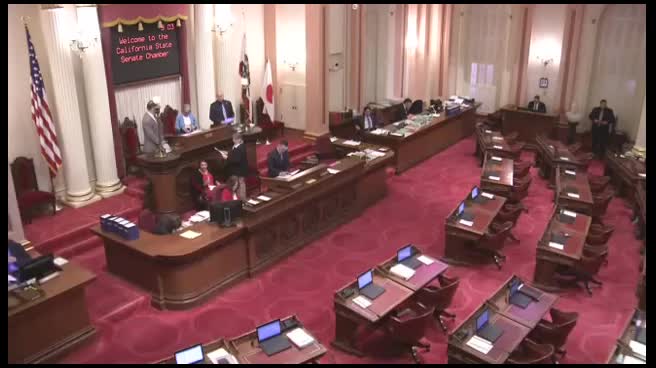 3MIN
Senate Floor
 2MIN
Assembly Floor
 6MIN
Assembly Standing Committee on Judiciary
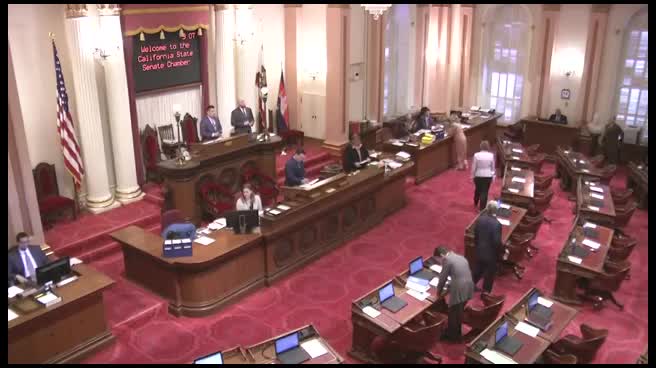 3MIN
Senate Floor
Bill Author

Bill Co-Author(s):