SB 31: Water quality: recycled water.
- Session Year: 2025-2026
- House: Senate
- Latest Version Date: 2025-10-13
Current Status:
Passed
(2025-10-13: Chaptered by Secretary of State. Chapter 736, Statutes of 2025.)
Introduced
In Committee
Awaiting First Chamber Vote
Passed First Chamber
In Committee
Awaiting Second Chamber Vote
Passed Second Chamber
Enacted
(1)The Water Recycling Law generally provides for the use of recycled water. Existing law requires any person who, without regard to intent or negligence, causes or permits an unauthorized discharge of 50,000 gallons or more of recycled water in or on any waters of the state to immediately notify the appropriate regional water board.
This bill would, for the purposes of the above provision, redefine recycled water and provide that water discharged from a decorative body of water during storm events is not to be considered an unauthorized discharge if recycled water was used to restore levels due to evaporation.
(2)Existing law regulating the use of recycled water prohibits the use of prescribed potable water by state and local agencies for any nonpotable uses, including cemeteries, golf courses, parks, and highway landscaped areas if prescribed recycled water is available, and deems use of the recycled water in lieu of the potable water to constitute a reasonable beneficial use of that water.
The bill would provide that incidental amounts of spray, mist, or runoff are to be permitted to enter outdoor eating areas of parks and open spaces when irrigated with disinfected tertiary treated recycled water that complies with a specified regulation regarding irrigation.
(3)Existing law authorizes any public agency, including a state agency, city, county, city and county, district, or any other political subdivision of the state, to require the use of recycled water for irrigation of residential landscaping, as specified.
The bill would provide that outdoor landscape irrigation of common areas that does not enter the boundaries of a residence is not to be considered a part of the same premises as an individual residence and is not to be considered a dual-plumbed system. The bill would require recycled water used for this purpose to comply with specified water quality and cost conditions.
(4)Existing law authorizes any public agency, including a state agency, city, county, city and county, district, or any other political subdivision of the state, to require the use of recycled water for toilet and urinal flushing in structures, as specified. Existing law defines structures for the purposes of these provisions.
This bill would include food handling and processing facilities as part of the definition of structures. The bill would authorize the use of recycled water for toilet or urinal flushing or outdoor irrigation in and around food handling or processing facilities, commercial, institutional, and industrial buildings, and cafeterias, provided the recycled water does not enter the room where food handling or processing occurs, as specified.
(1)The Water Recycling Law generally provides for the use of recycled water. Existing law requires any person who, without regard to intent or negligence, causes or permits an unauthorized discharge of 50,000 gallons or more of recycled water in or on any waters of the state to immediately notify the appropriate regional water board.
This bill would, for the purposes of the above provision, redefine recycled water and provide that water discharged from a decorative body of water during storm events is not to be considered an unauthorized discharge if recycled water was used to restore levels due to evaporation.
(2)Existing law regulating the use of recycled water prohibits the use of prescribed potable water by state and local agencies for any nonpotable uses, including cemeteries, golf courses, parks, and highway landscaped areas if prescribed recycled water is available, and deems use of the recycled water in lieu of the potable water to constitute a reasonable beneficial use of that water.
The bill would provide that incidental amounts of spray, mist, or runoff are to be permitted to enter outdoor eating areas of parks and open spaces when irrigated with disinfected tertiary treated recycled water that complies with a specified regulation regarding irrigation.
(3)Existing law authorizes any public agency, including a state agency, city, county, city and county, district, or any other political subdivision of the state, to require the use of recycled water for irrigation of residential landscaping, as specified.
The bill would provide that outdoor landscape irrigation of common areas operated by a homeowners association, as specified, that does not enter the boundaries of a residence is not to be considered a part of the same premises as an individual residence and is not to be considered a dual-plumbed system and system. The bill would require recycled water used for this purpose to comply with specified provisions. water quality and cost conditions.
(4)Existing law authorizes any public agency, including a state agency, city, county, city and county, district, or any other political subdivision of the state, to require the use of recycled water for toilet and urinal flushing in structures, as specified. Existing law defines structures for the purposes of these provisions.
This bill would include food handling and processing facilities as part of the definition of structures. The bill would authorize the use of recycled water for toilet or urinal flushing or outdoor irrigation in and around food handling or processing facilities, commercial, institutional, and industrial buildings, and cafeterias, provided the recycled water does not enter the room where food handling or processing occurs, as specified.
(1)The Water Recycling Law generally provides for the use of recycled water. Existing law requires any person who, without regard to intent or negligence, causes or permits an unauthorized discharge of 50,000 gallons or more of recycled water in or on any waters of the state to immediately notify the appropriate regional water board.
This bill would, for the purposes of the above provision, redefine recycled water and provide that water discharged from a decorative body of water during storm events is not to be considered an unauthorized discharge if recycled water was used to restore levels due to evaporation.
(2)Existing law regulating the use of recycled water prohibits the use of prescribed potable water by state and local agencies for any nonpotable uses, including cemeteries, golf courses, parks, and highway landscaped areas if prescribed recycled water is available, and deems use of the recycled water in lieu of the potable water to constitute a reasonable beneficial use of that water.
The bill would provide that incidental amounts of spray, mist, or runoff are to be permitted to enter outdoor eating areas of parks and open spaces when irrigated with disinfected tertiary treated recycled water that complies with a specified regulation regarding irrigation.
(3)Existing law authorizes any public agency, including a state agency, city, county, city and county, district, or any other political subdivision of the state, to require the use of recycled water for irrigation of residential landscaping, as specified.
The bill would provide that outdoor landscape irrigation of common areas operated by a homeowners association, as specified, is not to be considered a dual-plumbed system and would require recycled water used for this purpose to comply with specified provisions.
(4)Existing law authorizes any public agency, including a state agency, city, county, city and county, district, or any other political subdivision of the state, to require the use of recycled water for toilet and urinal flushing in structures, as specified. Existing law defines structures for the purposes of these provisions.
This bill would include food handling and processing facilities as part of the definition of structures. The bill would authorize the use of recycled water for toilet or urinal flushing or outdoor irrigation in and around food handling or processing facilities, commercial, institutional, and industrial buildings, and cafeterias, provided the recycled water does not enter the room where food handling or processing occurs, as specified.
(1)The Water Recycling Law generally provides for the use of recycled water. Existing law requires any person who, without regard to intent or negligence, causes or permits an unauthorized discharge of 50,000 gallons or more of recycled water in or on any waters of the state to immediately notify the appropriate regional water board.
This bill would, for the purposes of the above provision, redefine recycled water and provide that water discharged from a decorative body of water during storm events is not to be considered an unauthorized discharge if recycled water was used to restore levels due to evaporation.
(2)Existing law regulating the use of recycled water prohibits the use of prescribed potable water by state and local agencies for any nonpotable uses, including cemeteries, golf courses, parks, and highway landscaped areas if prescribed recycled water is available, and deems use of the recycled water in lieu of the potable water to constitute a reasonable beneficial use of that water.
This bill would add common areas of a residential community irrigated by a homeowners association as prohibited uses of potable water. The bill would provide that incidental amounts of spray, mist, or runoff are to be permitted to enter outdoor eating areas of parks and open spaces when irrigated with disinfected tertiary treated recycled water that complies with a specified regulation regarding irrigation.
(3)Existing law authorizes any public agency, including a state agency, city, county, city and county, district, or any other political subdivision of the state, to require the use of recycled water for irrigation of residential landscaping, as specified.
The bill would provide that outdoor landscape irrigation of common areas operated by a homeowners association, as specified, is not to be considered a dual-plumbed system and would require recycled water used for this purpose to comply with specified provisions.
(4)Existing law authorizes any public agency, including a state agency, city, county, city and county, district, or any other political subdivision of the state, to require the use of recycled water for toilet and urinal flushing in structures, as specified. Existing law defines structures for the purposes of these provisions.
This bill would include food handling and processing facilities as part of the definition of structures. The bill would authorize the use of recycled water for toilet or urinal flushing or outdoor irrigation in and around food handling or processing facilities, commercial, institutional, and industrial buildings, and cafeterias, provided the recycled water does not enter the room where food handling or processing occurs, as specified.
(1)The Water Recycling Law generally provides for the use of recycled water. Existing law requires any person who, without regard to intent or negligence, causes or permits an unauthorized discharge of 50,000 gallons or more of recycled water in or on any waters of the state to immediately notify the appropriate regional water board.
This bill would, for the purposes of the above provision, redefine recycled water and provide that water discharged from a decorative body of water during storm events is not to be considered an unauthorized discharge if recycled water was used to restore levels due to evaporation.
(2)Existing law regulating the use of recycled water prohibits the use of prescribed potable water by state and local agencies for any nonpotable uses, including cemeteries, golf courses, parks, and highway landscaped areas if prescribed recycled water is available, and deems use of the recycled water in lieu of the potable water to constitute a reasonable beneficial use of that water.
This bill would add common areas of a residential community irrigated by a homeowners association as prohibited uses of potable water. The bill would provide that incidental amounts of spray, mist, or runoff are not prohibited from entering to be permitted to enter outdoor eating areas of parks and open spaces when irrigated with disinfected tertiary treated recycled water that complies with specified regulations a specified regulation regarding irrigation.
(3)Existing law authorizes any public agency, including a state agency, city, county, city and county, district, or any other political subdivision of the state, to require the use of recycled water for irrigation of residential landscaping, as specified.
The bill would provide that outdoor landscape irrigation of common areas operated by a homeowners association, as specified, is not to be considered a dual-plumbed system and would require recycled water used for this purpose to comply with specified provisions.
(4)Existing law authorizes any public agency, including a state agency, city, county, city and county, district, or any other political subdivision of the state, to require the use of recycled water for toilet and urinal flushing in structures, as specified. Existing law defines structures for the purposes of these provisions.
This bill would include food handling and processing facilities as part of the definition of structures. The bill would authorize the use of recycled water for toilet or urinal flushing or outdoor irrigation in and around food handling or processing facilities, commercial, institutional, and industrial buildings, and cafeterias, provided the recycled water does not enter the room where food handling or processing occurs, as specified.
(1)The Water Recycling Law generally provides for the use of recycled water. Existing law requires any person who, without regard to intent or negligence, causes or permits an unauthorized discharge of 50,000 gallons or more of recycled water in or on any waters of the state to immediately notify the appropriate regional water board.
This bill would, for the purposes of the above provision, redefine recycled water and provide that water discharged from a decorative body of water during storm events is not to be considered an unauthorized discharge if recycled water was used to restore levels due to evaporation.
(2)Existing law regulating the use of recycled water prohibits the use of prescribed potable water by state and local agencies for any nonpotable uses, including cemeteries, golf courses, parks, and highway landscaped areas if prescribed recycled water is available, and deems use of the recycled water in lieu of the potable water to constitute a reasonable beneficial use of that water.
This bill would add common areas of a residential community irrigated by a homeowners association as prohibited uses of potable water. The bill would provide that incidental amounts of spray, mist, or runoff are not prohibited from entering outdoor eating areas of parks and open spaces when irrigated with disinfected tertiary recycled water that complies with specified regulations regarding irrigation.
(3)Existing law authorizes any public agency, including a state agency, city, county, city and county, district, or any other political subdivision of the state, to require the use of recycled water for irrigation of residential landscaping, as specified.
The bill would provide that outdoor landscape irrigation of common areas operated by a homeowners association, as specified, is not to be considered a dual-plumbed system and would require recycled water used for this purpose to comply with specified provisions.
(4)Existing law authorizes any public agency, including a state agency, city, county, city and county, district, or any other political subdivision of the state, to require the use of recycled water for toilet and urinal flushing in structures, as specified. Existing law defines structures for the purposes of these provisions.
This bill would include food handling and processing facilities as part of the definition of structures. The bill would authorize the use of recycled water for toilet or urinal flushing or outdoor irrigation in and around food handling or processing facilities, commercial, institutional, and industrial buildings, and cafeterias, provided the recycled water does not enter the room where food handling or processing occurs, as specified.
Existing law states the intention of the Legislature that the state undertake all possible steps to encourage development of water recycling facilities so that recycled water may be made available to help meet the growing water requirements of the state.This bill would make a nonsubstantive change to that statement.Existing law states the intention of the Legislature that the state undertake all possible steps to encourage development of water recycling facilities so that recycled water may be made available to help meet the growing water requirements of the state.
This bill would make a nonsubstantive change to that statement.
The Legislature finds and declares all of the following:
(a)Californias Water Supply Strategy, a multiagency strategy document published in August 2022 by the Newsom administration, sets a goal to reuse at least 800,000 acre-feet of water per year by 2030 and 1.8 million acre-feet by the year 2040.
(b)Section 13521 of the Water Code requires the State Water Resources Control Board to establish uniform statewide recycling criteria for each varying type of use of recycled water where the use involves the protection of public health.
(c)The regulations establishing the uniform statewide criteria for recycled water uses are set forth in Chapter 3 (commencing with Section 60301.050) of Division 4 of Title 22 of the California Code of Regulations. Most of the regulations that pertain to nonpotable recycled water uses have not been reviewed and updated since the year 2000.
(d)Achieving increased use of recycled water to help droughtproof California communities requires regulations to keep pace with the best available science and technology regarding recycled water use.
SEC. 2.Section 13529.2 of the Water Code is amended to read:13529.2.(a)Any person who, without regard to intent or negligence, causes or permits an unauthorized discharge of 50,000 gallons or more of recycled water, as defined in subdivision (c), or 1,000 gallons or more of recycled water, as defined in subdivision (d), in or on any waters of the state, or causes or permits such unauthorized discharge to be discharged where it is, or probably will be, discharged in or on any waters of the state, shall, as soon as (1) that person has knowledge of the discharge, (2) notification is possible, and (3) notification can be provided without substantially impeding cleanup or other emergency measures, immediately notify the appropriate regional board.
(b)For the purposes of this section, an unauthorized discharge means a discharge not authorized by waste discharge requirements pursuant to Article 4 (commencing with Section 13260) of Chapter 4, water reclamation requirements pursuant to Section 13523, a master reclamation permit pursuant to Section 13523.1, or any other provision of this division.
(c)For the purposes of this section, recycled water means wastewater treated as disinfected tertiary 2.2 recycled water, as defined or described by the State Department of Health Care Services or wastewater receiving advanced treatment beyond disinfected tertiary 2.2 recycled water once it completes the required treatment process and enters a storage tank, pipeline, or canal for conveyance or distribution.
(d)For purposes of this section, recycled water means recycled water, as defined in subdivision (n) of Section 13050, which is treated at a level less than disinfected tertiary 2.2 recycled water, as defined or described by the State Department of Health Care Services.
(e)For the purposes of this section, water discharged from a decorative body of water during storm events shall not be considered an unauthorized discharge if recycled water was used to restore levels due to evaporation. For purposes of this subdivision, decorative body of water means an impoundment for aesthetic enjoyment or landscape irrigation, or which otherwise serves a similar use or function, in which recycled water is stored or used and is not intended to include public contact.
(f)The requirements in this section supplement, and shall not supplant, any other provisions of law.
SEC. 3.Section 13551 of the Water Code is amended to read:13551.(a)A person or public agency, including a state agency, city, county, city and county, district, or any other political subdivision of the state, shall not use water from any source of quality suitable for potable domestic use for nonpotable uses, including cemeteries, golf courses, parks, highway landscaped areas, and industrial and irrigation uses if suitable recycled water is available as provided in Section 13550.
(b)Notwithstanding subdivision (a), any use of recycled water in lieu of water suitable for potable domestic use shall, to the extent of the recycled water so used, be deemed to constitute a reasonable beneficial use of that water and the use of recycled water shall not cause any loss or diminution of any existing water right.
(c)Incidental amounts of spray, mist, or runoff shall be permitted to enter outdoor eating areas of parks and open spaces when irrigated with disinfected tertiary treated recycled water that complies with Section 493.4 of Title 23 of the California Code of Regulations.
SEC. 4.Section 13552.4 of the Water Code is amended to read:13552.4.(a)Any public agency, including a state agency, city, county, city and county, district, or any other political subdivision of the state, may require the use of recycled water for irrigation of residential landscaping, if all of the following requirements are met:
(1)Recycled water, for this use, is available to the user and meets the requirements set forth in Section 13550, as determined by the state board after notice and a hearing.
(2)The use of recycled water does not cause any loss or diminution of any existing water right.
(3)The irrigation systems are constructed in accordance with Chapter 3 (commencing with Section 60301.050) of Division 4 of Title 22 of the California Code of Regulations.
(b)This section applies to both of the following:
(1)New subdivisions for which the building permit is issued on or after March 15, 1994, or, if a building permit is not required, new structures for which construction begins on or after March 15, 1994, for which the state board has approved the use of recycled water.
(2)Any residence that is retrofitted to permit the use of recycled water for landscape irrigation and for which the state board has approved the use of recycled water.
(c)(1)Division 13 (commencing with Section 21000) of the Public Resources Code does not apply to any project that only involves the repiping, redesign, or use of recycled water for irrigation of residential landscaping necessary to comply with a requirement prescribed by a public agency under subdivision (a).
(2)The exemption in paragraph (1) does not apply to any project to develop recycled water, to construct conveyance facilities for recycled water, or any other project not specified in this subdivision.
(d)Outdoor landscape irrigation of common areas that does not enter the boundaries of a residence is not to be considered a part of the same premises as an individual residence and shall not be considered a dual plumbed system. Recycled water used for this purpose shall comply with Section 13550.
SEC. 5.Section 13553 of the Water Code is amended to read:13553.(a)The Legislature hereby finds and declares that the use of potable domestic water for toilet and urinal flushing in structures is a waste or an unreasonable use of water within the meaning of Section 2 of Article X of the California Constitution if recycled water, for these uses, is available to the user and meets the requirements set forth in Section 13550, as determined by the state board after notice and a hearing.
(b)The state board may require a public agency or person subject to this section to furnish any information that may be relevant to making the determination required in subdivision (a).
(c)For purposes of this section and Section 13554, structure or structures means commercial, retail, and office buildings, theaters, auditoriums, condominium projects, schools, hotels, apartments, barracks, dormitories, jails, prisons, food handling and processing facilities, reformatories, and other structures as determined by the state board.
(d)Recycled water may be used in condominium projects, as defined in Section 4125 or 6542 of the Civil Code, subject to all of the following conditions:
(1)Prior to the indoor use of recycled water in any condominium project, the agency delivering the recycled water to the condominium project shall file a report with, and receive written approval of the report from, the state board. The report shall be consistent with the provisions of Title 22 of the California Code of Regulations generally applicable to dual-plumbed structures and shall include all the following:
(A)That potable water service to each condominium project will be provided with a backflow protection device approved by the state board to protect the agencys public water system, as defined in Section 116275 of the Health and Safety Code. The backflow protection device approved by the state board shall be inspected and tested annually by a person certified in the inspection of backflow prevention devices.
(B)That any plumbing modifications in the condominium unit or any physical alteration of the structure will be done in compliance with state and local plumbing codes.
(C)That each condominium project will be tested by the recycled water agency or the responsible local agency at least once every four years to ensure that there are no indications of a possible cross connection between the condominiums potable and nonpotable systems.
(D)That recycled water lines will be color coded consistent with current statutes and regulations.
(2)The recycled water agency or the responsible local agency shall maintain records of all tests and annual inspections conducted.
(3)The condominiums declaration, as defined in Section 4135 or 6546 of the Civil Code, shall provide that the laws and regulations governing recycled water apply, shall not permit any exceptions to those laws and regulations, shall incorporate the report described in paragraph (1), and shall contain the following statement:
NOTICE OF USE OF RECYCLED WATER
This property is approved by the State Water Resources Control Board for the use of recycled water for toilet and urinal flushing. This water is not potable, is not suitable for indoor purposes other than toilet and urinal flushing purposes, and requires dual plumbing. Alterations and modifications to the plumbing system require a permit and are prohibited without first consulting with the appropriate local building code enforcement agency and your property management company or owners association to ensure that the recycled water is not mixed with the drinking water.
(e)The state board may adopt regulations as necessary to assist in the implementation of this section.
(f)This section shall only apply to condominium projects that are created, within the meaning of Section 4030 or 6580 of the Civil Code, on or after January 1, 2008.
(g)This section and Section 13554 do not apply to a pilot program adopted pursuant to Section 13553.1.
SEC. 6.Section 13554 of the Water Code is amended to read:13554.(a)Any public agency, including a state agency, city, county, city and county, district, or any other political subdivision of the state, may require the use of recycled water for toilet and urinal flushing in structures, except a mental hospital or other facility operated by a public agency for the treatment of persons with mental disorders, if all of the following requirements are met:
(1)Recycled water, for these uses, is available to the user and meets the requirements set forth in Section 13550, as determined by the state board after notice and a hearing.
(2)The use of recycled water does not cause any loss or diminution of any existing water right.
(3)The public agency has prepared an engineering report pursuant to Section 60323 of Title 22 of the California Code of Regulations that includes plumbing design, cross-connection control, and monitoring requirements for the use site, which are in compliance with criteria established pursuant to Section 13521.
(b)This section applies only to either of the following:
(1)New structures for which the building permit is issued on or after March 15, 1992, or, if a building permit is not required, new structures for which construction begins on or after March 15, 1992.
(2)Any construction pursuant to subdivision (a) for which the State Department of Public Health has, before January 1, 1992, approved the use of recycled water.
(c)Division 13 (commencing with Section 21000) of the Public Resources Code does not apply to any project which only involves the repiping, redesign, or use of recycled water by a structure necessary to comply with a requirement issued by a public agency under subdivision (a). This exemption does not apply to any project to develop recycled water, to construct conveyance facilities for recycled water, or any other project not specified in this subdivision.
(d)(1)Recycled water for toilet or urinal flushing or outdoor irrigation shall be permissible in and around food handling or processing facilities, commercial, institutional, and industrial buildings, and cafeterias, provided the recycled water does not enter the room where food handling or processing occurs.
(2)Closed piping conveying recycled water may pass through the room where food handling or processing occurs.
(3)Outdoor irrigation with recycled water at facilities that handle or process food outside is prohibited while food is being handled or processed outside.
The Legislature finds and declares all of the following:
(a)Californias Water Supply Strategy, a multiagency strategy document published in August 2022 by the Newsom administration, sets a goal to reuse at least 800,000 acre-feet of water per year by 2030 and 1.8 million acre-feet by the year 2040.
(b)Section 13521 of the Water Code requires the State Water Resources Control Board to establish uniform statewide recycling criteria for each varying type of use of recycled water where the use involves the protection of public health.
(c)The regulations establishing the uniform statewide criteria for recycled water uses are set forth in Chapter 3 (commencing with Section 60301.050) of Division 4 of Title 22 of the California Code of Regulations. Most of the regulations that pertain to nonpotable recycled water uses have not been reviewed and updated since the year 2000.
(d)Achieving increased use of recycled water to help droughtproof California communities requires regulations to keep pace with the best available science and technology regarding recycled water use.
SEC. 2.Section 13529.2 of the Water Code is amended to read:13529.2.(a)Any person who, without regard to intent or negligence, causes or permits an unauthorized discharge of 50,000 gallons or more of recycled water, as defined in subdivision (c), or 1,000 gallons or more of recycled water, as defined in subdivision (d), in or on any waters of the state, or causes or permits such unauthorized discharge to be discharged where it is, or probably will be, discharged in or on any waters of the state, shall, as soon as (1) that person has knowledge of the discharge, (2) notification is possible, and (3) notification can be provided without substantially impeding cleanup or other emergency measures, immediately notify the appropriate regional board.
(b)For the purposes of this section, an unauthorized discharge means a discharge not authorized by waste discharge requirements pursuant to Article 4 (commencing with Section 13260) of Chapter 4, water reclamation requirements pursuant to Section 13523, a master reclamation permit pursuant to Section 13523.1, or any other provision of this division.
(c)For the purposes of this section, recycled water means wastewater treated as disinfected tertiary 2.2 recycled water, as defined or described by the State Department of Health Care Services or wastewater receiving advanced treatment beyond disinfected tertiary 2.2 recycled water once it completes the required treatment process and enters a storage tank, pipeline, or canal for conveyance or distribution.
(d)For purposes of this section, recycled water means recycled water, as defined in subdivision (n) of Section 13050, which is treated at a level less than disinfected tertiary 2.2 recycled water, as defined or described by the State Department of Health Care Services.
(e)For the purposes of this section, water discharged from a decorative body of water during storm events shall not be considered an unauthorized discharge if recycled water was used to restore levels due to evaporation. For purposes of this subdivision, decorative body of water means an impoundment for aesthetic enjoyment or landscape irrigation, or which otherwise serves a similar use or function, in which recycled water is stored or used and is not intended to include public contact.
(f)The requirements in this section supplement, and shall not supplant, any other provisions of law.
SEC. 3.Section 13551 of the Water Code is amended to read:13551.(a)A person or public agency, including a state agency, city, county, city and county, district, or any other political subdivision of the state, shall not use water from any source of quality suitable for potable domestic use for nonpotable uses, including cemeteries, golf courses, parks, highway landscaped areas, and industrial and irrigation uses if suitable recycled water is available as provided in Section 13550.
(b)Notwithstanding subdivision (a), any use of recycled water in lieu of water suitable for potable domestic use shall, to the extent of the recycled water so used, be deemed to constitute a reasonable beneficial use of that water and the use of recycled water shall not cause any loss or diminution of any existing water right.
(c)Incidental amounts of spray, mist, or runoff shall be permitted to enter outdoor eating areas of parks and open spaces when irrigated with disinfected tertiary treated recycled water that complies with Section 493.4 of Title 23 of the California Code of Regulations.
SEC. 4.Section 13552.4 of the Water Code is amended to read:13552.4.(a)Any public agency, including a state agency, city, county, city and county, district, or any other political subdivision of the state, may require the use of recycled water for irrigation of residential landscaping, if all of the following requirements are met:
(1)Recycled water, for this use, is available to the user and meets the requirements set forth in Section 13550, as determined by the state board after notice and a hearing.
(2)The use of recycled water does not cause any loss or diminution of any existing water right.
(3)The irrigation systems are constructed in accordance with Chapter 3 (commencing with Section 60301.050) of Division 4 of Title 22 of the California Code of Regulations.
(b)This section applies to both of the following:
(1)New subdivisions for which the building permit is issued on or after March 15, 1994, or, if a building permit is not required, new structures for which construction begins on or after March 15, 1994, for which the State Department of Public Health state board has approved the use of recycled water.
(2)Any residence that is retrofitted to permit the use of recycled water for landscape irrigation and for which the State Department of Public Health state board has approved the use of recycled water.
(c)(1)Division 13 (commencing with Section 21000) of the Public Resources Code does not apply to any project that only involves the repiping, redesign, or use of recycled water for irrigation of residential landscaping necessary to comply with a requirement prescribed by a public agency under subdivision (a).
(2)The exemption in paragraph (1) does not apply to any project to develop recycled water, to construct conveyance facilities for recycled water, or any other project not specified in this subdivision.
(d)Outdoor landscape irrigation of common areas operated by a homeowners association that does not enter the boundaries of a residence is not to be considered a part of the same premises as an individual residence and shall not be considered a dual plumbed system. Recycled water used for this purpose shall comply with Section 13550.
SEC. 5.Section 13553 of the Water Code is amended to read:13553.(a)The Legislature hereby finds and declares that the use of potable domestic water for toilet and urinal flushing in structures is a waste or an unreasonable use of water within the meaning of Section 2 of Article X of the California Constitution if recycled water, for these uses, is available to the user and meets the requirements set forth in Section 13550, as determined by the state board after notice and a hearing.
(b)The state board may require a public agency or person subject to this section to furnish any information that may be relevant to making the determination required in subdivision (a).
(c)For purposes of this section and Section 13554, structure or structures means commercial, retail, and office buildings, theaters, auditoriums, condominium projects, schools, hotels, apartments, barracks, dormitories, jails, prisons, food handling and processing facilities, reformatories, and other structures as determined by the State Department of Public Health. state board.
(d)Recycled water may be used in condominium projects, as defined in Section 4125 or 6542 of the Civil Code, subject to all of the following conditions:
(1)Prior to the indoor use of recycled water in any condominium project, the agency delivering the recycled water to the condominium project shall file a report with, and receive written approval of the report from, the State Department of Public Health. state board. The report shall be consistent with the provisions of Title 22 of the California Code of Regulations generally applicable to dual-plumbed structures and shall include all the following:
(A)That potable water service to each condominium project will be provided with a backflow protection device approved by the State Department of Public Health state board to protect the agencys public water system, as defined in Section 116275 of the Health and Safety Code. The backflow protection device approved by the State Department of Public Health state board shall be inspected and tested annually by a person certified in the inspection of backflow prevention devices.
(B)That any plumbing modifications in the condominium unit or any physical alteration of the structure will be done in compliance with state and local plumbing codes.
(C)That each condominium project will be tested by the recycled water agency or the responsible local agency at least once every four years to ensure that there are no indications of a possible cross connection between the condominiums potable and nonpotable systems.
(D)That recycled water lines will be color coded consistent with current statutes and regulations.
(2)The recycled water agency or the responsible local agency shall maintain records of all tests and annual inspections conducted.
(3)The condominiums declaration, as defined in Section 4135 or 6546 of the Civil Code, shall provide that the laws and regulations governing recycled water apply, shall not permit any exceptions to those laws and regulations, shall incorporate the report described in paragraph (1), and shall contain the following statement:
NOTICE OF USE OF RECYCLED WATER
This property is approved by the State Department of Public Health Water Resources Control Board for the use of recycled water for toilet and urinal flushing. This water is not potable, is not suitable for indoor purposes other than toilet and urinal flushing purposes, and requires dual plumbing. Alterations and modifications to the plumbing system require a permit and are prohibited without first consulting with the appropriate local building code enforcement agency and your property management company or owners association to ensure that the recycled water is not mixed with the drinking water.
(e)The State Department of Public Health state board may adopt regulations as necessary to assist in the implementation of this section.
(f)This section shall only apply to condominium projects that are created, within the meaning of Section 4030 or 6580 of the Civil Code, on or after January 1, 2008.
(g)This section and Section 13554 do not apply to a pilot program adopted pursuant to Section 13553.1.
SEC. 6.Section 13554 of the Water Code is amended to read:13554.(a)Any public agency, including a state agency, city, county, city and county, district, or any other political subdivision of the state, may require the use of recycled water for toilet and urinal flushing in structures, except a mental hospital or other facility operated by a public agency for the treatment of persons with mental disorders, if all of the following requirements are met:
(1)Recycled water, for these uses, is available to the user and meets the requirements set forth in Section 13550, as determined by the state board after notice and a hearing.
(2)The use of recycled water does not cause any loss or diminution of any existing water right.
(3)The public agency has prepared an engineering report pursuant to Section 60323 of Title 22 of the California Code of Regulations that includes plumbing design, cross-connection control, and monitoring requirements for the use site, which are in compliance with criteria established pursuant to Section 13521.
(b)This section applies only to either of the following:
(1)New structures for which the building permit is issued on or after March 15, 1992, or, if a building permit is not required, new structures for which construction begins on or after March 15, 1992.
(2)Any construction pursuant to subdivision (a) for which the State Department of Public Health has, before January 1, 1992, approved the use of recycled water.
(c)Division 13 (commencing with Section 21000) of the Public Resources Code does not apply to any project which only involves the repiping, redesign, or use of recycled water by a structure necessary to comply with a requirement issued by a public agency under subdivision (a). This exemption does not apply to any project to develop recycled water, to construct conveyance facilities for recycled water, or any other project not specified in this subdivision.
(d)(1)Recycled water for toilet or urinal flushing or outdoor irrigation shall be permissible in and around food handling or processing facilities, commercial, institutional, and industrial buildings, and cafeterias, provided the recycled water does not enter the room where food handling or processing occurs.
(2)Closed piping conveying recycled water may pass through the room where food handling or processing occurs.
(3)Outdoor irrigation with recycled water at facilities that handle or process food outside is prohibited while food is being handled or processed outside.
REVISIONS: HeadingLine 4.The Legislature finds and declares all of the following:
(a)Californias Water Supply Strategy, a multiagency strategy document published in August 2022 by the Newsom administration, sets a goal to reuse at least 800,000 acre-feet of water per year by 2030 and 1.8 million acre-feet by the year 2040.
(b)Section 13521 of the Water Code requires the State Water Resources Control Board to establish uniform statewide recycling criteria for each varying type of use of recycled water where the use involves the protection of public health.
(c)The regulations establishing the uniform statewide criteria for recycled water uses are set forth in Chapter 3 (commencing with Section 60301.050) of Division 4 of Title 22 of the California Code of Regulations. Most of the regulations that pertain to nonpotable recycled water uses have not been reviewed and updated since the year 2000.
(d)Achieving increased use of recycled water to help droughtproof California communities requires regulations to keep pace with the best available science and technology regarding recycled water use.
SEC. 2.Section 13529.2 of the Water Code is amended to read:13529.2.(a)Any person who, without regard to intent or negligence, causes or permits an unauthorized discharge of 50,000 gallons or more of recycled water, as defined in subdivision (c), or 1,000 gallons or more of recycled water, as defined in subdivision (d), in or on any waters of the state, or causes or permits such unauthorized discharge to be discharged where it is, or probably will be, discharged in or on any waters of the state, shall, as soon as (1) that person has knowledge of the discharge, (2) notification is possible, and (3) notification can be provided without substantially impeding cleanup or other emergency measures, immediately notify the appropriate regional board.
(b)For the purposes of this section, an unauthorized discharge means a discharge not authorized by waste discharge requirements pursuant to Article 4 (commencing with Section 13260) of Chapter 4, water reclamation requirements pursuant to Section 13523, a master reclamation permit pursuant to Section 13523.1, or any other provision of this division.
(c)For the purposes of this section, recycled water means wastewater treated as disinfected tertiary 2.2 recycled water, as defined or described by the State Department of Health Care Services or wastewater receiving advanced treatment beyond disinfected tertiary 2.2 recycled water once it completes the required treatment process and enters a storage tank, pipeline, or canal for conveyance or distribution.
(d)For purposes of this section, recycled water means recycled water, as defined in subdivision (n) of Section 13050, which is treated at a level less than disinfected tertiary 2.2 recycled water, as defined or described by the State Department of Health Care Services.
(e)For the purposes of this section, water discharged from a decorative body of water during storm events shall not to be considered an unauthorized discharge if recycled water was used to restore levels due to evaporation. For purposes of this subdivision, decorative body of water means an impoundment for aesthetic enjoyment or landscape irrigation, or which otherwise serves a similar use or function, in which recycled water is stored or used and is not intended to include public contact.
(f)The requirements in this section supplement, and shall not supplant, any other provisions of law.
SEC. 3.Section 13551 of the Water Code is amended to read:13551.(a)A person or public agency, including a state agency, city, county, city and county, district, or any other political subdivision of the state, shall not use water from any source of quality suitable for potable domestic use for nonpotable uses, including cemeteries, golf courses, parks, highway landscaped areas, and industrial and irrigation uses if suitable recycled water is available as provided in Section 13550.
(b)Notwithstanding subdivision (a), any use of recycled water in lieu of water suitable for potable domestic use shall, to the extent of the recycled water so used, be deemed to constitute a reasonable beneficial use of that water and the use of recycled water shall not cause any loss or diminution of any existing water right.
(c)Incidental amounts of spray, mist, or runoff shall be permitted to enter outdoor eating areas of parks and open spaces when irrigated with disinfected tertiary treated recycled water that complies with Section 493.4 of Title 23 of the California Code of Regulations.
SEC. 4.Section 13552.4 of the Water Code is amended to read:13552.4.(a)Any public agency, including a state agency, city, county, city and county, district, or any other political subdivision of the state, may require the use of recycled water for irrigation of residential landscaping, if all of the following requirements are met:
(1)Recycled water, for this use, is available to the user and meets the requirements set forth in Section 13550, as determined by the state board after notice and a hearing.
(2)The use of recycled water does not cause any loss or diminution of any existing water right.
(3)The irrigation systems are constructed in accordance with Chapter 3 (commencing with Section 60301.050) of Division 4 of Title 22 of the California Code of Regulations.
(b)This section applies to both of the following:
(1)New subdivisions for which the building permit is issued on or after March 15, 1994, or, if a building permit is not required, new structures for which construction begins on or after March 15, 1994, for which the State Department of Public Health has approved the use of recycled water.
(2)Any residence that is retrofitted to permit the use of recycled water for landscape irrigation and for which the State Department of Public Health has approved the use of recycled water.
(c)(1)Division 13 (commencing with Section 21000) of the Public Resources Code does not apply to any project that only involves the repiping, redesign, or use of recycled water for irrigation of residential landscaping necessary to comply with a requirement prescribed by a public agency under subdivision (a).
(2)The exemption in paragraph (1) does not apply to any project to develop recycled water, to construct conveyance facilities for recycled water, or any other project not specified in this subdivision.
(d)Outdoor landscape irrigation of common areas operated by a homeowners association that does not enter the boundaries of a residence is not to be considered a part of the same premises as an individual residence and shall not be considered a dual plumbed system. Recycled water used for this purpose shall comply with Section 13550.
SEC. 5.Section 13553 of the Water Code is amended to read:13553.(a)The Legislature hereby finds and declares that the use of potable domestic water for toilet and urinal flushing in structures is a waste or an unreasonable use of water within the meaning of Section 2 of Article X of the California Constitution if recycled water, for these uses, is available to the user and meets the requirements set forth in Section 13550, as determined by the state board after notice and a hearing.
(b)The state board may require a public agency or person subject to this section to furnish any information that may be relevant to making the determination required in subdivision (a).
(c)For purposes of this section and Section 13554, structure or structures means commercial, retail, and office buildings, theaters, auditoriums, condominium projects, schools, hotels, apartments, barracks, dormitories, jails, prisons, food handling and processing facilities, reformatories, and other structures as determined by the State Department of Public Health.
(d)Recycled water may be used in condominium projects, as defined in Section 4125 or 6542 of the Civil Code, subject to all of the following conditions:
(1)Prior to the indoor use of recycled water in any condominium project, the agency delivering the recycled water to the condominium project shall file a report with, and receive written approval of the report from, the State Department of Public Health. The report shall be consistent with the provisions of Title 22 of the California Code of Regulations generally applicable to dual-plumbed structures and shall include all the following:
(A)That potable water service to each condominium project will be provided with a backflow protection device approved by the State Department of Public Health to protect the agencys public water system, as defined in Section 116275 of the Health and Safety Code. The backflow protection device approved by the State Department of Public Health shall be inspected and tested annually by a person certified in the inspection of backflow prevention devices.
(B)That any plumbing modifications in the condominium unit or any physical alteration of the structure will be done in compliance with state and local plumbing codes.
(C)That each condominium project will be tested by the recycled water agency or the responsible local agency at least once every four years to ensure that there are no indications of a possible cross connection between the condominiums potable and nonpotable systems.
(D)That recycled water lines will be color coded consistent with current statutes and regulations.
(2)The recycled water agency or the responsible local agency shall maintain records of all tests and annual inspections conducted.
(3)The condominiums declaration, as defined in Section 4135 or 6546 of the Civil Code, shall provide that the laws and regulations governing recycled water apply, shall not permit any exceptions to those laws and regulations, shall incorporate the report described in paragraph (1), and shall contain the following statement:
NOTICE OF USE OF RECYCLED WATER
This property is approved by the State Department of Public Health for the use of recycled water for toilet and urinal flushing. This water is not potable, is not suitable for indoor purposes other than toilet and urinal flushing purposes, and requires dual plumbing. Alterations and modifications to the plumbing system require a permit and are prohibited without first consulting with the appropriate local building code enforcement agency and your property management company or owners association to ensure that the recycled water is not mixed with the drinking water.
(e)The State Department of Public Health may adopt regulations as necessary to assist in the implementation of this section.
(f)This section shall only apply to condominium projects that are created, within the meaning of Section 4030 or 6580 of the Civil Code, on or after January 1, 2008.
(g)This section and Section 13554 do not apply to a pilot program adopted pursuant to Section 13553.1.
SEC. 6.Section 13554 of the Water Code is amended to read:13554.(a)Any public agency, including a state agency, city, county, city and county, district, or any other political subdivision of the state, may require the use of recycled water for toilet and urinal flushing in structures, except a mental hospital or other facility operated by a public agency for the treatment of persons with mental disorders, if all of the following requirements are met:
(1)Recycled water, for these uses, is available to the user and meets the requirements set forth in Section 13550, as determined by the state board after notice and a hearing.
(2)The use of recycled water does not cause any loss or diminution of any existing water right.
(3)The public agency has prepared an engineering report pursuant to Section 60323 of Title 22 of the California Code of Regulations that includes plumbing design, cross-connection control, and monitoring requirements for the use site, which are in compliance with criteria established pursuant to Section 13521.
(b)This section applies only to either of the following:
(1)New structures for which the building permit is issued on or after March 15, 1992, or, if a building permit is not required, new structures for which construction begins on or after March 15, 1992.
(2)Any construction pursuant to subdivision (a) for which the State Department of Public Health has, before January 1, 1992, approved the use of recycled water.
(c)Division 13 (commencing with Section 21000) of the Public Resources Code does not apply to any project which only involves the repiping, redesign, or use of recycled water by a structure necessary to comply with a requirement issued by a public agency under subdivision (a). This exemption does not apply to any project to develop recycled water, to construct conveyance facilities for recycled water, or any other project not specified in this subdivision.
(d)(1)Recycled water for toilet or urinal flushing or outdoor irrigation shall be permissible in and around food handling or processing facilities, commercial, institutional, and industrial buildings, and cafeterias, provided the recycled water does not enter the room where food handling or processing occurs.
(2)Closed piping conveying recycled water may pass through the room where food handling or processing occurs.
(3)Outdoor irrigation with recycled water at facilities that handle or process food outside is prohibited while food is being handled or processed outside.
The Legislature finds and declares all of the following:
(a)Californias Water Supply Strategy, a multiagency strategy document published in August 2022 by the Newsom administration, sets a goal to reuse at least 800,000 acre-feet of water per year by 2030 and 1.8 million acre-feet by the year 2040.
(b)Section 13521 of the Water Code requires the State Water Resources Control Board to establish uniform statewide recycling criteria for each varying type of use of recycled water where the use involves the protection of public health.
(c)The regulations establishing the uniform statewide criteria for recycled water uses are set forth in Chapter 3 (commencing with Section 60301.050) of Division 4 of Title 22 of the California Code of Regulations. Most of the regulations that pertain to nonpotable recycled water uses have not been reviewed and updated since the year 2000.
(d)Achieving increased use of recycled water to help droughtproof California communities requires regulations to keep pace with the best available science and technology regarding recycled water use.
SEC. 2.Section 13529.2 of the Water Code is amended to read:13529.2.(a)Any person who, without regard to intent or negligence, causes or permits an unauthorized discharge of 50,000 gallons or more of recycled water, as defined in subdivision (c), or 1,000 gallons or more of recycled water, as defined in subdivision (d), in or on any waters of the state, or causes or permits such unauthorized discharge to be discharged where it is, or probably will be, discharged in or on any waters of the state, shall, as soon as (1) that person has knowledge of the discharge, (2) notification is possible, and (3) notification can be provided without substantially impeding cleanup or other emergency measures, immediately notify the appropriate regional board.
(b)For the purposes of this section, an unauthorized discharge means a discharge not authorized by waste discharge requirements pursuant to Article 4 (commencing with Section 13260) of Chapter 4, water reclamation requirements pursuant to Section 13523, a master reclamation permit pursuant to Section 13523.1, or any other provision of this division.
(c)For the purposes of this section, recycled water means wastewater treated as disinfected tertiary 2.2 recycled water, as defined or described by the State Department of Health Care Services or wastewater receiving advanced treatment beyond disinfected tertiary 2.2 recycled water once it completes the required treatment process and enters a storage tank, pipeline, or canal for conveyance or distribution.
(d)For purposes of this section, recycled water means recycled water, as defined in subdivision (n) of Section 13050, which is treated at a level less than disinfected tertiary 2.2 recycled water, as defined or described by the State Department of Health Care Services.
(e)For the purposes of this section, water discharged from a decorative body of water during storm events shall not to be considered an unauthorized discharge if recycled water was used to restore levels due to evaporation. For purposes of this subdivision, decorative body of water means an impoundment for aesthetic enjoyment or landscape irrigation, or which otherwise serves a similar use or function, in which recycled water is stored or used and is not intended to include public contact.
(f)The requirements in this section supplement, and shall not supplant, any other provisions of law.
SEC. 3.Section 13551 of the Water Code is amended to read:13551.(a)A person or public agency, including a state agency, city, county, city and county, district, or any other political subdivision of the state, shall not use water from any source of quality suitable for potable domestic use for nonpotable uses, including cemeteries, golf courses, parks, highway landscaped areas, common areas of a residential community irrigated by a homeowners association, and industrial and irrigation uses if suitable recycled water is available as provided in Section 13550.
(b)Notwithstanding subdivision (a), any use of recycled water in lieu of water suitable for potable domestic use shall, to the extent of the recycled water so used, be deemed to constitute a reasonable beneficial use of that water and the use of recycled water shall not cause any loss or diminution of any existing water right.
(c)Incidental amounts of spray, mist, or runoff shall be permitted to enter outdoor eating areas of parks and open spaces when irrigated with disinfected tertiary treated recycled water that complies with Section 493.4 of Title 23 of the California Code of Regulations.
SEC. 4.Section 13552.4 of the Water Code is amended to read:13552.4.(a)Any public agency, including a state agency, city, county, city and county, district, or any other political subdivision of the state, may require the use of recycled water for irrigation of residential landscaping, if all of the following requirements are met:
(1)Recycled water, for this use, is available to the user and meets the requirements set forth in Section 13550, as determined by the state board after notice and a hearing.
(2)The use of recycled water does not cause any loss or diminution of any existing water right.
(3)The irrigation systems are constructed in accordance with Chapter 3 (commencing with Section 60301.050) of Division 4 of Title 22 of the California Code of Regulations.
(b)This section applies to both of the following:
(1)New subdivisions for which the building permit is issued on or after March 15, 1994, or, if a building permit is not required, new structures for which construction begins on or after March 15, 1994, for which the State Department of Public Health has approved the use of recycled water.
(2)Any residence that is retrofitted to permit the use of recycled water for landscape irrigation and for which the State Department of Public Health has approved the use of recycled water.
(c)(1)Division 13 (commencing with Section 21000) of the Public Resources Code does not apply to any project that only involves the repiping, redesign, or use of recycled water for irrigation of residential landscaping necessary to comply with a requirement prescribed by a public agency under subdivision (a).
(2)The exemption in paragraph (1) does not apply to any project to develop recycled water, to construct conveyance facilities for recycled water, or any other project not specified in this subdivision.
(d)Outdoor landscape irrigation of common areas operated by a homeowners association that does not enter the boundaries of a residence is not to be considered a part of the same premises as an individual residence and shall not be considered a dual plumbed system. Recycled water used for this purpose shall comply with Section 13550.
SEC. 5.Section 13553 of the Water Code is amended to read:13553.(a)The Legislature hereby finds and declares that the use of potable domestic water for toilet and urinal flushing in structures is a waste or an unreasonable use of water within the meaning of Section 2 of Article X of the California Constitution if recycled water, for these uses, is available to the user and meets the requirements set forth in Section 13550, as determined by the state board after notice and a hearing.
(b)The state board may require a public agency or person subject to this section to furnish any information that may be relevant to making the determination required in subdivision (a).
(c)For purposes of this section and Section 13554, structure or structures means commercial, retail, and office buildings, theaters, auditoriums, condominium projects, schools, hotels, apartments, barracks, dormitories, jails, prisons, food handling and processing facilities, reformatories, and other structures as determined by the State Department of Public Health.
(d)Recycled water may be used in condominium projects, as defined in Section 4125 or 6542 of the Civil Code, subject to all of the following conditions:
(1)Prior to the indoor use of recycled water in any condominium project, the agency delivering the recycled water to the condominium project shall file a report with, and receive written approval of the report from, the State Department of Public Health. The report shall be consistent with the provisions of Title 22 of the California Code of Regulations generally applicable to dual-plumbed structures and shall include all the following:
(A)That potable water service to each condominium project will be provided with a backflow protection device approved by the State Department of Public Health to protect the agencys public water system, as defined in Section 116275 of the Health and Safety Code. The backflow protection device approved by the State Department of Public Health shall be inspected and tested annually by a person certified in the inspection of backflow prevention devices.
(B)That any plumbing modifications in the condominium unit or any physical alteration of the structure will be done in compliance with state and local plumbing codes.
(C)That each condominium project will be tested by the recycled water agency or the responsible local agency at least once every four years to ensure that there are no indications of a possible cross connection between the condominiums potable and nonpotable systems.
(D)That recycled water lines will be color coded consistent with current statutes and regulations.
(2)The recycled water agency or the responsible local agency shall maintain records of all tests and annual inspections conducted.
(3)The condominiums declaration, as defined in Section 4135 or 6546 of the Civil Code, shall provide that the laws and regulations governing recycled water apply, shall not permit any exceptions to those laws and regulations, shall incorporate the report described in paragraph (1), and shall contain the following statement:
NOTICE OF USE OF RECYCLED WATER
This property is approved by the State Department of Public Health for the use of recycled water for toilet and urinal flushing. This water is not potable, is not suitable for indoor purposes other than toilet and urinal flushing purposes, and requires dual plumbing. Alterations and modifications to the plumbing system require a permit and are prohibited without first consulting with the appropriate local building code enforcement agency and your property management company or owners association to ensure that the recycled water is not mixed with the drinking water.
(e)The State Department of Public Health may adopt regulations as necessary to assist in the implementation of this section.
(f)This section shall only apply to condominium projects that are created, within the meaning of Section 4030 or 6580 of the Civil Code, on or after January 1, 2008.
(g)This section and Section 13554 do not apply to a pilot program adopted pursuant to Section 13553.1.
SEC. 6.Section 13554 of the Water Code is amended to read:13554.(a)Any public agency, including a state agency, city, county, city and county, district, or any other political subdivision of the state, may require the use of recycled water for toilet and urinal flushing in structures, except a mental hospital or other facility operated by a public agency for the treatment of persons with mental disorders, if all of the following requirements are met:
(1)Recycled water, for these uses, is available to the user and meets the requirements set forth in Section 13550, as determined by the state board after notice and a hearing.
(2)The use of recycled water does not cause any loss or diminution of any existing water right.
(3)The public agency has prepared an engineering report pursuant to Section 60323 of Title 22 of the California Code of Regulations that includes plumbing design, cross-connection control, and monitoring requirements for the use site, which are in compliance with criteria established pursuant to Section 13521.
(b)This section applies only to either of the following:
(1)New structures for which the building permit is issued on or after March 15, 1992, or, if a building permit is not required, new structures for which construction begins on or after March 15, 1992.
(2)Any construction pursuant to subdivision (a) for which the State Department of Public Health has, before January 1, 1992, approved the use of recycled water.
(c)Division 13 (commencing with Section 21000) of the Public Resources Code does not apply to any project which only involves the repiping, redesign, or use of recycled water by a structure necessary to comply with a requirement issued by a public agency under subdivision (a). This exemption does not apply to any project to develop recycled water, to construct conveyance facilities for recycled water, or any other project not specified in this subdivision.
(d)(1)Recycled water for toilet or urinal flushing or outdoor irrigation shall be permissible in and around food handling or processing facilities, commercial, institutional, and industrial buildings, and cafeterias, provided the recycled water does not enter the room where food handling or processing occurs.
(2)Closed piping conveying recycled water may pass through the room where food handling or processing occurs.
(3)Outdoor irrigation with recycled water at facilities that handle or process food outside is prohibited while food is being handled or processed outside.
The Legislature finds and declares all of the following:
(a)Californias water supply strategy Water Supply Strategy, a multiagency strategy document published in August 2022 by the Newsom administration, sets a goal to reuse at least 800,000 acre-feet of water per year by 2030 and 1.8 million acre-feet by the year 2040.
(b)Section 13521 of the Water Code requires the State Water Resources Control Board to establish uniform statewide recycling criteria for each varying type of use of recycled water where the use involves the protection of public health.
(c)The regulations establishing the uniform statewide criteria for recycled water uses are set forth in Chapter 3 (commencing with Section 60301.050) of Division 4 of Title 22 of the California Code of Regulations. The Most of the regulations that pertain to nonpotable recycled water uses have not been reviewed and updated since the year 2000.
(d)Achieving increased use of recycled water to help droughtproof California communities requires regulations to keep pace with the best available science and technology regarding recycled water use.
SEC. 2.Section 13529.2 of the Water Code is amended to read:13529.2.(a)Any person who, without regard to intent or negligence, causes or permits an unauthorized discharge of 50,000 gallons or more of recycled water, as defined in subdivision (c), or 1,000 gallons or more of recycled water, as defined in subdivision (d), in or on any waters of the state, or causes or permits such unauthorized discharge to be discharged where it is, or probably will be, discharged in or on any waters of the state, shall, as soon as (1) that person has knowledge of the discharge, (2) notification is possible, and (3) notification can be provided without substantially impeding cleanup or other emergency measures, immediately notify the appropriate regional board.
(b)For the purposes of this section, an unauthorized discharge means a discharge not authorized by waste discharge requirements pursuant to Article 4 (commencing with Section 13260) of Chapter 4, water reclamation requirements pursuant to Section 13523, a master reclamation permit pursuant to Section 13523.1, or any other provision of this division.
(c)For the purposes of this section, recycled water means wastewater treated as disinfected tertiary 2.2 recycled water, as defined or described by the State Department of Health Care Services or wastewater receiving advanced treatment beyond disinfected tertiary 2.2 recycled water once it completes the required treatment process and enters a storage tank, pipeline, or canal for conveyance or distribution.
(d)For purposes of this section, recycled water means recycled water, as defined in subdivision (n) of Section 13050, which is treated at a level less than disinfected tertiary 2.2 recycled water, as defined or described by the State Department of Health Care Services.
(e)For the purposes of this section, water discharged from a decorative body of water during storm events shall not to be considered an unauthorized discharge if recycled water was used to restore levels due to evaporation. For purposes of this subdivision, decorative body of water means an impoundment for aesthetic enjoyment or landscape irrigation, or which otherwise serves a similar use or function, in which recycled water is stored or used and is not intended to include public contact.
(f)The requirements in this section supplement, and shall not supplant, any other provisions of law.
SEC. 3.Section 13551 of the Water Code is amended to read:13551.(a)A person or public agency, including a state agency, city, county, city and county, district, or any other political subdivision of the state, shall not use water from any source of quality suitable for potable domestic use for nonpotable uses, including cemeteries, golf courses, parks, highway landscaped areas, common areas of a residential community irrigated by a homeowners association, and industrial and irrigation uses if suitable recycled water is available as provided in Section 13550.
(b)Notwithstanding subdivision (a), any use of recycled water in lieu of water suitable for potable domestic use shall, to the extent of the recycled water so used, be deemed to constitute a reasonable beneficial use of that water and the use of recycled water shall not cause any loss or diminution of any existing water right.
(c)Incidental amounts of spray, mist, or runoff shall not be prohibited from entering be permitted to enter outdoor eating areas of parks and open spaces when irrigated with disinfected tertiary treated recycled water that complies Sections 490.1 and with Section 493.4 of Title 23 of the California Code of Regulations.
SEC. 4.Section 13552.4 of the Water Code is amended to read:13552.4.(a)Any public agency, including a state agency, city, county, city and county, district, or any other political subdivision of the state, may require the use of recycled water for irrigation of residential landscaping, if all of the following requirements are met:
(1)Recycled water, for this use, is available to the user and meets the requirements set forth in Section 13550, as determined by the state board after notice and a hearing.
(2)The use of recycled water does not cause any loss or diminution of any existing water right.
(3)The irrigation systems are constructed in accordance with Chapter 3 (commencing with Section 60301.050) of Division 4 of Title 22 of the California Code of Regulations.
(b)This section applies to both of the following:
(1)New subdivisions for which the building permit is issued on or after March 15, 1994, or, if a building permit is not required, new structures for which construction begins on or after March 15, 1994, for which the State Department of Public Health has approved the use of recycled water.
(2)Any residence that is retrofitted to permit the use of recycled water for landscape irrigation and for which the State Department of Public Health has approved the use of recycled water.
(c)(1)Division 13 (commencing with Section 21000) of the Public Resources Code does not apply to any project that only involves the repiping, redesign, or use of recycled water for irrigation of residential landscaping necessary to comply with a requirement prescribed by a public agency under subdivision (a).
(2)The exemption in paragraph (1) does not apply to any project to develop recycled water, to construct conveyance facilities for recycled water, or any other project not specified in this subdivision.
(d)Outdoor landscape irrigation of common areas operated by a homeowners association that does not enter the boundaries of a residence is not to be considered a part of the same premises as an individual residence and shall not be considered a dual plumbed system. Recycled water used for this purpose shall comply with Section 13550.
SEC. 5.Section 13553 of the Water Code is amended to read:13553.(a)The Legislature hereby finds and declares that the use of potable domestic water for toilet and urinal flushing in structures is a waste or an unreasonable use of water within the meaning of Section 2 of Article X of the California Constitution if recycled water, for these uses, is available to the user and meets the requirements set forth in Section 13550, as determined by the state board after notice and a hearing.
(b)The state board may require a public agency or person subject to this section to furnish any information that may be relevant to making the determination required in subdivision (a).
(c)For purposes of this section and Section 13554, structure or structures means commercial, retail, and office buildings, theaters, auditoriums, condominium projects, schools, hotels, apartments, barracks, dormitories, jails, prisons, food handling and processing facilities, reformatories, and other structures as determined by the State Department of Public Health.
(d)Recycled water may be used in condominium projects, as defined in Section 4125 or 6542 of the Civil Code, subject to all of the following conditions:
(1)Prior to the indoor use of recycled water in any condominium project, the agency delivering the recycled water to the condominium project shall file a report with, and receive written approval of the report from, the State Department of Public Health. The report shall be consistent with the provisions of Title 22 of the California Code of Regulations generally applicable to dual-plumbed structures and shall include all the following:
(A)That potable water service to each condominium project will be provided with a backflow protection device approved by the State Department of Public Health to protect the agencys public water system, as defined in Section 116275 of the Health and Safety Code. The backflow protection device approved by the State Department of Public Health shall be inspected and tested annually by a person certified in the inspection of backflow prevention devices.
(B)That any plumbing modifications in the condominium unit or any physical alteration of the structure will be done in compliance with state and local plumbing codes.
(C)That each condominium project will be tested by the recycled water agency or the responsible local agency at least once every four years to ensure that there are no indications of a possible cross connection between the condominiums potable and nonpotable systems.
(D)That recycled water lines will be color coded consistent with current statutes and regulations.
(2)The recycled water agency or the responsible local agency shall maintain records of all tests and annual inspections conducted.
(3)The condominiums declaration, as defined in Section 4135 or 6546 of the Civil Code, shall provide that the laws and regulations governing recycled water apply, shall not permit any exceptions to those laws and regulations, shall incorporate the report described in paragraph (1), and shall contain the following statement:
NOTICE OF USE OF RECYCLED WATER
This property is approved by the State Department of Public Health for the use of recycled water for toilet and urinal flushing. This water is not potable, is not suitable for indoor purposes other than toilet and urinal flushing purposes, and requires dual plumbing. Alterations and modifications to the plumbing system require a permit and are prohibited without first consulting with the appropriate local building code enforcement agency and your property management company or owners association to ensure that the recycled water is not mixed with the drinking water.
(e)The State Department of Public Health may adopt regulations as necessary to assist in the implementation of this section.
(f)This section shall only apply to condominium projects that are created, within the meaning of Section 4030 or 6580 of the Civil Code, on or after January 1, 2008.
(g)This section and Section 13554 do not apply to a pilot program adopted pursuant to Section 13553.1.
SEC. 6.Section 13554 of the Water Code is amended to read:13554.(a)Any public agency, including a state agency, city, county, city and county, district, or any other political subdivision of the state, may require the use of recycled water for toilet and urinal flushing in structures, except a mental hospital or other facility operated by a public agency for the treatment of persons with mental disorders, if all of the following requirements are met:
(1)Recycled water, for these uses, is available to the user and meets the requirements set forth in Section 13550, as determined by the state board after notice and a hearing.
(2)The use of recycled water does not cause any loss or diminution of any existing water right.
(3)The public agency has prepared an engineering report pursuant to Section 60323 of Title 22 of the California Code of Regulations that includes plumbing design, cross-connection control, and monitoring requirements for the use site, which are in compliance with criteria established pursuant to Section 13521.
(b)This section applies only to either of the following:
(1)New structures for which the building permit is issued on or after March 15, 1992, or, if a building permit is not required, new structures for which construction begins on or after March 15, 1992.
(2)Any construction pursuant to subdivision (a) for which the State Department of Public Health has, before January 1, 1992, approved the use of recycled water.
(c)Division 13 (commencing with Section 21000) of the Public Resources Code does not apply to any project which only involves the repiping, redesign, or use of recycled water by a structure necessary to comply with a requirement issued by a public agency under subdivision (a). This exemption does not apply to any project to develop recycled water, to construct conveyance facilities for recycled water, or any other project not specified in this subdivision.
(d)(1)Recycled water for toilet or urinal flushing or outdoor irrigation shall be permissible in and around food handling or processing facilities, commercial, institutional, and industrial buildings, and cafeterias, provided the recycled water does not enter the room where food handling or processing occurs.
(2)Closed piping conveying recycled water may pass through the room where food handling or processing occurs.
(3)Outdoor irrigation with recycled water at facilities that handle or process food outside is prohibited while food is being handled or processed outside.
The Legislature finds and declares all of the following:
(a)Californias water supply strategy sets a goal to reuse at least 800,000 acre-feet of water per year by 2030 and 1.8 million acre-feet by the year 2040.
(b)Section 13521 of the Water Code requires the State Water Resources Control Board to establish uniform statewide recycling criteria for each varying type of use of recycled water where the use involves the protection of public health.
(c)The regulations establishing the uniform statewide criteria for recycled water uses are set forth in Chapter 3 (commencing with Section 60301.050) of Division 4 of Title 22 of the California Code of Regulations. The regulations that pertain to nonpotable recycled water uses have not been updated since the year 2000.
(d)Achieving increased use of recycled water to help droughtproof California communities requires regulations to keep pace with the best available science and technology regarding recycled water use.
SEC. 2.Section 13529.2 of the Water Code is amended to read:13529.2.(a)Any person who , who, without regard to intent or negligence, causes or permits an unauthorized discharge of 50,000 gallons or more of recycled water, as defined in subdivision (c), or 1,000 gallons or more of recycled water, as defined in subdivision (d), in or on any waters of the state , state, or causes or permits such unauthorized discharge to be discharged where it is, or probably will be, discharged in or on any waters of the state, shall, as soon as (1) that person has knowledge of the discharge, (2) notification is possible, and (3) notification can be provided without substantially impeding cleanup or other emergency measures, immediately notify the appropriate regional board.
(b)For the purposes of this section, an unauthorized discharge means a discharge not authorized by waste discharge requirements pursuant to Article 4 of Chapter 4 (commencing with Section 13260), 13260) of Chapter 4, water reclamation requirements pursuant to Section 13523, a master reclamation permit pursuant to Section 13523.1, or any other provision of this division.
(c)For the purposes of this section, recycled water means wastewater treated as disinfected tertiary 2.2 recycled water, as defined or described by the State Department of Health Services or wastewater receiving advanced treatment beyond disinfected tertiary 2.2 recycled water. water once it completes the required treatment process and enters a storage tank, pipeline, or canal for conveyance or distribution.
(d)For purposes of this section, recycled water means recycled water, as defined in subdivision (n) of Section 13050, which is treated at a level less than disinfected tertiary 2.2 recycled water, as defined or described by the State Department of Health Services.
(e)For the purposes of this section, water discharged from a decorative body of water during storm events shall not to be considered an unauthorized discharge if recycled water was used to restore levels due to evaporation.
(e)(f)The requirements in this section supplement, and shall not supplant, any other provisions of law.
SEC. 3.Section 13551 of the Water Code is amended to read:13551.(a)A person or public agency, including a state agency, city, county, city and county, district, or any other political subdivision of the state, shall not use water from any source of quality suitable for potable domestic use for nonpotable uses, including cemeteries, golf courses, parks, highway landscaped areas, common areas of a residential community irrigated by a homeowners association, and industrial and irrigation uses if suitable recycled water is available as provided in Section 13550; however, 13550.
(b)Notwithstanding subdivision (a), any use of recycled water in lieu of water suitable for potable domestic use shall, to the extent of the recycled water so used, be deemed to constitute a reasonable beneficial use of that water and the use of recycled water shall not cause any loss or diminution of any existing water right.
(c)Incidental amounts of spray, mist, or runoff shall not be prohibited from entering outdoor eating areas of parks and open spaces when irrigated with disinfected tertiary recycled water that complies Sections 490.1 and 493.4 of Title 23 of the California Code of Regulations.
SEC. 4.Section 13552.4 of the Water Code is amended to read:13552.4.(a)Any public agency, including a state agency, city, county, city and county, district, or any other political subdivision of the state, may require the use of recycled water for irrigation of residential landscaping, if all of the following requirements are met:
(1)Recycled water, for this use, is available to the user and meets the requirements set forth in Section 13550, as determined by the state board after notice and a hearing.
(2)The use of recycled water does not cause any loss or diminution of any existing water right.
(3)The irrigation systems are constructed in accordance with Chapter 3 (commencing with Section 60301) 60301.050) of Division 4 of Title 22 of the California Code of Regulations.
(b)This section applies to both of the following:
(1)New subdivisions for which the building permit is issued on or after March 15, 1994, or, if a building permit is not required, new structures for which construction begins on or after March 15, 1994, for which the State Department of Public Health has approved the use of recycled water.
(2)Any residence that is retrofitted to permit the use of recycled water for landscape irrigation and for which the State Department of Public Health has approved the use of recycled water.
(c)(1)Division 13 (commencing with Section 21000) of the Public Resources Code does not apply to any project that only involves the repiping, redesign, or use of recycled water for irrigation of residential landscaping necessary to comply with a requirement prescribed by a public agency under subdivision (a).
(2)The exemption in paragraph (1) does not apply to any project to develop recycled water, to construct conveyance facilities for recycled water, or any other project not specified in this subdivision.
(d)Outdoor landscape irrigation of common areas operated by a homeowners association that does not enter the boundaries of a residence is not to be considered a part of the same premises as an individual residence and shall not be considered a dual plumbed system. Recycled water used for this purpose shall comply with Section 13550.
SEC. 5.Section 13553 of the Water Code is amended to read:13553.(a)The Legislature hereby finds and declares that the use of potable domestic water for toilet and urinal flushing in structures is a waste or an unreasonable use of water within the meaning of Section 2 of Article X of the California Constitution if recycled water, for these uses, is available to the user and meets the requirements set forth in Section 13550, as determined by the state board after notice and a hearing.
(b)The state board may require a public agency or person subject to this section to furnish any information that may be relevant to making the determination required in subdivision (a).
(c)For purposes of this section and Section 13554, structure or structures means commercial, retail, and office buildings, theaters, auditoriums, condominium projects, schools, hotels, apartments, barracks, dormitories, jails, prisons, and food handling and processing facilities, reformatories, and other structures as determined by the State Department of Public Health.
(d)Recycled water may be used in condominium projects, as defined in Section 4125 or 6542 of the Civil Code, subject to all of the following conditions:
(1)Prior to the indoor use of recycled water in any condominium project, the agency delivering the recycled water to the condominium project shall file a report with, and receive written approval of the report from, the State Department of Public Health. The report shall be consistent with the provisions of Title 22 of the California Code of Regulations generally applicable to dual-plumbed structures and shall include all the following:
(A)That potable water service to each condominium project will be provided with a backflow protection device approved by the State Department of Public Health to protect the agencys public water system, as defined in Section 116275 of the Health and Safety Code. The backflow protection device approved by the State Department of Public Health shall be inspected and tested annually by a person certified in the inspection of backflow prevention devices.
(B)That any plumbing modifications in the condominium unit or any physical alteration of the structure will be done in compliance with state and local plumbing codes.
(C)That each condominium project will be tested by the recycled water agency or the responsible local agency at least once every four years to ensure that there are no indications of a possible cross connection between the condominiums potable and nonpotable systems.
(D)That recycled water lines will be color coded consistent with current statutes and regulations.
(2)The recycled water agency or the responsible local agency shall maintain records of all tests and annual inspections conducted.
(3)The condominiums declaration, as defined in Section 4135 or 6546 of the Civil Code, shall provide that the laws and regulations governing recycled water apply, shall not permit any exceptions to those laws and regulations, shall incorporate the report described in paragraph (1), and shall contain the following statement:
NOTICE OF USE OF RECYCLED WATER
This property is approved by the State Department of Public Health for the use of recycled water for toilet and urinal flushing. This water is not potable, is not suitable for indoor purposes other than toilet and urinal flushing purposes, and requires dual plumbing. Alterations and modifications to the plumbing system require a permit and are prohibited without first consulting with the appropriate local building code enforcement agency and your property management company or owners association to ensure that the recycled water is not mixed with the drinking water.
(e)The State Department of Public Health may adopt regulations as necessary to assist in the implementation of this section.
(f)This section shall only apply to condominium projects that are created, within the meaning of Section 4030 or 6580 of the Civil Code, on or after January 1, 2008.
(g)This section and Section 13554 do not apply to a pilot program adopted pursuant to Section 13553.1.
SEC. 6.Section 13554 of the Water Code is amended to read:13554.(a)Any public agency, including a state agency, city, county, city and county, district, or any other political subdivision of the state, may require the use of recycled water for toilet and urinal flushing in structures, except a mental hospital or other facility operated by a public agency for the treatment of persons with mental disorders, if all of the following requirements are met:
(1)Recycled water, for these uses, is available to the user and meets the requirements set forth in Section 13550, as determined by the state board after notice and a hearing.
(2)The use of recycled water does not cause any loss or diminution of any existing water right.
(3)The public agency has prepared an engineering report pursuant to Section 60323 of Title 22 of the California Code of Regulations that includes plumbing design, cross-connection control, and monitoring requirements for the use site, which are in compliance with criteria established pursuant to Section 13521.
(b)This section applies only to either of the following:
(1)New structures for which the building permit is issued on or after March 15, 1992, or, if a building permit is not required, new structures for which construction begins on or after March 15, 1992.
(2)Any construction pursuant to subdivision (a) for which the State Department of Public Health has, prior to before January 1, 1992, approved the use of recycled water.
(c)Division 13 (commencing with Section 21000) of the Public Resources Code does not apply to any project which only involves the repiping, redesign, or use of recycled water by a structure necessary to comply with a requirement issued by a public agency under subdivision (a). This exemption does not apply to any project to develop recycled water, to construct conveyance facilities for recycled water, or any other project not specified in this subdivision.
(d)(1)Recycled water for toilet or urinal flushing or outdoor irrigation shall be permissible in and around food handling or processing facilities, commercial, institutional, and industrial buildings, and cafeterias, provided the recycled water does not enter the room where food handling or processing occurs.
(2)Closed piping conveying recycled water may pass through the room where food handling or processing occurs.
(3)Outdoor irrigation with recycled water at facilities that handle or process food outside is prohibited while food is being handled or processed outside.
SECTION 1.Section 13512 of the Water Code is amended to read:13512.It is the intention of the Legislature that the state undertake all possible steps to encourage the development of water recycling facilities so that recycled water may be made available to help meet the growing water requirements of the state.It is the intention of the Legislature that the state undertake all possible steps to encourage the development of water recycling facilities so that recycled water may be made available to help meet the growing water requirements of the state.
|
Date
|
Status
|
|---|---|
| Oct 13, 2025 | Chaptered by Secretary of State. Chapter 736, Statutes of 2025. |
| Oct 13, 2025 | Approved by the Governor. |
| Sep 9, 2025 | Enrolled and presented to the Governor at 2 p.m. |
| Sep 4, 2025 | Assembly amendments concurred in. (Ayes 39. Noes 0. Page 2512.) Ordered to engrossing and enrolling. |
| Sep 3, 2025 | In Senate. Concurrence in Assembly amendments pending. |
| Sep 3, 2025 | Read third time. Passed. (Ayes 79. Noes 0. Page 2867.) Ordered to the Senate. |
| Sep 2, 2025 | Read second time. Ordered to third reading. |
| Aug 29, 2025 | From committee: Do pass. (Ayes 15. Noes 0.) (August 29). |
| Aug 29, 2025 | Coauthors revised. |
| Aug 20, 2025 | August 20 set for first hearing. Placed on APPR. suspense file. |
| Jul 2, 2025 | From committee: Do pass and re-refer to Com. on APPR. with recommendation: To consent calendar. (Ayes 7. Noes 0.) (July 1). Re-referred to Com. on APPR. |
| Jun 17, 2025 | From committee: Do pass and re-refer to Com. on E.S & T.M. (Ayes 10. Noes 0.) (June 17). Re-referred to Com. on E.S & T.M. |
| Jun 9, 2025 | From committee with author's amendments. Read second time and amended. Re-referred to Com. on W. P., & W. |
| Jun 5, 2025 | Referred to Coms. on W. P., & W. and E.S & T.M. |
| May 29, 2025 | In Assembly. Read first time. Held at Desk. |
| May 29, 2025 | Read third time. Passed. (Ayes 38. Noes 0. Page 1322.) Ordered to the Assembly. |
| May 27, 2025 | Ordered to special consent calendar. |
| May 23, 2025 | Read second time. Ordered to third reading. |
| May 23, 2025 | From committee: Do pass. (Ayes 6. Noes 0. Page 1188.) (May 23). |
| May 23, 2025 | May 23 set for first hearing. Reconsideration of favorable vote granted. |
| May 16, 2025 | Set for hearing May 23. |
| May 12, 2025 | From committee with author's amendments. Read second time and amended. Re-referred to Com. on APPR. |
| May 12, 2025 | May 12 hearing: Placed on APPR. suspense file. |
| May 2, 2025 | Set for hearing May 12. |
| May 1, 2025 | From committee: Do pass and re-refer to Com. on APPR. (Ayes 8. Noes 0. Page 962.) (April 30). Re-referred to Com. on APPR. |
| Apr 21, 2025 | From committee with author's amendments. Read second time and amended. Re-referred to Com. on E.Q. |
| Apr 2, 2025 | Set for hearing April 30. |
| Mar 26, 2025 | Read second time and amended. Re-referred to Com. on E.Q. |
| Mar 25, 2025 | From committee: Do pass as amended and re-refer to Com. on E.Q. (Ayes 7. Noes 0. Page 531.) (March 25). |
| Mar 12, 2025 | Set for hearing March 25. |
| Feb 19, 2025 | Re-referred to Coms. on N.R. & W. and E.Q. |
| Feb 10, 2025 | From committee with author's amendments. Read second time and amended. Re-referred to Com. on RLS. |
| Jan 29, 2025 | Referred to Com. on RLS. |
| Dec 3, 2024 | From printer. May be acted upon on or after January 2. |
| Dec 2, 2024 | Introduced. Read first time. To Com. on RLS. for assignment. To print. |
|
Date
|
Description
|
Location
|
Votes
|
|
|---|---|---|---|---|
| Sep 4, 2025 | Unfinished Business SB31 McNerney et al. Concurrence | Senate Floor |
Passed |
|
| Sep 3, 2025 | Reconsideration of action taken on 04-10-25. | Assembly Floor |
Passed |
|
| Aug 29, 2025 | Do pass. | Assembly Standing Committee on Appropriations |
Passed |
|
| Jul 1, 2025 | Do pass and be re-referred to the Committee on [Appropriations] with recommendation: To Consent Calendar | Assembly Standing Committee on Environmental Safety and Toxic Materials |
Passed |
|
| Jun 17, 2025 | Do pass and be re-referred to the Committee on [Environmental Safety and Toxic Materials] | Assembly Standing Committee on Water, Parks, and Wildlife |
Passed |
|
| May 29, 2025 | Special Consent SB31 McNerney et al. | Senate Floor |
Passed |
|
| May 23, 2025 | Do pass | Senate Standing Committee on Appropriations |
Passed |
|
| May 23, 2025 | [05-23-2025] set for [First] hearing: Reconsideration of favorable vote granted | Senate Standing Committee on Appropriations |
Passed |
|
| May 23, 2025 | Do pass | Senate Standing Committee on Appropriations |
Passed |
|
| May 12, 2025 | Placed on suspense file | Senate Standing Committee on Appropriations |
Passed |
|
| Apr 30, 2025 | Do pass, but first be re-referred to the Committee on [Appropriations] | Senate Standing Committee on Environmental Quality |
Passed |
|
| Mar 25, 2025 | Do pass as amended, but first amend, and re-refer to the Committee on [Environmental Quality] | Senate Standing Committee on Natural Resources and Water |
Passed |
This list shows positions taken on this bill by organizations on the date displayed, which is linked to the original source.
Positions by individuals are not included.
|
Organization
|
Position
|
Date
|
|---|---|---|
| a coalition of organizations | ** Support | |
| AMERICAN SOCIETY OF CIVIL ENGINEERS-REGION 9 | ** Support | |
| Association Of California Water Agencies | ** Support | |
| California Alliance For Golf | ** Support | |
| California Association Of Sanitation Agencies | ** Support | |
| California Chamber Of Commerce | ** Support | |
| California Groundwater Coalition | ** Support | |
| California Municipal Utilities Association | ** Support | |
| California Special Districts Association | ** Support | |
| Camrosa Water District | ** Support | |
| Central Contra Costa Sanitary District | ** Support | |
| City of Roseville | ** Support | |
| City of Thousand Oaks | ** Support | |
| city of ventura | ** Support | |
| cleanearth4kids.org | ** Support | |
| Climate Reality Project, California Coalition | ** Support | |
| Dairy Institute Of California | ** Support | |
| Desert Water Agency | ** Support | |
| East Bay Leadership Council | ** Support | |
| East Bay Municipal Utility District | ** Support | |
| Eastern Municipal Water District | ** Support | |
| El Dorado Irrigation District | ** Support | |
| Elsinore Valley Municipal Water District | ** Support | |
| Grundfos | ** Support | |
| Inland Empire Utilities Agency | ** Support | |
| International Association Of Plumbing & Mechanical Officials | ** Support | |
| Irvine Ranch Water District | ** Support | |
| Jurupa Community Services District | ** Support | |
| Las Virgenes Municipal Water District | ** Support | |
| League Of California Cities | ** Support | |
| Los Angeles County Sanitation Districts | ** Support | |
| Metropolitan Water District Of Southern California | ** Support | |
| Mono Lake Committee | ** Support | |
| Monterey One Water | ** Support | |
| Olivenhain Municipal Water District | ** Support | |
| Orange County Water District | ** Support | |
| Padre Dam Municipal Water District | ** Support | |
| Rancho California Water District | ** Support | |
| Rancho Water | ** Support | |
| Rural County Representatives of California | ** Support | |
| Russian River Brewing Company | ** Support | |
| San Gabriel Valley Water Association | ** Support | |
| Santa Clara Valley Water District | ** Support | |
| Santa Clarita Valley Water | ** Support | |
| Santa Clarita Valley Water District | ** Support | |
| Santa Margarita Water District | ** Support | |
| Sierra Club | ** Support | |
| Soquel Creek Water District | ** Support | |
| Southern California Water Coalition | ** Support | |
| Sustainable Rossmoor | ** Support | |
| Town of Windsor | ** Support | |
| Upper San Gabriel Valley Municipal Water District | ** Support | |
| WateReuse California | ** Support | |
| Water Replenishment District | ** Support | |
| West Basin Municipal Water District | ** Support | |
| Western Municipal Water District | ** Support |
SENATE RULES COMMITTEE Office of Senate Floor Analyses (916) 651-1520 Fax: (916) 327-4478 | SB 31 |
UNFINISHED BUSINESS
Bill No: SB 31
Author: McNerney (D), et al.
Amended: 6/9/25
Vote: 21
SENATE NATURAL RES. & WATER COMMITTEE: 7-0, 3/25/25
AYES: Limón, Seyarto, Allen, Grove, Hurtado, Laird, Stern
SENATE ENVIRONMENTAL QUALITY COMMITTEE: 8-0, 4/30/25
AYES: Blakespear, Valladares, Dahle, Gonzalez, Hurtado, Menjivar, Padilla, Pérez
SENATE APPROPRIATIONS COMMITTEE: 6-0, 5/23/25
AYES: Caballero, Seyarto, Cabaldon, Grayson, Richardson, Wahab
NO VOTE RECORDED: Dahle
SENATE FLOOR: 38-0, 5/29/25
AYES: Allen, Alvarado-Gil, Archuleta, Arreguín, Ashby, Becker, Blakespear, Cabaldon, Caballero, Cervantes, Choi, Cortese, Dahle, Durazo, Gonzalez, Grayson, Grove, Hurtado, Jones, Laird, McGuire, McNerney, Menjivar, Niello, Ochoa Bogh, Padilla, Pérez, Richardson, Rubio, Seyarto, Smallwood-Cuevas, Stern, Strickland, Umberg, Valladares, Wahab, Weber Pierson, Wiener
NO VOTE RECORDED: Limón, Reyes
ASSEMBLY FLOOR: 79-0, 9/3/25 - See last page for vote
SUBJECT: Water quality: recycled water
SOURCE: WateReuse California
DIGEST:
This bill encourages the use of recycled water by changing the requirements for specific recycled water applications.
Assembly Amendments
provide that outdoor landscape irrigation of common areas that does not enter the boundaries of a residence is not considered a part of the same premises as an individual residence and is not considered a dual plumbed system and make technical changes to update references from the Department of Public Health to the State Water Resources Control Board.
ANALYSIS:
Existing law:
- Declares “that because of the conditions prevailing in this State the general welfare requires that the water resources of the State be put to beneficial use to the fullest extent of which they are capable, and that the waste or unreasonable use or unreasonable method of use of water be prevented, and that the conservation of such waters is to be exercised with a view to the reasonable and beneficial use thereof in the interest of the people and for the public welfare.” (Section 2, Article X, California Constitution)
- Requires the Department of Water Resources (DWR) and the State Water Resources Control Board (State Water Board) to take all appropriate proceedings or actions before executive, legislative, or judicial agencies to prevent waste, unreasonable use, unreasonable method of use, or unreasonable method of diversion of water in this state. (Water Code (Wat. C.) §275)
- Defines recycled water, in the Porter-Cologne Water Quality Control Act, to mean “water which, as a result of treatment of waste, is suitable for a direct beneficial use or a controlled use that would not otherwise occur and is therefore considered a valuable resource.” (Wat. C. §13050(n))
- Required the State Water Board, by January 1, 2023, to update the uniform statewide recycling criteria for nonpotable recycled water uses established in regulations. (Wat. C. §13521.2)
- Establishes notification requirements for unauthorized discharges of recycled water to waters of the state and requires any person who causes or permits an unauthorized discharge of 50,000 gallons or more of recycled water (wastewater treated as ‘disinfected tertiary 2.2 recycled water’ or wastewater receiving advanced treatment beyond disinfected tertiary 2.2 recycled water) in waters of the state to immediately notify the appropriate regional water board. (Wat. C. §13529.2)
- Subjects any person who refuses or fails to provide the above-described notice to administrative civil liability. (Wat. C. §13529.4)
- Subjects any person who refuses or fails to provide the above-described notice to administrative civil liability. (Wat. C. §13529.4)
- Makes legislative findings that the use of potable domestic water for nonpotable uses, including, but not limited to, cemeteries, golf courses, parks, highway landscaped areas, and industrial and irrigation uses, is a waste or an unreasonable use of the water if recycled water which meets certain criteria is available and after notice and a hearing, as specified. (Wat. C §13550)
- Prohibits a person or public agency from using water from any source of quality suitable for potable domestic use for nonpotable uses, including cemeteries, golf courses, parks, highway landscaped areas, and industrial and irrigation uses if suitable recycled water is available. (Wat. C. §13551)
- Makes legislative findings that the use of potable domestic water for toilet and urinal flushing in structures is a waste or an unreasonable use of water if recycled water, for these uses, is available and meets certain requirements after notice and hearing. (Wat. C. §13553(a))
- Authorizes any public agency to require the use of recycled water for toilet and urinal flushing in structures, except as specified, if certain conditions are met. (Wat. C. §13554)
This bill:
- Amends the circumstances when a person is required to notify the regional water board of an unauthorized discharge of 50,000 gallons or more of recycled water into waters of the state to additionally require that it is recycled water that has completed the required treatment process and has entered a storage tank, pipeline, or canal for conveyance or distribution.
- Provides that recycled water discharged from a decorative body of water, as defined by the bill, during storm events does not require regional water board notification if the recycled water was used to restore water levels due to evaporation.
- Provides that recycled water discharged from a decorative body of water, as defined by the bill, during storm events does not require regional water board notification if the recycled water was used to restore water levels due to evaporation.
- Provides that incidental amounts of spray, mist, or runoff are prohibited to enter outdoor eating areas of parks and open spaces that are irrigated with disinfected tertiary treated recycled water that meets certain requirements.
- Provides that outdoor landscape irrigation of common areas that does not enter the boundaries of a residence is not considered part of the same premises as an individual residence and is not a dual plumbed system. Requires recycled water used for these purposes to comply with specified requirements.
- Expands the definition of “structures,” for purposes of determining whether the use of potable domestic water for toilet and urinal flushing in structures is a waste or unreasonable, to include food handling and processing facilities.
- Permits the use of recycled water for toilet or urinal flushing or outdoor irrigation in and around food handling or processing facilities, commercial, institutional, and industrial buildings, and cafeterias, provided the recycled water does not enter the room where food handling or processing occurs.
- Specifies that closed piping conveying recycled water may pass through the room where food handling or processing occurs and that outdoor irrigation with recycled water at facilities that handle or process food outside is prohibited while food is being handled or processed outside
- Makes findings and declarations regarding the use of recycled water.
Background
- Recycled water. Water recycling, also known as reclamation or reuse, is an umbrella term encompassing the process of treating wastewater and storing, distributing and using recycled water. Recycled water means water that, as a result of treatment of waste, is suitable for a direct beneficial use or a controlled use that would not otherwise occur and is therefore considered a valuable resource. (Wat. C. §13050(n)).
Recycled water is most commonly used for nonpotable (not for drinking) purposes, such as agriculture, landscape, public parks, and golf course irrigation. Other nonpotable applications include cooling water for power plants and oil refineries; water for industrial processes for facilities such as paper mills and carpet dyers; toilet flushing; dust control; construction activities; concrete mixing; and artificial lakes.
On December 11, 2018, the State Water Resources Control Board (State Water Board) adopted Resolution No. 2018-0057, amending the Recycled Water Policy. The amendment sets a goal of increasing the use of recycled water from 714,000 acre-feet per year in 2015 to 1.5 million acre-feet per year by 2020 and to 2.5 million acre-feet per year by 2030. It also sets a goal of maximizing the use of recycled water in areas where groundwater supplies are in a state of overdraft, to the extent that downstream water rights, instream flow requirements, and public trust resources are protected.
In the context of California’s recent historic droughts and the likelihood for future droughts, the safe use of recycled water is an important consideration for augmenting the state’s general water supply.
- Recycled water regulation in California. The Uniform Statewide Recycling Criteria includes requirements for recycled water quality and wastewater treatment for the various types of allowed recycled water uses in California. For nonpotable reuse applications, there are four types of recycled water based on levels of treatment. The level of treatment used depends upon the intended use of the recycled water. Non-disinfected secondary recycled water is water with the lowest level of treatment, suitable for applications that have minimal public exposure levels, such as irrigation for fodder crops. Disinfected tertiary recycled water is treated to higher levels sufficient for applications with more public exposure, such as the irrigation of parks, use in decorative fountains, or artificial snowmaking for commercial outdoor use. An approved Title 22 Engineering Report addressing the protection of public health is required before an authorization to use recycled water is granted. As of 2023, the engineering report guidelines require protection measures of outdoor eating areas and measures to minimize public contact.
FISCAL EFFECT: Appropriation: No Fiscal Com.: Yes Local: No
According to the Assembly Appropriations Committee Analysis, “By expanding the scope of allowable recycled water applications, this bill is likely to result in an increased workload for State Water Board and regional water board staff. However, the magnitude of these costs, which will likely be borne by the Waste Discharge Permit Fund (WDPF), is unknown and will depend on the number of new permit applications and requests for permit renewals and amendments the boards receive every year. The State Water Board estimates ongoing annual costs of about $1 million to hire new staff. Specifically, DDW anticipates needing $500,000 to rewrite existing permits and review the anticipated increase in Title 22 engineering reports. The Division of Water Quality and the regional water boards anticipate needing $500,000 to perform permit reviews and renewals, amend notices of applicability, approve additional use areas, and facilitate new enrollments.
Trailer bill language as part of the fiscal year 2023-24 budget authorized the State Water Board to assess fees for recycled water permits. This fee revenue, which is deposited in the WDPF, is to support new positions (about 15 total) working specifically on permitting of recycled water projects. It is not clear if these recently authorized fees and additional staff are able to absorb the costs and workload created by this bill.”
SUPPORT: (Verified 9/3/25)
American Society of Civil Engineers-region 9
Association of California Water Agencies
California Alliance for Golf
California Association of Sanitation Agencies
California Chamber of Commerce
California Groundwater Coalition
California Municipal Utilities Association
California Special Districts Association
Camrosa Water District
Central Contra Costa Sanitary District
City of Roseville
City of Thousand Oaks
City of Ventura
Cleanearth4kids.org
Climate Reality Project, California Coalition
Dairy Institute of California
Desert Water Agency
East Bay Leadership Council
East Bay Municipal Utility District
Eastern Municipal Water District
El Dorado Irrigation District
Elsinore Valley Municipal Water District
Grundfos
Inland Empire Utilities Agency
International Association of Plumbing & Mechanical Officials
Irvine Ranch Water District
Jurupa Community Services District
Las Virgenes Municipal Water District
League of California Cities
Los Angeles County Sanitation Districts
Metropolitan Water District of Southern California
Mono Lake Committee
Monterey One Water
Olivenhain Municipal Water District
Orange County Water District
Padre Dam Municipal Water District
Rancho Water
Rural County Representatives of California
Russian River Brewing Company
San Gabriel Valley Water Association
Santa Clara Valley Water District
Santa Clarita Valley Water District
Santa Margarita Water District
Sierra Club
Soquel Creek Water District
Southern California Water Coalition
Sustainable Rossmoor
Town of Windsor
Upper San Gabriel Valley Municipal Water District
Water Replenishment District
Watereuse California
West Basin Municipal Water District
Western Municipal Water District
OPPOSITION: (Verified 9/3/25)
None received
ARGUMENTS IN SUPPORT: According to the author, “Climate change is subjecting California to more extreme droughts caused by prolonged hot temperatures and dry weather. Over the next 10 years, California risks losing 10% of its water supplies. To meet the state's growing water demands, California has embraced the practice of recycling water, rather than treating water like a single-use product. Recycled water increases our state's water efficiency, helps drought-proof communities, and builds California's resilience to climate change. [This bill] will help California close the gap in its water needs by making it easier to safely use recycled water in outdoor irrigation at homes, businesses, parks, and golf courses.”
ASSEMBLY FLOOR: 79-0, 9/3/25
AYES: Addis, Aguiar-Curry, Ahrens, Alanis, Alvarez, Arambula, Ávila Farías, Bains, Bauer-Kahan, Bennett, Berman, Boerner, Bonta, Bryan, Calderon, Caloza, Carrillo, Castillo, Chen, Connolly, Davies, DeMaio, Dixon, Elhawary, Ellis, Flora, Fong, Gabriel, Gallagher, Garcia, Gipson, Jeff Gonzalez, Mark González, Hadwick, Haney, Harabedian, Hart, Hoover, Irwin, Jackson, Kalra, Krell, Lackey, Lee, Lowenthal, Macedo, McKinnor, Muratsuchi, Nguyen, Ortega, Pacheco, Papan, Patel, Patterson, Pellerin, Petrie-Norris, Quirk-Silva, Ramos, Ransom, Celeste Rodriguez, Michelle Rodriguez, Rogers, Blanca Rubio, Sanchez, Schiavo, Schultz, Sharp-Collins, Solache, Soria, Stefani, Ta, Tangipa, Valencia, Wallis, Ward, Wicks, Wilson, Zbur, Rivas
Prepared by: Genevieve Wong / N.R. & W. / (916) 651-4116
9/3/25 18:38:04
**** END ****
SENATE THIRD READING
STR Bill Id:SB 31
Author:(McNerney)
As Amended Ver:June 9, 2025
Majority vote
SUMMARY
Changes requirements regarding recycled water relative to unauthorized discharges to waters of the state, decorative bodies of water, landscape irrigation, and its use at or near food handling and processing facilities and cafeterias.
Major Provisions
- Clarifies the definition of "recycled water" for purposes of notification requirements for unauthorized discharges into waters of the state, to mean treated water that has entered a storage tank, pipeline, or canal for conveyance or distribution (so that discharges of recycled water are not considered discharges of sewage water).
- Provides that a person who permits a discharge of recycled water from a decorative body of water into waters of the state during a storm event shall not be required to notify the relevant regional water quality control board of the discharge if the recycled water was used to restore water levels due to evaporation.
- Defines "decorative body of water" for purposes of this bill as an impoundment for aesthetic enjoyment or landscape irrigation in which recycled water is stored or used and is not intended to include public contact.
- Provides that incidental amounts of spray, mist, or runoff are permitted to enter outdoor eating areas of parks and open spaces that are irrigated with disinfected tertiary treated recycled water if the method of irrigation complies with requirements for irrigation scheduling under the Model Water Efficient Landscape Ordinance (23 California Code of Regulations 493.4).
- Provides that outdoor landscape irrigation of common areas that does not enter the boundaries of a residence is not considered part of an individual residence and is, therefore, not required to be a "dual plumbed system" in order to use recycled water for irrigation.
- Expands the definition of "structures" to include food handling and processing facilities for purposes of determining whether the use of potable domestic water for toilet and urinal flushing in structures is a waste or unreasonable use of water.
- Permits the use of recycled water for toilet or urinal flushing or outdoor irrigation in and around food handling or processing facilities, commercial, institutional, and industrial buildings, and cafeterias, provided the recycled water does not enter the room where food handling or processing occurs. Permits recycled water to pass through a room where food processing or handling occurs if it is conveyed through closed piping. Prohibits outdoor irrigation with recycled water while food is being handled or processed outside.
COMMENTS
Water recycling, also known as reclamation or reuse, is an umbrella term encompassing the process of treating wastewater and storing, distributing, and using recycled water. Recycled water means water that, as a result of treatment of waste, is suitable for a direct beneficial use or a controlled use that would not otherwise occur and is therefore considered a valuable resource. Recycled water is most commonly used for nonpotable (not for drinking) purposes, such as agriculture, landscape, public parks, and golf course irrigation. Other nonpotable applications include cooling water for power plants and oil refineries; water for industrial processes for facilities such as paper mills and carpet dyers; toilet flushing; dust control; construction activities; concrete mixing; and artificial lakes.
Given California's arid climate and experience with drought, there has been interest in expanding the use of recycled water to augment California's water supply for decades. The Water Recycling Act of 1991 set California water recycling goals at 700,000 acre-feet (AF)/year by 2000 and 1 million AF by 2010. Ten years later, Assembly Bill 331 [(Goldberg) Chapter 590, Statutes of 2001] was enacted to require the Department of Water Resources to convene the Recycled Water Task Force (Task Force) to investigate the opportunities and constraints for increasing the industrial and commercial use of recycled water. The Task Force projected that by 2030, if financial resources become available for water recycling projects, the total recycled water use would increase from about 525,000 AF to more than two million AF a year. On December 11, 2018, the State Water Resources Control Board (State Water Board) adopted Resolution No. 2018-0057, amending the Recycled Water Policy. The amendment sets a goal of increasing the use of recycled water from 714,000 AF per year in 2015 to 1.5 million AF per year by 2020 and to 2.5 million AF per year by 2030.
The Uniform Statewide Recycling Criteria includes requirements for recycled water quality and wastewater treatment for the various types of allowed recycled water uses in California. For nonpotable reuse applications, there are four types of recycled water based on levels of treatment. The level of treatment used depends upon the intended use of the recycled water. Non-disinfected secondary recycled water is water with the lowest level of treatment, suitable for applications that have minimal public exposure levels, such as irrigation for fodder crops. Disinfected tertiary recycled water is treated to higher levels sufficient for applications with more public exposure, such as the irrigation of parks, use in decorative fountains, or artificial snowmaking for commercial outdoor use. An approved Title 22 Engineering Report addressing the protection of public health is required before an authorization to use recycled water is granted. As of 2023, the engineering report guidelines require protection measures for outdoor eating areas and measures to minimize public contact.
According to the Author
"Climate change is subjecting California to more extreme droughts caused by prolonged hot temperatures and dry weather. Over the next 10 years, California risks losing 10% of its water supplies. To meet the state's growing water demands, California has embraced the practice of recycling water, rather than treating water like a single-use product. Recycled water increases our state's water efficiency, helps drought-proof communities, and builds California's resilience to climate change. [This bill] will help California close the gap in its water needs by making it easier to safely use recycled water in outdoor irrigation at homes, businesses, parks, and golf courses."
Arguments in Support
WateReuse supports this bill and asserts that it will help realize the state's goals for the use of recycled water and "take important steps to allow the expanded use of recycled water in an efficient and safe manner." WateReuse notes that this bill focuses on non-potable uses of water and asserts "maximizing the use of recycled water in place of potable water is a critical piece for local communities to reduce demand on drinking water supplies while following all regulations that protect the health and safety of Californians."
Arguments in Opposition
None on file.
FISCAL COMMENTS
According to the Assembly Appropriations Committee:
By expanding the scope of allowable recycled water applications, this bill is likely to result in an increased workload for State Water Board and regional water board staff. However, the magnitude of these costs, which will likely be borne by the Waste Discharge Permit Fund (WDPF), is unknown and will depend on the number of new permit applications and requests for permit renewals and amendments the boards receive every year.
The State Water Board estimates ongoing annual costs of about $1 million to hire new staff. Specifically, DDW anticipates needing $500,000 to rewrite existing permits and review the anticipated increase in Title 22 engineering reports. The Division of Water Quality and the regional water boards anticipate needing $500,000 to perform permit reviews and renewals, amend notices of applicability, approve additional use areas, and facilitate new enrollments.
Trailer bill language as part of the fiscal year 2023-24 budget authorized the State Water Board to assess fees for recycled water permits. This fee revenue, which is deposited in the WDPF, is to support new positions (about 15 total) working specifically on permitting of recycled water projects. It is not clear if these recently authorized fees and additional staff are able to absorb the costs and workload created by this bill.
VOTES
SENATE FLOOR: 38-0-2
YES: Allen, Alvarado-Gil, Archuleta, Arreguín, Ashby, Becker, Blakespear, Cabaldon, Caballero, Cervantes, Choi, Cortese, Dahle, Durazo, Gonzalez, Grayson, Grove, Hurtado, Jones, Laird, McGuire, McNerney, Menjivar, Niello, Ochoa Bogh, Padilla, Pérez, Richardson, Rubio, Seyarto, Smallwood-Cuevas, Stern, Strickland, Umberg, Valladares, Wahab, Weber Pierson, Wiener
ABS, ABST OR NV: Limón, Reyes
ASM WATER, PARKS, AND WILDLIFE: 10-0-3
YES: Papan, Jeff Gonzalez, Bains, Bennett, Boerner, Caloza, Hart, Celeste Rodriguez, Rogers, Tangipa
ABS, ABST OR NV: Alvarez, Ávila Farías, Macedo
ASM ENVIRONMENTAL SAFETY AND TOXIC MATERIALS: 7-0-0
YES: Connolly, Ellis, Bauer-Kahan, Castillo, Lee, McKinnor, Papan
ASM APPROPRIATIONS: 15-0-0
YES: Wicks, Sanchez, Arambula, Calderon, Caloza, Dixon, Elhawary, Fong, Mark González, Ahrens, Pacheco, Pellerin, Solache, Ta, Tangipa
UPDATED
VERSION: June 9, 2025
CONSULTANT: Pablo Garza / W., P., & W. / (916) 319-2096 FN: 0001387
Date of Hearing: August 20, 2025
ASSEMBLY COMMITTEE ON APPROPRIATIONS
Buffy Wicks, Chair
SBPCA Bill Id:SB 31
Author:(McNerney) – As Amended Ver:June 9, 2025
Policy Committee: | Water, Parks and Wildlife | Vote: | 10 - 0 |
Environmental Safety and Toxic Materials | 7 - 0 | ||
|
|
Urgency: No State Mandated Local Program: No Reimbursable: No
SUMMARY:
This bill authorizes the use of recycled water in various applications and under specified circumstances.
Specifically, this bill, among other things:
1) Clarifies the definition of “recycled water,” for purposes of notification requirements for unauthorized discharges into waters of the state, to mean water that has completed the required treatment process and entered a storage tank, pipeline, or canal for conveyance or distribution (so that discharges of recycled water are not considered discharges of sewage water).
2) Provides that water discharged from a decorative body of water, as defined, during a storm event is not an unauthorized discharge if recycled water was used to restore levels due to evaporation.
3) Authorizes incidental amounts of spray, mist, or runoff to enter outdoor eating areas of parks and open spaces when irrigated with disinfected tertiary treated recycled water that complies with requirements for irrigation scheduling under the Model Water Efficient Landscape Ordinance, as specified.
4) Provides that outdoor landscape irrigation of common areas that does not enter the boundaries of a residence is not considered part of an individual residence and is, therefore, not required to be a “dual plumbed system” in order to use recycled water for irrigation.
5) Expands the definition of “structures” to include food handling and processing facilities for purposes of determining whether the use of potable domestic water for toilet and urinal flushing in structures is a waste or unreasonable use of water.
6) Allows recycled water for toilet or urinal flushing or outdoor irrigation in and around food handling or processing facilities, commercial, institutional, and industrial buildings, and cafeterias, provided the recycled water does not enter the room where food handling or processing occurs. Authorizes closed piping conveying recycled water to pass through the room where food handling or processing occurs. Prohibits outdoor irrigation with recycled water at facilities that handle or process food outside while food is being handled or processed outside.
7) Makes various technical and conforming changes.
FISCAL EFFECT:
The regional water boards coordinate with the State Water Board’s Division of Drinking Water (DDW) to ensure a proposed recycled water project complies with all federal and state regulations for the protection of public health. In accordance with state regulation, prior to being permitted for the production, distribution, or use of recycled water, a proposed recycled water project must receive approval from the DDW for a Title 22 engineering report prepared in compliance with state regulations. By expanding the scope of allowable recycled water applications, this bill is likely to result in an increased workload for State Water Board and regional water board staff. However, the magnitude of these costs, which will likely be borne by the Waste Discharge Permit Fund (WDPF), is unknown and will depend on the number of new permit applications and requests for permit renewals and amendments the boards receive every year.
For its part, the State Water Board estimates ongoing annual costs of about $1 million to hire new staff. Specifically, the DDW anticipates needing $500,000 to rewrite existing permits and review the anticipated increase in Title 22 engineering reports. The Division of Water Quality and the regional water boards anticipate needing $500,000 to perform permit reviews and renewals, amend notices of applicability, approve additional use areas, and facilitate new enrollments.
Trailer bill language as part of the fiscal year 2023-24 budget authorized the State Water Board to assess fees for recycled water permits. This fee revenue, which is deposited in the WDPF, is to support new positions (about 15 total) working specifically on permitting of recycled water projects. It is not clear to this committee if these recently authorized fees and additional staff are able to absorb the costs and workload created by this bill.
COMMENTS:
1) Purpose. According to the author:
Climate change is subjecting California to more extreme droughts caused by prolonged hot temperatures and dry weather. Over the next 10 years, CA risks losing 10% of its water supplies. To meet the state’s growing water demands, CA has embraced the practice of recycling water, rather than treating water like a single-use product. Recycled water increases our state’s water efficiency, helps drought-proof communities, and builds CA’s resilience to climate change. SB 31 will help CA close the gap in its water needs by making it easier to safely use recycled water in outdoor irrigation at homes, businesses, parks, and gold courses.
2) Background. Water recycling, also known as reclamation or reuse, is an umbrella term encompassing the process of treating wastewater and storing, distributing, and using recycled water. Recycled water means water that, as a result of treatment of waste, is suitable for a direct beneficial use or a controlled use that would not otherwise occur and is therefore considered a valuable resource. Recycled water is most commonly used for nonpotable (not for drinking) purposes, such as agriculture, landscaping, public parks, and golf course irrigation.
The state and regional water boards regulate the production and use of recycled water, and the Water Quality Control Policy for Recycled Water (Recycled Water Policy) encourages the safe use of recycled water from wastewater sources that meets the definition in statute, in a manner that implements state and federal water quality laws and protects public health and the environment. The Recycled Water Policy provides direction to the regional water boards, proponents of recycled water projects, and the public regarding the methodology and appropriate water quality control criteria for the State Water Board and the regional water boards to use when issuing permits for recycled water projects. The Uniform Statewide Recycling Criteria are contained in the California Code of Regulations, Title 22, Division 4, Chapter 3. The Uniform Statewide Recycling Criteria address each type of recycled water use where the use involves the protection of public health.
Given the effects of climate change and recent severe droughts, there is growing interest in expanding the use of recycled water to augment California’s water supply. On December 11, 2018, the State Water Board adopted Resolution No. 2018-0057, amending the state’s Recycled Water Policy. The amendment sets a goal of increasing the use of recycled water from 714,000 acre-feet per year in 2015 to 1.5 million acre-feet per year by 2020 and to 2.5 million acre-feet per year by 2030. It also sets a goal of maximizing the use of recycled water in areas where groundwater supplies are in a state of overdraft, to the extent that downstream water rights, instream flow requirements, and public trust resources are protected.
Writing in support, WateReuse California and a coalition of organizations contend this bill updates and better aligns Title 22 of the California Code of Regulations with best management practices for recycled water use. The coalition writes “Title 22 hasn’t been updated in twenty years, during which time advancements in treatment and technology have made the use of recycled water more widely available.” The coalition further notes this bill focuses on non-potable uses of recycled water, and that maximizing the use of recycled water in place of potable water “is a critical piece for local communities to reduce demand on drinking water supplies while following all regulations that protect the health and safety of Californians.”
Analysis Prepared by: Nikita Koraddi / APPR. / (916) 319-2081
Date of Hearing: July 1, 2025
ASSEMBLY COMMITTEE ON ENVIRONMENTAL SAFETY AND TOXIC MATERIALS
Damon Connolly, Chair
SBPCA Bill Id:SB 31
Author:(McNerney) – As Amended Ver:June 9, 2025
SENATE VOTE: 38-0
SUBJECT: Water quality: recycled water
SUMMARY: Clarifies that the use of recycled water is authorized in various applications and under specified circumstances. Specifically, this bill:
1) Provides that water discharged from a decorative body of water during a storm event is not an unauthorized discharge if recycled water was used to restore levels due to evaporation.
2) Defines "decorative body of water" as an impoundment for aesthetic enjoyment or landscape irrigation, or which otherwise services a similar use or function in which recycled water is stored or used and is not intended to include public contact.
3) Authorizes incidental amounts of spray, mist or runoff to enter outdoor eating areas of parks and open spaces when irrigated with disinfected tertiary treated recycled water that complies with existing regulations governing the use of recycled water.
4) Allows recycled water for toilet or urinal flushing or outdoor irrigation in and around food handling or processing facilities, commercial, institutional, and industrial buildings, and cafeterias, provided the recycled water does not enter the room where food handling or processing occurs.
5) Authorizes closed piping conveying recycled water to pass through the room where food handling or processing occurs.
6) Prohibits outdoor irrigation with recycled water at facilities that handle or process food outside while food is being handled or processed outside.
7) Makes various technical and conforming changes.
EXISTING LAW:
- Establishes the Water Recycling Act of 1991, creating a statewide goal to recycle a total of 700,000 acre-feet of water per year by the year 2000 and 1,000,000 acre-feet of water per year by the year 2010. Requires each urban water supplier to prepare, and update every five years, an urban water management plan with specified components, including information on recycled water and its potential for use as a water source in the service area of the urban water supplier. (Water Code (WC) § 13577)
- Requires the State Water Resources Control Board (State Water Board) to establish uniform statewide recycling criteria for each varying type of use of recycled water where the use involves the protection of public health. (WC § 13521)
- Prohibits a person or public agency, including a state agency, city, county, city and county, district, or any other political subdivision of the state, from using potable water for nonpotable uses, including cemeteries, golf courses, parks, highway landscaped areas, and industrial and irrigation uses if suitable recycled water is available. (WC § 13551)
- Requires, on or before December 31, 2023, the State Water Board to adopt uniform water recycling criteria for direct potable reuse through raw water augmentation. (WC § 13561.2)
- Declares that the people of the state have a primary interest in the development of facilities to recycle water containing waste to supplement existing surface and underground water supplies and to assist in meeting the future water requirements of the state. (WC § 13510)
- Makes legislative findings that a substantial portion of the future water requirements of this state may be economically met by beneficial use of recycled water. Finds that the utilization of recycled water by local communities for domestic, agricultural, industrial, recreational, and fish and wildlife purposes will contribute to the peace, health, safety and welfare of the people of the state. States that the use of recycled water constitutes the development of "new basic water supplies," as defined. (WC § 13511)
- Declares that it is the intent of the Legislature that the state undertake all possible steps to encourage the development of water recycling facilities so that recycled water may be made available to help meet the growing water requirements of the state. (WC § 13512)
FISCAL EFFECT: Unknown.
COMMENTS:
Need for the bill: According to the author, "Climate change is subjecting California to more extreme droughts caused by prolonged hot temperatures and dry weather. Over the next 10 years, CA risks losing 10% of its water supplies. To meet the state’s growing water demands, CA has embraced the practice of recycling water, rather than treating water like a single-use product. Recycled water increases our state’s water efficiency, helps drought-proof communities, and builds CA’s resilience to climate change. SB 31 will help CA close the gap in its water needs by making it easier to safely use recycled water in outdoor irrigation at homes, businesses, parks, and gold courses."
Recycled water in California: Water recycling, also known as reclamation or reuse, is an umbrella term encompassing the process of treating wastewater and storing, distributing, and using recycled water. Recycled water means water which, as a result of treatment of waste, is suitable for a direct beneficial use or a controlled use that would not otherwise occur and is therefore considered a valuable resource.
Recycled water is most commonly used for nonpotable (not for drinking) purposes, such as agriculture, landscape, public parks, and golf course irrigation. Other nonpotable applications include cooling water for power plants and oil refineries, industrial processes at facilities such as paper mills and carpet dyers, toilet flushing, dust control, construction activities, concrete mixing, and artificial lakes. Recycled water can also be used to recharge groundwater and surface water supplies.
Benefits of water recycling: Recycled water can provide a dependable, locally-controlled water supply and can provide other environmental benefits. By providing an additional source of water, water recycling can help reduce the diversion of water from constrained water sources and could result in energy savings. Other benefits include decreasing wastewater discharges to rivers, estuaries, or bays, thereby reducing or preventing effluent pollution. By using recycled water for indirect potable reuses, such as groundwater recharge and surface water supply augmentation, recycled water replenishes over-subscribed water supply sources.
State water recycling policy: The Water Quality Control Policy for Recycled Water (Recycled Water Policy) encourages the safe use of recycled water from wastewater sourcesin a manner that implements state and federal water quality laws and protects public health and the environment. The Recycled Water Policy provides direction to the regional water boards, proponents of recycled water projects, and the public regarding the methodology and appropriate water quality control criteria for the State Water Board and the regional water boards to use when issuing permits for recycled water projects.
State water recycling goals: The Water Recycling Act of 1991 set California water recycling goals at 700,000 acre-feet/year by 2000 and 1 million acre-feet by 2010. Ten years later, Assembly Bill 331 (Goldberg, Chapter 590, Statutes of 2001) was enacted to require the Department of Water Resources to convene the Recycled Water Task Force (Task Force) to investigate the opportunities and constraints for increasing the industrial and commercial use of recycled water. The Task Force projected that by 2030, if financial resources become available to water recycling projects, the total recycled water use would increase from the current amount of about 525,000 acre-feet to more than 2 million acre-feet a year.
The 2018 Recycled Water Policy (Water Board Resolution No. 2018-0057) updated these goals to increase the use of recycled water in California to 1.5 million acre feet per year by 2020 and to 2.5 million acre-feet per year by 2030.
Existing state standards for water recycling: The State Water Board regulates use of recycled water pursuant to the Uniform Statewide Recycling Criteria (Criteria) (CCR, Title 22, Division 4, Chapter 3), which contain requirements for recycled water quality and wastewater treatment requirements for the various types of allowed uses, including irrigation, impoundments (such as reservoirs and ponds), and industrial facility cooling. The Criteria are generally for municipal-scale projects that treat wastewater in treatment plants and use that water offsite, not for onsite indoor use.
For nonpotable reuse applications, there are four types of recycled water based on levels of treatment: 1) undisinfected secondary, 2) disinfected secondary-23, 3) disinfected secondary 2.2, and 4) disinfected tertiary. The level of treatment used is based on how the recycled water is intended to be used. In uses where there is a greater chance of human exposure to the water, more treatment is required.
Undisinfected secondary recycled water is water with the lowest level of treatment, suitable for applications that have a very minimal public exposure level, such as irrigation for fodder crops. The Criteria have additional eligible uses for recycled water that is disinfected tertiary recycled water, including, but not limited to, flushing toilets and urinals, decorative fountains, commercial laundries, artificial snow making for commercial outdoor use, and commercial car washes. Disinfected secondary-23 is the next highest level of treatment, then disinfected secondary 2.2, and the then highest level is disinfected tertiary. Disinfected tertiary recycled water goes through higher levels of treatment, sufficient for applications with more public exposure, such as irrigation of parks, decorative fountains, or artificial snowmaking for commercial outdoor use.
This bill: SB 31 clarifies that various uses of recycled water are allowed under certain circumstances. Ensuring that recycled water can be used in lieu of potable water for as many uses as possible will help California achieve recycled water goals.
Double-referral: This bill was heard by the Assembly Water Parks and Wildlife Committee on June 17, 2025, and passed on a 10-0 vote.
Arguments in support: According to a coalition of organizations, including water districts and local governments,
"The Governor’s Water supply strategy correctly identifies that water recycling can help drought-proof communities and sets a goal of recycling at least 800,000 acre-feet of water per year by 2030 and 1.8 million acre-feet per year by 2040. Aligning regulations with best available practice is critical to helping meet these important recycled water goals.
Recycled water is widely supported as a drought-proof water supply that helps reduce dependance on imported water or can recharge or offset groundwater. SB 31 focuses on non-potable uses of recycled water. Maximizing the use of recycled water in place of potable water is a critical piece for local communities to reduce demand on drinking water supplies while following all regulations that protect the health and safety of Californians.
SB 31 will advance the use of recycled water by (1) allowing tertiary treated recycled water to be used in parks that contain outdoor eating areas as long as irrigation complies with state regulations; (2) allowing food handling and processing facilities to use tertiary treated recycled water for toilet & urinal flushing and outdoor landscape irrigation; (3) clarifying the definition of recycled water for the purposes of what is considered an “unauthorized discharge” of wastewater (4) allowing recycled water to be used to fill decorative bodies of water and (5) clarifying that outdoor irrigation of common space with recycled water is allowable as landscape irrigation.
Advancing the use of recycled water is a common goal of state regulators and policy makers alike. Passage and implementation of SB 31will take important steps to allow the expanded use of recycled water in an efficient and safe manner."
Arguments in opposition: None on file.
Related legislation:
- SB 745 (Cortese, Chapter 884, Statutes of 2023). Requires, commencing with the next triennial edition of the California Building Standards Code, the Department of Housing and Community Development and the Building Standards Commission to research, develop, and propose building standards to reduce potable water use in new residential buildings and non-residential respectively, including consideration of requiring the installation of water reuse systems and consideration of requiring preplumbing of buildings to allow future use of recycled water, onsite treated graywater, or other alternative water sources.
- SB 966 (Weiner, Chapter 890, Statutes of 2018). Requires, by December 1, 2022, the State Water Board to develop standards for onsite nonpotable water treatment and reuse and authorizes local jurisdictions to adopt programs to permit onsite nonpotable water treatment and reuse using those standards.
- SB 740 (Weiner, 2017). Would have required the State Water Board, on or before December 1, 2018, and in consultation with other state agencies, to adopt regulations to provide comprehensive risk-based standards for local permitting programs for onsite water recycling. SB 740 was held in the Senate Appropriations Committee.
- AB 574 (Quirk, Chapter 528, Statutes of 2017). Requires the State Water Board to, on or before December 31, 2023, adopt uniform water recycling criteria for potable reuse through raw water augmentation.
REGISTERED SUPPORT / OPPOSITION:
Support
American Society of Civil Engineers, Region 9
Association of California Water Agencies
California Association of Sanitation Agencies
California Chamber of Commerce
California Groundwater Coalition
California Municipal Utilities Association
California Special Districts Association
Camrosa Water District
Central Contra Costa Sanitary District
City of Roseville
City of Thousand Oaks
Dairy Institute of California
Desert Water Agency
East Bay Municipal Utility District
Eastern Municipal Water District
El Dorado Irrigation District
Elsinore Valley Municipal Water District
Grundfos
Inland Empire Utilities Agency
Irvine Ranch Water District
Las Virgenes Municipal Water District
League of California Cities
Los Angeles County Sanitation Districts
Metropolitan Water District of Southern California
Monterey One Water
Olivenhain Municipal Water District
Orange County Water District
Padre Dam Municipal Water District
Rancho Water
Rural County Representatives of California
San Gabriel Valley Water Association
Santa Clara Valley Water District
Santa Margarita Water District
Soquel Creek Water District
Southern California Water Coalition
Sustainable Rossmoor
Town of Windsor
Upper San Gabriel Valley Municipal Water District
Water Replenishment District
WateReuse California
West Basin Municipal Water District
Western Municipal Water District
Opposition
None on file.
Analysis Prepared by: Josh Tooker / E.S. & T.M. / (916) 319-3965
Date of Hearing: June 17, 2025
ASSEMBLY COMMITTEE ON WATER, PARKS, AND WILDLIFE
Diane Papan, Chair
SBPCA Bill Id:SB 31
Author:(McNerney) – As Amended Ver:June 9, 2025
SENATE VOTE: 38-0
SUBJECT: Water quality: recycled water
SUMMARY: Encourages the use of recycled water by changing various requirements for the use of recycled water. Specifically, this bill:
- Clarifies the definition of “recycled water,” for purposes of notification requirements for unauthorized discharges into waters of the state, to mean water that has completed the required treatment process and entered a storage tank, pipeline, or canal for conveyance or distribution (so that discharges of recycled water are not considered discharges of sewage water).
- Provides that a person that permits a discharge of recycled water from a decorative body of water into waters of the state during a storm event shall not be required to notify the relevant regional water quality control board of the discharge if the recycled water was used to restore water levels due to evaporation.
- Defines “decorative body of water” for purposes of this bill as an impoundment for aesthetic enjoyment or landscape irrigation in which recycled water is stored or used and is not intended to include public contact.
- Provides that incidental amounts of spray, mist, or runoff are permitted to enter outdoor eating areas of parks and open spaces that are irrigated with disinfected tertiary treated recycled water if the method of irrigation complies with requirements for irrigation scheduling under the Model Water Efficient Landscape Ordinance (23 California Code of Regulations 493.4).
- Provides that outdoor landscape irrigation of common areas that does not enter the boundaries of a residence is not considered part of an individual residence and is, therefore, not required to be a “dual plumbed system” in order to use recycled water for irrigation.
- Expands the definition of “structures” to include food handling and processing facilities for purposes of determining whether the use of potable domestic water for toilet and urinal flushing in structures is a waste or unreasonable use of water.
- Permits the use of recycled water for toilet or urinal flushing or outdoor irrigation in and around food handling or processing facilities, commercial, institutional, and industrial buildings, and cafeterias, provided the recycled water does not enter the room where food handling or processing occurs. Permits recycled water to pass a room where food processing or handling occurs if it is conveyed through closed piping. Prohibits outdoor irrigation with recycled water while food is being handled or processed outside.
- Makes legislative findings and declarations regarding the need for this bill.
- Makes technical and clarifying changes.
EXISTING LAW:
- Declares, under the “reasonable use doctrine,” that the waters of the state shall be put to beneficial use to the fullest extent they are capable, that the waste or unreasonable use of water shall be prevented, and that waters shall be conserved with a view to the reasonable and beneficial use of such waters in the interest of the people and the public welfare. Provides that the Legislature may enact laws in furtherance of this policy (California Constitution, Article X § 2).
- Defines “recycled water” as water which, as a result of treatment of waste, is suitable for a direct beneficial use or a controlled use that would not otherwise occur and is therefore considered a valuable resource (Water Code § 13050).
- Establishes notification requirements for unauthorized discharges of recycled water into waters of the state and requires any person who causes or permits an unauthorized discharge of 50,000 gallons or more of recycled water (wastewater treated as ‘disinfected tertiary 2.2 recycled water’ or wastewater receiving advanced treatment beyond disinfected tertiary 2.2 recycled water) in waters of the state to immediately notify the relevant regional water quality control board (Water Code § 13529.2).
- Declares that the use of potable domestic water for nonpotable uses, including cemeteries, golf courses, parks, highway landscaped areas, and industrial and irrigation uses, is a waste or an unreasonable use of the water if recycled water of sufficient quality that can be furnished at a reasonable cost is also available to the water user (Water Code § 13550).
- Prohibits a person or public agency from using water from any source of quality suitable for potable domestic use for nonpotable uses, including cemeteries, golf courses, parks, highway landscaped areas, and industrial and irrigation uses, if suitable recycled water is available (Water Code § 13551).
- Declares that the use of potable domestic water for toilet and urinal flushing in structures is a waste or an unreasonable use of water if recycled water for these uses is available and meets certain requirements (Water Code § 13553).
- Authorizes any public agency to require the use of recycled water for toilet and urinal flushing in structures, except as specified, if certain conditions are met (Water Code § 13554).
FISCAL EFFECT: Unknown. This bill is keyed fiscal.
COMMENTS:
- Purpose of this bill. According to the author, “Climate change is subjecting California to more extreme droughts caused by prolonged hot temperatures and dry weather. Over the next 10 years, California risks losing 10% of its water supplies. To meet the state’s growing water demands, California has embraced the practice of recycling water, rather than treating water like a single-use product. Recycled water increases our state’s water efficiency, helps drought-proof communities, and builds California’s resilience to climate change. [This bill] will help California close the gap in its water needs by making it easier to safely use recycled water in outdoor irrigation at homes, businesses, parks, and golf courses.”
- Background. Water recycling, also known as reclamation or reuse, is an umbrella term encompassing the process of treating wastewater and storing, distributing, and using recycled water. Recycled water means water that, as a result of treatment of waste, is suitable for a direct beneficial use or a controlled use that would not otherwise occur and is therefore considered a valuable resource. Recycled water is most commonly used for nonpotable (not for drinking) purposes, such as agriculture, landscape, public parks, and golf course irrigation. Other nonpotable applications include cooling water for power plants and oil refineries; water for industrial processes for facilities such as paper mills and carpet dyers; toilet flushing; dust control; construction activities; concrete mixing; and artificial lakes.
Given climate change and recent severe droughts, there has been increasing interest in expanding the use of recycled water to augment California’s water supply. On December 11, 2018, the State Water Resources Control Board (State Water Board) adopted Resolution No. 2018-0057, amending the Recycled Water Policy. The amendment sets a goal of increasing the use of recycled water from 714,000 acre-feet per year in 2015 to 1.5 million acre-feet per year by 2020 and to 2.5 million acre-feet per year by 2030. It also sets a goal of maximizing the use of recycled water in areas where groundwater supplies are in a state of overdraft, to the extent that downstream water rights, instream flow requirements, and public trust resources are protected.
Recycled water regulation in California. The Uniform Statewide Recycling Criteria includes requirements for recycled water quality and wastewater treatment for the various types of allowed recycled water uses in California. For nonpotable reuse applications, there are four types of recycled water based on levels of treatment. The level of treatment used depends upon the intended use of the recycled water. Non-disinfected secondary recycled water is water with the lowest level of treatment, suitable for applications that have minimal public exposure levels, such as irrigation for fodder crops. Disinfected tertiary recycled water is treated to higher levels sufficient for applications with more public exposure, such as the irrigation of parks, use in decorative fountains, or artificial snowmaking for commercial outdoor use. An approved Title 22 Engineering Report addressing the protection of public health is required before an authorization to use recycled water is granted. As of 2023, the engineering report guidelines require protection measures for outdoor eating areas and measures to minimize public contact.
- Arguments in support. WateReuse supports this bill and asserts that it will help realize the state’s goals for the use of recycled water and “take important steps to allow the expanded use of recycled water in an efficient and safe manner.” WateReuse notes that this bill focuses on non-potable uses of water and asserts “maximizing the use of recycled water in place of potable water is a critical piece for local communities to reduce demand on drinking water supplies while following all regulations that protect the health and safety of Californians.”
- Dual-referral. This bill has also been referred to the Assembly Environmental Safety and Toxic Materials Committee.
- Related legislation. AB 1180 (Friedman), Chapter 455, Statutes of 2019, requires the State Water Board, on or before January 1, 2023 to update the uniform statewide criteria for nonpotable recycled water uses. Requires the State Water Board, if it adopts standards for backflow protection and cross-connection control through the adoption of a policy handbook, to include provisions for the use of a swivel or changeover device to supply potable water to a dual-plumbed system during an interruption in recycled water service.
SB 966 (Weiner), Chapter 890, Chapters of 2018, requires the State Water Board to develop standards for onsite nonpotable water treatment and reuse and authorizes local jurisdictions to adopt programs to permit onsite nonpotable water treatment and reuse using those standards.
AB 574 (Quirk), Chapter 528, Statutes of 2017, requires the State Water Board to, on or before December 31, 2023, adopt uniform water recycling criteria for potable reuse through raw water augmentation.
SB 740 (Weiner) of 2017 would have required the State Water Board, on or before December 1, 2018, and in consultation with other state agencies, to adopt regulations to provide comprehensive risk-based standards for local permitting programs for onsite water recycling. SB 740 was held in the Senate Appropriations Committee.
SB 918 (Pavley), Chapter 700, Statutes of 2010, requires the Department of Public Health (the responsibility for recycled water has since been transferred to the State Water Board) to adopt uniform water recycling criteria for indirect potable water reuse for groundwater recharge by December 31, 2013; to develop and adopt uniform water recycling criteria for surface water augmentation by December 31, 2016; and, to investigate and report on the feasibility of developing uniform water recycling criteria for direct potable reuse.
REGISTERED SUPPORT / OPPOSITION:
Support
WateReuse (sponsor)
Association of California Water Agencies
California Association of Sanitation Agencies
California Chamber of Commerce
California Groundwater Coalition
California Municipal Utilities Association
California Special Districts Association
Camrosa Water District
Central Contra Costa Sanitary District
City of Roseville
Dairy Institute of California
Desert Water Agency
East Bay Municipal Utility District
Eastern Municipal Water District
El Dorado Irrigation District
Elsinore Valley Municipal Water District
Grundfos
Inland Empire Utilities Agency
Irvine Ranch Water District
Las Virgenes Municipal Water District
League of California Cities
Los Angeles County Sanitation Districts
Metropolitan Water District of Southern California
Monterey One Water
Orange County Water District
Padre Dam Municipal Water District
Rancho Water
Rural County Representatives of California
San Gabriel Valley Water Association
Santa Clara Valley Water District
Santa Margarita Water District
Soquel Creek Water District
Southern California Water Coalition
Town of Windsor
Upper San Gabriel Valley Municipal Water District
Water Replenishment District
West Basin Municipal Water District
Western Municipal Water District
Opposition
None on file
Analysis Prepared by: Pablo Garza / W., P., & W. / (916) 319-2096
SENATE RULES COMMITTEE Office of Senate Floor Analyses (916) 651-1520 Fax: (916) 327-4478 | SB 31 |
THIRD READING
Bill No: SB 31
Author: McNerney (D), et al.
Amended: 5/12/25
Vote: 21
SENATE NATURAL RES. & WATER COMMITTEE: 7-0, 3/25/25
AYES: Limón, Seyarto, Allen, Grove, Hurtado, Laird, Stern
SENATE ENVIRONMENTAL QUALITY COMMITTEE: 8-0, 4/30/25
AYES: Blakespear, Valladares, Dahle, Gonzalez, Hurtado, Menjivar, Padilla, Pérez
SENATE APPROPRIATIONS COMMITTEE: 6-0, 5/23/25
AYES: Caballero, Seyarto, Cabaldon, Grayson, Richardson, Wahab
NO VOTE RECORDED: Dahle
SUBJECT: Water quality: recycled water
SOURCE: WateReuse California
DIGEST:
This bill encourages the use of recycled water by changing the requirements for specific recycled water applications.
ANALYSIS:
Existing law:
- Declares “that because of the conditions prevailing in this State the general welfare requires that the water resources of the State be put to beneficial use to the fullest extent of which they are capable, and that the waste or unreasonable use or unreasonable method of use of water be prevented, and that the conservation of such waters is to be exercised with a view to the reasonable and beneficial use thereof in the interest of the people and for the public welfare.” (Section 2, Article X, California Constitution)
- Requires the Department of Water Resources (DWR) and the State Water Resources Control Board (State Water Board) to take all appropriate proceedings or actions before executive, legislative, or judicial agencies to prevent waste, unreasonable use, unreasonable method of use, or unreasonable method of diversion of water in this state. (Water Code (Wat. C.) §275)
- Defines recycled water, in the Porter-Cologne Water Quality Control Act, to mean “water which, as a result of treatment of waste, is suitable for a direct beneficial use or a controlled use that would not otherwise occur and is therefore considered a valuable resource.” (Wat. C. §13050(n))
- Required the State Water Board, by January 1, 2023, to update the uniform statewide recycling criteria for nonpotable recycled water uses established in regulations. (Wat. C. §13521.2)
- Establishes notification requirements for unauthorized discharges of recycled water to waters of the state and requires any person who causes or permits an unauthorized discharge of 50,000 gallons or more of recycled water (wastewater treated as ‘disinfected tertiary 2.2 recycled water’ or wastewater receiving advanced treatment beyond disinfected tertiary 2.2 recycled water) in waters of the state to immediately notify the appropriate regional water board. (Wat. C. §13529.2):
- Subjects any person who refuses or fails to provide the above-described notice to administrative civil liability. (Wat. C. §13529.4)
- Subjects any person who refuses or fails to provide the above-described notice to administrative civil liability. (Wat. C. §13529.4)
- Makes legislative findings that the use of potable domestic water for nonpotable uses, including, but not limited to, cemeteries, golf courses, parks, highway landscaped areas, and industrial and irrigation uses, is a waste or an unreasonable use of the water if recycled water which meets certain criteria is available and after notice and a hearing, as specified. (Wat. C §13550)
- Prohibits a person or public agency from using water from any source of quality suitable for potable domestic use for nonpotable uses, including cemeteries, golf courses, parks, highway landscaped areas, and industrial and irrigation uses if suitable recycled water is available. (Wat. C. §13551)
- Makes legislative findings that the use of potable domestic water for toilet and urinal flushing in structures is a waste or an unreasonable use of water if recycled water, for these uses, is available and meets certain requirements after notice and hearing. (Wat. C. §13553(a))
- Authorizes any public agency to require the use of recycled water for toilet and urinal flushing in structures, except as specified, if certain conditions are met. (Wat. C. §13554)
This bill:
- Amends the circumstances when a person is required to notify the regional water board of an unauthorized discharge of 50,000 gallons or more of recycled water into waters of the state to additionally require that it is recycled water that has completed the required treatment process and has entered a storage tank, pipeline, or canal for conveyance or distribution:
- Provides that recycled water discharged from a decorative body of water, as defined by this bill, during storm events does not require regional water board notification if the recycled water was used to restore water levels due to evaporation.
- Provides that recycled water discharged from a decorative body of water, as defined by this bill, during storm events does not require regional water board notification if the recycled water was used to restore water levels due to evaporation.
- Provides that incidental amounts of spray, mist, or runoff are prohibited to enter outdoor eating areas of parks and open spaces that are irrigated with disinfected tertiary treated recycled water that meets certain requirements.
- Provides that outdoor landscape irrigation of common areas operated by a homeowners’ association that does not enter the boundaries of a residence is not considered part of the same premises as an individual residence and is not a dual plumbed system. Requires recycled water used for these purposes to comply with specified requirements.
- Expands the definition of “structures,” for purposes of determining whether the use of potable domestic water for toilet and urinal flushing in structures is a waste or unreasonable, to include food handling and processing facilities.
- Permits the use of recycled water for toilet or urinal flushing or outdoor irrigation in and around food handling or processing facilities, commercial, institutional, and industrial buildings, and cafeterias, provided the recycled water does not enter the room where food handling or processing occurs:
- Specifies that closed piping conveying recycled water may pass through the room where food handling or processing occurs and that outdoor irrigation with recycled water at facilities that handle or process food outside is prohibited while food is being handled or processed outside
- Makes findings and declarations regarding the use of recycled water.
Background
- Recycled water. Water recycling, also known as reclamation or reuse, is an umbrella term encompassing the process of treating wastewater and storing, distributing and using recycled water. Recycled water means water that, as a result of treatment of waste, is suitable for a direct beneficial use or a controlled use that would not otherwise occur and is therefore considered a valuable resource. (Wat. C. §13050(n)).
Recycled water is most commonly used for nonpotable (not for drinking) purposes, such as agriculture, landscape, public parks, and golf course irrigation. Other nonpotable applications include cooling water for power plants and oil refineries; water for industrial processes for facilities such as paper mills and carpet dyers; toilet flushing; dust control; construction activities; concrete mixing; and artificial lakes.
On December 11, 2018, the State Water Resources Control Board (State Water Board) adopted Resolution No. 2018-0057, amending the Recycled Water Policy. The amendment sets a goal of increasing the use of recycled water from 714,000 acre-feet per year in 2015 to 1.5 million acre-feet per year by 2020 and to 2.5 million acre-feet per year by 2030. It also sets a goal of maximizing the use of recycled water in areas where groundwater supplies are in a state of overdraft, to the extent that downstream water rights, instream flow requirements, and public trust resources are protected.
In the context of California’s recent historic droughts and the likelihood for future droughts, the safe use of recycled water is an important consideration for augmenting the state’s general water supply.
- Recycled water regulation in California. The Uniform Statewide Recycling Criteria includes requirements for recycled water quality and wastewater treatment for the various types of allowed recycled water uses in California. For nonpotable reuse applications, there are four types of recycled water based on levels of treatment. The level of treatment used depends upon the intended use of the recycled water. Non-disinfected secondary recycled water is water with the lowest level of treatment, suitable for applications that have minimal public exposure levels, such as irrigation for fodder crops. Disinfected tertiary recycled water is treated to higher levels sufficient for applications with more public exposure, such as the irrigation of parks, use in decorative fountains, or artificial snowmaking for commercial outdoor use. An approved Title 22 Engineering Report addressing the protection of public health is required before an authorization to use recycled water is granted. As of 2023, the engineering report guidelines require protection measures of outdoor eating areas and measures to minimize public contact.
Comments
- Recent updates to regulations. AB 1180 (Friedman, Chapter. 455, Statutes of 2019) required the State Water Board to update regulations that established uniform statewide recycling criteria for nonpotable recycled uses. Those regulations were approved by the Office of Administrative Law on November 6, 2024, and focused on the “Cross-Connection Control Policy Handbook” (CCCPH) which contains standards for backflow protection and cross-connection control. This bill seeks to make additional changes to nonpotable recycled water uses by changing the requirements of a handful of specific recycled water use scenarios. If statute is amended to include provisions that are inconsistent with existing regulations, the provisions in statute override those regulations in conflict. Thus, the uses of nonpotable recycled water proposed in this bill would override the restrictions in regulation.
FISCAL EFFECT: Appropriation: No Fiscal Com.: Yes Local: No
According to the Senate Appropriations Committee, “the State Water Board estimates ongoing costs of $500,000 annually (Safe Drinking Water Account) to rewrite existing permits and review the anticipated increase in Title 22 engineering report reviews. The Water Board also anticipates minor and absorbable costs for permit review and renewals.”
SUPPORT: (Verified 5/23/25)
WateReuse California (source)
Association of California Water Agencies
California Alliance for Golf
California Association of Sanitation Agencies
California Chamber of Commerce
California Municipal Utilities Association
California Special Districts Association
Camrosa Water District
Central Contra Costa Sanitary District
City of Roseville
City of Thousand Oaks
Climate Reality Project, California Coalition
Dairy Institute of California
Desert Water Agency
East Bay Leadership Council
East Bay Municipal Utility District
Eastern Municipal Water District
El Dorado Irrigation District
Elsinore Valley Municipal Water District
Grundfos
Inland Empire Utilities Agency
International Association of Plumbing & Mechanical Officials
Irvine Ranch Water District
Jurupa Community Services District
Las Virgenes Municipal Water District
League of California Cities
Los Angeles County Sanitation Districts
Metropolitan Water District of Southern California
Mono Lake Committee
Monterey One Water
Olivenhain Municipal Water District
Orange County Water District
Padre Dam Municipal Water District
Rancho Water
Russian River Brewing Company
Santa Clara Valley Water District
Santa Margarita Water District
Sierra Club
Soquel Creek Water District
Southern California Water Coalition
Sustainable Rossmoor
Town of Windsor
Upper San Gabriel Valley Municipal Water District
Water Replenishment District
West Basin Municipal Water District
Western Municipal Water District
OPPOSITION: (Verified 5/23/25)
None received
ARGUMENTS IN SUPPORT: According to the author, “Climate change is subjecting California to more extreme droughts caused by prolonged hot temperatures and dry weather. Over the next 10 years, CA risks losing 10% of its water supplies. To meet the state’s growing water demands, CA has embraced the practice of recycling water, rather than treating water like a single-use product. Recycled water increases our state’s water efficiency, helps drought-proof communities, and builds CA’s resilience to climate change. SB 31 will help CA close the gap in its water needs by making it easier to safely use recycled water in outdoor irrigation at homes, businesses, parks, and gold courses.”
Prepared by: Genevieve Wong / N.R. & W. / (916) 651-4116
5/24/25 23:50:23
**** END ****
SENATE COMMITTEE ON
Senator Anna Caballero, Chair
2025 - 2026 Regular Session
SB 31 (McNerney) - Water quality: recycled water
Version: | Policy Vote: |
Urgency: | Mandate: |
Hearing Date: | Consultant: |
Bill Summary:
This bill would encourage the use of recycled water by changing the requirements for specific recycled water applications.
Fiscal Impact:
- The State Water Board estimates ongoing costs of $500,000 annually (Safe Drinking Water Account) to rewrite existing permits and review the anticipated increase in Title 22 engineering report reviews. The Water Board also anticipates minor and absorbable costs for permit review and renewals.
Background:
The Uniform Statewide Recycling Criteria (CCR Title 22, Division 4, Chapter 3) includes requirements for recycled water quality and wastewater treatment for the various types of allowed recycled water uses in California. Approved uses under this criteria depend on the level of treatment and potential for public contact.
For nonpotable reuse applications, there are four types of recycled water based on levels of treatment. The level of treatment used depends upon the intended use of the recycled water. Of the four types, recycled water with the lowest level of treatment is called non-disinfected secondary recycled water, and is suitable for applications that have minimal public exposure levels, such as irrigation for fodder crops. Disinfected tertiary recycled water is treated to higher levels sufficient for applications with more public exposure, such as the irrigation of parks, use in decorative fountains, or artificial snowmaking for commercial outdoor use. An approved Title 22 Engineering Report addressing the protection of public health is required before an authorization to use recycled water is granted. As of 2023, the engineering report guidelines require protection measures of outdoor eating areas and measures to minimize public contact.
The State Water Board adopted Water Reclamation Requirements for Recycled Water use (Order WQ 2016-0068-DDW) in June 2016. This Order required control measures of recycled water including preventing airborne spray from entering dwellings, eating areas, or food handling areas. The General Order ensures that recycled water is used safely by restricting uses that meet those in the Uniform Statewide Recycling Criteria. In December 2016, The State Water Board adopted Resolution No. 2016-0061, which directed staff to amend the Recycled Water Policy in light of regulatory developments. The Resolution expressed a continued need for research to enhance the understanding and acceptability of all types of water reuse.
On December 11, 2018, the State Water Board adopted Resolution No. 2018-0057, amending the Recycled Water Policy. This amendment recognizes the requirements under Order WQ 2016-0068-DDW. It should be noted that much the focus in expanding the use of recycled water since this Resolution has been on streamlining permitting of recycled water projects, updating criteria related to surface water augmentation, and direct potable reuse.
AB 1180 (Friedman, Chapter 455, Statutes of 2019) required the State Water Board to update the Uniform Statewide Recycling Criteria on or before January 1, 2023, but the date was contingent on sufficient funds from the Legislature. This included updates for nonpotable recycled water uses. Currently, the State Water Board intends to update the Uniform Statewide Recycling Criteria through three regulation packages. The first package focused on criteria and applicable backflow provisions and was completed in the fall of 2024 (“Cross-Connection Control Policy Handbook”). The other two packages are to focus on non-substantive and clarifying water recycling criteria updates and the time frame for these updates are to be determined. This bill makes updates to the Uniform Statewide Recycling Criteria for nonpotable recycled water uses. It also authorizes uses of recycled water that are prohibited in the regulations.
Proposed Law:
This bill would encourage the use of recycled water by changing the requirements for certain recycled water applications. Specifically, it would:
- Specify the circumstances when a person is required to notify the regional water board of an unauthorized discharge of recycled water to additionally require that it is recycled water that has completed the required treatment process and has entered a storage tank, pipeline, or canal for conveyance or distribution.
- Provide that recycled water discharged from a decorative body of water during storm events does not require regional water board notification if the recycled water was used to restore water levels due to evaporation.
- Provide that recycled water discharged from a decorative body of water during storm events does not require regional water board notification if the recycled water was used to restore water levels due to evaporation.
- Provide that incidental amounts of spray, mist, or runoff are not prohibited from entering outdoor eating areas of parks and open spaces that are irrigated with disinfected tertiary recycled water that meets certain requirements.
- Provide that outdoor landscape irrigation of common areas operated by a homeowners’ association that does not enter the boundaries of a residence is not considered part of the same premises as an individual residence and is not a dual plumbed system. Requires recycled water used for these purposes to comply with specified requirements.
- Expand the definition of “structures” for purposes of determining whether the use of potable domestic water for toilet and urinal flushing in structures is a waste or unreasonable to include food handling and processing facilities.
- Permit the use of recycled water for toilet or urinal flushing or outdoor irrigation in and around food handling or processing facilities, commercial, institutional, and industrial buildings, and cafeterias, provided the recycled water does not enter the room where food handling or processing occurs.
- Specify that closed piping conveying recycled water may pass through the room where food handling or processing occurs and that outdoor irrigation with recycled water at facilities that handle or process food outside is prohibited while food is being handled or processed outside
- Specify that closed piping conveying recycled water may pass through the room where food handling or processing occurs and that outdoor irrigation with recycled water at facilities that handle or process food outside is prohibited while food is being handled or processed outside
- Make findings and declarations regarding the use of recycled water.
Related Legislation:
AB 1180 (Friedman, Chapter 455, Statutes of 2019) required the State Water Board, on or before January 1, 2023, to update uniform statewide recycling criteria for each varying type of use of recycled water where it involves the protection of public health.
SB 966 (Wiener, Chapter 890, Statutes of 2018) required the State Water Board, in consultation with the California Building Standards Commission and the Department of Housing and Community Development, to adopt regulations for risk-based water quality standards for the onsite treatment and reuse of nonpotable water.
AB 574 (Quirk, Chapter 528, Statutes of 2017) required the State Water Board to adopt uniform water recycling criteria for direct potable reuse through raw water augmentation by December 31, 2023.
SB 918 (Pavley, Chapter 700, Statutes of 2010) required the Department of Public Health to adopt uniform water recycling criteria for indirect potable water reuse for groundwater recharge by December 31, 2013.
SB 1391 (Padilla, 2008) required the State Water Board to adopt a statewide recycled water policy by January 31, 2009.
Staff Comments:
This bill would authorize uses of recycled water that State Water Board regulations prohibit. The approved uses of recycled water under current regulations were dependent on the level of treatment and the potential for public contact. It is unclear whether the uses in this bill have been adequately evaluated or if they might pose a risk to public health.
-- END --
SENATE COMMITTEE ON ENVIRONMENTAL QUALITY
Senator Blakespear, Chair
2025 - 2026 Regular
Bill No: SB 31
Author: | McNerney | ||
Version: | 4/21/2025 | Hearing Date: | 4/30/2025 |
Urgency: | No | Fiscal: | Yes |
Consultant: | Taylor McKie | ||
SUBJECT: Water quality: recycled water
DIGEST: This bill would encourage the use of recycled water by changing the requirements for specific recycled water applications.
ANALYSIS:
Existing law:
- Requires the Department of Water Resources (DWR) and the State Water Resources Control Board (State Water Board) to take all appropriate proceedings or actions before executive, legislative, or judicial agencies to prevent waste, unreasonable use, unreasonable method of use, or unreasonable method of diversion of water in this state. (Water Code (WC) § 275)
- Defines recycled water, in the Porter-Cologne Water Quality Control Act, to mean “water which, as a result of treatment of waste, is suitable for a direct beneficial use or a controlled use that would not otherwise occur and is therefore considered a valuable resource.” (WC § 13050)
- Required the State Water Board, by January 1, 2023, to update the uniform statewide recycling criteria for nonpotable recycled water uses established in regulations. (WC § 13521.2)
- Establishes notification requirements for unauthorized discharges of recycled water to waters of the state and requires any person who causes or permits an unauthorized discharge of 50,000 gallons or more of recycled water (wastewater treated as ‘disinfected tertiary 2.2 recycled water’ or wastewater receiving advanced treatment beyond disinfected tertiary 2.2 recycled water) in waters of the state to immediately notify the appropriate regional water board. (WC § 13529.2)
- Subjects any person who refuses or fails to provide the above-described notice to administrative civil liability. (WC § 13529.4)
- Makes legislative findings that the use of potable domestic water for nonpotable uses, including, but not limited to, cemeteries, golf courses, parks, highway landscaped areas, and industrial and irrigation uses, is a waste or an unreasonable use of the water if recycled water which meets certain criteria is available and after notice and a hearing, as specified. (WC § 13550)
- Requires recycled water used for surface irrigation to be disinfected tertiary recycled water for specified uses. (22 California Code of Regulations (CCR) § 60304)
- Specifies use area requirements prohibits any use of recycled water that results in spray mist or runoff that enters designated outdoor eating areas or food handling facilities. (22 CCR § 60310)
- Prohibits a person or public agency from using water from any source of quality suitable for potable domestic use for nonpotable uses, including cemeteries, golf courses, parks, highway landscaped areas, and industrial and irrigation uses if suitable recycled water is available. (WC § 13551)
- Makes legislative findings that the use of potable domestic water for toilet and urinal flushing in structures is a waste or an unreasonable use of water if recycled water, for these uses, is available and meets certain requirements after notice and hearing. (WC § 13553)
- Authorizes any public agency to require the use of recycled water for toilet and urinal flushing in structures, except as specified, if certain conditions are met. (WC § 13554)
This bill:
- Specifies the circumstances when a person is required to notify the regional water board of an unauthorized discharge of recycled water to additionally require that it is recycled water that has completed the required treatment process and has entered a storage tank, pipeline, or canal for conveyance or distribution.
- Provides that recycled water discharged from a decorative body of water during storm events does not require regional water board notification if the recycled water was used to restore water levels due to evaporation.
- Provides that recycled water discharged from a decorative body of water during storm events does not require regional water board notification if the recycled water was used to restore water levels due to evaporation.
- Provides that incidental amounts of spray, mist, or runoff are not prohibited from entering outdoor eating areas of parks and open spaces that are irrigated with disinfected tertiary recycled water that meets certain requirements.
- Provides that outdoor landscape irrigation of common areas operated by a homeowners’ association that does not enter the boundaries of a residence is not considered part of the same premises as an individual residence and is not a dual plumbed system. Requires recycled water used for these purposes to comply with specified requirements.
- Expands the definition of “structures” for purposes of determining whether the use of potable domestic water for toilet and urinal flushing in structures is a waste or unreasonable to include food handling and processing facilities.
- Permits the use of recycled water for toilet or urinal flushing or outdoor irrigation in and around food handling or processing facilities, commercial, institutional, and industrial buildings, and cafeterias, provided the recycled water does not enter the room where food handling or processing occurs.
- Specifies that closed piping conveying recycled water may pass through the room where food handling or processing occurs and that outdoor irrigation with recycled water at facilities that handle or process food outside is prohibited while food is being handled or processed outside
- Specifies that closed piping conveying recycled water may pass through the room where food handling or processing occurs and that outdoor irrigation with recycled water at facilities that handle or process food outside is prohibited while food is being handled or processed outside
- Makes findings and declarations regarding the use of recycled water.
Background
- Recycled water. Water recycling, also known as reclamation or reuse, is an umbrella term encompassing the process of treating wastewater and storing, distributing, and using recycled water. Recycled water means water that, as a result of treatment of waste, is suitable for a direct beneficial use or a controlled use that would not otherwise occur and is therefore considered a valuable resource.
Recycled water is most commonly used for nonpotable (not for drinking) purposes, such as agriculture, landscape, public parks, and golf course irrigation. Other nonpotable applications include cooling water for power plants and oil refineries; water for industrial processes for facilities such as paper mills and carpet dyers; toilet flushing; dust control; construction activities; concrete mixing; and artificial lakes.
- California regulation of recycled water. The Uniform Statewide Recycling Criteria (CCR Title 22, Division 4, Chapter 3) includes requirements for recycled water quality and wastewater treatment for the various types of allowed recycled water uses in California. Approved uses under this criteria depend on the level of treatment and potential for public contact.
For nonpotable reuse applications, there are four types of recycled water based on levels of treatment. The level of treatment used depends upon the intended use of the recycled water. Of the four types, recycled water with the lowest level of treatment is called non-disinfected secondary recycled water, and is suitable for applications that have minimal public exposure levels, such as irrigation for fodder crops. Disinfected tertiary recycled water is treated to higher levels sufficient for applications with more public exposure, such as the irrigation of parks, use in decorative fountains, or artificial snowmaking for commercial outdoor use. An approved Title 22 Engineering Report addressing the protection of public health is required before an authorization to use recycled water is granted. As of 2023, the engineering report guidelines require protection measures of outdoor eating areas and measures to minimize public contact.
- Recent updates to regulations. The State Water Board adopted Water Reclamation Requirements for Recycled Water use (Order WQ 2016-0068-DDW) in June 2016. This Order required control measures of recycled water including preventing airborne spray from entering dwellings, eating areas, or food handling areas. The General Order ensures that recycled water is used safely by restricting uses that meet those in the Uniform Statewide Recycling Criteria. In December 2016, The State Water Board adopted Resolution No. 2016-0061, which directed staff to amend the Recycled Water Policy in light of regulatory developments. The Resolution expressed a continued need for research to enhance the understanding and acceptability of all types of water reuse.
On December 11, 2018, the State Water Board adopted Resolution No. 2018-0057, amending the Recycled Water Policy. This amendment recognizes the requirements under Order WQ 2016-0068-DDW. It should be noted that much the focus in expanding the use of recycled water since this Resolution has been on streamlining permitting of recycled water projects, updating criteria related to surface water augmentation, and direct potable reuse.
AB 1180 (Friedman, Chapter 455, Statutes of 2019) required the State Water Board to update the Uniform Statewide Recycling Criteria on or before January 1, 2023, but the date was contingent on sufficient funds from the Legislature. This included updates for nonpotable recycled water uses. Currently, the State Water Board intends to update the Uniform Statewide Recycling Criteria through three regulation packages. The first package focused on criteria and applicable backflow provisions and was completed in the fall of 2024 (“Cross-Connection Control Policy Handbook”). The other two packages are to focus on non-substantive and clarifying water recycling criteria updates and the time frame for these updates are to be determined. This bill makes updates to the Uniform Statewide Recycling Criteria for nonpotable recycled water uses. It also authorizes uses of recycled water that are prohibited in the regulations.
Comments
- Purpose of Bill. According to the author, “Climate change is subjecting California to more extreme droughts caused by prolonged hot temperatures and dry weather. Over the next 10 years, CA risks losing 10% of its water supplies. To meet the state’s growing water demands, CA has embraced the practice of recycling water, rather than treating water like a single-use product. Recycled water increases our state’s water efficiency, helps drought-proof communities, and builds CA’s resilience to climate change. SB 31 will help CA close the gap in its water needs by making it easier to safely use recycled water in outdoor irrigation at homes, businesses, parks, and gold courses.”
- Encouraging the use of recycled water. This bill encourages the use of recycled water for nonpotable uses by doing the following:
- Enables parks and open spaces with outdoor eating areas to expand their use of recycled water.
- Ensures that using recycled water in decorative bodies of water, such as a lake at a golf course, isn’t deterred by overly burdensome regulations.
- Allows food handling and processing facilities to use recycled water for toilet or urinal flushing or outdoor irrigation as long as the recycled water doesn’t enter a room where food handling or processing occurs.
The State Water Board regulates use of recycled water pursuant to the Uniform Statewide Recycling Criteria. This bill seeks to expand nonpotable recycled water uses established in regulation by changing the requirements of a handful of specific recycled water use scenarios. The currently established uses and restrictions were reiterated in the 2016 amendments to the Recycled Water Policy, but these seem to have carried over from the year 2000, as mentioned in the bill’s findings and declarations. If a statute is amended to include provisions that are inconsistent with existing regulations, the provisions in statute override those regulations in conflict. Thus, the uses of nonpotable recycled water proposed in this bill would override the restrictions in regulation.
- What is the quality of recycled water? The fundamental precondition for water recycling is that its use will not cause unacceptable public health risks.[1],[2] Recycled water can contain microorganisms, including pathogens, viruses, bacteria, and more, which may pose a risk to human health if there is inadequate removal and considerable exposure.2,[3]
This bill proposes to use disinfected tertiary treated recycled water in the specified and expanded applications. The quality of disinfected tertiary treated recycled water is defined in the regulations, and the definition has not changed since the year 2000. This could mean that any proposed uses or changes to recycled water use restrictions may not equate to changes or improvements in the quality of the recycled water used.
Despite this possibility, disinfected tertiary treated recycled water is treated to the highest quality possible, and there have been technological developments since 2000 that have led to greater ease in meeting these standards. Wastewater treatment plants employ micro- and ultra-filtration, reverse osmosis, biological filtration, UV disinfection to remove microorganisms and chemical toxicants.[4] The extent of treatment depends on the technologies employed, and not all treatment processes are the same. While these technologies are effective, testing and monitoring occurs at the source of recycled water generation, and the chemical and microbial quality of water may deteriorate after it leaves the treatment plant. The amount of bacteria may increase as the water travels through the distribution system to its point of use.2
Determining whether microbial or chemical contaminants at extremely low concentrations pose a health concern is still a challenge and open question.4 There is currently no reliable epidemiological evidence that the use of reclaimed water has caused a disease outbreak in the United States, however, potential transmission of infectious disease by pathogenic organisms is a primary concern in water reclamation and reuse.4
- How safe are the proposed uses? This bill proposes to expand the use of recycled water by allowing for incidental mist to enter parks and open spaces with outdoor eating areas when irrigated with recycled water and toilets and urinals in food handling or processing facilities to utilize recycled water. While it may seem unlikely that these uses may pose a public health risk, it is also uncertain, especially if these scenarios are considered in a broad sense.
For example, the sponsors have indicated that an outdoor eating area in this context could be a picnic table in a park. However, it is unclear if this may have implications for an outdoor eating area of a restaurant adjacent to an open space or within a park. If an area is being irrigated near a restaurant with an outdoor eating area, would it still be safe for sitting customers to be exposed to incidental mist from the recycled water during their 1-2 hour evening meal? Furthermore, it may not be guaranteed that recycled water from flushing toilets or urinals would not enter the room where food handling or processing occurs, as it depends on the movement of particles and its proximity to those rooms.
The regulations currently do not allow for the use of recycled water in the form of spray or mist to enter designated outdoor eating areas or food handling facilities. But as the sponsors argue that these regulations have not been updated since 2000, and while we may anticipate changes in these specific regulations, they may not be guaranteed in the updates to the Uniform Statewide Recycling Criteria or later updates.
- Who gets to decide? This bill authorizes uses of recycled water that the regulations prohibit. The approved uses of recycled water under current regulations were dependent on the level of treatment and the potential for public contact. While the regulations may be outdated, it is unclear at this time whether these proposed uses have been adequately evaluated and whether they pose a risk to public health. It is important for regulatory frameworks to be based on realistic risk assessments, and it is uncertain if such assessments have been conducted for these cases.4 As part of California’s Water Supply Strategy, the State Water Board is to collaborate with water and sanitation agencies to identify recycled water projects that could be operational by 2030 and no later than 2040.[5] Additionally, as the Uniform Statewide Recycling Criteria is updated, there is opportunity for the expansion of uses, but conducted with the appropriate assessments.
Though it is important to increase our use of recycled water in a drought-stricken state, it is also important to be cautious and consider the impacts of recycled water use on public health through a data-driven framework. It may be worth considering requesting that the State Water Board re-evaluate specified recycled water uses and restrictions in statute and require them to incorporate those updates to the regulations within the second and third update packages of the Uniform Statewide Recycling Criteria, similar to AB 574 (Quirk, Chapter 528, Statutes of 2017). This could be a potentially duplicative effort with AB 1180 (Friedman, Chapter 455, Statutes of 2019) that is in the process of being implemented by the State Water Board, but a new proposal could explicitly identify the uses and restrictions of interest. The author may wish to consider requiring the State Water Board to update the Uniform Statewide Recycling Criteria for specified nonpotable uses and restrictions under the appropriate risk assessments.
DOUBLE REFERRAL:
This measure was heard in Senate Committee on Natural Resources and Water on March 25, 2025, and passed out of committee with a vote of 7-0.
Related/Prior Legislation
AB 1180 (Friedman, Chapter 455, Statutes of 2019) required the State Water Board, on or before January 1, 2023, to update uniform statewide recycling criteria for each varying type of use of recycled water where it involves the protection of public health.
SB 966 (Wiener, Chapter 890, Statutes of 2018) required the State Water Board, in consultation with the California Building Standards Commission and the Department of Housing and Community Development, to adopt regulations for risk-based water quality standards for the onsite treatment and reuse of nonpotable water.
AB 574 (Quirk, Chapter 528, Statutes of 2017) required the State Water Board to adopt uniform water recycling criteria for direct potable reuse through raw water augmentation by December 31, 2023.
SB 918 (Pavley, Chapter 700, Statutes of 2010) required the Department of Public Health to adopt uniform water recycling criteria for indirect potable water reuse for groundwater recharge by December 31, 2013.
SB 1391 (Padilla, 2008) required the State Water Board to adopt a statewide recycled water policy by January 31, 2009.
SOURCE:
WateReuse California
SUPPORT:
Association of California Water Agencies (ACWA)
California Alliance for Golf
California Association of Sanitation Agencies
California Chamber of Commerce
California Municipal Utilities Association (CMUA)
California Special Districts Association
Camrosa Water District
Central Contra Costa Sanitary District
City of Roseville
Climate Reality Project, California Coalition
Dairy Institute of California
Desert Water Agency
East Bay Leadership Council
East Bay Municipal Utility District
Eastern Municipal Water District
El Dorado Irrigation District
Elsinore Valley Municipal Water District
Grundfos
Inland Empire Utilities Agency
Irvine Ranch Water District
Jurupa Community Services District
Las Virgenes Municipal Water District
League of California Cities
Los Angeles County Sanitation Districts
Metropolitan Water District of Southern California
Mono Lake Committee
Monterey One Water
Padre Dam Municipal Water District
Rancho Water
Russian River Brewing Company
Santa Clara Valley Water District
Santa Margarita Water District
Sierra Club
Soquel Creek Water District
Southern California Water Coalition
Sustainable Rossmoor
Town of Windsor
Upper San Gabriel Valley Municipal Water District
Water Replenishment District
Watereuse California
West Basin Municipal Water District
Western Municipal Water District
OPPOSITION:
None received
-- END --
UNEP. (2004). Water and wastewater reuse: an environmentally sound approach for sustainable urban water management. ↑
Rock, C., et. al. (2015). Recycled water treatment and reuse. ↑
Maheshwari, B., et. al. (2016). Balanced urban development: options and strategies for liveable cities. ↑
Angelakis, A. N., et. al. (2018). Water reuse: from ancient to modern times and the future. ↑
California Natural Resources Agency (2022). California’s Water Supply Strategy. ↑
SENATE COMMITTEE ON NATURAL RESOURCES AND WATER
Senator Monique Limón, Chair
2025 - 2026 Regular
Bill No: SB 31 Hearing Date: March 25, 2025
Author: | |||
Version: | Introduced | ||
Urgency: | Fiscal: | ||
Consultant: | |||
Subject: Water quality: recycled water
SUMMARY
This bill would encourage the use of recycled water by changing the requirements for specific recycled water applications.
BACKGROUND AND EXISTING LAW
Recycled water. Water recycling, also known as reclamation or reuse, is an umbrella term encompassing the process of treating wastewater and storing, distributing and using recycled water. Recycled water means water that, as a result of treatment of waste, is suitable for a direct beneficial use or a controlled use that would not otherwise occur and is therefore considered a valuable resource. (Water Code (Wat. C.) §13050(n)).
Recycled water is most commonly used for nonpotable (not for drinking) purposes, such as agriculture, landscape, public parks, and golf course irrigation. Other nonpotable applications include cooling water for power plants and oil refineries; water for industrial processes for facilities such as paper mills and carpet dyers; toilet flushing; dust control; construction activities; concrete mixing; and artificial lakes.
On December 11, 2018, the State Water Resources Control Board (State Water Board) adopted Resolution No. 2018-0057, amending the Recycled Water Policy. The amendment sets a goal of increasing the use of recycled water from 714,000 acre-feet per year in 2015 to 1.5 million acre-feet per year by 2020 and to 2.5 million acre-feet per year by 2030. It also sets a goal of maximizing the use of recycled water in areas where groundwater supplies are in a state of overdraft, to the extent that downstream water rights, instream flow requirements, and public trust resources are protected.
In the context of California’s recent historic droughts and the likelihood for future droughts, the safe use of recycled water is an important consideration for augmenting the state’s general water supply.
Recycled water regulation in California. The Uniform Statewide Recycling Criteria includes requirements for recycled water quality and wastewater treatment for the various types of allowed recycled water uses in California. For nonpotable reuse applications, there are four types of recycled water based on levels of treatment. The level of treatment used depends upon the intended use of the recycled water. Non-disinfected secondary recycled water is water with the lowest level of treatment, suitable for applications that have minimal public exposure levels, such as irrigation for fodder crops. Disinfected tertiary recycled water is treated to higher levels sufficient for applications with more public exposure, such as the irrigation of parks, use in decorative fountains, or artificial snowmaking for commercial outdoor use.
Existing law:
- Declares “that because of the conditions prevailing in this State the general welfare requires that the water resources of the State be put to beneficial use to the fullest extent of which they are capable, and that the waste or unreasonable use or unreasonable method of use of water be prevented, and that the conservation of such waters is to be exercised with a view to the reasonable and beneficial use thereof in the interest of the people and for the public welfare.” (Section 2, Article X, California Constitution)
- Requires the Department of Water Resources (DWR) and the State Water Board to take all appropriate proceedings or actions before executive, legislative, or judicial agencies to prevent waste, unreasonable use, unreasonable method of use, or unreasonable method of diversion of water in this state. (Wat. C. §275)
- Defines recycled water, in the Porter-Cologne Water Quality Control Act, to mean “water which, as a result of treatment of waste, is suitable for a direct beneficial use or a controlled use that would not otherwise occur and is therefore considered a valuable resource.” (Wat. C. §13050(n))
- Required the State Water Board, by January 1, 2023, to update the uniform statewide recycling criteria for nonpotable recycled water uses established in regulations. (Wat. C. §13521.2)
- Establishes notification requirements for unauthorized discharges of recycled water to waters of the state and requires any person who causes or permits an unauthorized discharge of 50,000 gallons or more of recycled water (wastewater treated as ‘disinfected tertiary 2.2 recycled water’ or wastewater receiving advanced treatment beyond disinfected tertiary 2.2 recycled water) in waters of the state to immediately notify the appropriate regional water board. (Wat. C. §13529.2)
- Subjects any person who refuses or fails to provide the above-described notice to administrative civil liability. (Wat. C. §13529.4)
- Subjects any person who refuses or fails to provide the above-described notice to administrative civil liability. (Wat. C. §13529.4)
- Makes legislative findings that the use of potable domestic water for nonpotable uses, including, but not limited to, cemeteries, golf courses, parks, highway landscaped areas, and industrial and irrigation uses, is a waste or an unreasonable use of the water if recycled water which meets certain criteria is available and after notice and a hearing, as specified. (Wat. C §13550)
- Prohibits a person or public agency from using water from any source of quality suitable for potable domestic use for nonpotable uses, including cemeteries, golf courses, parks, highway landscaped areas, and industrial and irrigation uses if suitable recycled water is available. (Wat. C. §13551)
- Makes legislative findings that the use of potable domestic water for toilet and urinal flushing in structures is a waste or an unreasonable use of water if recycled water, for these uses, is available and meets certain requirements after notice and hearing. (Wat. C. §13553(a))
- Authorizes any public agency to require the use of recycled water for toilet and urinal flushing in structures, except as specified, if certain conditions are met. (Wat. C. §13554)
- Includes numerous legislative findings, declarations, and statements of legislative intent regarding recycled water, including:
- Water Recycling Act of 1991 (Wat. C §13576)
- There is a need for a reliable source of water for uses not related to the supply of potable water to protect investments in agriculture, greenbelts, and recreation and to replenish groundwater basins, and protect and enhance fisheries, wildlife habitat, and riparian areas.
- The use of recycled water is a cost-effective, reliable method of helping to meet California’s water supply needs.
- Retail water suppliers and recycled water producers and wholesalers should promote the substitution of recycled water for potable water and imported water in order to maximize the appropriate cost-effective use of recycled water in California.
- Water Recycling Law (Wat. C. §§13500 et seq.)
- It is hereby declared that the people of the state have a primary interest in the development of facilities to recycle water containing waste to supplement existing surface and underground water supplies and to assist in meeting the future water requirements of the state. (Wat. C. §13510)
- The Legislature finds and declares that a substantial portion of the future water requirements of this state may be economically met by beneficial use of recycled water. The Legislature further finds and declares that the utilization of recycled water by local communities for domestic, agricultural, industrial, recreational, and fish and wildlife purposes will contribute to the peace, health, safety and welfare of the people of the state. Use of recycled water constitutes the development of “new basic water supplies,” as defined. (Wat. C. §13511)
- Water Recycling Act of 1991 (Wat. C §13576)
PROPOSED LAW
This bill would:
- Amend the circumstances when a person is required to notify the regional water board of an unauthorized discharge of 50,000 gallons or more of recycled water into waters of the state to additionally require that it is recycled water that has completed the required treatment process and has entered a storage tank, pipeline, or canal for conveyance or distribution.
- Provide that recycled water discharged from a decorative body of water during storm events does not require regional water board notification if the recycled water was used to restore water levels due to evaporation.
- Provide that recycled water discharged from a decorative body of water during storm events does not require regional water board notification if the recycled water was used to restore water levels due to evaporation.
- Additionally prohibit a person or public agency from using potable water for common areas of a residential community irrigated by a homeowners’ association if suitable recycled water is available.
- Provide that incidental amounts of spray, mist, or runoff are not prohibited from entering outdoor eating areas of parks and open spaces that are irrigated with disinfected tertiary recycled water that meets certain requirements.
- Provide that outdoor landscape irrigation of common areas operated by a homeowners’ association that does not enter the boundaries of a residence is not considered part of the same premises as an individual residence and is not a dual plumbed system. Require recycled water used for these purposes to comply with specified requirements.
- Expand the definition of “structures” for purposes of determining whether the use of potable domestic water for toilet and urinal flushing in structures is a waste or unreasonable to include food handling and processing facilities.
- Permit the use of recycled water for toilet or urinal flushing or outdoor irrigation in and around food handling or processing facilities, commercial, institutional, and industrial buildings, and cafeterias, provided the recycled water does not enter the room where food handling or processing occurs.
- Specify that closed piping conveying recycled water may pass through the room where food handling or processing occurs and that outdoor irrigation with recycled water at facilities that handle or process food outside is prohibited while food is being handled or processed outside
- Specify that closed piping conveying recycled water may pass through the room where food handling or processing occurs and that outdoor irrigation with recycled water at facilities that handle or process food outside is prohibited while food is being handled or processed outside
- Make findings and declarations regarding the use of recycled water.
ARGUMENTS IN SUPPORT
According to the author, “[c]limate change is subjecting California to more extreme droughts caused by prolonged hot temperatures and dry weather. Over the next 10 years, [California] risks losing 10% of its water supplies. To meet the state’s growing water demands, CA has embraced the practice of recycling water, rather than treating water like a single-use product. Recycled water increases our state’s water efficiency, helps drought-proof communities, and builds CA’s resilience to climate change. SB 31 will help CA close the gap in its water needs by making it easier to safely use recycled water in outdoor irrigation at homes, businesses, parks, and golf courses.”
ARGUMENTS IN OPPOSITION
None received
COMMENTS
This bill is double-referred. This bill is referred to both this Committee and the Senate Environmental Quality Committee. Elements of the bill under the Senate Environmental Quality Committee’s jurisdiction will be discussed before that Committee and are included here for context and completeness only.
Encouraging the use of recycled water use. The State Water Board regulates use of recycled water pursuant to the Uniform Statewide Recycling Criteria. According to the author’s fact sheet, this bill encourages the use of recycled water for nonpotable uses by doing the following:
- Requires homeowners’ associations, when recycled water is available, to use recycled water to irrigate outdoor common areas. (Proposed Water Code §13551(a))
- Ensures that homeowners’ associations won’t have to install expensive and cumbersome new plumbing systems to use recycled water. (Proposed Water Code §13552.4(d))
- Enables parks to expand their use of recycled water. (Proposed Water Code §13551(d))
- Ensures that using recycled water in decorative bodies of water, such as a lake at a golf course, isn’t deterred by overly burdensome regulations. (Proposed Water Code §13529.2(e))
- Allows food handling and processing facilities to use recycled water for toilet or urinal flushing or outdoor irrigation as long as the recycled water doesn’t enter a room where food handling or processing occurs. (Proposed Water Code §13554(d))
Saving for a rainless day. According to the Mono Lake Committee, “SB 31 will lead to reduced demand for potable water by offsetting potable water with recycled water. Offsetting potable water during periods of surplus allows more potable water to be stored for a rainless day. And offsetting potable water during periods of shortage means people will be shorted less potable water. Moreover, reducing demand for potable [water] helps reduce pressure to import water from other watersheds.”
Recent updates to regulations. AB 1180 (Friedman, Ch. 455, Stats. 2019) required the State Water Board to update regulations that established uniform statewide recycling criteria for nonpotable recycled uses. Those regulations were approved by the Office of Administrative Law on November 6, 2024, and focused on the “Cross-Connection Control Policy Handbook” (CCCPH) which contains standards for backflow protection and cross-connection control. This bill seeks to make additional changes to nonpotable recycled water uses by changing the requirements of a handful of specific recycled water use scenarios. If statute is amended to include provisions that are inconsistent with existing regulations, the provisions in statute override those regulations in conflict. It does not appear that this bill conflicts with the regulations that were recently adopted by the State Water Board. However, as stated in the bill’s findings and declarations, other regulations relating to nonpotable recycled uses have not been updated since the year 2000.
What are “decorative bodies of water”? SB 31 makes water discharged from decorative bodies of water during a storm event not an unauthorized discharge if recycled water was used to restore water levels due to evaporation. The term “decorative body of water” is not defined in statute. Regulations, however, define the term “landscape impoundment” as “an impoundment in which recycled water is stored or used for aesthetic enjoyment or landscape irrigation, or which otherwise serves a similar function and is not intended to include public contact.”
The committee may wish to amend the bill to define “decorative body of water” with a similar definition. See Amendment 1.
Author requested technical amendment. The author has requested to strike the reference to Section 490.1 from Section 3 of the bill (proposed Water Code §13551(c)) as a technical amendment. The committee may wish the make this amendment on behalf of the author. See Amendment 2.
Technical and clarifying. The committee may wish to make the following technical and clarifying amendments:
- Amend subdivision (a) of Section 1 of the bill to provide context of who published California’s Water Supply Strategy. See Amendment 3.
- Amend subdivision (c) of Section 1 of the bill to instead state that most of the regulations that pertain to nonpotable recycled water uses have not been reviewed and updated since the year 2000. See Amendment 3.
- Rewrite Water Code §13551 in the affirmative and make a technical change. See Amendment 2.
Related legislation
AB 1180 (Friedman, Ch. 455, Stats. 2019) required the State Water Board, on or before January 1, 2023, to update uniform statewide recycling criteria for each varying type of use of recycled water where it involves the protection of public health.
SB 966 (Wiener, Ch. 890, Stats. 2018) required the State Water Board, in consultation with the California Building Standards Commission and the Department of Housing and Community Development, to adopt regulations for risk-based water quality standards for the onsite treatment and reuse of nonpotable water.
SUGGESTED AMENDMENTS
AMENDMENT 1
Amend Water Code Section 13529.2(e) as follows:
13529.2(e). For the purposes of this section, water discharged from a decorative body of water during storm events shall not be considered an unauthorized discharge if recycled water was used to restore levels due to evaporation. For purposes of this subdivision, “decorative body of water” means an impoundment for aesthetic enjoyment or landscape irrigation, or which otherwise serves a similar use or function, in which recycled water is stored or used and is not intended to include public contact.
AMENDMENT 2
Amend Water Code Section §13551(c) as follows:
13551(c). Incidental amounts of spray, mist, or runoff shall not be prohibited from entering be permitted to enter outdoor eating areas of parks and open spaces when irrigated with disinfected tertiary treated recycled water that complies with Sections 490.1 and Section 493.3 of Title 23 of the California Code of Regulations.
AMENDMENT 3
Amend Section 1 of the bill as follows:
(a) California’s water Water supply Supply strategy Strategy, a multi-agency strategy document published in August 2022 by the Newsom Administration, sets a goal to reuse at least 800,000 acre-feet of water per year by 2030 and 1.8 million acre-feet by the year 2040.
.
.
.
(c) … . The Most of the regulations that pertain to nonpotable recycled water uses have not been reviewed and updated since the year 2000.
SUPPORT
WateReuse California (sponsor)
Association of California Water Agencies (ACWA)
California Association of Sanitation Agencies
California Municipal Utilities Association (CMUA)
Camrosa Water District
Central Contra Costa Sanitary District
City of Roseville
Climate Reality Project, California Coalition
East Bay Municipal Utility District
Eastern Municipal Water District
Elsinore Valley Municipal Water District
Inland Empire Utilities Agency
Irvine Ranch Water District
Las Virgenes Municipal Water District
League of California Cities
Los Angeles County Sanitation Districts
Mono Lake Committee
Monterey One Water
Padre Dam Municipal Water District
Rancho California Water District
Santa Clarita Valley Water
Soquel Creek Water District
Southern California Water Coalition
Town of Windsor
OPPOSITION
None Received
-- END --
Discussed in Hearing
 1MIN
Senate Floor
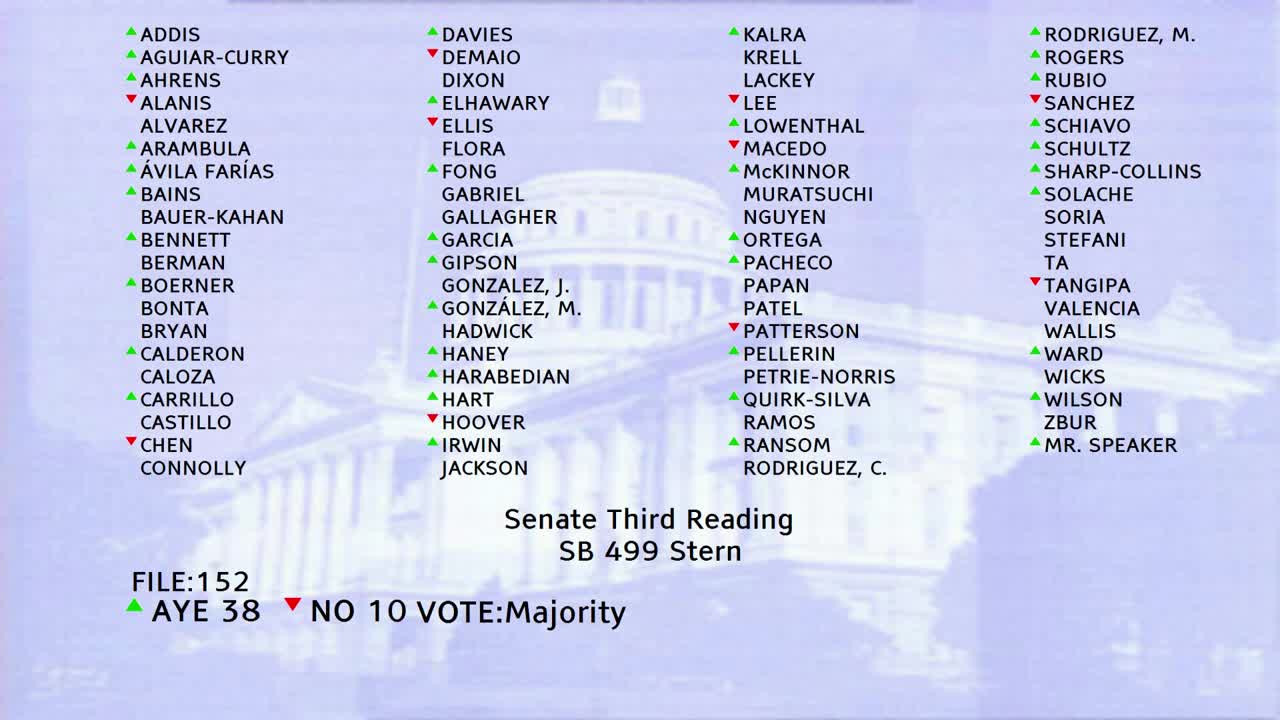 1MIN
Assembly Floor
 8MIN
Assembly Standing Committee on Water, Parks, and Wildlife
 7SEC
Senate Standing Committee on Appropriations
 6MIN
Senate Standing Committee on Natural Resources and Water
Bill Author