SB 314: Weights and measures: electric vehicle supply equipment.
- Session Year: 2025-2026
- House: Senate
- Latest Version Date: 2025-03-17
Current Status:
Failed
(2026-02-02: Returned to Secretary of Senate pursuant to Joint Rule 56.)
Introduced
In Committee
Awaiting First Chamber Vote
Passed First Chamber
In Committee
Awaiting Second Chamber Vote
Passed Second Chamber
Enacted
Existing law provides that the Department of Food and Agriculture has general supervision of the weights and measures and weighing and measuring devices sold or used in the state, including devices used to measure electricity sold as a motor vehicle fuel. Existing law regulates the use and repair of weighing or measuring devices. Existing law authorizes a device to be placed in service only by a sealer or a service agency. Existing law prohibits, until January 1, 2028, requiring electric vehicle supply equipment (EVSE) to be retested or placed in service by a service agency or sealer, if the EVSE has previously been placed in service by a service agency or sealer, before the EVSE is used after receiving maintenance, as specified.
This bill would authorize an EVSE that has been audited or tested by the manufacturer or supplier to be used commercially without further testing during the remainder of the inspection period adopted by the Secretary of Food and Agriculture, but not until it has been sealed by a sealer. The bill would, among other things, require the county sealer to ensure that certain EVSE installed before January 1, 2026, are initially placed in service and tested by a sealer on or before January 1, 2027, at no additional cost other than the registration fees paid by the EVSE owner or operator. The bill would, until January 1, 2028, among other things, exempt an EVSE installed in a workplace for the exclusive use of its employees, or installed in a residence, including a multifamily residential dwelling, for the exclusive use of the residents, from specified laws, and would authorize an EVSE, following installation, to be used in connection with the sale of electricity as a motor vehicle fuel without being placed into service by a service agency or sealer, a specified. The bill would authorize a county to take specified actions in order to support county oversight of EVSE and build capacity. if an EVSE has previously been placed in service, no longer require the EVSE to be retested or placed in service by a service agency or sealer before the EVSE is used after receiving maintenance in a manner that does not affect the EVSE being correct. The bill would require the Division of Measurement Standards to develop an optional pathway for compliance with specified laws using factory auditing and inspection for the EVSE, Standards, on or before January 1, 2027, to issue guidance and develop statewide resources relevant to weights and measures for EVSE, as specified, and to consider specified information when developing the pathway for compliance. and implement optional pathways for EVSE testing and placed-in-service requirements, including in-factory auditing or testing and certification by a factory- or supplier-registered service agency.
Existing law provides that the Department of Food and Agriculture has general supervision of the weights and measures and weighing and measuring devices sold or used in the state, including devices used to measure electricity sold as a motor vehicle fuel. Existing law regulates the use and repair of weighing or measuring devices. Existing law authorizes a device to be placed in service only by a sealer or a service agency. Existing law prohibits, until January 1, 2028, requiring electric vehicle supply equipment (EVSE) to be retested or placed in service by a service agency or sealer, if the EVSE has previously been placed in service by a service agency or sealer, before the EVSE is used after receiving maintenance, as specified.
This bill would authorize an EVSE that has been audited or tested by the manufacturer or supplier to be used commercially without further testing during the remainder of the inspection period adopted by the Secretary of Food and Agriculture, but not until it has been sealed by a sealer. The bill would, until January 1, 2028, among other things, exempt an EVSE installed in a workplace for the exclusive use of its employees, or installed in a residence, including a multifamily residential dwelling, for the exclusive use of the residents, from specified laws, and would authorize an EVSE, following installation, to be used in connection with the sale of electricity as a motor vehicle fuel without being placed into service by a service agency or sealer, a specified. The bill would authorize a county to take specified actions in order to support county oversight of EVSE and build capacity. The bill would require the Division of Measurement Standards to develop an optional pathway for compliance with specified laws using factory auditing and inspection for the EVSE, and to consider specified information when developing the pathway for compliance.
As used in this chapter, the following terms have the following definitions:
(a)Weighing instrument means any device, contrivance, apparatus, or instrument used, or designed to be used, for ascertaining weight and includes any tool, appliance, or accessory used or connected therewith.
(b)Measuring instrument means any device, contrivance, apparatus, or instrument used, or designed to be used, for ascertaining measure and includes any tool, appliance, or accessory used or connected therewith.
(c)Correct means any weight or measure or weighing, measuring, or counting instrument that meet all of the tolerance and specification requirements established by the secretary pursuant to Section 12107.
(d)Incorrect means any instrument that fails to meet all of the requirements of Section 12107.
(e)(1)Commercial purposes include the determination of the weight, measure, or count of any commodity or thing that is sold on the basis of weight, measure, or count; or the determination of the weight, measure, or count of any commodity or thing upon which determination a charge for service is based. Devices used in a determination upon which a charge for service is based include, but are not limited to, taximeters, odometers, timing devices, parcel scales, shipping scales, and scales used in the payment of agricultural workers.
(2)Commercial purposes do not include the determination of the weight, measure, or count of any commodity or thing that is performed within a plant or business as a part of the manufacturing, processing, or preparing for market of that commodity or thing, or the determination of charges for the transmission of letters or parcels of less than 150 pounds, except when that determination is made in the presence of the customer charged for the service, or the determination of the weight of any animal or human by a qualified health provider, California-licensed veterinarian, licensed physician and surgeon, or staff members within the business operations of, and under the supervision of, a California-licensed veterinarian or licensed physician and surgeon for the purposes of determining the appropriate dosage of any medication or medical treatment or the volume, duration, or application of any medical procedure.
(f)EVSE or electric vehicle supply equipment means a device that is used in connection with the sale of electricity as a motor vehicle fuel for controlling the electricity supply from an electric vehicle charging station to a vehicle during a charging session and that includes a measuring instrument.
SEC. 2.Section 12501.1 of the Business and Professions Code is amended to read:12501.1.(a)Every person who uses, or intends to use, any weight or measure, or weighing or measuring instrument for commercial purposes shall, before using the same, cause them to be sealed by a sealer, unless they have been sealed before sale, in which case they may be used by the purchaser for the remainder of such period as is authorized in the regulations adopted by the secretary pursuant to Section 12212, or until they become incorrect, as defined in subdivision (d) of Section 12500.
(b)Notwithstanding any other law, an odometer that has been tested by the manufacturer may be used commercially without further test during the remainder of the inspection period adopted by the secretary for odometers, but shall not be used commercially thereafter until it has been sealed by a sealer.
(c)Notwithstanding any other law, an EVSE that has been audited or tested by the manufacturer or supplier may be used commercially without further testing during the remainder of the inspection period adopted by the secretary, but not until it has been sealed by a sealer.
SEC. 3.Section 12509.1 is added to the Business and Professions Code, to read:12509.1.(a)The county sealer shall ensure that EVSE installed before January 1, 2026, that is subject to this chapter is initially placed in service and tested by a sealer on or before January 1, 2027, at no additional cost other than the registration fees paid by the EVSE owner or operator.
(b)EVSE subject to this chapter shall be registered with the county in which it is installed and the owner or operator of the EVSE shall pay any applicable administrative fees.
(c)The Division of Measurement Standards, in consultation with the State Energy Resources Conservation and Development Commission, shall identify existing funding that may be expended to cover the purchase of EVSE testing equipment by county sealers or registered service agencies and, if such funding is found, shall make that funding available by June 1, 2026.
(d)Notwithstanding Section 12500.10, the EVSE may be tagged by a county for noncompliance with elements of Section 12500.5 that do not impact EVSE meter accuracy and, at the discretion of the county, may be given conditional authorization to continue operation while the violation is addressed. Operators of the EVSE with conditional authorization to operate may remove the tag for at least 30 days while the EVSE is brought into compliance. Operators of the EVSE with conditional authorization to operate may have their device seized by the county if the tag is removed and any noncompliance is not corrected as described in subdivision (c) of Section 12500.10.
SEC. 3.SEC. 4.Section 12509.5 of the Business and Professions Code is amended to read:12509.5.(a)An EVSE installed at a workplace for the exclusive use of its employees, or installed at a residence, including a multifamily residential dwelling, for the exclusive use of the residents, shall be exempt from the provisions of this chapter, except Section 12500.5.(b)12509.5.(a)Notwithstanding Section 12532, if an EVSE has previously been placed in service, the EVSE shall not be required to be retested or placed in service by a service agency or sealer before the EVSE is used after receiving maintenance in a manner that does not affect the EVSE being correct.
(c)(1)Notwithstanding Section 12502, following installation of an EVSE, the EVSE may be used in connection with the sale of electricity as a motor vehicle fuel without being placed into service by a service agency or sealer if it is type approved by the department pursuant to Section 12500.5, and can be used commercially without further testing or being placed in service during the remainder of the inspection period adopted by the secretary for EVSEs.(2)Notwithstanding Section 12502, following installation of an EVSE, the EVSE shall be registered with the county in which it is installed and the owner or operator of the EVSE shall pay any applicable administrative fees.(d)Notwithstanding Section 12500.10, the EVSE may be tagged by a county for noncompliance with Section 12500.5 and, at the discretion of the county, may be given conditional authorization to continue operation while the violation is addressed. Operators of the EVSE with conditional authorization to operate may remove the tag for at least 30 days while the EVSE is brought into compliance. Operators of the EVSE with conditional authorization to operate may have their device seized by the county if the tag is removed and any noncompliance is not corrected as described in subdivision (c) of Section 12500.10.(e)This section does not impact a countys authority to enforce any other relevant law and does not impact a countys ability to test if an EVSE is correct in response to a complaint pursuant to Section 12503.(f)(b)This section shall remain in effect only until January 1, 2028, and as of that date is repealed.
SEC. 4.Section 12509.6 is added to the Business and Professions Code, to read:12509.6.(a)To support county oversight of EVSE and build capacity, a county may do both of the following:(1)Conduct sample testing of the EVSE to collect data on EVSE metrological function.(2)Share the data collected with the Division of Measurement Standards to inform future iterations of California weights and measures standards.(b)A county enforcing this chapter with respect to EVSE shall do both of the following:(1)Clearly communicate and post on its internet website, on or before January 1, 2027, information about all of the following:(A)The registration process.(B)The applicable registration fees and payment options.(C)The testing protocol and template test report.(D)All applicable forms.(2)On or before June 30, 2026, adhere to guidelines established by the Division of Measurement Standards for testing and protocols, and registration and placed-in-service forms.(c)The information described in paragraph (1) of subdivision (b) may also be shared with the Division of Measurement Standards to post on its internet website.(d)The Division of Measurement Standards shall develop an optional pathway for compliance with this chapter and Chapter 5.5 (commencing with Section 12531) using factory auditing and inspection for the EVSE. The division shall consider all of the following regarding development:(1)Risk-based assessments of compliance with devices being correct.(2)Opportunities for cost and time savings for placing the EVSE in service relying on factory auditing and inspection.(3)Input from the EVSE industry.(4)International best practices regarding EVSE use.(5)Extended timelines for field inspection of EVSEs by counties.(e)EVSEs manufactured in compliance with the optional pathway shall be considered correct if in compliance with Section 12511.1.(f)This section does not require factory auditing and inspection for EVSE manufacturers, and field metrological verification shall remain an option for EVSE manufacturers.SEC. 5.Section 12509.6 is added to the Business and Professions Code, to read:12509.6.(a)(1)To support statewide consistency and streamline implementation of county weights and measure requirements applicable to EVSE, the Division of Measurement Standards shall, on or before January 1, 2027, issue guidance and develop statewide resources relevant to weights and measures for EVSE. The guidance and resources shall include online or web-based versions of all of the following:
(A)Device registration form.
(B)Method to pay applicable registration fees.
(C)Placed-in-service form.
(D)Testing protocol and template test report.
(2)The resources shall be accessible on the Division of Measurement Standardss internet website.
(b)A county enforcing this chapter with respect to EVSE shall accept the statewide forms and testing protocols established by the Division of Measurement Standards.
(c)The Division of Measurement Standards shall consider and implement optional pathways for EVSE testing and placed-in-service requirements, including in-factory auditing or testing and certification by a factory- or supplier-registered service agency.
As used in this chapter chapter, the following terms mean: have the following definitions:
(a)Weighing instrument means any device, contrivance, apparatus, or instrument used, or designed to be used, for ascertaining weight and includes any tool, appliance, or accessory used or connected therewith.
(b)Measuring instrument means any device, contrivance, apparatus, or instrument used, or designed to be used, for ascertaining measure and includes any tool, appliance, or accessory used or connected therewith.
(c)Correct means any weight or measure or weighing, measuring, or counting instrument that meet all of the tolerance and specification requirements established by the secretary pursuant to Section 12107.
(d)Incorrect means any instrument that fails to meet all of the requirements of Section 12107.
(e)(1)Commercial purposes include the determination of the weight, measure, or count of any commodity or thing that is sold on the basis of weight, measure, or count; or the determination of the weight, measure, or count of any commodity or thing upon which determination a charge for service is based. Devices used in a determination upon which a charge for service is based include, but are not limited to, taximeters, odometers, timing devices, parcel scales, shipping scales, and scales used in the payment of agricultural workers.
Commercial(2)Commercial purposes do not include the determination of the weight, measure, or count of any commodity or thing that is performed within a plant or business as a part of the manufacturing, processing, or preparing for market of that commodity or thing, or the determination of charges for the transmission of letters or parcels of less than 150 pounds, except when that determination is made in the presence of the customer charged for the service, or the determination of the weight of any animal or human by a qualified health provider, California-licensed veterinarian, licensed physician and surgeon, or staff members within the business operations of, and under the supervision of, a California-licensed veterinarian or licensed physician and surgeon for the purposes of determining the appropriate dosage of any medication or medical treatment or the volume, duration, or application of any medical procedure.
(f)EVSE or electric vehicle supply equipment means a device that is used in connection with the sale of electricity as a motor vehicle fuel for controlling the electricity supply from an electric vehicle charging station to a vehicle during a charging session and that includes a measuring instrument.
SEC. 2.Section 12501.1 of the Business and Professions Code is amended to read:12501.1.(a)Every person who uses, or intends to use, any weight or measure, or weighing or measuring instrument for commercial purposes shall, before using the same, cause them to be sealed by a sealer, unless they have been sealed before sale, in which case they may be used by the purchaser for the remainder of such period as is authorized in the regulations adopted by the secretary pursuant to Section 12212, or until they become incorrect, as defined in subdivision (d) of Section 12500.
Notwithstanding(b)Notwithstanding any other provision of law, an odometer that has been tested by the manufacturer may be used commercially without further test during the remainder of the inspection period adopted by the secretary for odometers, but shall not be used commercially thereafter until it has been sealed by a sealer.
(c)Notwithstanding any other law, an EVSE that has been audited or tested by the manufacturer or supplier may be used commercially without further testing during the remainder of the inspection period adopted by the secretary, but not until it has been sealed by a sealer.
SEC. 3.Section 12509.5 of the Business and Professions Code is amended to read:12509.5.(a)For purposes of this section, EVSE or electric vehicle supply equipment means a device that is used in connection with the sale of electricity as a motor vehicle fuel for controlling the electricity supply from an electric vehicle charging station to a vehicle during a charging session and that includes a measuring instrument.12509.5.(a)An EVSE installed at a workplace for the exclusive use of its employees, or installed at a residence, including a multifamily residential dwelling, for the exclusive use of the residents, shall be exempt from the provisions of this chapter, except Section 12500.5.
(b)Notwithstanding Section 12532, if an EVSE has previously been placed in service by a service agency or sealer, service, the EVSE shall not be required to be retested or placed in service by a service agency or sealer before the EVSE is used after receiving maintenance in a manner that does not affect the EVSE being correct.
(c)(1)Notwithstanding Section 12502, following installation of an EVSE, the EVSE may be used in connection with the sale of electricity as a motor vehicle fuel without being placed into service by a service agency or sealer if it is type approved by the department pursuant to Section 12500.5, and can be used commercially without further testing or being placed in service during the remainder of the inspection period adopted by the secretary for EVSEs.
(2)Notwithstanding Section 12502, following installation of an EVSE, the EVSE shall be registered with the county in which it is installed and the owner or operator of the EVSE shall pay any applicable administrative fees.
(d)Notwithstanding Section 12500.10, the EVSE may be tagged by a county for noncompliance with Section 12500.5 and, at the discretion of the county, may be given conditional authorization to continue operation while the violation is addressed. Operators of the EVSE with conditional authorization to operate may remove the tag for at least 30 days while the EVSE is brought into compliance. Operators of the EVSE with conditional authorization to operate may have their device seized by the county if the tag is removed and any noncompliance is not corrected as described in subdivision (c) of Section 12500.10.
(e)This section does not impact a countys authority to enforce any other relevant law and does not impact a countys ability to test if an EVSE is correct in response to a complaint pursuant to Section 12503.
(c)(f)This section shall remain in effect only until January 1, 2028, and as of that date is repealed.
SEC. 4.Section 12509.6 is added to the Business and Professions Code, to read:12509.6.(a)To support county oversight of EVSE and build capacity, a county may do both of the following:
(1)Conduct sample testing of the EVSE to collect data on EVSE metrological function.
(2)Share the data collected with the Division of Measurement Standards to inform future iterations of California weights and measures standards.
(b)A county enforcing this chapter with respect to EVSE shall do both of the following:
(1)Clearly communicate and post on its internet website, on or before January 1, 2027, information about all of the following:
(A)The registration process.
(B)The applicable registration fees and payment options.
(C)The testing protocol and template test report.
(D)All applicable forms.
(2)On or before June 30, 2026, adhere to guidelines established by the Division of Measurement Standards for testing and protocols, and registration and placed-in-service forms.
(c)The information described in paragraph (1) of subdivision (b) may also be shared with the Division of Measurement Standards to post on its internet website.
(d)The Division of Measurement Standards shall develop an optional pathway for compliance with this chapter and Chapter 5.5 (commencing with Section 12531) using factory auditing and inspection for the EVSE. The division shall consider all of the following regarding development:
(1)Risk-based assessments of compliance with devices being correct.
(2)Opportunities for cost and time savings for placing the EVSE in service relying on factory auditing and inspection.
(3)Input from the EVSE industry.
(4)International best practices regarding EVSE use.
(5)Extended timelines for field inspection of EVSEs by counties.
(e)EVSEs manufactured in compliance with the optional pathway shall be considered correct if in compliance with Section 12511.1.
(f)This section does not require factory auditing and inspection for EVSE manufacturers, and field metrological verification shall remain an option for EVSE manufacturers.
|
Date
|
Status
|
|---|---|
| Feb 2, 2026 | Returned to Secretary of Senate pursuant to Joint Rule 56. |
| May 23, 2025 | May 23 hearing: Held in committee and under submission. |
| May 16, 2025 | Set for hearing May 23. |
| May 12, 2025 | May 12 hearing: Placed on APPR. suspense file. |
| May 2, 2025 | Set for hearing May 12. |
| Apr 28, 2025 | From committee: Do pass and re-refer to Com. on APPR. (Ayes 10. Noes 0. Page 916.) (April 28). Re-referred to Com. on APPR. |
| Apr 4, 2025 | Set for hearing April 28. |
| Apr 3, 2025 | April 21 set for first hearing canceled at the request of author. |
| Mar 18, 2025 | Set for hearing April 21. |
| Mar 17, 2025 | From committee with author's amendments. Read second time and amended. Re-referred to Com. on B. P. & E.D. |
| Feb 19, 2025 | Referred to Com. on B. P. & E.D. |
| Feb 11, 2025 | From printer. May be acted upon on or after March 13. |
| Feb 10, 2025 | Introduced. Read first time. To Com. on RLS. for assignment. To print. |
|
Date
|
Description
|
Location
|
Votes
|
|
|---|---|---|---|---|
| May 12, 2025 | Placed on suspense file | Senate Standing Committee on Appropriations |
Passed |
|
| Apr 28, 2025 | Do pass, but first be re-referred to the Committee on [Appropriations] | Senate Standing Committee on Business, Professions and Economic Development |
Passed |
This list shows positions taken on this bill by organizations on the date displayed, which is linked to the original source.
Positions by individuals are not included.
|
Organization
|
Position
|
Date
|
|---|---|---|
| Autel | ** Support | |
| Blink Charging | ** Support | |
| California Electric Transportation Coalition | ** Support | |
| California Rental Housing Association | ** Support | |
| California Retailers Association | ** Support | |
| Chargepoint Inc | ** Support | |
| Electric Vehicle Charging Association | ** Support | |
| EV Connect | ** Support | |
| General Motors LLC | ** Support | |
| Green Wealth Energy | ** Support | |
| Nema | ** Support | |
| Plug In America | ** Support | |
| Powerflex | ** Support | |
| Qmerit | ** Support | |
| SWTCH Energy | ** Support | |
| Tesla | ** Support | |
| Trout Electric | ** Support |
SENATE COMMITTEE ON
Senator Anna Caballero, Chair
2025 - 2026 Regular Session
SB 314 (Padilla) - Weights and measures: electric vehicle supply equipment
Version: | Policy Vote: |
Urgency: | Mandate: |
Hearing Date: | Consultant: |
Bill Summary:
SB 314 makes changes to inspection requirements for electric vehicle service equipment (EVSE) and requires the Division of Measurement Standards (DMS) within the California Department of Food and Agriculture (CDFA) to issue guidance and develop statewide resources relevant to weights and measures for EVSE, as specified. SB 314 also requires CDFA to identify existing funding that may be used for the purchase of EVSE testing equipment by county sealers or registered service agencies (RSAs) and, if found, make that funding available by June 1, 2026.
Fiscal Impact:
CDFA reports annual costs of approximately $1.5 million (General Fund) for the first three fiscal years to amend existing state-county weights and measures systems and develop a statewide online registration and payment system.
Background:
AB 2127 (Ting, Chapter 365, Statutes of 2018), required the California Energy Commission (CEC) to assess the amount of electric vehicle (EV) infrastructure needed to meet the goals of putting at least five million zero-emission vehicles (ZEVs) on the road and reducing greenhouse gas emissions 40 percent below 1990 levels by 2030. As a result, the CEC produced a report, which found projected that “1.01 million public and shared private chargers are needed to support 7.1 million passenger plug-in EVs in 2030, and 2.11 million public and shared private chargers are needed to support 15.2 million passenger plug-in EVs in 2035. An additional 114,500 chargers are needed to support the 157,000 medium- and heavy-duty vehicles anticipated for 2030.” The CEC further notes “Installing these chargers will require investments in labor and workforce training and development, as up to 71,500 job-years will be needed for charger installation by 2035. The transition to ZEVs and supporting infrastructure will support jobs of the future.”
A potential challenge for California’s ambitious goal to transition from gas-powered to all EVs is the vital infrastructure needed to accomplish that goal. Charging infrastructure needs to be available, accessible, accurate, and function with the same integrity that Californian’s have come to expect from all other devices that provide fuel to vehicles.
In April 2020, CDFA adopted the Electric Vehicle Supply Equipment Regulation, making EVSE device standards and requirements from the National Institute of Standards and Technology Handbook 44 enforceable in California. All new commercial alternating current EVSE installed on or after January 1, 2021 are subject to the regulation and new commercial direct current fast charger EVSE installed on or after January 1, 2023 are subject to the regulation.
In April 2021, DMS adopted regulations establishing the first-ever inspection frequencies for the oversight of EVSE in an effort to allowing state and local officials to determine whether the device is labeled and dispensing fuel correctly and whether the business is adhering to the officially adopted method of sale and unit prices. State and county officials have already begun inspecting and testing EVSE used for commercial purposes. However, as the author and sponsor note, there are challenges with inspections for the installation and initial testing of these devices. According to the sponsor and the coalition in support of this bill, “Deploying public EV charging infrastructure faces significant challenges due to a fragmented and inconsistent regulatory framework. This framework includes a patchwork of county-specific interpretations, implementations, and enforcement of confusing state regulations throughout California relating to EV charging stations’ weights and measures requirements.”
Proposed Law:
- Provides that an EVSE that has been audited or tested by the manufacturer or supplier may be used commercially without further testing during the remainder of the inspection period adopted by the Secretary of the CDFA, but not until it has been sealed by a sealer.
- Requires a county sealer to ensure that an EVSE installed before January 1, 2026 subject to the laws of weighing and measuring devices is initially placed in service and tested by a sealer on or before January 1, 2027, at no additional cost other than the registration fees paid by the EVSE owner.
- Requires an EVSE to be registered with the county in which it is installed and the owner or operator of the EVSE pay any applicable administrative fees.
- Requires the DMS to identify existing funding that may be expended to cover the purchase of EVSE testing equipment by county sealers or RSAs and, if such funding is found, make that funding available by June 1, 2026.
- Authorizes an EVSE to be tagged by a county for noncompliance with elements that do not impact EVSE meter accuracy and, at a county’s discretion, be given conditional authorization to continue operation while the violation is addressed.
- Authorizes EVSE operators with conditional authorization to remove the tag for at least 30 days while the EVSE is brought into compliance.
- Provides that operators of the EVSE with conditional authorization may have their device seized by the county if the tag is removed and any noncompliance is not corrected.
- By January 1, 2027, requires the DMS to issue guidance and develop statewide resources relevant to weights and measures for EVSE. Requires the guidance to include online or web-based versions of all of the following:
- Device registration form; method to pay applicable registration fees; placed-in-service form; and testing protocol and template test report.
- Requires a county enforcing the above provisions with respect to EVSE to accept the statewide forms and testing protocols established by the DMS.
- Requires the DMS to consider and implement optional pathways for EVSE testing and placed-in-service requirements, including in-factory auditing or testing and certification by a factory- or supplier-RSA.
Related Legislation:
AB 2453 (Villapudua, Chapter 399, Statutes of 2024) exempts EVSE from the requirement it is to be retested or placed into service by a service agency or sealer before the EVSE is used after receiving maintenance, as specified, until January 1, 2028.
Staff Comments:
To meet the bill’s mandate to develop a device registration form and method to pay applicable registration fees, CDFA notes that it would require significant resources to develop and integrate a standardized form and fee structure that could interface with each county’s device registration processing and payment system. CDFA reports that its DMS regulatory programs are funded by industry license, registration, and assessment fees, which would not be sufficient to fund the development of this system.
DMS’ Device Enforcement Program is also fee supported. Current law requires county office of weights and measures to assess and collect a device administrative fee in addition to their county fees per year per device. Counties are authorized to retain up to 12 percent of the device administrative fee for any costs incurred in collecting those administrative fees on behalf of CDFA. The remaining balance of the device administrative fee is used for CDFA’s investigatory and enforcement activities and certification services. CDFA notes that under the provisions of this bill, a significant portion of these funds would have to be redirected back to its DMS. To do so, the CDFA states that it would require further statutory and regulatory authority.
Additionally, CDFA notes that it does not have, and is not aware of, any funding to support the procurement of EVSE testing equipment by county sealers or RSAs. RSAs are private businesses, and there is no mechanism for CDFA to transfer state assets to a private entity.
-- END --
SENATE COMMITTEE ON
BUSINESS, PROFESSIONS AND ECONOMIC DEVELOPMENT
Senator Angelique Ashby, Chair
2025 - 2026 Regular
Bill No: Hearing Date: April 28, 2025
Author: | |||
Version: | March 17, 2025 | ||
Urgency: | No | Fiscal: | Yes |
Consultant: | Elissa Silva | ||
Subject:
SUMMARY:
Makes changes to the inspection requirements for electric vehicle service equipment (EVSE), as specified, under the jurisdiction of weights and measures laws.
Existing law:
- Provides the Department of Food and Agriculture (CDFA) general enforcement supervision of the laws relating to weights and measures and measuring devices, and provides for the enforcement of those laws and the inspection and testing of measuring devices in each county by the county sealer. (Business and Professions Code (BPC) § 12100, 12105)
- Defines a “county sealer” to mean any sealer appointed by a county, and a county may in its discretion refer to its sealer as the country director of weights and measures (BPC § 12006)
- Makes it a misdemeanor for any person to hinder or obstruct in any way, any sealer in the performance of their official duties. (BPC § 12016)
- Makes it unlawful for any person, as specified, to use for commercial purposes any weight or measure or weighting, measuring, or counting instrument, knowing it to be “incorrect”, as specified. (BPC § 12020)
- Requires the CDFA to investigate conditions in the various cities and counties in respect to weights and measures, and the sale of goods, wares, and merchandise, commodities, and foodstuffs in containers. (BPC § 12101)
- Requires the CDFA at least once annually and as often as requested by the Department of General Services or the executive officer of a state institution, test the scales, weights and measures used in checking the receipt and disbursement of supplies in any state institution and report in writing its findings to the executive officer of the institution. (BPC § 12106)
- Requires the CDFA to inspect the work of the local sealers and may inspect the weights, measures, balances, or any other weighting or measuring devices of any person, at a frequency determined by the Secretary of the CDFA. (BPC § 12105)
- Establishes in each county, the office of the county sealer of weights and measures, who is appointed by that county board of supervisors, except in charter counties, and the term of office is set at four years. (BPC 12220)
- Authorizes the appointed county sealer, with the consent of the board of supervisors, to appoint deputies or inspectors and also employ clerks and employees, as specified. (BPC § 12220)
- Requires each sealer within his or her county to inspect, try and test all weights, scales, beams, measures of any kind, instruments or mechanical devices for weighing and measuring, and tools, appliances and accessories connected with any or all such instruments or measures, sold or used by any proprietor, agent, lessee or employee for commercial purposes, as defined. (BPC § 12210(a))
- Prohibits any person from engaging in the business as a service agency unless the person is registered by the Secretary of Food and Agriculture and the current registration fee and any penalty has been paid. (BPC § 12532(a))
- Defines “correct” for purposes of weighing and measuring devices to mean any weight or measure or weighing or measuring, or counting instrument that meet all of the tolerance and specification requirements established by the secretary of the DFA pursuant to the secretary’s requirement to establish tolerances and specifications and other technical requirements for commercial weighing and measuring. (BPC § 12500(c))
- Defines “incorrect” to mean any instrument that fails to meet all of the requirements pursuant to the secretary’s requirement to establish tolerances and specifications and other technical requirements for commercial weighing and measuring. (BPC § 12500(d))
- Authorizes a sealer to levy a civil penalty against a person who violates the laws pertaining to weights and measures in the BPC, of not more than $1,000 for each violation, as specified, and requires before the civil penalty is levied, the person charged with the violation be given a written notice of the proposed action including the nature of the violation and the amount of the proposed penalty and that the cited person has the right to request a hearing, as specified. (BPC § 12015.3(a)(b))
- Defines the following:
- “Service agency” to mean a person that for hire, award, commission, or any other payment of any kind, repairs a commercial device.
- “Service agent” to mean a person employed by a service agency to repair a commercial device.
- “Device” to mean a weighing or measuring equipment, contrivance, or instrument used, or designed to be used, for determining weight or measure, and includes any tool, appliance, or accessory used in connection therewith, that is used for commercial purposes, as defined. (BPC § 12531)
- Prohibits a person from engaging in business as a service agency unless the person is registered by the Secretary of the CDFA, as specified. (BPC § 12532(a))
- States that a device may only be placed in service by a sealer or service agency, and a device used by a public utility in connection with measuring gas, electricity, water, steam or communication services subject to the jurisdiction of the Public Utility Company (PUC) is exempt from the requirements for service agencies. (BPC § 12532(d))
- Authorizes a service agency’s authorization to place devices into service, or to remove, out-of-order notices may be suspended by a county sealer, within their own county, pursuant to notice and hearing, as specified. (BPC § 12543)
- Authorizes the county board of supervisors, by ordinance, to charge an annual registration fee not to exceed the county’s total cost of actually inspecting or testing the devices as required by law to recover the costs of inspecting or testing weighing and measuring devices required of the county sealer. (BPC § 12240)
- Defines “electric vehicle supply equipment” (EVSE) to mean a device that is used in connection with the sale of electricity as a motor vehicle fuel for controlling the electricity supply from an electric vehicle charging station to a vehicle during a charging session and includes a measurement instrument. (BPC § 12509.5(a))
- States that if an EVSE has previously been placed in service by a service agency or sealer, the EVSE is not required to be retested or placed in service by a service agency or sealer before the EVSE is used after receiving maintenance in a manner that does not affect the EVSE being correct, until January 1, 2028.
This bill:
- Allows an EVSE that has been audited or tested by the manufacturer or supplier to be used commercially without further testing during the remainder of the inspection period adopted by the Secretary of the CDFA, but not until it has been sealed by a sealer.
- Requires the county sealer to ensure that an EVSE installed before January 1, 2026, subject to the laws of weighing and measuring devices is initially placed in service and tested by a sealer on or before January 1, 2027, at no additional cost other than the registration fees paid by the EVSE owner.
- Requires EVSE, subject to the weights and measure laws, to be registered with the county in which installed and the owner or operator of the EVSE to pay any applicable administrative fees.
- Requires the Division of Measurement Standards DMS, in consultation with the State Energy Resources Conservation and Development Commission, to identify existing funding that may be expended to cover the purchase of EVSE equipment by county sealers or RSAs, and if such funding is found, to make that available by June 1, 2026.
- Authorizes an EVSE which may be tagged by a county for noncompliance with elements that do not impact EVSE meter accuracy, and at the discretion of the county, may be given conditional authorization to continue to operate while the violation is addressed.
- Authorizes operators of an EVSE with conditional authorization from a county to operate although the sealer has tagged the device, to remove the tag for at least 30-days while the EVSE is brought into compliance. And operators of the EVSE with conditional authorization to operate may have their device seized by the county if the tag is removed and any noncompliance is not corrected.
- Requires the DMS on or before January 1, 2027, to issue guidance and develop statewide resources relevant to weights and measures for EVSE.
- Requires the guidance in 7) above to include online or web based versions, made available on the DMS’s website, of all of the following:
- Device registration form;
- Method to pay applicable registration fees;
- Placed in-service form; and,
- Testing protocol and template test resort.
- Requires a county enforcing the EVSE provisions, to accept the statewide forms and testing protocols established by the DMS.
- Requires the DMS to consider and implement optional pathways for EVSE testing and placed-in-service requirements, including in-factory auditing or testing and certification by a factory-or-supplier-RSA.
FISCAL EFFECT:
Unknown. This bill is keyed fiscal by Legislative Counsel.
COMMENTS:
- Purpose. Chargepoint is the sponsor of this bill. According to the Author, “California has set a goal to install one million public and shared private electric vehicle (EV) chargers by 2030. This ambitious goal is vital for ensuring a sustainable future and reducing dangerous air pollution. The path to achieving this target however, is currently blocked by inconsistent regulations.
The need for an efficient system is crucial to avoid delays that raise consumer costs. SB 314 offers a solution, aiming to streamline the regulatory process and tackle these roadblocks to reduce installation costs and accelerate charger deliveries in communities across the state. SB 314 doesn’t just address immediate barriers but also lays the foundation for a more efficient, consumer-protective system that will accelerate the deployment of EV chargers. It aligns with California’s commitment to innovation, sustainability, and effective infrastructure, ultimately making the one million charger vision by 2030 a reality.”
- Background.
California has set an ambitious goal to have 100 percent of new car sales be zero-emission vehicles by 2035. In order to achieve that goal, California needs to have the proper charging infrastructure in place to accommodate all of those vehicles. It has been reported that 25% of new cars sold in California are electric vehicles. A recent California Energy Commission (CEC) press release from March 20, 2025, noted that California has reached a milestone with 178,549 public and shared private electric vehicle charges installed statewide, compared to a CEC estimate of only 120,000 gas nozzles in this state. Unlike many gas stations, there is a significant portion of EV charging stations that are publicly owned in California. There are currently 84,271 public charging stations and 94,278 private charger stations, according to CEC data.
In 2018, AB 2127 (Ting, Chapter 365, Statutes of 2018), required the CEC to assess the amount of electric vehicle infrastructure needed to meet the goals of putting at least five million zero-emission vehicles on the road and reducing greenhouse gas emissions 40 percent below 1990 levels by 2030. As a result, the CEC produced a report, which found projected that “1.01 million public and shared private chargers are needed to support 7.1 million passenger plug-in electric vehicles in 2030, and 2.11 million public and shared private chargers are needed to support 15.2 million passenger plug-in electric vehicles in 2035. An additional 114,500 chargers are needed to support the 157,000 medium- and heavy-duty vehicles anticipated for 2030.” The CEC further notes “Installing these chargers will require investments in labor and workforce training and development, as up to 71,500 job-years will be needed for charger installation by 2035. The transition to [zero emission vehicles] and supporting infrastructure will support jobs of the future.”
A potential challenge for California’s ambitious goal to transition from gas-powered to all electric vehicles is the vital infrastructure needed to accomplish that goal. Charging infrastructure needs to be available, accessible, accurate, and function with the same integrity that Californian’s have come to expect from all other devices that provide fuel to vehicles.
In April 2020, CDFA adopted the Electric Vehicle Supply Equipment Regulation, making EVSE device standards and requirements from the National Institute of Standards and Technology Handbook 44 enforceable in California. All new commercial alternating current EVSE installed on or after January 1, 2021 are subject to the regulation and new commercial direct current fast charger EVSE installed on or after January 1, 2023 are subject to the regulation.
In April 2021, Division of Measurement Standards (DMS) adopted regulations establishing the first-ever inspection frequencies for the oversight of EVSE in an effort to allowing state and local officials to determine whether the device is labeled and dispensing fuel correctly and whether the business is adhering to the officially adopted method of sale and unit prices. State and county officials have already begun inspecting and testing EVSE used for commercial purposes. However, as the author and sponsor note, there are challenges with inspections for the installation and initial testing of these devices. According to the sponsor and the coalition in support of this bill, “Deploying public EV charging infrastructure faces significant challenges due to a fragmented and inconsistent regulatory framework. This framework includes a patchwork of county-specific interpretations, implementations, and enforcement of confusing state regulations throughout California relating to EV charging stations’ weights and measures requirements.”
EVSEs that transfer electricity to a vehicle (as a retail motor vehicle fuel) and charge for those services are considered a commercial measuring device, which brings them under the jurisdiction of the DMS. The DMS is responsible for enforcement of California's weights and measures laws and regulations. DMS works with the county sealers of weights and measures who, under the supervision and direction of the Secretary of DFA, carry out many of the weights and measures inspection and enforcement activities at the local level. County weights and measures officials inspect and test packaged commodities and all commercially used weighing or measurement devices. Weights and measures officials have the authority to issue citations for misdemeanor and infraction violations involving weights and measures laws. CDFA is required to adopt necessary regulations governing the inspection frequency of all commercially used weights, measures, and weighing apparatus in the state, including those EVSEs. As noted by the DMS, “The EVSE regulation aids consumers by facilitating an "apple-to-apple" price comparison of electricity sold at different locations. Uniform requirements for price advertising and EVSE labeling helps eliminate inconsistent, misleading, or fraudulent business practices by retailers.”
County sealers are appointed by their respective county boards of supervisors, and are responsible for verifying that all commercial scaling and volumetric measuring devices are providing accurate readings, to ensure that customers pay the correct amount for the product they are purchasing. County sealers regulate a significant number of weighing and measurement devices including petroleum fuel meters, utility submeters, odometers, taximeters, LPG meters, and all grocery, butchery, jewelry, postal, vehicle, luggage and shipping scales. These weighing devices are tested for accuracy and inspected to determine if they are appropriate for their intended use, and provide accurate readings. A scale or other type of weighing device that is not operating correctly can result in overpayment by consumers or consumers receiving less of the product. In FY 2022/23, there were 1.84 million registered commercial weighing and measuring devices in California.
When a weighing or measuring device is installed for the first time, a sealer or RSA must test and verify it as correct before it can be used commercially. The point of testing is to ensure that device meets all of the specification and tolerance requirements. The Author and sponsor note issues with the current process for EVSE owners to have new chargers placed into service and be compliant with current law for all weighing and measuring devices in California.
Because a county employs a single county sealer, who is responsible for overseeing a great number of weighing and measuring devices, in 1999, AB 376 (Floyd, 1999) established a licensing scheme that allows independent “RSAs” to repair weighing and measuring devices. Unlike county sealers whose fees for services are specified in statute, RSA are able to set their fees independently. These RSAs have the authority to test an EVSE and place it into service or call for repairs to be made (tag the device). According to the DMS annual report for Fiscal Year 2022-23, there were 530 service agencies registered with DMS and 1,882 service agents.
An agent, as an employee of an RSA, is permitted to install, service, repair or recondition commercial weighing or measuring devices, including electric vehicle charging stations. Under current law, (BPC § 12533) a service agency is required to possess (or have available for use) certified standards and testing equipment. Standards certification must be performed at least every two years, either by the DMS, or by another accredited entity. Metrology calibration reports/certificates must be submitted at the time of registration, to document that an Agency has suitable and sufficient standards to install and repair commercial weighing and measuring devices in California. It is noted by the sponsors that the number of RSAs is not sufficient to conduct all of the tests that are currently needed for EVSEs. And that many lack the necessary testing equipment to conduct these tests. It is reported that the testing equipment costs approximately $50,000-$100,000 which can be a barrier to entry for many RSAs. EVSEs are unique in the need for initial inspection and testing, given how quickly these stations are being installed and how many are needed.
Last year, AB 2543 (Villapudua, Chapter 399, Statutes of 2024) was introduced to address the same testing and ESVE installation issue that this bill aims to address. As introduced, that bill would have authorized a measuring instrument used in connection with the sale of electricity as a motor vehicle fuel without first being tested if it met specified requirements. It also would have allowed certain EVSE to operate without being placed into service by a service agency or sealer. Due to concerns with simply avoiding accuracy and testing standards for EVSEs, that bill was ultimately amended to simply exempt EVSEs from the requirement to be retested or placed into service by a service agency or sealer before the EVSE is used after receiving maintenance until January 1, 2028. AB 2453 did not resolve the issues with initial installation challenges associated with the lack of testing equipment for the EVSE machines and the low number of RSAs or sealers who are able to place these devices into service.
There are concerns with simply exempting EVSE from the provisions of regulatory oversight altogether including sealer inspections and RSA testing and allowing EVSEs to charge consumers for services without ensuring the accuracy or correctness of the measuring devices. The author and sponsor are seeking to find a balance to ensure EVSE are expeditiously installed and available to consumers as many transition from gas-powered to electric vehicles while attempting to maintain consumer protections through the DMS model for all other weighting devices. To address the issues of installation and testing for EVSEs, the bill proposes the following changes to the current weights and measures laws.
- Require County Sealers to ensure that all EVSE charging stations installed before January 1, 2026, are tested, and placed into service no later than January 1, 2027. To ensure all EVSE stations are compliant and meet the same standards.
- Allow an EVSE that has been tested by the manufacturer or supplier to be used commercially without further testing (but not until after it has been sealed by the sealer).
- Requires the DMS and the State Energy Resources Conservation and Development Commission to identify exiting funding resources that can be used to purchase EVSE testing equipment. Funding resources may help address the testing equipment shortage which may assist sealers and RSAs be available to perform the necessary testing.
- Allow an EVSE that has been tagged for noncompliance issues, at the discretion of a county, remove that noncompliance tag for at least 30 days while the noncompliance issues are addressed, and the EVSE continues to be used by consumers. The author and sponsor report that these are for non-metrological violations and therefore do not affect the pricing/accuracy of the product provided to the consumer. However, current law prohibits the removal of a tag for any device.
- Requires the DMS to issue guidance and develop statewide resources relevant to weights and measures for EVSEs, by January 1, 2027.
- This bill would additionally require the DMS to consider and adopt new pathways for EVSE testing and placed-in-service requirements, including allowing a manufacture to test the EVSE product prior to installation to reduce the need for an RSA during the initial testing and placed-in-service phase.
- Arguments in Support. Supporters note, “By enacting these measures, SB 314 will remove unnecessary bureaucratic hurdles, accelerate the deployment of EV charging stations, and support California’s broader clean energy transition while ensuring that California EV drivers maintain the consumer protection they deserve. The bill strikes a balance between maintaining consumer protections and enabling the rapid, efficient growth of EV infrastructure—a necessary step toward a sustainable future.”
The California Rental Housing Association notes, “We support SB 314 in that it proposes to streamline regulatory compliance by moving testing out of field and into the manufacturing facilities of our charging equipment suppliers, which we expect will reduce our cost and time burdens. We believe we could make more chargers available, and faster, if the State takes action to reduce the cost of compliance with these regulations.”
- Related Legislation. AB 2453 (Villapudua, Chapter 399, Statutes of 2024) exempts EVSE from the requirement it is to be retested or placed into service by a service agency or sealer before the EVSE is used after receiving maintenance, as specified, until January 1, 2028.
- Policy Issues for Consideration.
Implementation challenges and lack of clarity that this bill solves the problem it aims to address. As currently drafted, the solutions that the author and sponsor seek to address may not be realized through the current version of the bill. For example, if one of the goals of the bill is to allow an ESVE to be used commercially if it has undergone factory testing, then requiring it to be sealed by a sealer before it can be used, as currently specified in this bill, may not address the current problem the author and sponsor seek to address and will lead to implementation challenges and confusion.
The Author should continue to work with all stakeholders, including the county sealers, RSAs, the CDFA, the CEC, among others to ensure that any considerations for altering current weights and measures requirements for EVSEs do not run counter to the laws developed to ensure consumer protection for commercial weighing devices. If the goal is to bring ESVEs into service which have been factory tested, there should be an established timeframe for when field-testing must be conducted. The stakeholders should share input on the most appropriate timeframe for that testing to occur. To ensure the factory testing has met strict standards for California’s commercial weighing and measuring devices, there should be established criteria for that factory testing which can be verified by the DMS. Consumer notification for those ESVEs that may be operating without field testing and who to report complaints to during this period may also assist in quickly correcting deficiencies and ensuring consumer protection. The balance to expedite this equipment for public use must be weighed against the need for consumer protection. If EVSE equipment is exempt from a regulatory framework and there is no verification that it is properly installed and performs as expected, consumers may be hesitant to transition to zero emission vehicles, thereby challenging California’s clean air and EV mandates.
SUPPORT AND OPPOSITION:
Support:
Chargepoint INC. (sponsor)
Autel
Blink Charging
California Electric Transportation Coalition
California Rental Housing Association
California Retailers Association
Electric Vehicle Charging Association
Ev Connect
General Motors LLC
Green Wealth Energy
Nema
Plug in America
Powerflex
Qmerit
Swtch Energy
Tesla
Trout Electric
Opposition:
None received
-- END --
Discussed in Hearing
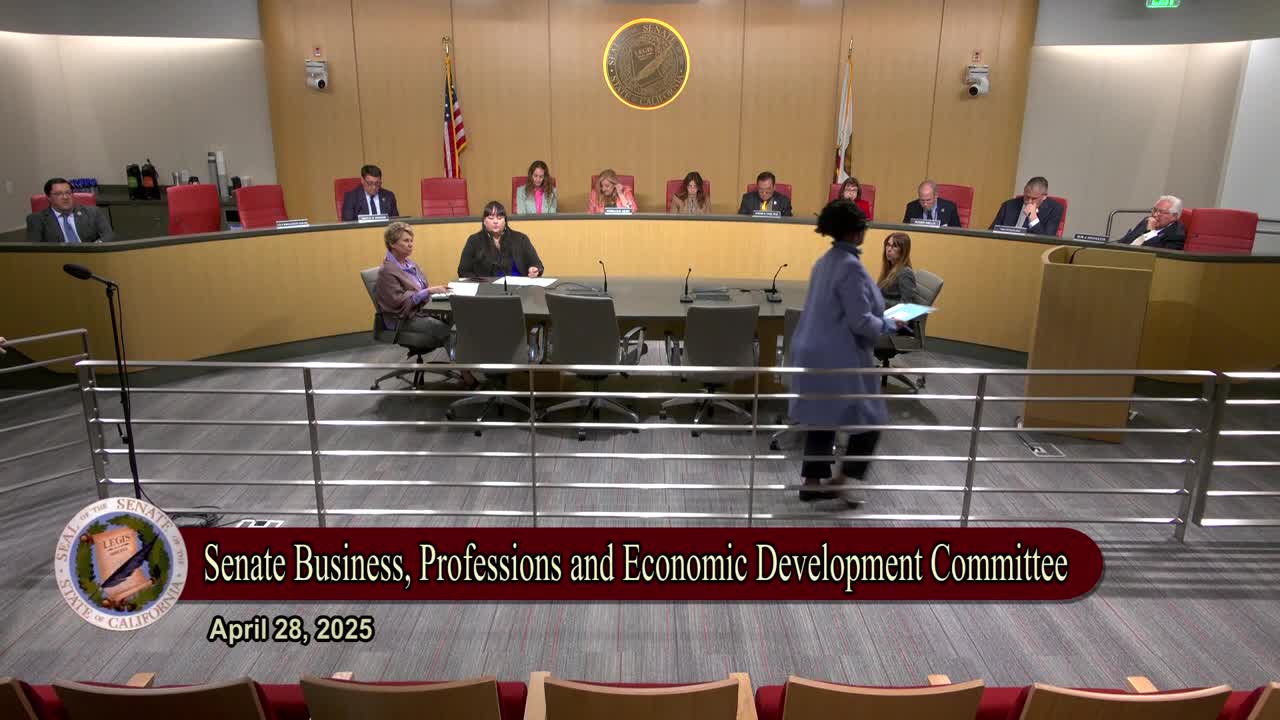 19MIN
Senate Standing Committee on Business, Professions and Economic Development
Bill Author

Bill Co-Author(s):