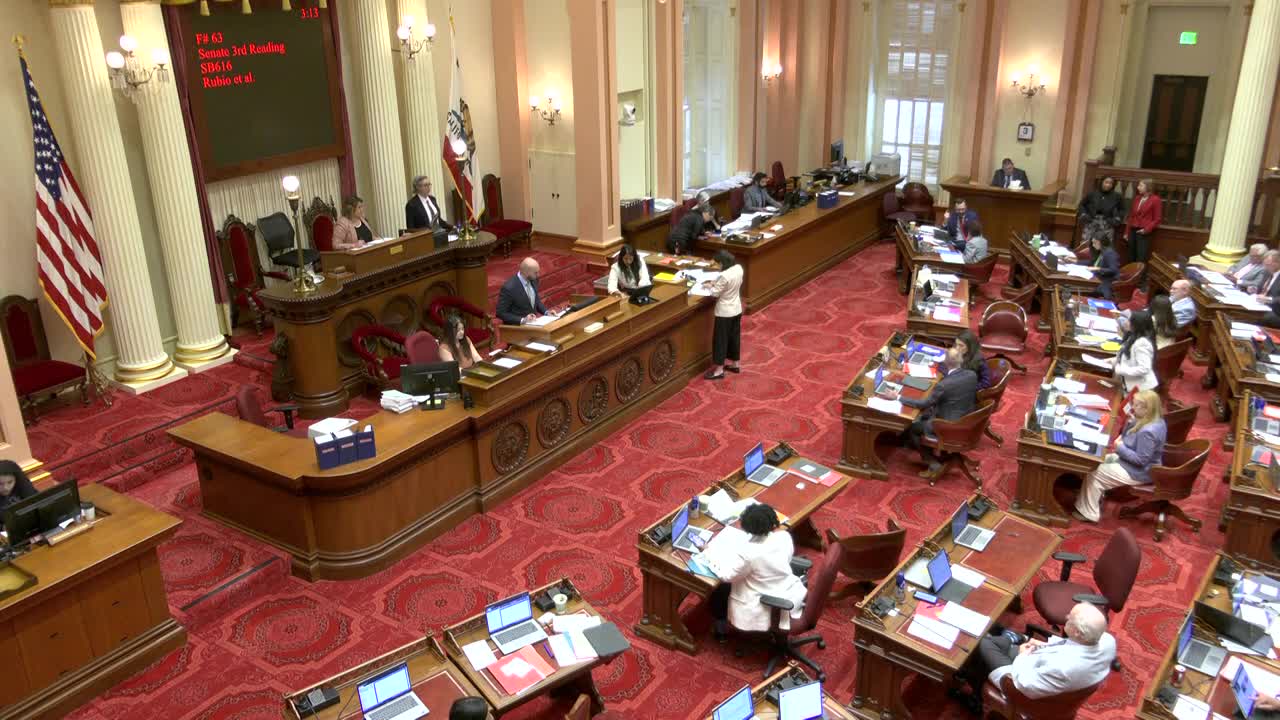
SB 326: Wildfire safety: fire protection building standards: defensible space requirements: The California Wildfire Mitigation Strategic Planning Act.
- Session Year: 2025-2026
- House: Senate
- Latest Version Date: 2025-09-17
Current Status:
Failed
(2026-03-02: Veto sustained.)
Introduced
In Committee
Awaiting First Chamber Vote
Passed First Chamber
In Committee
Awaiting Second Chamber Vote
Passed Second Chamber
Enacted
(1)Existing law establishes the Office of the State Fire Marshal in the Department of Forestry and Fire Protection and establishes the Deputy Director of Community Wildfire Preparedness and Mitigation within the office. Existing law makes the deputy director responsible for fire preparedness and mitigation missions of the department, as provided. Existing law requires the department to establish a local assistance grant program for fire prevention and home hardening education activities in California and specifies eligible activities under the local assistance grant program, as provided. Under existing law, funding for this local assistance grant program is contingent upon an appropriation by the Legislature.
This bill would require the deputy director, on or before January 1, 2027, and every 3 years thereafter, in consultation with the state hazard mitigation officer, as defined, to prepare a Wildfire Risk Mitigation Planning Framework sufficient to quantitatively evaluate wildfire risk mitigation actions, as provided. The bill would require the framework to allow for geospatial evaluation and comparison of wildfire risk mitigation actions, as described, sufficient to direct coordinated mitigation efforts and long-term collaborative mitigation planning. The bill would require the deputy director to, each year the framework is completed, submit a copy of the framework to the Legislature, the Office of Energy Infrastructure Safety, and the Public Utilities Commission for review and consideration.
This bill would require the deputy director, on or before April 1, 2027, and every 3 years thereafter, in consultation with the state hazard mitigation officer, to prepare a Wildfire Risk Baseline and Forecast for the state delineated on a statewide level and by county, as provided. The bill would require the forecast to include geographic specificity as determined by the deputy director to be sufficient to evaluate targeted wildfire risk mitigation actions, and to accomplish specific things, including establishing key risk metrics for wildfire risk for the state as a whole, by county, and by geographic location. The bill would require the deputy director to, each year the forecast is completed, submit a copy of the forecast to the Legislature, the Office of Energy Infrastructure Safety, and the Public Utilities Commission for review and consideration.
This bill would require the deputy director, on or before August 1, 2027, in consultation with the state hazard mitigation officer, to prepare a Wildfire Mitigation Scenarios Report, to be updated annually. The bill would require the report to contain specified information, including identification of a reasonable range of possible scenarios for overall wildfire risk mitigation spending, as provided.
This bill would require the deputy director to contract with a private consultant with special expertise in quantitative evaluation of specified wildfire risk and risk mitigation topics, as provided, to conduct quantitative wildfire risk modeling and for preparation of reports to accomplish the purposes of this act.
This bill would, contingent upon an annual appropriation by the Legislature in the annual Budget Act, require the department, beginning in the 202930 fiscal year and extending to the 204445 fiscal year, inclusive, to make funds available through the local assistance grant program for programs to be implemented by local governments to achieve wildfire risk reduction in a cost-effective manner that is maximally consistent with the Wildfire Risk Mitigation Planning Framework.
(2)Existing law requires the State Fire Marshal to identify areas in the state as moderate, high, and very high fire hazard severity zones based on consistent statewide criteria and the severity of the fire hazard. Existing law requires a person who owns, leases, controls, operates, or maintains (A) an occupied dwelling or structure within a very high fire hazard severity zone as designated by a local agency, or (B) a building or structure in the state responsibility area, to comply with specified defensible space requirements, including a requirement to maintain a defensible space of 100 feet from each side and from the front and rear of the structure, and a requirement to create an ember-resistant zone within 5 feet of the structure, based on regulations promulgated by the State Board of Forestry and Fire Protection, as provided. Executive Order No. N-18-25 directs the board to complete the formal rulemaking process applicable to these ember-resistant zone requirements no later than December 31, 2025. Under existing law, the requirement for an ember-resistant zone does not take effect for new structures until the board updates the applicable regulations and guidance document, as specified, and does not take effect for existing structures until 3 years after the effective date for the new structures. A violation of these requirements is a crime.
This bill would move up the effective date of the ember-resistant zone requirement for certain existing structures in the state responsibility area, as provided. By expanding the scope of a crime, the bill would impose a state-mandated local program.
This bill would revise and recast the local assistance grant program, described above, by, among other things, authorizing funding from the program to be used for projects to plan and carry out risk-targeted wildfire prevention work within a local governments jurisdiction, including costs necessary to use the above-described Wildfire Risk Mitigation Planning Framework to select, plan, and implement projects, and to implement activities consistent with early implementation of the ember-resistant zone rules, as provided.
This bill would, upon an annual appropriation by the Legislature in the annual Budget Act, require the department, during the 202526 to 202829 fiscal years, inclusive, to make funds available through the local assistance grant program for programs to be implemented by local agencies to fund wildfire inspector positions sufficient to conduct inspections in very high fire hazard severity zones, in order to facilitate early implementation of the ember-resistant zone rules for existing commercial and residential structures, as provided. As a condition of receiving funds, the bill would require local agencies to adopt the ember-resistant zone regulations, applicable to very high fire hazard severity zones, as provided.
(3)The California Building Standards Law requires any building standard adopted or proposed by state agencies to be submitted to, and approved or adopted by, the California Building Standards Commission before codification. Existing law requires the State Fire Marshal to propose, pursuant to that process, fire protection building standards applicable to buildings in fire hazard severity zones, as provided. Existing law also applies fire protection building standards adopted pursuant to this process to buildings located in urban wildland interface communities, defined as communities identified by the department pursuant to a specified process.
From October 1, 2025, to June 1, 2031, inclusive, existing law prohibits proposed building standards affecting residential units from being considered, approved, or adopted by the California Building Standards Commission or any other adopting agency unless a specified condition is met, including that the building standards are amendments by the State Fire Marshal to building standards within the California Wildland-Urban Interface Code.
This bill would, notwithstanding that prohibition, require the State Fire Marshal, on or before July 1, 2026, and pursuant to the California Building Standards Law process for state agencies proposing building standards, to propose to extend the applicability of the above-described fire protection building standards to all reconstruction of all buildings destroyed within the perimeters of wildfires that occur on or after July 1, 2026.
(4)This bill would incorporate additional changes to Section 4291 of the Public Resources Code proposed by AB 1455 to be operative only if this bill and AB 1455 are enacted and this bill is enacted last.
(5)The California Constitution requires the state to reimburse local agencies and school districts for certain costs mandated by the state. Statutory provisions establish procedures for making that reimbursement.
This bill would provide that no reimbursement is required by this act for a specified reason.
(1)Existing law establishes the Office of the State Fire Marshal in the Department of Forestry and Fire Protection and establishes the Deputy Director of Community Wildfire Preparedness and Mitigation within the office. Existing law makes the deputy director responsible for fire preparedness and mitigation missions of the department, as provided. Existing law requires the department to establish a local assistance grant program for fire prevention and home hardening education activities in California and specifies eligible activities under the local assistance grant program, as provided. Under existing law, funding for this local assistance grant program is contingent upon an appropriation by the Legislature.
This bill would require the deputy director, on or before January 1, 2027, and every 3 years thereafter, in consultation with the state hazard mitigation officer, as defined, to prepare a Wildfire Risk Mitigation Planning Framework sufficient to quantitatively evaluate wildfire risk mitigation actions, as provided. The bill would require the framework to allow for geospatial evaluation and comparison of wildfire risk mitigation actions, as defined, sufficient to direct coordinated mitigation efforts and long-term collaborative mitigation planning. The bill would require the deputy director to, each year the framework is completed, submit a copy of the framework to the Legislature, the Office of Energy Infrastructure Safety, and the Public Utilities Commission for review and consideration.
This bill would require the deputy director, on or before April 1, 2027, and every 3 years thereafter, in consultation with the state hazard mitigation officer, to prepare a Wildfire Risk Baseline and Forecast for the state delineated on a statewide level and by county, as provided. The bill would require the forecast to include geographic specificity as determined by the deputy director to be sufficient to evaluate targeted wildfire risk mitigation actions, and to accomplish specific things, including establishing key risk metrics for wildfire risk for the state as a whole, by county, and by geographic location. The bill would require the deputy director to, each year the forecast is completed, submit a copy of the forecast to the Legislature, the Office of Energy Infrastructure Safety, and the Public Utilities Commission for review and consideration.
This bill would require the deputy director, on or before August 1, 2027, in consultation with the state hazard mitigation officer, to prepare a Wildfire Mitigation Scenarios Report, to be updated annually. The bill would require the report to contain specified information, including identification of a reasonable range of possible scenarios for overall wildfire risk mitigation spending, as provided.
This bill would require the deputy director to contract with a private consultant with special expertise in quantitative evaluation of specified wildfire risk and risk mitigation topics, as provided, to conduct quantitative wildfire risk modeling and for preparation of reports to accomplish the purposes of this act.
This bill would, contingent upon an annual appropriation by the Legislature in the annual Budget Act, require the department, beginning in the 202930 fiscal year and extending to the 204445 fiscal year, inclusive, to make funds available through the local assistance grant program for programs to be implemented by local governments to achieve wildfire risk reduction in a cost-effective manner that is maximally consistent with the Wildfire Risk Mitigation Planning Framework.
(2)Existing law requires the State Fire Marshal to identify areas in the state as moderate, high, and very high fire hazard severity zones based on consistent statewide criteria and the severity of the fire hazard. Existing law requires a person who owns, leases, controls, operates, or maintains (A) an occupied dwelling or structure within a very high fire hazard severity zone as designated by a local agency, or (B) a building or structure in the state responsibility area, to comply with specified defensible space requirements, including a requirement to maintain a defensible space of 100 feet from each side and from the front and rear of the structure, and a requirement to create an ember-resistant zone within 5 feet of the structure, based on regulations promulgated by the State Board of Forestry and Fire Protection, as provided. Executive Order No. N-18-25 directs the board to complete the formal rulemaking process applicable to these ember-resistant zone requirements no later than December 31, 2025. Under existing law, the requirement for an ember-resistant zone does not take effect for new structures until the board updates the applicable regulations and guidance document, as specified, and does not take effect for existing structures until 3 years after the effective date for the new structures. A violation of these requirements is a crime.
This bill would move up the effective date of the ember-resistant zone requirement for certain existing structures in the state responsibility area, as provided. By expanding the scope of a crime, the bill would impose a state-mandated local program.
This bill would revise and recast the local assistance grant program by, among other things, authorizing funding from the program to be used for projects to plan and carry out risk-targeted wildfire prevention work within a local governments jurisdiction, including costs necessary to use the above-described Wildfire Risk Mitigation Planning Framework to select, plan, and implement projects, and to implement activities consistent with early implementation of the ember-resistant zone rules, as provided.
This bill would, upon an annual appropriation by the Legislature in the annual Budget Act, require the Department of Forestry and Fire Protection, during the 202526 to 202829 fiscal years, inclusive, to make funds available through the local assistance grant program for programs to be implemented by local agencies to fund wildfire inspector positions sufficient to conduct inspections in very high fire hazard severity zones, in order to facilitate early implementation of the ember-resistant zone rules for existing commercial and residential structures, as provided. As a condition of receiving funds, the bill would require local agencies to adopt the ember-resistant zone regulations, applicable to very high fire hazard severity zones, as provided.
(3)The California Building Standards Law requires any building standard adopted or proposed by state agencies to be submitted to, and approved or adopted by, the California Building Standards Commission before codification. Existing law requires the State Fire Marshal to propose, pursuant to that process, fire protection building standards applicable to buildings in fire hazard severity zones, as provided. Existing law also applies fire protection building standards adopted pursuant to this process to buildings located in urban wildland interface communities, defined as communities identified by the Department of Forestry and Fire Protection pursuant to a specified process.
From October 1, 2025, to June 1, 2031, inclusive, existing law prohibits proposed building standards affecting residential units from being considered, approved, or adopted by the commission or any other adopting agency unless a specified condition is met, including that the building standards are amendments by the State Fire Marshal to building standards within the California Wildland-Urban Interface Code.
This bill would, notwithstanding that prohibition, require the State Fire Marshal, on or before July 1, 2026, and pursuant to the California Building Standards Law process for state agencies proposing building standards, to propose to extend the applicability of the above-described fire protection building standards to all reconstruction of all buildings destroyed within the perimeters of wildfires that occur on or after July 1, 2026.
(4)This bill would incorporate additional changes to Section 4291 of the Public Resources Code proposed by AB 1455 to be operative only if this bill and AB 1455 are enacted and this bill is enacted last.
(4)(5)The California Constitution requires the state to reimburse local agencies and school districts for certain costs mandated by the state. Statutory provisions establish procedures for making that reimbursement.
This bill would provide that no reimbursement is required by this act for a specified reason.
(1)Existing law establishes the Office of the State Fire Marshal in the Department of Forestry and Fire Protection and establishes the Deputy Director of Community Wildfire Preparedness and Mitigation within the office. Existing law makes the deputy director responsible for fire preparedness and mitigation missions of the department, as provided. Existing law requires the department to establish a local assistance grant program for fire prevention and home hardening education activities in California and specifies eligible activities under the local assistance grant program, as provided. Under existing law, funding for this local assistance grant program is contingent upon an appropriation by the Legislature.
This bill would require the deputy director, on or before January 1, 2027, and every 3 years thereafter, in consultation with the state hazard mitigation officer, as defined, to prepare a Wildfire Risk Mitigation Planning Framework sufficient to quantitatively evaluate wildfire risk mitigation actions, as provided. The bill would require the framework to allow for geospatial evaluation and comparison of wildfire risk mitigation actions, as defined, sufficient to direct coordinated mitigation efforts and long-term collaborative mitigation planning. The bill would require the deputy director to, each year the framework is completed, submit a copy of the framework to the Legislature, the Office of Energy Infrastructure Safety, and the Public Utilities Commission for review and consideration.
This bill would require the deputy director, on or before April 1, 2027, and every 3 years thereafter, in consultation with the state hazard mitigation officer, to prepare a Wildfire Risk Baseline and Forecast for the state delineated on a statewide level and by county, as provided. The bill would require the forecast to include geographic specificity as determined by the deputy director to be sufficient to evaluate targeted wildfire risk mitigation actions, and to accomplish specific things, including establishing key risk metrics for wildfire risk for the state as a whole, by county, and by geographic location. The bill would require the deputy director to, each year the forecast is completed, submit a copy of the forecast to the Legislature, the Office of Energy Infrastructure Safety, and the Public Utilities Commission for review and consideration.
This bill would require the deputy director, on or before August 1, 2027, in consultation with the state hazard mitigation officer, to prepare a Wildfire Mitigation Scenarios Report, to be updated annually. The bill would require the report to contain specified information, including identification of a reasonable range of possible scenarios for overall wildfire risk mitigation spending, as provided.
This bill would authorize require the deputy director to contract with a private consultant or a public university with special expertise in quantitative assessment evaluation of specified wildfire risk and risk mitigation mitigation topics, as provided, to conduct quantitative wildfire and community risk modeling and for preparation of reports to accomplish the purposes of this act.
This bill would, contingent upon an annual appropriation by the Legislature in the annual Budget Act, require the department, beginning in the 202930 fiscal year and extending to the 204445 fiscal year, inclusive, to make funds available through the local assistance grant program for programs to be implemented by local governments to achieve wildfire risk reduction in a cost-effective manner that is maximally consistent with the Wildfire Risk Mitigation Planning Framework.
(2)Existing law requires the State Fire Marshal to identify areas in the state as moderate, high, and very high fire hazard severity zones based on consistent statewide criteria and the severity of the fire hazard. Existing law requires a person who owns, leases, controls, operates, or maintains (1) (A) an occupied dwelling or structure within a very high fire hazard severity zone as designated by a local agency, or (2) (B) a building or structure in the state responsibility area, to comply with specified defensible space requirements, including a requirement to maintain a defensible space of 100 feet from each side and from the front and rear of the structure, as specified. Under existing law, one of these defensible space requirements is the and a requirement to create an ember-resistant zone within 5 feet of the structure, based on regulations promulgated by the State Board of Forestry and Fire Protection, as provided. Executive Order No. N-18-25 directs the board to complete the formal rulemaking process applicable to these ember-resistant zone requirements no later than December 31, 2025. Under existing law, the requirement for an ember-resistant zone does not take effect for new structures until the board updates the applicable regulations and guidance document, as specified, and does not take effect for existing structures until 3 years after the effective date for the new structures. A violation of these requirements is a crime.
This bill would move up the effective date of the ember-resistant zone requirement for certain existing structures in the state responsibility area, as provided. By expanding the scope of a crime, the bill would impose a state-mandated local program.
This bill would revise and recast the local assistance grant program by, among other things, authorizing funding from the program to be used for projects to plan and carry out risk-targeted wildfire prevention work within a local governments jurisdiction, including costs necessary to use the above-described Wildfire Risk Mitigation Planning Framework to select, plan, and implement projects, and to implement activities consistent with early adoption implementation of the ember-resistant zone rules, as provided.
This bill would, upon an annual appropriation by the Legislature in the annual Budget Act, require the Department of Forestry and Fire Protection, during the 202526 to 202829 fiscal years, inclusive, to make funds available through the local assistance grant program for programs to be implemented by local agencies to fund wildfire inspector positions sufficient to conduct inspections in very high fire hazard severity zones, in order to facilitate early implementation of the ember-resistant zone rules for existing commercial and residential structures, as provided. As a condition of receiving funds, the bill would require local agencies to adopt the ember-resistant zone regulations, and related civil fine authority, applicable to very high fire hazard severity zones, as provided.
(3)Under existing law, any building standard adopted or proposed by state agencies is required to be submitted to, and approved or adopted by, the California Building Standards Commission prior to codification. The California Building Standards Law requires any building standard adopted or proposed by state agencies to be submitted to, and approved or adopted by, the California Building Standards Commission before codification. Existing law requires the State Fire Marshal to propose, pursuant to that process, fire protection building standards applicable to buildings in fire hazard severity zones, as provided. Existing law also applies fire protection building standards adopted pursuant to this process to buildings located in urban wildland interface communities, defined as communities identified by the Department of Forestry and Fire Protection pursuant to a specified process.
From October 1, 2025, to June 1, 2031, inclusive, existing law prohibits proposed building standards affecting residential units from being considered, approved, or adopted by the commission or any other adopting agency unless a specified condition is met, including that the building standards are amendments by the State Fire Marshal to building standards within the California Wildland-Urban Interface Code.
This bill would would, notwithstanding that prohibition, require the State Fire Marshal, on or before July 1, 2026, and pursuant to the above-described process, California Building Standards Law process for state agencies proposing building standards, to propose to extend the applicability of the above-described fire protection building standards to all reconstruction of all buildings destroyed within the perimeters of wildfires that occur on or after July 1, 2026.
(4)The California Constitution requires the state to reimburse local agencies and school districts for certain costs mandated by the state. Statutory provisions establish procedures for making that reimbursement.
This bill would provide that no reimbursement is required by this act for a specified reason.
(1)Existing law establishes the Office of the State Fire Marshal in the Department of Forestry and Fire Protection and establishes the Deputy Director of Community Wildfire Preparedness and Mitigation within the office. Existing law makes the deputy director responsible for fire preparedness and mitigation missions of the department, as provided. Existing law requires the department to establish a local assistance grant program for fire prevention and home hardening education activities in California and specifies eligible activities under the local assistance grant program, as provided. Under existing law, funding for this local assistance grant program is contingent upon an appropriation by the Legislature.
This bill would require the deputy director, on or before January 1, 2027, and every 3 years thereafter, in consultation with the state hazard mitigation officer, as defined, to prepare a Wildfire Risk Mitigation Planning Framework sufficient to quantitatively evaluate wildfire risk mitigation actions, as provided. The bill would require the framework to allow for geospatial evaluation and comparison of wildfire risk mitigation actions, as defined, sufficient to direct coordinated mitigation efforts and long-term collaborative mitigation planning. The bill would require the deputy director to, each year the framework is completed, submit a copy of the framework to the Legislature, the Office of Energy Infrastructure Safety, and the Public Utilities Commission for review and consideration.
This bill would require the deputy director, on or before April 1, 2027, and every 3 years thereafter, in consultation with the state hazard mitigation officer, to prepare a Wildfire Risk Baseline and Forecast for the state delineated on a statewide level and by county, as provided. The bill would require the forecast to include geographic specificity as determined by the deputy director to be sufficient to evaluate targeted wildfire risk mitigation actions, and to accomplish specific things, including establishing key risk metrics for wildfire risk for the state as a whole, by county, and by geographic location. The bill would require the deputy director to, each year the forecast is completed, submit a copy of the forecast to the Legislature, the Office of Energy Infrastructure Safety, and the Public Utilities Commission for review and consideration.
This bill would require the deputy director, on or before August 1, 2027, in consultation with the state hazard mitigation officer, to prepare a Wildfire Mitigation Scenarios Report, to be updated annually. The bill would require the report to contain specified information, including identification of a reasonable range of possible scenarios for overall wildfire risk mitigation spending, as provided.
This bill would authorize the deputy director to contract with a private consultant or a public university with special expertise in quantitative assessment of wildfire risk and risk mitigation to conduct quantitative wildfire and community risk modeling and for preparation of reports to accomplish the purposes of this act.
This bill would, contingent upon an annual appropriation by the Legislature in the annual Budget Act, authorize require the department, beginning in the 202930 fiscal year and extending to the 204445 fiscal year, inclusive, to allocate make funds available through the local assistance grant program for programs to be implemented by local governments to achieve wildfire risk reduction in a cost-effective manner that is maximally consistent with the Wildfire Risk Mitigation Planning Framework.
(2)Existing law requires the State Fire Marshal to identify areas in the state as moderate, high, and very high fire hazard severity zones based on consistent statewide criteria and the severity of the fire hazard. Existing law requires a person who owns, leases, controls, operates, or maintains (1) an occupied dwelling or structure within a very high fire hazard severity zone as designated by a local agency, or (2) a building or structure in the state responsibility area, to maintain a defensible space of 100 feet from each side and from the front and rear of the structure, as specified. Under existing law, one of these defensible space requirements is the requirement to create an ember-resistant zone within 5 feet of the structure, based on regulations promulgated by the State Board of Forestry and Fire Protection, as provided. Executive Order No. N-18-25 directs the board to complete the formal rulemaking process applicable to these ember-resistant zone requirements no later than December 31, 2025. Under existing law, the requirement for an ember-resistant zone does not take effect for new structures until the board updates the applicable regulations and guidance document, as specified, and does not take effect for existing structures until 3 years after the effective date for the new structures. A violation of these requirements is a crime.
This bill would move up the effective date of the ember-resistant zone requirement for certain existing structures in the state responsibility area, as provided. By expanding the scope of a crime, the bill would impose a state-mandated local program.
This bill would revise and recast the local assistance grant program by, among other things, authorizing funding from the program to be used for projects to plan and carry out risk-targeted wildfire prevention work within a local governments jurisdiction, including costs necessary to use the above-described Wildfire Risk Mitigation Planning Framework to select, plan, and implement projects, and to implement activities consistent with early adoption of the ember-resistant zone rules, as provided.
This bill would, upon an annual appropriation by the Legislature in the annual Budget Act, authorize require the Department of Forestry and Fire Protection Protection, during the 202526 to 202829 fiscal years, inclusive, to allocate make funds during the 202526 to 202829 fiscal years, inclusive, available through the local assistance grant program for programs to be implemented by local agencies to facilitate early implementation of the ember-resistant zone rules for existing commercial and residential structures. The bill would, among other things, authorize funds from this appropriation to be used to (A) fund wildfire inspector positions sufficient to conduct inspections in very high fire hazard severity zones, (B) provide grants to homeowners to assist with costs associated with early compliance with ember-resistant zone regulations within very high fire hazard severity zones, and (C) improve community safety, forest health, and wildfire resilience, in order to facilitate early implementation of the ember-resistant zone rules for existing commercial and residential structures, as provided. As a condition of receiving funds, the bill would require local agencies to adopt the ember-resistant zone regulations, and related civil fine authority, applicable to very high fire hazard severity zones, as provided.
(3)Existing law requires the Department of Forestry and Fire Protection to establish a local assistance grant program for fire prevention and home hardening education activities in California and specifies eligible activities under the local assistance grant program, as provided. Under existing law, funding for this local assistance grant program is contingent upon an appropriation by the Legislature. This bill would also authorize funding from the local assistance grant program to be used for projects to plan and carry out risk-targeted wildfire prevention work within a local governments jurisdiction, including costs necessary to use the above-described Wildfire Risk Mitigation Planning Framework to select, plan, and implement projects, and to implement activities consistent with early adoption of the ember-resistant zone rules, as provided. (4)(3)Under existing law, any building standard adopted or proposed by state agencies is required to be submitted to, and approved or adopted by, the California Building Standards Commission prior to codification. Existing law requires the State Fire Marshal to propose, pursuant to that process, fire protection building standards applicable to buildings in fire hazard severity zones, as provided. Existing law also applies fire protection building standards adopted pursuant to this process to buildings located in urban wildland interface communities, defined as communities identified by the Department of Forestry and Fire Protection pursuant to a specified process.
This bill would require the State Fire Marshal, on or before July 1, 2026, and pursuant to the above-described process, to propose to extend the applicability of the above-described fire protection building standards to all reconstruction of all buildings destroyed within the perimeters of wildfires that occur on or after July 1, 2026.
(5)(4)The California Constitution requires the state to reimburse local agencies and school districts for certain costs mandated by the state. Statutory provisions establish procedures for making that reimbursement.
This bill would provide that no reimbursement is required by this act for a specified reason.
(1)Existing law establishes the Office of the State Fire Marshal in the Department of Forestry and Fire Protection and establishes the Deputy Director of Community Wildfire Preparedness and Mitigation within the office. Existing law makes the deputy director responsible for fire preparedness and mitigation missions of the department, as provided.
This bill would require the deputy director, on or before January 1, 2027, and every 3 years thereafter, in consultation with the state hazard mitigation officer, as defined, to prepare a Wildfire Risk Mitigation Planning Framework sufficient to quantitatively evaluate wildfire risk mitigation actions, as provided. The bill would require the framework to allow for geospatial evaluation and comparison of wildfire risk mitigation actions, as defined, sufficient to direct coordinated mitigation efforts and long-term collaborative mitigation planning. The bill would require the deputy director to, each year the framework is completed, submit a copy of the framework to the Legislature, the Office of Energy Infrastructure Safety, and the Public Utilities Commission for review and consideration.
This bill would require the deputy director, on or before April 1, 2027, and every 3 years thereafter, in consultation with the state hazard mitigation officer, to prepare a Wildfire Risk Baseline and Forecast for the state delineated on a statewide level and by county, as provided. The bill would require the forecast to include geographic specificity as determined by the deputy director to be sufficient to evaluate targeted wildfire risk mitigation actions, and to accomplish specific things, including establishing key risk metrics for wildfire risk for the state as a whole, by county, and by geographic location. The bill would require the deputy director to, each year the forecast is completed, submit a copy of the forecast to the Legislature, the Office of Energy Infrastructure Safety, and the Public Utilities Commission for review and consideration.
This bill would require the deputy director, on or before August 1, 2027, in consultation with the state hazard mitigation officer, to prepare a Wildfire Mitigation Scenarios Report, to be updated annually. The bill would require the report to contain specified information, including identification of a reasonable range of possible scenarios for overall wildfire risk mitigation spending, as provided.
This bill would authorize the deputy director to contract with a private consultant or a public university with special expertise in quantitative assessment of wildfire risk and risk mitigation to conduct quantitative wildfire and community risk modeling and for preparation of reports to accomplish the purposes of this act.
This bill would, contingent upon an annual appropriation by the Legislature in the annual Budget Act, authorize the department, beginning in the 202930 fiscal year and extending to the 204445 fiscal year, inclusive, to allocate funds for programs to be implemented by local governments to achieve wildfire risk reduction in a cost-effective manner that is maximally consistent with the Wildfire Risk Mitigation Planning Framework.
(2)Existing law requires the State Fire Marshal to identify areas in the state as moderate, high, and very high fire hazard severity zones based on consistent statewide criteria and the severity of the fire hazard. Existing law requires a person who owns, leases, controls, operates, or maintains (1) an occupied dwelling or structure within a very high fire hazard severity zone as designated by a local agency, or (2) a building or structure in the state responsibility area, to maintain a defensible space of 100 feet from each side and from the front and rear of the structure, as specified. Under existing law, one of these defensible space requirements is the requirement to create an ember-resistant zone within 5 feet of the structure, based on regulations promulgated by the State Board of Forestry and Fire Protection, as provided. Executive Order No. N-18-25 directs the board to complete the formal rulemaking process applicable to these ember-resistant zone requirements no later than December 31, 2025. Under existing law, the requirement for an ember-resistant zone does not take effect for new structures until the board updates the applicable regulations and guidance document, as specified, and does not take effect for existing structures until 3 years after the effective date for the new structures. A violation of these requirements is a crime.
This bill would move up the effective date of the ember-resistant zone requirement for certain existing structures in the state responsibility area, as provided. By expanding the scope of a crime, the bill would impose a state-mandated local program.
This bill would, upon an annual appropriation by the Legislature in the annual Budget Act, authorize the Department of Forestry and Fire Protection to allocate funds during the 202526 to 202829 fiscal years, inclusive, for programs to be implemented by local agencies to facilitate early implementation of the ember-resistant zone rules for existing commercial and residential structures. The bill would, among other things, authorize funds from this appropriation to be used to (A) fund wildfire inspector positions sufficient to conduct inspections in very high fire hazard severity zones, (B) provide grants to homeowners to assist with costs associated with early compliance with ember-resistant zone regulations within very high fire hazard severity zones, and (C) improve community safety, forest health, and wildfire resilience, as provided. As a condition of receiving funds, the bill would require local agencies to adopt the ember-resistant zone regulations, and related civil fine authority, applicable to very high fire hazard severity zones, as provided.
(3)Existing law requires the Department of Forestry and Fire Protection to establish a local assistance grant program for fire prevention and home hardening education activities in California and specifies eligible activities under the local assistance grant program, as provided. Under existing law, funding for this local assistance grant program is contingent upon an appropriation by the Legislature.
This bill would also authorize funding from the local assistance grant program to be used for projects to plan and carry out risk-targeted wildfire prevention work within a local governments jurisdiction, including costs necessary to use the above-described Wildfire Risk Mitigation Planning Framework to select, plan, and implement projects, and to implement activities consistent with early adoption of the ember-resistant zone rules, as provided.
(4)Under existing law, any building standard adopted or proposed by state agencies is required to be submitted to, and approved or adopted by, the California Building Standards Commission prior to codification. Existing law requires the State Fire Marshal to propose, pursuant to that process, fire protection building standards applicable to buildings in fire hazard severity zones, as provided. Existing law also applies fire protection building standards adopted pursuant to this process to buildings located in urban wildland interface communities, defined as communities identified by the Department of Forestry and Fire Protection pursuant to a specified process.
This bill would require the State Fire Marshal, on or before July 1, 2026, and pursuant to the above-described process, to propose to extend the applicability of the above-described fire protection building standards to all reconstruction of all buildings destroyed within the perimeters of wildfires that occur on or after July 1, 2026.
(5)The California Constitution requires the state to reimburse local agencies and school districts for certain costs mandated by the state. Statutory provisions establish procedures for making that reimbursement.
This bill would provide that no reimbursement is required by this act for a specified reason.
Existing law establishes the Office of the State Fire Marshal in the Department of Forestry and Fire Protection and establishes the Deputy Director of Community Wildfire Preparedness and Mitigation within the office. Existing law makes the deputy director responsible for fire preparedness and mitigation missions of the department, as provided.
This bill would require the deputy director, on or before January 1, 2027, and every 3 years thereafter, in consultation with the state hazard mitigation officer, as defined, to prepare a Wildfire Risk Mitigation Planning Framework sufficient to quantitatively evaluate wildfire risk mitigation actions, as provided. The bill would require the framework to allow for geospatial evaluation and comparison of wildfire risk mitigation actions, as defined, sufficient to direct coordinated mitigation efforts and long-term collaborative mitigation planning. The bill would require the deputy director to, each year the framework is completed, submit a copy of the framework to the Legislature, the Office of Energy Infrastructure Safety, and the Public Utilities Commission for review and consideration.
This bill would require the deputy director, on or before April 1, 2027, and every 3 years thereafter, in consultation with the state hazard mitigation officer, to prepare a Wildfire Risk Baseline and Forecast for the state delineated on a statewide level and by county, as provided. The bill would require the forecast to include geographic specificity as determined by the deputy director to be sufficient to evaluate targeted wildfire risk mitigation actions, and to accomplish specific things, including establishing key risk metrics for wildfire risk for the state as a whole, by county, and by geographic location. The bill would require the deputy director to, each year the forecast is completed, submit a copy of the forecast to the Legislature, the Office of Energy Infrastructure Safety, and the Public Utilities Commission for review and consideration.
This bill would require the deputy director, on or before August 1, 2027, in consultation with the state hazard mitigation officer, to prepare a Wildfire Mitigation Scenarios Report, to be updated annually. The bill would require the report to contain specified information, including identification of a reasonable range of possible scenarios for overall wildfire risk mitigation spending, as provided.
This bill would authorize the deputy director to contract with a private consultant or a public university with special expertise in quantitative assessment of wildfire risk and risk mitigation to conduct quantitative assessment of wildfire and community risk modeling and for preparation of reports to accomplish the purposes of this act.
Existing law establishes the Office of the State Fire Marshal in the Department of Forestry and Fire Protection and establishes the Deputy Director of Community Wildfire Preparedness and Mitigation within the office. Existing law makes the deputy director responsible for fire preparedness and mitigation missions of the department, as provided.
This bill would require the deputy director, on or before January 1, 2027, and every 3 years thereafter, to prepare a Wildfire Risk Mitigation Planning Framework sufficient to quantitatively evaluate wildfire risk mitigation actions, as provided. The bill would require the framework to allow for geospatial evaluation and comparison of wildfire risk mitigation actions, as defined, sufficient to direct coordinated mitigation efforts and long-term collaborative mitigation planning. The bill would require the deputy director to, each year the framework is completed, submit a copy of the framework to the Legislature, the Office of Energy Infrastructure Safety, and the Public Utilities Commission for review and consideration.
This bill would require the deputy director, on or before April 1, 2027, and every 3 years thereafter, to prepare a Wildfire Risk Baseline and Forecast for the state delineated on a statewide level and by county, as provided. The bill would require the forecast to include geographic specificity as determined by the deputy director to be sufficient to evaluate targeted wildfire risk mitigation actions, and to accomplish specific things, including establishing key risk metrics for wildfire risk for the state as a whole, by county, and by geographic location. The bill would require the deputy director to, each year the forecast is completed, submit a copy of the forecast to the Legislature, the Office of Energy Infrastructure Safety, and the Public Utilities Commission for review and consideration.
This bill would require the deputy director, on or before August 1, 2027, to prepare a Wildfire Mitigation Scenarios Report, to be updated annually. The bill would require the report to contain specified information, including identification of a reasonable range of possible scenarios for overall wildfire risk mitigation spending, as provided.
This bill would authorize the deputy director to contract with a private consultant or a public university with special expertise in quantitative assessment of wildfire risk and risk mitigation to conduct quantitative assessment of wildfire and community risk modeling and for preparation of reports to accomplish the purposes of this act.
The Legislature finds and declares all of the following:
(a)Wildfires have caused unacceptable catastrophic losses to local communities, the state, and its residents over the past decade.
(b)Increased wildfire risk is being driven by climate change, drought, and the accumulation of fuels due to historic wildfire suppression.
(c)The California Wildfire and Forest Resilience Task Force has found that more frequent, larger, high-severity wildfires threaten a broad range of communities throughout the state, contributing to the loss of human life and property damage.
(d)Smoke from unplanned wildfires has a detrimental impact on human health and poses an elevated risk to vulnerable populations, such as the elderly, children, pregnant women, those with certain underlying health conditions, and outdoor workers.
(e)Since many of the states ecosystems are fire adapted, uncharacteristic fire regimes created by historic fire suppression policies threaten ecological health, hinder the ability of ecosystems to support biodiversity and vital ecosystem services, and contribute to soil erosion, diminished water quality, and impeded forest regeneration.
(f)Actions taken by homeowners, communities, and by private and public landowners can reduce the risk of catastrophic fires.
(g)Governor Gavin Newsom and the Legislature have identified the urgent need for utilities to invest in safe and reliable service while minimizing ratepayer impacts and protecting energy affordability.
(h)The Natural Resources Agency, the United States Forest Service, and the United States Bureau of Land Management have identified the urgent need for land managers to invest in stewardship of forests and landscapes to improve wildfire resilience in the face of climate change.
(i)The Department of Insurance and the Insurance Institute for Business and Home Safety have both identified actions that homeowners can take to substantially reduce the risk of home ignition both by reducing the ignition probability of homes and better managing fuels risks posed by gardens during ember-driven wildfire spread.
(j)The January 2021 report from the California Wildfire and Forest Resilience Task Force identified the need for greater landscape-scale treatments to reduce the risk of catastrophic wildfire and recognized the importance of building and maintaining regional approaches to wildfire resilience, reflective of the states diverse ecosystems and built environment.
(k)The State of California recognizes the unprecedented challenges posed by wildfires and has responded with historic investments to address landscape-scale wildfire resilience since 2017.
(l)Current investments by electric utilities to avoid utility ignitions are much larger than even the recent historic investments in wildfire and forest resilience by the state and federal governments.
(m)Governor Newsom, in Executive Order No. N-18-25, directed the State Board of Forestry and Fire Protection to issue regulations requiring creation of an ember-resistant zone, known as zone zero, as required by Assembly Bill 3074 of the 201920 Regular Session, no later than December 31, 2025. These regulations will not apply to existing structures until December 31, 2028, despite the fact that existing structures are the most vulnerable to wildfire.
(n)Implementation of zone zero for existing structures is considered by the insurance industry to be one of, if not the most important risk reduction measures that can be taken to reduce the chances of urban conflagration such as what occurred on January 7, 2025, in Pacific Palisades and Altadena, but will be challenging and require enhanced authority and resources for implementing agencies to conduct education and enforcement activities as well as resources for some property owners.
(o)Early implementation of zone zero for existing structures where practicable is therefore an important step not only to lower the risks of urban conflagration but also to help restore a more healthy insurance market for all Californians.
(p)Wildfire models, including those used to develop the Fire Hazard Severity Zone maps by the Fire and Resource Assessment Program of the Department of Forestry and Fire Protection, are imperfect and may sometimes underestimate risk to structures, as indicated by the destruction by wildfire of large numbers of structures that are not included in those maps.
(q)Therefore, meeting the complex challenges presented by the modern wildfire crisis necessitates greater collaboration and coordination between the various entities tasked with managing wildfire risk and resilience in California in planning for and targeting, removing barriers to, and coordinating wildfire risk mitigation investments.
SEC. 2.Part 7.4 (commencing with Section 15480) is added to Division 3 of Title 2 of the Government Code, to read:7.4.The California Wildfire Mitigation Strategic Planning Act15480.Unless the context otherwise requires, the following definitions govern construction of this part:
(a)Deputy director means the Deputy Director of Community Wildfire Preparedness and Mitigation within the Office of the State Fire Marshal.
(b)Forecast means the Wildfire Risk Baseline and Forecast prepared pursuant to Section 15482.
(c)Framework means the Wildfire Risk Mitigation Planning Framework prepared pursuant to Section 15481.
(d)Report means the Wildfire Mitigation Scenarios Report prepared pursuant to Section 15483.
(e)Risk to spend efficiency means the net present value of monetized reduction in wildfire consequences per dollar of risk mitigation expenditure.
(f)State hazard mitigation officer means the person designated by the Director of the Office of Emergency Services to serve as the primary point of contact with the Federal Emergency Management Agency, other federal agencies, and local governments in mitigation planning and implementation of mitigation programs and activities required under Chapter 68 of Title 42 of the United State Code.
(g)Wildfire mitigation plan means a plan prepared pursuant to Section 8386 of the Public Utilities Code.
(h)Wildfire risk mitigation action means an action undertaken by a private or public actor with the stated purpose of reducing either the chances of a wildfire ignition or the consequences of a wildfire ignition after one occurs, excluding fire suppression activities.
15481.(a)On or before January 1, 2027, and every three years thereafter, the deputy director, in consultation with the state hazard mitigation officer, shall prepare a Wildfire Risk Mitigation Planning Framework sufficient to quantitatively evaluate wildfire risk mitigation actions as determined by the deputy director.
(b)The framework shall be updated in conjunction with the forecast pursuant to Section 15482.
(c)The framework shall allow for geospatial evaluation and comparison of wildfire risk mitigation actions sufficient to direct coordinated mitigation efforts and long-term collaborative mitigation planning.
(d)The framework may incorporate, for each wildfire mitigation action, including near-term and long-term estimates and projections, as determined to be appropriate by the deputy director, all of the following:
(1)The entity or entities responsible for the wildfire risk mitigation action.
(2)Risk events and consequences targeted, including cost and other appropriate metrics of unmitigated damages.
(3)Cost of the wildfire risk mitigation action.
(4)Methodologies for evaluating, and estimates of risk to spend efficiency and cost-effectiveness of, the wildfire risk mitigation action.
(5)Geographic areas to which the wildfire risk mitigation action applies.
(6)Interactions, cobenefits, and joint impacts with other wildfire risk mitigation activities.
(7)Interactions and joint impacts with climate change, drought, past wildfires, and other environmental factors and environmental metrics, as appropriate.
(8)Effects on stakeholders and other affected parties.
(9)Personnel requirements to effectuate the wildfire risk mitigation action.
(10)Other factors as determined to be appropriate by the deputy director.
(e)The deputy director shall make the framework available as a planning tool for all entities included in the report pursuant to paragraph (2) of subdivision (b) of Section 15483.
(f)The deputy director shall, each year the framework is completed, submit a copy of the framework to the Legislature notwithstanding Section 10231.5 and in compliance with Section 9795, the Office of Energy Infrastructure Safety, and the Public Utilities Commission for review and consideration.
(g)To the maximum extent possible, the deputy director shall make the factual and analytical basis for the framework available to the public on its internet website.
15482.(a)On or before April 1, 2027, and every three years thereafter, the deputy director, in consultation with the state hazard mitigation officer, shall prepare a Wildfire Risk Baseline and Forecast for the State of California delineated on a statewide level and by county, and shall include geographic specificity as determined by the deputy director to be sufficient to evaluate targeted wildfire risk mitigation actions.
(b)The forecast shall be prepared in coordination with the wildfire mitigation plan and local hazard mitigation plans.
(c)The forecast shall accomplish all of the following:
(1)Contain, at a minimum, estimates of current ignition risk and an evaluation of the consequences of potential ignitions to human life and safety, structures and critical infrastructure, cultural and historic resources, public health, ecosystems and ecosystem services, and any other material consequences as determined by the deputy director.
(2)Establish key risk metrics for wildfire risk for the state as a whole, by county, and by geographic location.
(3)Establish reasonable levels of unmitigated planned risk for the state to assume and manage through fire suppression.
(4)Include an estimated wildfire risk and consequence, in 1-year, 3-year, and 10-year projections, assuming implementation and extension of current wildfire risk mitigation actions.
(5)Include targets for wildfire risk reduction for the State of California in 1, 3, and 10 years.
(6)Beginning January 1, 2030, evaluate current wildfire risk relative to targets established according to paragraph (5) in the most recent prior forecast.
(d)The forecast may take into account the contribution to wildfire risk and consequence created by all of the following factors:
(1)Weather.
(2)Fuel type and fuel loading.
(3)Historic fire regimes and changing fire patterns.
(4)Climate change.
(5)Human population and population density.
(6)Development patterns.
(7)Electric infrastructure.
(8)Other factors as determined to be relevant by the deputy director.
(e)The deputy director shall provide recommendations in the report on how to achieve better coordination, risk to spend efficiency, and overall cost-effectiveness, in specific regions and statewide, between utility-related wildfire mitigation investments made pursuant to a wildfire mitigation plan and nonutility wildfire mitigation investments.
(f)The deputy director shall, each year the forecast is completed, submit a copy of the forecast to the Legislature notwithstanding Section 10231.5 and in compliance with Section 9795, the Office of Energy Infrastructure Safety, and the Public Utilities Commission for review and consideration.
(g)To the maximum extent practicable, the deputy director shall make available to the public on its internet website the factual and analytical bases for the wildfire risk and consequence estimates included in the forecast.
15483.(a)On or before August 1, 2027, the deputy director, in consultation with the state hazard mitigation officer, shall prepare a Wildfire Mitigation Scenarios Report, to be updated annually.
(b)The report shall contain all of the following information:
(1)Identification of a reasonable range of possible scenarios for overall wildfire risk mitigation spending over the next one-year and three-year periods.
(2)Planned and likely statewide wildfire risk mitigation actions by all of the following entities:
(A)State agencies.
(B)Federal agencies.
(C)Electric utilities.
(D)Municipalities and local governments.
(E)Nongovernmental organizations and private actors seeking state funding.
(F)Other stakeholders as determined appropriate by the deputy director.
(3)A quantification of the overall risk reduction achieved via implementation of all planned and potential wildfire risk mitigation actions relative to the baseline level of unmitigated risk contained in the most recent forecast.
(4)A quantification of the risk-spend efficiency of all planned wildfire risk mitigation actions using the framework.
(5)Using the framework, identification and description, in detail, of one or more cost-effective statewide wildfire risk reduction strategies that are approximately equal in cost to planned spending by all entities identified in the report and that achieve maximum estimated reduction in overall wildfire risk and consequence for the State of California.
(6)Recommendations on how to achieve better coordination, risk to spend efficiency, and overall cost-effectiveness, in specific regions and statewide, between utility-related wildfire mitigation investments made pursuant to a wildfire mitigation plan and nonutility wildfire mitigation investments.
(c)The deputy director shall, each year upon its completion, submit a copy of the report to the Legislature notwithstanding Section 10231.5 and in compliance with Section 9795, and to the Public Utilities Commission, for review and consideration.
(d)To the maximum extent practicable, the deputy director shall make available to the public on its internet website the factual and analytical bases for the report.
15484.The deputy director shall contract with a private consultant with special expertise in the quantitative evaluation of the risk reduction benefits of community scale and landscape scale fuel modifications to reduce wildfire risk and a private consultant with special expertise in the quantitative evaluation of the risk reduction benefits of home hardening and defensible space for reducing expected annual losses to residential and commercial structures in order to conduct quantitative risk modeling and for preparation of reports in order to accomplish the purposes of Sections 15481, 15482, and 15483.
15484.5.Contingent upon an annual appropriation by the Legislature in the annual Budget Act, beginning in the 202930 fiscal year and extending to the 204445 fiscal year, inclusive, the Department of Forestry and Fire Protection shall make funds available through the local assistance grant program pursuant to Section 4124.5 of the Public Resources Code for programs to be implemented by local governments to achieve wildfire risk reduction in a cost-effective manner that is maximally consistent with the framework.
SEC. 3.Section 51182.1 is added to the Government Code, to read:51182.1.(a)For purposes of this section, the following definitions apply:
(1)Deputy director means the Deputy Director of Community Wildfire Preparedness and Mitigation within the Office of the State Fire Marshal, as described in Section 4209 of the Public Resources Code.
(2)Early compliance with zone zero regulations means compliance before the effective date described in subparagraph (B) of paragraph (2) of subdivision (b) of Section 51186.
(3)Zone zero regulations means the regulations adopted by the State Board of Forestry and Fire Protection, pursuant to subparagraph (A) of paragraph (1) of subdivision (a) of Section 51182, related to an ember-resistant zone required within 5 feet of a structure.
(b)For fiscal years 202526 to 202829, inclusive, a local agency may, in order to support early compliance with zone zero regulations, apply for grant funds through the local assistance grant program pursuant to Section 4124.5 of the Public Resources Code to fund wildfire inspector positions sufficient to conduct inspections in very high fire hazard severity zones. As a condition of receiving funds, the local agency shall adopt, by an ordinance that is applicable to existing structures in very high fire hazard severity zones, the zone zero regulations, in a manner that is consistent with this chapter. Adoption of an ordinance pursuant to subdivision (f) of Section 51182, as enacted by Assembly Bill 1455 of the 202526 Regular Session, shall satisfy this requirement. Funding pursuant to this section shall be allocated from the appropriation described in Section 51182.2, contingent upon an appropriation being made by the Legislature as described in that section.
(c)Funding pursuant to subdivision (b) shall be limited to funds that are necessary to fund incremental inspector positions at the fully burdened rate plus any vehicles, uniforms, technological resources, and other equipment necessary to carry out inspections. Funding pursuant to subdivision (b) shall not extend to administrative costs, personnel, or equipment to perform activities beyond parcel inspections.
(d)A local agency receiving funding pursuant to subdivision (b) shall submit an annual report to the deputy director that includes all of the following information:
(1)The baseline number of inspections conducted in the prior fiscal year in very high fire hazard severity zones.
(2)The number of additional inspections conducted within very high fire hazard severity zones during the prior fiscal year.
(3)The number of unique parcels inspected during the prior fiscal year.
(4)The number of inspected homes that are fully compliant with defensible space regulations, including zone zero regulations, by the end of the prior fiscal year.
(5)The number of homes and disposition of homes inspected but not compliant by the end of the prior fiscal year.
(e)The deputy director shall post all reports received pursuant to subdivision (d) on the internet website of the Office of the State Fire Marshal within six months of the end of each fiscal year.
(f)The deputy director shall prepare a report evaluating the data collected from local agencies pursuant to subdivision (d), which shall include an examination of the best performing local agencies for each year, and shall post this report on the internet website of the Office of the State Fire Marshal within six months of the end of each fiscal year.
SEC. 4.Section 51182.2 is added to the Government Code, to read:51182.2.Contingent upon an appropriation by the Legislature in the annual Budget Act, beginning in the 202526 fiscal year and extending to the 202829 fiscal year, inclusive, the Department of Forestry and Fire Protection shall make funds available through the local assistance grant program described in Section 4124.5 of the Public Resources Code to facilitate early implementation of zone zero regulations for existing commercial and residential structures consistent with Section 51182.1, and for other allowable purposes described in Section 51182.1.
SEC. 5.Section 13108.5 of the Health and Safety Code is amended to read:13108.5.(a)The State Fire Marshal, in consultation with the Director of Forestry and Fire Protection and the Director of Housing and Community Development, shall, pursuant to Section 18930, propose fire protection building standards for roofs, exterior walls, structure projections, including, but not limited to, porches, decks, balconies, and eaves, and structure openings, including, but not limited to, attic and eave vents and windows of buildings in fire hazard severity zones, including very high fire hazard severity zones designated by the State Fire Marshal pursuant to Article 9 (commencing with Section 4201) of Chapter 1 of Part 2 of Division 4 of the Public Resources Code.
(b)(1)Building standards adopted pursuant to this section shall also apply to buildings located in very high fire hazard severity zones designated pursuant to Chapter 6.8 (commencing with Section 51175) of Part 1 of Division 1 of Title 5 of the Government Code, and other areas designated by a local agency following a finding supported by substantial evidence in the record that the requirements of the building standards adopted pursuant to this section are necessary for effective fire protection within the area.
(2)Upon identification by the Director of Forestry and Fire Protection pursuant to Section 51178 of the Government Code of high fire hazard severity zones and by a local agency pursuant to Section 51179 of the Government Code, the Office of the State Fire Marshal and the Department of Housing and Community Development shall propose, and the California Building Standards Commission shall adopt, expanded application of the building standards adopted pursuant to this section to high fire hazard severity zones during the next triennially occurring code adoption cycle.
(3)The State Fire Marshal and the Department of Housing and Community Development shall, after consulting with interested stakeholders, including local fire officials, consider if it is appropriate to expand application of the building standards adopted pursuant to this section to moderate fire hazard severity zones. If it is found appropriate, the State Fire Marshal and the Department of Housing and Community Development shall, pursuant to Section 18930, recommend expanding the application of the building standards adopted pursuant to this section to moderate fire hazard severity zones.
(c)Building standards adopted pursuant to this section shall also apply to buildings located in urban wildland interface communities. A local agency may, at its discretion, include in or exclude from the requirements of these building standards any area in its jurisdiction following a finding supported by substantial evidence in the record at a public hearing that the requirements of these building standards are necessary or not necessary, respectively, for effective fire protection within the area. Changes made by a local agency to an urban wildland interface community area following a finding supported by substantial evidence in the record shall be final and shall not be rebuttable.
(d)For purposes of subdivision (c), urban wildland interface community means a community listed in Communities at Risk from Wild Fires, produced by the California Department of Forestry and Fire Protection, Fire and Resource Assessment Program, pursuant to the National Fire Plan, federal Fiscal Year 2001 Department of the Interior and Related Agencies Appropriations Act (Public Law 106-291).
(e)Notwithstanding subdivision (g) of Section 18930, the State Fire Marshal shall, pursuant to subdivisions (a) to (f), inclusive, of Section 18930, and on or before July 1, 2026, propose to extend the applicability of the building standards adopted pursuant to this section to all reconstruction of all buildings destroyed within the perimeters of a wildfire that occurs on or after July 1, 2026.
SEC. 6.Section 4124 of the Public Resources Code is amended to read:4124.For the purposes of this article, fire prevention activities means those lawful activities that reduce the risk of wildfire in California, including, but not limited to, mechanical vegetation management, prescribed grazing, prescribed burns, creation of defensible space, wildfire risk reduction projects included in the Wildfire Risk Mitigation Planning Framework prepared pursuant to Section 15481 of the Government Code, defensible space inspections pursuant to Section 51182.1 of the Government Code, and retrofitting of structures to increase fire resistance.
SEC. 7.Section 4124.5 of the Public Resources Code is amended to read:4124.5.(a)The department shall establish a local assistance grant program for fire prevention and home hardening education activities in California. Groups eligible for grants shall include, but are not limited to, local agencies, resource conservation districts, fire safe councils, the California Conservation Corps, certified community conservation corps as defined in Section 14507.5, University of California Cooperative Extension, the Board of Commissioners under CaliforniaVolunteers described in Section 8411 of the Government Code, Native American tribes, and qualified nonprofit organizations. The department may establish a cost-share requirement for one or more categories of projects.
(b)(1)The local assistance grant program shall establish a robust year-round fire prevention effort in and near fire-threatened communities that focuses on increasing the protection of people, structures, and communities. To the maximum extent practicable, the grants shall be designed to be durable and adaptively managed so that while improving resiliency to wildfire, the projects, when on forest land, retain a mixture of species and sizes of trees to protect habitat values. The department shall prioritize, to the extent feasible, projects that are multiyear efforts.
(2)For purposes of this subdivision, fire-threatened communities means those communities in high and very high fire hazard severity zones, identified by the State Fire Marshal pursuant to Section 51178 of the Government Code, or Article 9 (commencing with Section 4201) of this code, or on the Fire Risk Reduction Community list maintained by the board pursuant to Section 4290.1.
(c)Eligible activities shall include, but not be limited to, all of the following:
(1)Development and implementation of public education and outreach programs. Programs may include technical assistance, new technologies, game elements to enhance and accelerate the education of property owners, workforce recruitment and training, and equipment purchases.
(2)Fire prevention activities as defined in Section 4124.
(3)Projects to improve compliance with defensible space requirements as required by Section 4291 through increased inspections, assessments, and assistance for residents with relevant socioeconomic characteristics, as defined in Section 8654.7 of the Government Code.
(4)Technical assistance to local agencies to improve fire prevention and reduce fire hazards.
(5)Creation of additional Firewise USA communities in the state or other community planning or certification programs deemed as appropriate by the department.
(6)Projects to improve public safety, including, but not limited to, access to emergency equipment and improvements to public evacuation routes.
(7)Vegetation management along roadways and driveways to reduce fire risk. Where appropriate, the Department of Transportation shall be consulted if state infrastructure will be affected. Those projects shall remain consistent with paragraph (1) of subdivision (b).
(8)Public education outreach regarding making homes and communities more wildfire resilient, including training on defensible space and prescribed grazing.
(9)Projects to reduce the flammability of structures and communities to prevent their ignition from wind-driven embers.
(10)Development of a risk reduction checklist for communities that includes defensible space criteria, structural vulnerability potential, and personal evacuation plans.
(11)(A)Projects involving the application of prescribed grazing, which may include the installation of fencing or watering improvements.
(B)Watering improvements described in subparagraph (A) shall not include the creation of a well or replacement of well infrastructure.
(12)Projects to plan and carry out risk-targeted wildfire prevention work within a local governments jurisdiction. Costs for these projects may include the following:
(A)Costs necessary to use the risk targeting framework established pursuant to Part 7.4 (commencing with Section 15480) of Division 3 of Title 2 of the Government Code, once available, to select, plan, and implement projects for both of the following purposes:
(i)Maximum cost-effective wildfire risk reduction value within and near to communities.
(ii)Maximum cost-effective wildfire risk reduction value to wildlands within the state.
(B)Implementation of activities consistent with early zone zero implementation as described in Section 51182.1 of the Government Code, for fiscal years 202526 to 202829, inclusive.
(d)The department may consider the fire risk of an area, the geographic balance of projects, and whether the project is complementary to other fire prevention or forest health activities when awarding local assistance grants.
(e)When reviewing applications for the grant program created pursuant to this section, the department shall give priority to any local governmental entity qualified to perform defensible space assessments pursuant to Section 4291.5 in very high and high fire hazard severity zones, as identified by the State Fire Marshal pursuant to Section 51178 of the Government Code or Article 9 (commencing with Section 4201) of this chapter or by a local agency pursuant to Section 51179 of the Government Code, for using the common reporting platform created pursuant to subdivision (c) of Section 4291.5 to report that information.
(f)(1)The director may authorize advance payments from a grant awarded pursuant to this section. The advance payment shall not exceed 25 percent of the total grant award. The director may authorize a greater amount, not to exceed 50 percent of either the total grant award or the cost of equipment or supplies, whichever amount is less, for the purpose of purchasing necessary equipment or supplies.
(2)The grantee shall expend the funds from the advance payment within six months of receipt, unless the department waives this requirement.
(3)The grantee shall file an accountability report with the department no later than six months from the date of receiving the funds and no later than every six months thereafter.
(g)Until July 1, 2025, the department may authorize advance payments on a grant awarded under this section in accordance with subdivision (d) of Section 11019.1 of the Government Code.
(h)The department may expand or amend an existing grant program to meet the requirements of this section.
(i)Funding for the local assistance grant program created pursuant to this section shall be made upon appropriation by the Legislature.
SEC. 8.Section 4291 of the Public Resources Code is amended to read:4291.(a)A person who owns, leases, controls, operates, or maintains a building or structure in the state responsibility area shall at all times do all of the following:
(1)(A)Maintain defensible space of 100 feet from each side and from the front and rear of the structure, but not beyond the property line, except as provided in subparagraph (B). The amount of fuel modification necessary shall consider the flammability of the structure as affected by building material, building standards, location, and type of vegetation. Fuels shall be maintained and spaced in a condition so that a wildfire would be unlikely to ignite the structure. This subparagraph does not apply to single specimens of trees or other vegetation that are well-pruned and maintained so as to effectively manage fuels and not form a means of rapidly transmitting fire from other nearby vegetation to a structure or from a structure to other nearby vegetation or to interrupt the advance of embers toward a structure. The intensity of fuels management may vary within the 100-foot perimeter of the structure, with more intense fuel reductions being utilized between 5 and 30 feet around the structure, and an ember-resistant zone being required within 5 feet of the structure, based on regulations promulgated by the board, in consultation with the department, to consider the elimination of materials in the ember-resistant zone that would likely be ignited by embers. The regulations may also alter the fuel reduction required between 5 and 30 feet to integrate the ember-resistant zone into the requirements of this section. Consistent with fuels management objectives, steps should be taken to minimize erosion, soil disturbance, and the spread of flammable nonnative grasses and weeds. For purposes of this subparagraph, fuel means any combustible material, including petroleum-based products, cultivated landscape plants, grasses, and weeds, and wildland vegetation.
(B)A greater distance than that required under subparagraph (A) may be required by state law, local ordinance, rule, or regulation. Fuel modification beyond the property line may only be required by state law, local ordinance, rule, or regulation in order to maintain 100 feet of defensible space from a structure. Fuel modification on adjacent property shall only be conducted following written consent by the adjacent landowner. Any local ordinance related to fuel modification shall be in compliance with all applicable state laws, regulations, and policies. Any local ordinance may include provisions to allocate costs for any fuel modification beyond the property line.
(C)An insurance company that insures an occupied dwelling or occupied structure may require a greater distance than that required under subparagraph (A) if a fire expert, designated by the director, provides findings that the fuel modification is necessary to significantly reduce the risk of transmission of flame or heat sufficient to ignite the structure, and there is no other feasible mitigation measure possible to reduce the risk of ignition or spread of wildfire to the structure. The greater distance may not be beyond the property line unless allowed by state law, local ordinance, rule, or regulation.
(2)Remove that portion of a tree that extends within 10 feet of the outlet of a chimney or stovepipe.
(3)Maintain a tree, shrub, or other plant adjacent to or overhanging a building free of dead or dying wood.
(4)Maintain the roof of a structure free of leaves, needles, or other vegetative materials.
(5)Before constructing a new building or structure or rebuilding a building or structure damaged by a fire in an area subject to this section, the construction or rebuilding of which requires a building permit, the owner shall obtain a certification from the local building official that the dwelling or structure, as proposed to be built, complies with all applicable state and local building standards, including those described in subdivision (b) of Section 51189 of the Government Code, and shall provide a copy of the certification, upon request, to the insurer providing course of construction insurance coverage for the building or structure. Upon completion of the construction or rebuilding, the owner shall obtain from the local building official a copy of the final inspection report that demonstrates that the dwelling or structure was constructed in compliance with all applicable state and local building standards, including those described in subdivision (b) of Section 51189 of the Government Code, and shall provide a copy of the report, upon request, to the property insurance carrier that insures the dwelling or structure.
(b)A person is not required under this section to manage fuels on land if that person does not have the legal right to manage fuels, nor is a person required to enter upon or to alter property that is owned by any other person without the consent of the owner of the property.
(c)(1)Except as provided in Section 18930 of the Health and Safety Code, the State Fire Marshal may adopt regulations exempting a structure with an exterior constructed entirely of nonflammable materials, or, conditioned upon the contents and composition of the structure, the director may vary the requirements respecting the removing or clearing away of flammable vegetation or other combustible growth with respect to the area surrounding those structures.
(2)An exemption or variance under paragraph (1) shall not apply unless and until the occupant of the structure, or if there is not an occupant, the owner of the structure, files with the State Fire Marshal, in a form as the State Fire Marshal shall prescribe, a written consent to the inspection of the interior and contents of the structure to ascertain whether this section and the regulations adopted under this section are complied with at all times.
(d)The State Fire Marshal may authorize the removal of vegetation that is not consistent with the standards of this section. The State Fire Marshal may prescribe a procedure for the removal of that vegetation and make the expense a lien upon the building, structure, or grounds, in the same manner that is applicable to a legislative body under Section 51186 of the Government Code.
(e)(1)The board, in consultation with the State Fire Marshal, shall develop, periodically update, and post on its internet website a guidance document on fuels management pursuant to this chapter. The guidance document shall include, but not be limited to, regionally appropriate vegetation management suggestions that preserve and restore native species that are fire resistant or drought tolerant, or both, minimize erosion, minimize water consumption, and permit trees near homes for shade, aesthetics, and habitat; and suggestions to minimize or eliminate the risk of flammability of nonvegetative sources of combustion, such as woodpiles, propane tanks, decks, outdoor furniture, barbecue equipment, and outdoor fire pits.
(2)On or before January 1, 2023, the board, in consultation with the State Fire Marshal, shall update the guidance document to include suggestions for creating an ember-resistant zone within five feet of a structure, based on regulations promulgated by the board, in consultation with the department, to consider the elimination of materials in the ember-resistant zone that would likely be ignited by embers. Existing and new structures shall meet the same standard for the ember-resistant zone, but regulations shall allow the staging of work for existing structures to support implementation of the ember-resistant zone and address the costs of compliance.
(f)The State Fire Marshal shall do both of the following:
(1)Recommend to the board the types of vegetation or fuel that are to be excluded from an ember-resistant zone based on the probability that vegetation and fuel will lead to ignition by ember of a structure as a part of the update to the guidance document pursuant to paragraph (2) of subdivision (e).
(2)Make reasonable efforts to provide notice to affected residents describing the requirements added by the amendments to paragraph (1) of subdivision (a) made in Assembly Bill 3074 of the 201920 Regular Session before the imposition of penalties for violating those requirements.
(g)(1)The requirement for an ember-resistant zone pursuant to paragraph (1) of subdivision (a) shall not take effect for a new structure until the board updates the regulations, pursuant to paragraph (1) of subdivision (a), and the guidance document, pursuant to paragraph (2) of subdivision (e).
(2)(A)The requirement for an ember-resistant zone pursuant to paragraph (1) of subdivision (a) shall take effect for an existing structure three years after the effective date for a new structure, as described in paragraph (1).
(B)Notwithstanding subparagraph (A), for existing structures described in this subparagraph, the requirement for an ember-resistant zone pursuant to paragraph (1) of subdivision (a) shall take effect as follows:
(i)For an existing structure for sale that is not used as a rental property, once the requirement for an ember-resistant zone pursuant to paragraph (1) of subdivision (a) takes effect for new structures, the requirement for an ember-resistant zone pursuant to paragraph (1) of subdivision (a) shall apply either upon the sale of the existing structure or three years after the effective date for a new structure, as described in paragraph (1), whichever comes first.
(ii)For an existing structure that is used as a rental property, the requirement for an ember-resistant zone pursuant to paragraph (1) of subdivision (a) shall take effect upon the effective date for a new structure, as described in paragraph (1).
(h)The department shall not change defensible space inspection practices and forms or enforcement to implement the requirement for an ember-resistant zone until the State Fire Marshal makes a written finding, which the State Fire Marshal shall post on the departments internet website, that the Legislature has appropriated sufficient resources to do so.
(i)For purposes of this section, a structure for the purpose of an ember-resistant zone shall include any attached deck. This section does not limit the authority of the board or the department to require the removal of fuel or vegetation on top of or underneath a deck pursuant to this section.
(j)As used in this section, person means a private individual, organization, partnership, limited liability company, or corporation.
SEC. 8.5.Section 4291 of the Public Resources Code is amended to read:4291.(a)A person who owns, leases, controls, operates, or maintains a building or structure in the state responsibility area shall at all times do all of the following:
(1)(A)Maintain defensible space of 100 feet from each side and from the front and rear of the structure, but not beyond the property line, except as provided in subparagraph (B). The amount of fuel modification necessary shall consider the flammability of the structure as affected by building material, building standards, location, and type of vegetation. Fuels shall be maintained and spaced in a condition so that a wildfire would be unlikely to ignite the structure. This subparagraph does not apply to single specimens of trees or other vegetation that are well-pruned and maintained so as to effectively manage fuels and not form a means of rapidly transmitting fire from other nearby vegetation to a structure or from a structure to other nearby vegetation or to interrupt the advance of embers toward a structure. The intensity of fuels management may vary within the 100-foot perimeter of the structure, with more intense fuel reductions being utilized between 5 and 30 feet around the structure, and an ember-resistant zone being required within 5 feet of the structure, based on regulations promulgated by the board, in consultation with the department, to consider the elimination of materials in the ember-resistant zone that would likely be ignited by embers. The regulations may also alter the fuel reduction required between 5 and 30 feet to integrate the ember-resistant zone into the requirements of this section. Consistent with fuels management objectives, steps should be taken to minimize erosion, soil disturbance, and the spread of flammable nonnative grasses and weeds. For purposes of this subparagraph, fuel means any combustible material, including petroleum-based products, cultivated landscape plants, grasses, and weeds, and wildland vegetation.
(B)A greater distance than that required under subparagraph (A) may be required by state law, local ordinance, rule, or regulation. Fuel modification beyond the property line may only be required by state law, local ordinance, rule, or regulation in order to maintain 100 feet of defensible space from a structure. Fuel modification on adjacent property shall only be conducted following written consent by the adjacent landowner. Any local ordinance related to fuel modification shall be in compliance with all applicable state laws, regulations, and policies. Any local ordinance may include provisions to allocate costs for any fuel modification beyond the property line.
(C)An insurance company that insures an occupied dwelling or occupied structure may require a greater distance than that required under subparagraph (A) if a fire expert, designated by the director, provides findings that the fuel modification is necessary to significantly reduce the risk of transmission of flame or heat sufficient to ignite the structure, and there is no other feasible mitigation measure possible to reduce the risk of ignition or spread of wildfire to the structure. The greater distance may not be beyond the property line unless allowed by state law, local ordinance, rule, or regulation.
(2)Remove that portion of a tree that extends within 10 feet of the outlet of a chimney or stovepipe.
(3)Maintain a tree, shrub, or other plant adjacent to or overhanging a building free of dead or dying wood.
(4)Maintain the roof of a structure free of leaves, needles, or other vegetative materials.
(5)Before constructing a new building or structure or rebuilding a building or structure damaged by a fire in an area subject to this section, the construction or rebuilding of which requires a building permit, the owner shall obtain a certification from the local building official that the dwelling or structure, as proposed to be built, complies with all applicable state and local building standards, including those described in subdivision (b) of Section 51189 of the Government Code, and shall provide a copy of the certification, upon request, to the insurer providing course of construction insurance coverage for the building or structure. Upon completion of the construction or rebuilding, the owner shall obtain from the local building official a copy of the final inspection report that demonstrates that the dwelling or structure was constructed in compliance with all applicable state and local building standards, including those described in subdivision (b) of Section 51189 of the Government Code, and shall provide a copy of the report, upon request, to the property insurance carrier that insures the dwelling or structure.
(b)A person is not required under this section to manage fuels on land if that person does not have the legal right to manage fuels, nor is a person required to enter upon or to alter property that is owned by any other person without the consent of the owner of the property.
(c)(1)Except as provided in Section 18930 of the Health and Safety Code, the State Fire Marshal may adopt regulations exempting a structure with an exterior constructed entirely of nonflammable materials, or, conditioned upon the contents and composition of the structure, the director may vary the requirements respecting the removing or clearing away of flammable vegetation or other combustible growth with respect to the area surrounding those structures.
(2)An exemption or variance under paragraph (1) shall not apply unless and until the occupant of the structure, or if there is not an occupant, the owner of the structure, files with the State Fire Marshal, in a form as the State Fire Marshal shall prescribe, a written consent to the inspection of the interior and contents of the structure to ascertain whether this section and the regulations adopted under this section are complied with at all times.
(d)The State Fire Marshal may authorize the removal of vegetation that is not consistent with the standards of this section. The State Fire Marshal may prescribe a procedure for the removal of that vegetation and make the expense a lien upon the building, structure, or grounds, in the same manner that is applicable to a legislative body under Section 51186 of the Government Code.
(e)(1)The board, in consultation with the State Fire Marshal, shall develop, periodically update, and post on its internet website a guidance document on fuels management pursuant to this chapter. The guidance document shall include, but not be limited to, regionally appropriate vegetation management suggestions that preserve and restore native species that are fire resistant or drought tolerant, or both, minimize erosion, minimize water consumption, and permit trees near homes for shade, aesthetics, and habitat; and suggestions to minimize or eliminate the risk of flammability of nonvegetative sources of combustion, such as woodpiles, propane tanks, decks, outdoor furniture, barbecue equipment, and outdoor fire pits.
(2)No later than one year after the board adopts regulations in compliance with the deadline in Executive Order No. N-18-25, the board shall, in consultation with the State Fire Marshal, update the guidance document to reflect the new regulations. Existing and new structures shall meet the same standard for the ember-resistant zone, but regulations adopted by the board pursuant to this section shall allow the staging of work for existing structures to support implementation of the ember-resistant zone and address the costs of compliance.
(f)The State Fire Marshal shall do both of the following:
(1)Recommend to the board the types of vegetation or fuel that are to be excluded from an ember-resistant zone based on the probability that vegetation and fuel will lead to ignition by ember of a structure as a part of the update to the guidance document pursuant to paragraph (2) of subdivision (e).
(2)Make reasonable efforts to provide notice to affected residents describing the requirements added by the amendments to paragraph (1) of subdivision (a) made in Assembly Bill 3074 of the 201920 Regular Session before the imposition of penalties for violating those requirements.
(g)(1)The requirement for an ember-resistant zone pursuant to paragraph (1) of subdivision (a) shall not take effect for a new structure until the board updates the regulations, pursuant to paragraph (1) of subdivision (a), and the guidance document, pursuant to paragraph (2) of subdivision (e).
(2)(A)The requirement for an ember-resistant zone pursuant to paragraph (1) of subdivision (a) shall take effect for an existing structure three years after the effective date for a new structure, as described in paragraph (1).
(B)Notwithstanding subparagraph (A), for existing structures described in this subparagraph, the requirement for an ember-resistant zone pursuant to paragraph (1) of subdivision (a) shall take effect as follows:
(i)For an existing structure for sale that is not used as a rental property, once the requirement for an ember-resistant zone pursuant to paragraph (1) of subdivision (a) takes effect for new structures, the requirement for an ember-resistant zone pursuant to paragraph (1) of subdivision (a) shall apply either upon the sale of the existing structure or three years after the effective date for a new structure, as described in paragraph (1), whichever comes first.
(ii)For an existing structure that is used as a rental property, the requirement for an ember-resistant zone pursuant to paragraph (1) of subdivision (a) shall take effect upon the effective date for a new structure, as described in paragraph (1).
(h)The department shall not change defensible space inspection practices and forms or enforcement to implement the requirement for an ember-resistant zone until the State Fire Marshal makes a written finding, which the State Fire Marshal shall post on the departments internet website, that the Legislature has appropriated sufficient resources to do so.
(i)For purposes of this section, a structure for the purpose of an ember-resistant zone shall include any attached deck. This section does not limit the authority of the board or the department to require the removal of fuel or vegetation on top of or underneath a deck pursuant to this section.
(j)As used in this section, person means a private individual, organization, partnership, limited liability company, or corporation.
SEC. 9.Section 8.5 of this bill incorporates amendments to Section 4291 of the Public Resources Code proposed by this bill and Assembly Bill 1455. That section of this bill shall only become operative if (1) both bills are enacted and become effective on or before January 1, 2026, (2) each bill amends Section 4291 of the Public Resources Code, and (3) this bill is enacted after Assembly Bill 1455, in which case Section 4291 of the Public Resources Code, as amended by Assembly Bill 1455, shall remain operative only until the operative date of this bill, at which time Section 8.5 of this bill shall become operative, and Section 8 of this bill shall not become operative.
SEC. 10.No reimbursement is required by this act pursuant to Section 6 of Article XIIIB of the California Constitution because the only costs that may be incurred by a local agency or school district will be incurred because this act creates a new crime or infraction, eliminates a crime or infraction, or changes the penalty for a crime or infraction, within the meaning of Section 17556 of the Government Code, or changes the definition of a crime within the meaning of Section 6 of Article XIIIB of the California Constitution.
The Legislature finds and declares all of the following:
(a)Wildfires have caused unacceptable catastrophic losses to local communities, the state, and its residents over the past decade.
(b)Increased wildfire risk is being driven by climate change, drought, and the accumulation of fuels due to historic wildfire suppression.
(c)The California Wildfire and Forest Resilience Task Force has found that more frequent, larger, high-severity wildfires threaten a broad range of communities throughout the state, contributing to the loss of human life and property damage.
(d)Smoke from unplanned wildfires has a detrimental impact on human health and poses an elevated risk to vulnerable populations, such as the elderly, children, pregnant women, those with certain underlying health conditions, and outdoor workers.
(e)Since many of the states ecosystems are fire adapted, uncharacteristic fire regimes created by historic fire suppression policies threaten ecological health, hinder the ability of ecosystems to support biodiversity and vital ecosystem services, and contribute to soil erosion, diminished water quality, and impeded forest regeneration.
(f)Actions taken by homeowners, communities, and by private and public landowners can reduce the risk of catastrophic fires.
(g)Governor Gavin Newsom and the Legislature have identified the urgent need for utilities to invest in safe and reliable service while minimizing ratepayer impacts and protecting energy affordability.
(h)The Natural Resources Agency, the United States Forest Service, and the United States Bureau of Land Management have identified the urgent need for land managers to invest in stewardship of forests and landscapes to improve wildfire resilience in the face of climate change.
(i)The Department of Insurance and the Insurance Institute for Business and Home Safety have both identified actions that homeowners can take to substantially reduce the risk of home ignition both by reducing the ignition probability of homes and better managing fuels risks posed by gardens during ember-driven wildfire spread.
(j)The January 2021 report from the California Wildfire and Forest Resilience Task Force identified the need for greater landscape-scale treatments to reduce the risk of catastrophic wildfire and recognized the importance of building and maintaining regional approaches to wildfire resilience, reflective of the states diverse ecosystems and built environment.
(k)The State of California recognizes the unprecedented challenges posed by wildfires and has responded with historic investments to address landscape-scale wildfire resilience since 2017.
(l)Current investments by electric utilities to avoid utility ignitions are much larger than even the recent historic investments in wildfire and forest resilience by the state and federal governments.
(m)Governor Newsom, in Executive Order No. N-18-25, directed the State Board of Forestry and Fire Protection to issue regulations requiring creation of an ember-resistant zone, known as zone zero, as required by Assembly Bill 3074 of the 201920 Regular Session, no later than December 31, 2025. These regulations will not apply to existing structures until December 31, 2028, despite the fact that existing structures are the most vulnerable to wildfire.
(n)Implementation of zone zero for existing structures is considered by the insurance industry to be one of, if not the most important risk reduction measures that can be taken to reduce the chances of urban conflagration such as what occurred on January 7, 2025, in Pacific Palisades and Altadena, but will be challenging and require enhanced authority and resources for implementing agencies to conduct education and enforcement activities as well as resources for some property owners.
(o)Early implementation of zone zero for existing structures where practicable is therefore an important step not only to lower the risks of urban conflagration but also to help restore a more healthy insurance market for all Californians.
(p)Wildfire models, including those used to develop the Fire Hazard Severity Zone maps by the Fire and Resource Assessment Program of the Department of Forestry and Fire Protection, are imperfect and may sometimes underestimate risk to structures, as indicated by the destruction by wildfire of large numbers of structures that are not included in those maps.
(q)Therefore, meeting the complex challenges presented by the modern wildfire crisis necessitates greater collaboration and coordination between the various entities tasked with managing wildfire risk and resilience in California in planning for and targeting, removing barriers to, and coordinating wildfire risk mitigation investments.
SEC. 2.Part 7.4 (commencing with Section 15480) is added to Division 3 of Title 2 of the Government Code, to read:7.4.The California Wildfire Mitigation Strategic Planning Act15480.Unless the context otherwise requires, the following definitions govern construction of this part:
(a)Deputy director means the Deputy Director of Community Wildfire Preparedness and Mitigation within the Office of the State Fire Marshal.
(b)Forecast means the Wildfire Risk Baseline and Forecast prepared pursuant to Section 15482.
(c)Framework means the Wildfire Risk Mitigation Planning Framework prepared pursuant to Section 15481.
(d)Report means the Wildfire Mitigation Scenarios Report prepared pursuant to Section 15483.
(e)Risk to spend efficiency means the net present value of monetized reduction in wildfire consequences per dollar of risk mitigation expenditure.
(f)State hazard mitigation officer means the person designated by the Director of the Office of Emergency Services to serve as the primary point of contact with the Federal Emergency Management Agency, other federal agencies, and local governments in mitigation planning and implementation of mitigation programs and activities required under Chapter 68 of Title 42 of the United State Code.
(g)Wildfire mitigation plan means a plan prepared pursuant to Section 8386 of the Public Utilities Code.
(h)Wildfire risk mitigation action means an action undertaken by a private or public actor with the stated purpose of reducing either the chances of a wildfire ignition or the consequences of a wildfire ignition after one occurs, excluding fire suppression activities.
15481.(a)On or before January 1, 2027, and every three years thereafter, the deputy director, in consultation with the state hazard mitigation officer, shall prepare a Wildfire Risk Mitigation Planning Framework sufficient to quantitatively evaluate wildfire risk mitigation actions as determined by the deputy director.
(b)The framework shall be updated in conjunction with the forecast pursuant to Section 15482.
(c)The framework shall allow for geospatial evaluation and comparison of wildfire risk mitigation actions sufficient to direct coordinated mitigation efforts and long-term collaborative mitigation planning.
(d)The framework may incorporate, for each wildfire mitigation action, including near-term and long-term estimates and projections, as determined to be appropriate by the deputy director, all of the following:
(1)The entity or entities responsible for the wildfire risk mitigation action.
(2)Risk events and consequences targeted, including cost and other appropriate metrics of unmitigated damages.
(3)Cost of the wildfire risk mitigation action.
(4)Methodologies for evaluating, and estimates of risk to spend efficiency and cost-effectiveness of, the wildfire risk mitigation action.
(5)Geographic areas to which the wildfire risk mitigation action applies.
(6)Interactions, cobenefits, and joint impacts with other wildfire risk mitigation activities.
(7)Interactions and joint impacts with climate change, drought, past wildfires, and other environmental factors and environmental metrics, as appropriate.
(8)Effects on stakeholders and other affected parties.
(9)Personnel requirements to effectuate the wildfire risk mitigation action.
(10)Other factors as determined to be appropriate by the deputy director.
(e)The deputy director shall make the framework available as a planning tool for all entities included in the report pursuant to paragraph (2) of subdivision (b) of Section 15483.
(f)The deputy director shall, each year the framework is completed, submit a copy of the framework to the Legislature notwithstanding Section 10231.5 and in compliance with Section 9795, the Office of Energy Infrastructure Safety, and the Public Utilities Commission for review and consideration.
(g)To the maximum extent possible, the deputy director shall make the factual and analytical basis for the framework available to the public on its internet website.
15482.(a)On or before April 1, 2027, and every three years thereafter, the deputy director, in consultation with the state hazard mitigation officer, shall prepare a Wildfire Risk Baseline and Forecast for the State of California delineated on a statewide level and by county, and shall include geographic specificity as determined by the deputy director to be sufficient to evaluate targeted wildfire risk mitigation actions.
(b)The forecast shall be prepared in coordination with the wildfire mitigation plan and local hazard mitigation plans.
(c)The forecast shall accomplish all of the following:
(1)Contain, at a minimum, estimates of current ignition risk and an evaluation of the consequences of potential ignitions to human life and safety, structures and critical infrastructure, cultural and historic resources, public health, ecosystems and ecosystem services, and any other material consequences as determined by the deputy director.
(2)Establish key risk metrics for wildfire risk for the state as a whole, by county, and by geographic location.
(3)Establish reasonable levels of unmitigated planned risk for the state to assume and manage through fire suppression.
(4)Include an estimated wildfire risk and consequence, in 1-year, 3-year, and 10-year projections, assuming implementation and extension of current wildfire risk mitigation actions.
(5)Include targets for wildfire risk reduction for the State of California in 1, 3, and 10 years.
(6)Beginning January 1, 2030, evaluate current wildfire risk relative to targets established according to paragraph (5) in the most recent prior forecast.
(d)The forecast may take into account the contribution to wildfire risk and consequence created by all of the following factors:
(1)Weather.
(2)Fuel type and fuel loading.
(3)Historic fire regimes and changing fire patterns.
(4)Climate change.
(5)Human population and population density.
(6)Development patterns.
(7)Electric infrastructure.
(8)Other factors as determined to be relevant by the deputy director.
(e)The deputy director shall provide recommendations in the report on how to achieve better coordination, risk to spend efficiency, and overall cost-effectiveness, in specific regions and statewide, between utility-related wildfire mitigation investments made pursuant to a wildfire mitigation plan and nonutility wildfire mitigation investments.
(f)The deputy director shall, each year the forecast is completed, submit a copy of the forecast to the Legislature notwithstanding Section 10231.5 and in compliance with Section 9795, the Office of Energy Infrastructure Safety, and the Public Utilities Commission for review and consideration.
(g)To the maximum extent practicable, the deputy director shall make available to the public on its internet website the factual and analytical bases for the wildfire risk and consequence estimates included in the forecast.
15483.(a)On or before August 1, 2027, the deputy director, in consultation with the state hazard mitigation officer, shall prepare a Wildfire Mitigation Scenarios Report, to be updated annually.
(b)The report shall contain all of the following information:
(1)Identification of a reasonable range of possible scenarios for overall wildfire risk mitigation spending over the next one-year and three-year periods.
(2)Planned and likely statewide wildfire risk mitigation actions by all of the following entities:
(A)State agencies.
(B)Federal agencies.
(C)Electric utilities.
(D)Municipalities and local governments.
(E)Nongovernmental organizations and private actors seeking state funding.
(F)Other stakeholders as determined appropriate by the deputy director.
(3)A quantification of the overall risk reduction achieved via implementation of all planned and potential wildfire risk mitigation actions relative to the baseline level of unmitigated risk contained in the most recent forecast.
(4)A quantification of the risk-spend efficiency of all planned wildfire risk mitigation actions using the framework.
(5)Using the framework, identification and description, in detail, of one or more cost-effective statewide wildfire risk reduction strategies that are approximately equal in cost to planned spending by all entities identified in the report and that achieve maximum estimated reduction in overall wildfire risk and consequence for the State of California.
(6)Recommendations on how to achieve better coordination, risk to spend efficiency, and overall cost-effectiveness, in specific regions and statewide, between utility-related wildfire mitigation investments made pursuant to a wildfire mitigation plan and nonutility wildfire mitigation investments.
(c)The deputy director shall, each year upon its completion, submit a copy of the report to the Legislature notwithstanding Section 10231.5 and in compliance with Section 9795, and to the Public Utilities Commission, for review and consideration.
(d)To the maximum extent practicable, the deputy director shall make available to the public on its internet website the factual and analytical bases for the report.
15484.The deputy director shall contract with a private consultant with special expertise in the quantitative evaluation of the risk reduction benefits of community scale and landscape scale fuel modifications to reduce wildfire risk and a private consultant with special expertise in the quantitative evaluation of the risk reduction benefits of home hardening and defensible space for reducing expected annual losses to residential and commercial structures in order to conduct quantitative risk modeling and for preparation of reports in order to accomplish the purposes of Sections 15481, 15482, and 15483.
15484.5.Contingent upon an annual appropriation by the Legislature in the annual Budget Act, beginning in the 202930 fiscal year and extending to the 204445 fiscal year, inclusive, the Department of Forestry and Fire Protection shall make funds available through the local assistance grant program pursuant to Section 4124.5 of the Public Resources Code for programs to be implemented by local governments to achieve wildfire risk reduction in a cost-effective manner that is maximally consistent with the framework.
SEC. 3.Section 51182.1 is added to the Government Code, to read:51182.1.(a)For purposes of this section, the following definitions apply:
(1)Deputy director means the Deputy Director of Community Wildfire Preparedness and Mitigation within the Office of the State Fire Marshal, as described in Section 4209 of the Public Resources Code.
(2)Early compliance with zone zero regulations means compliance before the effective date described in subparagraph (B) of paragraph (2) of subdivision (b) of Section 51186.
(3)Zone zero regulations means the regulations adopted by the State Board of Forestry and Fire Protection, pursuant to subparagraph (A) of paragraph (1) of subdivision (a) of Section 51182, related to an ember-resistant zone required within 5 feet of a structure.
(b)For fiscal years 202526 to 202829, inclusive, a local agency may, in order to support early compliance with zone zero regulations, apply for grant funds through the local assistance grant program pursuant to Section 4124.5 of the Public Resources Code to fund wildfire inspector positions sufficient to conduct inspections in very high fire hazard severity zones. As a condition of receiving funds, the local agency shall adopt, by an ordinance that is applicable to existing structures in very high fire hazard severity zones, the zone zero regulations, in a manner that is consistent with this chapter. Adoption of an ordinance pursuant to subdivision (f) of Section 51182, as enacted by Assembly Bill 1455 of the 202526 Regular Session, shall satisfy this requirement. Funding pursuant to this section shall be allocated from the appropriation described in Section 51182.2, contingent upon an appropriation being made by the Legislature as described in that section.
(c)Funding pursuant to subdivision (b) shall be limited to funds that are necessary to fund incremental inspector positions at the fully burdened rate plus any vehicles, uniforms, technological resources, and other equipment necessary to carry out inspections. Funding pursuant to subdivision (b) shall not extend to administrative costs, personnel, or equipment to perform activities beyond parcel inspections.
(d)A local agency receiving funding pursuant to subdivision (b) shall submit an annual report to the deputy director that includes all of the following information:
(1)The baseline number of inspections conducted in the prior fiscal year in very high fire hazard severity zones.
(2)The number of additional inspections conducted within very high fire hazard severity zones during the prior fiscal year.
(3)The number of unique parcels inspected during the prior fiscal year.
(4)The number of inspected homes that are fully compliant with defensible space regulations, including zone zero regulations, by the end of the prior fiscal year.
(5)The number of homes and disposition of homes inspected but not compliant by the end of the prior fiscal year.
(e)The deputy director shall post all reports received pursuant to subdivision (d) on the internet website of the Office of the State Fire Marshal within six months of the end of each fiscal year.
(f)The deputy director shall prepare a report evaluating the data collected from local agencies pursuant to subdivision (d), which shall include an examination of the best performing local agencies for each year, and shall post this report on the internet website of the Office of the State Fire Marshal within six months of the end of each fiscal year.
SEC. 4.Section 51182.2 is added to the Government Code, to read:51182.2.Contingent upon an appropriation by the Legislature in the annual Budget Act, beginning in the 202526 fiscal year and extending to the 202829 fiscal year, inclusive, the Department of Forestry and Fire Protection shall make funds available through the local assistance grant program described in Section 4124.5 of the Public Resources Code to facilitate early implementation of zone zero regulations for existing commercial and residential structures consistent with Section 51182.1, and for other allowable purposes described in Section 51182.1.
SEC. 5.Section 13108.5 of the Health and Safety Code is amended to read:13108.5.(a)The State Fire Marshal, in consultation with the Director of Forestry and Fire Protection and the Director of Housing and Community Development, shall, pursuant to Section 18930, propose fire protection building standards for roofs, exterior walls, structure projections, including, but not limited to, porches, decks, balconies, and eaves, and structure openings, including, but not limited to, attic and eave vents and windows of buildings in fire hazard severity zones, including very high fire hazard severity zones designated by the State Fire Marshal pursuant to Article 9 (commencing with Section 4201) of Chapter 1 of Part 2 of Division 4 of the Public Resources Code.
(b)(1)Building standards adopted pursuant to this section shall also apply to buildings located in very high fire hazard severity zones designated pursuant to Chapter 6.8 (commencing with Section 51175) of Part 1 of Division 1 of Title 5 of the Government Code, and other areas designated by a local agency following a finding supported by substantial evidence in the record that the requirements of the building standards adopted pursuant to this section are necessary for effective fire protection within the area.
(2)Upon identification by the Director of Forestry and Fire Protection pursuant to Section 51178 of the Government Code of high fire hazard severity zones and by a local agency pursuant to Section 51179 of the Government Code, the Office of the State Fire Marshal and the Department of Housing and Community Development shall propose, and the California Building Standards Commission shall adopt, expanded application of the building standards adopted pursuant to this section to high fire hazard severity zones during the next triennially occurring code adoption cycle.
(3)The State Fire Marshal and the Department of Housing and Community Development shall, after consulting with interested stakeholders, including local fire officials, consider if it is appropriate to expand application of the building standards adopted pursuant to this section to moderate fire hazard severity zones. If it is found appropriate, the State Fire Marshal and the Department of Housing and Community Development shall, pursuant to Section 18930, recommend expanding the application of the building standards adopted pursuant to this section to moderate fire hazard severity zones.
(c)Building standards adopted pursuant to this section shall also apply to buildings located in urban wildland interface communities. A local agency may, at its discretion, include in or exclude from the requirements of these building standards any area in its jurisdiction following a finding supported by substantial evidence in the record at a public hearing that the requirements of these building standards are necessary or not necessary, respectively, for effective fire protection within the area. Changes made by a local agency to an urban wildland interface community area following a finding supported by substantial evidence in the record shall be final and shall not be rebuttable.
(d)For purposes of subdivision (c), urban wildland interface community means a community listed in Communities at Risk from Wild Fires, produced by the California Department of Forestry and Fire Protection, Fire and Resource Assessment Program, pursuant to the National Fire Plan, federal Fiscal Year 2001 Department of the Interior and Related Agencies Appropriations Act (Public Law 106-291).
(e)Notwithstanding subdivision (g) of Section 18930, the State Fire Marshal shall, pursuant to subdivisions (a) to (f), inclusive, of Section 18930, and on or before July 1, 2026, propose to extend the applicability of the building standards adopted pursuant to this section to all reconstruction of all buildings destroyed within the perimeters of a wildfire that occurs on or after July 1, 2026.
SEC. 6.Section 4124 of the Public Resources Code is amended to read:4124.For the purposes of this article, fire prevention activities means those lawful activities that reduce the risk of wildfire in California, including, but not limited to, mechanical vegetation management, prescribed grazing, prescribed burns, creation of defensible space, wildfire risk reduction projects included in the Wildfire Risk Mitigation Planning Framework prepared pursuant to Section 15481 of the Government Code, defensible space inspections pursuant to Section 51182.1 of the Government Code, and retrofitting of structures to increase fire resistance.
SEC. 7.Section 4124.5 of the Public Resources Code is amended to read:4124.5.(a)The department shall establish a local assistance grant program for fire prevention and home hardening education activities in California. Groups eligible for grants shall include, but are not limited to, local agencies, resource conservation districts, fire safe councils, the California Conservation Corps, certified community conservation corps as defined in Section 14507.5, University of California Cooperative Extension, the Board of Commissioners under CaliforniaVolunteers described in Section 8411 of the Government Code, Native American tribes, and qualified nonprofit organizations. The department may establish a cost-share requirement for one or more categories of projects.
(b)(1)The local assistance grant program shall establish a robust year-round fire prevention effort in and near fire-threatened communities that focuses on increasing the protection of people, structures, and communities. To the maximum extent practicable, the grants shall be designed to be durable and adaptively managed so that while improving resiliency to wildfire, the projects, when on forest land, retain a mixture of species and sizes of trees to protect habitat values. The department shall prioritize, to the extent feasible, projects that are multiyear efforts.
(2)For purposes of this subdivision, fire-threatened communities means those communities in high and very high fire hazard severity zones, identified by the State Fire Marshal pursuant to Section 51178 of the Government Code, or Article 9 (commencing with Section 4201) of this code, or on the Fire Risk Reduction Community list maintained by the board pursuant to Section 4290.1.
(c)Eligible activities shall include, but not be limited to, all of the following:
(1)Development and implementation of public education and outreach programs. Programs may include technical assistance, new technologies, game elements to enhance and accelerate the education of property owners, workforce recruitment and training, and equipment purchases.
(2)Fire prevention activities as defined in Section 4124.
(3)Projects to improve compliance with defensible space requirements as required by Section 4291 through increased inspections, assessments, and assistance for residents with relevant socioeconomic characteristics, as defined in Section 8654.7 of the Government Code.
(4)Technical assistance to local agencies to improve fire prevention and reduce fire hazards.
(5)Creation of additional Firewise USA communities in the state or other community planning or certification programs deemed as appropriate by the department.
(6)Projects to improve public safety, including, but not limited to, access to emergency equipment and improvements to public evacuation routes.
(7)Vegetation management along roadways and driveways to reduce fire risk. Where appropriate, the Department of Transportation shall be consulted if state infrastructure will be affected. Those projects shall remain consistent with paragraph (1) of subdivision (b).
(8)Public education outreach regarding making homes and communities more wildfire resilient, including training on defensible space and prescribed grazing.
(9)Projects to reduce the flammability of structures and communities to prevent their ignition from wind-driven embers.
(10)Development of a risk reduction checklist for communities that includes defensible space criteria, structural vulnerability potential, and personal evacuation plans.
(11)(A)Projects involving the application of prescribed grazing, which may include the installation of fencing or watering improvements.
(B)Watering improvements described in subparagraph (A) shall not include the creation of a well or replacement of well infrastructure.
(12)Projects to plan and carry out risk-targeted wildfire prevention work within a local governments jurisdiction. Costs for these projects may include the following:
(A)Costs necessary to use the risk targeting framework established pursuant to Part 7.4 (commencing with Section 15480) of Division 3 of Title 2 of the Government Code, once available, to select, plan, and implement projects for both of the following purposes:
(i)Maximum cost-effective wildfire risk reduction value within and near to communities.
(ii)Maximum cost-effective wildfire risk reduction value to wildlands within the state.
(B)Implementation of activities consistent with early zone zero implementation as described in Section 51182.1 of the Government Code, for fiscal years 202526 to 202829, inclusive.
(d)The department may consider the fire risk of an area, the geographic balance of projects, and whether the project is complementary to other fire prevention or forest health activities when awarding local assistance grants.
(e)When reviewing applications for the grant program created pursuant to this section, the department shall give priority to any local governmental entity qualified to perform defensible space assessments pursuant to Section 4291.5 in very high and high fire hazard severity zones, as identified by the State Fire Marshal pursuant to Section 51178 of the Government Code or Article 9 (commencing with Section 4201) of this chapter or by a local agency pursuant to Section 51179 of the Government Code, for using the common reporting platform created pursuant to subdivision (c) of Section 4291.5 to report that information.
(f)(1)The director may authorize advance payments from a grant awarded pursuant to this section. The advance payment shall not exceed 25 percent of the total grant award. The director may authorize a greater amount, not to exceed 50 percent of either the total grant award or the cost of equipment or supplies, whichever amount is less, for the purpose of purchasing necessary equipment or supplies.
(2)The grantee shall expend the funds from the advance payment within six months of receipt, unless the department waives this requirement.
(3)The grantee shall file an accountability report with the department no later than six months from the date of receiving the funds and no later than every six months thereafter.
(g)Until July 1, 2025, the department may authorize advance payments on a grant awarded under this section in accordance with subdivision (d) of Section 11019.1 of the Government Code.
(h)The department may expand or amend an existing grant program to meet the requirements of this section.
(i)Funding for the local assistance grant program created pursuant to this section shall be made upon appropriation by the Legislature.
SEC. 8.Section 4291 of the Public Resources Code is amended to read:4291.(a)A person who owns, leases, controls, operates, or maintains a building or structure in the state responsibility area shall at all times do all of the following:
(1)(A)Maintain defensible space of 100 feet from each side and from the front and rear of the structure, but not beyond the property line, except as provided in subparagraph (B). The amount of fuel modification necessary shall consider the flammability of the structure as affected by building material, building standards, location, and type of vegetation. Fuels shall be maintained and spaced in a condition so that a wildfire would be unlikely to ignite the structure. This subparagraph does not apply to single specimens of trees or other vegetation that are well-pruned and maintained so as to effectively manage fuels and not form a means of rapidly transmitting fire from other nearby vegetation to a structure or from a structure to other nearby vegetation or to interrupt the advance of embers toward a structure. The intensity of fuels management may vary within the 100-foot perimeter of the structure, with more intense fuel reductions being utilized between 5 and 30 feet around the structure, and an ember-resistant zone being required within 5 feet of the structure, based on regulations promulgated by the board, in consultation with the department, to consider the elimination of materials in the ember-resistant zone that would likely be ignited by embers. The regulations may also alter the fuel reduction required between 5 and 30 feet to integrate the ember-resistant zone into the requirements of this section. Consistent with fuels management objectives, steps should be taken to minimize erosion, soil disturbance, and the spread of flammable nonnative grasses and weeds. For purposes of this subparagraph, fuel means any combustible material, including petroleum-based products, cultivated landscape plants, grasses, and weeds, and wildland vegetation.
(B)A greater distance than that required under subparagraph (A) may be required by state law, local ordinance, rule, or regulation. Fuel modification beyond the property line may only be required by state law, local ordinance, rule, or regulation in order to maintain 100 feet of defensible space from a structure. Fuel modification on adjacent property shall only be conducted following written consent by the adjacent landowner. Any local ordinance related to fuel modification shall be in compliance with all applicable state laws, regulations, and policies. Any local ordinance may include provisions to allocate costs for any fuel modification beyond the property line.
(C)An insurance company that insures an occupied dwelling or occupied structure may require a greater distance than that required under subparagraph (A) if a fire expert, designated by the director, provides findings that the fuel modification is necessary to significantly reduce the risk of transmission of flame or heat sufficient to ignite the structure, and there is no other feasible mitigation measure possible to reduce the risk of ignition or spread of wildfire to the structure. The greater distance may not be beyond the property line unless allowed by state law, local ordinance, rule, or regulation.
(2)Remove that portion of a tree that extends within 10 feet of the outlet of a chimney or stovepipe.
(3)Maintain a tree, shrub, or other plant adjacent to or overhanging a building free of dead or dying wood.
(4)Maintain the roof of a structure free of leaves, needles, or other vegetative materials.
(5)Before constructing a new building or structure or rebuilding a building or structure damaged by a fire in an area subject to this section, the construction or rebuilding of which requires a building permit, the owner shall obtain a certification from the local building official that the dwelling or structure, as proposed to be built, complies with all applicable state and local building standards, including those described in subdivision (b) of Section 51189 of the Government Code, and shall provide a copy of the certification, upon request, to the insurer providing course of construction insurance coverage for the building or structure. Upon completion of the construction or rebuilding, the owner shall obtain from the local building official, official a copy of the final inspection report that demonstrates that the dwelling or structure was constructed in compliance with all applicable state and local building standards, including those described in subdivision (b) of Section 51189 of the Government Code, and shall provide a copy of the report, upon request, to the property insurance carrier that insures the dwelling or structure.
(b)A person is not required under this section to manage fuels on land if that person does not have the legal right to manage fuels, nor is a person required to enter upon or to alter property that is owned by any other person without the consent of the owner of the property.
(c)(1)Except as provided in Section 18930 of the Health and Safety Code, the State Fire Marshal may adopt regulations exempting a structure with an exterior constructed entirely of nonflammable materials, or, conditioned upon the contents and composition of the structure, the director may vary the requirements respecting the removing or clearing away of flammable vegetation or other combustible growth with respect to the area surrounding those structures.
(2)An exemption or variance under paragraph (1) shall not apply unless and until the occupant of the structure, or if there is not an occupant, the owner of the structure, files with the State Fire Marshal, in a form as the State Fire Marshal shall prescribe, a written consent to the inspection of the interior and contents of the structure to ascertain whether this section and the regulations adopted under this section are complied with at all times.
(d)The State Fire Marshal may authorize the removal of vegetation that is not consistent with the standards of this section. The State Fire Marshal may prescribe a procedure for the removal of that vegetation and make the expense a lien upon the building, structure, or grounds, in the same manner that is applicable to a legislative body under Section 51186 of the Government Code.
(e)(1)The board, in consultation with the State Fire Marshal, shall develop, periodically update, and post on its internet website a guidance document on fuels management pursuant to this chapter. The guidance document shall include, but not be limited to, regionally appropriate vegetation management suggestions that preserve and restore native species that are fire resistant or drought tolerant, or both, minimize erosion, minimize water consumption, and permit trees near homes for shade, aesthetics, and habitat; and suggestions to minimize or eliminate the risk of flammability of nonvegetative sources of combustion, such as woodpiles, propane tanks, decks, outdoor furniture, barbecue equipment, and outdoor fire pits.
(2)On or before January 1, 2023, the board, in consultation with the State Fire Marshal, shall update the guidance document to include suggestions for creating an ember-resistant zone within five feet of a structure, based on regulations promulgated by the board, in consultation with the department, to consider the elimination of materials in the ember-resistant zone that would likely be ignited by embers. Existing and new structures shall meet the same standard for the ember-resistant zone, but regulations shall allow the staging of work for existing structures to support implementation of the ember-resistant zone and address the costs of compliance.
(f)The State Fire Marshal shall do both of the following:
(1)Recommend to the board the types of vegetation or fuel that are to be excluded from an ember-resistant zone based on the probability that vegetation and fuel will lead to ignition by ember of a structure as a part of the update to the guidance document pursuant to paragraph (2) of subdivision (e).
(2)Make reasonable efforts to provide notice to affected residents describing the requirements added by the amendments to paragraph (1) of subdivision (a) made in Assembly Bill 3074 of the 201920 Regular Session before the imposition of penalties for violating those requirements.
(g)(1)The requirement for an ember-resistant zone pursuant to paragraph (1) of subdivision (a) shall not take effect for a new structure until the board updates the regulations, pursuant to paragraph (1) of subdivision (a), and the guidance document, pursuant to paragraph (2) of subdivision (e).
(2)(A)The requirement for an ember-resistant zone pursuant to paragraph (1) of subdivision (a) shall take effect for an existing structure three years after the effective date for a new structure, as described in paragraph (1).
(B)Notwithstanding subparagraph (A), for existing structures described in this subparagraph, the requirement for an ember-resistant zone pursuant to paragraph (1) of subdivision (a) shall take effect as follows:
(i)For an existing structure for sale that is not used as a rental property, once the requirement for an ember-resistant zone pursuant to paragraph (1) of subdivision (a) takes effect for new structures, the requirement for an ember-resistant zone pursuant to paragraph (1) of subdivision (a) shall apply either upon the sale of the existing structure or three years after the effective date for a new structure, as described in paragraph (1), whichever comes first.
(ii)For an existing structure that is used as a rental property, the requirement for an ember-resistant zone pursuant to paragraph (1) of subdivision (a) shall take effect upon the effective date for a new structure, as described in paragraph (1).
(h)The department shall not change defensible space inspection practices and forms or enforcement to implement the requirement for an ember-resistant zone until the State Fire Marshal makes a written finding, which the State Fire Marshal shall post on the departments internet website, that the Legislature has appropriated sufficient resources to do so.
(i)For purposes of this section, a structure for the purpose of an ember-resistant zone shall include any attached deck. This section does not limit the authority of the board or the department to require the removal of fuel or vegetation on top of or underneath a deck pursuant to this section.
(j)As used in this section, person means a private individual, organization, partnership, limited liability company, or corporation.
SEC. 8.5.Section 4291 of the Public Resources Code is amended to read:4291.(a)A person who owns, leases, controls, operates, or maintains a building or structure in the state responsibility area shall at all times do all of the following:
(1)(A)Maintain defensible space of 100 feet from each side and from the front and rear of the structure, but not beyond the property line, except as provided in subparagraph (B). The amount of fuel modification necessary shall consider the flammability of the structure as affected by building material, building standards, location, and type of vegetation. Fuels shall be maintained and spaced in a condition so that a wildfire would be unlikely to ignite the structure. This subparagraph does not apply to single specimens of trees or other vegetation that are well-pruned and maintained so as to effectively manage fuels and not form a means of rapidly transmitting fire from other nearby vegetation to a structure or from a structure to other nearby vegetation or to interrupt the advance of embers toward a structure. The intensity of fuels management may vary within the 100-foot perimeter of the structure, with more intense fuel reductions being utilized between 5 and 30 feet around the structure, and an ember-resistant zone being required within 5 feet of the structure, based on regulations promulgated by the board, in consultation with the department, to consider the elimination of materials in the ember-resistant zone that would likely be ignited by embers. The regulations may also alter the fuel reduction required between 5 and 30 feet to integrate the ember-resistant zone into the requirements of this section. Consistent with fuels management objectives, steps should be taken to minimize erosion, soil disturbance, and the spread of flammable nonnative grasses and weeds. For purposes of this subparagraph, fuel means any combustible material, including petroleum-based products, cultivated landscape plants, grasses, and weeds, and wildland vegetation.
(B)A greater distance than that required under subparagraph (A) may be required by state law, local ordinance, rule, or regulation. Fuel modification beyond the property line may only be required by state law, local ordinance, rule, or regulation in order to maintain 100 feet of defensible space from a structure. Fuel modification on adjacent property shall only be conducted following written consent by the adjacent landowner. Any local ordinance related to fuel modification shall be in compliance with all applicable state laws, regulations, and policies. Any local ordinance may include provisions to allocate costs for any fuel modification beyond the property line.
(C)An insurance company that insures an occupied dwelling or occupied structure may require a greater distance than that required under subparagraph (A) if a fire expert, designated by the director, provides findings that the fuel modification is necessary to significantly reduce the risk of transmission of flame or heat sufficient to ignite the structure, and there is no other feasible mitigation measure possible to reduce the risk of ignition or spread of wildfire to the structure. The greater distance may not be beyond the property line unless allowed by state law, local ordinance, rule, or regulation.
(2)Remove that portion of a tree that extends within 10 feet of the outlet of a chimney or stovepipe.
(3)Maintain a tree, shrub, or other plant adjacent to or overhanging a building free of dead or dying wood.
(4)Maintain the roof of a structure free of leaves, needles, or other vegetative materials.
(5)Before constructing a new building or structure or rebuilding a building or structure damaged by a fire in an area subject to this section, the construction or rebuilding of which requires a building permit, the owner shall obtain a certification from the local building official that the dwelling or structure, as proposed to be built, complies with all applicable state and local building standards, including those described in subdivision (b) of Section 51189 of the Government Code, and shall provide a copy of the certification, upon request, to the insurer providing course of construction insurance coverage for the building or structure. Upon completion of the construction or rebuilding, the owner shall obtain from the local building official, official a copy of the final inspection report that demonstrates that the dwelling or structure was constructed in compliance with all applicable state and local building standards, including those described in subdivision (b) of Section 51189 of the Government Code, and shall provide a copy of the report, upon request, to the property insurance carrier that insures the dwelling or structure.
(b)A person is not required under this section to manage fuels on land if that person does not have the legal right to manage fuels, nor is a person required to enter upon or to alter property that is owned by any other person without the consent of the owner of the property.
(c)(1)Except as provided in Section 18930 of the Health and Safety Code, the State Fire Marshal may adopt regulations exempting a structure with an exterior constructed entirely of nonflammable materials, or, conditioned upon the contents and composition of the structure, the director may vary the requirements respecting the removing or clearing away of flammable vegetation or other combustible growth with respect to the area surrounding those structures.
(2)An exemption or variance under paragraph (1) shall not apply unless and until the occupant of the structure, or if there is not an occupant, the owner of the structure, files with the State Fire Marshal, in a form as the State Fire Marshal shall prescribe, a written consent to the inspection of the interior and contents of the structure to ascertain whether this section and the regulations adopted under this section are complied with at all times.
(d)The State Fire Marshal may authorize the removal of vegetation that is not consistent with the standards of this section. The State Fire Marshal may prescribe a procedure for the removal of that vegetation and make the expense a lien upon the building, structure, or grounds, in the same manner that is applicable to a legislative body under Section 51186 of the Government Code.
(e)(1)The board, in consultation with the State Fire Marshal, shall develop, periodically update, and post on its internet website a guidance document on fuels management pursuant to this chapter. The guidance document shall include, but not be limited to, regionally appropriate vegetation management suggestions that preserve and restore native species that are fire resistant or drought tolerant, or both, minimize erosion, minimize water consumption, and permit trees near homes for shade, aesthetics, and habitat; and suggestions to minimize or eliminate the risk of flammability of nonvegetative sources of combustion, such as woodpiles, propane tanks, decks, outdoor furniture, barbecue equipment, and outdoor fire pits.
(2)On or before January 1, 2023, the board, in No later than one year after the board adopts regulations in compliance with the deadline in Executive Order No. N-18-25, the board shall, in consultation with the State Fire Marshal, shall update the guidance document to include suggestions for creating an ember-resistant zone within five feet of a structure, based on regulations promulgated by the board, in consultation with the department, to consider the elimination of materials in the ember-resistant zone that would likely be ignited by embers. reflect the new regulations. Existing and new structures shall meet the same standard for the ember-resistant zone, but regulations adopted by the board pursuant to this section shall allow the staging of work for existing structures to support implementation of the ember-resistant zone and address the costs of compliance.
(f)The State Fire Marshal shall do both of the following:
(1)Recommend to the board the types of vegetation or fuel that are to be excluded from an ember-resistant zone based on the probability that vegetation and fuel will lead to ignition by ember of a structure as a part of the update to the guidance document pursuant to paragraph (2) of subdivision (e).
(2)Make reasonable efforts to provide notice to affected residents describing the requirements added by the amendments to paragraph (1) of subdivision (a) made in Assembly Bill 3074 of the 201920 Regular Session before the imposition of penalties for violating those requirements.
(g)(1)The requirement for an ember-resistant zone pursuant to paragraph (1) of subdivision (a) shall not take effect for a new structures structure until the board updates the regulations, pursuant to paragraph (1) of subdivision (a), and the guidance document, pursuant to paragraph (2) of subdivision (e).
(2)(A)The requirement for an ember-resistant zone pursuant to paragraph (1) of subdivision (a) shall take effect for an existing structures structure three years after the effective date for the new structures. a new structure, as described in paragraph (1).
(B)Notwithstanding subparagraph (A), for existing structures described in this subparagraph, the requirement for an ember-resistant zone pursuant to paragraph (1) of subdivision (a) shall take effect as follows:
(i)For an existing structure for sale that is not used as a rental property, once the requirement for an ember-resistant zone pursuant to paragraph (1) of subdivision (a) takes effect for new structures, the requirement for an ember-resistant zone pursuant to paragraph (1) of subdivision (a) shall apply either upon the sale of the existing structure or three years after the effective date for a new structure, as described in paragraph (1), whichever comes first.
(ii)For an existing structure that is used as a rental property, the requirement for an ember-resistant zone pursuant to paragraph (1) of subdivision (a) shall take effect upon the effective date for a new structure, as described in paragraph (1).
(h)The department shall not change defensible space inspection practices and forms or enforcement to implement the requirement for an ember-resistant zone until the State Fire Marshal makes a written finding, which the State Fire Marshal shall post on the departments internet website, that the Legislature has appropriated sufficient resources to do so.
(i)For purposes of this section, a structure for the purpose of an ember-resistant zone shall include any attached deck. This section does not limit the authority of the board or the department to require the removal of fuel or vegetation on top of or underneath a deck pursuant to this section.
(j)As used in this section, person means a private individual, organization, partnership, limited liability company, or corporation.
SEC. 9.Section 8.5 of this bill incorporates amendments to Section 4291 of the Public Resources Code proposed by this bill and Assembly Bill 1455. That section of this bill shall only become operative if (1) both bills are enacted and become effective on or before January 1, 2026, (2) each bill amends Section 4291 of the Public Resources Code, and (3) this bill is enacted after Assembly Bill 1455, in which case Section 4291 of the Public Resources Code, as amended by Assembly Bill 1455, shall remain operative only until the operative date of this bill, at which time Section 8.5 of this bill shall become operative, and Section 8 of this bill shall not become operative.
SEC. 9.SEC. 10.No reimbursement is required by this act pursuant to Section 6 of Article XIIIB of the California Constitution because the only costs that may be incurred by a local agency or school district will be incurred because this act creates a new crime or infraction, eliminates a crime or infraction, or changes the penalty for a crime or infraction, within the meaning of Section 17556 of the Government Code, or changes the definition of a crime within the meaning of Section 6 of Article XIIIB of the California Constitution.
The Legislature finds and declares all of the following:
(a)Wildfires have caused unacceptable catastrophic losses to local communities, the state, and its residents over the past decade.
(b)Increased wildfire risk is being driven by climate change, drought, and the accumulation of fuels due to historic wildfire suppression.
(c)The California Wildfire and Forest Resilience Task Force has found that more frequent, larger, high-severity wildfires threaten a broad range of communities throughout the state, contributing to the loss of human life and property damage.
(d)Smoke from unplanned wildfires has a detrimental impact on human health and poses an elevated risk to vulnerable populations, such as the elderly, children, pregnant women, those with certain underlying health conditions, and outdoor workers.
(e)Since many of the states ecosystems are fire adapted, uncharacteristic fire regimes created by historic fire suppression policies threaten ecological health, hinder the ability of ecosystems to support biodiversity and vital ecosystem services, and contribute to soil erosion, diminished water quality, and impeded forest regeneration.
(f)Actions taken by homeowners, communities, and by private and public landowners can reduce the risk of catastrophic fires.
(g)Governor Gavin Newsom and the Legislature have identified the urgent need for utilities to invest in safe and reliable service while minimizing ratepayer impacts and protecting energy affordability.
(h)The Natural Resources Agency, the United States Forest Service, and the United States Bureau of Land Management have identified the urgent need for land managers to invest in stewardship of forests and landscapes to improve wildfire resilience in the face of climate change.
(i)The Department of Insurance and the Insurance Institute for Business and Home Safety have both identified actions that homeowners can take to substantially reduce the risk of home ignition both by reducing the ignition probability of homes and better managing fuels risks posed by gardens during ember-driven wildfire spread.
(j)The January 2021 report from the California Wildfire and Forest Resilience Task Force identified the need for greater landscape-scale treatments to reduce the risk of catastrophic wildfire and recognized the importance of building and maintaining regional approaches to wildfire resilience, reflective of the states diverse ecosystems and built environment.
(k)The State of California recognizes the unprecedented challenges posed by wildfires and has responded with historic investments to address landscape-scale wildfire resilience since 2017.
(l)Current investments by electric utilities to avoid utility ignitions are much larger than even the recent historic investments in wildfire and forest resilience by the state and federal governments.
(m)Governor Newsom, in Executive Order No. N-18-25, directed the State Board of Forestry and Fire Protection to issue regulations requiring creation of an ember-resistant zone, known as zone zero, as required by Assembly Bill 3074 of the 201920 Regular Session, no later than December 31, 2025. These regulations will not apply to existing structures until December 31, 2028, despite the fact that existing structures are the most vulnerable to wildfire.
(n)Implementation of zone zero for existing structures is considered by the insurance industry to be one of, if not the most important risk reduction measures that can be taken to reduce the chances of urban conflagration such as what occurred on January 7, 2025, in Pacific Palisades and Altadena, but will be challenging and require enhanced authority and resources for implementing agencies to conduct education and enforcement activities as well as resources for some property owners.
(o)Early implementation of zone zero for existing structures where practicable is therefore an important step not only to lower the risks of urban conflagration but also to help restore a more healthy insurance market for all Californians.
(p)Wildfire models, including those used to develop the Fire Hazard Severity Zone maps by the Fire and Resource Assessment Program of the Department of Forestry and Fire Protection, are imperfect and may sometimes underestimate risk to structures, as indicated by the destruction by wildfire of large numbers of structures that are not included in those maps.
(q)Therefore, meeting the complex challenges presented by the modern wildfire crisis necessitates greater collaboration and coordination between the various entities tasked with managing wildfire risk and resilience in California in planning for and targeting, removing barriers to, and coordinating wildfire risk mitigation investments.
SEC. 2.Part 7.4 (commencing with Section 15480) is added to Division 3 of Title 2 of the Government Code, to read:7.4.The California Wildfire Mitigation Strategic Planning Act15480.Unless the context otherwise requires, the following definitions govern construction of this part:
(a)Deputy director means the Deputy Director of Community Wildfire Preparedness and Mitigation within the Office of the State Fire Marshal.
(b)Forecast means the Wildfire Risk Baseline and Forecast prepared pursuant to Section 15482.
(c)Framework means the Wildfire Risk Mitigation Planning Framework prepared pursuant to Section 15481.
(d)Report means the Wildfire Mitigation Scenarios Report prepared pursuant to Section 15483.
(e)Risk to spend efficiency means the net present value of monetized reduction in wildfire consequences per dollar of risk mitigation expenditure.
(f)State hazard mitigation officer means the person designated by the Director of the Office of Emergency Services to serve as the primary point of contact with the Federal Emergency Management Agency, other federal agencies, and local governments in mitigation planning and implementation of mitigation programs and activities required under Chapter 68 of Title 42 of the United State Code.
(g)Wildfire mitigation plan means a plan prepared pursuant to Section 8386 of the Public Utilities Code.
(h)Wildfire risk mitigation action means an action undertaken by a private or public actor with the stated purpose of reducing either the chances of a wildfire ignition or the consequences of a wildfire ignition after one occurs, excluding fire suppression activities.
15481.(a)On or before January 1, 2027, and every three years thereafter, the deputy director, in consultation with the state hazard mitigation officer, shall prepare a Wildfire Risk Mitigation Planning Framework sufficient to quantitatively evaluate wildfire risk mitigation actions as determined by the deputy director.
(b)The framework shall be updated in conjunction with the forecast pursuant to Section 15482.
(c)The framework shall allow for geospatial evaluation and comparison of wildfire risk mitigation actions sufficient to direct coordinated mitigation efforts and long-term collaborative mitigation planning.
(d)The framework may incorporate, for each wildfire mitigation action, including near-term and long-term estimates and projections, as determined to be appropriate by the deputy director, all of the following:
(1)The entity or entities responsible for the wildfire risk mitigation action.
(2)Risk events and consequences targeted, including cost and other appropriate metrics of unmitigated damages.
(3)Cost of the wildfire risk mitigation action.
(4)Methodologies for evaluating, and estimates of risk to spend efficiency and cost-effectiveness of, the wildfire risk mitigation action.
(5)Geographic areas to which the wildfire risk mitigation action applies.
(6)Interactions, cobenefits, and joint impacts with other wildfire risk mitigation activities.
(7)Interactions and joint impacts with climate change, drought, past wildfires, and other environmental factors and environmental metrics, as appropriate.
(8)Effects on stakeholders and other affected parties.
(9)Personnel requirements to effectuate the wildfire risk mitigation action.
(10)Other factors as determined to be appropriate by the deputy director.
(e)The deputy director shall make the framework available as a planning tool for all entities included in the report pursuant to paragraph (2) of subdivision (b) of Section 15483.
(f)The deputy director shall, each year the framework is completed, submit a copy of the framework to the Legislature notwithstanding Section 10231.5 and in compliance with Section 9795, the Office of Energy Infrastructure Safety, and the Public Utilities Commission for review and consideration.
(g)To the maximum extent possible, the deputy director shall make the factual and analytical basis for the framework available to the public on its internet website.
15482.(a)On or before April 1, 2027, and every three years thereafter, the deputy director, in consultation with the state hazard mitigation officer, shall prepare a Wildfire Risk Baseline and Forecast for the State of California delineated on a statewide level and by county, and shall include geographic specificity as determined by the deputy director to be sufficient to evaluate targeted wildfire risk mitigation actions.
(b)The forecast shall be prepared in coordination with the wildfire mitigation plan and local hazard mitigation plans.
(c)The forecast shall accomplish all of the following:
(1)Contain, at a minimum, estimates of current ignition risk and an evaluation of the consequences of potential ignitions to human life and safety, structures and critical infrastructure, cultural and historic resources, public health, ecosystems and ecosystem services, and any other material consequences as determined by the deputy director.
(2)Establish key risk metrics for wildfire risk for the state as a whole, by county, and by geographic location.
(3)Establish reasonable levels of unmitigated planned risk for the state to assume and manage through fire suppression.
(4)Include an estimated wildfire risk and consequence, in 1-year, 3-year, and 10-year projections, assuming implementation and extension of current wildfire risk mitigation actions.
(5)Include targets for wildfire risk reduction for the State of California in 1, 3, and 10 years.
(6)Beginning January 1, 2030, evaluate current wildfire risk relative to targets established according to paragraph (5) in the most recent prior forecast.
(d)The forecast may take into account the contribution to wildfire risk and consequence created by all of the following factors:
(1)Weather.
(2)Fuel type and fuel loading.
(3)Historic fire regimes and changing fire patterns.
(4)Climate change.
(5)Human population and population density.
(6)Development patterns.
(7)Electric infrastructure.
(8)Other factors as determined to be relevant by the deputy director.
(e)The deputy director shall provide recommendations in the report on how to achieve better coordination, risk to spend efficiency, and overall cost-effectiveness, in specific regions and statewide, between utility-related wildfire mitigation investments made pursuant to a wildfire mitigation plan and nonutility wildfire mitigation investments.
(f)The deputy director shall, each year the forecast is completed, submit a copy of the forecast to the Legislature notwithstanding Section 10231.5 and in compliance with Section 9795, the Office of Energy Infrastructure Safety, and the Public Utilities Commission for review and consideration.
(g)To the maximum extent practicable, the deputy director shall make available to the public on its internet website the factual and analytical bases for the wildfire risk and consequence estimates included in the forecast.
15483.(a)On or before August 1, 2027, the deputy director, in consultation with the state hazard mitigation officer, shall prepare a Wildfire Mitigation Scenarios Report, to be updated annually.
(b)The report shall contain all of the following information:
(1)Identification of a reasonable range of possible scenarios for overall wildfire risk mitigation spending over the next one-year and three-year periods.
(2)Planned and likely statewide wildfire risk mitigation actions by all of the following entities:
(A)State agencies.
(B)Federal agencies.
(C)Electric utilities.
(D)Municipalities and local governments.
(E)Nongovernmental organizations and private actors seeking state funding.
(F)Other stakeholders as determined appropriate by the deputy director.
(3)A quantification of the overall risk reduction achieved via implementation of all planned and potential wildfire risk mitigation actions relative to the baseline level of unmitigated risk contained in the most recent forecast.
(4)A quantification of the risk-spend efficiency of all planned wildfire risk mitigation actions using the framework.
(5)Using the framework, identification and description, in detail, of one or more cost-effective statewide wildfire risk reduction strategies that are approximately equal in cost to planned spending by all entities identified in the report and that achieve maximum estimated reduction in overall wildfire risk and consequence for the State of California.
(6)Recommendations on how to achieve better coordination, risk to spend efficiency, and overall cost-effectiveness, in specific regions and statewide, between utility-related wildfire mitigation investments made pursuant to a wildfire mitigation plan and nonutility wildfire mitigation investments.
(c)The deputy director shall, each year upon its completion, submit a copy of the report to the Legislature notwithstanding Section 10231.5 and in compliance with Section 9795, and to the Public Utilities Commission, for review and consideration.
(d)To the maximum extent practicable, the deputy director shall make available to the public on its internet website the factual and analytical bases for the report.
15484.The deputy director may shall contract with a private consultant or a public university with special expertise in the quantitative assessment of wildfire risk and risk mitigation to conduct quantitative wildfire and community evaluation of the risk reduction benefits of community scale and landscape scale fuel modifications to reduce wildfire risk and a private consultant with special expertise in the quantitative evaluation of the risk reduction benefits of home hardening and defensible space for reducing expected annual losses to residential and commercial structures in order to conduct quantitative risk modeling and for preparation of reports in order to accomplish the purposes of Sections 15481, 15482, and 15483.
15484.5.Contingent upon an annual appropriation by the Legislature in the annual Budget Act, beginning in the 202930 fiscal year and extending to the 204445 fiscal year, inclusive, the Department of Forestry and Fire Protection shall make funds available through the local assistance grant program pursuant to Section 4124.5 of the Public Resources Code for programs to be implemented by local governments to achieve wildfire risk reduction in a cost-effective manner that is maximally consistent with the framework.
SEC. 3.Section 51182.1 is added to the Government Code, to read:51182.1.(a)For purposes of this section, the following definitions apply:
(1)Deputy director means the Deputy Director of Community Wildfire Preparedness and Mitigation within the Office of the State Fire Marshal, as described in Section 4209 of the Public Resources Code.
(2)Early compliance with zone zero regulations means compliance before the effective date described in subparagraph (B) of paragraph (2) of subdivision (b) of Section 51186.
(3)Zone zero regulations means the regulations adopted by the State Board of Forestry and Fire Protection, pursuant to subparagraph (A) of paragraph (1) of subdivision (a) of Section 51182, related to an ember-resistant zone required within 5 feet of a structure.
(b)For fiscal years 202526 to 202829, inclusive, a local agency may, in order to support early compliance with zone zero regulations, apply for grant funds through the local assistance grant program pursuant to Section 4124.5 of the Public Resources Code to fund wildfire inspector positions sufficient to conduct inspections in very high fire hazard severity zones. As a condition of receiving funds, the local agency shall adopt, by an ordinance that is applicable to existing structures in very high fire hazard severity zones, the zone zero regulations, in a manner that is consistent with this chapter. Adoption of an ordinance pursuant to subdivision (f) of Section 51182, as enacted by Assembly Bill 1455 of the 202526 Regular Session, shall satisfy this requirement. Funding pursuant to this section shall be allocated from the appropriation described in Section 51182.2, contingent upon an appropriation being made by the Legislature as described in that section.
(c)As a condition of receiving funding pursuant to subdivision (b), the local agency shall adopt, by ordinance, a civil fine authority for violations of defensible space regulations, including zone zero regulations applicable to very high fire hazard severity zones. (d)(c)Funding pursuant to subdivision (b) shall be limited to funds that are necessary to fund incremental inspector positions at the fully burdened rate plus any vehicles, uniforms, technological resources, and other equipment necessary to carry out inspections. Funding pursuant to subdivision (b) shall not extend to administrative costs, personnel, or equipment to perform activities beyond parcel inspections.
(e)(d)A local agency receiving funding pursuant to subdivision (b) shall submit an annual report to the deputy director that includes all of the following information:
(1)The baseline number of inspections conducted in the prior fiscal year in very high fire hazard severity zones.
(2)The number of additional inspections conducted within very high fire hazard severity zones during the prior fiscal year.
(3)The number of unique parcels inspected during the prior fiscal year.
(4)The number of inspected homes that are fully compliant with defensible space regulations, including zone zero regulations, by the end of the prior fiscal year.
(5)The number of homes and disposition of homes inspected but not compliant by the end of the prior fiscal year.
(f)(e)The deputy director shall post all reports received pursuant to subdivision (e) (d) on the internet website of the Office of the State Fire Marshal within six months of the end of each fiscal year.
(g)(f)The deputy director shall prepare a report evaluating the data collected from local agencies pursuant to subdivision (e), (d), which shall include an examination of the best performing local agencies for each year, and shall post this report on the internet website of the Office of the State Fire Marshal within six months of the end of each fiscal year.
SEC. 4.Section 51182.2 is added to the Government Code, to read:51182.2.Contingent upon an appropriation by the Legislature in the annual Budget Act, beginning in the 202526 fiscal year and extending to the 202829 fiscal year, inclusive, the Department of Forestry and Fire Protection shall make funds available through the local assistance grant program described in Section 4124.5 of the Public Resources Code to facilitate early implementation of zone zero regulations for existing commercial and residential structures consistent with Section 51182.1, and for other allowable purposes described in Section 51182.1.
SEC. 5.Section 13108.5 of the Health and Safety Code is amended to read:13108.5.(a)The State Fire Marshal, in consultation with the Director of Forestry and Fire Protection and the Director of Housing and Community Development, shall, pursuant to Section 18930, propose fire protection building standards for roofs, exterior walls, structure projections, including, but not limited to, porches, decks, balconies, and eaves, and structure openings, including, but not limited to, attic and eave vents and windows of buildings in fire hazard severity zones, including very high fire hazard severity zones designated by the State Fire Marshal pursuant to Article 9 (commencing with Section 4201) of Chapter 1 of Part 2 of Division 4 of the Public Resources Code.
(b)(1)Building standards adopted pursuant to this section shall also apply to buildings located in very high fire hazard severity zones designated pursuant to Chapter 6.8 (commencing with Section 51175) of Part 1 of Division 1 of Title 5 of the Government Code, and other areas designated by a local agency following a finding supported by substantial evidence in the record that the requirements of the building standards adopted pursuant to this section are necessary for effective fire protection within the area.
(2)Upon identification by the Director of Forestry and Fire Protection pursuant to Section 51178 of the Government Code of high fire hazard severity zones and by a local agency pursuant to Section 51179 of the Government Code, the Office of the State Fire Marshal and the Department of Housing and Community Development shall propose, and the California Building Standards Commission shall adopt, expanded application of the building standards adopted pursuant to this section to high fire hazard severity zones during the next triennially occurring code adoption cycle.
(3)The State Fire Marshal and the Department of Housing and Community Development shall, after consulting with interested stakeholders, including local fire officials, consider if it is appropriate to expand application of the building standards adopted pursuant to this section to moderate fire hazard severity zones. If it is found appropriate, the State Fire Marshal and the Department of Housing and Community Development shall, pursuant to Section 18930, recommend expanding the application of the building standards adopted pursuant to this section to moderate fire hazard severity zones.
(c)Building standards adopted pursuant to this section shall also apply to buildings located in urban wildland interface communities. A local agency may, at its discretion, include in or exclude from the requirements of these building standards any area in its jurisdiction following a finding supported by substantial evidence in the record at a public hearing that the requirements of these building standards are necessary or not necessary, respectively, for effective fire protection within the area. Changes made by a local agency to an urban wildland interface community area following a finding supported by substantial evidence in the record shall be final and shall not be rebuttable.
(d)For purposes of subdivision (c), urban wildland interface community means a community listed in Communities at Risk from Wild Fires, produced by the California Department of Forestry and Fire Protection, Fire and Resource Assessment Program, pursuant to the National Fire Plan, federal Fiscal Year 2001 Department of the Interior and Related Agencies Appropriations Act (Public Law 106-291).
(e)The Notwithstanding subdivision (g) of Section 18930, the State Fire Marshal shall, pursuant to subdivisions (a) to (f), inclusive, of Section 18930, and on or before July 1, 2026, propose to extend the applicability of the building standards adopted pursuant to this section to all reconstruction of all buildings destroyed within the perimeters of a wildfire that occurs on or after July 1, 2026.
SEC. 6.Section 4124 of the Public Resources Code is amended to read:4124.For the purposes of this article, fire prevention activities means those lawful activities that reduce the risk of wildfire in California, including, but not limited to, mechanical vegetation management, prescribed grazing, prescribed burns, creation of defensible space, wildfire risk reduction projects included in the Wildfire Risk Mitigation Planning Framework prepared pursuant to Section 15481 of the Government Code, defensible space inspections pursuant to Section 51182.1 of the Government Code, and retrofitting of structures to increase fire resistance.
SEC. 7.Section 4124.5 of the Public Resources Code is amended to read:4124.5.(a)The department shall establish a local assistance grant program for fire prevention and home hardening education activities in California. Groups eligible for grants shall include, but are not limited to, local agencies, resource conservation districts, fire safe councils, the California Conservation Corps, certified community conservation corps as defined in Section 14507.5, University of California Cooperative Extension, the Board of Commissioners under CaliforniaVolunteers described in Section 8411 of the Government Code, Native American tribes, and qualified nonprofit organizations. The department may establish a cost-share requirement for one or more categories of projects.
(b)(1)The local assistance grant program shall establish a robust year-round fire prevention effort in and near fire-threatened communities that focuses on increasing the protection of people, structures, and communities. To the maximum extent practicable, the grants shall be designed to be durable and adaptively managed so that while improving resiliency to wildfire, the projects, when on forest land, retain a mixture of species and sizes of trees to protect habitat values. The department shall prioritize, to the extent feasible, projects that are multiyear efforts.
(2)For purposes of this subdivision, fire-threatened communities means those communities in high and very high fire hazard severity zones, identified by the State Fire Marshal pursuant to Section 51178 of the Government Code, or Article 9 (commencing with Section 4201) of this code, or on the Fire Risk Reduction Community list maintained by the board pursuant to Section 4290.1.
(c)Eligible activities shall include, but not be limited to, all of the following:
(1)Development and implementation of public education and outreach programs. Programs may include technical assistance, new technologies, game elements to enhance and accelerate the education of property owners, workforce recruitment and training, and equipment purchases.
(2)Fire prevention activities as defined in Section 4124.
(3)Projects to improve compliance with defensible space requirements as required by Section 4291 through increased inspections, assessments, and assistance for residents with relevant socioeconomic characteristics, as defined in Section 8654.7 of the Government Code.
(4)Technical assistance to local agencies to improve fire prevention and reduce fire hazards.
(5)Creation of additional Firewise USA communities in the state or other community planning or certification programs deemed as appropriate by the department.
(6)Projects to improve public safety, including, but not limited to, access to emergency equipment and improvements to public evacuation routes.
(7)Vegetation management along roadways and driveways to reduce fire risk. Where appropriate, the Department of Transportation shall be consulted if state infrastructure will be affected. Those projects shall remain consistent with paragraph (1) of subdivision (b).
(8)Public education outreach regarding making homes and communities more wildfire resilient, including training on defensible space and prescribed grazing.
(9)Projects to reduce the flammability of structures and communities to prevent their ignition from wind-driven embers.
(10)Development of a risk reduction checklist for communities that includes defensible space criteria, structural vulnerability potential, and personal evacuation plans.
(11)(A)Projects involving the application of prescribed grazing, which may include the installation of fencing or watering improvements.
(B)Watering improvements described in subparagraph (A) shall not include the creation of a well or replacement of well infrastructure.
(12)Projects to plan and carry out risk-targeted wildfire prevention work within a local governments jurisdiction. Costs for these projects may include the following:
(A)Costs necessary to use the risk targeting framework established pursuant to Part 7.4 (commencing with Section 15480) of Division 3 of Title 2 of the Government Code, once available, to select, plan, and implement projects for both of the following purposes:
(i)Maximum cost-effective wildfire risk reduction value within and near to communities.
(ii)Maximum cost-effective wildfire risk reduction value to wildlands within the state.
(B)Implementation of activities consistent with early zone zero implementation as described in Section 51182.1 of the Government Code, for fiscal years 202526 to 202829, inclusive.
(d)The department may consider the fire risk of an area, the geographic balance of projects, and whether the project is complementary to other fire prevention or forest health activities when awarding local assistance grants.
(e)When reviewing applications for the grant program created pursuant to this section, the department shall give priority to any local governmental entity qualified to perform defensible space assessments pursuant to Section 4291.5 in very high and high fire hazard severity zones, as identified by the State Fire Marshal pursuant to Section 51178 of the Government Code or Article 9 (commencing with Section 4201) of this chapter or by a local agency pursuant to Section 51179 of the Government Code, for using the common reporting platform created pursuant to subdivision (c) of Section 4291.5 to report that information.
(f)(1)The director may authorize advance payments from a grant awarded pursuant to this section. The advance payment shall not exceed 25 percent of the total grant award. The director may authorize a greater amount, not to exceed 50 percent of either the total grant award or the cost of equipment or supplies, whichever amount is less, for the purpose of purchasing necessary equipment or supplies.
(2)The grantee shall expend the funds from the advance payment within six months of receipt, unless the department waives this requirement.
(3)The grantee shall file an accountability report with the department no later than six months from the date of receiving the funds and no later than every six months thereafter.
(g)Until July 1, 2025, the department may authorize advance payments on a grant awarded under this section in accordance with subdivision (d) of Section 11019.1 of the Government Code.
(h)The department may expand or amend an existing grant program to meet the requirements of this section.
(i)Funding for the local assistance grant program created pursuant to this section shall be made upon appropriation by the Legislature.
SEC. 8.Section 4291 of the Public Resources Code is amended to read:4291.(a)A person who owns, leases, controls, operates, or maintains a building or structure in the state responsibility area shall at all times do all of the following:
(1)(A)Maintain defensible space of 100 feet from each side and from the front and rear of the structure, but not beyond the property line, except as provided in subparagraph (B). The amount of fuel modification necessary shall consider the flammability of the structure as affected by building material, building standards, location, and type of vegetation. Fuels shall be maintained and spaced in a condition so that a wildfire would be unlikely to ignite the structure. This subparagraph does not apply to single specimens of trees or other vegetation that are well-pruned and maintained so as to effectively manage fuels and not form a means of rapidly transmitting fire from other nearby vegetation to a structure or from a structure to other nearby vegetation or to interrupt the advance of embers toward a structure. The intensity of fuels management may vary within the 100-foot perimeter of the structure, with more intense fuel reductions being utilized between 5 and 30 feet around the structure, and an ember-resistant zone being required within 5 feet of the structure, based on regulations promulgated by the board, in consultation with the department, to consider the elimination of materials in the ember-resistant zone that would likely be ignited by embers. The regulations may also alter the fuel reduction required between 5 and 30 feet to integrate the ember-resistant zone into the requirements of this section. Consistent with fuels management objectives, steps should be taken to minimize erosion, soil disturbance, and the spread of flammable nonnative grasses and weeds. For purposes of this subparagraph, fuel means any combustible material, including petroleum-based products, cultivated landscape plants, grasses, and weeds, and wildland vegetation.
(B)A greater distance than that required under subparagraph (A) may be required by state law, local ordinance, rule, or regulation. Fuel modification beyond the property line may only be required by state law, local ordinance, rule, or regulation in order to maintain 100 feet of defensible space from a structure. Fuel modification on adjacent property shall only be conducted following written consent by the adjacent landowner. Any local ordinance related to fuel modification shall be in compliance with all applicable state laws, regulations, and policies. Any local ordinance may include provisions to allocate costs for any fuel modification beyond the property line.
(C)An insurance company that insures an occupied dwelling or occupied structure may require a greater distance than that required under subparagraph (A) if a fire expert, designated by the director, provides findings that the fuel modification is necessary to significantly reduce the risk of transmission of flame or heat sufficient to ignite the structure, and there is no other feasible mitigation measure possible to reduce the risk of ignition or spread of wildfire to the structure. The greater distance may not be beyond the property line unless allowed by state law, local ordinance, rule, or regulation.
(2)Remove that portion of a tree that extends within 10 feet of the outlet of a chimney or stovepipe.
(3)Maintain a tree, shrub, or other plant adjacent to or overhanging a building free of dead or dying wood.
(4)Maintain the roof of a structure free of leaves, needles, or other vegetative materials.
(5)Before constructing a new building or structure or rebuilding a building or structure damaged by a fire in an area subject to this section, the construction or rebuilding of which requires a building permit, the owner shall obtain a certification from the local building official that the dwelling or structure, as proposed to be built, complies with all applicable state and local building standards, including those described in subdivision (b) of Section 51189 of the Government Code, and shall provide a copy of the certification, upon request, to the insurer providing course of construction insurance coverage for the building or structure. Upon completion of the construction or rebuilding, the owner shall obtain from the local building official, a copy of the final inspection report that demonstrates that the dwelling or structure was constructed in compliance with all applicable state and local building standards, including those described in subdivision (b) of Section 51189 of the Government Code, and shall provide a copy of the report, upon request, to the property insurance carrier that insures the dwelling or structure.
(b)A person is not required under this section to manage fuels on land if that person does not have the legal right to manage fuels, nor is a person required to enter upon or to alter property that is owned by any other person without the consent of the owner of the property.
(c)(1)Except as provided in Section 18930 of the Health and Safety Code, the State Fire Marshal may adopt regulations exempting a structure with an exterior constructed entirely of nonflammable materials, or, conditioned upon the contents and composition of the structure, the director may vary the requirements respecting the removing or clearing away of flammable vegetation or other combustible growth with respect to the area surrounding those structures.
(2)An exemption or variance under paragraph (1) shall not apply unless and until the occupant of the structure, or if there is not an occupant, the owner of the structure, files with the State Fire Marshal, in a form as the State Fire Marshal shall prescribe, a written consent to the inspection of the interior and contents of the structure to ascertain whether this section and the regulations adopted under this section are complied with at all times.
(d)The State Fire Marshal may authorize the removal of vegetation that is not consistent with the standards of this section. The State Fire Marshal may prescribe a procedure for the removal of that vegetation and make the expense a lien upon the building, structure, or grounds, in the same manner that is applicable to a legislative body under Section 51186 of the Government Code.
(e)(1)The board, in consultation with the State Fire Marshal, shall develop, periodically update, and post on its internet website a guidance document on fuels management pursuant to this chapter. The guidance document shall include, but not be limited to, regionally appropriate vegetation management suggestions that preserve and restore native species that are fire resistant or drought tolerant, or both, minimize erosion, minimize water consumption, and permit trees near homes for shade, aesthetics, and habitat; and suggestions to minimize or eliminate the risk of flammability of nonvegetative sources of combustion, such as woodpiles, propane tanks, decks, outdoor furniture, barbecue equipment, and outdoor fire pits.
(2)On or before January 1, 2023, the board, in consultation with the State Fire Marshal, shall update the guidance document to include suggestions for creating an ember-resistant zone within five feet of a structure, based on regulations promulgated by the board, in consultation with the department, to consider the elimination of materials in the ember-resistant zone that would likely be ignited by embers. Existing and new structures shall meet the same standard for the ember-resistant zone, but regulations shall allow the staging of work for existing structures to support implementation of the ember-resistant zone and address the costs of compliance.
(f)The State Fire Marshal shall do both of the following:
(1)Recommend to the board the types of vegetation or fuel that are to be excluded from an ember-resistant zone based on the probability that vegetation and fuel will lead to ignition by ember of a structure as a part of the update to the guidance document pursuant to paragraph (2) of subdivision (e).
(2)Make reasonable efforts to provide notice to affected residents describing the requirements added by the amendments to paragraph (1) of subdivision (a) made in Assembly Bill 3074 of the 201920 Regular Session before the imposition of penalties for violating those requirements.
(g)(1)The requirement for an ember-resistant zone pursuant to paragraph (1) of subdivision (a) shall not take effect for a new structure until the board updates the regulations, pursuant to paragraph (1) of subdivision (a), and the guidance document, pursuant to paragraph (2) of subdivision (e).
(2)(A)The requirement for an ember-resistant zone pursuant to paragraph (1) of subdivision (a) shall take effect for an existing structure three years after the effective date for a new structure, as described in paragraph (1).
(B)Notwithstanding subparagraph (A), for existing structures described in this subparagraph, the requirement for an ember-resistant zone pursuant to paragraph (1) of subdivision (a) shall take effect as follows:
(i)For an existing structure for sale that is not used as a rental property, once the requirement for an ember-resistant zone pursuant to paragraph (1) of subdivision (a) takes effect for new structures, the requirement for an ember-resistant zone pursuant to paragraph (1) of subdivision (a) shall apply either upon the sale of the existing structure or three years after the effective date for a new structure, as described in paragraph (1), whichever comes first.
(ii)For an existing structure that is used as a rental property, the requirement for an ember-resistant zone pursuant to paragraph (1) of subdivision (a) shall take effect upon the effective date for a new structure, as described in paragraph (1).
(h)The department shall not change defensible space inspection practices and forms or enforcement to implement the requirement for an ember-resistant zone until the State Fire Marshal makes a written finding, which the State Fire Marshal shall post on the departments internet website, that the Legislature has appropriated sufficient resources to do so.
(i)For purposes of this section, a structure for the purpose of an ember-resistant zone shall include any attached deck. This section does not limit the authority of the board or the department to require the removal of fuel or vegetation on top of or underneath a deck pursuant to this section.
(j)As used in this section, person means a private individual, organization, partnership, limited liability company, or corporation.
SEC. 9.No reimbursement is required by this act pursuant to Section 6 of Article XIIIB of the California Constitution because the only costs that may be incurred by a local agency or school district will be incurred because this act creates a new crime or infraction, eliminates a crime or infraction, or changes the penalty for a crime or infraction, within the meaning of Section 17556 of the Government Code, or changes the definition of a crime within the meaning of Section 6 of Article XIIIB of the California Constitution.
The Legislature finds and declares all of the following:
(a)Wildfires have caused unacceptable catastrophic losses to local communities, the state, and its residents over the past decade.
(b)Increased wildfire risk is being driven by climate change, drought, and the accumulation of fuels due to historic wildfire suppression.
(c)The California Wildfire and Forest Resilience Task Force has found that more frequent, larger, high-severity wildfires threaten a broad range of communities throughout the state, contributing to the loss of human life and property damage.
(d)Smoke from unplanned wildfires has a detrimental impact on human health and poses an elevated risk to vulnerable populations, such as the elderly, children, pregnant women, those with certain underlying health conditions, and outdoor workers.
(e)Since many of the states ecosystems are fire adapted, uncharacteristic fire regimes created by historic fire suppression policies threaten ecological health, hinder the ability of ecosystems to support biodiversity and vital ecosystem services, and contribute to soil erosion, diminished water quality, and impeded forest regeneration.
(f)Actions taken by homeowners, communities, and by private and public landowners can reduce the risk of catastrophic fires.
(g)Governor Gavin Newsom and the Legislature have identified the urgent need for utilities to invest in safe and reliable service while minimizing ratepayer impacts and protecting energy affordability.
(h)The Natural Resources Agency, the United States Forest Service, and the United States Bureau of Land Management have identified the urgent need for land managers to invest in stewardship of forests and landscapes to improve wildfire resilience in the face of climate change.
(i)The Department of Insurance and the Insurance Institute for Business and Home Safety have both identified actions that homeowners can take to substantially reduce the risk of home ignition both by reducing the ignition probability of homes and better managing fuels risks posed by gardens during ember-driven wildfire spread.
(j)The January 2021 report from the California Wildfire and Forest Resilience Task Force identified the need for greater landscape-scale treatments to reduce the risk of catastrophic wildfire and recognized the importance of building and maintaining regional approaches to wildfire resilience, reflective of the states diverse ecosystems and built environment.
(k)The State of California recognizes the unprecedented challenges posed by wildfires and has responded with historic investments to address landscape-scale wildfire resilience since 2017.
(l)Current investments by electric utilities to avoid utility ignitions are much larger than even the recent historic investments in wildfire and forest resilience by the state and federal governments.
(m)Governor Newsom, in Executive Order No. N-18-25, directed the State Board of Forestry and Fire Protection to issue regulations requiring creation of an ember-resistant zone, known as zone zero, as required by Assembly Bill 3074 of the 201920 Regular Session, no later than December 31, 2025. These regulations will not apply to existing structures until December 31, 2028, despite the fact that existing structures are the most vulnerable to wildfire.
(n)Implementation of zone zero for existing structures is considered by the insurance industry to be one of, if not the most important risk reduction measures that can be taken to reduce the chances of urban conflagration such as what occurred on January 7, 2025, in Pacific Palisades and Altadena, but will be challenging and require enhanced authority and resources for implementing agencies to conduct education and enforcement activities as well as resources for some property owners.
(o)Early implementation of zone zero for existing structures where practicable is therefore an important step not only to lower the risks of urban conflagration but also to help restore a more healthy insurance market for all Californians.
(p)Wildfire models, including those used to develop the Fire Hazard Severity Zone maps by the Fire and Resource Assessment Program of the Department of Forestry and Fire Protection, are imperfect and may sometimes underestimate risk to structures, as indicated by the destruction by wildfire of large numbers of structures that are not included in those maps.
(q)Therefore, meeting the complex challenges presented by the modern wildfire crisis necessitates greater collaboration and coordination between the various entities tasked with managing wildfire risk and resilience in California in planning for and targeting, removing barriers to, and coordinating wildfire risk mitigation investments.
SEC. 2.Part 7.4 (commencing with Section 15480) is added to Division 3 of Title 2 of the Government Code, to read:7.4.The California Wildfire Mitigation Strategic Planning Act15480.Unless the context otherwise requires, the following definitions govern construction of this part:
(a)Deputy director means the Deputy Director of Community Wildfire Preparedness and Mitigation within the Office of the State Fire Marshal.
(b)Forecast means the Wildfire Risk Baseline and Forecast prepared pursuant to Section 15482.
(c)Framework means the Wildfire Risk Mitigation Planning Framework prepared pursuant to Section 15481.
(d)Report means the Wildfire Mitigation Scenarios Report prepared pursuant to Section 15483.
(e)Risk to spend efficiency means the net present value of monetized reduction in wildfire consequences per dollar of risk mitigation expenditure.
(f)State hazard mitigation officer means the person designated by the Director of the Office of Emergency Services to serve as the primary point of contact with the Federal Emergency Management Agency, other federal agencies, and local governments in mitigation planning and implementation of mitigation programs and activities required under Chapter 68 of Title 42 of the United State Code.
(g)Wildfire mitigation plan means a plan prepared pursuant to Section 8386 of the Public Utilities Code.
(h)Wildfire risk mitigation action means an action undertaken by a private or public actor with the stated purpose of reducing either the chances of a wildfire ignition or the consequences of a wildfire ignition after one occurs, excluding fire suppression activities.
15481.(a)On or before January 1, 2027, and every three years thereafter, the deputy director, in consultation with the state hazard mitigation officer, shall prepare a Wildfire Risk Mitigation Planning Framework sufficient to quantitatively evaluate wildfire risk mitigation actions as determined by the deputy director.
(b)The framework shall be updated in conjunction with the forecast pursuant to Section 15482.
(c)The framework shall allow for geospatial evaluation and comparison of wildfire risk mitigation actions sufficient to direct coordinated mitigation efforts and long-term collaborative mitigation planning.
(d)The framework may incorporate, for each wildfire mitigation action, including near-term and long-term estimates and projections, as determined to be appropriate by the deputy director, all of the following:
(1)The entity or entities responsible for the wildfire risk mitigation action.
(2)Risk events and consequences targeted, including cost and other appropriate metrics of unmitigated damages.
(3)Cost of the wildfire risk mitigation action.
(4)Methodologies for evaluating, and estimates of risk to spend efficiency and cost-effectiveness of, the wildfire risk mitigation action.
(5)Geographic areas to which the wildfire risk mitigation action applies.
(6)Interactions, cobenefits, and joint impacts with other wildfire risk mitigation activities.
(7)Interactions and joint impacts with climate change, drought, past wildfires, and other environmental factors and environmental metrics, as appropriate.
(8)Effects on stakeholders and other affected parties.
(9)Personnel requirements to effectuate the wildfire risk mitigation action.
(10)Other factors as determined to be appropriate by the deputy director.
(e)The deputy director shall make the framework available as a planning tool for all entities included in the report pursuant to paragraph (2) of subdivision (b) of Section 15483.
(f)The deputy director shall, each year the framework is completed, submit a copy of the framework to the Legislature notwithstanding Section 10231.5 and in compliance with Section 9795, the Office of Energy Infrastructure Safety, and the Public Utilities Commission for review and consideration.
(g)To the maximum extent possible, the deputy director shall make the factual and analytical basis for the framework available to the public on its internet website.
15482.(a)On or before April 1, 2027, and every three years thereafter, the deputy director, in consultation with the state hazard mitigation officer, shall prepare a Wildfire Risk Baseline and Forecast for the State of California delineated on a statewide level and by county, and shall include geographic specificity as determined by the deputy director to be sufficient to evaluate targeted wildfire risk mitigation actions.
(b)The forecast shall be prepared in coordination with the wildfire mitigation plan and local hazard mitigation plans.
(c)The forecast shall accomplish all of the following:
(1)Contain, at a minimum, estimates of current ignition risk and an evaluation of the consequences of potential ignitions to human life and safety, structures and critical infrastructure, cultural and historic resources, public health, ecosystems and ecosystem services, and any other material consequences as determined by the deputy director.
(2)Establish key risk metrics for wildfire risk for the state as a whole, by county, and by geographic location.
(3)Establish reasonable levels of unmitigated planned risk for the state to assume and manage through fire suppression.
(4)Include an estimated wildfire risk and consequence, in 1-year, 3-year, and 10-year projections, assuming implementation and extension of current wildfire risk mitigation actions.
(5)Include targets for wildfire risk reduction for the State of California in 1, 3, and 10 years.
(6)Beginning January 1, 2030, evaluate current wildfire risk relative to targets established according to paragraph (5) in the most recent prior forecast.
(d)The forecast may take into account the contribution to wildfire risk and consequence created by all of the following factors:
(1)Weather.
(2)Fuel type and fuel loading.
(3)Historic fire regimes and changing fire patterns.
(4)Climate change.
(5)Human population and population density.
(6)Development patterns.
(7)Electric infrastructure.
(8)Other factors as determined to be relevant by the deputy director.
(e)The deputy director shall provide recommendations in the report on how to achieve better coordination, risk to spend efficiency, and overall cost-effectiveness, in specific regions and statewide, between utility-related wildfire mitigation investments made pursuant to a wildfire mitigation plan and nonutility wildfire mitigation investments.
(f)The deputy director shall, each year the forecast is completed, submit a copy of the forecast to the Legislature notwithstanding Section 10231.5 and in compliance with Section 9795, the Office of Energy Infrastructure Safety, and the Public Utilities Commission for review and consideration.
(g)To the maximum extent practicable, the deputy director shall make available to the public on its internet website the factual and analytical bases for the wildfire risk and consequence estimates included in the forecast.
15483.(a)On or before August 1, 2027, the deputy director, in consultation with the state hazard mitigation officer, shall prepare a Wildfire Mitigation Scenarios Report, to be updated annually.
(b)The report shall contain all of the following information:
(1)Identification of a reasonable range of possible scenarios for overall wildfire risk mitigation spending over the next one-year and three-year periods.
(2)Planned and likely statewide wildfire risk mitigation actions by all of the following entities:
(A)State agencies.
(B)Federal agencies.
(C)Electric utilities.
(D)Municipalities and local governments.
(E)Nongovernmental organizations and private actors seeking state funding.
(F)Other stakeholders as determined appropriate by the deputy director.
(3)A quantification of the overall risk reduction achieved via implementation of all planned and potential wildfire risk mitigation actions relative to the baseline level of unmitigated risk contained in the most recent forecast.
(4)A quantification of the risk-spend efficiency of all planned wildfire risk mitigation actions using the framework.
(5)Using the framework, identification and description, in detail, of one or more cost-effective statewide wildfire risk reduction strategies that are approximately equal in cost to planned spending by all entities identified in the report and that achieve maximum estimated reduction in overall wildfire risk and consequence for the State of California.
(6)Recommendations on how to achieve better coordination, risk to spend efficiency, and overall cost-effectiveness, in specific regions and statewide, between utility-related wildfire mitigation investments made pursuant to a wildfire mitigation plan and nonutility wildfire mitigation investments.
(c)The deputy director shall, each year upon its completion, submit a copy of the report to the Legislature notwithstanding Section 10231.5 and in compliance with Section 9795, and to the Public Utilities Commission, for review and consideration.
(d)To the maximum extent practicable, the deputy director shall make available to the public on its internet website the factual and analytical bases for the report.
15484.The deputy director may contract with a private consultant or a public university with special expertise in the quantitative assessment of wildfire risk and risk mitigation to conduct quantitative wildfire and community risk modeling and for preparation of reports in order to accomplish the purposes of Sections 15481, 15482, and 15483.
15484.5.Contingent upon an annual appropriation by the Legislature in the annual Budget Act for the purposes described in this section, Act, beginning in the 202930 fiscal year and extending to the 204445 fiscal year, inclusive, the Department of Forestry and Fire Protection shall allocate make funds available through the local assistance grant program pursuant to Section 4124.5 of the Public Resources Code for programs to be implemented by local governments to achieve wildfire risk reduction in a cost-effective manner that is maximally consistent with the framework.
SEC. 3.Section 51182.1 is added to the Government Code, to read:51182.1.(a)For purposes of this section, the following definitions apply:
(1)Deputy director means the Deputy Director of Community Wildfire Preparedness and Mitigation within the Office of the State Fire Marshal, as described in Section 4209 of the Public Resources Code.
(2)Early compliance with zone zero regulations means compliance before the effective date described in subparagraph (B) of paragraph (2) of subdivision (b) of Section 51186.
(3)Zone zero regulations means the regulations adopted by the State Board of Forestry and Fire Protection, pursuant to subparagraph (A) of paragraph (1) of subdivision (a) of Section 51182, related to an ember-resistant zone required within 5 feet of a structure.
(b)For fiscal years 202526 to 202829, inclusive, a local agency may submit an application to the deputy director may, in order to support early compliance with zone zero regulations, apply for grant funds through the local assistance grant program pursuant to Section 4124.5 of the Public Resources Code to fund wildfire inspector positions sufficient to conduct inspections in very high fire hazard severity zones. As a condition of receiving funds, the local agency shall adopt, by an ordinance that is applicable to existing structures in very high fire hazard severity zones, the zone zero regulations, in a manner that is consistent with this chapter. Funding pursuant to this section shall be allocated from the appropriation described in Section 51182.2, contingent upon an appropriation being made by the Legislature as described in that section.
(c)As a condition of receiving funding pursuant to subdivision (b), the local agency shall adopt, by ordinance, a civil fine authority for violations of defensible space regulations, including zone zero regulations applicable to very high fire hazard severity zones.
(d)Funding pursuant to subdivision (b) shall be limited to funds that are necessary to fund incremental inspector positions at the fully burdened rate plus any vehicles, uniforms, technological resources, and other equipment necessary to carry out inspections. Funding pursuant to subdivision (b) shall not extend to administrative costs, personnel, or equipment to perform activities beyond parcel inspections.
(e)A local agency receiving funding pursuant to subdivision (b) shall submit an annual report to the deputy director that includes all of the following information:
(1)The baseline number of inspections conducted in the prior fiscal year in very high fire hazard severity zones.
(2)The number of additional inspections conducted within very high fire hazard severity zones during the prior fiscal year.
(3)The number of unique parcels inspected during the prior fiscal year.
(4)The number of inspected homes that are fully compliant with defensible space regulations, including zone zero regulations, by the end of the prior fiscal year.
(5)The number of homes and disposition of homes inspected but not compliant by the end of the prior fiscal year.
(f)The deputy director shall post all reports received pursuant to subdivision (e) on the internet website of the Office of the State Fire Marshal within six months of the end of each fiscal year.
(g)The deputy director shall prepare a report evaluating the data collected from local agencies pursuant to subdivision (e), which shall include an examination of the best performing local agencies for each year, and shall post this report on the internet website of the Office of the State Fire Marshal within six months of the end of each fiscal year.
(h)In addition to funds for wildfire inspectors, a local agency that complies with subdivisions (b) and (c) may request additional funds, from the appropriation described in Section 51182.2, to provide grants to homeowners to assist with costs associated with early compliance with zone zero regulations within high or very high fire hazard severity zones subject to the discretion of the deputy director. (i)If there are additional funds available from the appropriation made pursuant to Section 51182.2, beyond those needed to implement subdivisions (b) to (h), inclusive, of this section, these additional funds shall be used to improve community safety, forest health, and wildfire resilience, consistent with paragraph (12) of subdivision (c) of Section 4124.5 of the Public Resources Code. These funds shall only be available to a local agency that complies with subdivisions (b) and (c). SEC. 4.Section 51182.2 is added to the Government Code, to read:51182.2.Contingent upon an appropriation by the Legislature in the annual Budget Act for the purposes described in this section, Act, beginning in the 202526 fiscal year and extending to the 202829 fiscal year, inclusive, the Department of Forestry and Fire Protection shall allocate make funds available through the local assistance grant program described in Section 4124.5 of the Public Resources Code to facilitate early implementation of zone zero regulations for existing commercial and residential structures consistent with Section 51182.1, and for other allowable purposes described in Section 51182.1.
SEC. 5.Section 13108.5 of the Health and Safety Code is amended to read:13108.5.(a)The State Fire Marshal, in consultation with the Director of Forestry and Fire Protection and the Director of Housing and Community Development, shall, pursuant to Section 18930, propose fire protection building standards for roofs, exterior walls, structure projections, including, but not limited to, porches, decks, balconies, and eaves, and structure openings, including, but not limited to, attic and eave vents and windows of buildings in fire hazard severity zones, including very high fire hazard severity zones designated by the State Fire Marshal pursuant to Article 9 (commencing with Section 4201) of Chapter 1 of Part 2 of Division 4 of the Public Resources Code.
(b)(1)Building standards adopted pursuant to this section shall also apply to buildings located in very high fire hazard severity zones designated pursuant to Chapter 6.8 (commencing with Section 51175) of Part 1 of Division 1 of Title 5 of the Government Code, and other areas designated by a local agency following a finding supported by substantial evidence in the record that the requirements of the building standards adopted pursuant to this section are necessary for effective fire protection within the area.
(2)Upon identification by the Director of Forestry and Fire Protection pursuant to Section 51178 of the Government Code of high fire hazard severity zones and by a local agency pursuant to Section 51179 of the Government Code, the Office of the State Fire Marshal and the Department of Housing and Community Development shall propose, and the California Building Standards Commission shall adopt, expanded application of the building standards adopted pursuant to this section to high fire hazard severity zones during the next triennially occurring code adoption cycle.
(3)The State Fire Marshal and the Department of Housing and Community Development shall, after consulting with interested stakeholders, including local fire officials, consider if it is appropriate to expand application of the building standards adopted pursuant to this section to moderate fire hazard severity zones. If it is found appropriate, the State Fire Marshal and the Department of Housing and Community Development shall, pursuant to Section 18930, recommend expanding the application of the building standards adopted pursuant to this section to moderate fire hazard severity zones.
(c)Building standards adopted pursuant to this section shall also apply to buildings located in urban wildland interface communities. A local agency may, at its discretion, include in or exclude from the requirements of these building standards any area in its jurisdiction following a finding supported by substantial evidence in the record at a public hearing that the requirements of these building standards are necessary or not necessary, respectively, for effective fire protection within the area. Changes made by a local agency to an urban wildland interface community area following a finding supported by substantial evidence in the record shall be final and shall not be rebuttable.
(d)For purposes of subdivision (c), urban wildland interface community means a community listed in Communities at Risk from Wild Fires, produced by the California Department of Forestry and Fire Protection, Fire and Resource Assessment Program, pursuant to the National Fire Plan, federal Fiscal Year 2001 Department of the Interior and Related Agencies Appropriations Act (Public Law 106-291).
(e)The State Fire Marshal shall, pursuant to Section 18930, and on or before July 1, 2026, propose to extend the applicability of the building standards adopted pursuant to this section to all reconstruction of all buildings destroyed within the perimeters of a wildfire that occurs on or after July 1, 2026.
SEC. 6.Section 4124 of the Public Resources Code is amended to read:4124.For the purposes of this article, fire prevention activities means those lawful activities that reduce the risk of wildfire in California, including, but not limited to, mechanical vegetation management, prescribed grazing, prescribed burns, creation of defensible space, wildfire risk reduction projects included in the Wildfire Risk Mitigation Planning Framework prepared pursuant to Section 15481 of the Government Code, defensible space inspections pursuant to Section 51182.1 of the Government Code, and retrofitting of structures to increase fire resistance.
SEC. 6.SEC. 7.Section 4124.5 of the Public Resources Code is amended to read:4124.5.(a)The department shall establish a local assistance grant program for fire prevention and home hardening education activities in California. Groups eligible for grants shall include, but are not limited to, local agencies, resource conservation districts, fire safe councils, the California Conservation Corps, certified community conservation corps as defined in Section 14507.5, University of California Cooperative Extension, the Board of Commissioners under CaliforniaVolunteers described in Section 8411 of the Government Code, Native American tribes, and qualified nonprofit organizations. The department may establish a cost-share requirement for one or more categories of projects.
(b)(1)The local assistance grant program shall establish a robust year-round fire prevention effort in and near fire-threatened communities that focuses on increasing the protection of people, structures, and communities. To the maximum extent practicable, the grants shall be designed to be durable and adaptively managed so that while improving resiliency to wildfire, the projects, when on forest land, retain a mixture of species and sizes of trees to protect habitat values. The department shall prioritize, to the extent feasible, projects that are multiyear efforts.
(2)For purposes of this subdivision, fire-threatened communities means those communities in high and very high fire hazard severity zones, identified by the State Fire Marshal pursuant to Section 51178 of the Government Code, or Article 9 (commencing with Section 4201) of this code, or on the Fire Risk Reduction Community list maintained by the board pursuant to Section 4290.1.
(c)Eligible activities shall include, but not be limited to, all of the following:
(1)Development and implementation of public education and outreach programs. Programs may include technical assistance, new technologies, game elements to enhance and accelerate the education of property owners, workforce recruitment and training, and equipment purchases.
(2)Fire prevention activities as defined in Section 4124.
(3)Projects to improve compliance with defensible space requirements as required by Section 4291 through increased inspections, assessments, and assistance for residents with relevant socioeconomic characteristics, as defined in Section 8654.7 of the Government Code.
(4)Technical assistance to local agencies to improve fire prevention and reduce fire hazards.
(5)Creation of additional Firewise USA communities in the state or other community planning or certification programs deemed as appropriate by the department.
(6)Projects to improve public safety, including, but not limited to, access to emergency equipment and improvements to public evacuation routes.
(7)Vegetation management along roadways and driveways to reduce fire risk. Where appropriate, the Department of Transportation shall be consulted if state infrastructure will be affected. Those projects shall remain consistent with paragraph (1) of subdivision (b).
(8)Public education outreach regarding making homes and communities more wildfire resilient, including training on defensible space and prescribed grazing.
(9)Projects to reduce the flammability of structures and communities to prevent their ignition from wind-driven embers.
(10)Development of a risk reduction checklist for communities that includes defensible space criteria, structural vulnerability potential, and personal evacuation plans.
(11)(A)Projects involving the application of prescribed grazing, which may include the installation of fencing or watering improvements.
(B)Watering improvements described in subparagraph (A) shall not include the creation of a well or replacement of well infrastructure.
(12)Projects to plan and carry out risk-targeted wildfire prevention work within a local governments jurisdiction. Costs for these projects may include the following:
(A)Costs necessary to use the risk targeting framework established pursuant to Part 7.4 (commencing with Section 15480) of Division 3 of Title 2 of the Government Code, once available, to select, plan, and implement projects for both of the following purposes:
(i)Maximum cost-effective wildfire risk reduction value within and near to communities.
(ii)Maximum cost-effective wildfire risk reduction value to wildlands within the state.
(B)Implementation of activities consistent with early zone zero implementation as described in Section 51182.1 of the Government Code, for fiscal years 202526 to 202829, inclusive.
(d)The department may consider the fire risk of an area, the geographic balance of projects, and whether the project is complementary to other fire prevention or forest health activities when awarding local assistance grants.
(e)When reviewing applications for the grant program created pursuant to this section, the department shall give priority to any local governmental entity qualified to perform defensible space assessments pursuant to Section 4291.5 in very high and high fire hazard severity zones, as identified by the State Fire Marshal pursuant to Section 51178 of the Government Code or Article 9 (commencing with Section 4201) of this chapter or by a local agency pursuant to Section 51179 of the Government Code, for using the common reporting platform created pursuant to subdivision (c) of Section 4291.5 to report that information.
(f)(1)The director may authorize advance payments from a grant awarded pursuant to this section. The advance payment shall not exceed 25 percent of the total grant award. The director may authorize a greater amount, not to exceed 50 percent of either the total grant award or the cost of equipment or supplies, whichever amount is less, for the purpose of purchasing necessary equipment or supplies.
(2)The grantee shall expend the funds from the advance payment within six months of receipt, unless the department waives this requirement.
(3)The grantee shall file an accountability report with the department no later than six months from the date of receiving the funds and no later than every six months thereafter.
(g)Until July 1, 2025, the department may authorize advance payments on a grant awarded under this section in accordance with subdivision (d) of Section 11019.1 of the Government Code.
(h)The department may expand or amend an existing grant program to meet the requirements of this section.
(i)Funding for the local assistance grant program created pursuant to this section shall be made upon appropriation by the Legislature.
SEC. 7.SEC. 8.Section 4291 of the Public Resources Code is amended to read:4291.(a)A person who owns, leases, controls, operates, or maintains a building or structure in the state responsibility area shall at all times do all of the following:
(1)(A)Maintain defensible space of 100 feet from each side and from the front and rear of the structure, but not beyond the property line, except as provided in subparagraph (B). The amount of fuel modification necessary shall consider the flammability of the structure as affected by building material, building standards, location, and type of vegetation. Fuels shall be maintained and spaced in a condition so that a wildfire would be unlikely to ignite the structure. This subparagraph does not apply to single specimens of trees or other vegetation that are well-pruned and maintained so as to effectively manage fuels and not form a means of rapidly transmitting fire from other nearby vegetation to a structure or from a structure to other nearby vegetation or to interrupt the advance of embers toward a structure. The intensity of fuels management may vary within the 100-foot perimeter of the structure, with more intense fuel reductions being utilized between 5 and 30 feet around the structure, and an ember-resistant zone being required within 5 feet of the structure, based on regulations promulgated by the board, in consultation with the department, to consider the elimination of materials in the ember-resistant zone that would likely be ignited by embers. The regulations may also alter the fuel reduction required between 5 and 30 feet to integrate the ember-resistant zone into the requirements of this section. Consistent with fuels management objectives, steps should be taken to minimize erosion, soil disturbance, and the spread of flammable nonnative grasses and weeds. For purposes of this subparagraph, fuel means any combustible material, including petroleum-based products, cultivated landscape plants, grasses, and weeds, and wildland vegetation.
(B)A greater distance than that required under subparagraph (A) may be required by state law, local ordinance, rule, or regulation. Fuel modification beyond the property line may only be required by state law, local ordinance, rule, or regulation in order to maintain 100 feet of defensible space from a structure. Fuel modification on adjacent property shall only be conducted following written consent by the adjacent landowner. Any local ordinance related to fuel modification shall be in compliance with all applicable state laws, regulations, and policies. Any local ordinance may include provisions to allocate costs for any fuel modification beyond the property line.
(C)An insurance company that insures an occupied dwelling or occupied structure may require a greater distance than that required under subparagraph (A) if a fire expert, designated by the director, provides findings that the fuel modification is necessary to significantly reduce the risk of transmission of flame or heat sufficient to ignite the structure, and there is no other feasible mitigation measure possible to reduce the risk of ignition or spread of wildfire to the structure. The greater distance may not be beyond the property line unless allowed by state law, local ordinance, rule, or regulation.
(2)Remove that portion of a tree that extends within 10 feet of the outlet of a chimney or stovepipe.
(3)Maintain a tree, shrub, or other plant adjacent to or overhanging a building free of dead or dying wood.
(4)Maintain the roof of a structure free of leaves, needles, or other vegetative materials.
(5)Before constructing a new building or structure or rebuilding a building or structure damaged by a fire in an area subject to this section, the construction or rebuilding of which requires a building permit, the owner shall obtain a certification from the local building official that the dwelling or structure, as proposed to be built, complies with all applicable state and local building standards, including those described in subdivision (b) of Section 51189 of the Government Code, and shall provide a copy of the certification, upon request, to the insurer providing course of construction insurance coverage for the building or structure. Upon completion of the construction or rebuilding, the owner shall obtain from the local building official, a copy of the final inspection report that demonstrates that the dwelling or structure was constructed in compliance with all applicable state and local building standards, including those described in subdivision (b) of Section 51189 of the Government Code, and shall provide a copy of the report, upon request, to the property insurance carrier that insures the dwelling or structure.
(b)A person is not required under this section to manage fuels on land if that person does not have the legal right to manage fuels, nor is a person required to enter upon or to alter property that is owned by any other person without the consent of the owner of the property.
(c)(1)Except as provided in Section 18930 of the Health and Safety Code, the State Fire Marshal may adopt regulations exempting a structure with an exterior constructed entirely of nonflammable materials, or, conditioned upon the contents and composition of the structure, the director may vary the requirements respecting the removing or clearing away of flammable vegetation or other combustible growth with respect to the area surrounding those structures.
(2)An exemption or variance under paragraph (1) shall not apply unless and until the occupant of the structure, or if there is not an occupant, the owner of the structure, files with the State Fire Marshal, in a form as the State Fire Marshal shall prescribe, a written consent to the inspection of the interior and contents of the structure to ascertain whether this section and the regulations adopted under this section are complied with at all times.
(d)The State Fire Marshal may authorize the removal of vegetation that is not consistent with the standards of this section. The State Fire Marshal may prescribe a procedure for the removal of that vegetation and make the expense a lien upon the building, structure, or grounds, in the same manner that is applicable to a legislative body under Section 51186 of the Government Code.
(e)(1)The board, in consultation with the State Fire Marshal, shall develop, periodically update, and post on its internet website a guidance document on fuels management pursuant to this chapter. The guidance document shall include, but not be limited to, regionally appropriate vegetation management suggestions that preserve and restore native species that are fire resistant or drought tolerant, or both, minimize erosion, minimize water consumption, and permit trees near homes for shade, aesthetics, and habitat; and suggestions to minimize or eliminate the risk of flammability of nonvegetative sources of combustion, such as woodpiles, propane tanks, decks, outdoor furniture, barbecue equipment, and outdoor fire pits.
(2)On or before January 1, 2023, the board, in consultation with the State Fire Marshal, shall update the guidance document to include suggestions for creating an ember-resistant zone within five feet of a structure, based on regulations promulgated by the board, in consultation with the department, to consider the elimination of materials in the ember-resistant zone that would likely be ignited by embers. Existing and new structures shall meet the same standard for the ember-resistant zone, but regulations shall allow the staging of work for existing structures to support implementation of the ember-resistant zone and address the costs of compliance.
(f)The State Fire Marshal shall do both of the following:
(1)Recommend to the board the types of vegetation or fuel that are to be excluded from an ember-resistant zone based on the probability that vegetation and fuel will lead to ignition by ember of a structure as a part of the update to the guidance document pursuant to paragraph (2) of subdivision (e).
(2)Make reasonable efforts to provide notice to affected residents describing the requirements added by the amendments to paragraph (1) of subdivision (a) made in Assembly Bill 3074 of the 201920 Regular Session before the imposition of penalties for violating those requirements.
(g)(1)The requirement for an ember-resistant zone pursuant to paragraph (1) of subdivision (a) shall not take effect for a new structure until the board updates the regulations, pursuant to paragraph (1) of subdivision (a), and the guidance document, pursuant to paragraph (2) of subdivision (e).
(2)(A)The requirement for an ember-resistant zone pursuant to paragraph (1) of subdivision (a) shall take effect for an existing structure three years after the effective date for a new structure, as described in paragraph (1).
(B)Notwithstanding subparagraph (A), for existing structures described in this subparagraph, the requirement for an ember-resistant zone pursuant to paragraph (1) of subdivision (a) shall take effect as follows:
(i)For an existing structure for sale that is not used as a rental property, once the requirement for an ember-resistant zone pursuant to paragraph (1) of subdivision (a) takes effect for new structures, the requirement for an ember-resistant zone pursuant to paragraph (1) of subdivision (a) shall apply either upon the sale of the existing structure or three years after the effective date for a new structure, described in paragraph (1), whichever comes first.
(ii)For an existing structure that is used as a rental property, the requirement for an ember-resistant zone pursuant to paragraph (1) of subdivision (a) shall take effect upon the effective date for a new structure, described in paragraph (1).
(h)The department shall not change defensible space inspection practices and forms or enforcement to implement the requirement for an ember-resistant zone until the State Fire Marshal makes a written finding, which the State Fire Marshal shall post on the departments internet website, that the Legislature has appropriated sufficient resources to do so.
(i)For purposes of this section, a structure for the purpose of an ember-resistant zone shall include any attached deck. This section does not limit the authority of the board or the department to require the removal of fuel or vegetation on top of or underneath a deck pursuant to this section.
(j)As used in this section, person means a private individual, organization, partnership, limited liability company, or corporation.
SEC. 8.SEC. 9.No reimbursement is required by this act pursuant to Section 6 of Article XIIIB of the California Constitution because the only costs that may be incurred by a local agency or school district will be incurred because this act creates a new crime or infraction, eliminates a crime or infraction, or changes the penalty for a crime or infraction, within the meaning of Section 17556 of the Government Code, or changes the definition of a crime within the meaning of Section 6 of Article XIIIB of the California Constitution.
The Legislature finds and declares all of the following:
(a)Wildfires have caused unacceptable catastrophic losses to local communities, the state, and its residents over the past decade.
(b)Increased wildfire risk is being driven by climate change, drought, and the accumulation of fuels due to historic wildfire suppression.
(c)The California Wildfire and Forest Resilience Task Force has found that more frequent, larger, high-severity wildfires threaten a broad range of communities throughout the state, contributing to the loss of human life and property damage.
(d)Smoke from unplanned wildfires has a detrimental impact on human health and poses an elevated risk to vulnerable populations, such as the elderly, children, pregnant women, those with certain underlying health conditions, and outdoor workers.
(e)Since many of the states ecosystems are fire adapted, uncharacteristic fire regimes created by historic fire suppression policies threaten ecological health, hinder the ability of ecosystems to support biodiversity and vital ecosystem services, and contribute to soil erosion, diminished water quality, and impeded forest regeneration.
(f)Actions taken by homeowners, communities, and by private and public landowners can reduce the risk of catastrophic fires.
(f)(g)Governor Gavin Newsom and the Legislature have identified the urgent need for utilities to invest in safe and reliable service while minimizing ratepayer impacts and protecting energy affordability.
(g)(h)The Natural Resources Agency, the United States Forest Service, and the United States Bureau of Land Management have identified the urgent need for land managers to invest in stewardship of forests and landscapes to improve wildfire resilience in the face of climate change.
(i)The Department of Insurance and the Insurance Institute for Business and Home Safety have both identified actions that homeowners can take to substantially reduce the risk of home ignition both by reducing the ignition probability of homes and better managing fuels risks posed by gardens during ember-driven wildfire spread.
(h)(j)The January 2021 report from the California Wildfire and Forest Resilience Task Force identified the need for greater landscape-scale treatments to reduce the risk of catastrophic wildfire and recognized the importance of building and maintaining regional approaches to wildfire resilience, reflective of the states diverse ecosystems and built environment.
(i)(k)The State of California recognizes the unprecedented challenges posed by wildfires and has responded with historic investments to address landscape-scale wildfire resilience. resilience since 2017.
(j)(l)Current investments by electric utilities to avoid utility ignitions are much larger than even the recent historic investments in wildfire and forest resilience by the state and federal governments.
(m)Governor Newsom, in Executive Order No. N-18-25, directed the State Board of Forestry and Fire Protection to issue regulations requiring creation of an ember-resistant zone, known as zone zero, as required by Assembly Bill 3074 of the 201920 Regular Session, no later than December 31, 2025. These regulations will not apply to existing structures until December 31, 2028, despite the fact that existing structures are the most vulnerable to wildfire.
(n)Implementation of zone zero for existing structures is considered by the insurance industry to be one of, if not the most important risk reduction measures that can be taken to reduce the chances of urban conflagration such as what occurred on January 7, 2025, in Pacific Palisades and Altadena, but will be challenging and require enhanced authority and resources for implementing agencies to conduct education and enforcement activities as well as resources for some property owners.
(o)Early implementation of zone zero for existing structures where practicable is therefore an important step not only to lower the risks of urban conflagration but also to help restore a more healthy insurance market for all Californians.
(p)Wildfire models, including those used to develop the Fire Hazard Severity Zone maps by the Fire and Resource Assessment Program of the Department of Forestry and Fire Protection, are imperfect and may sometimes underestimate risk to structures, as indicated by the destruction by wildfire of large numbers of structures that are not included in those maps.
(k)(q)Therefore, meeting the complex challenges presented by the modern wildfire crisis necessitates greater collaboration and coordination between the various entities tasked with managing wildfire risk and resilience in California in planning for and targeting targeting, removing barriers to, and coordinating wildfire risk mitigation investments.
SEC. 2.Part 7.4 (commencing with Section 15480) is added to Division 3 of Title 2 of the Government Code, to read:7.4.The California Wildfire Mitigation Strategic Planning Act15480.Unless the context otherwise requires, the following definitions govern construction of this part:
(a)Deputy director means the Deputy Director of Community Wildfire Preparedness and Mitigation within the Office of the State Fire Marshal.
(b)Forecast means the Wildfire Risk Baseline and Forecast prepared pursuant to Section 15482.
(c)Framework means the Wildfire Risk Mitigation Planning Framework prepared pursuant to Section 15481.
(d)Report means the Wildfire Mitigation Scenarios Report prepared pursuant to Section 15483.
(e)Risk to spend efficiency means the net present value of monetized reduction in wildfire consequences per dollar of risk mitigation expenditure.
(f)State hazard mitigation officer means the person designated by the Director of the Office of Emergency Services to serve as the primary point of contact with the Federal Emergency Management Agency, other federal agencies, and local governments in mitigation planning and implementation of mitigation programs and activities required under Chapter 68 of Title 42 of the United State Code.
(g)Wildfire mitigation plan means a plan prepared pursuant to Section 8386 of the Public Utilities Code.
(h)Wildfire risk mitigation action means an action undertaken by a private or public actor with the stated purpose of reducing either the chances of a wildfire ignition or the consequences of a wildfire ignition after one occurs, excluding fire suppression activities.
15481.(a)On or before January 1, 2027, and every three years thereafter, the deputy director, in consultation with the state hazard mitigation officer, shall prepare a Wildfire Risk Mitigation Planning Framework sufficient to quantitatively evaluate wildfire risk mitigation actions as determined by the deputy director.
(b)The framework shall be updated in conjunction with the forecast pursuant to Section 15482.
(c)The framework shall allow for geospatial evaluation and comparison of wildfire risk mitigation actions sufficient to direct coordinated mitigation efforts and long-term collaborative mitigation planning.
(d)The framework may incorporate, for each wildfire mitigation action, including near-term and long-term estimates and projections, as determined to be appropriate by the deputy director, all of the following:
(1)The entity or entities responsible for the wildfire risk mitigation action.
(2)Risk events and consequences targeted, including cost and other appropriate metrics of unmitigated damages.
(3)Cost of the wildfire risk mitigation action.
(4)Methodologies for evaluating, and estimates of risk to spend efficiency and cost-effectiveness of, the wildfire risk mitigation action.
(5)Geographic areas to which the wildfire risk mitigation action applies.
(6)Interactions, cobenefits, and joint impacts with other wildfire risk mitigation activities.
(7)Interactions and joint impacts with climate change, drought, past wildfires, and other environmental factors and environmental metrics, as appropriate.
(8)Effects on stakeholders and other affected parties.
(9)Personnel requirements to effectuate the wildfire risk mitigation action.
(10)Other factors as determined to be appropriate by the deputy director.
(e)The deputy director shall make the framework available as a planning tool for all entities included in the report pursuant to paragraph (2) of subdivision (b) of Section 15483.
(f)The deputy director shall, each year the framework is completed, submit a copy of the framework to the Legislature notwithstanding Section 10231.5 and in compliance with Section 9795, the Office of Energy Infrastructure Safety, and the Public Utilities Commission for review and consideration.
(g)To the maximum extent possible, the deputy director shall make the factual and analytical basis for the framework available to the public on its internet website.
15482.(a)On or before April 1, 2027, and every three years thereafter, the deputy director, in consultation with the state hazard mitigation officer, shall prepare a Wildfire Risk Baseline and Forecast for the State of California delineated on a statewide level and by county, and shall include geographic specificity as determined by the deputy director to be sufficient to evaluate targeted wildfire risk mitigation actions.
(b)The forecast shall be prepared in coordination with the wildfire mitigation plan and local hazard mitigation plans.
(c)The forecast shall accomplish all of the following:
(1)Contain, at a minimum, estimates of current ignition risk and an evaluation of the consequences of potential ignitions to human life and safety, structures and critical infrastructure, cultural and historic resources, public health, ecosystems and ecosystem services, and any other material consequences as determined by the deputy director.
(2)Establish key risk metrics for wildfire risk for the state as a whole, by county, and by geographic location.
(3)Establish reasonable levels of unmitigated planned risk for the state to assume and manage through fire suppression.
(4)Include an estimated wildfire risk and consequence, in 1-year, 3-year, and 10-year projections, assuming implementation and extension of current wildfire risk mitigation actions.
(5)Include targets for wildfire risk reduction for the State of California in 1, 3, and 10 years.
(6)Beginning January 1, 2030, evaluate current wildfire risk relative to targets established according to paragraph (5) in the most recent prior forecast.
(d)The forecast may take into account the contribution to wildfire risk and consequence created by all of the following factors:
(1)Weather.
(2)Fuel type and fuel loading.
(3)Historic fire regimes and changing fire patterns.
(4)Climate change.
(5)Human population and population density.
(6)Development patterns.
(7)Electric infrastructure.
(8)Other factors as determined to be relevant by the deputy director.
(e)The deputy director shall provide recommendations in the report on how to achieve better coordination, risk to spend efficiency, and overall cost-effectiveness, in specific regions and statewide, between utility-related wildfire mitigation investments made pursuant to a wildfire mitigation plan and nonutility wildfire mitigation investments.
(f)The deputy director shall, each year the forecast is completed, submit a copy of the forecast to the Legislature notwithstanding Section 10231.5 and in compliance with Section 9795, the Office of Energy Infrastructure Safety, and the Public Utilities Commission for review and consideration.
(g)To the maximum extent practicable, the deputy director shall make available to the public on its internet website the factual and analytical bases for the wildfire risk and consequence estimates included in the forecast.
15483.(a)On or before August 1, 2027, the deputy director, in consultation with the state hazard mitigation officer, shall prepare a Wildfire Mitigation Scenarios Report, to be updated annually.
(b)The report shall contain all of the following information:
(1)Identification of a reasonable range of possible scenarios for overall wildfire risk mitigation spending over the next one-year and three-year periods.
(2)Planned and likely statewide wildfire risk mitigation actions by all of the following entities:
(A)State agencies.
(B)Federal agencies.
(C)Electric utilities.
(D)Municipalities and local governments.
(E)Nongovernmental organizations and private actors seeking state funding.
(F)Other stakeholders as determined appropriate by the deputy director.
(3)A quantification of the overall risk reduction achieved via implementation of all planned and potential wildfire risk mitigation actions relative to the baseline level of unmitigated risk contained in the most recent forecast.
(4)A quantification of the risk-spend efficiency of all planned wildfire risk mitigation actions using the framework.
(5)Using the framework, identification and description, in detail, of one or more cost-effective statewide wildfire risk reduction strategies that are approximately equal in cost to planned spending by all entities identified in the report and that achieve maximum estimated reduction in overall wildfire risk and consequence for the State of California.
(6)Recommendations on how to achieve better coordination, risk to spend efficiency, and overall cost-effectiveness, in specific regions and statewide, between utility-related wildfire mitigation investments made pursuant to a wildfire mitigation plan and nonutility wildfire mitigation investments.
(c)The deputy director shall, each year upon its completion, submit a copy of the report to the Legislature notwithstanding Section 10231.5 and in compliance with Section 9795, and to the Public Utilities Commission, for review and consideration.
(d)To the maximum extent practicable, the deputy director shall make available to the public on its internet website the factual and analytical bases for the report.
15484.The deputy director may contract with a private consultant or a public university with special expertise in the quantitative assessment of wildfire risk and risk mitigation to conduct quantitative wildfire and community risk modeling and for preparation of reports in order to accomplish the purposes of Sections 15481, 15482, and 15483.
15484.5.Contingent upon an annual appropriation by the Legislature in the annual Budget Act for the purposes described in this section, beginning in the 202930 fiscal year and extending to the 204445 fiscal year, inclusive, the Department of Forestry and Fire Protection shall allocate funds for programs to be implemented by local governments to achieve wildfire risk reduction in a cost-effective manner that is maximally consistent with the framework.
SEC. 3.Section 51182.1 is added to the Government Code, to read:51182.1.(a)For purposes of this section, the following definitions apply:
(1)Deputy director means the Deputy Director of Community Wildfire Preparedness and Mitigation within the Office of the State Fire Marshal, as described in Section 4209 of the Public Resources Code.
(2)Early compliance with zone zero regulations means compliance before the effective date described in subparagraph (B) of paragraph (2) of subdivision (b) of Section 51186.
(3)Zone zero regulations means the regulations adopted by the State Board of Forestry and Fire Protection, pursuant to subparagraph (A) of paragraph (1) of subdivision (a) of Section 51182, related to an ember-resistant zone required within 5 feet of a structure.
(b)For fiscal years 202526 to 202829, inclusive, a local agency may submit an application to the deputy director to fund wildfire inspector positions sufficient to conduct inspections in very high fire hazard severity zones. As a condition of receiving funds, the local agency shall adopt, by an ordinance that is applicable to existing structures in very high fire hazard severity zones, the zone zero regulations, in a manner that is consistent with this chapter. Funding pursuant to this section shall be allocated from the appropriation described in Section 51182.2, contingent upon an appropriation being made by the Legislature as described in that section.
(c)As a condition of receiving funding pursuant to subdivision (b), the local agency shall adopt, by ordinance, a civil fine authority for violations of defensible space regulations, including zone zero regulations applicable to very high fire hazard severity zones.
(d)Funding pursuant to subdivision (b) shall be limited to funds that are necessary to fund incremental inspector positions at the fully burdened rate plus any vehicles, uniforms, technological resources, and other equipment necessary to carry out inspections. Funding pursuant to subdivision (b) shall not extend to administrative costs, personnel, or equipment to perform activities beyond parcel inspections.
(e)A local agency receiving funding pursuant to subdivision (b) shall submit an annual report to the deputy director that includes all of the following information:
(1)The baseline number of inspections conducted in the prior fiscal year in very high fire hazard severity zones.
(2)The number of additional inspections conducted within very high fire hazard severity zones during the prior fiscal year.
(3)The number of unique parcels inspected during the prior fiscal year.
(4)The number of inspected homes that are fully compliant with defensible space regulations, including zone zero regulations, by the end of the prior fiscal year.
(5)The number of homes and disposition of homes inspected but not compliant by the end of the prior fiscal year.
(f)The deputy director shall post all reports received pursuant to subdivision (e) on the internet website of the Office of the State Fire Marshal within six months of the end of each fiscal year.
(g)The deputy director shall prepare a report evaluating the data collected from local agencies pursuant to subdivision (e), which shall include an examination of the best performing local agencies for each year, and shall post this report on the internet website of the Office of the State Fire Marshal within six months of the end of each fiscal year.
(h)In addition to funds for wildfire inspectors, a local agency that complies with subdivisions (b) and (c) may request additional funds, from the appropriation described in Section 51182.2, to provide grants to homeowners to assist with costs associated with early compliance with zone zero regulations within high or very high fire hazard severity zones subject to the discretion of the deputy director.
(i)If there are additional funds available from the appropriation made pursuant to Section 51182.2, beyond those needed to implement subdivisions (b) to (h), inclusive, of this section, these additional funds shall be used to improve community safety, forest health, and wildfire resilience, consistent with paragraph (12) of subdivision (c) of Section 4124.5 of the Public Resources Code. These funds shall only be available to a local agency that complies with subdivisions (b) and (c).
SEC. 4.Section 51182.2 is added to the Government Code, to read:51182.2.Contingent upon an appropriation by the Legislature in the annual Budget Act for the purposes described in this section, beginning in the 202526 fiscal year and extending to the 202829 fiscal year, inclusive, the Department of Forestry and Fire Protection shall allocate funds to facilitate early implementation of zone zero regulations for existing commercial and residential structures consistent with Section 51182.1, and for other allowable purposes described in Section 51182.1.
SEC. 5.Section 13108.5 of the Health and Safety Code is amended to read:13108.5.(a)The State Fire Marshal, in consultation with the Director of Forestry and Fire Protection and the Director of Housing and Community Development, shall, pursuant to Section 18930, propose fire protection building standards for roofs, exterior walls, structure projections, including, but not limited to, porches, decks, balconies, and eaves, and structure openings, including, but not limited to, attic and eave vents and windows of buildings in fire hazard severity zones, including very high fire hazard severity zones designated by the State Fire Marshal pursuant to Article 9 (commencing with Section 4201) of Chapter 1 of Part 2 of Division 4 of the Public Resources Code.
(b)(1)Building standards adopted pursuant to this section shall also apply to buildings located in very high fire hazard severity zones designated pursuant to Chapter 6.8 (commencing with Section 51175) of Part 1 of Division 1 of Title 5 of the Government Code, and other areas designated by a local agency following a finding supported by substantial evidence in the record that the requirements of the building standards adopted pursuant to this section are necessary for effective fire protection within the area.
(2)Upon identification by the Director of Forestry and Fire Protection pursuant to Section 51178 of the Government Code of high fire hazard severity zones and by a local agency pursuant to Section 51179 of the Government Code, the Office of the State Fire Marshal and the Department of Housing and Community Development shall propose, and the California Building Standards Commission shall adopt, expanded application of the building standards adopted pursuant to this section to high fire hazard severity zones during the next triennially occurring code adoption cycle.
(3)The State Fire Marshal and the Department of Housing and Community Development shall, after consulting with interested stakeholders, including local fire officials, consider if it is appropriate to expand application of the building standards adopted pursuant to this section to moderate fire hazard severity zones. If it is found appropriate, the State Fire Marshal and the Department of Housing and Community Development shall, pursuant to Section 18930, recommend expanding the application of the building standards adopted pursuant to this section to moderate fire hazard severity zones.
(c)Building standards adopted pursuant to this section shall also apply to buildings located in urban wildland interface communities. A local agency may, at its discretion, include in or exclude from the requirements of these building standards any area in its jurisdiction following a finding supported by substantial evidence in the record at a public hearing that the requirements of these building standards are necessary or not necessary, respectively, for effective fire protection within the area. Changes made by a local agency to an urban wildland interface community area following a finding supported by substantial evidence in the record shall be final and shall not be rebuttable.
(d)For purposes of subdivision (c), urban wildland interface community means a community listed in Communities at Risk from Wild Fires, produced by the California Department of Forestry and Fire Protection, Fire and Resource Assessment Program, pursuant to the National Fire Plan, federal Fiscal Year 2001 Department of the Interior and Related Agencies Appropriations Act (Public Law 106-291).
(e)The State Fire Marshal shall, pursuant to Section 18930, and on or before July 1, 2026, propose to extend the applicability of the building standards adopted pursuant to this section to all reconstruction of all buildings destroyed within the perimeters of a wildfire that occurs on or after July 1, 2026.
SEC. 6.Section 4124.5 of the Public Resources Code is amended to read:4124.5.(a)The department shall establish a local assistance grant program for fire prevention and home hardening education activities in California. Groups eligible for grants shall include, but are not limited to, local agencies, resource conservation districts, fire safe councils, the California Conservation Corps, certified community conservation corps as defined in Section 14507.5, University of California Cooperative Extension, the Board of Commissioners under CaliforniaVolunteers described in Section 8411 of the Government Code, Native American tribes, and qualified nonprofit organizations. The department may establish a cost-share requirement for one or more categories of projects.
(b)(1)The local assistance grant program shall establish a robust year-round fire prevention effort in and near fire-threatened communities that focuses on increasing the protection of people, structures, and communities. To the maximum extent practicable, the grants shall be designed to be durable and adaptively managed so that while improving resiliency to wildfire, the projects, when on forest land, retain a mixture of species and sizes of trees to protect habitat values. The department shall prioritize, to the extent feasible, projects that are multiyear efforts.
(2)For purposes of this subdivision, fire-threatened communities means those communities in high and very high fire hazard severity zones, identified by the State Fire Marshal pursuant to Section 51178 of the Government Code, or Article 9 (commencing with Section 4201) of this code, or on the Fire Risk Reduction Community list maintained by the board pursuant to Section 4290.1.
(c)Eligible activities shall include, but not be limited to, all of the following:
(1)Development and implementation of public education and outreach programs. Programs may include technical assistance, new technologies, game elements to enhance and accelerate the education of property owners, workforce recruitment and training, and equipment purchases.
(2)Fire prevention activities as defined in Section 4124.
(3)Projects to improve compliance with defensible space requirements as required by Section 4291 through increased inspections, assessments, and assistance for residents with relevant socioeconomic characteristics, as defined in Section 8654.7 of the Government Code.
(4)Technical assistance to local agencies to improve fire prevention and reduce fire hazards.
(5)Creation of additional Firewise USA communities in the state or other community planning or certification programs deemed as appropriate by the department.
(6)Projects to improve public safety, including, but not limited to, access to emergency equipment and improvements to public evacuation routes.
(7)Vegetation management along roadways and driveways to reduce fire risk. Where appropriate, the Department of Transportation shall be consulted if state infrastructure will be affected. Those projects shall remain consistent with paragraph (1) of subdivision (b).
(8)Public education outreach regarding making homes and communities more wildfire resilient, including training on defensible space and prescribed grazing.
(9)Projects to reduce the flammability of structures and communities to prevent their ignition from wind-driven embers.
(10)Development of a risk reduction checklist for communities that includes defensible space criteria, structural vulnerability potential, and personal evacuation plans.
(11)(A)Projects involving the application of prescribed grazing, which may include the installation of fencing or watering improvements.
(B)Watering improvements described in subparagraph (A) shall not include the creation of a well or replacement of well infrastructure.
(12)Projects to plan and carry out risk-targeted wildfire prevention work within a local governments jurisdiction. Costs for these projects may include the following:
(A)Costs necessary to use the risk targeting framework established pursuant to Part 7.4 (commencing with Section 15480) of Division 3 of Title 2 of the Government Code, once available, to select, plan, and implement projects for both of the following purposes:
(i)Maximum cost-effective wildfire risk reduction value within and near to communities.
(ii)Maximum cost-effective wildfire risk reduction value to wildlands within the state.
(B)Implementation of activities consistent with early zone zero implementation as described in Section 51182.1 of the Government Code, for fiscal years 202526 to 202829, inclusive.
(d)The department may consider the fire risk of an area, the geographic balance of projects, and whether the project is complementary to other fire prevention or forest health activities when awarding local assistance grants.
(e)When reviewing applications for the grant program created pursuant to this section, the department shall give priority to any local governmental entity qualified to perform defensible space assessments pursuant to Section 4291.5 in very high and high fire hazard severity zones, as identified by the State Fire Marshal pursuant to Section 51178 of the Government Code or Article 9 (commencing with Section 4201) of this chapter or by a local agency pursuant to Section 51179 of the Government Code, for using the common reporting platform created pursuant to subdivision (c) of Section 4291.5 to report that information.
(f)(1)The director may authorize advance payments from a grant awarded pursuant to this section. The advance payment shall not exceed 25 percent of the total grant award. The director may authorize a greater amount, not to exceed 50 percent of either the total grant award or the cost of equipment or supplies, whichever amount is less, for the purpose of purchasing necessary equipment or supplies.
(2)The grantee shall expend the funds from the advance payment within six months of receipt, unless the department waives this requirement.
(3)The grantee shall file an accountability report with the department no later than six months from the date of receiving the funds and no later than every six months thereafter.
(g)Until July 1, 2025, the department may authorize advance payments on a grant awarded under this section in accordance with subdivision (d) of Section 11019.1 of the Government Code.
(h)The department may expand or amend an existing grant program to meet the requirements of this section.
(i)Funding for the local assistance grant program created pursuant to this section shall be made upon appropriation by the Legislature.
SEC. 7.Section 4291 of the Public Resources Code is amended to read:4291.(a)A person who owns, leases, controls, operates, or maintains a building or structure in the state responsibility area shall at all times do all of the following:
(1)(A)Maintain defensible space of 100 feet from each side and from the front and rear of the structure, but not beyond the property line, except as provided in subparagraph (B). The amount of fuel modification necessary shall consider the flammability of the structure as affected by building material, building standards, location, and type of vegetation. Fuels shall be maintained and spaced in a condition so that a wildfire would be unlikely to ignite the structure. This subparagraph does not apply to single specimens of trees or other vegetation that are well-pruned and maintained so as to effectively manage fuels and not form a means of rapidly transmitting fire from other nearby vegetation to a structure or from a structure to other nearby vegetation or to interrupt the advance of embers toward a structure. The intensity of fuels management may vary within the 100-foot perimeter of the structure, with more intense fuel reductions being utilized between 5 and 30 feet around the structure, and an ember-resistant zone being required within 5 feet of the structure, based on regulations promulgated by the board, in consultation with the department, to consider the elimination of materials in the ember-resistant zone that would likely be ignited by embers. The regulations may also alter the fuel reduction required between 5 and 30 feet to integrate the ember-resistant zone into the requirements of this section. Consistent with fuels management objectives, steps should be taken to minimize erosion, soil disturbance, and the spread of flammable nonnative grasses and weeds. For purposes of this subparagraph, fuel means any combustible material, including petroleum-based products, cultivated landscape plants, grasses, and weeds, and wildland vegetation.
(B)A greater distance than that required under subparagraph (A) may be required by state law, local ordinance, rule, or regulation. Fuel modification beyond the property line may only be required by state law, local ordinance, rule, or regulation in order to maintain 100 feet of defensible space from a structure. Fuel modification on adjacent property shall only be conducted following written consent by the adjacent landowner. Any local ordinance related to fuel modification shall be in compliance with all applicable state laws, regulations, and policies. Any local ordinance may include provisions to allocate costs for any fuel modification beyond the property line.
(C)An insurance company that insures an occupied dwelling or occupied structure may require a greater distance than that required under subparagraph (A) if a fire expert, designated by the director, provides findings that the fuel modification is necessary to significantly reduce the risk of transmission of flame or heat sufficient to ignite the structure, and there is no other feasible mitigation measure possible to reduce the risk of ignition or spread of wildfire to the structure. The greater distance may not be beyond the property line unless allowed by state law, local ordinance, rule, or regulation.
(2)Remove that portion of a tree that extends within 10 feet of the outlet of a chimney or stovepipe.
(3)Maintain a tree, shrub, or other plant adjacent to or overhanging a building free of dead or dying wood.
(4)Maintain the roof of a structure free of leaves, needles, or other vegetative materials.
(5)Before constructing a new building or structure or rebuilding a building or structure damaged by a fire in an area subject to this section, the construction or rebuilding of which requires a building permit, the owner shall obtain a certification from the local building official that the dwelling or structure, as proposed to be built, complies with all applicable state and local building standards, including those described in subdivision (b) of Section 51189 of the Government Code, and shall provide a copy of the certification, upon request, to the insurer providing course of construction insurance coverage for the building or structure. Upon completion of the construction or rebuilding, the owner shall obtain from the local building official, a copy of the final inspection report that demonstrates that the dwelling or structure was constructed in compliance with all applicable state and local building standards, including those described in subdivision (b) of Section 51189 of the Government Code, and shall provide a copy of the report, upon request, to the property insurance carrier that insures the dwelling or structure.
(b)A person is not required under this section to manage fuels on land if that person does not have the legal right to manage fuels, nor is a person required to enter upon or to alter property that is owned by any other person without the consent of the owner of the property.
(c)(1)Except as provided in Section 18930 of the Health and Safety Code, the State Fire Marshal may adopt regulations exempting a structure with an exterior constructed entirely of nonflammable materials, or, conditioned upon the contents and composition of the structure, the director may vary the requirements respecting the removing or clearing away of flammable vegetation or other combustible growth with respect to the area surrounding those structures.
(2)An exemption or variance under paragraph (1) shall not apply unless and until the occupant of the structure, or if there is not an occupant, the owner of the structure, files with the State Fire Marshal, in a form as the State Fire Marshal shall prescribe, a written consent to the inspection of the interior and contents of the structure to ascertain whether this section and the regulations adopted under this section are complied with at all times.
(d)The State Fire Marshal may authorize the removal of vegetation that is not consistent with the standards of this section. The State Fire Marshal may prescribe a procedure for the removal of that vegetation and make the expense a lien upon the building, structure, or grounds, in the same manner that is applicable to a legislative body under Section 51186 of the Government Code.
(e)(1)The board, in consultation with the State Fire Marshal, shall develop, periodically update, and post on its internet website a guidance document on fuels management pursuant to this chapter. The guidance document shall include, but not be limited to, regionally appropriate vegetation management suggestions that preserve and restore native species that are fire resistant or drought tolerant, or both, minimize erosion, minimize water consumption, and permit trees near homes for shade, aesthetics, and habitat; and suggestions to minimize or eliminate the risk of flammability of nonvegetative sources of combustion, such as woodpiles, propane tanks, decks, outdoor furniture, barbecue equipment, and outdoor fire pits.
(2)On or before January 1, 2023, the board, in consultation with the State Fire Marshal, shall update the guidance document to include suggestions for creating an ember-resistant zone within five feet of a structure, based on regulations promulgated by the board, in consultation with the department, to consider the elimination of materials in the ember-resistant zone that would likely be ignited by embers. Existing and new structures shall meet the same standard for the ember-resistant zone, but regulations shall allow the staging of work for existing structures to support implementation of the ember-resistant zone and address the costs of compliance.
(f)The State Fire Marshal shall do both of the following:
(1)Recommend to the board the types of vegetation or fuel that are to be excluded from an ember-resistant zone based on the probability that vegetation and fuel will lead to ignition by ember of a structure as a part of the update to the guidance document pursuant to paragraph (2) of subdivision (e).
(2)Make reasonable efforts to provide notice to affected residents describing the requirements added by the amendments to paragraph (1) of subdivision (a) made in Assembly Bill 3074 of the 201920 Regular Session before the imposition of penalties for violating those requirements.
(g)(1)The requirement for an ember-resistant zone pursuant to paragraph (1) of subdivision (a) shall not take effect for new structures a new structure until the board updates the regulations, pursuant to paragraph (1) of subdivision (a), and the guidance document, pursuant to paragraph (2) of subdivision (e).
(2)(A)The requirement for an ember-resistant zone pursuant to paragraph (1) of subdivision (a) shall take effect for existing structures an existing structure three years after the effective date for the a new structures. structure, as described in paragraph (1).
(B)Notwithstanding subparagraph (A), for existing structures described in this subparagraph, the requirement for an ember-resistant zone pursuant to paragraph (1) of subdivision (a) shall take effect as follows:
(i)For an existing structure for sale that is not used as a rental property, once the requirement for an ember-resistant zone pursuant to paragraph (1) of subdivision (a) takes effect for new structures, the requirement for an ember-resistant zone pursuant to paragraph (1) of subdivision (a) shall apply either upon the sale of the existing structure or three years after the effective date for a new structure, described in paragraph (1), whichever comes first.
(ii)For an existing structure that is used as a rental property, the requirement for an ember-resistant zone pursuant to paragraph (1) of subdivision (a) shall take effect upon the effective date for a new structure, described in paragraph (1).
(h)The department shall not change defensible space inspection practices and forms or enforcement to implement the requirement for an ember-resistant zone until the State Fire Marshal makes a written finding, which the State Fire Marshal shall post on the departments internet website, that the Legislature has appropriated sufficient resources to do so.
(i)For purposes of this section, a structure for the purpose of an ember-resistant zone shall include any attached deck. This section does not limit the authority of the board or the department to require the removal of fuel or vegetation on top of or underneath a deck pursuant to this section.
(j)As used in this section, person means a private individual, organization, partnership, limited liability company, or corporation.
SEC. 8.No reimbursement is required by this act pursuant to Section 6 of Article XIIIB of the California Constitution because the only costs that may be incurred by a local agency or school district will be incurred because this act creates a new crime or infraction, eliminates a crime or infraction, or changes the penalty for a crime or infraction, within the meaning of Section 17556 of the Government Code, or changes the definition of a crime within the meaning of Section 6 of Article XIIIB of the California Constitution.
The Legislature finds and declares all of the following:
(a)Wildfires have caused unacceptable catastrophic losses to local communities, the state, and its residents over the past decade.
(b)Increased wildfire risk is being driven by climate change, drought, and the accumulation of fuels due to historic wildfire suppression.
(c)The California Wildfire and Forest Resilience Task Force has found that more frequent, larger, high-severity wildfires threaten a broad range of communities throughout the state, contributing to the loss of human life and property damage.
(d)Smoke from unplanned wildfires has a detrimental impact on human health and poses an elevated risk to vulnerable populations, such as the elderly, children, pregnant women, those with certain underlying health conditions, and outdoor workers.
(e)Since many of the states ecosystems are fire adapted, uncharacteristic fire regimes created by historic fire suppression policies threaten ecological health, hinder the ability of ecosystems to support biodiversity and vital ecosystem services, and contribute to soil erosion, diminished water quality, and impeded forest regeneration.
(f)Governor Gavin Newsom and the Legislature have identified the urgent need for utilities to invest in safe and reliable service while minimizing ratepayer impacts and protecting energy affordability.
(g)The Natural Resources Agency, the United States Forest Service, and the United States Bureau of Land Management have identified the urgent need for land managers to invest in stewardship of forests and landscapes to improve wildfire resilience in the face of climate change.
(h)The January 2021 report from the California Wildfire and Forest Resilience Task Force identified the need for greater landscape-scale treatments to reduce the risk of catastrophic wildfire and recognized the importance of building and maintaining regional approaches to wildfire resilience, reflective of the states diverse ecosystems and built environment.
(i)The State of California recognizes the unprecedented challenges posed by wildfires and has responded with historic investments to address landscape-scale wildfire resilience.
(j)Current investments by electric utilities to avoid utility ignitions are much larger than even the recent historic investments in wildfire and forest resilience by the state and federal governments.
(k)Therefore, meeting the complex challenges presented by the modern wildfire crisis necessitates greater collaboration and coordination between the various entities tasked with managing wildfire risk and resilience in California in planning for and targeting wildfire risk mitigation investments.
SEC. 2.Part 7.4 (commencing with Section 15480) is added to Division 3 of Title 2 of the Government Code, to read:7.4.The California Wildfire Mitigation Strategic Planning Act15480.Unless the context otherwise requires, the following definitions govern construction of this part:
(a)Deputy director means the Deputy Director of Community Wildfire Preparedness and Mitigation within the Office of State Fire Marshal.
(b)Forecast means the Wildfire Risk Baseline and Forecast prepared pursuant to Section 15482.
(c)Framework means the Wildfire Risk Mitigation Planning Framework prepared pursuant to Section 15481.
(d)Report means the Wildfire Mitigation Scenarios Report prepared pursuant to Section 15483.
(e)Risk to spend efficiency means the net present value of monetized reduction in wildfire consequences per dollar of risk mitigation expenditure.
(f)State hazard mitigation officer means the person designated by the Director of the Office of Emergency Services to serve as the primary point of contact with the Federal Emergency Management Agency, other federal agencies, and local governments in mitigation planning and implementation of mitigation programs and activities required under Chapter 68 of Title 42 of the United State Code.
(f)(g)Wildfire mitigation plan means a plan prepared pursuant to Section 8386 of the Public Utilities Code.
(g)(h)Wildfire risk mitigation action means an action undertaken by a private or public actor with the stated purpose of reducing either the chances of a wildfire ignition or the consequences of a wildfire ignition after one occurs, excluding fire suppression activities.
15481.(a)On or before January 1, 2027, and every three years thereafter, the deputy director director, in consultation with the state hazard mitigation officer, shall prepare a Wildfire Risk Mitigation Planning Framework sufficient to quantitatively evaluate wildfire risk mitigation actions as determined by the deputy director.
(b)The framework shall be updated in conjunction with the forecast pursuant to Section 15482.
(c)The framework shall allow for geospatial evaluation and comparison of wildfire risk mitigation actions sufficient to direct coordinated mitigation efforts and long-term collaborative mitigation planning.
(d)The framework may incorporate, for each wildfire mitigation action, including near-term and long-term estimates and projections, as determined to be appropriate by the deputy director, all of the following:
(1)The entity or entities responsible for the wildfire risk mitigation action.
(2)Risk events and consequences targeted, including cost and other appropriate metrics of unmitigated damages.
(3)Cost of the wildfire risk mitigation action.
(4)Methodologies for evaluating, and estimates of risk to spend efficiency of, the wildfire risk mitigation action.
(5)Geographic areas to which the wildfire risk mitigation action applies.
(6)Interactions, cobenefits, and joint impacts with other wildfire risk mitigation activities.
(7)Interactions and joint impacts with climate change, drought, past wildfires, and other environmental factors and environmental metrics, as appropriate.
(8)Effects on stakeholders and other affected parties.
(9)Personnel requirements to effectuate the wildfire risk mitigation action.
(10)Other factors as determined to be appropriate by the deputy director.
(e)The deputy director shall make the framework available as a planning tool for all entities included in the report pursuant to paragraph (2) of subdivision (b) of Section 15483.
(f)The deputy director shall, each year the framework is completed, submit a copy of the framework to the Legislature notwithstanding Section 10231.5 and in compliance with Section 9795, the Office of Energy Infrastructure Safety, and the Public Utilities Commission for review and consideration.
(g)To the maximum extent possible, the deputy director shall make the factual and analytical basis for the framework available to the public on its internet website.
15482.(a)On or before April 1, 2027, and every three years thereafter, the deputy director director, in consultation with the state hazard mitigation officer, shall prepare a Wildfire Risk Baseline and Forecast for the State of California delineated on a statewide level and by county, and shall include geographic specificity as determined by the deputy director to be sufficient to evaluate targeted wildfire risk mitigation actions.
(b)The forecast shall be prepared in coordination with the wildfire mitigation plan. plan and local hazard mitigation plans.
(c)The forecast shall accomplish all of the following:
(1)Contain, at a minimum, estimates of current ignition risk and an evaluation of the consequences of potential ignitions to human life and safety, structures and critical infrastructure, cultural and historic resources, public health, ecosystems and ecosystem services, and any other material consequences as determined by the deputy director.
(2)Establish key risk metrics for wildfire risk for the state as a whole, by county, and by geographic location.
(3)Establish reasonable levels of unmitigated planned risk for the state to assume and manage through fire suppression.
(4)Include an estimated wildfire risk and consequence, in 1-year, 3-year, and 10-year projections, assuming implementation and extension of current wildfire risk mitigation actions.
(5)Include targets for wildfire risk reduction for the State of California in 1, 3, and 10 years.
(6)Beginning January 1, 2030, evaluate current wildfire risk relative to targets established according to paragraph (5) in the most recent prior forecast.
(d)The forecast may take into account the contribution to wildfire risk and consequence created by all of the following factors:
(1)Weather.
(2)Fuel type and fuel loading.
(3)Historic fire regimes and changing fire patterns.
(4)Climate change.
(5)Human population and population density.
(6)Development patterns.
(7)Electric infrastructure.
(8)Other factors as determined to be relevant by the deputy director.
(e)The deputy director shall provide recommendations in the report on how to achieve better coordination, risk to spend efficiency, and overall cost-effectiveness, in specific regions and statewide, between utility-related wildfire mitigation investments made pursuant to a wildfire mitigation plan and nonutility wildfire mitigation investments.
(f)The deputy director shall, each year the forecast is completed, submit a copy of the forecast to the Legislature notwithstanding Section 10231.5 and in compliance with Section 9795, the Office of Energy Infrastructure Safety, and the Public Utilities Commission for review and consideration.
(g)To the maximum extent practicable, the deputy director shall make available to the public on its internet website the factual and analytical bases for the wildfire risk and consequence estimates included in the forecast.
15483.(a)On or before August 1, 2027, the deputy director director, in consultation with the state hazard mitigation officer, shall prepare a Wildfire Mitigation Scenarios Report, to be updated annually.
(b)The report shall contain all of the following information:
(1)Identification of a reasonable range of possible scenarios for overall wildfire risk mitigation spending over the next one-year and three-year periods.
(2)Planned and likely statewide wildfire risk mitigation actions by all of the following entities:
(A)State agencies.
(B)Federal agencies.
(C)Electric utilities.
(D)Municipalities and local governments.
(E)Nongovernmental organizations and private actors seeking state funding.
(F)Other stakeholders as determined appropriate by the deputy director.
(3)A quantification of the overall risk reduction achieved via implementation of all planned and potential wildfire risk mitigation actions relative to the baseline level of unmitigated risk contained in the most recent forecast.
(4)A quantification of the risk-spend efficiency of all planned wildfire risk mitigation actions using the framework.
(5)Using the framework, identification and description, in detail, of one or more cost-effective statewide wildfire risk reduction strategies that are approximately equal in cost to planned spending by all entities identified in the report and that achieve maximum estimated reduction in overall wildfire risk and consequence for the State of California.
(6)Recommendations on how to achieve better coordination, risk to spend efficiency, and overall cost-effectiveness, in specific regions and statewide, between utility-related wildfire mitigation investments made pursuant to a wildfire mitigation plan and nonutility wildfire mitigation investments.
(c)The deputy director shall, each year upon its completion, submit a copy of the report to the Legislature notwithstanding Section 10231.5 and in compliance with Section 9795, and to the Public Utilities Commission, for review and consideration.
(d)To the maximum extent practicable, the deputy director shall make available to the public on its internet website the factual and analytical bases for the report.
15484.The deputy director may contract with a private consultant or a public university with special expertise in the quantitative assessment of wildfire risk and risk mitigation to conduct quantitative wildfire and community risk modeling and for preparation of reports in order to accomplish the purposes of Sections 15481, 15482, and 15483.
The Legislature finds and declares all of the following:
(a)Wildfires have caused unacceptable catastrophic losses to local communities, the state, and its residents over the past decade.
(b)Increased wildfire risk is being driven by climate change, drought, and the accumulation of fuels due to historic wildfire suppression.
(c)The California Wildfire and Forest Resilience Task Force has found that more frequent, larger, high-severity wildfires threaten a broad range of communities throughout the state, contributing to the loss of human life and property damage.
(d)Smoke from unplanned wildfires has a detrimental impact on human health and poses an elevated risk to vulnerable populations, such as the elderly, children, pregnant women, those with certain underlying health conditions, and outdoor workers.
(e)Since many of the states ecosystems are fire adapted, uncharacteristic fire regimes created by historic fire suppression policies threaten ecological health, hinder the ability of ecosystems to support biodiversity and vital ecosystem services, and contribute to soil erosion, diminished water quality, and impeded forest regeneration.
(f)Governor Gavin Newsom and the Legislature have identified the urgent need for utilities to invest in safe and reliable service while minimizing ratepayer impacts and protecting energy affordability.
(g)The Natural Resources Agency, the United States Forest Service, and the United States Bureau of Land Management have identified the urgent need for land managers to invest in stewardship of forests and landscapes to improve wildfire resilience in the face of climate change.
(h)The January 2021 report from the California Wildfire and Forest Resilience Task Force identified the need for greater landscape-scale treatments to reduce the risk of catastrophic wildfire and recognized the importance of building and maintaining regional approaches to wildfire resilience, reflective of the states diverse ecosystems and built environment.
(i)The State of California recognizes the unprecedented challenges posed by wildfires and has responded with historic investments to address landscape-scale wildfire resilience.
(j)Current investments by electric utilities to avoid utility ignitions are much larger than even the recent historic investments in wildfire and forest resilience by the state and federal governments.
(k)Therefore, meeting the complex challenges presented by the modern wildfire crisis necessitates greater collaboration and coordination between the various entities tasked with managing wildfire risk and resilience in California in planning for and targeting wildfire risk mitigation investments.
SEC. 2.Part 7.4 (commencing with Section 15480) is added to Division 3 of Title 2 of the Government Code, to read:7.4.The California Wildfire Mitigation Strategic Planning Act15480.Unless the context otherwise requires, the following definitions govern construction of this part:
(a)Deputy director means the Deputy Director of Community Wildfire Preparedness and Mitigation within the Office of State Fire Marshal.
(b)Forecast means the Wildfire Risk Baseline and Forecast prepared pursuant to Section 15482.
(c)Framework means the Wildfire Risk Mitigation Planning Framework prepared pursuant to Section 15481.
(d)Report means the Wildfire Mitigation Scenarios Report prepared pursuant to Section 15483.
(e)Risk to spend efficiency means the net present value of monetized reduction in wildfire consequences per dollar of risk mitigation expenditure.
(f)Wildfire mitigation plan means a plan prepared pursuant to Section 8386 of the Public Utilities Code.
(g)Wildfire risk mitigation action means an action undertaken by a private or public actor with the stated purpose of reducing either the chances of a wildfire ignition or the consequences of a wildfire ignition after one occurs, excluding fire suppression activities.
15481.(a)On or before January 1, 2027, and every three years thereafter, the deputy director shall prepare a Wildfire Risk Mitigation Planning Framework sufficient to quantitatively evaluate wildfire risk mitigation actions as determined by the deputy director.
(b)The framework shall be updated in conjunction with the forecast pursuant to Section 15482.
(c)The framework shall allow for geospatial evaluation and comparison of wildfire risk mitigation actions sufficient to direct coordinated mitigation efforts and long-term collaborative mitigation planning.
(d)The framework may incorporate, for each wildfire mitigation action, including near-term and long-term estimates and projections, as determined to be appropriate by the deputy director, all of the following:
(1)The entity or entities responsible for the wildfire risk mitigation action.
(2)Risk events and consequences targeted, including cost and other appropriate metrics of unmitigated damages.
(3)Cost of the wildfire risk mitigation action.
(4)Methodologies for evaluating, and estimates of risk to spend efficiency of, the wildfire risk mitigation action.
(5)Geographic areas to which the wildfire risk mitigation action applies.
(6)Interactions, cobenefits, and joint impacts with other wildfire risk mitigation activities.
(7)Interactions and joint impacts with climate change, drought, past wildfires, and other environmental factors and environmental metrics, as appropriate.
(8)Effects on stakeholders and other affected parties.
(9)Personnel requirements to effectuate the wildfire risk mitigation action.
(10)Other factors as determined to be appropriate by the deputy director.
(e)The deputy director shall make the framework available as a planning tool for all entities included in the report pursuant to paragraph (2) of subdivision (b) of Section 15483.
(f)The deputy director shall, each year the framework is completed, submit a copy of the framework to the Legislature notwithstanding Section 10231.5 and in compliance with Section 9795, the Office of Energy Infrastructure Safety, and the Public Utilities Commission for review and consideration.
(g)To the maximum extent possible, the deputy director shall make the factual and analytical basis for the framework available to the public on its internet website.
15482.(a)On or before April 1, 2027, and every three years thereafter, the deputy director shall prepare a Wildfire Risk Baseline and Forecast for the State of California delineated on a statewide level and by county, and shall include geographic specificity as determined by the deputy director to be sufficient to evaluate targeted wildfire risk mitigation actions.
(b)The forecast shall be prepared in coordination with the wildfire mitigation plan.
(c)The forecast shall accomplish all of the following:
(1)Contain, at a minimum, estimates of current ignition risk and an evaluation of the consequences of potential ignitions to human life and safety, structures and critical infrastructure, cultural and historic resources, public health, ecosystems and ecosystem services, and any other material consequences as determined by the deputy director.
(2)Establish key risk metrics for wildfire risk for the state as a whole, by county, and by geographic location.
(3)Establish reasonable levels of unmitigated planned risk for the state to assume and manage through fire suppression.
(4)Include an estimated wildfire risk and consequence, in 1-year, 3-year, and 10-year projections, assuming implementation and extension of current wildfire risk mitigation actions.
(5)Include targets for wildfire risk reduction for the State of California in 1, 3, and 10 years.
(6)Beginning January 1, 2030, evaluate current wildfire risk relative to targets established according to paragraph (5) in the most recent prior forecast.
(d)The forecast may take into account the contribution to wildfire risk and consequence created by all of the following factors:
(1)Weather.
(2)Fuel type and fuel loading.
(3)Historic fire regimes and changing fire patterns.
(4)Climate change.
(5)Human population and population density.
(6)Development patterns.
(7)Electric infrastructure.
(8)Other factors as determined to be relevant by the deputy director.
(e)The deputy director shall provide recommendations in the report on how to achieve better coordination, risk to spend efficiency, and overall cost-effectiveness, in specific regions and statewide, between utility-related wildfire mitigation investments made pursuant to a wildfire mitigation plan and nonutility wildfire mitigation investments.
(f)The deputy director shall, each year the forecast is completed, submit a copy of the forecast to the Legislature notwithstanding Section 10231.5 and in compliance with Section 9795, the Office of Energy Infrastructure Safety, and the Public Utilities Commission for review and consideration.
(g)To the maximum extent practicable, the deputy director shall make available to the public on its internet website the factual and analytical bases for the wildfire risk and consequence estimates included in the forecast.
15483.(a)On or before August 1, 2027, the deputy director shall prepare a Wildfire Mitigation Scenarios Report, to be updated annually.
(b)The report shall contain all of the following information:
(1)Identification of a reasonable range of possible scenarios for overall wildfire risk mitigation spending over the next one-year and three-year periods.
(2)Planned and likely statewide wildfire risk mitigation actions by all of the following entities:
(A)State agencies.
(B)Federal agencies.
(C)Electric utilities.
(D)Municipalities and local governments.
(E)Nongovernmental organizations and private actors seeking state funding.
(F)Other stakeholders as determined appropriate by the deputy director.
(3)A quantification of the overall risk reduction achieved via implementation of all planned and potential wildfire risk mitigation actions relative to the baseline level of unmitigated risk contained in the most recent forecast.
(4)A quantification of the risk-spend efficiency of all planned wildfire risk mitigation actions using the framework.
(5)Using the framework, identification and description, in detail, of one or more cost-effective statewide wildfire risk reduction strategies that are approximately equal in cost to planned spending by all entities identified in the report and that achieve maximum estimated reduction in overall wildfire risk and consequence for the State of California.
(6)Recommendations on how to achieve better coordination, risk to spend efficiency, and overall cost-effectiveness, in specific regions and statewide, between utility-related wildfire mitigation investments made pursuant to a wildfire mitigation plan and nonutility wildfire mitigation investments.
(c)The deputy director shall, each year upon its completion, submit a copy of the report to the Legislature notwithstanding Section 10231.5 and in compliance with Section 9795, and to the Public Utilities Commission, for review and consideration.
(d)To the maximum extent practicable, the deputy director shall make available to the public on its internet website the factual and analytical bases for the report.
15484.The deputy director may contract with a private consultant or a public university with special expertise in the quantitative assessment of wildfire risk and risk mitigation to conduct quantitative wildfire and community risk modeling and for preparation of reports in order to accomplish the purposes of Sections 15481, 15482, and 15483.
|
Date
|
Status
|
|---|---|
| Mar 2, 2026 | Veto sustained. |
| Mar 2, 2026 | Stricken from file. |
| Oct 11, 2025 | In Senate. Consideration of Governor's veto pending. |
| Oct 11, 2025 | Vetoed by the Governor. |
| Sep 23, 2025 | Enrolled and presented to the Governor at 2 p.m. |
| Sep 13, 2025 | Assembly amendments concurred in. (Ayes 37. Noes 0. Page 3032.) Ordered to engrossing and enrolling. |
| Sep 13, 2025 | In Senate. Concurrence in Assembly amendments pending. |
| Sep 12, 2025 | Read third time. Passed. (Ayes 79. Noes 0. Page 3412.) Ordered to the Senate. |
| Sep 4, 2025 | Ordered to third reading. |
| Sep 4, 2025 | Read third time and amended. |
| Sep 3, 2025 | Read second time. Ordered to third reading. |
| Sep 2, 2025 | Read second time and amended. Ordered to second reading. |
| Aug 29, 2025 | From committee: Do pass as amended. (Ayes 11. Noes 0.) (August 29). |
| Aug 20, 2025 | August 20 set for first hearing. Placed on APPR. suspense file. |
| Jul 9, 2025 | Read second time and amended. Re-referred to Com. on APPR. |
| Jul 8, 2025 | From committee: Do pass as amended and re-refer to Com. on APPR. (Ayes 14. Noes 0.) (July 7). |
| Jul 1, 2025 | From committee with author's amendments. Read second time and amended. Re-referred to Com. on NAT. RES. |
| Jul 1, 2025 | From committee: Do pass and re-refer to Com. on NAT. RES. (Ayes 5. Noes 0.) (June 30). Re-referred to Com. on NAT. RES. |
| Jun 23, 2025 | From committee with author's amendments. Read second time and amended. Re-referred to Com. on E.M. |
| Jun 9, 2025 | Referred to Coms. on E.M and NAT. RES. |
| Jun 4, 2025 | In Assembly. Read first time. Held at Desk. |
| Jun 3, 2025 | Read third time. Passed. (Ayes 39. Noes 0. Page 1455.) Ordered to the Assembly. |
| May 29, 2025 | From special consent calendar on motion of Senator Becker. |
| May 29, 2025 | Ordered to third reading. |
| May 27, 2025 | Ordered to special consent calendar. |
| May 23, 2025 | Read second time. Ordered to third reading. |
| May 23, 2025 | From committee: Do pass. (Ayes 6. Noes 0. Page 1196.) (May 23). |
| May 16, 2025 | Set for hearing May 23. |
| May 5, 2025 | May 5 hearing: Placed on APPR. suspense file. |
| Apr 25, 2025 | Set for hearing May 5. |
| Apr 23, 2025 | From committee: Do pass and re-refer to Com. on APPR. with recommendation: To consent calendar. (Ayes 6. Noes 0. Page 839.) (April 22). Re-referred to Com. on APPR. |
| Apr 4, 2025 | Set for hearing April 22. |
| Mar 25, 2025 | From committee: Do pass and re-refer to Com. on N.R. & W. with recommendation: To consent calendar. (Ayes 13. Noes 0. Page 530.) (March 25). Re-referred to Com. on N.R. & W. |
| Mar 3, 2025 | Set for hearing March 25. |
| Feb 19, 2025 | Referred to Coms. on G.O. and N.R. & W. |
| Feb 12, 2025 | From printer. May be acted upon on or after March 14. |
| Feb 11, 2025 | Introduced. Read first time. To Com. on RLS. for assignment. To print. |
|
Date
|
Description
|
Location
|
Votes
|
|
|---|---|---|---|---|
| Sep 13, 2025 | Unfinished Business SB326 Becker et al. Concurrence | Senate Floor |
Passed |
|
| Sep 12, 2025 | Unfinished Business SB326 Becker et al. Concurrence | Senate Floor |
Passed |
|
| Sep 12, 2025 | SB 326 Becker Senate Third Reading By Bryan | Assembly Floor |
Passed |
|
| Aug 29, 2025 | Do pass as amended. | Assembly Standing Committee on Appropriations |
Passed |
|
| Jul 7, 2025 | Do pass as amended and be re-referred to the Committee on [Appropriations] | Assembly Standing Committee on Natural Resources |
Passed |
|
| Jun 30, 2025 | Do pass and be re-referred to the Committee on [Natural Resources] | Assembly Standing Committee on Emergency Management |
Passed |
|
| Jun 3, 2025 | Senate 3rd Reading SB326 Becker et al. | Senate Floor |
Passed |
|
| May 23, 2025 | Do pass | Senate Standing Committee on Appropriations |
Passed |
|
| May 5, 2025 | Placed on suspense file | Senate Standing Committee on Appropriations |
Passed |
|
| Apr 22, 2025 | Do pass, but first be re-referred to the Committee on [Appropriations] with the recommendation: To Consent Calendar | Senate Standing Committee on Natural Resources and Water |
Passed |
|
| Mar 25, 2025 | Do pass, but first be re-referred to the Committee on [Natural Resources and Water] with the recommendation: To Consent Calendar | Senate Standing Committee on Governmental Organization |
Passed |
This list shows positions taken on this bill by organizations on the date displayed, which is linked to the original source.
Positions by individuals are not included.
|
Organization
|
Position
|
Date
|
|---|---|---|
| California Association Of Realtors | ** Against | |
| California Environmental Voters | ** Support | |
| Cities Association of Santa Clara County | ** Support | |
| County Of Los Angeles | ** Support | |
| County of Los Angeles Board of Supervisors | ** Support | |
| County of San Mateo | ** Support | |
| environmental organizations | ** Support | |
| Independent Insurance Agents & Brokers of California, Inc. | ** Support | |
| insurer groups | ** Support | |
| James Hardie | ** Support | |
| League Of California Cities | ** Support | |
| Local Governments | ** Support | |
| Marin Clean Energy | ** Support | |
| Megafire Action | ** Support | |
| Pacific Forest Trust | ** Support | |
| Personal Insurance Federation Of California | ** Support | |
| USGBC California | ** Support | |
| Vibrant Planet, a Public Benefit Corporation | ** Support |
SENATE RULES COMMITTEE Office of Senate Floor Analyses (916) 651-1520 Fax: (916) 327-4478 | SB 326 |
VETO
Bill No: SB 326
Author: Becker (D) and Laird (D), et al.
Enrolled: 9/17/25
Vote: 27
SENATE GOVERNMENTAL ORG. COMMITTEE: 13-0, 3/25/25
AYES: Padilla, Valladares, Archuleta, Ashby, Blakespear, Cervantes, Hurtado, Jones, Ochoa Bogh, Richardson, Rubio, Wahab, Weber Pierson
NO VOTE RECORDED: Dahle, Smallwood-Cuevas
SENATE NATURAL RES. & WATER COMMITTEE: 6-0, 4/22/25
AYES: Limón, Seyarto, Allen, Grove, Laird, Stern
NO VOTE RECORDED: Hurtado
SENATE APPROPRIATIONS COMMITTEE: 6-0, 5/23/25
AYES: Caballero, Seyarto, Cabaldon, Grayson, Richardson, Wahab
NO VOTE RECORDED: Dahle
SENATE FLOOR: 39-0, 6/3/25
AYES: Allen, Alvarado-Gil, Archuleta, Arreguín, Ashby, Becker, Blakespear, Cabaldon, Caballero, Cervantes, Choi, Cortese, Dahle, Durazo, Gonzalez, Grayson, Grove, Hurtado, Jones, Laird, Limón, McGuire, McNerney, Menjivar, Niello, Ochoa Bogh, Padilla, Pérez, Richardson, Rubio, Seyarto, Smallwood-Cuevas, Stern, Strickland, Umberg, Valladares, Wahab, Weber Pierson, Wiener
NO VOTE RECORDED: Reyes
SENATE FLOOR: 37-0, 9/13/25
AYES: Allen, Alvarado-Gil, Archuleta, Arreguín, Ashby, Becker, Blakespear, Cabaldon, Caballero, Cervantes, Cortese, Dahle, Durazo, Grayson, Grove, Hurtado, Jones, Laird, Limón, McGuire, McNerney, Menjivar, Niello, Ochoa Bogh, Padilla, Pérez, Reyes, Richardson, Rubio, Seyarto, Smallwood-Cuevas, Stern, Strickland, Umberg, Wahab, Weber Pierson, Wiener
NO VOTE RECORDED: Choi, Gonzalez, Valladares
ASSEMBLY FLOOR: 79-0, 9/12/25 - See last page for vote
SUBJECT: Wildfire safety: fire protection building standards: defensible space requirements: The California Wildfire Mitigation Strategic Planning Act
SOURCE: Author
DIGEST:
This bill requires the Office of the State Fire Marshal (SFM) to prepare, and regularly update, a Wildfire Risk Mitigation Planning Framework (Framework), a Wildfire Risk Baseline and Forecast (Forecast), and a Wildfire Mitigation Scenarios Report (Report), as specified; and requires, contingent upon an appropriation, the Department of Forestry and Fire Protection (CAL FIRE) to provide local assistance to local governments to achieve wildfire risk reduction consistent with the aforementioned plans, for defensible space inspections, and to facilitate compliance with forthcoming ember-resistant zone (known as zone zero) regulations, as specified.
ANALYSIS:
Existing law:
- Establishes the SFM, within CAL FIRE, and establishes the Deputy Director of Community Wildfire Preparedness and Mitigation (Deputy Director) within the OSFM, as specified.
- Makes the Deputy Director responsible for fire preparedness and mitigation missions of Cal FIRE, as specified.
- Requires the SFM to identify areas in the state as moderate, high, and very high fire hazard severity zones (FHSZs) based on consistent statewide criteria and the severity of fire hazard, as specified.
This bill:
- Establishes, and defines as specified, the California Wildfire Mitigation Strategic Planning Act and makes establishes related definitions.
- Requires, on or before January 1, 2027, and every three years thereafter, the Deputy Director, in consultation with the state hazard mitigation officer, to prepare a Framework sufficient to quantitatively evaluate wildfire risk mitigation actions as determined by the Deputy Director, as specified.
- Requires, on or before April 1, 2027, and every three every three years thereafter, the Deputy Director, in consultation with the state hazard mitigation officer, to prepare a Forecast for the State of California delineated on a statewide level and by county, and to include geographic specificity as determined by the Deputy Director to be sufficient to evaluate targeted wildfire risk mitigation actions, as specified.
- Requires, on or before August 1, 2027, the Deputy Director, in consultation with the state hazard mitigation officer, to prepare a Wildfire Mitigation Scenarios Report, to be updated annually, as specified.
- Requires CAL FIRE to develop and update the Framework, Forecast, and Report with a private consultant and administer additional local assistance grants, as specified.
- Requires, contingent upon an annual appropriation by the Legislature in the annual Budget Act for the purposes of the Framework, Forecast, and Report, beginning in the 2029-30 fiscal year and extending to the 2044-45 fiscal year, inclusive, CAL FIRE to allocate funds for programs to be implemented by local governments to achieve wildfire risk reduction in a cost-effective manner that is maximally consistent with the Framework.
- Authorizes, for fiscal years 2025-26 to 2028-29, inclusive, a local agency to submit an application to the Deputy Director to fund wildfire inspector positions sufficient to conduct inspections in Very High FHSZs (VHFHSZ). As a condition of receiving funds, requires a local agency to adopt, by an ordinance that is applicable to existing structures in VHFHSZs, the zone zero regulations as well as other requirements, as specified.
- Requires, contingent upon an appropriation by the Legislature, in the annual Budget Act, beginning in the 2025-26 fiscal year and extending to the 2028-29 fiscal year, inclusive, CAL FIRE to allocate funds to facilitate early implementation of zone zero regulations for existing commercial and residential structures, and for other allowable purposes.
- Requires the SFM to propose to extend the applicability of the building standards adopted pursuant to this section to all reconstruction of all buildings destroyed within the perimeters of a wildfire that occurs on and after July 1, 2026.
- Expands the eligible activities under CAL FIRE’s local assistance grant program for projects that plan and carry out risk-targeted wildfire prevention work within a local government’s jurisdiction, as specified.
- Requires the application of the ember-resistant zone regulation to take effect for: (1) an existing structure not used as a rental property, the requirement for an ember-resistant zone applies either upon the sale of that structure or three years after the regulatory effective date for a new structure, whichever comes first; and (2) an existing structure that is used as a rental property, the requirement for an ember-resistant zone applies on the same date as the effective date for a new structure.
- Includes language to prevent a chaptering conflict with AB 1455 (Bryan), as specified.
Background
Author Statement. According to the author’s office, “preventing catastrophic wildfire requires strong coordination between all of our investments. Building on current efforts, this bill would create a planning structure to maximize the effectiveness of California's work to reduce the impacts of wildfire. As California spends more to prevent catastrophic wildfire, we should also make sure that these investments go as far as possible in keeping residents safe. This bill creates a planning structure that does just that and ensures that all our efforts are well coordinated.”
Community Wildfire Preparedness and Mitigation. The SFM’s Community Wildfire Preparedness and Mitigation Division collaborates with federal, state, and local agencies, tribes, non-profit entities, and stakeholders to prepare California communities against wildfires. CAL FIRE develops strategies, conducts hazard inspections, and provides education and grants for wildfire prevention efforts, fostering prepared and resilient communities. Community Wildfire Protection Plans (CWPPs) are collaboratively developed plans that focus on reducing wildfire risk to identified values. The California CWPP Toolkit provides important guidance and resources for CWPP development and implementation.
Wildfire Risk Mitigation Planning Framework. This bill requires the Deputy Director, on or before January 1, 2027 (and every three years thereafter), to prepare the Framework. The Framework serves as the strategic tool for quantitatively evaluating various wildfire mitigation actions, and is designed to facilitate geospatial analysis of mitigation efforts. It will detail critical elements such as the responsible entities, cost estimates, risk reduction efficiencies, and potential interactions with environmental and climate factors, thereby guiding coordinated efforts among multiple stakeholders. The Framework is intended to support long-term planning and effective allocation of resources in wildfire risk reduction.
Wildfire Risk Baseline and Forecast. On or before April 1, 2027 (and every three years thereafter), this bill requires the Deputy Director to prepare the Forecast for the State of California to provide a detailed, quantitative assessment of current wildfire risks and future projections across the state. The Forecast will delineate wildfire risks on both a statewide and county level, incorporating geographic specificity to assess potential impacts. It will include estimates of current ignition risks, evaluate potential consequences to life, property, and ecosystems, and establish key risk metrics with projections over one-year, three-year, and ten-year periods, serving as a benchmark for targeted mitigation strategies.
Wildfire Mitigation Scenarios Report. By August 1, 2027 (and annually thereafter), this bill requires the Deputy Director to prepare the Report focused on providing a comprehensive overview of potential future spending and strategic responses to mitigate wildfire risks. The Report will outline a range of scenarios for wildfire mitigation expenditures, detailing the planned actions by state agencies, utilities, local governments, and private actors. It will quantify the overall reduction in wildfire risk achieved through these actions and evaluate the cost-effectiveness of investments, offering recommendations to enhance coordination and maximize risk-spend efficiency across diverse mitigation initiatives.
Back to the Future. This bill is substantially similar to both SB 1014 (Dodd, 2024) and SB 436 (Dodd, 2023) each of which would have required either the Deputy Director or OES to create the Framework, Forecast, and Report. Those bills were held in the Assembly and Senate Appropriations Committees.
Prior/Related Legislation
SB 629 (Durazo, 2025) establishes a new post-wildfire safety area designation; requires the SFM to designate post-wildfire safety areas which trigger state fire protection standards; and requires FHSZs be based upon additional criteria, including post-wildfire safety areas, as specified. (Vetoed by Governor Newsom)
FISCAL EFFECT: Appropriation: No Fiscal Com.: Yes Local: Yes
According to the Assembly Appropriations Committee, costs of an unknown amount, potentially in the tens of millions of dollars, to CAL FIRE to develop and update the Framework, Forecast, and Report with a private consultant and administer additional local assistance grants (General Fund).
Annual cost pressures of an unknown amount, likely in the tens of millions of dollars, to CAL FIRE to provide additional local assistance grants to achieve wildfire risk reduction consistent with the Framework and support early compliance with zone zero regulations (General Fund, special fund, or Proposition 4). CAL FIRE notes that the local assistance grant program has been consistently funded since FY 2014-15, at amounts in the tens of millions of dollars to the one hundred million dollar range.
Annual costs of approximately $260,000 to OES for at least one staff position to consult with CAL FIRE on the Framework, Forecast, and Report (General Fund). OES notes that costs may increase depending on the nature and evolution of the role.
Likely minor and absorbable costs to OEIS and the PUC to review and consider the Framework, Forecast, and Report, and the California Building Standards Commission to consider extending fire protection building standards to certain reconstructed buildings.
SUPPORT: (Verified 10/14/25)
California Environmental Voters
Cities Association of Santa Clara County
County of Los Angeles Board of Supervisors
County of San Mateo
Independent Insurance Agents & Brokers of California, INC.
James Hardie
League of California Cities
Marin Clean Energy
Megafire Action
Pacific Forest Trust
Personal Insurance Federation of California
USGBC California
Vibrant Planet, a Public Benefit Corporation
OPPOSITION: (Verified 10/14/25)
California Association of Realtors
ARGUMENTS IN SUPPORT: In support of this bill, Megafire Action writes that, “[f]or too long, wildfire mitigation has been defined by random acts of restoration—piecemeal efforts that lack a unified strategy for reducing the greatest threats to people, infrastructure, and ecosystems. Despite billions in spending and years of effort, the state still lacks a shared understanding of where wildfire risk is highest at the parcel to acre-level, how it is changing as a result of successful mitigation projects, and which interventions offer the greatest return on investment.”
Further, “SB 326 has the potential to change that. By creating a Wildfire Risk Mitigation Planning Framework, establishing a Risk Baseline and Forecast, and requiring actionable Mitigation Scenarios, this bill builds the data foundation for a smarter, more targeted, and more accountable wildfire resilience strategy. Just as California uses earthquake fault maps and floodplain models to guide development and investment, this bill lays the groundwork for wildfire to be treated as the predictable, preventable hazard it is. That is a visionary shift.”
ARGUMENTS IN OPPOSITION: In opposition to the bill, the California Association of Realtors write, “AB 1455 and SB 326 codifies the Governor’s Executive Order No. N-18-25 requiring the California Board of Forestry and Fire Protection (Board) to initiate formal or emergency rulemaking establishing requirements for structures, prohibiting combustible materials in ember-resistant zones within 5 feet of any structure (i.e., Zone 0) no later than December 31, 2025, and mandates the Board to update its guidance document on fuels management within one year of the regulation’s adoption.
“While C.A.R. shares the goal of improving home and community resilience, we respectfully must oppose these measures which require homeowners to comply with the Board regulations within 3 years of the regulations adopted for new structures and rental properties (i.e., commercial and residential) or during the home purchase, whichever comes first.”
GOVERNOR'S VETO MESSAGE:
This bill would require the Department of Forestry and Fire Protection to prepare a Wildfire Risk Mitigation Planning Framework, a Wildfire Risk Baseline and Forecast, and a Wildfire Mitigation Scenarios Report, and to update each report at regular intervals. The bill would also expand the list of eligible entities for Wildfire Prevention Grants Program funding to include activities that support early compliance with Zone Zero regulations.
The requirements of this bill would trigger substantial, ongoing costs that are not accounted for in the budget. In partnership with the Legislature this year, my Administration has enacted a balanced budget that recognizes the challenging fiscal landscape our state faces while maintaining our commitment to working families and our most vulnerable communities. With significant fiscal pressures and the federal government's hostile economic policies, it is vital that we remain disciplined when considering bills with significant fiscal implications that are not included in the budget, such as this measure.
For these reasons, I cannot sign this bill.
ASSEMBLY FLOOR: 79-0, 9/12/25
AYES: Addis, Aguiar-Curry, Ahrens, Alanis, Alvarez, Arambula, Ávila Farías, Bains, Bauer-Kahan, Bennett, Berman, Boerner, Bonta, Bryan, Calderon, Caloza, Carrillo, Castillo, Chen, Connolly, Davies, DeMaio, Dixon, Elhawary, Ellis, Flora, Fong, Gabriel, Gallagher, Garcia, Gipson, Jeff Gonzalez, Mark González, Hadwick, Haney, Harabedian, Hart, Hoover, Jackson, Johnson, Kalra, Krell, Lackey, Lee, Lowenthal, Macedo, McKinnor, Muratsuchi, Nguyen, Ortega, Pacheco, Papan, Patel, Patterson, Pellerin, Petrie-Norris, Quirk-Silva, Ramos, Ransom, Celeste Rodriguez, Michelle Rodriguez, Rogers, Blanca Rubio, Sanchez, Schiavo, Schultz, Sharp-Collins, Solache, Soria, Stefani, Ta, Tangipa, Valencia, Wallis, Ward, Wicks, Wilson, Zbur, Rivas
NO VOTE RECORDED: Irwin
Prepared by: Brian Duke / G.O. / (916) 651-1530
10/14/25 15:08:33
**** END ****
SENATE RULES COMMITTEE Office of Senate Floor Analyses (916) 651-1520 Fax: (916) 327-4478 | SB 326 |
UNFINISHED BUSINESS
Bill No: SB 326
Author: Becker (D) and Laird (D), et al.
Amended: 9/4/25 in Assembly
Vote: 21
SENATE GOVERNMENTAL ORG. COMMITTEE: 13-0, 3/25/25
AYES: Padilla, Valladares, Archuleta, Ashby, Blakespear, Cervantes, Hurtado, Jones, Ochoa Bogh, Richardson, Rubio, Wahab, Weber Pierson
NO VOTE RECORDED: Dahle, Smallwood-Cuevas
SENATE NATURAL RES. & WATER COMMITTEE: 6-0, 4/22/25
AYES: Limón, Seyarto, Allen, Grove, Laird, Stern
NO VOTE RECORDED: Hurtado
SENATE APPROPRIATIONS COMMITTEE: 6-0, 5/23/25
AYES: Caballero, Seyarto, Cabaldon, Grayson, Richardson, Wahab
NO VOTE RECORDED: Dahle
SENATE FLOOR: 39-0, 6/3/25
AYES: Allen, Alvarado-Gil, Archuleta, Arreguín, Ashby, Becker, Blakespear, Cabaldon, Caballero, Cervantes, Choi, Cortese, Dahle, Durazo, Gonzalez, Grayson, Grove, Hurtado, Jones, Laird, Limón, McGuire, McNerney, Menjivar, Niello, Ochoa Bogh, Padilla, Pérez, Richardson, Rubio, Seyarto, Smallwood-Cuevas, Stern, Strickland, Umberg, Valladares, Wahab, Weber Pierson, Wiener
NO VOTE RECORDED: Reyes
ASSEMBLY FLOOR: 74-0, 9/12/25 – Roll call not available
SUBJECT: Wildfire safety: fire protection building standards: defensible space requirements: The California Wildfire Mitigation Strategic Planning Act
SOURCE: Author
DIGEST:
This bill requires the Office of the State Fire Marshal (SFM) to prepare, and regularly update, a Wildfire Risk Mitigation Planning Framework (Framework), a Wildfire Risk Baseline and Forecast (Forecast), and a Wildfire Mitigation Scenarios Report (Report), as specified; and requires, contingent upon an appropriation, the Department of Forestry and Fire Protection (CAL FIRE) to provide local assistance to local governments to achieve wildfire risk reduction consistent with the aforementioned plans, for defensible space inspections, and to facilitate compliance with forthcoming ember-resistant zone (known as zone zero) regulations, as specified.
Assembly Amendments
require CAL FIRE to provide local assistance to local governments to achieve wildfire risk reduction consistent with the aforementioned plans, for defensible space inspections, and to facilitate compliance with forthcoming ember-resistant zone (known as zone zero) regulations, as specified.
ANALYSIS:
Existing law:
- Establishes the SFM, within CAL FIRE, and establishes the Deputy Director of Community Wildfire Preparedness and Mitigation (Deputy Director) within the OSFM, as specified.
- Makes the Deputy Director responsible for fire preparedness and mitigation missions of Cal FIRE, as specified.
- Requires the SFM to identify areas in the state as moderate, high, and very high fire hazard severity zones (FHSZs) based on consistent statewide criteria and the severity of fire hazard, as specified.
This bill:
- Establishes, and defines as specified, the California Wildfire Mitigation Strategic Planning Act and makes establishes related definitions.
- Requires, on or before January 1, 2027, and every three years thereafter, the Deputy Director, in consultation with the state hazard mitigation officer, to prepare a Framework sufficient to quantitatively evaluate wildfire risk mitigation actions as determined by the Deputy Director, as specified.
- Requires, on or before April 1, 2027, and every three every three years thereafter, the Deputy Director, in consultation with the state hazard mitigation officer, to prepare a Forecast for the State of California delineated on a statewide level and by county, and to include geographic specificity as determined by the Deputy Director to be sufficient to evaluate targeted wildfire risk mitigation actions, as specified.
- Requires, on or before August 1, 2027, the Deputy Director, in consultation with the state hazard mitigation officer, to prepare a Wildfire Mitigation Scenarios Report, to be updated annually, as specified.
- Requires CAL FIRE to develop and update the Framework, Forecast, and Report with a private consultant and administer additional local assistance grants, as specified.
- Requires, contingent upon an annual appropriation by the Legislature in the annual Budget Act for the purposes of the Framework, Forecast, and Report, beginning in the 2029-30 fiscal year and extending to the 2044-45 fiscal year, inclusive, CAL FIRE to allocate funds for programs to be implemented by local governments to achieve wildfire risk reduction in a cost-effective manner that is maximally consistent with the Framework.
- Authorizes, for fiscal years 2025-26 to 2028-29, inclusive, a local agency to submit an application to the Deputy Director to fund wildfire inspector positions sufficient to conduct inspections in Very High FHSZs (VHFHSZ). As a condition of receiving funds, requires a local agency to adopt, by an ordinance that is applicable to existing structures in VHFHSZs, the zone zero regulations as well as other requirements, as specified.
- Requires, contingent upon an appropriation by the Legislature, in the annual Budget Act, beginning in the 2025-26 fiscal year and extending to the 2028-29 fiscal year, inclusive, CAL FIRE to allocate funds to facilitate early implementation of zone zero regulations for existing commercial and residential structures, and for other allowable purposes.
- Requires the SFM to propose to extend the applicability of the building standards adopted pursuant to this section to all reconstruction of all buildings destroyed within the perimeters of a wildfire that occurs on and after July 1, 2026.
- Expands the eligible activities under CAL FIRE’s local assistance grant program for projects that plan and carry out risk-targeted wildfire prevention work within a local government’s jurisdiction, as specified.
- Requires the application of the ember-resistant zone regulation to take effect for: (1) an existing structure not used as a rental property, the requirement for an ember-resistant zone applies either upon the sale of that structure or three years after the regulatory effective date for a new structure, whichever comes first; and (2) an existing structure that is used as a rental property, the requirement for an ember-resistant zone applies on the same date as the effective date for a new structure.
- Includes language to prevent a chaptering conflict with AB 1455 (Bryan), as specified.
Background
Author Statement. According to the author’s office, “preventing catastrophic wildfire requires strong coordination between all of our investments. Building on current efforts, this bill would create a planning structure to maximize the effectiveness of California's work to reduce the impacts of wildfire. As California spends more to prevent catastrophic wildfire, we should also make sure that these investments go as far as possible in keeping residents safe. This bill creates a planning structure that does just that and ensures that all our efforts are well coordinated.”
Community Wildfire Preparedness and Mitigation. The SFM’s Community Wildfire Preparedness and Mitigation Division collaborates with federal, state, and local agencies, tribes, non-profit entities, and stakeholders to prepare California communities against wildfires. CAL FIRE develops strategies, conducts hazard inspections, and provides education and grants for wildfire prevention efforts, fostering prepared and resilient communities. Community Wildfire Protection Plans (CWPPs) are collaboratively developed plans that focus on reducing wildfire risk to identified values. The California CWPP Toolkit provides important guidance and resources for CWPP development and implementation.
Wildfire Risk Mitigation Planning Framework. This bill requires the Deputy Director, on or before January 1, 2027 (and every three years thereafter), to prepare the Framework. The Framework serves as the strategic tool for quantitatively evaluating various wildfire mitigation actions, and is designed to facilitate geospatial analysis of mitigation efforts. It will detail critical elements such as the responsible entities, cost estimates, risk reduction efficiencies, and potential interactions with environmental and climate factors, thereby guiding coordinated efforts among multiple stakeholders. The Framework is intended to support long-term planning and effective allocation of resources in wildfire risk reduction.
Wildfire Risk Baseline and Forecast. On or before April 1, 2027 (and every three years thereafter), this bill requires the Deputy Director to prepare the Forecast for the State of California to provide a detailed, quantitative assessment of current wildfire risks and future projections across the state. The Forecast will delineate wildfire risks on both a statewide and county level, incorporating geographic specificity to assess potential impacts. It will include estimates of current ignition risks, evaluate potential consequences to life, property, and ecosystems, and establish key risk metrics with projections over one-year, three-year, and ten-year periods, serving as a benchmark for targeted mitigation strategies.
Wildfire Mitigation Scenarios Report. By August 1, 2027 (and annually thereafter), this bill requires the Deputy Director to prepare the Report focused on providing a comprehensive overview of potential future spending and strategic responses to mitigate wildfire risks. The Report will outline a range of scenarios for wildfire mitigation expenditures, detailing the planned actions by state agencies, utilities, local governments, and private actors. It will quantify the overall reduction in wildfire risk achieved through these actions and evaluate the cost-effectiveness of investments, offering recommendations to enhance coordination and maximize risk-spend efficiency across diverse mitigation initiatives.
Back to the Future. This bill is substantially similar to both SB 1014 (Dodd, 2024) and SB 436 (Dodd, 2023) each of which would have required either the Deputy Director or OES to create the Framework, Forecast, and Report. Those bills were held in the Assembly and Senate Appropriations Committees.
Prior/Related Legislation
SB 629 (Durazo, 2025) establishes a new post-wildfire safety area designation; requires the SFM to designate post-wildfire safety areas which trigger state fire protection standards; and requires FHSZs be based upon additional criteria, including post-wildfire safety areas, as specified. (Pending on the Senate Floor)
FISCAL EFFECT: Appropriation: No Fiscal Com.: Yes Local: Yes
According to the Assembly Appropriations Committee, costs of an unknown amount, potentially in the tens of millions of dollars, to CAL FIRE to develop and update the Framework, Forecast, and Report with a private consultant and administer additional local assistance grants (General Fund).
Annual cost pressures of an unknown amount, likely in the tens of millions of dollars, to CAL FIRE to provide additional local assistance grants to achieve wildfire risk reduction consistent with the Framework and support early compliance with zone zero regulations (General Fund, special fund, or Proposition 4). CAL FIRE notes that the local assistance grant program has been consistently funded since FY 2014-15, at amounts in the tens of millions of dollars to the one hundred million dollar range.
Annual costs of approximately $260,000 to OES for at least one staff position to consult with CAL FIRE on the Framework, Forecast, and Report (General Fund). OES notes that costs may increase depending on the nature and evolution of the role.
Likely minor and absorbable costs to OEIS and the PUC to review and consider the Framework, Forecast, and Report, and the California Building Standards Commission to consider extending fire protection building standards to certain reconstructed buildings.
SUPPORT: (Verified 9/8/25)
California Environmental Voters
County of Los Angeles Board of Supervisors
County of San Mateo
Independent Insurance Agents & Brokers of California, INC.
James Hardie
League of California Cities
Marin Clean Energy
Megafire Action
Pacific Forest Trust
Personal Insurance Federation of California
USGBC California
Vibrant Planet, a Public Benefit Corporation
OPPOSITION: (Verified 9/8/25)
None received
ARGUMENTS IN SUPPORT: In support of this bill, Megafire Action writes that, “[f]or too long, wildfire mitigation has been defined by random acts of restoration—piecemeal efforts that lack a unified strategy for reducing the greatest threats to people, infrastructure, and ecosystems. Despite billions in spending and years of effort, the state still lacks a shared understanding of where wildfire risk is highest at the parcel to acre-level, how it is changing as a result of successful mitigation projects, and which interventions offer the greatest return on investment.”
Further, “SB 326 has the potential to change that. By creating a Wildfire Risk Mitigation Planning Framework, establishing a Risk Baseline and Forecast, and requiring actionable Mitigation Scenarios, this bill builds the data foundation for a smarter, more targeted, and more accountable wildfire resilience strategy. Just as California uses earthquake fault maps and floodplain models to guide development and investment, this bill lays the groundwork for wildfire to be treated as the predictable, preventable hazard it is. That is a visionary shift.”
Prepared by: Brian Duke / G.O. / (916) 651-1530
9/12/25 20:40:51
**** END ****
SENATE THIRD READING
STR Bill Id:SB 326
Author:(Becker and Laird)
As Amended Ver:September 4, 2025
Majority vote
SUMMARY
Requires the deputy director of Community Wildfire Preparedness within the Department of Forestry and Fire Protection (CAL FIRE), to prepare a Wildfire Risk Mitigation Planning Framework (Framework), a Wildfire Risk Baseline and Forecast (Forecast), and a Wildfire Mitigation Scenarios Report (Report), with a private consultant. Requires, contingent upon an appropriation, CAL FIRE to provide local assistance to local governments to achieve wildfire risk reduction consistent with the aforementioned plans, for defensible space inspections, and to facilitate compliance with forthcoming ember-resistant zone (known as zone zero) regulations.
Major Provisions
- Establishes, and defines as specified, the California Wildfire Mitigation Strategic Planning Act and makes related definitions.
- Requires, on or before January 1, 2027, and every three years thereafter, the deputy director, in consultation with the state hazard mitigation officer, to prepare a Framework sufficient to quantitatively evaluate wildfire risk mitigation actions as determined by the deputy director, as specified.
- Requires, on or before April 1, 2027, and every three years thereafter, the deputy director, in consultation with the state hazard mitigation officer, to prepare a Forecast for the State of California delineated on a statewide level and by county, and to include geographic specificity as determined by the deputy director to be sufficient to evaluate targeted wildfire risk mitigation actions, as specified.
- Requires, on or before August 1, 2027, the deputy director, in consultation with the state hazard mitigation officer, to prepare a Wildfire Mitigation Scenarios Report, to be updated annually, as specified.
- Requires CAL FIRE to develop and update the Framework, Forecast, and Report with a private consultant and administer additional local assistance grants, as specified.
- Requires, contingent upon an annual appropriation by the Legislature in the annual Budget Act for the purposes of the Framework, Forecast, and Report, beginning in the 2029–30 fiscal year and extending to the 2044-45 fiscal year, inclusive, CAL FIRE to allocate funds for programs to be implemented by local governments to achieve wildfire risk reduction in a cost-effective manner that is maximally consistent with the Framework.
- Authorizes, for fiscal years 2025–2026 to 2028–2029, inclusive, a local agency to submit an application to the deputy director to fund wildfire inspector positions sufficient to conduct inspections in Very High Fire Hazard Severity Zones (VHFHSZ). As a condition of receiving funds, requires a local agency to adopt, by an ordinance that is applicable to existing structures in VHFHSZs, the zone zero regulations as well as other requirements, as specified.
- Requires, contingent upon an appropriation by the Legislature, in the annual Budget Act, beginning in the 2025–26 fiscal year and extending to the 2028–29 fiscal year, inclusive, CAL FIRE to allocate funds to facilitate early implementation of zone zero regulations for existing commercial and residential structures, and for other allowable purposes.
- Requires the SFM to propose to extend the applicability of the building standards adopted pursuant to this section to all reconstruction of all buildings destroyed within the perimeters of a wildfire that occurs on and after July 1, 2026.
- Expands the eligible activities under CAL FIRE's local assistance grant program for projects that plan and carry out risk-targeted wildfire prevention work within a local government's jurisdiction, as specified.
- Requires the application of the ember-resistant zone regulation to take effect for: (a) an existing structure not used as a rental property, the requirement for an ember-resistant zone applies either upon the sale of that structure or three years after the regulatory effective date for a new structure, whichever comes first; and (b) an existing structure that is used as a rental property, the requirement for an ember-resistant zone applies on the same date as the effective date for a new structure.
- Includes technical provisions to prevent chaptering out of proposed policy changes to Public Resources Code 4291 with AB 1455, which require the Board, in consultation with the SFM, to update the guidance document on fuels management within one year of adopting the zone zero regulations.
COMMENTS
Proponents of this bill point to the ongoing crises of affordability electricity and the availability and affordability of homeowners insurance in California due to wildfires. They argue that given the importance and direct nexus to wildfire risk reduction and affordability, CAL FIRE should invest more in optimizing wildfire mitigation projects. The bill has two main components which focus on planning and early implementation of measures to reduce the loss of homes. "Because spending on wildfire risk reduction is limited to need, expanding some resources to ensure that investments are maximally effective and cost-effective is warranted."
Wildfire Risk Mitigation Planning Framework. This bill requires the Deputy Director, in consultation with the State Hazard Mitigation Officer, or before January 1, 2027, to prepare the Framework. The Framework serves as the strategic tool for quantitatively evaluating various wildfire mitigation actions and is designed to facilitate geospatial analysis of mitigation efforts. It will detail critical elements such as the responsible entities, cost estimates, risk reduction efficiencies, and potential interactions with environmental and climate factors, thereby guiding coordinated efforts among multiple stakeholders. The Framework is intended to support long-term planning and effective allocation of resources in wildfire risk reduction.
Wildfire Risk Baseline and Forecast. On or before April 1, 2027 this bill requires the Deputy Director, in consultation with the State Hazard Mitigation Officer, to prepare the Forecast for the State of California to provide a detailed, quantitative assessment of current wildfire risks and future projections across the state. The Forecast will delineate wildfire risks on both a statewide and county level, incorporating geographic specificity to assess potential impacts. It will include estimates of current ignition risks, evaluate potential consequences to life, property, and ecosystems, and establish key risk metrics with projections over one-year, three-year, and ten-year periods, serving as a benchmark for targeted mitigation strategies.
Wildfire Mitigation Scenarios Report. By August 1, 2027 this bill requires the Deputy Director, in consultation with State Hazard Mitigation Officer, to prepare the Report focused on providing a comprehensive overview of potential future spending and strategic responses to mitigate wildfire risks. The Report will outline a range of scenarios for wildfire mitigation expenditures, detailing the planned actions by state agencies, utilities, local governments, and private actors. It will quantify the overall reduction in wildfire risk achieved through these actions and evaluate the cost-effectiveness of investments, offering recommendations to enhance coordination and maximize risk-spend efficiency across diverse mitigation initiatives.
According to the Author
Preventing catastrophic wildfire requires strong coordination between all of our investments, Building on current efforts, this bill would create a planning structure to maximize the effectiveness of California's work to reduce the impacts of wildfire. As California spends more to prevent catastrophic wildfire, we should also make sure that these investments go as far as possible in keeping residents safe. This bill creates a planning structure that does just that and ensures that all our efforts are well coordinated.
Arguments in Support
The County of Los Angeles writes in support, "On behalf of the County of Los Angeles, I am pleased to express support for SB 326, which aims to create a comprehensive framework for managing wildfire risks and planning wildfire mitigation investments. SB 326 would mandate the preparation of a Wildfire Risk Mitigation Planning Framework, a Wildfire Risk Baseline and Forecast, and a recurring Wildfire Mitigation Scenarios Report. These measures will standardize wildfire risk assessments, guide strategic mitigation investments, and improve transparency in planning efforts. The Los Angeles County Fire Department (LACoFD) reports that SB 326 aligns with the County's wildfire prevention initiatives, promoting a coordinated approach to risk mitigation. Establishing clear expectations for risk assessment and mitigation planning will maximize the impact of statewide investments in wildfire preparedness."
The California League of Cities writes, "The League of California Cities (Cal Cities) is pleased to support SB 326 (Becker), which would require the Office of the State Fire Marshall (OSFM) to prepare and regularly update a Wildfire Risk Mitigation Planning Framework, a Wildfire Risk Baseline and Forecast and a Wildfire Mitigation Scenarios Report. This bill would also create a funding program for zone zero implementation and make changes to the implementation of zone zero."
Arguments in Opposition
None on file.
FISCAL COMMENTS
According to the Assembly Committee on Appropriations,
"1) Costs of an unknown amount, potentially in the tens of millions of dollars, to CAL FIRE to develop and update the Framework, Forecast, and Report with a private consultant and administer additional local assistance grants (General Fund).
2) Annual cost pressures of an unknown amount, likely in the tens of millions of dollars, to CAL FIRE to provide additional local assistance grants to achieve wildfire risk reduction consistent with the Framework and support early compliance with zone zero regulations (General Fund, special fund, or Proposition 4). CAL FIRE notes that the local assistance grant program has been consistently funded since FY 2014-15, at amounts in the tens of millions of dollars to the one hundred million dollar range.
3) Annual costs of approximately $260,000 to OES for at least one staff position to consult with CAL FIRE on the Framework, Forecast, and Report (General Fund). OES notes that costs may increase depending on the nature and evolution of the role.
4) Likely minor and absorbable costs to OEIS and the PUC to review and consider the Framework, Forecast, and Report, and the California Building Standards Commission to consider extending fire protection building standards to certain reconstructed buildings."
VOTES
SENATE FLOOR: 39-0-1
YES: Allen, Alvarado-Gil, Archuleta, Arreguín, Ashby, Becker, Blakespear, Cabaldon, Caballero, Cervantes, Choi, Cortese, Dahle, Durazo, Gonzalez, Grayson, Grove, Hurtado, Jones, Laird, Limón, McGuire, McNerney, Menjivar, Niello, Ochoa Bogh, Padilla, Pérez, Richardson, Rubio, Seyarto, Smallwood-Cuevas, Stern, Strickland, Umberg, Valladares, Wahab, Weber Pierson, Wiener
ABS, ABST OR NV: Reyes
ASM EMERGENCY MANAGEMENT: 5-0-2
YES: Ransom, Arambula, Bains, Bennett, Calderon
ABS, ABST OR NV: Hadwick, DeMaio
ASM NATURAL RESOURCES: 14-0-0
YES: Bryan, Alanis, Connolly, Ellis, Flora, Garcia, Haney, Hoover, Kalra, Muratsuchi, Pellerin, Schultz, Wicks, Zbur
ASM APPROPRIATIONS: 11-0-4
YES: Wicks, Arambula, Calderon, Caloza, Elhawary, Fong, Mark González, Ahrens, Pacheco, Pellerin, Solache
ABS, ABST OR NV: Sanchez, Dixon, Ta, Tangipa
UPDATED
VERSION: September 4, 2025
CONSULTANT: Mike Dayton / E.M. / (916) 319-3802 FN: 0001726
SENATE THIRD READING
STR Bill Id:SB 326
Author:(Becker and Laird)
As Amended Ver:September 02, 2025
Majority vote
SUMMARY
Requires the deputy director of Community Wildfire Preparedness within the Department of Forestry and Fire Protection (CAL FIRE), to prepare a Wildfire Risk Mitigation Planning Framework (Framework), a Wildfire Risk Baseline and Forecast (Forecast), and a Wildfire Mitigation Scenarios Report (Report), with a private consultant. Requires, contingent upon an appropriation, CAL FIRE to provide local assistance to local governments to achieve wildfire risk reduction consistent with the aforementioned plans, for defensible space inspections, and to facilitate compliance with forthcoming ember-resistant zone (known as zone zero) regulations.
Major Provisions
- Establishes, and defines as specified, the California Wildfire Mitigation Strategic Planning Act and makes related definitions.
- Requires, on or before January 1, 2027, and every three years thereafter, the deputy director, in consultation with the state hazard mitigation officer, to prepare a Framework sufficient to quantitatively evaluate wildfire risk mitigation actions as determined by the deputy director, as specified.
- Requires, on or before April 1, 2027, and every three years thereafter, the deputy director, in consultation with the state hazard mitigation officer, to prepare a Forecast for the State of California delineated on a statewide level and by county, and to include geographic specificity as determined by the deputy director to be sufficient to evaluate targeted wildfire risk mitigation actions, as specified.
- Requires, on or before August 1, 2027, the deputy director, in consultation with the state hazard mitigation officer, to prepare a Wildfire Mitigation Scenarios Report, to be updated annually, as specified.
- Requires CAL FIRE to develop and update the Framework, Forecast, and Report with a private consultant and administer additional local assistance grants, as specified.
- Requires, contingent upon an annual appropriation by the Legislature in the annual Budget Act for the purposes of the Framework, Forecast, and Report, beginning in the 2029–30 fiscal year and extending to the 2044-45 fiscal year, inclusive, CAL FIRE to allocate funds for programs to be implemented by local governments to achieve wildfire risk reduction in a cost-effective manner that is maximally consistent with the Framework.
- Authorizes, for fiscal years 2025–2026 to 2028–2029, inclusive, a local agency to submit an application to the deputy director to fund wildfire inspector positions sufficient to conduct inspections in VHFHSZs. As a condition of receiving funds, requires a local agency to adopt, by an ordinance that is applicable to existing structures in VHFHSZs, the zone zero regulations as well as other requirements, as specified.
- Requires, contingent upon an appropriation by the Legislature, in the annual Budget Act, beginning in the 2025–26 fiscal year and extending to the 2028–29 fiscal year, inclusive, CAL FIRE to allocate funds to facilitate early implementation of zone 0 regulations for existing commercial and residential structures, and for other allowable purposes.
- Requires the SFM to propose to extend the applicability of the building standards adopted pursuant to this section to all reconstruction of all buildings destroyed within the perimeters of a wildfire that occurs on and after July 1, 2026.
- Expands the eligible activities under CAL FIRE's local assistance grant program for projects that plan and carry out risk-targeted wildfire prevention work within a local government's jurisdiction, as specified.
- Requires the application of the ember-resistant zone regulation to take effect for: (a) an existing structure not used as a rental property, the requirement for an ember-resistant zone applies either upon the sale of that structure or three years after the regulatory effective date for a new structure, whichever comes first; and (b) an existing structure that is used as a rental property, the requirement for an ember-resistant zone applies on the same date as the effective date for a new structure.
COMMENTS
Proponents of this bill point to the ongoing crises of affordability electricity and the availability and affordability of homeowners insurance in California due to wildfires. They argue that given the importance and direct nexus to wildfire risk reduction and affordability, CAL FIRE should invest more in optimizing wildfire mitigation projects. The bill has two main components which focus on planning and early implementation of measures to reduce the loss of homes. "Because spending on wildfire risk reduction is limited to need, expanding some resources to ensure that investments are maximally effective and cost-effective is warranted."
Wildfire Risk Mitigation Planning Framework. This bill requires the Deputy Director, in consultation with the State Hazard Mitigation Officer, or before January 1, 2027, to prepare the Framework. The Framework serves as the strategic tool for quantitatively evaluating various wildfire mitigation actions and is designed to facilitate geospatial analysis of mitigation efforts. It will detail critical elements such as the responsible entities, cost estimates, risk reduction efficiencies, and potential interactions with environmental and climate factors, thereby guiding coordinated efforts among multiple stakeholders. The Framework is intended to support long-term planning and effective allocation of resources in wildfire risk reduction.
Wildfire Risk Baseline and Forecast. On or before April 1, 2027 this bill requires the Deputy Director, in consultation with the State Hazard Mitigation Officer, to prepare the Forecast for the State of California to provide a detailed, quantitative assessment of current wildfire risks and future projections across the state. The Forecast will delineate wildfire risks on both a statewide and county level, incorporating geographic specificity to assess potential impacts. It will include estimates of current ignition risks, evaluate potential consequences to life, property, and ecosystems, and establish key risk metrics with projections over one-year, three-year, and ten-year periods, serving as a benchmark for targeted mitigation strategies.
Wildfire Mitigation Scenarios Report. By August 1, 2027 this bill requires the Deputy Director, in consultation with State Hazard Mitigation Officer, to prepare the Report focused on providing a comprehensive overview of potential future spending and strategic responses to mitigate wildfire risks. The Report will outline a range of scenarios for wildfire mitigation expenditures, detailing the planned actions by state agencies, utilities, local governments, and private actors. It will quantify the overall reduction in wildfire risk achieved through these actions and evaluate the cost-effectiveness of investments, offering recommendations to enhance coordination and maximize risk-spend efficiency across diverse mitigation initiatives.
According to the Author
Preventing catastrophic wildfire requires strong coordination between all of our investments, Building on current efforts, this bill would create a planning structure to maximize the effectiveness of California's work to reduce the impacts of wildfire. As California spends more to prevent catastrophic wildfire, we should also make sure that these investments go as far as possible in keeping residents safe. This bill creates a planning structure that does just that and ensures that all our efforts are well coordinated.
Arguments in Support
The County of Los Angeles writes in support, "On behalf of the County of Los Angeles, I am pleased to express support for SB 326, which aims to create a comprehensive framework for managing wildfire risks and planning wildfire mitigation investments. SB 326 would mandate the preparation of a Wildfire Risk Mitigation Planning Framework, a Wildfire Risk Baseline and Forecast, and a recurring Wildfire Mitigation Scenarios Report. These measures will standardize wildfire risk assessments, guide strategic mitigation investments, and improve transparency in planning efforts. The Los Angeles County Fire Department (LACoFD) reports that SB 326 aligns with the County's wildfire prevention initiatives, promoting a coordinated approach to risk mitigation. Establishing clear expectations for risk assessment and mitigation planning will maximize the impact of statewide investments in wildfire preparedness."
The California League of Cities writes, "The League of California Cities (Cal Cities) is pleased to support SB 326 (Becker), which would require the Office of the State Fire Marshall (OSFM) to prepare and regularly update a Wildfire Risk Mitigation Planning Framework, a Wildfire Risk Baseline and Forecast and a Wildfire Mitigation Scenarios Report. This bill would also create a funding program for zone zero implementation and make changes to the implementation of zone zero. California has the highest wildfire risk in the US. In recent years, the state has experienced a growing number of highly destructive wildfires due to climate change and over a century of logging and fire suppression. The devastating impacts of these wildfires has unfortunately resulted in the destruction of over 57,000 structures in the last decade."
Arguments in Opposition
None on file.
FISCAL COMMENTS
According to the Assembly Committee on Appropriations,
"1) Costs of an unknown amount, potentially in the tens of millions of dollars, to CAL FIRE to develop and update the Framework, Forecast, and Report with a private consultant and administer additional local assistance grants (General Fund).
- Annual cost pressures of an unknown amount, likely in the tens of millions of dollars, to CAL FIRE to provide additional local assistance grants to achieve wildfire risk reduction consistent with the Framework and support early compliance with zone zero regulations (General Fund, special fund, or Proposition 4). CAL FIRE notes that the local assistance grant program has been consistently funded since FY 2014-15, at amounts in the tens of millions of dollars to the one hundred million dollar range.
- Annual costs of approximately $260,000 to OES for at least one staff position to consult with CAL FIRE on the Framework, Forecast, and Report (General Fund). OES notes that costs may increase depending on the nature and evolution of the role.
- Likely minor and absorbable costs to OEIS and the PUC to review and consider the Framework, Forecast, and Report, and the California Building Standards Commission to consider extending fire protection building standards to certain reconstructed buildings."
VOTES
SENATE FLOOR: 39-0-1
YES: Allen, Alvarado-Gil, Archuleta, Arreguín, Ashby, Becker, Blakespear, Cabaldon, Caballero, Cervantes, Choi, Cortese, Dahle, Durazo, Gonzalez, Grayson, Grove, Hurtado, Jones, Laird, Limón, McGuire, McNerney, Menjivar, Niello, Ochoa Bogh, Padilla, Pérez, Richardson, Rubio, Seyarto, Smallwood-Cuevas, Stern, Strickland, Umberg, Valladares, Wahab, Weber Pierson, Wiener
ABS, ABST OR NV: Reyes
ASM EMERGENCY MANAGEMENT: 5-0-2
YES: Ransom, Arambula, Bains, Bennett, Calderon
ABS, ABST OR NV: Hadwick, DeMaio
ASM NATURAL RESOURCES: 14-0-0
YES: Bryan, Alanis, Connolly, Ellis, Flora, Garcia, Haney, Hoover, Kalra, Muratsuchi, Pellerin, Schultz, Wicks, Zbur
ASM APPROPRIATIONS: 11-0-4
YES: Wicks, Arambula, Calderon, Caloza, Elhawary, Fong, Mark González, Ahrens, Pacheco, Pellerin, Solache
ABS, ABST OR NV: Sanchez, Dixon, Ta, Tangipa
UPDATED
VERSION: September 02, 2025
CONSULTANT: Mike Dayton / E.M. / (916) 319-3802 FN: 0001493
Date of Hearing: August 20, 2025
ASSEMBLY COMMITTEE ON APPROPRIATIONS
Buffy Wicks, Chair
SBPCA Bill Id:SB 326
Author:(Becker) – As Amended Ver:July 9, 2025
Policy Committee: | Emergency Management | Vote: | 5 - 0 |
Natural Resources | 14 - 0 | ||
|
|
Urgency: No State Mandated Local Program: Yes Reimbursable: No
SUMMARY:
This bill requires the Department of Forestry and Fire Protection (CAL FIRE) to prepare a Wildfire Risk Mitigation Planning Framework (Framework), Wildfire Risk Baseline and Forecast (Forecast), and Wildfire Mitigation Scenarios Report (Report), and makes CAL FIRE’s local assistance grant program funds available for local agencies to fund risk-targeted wildfire prevention work and facilitate early compliance with zone zero regulations.
Specifically, this bill:
- Requires CAL FIRE’s Community Wildfire Preparedness and Mitigation deputy director to prepare, every three years, beginning on or before January 1, 2027, in consultation with the Office of Emergency Service’s (OES’s) state hazard mitigation officer, a Framework for short- and long-term mitigation planning that includes geospatial evaluation and is submitted to the Legislature, Office of Energy Infrastructure Safety (OEIS), and the Public Utilities Commission (PUC) for review and consideration.
- Requires the deputy director to prepare, every three years, beginning on or before April 1, 2027, in consultation with the state hazard mitigation officer, a Forecast for the state that includes geographic specificity, establishes key risk metrics for wildfire risk, and is submitted to the Legislature, OEIS, and the PUC for review and consideration.
- Requires the deputy director to annually prepare, beginning on or before August 1, 2027, in consultation with the state hazard mitigation officer, a Report that identifies a reasonable range of possible scenarios for overall wildfire risk mitigation spending and is submitted to the Legislature and the PUC for review and consideration.
- Authorizes the deputy director to contract with a private consultant or a public university with expertise in the quantitative assessment of wildfire risk and risk mitigation to conduct risk modeling and prepare reports to effectuate the Framework, Forecast, and Report.
- Modifies the effective date of zone zero regulations for certain existing structures in the state responsibility area (SRA) to discern between primary residences and rental properties.
- Requires CAL FIRE, upon appropriation, beginning fiscal year (FY) 2029-30 through FY 2044-45, inclusive, to make funds available via CAL FIRE’s existing local assistance grant program to local governments for wildfire risk reduction consistent with the Framework.
- Authorizes, for FY 2025-26 through FY 2028-29, inclusive, a local agency to apply for grant funds through CAL FIRE’s existing local assistance grant program to support early compliance with zone zero regulations by funding wildfire positions sufficient to conduct inspections in very high fire hazard severity zones (FHSZs). CAL FIRE must, upon appropriation, make funds available for this purpose, and a local agency receiving such funds must adopt an ordinance authorizing a civil fine for violations of defensible space regulations. The local agency must submit an annual report to CAL FIRE with specified inspection information and CAL FIRE must prepare an annual report evaluating the data.
- Requires the State Fire Marshal (SFM) to propose to extend the applicability of California Building Standards Code Chapter 7A (Chapter 7A) home hardening building standards to all reconstructions of buildings destroyed within the perimeters of a wildfire occurring or after July 1, 2026.
FISCAL EFFECT:
- Costs to CAL FIRE of approximately $108 million in year one, $113 million in year two, and $99 million ongoing beginning in year three to develop and update the Framework, Forecast, and Report and administer additional local assistance grants (General Fund). CAL FIRE would need to hire staff for a new Wildfire Risk Modeling Division, requiring approximately 440 positions, including 292 permanent and ongoing positions; acquire hundreds of vehicles; contract with risk modeling vendors; and purchase data collection storage and software to accommodate the additional implementation workload. CAL FIRE notes that up to 270 of the new positions would be forestry technicians and aides to perform parcel and community inspections to gather data on risks and mitigations to inform model development and updates.
- Annual cost pressures of an unknown amount, likely in the tens of millions of dollars, to CAL FIRE to provide additional local assistance grants to achieve wildfire risk reduction consistent with the Framework and support early compliance with zone zero regulations (General Fund, special fund, or Proposition 4). CAL FIRE notes that the local assistance grant program has been consistently funded since FY 2014-15, at amounts in the tens of millions of dollars to the one hundred million dollar range.
- Annual costs of approximately $260,000 to OES for at least one staff position to consult with CAL FIRE on the Framework, Forecast, and Report (General Fund). OES notes that costs may increase depending on the nature and evolution of the role.
- Likely minor and absorbable costs to OEIS and the PUC to review and consider the Framework, Forecast, and Report, and the California Building Standards Commission to consider extending fire protection building standards to certain reconstructed buildings.
COMMENTS:
- Purpose. According to the author:
Preventing catastrophic wildfire requires strong coordination between all of our investments, Building on current efforts, this bill would create a planning structure to maximize the effectiveness of California's work to reduce the impacts of wildfire. As California spends more to prevent catastrophic wildfire, we should also make sure that these investments go as far as possible in keeping residents safe. This bill creates a planning structure that does just that and ensures that all our efforts are well coordinated.
This bill is supported by insurer groups, environmental organizations, and local governments.
- Background. Wildfire Risk and Ignition. California has a history of devastating wildfires, with fire risk and severity increasing in recent years. Electrical infrastructure is a common ignition point for wildfires, including the Camp Fire in 2018 and the Dixie Fire in 2021. In 2019 alone, 10% of wildfires and 65% of acres burned were caused by electrical equipment. While high winds can blow vegetation into utility lines from far distances, removing vegetation in contact with utility lines has been found effective in reducing fire starts.
Utilities Involvement. Electric utilities are required to implement wildfire management plans assessing their level of wildfire risk and providing strategies for wildfire risk reduction. The six investor-owned utilities (IOUs) currently employ technology that can turn the circuit off if an IOU senses a disturbance on an energized distribution line.
State Solutions. AB 9 (Wood), Chapter 225, Statutes of 2021, created the Community Wildfire Preparedness and Mitigation Division within the Office of the SFM and required the deputy director to prepare wildfire risk frameworks, forecasts, and mitigation strategies. Under this law, the SFM must identify FHSZs. FHSZs categorize fire likelihood and severity as moderate, high, and very high over a 30-to-50-year period based on fuel loading, slope, fire weather, winds, and other relevant factors.
Existing law defines the SRA as an area where the Board of Forestry and Fire Protection (Board) determines that the state bears primary financial responsibility to prevent and suppress fires and defines the local responsibility area (LRA) as an area where the Board determines a local government bears such primary financial responsibility. CAL FIRE has mapped the three tiers of FHSZs for the SRA and very high FHSZs for locally managed lands in the LRA. SB 63 (Stern), Chapter 382, Statutes of 2021, requires CAL FIRE to adopt maps for all three FHSZ tiers in the LRA. In March 2025, CAL FIRE began releasing such maps adding thousands of acres of FHSZ lands. Existing law requires maintenance of a defensible space of 100 feet from each side of a structure located in any of the following: the SRA, an area classified as a very high FHSZ, or on land covered with flammable material.
AB 3074 (Friedman), Chapter 259, Statutes of 2020, required the Board of Forestry and Fire Protection (Board) to adopt regulations to create an ember-resistant zone within five feet of a structure (zone zero). The Board has not yet promulgated such regulations, and the zone zero requirement will not take effect until the Board issues the regulations and corresponding guidance document. On February 6, 2025, Governor Newsom signed an executive order directing the Board to adopt regulations by December 31, 2025. AB 38 (Wood), Chapter 391, Statutes of 2019, requires defensible space inspections upon the sale of a home in areas designated as high and very high FHSZs. Such inspections will include compliance with zone zero regulations once the regulations are in effect.
In addition to defensible space requirements, using certain building materials may help resist the intrusion of flames or embers projected by a wildland fire. Such home hardening measures may be applied to new construction or when retrofitting an older home. Chapter 7A building standards, developed with the SFM, provides for ignition resistant construction standards, such as fire-resistant siding, tempered glass, and ignition-resistant roofs, in the wildland urban interface. Chapter 7A is applicable to all new construction located in the SRA and in very high FHSZs within the LRA.
State and Private Coordination. Wildfire management and prevention funding comes from a variety of sources, including significant federal funds, an investment of over $580 million per year from the state, and over $10 billion per year from IOUs. While the Governor’s California Wildfire and Forest Resilience Task Force has produced plans to better manage wildfire risk across agencies, the state still lacks systematic coordination among the state and federal government, electric utilities, and other parties to ensure effective and efficient use of these substantial investments.
This bill attempts to close that coordination gap by requiring CAL FIRE to develop a cohesive Framework, Forecast, and Report, and, contingent upon appropriation, enhance resources for local grant programs to achieve wildfire risk reduction consistent with the Framework and support early compliance with zone zero regulations. This bill also requires the SFM to propose extending Chapter 7A building standards to the reconstruction of all buildings destroyed within the perimeter of a wildfire occurring on or after July 1, 2026.
- Related Legislation. AB 1455 (Bryan) requires the Board to adopt regulations to implement zone zero defensible space regulations in the SRA and in very high FHSZs within the LRA, and authorizes the Board to adopt these regulations as emergency regulations. AB 1455 is pending hearing in the Senate Appropriations Committee.
SB 429 (Cortese) creates the Wildfire Safety and Risk Mitigation Program within the Department of Insurance to provide grants for the development and deployment of a public wildfire catastrophe model. SB 429 is pending hearing in this committee.
SB 514 (Cabaldon) removes the sunset date on the statewide program to allow qualified entities to support and augment CAL FIRE in its defensible space and home hardening assessment responsibilities and expands the list and role of qualified entities. SB 514 is pending hearing in this committee.
SB 616 (Rubio) establishes the Community Hardening Commission, chaired by the Insurance Commissioner, to develop new wildfire community hardening standards and promote alignment of related programs across the state. SB 616 is pending hearing in this committee.
SB 629 (Durazo) requires the SFM to map areas of the state previously burned by a wildfire and requires the application of specified wildfire risk mitigation regulations to those mapped areas. SB 629 is pending hearing in this committee.
- Prior Legislation. SB 209 (Dodd), Chapter 405, Statutes of 2019, required the Office of Emergency Services and CAL FIRE to jointly establish a center for wildfire forecasting.
SB 1014 (Dodd), of the 2023-2024 Legislative Session, would have required CAL FIRE to prepare the Framework, as is required by this bill. An earlier version of SB 1014 would have required OES to also prepare the Forecast and Report, but those provisions were removed by the Senate Appropriations Committee. SB 1014 was held on this committee’s suspense file.
Analysis Prepared by: Sophia Karperos & Irene Ho / APPR. / (916) 319-2081
Date of Hearing: June 30, 2025
ASSEMBLY COMMITTEE ON EMERGENCY MANAGEMENT
Rhodesia Ransom, Chair
SBPCA Bill Id:SB 326
Author:(Becker) – As Amended Ver:June 23, 2025
SENATE VOTE: 39-0
SUBJECT: Wildfire safety: The California Wildfire Mitigation Strategic Planning Act
SUMMARY: Requires the Deputy Director of Community Wildfire Preparedness and Mitigation within the Office of the State Fire Marshal (OSFM), in consultation with the State Hazard Mitigation Officer, to prepare a Wildfire Risk Mitigation Planning Framework, a Wildfire Risk Baseline and Forecast, and a Wildfire Mitigation Scenarios Report, as specified. Specifically, this bill:
- Makes legislative findings and declarations regarding, among other things: catastrophic wildfire losses; increase of wildfire risk driven by climate change; the threat of more frequent, larger, high severity wildfires; detrimental impact of wildfire smoke; the need for utilities, land managers, state and federal entities to invest in wildfire resilience, and the need for greater collaboration for entities that manage wildfire risk to meet the complex challenges of the wildfire crisis.
- Requires the Deputy Director, in consultation with the State Hazard Mitigation Officer, on or before January 1, 2027, and every three years thereafter, to prepare a Framework sufficient to quantitatively evaluate wildfire risk mitigation actions as determined by the Deputy Director, as specified.
- Requires the Framework to allow for geospatial evaluation and comparison of wildfire risk mitigation actions sufficient to direct coordinated mitigation efforts and long-term collaborative mitigation planning.
- Provides that the Framework may incorporate, for each wildfire mitigation action, including near-term and long-term estimates and projections, as determined to be appropriate by the Deputy Director, all of the following:
- The entity or entities responsible for the wildfire risk mitigation action.
- Risk events and consequences targeted, including cost and other appropriate metrics of unmitigated damages.
- Cost of the wildfire risk mitigation action.
- Methodologies for evaluating and estimates of risk to spend efficiency of the wildfire risk mitigation action.
- Geographic areas to which the wildfire risk mitigation action applies.
- Interactions, co-benefits, and joint impacts with other wildfire risk mitigation activities.
- Interactions and joint impacts with climate change, drought, past wildfires, and other environmental factors and metrics, as appropriate.
- Effects on stakeholders and other affected parties.
- Personnel requirements to effectuate the wildfire risk mitigation action.
- Other factors as determined to be appropriate by the Deputy Director.
- Requires the Deputy Director to make the Framework available as a planning tool for all entities included in the Report required by this bill, as specified.
- Requires the Deputy Director, in consultation with the State Hazard Mitigation Officer, on or before April 1, 2027, and every three years thereafter, to prepare the Forecast for the State of California, in coordination with the wildfire mitigation and local hazard mitigation plans, delineated on a statewide level and by county, and to include geographic specificity as determined by the Deputy Director to be sufficient to evaluate targeted wildfire risk mitigation actions.
- Requires the Forecast to accomplish all of the following:
- Contain, at a minimum, estimates of current ignition risk and an evaluation of the consequences of potential ignitions to human life and safety, structures and critical infrastructure, cultural and historic resources, public health, ecosystems and ecosystem services, and any other material consequences as determined by the Deputy Director.
- Establish key risk metrics for wildfire risk for the state as a whole, by county, and by geographic location.
- Establish reasonable levels of unmitigated planned risk for the state to assume and manage through fire suppression.
- Include an estimated wildfire risk and consequence, in one-year, three-year, and 10-year projections, assuming implementation and extension of current wildfire risk mitigation actions.
- Include targets for wildfire risk reduction for the State of California in one, three, and 10 years.
- Beginning January 1, 2030, evaluate current wildfire risk relative to targets established, as specified.
- Provides that the Framework may take into account the contribution to wildfire risk and consequence created by all of the following factors:
- Weather.
- Fuel type and fuel loading.
- Historic fire regimes and changing fire patterns.
- Climate change.
- Human population and population density.
- Development patterns.
- Electric infrastructure.
- Other factors as determined to be relevant by the Deputy Director.
- Requires the Deputy Director to provide recommendations in the report on how to achieve better coordination, risk to spend efficiency, and overall cost-effectiveness, in specific regions and statewide, between utility-related wildfire mitigation investments made pursuant to a wildfire mitigation plan and nonutility wildfire mitigation investments.
- Requires the Deputy Director, each year the Framework and Forecast are completed, to submit a copy of each to the Legislature, OEIS, and the California Public Utilities Commission (CPUC) for review and consideration, as specified.
- Requires the Deputy Director, on or before August 1, 2027, and updated annually, to prepare the Report, which shall contain all of the following information:
- Identification of a reasonable range of possible scenarios for overall wildfire risk mitigation spending over the next one-year and three-year periods.
- Planned and likely statewide wildfire risk mitigation actions of: state agencies; federal agencies; electric utilities; municipalities and local governments; nongovernmental organizations and private actors seeking state funding; and other stakeholders as determined appropriate by the Deputy Director.
- Quantification of the overall risk reduction achieved via implementation of all planned and potential wildfire risk mitigation actions relative to the baseline level of unmitigated risk contained in the most recent Forecast.
- Quantification of the risk-spend efficiency of all planned wildfire risk mitigation actions using the Framework.
- Using the Framework, identification and description, in detail, of one or more cost-effective statewide wildfire risk reduction strategies that are approximately equal in cost to planned spending by all entities identified in the Report and that achieve maximum estimated reduction in overall wildfire risk and consequences for the State of California.
- Recommendations on how to achieve better coordination, risk to spend efficiency, and overall cost-effectiveness, in specific regions and statewide, between utility-related wildfire mitigation investments made pursuant to a wildfire mitigation plan and nonutility wildfire mitigation investments.
- Requires the Deputy Director, each year upon its completion, to submit a copy of the Report to the Legislature and the CPUC for review and consideration, as specified.
- Requires the Deputy Director, to the maximum extent practicable, to make available to the public on its internet website the factual and analytical bases for the Forecast, Framework, and Report.
- Authorizes the Deputy Director to contract with a private consultant or a public university with special expertise in the quantitative assessment of wildfire risk and risk mitigation to conduct quantitative wildfire and community risk modeling and for preparation of reports in order to accomplish the purposes of this bill.
EXISTING LAW:
1) Establishes the OSFM, within the Department of Forestry and Fire Protection (Cal FIRE), and establishes the Deputy Director of Community Wildfire Preparedness and Mitigation (Deputy Director) within the OSFM, as specified.
2) Makes the Deputy Director responsible for fire preparedness and mitigation missions of Cal FIRE, as specified.
3) Requires electrical corporations to annually prepare and submit a wildfire mitigation plan to the Wildfire Safety Division, within the Office of Energy Infrastructure Safety (OEIS) for review and approval, as specified.
4) Provides that any report required or requested by law be submitted by a state or local agency to a committee of the Legislature or the Members of either house of the Legislature generally, to instead be submitted as a printed copy to the Secretary of the Senate, as an electronic copy to the Chief Clerk of the Assembly, and as an electronic or printed copy to the Legislative Counsel, as specified.
5) Under the California Emergency Services Act, establishes the California Office of Emergency Services (Cal OES) within the office of the Governor for the purpose of mitigating the effects of natural, manmade, or war-caused emergencies.
6) Requires the Office of Emergency Services to enter into a joint powers agreement with the Department of Forestry and Fire Protection, until July 1, 2025, to develop and administer a comprehensive wildfire mitigation program to, among other things, encourage cost-effective structure hardening and retrofitting to create fire-resistant homes, businesses, and public buildings.
7) Requires the joint powers authority to develop eligibility criteria for property owners, community organizations, and local governments that may receive financial assistance under the wildfire mitigation program.
8) Establishes, under Section 404 of the Stafford Act, the HMPG, which is administered by FEMA and provides grants to States and local governments to implement long-term hazard mitigation measures after a major disaster declaration.
9) Establishes the Hazard Mitigation Grant Program to finance up to 75% of the cost of hazard mitigation measures determined to be cost effective and that substantially reduce the risk of, or increase resilience to, future damage, hardship, loss, or suffering in any area affected by a major disaster, or any area affected by a fire for which assistance was provided under specified federal law.
FISCAL EFFECT: According to the Senate Committee on Appropriations, “The California Department of Forestry and Fire Protection (CAL FIRE) reports costs of approximately $108 million in year one, $113 million in year two, and $99 million in year three and ongoing to meet the mandates of this bill (General Fund). This estimate includes costs for approximately 440 new positions, of which CAL FIRE notes 292 would be permanent.”
COMMENTS:
Purpose of the bill: According to the author, “Preventing catastrophic wildfire requires strong coordination between all of our investments, Building on current efforts, this bill would create a planning structure to maximize the effectiveness of California's work to reduce the impacts of wildfire. As California spends more to prevent catastrophic wildfire, we should also make sure that these investments go as far as possible in keeping residents safe. This bill creates a planning structure that does just that and ensures that all our efforts are well coordinated.”
Equity impact: According to the author’s staff, “There are no known equity impacts resulting from enactment of SB 326.”
Community Wildfire Preparedness and Mitigation. The OSFM’s Community Wildfire Preparedness and Mitigation Division collaborates with federal, state, and local agencies, tribes, non-profit entities, and stakeholders to prepare California communities against wildfires. Cal FIRE develops strategies, conducts hazard inspections, and provides education and grants for wildfire prevention efforts, fostering prepared and resilient communities. Community Wildfire Protection Plans (CWPPs) are collaboratively developed plans that focus on reducing wildfire risk to identified values. The California CWPP Toolkit provides guidance and resources for CWPP development and implementation.
California’s Wildfire Forecast & Threat Intelligence Integration Center (WFTIIC). The WFTIIC serves as the state’s integrated central organizing hub for wildfire forecasting, weather information, threat intelligence gathering, analysis, and dissemination. Established by SB 209 (Dodd, 405, Statutes of 2019), the WFTIIC also coordinates wildfire threat intelligence and data sharing among federal, state, local agencies, tribal governments, utilities, other service providers, academic institutions, and nongovernmental organizations. WFTIIC’s website includes real-time data on active weather watches and incidents, forecasts, and threat indices. The WFTIIC’s mission is to prevent
Wildfire Risk Mitigation Planning Framework. This bill requires the Deputy Director, in consultation with the State Hazard Mitigation Officer, or before January 1, 2027 (and every three years thereafter), to prepare the Framework. The Framework serves as the strategic tool for quantitatively evaluating various wildfire mitigation actions and is designed to facilitate geospatial analysis of mitigation efforts. It will detail critical elements such as the responsible entities, cost estimates, risk reduction efficiencies, and potential interactions with environmental and climate factors, thereby guiding coordinated efforts among multiple stakeholders. The Framework is intended to support long-term planning and effective allocation of resources in wildfire risk reduction.
Wildfire Risk Baseline and Forecast. On or before April 1, 2027 (and every three years thereafter), this bill requires the Deputy Director, in consultation with the State hazard Mitigation Officer, to prepare the Forecast for the State of California to provide a detailed, quantitative assessment of current wildfire risks and future projections across the state. The Forecast will delineate wildfire risks on both a statewide and county level, incorporating geographic specificity to assess potential impacts. It will include estimates of current ignition risks, evaluate potential consequences to life, property, and ecosystems, and establish key risk metrics with projections over one-year, three-year, and ten-year periods, serving as a benchmark for targeted mitigation strategies.
Wildfire Mitigation Scenarios Report. By August 1, 2027 (and annually thereafter), this bill requires the Deputy Director, in consultation with State Hazard Mitigation Officer, to prepare the Report focused on providing a comprehensive overview of potential future spending and strategic responses to mitigate wildfire risks. The Report will outline a range of scenarios for wildfire mitigation expenditures, detailing the planned actions by state agencies, utilities, local governments, and private actors. It will quantify the overall reduction in wildfire risk achieved through these actions and evaluate the cost-effectiveness of investments, offering recommendations to enhance coordination and maximize risk-spend efficiency across diverse mitigation initiatives.
Finally, this bill authorizes the Deputy Director to contract with private consultants or a public university with special expertise in the quantitative assessment of wildfire risk and risk mitigation to conduct quantitative wildfire and community risk modeling.
Hazard Mitigation Grant Program (HMGP): FEMA’s Hazard Mitigation Grant Program provides funding to state, local, tribal and territorial governments so they can develop hazard mitigation plans and rebuild in a way that reduces, or mitigates, future disaster losses in their communities. This grant funding is available after a presidentially declared disaster. In this program, homeowners and businesses cannot apply for a grant. However, a local community may apply for funding on their behalf. All state, local, tribal and territorial governments must develop and adopt hazard mitigation plans to receive funding for hazard mitigation project application.
Eligible Risk Reduction Projects under the HMPG: Hazard mitigation includes long-term efforts to reduce risk and the potential impact of future disasters. HMGP assists communities in rebuilding in a better, stronger, and safer way in order to become more resilient overall. The grant program can fund a wide variety of mitigation projects. These can include:
1) Planning & Enforcement: Developing and adopting hazard mitigation plans, which are required for state, local, tribal and territorial governments to receive funding for their hazard mitigation projects. Acquisition of hazard prone homes and businesses which enable owners to relocate to safer areas (acquisition). Post-disaster code enforcement.
2) Flood Protection: Protecting homes and businesses with permanent barriers to prevent floodwater from entering (levees, floodwalls, floodproofing). Elevating structures above known flood levels to prevent and reduce losses (elevation). Reconstructing a damaged dwelling on an elevated foundation to prevent and reduce future flood losses. Drainage improvement projects to reduce flooding (flood risk reduction projects).
3) Retrofitting: Structural retrofits to make a building more resistant to floods, earthquakes, wind, wildfire and other natural hazards. Retrofits to utilities and other infrastructure to enhance resistance to natural hazards (utility retrofits).
4) Construction: Construction of safe rooms for both communities and individual residences in areas prone to hurricane and tornado activity. Slope stabilization projects to prevent and reduce losses to structures.
California’s State Hazard Mitigation Plan: The California (CA) State Hazard Mitigation Plan (SHMP) represents the state’s primary hazard mitigation guidance document - providing an updated analysis of the state’s historical and current hazards, hazard mitigation goals and objectives, and hazard mitigation strategies and actions. The plan represents the state’s overall commitment to supporting a comprehensive mitigation strategy to reduce or eliminate potential risks and impacts of disasters in order to promote faster recovery after disasters and, overall, a more resilient state.
Significance of the State Hazard Mitigation Plan (SHMP): The SHMP sets the mitigation priorities, strategies, and actions for the state. The plan also describes how risk assessment and mitigation strategy information is coordinated and linked from local mitigation plans into the SHMP, and provides a resource for local planners of risk information that may affect their planning area. States are required to review and revise their SHMP and resubmit it for FEMA approval at least every five years to ensure the continued eligibility of Stafford Act funding. This includes eligibility for FEMA's hazard mitigation assistance programs: Hazard Mitigation Grant Program (HMGP), Pre-Disaster Mitigation (PDM), and Flood Mitigation Assistance (FMA). This also includes eligibility for the Fire Management Assistance Grant (FMAG) Program and Public Assistance (PA) grants (Categories C-G). Additionally, with an approved and adopted SHMP, the state remains eligible for the reduced cost share for grants awarded under the Flood Mitigation Assistance grant programs.
Local Hazard Mitigation Planning: Because of the history of disasters throughout California, encouraging communities to adopt Local Hazard Mitigation Plans (LHMPs) is a priority. The Federal Disaster Mitigation Act of 2000 (DMA 2000) requires that states review LHMPs as part of their state hazard mitigation planning process. The intent is three‐fold:
1) To gather hazard, vulnerability, and mitigation information from the local level for use in state‐level planning
2) To ensure that state and local hazard mitigation planning is coordinated to the greatest extent practical
3) To ensure that local jurisdictions are made aware of the hazards and vulnerabilities within their jurisdiction and to develop strategies to reduce those vulnerabilities
This process ensures that mitigation actions are based on sound planning processes that account for the risks and capabilities of California communities. Mitigation plans form the foundation for a community’s long term strategy to reduce disaster losses and break the cycle of disaster damage, reconstruction, and repeated damage.
Double referral: This bill was referred to this committee and the Assembly Committee on Natural Resources.
Arguments in support: The California League of Cities write, “California has the highest wildfire risk in the US. In recent years, the state has experienced a growing number of highly destructive wildfires due to climate change and over a century of logging and fire suppression. The devastating impacts of these wildfires has unfortunately resulted in the destruction of over 57,000 structures in the last decade. SB 326 would require the OSFM to provide a wildfire risk baseline and mitigation framework which will provide important planning tools so that the local governments and individuals would have the most up to date information regarding wildfire risk and mitigation tools. This bill would require the OSFM to provide a comprehensive report on wildfire risk and the mitigations necessary to protect Californians’ homes and communities which will allow cities to plan and mitigate against potential risks.”
The Los Angeles County Board of Supervisors write, “On behalf of the County of Los Angeles, I am pleased to express support for SB 326, which aims to create a comprehensive framework for managing wildfire risks and planning wildfire mitigation investments. SB 326 would mandate the preparation of a Wildfire Risk Mitigation Planning Framework, a Wildfire Risk Baseline and Forecast, and a recurring Wildfire Mitigation Scenarios Report. The Los Angeles County Fire Department (LACoFD) reports that SB 326 aligns with the County’s wildfire prevention initiatives, promoting a coordinated approach to risk mitigation. For these reasons, the County of Los Angeles strongly supports SB 326 and respectfully urges its passage.”
Related legislation: SB 616 (Rubio, 2025) would create an independent Community Hardening Commission within the Department of Insurance, with the goals of developing a unified and centralized fire mitigation standard and creating a wildfire data-sharing platform. (Pending in the Assembly Emergency Management Committee on June 30, 2025)
SB 429 (Cortese, 2025) would establish the Wildfire Safety and Risk Mitigation Program to fund the development, demonstration, and deployment of a public wildfire catastrophe model, as defined, among other provisions. (Set to be heard by the Assembly Insurance Committee on July 9, 2025)
Prior legislation: SB 901 (Dodd, Chapter 626, Statutes of 2018) addresses numerous issues concerning wildfire prevention, response, and recovery, including funding for mutual aid, fuel reduction and forestry policies, wildfire mitigation plans by electric utilities, and cost recovery by electric corporations of wildfire-related damages.
SB 209 (Dodd, Chapter 405, Statutes of 2019) required the Office of Emergency Services (OES) and CAL FIRE to jointly establish and lead the Wildfire Forecast and Threat Intelligence Integration Center, to serve as the state’s integrated central organizing hub for wildfire forecasting, weather information, threat intelligence gathering, analysis, and dissemination.
AB 38 (Wood, Chapter 391, Statutes of 2019) requires OES to enter into a joint powers agreement with CAL FIRE to administer a comprehensive wildfire mitigation program to encourage cost-effective structure hardening and facilitate vegetation management.
AB 9 (Wood, Chapter 225, Statutes of 2021) codified the Regional Forest and Fire Capacity Program, created the deputy director of Community Wildfire Preparedness and Mitigation role within the OSFM.
REGISTERED SUPPORT / OPPOSITION:
Support
California Environmental Voters
County of Los Angeles Board of Supervisors
County of San Mateo
Independent Insurance Agents & Brokers of California, INC.
League of California Cities
Marin Clean Energy
Pacific Forest Trust
US Green Building Council
Vibrant Planet, a Public Benefit Corporation
Opposition
None on file.
Analysis Prepared by: Mike Dayton / E.M. / (916) 319-3802
SENATE RULES COMMITTEE Office of Senate Floor Analyses (916) 651-1520 Fax: (916) 327-4478 | SB 326 |
THIRD READING
Bill No: SB 326
Author: Becker (D) and Laird (D), et al.
Introduced: 2/11/25
Vote: 21
SENATE GOVERNMENTAL ORG. COMMITTEE: 13-0, 3/25/25
AYES: Padilla, Valladares, Archuleta, Ashby, Blakespear, Cervantes, Hurtado, Jones, Ochoa Bogh, Richardson, Rubio, Wahab, Weber Pierson
NO VOTE RECORDED: Dahle, Smallwood-Cuevas
SENATE NATURAL RES. & WATER COMMITTEE: 6-0, 4/22/25
AYES: Limón, Seyarto, Allen, Grove, Laird, Stern
NO VOTE RECORDED: Hurtado
SENATE APPROPRIATIONS COMMITTEE: 6-0, 5/23/25
AYES: Caballero, Seyarto, Cabaldon, Grayson, Richardson, Wahab
NO VOTE RECORDED: Dahle
SUBJECT: Wildfire safety: The California Wildfire Mitigation Strategic Planning Act
SOURCE: Author
DIGEST:
This bill requires the Office of the State Fire Marshal (OSFM) to prepare, and regularly update, a Wildfire Risk Mitigation Planning Framework (Framework), a Wildfire Risk Baseline and Forecast (Forecast), and a Wildfire Mitigation Scenarios Report (Report), as specified.
ANALYSIS:
Existing law:
- Establishes the OSFM, within the Department of Forestry and Fire Protection (Cal FIRE), and establishes the Deputy Director of Community Wildfire Preparedness and Mitigation (Deputy Director) within the OSFM, as specified.
- Makes the Deputy Director responsible for fire preparedness and mitigation missions of Cal FIRE, as specified.
- Requires electrical corporations to annually prepare and submit a wildfire mitigation plan to the Wildfire Safety Division, within the Office of Energy Infrastructure Safety (OEIS) for review and approval, as specified.
- Provides that any report required or requested by law be submitted by a state or local agency to a committee of the Legislature or the Members of either house of the Legislature generally, to instead be submitted as a printed copy to the Secretary of the Senate, as an electronic copy to the Chief Clerk of the Assembly, and as an electronic or printed copy to the Legislative Counsel, as specified.
This bill:
- Requires the Deputy Director, on or before January 1, 2027, and every three years thereafter, to prepare a Framework sufficient to quantitatively evaluate wildfire risk mitigation actions as determined by the Deputy Director, as specified.
- Requires the Framework to allow for geospatial evaluation and comparison of wildfire risk mitigation actions sufficient to direct coordinated mitigation efforts and long-term collaborative mitigation planning.
- Provides that the Framework may incorporate, for each wildfire mitigation action, including near-term and long-term estimates and projections, as determined to be appropriate by the Deputy Director, all of the following:
- The entity or entities responsible for the wildfire risk mitigation action.
- Risk events and consequences targeted, including cost and other appropriate metrics of unmitigated damages.
- Cost of the wildfire risk mitigation action.
- Methodologies for evaluating, and estimates of risk to spend efficiency of, the wildfire risk mitigation action.
- Geographic areas to which the wildfire risk mitigation action applies.
- Interactions, co-benefits, and joint impacts with other wildfire risk mitigation activities.
- Interactions and joint impacts with climate change, drought, past wildfires, and other environmental factors and environmental metrics, as appropriate.
- Effects on stakeholders and other affected parties.
- Personnel requirements to effectuate the wildfire risk mitigation action.
- Other factors as determined to be appropriate by the Deputy Director.
- Requires the Deputy Director to make the Framework available as a planning tool for all entities included in the report required by this bill, as specified.
- Requires the Deputy Director, on or before April 1, 2027, and every three years thereafter, to prepare the Forecast for the State of California, in coordination with the wildfire mitigation plan, delineated on a statewide level and by county, and to include geographic specificity as determined by the Deputy Director to be sufficient to evaluate targeted wildfire risk mitigation actions.
- Requires the Forecast to accomplish all of the following:
- Contain, at a minimum, estimates of current ignition risk and an evaluation of the consequences of potential ignitions to human life and safety, structures and critical infrastructure, cultural and historic resources, public health, ecosystems and ecosystem services, and any other material consequences as determined by the Deputy Director.
- Establish key risk metrics for wildfire risk for the state as a whole, by county, and by geographic location.
- Establish reasonable levels of unmitigated planned risk for the state to assume and manage through fire suppression.
- Include an estimated wildfire risk and consequence, in one-year, three-year, and 10-year projections, assuming implementation and extension of current wildfire risk mitigation actions.
- Include targets for wildfire risk reduction for the State of California in one, three, and 10 years.
- Beginning January 1, 2030, evaluate current wildfire risk relative to targets established, as specified.
- Provides that the Framework may take into account the contribution to wildfire risk and consequence created by all of the following factors:
- Weather.
- Fuel type and fuel loading.
- Historic fire regimes and changing fire patterns.
- Climate change.
- Human population and population density.
- Development patterns.
- Electric infrastructure.
- Other factors as determined to be relevant by the Deputy Director.
- Requires the Deputy Director to provide recommendations in the report on how to achieve better coordination, risk to spend efficiency, and overall cost-effectiveness, in specific regions and statewide, between utility-related wildfire mitigation investments made pursuant to a wildfire mitigation plan and nonutility wildfire mitigation investments.
- Requires the Deputy Director, each year the Framework and Forecast are completed, to submit a copy of each to the Legislature, OEIS, and the California Public Utilities Commission (CPUC) for review and consideration, as specified.
- Requires the Deputy Director, on or before August 1, 2027, and updated annually, to prepare the Report which shall contain all of the following information:
- Identification of a reasonable range of possible scenarios for overall wildfire risk mitigation spending over the next one-year and three-year periods.
- Planned and likely statewide wildfire risk mitigation actions of: state agencies; federal agencies; electric utilities; municipalities and local governments; nongovernmental organizations and private actors seeking state funding; and other stakeholders as determined appropriate by the Deputy Director.
- A quantification of the overall risk reduction achieved via implementation of all planned and potential wildfire risk mitigation actions relative to the baseline level of unmitigated risk contained in the most recent Forecast.
- A quantification of the risk-spend efficiency of all planned wildfire risk mitigation actions using the Framework.
- Using the Framework, identification and description, in detail, of one or more cost-effective statewide wildfire risk reduction strategies that are approximately equal in cost to planned spending by all entities identified in the Report and that achieve maximum estimated reduction in overall wildfire risk and consequences for the State of California.
- Recommendations on how to achieve better coordination, risk to spend efficiency, and overall cost-effectiveness, in specific regions and statewide, between utility-related wildfire mitigation investments made pursuant to a wildfire mitigation plan and nonutility wildfire mitigation investments.
- Requires the Deputy Director, each year upon its completion, submit a copy of the Report to the Legislature and to the CPUC for review and consideration, as specified.
- Requires the Deputy Director, to the maximum extent practicable, make available to the public on its internet website the factual and analytical bases for the Forecast, Framework, and Report.
- Authorizes the Deputy Director to contract with a private consultant or a public university with special expertise in the quantitative assessment of wildfire risk and risk mitigation to conduct quantitative wildfire and community risk modeling and for preparation of reports in order to accomplish the purposes of this bill.
Background
Author Statement. According to the author’s office, “preventing catastrophic wildfire requires strong coordination between all of our investments. Building on current efforts, this bill would create a planning structure to maximize the effectiveness of California's work to reduce the impacts of wildfire. As California spends more to prevent catastrophic wildfire, we should also make sure that these investments go as far as possible in keeping residents safe. This bill creates a planning structure that does just that and ensures that all our efforts are well coordinated.”
Wildfire Preparedness and Mitigation. The OSFM’s Community Wildfire Preparedness and Mitigation Division collaborates with federal, state, and local agencies, tribes, non-profit entities, and stakeholders to prepare California communities against wildfires. Cal FIRE develops strategies, conducts hazard inspections, and provides education and grants for wildfire prevention efforts, fostering prepared and resilient communities. Community Wildfire Protection Plans (CWPPs) are collaboratively developed plans that focus on reducing wildfire risk to identified values. The California CWPP Toolkit provides important guidance and resources for CWPP development and implementation.
In 2021, the Governor’s Wildfire and Forest Resilience Task Force (Task Force) issued California’s Wildfire and Forest Resilience Action Plan (Action Plan), which seeks to “strategically accelerate” efforts to restore the health and resilience of the state’s forests, grasslands and natural places; improve the fire safety of communities in the state; and sustain the economic vitality of rural forested areas. The Action Plan included a goal to support community risk reduction and adaptation planning. As part of this, Cal FIRE committed to improving and refining quantitative wildfire risk assessments across all lands and ownerships, focusing on identifying the most vulnerable communities and populations. An update to the Action Plan is under development by the Task Force.
Wildfire Risk Mitigation Planning Framework. This bill requires the Deputy Director, on or before January 1, 2027 (and every three years thereafter), to prepare the Framework. The Framework serves as the strategic tool for quantitatively evaluating various wildfire mitigation actions, and is designed to facilitate geospatial analysis of mitigation efforts. It will detail critical elements such as the responsible entities, cost estimates, risk reduction efficiencies, and potential interactions with environmental and climate factors, thereby guiding coordinated efforts among multiple stakeholders. The Framework is intended to support long-term planning and effective allocation of resources in wildfire risk reduction.
Wildfire Risk Baseline and Forecast. On or before April 1, 2027 (and every three years thereafter), this bill requires the Deputy Director to prepare the Forecast for the State of California to provide a detailed, quantitative assessment of current wildfire risks and future projections across the state. The Forecast will delineate wildfire risks on both a statewide and county level, incorporating geographic specificity to assess potential impacts. It will include estimates of current ignition risks, evaluate potential consequences to life, property, and ecosystems, and establish key risk metrics with projections over one-year, three-year, and ten-year periods, serving as a benchmark for targeted mitigation strategies.
Wildfire Mitigation Scenarios Report. By August 1, 2027 (and annually thereafter), this bill requires the Deputy Director to prepare the Report focused on providing a comprehensive overview of potential future spending and strategic responses to mitigate wildfire risks. The Report will outline a range of scenarios for wildfire mitigation expenditures, detailing the planned actions by state agencies, utilities, local governments, and private actors. It will quantify the overall reduction in wildfire risk achieved through these actions and evaluate the cost-effectiveness of investments, offering recommendations to enhance coordination and maximize risk-spend efficiency across diverse mitigation initiatives.
Additionally, this bill requires that both the factual and analytical bases for the Forecast, Framework, and Report be made available, to the maximum extent practicable, online. Finally, this bill authorizes the Deputy Director to contract with private consultants or a public university with special expertise in the quantitative assessment of wildfire risk and risk mitigation to conduct quantitative wildfire and community risk modeling and for preparation of reports in order to accomplish the purposes of this bill.
Related/Prior Legislation
SB 429 (Cortese, 2025) establishes a grant program upon appropriation by the Legislature, to be administered by the California Department of Insurance (CDI), for the development and deployment of a public wildfire catastrophe model, as specified. (Pending in the Senate Appropriations Committee)
SB 616 (Rubio, 2025) establishes the Community Hardening Commission as an independent unit within the CDI to, among other things, develop new wildfire community hardening standards, review existing home hardening regulations, and make recommendations on cost-effective community hardening practices, as specified. (Pending in the Senate Appropriations Committee)
FISCAL EFFECT: Appropriation: No Fiscal Com.: Yes Local: No
According the Senate Appropriations Committee, Cal FIRE reports costs of approximately $108 million in year one, $113 million in year two, and $99 million in year three and ongoing to meet the mandates of this bill (General Fund). This estimate includes costs for approximately 440 new positions, of which Cal FIRE notes 292 would be permanent.
SUPPORT: (Verified 5/23/25)
California Environmental Voters
County of Los Angeles Board of Supervisors
County of San Mateo
Independent Insurance Agents & Brokers of California
Marin Clean Energy
Pacific Forest Trust
USGBC California
Vibrant Planet, a Public Benefit Corporation
OPPOSITION: (Verified 5/23/25)
None received
ARGUMENTS IN SUPPORT: In support of the bill, the Independent Insurance Agents & Brokers of California write that, “SB 326 addresses a critical gap in wildfire mitigation by establishing a comprehensive and structured planning approach. It proposes the creation of a Wildfire Risk Mitigation Planning Framework to quantify the potential benefits of actions taken by both state and private entities. Additionally, it calls for the development of a Wildfire Risk Baseline and Forecast to assess current statewide wildfire risk and evaluate mitigation potential across various time horizons. To ensure accountability and track progress, the bill also mandates the production of an annual Wildfire Mitigation Scenarios Report, which would document the actual risk reduction contributions from all stakeholders involved.”
Prepared by: Brian Duke / G.O. / (916) 651-1530
5/25/25 15:53:26
**** END ****
SENATE COMMITTEE ON
Senator Anna Caballero, Chair
2025 - 2026 Regular Session
SB 326 (Becker) - Wildfire safety: The California Wildfire Mitigation Strategic Planning Act
Version: | Policy Vote: |
Urgency: | Mandate: |
Hearing Date: | Consultant: |
Bill Summary:
SB 326 requires the Deputy Director of Community Wildfire Preparedness and Mitigation within the Office of the State Fire Marshal (OSFM) to prepare a Wildfire Risk Mitigation Planning Framework, a Wildfire Risk Baseline and Forecast, and a Wildfire Mitigation Scenarios Report, each to be released and updated on a specified schedule.
Fiscal Impact:
The California Department of Forestry and Fire Protection (CAL FIRE) reports costs of approximately $108 million in year one, $113 million in year two, and $99 million in year three and ongoing to meet the mandates of this bill (General Fund). This estimate includes costs for approximately 440 new positions, of which CAL FIRE notes 292 would be permanent.
Background:
The Legislature has taken an active role in both providing funding for and developing new policies to reduce wildfire risk, including, among others:
SB 901 (Dodd, Chapter 626, Statutes of 2018) addresses numerous issues concerning wildfire prevention, response, and recovery, including funding for mutual aid, fuel reduction and forestry policies, wildfire mitigation plans by electric utilities, and cost recovery by electric corporations of wildfire-related damages
SB 209 (Dodd, Chapter 405, Statutes of 2019) required the Office of Emergency Services (OES) and CAL FIRE to jointly establish and lead the Wildfire Forecast and Threat Intelligence Integration Center, to serve as the state’s integrated central organizing hub for wildfire forecasting, weather information, threat intelligence gathering, analysis, and dissemination.
AB 38 (Wood, Chapter 391, Statutes of 2019) requires OES to enter into a joint powers agreement with CAL FIRE to administer a comprehensive wildfire mitigation program to encourage cost-effective structure hardening and facilitate vegetation management.
AB 9 (Wood, Chapter 225, Statutes of 2021) codified the Regional Forest and Fire Capacity Program, created the deputy director of Community Wildfire Preparedness and Mitigation role within the OSFM, and transferred certain duties related to fire safety and wildfire prevention from CAL FIRE to the OSFM.
Additionally, the Safe Drinking Water, Wildfire Prevention, Drought Preparedness, and Clean Air Bond Act of 2024 (SB 867 (Allen, Chapter 83, Statutes of 2024) authorized a $10 billion bond to be placed before the state’s voters for approval. The Act became Proposition 4 on the November 5, 2024 statewide ballot and passed with a vote of 9,055,116 to 6,086,414 (59.8% to 40.2%). The Act provides, among other things, $1.5 billion for wildfire and forest resilience programs.
In addition to this, the 2025-26 Governor’s Budget proposes $9.1 million for the Wildfire Mitigation Program, administered by OES and CAL FIRE. The Budget also proposes $39.3 million for various wildfire and forest resilience projects and programs, including defensible space, home hardening, reforestation, and wood utilization.
Proposed Law:
- By January 1, 2027 and every three years thereafter, requires the deputy director to prepare a Wildfire Risk Mitigation Planning Framework to quantitatively evaluate wildfire risk mitigation actions.
- Requires the framework to allow for geospatial evaluation and comparison of wildfire risk mitigation actions sufficient to direct coordinated efforts and long-term mitigation planning.
- Authorizes the framework to incorporate, for each action, the entities responsible for the action; risk event and consequences targeted; cost of the action; evaluation methodologies; applicable geographic areas; interactions, cobenefits, and joint impacts with other mitigation activities; interactions and joint impacts with climate change, drought, past wildfires, and other relevant environmental factors and environmental metrics; effects on stakeholders; personnel requirements to effectuate the action; and other factors as determined appropriate.
- Requires the deputy director to make the framework available as a planning tool for all entities included in the report, and to submit a copy of the framework each year it is completed to the Legislature, the Office of Energy Infrastructure Safety (OEIS), and the Public Utilities Commission (PUC).
- By April 1, 2027 and every three years thereafter, requires the deputy director to prepare a Wildfire Risk Baseline and Forecast, to be delineated on a statewide level and by county, including geographic specificity sufficient enough to evaluate targeted wildfire risk mitigation actions.
- Requires the forecast to be prepared in coordination with the mitigation plan and accomplish all of the following:
- Contain, at a minimum, estimates of current ignition risk and an evaluation of the consequences of potential ignitions to human life and safety, structures and critical infrastructure, cultural and historic resources, public health, ecosystems and ecosystem services, and any other material consequences as determined by the deputy director.
- Establish key risk metrics for wildfire risk for the state as a whole, by county, and by geographic location.
- Establish reasonable levels of unmitigated planned risk for the state to assume and manage through fire suppression.
- Include an estimated wildfire risk and consequence, in 1-year, 3-year, and 10-year projections, assuming implementation and extension of current wildfire risk mitigation actions.
- Include targets for wildfire risk reduction for the State of California in 1, 3, and 10 years.
- Beginning January 1, 2030, evaluate current wildfire risk relative to targets established according to the most recent prior forecast.
- Authorizes the forecast to take into account the contribution of weather, fuel type, fuel loading, historic fire regimes, changing fire patterns, climate change, human population, population density, development patterns, electric infrastructure, and any other relevant factors to wildfire risk and consequence.
- Requires the deputy director to submit a copy of the forecast each year it is completed to the Legislature, the OEIS, and PUC.
- Requires the forecast to be prepared in coordination with the mitigation plan and accomplish all of the following:
- By August 1, 2027, requires the deputy director to prepare a Wildfire Mitigation Scenarios Report, to be updated annually. Requires the report to contain:
- Identification of a reasonable range of possible scenarios for overall wildfire risk mitigation spending over the next one-year and three-year periods.
- Planned and likely statewide wildfire risk mitigation actions by state and federal agencies, electric utilities, municipalities and local governments, nongovernmental organizations and private actors seeking state funding, and other stakeholders as determined appropriate by the deputy director.
- A quantification of the overall risk reduction achieved via implementation of all planned and potential wildfire risk mitigation actions relative to the baseline level of unmitigated risk contained in the most recent forecast.
- A quantification of the risk-spend efficiency of all planned wildfire risk mitigation actions using the framework.
- Using the framework, identification and description, in detail, of one or more cost-effective statewide wildfire risk reduction strategies that are approximately equal in cost to planned spending by all entities identified in the report and that achieve maximum estimated reduction in overall wildfire risk and consequence for the State of California.
- Recommendations on how to achieve better coordination, risk to spend efficiency, and overall cost-effectiveness, in specific regions and statewide, between utility-related wildfire mitigation investments made pursuant to a wildfire mitigation plan and nonutility wildfire mitigation investments.
- Requires the deputy director to submit a copy of the report to the Legislature, OEIS, and PUC.
- Authorizes the deputy director to contract with a private consultant or a public university with special expertise in the quantitative assessment of wildfire risk and risk mitigation to conduct quantitative wildfire and community risk modeling and for preparation of reports.
- Establishes definitions.
- States Legislative findings and declarations.
Related Legislation:
SB 616 (Rubio, 2025) would create an independent Community Hardening Commission within the Department of Insurance, with the goals of developing a unified and centralized fire mitigation standard for all levels of government across the state, as well as generating guidelines to enable the creation of a wildfire data-sharing platform. SB 616 is pending in this committee.
SB 429 (Cortese, 2025) would establish the Wildfire Safety and Risk Mitigation Program to fund the development, demonstration, and deployment of a public wildfire catastrophe model, as defined, among other provisions. SB 429 is pending in this committee.
Staff Comments:
CAL FIRE estimates significant costs associated with hiring additional staff, acquiring vehicles, contracting with risk modeling vendors, purchasing data collection storage and software, and generally accommodating additional workload. Some of CAL FIRE’s cost assumptions are broken down as follows:
Need for additional staff
- Wildfire Risk Modeling Division. The OFSM’s Community Wildfire Preparedness and Mitigation Program would need to create an entirely new Wildfire Risk Modeling Division. This would require hiring staff such as a new Staff Chief, Assistant Chiefs, Battalion Chiefs, Data Specialists, and support staff.
- Fire and Resources Assessment Program (FRAP). FRAP would need Environmental Scientists to conduct literature and statistical research, while working with contractors to develop and use fire risk models.
- Unit staff. CAL FIRE notes that the new Division’s staff would be based at headquarters, but the department will also need significant staff for field assignments to collect data. CAL FIRE estimates the need to hire up to 270 Forestry Technicians and Forestry Aides at Units across the State to perform parcel and community inspections and gather data on risks and mitigations to inform the risk model. CAL FIRE notes many of these would be temporary and limited to the first three years while the Baseline is determined, but approximately 122 Forestry Technicians would still be required to maintain the ongoing inspections throughout the State.
- Information Technology Program. CAL FIRE’s IT Program would require approximately six new positions in year one and increasing to 12 positions in year two and ongoing to provide technical support to staff for data collection, maintenance, analysis, and distribution.
- Indirect positions. CAL FIRE estimates needing 29.5 administrative support positions in year one and 59 in year two and ongoing. The costs of these positions would be shared amongst all the funds within CAL FIRE’s three main programs.
Wildfire Risk Modeling Division Fleet
- CALFIRE estimates the need for approximately 254 vehicles in years one through three, and will scale down their fleet to approximately 180 vehicles in years four and ongoing. The fleet will be used for ongoing inspections and data collection. CAL FIRE notes that in addition to new vehicles, the department is requesting funding from the Department of General Services (DGS) for long-term vehicle leases due to timing issues between the DGS approval of CAL FIRE's annual fleet acquisition plan and the actual delivery and outfitting of the vehicles. CAL FIRE will need to enter into a DGS long-term lease for the vehicles as a result of this timing.
Baseline and Forecast Vendor Contracting
- CAL FIRE estimates costs of $15 million in years one and two, and $7 million ongoing to maintain, update, and utilize the risk model. These costs would include contracting costs with vendors that use advanced algorithms and models such as wildfire probabilistic models that can be used to complete risk modeling.
-- END --
SENATE COMMITTEE ON NATURAL RESOURCES AND WATER
Senator Monique Limón, Chair
2025 - 2026 Regular
Bill No: SB Hearing Date: April 22, 2025
Author: | Becker | ||
Version: | February 11, 2025 Introduced | ||
Urgency: | No | Fiscal: | Yes |
Consultant: | Katharine Moore | ||
Subject: Wildfire safety: The California Wildfire Mitigation Strategic Planning Act
SUMMARY
This bill would require the Deputy Director of Community Wildfire Preparedness and Mitigation within the California Department of Forestry and Fire Protection to prepare and regularly update a Wildfire Risk Mitigation Planning Framework to quantitatively evaluate wildfire risk mitigation actions, a Wildfire Risk Baseline and Forecast to evaluate targeted wildfire risk mitigation actions, and a Wildfire Mitigation Scenarios Report, as provided.
BACKGROUND AND EXISTING LAW
Wildfire in California. Catastrophic and devastating wildfires have occurred repeatedly in the state in recent years. Thirteen of the 20 largest and 15 of the 20 most destructive wildland fires in state history have occurred since 2015. The 2020 August Complex Fire in northern California – the largest fire in California’s modern history – burned over one million acres while the 2021 Dixie Fire burned almost one million acres. Two wildland fires in recent years burned over the crest of the Sierras, which had not been previously observed. In the last several years, tens of thousands of structures – mostly homes – have been destroyed from wildland fire, insured losses incurred are in the billions of dollars, prime habitat has been destroyed or damaged, and, tragically, hundreds of lives have been lost. Most recently, the Palisades and Eaton Fires in Los Angeles in January resulted in the loss of approximately 16,250 structures and 29 deaths. In addition, millions of Californians have been exposed to unhealthy air quality due to the wildfires.
While wildfire is a natural phenomenon in the state, the changing climate, continuing development in the Wildland-Urban Interface (WUI), and poor forest and wildland vegetation management practices in the last century have resulted in more extreme wildland fire behavior. In some forests, the current tree density is up to an order of magnitude greater than the density a century ago which increases the likelihood of damaging high-intensity fire when it burns. Further, the proliferation of new homes in the WUI magnify the threat and place substantially more people and property at risk than in preceding decades. According to recent news reports, the recently released draft fire hazard severity zone maps for the local responsibility area put about 4 million in a high or very high fire hazard severity zone.
Wildland fires in the state can be broadly separated into two different types: fuel-driven and wind-driven. In a fuel-driven fire, fire prevention efforts and fuels management, including prescribed fire, may be the most effective methods to reduce risk and promote healthier and more resilient forests. In a wind-driven fire, however, home and community-hardening, including maintaining a defensible space buffer around a home are critical factors. Some of the most catastrophic fires, such as the Camp Fire, can exhibit characteristics of both fire types. Of note, there are multiple methods available to help reduce the risk wildland fire poses to communities across the state, and optimal resilience is achieved through coordinated implementation of those most suited for the particular location.
The Legislature has taken an active role in recent years in both providing unprecedented funding for and developing new policies to reduce wildfire risk, including SB 901 (Dodd, Chapter 626, Statutes of 2018), SB 209 (Dodd, Chapter 405, Statutes of 2019), AB 38 (Wood, Chapter 391, Statutes of 2019), AB 3074 (Friedman, Chapter 259, Statutes of 2020), SB 63 (Stern, Chapter 382, Statutes of 2021, SB 456 (Laird, Chapter 387, Statutes of 2021), AB 9 (Wood, Chapter 225, Statutes of 2021), and AB 642 (Friedman, Chapter 375, Statutes of 2021), among others.
In 2021, the Governor’s Wildfire and Forest Resilience Task Force (Task Force) issued California’s Wildfire and Forest Resilience Action Plan (Action Plan), which seeks to “strategically accelerate” efforts to restore the health and resilience of the state’s forests, grasslands and natural places; improve the fire safety of communities in the state; and sustain the economic vitality of rural forested areas. The Action Plan included a goal to support community risk reduction and adaptation planning. As part of this, CAL FIRE committed to improving and refining quantitative wildfire risk assessments across all lands and ownerships, focusing on identifying the most vulnerable communities and populations. An update to the Action Plan is under development by the Task Force.
Existing law:
- Establishes CAL FIRE within the California Natural Resources Agency. Establishes the Office of the State Fire Marshal within CAL FIRE led by the State Fire Marshal. (Public Resources Code (PRC) §703, Health and Safety Code §§13100 et seq.)
- Requires CAL FIRE to be responsible for the fire protection, fire prevention, maintenance, and enhancement of the state’s forest, range, and brushland resources, contract fire protection, associated emergency services, and assistance in civil disasters and other nonfire emergencies. Also requires CAL FIRE to coordinate programs of fire protection, fire prevention, pest control, and forest and range maintenance and enhancement. (PRC §713)
- Requires CAL FIRE, on or before July 1, 2023, to make recommendations on how to understand and model wildfire risk for a community and specific parcels within the local responsibility area or state responsibility area through the input of mitigating factors. (PRC §4204.1)
- Identifies the Task Force, formerly known as the Forest Management Task Force, established by the Governor to oversee implementation of Executive Order B-52-18. (PRC §4005)
- Directs the Task Force to develop a comprehensive implementation strategy to track and ensure the achievement of the goals and key actions identified in the state’s Action Plan. Requires this strategy to address, among other things, strengthening the protection of communities and reducing their fire risk, including a statewide framework to support local and regional community fire risk reduction and adaptation programs and projects. (PRC §4771)
- Creates a Deputy Director of Community Wildfire Preparedness and Mitigation (deputy director) within the Office of the State Fire Marshal who is responsible for CAL FIRE’s wildfire preparedness and mitigation missions. Requires the deputy director to be responsible for many of the OSFM’s wildfire preparedness and mitigation efforts, such as classifying lands within the state responsibility area and local responsibility area into fire hazard severity zones and partnering with the Office of Emergency Services (CalOES) to form a joint powers authority to develop and administer a comprehensive wildfire mitigation program, known as the California Wildfire Mitigation Program. (Government Code (GOV) §§8654.2 et seq., 51178; PRC §§4201, 4209, 4209.1)
- Requires each electrical corporation to annually prepare and submit a wildfire mitigation plan, which must include, among others, a list that identifies, describes, and prioritizes all wildfire risks throughout the electrical corporation’s service territory, including all relevant wildfire risk and risk mitigation information, as specified. (Public Utilities Code §8386)
- Defines the “state responsibility area” (SRA) to mean the area in which the state has the primary financial responsibility of preventing and suppressing fires. (PRC §4102)
- Provides that the prevention and suppression of fires in all areas that are not classified as SRA are primarily the responsibility of local or federal agencies, as specified. These areas are known as the local responsibility area (LRA) and the federal responsibility area (FRA). (PRC §4125)
PROPOSED LAW
This bill would require the deputy director within CAL FIRE to prepare, and regularly update, a Wildfire Risk Mitigation Planning Framework, a Wildfire Risk Baseline and Forecast, and a Wildfire Mitigation Scenarios Report, as provided.
Specifically, this bill would:
- Require the deputy director to prepare, by January 1, 2027, and every three years thereafter a Wildfire Risk Mitigation Planning Framework (Framework) sufficient to quantitatively evaluate wildfire risk mitigation actions, as specified. Require the Framework to be prepared in conjunction with the Wildfire Risk Baseline and Forecast (Forecast) prepared pursuant to 2) below.
- Require the Framework to allow for geospatial evaluation and comparison of wildfire risk mitigation actions sufficient to direct coordinated mitigation efforts and long-term collaborative mitigation planning.
- Authorize the Framework to incorporate, for each wildfire mitigation action, including near-term and long-term estimates and projections, as determined to be appropriate by the deputy director, all of the following:
- The entity or entities responsible for the wildfire risk mitigation action.
- Risk events and consequences targeted, including cost and other appropriate metrics of unmitigated damages.
- Cost of the wildfire risk mitigation action.
- Methodologies for evaluating, and estimates of risk to spend efficiency of, the wildfire risk mitigation action.
- Geographic areas to which the wildfire risk mitigation action applies.
- Interactions, co-benefits, and joint impacts with other wildfire risk mitigation activities.
- Interactions and joint impacts with climate change, drought, past wildfires, and other environmental factors and environmental metrics, as appropriate.
- Effects on stakeholders and other affected parties.
- Personnel requirements to effectuate the wildfire risk mitigation action.
- Other factors as determined to be appropriate by the deputy director.
- Require the deputy director to prepare, by April 1, 2027, and every three years thereafter, in coordination with wildfire mitigation plans prepared by electrical corporations, a Forecast for the state delineated on a statewide level and by county.
- Require the Forecast to include geographic specificity to be sufficient to evaluate targeted wildfire risk mitigation actions, as specified.
- Require the Forecast to accomplish all of the following:
- Contain, at a minimum, estimates of current ignition risk and an evaluation of the consequences of potential ignitions to human life and safety, structures and critical infrastructure, cultural and historic resources, public health, ecosystems and ecosystem services, and any other material consequences, as specified.
- Establish key risk metrics for wildfire risk for the state as a whole, by county, and by geographic location.
- Establish reasonable levels of unmitigated planned risk for the state to assume and manage through fire suppression.
- Include an estimated wildfire risk and consequence, in 1-year, 3-year, and 10-year projections, assuming implementation and extension of current wildfire risk mitigation actions.
- Include targets for wildfire risk reduction for the state in one, three, and 10 years.
- Beginning January 1, 2030, evaluate current wildfire risk relative to targets established in v) in the most recent prior forecast.
- Authorize the Forecast to take into account the contribution to wildfire risk and consequence created by specified factors, including weather, fuel type, and fuel loading, among others.
- Require the deputy director to prepare, by August 1, 2027, a Wildfire Mitigation Scenarios Report (Scenarios Report), to be updated annually.
- Require the Scenarios Report to contain all of the following information:
- Identification of a reasonable range of possible scenarios for overall wildfire risk mitigation spending over the next one-year and three-year periods.
- Planned and likely statewide wildfire risk mitigation actions by specified entities, including state and federal agencies, local governments, and electric utilities, among others.
- A quantification of the overall risk reduction achieved via implementation of all planned and potential wildfire risk mitigation actions relative to the baseline level of unmitigated risk contained in the most recent forecast.
- A quantification of the risk-spend efficiency of all planned wildfire risk mitigation actions using the Framework.
- Using the Framework, identification and description, in detail, of one or more cost-effective statewide wildfire risk reduction strategies that are approximately equal in cost to planned spending by all entities identified in the report and that achieve maximum estimated reduction in overall wildfire risk and consequence for the state.
- Recommendations on how to achieve better coordination, risk to spend efficiency, and overall cost-effectiveness, in specific regions and statewide, between utility-related wildfire mitigation investments made pursuant to a wildfire mitigation plan and nonutility wildfire mitigation investments.
- Require the Scenarios Report to contain all of the following information:
- Require the deputy director to submit copies of the Framework, Forecast, and Scenarios Report to the Legislature and others for review and consideration. Further, require the deputy director, to the maximum extent feasible, to make the factual and analytical bases for these items available to the public on its internet website.
- Authorize the deputy director to contract with a private consultant or a public university with special expertise, as specified, to conduct quantitative wildfire and community risk modeling and for preparation of reports in order to meet the requirements of the Framework, Forecast, and Scenarios Report.
- Define various terms, including “risk to spend efficiency,” which means the net present value of monetized reduction in wildfire consequences per dollar of risk mitigation expenditure.
- Make a series of relevant findings and declarations, including that meeting the complex challenges presented by the modern wildfire crisis necessitates greater collaboration and coordination between the various entities tasked with managing wildfire risk and resilience in California in planning for and targeting wildfire risk mitigation investments.
ARGUMENTS IN SUPPORT
According to the author, “Catastrophic wildfire imposes enormous costs on the State of California and its residents. In the aftermath of the Camp Fire, AB 1054 (Chapter 79, statutes of 2019) created a framework under which electric utilities evaluate their wildfire risk and plan for their wildfire mitigation investments and activities, overseen by the Office of Electric Infrastructure Safety within the California Natural Resources Agency. These utility Wildfire Mitigation Plans comprehensively quantify utility-related wildfire risk and help to ensure that utility spending is both adequate and cost-effective in reducing wildfire risks from utility ignitions.”
“In addition to Utility WMPs the federal, state and local governments invest significant amounts of funding in wildfire prevention programs. However, there is not an overriding road map as to how private and public investments can be best coordinated for maximum effectiveness in reducing wildfire risk. SB 326 seeks to create that roadmap.”
The Pacific Forest Trust writes, “While recent years have brought substantial investments in fire mitigation, there has not been systematic coordination between state and federal government, electric utilities, and other parties. There has also been a heavy focus on ‘shovel-ready’ projects, but as we move beyond those initial no-regrets projects we need to become more deliberate about prioritizing opportunities and selecting projects based on impact and cost effectiveness. […] there is a clear gap in planning and implementing local projects, especially in more urbanized counties.”
ARGUMENTS IN OPPOSITION
None received
COMMENTS
This bill is double-referred. This bill was referred to the Senate Governmental Organization Committee and this Committee. The former Committee passed the bill on consent without amendments. Elements of the bill under the Senate Governmental Organization Committee’s jurisdiction were discussed before that Committee and are included here for completeness and context only.
Multiple programs. According to material provided by the author, wildfire prevention funding is derived from multiple sources. At the state level, Investor Owned Utilities (IOUs) spend more than $10 billion per year. While state spending has increased substantially, it is considerably less annually than the amount spent by the IOUs, even taking into consideration additional funds provided following the January 2025 Los Angeles area fires. Uncertainty at the federal level makes it unclear how much the US Forest Service will be spending in California. Again, according to the author, no framework exists to evaluate how these multiple wildfire prevention programs will interact and might be coordinated to maximize their success and cost-effectiveness. There is merit in the state putting effort into ensuring how the different programs implemented by various entities interact, although it may be some time, given the scale of the need for wildfire prevention projects statewide, before there are funds available for anything other than highest priority projects.
The author may wish to consider as the bill moves forward assessing how the proposed risk modeling effort provided for in this bill interacts with other proposed efforts pending before the Legislature focused primarily on wildfire risk in the contest of insurance to minimize duplicative efforts. In addition, the author may wish to consider whether there is any need to explicitly address the effort to provide at least some wildfire prevention project funding in regional block grants.
Recent related legislation
SB 616 (Rubio/Cortese/Stern, 2025) would create an independent Community Hardening Commission within the Department of Insurance, with the goals of developing a unified and centralized fire mitigation standard for all levels of government across the state, as well as generating guidelines to enable the creation of a wildfire data sharing platform. (This bill is pending before the Senate Judiciary Committee.)
SB 429 (Cortese, 2025) would establish the Wildfire Safety and Risk Mitigation Program to fund the development, demonstration, and deployment of a public wildfire catastrophe model, as defined, among other provisions. (This bill is pending before the Senate Insurance Committee.)
AB 846 (Connolly, 2025) would establish a process to facilitate the approval of an incidental take permit, if any, needed by a local agency to undertaken wildfire preparedness activities, among other provisions. (This bill is pending before the Assembly Water, Parks, and Wildlife Committee.)
AB 441 (Hadwick, 2025) would extend the sunset on the Office of Wildfire Technology Research and Development at CAL FIRE as well as the sunset on the Office of Emergency Services and CAL FIRE comprehensive wildfire mitigation program. (This bill is pending before the Assembly Emergency Management Committee.)
SB 1014 (Dodd, 2024) would have required the deputy director to prepare a Framework every three years to quantitatively evaluate wildfire risk mitigation actions, a Forecast every three years for the state delineated on a statewide level and by county, and a Scenarios Report every year. (This bill was held on suspense in the Assembly Appropriations Committee.)
AB 2330 (Holden, 2024) would have established a process to facilitate the approval of an incidental take permit, if any, needed by a local agency to undertaken wildfire preparedness activities, among other provisions, as provided. (This bill was vetoed by Governor Newsom.)
SB 436 (Dodd, 2023) was substantially similar to this bill but tasked CalOES with responsibility for preparing the Framework, Forecast, and Scenarios Report, rather than the deputy director. (This bill was held on suspense in the Senate Appropriations Committee.)
SB 456 (Laird, Chapter 387, Statutes of 2021) required the Wildfire and Forest Resilience Task Force to develop a comprehensive strategy to track implementation of its Action Plan. This strategy must address, among others, strengthening the protection of communities and reducing their fire risk, including a statewide framework to support local and regional community fire risk reduction and adaptation programs and projects.
SB 109 (Dodd, Chapter 239, Statutes of 2021) established the Office of Wildfire Technology Research and Development within CAL FIRE, and the Wildfire Technology Research and Development Review Advisory Board to conduct research and testing on emerging technologies to prevent, predict, and fight wildfires, as provided.
SB 63 (Stern, Chapter 382, Statutes of 2021) made multiple changes to state law to enhance CAL FIRE’s fire prevention efforts, including, among other things, improved vegetation management, and expanding the areas where enhanced fire safety building standards apply.
AB 9 (Wood, Chapter 225, Statutes of 2021) codified the Regional Forest and Fire Capacity Program, created the deputy director role within the Office of the State Fire Marshal, and transferred certain duties related to fire safety and wildfire prevention from CAL FIRE to the Office of the State Fire Marshal.
AB 642 (Friedman, Chapter 375, Statutes of 2021), among other things, directed CAL FIRE, on or before July 1, 2023, to make recommendations on how to understand and model wildfire risk for a community and specific parcels within the LRA or SRA through the input of mitigating factors.
AB 3074 (Friedman, Chapter 259, Statutes of 2020) created an ember-resistant zone within five feet of a structure as part of the defensible space requirements for structures located in specified high fire hazard areas.
SB 209 (Dodd, Chapter 405, Statutes of 2019) required the Office of Emergency Services and CAL FIRE to jointly establish and lead the Wildfire Forecast and Threat Intelligence Integration Center, as specified.
AB 38 (Wood, Chapter 391, Statutes of 2019) required the Office of Emergency Services to enter into a joint powers agreement with CAL FIRE to administer a comprehensive wildfire mitigation program to encourage cost-effective structure hardening and facilitate vegetation management.
SB 901 (Dodd, Chapter 626, Statutes of 2018) addresses numerous issues concerning wildfire prevention, response, and recovery, including funding for mutual aid, fuel reduction and forestry policies, wildfire mitigation plans by electric utilities, and cost recovery by electric corporations of wildfire-related damages.
SUGGESTED AMENDMENTS: none
SUPPORT
California Environmental Voters
County of Los Angeles
County of San Mateo
Independent Insurance Agents & Brokers of California
Marin Clean Energy
Pacific Forest Trust
OPPOSITION
None received
-- END --
SENATE COMMITTEE ON GOVERNMENTAL ORGANIZATION
Senator Steve Padilla
Chair
2025 - 2026 Regular
Bill No: 326 Hearing Date: 3/25/2025
Author: | , et al. | ||
Version: | 2/11/2025 Introduced | ||
Urgency: | No | Fiscal: | Yes |
Consultant: | Brian Duke | ||
SUBJECT: Wildfire safety: The California Wildfire Mitigation Strategic Planning Act
DIGEST: This bill requires the Office of the State Fire Marshal (OSFM) to prepare, and regularly update, a Wildfire Risk Mitigation Planning Framework (Framework), a Wildfire Risk Baseline and Forecast (Forecast), and a Wildfire Mitigation Scenarios Report (Report), as specified.
ANALYSIS:
Existing law:
- Establishes the OSFM, within the Department of Forestry and Fire Protection (Cal FIRE), and establishes the Deputy Director of Community Wildfire Preparedness and Mitigation (Deputy Director) within the OSFM, as specified.
- Makes the Deputy Director responsible for fire preparedness and mitigation missions of Cal FIRE, as specified.
- Requires electrical corporations to annually prepare and submit a wildfire mitigation plan to the Wildfire Safety Division, within the Office of Energy Infrastructure Safety (OEIS) for review and approval, as specified.
- Provides that any report required or requested by law be submitted by a state or local agency to a committee of the Legislature or the Members of either house of the Legislature generally, to instead be submitted as a printed copy to the Secretary of the Senate, as an electronic copy to the Chief Clerk of the Assembly, and as an electronic or printed copy to the Legislative Counsel, as specified.
This bill:
- Requires the Deputy Director, on or before January 1, 2027, and every three years thereafter, to prepare a Framework sufficient to quantitatively evaluate wildfire risk mitigation actions as determined by the Deputy Director, as specified.
- Requires the Framework to allow for geospatial evaluation and comparison of wildfire risk mitigation actions sufficient to direct coordinated mitigation efforts and long-term collaborative mitigation planning.
- Provides that the Framework may incorporate, for each wildfire mitigation action, including near-term and long-term estimates and projections, as determined to be appropriate by the Deputy Director, all of the following:
- The entity or entities responsible for the wildfire risk mitigation action.
- Risk events and consequences targeted, including cost and other appropriate metrics of unmitigated damages.
- Cost of the wildfire risk mitigation action.
- Methodologies for evaluating, and estimates of risk to spend efficiency of, the wildfire risk mitigation action.
- Geographic areas to which the wildfire risk mitigation action applies.
- Interactions, co-benefits, and joint impacts with other wildfire risk mitigation activities.
- Interactions and joint impacts with climate change, drought, past wildfires, and other environmental factors and environmental metrics, as appropriate.
- Effects on stakeholders and other affected parties.
- Personnel requirements to effectuate the wildfire risk mitigation action.
- Other factors as determined to be appropriate by the Deputy Director.
- Requires the Deputy Director to make the Framework available as a planning tool for all entities included in the report required by this bill, as specified.
- Requires the Deputy Director, on or before April 1, 2027, and every three years thereafter, to prepare the Forecast for the State of California, in coordination with the wildfire mitigation plan, delineated on a statewide level and by county, and to include geographic specificity as determined by the Deputy Director to be sufficient to evaluate targeted wildfire risk mitigation actions.
- Requires the Forecast to accomplish all of the following:
- Contain, at a minimum, estimates of current ignition risk and an evaluation of the consequences of potential ignitions to human life and safety, structures and critical infrastructure, cultural and historic resources, public health, ecosystems and ecosystem services, and any other material consequences as determined by the Deputy Director.
- Establish key risk metrics for wildfire risk for the state as a whole, by county, and by geographic location.
- Establish reasonable levels of unmitigated planned risk for the state to assume and manage through fire suppression.
- Include an estimated wildfire risk and consequence, in one-year, three-year, and 10-year projections, assuming implementation and extension of current wildfire risk mitigation actions.
- Include targets for wildfire risk reduction for the State of California in one, three, and 10 years.
- Beginning January 1, 2030, evaluate current wildfire risk relative to targets established, as specified.
- Provides that the Framework may take into account the contribution to wildfire risk and consequence created by all of the following factors:
- Weather.
- Fuel type and fuel loading.
- Historic fire regimes and changing fire patterns.
- Climate change.
- Human population and population density.
- Development patterns.
- Electric infrastructure.
- Other factors as determined to be relevant by the Deputy Director.
- Requires the Deputy Director to provide recommendations in the report on how to achieve better coordination, risk to spend efficiency, and overall cost-effectiveness, in specific regions and statewide, between utility-related wildfire mitigation investments made pursuant to a wildfire mitigation plan and nonutility wildfire mitigation investments.
- Requires the Deputy Director, each year the Framework and Forecast are completed, to submit a copy of each to the Legislature, OEIS, and the California Public Utilities Commission (CPUC) for review and consideration, as specified.
- Requires the Deputy Director, on or before August 1, 2027, and updated annually, to prepare the Report which shall contain all of the following information:
- Identification of a reasonable range of possible scenarios for overall wildfire risk mitigation spending over the next one-year and three-year periods.
- Planned and likely statewide wildfire risk mitigation actions of: state agencies; federal agencies; electric utilities; municipalities and local governments; nongovernmental organizations and private actors seeking state funding; and other stakeholders as determined appropriate by the Deputy Director.
- A quantification of the overall risk reduction achieved via implementation of all planned and potential wildfire risk mitigation actions relative to the baseline level of unmitigated risk contained in the most recent Forecast.
- A quantification of the risk-spend efficiency of all planned wildfire risk mitigation actions using the Framework.
- Using the Framework, identification and description, in detail, of one or more cost-effective statewide wildfire risk reduction strategies that are approximately equal in cost to planned spending by all entities identified in the Report and that achieve maximum estimated reduction in overall wildfire risk and consequences for the State of California.
- Recommendations on how to achieve better coordination, risk to spend efficiency, and overall cost-effectiveness, in specific regions and statewide, between utility-related wildfire mitigation investments made pursuant to a wildfire mitigation plan and nonutility wildfire mitigation investments.
- Requires the Deputy Director, each year upon its completion, submit a copy of the Report to the Legislature and to the CPUC for review and consideration, as specified.
- Requires the Deputy Director, to the maximum extent practicable, make available to the public on its internet website the factual and analytical bases for the Forecast, Framework, and Report.
- Authorizes the Deputy Director to contract with a private consultant or a public university with special expertise in the quantitative assessment of wildfire risk and risk mitigation to conduct quantitative wildfire and community risk modeling and for preparation of reports in order to accomplish the purposes of this bill.
- Includes definitions of relevant terms and related Legislative findings and declarations.
Background
Author Statement. According to the author’s office, “preventing catastrophic wildfire requires strong coordination between all of our investments. Building on current efforts, this bill would create a planning structure to maximize the effectiveness of California's work to reduce the impacts of wildfire. As California spends more to prevent catastrophic wildfire, we should also make sure that these investments go as far as possible in keeping residents safe. This bill creates a planning structure that does just that and ensures that all our efforts are well coordinated.”
Community Wildfire Preparedness and Mitigation. The OSFM’s Community Wildfire Preparedness and Mitigation Division collaborates with federal, state, and local agencies, tribes, non-profit entities, and stakeholders to prepare California communities against wildfires. Cal FIRE develops strategies, conducts hazard inspections, and provides education and grants for wildfire prevention efforts, fostering prepared and resilient communities. Community Wildfire Protection Plans (CWPPs) are collaboratively developed plans that focus on reducing wildfire risk to identified values. The California CWPP Toolkit provides important guidance and resources for CWPP development and implementation.
California’s Wildfire Forecast & Threat Intelligence Integration Center (WFTIIC). The WFTIIC serves as the state’s integrated central organizing hub for wildfire forecasting, weather information, threat intelligence gathering, analysis, and dissemination. Established by SB 209 (Dodd, 405, Statutes of 2019), the WFTIIC also coordinates wildfire threat intelligence and data sharing among federal, state, local agencies, tribal governments, utilities, other service providers, academic institutions, and nongovernmental organizations. WFTIIC’s website includes real-time data on active weather watches and incidents, forecasts, and threat indices.
The WFTIIC is jointly established and lead by the California Office of Emergency Services (OES) and Cal FIRE, and is comprised of individuals from OES, Cal FIRE, the CPUC, the California Military Department, the University of California, the California State University, the California Utilities Emergency Association, at least one representative of investor-owned utility companies, at least one representative of publicly owned utilities, other members as designated jointly by the Directors of OES and Cal FIRE.
Wildfire Risk Mitigation Planning Framework. This bill requires the Deputy Director, on or before January 1, 2027 (and every three years thereafter), to prepare the Framework. The Framework serves as the strategic tool for quantitatively evaluating various wildfire mitigation actions, and is designed to facilitate geospatial analysis of mitigation efforts. It will detail critical elements such as the responsible entities, cost estimates, risk reduction efficiencies, and potential interactions with environmental and climate factors, thereby guiding coordinated efforts among multiple stakeholders. The Framework is intended to support long-term planning and effective allocation of resources in wildfire risk reduction.
Wildfire Risk Baseline and Forecast. On or before April 1, 2027 (and every three years thereafter), this bill requires the Deputy Director to prepare the Forecast for the State of California to provide a detailed, quantitative assessment of current wildfire risks and future projections across the state. The Forecast will delineate wildfire risks on both a statewide and county level, incorporating geographic specificity to assess potential impacts. It will include estimates of current ignition risks, evaluate potential consequences to life, property, and ecosystems, and establish key risk metrics with projections over one-year, three-year, and ten-year periods, serving as a benchmark for targeted mitigation strategies.
Wildfire Mitigation Scenarios Report. By August 1, 2027 (and annually thereafter), this bill requires the Deputy Director to prepare the Report focused on providing a comprehensive overview of potential future spending and strategic responses to mitigate wildfire risks. The Report will outline a range of scenarios for wildfire mitigation expenditures, detailing the planned actions by state agencies, utilities, local governments, and private actors. It will quantify the overall reduction in wildfire risk achieved through these actions and evaluate the cost-effectiveness of investments, offering recommendations to enhance coordination and maximize risk-spend efficiency across diverse mitigation initiatives.
Additionally, this bill requires that both the factual and analytical bases for the Forecast, Framework, and Report be made available, to the maximum extent practicable, online. Finally, this bill authorizes the Deputy Director to contract with private consultants or a public university with special expertise in the quantitative assessment of wildfire risk and risk mitigation to conduct quantitative wildfire and community risk modeling and for preparation of reports in order to accomplish the purposes of this bill.
Back to the Future. This bill is substantially similar to both SB 1014 (Dodd, 2024) and SB 436 (Dodd, 2023) each of which would have required either the Deputy Director or OES to create the Framework, Forecast, and Report. Those bills were held in the Assembly and Senate Appropriations Committees.
Policy Considerations. As currently drafted this bill authorizes the Deputy Director to contract with a private consultant or a public university with special expertise in the quantitative assessment of wildfire risk and risk mitigation to conduct quantitative wildfire and community risk modeling and for preparation of reports. Moving forward, the author may wish to consider expanding the bill to additionally include private universities, ensuring the Deputy Director has equal access to all of California’s globally recognized institutions of higher education.
Prior/Related Legislation
SB 1014 (Dodd, 2024) would have required the OSFM to prepare a Wildfire Risk Mitigation Planning Framework and make the framework available as a planning tool for entities likely to engage in statewide wildfire risk mitigation actions, as specified. (Held in the Assembly Appropriations Committee Suspense File)
SB 1101 (Limon, Chapter 778, Statutes of 2024) among other things, requires Cal FIRE to map a comprehensive network of potential operational delineations for strategic wildfire response or the proactive use of prescribed fire, and map the severity of wildfire impacts.
SB 436 (Dodd, 2023) would have required OES to develop a Wildfire Risk Mitigation Planning Framework, a Wildfire Risk Baseline and Forecast for the State of California, and an annual Wildfire Mitigation Scenarios Report, as specified. (Held in the Senate Appropriations Committee Suspense File)
FISCAL EFFECT: Appropriation: Fiscal Com.: Local:
SUPPORT:
Pacific Forest Trust
OPPOSITION:
None received
ARGUMENTS IN SUPPORT: In support of the bill, Pacific Forest Trust writes that SB 326 will “bring more thoughtful assessment, prioritization, and coordination of potential wildfire resilience projects. While recent years have brought substantial investments in fire mitigation, there has not been systematic coordination between state and federal government, electric utilities, and other parties. There has also been a heavy focus on ‘shovel-ready’ projects, but as we move beyond those initial no-regrets projects we need become more deliberate about prioritizing opportunities and selecting projects based on impact and cost effectiveness.”
DUAL REFERRAL: Senate Committee on Governmental Organization and Senate Committee on Natural Resources & Water