SB 328: California Environmental Quality Act: exempt surplus land.
- Session Year: 2025-2026
- House: Senate
- Latest Version Date: 2026-09-29
Current Status:
Passed
(2026-09-29: Chaptered by Secretary of State. Chapter 785, Statutes of 2026.)
Introduced
In Committee
Awaiting First Chamber Vote
Passed First Chamber
In Committee
Awaiting Second Chamber Vote
Passed Second Chamber
Enacted
(1)Existing law requires a local agency to declare land either surplus land or exempt surplus land, as supported by written findings, before the local agency may take any action to dispose of it consistent with an agencys policies or procedures and defines terms for these purposes. Existing law generally requires a local agency, before disposing or negotiating to dispose of surplus land, to provide a written notice of the availability of the surplus land to specified entities and housing sponsors. Existing law provides that an agency is not required to follow the requirements for the disposal of surplus land for exempt surplus land. Existing law defines exempt surplus land to include certain types of land, including, surplus land totaling 10 or more acres, consisting of either a single parcel, or 2 or more adjacent or nonadjacent parcels combined for disposition to one or more buyers pursuant to a plan or ordinance adopted by the legislative body of the local agency, or a state statute and certain surplus land that is a former military base, known as the Alameda Naval Air Station, if specified conditions are met.
Existing law, the Planning and Zoning Law, requires each county and each city to adopt a comprehensive, long-term general plan for the physical development of the county or city, and specified land outside its boundaries, that includes, among other specified mandatory elements, a housing element. That law requires the planning agency of a city or county to provide by April 1 of each year an annual report to, among other entities, the Office of Land Use and Climate Innovation.
This bill would revise the definition of exempt surplus land to remove the reference to buyers and instead mean 2 or more adjacent or nonadjacent parcels combined for disposition to one or more persons or entities, as specified. The bill would also exempt surplus land that is a former military base that was conveyed by the federal government to a local agency or a local reuse authority, and that is all or any portion of the Concord Naval Weapons Station, if certain requirements are met, including that the former military base has an aggregate area greater than 5 acres and that before disposition of the land, the local agency or local reuse authority has entered into a disposition and development agreement that stipulates that at least 25% of the aggregate residential units permitted to be developed will be restricted to lower income households with an affordable housing cost or affordable rent for a minimum of 55 years for rental housing and 45 years for owner-occupied housing, as specified. The bill would regulate actions challenging the disposition and would prescribe penalties for violations of these provisions. The bill would also regulate the actions of the local agency or local reuse authority, including, among other things, requiring the local agency or local reuse authority to include in the annual report the status of development of residential units on the former military base, as specified.
(2)The California Environmental Quality Act (CEQA) requires a lead agency, as defined, to prepare, or cause to be prepared, and certify the completion of an environmental impact report on a project that it proposes to carry out or approve that may have a significant effect on the environment or to adopt a negative declaration if it finds that the project will not have that effect. CEQA also requires a lead agency to prepare a mitigated negative declaration for a project that may have a significant effect on the environment if revisions in the project would avoid or mitigate that effect and there is no substantial evidence that the project, as revised, would have a significant effect on the environment.
This bill would provide that specified environmental review documents satisfy the requirements of CEQA for any project within the portion of the Concord Naval Weapons Station included within the boundaries of the area plan for the Concord Community Reuse Project, as provided, that has land use types that are consistent with the area plan land use types and locations for those land use types that are consistent with the area plan diagram and the project does not cause the aggregate development in the area plan to exceed the area plan maximum planning areawide total, as specified. The bill would further provide that a project that contains land use types that are consistent with the area plan land use types in locations that are not consistent with the area plan diagram would be subject to review pursuant to CEQA, and would be limited to review of the location of land use types that are not consistent with the area plan diagram, as provided.
In any action or proceeding challenging a project described above, the bill would require a project applicant to pay any additional costs incurred by the courts in hearing cases relating to the challenge of the project and would require a lead agency to lodge a copy of the certified record of proceedings with the superior court within 10 calendar days after being served with a complaint or a petition for a writ of mandate. Because the bill imposes new duties on local agencies, the bill would impose a state-mandated local program. The bill would require the Judicial Council, on or before July 1, 2027, to adopt rules of court that require any action or proceeding brought to attack, review, set aside, void, or annul the approval of any project within the plan area or any environmental impact review for any project within the plan area, including any potential appeals to the court of appeal or the California Supreme Court, to be resolved to the extent feasible within 270 calendar days of the filing of the certified record of proceedings with the court.
The bill would make these provisions severable.
(3)This bill would make legislative findings and declarations as to the necessity of a special statute for the City of Concord.
(4)The California Constitution requires the state to reimburse local agencies and school districts for certain costs mandated by the state. Statutory provisions establish procedures for making that reimbursement.
This bill would provide that no reimbursement is required by this act for a specified reason.
(5)This bill would declare that it is to take effect immediately as an urgency statute.
(1)Existing law requires a local agency to declare land either surplus land or exempt surplus land, as supported by written findings, before the local agency may take any action to dispose of it consistent with an agencys policies or procedures and defines terms for these purposes. Existing law generally requires a local agency, before disposing or negotiating to dispose of surplus land, to provide a written notice of the availability of the surplus land to specified entities and housing sponsors. Existing law provides that an agency is not required to follow the requirements for the disposal of surplus land for exempt surplus land. Existing law defines exempt surplus land to include certain types of land, including including, surplus land totaling 10 or more acres, consisting of either a single parcel, or 2 or more adjacent or nonadjacent parcels combined for disposition to one or more buyers pursuant to a plan or ordinance adopted by the legislative body of the local agency, or a state statute and certain surplus land that is a former military base, known as the Alameda Naval Air Station, if specified conditions are met.
Existing law, the Planning and Zoning Law, requires each county and each city to adopt a comprehensive, long-term general plan for the physical development of the county or city, and specified land outside its boundaries, that includes, among other specified mandatory elements, a housing element. That law requires the planning agency of a city or county to provide by April 1 of each year an annual report to, among other entities, the Office of Land Use and Climate Innovation.
This bill would revise the definition of exempt surplus land to remove the reference to buyers and instead mean 2 or more adjacent or nonadjacent parcels combined for disposition to one or more persons or entities, as specified. The bill would also exempt surplus land that is a former military base that was conveyed by the federal government to a local agency or a local reuse authority, and that is all or any portion of the Concord Naval Weapons Station, if certain requirements are met, including that the former military base has an aggregate area greater than 5 acres and that before disposition of the land, the local agency or local reuse authority has entered into a disposition and development agreement that stipulates that at least 25% of the aggregate residential units permitted to be developed will be restricted to lower income households with an affordable housing cost or affordable rent for a minimum of 55 years for rental housing and 45 years for owner-occupied housing, as specified. The bill would regulate actions challenging the disposition and would prescribe penalties for violations of these provisions. The bill would also regulate the actions of the local agency or local reuse authority, including, among other things, requiring the local agency or local reuse authority to include in the annual report the status of development of residential units on the former military base, as specified.
(2)The California Environmental Quality Act (CEQA) requires a lead agency, as defined, to prepare, or cause to be prepared, and certify the completion of an environmental impact report on a project that it proposes to carry out or approve that may have a significant effect on the environment or to adopt a negative declaration if it finds that the project will not have that effect. CEQA also requires a lead agency to prepare a mitigated negative declaration for a project that may have a significant effect on the environment if revisions in the project would avoid or mitigate that effect and there is no substantial evidence that the project, as revised, would have a significant effect on the environment.
This bill would provide that specified environmental review documents satisfy the requirements of CEQA for any project within the portion of the Concord Naval Weapons Station included within the boundaries of the area plan for the Concord Community Reuse Project, as provided, that has land use types and locations for those land use types that are consistent with the area plan land use map adopted in the area plan reviewed in those specified environmental review documents. types and locations for those land use types that are consistent with the area plan diagram and the project does not cause the aggregate development in the area plan to exceed the area plan maximum planning areawide total, as specified. The bill would further provide that any additional a project that contains land use types or location of land use types that are consistent with the area plan land use types in locations that are not consistent with the area plan land use map adopted in the area plan reviewed in the specified environmental documents diagram would be a project subject to subsequent or supplemental review pursuant to CEQA, and would be limited to review of the additional land use types or location of land use types, types that are not consistent with the area plan diagram, as provided.
In any action or proceeding challenging a project described above, the bill would require a project applicant to pay any additional costs incurred by the courts in hearing cases relating to the challenge of the project and would require a lead agency to lodge a copy of the certified record of proceedings with the superior court within 10 calendar days after being served with a complaint or a petition for a writ of mandate. Because the bill imposes new duties on local agencies, the bill would impose a state-mandated local program. The bill would require the Judicial Council, on or before July 1, 2027, to adopt rules of court that require any action or proceeding brought to attack, review, set aside, void, or annul the approval of any project within the plan area or any subsequent or supplemental environmental impact review for any project within the plan area, including any potential appeals to the court of appeal or the California Supreme Court, to be resolved to the extent feasible within 270 calendar days of the filing of the certified record of proceedings with the court.
The bill would make these provisions severable.
(3)This bill would make legislative findings and declarations as to the necessity of a special statute for the City of Concord.
(4)The California Constitution requires the state to reimburse local agencies and school districts for certain costs mandated by the state. Statutory provisions establish procedures for making that reimbursement.
This bill would provide that no reimbursement is required by this act for a specified reason.
(5)This bill would declare that it is to take effect immediately as an urgency statute.
(1)Existing law requires a local agency to declare land either surplus land or exempt surplus land, as supported by written findings, before the local agency may take any action to dispose of it consistent with an agencys policies or procedures and defines terms for these purposes. Existing law generally requires a local agency, before disposing or negotiating to dispose of surplus land, to provide a written notice of the availability of the surplus land to specified entities and housing sponsors. Existing law provides that an agency is not required to follow the requirements for the disposal of surplus land for exempt surplus land. Existing law defines exempt surplus land to include certain types of land, including certain surplus land that is a former military base, known as the Alameda Naval Air Station, if specified conditions are met.
This bill would also exempt surplus land that is a former military base that was conveyed by the federal government to a local agency or a local reuse authority, and that is all or any portion of the Concord Naval Weapons Station, if certain requirements are met, including that before disposition of the land, the local agency or local reuse authority has entered into a disposition and development agreement that stipulates that at least 25% of the aggregate residential units permitted to be developed will be restricted to lower income households with an affordable housing cost or affordable rent for a minimum of 55 years for rental housing and 45 years for owner-occupied housing, as specified.
(2)The California Environmental Quality Act (CEQA) requires a lead agency, as defined, to prepare, or cause to be prepared, and certify the completion of an environmental impact report on a project that it proposes to carry out or approve that may have a significant effect on the environment or to adopt a negative declaration if it finds that the project will not have that effect. CEQA also requires a lead agency to prepare a mitigated negative declaration for a project that may have a significant effect on the environment if revisions in the project would avoid or mitigate that effect and there is no substantial evidence that the project, as revised, would have a significant effect on the environment.
This bill would provide that specified environmental review documents satisfy the requirements of CEQA for any project within the portion of the Concord Naval Weapons Station included within the boundaries of the area plan for the Concord Community Reuse Project, as provided, that has land use types and locations for those land use types that are consistent with the area plan land use map adopted in the area plan reviewed in those specified environmental review documents. The bill would further provide that any additional land use types or location of land use types that are not consistent with the area plan land use map adopted in the area plan reviewed in the specified environmental documents would be a project subject to subsequent or supplemental review pursuant to CEQA, and would be limited to review of the additional land use types or location of land use types, as provided.
In any action or proceeding challenging a project described above, the bill would require a project applicant to pay any additional costs incurred by the courts in hearing cases relating to the challenge of the project and would require a lead agency to lodge a copy of the certified record of proceedings with the superior court within 10 calendar days after being served with a complaint or a petition for a writ of mandate. Because the bill imposes new duties on local agencies, the bill would impose a state-mandated local program. The bill would require the Judicial Council, on or before July 1, 2027, to adopt rules of court that require any action or proceeding brought to attack, review, set aside, void, or annul the approval of any project within the plan area or any subsequent or supplemental environmental impact review for any project within the plan area, including any potential appeals to the court of appeal or the California Supreme Court, to be resolved to the extent feasible within 270 calendar days of the filing of the certified record of proceedings with the court.
The bill would make these provisions severable.
(3)This bill would make legislative findings and declarations as to the necessity of a special statute for the City of Concord.
(4)The California Constitution requires the state to reimburse local agencies and school districts for certain costs mandated by the state. Statutory provisions establish procedures for making that reimbursement.
This bill would provide that no reimbursement is required by this act for a specified reason.
(5)This bill would declare that it is to take effect immediately as an urgency statute.
The hazardous waste control laws require a generator of hazardous waste to pay to the California Department of Tax and Fee Administration a generation and handling fee for each generator site that generates an amount equal to, or more than, 5 tons of hazardous waste for each calendar year, or portion of the calendar year, as provided. Existing law requires the Department of Toxic Substances Control, by March 1, 2023, and every 3 years thereafter, to prepare and post on its internet website a report that includes an analysis of available data related to hazardous waste, including specified components regarding hazardous waste streams, facilities, transportation, fees, and identification criteria, as provided.This bill would require the Department of Toxic Substances Control to prepare and submit to the Legislature, no later than December 31, 2029, a report regarding the generation and handling fee imposed on affordable housing development projects. The bill would require the report to include specified information on hazardous waste generation, project locations and types, and fees assessed. The bill would authorize the department to consider specified criteria, including trends, barriers, and other relevant data in preparing the report. The bill would require the report, to the extent feasible, to cover data for at least 5 years. The bill would authorize inclusion of information from the report in the departments existing periodic hazardous waste report.The hazardous waste control laws require a generator of hazardous waste to pay to the California Department of Tax and Fee Administration a generation and handling fee for each generator site that generates an amount equal to, or more than, 5 tons of hazardous waste for each calendar year, or portion of the calendar year, as provided. Existing law requires the Department of Toxic Substances Control, by March 1, 2023, and every 3 years thereafter, to prepare and post on its internet website a report that includes an analysis of available data related to hazardous waste, including specified components regarding hazardous waste streams, facilities, transportation, fees, and identification criteria, as provided.
This bill would require the Department of Toxic Substances Control to prepare and submit to the Legislature, no later than December 31, 2029, a report regarding the generation and handling fee imposed on affordable housing development projects. The bill would require the report to include specified information on hazardous waste generation, project locations and types, and fees assessed. The bill would authorize the department to consider specified criteria, including trends, barriers, and other relevant data in preparing the report. The bill would require the report, to the extent feasible, to cover data for at least 5 years. The bill would authorize inclusion of information from the report in the departments existing periodic hazardous waste report.
The hazardous waste control laws require the Department of Toxic Substances Control to regulate the handling and management of hazardous waste and hazardous materials. A violation of the hazardous waste control laws is a crime.Existing law, which is part of the Planning and Zoning Law, establishes time limits for a local agency, as defined, to complete reviews regarding whether to approve or deny an application, as specified, and makes any failure to meet these time limits a disapproval of the housing development project and a violation of specified law.Upon the department receiving a request for a housing development project seeking oversight of investigation, characterization, and remediation activities, this bill would require the department to provide written notice to the requestor within specified timelines regarding subsequent actions in the review process, as specified. The bill would require, for a housing development with 25 units or fewer, the department to provide the written notice within 60 business days of receiving the request. The bill would require, for a housing development with 26 units or more, the department to provide the written notice within 120 business days of receiving the request. The bill would make these provisions operative on July 1, 2028.Existing law requires a generator of hazardous waste to pay to the California Department of Tax and Fee Administration a generation and handling fee for each generator site based on the amount of waste generated, as specified.This bill would impose a maximum fee in a total amount of $100,000 upon a generator of hazardous waste that is residential infill housing, as provided. The bill would impose a maximum fee in a total amount of $250,000 upon a generator of hazardous waste that is a master development project, without regard to the phase of the project. These provisions would only apply to generators that are not responsible for creating the hazardous waste. The bill would require generators to apply to the department and certify their eligibility for these fee limitations to the Department of Toxic Substances Control.The hazardous waste control laws require the Department of Toxic Substances Control to regulate the handling and management of hazardous waste and hazardous materials. A violation of the hazardous waste control laws is a crime.
Existing law, which is part of the Planning and Zoning Law, establishes time limits for a local agency, as defined, to complete reviews regarding whether an application for a postentitlement phase permit, as defined, is complete and compliant, and whether to approve or deny an application, as specified, and makes any failure to meet these time limits a disapproval of the housing development project and a violation of specified law.
Upon the department receiving a request for a housing development project seeking oversight of investigation, characterization, and remediation activities, or for a request from a housing development project for a postentitlement phase permit that a local agency deemed complete that requires a response from the department, activities, this bill would require the department to provide written notice to the requestor within specified timelines regarding subsequent actions in the review process, as specified. The bill would require, for a housing development with 25 units or fewer, the department to provide the written notice within 60 business days of receiving the request. The bill would require, for a housing development with 26 units or more, the department to provide the written notice within 120 business days of receiving the request. The bill would make these provisions operative on July 1, 2028.
Existing law requires a generator of hazardous waste to pay to the California Department of Tax and Fee Administration a generation and handling fee for each generator site based on the amount of waste generated, as specified.
This bill would impose a maximum fee in a total amount of $100,000 upon a generator of hazardous waste that is residential infill housing, as provided. The bill would impose a maximum fee in a total amount of $250,000 upon a generator of hazardous waste that is a master development project, without regard to the phase of the project. These provisions would only apply to generators that are not responsible for creating the hazardous waste. The bill would require generators to apply to the department and certify their eligibility for these fee limitations to the Department of Toxic Substances Control.
The hazardous waste control laws require the Department of Toxic Substances Control to regulate the handling and management of hazardous waste and hazardous materials. A violation of the hazardous waste control laws is a crime.
Existing law, which is part of the Planning and Zoning Law, establishes time limits for a local agency, as defined, to complete reviews regarding whether an application for a postentitlement phase permit, as defined, is complete and compliant, and whether to approve or deny an application, as specified, and makes any failure to meet these time limits a disapproval of the housing development project and a violation of specified law.
Upon the department receiving a request from a nonprofit entity or for a housing development project, park project, or open-space project seeking oversight of investigation, characterization, and remediation activities, or for a request from a housing development project, nonprofit entity, or park or open-space project for a postentitlement phase permit that a local agency deemed complete that requires a response from the department, this bill would require the department to provide written notice to the requestor within specified timelines regarding subsequent actions in the review process, as specified. The bill would require, for a housing development with 25 units or fewer, nonprofit entity, or park or open-space project, the department to provide the written notice within 30 60 business days of receiving the request. The bill would require, for a housing development with 26 units or more, the department to provide the written notice within 60 120 business days of receiving the request. The bill would make these provisions operative on July 1, 2028.
Existing law requires a generator of hazardous waste to pay to the California Department of Tax and Fee Administration a generation and handling fee for each generator site based on the amount of waste generated, as specified.
This bill would impose a maximum fee in a total amount of $100,000 upon a generator of hazardous waste that is residential infill housing, as provided, a nonprofit, or a stand-alone park or open-space project. provided. The bill would impose a maximum fee in a total amount of $250,000 upon a generator of hazardous waste that is a master development project, without regard to the phase of the project. These provisions would only apply to generators that are not responsible for creating the hazardous waste. The bill would require generators to certify their eligibility for these fee limitations to the Department of Toxic Substances Control.
The hazardous waste control laws require the Department of Toxic Substances Control to regulate the handling and management of hazardous waste and hazardous materials. A violation of the hazardous waste control laws is a crime.
Existing law, which is part of the Planning and Zoning Law, establishes time limits for a local agency, as defined, to complete reviews regarding whether an application for a postentitlement phase permit, as defined, is complete and compliant, and whether to approve or deny an application, as specified, and makes any failure to meet these time limits a disapproval of the housing development project and a violation of specified law.
Upon the department receiving a request from a nonprofit entity or for a housing development project, park project, or open-space project seeking oversight of investigation, characterization, and remediation activities, or for a request from a housing development project, nonprofit entity, or park or open-space project for a postentitlement phase permit that a local agency deemed complete that requires a response from the department, this bill would require the department to provide written notice to the requestor within specified timelines regarding subsequent actions in the review process, as specified. The bill would require, for a housing development with 25 units or fewer, nonprofit entity, or park or open-space project, the department to provide the written notice within 30 business days of receiving the request. The bill would require, for a housing development with 26 units or more, the department to provide the written notice within 60 business days of receiving the request.
Existing law requires a generator of hazardous waste to pay to the California Department of Tax and Fee Administration a generation and handling fee for each generator site based on the amount of waste generated, as specified.
This bill would impose a maximum fee in a total amount of $100,000 upon a generator of hazardous waste that is residential infill housing, as provided, a nonprofit, or a stand-alone park or open-space project. The bill would impose a maximum fee in a total amount of $250,000 upon a generator of hazardous waste that is a master development project, without regard to the phase of the project. These provisions would only apply to generators that are not responsible for creating the hazardous waste. The bill would require generators to certify their eligibility for these fee limitations to the Department of Toxic Substances Control.
The hazardous waste control laws require the Department of Toxic Substances Control to regulate the handling and management of hazardous waste and hazardous materials. A violation of the hazardous waste control laws is a crime.
Existing law, which is part of the Planning and Zoning Law, establishes time limits for a local agency, as defined, to complete reviews regarding whether an application for a postentitlement phase permit, as defined, is complete and compliant, and whether to approve or deny an application, as specified, and makes any failure to meet these time limits a disapproval of the housing development project and a violation of specified law.
Upon the department receiving a request from a nonprofit entity or for a housing development project, park project, or open-space project seeking oversight of investigation, characterization, and remediation activities, or for a request from a housing development project, nonprofit entity, or park or open-space project for a postentitlement phase permit that a local agency deemed complete that requires a response from the department, this bill would require the department to provide written notice to the requestor within specified timelines regarding subsequent actions in the review process, as specified. The bill would require, for a housing development with 25 units or fewer, nonprofit entity, or park or open-space project, the department to provide the written notice within 30 business days of receiving the request. The bill would require, for a housing development with 26 units or more, the department to provide the written notice within 60 business days of receiving the request.
Existing law requires a generator of hazardous waste to pay to the California Department of Tax and Fee Administration a generation and handling fee for each generator site based on the amount of waste generated, as specified.
This bill would impose a maximum fee in a total amount of $100,000 upon a generator of hazardous waste that is residential infill housing, as provided, a nonprofit, or a stand-alone park or open-space project. The bill would impose a maximum fee in a total amount of $250,000 upon a generator of hazardous waste that is a master development project, without regard to the phase of the project. These provisions would only apply to generators that are not responsible for creating the hazardous waste.
The hazardous waste control laws require the Department of Toxic Substances Control to regulate the handling and management of hazardous waste and hazardous materials. Existing law, as part of the hazardous waste control laws, requires a facility handling hazardous waste to obtain a hazardous waste facilities permit from the Department of Toxic Substances Control. A violation of the hazardous waste control laws is a crime.
This bill would establish time limits for completing reviews to determine whether an application for a postentitlement phase permit, as defined, is complete and compliant, and whether to approve or deny an application, as specified.Existing law requires a generator of hazardous waste to pay to the California Department of Tax and Fee Administration a generation and handling fee for each generator site based on the amount of waste generated, as specified.
This bill would impose a maximum fee in a total amount of $100,000 upon a generator of hazardous waste that is residential infill housing, as provided, a nonprofit, or a stand-alone park or open-space project. The bill would impose a maximum fee in a total amount of $250,000 upon a generator of hazardous waste that is a master development project, without regard to the phase of the project. These provisions would only apply to generators that are not responsible for creating the hazardous waste.
The hazardous waste control laws require the Department of Toxic Substances Control to regulate the handling and management of hazardous waste and hazardous materials. Existing law, as part of the hazardous waste control laws, requires a facility handling hazardous waste to obtain a hazardous waste facilities permit from the Department of Toxic Substances Control. A violation of the hazardous waste control laws is a crime.
This bill would establish time limits for completing reviews to determine whether an application for a postentitlement phase permit, as defined, is complete and compliant, and whether to approve or deny an application, as specified.
Existing law requires a generator of hazardous waste to pay to the California Department of Tax and Fee Administration a generation and handling fee for each generator site based on the amount of waste generated, as specified.
This bill would impose a maximum fee in a total amount of $100,000 upon a generator of hazardous waste that is residential infill housing, as provided, a nonprofit, or a stand-alone park or open-space project. The bill would impose a maximum fee in a total amount of $250,000 upon a generator of hazardous waste that is a master development project, without regard to the phase of the project.
Existing law authorizes the Department of Toxic Substances Control to report findings and results of an investigation the department undertakes pertaining to the hazardous waste control laws, distribute the information it considers necessary for specified purposes, and publish reports summarizing or containing any order of the Director of Toxic Substances Control or any judgment or court order rendered pursuant to the hazardous waste control laws, as provided.This bill would make nonsubstantive changes to those authorizations.Existing law authorizes the Department of Toxic Substances Control to report findings and results of an investigation the department undertakes pertaining to the hazardous waste control laws, distribute the information it considers necessary for specified purposes, and publish reports summarizing or containing any order of the Director of Toxic Substances Control or any judgment or court order rendered pursuant to the hazardous waste control laws, as provided.
This bill would make nonsubstantive changes to those authorizations.
As used in this article, the following definitions shall apply:
(a)(1)Local agency means every city, whether organized under general law or by charter, county, city and county, district, including school, sewer, water, utility, and local and regional park districts of any kind or class, joint powers authority, successor agency to a former redevelopment agency, housing authority, or other political subdivision of this state and any instrumentality thereof that is empowered to acquire and hold real property.
(2)The Legislature finds and declares that the term district as used in this article includes all districts within the state, including, but not limited to, all special districts, sewer, water, utility, and local and regional park districts, and any other political subdivision of this state that is a district, and therefore the changes in paragraph (1) made by the act adding this paragraph that specify that the provisions of this article apply to all districts, including school, sewer, water, utility, and local and regional park districts of any kind or class, are declaratory of, and not a change in, existing law.
(b)(1)Surplus land means land owned in fee simple by any local agency for which the local agencys governing body takes formal action in a regular public meeting declaring that the land is surplus and is not necessary for the agencys use. Land shall be declared either surplus land or exempt surplus land, as supported by written findings, before a local agency may take any action to dispose of it consistent with an agencys policies or procedures. A local agency, on an annual basis, may declare multiple parcels as surplus land or exempt surplus land.
(2)Surplus land includes land held in the Community Redevelopment Property Trust Fund pursuant to Section 34191.4 of the Health and Safety Code and land that has been designated in the long-range property management plan approved by the Department of Finance pursuant to Section 34191.5 of the Health and Safety Code, either for sale or for future development, but does not include any specific disposal of land to an identified entity described in the plan.
(3)Nothing in this article prevents a local agency from obtaining fair market value for the disposition of surplus land consistent with Section 54226.
(4)Notwithstanding paragraph (1), a local agency is not required to make a declaration at a public meeting for land that is exempt surplus land pursuant to subparagraph (A), (B), (E), (K), (L), or (Q) of paragraph (1) of subdivision (f) if the local agency identifies the land in a notice that is published and available for public comment, including notice to the entities identified in subdivision (a) of Section 54222, at least 30 days before the exemption takes effect.
(c)(1)Except as provided in paragraph (2), agencys use shall include, but not be limited to, land that is being used, or is planned to be used pursuant to a written plan adopted by the local agencys governing board, for agency work or operations, including, but not limited to, utility sites, property owned by a port that is used to support logistics uses, watershed property, land being used for conservation purposes, land for demonstration, exhibition, or educational purposes related to greenhouse gas emissions, sites for broadband equipment or wireless facilities, and buffer sites near sensitive governmental uses, including, but not limited to, waste disposal sites, and wastewater treatment plants. Agencys use by a local agency that is a district shall also include land disposed for uses described in subparagraph (B) of paragraph (2).
(2)(A)Agencys use shall not include commercial or industrial uses or activities, including nongovernmental retail, entertainment, or office development. Property disposed of for the sole purpose of investment or generation of revenue shall not be considered necessary for the agencys use.
(B)In the case of a local agency that is a district, excepting those whose primary mission or purpose is to supply the public with a transportation system, agencys use may include commercial or industrial uses or activities, including nongovernmental retail, entertainment, or office development or be for the sole purpose of investment or generation of revenue if the agencys governing body takes action in a public meeting declaring that the use of the site will do one of the following:
(i)Directly further the express purpose of agency work or operations.
(ii)Be expressly authorized by a statute governing the local agency, provided the district complies with Section 54233.5 if applicable.
(d)(1)Dispose means either of the following:
(A)The sale of the surplus land.
(B)The entering of a lease for surplus land, which is for a term longer than 15 years, inclusive of any extension or renewal options included in the terms of the initial lease, entered into on or after January 1, 2024.
(2)Dispose shall not mean either of the following:
(A)The entering of a lease for surplus land, which is for a term of 15 years or less, inclusive of any extension or renewal options included in the terms of the initial lease.
(B)The entering of a lease for surplus land on which no development or demolition will occur, regardless of the term of the lease.
(e)Open-space purposes means the use of land for public recreation, enjoyment of scenic beauty, or conservation or use of natural resources.
(f)(1)Except as provided in paragraph (2), exempt surplus land means any of the following:
(A)Surplus land that is transferred pursuant to Section 25539.4 or 37364.
(B)Surplus land that is less than one-half acre in area and is not contiguous to land owned by a state or local agency that is used for open-space or low- and moderate-income housing purposes.
(C)Surplus land that a local agency is exchanging for another property necessary for the agencys use. Property may include easements necessary for the agencys use.
(D)Surplus land that a local agency is transferring to another local, state, or federal agency, or to a third-party intermediary for future dedication for the receiving agencys use, or to a federally recognized California Indian tribe. If the surplus land is transferred to a third-party intermediary, the receiving agencys use must be contained in a legally binding agreement at the time of transfer to the third-party intermediary.
(E)Surplus land that is a former street, right-of-way, or easement, and is conveyed to an owner of an adjacent property.
(F)(i)Surplus land that is to be developed for a housing development, which may have ancillary commercial ground floor uses, that restricts 100 percent of the residential units to persons and families of low or moderate income, with at least 75 percent of the residential units restricted to lower income households, as defined in Section 50079.5 of the Health and Safety Code, with an affordable sales price or an affordable rent, as defined in Section 50052.5 or 50053 of the Health and Safety Code, for 55 years for rental housing, 45 years for ownership housing, and 50 years for rental or ownership housing located on tribal trust lands, unless a local ordinance or a federal, state, or local grant, tax credit, or other project financing requires a longer period of affordability, and in no event shall the maximum affordable sales price or rent level be higher than 20 percent below the median market rents or sales prices for the neighborhood in which the site is located.
(ii)The requirements of clause (i) shall be contained in a covenant or restriction recorded against the surplus land at the time of sale that shall run with the land and be enforceable against any owner who violates the covenant or restriction and each successor in interest who continues the violation.
(G)(i)Surplus land that is subject to a local agencys open, competitive solicitation or that is put to open, competitive bid by a local agency, provided that all entities identified in subdivision (a) of Section 54222 will be invited to participate in the process, for a housing or a mixed-use development that is more than one acre and less than 10 acres in area, consisting of either a single parcel, or two or more adjacent or nonadjacent parcels combined, that includes not less than 300 residential units, and that restricts at least 25 percent of the residential units to lower income households, as defined in Section 50079.5 of the Health and Safety Code, with an affordable sales price or an affordable rent, as defined in Sections 50052.5 and 50053 of the Health and Safety Code, for 55 years for rental housing, 45 years for ownership housing, and 50 years for rental or ownership housing located on tribal trust lands, unless a local ordinance or a federal, state, or local grant, tax credit, or other project financing requires a longer period of affordability.
(ii)The requirements of clause (i) shall be contained in a covenant or restriction recorded against the surplus land at the time of sale that shall run with the land and be enforceable against any owner who violates the covenant or restriction and each successor in interest who continues the violation.
(H)(i)Surplus land totaling 10 or more acres, consisting of either a single parcel, or two or more adjacent or nonadjacent parcels combined for disposition to one or more persons or entities pursuant to a plan or ordinance adopted by the legislative body of the local agency, or a state statute. That surplus land shall be subject to a local agencys open, competitive solicitation process or put out to open, competitive bid by a local agency, provided that all entities identified in subdivision (a) of Section 54222 will be invited to participate in the process for a housing or mixed-use development.
(ii)The aggregate development shall include the greater of the following:
(I)Not less than 300 residential units.
(II)A number of residential units equal to 10 times the number of acres of the surplus land or 10,000 residential units, whichever is less.
(iii)At least 25 percent of the residential units shall be restricted to lower income households, as defined in Section 50079.5 of the Health and Safety Code, with an affordable sales price or an affordable rent pursuant to Sections 50052.5 and 50053 of the Health and Safety Code, for a minimum of 55 years for rental housing, 45 years for ownership housing, and 50 years for rental or ownership housing located on tribal trust lands, unless a local ordinance or a federal, state, or local grant, tax credit, or other project financing requires a longer period of affordability.
(iv)If nonresidential development is included in the development pursuant to this subparagraph, at least 25 percent of the total planned units affordable to lower income households shall be made available for lease or sale and permitted for use and occupancy before or at the same time with every 25 percent of nonresidential development made available for lease or sale and permitted for use and occupancy.
(v)A violation of this subparagraph is subject to the penalties described in Section 54230.5. Those penalties are in addition to any remedy a court may order for violation of this subparagraph. A local agency shall only dispose of land pursuant to this subparagraph through a disposition and development agreement that includes an indemnification clause that provides that if an action occurs after disposition violates this subparagraph, the person or entity that acquired the property shall be liable for the penalties.
(vi)The requirements of clauses (i) to (v), inclusive, shall be contained in a covenant or restriction recorded against the surplus land at the time of sale that shall run with the land and be enforceable against any owner who violates the covenant or restriction and each successor in interest who continues the violation.
(I)A mixed-use development, which may include more than one publicly owned parcel, that meets all of the following conditions:
(i)The development restricts at least 25 percent of the residential units to lower income households, as defined in Section 50079.5 of the Health and Safety Code, with an affordable sales price or an affordable rent, as defined in Sections 50052.5 and 50053 of the Health and Safety Code, for 55 years for rental housing, 45 years for ownership housing, and 50 years for rental or ownership housing located on tribal trust lands, unless a local ordinance or a federal, state, or local grant, tax credit, or other project financing requires a longer period of affordability.
(ii)At least 50 percent of the square footage of the new construction associated with the development is designated for residential use.
(iii)The development is not located in an urbanized area, as defined in Section 21094.5 of the Public Resources Code.
(J)(i)Surplus land that is subject to a valid legal restriction that is not imposed by the local agency and that makes housing prohibited, unless there is a feasible method to satisfactorily mitigate or avoid the prohibition on the site. A declaration of exemption pursuant to this subparagraph shall be supported by documentary evidence establishing the valid legal restriction. For the purposes of this section, documentary evidence includes, but is not limited to, a contract, agreement, deed restriction, statute, regulation, or other writing that documents the valid legal restriction.
(ii)Valid legal restrictions include, but are not limited to, all of the following:
(I)Existing constraints under ownership rights or contractual rights or obligations that prevent the use of the property for housing, if the rights or obligations were agreed to prior to September 30, 2019.
(II)Conservation or other easements or encumbrances that prevent housing development.
(III)Existing leases, or other contractual obligations or restrictions, if the terms were agreed to prior to September 30, 2019.
(IV)Restrictions imposed by the source of funding that a local agency used to purchase a property, provided that both of the following requirements are met:
(ia)The restrictions limit the use of those funds to purposes other than housing.
(ib)The proposed disposal of surplus land meets a use consistent with that purpose.
(iii)Valid legal restrictions that would make housing prohibited do not include either of the following:
(I)An existing nonresidential land use designation on the surplus land.
(II)Covenants, restrictions, or other conditions on the property rendered void and unenforceable by any other law, including, but not limited to, Section 714.6 of the Civil Code.
(iv)Feasible methods to mitigate or avoid a valid legal restriction on the site do not include a requirement that the local agency acquire additional property rights or property interests belonging to third parties.
(K)Surplus land that was granted by the state in trust to a local agency or that was acquired by the local agency for trust purposes by purchase or exchange, and for which disposal of the land is authorized or required subject to conditions established by statute.
(L)Land that is subject to either of the following, unless compliance with this article is expressly required:
(i)Section 17515, 81192, 81397, 81399, 81420, or 81422 of the Education Code.
(ii)Part 14 (commencing with Section 53570) of Division 31 of the Health and Safety Code.
(M)Surplus land that is a former military base that was conveyed by the federal government to a local agency, and is subject to Article 8 (commencing with Section 33492.125) of Chapter 4.5 of Part 1 of Division 24 of the Health and Safety Code, provided that all of the following conditions are met:
(i)The former military base has an aggregate area greater than five acres, is expected to include a mix of residential and nonresidential uses, and is expected to include no fewer than 1,400 residential units upon completion of development or redevelopment of the former military base.
(ii)The affordability requirements for residential units shall be governed by a settlement agreement entered into prior to September 1, 2020. Furthermore, at least 25 percent of the initial 1,400 residential units developed shall be restricted to lower income households, as defined in Section 50079.5 of the Health and Safety Code, with an affordable sales price or an affordable rent, as defined in Sections 50052.5 and 50053 of the Health and Safety Code, for 55 years for rental housing, 45 years for ownership housing, and 50 years for rental or ownership housing located on tribal trust lands, unless a local ordinance or a federal, state, or local grant, tax credit, or other project financing requires a longer period of affordability.
(iii)Before disposition of the surplus land, the agency adopts written findings that the land is exempt surplus land pursuant to this subparagraph.
(iv)Before disposition of the surplus land, the recipient has negotiated a project labor agreement consistent with the local agencys project stabilization agreement resolution, as adopted on February 2, 2021, and any succeeding ordinance, resolution, or policy, regardless of the length of the agreement between the local agency and the recipient.
(v)The agency includes in the annual report required by paragraph (2) of subdivision (a) of Section 65400 the status of development of residential units on the former military base, including the total number of residential units that have been permitted and what percentage of those residential units are restricted for persons and families of low or moderate income, or lower income households, as defined in Section 50079.5 of the Health and Safety Code.
A violation of this subparagraph is subject to the penalties described in Section 54230.5. Those penalties are in addition to any remedy a court may order for violation of this subparagraph or the settlement agreement.
(N)Real property that is used by a district for an agencys use expressly authorized in subdivision (c).
(O)Land that has been transferred before June 30, 2019, by the state to a local agency pursuant to Section 32667 of the Streets and Highways Code and has a minimum planned residential density of at least 100 dwelling units per acre, and includes 100 or more residential units that are restricted to persons and families of low or moderate income, with an affordable sales price or an affordable rent, as defined in Sections 50052.5 and 50053 of the Health and Safety Code, for 55 years for rental housing, 45 years for ownership housing, and 50 years for rental or ownership housing located on tribal trust lands, unless a local ordinance or a federal, state, or local grant, tax credit, or other project financing requires a longer period of affordability. For purposes of this subparagraph, not more than 20 percent of the affordable units may be restricted to persons and families of moderate income and at least 80 percent of the affordable units must be restricted to lower income households as defined in Section 50079.5 of the Health and Safety Code.
(P)(i)Land that meets the following conditions:
(I)Land that is subject to a sectional planning area document that meets both of the following:
(ia)The sectional planning area was adopted prior to January 1, 2019.
(ib)The sectional planning area document is consistent with county and city general plans applicable to the land.
(II)The land identified in the adopted sectional planning area document was dedicated prior to January 1, 2019.
(III)On January 1, 2019, the parcels on the land met at least one of the following conditions:
(ia)The land was subject to an irrevocable offer of dedication of fee interest requiring the land to be used for a specified purpose.
(ib)The land was acquired through a land exchange subject to a land offer agreement that grants the lands original owner the right to repurchase the land acquired by the local agency pursuant to the agreement if the land will not be developed in a manner consistent with the agreement.
(ic)The land was subject to a grant deed specifying that the property shall be used for educational uses and limiting other types of uses allowed on the property.
(IV)At least 25 percent of the units are dedicated to lower income households, as defined in Section 50079.5 of the Health and Safety Code, at an affordable rent, as defined by Section 50053 of the Health and Safety Code, or an affordable housing cost, as defined by Section 50052.5 of the Health and Safety Code, and subject to a recorded deed restriction for a period of 55 years for rental units and 45 years for owner-occupied units, unless a local ordinance or a federal, state, or local grant, tax credit, or other project financing requires a longer period of affordability.
(V)The land is developed at an average density of at least 10 units per acre, calculated with respect to the entire sectional planning area.
(VI)No more than 25 percent of the nonresidential square footage identified in the sectional planning area document receives its first certificate of occupancy before at least 25 percent of the residential square footage identified in the sectional planning area document has received its first certificate of occupancy.
(VII)No more than 50 percent of the nonresidential square footage identified in the sectional planning area document receives its first certificate of occupancy before at least 50 percent of the residential square footage identified in the sectional planning area document has received its first certificate of occupancy.
(VIII)No more than 75 percent of the nonresidential square footage identified in the sectional planning area document shall receive its first certificate of occupancy before at least 75 percent of the residential square footage identified in the sectional planning area document has received its first certificate of occupancy.
(ii)The local agency includes in the annual report required by paragraph (2) of subdivision (a) of Section 65400 the status of development, including the total square footage of the residential and nonresidential development, the number of residential units that have been permitted, and what percentage of those residential units are restricted for persons and families of low or moderate income, or lower income households, as defined in Section 50079.5 of the Health and Safety Code.
(iii)The Department of Housing and Community Development may request additional information from the agency regarding land disposed of pursuant to this subparagraph.
(iv)At least 30 days prior to disposing of land declared exempt surplus land, a local agency shall provide the Department of Housing and Community Development a written notification of its declaration and findings in a form prescribed by the Department of Housing and Community Development. Within 30 days of receipt of the written notification and findings, the department shall notify the local agency if the department has determined that the local agency is in violation of this article. A local agency that fails to submit the written notification and findings shall be liable for a civil penalty pursuant to this subparagraph. A local agency shall not be liable for the civil penalty if the Department of Housing and Community Development does not notify the agency that the agency is in violation of this article within 30 days of receiving the written notification and findings. Once the department determines that the declarations and findings comply with subclauses (I) to (IV), inclusive, of clause (i), the local agency may proceed with disposal of land pursuant to this subparagraph. This clause is declaratory of, and not a change in, existing law.
(v)If the local agency disposes of land in violation of this subparagraph, the local agency shall be liable for a civil penalty calculated as follows:
(I)For a first violation, 30 percent of the greater of the final sale price or the fair market value of the land at the time of disposition.
(II)For a second or subsequent violation, 50 percent of the greater of the final sale price or the fair market value of the land at the time of disposition.
(III)For purposes of this subparagraph, fair market value shall be determined by an independent appraisal of the land.
(IV)An action to enforce this subparagraph may be brought by any of the following:
(ia)An entity identified in subdivisions (a) to (e), inclusive, of Section 54222.
(ib)A person who would have been eligible to apply for residency in affordable housing had the agency not violated this section.
(ic)A housing organization, as that term is defined in Section 65589.5.
(id)A beneficially interested person or entity.
(ie)The Department of Housing and Community Development.
(V)A penalty assessed pursuant to this subparagraph shall, except as otherwise provided, be deposited into a local housing trust fund. The local agency may elect to instead deposit the penalty moneys into the Building Homes and Jobs Trust Fund or the Housing Rehabilitation Loan Fund. Penalties shall not be paid out of funds already dedicated to affordable housing, including, but not limited to, Low and Moderate Income Housing Asset Funds, funds dedicated to housing for very low, low-, and moderate-income households, and federal HOME Investment Partnerships Program and Community Development Block Grant Program funds. The local agency shall commit and expend the penalty moneys deposited into the local housing trust fund within five years of deposit for the sole purpose of financing newly constructed housing units that are affordable to extremely low, very low, or low-income households.
(VI)Five years after deposit of the penalty moneys into the local housing trust fund, if the funds have not been expended, the funds shall revert to the state and be deposited in the Building Homes and Jobs Trust Fund or the Housing Rehabilitation Loan Fund for the sole purpose of financing newly constructed housing units located in the same jurisdiction as the surplus land and that are affordable to extremely low, very low, or low-income households. Expenditure of any penalty moneys deposited into the Building Homes and Jobs Trust Fund or the Housing Rehabilitation Loan Fund pursuant to this subdivision shall be subject to appropriation by the Legislature.
(vi)For purposes of this subparagraph, the following definitions apply:
(I)Sectional planning area means an area composed of identifiable planning units, within which common services and facilities, a strong internal unity, and an integrated pattern of land use, circulation, and townscape planning are readily achievable.
(II)Sectional planning area document means a document or plan that sets forth, at minimum, a site utilization plan of the sectional planning area and development standards for each land use area and designation.
(vii)This subparagraph shall become inoperative on January 1, 2034.
(Q)Land that is owned by a California public-use airport on which residential uses are prohibited pursuant to Federal Aviation Administration Order 5190.6B, Airport Compliance Program, Chapter 20 -- Compatible Land Use and Airspace Protection.
(R)Land that is transferred to a community land trust, and all of the following conditions are met:
(i)The property is being or will be developed or rehabilitated as any of the following:
(I)An owner-occupied single-family dwelling.
(II)An owner-occupied unit in a multifamily dwelling.
(III)A member-occupied unit in a limited equity housing cooperative.
(IV)A rental housing development.
(ii)Improvements on the property are or will be available for use and ownership or for rent by qualified persons, as defined in paragraph (6) of subdivision (c) of Section 214.18 of the Revenue and Taxation Code.
(iii)(I)A deed restriction or other instrument, requiring a contract or contracts serving as an enforceable restriction on the sale or resale value of owner-occupied units or on the affordability of rental units is recorded on or before the lien date following the acquisition of the property by the community land trust.
(II)For the purpose of this clause, the following definitions apply:
(ia)A contract or contracts serving as an enforceable restriction on the sale or resale value of owner-occupied units means a contract described in paragraph (11) of subdivision (a) of Section 402.1 of the Revenue and Taxation Code.
(ib)A contract or contracts serving as an enforceable restriction on the affordability of rental units means an enforceable and verifiable agreement with a public agency, a recorded deed restriction, or other legal document described in subparagraph (A) of paragraph (2) of subdivision (g) of Section 214 of the Revenue and Taxation Code.
(iv)A copy of the deed restriction or other instrument shall be provided to the assessor.
(S)(i)For local agencies whose primary mission or purpose is to supply the public with a transportation system, surplus land that is developed for commercial or industrial uses or activities, including nongovernmental retail, entertainment, or office development or for the sole purpose of investment or generation of revenue, if the agency meets all of the following conditions:
(I)The agency has an adopted land use plan or policy that designates at least 50 percent of the gross acreage covered by the adopted land use plan or policy for residential purposes. The adopted land use plan or policy shall also require the development of at least 300 residential units, or at least 10 residential units per gross acre, averaged across all land covered by the land use plan or policy, whichever is greater.
(II)The agency has an adopted land use plan or policy that requires at least 25 percent of all residential units to be developed on the parcels covered by the adopted land use plan or policy made available to lower income households, as defined in Section 50079 of the Health and Safety Code, at an affordable sales price or rented at an affordable rent, as defined in Sections 50052.5 and 50053 of the Health and Safety Code, for 55 years for rental housing and 45 years for ownership housing, unless a local ordinance or the terms of a federal, state, or local grant, tax credit, or other project financing requires a longer period of affordability. These terms shall be included in the land use plan or policy and dictate that they will be contained in a covenant or restriction recorded against the surplus land at the time of disposition that shall run with the land and be enforceable against any owner or lessee who violates the covenant or restriction and each successor in interest who continues the violation.
(III)Land disposed of for residential purposes shall issue a competitive request for proposals subject to the local agencys open, competitive solicitation process or put out to open, competitive bid by the local agency, provided that all entities identified in subdivision (a) of Section 54222 are invited to participate.
(IV)Prior to entering into an agreement to dispose of a parcel for nonresidential development on land designated for the purposes authorized pursuant to this subparagraph in an agencys adopted land use plan or policy, the agency, since January 1, 2020, must have entered into an agreement to dispose of a minimum of 25 percent of the land designated for affordable housing pursuant to subclause (II).
(ii)The agency may exempt at one time all parcels covered by the adopted land use plan or policy pursuant to this subparagraph.
(T)(i)Surplus land that is a former military base that was conveyed by the federal government to a local agency or local reuse authority, and that is all or any portion of the Concord Naval Weapons Station, provided that all of the following requirements are met:
(I)The former military base has an aggregate area greater than five acres, is expected to include a mix of residential and nonresidential uses, and is expected to include no fewer than 10,000 residential units upon completion of development or redevelopment of the former military base.
(II)Before disposition of the land, the local agency or local reuse authority has entered into a disposition and development agreement that stipulates that at least 25 percent of the aggregate residential units permitted to be developed will be restricted to lower income households, as defined in Section 50079.5 of the Health and Safety Code, with an affordable housing cost or affordable rent, as defined in Sections 50052.5 and 50053 of the Health and Safety Code, for a minimum of 55 years for rental housing and 45 years for owner-occupied housing.
(III)At least 30 days prior to disposing the land, the local agency or local reuse authority shall provide the Department of Housing and Community Development with a written notification of its findings that the land is exempt surplus land pursuant to this subparagraph and a copy of the disposition and development agreement to be executed.
(IV)Before disposition of the land, the recipient has negotiated a project labor agreement consistent with the term sheet for the disposition and development agreement approved by the local agency or local reuse authority on May 26, 2026, and any succeeding ordinance, resolution, or policy, regardless of the length of the project labor agreement.
(ii)Land subject to this subparagraph shall be deemed to be disposed at the time the local agency or local reuse authority approves the disposition and development agreement and not at the time of each subsequent conveyance or phased conveyance of the land undertaken pursuant to that agreement.
(iii)An action challenging the disposition of land pursuant to this subparagraph shall be brought within 180 days after the local agency or local reuse authority notifies the Department of Housing and Community Development of the local agencys or local reuse authoritys approval of the disposition and development agreement.
(iv)The disposition of land pursuant to this subparagraph shall not be subject to challenge upon any subsequent conveyance, phased conveyance, lease, financing transaction, or implementing action undertaken pursuant to the disposition and development agreement, except to enforce the affordability requirements in subclause (II) of clause (i). For purposes of this clause, the affordability requirements described in subclause (II) of clause (i) shall apply to the project as a whole. An individual phase shall not be required to independently satisfy those requirements, provided that the project remains subject to, and ultimately satisfies, those requirements.
(v)The requirements of subclause (II) of clause (i) shall be contained in a covenant or restriction recorded against the land identified to be restricted to lower income households at the time that such land is conveyed that shall run with the land and be enforceable against any owner who violates the covenant or restriction and each successor in interest who continues the violation.
(vi)The local agency shall include in the annual report required by paragraph (2) of subdivision (a) of Section 65400 the status of development of residential units on the former military base, including the total number of residential units that have been permitted and what percentage of those residential units are restricted for persons and families of low or moderate income, or lower income households, as defined in Section 50079.5 of the Health and Safety Code.
(vii)A violation of clause (i), including, but not limited to, the affordability requirements described in subclause (II) of clause (i), is subject to the penalties described in Section 54230.5. Those penalties are in addition to any remedy a court may order for a violation of clause (i) or the disposition and development agreement. An action alleging a violation of clause (i) based an approval or other action or inaction of the local agency, local reuse authority, or recipient occurring after disposition shall not be subject to the 180-day limitation period in clause (iii).
(viii)The local agency or local reuse authority shall not amend, in a manner that would modify the affordability requirements of the subclause (II) of clause (i), a disposition and development agreement that formed the basis for the application of this subparagraph to a disposition of land by a local agency or local reuse authority.
(2)Notwithstanding paragraph (1), a written notice of the availability of surplus land for open-space purposes shall be sent to the entities described in subdivision (b) of Section 54222 before disposing of the surplus land, provided the land does not meet the criteria in subparagraph (H) of paragraph (1), if the land is any of the following:
(A)Within a coastal zone.
(B)Adjacent to a historical unit of the State Parks System.
(C)Listed on, or determined by the State Office of Historic Preservation to be eligible for, the National Register of Historic Places.
(D)Within the Lake Tahoe region as defined in Section 66905.5.
(g)Persons and families of low or moderate income has the same meaning as provided in Section 50093 of the Health and Safety Code.
SEC. 2.Chapter 6.8 (commencing with Section 21189.60) is added to Division 13 of the Public Resources Code, to read:6.8.Concord Community Reuse Project21189.60.For purposes of this chapter, the following definitions apply:
(a)Addendum means the Final Environmental Impact Report Addendum and Initial Study of Environmental Significance for the Concord Reuse Project Area Plan approved by the city in January 2012.
(b)City means the City of Concord.
(c)CNWS means the Concord Naval Weapons Station.
(d)Concord Community Reuse Project means the Concord Community Reuse Project, approved by the city on February 23, 2010, that established the planning process for civilian use of the former CNWS.
(e)CRP area plan means the area plan for the Concord Community Reuse Project reviewed in the addendum and adopted and incorporated into the citys 2030 general plan in 2012, that covers the inland portion of the former CNWS, the North Concord/Martinez Bay Area Rapid Transit Station, and the Diablo Creek Golf Course.
(f)CRP area plan diagram means figure 3-3 of the CRP area plan.
(g)CRP area plan maximum planning area-wide total means the total aggregate development in the plan area of approximately 12,272 housing units and 6,115,718 square feet of commercial floor space as set forth in the CRP area plan.
(h)CRP FEIR means the Final Environmental Impact Report for the Concord Community Reuse Project Plan (SCH No. 2007052094) certified by the city in February 2010.
(i)Land use types means the land uses listed in CRP area plan Table 3-4, District Standards, in the rows titled Mix of Uses, without regard to the labels Required Use and Mix of Appropriate Uses.
(j)Plan area means the approximately 5,000-acre inland portion of the CNWS included within the boundaries of the CRP area plan.
21189.61.(a)The CRP FEIR and addendum shall be conclusively presumed to satisfy the requirements of this division for any project within the plan area that meets the following requirements:
(1)The project has land use types that are consistent with CRP area plan land use types and locations for those land use types that are consistent with the CRP area plan land use diagram.
(2)The project does not cause the aggregate development in the plan area to exceed the CRP area plan maximum planning area-wide total.
(b)A project that contains land use types that are consistent with the CRP area plan land use types in locations that are not consistent with the CRP area plan diagram shall be subject to review pursuant to this division, provided that:
(1)The conclusive presumption of subdivision (a) shall continue to apply to components of the project and environmental impacts that are unaffected by the changed location of land use types.
(2)Any review shall be limited to review of the location of land use types that are not consistent with the CRP area plan diagram.
(3)If review is undertaken pursuant to Section 21166, notwithstanding subdivisions (b) and (c) of Section 21166, any required review shall not be required to include analysis of changed circumstances or new information.
21189.62.(a)In any action or proceeding challenging the application of subdivision (a) or (b) of Section 21189.61 to any project within the plan area or any required environmental review for any project within the plan area, the following shall apply:
(1)The project applicant shall pay any additional costs incurred by the courts in hearing and deciding any case subject to this section, including payment of the costs for the appointment of a special master if deemed appropriate by the court, in a form and manner provided in the California Rules of Court adopted by the Judicial Council.
(2)The project applicant shall pay the costs of preparing the record of proceedings for the project concurrent with the review and consideration of the project pursuant to this division, in a form and manner specified by the lead agency for the project.
(3)Within five calendar days after the filing of the notice required by subdivision (a) or (b) of Section 21152, the lead agency shall certify the record of proceedings for the approval or determination and shall provide an electronic copy of the record of proceedings to a party that has submitted a written request for a copy. The lead agency may charge and collect a reasonable fee for the electronic copy from a party requesting a copy of the record of proceedings, which shall not exceed the reasonable costs of producing the copy.
(4)Within 10 calendar days after being served with a complaint or a petition for a writ of mandate, the lead agency shall lodge a copy of the certified record of proceedings with the superior court.
(5)Any dispute over the content of the record of proceedings shall be resolved by the superior court. Unless the superior court directs otherwise, a party disputing the content of the record of proceedings shall file a motion to augment the record of proceedings at the time it files its initial brief.
(6)The contents of the record of proceedings shall be as set forth in subdivision (e) of Section 21167.6.
(b)On or before July 1, 2027, the Judicial Council shall adopt rules of court that require any action or proceeding brought to attack, review, set aside, void, or annul the approval of any project within the plan area or any environmental impact review for any project within the plan area pursuant to subdivision (a) or (b) of Section 21189.61, including any potential appeals to the court of appeal or the California Supreme Court to be resolved to the extent feasible within 270 calendar days of the filing of the certified record of proceedings with the court.
21189.63.The provisions of this chapter are severable. If any provision of this chapter or its application is held invalid, that invalidity shall not affect other provisions or applications that can be given effect without the invalid provision or application.
SEC. 3.The Legislature finds and declares that a special statute is necessary and that a general statute cannot be made applicable within the meaning of Section 16 of Article IV of the California Constitution because of the unique circumstances concerning the City of Concord.
SEC. 4.No reimbursement is required by this act pursuant to Section 6 of Article XIIIB of the California Constitution because a local agency or school district has the authority to levy service charges, fees, or assessments sufficient to pay for the program or level of service mandated by this act, within the meaning of Section 17556 of the Government Code.
SEC. 5.This act is an urgency statute necessary for the immediate preservation of the public peace, health, or safety within the meaning of Article IV of the California Constitution and shall go into immediate effect. The facts constituting the necessity are:
In order for critical developments in the City of Concord to move forward, it is necessary for this act to take effect immediately.
As used in this article, the following definitions shall apply:
(a)(1)Local agency means every city, whether organized under general law or by charter, county, city and county, district, including school, sewer, water, utility, and local and regional park districts of any kind or class, joint powers authority, successor agency to a former redevelopment agency, housing authority, or other political subdivision of this state and any instrumentality thereof that is empowered to acquire and hold real property.
(2)The Legislature finds and declares that the term district as used in this article includes all districts within the state, including, but not limited to, all special districts, sewer, water, utility, and local and regional park districts, and any other political subdivision of this state that is a district, and therefore the changes in paragraph (1) made by the act adding this paragraph that specify that the provisions of this article apply to all districts, including school, sewer, water, utility, and local and regional park districts of any kind or class, are declaratory of, and not a change in, existing law.
(b)(1)Surplus land means land owned in fee simple by any local agency for which the local agencys governing body takes formal action in a regular public meeting declaring that the land is surplus and is not necessary for the agencys use. Land shall be declared either surplus land or exempt surplus land, as supported by written findings, before a local agency may take any action to dispose of it consistent with an agencys policies or procedures. A local agency, on an annual basis, may declare multiple parcels as surplus land or exempt surplus land.
(2)Surplus land includes land held in the Community Redevelopment Property Trust Fund pursuant to Section 34191.4 of the Health and Safety Code and land that has been designated in the long-range property management plan approved by the Department of Finance pursuant to Section 34191.5 of the Health and Safety Code, either for sale or for future development, but does not include any specific disposal of land to an identified entity described in the plan.
(3)Nothing in this article prevents a local agency from obtaining fair market value for the disposition of surplus land consistent with Section 54226.
(4)Notwithstanding paragraph (1), a local agency is not required to make a declaration at a public meeting for land that is exempt surplus land pursuant to subparagraph (A), (B), (E), (K), (L), or (Q) of paragraph (1) of subdivision (f) if the local agency identifies the land in a notice that is published and available for public comment, including notice to the entities identified in subdivision (a) of Section 54222, at least 30 days before the exemption takes effect.
(c)(1)Except as provided in paragraph (2), agencys use shall include, but not be limited to, land that is being used, or is planned to be used pursuant to a written plan adopted by the local agencys governing board, for agency work or operations, including, but not limited to, utility sites, property owned by a port that is used to support logistics uses, watershed property, land being used for conservation purposes, land for demonstration, exhibition, or educational purposes related to greenhouse gas emissions, sites for broadband equipment or wireless facilities, and buffer sites near sensitive governmental uses, including, but not limited to, waste disposal sites, and wastewater treatment plants. Agencys use by a local agency that is a district shall also include land disposed for uses described in subparagraph (B) of paragraph (2).
(2)(A)Agencys use shall not include commercial or industrial uses or activities, including nongovernmental retail, entertainment, or office development. Property disposed of for the sole purpose of investment or generation of revenue shall not be considered necessary for the agencys use.
(B)In the case of a local agency that is a district, excepting those whose primary mission or purpose is to supply the public with a transportation system, agencys use may include commercial or industrial uses or activities, including nongovernmental retail, entertainment, or office development or be for the sole purpose of investment or generation of revenue if the agencys governing body takes action in a public meeting declaring that the use of the site will do one of the following:
(i)Directly further the express purpose of agency work or operations.
(ii)Be expressly authorized by a statute governing the local agency, provided the district complies with Section 54233.5 if applicable.
(d)(1)Dispose means either of the following:
(A)The sale of the surplus land.
(B)The entering of a lease for surplus land, which is for a term longer than 15 years, inclusive of any extension or renewal options included in the terms of the initial lease, entered into on or after January 1, 2024.
(2)Dispose shall not mean either of the following:
(A)The entering of a lease for surplus land, which is for a term of 15 years or less, inclusive of any extension or renewal options included in the terms of the initial lease.
(B)The entering of a lease for surplus land on which no development or demolition will occur, regardless of the term of the lease.
(e)Open-space purposes means the use of land for public recreation, enjoyment of scenic beauty, or conservation or use of natural resources.
(f)(1)Except as provided in paragraph (2), exempt surplus land means any of the following:
(A)Surplus land that is transferred pursuant to Section 25539.4 or 37364.
(B)Surplus land that is less than one-half acre in area and is not contiguous to land owned by a state or local agency that is used for open-space or low- and moderate-income housing purposes.
(C)Surplus land that a local agency is exchanging for another property necessary for the agencys use. Property may include easements necessary for the agencys use.
(D)Surplus land that a local agency is transferring to another local, state, or federal agency, or to a third-party intermediary for future dedication for the receiving agencys use, or to a federally recognized California Indian tribe. If the surplus land is transferred to a third-party intermediary, the receiving agencys use must be contained in a legally binding agreement at the time of transfer to the third-party intermediary.
(E)Surplus land that is a former street, right-of-way, or easement, and is conveyed to an owner of an adjacent property.
(F)(i)Surplus land that is to be developed for a housing development, which may have ancillary commercial ground floor uses, that restricts 100 percent of the residential units to persons and families of low or moderate income, with at least 75 percent of the residential units restricted to lower income households, as defined in Section 50079.5 of the Health and Safety Code, with an affordable sales price or an affordable rent, as defined in Section 50052.5 or 50053 of the Health and Safety Code, for 55 years for rental housing, 45 years for ownership housing, and 50 years for rental or ownership housing located on tribal trust lands, unless a local ordinance or a federal, state, or local grant, tax credit, or other project financing requires a longer period of affordability, and in no event shall the maximum affordable sales price or rent level be higher than 20 percent below the median market rents or sales prices for the neighborhood in which the site is located.
(ii)The requirements of clause (i) shall be contained in a covenant or restriction recorded against the surplus land at the time of sale that shall run with the land and be enforceable against any owner who violates the covenant or restriction and each successor in interest who continues the violation.
(G)(i)Surplus land that is subject to a local agencys open, competitive solicitation or that is put to open, competitive bid by a local agency, provided that all entities identified in subdivision (a) of Section 54222 will be invited to participate in the process, for a housing or a mixed-use development that is more than one acre and less than 10 acres in area, consisting of either a single parcel, or two or more adjacent or non-adjacent nonadjacent parcels combined, that includes not less than 300 residential units, and that restricts at least 25 percent of the residential units to lower income households, as defined in Section 50079.5 of the Health and Safety Code, with an affordable sales price or an affordable rent, as defined in Sections 50052.5 and 50053 of the Health and Safety Code, for 55 years for rental housing, 45 years for ownership housing, and 50 years for rental or ownership housing located on tribal trust lands, unless a local ordinance or a federal, state, or local grant, tax credit, or other project financing requires a longer period of affordability.
(ii)The requirements of clause (i) shall be contained in a covenant or restriction recorded against the surplus land at the time of sale that shall run with the land and be enforceable against any owner who violates the covenant or restriction and each successor in interest who continues the violation.
(H)(i)Surplus land totaling 10 or more acres, consisting of either a single parcel, or two or more adjacent or non-adjacent nonadjacent parcels combined for disposition to one or more buyers persons or entities pursuant to a plan or ordinance adopted by the legislative body of the local agency, or a state statute. That surplus land shall be subject to a local agencys open, competitive solicitation process or put out to open, competitive bid by a local agency, provided that all entities identified in subdivision (a) of Section 54222 will be invited to participate in the process for a housing or mixed-use development.
(ii)The aggregate development shall include the greater of the following:
(I)Not less than 300 residential units.
(II)A number of residential units equal to 10 times the number of acres of the surplus land or 10,000 residential units, whichever is less.
(iii)At least 25 percent of the residential units shall be restricted to lower income households, as defined in Section 50079.5 of the Health and Safety Code, with an affordable sales price or an affordable rent pursuant to Sections 50052.5 and 50053 of the Health and Safety Code, for a minimum of 55 years for rental housing, 45 years for ownership housing, and 50 years for rental or ownership housing located on tribal trust lands, unless a local ordinance or a federal, state, or local grant, tax credit, or other project financing requires a longer period of affordability.
(iv)If nonresidential development is included in the development pursuant to this subparagraph, at least 25 percent of the total planned units affordable to lower income households shall be made available for lease or sale and permitted for use and occupancy before or at the same time with every 25 percent of nonresidential development made available for lease or sale and permitted for use and occupancy.
(v)A violation of this subparagraph is subject to the penalties described in Section 54230.5. Those penalties are in addition to any remedy a court may order for violation of this subparagraph. A local agency shall only dispose of land pursuant to this subparagraph through a disposition and development agreement that includes an indemnification clause that provides that if an action occurs after disposition violates this subparagraph, the person or entity that acquired the property shall be liable for the penalties.
(vi)The requirements of clauses (i) to (v), inclusive, shall be contained in a covenant or restriction recorded against the surplus land at the time of sale that shall run with the land and be enforceable against any owner who violates the covenant or restriction and each successor in interest who continues the violation.
(I)A mixed-use development, which may include more than one publicly owned parcel, that meets all of the following conditions:
(i)The development restricts at least 25 percent of the residential units to lower income households, as defined in Section 50079.5 of the Health and Safety Code, with an affordable sales price or an affordable rent, as defined in Sections 50052.5 and 50053 of the Health and Safety Code, for 55 years for rental housing, 45 years for ownership housing, and 50 years for rental or ownership housing located on tribal trust lands, unless a local ordinance or a federal, state, or local grant, tax credit, or other project financing requires a longer period of affordability.
(ii)At least 50 percent of the square footage of the new construction associated with the development is designated for residential use.
(iii)The development is not located in an urbanized area, as defined in Section 21094.5 of the Public Resources Code.
(J)(i)Surplus land that is subject to a valid legal restriction that is not imposed by the local agency and that makes housing prohibited, unless there is a feasible method to satisfactorily mitigate or avoid the prohibition on the site. A declaration of exemption pursuant to this subparagraph shall be supported by documentary evidence establishing the valid legal restriction. For the purposes of this section, documentary evidence includes, but is not limited to, a contract, agreement, deed restriction, statute, regulation, or other writing that documents the valid legal restriction.
(ii)Valid legal restrictions include, but are not limited to, all of the following:
(I)Existing constraints under ownership rights or contractual rights or obligations that prevent the use of the property for housing, if the rights or obligations were agreed to prior to September 30, 2019.
(II)Conservation or other easements or encumbrances that prevent housing development.
(III)Existing leases, or other contractual obligations or restrictions, if the terms were agreed to prior to September 30, 2019.
(IV)Restrictions imposed by the source of funding that a local agency used to purchase a property, provided that both of the following requirements are met:
(ia)The restrictions limit the use of those funds to purposes other than housing.
(ib)The proposed disposal of surplus land meets a use consistent with that purpose.
(iii)Valid legal restrictions that would make housing prohibited do not include either of the following:
(I)An existing nonresidential land use designation on the surplus land.
(II)Covenants, restrictions, or other conditions on the property rendered void and unenforceable by any other law, including, but not limited to, Section 714.6 of the Civil Code.
(iv)Feasible methods to mitigate or avoid a valid legal restriction on the site do not include a requirement that the local agency acquire additional property rights or property interests belonging to third parties.
(K)Surplus land that was granted by the state in trust to a local agency or that was acquired by the local agency for trust purposes by purchase or exchange, and for which disposal of the land is authorized or required subject to conditions established by statute.
(L)Land that is subject to either of the following, unless compliance with this article is expressly required:
(i)Section 17515, 81192, 81397, 81399, 81420, or 81422 of the Education Code.
(ii)Part 14 (commencing with Section 53570) of Division 31 of the Health and Safety Code.
(M)Surplus land that is a former military base that was conveyed by the federal government to a local agency, and is subject to Article 8 (commencing with Section 33492.125) of Chapter 4.5 of Part 1 of Division 24 of the Health and Safety Code, provided that all of the following conditions are met:
(i)The former military base has an aggregate area greater than five acres, is expected to include a mix of residential and nonresidential uses, and is expected to include no fewer than 1,400 residential units upon completion of development or redevelopment of the former military base.
(ii)The affordability requirements for residential units shall be governed by a settlement agreement entered into prior to September 1, 2020. Furthermore, at least 25 percent of the initial 1,400 residential units developed shall be restricted to lower income households, as defined in Section 50079.5 of the Health and Safety Code, with an affordable sales price or an affordable rent, as defined in Sections 50052.5 and 50053 of the Health and Safety Code, for 55 years for rental housing, 45 years for ownership housing, and 50 years for rental or ownership housing located on tribal trust lands, unless a local ordinance or a federal, state, or local grant, tax credit, or other project financing requires a longer period of affordability.
(iii)Before disposition of the surplus land, the agency adopts written findings that the land is exempt surplus land pursuant to this subparagraph.
(iv)Before disposition of the surplus land, the recipient has negotiated a project labor agreement consistent with the local agencys project stabilization agreement resolution, as adopted on February 2, 2021, and any succeeding ordinance, resolution, or policy, regardless of the length of the agreement between the local agency and the recipient.
(v)The agency includes in the annual report required by paragraph (2) of subdivision (a) of Section 65400 the status of development of residential units on the former military base, including the total number of residential units that have been permitted and what percentage of those residential units are restricted for persons and families of low or moderate income, or lower income households, as defined in Section 50079.5 of the Health and Safety Code.
A violation of this subparagraph is subject to the penalties described in Section 54230.5. Those penalties are in addition to any remedy a court may order for violation of this subparagraph or the settlement agreement.
(N)Real property that is used by a district for an agencys use expressly authorized in subdivision (c).
(O)Land that has been transferred before June 30, 2019, by the state to a local agency pursuant to Section 32667 of the Streets and Highways Code and has a minimum planned residential density of at least 100 dwelling units per acre, and includes 100 or more residential units that are restricted to persons and families of low or moderate income, with an affordable sales price or an affordable rent, as defined in Sections 50052.5 and 50053 of the Health and Safety Code, for 55 years for rental housing, 45 years for ownership housing, and 50 years for rental or ownership housing located on tribal trust lands, unless a local ordinance or a federal, state, or local grant, tax credit, or other project financing requires a longer period of affordability. For purposes of this subparagraph, not more than 20 percent of the affordable units may be restricted to persons and families of moderate income and at least 80 percent of the affordable units must be restricted to lower income households as defined in Section 50079.5 of the Health and Safety Code.
(P)(i)Land that meets the following conditions:
(I)Land that is subject to a sectional planning area document that meets both of the following:
(ia)The sectional planning area was adopted prior to January 1, 2019.
(ib)The sectional planning area document is consistent with county and city general plans applicable to the land.
(II)The land identified in the adopted sectional planning area document was dedicated prior to January 1, 2019.
(III)On January 1, 2019, the parcels on the land met at least one of the following conditions:
(ia)The land was subject to an irrevocable offer of dedication of fee interest requiring the land to be used for a specified purpose.
(ib)The land was acquired through a land exchange subject to a land offer agreement that grants the lands original owner the right to repurchase the land acquired by the local agency pursuant to the agreement if the land will not be developed in a manner consistent with the agreement.
(ic)The land was subject to a grant deed specifying that the property shall be used for educational uses and limiting other types of uses allowed on the property.
(IV)At least 25 percent of the units are dedicated to lower income households, as defined in Section 50079.5 of the Health and Safety Code, at an affordable rent, as defined by Section 50053 of the Health and Safety Code, or an affordable housing cost, as defined by Section 50052.5 of the Health and Safety Code, and subject to a recorded deed restriction for a period of 55 years for rental units and 45 years for owner-occupied units, unless a local ordinance or a federal, state, or local grant, tax credit, or other project financing requires a longer period of affordability.
(V)The land is developed at an average density of at least 10 units per acre, calculated with respect to the entire sectional planning area.
(VI)No more than 25 percent of the nonresidential square footage identified in the sectional planning area document receives its first certificate of occupancy before at least 25 percent of the residential square footage identified in the sectional planning area document has received its first certificate of occupancy.
(VII)No more than 50 percent of the nonresidential square footage identified in the sectional planning area document receives its first certificate of occupancy before at least 50 percent of the residential square footage identified in the sectional planning area document has received its first certificate of occupancy.
(VIII)No more than 75 percent of the nonresidential square footage identified in the sectional planning area document shall receive its first certificate of occupancy before at least 75 percent of the residential square footage identified in the sectional planning area document has received its first certificate of occupancy.
(ii)The local agency includes in the annual report required by paragraph (2) of subdivision (a) of Section 65400 the status of development, including the total square footage of the residential and nonresidential development, the number of residential units that have been permitted, and what percentage of those residential units are restricted for persons and families of low or moderate income, or lower income households, as defined in Section 50079.5 of the Health and Safety Code.
(iii)The Department of Housing and Community Development may request additional information from the agency regarding land disposed of pursuant to this subparagraph.
(iv)At least 30 days prior to disposing of land declared exempt surplus land, a local agency shall provide the Department of Housing and Community Development a written notification of its declaration and findings in a form prescribed by the Department of Housing and Community Development. Within 30 days of receipt of the written notification and findings, the department shall notify the local agency if the department has determined that the local agency is in violation of this article. A local agency that fails to submit the written notification and findings shall be liable for a civil penalty pursuant to this subparagraph. A local agency shall not be liable for the civil penalty if the Department of Housing and Community Development does not notify the agency that the agency is in violation of this article within 30 days of receiving the written notification and findings. Once the department determines that the declarations and findings comply with subclauses (I) to (IV), inclusive, of clause (i), the local agency may proceed with disposal of land pursuant to this subparagraph. This clause is declaratory of, and not a change in, existing law.
(v)If the local agency disposes of land in violation of this subparagraph, the local agency shall be liable for a civil penalty calculated as follows:
(I)For a first violation, 30 percent of the greater of the final sale price or the fair market value of the land at the time of disposition.
(II)For a second or subsequent violation, 50 percent of the greater of the final sale price or the fair market value of the land at the time of disposition.
(III)For purposes of this subparagraph, fair market value shall be determined by an independent appraisal of the land.
(IV)An action to enforce this subparagraph may be brought by any of the following:
(ia)An entity identified in subdivisions (a) to (e), inclusive, of Section 54222.
(ib)A person who would have been eligible to apply for residency in affordable housing had the agency not violated this section.
(ic)A housing organization, as that term is defined in Section 65589.5.
(id)A beneficially interested person or entity.
(ie)The Department of Housing and Community Development.
(V)A penalty assessed pursuant to this subparagraph shall, except as otherwise provided, be deposited into a local housing trust fund. The local agency may elect to instead deposit the penalty moneys into the Building Homes and Jobs Trust Fund or the Housing Rehabilitation Loan Fund. Penalties shall not be paid out of funds already dedicated to affordable housing, including, but not limited to, Low and Moderate Income Housing Asset Funds, funds dedicated to housing for very low, low-, and moderate-income households, and federal HOME Investment Partnerships Program and Community Development Block Grant Program funds. The local agency shall commit and expend the penalty moneys deposited into the local housing trust fund within five years of deposit for the sole purpose of financing newly constructed housing units that are affordable to extremely low, very low, or low-income households.
(VI)Five years after deposit of the penalty moneys into the local housing trust fund, if the funds have not been expended, the funds shall revert to the state and be deposited in the Building Homes and Jobs Trust Fund or the Housing Rehabilitation Loan Fund for the sole purpose of financing newly constructed housing units located in the same jurisdiction as the surplus land and that are affordable to extremely low, very low, or low-income households. Expenditure of any penalty moneys deposited into the Building Homes and Jobs Trust Fund or the Housing Rehabilitation Loan Fund pursuant to this subdivision shall be subject to appropriation by the Legislature.
(vi)For purposes of this subparagraph, the following definitions apply:
(I)Sectional planning area means an area composed of identifiable planning units, within which common services and facilities, a strong internal unity, and an integrated pattern of land use, circulation, and townscape planning are readily achievable.
(II)Sectional planning area document means a document or plan that sets forth, at minimum, a site utilization plan of the sectional planning area and development standards for each land use area and designation.
(vii)This subparagraph shall become inoperative on January 1, 2034.
(Q)Land that is owned by a California public-use airport on which residential uses are prohibited pursuant to Federal Aviation Administration Order 5190.6B, Airport Compliance Program, Chapter 20 -- Compatible Land Use and Airspace Protection.
(R)Land that is transferred to a community land trust, and all of the following conditions are met:
(i)The property is being or will be developed or rehabilitated as any of the following:
(I)An owner-occupied single-family dwelling.
(II)An owner-occupied unit in a multifamily dwelling.
(III)A member-occupied unit in a limited equity housing cooperative.
(IV)A rental housing development.
(ii)Improvements on the property are or will be available for use and ownership or for rent by qualified persons, as defined in paragraph (6) of subdivision (c) of Section 214.18 of the Revenue and Taxation Code.
(iii)(I)A deed restriction or other instrument, requiring a contract or contracts serving as an enforceable restriction on the sale or resale value of owner-occupied units or on the affordability of rental units is recorded on or before the lien date following the acquisition of the property by the community land trust.
(II)For the purpose of this clause, the following definitions apply:
(ia)A contract or contracts serving as an enforceable restriction on the sale or resale value of owner-occupied units means a contract described in paragraph (11) of subdivision (a) of Section 402.1 of the Revenue and Taxation Code.
(ib)A contract or contracts serving as an enforceable restriction on the affordability of rental units means an enforceable and verifiable agreement with a public agency, a recorded deed restriction, or other legal document described in subparagraph (A) of paragraph (2) of subdivision (g) of Section 214 of the Revenue and Taxation Code.
(iv)A copy of the deed restriction or other instrument shall be provided to the assessor.
(S)(i)For local agencies whose primary mission or purpose is to supply the public with a transportation system, surplus land that is developed for commercial or industrial uses or activities, including nongovernmental retail, entertainment, or office development or for the sole purpose of investment or generation of revenue, if the agency meets all of the following conditions:
(I)The agency has an adopted land use plan or policy that designates at least 50 percent of the gross acreage covered by the adopted land use plan or policy for residential purposes. The adopted land use plan or policy shall also require the development of at least 300 residential units, or at least 10 residential units per gross acre, averaged across all land covered by the land use plan or policy, whichever is greater.
(II)The agency has an adopted land use plan or policy that requires at least 25 percent of all residential units to be developed on the parcels covered by the adopted land use plan or policy made available to lower income households, as defined in Section 50079 of the Health and Safety Code, at an affordable sales price or rented at an affordable rent, as defined in Sections 50052.5 and 50053 of the Health and Safety Code, for 55 years for rental housing and 45 years for ownership housing, unless a local ordinance or the terms of a federal, state, or local grant, tax credit, or other project financing requires a longer period of affordability. These terms shall be included in the land use plan or policy and dictate that they will be contained in a covenant or restriction recorded against the surplus land at the time of disposition that shall run with the land and be enforceable against any owner or lessee who violates the covenant or restriction and each successor in interest who continues the violation.
(III)Land disposed of for residential purposes shall issue a competitive request for proposals subject to the local agencys open, competitive solicitation process or put out to open, competitive bid by the local agency, provided that all entities identified in subdivision (a) of Section 54222 are invited to participate.
(IV)Prior to entering into an agreement to dispose of a parcel for nonresidential development on land designated for the purposes authorized pursuant to this subparagraph in an agencys adopted land use plan or policy, the agency, since January 1, 2020, must have entered into an agreement to dispose of a minimum of 25 percent of the land designated for affordable housing pursuant to subclause (II).
(ii)The agency may exempt at one time all parcels covered by the adopted land use plan or policy pursuant to this subparagraph.
(T)(i)Surplus land that is a former military base that was conveyed by the federal government to a local agency or local reuse authority, and that is all or any portion of the Concord Naval Weapons Station, provided that all of the following requirements are met:
(I)The former military base has an aggregate area greater than five acres, is expected to include a mix of residential and nonresidential uses, and is expected to include no fewer than 10,000 residential units upon completion of development or redevelopment of the former military base.
(I)(II)Before disposition of the land, the local agency or local reuse authority has entered into a disposition and development agreement that stipulates that at least 25 percent of the aggregate residential units permitted to be developed will be restricted to lower income households, as defined in Section 50079.5 of the Health and Safety Code, with an affordable housing cost or affordable rent, as defined in Sections 50052.5 and 50053 of the Health and Safety Code, for a minimum of 55 years for rental housing and 45 years for owner-occupied housing.
(II)(III)At least 30 days prior to disposing the land, the local agency or local reuse authority shall provide the Department of Housing and Community Development with a written notification of its findings that the land is exempt surplus land pursuant to this subparagraph and a copy of the disposition and development agreement to be executed.
(III)(IV)Before disposition of the land, the recipient has negotiated a project labor agreement consistent with the term sheet for the disposition and development agreement approved by the local agency or local reuse authority on May 26, 2026, and any succeeding ordinance, resolution, or policy, regardless of the length of the agreement between the local agency and the recipient. project labor agreement.
(ii)Land subject to this subparagraph shall be deemed to be disposed at the time the local agency or local reuse authority approves the disposition and development agreement and not at the time of each subsequent conveyance or phased conveyance of the land undertaken pursuant to that agreement.
(iii)An action challenging the disposition of land pursuant to this subparagraph shall be brought within 180 days after the local agency or local reuse authority notifies the Department of Housing and Community Development of the local agencys or local reuse authoritys approval of the disposition and development agreement.
(iv)The disposition of land pursuant to this subparagraph shall not be subject to challenge upon any subsequent conveyance, phased conveyance, lease, financing transaction, or implementing action undertaken pursuant to the disposition and development agreement, except to enforce the affordability requirements in subclause (I) (II) of clause (i). For purposes of this clause, the affordability requirements described in subclause (I) (II) of clause (i) shall apply to the project as a whole. An individual phase shall not be required to independently satisfy those requirements, provided that the project remains subject to, and ultimately satisfies, those requirements.
(v)The requirements of subclause (II) of clause (i) shall be contained in a covenant or restriction recorded against the land identified to be restricted to lower income households at the time that such land is conveyed that shall run with the land and be enforceable against any owner who violates the covenant or restriction and each successor in interest who continues the violation.
(v)(vi)The local agency shall include in the annual report required by paragraph (2) of subdivision (a) of Section 65400 the status of development of residential units on the former military base, including the total number of residential units that have been permitted and what percentage of those residential units are restricted for persons and families of low or moderate income, or lower income households, as defined in Section 50079.5 of the Health and Safety Code.
(vi)This subparagraph applies without regard to any subsequent amendments to this article if the local agency or the local reuse authority has complied with all of requirements of clause (i).(vii)A violation of clause (i), including, but not limited to, the affordability requirements described in subclause (I) of clause (i), is subject to the penalties described in Section 54230.5. Those penalties are in addition to any remedy a court may order for a violation of clause (i) or the disposition and development agreement. An action alleging a violation of clause (i) based an approval or other action or inaction of the local agency, local reuse authority, or recipient occurring after disposition shall not be subject to the 180-day limitation period in clause (iii).
(viii)The local reuse authority shall notify the Department of Housing and Community Development and the relevant policy committees of the Legislature within 30 days of amending, in a manner that would modify the affordability requirements of subclause (I) of clause (i), a disposition and development agreement, purchase and sale agreement, or similar agreement regarding the disposition of all or any portion of the land by the local reuse authority that formed the basis for the application of this subparagraph to a disposition of land by a local reuse authority.(viii)The local agency or local reuse authority shall not amend, in a manner that would modify the affordability requirements of the subclause (II) of clause (i), a disposition and development agreement that formed the basis for the application of this subparagraph to a disposition of land by a local agency or local reuse authority.
(2)Notwithstanding paragraph (1), a written notice of the availability of surplus land for open-space purposes shall be sent to the entities described in subdivision (b) of Section 54222 before disposing of the surplus land, provided the land does not meet the criteria in subparagraph (H) of paragraph (1), if the land is any of the following:
(A)Within a coastal zone.
(B)Adjacent to a historical unit of the State Parks System.
(C)Listed on, or determined by the State Office of Historic Preservation to be eligible for, the National Register of Historic Places.
(D)Within the Lake Tahoe region as defined in Section 66905.5.
(g)Persons and families of low or moderate income has the same meaning as provided in Section 50093 of the Health and Safety Code.
SEC. 2.Chapter 6.8 (commencing with Section 21189.60) is added to Division 13 of the Public Resources Code, to read:6.8.Concord Community Reuse Project21189.60.For purposes of this chapter, the following definitions apply:
(a)Addendum means the Final Environmental Impact Report Addendum and Initial Study of Environmental Significance for the Concord Reuse Project Area Plan approved by the city in January 2012.
(b)City means the City of Concord.
(c)CNWS means the Concord Naval Weapons Station.
(d)Concord Community Reuse Project means the Concord Community Reuse Project, approved by the city on February 23, 2010, that established the planning process for civilian use of the former CNWS.
(e)CRP area plan means the area plan for the Concord Community Reuse Project reviewed in the addendum and adopted and incorporated into the citys 2030 general plan in 2012, that covers the inland portion of the former CNWS, the North Concord/Martinez Bay Area Rapid Transit Station, and the Diablo Creek Golf Course.
(f)CRP area plan diagram means figure 3-3 of the CRP area plan.
(g)CRP area plan maximum planning area-wide total means the total aggregate development in the plan area of approximately 12,272 housing units and 6,115,718 square feet of commercial floor space as set forth in the CRP area plan.
(f)(h)CRP FEIR means the Final Environmental Impact Report for the Concord Community Reuse Project Plan (SCH No. 2007052094) certified by the city in February 2010.
(i)Land use types means the land uses listed in CRP area plan Table 3-4, District Standards, in the rows titled Mix of Uses, without regard to the labels Required Use and Mix of Appropriate Uses.
(g)(j)Plan area means the approximately 5,000-acre inland portion of the CNWS included within the boundaries of the CRP area plan.
21189.61.(a)The CRP FEIR and addendum shall be conclusively presumed to satisfy the requirements of this division for any project within the plan area that has meets the following requirements:
(1)The project has land use types that are consistent with CRP area plan land use types and locations for those land use types that are consistent with the CRP area plan land use map, as adopted in the CRP area plan reviewed in the CRP FEIR and addendum. diagram.
(2)The project does not cause the aggregate development in the plan area to exceed the CRP area plan maximum planning area-wide total.
(b)Any additional land use types or location of land use types that are not consistent with the CRP area plan land use map as adopted in the CRP area plan reviewed in the CRP FEIR and addendum shall be a project subject to subsequent or supplemental review pursuant to this division in accordance with Section 21166, provided that, notwithstanding subdivisions (b) and (c) of Section 21166, any required subsequent or supplemental review shall be limited to review of the additional land use types or location of land use types that are not consistent with the CRP area plan land use map and shall not be required to include analysis of changed circumstances or new information.(b)A project that contains land use types that are consistent with the CRP area plan land use types in locations that are not consistent with the CRP area plan diagram shall be subject to review pursuant to this division, provided that:
(1)The conclusive presumption of subdivision (a) shall continue to apply to components of the project and environmental impacts that are unaffected by the changed location of land use types.
(2)Any review shall be limited to review of the location of land use types that are not consistent with the CRP area plan diagram.
(3)If review is undertaken pursuant to Section 21166, notwithstanding subdivisions (b) and (c) of Section 21166, any required review shall not be required to include analysis of changed circumstances or new information.
21189.62.(a)In any action or proceeding challenging the application of subdivision (a) or (b) Section 21189.61 to any project within the plan area or any required subsequent or supplemental environmental review for any project within the plan area, the following shall apply:
(1)The project applicant shall pay any additional costs incurred by the courts in hearing and deciding any case subject to this section, including payment of the costs for the appointment of a special master if deemed appropriate by the court, in a form and manner provided in the California Rules of Court adopted by the Judicial Council.
(2)The project applicant shall pay the costs of preparing the record of proceedings for the project concurrent with the review and consideration of the project pursuant to this division, in a form and manner specified by the lead agency for the project.
(3)Within five calendar days after the filing of the notice required by subdivision (a) or (b) of Section 21152, the lead agency shall certify the record of proceedings for the approval or determination and shall provide an electronic copy of the record of proceedings to a party that has submitted a written request for a copy. The lead agency may charge and collect a reasonable fee for the electronic copy from a party requesting a copy of the record of proceedings, which shall not exceed the reasonable costs of producing the copy.
(4)Within 10 calendar days after being served with a complaint or a petition for a writ of mandate, the lead agency shall lodge a copy of the certified record of proceedings with the superior court.
(5)Any dispute over the content of the record of proceedings shall be resolved by the superior court. Unless the superior court directs otherwise, a party disputing the content of the record of proceedings shall file a motion to augment the record of proceedings at the time it files its initial brief.
(6)The contents of the record of proceedings shall be as set forth in subdivision (e) of Section 21167.6.
(b)On or before July 1, 2027, the Judicial Council shall adopt rules of court that require any action or proceeding brought to attack, review, set aside, void, or annul the approval of any project within the plan area or any subsequent or supplemental environmental impact review for any project within the plan area pursuant to subdivision (a) or (b) of Section 21189.61, including any potential appeals to the court of appeal or the California Supreme Court to be resolved to the extent feasible within 270 calendar days of the filing of the certified record of proceedings with the court.
21189.63.The provisions of this chapter are severable. If any provision of this chapter or its application is held invalid, that invalidity shall not affect other provisions or applications that can be given effect without the invalid provision or application.
SEC. 3.The Legislature finds and declares that a special statute is necessary and that a general statute cannot be made applicable within the meaning of Section 16 of Article IV of the California Constitution because of the unique circumstances concerning the City of Concord.
SEC. 4.No reimbursement is required by this act pursuant to Section 6 of Article XIIIB of the California Constitution because a local agency or school district has the authority to levy service charges, fees, or assessments sufficient to pay for the program or level of service mandated by this act, within the meaning of Section 17556 of the Government Code.
SEC. 5.This act is an urgency statute necessary for the immediate preservation of the public peace, health, or safety within the meaning of Article IV of the California Constitution and shall go into immediate effect. The facts constituting the necessity are:
In order for critical developments in the City of Concord to move forward, it is necessary for this act to take effect immediately.
As used in this article, the following definitions shall apply:
(a)(1)Local agency means every city, whether organized under general law or by charter, county, city and county, district, including school, sewer, water, utility, and local and regional park districts of any kind or class, joint powers authority, successor agency to a former redevelopment agency, housing authority, or other political subdivision of this state and any instrumentality thereof that is empowered to acquire and hold real property.
(2)The Legislature finds and declares that the term district as used in this article includes all districts within the state, including, but not limited to, all special districts, sewer, water, utility, and local and regional park districts, and any other political subdivision of this state that is a district, and therefore the changes in paragraph (1) made by the act adding this paragraph that specify that the provisions of this article apply to all districts, including school, sewer, water, utility, and local and regional park districts of any kind or class, are declaratory of, and not a change in, existing law.
(b)(1)Surplus land means land owned in fee simple by any local agency for which the local agencys governing body takes formal action in a regular public meeting declaring that the land is surplus and is not necessary for the agencys use. Land shall be declared either surplus land or exempt surplus land, as supported by written findings, before a local agency may take any action to dispose of it consistent with an agencys policies or procedures. A local agency, on an annual basis, may declare multiple parcels as surplus land or exempt surplus land.
(2)Surplus land includes land held in the Community Redevelopment Property Trust Fund pursuant to Section 34191.4 of the Health and Safety Code and land that has been designated in the long-range property management plan approved by the Department of Finance pursuant to Section 34191.5 of the Health and Safety Code, either for sale or for future development, but does not include any specific disposal of land to an identified entity described in the plan.
(3)Nothing in this article prevents a local agency from obtaining fair market value for the disposition of surplus land consistent with Section 54226.
(4)Notwithstanding paragraph (1), a local agency is not required to make a declaration at a public meeting for land that is exempt surplus land pursuant to subparagraph (A), (B), (E), (K), (L), or (Q) of paragraph (1) of subdivision (f) if the local agency identifies the land in a notice that is published and available for public comment, including notice to the entities identified in subdivision (a) of Section 54222, at least 30 days before the exemption takes effect.
(c)(1)Except as provided in paragraph (2), agencys use shall include, but not be limited to, land that is being used, or is planned to be used pursuant to a written plan adopted by the local agencys governing board, for agency work or operations, including, but not limited to, utility sites, property owned by a port that is used to support logistics uses, watershed property, land being used for conservation purposes, land for demonstration, exhibition, or educational purposes related to greenhouse gas emissions, sites for broadband equipment or wireless facilities, and buffer sites near sensitive governmental uses, including, but not limited to, waste disposal sites, and wastewater treatment plants. Agencys use by a local agency that is a district shall also include land disposed for uses described in subparagraph (B) of paragraph (2).
(2)(A)Agencys use shall not include commercial or industrial uses or activities, including nongovernmental retail, entertainment, or office development. Property disposed of for the sole purpose of investment or generation of revenue shall not be considered necessary for the agencys use.
(B)In the case of a local agency that is a district, excepting those whose primary mission or purpose is to supply the public with a transportation system, agencys use may include commercial or industrial uses or activities, including nongovernmental retail, entertainment, or office development or be for the sole purpose of investment or generation of revenue if the agencys governing body takes action in a public meeting declaring that the use of the site will do one of the following:
(i)Directly further the express purpose of agency work or operations.
(ii)Be expressly authorized by a statute governing the local agency, provided the district complies with Section 54233.5 if applicable.
(d)(1)Dispose means either of the following:
(A)The sale of the surplus land.
(B)The entering of a lease for surplus land, which is for a term longer than 15 years, inclusive of any extension or renewal options included in the terms of the initial lease, entered into on or after January 1, 2024.
(2)Dispose shall not mean either of the following:
(A)The entering of a lease for surplus land, which is for a term of 15 years or less, inclusive of any extension or renewal options included in the terms of the initial lease.
(B)The entering of a lease for surplus land on which no development or demolition will occur, regardless of the term of the lease.
(e)Open-space purposes means the use of land for public recreation, enjoyment of scenic beauty, or conservation or use of natural resources.
(f)(1)Except as provided in paragraph (2), exempt surplus land means any of the following:
(A)Surplus land that is transferred pursuant to Section 25539.4 or 37364.
(B)Surplus land that is less than one-half acre in area and is not contiguous to land owned by a state or local agency that is used for open-space or low- and moderate-income housing purposes.
(C)Surplus land that a local agency is exchanging for another property necessary for the agencys use. Property may include easements necessary for the agencys use.
(D)Surplus land that a local agency is transferring to another local, state, or federal agency, or to a third-party intermediary for future dedication for the receiving agencys use, or to a federally recognized California Indian tribe. If the surplus land is transferred to a third-party intermediary, the receiving agencys use must be contained in a legally binding agreement at the time of transfer to the third-party intermediary.
(E)Surplus land that is a former street, right-of-way, or easement, and is conveyed to an owner of an adjacent property.
(F)(i)Surplus land that is to be developed for a housing development, which may have ancillary commercial ground floor uses, that restricts 100 percent of the residential units to persons and families of low or moderate income, with at least 75 percent of the residential units restricted to lower income households, as defined in Section 50079.5 of the Health and Safety Code, with an affordable sales price or an affordable rent, as defined in Section 50052.5 or 50053 of the Health and Safety Code, for 55 years for rental housing, 45 years for ownership housing, and 50 years for rental or ownership housing located on tribal trust lands, unless a local ordinance or a federal, state, or local grant, tax credit, or other project financing requires a longer period of affordability, and in no event shall the maximum affordable sales price or rent level be higher than 20 percent below the median market rents or sales prices for the neighborhood in which the site is located.
(ii)The requirements of clause (i) shall be contained in a covenant or restriction recorded against the surplus land at the time of sale that shall run with the land and be enforceable against any owner who violates the covenant or restriction and each successor in interest who continues the violation.
(G)(i)Surplus land that is subject to a local agencys open, competitive solicitation or that is put to open, competitive bid by a local agency, provided that all entities identified in subdivision (a) of Section 54222 will be invited to participate in the process, for a housing or a mixed-use development that is more than one acre and less than 10 acres in area, consisting of either a single parcel, or two or more adjacent or non-adjacent parcels combined, that includes not less than 300 residential units, and that restricts at least 25 percent of the residential units to lower income households, as defined in Section 50079.5 of the Health and Safety Code, with an affordable sales price or an affordable rent, as defined in Sections 50052.5 and 50053 of the Health and Safety Code, for 55 years for rental housing, 45 years for ownership housing, and 50 years for rental or ownership housing located on tribal trust lands, unless a local ordinance or a federal, state, or local grant, tax credit, or other project financing requires a longer period of affordability.
(ii)The requirements of clause (i) shall be contained in a covenant or restriction recorded against the surplus land at the time of sale that shall run with the land and be enforceable against any owner who violates the covenant or restriction and each successor in interest who continues the violation.
(H)(i)Surplus land totaling 10 or more acres, consisting of either a single parcel, or two or more adjacent or non-adjacent parcels combined for disposition to one or more buyers pursuant to a plan or ordinance adopted by the legislative body of the local agency, or a state statute. That surplus land shall be subject to a local agencys open, competitive solicitation process or put out to open, competitive bid by a local agency, provided that all entities identified in subdivision (a) of Section 54222 will be invited to participate in the process for a housing or mixed-use development.
(ii)The aggregate development shall include the greater of the following:
(I)Not less than 300 residential units.
(II)A number of residential units equal to 10 times the number of acres of the surplus land or 10,000 residential units, whichever is less.
(iii)At least 25 percent of the residential units shall be restricted to lower income households, as defined in Section 50079.5 of the Health and Safety Code, with an affordable sales price or an affordable rent pursuant to Sections 50052.5 and 50053 of the Health and Safety Code, for a minimum of 55 years for rental housing, 45 years for ownership housing, and 50 years for rental or ownership housing located on tribal trust lands, unless a local ordinance or a federal, state, or local grant, tax credit, or other project financing requires a longer period of affordability.
(iv)If nonresidential development is included in the development pursuant to this subparagraph, at least 25 percent of the total planned units affordable to lower income households shall be made available for lease or sale and permitted for use and occupancy before or at the same time with every 25 percent of nonresidential development made available for lease or sale and permitted for use and occupancy.
(v)A violation of this subparagraph is subject to the penalties described in Section 54230.5. Those penalties are in addition to any remedy a court may order for violation of this subparagraph. A local agency shall only dispose of land pursuant to this subparagraph through a disposition and development agreement that includes an indemnification clause that provides that if an action occurs after disposition violates this subparagraph, the person or entity that acquired the property shall be liable for the penalties.
(vi)The requirements of clauses (i) to (v), inclusive, shall be contained in a covenant or restriction recorded against the surplus land at the time of sale that shall run with the land and be enforceable against any owner who violates the covenant or restriction and each successor in interest who continues the violation.
(I)A mixed-use development, which may include more than one publicly owned parcel, that meets all of the following conditions:
(i)The development restricts at least 25 percent of the residential units to lower income households, as defined in Section 50079.5 of the Health and Safety Code, with an affordable sales price or an affordable rent, as defined in Sections 50052.5 and 50053 of the Health and Safety Code, for 55 years for rental housing, 45 years for ownership housing, and 50 years for rental or ownership housing located on tribal trust lands, unless a local ordinance or a federal, state, or local grant, tax credit, or other project financing requires a longer period of affordability.
(ii)At least 50 percent of the square footage of the new construction associated with the development is designated for residential use.
(iii)The development is not located in an urbanized area, as defined in Section 21094.5 of the Public Resources Code.
(J)(i)Surplus land that is subject to a valid legal restriction that is not imposed by the local agency and that makes housing prohibited, unless there is a feasible method to satisfactorily mitigate or avoid the prohibition on the site. A declaration of exemption pursuant to this subparagraph shall be supported by documentary evidence establishing the valid legal restriction. For the purposes of this section, documentary evidence includes, but is not limited to, a contract, agreement, deed restriction, statute, regulation, or other writing that documents the valid legal restriction.
(ii)Valid legal restrictions include, but are not limited to, all of the following:
(I)Existing constraints under ownership rights or contractual rights or obligations that prevent the use of the property for housing, if the rights or obligations were agreed to prior to September 30, 2019.
(II)Conservation or other easements or encumbrances that prevent housing development.
(III)Existing leases, or other contractual obligations or restrictions, if the terms were agreed to prior to September 30, 2019.
(IV)Restrictions imposed by the source of funding that a local agency used to purchase a property, provided that both of the following requirements are met:
(ia)The restrictions limit the use of those funds to purposes other than housing.
(ib)The proposed disposal of surplus land meets a use consistent with that purpose.
(iii)Valid legal restrictions that would make housing prohibited do not include either of the following:
(I)An existing nonresidential land use designation on the surplus land.
(II)Covenants, restrictions, or other conditions on the property rendered void and unenforceable by any other law, including, but not limited to, Section 714.6 of the Civil Code.
(iv)Feasible methods to mitigate or avoid a valid legal restriction on the site do not include a requirement that the local agency acquire additional property rights or property interests belonging to third parties.
(K)Surplus land that was granted by the state in trust to a local agency or that was acquired by the local agency for trust purposes by purchase or exchange, and for which disposal of the land is authorized or required subject to conditions established by statute.
(L)Land that is subject to either of the following, unless compliance with this article is expressly required:
(i)Section 17515, 81192, 81397, 81399, 81420, or 81422 of the Education Code.
(ii)Part 14 (commencing with Section 53570) of Division 31 of the Health and Safety Code.
(M)Surplus land that is a former military base that was conveyed by the federal government to a local agency, and is subject to Article 8 (commencing with Section 33492.125) of Chapter 4.5 of Part 1 of Division 24 of the Health and Safety Code, provided that all of the following conditions are met:
(i)The former military base has an aggregate area greater than five acres, is expected to include a mix of residential and nonresidential uses, and is expected to include no fewer than 1,400 residential units upon completion of development or redevelopment of the former military base.
(ii)The affordability requirements for residential units shall be governed by a settlement agreement entered into prior to September 1, 2020. Furthermore, at least 25 percent of the initial 1,400 residential units developed shall be restricted to lower income households, as defined in Section 50079.5 of the Health and Safety Code, with an affordable sales price or an affordable rent, as defined in Sections 50052.5 and 50053 of the Health and Safety Code, for 55 years for rental housing, 45 years for ownership housing, and 50 years for rental or ownership housing located on tribal trust lands, unless a local ordinance or a federal, state, or local grant, tax credit, or other project financing requires a longer period of affordability.
(iii)Before disposition of the surplus land, the agency adopts written findings that the land is exempt surplus land pursuant to this subparagraph.
(iv)Before disposition of the surplus land, the recipient has negotiated a project labor agreement consistent with the local agencys project stabilization agreement resolution, as adopted on February 2, 2021, and any succeeding ordinance, resolution, or policy, regardless of the length of the agreement between the local agency and the recipient.
(v)The agency includes in the annual report required by paragraph (2) of subdivision (a) of Section 65400 the status of development of residential units on the former military base, including the total number of residential units that have been permitted and what percentage of those residential units are restricted for persons and families of low or moderate income, or lower income households, as defined in Section 50079.5 of the Health and Safety Code.
A violation of this subparagraph is subject to the penalties described in Section 54230.5. Those penalties are in addition to any remedy a court may order for violation of this subparagraph or the settlement agreement.
(N)Real property that is used by a district for an agencys use expressly authorized in subdivision (c).
(O)Land that has been transferred before June 30, 2019, by the state to a local agency pursuant to Section 32667 of the Streets and Highways Code and has a minimum planned residential density of at least 100 dwelling units per acre, and includes 100 or more residential units that are restricted to persons and families of low or moderate income, with an affordable sales price or an affordable rent, as defined in Sections 50052.5 and 50053 of the Health and Safety Code, for 55 years for rental housing, 45 years for ownership housing, and 50 years for rental or ownership housing located on tribal trust lands, unless a local ordinance or a federal, state, or local grant, tax credit, or other project financing requires a longer period of affordability. For purposes of this subparagraph, not more than 20 percent of the affordable units may be restricted to persons and families of moderate income and at least 80 percent of the affordable units must be restricted to lower income households as defined in Section 50079.5 of the Health and Safety Code.
(P)(i)Land that meets the following conditions:
(I)Land that is subject to a sectional planning area document that meets both of the following:
(ia)The sectional planning area was adopted prior to January 1, 2019.
(ib)The sectional planning area document is consistent with county and city general plans applicable to the land.
(II)The land identified in the adopted sectional planning area document was dedicated prior to January 1, 2019.
(III)On January 1, 2019, the parcels on the land met at least one of the following conditions:
(ia)The land was subject to an irrevocable offer of dedication of fee interest requiring the land to be used for a specified purpose.
(ib)The land was acquired through a land exchange subject to a land offer agreement that grants the lands original owner the right to repurchase the land acquired by the local agency pursuant to the agreement if the land will not be developed in a manner consistent with the agreement.
(ic)The land was subject to a grant deed specifying that the property shall be used for educational uses and limiting other types of uses allowed on the property.
(IV)At least 25 percent of the units are dedicated to lower income households, as defined in Section 50079.5 of the Health and Safety Code, at an affordable rent, as defined by Section 50053 of the Health and Safety Code, or an affordable housing cost, as defined by Section 50052.5 of the Health and Safety Code, and subject to a recorded deed restriction for a period of 55 years for rental units and 45 years for owner-occupied units, unless a local ordinance or a federal, state, or local grant, tax credit, or other project financing requires a longer period of affordability.
(V)The land is developed at an average density of at least 10 units per acre, calculated with respect to the entire sectional planning area.
(VI)No more than 25 percent of the nonresidential square footage identified in the sectional planning area document receives its first certificate of occupancy before at least 25 percent of the residential square footage identified in the sectional planning area document has received its first certificate of occupancy.
(VII)No more than 50 percent of the nonresidential square footage identified in the sectional planning area document receives its first certificate of occupancy before at least 50 percent of the residential square footage identified in the sectional planning area document has received its first certificate of occupancy.
(VIII)No more than 75 percent of the nonresidential square footage identified in the sectional planning area document shall receive its first certificate of occupancy before at least 75 percent of the residential square footage identified in the sectional planning area document has received its first certificate of occupancy.
(ii)The local agency includes in the annual report required by paragraph (2) of subdivision (a) of Section 65400 the status of development, including the total square footage of the residential and nonresidential development, the number of residential units that have been permitted, and what percentage of those residential units are restricted for persons and families of low or moderate income, or lower income households, as defined in Section 50079.5 of the Health and Safety Code.
(iii)The Department of Housing and Community Development may request additional information from the agency regarding land disposed of pursuant to this subparagraph.
(iv)At least 30 days prior to disposing of land declared exempt surplus land, a local agency shall provide the Department of Housing and Community Development a written notification of its declaration and findings in a form prescribed by the Department of Housing and Community Development. Within 30 days of receipt of the written notification and findings, the department shall notify the local agency if the department has determined that the local agency is in violation of this article. A local agency that fails to submit the written notification and findings shall be liable for a civil penalty pursuant to this subparagraph. A local agency shall not be liable for the civil penalty if the Department of Housing and Community Development does not notify the agency that the agency is in violation of this article within 30 days of receiving the written notification and findings. Once the department determines that the declarations and findings comply with subclauses (I) to (IV), inclusive, of clause (i), the local agency may proceed with disposal of land pursuant to this subparagraph. This clause is declaratory of, and not a change in, existing law.
(v)If the local agency disposes of land in violation of this subparagraph, the local agency shall be liable for a civil penalty calculated as follows:
(I)For a first violation, 30 percent of the greater of the final sale price or the fair market value of the land at the time of disposition.
(II)For a second or subsequent violation, 50 percent of the greater of the final sale price or the fair market value of the land at the time of disposition.
(III)For purposes of this subparagraph, fair market value shall be determined by an independent appraisal of the land.
(IV)An action to enforce this subparagraph may be brought by any of the following:
(ia)An entity identified in subdivisions (a) to (e), inclusive, of Section 54222.
(ib)A person who would have been eligible to apply for residency in affordable housing had the agency not violated this section.
(ic)A housing organization, as that term is defined in Section 65589.5.
(id)A beneficially interested person or entity.
(ie)The Department of Housing and Community Development.
(V)A penalty assessed pursuant to this subparagraph shall, except as otherwise provided, be deposited into a local housing trust fund. The local agency may elect to instead deposit the penalty moneys into the Building Homes and Jobs Trust Fund or the Housing Rehabilitation Loan Fund. Penalties shall not be paid out of funds already dedicated to affordable housing, including, but not limited to, Low and Moderate Income Housing Asset Funds, funds dedicated to housing for very low, low-, and moderate-income households, and federal HOME Investment Partnerships Program and Community Development Block Grant Program funds. The local agency shall commit and expend the penalty moneys deposited into the local housing trust fund within five years of deposit for the sole purpose of financing newly constructed housing units that are affordable to extremely low, very low, or low-income households.
(VI)Five years after deposit of the penalty moneys into the local housing trust fund, if the funds have not been expended, the funds shall revert to the state and be deposited in the Building Homes and Jobs Trust Fund or the Housing Rehabilitation Loan Fund for the sole purpose of financing newly constructed housing units located in the same jurisdiction as the surplus land and that are affordable to extremely low, very low, or low-income households. Expenditure of any penalty moneys deposited into the Building Homes and Jobs Trust Fund or the Housing Rehabilitation Loan Fund pursuant to this subdivision shall be subject to appropriation by the Legislature.
(vi)For purposes of this subparagraph, the following definitions apply:
(I)Sectional planning area means an area composed of identifiable planning units, within which common services and facilities, a strong internal unity, and an integrated pattern of land use, circulation, and townscape planning are readily achievable.
(II)Sectional planning area document means a document or plan that sets forth, at minimum, a site utilization plan of the sectional planning area and development standards for each land use area and designation.
(vii)This subparagraph shall become inoperative on January 1, 2034.
(Q)Land that is owned by a California public-use airport on which residential uses are prohibited pursuant to Federal Aviation Administration Order 5190.6B, Airport Compliance Program, Chapter 20 -- Compatible Land Use and Airspace Protection.
(R)Land that is transferred to a community land trust, and all of the following conditions are met:
(i)The property is being or will be developed or rehabilitated as any of the following:
(I)An owner-occupied single-family dwelling.
(II)An owner-occupied unit in a multifamily dwelling.
(III)A member-occupied unit in a limited equity housing cooperative.
(IV)A rental housing development.
(ii)Improvements on the property are or will be available for use and ownership or for rent by qualified persons, as defined in paragraph (6) of subdivision (c) of Section 214.18 of the Revenue and Taxation Code.
(iii)(I)A deed restriction or other instrument, requiring a contract or contracts serving as an enforceable restriction on the sale or resale value of owner-occupied units or on the affordability of rental units is recorded on or before the lien date following the acquisition of the property by the community land trust.
(II)For the purpose of this clause, the following definitions apply:
(ia)A contract or contracts serving as an enforceable restriction on the sale or resale value of owner-occupied units means a contract described in paragraph (11) of subdivision (a) of Section 402.1 of the Revenue and Taxation Code.
(ib)A contract or contracts serving as an enforceable restriction on the affordability of rental units means an enforceable and verifiable agreement with a public agency, a recorded deed restriction, or other legal document described in subparagraph (A) of paragraph (2) of subdivision (g) of Section 214 of the Revenue and Taxation Code.
(iv)A copy of the deed restriction or other instrument shall be provided to the assessor.
(S)(i)For local agencies whose primary mission or purpose is to supply the public with a transportation system, surplus land that is developed for commercial or industrial uses or activities, including nongovernmental retail, entertainment, or office development or for the sole purpose of investment or generation of revenue, if the agency meets all of the following conditions:
(I)The agency has an adopted land use plan or policy that designates at least 50 percent of the gross acreage covered by the adopted land use plan or policy for residential purposes. The adopted land use plan or policy shall also require the development of at least 300 residential units, or at least 10 residential units per gross acre, averaged across all land covered by the land use plan or policy, whichever is greater.
(II)The agency has an adopted land use plan or policy that requires at least 25 percent of all residential units to be developed on the parcels covered by the adopted land use plan or policy made available to lower income households, as defined in Section 50079 of the Health and Safety Code, at an affordable sales price or rented at an affordable rent, as defined in Sections 50052.5 and 50053 of the Health and Safety Code, for 55 years for rental housing and 45 years for ownership housing, unless a local ordinance or the terms of a federal, state, or local grant, tax credit, or other project financing requires a longer period of affordability. These terms shall be included in the land use plan or policy and dictate that they will be contained in a covenant or restriction recorded against the surplus land at the time of disposition that shall run with the land and be enforceable against any owner or lessee who violates the covenant or restriction and each successor in interest who continues the violation.
(III)Land disposed of for residential purposes shall issue a competitive request for proposals subject to the local agencys open, competitive solicitation process or put out to open, competitive bid by the local agency, provided that all entities identified in subdivision (a) of Section 54222 are invited to participate.
(IV)Prior to entering into an agreement to dispose of a parcel for nonresidential development on land designated for the purposes authorized pursuant to this subparagraph in an agencys adopted land use plan or policy, the agency, since January 1, 2020, must have entered into an agreement to dispose of a minimum of 25 percent of the land designated for affordable housing pursuant to subclause (II).
(ii)The agency may exempt at one time all parcels covered by the adopted land use plan or policy pursuant to this subparagraph.
(T)(i)Surplus land that is a former military base that was conveyed by the federal government to a local agency or local reuse authority, and that is all or any portion of the Concord Naval Weapons Station, provided that all of the following requirements are met:
(I)Before disposition of the land, the local agency or local reuse authority has entered into a disposition and development agreement that stipulates that at least 25 percent of the aggregate residential units permitted to be developed will be restricted to lower income households, as defined in Section 50079.5 of the Health and Safety Code, with an affordable housing cost or affordable rent, as defined in Sections 50052.5 and 50053 of the Health and Safety Code, for a minimum of 55 years for rental housing and 45 years for owner-occupied housing.
(II)At least 30 days prior to disposing the land, the local agency or local reuse authority shall provide the Department of Housing and Community Development with a written notification of its findings that the land is exempt surplus land pursuant to this subparagraph and a copy of the disposition and development agreement to be executed.
(III)Before disposition of the land, the recipient has negotiated a project labor agreement consistent with the term sheet for the disposition and development agreement approved by the local agency or local reuse authority on May 26, 2026, and any succeeding ordinance, resolution, or policy, regardless of the length of the agreement between the local agency and the recipient.
(ii)Land subject to this subparagraph shall be deemed to be disposed at the time the local agency or local reuse authority approves the disposition and development agreement and not at the time of each subsequent conveyance or phased conveyance of the land undertaken pursuant to that agreement.
(iii)An action challenging the disposition of land pursuant to this subparagraph shall be brought within 180 days after the local agency or local reuse authority notifies the Department of Housing and Community Development of the local agencys or local reuse authoritys approval of the disposition and development agreement.
(iv)The disposition of land pursuant to this subparagraph shall not be subject to challenge upon any subsequent conveyance, phased conveyance, lease, financing transaction, or implementing action undertaken pursuant to the disposition and development agreement, except to enforce the affordability requirements in subclause (I) of clause (i). For purposes of this clause, the affordability requirements described in subclause (I) of clause (i) shall apply to the project as a whole. An individual phase shall not be required to independently satisfy those requirements, provided that the project remains subject to, and ultimately satisfies, those requirements.
(v)The local agency shall include in the annual report required by paragraph (2) of subdivision (a) of Section 65400 the status of development of residential units on the former military base, including the total number of residential units that have been permitted and what percentage of those residential units are restricted for persons and families of low or moderate income, or lower income households, as defined in Section 50079.5 of the Health and Safety Code.
(vi)This subparagraph applies without regard to any subsequent amendments to this article if the local agency or the local reuse authority has complied with all of requirements of clause (i).
(vii)A violation of clause (i), including, but not limited to, the affordability requirements described in subclause (I) of clause (i), is subject to the penalties described in Section 54230.5. Those penalties are in addition to any remedy a court may order for a violation of clause (i) or the disposition and development agreement.
(viii)The local reuse authority shall notify the Department of Housing and Community Development and the relevant policy committees of the Legislature within 30 days of amending, in a manner that would modify the affordability requirements of subclause (I) of clause (i), a disposition and development agreement, purchase and sale agreement, or similar agreement regarding the disposition of all or any portion of the land by the local reuse authority that formed the basis for the application of this subparagraph to a disposition of land by a local reuse authority.
(2)Notwithstanding paragraph (1), a written notice of the availability of surplus land for open-space purposes shall be sent to the entities described in subdivision (b) of Section 54222 before disposing of the surplus land, provided the land does not meet the criteria in subparagraph (H) of paragraph (1), if the land is any of the following:
(A)Within a coastal zone.
(B)Adjacent to a historical unit of the State Parks System.
(C)Listed on, or determined by the State Office of Historic Preservation to be eligible for, the National Register of Historic Places.
(D)Within the Lake Tahoe region as defined in Section 66905.5.
(g)Persons and families of low or moderate income has the same meaning as provided in Section 50093 of the Health and Safety Code.
SEC. 2.Chapter 6.8 (commencing with Section 21189.60) is added to Division 13 of the Public Resources Code, to read:6.8.Concord Community Reuse Project21189.60.For purposes of this chapter, the following definitions apply:
(a)Addendum means the Final Environmental Impact Report Addendum and Initial Study of Environmental Significance for the Concord Reuse Project Area Plan approved by the city in January 2012.
(b)City means the City of Concord.
(c)CNWS means the Concord Naval Weapons Station.
(d)Concord Community Reuse Project means the Concord Community Reuse Project, approved by the city on February 23, 2010, that established the planning process for civilian use of the former CNWS.
(e)CRP area plan means the area plan for the Concord Community Reuse Project adopted and incorporated into the citys 2030 general plan in 2012, that covers the inland portion of the former CNWS, the North Concord/Martinez Bay Area Rapid Transit Station, and the Diablo Creek Golf Course.
(f)CRP FEIR means the Final Environmental Impact Report for the Concord Community Reuse Project Plan (SCH No. 2007052094) certified by the city in February 2010.
(g)Plan area means the approximately 5,000-acre inland portion of the CNWS included within the boundaries of the CRP area plan.
21189.61.(a)The CRP FEIR and addendum shall be conclusively presumed to satisfy the requirements of this division for any project within the plan area that has land use types and locations for those land use types that are consistent with the CRP area plan land use map, as adopted in the CRP area plan reviewed in the CRP FEIR and addendum.
(b)Any additional land use types or location of land use types that are not consistent with the CRP area plan land use map as adopted in the CRP area plan reviewed in the CRP FEIR and addendum shall be a project subject to subsequent or supplemental review pursuant to this division in accordance with Section 21166, provided that, notwithstanding subdivisions (b) and (c) of Section 21166, any required subsequent or supplemental review shall be limited to review of the additional land use types or location of land use types that are not consistent with the CRP area plan land use map and shall not be required to include analysis of changed circumstances or new information.
21189.62.(a)In any action or proceeding challenging the application of Section 21189.61 to any project within the plan area or any required subsequent or supplemental environmental review for any project within the plan area, the following shall apply:
(1)The project applicant shall pay any additional costs incurred by the courts in hearing and deciding any case subject to this section, including payment of the costs for the appointment of a special master if deemed appropriate by the court, in a form and manner provided in the California Rules of Court adopted by the Judicial Council.
(2)The project applicant shall pay the costs of preparing the record of proceedings for the project concurrent with the review and consideration of the project pursuant to this division, in a form and manner specified by the lead agency for the project.
(3)Within five calendar days after the filing of the notice required by subdivision (a) or (b) of Section 21152, the lead agency shall certify the record of proceedings for the approval or determination and shall provide an electronic copy of the record of proceedings to a party that has submitted a written request for a copy. The lead agency may charge and collect a reasonable fee for the electronic copy from a party requesting a copy of the record of proceedings, which shall not exceed the reasonable costs of producing the copy.
(4)Within 10 calendar days after being served with a complaint or a petition for a writ of mandate, the lead agency shall lodge a copy of the certified record of proceedings with the superior court.
(5)Any dispute over the content of the record of proceedings shall be resolved by the superior court. Unless the superior court directs otherwise, a party disputing the content of the record of proceedings shall file a motion to augment the record of proceedings at the time it files its initial brief.
(6)The contents of the record of proceedings shall be as set forth in subdivision (e) of Section 21167.6.
(b)On or before July 1, 2027, the Judicial Council shall adopt rules of court that require any action or proceeding brought to attack, review, set aside, void, or annul the approval of any project within the plan area or any subsequent or supplemental environmental impact review for any project within the plan area pursuant to Section 21189.61, including any potential appeals to the court of appeal or the California Supreme Court to be resolved to the extent feasible within 270 calendar days of the filing of the certified record of proceedings with the court.
21189.63.The provisions of this chapter are severable. If any provision of this chapter or its application is held invalid, that invalidity shall not affect other provisions or applications that can be given effect without the invalid provision or application.
SEC. 3.The Legislature finds and declares that a special statute is necessary and that a general statute cannot be made applicable within the meaning of Section 16 of Article IV of the California Constitution because of the unique circumstances concerning the City of Concord.
SEC. 4.No reimbursement is required by this act pursuant to Section 6 of Article XIIIB of the California Constitution because a local agency or school district has the authority to levy service charges, fees, or assessments sufficient to pay for the program or level of service mandated by this act, within the meaning of Section 17556 of the Government Code.
SEC. 5.This act is an urgency statute necessary for the immediate preservation of the public peace, health, or safety within the meaning of Article IV of the California Constitution and shall go into immediate effect. The facts constituting the necessity are:
In order for critical developments in the City of Concord to move forward, it is necessary for this act to take effect immediately.
SECTION 1.Article 9.1.1 (commencing with Section 25205.26) is added to Chapter 6.5 of Division 20 of the Health and Safety Code, to read:9.1.1.Generation and Handling Fee Study25205.26.(a)The department shall prepare and submit to the Legislature, no later than December 31, 2029, in accordance with Section 9795 of the Government Code, a report regarding the generation and handling fee imposed on affordable housing development projects pursuant to Section 25205.5. The report shall include, but is not limited to, all the following information:(1)The classification and amount of hazardous waste, in tons, generated annually from each project.(2)The location or county of each project.(3)Whether each project is an infill project, a master development project, or both.(4)The amount of the generation and handling fee assessed on each project.(b)In preparing the report described in subdivision (a), the department may consider any of the following information:(1)Criteria for identifying affordable housing development projects, including, but not limited to, projects eligible for state or federal low-income housing tax credits.(2)Trends and factors that may influence the generation or management decisions of hazardous waste at the types of projects described in paragraph (1).(3)Barriers to affordable housing development within the scope of hazardous waste management and recommendations to reduce those barriers.(4)A statement explaining why any of the information in paragraphs (1) to (3), inclusive, is not feasible to include in the report, if the department makes that determination.(5)Any other data that the department determines is relevant to the report described in subdivision (a).(c)To the extent feasible, the report shall cover available manifest and generation and handling fee data for a period of at least five years.(d)The department may consider and include information resulting from the report described in subdivision (a) in the report described in Section 25135.(e)Pursuant to Section 10231.5 of the Government Code, this article shall be inoperative on December 31, 2033, and is repealed on January 1, 2034.(a)The department shall prepare and submit to the Legislature, no later than December 31, 2029, in accordance with Section 9795 of the Government Code, a report regarding the generation and handling fee imposed on affordable housing development projects pursuant to Section 25205.5. The report shall include, but is not limited to, all the following information:
(1)The classification and amount of hazardous waste, in tons, generated annually from each project.
(2)The location or county of each project.
(3)Whether each project is an infill project, a master development project, or both.
(4)The amount of the generation and handling fee assessed on each project.
(b)In preparing the report described in subdivision (a), the department may consider any of the following information:
(1)Criteria for identifying affordable housing development projects, including, but not limited to, projects eligible for state or federal low-income housing tax credits.
(2)Trends and factors that may influence the generation or management decisions of hazardous waste at the types of projects described in paragraph (1).
(3)Barriers to affordable housing development within the scope of hazardous waste management and recommendations to reduce those barriers.
(4)A statement explaining why any of the information in paragraphs (1) to (3), inclusive, is not feasible to include in the report, if the department makes that determination.
(5)Any other data that the department determines is relevant to the report described in subdivision (a).
(c)To the extent feasible, the report shall cover available manifest and generation and handling fee data for a period of at least five years.
(d)The department may consider and include information resulting from the report described in subdivision (a) in the report described in Section 25135.
(e)Pursuant to Section 10231.5 of the Government Code, this article shall be inoperative on December 31, 2033, and is repealed on January 1, 2034.
SECTION 1.Section 65913.3.3 is added to the Government Code, to read:65913.3.3.(a)This section applies toa request submitted to the department for a housing development project seeking oversight of investigation, characterization, and remediation activities, including, but not limited to, any of the following actions:(1)An application for a voluntary cleanup agreement.(2)An application for a prospective purchaser agreement.(3)An application for an agreement entered into pursuant to the California Land Reuse and Revitalization Act of 2004, as set forth in Chapter 6.82 (commencing with Section 25395.60) of Division 20 of the Health and Safety Code.(4)A request for approval of completion of site mitigation.(5)A request for Affirmation of No Further Action, a request for a No Further Remedial Action letter, or an equivalent determination.(6)Any interim step necessary for the issuance of determinations described in paragraphs (1) to (5), inclusive, including, but not limited to, site screening, preliminary endangerment assessment, work plan, action plan, or cleanup program.(b)The department, upon receipt of a request pursuant to subdivision (a), shall provide written notice to the requestor, pursuant to the timelines specified in subdivision (c), of subsequent actions in the review process, including, but not limited to, any additional information that may be required to begin to review the request.(c)(1)For a housing development project with 25 units or fewer, the department shall provide the written notice required by subdivision (b) within 60 business days of receipt of the request.(2)For a housing development project with 26 units or more, the department shall provide the written notice required by subdivision (b) within 120 business days of receipt of the request.(d)(1)After receiving notice that a request requires additional information pursuant to subdivision (b), a requestor shall provide the requested information directly to the department within the timeframe established by the department in the notice.(2)The department, upon receipt of additional information pursuant to paragraph (1), shall respond to the requestor with a notice that contains the information or subsequent actions required by subdivision (b) in the applicable time period described in subdivision (c).(3)The department shall continue to review each request to determine additional relevant information and provide written notice of the subsequent actions or additional information required in the applicable time periods described in subdivision (c) of each submission by the requestor.(e)A person or entity requesting information about a project pursuant to this section shall provide any information they may have about the history of the site being cleaned up, including any information about past ownership of the property.(f)This section does not limit the amount of comments, feedback, revisions, or requests for additional information the department may provide to a requestor or to a local agency.(g)This section does not require the department to make a final determination within a specified time period.(h)For purposes of this section, the following definitions apply:(1)Department means the Department of Toxic Substances Control.(2)Housing development project has the same meaning as defined in paragraph (3) of subdivision (b) of Section 65905.5.(3)Local agency means any city, county, or city and county.(i)In implementing this section, the department shall use its authority under Division 45 (commencing with Section 78000) of the Health and Safety Code or the California Land Reuse and Revitalization Act of 2004 (Chapter 6.82 (commencing with Section 25395.60) of Division 20 of the Health and Safety Code).(j)This section is operative on July 1, 2028.SEC. 2.Section 25205.5.5 is added to the Health and Safety Code, to read:25205.5.5.(a)For purposes of this section, the following definitions apply:(1)Sixty-six percent residential housing means a multifamily housing development project in an infill setting that is surrounded on at least three sides by urbanized uses and of which at least two-thirds of the proposed square footage is dedicated to residential use.(2)Master development project means a project that complies with all of the following criteria:(A)The project is governed by a development agreement entered into pursuant to Article 2.5 (commencing with Section 65864) of Chapter 4 of Division 1 of Title 7 of the Government Code.(B)The project explicitly contemplates development in multiple phases.(C)The project requires construction of new infrastructure.(D)The project includes residential dwelling units.(b)Notwithstanding Section 25205.5, the generation and handling fee imposed upon a generator of hazardous waste that is infill housing that is at least 66 percent residential housing shall be in a total amount that does not exceed one hundred thousand dollars ($100,000) for waste generated each fiscal year for each project site.(c)Notwithstanding Section 25205.5, the generation and handling fee imposed upon a generator of hazardous waste that is a master development project shall be in a total amount that does not exceed two hundred fifty thousand dollars ($250,000) for waste generated each fiscal year for each project site, without regard to the phase.(d)This section only applies to generators that are not the responsible party, as defined in Section 78145.(e)(1)A generator seeking a fee limitation pursuant to this section shall submit an application and certify its eligibility to the Department of Toxic Substances Control and include any information necessary to demonstrate its eligibility, including a copy of the approved entitlement from the applicable local government.(2)The Department of Toxic Substances Control shall notify the California Department of Tax and Fee Administration of generators certifying eligibility for a fee limitation pursuant to this section.(f)This section only applies to fees imposed on or after January 1, 2026.(1)A a request submitted to the department for a housing development project seeking oversight of investigation, characterization, and remediation activities, including, but not limited to, any of the following actions:
(A)(1)An application for a voluntary cleanup agreement.
(B)(2)An application for a prospective purchaser agreement.
(C)(3)An application for an agreement entered into pursuant to the California Land Reuse and Revitalization Act of 2004, as set forth in Chapter 6.82 (commencing with Section 25395.60) of Division 20 of the Health and Safety Code.
(D)(4)A request for approval of completion of site mitigation.
(E)(5)A request for Affirmation of No Further Action, a request for a No Further Remedial Action letter, or an equivalent determination.
(F)(6)Any interim step necessary for the issuance of determinations described in subparagraphs (A) to (E), paragraphs (1) to (5), inclusive, including, but not limited to, site screening, preliminary endangerment assessment, work plan, action plan, or cleanup program.
(2)A request from a housing development project for a postentitlement phase permit that a local agency deemed complete pursuant to subdivision (b) of Section 65913.3 that requires a response from the department.(b)The department, upon receipt of a request pursuant to subdivision (a), shall provide written notice to the requestor, pursuant to the timelines specified in subdivision (c), of subsequent actions in the review process, including, but not limited to, any additional information that may be required to begin to review the request.
(c)(1)For a housing development project with 25 units or fewer, the department shall provide the written notice required by subdivision (b) within 60 business days of receipt of the request.
(2)For a housing development project with 26 units or more, the department shall provide the written notice required by subdivision (b) within 120 business days of receipt of the request.
(d)(1)After receiving notice that a request requires additional information pursuant to subdivision (b), a requestor may shall provide the requested information directly to the department. department within the timeframe established by the department in the notice.
(2)The department, upon receipt of additional information pursuant to paragraph (1), shall respond to the requestor with a notice that contains the information or subsequent actions required by subdivision (b) in the applicable time period described in subdivision (c).
(3)The department shall continue to review each request to determine additional relevant information and provide written notice of the subsequent actions or additional information required in the applicable time periods described in subdivision (c) of each submission by the requestor.
(e)A person or entity requesting information about a project pursuant to this section shall provide any information they may have about the history of the site being cleaned up, including any information about past ownership of the property.
(e)(f)This section does not limit the amount of comments, feedback, revisions, or requests for additional information the department may provide to a requestor or to a local agency.
(f)(g)This section does not require the department to make a final determination within a specified time period.
(g)(h)For purposes of this section, the following definitions apply:
(1)Department means the Department of Toxic Substances Control.
(2)Housing development project has the same meaning as defined in paragraph (3) of subdivision (b) of Section 65905.5.
(3)Local agency means any city, county, or city and county.
(4)Postentitlement phase permit has the same meaning as defined in Section 65913.3.(i)In implementing this section, the department shall use its authority under Division 45 (commencing with Section 78000) of the Health and Safety Code or the California Land Reuse and Revitalization Act of 2004 (Chapter 6.82 (commencing with Section 25395.60) of Division 20 of the Health and Safety Code).
(h)(j)This section is operative on July 1, 2028.
SEC. 2.Section 25205.5.5 is added to the Health and Safety Code, to read:25205.5.5.(a)For purposes of this section, the following definitions apply:
(1)Sixty-six percent residential housing means a multifamily housing development project in an infill setting that is surrounded on at least three sides by urbanized uses and of which at least two-thirds of the proposed square footage is dedicated to residential use.
(2)Master development project means a project that complies with all of the following criteria:
(A)The project is governed by a development agreement entered into pursuant to Article 2.5 (commencing with Section 65864) of Chapter 4 of Division 1 of Title 7 of the Government Code.
(B)The project explicitly contemplates development in multiple phases.
(C)The project requires construction of new infrastructure.
(D)The project includes residential dwelling units.
(b)Notwithstanding Section 25205.5, the generation and handling fee imposed upon a generator of hazardous waste that is infill housing that is at least 66 percent residential housing shall be in a total amount that does not exceed one hundred thousand dollars ($100,000) for the entire project. waste generated each fiscal year for each project site.
(c)Notwithstanding Section 25205.5, the generation and handling fee imposed upon a generator of hazardous waste that is a master development project shall be in a total amount that does not exceed two hundred fifty thousand dollars ($250,000) for the entire development project, waste generated each fiscal year for each project site, without regard to the phase.
(d)This section only applies to generators that are not responsible for creating the hazardous waste. the responsible party, as defined in Section 78145.(e)(1)A generator seeking a fee limitation pursuant to this section shall submit an application and certify its eligibility to the Department of Toxic Substances Control and include any information necessary to demonstrate its eligibility. eligibility, including a copy of the approved entitlement from the applicable local government.(2)The Department of Toxic Substances Control shall notify the California Department of Tax and Fee Administration of generators certifying eligibility for a fee limitation pursuant to this section.
(f)This section only applies to fees imposed on or after January 1, 2026.(a)This section applies to both of the following:
(1)A request submitted to the department by a nonprofit entity or for a housing development project, park project, or open-space project seeking oversight of investigation, characterization, and remediation activities, including, but not limited to, any of the following actions:
(A)An application for a voluntary cleanup agreement.
(B)An application for a prospective purchaser agreement.
(C)An application for an agreement entered into pursuant to the California Land Reuse and Revitalization Act of 2004, as set forth in Chapter 6.82 (commencing with Section 25395.60) of Division 20 of the Health and Safety Code.
(D)A request for approval of completion of site mitigation.
(E)A request for Affirmation of No Further Action, a request for a No Further Remedial Action letter, or an equivalent determination.
(F)Any interim step necessary for the issuance of determinations described in subparagraphs (A) to (E), inclusive, including, but not limited to, site screening, preliminary endangerment assessment, work plan, action plan, or cleanup program.
(2)A request from a housing development project, nonprofit entity, or park or open-space project for a postentitlement phase permit that a local agency deemed complete pursuant to subdivision (b) of Section 65913.3 that requires a response from the department.
(b)The department, upon receipt of a request pursuant to subdivision (a), shall provide written notice to the requestor, pursuant to the timelines specified in subdivision (c), of subsequent actions in the review process, including, but not limited to, any additional information that may be required to begin to review the request.
(c)(1)For a housing development project with 25 units or fewer, nonprofit entity, or park or open-space project, the department shall provide the written notice required by subdivision (b) within 30 60 business days of receipt of the request.
(2)For a housing development project with 26 units or more, the department shall provide the written notice required by subdivision (b) within 60 120 business days of receipt of the request.
(d)(1)After receiving notice that a request requires additional information pursuant to subdivision (b), a requestor may provide the requested information directly to the department.
(2)The department, upon receipt of additional information pursuant to paragraph (1), shall respond to the requestor with a notice that contains the information or subsequent actions required by subdivision (b) in the applicable time period described in subdivision (c).
(3)The department shall continue to review each request to determine additional relevant information and provide written notice of the subsequent actions or additional information required in the applicable time periods described in subdivision (c) of each submission by the requestor.
(e)This section does not limit the amount of comments, feedback, revisions, or requests for additional information the department may provide to a requestor or to a local agency.
(f)This section does not require the department to make a final determination within a specified time period.
(g)For purposes of this section, the following definitions apply:
(1)Department means the Department of Toxic Substances Control.
(2)Housing development project has the same meaning as defined in paragraph (3) of subdivision (b) of Section 65905.5.
(3)Local agency means any city, county, or city and county.
(4)Postentitlement phase permit has the same meaning as defined in Section 65913.3.
(h)This section is operative on July 1, 2028.
SEC. 2.Section 25205.5.5 is added to the Health and Safety Code, to read:25205.5.5.(a)For purposes of this section, the following definitions apply:
(1)Sixty-six percent residential housing means a multifamily housing development project in an infill setting that is surrounded on at least three sides by urbanized uses and of which at least two-thirds of the proposed square footage is dedicated to residential use.
(2)Master development project means a project that complies with all of the following criteria:
(A)The project is governed by a development agreement entered into pursuant to Article 2.5 (commencing with Section 65864) of Chapter 4 of Division 1 of Title 7 of the Government Code.
(B)The project explicitly contemplates development in multiple phases.
(C)The project requires construction of new infrastructure.
(D)The project includes residential dwelling units.
(3)Nonprofit project means a development project initiated or sponsored by a nonprofit entity that is exempted from taxes by Chapter 4 (commencing with Section 23701) of Part 11 of Division 2 of the Revenue and Taxation Code.(4)Open-space project or stand-alone park means a project or park that is developed separately from a commercial or residential project and is not developed in conjunction with a commercial or residential project.(b)Notwithstanding Section 25205.5, the generation and handling fee imposed upon a generator of hazardous waste that is any of the following infill housing that is at least 66 percent residential housing shall be in a total amount that does not exceed one hundred thousand dollars ($100,000) for the entire project: project.
(1)Infill housing that is at least 66 percent residential housing.(2)A nonprofit project.(3)A stand-alone park or open-space project.(c)Notwithstanding Section 25205.5, the generation and handling fee imposed upon a generator of hazardous waste that is a master development project shall be in a total amount that does not exceed two hundred fifty thousand dollars ($250,000) for the entire development project, without regard to the phase.
(d)This section only applies to generators that are not responsible for creating the hazardous waste.
(e)(1)A generator seeking a fee limitation pursuant to this section shall certify its eligibility to the Department of Toxic Substances Control and include any information necessary to demonstrate its eligibility.
(2)The Department of Toxic Substances Control shall notify the California Department of Tax and Fee Administration of generators certifying eligibility for a fee limitation pursuant to this section.
(f)This section only applies to fees imposed on or after January 1, 2026.
(a)This section applies to both of the following:
(1)A request submitted to the department by a nonprofit entity or for a housing development project, park project, or open-space project seeking oversight of investigation, characterization, and remediation activities, including, but not limited to, any of the following actions:
(A)An application for a voluntary cleanup agreement.
(B)An application for a prospective purchaser agreement.
(C)An application for an agreement entered into pursuant to the California Land Reuse and Revitalization Act of 2004, as set forth in Chapter 6.82 (commencing with Section 25395.60) of Division 20 of the Health and Safety Code.
(D)A request for approval of completion of site mitigation.
(E)A request for Affirmation of No Further Action, a request for a No Further Remedial Action letter, or an equivalent determination.
(F)Any interim step necessary for the issuance of determinations described in subparagraphs (A) to (E), inclusive, including, but not limited to, site screening, preliminary endangerment assessment, work plan, action plan, or cleanup program.
(2)A request from a housing development project, nonprofit entity, or park or open-space project for a postentitlement phase permit that a local agency deemed complete pursuant to subdivision (b) of Section 65913.3 that requires a response from the department.
(b)The department, upon receipt of a request pursuant to subdivision (a), shall provide written notice to the requestor, pursuant to the timelines specified in subdivision (c), of subsequent actions in the review process, including, but not limited to, any additional information that may be required to begin to review the request.
(c)(1)For a housing development project with 25 units or fewer, nonprofit entity, or park or open-space project, the department shall provide the written notice required by subdivision (b) within 30 business days of receipt of the request.
(2)For a housing development project with 26 units or more, the department shall provide the written notice required by subdivision (b) within 60 business days of receipt of the request.
(d)(1)After receiving notice that a request requires additional information pursuant to subdivision (b), a requestor may provide the requested information directly to the department.
(2)The department, upon receipt of additional information pursuant to paragraph (1), shall respond to the requestor with a notice that contains the information or subsequent actions required by subdivision (b) in the applicable time period described in subdivision (c).
(3)The department shall continue to review each request to determine additional relevant information and provide written notice of the subsequent actions or additional information required in the applicable time periods described in subdivision (c) of each submission by the requestor.
(e)This section does not limit the amount of comments, feedback, revisions, or requests for additional information the department may provide to a requestor or to a local agency.
(f)This section does not require the department to make a final determination within a specified time period.
(g)For purposes of this section, the following definitions apply:
(1)Department means the Department of Toxic Substances Control.
(2)Housing development project has the same meaning as defined in paragraph (3) of subdivision (b) of Section 65905.5.
(3)Local agency means any city, county, or city and county.
(4)Postentitlement phase permit has the same meaning as defined in Section 65913.3.
SEC. 2.Section 25205.5.5 is added to the Health and Safety Code, to read:25205.5.5.(a)For purposes of this section, the following definitions apply:
(1)Sixty-six percent residential housing means a multifamily housing development project in an infill setting that is surrounded on at least three sides by urbanized uses and of which at least two-thirds of the proposed square footage is dedicated to residential use.
(2)Master development project means a project that complies with all of the following criteria:
(A)The project is governed by a development agreement. agreement entered into pursuant to Article 2.5 (commencing with Section 65864) of Chapter 4 of Division 1 of Title 7 of the Government Code.
(B)The project explicitly contemplates development in multiple phases.
(C)The project requires construction of new infrastructure.
(D)The project includes residential dwelling units.
(3)Nonprofit project means a development project initiated or sponsored by a nonprofit entity. entity that is exempted from taxes by Chapter 4 (commencing with Section 23701) of Part 11 of Division 2 of the Revenue and Taxation Code.
(4)Open-space project or stand-alone park means a project or park that is developed separately from a commercial or residential project and is not developed in conjunction with a commercial or residential project.
(b)Notwithstanding Section 25205.5, the generation and handling fee imposed upon a generator of hazardous waste that is any of the following shall be in a total amount that does not exceed one hundred thousand dollars ($100,000) for the entire project:
(1)Infill housing that is at least 66 percent residential housing.
(2)A nonprofit project.
(3)A stand-alone park or open-space project.
(c)Notwithstanding Section 25205.5, the generation and handling fee imposed upon a generator of hazardous waste that is a master development project shall be in a total amount that does not exceed two hundred fifty thousand dollars ($250,000) for the entire development project, without regard to the phase.
(d)This section only applies to generators that are not responsible for creating the hazardous waste.
(e)(1)A generator seeking a fee limitation pursuant to this section shall certify its eligibility to the Department of Toxic Substances Control and include any information necessary to demonstrate its eligibility.
(2)The Department of Toxic Substances Control shall notify the California Department of Tax and Fee Administration of generators certifying eligibility for a fee limitation pursuant to this section.
(f)This section only applies to fees imposed on or after January 1, 2026.
(a)This section applies to both of the following:
(1)A request submitted to the department by a nonprofit entity or for a housing development project, park project, or open-space project seeking oversight of investigation, characterization, and remediation activities, including, but not limited to, any of the following actions:
(A)An application for a voluntary cleanup agreement.
(B)An application for a prospective purchaser agreement.
(C)An application for an agreement entered into pursuant to the California Land Reuse and Revitalization Act of 2004, as set forth in Chapter 6.82 (commencing with Section 25395.60) of Division 20 of the Health and Safety Code.
(D)A request for approval of completion of site mitigation.
(E)A request for Affirmation of No Further Action, a request for a No Further Remedial Action letter, or an equivalent determination.
(F)Any interim step necessary for the issuance of determinations described in subparagraphs (A) to (E), inclusive, including, but not limited to, site screening, preliminary endangerment assessment, work plan, action plan, or cleanup program.
(2)A request from a housing development project, nonprofit entity, or park or open-space project for a postentitlement phase permit that a local agency deemed complete pursuant to subdivision (b) of Section 65913.3 that requires a response from the department.
(b)The department, upon receipt of a request pursuant to subdivision (a), shall provide written notice to the requestor, pursuant to the timelines specified in subdivision (c), of subsequent actions in the review process, including, but not limited to, any additional information that may be required to begin to review the request.
(c)(1)For a housing development project with 25 units or fewer, nonprofit entity, or park or open-space project, the department shall provide the written notice required by subdivision (b) within 30 business days of receipt of the request.
(2)For a housing development project with 26 units or more, the department shall provide the written notice required by subdivision (b) within 60 business days of receipt of the request.
(d)(1)After receiving notice that a request requires additional information pursuant to subdivision (b), a requestor may provide the requested information directly to the department.
(2)The department, upon receipt of additional information pursuant to paragraph (1), shall respond to the requestor with a notice that contains the information or subsequent actions required by subdivision (b) in the applicable time period described in subdivision (c).
(3)The department shall continue to review each request to determine additional relevant information and provide written notice of the subsequent actions or additional information required in the applicable time periods described in subdivision (c) of each submission by the requestor.
(e)This section does not limit the amount of comments, feedback, revisions, or requests for additional information the department may provide to a requestor or to a local agency.
(f)This section does not require the department to make a final determination within a specified time period.
(g)For purposes of this section, the following definitions apply:
(1)Department means the Department of Toxic Substances Control.
(2)Housing development project has the same meaning as defined in paragraph (3) of subdivision (b) of Section 65905.5.
(3)Local agency means any city, county, or city and county.
(4)Postentitlement phase permit has the same meaning as defined in Section 65913.3.
SECTION 1.SEC. 2.Section 25205.5.5 is added to the Health and Safety Code, to read:25205.5.5.(a)Notwithstanding For purposes of this section, the following definitions apply:
(1)Sixty-six percent residential housing means a multifamily housing development project in an infill setting that is surrounded on at least three sides by urbanized uses and of which at least two-thirds of the proposed square footage is dedicated to residential use.
(2)Master development project means a project that complies with all of the following criteria:
(A)The project is governed by a development agreement.
(B)The project explicitly contemplates development in multiple phases.
(C)The project requires construction of new infrastructure.
(3)Nonprofit project means a development project initiated or sponsored by a nonprofit entity.
(4)Open-space project or stand-alone park means a project or park that is developed separately from a commercial or residential project and is not developed in conjunction with a commercial or residential project.
(b)Notwithstanding Section 25205.5, the generation and handling fee imposed upon a generator of hazardous waste that is any of the following shall be in a total amount that does not exceed one hundred thousand dollars ($100,000) for the entire project:
(1)Infill housing that is at least 66 percent residential housing.
(2)A nonprofit project.
(3)A stand-alone park or open-space project.
(b)(c)Notwithstanding Section 25205.5, the generation and handling fee imposed upon a generator of hazardous waste that is a master development project shall be in a total amount that does not exceed two hundred fifty thousand dollars ($250,000) for the entire development project, without regard to the phase.
(c)(d)This section only applies to generators that are not responsible for creating the hazardous waste.
(a)Notwithstanding Section 25205.5, the generation and handling fee imposed upon a generator of hazardous waste that is any of the following shall be in a total amount that does not exceed one hundred thousand dollars ($100,000) for the entire project:
(1)Infill housing that is at least 66 percent residential housing.
(2)A nonprofit project.
(3)A stand-alone park or open-space project.
(b)Notwithstanding Section 25205.5, the generation and handling fee imposed upon a generator of hazardous waste that is a master development project shall be in a total amount that does not exceed two hundred fifty thousand dollars ($250,000) for the entire development project, without regard to the phase.
(c)This section only applies to generators that are not responsible for creating the hazardous waste.
(a)Notwithstanding any other law, the department shall compile one or more lists that shall specify in detail the information that will be required from any applicant for a postentitlement phase permit. The department shall issue any notice regarding an application for a permit that is submitted by a housing development project that holds a postentitlement phase permit, as follows:
(b)(1)(A)The department shall determine whether an application for a postentitlement phase permit is complete and provide written notice of this determination to the applicant no later than 15 business days after the department received the application.
(B)If the department determines an application is incomplete, the department shall provide the applicant with a list of incomplete items and a description of how the application can be made complete. The list shall be limited to incomplete items that are included on the list required by subdivision (a). The list and description shall be provided with the written notice required by subparagraph (A).
(2)(A)After receiving a notice that the application was incomplete, an applicant may cure and address the items that are deemed to be incomplete by the department.
(B)In the review of an application submitted pursuant to subparagraph (A), the department shall not require the application to include an item that was not included in the list required by subparagraph (B) of paragraph (1).
(C)If an applicant submits an application pursuant to subparagraph (A), the department shall determine whether the additional application has remedied all incomplete items listed in the determination issued pursuant to subparagraph (B) of paragraph (1). This additional application is subject to the timelines and requirements specified in subparagraph (A) of paragraph (1).
(3)If the department does not make a timely determination as required by paragraph (1) or (2) and the application or resubmitted application states that it is for a postentitlement phase permit, the application or resubmitted application shall be deemed to be complete for the purposes of this section.
(c)(1)(A)For housing development projects with 25 units or fewer, the department shall complete the review and do either of the following:
(i)If the department determines that the complete application is not compliant with the permit standards, return in writing a full set of comments to the applicant with a comprehensive request for revisions.
(ii)If the department determines that the complete application is compliant with the permit standards, return the approved permit application on each postentitlement phase permit requested.
(B)The department shall immediately transmit its determination pursuant to subparagraph (A) to the applicant by electronic mail and, if applicable, by posting the response on its internet website in the manner prescribed in subdivision (b) of Section 65913.3.5 of the Government Code not later than 30 business days after the department determines that an application for a postentitlement phase permit is complete pursuant to subdivision (b).
(2)(A)For housing development projects with 26 units or more, the department shall complete the review and do either of the following:
(i)If the department determines that the complete application is not compliant with the permit standards, return in writing a full set of comments to the applicant with a comprehensive request for revisions.
(ii)If the department determines that the complete application is compliant with the permit standards, return the approved permit application on each postentitlement phase permit requested.
(B)The department shall immediately transmit its determination pursuant to subparagraph (A) to the applicant by electronic mail and, if applicable, by posting the response on its internet website in the manner prescribed in subdivision (b) of Section 65913.3.5 of the Government Code no later than 60 business days after the department determines that an application for a postentitlement phase permit is complete pursuant to subdivision (b).
(3)Once the department determines that a postentitlement permit is compliant with applicable permit standards pursuant to paragraph (1) or (2) the department shall not subject the postentitlement phase permit to any appeals or additional hearing requirements.
(4)(A)The time limits in this subdivision shall not apply if the department makes written findings within the time limits specified in paragraph (1) or (2) based on substantial evidence in the record that the proposed postentitlement phase permit might have a specific, adverse impact on public health or safety and that additional time is necessary to process the application.
(B)For the purposes of this paragraph, specific, adverse impact means a significant, quantifiable, direct, and unavoidable impact, based on objective, identified, and written public health or safety standards, policies, or conditions as they existed on the date the application was deemed complete.
(5)If the department requires review of the application by an outside entity, the time limits in this subdivision shall be tolled until the outside entity completes the review and returns the application to the department, at which point the department shall complete the review within the time remaining under the time limit, provided that the department notifies the applicant within three business days by electronic mail and, if applicable, by posting the notification on its internet website in the same manner prescribed for a local agency in subdivision (b) of Section 65913.3.5 of the Government Code of the tolling and resumption of the time limit.
(d)(1)If the department finds that a complete application is noncompliant, the department shall provide the applicant with a list of items that are noncompliant and a description of how the application can be remedied by the applicant within the time limits specified in subdivision (c).
(2)The department shall provide the list and description authorized by paragraph (1) when it transmits its determination to the applicant as required by subdivision (c).
(3)If the department denies a postentitlement phase permit application based on a determination that the application is noncompliant, the applicant may attempt to remedy the application.
(4)If an applicant submits an application pursuant to paragraph (3), the additional application is subject to the timelines of a new application as specified in subdivision (c).
(e)(1)If a postentitlement phase permit is determined to be incomplete under subdivision (b) or denied or determined to be noncompliant under subdivision (c) or (d), the department shall provide a process for the applicant to appeal that decision in writing to the department.
(2)(A)With respect to a postentitlement phase permit concerning housing development projects with 25 units or fewer, the department on the appeal shall provide a final written determination by no later than 60 business days after receipt of the applicants written appeal. The fact that an appeal is permitted does not extend the 60-business-day period.
(B)With respect to a postentitlement phase permit concerning housing development projects with 26 units or more, the department on the appeal shall provide a final written determination by no later than 90 business days after receipt of the applicants written appeal. The fact that an appeal is permitted does not extend the 90-business-day period.
(f)For purposes of this section, the following definitions apply:
(1)Housing development project has the same meaning as in paragraph (3) of subdivision (b) of Section 65905.5 of the Government Code.
(2)Postentitlement phase permit has the meaning set forth in paragraph (3) of subdivision (j) of Section 65913.3 of the Government Code.
SEC. 2.Section 25205.5.5 is added to the Health and Safety Code, to read:25205.5.5.(a)Notwithstanding Section 25205.5, the generation and handling fee imposed upon a generator of hazardous waste that is any of the following shall be in a total amount that does not exceed one hundred thousand dollars ($100,000) for the entire project:
(1)Infill housing that is at least 66 percent residential housing.
(2)A nonprofit project.
(3)A stand-alone park or open-space project.
(b)Notwithstanding Section 25205.5, the generation and handling fee imposed upon a generator of hazardous waste that is a master development project shall be in a total amount that does not exceed two hundred fifty thousand dollars ($250,000) for the entire development project, without regard to the phase.
(c)This section only applies to generators that are not responsible for creating the hazardous waste.
SECTION 1.Section 25177 of the Health and Safety Code is amended to read:25177.The department may report findings and results of an investigation that the department undertakes pertaining to subject matter governed by this chapter, except for trade secrets as provided in Section 25173. The department may distribute the information as it considers necessary for the protection of the public or for the protection of human health, domestic livestock, wildlife, and the environment and to ensure the best use of natural resources. The department may publish reports summarizing or containing any order of the director or any judgment or court order that has been rendered pursuant to this chapter, including the nature of the charge and its disposition.The department may report findings and results of an investigation which that the department undertakes pertaining to subject matter governed by this chapter, except for trade secrets as provided in Section 25173. The department may distribute such the information as it considers necessary for the protection of the public or for the protection of human health, domestic livestock, wildlife, and the environment and to ensure the best use of natural resources. The department may publish reports summarizing or containing any order of the director or any judgment or court order which that has been rendered pursuant to this chapter, including the nature of the charge and its disposition.
|
Date
|
Status
|
|---|---|
| Sep 29, 2026 | Chaptered by Secretary of State. Chapter 785, Statutes of 2026. |
| Sep 29, 2026 | Approved by the Governor. |
| Sep 8, 2026 | Enrolled and presented to the Governor at 4 p.m. |
| Aug 30, 2026 | Assembly amendments concurred in. (Ayes 40. Noes 0. Page 6150.) Ordered to engrossing and enrolling. |
| Aug 30, 2026 | Assembly amendments concurred in. (Ayes 39. Noes 0.) Ordered to engrossing and enrolling. |
| Aug 30, 2026 | Urgency clause adopted. |
| Aug 30, 2026 | In Senate. Concurrence in Assembly amendments pending. |
| Aug 30, 2026 | Read third time. Urgency clause adopted. Passed. (Ayes 74. Noes 0. Page 6859.) Ordered to the Senate. |
| Aug 30, 2026 | Read third time. Urgency clause adopted. Passed. Ordered to the Senate. |
| Aug 28, 2026 | Read second time. Ordered to third reading. |
| Aug 27, 2026 | From committee: Do pass. (Ayes 14. Noes 0.) (August 27). |
| Aug 27, 2026 | From committee: Do pass and re-refer to Com. on NAT. RES. (Ayes 8. Noes 0.) (August 27). Re-referred to Com. on NAT. RES. |
| Aug 26, 2026 | From committee with author's amendments. Read second time and amended. Re-referred to Com. on L. GOV. |
| Aug 26, 2026 | Assembly Rule 56 suspended. |
| Aug 26, 2026 | Joint Rule 62(a) suspended. |
| Aug 26, 2026 | Re-referred to Coms. on L. GOV. and NAT. RES. pursuant to Assembly Rule 77.2. |
| Aug 26, 2026 | Action rescinded whereby bill re-referred to Com. on L. GOV. on August 24. |
| Aug 25, 2026 | Joint Rule 62(a) suspended. |
| Aug 24, 2026 | Re-referred to Com. on L. GOV. pursuant to Assembly Rule 77.2. |
| Aug 24, 2026 | Re-referred to Coms. on L. GOV. and NAT. RES. pursuant to Assembly Rule 77.2. |
| Aug 21, 2026 | Assembly Rule 69(b)(1) suspended. (Ayes 55. Noes 17. Page 6296.) |
| Aug 21, 2026 | Ordered to third reading. |
| Aug 21, 2026 | Read third time and amended. |
| Aug 21, 2026 | Assembly Rule 69(b)(1) suspended. |
| Aug 17, 2026 | Read second time. Ordered to third reading. |
| Aug 13, 2026 | Read second time and amended. Ordered to second reading. |
| Aug 13, 2026 | From committee: Do pass as amended. (Ayes 11. Noes 0.) (August 13). |
| Aug 13, 2026 | Assembly Rule 63 suspended. |
| Aug 29, 2025 | August 29 hearing postponed by committee. |
| Aug 20, 2025 | August 20 set for first hearing. Placed on APPR. suspense file. |
| Jul 15, 2025 | From committee: Do pass and re-refer to Com. on APPR. (Ayes 7. Noes 0.) (July 14). Re-referred to Com. on APPR. |
| Jul 15, 2025 | July 14 set for first hearing. Placed on REV. & TAX. suspense file. |
| Jul 2, 2025 | From committee: Do pass and re-refer to Com. on REV. & TAX. (Ayes 7. Noes 0.) (July 1). Re-referred to Com. on REV. & TAX. |
| Jun 25, 2025 | From committee with author's amendments. Read second time and amended. Re-referred to Com. on E.S & T.M. |
| Jun 5, 2025 | Referred to Coms. on E.S & T.M. and REV. & TAX. |
| May 29, 2025 | In Assembly. Read first time. Held at Desk. |
| May 29, 2025 | Read third time. Passed. (Ayes 38. Noes 0. Page 1337.) Ordered to the Assembly. |
| May 27, 2025 | Read second time. Ordered to third reading. |
| May 23, 2025 | Read second time and amended. Ordered to second reading. |
| May 23, 2025 | From committee: Do pass as amended. (Ayes 5. Noes 0. Page 1196.) (May 23). |
| May 16, 2025 | Set for hearing May 23. |
| May 12, 2025 | May 12 hearing: Placed on APPR. suspense file. |
| May 2, 2025 | Set for hearing May 12. |
| Apr 29, 2025 | Read second time and amended. Re-referred to Com. on APPR. |
| Apr 28, 2025 | From committee: Do pass as amended and re-refer to Com. on APPR. (Ayes 5. Noes 0. Page 872.) (April 23). |
| Apr 21, 2025 | From committee with author's amendments. Read second time and amended. Re-referred to Com. on REV. & TAX. |
| Apr 8, 2025 | Set for hearing April 23. |
| Apr 7, 2025 | Read second time and amended. Re-referred to Com. on REV. & TAX. |
| Apr 3, 2025 | From committee: Do pass as amended and re-refer to Com. on REV. & TAX. (Ayes 8. Noes 0. Page 634.) (April 2). |
| Mar 27, 2025 | Set for hearing April 2. |
| Mar 26, 2025 | Re-referred to Coms. on E.Q. and REV. & TAX. |
| Mar 17, 2025 | From committee with author's amendments. Read second time and amended. Re-referred to Com. on RLS. |
| Feb 19, 2025 | Referred to Com. on RLS. |
| Feb 12, 2025 | From printer. May be acted upon on or after March 14. |
| Feb 11, 2025 | Introduced. Read first time. To Com. on RLS. for assignment. To print. |
|
Date
|
Description
|
Location
|
Votes
|
|
|---|---|---|---|---|
| Aug 30, 2026 | Unfinished Business SB328 Grayson et al. Urgency Clause Concurrence | Senate Floor |
Passed |
|
| Aug 30, 2026 | SB 328 Grayson Third Reading Urgency By Ávila Farías | Assembly Floor |
Passed |
|
| Aug 27, 2026 | Do pass. | Assembly Standing Committee on Natural Resources |
Passed |
|
| Aug 27, 2026 | Do pass and be re-referred to the Committee on [Natural Resources] | Assembly Standing Committee on Local Government |
Passed |
|
| Aug 13, 2026 | Do pass as amended. | Assembly Standing Committee on Appropriations |
Passed |
|
| Jul 14, 2025 | Do pass and be re-referred to the Committee on [Appropriations] | Assembly Standing Committee on Revenue and Taxation |
Passed |
|
| Jul 1, 2025 | Do pass and be re-referred to the Committee on [Revenue and Taxation] | Assembly Standing Committee on Environmental Safety and Toxic Materials |
Passed |
|
| May 29, 2025 | Senate 3rd Reading SB328 Grayson | Senate Floor |
Passed |
|
| May 23, 2025 | Do pass as amended | Senate Standing Committee on Appropriations |
Passed |
|
| May 12, 2025 | Placed on suspense file | Senate Standing Committee on Appropriations |
Passed |
|
| Apr 23, 2025 | Do pass as amended, but first amend, and re-refer to the Committee on [Appropriations] | Senate Standing Committee on Revenue and Taxation |
Passed |
|
| Apr 2, 2025 | Do pass as amended, but first amend, and re-refer to the Committee on [Revenue and Taxation] | Senate Standing Committee on Environmental Quality |
Passed |
This list shows positions taken on this bill by organizations on the date displayed, which is linked to the original source.
Positions by individuals are not included.
|
Organization
|
Position
|
Date
|
|---|---|---|
| Abundant Housing LA | ** Support | |
| Bac Local 3 | ** Support | |
| Bay Area Council | ** Support | |
| Bricklayers and Allied Craftworkers Local 3 | ** Support | |
| California Apartment Association | ** Support | |
| California Council For Environmental & Economic Balance (Cceeb) | ** Against | |
| California Home Building Alliance (HBA) | ** Support | |
| California Housing Consortium | ** Support | |
| California Housing Partnership | ** Support | |
| Circulate San Diego | ** Support | |
| City Of Vernon | ** Support | |
| Communities for a Better Environment | ** Against | |
| Contra Costa Building and Construction Trades Council | ** Support | |
| Department Of Finance | ** Against | |
| East Bay Housing Organizations | ** Against | |
| East Bay Housing Organizations (Unless Amended) | ** Against | |
| Engeo | ** Support | |
| Engeo INC. | ** Support | |
| ENGEO, INC. | ** Support | |
| Grow the Richmond | ** Support | |
| Habitat for Humanity Greater San Francisco | ** Support | |
| Housing Action Coalition | ** Support | |
| Housing California | ** Support | |
| IBEW Local 302 | ** Support | |
| Inner City Law Center | ** Support | |
| Institute for Responsive Government Action | ** Support | |
| Kakoon Ta Ruk Band of Ohlone-costanoan Indians of the Big Sur Rancheria | ** Against | |
| MidPen Housing Corporation | ** Support | |
| Napa-Solano for Everyone | ** Support | |
| Non-profit Housing Association of Northern California (NPH) | ** Against | |
| Non-profit Housing Association of Northern California (NPH) (Unless Amended) | ** Against | |
| Northern Neighbors Sf | ** Support | |
| Peninsula for Everyone | ** Support | |
| Physicians for Social Responsibility - Los Angeles | ** Against | |
| Public Advocates | ** Against | |
| Public Interest Law Project | ** Against | |
| Public Interest Law Project (Unless Amended) | ** Against | |
| San Diego Housing Federation | ** Against | |
| San Diego Housing Federation (Unless Amended) | ** Against | |
| San Francisco Bay Area Planning and Urban Research Association | ** Support | |
| San Francisco-Marin Food Bank | ** Support | |
| San Francisco Mayor Daniel Lurie | ** Support | |
| Smart, Sheet Metal Workers' Local Union No. 104 | ** Support | |
| State Building & Construction Trades Council Of California | ** Support | |
| Tenderloin Neighborhood Development Corporation | ** Support | |
| The East Bay Housing Organization | ** Against | |
| The Two Hundred | ** Support | |
| Treasure Island Development Group | ** Support | |
| Western Electrical Contractors Association | ** Against | |
| Wilson Meany | ** Support | |
| Yimby Action | ** Support |
SENATE RULES COMMITTEE Office of Senate Floor Analyses (916) 651-4171 | SB 328 |
UNFINISHED BUSINESS
Bill No: SB 328
Author: Grayson (D), et al.
Amended: 8/26/26
Vote: 27- Urgency
SENATE ENVIRONMENTAL QUALITY COMMITTEE: 8-0, 4/2/25
AYES: Blakespear, Valladares, Dahle, Gonzalez, Hurtado, Menjivar, Padilla, Pérez
SENATE REVENUE AND TAXATION COMMITTEE: 5-0, 4/23/25
AYES: McNerney, Valladares, Ashby, Grayson, Umberg
SENATE APPROPRIATIONS COMMITTEE: 5-0, 5/23/25
AYES: Caballero, Cabaldon, Grayson, Richardson, Wahab
NO VOTE RECORDED: Seyarto, Dahle
SENATE FLOOR: 38-0, 5/29/25
AYES: Allen, Alvarado-Gil, Archuleta, Arreguín, Ashby, Becker, Blakespear, Cabaldon, Caballero, Cervantes, Choi, Cortese, Dahle, Durazo, Gonzalez, Grayson, Grove, Hurtado, Jones, Laird, McGuire, McNerney, Menjivar, Niello, Ochoa Bogh, Padilla, Pérez, Richardson, Rubio, Seyarto, Smallwood-Cuevas, Stern, Strickland, Umberg, Valladares, Wahab, Weber Pierson, Wiener
NO VOTE RECORDED: Limón, Reyes
ASSEMBLY FLOOR: 74-0, 8/30/26 - See last page for vote
SUBJECT: California Environmental Quality Act: exempt surplus land
SOURCE: Author
DIGEST:
This bill exempts from the Surplus Land Act (SLA) and streamlines environmental review for the Concord Community Reuse Project at the Concord Naval Weapons Station.
Assembly Amendments
deleted the contents of the bill and inserted the current provisions.
ANALYSIS:
Existing law:
- Establishes procedures for the disposal of publicly-owned land that is surplus to the needs of local agencies, under the SLA. The SLA:
- Requires local officials that want to dispose of public property to declare that the land is no longer needed for the agency’s use in a public meeting and declare the land either “surplus land” or “exempt surplus land.”
- Provides that “agency’s use” includes land that is being used, or is planned to be used pursuant to a written plan adopted by the local agency or will be disposed of to support agency work or operations, and excludes land for agency’s use from the SLA.
- Requires local agencies to follow the procedures laid out in the SLA before surplus land can be sold, including, but not limited, to send a written notice of availability to various public agencies and nonprofit groups, referred to as “housing sponsors,” notifying them that land is available.
- Negotiates in good faith for 90 days with housing sponsors that respond.
- Allows the local agency to dispose of the property on the private market if agreement is not reached with a housing sponsor.
- Requires that, if a property sold as surplus is not sold to a housing sponsor, but housing is developed on it later, 15% of the units must be sold or rented at an affordable cost to lower income households.
- Requires local agencies to notify the Department of Housing and Community Development (HCD) prior to agreeing to terms for the disposition of surplus land.
- Imposes penalties of 30% of the disposition value of the land for a first violation and 50% of the disposition value for any subsequent violation for selling land in violation of the SLA.
- Establishes an enforcement process, which provides, among other things, that a local agency cannot be liable for a penalty if it is not notified by HCD that it is in violation of the act.
- Allows private enforcement of the SLA by affordable housing developers, housing organizations, individuals that would have been eligible to apply for residency in affordable housing, a beneficially interested person or entity, and HCD.
- Designates certain types of land as “exempt surplus land” and provides that the entirety of the SLA does not apply to exempt surplus land.
- Allows HCD to develop guidelines to implement the penalty provisions of the SLA and provides that those guidelines are not subject to the Administrative Procedures Act.
- Requires under the California Environmental Quality Act (CEQA) a lead agency to determine whether a project is exempt from CEQA, or if it must do an initial study to determine if a project will have significant effects on the environment. If a project has no effect on the environment or effects that can be mitigated, the lead agency prepares a negative declaration (ND) or mitigated ND (MND). If the project will have significant impacts, the lead agency prepares an environmental impact report (EIR) to evaluate and propose mitigation measures for any effects on the environment, including impacts or likely impacts to land, air, water, minerals, flora, fauna, ambient noise, and historic or aesthetic significance.
- Specifies that when an EIR has been prepared for a project under CEQA, no subsequent or supplemental environmental impact report shall be required by the lead agency or by any responsible agency, unless one or more of the following events occurs:
- Substantial changes are proposed in the project which will require major revisions of the environmental impact report;
- Substantial changes occur with respect to the circumstances under which the project is being undertaken which will require major revisions in the environmental impact report; or
- New information, which was not known and could not have been known at the time the environmental impact report was certified as complete, becomes available.
- Establishes and defines a Programmatic EIR (PEIR) in the CEQA guidelines as an EIR which may be prepared for a series of actions that can be characterized as one large project and are related either:
- Geographically;
- As logical parts in the chain of contemplated actions;
- In connection with issuance of rules, regulations, plans, or other general criteria to govern the conduct of a continuing program; or
- As individual activities carried out under the same authorizing statutory or regulatory authority and having generally similar environmental effects which can be mitigated in similar ways.
- Establishes tiered CEQA review. When an EIR has been certified for a General Plan or a Specific Plan, the CEQA analysis of later projects can be limited to those significant effects that “are peculiar to the parcel or to the project” and that either were not addressed as significant effects in the plan’s EIR or that new information shows will be more significant than when the plan’s EIR was certified.
- Establishes the Jobs and Economic Improvement Through Environmental Leadership Act of 2011 (AB 900, Buchanan, Chapter 354, Statutes of 2011), which established accelerated CEQA administrative and judicial review procedures for an “environmental leadership project.” The Act was later extended and modified in 2021 to include infrastructure projects for clean energy, transportation, and water (SB 7, Atkins, Chapter 19, Statutes of 2021). Judicial streamlining requires that actions or proceedings brought against a project be resolved within 270 days, as feasible.
This bill:
- Exempts from the SLA surplus land that is a former military base that was conveyed by the federal government to a local agency or local reuse authority, and that is all or any portion of the Concord Naval Weapons Station, provided that all of the following requirements are met:
- The former military base has an aggregate area greater than five acres, is expected to include a mix of residential and nonresidential uses, and is expected to include no fewer than 10,000 residential units upon completion of development or redevelopment of the former military base.
- Before disposition of the land, the local agency or local reuse authority has entered into a disposition and development agreement (DDA) that stipulates that at least 25% of the units will be restricted to lower income households, subject to a deed restriction, as specified.
- At least 30 days prior to disposing the land, the local agency or local reuse authority shall provide HCD with a written notification of its findings that the land is exempt surplus land and a copy of the DDA to be executed.
- Before disposition of the land, the recipient has negotiated a project labor agreement consistent with the term sheet for the DDA approved by the local agency or local reuse authority on May 26, 2026, and any succeeding ordinance, resolution, or policy, regardless of the length of the project labor agreement.
- Deems land exempted by this bill to be disposed at the time the local agency or local reuse authority approves DDA and not at the time of each subsequent conveyance or phased conveyance of the land undertaken pursuant to that agreement.
- Requires an action challenging the disposition of land under this bill to be brought within 180 days after the local agency or local reuse authority notifies HCD that it has approved the DDA.
- Prohibits challenges upon any subsequent conveyance or implementing action under the DDA, except to enforce the affordability requirements. The affordability requirements must be calculated for the project as a whole, not at each phase of the project.
- Requires the local agency to include in its annual progress report to include the status of development of residential units on the former military base, including the total number of residential units that have been permitted and what percentage of those residential units are restricted for lower income households.
- Provides that disposing of land in violation of this exemption is subject to the penalties in existing law, in addition to any remedy a court may order. An action alleging a violation of the affordability requirements based an approval or other action or inaction of the local agency, local reuse authority, or recipient occurring after disposition is not subject to the 180-day limitation period that applies generally.
- Prohibits the local agency or local reuse authority from amending the DDA in a manner that would modify the affordability requirements.
- Modifies CEQA compliance for the Concord Community Reuse Project as follows:
- Provides that the Final EIR for the Concord Community Reuse Project Plan and Addendum shall be conclusively presumed to satisfy the requirements of this division for any project within the plan area that is consistent with the Community Reuse Project area plan land use map and has the same land use types and locations for those land use types, as adopted in the CRP area plan reviewed in the Final EIR for the Concord Community Reuse Project Plan and Addendum.
- Specifies that changing the location of a land use type from the area adopted in the Concord Community Reuse Project area plan reviewed in the Final EIR for the Concord Community Reuse Project Plan and Addendum shall be a project subject shall tier off existing environmental review in the city’s general plan and shall not be required to conduct redundant analysis to what was adopted in the Concord Community Reuse Project area plan reviewed in the Final EIR for the Concord Community Reuse Project Plan and Addendum.
- Requires that any proceeding brought against the approval of any project within the area plan, including any supplement environmental review pursuant to (b) above, shall be resolved, to the extent feasible, within 270 days.
- Includes a severability clause and makes findings and declarations to support its purposes.
Background
Military base reuse. The end of the Cold War forced the Department of Defense to adjust to new geopolitical realities. Through several rounds of the Base Realignment and Closure process, federal officials closed or realigned nearly three dozen military bases in California. Upon their closure, the Department of Defense along with local agencies designated local reuse authorities to guide the future use of the base. In one case, an entirely new state entity was created to guide the development of Ford Ord. In other cases, like the Mare Island Naval Shipyard in the City of Vallejo, the city took responsibility for repurposing the base. These former bases have become homes to higher education institutions like California State University, Monterey Bay, and others serve important affordable housing purposes, like the Bay Public Works Center on Alameda Island.
These reuse projects are often complex. They involve dispositions phased over several years or decades that transfer land from the federal government to the local reuse authority, and then often to a master developer. The sites often require cleanup of environmental hazards and significant investment in infrastructure to support future development.
Concord Community Reuse Project. Located in the City of Concord, the Concord Naval Weapons Station (CNWS) was established by the Navy in the 1940s during World War II. Comprising 5,028 acres, the Inland Area of the base was deactivated in 1997, and in 2006, the Department of Defense selected the City of Concord to act as the local reuse authority for CNWS in 2006. In 2007, the Navy declared the property surplus to begin the process of transfer to the City of Concord. Closure of CNWS spurred the City and community to contemplate the reuse of the property. In 2012, the City adopted the Concord Reuse Project Area Plan, with the vision of a transit-oriented, mixed use community, termed the Concord Community Reuse Project. The adopted Area Plan provides for over 12,000 housing units, 25% of which must be affordable for low-income households, and over 6 million square feet of commercial and employment-generating space of all types.
On March 19, 2024, the City of Concord approved a term sheet with master developer BCUS Acquisitions LLC (Brookfield) for development of the CNWS site. The term sheet sets forth the parameters for negotiating a disposition and development agreement (DDA) and a development agreement between the City and Brookfield governing the transfer of property to Brookfield and the land use approvals for the site. The term sheet requires a variety of public benefits, including:
- Affordable housing. The project sets a 25% affordable housing goal. Brookfield will provide infrastructure and building pads valued at an estimated $146 million to accommodate 3,068 low-income units. Additionally, Brookfield will contribute $50 million directly toward affordable housing projects;
- Community facilities. Brookfield will donate land for a Veterans Hall (4 acres), homeless housing (4 acres), a Food Bank expansion (10 acres), and future schools (55 acres). Brookfield will also provide $65 million for a Campus District Community Center/Library and up to $10 million for fire stations;
- Parks and open space. Brookfield will donate 886 acres of developed parks and trails, contribute $100 million for a Tournament Sports Park, and fund the phased restoration of the Mount Diablo Creek corridor.
The term sheet also provides for a Project Labor Agreement with the Contra Costa Building and Construction Trades and the Nor Cal Carpenters Union and includes provisions prioritizing local hiring and business opportunities.
The author wants to address barriers to the successful completion of the Concord Community Reuse Project.
Comments
- Purpose of the bill. According to the author, “SB 328 seeks to provide specified streamlining procedures under the California Environmental Quality Act (CEQA) and the federal base closure and realignment disposition process for qualifying projects within the area of the Concord Reuse Project Area Plan (Area Plan), supporting implementation of a long-planned, transit-oriented reuse of a portion of the former Concord Naval Weapons Station (CNWS) with housing, job-creating facilities, open space, and environmental improvements. The measure also creates an exemption within the Surplus Lands Act (SLA) for land to be conveyed by the City of Concord for this project.
“In 2005, the United States Navy identified approximately 4,972 acres of the former Inland Area of the CNWS as surplus to the needs of the federal government, in accordance with the Defense Base Closure and Realignment Act of 1990. The City of Concord (City) is the Local Reuse Authority (LRA) for the base closure process. The LRA has executed legally binding agreements approved by the U.S. Department of Housing and Urban Development to provide four sites totaling 16 acres for permanently supportive housing and 10 acres for local Food Bank expansion within the former CNWS.
“The Navy intends to convey through an Economic Development Conveyance approximately 2,350 acres of the former CNWS to the City as the designated LRA for disposition to developers for redevelopment for the purpose of short- and long-term job generation.
“In 2010, after a multi-year process with substantial public input, the City certified an Environmental Impact Report (EIR) (State Clearinghouse # 2007052094) under CEQA and adopted the CNWS Reuse Plan. In 2012, the City adopted an Addendum to the EIR and approved the Area Plan, incorporating the Reuse Plan’s policies and goals into the City’s General Plan and establishing a land use plan that would transform former naval weapons storage facilities into a mixed-use, transit-oriented, and sustainable community. The Navy completed National Environmental Policy Act (NEPA) environmental review of the disposal and reuse based on the Area Plan and issued a Record of Decision in 2017.
“The Area Plan provides for the development of more than 10,000 housing units and requires 25 percent of units to be affordable to lower income households. The Area Plan also provides for up to approximately 6.1 million square feet of commercial space, community facilities such as school sites, neighborhood parks, and sports facilities, as well as extensive open space.
“SB 328 does not exempt qualifying CNWS projects from CEQA—it leverages CEQA review already completed for CNWS. Additionally, the measure has been drafted within the structure of the SLA in order to provide accountability for the commitments made to build housing as well as affordable housing.”
- How much accountability is enough? The City of Concord and others are concerned that in the case of the Concord Community Reuse Project, which provides for affordability commensurate with the requirements of the SLA along with other public benefits, the SLA jeopardizes the ability of the project to be completed, resulting in the loss of those benefits. Specifically, because the CNWS site will be transferred piecemeal from the Navy to the City, and then to the master developer, each transfer of property introduces the possibility that the SLA will require that property to be sold to an affordable housing developer, instead of to the intended master developer that is coordinating development of the larger site and investing in the costly infrastructure for the project.
To attempt to balance the interests of oversight of the project to ensure it delivers affordable housing, but not impose requirements that could jeopardize the project, SB 328 exempts surplus land at the CNWS if it provides at least 10,000 units, 25% of which are affordable to lower income households, and includes a PLA. It also provides that each individual transfer of land is not subject to challenge under the SLA and that most challenges regarding compliance with the SLA must be brought within 180 days of signing the DDA. However, SB 328 does allow challenges later if, upon completion of the project, it does not meet the 25% affordability requirement. A successful challenge at that point would subject the land transfers to the penalties under the SLA. Additionally, the bill prohibits the local agency from amending the DDA to modify the affordability requirements, ensuring that the 25% affordability requirement remains in place.
Related legislation
SB 1145 (Grayson) contained similar provisions to SB 328, with the following major differences:
- SB 328 allows greater HCD oversight of dispositions than SB 1145 because SB 328 enacts an exemption for the land at CNWS, which is still subject to review by HCD, rather than an exclusion, which is not; and
- SB 328 grants CEQA judicial streamlining of 270 days, as feasible, for all projects in the project area. In short, any lawsuit brought against a project in this footprint gets bumped to the top of the court’s docket.
- SB 328 specifies that new land use types that were never contemplated in the existing planning documents and EIR are not eligible for the abbreviated, tiered CEQA process established in the bill. The existing general plan and addendum consider a variety of different land use types, including residential, mixed use, and light industrial: heavy industrial is not a land use type in the General Plan or addendum. SB 328 buttons up a potential loophole in SB 1145 that could have allowed expedited environmental review for heavy industrial land uses that have not yet been considered in the existing environmental review.
FISCAL EFFECT: Appropriation: No Fiscal Com.: Yes Local: Yes
SUPPORT: (Verified 8/30/26)
Bac Local 3
Bay Area Council
Contra Costa Building and Construction Trades Council
Housing Action Coalition
IBEW Local 302
Smart, Sheet Metal Workers' Local Union No. 104
State Building & Construction Trades Council of California
Yimby Action
OPPOSITION: (Verified 8/30/26)
East Bay Housing Organizations
Kakoon Ta Ruk Band of Ohlone-costanoan Indians of the Big Sur Rancheria
Non-profit Housing Association of Northern California (NPH)
Public Advocates
Public Interest Law Project
San Diego Housing Federation
Western Electrical Contractors Association
ASSEMBLY FLOOR: 74-0, 8/30/26
AYES: Ahrens, Alanis, Alvarez, Arambula, Ávila Farías, Bains, Bauer-Kahan, Bennett, Berman, Bonta, Bryan, Calderon, Caloza, Carrillo, Castillo, Chen, Connolly, Davies, DeMaio, Dixon, Elhawary, Ellis, Flora, Fong, Gabriel, Garcia, Gipson, Jeff Gonzalez, Mark González, Hadwick, Haney, Harabedian, Hart, Hoover, Irwin, Jackson, Kalra, Krell, Lackey, Lee, Lowenthal, Macedo, McKinnor, Muratsuchi, Nguyen, Ortega, Pacheco, Papan, Patel, Patterson, Pellerin, Petrie-Norris, Quirk-Silva, Ramos, Ransom, Celeste Rodriguez, Michelle Rodriguez, Rogers, Blanca Rubio, Sanchez, Schultz, Sharp-Collins, Solache, Soria, Stefani, Ta, Tangipa, Valencia, Wallis, Ward, Wicks, Wilson, Zbur, Rivas
NO VOTE RECORDED: Addis, Aguiar-Curry, Boerner, Johnson, Schiavo
Prepared by: Anton Favorini-Csorba / L GOV. / (916) 651-4119
11/5/26 14:42:42
**** END ****
SENATE RULES COMMITTEE Office of Senate Floor Analyses (916) 651-4171 | SB 328 |
UNFINISHED BUSINESS
Bill No: SB 328
Author: Grayson (D), et al.
Amended: 8/26/26
Vote: 27 - Urgency
SENATE ENVIRONMENTAL QUALITY COMMITTEE: 8-0, 4/2/25
AYES: Blakespear, Valladares, Dahle, Gonzalez, Hurtado, Menjivar, Padilla, Pérez
SENATE REVENUE AND TAXATION COMMITTEE: 5-0, 4/23/25
AYES: McNerney, Valladares, Ashby, Grayson, Umberg
SENATE APPROPRIATIONS COMMITTEE: 5-0, 5/23/25
AYES: Caballero, Cabaldon, Grayson, Richardson, Wahab
NO VOTE RECORDED: Seyarto, Dahle
SENATE FLOOR: 38-0, 5/29/25
AYES: Allen, Alvarado-Gil, Archuleta, Arreguín, Ashby, Becker, Blakespear, Cabaldon, Caballero, Cervantes, Choi, Cortese, Dahle, Durazo, Gonzalez, Grayson, Grove, Hurtado, Jones, Laird, McGuire, McNerney, Menjivar, Niello, Ochoa Bogh, Padilla, Pérez, Richardson, Rubio, Seyarto, Smallwood-Cuevas, Stern, Strickland, Umberg, Valladares, Wahab, Weber Pierson, Wiener
NO VOTE RECORDED: Limón, Reyes
ASSEMBLY FLOOR: Passed, 8/30/26
SUBJECT: California Environmental Quality Act: exempt surplus land
SOURCE: Author
DIGEST:
This bill exempts from the Surplus Land Act (SLA) and streamlines environmental review for the Concord Community Reuse Project at the Concord Naval Weapons Station.
Assembly Amendments
deleted the contents of the bill and inserted the current provisions.
ANALYSIS:
Existing law:
- Establishes procedures for the disposal of publicly-owned land that is surplus to the needs of local agencies, under the SLA. The SLA:
- Requires local officials that want to dispose of public property to declare that the land is no longer needed for the agency’s use in a public meeting and declare the land either “surplus land” or “exempt surplus land.”
- Provides that “agency’s use” includes land that is being used, or is planned to be used pursuant to a written plan adopted by the local agency or will be disposed of to support agency work or operations, and excludes land for agency’s use from the SLA.
- Requires local agencies to follow the procedures laid out in the SLA before surplus land can be sold, including, but not limited, to send a written notice of availability to various public agencies and nonprofit groups, referred to as “housing sponsors,” notifying them that land is available.
- Negotiates in good faith for 90 days with housing sponsors that respond.
- Allows the local agency to dispose of the property on the private market if agreement is not reached with a housing sponsor.
- Requires that, if a property sold as surplus is not sold to a housing sponsor, but housing is developed on it later, 15% of the units must be sold or rented at an affordable cost to lower income households.
- Requires local agencies to notify the Department of Housing and Community Development (HCD) prior to agreeing to terms for the disposition of surplus land.
- Imposes penalties of 30% of the disposition value of the land for a first violation and 50% of the disposition value for any subsequent violation for selling land in violation of the SLA.
- Establishes an enforcement process, which provides, among other things, that a local agency cannot be liable for a penalty if it is not notified by HCD that it is in violation of the act.
- Allows private enforcement of the SLA by affordable housing developers, housing organizations, individuals that would have been eligible to apply for residency in affordable housing, a beneficially interested person or entity, and HCD.
- Designates certain types of land as “exempt surplus land” and provides that the entirety of the SLA does not apply to exempt surplus land.
- Allows HCD to develop guidelines to implement the penalty provisions of the SLA and provides that those guidelines are not subject to the Administrative Procedures Act.
- Requires under the California Environmental Quality Act (CEQA) a lead agency to determine whether a project is exempt from CEQA, or if it must do an initial study to determine if a project will have significant effects on the environment. If a project has no effect on the environment or effects that can be mitigated, the lead agency prepares a negative declaration (ND) or mitigated ND (MND). If the project will have significant impacts, the lead agency prepares an environmental impact report (EIR) to evaluate and propose mitigation measures for any effects on the environment, including impacts or likely impacts to land, air, water, minerals, flora, fauna, ambient noise, and historic or aesthetic significance.
- Specifies that when an EIR has been prepared for a project under CEQA, no subsequent or supplemental environmental impact report shall be required by the lead agency or by any responsible agency, unless one or more of the following events occurs:
- Substantial changes are proposed in the project which will require major revisions of the environmental impact report;
- Substantial changes occur with respect to the circumstances under which the project is being undertaken which will require major revisions in the environmental impact report; or
- New information, which was not known and could not have been known at the time the environmental impact report was certified as complete, becomes available.
- Establishes and defines a Programmatic EIR (PEIR) in the CEQA guidelines as an EIR which may be prepared for a series of actions that can be characterized as one large project and are related either:
- Geographically;
- As logical parts in the chain of contemplated actions;
- In connection with issuance of rules, regulations, plans, or other general criteria to govern the conduct of a continuing program; or
- As individual activities carried out under the same authorizing statutory or regulatory authority and having generally similar environmental effects which can be mitigated in similar ways.
- Establishes tiered CEQA review. When an EIR has been certified for a General Plan or a Specific Plan, the CEQA analysis of later projects can be limited to those significant effects that “are peculiar to the parcel or to the project” and that either were not addressed as significant effects in the plan’s EIR or that new information shows will be more significant than when the plan’s EIR was certified.
- Establishes the Jobs and Economic Improvement Through Environmental Leadership Act of 2011 (AB 900, Buchanan, Chapter 354, Statutes of 2011), which established accelerated CEQA administrative and judicial review procedures for an “environmental leadership project.” The Act was later extended and modified in 2021 to include infrastructure projects for clean energy, transportation, and water (SB 7, Atkins, Chapter 19, Statutes of 2021). Judicial streamlining requires that actions or proceedings brought against a project be resolved within 270 days, as feasible.
This bill:
- Exempts from the SLA surplus land that is a former military base that was conveyed by the federal government to a local agency or local reuse authority, and that is all or any portion of the Concord Naval Weapons Station, provided that all of the following requirements are met:
- The former military base has an aggregate area greater than five acres, is expected to include a mix of residential and nonresidential uses, and is expected to include no fewer than 10,000 residential units upon completion of development or redevelopment of the former military base.
- Before disposition of the land, the local agency or local reuse authority has entered into a disposition and development agreement (DDA) that stipulates that at least 25% of the units will be restricted to lower income households, subject to a deed restriction, as specified.
- At least 30 days prior to disposing the land, the local agency or local reuse authority shall provide HCD with a written notification of its findings that the land is exempt surplus land and a copy of the DDA to be executed.
- Before disposition of the land, the recipient has negotiated a project labor agreement consistent with the term sheet for the DDA approved by the local agency or local reuse authority on May 26, 2026, and any succeeding ordinance, resolution, or policy, regardless of the length of the project labor agreement.
- Deems land exempted by this bill to be disposed at the time the local agency or local reuse authority approves DDA and not at the time of each subsequent conveyance or phased conveyance of the land undertaken pursuant to that agreement.
- Requires an action challenging the disposition of land under this bill to be brought within 180 days after the local agency or local reuse authority notifies HCD that it has approved the DDA.
- Prohibits challenges upon any subsequent conveyance or implementing action under the DDA, except to enforce the affordability requirements. The affordability requirements must be calculated for the project as a whole, not at each phase of the project.
- Requires the local agency to include in its annual progress report to include the status of development of residential units on the former military base, including the total number of residential units that have been permitted and what percentage of those residential units are restricted for lower income households.
- Provides that disposing of land in violation of this exemption is subject to the penalties in existing law, in addition to any remedy a court may order. An action alleging a violation of the affordability requirements based an approval or other action or inaction of the local agency, local reuse authority, or recipient occurring after disposition is not subject to the 180-day limitation period that applies generally.
- Prohibits the local agency or local reuse authority from amending the DDA in a manner that would modify the affordability requirements.
- Modifies CEQA compliance for the Concord Community Reuse Project as follows:
- Provides that the Final EIR for the Concord Community Reuse Project Plan and Addendum shall be conclusively presumed to satisfy the requirements of this division for any project within the plan area that is consistent with the Community Reuse Project area plan land use map and has the same land use types and locations for those land use types, as adopted in the CRP area plan reviewed in the Final EIR for the Concord Community Reuse Project Plan and Addendum.
- Specifies that changing the location of a land use type from the area adopted in the Concord Community Reuse Project area plan reviewed in the Final EIR for the Concord Community Reuse Project Plan and Addendum shall be a project subject shall tier off existing environmental review in the city’s general plan and shall not be required to conduct redundant analysis to what was adopted in the Concord Community Reuse Project area plan reviewed in the Final EIR for the Concord Community Reuse Project Plan and Addendum.
- Requires that any proceeding brought against the approval of any project within the area plan, including any supplement environmental review pursuant to (b) above, shall be resolved, to the extent feasible, within 270 days.
- Includes a severability clause and makes findings and declarations to support its purposes.
Background
Military base reuse. The end of the Cold War forced the Department of Defense to adjust to new geopolitical realities. Through several rounds of the Base Realignment and Closure process, federal officials closed or realigned nearly three dozen military bases in California. Upon their closure, the Department of Defense along with local agencies designated local reuse authorities to guide the future use of the base. In one case, an entirely new state entity was created to guide the development of Ford Ord. In other cases, like the Mare Island Naval Shipyard in the City of Vallejo, the city took responsibility for repurposing the base. These former bases have become homes to higher education institutions like California State University, Monterey Bay, and others serve important affordable housing purposes, like the Bay Public Works Center on Alameda Island.
These reuse projects are often complex. They involve dispositions phased over several years or decades that transfer land from the federal government to the local reuse authority, and then often to a master developer. The sites often require cleanup of environmental hazards and significant investment in infrastructure to support future development.
Concord Community Reuse Project. Located in the City of Concord, the Concord Naval Weapons Station (CNWS) was established by the Navy in the 1940s during World War II. Comprising 5,028 acres, the Inland Area of the base was deactivated in 1997, and in 2006, the Department of Defense selected the City of Concord to act as the local reuse authority for CNWS in 2006. In 2007, the Navy declared the property surplus to begin the process of transfer to the City of Concord. Closure of CNWS spurred the City and community to contemplate the reuse of the property. In 2012, the City adopted the Concord Reuse Project Area Plan, with the vision of a transit-oriented, mixed use community, termed the Concord Community Reuse Project. The adopted Area Plan provides for over 12,000 housing units, 25% of which must be affordable for low-income households, and over 6 million square feet of commercial and employment-generating space of all types.
On March 19, 2024, the City of Concord approved a term sheet with master developer BCUS Acquisitions LLC (Brookfield) for development of the CNWS site. The term sheet sets forth the parameters for negotiating a disposition and development agreement (DDA) and a development agreement between the City and Brookfield governing the transfer of property to Brookfield and the land use approvals for the site. The term sheet requires a variety of public benefits, including:
- Affordable housing. The project sets a 25% affordable housing goal. Brookfield will provide infrastructure and building pads valued at an estimated $146 million to accommodate 3,068 low-income units. Additionally, Brookfield will contribute $50 million directly toward affordable housing projects;
- Community facilities. Brookfield will donate land for a Veterans Hall (4 acres), homeless housing (4 acres), a Food Bank expansion (10 acres), and future schools (55 acres). Brookfield will also provide $65 million for a Campus District Community Center/Library and up to $10 million for fire stations;
- Parks and open space. Brookfield will donate 886 acres of developed parks and trails, contribute $100 million for a Tournament Sports Park, and fund the phased restoration of the Mount Diablo Creek corridor.
The term sheet also provides for a Project Labor Agreement with the Contra Costa Building and Construction Trades and the Nor Cal Carpenters Union and includes provisions prioritizing local hiring and business opportunities.
The author wants to address barriers to the successful completion of the Concord Community Reuse Project.
Comments
- Purpose of the bill. According to the author, “SB 328 seeks to provide specified streamlining procedures under the California Environmental Quality Act (CEQA) and the federal base closure and realignment disposition process for qualifying projects within the area of the Concord Reuse Project Area Plan (Area Plan), supporting implementation of a long-planned, transit-oriented reuse of a portion of the former Concord Naval Weapons Station (CNWS) with housing, job-creating facilities, open space, and environmental improvements. The measure also creates an exemption within the Surplus Lands Act (SLA) for land to be conveyed by the City of Concord for this project.
“In 2005, the United States Navy identified approximately 4,972 acres of the former Inland Area of the CNWS as surplus to the needs of the federal government, in accordance with the Defense Base Closure and Realignment Act of 1990. The City of Concord (City) is the Local Reuse Authority (LRA) for the base closure process. The LRA has executed legally binding agreements approved by the U.S. Department of Housing and Urban Development to provide four sites totaling 16 acres for permanently supportive housing and 10 acres for local Food Bank expansion within the former CNWS.
“The Navy intends to convey through an Economic Development Conveyance approximately 2,350 acres of the former CNWS to the City as the designated LRA for disposition to developers for redevelopment for the purpose of short- and long-term job generation.
“In 2010, after a multi-year process with substantial public input, the City certified an Environmental Impact Report (EIR) (State Clearinghouse # 2007052094) under CEQA and adopted the CNWS Reuse Plan. In 2012, the City adopted an Addendum to the EIR and approved the Area Plan, incorporating the Reuse Plan’s policies and goals into the City’s General Plan and establishing a land use plan that would transform former naval weapons storage facilities into a mixed-use, transit-oriented, and sustainable community. The Navy completed National Environmental Policy Act (NEPA) environmental review of the disposal and reuse based on the Area Plan and issued a Record of Decision in 2017.
“The Area Plan provides for the development of more than 10,000 housing units and requires 25 percent of units to be affordable to lower income households. The Area Plan also provides for up to approximately 6.1 million square feet of commercial space, community facilities such as school sites, neighborhood parks, and sports facilities, as well as extensive open space.
“SB 328 does not exempt qualifying CNWS projects from CEQA—it leverages CEQA review already completed for CNWS. Additionally, the measure has been drafted within the structure of the SLA in order to provide accountability for the commitments made to build housing as well as affordable housing.”
- How much accountability is enough? The City of Concord and others are concerned that in the case of the Concord Community Reuse Project, which provides for affordability commensurate with the requirements of the SLA along with other public benefits, the SLA jeopardizes the ability of the project to be completed, resulting in the loss of those benefits. Specifically, because the CNWS site will be transferred piecemeal from the Navy to the City, and then to the master developer, each transfer of property introduces the possibility that the SLA will require that property to be sold to an affordable housing developer, instead of to the intended master developer that is coordinating development of the larger site and investing in the costly infrastructure for the project.
To attempt to balance the interests of oversight of the project to ensure it delivers affordable housing, but not impose requirements that could jeopardize the project, SB 328 exempts surplus land at the CNWS if it provides at least 10,000 units, 25% of which are affordable to lower income households, and includes a PLA. It also provides that each individual transfer of land is not subject to challenge under the SLA and that most challenges regarding compliance with the SLA must be brought within 180 days of signing the DDA. However, SB 328 does allow challenges later if, upon completion of the project, it does not meet the 25% affordability requirement. A successful challenge at that point would subject the land transfers to the penalties under the SLA. Additionally, the bill prohibits the local agency from amending the DDA to modify the affordability requirements, ensuring that the 25% affordability requirement remains in place.
Related legislation
SB 1145 (Grayson) contained similar provisions to SB 328, with the following major differences:
- SB 328 allows greater HCD oversight of dispositions than SB 1145 because SB 328 enacts an exemption for the land at CNWS, which is still subject to review by HCD, rather than an exclusion, which is not; and
- SB 328 grants CEQA judicial streamlining of 270 days, as feasible, for all projects in the project area. In short, any lawsuit brought against a project in this footprint gets bumped to the top of the court’s docket.
- SB 328 specifies that new land use types that were never contemplated in the existing planning documents and EIR are not eligible for the abbreviated, tiered CEQA process established in the bill. The existing general plan and addendum consider a variety of different land use types, including residential, mixed use, and light industrial: heavy industrial is not a land use type in the General Plan or addendum. SB 328 buttons up a potential loophole in SB 1145 that could have allowed expedited environmental review for heavy industrial land uses that have not yet been considered in the existing environmental review.
FISCAL EFFECT: Appropriation: No Fiscal Com.: Yes Local: Yes
SUPPORT: (Verified 8/30/26)
Bac Local 3
Bay Area Council
Contra Costa Building and Construction Trades Council
Housing Action Coalition
IBEW Local 302
Smart, Sheet Metal Workers' Local Union No. 104
State Building & Construction Trades Council of California
Yimby Action
OPPOSITION: (Verified 8/30/26)
East Bay Housing Organizations
Kakoon Ta Ruk Band of Ohlone-costanoan Indians of the Big Sur Rancheria
Non-profit Housing Association of Northern California (NPH)
Public Advocates
Public Interest Law Project
San Diego Housing Federation
Western Electrical Contractors Association
Prepared by: Anton Favorini-Csorba / L. GOV. / (916) 651-4119
8/30/26 16:22:58
**** END ****
Date of Hearing: August 27, 2026
ASSEMBLY COMMITTEE ON NATURAL RESOURCES
Isaac G. Bryan, Chair
SBPCA Bill Id:SB 328
Author:(Grayson) – As Amended Ver:August 26, 2026
SENATE VOTE: 38-0 (not relevant)
SUBJECT: California Environmental Quality Act: exempt surplus land
SUMMARY: Adds the portion of the former Concord Naval Weapons Station (CNWS) conveyed to the City of Concord as a new category of “exempt surplus land” under the Surplus Land Act (SLA). Limits administrative and judicial review under the California Environmental Quality Act (CEQA) for land use types that are consistent with specified prior CEQA review of redevelopment of the CNWS site.
This analysis focuses on the CEQA provisions (Section 2). For the SLA provisions (Section 1), see the Assembly Local Government Committee analysis.
EXISTING LAW:
- Requires lead agencies with the principal responsibility for carrying out or approving a proposed project to prepare a negative declaration, mitigated negative declaration, or environmental impact report (EIR) for this action, unless the project is exempt from CEQA. (Public Resources Code (PRC) 21000 et seq.)
- Provides, when an EIR has been prepared for a project, no subsequent or supplemental EIR is required unless one or more of the following events occurs:
- Substantial changes are proposed in the project which will require major revisions of the EIR.
- Substantial changes occur with respect to the circumstances under which the project is being undertaken which will require major revisions in the EIR.
- New information, which was not known and could not have been known at the time the EIR was certified, becomes available.
(PRC 21166)
- Requires lead agencies to rely on a “tiered” EIR when appropriate, i.e., when a prior EIR has been prepared, a later project may rely on a narrower or site-specific EIR which incorporates by reference the discussion in the prior EIR and concentrates on the environmental effects which (a) are capable of being mitigated, or (b) were not analyzed in the prior EIR. (PRC 21093)
- When a prior EIR has been certified for a program, plan, policy, or ordinance, lead agencies are required to use a tiered EIR for a later project that is consistent with the program, plan, policy, or ordinance; consistent with applicable local land use plans and zoning, and; not subject to PRC 21166. In this case, the later project EIR is not required to examine effects that were (a) mitigated or avoided as a result of the prior EIR or (b) examined at a sufficient level of detail in the prior EIR to enable those effects to be mitigated or avoided by site-specific revisions, the imposition of conditions, or by other means in connection with the approval of the later project. (PRC 21094)
- Authorizes judicial review of CEQA actions taken by public agencies, following the agency’s decision to carry out or approve the project. Challenges alleging improper determination that a project may have a significant effect on the environment, or alleging an EIR does not comply with CEQA, must be filed in the superior court within 30 days of filing of the notice of approval. The courts are required to give CEQA actions preference over all other civil actions. (PRC 21167 et seq.)
THIS BILL:
- Defines key terms, including:
- “Addendum” means the Final Environmental Impact Report Addendum and Initial Study of Environmental Significance for the Concord Reuse Project Area Plan approved by the city in January 2012.
- “Concord Community Reuse Project” means the Concord Community Reuse Project, approved by the city on February 23, 2010, that established the planning process for civilian use of the former CNWS.
- “CRP area plan” means the area plan for the Concord Community Reuse Project reviewed in the addendum and adopted and incorporated into the city’s 2030 general plan in 2012, that covers the inland portion of the former CNWS, the North Concord/Martinez Bay Area Rapid Transit Station, and the Diablo Creek Golf Course.
- “CRP area plan diagram” means figure 3-3 of the CRP area plan.
- “CRP area plan maximum planning area-wide total” means the total aggregate development in the plan area of approximately 12,272 housing units and 6,115,718 square feet of commercial floor space as set forth in the CRP area plan.
- “CRP FEIR” means the Final Environmental Impact Report for the Concord Community Reuse Project Plan (SCH No. 2007052094) certified by the city in February 2010.
- “Land use types” means the land uses listed in CRP area plan Table 3-4, District Standards, in the rows titled “Mix of Uses”, without regard to the labels “Required Use” and “Mix of Appropriate Uses.”
- “Plan area” means the approximately 5,000-acre inland portion of the CNWS included within the boundaries of the CRP area plan.
- Establishes a conclusive presumption that the 2010 CRP FEIR and 2012 addendum satisfy the requirements of CEQA for any project within the CNWS plan area that meets the following requirements:
- The project has land use types that are consistent with CRP area plan land use types and locations for those land use types that are consistent with the CRP area plan diagram.
- The project does not cause the aggregate development in the plan area to exceed the CRP area plan maximum planning area-wide total.
- Requires a project that contains land use types that are consistent with the CRP area plan land use types in locations that are not consistent with the CRP area plan diagram to be subject to CEQA review, provided that:
- The conclusive presumption above applies to components of the project and environmental impacts that are unaffected by the changed location of land use types.
- Review is limited to review of the location of land use types that are not consistent with the CRP area plan diagram.
- If review is undertaken pursuant to PRC 21166, review is not required to include analysis of changed circumstances or new information.
- Requires any lawsuit challenging the application of the CEQA review provisions above, including any potential appeals to the court of appeal or the California Supreme Court, to be resolved to the extent feasible within 270 calendar days of the filing of the certified record of proceedings with the court. Requires the project applicant to pay any additional costs incurred by the courts in hearing and deciding any case, as well as the lead agency’s costs of preparing the record of proceedings concurrent with its review and consideration of the project.
- Provides that these CEQA provisions are severable.
- Is an urgency measure.
FISCAL EFFECT: Unknown
COMMENTS:
- Author’s statement:
SB 328 seeks to provide streamlining procedures under CEQA and the federal base closure and realignment disposition process for qualifying projects within the area of the Concord Reuse Project Area Plan, supporting implementation of a long-planned, transit-oriented reuse of a portion of the former CNWS with housing, job-creating facilities, open space, and environmental improvements. The measure also creates an exemption within the SLA for land to be conveyed by the City of Concord for this project.
In 2005, the United States Navy identified approximately 4,972 acres of the former Inland Area of the CNWS as surplus to the needs of the federal government, in accordance with the Defense Base Closure and Realignment Act of 1990. The City is the Local Reuse Authority (LRA) for the base closure process. The LRA has executed legally binding agreements approved by the U.S. Department of Housing and Urban Development to provide four sites totaling 16 acres for permanently supportive housing and 10 acres for local Food Bank expansion within the former CNWS.
The Navy intends to convey through an Economic Development Conveyance approximately 2,350 acres of the former CNWS to the City as the designated LRA for disposition to developers for redevelopment for the purpose of short- and long-term job generation.
In 2010, after a multi-year process with substantial public input, the City certified an EIR and adopted the CNWS Reuse Plan. In 2012, the City adopted an Addendum to the EIR and approved the Area Plan, incorporating the Reuse Plan’s policies and goals into the City’s General Plan and establishing a land use plan that would transform former naval weapons storage facilities into a mixed-use, transit-oriented, and sustainable community. The Navy completed National Environmental Policy Act (NEPA) environmental review of the disposal and reuse based on the Area Plan and issued a Record of Decision in 2017.
The Area Plan provides for the development of more than 10,000 housing units and requires 25 percent of units to be affordable to lower income households. The Area Plan also provides for up to approximately 6.1 million square feet of commercial space, community facilities such as school sites, neighborhood parks, and sports facilities, as well as extensive open space.
The measure also contains commitments to provide affordable housing and the construction of 10,000 housing units. It will facilitate the development of this much needed housing and community in the East Bay.
SB 328 does not exempt qualifying CNWS projects from CEQA—it leverages CEQA review already completed for CNWS. Additionally, the measure has been drafted within the structure of the SLA in order to provide accountability for the commitments made to build housing as well as affordable housing.
- Background. CEQA provides a process for evaluating the environmental effects of applicable projects undertaken or approved by public agencies. If a project is not exempt from CEQA, an initial study is prepared to determine whether the project may have a significant effect on the environment. If the initial study shows that the project would not have a significant effect on the environment, the lead agency must prepare a negative declaration. If the initial study shows that the project may have a significant effect, the lead agency must prepare an EIR.
Generally, an EIR must accurately describe the proposed project, identify and analyze each significant environmental impact expected to result from the proposed project, identify mitigation measures to reduce those impacts to the extent feasible, and evaluate a range of reasonable alternatives to the proposed project. Prior to approving any project that has received environmental review, an agency must make certain findings. If mitigation measures are required or incorporated into a project, the agency must adopt a reporting or monitoring program to ensure compliance with those measures.
To enforce compliance with CEQA, actions taken by public agencies can be challenged in superior court once the agency approves the project. CEQA appeals are subject to unusually short statutes of limitations. Under current law, CEQA lawsuits generally must be filed within 30 to 35 days, depending on the type of decision. The courts are required to give CEQA actions preference over all other civil actions. The petitioner must request a hearing within 90 days of filing the petition and, generally, briefing must be completed within 90 days of the request for hearing. Courts are required to commence hearings on CEQA appeals within one year of filing, to the extent feasible.
- Concord Community Reuse Project. The Concord Community Reuse Project has been subject to the following planning-level environmental review:
- An EIR for the Concord Community Reuse Project Plan certified in February 2010;
- An addendum to the EIR for the Concord Community Reuse Project Plan approved in January 2012; and
- A Concord Reuse Project Area Plan added to Concord’s General Plan and approved in January 2012.
- An EIS under NEPA for the Disposal and Reuse of the Former Naval Weapons Station Seal Beach, Detachment Concord, prepared by the U.S. Department of the Navy issued in August 2017;
This bill limits the usual triggers for additional CEQA review for future projects within the area plan that differ from what was analyzed in the prior EIRs, provided the land use types are consistent with the CRP area plan. While the bill only applies to land use types that are consistent with the CRP area plan, it offers limited CEQA review for projects in locations that differ from the prior plans.
Among the consequences of not conducting new or additional CEQA review for projects within the area plan, when it otherwise would be required, is that future development on the site will not require tribal consultation and mitigation or avoidance of impacts on tribal cultural resources. The prior EIRs the bill relies on predate the addition of tribal consultation requirements to CEQA in 2014.
- Double referral. This bill was gutted and amended on the Assembly Floor August 21 and referred to the Local Government and Natural Resources Committees pursuant to Assembly Rule 77.2 The bill was heard and approved by the Local Government Committee on August 27 by a vote of 8-0.
REGISTERED SUPPORT / OPPOSITION:
Support
Bricklayers and Allied Craftworkers Local 3
Bay Area Council
Contra Costa Building and Construction Trades Council
Housing Action Coalition
International Brotherhood of Electrical Workers Local 302
Smart, Sheet Metal Workers' Local Union No. 104
State Building & Construction Trades Council of California
YIMBY Action
Opposition (unless amended)
East Bay Housing Organizations
Kakoon Ta Ruk Band of Ohlone-Costanoan Indians of the Big Sur Rancheria
Non-Profit Housing Association of Northern California
Public Advocates
Public Interest Law Project
San Diego Housing Federation
Analysis Prepared by: Lawrence Lingbloom / NAT. RES. /
SENATE THIRD READING
STR Bill Id:SB 328
Author:(Grayson)
As Amended Ver:August 26, 2026
2/3 vote. Urgency
SUMMARY
Creates a new category of exempt surplus land under the Surplus Land Act (SLA) for the Concord Naval Weapons Station (CNWS) and limits review under the California Environmental Quality Act (CEQA) for projects within the CNWS, as specified.
Major Provisions
- Creates a new category of surplus land under the SLA for land that is a former military base that was conveyed by the federal government to a local agency or local reuse authority (local agency), and that is all or any portion of the CNWS, provided that all of the following requirements are met:
- The former military base has an aggregate area greater than five acres, is expected to include a mix of residential and nonresidential uses, and is expected to include no fewer than 10,000 residential units upon completion of development or redevelopment of the former military base.
- Before the disposition of the land, the local agency or local reuse authority (local agency) has entered in to a disposition and development agreement (DDA) that stipulates that at least 25% of the aggregate residential units permitted to be developed will be restricted to lower income households, as defined, with an affordable housing cost or affordable rent, as defined, for a minimum of 55 years for rental housing and 45 years for owner-occupied housing.
- Requires, at least 30 days prior to disposing of the land, the local agency to provide the Department of Housing Community Development (HCD) with a written notification of its findings that the land is exempt surplus land, pursuant to the bill, and a copy of the disposition and development agreement to be executed.
- Before the disposition of the land, the recipient has negotiated a project labor agreement consistent with the term sheet for the DDA approved by the local agency or local reuse authority on May 26, 2026, and any succeeding ordinance, resolution, or policy regardless of the length of the project labor agreement.
- Provides that land subject to this bill shall be deemed to be disposed at the time the local agency or local reuse authority approves the DDA and not at the time of each subsequent conveyance or phased conveyance of the land undertaken pursuant to the DDA.
- Requires an action challenging the disposition of land pursuant to the bill be brought within 180 days after the local agency notifies HCD of the local agency's approval of the DDA.
- Provides that the disposition of land pursuant to this bill is not subject to challenge upon any subsequent conveyance, phased conveyance, lease, financing transaction, or implementing action undertake pursuant to the DDA, except to enforce the affordability requirements in 1) above. Provides that the affordability requirements of 1) apply to the project as a whole and an individual phase shall not be required to independently satisfy those requirements, provided that the project remains subject to, and ultimately satisfies those requirements.
- Requires that the affordability requirement of 1) be contained in a covenant or restriction recorded against the land identified to be restricted to lower income households at the time that such land is conveyed that shall run with the land and be enforceable against any owner who violates the covenant or restriction and each successor in interest who continues the violation.
- Requires the local agency to include in its annual progress report to HCD, under Housing Element Law, the status of development of residential units on the former military base, including the total number of residential units that have been permitted and what percentage of those residential units are restricted for persons and families of low or moderate income, or lower income households, as specified.
- Provides that a violation of 1), including, but not limited to, the affordability requirements, is subject to the penalties in the SLA, as specified. Specifies that those penalties are in addition to any remedy a court may order for violation of 2) of the DDA. Further specifies that an action alleging a violation of 1) based on an approval or other action or inaction of the local agency or recipient occurring after the disposition shall not be subject to 180 day limitation in 3).
- Prohibits the local agency from amending, in a manner that would modify the affordability requirements of 1), a disposition and development agreement that formed the basis for the application of this bill to a disposition of land by a local agency or local reuse authority.
- Makes additional technical changes to the SLA.
- Defines, for purposes of CEQA, the following terms:
- "Addendum" means the Final Environmental Impact Report Addendum and Initial Study of Environmental Significance for the Concord Reuse Project Area Plan approved by the city in January 2012.
- "City" means the City of Concord.
- "CNWS" means the Concord Naval Weapons Station.
- "Concord Community Reuse Project" means the Concord Community Reuse Project, approved by the city on February 23, 2010, that established the planning process for civilian use of the former CNWS.
- "CRP area plan" means the area plan for the Concord Reuse Project reviewed in the Addendum and adopted and incorporated into the City's 2030 general plan in 2012, that covers the inland portion of the CNWS, the North Concord/Martinz Bay Are Rapid Transit Station, and the Diablo Creek Golf Course.
- "CRP area plan diagram" means Figure 3-3 of the CRP area plan.
- "CRP area plan maximum planning area-wide total" means the total aggregate development in the plan area of approximately 12,272 housing units and 6,115,718 square feet of commercial floor space as set forth in the CRP area plan.
- "CRP FEIR" means the Final Environmental Impact Report for the Concord Community Reuse Project Plan (SCH No 2007052094) certified by the City in February 2010.
- "Land use types" means the land uses listed in CRP area plan 3-4, District Standards, in the rows titled “Mix of Uses”, without regard to the labels “Required Use” and “Mix of Appropriate Uses.”
- "Plan area" means the approximately 5,000-acre inland portion of the CNWS included within the boundaries of the CRP area plan.
- Requires the 2010 CRP FEIR and Addendum to be conclusively presumed to satisfy the requirements of CEQA for any project within the plan area that meets the following requirements:
- The project has land use types that are consistent with the CRP area plan land use types and locations for those land use types that are consistent with the CRP area plan diagram:
- The project does not cause the aggregate development in the plan area to exceed the CRP area plan maximum planning area-wide total.
- Requires CEQA review of a project that contains land use types that are consistent with the CRP area plan land use types in locations that are not consistent with the CRP area plan diagram, provided that:
- The provisions of 11) still apply to components of the project and environmental impacts that are unaffected by the changed location of land use types.
- Any review is limited to review of the location of land use types that are not consistent with the CRP area plan diagram.
- Any review, if review is undertaken, is limited to consideration of major changes and excludes consideration of changed circumstances and new information otherwise required by CEQA
- Requires, in any action or proceeding challenging the application of 11) and 12) above to any project within the plan area or any require subsequent or supplemental environmental review for any project within the plan area, the following:
- Requires the project applicant to pay any additional costs incurred by the courts in hearing and deciding any case subject to this bill, including payment of the costs for the appointment of a special master if deemed appropriate by the court, in a form and manner provided in the California Rules of Court adopted by the Judicial Council.
- Requires the project application to pay the costs of preparing the record of proceedings for the project concurrent with the review and consideration of the project pursuant to this division, in a form and manner specified by the lead agency for the project.
- Requires, within five days of filing the specified notice, the lead agency to certify the record of proceedings for the approval or determine and to provide an electronic copy of the record of proceedings to a party that has submitted a written request for a copy. Allows the lead agency to charge and collect a reasonable fee for the electronic copy from a party from a party requesting a copy of the record of proceedings, which shall not exceed the reasonable costs of producing the copy.
- Requires, within 10 calendar days after being served with complaint or a petition for writ of mandate, the lead agency to lodge a copy of the certified record of proceedings with the superior court.
- Requires that any dispute over the content of the record of proceedings to be resolved by the superior court. Provides that, unless the superior court directs otherwise, a party disputing the content of the record of proceedings shall file a motion to augment the record of proceedings at the time it files its initial brief.
- Provides that the contents of the record of proceedings shall be as set forth in subdivision (e) of Section 21167.6.
- Requires Judicial Council to adopt rules of court on or before July 1, 2027 that require any action or proceeding brought to attack, review, set aside, void, or annul the approval of any project within the plan area or any subsequent or supplemental environmental impact review for any project within the plan area pursuant to 11) and 12), including any potential appeals to the court of appeal or the California Supreme Court to resolve lawsuits within 270 days, to the extent feasible.
- Includes, for purposes of CEQA, a severability clause.
- Finds and declares that special statute is necessary and that a general statute cannot be made applicable within the meaning of Section 16 of Article IV of the California Constitution because of the unique circumstances concerning the City of Concord.
- Provides that no reimbursement is required by this bill pursuant to Section 6 of Article XIII B of the California Constitution because a local agency or school district has the authority to levy service charges, fees, or assessments sufficient to pay for the program or level of service mandated by this act, within the meaning of Section 17556 of the Government Code.
- Contains an urgency clause.
COMMENTS
- Surplus Land Act. Public agencies are major landlords in some communities, owning significant pieces of real estate. When properties become surplus to an agency's needs, public officials want to dispose, which means to sell or lease for fifteen years or longer, the land to recoup their investments. The SLA spells out the steps local agencies must follow when they want to dispose of land. It requires local governments to give a "first right of refusal" to other public agencies, nonprofit housing developers, schools, and parks and recreation departments. After notifying these groups that the land is available, the disposing agency must negotiate in good faith with these interested parties to try to come to agreement for 90 days before the local agency can dispose of the surplus land.
- Military Base Reuse. The end of the Cold War forced the Department of Defense to adjust to new geopolitical realities. Through several rounds of the Base Realignment and Closure (BRAC) process, federal officials closed or realigned nearly three dozen military bases in California. Upon their closure, the Department of Defense along with local agencies designated local reuse authorities to guide the future use of the base. In one case, an entirely new state entity was created to guide the development of Ford Ord. In other cases, like the Mare Island Naval Shipyard in the City of Vallejo, the city took responsibility for repurposing the base. These former bases have become homes to higher education institutions like California State University, Monterey Bay, and others serve important affordable housing purposes, like the Bay Public Works Center on Alameda Island.
These reuse projects are often complex. They involve dispositions phased over several years or decades that transfer land from the federal government to the local reuse authority, and then often to a master developer. The sites often require cleanup of environmental hazards and significant investment in infrastructure to support future development.
The recent SLA changes included an exemption for the disposition of properties associated with the former Alameda Naval Air Station and the Fleet Industrial Supply Center, which was formally closed in 1998. To qualify for the exemption, a disposition must meet the following conditions:
- At least 25% of the residential units developed shall be restricted to lower income households, as specified.
- Before disposition of the surplus land, the agency adopts written findings that the land is exempt surplus land.
- Before disposition of the surplus land, the recipient has negotiated a project labor agreement, as specified, and any succeeding ordinance, resolution, or policy, regardless of the length of the agreement between the local agency and the recipient.
- The local agency includes in their Annual Progress Report to HCD the status of development of residential units on the former military base, including the total number of residential units that have been permitted and what percentage of those residential units are restricted for lower income households.
- Other criteria related to the size of the disposition are met.
- Violations of this exemption are specifically subject to the penalties in the SLA and, as an exemption, must go through the process of HCD review for exemptions.
- Concord Community Reuse Project. Located in the City of Concord, the Concord Naval Weapons Station (CNWS) was established by the Navy in the 1940s during World War II. Comprising 5,028 acres, the Inland Area of the base was deactivated in 1997, and in 2006, the Department of Defense selected the City of Concord to act as the local reuse authority for CNWS in 2006. In 2007, the Navy declared the property surplus to begin the process of transfer to the City of Concord. Closure of CNWS spurred the City and community to contemplate the reuse of the property. In 2012, the City adopted the Concord Reuse Project Area Plan, with the vision of a transit-oriented, mixed use community, termed the Concord Community Reuse Project. The adopted Area Plan provides for over 12,000 housing units, 25% of which must be affordable for low-income households, and over 6 million square feet of commercial and employment-generating space of all types.
On March 19, 2024, the City of Concord approved a term sheet with master developer BCUS Acquisitions LLC (Brookfield) for development of the CNWS site. The term sheet sets forth the parameters for negotiating a disposition and development agreement (DDA) and a development agreement between the City and Brookfield governing the transfer of property to Brookfield and the land use approvals for the site. The term sheet requires a variety of public benefits, including:
- Affordable housing. The project sets a 25% affordable housing goal. Brookfield will provide infrastructure and building pads valued at an estimated $146 million to accommodate up to 3,068 low-income units. Additionally, Brookfield will contribute $50 million directly toward affordable housing projects.
- Community facilities. Brookfield will donate land for a Veterans Hall (four acres), homeless housing (four acres), a Food Bank expansion (ten acres), and future schools (55 acres). Brookfield will also provide $65 million for a Campus District Community Center/Library and up to $10 million for fire stations.
- Parks and open space. Brookfield will donate 886 acres of developed parks and trails, contribute $100 million for a Tournament Sports Park, and fund the phased restoration of the Mount Diablo Creek corridor.
The term sheet also provides for a Project Labor Agreement (PLA) with the Contra Costa Building and Construction Trades and the Nor Cal Carpenters Union and includes provisions prioritizing local hiring and business opportunities.
- The A, B, C’s of CEQA. CEQA is designed to (a) make government agencies and the public aware of the environmental impacts of a proposed project, (b) ensure the public can take part in the review process, and (c) identify and implement measures to mitigate or eliminate any negative impact the project may have on the environment. CEQA is enforced by civil lawsuits that can challenge any project’s environmental review. Nonprofits, private individuals, public agencies, advocacy groups, and other organizations can all file lawsuits under CEQA.
- Environmental Review Under CEQA. Under CEQA, projects (unless they have a specific exemption) must undergo environmental analysis. This process starts with an initial study which determines what level of further environmental review is needed for a given project. If a project has no significant effects on the environment, or if those effects can be fully mitigated, the project can move forward with a negative declaration (ND) or mitigated negative declaration (MND). If the initial study finds that the project has potential significant effects on the environment, then a full Environmental Impact Report (EIR) is required. An EIR provides a more thorough environmental review of a proposed project, analyzing the significant direct and indirect environmental impacts of a proposed project on water quality, transportation, air quality and greenhouse gas emissions, terrestrial and aquatic biological resources, surface and subsurface hydrology, land use and agricultural resources, aesthetics, geology and soils, recreation, public services and utilities such as water supply and wastewater disposal, and cultural resources, among other factors.
The EIR also includes proposed mitigation measures for any significant effects that it identifies. It also requires a consideration of alternatives to the proposed project, and a consideration of growth-inducing impacts. These elements may be especially important for contextual planning of projects and plans:
- Alternatives to the project include a 'no project' alternative, that considers the impacts if the project wasn't built at all, and a range of reasonable alternatives to the project that achieve the same outcome in different ways.
- Growth inducing impacts. Typically, the growth inducing potential of a project would be considered significant if it fosters growth or a population concentration above what is assumed in local and regional land use plans or in projections made by regional planning. Significant growth impacts could also occur if the project provides infrastructure or service capacity to accommodate growth levels beyond those permitted by local plans and/or policies
- NEPA and CEQA. When projects have both a state and federal decision-making component, they are subject to both CEQA and NEPA (CEQA provides environmental review for projects by California public agencies, while NEPA ensures that federal agencies consider the environmental impacts of decisions they make). CEQA and NEPA can act in concert to ensure that there is robust environmental review baked into decision making. CEQA and NEPA follow different frameworks that make them distinct. Included among these differences is that NEPA does not require mitigation measures for significant impacts identified in environmental analysis, and the threshold for standing under CEQA is very low (and therefore more accessible to residents), compared to the standing required to bring a lawsuit under NEPA.
- Environmental Review Documents for CNWS. The Concord Community Reuse Project and the steps leading up to its planning have undergone environmental review under CEQA. This includes:
- An EIR under CEQA for the Concord Community Reuse Project Plan prepared by the city (State Clearinghouse No. 2007052094) certified in February 2010;
- An EIS under NEPA for the Disposal and Reuse of the Former Naval Weapons Station Seal Beach, Detachment Concord, prepared by the U.S. Department of the Navy issued in August 2017;
- An addendum to the EIR for the Concord Community Reuse Project Plan approved in January 2012; and
- A Concord Reuse Project Area Plan added to Concord’s General Plan and approved in January 2012.
According to the Author
SB 328 seeks to provide specified streamlining procedures under the [CEQA] and the federal base closure and realignment disposition process for qualifying projects within the area of the Concord Reuse Project Area Plan (Area Plan), supporting implementation of a long-planned, transit-oriented reuse of a portion of the former [CNWS] with housing, job-creating facilities, open space, and environmental improvements. The measure also creates an exemption within the [SLA] for land to be conveyed by the City of Concord for this project.
"In 2005, the United States Navy identified approximately 4,972 acres of the former Inland Area of the CNWS as surplus to the needs of the federal government, in accordance with the Defense Base Closure and Realignment Act of 1990. The City of Concord (City) is the Local Reuse Authority (LRA) for the base closure process. The LRA has executed legally binding agreements approved by the U.S. Department of Housing and Urban Development to provide four sites totaling 16 acres for permanently supportive housing and 10 acres for local Food Bank expansion within the former CNWS.
The Navy intends to convey through an Economic Development Conveyance approximately 2,350 acres of the former CNWS to the City as the designated LRA for disposition to developers for redevelopment for the purpose of short- and long-term job generation.
"In 2010, after a multi-year process with substantial public input, the City certified an Environmental Impact Report (EIR) (State Clearinghouse # 2007052094) under CEQA and adopted the CNWS Reuse Plan. In 2012, the City adopted an Addendum to the EIR and approved the Area Plan, incorporating the Reuse Plan's policies and goals into the City’s General Plan and establishing a land use plan that would transform former naval weapons storage facilities into a mixed-use, transit-oriented, and sustainable community. The Navy completed National Environmental Policy Act (NEPA) environmental review of the disposal and reuse based on the Area Plan and issued a Record of Decision in 2017.
"The Area Plan provides for the development of more than 10,000 housing units and requires 25 percent of units to be affordable to lower income households. The Area Plan also provides for up to approximately 6.1 million square feet of commercial space, community facilities such as school sites, neighborhood parks, and sports facilities, as well as extensive open space.
"The Area Plan provides for the development of more than 10,000 housing units and requires 25 percent of units to be affordable to lower income households. The Area Plan also provides for up to approximately 6.1 million square feet of commercial space, community facilities such as school sites, neighborhood parks, and sports facilities, as well as extensive open space.
"Below is a listing of the community benefits associated with the Reuse Project at the former Concord Naval Weapons Station.
- Project Labor Agreement (PLA) with the Contra Costa Building and Construction Trades, the Nor Cal Carpenters Union and local hiring priority, training programs, and opportunities for local businesses
- 25% of housing designated as Affordable
- 886 acres of dedicated Parks, Recreations and Trails space
- 16 acres of housing for the unhoused
- 10 acres for future Food Bank expansion
- 4 acres for a Veterans Hall
- Provision of an interim Delta-DeAnza trail connection
- Restoration of the Mount Diablo Creek Corridor and trail creation over all phases
- 55 acres for school sites
- $2.2 Billion in contributions and/or construction of public infrastructure including:
- $43 Million - Recycled Water System
- $208 Million - Habitat & Wetland Mitigation, Mt. Diablo Creek Restoration, Parks, and Open Space
- $146 - Million allocable improvements for 3,000+ units of Affordable Housing
- $41 Million – offsite environmental mitigation
- $119 Million - New School Construction
- $100 Million - Tournament Sports Park/City-Wide Park
- $65 Million - Library and civic center
- $10 Million - Fire Stations
"The measure also contains commitments to provide affordable housing and the construction of 10,000 housing units. It will facilitate the development of this much needed housing and community in the East Bay.
"SB 328 does not exempt qualifying CNWS projects from CEQA—it leverages CEQA review already completed for CNWS. Additionally, the measure has been drafted within the structure of the SLA in order to provide accountability for the commitments made to build housing as well as affordable housing."
Arguments in Support
Bay Area Council writes in support, "The Concord Community Reuse Project will provide over 10,000 housing units with 25% of housing designated as affordable to lower income households and 16 acres of housing for the unhoused. It contemplates significant redevelopment opportunities such as 2,500 acres of open space, an interim Delta DeAnza trail connection, and restoration of the Mount Diablo Creek Corridor and trail creation over all phases. The project also includes approximately $2.2 billion in public benefits, funding major infrastructure, environmental restoration, affordable housing support, and community amenities. These investments support both on-site development and broader citywide needs, including schools, parks, civic facilities, and public safety infrastructure.
"After years of planning, environmental review, and binding commitments to deliver housing, jobs, and community benefits, the City has laid the groundwork to transform the former Naval Weapons Station into a vibrant, mixed-use community. The opportunity now is to realize those commitments and deliver on the vision that has already been extensively vetted and approved. Streamlining initiatives will help provide certainty for the project and timely delivery of affordable housing, jobs, and economic revitalization for the East Bay region."
Arguments in Opposition
The East Bay Housing Organization, Public Interest Law Project, Non-Profit Housing Association of Northern California (NPH), East Bay Housing Organizations, San Diego Housing Federation, and Public Advocates write in opposition, "While SB 328 is an improvement over earlier proposals, we remain concerned that without further amendments, the bill does not require the promised delivery of any new affordable units in this important reuse project and sets a bad precedent for future base conversions.
"Our organizations span the state, including Contra Costa County where the project is located, and have a shared mission of increasing the supply of affordable housing for lower-income households. Members of our coalition have been actively engaged at the local level in the community process around the reuse of the Weapons Station, and we too want to see this important reuse project proceed. As part of that reuse process, the SLA has always been an important backstop to ensuring the delivery of affordable housing on the base. Any exemption to the SLA's procedural requirements must still ensure there is an enforceable commitment to delivering these critically needed units.
"Our concerns include the following issues:
- "Unlike previous exemptions, this bill does not guarantee that any affordable housing be built. In fact, it doesn’t require any housing to be built at all.
- "The trigger that starts the limited period during which the disposition may be challenged is both vague and non-transparent
- "The bill's remedies for violation of the SLA are unenforceable.
- "Unlike all other provisions of the SLA, the bill does not require a minimum affordability term.
- "Because the bill creates a new definition of 'disposition,' it creates significant ambiguity about how any penalties for non-compliance would be calculated."
FISCAL COMMENTS
Unknown.
VOTES
SENATE FLOOR: 38-0-2
YES: Allen, Alvarado-Gil, Archuleta, Arreguín, Ashby, Becker, Blakespear, Cabaldon, Caballero, Cervantes, Choi, Cortese, Dahle, Durazo, Gonzalez, Grayson, Grove, Hurtado, Jones, Laird, McGuire, McNerney, Menjivar, Niello, Ochoa Bogh, Padilla, Pérez, Richardson, Rubio, Seyarto, Smallwood-Cuevas, Stern, Strickland, Umberg, Valladares, Wahab, Weber Pierson, Wiener
ABS, ABST OR NV: Limón, Reyes
ASM ENVIRONMENTAL SAFETY AND TOXIC MATERIALS: 7-0-0
YES: Connolly, Ellis, Bauer-Kahan, Castillo, Lee, McKinnor, Papan
ASM REVENUE AND TAXATION: 7-0-0
YES: Gipson, Ta, Bains, Carrillo, DeMaio, McKinnor, Quirk-Silva
ASM APPROPRIATIONS: 11-0-4
YES: Wicks, Arambula, Calderon, Caloza, Fong, Mark González, Krell, Pacheco, Pellerin, Sharp-Collins, Solache
ABS, ABST OR NV: Hoover, Dixon, Ta, Tangipa
ASM NATURAL RESOURCES: 14-0-0
YES: Bryan, Ellis, Alanis, Connolly, Garcia, Haney, Hoover, Kalra, Macedo, Muratsuchi, Pellerin, Schultz, Wicks, Zbur
ASM LOCAL GOVERNMENT: 8-0-2
YES: Carrillo, Ta, Pacheco, Ransom, Blanca Rubio, Stefani, Ward, Wilson
ABS, ABST OR NV: Johnson, Ramos
UPDATED
VERSION: August 26, 2026
CONSULTANT: Linda Rios / L. GOV. / (916) 319-3958 FN: 0004410
Date of Hearing: August 27, 2026
ASSEMBLY COMMITTEE ON LOCAL GOVERNMENT
Juan Carrillo, Chair
SBPCA Bill Id:SB 328
Author:(Grayson) – As Amended Ver:August 26, 2026
SENATE VOTE: 38-0
SUBJECT: California Environmental Quality Act: exempt surplus land
SUMMARY: Creates a new category of exempt surplus land under the Surplus Land Act (SLA) for the Concord Naval Weapons Station (CNWS) and limits review under the California Environmental Quality Act (CEQA) for projects within the CNWS, as specified. Specifically, this bill:
- Creates a new category of surplus land under the SLA for land that is a former military base that was conveyed by the federal government to a local agency or local reuse authority (local agency), and that is all or any portion of the CNWS, provided that all of the following requirements are met:
- The former military base has an aggregate area greater than five acres, is expected to include a mix of residential and nonresidential uses, and is expected to include no fewer than 10,000 residential units upon completion of development or redevelopment of the former military base.
- Before the disposition of the land, the local agency or local reuse authority (local agency) has entered in to a disposition and development agreement (DDA) that stipulates that at least 25% of the aggregate residential units permitted to be developed will be restricted to lower income households, as defined, with an affordable housing cost or affordable rent, as defined, for a minimum of 55 years for rental housing and 45 years for owner-occupied housing.
- Requires, at least 30 days prior to disposing of the land, the local agency to provide the Department of Housing Community Development (HCD) with a written notification of its findings that the land is exempt surplus land, pursuant to the bill, and a copy of the disposition and development agreement to be executed.
- Before the disposition of the land, the recipient has negotiated a project labor agreement consistent with the term sheet for the DDA approved by the local agency or local reuse authority on May 26, 2026, and any succeeding ordinance, resolution, or policy regardless of the length of the project labor agreement.
- Provides that land subject to this bill shall be deemed to be disposed at the time the local agency or local reuse authority approves the DDA and not at the time of each subsequent conveyance or phased conveyance of the land undertaken pursuant to the DDA.
- Requires an action challenging the disposition of land pursuant to the bill be brought within 180 days after the local agency notifies HCD of the local agency's approval of the DDA.
- Provides that the disposition of land pursuant to this bill is not subject to challenge upon any subsequent conveyance, phased conveyance, lease, financing transaction, or implementing action undertake pursuant to the DDA, except to enforce the affordability requirements in 1) above. Provides that the affordability requirements of 1) apply to the project as a whole and an individual phase shall not be required to independently satisfy those requirements, provided that the project remains subject to, and ultimately satisfies those requirements.
- Requires that the affordability requirement of 1) be contained in a covenant or restriction recorded against the land identified to be restricted to lower income households at the time that such land is conveyed that shall run with the land and be enforceable against any owner who violates the covenant or restriction and each successor in interest who continues the violation.
- Requires the local agency to include in its annual progress report to HCD, under Housing Element Law, the status of development of residential units on the former military base, including the total number of residential units that have been permitted and what percentage of those residential units are restricted for persons and families of low or moderate income, or lower income households, as specified.
- Provides that a violation of 1), including, but not limited to, the affordability requirements, is subject to the penalties in the SLA, as specified. Specifies that those penalties are in addition to any remedy a court may order for violation of 2) of the DDA. Further specifies that an action alleging a violation of 1) based on an approval or other action or inaction of the local agency or recipient occurring after the disposition shall not be subject to 180 day limitation in 3).
- Prohibits the local agency from amending, in a manner that would modify the affordability requirements of 1), a disposition and development agreement that formed the basis for the application of this bill to a disposition of land by a local agency or local reuse authority.
- Makes additional technical changes to the SLA.
- Defines, for purposes of CEQA, the following terms:
- “Addendum” means the Final Environmental Impact Report Addendum and Initial Study of Environmental Significance for the Concord Reuse Project Area Plan approved by the city in January 2012.
- “City” means the City of Concord.
- “CNWS” means the Concord Naval Weapons Station.
- “Concord Community Reuse Project” means the Concord Community Reuse Project, approved by the city on February 23, 2010, that established the planning process for civilian use of the former CNWS.
- “CRP area plan” means the area plan for the Concord Reuse Project reviewed in the Addendum and adopted and incorporated into the City’s 2030 general plan in 2012, that covers the inland portion of the CNWS, the North Concord/Martinz Bay Are Rapid Transit Station, and the Diablo Creek Golf Course.
- “CRP area plan diagram” means Figure 3-3 of the CRP area plan.
- “CRP area plan maximum planning area-wide total” means the total aggregate development in the plan area of approximately 12,272 housing units and 6,115,718 square feet of commercial floor space as set forth in the CRP area plan.
- “CRP FEIR” means the Final Environmental Impact Report for the Concord Community Reuse Project Plan (SCH No 2007052094) certified by the City in February 2010.
- “Land use types” means the land uses listed in CRP area plan 3-4, District Standards, in the rows titled “Mix of Uses”, without regard to the labels “Required Use” and “Mix of Appropriate Uses.”
- “Plan area” means the approximately 5,000-acre inland portion of the CNWS included within the boundaries of the CRP area plan.
- Requires the 2010 CRP FEIR and Addendum to be conclusively presumed to satisfy the requirements of CEQA for any project within the plan area that meets the following requirements:
- The project has land use types that are consistent with the CRP area plan land use types and locations for those land use types that are consistent with the CRP area plan diagram:
- The project does not cause the aggregate development in the plan area to exceed the CRP area plan maximum planning area-wide total.
- Requires CEQA review of a project that contains land use types that are consistent with the CRP area plan land use types in locations that are not consistent with the CRP area plan diagram, provided that:
- The provisions of 11) still apply to components of the project and environmental impacts that are unaffected by the changed location of land use types.
- Any review is limited to review of the location of land use types that are not consistent with the CRP area plan diagram.
- Any review, if review is undertaken, is limited to consideration of major changes and excludes consideration of changed circumstances and new information otherwise required by CEQA
- Requires, in any action or proceeding challenging the application of 11) and 12) above to any project within the plan area or any require subsequent or supplemental environmental review for any project within the plan area, the following:
- Requires the project applicant to pay any additional costs incurred by the courts in hearing and deciding any case subject to this bill, including payment of the costs for the appointment of a special master if deemed appropriate by the court, in a form and manner provided in the California Rules of Court adopted by the Judicial Council.
- Requires the project application to pay the costs of preparing the record of proceedings for the project concurrent with the review and consideration of the project pursuant to this division, in a form and manner specified by the lead agency for the project.
- Requires, within five days of filing the specified notice, the lead agency to certify the record of proceedings for the approval or determine and to provide an electronic copy of the record of proceedings to a party that has submitted a written request for a copy. Allows the lead agency to charge and collect a reasonable fee for the electronic copy from a party from a party requesting a copy of the record of proceedings, which shall not exceed the reasonable costs of producing the copy.
- Requires, within 10 calendar days after being served with complaint or a petition for writ of mandate, the lead agency to lodge a copy of the certified record of proceedings with the superior court.
- Requires that any dispute over the content of the record of proceedings to be resolved by the superior court. Provides that, unless the superior court directs otherwise, a party disputing the content of the record of proceedings shall file a motion to augment the record of proceedings at the time it files its initial brief.
- Provides that the contents of the record of proceedings shall be as set forth in subdivision (e) of Section 21167.6.
- Requires Judicial Council to adopt rules of court on or before July 1, 2027 that require any action or proceeding brought to attack, review, set aside, void, or annul the approval of any project within the plan area or any subsequent or supplemental environmental impact review for any project within the plan area pursuant to 11) and 12), including any potential appeals to the court of appeal or the California Supreme Court to resolve lawsuits within 270 days, to the extent feasible.
- Includes, for purposes of CEQA, a severability clause.
- Finds and declares that special statute is necessary and that a general statute cannot be made applicable within the meaning of Section 16 of Article IV of the California Constitution because of the unique circumstances concerning the City of Concord.
- Provides that no reimbursement is required by this bill pursuant to Section 6 of Article XIII B of the California Constitution because a local agency or school district has the authority to levy service charges, fees, or assessments sufficient to pay for the program or level of service mandated by this act, within the meaning of Section 17556 of the Government Code.
- Contains an urgency clause.
FISCAL EFFECT: Unknown.
COMMENTS:
- Bill Summary. This bill creates a new category of exempt surplus land under the SLA for land within the CNWS. In order to qualify for disposition under this new surplus land category, the land has to have been a former military base with an aggregate area greater than five acres, includes a mix of residential and nonresidential uses, and is expected to include no fewer than 10,000 residential units upon completion of development or redevelopment of the former military base. Before the land is disposed, the local agency and recipient must enter into a DDA that stipulates that at least 25% of the aggregate residential units will be restricted to lower income households at an affordable housing cost or affordable rent. The bill prohibits the affordability requirement in the DDA from being modified. The bill provides that the affordability requirements be contained in a recorded covenant or restriction that shall run with the land and be enforceable against any owner who violates the covenant or restriction and each successor in interest who continues the violation.
This bill requires the local agency to provide HCD with a written notice of the local agency’s findings that the land is exempt surplus land under this bill and a copy of the DDA at least 30 days before the disposition. The bill also requires that the recipient has negotiated a project labor agreement consistent with the term sheet for the DDA that was approved on May 26, 2026 and be consistent with any succeeding ordinance, resolution, or policy, regardless of the length of the project labor agreement. The bill provides that a violation of these conditions, including the affordability requirement, shall be subject to the penalties of the SLA in addition to any remedy a court may order for a violation of the affordability requirement or the DDA.
Land disposed under this bill shall be deemed disposed at the time the local agency approves the DDA and not at the time of each subsequent or phased conveyance of the land undertaken pursuant to the DDA. An action challenging the disposition of the land shall be brought within 180 days after the local agency notifies HCD of the local agency’s approval of the DDA. After 180 days from the date of the notice, the bill stipulates that any subsequent conveyance, phased conveyance, lease, financing transaction, or implementing action undertaken pursuant to the DDA shall not be subject to challenge, unless it is to enforce the affordability requirements in the DDA. Violations of the affordability requirement or the DDA are not subject to the 180 days restriction. The bill specifies that the affordability requirements apply to the bill as a whole and no individual phase shall be required to independently satisfy those requirements, provided that the project remains subject to, and ultimately satisfies, those requirements.
This bill exempts projects from CEQA that are within the plan area (the approximately 5,000 acre inland portion the CNWA included within the CRP area plan) if the project has all of the following: the land use types are consistent with the CRP area plan, the location of those land uses are consistent with the CRP area plan diagram, and the project does not cause the aggregate development to exceed to total aggregate development in the plan area.
If a project contains land use types that are consistent the CRP area plan land use types in location that are not consistent with the CRP area plan diagram, environmental review under CEQA shall be limited to the review of the location of land use types that inconsistent with the CRP area plan diagram and shall not be required to include analysis of changed circumstance or new information. Projects or components of the project that are unaffected by the changed location of land use types shall continue to be exempt from additional environmental review.
The bill also provides for expedited judicial review of any challenges to the application of these provisions, requiring the courts to resolve lawsuits within 270 days, to the extent feasible.
This bill is author sponsored.
- Author’s Statement. According to the author, “SB 328 seeks to provide specified streamlining procedures under the [CEQA] and the federal base closure and realignment disposition process for qualifying projects within the area of the Concord Reuse Project Area Plan (Area Plan), supporting implementation of a long-planned, transit-oriented reuse of a portion of the former [CNWS] with housing, job-creating facilities, open space, and environmental improvements. The measure also creates an exemption within the [SLA] for land to be conveyed by the City of Concord for this project.
“In 2005, the United States Navy identified approximately 4,972 acres of the former Inland Area of the CNWS as surplus to the needs of the federal government, in accordance with the Defense Base Closure and Realignment Act of 1990. The City of Concord (City) is the Local Reuse Authority (LRA) for the base closure process. The LRA has executed legally binding agreements approved by the U.S. Department of Housing and Urban Development to provide four sites totaling 16 acres for permanently supportive housing and 10 acres for local Food Bank expansion within the former CNWS.
The Navy intends to convey through an Economic Development Conveyance approximately 2,350 acres of the former CNWS to the City as the designated LRA for disposition to developers for redevelopment for the purpose of short- and long-term job generation.
“In 2010, after a multi-year process with substantial public input, the City certified an Environmental Impact Report (EIR) (State Clearinghouse # 2007052094) under CEQA and adopted the CNWS Reuse Plan. In 2012, the City adopted an Addendum to the EIR and approved the Area Plan, incorporating the Reuse Plan’s policies and goals into the City’s General Plan and establishing a land use plan that would transform former naval weapons storage facilities into a mixed-use, transit-oriented, and sustainable community. The Navy completed National Environmental Policy Act (NEPA) environmental review of the disposal and reuse based on the Area Plan and issued a Record of Decision in 2017.
“The Area Plan provides for the development of more than 10,000 housing units and requires 25 percent of units to be affordable to lower income households. The Area Plan also provides for up to approximately 6.1 million square feet of commercial space, community facilities such as school sites, neighborhood parks, and sports facilities, as well as extensive open space.
“The Area Plan provides for the development of more than 10,000 housing units and requires 25 percent of units to be affordable to lower income households. The Area Plan also provides for up to approximately 6.1 million square feet of commercial space, community facilities such as school sites, neighborhood parks, and sports facilities, as well as extensive open space.
“Below is a listing of the community benefits associated with the Reuse Project at the former Concord Naval Weapons Station.
- Project Labor Agreement (PLA) with the Contra Costa Building and Construction Trades, the Nor Cal Carpenters Union and local hiring priority, training programs, and opportunities for local businesses
- 25% of housing designated as Affordable
- 886 acres of dedicated Parks, Recreations and Trails space
- 16 acres of housing for the unhoused
- 10 acres for future Food Bank expansion
- 4 acres for a Veterans Hall
- Provision of an interim Delta-DeAnza trail connection
- Restoration of the Mount Diablo Creek Corridor and trail creation over all phases
- 55 acres for school sites
- $2.2 Billion in contributions and/or construction of public infrastructure including:
- $43 Million - Recycled Water System
- $208 Million - Habitat & Wetland Mitigation, Mt. Diablo Creek Restoration, Parks, and Open Space
- $146 - Million allocable improvements for 3,000+ units of Affordable Housing
- $41 Million – offsite environmental mitigation
- $119 Million - New School Construction
- $100 Million - Tournament Sports Park/City-Wide Park
- $65 Million - Library and civic center
- $10 Million - Fire Stations
“The measure also contains commitments to provide affordable housing and the construction of 10,000 housing units. It will facilitate the development of this much needed housing and community in the East Bay.
“SB 328 does not exempt qualifying CNWS projects from CEQA—it leverages CEQA review already completed for CNWS. Additionally, the measure has been drafted within the structure of the SLA in order to provide accountability for the commitments made to build housing as well as affordable housing.”
- Surplus Land Act. Public agencies are major landlords in some communities, owning significant pieces of real estate. When properties become surplus to an agency's needs, public officials want to dispose, which means to sell or lease for fifteen years or longer, the land to recoup their investments. The SLA spells out the steps local agencies must follow when they want to dispose of land. It requires local governments to give a "first right of refusal" to other public agencies, nonprofit housing developers, schools, and parks and recreation departments. After notifying these groups that the land is available, the disposing agency must negotiate in good faith with these interested parties to try to come to agreement for 90 days before the local agency can dispose of the surplus land.
- Military Base Reuse. The end of the Cold War forced the Department of Defense to adjust to new geopolitical realities. Through several rounds of the Base Realignment and Closure (BRAC) process, federal officials closed or realigned nearly three dozen military bases in California. Upon their closure, the Department of Defense along with local agencies designated local reuse authorities to guide the future use of the base. In one case, an entirely new state entity was created to guide the development of Ford Ord. In other cases, like the Mare Island Naval Shipyard in the City of Vallejo, the city took responsibility for repurposing the base. These former bases have become homes to higher education institutions like California State University, Monterey Bay, and others serve important affordable housing purposes, like the Bay Public Works Center on Alameda Island.
These reuse projects are often complex. They involve dispositions phased over several years or decades that transfer land from the federal government to the local reuse authority, and then often to a master developer. The sites often require cleanup of environmental hazards and significant investment in infrastructure to support future development.
The recent SLA changes included an exemption for the disposition of properties associated with the former Alameda Naval Air Station and the Fleet Industrial Supply Center, which was formally closed in 1998. To qualify for the exemption, a disposition must meet the following conditions:
- At least 25% of the residential units developed shall be restricted to lower income households, as specified.
- Before disposition of the surplus land, the agency adopts written findings that the land is exempt surplus land.
- Before disposition of the surplus land, the recipient has negotiated a project labor agreement, as specified, and any succeeding ordinance, resolution, or policy, regardless of the length of the agreement between the local agency and the recipient.
- The local agency includes in their Annual Progress Report to HCD the status of development of residential units on the former military base, including the total number of residential units that have been permitted and what percentage of those residential units are restricted for lower income households.
- Other criteria related to the size of the disposition are met.
- Violations of this exemption are specifically subject to the penalties in the SLA and, as an exemption, must go through the process of HCD review for exemptions.
- Concord Community Reuse Project. Located in the City of Concord, the Concord Naval Weapons Station (CNWS) was established by the Navy in the 1940s during World War II. Comprising 5,028 acres, the Inland Area of the base was deactivated in 1997, and in 2006, the Department of Defense selected the City of Concord to act as the local reuse authority for CNWS in 2006. In 2007, the Navy declared the property surplus to begin the process of transfer to the City of Concord. Closure of CNWS spurred the City and community to contemplate the reuse of the property. In 2012, the City adopted the Concord Reuse Project Area Plan, with the vision of a transit-oriented, mixed use community, termed the Concord Community Reuse Project. The adopted Area Plan provides for over 12,000 housing units, 25% of which must be affordable for low-income households, and over 6 million square feet of commercial and employment-generating space of all types.
On March 19, 2024, the City of Concord approved a term sheet with master developer BCUS Acquisitions LLC (Brookfield) for development of the CNWS site. The term sheet sets forth the parameters for negotiating a disposition and development agreement (DDA) and a development agreement between the City and Brookfield governing the transfer of property to Brookfield and the land use approvals for the site. The term sheet requires a variety of public benefits, including:
- Affordable housing. The project sets a 25% affordable housing goal. Brookfield will provide infrastructure and building pads valued at an estimated $146 million to accommodate up to 3,068 low-income units. Additionally, Brookfield will contribute $50 million directly toward affordable housing projects.
- Community facilities. Brookfield will donate land for a Veterans Hall (four acres), homeless housing (four acres), a Food Bank expansion (ten acres), and future schools (55 acres). Brookfield will also provide $65 million for a Campus District Community Center/Library and up to $10 million for fire stations.
- Parks and open space. Brookfield will donate 886 acres of developed parks and trails, contribute $100 million for a Tournament Sports Park, and fund the phased restoration of the Mount Diablo Creek corridor.
The term sheet also provides for a Project Labor Agreement (PLA) with the Contra Costa Building and Construction Trades and the Nor Cal Carpenters Union and includes provisions prioritizing local hiring and business opportunities.
- SLA Reform. In 2023, AB 480 (Ting), Chapter 788 and SB 747 (Caballero), Chapter 786 made significant changes to the SLA. Together the bills attempted to strike a balance between ensuring comprehensive coverage of dispositions, while enacting exemptions and other changes that would streamline the process for local governments. Specifically, AB 480 and SB 747:
- Defined “dispose” to include leases of longer than 15 years that are entered into on or after January 1, 2024, but excluded leases of terms 15 years or less and leases where no development or demolition will occur.
- Applied penalties to leases that violate the SLA, but provided that penalties don’t apply to non-substantive violations of the SLA.
- Added numerous categories of exempt surplus land, such as properties smaller than one-half acre, specified mixed-use developments and developments on larger sites that include affordability requirements, airport land, and others.
- Authorized disposal of certain categories of exempt surplus land without a public hearing, as long as specified notice is provided.
- Established additional types of activities that explicitly qualify as “agency’s use.”
- Extended provisions that allow projects with an exclusive negotiating agreement in place to follow a previous version of the SLA.
- The A, B, C’s of CEQA.CEQA is designed to (a) make government agencies and the public aware of the environmental impacts of a proposed project, (b) ensure the public can take part in the review process, and (c) identify and implement measures to mitigate or eliminate any negative impact the project may have on the environment. CEQA is enforced by civil lawsuits that can challenge any project’s environmental review. Nonprofits, private individuals, public agencies, advocacy groups, and other organizations can all file lawsuits under CEQA.
- Environmental Review Under CEQA. Under CEQA, projects (unless they have a specific exemption) must undergo environmental analysis. This process starts with an initial study which determines what level of further environmental review is needed for a given project. If a project has no significant effects on the environment, or if those effects can be fully mitigated, the project can move forward with a negative declaration (ND) or mitigated negative declaration (MND). If the initial study finds that the project has potential significant effects on the environment, then a full EIR is required. An EIR provides a more thorough environmental review of a proposed project, analyzing the significant direct and indirect environmental impacts of a proposed project on water quality, transportation, air quality and greenhouse gas emissions, terrestrial and aquatic biological resources, surface and subsurface hydrology, land use and agricultural resources, aesthetics, geology and soils, recreation, public services and utilities such as water supply and wastewater disposal, and cultural resources, among other factors.
The EIR also includes proposed mitigation measures for any significant effects that it identifies. It also requires a consideration of alternatives to the proposed project, and a consideration of growth-inducing impacts. These elements may be especially important for contextual planning of projects and plans:
- Alternatives to the project include a ‘no project’ alternative, that considers the impacts if the project wasn’t built at all, and a range of reasonable alternatives to the project that achieve the same outcome in different ways.
- Growth inducing impacts. Typically, the growth inducing potential of a project would be considered significant if it fosters growth or a population concentration above what is assumed in local and regional land use plans or in projections made by regional planning. Significant growth impacts could also occur if the project provides infrastructure or service capacity to accommodate growth levels beyond those permitted by local plans and/or policies
- NEPA and CEQA. When projects have both a state and federal decision-making component, they are subject to both CEQA and NEPA (CEQA provides environmental review for projects by California public agencies, while NEPA ensures that federal agencies consider the environmental impacts of decisions they make). CEQA and NEPA can act in concert to ensure that there is robust environmental review baked into decision making. CEQA and NEPA follow different frameworks that make them distinct. Included among these differences is that NEPA does not require mitigation measures for significant impacts identified in environmental analysis, and the threshold for standing under CEQA is very low (and therefore more accessible to residents), compared to the standing required to bring a lawsuit under NEPA.
- Environmental Review Documents for CNWS. The Concord Community Reuse Project and the steps leading up to its planning have undergone environmental review under CEQA. This includes:
- An EIR under CEQA for the Concord Community Reuse Project Plan prepared by the city (State Clearinghouse No. 2007052094) certified in February 2010;
- An EIS under NEPA for the Disposal and Reuse of the Former Naval Weapons Station Seal Beach, Detachment Concord, prepared by the U.S. Department of the Navy issued in August 2017;
- An addendum to the EIR for the Concord Community Reuse Project Plan approved in January 2012; and
- A Concord Reuse Project Area Plan added to Concord’s General Plan and approved in January 2012.
- Related Legislation. SB 1145 (Grayson) excludes from the SLA disposition for the military base reuse projects and streamlines environmental review for the Concord Community Reuse Project. This bill was held in this committee.
SB 1439 Local Government Omnibus (Senate Local Government Committee) proposes minor changes to state laws governing local governments’ powers and duties. The bill is pending on the Senate Floor. - Arguments in Support. Bay Area Council writes in support, “The Concord Community Reuse Project will provide over 10,000 housing units with 25% of housing designated as affordable to lower income households and 16 acres of housing for the unhoused. It contemplates significant redevelopment opportunities such as 2,500 acres of open space, an interim Delta DeAnza trail connection, and restoration of the Mount Diablo Creek Corridor and trail creation over all phases. The project also includes approximately $2.2 billion in public benefits, funding major infrastructure, environmental restoration, affordable housing support, and community amenities. These investments support both on-site development and broader citywide needs, including schools, parks, civic facilities, and public safety infrastructure.
“After years of planning, environmental review, and binding commitments to deliver housing, jobs, and community benefits, the City has laid the groundwork to transform the former Naval Weapons Station into a vibrant, mixed-use community. The opportunity now is to realize those commitments and deliver on the vision that has already been extensively vetted and approved. Streamlining initiatives will help provide certainty for the project and timely delivery of affordable housing, jobs, and economic revitalization for the East Bay region.”
- Arguments in Opposition. The East Bay Housing Organization, Public Interest Law Project, Non-Profit Housing Association of Northern California (NPH), East Bay Housing Organizations, San Diego Housing Federation, and Public Advocates write in opposition, “While SB 328 is an improvement over earlier proposals, we remain concerned that without further amendments, the bill does not require the promised delivery of any new affordable units in this important reuse project and sets a bad precedent for future base conversions.
“Our organizations span the state, including Contra Costa County where the project is located, and have a shared mission of increasing the supply of affordable housing for lower-income households. Members of our coalition have been actively engaged at the local level in the community process around the reuse of the Weapons Station, and we too want to see this important reuse project proceed. As part of that reuse process, the SLA has always been an important backstop to ensuring the delivery of affordable housing on the base. Any exemption to the SLA’s procedural requirements must still ensure there is an enforceable commitment to delivering these critically needed units.
“Our concerns include the following issues:
- Unlike previous exemptions, this bill does not guarantee that any affordable housing be built. In fact, it doesn’t require any housing to be built at all.
- The trigger that starts the limited period during which the disposition may be challenged is both vague and non-transparent
- “The bill’s remedies for violation of the SLA are unenforceable.
- “Unlike all other provisions of the SLA, the bill does not require a minimum affordability term.
- “Because the bill creates a new definition of ‘disposition,’ it creates significant ambiguity about how any penalties for non-compliance would be calculated.”
REGISTERED SUPPORT / OPPOSITION:
Support
Bac Local 3
Bay Area Council
Contra Costa Building and Construction Trades Council
Housing Action Coalition
IBEW Local 302
Smart, Sheet Metal Workers' Local Union No. 104
State Building & Construction Trades Council of California
Yimby Action
Opposition
East Bay Housing Organizations (Unless Amended)
Non-profit Housing Association of Northern California (NPH) (Unless Amended)
Public Advocates (Unless Amended)
Public Interest Law Project (Unless Amended)
San Diego Housing Federation (Unless Amended)
Western Electrical Contractors Association
Analysis Prepared by: Linda Rios / L. GOV. / (916) 319-3958
SENATE THIRD READING
STR Bill Id:SB 328
Author:(Grayson)
As Amended Ver:August 21, 2026
Majority vote
SUMMARY
Creates a new category of exempt surplus land under the Surplus Land Act (SLA) for the Concord Naval Weapons Station (CNWS) and limits review under the California Environmental Quality Act (CEQA) for projects within the CNWS, as specified.
Major Provisions
- Deletes the contents of the bill.
- Creates a new category of surplus land under the SLA for land that is a former military base that was conveyed by the federal government to a local agency or local reuse authority, and that is all or any portion of the Concord Naval Weapons Station, provided that all of the following requirements are met:
- Before the disposition of the land, the local agency or local reuse authority has entered in to a disposition and development agreement (DDA) that stipulates that at least 25% of the aggregate residential units permitted to be developed will be restricted to lower income households, as defined, with an affordable housing cost or affordable rent, as defined, for a minimum of 55 years for rental housing and 45 years for owner-occupied housing.
- At least 30 days prior to disposing of the land, the local agency or local reuse authority to provide the Department of Housing Community Development (HCD) with a written notification of its findings that the land is exempt surplus land, pursuant to the bill, a copy of the disposition and development agreement to be executed.
- Before the disposition of the land, the recipient has negotiated a project labor agreement consistent with the term sheet for the DDA approved by the local agency or local reuse authority on May 26, 2026, and any succeeding ordinance, resolution, or policy regardless of the length of the agreement between the local agency and the recipient.
- Provides that land subject to this bill shall be deemed to be disposed at the time the local agency or local reuse authority approves the DDA and not at the time of each subsequent conveyance or phased conveyance of the land undertaken pursuant to that agreement.
- Requires that an action challenging the disposition of land pursuant to the bill be brought within 180 days after the local agency or local reuse authority notifies HCD of the local agency's or local reuse authority's approval of the disposition and development agreement.
- Provides that the disposition of land pursuant to this bill not be subject to challenge upon any subsequent conveyance, phased conveyance, lease, financing transaction, or implementing action undertake pursuant to the DDA, except to enforce the affordability requirements 2) a) above.
- Provides that affordability requirements of 2) a) apply to the project as a whole. An individual phase shall not be required to independently satisfy those requirements, provided that the project remains subject to, and ultimately satisfies, those requirements.
- Provides that any subsequent amendments to the SLA do not apply to the provisions of this bill if the local agency or the local reuse authority has complied with all of the requirements in 2).
- Provides that a violation of 2), including, but not limited to, the affordability requirements, is subject to the penalties in the SLA, as specified. Those penalties are in addition to any remedy a court may order for violation of 2) of the disposition and development agreement.
- Requires the local reuse authority to notify HCD and the relevant policy committees of the Legislature within 30 days of amending, in a manner that would modify the affordability requirements of 2) a), the DDA, the purchase and sale agreement, or similar agreement regarding the disposition of all or any portion of the land by the local reuse authority that formed the basis the application of the bill to a disposition of land by a local reuse authority.
- Defines, for purposes of CEQA, the following terms:
- "Addendum" means the Final Environmental Impact Report Addendum and Initial Study of Environmental Significance for the Concord Reuse Project Area Plan approved by the city in January 2012.
- "City" means the City of Concord.
- "CNWS" means the Concord Naval Weapons Station.
- "Concord Community Reuse Project" means the Concord Community Reuse Project, approved by the city on February 23, 2010, that established the planning process for civilian use of the former CNWS.
- "CRP area plan" means the area plan for the Concord Reuse Project adopted and incorporated into the City's 2030 general plan in 2012, that covers the inland portion of the CNWS, the North Concord/Martinz Bay Are Rapid Transit Station, and the Diablo Creek Golf Course.
- "CRP FEIR" means the Final Environmental Impact Report for the Concord Community Reuse Project Plan (SCH No 2007052094) certified by the City in February 2010.
- "Plan area" means the approximately 5,000-acre inland portion of the CNWS included within the boundaries of the CRP area plan.
- Requires the 2010 CRP FEIR to be conclusively presumed to satisfy the requirements of CEQA for any project within the plan area with land use types and locations consistent with the CRP area plan land use map adopted in 2010, making these "consistent" projects exempt from any new CEQA review.
- Limits CEQA review of projects that are not consistent with the land use types and locations in the CRP area plan land use map, adopted in 2010, to consideration of major changes to the project compared to the 2010 EIR, and excludes consideration of changed circumstances and new information otherwise required by CEQA.
- Provides for expedited judicial review of any challenges to the application of these provisions, requiring the courts to resolve lawsuits within 270 days, to the extent feasible.
- Includes, for purposes of CEQA, a severability clause.
- Finds and declares that special statute is necessary and that a general statute cannot be made applicable within the meaning of Section 16 of Article IV of the California Constitution because of the unique circumstances concerning the City of Concord.
- Provides that no reimbursement is required by this bill pursuant to Section 6 of Article XIII B of the California Constitution because a local agency or school district has the authority to levy service charges, fees, or assessments sufficient to pay for the program or level of service mandated by this act, within the meaning of Section 17556 of the Government Code
- Contains an urgency clause.
COMMENTS
Surplus Land Act. Public agencies are major landlords in some communities, owning significant pieces of real estate. When properties become surplus to an agency's needs, public officials want to dispose, which means to sell or lease for fifteen years or longer, the land to recoup their investments. The SLA spells out the steps local agencies must follow when they want to dispose of land. It requires local governments to give a "first right of refusal" to other public agencies, nonprofit housing developers, schools, and parks and recreation departments. After notifying these groups that the land is available, the disposing agency must negotiate in good faith with these interested parties to try to come to agreement for 90 days before the local agency can dispose of the surplus land.
Military Base Reuse. The end of the Cold War forced the Department of Defense to adjust to new geopolitical realities. Through several rounds of the Base Realignment and Closure (BRAC) process, federal officials closed or realigned nearly three dozen military bases in California. Upon their closure, the Department of Defense along with local agencies designated local reuse authorities to guide the future use of the base. In one case, an entirely new state entity was created to guide the development of Ford Ord. In other cases, like the Mare Island Naval Shipyard in the City of Vallejo, the city took responsibility for repurposing the base. These former bases have become homes to higher education institutions like California State University, Monterey Bay, and others serve important affordable housing purposes, like the Bay Public Works Center on Alameda Island.
These reuse projects are often complex. They involve dispositions phased over several years or decades that transfer land from the federal government to the local reuse authority, and then often to a master developer. The sites often require cleanup of environmental hazards and significant investment in infrastructure to support future development.
The recent SLA changes included an exemption for the disposition of properties associated with the former Alameda Naval Air Station and the Fleet Industrial Supply Center, which was formally closed in 1998. To qualify for the exemption, a disposition must meet the following conditions:
- At least 25% of the residential units developed shall be restricted to lower income households, as specified.
- Before disposition of the surplus land, the agency adopts written findings that the land is exempt surplus land.
- Before disposition of the surplus land, the recipient has negotiated a project labor agreement, as specified, and any succeeding ordinance, resolution, or policy, regardless of the length of the agreement between the local agency and the recipient.
- The local agency includes in their Annual Progress Report to HCD the status of development of residential units on the former military base, including the total number of residential units that have been permitted and what percentage of those residential units are restricted for lower income households.
- Other criteria related to the size of the disposition are met.
Violations of this exemption are specifically subject to the penalties in the SLA and, as an exemption, must go through the process of HCD review for exemptions.
Concord Community Reuse Project. Located in the City of Concord, the Concord Naval Weapons Station (CNWS) was established by the Navy in the 1940s during World War II. Comprising 5,028 acres, the Inland Area of the base was deactivated in 1997, and in 2006, the Department of Defense selected the City of Concord to act as the local reuse authority for CNWS in 2006. In 2007, the Navy declared the property surplus to begin the process of transfer to the City of Concord. Closure of CNWS spurred the City and community to contemplate the reuse of the property. In 2012, the City adopted the Concord Reuse Project Area Plan, with the vision of a transit-oriented, mixed use community, termed the Concord Community Reuse Project. The adopted Area Plan provides for over 12,000 housing units, 25% of which must be affordable for low-income households, and over 6 million square feet of commercial and employment-generating space of all types.
On March 19, 2024, the City of Concord approved a term sheet with master developer BCUS Acquisitions LLC (Brookfield) for development of the CNWS site. The term sheet sets forth the parameters for negotiating a disposition and development agreement (DDA) and a development agreement between the City and Brookfield governing the transfer of property to Brookfield and the land use approvals for the site. The term sheet requires a variety of public benefits, including:
- Affordable housing. The project sets a 25% affordable housing goal. Brookfield will provide infrastructure and building pads valued at an estimated $146 million to accommodate 3,068 low-income units. Additionally, Brookfield will contribute $50 million directly toward affordable housing projects;
- Community facilities. Brookfield will donate land for a Veterans Hall (four acres), homeless housing (four acres), a Food Bank expansion (ten acres), and future schools (55 acres). Brookfield will also provide $65 million for a Campus District Community Center/Library and up to $10 million for fire stations;
- Parks and open space. Brookfield will donate 886 acres of developed parks and trails, contribute $100 million for a Tournament Sports Park, and fund the phased restoration of the Mount Diablo Creek corridor.
The term sheet also provides for a Project Labor Agreement (PLA) with the Contra Costa Building and Construction Trades and the Nor Cal Carpenters Union and includes provisions prioritizing local hiring and business opportunities.
According to the Author
"SB 328 seeks to provide specified streamlining procedures under the California Environmental Quality Act (CEQA) and the federal base closure and realignment disposition process for qualifying projects within the area of the Concord Reuse Project Area Plan (Area Plan), supporting implementation of a long-planned, transit-oriented reuse of a portion of the former Concord Naval Weapons Station (CNWS) with housing, job-creating facilities, open space, and environmental improvements.
"In 2005, the United States Navy identified approximately 4,972 acres of the former Inland Area of the CNWS as surplus to the needs of the federal government, in accordance with the Defense Base Closure and Realignment Act of 1990. The City of Concord (City) is the Local Reuse Authority (LRA) for the base closure process. The LRA has executed legally binding agreements approved by the U.S. Department of Housing and Urban Development to provide four sites totaling 16 acres for permanently supportive housing and 10 acres for local Food Bank expansion within the former CNWS.
"The Navy intends to convey through an Economic Development Conveyance approximately 2,350 acres of the former CNWS to the City as the designated LRA for disposition to developers for redevelopment for the purpose of short- and long-term job generation.
"In 2010, after a multi-year process with substantial public input, the City certified an Environmental Impact Report (EIR) (State Clearinghouse # 2007052094) under CEQA and adopted the CNWS Reuse Plan. In 2012, the City adopted an Addendum to the EIR and approved the Area Plan, incorporating the Reuse Plan's policies and goals into the City's General Plan and establishing a land use plan that would transform former naval weapons storage facilities into a mixed-use, transit-oriented, and sustainable community. The Navy completed National Environmental Policy Act (NEPA) environmental review of the disposal and reuse based on the Area Plan and issued a Record of Decision in 2017.
"The Area Plan provides for the development of more than 10,000 housing units and requires 25 percent of units to be affordable to lower income households. The Area Plan also provides for up to approximately 6.1 million square feet of commercial space, community facilities such as school sites, neighborhood parks, and sports facilities, as well as extensive open space.
"Below is a listing of the community benefits associated with the Reuse Project at the former Concord Naval Weapons Station.
- Project Labor Agreement (PLA) with the Contra Costa Building and Construction Trades, the Nor Cal Carpenters Union and local hiring priority, training programs, and opportunities for local businesses
- 25% of housing designated as Affordable
- 886 acres of dedicated Parks, Recreations and Trails space
- 16 acres of housing for the unhoused
- 10 acres for future Food Bank expansion
- Four acres for a Veterans Hall
- Provision of an interim Delta-DeAnza trail connection
- Restoration of the Mount Diablo Creek Corridor and trail creation over all phases
- 55 acres for school sites
- $2.2 Billion in contributions and/or construction of public infrastructure including:
- $43 Million - Recycled Water System
- $208 Million - Habitat & Wetland Mitigation, Mt. Diablo Creek Restoration, Parks, and Open Space
- $146 - Million allocable improvements for 3,000+ units of Affordable Housing
- $41 Million – offsite environmental mitigation
- $119 Million - New School Construction
- $100 Million - Tournament Sports Park/City-Wide Park
- $65 Million - Library and civic center
- $10 Million - Fire Stations
"SB 328 will facilitate the development of this much needed housing and community in the East Bay."
Arguments in Support
None on file.
Arguments in Opposition
The Western Electrical Contractors Association (WECA) writes in opposition, “[WECA] respectfully opposes SB 328 because of the project labor agreement mandate in GC Section 54221 (T)(i)(III)…
“GC Section 54221 (T)(i)(III) requires the recipient, before disposition, to negotiate a PLA consistent with the term sheet approved by the local agency or reuse authority on May 26, 2026, as well as ‘any succeeding ordinance, resolution, or policy,’ regardless of the duration of the agreement between the local agency and recipient. This is not merely a requirement to pay prevailing wages, comply with apprenticeship standards, or provide safe, family-supporting careers. Instead, it gives preferential treatment to one labor-relations model and makes that model a condition of receiving the bill’s land-use and environmental-review benefits.
“PLAs commonly require contractors to obtain workers through union hiring halls, follow union work rules, limit the use of their existing skilled employees, and contribute to union benefit plans even when those employees participate in employer-sponsored plans. Employees may never vest in the union plans receiving those contributions. These requirements place merit-shop contractors at a substantial competitive disadvantage and discourage many qualified firms from bidding…
“The provision is also unnecessarily open-ended. By incorporating any future ordinance, resolution, or policy “regardless of the length” of the agreement, SB 328 could subject the recipient and future phases of development to labor conditions that do not exist—and therefore cannot be evaluated—when the land is disposed. That uncertainty will complicate financing, contracting, and long-term development planning.
“Merit-shop contractors are not anti-worker. WECA and its members invest extensively in state approved apprenticeship, continuing education, workplace safety, and high-quality careers. Our objection is to a government mandate that determines eligibility according to labor affiliation instead of allowing all responsible contractors to compete based on safety, qualifications, performance, and value.”
FISCAL COMMENTS
Unknown.
VOTES
SENATE FLOOR: 38-0-2
YES: Allen, Alvarado-Gil, Archuleta, Arreguín, Ashby, Becker, Blakespear, Cabaldon, Caballero, Cervantes, Choi, Cortese, Dahle, Durazo, Gonzalez, Grayson, Grove, Hurtado, Jones, Laird, McGuire, McNerney, Menjivar, Niello, Ochoa Bogh, Padilla, Pérez, Richardson, Rubio, Seyarto, Smallwood-Cuevas, Stern, Strickland, Umberg, Valladares, Wahab, Weber Pierson, Wiener
ABS, ABST OR NV: Limón, Reyes
ASM ENVIRONMENTAL SAFETY AND TOXIC MATERIALS: 7-0-0
YES: Connolly, Ellis, Bauer-Kahan, Castillo, Lee, McKinnor, Papan
ASM REVENUE AND TAXATION: 7-0-0
YES: Gipson, Ta, Bains, Carrillo, DeMaio, McKinnor, Quirk-Silva
ASM APPROPRIATIONS: 11-0-4
YES: Wicks, Arambula, Calderon, Caloza, Fong, Mark González, Krell, Pacheco, Pellerin, Sharp-Collins, Solache
ABS, ABST OR NV: Hoover, Dixon, Ta, Tangipa
UPDATED
VERSION: August 21, 2026
CONSULTANT: Linda Rios / L. GOV. / (916) 319-3958 FN: 0004017
SENATE THIRD READING
STR Bill Id:SB 328
Author:(Grayson)
As Amended Ver:August 13, 2026
Majority vote
SUMMARY
Requires, no later than December 31, 2029, the Department of Toxic Substances Control (DTSC) to prepare and submit to the Legislature a report regarding the Generation and Handling Fee imposed on affordable housing development projects.
Major Provisions
1) Requires, no later than December 31, 2029, DTSC to prepare and submit to the Legislature a report regarding the Generation and Handling Fee imposed on affordable housing development projects. The report shall include but is not limited to the following:
a) The classification and amount of hazardous waste, in tons, generated annually from each affordable housing project;
b) The location or county of each affordable housing project;
c) Whether each affordable housing project is an infill project, a master development project, or both; and,
d) The amount of generation and handling fee assessed on each affordable housing project.
COMMENTS
California Hazardous Waste Control Law (HWCL): The HWCL is the state's program that implements and enforces federal hazardous waste law in California and directs DTSC to oversee and implement the state's HWCL. Any person who stores, treats, or disposes of hazardous waste must obtain a permit from DTSC. The HWCL covers the entire management of hazardous waste, from the point the hazardous waste is generated, to management, transportation, and ultimately disposal into a state or federal authorized facility.
Recent history of DTSC's fiscal issues: DTSC's funding comes primarily from the Hazardous Waste Control Account (HWCA) and Toxic Substances Control Account (TSCA). The HWCA is a repository for revenues from cost recovery activities and fees paid by various hazardous waste generators, transporters, and facilities. The HWCA funds DTSC's regulatory work overseeing hazardous waste management activities in the state. The TSCA is a repository for revenues from cost recovery, penalties, interest, and the Environmental Fee. TSCA funds DTSC's work dealing with cleaning up contaminated properties, including federal Superfund sites and state orphan sites, as well as funding the Safer Consumer Products Program (also known as the Green Chemistry Program).
The HWCA and TSCA had been operating with a structural deficit for several years. The Budget Act of 2019-2020 provided the HWCA with $27.5 million from the General Fund to backfill the shortfall and maintain existing operations. The Governor's budget for 2020-2021 provided a $12 million backfill from special funds for TSCA and a backfill of approximately $19 million for the HWCA (also from special funds), as those accounts were projected to be insolvent in the budget year.
Final DTSC reform (Senate Bill (SB) 158): In 2021, as a result of months of negotiation, the Administration and Legislature agreed to a compromise on DTSC reform by enacting SB 158 (Senate Budget Committee), Chapter 73, Statutes of 2021. SB 158 included the creation of the five-member Board of Environmental Safety (Board) that sets policy and prioritizes transparency and accountability for DTSC.
SB 158 also enacted fee reform by eliminating and modifying some fees. This included repealing the generator fee and instead establishing the new generation and handling fee. The bill also created a new hazardous waste facility fee and modified and raised the Environmental Fee. Fees were increased and set at a rate that would eliminate DTSC's operating deficit, provide revenue for anticipated needs in the near-term, fund the Board and the development of a hazardous waste management plan, and provide DTSC with a prudent reserve.
Generation and Handling Fee: The Generation and Handling Fee is a flat-rate-per-ton fee that applies to all hazardous waste generators that generate five or more tons of hazardous waste in a calendar year. A generator includes, but is not limited to, a person who is identified on a hazardous waste manifest as the generator.
This Generation and Handling fee is administered and collected by California Department of Tax and Fee Administration (CDTFA). Generators are required to report the amount of hazardous waste generated on a hazardous waste Generation and Handling Fee return provided by CDTFA.
Generators of hazardous waste include businesses that produce hazardous waste such as oil refineries and automobile repair (where used oil is changed), as well as entities that clean up contaminated sites. The entity the removes contamination from a contaminated site is called the generator of that hazardous waste and pays the Generation and Handling Fee. This includes the cleanup of industrial sites, railyards and sites that are being redeveloped into other uses, including for housing.
There has been concern raised by some generators of hazardous waste about the costs of the generation and handling being added to the cleanup of contaminated sites, especially given the fact that the Generation and Handling Fee has increased over the past several years. When SB 158 was enacted in 2021, the Generation and Handling Fee was at $49.25 per ton, the current Generation and Handling Fee is $62.24 per ton.
This bill requires, no later than December 31, 2029, DTSC to prepare and submit to the Legislature a report regarding the Generation and Handling Fee imposed on affordable housing development projects.
According to the Author
"California is in the midst of a massive housing affordability crisis. Rising costs and high fees have made it difficult to build housing that is affordable. In recent years, certain developers have experienced sharp cost increases, due to how the hazardous waste generator fee was restructured by SB 158 in 2021. Instead of a tiered system, SB 158 replaced this model with a fixed $49.25 per ton fee. This caused many projects to experience cost overruns, including some projects that were already completed. Builders should not be penalized for opening up land for productive use, especially when they are cleaning up pollution instead of creating it."
Arguments in Support
Not relevant to the current version of the bill.
Arguments in Opposition
Not relevant to the current version of the bill.
FISCAL COMMENTS
According to the Assembly Appropriations Committee, enactment of this bill could result in annual costs, for three years, to DTSC of approximately $225,000. The costs to implement this bill may result in a minimal increase to the Generation and Handling Fee of less than 1 percent.
VOTES
SENATE FLOOR: 38-0-2
YES: Allen, Alvarado-Gil, Archuleta, Arreguín, Ashby, Becker, Blakespear, Cabaldon, Caballero, Cervantes, Choi, Cortese, Dahle, Durazo, Gonzalez, Grayson, Grove, Hurtado, Jones, Laird, McGuire, McNerney, Menjivar, Niello, Ochoa Bogh, Padilla, Pérez, Richardson, Rubio, Seyarto, Smallwood-Cuevas, Stern, Strickland, Umberg, Valladares, Wahab, Weber Pierson, Wiener
ABS, ABST OR NV: Limón, Reyes
ASM ENVIRONMENTAL SAFETY AND TOXIC MATERIALS: 7-0-0
YES: Connolly, Ellis, Bauer-Kahan, Castillo, Lee, McKinnor, Papan
ASM REVENUE AND TAXATION: 7-0-0
YES: Gipson, Ta, Bains, Carrillo, DeMaio, McKinnor, Quirk-Silva
ASM APPROPRIATIONS: 11-0-4
YES: Wicks, Arambula, Calderon, Caloza, Fong, Mark González, Krell, Pacheco, Pellerin, Sharp-Collins, Solache
ABS, ABST OR NV: Hoover, Dixon, Ta, Tangipa
UPDATED
VERSION: August 13, 2026
CONSULTANT: Josh Tooker / E.S. & T.M. / (916) 319-3965 FN: 0003623
Date of Hearing: August 20, 2025
ASSEMBLY COMMITTEE ON APPROPRIATIONS
Buffy Wicks, Chair
SBPCA Bill Id:SB 328
Author:(Grayson) – As Amended Ver:June 25, 2025
Policy Committee: | Environmental Safety and Toxic Materials | Vote: | 7 - 0 |
Revenue and Taxation | 7 - 0 | ||
|
|
Urgency: No State Mandated Local Program: No Reimbursable: No
SUMMARY:
This bill caps the generation and handling (GH) fee for certain infill housing and master development projects and creates a process for an entity cleaning up a contaminated site that will be developed into a housing project to request information from the Department of Toxic Substances Control (DTSC) about the status of the cleanup.
Specifically, this bill, among other things:
1) Effective July 1, 2028, requires DTSC, upon receipt of an entity’s request that DTSC oversee the investigation, characterization, and remediation activities (cleanup) of a housing development project, to provide the requesting entity with certain information, and according to certain timelines, and requires the requesting entity to provide DTSC any information the entity has regarding the history project site, including any information about past ownership.
2) Caps the GH fee imposed upon a generator of hazardous waste after December 31, 2025, for waste generated each fiscal year (FY) for each project site, as follows: (a) for a generator that is infill housing that is at least 66% residential, as defined, at no more than $100,000, and (b) for a generator that is a master development project, as defined, at no more than $250,000, without regard to the phase.
3) Requires a generator seeking a fee limitation to submit an application and certify its eligibility to DTSC and include any information necessary to demonstrate its eligibility.
4) Requires DTSC to notify the California Department of Tax and Fee Administration (CDTFA) of generators certifying eligibility for a fee limitation.
For a more detailed summary of this bill’s provisions, please see the Assembly Environmental Safety and Toxic Materials Committee’s analysis.
FISCAL EFFECT:
GH fee cap:
1) While it is difficult to predict the number of projects that would qualify for the fee cap every year, DTSC notes this bill could apply to most, if not all, hazardous waste generated by housing-related construction projects.
Historically, the total tonnage of hazardous waste generated in any year has varied by approximately 200,000 tons with the largest deviations due to construction-related activities and changes in economic growth. In prosperous years, construction-related waste has comprised up to 50% of the total annual tonnage, whereas in economic downturns, construction-related hazardous waste has comprised only about 20% of the total. This high variability hinders DTSC’s ability to accurately forecast how much hazardous waste would be subject to the proposed fee caps in any given year.
Nevertheless, the department estimates an annual revenue loss of between $10 million and $20 million (Hazardous Waste Control Account (HWCA)). However, the actual amount may be higher or lower than this range in any given year. DTSC notes this reduction in GH fee revenue will further exacerbate the ongoing structural deficit in the HWCA and likely require its Board of Environmental Safety (BES) to increase the fee rate to a level sufficient to sustain a solvent fund balance – potentially to the current regulatory cap of $101.75 per ton. Absent a sufficient rate increase, DTSC would need a loan or backfill from the General Fund, or a special fund related to brownfield cleanups for infill housing or other developments, to close the remaining funding gap.
2) DTSC will likely incur one-time costs of an unknown amount, potentially in the low hundreds of thousands of dollars, to adopt regulations to implement the required application and certification process, revise reporting requirements for the hazardous waste generators affected by this bill, and reprogram its Electronic Verification Questionnaire system accordingly (HWCA).
3) DTSC notes it would need to augment its interagency contract – which it estimates would cost approximately $500,000 one-time – with the California Department of Tax and Fee Administration (CDTFA) to update CDTFA’s fee collection system to accommodate the special fee cap and include the project types named in the bill in CDTFA’s audit selection process.
4) CDTFA estimates costs of approximately $270,000 in FY 2025-26 and $29,000 in FY 2026-27 and ongoing to modify returns, reprogram computer systems, notify the public, answer questions, and handle increased audit and compliance activities (HWCA).
Application review:
DTSC will incur ongoing costs of an unknown, but potentially significant, amount, potentially in the hundreds of thousands to low millions of dollars annually, to review requests and applications related to cleaning up contaminated sites within specified expedited timelines.
For its part, DTSC notes the timelines and scope of review required by the bill are infeasible and beyond the department’s existing capacity. For context, DTSC’s current streamlined review process is approximately 12 to 18 months due to site-specific complexities. Further, the department is anticipating an influx of post-entitlement permits for work related to the recent fires in Los Angeles as well as future wildfire recovery efforts. DTSC estimates ongoing annual costs of approximately $3.5 million to hire 16 staff (including staff with expertise in engineering, toxicology, and geology) to implement this section of the bill. DTSC’s costs to oversee these development projects will be borne by a combination of reimbursements and the Toxic Substances Control Account (TSCA). If DTSC’s costs are not fully reimbursed, it may need to raise the Environmental Fee.
COMMENTS:
1) Purpose. According to the author:
California is in the midst of a massive housing affordability crisis…in recent years, certain developers have experienced sharp cost increases, due to how the hazardous waste generator fee was restructured by SB 158 in 2021. Instead of a tiered system, SB 158 replaced this model with a fixed $46.20 per ton fee. This caused many projects to experience cost overruns, including some projects that were already completed. To help reduce the cost of development, SB 328 would place a cap on the Hazardous Waste Generator Fee…Builders should not be penalized for opening up land for productive use, especially when they are cleaning up pollution instead of creating it.
2) Background. According to the Legislative Analyst’s Office (LAO), HWCA primarily supports activities that DTSC conducts related to regulating the generation, storage, transportation, and disposal of hazardous waste through permitting, compliance monitoring, and enforcement of noncompliance. SB 158 (Committee on Budget and Fiscal Review), Chapter 73, Statutes of 2021, restructured and increased the charges that support DTSC’s two major fund sources: HWCA and TSCA. The resulting revenues were to (a) solve longstanding structural deficits in HWCA and TSCA, (b) support a new BES, (c) support programmatic expansions that would better enable DTSC to protect people and the environment from toxic substances, and (d) build sufficient reserves in both accounts. For HWCA specifically, SB 158 replaced several prior fees with a new GH fee and also increased existing facility fees. While the legislation was enacted as part of the 2021-22 budget package, the state did not begin to receive additional revenues until 2022-23 due to the timing of how charges for both accounts are collected.
Funding for HWCA primarily comes from the GH fee and facility fees. The GH fee is charged on a per-ton basis to each entity that generates five or more tons of hazardous waste in a calendar year. Facility fees are annual charges levied on permitted facilities that treat, store, or dispose of hazardous waste. The initial GH fee was set at $49.25 per ton (previously it ranged from $10 to 100 per ton) though DTSC’s BES is authorized to increase the fee under certain circumstances. The current statutory fees on generators of hazardous waste, as required by SB 158, follow the polluter pays principle: the more hazardous waste someone generates, the more hazardous waste fees they pay.
By January 2024, DTSC indicated HWCA was in the red to the tune of $21 million. The LAO attributed the shortfall to the new $49.25 per-ton fee bringing in less than half of the money SB 158 had anticipated. DTSC submitted a proposal to the Office of Administrative Law (OAL) in late 2024 to set new fee rates for the 2024-25 fiscal year and to adjust the fee rate limits in accordance with the consumer price increase set by the Department of Industrial Relations for June 2023 to June 2024. This proposal sought to hike the GH fee from $49.25 per ton fee to $60.05 per ton, an increase of approximately 22%. OAL approved the regulatory proposal on January 27, 2025, and the new fee amount took effect immediately. According to information DTSC provided to the Senate Budget Committee, HWCA’s budget galley shows revenues growing from $66.3 million in 2023-24 to $84.5 million in 2024-25. Overall, DTSC is seeing a substantial increase in fee revenues collected to date compared to last year, roughly $11 million more.
Writing in support of this bill, the California Home Building Alliance (HBA) argues the price-per-ton GH fee has “significantly increased the cost of remediating contaminated soil for housing projects as they prepare a site for development,” which HBA argues has had a “disproportionate impact on infill housing developments, which are more likely to develop on “contaminated” urban sites.” Habitat for Humanity Greater San Francisco notes that DTSC “does not play a role in removing contaminated soil from these sites beyond certifying that the contaminated soil is disposed in a safe and legal manner - developers are the ones who conduct and pay for this remediation work.”
Writing in opposition to this bill, the California Council for Environmental & Economic Balance (CCEEB) writes:
DTSC and the BES will have to fill the gap associated with that loss in revenue by shifting the costs and raising fees even further on other generators who would be subsidizing the hazardous waste generated by developers. CCEEB and its members object to this cost shift that will result in compliant generators across many sectors – pharmaceutical, manufacturing, waste and recycling service providers, transportation, utilities, and more – having to bear added fiscal burden to subsidize decreased costs for development projects. This will only serve to further increase costs associated with manufacturing of products, waste and recycling services, energy projects, and more.
Communities for a Better Environment and Physicians for Social Responsibility - Los Angeles write in opposition:
Recently, funding was revoked for the Cleanup in Vulnerable Communities Initiative and the Equitable Community Revitalization Grant program—both programs were created to clean up and uplift communities affected by hazardous waste contamination. This bill would further limit resources necessary to address hazardous waste and contaminated sites, leaving residents with continued health burdens for the purpose of maximizing profits for developers.
The Department of Finance is opposed to this bill, stating it creates “new special fund costs not included in the 2025 Budget Act and exacerbates the structural imbalance in HWCA by limiting the total fees that can be assessed to certain generators of hazardous waste.”
3) Related Legislation. AB 1031 (Jeff Gonzalez) sets the maximum GH fee for geothermal waste at $10 a ton. AB 1031 was held on this committee’s suspense file.
SB 819 (Padilla) requires DTSC to conduct a study on geothermal waste, GH fees, and fee exemptions. SB 819 was held on the Senate Appropriations Committee’s suspense file.
Analysis Prepared by: Nikita Koraddi / APPR. / (916) 319-2081
Date of Hearing: July 14, 2025
ASSEMBLY COMMITTEE ON REVENUE AND TAXATION
Mike Gipson, Chair
SBPCA Bill Id:SB 328
Author:(Grayson) – As Amended Ver:June 25, 2025
Majority vote. Fiscal committee.
SENATE VOTE: 38-0
SUBJECT: Hazardous waste generation and handling fees: Department of Toxic Substances Control oversight responses: housing development projects.
SUMMARY: Caps the amount of the hazardous waste generation and handling fee paid by generators of hazardous waste if the hazardous waste is being removed from a project that is an infill housing project, as specified, and creates a process for an entity that is cleaning up a contaminated site that will be developed into a housing project to request information from the Department of Toxic Substances Control (DTSC) about the nature of the status of that cleanup. Specifically, this bill:
- Caps the generation and handling fee imposed upon a generator of hazardous waste for an infill housing project that is at least 66% residential housing. The capped amount shall not exceed $100,000 for waste generated each fiscal year for each project site.
- Caps the generation and handling fee imposed upon a generator of hazardous waste that is a master development project. The capped amount shall not exceed $250,000 for waste generated each fiscal year for each project site, without regard to the phase.
- Provides that the reduced generation and handling fees in this bill only apply to generators that are not the "responsible party," as defined.
- Requires a generator of hazardous waste seeking to apply the caps to the generation and handling fee authorized in this bill to submit an application and certify its eligibility to DTSC and include any information necessary to demonstrate its eligibility, including a copy of the approved entitlement from the applicable local government.
- Provides that the cap for the generation and handling fee only applies to generation and handling fees imposed on or after January 1, 2026.
- Requires DTSC, upon receipt of a request submitted to DTSC for a housing development project seeking oversight of investigation, characterization, and remediation activities (cleanup), to provide the requestor specified information, including, but not limited to, any additional information that may be required to begin to review the request.
- Requires DTSC, for a housing development project with 25 or fewer units, to respond to the requestor of information on a cleanup site pursuant to the above, within 60 business days of receipt of the request.
- Requires DTSC, for a housing development project with 26 units or more, to respond to the requestor of information on a cleanup site pursuant to the above, within 120 business days of receipt of the request.
- Requires a person or entity requesting information about a cleanup project under this bill to provide any information they may have about the history of the site being cleaned up, including any information about past ownership of the property, to DTSC.
- Defines "Sixty-six percent residential housing" as a multifamily housing development project in an infill setting that is surrounded on at least three sides by urbanized uses and of which at least two-thirds of the proposed square footage is dedicated to residential use.
- Defines "master development project" as a project that complies with all of the following criteria: the project is governed by a development agreement entered into pursuant to existing law; the project explicitly contemplates development in multiple phases; the project requires construction of new infrastructure; and, the project includes residential dwelling units.
EXISTING LAW:
- Authorizes DTSC to regulate the management of hazardous wastes in California pursuant to the Hazardous Waste Control Law (HWCL). (Health and Safety Code (HSC) Section 25100 et seq.)
- Establishes, pursuant to the Carpenter-Presley-Tanner Hazardous Substance Account Act (HSAA), a program to provide for response authority for releases of hazardous substances, including spills and hazardous waste disposal sites that pose a threat to public health or the environment. (HSC Section 78000 et seq.)
- Requires a generator of hazardous waste to pay a generation and handling fee, if they generate an amount equal to, or more than, five tons in a calendar year, equal to $49.25 for each ton or fraction of a ton of hazardous waste generated in a calendar year. (HSC Section 25205.5)
- Requires the Board of Environmental Safety (Board) to establish, by regulation, a schedule of rates for the generation and handling fee authorized by the HWCL and allows the Board to adjust the schedule of rates no more frequently than once per year thereafter and no later than October 1 of any year in which the Board adopts the schedule of rates. Requires rates to allow for a reserve in the Hazardous Waste Control Account each year at an amount determined by the Board to be sufficient to ensure that all programs funded by the Hazardous Waste Control Account will not be adversely affected by any revenue shortfalls or additional baseline expenditure adjustments, but not to exceed 10% of authorized expenditure levels. Provides that the rate established by the Board shall not exceed $98.50. (HSC Section 25205.5.01)
- Requires every person who is subject to the reduced fee amount pursuant to HSC Section 25205.5 to register with the California Department of Tax and Fee Administration (CDTFA). (Revenue and Taxation Code (R&TC) Section 43101.1.)
FISCAL EFFECT: According to the CDTFA, this bill would likely cause a revenue loss of an unknown, but potentially significant, amount. By capping the hazardous waste generation and handling fee, this bill is estimated to result in a revenue loss in excess of $150,000.
COMMENTS:
- The author has provided the following statement in support of this bill:
California is in the midst of a massive housing affordability crisis. Rising costs and high fees have made it difficult to build housing that is affordable. In recent years, certain developers have experienced sharp cost increases, due to how the hazardous waste generator fee was restructured by SB 158 in 2021. Instead of a tiered system, SB 158 replaced this model with a fixed $46.20 per ton fee. This caused many projects to experience cost overruns, including some projects that were already completed.
To help reduce the cost of development, SB 328 would place a cap on the Hazardous Waste Generator Fee. This cap would apply to housing, infill, non-profit, and park and open space projects that did not create the contamination. The cap for most projects would be set at $100,000 and $250,000 for master developed projects. This bill will help reduce costs and help projects better "pencil out", at a time when costs are rapidly increasing. Builders should not be penalized for opening up land for productive use, especially when they are cleaning up pollution instead of creating it.
- Writing in support of this bill, the California Housing Consortium notes, in part:
Recent changes to the Hazardous Waste Generator fee have significantly increased the cost of remediating contaminated soil for housing as project sites are prepared for development. The fee penalizes home builders who attempt to open up land for productive use, such as housing development. These fees are imposed at a time where rising costs have made it increasingly difficult to make affordable housing projects feasible due to the lack of funding needed to support these projects. SB 328 would provide a fair and balanced approach to funding DTSC's remediation efforts while still allowing critically needed affordable housing projects to move forward.
- Writing in opposition to this bill, the California Council for Environmental and Economic Balance (CCEEB) notes, in part:
While CCEEB understands the author's intent to lower the costs for development projects, we are concerned SB 328 will result in a decrease in fee revenue to address DTSC's needs, cost structure, and ongoing fiscal challenges. In turn, DTSC and the BES will have to fill the gap associated with that loss in revenue by shifting the costs and raising fees even further on other generators who would be subsidizing the hazardous waste generated by developers. CCEEB and its members object to this cost shift that will result in compliant generators across many sectors – pharmaceutical, manufacturing, waste and recycling service providers, transportation, utilities, and more – having to bear added fiscal burden to subsidize decreased costs for development projects. This will only serve to further increase costs associated with manufacturing of products, waste and recycling services, energy projects, and more.
- Committee Staff Comments:
- Double referred: In addition to this Committee, this bill was referred to the Assembly Committee on Environmental Safety and Toxic Materials, which passed this bill on July 1, 2025 on a vote of 7-to-0. For additional discussion regarding issues that fall under that Committee's jurisdiction, including a thorough summary of reforms to DTSC in recent years, please refer to that Committee's analysis.
- Infill housing: As noted by the author and supporters, the cost of housing is a major challenge facing California residents. Infill housing refers to the practice of developing vacant or underutilized parcels of land within existing urban or suburban areas. Rather than expanding outward onto undeveloped land, infill development concentrates on repurposing space in already built environments. This approach harnesses the existing infrastructure, such as roads and utilities, and aims to promote density, reduce commute times to job-centers, and turn blighted or abandoned parcels into useful spaces.
While infill housing may be attractive for the reasons listed above, it can also come with serious challenges relating to cleaning up a property and making it suitable for building. This is especially true when a parcel was previously used for industrial or other commercial purposes and then neglected or abandoned. Often referred to as "blight", these types of properties can be more than an eye-sore or a drag on nearby property values: they can actually pose ongoing threats to public health.[1] Thus, while there are challenges and costs associated with remediated a blighted property within an urban setting, proponents argue that remediating these sites and developing them into housing is better for public health than allowing them to remain untouched. - Polluter pays principle: In a perfect world, the entity that created the hazardous waste would ultimately bear responsibility for paying the fees associated with cleanup. The more hazardous waste an entity generates, the more it should be required to pay in fees. This is commonly referred to as the polluter pays principle and both state and federal law provide some mechanisms to hold the original polluters liable for the costs of remediation. Unfortunately, however, it is not always possible to make the original polluter pay for the costs of cleanup, meaning that subsequent property owners ultimately become responsible for the hazardous waste because they are the ones removing contaminated material from the project site.
- Brief history of DTSC's fiscal issues: DTSC's funding comes primarily from the HWCA and Toxic Substances Control Account (TSCA). The HWCA is a repository for revenues from cost recovery activities and fees paid by various hazardous waste generators, transporters, and facilities. The HWCA funds DTSC's regulatory work overseeing hazardous waste management activities in the state. The TSCA is a repository for revenues from cost recovery, penalties, interest, and the Environmental Fee. TSCA funds DTSC's work dealing with cleaning up contaminated properties, including federal Superfund sites and state orphan sites, as well as funding the Safer Consumer Products Program (also known as the Green Chemistry Program).
The HWCA and TSCA had been operating with a structural deficit for several years. The Budget Act of 2019-2020 provided the HWCA with $27.5 million from the General Fund to backfill the shortfall and maintain existing operations. The Governor's budget for 2020-2021 provided a $12 million backfill from special funds for TSCA and a backfill of approximately $19 million for the HWCA (also from special funds) as those accounts were projected to be insolvent in the budget year.
- Recent reforms to hazardous waste fees: To address longstanding fiscal challenges faced by DTSC, the Legislature passed and the Governor signed into law SB 158 (Senate Budget Committee), Chapter 73, Statutes of 2021. This budget trailer bill enacted several of the reforms advanced by Governor Newsom and was the result of years of negotiation between state leaders, environmental groups, and the business community. In addition to establishing the five-member Board with the ability to set fees and fee rates, SB 158 also enacted significant fee reform, which included repealing the Generator Fee and replacing it with the new Generation and Handling Fee. SB 158 also created a new (hazardous waste) facility fee and modified and raised the environmental fee. All fees were set at a rate that was projected to eliminate DTSC's operating deficit, provide revenue for anticipated needs in the near term, fund the Board and the development of a hazardous waste management plan, and provide DTSC with a prudent reserve.
Beginning January 1, 2022 and for the 2022-23 fiscal year, SB 158 set the generation and handling fee at $49.25 for each ton or fraction of one ton of hazardous waste that was generated in the 2021 calendar year. Additionally, SB 158 provided that, commencing July 1, 2023, the fee rate would be established through regulations adopted by the Board. Prior to SB 158, the hazardous waste fee operated on a tiered structure based on the amount of hazardous waste generated. - Reduced fee amounts for certain projects: SB 143 (Senate Budget Committee), Chapter 196, Statutes of 2023, created a reduced generation and handling fee of $5.72 per ton for projects that meet all of the following requirements:
- The project is certified by the Governor as an environmental leadership development project pursuant to Public Resources Code Section 21183;
- The project provides at least 2,000 new housing units and is legally obligated to produce a minimum amount of required affordable housing units, including via in-lieu fees; and,
- The generator of the hazardous waste acquired ownership of the property from which the hazardous waste was generated prior to July 1, 2022, and commenced the cleanup activity of hazardous waste that is non-RCRA hazardous waste before July 1, 2022.
- Recent reforms to hazardous waste fees: To address longstanding fiscal challenges faced by DTSC, the Legislature passed and the Governor signed into law SB 158 (Senate Budget Committee), Chapter 73, Statutes of 2021. This budget trailer bill enacted several of the reforms advanced by Governor Newsom and was the result of years of negotiation between state leaders, environmental groups, and the business community. In addition to establishing the five-member Board with the ability to set fees and fee rates, SB 158 also enacted significant fee reform, which included repealing the Generator Fee and replacing it with the new Generation and Handling Fee. SB 158 also created a new (hazardous waste) facility fee and modified and raised the environmental fee. All fees were set at a rate that was projected to eliminate DTSC's operating deficit, provide revenue for anticipated needs in the near term, fund the Board and the development of a hazardous waste management plan, and provide DTSC with a prudent reserve.
The Governor's Office of Land Use and Climate Innovation (formerly known as the Office of Planning and Research) maintains a webpage for Environmental Leadership Development Projects.[2] The total number of projects, however, that have qualified for the reduced fee amount of $5.72 per ton of hazardous waste pursuant to SB 143 is unclear.
- Lower-Than-Projected Generation and Handling Fee Revenues Reestablished HWCA Deficit in 2022-23. During the enactment of SB 158, the new generation and handling fee was set at $49.25 per ton and was projected to generate approximately $81 million in total revenues in 2022-23. However, in the middle of 2022-23, DTSC indicated that these revenues were coming in significantly below what had been anticipated and would only generate about $40 million that year. The lower-than-projected revenues reestablished the structural deficit within HWCA in 2022-23 and set the fund on a path to insolvency in 2023-24. The department's preliminary analysis of the issue indicated the shortfalls were attributable to a combination of three primary factors: (1) a reduction in the amount of hazardous waste generated; (2) a higher utilization of government fee exemptions, such as related to a government entity removing or remediating hazardous waste caused by another entity; and, (3) nonpayment or low payment of fee amounts owed.
- CDTFA's role: The CDTFA administers the hazardous waste fee programs in cooperation with DTSC pursuant to the requirements of the California Hazardous Substances Tax Law. Any person that generates five tons or more of hazardous waste at a site located in California within one calendar year is required to register with the CDTFA. Beginning January 1, 2022, all generation and handling fee accounts are required to make one prepayment, which is due and payable on or before November 30th each year. The annual return and final payment are due on February 28 of each year. The prepayment must be equal to 50% of the total amount due for the hazardous waste generation and handling fee for the entire prior calendar year. The penalty for filing a late return and/or late fee payment, including prepayment, is 10% of the fee amount due for the period and interest also applies to late fee payments.
- This bill: This bill caps the amount of the generation and handling fee paid by generators of hazardous waste if the project is an infill housing project with at least 66% residential housing or a master development project. Additionally, the bill sets up a process for an entity that is cleaning up a contaminated site that will be developed into a housing project to request information from DTSC about the nature of the status of the cleanup. While DTSC is currently required to post detailed information on cleanups on its internet website, additionally providing this information to developers of certain housing projects could also be helpful. This bill will result in lower fees to developers of specified housing projects, however, it will also likely result in increased fees for other entities that do not benefit from a fee cap or exemption.
- Prior legislation:
- AB 2686 (Grayson), of the 2023-24 Legislative Session, would have created a reduced hazardous waste generation and handling fee at $5.72 a ton for specified projects, including those proposing to build affordable housing, if the hazardous waste meets specified conditions, and only for hazardous waste generated in calendar years 2021, 2022, and 2023. AB 2686 was held on this Committee's Suspense File.
- SB 143 (Committee on Budget), Chapter 196, Statutes of 2023, created a reduced generation and handling fee of $5.72 a ton for projects that meet specified criteria including being certified by the Governor as an environmental leadership develop project.
- SB 158 (Committee on Budget), Chapter 73, Statutes of 2021, established the five-member Board; revised, recast and increased hazardous waste fees; made changes to DTSC financial assurance requirements for hazardous waste facilities and cleanup sites; and made improvements to the permitting of hazardous waste facilities.
REGISTERED SUPPORT / OPPOSITION:
Support
Abundant Housing LA
Bay Area Council
California Apartment Association
California Housing Consortium
Circulate San Diego
City of Vernon
Inner City Law Center
Institute for Responsive Government Action
The Two Hundred
Opposition
Communities for a Better Environment
Physicians for Social Responsibility - Los Angeles
Analysis Prepared by: Wesley Whitaker / REV. & TAX. / (916) 319-2098
Date of Hearing: July 1, 2025
ASSEMBLY COMMITTEE ON ENVIRONMENTAL SAFETY AND TOXIC MATERIALS
Damon Connolly, Chair
SBPCA Bill Id:SB 328
Author:(Grayson) – As Amended Ver: June 25, 2025
SENATE VOTE: 38-0
SUBJECT: Hazardous waste generation and handling fees: Department of Toxic Substances Control oversight responses: housing development projects
SUMMARY: Caps the amount of the hazardous waste generation and handling fee paid by generators of hazardous waste if the hazardous waste is being removed from a project that is an infill housing project with at least 66% residential housing or a master development project. Additionally, creates a process for an entity that is cleaning up a contaminated site that will be developed into a housing project to request information from DTSC about the nature of the status of that cleanup. Specifically, this bill:
1) Requires the Department of Toxic Substances Control (DTSC), upon receipt of a request submitted to DTSC for a housing development project seeking oversight of investigation, characterization, and remediation activities (cleanup), to provide the requestor specified information, including, but not limited to, any additional information that may be required to begin to review the request.
2) Requires DTSC, for a housing development project with 25 or fewer units, to respond to the requestor of information on a cleanup site pursuant to the above, within 60 business days of receipt of the request.
3) Requires DTSC, for a housing development project with 26 units or more, to respond to the requestor of information on a cleanup site pursuant to the above, within 120 business days of receipt of the request.
4) Requires a person or entity requesting information about a cleanup project under this bill to provide any information they may have about the history of the site being cleaned up, including any information about past ownership of the property, to DTSC.
5) Clarifies that DTSC, when implementing this bill, shall use its authority under the Hazardous Substance Account Act (HSAA, Division 45, commencing with section 78000 of the Health and Safety Code (HSC) or the California Land Reuse and Revitalization Act of 2004) (Chapter 6.82, commencing with section 25395.60 of Division 20 of the HSC).
6) Defines "Sixty-six percent residential housing" as a multifamily housing development project in an infill setting that is surrounded on at least three sides by urbanized uses and of which at least two-thirds of the proposed square footage is dedicated to residential use.
7) Defines "master development project" as a project that complies with all of the following criteria: the project is governed by a development agreement entered into pursuant to existing law; the project explicitly contemplates development in multiple phases; the project requires construction of new infrastructure; and, the project includes residential dwelling units.
8) Sets a cap for the generation and handling fee imposed upon a generator of hazardous waste that is infill housing that is at least 66%residential housing to be in a total amount that does not exceed $100,000 for waste generated each fiscal year for each project site.
9) Sets a cap for the generation and handling fee imposed upon a generator of hazardous waste that is a master development project to be in a total amount that does not exceed $250,000 for waste generated each fiscal year for each project site, without regard to the phase.
10) Provides that the reduced generation and handling fees in this bill only apply to generators that are not the "responsible party," as defined in the HSAA.
11) Requires a genitor of hazardous waste seeking to apply the caps to the generation and handling fee authorized in this bill to submit an application and certify its eligibility to DTSC and include any information necessary to demonstrate its eligibility, including a copy of the approved entitlement from the applicable local government.
12) Provides that the cap for the generation and handling fee only applies to generation and handling fees imposed on or after January 1, 2026.
EXISTING LAW:
1) Authorizes, through the Hazardous Waste Control Law (HWCL), DTSC to regulate the management of hazardous wastes in California. (HSC) § 25100, et seq.)
2) Requires a generator of hazardous waste to pay a generation and handling fee, if they generate an amount equal to or more than five tons in a calendar year, to pay $49.25 for each ton or fraction of a ton of hazardous waste generated in a calendar year. (HSC § 25205.5)
3) Requires the Board of Environmental Safety (Board) to establish, by regulation, a schedule of rates for the generation and handling fee authorized by the HWCL and authorizes the Board to adjust the schedule of rates no more frequently than once per year thereafter and no later than October 1st of any year in which the Board adopts the schedule of rates. Requires rates to allow for a reserve in the Hazardous Waste Control Account (HWCA) each year at an amount determined by the Board to be sufficient to ensure that all programs funded by the HWCA will not be adversely affected by any revenue shortfalls or additional baseline expenditure adjustments, but not to exceed 10% of authorized expenditure levels. Provides that the rate established by the Board shall not exceed $98.50. (HSC § 25205.5.01)
4) Creates, under the Comprehensive Environmental Response, Compensation, and Liability Act (CERCLA), a Federal "Superfund" to clean up uncontrolled or abandoned hazardous waste sites, as well as accidents, spills, and other emergency releases of pollutants and contaminants into the environment. Provides the United States Environmental Protection Agency (US EPA) with the authority to seek out those parties responsible for any release and assure their cooperation in the cleanup. (42 United States Code (USC) § 9601, et seq.)
5) Establishes, pursuant to the HSAA, a program to provide for response authority for releases of hazardous substances, including spills and hazardous waste disposal sites that pose a threat to public health or the environment. (HSC § 78000, et seq.)
6) Requires DTSC to establish performance milestones to ensure that the cleanups of contaminated sites are performed at that appropriate pace and make available on its website easily accessible information about the cleanups, including a link to more detailed information on the cleanup on its EnviroStor database. (HSC § 78895)
FISCAL EFFECT: Unknown.
COMMENTS:
Need for the bill: According to the author, "California is in the midst of a massive housing affordability crisis. Rising costs and high fees have made it difficult to build housing that is affordable. In recent years, certain developers have experienced sharp cost increases, due to how the hazardous waste generator fee was restructured by SB 158 in 2021. Instead of a tiered system, SB 158 replaced this model with a fixed $46.20 per ton fee. This caused many projects to experience cost overruns, including some projects that were already completed.
To help reduce the cost of development, SB 328 would place a cap on the Hazardous Waste Generator Fee. This cap would apply to certain housing and infill projects that did not create the contamination. The cap for most projects would be set at $100,000 and $250,000 for master developed projects. This bill will help reduce costs and help projects better 'pencil out', at a time when costs are rapidly increasing. Builders should not be penalized for opening up land for productive use, especially when they are cleaning up pollution instead of creating it."
California Hazardous Waste Control Law (HWCL): The HWCL is the state's program that implements and enforces federal hazardous waste law in California and directs DTSC to oversee and implement the state's HWCL. Any person who stores, treats, or disposes of hazardous waste must obtain a permit from DTSC. The HWCL covers the entire management of hazardous waste, from the point the hazardous waste is generated, to management, transportation, and ultimately disposal into a state or federal authorized facility.
The Comprehensive Environmental Response, Compensation, and Liability Act (CERCLA): CERCLA, or Superfund, provides a Federal "Superfund" to clean up uncontrolled or abandoned hazardous waste sites as well as accidents, spills, and other emergency releases of pollutants and contaminants into the environment. Through CERCLA, the US EPA was given authority to seek out those parties responsible for any release and assure their cooperation in the cleanup.
The US EPA cleans up orphan sites when potentially responsible parties cannot be identified or located, or when they fail to act.
Carpenter-Presley-Tanner Hazardous Substances Account Act (HSAA): State law provides DTSC with general administrative responsibility for overseeing the state's responses to spills or releases of hazardous substances, and for hazardous waste disposal sites that pose a threat to public health or the environment. The HSAA provides DTSC with the authority to investigate, remove, and remediate contamination at sites.
Recent history of DTSC's fiscal issues: DTSC's funding comes primarily from the HWCA and Toxic Substances Control Account (TSCA). The HWCA is a repository for revenues from cost recovery activities and fees paid by various hazardous waste generators, transporters, and facilities. The HWCA funds DTSC's regulatory work overseeing hazardous waste management activities in the state. The TSCA is a repository for revenues from cost recovery, penalties, interest, and the Environmental Fee. TSCA funds DTSC's work dealing with cleaning up contaminated properties, including federal Superfund sites and state orphan sites, as well as funding the Safer Consumer Products Program (also known as the Green Chemistry Program).
The HWCA and TSCA had been operating with a structural deficit for several years. The Budget Act of 2019-2020 provided the HWCA with $27.5 million from the General Fund to backfill the shortfall and maintain existing operations. The Governor's budget for 2020-2021 provided a $12 million backfill from special funds for TSCA and a backfill of approximately $19 million for the HWCA (also from special funds), as those accounts were projected to be insolvent in the budget year.
Governor Newsom's response to DTSC's fiscal situation: As part of the 2020-2021 budget, the Newsom Administration proposed a reform package intended to resolve DTSC’s governance and fiscal problems. The Administration proposed to remedy DTSC's fiscal instability by providing DTSC the ongoing authority to set and revise fees. The Administration included trailer bill language with its proposal to raise fees in the HWCA and TSCA; this language was proposed as a 2/3 vote measure. To address transparency and governance issues, the Administration proposed, also with trailer bill language, to create the Board. Assembly Bill (AB) 1 (C. Garcia, 2021) similarly would have enacted the Board. AB 1 would have also raised the HWCA fees, nearly identical to the Administration's HWCA proposal, except AB 1 did not include the 2/3 vote increase for TSCA.
Governor Newsom proposed a new DTSC reform package as part of 2021-2022 budget: The Governor's DTSC Reform package contained three major components: establishing a Board of Environmental Safety, fee reform, and, programmatic reform.
The Governor also proposed a major overhaul of DTSC's fee structure. The proposal was designed to produce sufficient revenue to eliminate the need to provide General Fund revenues to close DTSC's baseline funding gap; pay the costs associated with the Board, support staff, and Ombudsperson; provide an additional $59 million in revenue to support anticipated near-term staffing needs, likely beginning in 2022; and, begin to establish a prudent reserve. Additionally, the proposal eliminated three fees under the HWCA (disposal fee, manifest user fee, and EPA ID fee); restructured the generator fee into a generation and handling fee; established a per ton rate for the generation and handling fee; raised and set a new base rate for the facility fee; and, eliminated all of the exemptions except the exemption for small quantity generators (those that generate less than five tons per year). This fee reform proposal also included changes to the Environmental Fee. The proposal permanently eliminated the fee for businesses with less than 100 employees, froze the fee for businesses with 100-499 employees (the proposal included a provision allowing the Board to raise the fee in the future); and, more than tripled the fee for businesses with 500 or more employees.
Final DTSC reform (Senate Bill (SB) 158): In 2021, as a result of months of negotiation, the Administration and Legislature agreed to a compromise on DTSC Reform by enacting SB 158 (Senate Budget Committee, Chapter 73, Statutes of 2021). SB 158 included the creation of the 5-member Board that sets policy and prioritizes transparency and accountability for DTSC. Each member of the Board must meet at least one qualification from a specified list and the Board is required to meet at least six times a year.
SB 158 also enacted fee reform by eliminating and modifying some fees. This included repealing the Generator Fee and instead establishing the new Generation and Handling Fee. The bill also created a new hazardous waste facility fee and modified and raised the Environmental Fee. All fees were set at a rate that would eliminate DTSC's operating deficit, provide revenue for anticipated needs in the near-term, fund the Board and the development of a hazardous waste management plan, and provide DTSC with a prudent reserve.
Additionally, SB 158 included a number of programmatic reforms such as the development of a hazardous waste management plan to be completed by March 1, 2025 and updated every 3 years; strengthened financial assurance requirements for both hazardous waste facilities and contaminated cleanup sites; and, changes to the permitting requirements for hazardous waste facilities to improve the efficiency and transparency of the processing of the permits. Lastly, SB 158 included $500 million for the cleanup of contaminated sites, including priority for sites in communities overburdened by pollution.
Polluter pays principle: The current statutory fees on generators of hazardous waste, as required by SB 158, follow the polluter pays principle: the more hazardous waste someone generates, the more hazardous waste fees they pay.
Board of Environmental Safety (Board): SB 158 created the Board to improve DTSC's transparency, accountability, and fiscal stability. The Board is comprised of four part-time members and one full-time member. Three of the Board members are appointed by the Governor, including the full-time Board Chair, and subject to confirmation by the Senate. The Senate and Assembly each appoint one additional member.
The Board's duties and authorities include: developing a multi-year schedule to develop long-term goals for DTSC's programs; reviewing and approving the Director's priorities and adopting performance metrics; adjusting fee rates based upon changes made in the annual Budget Act; hearing and deciding hazardous waste facility permit appeals; providing opportunities for public hearings on permitted and remediation sites; conducting an analysis of DTSC's fee structure; conducting an analysis of DTSC's programs and their relationship with related programs in other agencies; and, forming advisory subcommittees on any topic, including fees and environmental justice. SB 158 also established an Office of the Ombudsperson within the Board and requires the DTSC Director and the Board Chair to appear annually before Legislative policy committees.
DTSC's new fiscal shortfall: In January 2024, as part of the Governor's proposed budget, DTSC indicated that there was a negative $21 million balance in the HWCA. Below is a summary excerpted from the Legislative Analyst's (LAO's) Report on Insolvency Risks for Environmental and Transportation Special Funds:
"HWCA Revenues Primarily Come From Two Major Regulatory Fees. Funding for HWCA primarily comes from the generation and handling fee (established in SB 158) and facility fees. The generation and handling fee is charged on a per-ton basis to all entities that generate five or more tons of hazardous waste in a calendar year, while facility fees are annual charges levied on permitted facilities that treat, store, or dispose of hazardous waste. Senate Bill 158 set rates for both fees for 2022-23, but authorized [the Board] to adjust rates each year starting in 2023-24.
Lower-Than-Projected Generation and Handling Fee Revenues Reestablished HWCA Deficit in 2022-23. During the enactment of SB 158, the new generation and handling fee was set at $49.25 per ton and was projected to generate approximately $81 million in total revenues in 2022-23. However, in the middle of 2022-23, DTSC indicated that these revenues were coming in significantly below what had been anticipated and would only generate about $40 million that year. The lower-than-projected revenues reestablished the structural deficit within HWCA in 2022-23 and set the fund on a path to insolvency in 2023-24. The department’s preliminary analysis of the issue indicated the shortfalls were attributable to a combination of three primary factors: (1) a reduction in the amount of hazardous waste generated; (2) a higher utilization of government fee exemptions, such as related to a government entity removing or remediating hazardous waste caused by another entity; and (3) nonpayment or low payment of fee amounts owed.
2023-24 Budget Package Authorized Special Fund Loans for HWCA. To address the revenue shortfall, the 2023-24 budget provided $55 million in special fund loans—$15 million from TSCA and $40 million from the Beverage Container Recycling Fund—to support HWCA. (Budget bill language currently requires DTSC to repay both loans by June 30, 2026.) The loans were intended to allow HWCA to cover its planned expenditures in both 2022-23 and 2023-24. The loans also avoided the need for [the Board] to increase the generation and handling fee in 2023-24. This approach was adopted to provide DTSC with additional time to conduct a more in-depth analysis of the revenue shortfalls and to identify a potential solution. The department was authorized to use a small portion of the loans to support this analysis and to improve fee administration and data collection.
HWCA Projected to Be Insolvent in the Budget Year. HWCA has experienced a longstanding structural deficit between its ongoing revenues and expenditures. The state has responded by providing a series of one-time General Fund backfills to keep the fund solvent, which is primarily how the fund balance has remained positive. The reform package was intended to address the structural deficit and generate additional ongoing revenues for HWCA to support both existing services and programmatic expansions. However, the lower-than-projected generation and handling fee revenues have prevented this from being accomplished. Under the administration’s estimates, HWCA is projected to become insolvent in the budget year, absent any corrective action. We [the LAO] note that DTSC is in the process of gathering revenue data from generation and handling fees that are currently being collected, which could change this projection—potentially for the better or for the worse. Accordingly, uncertainty still exists around the exact magnitude of shortfall that the state will need to address both in the budget year and on an ongoing basis. For instance, higher-than-expected revenues and/or lower-than-expected spending levels in the current year could shrink the anticipated deficit and reduce the magnitude of solutions needed in the budget year."
Recent issues with hazardous waste fees has led to an increase in the generation and handling fee: As noted above, DTSC faced reduced revenue from its generation and handling fee. As a result, in the fall of 2024, the Board increased the generation and handling fee from $49 a ton to $60 a ton. This change is effective for 2025.
This bill, by setting a cap for the generation and handling fee, will result in a reduction in fee revenue to DTSC, adding pressure for the Board to raise the generation and handling fee – impacting all other generators of hazardous waste.
Recent legislation looking at the generation and handling fee: In the past two years there have been several bills dealing with reducing or capping the generation and handling fee paid by certain industries. This bill caps the generation and handling fee for housing projects that meet certain criteria. Below are four additional bills dealing with the generation and handling fee:
1) AB 1031 (Jeff Gonzalez). Would have set the maximum amount for the hazardous waste generation and handling fee for geothermal waste at $10 a ton. This bill was held on the suspense file in the Assembly Appropriations Committee.
2) SB 819 (Padilla). Requires DTSC to conduct a study on geothermal waste generation, handling fees and fee exemptions. This bill is pending action in the Senate Environmental Quality Committee.
3) AB 2686 (Grayson, 2024). Would have created a reduced hazardous waste generation and handling fee (at $5.72 a ton) for specified projects, including those proposing to build affordable housing, if the hazardous waste meets specified conditions, and only for hazardous waste generated in calendar years 2021, 2022, and 2023. This bill was held in the Assembly Revenue and Taxation Committee.
4) SB 143 (Senate Budget Committee, Chapter 196, Statutes of 2023). Creates a reduced generation and handling fee of $5.72 a ton for projects that meet specified criteria including being certified by the Governor as an environmental leadership develop project.
Time to look at DTSC's fees: Given concerns raised from various industries about the costs of the generation and handling fee, is it time to look at DTSC's overall funding structure and discuss other potential fee or revenue options? This bill could serve as a starting point for discussions on how to balance the need for revenue to fund the state hazardous waste regulatory program with the rising costs faced by various industries.
This bill: SB 328 caps the amount of the generation and handling fee paid by generators of hazardous waste if the project is an infill housing project with at least 66% residential housing or a master development project. Additionally, the bill sets up a process for an entity that is cleaning up a contaminated site that will be developing into a housing project to request information from DTSC about the nature of the status of the cleanup. While DTSC is currently required to post detailed information on cleanups on its internet website, additionally providing this information to developers of certain housing projects could also be helpful. This bill will result in lower fees to developers of specified housing projects, however it will also likely result in increased fees for various business, schools, and state and local governments.
Arguments in support: According to the Housing Action Coalition, SPUR, and the Bay Area Council:
"In 2021, the Legislature passed SB 158, a budget trailer bill that restructured the DTSC to improve the Department’s performance and fix structural deficits in its budget. The bill made changes to the fee that housing developers pay when they remediate contaminated soil from a development site, moving from a tiered model with fixed caps to a price-per-ton fee with no upper limit. These changes to the Generation and Handling Fee (formerly Hazardous Waste Generator Fee) have significantly increased the cost of remediating contaminated soil for housing projects as they prepare a site for development.
There have been numerous examples where the updated Fee has significantly increased the cost of housing projects. For instance, fees for a housing project in San Francisco increased from $100,000 to $800,000, and other student housing and non-profit projects faced similar cost increases.
These changes have had a disproportionate impact on infill housing developments, which are more likely to develop on "contaminated" urban sites. Common types of urban contamination include former dry cleaners or gas stations, or areas impacted by natural disasters. The highly variable Generation and Handling Fee can drive these projects to infeasibility by dramatically and unpredictably increasing costs in the middle of a project.
SB 328 would help reduce the cost of development by establishing a cap on the Generation and Handling.
Housing developers should not be penalized for opening up land for productive use, especially when they are cleaning up pollution instead of creating it. SB 328 would provide a fair and balanced approach to funding DTSC’s remediation efforts while still allowing critically needed housing and open space projects to move forward."
Arguments in opposition: According to the California Council for Environmental and Economic Balance (CCEEB),
"CCEEB is a coalition of business, labor, and public leaders that works together to advance strategies to achieve a sound economy and a healthy environment.
As the Legislature knows, the Department of Toxics Substances Control (DTSC) has faced longstanding fiscal challenges which led to the passage and enactment of SB 158 (Senate Budget Committee, 2021) that enacted several reforms, including fee reform, and was the result of years of negotiation between state leaders, environmental groups, and the business community. Although all fees were set at a rate that would eliminate DTSC's operating deficit, provide revenue for anticipated needs in the near term, fund the Board of Environmental Safety (BES) established under SB 158, the development of a hazardous waste management plan, and provide DTSC with a prudent reserve, funding collected has fluctuated and, at times, been far below anticipated revenues. That led to the BES increasing the generation and handling fee from its original rate of $49.25/ton or fraction of one ton of hazardous waste generated in a calendar year to over $60/ton of hazardous waste generated in a calendar year.
The fee increase for FY 24-25 was significant resulting in hazardous waste generators across many sectors paying millions in generation and handling fees in an effort to close DTSC’s budget gap in its Hazardous Waste Control Account (HWCA).
While CCEEB understands the author’s intent to lower the costs for development projects, we are concerned SB 328 will result in a decrease in fee revenue to address DTSC’s needs,
cost structure, and ongoing fiscal challenges. In turn, DTSC and the BES will have to fill the gap associated with that loss in revenue by shifting the costs and raising fees even further on other generators who would be subsidizing the hazardous waste generated by developers.
CCEEB and its members object to this cost shift that will result in compliant generators across many sectors – pharmaceutical, manufacturing, waste and recycling service providers, transportation, utilities, and more – having to bear added fiscal burden to subsidize decreased costs for development projects. This will only serve to further increase costs associated with manufacturing of products, waste and recycling services, energy projects, and more."
Related legislation:
Do you need to list the first four items 2x or can you say referenced above?
1) AB 1031 (Jeff Gonzalez). Would have set the maximum amount for the hazardous waste generation and handling fee for geothermal waste at $10 a ton. This bill was held on the suspense file in the Assembly Appropriations Committee.
2) SB 819 (Padilla). Requires DTSC to conduct a study on geothermal waste generation, handling fees and fee exemptions. This bill is pending action in the Senate Environmental Quality Committee.
3) AB 2686 (Grayson, 2024). Would have created a reduced hazardous waste generation and handling fee (at $5.72 a ton) for specified projects, including those proposing to build affordable housing, if the hazardous waste meets specified conditions, and only for hazardous waste generated in calendar years 2021, 2022, and 2023. This bill was held in the Assembly Revenue and Taxation Committee.
4) SB 143 (Senate Budget Committee, Chapter 196, Statutes of 2023). Creates a reduced generation and handling fee of $5.72 a ton for projects that meet specified criteria including being certified by the Governor as an environmental leadership develop project.
5) SB 158 (Senate Budget Committee, Chapter 73, Statutes of 2021). Establishes the five-member Board; revises, recasts and increases hazardous waste fees; makes changes to DTSC financial assurance requirements for hazardous waste facilities and cleanup sites; and makes improvements to the permitting of hazardous waste facilities.
REGISTERED SUPPORT / OPPOSITION:
Support
Abundant Housing LA
Bay Area Council
California Apartment Association
California Housing Consortium
California Housing Partnership
Circulate San Diego
City of Vernon
Housing Action Coalition
Housing California
Inner City Law Center
Institute for Responsive Government Action
San Francisco Bay Area Planning and Urban Research Association
The Two Hundred
Opposition
California Council for Environmental & Economic Balance
Analysis Prepared by: Josh Tooker / E.S. & T.M. / (916) 319-3965
SENATE RULES COMMITTEE Office of Senate Floor Analyses (916) 651-1520 Fax: (916) 327-4478 | SB 328 |
THIRD READING
Bill No: SB 328
Author: Grayson (D)
Amended: 5/23/25
Vote: 21
SENATE ENVIRONMENTAL QUALITY COMMITTEE: 8-0, 4/2/25
AYES: Blakespear, Valladares, Dahle, Gonzalez, Hurtado, Menjivar, Padilla, Pérez
SENATE REVENUE AND TAXATION COMMITTEE: 5-0, 4/23/25
AYES: McNerney, Valladares, Ashby, Grayson, Umberg
SENATE APPROPRIATIONS COMMITTEE: 5-0, 5/23/25
AYES: Caballero, Cabaldon, Grayson, Richardson, Wahab
NO VOTE RECORDED: Seyarto, Dahle
SUBJECT: Hazardous waste generation and handling fees: Department of Toxic Substances Control oversight and postentitlement phase permit responses: housing development projects
SOURCE: Author
DIGEST:
This bill would cap the hazardous waste generation and handling fee for certain housing projects, and would set processes and timelines for the Department of Toxic Substances Control (DTSC) to respond to requests concerning oversight of investigation, characterization, and remediation activities and post entitlement phase permits, beginning July 2028 as specified.
ANALYSIS:
Existing law:
- Authorizes through the Hazardous Waste Control Law (HWCL) DTSC to regulate the management of hazardous wastes in California. (Health and Safety Code (HSC) § 25100 et. seq.)
- Establishes, pursuant to the Carpenter-Presley-Tanner Hazardous Substance Account Act, a program to provide for response authority for releases of hazardous substances, including spills and hazardous waste disposal sites that pose a threat to public health or the environment. (HSC § 78000 et seq.)
- Requires a generator of hazardous waste to pay a generation and handling fee, if they generate an amount equal to, or more than five tons in a calendar year to pay forty-nine dollars and twenty-five cents for each ton or fraction of a ton of hazardous waste generator in a calendar year. (HSC § 25205.5)
- Requires the Board of Environmental Safety (BES) to establish, by regulation, a schedule of rates for the generation and handling fee authorized by the HWCL and may adjust the schedule of rates no more frequently than once per year thereafter and no later than October 1 of any year in which the Board adopts the schedule of rates. Requires rates to allow for a reserve in the Hazardous Waste Control Account each year at an amount determined by the Board to be sufficient to ensure that all programs funded by the Hazardous Waste Control Account will not be adversely affected by any revenue shortfalls or additional baseline expenditure adjustments, but not to exceed 10 percent of authorized expenditure levels. Provides that the rate established by the Board shall not exceed ninety-eight dollars and fifty cents ($98.50). (HSC § 25205.5.01)
- Establishes the Permit Streamlining Act (PSA), which requires each public agency to provide a development project applicant with a list that specifies the information that will be required from any applicant for a development project (Government Code (GOV) § 65921). Establishes timelines for agencies responding to permits under the PSA, including:
- An agency has 30 days after an application is submitted to let the applicant know whether or not the application is complete. If the agency does not inform the applicant within that 30-day period, the application will be "deemed complete." (GOV § 65943).
- A new 30-day period begins with each re-submission of an application. (GOV § 65943)
- If a local agency fails to approve or disapprove the permit within the time limits specified below, the permit is subject to being "deemed approved." (GOV § 65956(b).)
- Requires a local agency to post information related to postentitlement phase permits for housing development projects, process those permits in a specified time period depending on the size of the housing development, and establish a digital permitting system if the local agency meets a specific population threshold (GOV § 65913.3)
This bill:
- Requires that DTSC compile a checklist of information that will be required from any applicant for a post entitlement phase permit.
- Establishes procedures and timelines for DTSC in responding to requests regarding housing development projects seeking oversight of investigation, characterization, and remediation activities as specified or requests regarding post entitlement phase permits that are deemed complete by the local agency and that require a response from DTSC. These timelines and processes specify that DTSC shall:
- Provide written notice to the request of a housing development project with 25 units or fewer within 60 business days of receipt of the request
- Provide written notice to the request of a housing development project with 26 units or more within 120 business days of receipt of the request.
- Caps the hazardous waste generation and handling fee at $100,000 for a project that is housing that is 66% or more residential housing.
- Caps the hazardous generation and handling fee for master development projects at $250,000.
- Specifies that these caps do not apply if the generator was responsible for creating the hazardous waste.
- Provides that a generator seeking a fee limitation pursuant to this section shall certify its eligibility to DTSC and include any information necessary to demonstrate its eligibility.
Background
Hazardous waste remediation roles at DTSC. DTSC enforces hazardous waste laws in California. This includes ensuring that hazardous waste is properly identified, transported, and disposed of according to the Resource Conservation and Recovery Act (RCRA) and state regulations. Before project development begins on a construction site, DTSC oversees soil remediation to address contamination from industrial or historical land use. If hazardous substances like heavy metals or petroleum hydrocarbons are found, DTSC mandates cleanup through methods such as excavation, chemical treatment, or soil vapor extraction.
DTSC reform in SB 158 (Committee on Budget and Fiscal Review, Chapter 73, Statutes of 2021). DTSC's funding comes primarily from the Hazardous Waste Control Account (HWCA) and Toxic Substances Control Account (TSCA). The HWCA is a repository for revenues from cost recovery activities and fees paid by various hazardous waste generators, transporters, and facilities. The HWCA funds DTSC's regulatory work overseeing hazardous waste management activities in the state. The TSCA is a repository for revenues from cost recovery, penalties, interest, and the Environmental Fee, and funds DTSC's work dealing with cleaning up contaminated properties, including federal Superfund sites and state orphan sites, as well as funding the Safer Consumer Products Program (also known as the Green Chemistry Program). The HWCA and TSCA had been operating with a structural deficit for several years before the Legislature and Newsom administration took action in the 2020-2021 budget to take major DTSC reform.
The Administration proposed to remedy DTSC's fiscal instability by providing DTSC the ongoing authority to set and revise fees. Governor Newsom proposed a new DTSC reform package as part of 2021-2022 budget: The Governor's DTSC Reform package contained three major components: Establishing a Board of Environmental Safety; Fee Reform; and, Programmatic Reform.
The fee reform in SB 158 included repealing the Generator Fee, and instead establishing the new Generation and Handling (G&H) Fee. This fee and other newly structured fees were set at a rate that would eliminate DTSC's operating deficit, provide revenue for anticipated needs in the near-term, fund the Board and the development of a hazardous waste management plan, and provide DTSC with a prudent reserve.
Generation and Handling fee for builders. The G&H Fee is used to cover the cost of regulating activities not associated with authorized (permitted) facilities. The G&H Fee is a rate-per-ton fee that applies to all hazardous waste generators that generate five or more tons of hazardous waste in a calendar year. Prior to SB 158 and the DTSC overhaul in 2021, the G&H fee was separate and worked on a pay-by-tier not a pay-by-ton system.
The G&H fee is administered and collected by the California Department of Tax and Fee Administration (CDTFA). Generators are required to report the amount of hazardous waste generated on a hazardous waste Generation and Handling Fee return provided by CDTFA.
BES adopted regulation to set the rates for the G&H Fee applicable from July 1, 2023, and can update the fees once a year.
AB 2234 - Permit Streamlining Act for post-entitlement phase permits. The PSA was enacted in 1977 in order to expedite the processing of permits for development projects. The PSA sets time limits for government to deem applications complete and for agencies to approve or deny permits.
In 2022, the Legislature passed AB 2234 (Rivas, Chapter 651, Statutes of 2022) which replicates elements of the PSA and applies it to non-discretionary post-entitlement permit approval process for housing developments, including:
- Establishing a Deemed Complete Timeframe. The PSA requires public agencies to determine if a development proposal is complete within 30 days and to provide specified feedback to an applicant if the proposal is not complete. Under AB 2234, local agencies are required to determine whether an application for a post entitlement phase housing development permit is complete, and provide specified information to the applicant within 15 days after the agency receives the application.
- Establishing Substantive Review Timeframe. The PSA requires public agencies to approve or disapprove a development project within a specified timeframe (generally 60 to 180 days) depending on the type of California Environmental Quality Act (CEQA) review that applies to the development approval and the type of approval conferred by the public agency. Under AB 2234, local agencies are required to review and approve nondiscretionary post entitlement housing development permits within 30 to 60 days depending on the size of the project.
Comments
Purpose of Bill. According to the author “California is in the midst of a massive housing affordability crisis. Rising costs and high fees have made it difficult to build housing that is affordable. In recent years, certain developers have experienced sharp cost increases, due to how the hazardous waste generator fee was restructured by SB 158 in 2021. Instead of a tiered system, SB 158 replaced this model with a fixed $46.20 per ton fee. This caused many projects to experience cost overruns, including some projects that were already completed.
To help reduce the cost of development, SB 328 would place a cap on the Hazardous Waste Generator Fee. This cap would apply to housing, infill, non-profit, and park and open space projects that did not create the contamination. The cap for most projects would be set at $100,000 and $250,000 for master developed projects. This bill will help reduce costs and help projects better “pencil out”, at a time when costs are rapidly increasing. Builders should not be penalized for opening up land for productive use, especially when they are cleaning up pollution instead of creating it.”
Lower G&H fees, more money strain for DTSC. The G&H was restructured from a tiered system to a per ton fee in 2021 specifically to increase the amount of funding generated by this fee. How much do Generation and Handling fees cost under the new per-ton regime compared to the old tiered system?
In 2022, when the G&H fee was set at $42.60 per ton, (today it is $60.05 per ton), a 193 unit development known as Ventana by Presidio Bay Ventures paid a $200,000 G&H fee. The project’s construction financing was $120 million[1] A 25-unit project at 2525 Van Ness Ave. by March Capital was charged $130,000 twice for their G&H fee. Construction for this project was estimated to cost $18.5 million[2]. Another large student housing project (656 units) at UC Law SF had a G&H fee of $340,000. UC Law SF has secured $364 million in tax-exempt bond financing for construction of this project.[3]
The costs of G&H for builders today may be even higher than in the examples provided, since the G&H fee has been updated and increased by the BES since the new pay-per-ton scheme was initiated in 2021.
Higher G&H fees increase construction costs. In the examples provided above, the G&H fees ranged from 0.9%-1.4% of the overall estimated or financed construction costs. On the one hand, while these fees are small in the scope of the overall project, they can be one of many factors contributing to an overall high-cost barrier to build. On the other hand, these fees are used by DTSC to perform its essential functions, and the new per-ton fee structure was created in SB 158 specifically to addresses DTSC’s financial shortfall (alongside other major structural changes to the department).
Having a $100,000 cap on certain projects is not a complete reversal of the policy established in SB 158 however, since only a subset of projects—projects that are at least 66% residential housing, --would have this price ceiling.
This bill also sets a $250,000 cap on G&H fees for master development projects. Since the current pay-per-ton approach scales with the size of project, this could represent both significant savings for large projects, and significant financial loss for DTSC. As the bill moves through the committee process, the author may wish to consider ways to backfill any financial loss to DTSC resulting from this policy change.
FISCAL EFFECT: Appropriation: No Fiscal Com.: Yes Local: No
According to the Senate Appropriations Committee
- Unknown but significant costs, likely in the millions of dollars annually (Hazardous Waste Control Account [HWCA] and Toxic Substances Control Account) for DTSC to implement provisions of this bill.
- Unknown but significant forgone revenue, potentially in the millions or tens of millions of dollars annually (HWCA), due to reduced generation and handing fees paid for certain projects.
- Unknown but potentially significant costs, possibly in the hundreds of thousands of dollars annually, for the California Department of Tax and Fee Administration (CDTFA) to modify returns, reprogram computer systems, notify the public, answer questions, and handle increased audit and compliance activities.
SUPPORT: (Verified 5/22/2025)
Abundant Housing LA
Bay Area Council
California Apartment Association
California Housing Partnership
Circulate San Diego
East Bay Yimby
Engeo INC.
Grow the Richmond
Housing Action Coalition
Mayor Daniel Lurie
Midpen Housing Corporation
Mountain View Yimby
Napa-solano for Everyone
Northern Neighbors Sf
Peninsula for Everyone
San Francisco Bay Area Planning and Urban Research Association (SPUR)
San Francisco Yimby
San Francisco-marin Food Bank
Santa Cruz Yimby
Santa Rosa Yimby
South Bay Yimby
Spur
The Two Hundred
Treasure Island Development Group
Ventura County Yimby
Yimby LA
Yimby Slo
OPPOSITION: (Verified 5/22/2025)
None received
Prepared by: Brynn Cook / E.Q. / (916) 651-4108
5/27/25 13:28:51
**** END ****
SENATE COMMITTEE ON
Senator Anna Caballero, Chair
2025 - 2026 Regular Session
SB 328 (Grayson) - Hazardous waste generation and handling fees: Department of Toxic Substances Control oversight and postentitlement phase permit responses: housing development, park, or open-space projects and nonprofit entity requests
Version: | Policy Vote: |
Urgency: | Mandate: |
Hearing Date: | Consultant: |
Bill Summary:
This bill would cap the hazardous waste generation and handling fee for certain projects, and would set processes and timelines for the Department of Toxic Substances Control (DTSC) to deem compliant, approve, or deny a post-entitlement phase permit, among other things.
*********** ANALYSIS ADDENDUM – SUSPENSE FILE ***********
The following information is revised to reflect amendments
adopted by the committee on May 23, 2025
Fiscal Impact:
- Unknown but significant costs, likely in the millions of dollars annually (Hazardous Waste Control Account [HWCA] and Toxic Substances Control Account) for DTSC to implement provisions of this bill.
- Unknown but significant forgone revenue, potentially in the millions or tens of millions of dollars annually (HWCA), due to reduced generation and handing fees paid for certain projects.
- Unknown but potentially significant costs, possibly in the hundreds of thousands of dollars annually, for the California Department of Tax and Fee Administration (CDTFA) to modify returns, reprogram computer systems, notify the public, answer questions, and handle increased audit and compliance activities.
Author Amendments:
Author amendments would extend timelines and delay the implementation of some of the requirements on DTSC requirements.
Committee Amendments:
Committee amendments would narrow the scope of the bill to housing projects.
-- END --
SENATE COMMITTEE ON
Senator Anna Caballero, Chair
2025 - 2026 Regular Session
SB 328 (Grayson) - Hazardous waste generation and handling fees: Department of Toxic Substances Control oversight and postentitlement phase permit responses: housing development, park, or open-space projects and nonprofit entity requests
Version: | Policy Vote: |
Urgency: | Mandate: |
Hearing Date: | Consultant: |
Bill Summary:
This bill would cap the hazardous waste generation and handling fee for certain projects, and would set processes and timelines for the Department of Toxic Substances Control (DTSC) to deem compliant, approve, or deny a post-entitlement phase permit, among other things.
Fiscal Impact:
- DTSC estimates ongoing costs of up to $5.8 million annually (Hazardous Waste Control Account [HWCA] and Toxic Substances Control Account) to enhance reporting requirements for applicable generators—including verifying and uploading records and other documentation from generators, respond to administrative appeals from fee payers, develop new processes and accountability measures for post entitlement permits, and otherwise implement the provisions of this bill. DTSC notes that the timelines in the bill related to certain development projects may be infeasible.
- DTSC estimates ongoing forgone revenue of $20 to $30 million annually (HWCA) due to reduced generation and handing fees paid for certain projects.
- The California Department of Tax and Fee Administration (CDTFA) estimates ongoing costs around $500,000 annually (HWCA) to modify returns, reprogram computer systems, notify the public, answer questions, and handle increased audit and compliance activities.
Background:
Hazardous waste remediation roles at DTSC. DTSC enforces hazardous waste laws in California. This includes ensuring that hazardous waste is properly identified, transported, and disposed of according to the Resource Conservation and Recovery Act (RCRA) and state regulations. Before project development begins on a construction site, DTSC oversees soil remediation to address contamination from industrial or historical land use. If hazardous substances like heavy metals or petroleum hydrocarbons are found, DTSC mandates cleanup through methods such as excavation, chemical treatment, or soil vapor extraction.
DTSC reform in SB 158. DTSC's funding comes primarily from the Hazardous Waste Control Account (HWCA) and Toxic Substances Control Account (TSCA). The HWCA is a repository for revenues from cost recovery activities and fees paid by various hazardous waste generators, transporters, and facilities. The HWCA funds DTSC's regulatory work overseeing hazardous waste management activities in the state. The TSCA is a repository for revenues from cost recovery, penalties, interest, and the Environmental Fee, and funds DTSC's work dealing with cleaning up contaminated properties, including federal Superfund sites and state orphan sites, as well as funding the Safer Consumer Products Program (also known as the Green Chemistry Program). The HWCA and TSCA had been operating with a structural deficit for several years before the Legislature and Newsom administration took action in the 2020-2021 budget to take major DTSC reform.
The Administration proposed to remedy DTSC's fiscal instability by providing DTSC the ongoing authority to set and revise fees. Governor Newsom proposed a new DTSC reform package as part of 2021-2022 budget: The Governor's DTSC Reform package contained three major components: Establishing a Board of Environmental Safety; Fee Reform; and, Programmatic Reform.
The fee reform in SB 158 included repealing the Generator Fee, and instead establishing the new Generation and Handling (G&H) Fee. This fee and other newly structured fees were set at a rate that would eliminate DTSC's operating deficit, provide revenue for anticipated needs in the near-term, fund the Board and the development of a hazardous waste management plan, and provide DTSC with a prudent reserve.
Generation and Handling fee for builders. The G&H Fee is used to cover the cost of regulating activities not associated with authorized (permitted) facilities. The G&H Fee is a rate-per-ton fee that applies to all hazardous waste generators that generate five or more tons of hazardous waste in a calendar year. Prior to SB 158 and the DTSC overhaul in 2021, the G&H fee was separate and worked on a pay-by-tier not a pay-by-ton system.
The G&H fee is administered and collected by CDTFA. Generators are required to report the amount of hazardous waste generated on a hazardous waste Generation and Handling Fee return provided by CDTFA.
BES adopted regulation to set the rates for the G&H Fee applicable from July 1, 2023, and can update the fees once a year.
AB 2234 - Permit Streamlining Act for post-entitlement phase permits. The PSA was enacted in 1977 in order to expedite the processing of permits for development projects. The PSA sets time limits for government to deem applications complete and for agencies to approve or deny permits.
In 2022, the Legislature passed AB 2234 (Rivas, Chapter 651, Statutes of 2022) which replicates elements of the PSA and applies it to non-discretionary post-entitlement permit approval process for housing developments, including:
- Establishing a Deemed Complete Timeframe. The PSA requires public agencies to determine if a development proposal is complete within 30 days and to provide specified feedback to an applicant if the proposal is not complete. Under AB 2234, local agencies are required to determine whether an application for a post entitlement phase housing development permit is complete, and provide specified information to the applicant within 15 days after the agency receives the application.
- Establishing Substantive Review Timeframe. The PSA requires public agencies to approve or disapprove a development project within a specified timeframe (generally 60 to 180 days) depending on the type of CEQA review that applies to the development approval and the type of approval conferred by the public agency. Under AB 2234, local agencies are required to review and approve nondiscretionary post entitlement housing development permits within 30 to 60 days depending on the size of the project.
Proposed Law:
This bill would cap the hazardous waste generation and handling fee for certain projects, and would set processes and timelines for DTSC to deem compliant, approve, or deny a post-entitlement phase permit. Specifically, it would:
- Require that DTSC compile a checklist of information that will be required from any applicant for a post entitlement phase permit.
- Establish procedures and timelines for DTSC in evaluating and approving or denying applications for post entitlement phase permits, including the following:
- Determine if the permit application is complete within 15 days of receiving the application. If the department does not respond in this timeframe, the application is deemed complete.
- If the application is incomplete, the department will specify how the application can be made complete.
- For housing development projects, the department shall make a determination on the application within 30 days of deeming it complete for housing projects with 25 or fewer units, and within 60 days for larger housing projects.
- If the application is not complete, DTSC shall complete review of the application and return in writing a full set of comments to the applicant with a comprehensive request for revisions.
- Specifies that once DTSC determines the permit is compliant, DTSC cannot subject the permit to any appeals or additional hearing requirements.
- Specifies that the time limits for these housing projects shall not apply if the department makes written findings within the time limits specified in paragraph (1) or (2) based on substantial evidence in the record that the proposed post entitlement phase permit might have a specific, adverse impact on public health or safety, as defined, and that additional time is necessary to process the application.
- Specifies that the department on the appeal shall provide a final written determination by no later than 60 business days after receipt of the applicant’s written appeal for projects with less than 25 units, or 90 days for post entitlement phase permit concerning larger housing projects.
- Task the department with providing the applicant a list of items to be remedied if the application is not compliant. If the permit is incomplete or noncompliant, the department will provide a process for the applicant to appeal that decision.
- Determine if the permit application is complete within 15 days of receiving the application. If the department does not respond in this timeframe, the application is deemed complete.
- Cap the hazardous waste generation and handling fee at $100,000 for a project that is infill housing that is 66% or more residential housing, a nonprofit project, a park or open space.
- Cap the hazardous generation and handling fee for master development projects at $250,000.
- Specify that these caps do not apply if the generator was responsible for creating the hazardous waste.
- Provide that a generator seeking a fee limitation pursuant to this section shall certify its eligibility to DTSC and include any information necessary to demonstrate its eligibility.
Related Legislation:
AB 2686 (Grayson, 2024) would have reduced the hazardous waste generation and handling fee for specified projects, including those proposing to build affordable housing, if the hazardous waste meets specified conditions, and only for hazardous waste generated in calendar years 2021, 2022, and 2023. The bill was held in the Assembly. Revenue and Taxation Committee.
Staff Comments:
DTSC believes this bill would apply to most construction-related hazardous waste generated in California each year. Historically, the total tonnage generated in any year has varied by approximately 200,000 tons with the largest deviations due to construction-related activities and changes in economic growth. In prosperous years, construction-related waste has comprised up to 50% (approximately 750,000-1 million tons) of the total annual tonnage, whereas in economic downturns, construction-related hazardous waste comprised only 20% (approximately 300,000-400,000 tons) of the total. This high variability inhibits DTSC’s ability to accurately forecast how much hazardous waste would be subject to the proposed fee caps in any given year, and consequently how much would be excluded in the Board of Environmental Safety’s (BES) rate setting process. Furthermore, DTSC notes that multi-year projects are likely to continue generating hazardous waste after they reach the proposed fee caps, which will exacerbate the disparity in fee rates for generators of construction-related projects and all other fee payers.
DTSC estimates that this bill would result in a $20 million to $30 million loss in G&H Fee revenue. However, the actual amount may be higher or lower than this range in any given year. According to DTSC, in order to accommodate the loss of revenue, the increased CDTFA contract costs, and additional resources needed, the BES would be required to increase the annual G&H Fee rate to a level sufficient to sustain a solvent fund balance, which could result in a 30-50% increase in fees for all other generators. That could mean a potential increase up to the current regulatory cap of $101.75 per ton. If the cap is insufficient, the BES would request that the Legislature raise the statutory cap for future increases. Absent a sufficient rate increase and/or increase to the fee cap, DTSC would need a loan or General Fund backfill to close any funding gap.
DTSC notes that the the timelines and scope of reviews for the described development projects are infeasible and beyond its expertise. DTSC would need to develop new processes and accountability measures for post entitlement permits to support anticipated influx of work related to Eaton and Palisades fires, and potential future wildfire recovery workloads. Further, DTSC would need until June 30, 2027, to make needed process updates, hire, and to train staff. DTSC’s costs to oversee development projects, as described, would be borne by a combination of reimbursements and TSCA, depending on the type of project. As a result, DTSC cannot estimate the overall impact this bill would have on the Environmental Fee, but it could result in an unknown increase in fees.
-- END --
SENATE COMMITTEE ON REVENUE AND TAXATION
Senator Jerry McNerney, Chair
2025 - 2026 Regular
Bill No: | SB 328 | Hearing Date: | 4/23/25 |
Author: | Grayson | Tax Levy: | No |
Version: | 4/21/25 > | Fiscal: | Yes |
Consultant: | Grinnell | ||
Hazardous waste generation and handling fees: Department of Toxic Substances Control oversight and postentitlement phase permit responses: housing development, park, or open-space projects and nonprofit entity requests.
Makes changes to the Hazardous Waste Generation Fee, and requires DTSC to provide requestors notices regarding actions in its review process.
Background
The Department of Toxic Substances Control (DTSC) is responsible for protecting public health and the environment by overseeing the state’s management of hazardous waste and response to releases of hazardous substances. Specifically, among other programs, DTSC manages the Hazardous Waste Management Program, which regulates the generation, storage, transportation, and disposal of hazardous waste through permitting, compliance monitoring, and enforcement of noncompliance. DTSC’s operations are primarily supported by the Toxic Substances Control Account (TSCA), which funds DTSC’s other programs, and the fee-funded Hazardous Waste Control Account (HWCA), which largely supports the Hazardous Waste Management Program.
Historically, DTSC’s program funding has operated at a structural deficit, resulting in the Legislature enacting SB 158 (Committee on Budget & Fiscal Review, 2021), which among other changes, eliminated three previously-imposed fees (Disposal, Manifest User and EPA ID Verification), and revised the facility fee and generator and handling fee. Specifically, SB 158 altered the generator and handling fee to change the fee from one with tiered rates based on the type of material disposed of, to one which is currently set at $60.05 per ton of waste for each generator site in California that generates five or more tons of hazardous waste within a calendar year. SB 158 also created the Board of Environmental Safety (BES) to realign fee rates annually to reflect the amount the Legislature appropriates annually from HWCA (up to a specified cap).
Hazardous waste generally includes recycled waste, non-manifested treated wood waste, non-manifested universal waste, imported waste, and waste sent outside California for disposal. A generator is any person, by site, whose act or process produces hazardous waste or causes hazardous waste to become subject to regulatory control by a government agency authorized to regulate hazardous waste. BES sets the rate for each calendar year, sends the rate to the California Department of Tax and Fee Administration (CDTFA) by October 1st, with the first prepayment due at the end of November of each year, and the return and final payment due at the end of February. Interest and penalties apply to generators who fail to pay or timely file returns.
Permit Streamlining Act for post-entitlement phase permits. The Permit Streamlining Act (PSA) was enacted in 1977 in order to expedite the processing of permits for development projects. The PSA sets time limits for the government to deem applications complete and for agencies to approve or deny permits.
In 2022, the Legislature enacted AB 2234 (Rivas, 2022), which replicates elements of the PSA and applies it to the non-discretionary post-entitlement permit approval process for housing developments, including:
- The PSA requires public agencies to determine if a development proposal is complete within 30 days and provide specified feedback to an applicant if the proposal is incomplete. Under AB 2234, local agencies must determine whether an application for a post-entitlement phase housing development permit is complete and provide specified information to the applicant within 15 days after the agency receives the application.
- The PSA requires public agencies to approve or disapprove a development project within a specified timeframe (generally 60 to 180 days), depending on the type of California Environmental Quality Act review that applies to the development approval and the type of approval conferred by the public agency. Under AB 2234, local agencies must approve nondiscretionary post-entitlement housing development permits within 30 to 60 days, depending on the size of the project.
Recently, housing projects and UC Law paid DTSC significant hazardous waste fees as part of development projects, according to the San Francisco Chronicle.[1] The Housing Action Coalition wants to cap Hazardous Waste Generation Fees on specific types of development projects and direct DTSC to more expeditiously make requests when it needs more information.
Proposed Law
Senate Bill 328 makes changes to the generation fee, and requires DTSC to provide requestors notices when it requires more information to complete its review process.
Fees. SB 328 caps the generation fee imposed on a hazardous waste generator at $100,000 for:
- An Infill housing project that is at least 66 percent residential housing, meaning a multifamily housing development project in an infill setting that is surrounded on at least three sides by urban uses, and at least 2/3 of the proposed square footage is dedicated to residential use.
- A nonprofit project, defined as one initiated or sponsored by a nonprofit entity.
- A stand-alone park or open-space project, which means a project or park that is developed separately from a commercial or residential project.
The measure also caps the fee at $250,000 for a master development project in its entirety, regardless of phase, defined as a project governed by a development agreement, which explicitly contemplates development in multiple phases, and requires construction of new infrastructure. The bill states that its provisions only apply to generators that are not responsible for creating the hazardous waste. The bill defines the above terms.
DTSC review. Upon request, SB 328 requires DTSC to provide written notice to the requestor of subsequent actions in the review process, including any additional information necessary to begin to review the request. For housing developments of more than 26 units, DTSC has 60 days to provide the notice; for those of less than 26 units, DTSC has only 30 days. After receiving a notice where DTSC requests additional information, requestors may supply additional information to DTSC, which then must provide a notice within the timelines specified above. DTSC must review each request to determine additional relevant information and provide written notice of the subsequent actions or request for additional information.
SB 328’s provisions apply to:
- A request submitted to the department by a nonprofit entity or for a housing development project, park project, or open-space project for specified applications, requests, or interim steps seeking oversight of investigation, characterization, or remediation activities.
- A request from a housing development project, nonprofit entity, or park or open-space project for a post-entitlement phase permit that a local agency deemed complete pursuant to AB 2234 that requires a response from DTSC.
State Revenue Impact
According to CDFTA, “This bill would likely cause a revenue loss of an unknown amount, as CDTFA has insufficient data to estimate revenue for this exemption.”
Comments
1. Purpose of the bill. According to the author, “California is in the midst of a massive housing affordability crisis. Rising costs and high fees have made it difficult to build housing that is affordable. In recent years, certain developers have experienced sharp cost increases, due to how the hazardous waste generator fee was restructured by SB 158 in 2021. Instead of a tiered system, SB 158 replaced this model with a fixed $46.20 per ton fee. This caused many projects to experience cost overruns, including some projects that were already completed. To help reduce the cost of development, SB 328 would place a cap on the Hazardous Waste Generator Fee. This cap would apply to housing, infill, non-profit, and park and open space projects that did not create the contamination. The cap for most projects would be set at $100,000 and $250,000 for master developed projects. This bill will help reduce costs and help projects better “pencil out”, at a time when costs are rapidly increasing. Builders should not be penalized for opening up land for productive use, especially when they are cleaning up pollution instead of creating it.”
2. More with less? The HWCA is the primary source of funding for DTSC’s activities to oversee the safe and effective management of hazardous waste in California, including those related to hazardous waste generators, transporters, treatment, and disposal facilities. DTSC’s oversight includes investigation of unsafe and illegal activities, as well as enforcement actions against wrongdoers, which are critical to ensuring that hazardous waste is managed safely and securely for the protection of public health and the environment. While many vital projects have been subject to high fees, enacting a limitation will mean less revenue for the HWCA, unless BES increases the fee for non-capped projects, or the state provides additional General Fund resources. It’s unclear how many projects will be subject to SB 328’s cap, so it’s similarly unclear when and how much the measure will affect HWCA’s fund balance, and therefore DTSC’s ability to discharge its duties.
3. Gears and wheels. SB 328 sets two different fee caps for different kinds of development projects. However, it’s unclear to which agency an applicant must apply and demonstrate eligibility. DTSC administers the fee, BES sets the fee rate, which is then transmitted to CDTFA, who processes returns, handles payments, and issues refunds. To which agency does an applicant apply? How does CDTFA know that an applicant qualifies in order to assess and collect the correct fee amount?
4. Clarity needed. SB 328 defines several terms, but its definition of “development agreement” would benefit from a citation to legal authority; its definition of “master development project” could be improved by adding a requirement for residential housing construction, as well as more specificity regarding the specific qualifications for a non-profit organization. The measure should also specify that its cap only applies to fees imposed on or after the bill’s January 1, 2026.
5. Incoming! The Senate Environmental Quality approved SB 328 by a vote of 8 to 0 on April 2nd, with amendments that removed provisions requiring DTSC to compile a checklist of information that will be required from any applicant for a post entitlement phase permit and establish procedures and timelines for DTSC in evaluating and approving or denying applications for post-entitlement phase permits. On April 21st, the author amended the bill to insert its current provisions directing DTSC to provide requestors notices when it requires more information to complete its review process, among other changes. The Senate Revenue & Taxation Committee is hearing the measure as the committee of second reference.
Support and Opposition
(4/20/25)
Support: Bay Area Council (Co-Sponsor)
Housing Action Coalition (Co-Sponsor)
San Francisco Bay Area Planning and Urban Research Association (SPUR) (Co-Sponsor)
San Francisco Mayor Daniel Lurie
Abundant Housing LA
California Apartment Association
California Housing Consortium
Circulate San Diego
East Bay YIMBY
ENGEO, Inc.
Grow the Richmond
Habitat for Humanity Greater San Francisco
MidPen Housing Corporation
Mountain View YIMBY
Napa-Solano for Everyone
Northern Neighbors SF
Peninsula for Everyone
San Francisco YIMBY
Santa Cruz YIMBY
Santa Rosa YIMBY
South Bay YIMBY
Tenderloin Neighborhood Development Corporation
The Two Hundred
Treasure Island Development Group
Ventura County YIMBY
Wilson Meany
YIMBY LA
YIMBY SLO
Opposition: None received.
-- END --
J.K. Dineen, “A California bill made removing toxic soil more expensive. Some say it’s a tax on housing.” San Francisco Chronicle, June 6, 2024. ↑
SENATE COMMITTEE ON ENVIRONMENTAL QUALITY
Senator Blakespear, Chair
2025 - 2026 Regular
Bill No: SB 328
Author: | Grayson | ||
Version: | 3/17/2025 | Hearing Date: | 4/2/2025 |
Urgency: | No | Fiscal: | Yes |
Consultant: | Brynn Cook | ||
SUBJECT: Hazardous waste generator permits: housing development projects
DIGEST: This bill would cap the hazardous waste generation and handling fee for certain projects and sets processes and timelines for the Department of Toxic Substances Control (DTSC) to deem compliant or approve or deny a post-entitlement phase permit.
ANALYSIS:
Existing law:
- Authorizes through the Hazardous Waste Control Law (HWCL) DTSC to regulate the management of hazardous wastes in California. (Health and Safety Code (HSC) § 25100 et. seq.)
- Establishes, pursuant to the Carpenter-Presley-Tanner Hazardous Substance Account Act (HSAA), a program to provide for response authority for releases of hazardous substances, including spills and hazardous waste disposal sites that pose a threat to public health or the environment. (HSC § 78000 et seq.)
- Requires a generator of hazardous waste to pay a generation and handling fee, if they generate an amount equal to, or more than five tons in a calendar year to pay forty-nine dollars and twenty-five cents for each ton or fraction of a ton of hazardous waste generator in a calendar year. (HSC § 25205.5)
- Requires the Board of Environmental Safety (BES) to establish, by regulation, a schedule of rates for the generation and handling fee authorized by the HWCL and may adjust the schedule of rates no more frequently than once per year thereafter and no later than October 1 of any year in which the Board adopts the schedule of rates. Requires rates to allow for a reserve in the Hazardous Waste Control Account each year at an amount determined by the Board to be sufficient to ensure that all programs funded by the Hazardous Waste Control Account will not be adversely affected by any revenue shortfalls or additional baseline expenditure adjustments, but not to exceed 10 percent of authorized expenditure levels. Provides that the rate established by the Board shall not exceed ninety-eight dollars and fifty cents ($98.50). (HSC § 25205.5.01)
- Establishes the Permit Streamlining Act (PSA), which requires each public agency to provide a development project applicant with a list that specifies the information that will be required from any applicant for a development project (Government Code § 65921). Establishes timelines for agencies responding to permits under the PSA, including:
- An agency has 30 days after an application is submitted to let the applicant know whether or not the application is complete. If the agency does not inform the applicant within that 30-day period, the application will be "deemed complete." (GC § 65943).
- A new 30-day period begins with each re-submission of an application. (GC§ 65943)
- If a local agency fails to approve or disapprove the permit within the time limits specified below, the permit is subject to being "deemed approved." (GC § 65956(b).)
- Requires a local agency to post information related to postentitlement phase permits for housing development projects, process those permits in a specified time period depending on the size of the housing development, and establish a digital permitting system if the local agency meets a specific population threshold (GC § 65913.3)
This bill:
- Requires that DTSC compile a checklist of information that will be required from any applicant for a post entitlement phase permit.
- Establishes procedures and timelines for DTSC in evaluating and approving or denying applications for post entitlement phase permits, including the following:
- Determine if the permit application is complete within 15 days of receiving the application. If the department does not respond in this timeframe, the application is deemed complete.
- If the application is incomplete, the department will specify how the application can be made complete.
- For housing development projects, the department shall make a determination on the application within 30 days of deeming it complete for housing projects with 25 or fewer units, and within 60 days for larger housing projects.
- If the application is not complete, DTSC shall complete review of the application and return in writing a full set of comments to the applicant with a comprehensive request for revisions.
- Specifies that once DTSC determines the permit is compliant, DTSC cannot subject the permit to any appeals or additional hearing requirements.
- Specifies that the time limits for these housing projects shall not apply if the department makes written findings within the time limits specified in paragraph (1) or (2) based on substantial evidence in the record that the proposed post entitlement phase permit might have a specific, adverse impact on public health or safety, as defined, and that additional time is necessary to process the application.
- Specifies that the department on the appeal shall provide a final written determination by no later than 60 business days after receipt of the applicant’s written appeal for projects with less than 25 units, or 90 days for post entitlement phase permit concerning larger housing projects.
- Tasks the department with providing the applicant a list of items to be remedied if the application is not compliant. If the permit is incomplete or noncompliant, the department will provide a process for the applicant to appeal that decision.
- Determine if the permit application is complete within 15 days of receiving the application. If the department does not respond in this timeframe, the application is deemed complete.
- Caps the hazardous waste generation and handling (G&H) fee at $100,000 for a project that is infill housing that is 66% or more residential housing, a nonprofit project, a park or open space.
- Caps the hazardous G&H fee for master development projects at $250,000.
- Specifies that these caps do not apply if the generator was responsible for creating the hazardous waste.
Background
- Hazardous waste remediation roles at DTSC. DTSC enforces hazardous waste laws in California. This includes ensuring that hazardous waste is properly identified, transported, and disposed of according to the Resource Conservation and Recovery Act (RCRA) and state regulations. Before project development begins on a construction site, DTSC oversees soil remediation to address contamination from industrial or historical land use. If hazardous substances like heavy metals or petroleum hydrocarbons are found, DTSC mandates cleanup through methods such as excavation, chemical treatment, or soil vapor extraction.
- DTSC reform in SB 158. DTSC's funding comes primarily from the Hazardous Waste Control Account (HWCA) and Toxic Substances Control Account (TSCA). The HWCA is a repository for revenues from cost recovery activities and fees paid by various hazardous waste generators, transporters, and facilities. The HWCA funds DTSC's regulatory work overseeing hazardous waste management activities in the state. The TSCA is a repository for revenues from cost recovery, penalties, interest, and the Environmental Fee, and funds DTSC's work dealing with cleaning up contaminated properties, including federal Superfund sites and state orphan sites, as well as funding the Safer Consumer Products Program (also known as the Green Chemistry Program). The HWCA and TSCA had been operating with a structural deficit for several years before the Legislature and Newsom administration took action in the 2020-2021 budget to take major DTSC reform.
The Administration proposed to remedy DTSC's fiscal instability by providing DTSC the ongoing authority to set and revise fees. Governor Newsom proposed a new DTSC reform package as part of 2021-2022 budget: The Governor's DTSC Reform package contained three major components: Establishing a Board of Environmental Safety; Fee Reform; and, Programmatic Reform.
The fee reform in SB 158 included repealing the Generator Fee, and instead establishing the new Generation and Handling (G&H) Fee. This fee and other newly structured fees were set at a rate that would eliminate DTSC's operating deficit, provide revenue for anticipated needs in the near-term, fund the Board and the development of a hazardous waste management plan, and provide DTSC with a prudent reserve.
- Generation and Handling fee for builders. The G&H Fee is used to cover the cost of regulating activities not associated with authorized (permitted) facilities. The G&H Fee is a rate-per-ton fee that applies to all hazardous waste generators that generate five or more tons of hazardous waste in a calendar year. Prior to SB 158 and the DTSC overhaul in 2021, the G&H fee was separate and worked on a pay-by-tier not a pay-by-ton system.
The G&H fee is administered and collected by CDTFA. Generators are required to report the amount of hazardous waste generated on a hazardous waste Generation and Handling Fee return provided by CDTFA.
BES adopted regulation to set the rates for the G&H Fee applicable from July 1, 2023, and can update the fees once a year.
- AB 2234 - Permit Streamlining Act for post-entitlement phase permits. The PSA was enacted in 1977 in order to expedite the processing of permits for development projects. The PSA sets time limits for government to deem applications complete and for agencies to approve or deny permits.
In 2022, the Legislature passed AB 2234 (Rivas, Chapter 651, Statutes of 2022) which replicates elements of the PSA and applies it to non-discretionary post-entitlement permit approval process for housing developments, including:
Establishing a Deemed Complete Timeframe. The PSA requires public agencies to determine if a development proposal is complete within 30 days and to provide specified feedback to an applicant if the proposal is not complete. Under AB 2234, local agencies are required to determine whether an application for a post entitlement phase housing development permit is complete, and provide specified information to the applicant within 15 days after the agency receives the application.
Establishing Substantive Review Timeframe. The PSA requires public agencies to approve or disapprove a development project within a specified timeframe (generally 60 to 180 days) depending on the type of CEQA review that applies to the development approval and the type of approval conferred by the public agency. Under AB 2234, local agencies are required to review and approve nondiscretionary post entitlement housing development permits within 30 to 60 days depending on the size of the project.
Comments
- Purpose of Bill. According to the author “California is in the midst of a massive housing affordability crisis. Rising costs and high fees have made it difficult to build housing that is affordable. In recent years, certain developers have experienced sharp cost increases, due to how the hazardous waste generator fee was restructured by SB 158 in 2021. Instead of a tiered system, SB 158 replaced this model with a fixed $46.20 per ton fee. This caused many projects to experience cost overruns, including some projects that were already completed.
To help reduce the cost of development, SB 328 would place a cap on the Hazardous Waste Generator Fee. This cap would apply to housing, infill, non-profit, and park and open space projects that did not create the contamination. The cap for most projects would be set at $100,000 and $250,000 for master developed projects. This bill will help reduce costs and help projects better “pencil out”, at a time when costs are rapidly increasing. Builders should not be penalized for opening up land for productive use, especially when they are cleaning up pollution instead of creating it.”
- PSA on timeline and process: This bill sets out a detailed process and timeline by which DTSC must determine if post entitlement phase permit applications are complete, and by which to approve or reject applications. These processes mirror the processes and timelines that local agencies must follow for granting post entitlement phase permits. However, DTSC does not approve or reject post entitlement permit applications, making this portion unimplementable. The author and committee may wish to strike this section of bill and consider alternative approaches to improve communication between DTSC and project developers before and after entitlement.
- Lower G&H fees, more money strain for DTSC. The G&H was restructured from a tiered system to a per ton fee in 2021 specifically to increase the amount of funding generated by this fee. How much do Generation and Handling fees cost under the new per-ton regime compared to the old tiered system?
In 2022, when the G&H fee was set at $42.60 per ton, (today it is $60.05 per ton), a 193 unit development known as Ventana by Presidio Bay Ventures paid a $200,000 G&H fee. The project’s construction financing was $120 million[1] A 25-unit project at 2525 Van Ness Ave. by March Capital was charged $130,000 twice for their G&H fee. Construction for this project was estimated to cost $18.5 million[2]. Another large student housing project (656 units) at UC Law SF had a G&H fee of $340,000. UC Law SF has secured $364 million in tax-exempt bond financing for construction of this project.[3]
The costs of G&H for builders today may be even higher than in the examples provided, since the G&H fee has been updated and increased by the BES since the new pay-per-ton scheme was initiated in 2021.
Higher G&H fees increase construction costs. In the examples provided above, the G&H fees ranged from 0.9%-1.4% of the overall estimated or financed construction costs. On the one hand, while these fees are small in the scope of the overall project, they can be one of many factors contributing to an overall high-cost barrier to build. On the other hand, these fees are used by DTSC to perform its essential functions, and the new per-ton fee structure was created in SB 158 specifically to addresses DTSC’s financial shortfall (alongside other major structural changes to the department).
Having a $100,000 cap on certain projects is not a complete reversal of the policy established in SB 158 however, since only a subset of projects—infill projects that are at least 66% housing, parks and open spaces--would have this price ceiling. To strike a balance between the pre-SB 158 and post-SB 158 G&H fee, the author and committee may wish to amend the bill to specify that BES may choose to adjust the G&H fee for inflation on an annual basis.
The bill also sets a $250,000 cap on G&H fees for master development projects. Since the current pay-per-ton approach scales with the size of project, this could represent both significant savings for large projects, and significant financial loss for DTSC. As the bill moves through the committee process, the author may wish to consider ways to backfill any financial loss to DTSC resulting from this policy change.
- Committee amendments. Staff recommends the committee adopt the bolded amendments contained in comments 2 and 3 above.
DOUBLE REFERRAL:
If this measure is approved by the Senate Environmental Quality Committee, the do pass motion must include the action to re-refer the bill to the Senate Revenue and Taxation Committee.
Related/Prior Legislation
AB 2686 (Grayson, 2024) would have reduced the hazardous waste generation and handling fee for specified projects, including those proposing to build affordable housing, if the hazardous waste meets specified conditions, and only for hazardous waste generated in calendar years 2021, 2022, and 2023. The bill was held in Asm. Revenue and Taxation
SOURCE: Housing Action Coalition
SUPPORT:
ENGEO
OPPOSITION:
None received
Discussed in Hearing
 1MIN
Assembly Floor
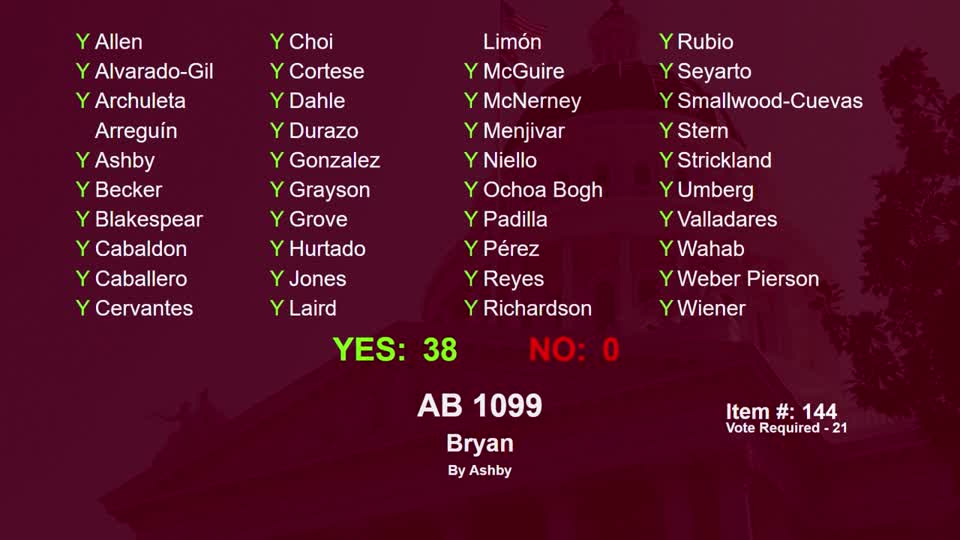 1MIN
Senate Floor
 11MIN
Assembly Standing Committee on Local Government
 14MIN
Assembly Standing Committee on Natural Resources
 9MIN
Assembly Standing Committee on Revenue and Taxation
 15MIN
Assembly Standing Committee on Environmental Safety and Toxic Materials
 1MIN
Senate Floor
 58SEC
Senate Standing Committee on Appropriations
Bill Author