SB 330: Budgets: multiyear financial commitments.
- Session Year: 2025-2026
- House: Senate
- Latest Version Date: 2026-06-11
Current Status:
In Progress
(2026-06-15: Re-referred to Com. on ED. pursuant to Assembly Rule 96.)
Introduced
In Committee
Awaiting First Chamber Vote
Passed First Chamber
In Committee
Awaiting Second Chamber Vote
Passed Second Chamber
Enacted
Existing law requires the Superintendent of Public Instruction, the Controller, and the Director of Finance to develop and update as necessary, standards and criteria to be reviewed and adopted by the State Board of Education and to be used by local educational agencies in the development of annual budgets and the management of subsequent expenditures from that budget, as specified. Existing law requires these standards and criteria to include, among other things, multiyear commitments, including cost-of-living adjustments.
This bill would specify that the multiyear commitments are for only the current fiscal year and the subsequent fiscal year. The bill would require the state board, on or before March 1, 2027, to amend specified related regulations, as provided, and would require the State Department of Education to modify the Standardized Account Code Structure reporting software infrastructure to eliminate reporting fields for a 2nd subsequent fiscal year and, commencing with the 202728 fiscal year, ensure that the system reflects a 2-year operational and forecasting structure.
Existing law requires the governing board of a school district and each county board of education, on or before July 1 of each year, to adopt a budget, as specified, and requires that budget to be filed with the county superintendent of schools or the Superintendent, respectively. Existing law requires the county superintendent of schools or the Superintendent, as applicable, to, among other things, examine the adopted budget to determine whether it complies with the standards and criteria adopted by the state board for local educational agency budgets and determine whether the adopted budget (1) will allow the school district or county office of education to meet its financial obligations during the fiscal year and (2) is consistent with a financial plan that will enable the school district or county office of education to satisfy its multiyear financial commitments.
Existing law requires the governing board of each school district and each county superintendent of schools to certify whether the school district or county office of education is able to meet its financial obligations for the remainder of the fiscal year and for the subsequent 2 fiscal years. Existing law requires (1) a negative certification to be assigned to any school district or county office of education that will be unable to meet its financial obligations for the remainder of the fiscal year or the subsequent fiscal year, (2) a qualified certification to be assigned to the school district or county office of education that may not meet its financial obligations for the current fiscal year or 2 subsequent fiscal years, and (3) a positive certification to be assigned to a school district or county office of education that will meet its financial obligations for the current fiscal year and subsequent 2 fiscal years. Existing law requires a copy of the school districts or county superintendents certification to be filed with the county superintendent of schools or the Superintendent, respectively.
The bill would instead only require certification for the current fiscal year and the subsequent fiscal year, and would require determinations for qualified and positive certifications to instead be assigned based only on the current fiscal year and the subsequent fiscal year. The bill would also make conforming changes to related provisions.
Existing law makes an environmental leadership development project, as defined, that meets specified requirements and is certified by the Governor eligible for streamlined procedures under the California Environmental Quality Act (CEQA). Existing law authorizes persons proposing eligible facilities, including certain electrical transmission lines and electrical transmission projects, to file applications, on or before June 30, 2029, with the State Energy Resources Conservation and Development Commission (Energy Commission) to certify sites and related facilities as environmental leadership development projects, as specified. Existing law makes a site and related facility certified by the Energy Commission as an environmental leadership development project subject to streamlined procedures under CEQA with no further action by the applicant or the Governor. Under existing law, the Energy Commissions certification of sites and related facilities is in lieu of any permit, certificate, or similar document required by any state, local, or regional agency, or federal agency to the extent permitted by federal law, for the use of the sites and related facilities, and supersedes any applicable statute, ordinance, or regulation of any state, local, or regional agency, or federal agency to the extent permitted by federal law, except as specified.This bill would authorize the Governor to establish one or more pilot projects to develop, finance, or operate electrical transmission infrastructure that meets specified criteria, including, among other things, that the transmission infrastructure is identified by the Independent System Operator in its transmission planning process as a project subject to competitive bidding and necessary to support clean energy generation to meet the states clean energy goals. The bill would require the Governor to designate existing state agencies, local public agencies, tribal organizations, or joint powers authorities to implement the pilot projects. The bill would authorize the pilot projects to develop, finance, operate, and maintain electrical transmission lines and all works, facilities, improvements, and property, or portions thereof, necessary or convenient for the conveyance of electricity, as specified. The bill would authorize the Governor to issue guidelines regarding application and certification of pilot projects.Existing law creates the Wildfire Fund, which is a continuously appropriated fund, to provide funds to participating electrical corporations to satisfy eligible claims arising from covered wildfires, as specified. Existing law authorizes electrical corporations to participate in the Wildfire Fund if they provide initial and annual contributions to the fund, as specified.This bill would require the owner of a pilot project designated by the Governor pursuant to the above-described provisions to participate in the Wildfire Fund. The bill would authorize a pilot project owner who participates in the Wildfire Fund to seek payment for an eligible claim that results from a covered wildfire, consistent with the relevant requirements applicable to electrical corporations and subject to specific requirements, including, among other things, that the Wildfire Fund Administrator determines the timing and amounts of contributions by the pilot project owner to the Wildfire Fund. The bill would require the Office of Energy Infrastructure Safety to review and approve wildfire mitigation plans relating to pilot projects, as provided, and to oversee wildfire safety performance by pilot project owners.By expanding the purposes for which the continuously appropriated Wildfire Fund may be used, the bill would make an appropriation.Existing law makes an environmental leadership development project, as defined, that meets specified requirements and is certified by the Governor eligible for streamlined procedures under the California Environmental Quality Act (CEQA). Existing law authorizes persons proposing eligible facilities, including certain electrical transmission lines and electrical transmission projects, to file applications, on or before June 30, 2029, with the State Energy Resources Conservation and Development Commission (Energy Commission) to certify sites and related facilities as environmental leadership development projects, as specified. Existing law makes a site and related facility certified by the Energy Commission as an environmental leadership development project subject to streamlined procedures under CEQA with no further action by the applicant or the Governor. Under existing law, the Energy Commissions certification of sites and related facilities is in lieu of any permit, certificate, or similar document required by any state, local, or regional agency, or federal agency to the extent permitted by federal law, for the use of the sites and related facilities, and supersedes any applicable statute, ordinance, or regulation of any state, local, or regional agency, or federal agency to the extent permitted by federal law, except as specified.
This bill would authorize the Governor to establish one or more pilot projects to develop, finance, or operate electrical transmission infrastructure that meet the meets specified criteria, including, among other things, that the transmission line infrastructure is identified by the Independent System Operator in its transmission planning process as a project subject to competitive bidding and necessary to support clean energy generation to meet the states clean energy goals. The bill would require the Governor to designate existing state agencies, local public agencies, tribal organizations, or joint powers authorities to implement the pilot projects. The bill would authorize the pilot projects to develop, finance, operate, and maintain electrical transmission lines and all works, facilities, improvements, and property, or portions thereof, necessary or convenient for the conveyance of electricity, as specified. The bill would authorize the Governor to issue guidelines regarding application and certification of pilot projects.
Existing law creates the Wildfire Fund, which is a continuously appropriated fund, to provide funds to participating electrical corporations to satisfy eligible claims arising from covered wildfires, as specified. Existing law authorizes electrical corporations to participate in the Wildfire Fund if they provide initial and annual contributions to the fund, as specified.
This bill would require the owner of a pilot project designated by the Governor pursuant to the above-described provisions to participate in the Wildfire Fund. The bill would authorize a pilot project owner who participates in the Wildfire Fund to seek payment for an eligible claim that results from a covered wildfire, consistent with the relevant requirements applicable to electrical corporations and subject to specific requirements, including, among other things, that the Wildfire Fund Administrator determines the timing and amounts of contributions by the pilot project owner to the Wildfire Fund. The bill would require the Office of Energy Infrastructure Safety to review and approve wildfire mitigation plans relating to pilot projects, as provided, and to oversee wildfire safety performance by pilot project owners.
By expanding the purposes for which the continuously appropriated Wildfire Fund may be used, the bill would make an appropriation.
Existing law makes an environmental leadership development project, as defined, that meets specified requirements and is certified by the Governor eligible for streamlined procedures under the California Environmental Quality Act (CEQA). Existing law authorizes persons proposing eligible facilities, including certain electrical transmission lines and electrical transmission projects, to file applications, on or before June 30, 2029, with the State Energy Resources Conservation and Development Commission (Energy Commission) to certify sites and related facilities as environmental leadership development projects, as specified. Existing law makes a site and related facility certified by the Energy Commission as an environmental leadership development project subject to streamlined procedures under CEQA with no further action by the applicant or the Governor. Under existing law, the Energy Commissions certification of sites and related facilities is in lieu of any permit, certificate, or similar document required by any state, local, or regional agency, or federal agency to the extent permitted by federal law, for the use of the sites and related facilities, and supersedes any applicable statute, ordinance, or regulation of any state, local, or regional agency, or federal agency to the extent permitted by federal law, except as specified.
This bill would authorize the Governor to establish one or more pilot projects to develop, finance, or operate electrical transmission infrastructure that meet the specified criteria, including, among other things, that the transmission line is identified by the Independent System Operator in its transmission planning process as a project subject to competitive bidding and necessary to support clean energy generation to meet the states clean energy goals. The bill would require the Governor to designate existing state agencies, local public agencies, tribal organizations, or joint powers authorities to implement the pilot projects. The bill would authorize the pilot projects to develop, finance, operate, and maintain electrical transmission lines and all works, facilities, improvements, and property, or portions thereof, necessary or convenient for the conveyance of electricity, as specified. The bill would authorize the Governor to issue guidelines regarding application and certification of pilot projects.
Existing law makes an environmental leadership development project, as defined, that meets specified requirements and is certified by the Governor eligible for streamlined procedures under the California Environmental Quality Act (CEQA). Existing law authorizes persons proposing eligible facilities, including certain electrical transmission lines and electrical transmission projects, to file applications, on or before June 30, 2029, with the State Energy Resources Conservation and Development Commission (Energy Commission) to certify sites and related facilities as environmental leadership development projects, as specified. Existing law makes a site and related facility certified by the Energy Commission as an environmental leadership development project subject to streamlined procedures under CEQA with no further action by the applicant or the Governor. Under existing law, the Energy Commissions certification of sites and related facilities is in lieu of any permit, certificate, or similar document required by any state, local, or regional agency, or federal agency to the extent permitted by federal law, for the use of the sites and related facilities, and supersedes any applicable statute, ordinance, or regulation of any state, local, or regional agency, or federal agency to the extent permitted by federal law, except as specified.
This bill would authorize the Governor to establish one or more pilot projects to develop, finance, or operate electrical transmission infrastructure that meet the specified criteria, including, among other things, that the transmission line is identified by the Independent System Operator in its transmission planning process as necessary to support clean energy generation to meet the states clean energy goals. The bill would require the Governor to designate existing state agencies, local public agencies, tribal organizations, or joint powers authorities to implement the pilot projects. The bill would authorize the pilot projects to develop, finance, operate, and maintain electrical transmission lines and all works, facilities, improvements, and property, or portions thereof, necessary or convenient for the conveyance of electricity, as specified. The bill would authorize the Governor to issue guidelines regarding application and certification of pilot projects.
The county superintendent of schools shall do all of the following:
(a)Superintend the schools of that county.
(b)Maintain responsibility for the fiscal oversight of each school district in that county pursuant to the authority granted by this code.
(c)(1)Visit and examine each school in the county at reasonable intervals to observe its operation and to learn of its problems. The county superintendent of schools annually may present a report of the state of the schools in the county, and of the county office of education, including, but not limited to, observations from visiting the schools, to the board of education and the board of supervisors of the county.
(2)(A)(i)Commencing with the 202122 fiscal year, the Superintendent shall identify a list of schools, which shall include charter schools, for which the county superintendent, or a designee, shall inspect annually, and about which the county superintendent, or a designee, shall submit an annual report, at a regularly scheduled November board meeting, to the governing board of each school district under the jurisdiction of the county superintendent, the county board of education of that county, and the board of supervisors of that county, that describes the state of the schools in the county. The list established in the 202122 fiscal year shall also be used as the list established in the 202223 and 202324 fiscal years. The list of schools established pursuant to this section shall be reestablished in the 202425 fiscal year and again every three fiscal years thereafter. Each list shall be established in accordance with clause (ii), and shall be used for inspections beginning the following fiscal year.
(ii)The list of schools pursuant to clause (i) shall be compiled as follows:
(I)The Superintendent shall include on the list all schools that were most recently identified for comprehensive support and improvement and additional targeted support and improvement pursuant to the federal Every Student Succeeds Act (Public Law 114-95) or identified as low performing under the federal Elementary and Secondary Education Act of 1965 (Public Law 89-10), or any subsequent amendments to that act. For the list established in the 202122, 202223, and 202324 fiscal years, the Superintendent shall use the list of schools identified in the 201920 fiscal year for comprehensive support and improvement and for additional targeted support and improvement.
(II)The Superintendent shall include on the list all schools where 15 percent or more of the teachers are holders of a permit or certificate, such as a temporary or short-term permit, a substitute permit, a waiver, an intern credential, or any other authorization that is a lesser certification than a preliminary or clear California teaching credential. With the exception of alternative schools, all schools within a local educational agency that fail to meet the requirements of Sections 44258.9 and 60900 shall be included on the list for the applicable reporting cycle.
(III)The list of schools compiled pursuant to clause (i) shall exclude alternative schools within the meaning of subdivision (d) of Section 52052 and other schools accepted for participation in the Dashboard Alternative School Status program by the department.
(iii)The annual report shall include the determinations for each school made by the county superintendent, or the county superintendents designee, regarding the status of all of the circumstances listed in subparagraph (E) and teacher misassignments and teacher vacancies, as described in Section 44258.9, and the county superintendent, or the county superintendents designee, shall use a standardized template to report the circumstances listed in subparagraph (E) and teacher misassignments and teacher vacancies, as described in Section 44258.9, unless the current annual report being used by the county superintendent, or the county superintendents designee, already includes those details with the same level of specificity that is otherwise required by this subdivision.
(B)The county superintendent of the Counties of Alpine, Amador, Del Norte, Mariposa, Plumas, and Sierra, and the City and County of San Francisco shall contract with another county office of education or an independent auditor to conduct the required visits and make all reports required by this paragraph.
(C)On a quarterly basis, the county superintendent, or the county superintendents designee, shall report the results of the visits and reviews conducted that quarter to the governing board of the school district at a regularly scheduled meeting held in accordance with public notification requirements. The results of the visits and reviews shall include the determinations of the county superintendent, or the county superintendents designee, for each school regarding the status of all of the circumstances listed in subparagraph (E) and teacher misassignments and teacher vacancies, as described in Section 44258.9. If the county superintendent, or the county superintendents designee, conducts no visits or reviews in a quarter, the quarterly report shall report that fact.
(D)The visits made pursuant to this paragraph shall be conducted at least annually and shall meet the following criteria:
(i)Minimize disruption to the operation of the school.
(ii)Be performed by individuals who meet the requirements of Section 45125.1.
(iii)Consist of not less than 25 percent unannounced visits in each county. During unannounced visits in each county, the county superintendent shall not demand access to documents or specific school personnel. Unannounced visits shall only be used to observe the condition of school repair and maintenance, and the sufficiency of instructional materials, as defined by Section 60119.
(E)The priority objective of the visits made pursuant to this paragraph shall be to determine the status of all of the following circumstances:
(i)Sufficient textbooks, as defined in Section 60119 and as specified in subdivision (i).
(ii)The condition of a facility that poses an emergency or urgent threat to the health or safety of pupils or staff, as described in school district policy or paragraph (1) of subdivision (c) of Section 17592.72.
(iii)The accuracy of data reported on the school accountability report card with respect to the availability of sufficient textbooks and instructional materials, as defined by Section 60119, and the safety, cleanliness, and adequacy of school facilities, including good repair, as required by Sections 17014, 17032.5, 17070.75, and 17089.
(F)The county superintendent may make the status determinations described in subparagraph (E) during a single visit or multiple visits. In determining whether to make a single visit or multiple visits for this purpose, the county superintendent shall take into consideration factors such as cost-effectiveness, disruption to the schoolsite, deadlines, and the availability of qualified reviewers.
(G)If the county superintendent determines that the condition of a facility poses an emergency or urgent threat to the health or safety of pupils or staff as described in school district policy or paragraph (1) of subdivision (c) of Section 17592.72, or is not in good repair, as specified in subdivision (d) of Section 17002 and required by Sections 17014, 17032.5, 17070.75, and 17089, the county superintendent, among other things, may do any of the following:
(i)Return to the school to verify repairs.
(ii)Prepare a report that specifically identifies and documents the areas or instances of noncompliance if the school district has not provided evidence of successful repairs within 30 days of the visit of the county superintendent or, for major projects, has not provided evidence that the repairs will be conducted in a timely manner. The report may be provided to the governing board of the school district. If the report is provided to the school district, it shall be presented at a regularly scheduled meeting held in accordance with public notification requirements. The county superintendent shall post the report on the internet website of the county superintendent. The report shall be removed from the internet website when the county superintendent verifies the repairs have been completed.
(H)For schools that are identified on the list established in the 202425 fiscal year pursuant to subparagraph (A), and only in the fiscal years in which that list is used, a county superintendent shall complete the textbook and instructional materials review conducted for purposes of this paragraph and subparagraph (A) of paragraph (3) of subdivision (i) by the eighth week of the school year. The county superintendent shall prioritize reviewing, within the first four weeks of the school year where practicable, schools for which the county superintendent has received information from a survey, a complaint filed pursuant to Section 35186, or any other reliable source that the school does not have sufficient textbooks, as defined in Section 60119 and as specified in subdivision (i), or that a facility of the school poses an emergency or urgent threat to the health or safety of pupils or staff as described in school district policy or paragraph (1) of subdivision (c) of Section 17592.72, or is not in good repair, as specified in subdivision (d) of Section 17002 and required by Sections 17014, 17032.5, 17070.75, and 17089.
(d)Distribute all laws, reports, circulars, instructions, and blanks that the county superintendent may receive for the use of the school officers.
(e)Annually, on or before September 15, present a report to the governing board of the school district and the Superintendent regarding the fiscal solvency of a school district with a disapproved budget, qualified interim certification, or a negative interim certification, or that is determined to be in a position of fiscal uncertainty pursuant to Section 42127.6.
(f)Keep in the office of the county superintendent the reports of the Superintendent.
(g)Keep a record of the official acts of the county superintendent and of all the proceedings of the county board of education, including a record of the standing, in each study, of all applicants for certificates who have been examined, which shall be open to the inspection of an applicant or an authorized agent of the applicant.
(h)Enforce the course of study.
(i)(1)Enforce the use of state textbooks and instructional materials and of high school textbooks and instructional materials regularly adopted by the proper authority in accordance with Section 51050.
(2)For purposes of this subdivision, sufficient textbooks or instructional materials has the same meaning as in subdivision (c) of Section 60119.
(3)(A)Commencing with the 202223 school year, if a school is identified as specified in subparagraph (A) of paragraph (2) of subdivision (c), the county superintendent specifically shall review that school at least annually as a priority school. A review conducted for purposes of this paragraph shall be completed by the fourth week of the school year, except as specified in subparagraph (H) of paragraph (2) of subdivision (c).
(B)In order to facilitate the review of instructional materials before the fourth week of the school year, the county superintendent in a county with 200 or more schools that are identified as specified in subparagraph (A) of paragraph (2) of subdivision (c) may use a combination of visits and written surveys of teachers for the purpose of determining sufficiency of textbooks and instructional materials in accordance with subparagraph (A) of paragraph (1) of subdivision (a) of Section 60119 and as defined in subdivision (c) of Section 60119. If a county superintendent elects to conduct written surveys of teachers, the county superintendent shall visit the schools surveyed within the same academic year to verify the accuracy of the information reported on the surveys. If a county superintendent surveys teachers at a school in which the county superintendent has found sufficient textbooks and instructional materials for the previous two consecutive years and determines that the school does not have sufficient textbooks or instructional materials, the county superintendent shall, within 10 business days, provide a copy of the insufficiency report to the school district as set forth in paragraph (4).
(C)For purposes of this paragraph, written surveys may include paper and electronic or online surveys.
(4)If the county superintendent of schools determines that a school does not have sufficient textbooks or instructional materials in accordance with subparagraph (A) of paragraph (1) of subdivision (a) of Section 60119 and as defined by subdivision (c) of Section 60119, the county superintendent shall do all of the following:
(A)Prepare a report that specifically identifies and documents the areas or instances of noncompliance.
(B)Provide within five business days of the review, a copy of the report to the school district, as provided in subdivision (c), or, if applicable, provide a copy of the report to the school district within 10 business days pursuant to subparagraph (B) of paragraph (3).
(C)Provide the school district with the opportunity to remedy the deficiency. The county superintendent shall ensure that the deficiency is remedied no later than the second month of the school term.
(D)If the deficiency is not remedied as required pursuant to subparagraph (C), the county superintendent shall request the department to purchase the textbooks or instructional materials necessary to comply with the sufficiency requirement of this subdivision. If the department purchases textbooks or instructional materials for the school district, the department shall issue a public statement at the first regularly scheduled meeting of the state board occurring immediately after the department receives the request of the county superintendent and that meets the applicable public notice requirements, indicating that the district superintendent and the governing board of the school district failed to provide pupils with sufficient textbooks or instructional materials as required by this subdivision. Before purchasing the textbooks or instructional materials, the department shall consult with the school district to determine which textbooks or instructional materials to purchase. The amount of funds necessary for the purchase of the textbooks and materials is a loan to the school district receiving the textbooks or instructional materials. Unless the school district repays the amount owed based upon an agreed-upon repayment schedule with the Superintendent, the Superintendent shall notify the Controller and the Controller shall deduct an amount equal to the total amount used to purchase the textbooks and materials from the next principal apportionment of the school district or from another apportionment of state funds.
(5)If the county superintendent of schools determines that there are insufficient textbooks or instructional materials pursuant to a resolution received in accordance with subparagraph (A) of paragraph (2) of subdivision (a) of Section 60119 and as defined by subdivision (c) of Section 60119, or as a result of receiving a report of an unresolved complaint pursuant to subdivision (e) of Section 35186 or an audit exception pursuant to subdivision (i) of Section 41020, the county superintendent shall do both of the following:
(A)Provide the school district with the opportunity to remedy the deficiency. The county superintendent shall ensure that the deficiency is remedied no later than the second month of the school term.
(B)If the deficiency is not remedied as required pursuant to subparagraph (A), the county superintendent shall request the department to purchase the textbooks or instructional materials necessary to comply with the sufficiency requirement of this subdivision. If the department purchases the textbooks or instructional materials for the school district, the department shall issue a public statement at the first regularly scheduled meeting of the state board occurring immediately after the department receives the request of the county superintendent and that meets the applicable public notice requirements, indicating that the district superintendent and the governing board of the school district failed to provide pupils with sufficient textbooks or instructional materials as required by this subdivision. Before purchasing the textbooks or instructional materials, the department shall consult with the school district when determining which textbooks or instructional materials to purchase. The amount of funds necessary for the purchase of the textbooks and materials is a loan to the school district receiving the textbooks or instructional materials. Unless the school district repays the amount owed based upon an agreed-upon repayment schedule with the Superintendent, the Superintendent shall notify the Controller and the Controller shall deduct an amount equal to the total amount used to purchase the textbooks and materials from the next principal apportionment of the school district or from another apportionment of state funds.
(j)Preserve carefully all reports of school officers and teachers.
(k)Deliver to the county superintendents successor, at the close of the county superintendents official term, all records, books, documents, and papers belonging to the office, taking a receipt for them, which shall be filed with the department.
(l)(1)Submit two reports during the fiscal year to the county board of education in accordance with the following:
(A)The first report shall cover the financial and budgetary status of the county office of education for the period ending October 31. The second report shall cover the period ending January 31. Both reports shall be reviewed by the county board of education and approved by the county superintendent no later than 45 days after the close of the period being reported.
(B)As part of each report, the county superintendent shall certify in writing whether or not the county office of education is able to meet its financial obligations for the remainder of the fiscal year and, based on current forecasts, for two the subsequent fiscal years. year. The certifications shall be classified as positive, qualified, or negative, pursuant to standards prescribed by the Superintendent, for purposes of determining subsequent state agency actions pursuant to Section 1240.1. For purposes of this subdivision, a negative certification shall be assigned to a county office of education that, based upon current projections, will not meet its financial obligations for the remainder of the fiscal year or for the subsequent fiscal year. A qualified certification shall be assigned to a county office of education that may not meet its financial obligations for the current fiscal year or two the subsequent fiscal years. year. A positive certification shall be assigned to a county office of education that will meet its financial obligations for the current fiscal year and the subsequent two fiscal years. year. In accordance with those standards, the Superintendent may reclassify a certification. If a county office of education receives a negative certification, the Superintendent, or the Superintendents designee, may exercise the authority set forth in subdivision (d) of Section 1630. Copies of each certification, and of the report containing that certification, shall be sent to the Superintendent at the time the certification is submitted to the county board of education. Copies of each qualified or negative certification and the report containing that certification shall be sent to the Controller at the time the certification is submitted to the county board of education.
(2)All reports and certifications required under this subdivision shall be in a format or on forms prescribed by the Superintendent, and shall be based on standards and criteria for fiscal stability adopted by the state board pursuant to Section 33127. The reports and supporting data shall be made available by the county superintendent to an interested party upon request.
(3)This subdivision does not preclude the submission of additional budgetary or financial reports by the county superintendent to the county board of education or to the Superintendent.
(4)The county superintendent is not responsible for the fiscal oversight of the community colleges in the county, however, the county superintendent may perform financial services on behalf of those community colleges.
(5)A county office of education having a negative or qualified certification, or classified as qualified or negative by the Superintendent, shall continue to be classified as qualified or negative until the next report required under this subdivision is filed.
(m)If requested, act as agent for the purchase of supplies for the city and high school districts of that county.
(n)For purposes of Section 44421.5, report to the Commission on Teacher Credentialing the identity of a certificated person who knowingly and willingly reports false fiscal expenditure data relative to the conduct of an educational program. This requirement applies only if, in the course of normal duties, the county superintendent discovers information that gives the county superintendent reasonable cause to believe that false fiscal expenditure data relative to the conduct of an educational program has been reported.
(o)If any activities authorized pursuant to this section are found to be a state reimbursable mandate pursuant to Section 6 of Article XIIIB of the California Constitution, funding provided for school districts and county offices of education pursuant to Sections 2574, 2575, 42238.02, and 42238.03 shall be used to directly offset any mandated costs.
SEC. 2.Section 1630 of the Education Code is amended to read:1630.(a)The Superintendent shall review and consider studies, reports, evaluations, or audits of the county office of education that contain evidence that the county office of education is demonstrating fiscal distress according to the standards and criteria adopted by the state board pursuant to Section 33127 or that contain a finding by an external reviewer that the county office of education is at moderate or high risk of intervention based on the most common indicators of school agencies needing intervention, as determined by the County Office Fiscal Crisis and Management Assistance Team. If those findings are made, the Superintendent shall investigate the financial condition of the county office of education and determine if the county office of education may be unable to meet its financial obligations for the current fiscal year or two the subsequent fiscal years, year, or should receive a qualified or negative interim financial certification pursuant to Section 1240.
(b)If at any time during the fiscal year the Superintendent determines that the county office of education may be unable to meet its financial obligations for the current fiscal year or two the subsequent fiscal years, year, or if the county office has a qualified or negative certification pursuant to Section 1240, the Superintendent shall provide a written notice of going concern determination to the county board of education and the county superintendent of schools and the basis for the determination. The notification shall include the assumptions used in making the determination and shall be available to the public. The Superintendent shall take all actions that are necessary, including at least one of the following, to ensure that the county office of education meets its financial obligations:
(1)Assign a fiscal expert, paid for by the Superintendent, to advise the county office of education on its financial problems.
(2)Conduct a study of the financial and budgetary conditions of the county office of education that includes, but is not limited to, a review of the county office of educations internal controls. If in the course of this review, the Superintendent determines that their office requires analytical assistance or expertise that is not available through the county office, the Superintendent may employ, at the county office of educations expense, on a short-term basis, staff, including certified public accountants, to provide the assistance and expertise.
(3)Direct the county office of education to submit a financial projection of all fund and cash balances of the county office of education as of June 30 of the current fiscal year and the subsequent fiscal years year, as the Superintendent requires.
(4)Require the county office of education to encumber all contracts and other obligations, to prepare appropriate cashflow analyses and monthly or quarterly budget revisions, and to appropriately record all receivables and payables.
(5)Direct the county office of education to submit a proposal for addressing the fiscal conditions that resulted in the determination that the county office of education may not be able to meet its financial obligations.
(6)Withhold compensation of the county board of education and the county superintendent of schools for failure to provide requested financial information.
(c)If, after taking the actions identified in subdivision (a), the Superintendent determines that a county office of education will be unable to meet its financial obligations for the current fiscal year or the subsequent fiscal year year, or if a county office of education experiences a significant fiscal event that is determined by the Superintendent to have an immediate severe fiscal impact that will cause a county office of education to be unable to meet its financial obligations for the current fiscal year or the subsequent fiscal year, the Superintendent shall notify the county board of education, the county superintendent of schools, and the president of the state board, or the presidents designee, in writing of that determination and the basis for that determination. The notification shall include the assumptions used in making the determination and shall be available to the public.
(d)If the Superintendent makes a determination specified in subdivision (c) or if the county office of education has a negative certification pursuant to Section 1240, the Superintendent shall make a report to the president of the state board, or the presidents designee, about the financial condition of the county office of education and remedial actions proposed by the Superintendent and shall take all actions that are necessary to ensure that the county office of education meets its financial obligations, including at least one of the following actions:
(1)Develop and impose, in consultation with the county board of education and the county superintendent, a budget revision that will enable the county office of education to meet its financial obligations in the current fiscal year.
(2)Stay or rescind all actions determined to be inconsistent with the ability of the county office of education to meet its obligations for the current fiscal year or the subsequent fiscal year, including all actions up to the point that the subsequent years budget is approved by the Superintendent. The Superintendent shall inform the county board of education and the county superintendent of schools in writing of the Superintendents justification for all exercises of authority under this paragraph.
(3)Assist in developing, in consultation with the county board of education and the county superintendent of schools, a multiyear financial recovery plan that will enable the county office of education to meet its future obligations.
(4)Assist in developing, in consultation with the county board of education and the county superintendent, a budget for the subsequent fiscal year. If necessary, the Superintendent shall continue to work with the county board of education and the county superintendent until the budget for the subsequent year is adopted by the county board of education and approved by the Superintendent.
(5)As necessary, appoint a fiscal adviser to perform one or more of the duties prescribed by this subdivision on behalf of the Superintendent.
(e)All actions taken by the Superintendent pursuant to paragraph (1) or (2) of subdivision (d) shall be accompanied by a notification that includes the actions to be taken, the reasons for the actions, and the assumptions used to support the necessity for the actions. That notification shall be available to the public.
(f)This section does not authorize the Superintendent to abrogate a provision of a collective bargaining agreement that was entered into by a county office of education before the date that the Superintendent assumed authority pursuant to subdivision (d).
(g)The county office of education shall pay 75 percent of, and the Superintendent shall pay 25 percent of, the administrative expenses incurred pursuant to subdivision (d) or costs associated with improving the county office of educations financial management practices.
(h)Notwithstanding any other law, a county treasurer shall not honor a warrant when the Superintendent, as appropriate, has disapproved that warrant, or has disapproved the order on county office of education funds for which a warrant was prepared.
(i)For all purposes of errors and liability insurance policies, a fiscal expert appointed pursuant to this section shall be deemed to be an employee of the county office of education. The Superintendent may require that the fiscal adviser be placed on the county office of education payroll for purposes of remuneration, benefits, and payroll deductions.
(j)If staff persons are hired pursuant to paragraph (2) of subdivision (b), the Superintendent may certify to the Controller an amount to be transferred to the department, from the funds that otherwise would be apportioned to the county office of education pursuant to Section 2574 or 2575, for the purpose of paying all costs incurred by that staff in performing their respective services. The Controller, upon receipt of that certification, shall transfer that amount.
(k)To facilitate the appointment of a county office of education fiscal officer and the employment of additional staff pursuant to paragraphs (1) and (2), respectively, of subdivision (b), for purposes of those paragraphs, the Superintendent is exempt from the requirements of Article 6 (commencing with Section 999) of Chapter 6 of Division 4 of the Military and Veterans Code and Part 2 (commencing with Section 10100) of Division 2 of the Public Contract Code.
SEC. 3.Section 33128 of the Education Code is amended to read:33128.(a)The standards and criteria to be adopted by the State Board of Education state board pursuant to Section 33127 shall include, but not be limited to, comparisons and reviews, including appropriate methods of projection, of all of the following:
(1)Average daily attendance.
(2)Revenues and expenditures.
(3)Reserves and fund balance.
(4)(A)Multiyear commitments, commitments for only the current fiscal year and the subsequent fiscal year, including cost-of-living adjustments.
(B)(i)(I)The state board shall, on or before March 1, 2027, amend Subchapter 8 (commencing with Section 15440) and Subchapter 9 (commencing with Section 15467) of Chapter 14 of Division 1 of Title 5 of the California Code of Regulations to substitute references to two subsequent fiscal years with the subsequent fiscal year instead, as applicable.
(II)The amendments pursuant to subclause (I) are a conforming change and shall be exempt from the requirements of Section 33127 and the Administrative Procedures Act (Chapter 3.5 (commencing with Section 11340) of Part 1 of Division 3 of Title 2 of the Government Code), and the state board shall submit the amended regulations to the Office of Administrative Law only for the printing and publication of the amended regulations in the California Code of Regulations. The amended regulations shall become effective immediately upon filing by the Secretary of State.
(ii)The department shall modify the Standardized Account Code Structure reporting software infrastructure to eliminate reporting fields for a second subsequent fiscal year and, commencing with the 202728 fiscal year, ensure the system reflects a two-year operational and forecasting structure.
(b)In addition to the requirements of subdivision (a), the standards and criteria to be adopted by the State Board of Education state board pursuant to Section 33127 shall include, but not be limited to, all of the following:
(1)Clear definitions and guidelines for positive, qualified, and negative interim financial certifications pursuant to Sections 42130 and 42131.
(2)District financial health indicators to provide a comprehensive review and assessment of the financial condition of districts and to help identify districts that are developing financial problems before the problems become severe. The indicators shall take into account issues including, but not limited to, all of the following:
(A)Increasing or decreasing balances available for general purposes and general purpose reserve size relative to the standard for the district.
(B)Long-term commitments for rates of increase in significant cost centers that are more or less than current revenue growth rate projections, including the projected cost change of the workforce taking into account the progression of newer hires and existing staff through the salary schedule and likely turnover, and all compensation for the superintendent of the school district and executive positions reporting directly to the superintendent of the school district.
(C)Use of one-time revenues for ongoing costs.
(D)Use of ongoing revenues for one-time costs.
(E)Appropriate recognition and amortization of future commitments including any district-created benefit program.
(F)Facilities maintenance funding adequate to preserve functionality of facilities for their normal life.
SEC. 4.Section 42127.6 of the Education Code is amended to read:42127.6.(a)(1)A school district shall provide the county superintendent of schools with a copy of a study, report, evaluation, or audit that was commissioned by the school district, the county superintendent, the Superintendent, and state control agencies and that contains evidence that the school district is showing fiscal distress under the standards and criteria adopted by the state board pursuant to Section 33127, or a report on the school district by the County Office Fiscal Crisis and Management Assistance Team. The county superintendent shall review and consider studies, reports, evaluations, or audits of the school district that contain evidence that the school district is demonstrating fiscal distress under the standards and criteria adopted by the state board pursuant to Section 33127 or that contain a finding by an external reviewer that the school district is at moderate or high risk of intervention based on the most common indicators of a school district needing intervention, as determined by the County Office Fiscal Crisis and Management Assistance Team. If these findings are made, the county superintendent of schools shall investigate the financial condition of the school district and determine if the school district may be unable to meet its financial obligations for the current fiscal year or two the subsequent fiscal years, year, or should receive a qualified or negative interim financial certification pursuant to Section 42131. If at any time during the fiscal year the county superintendent of schools determines that a school district may be unable to meet its financial obligations for the current fiscal year or two the subsequent fiscal years year, or if a school district has a qualified or negative certification pursuant to Section 42131, the county superintendent of schools shall provide a written notice of going concern determination to the governing board of the school district and the Superintendent and the basis for the determination. The notification shall include the assumptions used in making the determination and shall be available to the public. The county superintendent of schools shall report to the Superintendent on the financial condition of the school district and the county superintendents proposed remedial actions and shall do at least one of the following and all actions that are necessary to ensure that the school district meets its financial obligations:
(A)Assign a fiscal expert, paid for by the county superintendent of schools, to advise the school district on its financial problems.
(B)Conduct a study of the financial and budgetary conditions of the school district that includes, but is not limited to, a review of internal controls. If, in the course of this review, the county superintendent of schools determines that the county superintendents office requires analytical assistance or expertise that is not available through the school district, the county superintendent of schools may employ, on a short-term basis, with the approval of the Superintendent, staff, including certified public accountants, to provide the assistance and expertise. The school district shall pay 75 percent and the county office of education shall pay 25 percent of these staff costs.
(C)Direct the school district to submit a financial projection of all fund and cash balances of the district as of June 30 of the current fiscal year and the subsequent fiscal years year, as the county superintendent of schools requires.
(D)Require the district to encumber all contracts and other obligations, to prepare appropriate cashflow analyses and monthly or quarterly budget revisions, and to appropriately record all receivables and payables.
(E)Direct the school district to submit a proposal for addressing the fiscal conditions that resulted in the determination that the school district may not be able to meet its financial obligations.
(F)Withhold compensation of the members of the governing board of the school district and the school district superintendent for failure to provide requested financial information. This action may be appealed to the Superintendent pursuant to subdivision (b).
(G)Assign the County Office Fiscal Crisis and Management Assistance Team to review teacher hiring practices, teacher retention rate, percentage of provision of highly qualified teachers, and the extent of teacher misassignment in the school district, to provide the school district with recommendations to streamline and improve the teacher hiring process, teacher retention rate, extent of teacher misassignment, and provision of highly qualified teachers, and to perform any or all of the duties prescribed in subparagraphs (A) to (C), inclusive, or to further review the causes that led to a finding of moderate or high risk of intervention pursuant to subdivision (a) and recommend corrective action. If a review team is assigned to a school district, the school district shall follow the recommendations of the team, unless the school district shows good cause for failure to do so. The County Office Fiscal Crisis and Management Assistance Team may not recommend an action that would abrogate a contract that governs employment.
(2)Any contract entered into by a county superintendent of schools for the purposes of this subdivision is subject to the approval of the Superintendent.
(3)An employee of a school district who provides information regarding improper governmental activity, as defined in Section 44112, is entitled to the protection provided pursuant to Article 5 (commencing with Section 44110) of Chapter 1 of Part 25.
(b)Within five days of the county superintendent of schools making the determination specified in subdivision (a), a school district may appeal the basis of the determination and any of the proposed actions that the county superintendent of schools has indicated that the county superintendent of schools will take to further examine the financial condition of the school district. The Superintendent shall sustain or deny any or all parts of the appeal within 10 days.
(c)If after taking the actions identified in subdivision (a), the county superintendent of schools determines that a school district will be unable to meet its financial obligations for the current fiscal year or the subsequent fiscal year year, or if a school district experiences a significant fiscal event that is determined by the county superintendent of schools to have an immediate severe fiscal impact that will cause a school district to be unable to meet its financial obligations for the current fiscal year or the subsequent fiscal year, the county superintendent of schools shall notify the governing board of the school district, the superintendent of the school district, each recognized employee organization of the school district, each recognized parent organization of the school district, the Superintendent, and the president of the state board or the presidents designee in writing of that determination and the basis for that determination. The notification shall include the assumptions used in making the determination.
(d)Within five days of the county superintendent of schools making the determination specified in subdivision (c), a school district may appeal that determination to the Superintendent. The Superintendent shall sustain or deny the appeal within 10 days. If the governing board of the school district appeals the determination, the county superintendent of schools may stay any action of the governing board of the school district that the county superintendent of schools determines is inconsistent with the ability of the school district to meet its financial obligations for the current fiscal year or the subsequent fiscal year until resolution of the appeal by the Superintendent.
(e)If the appeal described in subdivision (d) is denied or not filed, or if the school district has a negative certification pursuant to Section 42131, the county superintendent of schools shall take all actions that are necessary to ensure that the school district meets its financial obligations, make a report to the Superintendent and the president of the state board, or the presidents designee, about the financial condition of the school district and remedial actions proposed by the county superintendent of schools, and shall, in consultation with the Superintendent, take at least one of the following actions:
(1)Develop and impose, in consultation with the Superintendent and the governing board of the school district, a budget revision that will enable the school district to meet its financial obligations in the current fiscal year.
(2)Stay or rescind any action that is determined to be inconsistent with the ability of the school district to meet its obligations for the current fiscal year or the subsequent fiscal year. This includes any actions up to the point that the subsequent years budget is approved by the county superintendent of schools. The county superintendent of schools shall inform the governing board of the school district in writing of the county superintendents justification for any exercise of authority under this paragraph.
(3)Assist in developing, in consultation with the governing board of the school district, a multiyear financial recovery plan that will enable the school district to meet its future obligations.
(4)Assist in developing, in consultation with the governing board of the school district, a budget for the subsequent fiscal year. If necessary, the county superintendent of schools shall continue to work with the governing board of the school district until the budget for the subsequent year is adopted by the governing board of the school district and approved by the county superintendent of schools.
(5)As necessary, appoint a fiscal adviser to perform any or all of the duties prescribed by this section on behalf of the county superintendent of schools.
(f)Any action taken by the county superintendent of schools pursuant to paragraph (1) or (2) of subdivision (e) shall be accompanied by a notification that shall include the actions to be taken, the reasons for the actions, and the assumptions used to support the necessity for these actions and shall be made available to the public.
(g)This section does not authorize the county superintendent of schools to abrogate any provision of a collective bargaining agreement that was entered into by a school district before the date that the county superintendent of schools assumed authority pursuant to subdivision (e).
(h)The school district shall pay 75 percent and the county office of education shall pay 25 percent of the administrative expenses incurred pursuant to subdivision (e) or costs associated with improving the school districts financial management practices. The Superintendent shall develop and distribute to affected school districts and county offices of education advisory guidelines regarding the appropriate amount of administrative expenses charged pursuant to this subdivision.
(i)Notwithstanding Section 42647 or 42650 or any other law, a county treasurer shall not honor any warrant if, pursuant to Sections 42127 to 42127.5, inclusive, or pursuant to this section, the county superintendent of schools or the Superintendent, as appropriate, has disapproved that warrant or the order on school district funds for which a warrant was prepared.
(j)Effective upon the certification of the election results for a newly organized school district pursuant to Section 35763, the county superintendent of schools may exercise any of the powers and duties of this section regarding the reorganized school district and the other affected school districts until the reorganized school district becomes effective for all purposes in accordance with Article 4 (commencing with Section 35530) of Chapter 3 of Part 21.
(k)The Superintendent shall monitor the efforts of a county office of education in exercising its authority under this section and may exercise any of that authority if the Superintendent finds that the actions of the county superintendent of schools are not effective in resolving the financial problems of the school district. Upon a decision to exercise the powers of the county superintendent of schools, the county superintendent of schools is relieved of those powers assumed by the Superintendent, and shall provide support and assistance to the Superintendent in the exercise of those powers. The Superintendent shall also request that the County Office Fiscal Crisis and Management Assistance Team identify the circumstances that led to the ineffectiveness of the county superintendent of schools in resolving the financial problems of the school district, and shall require the county office of education to demonstrate, in a manner determined by the Superintendent, remediation of those deficiencies. In addition to the actions taken by the county superintendent of schools, the Superintendent shall take further actions to ensure the long-term fiscal stability of the school district. The county office of education shall reimburse the Superintendent for all of the Superintendents costs in exercising the Superintendents authority under this subdivision. The Superintendent shall promptly notify the county superintendent of schools, the county board of education, the superintendent of the school district, the governing board of the school district, the appropriate policy and fiscal committees of each house of the Legislature, and the Department of Finance of the Superintendents decision to exercise the authority of the county superintendent of schools.
SEC. 5.Section 42131 of the Education Code is amended to read:42131.(a)(1)Pursuant to the reports required by Section 42130, the governing board of each school district shall certify, in writing, within 45 days after the close of the period being reported, whether the school district is able to meet its financial obligations for the remainder of the fiscal year and, based on current forecasts, for the subsequent two fiscal years. year. These certifications shall be based upon the governing board of the school districts assessment, on the basis of standards and criteria for fiscal stability adopted by the state board pursuant to Section 33127, of the school district budget, as revised to reflect current information regarding the adopted State Budget, school district property tax revenues pursuant to Sections 95 to 100, inclusive, of the Revenue and Taxation Code, and ending balances for the preceding fiscal year as reported pursuant to Section 42100. The certifications shall be classified as positive, qualified, or negative, as prescribed by the Superintendent for purposes of determining subsequent actions by the Superintendent, the Controller, or the county superintendent of schools, pursuant to subdivisions (b) and (c). These certifications shall be based upon the financial and budgetary reports required by Section 42130 but may include additional financial information known by the governing board of the school district to exist at the time of each certification. For purposes of this subdivision, a negative certification shall be assigned to any school district that, based upon current projections, will be unable to meet its financial obligations for the remainder of the fiscal year or the subsequent fiscal year. A qualified certification shall be assigned to any school district that, based upon current projections, may not meet its financial obligations for the current fiscal year or two the subsequent fiscal years. year. A positive certification shall be assigned to any school district that, based upon current projections, will meet its financial obligations for the current fiscal year and the subsequent two fiscal years. year.
(2)(A)A copy of each certification and a copy of the report submitted to the governing board of the school district pursuant to Section 42130 shall be filed with the county superintendent of schools. If a county office of education receives a positive certification when it determines a negative or qualified certification should have been filed, or receives a qualified certification when it determines a negative certification should have been filed, the county superintendent of schools shall change the certification to negative or qualified, as appropriate, and, no later than 75 days after the close of the period being reported, shall provide notice of that action to the governing board of the school district and to the Superintendent. No later than five days after a school district receives notice from the county superintendent of schools of a change in the school districts certification to negative or qualified, the governing board of the school district may submit an appeal to the Superintendent regarding the validity of that change, in accordance with the criteria applied to those designations pursuant to this subdivision. No later than 10 days after receiving that appeal, the Superintendent shall determine the certification to be assigned to the school district and shall notify the governing board of the school district and the county superintendent of schools of that determination.
(B)Copies of any certification in which the governing board of the school district is unable to certify unqualifiedly that these financial obligations will be met and a copy of the report submitted to the governing board of the school district pursuant to Section 42130 shall be sent by the county office of education to the Controller and the Superintendent at the time of the certification, together with a completed transmittal form provided by the Superintendent. Within 75 days after the close of the reporting period on all school district certifications that are classified as qualified or negative pursuant to this section, the appropriate county superintendent of schools shall submit to the Superintendent and the Controller the county superintendent of schools comments on those certifications and report any action proposed or taken pursuant to subdivision (b).
(3)All reports and certifications required under this subdivision shall be in a format or on forms prescribed by the Superintendent and shall be based on standards and criteria for fiscal stability adopted by the state board pursuant to Section 33127.
(4)This subdivision does not preclude the submission of additional budgetary or financial reports by the county superintendent of schools to the governing board of the school district, or to the Superintendent.
(b)As to any school district having a negative or qualified certification, the county superintendent of schools shall exercise the county superintendent of schools authority, as necessary, pursuant to Section 42127.6.
(c)Within 75 days after the close of each reporting period, each county superintendent of schools shall report to the Controller and the Superintendent as to whether the governing board of each of the school districts under the county superintendent of schools jurisdiction has submitted the certification required by subdivision (a). That report shall account for all school districts under the jurisdiction of the county office of education and indicate the type of certification filed by each school district.
(d)The Controllers office may conduct an audit or review of the fiscal condition of any school district having a negative or qualified certification.
(e)Any school district having a negative or qualified certification, or classified as qualified or negative by the county superintendent of schools, shall continue to be classified as qualified or negative until the next report required under Section 42130 is filed.
(f)The governing board of each school district filing a qualified or negative certification for the second report required under Section 42130, or classified as qualified or negative by the county superintendent of schools, shall provide to the county superintendent of schools, the Controller, and the Superintendent no later than June 1, financial statement projections of the school districts fund and cash balances through June 30 for the period ending April 30. The governing boards of all other school districts are encouraged to develop a similar financial statement for use in developing the beginning fund balances of the school district for the ensuing fiscal year.
(g)A school district for which the county board of education serves as the governing board of the school district is not subject to subdivisions (a) to (f), inclusive, but is governed instead by the interim report, monitoring, and review procedures set forth in subdivision (l) of Section 1240 and in Article 2 (commencing with Section 1620) of Chapter 5 of Part 2.
SECTION 1.(a)The Legislature finds and declares all of the following:(1)Californias electricity rates are among the highest in the nation, roughly double the national average. Rate increases that outpace inflation are forecast to continue over the coming years.(2)As a key component of the revenue requirement, the cost of electrical transmission infrastructure is a key factor in current and anticipated future rate increases.(3)The California Independent System Operator estimates that the state will require $45.8 billion to $63.2 billion in new electrical transmission infrastructure in order to meet forecasted energy demand and the states 2045 clean energy goals.(4)Recent research identifies the potential for these transmission lines to be developed and financed using alternative institutional structures and financing, such as public-private partnerships and public financing, in doing so reducing costs to ratepayers for the same infrastructure by billions of dollars per year.(5)These projects could continue to be managed, operated, and maintained by investor- or publicly owned utilities or other third-party transmission operators.(6)These projects will generate thousands of new jobs in low-income and disadvantaged regions throughout the state.(7)The rapid implementation of these infrastructure projects is essential to enable new clean energy generation at a pace and scale consistent with the states clean energy goals, such as floating offshore wind, geothermal, and utility-scale solar.(b)It is the intent of the Legislature to authorize the development and implementation of projects to lower the cost to ratepayers of electrical transmission infrastructure necessary to meet Californias clean energy goals. Methods to lower costs to ratepayers include, but are not limited to, using competitive solicitation for construction and operations, using revenue bonds or other types of public debt financing, reducing the delays related to siting and permitting projects, and a state or local government agency, or joint powers authority, holding legal title to the asset. Projects should be implemented as soon as possible to enable the states clean energy goals.SEC. 2.Chapter 6.7 (commencing with Section 25570) is added to Division 15 of the Public Resources Code, to read:6.7.Electrical Transmission Infrastructure Pilot Projects25570.(a)The Governor may establish one or more pilot projects to develop, finance, or operate electrical transmission infrastructure that meet the following criteria:(1)The transmission infrastructure is identified by the Independent System Operator in its transmission planning process as a project subject to competitive bidding and necessary to support clean energy generation to meet the states clean energy goals.(2)The pilot project provides a significant reduction in cost to ratepayers compared to alternatives.(3)The electrical transmission infrastructure developed pursuant to the pilot project is constructed by a prime contractor that has served as the prime contractor for at least two electrical transmission infrastructure projects in the state during the prior 10 years.(4)Unless it is maintained by an electrical corporation, the electrical transmission infrastructure developed pursuant to the pilot project is maintained by a contractor that has frequently performed electrical transmission infrastructure maintenance work for an electrical corporation during the prior 10 years.(5)The pilot project complies with the Public Utilities Commissions General Order 95.(b)The Governor shall designate existing state agencies, local public agencies, tribal organizations, or joint powers authorities to implement the pilot projects established pursuant to subdivision (a).(c)Pilot projects established pursuant to this section may develop, finance, operate, and maintain electrical transmission lines and all works, facilities, improvements, and property, or portions thereof, necessary or convenient for the conveyance of electricity. Transmission lines constructed pursuant to this chapter may be leased for operation. The designee may sell the rights to use transmission lines constructed pursuant to this chapter to any public or private entity that is engaged in the distribution, transmission, or sale of electricity. Transmission infrastructure developed pursuant to this chapter shall be controlled by a California balancing authority, as defined in Section 399.12 of the Public Utilities Code, regardless of ownership by the designee or a subsequent owner.(d)Local public agencies or groups of local public agencies may apply for authority to implement a pilot project under this section.(e)An agency, organization, or authority implementing a pilot project shall commit to requesting a revenue requirement at the Federal Energy Regulatory Commission that reflects only its actual capital structure and the actual cost of capital to minimize the costs collected through the transmission access charge.(f)The Governor may issue guidelines regarding application and certification of pilot projects pursuant to this chapter.25571.(a)If the Governor determines that a pilot project is eligible pursuant to this chapter, the Governor shall submit that determination, and any supporting information, to the Joint Legislative Budget Committee for review and concurrence or nonconcurrence.(b)Within 30 days of receiving the determination, the Joint Legislative Budget Committee shall concur or nonconcur in writing on the determination.(c)If the Joint Legislative Budget Committee fails to concur or nonconcur on a determination by the Governor within 30 days of the submittal, the pilot project is deemed to be eligible.25572.(a)The owner of a pilot project designated by the Governor pursuant to Section 25570 shall participate in the Wildfire Fund created pursuant to Section 3284 of the Public Utilities Code.(b)A pilot project owner who participates in the Wildfire Fund pursuant to this section may seek payment for an eligible claim that results from a covered wildfire, as defined in Section 3280 of the Public Utilities Code, consistent with the relevant requirements applicable to electrical corporations and subject to all of the following requirements:(1)The Wildfire Fund Administrator shall determine the timing and amount of contributions by a pilot project owner to the Wildfire Fund. In making this determination, the administrator shall evaluate the proportional number of miles of transmission lines owned by the pilot project owner in high fire-threat districts as a proportion of the total miles of all transmission and distribution lines in high fire-threat districts that participate in the Wildfire Fund.(2)A pilot project owner shall maintain reasonable insurance coverage as required by the Wildfire Fund Administrator.(3)A pilot project owner shall submit regular wildfire mitigation plans to the Office of Energy Infrastructure Safety and take all actions required by the office to achieve maximum feasible risk reductions.(4)The costs of participating in the Wildfire Fund and complying with wildfire mitigation plan requirements may be recovered in a transmission revenue requirement filed with the Federal Energy Regulatory Commission.(c)The Office of Energy Infrastructure Safety shall review and approve wildfire mitigation plans relating to pilot projects submitted pursuant to paragraph (3) of subdivision (b), and shall oversee wildfire safety performance by pilot project owners.(a)The Legislature finds and declares all of the following:
(1)Californias electricity rates are among the highest in the nation, including roughly double the national average. Rate increases that outpace inflation are forecast to continue over the coming years.
(2)As a key component of the revenue requirement, the cost of electrical transmission infrastructure is a key factor in current and anticipated future rate increases.
(3)The California Independent System Operator estimates that the state will require $45.8 billion to $63.2 billion in new electrical transmission infrastructure in order to meet forecasted energy demand and the states 2045 clean energy goals.
(4)Recent research identifies the potential for these transmission lines to be developed and financed using alternative institutional structures and financing, such as public-private partnerships and public financing, in doing so reducing costs to ratepayers for the same infrastructure by billions of dollars per year.
(5)These projects could continue to be managed, operated, and maintained by investor- or publicly owned utilities or other third-party transmission operators.
(6)These projects will generate thousands of new jobs in low-income and disadvantaged regions throughout the state.
(7)The rapid implementation of these infrastructure projects is essential to enable new clean energy generation at a pace and scale consistent with the states clean energy goals, such as floating offshore wind, geothermal, and utility-scale solar.
(b)It is the intent of the Legislature to authorize the development and implementation of projects to lower the cost to ratepayers of electrical transmission infrastructure necessary to meet Californias clean energy goals. Methods to lower costs to ratepayers include, but are not limited to, using competitive solicitation for construction and operations, using revenue bonds or other types of public debt financing, reducing the delays related to siting and permitting projects, and a state or local government agency, or joint powers authority, holding legal title to the asset. Projects should be implemented as soon as possible to enable the states clean energy goals.
SEC. 2.Chapter 6.7 (commencing with Section 25570) is added to Division 15 of the Public Resources Code, to read:6.7.Electrical Transmission Infrastructure Pilot Projects25570.(a)The Governor may establish one or more pilot projects to develop, finance, or operate electrical transmission infrastructure that meet the following criteria:
(1)The transmission line infrastructure is identified by the Independent System Operator in its transmission planning process as a project subject to competitive bidding and necessary to support clean energy generation to meet the states clean energy goals.
(2)The pilot project provides a significant reduction in cost to ratepayers compared to alternatives.
(3)The electrical transmission infrastructure developed pursuant to the pilot project meets the requirements of Sections 25545.3.3 and 25545.3.5. is constructed by a prime contractor that has served as the prime contractor for at least two electrical transmission infrastructure projects in the state during the prior 10 years.
(4)Unless it is maintained by an electrical corporation, the electrical transmission infrastructure developed pursuant to the pilot project is maintained by a contractor that has frequently performed electrical transmission infrastructure maintenance work for an electrical corporation during the prior 10 years.
(5)The pilot project complies with the Public Utilities Commissions General Order 95.
(b)The Governor shall designate existing state agencies, local public agencies, tribal organizations, or joint powers authorities to implement the pilot projects established pursuant to subdivision (a).
(c)Pilot projects established pursuant to this section may develop, finance, operate, and maintain electrical transmission lines and all works, facilities, improvements, and property, or portions thereof, necessary or convenient for the conveyance of electricity. Transmission lines constructed pursuant to this chapter may be leased for operation. The designee may sell the rights to use transmission lines constructed pursuant to this chapter to any public or private entity that is engaged in the distribution, transmission, or sale of electricity. Transmission infrastructure developed pursuant to this chapter shall be controlled by a California balancing authority, as defined in Section 399.12 of the Public Utilities Code, regardless of ownership by the designee or a subsequent owner.
(d)Local public agencies or groups of local public agencies may apply for authority to implement a pilot project under this section.
(e)An agency, organization, or authority implementing a pilot project shall commit to requesting a revenue requirement at the Federal Energy Regulatory Commission that only reflects only its actual capital structure and the actual cost of capital to minimize the costs collected through the transmission access charge.
(f)The Governor may issue guidelines regarding application and certification of pilot projects pursuant to this chapter.
25571.(a)If the Governor determines that a pilot project is eligible pursuant to this chapter, the Governor shall submit that determination, and any supporting information, to the Joint Legislative Budget Committee for review and concurrence or nonconcurrence.
(b)Within 30 days of receiving the determination, the Joint Legislative Budget Committee shall concur or nonconcur in writing on the determination.
(c)If the Joint Legislative Budget Committee fails to concur or nonconcur on a determination by the Governor within 30 days of the submittal, the pilot project is deemed to be eligible.
25572.(a)The owner of a pilot project designated by the Governor pursuant to Section 25570 shall participate in the Wildfire Fund created pursuant to Section 3284 of the Public Utilities Code.
(b)A pilot project owner who participates in the Wildfire Fund pursuant to this section may seek payment for an eligible claim that results from a covered wildfire, as defined in Section 3280 of the Public Utilities Code, consistent with the relevant requirements applicable to electrical corporations and subject to all of the following requirements:
(1)The Wildfire Fund Administrator shall determine the timing and amount of contributions by a pilot project owner to the Wildfire Fund. In making this determination, the administrator shall evaluate the proportional number of miles of transmission lines owned by the pilot project owner in high fire-threat districts as a proportion of the total miles of all transmission and distribution lines in high fire-threat districts that participate in the Wildfire Fund.
(2)A pilot project owner shall maintain reasonable insurance coverage as required by the Wildfire Fund Administrator.
(3)A pilot project owner shall submit regular wildfire mitigation plans to the Office of Energy Infrastructure Safety and take all actions required by the office to achieve maximum feasible risk reductions.
(4)The costs of participating in the Wildfire Fund and complying with wildfire mitigation plan requirements may be recovered in a transmission revenue requirement filed with the Federal Energy Regulatory Commission.
(c)The Office of Energy Infrastructure Safety shall review and approve wildfire mitigation plans relating to pilot projects submitted pursuant to paragraph (3) of subdivision (b), and shall oversee wildfire safety performance by pilot project owners.
(a)The Legislature finds and declares all of the following:
(1)Californias electricity rates are among the highest in the nation, including roughly double the national average. Rate increases that outpace inflation are forecast to continue over the coming years.
(2)As a key component of the revenue requirement, the cost of electrical transmission infrastructure is a key factor in current and anticipated future rate increases.
(3)The California Independent System Operator estimates that the state will require $45.8 billion to $63.2 billion in new electrical transmission infrastructure in order to meet forecasted energy demand and the states 2045 clean energy goals.
(4)Recent research identifies the potential for these transmission lines to be developed and financed using alternative institutional structures and financing, such as public-private partnerships and public financing, in doing so reducing costs to ratepayers for the same infrastructure by billions of dollars per year.
(5)These projects could continue to be managed, operated, and maintained by investor- or publicly owned utilities or other third-party transmission operators.
(6)These projects will generate thousands of new jobs in low-income and disadvantaged regions throughout the state.
(7)The rapid implementation of these infrastructure projects is essential to enable new clean energy generation at a pace and scale consistent with the states clean energy goals, such as floating offshore wind, geothermal, and utility-scale solar.
(b)It is the intent of the Legislature to authorize the development and implementation of projects to lower the cost to ratepayers of electrical transmission infrastructure necessary to meet Californias clean energy goals. Methods to lower costs to ratepayers include, but are not limited to, using competitive solicitation for construction and operations, using revenue bonds or other types of public debt financing, reducing the delays related to siting and permitting projects, and a state or local government agency, or joint powers authority, holding legal title to the asset. Projects should be implemented as soon as possible to enable the states clean energy goals.
SEC. 2.Chapter 6.7 (commencing with Section 25570) is added to Division 15 of the Public Resources Code, to read:6.7.Electrical Transmission Infrastructure Pilot Projects25570.(a)The Governor may establish one or more pilot projects to develop, finance, or operate electrical transmission infrastructure that meet the following criteria:
(1)The transmission line is identified by the Independent System Operator in its transmission planning process as a project subject to competitive bidding and necessary to support clean energy generation to meet the states clean energy goals.
(2)The pilot project provides a significant reduction in cost to ratepayers compared to alternatives.
(3)The pilot project is implemented pursuant to project labor agreements to use a skilled and trained workforce. meets the requirements of Sections 25545.3.3 and 25545.3.5.
(b)The Governor shall designate existing state agencies, local public agencies, tribal organizations, or joint powers authorities to implement the pilot projects established pursuant to subdivision (a).
(c)Pilot projects established pursuant to this section may develop, finance, operate, and maintain electrical transmission lines and all works, facilities, improvements, and property, or portions thereof, necessary or convenient for the conveyance of electricity. Transmission lines constructed pursuant to this chapter may be leased for operation. The designee may sell the rights to use transmission lines constructed pursuant to this chapter to any public or private entity that is engaged in the distribution, transmission, or sale of electricity. Transmission infrastructure developed pursuant to this chapter shall be controlled by a California balancing authority, as defined in Section 399.12 of the Public Utilities Code, regardless of ownership by the designee or a subsequent owner.
(d)Local public agencies or groups of local public agencies may apply for authority to implement a pilot project under this section.
(e)An agency, organization, or authority implementing a pilot project shall commit to requesting a revenue requirement at the Federal Energy Regulatory Commission that only reflects its actual capital structure and the actual cost of capital to minimize the costs collected through the transmission access charge.
(f)The Governor may issue guidelines regarding application and certification of pilot projects pursuant to this chapter.
25571.(a)If the Governor determines that a pilot project is eligible pursuant to this chapter, the Governor shall submit that determination, and any supporting information, to the Joint Legislative Budget Committee for review and concurrence or nonconcurrence.
(b)Within 30 days of receiving the determination, the Joint Legislative Budget Committee shall concur or nonconcur in writing on the determination.
(c)If the Joint Legislative Budget Committee fails to concur or nonconcur on a determination by the Governor within 30 days of the submittal, the pilot project is deemed to be eligible.
(a)The Legislature finds and declares all of the following:
(1)Californias electricity rates are among the highest in the nation, including roughly double the national average. Rate increases that outpace inflation are forecast to continue over the coming years.
(2)As a key component of the revenue requirement, the cost of electrical transmission infrastructure is a key factor in current and anticipated future rate increases.
(3)The California Independent System Operator estimates that the state will require $45.8 billion to $63.2 billion in new electrical transmission infrastructure in order to meet forecasted energy demand and the states 2045 clean energy goals.
(4)Recent research identifies the potential for these transmission lines to be developed and financed using alternative institutional structures and financing, such as public-private partnerships and public financing, in doing so reducing costs to ratepayers for the same infrastructure by billions of dollars per year.
(5)These projects could continue to be managed, operated, and maintained by investor- or publicly owned utilities or other third-party transmission operators.
(6)These projects will generate thousands of new jobs in low-income and disadvantaged regions throughout the state.
(7)The rapid implementation of these infrastructure projects is essential to enable new clean energy generation at a pace and scale consistent with the states clean energy goals, such as floating offshore wind, geothermal, and utility-scale solar.
(b)It is the intent of the Legislature to authorize the development and implementation of projects to lower the cost to ratepayers of electrical transmission infrastructure necessary to meet Californias clean energy goals. Methods to lower costs to ratepayers include, but are not limited to, using competitive solicitation for construction and operations, using revenue bonds or other types of public debt financing, reducing the delays related to siting and permitting projects, and a state or local government agency, or joint powers authority, holding legal title to the asset. Projects should be implemented as soon as possible to enable the states clean energy goals.
SEC. 2.Chapter 6.7 (commencing with Section 25570) is added to Division 15 of the Public Resources Code, to read:6.7.Electrical Transmission Infrastructure Pilot Projects25570.(a)The Governor may establish one or more pilot projects to develop, finance, or operate electrical transmission infrastructure that meet the following criteria:
(1)The transmission line is identified by the Independent System Operator in its transmission planning process as necessary to support clean energy generation to meet the states clean energy goals.
(2)The pilot project provides a significant reduction in cost to ratepayers compared to alternatives.
(3)The pilot project is implemented pursuant to project labor agreements to use a skilled and trained workforce.
(b)The Governor shall designate existing state agencies, local public agencies, tribal organizations, or joint powers authorities to implement the pilot projects established pursuant to subdivision (a).
(c)Pilot projects established pursuant to this section may develop, finance, operate, and maintain electrical transmission lines and all works, facilities, improvements, and property, or portions thereof, necessary or convenient for the conveyance of electricity. Transmission lines constructed pursuant to this chapter may be leased for operation. The designee may sell the rights to use transmission lines constructed pursuant to this chapter to any public or private entity that is engaged in the distribution, transmission, or sale of electricity. Transmission infrastructure developed pursuant to this chapter shall be controlled by a California balancing authority, as defined in Section 399.12 of the Public Utilities Code, regardless of ownership by the designee or a subsequent owner.
(d)Local public agencies or groups of local public agencies may apply for authority to implement a pilot project under this section.
(e)An agency, organization, or authority implementing a pilot project shall commit to requesting a revenue requirement at the Federal Energy Regulatory Commission that only reflects its actual capital structure and the actual cost of capital to minimize the costs collected through the transmission access charge.
(e)(f)The Governor may issue guidelines regarding application and certification of pilot projects pursuant to this chapter.
25571.(a)If the Governor determines that a pilot project is eligible pursuant to this chapter, the Governor shall submit that determination, and any supporting information, to the Joint Legislative Budget Committee for review and concurrence or nonconcurrence.
(b)Within 30 days of receiving the determination, the Joint Legislative Budget Committee shall concur or nonconcur in writing on the determination.
(c)If the Joint Legislative Budget Committee fails to concur or nonconcur on a determination by the Governor within 30 days of the submittal, the pilot project is deemed to be eligible.
(a)The Legislature finds and declares all of the following:
(1)Californias electricity rates are among the highest in the nation, including roughly double the national average. Rate increases that outpace inflation are forecast to continue over the coming years.
(2)As a key component of the revenue requirement, the cost of electrical transmission infrastructure is a key factor in current and anticipated future rate increases.
(3)The California Independent System Operator estimates that the state will require $45.8 billion to $63.2 billion in new electrical transmission infrastructure in order to meet forecasted energy demand and the states 2045 clean energy goals.
(4)Recent research identifies the potential for these transmission lines to be developed and financed using alternative institutional structures and financing, such as public-private partnerships and public financing, in doing so reducing costs to ratepayers for the same infrastructure by billions of dollars per year.
(5)These projects could continue to be managed, operated, and maintained by investor- or publicly owned utilities or other third-party transmission operators.
(6)These projects will generate thousands of new jobs in low-income and disadvantaged regions throughout the state.
(7)The rapid implementation of these infrastructure projects is essential to enable new clean energy generation at a pace and scale consistent with the states clean energy goals, such as floating offshore wind, geothermal, and utility-scale solar.
(b)It is the intent of the Legislature to authorize the development and implementation of projects to lower the cost to ratepayers of electrical transmission infrastructure necessary to meet Californias clean energy goals. Methods to lower costs to ratepayers include, but are not limited to, using competitive solicitation for construction and operations, using revenue bonds or other types of public debt financing, reducing the delays related to siting and permitting projects, and a state or local government agency, or joint powers authority, holding legal title to the asset. Projects should be implemented as soon as possible to enable the states clean energy goals.
SEC. 2.Chapter 6.7 (commencing with Section 25570) is added to Division 15 of the Public Resources Code, to read:6.7.Electrical Transmission Infrastructure Pilot Projects25570.(a)The Governor may establish one or more pilot projects to develop, finance, or operate electrical transmission infrastructure that meet the following criteria:
(1)The transmission line is identified by the Independent System Operator in its transmission planning process as necessary to support clean energy generation to meet the states clean energy goals.
(2)The pilot project provides a significant reduction in cost to ratepayers compared to alternatives.
(3)The pilot project is implemented pursuant to project labor agreements to use a skilled and trained workforce.
(b)The Governor shall designate existing state agencies, local public agencies, tribal organizations, or joint powers authorities to implement the pilot projects established pursuant to subdivision (a).
(c)Pilot projects established pursuant to this section may develop, finance, operate, and maintain electrical transmission lines and all works, facilities, improvements, and property, or portions thereof, necessary or convenient for the conveyance of electricity. Transmission lines constructed pursuant to this chapter may be leased for operation. The designee may sell the rights to use transmission lines constructed pursuant to this chapter to any public or private entity that is engaged in the distribution, transmission, or sale of electricity. Transmission infrastructure developed pursuant to this chapter shall be controlled by a California balancing authority, as defined in Section 399.12 of the Public Utilities Code, regardless of ownership by the designee or a subsequent owner.
(d)Local public agencies or groups of local public agencies may apply for authority to implement a pilot project under this section.
(e)The Governor may issue guidelines regarding application and certification of pilot projects pursuant to this chapter.
25571.(a)If the Governor determines that a pilot project is eligible pursuant to this chapter, the Governor shall submit that determination, and any supporting information, to the Joint Legislative Budget Committee for review and concurrence or nonconcurrence.
(b)Within 30 days of receiving the determination, the Joint Legislative Budget Committee shall concur or nonconcur in writing on the determination.
(c)If the Joint Legislative Budget Committee fails to concur or nonconcur on a determination by the Governor within 30 days of the submittal, the pilot project is deemed to be eligible.
|
Date
|
Status
|
|---|---|
| Jun 15, 2026 | Re-referred to Com. on ED. pursuant to Assembly Rule 96. |
| Jun 11, 2026 | From committee with author's amendments. Read second time and amended. Re-referred to Com. on U. & E. |
| Jul 16, 2025 | July 16 set for second hearing canceled at the request of author. |
| Jul 9, 2025 | July 9 set for first hearing canceled at the request of author. |
| Jun 30, 2025 | From committee with author's amendments. Read second time and amended. Re-referred to Com. on U. & E. |
| Jun 9, 2025 | Referred to Coms. on U. & E. and NAT. RES. |
| Jun 4, 2025 | In Assembly. Read first time. Held at Desk. |
| Jun 3, 2025 | Read third time. Passed. (Ayes 28. Noes 10. Page 1443.) Ordered to the Assembly. |
| May 23, 2025 | Read second time. Ordered to third reading. |
| May 23, 2025 | From committee: Do pass. (Ayes 5. Noes 1. Page 1196.) (May 23). |
| May 16, 2025 | Set for hearing May 23. |
| May 12, 2025 | May 12 hearing: Placed on APPR. suspense file. |
| May 2, 2025 | Set for hearing May 12. |
| May 1, 2025 | From committee: Do pass and re-refer to Com. on APPR. (Ayes 6. Noes 2. Page 963.) (April 30). Re-referred to Com. on APPR. |
| Apr 29, 2025 | From committee: Do pass and re-refer to Com. on E.Q. (Ayes 13. Noes 3. Page 935.) (April 29). Re-referred to Com. on E.Q. |
| Apr 17, 2025 | Set for hearing April 30 in E.Q. pending receipt. |
| Apr 11, 2025 | Set for hearing April 29. |
| Mar 28, 2025 | From committee with author's amendments. Read second time and amended. Re-referred to Com. on E., U & C. |
| Mar 17, 2025 | From committee with author's amendments. Read second time and amended. Re-referred to Com. on E., U & C. |
| Feb 19, 2025 | Referred to Coms. on E., U & C. and E.Q. |
| Feb 13, 2025 | From printer. May be acted upon on or after March 15. |
| Feb 12, 2025 | Introduced. Read first time. To Com. on RLS. for assignment. To print. |
|
Date
|
Description
|
Location
|
Votes
|
|
|---|---|---|---|---|
| Jun 3, 2025 | Senate 3rd Reading SB330 Padilla | Senate Floor |
Passed |
|
| May 23, 2025 | Do pass | Senate Standing Committee on Appropriations |
Passed |
|
| May 12, 2025 | Placed on suspense file | Senate Standing Committee on Appropriations |
Passed |
|
| Apr 30, 2025 | Do pass, but first be re-referred to the Committee on [Appropriations] | Senate Standing Committee on Environmental Quality |
Passed |
|
| Apr 29, 2025 | Do pass, but first be re-referred to the Committee on [Environmental Quality] | Senate Standing Committee on Energy, Utilities and Communications |
Passed |
This list shows positions taken on this bill by organizations on the date displayed, which is linked to the original source.
Positions by individuals are not included.
|
Organization
|
Position
|
Date
|
|---|---|---|
| 350 Humboldt | ** Support | |
| 350 Humboldt: Grass Roots Climate Action | ** Support | |
| Advanced Energy United | ** Support | |
| Agricultural Energy Consumers Association | ** Support | |
| Anza-Borrego Foundation | ** Against | |
| Brightline Defense | ** Support | |
| CalChamber | ** Against | |
| California Community Choice Association | ** Support | |
| California Environmental Voters | ** Support | |
| California Large Energy Consumers Association | ** Support | |
| California State Association Of Electrical Workers | ** Support | |
| Clean Air Task Force | ** Support | |
| Clean Power Alliance of Southern California | ** Support | |
| Clean Power Campaign | ** Support | |
| Climate Action California | ** Support | |
| Climate Reality Project San Diego | ** Support | |
| Coalition of California Utility Employees | ** Support | |
| Edison International And Affiliates, Including Southern California Edison | ** Against | |
| Elders Climate Action Nor Cal | ** Support | |
| Elders Climate Action Socal Chapter | ** Support | |
| Marin Clean Energy | ** Support | |
| Natural Resources Defense Council | ** Support | |
| NET-ZERO CALIFORNIA | ** Support | |
| Norcal Elder Climate Action | ** Support | |
| NRDC | ** Support | |
| Other | ** Against | |
| Pacific Gas And Electric Company | ** Against | |
| San Diego Community Power | ** Support | |
| San Diego Gas & Electric | ** Against | |
| San Jose Clean Energy | ** Support | |
| Santa Cruz Climate Action Campaign | ** Support | |
| SoCal Elders Climate Action | ** Support | |
| Solar Energy Industries Association | ** Support | |
| Southern California Edison | ** Against | |
| State Water Contractors | ** Support | |
| Sustainable Mill Valley | ** Support | |
| The Climate Center | ** Support | |
| The Utility Reform Network | ** Support | |
| Union Of Concerned Scientists | ** Support |
Date of Hearing: July 16, 2025
ASSEMBLY COMMITTEE ON UTILITIES AND ENERGY
Cottie Petrie-Norris, Chair
SBPCA Bill Id:SB 330
Author:(Padilla) – As Amended Ver:June 30, 2025
SENATE VOTE: 28-10
SUBJECT: Electrical transmission infrastructure: financing
SUMMARY: Authorizes the Governor to select projects to develop, finance, or operate electrical transmission infrastructure that meets specified requirements. Specifically, this bill:
- Grants the Governor the authority to select one or more transmission projects to develop, finance, or operate transmission infrastructure that meets specified criteria. These include, among other things, that the project is identified by CAISO in its transmission planning process as subject to competitive bidding, and is necessary to meet California’s clean energy goals, provides a significant cost reduction to ratepayers compared to alternatives, and complies with CPUC General Order 95.
- Requires the Governor to designate existing state agencies, local public agencies, tribal organizations, or joint powers authorities to implement the pilot projects.
- Authorizes the pilot projects to develop, finance, operate, and maintain transmission lines and all works, facilities, improvements, and property, or portions thereof, necessary or convenient for the conveyance of electricity, as specified.
- Authorizes the Governor to issue guidelines regarding application and certification of pilot projects.
- Authorizes Local public agencies or groups of local public agencies to apply for authority to implement a pilot project.
- Authorizes an agency, organization, or authority implementing a pilot project to commit to requesting a revenue requirement at the FERC that reflects only its actual capital structure and actual cost of capital, in order to minimize costs recovered through the Transmission Access Charge.
- Authorizes the Governor to issue guidelines regarding application and certification of pilot projects.
- Requires the Governor to submit to the Joint Legislative Budget Committee a determination that a transmission project is eligible as a pilot project, and provides the Committee 30 days to concur or nonconcur.
- Requires the owner of a pilot project designated by the Governor to participate in the Wildfire Fund.
- Authorizes the pilot project owner who participates in the Wildfire Fund to seek payment for an eligible claim resulting from a covered wildfire as defined and consistent with relevant requirements applicable to IOUs and subject to requirements that include:
- The Wildfire Fund Administrator shall determine the timing and amount of contributions required from the pilot project owner.
- The pilot project owner shall submit regular wildfire mitigation plans to the Office of Energy Infrastructure Safety and comply with all directives issued by the office to achieve maximum feasible risk reduction.
- The costs of participating in the Wildfire Fund and complying with wildfire mitigation plan requirements may be recovered in a transmission revenue requirement filed with FERC.
EXISTING LAW:
- Establishes that the U.S. Federal Energy Regulatory Commission (FERC) has exclusive jurisdiction over the transmission of electric energy in interstate commerce. Also establishes the process and procedures for establishing transmission of electric energy in interstate commerce by public utilities, i.e., the rates, terms & conditions of interstate electric transmission by public utilities. (Federal Power Act §§§201, 205, 206 (16 USC 824, 824d, 824e))
- Establishes the California Public Utilities Commission (CPUC) has regulatory authority over public utilities, including electrical corporations. (Article XII of the California Constitution)
- Prohibits an electrical corporation from beginning construction of a line, plant, or system, or of any extension thereof, without having first obtained from the CPUC a certificate that the present or future public convenience and necessity requires or will require its construction. (Public Utilities Code §1001)
- Requires the CPUC, in a proceeding evaluating the issuance of a certificate of public convenience and necessity for a proposed transmission project, to establish a rebuttable presumption with regard to need for a proposed transmission project in favor of California Independent System Operator (CAISO) governing-board approved need evaluation if specified conditions are met. (Public Utilities Code §1001.1)
- Makes an environmental leadership development project, as defined, that meets specified requirements and is certified by the Governor, eligible for streamlined procedures under the California Environmental Quality Act (CEQA). (Public Resources Code §21184 and 21185)
- Authorizes persons proposing eligible facilities, including certain electrical transmission lines and electrical transmission projects, to file applications, on or before June 30, 2029, with the State Energy Resources Conservation and Development Commission (also known as the California Energy Commission (CEC) to certify sites and related facilities as environmental leadership development projects, as specified. (Public Resources Code §25545 et seq. and 25545.1)
- Makes a site and related facility certified by the CEC as an environmental leadership development project subject to streamlined procedures under CEQA with no further action by the applicant or the Governor. (Public Resources Code §25545.13)
- Provides that the CEC’s certification of sites and related facilities is in lieu of any permit, certificate, or similar document required by any state, local, or regional agency, or federal agency to the extent permitted by federal law, for the use of the sites and related facilities, and supersedes any applicable statute, ordinance, or regulation of any state, local, or regional agency, or federal agency to the extent permitted by federal law, except as specified. (Public Resources Code §25545.1)
- Establishes the California Independent System Operator (CAISO) as a nonprofit, public benefit corporation to manage the transmission grid and related energy markets, as provided. (Public Utilities Code §345 et seq.)
- Establishes the policy (100% Clean Energy Policy, or SB 100 Policy) of the state that eligible renewable energy resources and zero-carbon resources supply 90% of all retail sales of electricity to California end-use customers by December 31, 2035, 95% of all retail sales of electricity to California end-use customers by December 31, 2040, 100% of all retail sales of electricity to California end-use customers by December 31, 2045, and 100% of electricity procured to serve all state agencies by December 31, 2035. (Public Utilities Code § 454.53)
- Establishes the Office of Energy Infrastructure Safety (OEIS) within the Natural Resources Agency, which, as of July 1, 2021, subsumed the Wildfire Safety Division (WSD) responsibilities at the CPUC, including to review the wildfire mitigation plans (WMPs) of electrical corporations and oversee and enforce electrical corporations’ compliance with wildfire safety. Transferred all functions of the WSD to the OEIS effective July 1, 2021. Requires the OEIS to adopt guidelines setting forth the requirements, format, timing, and any other matters required to exercise its powers, perform its duties, and meet its responsibilities. (Government Code §§15740 et seq. and 15475.6, Public Utilities Code §§326 and 8385)
- Requires the OEIS to approve or deny each WMP and update submitted by an electrical corporation within three months of its submission. Establishes procedures for the OEIS to oversee compliance with an approved WMP. (Public Utilities Code §8386.3)
- Permits the California Public Utilities Commission (CPUC) to allow for the recovery of costs and expenses arising from a covered wildfire occurring after January 1, 2019, if the CPUC finds the costs and expenses just and reasonable. Establishes a standard of reasonable conduct of an electric corporation (IOU), for purposes of cost recovery, based on whether a reasonable utility would have undertaken the action in good faith under similar circumstances. Specifies that the IOU bears the burden to demonstrate that its conduct was reasonable, unless it has a valid safety certificate; at which point, the IOU’s conduct is deemed reasonable unless a third party creates serious doubt as to the reasonableness of the IOU’s conduct. (Public Utilities Code § 451.1)
- Requires each IOU to annually prepare and submit to Energy Safety a WMP for review and approval. Requires the wildfire mitigation plan (WMP) to include a description of preventative strategies and programs to minimize the risk of catastrophic wildfire, including consideration of dynamic climate change risk; a description of the metrics used to evaluate the plan’s performance and underlying assumptions for the use of those metrics; and a list that identifies, describes, and prioritizes all wildfire risks and drivers of those risks throughout the IOU’s service territory. (Public Utilities Code § 8386 (b) and (c))
- Establishes the Wildfire Fund, which is a continuously appropriated fund, to provide funds to participating electrical corporations to satisfy eligible claims arising from covered wildfires, as specified. (Public Utilities Code § 3284)
- Requires local publicly owned electric utilities and electrical cooperatives to annually prepare and submit to the WSAB, on or before July 1 of each year, WMPs. (Public Utilities Code §8387)
- Authorizes IOUs to participate in the Wildfire Fund if they provide initial and annual contributions to the fund, as specified. (Public Utilities Code § 3285 (c))
FISCAL EFFECT: According to the Senate Committee on Appropriations, the Governor’s Office of Land Use and Climate Innovation (LCI) estimates ongoing General Fund costs of approximately $567,000 annually to implement this measure. Additionally, potentially significant costs could result for other state agencies, including the CEC, to engage in program development or project implementation, depending on their roles and existing resources.
CUSTOMER COST IMPACTS: This measure seeks to provide low-cost public financing to lower transmission development costs and, ultimately, reduce future ratepayer costs. The full impact of these efforts is unknown to this committee.
BACKGROUND:
Scaling Up for 2045 – California has ambitious clean energy goals. According to the SB 100 Joint Agency Report, achieving these goals, requires the state to roughly triple its current electricity capacity. Specifically, the report projects that the state will need to add approximately 6 gigawatts (GW) of new renewable capacity annually — nearly double the historical average. In parallel, a study conducted by the Clean Air Task Force and the Environmental Defense Fund concluded that, at a minimum, California will need to double transmission capacity by 2045 to accommodate new renewables and ensure grid reliability.[1] Given the scale of new infrastructure development needed, meeting California’s clean energy goals equally requires significant transmission investments, planned in a way that supports affordability for ratepayers.
Transmission Planning Process (TPP) –The TPP, occurs annually, and begins with California Independent System Operator (CAISO) identifying potential system limitations as well as transmission projects in need of upgrades or new infrastructure in need of construction to chiefly meet reliability, state policy goals, and economic or other needs for the state.[2] First, CAISO receives demand forecast of electricity and natural gas sales, consumption, and peak and hourly electricity demand from the CEC’s integrated energy policy report (IEPR).[3] Corresponding to this action, the CPUC’s Integrated Process (IRP)[4] then works to identify the optimal mix of system-wide resources capable of meeting GHG planning targets for the electric sector.[5] CAISO receives the IRP results as inputs into its TPP. The core of these efforts is to meet the GHGs targets for electricity sector established by CARB’s scoping plan. CAISO updates its transmission plan annually, culminating in approval by the CAISO Board of Governors. The CAISO Board recently approved its 2023-2024 TPP in May 2024[6] , which calls for 85 GW of new resources[7] in the next decade. It identified 26 transmission projects —at an estimated $6.1 billion——needed for reliability and to meet state policy goals; 2 of these projects are eligible for competitive solicitation. This plan does not recommend any projects based solely on economic considerations
What Happens Next? – The approved plan identifies necessary transmission buildouts[8] and authorizes cost recovery through CAISO-administered transmission rates, subject to final approval by the Federal Energy Regulatory Commission (FERC). Under the Federal Power Act, FERC is responsible for ensuring that transmission rates for interstate electricity service are just, reasonable, and not unduly discriminatory.[9] Because transmission rates fall under FERC’s jurisdiction, the transmission revenue requirements for utilities participating in CAISO are determined through formal Transmission Owner rate case proceedings at FERC. By statute, the CPUC represents the interests of the ratepayers, in legal proceedings before FERC to ensure rates are just and reasonable.
Transmission Revenue Requirement — Within the CAISO’s footprint, new transmission infrastructure is generally developed, financed, and owned by investor-owned utilities (IOUs)—such as Pacific Gas and Electric (PG&E), Southern California Edison (SCE), and San Diego Gas & Electric (SDG&E)—as well as merchant developers[10] and other private entities[11]. To recover their project costs, transmission developers submit rate filings to the FERC, seeking approval of
their Annual Transmission Revenue Requirement (TRR),[12] which outlines the revenue needed to cover capital, operating, and maintenance expenses. Once approved, these costs are incorporated into CAISO’s Transmission Access Charge (TAC), which is ultimately passed on to ratepayers. While this model provides a pathway for financing large-scale infrastructure, it has also been associated with high capital costs, and relatively slow project delivery—challenges that have become more pressing as the state accelerates its clean energy and reliability goals.
Transmission Access Charge (TAC) – The TAC is a volumetric fee (per megawatt-hour) assessed on all load-serving entities (LSEs) that need access to the CAISO-managed transmission grid. TAC costs are directly correlated with electricity consumption: Customers incur higher TAC costs as their energy usage increases over a billing cycle. For instance, residents in hotter regions often rely heavily on air conditioning, leading to higher electricity consumption and, consequently, elevated TAC costs. Statewide electricity demand is expected to increase significantly in the coming decades as California advances its electrification efforts. While this trend aligns with the state’s clean energy goals, it also contributes to higher TAC obligations for ratepayers. As of July 2024, the TAC rate stood at $ 11.60/MWh.[13] Looking ahead, the TAC is expected to increase to approximately $52.10/MWh by 2045, representing a 350% increase over the 2024 rate.[14] This substantial increase is driven by the anticipated investments in transmission infrastructure required to support California's clean energy goals, including the development of offshore wind, utility-scale solar, and battery storage projects.
20-Year Transmission Outlook – Released in 2022, the 20-Year Transmission Outlook is a long-term planning study initiated by the California Independent System Operator (CAISO) outside its normal transmission planning cycle, in coordination with the CEC and the California Public Utilities Commission (CPUC). The study evaluates the longer-term grid needed to reliably and cost-effectively achieve the state’s 100% Clean Energy Policy. To achieve this effort, the study provides a conceptual roadmap for how the transmission grid should evolve over the next two decades. It incorporates projected resource development and electricity demand, guided by input from state agencies on load forecasting and resource planning. The initial study projects that approximately $30.5 billion in transmission development will be needed to meet California's 2045 clean energy goals.[15] However, the 2024 updated study, which builds on the 2022 analysis, estimates the state will require between $45.8 billion to $63.2 billion in new transmission infrastructure by 2045.[16] The CAISO notes that the projected “transmission needs will range from high-voltage lines that traverse significant distances to access out-of-state resources, as well as major generation pockets, including offshore wind and geothermal resources located in California."[17]
CAISO’s 2023-2024 Transmission Planning Process (TPP) – The CAISO’s TPP released in May 2023,[18] calls for 85 GW of new resources in the next decade.[19] The plan is driven by California’s GHG reduction goals and anticipated load growth including the increased demand from electrification.[20] The plan identifies 26 transmission projects totaling $6.1 billion, with individual project costs ranging from $1.5 billion to $4.6 billion. While the plan reflects the scale of infrastructure required to support California’s clean energy and reliability goals, it also underscores the need for evaluating how these investments will impact ratepayers. With electricity rates continuing to rise, there is growing concern about how the costs of large-scale transmission development will be managed to ensure long-term affordability. In response, there has been growing interest in exploring alternative financing models that can support critical infrastructure investments while minimizing additional costs on ratepayers.
COMMENTS:
- Author’s statement. According to the author, “California ratepayers suffer from some of the highest energy rates in the nation. Authorizing pilot projects to use public-private partnerships for competitively bid transmission projects using public financing can save ratepayers billions of dollars while helping California meet its energy needs.”
- Alternative Approach to Transmission Financing. A significant driver of California’s high electricity costs is transmission, which currently accounts for about 30% of a utility’s base revenue—a share that is expected to grow in the coming years. As alluded to earlier, transmission access charge is projected to rise by 350% increase over the 2024 rate — all at the expense of ratepayers. Given these trends, identifying alternative, cost-effective approaches to financing transmission infrastructure will be critical to advancing California’s decarbonization goals while minimizing additional costs to ratepayers.
- Scope of Gubernatorial Authority: This measure grants the Governor broad authority to designate transmission pilot projects. This includes the ability to:
- Select one or more transmission projects that meet the bill’s specified criteria, including identification by the CAISO as part of its TPP, consistent with the state’s clean energy goals, and provide significant cost savings to ratepayers compared to other alternatives.
- Designate public entities —such as local agencies, tribal organizations, or joint powers authorities—to develop, finance, operate, or maintain the selected transmission infrastructure;
- Issue guidelines outlining the certification process for pilot projects and the information required from applicants.
- Submit project determinations to the Joint Legislative Budget Committee (JLBC) for concurrence or nonconcurrence within a 30-day period.
As such, several question remain, including:
Project Selection: Will there be a public process to support or challenge project designations? How does the Governor’s selection of a project interact with the competitive solicitation process at CAISO? Would the Governor be able to preselect project recipients prior to the competitive solicitation? How would that help or remove cost savings and project efficiency?
Designate public entities: What safeguards are in place to ensure that authorized public entities designated to implement transmission pilot projects do so effectively—especially in wildfire-prone areas, where failure could carry significant safety and cost implications?
Issuing Guidelines: Will the Governor be required to develop project certification guidelines through a formal public process or is there discretion to issue them through administrative procedures?
JLBC Role: To what extent does the 30-day JLBC concurrence/nonconcurrence process provide meaningful legislative oversight? Or is it effectively a passive review process? Should circumstances change after the 30-day review period, does the JLBC retain any authority to revisit or modify its concurrence, or is its initial decision binding and final regardless of subsequent developments?
- Continuity of Gubernatorial Authority. Given current delays in California’s transmission development, what measures are in place to ensure that the pilot projects do not further impede timely project delivery—particularly during transitions between gubernatorial administrations? Is there a mechanism to maintain continuity if executive priorities shift mid-development, or could future governors alter or revoke project designations without a formal process?
- Significant Cost Savings. This legislation requires that designated pilot projects provide “significant cost savings” to ratepayers compared to alternatives, but it does not define how those savings are to be measured or evaluated. For instance, what qualifies as “significant” savings—relative to which alternatives, under what assumptions, and over what timeframe? Without clear criteria, there is uncertainty about how such cost savings will be determined, verified, or enforced.
- Need for Amendments. Amid these and other outstanding questions, the committee recommends recasting the provisions of this bill. Given the author’s intent to identify alternative financing tools that could deliver needed infrastructure at lower cost to ratepayers, the committee recommends a fulsome approach that retains the desire for alternative financing structures while removing the Governor’s designation of pilot projects. To this end, the committee recommends recasting the bill to:
- Establish a Public Transmission Financing Fund within the State Treasury to finance critical transmission projects needed to meet California’s clean energy goals.
- Create a Public Transmission Financing Program, administered by I-Bank to support the financing of public partnerships of transmission projects.
- Require the Program and the Fund be available to a range of public sponsors, including state agencies, local public agencies, tribal organizations or joint powers authorities.
- Under the direction of the California Consumer Power and Conservation Financing Authority (Power Authority), authorize the I-Bank to provide financial assistance—either directly or through a lending institution—for the financing or refinancing of eligible transmission projects sponsored by public entities, including through direct funding, debt financing, or the issuance of revenue bonds under the direction of the Power Authority.
- Expand the responsibilities of the Power Authority beyond its original 2001 mandate, which primarily focused on developing power generation facilities rather than transmission infrastructure.
- Require the Power Authority to direct the I-Bank, at its discretion, to implement approved financing in the form and on the terms the Authority determines to be most appropriate.
- Require the Power Authority to consider the opinion of I-Bank in developing the financing plan for an eligible transmission project to ensure ratepayer savings.
- Expand the definition of “eligible transmission projects” to retain (1) new transmission lines identified by CAISO in its transmission planning process as projects subject to competitive solicitation; and add (2) transmission projects whose costs are not eligible for recovery through the CAISO transmission access charge—i.e., 'merchant' projects and (3) utility-owned and constructed transmission projects.
- Prohibit the authority from financing an eligible transmission project unless the IOU or POU has selected their employees for the construction of the project; the public transmission sponsor has selected only a prime contractor who has served as such for at least two transmission projects in the state during the prior 10 years.
- Prohibit the authority from financing any project unless it complies with the CPUC’s General Order 95, which establishes safety rules for overhead electric line construction and maintenance.
- Require that in proceedings to approve a CPCN for a proposed transmission project:
- An IOU identify potential public transmission sponsors that could provide public financing and take a minority ownership or leasehold interest.
- An IOU evaluate the ratepayer savings that could be achieved through the use of a public transmission sponsor as a minority owner or leaseholder of the project.
- Require the CPUC direct an IOU to include a public transmission sponsor in the financing and ownership of a proposed transmission project, or to serve as a leaseholder, if a public transmission sponsor is available and the ratepayer savings are determined to be material.
- Require that for a transmission project owned, developed, or financed by the authority, the Power Authority may do any of the following:
- Partner with other public entities to develop, construct, finance, lease, or operate the transmission project.
- Contract with private parties, including electrical corporations, for the development and construction of the transmission project.
- Contract with private parties, including electrical corporations, for operation and maintenance of the transmission project.
- Enter into partnerships with electrical corporations or other private entities under which the authority would purchase a long-term leasehold for a portion of the transmission asset that establishes eligibility to receive revenues from the CAISO.
- Require the CPUC, by June 30, 2026, to open a proceeding to evaluate the benefits of partnering with public transmission sponsors in the development of new transmission projects. The proceeding must establish standardized methodology for assessing ratepayer benefits. Subsequently, by December 31, 2027, the CPUC must submit a report to the Legislature with recommendations for any statutory changes needed to support the effective use of public financing for transmission projects in a manner that maximizes ratepayer savings.
- Retain wildfire mitigation plan and Wildfire Fund requirements in this measure applicable to eligible projects.
- Striking the remaining provisions of the bill.
The committee recommends adopting all amendments (a-p) listed above.
- Related Legislation.
AB 825 (Petrie-Norris) proposes a range of policies affecting electrical corporations, specifically measures to address rising utility bills, including a prohibition on allowing electrical corporations to include $15 billion in undergrounding capital investments in their rate base for purposes of earning equity returns; establishing a public financing mechanism to reduce costs associated with the development of eligible transmission projects; establishing a task force to review various customer demand side management programs; creating a local permitting program to provide incentives and a pool of experts to aide local agencies in siting clean energy projects; and revising wildfire mitigation planning. Status: Senate Committee on Utilities & Communications
SB 254 (Becker, 2025) proposes various policies related to electrical corporations, including changes to: wildfire mitigation regulatory framework, the allocation to customers of the Climate Credit, electric transmission infrastructure permitting and deployment, permitting of clean energy infrastructure, including energy storage facilities, and various proposals to address electricity utility bills, including prohibiting equity rate basing by electrical corporations of $15 billion in capital investments. Status: Assembly Committee on Utilities & Energy
SB 769 (Caballero, 2025) would establish the Golden State Infrastructure Corporation (Corporation) within the State Treasurer’s Office as a not-for-profit corporation for the purpose of financing infrastructure projects. Status: Assembly Committee on Economic Development, Growth, and Household Impact
- Prior legislation.
AB 3264 (Petrie-Norris) includes a suite of proposals to help address energy costs, including requiring a study by the CEC, California and Economic Development Bank (I-Bank), and CAISO, by July 1, 2025, to submit to the Governor and the Legislature a study identifying proposals to reduce the cost to ratepayers of expanding the state’s electrical transmission grid. Status: Chapter 762, Statutes of 2024.
SB 1003 (Dodd) of 2024) makes numerous changes to the processes for addressing wildfire mitigation by electrical corporations, and other electric utilities, including clarifying the roles of relevant state agencies in addressing wildfire risk; and requires electrical corporations to take into account both the amount of wildfire risk reduction for the cost-effectiveness and time value of the proposed mitigation measure within the utility’s wildfire mitigation plan. Status: Died in Assembly.
SB 1032 (Becker, 2022) creates the Clean Energy Infrastructure Authority as a public instrumentality of the state for the purpose of leading the state’s efforts to build critical electrical transmission infrastructure necessary to enable the state to transition to 100 percent clean energy, as specified. Status: Held under submission in the Assembly Committee on Appropriations.
SB 1020 (Laird) establishes interim targets to the statewide 100% clean energy policy. Additionally requires state agencies to accelerate their 100% clean energy policy goal by 10 years. An early version of the bill sought to establish the California Affordable Decarbonization Authority as a nonprofit public benefit organization as a mechanism to help fund various electric utility-related programs and activities. Status: Chapter 361, Statutes of 2022.
SB 887 (Becker) adjusted the planning horizon for the annual electricity transmission plan from 10-years to 15-years, and requires approval of at least two transmission projects as part of the CAISO 2022-23 transmission planning process. Status: Chapter 358, Statutes of 2022.
AB 2696 (E. Garcia) of 2022 would have required the CEC to conduct a study that reviews lower costs ownership and alternative financing for new transmission facilities, among other provisions. Status: Held in the Senate Appropriations Committee.
SB 1174 (Hertzberg) required specified reporting related to electric transmission projects, and also requires the CPUC in coordination with other state agencies to identify and advance all interconnections or transmission approvals necessary, as specified. Status: Chapter 229, Statutes of 2022.
SB 1032 (Becker, 2021)would have established a new Clean Energy Infrastructure Authority as a public instrumentality of the state for the purpose of leading the state’s efforts to build critical electrical transmission infrastructure necessary to enable the state to transition to 100% clean energy. Status: Held under submission in the Assembly Committee on Appropriations.
AB 111 (Committee on Budget) created OEIS within the Natural Resources Agency, under the supervision of a director appointed by the Governor, to oversee electrical corporations’ wildfire mitigation plans. Status: Chapter 81, Statutes of 2019.
AB 1054 (Holden) included numerous provisions related to addressing wildfires caused by electric utility infrastructure, including: bolstering safety oversight and processes, such as required updates to each electric corporation’s wildfire mitigation plans, recasting recovery of costs from damages to third-parties, including the authorization for an electrical corporation and ratepayer jointly funded Wildfire Fund to address future damages, and changes to provisions concerning the workforce of a change of ownership of a full or portion of an electrical or gas corporation. Status: Chapter 79, Statutes of 2019.
SB 901 (Dodd) addressed numerous issues concerning wildfire prevention, response and recovery, including funding for mutual aid, fuel reduction and forestry policies, WMPs by electric utilities, and cost recovery by electric corporations of wildfire-related damages. Status: Chapter 626, Statutes of 2018.
SB 1028 (Hill) required electric CPUC-regulated utilities to file annual wildfire mitigation plans and requires the CPUC to review and comment on those plans. Status: Chapter 598, Statutes of 2016.
SB 100 (De León) established the 100 Percent Clean Energy Act of 2018 which increases the RPS requirement from 50 percent by 2030 to 60 percent, and created the policy of planning to meet all of the state's retail electricity supply with a mix of RPS-eligible and zero-carbon resources by December 31, 2045, for a total of 100 percent clean energy. Status: Chapter 312, Statutes of 2018.
REGISTERED SUPPORT / OPPOSITION:
This bill has been significantly amended since these support letters have been received by the committee. It is unclear how the following positions might have changed.
Support
350 Humboldt
350 Humboldt: Grass Roots Climate Action
Advanced Energy United
Agricultural Energy Consumers Association
Brightline Defense
California Community Choice Association
California Environmental Voters
California Large Energy Consumers Association
California State Association of Electrical Workers
Clean Air Task Force
Clean Power Alliance of Southern California
Clean Power Campaign
Climate Action California
Climate Reality Project San Diego
Coalition of California Utility Employees
Elder's Climate Action Norcal
Elders Climate Action Socal Chapter
Marin Clean Energy (MCE)
Natural Resources Defense Council (NRDC)
Net-zero California
Norcal Elder Climate Action
NRDC
San Diego Community Power
San Jose Clean Energy
Santa Cruz Climate Action Campaign
Socal Elders Climate Action
Solar Energy Industries Association
State Water Contractors
Sustainable Mill Valley
The Climate Center
The Utility Reform Network (TURN)
Union of Concerned Scientists
Opposition
Calchamber
Edison International and Affiliates, Including Southern California Edison
Pacific Gas and Electric Company
San Diego Gas & Electric
Southern California Edison
Other
Anza-borrego Foundation
Analysis Prepared by: Lina V. Malova / U. & E. / (916) 319-2083
Lucid Catalyst, Clean Air Task Force, and the Environmental Defense Fund, “California’s Clean Energy Transition: Understanding Today’s Challenges to Reach Tomorrow’s Goals,” presentation January 18, 2022. ↑
Pg.4; “CAISO 2023-2024 Transmission Plan; Board approved May 23, 2024; Accessed April 17, 2024 ↑
The CEC uses these assessments and forecasts to develop energy policies that conserve resources, protect the environment, ensure energy reliability, enhance the state's economy, and protect public health and safety. To carry out these assessments, “the Commission may require submission of demand forecasts, resource plans, market assessments, and related outlooks from electric, natural gas utilities, transportation fuel and technology suppliers, and other market participants.” The CEC is also required to publish a strategic plan for California’s transmission grid and include it in the IEPR. ↑
Called for under SB 350 (De León, Chapter 547, Statutes of 2015). The legislation establishes targets to increase retail sales of qualified renewable electricity to at least 50 percent by 2030. ↑
Via the Reference System Plan (RSP) and Preferred System Plan (PSP). The CPUC creates the Reference System Plan (RSP) to meet the electric sector target informed by the California Air Resources Board Climate Change Scoping Plan. The CPUC uses this RSP to establish filing requirements for the load-serving entities. The second year considers the procurement each load-serving entity proposes to meet these GHG targets. As each load-serving entity has its own local constraints to consider, each files its own plan. The CPUC reviews, modifies, and aggregates these individual load-serving entities’ plans into a preferred system plan (PSP). Based on the approved PSP, the CPUC considers authorizing load-serving entities to procure resources within the next 1-3 years to meet GHG planning targets. ↑
CAISO; “2023-2024 Transmission Plan”, May 23,2024; https://www.caiso.com/documents/iso-board-approved-2023-2024-transmission-plan.pdf ↑
Commencing in 2023, the CAISO has been conducting a stakeholder process to enhance its interconnection process, driving transformational changes to better enable rapid deployment of new generation for reliability, affordability, and decarbonization. Through a robust stakeholder process and considering the urgent need to bring historic amounts of new capacity online as quickly and as efficiently as possible, the CAISO has developed reforms that emphasize up-front project readiness and alignment with local and state resource and transmission planning efforts. A comprehensive briefing on the initiative and its final proposal is being provided at the May 2024 Board of Governors meeting. ↑
as well as identifying non-transmission solutions that will be pursued in other venues as an alternative to building additional transmission facilities. ↑
16 U.S. Code § 824e(a) ↑
According to FERC, Merchant transmission developers are generally private, independent entities that assume all risks associated with the project. In return, these developers can charge negotiated rates for transmission service, though they cannot pass their risks onto captive customers. FERC clarifies that merchant transmission developers are permitted to allocate capacity through negotiated agreements with a subset of customers, provided the selection criteria are not unduly discriminatory or preferential. This approach allows developers to secure anchor customers and negotiate rates, terms, and conditions directly, thereby facilitating the financing and construction of transmission projects without relying on traditional cost-of-service recovery structures, typically through negotiated capacity sales or open solicitations. ↑
Typically refers to non-incumbent transmission developers that may not be traditional utilities or full merchant developers, but still participate in competitive or special-purpose transmission development. These can include :Independent Power Producers, Horizon West, a subsidiary of NextEra Energy Transmission among others. ↑
Western Energy Markets; “Glossary of terms and acronyms”; https://www.westerneim.com/Pages/glossary.aspx?PageFirstRow=51&Paged=TRUE&PagedPrev=TRUE&SortDir=Desc&SortDir=Desc&SortField=Term&SortField=Term&View=%7BB96B7836-A451-4EB2-8075-475D0E5EBCF7%7D&p_ID=1536&p_SortBehavior=0&p_Term=Total+CAISO+Markets+Uplift ↑
Public Advocates Office; “Public Advocates Office”; Transmission Data Dashboard (as of October 2024). Accessed March 21, 2025. ↑
Public Advocates Office; “Public Advocates Office”; Transmission Data Dashboard (as of October 2024). Accessed March 21, 2025. ↑
Pg.3, CASO; “ 20-Year Transmission Outlook”; May 2022 ↑
Pg.2, CASO; “ 20-Year Transmission Outlook”; May 2024 ↑
Pg.1, CASO; “ 20-Year Transmission Outlook”; May 2024 ↑
CAISO; “2023-2024 Transmission Plan”, May 23,2024; https://www.caiso.com/documents/iso-board-approved-2023-2024-transmission-plan.pdf ↑
The CPUC-provided portfolio calls for 85 GW of installed capacity, beyond its baseline of existing resources and resources already
contracted for and under development ↑
The CEC adopted the 2021 IEPR Energy Demand Forecast, 2021-2035 on January 26, 2022 [https://www.energy.ca.gov/datareports/reports/integrated-energy-policy-report/2021-integrated-energy-policy-report/2021-1] The CEC subsequently adopted 2021 IEPR Additional Transportation Electrification Scenario that on July 1, 2022, the CEC and CPUC requested the ISO utilize in the 2022-2023 Transmission Plan. (http://www.caiso.com/InitiativeDocuments/2022-2023TransmissionPlanningProcessPortfolioTransmittalLetter.pdf) ↑
Date of Hearing: July 9, 2025
ASSEMBLY COMMITTEE ON UTILITIES AND ENERGY
Cottie Petrie-Norris, Chair
SBPCA Bill Id:SB 330
Author:(Padilla) – As Amended Ver:June 30, 2025
SENATE VOTE: 28-10
SUBJECT: Electrical transmission infrastructure: financing
SUMMARY: Authorizes the Governor to select projects to develop, finance, or operate electrical transmission infrastructure that meets specified requirements. Specifically, this bill:
- Grants the Governor the authority to select one or more transmission projects to develop, finance, or operate transmission infrastructure that meets specified criteria. These include, among other things, that the project is identified by CAISO in its transmission planning process as subject to competitive bidding, and is necessary to meet California’s clean energy goals, provides a significant cost reduction to ratepayers compared to alternatives, and complies with CPUC General Order 95.
- Requires the Governor to designate existing state agencies, local public agencies, tribal organizations, or joint powers authorities to implement the pilot projects.
- Authorizes the pilot projects to develop, finance, operate, and maintain transmission lines and all works, facilities, improvements, and property, or portions thereof, necessary or convenient for the conveyance of electricity, as specified.
- Authorizes the Governor to issue guidelines regarding application and certification of pilot projects.
- Authorizes Local public agencies or groups of local public agencies to apply for authority to implement a pilot project.
- Authorizes an agency, organization, or authority implementing a pilot project to commit to requesting a revenue requirement at the FERC that reflects only its actual capital structure and actual cost of capital, in order to minimize costs recovered through the Transmission Access Charge.
- Authorizes the Governor to issue guidelines regarding application and certification of pilot projects.
- Requires the Governor to submit to the Joint Legislative Budget Committee a determination that a transmission project is eligible as a pilot project, and provides the Committee 30 days to concur or nonconcur.
- Requires the owner of a pilot project designated by the Governor to participate in the Wildfire Fund.
- Authorizes the pilot project owner who participates in the Wildfire Fund to seek payment for an eligible claim resulting from a covered wildfire as defined and consistent with relevant requirements applicable to IOUs and subject to requirements that include:
- The Wildfire Fund Administrator shall determine the timing and amount of contributions required from the pilot project owner.
- The pilot project owner shall submit regular wildfire mitigation plans to the Office of Energy Infrastructure Safety and comply with all directives issued by the office to achieve maximum feasible risk reduction.
- The costs of participating in the Wildfire Fund and complying with wildfire mitigation plan requirements may be recovered in a transmission revenue requirement filed with FERC.
EXISTING LAW:
- Establishes that the U.S. Federal Energy Regulatory Commission (FERC) has exclusive jurisdiction over the transmission of electric energy in interstate commerce. Also establishes the process and procedures for establishing transmission of electric energy in interstate commerce by public utilities, i.e., the rates, terms & conditions of interstate electric transmission by public utilities. (Federal Power Act §§§201, 205, 206 (16 USC 824, 824d, 824e))
- Establishes the California Public Utilities Commission (CPUC) has regulatory authority over public utilities, including electrical corporations. (Article XII of the California Constitution)
- Prohibits an electrical corporation from beginning construction of a line, plant, or system, or of any extension thereof, without having first obtained from the CPUC a certificate that the present or future public convenience and necessity requires or will require its construction. (Public Utilities Code §1001)
- Requires the CPUC, in a proceeding evaluating the issuance of a certificate of public convenience and necessity for a proposed transmission project, to establish a rebuttable presumption with regard to need for a proposed transmission project in favor of California Independent System Operator (CAISO) governing-board approved need evaluation if specified conditions are met. (Public Utilities Code §1001.1)
- Makes an environmental leadership development project, as defined, that meets specified requirements and is certified by the Governor, eligible for streamlined procedures under the California Environmental Quality Act (CEQA). (Public Resources Code §21184 and 21185)
- Authorizes persons proposing eligible facilities, including certain electrical transmission lines and electrical transmission projects, to file applications, on or before June 30, 2029, with the State Energy Resources Conservation and Development Commission (also known as the California Energy Commission (CEC) to certify sites and related facilities as environmental leadership development projects, as specified. (Public Resources Code §25545 et seq. and 25545.1)
- Makes a site and related facility certified by the CEC as an environmental leadership development project subject to streamlined procedures under CEQA with no further action by the applicant or the Governor. (Public Resources Code §25545.13)
- Provides that the CEC’s certification of sites and related facilities is in lieu of any permit, certificate, or similar document required by any state, local, or regional agency, or federal agency to the extent permitted by federal law, for the use of the sites and related facilities, and supersedes any applicable statute, ordinance, or regulation of any state, local, or regional agency, or federal agency to the extent permitted by federal law, except as specified. (Public Resources Code §25545.1)
- Establishes the California Independent System Operator (CAISO) as a nonprofit, public benefit corporation to manage the transmission grid and related energy markets, as provided. (Public Utilities Code §345 et seq.)
- Establishes the policy (100% Clean Energy Policy, or SB 100 Policy) of the state that eligible renewable energy resources and zero-carbon resources supply 90% of all retail sales of electricity to California end-use customers by December 31, 2035, 95% of all retail sales of electricity to California end-use customers by December 31, 2040, 100% of all retail sales of electricity to California end-use customers by December 31, 2045, and 100% of electricity procured to serve all state agencies by December 31, 2035. (Public Utilities Code § 454.53)
- Establishes the Office of Energy Infrastructure Safety (OEIS) within the Natural Resources Agency, which, as of July 1, 2021, subsumed the Wildfire Safety Division (WSD) responsibilities at the CPUC, including to review the wildfire mitigation plans (WMPs) of electrical corporations and oversee and enforce electrical corporations’ compliance with wildfire safety. Transferred all functions of the WSD to the OEIS effective July 1, 2021. Requires the OEIS to adopt guidelines setting forth the requirements, format, timing, and any other matters required to exercise its powers, perform its duties, and meet its responsibilities. (Government Code §§15740 et seq. and 15475.6, Public Utilities Code §§326 and 8385)
- Requires the OEIS to approve or deny each WMP and update submitted by an electrical corporation within three months of its submission. Establishes procedures for the OEIS to oversee compliance with an approved WMP. (Public Utilities Code §8386.3)
- Permits the California Public Utilities Commission (CPUC) to allow for the recovery of costs and expenses arising from a covered wildfire occurring after January 1, 2019, if the CPUC finds the costs and expenses just and reasonable. Establishes a standard of reasonable conduct of an electric corporation (IOU), for purposes of cost recovery, based on whether a reasonable utility would have undertaken the action in good faith under similar circumstances. Specifies that the IOU bears the burden to demonstrate that its conduct was reasonable, unless it has a valid safety certificate; at which point, the IOU’s conduct is deemed reasonable unless a third party creates serious doubt as to the reasonableness of the IOU’s conduct. (Public Utilities Code § 451.1)
- Requires each IOU to annually prepare and submit to Energy Safety a WMP for review and approval. Requires the wildfire mitigation plan (WMP) to include a description of preventative strategies and programs to minimize the risk of catastrophic wildfire, including consideration of dynamic climate change risk; a description of the metrics used to evaluate the plan’s performance and underlying assumptions for the use of those metrics; and a list that identifies, describes, and prioritizes all wildfire risks and drivers of those risks throughout the IOU’s service territory. (Public Utilities Code § 8386 (b) and (c))
- Establishes the Wildfire Fund, which is a continuously appropriated fund, to provide funds to participating electrical corporations to satisfy eligible claims arising from covered wildfires, as specified. (Public Utilities Code § 3284)
- Requires local publicly owned electric utilities and electrical cooperatives to annually prepare and submit to the WSAB, on or before July 1 of each year, WMPs. (Public Utilities Code §8387)
- Authorizes IOUs to participate in the Wildfire Fund if they provide initial and annual contributions to the fund, as specified. (Public Utilities Code § 3285 (c))
FISCAL EFFECT: According to the Senate Committee on Appropriations, the Governor’s Office of Land Use and Climate Innovation (LCI) estimates ongoing General Fund costs of approximately $567,000 annually to implement this measure. Additionally, potentially significant costs could result for other state agencies, including the CEC, to engage in program development or project implementation, depending on their roles and existing resources.
CUSTOMER COST IMPACTS: This measure seeks to provide low-cost public financing to lower transmission development costs and, ultimately, reduce future ratepayer costs. The full impact of these efforts is unknown to this committee.
BACKGROUND:
Scaling Up for 2045 – California has ambitious clean energy goals. According to the SB 100 Joint Agency Report, achieving these goals, requires the state to roughly triple its current electricity capacity. Specifically, the report projects that the state will need to add approximately 6 gigawatts (GW) of new renewable capacity annually — nearly double the historical average. In parallel, a study conducted by the Clean Air Task Force and the Environmental Defense Fund concluded that, at a minimum, California will need to double transmission capacity by 2045 to accommodate new renewables and ensure grid reliability.[1] Given the scale of new infrastructure development needed, meeting California’s clean energy goals equally requires significant transmission investments, planned in a way that supports affordability for ratepayers.
Transmission Planning Process (TPP) –The TPP, occurs annually, and begins with California Independent System Operator (CAISO) identifying potential system limitations as well as transmission projects in need of upgrades or new infrastructure in need of construction to chiefly meet reliability, state policy goals, and economic or other needs for the state.[2] First, CAISO receives demand forecast of electricity and natural gas sales, consumption, and peak and hourly electricity demand from the CEC’s integrated energy policy report (IEPR).[3] Corresponding to this action, the CPUC’s Integrated Process (IRP)[4] then works to identify the optimal mix of system-wide resources capable of meeting GHG planning targets for the electric sector.[5] CAISO receives the IRP results as inputs into its TPP. The core of these efforts is to meet the GHGs targets for electricity sector established by CARB’s scoping plan. CAISO updates its transmission plan annually, culminating in approval by the CAISO Board of Governors. The CAISO Board recently approved its 2023-2024 TPP in May 2024[6] , which calls for 85 GW of new resources[7] in the next decade. It identified 26 transmission projects —at an estimated $6.1 billion——needed for reliability and to meet state policy goals; 2 of these projects are eligible for competitive solicitation. This plan does not recommend any projects based solely on economic considerations
What Happens Next? – The approved plan identifies necessary transmission buildouts[8] and authorizes cost recovery through CAISO-administered transmission rates, subject to final approval by the Federal Energy Regulatory Commission (FERC). Under the Federal Power Act, FERC is responsible for ensuring that transmission rates for interstate electricity service are just, reasonable, and not unduly discriminatory.[9] Because transmission rates fall under FERC’s jurisdiction, the transmission revenue requirements for utilities participating in CAISO are determined through formal Transmission Owner rate case proceedings at FERC. By statute, the CPUC represents the interests of the ratepayers, in legal proceedings before FERC to ensure rates are just and reasonable.
Transmission Revenue Requirement — Within the CAISO’s footprint, new transmission infrastructure is generally developed, financed, and owned by investor-owned utilities (IOUs)—such as Pacific Gas and Electric (PG&E), Southern California Edison (SCE), and San Diego Gas & Electric (SDG&E)—as well as merchant developers[10] and other private entities[11]. To recover their project costs, transmission developers submit rate filings to the FERC, seeking approval of
their Annual Transmission Revenue Requirement (TRR),[12] which outlines the revenue needed to cover capital, operating, and maintenance expenses. Once approved, these costs are incorporated into CAISO’s Transmission Access Charge (TAC), which is ultimately passed on to ratepayers. While this model provides a pathway for financing large-scale infrastructure, it has also been associated with high capital costs, and relatively slow project delivery—challenges that have become more pressing as the state accelerates its clean energy and reliability goals.
Transmission Access Charge (TAC) – The TAC is a volumetric fee (per megawatt-hour) assessed on all load-serving entities (LSEs) that need access to the CAISO-managed transmission grid. TAC costs are directly correlated with electricity consumption: Customers incur higher TAC costs as their energy usage increases over a billing cycle. For instance, residents in hotter regions often rely heavily on air conditioning, leading to higher electricity consumption and, consequently, elevated TAC costs. Statewide electricity demand is expected to increase significantly in the coming decades as California advances its electrification efforts. While this trend aligns with the state’s clean energy goals, it also contributes to higher TAC obligations for ratepayers. As of July 2024, the TAC rate stood at $ 11.60/MWh.[13] Looking ahead, the TAC is expected to increase to approximately $52.10/MWh by 2045, representing a 350% increase over the 2024 rate.[14] This substantial increase is driven by the anticipated investments in transmission infrastructure required to support California's clean energy goals, including the development of offshore wind, utility-scale solar, and battery storage projects.
20-Year Transmission Outlook – Released in 2022, the 20-Year Transmission Outlook is a long-term planning study initiated by the California Independent System Operator (CAISO) outside its normal transmission planning cycle, in coordination with the CEC and the California Public Utilities Commission (CPUC). The study evaluates the longer-term grid needed to reliably and cost-effectively achieve the state’s 100% Clean Energy Policy. To achieve this effort, the study provides a conceptual roadmap for how the transmission grid should evolve over the next two decades. It incorporates projected resource development and electricity demand, guided by input from state agencies on load forecasting and resource planning. The initial study projects that approximately $30.5 billion in transmission development will be needed to meet California's 2045 clean energy goals.[15] However, the 2024 updated study, which builds on the 2022 analysis, estimates the state will require between $45.8 billion to $63.2 billion in new transmission infrastructure by 2045.[16] The CAISO notes that the projected “transmission needs will range from high-voltage lines that traverse significant distances to access out-of-state resources, as well as major generation pockets, including offshore wind and geothermal resources located in California."[17]
CAISO’s 2023-2024 Transmission Planning Process (TPP) – The CAISO’s TPP released in May 2023,[18] calls for 85 GW of new resources in the next decade.[19] The plan is driven by California’s GHG reduction goals and anticipated load growth including the increased demand from electrification.[20] The plan identifies 26 transmission projects totaling $6.1 billion, with individual project costs ranging from $1.5 billion to $4.6 billion. While the plan reflects the scale of infrastructure required to support California’s clean energy and reliability goals, it also underscores the need for evaluating how these investments will impact ratepayers. With electricity rates continuing to rise, there is growing concern about how the costs of large-scale transmission development will be managed to ensure long-term affordability. In response, there has been growing interest in exploring alternative financing models that can support critical infrastructure investments while minimizing additional costs on ratepayers.
COMMENTS:
- Author’s statement. According to the author, “California ratepayers suffer from some of the highest energy rates in the nation. Authorizing pilot projects to use public-private partnerships for competitively bid transmission projects using public financing can save ratepayers billions of dollars while helping California meet its energy needs.”
- Alternative Approach to Transmission Financing. A significant driver of California’s high electricity costs is transmission, which currently accounts for about 30% of a utility’s base revenue—a share that is expected to grow in the coming years. As alluded to earlier, transmission access charge is projected to rise by 350% increase over the 2024 rate — all at the expense of ratepayers. Given these trends, identifying alternative, cost-effective approaches to financing transmission infrastructure will be critical to advancing California’s decarbonization goals while minimizing additional costs to ratepayers.
- Scope of Gubernatorial Authority: This measure grants the Governor broad authority to designate transmission pilot projects. This includes the ability to:
- Select one or more transmission projects that meet the bill’s specified criteria, including identification by the CAISO as part of its TPP, consistent with the state’s clean energy goals, and provide significant cost savings to ratepayers compared to other alternatives.
- Designate public entities —such as local agencies, tribal organizations, or joint powers authorities—to develop, finance, operate, or maintain the selected transmission infrastructure;
- Issue guidelines outlining the certification process for pilot projects and the information required from applicants.
- Submit project determinations to the Joint Legislative Budget Committee (JLBC) for concurrence or nonconcurrence within a 30-day period.
As such, several question remain, including:
Project Selection: Will there be a public process to support or challenge project designations? How does the Governor’s selection of a project interact with the competitive solicitation process at CAISO? Would the Governor be able to preselect project recipients prior to the competitive solicitation? How would that help or remove cost savings and project efficiency?
Designate public entities: What safeguards are in place to ensure that authorized public entities designated to implement transmission pilot projects do so effectively—especially in wildfire-prone areas, where failure could carry significant safety and cost implications?
Issuing Guidelines: Will the Governor be required to develop project certification guidelines through a formal public process or is there discretion to issue them through administrative procedures?
JLBC Role: To what extent does the 30-day JLBC concurrence/nonconcurrence process provide meaningful legislative oversight? Or is it effectively a passive review process? Should circumstances change after the 30-day review period, does the JLBC retain any authority to revisit or modify its concurrence, or is its initial decision binding and final regardless of subsequent developments?
- Continuity of Gubernatorial Authority. Given current delays in California’s transmission development, what measures are in place to ensure that the pilot projects do not further impede timely project delivery—particularly during transitions between gubernatorial administrations? Is there a mechanism to maintain continuity if executive priorities shift mid-development, or could future governors alter or revoke project designations without a formal process?
- Significant Cost Savings. This legislation requires that designated pilot projects provide “significant cost savings” to ratepayers compared to alternatives, but it does not define how those savings are to be measured or evaluated. For instance, what qualifies as “significant” savings—relative to which alternatives, under what assumptions, and over what timeframe? Without clear criteria, there is uncertainty about how such cost savings will be determined, verified, or enforced.
- Need for Amendments. Amid these and other outstanding questions, the committee recommends recasting the provisions of this bill. Given the author’s intent to identify alternative financing tools that could deliver needed infrastructure at lower cost to ratepayers, the committee recommends a fulsome approach that retains the desire for alternative financing structures while removing the Governor’s designation of pilot projects. To this end, the committee recommends recasting the bill to:
- Establish a Public Transmission Financing Fund within the State Treasury to finance critical transmission projects needed to meet California’s clean energy goals.
- Create a Public Transmission Financing Program, administered by I-Bank to support the financing of public partnerships of transmission projects.
- Require the Program and the Fund be available to a range of public sponsors, including state agencies, local public agencies, tribal organizations or joint powers authorities.
- Under the direction of the California Consumer Power and Conservation Financing Authority (Power Authority), authorize the I-Bank to provide financial assistance—either directly or through a lending institution—for the financing or refinancing of eligible transmission projects sponsored by public entities, including through direct funding, debt financing, or the issuance of revenue bonds under the direction of the Power Authority.
- Expand the responsibilities of the Power Authority beyond its original 2001 mandate, which primarily focused on developing power generation facilities rather than transmission infrastructure.
- Require the Power Authority to direct the I-Bank, at its discretion, to implement approved financing in the form and on the terms the Authority determines to be most appropriate.
- Require the Power Authority to consider the opinion of I-Bank in developing the financing plan for an eligible transmission project to ensure ratepayer savings.
- Expand the definition of “eligible transmission projects” to retain (1) new transmission lines identified by CAISO in its transmission planning process as projects subject to competitive solicitation; and add (2) transmission projects whose costs are not eligible for recovery through the CAISO transmission access charge—i.e., 'merchant' projects and (3) utility-owned and constructed transmission projects.
- Prohibit the authority from financing an eligible transmission project unless the IOU or POU has selected their employees for the construction of the project; the public transmission sponsor has selected only a prime contractor who has served as such for at least two transmission projects in the state during the prior 10 years.
- Prohibit the authority from financing any project unless it complies with the CPUC’s General Order 95, which establishes safety rules for overhead electric line construction and maintenance.
- Require that in proceedings to approve a CPCN for a proposed transmission project:
- An IOU identify potential public transmission sponsors that could provide public financing and take a minority ownership or leasehold interest.
- An IOU evaluate the ratepayer savings that could be achieved through the use of a public transmission sponsor as a minority owner or leaseholder of the project.
- Require the CPUC direct an IOU to include a public transmission sponsor in the financing and ownership of a proposed transmission project, or to serve as a leaseholder, if a public transmission sponsor is available and the ratepayer savings are determined to be material.
- Require that for a transmission project owned, developed, or financed by the authority, the Power Authority may do any of the following:
- Partner with other public entities to develop, construct, finance, lease, or operate the transmission project.
- Contract with private parties, including electrical corporations, for the development and construction of the transmission project.
- Contract with private parties, including electrical corporations, for operation and maintenance of the transmission project.
- Enter into partnerships with electrical corporations or other private entities under which the authority would purchase a long-term leasehold for a portion of the transmission asset that establishes eligibility to receive revenues from the CAISO.
- Require the CPUC, by June 30, 2026, to open a proceeding to evaluate the benefits of partnering with public transmission sponsors in the development of new transmission projects. The proceeding must establish standardized methodology for assessing ratepayer benefits. Subsequently, by December 31, 2027, the CPUC must submit a report to the Legislature with recommendations for any statutory changes needed to support the effective use of public financing for transmission projects in a manner that maximizes ratepayer savings.
- Retain wildfire mitigation plan and Wildfire Fund requirements in this measure applicable to eligible projects.
- Striking the remaining provisions of the bill.
The committee recommends adopting all amendments (a-p) listed above.
- Related Legislation.
AB 825 (Petrie-Norris) proposes a range of policies affecting electrical corporations, specifically measures to address rising utility bills, including a prohibition on allowing electrical corporations to include $15 billion in undergrounding capital investments in their rate base for purposes of earning equity returns; establishing a public financing mechanism to reduce costs associated with the development of eligible transmission projects; establishing a task force to review various customer demand side management programs; creating a local permitting program to provide incentives and a pool of experts to aide local agencies in siting clean energy projects; and revising wildfire mitigation planning. Status: Senate Committee on Utilities & Communications
SB 254 (Becker, 2025) proposes various policies related to electrical corporations, including changes to: wildfire mitigation regulatory framework, the allocation to customers of the Climate Credit, electric transmission infrastructure permitting and deployment, permitting of clean energy infrastructure, including energy storage facilities, and various proposals to address electricity utility bills, including prohibiting equity rate basing by electrical corporations of $15 billion in capital investments. Status: Assembly Committee on Utilities & Energy
SB 769 (Caballero, 2025) would establish the Golden State Infrastructure Corporation (Corporation) within the State Treasurer’s Office as a not-for-profit corporation for the purpose of financing infrastructure projects. Status: Assembly Committee on Economic Development, Growth, and Household Impact
- Prior legislation.
AB 3264 (Petrie-Norris) includes a suite of proposals to help address energy costs, including requiring a study by the CEC, California and Economic Development Bank (I-Bank), and CAISO, by July 1, 2025, to submit to the Governor and the Legislature a study identifying proposals to reduce the cost to ratepayers of expanding the state’s electrical transmission grid. Status: Chapter 762, Statutes of 2024.
SB 1003 (Dodd) of 2024) makes numerous changes to the processes for addressing wildfire mitigation by electrical corporations, and other electric utilities, including clarifying the roles of relevant state agencies in addressing wildfire risk; and requires electrical corporations to take into account both the amount of wildfire risk reduction for the cost-effectiveness and time value of the proposed mitigation measure within the utility’s wildfire mitigation plan. Status: Died in Assembly.
SB 1032 (Becker, 2022) creates the Clean Energy Infrastructure Authority as a public instrumentality of the state for the purpose of leading the state’s efforts to build critical electrical transmission infrastructure necessary to enable the state to transition to 100 percent clean energy, as specified. Status: Held under submission in the Assembly Committee on Appropriations.
SB 1020 (Laird) establishes interim targets to the statewide 100% clean energy policy. Additionally requires state agencies to accelerate their 100% clean energy policy goal by 10 years. An early version of the bill sought to establish the California Affordable Decarbonization Authority as a nonprofit public benefit organization as a mechanism to help fund various electric utility-related programs and activities. Status: Chapter 361, Statutes of 2022.
SB 887 (Becker) adjusted the planning horizon for the annual electricity transmission plan from 10-years to 15-years, and requires approval of at least two transmission projects as part of the CAISO 2022-23 transmission planning process. Status: Chapter 358, Statutes of 2022.
AB 2696 (E. Garcia) of 2022 would have required the CEC to conduct a study that reviews lower costs ownership and alternative financing for new transmission facilities, among other provisions. Status: Held in the Senate Appropriations Committee.
SB 1174 (Hertzberg) required specified reporting related to electric transmission projects, and also requires the CPUC in coordination with other state agencies to identify and advance all interconnections or transmission approvals necessary, as specified. Status: Chapter 229, Statutes of 2022.
SB 1032 (Becker, 2021)would have established a new Clean Energy Infrastructure Authority as a public instrumentality of the state for the purpose of leading the state’s efforts to build critical electrical transmission infrastructure necessary to enable the state to transition to 100% clean energy. Status: Held under submission in the Assembly Committee on Appropriations.
AB 111 (Committee on Budget) created OEIS within the Natural Resources Agency, under the supervision of a director appointed by the Governor, to oversee electrical corporations’ wildfire mitigation plans. Status: Chapter 81, Statutes of 2019.
AB 1054 (Holden) included numerous provisions related to addressing wildfires caused by electric utility infrastructure, including: bolstering safety oversight and processes, such as required updates to each electric corporation’s wildfire mitigation plans, recasting recovery of costs from damages to third-parties, including the authorization for an electrical corporation and ratepayer jointly funded Wildfire Fund to address future damages, and changes to provisions concerning the workforce of a change of ownership of a full or portion of an electrical or gas corporation. Status: Chapter 79, Statutes of 2019.
SB 901 (Dodd) addressed numerous issues concerning wildfire prevention, response and recovery, including funding for mutual aid, fuel reduction and forestry policies, WMPs by electric utilities, and cost recovery by electric corporations of wildfire-related damages. Status: Chapter 626, Statutes of 2018.
SB 1028 (Hill) required electric CPUC-regulated utilities to file annual wildfire mitigation plans and requires the CPUC to review and comment on those plans. Status: Chapter 598, Statutes of 2016.
SB 100 (De León) established the 100 Percent Clean Energy Act of 2018 which increases the RPS requirement from 50 percent by 2030 to 60 percent, and created the policy of planning to meet all of the state's retail electricity supply with a mix of RPS-eligible and zero-carbon resources by December 31, 2045, for a total of 100 percent clean energy. Status: Chapter 312, Statutes of 2018.
REGISTERED SUPPORT / OPPOSITION:
This bill has been significantly amended since these support letters have been received by the committee. It is unclear how the following positions might have changed.
Support
350 Humboldt
350 Humboldt: Grass Roots Climate Action
Advanced Energy United
Agricultural Energy Consumers Association
Brightline Defense
California Community Choice Association
California Environmental Voters
California Large Energy Consumers Association
California State Association of Electrical Workers
Clean Air Task Force
Clean Power Alliance of Southern California
Clean Power Campaign
Climate Action California
Climate Reality Project San Diego
Coalition of California Utility Employees
Elder's Climate Action Norcal
Elders Climate Action Socal Chapter
Marin Clean Energy (MCE)
Natural Resources Defense Council (NRDC)
Net-zero California
Norcal Elder Climate Action
NRDC
San Diego Community Power
San Jose Clean Energy
Santa Cruz Climate Action Campaign
Socal Elders Climate Action
Solar Energy Industries Association
State Water Contractors
Sustainable Mill Valley
The Climate Center
The Utility Reform Network (TURN)
Union of Concerned Scientists
Opposition
Calchamber
Edison International and Affiliates, Including Southern California Edison
Pacific Gas and Electric Company
San Diego Gas & Electric
Southern California Edison
Other
Anza-borrego Foundation
Analysis Prepared by: Lina V. Malova / U. & E. / (916) 319-2083
Lucid Catalyst, Clean Air Task Force, and the Environmental Defense Fund, “California’s Clean Energy Transition: Understanding Today’s Challenges to Reach Tomorrow’s Goals,” presentation January 18, 2022. ↑
Pg.4; “CAISO 2023-2024 Transmission Plan; Board approved May 23, 2024; Accessed April 17, 2024 ↑
The CEC uses these assessments and forecasts to develop energy policies that conserve resources, protect the environment, ensure energy reliability, enhance the state's economy, and protect public health and safety. To carry out these assessments, “the Commission may require submission of demand forecasts, resource plans, market assessments, and related outlooks from electric, natural gas utilities, transportation fuel and technology suppliers, and other market participants.” The CEC is also required to publish a strategic plan for California’s transmission grid and include it in the IEPR. ↑
Called for under SB 350 (De León, Chapter 547, Statutes of 2015). The legislation establishes targets to increase retail sales of qualified renewable electricity to at least 50 percent by 2030. ↑
Via the Reference System Plan (RSP) and Preferred System Plan (PSP). The CPUC creates the Reference System Plan (RSP) to meet the electric sector target informed by the California Air Resources Board Climate Change Scoping Plan. The CPUC uses this RSP to establish filing requirements for the load-serving entities. The second year considers the procurement each load-serving entity proposes to meet these GHG targets. As each load-serving entity has its own local constraints to consider, each files its own plan. The CPUC reviews, modifies, and aggregates these individual load-serving entities’ plans into a preferred system plan (PSP). Based on the approved PSP, the CPUC considers authorizing load-serving entities to procure resources within the next 1-3 years to meet GHG planning targets. ↑
CAISO; “2023-2024 Transmission Plan”, May 23,2024; https://www.caiso.com/documents/iso-board-approved-2023-2024-transmission-plan.pdf ↑
Commencing in 2023, the CAISO has been conducting a stakeholder process to enhance its interconnection process, driving transformational changes to better enable rapid deployment of new generation for reliability, affordability, and decarbonization. Through a robust stakeholder process and considering the urgent need to bring historic amounts of new capacity online as quickly and as efficiently as possible, the CAISO has developed reforms that emphasize up-front project readiness and alignment with local and state resource and transmission planning efforts. A comprehensive briefing on the initiative and its final proposal is being provided at the May 2024 Board of Governors meeting. ↑
as well as identifying non-transmission solutions that will be pursued in other venues as an alternative to building additional transmission facilities. ↑
16 U.S. Code § 824e(a) ↑
According to FERC, Merchant transmission developers are generally private, independent entities that assume all risks associated with the project. In return, these developers can charge negotiated rates for transmission service, though they cannot pass their risks onto captive customers. FERC clarifies that merchant transmission developers are permitted to allocate capacity through negotiated agreements with a subset of customers, provided the selection criteria are not unduly discriminatory or preferential. This approach allows developers to secure anchor customers and negotiate rates, terms, and conditions directly, thereby facilitating the financing and construction of transmission projects without relying on traditional cost-of-service recovery structures, typically through negotiated capacity sales or open solicitations. ↑
Typically refers to non-incumbent transmission developers that may not be traditional utilities or full merchant developers, but still participate in competitive or special-purpose transmission development. These can include :Independent Power Producers, Horizon West, a subsidiary of NextEra Energy Transmission among others. ↑
Western Energy Markets; “Glossary of terms and acronyms”; https://www.westerneim.com/Pages/glossary.aspx?PageFirstRow=51&Paged=TRUE&PagedPrev=TRUE&SortDir=Desc&SortDir=Desc&SortField=Term&SortField=Term&View=%7BB96B7836-A451-4EB2-8075-475D0E5EBCF7%7D&p_ID=1536&p_SortBehavior=0&p_Term=Total+CAISO+Markets+Uplift ↑
Public Advocates Office; “Public Advocates Office”; Transmission Data Dashboard (as of October 2024). Accessed March 21, 2025. ↑
Public Advocates Office; “Public Advocates Office”; Transmission Data Dashboard (as of October 2024). Accessed March 21, 2025. ↑
Pg.3, CASO; “ 20-Year Transmission Outlook”; May 2022 ↑
Pg.2, CASO; “ 20-Year Transmission Outlook”; May 2024 ↑
Pg.1, CASO; “ 20-Year Transmission Outlook”; May 2024 ↑
CAISO; “2023-2024 Transmission Plan”, May 23,2024; https://www.caiso.com/documents/iso-board-approved-2023-2024-transmission-plan.pdf ↑
The CPUC-provided portfolio calls for 85 GW of installed capacity, beyond its baseline of existing resources and resources already
contracted for and under development ↑
The CEC adopted the 2021 IEPR Energy Demand Forecast, 2021-2035 on January 26, 2022 [https://www.energy.ca.gov/datareports/reports/integrated-energy-policy-report/2021-integrated-energy-policy-report/2021-1] The CEC subsequently adopted 2021 IEPR Additional Transportation Electrification Scenario that on July 1, 2022, the CEC and CPUC requested the ISO utilize in the 2022-2023 Transmission Plan. (http://www.caiso.com/InitiativeDocuments/2022-2023TransmissionPlanningProcessPortfolioTransmittalLetter.pdf) ↑
SENATE RULES COMMITTEE Office of Senate Floor Analyses (916) 651-1520 Fax: (916) 327-4478 | SB 330 |
THIRD READING
Bill No: SB 330
Author: Padilla (D)
Amended: 3/28/25
Vote: 21
SENATE ENERGY, U. & C. COMMITTEE: 13-3, 4/29/25
AYES: Becker, Allen, Archuleta, Arreguín, Ashby, Caballero, Gonzalez, Hurtado, Limón, McNerney, Rubio, Stern, Wahab
NOES: Ochoa Bogh, Dahle, Strickland
NO VOTE RECORDED: Grove
SENATE ENVIRONMENTAL QUALITY COMMITTEE: 6-2, 4/30/25
AYES: Blakespear, Gonzalez, Hurtado, Menjivar, Padilla, Pérez
NOES: Valladares, Dahle
SENATE APPROPRIATIONS COMMITTEE: 5-1, 5/23/25
AYES: Caballero, Cabaldon, Grayson, Richardson, Wahab
NOES: Seyarto
NO VOTE RECORDED: Dahle
SUBJECT: Electrical transmission infrastructure: financing
SOURCE: California State Association of Electrical Workers
Coalition of California Utility Employees
Net-Zero California
The Utility Reform Network
DIGEST:
This bill authorizes the Governor to select projects to develop, finance, or operate electrical transmission infrastructure that meets specified requirements.
ANALYSIS:
Existing law:
- Establishes the Federal Energy Regulatory Commission (FERC) has exclusive jurisdiction over the transmission of electricity in interstate commerce and over all facilities for the transmission or sale of electricity in interstate commerce. (Federal Power Act §§§201, 205, 206 (16 USC 824, 824d, 824e))
- Establishes the California Public Utilities Commission (CPUC) has regulatory authority over public utilities, including electrical corporations. (Article XII of the California Constitution)
- Prohibits an electrical corporation from beginning construction of a line, plant, or system, or of any extension thereof, without having first obtained from the CPUC a certificate that the present or future public convenience and necessity requires or will require its construction. (Public Utilities Code §1001)
- Requires the CPUC, in a proceeding evaluating the issuance of a certificate of public convenience and necessity for a proposed transmission project, to establish a rebuttal presumption with regard to need for a proposed transmission project in favor of California Independent System Operator (CAISO) governing-board approved need evaluation if specified conditions are met. (Public Utilities Code §1001.1)
- Makes an environmental leadership development project, as defined, that meets specified requirements and is certified by the Governor eligible for streamlined procedures under the California Environmental Quality Act (CEQA). (Public Resources Code §21184 and 21185)
- Authorizes persons proposing eligible facilities, including certain electrical transmission lines and electrical transmission projects, to file applications, on or before June 30, 2029, with the State Energy Resources Conservation and Development Commission (also known as the California Energy Commission (CEC)) to certify sites and related facilities as environmental leadership development projects, as specified. (Public Resources Code §25545 et seq. and 25545.1)
- Makes a site and related facility certified by the CEC as an environmental leadership development project subject to streamlined procedures under CEQA with no further action by the applicant or the Governor. (Public Resources Code §25545.13)
- Provides that the CEC’s certification of sites and related facilities is in lieu of any permit, certificate, or similar document required by any state, local, or regional agency, or federal agency to the extent permitted by federal law, for the use of the sites and related facilities, and supersedes any applicable statute, ordinance, or regulation of any state, local, or regional agency, or federal agency to the extent permitted by federal law, except as specified. (Public Resources Code §25545.1)
This bill:
- Makes several findings and declarations concerning the cost of electrical transmission infrastructure as a key factor in current and anticipated future rate increases, among others.
- Authorizes the Governor to establish one or more pilot projects to develop, finance, or operate electrical transmission infrastructure that meet the specified criteria, including, among other things, that the transmission line is identified by the CAISO in its transmission planning process as a project subject to competitive bidding and necessary to support clean energy generation to meet the state’s clean energy goals.
- Requires the Governor to designate existing state agencies, local public agencies, tribal organizations, or joint powers authorities to implement the pilot projects.
- Authorizes the pilot projects to develop, finance, operate, and maintain electrical transmission lines and all works, facilities, improvements, and property, or portions thereof, necessary or convenient for the conveyance of electricity, as specified.
- Authorizes the Governor to issue guidelines regarding application and certification of pilot projects.
Background
Transmission projects. Electric transmission lines are generally high voltage lines that move electricity from generation resources (power plants) to distribution lines in neighborhoods. Companies, usually electric investor-owned utilities (IOUs), proposing the construction of new transmission, are required to obtain a permit from the CPUC for construction of certain specified infrastructure listed under Public Utilities Code §1001, including transmission projects. The CPUC reviews permit applications under two concurrent processes: (1) an environmental review pursuant to CEQA, and (2) the review of project need and costs pursuant to Public Utilities Code §1001 and General Order (GO) 131-D (Certificate of Public Necessity and Convenience (CPCN)).
CPUC’s General Order (GO) 131-E. GO 131-E, recently updated, specifically addresses the procedures to be followed in applications for siting of electric transmission infrastructure. In essence, it implements the requirements of Public Utilities Code §1001. Under GO 131-E, the CPUC has established the criteria that would trigger the need for a permit to build or renovate electrical facilities, including transmission lines and substations. Of the hundreds of major capital electric transmission projects completed in California each year, on average 1-2 per year may trigger a permit, and thus CEQA. Most projects are reviewed through the CPUC’s advice letter approval process, which tends to be more simplified and expedient than a full application for a CPCN. The level of analysis performed by the CPUC varies with the size (measured in voltage) of the transmission project.
- Projects below 50 kilovolts (kV) are considered distribution projects, rather than transmission projects, and in general do not require CPUC approval.
- Projects between 50 kV and 200 kV require a Permit to Construct from the CPUC, which consists primarily of an environmental review pursuant to CEQA. The CPUC process generally does not require a detailed analysis of the need for or economics of these projects.
- Projects over 200 kV require a CPCN from the CPUC. The CPCN process analyzes the need for the project and the economics of the project, as well as, the environmental impacts of the project.
CAISO. The CAISO is a nonprofit public benefit corporation created by California statute as part of the effort to deregulate the electricity market in the late 1990s. The CAISO manages the flow of electricity across the high-voltage bulk power system that makes up 80% of California’s, and a small part of Nevada’s, electric grid. CAISO is registered as both a transmission operator and balancing authority (BA) under federal reliability requirements. As a general matter, BAs may contain transmission operators. As with other BAs, the CAISO is regulated by federal statute and regulations with oversight by FERC and the North American Energy Reliability Corporation.
Transmission planning. Each year, the CAISO conducts its transmission planning process (TPP) to identify potential system limitations, as well as, opportunities for system reinforcements that improve reliability and efficiency. The CAISO Transmission Plan provides a comprehensive evaluation of the CAISO transmission grid to address grid reliability requirements, identify upgrades needed to successfully meet California’s policy goals, and explore projects that can bring economic benefits to consumers. The plan relies heavily on key inputs from state agencies in translating legislative policy into actionable policy driven inputs. The plan is updated annually, and culminates in a CAISO Board of Governors approved transmission plan that identifies the needed transmission solutions and authorizes cost recovery through CAISO transmission rates, subject to federal regulatory approval, as well as identifying non-transmission solutions that will be pursued in other venues as an alternative to building additional transmission facilities. The plan is prepared in the larger context of supporting important energy and environmental policies while maintaining reliability through a resilient electric system. The plan is developed through a comprehensive stakeholder process and relies heavily on coordination with key energy state agencies – the CPUC and the CEC – for key inputs and assumptions regarding electricity demand side forecast assumptions as well as supply side resource development expectations.
SB 100 (De León, Chapter 312, Statutes of 2018). SB 100 established the 100 Percent Clean Energy Act of 2017 which increases the Renewables Portfolio Standard (RPS) requirement from 50% by 2030 to 60%, and created the policy of planning to meet all of the state's retail electricity supply with a mix of RPS-eligible and zero-carbon resources by December 31, 2045, for a total of 100% clean energy. SB 100 also required California Air Resources Board (CARB), CEC, and CPUC to issue a joint report by January 1, 2021, and at least every four years, that describes technologies, forecasts, affordability, and system and local reliability. The report is required to include an evaluation of costs and benefits to customer rate impacts, as well as, barriers to achieving the SB 100 policy. The first Joint Agency report was issued January 2021 and found that California would need to triple its current electric power capacity to achieve the 2045 goal.
CAISO 20-year Transmission Outlook. The CAISO embarked on creating a 20-Year Transmission Outlook for the electric grid, in collaboration with the CPUC and the CEC, with the goal of exploring the longer-term grid requirements and options for meeting the state’s greenhouse gas (GHG) reduction and renewable energy objectives reliably and cost-effectively. The CAISO also intends for the expanded planning horizon to provide valuable input for resource planning processes conducted by the CPUC and CEC, and to provide a longer-term context and framing of pertinent issues in the CAISO’s ongoing annual 10-Year Transmission Plan. The 20-year Outlook estimates $45-$63 billion in costs related to transmission development to support the 2045 goal.
Report to Governor on Priority SB 100 Actions. In September 2021, The CEC, CPUC, CARB, and CAISO published and sent a Report to the Governor on Priority SB 100 Actions to Accelerate the Transition to Carbon-free Energy. Among the many issues and recommendations included in the report was a discussion regarding transmission planning, permitting, and interconnection. The report notes that the build out of new electric transmission lines and upgrades to existing lines is “essential to support the interconnection of new resources.” However, the report noted that over the past 10 years the cost of transmission for the average California ratepayer has increased by over 150%. Large transmission projects were identified as driving much of the increase. As a cost-cutting measure to help mitigate against increasing electric utility rates, the report recommended consideration of “statutory changes for the formation of a new entity for energy and transmission financing.” The report specifically noted creation of a “California transmission authority as a new public benefit corporation that can, either on its own or through public private partnerships, fund and build new transmission projects needed to meet clean energy goals.”
Comments
Need for this bill. According to the author:
California ratepayers suffer from some of the highest energy rates in the nation. Authorizing pilot projects utilizing public-private partnerships for necessary transmission lines will help reduce ratepayer costs and help California meet its clean energy goals.
Governor has the power. This bill would delegate to the Governor the decision to select one or more transmission projects to develop, finance, operate, and maintain electrical transmission lines from the policy projects identified within the CAISO’s TPP. Though the Governor would need to provide a determination about the significant reduction in cost to ratepayers compared to alternatives. The Governor can then designate existing state agencies, local public agencies, tribal organizations, or joint powers authorities to implement the “pilot” projects. This bill would also authorize the entity to sell the rights to use transmission lines constructed by this bill. This bill speaks of “pilots” but there is no limit, in terms of a sunset, or number, or value of projects, as to the authority granted to the Governor.
Costs to electric ratepayers. This bill attempts to realize reductions for utility customers by requiring the Governor to make a determination about significant reductions in savings and requiring competitive bidding. Furthermore, this bill is premised on the assumptions that public ownership, public debt, and reduction in taxes would result in significant reductions in savings for electric utility customers as compared to a project proposed by electrical corporations (or other companies) utilizing equity in the capital structure. While these assumptions may be realized, there is no guarantee that the projects would provide the significant savings as it would be up to the Governor alone to make that determination. This bill also seems to imply there is no role for the CPUC to review or license these projects. Opponents have raised concerns that this bill would not effectively control costs for ratepayers, particularly as this bill intends to lease transmission facilities to incumbent transmission providers (electrical corporations) for purposes of lowering ratepayer costs. They note that FERC Order No. 1000 governs the bidding process for transmission projects, which is already subject to competitive bids to provide the best transmission solution at the lowest cost to benefit the state’s ratepayers. They express concerns that SB 330 would provide a direct award to a governmental entity without any obligations to ensure costs are controlled. They contend that the lack of cost containment and regulatory oversight of costs for projects would potentially result in higher costs to ratepayers.
Legislative oversight – 30 days to review? This bill authorizes the Joint Legislative Budget Committee (JLBC) to review and can veto a Governor’s decision to select specific transmission projects. However, the project is deemed to be eligible of the new transmission development approach proposed by this bill the JLBC does not take action within 30 days of the Governor’s submission of the determination. The Legislature may wish to consider whether this affords sufficient time for review of these extensive, high-cost, and long-lived capital projects.
Another approach. As noted above, the state agencies and CAISO recommended consideration of a new authority to help finance the needed transmission buildouts to achieve the state’s clean energy goals. The financing provided by the authority may result in savings to electric ratepayers depending on the interest and charges associated with any projects. SB 245 (Becker, 2025) proposes such an authority and while it’s a different approach, the Legislature may wish to consider whether both approaches are necessary.
Liability from wildfire ignitions. Opponents have also raised concerns regarding potential wildfire liability of owning existing transmission lines which have been a source of ignition for recent catastrophic fires. These electrical transmission projects retain the strict liability applied to existing electrical infrastructure, as such, any ignitions from these projects that result in fires could result in claims against the owner (including the various local and state entities that may own these facilities).
FISCAL EFFECT: Appropriation: No Fiscal Com.: Yes Local: No
According to the Senate Appropriations Committee:
- The Governor’s Office of Land Use and Climate Innovation (LCI) estimates ongoing costs of about $567,000 annually (General Fund) to oversee the development and certification of guidelines, review and monitor submitted applications, prepare supporting information on eligible requirements for submission to the Joint Legislative Budget Committee, and coordinate with relevant federal, state, and local agencies on an ongoing basis.
- Should the California Energy Commission (CEC) be asked to assist the Governor in developing guidelines and selecting applicants for eligible transmission pilots, it would also require staffing and/or contractor resources commensurate with the scale and complexity of that work, likely in the high hundreds of thousands of dollars or low millions of dollars. In the event that the CEC is designated to implement a transmission pilot project, the CEC anticipates costs for developing, financing, operating, and/or maintaining electrical transmission lines. The scale of the costs would depend on the magnitude of the pilot project that the CEC is designated to implement, but the CEC will likely require staffing and/or contractor resources for any projects for which it is not already resourced.
- Unknown but likely significant costs for any other state agencies (various funds) that are asked to assist with program development and administration or are designated to implement pilot projects.
SUPPORT: (Verified 5/22/25)
California State Association of Electrical Workers (Co-source)
Coalition of California Utility Employees (Co-source)
Net-Zero California (Co-source)
The Utility Reform Network (Co-source)
350 Humboldt: Grass Roots Climate Action
Advanced Energy United
Agricultural Energy Consumers Association
Brightline Defense
California Community Choice Association
California Environmental Voters
California Large Energy Consumers Association
Clean Air Task Force
Clean Power Alliance of Southern California
Clean Power Campaign
Climate Action California
Climate Reality Project San Diego
Elders Climate Action NorCal Chapter
Elders Climate Action SoCal Chapter
Marin Clean Energy
Natural Resources Defense Council
San Diego Community Power
San Jose Clean Energy
Santa Cruz Climate Action Campaign
Solar Energy Industries Association
State Water Contractors
Sustainable Mill Valley
The Climate Center
Union of Concerned Scientists
OPPOSITION: (Verified 5/22/25)
San Diego Gas & Electric
Southern California Edison
ARGUMENTS IN SUPPORT: The Coalition of California Utility Employees and the California State Association of Electrical Workers state:
…California will need a major expansion of the capacity of our electrical transmission system. CAISO estimates that we’ll have to spend $45 to $63 billion by 2045 to meet our clean energy goals and maintain electric reliability. Californians already pay high electricity bills. We must find ways to reduce ratepayer costs for transmission infrastructure. SB 330 offers a path to lower cost transmission infrastructure using, for example, competitive solicitation for construction and operations, and revenue bonds or other types of public debt financing for transmission pilot projects.
ARGUMENTS IN OPPOSITION: San Diego Gas & Electric and Southern California Edison state:
SB 330 poses significant risks to the Joint Utilities and their ratepayers. As incumbent transmission providers, IOUs, including SCE and SDG&E, are subject to rigorous safety standards and requirements by our regulatory agencies, including the California Public Utilities Commission and the Office of Energy Infrastructure Safety, as well as federal oversight from North American Electric Reliability Corporation and the Western Electricity Coordinating Council. SB 330 does not require the state or other competing governmental entities to follow the same rigorous standards, including maintaining these facilities against catastrophic weather events and having wildfire protections in place. The lack of standards poses serious concerns, as the intent of SB 330 is for the state to sell rights to these facilities. It is uncertain whether SB 330 would require a transmission provider, such as SCE or SDG&E, to maintain these facilities after acquiring the rights.
Prepared by: Nidia Bautista / E., U. & C. / (916) 651-4107
5/25/25 16:00:57
**** END ****
SENATE COMMITTEE ON
Senator Anna Caballero, Chair
2025 - 2026 Regular Session
SB 330 (Padilla) - Electrical transmission infrastructure: financing
Version: | Policy Vote: |
Urgency: | Mandate: |
Hearing Date: | Consultant: |
Bill Summary:
This bill would authorize the Governor to establish projects to develop, finance, or operate electrical transmission infrastructure meeting specified requirements.
Fiscal Impact:
- The Governor’s Office of Land Use and Climate Innovation (LCI) estimates ongoing costs of about $567,000 annually (General Fund) to oversee the development and certification of guidelines, review and monitor submitted applications, prepare supporting information on eligible requirements for submission to the Joint Legislative Budget Committee, and coordinate with relevant federal, state, and local agencies on an ongoing basis.
- Should the California Energy Commission (CEC) be asked to assist the Governor in developing guidelines and selecting applicants for eligible transmission pilots, it would also require staffing and/or contractor resources commensurate with the scale and complexity of that work, likely in the high hundreds of thousands of dollars or low millions of dollars. In the event that the CEC is designated to implement a transmission pilot project, the CEC anticipates costs for developing, financing, operating, and/or maintaining electrical transmission lines. The scale of the costs would depend on the magnitude of the pilot project that the CEC is designated to implement, but the CEC will likely require staffing and/or contractor resources for any projects for which it is not already resourced.
- Unknown but likely significant costs for any other state agencies (various funds) that are asked to assist with program development and administration or are designated to implement pilot projects.
Background:
Each year, the CAISO conducts its transmission planning process to identify potential system limitations, as well as, opportunities for system reinforcements that improve reliability and efficiency. The CAISO Transmission Plan provides a comprehensive evaluation of the CAISO transmission grid to address grid reliability requirements, identify upgrades needed to successfully meet California’s policy goals, and explore projects that can bring economic benefits to consumers. The plan relies heavily on key inputs from state agencies in translating legislative policy into actionable policy driven inputs. The plan is updated annually, and culminates in a CAISO Board of Governors approved transmission plan that identifies the needed transmission solutions and authorizes cost recovery through CAISO transmission rates, subject to federal regulatory approval, as well as identifying non-transmission solutions that will be pursued in other venues as an alternative to building additional transmission facilities. The plan is prepared in the larger context of supporting important energy and environmental policies while maintaining reliability through a resilient electric system. The plan is developed through a comprehensive stakeholder process and relies heavily on coordination with key energy state agencies – the California Public Utilities Commission (CPUC) and the CEC – for key inputs and assumptions regarding electricity demand side forecast assumptions as well as supply side resource development expectations.
SB 100 (De León, Chapter 312, Statutes of 2018). SB 100 established the 100 Percent Clean Energy Act of 2017 which increases the Renewables Portfolio Standard (RPS) requirement from 50% by 2030 to 60%, and created the policy of planning to meet all of the state's retail electricity supply with a mix of RPS-eligible and zero-carbon resources by December 31, 2045, for a total of 100% clean energy. SB 100 also required California Air Resources Board (CARB), CEC, and CPUC to issue a joint report by January 1, 2021, and at least every four years, that describes technologies, forecasts, affordability, and system and local reliability. The report is required to include an evaluation of costs and benefits to customer rate impacts, as well as, barriers to achieving the SB 100 policy. The first Joint Agency report was issued January 2021 and found that California would need to triple its current electric power capacity to achieve the 2045 goal.
CAISO 20-year Transmission Outlook. The CAISO embarked on creating a 20-Year Transmission Outlook for the electric grid, in collaboration with the CPUC and the CEC, with the goal of exploring the longer-term grid requirements and options for meeting the state’s greenhouse gas (GHG) reduction and renewable energy objectives reliably and cost-effectively. The CAISO also intends for the expanded planning horizon to provide valuable input for resource planning processes conducted by the CPUC and CEC, and to provide a longer-term context and framing of pertinent issues in the CAISO’s ongoing annual 10-Year Transmission Plan. The 20-year Outlook estimates $45-$63 billion in costs related to transmission development to support the 2045 goal.
Transmission Development Forum. The Transmission Development Forum is a recent joint effort between the CAISO and the CPUC to discuss and track Participating Transmission Owners expansion and network upgrade projects and schedules. The Transmission Development Forum creates a single forum to track the status of transmission network upgrade projects that affect generators and all other transmission projects approved in the CAISO’s transmission planning process. The effort allows for increased transparency for all stakeholders about transmission projects and enhances accountability of transmission owners by having them explain schedule changes, delays, and address stakeholders’ questions.
Tracking Energy Development (TED) Task Force. The TED Taskforce is also a recent joint effort of the CPUC, CEC, CAISO, and Office of Business and Economic Development (GO-Biz) to track new energy projects under development. According to the CPUC, the objective is to build on the success of ad hoc 2021 efforts to provide energy resource project development support, as appropriate, and identify barriers and mitigation strategies to accelerate energy project development. Currently, the TED Taskforce is focused on near-term projects, roughly 200 contracted projects needed for summer reliability in 2022 and 2023.
Report to Governor on Priority SB 100 Actions. In September 2021, The CEC, CPUC, CARB, and CAISO published and sent a Report to the Governor on Priority SB 100 Actions to Accelerate the Transition to Carbon-free Energy. Among the many issues and recommendations included in the report was a discussion regarding transmission planning, permitting, and interconnection. The report notes that the build out of new electric transmission lines and upgrades to existing lines is “essential to support the interconnection of new resources.” However, the report noted that over the past 10 years the cost of transmission for the average California ratepayer has increased by over 150%. Large transmission projects were identified as driving much of the increase. As a cost-cutting measure to help mitigate against increasing electric utility rates, the report recommended consideration of “statutory changes for the formation of a new entity for energy and transmission financing.” The report specifically noted creation of a “California transmission authority as a new public benefits corporation that can, either on its own or through public private partnerships, fund and build new transmission projects needed to meet clean energy goals.”
Proposed Law:
This bill would authorize the Governor to establish projects to develop, finance, or operate electrical transmission infrastructure meeting specified requirements. Specifically, it would:
- Make several findings and declarations concerning the cost of electrical transmission infrastructure as a key factor in current and anticipated future rate increases, among others.
- Authorize the Governor to establish one or more pilot projects to develop, finance, or operate electrical transmission infrastructure that meet the specified criteria, including, among other things, that the transmission line is identified by the California Independent System Operator (CAISO) in its transmission planning process as a project subject to competitive bidding and necessary to support clean energy generation to meet the state’s clean energy goals.
- Require the Governor to designate existing state agencies, local public agencies, tribal organizations, or joint powers authorities to implement the pilot projects.
- Authorize the pilot projects to develop, finance, operate, and maintain electrical transmission lines and all works, facilities, improvements, and property, or portions thereof, necessary or convenient for the conveyance of electricity, as specified.
- Authorize the Governor to issue guidelines regarding application and certification of pilot projects.
Related Legislation:
SB 254 (Becker) of the current legislative session, among its provisions, establishes a state authority to finance and develop electrical transmission.
AB 3264 (Petrie-Norris) of 2024, would have included a suite of proposals to help address energy costs, including requiring a study by the CEC, California and Economic Development Bank (I-Bank), and CAISO, by July 1, 2025, to submit to the Governor and the Legislature a study identifying proposals to reduce the cost to ratepayers of expanding the state’s electrical transmission grid.
SB 1032 (Becker) of 2022, would have established a new Clean Energy Infrastructure Authority as a public instrumentality of the state for the purpose of leading the state’s efforts to build critical electrical transmission infrastructure necessary to enable the state to transition to 100% clean energy, as specified. The bill was held in this committee.
SB 887 (Becker, Chapter 358, Statues of 2022) adjusted the planning horizon for the annual electricity transmission plan from 10-years to 15-years, and requires approval of at least two transmission projects as part of the CAISO 2022-23 transmission planning process.
SB 1174 (Hertzberg, Chapter 229, Statutes of 2022) required specified reporting related to electric transmission projects, and also requires the CPUC in coordination with other state agencies to identify and advance all interconnections or transmission approvals necessary, as specified.
AB 2696 (E. Garcia) of 2022, would have required the CEC to conduct a study that reviews lower costs ownership and alternative financing for new transmission facilities, among other provisions. The bill was held in this committee.
Staff Comments:
This bill would delegate to the Governor the decision to select one or more transmission projects to develop, finance, operate, and maintain electrical transmission lines from the policy projects identified within the CAISO’s TPP. Though the Governor would need to provide a determination about the significant reduction in cost to ratepayers compared to alternatives. The Governor can then designate existing state agencies, local public agencies, tribal organizations, or joint powers authorities to implement the “pilot” projects. This bill would also authorize the entity to sell the rights to use transmission lines constructed by this bill. This bill speaks of “pilots” but there is no limit, in terms of time or number or value of projects, as to the authority granted to the Governor.
This bill provides an intended guardrail to ensure the Governor’s decision to select projects can be vetoed by the Legislature via the Joint Legislative Budget Committee (JLBC) for review. However, if action is not taken within 30 days of the Governor’s submission of the determination to the JLBC, the project is deemed to be eligible of the new transmission development approach proposed by this bill.
-- END --
SENATE COMMITTEE ON ENVIRONMENTAL QUALITY
Senator Blakespear, Chair
2025 - 2026 Regular
Bill No: SB 330
Author: | Padilla | ||
Version: | 3/28/2025 | Hearing Date: | 4/30/2025 |
Urgency: | No | Fiscal: | Yes |
Consultant: | Brynn Cook | ||
SUBJECT: Electrical transmission infrastructure: financing
DIGEST: This bill authorizes the Governor to select electrical transmission projects that would be developed, financed, operated, maintained, or leased by a designated state agency, local public agency, tribal organization, or joint powers authority.
ANALYSIS:
Existing law:
- Vests the CPUC with regulatory authority over public utilities, including electrical corporations. (California Constitution, Article XII)
- Establishes the California Environmental Quality Act (CEQA) which requires lead agencies with the principal responsibility for carrying out or approving a proposed project to prepare a negative declaration, mitigated negative declaration, or environmental impact report (EIR) for this action unless the project is exempt from CEQA. CEQA includes several statutory exemptions, as well as categorical exemptions in the CEQA Guidelines. (Public Resources Code (PRC) §§ 21000 et seq.)
- Defines “trustee agency” as a state agency that has legal jurisdiction over natural resources affected by a project that are held in trust for the people of California. (PRC § 21070)
- Requires, under CEQA, a lead agency to consult with responsible and trustee agencies prior to determining whether or not a negative declaration or EIR is required for a proposed project. (PRC § 21080.3)
- Establishes CEQA streamlining, including 270-day expedited judicial review, as feasible, for certain environmental leadership development projects (ELDP), including transmission lines for renewable resources and ELDP energy facilities. (PRC § 21183)
- Requires the Public Utilities Commission (PUC) to certify the “public convenience and necessity” require a transmission line over 200 kilovolts (kV) before an investor-owned utility (IOU) may begin construction (Certificate of Public Convenience and Necessity, or CPCN). The CPCN process includes CEQA review of the proposed project. A CPCN confers eminent domain authority for construction of the project. A CPCN is not required for the extension, expansion, upgrade, or other modification of an existing electrical transmission facility, including transmission lines and substations. (Public Utilities Code (PUC) § 1001)
- Requires an IOU to obtain a discretionary permit to construct (PTC) from the PUC for electrical power line projects between 50-200 kV. A PTC may be exempt from CEQA pursuant to PUC orders and existing provisions of CEQA. IOU electrical distribution line projects under 50 kV do not require a CPCN or PTC from the PUC, nor discretionary approval from local governments, and therefore are not subject to CEQA. (PUC General Order (GO) §131-D)
- Requires the PUC, by January 1, 2024, to update GO 131-D to authorize IOUs to use the PTC process or claim an exemption under GO 131-D Section III(B) to seek approval to construct an extension, expansion, upgrade, or other modification to its existing electrical transmission facilities, including electric transmission lines and substations within existing transmission easements, rights of way, or franchise agreements, irrespective of whether the electrical transmission facility is above 200 kV. (PUC § 564)
- Grants the California Energy Commission (CEC) the exclusive authority to license thermal powerplants 50 megawatts (MW) and larger (including related facilities such as fuel supply lines, water pipelines, and electric transmission lines that tie the plant to the bulk transmission grid). The CEC must consult with specified agencies, but the CEC may override any contrary state or local decision. The CEC process is a certified regulatory program (i.e., the functional equivalent of CEQA), so the CEC is exempt from having to prepare an EIR. Defines “electric transmission line” as any electric powerline carrying electric power from a thermal powerplant located within the state to a point of junction with any interconnected transmission system (PRC 25500 et seq.).
- Authorizes additional facilities not subject to the CEC’s thermal powerplant licensing process to “opt-in” to a CEC process for CEQA review until June 30, 2029, in lieu of review by the appropriate local lead agency. These opt-in permitting procedures apply to several energy-related projects including:
- An electric transmission line carrying electric power from an eligible solar, wind, thermal, or energy storage facility to a point of junction with any interconnected electrical transmission system. (PRC§ 25545–25545.13)
- Establishes the policy of the state that eligible renewable energy resources and zero-carbon resources supply 90% of all retail sales of electricity by December 31, 2035; 95% of all retail sales of electricity by December 31, 2040; 100% of all retail sales of electricity by December 31, 2045; and 100% of electricity procured to serve all state agencies by December 31, 2035 (PUC § 454.53)
This bill:
- Authorizes the Governor to establish a ‘pilot project’ to develop, finance, operate or maintain electrical transmission projects that:
- Are identified by CAISO as a project that meets the state’s clean energy goals and is subject to competitive bidding;
- Provide a significant reduction in costs to ratepayers compared to alternatives; and
- Meet certain labor requirements established in PRC 25545.3.3 and 25545.3.5.
- Requires that the Governor designates an existing state agency, local public agencies, groups of local public agencies, tribal organizations, or joint powers authorities to implement the transmission projects identified in (1) above.
- An agency, organization, or authority implementing a transmission project under these provisions shall request a revenue requirement at the Federal Energy Regulatory Commission that only reflects its actual capital structure and the actual cost of capital to minimize the costs collected through the transmission access charge.
- Specifies that the ‘pilot project’ designee can lease operations of the project or sell the rights to use transmission lines constructed pursuant to this chapter to any public or private entity.
- Transmission infrastructure developed pursuant to this chapter shall be controlled by a California balancing authority, as defined in Section 399.12 of the Public Utilities Code, regardless of ownership by the designee or a subsequent owner.
- The Governor may issue guidelines regarding application and certification of pilot projects pursuant to this chapter.
- Requires the Governor to submit to the Joint Legislative Budget Committee a determination that a transmission project is eligible as a “pilot project” pursuant to this chapter, which the Joint Legislative Budget Committee shall concur or nonconcur within 30 days.
Background
- We need a lot of new transmission, fast. California has made astonishing progress on building clean energy resources, but it has a long way to go and an extremely fast pace of build out required to meet its goals. The state has transformed its electricity generation portfolio and now receives roughly 68% of its electricity from carbon-free resources. As sectors such as transportation and housing are increasingly electrified, electricity demand will increase. This is not just an energy generation problem; it’s also an energy transmission problem. CAISO’s first-ever 20 Year Outlook for transmission planning, written in partnership with the CPUC and CEC and released in 2022, estimates that more than $30 billion in new transmission capacity will be needed by 2040 to support the development of over 120 Gigawatts of new generating resources to meet the state’s goals. While CAISO’s 2020-2021 transmission plan was based on an addition of approximately 1,000 Megawatts of renewable energy capacity per year over the next decade, its 2021-2022 plan used an intermediate level of 2,700 MW of new resources per year in anticipation of its 2022-2023 draft plan (not yet finalized) projecting 4,000 MW of capacity added annually, with future transmission plans likely needing even more growth to meet state goals. Princeton’s “Net-Zero America” study finds that electricity transmission capacity in California would need to triple by 2050. This level of expansion would be the equivalent of roughly 150 new 100-mile-long transmission lines.
- How is transmission built? Electric transmission lines are generally high voltage lines that move electricity from generation resources (power plants) to distribution lines in neighborhoods. Companies, usually electric investor-owned utilities (IOUs), proposing the construction of new transmission, are required to obtain a permit from the CPUC for construction of certain specified infrastructure listed under Public Utilities Code §1001, including transmission projects.
The CPUC reviews permit applications under two concurrent processes: (1) an environmental review pursuant to CEQA, and (2) the review of project needs and costs pursuant to Public Utilities Code §1001 and General Order (GO) 131-D CPCN or a Permit to Construct (PTC), depending on the size of the project. The CPUC’s decision on the CPCN or PTC cannot be issued until the environmental review is complete.
CEQA applies to all projects that involve discretionary actions made by public agencies. Under CEQA, projects (unless they have a specific exemption) must undergo environmental analysis. This process starts with an initial study which determines what level of further environmental review is needed for a given project. If a project has no significant effects on the environment, or if those effects can be fully mitigated, the project can move forward with an ND or MND. If the initial study finds that the project has potential significant effects on the environment, then a full EIR is conducted. An EIR provides a thorough environmental review of a proposed project, includes proposed mitigation measures for any significant effects that it identifies and considers alternatives to the proposed project. EIRs must be completed and certified within a year, and NDs must be completed within 180 days.
GO 131-D specifically addresses the procedures to be followed in applications for siting of electric transmission infrastructure. Under GO 131-D, the CPUC has established the criteria that would trigger the need for a permit to build or renovate electrical facilities, including transmission lines and substations.
The level of analysis performed by the CPUC varies with the size (measured in voltage) of the transmission project.
- Projects below 50 kilovolts (kV) are considered distribution projects, rather than transmission projects, and in general do not require CPUC approval.
- Projects between 50 kV and 200 kV require a PTC from the CPUC, which consists primarily of an environmental review pursuant to CEQA. The CPUC process generally does not require a detailed analysis of the need for or economics of these projects.
- Projects over 200 kV require a CPCN from the CPUC. The CPCN process analyzes the need for the project and the economics of the project, as well as, the environmental impacts of the project.
According to the Energy, Utilities, and Communications analysis “Of the hundreds of major capital electric transmission projects completed in California each year, on average one-two per year may trigger a permit, and thus CEQA.” Most projects are reviewed through the CPUC’s advice letter approval process, which tends to be more simplified and expedient than a full application for a CPCN.
- Recent transmission streamlining actions for transmission. The state has pioneered several recent streamlining provisions to more quickly deploy transmissions. This includes creating a pathway for CEQA judicial streamlining for certain projects, streamlining environmental review for some transmission projects through the CEC, and recent changes at the CPUC to streamline transmission deployment.
CEQA judicial streamlining. The legislature has established CEQA administrative and judicial streamlining for certain ‘Environmental Leadership Development Projects.’ Projects that are certified ELDP’s have an expedited process through the courts if the project is challenged in a CEQA lawsuit, requiring that the lawsuit be resolved, including all appeals, within 270 days as feasible.
Recent legislation (SB 149, Chapter 60, Statutes of 2023) expanded ELDP’s to include certain clean and renewable energy projects, including certain transmission lines.
Expedited CEQA review at the CEC. AB 205 (Committee on Budget, Chapter 61, Statutes of 2022) established a new opt-in environmental review certification program at the CEC, including for solar photovoltaic, terrestrial wind, geothermal, and other non-fossil, non-nuclear power plants with a generating capacity of 50 MW or more, for energy storage systems capable of storing 200-megawatt hours or more of electricity, and for transmission lines from those facilities to a point of connection with an electrical transmission system.
Recent streamlining measures at the CPUC. On January 30, 2025, with the adoption of Decision (D.) 25-01-055, the CPUC updated GO 131-D to GO 131-E to implement Senate Bill 529 (Hertzberg, 2022) and to further streamline and clarify the regulatory approval process for electrical transmission infrastructure. Below are the key highlights of the decision:
- Applicant-prepared draft versions of environmental documents may be submitted to the CPUC, as an alternative to a Proponent’s Environmental Assessment (PEA).
- Pre-filing consultation between applicants and CPUC staff is required to help the review process run more smoothly.
- Authorization of a pilot program to explore the potential for a faster CEQA review process.
- Implementation of a “rebuttable presumption” of need for transmission infrastructure projects.
- Clarification of the advice letter protest process for projects exempt from CPCN and PTC requirements, where an NOC is required.
- Simplification of utility reporting requirements to the CPUC for transmission infrastructure projects.
- Clarification of key terms to better explain which types of electrical projects require formal permits, and which projects are exempt.
Comments
- Purpose of Bill. According to the author, “California ratepayers suffer from some of the highest energy rates in the nation. Authorizing pilot projects utilizing public-private partnerships for necessary transmission lines will help reduce ratepayer costs and help California meet its clean energy goals.”
- Outstanding questions on implementation. SB 330 creates a new process by which public agencies, rather than IOU’s, can bid on and deploy certain transmission projects. According to information provided by the sponsors, this is intended to create new financing pathways for deploying transmission to reduce ratepayer costs. It also removes transmission deployment from the existing CPCN or PTC processes at the CPUC and from CPUC oversight.
There are numerous outstanding questions on how the newly envisioned ‘pilot program would work, including:
Is it a pilot? This program is not limited by number of projects or by time limits, and does not include any reporting on success or failure of these programs—in what way is it a pilot project?
How are eligibility criteria assessed? Projects must meet certain criteria to be eligible for this process. However, it is unclear how those criteria will be defined or what entities will be evaluating those criteria. This includes requirements that:
- Projects are necessary for clean energy generation and meet the state’s clean energy goals”. How is clean energy is defined? What entity would evaluate that projects are necessary to support clean energy generation? What criteria would be used to evaluate whether a project is necessary, and to advance which specific clean energy goals?
- Projects provide significant reduction in cost to ratepayers compared to alternatives. What is meant by significant? What entity will evaluate those significant cost reductions? What criteria will they look at to make this determination?
How much control, for which governor? What criteria will the Governor evaluate to designate entities to take ownership of these transmission projects and certify pilot projects? How much authority does this process convey in terms of identifying what planning and permitting steps ‘pilot projects’ must complete?
Depending on how much authority this provision is meant to convey to the Governor, it is important to consider that the priorities of the current Governor may not map onto the priorities of future Governors.
Where does the buck stop if selling and leasing? SB 330 specifies that entities that are the lead on ‘pilot project’ transmission lines can lease or sell the rights to use the transmission lines to any public or private entity. Given the lack of clarity on processes for these pilot projects, it is unclear what entities would ultimately be responsible for these lines if something goes wrong.
As the bill moves through the legislative process, the author may wish to add specificity to the language to address these outstanding questions.
- What are the environmental implications? In its current form, it is not entirely clear how SB 330 will be implemented, which makes it challenging to assess how the bill will impact environmental review.
It is clear that if public agencies, such as cities or JPAs, deploy transmission projects, those public entities would be the lead agency under CEQA. Currently, the CPUC is the lead agency for transmission projects that are deployed by IOUs or private entities, except for a few eligible projects that elect to use the AB 205 opt-in process and receive expedited environmental review by the CEC.
The CPUC, and to a lesser degree the CEC, are likely to have more expertise than local agencies on reviewing and coordinating CEQA and NEPA review for transmission projects. Both entities also bring a statewide perspective to energy planning and financing.
As the bill moves through the legislative process, it is worth considering how the transmisssion planning expertise at the CEC or CPUC may be used to support other public agencies deploying transmission projects.
DOUBLE REFERRAL:
This measure is awaiting hearing in the Senate Energy Utilities and Communications Committee on April 29, 2025.
Related/Prior Legislation
AB 941 (Z’bur, 2025) Establishes an expedited (270 days, with exceptions) timeline for the CPUC to complete CEQA review of “priority” electrical infrastructure projects (transmission lines and associated infrastructure).
AB 745 (Irwin, 2025) would, consistent with the commission’s authority to review and approve new transmission line projects undertaken pursuant to the Independent System Operator planning process, require the commission to review and approve or deny transmission line projects, including the extension, expansion, upgrade, or other modification of existing transmission lines, initiated by an electrical corporation based on the appropriateness and cost-effectiveness of the projects. Status: Assembly Utilities & Energy Committee
AB 1016 (Gonzalez, 2025) would require the CEC to exempt certain geothermal thermal power plants from state certification requirements, as specified, and for the power plants granted this exemption, this bill designates the local land use agency as the lead agency for environmental review under CEQA.
SOURCE:
Net-Zero California, TURN, CA State Association of Electrical Workers, Coalition of California Utility Employees.
SUPPORT:
350 Humboldt: Grass Roots Climate Action
Advanced Energy United
Agricultural Energy Consumers Association
Brightline Defense
California Community Choice Association
California Environmental Voters
California Large Energy Consumers Association
California State Association of Electrical Workers
Clean Air Task Force
Clean Power Alliance of Southern California
Clean Power Campaign
Climate Reality Project San Diego
Coalition of California Utility Employees
Elders Climate Action Norcal Chapter
Elders Climate Action Socal Chapter
Marin Clean Energy (MCE)
Net-zero California
Nrdc
San Jose Clean Energy
Solar Energy Industries Association
Sustainable Mill Valley
The Climate Center
Union of Concerned Scientists
OPPOSITION:
None received
-- END --
SENATE COMMITTEE ON ENERGY, UTILITIES AND COMMUNICATIONS
Senator Josh Becker, Chair
2025 - 2026 Regular
Bill No: Hearing Date: 4/29/2025
Author: | |||
Version: | Amended | ||
Urgency: | Fiscal: | ||
Consultant: | |||
SUBJECT:
DIGEST: This bill authorizes the Governor to establish projects to develop, finance, or operate electrical transmission infrastructure that meets specified requirements.
ANALYSIS:
Existing law:
- Establishes the Federal Energy Regulatory Commission (FERC) has exclusive jurisdiction over the transmission of electricity in interstate commerce, over the sale of electricity at wholesale in interstate commerce, and over all facilities for the transmission or sale of electricity in interstate commerce. (Federal Power Act §§§201, 205, 206 (16 USC 824, 824d, 824e))
- Makes an environmental leadership development project, as defined, that meets specified requirements and is certified by the Governor eligible for streamlined procedures under the California Environmental Quality Act (CEQA). (Public Resources Code §21184 and 21185)
- Authorizes persons proposing eligible facilities, including certain electrical transmission lines and electrical transmission projects, to file applications, on or before June 30, 2029, with the State Energy Resources Conservation and Development Commission (also known as the California Energy Commission (CEC)) to certify sites and related facilities as environmental leadership development projects, as specified. (Public Resources Code §25545 et seq. and 25545.1)
- Makes a site and related facility certified by the CEC as an environmental leadership development project subject to streamlined procedures under CEQA with no further action by the applicant or the Governor. (Public Resources Code §25545.13)
- Provides that the CEC’s certification of sites and related facilities is in lieu of any permit, certificate, or similar document required by any state, local, or regional agency, or federal agency to the extent permitted by federal law, for the use of the sites and related facilities, and supersedes any applicable statute, ordinance, or regulation of any state, local, or regional agency, or federal agency to the extent permitted by federal law, except as specified. (Public Resources Code §25545.1)
This bill:
- Makes several findings and declarations concerning the cost of electrical transmission infrastructure as a key factor in current and anticipated future rate increases, among others.
- Authorizes the Governor to establish one or more pilot projects to develop, finance, or operate electrical transmission infrastructure that meet the specified criteria, including, among other things, that the transmission line is identified by the California Independent System Operator (CAISO) in its transmission planning process as a project subject to competitive bidding and necessary to support clean energy generation to meet the state’s clean energy goals.
- Requires the Governor to designate existing state agencies, local public agencies, tribal organizations, or joint powers authorities to implement the pilot projects.
- Authorizes the pilot projects to develop, finance, operate, and maintain electrical transmission lines and all works, facilities, improvements, and property, or portions thereof, necessary or convenient for the conveyance of electricity, as specified.
- Authorizes the Governor to issue guidelines regarding application and certification of pilot projects.
Background
CAISO. The CAISO is a nonprofit public benefit corporation created by California statute as part of the effort to deregulate the electricity market in the late 1990s. The CAISO manages the flow of electricity across the high-voltage bulk power system that makes up 80% of California’s, and a small part of Nevada’s, electric grid. CAISO is registered as both a transmission operator and balancing authority (BA) under federal reliability requirements. As a general matter, BAs may contain transmission operators. As with other BAs, the CAISO is regulated by federal statute and regulations with oversight by FERC and the North American Energy Reliability Corporation (NERC).
Transmission planning. Each year, the CAISO conducts its transmission planning process to identify potential system limitations, as well as, opportunities for system reinforcements that improve reliability and efficiency. The CAISO Transmission Plan provides a comprehensive evaluation of the CAISO transmission grid to address grid reliability requirements, identify upgrades needed to successfully meet California’s policy goals, and explore projects that can bring economic benefits to consumers. The plan relies heavily on key inputs from state agencies in translating legislative policy into actionable policy driven inputs. The plan is updated annually, and culminates in a CAISO Board of Governors approved transmission plan that identifies the needed transmission solutions and authorizes cost recovery through CAISO transmission rates, subject to federal regulatory approval, as well as identifying non-transmission solutions that will be pursued in other venues as an alternative to building additional transmission facilities. The plan is prepared in the larger context of supporting important energy and environmental policies while maintaining reliability through a resilient electric system. The plan is developed through a comprehensive stakeholder process and relies heavily on coordination with key energy state agencies – the California Public Utilities Commission (CPUC) and the CEC – for key inputs and assumptions regarding electricity demand side forecast assumptions as well as supply side resource development expectations.
SB 100 (De León, Chapter 312, Statutes of 2018). SB 100 established the 100 Percent Clean Energy Act of 2017 which increases the Renewables Portfolio Standard (RPS) requirement from 50% by 2030 to 60%, and created the policy of planning to meet all of the state's retail electricity supply with a mix of RPS-eligible and zero-carbon resources by December 31, 2045, for a total of 100% clean energy. SB 100 also required California Air Resources Board (CARB), CEC, and CPUC to issue a joint report by January 1, 2021, and at least every four years, that describes technologies, forecasts, affordability, and system and local reliability. The report is required to include an evaluation of costs and benefits to customer rate impacts, as well as, barriers to achieving the SB 100 policy. The first Joint Agency report was issued January 2021 and found that California would need to triple its current electric power capacity to achieve the 2045 goal.
CAISO 20-year Transmission Outlook. The CAISO embarked on creating a 20-Year Transmission Outlook for the electric grid, in collaboration with the CPUC and the CEC, with the goal of exploring the longer-term grid requirements and options for meeting the state’s greenhouse gas (GHG) reduction and renewable energy objectives reliably and cost-effectively. The CAISO also intends for the expanded planning horizon to provide valuable input for resource planning processes conducted by the CPUC and CEC, and to provide a longer-term context and framing of pertinent issues in the CAISO’s ongoing annual 10-Year Transmission Plan. The 20-year Outlook estimates $45-$63 billion in costs related to transmission development to support the 2045 goal.
Transmission Development Forum. The Transmission Development Forum is a recent joint effort between the CAISO and the CPUC to discuss and track Participating Transmission Owners expansion and network upgrade projects and schedules. The Transmission Development Forum creates a single forum to track the status of transmission network upgrade projects that affect generators and all other transmission projects approved in the CAISO’s transmission planning process. The effort allows for increased transparency for all stakeholders about transmission projects and enhances accountability of transmission owners by having them explain schedule changes, delays, and address stakeholders’ questions.
Tracking Energy Development (TED) Task Force. The TED Taskforce is also a recent joint effort of the CPUC, CEC, CAISO, and Office of Business and Economic Development (GO-Biz) to track new energy projects under development. According to the CPUC, the objective is to build on the success of ad hoc 2021 efforts to provide energy resource project development support, as appropriate, and identify barriers and mitigation strategies to accelerate energy project development. Currently, the TED Taskforce is focused on near-term projects, roughly 200 contracted projects needed for summer reliability in 2022 and 2023.
Report to Governor on Priority SB 100 Actions. In September 2021, The CEC, CPUC, CARB, and CAISO published and sent a Report to the Governor on Priority SB 100 Actions to Accelerate the Transition to Carbon-free Energy. Among the many issues and recommendations included in the report was a discussion regarding transmission planning, permitting, and interconnection. The report notes that the build out of new electric transmission lines and upgrades to existing lines is “essential to support the interconnection of new resources.” However, the report noted that over the past 10 years the cost of transmission for the average California ratepayer has increased by over 150%. Large transmission projects were identified as driving much of the increase. As a cost-cutting measure to help mitigate against increasing electric utility rates, the report recommended consideration of “statutory changes for the formation of a new entity for energy and transmission financing.” The report specifically noted creation of a “California transmission authority as a new public benefits corporation that can, either on its own or through public private partnerships, fund and build new transmission projects needed to meet clean energy goals.”
Comments
Need for this bill. According to the author:
California ratepayers suffer from some of the highest energy rates in the nation. Authorizing pilot projects utilizing public-private partnerships for necessary transmission lines will help reduce ratepayer costs and help California meet its clean energy goals.
Governor has the power. This bill would delegate to the Governor the decision to select one or more transmission projects to develop, finance, operate, and maintain electrical transmission lines from the policy projects identified within the CAISO’s TPP. Though the Governor would need to provide a determination about the significant reduction in cost to ratepayers compared to alternatives. The Governor can then designate existing state agencies, local public agencies, tribal organizations, or joint powers authorities to implement the “pilot” projects. This bill would also authorize the entity to sell the rights to use transmission lines constructed by this bill. This bill speaks of “pilots” but there is no limit, in terms of time or number or value of projects, as to the authority granted to the Governor.
Costs to electric ratepayers. This bill attempts to realize reductions for utility customers by requiring the Governor to make a determination about significant reductions in savings and requiring competitive bidding. Furthermore, this bill is premised on the assumptions that public ownership, public debt, and reduction in taxes would result in significant reductions in savings as compared to a project proposed by electrical corporations (or other companies) utilizing equity in the capital structure. While these assumptions can be accurate, there is no guarantee that the projects would provide the significant savings as it would be up to the Governor alone to make that determination. Opponents have raised concerns that this bill would not effectively control costs for ratepayers, particularly as this bill intends to lease transmission facilities to incumbent transmission providers for purposes in lowering ratepayer costs. They note that FERC Order No. 1000 governs the bidding process for transmission projects, which is already subject to competitive bids to provide the best transmission solution at the lowest cost to benefit the state’s ratepayers. They express concerns that SB 330 would provide a direct award to a governmental entity without any obligations to ensure costs are controlled. They contend that the lack of cost containment and regulatory oversight of costs for projects, ratepayers would bear the ultimate burden.
Legislative oversight? This bill provides an intended guardrail to ensure the Governor’s decision to select projects can be vetoed by the Legislature via the Joint Legislative Budget Committee (JLBC) for review. However, if action is not taken within 30 days of the Governor’s submission of the determination to the JLBC, the project is deemed to be eligible of the new transmission development approach proposed by this bill.
Another approach. As noted above, the state agencies and CAISO recommended consideration of a new authority to help finance the needed transmission buildouts to achieve the state’s clean energy goals. The financing provided by the authority may result in savings to electric ratepayers depending on the interest and charges associated with any projects. SB 245 (Becker, 2025) proposes such an authority and while it’s a different approach, the Legislature may wish to consider whether both approaches are necessary.
Questions remain. Opponents have also raised concerns regarding potential wildfire liability of owning existing transmission lines which have been a source of ignition for recent catastrophic fires. This bill does not alter the strict liability therefore any ignitions from these projects that result in fires could result in claims against the owner. What happens if a designated entity, state agency or community choice aggregator, is not able to complete the project or changes the terms of the costs (as we’ve experienced with other transmission developers)? How is this financial risk managed when the Governor designates who owns, operates, and develops the project?
Dual Referral. Should this bill be approved by this committee, it will be re-referred to the Senate Environmental Quality Committee.
Prior/Related Legislation
SB 254 (Becker) of the current legislative session, among its provisions, establishes a state authority to finance and develop electrical transmission. The bill is pending in this committee.
AB 3264 (Petrie-Norris) of 2024, would have included a suite of proposals to help address energy costs, including requiring a study by the CEC, California and Economic Development Bank (I-Bank), and CAISO, by July 1, 2025, to submit to the Governor and the Legislature a study identifying proposals to reduce the cost to ratepayers of expanding the state’s electrical transmission grid.
SB 1032 (Becker) of 2022, would have established a new Clean Energy Infrastructure Authority as a public instrumentality of the state for the purpose of leading the state’s efforts to build critical electrical transmission infrastructure necessary to enable the state to transition to 100% clean energy, as specified. The bill was held in the Senate Appropriations Committee.
SB 887 (Becker, Chapter 358, Statues of 2022) adjusted the planning horizon for the annual electricity transmission plan from 10-years to 15-years, and requires approval of at least two transmission projects as part of the CAISO 2022-23 transmission planning process.
SB 1174 (Hertzberg, Chapter 229, Statutes of 2022) required specified reporting related to electric transmission projects, and also requires the CPUC in coordination with other state agencies to identify and advance all interconnections or transmission approvals necessary, as specified.
AB 2696 (E. Garcia) of 2022, would have required the CEC to conduct a study that reviews lower costs ownership and alternative financing for new transmission facilities, among other provisions. The bill was held in the Senate Appropriations Committee.
FISCAL EFFECT: Appropriation: Fiscal Com.: Local:
SUPPORT:
California State Association of Electrical Workers (Co-Sponsor)
Coalition of California Utility Employees (Co-Sponsor)
Net-zero California (Co-Sponsor)
The Utility Reform Network (Co-Sponsor)
350 Humboldt
Advanced Energy United
Agricultural Energy Consumers Association
Brightline Defense
California Community Choice Association
California Environmental Voters
California Large Energy Consumers Association
Clean Air Task Force
Clean Power Alliance of Southern California
Clean Power Campaign
Climate Action California
Climate Reality Project San Diego
Elders Climate Action NorCal Chapter
Elders Climate Action SoCal Chapter
Marin Clean Energy
Natural Resources Defense Council
San Diego Community Power
San Jose Clean Energy
Santa Cruz Climate Action Campaign
Solar Energy Industries Association
Sustainable Mill Valley
The Climate Center
Union of Concerned Scientists
OPPOSITION:
San Diego Gas & Electric
Southern California Edison
ARGUMENTS IN SUPPORT: The Coalition of California Utility Employees and the California State Association of Electrical Workers state:
…California will need a major expansion of the capacity of our electrical transmission system. CAISO estimates that we’ll have to spend $45 to $63 billion by 2045 to meet our clean energy goals and maintain electric reliability. Californians already pay high electricity bills. We must find ways to reduce ratepayer costs for transmission infrastructure. SB 330 offers a path to lower cost transmission infrastructure using, for example, competitive solicitation for construction and operations, and revenue bonds or other types of public debt financing for transmission pilot projects.
California must do everything it can to expedite transmission system development, but it is very expensive. Ratepayers already face high electricity bills. SB 330 provides a solution for getting necessary transmission infrastructure built at a lower cost so that California can reach its clean energy goals while saving ratepayers money.
ARGUMENTS IN OPPOSITION: San Diego Gas & Electric and Southern California Edison state:
SB 330 poses significant risks to the Joint Utilities and their ratepayers. As incumbent transmission providers, IOUs, including SCE and SDG&E, are subject to rigorous safety standards and requirements by our regulatory agencies, including the California Public Utilities Commission and the Office of Energy Infrastructure Safety, as well as federal oversight from North American Electric Reliability Corporation and the Western Electricity Coordinating Council. SB 330 does not require the state or other competing governmental entities to follow the same rigorous standards, including maintaining these facilities against catastrophic weather events and having wildfire protections in place. The lack of standards poses serious concerns, as the intent of SB 330 is for the state to sell rights to these facilities. It is uncertain whether SB 330 would require a transmission provider, such as SCE or SDG&E, to maintain these facilities after acquiring the rights. There are potential safety and liability risks if a project does not align with the IOU’s system specifications, if damage occurs during operations—including during catastrophic weather events—or if negligence is found in the design, construction or maintenance of the facility.
-- END --
SENATE COMMITTEE ON ENERGY, UTILITIES AND COMMUNICATIONS
Senator Josh Becker, Chair
2025 - 2026 Regular
Bill No: SB 330 Hearing Date: 4/29/2025
Author: | Padilla | ||
Version: | 3/28/2025 Amended | ||
Urgency: | No | Fiscal: | Yes |
Consultant: | Nidia Bautista | ||
SUBJECT: Electrical transmission infrastructure: financing
DIGEST: This bill authorizes the Governor to establish projects to develop, finance, or operate electrical transmission infrastructure that meets specified requirements.
ANALYSIS:
Existing law:
- Establishes the Federal Energy Regulatory Commission (FERC) has exclusive jurisdiction over the transmission of electricity in interstate commerce, over the sale of electricity at wholesale in interstate commerce, and over all facilities for the transmission or sale of electricity in interstate commerce. (Federal Power Act §§§201, 205, 206 (16 USC 824, 824d, 824e))
- Makes an environmental leadership development project, as defined, that meets specified requirements and is certified by the Governor eligible for streamlined procedures under the California Environmental Quality Act (CEQA). (Public Resources Code §21184 and 21185)
- Authorizes persons proposing eligible facilities, including certain electrical transmission lines and electrical transmission projects, to file applications, on or before June 30, 2029, with the State Energy Resources Conservation and Development Commission (also known as the California Energy Commission (CEC)) to certify sites and related facilities as environmental leadership development projects, as specified. (Public Resources Code §25545 et seq. and 25545.1)
- Makes a site and related facility certified by the CEC as an environmental leadership development project subject to streamlined procedures under CEQA with no further action by the applicant or the Governor. (Public Resources Code §25545.13)
- Provides that the CEC’s certification of sites and related facilities is in lieu of any permit, certificate, or similar document required by any state, local, or regional agency, or federal agency to the extent permitted by federal law, for the use of the sites and related facilities, and supersedes any applicable statute, ordinance, or regulation of any state, local, or regional agency, or federal agency to the extent permitted by federal law, except as specified. (Public Resources Code §25545.1)
This bill:
- Makes several findings and declarations concerning the cost of electrical transmission infrastructure as a key factor in current and anticipated future rate increases, among others.
- Authorizes the Governor to establish one or more pilot projects to develop, finance, or operate electrical transmission infrastructure that meet the specified criteria, including, among other things, that the transmission line is identified by the California Independent System Operator (CAISO) in its transmission planning process as a project subject to competitive bidding and necessary to support clean energy generation to meet the state’s clean energy goals.
- Requires the Governor to designate existing state agencies, local public agencies, tribal organizations, or joint powers authorities to implement the pilot projects.
- Authorizes the pilot projects to develop, finance, operate, and maintain electrical transmission lines and all works, facilities, improvements, and property, or portions thereof, necessary or convenient for the conveyance of electricity, as specified.
- Authorizes the Governor to issue guidelines regarding application and certification of pilot projects.
Background
CAISO. The CAISO is a nonprofit public benefit corporation created by California statute as part of the effort to deregulate the electricity market in the late 1990s. The CAISO manages the flow of electricity across the high-voltage bulk power system that makes up 80% of California’s, and a small part of Nevada’s, electric grid. CAISO is registered as both a transmission operator and balancing authority (BA) under federal reliability requirements. As a general matter, BAs may contain transmission operators. As with other BAs, the CAISO is regulated by federal statute and regulations with oversight by FERC and the North American Energy Reliability Corporation (NERC).
Transmission planning. Each year, the CAISO conducts its transmission planning process to identify potential system limitations, as well as, opportunities for system reinforcements that improve reliability and efficiency. The CAISO Transmission Plan provides a comprehensive evaluation of the CAISO transmission grid to address grid reliability requirements, identify upgrades needed to successfully meet California’s policy goals, and explore projects that can bring economic benefits to consumers. The plan relies heavily on key inputs from state agencies in translating legislative policy into actionable policy driven inputs. The plan is updated annually, and culminates in a CAISO Board of Governors approved transmission plan that identifies the needed transmission solutions and authorizes cost recovery through CAISO transmission rates, subject to federal regulatory approval, as well as identifying non-transmission solutions that will be pursued in other venues as an alternative to building additional transmission facilities. The plan is prepared in the larger context of supporting important energy and environmental policies while maintaining reliability through a resilient electric system. The plan is developed through a comprehensive stakeholder process and relies heavily on coordination with key energy state agencies – the California Public Utilities Commission (CPUC) and the CEC – for key inputs and assumptions regarding electricity demand side forecast assumptions as well as supply side resource development expectations.
SB 100 (De León, Chapter 312, Statutes of 2018). SB 100 established the 100 Percent Clean Energy Act of 2017 which increases the Renewables Portfolio Standard (RPS) requirement from 50% by 2030 to 60%, and created the policy of planning to meet all of the state's retail electricity supply with a mix of RPS-eligible and zero-carbon resources by December 31, 2045, for a total of 100% clean energy. SB 100 also required California Air Resources Board (CARB), CEC, and CPUC to issue a joint report by January 1, 2021, and at least every four years, that describes technologies, forecasts, affordability, and system and local reliability. The report is required to include an evaluation of costs and benefits to customer rate impacts, as well as, barriers to achieving the SB 100 policy. The first Joint Agency report was issued January 2021 and found that California would need to triple its current electric power capacity to achieve the 2045 goal.
CAISO 20-year Transmission Outlook. The CAISO embarked on creating a 20-Year Transmission Outlook for the electric grid, in collaboration with the CPUC and the CEC, with the goal of exploring the longer-term grid requirements and options for meeting the state’s greenhouse gas (GHG) reduction and renewable energy objectives reliably and cost-effectively. The CAISO also intends for the expanded planning horizon to provide valuable input for resource planning processes conducted by the CPUC and CEC, and to provide a longer-term context and framing of pertinent issues in the CAISO’s ongoing annual 10-Year Transmission Plan. The 20-year Outlook estimates $45-$63 billion in costs related to transmission development to support the 2045 goal.
Transmission Development Forum. The Transmission Development Forum is a recent joint effort between the CAISO and the CPUC to discuss and track Participating Transmission Owners expansion and network upgrade projects and schedules. The Transmission Development Forum creates a single forum to track the status of transmission network upgrade projects that affect generators and all other transmission projects approved in the CAISO’s transmission planning process. The effort allows for increased transparency for all stakeholders about transmission projects and enhances accountability of transmission owners by having them explain schedule changes, delays, and address stakeholders’ questions.
Tracking Energy Development (TED) Task Force. The TED Taskforce is also a recent joint effort of the CPUC, CEC, CAISO, and Office of Business and Economic Development (GO-Biz) to track new energy projects under development. According to the CPUC, the objective is to build on the success of ad hoc 2021 efforts to provide energy resource project development support, as appropriate, and identify barriers and mitigation strategies to accelerate energy project development. Currently, the TED Taskforce is focused on near-term projects, roughly 200 contracted projects needed for summer reliability in 2022 and 2023.
Report to Governor on Priority SB 100 Actions. In September 2021, The CEC, CPUC, CARB, and CAISO published and sent a Report to the Governor on Priority SB 100 Actions to Accelerate the Transition to Carbon-free Energy. Among the many issues and recommendations included in the report was a discussion regarding transmission planning, permitting, and interconnection. The report notes that the build out of new electric transmission lines and upgrades to existing lines is “essential to support the interconnection of new resources.” However, the report noted that over the past 10 years the cost of transmission for the average California ratepayer has increased by over 150%. Large transmission projects were identified as driving much of the increase. As a cost-cutting measure to help mitigate against increasing electric utility rates, the report recommended consideration of “statutory changes for the formation of a new entity for energy and transmission financing.” The report specifically noted creation of a “California transmission authority as a new public benefits corporation that can, either on its own or through public private partnerships, fund and build new transmission projects needed to meet clean energy goals.”
Comments
Need for this bill. According to the author:
California ratepayers suffer from some of the highest energy rates in the nation. Authorizing pilot projects utilizing public-private partnerships for necessary transmission lines will help reduce ratepayer costs and help California meet its clean energy goals.
Governor has the power. This bill would delegate to the Governor the decision to select one or more transmission projects to develop, finance, operate, and maintain electrical transmission lines from the policy projects identified within the CAISO’s TPP. Though the Governor would need to provide a determination about the significant reduction in cost to ratepayers compared to alternatives. The Governor can then designate existing state agencies, local public agencies, tribal organizations, or joint powers authorities to implement the “pilot” projects. This bill would also authorize the entity to sell the rights to use transmission lines constructed by this bill. This bill speaks of “pilots” but there is no limit, in terms of time or number or value of projects, as to the authority granted to the Governor.
Costs to electric ratepayers. This bill attempts to realize reductions for utility customers by requiring the Governor to make a determination about significant reductions in savings and requiring competitive bidding. Furthermore, this bill is premised on the assumptions that public ownership, public debt, and reduction in taxes would result in significant reductions in savings as compared to a project proposed by electrical corporations (or other companies) utilizing equity in the capital structure. While these assumptions can be accurate, there is no guarantee that the projects would provide the significant savings as it would be up to the Governor alone to make that determination. Opponents have raised concerns that this bill would not effectively control costs for ratepayers, particularly as this bill intends to lease transmission facilities to incumbent transmission providers for purposes in lowering ratepayer costs. The note that FERC Order No. 1000 governs the bidding process for transmission projects, which is already subject to competitive bids to provide the best transmission solution at the lowest cost to benefit the state’s ratepayers. They express concerns that SB 330 would provide a direct award to a governmental entity without any obligations to ensure costs are controlled. They contend that the lack of cost containment and regulatory oversight of costs for projects, ratepayers would bear the ultimate burden.
Legislative oversight? This bill provides an intended guardrail to ensure the Governor’s decision to select projects can be vetoed by the Legislature via the Joint Legislative Budget Committee (JLBC) for review. However, if action is not taken within 30 days of the Governor’s submission of the determination to the JLBC, the project is deemed to be eligible of the new transmission development approach proposed by this bill.
Another approach. As noted above, the state agencies and CAISO recommended consideration of a new authority to help finance the needed transmission buildouts to achieve the state’s clean energy goals. The financing provided by the authority may result in savings to electric ratepayers depending on the interest and charges associated with any projects. SB 245 (Becker, 2025) proposes such an authority and while it’s a different approach, the Legislature may wish to consider whether both approaches are necessary.
Questions remain. Opponents have also raised concerns regarding potential wildfire liability of owning existing transmission lines which have been a source of ignition for recent catastrophic fires. This bill does not alter the strict liability therefore any ignitions from these projects that result in fires could result in claims against the owner. What happens if a designated entity, state agency or community choice aggregator, is not able to complete the project or changes the terms of the costs (as we’ve experienced with other transmission developers)? How is this financial risk managed when the Governor designates who owns, operates, and develops the project?
Dual Referral. Should this bill be approved by this committee, it will be re-referred to the Senate Environmental Quality Committee.
Prior/Related Legislation
SB 254 (Becker) of the current legislative session, among its provisions, establishes a state authority to finance and develop electrical transmission. The bill is pending in this committee.
AB 3264 (Petrie-Norris) of 2024, would have included a suite of proposals to help address energy costs, including requiring a study by the CEC, California and Economic Development Bank (I-Bank), and CAISO, by July 1, 2025, to submit to the Governor and the Legislature a study identifying proposals to reduce the cost to ratepayers of expanding the state’s electrical transmission grid.
SB 1032 (Becker) of 2022, would have established a new Clean Energy Infrastructure Authority as a public instrumentality of the state for the purpose of leading the state’s efforts to build critical electrical transmission infrastructure necessary to enable the state to transition to 100% clean energy, as specified. The bill was held in the Senate Appropriations Committee.
SB 887 (Becker, Chapter 358, Statues of 2022) adjusted the planning horizon for the annual electricity transmission plan from 10-years to 15-years, and requires approval of at least two transmission projects as part of the CAISO 2022-23 transmission planning process.
SB 1174 (Hertzberg, Chapter 229, Statutes of 2022) required specified reporting related to electric transmission projects, and also requires the CPUC in coordination with other state agencies to identify and advance all interconnections or transmission approvals necessary, as specified.
AB 2696 (E. Garcia) of 2022, would have required the CEC to conduct a study that reviews lower costs ownership and alternative financing for new transmission facilities, among other provisions. The bill was held in the Senate Appropriations Committee.
FISCAL EFFECT: Appropriation: No Fiscal Com.: Yes Local: No
SUPPORT:
California State Association of Electrical Workers (Co-Sponsor)
Coalition of California Utility Employees (Co-Sponsor)
Net-zero California (Co-Sponsor)
The Utility Reform Network (Co-Sponsor)
350 Humboldt
Advanced Energy United
Agricultural Energy Consumers Association
Brightline Defense
California Community Choice Association
California Environmental Voters
California Large Energy Consumers Association
Clean Air Task Force
Clean Power Alliance of Southern California
Clean Power Campaign
Climate Action California
Climate Reality Project San Diego
Elders Climate Action NorCal Chapter
Elders Climate Action SoCal Chapter
Marin Clean Energy
Natural Resources Defense Council
San Diego Community Power
San Jose Clean Energy
Santa Cruz Climate Action Campaign
Solar Energy Industries Association
Sustainable Mill Valley
The Climate Center
Union of Concerned Scientists
OPPOSITION:
San Diego Gas & Electric
Southern California Edison
ARGUMENTS IN SUPPORT: The Coalition of California Utility Employees and the California State Association of Electrical Workers state:
…California will need a major expansion of the capacity of our electrical transmission system. CAISO estimates that we’ll have to spend $45 to $63 billion by 2045 to meet our clean energy goals and maintain electric reliability. Californians already pay high electricity bills. We must find ways to reduce ratepayer costs for transmission infrastructure. SB 330 offers a path to lower cost transmission infrastructure using, for example, competitive solicitation for construction and operations, and revenue bonds or other types of public debt financing for transmission pilot projects.
California must do everything it can to expedite transmission system development, but it is very expensive. Ratepayers already face high electricity bills. SB 330 provides a solution for getting necessary transmission infrastructure built at a lower cost so that California can reach its clean energy goals while saving ratepayers money.
ARGUMENTS IN OPPOSITION: San Diego Gas & Electric and Southern California Edison state:
SB 330 poses significant risks to the Joint Utilities and their ratepayers. As incumbent transmission providers, IOUs, including SCE and SDG&E, are subject to rigorous safety standards and requirements by our regulatory agencies, including the California Public Utilities Commission and the Office of Energy Infrastructure Safety, as well as federal oversight from North American Electric Reliability Corporation and the Western Electricity Coordinating Council. SB 330 does not require the state or other competing governmental entities to follow the same rigorous standards, including maintaining these facilities against catastrophic weather events and having wildfire protections in place. The lack of standards poses serious concerns, as the intent of SB 330 is for the state to sell rights to these facilities. It is uncertain whether SB 330 would require a transmission provider, such as SCE or SDG&E, to maintain these facilities after acquiring the rights. There are potential safety and liability risks if a project does not align with the IOU’s system specifications, if damage occurs during operations—including during catastrophic weather events—or if negligence is found in the design, construction or maintenance of the facility.
-- END --
Discussed in Hearing
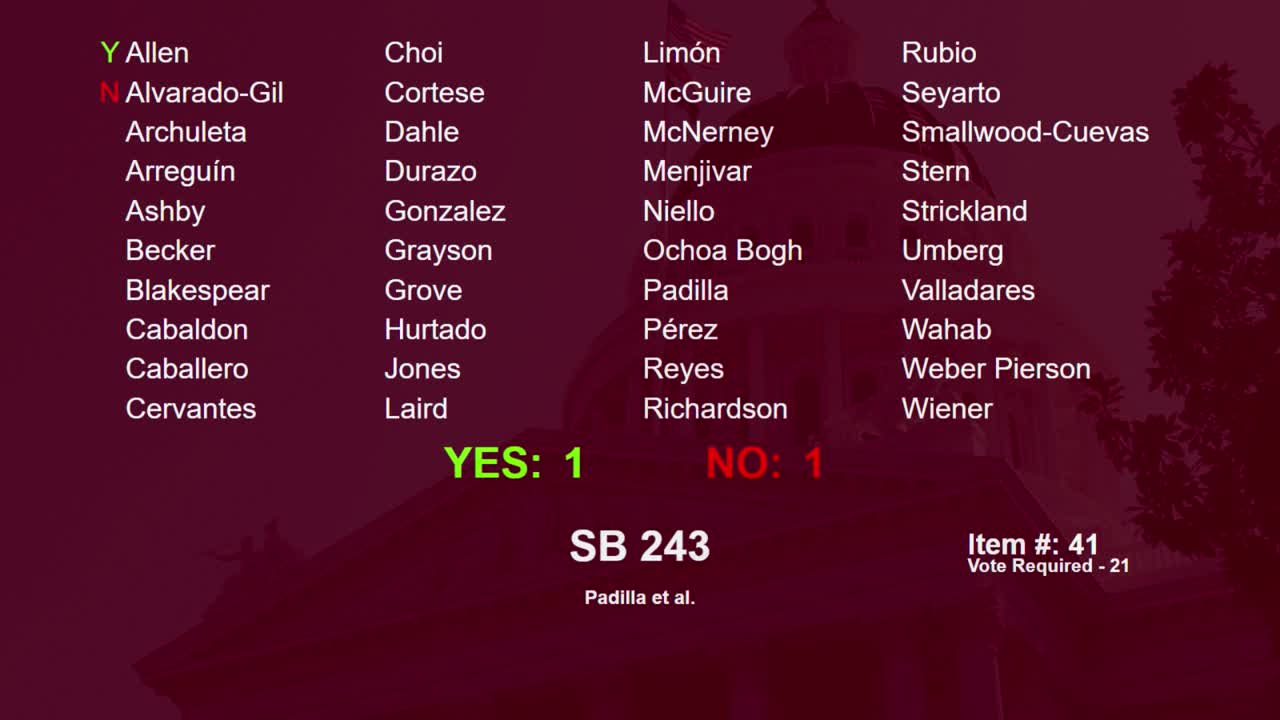 2MIN
Senate Floor
 7MIN
Senate Standing Committee on Environmental Quality
 17MIN
Senate Standing Committee on Energy, Utilities and Communications
Bill Author

Bill Co-Author(s):
