SB 350: Water Rate Assistance Program.
- Session Year: 2025-2026
- House: Senate
- Latest Version Date: 2025-05-07
Current Status:
Failed
(2026-02-02: Returned to Secretary of Senate pursuant to Joint Rule 56.)
Introduced
In Committee
Awaiting First Chamber Vote
Passed First Chamber
In Committee
Awaiting Second Chamber Vote
Passed Second Chamber
Enacted
Existing law requires the State Water Resources Control Board to develop a plan for the funding and implementation of the Low-Income Water Rate Assistance Program. Existing law requires the plan to include, among other things, a description of the method for collecting moneys to support and implement the program and a description of the method for determining the amount of moneys that may need to be collected from water ratepayers to fund the program.
This bill would establish the Water Rate Assistance Program. As part of the program, the bill would establish the Water Rate Assistance Fund in the State Treasury, available upon appropriation by the Legislature, to provide water affordability assistance, for both residential water and wastewater services, to low-income residential ratepayers, as specified. The bill would require the state board to take various actions in administering the fund, including, among other things, tracking and managing revenue in the fund separately from all other revenue. The bill would require the state board, in consultation with relevant agencies and after a public hearing, to adopt guidelines for implementation of the program and to adopt an annual report to be posted on the state boards internet website identifying how the fund has performed, as specified. The bill would require the guidelines to include minimum requirements for eligible systems, including the ability to confirm eligibility for enrollment through a request for self-certification of eligibility under penalty of perjury. By expanding the crime of perjury, the bill would impose a state-mandated local program. The bill would require the state board to take various actions in administering the program, including, but not limited to, providing guidance, oversight, and funding for low-income rate assistance for residential ratepayers of eligible systems. The bill would authorize the Attorney General, at the request of the state board, to bring an action in state court to restrain the use of any method, act, or practice in violation of these provisions, except as provided. The bill would make the implementation of all of these provisions contingent upon an appropriation by the Legislature.
The California Constitution requires the state to reimburse local agencies and school districts for certain costs mandated by the state. Statutory provisions establish procedures for making that reimbursement.
This bill would provide that no reimbursement is required by this act for a specified reason.
Existing law requires the State Water Resources Control Board to develop a plan for the funding and implementation of the Low-Income Water Rate Assistance Program. Existing law requires the plan to include, among other things, a description of the method for collecting moneys to support and implement the program and a description of the method for determining the amount of moneys that may need to be collected from water ratepayers to fund the program.
This bill would establish the Water Rate Assistance Program. As part of the program, the bill would establish the Water Rate Assistance Fund in the State Treasury, available upon appropriation by the Legislature, to provide water affordability assistance, for both drinking residential water and wastewater services, to low-income residential ratepayers, as specified. The bill would require the state board to take various actions in administering the fund, including, among other things, tracking and managing revenue in the fund separately from all other revenue. The bill would require the state board, in consultation with relevant agencies and after a public hearing, to adopt guidelines for implementation of the program and to adopt an annual report to be posted on the state boards internet website identifying how the fund has performed, as specified. The bill would require the guidelines to include minimum requirements for eligible systems, including the ability to confirm eligibility for enrollment through a request for self-certification of eligibility under penalty of perjury. By expanding the crime of perjury, the bill would impose a state-mandated local program. The bill would require the state board to take various actions in administering the program, including, but not limited to, providing guidance, oversight, and funding for low-income rate assistance for residential ratepayers of eligible systems. The bill would authorize the Attorney General General, at the request of the state board, to bring an action in state court to restrain the use of any method, act, or practice in violation of these provisions, except as provided.
The California Constitution requires the state to reimburse local agencies and school districts for certain costs mandated by the state. Statutory provisions establish procedures for making that reimbursement.
This bill would provide that no reimbursement is required by this act for a specified reason.
Existing law requires the State Water Resources Control Board, by January 1, 2018, Board to develop a plan for the funding and implementation of the Low-Income Water Rate Assistance Program. Existing law requires the plan to include, among other things, a description of the method for collecting moneys to support and implement the program and a description of the method for determining the amount of moneys that may need to be collected from water ratepayers to fund the program.
This bill would establish the Water Rate Assistance Program. As part of the program, the bill would establish the Water Rate Assistance Fund in the State Treasury Treasury, available upon appropriation by the Legislature, to provide water affordability assistance, for both drinking water and wastewater services, to low-income residential ratepayers, as specified. The bill would require the state board to take various actions in administering the fund, including, among other things, track and manage tracking and managing revenue in the fund separately from all other revenue. The bill would require the state board, in consultation with relevant agencies and after a public hearing, to adopt guidelines for implementation of the program and to adopt an annual report to be posted on the state boards internet website identifying how the fund has performed, as specified. The bill would require the guidelines to include minimum requirements for eligible systems, including the ability to confirm eligibility for enrollment through a request for self-certification of eligibility under penalty of perjury. By expanding the crime of perjury, the bill would impose a state-mandated local program. The bill would require the state board to take various actions in administering the program, including, but not limited to, providing guidance, oversight, and funding for low-income rate assistance for residential ratepayers of eligible systems. The bill would authorize the Attorney General to bring an action in state court to restrain the use of any method, act, or practice in violation of these provisions, except as provided.
The California Constitution requires the state to reimburse local agencies and school districts for certain costs mandated by the state. Statutory provisions establish procedures for making that reimbursement.
This bill would provide that no reimbursement is required by this act for a specified reason.
Existing law requires the State Water Resources Control Board, by January 1, 2018, to develop a plan for the funding and implementation of the Low-Income Water Rate Assistance Program. Existing law requires the plan to include, among other things, a description of the method for collecting moneys to support and implement the program and a description of the method for determining the amount of moneys that may need to be collected from water ratepayers to fund the program.
This bill would establish the Water Rate Assistance Program. As part of the program, the bill would establish the Water Rate Assistance Fund in the State Treasury to provide water affordability assistance, for both drinking water and wastewater services, to low-income residential ratepayers, as specified. The bill would require the state board to take various actions in administering the fund, including, among other things, track and manage revenue in the fund separately from all other revenue. The bill would require the state board, in consultation with relevant agencies and after a public hearing, to adopt guidelines for implementation of the program and adopt an annual report to be posted on the state boards internet website identifying how the fund has performed, as specified. The bill would require the guidelines to include minimum requirements for eligible systems, including the ability to confirm eligibility for enrollment through a request for self-certification of eligibility under penalty of perjury. By expanding the crime of perjury, the bill would impose a state-mandated local program. The bill would require the state board to take various actions in administering the program, including, but not limited to, providing guidance, oversight, and funding for low-income rate assistance for residential ratepayers of eligible systems. The bill would authorize the Attorney General to bring an action in state court to restrain the use of any method, act, or practice in violation of these provisions, except as provided.
The California Constitution requires the state to reimburse local agencies and school districts for certain costs mandated by the state. Statutory provisions establish procedures for making that reimbursement.
This bill would provide that no reimbursement is required by this act for a specified reason.
The Legislature finds and declares all of the following:
(a)Existing state law declares that it is the established policy of the state that every human being has the right to safe, clean, affordable, and accessible water adequate for human consumption, cooking, and sanitary purposes.
(b)In 2015, the Legislature passed Assembly Bill 401 (Chapter 662 of the Statutes of 2015) that required the State Water Resources Control Board to develop a plan, informed by the public and the State Board of Equalization, for a statewide low-income rate assistance for water.
(c)In 2020, the state board released a report pursuant to Assembly Bill 401 (Chapter 662 of the Statutes of 2015), which is entitled Recommendations for Implementation of a Statewide Low-Income Water Rate Assistance Program, that found that it would take over one hundred forty million dollars ($140,000,000) annually to create a low-income water rate assistance program.
(d)The cost of water has continued to rise, outpacing the rate of inflation and putting too many California families at risk of water shutoffs.
(e)Climate change adds additional cost pressure to water and sewer systems, which increasingly must invest in climate resilience.
(f)While many public water systems offer some form of bill assistance to a limited number of customers, Proposition 218, as approved by the voters at the November 5, 1996, statewide general election, limits their ability to fully fund those programs.
(g)California must continue to lead the nation by establishing statewide low-income rate assistance for water and sewer and, by doing so, help to ensure universal access to essential services.
116931.For purposes of this chapter, the following definitions apply:
(a)Community water system has the same meaning as defined in Section 116275.
(b)Effective date means the effective date of the appropriation described in Section 116941.
(c)Eligible system means a community water system, wastewater system, or a participating tribal water or wastewater system.
(d)Fund means the Water Rate Assistance Fund created pursuant to Section 116932. 116942.
(e)Local water rate assistance program means a drinking water low-income rate assistance program that is established, funded, and administered by a community water system to provide water rate assistance to its eligible low-income ratepayers. Local water rate assistance programs may be funded through any funding a community water system has available to provide water rate assistance to its ratepayers, provided it does not use any funding derived from a fee or charge levied pursuant to Article XIII D of the California Constitution.
(e)(f)Low-income means an annual household income that is no greater than 200 percent of the federal poverty guideline level and consistent with the guidelines established for the California Alternative Rates for Energy (CARE) program pursuant to subdivision (a) of Section 739.1 of the Public Utilities Code.
(f)(g)Program means the Water Rate Assistance Program established pursuant to this chapter.
(g)(h)Relevant agencies means those agencies that have a role, through data collection, regulation, or enforcement, in providing services, oversight, and assistance to public water systems and low-income ratepayers.
(h)(i)Residential ratepayer means a resident of a single-family or multifamily residence who receives a bill for residential water or wastewater.
(i)(j)State board means the State Water Resources Control Board.
(j)(k)Wastewater system means a city, county, special district, joint powers authority, or tribal or investor-owned utility that provides wastewater collection, treatment, or disposal service.
116932.(a)The Water Rate Assistance Fund is hereby established in the State Treasury to provide water affordability assistance, for both residential water and wastewater services, to low-income residential ratepayers. Moneys in the fund shall be available upon appropriation by the Legislature to the state board to provide, in consultation with relevant agencies, direct water bill assistance to low-income residential ratepayers served by eligible systems.
(b)The program shall be entirely funded by the fund or other available state or federal funding.
(c)(1)The state board shall, upon appropriation by the Legislature, expend moneys from the fund for reasonable costs associated with the administration of this chapter.
(2)Commencing 365 days after the effective date, funds for the reasonable costs associated with the administration of this chapter shall not exceed 10 percent of the average annual deposits into the fund. Reasonable costs associated with the administration of this chapter includes relevant agencies administrative costs associated with this chapter. The state board shall reimburse eligible systems for reasonable costs associated with the administration of this chapter, which shall not count toward the 10-percent limitation.
(3)Commencing 450 days after the effective date, a minimum of 80 percent of total expenditures from the fund shall be directly applied to residential ratepayer accounts.
(d)The state board may undertake any of the following actions to implement this chapter:
(1)Provide for the deposit of any of the following moneys into the fund:
(A)Federal or state funding.
(B)Voluntary contributions, including, but not limited to, gifts, grants, or bequests.
(C)Any previously distributed funds returned to the fund pursuant to a process developed pursuant to paragraph (9) (10) of subdivision (b) of Section 116934.
(2)Enter into funding agreements with the federal government, local or state agencies, private entities, or nonprofit organizations.
(3)Take additional action as necessary and appropriate for adequate administration and operation of the fund and provision of direct residential water and wastewater bill assistance.
116933.The state board shall do all of the following in administering the fund:
(a)Track and manage revenue in the fund separately from all other revenue.
(b)Develop and implement a process for the state board, or a third-party provider contracted by the state board, board to disburse program funds to eligible systems, contract operators, or third-party providers systems for direct application to the systems low-income residential ratepayer accounts, including controls to prevent fraud, waste, and abuse.
(c)Manage and maintain fund balances in conjunction with the Controller, the Treasurer, the California State Auditors Office, and the Department of Finance, as appropriate.
(d)(1)Expend, upon appropriation by the Legislature, moneys in the fund for grants, contracts, or services to provide benefits to eligible residential ratepayers.
(2)Services may include technical assistance to eligible systems serving fewer than 3,300 connections to administer the application of funds to low-income residential ratepayer accounts, including initial startup costs.
(3)The state board shall identify and contract with one or more third-party providers. The scope of work for a third-party provider shall include eligibility determinations, and may include include, but not be limited to, the receipt of California Alternate Rates for Energy (CARE) enrollment data pursuant to the mechanism established pursuant to subdivision (a) of Section 116936, the receipt of information from eligible systems, the creation of eligible customer lists to be provided to eligible systems, call center services, internet-based enrollments, document intake and processing, and distribution of funds to eligible systems for application to qualified residential ratepayer accounts. and provision of notices to eligible customers of enrollment into the program and an opportunity for a customer to opt out of the program.
(4)Provide funds to eligible systems for reasonable costs for administration of the program, not to exceed the greater of 5 percent of the total funds for residential water and wastewater bill assistance or five thousand dollars ($5,000).(5)The state board shall establish a process by which the reimbursement limit established in paragraph (4) may be increased for an eligible system that demonstrates to the state board that it is unable to comply with this chapter without exceeding the limit.Establish(e)Establish a process for contracted third-party providers or other entities responsible for enrollment to regularly confirm the eligibility of recipients, based upon income eligibility pursuant to subdivision (e) (f) of Section 116931.
116934.(a)Within 270 days of the effective date, the state board, in consultation with relevant agencies and after a public hearing, shall adopt guidelines for implementation of the program.
(b)The guidelines shall include, at minimum, all of the following:
(1)Direction to eligible systems to automatically enroll households in the program if they satisfy at least one of the following circumstances:
(A)Available information shows that any member of the residential ratepayers household is a current enrollee in, or recipient of, CalWORKs, CalFresh, general assistance, Medi-Cal, Supplemental Security Income or the State Supplementary Payment Program, or the California Special Supplemental Nutrition Program for Women, Infants, and Children.
(B)The residential ratepayers household is a utility customer enrolled in the California Alternate Rates for Energy (CARE) program established pursuant to Section 739.1 of the Public Utilities Code.
(2)Eligibility criteria for enrollment into the program for customers not automatically enrolled shall ensure customers satisfy the definition of low-income.
(3)Minimum requirements for eligible systems, including all of the following:
(A)Participation in the statewide program.
(B)A process for enrollment into the program for households that meet the eligibility criteria pursuant to paragraph (2).
(C)The ability to confirm eligibility for enrollment through a request for self-certification of eligibility under penalty of perjury.
(D)A process for eligible systems, at their sole discretion, to elect whether and the extent to which they will rely on third-party providers for the services within the scope of work set forth in paragraph (3) of subdivision (d) of Section 116932, or instead elect to perform one or more of these services itself.
(E)A process for eligible systems to share information with third-party providers, to the extent necessary for third-party providers to provide the services elected by the eligible system pursuant to subparagraph (D).
(4)A process for the state board or third-party providers to provide funding to eligible systems for application to eligible low-income residential ratepayer accounts. Funding shall be provided to eligible systems on, at minimum, an annual basis.
(5)Consistent with Article XIII D of the California Constitution, guidance to eligible systems regarding payment of reasonable costs for administration of the program.
(5)(6)A process for eligible systems to provide a bill credit to low-income residential ratepayers of no less than 20 percent of the total water charges, and, if present on the bill, wastewater charges, for a volume of water similar to that identified in Section 10609.4 of the Water Code, or if the residential ratepayer uses less, the actual volume used. Code.
(6)(7)A provision to audit eligible systems receiving funds under this chapter regarding the receipt and distribution of those funds.
(7)(8)Parameters and options for providing funding to eligible systems that bill exclusively or partially on the property tax roll.
(8)(9)A process for exemption of eligible systems from providing low-income rate assistance upon determination by the state board that the system does not have eligible residential ratepayers. Exemptions shall be reviewed periodically to determine whether any residential ratepayers of the eligible system have become eligible for assistance.
(9)(10)A process for eligible systems to return funds to the state if needed.
(10)(11)In the event that full funding is not immediately available, a process for determining how implementation will be prioritized among eligible systems. The process shall prioritize eligible systems that have historically been overburdened by pollution and industrial development or faced other environmental justice hurdles. Prioritization of eligible systems may be based on a data-driven index that considers these factors, including, but not limited to, vulnerability indices measuring exposure to drinking water contaminants, poverty prevalence, housing burden, or groundwater threats.
(c)The state board shall hold at least three public workshops throughout the state on the draft guidelines, and shall provide at least 45 days for public comment on the draft.
116935.(a)The state board shall, in consultation with relevant agencies and after a public hearing, adopt an annual report to be posted on the state boards internet website identifying how the fund has performed.
(b)The annual report shall contain all of the following:
(1)A report of expenditures from the fund for the prior fiscal year, including how many households were served, and estimated expenditures for the current fiscal year.
(2)An estimate of the number of households eligible for assistance. The estimate shall not be based on a household-by-household evaluation.
(3)An evaluation of available relevant information regarding any household-level water affordability issues that remain after application of bill assistance.
(4)A description of methods to include public participation and efforts to encourage enrollment in the program.
(5)An estimate of the anticipated funding needs for the next fiscal year.
116936.(a)Within 365 days of the effective date, the Public Utilities Commission shall establish a mechanism for electrical corporations and gas corporations to regularly share data that includes customer names and account addresses with the state board or relevant third-party providers regarding the utility customers enrolled in, or eligible to be enrolled in, the California Alternate Rates for Energy (CARE) program established pursuant to Section 739.1 of the Public Utilities Code and the Family Electric Rate Assistance program established pursuant to Section 739.12 of the Public Utilities Code. Code. Electrical corporations and gas corporations shall regularly share that data with the state board third-party providers through the mechanism.
(b)(1)The state board and third-party providers may enter into agreements with local publicly owned electric utilities and local publicly owned gas utilities, including, but not limited to, municipal utility districts and irrigation districts, for the purpose of regularly sharing data that includes customer names and account addresses with the state board or third-party provider regarding utility customers enrolled in, or eligible to be enrolled in, affordability programs benefiting low-income residential ratepayers.
(2)The agreements may authorize the state board third-party providers to provide data pursuant to this subdivision to third-party providers or eligible systems for the sole purpose of assisting with the administration of the program.
(c)Data shared pursuant to subdivision (a) or (b) is subject to Section 7927.410 of the Government Code and the Information Practices Act of 1977 (Chapter 1 (commencing with Section 1798) of Title 1.8 of Part 4 of Division 3 of the Civil Code).
(d)Data shared pursuant to subdivision (a) or (b) shall not be considered a disclosure under Section 1798.83 of the Civil Code.
116937.(a)Chapter 3.5 (commencing with Section 11340) of Part 1 of Division 3 of Title 2 of the Government Code does not apply to any guidelines developed by the state board pursuant to this chapter.
(b)(1)Notwithstanding Section 11019 of the Government Code, the state board, or a third-party provider contracted by the state board, board shall, to the extent permissible, make advance payments to eligible systems for direct residential water and wastewater bill assistance, for related administrative costs, and to implement the purposes of this chapter.
(2)Before distribution of an advance payment, eligible systems shall provide to the state board an estimate of the number of households enrolled in the program and their expected bill credits.
(3)The state board shall have discretion regarding the terms and conditions that apply to advance payment.
(c)An eligible system shall provide a full accounting of its expenditures on an annual basis and as requested by the state board.
(d)The state board, in consultation with the Public Utilities Commission, may authorize up to 5 percent of program funding to establish pilot projects that include expenditures that improve residential water or wastewater affordability for low-income residential households through installation of water efficiency measures or assistance programs that otherwise improve residential water or wastewater affordability in mobilehome parks, multifamily housing, or other households that do not directly pay a residential water or wastewater bill.
116938.(a)The state board shall do all of the following in administering the program:
(1)(a)Provide guidance, oversight, and funding for low-income rate assistance for residential ratepayers of eligible systems.
(2)(b)Coordinate with the Public Utilities Commission, to the extent reasonable and consistent with this chapter and related policy goals, to align criteria between all existing water rate assistance programs offered by investor-owned utilities, and to ensure timely processing of payments to investor-owned utilities.
(3)(c)For an eligible system that is not regulated by the Public Utilities Commission, consult with relevant agencies on options to provide oversight of the eligible systems application of program funds to the systems low-income residential ratepayer accounts pursuant to this chapter to ensure effectiveness and prevent fraud, waste, and abuse.
(4)(d)Coordinate with other relevant state agencies and resolve disputes as necessary.
(5)(e)Consider identifying alternative entities to distribute and track benefits if the state board determines that an eligible system is incapable of applying program funds to residential ratepayers of the system pursuant to this chapter.
(b)This chapter does not prohibit an eligible system from offering assistance to ratepayers that is in addition to, or on top of, the assistance provided through the program.(c)An eligible system that offers assistance that is in addition to the assistance provided through the program to the same ratepayers served by the program shall still receive funds from the program for the eligible portion of the assistance.116939.(a)This chapter does not prohibit an eligible system from administering a local water rate assistance program that is in addition to, or on top of, or different from, the assistance provided through the program. Local water rate assistance programs are administered independently and separately from the program without oversight from the state board.
(b)(1)An eligible system that offers assistance through a local water rate assistance program that is in addition to the assistance provided through the program to the qualifying ratepayers served by the program shall still receive funds from the program for the eligible portion of the assistance.
(2)An eligible system with a local water rate assistance program may request that the state board allocate the funds from the program to an existing local water rate assistance program by entering into a memorandum of understanding with the state board that describes the parameters, eligibility criteria, and enrollment of the local water rate assistance program.
116939.116940.(a)Within 450 days of the effective date, or by any other date set by the state board based on a process for prioritization among eligible systems established pursuant to paragraph (10) (11) of subdivision (b) of Section 116934, all nontribal community water systems and wastewater systems shall begin providing water rate assistance to residential ratepayers in compliance with the minimum requirements specified in subdivision (c) of Section 116932. A tribal water or wastewater system may offer water rate assistance. Eligible systems shall continue to provide water rate assistance to low-income residential ratepayers as long as there is sufficient state or federal funding available to provide water rate assistance and fund eligible systems for reasonable costs for administration of the program.
(b)If the state board has not met the deadline in subdivision (a) of Section 116934 for the adoption of program implementation guidelines within 270 days of the effective date, the deadline in subdivision (a) of this section shall be delayed by the total number of additional days the state board takes to adopt program implementation guidelines to the first date that is the beginning of an eligible systems billing cycle.
116940.116941.(a)The Attorney General, at the request of the state board, may bring an action in state court to restrain, by temporary or permanent injunction, the use of any method, act, or practice declared in this chapter to be unlawful, including nonparticipation by a public water system within the program.
(b)The state board shall not request an action nor shall the Attorney General bring an action against an eligible system for failing to meet the requirements of Sections 116938 and 116939, 116940, as long as the qualified system makes a good faith effort to implement this chapter.
116941.116942.Implementation of this chapter is contingent upon an appropriation by the Legislature for its purposes.
SEC. 2.No reimbursement is required by this act pursuant to Section 6 of Article XIIIB of the California Constitution because the only costs that may be incurred by a local agency or school district will be incurred because this act creates a new crime or infraction, eliminates a crime or infraction, or changes the penalty for a crime or infraction, within the meaning of Section 17556 of the Government Code, or changes the definition of a crime within the meaning of Section 6 of Article XIIIB of the California Constitution.
The Legislature finds and declares all of the following:
(a)Existing state law declares that it is the established policy of the state that every human being has the right to safe, clean, affordable, and accessible water adequate for human consumption, cooking, and sanitary purposes.
(b)In 2015, the Legislature passed Assembly Bill 401 (Chapter 662 of the Statutes of 2015) that required the State Water Resources Control Board to develop a plan, informed by the public and the State Board of Equalization, for a statewide low-income rate assistance for water.
(c)In 2020, the state board released a report pursuant to Assembly Bill 401 (Chapter 662 of the Statutes of 2015), which is entitled Recommendations for Implementation of a Statewide Low-Income Water Rate Assistance Program, that found that it would take over one hundred forty million dollars ($140,000,000) annually to create a low-income water rate assistance program.
(d)The cost of water has continued to rise, outpacing the rate of inflation and putting too many California families at risk of water shutoffs.
(e)Climate change adds additional cost pressure to water and sewer systems, which increasingly must invest in climate resilience.
(f)While many public water systems offer some form of bill assistance to a limited number of customers, Proposition 218, as approved by the voters at the November 5, 1996, statewide general election, limits their ability to fully fund those programs.
(g)California must continue to lead the nation by establishing statewide low-income rate assistance for water and sewer and, by doing so, help to ensure universal access to essential services.
116931.For purposes of this chapter, the following definitions apply:
(a)Community water system has the same meaning as defined in Section 116275.
(b)Effective date means the effective date of this chapter. the appropriation described in Section 116941.
(c)Eligible system means a community water system, wastewater system, or a participating tribal water or wastewater system.
(d)Fund means the Water Rate Assistance Fund created pursuant to Section 116932.
(e)Low-income means an annual household income that is no greater than 200 percent of the federal poverty guideline level and consistent with the guidelines established for the California Alternative Rates for Energy (CARE) program pursuant to subdivision (a) of Section 739.1 of the Public Utilities Code.
(f)Program means the Water Rate Assistance Program established pursuant to this chapter.
(g)Relevant agencies means those agencies that have a role, through data collection, regulation, or enforcement, in providing services, oversight, and assistance to public water systems and low-income ratepayers.
(h)Residential ratepayer means a resident of a single-family or multifamily residence who receives a bill for residential water or wastewater.
(i)State board means the State Water Resources Control Board.
(j)Wastewater system means a city, county, special district, joint powers authority, or tribal or investor-owned utility that provides wastewater collection, treatment, or disposal service.
116932.(a)The Water Rate Assistance Fund is hereby established in the State Treasury to provide water affordability assistance, for both residential water and wastewater services, to low-income residential ratepayers. Moneys in the fund shall be available upon appropriation by the Legislature to the state board to provide, in consultation with relevant agencies, direct water bill assistance to low-income residential ratepayers served by eligible systems.
(b)The program shall be entirely funded by the fund or other available state or federal funding.
(c)(1)The state board shall, upon appropriation by the Legislature, expend moneys from the fund for reasonable costs associated with the administration of this chapter.
(2)Commencing 365 days after the effective date, funds for the reasonable costs associated with the administration of this chapter shall not exceed 10 percent of the average annual deposits into the fund. Reasonable costs associated with the administration of this chapter includes relevant agencies administrative costs associated with this chapter. The state board shall reimburse eligible systems for reasonable costs associated with the administration of this chapter, which shall not count toward the 10-percent limitation.
(3)Commencing 450 days after the effective date, a minimum of 80 percent of total expenditures from the fund shall be directly applied to residential ratepayer accounts.
(d)The state board may undertake any of the following actions to implement this chapter:
(1)Provide for the deposit of any of the following moneys into the fund:
(A)Federal or state funding.
(B)Voluntary contributions, including, but not limited to, gifts, grants, or bequests.
(C)Any previously distributed funds returned to the fund pursuant to a process developed pursuant to paragraph (9) of subdivision (b) of Section 116934.
(2)Enter into funding agreements with the federal government, local or state agencies, private entities, or nonprofit organizations.
(3)Take additional action as necessary and appropriate for adequate administration and operation of the fund and provision of direct residential water and wastewater bill assistance.
116933.The state board shall do all of the following in administering the fund:
(a)Track and manage revenue in the fund separately from all other revenue.
(b)Develop and implement a process for the state board, or a third-party provider contracted by the state board, to disburse program funds to eligible systems, contract operators, or third-party providers for direct application to the systems low-income residential ratepayer accounts, including controls to prevent fraud, waste, and abuse.
(c)Manage and maintain fund balances in conjunction with the Controller, the Treasurer, the California State Auditors Office, and the Department of Finance, as appropriate.
(d)(1)Expend, upon appropriation by the Legislature, moneys in the fund for grants, contracts, or services to provide benefits to eligible residential ratepayers.
(2)Services may include technical assistance to eligible systems serving fewer than 3,300 connections to administer the application of funds to low-income residential ratepayer accounts, including initial startup costs.
(3)The state board shall identify and contract with one or more third-party providers. The scope of work for a third-party provider shall include eligibility determinations, and may include call center services, internet-based enrollments, document intake and processing, and distribution of funds to eligible systems for application to qualified residential ratepayer accounts.
(4)Provide funds to eligible systems for reasonable costs for administration of the program, not to exceed the greater of 5 percent of the total funds for residential water and wastewater bill assistance or five thousand dollars ($5,000).
(5)The state board shall establish a process by which the reimbursement limit established in paragraph (4) may be increased for an eligible system that demonstrates to the state board that it is unable to comply with this chapter without exceeding the limit.
Establish a process for contracted third-party providers or other entities responsible for enrollment to regularly confirm the eligibility of recipients, based upon income eligibility pursuant to subdivision (e) of Section 116931.
116934.(a)Within 270 days of the effective date, the state board, in consultation with relevant agencies and after a public hearing, shall adopt guidelines for implementation of the program.
(b)The guidelines shall include, at minimum, all of the following:
(1)Direction to eligible systems to automatically enroll households in the program if they satisfy at least one of the following circumstances:
(A)Available information shows that any member of the residential ratepayers household is a current enrollee in, or recipient of, CalWORKs, CalFresh, general assistance, Medi-Cal, Supplemental Security Income or the State Supplementary Payment Program, or the California Special Supplemental Nutrition Program for Women, Infants, and Children.
(B)The residential ratepayers household is a utility customer enrolled in the California Alternate Rates for Energy (CARE) program established pursuant to Section 739.1 of the Public Utilities Code or in the Family Electric Rate Assistance program established pursuant to Section 739.12 of the Public Utilities Code. Code.
(2)Eligibility criteria for enrollment into the program. program for customers not automatically enrolled shall ensure customers satisfy the definition of low-income.
(3)Minimum requirements for eligible systems, including all of the following:
(A)Participation in the statewide program.
(B)A process for enrollment into the program for households that meet the eligibility criteria pursuant to paragraph (2).
(C)The ability to confirm eligibility for enrollment through a request for self-certification of eligibility under penalty of perjury.
(4)A process for the state board or third-party providers to provide funding to eligible systems for application to eligible low-income residential ratepayer accounts. Funding shall be provided to eligible systems on, at minimum, an annual basis.
(5)A process for eligible systems to provide a bill credit to low-income residential ratepayers of no less than 20 percent of the total water charges, and, if present on the bill, wastewater charges, for a volume of water similar to that identified in Section 10609.4 of the Water Code, or if the residential ratepayer uses less, the actual volume used.
(6)A provision to audit eligible systems receiving funds under this chapter regarding the receipt and distribution of those funds.
(7)Parameters and options for providing funding to eligible systems that bill exclusively or partially on the property tax roll.
(8)A process for exemption of eligible systems from providing low-income rate assistance upon determination by the state board that the system does not have eligible residential ratepayers. Exemptions shall be reviewed periodically to determine whether any residential ratepayers of the eligible system have become eligible for assistance.
(9)A process for eligible systems to return funds to the state if needed.
(10)In the event that full funding is not immediately available, a process for determining how implementation will be prioritized among eligible systems. The process shall prioritize eligible systems that have historically been overburdened by pollution and industrial development or faced other environmental justice hurdles. Prioritization of eligible systems may be based on a data-driven index that considers these factors, including, but not limited to, vulnerability indices measuring exposure to drinking water contaminants, poverty prevalence, housing burden, or groundwater threats.
(c)The state board shall hold at least three public workshops throughout the state on the draft guidelines, and shall provide at least 45 days for public comment on the draft.
116935.(a)The state board shall, in consultation with relevant agencies and after a public hearing, adopt an annual report to be posted on the state boards internet website identifying how the fund has performed.
(b)The annual report shall contain all of the following:
(1)A report of expenditures from the fund for the prior fiscal year, including how many households were served, and estimated expenditures for the current fiscal year.
(2)An estimate of the number of households eligible for assistance. The estimate shall not be based on a household-by-household evaluation.
(3)An evaluation of available relevant information regarding any household-level water affordability issues that remain after application of bill assistance.
(4)A description of methods to include public participation and efforts to encourage enrollment in the program.
(5)An estimate of the anticipated funding needs for the next fiscal year.
116936.(a)Within 365 days of the effective date, the Public Utilities Commission shall establish a mechanism for electrical corporations and gas corporations to regularly share data with the state board or relevant third-party providers regarding the utility customers enrolled in, or eligible to be enrolled in, the California Alternate Rates for Energy (CARE) program established pursuant to Section 739.1 of the Public Utilities Code and the Family Electric Rate Assistance program established pursuant to Section 739.12 of the Public Utilities Code. Electrical corporations and gas corporations shall regularly share that data with the state board through the mechanism.
(b)(1)The state board and third-party providers may enter into agreements with local publicly owned electric utilities and local publicly owned gas utilities, including, but not limited to, municipal utility districts and irrigation districts, for the purpose of regularly sharing data with the state board or third-party provider regarding utility customers enrolled in, or eligible to be enrolled in, affordability programs benefiting low-income residential ratepayers.
(2)The agreements may authorize the state board to provide data pursuant to this subdivision to third-party providers or eligible systems for the sole purpose of assisting with the administration of the program.
(c)Data shared pursuant to subdivision (a) or (b) is subject to Section 7927.410 of the Government Code and the Information Practices Act of 1977 (Chapter 1 (commencing with Section 1798) of Title 1.8 of Part 4 of Division 3 of the Civil Code).
(d)Data shared pursuant to subdivision (a) or (b) shall not be considered a disclosure under Section 1798.83 of the Civil Code.
116937.(a)Chapter 3.5 (commencing with Section 11340) of Part 1 of Division 3 of Title 2 of the Government Code does not apply to any guidelines developed by the state board pursuant to this chapter.
(b)(1)Notwithstanding Section 11019 of the Government Code, the state board, or a third-party provider contracted by the state board, shall, to the extent permissible, make advance payments to eligible systems for direct residential water and wastewater bill assistance, for related administrative costs, and to implement the purposes of this chapter.
(2)Before distribution of an advance payment, eligible systems shall provide to the state board an estimate of the number of households enrolled in the program and their expected bill credits.
(3)The state board shall have discretion regarding the terms and conditions that apply to advance payment.
(c)An eligible system shall provide a full accounting of its expenditures on an annual basis and as requested by the state board.
(d)The state board, in consultation with the Public Utilities Commission, may authorize up to 5 percent of program funding to establish pilot projects that include expenditures that improve residential water or wastewater affordability for low-income residential households through installation of water efficiency measures or assistance programs that otherwise improve residential water or wastewater affordability in mobilehome parks, multifamily housing, or other households that do not directly pay a residential water or wastewater bill.
116938.(a)The state board shall do all of the following in administering the program:
(1)Provide guidance, oversight, and funding for low-income rate assistance for residential ratepayers of eligible systems.
(2)Coordinate with the Public Utilities Commission, to the extent reasonable and consistent with this chapter and related policy goals, to align criteria between all existing water rate assistance programs offered by investor-owned utilities, and to ensure timely processing of payments to investor-owned utilities.
(3)For an eligible system that is not regulated by the Public Utilities Commission, consult with relevant agencies on options to provide oversight of the eligible systems application of program funds to the systems low-income residential ratepayer accounts pursuant to this chapter to ensure effectiveness and prevent fraud, waste, and abuse.
(4)Coordinate with other relevant state agencies and resolve disputes as necessary.
(5)Consider identifying alternative entities to distribute and track benefits if the state board determines that an eligible system is incapable of applying program funds to residential ratepayers of the system pursuant to this chapter.
(b)This chapter does not prohibit an eligible system from offering assistance to ratepayers that is in addition to, or on top of, the assistance provided through the program.
(c)An eligible system that offers assistance that is in addition to the assistance provided through the program to the same ratepayers served by the program shall still receive funds from the program for the eligible portion of the assistance.
116939.(a)Within 450 days of the effective date, or by any other date set by the state board based on a process for prioritization among eligible systems established pursuant to paragraph (10) of subdivision (b) of Section 116934, all nontribal community water systems and wastewater systems shall begin providing water rate assistance to residential ratepayers in compliance with the minimum requirements specified in subdivision (c) of Section 116932. A tribal water or wastewater system may offer water rate assistance. Eligible systems shall continue to provide water rate assistance to low-income residential ratepayers as long as there is sufficient state or federal funding available to provide water rate assistance and fund eligible systems for reasonable costs for administration of the program.
(b)If the state board has not met the deadline in subdivision (a) of Section 116934 for the adoption of program implementation guidelines within 270 days of the effective date, the deadline in subdivision (a) of this section shall be delayed by the total number of additional days the state board takes to adopt program implementation guidelines to the first date that is the beginning of an eligible systems billing cycle.
116940.(a)The Attorney General, at the request of the state board, may bring an action in state court to restrain, by temporary or permanent injunction, the use of any method, act, or practice declared in this chapter to be unlawful, including nonparticipation by a public water system within the program.
(b)The state board shall not request an action nor shall the Attorney General bring an action against an eligible system for failing to meet the requirements of Sections 116938 and 116939, as long as the qualified system makes a good faith effort to implement this chapter.
116941.Implementation of this chapter is contingent upon an appropriation by the Legislature for its purposes.
SEC. 2.No reimbursement is required by this act pursuant to Section 6 of Article XIIIB of the California Constitution because the only costs that may be incurred by a local agency or school district will be incurred because this act creates a new crime or infraction, eliminates a crime or infraction, or changes the penalty for a crime or infraction, within the meaning of Section 17556 of the Government Code, or changes the definition of a crime within the meaning of Section 6 of Article XIIIB of the California Constitution.
The Legislature finds and declares all of the following:
(a)Existing state law declares that it is the established policy of the state that every human being has the right to safe, clean, affordable, and accessible water adequate for human consumption, cooking, and sanitary purposes.
(b)In 2015, the Legislature passed Assembly Bill 401 (Chapter 662 of the Statutes of 2015) that required the State Water Resources Control Board to develop a plan, informed by the public and the State Board of Equalization, for a statewide low-income rate assistance for water.
(c)In 2020, the state board released a report pursuant to Assembly Bill 401 (Chapter 662 of the Statutes of 2015), which is entitled Recommendations for Implementation of a Statewide Low-Income Water Rate Assistance Program, that found that it would take over one hundred forty million dollars ($140,000,000) annually to create a low-income water rate assistance program.
(d)The cost of water has continued to rise, outpacing the rate of inflation and putting too many California families at risk of water shutoffs.
(e)Climate change adds additional cost pressure to water and sewer systems, which increasingly must invest in climate resilience.
(f)While many public water systems offer some form of bill assistance to a limited number of customers, Proposition 218, as approved by the voters at the November 5, 1996, statewide general election, limits their ability to fully fund those programs.
(g)California must continue to lead the nation by establishing statewide low-income rate assistance for water and sewer and, by doing so, help to ensure universal access to essential services.
116931.For purposes of this chapter, the following definitions apply:
(a)Community water system has the same meaning as defined in Section 116275.
(b)Effective date means the effective date of this chapter.
(c)Eligible system means a community water system, wastewater system, or a participating tribal water or wastewater system.
(d)Fund means the Water Rate Assistance Fund created pursuant to Section 116932.
(e)Low-income means an annual household income that is no greater than 200 percent of the federal poverty guideline level and consistent with the guidelines established for the California Alternative Rates for Energy (CARE) program pursuant to subdivision (a) of Section 739.1 of the Public Utilities Code.
(f)Program means the Water Rate Assistance Program established pursuant to this chapter.
(g)Relevant agencies means those agencies that have a role, through data collection, regulation, or enforcement, in providing services, oversight, and assistance to public water systems and low-income ratepayers.
(h)Residential ratepayer means a resident of a single-family or multifamily residence who receives a bill for residential water or wastewater.
(i)State board means the State Water Resources Control Board.
(j)Wastewater system means a city, county, special district, joint powers authority, or tribal or investor-owned utility that provides wastewater collection, treatment, or disposal service.
116932.(a)The Water Rate Assistance Fund is hereby established in the State Treasury to provide water affordability assistance, for both drinking residential water and wastewater services, to low-income residential ratepayers. Moneys in the fund shall be available upon appropriation by the Legislature to the state board to provide, in consultation with relevant agencies, direct water bill assistance to low-income residential ratepayers served by eligible systems.
(b)The program shall be entirely funded by the fund or other available state or federal funding.
(c)(1)The state board shall, upon appropriation by the Legislature, expend moneys from the fund for reasonable costs associated with the administration of this chapter.
(2)Commencing 365 days after the effective date, funds for the reasonable costs associated with the administration of this chapter shall not exceed 10 percent of the average annual deposits into the fund. Reasonable costs associated with the administration of this chapter includes relevant agencies administrative costs associated with this chapter. The state board shall reimburse eligible systems for reasonable costs associated with the administration of this chapter, which shall not count toward the 10-percent limitation.
(3)Commencing 450 days after the effective date, a minimum of 80 percent of total expenditures from the fund shall be directly applied to residential ratepayer accounts.
(d)The state board may undertake any of the following actions to implement this chapter:
(1)Provide for the deposit of any of the following moneys into the fund:
(A)Federal or state funding.
(B)Voluntary contributions, including, but not limited to, gifts, grants, or bequests.
(C)Any previously distributed funds returned funds. to the fund pursuant to a process developed pursuant to paragraph (9) of subdivision (b) of Section 116934.
(2)Enter into funding agreements with the federal government, local or state agencies, private entities, or nonprofit organizations.
(3)Take additional action as necessary and appropriate for adequate administration and operation of the fund and provision of direct residential water and wastewater bill assistance.
116933.The state board shall do all of the following in administering the fund:
(a)Track and manage revenue in the fund separately from all other revenue.
(b)Develop and implement a process for the state board, or a third-party provider contracted by the state board, to disburse program funds to eligible systems, contract operators, or third-party providers for direct application to the systems low-income residential ratepayer accounts, including controls to prevent fraud, waste, and abuse.
(c)Manage and maintain fund balances in conjunction with the Controller, the Treasurer, the California State Auditors Office, and the Department of Finance, as appropriate.
(d)(1)Expend, upon appropriation by the Legislature, moneys in the fund for grants, contracts, or services to provide benefits to eligible residential ratepayers.
(2)Services may include technical assistance to eligible systems serving fewer than 3,300 connections to administer the application of funds to low-income residential ratepayer accounts, including initial startup costs.
(3)The state board shall identify and contract with one or more third-party providers. The scope of work for a third-party provider shall include eligibility determinations, and may include call center services, internet-based enrollments, document intake and processing, and distribution of funds to eligible systems for application to qualified residential ratepayer accounts.
(4)Provide funds to eligible systems for reasonable costs for administration of the program, not to exceed the greater of 5 percent of the total funds for residential water and wastewater bill assistance or two five thousand dollars ($2,000). ($5,000).
(5)The state board shall establish a process by which the reimbursement limit established in paragraph (4) may be increased for an eligible system that demonstrates to the state board that it is unable to comply with this chapter without exceeding the limit.
(e)(1)Require verification of eligibility from a sample of enrolled eligible ratepayers on an annual basis to verify the ratepayers low-income status and eligibility for assistance. Any ratepayer found to not be eligible for assistance may be removed from this program. (2)The eligibility requirement in paragraph (1) may be carried out by a third-party provider described in paragraph (3) of subdivision (d).Establish a process for contracted third-party providers or other entities responsible for enrollment to regularly confirm the eligibility of recipients, based upon income eligibility pursuant to subdivision (e) of Section 116931.
116934.(a)Within 270 days of the effective date, the state board, in consultation with relevant agencies and after a public hearing, shall adopt guidelines for implementation of the program.
(b)The guidelines shall include, at minimum, all of the following:
(1)Direction to eligible systems to automatically enroll households in the program if they satisfy at least one of the following circumstances:
(A)Available information shows that any member of the residential ratepayers household is a current enrollee in, or recipient of, CalWORKs, CalFresh, general assistance, Medi-Cal, Supplemental Security Income or the State Supplementary Payment Program, or the California Special Supplemental Nutrition Program for Women, Infants, and Children.
(B)The residential ratepayers household is a utility customer enrolled in the California Alternate Rates for Energy (CARE) program established pursuant to Section 739.1 of the Public Utilities Code or in the Family Electric Rate Assistance program established pursuant to Section 739.12 of the Public Utilities Code.
(2)Eligibility criteria for enrollment into the program.
(3)Minimum requirements for eligible systems, including all of the following:
(A)Participation in the statewide program.
(B)A process for enrollment into the program for households that meet the eligibility criteria pursuant to paragraph (2).
(C)The ability to confirm eligibility for enrollment through a request for self-certification of eligibility under penalty of perjury.
(4)A process for the state board or third-party providers to provide funding to eligible systems for application to eligible low-income residential ratepayer accounts. Funding shall be provided to eligible systems on, at minimum, an annual basis.
(5)A process for eligible systems to provide a bill credit to low-income residential ratepayers of no less than 20 percent of the total water charges, and, if present on the bill, wastewater charges, for a volume of water similar to that identified in Section 10609.4 of the Water Code, or if the residential ratepayer uses less, the actual volume used.
(5)(6)A provision to audit eligible systems receiving funds under this chapter regarding the receipt and distribution of those funds.
(6)(7)Parameters and options for providing funding to eligible systems that bill exclusively or partially on the property tax roll.
(7)A process for instances when a residential ratepayer moves outside of the eligible systems service area.(8)A process for exemption of eligible systems from providing low-income rate assistance upon determination by the state board that the system does not have eligible residential ratepayers. Exemptions shall be reviewed periodically to determine whether any residential ratepayers of the eligible system have become eligible for assistance.
(9)A process for eligible systems to return funds to the state if needed.
(10)In the event that full funding is not immediately available, a process for determining how implementation will be prioritized among eligible systems. The process shall prioritize eligible systems that have historically been overburdened by pollution and industrial development or faced other environmental justice hurdles. Prioritization of eligible systems may be based on a data-driven index that considers these factors, including, but not limited to, vulnerability indices measuring exposure to drinking water contaminants, poverty prevalence, housing burden, or groundwater threats.
(c)The state board shall hold at least three public workshops throughout the state on the draft guidelines, and shall provide at least 45 days for public comment on the draft.
116935.(a)The state board shall, in consultation with relevant agencies and after a public hearing, adopt an annual report to be posted on the state boards internet website identifying how the fund has performed.
(b)The annual report shall contain all of the following:
(1)A report of expenditures from the fund for the prior fiscal year, including how many households were served, and estimated expenditures for the current fiscal year.
(2)An estimate of the number of households eligible for assistance. The estimate shall not be based on a household-by-household evaluation.
(3)An evaluation of available relevant information regarding any household-level water affordability issues that remain after application of bill assistance.
(4)A description of methods to include public participation and efforts to encourage enrollment in the program.
(5)An estimate of the funding available for the next fiscal year based on the amount available in the fund, anticipated funding needs, other existing funding sources, and other relevant data and information. needs for the next fiscal year.
116936.(a)Within 365 days of the effective date, the Public Utilities Commission shall establish a mechanism for electrical corporations and gas corporations to regularly share data with the state board or relevant third-party providers regarding the utility customers enrolled in, or eligible to be enrolled in, the California Alternate Rates for Energy (CARE) program established pursuant to Section 739.1 of the Public Utilities Code and the Family Electric Rate Assistance program established pursuant to Section 739.12 of the Public Utilities Code. Electrical corporations and gas corporations shall regularly share that data with the state board through the mechanism.
(b)(1)The state board and third-party providers may enter into agreements with local publicly owned electric utilities and local publicly owned gas utilities, including, but not limited to, municipal utility districts and irrigation districts, for the purpose of regularly sharing data with the state board or third-party provider regarding utility customers enrolled in, or eligible to be enrolled in, affordability programs benefiting low-income residential ratepayers.
(2)The agreements may authorize the state board to provide data pursuant to this subdivision to third-party providers or eligible systems for the sole purpose of assisting with the administration of the program.
(c)Data shared pursuant to subdivision (a) or (b) is subject to Section 7927.410 of the Government Code and the Information Practices Act of 1977 (Chapter 1 (commencing with Section 1798) of Title 1.8 of Part 4 of Division 3 of the Civil Code).
(d)Data shared pursuant to subdivision (a) or (b) shall not be considered a disclosure under Section 1798.83 of the Civil Code.
116937.(a)Chapter 3.5 (commencing with Section 11340) of Part 1 of Division 3 of Title 2 of the Government Code does not apply to any guidelines developed by the state board pursuant to this chapter.
(b)(1)Notwithstanding Section 11019 of the Government Code, the state board, or a third-party provider contracted by the state board, shall, to the extent permissible, make advance payments to eligible systems for direct residential water and wastewater bill assistance, for related administrative costs, and to implement the purposes of this chapter.
(2)Before distribution of an advance payment, eligible systems shall provide to the state board an estimate of the number of households enrolled in the program and their expected bill discounts. credits.
(3)The state board shall have discretion regarding the terms and conditions that apply to advance payment.
(c)An eligible system shall provide a full accounting of its expenditures on an annual basis and as requested by the state board.
(d)The state board, in consultation with the Public Utilities Commission, may authorize up to 5 percent of program funding to establish pilot projects that include expenditures that improve residential water or wastewater affordability for low-income residential households through installation of water efficiency measures or assistance programs that otherwise improve residential household water or wastewater affordability in mobilehome parks, multifamily housing, or other households that do not directly pay a residential water or wastewater bill.
116938.(a)The state board shall do all of the following in administering the program:
(1)Provide guidance, oversight, and funding for low-income rate assistance for residential ratepayers of eligible systems.
(2)Coordinate with the Public Utilities Commission, to the extent reasonable and consistent with this chapter and related policy goals, to align criteria between all existing water rate assistance programs offered by investor-owned utilities, and to ensure timely processing of payments to investor-owned utilities.
(3)For an eligible system that is not regulated by the Public Utilities Commission, consult with relevant agencies on options to provide oversight of the eligible systems application of program funds to the systems low-income residential ratepayer accounts pursuant to this chapter to ensure effectiveness and prevent fraud, waste, and abuse.
(4)Coordinate with other relevant state agencies and resolve disputes as necessary.
(5)Consider identifying alternative entities to distribute and track benefits if the state board determines that an eligible system is incapable of applying program funds to residential ratepayers of the system pursuant to this chapter.
(b)This chapter does not prohibit an eligible system from offering assistance to ratepayers that is in addition to, or on top of, the assistance provided through the program.
(c)An eligible system that offers assistance that is in addition to the assistance provided through the program to the same ratepayers served by the program shall still receive funds from the program for the eligible portion of the assistance.
116939.(a)Within 450 days of the effective date, or by any other date set by the state board based on a process for prioritization among eligible systems established pursuant to paragraph (10) of subdivision (b) of Section 116934, all nontribal community water systems and wastewater systems shall begin providing water rate assistance to residential ratepayers in compliance with the minimum requirements specified in subdivision (c) of Section 116932. A tribal water or wastewater system may offer water rate assistance. Eligible systems shall continue to provide water rate assistance to low-income residential ratepayers as long as there is sufficient state or federal funding available to provide water rate assistance and fund eligible systems for reasonable costs for administration of the program.
(b)If the state board has not met the deadline in subdivision (a) of Section 116934 for the adoption of program implementation guidelines within 270 days of the effective date, the deadline in subdivision (a) of this section shall be delayed by the total number of additional days the state board takes to adopt program implementation guidelines. guidelines to the first date that is the beginning of an eligible systems billing cycle.
(c)Prior to disconnection of service, a community water system shall provide residential ratepayers with arrearages a notice that they may enter into a payment plan and time to enroll in conformity with the requirements of Chapter 6 (commencing with Section 116900), notwithstanding limitations relating to a community water systems size. A community water system shall not discontinue water service to a residential ratepayer that remains current on a payment plan.116940.(a)The Attorney General, at the request of the state board or upon the Attorney Generals own motion, board, may bring an action in state court to restrain, by temporary or permanent injunction, the use of any method, act, or practice declared in this chapter to be unlawful, including nonparticipation by a public water system within the program.
(b)The state board may qualify awards of financial assistance upon participation in the program. shall not request an action nor shall the Attorney General bring an action against an eligible system for failing to meet the requirements of Sections 116938 and 116939, as long as the qualified system makes a good faith effort to implement this chapter.
SEC. 2.No reimbursement is required by this act pursuant to Section 6 of Article XIIIB of the California Constitution because the only costs that may be incurred by a local agency or school district will be incurred because this act creates a new crime or infraction, eliminates a crime or infraction, or changes the penalty for a crime or infraction, within the meaning of Section 17556 of the Government Code, or changes the definition of a crime within the meaning of Section 6 of Article XIIIB of the California Constitution.
The Legislature finds and declares all of the following:
(a)Existing state law declares that it is the established policy of the state that every human being has the right to safe, clean, affordable, and accessible water adequate for human consumption, cooking, and sanitary purposes.
(b)In 2015, the Legislature passed Assembly Bill 401 (Chapter 662 of the Statutes of 2015) that required the State Water Resources Control Board to develop a plan, informed by the public and the State Board of Equalization, for a statewide low-income rate assistance for water.
(c)In 2020, the state board released a report pursuant to Assembly Bill 401 (Chapter 662 of the Statutes of 2015), which is entitled Recommendations for Implementation of a Statewide Low-Income Water Rate Assistance Program, that found that it would take over one hundred forty million dollars ($140,000,000) annually to create a low-income water rate assistance program.
(d)The cost of water has continued to rise, outpacing the rate of inflation and putting too many California families at risk of water shutoffs.
(e)Climate change adds additional cost pressure to water and sewer systems, which increasingly must invest in climate resilience.
(f)While many public water systems offer some form of bill assistance to a limited number of customers, Proposition 218, as approved by the voters at the November 5, 1996, statewide general election, limits their ability to fully fund those programs.
(g)California must continue to lead the nation by establishing statewide low-income rate assistance for water and sewer and, by doing so, help to ensure universal access to essential services.
116931.For purposes of this chapter, the following definitions apply:
(a)Community water system has the same meaning as defined in Section 116275.
(b)Effective date means the effective date of this chapter.
(c)Eligible system means a community water system, wastewater system, or a participating tribal water or wastewater system.
(d)Fund means the Water Rate Assistance Fund created pursuant to Section 116932.
(e)Low-income means an annual household income that is no greater than 200 percent of the federal poverty guideline level and consistent with the guidelines established for the California Alternative Rates for Energy (CARE) program pursuant to subdivision (a) of Section 739.1 of the Public Utilities Code.
(f)Program means the Water Rate Assistance Program established pursuant to this chapter.
(g)Relevant agencies means those agencies that have a role, through data collection, regulation, or enforcement, in providing services, oversight, and assistance to public water systems and low-income ratepayers.
(h)Residential ratepayer means a resident of a single-family or multifamily residence who receives a bill for water or wastewater.
(i)State board means the State Water Resources Control Board.
(j)Wastewater system means a city, county, special district, joint powers authority, or tribal or investor-owned utility that provides wastewater collection, treatment, or disposal service.
116932.(a)The Water Rate Assistance Fund is hereby established in the State Treasury to provide water affordability assistance, for both drinking water and wastewater services, to low-income residential ratepayers. Moneys in the fund shall be available upon appropriation by the Legislature to the state board to provide, in consultation with relevant agencies, direct water bill assistance to low-income residential ratepayers served by eligible systems.
(b)The program shall be entirely funded by the fund or other available state or federal funding.
(c)(1)The state board shall, upon appropriation by the Legislature, expend moneys from the fund for reasonable costs associated with the administration of this chapter.
(2)Commencing 365 days after the effective date, funds for the reasonable costs associated with the administration of this chapter shall not exceed 10 percent of the average annual deposits into the fund. Reasonable costs associated with the administration of this chapter includes relevant agencies administrative costs associated with this chapter. The state board shall reimburse eligible systems for reasonable costs associated with the administration of this chapter, which shall not count toward the 10-percent limitation.
(3)Commencing 450 days after the effective date, a minimum of 80 percent of total expenditures from the fund shall be directly applied to residential ratepayer accounts.
(d)The state board may undertake any of the following actions to implement this chapter:
(1)Provide for the deposit of any of the following moneys into the fund:
(A)Federal or state funding.
(B)Voluntary contributions, gifts, grants, or bequests.
(C)Any returned funds.
(2)Enter into funding agreements with the federal government, local or state agencies, private entities, or nonprofit organizations.
(3)Take additional action as necessary and appropriate for adequate administration and operation of the fund and provision of direct water bill assistance.
116933.The state board shall do all of the following in administering the fund:
(a)Track and manage revenue in the fund separately from all other revenue.
(b)Develop and implement a process for the state board, or a third-party provider contracted by the state board, to disburse program funds to eligible systems, contract operators, or third-party providers for direct application to the systems low-income residential ratepayer accounts, including controls to prevent fraud, waste, and abuse.
(c)Manage and maintain fund balances in conjunction with the Controller, the Treasurer, the California State Auditors Office, and the Department of Finance, as appropriate.
(d)(1)Expend, upon appropriation by the Legislature, moneys in the fund for grants, contracts, or services to provide benefits to eligible residential ratepayers.
(2)Services may include technical assistance to eligible systems serving fewer than 3,300 connections to administer the application of funds to low-income residential ratepayer accounts, including initial startup costs.
(3)The state board shall identify and contract with one or more third-party providers. The scope of work for a third-party provider shall include eligibility determinations, and may include call center services, internet-based enrollments, document intake and processing, and distribution of funds to eligible systems for application to qualified residential ratepayer accounts.
(4)Provide funds to eligible systems for reasonable costs for administration of the program, not to exceed the greater of 5 percent of the total funds for water bill assistance or two thousand dollars ($2,000).
(e)(1)Require verification of eligibility from a sample of enrolled eligible ratepayers on an annual basis to verify the ratepayers low-income status and eligibility for assistance. Any ratepayer found to not be eligible for assistance may be removed from this program.
(2)The eligibility requirement in paragraph (1) may be carried out by a third-party provider described in paragraph (3) of subdivision (d).
116934.(a)Within 270 days of the effective date, the state board, in consultation with relevant agencies and after a public hearing, shall adopt guidelines for implementation of the program.
(b)The guidelines shall include, at minimum, all of the following:
(1)Direction to eligible systems to automatically enroll households in the program under both of the following circumstances: if they satisfy at least one of the following circumstances:
(A)Available information shows that any member of the residential ratepayers household is a current enrollee in, or recipient of, CalWORKs, CalFresh, general assistance, Medi-Cal, Supplemental Security Income or the State Supplementary Payment Program, or the California Special Supplemental Nutrition Program for Women, Infants, and Children.
(B)The residential ratepayers household is a utility customer enrolled in the California Alternate Rates for Energy (CARE) program established pursuant to Section 739.1 of the Public Utilities Code or in the Family Electric Rate Assistance program established pursuant to Section 739.12 of the Public Utilities Code.
(2)Eligibility criteria for enrollment into the program.
(2)(3)Minimum requirements for eligible systems, including both all of the following:
(A)Participation in the statewide program.
(B)A process for enrollment into the program for households that meet the eligibility criteria pursuant to paragraph (2).
(B)(C)The ability to confirm eligibility for enrollment through a request for self-certification of eligibility under penalty of perjury.
(3)(4)A process for the state board or third-party providers to provide funding to eligible systems for application to eligible low-income residential ratepayer accounts. Funding shall be provided to eligible systems on, at minimum, an annual basis.
(4)(5)A provision to audit eligible systems receiving funds under this chapter regarding the receipt and distribution of those funds.
(5)(6)Parameters and options for providing funding to eligible systems that bill exclusively or partially on the property tax roll.
(6)(7)A process for instances when a residential ratepayer moves outside of the eligible systems service area.
(7)(8)A process for exemption of eligible systems from providing low-income rate assistance upon determination by the state board that the system does not have eligible residential ratepayers. Exemptions shall be reviewed periodically to determine whether any residential ratepayers of the eligible system have become eligible for assistance.
(8)(9)A process for eligible systems to return funds to the state if needed.
(9)(10)In the event that full funding is not immediately available, a process for determining how implementation will be prioritized among eligible systems. The process shall prioritize eligible systems that have historically been overburdened by pollution and industrial development or faced other environmental justice hurdles. Prioritization of eligible systems may be based on a data-driven index that considers these factors, including, but not limited to, vulnerability indices measuring exposure to drinking water contaminants, poverty prevalence, housing burden, or groundwater threats.
116935.(a)The state board shall, in consultation with relevant agencies and after a public hearing, adopt an annual report to be posted on the state boards internet website identifying how the fund has performed.
(b)The annual report shall contain all of the following:
(1)A report of expenditures from the fund for the prior fiscal year, including how many households were served, and estimated expenditures for the current fiscal year.
(2)An estimate of the number of households eligible for assistance. The estimate shall not be based on a household-by-household evaluation.
(3)An evaluation of available relevant information regarding any household-level water affordability issues that remain after application of bill assistance.
(4)A description of methods to include public participation and efforts to encourage enrollment in the program.
(5)An estimate of the funding available for the next fiscal year based on the amount available in the fund, anticipated funding needs, other existing funding sources, and other relevant data and information.
116936.(a)Within 365 days of the effective date, the Public Utilities Commission shall establish a mechanism for electrical corporations and gas corporations to regularly share data with the state board or relevant third-party providers regarding the utility customers enrolled in, or eligible to be enrolled in, the California Alternate Rates for Energy (CARE) program established pursuant to Section 739.1 of the Public Utilities Code and the Family Electric Rate Assistance program established pursuant to Section 739.12 of the Public Utilities Code. Electrical corporations and gas corporations shall regularly share that data with the state board through the mechanism.
(b)(1)The state board and third-party providers may enter into agreements with local publicly owned electric utilities and local publicly owned gas utilities, including, but not limited to, municipal utility districts and irrigation districts, for the purpose of regularly sharing data with the state board or third-party provider regarding utility customers enrolled in, or eligible to be enrolled in, affordability programs benefiting low-income residential ratepayers.
(2)The agreements may authorize the state board to provide data pursuant to this subdivision to third-party providers or eligible systems for the sole purpose of assisting with the administration of the program.
(c)Data shared pursuant to subdivision (a) or (b) is subject to Section 7927.410 of the Government Code and the Information Practices Act of 1977 (Chapter 1 (commencing with Section 1798) of Title 1.8 of Part 4 of Division 3 of the Civil Code).
(d)Data shared pursuant to subdivision (a) or (b) shall not be considered a disclosure under Section 1798.83 of the Civil Code.
116937.(a)Chapter 3.5 (commencing with Section 11340) of Part 1 of Division 3 of Title 2 of the Government Code does not apply to any guidelines developed by the state board pursuant to this chapter.
(b)(1)Notwithstanding Section 11019 of the Government Code, the state board, or a third-party provider contracted by the state board, shall, to the extent permissible, make advance payments to eligible systems for direct water bill assistance, for related administrative costs, and to implement the purposes of this chapter.
(2)Before distribution of an advance payment, eligible systems shall provide to the state board an estimate of the number of households enrolled in the program and their expected bill discounts.
(3)The state board shall have discretion regarding the terms and conditions that apply to advance payment.
(c)An eligible system shall provide a full accounting of its expenditures on an annual basis and as requested by the state board.
(d)The state board, in consultation with the Public Utilities Commission, may authorize up to 5 percent of program funding to establish pilot projects that include expenditures that improve water or wastewater affordability for low-income residential households through installation of water efficiency measures or assistance programs that otherwise improve residential household water or wastewater affordability in mobilehome parks, multifamily housing, or other households that do not directly pay a water or wastewater bill.
116938.(a)The state board shall do all of the following in administering the program:
(1)Provide guidance, oversight, and funding for low-income rate assistance for residential ratepayers of eligible systems.
(2)Coordinate with the Public Utilities Commission, to the extent reasonable and consistent with this chapter and related policy goals, to align criteria between all existing water rate assistance programs offered by investor-owned utilities, and to ensure timely processing of payments to investor-owned utilities.
(3)For an eligible system that is not regulated by the Public Utilities Commission, consult with relevant agencies on options to provide oversight of the eligible systems application of program funds to the systems low-income residential ratepayer accounts pursuant to this chapter to ensure effectiveness and prevent fraud, waste, and abuse.
(4)Coordinate with other relevant state agencies and resolve disputes as necessary.
(5)Consider identifying alternative entities to distribute and track benefits if the state board determines that an eligible system is incapable of applying program funds to residential ratepayers of the system pursuant to this chapter.
(b)This chapter does not prohibit an eligible system from offering assistance to ratepayers that is in addition to, or on top of, the assistance provided through the program.
(c)An eligible system that offers assistance that is in addition to the assistance provided through the program to the same ratepayers served by the program shall still receive funds from the program for the eligible portion of the assistance.
116939.(a)Within 450 days of the effective date, or by any other date set by the state board based on a process for prioritization among eligible systems established pursuant to paragraph (9) (10) of subdivision (b) of Section 116934, all nontribal community water systems and wastewater systems shall begin providing water rate assistance to residential ratepayers in compliance with the minimum requirements specified in subdivision (c) of Section 116932. A tribal water or wastewater system may offer water rate assistance. Eligible systems shall continue to provide water rate assistance to low-income residential ratepayers as long as there is sufficient state or federal funding available to provide water rate assistance and fund eligible systems for reasonable costs for administration of the program.
(b)If the state board has not met the deadline in subdivision (a) of Section 116934 for the adoption of program implementation guidelines within 270 days of the effective date, the deadline in subdivision (a) of this section shall be delayed by the total number of additional days the state board takes to adopt program implementation guidelines.
(c)Prior to disconnection of service, a community water system shall provide residential ratepayers with arrearages a notice that they may enter into a payment plan and time to enroll in conformity with the requirements of Chapter 6 (commencing with Section 116900), notwithstanding limitations relating to a community water systems size. A community water system shall not discontinue water service to a residential ratepayer that remains current on a payment plan.
116940.(a)The Attorney General, at the request of the state board or upon the Attorney Generals own motion, may bring an action in state court to restrain, by temporary or permanent injunction, the use of any method, act, or practice declared in this chapter to be unlawful, including nonparticipation by a public water system within the program.
(b)The state board may qualify awards of financial assistance upon participation in the program.
SEC. 2.No reimbursement is required by this act pursuant to Section 6 of Article XIIIB of the California Constitution because the only costs that may be incurred by a local agency or school district will be incurred because this act creates a new crime or infraction, eliminates a crime or infraction, or changes the penalty for a crime or infraction, within the meaning of Section 17556 of the Government Code, or changes the definition of a crime within the meaning of Section 6 of Article XIIIB of the California Constitution.
The Legislature finds and declares all of the following:
(a)Existing state law declares that it is the established policy of the state that every human being has the right to safe, clean, affordable, and accessible water adequate for human consumption, cooking, and sanitary purposes.
(b)In 2015, the Legislature passed Assembly Bill 401 (Chapter 662 of the Statutes of 2015) that required the State Water Resources Control Board to develop a plan, informed by the public and the State Board of Equalization, for a statewide low-income rate assistance for water.
(c)In 2020, the state board released a report pursuant to Assembly Bill 401 (Chapter 662 of the Statutes of 2015), which is entitled Recommendations for Implementation of a Statewide Low-Income Water Rate Assistance Program, that found that it would take over one hundred forty million dollars ($140,000,000) annually to create a low-income water rate assistance program.
(d)The cost of water has continued to rise, outpacing the rate of inflation and putting too many California families at risk of water shutoffs.
(e)Climate change adds additional cost pressure to water and sewer systems, which increasingly must invest in climate resilience.
(f)While many public water systems offer some form of bill assistance to a limited number of customers, Proposition 218, as approved by the voters at the November 5, 1996, statewide general election, limits their ability to fully fund those programs.
(g)California must continue to lead the nation by establishing statewide low-income rate assistance for water and sewer and, by doing so, help to ensure universal access to essential services.
116931.For purposes of this chapter, the following definitions apply:
(a)Community water system has the same meaning as defined in Section 116275.
(b)Effective date means the effective date of this chapter.
(c)Eligible system means a community water system, wastewater system, or a participating tribal water or wastewater system.
(d)Fund means the Water Rate Assistance Fund created pursuant to Section 116932.
(e)Low-income means an annual household income that is no greater than 200 percent of the federal poverty guideline level and consistent with the guidelines established for the California Alternative Rates for Energy (CARE) program pursuant to subdivision (a) of Section 739.1 of the Public Utilities Code.
(f)Program means the Water Rate Assistance Program established pursuant to this chapter.
(g)Relevant agencies means those agencies that have a role, through data collection, regulation, or enforcement, in providing services, oversight, and assistance to public water systems and low-income ratepayers.
(h)Residential ratepayer means a resident of a single-family or multifamily residence who receives a bill for water or wastewater.
(i)State board means the State Water Resources Control Board.
(j)Wastewater system means a city, county, special district, joint powers authority, or tribal or investor-owned utility that provides wastewater collection, treatment, or disposal service.
116932.(a)The Water Rate Assistance Fund is hereby established in the State Treasury to provide water affordability assistance, for both drinking water and wastewater services, to low-income residential ratepayers. Moneys in the fund shall be available upon appropriation by the Legislature to the state board to provide, in consultation with relevant agencies, direct water bill assistance to low-income residential ratepayers served by eligible systems.
(b)The program shall be entirely funded by the fund or other available state or federal funding.
(c)(1)The state board shall, upon appropriation by the Legislature, expend moneys from the fund for reasonable costs associated with the administration of this chapter.
(2)Commencing 365 days after the effective date, funds for the reasonable costs associated with the administration of this chapter shall not exceed 10 percent of the average annual deposits into the fund. Reasonable costs associated with the administration of this chapter includes relevant agencies administrative costs associated with this chapter. The state board shall reimburse eligible systems for reasonable costs associated with the administration of this chapter, which shall not count toward the 10-percent limitation.
(3)Commencing 450 days after the effective date, a minimum of 80 percent of total expenditures from the fund shall be directly applied to residential ratepayer accounts.
(d)The state board may undertake any of the following actions to implement this chapter:
(1)Provide for the deposit of any of the following moneys into the fund:
(A)Federal or state funding.
(B)Voluntary contributions, gifts, grants, or bequests.
(C)Any returned funds.
(2)Enter into funding agreements with the federal government, local or state agencies, private entities, or nonprofit organizations.
(3)Take additional action as necessary and appropriate for adequate administration and operation of the fund and provision of direct water bill assistance.
116933.The state board shall do all of the following in administering the fund:
(a)Track and manage revenue in the fund separately from all other revenue.
(b)Develop and implement a process for the state board, or a third-party provider contracted by the state board, to disburse program funds to eligible systems, contract operators, or third-party providers for direct application to the systems low-income residential ratepayer accounts, including controls to prevent fraud, waste, and abuse.
(c)Manage and maintain fund balances in conjunction with the Controller, the Treasurer, the California State Auditors Office, and the Department of Finance, as appropriate.
(d)(1)Expend, upon appropriation by the Legislature, moneys in the fund for grants, contracts, or services to provide benefits to eligible residential ratepayers.
(2)Services may include technical assistance to eligible systems serving fewer than 3,300 connections to administer the application of funds to low-income residential ratepayer accounts, including initial startup costs.
(3)The state board shall identify and contract with one or more third-party providers. The scope of work for a third-party provider shall include eligibility determinations, and may include call center services, internet-based enrollments, document intake and processing, and distribution of funds to eligible systems for application to qualified residential ratepayer accounts.
(4)Provide funds to eligible systems for reasonable costs for administration of the program, not to exceed the greater of 5 percent of the total funds for water bill assistance or two thousand dollars ($2,000).
(e)(1)Require verification of eligibility from a sample of enrolled eligible ratepayers on an annual basis to verify the ratepayers low-income status and eligibility for assistance. Any ratepayer found to not be eligible for assistance may be removed from this program.
(2)The eligibility requirement in paragraph (1) may be carried out by a third-party provider described in paragraph (3) of subdivision (d).
116934.(a)Within 270 days of the effective date, the state board, in consultation with relevant agencies and after a public hearing, shall adopt guidelines for implementation of the program.
(b)The guidelines shall include, at minimum, all of the following:
(1)Direction to eligible systems to automatically enroll households in the program under both of the following circumstances:
(A)Available information shows that any member of the residential ratepayers household is a current enrollee in, or recipient of, CalWORKs, CalFresh, general assistance, Medi-Cal, Supplemental Security Income or the State Supplementary Payment Program, or the California Special Supplemental Nutrition Program for Women, Infants, and Children.
(B)The residential ratepayers household is a utility customer enrolled in the California Alternate Rates for Energy (CARE) program established pursuant to Section 739.1 of the Public Utilities Code or in the Family Electric Rate Assistance program established pursuant to Section 739.12 of the Public Utilities Code.
(2)Minimum requirements for eligible systems, including both of the following:
(A)Participation in the statewide program.
(B)The ability to confirm eligibility for enrollment through a request for self-certification of eligibility under penalty of perjury.
(3)A process for the state board or third-party providers to provide funding to eligible systems for application to eligible low-income residential ratepayer accounts. Funding shall be provided to eligible systems on, at minimum, an annual basis.
(4)A provision to audit eligible systems receiving funds under this chapter regarding the receipt and distribution of those funds.
(5)Parameters and options for providing funding to eligible systems that bill exclusively or partially on the property tax roll.
(6)A process for instances when a residential ratepayer moves outside of the eligible systems service area.
(7)A process for exemption of eligible systems from providing low-income rate assistance upon determination by the state board that the system does not have eligible residential ratepayers. Exemptions shall be reviewed periodically to determine whether any residential ratepayers of the eligible system have become eligible for assistance.
(8)A process for eligible systems to return funds to the state if needed.
(9)In the event that full funding is not immediately available, a process for determining how implementation will be prioritized among eligible systems. The process shall prioritize eligible systems that have historically been overburdened by pollution and industrial development or faced other environmental justice hurdles.
116935.(a)The state board shall, in consultation with relevant agencies and after a public hearing, adopt an annual report to be posted on the state boards internet website identifying how the fund has performed.
(b)The annual report shall contain all of the following:
(1)A report of expenditures from the fund for the prior fiscal year, including how many households were served, and estimated expenditures for the current fiscal year.
(2)An estimate of the number of households eligible for assistance. The estimate shall not be based on a household-by-household evaluation.
(3)An evaluation of available relevant information regarding any household-level water affordability issues that remain after application of bill assistance.
(4)A description of methods to include public participation and efforts to encourage enrollment in the program.
(5)An estimate of the funding available for the next fiscal year based on the amount available in the fund, anticipated funding needs, other existing funding sources, and other relevant data and information.
116936.(a)Within 365 days of the effective date, the Public Utilities Commission shall establish a mechanism for electrical corporations and gas corporations to regularly share data with the state board or relevant third-party providers regarding the utility customers enrolled in, or eligible to be enrolled in, the California Alternate Rates for Energy (CARE) program established pursuant to Section 739.1 of the Public Utilities Code and the Family Electric Rate Assistance program established pursuant to Section 739.12 of the Public Utilities Code. Electrical corporations and gas corporations shall regularly share that data with the state board through the mechanism.
(b)(1)The state board and third-party providers may enter into agreements with local publicly owned electric utilities and local publicly owned gas utilities, including, but not limited to, municipal utility districts and irrigation districts, for the purpose of regularly sharing data with the state board or third-party provider regarding utility customers enrolled in, or eligible to be enrolled in, affordability programs benefiting low-income residential ratepayers.
(2)The agreements may authorize the state board to provide data pursuant to this subdivision to third-party providers or eligible systems for the sole purpose of assisting with the administration of the program.
(c)Data shared pursuant to subdivision (a) or (b) is subject to Section 7927.410 of the Government Code and the Information Practices Act of 1977 (Chapter 1 (commencing with Section 1798) of Title 1.8 of Part 4 of Division 3 of the Civil Code).
(d)Data shared pursuant to subdivision (a) or (b) shall not be considered a disclosure under Section 1798.83 of the Civil Code.
116937.(a)Chapter 3.5 (commencing with Section 11340) of Part 1 of Division 3 of Title 2 of the Government Code does not apply to any guidelines developed by the state board pursuant to this chapter.
(b)(1)Notwithstanding Section 11019 of the Government Code, the state board, or a third-party provider contracted by the state board, shall, to the extent permissible, make advance payments to eligible systems for direct water bill assistance, for related administrative costs, and to implement the purposes of this chapter.
(2)Before distribution of an advance payment, eligible systems shall provide to the state board an estimate of the number of households enrolled in the program and their expected bill discounts.
(3)The state board shall have discretion regarding the terms and conditions that apply to advance payment.
(c)An eligible system shall provide a full accounting of its expenditures on an annual basis and as requested by the state board.
(d)The state board, in consultation with the Public Utilities Commission, may authorize up to 5 percent of program funding to establish pilot projects that include expenditures that improve water or wastewater affordability for low-income residential households through installation of water efficiency measures or assistance programs that otherwise improve residential household water or wastewater affordability in mobilehome parks, multifamily housing, or other households that do not directly pay a water or wastewater bill.
116938.(a)The state board shall do all of the following in administering the program:
(1)Provide guidance, oversight, and funding for low-income rate assistance for residential ratepayers of eligible systems.
(2)Coordinate with the Public Utilities Commission, to the extent reasonable and consistent with this chapter and related policy goals, to align criteria between all existing water rate assistance programs offered by investor-owned utilities, and to ensure timely processing of payments to investor-owned utilities.
(3)For an eligible system that is not regulated by the Public Utilities Commission, consult with relevant agencies on options to provide oversight of the eligible systems application of program funds to the systems low-income residential ratepayer accounts pursuant to this chapter to ensure effectiveness and prevent fraud, waste, and abuse.
(4)Coordinate with other relevant state agencies and resolve disputes as necessary.
(5)Consider identifying alternative entities to distribute and track benefits if the state board determines that an eligible system is incapable of applying program funds to residential ratepayers of the system pursuant to this chapter.
(b)This chapter does not prohibit an eligible system from offering assistance to ratepayers that is in addition to, or on top of, the assistance provided through the program.
(c)An eligible system that offers assistance that is in addition to the assistance provided through the program to the same ratepayers served by the program shall still receive funds from the program for the eligible portion of the assistance.
116939.(a)Within 450 days of the effective date, or by any other date set by the state board based on a process for prioritization among eligible systems established pursuant to paragraph (9) of subdivision (b) of Section 116934, all nontribal community water systems and wastewater systems shall begin providing water rate assistance to residential ratepayers in compliance with the minimum requirements specified in subdivision (c) of Section 116932. A tribal water or wastewater system may offer water rate assistance. Eligible systems shall continue to provide water rate assistance to low-income residential ratepayers as long as there is sufficient state or federal funding available to provide water rate assistance and fund eligible systems for reasonable costs for administration of the program.
(b)If the state board has not met the deadline in subdivision (a) of Section 116934 for the adoption of program implementation guidelines within 270 days of the effective date, the deadline in subdivision (a) of this section shall be delayed by the total number of additional days the state board takes to adopt program implementation guidelines.
(c)Prior to disconnection of service, a community water system shall provide residential ratepayers with arrearages a notice that they may enter into a payment plan and time to enroll in conformity with the requirements of Chapter 6 (commencing with Section 116900), notwithstanding limitations relating to a community water systems size. A community water system shall not discontinue water service to a residential ratepayer that remains current on a payment plan.
116940.(a)The Attorney General, at the request of the state board or upon the Attorney Generals own motion, may bring an action in state court to restrain, by temporary or permanent injunction, the use of any method, act, or practice declared in this chapter to be unlawful, including nonparticipation by a public water system within the program.
(b)The state board may qualify awards of financial assistance upon participation in the program.
SEC. 2.No reimbursement is required by this act pursuant to Section 6 of Article XIIIB of the California Constitution because the only costs that may be incurred by a local agency or school district will be incurred because this act creates a new crime or infraction, eliminates a crime or infraction, or changes the penalty for a crime or infraction, within the meaning of Section 17556 of the Government Code, or changes the definition of a crime within the meaning of Section 6 of Article XIIIB of the California Constitution.
|
Date
|
Status
|
|---|---|
| Feb 2, 2026 | Returned to Secretary of Senate pursuant to Joint Rule 56. |
| May 23, 2025 | May 23 hearing: Held in committee and under submission. |
| May 16, 2025 | Set for hearing May 23. |
| May 12, 2025 | May 12 hearing: Placed on APPR. suspense file. |
| May 7, 2025 | From committee with author's amendments. Read second time and amended. Re-referred to Com. on APPR. |
| May 2, 2025 | Set for hearing May 12. |
| May 1, 2025 | May 5 set for first hearing canceled at the request of author. |
| Apr 29, 2025 | Set for hearing May 5. |
| Apr 24, 2025 | Read second time and amended. Re-referred to Com. on APPR. |
| Apr 23, 2025 | From committee: Do pass as amended and re-refer to Com. on APPR. (Ayes 13. Noes 3. Page 810.) (April 21). |
| Apr 10, 2025 | From committee with author's amendments. Read second time and amended. Re-referred to Com. on E., U & C. |
| Apr 10, 2025 | Set for hearing April 21. |
| Mar 25, 2025 | Read second time and amended. Re-referred to Com. on E., U & C. |
| Mar 24, 2025 | From committee: Do pass as amended and re-refer to Com. on E., U & C. (Ayes 6. Noes 1. Page 422.) (March 19). |
| Mar 7, 2025 | Set for hearing March 19. |
| Feb 19, 2025 | Referred to Coms. on E.Q. and E., U & C. |
| Feb 13, 2025 | From printer. May be acted upon on or after March 15. |
| Feb 12, 2025 | Introduced. Read first time. To Com. on RLS. for assignment. To print. |
|
Date
|
Description
|
Location
|
Votes
|
|
|---|---|---|---|---|
| May 12, 2025 | Placed on suspense file | Senate Standing Committee on Appropriations |
Passed |
|
| Apr 21, 2025 | Do pass as amended, but first amend, and re-refer to the Committee on [Appropriations] | Senate Standing Committee on Energy, Utilities and Communications |
Passed |
|
| Mar 19, 2025 | Do pass as amended, but first amend, and re-refer to the Committee on [Energy, Utilities and Communications] | Senate Standing Committee on Environmental Quality |
Passed |
This list shows positions taken on this bill by organizations on the date displayed, which is linked to the original source.
Positions by individuals are not included.
|
Organization
|
Position
|
Date
|
|---|---|---|
| Alianza Coachella Valley | ** Support | |
| Allensworth Progressive Association | ** Support | |
| Alliance of Californians for Community Empowerment Action | ** Support | |
| Association Of California Water Agencies | ** Against | |
| Bella Vista Water District | ** Against | |
| Bellflower Somerset Mutual Water Company | ** Against | |
| California Catholic Conference | ** Support | |
| California Coastkeeper Alliance | ** Support | |
| California Environmental Justice Alliance Action | ** Support | |
| California Environmental Voters | ** Support | |
| Camrosa Water District | ** Against | |
| Carbon Cycle Institute | ** Support | |
| Center on Race, Poverty & the Environment | ** Support | |
| Central California Environmental Justice Network | ** Support | |
| City of Fairfield | ** Against | |
| cleanearth4kids.org | ** Support | |
| Clean Water Action | ** Support | |
| Coalition for Economic Survival | ** Support | |
| Community Water Center | ** Support | |
| Contra Costa Water District | ** Against | |
| Courage California | ** Support | |
| Crestline-Lake Arrowhead Water Agency | ** Against | |
| Cucamonga Valley Water District | ** Against | |
| Defenders Of Wildlife | ** Support | |
| Desert Water Agency | ** Against | |
| Disability Rights California | ** Support | |
| Eastern Municipal Water District | ** Against | |
| East Valley Water District | ** Against | |
| El Dorado Irrigation District | ** Against | |
| Environmental Defense Fund | ** Support | |
| Fairmead Community & Friends | ** Support | |
| Fallbrook Public Utilities District | ** Against | |
| Friends Committee On Legislation Of California | ** Support | |
| Friends of the River | ** Support | |
| Greenfield Walking Group | ** Support | |
| Helix Water District | ** Against | |
| Hidden Valley Lake Community Services District | ** Against | |
| Initiate Justice | ** Support | |
| LA Habra Heights County Water District | ** Against | |
| Lake Arrowhead Community Services District | ** Against | |
| Leadership Counsel for Justice & Accountability | ** Support | |
| Los Angeles Alliance for a New Economy | ** Support | |
| Los Angeles Waterkeeper | ** Support | |
| McKinleyville Community Services District | ** Against | |
| Mesa Water District | ** Against | |
| Monterey Peninsula Water Management District | ** Against | |
| Monte Vista Water District | ** Against | |
| Mothers Helping Mothers | ** Support | |
| Nourish California | ** Support | |
| Olivenhain Municipal Water District | ** Against | |
| Palmdale Water District | ** Against | |
| People's Collective for Environmental Justice | ** Support | |
| Physicians for Social Responsibility - Los Angeles | ** Support | |
| Planning And Conservation League | ** Support | |
| Puente Basin Water Agency | ** Against | |
| Rowland Water District | ** Against | |
| san gabriel county water district | ** Against | |
| San Gabriel Valley Water Association | ** Against | |
| San Juan Water District | ** Against | |
| Santa Clarita Valley Water Agency | ** Against | |
| Santa Margarita Water District | ** Against | |
| Scotts Valley Water District | ** Against | |
| Sierra Club California | ** Support | |
| South Tahoe Public Utility District | ** Against | |
| Three Valleys Municipal Water District | ** Against | |
| TODEC Legal Center | ** Support | |
| Tuolumne Utilities District | ** Against | |
| Union Of Concerned Scientists | ** Support | |
| Upper San Gabriel Valley Municipal Water District | ** Against | |
| Utica Water and Power Authority | ** Against | |
| Walnut Valley Water District | ** Against | |
| western center on law & poverty | ** Support | |
| Western Municipal Water District | ** Against |
SENATE COMMITTEE ON
Senator Anna Caballero, Chair
2025 - 2026 Regular Session
SB 350 (Durazo) - Water Rate Assistance Program
Version: | Policy Vote: |
Urgency: | Mandate: |
Hearing Date: | Consultant: |
Bill Summary:
This bill would establish the Water Rate Assistance Program and the Water Rate Assistance Fund to provide water affordability assistance, for both drinking water and wastewater services, to low-income residential ratepayers.
Fiscal Impact:
- Very significant ongoing cost pressures, potentially in the hundreds of millions of dollars annually (Water Rate Assistance Fund) to provide funding for ratepayer assistance. Of that amount, up to 10% could be used by the State Water Board to administer the Low-Income Water Rate Assistance Program.
- The State Water Board estimates ongoing costs of at least $18 million annually (Water Rate Assistance Fund or other fund) to develop, implement, administer, and oversee the program.
- To the extent that the Attorney General, at the request of the State Water Board, brings an action in to restrain a practice declared in this bill to be unlawful—including nonparticipation by a public water system—unknown, potentially significant cost pressures to the state-funded trial courts due to additional workload (Trial Court Trust Fund, General Fund).
Background:
Water utilities. California residents are served by various types of water utilities or water systems, including publicly owned utilities (POU), investor-owned utilities (IOU), and small community water systems. The majority of California’s residential water customers are served by POUs, which are operated and governed by cities, special districts, and mutual water companies. As established by Proposition 218 (1996), the majority of these utilities are subject to state constitutional and statutory requirements that ensure water rates are restricted to cost-of-service. As a result, these water utilities are limited in their ability to increase rates on customers in order to fund programs or provide rate relief to other customers. These limitations are not imposed on the CPUC-regulated utilities whose rates are set by the CPUC which has jurisdiction over water companies, or privately owned water utilities (also known as IOUs).
Water IOUs provide water service to about 16% of California’s residents. Approximately 95% of those residents are served by nine large water IOUs, each serving more than 10,000 service connection. Known as Class A water utilities, combined, the nine largest utilities serve nearly 1.2 million customers. However, the majority of the CPUC-regulated water utilities (92) have service connections of 2,000 or less, and 87 of those have service connections of 500 or less. As with other IOUs, the CPUC regulates the rates of the water utilities under its jurisdiction. Under existing law, the CPUC generally has authority over the regulation of utility services and rates to assure that California residents have access to safe and reliable utility infrastructure and services from IOUs, including water companies, at just and reasonable rates. In comparison, the SWRCB has regulatory authority over the quality of the state’s water resources and drinking water, including the authority to adopt regulations to address contaminant levels.
CPUC-regulated water utilities’ low-income assistance programs. The CPUC has authorized the largest nine water IOUs to offer low-income rate assistance programs similar in concept to those provided to electricity customers through California Alternate Rates for Energy (CARE). However, each program varies in terms of the amount of the assistance provided to customers and the collection of the surcharge from non-participating customers to cover the cost of the program. All nine Class A water utilities, one Class B in a few districts, and one Class C water utility offer discounts on their monthly bills for qualifying low-income customers. Water utilities have been slowly transitioning the unique names of their low-income assistance programs to the uniform name Customer Assistance Program pursuant to CPUC Decision (D.) 20-08-047. Discounts and surcharges supporting the programs are reviewed in each utility’s general rate case.
SB 401 (Dodd, Chapter 662, Statutes of 2015) required report on funding a statewide low-income rate assistance program. SB 401 required the SWRCB, in collaboration with the State Board of Equalization and stakeholders, to develop a plan for the funding and implementation of a new program to provide water rate relief for low-income ratepayers by January 1, 2018 and provide a corresponding report to the Legislature by February 1, 2018. In February 2020, the SWRCB released its final recommendations to implement a statewide low-income water rate assistance program. The SWRCB recommends the creation of a statewide Water Rate Assistance Program funded through taxes on personal income, business income, and bottled water, as most water systems are not able to fund low-income assistance programs via their rates. For qualifying customers, the program recommended by the SWRCB will support bill discounts, crisis assistance, and a tax credit for renters who pay for their water indirectly through rent. These bill discounts are modeled on the low-income assistance program for customers of CPUC-regulated energy utilities, and the crisis assistance is modeled on the federal energy crisis program known as Low Income Heating and Assistance Program (LIHEAP), administered by CSD in California. The SWRCB estimates the first-year cost for the recommended program, including administrative costs, at $606 million. Roughly $140 million would be for direct bill credits to approximately 1.766 million households.
Proposition 218 and 26. As noted above, non-CPUC regulated water utilities are subject to differing constraints on their ability to collect rates for rate relief from one customer to another. Specifically, as acknowledged by the SB 401 report: “[Proposition 218 and Proposition 26]…These substantive restrictions on ratemaking by publicly owned water systems prevent subsidization of one customer’s water rates by another and would pose serious, if not fatal, obstacles to publicly owned water systems funding individual W-LIRA [water low-income rate assistance] programs from water rates and charges. As a result, publicly owned water systems instead fund existing W-LIRA programs from revenues derived from sources other than water rates and charges, such as lease revenues or voluntary donations. These non-rate revenue options are limited and considered insufficient to sustainably fund W-LIRA programs throughout the state.”
Recent efforts to provide water utility assistance. There has been a number of recent actions by the state and federal governments to provide one-time funding, especially to address impacts from COVID-19 pandemic. Most notably, the Legislature and Governor approved one billion dollars in funding to help address water utility debt relief caused by the COVID-19 pandemic. Rental Assistance enacted by the Legislature in response to COVID-19 crisis provides flexibility to apply assistance towards both rent and utilities. However, it seems reasonable to assume that given the arrears on rent and the desire to prevent evictions, most eligible renters will apply the majority (if not all) of the rental assistance towards the debt owed on their rent. In December 2020, Congress passed and the President signed the COVID relief bill that provides limited one-time relief for water utilities and ratepayers. Specifically, $638 million was appropriated nationwide for emergency low-income drinking and wastewater assistance with California receiving approximately $60-70 million given the state’s share of the national population. CSD is administering the program for the state. Additionally, existing safety-net programs provide assistance for utility service. CalFresh participants, funded via the federal Supplemental Nutrition Assistance Program (SNAP) are also eligible for utility assistance allowance that can range from $130 to over $400, according to the program’s website. This assistance can be used towards any utility service: water, energy, sewer, etc.
Proposed Law:
This bill would establish the Water Rate Assistance Program and the Water Rate Assistance Fund to provide water affordability assistance, for both drinking water and wastewater services, to low-income residential ratepayers. Specifically, it would:
- Establish the Water Rate Assistance Program and the Water Rate Assistance Fund in the State Treasury, available upon appropriation by the Legislature, to provide water affordability assistance, for both drinking water and wastewater services, to low-income residential ratepayers.
- Requires the SWRCB to take various actions in administering the fund, including, among other things, tracking and managing revenue in the fund separately from all other revenue.
- Require the SWRCB in consultation with relevant agencies and after a public hearing, to adopt guidelines for implementation of the program and to adopt an annual report to be posted on the SWRCB internet website identifying how the fund has performed, as specified.
- Require the guidelines to include minimum requirements for eligible systems, including the ability to confirm eligibility for enrollment through a request for self-certification of eligibility under penalty of perjury. By expanding the crime of perjury, this bill would impose a state-mandated local program.
- Require the SWRCB to take various actions in administering the program, including, but not limited to, providing guidance, oversight, and funding for low-income rate assistance for residential ratepayers of eligible systems.
- Authorize the Attorney General to bring an action in state court to restrain the use of any method, act, or practice in violation of these provisions, except as provided.
Related Legislation:
SB 1255 (Durazo) of 2024, was amended in the Assembly to require a retail water supplier that serves over 3,300 residential connections to establish a water rate assistance program to help eligible low-income customers pay their water and wastewater bills, with funding from voluntary contributions paid by other customers through charges on water bills; and would have required the SWRCB to conduct a needs assessment for a similar program for low-income customers of smaller water suppliers. The bill was held in the Assembly Appropriations Committee.
SB 222 (Dodd) of 2022, would have required the SWRCB to develop and administer a statewide Water Rate Assistance Program to provide rate assistance to low-income residential ratepayers of a community water system or wastewater system. The bill was vetoed.
SB 91 (Committee on Budget, Chapter 2, Statutes of 2021) this trailer bill extended the moratorium on evictions for non-payment of rent due to COVID-19 financial hardship, subject to numerous conditions from January 31, 2021, to June 30, 2021. It also contains an appropriation of federal funds and statutory changes necessary to implement a rental assistance program as part of the 2020 Budget Act.
AB 3088 (Chiu, Chapter 37, Statutes of 2020), a set of temporary measures designed to prevent widespread loss of housing through evictions and foreclosures resulting from the economic impacts of the COVID-19 pandemic. These provisions are set to expire on January 31, 2021.
SB 998 (Dodd, Chapter 891, Statutes of 2018) required all public water systems (with more than 200 connections) to have a written policy on discontinuation of residential water service, provide that policy in multiple languages, include provisions for not shutting off water for certain customers that meet specified criteria, prohibit the shutoff of water service until the bill has been delinquent for 60 days, and cap the reconnection fees for restoring water service.
SB 401 (Dodd, Chapter 662, Statutes of 2015) required the SWRCB, in collaboration with the State Board of Equalization and stakeholders, to develop a plan for the funding and implementation of a new program to provide water rate relief for low-income ratepayers by January 1, 2018 and provide a corresponding report to the Legislature by February 1, 2018.
SB 200 (Monning, Chapter 120, Statutes of 2019) established the Safe and Affordable Drinking Water Fund (SADWF) to help water systems provide an adequate and affordable supply of safe drinking water in both the near and the long term. Beginning in fiscal year 2020-21 and until June 30, 2030, it annually transfers to the SADWF five percent of the proceeds of the GGRF up to $130 million. It further requires the SWRCB to adopt a fund implementation plan and requires expenditures of the fund to be consistent with the plan.
Staff Comments:
This bill does not identify a specific source of funding for the program it proposes, the costs of which would be quite significant and ongoing. As noted in the SB 401 report, a low-income rate assistance program, itself, would require roughly $600 million annually. This bill would likely require more funding, especially as this bill proposes to fund assistance for wastewater services which will greatly expand the amount needed to support the program. The report also recommended taxes as a source of sustainable funding.
State Water Board costs. Administration of this program would be very complex. Unlike the energy and water IOUs who administer low-income assistance directly on customers’ utility bills through the billing, this bill has the SWRCB provide the direct utility bill assistance (likely via a third-party contractor) through the eligible water system directly onto the customer’s water bill. With thousands of water systems across the state (each of varying sizes and capacity), this level of administration adds much more complexity to providing utility bill assistance than a utility operating the assistance via their own billing system.
-- END --
SENATE COMMITTEE ON ENERGY, UTILITIES AND COMMUNICATIONS
Senator Josh Becker, Chair
2025 - 2026 Regular
Bill No: SB 350 Hearing Date: 4/21/2025
Author: | Durazo | ||
Version: | 4/10/2025 Amended | ||
Urgency: | No | Fiscal: | Yes |
Consultant: | Nidia Bautista | ||
SUBJECT: Water Rate Assistance Program
DIGEST: This bill establishes the Water Rate Assistance Program and the Water Rate Assistance Fund in the State Treasury, available upon appropriation by the Legislature, to provide water affordability assistance, for both drinking water and wastewater services, to low-income residential ratepayers.
ANALYSIS:
Existing law:
- Establishes the California Safe Drinking Water Act, requires the State Water Resources Control Board (SWRCB) to administer provisions relating to the regulation of drinking water to protect public health. (Health and Safety Code §§116270 – 116755)
- Declares it to be the established policy of the state that every human being has the right to safe, clean, affordable, and accessible water adequate for human consumption, cooking, and sanitary purposes. (Water Code §106.3)
- Requires the SWRCB, by January 1, 2018, to develop a plan for the funding and implementation of the Low-Income Water Rate Assistance Program, as prescribed. Requires the SWRCB, by February 1, 2018, to report to the Legislature on its findings regarding the feasibility, financial stability, and desired structure of the program, including any recommendations for any needed legislative action. Requires the plan to include, among other things, a description of the method for collecting moneys to support and implement the program and a description of the method for determining the amount of moneys that may need to be collected from water ratepayers to fund the program. (Water Code §189.5)
- Establishes the California Public Utilities Commission (CPUC) with regulatory authority over privately owned utilities, including water corporations. (Article XII of the California Constitution)
- Requires the CPUC to consider programs to provide rate relief for low-income ratepayers of water corporations. (Public Utilities Code §739.8)
- Establishes the Department of Community Services and Development (CSD) as a department within the California Health and Human Services Agency, and tasks CSD with implementing several types of federal assistance to help low-income households meet their energy needs. (Government Code §§12085-12091 and 16366.1-16367.8)
This bill:
- Establishes the Water Rate Assistance Program and the Water Rate Assistance Fund in the State Treasury, available upon appropriation by the Legislature, to provide water affordability assistance, for both drinking water and wastewater services, to low-income residential ratepayers.
- Requires the SWRCB to take various actions in administering the fund, including, among other things, tracking and managing revenue in the fund separately from all other revenue.
- Requires the SWRCB in consultation with relevant agencies and after a public hearing, to adopt guidelines for implementation of the program and to adopt an annual report to be posted on the SWRCB internet website identifying how the fund has performed, as specified.
- Requires the guidelines to include minimum requirements for eligible systems, including the ability to confirm eligibility for enrollment through a request for self-certification of eligibility under penalty of perjury. By expanding the crime of perjury, this bill would impose a state-mandated local program.
- Requires the SWRCB to take various actions in administering the program, including, but not limited to, providing guidance, oversight, and funding for low-income rate assistance for residential ratepayers of eligible systems.
- Authorizes the Attorney General to bring an action in state court to restrain the use of any method, act, or practice in violation of these provisions, except as provided.
Background
Water utilities. California residents are served by various types of water utilities or water systems, including publicly owned utilities (POU), investor-owned utilities (IOU), and small community water systems. The majority of California’s residential water customers are served by POUs, which are operated and governed by cities, special districts, and mutual water companies. As established by Proposition 218 (1996), the majority of these utilities are subject to state constitutional and statutory requirements that ensure water rates are restricted to cost-of-service. As a result, these water utilities are limited in their ability to increase rates on customers in order to fund programs or provide rate relief to other customers. These limitations are not imposed on the CPUC-regulated utilities whose rates are set by the CPUC which has jurisdiction over water companies, or privately owned water utilities (also known as IOUs).
Water IOUs provide water service to about 16% of California’s residents. Approximately 95% of those residents are served by nine large water IOUs, each serving more than 10,000 service connection. Known as Class A water utilities, combined, the nine largest utilities serve nearly 1.2 million customers. However, the majority of the CPUC-regulated water utilities (92) have service connections of 2,000 or less, and 87 of those have service connections of 500 or less. As with other IOUs, the CPUC regulates the rates of the water utilities under its jurisdiction. Under existing law, the CPUC generally has authority over the regulation of utility services and rates to assure that California residents have access to safe and reliable utility infrastructure and services from IOUs, including water companies, at just and reasonable rates. In comparison, the SWRCB has regulatory authority over the quality of the state’s water resources and drinking water, including the authority to adopt regulations to address contaminant levels.
CPUC-regulated water utilities’ low-income assistance programs. The CPUC has authorized the largest nine water IOUs to offer low-income rate assistance programs similar in concept to those provided to electricity customers through California Alternate Rates for Energy (CARE). However, each program varies in terms of the amount of the assistance provided to customers and the collection of the surcharge from non-participating customers to cover the cost of the program. All nine Class A water utilities, one Class B in a few districts, and one Class C water utility offer discounts on their monthly bills for qualifying low-income customers. Water utilities have been slowly transitioning the unique names of their low-income assistance programs to the uniform name Customer Assistance Program pursuant to CPUC Decision (D.) 20-08-047. Discounts and surcharges supporting the programs are reviewed in each utility’s general rate case.
SB 401 (Dodd, Chapter 662, Statutes of 2015) required report on funding a statewide low-income rate assistance program. SB 401 required the SWRCB, in collaboration with the State Board of Equalization and stakeholders, to develop a plan for the funding and implementation of a new program to provide water rate relief for low-income ratepayers by January 1, 2018 and provide a corresponding report to the Legislature by February 1, 2018. In February 2020, the SWRCB released its final recommendations to implement a statewide low-income water rate assistance program. The SWRCB recommends the creation of a statewide Water Rate Assistance Program funded through taxes on personal income, business income, and bottled water, as most water systems are not able to fund low-income assistance programs via their rates. For qualifying customers, the program recommended by the SWRCB will support bill discounts, crisis assistance, and a tax credit for renters who pay for their water indirectly through rent. These bill discounts are modeled on the low-income assistance program for customers of CPUC-regulated energy utilities, and the crisis assistance is modeled on the federal energy crisis program known as Low Income Heating and Assistance Program (LIHEAP), administered by CSD in California. The SWRCB estimates the first-year cost for the recommended program, including administrative costs, at $606 million. Roughly $140 million would be for direct bill credits to approximately 1.766 million households.
Proposition 218 and 26. As noted above, non-CPUC regulated water utilities are subject to differing constraints on their ability to collect rates for rate relief from one customer to another. Specifically, as acknowledged by the SB 401 report: “[Proposition 218 and Proposition 26]…These substantive restrictions on ratemaking by publicly owned water systems prevent subsidization of one customer’s water rates by another and would pose serious, if not fatal, obstacles to publicly owned water systems funding individual W-LIRA [water low-income rate assistance] programs from water rates and charges. As a result, publicly owned water systems instead fund existing W-LIRA programs from revenues derived from sources other than water rates and charges, such as lease revenues or voluntary donations. These non-rate revenue options are limited and considered insufficient to sustainably fund W-LIRA programs throughout the state.”
Recent efforts to provide water utility assistance. There has been a number of recent actions by the state and federal governments to provide one-time funding, especially to address impacts from COVID-19 pandemic. Most notably, the Legislature and Governor approved one billion dollars in funding to help address water utility debt relief caused by the COVID-19 pandemic. Rental Assistance enacted by the Legislature in response to COVID-19 crisis provides flexibility to apply assistance towards both rent and utilities. However, it seems reasonable to assume that given the arrears on rent and the desire to prevent evictions, most eligible renters will apply the majority (if not all) of the rental assistance towards the debt owed on their rent. In December 2020, Congress passed and the President signed the COVID relief bill that provides limited one-time relief for water utilities and ratepayers. Specifically, $638 million was appropriated nationwide for emergency low-income drinking and wastewater assistance with California receiving approximately $60-70 million given the state’s share of the national population. CSD is administering the program for the state. Additionally, existing safety-net programs provide assistance for utility service. CalFresh participants, funded via the federal Supplemental Nutrition Assistance Program (SNAP) are also eligible for utility assistance allowance that can range from $130 to over $400, according to the program’s website. This assistance can be used towards any utility service: water, energy, sewer, etc.
Comments
SB 350. This bill would establish the Water Rate Assistance Program, and Fund, with an unknown source of funding, administered by the SWRCB to help provide water affordability assistance, for both drinking water and wastewater services, to low-income residential ratepayers. Specifically, this bill proposes the program to fund, upon appropriation of the Legislature:
- Direct water bill assistance for eligible low-income residential households.
- Administration of the water bill assistance, including contracting with a third-party, administration by eligible water systems (5% or $5,000), and the SWRCB (up to 10%).
- Water efficiency measures for low-income households (up to 5% of program funding).
- Technical assistance for small water systems, serving fewer than 3,000 connections.
This bill requires SWRCB to adopt guidelines to implement the program, instead of regulations adopted by the Office of Administrative Law. This bill requires eligible water systems to automatically enroll households in the program if they meet specified criteria, including enrollment in existing safety-net programs or for energy investor-owned utility customers the CARE and Family Electric Rate Assistance (FERA) low-income assistance programs. This bill would require that within a year of the effective date (presumably a year from January 1, 2026) the CPUC would establish a mechanism for electrical and gas corporations to regularly share data with SWRCB regarding utility customers enrolled in rate assistance programs and authorizes SWRCB to enter into agreements for data sharing with local publicly-owned electric and gas utilities. Other provisions of this bill include authorization for up to 10% of unknown amount of monies towards administrative purposes and guidelines to implement the program.
Need for this bill. The author states:
Access to clean, safe, and affordable water is a fundamental human right, yet rising water rates are forcing families to choose between paying for essential services or risking their health and wellbeing. With water rates rising by over 24% in the last five years alone, many low-income households are burdened with overdue balances, while water shutoffs continue to impact communities across our state. SB 350 will provide direct financial relief to low-income customers, ensuring that they can maintain access to this vital resource. By utilizing existing data from public utility programs, this bill offers a streamlined approach to enrollment and ensures funding transparency, limiting administrative costs so that more resources go directly to consumers. It is time for California to take action to alleviate the disproportionate impact of rising water rates on our most vulnerable communities. This author’s office has stated their priority is establishing a long-term, sustainable low-income water rate assistance program.
Where’s the funding? As noted by the author and sponsors, this bill does not identify a specific source of funding for the ambitious goals of this program. Nonetheless, the author and sponsors would like the opportunity to continue to craft the program in the hopes that funding source(s) may materialize. As noted in the SB 401 report, a low-income rate assistance program would require roughly $140 million annually for drinking water assistance (in pre-COVID dollars). This bill would likely require more funding, especially as this bill proposes to fund assistance for wastewater services which will greatly expand the amount needed to support the program. In this regard, the author may consider whether to narrow the scope of this bill to address the need for access to affordable water service (especially for drinking water), and not include sewer/waste water services. Opponents note sewer/waste water services are often assessed on property taxes, not a regular utility bill. Additionally, the author may wish to consider removing water efficiency related efforts which as the opponents note could be funded from climate and/or drought related funding given that identifying a sustainable funding source for the ongoing low-income water assistance continues to be a hurdle. Moreover, the effective date of the program should be in relation to the date when funding is appropriated. This bill is also lacking language that makes clear it is not operational until, and if, funding is appropriated. The author and committee may wish to amend this definition of effective date to clarify it is in relation to an appropriation of funding for the program and the chapter is not operational until after there is a legislative appropriation.
Administration of the program is more complex. Unlike the energy and water IOUs who administer low-income assistance directly on customers’ utility bills through the billing, this bill has the SWRCB provide the direct utility bill assistance (likely via a third-party contractor) through the eligible water system directly onto the customer’s water bill. With thousands of water systems across the state (each of varying sizes and capacity), this level of administration adds much more complexity to providing utility bill assistance than a utility operating the assistance via their own billing system.
Eligibility merits clarification. As currently written, this bill defines “low-income households” to be those meeting 200% or less of federal poverty income guidelines. However, this bill includes eligibility for the assistance to customers enrolled in the electric IOUs’ FERA program that provides utility bill assistance to households with incomes above 200%, and up to 250%, of federal poverty guidelines. Additionally, the language in section 116934 (b) (2) may imply that eligibility criteria for enrollment can be determined by the SWRCB during the development of the program’s guidelines, especially as (3)(B) refers back to the vague language in (2). In this regard, the author and committee may wish to delete reference to the FERA program and clarify the eligibility in (b)(2) remains consistent with the definition for low-income in the bill (income of 200% or less of federal poverty guidelines).
Enforcement provisions. The bill provides that the Attorney General, at the request of the SWRCB, may bring an action in state court to restrain a practice declared in this bill to be unlawful, including nonparticipation by a public water system. This bill also prohibits the SWRCB from requesting an action by the Attorney General as long as the qualified system makes a good faith effort to implement this bill. The opponents raise concerns that the SWRCB as a regulatory enforcement agency should be sufficient for the financial assistance program. The author may wish to consider whether removing reference to the Attorney General action could still achieve the goals of this bill.
Dual referral. This bill passed out of the Senate Environmental Quality Committee on March 19, 2025 with a vote of 6-1.
Prior/Related Legislation
SB 1255 (Durazo) of 2024, was amended in the Assembly to require a retail water supplier that serves over 3,300 residential connections to establish a water rate assistance program to help eligible low-income customers pay their water and wastewater bills, with funding from voluntary contributions paid by other customers through charges on water bills; and would have required the SWRCB to conduct a needs assessment for a similar program for low-income customers of smaller water suppliers. The bill was held in the Assembly Appropriations Committee.
SB 222 (Dodd) of 2022, would have required the SWRCB to develop and administer a statewide Water Rate Assistance Program to provide rate assistance to low-income residential ratepayers of a community water system or wastewater system. The bill was vetoed.
SB 91 (Committee on Budget, Chapter 2, Statutes of 2021) this trailer bill extended the moratorium on evictions for non-payment of rent due to COVID-19 financial hardship, subject to numerous conditions from January 31, 2021, to June 30, 2021. It also contains an appropriation of federal funds and statutory changes necessary to implement a rental assistance program as part of the 2020 Budget Act.
AB 3088 (Chiu, Chapter 37, Statutes of 2020), a set of temporary measures designed to prevent widespread loss of housing through evictions and foreclosures resulting from the economic impacts of the COVID-19 pandemic. These provisions are set to expire on January 31, 2021.
SB 998 (Dodd, Chapter 891, Statutes of 2018) required all public water systems (with more than 200 connections) to have a written policy on discontinuation of residential water service, provide that policy in multiple languages, include provisions for not shutting off water for certain customers that meet specified criteria, prohibit the shutoff of water service until the bill has been delinquent for 60 days, and cap the reconnection fees for restoring water service.
SB 401 (Dodd, Chapter 662, Statutes of 2015) required the SWRCB, in collaboration with the State Board of Equalization and stakeholders, to develop a plan for the funding and implementation of a new program to provide water rate relief for low-income ratepayers by January 1, 2018 and provide a corresponding report to the Legislature by February 1, 2018.
SB 200 (Monning, Chapter 120, Statutes of 2019) established the Safe and Affordable Drinking Water Fund (SADWF) to help water systems provide an adequate and affordable supply of safe drinking water in both the near and the long term. Beginning in fiscal year 2020-21 and until June 30, 2030, it annually transfers to the SADWF five percent of the proceeds of the GGRF up to $130 million. It further requires the SWRCB to adopt a fund implementation plan and requires expenditures of the fund to be consistent with the plan.
FISCAL EFFECT: Appropriation: No Fiscal Com.: Yes Local: Yes
SUPPORT:
Clean Water Action (Co-Sponsor)
Community Water Center (Co-Sponsor)
Leadership Counsel for Justice & Accountability (Co-Sponsor)
Alianza Coachella Valley
Allensworth Progressive Association
Alliance of Californians for Community Empowerment Action
California Coastkeeper Alliance
California Environmental Justice Alliance Action
California Environmental Voters
Carbon Cycle Institute
Center on Race, Poverty & the Environment
Central California Environmental Justice Network
Cleanearth4kids.org
Coalition for Economic Survival
Community Water Center
Courage California
Defenders of Wildlife
Disability Rights California
Environmental Defense Fund
Fairmead Community & Friends
Friends Committee on Legislation of California
Friends of The River
Greenfield Walking Group
Initiate Justice
Los Angeles Alliance for A New Economy
Los Angeles Waterkeeper
Mothers Helping Mothers
Nourish California
People's Collective for Environmental Justice
Physicians for Social Responsibility - Los Angeles
Planning and Conservation League
Sierra Club California
TODEC Legal Center
Union of Concerned Scientists
Western Center on Law & Poverty
OPPOSITION, unless amended:
Association of California Water Agencies
Bella Vista Water District
Bellflower Somerset Mutual Water Company
Camrosa Water District
City of Fairfield
Contra Costa Water District
Crestline-Lake Arrowhead Water Agency
Cucamonga Valley Water District
Desert Water Agency
East Valley Water District
Eastern Municipal Water District
El Dorado Irrigation District
Fallbrook Public Utilities District
Helix Water District
Hidden Valley Lake Community Services District
LA Habra Heights County Water District
Lake Arrowhead Community Services District
Mckinleyville Community Services District
Mesa Water District
Monte Vista Water District
Monterey Peninsula Water Management District
Olivenhain Municipal Water District
Palmdale Water District
Puente Basin Water Agency
Rowland Water District
San Gabriel County Water District
San Gabriel Valley Water Association
San Juan Water District
Santa Clarita Valley Water Agency
Santa Margarita Water District
Scotts Valley Water District
South Tahoe Public Utility District
Three Valleys Municipal Water District
Tuolumne Utilities District
Upper San Gabriel Valley Municipal Water District
Utica Water and Power Authority
Walnut Valley Water District
Western Municipal Water District
ARGUMENTS IN SUPPORT: Clean Water Action, Leadership Counsel for Environmental Justice, and Community Water Center, co-sponsors of this bill, state:
Water is essential in life, not a luxury good. Yet, water and sewer rates consistently outpace inflation, as demonstrated by families paying 45% more per month for drinking water service in 2015 than in 2007 (State Water Board AB 401 Report). …At the individual system level, most public water and wastewater systems face legal and financial barriers to establishing robust affordability programs. Only about half of California households are served by a public water system that offers low-income rate assistance, and those programs that do exist suffer from limited funding and low enrollment. These programs tend to be offered by the largest and most affluent of California’s public water systems. …The problem is particularly acute where the majority of households in a community are low-income. Without outside resources, these systems have no options for helping their customers. We must quickly address this severe gap in our social safety net. We believe that SB 350 is a vital step toward lowering utility costs, promoting water equity and ensuring that all Californians, regardless of income, have access to affordable water services.
ARGUMENTS IN OPPOSITION: The Association of California Water Agencies and several of its members raise many concerns about this bill, including: the lack of an identified funding source (to ensure it is not regressive and does not challenge water affordability), need to further refine the cap on administrative costs for local water agencies to implement the program, the need to allow existing programs to continue in their existing form, the addition of wastewater systems which add costs and complexity, and other provisions.
-- END --
SENATE COMMITTEE ON ENVIRONMENTAL QUALITY
Senator Blakespear, Chair
2025 - 2026 Regular
Bill No: SB 350
Author: | Durazo | ||
Version: | 2/12/2025 | Hearing Date: | 3/19/2025 |
Urgency: | No | Fiscal: | Yes |
Consultant: | Taylor McKie | ||
SUBJECT: Water Rate Assistance Program
DIGEST: This bill would establish the Water Rate Assistance Program, administered by the State Water Resources Control Board (State Water Board), to provide rate assistance for drinking water and wastewater services to low-income residential ratepayers.
ANALYSIS:
Existing law:
- Establishes the California Safe Drinking Water Act (SDWA) and requires the State Water Board to maintain a drinking water program to protect public health. (Health & Safety Code (HSC) § 116270, et seq.)
- Establishes as the policy of the state that every human being has the right to safe, clean, affordable, and accessible water adequate for human consumption, cooking, and sanitary purposes. (Water Code § 106.3)
- Requires the State Water Board, by January 1, 2018, to develop a plan for the funding and implementation of the Low-Income Water Rate Assistance Program, as prescribed. Requires the State Water Board, by February 1, 2018, to report to the Legislature on its findings regarding the feasibility, financial stability, and desired structure of the program, including recommendations for legislative action that may need to be taken. (Water Code § 189.5)
- Establishes the California Public Utilities Commission (CPUC) regulatory authority over privately owned utilities, including water corporations. (California Constitution Article XII)
- Establishes the Department of Community Services and Development (CSD) as a department within the California Health and Human Services Agency, and tasks CSD with implementing several types of federal assistance to help low-income households meet their energy needs. (Government Code §§12085-12091 and 16366.1-16367.8)
- Requires the CPUC to consider programs to provide rate relief for low-income ratepayers of water corporations. (Public Utilities Code §739.8)
This bill:
- Establishes the Water Rate Assistance Fund in the State Treasury to provide water affordability assistance, for both drinking water and wastewater services, to low-income residential ratepayers.
- Makes monies in the fund available upon appropriation by the Legislature to the State Water Board to provide direct water bill assistance to low-income residential ratepayers served by eligible systems.
- Authorizes the State Water Board to expend up to 10 percent of the average annual deposits into the fund on administrative costs.
- In administering the fund, authorizes the State Water Board to provide for specified deposits, enter into funding agreements, and take necessary and appropriate actions for adequate administration and operation of the fund.
- In administering the fund, requires the State Water Board to:
- Track and manage revenue;
- Develop and implement a process to disburse program funds to eligible systems, contract operators, or third-party providers for direct application to low-income residential ratepayer accounts, including controls to prevent fraud, waste, and abuse;
- Manage and maintain fund balances;
- Expend monies in the fund for grants, contracts, or services to provide benefits to eligible residential ratepayers. Specifies that services may include technical assistance to eligible systems serving fewer than 3,300 connections to administer the application of funds to low-income residential ratepayer accounts;
- Identify and contract with at least one third-party provider that shall determine eligibility and may provide call center services, internet-based enrollments, document intake and processing, and distribution of funds to eligible systems;
- Provide funds to eligible systems for reasonable costs for program administration; and
- Require annual verification of eligibility from a sample of enrolled eligible ratepayers and provide that any ratepayer found not to be eligible be removed from the program.
- Requires the State Water Board to adopt guidelines for implementation of the program within 270 days of the effective date including, but not limited to:
- Direction to eligible systems to automatically enroll households that are also enrolled in, or recipients of CalWORKs, CalFresh, general assistance, Medi-Cal, Supplemental Security Income or the State Supplementary Payment Program, the California Special Supplemental Nutrition Program for Women, Infants, and Children and is enrolled in the California Alternate Rates for Energy (CARE);
- Requirements for eligible systems including participation in the statewide program and the ability to confirm eligibility for enrollment;
- A process to provide funding to eligible systems for application to eligible low-income residential ratepayer accounts on an annual basis at minimum;
- A provision to audit eligible systems regarding the receipt and distribution of funds;
- Parameters and options for providing funding to eligible systems that bill on the property tax roll;
- A process for when a ratepayer moves outside of the eligible system service area;
- A process for exemption of eligible systems that do not have eligible ratepayers and a process for review to determine changes in eligibility status;
- A process for eligible systems to return funds; and
- A process for prioritizing eligible systems that have experienced environmental injustices given limited funding.
- Requires the State Water Board to adopt an annual report that identifies how the fund has performed. Requires that the annual report contains:
- Expenditures for the prior fiscal year and expenditures for the current fiscal year;
- Estimates of the number of eligible households;
- An evaluation of remaining household-level water affordability issues after bill assistance;
- Methods to include public participation and encourage enrollment; and
- Estimates of funding available for the next fiscal year.
- Requires the Public Utilities Commission to establish a mechanism for electrical and gas corporations to share data with the State Water Board or third-party providers regarding enrollment in the CARE program within 365 days of the effective date. Allows for the State Water Board and third-party providers to enter into agreements with local publically owned utilities for the purpose of sharing data on enrollment.
- Requires the State Water Board or third-party provider to make advance payments to eligible systems for direct water bill assistance, administrative costs, and implementation of this statute. Requires eligible systems to provide the State Water Board estimates of enrollment, expected bill discounts, and full accounting of expenditures annually.
- Authorizes the State Water Board, in consultation with the Public Utilities Commission, to use up to 5 percent of program funding for pilot projects to improve affordability through water efficiency measures or assistance for households that do not directly pay a water or wastewater bill.
- In administering the program, requires the State Water Board to:
- Provide guidance, oversight, and funding for low-income rate assistance for residential ratepayers of eligible systems;
- Coordinate with the Public Utilities Commission to align criteria between all assistance programs offered by investor-owned utilities;
- Consult with relevant agencies on options to provide oversight of the application of program funds to prevent fraud, waste, and abuse;
- Coordinate with other relevant state agencies and resolve disputes as necessary; and
- Consider identifying alternative entities to distribute and track benefits if an eligible system is incapable of applying program funds.
- Does not prohibit an eligible system from offering assistance in addition to the assistance provided through this program.
- Requires all nontribal community water and wastewater systems to provide water rate assistance to ratepayers within 450 days of the effective date. Authorizes tribal water or wastewater systems to offer water rate assistance. Allows for the deadline of this requirement to be delayed by the number of days it takes the State Water Board to adopt program implementation guidelines after the original deadline of 270 days of the effective date.
- Requires a community water system to issue notices to residential ratepayers with arrearages to enter into a payment plan and time to enroll before discontinuing water service.
- Authorizes the Attorney General to bring an action to restrain the use of any method, act, or practice declared in this chapter to be unlawful.
- Authorizes the State Water Board to qualify awards of financial assistance upon participation in the system.
Background
- Federal Safe Drinking Water Act (SDWA). The federal SDWA was enacted in 1974 to protect public health by regulating drinking water. California has enacted its own safe drinking water act to implement the federal law and establish state standards under the state SDWA. The United States Environmental Protection Agency (US EPA) enforces the federal SDWA at the national level. Most states, including California, have been granted "primacy" by the US EPA, giving them the authority to implement and enforce the federal SDWA at the state level. In accordance with the federal SDWA, the US EPA provides funds to states for their drinking water loan programs, conducts an annual oversight review of each state’s program, and issues an annual program evaluation report.
- California’s drinking water program. Senate Bill 861 (Committee on Budget and Fiscal Review, Chapter 35, Statutes of 2014) transferred the drinking water program from the California Department of Public Health to the State Water Board effective July 1, 2014, creating the new Division of Drinking Water within the State Water Board and made other statutory changes to create efficiencies and adoption and administration of the drinking water program.
The State Water Board directly enforces the federal SDWA for all large water systems (those with 200 or more service connections), including those water systems regulated under the CPUC, Division of Corporations, or Department of Housing and Community Development (DHCD). For small water systems (those with less than 200 connections), local health departments can be delegated to have regulatory authority as the local primacy agency. Along with the regulation of drinking water, the State Water Board and the Regional Water Quality Control Boards (Regional Water Boards) are responsible for protecting the waters of the state, including drinking water sources, both surface water and groundwater supplies.
- Human right to water. In 2012, California became the first state to enact a Human Right to Water law, AB 685 (Eng, Chapter 524, Statutes of 2012). Public policy continues to be focused on the right of every human being to have safe, clean, affordable, and accessible water adequate for human consumption, cooking, and sanitation. Water supply, contaminants, costs of treatment and distribution systems, affordability to ratepayers, the number and nature of small public water systems, especially in disadvantaged communities, and many other factors will continue to challenge progress in addressing the Human Right to Water.
- Water utilities. California residents are served by various types of water utilities or water systems, including publicly owned utilities, investor-owned utilities, and small community water systems.
- Publicly owned water utilities. The majority of California's residential water customers are served by cities, special districts, and mutual water companies. These utilities are governed by the city council, or other local governing body, which set their own water rates. As established by Proposition 218 (1996), the majority of these utilities are subject to state constitutional and statutory requirements that ensure water rates are directly tied to the cost-of-service. As a result, these utilities are currently not able to increase rates in order to fund low-income rate relief programs for customers.
- CPUC-regulated water utilities. The CPUC has jurisdiction over water companies that provide water service to about 16 percent of California's residents with annual water and wastewater revenues totaling about $1.4 billion. Approximately 95 percent of those residents are served by nine large water utilities, each serving more than 10,000 service connections. Combined, the nine largest utilities serve approximately 1.175 million customers. However, the majority of the CPUC-regulated water utilities (92) have service connections of 2,000 or less, and 87 of those have service connections of 500 or less. As with other investor-owned utilities, the CPUC regulates rates of the water utilities under its jurisdiction, as well as, rules regarding discontinuation of service due to nonpayment.
- CPUC & the State Water Board. Under existing law, the CPUC generally has authority over the regulation of services and utilities and assures that California residents have access to safe and reliable utility infrastructure and services from privately owned utilities, including water companies. In comparison, the State Water Board has regulatory authority over the quality of the state's water resources and drinking water. The State Water Board is involved with the quality of the water, especially drinking water, whereas the CPUC is involved with the supply and access to that water.
- The growing water affordability challenge. AB 401 (Dodd, Chapter 662, Statutes of 2015) required the State Water Board, in collaboration with the State Board of Equalization and relevant stakeholders, to develop a plan for funding and implementing a Low-Income Water Rate Assistance Program. According to the State Water Board’s February 2020 report to the Legislature, Recommendations for Implementation of a Statewide Low-Income Water Rate Assistance, while drinking water is a basic human need, California households
“…find it increasingly difficult to satisfy this need as the retail cost of water has risen substantially over the last decade and is expected to rise significantly over the coming years…adjusting for inflation, the average Californian household paid around 45% more per month for drinking water service in 2015 than in 2007.”
“The burden of rapidly rising drinking water costs falls disproportionately on the 13 million Californians living in low-income households, many of whom have seen their incomes stagnate during the same period. The high and rising costs of other basic needs for California residents, including housing, food, and other utility services, means that cost increases for any single need, such as water, can force families to make difficult and risky tradeoffs which could harm their health and welfare. Expenditures to meet basic water needs are expected to continue to rise rapidly due to the need for water systems to replace aging infrastructure, meet treatment standards, diversify supplies, and maintain a well-trained workforce.”
The report further finds that “…Only about half of California’s population is served by a community water system (CWS) offering some form of rate assistance program, and most of these existing programs have low levels of enrollment and limited financial resources. As a result, less than 20% of the state’s low-income population served by CWSs currently receives benefits from a low-income rate assistance program.”
The Report recommends the creation of a statewide water rate assistance program funded through taxes on personal income, business income, and bottled water, as most water systems are not able to fund low-income assistance programs. For qualifying customers, the program recommended by the State Water Board will support bill discounts, crisis assistance, and a tax credit for renters who pay for their water indirectly through rent. These bill discounts are modeled on the low-income assistance program for customers of CPUC-regulated energy utilities, and the crisis assistance is modeled on the federal energy crisis program known as the Low Income Heating and Assistance Program (LIHEAP), administered by CSD in California. The State Water Board estimates the first-year cost for the recommended program, including administrative costs, at $606 million.
This bill models a subset of the recommendations presented in this report and attempts to alleviate some of the financial burdens borne by low-income residential ratepayers.
- CPUC-regulated water utilities low-income assistance program. The CPUC has authorized the largest nine water utilities to offer low-income rate assistance programs similar in concept to those provided to electricity customers through California Alternate Rates for Energy (CARE). However, each program varies in terms of the amount of assistance provided to low-income customers and the collection of the surcharge from non-participating ratepayers to cover the cost of the program. Discounts and surcharges supporting the programs are reviewed in each utility’s general rate cases.
- Proposition 218. As noted above, non-CPUC-regulated water utilities are subject to differing constraints on their ability to collect rates for rate relief from one customer to another. Specifically, as acknowledged by the SB 401 (Dodd, Chapter 662, Statutes of 2015) report:
“Funding individual water low-income rate assistance (W-LIRA) programs at the system level without violating constitutional restrictions would likely be infeasible for publicly owned water systems. Systems could impose special taxes, but those measures would need to be submitted to the local electorates and approved by a two-thirds majority. Among systems with high eligibility burdens, there may be significant local resistance to approving such taxes.”
“Alternatively, systems would almost certainly face legal challenges to recovering W-LIRA expenses from water rates and charges. Article XIIID of the California Constitution, added by Proposition 218 in 1996, requires, among other things, that the revenues derived from property-related fees and charges not exceed the funds required to provide the property-related service. Most importantly for purposes of W-LIRA funding, Proposition 218 also requires that property-related fees and charges not exceed the proportional cost of service attributable to the property. In addition, the service for which a fee or charge is imposed must be immediately available to the property owner, rather than for future or potential use.”
“The systems bear the burden of proving compliance with these cost-of-service requirements. Proposition 26, adopted in 2010, places the burden on local governments for proving by a preponderance of evidence that the amount of a fee or charge is “no more than necessary to cover the reasonable costs of the governmental activity, and that the manner in which those costs are allocated to a payor bear a fair or reasonable relationship to the payor’s burdens on, or benefits from, the governmental activity.”
“These substantive restrictions on ratemaking by publicly owned water systems prevent subsidization of one customer’s water rates by another and would pose serious, if not fatal, obstacles to publicly owned water systems funding individual W-LIRA programs from water rates and charges. As a result, publicly owned water systems instead fund existing W-LIRA programs from revenues derived from sources other than water rates and charges, such as lease revenues or voluntary donations. These non-rate revenue options are limited and considered insufficient to sustainably fund W-LIRA programs throughout the state.”
- CSD programs for low-income assistance. CSD administers three low-income energy assistance programs: the federal Low-Income Home Energy Assistance Program (LIHEAP) and Weatherization Assistance Program, and the state-funded Low-Income Weatherization Program (LIWP). Each of the three weatherization programs administered by CSD provides energy efficiency services to eligible low-income households, both homeowners and renters, by installing a range of weatherization upgrades to reduce energy usage, improve resident comfort, and provide monetary savings to the residents. Residents are also educated on basic energy efficiency practices and the proper use and maintenance of the appliances and measures installed. In addition, the CSD-administered, Greenhouse Gas Reduction Fund (GGRF)-funded LIWP funds the installation of rooftop solar photovoltaic systems and solar water heaters in low-income single-family and multi-family households located within disadvantaged communities. In the case of LIHEAP, CSD provides one-time energy utility bill assistance for low-income customers in need of crisis support. CSD reports that it contracts with a network of private, nonprofit, and local government community-based organizations to provide for the local administration of grant programs and delivery of service to eligible low-income households.
In December 2020, Congress passed and the President signed the COVID-19 pandemic relief bill which included $638 million for emergency low-income drinking and wastewater assistance. This created the Low Income Household Water Assistance Program (LIHWAP), which was administered by CSD in California. LIHWAP offered assistance to help low-income households pay residential water and sewer bills. The program sunset on March 31, 2024, and the remaining funds were distributed to beneficiaries shortly after the program ended.
Comments
- Purpose of Bill. According to the author, “Senate Bill 350 establishes the first-ever statewide water rate assistance program for low-income residents in California. Access to clean, safe, and affordable water is a fundamental human right, yet rising water rates are forcing families to choose between paying for essential services or risking their health and well-being. With water rates rising by over 24% in the last five years alone, many low-income households are burdened with overdue balances, while water shutoffs continue to impact communities across our state. SB 350 will provide direct financial relief to low-income customers, ensuring that they can maintain access to this vital resource. By utilizing existing data from public utility programs, this bill offers a streamlined approach to enrollment and ensures funding transparency, limiting administrative costs so that more resources go directly to consumers. It is time for California to take action to alleviate the disproportionate impact of rising water rates on our most vulnerable communities.”
- Who comes first? SB 350 requires guidelines for implementation to include a process that will “prioritize eligible systems that have historically been overburdened by pollution and industrial development or faced other environmental justice hurdles” given there is limited funding available. A noble approach, given that communities characterized by this face compounding effects and pressures from interconnected factors related to socioeconomic status, public health, and environmental hazards. As mentioned in the SB 401 Report, Recommendations for Implementation of a Statewide Low-Income Water Rate Assistance Program, “The high and rising costs of other basic needs for residents, including housing, food, and other utility services, can force families to make difficult and risky tradeoffs that could harm their health and welfare.” The report considers that the financial strain low-income households face is dependent on various, compounding factors unrelated to water, thus prioritizing communities overburdened by multiple causes could relieve some of the heaviest loads. However, the language is ambiguous and it would be difficult to determine what community or eligible system gets priority between all of the communities that have experienced these hardships.
The Office of Environmental Health and Hazard Assessment (OEHHA) developed and maintains CalEnviroScreen, which uses a science-based method to identify communities experiencing pollution in multiple forms, socioeconomic stressors, and health conditions, and assesses their cumulative impacts. Higher scores indicate higher levels of vulnerability to environmental or socioeconomic factors relative to the rest of the state. Given constraints on funding, eligible systems in regions with the highest values as indicated by CalEnviroScreen could be prioritized for implementation and disbursement.
While CalEnviroScreen is designed to provide a broad view of the overall environmental burden across California and identify areas most burdened by various factors, the tool tends to inadequately reflect the burdensome realities of regions in San Francisco.[1] Areas of the Bay facing toxic contamination may have relatively lower scores due to better quality ozone or drinking water. Ultimately, these areas may be lower on the priority list using CalEnviroScreen as a tool, though the need for financial relief may be high. To account for this, the priority list could be based on specific factors within the tool. CalEnviroScreen has scores based on specific indicators if the author may wish to focus on factors related to water and income, such as ‘Drinking Water Contaminants’, ‘Children's Lead Risk from Housing’, ‘Groundwater Threats’, ‘Impaired Waters’, ‘Housing Burden’, ‘Poverty’, and ‘Unemployment’. Staff cautions against this as overall scores, including air pollution and public health factors, consider cumulative impacts beyond water and income, thus areas facing financial strain in other capacities. However, crafting a priority list starting with, but not limited to poverty or unemployment as indicators, may be a more equitable and inclusive approach. Furthermore, CalEnviroScreen is updated every few years, and this could allow for prioritization to evolve with the data to serve those who need it most. The committee may wish to require the State Water Board, in developing guidelines, to prioritize eligible systems using a data-driven index, such as specific vulnerability indices within CalEnviroScreen.
- Slipping through the eligibility cracks. Eligible systems are directed to automatically enroll households that are currently enrolled in various programs administered by the Department of Social Services and enrolled in California Alternate Rates for Energy (CARE). CARE is administered through the CPUC, which regulates the investor-owned energy utilities that provide services to the vast majority of the state. Automatic enrollment through these programs could be an effective way to target rate assistance to the desired ratepayers without additional overhead, as the eligibility criteria typically requires participants to be at or below 200% of the federal poverty guidelines and CARE has a target to enroll at least 90% of eligible customers. Though eligibility for these different programs overlap and many of the programs base eligibility on enrollment of other programs, it could be possible that individuals in need may only be enrolled in certain programs and not others. Additionally, the guidelines do not include eligibility criteria and an application process for those not enrolled in any of the assistance programs or whether the administering department or the eligible systems will manage the process for individual applications. To be more inclusive of those only enrolled in certain programs, the committee may wish to require eligible systems to automatically enroll households in the program under either circumstances listed in subparagraphs (A) and (B) of paragraph (1) of subdivision (b) of Section 116934. The language may require guidelines specifying criteria for eligibility for those unenrolled in any assistance program and determine what entity will manage the application process for enrollment.
- Tapping into source funds. SB 222 was vetoed during a time when the state budget was able to supply an additional $200 million for the Low-Income Household Water Assistance Program (LIHWAP). Because LIHWAP sunset in March 2024, there is now no state-administered water rate assistance program for non-CPUC regulated utilities. SB 350 would re-establish a program that could perhaps serve as a pot for future allocations. Earlier versions of SB 222 also included water bill credits for renters and water crisis assistance, which according to the Recommendations for Implementation of a Statewide Low-Income Water Rate Assistance Program (SB 401 Report) would require about $600 million annually.[2] Later versions of SB 222 and SB 350 seem to focus mainly on providing direct water bill assistance, which is estimated to cost $141 million annually, about a quarter of the original proposed program cost and less than the amount appropriated by the state into the federally-initiated LIHWAP. The proposed statute is set up to begin the administration of the program a year after the effective date and upon appropriation, which provides an opportunity for appropriation, but should still consider the administrative costs of implementing the fund in the State Treasury. Nonetheless, the author and sponsors would like the opportunity to continue to craft the program in the hopes that funding source(s) may materialize.
Though the proposed fund intends to accept individual deposits from the federal or state government and voluntary contributions, it would be beneficial to consider sources of continuous appropriation. The SB 401 Report suggests a tax on soda and bottled water as a potential source of revenue, and this could be a consideration if there is a need for continuous appropriation, or even just for start-up costs. A tax on soda or bottled water must also consider areas in California where households are dependent on bottled water due to poor tap water quality and purchasing water creates additional financial burdens. Many of these households are more likely to face burdensome utility rates and are in need of rate assistance. Taxes on soda or bottled water could be applied in specific places like restaurants. A source of revenue may also come from any entity that bottles beverages within the state. California hosts one-fifth of the nation’s bottled water facilities, the majority of which use public supplies for most of their water.[3] California has 2,327 bottled water facilities, 2,893 breweries, and 3,363 wineries, all of which use public water supplies, and a small additional tax on these sources may generate enough revenue to support the proposed water rate assistance program.
The proposed bill may also consider approaches to promote and encourage the creation of non-rate revenues, especially for municipally-owned utilities. Some local utilities have developed in-house programs to fund low-income rate assistance. Sweetwater Authority, a publicly-owned utility serving parts of San Diego County, generates $500,000/year for its low-income rate assistance program by leasing out its water tanks to telecommunications companies.[4] The state may provide guidance or facilitate knowledge sharing alongside the creation of the fund, which could be beneficial to agencies low on the priority list. Going forward, the author should continue to consider funding mechanisms and sources that would be best suited to fund the program.
- The administering agency. The past version of this bill (SB 222, Dodd) presented CSD then the State Water Board as the administering agency throughout the legislative process. This bill designates the State Water Board as the administering agency. There have been arguments regarding which one is most appropriate.
CSD is accustomed to administering low-income-rate assistance programs. CSD works to reduce poverty for Californians by leading the development and coordination of effective and innovative programs for low-income Californians. They administered LIHWAP while it was operable (2021-2024), and likely have the institutional knowledge and systems in place to readily adopt guidelines and implement the fund. Earlier versions of SB 222 required CSD to be the administering agency, but it is possible that CSD was at capacity with the response to the COVID-19 pandemic while also administering LIHWAP. With the recent sunset on LIHWAP in 2024 and more time and recovery from COVID, it may be opportune to request the support of CSD. Municipal water agencies prefer CSD to administer the program, as CSD has relationships with local service providers. However, it has been said that CSD faced challenges signing up smaller water systems and only served nearly 100,000 households out of the estimated 4.3 million households in need.2,[5]
The State Water Board, on the other hand, implemented the $985 million California Water and Wastewater Arrearage Payment Program in 2020 to provide relief to customers of water and wastewater systems during the COVID-19 pandemic. The reported data suggests that they served over 600 eligible systems out of the 921 systems identified with drinking water arrearages, which demonstrates their ability to reach water systems of various sizes in need.[6],[7] The author and sponsors may wish to proceed with the State Water Board as the administering agency and continue conversations with stakeholders regarding its fit.
- Committee Amendments. Staff recommends the committee adopt the bolded amendments contained in comments 2 & 3 above.
Related/Prior Legislation
AB 532 (Ransom, 2025) would require CSD to establish and administer a low-income household water assistance program to provide water rate assistance to residential ratepayers of community water systems with under 3,000 connections, or water systems serving predominantly disadvantaged communities. AB 532 is currently pending in the Assembly Environmental Safety and Toxic Materials Committee.
SB 1255 (Durazo, 2024) would require the State Water Board to update a needs analysis of the state’s public water systems to include an assessment of the funds necessary to provide a 20% discount for low-income households served by specified community water systems and for those systems to meet a specified affordability threshold. This bill was held in the Assembly Committee on Appropriations.
AB 1188 (Laird, Chapter 680, Statutes of 2022) authorizes the State Water Board to provide reduced or 0% financing to further the purposes of the Safe Drinking Water State Revolving Fund Law of 1997 and grant funding or principal forgiveness to certain water systems.
SB 222 (Dodd, 2021) would establish the Water Rate Assistance Program, with an unknown source of funding, administered by the Community Services Development Department (CSD) in consultation with the State Water Board, to help provide water affordability assistance, for both drinking water and wastewater services, to low-income ratepayers. SB 222 was vetoed by the Governor due to its significant fiscal impact.
SB 200 (Monning, Chapter 120, Statutes of 2019) established the Safe and Affordable Drinking Water Fund (SADWF) to help water systems provide an adequate and affordable supply of safe drinking water in both the near and the long term. Beginning in fiscal year 2020-21 and until June 30, 2030, it annually transfers to the SADWF five percent of the proceeds of the GGRF up to $130 million. It further requires the State Water Board to adopt a fund implementation plan and requires expenditures of the fund to be consistent with the plan.
SB 998 (Dodd, Chapter 891, Statutes of 2018) required all public water systems (with more than 200 connections) to have a written policy on discontinuation of residential water service, provide that policy in multiple languages, include provisions for not shutting off water for certain customers that meet specified criteria, prohibit the shutoff of water service until the bill has been delinquent for 60 days, and cap the reconnection fees for restoring water service.
SB 401 (Dodd, Chapter 662, Statutes of 2015) required the State Water Board, in collaboration with the State Board of Equalization and stakeholders, to develop a plan for the funding and implementation of a new program to provide water rate relief for low-income ratepayers by January 1, 2018, and provide a corresponding report to the Legislature by February 1, 2018.
AB 685 (Eng, Chapter 524, Statutes of 2012) declared that it is the established policy of the state that every human being has the right to safe, clean, affordable, and accessible water adequate for human consumption, cooking, and sanitary purposes.
DOUBLE REFERRAL:
If this measure is approved by the Senate Environmental Quality Committee, the do pass motion must include the action to re-refer the bill to the Senate Energy, Utilities and Communications Committee.
SOURCE:
Clean Water Action
Community Water Center
Leadership Counsel for Justice and Accountability
SUPPORT:
California Catholic Conference
Clean Water Action
Community Water Center
Leadership Counsel for Justice & Accountability
OPPOSITION:
Association of California Water Agencies (ACWA)
-- END --
Kost, R. (2021). How a tool that tracks California’s ‘disadvantaged communities’ is costing S.F. millions in state funding. ↑
Pierce, G., et. al. (2020). Recommendations for Implementation of a Statewide Low-Income Water Rate Assistance Program ↑
USGS Vizlab. (2021). Water bottling across the U.S. ↑
Fulcher, A. (2024). Program offers low income aid ↑
Office of Community Services, Administration for Children and Families. (2024). Low-Income Household Water Assistance Program Annual Report ↑
California State Water Board Division of Drinking Water. (2021). Drinking water arrearage survey results. ↑
California State Water Board. (2022). Drinking Water Arrearages Final Results. [Microsoft Excel spreadsheet]. ↑
Discussed in Hearing
 7SEC
Senate Standing Committee on Appropriations
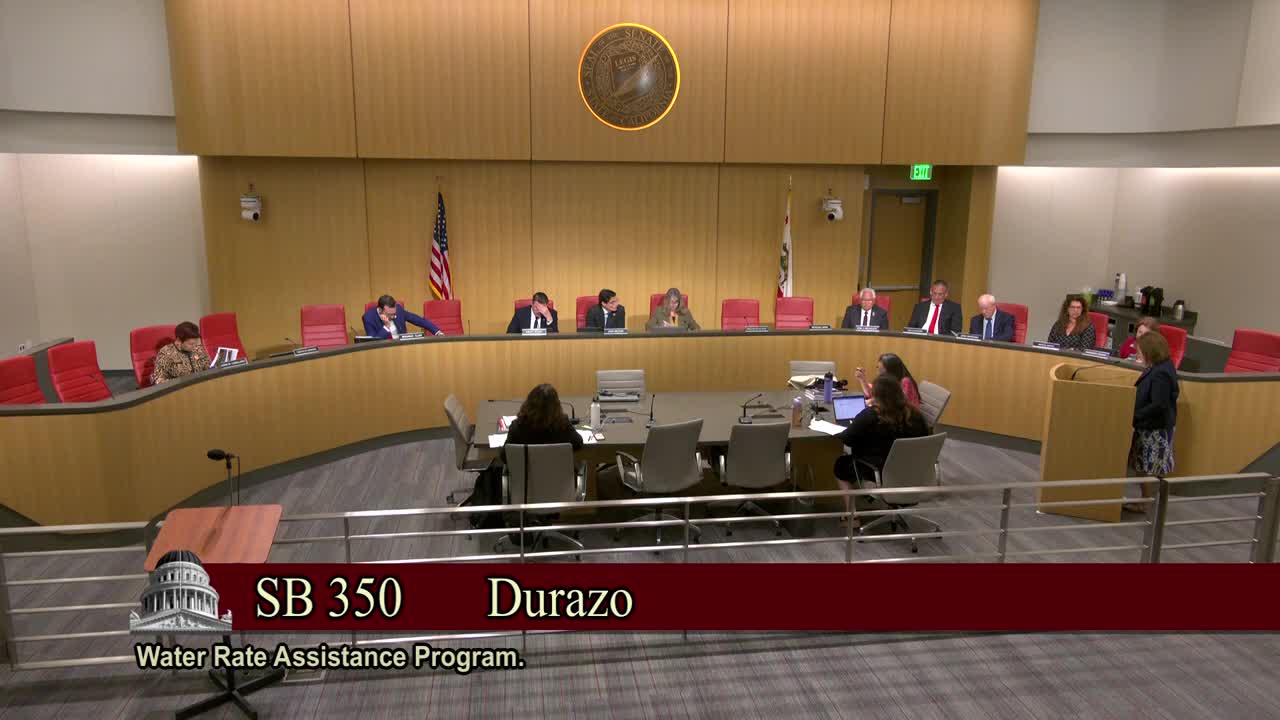 19MIN
Senate Standing Committee on Energy, Utilities and Communications
Bill Author

Bill Co-Author(s):