SB 357: Juveniles: delinquency.
- Session Year: 2025-2026
- House: Senate
- Latest Version Date: 2025-07-17
Current Status:
In Progress
(2026-08-20: Ordered to inactive file on request of Assembly Member Aguiar-Curry.)
Introduced
In Committee
Awaiting First Chamber Vote
Passed First Chamber
In Committee
Awaiting Second Chamber Vote
Passed Second Chamber
Enacted
Existing law subjects a minor between 12 and 17 years of age, who violates any federal, state, or local law or ordinance, and a minor under 12 years of age who is alleged to have committed specified serious offenses, to the jurisdiction of the juvenile court, which may adjudge the minor to be a ward of the court. Existing law also establishes the transition jurisdiction or the juvenile court and subjects certain minors who are older than 17 years and 5 months of age and younger than 18 years of age, and certain nonminors who are older than 18 years of age and less than 21 years of age, who were wards of the juvenile court and in foster care placement to that jurisdiction. Existing law assigns various responsibilities relating to these individuals to the probation officer, including, among others, the responsibility to supervise minors placed on probation.
Existing law requires every county to appoint a chief probation officer and requires the chief probation officer to perform the duties and discharge the obligations imposed on the office by law or by order of the superior court, including, among other things, community supervision of the minors described above and the operation of juvenile halls, camps, and ranches, pursuant to specified provisions.
This bill would authorize the board of supervisors in a county with a population of at least 6,000,000 people to, except as specified, delegate to a county official who has jurisdiction over youth development development, diversion, and reentry all or part of the duties and authorities concerning these individuals, including community supervision and the operation of juvenile halls, camps, and ranches. individuals, as specified. The bill would require the county board of supervisors to delegate all or part of these duties and authorities to a county official that is part of a collective bargaining unit.
Existing law generally limits access to juvenile case files, as defined. Existing law authorizes only certain individuals to inspect a juvenile case file, including, among others, the county counsel, city attorney, or any other attorney representing the petitioning agency in a dependency action.
This bill would additionally authorize county officials who have been delegated duties, authorities, or both, as described above, to inspect a juvenile case file.
Existing law subjects a minor between 12 and 17 years of age, who violates any federal, state, or local law or ordinance, and a minor under 12 years of age who is alleged to have committed specified serious offenses, to the jurisdiction of the juvenile court, which may adjudge the minor to be a ward of the court. Existing law also establishes the transition jurisdiction or the juvenile court and subjects certain minors who are older than 17 years and 5 months of age and younger than 18 years of age, and certain nonminors who are older than 18 years of age and less than 21 years of age, who were wards of the juvenile court and in foster care placement to that jurisdiction. Existing law assigns various responsibilities relating to these individuals to the probation officer, including, among others, the responsibility to supervise minors placed on probation.
Existing law requires every county to appoint a chief probation officer and requires the chief probation officer to perform the duties and discharge the obligations imposed on the office by law or by order of the superior court, including, among other things, community supervision of the minors described above and the operation of juvenile halls, camps, and ranches, pursuant to specified provisions.
This bill would authorize the board of supervisors in a county with a population of at least 3,500,000 6,000,000 people to to, except as specified, delegate to a county official who has jurisdiction over youth development all or part of the duties and authorities concerning these individuals, including community supervision and the operation of juvenile halls, camps, and ranches.
Existing law generally limits access to juvenile case files, as defined. Existing law authorizes only certain individuals to inspect a juvenile case file, including, among others, the county counsel, city attorney, or any other attorney representing the petitioning agency in a dependency action.
This bill would additionally authorize county officials who have been delegated duties, authorities, or both, as described above, to inspect a juvenile case file.
Existing law subjects a minor between 12 and 17 years of age, who violates any federal, state, or local law or ordinance, and a minor under 12 years of age who is alleged to have committed specified serious offenses, to the jurisdiction of the juvenile court, which may adjudge the minor to be a ward of the court. Existing law also establishes the transition jurisdiction or the juvenile court and subjects certain minors who are older than 17 years and 5 months of age and younger than 18 years of age, and certain nonminors who are older than 18 years of age and less than 21 years of age, who were wards of the juvenile court and in foster care placement to that jurisdiction. Existing law assigns various responsibilities relating to these minors individuals to the probation officer, including, among others, the responsibility to supervise minors placed on probation and manage juvenile halls and other juvenile detention facilities. probation.
Existing law requires every county to appoint a chief probation officer and requires the chief probation officer to perform the duties and discharge the obligations imposed on the office by law or by order of the superior court, including, among other things, community supervision of the minors described above and the operation of juvenile halls, camps, and ranches, pursuant to specified provisions.
This bill would authorize the board of supervisors of any county in a county with a population of at least 3,500,000 people to delegate to another county department a county official who has jurisdiction over youth development all or part of the duties and authorities concerning those minors, or concerning the oversight or operation of juvenile detention facilities, that are granted to the probation department or a probation officer. these individuals, including community supervision and the operation of juvenile halls, camps, and ranches.
Existing law subjects a minor between 12 and 17 years of age, who violates any federal, state, or local law or ordinance, and a minor under 12 years of age who is alleged to have committed specified serious offenses, to the jurisdiction of the juvenile court, which may adjudge the minor to be a ward of the court. Existing law assigns various responsibilities relating to these minors to the probation officer, including, among others, the responsibility to supervise minors placed on probation and manage juvenile halls and other juvenile detention facilities.
This bill would authorize the board of supervisors of any county to delegate to another county department all or part of the duties and authorities concerning those minors, or concerning the oversight or operation of juvenile detention facilities, that are granted to the probation department or a probation officer.
(a)Except as provided in subdivision (b), the chief probation officer shall perform the duties and discharge the obligations imposed on the office by law or by order of the superior court, including the following:
(1)Community supervision of offenders subject to the jurisdiction of the juvenile court pursuant to Section 602 or 1766 of the Welfare and Institutions Code.
(2)Operation of juvenile halls pursuant to Section 852 of the Welfare and Institutions Code.
(3)Operation of juvenile camps and ranches established under Section 880 of the Welfare and Institutions Code.
(4)Community supervision of individuals subject to probation pursuant to conditions imposed under Section 1203 of the Penal Code.
(5)Community supervision of individuals subject to mandatory supervision pursuant to subparagraph (B) of paragraph (5) of subdivision (h) of Section 1170 of the Penal Code.
(6)Community supervision of individuals subject to postrelease community supervision pursuant to Section 3451 of the Penal Code.
(7)Administration of community-based corrections programming, including, but not limited to, programs authorized by Chapter 3 (commencing with Section 1228) of Title 8 of Part 2 of the Penal Code.
(8)Serving as chair of the Community Corrections Partnership pursuant to Section 1230 of the Penal Code.
(9)Making recommendations to the court, including, but not limited to, pre-sentence investigative reports pursuant to Sections 1203.7 and 1203.10 of the Penal Code.
(b)(1)Notwithstanding any other law, and except as provided in paragraph (2), the board of supervisors in a county with a population of at least 6,000,000 people may delegate to a county official who has jurisdiction over youth development development, diversion, and reentry all or part of the duties and authorities concerning individuals who are under the jurisdiction of the juvenile court pursuant to Section 450, 601, or 602 of the Welfare and Institutions Code, including the duties and obligations as described in paragraphs (1) to (2) and (3), inclusive, of subdivision (a). The county board of supervisors shall delegate all or part of these duties and authorities to a county official that is part of a collective bargaining unit.
Nothing in this subdivision shall result in the loss of represented staff currently employed by a county probation department without cause or prohibit any staff or department from performing duties delegated to it by the county board of supervisors.
(2)The board of supervisors shall not delegate pursuant to paragraph (1) a duty or authority that any law requires to be undertaken by a peace officer, as defined in Chapter 4.5 (commencing with Section 830) of Title 3 of Part 2 of the Penal Code.
(c)The chief probation officer may perform other duties that are consistent with those enumerated in subdivision (a) and may accept appointment to the Board of State and Community Corrections and collect the per diem authorized by Section 6025.1 of the Penal Code.
SEC. 2.Section 272.5 is added to the Welfare and Institutions Code, to read:272.5.(a)Notwithstanding any other law, and except as provided in subdivision (b), the board of supervisors in a county with a population of at least 6,000,000 people may delegate to a county official who has jurisdiction over youth development development, diversion, and reentry all or part of the duties and authorities concerning individuals who are under the jurisdiction of the juvenile court pursuant to Section 450, 601, or 602, including the duties and obligations as described in paragraphs (1) to (3), (2) and (3), inclusive, of subdivision (a) of Section 27771 of the Government Code. The county board of supervisors shall delegate all or part of these duties and authorities to a county official that is part of a collective bargaining unit.
Nothing in this subdivision shall result in the loss of represented staff currently employed by a county probation department without cause or prohibit any staff or department from performing duties delegated to it by the county board of supervisors.
(b)The board of supervisors shall not delegate pursuant to subdivision (a) a duty or authority that any law requires to be undertaken by a peace officer, as defined in Chapter 4.5 (commencing with Section 830) of Title 3 of Part 2 of the Penal Code.
SEC. 3.Section 827 of the Welfare and Institutions Code is amended to read:827.(a)(1)Except as provided in Section 828, a case file may be inspected only by the following:
(A)Court personnel.
(B)The district attorney, a city attorney, or city prosecutor authorized to prosecute criminal or juvenile cases under state law.
(C)The minor who is the subject of the proceeding.
(D)The minors parent or guardian.
(E)The attorneys for the parties, judges, referees, other hearing officers, probation officers, county officials who have been delegated duties, authorities, or both pursuant to Section 272.5 of this code and subdivision (b) of Section 27771 of the Government Code, and law enforcement officers who are actively participating in criminal or juvenile proceedings involving the minor.
(F)The county counsel, city attorney, or any other attorney representing the petitioning agency in a dependency action.
(G)The superintendent or designee of the school district where the minor is enrolled or attending school.
(H)Members of the child protective agencies as described in Section 11165.9 of the Penal Code.
(I)The State Department of Social Services, to carry out its duties pursuant to Division 9 (commencing with Section 10000) of this code and Part 5 (commencing with Section 7900) of Division 12 of the Family Code to oversee and monitor county child welfare agencies, children in foster care or receiving foster care assistance, and out-of-state placements, Section 10850.4, and paragraph (2).
(J)(i)Authorized staff who are employed by, or authorized staff of entities who are licensed by, the State Department of Social Services, as necessary to the performance of their duties related to resource family approval, and authorized staff who are employed by the State Department of Social Services as necessary to inspect, approve, or license, and monitor or investigate community care facilities or resource families, and to ensure that the standards of care and services provided in those facilities are adequate and appropriate, and to ascertain compliance with the rules and regulations to which the facilities are subject.
(ii)The confidential information shall remain confidential except for purposes of inspection, approval or licensing, or monitoring or investigation pursuant to Chapter 3 (commencing with Section 1500) and Chapter 3.4 (commencing with Section 1596.70) of Division 2 of the Health and Safety Code and Article 2 (commencing with Section 16519.5) of Chapter 5 of Part 4 of Division 9. The confidential information may also be used by the State Department of Social Services in a criminal, civil, or administrative proceeding. The confidential information shall be available only to the judge or hearing officer and to the parties to the case. Names that are confidential shall be listed in attachments separate to the general pleadings. The confidential information shall be sealed after the conclusion of the criminal, civil, or administrative hearings, and may not subsequently be released except in accordance with this subdivision. If the confidential information does not result in a criminal, civil, or administrative proceeding, it shall be sealed after the State Department of Social Services determines that no further action will be taken in the matter. Except as otherwise provided in this subdivision, confidential information shall not contain the name of the minor.
(K)Members of childrens multidisciplinary teams, persons, or agencies providing treatment or supervision of the minor.
(L)A judge, commissioner, or other hearing officer assigned to a family law case with issues concerning custody or visitation, or both, involving the minor, and the following persons, if actively participating in the family law case: a family court mediator assigned to a case involving the minor pursuant to Article 1 (commencing with Section 3160) of Chapter 11 of Part 2 of Division 8 of the Family Code, a court-appointed evaluator or a person conducting a court-connected child custody evaluation, investigation, or assessment pursuant to Section 3111 or 3118 of the Family Code, and counsel appointed for the minor in the family law case pursuant to Section 3150 of the Family Code. Prior to allowing counsel appointed for the minor in the family law case to inspect the file, the court clerk may require counsel to provide a certified copy of the court order appointing the minors counsel.
(M)When acting within the scope of investigative duties of an active case, a statutorily authorized or court-appointed investigator who is conducting an investigation pursuant to Section 7663, 7851, or 9001 of the Family Code, or who is actively participating in a guardianship case involving a minor pursuant to Part 2 (commencing with Section 1500) of Division 4 of the Probate Code and acting within the scope of the investigators duties in that case.
(N)A local child support agency for the purpose of establishing paternity and establishing and enforcing child support orders.
(O)Juvenile justice commissions as established under Section 225. The confidentiality provisions of Section 10850 shall apply to a juvenile justice commission and its members.
(P)The Department of Justice, to carry out its duties pursuant to Sections 290.008 and 290.08 of the Penal Code as the repository for sex offender registration and notification in California.
(Q)Any other person who may be designated by court order of the judge of the juvenile court upon filing a petition.
(R)A probation officer who is preparing a report pursuant to Section 1178 on behalf of a person who was in the custody of the Department of Corrections and Rehabilitation, Division of Juvenile Justice and who has petitioned the Board of Juvenile Hearings for an honorable discharge.
(S)(i)The attorneys in an administrative hearing involving the minor or nonminor only as necessary to meet the requirements of Sections 10952 and 10952.5.
(ii)The confidential information shall remain confidential for purposes of the administrative proceeding. The confidential information shall be available only to the judge or hearing officer and to the parties to the case. The confidential information shall be sealed after the conclusion of the administrative hearing, and shall not subsequently be released except in accordance with this subdivision.
(T)Personnel of the State Department of Social Services, to carry out the duties of the department pursuant to paragraph (1) of subdivision (c) of Section 9100 of the Family Code or paragraph (3) of subdivision (e) of Section 366.26.
(U)Personnel of the Office of Youth and Community Restoration, to carry out the duties of the office pursuant to Sections 2200, 2200.2, 2200.5, and 2200.7.
(V)The attorney representing a person who is, or was, subject to juvenile proceedings under Section 601 or 602.
(2)(A)Notwithstanding any other law, and subject to subparagraph (A) of paragraph (3), juvenile case files, except those relating to matters within the jurisdiction of the court pursuant to Section 601 or 602, that pertain to a deceased child who was within the jurisdiction of the juvenile court pursuant to Section 300, shall be released to the public pursuant to an order by the juvenile court after a petition has been filed and interested parties have been afforded an opportunity to file an objection. Any information relating to another child or that could identify another child, except for information about the deceased, shall be redacted from the juvenile case file prior to release, unless a specific order is made by the juvenile court to the contrary. Except as provided in this paragraph, the presiding judge of the juvenile court may issue an order prohibiting or limiting access to the juvenile case file, or any portion thereof, of a deceased child only upon a showing by a preponderance of evidence that release of the juvenile case file or any portion thereof is detrimental to the safety, protection, or physical or emotional well-being of another child who is directly or indirectly connected to the juvenile case that is the subject of the petition.
(B)This paragraph represents a presumption in favor of the release of documents when a child is deceased unless the statutory reasons for confidentiality are shown to exist.
(C)If a child whose records are sought has died, and documents are sought pursuant to this paragraph, no weighing or balancing of the interests of those other than a child is permitted.
(D)A petition filed under this paragraph shall be served on interested parties by the petitioner, if the petitioner is in possession of their identity and address, and on the custodian of records. Upon receiving a petition, the custodian of records shall serve a copy of the request upon all interested parties that have not been served by the petitioner or on the interested parties served by the petitioner if the custodian of records possesses information, such as a more recent address, indicating that the service by the petitioner may have been ineffective.
(E)The custodian of records shall serve the petition within 10 calendar days of receipt. If an interested party, including the custodian of records, objects to the petition, the party shall file and serve the objection on the petitioning party no later than 15 calendar days after service of the petition.
(F)The petitioning party shall have 10 calendar days to file a reply. The juvenile court shall set the matter for hearing no more than 60 calendar days from the date the petition is served on the custodian of records. The court shall render its decision within 30 days of the hearing. The matter shall be decided solely upon the basis of the petition and supporting exhibits and declarations, if any, the objection and any supporting exhibits or declarations, if any, and the reply and any supporting declarations or exhibits thereto, and argument at hearing. The court may, solely upon its own motion, order the appearance of witnesses. If an objection is not filed to the petition, the court shall review the petition and issue its decision within 10 calendar days of the final day for filing the objection. An order of the court shall be immediately reviewable by petition to the appellate court for the issuance of an extraordinary writ.
(3)Access to juvenile case files pertaining to matters within the jurisdiction of the juvenile court pursuant to Section 300 or Section 601 or 602 shall be limited as follows:
(A)If a juvenile case file, or any portion thereof, is privileged or confidential pursuant to any other state law or federal law or regulation, the requirements of that state law or federal law or regulation prohibiting or limiting release of the juvenile case file or any portions thereof shall prevail. Unless a person is listed in subparagraphs (A) to (P), inclusive, of paragraph (1) and is entitled to access under the other state law or federal law or regulation without a court order, all those seeking access, pursuant to other authorization, to portions of, or information relating to the contents of, juvenile case files protected under another state law or federal law or regulation, shall petition the juvenile court. The juvenile court may only release the portion of, or information relating to the contents of, juvenile case files protected by another state law or federal law or regulation if disclosure is not detrimental to the safety, protection, or physical or emotional well-being of a child, minor, or person who is directly or indirectly connected to the juvenile case that is the subject of the petition. This paragraph does not limit the ability of the juvenile court to carry out its duties in conducting juvenile court proceedings.
(B)Prior to the release of the juvenile case file or any portion thereof, the court shall afford due process, including a notice of, and an opportunity to file an objection to, the release of the record or report to all interested parties.
(C)This paragraph does not limit or repeal any other applicable legal standard or protections designed to safeguard private, confidential, or privileged information.
(4)A juvenile case file, any portion thereof, and information relating to the content of the juvenile case file, may not be disseminated by the receiving agencies to a person or agency, other than a person or agency authorized to receive documents pursuant to this section. Further, a juvenile case file, any portion thereof, and information relating to the content of the juvenile case file, may not be made as an attachment to any other documents without the prior approval of the presiding judge of the juvenile court, unless it is used in connection with, and in the course of, a criminal investigation or a proceeding brought to declare a person a dependent child or ward of the juvenile court.
(5)Individuals listed in subparagraphs (A), (B), (C), (D), (E), (F), (H), (I), (J), (P), (S), (T), and (U) of paragraph (1) may also receive copies of the case file. For authorized staff of entities who are licensed by the State Department of Social Services, the confidential information shall be obtained through a child protective agency, as defined in subparagraph (H) of paragraph (1). In these circumstances, the requirements of paragraph (4) shall continue to apply to the information received.
(6)An individual other than a person described in subparagraphs (A) to (P), inclusive, of paragraph (1) who files a notice of appeal or petition for writ challenging a juvenile court order, or who is a respondent in that appeal or real party in interest in that writ proceeding, may, for purposes of that appeal or writ proceeding, inspect and copy any records in a juvenile case file to which the individual was previously granted access by the juvenile court pursuant to subparagraph (Q) of paragraph (1), including any records or portions thereof that are made a part of the appellate record. The requirements of paragraph (3) shall continue to apply to any other record, or a portion thereof, in the juvenile case file or made a part of the appellate record. The requirements of paragraph (4) shall continue to apply to files received pursuant to this paragraph. The Judicial Council shall adopt rules to implement this paragraph.
(b)(1)While the Legislature reaffirms its belief that juvenile court records, in general, should be confidential, it is the intent of the Legislature in enacting this subdivision to provide for a limited exception to juvenile court record confidentiality to promote more effective communication among juvenile courts, family courts, law enforcement agencies, and schools to ensure the rehabilitation of juvenile criminal offenders as well as to lessen the potential for drug use, violence, other forms of delinquency, and child abuse.
(2)(A)Notwithstanding subdivision (a), written notice that a minor enrolled in a public school, kindergarten to grade 12, inclusive, has been found by a court of competent jurisdiction to have committed a felony or misdemeanor involving curfew, gambling, alcohol, drugs, tobacco products, carrying of weapons, a sex offense listed in Section 290 of the Penal Code, assault or battery, larceny, vandalism, or graffiti shall be provided by the court, within seven days, to the superintendent of the school district of attendance. Written notice shall include only the offense found to have been committed by the minor and the disposition of the minors case. This notice shall be expeditiously transmitted by the district superintendent to the principal at the school of attendance. The principal shall expeditiously disseminate the information to those counselors directly supervising or reporting on the behavior or progress of the minor. In addition, the principal shall disseminate the information to any teacher or administrator directly supervising or reporting on the behavior or progress of the minor whom the principal believes needs the information to work with the pupil in an appropriate fashion to avoid being needlessly vulnerable or to protect other persons from needless vulnerability.
(B)Any information received by a teacher, counselor, or administrator under this subdivision shall be received in confidence for the limited purpose of rehabilitating the minor and protecting students and staff, and shall not be further disseminated by the teacher, counselor, or administrator, except insofar as communication with the juvenile, the juveniles parents or guardians, law enforcement personnel, and the juveniles probation officer is necessary to effectuate the juveniles rehabilitation or to protect students and staff.
(C)An intentional violation of the confidentiality provisions of this paragraph is a misdemeanor punishable by a fine not to exceed five hundred dollars ($500).
(3)If a minor is removed from public school as a result of the courts finding described in subdivision (b), the superintendent shall maintain the information in a confidential file and shall defer transmittal of the information received from the court until the minor is returned to public school. If the minor is returned to a school district other than the one from which the minor came, the parole or probation officer having jurisdiction over the minor shall so notify the superintendent of the last district of attendance, who shall transmit the notice received from the court to the superintendent of the new district of attendance.
(c)Each probation report filed with the court concerning a minor whose record is subject to dissemination pursuant to subdivision (b) shall include on the face sheet the school at which the minor is currently enrolled. The county superintendent shall provide the court with a listing of all of the schools within each school district, within the county, along with the name and mailing address of each district superintendent.
(d)(1)Each notice sent by the court pursuant to subdivision (b) shall be stamped with the instruction: Unlawful Dissemination Of This Information Is A Misdemeanor. Any information received from the court shall be kept in a separate confidential file at the school of attendance and shall be transferred to the minors subsequent schools of attendance and maintained until the minor graduates from high school, is released from juvenile court jurisdiction, or reaches 18 years of age, whichever occurs first. After that time, the confidential record shall be destroyed. At any time after the date by which a record required to be destroyed by this section should have been destroyed, the minor or the minors parent or guardian shall have the right to make a written request to the principal of the school that the minors school records be reviewed to ensure that the record has been destroyed. Upon completion of the requested review and no later than 30 days after the request for the review was received, the principal or a designee shall respond in writing to the written request and either shall confirm that the record has been destroyed or, if the record has not been destroyed, shall explain why destruction has not yet occurred.
(2)Except as provided in paragraph (2) of subdivision (b), liability shall not attach to a person who transmits or fails to transmit notice or information required under subdivision (b).
(e)For purposes of this section, a juvenile case file means a petition filed in a juvenile court proceeding, reports of the probation officer, and all other records, including any writing as defined in Section 250 of the Evidence Code, or electronically stored information relating to the minor, that is filed in that case or made available to the probation officer in making the probation officers report, or to the judge, referee, or other hearing officer, and thereafter retained by the probation officer, judge, referee, or other hearing officer.
(f)The persons described in subparagraphs (A), (E), (F), (H), (K), (L), (M), and (N) of paragraph (1) of subdivision (a) include persons serving in a similar capacity for an Indian tribe, reservation, or tribal court when the case file involves a child who is a member of, or who is eligible for membership in, that tribe.
(g)Any portion of a case file that is covered by, or included in, an order of the court sealing a record pursuant to Section 781 or 786, or that is covered by a record sealing requirement pursuant to Section 786.5 or 827.95, may not be inspected, except as specified by those sections.
(a)Except as provided in subdivision (b), the chief probation officer shall perform the duties and discharge the obligations imposed on the office by law or by order of the superior court, including the following:
(1)Community supervision of offenders subject to the jurisdiction of the juvenile court pursuant to Section 602 or 1766 of the Welfare and Institutions Code.
(2)Operation of juvenile halls pursuant to Section 852 of the Welfare and Institutions Code.
(3)Operation of juvenile camps and ranches established under Section 880 of the Welfare and Institutions Code.
(4)Community supervision of individuals subject to probation pursuant to conditions imposed under Section 1203 of the Penal Code.
(5)Community supervision of individuals subject to mandatory supervision pursuant to subparagraph (B) of paragraph (5) of subdivision (h) of Section 1170 of the Penal Code.
(6)Community supervision of individuals subject to postrelease community supervision pursuant to Section 3451 of the Penal Code.
(7)Administration of community-based corrections programming, including, but not limited to, programs authorized by Chapter 3 (commencing with Section 1228) of Title 8 of Part 2 of the Penal Code.
(8)Serving as chair of the Community Corrections Partnership pursuant to Section 1230 of the Penal Code.
(9)Making recommendations to the court, including, but not limited to, pre-sentence investigative reports pursuant to Sections 1203.7 and 1203.10 of the Penal Code.
(b)(1)Notwithstanding any other law, and except as provided in paragraph (2), the board of supervisors in a county with a population of at least 3,500,000 6,000,000 people may delegate to a county official who has jurisdiction over youth development all or part of the duties and authorities concerning individuals who are under the jurisdiction of the juvenile court pursuant to Section 450, 601, or 602 of the Welfare and Institutions Code, including all or part of the duties and obligations described in paragraphs (1) to (3), inclusive, of subdivision (a).
(2)The board of supervisors shall not delegate pursuant to paragraph (1) a duty or authority that any law requires to be undertaken by a peace officer, as defined in Chapter 4.5 (commencing with Section 830) of Title 3 of Part 2 of the Penal Code.
(c)The chief probation officer may perform other duties that are consistent with those enumerated in subdivision (a) and may accept appointment to the Board of State and Community Corrections and collect the per diem authorized by Section 6025.1 of the Penal Code.
SEC. 2.Section 272.5 is added to the Welfare and Institutions Code, to read:272.5.(a)Notwithstanding any other law, and except as provided in subdivision (b), the board of supervisors in a county with a population of at least 3,500,000 6,000,000 people may delegate to a county official who has jurisdiction over youth development all or part of the duties and authorities concerning individuals who are under the jurisdiction of the juvenile court pursuant to Section 450, 601, or 602, including all or part of the duties and obligations described in paragraphs (1) to (3), inclusive, of subdivision (a) of Section 27771 of the Government Code.
(b)The board of supervisors shall not delegate pursuant to subdivision (a) a duty or authority that any law requires to be undertaken by a peace officer, as defined in Chapter 4.5 (commencing with Section 830) of Title 3 of Part 2 of the Penal Code.
SEC. 3.Section 827 of the Welfare and Institutions Code is amended to read:827.(a)(1)Except as provided in Section 828, a case file may be inspected only by the following:
(A)Court personnel.
(B)The district attorney, a city attorney, or city prosecutor authorized to prosecute criminal or juvenile cases under state law.
(C)The minor who is the subject of the proceeding.
(D)The minors parent or guardian.
(E)The attorneys for the parties, judges, referees, other hearing officers, probation officers, county officials who have been delegated duties, authorities, or both pursuant to Section 272.5 of this code and subdivision (b) of Section 27771 of the Government Code, and law enforcement officers who are actively participating in criminal or juvenile proceedings involving the minor.
(F)The county counsel, city attorney, or any other attorney representing the petitioning agency in a dependency action.
(G)The superintendent or designee of the school district where the minor is enrolled or attending school.
(H)Members of the child protective agencies as described in Section 11165.9 of the Penal Code.
(I)The State Department of Social Services, to carry out its duties pursuant to Division 9 (commencing with Section 10000) of this code and Part 5 (commencing with Section 7900) of Division 12 of the Family Code to oversee and monitor county child welfare agencies, children in foster care or receiving foster care assistance, and out-of-state placements, Section 10850.4, and paragraph (2).
(J)(i)Authorized staff who are employed by, or authorized staff of entities who are licensed by, the State Department of Social Services, as necessary to the performance of their duties related to resource family approval, and authorized staff who are employed by the State Department of Social Services as necessary to inspect, approve, or license, and monitor or investigate community care facilities or resource families, and to ensure that the standards of care and services provided in those facilities are adequate and appropriate, and to ascertain compliance with the rules and regulations to which the facilities are subject.
(ii)The confidential information shall remain confidential except for purposes of inspection, approval or licensing, or monitoring or investigation pursuant to Chapter 3 (commencing with Section 1500) and Chapter 3.4 (commencing with Section 1596.70) of Division 2 of the Health and Safety Code and Article 2 (commencing with Section 16519.5) of Chapter 5 of Part 4 of Division 9. The confidential information may also be used by the State Department of Social Services in a criminal, civil, or administrative proceeding. The confidential information shall be available only to the judge or hearing officer and to the parties to the case. Names that are confidential shall be listed in attachments separate to the general pleadings. The confidential information shall be sealed after the conclusion of the criminal, civil, or administrative hearings, and may not subsequently be released except in accordance with this subdivision. If the confidential information does not result in a criminal, civil, or administrative proceeding, it shall be sealed after the State Department of Social Services determines that no further action will be taken in the matter. Except as otherwise provided in this subdivision, confidential information shall not contain the name of the minor.
(K)Members of childrens multidisciplinary teams, persons, or agencies providing treatment or supervision of the minor.
(L)A judge, commissioner, or other hearing officer assigned to a family law case with issues concerning custody or visitation, or both, involving the minor, and the following persons, if actively participating in the family law case: a family court mediator assigned to a case involving the minor pursuant to Article 1 (commencing with Section 3160) of Chapter 11 of Part 2 of Division 8 of the Family Code, a court-appointed evaluator or a person conducting a court-connected child custody evaluation, investigation, or assessment pursuant to Section 3111 or 3118 of the Family Code, and counsel appointed for the minor in the family law case pursuant to Section 3150 of the Family Code. Prior to allowing counsel appointed for the minor in the family law case to inspect the file, the court clerk may require counsel to provide a certified copy of the court order appointing the minors counsel.
(M)When acting within the scope of investigative duties of an active case, a statutorily authorized or court-appointed investigator who is conducting an investigation pursuant to Section 7663, 7851, or 9001 of the Family Code, or who is actively participating in a guardianship case involving a minor pursuant to Part 2 (commencing with Section 1500) of Division 4 of the Probate Code and acting within the scope of the investigators duties in that case.
(N)A local child support agency for the purpose of establishing paternity and establishing and enforcing child support orders.
(O)Juvenile justice commissions as established under Section 225. The confidentiality provisions of Section 10850 shall apply to a juvenile justice commission and its members.
(P)The Department of Justice, to carry out its duties pursuant to Sections 290.008 and 290.08 of the Penal Code as the repository for sex offender registration and notification in California.
(Q)Any other person who may be designated by court order of the judge of the juvenile court upon filing a petition.
(R)A probation officer who is preparing a report pursuant to Section 1178 on behalf of a person who was in the custody of the Department of Corrections and Rehabilitation, Division of Juvenile Justice and who has petitioned the Board of Juvenile Hearings for an honorable discharge.
(S)(i)The attorneys in an administrative hearing involving the minor or nonminor only as necessary to meet the requirements of Sections 10952 and 10952.5.
(ii)The confidential information shall remain confidential for purposes of the administrative proceeding. The confidential information shall be available only to the judge or hearing officer and to the parties to the case. The confidential information shall be sealed after the conclusion of the administrative hearing, and shall not subsequently be released except in accordance with this subdivision.
(T)Personnel of the State Department of Social Services, to carry out the duties of the department pursuant to paragraph (1) of subdivision (c) of Section 9100 of the Family Code or paragraph (3) of subdivision (e) of Section 366.26.
(U)Personnel of the Office of Youth and Community Restoration, to carry out the duties of the office pursuant to Sections 2200, 2200.2, 2200.5, and 2200.7.
(V)The attorney representing a person who is, or was, subject to juvenile proceedings under Section 601 or 602.
(2)(A)Notwithstanding any other law, and subject to subparagraph (A) of paragraph (3), juvenile case files, except those relating to matters within the jurisdiction of the court pursuant to Section 601 or 602, that pertain to a deceased child who was within the jurisdiction of the juvenile court pursuant to Section 300, shall be released to the public pursuant to an order by the juvenile court after a petition has been filed and interested parties have been afforded an opportunity to file an objection. Any information relating to another child or that could identify another child, except for information about the deceased, shall be redacted from the juvenile case file prior to release, unless a specific order is made by the juvenile court to the contrary. Except as provided in this paragraph, the presiding judge of the juvenile court may issue an order prohibiting or limiting access to the juvenile case file, or any portion thereof, of a deceased child only upon a showing by a preponderance of evidence that release of the juvenile case file or any portion thereof is detrimental to the safety, protection, or physical or emotional well-being of another child who is directly or indirectly connected to the juvenile case that is the subject of the petition.
(B)This paragraph represents a presumption in favor of the release of documents when a child is deceased unless the statutory reasons for confidentiality are shown to exist.
(C)If a child whose records are sought has died, and documents are sought pursuant to this paragraph, no weighing or balancing of the interests of those other than a child is permitted.
(D)A petition filed under this paragraph shall be served on interested parties by the petitioner, if the petitioner is in possession of their identity and address, and on the custodian of records. Upon receiving a petition, the custodian of records shall serve a copy of the request upon all interested parties that have not been served by the petitioner or on the interested parties served by the petitioner if the custodian of records possesses information, such as a more recent address, indicating that the service by the petitioner may have been ineffective.
(E)The custodian of records shall serve the petition within 10 calendar days of receipt. If an interested party, including the custodian of records, objects to the petition, the party shall file and serve the objection on the petitioning party no later than 15 calendar days after service of the petition.
(F)The petitioning party shall have 10 calendar days to file a reply. The juvenile court shall set the matter for hearing no more than 60 calendar days from the date the petition is served on the custodian of records. The court shall render its decision within 30 days of the hearing. The matter shall be decided solely upon the basis of the petition and supporting exhibits and declarations, if any, the objection and any supporting exhibits or declarations, if any, and the reply and any supporting declarations or exhibits thereto, and argument at hearing. The court may, solely upon its own motion, order the appearance of witnesses. If an objection is not filed to the petition, the court shall review the petition and issue its decision within 10 calendar days of the final day for filing the objection. An order of the court shall be immediately reviewable by petition to the appellate court for the issuance of an extraordinary writ.
(3)Access to juvenile case files pertaining to matters within the jurisdiction of the juvenile court pursuant to Section 300 or Section 601 or 602 shall be limited as follows:
(A)If a juvenile case file, or any portion thereof, is privileged or confidential pursuant to any other state law or federal law or regulation, the requirements of that state law or federal law or regulation prohibiting or limiting release of the juvenile case file or any portions thereof shall prevail. Unless a person is listed in subparagraphs (A) to (P), inclusive, of paragraph (1) and is entitled to access under the other state law or federal law or regulation without a court order, all those seeking access, pursuant to other authorization, to portions of, or information relating to the contents of, juvenile case files protected under another state law or federal law or regulation, shall petition the juvenile court. The juvenile court may only release the portion of, or information relating to the contents of, juvenile case files protected by another state law or federal law or regulation if disclosure is not detrimental to the safety, protection, or physical or emotional well-being of a child, minor, or person who is directly or indirectly connected to the juvenile case that is the subject of the petition. This paragraph does not limit the ability of the juvenile court to carry out its duties in conducting juvenile court proceedings.
(B)Prior to the release of the juvenile case file or any portion thereof, the court shall afford due process, including a notice of, and an opportunity to file an objection to, the release of the record or report to all interested parties.
(C)This paragraph does not limit or repeal any other applicable legal standard or protections designed to safeguard private, confidential, or privileged information.
(4)A juvenile case file, any portion thereof, and information relating to the content of the juvenile case file, may not be disseminated by the receiving agencies to a person or agency, other than a person or agency authorized to receive documents pursuant to this section. Further, a juvenile case file, any portion thereof, and information relating to the content of the juvenile case file, may not be made as an attachment to any other documents without the prior approval of the presiding judge of the juvenile court, unless it is used in connection with, and in the course of, a criminal investigation or a proceeding brought to declare a person a dependent child or ward of the juvenile court.
(5)Individuals listed in subparagraphs (A), (B), (C), (D), (E), (F), (H), (I), (J), (P), (S), (T), and (U) of paragraph (1) may also receive copies of the case file. For authorized staff of entities who are licensed by the State Department of Social Services, the confidential information shall be obtained through a child protective agency, as defined in subparagraph (H) of paragraph (1). In these circumstances, the requirements of paragraph (4) shall continue to apply to the information received.
(6)An individual other than a person described in subparagraphs (A) to (P), inclusive, of paragraph (1) who files a notice of appeal or petition for writ challenging a juvenile court order, or who is a respondent in that appeal or real party in interest in that writ proceeding, may, for purposes of that appeal or writ proceeding, inspect and copy any records in a juvenile case file to which the individual was previously granted access by the juvenile court pursuant to subparagraph (Q) of paragraph (1), including any records or portions thereof that are made a part of the appellate record. The requirements of paragraph (3) shall continue to apply to any other record, or a portion thereof, in the juvenile case file or made a part of the appellate record. The requirements of paragraph (4) shall continue to apply to files received pursuant to this paragraph. The Judicial Council shall adopt rules to implement this paragraph.
(b)(1)While the Legislature reaffirms its belief that juvenile court records, in general, should be confidential, it is the intent of the Legislature in enacting this subdivision to provide for a limited exception to juvenile court record confidentiality to promote more effective communication among juvenile courts, family courts, law enforcement agencies, and schools to ensure the rehabilitation of juvenile criminal offenders as well as to lessen the potential for drug use, violence, other forms of delinquency, and child abuse.
(2)(A)Notwithstanding subdivision (a), written notice that a minor enrolled in a public school, kindergarten to grade 12, inclusive, has been found by a court of competent jurisdiction to have committed a felony or misdemeanor involving curfew, gambling, alcohol, drugs, tobacco products, carrying of weapons, a sex offense listed in Section 290 of the Penal Code, assault or battery, larceny, vandalism, or graffiti shall be provided by the court, within seven days, to the superintendent of the school district of attendance. Written notice shall include only the offense found to have been committed by the minor and the disposition of the minors case. This notice shall be expeditiously transmitted by the district superintendent to the principal at the school of attendance. The principal shall expeditiously disseminate the information to those counselors directly supervising or reporting on the behavior or progress of the minor. In addition, the principal shall disseminate the information to any teacher or administrator directly supervising or reporting on the behavior or progress of the minor whom the principal believes needs the information to work with the pupil in an appropriate fashion to avoid being needlessly vulnerable or to protect other persons from needless vulnerability.
(B)Any information received by a teacher, counselor, or administrator under this subdivision shall be received in confidence for the limited purpose of rehabilitating the minor and protecting students and staff, and shall not be further disseminated by the teacher, counselor, or administrator, except insofar as communication with the juvenile, the juveniles parents or guardians, law enforcement personnel, and the juveniles probation officer is necessary to effectuate the juveniles rehabilitation or to protect students and staff.
(C)An intentional violation of the confidentiality provisions of this paragraph is a misdemeanor punishable by a fine not to exceed five hundred dollars ($500).
(3)If a minor is removed from public school as a result of the courts finding described in subdivision (b), the superintendent shall maintain the information in a confidential file and shall defer transmittal of the information received from the court until the minor is returned to public school. If the minor is returned to a school district other than the one from which the minor came, the parole or probation officer having jurisdiction over the minor shall so notify the superintendent of the last district of attendance, who shall transmit the notice received from the court to the superintendent of the new district of attendance.
(c)Each probation report filed with the court concerning a minor whose record is subject to dissemination pursuant to subdivision (b) shall include on the face sheet the school at which the minor is currently enrolled. The county superintendent shall provide the court with a listing of all of the schools within each school district, within the county, along with the name and mailing address of each district superintendent.
(d)(1)Each notice sent by the court pursuant to subdivision (b) shall be stamped with the instruction: Unlawful Dissemination Of This Information Is A Misdemeanor. Any information received from the court shall be kept in a separate confidential file at the school of attendance and shall be transferred to the minors subsequent schools of attendance and maintained until the minor graduates from high school, is released from juvenile court jurisdiction, or reaches 18 years of age, whichever occurs first. After that time, the confidential record shall be destroyed. At any time after the date by which a record required to be destroyed by this section should have been destroyed, the minor or the minors parent or guardian shall have the right to make a written request to the principal of the school that the minors school records be reviewed to ensure that the record has been destroyed. Upon completion of the requested review and no later than 30 days after the request for the review was received, the principal or a designee shall respond in writing to the written request and either shall confirm that the record has been destroyed or, if the record has not been destroyed, shall explain why destruction has not yet occurred.
(2)Except as provided in paragraph (2) of subdivision (b), liability shall not attach to a person who transmits or fails to transmit notice or information required under subdivision (b).
(e)For purposes of this section, a juvenile case file means a petition filed in a juvenile court proceeding, reports of the probation officer, and all other records, including any writing as defined in Section 250 of the Evidence Code, or electronically stored information relating to the minor, that is filed in that case or made available to the probation officer in making the probation officers report, or to the judge, referee, or other hearing officer, and thereafter retained by the probation officer, judge, referee, or other hearing officer.
(f)The persons described in subparagraphs (A), (E), (F), (H), (K), (L), (M), and (N) of paragraph (1) of subdivision (a) include persons serving in a similar capacity for an Indian tribe, reservation, or tribal court when the case file involves a child who is a member of, or who is eligible for membership in, that tribe.
(g)Any portion of a case file that is covered by, or included in, an order of the court sealing a record pursuant to Section 781 or 786, or that is covered by a record sealing requirement pursuant to Section 786.5 or 827.95, may not be inspected, except as specified by those sections.
(a)The Except as provided in subdivision (b), the chief probation officer shall perform the duties and discharge the obligations imposed on the office by law or by order of the superior court, including the following:
(1)Community supervision of offenders subject to the jurisdiction of the juvenile court pursuant to Section 602 or 1766 of the Welfare and Institutions Code.
(2)Operation of juvenile halls pursuant to Section 852 of the Welfare and Institutions Code.
(3)Operation of juvenile camps and ranches established under Section 880 of the Welfare and Institutions Code.
(4)Community supervision of individuals subject to probation pursuant to conditions imposed under Section 1203 of the Penal Code.
(5)Community supervision of individuals subject to mandatory supervision pursuant to subparagraph (B) of paragraph (5) of subdivision (h) of Section 1170 of the Penal Code.
(6)Community supervision of individuals subject to postrelease community supervision pursuant to Section 3451 of the Penal Code.
(7)Administration of community-based corrections programming, including, but not limited to, programs authorized by Chapter 3 (commencing with Section 1228) of Title 8 of Part 2 of the Penal Code.
(8)Serving as chair of the Community Corrections Partnership pursuant to Section 1230 of the Penal Code.
(9)Making recommendations to the court, including, but not limited to, pre-sentence investigative reports pursuant to Sections 1203.7 and 1203.10 of the Penal Code.
(b)Notwithstanding any other law, the board of supervisors in a county with a population of at least 3,500,000 people may delegate to a county official who has jurisdiction over youth development all or part of the duties and authorities concerning individuals who are under the jurisdiction of the juvenile court pursuant to Section 450, 601, or 602 of the Welfare and Institutions Code, including all or part of the duties and obligations described in paragraphs (1) to (3), inclusive, of subdivision (a).
(b)(c)The chief probation officer may perform other duties that are consistent with those enumerated in subdivision (a) and may accept appointment to the Board of State and Community Corrections and collect the per diem authorized by Section 6025.1 of the Penal Code.
SECTION 1.SEC. 2.Section 272.5 is added to the Welfare and Institutions Code, to read:272.5.Notwithstanding any other law, the board of supervisors of any county in a county with a population of at least 3,500,000 people may delegate to another county department a county official who has jurisdiction over youth development all or part of the duties and authorities concerning minors described in Section 601 or 602, or concerning the oversight or operation of juvenile detention facilities, that are granted to the probation department or a probation officer. individuals who are under the jurisdiction of the juvenile court pursuant to Section 450, 601, or 602, including all or part of the duties and obligations described in paragraphs (1) to (3), inclusive, of subdivision (a) of Section 27771 of the Government Code.
Notwithstanding any other law, the board of supervisors of any county may delegate to another county department all or part of the duties and authorities concerning minors described in Section 601 or 602, or concerning the oversight or operation of juvenile detention facilities, that are granted to the probation department or a probation officer.
|
Date
|
Status
|
|---|---|
| Aug 20, 2026 | Ordered to inactive file on request of Assembly Member Aguiar-Curry. |
| Aug 19, 2026 | Ordered to third reading. |
| Aug 19, 2026 | From inactive file. |
| Aug 18, 2026 | Notice of intention to remove from inactive file given by Assembly Member Aguiar-Curry. |
| Aug 18, 2025 | Ordered to inactive file on request of Assembly Member Aguiar-Curry. |
| Aug 18, 2025 | Read second time. Ordered to third reading. |
| Jul 17, 2025 | Read second time and amended. Ordered to second reading. |
| Jul 16, 2025 | From committee: Do pass as amended. (Ayes 5. Noes 1.) (July 15). |
| Jul 1, 2025 | July 1 set for first hearing canceled at the request of author. |
| Jun 16, 2025 | Referred to Com. on PUB. S. |
| Jun 5, 2025 | In Assembly. Read first time. Held at Desk. |
| Jun 4, 2025 | Read third time. Passed. (Ayes 25. Noes 6. Page 1504.) Ordered to the Assembly. |
| Jun 2, 2025 | Read second time. Ordered to third reading. |
| May 29, 2025 | Ordered to second reading. |
| May 29, 2025 | Read third time and amended. |
| May 1, 2025 | Read second time. Ordered to third reading. |
| Apr 30, 2025 | From committee: Do pass. (Ayes 4. Noes 1. Page 945.) (April 29). |
| Apr 11, 2025 | Set for hearing April 29. |
| Apr 10, 2025 | From committee with author's amendments. Read second time and amended. Re-referred to Com. on PUB. S. |
| Feb 19, 2025 | Referred to Com. on PUB. S. |
| Feb 13, 2025 | From printer. May be acted upon on or after March 15. |
| Feb 12, 2025 | Introduced. Read first time. To Com. on RLS. for assignment. To print. |
|
Date
|
Description
|
Location
|
Votes
|
|
|---|---|---|---|---|
| Jul 15, 2025 | Do pass as amended. | Assembly Standing Committee on Public Safety |
Passed |
|
| Jun 4, 2025 | Senate 3rd Reading SB357 Menjivar et al. | Senate Floor |
Passed |
|
| Apr 29, 2025 | Do pass | Senate Standing Committee on Public Safety |
Passed |
This list shows positions taken on this bill by organizations on the date displayed, which is linked to the original source.
Positions by individuals are not included.
|
Organization
|
Position
|
Date
|
|---|---|---|
| 1 individual | ** Support | |
| 2nd Call | ** Support | |
| Aclu California Action | ** Support | |
| AFSCME Local 1967 | ** Against | |
| Alliance for Boys and Men of Color | ** Support | |
| Alliance for Community Empowerment | ** Support | |
| All of Us or None | ** Support | |
| American Federation Of State, County And Municipal Employees, Afl-Cio | ** Against | |
| Anti-Recidivism Coalition | ** Support | |
| Aocds | ** Against | |
| ArtLifeLive | ** Support | |
| Arts for Healing and Justice Network | ** Support | |
| Association For Los Angeles Deputy Sheriffs | ** Against | |
| Association Of Orange County Deputy Sheriffs | ** Against | |
| Bend the Arc: Jewish Action California | ** Support | |
| Better Youth, INC. | ** Support | |
| Boyle Heights Arts Conservatory | ** Support | |
| Brothers, Sons, Selves | ** Support | |
| Brown Issues | ** Support | |
| BU 702- SEIU 721 Joint Council | ** Against | |
| California Alliance for Youth and Community Justice | ** Support | |
| California Alliance Of Child And Family Services | ** Support | |
| California District Attorneys Association | ** Against | |
| California Fraternal Order of Police | ** Against | |
| California Native Vote Project | ** Support | |
| Californians United for a Responsible Budget | ** Support | |
| California Public Defenders Association | ** Support | |
| California United for a Responsible Budget | ** Support | |
| California Youth Connection | ** Support | |
| California Youth Defender Center | ** Support | |
| CA Native Vote Project | ** Support | |
| Center on Juvenile and Criminal Justice | ** Support | |
| Centinela Youth Services | ** Support | |
| Chapman University, Dispute Resolution for Juveniles | ** Support | |
| Chief Probation Officers Of California (Cpoc) | ** Against | |
| Children's Defense Fund - CA | ** Support | |
| Children's Defense Fund-California | ** Support | |
| Coalition for Engaged Education | ** Support | |
| Communities United for Restorative Youth Justice | ** Support | |
| Community Interventions | ** Support | |
| Community Warriors 4 Peace | ** Support | |
| Community Works | ** Support | |
| Conxion To Community | ** Support | |
| County of Contra Costa | ** Against | |
| County of Fresno | ** Against | |
| County Of Kern | ** Against | |
| County of Los Angeles Board of Supervisors | ** Support | |
| County of Monterey | ** Against | |
| County of San Bernardino | ** Against | |
| County of Santa Cruz | ** Against | |
| Courage California | ** Support | |
| Dignity and Power Now | ** Support | |
| Disability Rights California | ** Support | |
| Ella Baker Center For Human Rights | ** Support | |
| End Child Poverty California Powered by Grace | ** Support | |
| Fair Chance Project | ** Support | |
| Felony Murder Elimination Project | ** Support | |
| flintridge center | ** Support | |
| Freedom 4 Youth | ** Support | |
| Fresno County Board of Supervisors | ** Against | |
| Friends Committee On Legislation Of California | ** Support | |
| Gente Organizada | ** Support | |
| Hang Out Do Good | ** Support | |
| Healing and Justice Center | ** Support | |
| Hoops 4 Justice | ** Support | |
| Initiate Justice | ** Support | |
| Initiate Justice Action | ** Support | |
| Inner City Struggle | ** Support | |
| Inyo County Board of Supervisors | ** Against | |
| Jesse's Place Organization | ** Support | |
| Judicial Council of California | ** Against | |
| LA Defensa | ** Support | |
| League Of Women Voters Of California | ** Support | |
| Liberation Fund Coalition | ** Support | |
| Local 148 La County Public Defenders Union | ** Support | |
| Long Beach Police Officers Association | ** Against | |
| Los Angeles County Probation Managers Association Afscme Local 1967 | ** Against | |
| Los Angeles County Probation Officers Union Afscme Local 685 | ** Against | |
| Los Angeles County Supervisor Lindsey P. Horvath | ** Support | |
| Loyola Law School's Youth Justice Education Clinic | ** Support | |
| Marin County Probation Department | ** Against | |
| Mendocino County Board of Supervisors | ** Against | |
| Million Dollar Hoods Project At Ucla | ** Support | |
| Monterey; County Of | ** Against | |
| Moving Mountains by Illumination | ** Support | |
| National Center for Youth Law | ** Support | |
| No Easy Props | ** Support | |
| Our Streets Dream | ** Against | |
| Parents Anonymous, Inc. | ** Against | |
| Peace and Justice Law Center | ** Support | |
| Peace Officers Research Association Of California | ** Against | |
| Project Knucklehead | ** Support | |
| Project Optimism | ** Support | |
| Prosecutors Alliance Action | ** Support | |
| Public Counsel | ** Support | |
| Restoring Hope California | ** Support | |
| Returning Home Reentry Program | ** Support | |
| Sacramento County Deputy Sheriffs Association | ** Against | |
| Sacramento County Probation Association | ** Against | |
| San Bernardino County | ** Against | |
| Sanctuary of Hope | ** Support | |
| San Diego County Probation Officers Association | ** Against | |
| San Gabriel Valley Conservation and Service Corps | ** Against | |
| San Joaquin County Probation Officers Association | ** Against | |
| San Mateo County Probation Detention Association | ** Against | |
| Sheriff's Employee Benefits Association | ** Against | |
| Silicon Valley Debug | ** Support | |
| Sister Warriors Freedom Coalition | ** Support | |
| Smart Justice California, a project of Tides Advocacy | ** Support | |
| Social Justice Learning Institute | ** Support | |
| Solano County Board of Supervisors | ** Against | |
| Southern California Psychiatric Society | ** Support | |
| State Coalition Of Probation Organizations | ** Against | |
| Street Poets | ** Support | |
| Students Deserve | ** Support | |
| The Collective for Liberatory Lawyering | ** Support | |
| The Gathering for Justice | ** Support | |
| The Social Impact Center | ** Support | |
| The W. Haywood Burns Institute | ** Support | |
| Upward Together | ** Support | |
| Urban Peace Institute | ** Support | |
| Urban Peace Movement | ** Support | |
| Ventura County Juvenile Justice and Delinquency Prevention Commission | ** Support | |
| VENTURA COUNTY PROFESSIONAL PEACE OFFICERS ASSOCIATION | ** Against | |
| Vera Institute Of Justice | ** Support | |
| Westcal Academy | ** Support | |
| Young Women's Freedom Center | ** Support | |
| Youth Justice Coalition | ** Support |
SENATE THIRD READING
STR Bill Id:SB 357
Author:(Menjivar)
As Amended Ver:July 17, 2025
Majority vote
SUMMARY
Authorizes a board of supervisors, in a county with a population of at least 6,000,000 people, to delegate to a county official who has jurisdiction over youth development, the duties and authorities that the county probation department has with respect to juveniles, as specified.
Major Provisions
- Allows a board of supervisors, in a county of at least 6,000,000 people, to delegate to a county official who has jurisdiction over youth development, diversion, and reentry all or part of the duties and authorizes concerning juveniles, as specified.
- States that a county official may only perform and discharge part of all of the duties concerning the operation of juvenile halls, camps, and ranches.
- States that the county board of supervisors must delegate these duties to a county official that is part of a collective bargaining unit.
- States that the delegation of these duties shall not result in the loss of represented staff currently employed by a county probation department or prohibit any department from performing duties delegated to it by the county board of supervisors.
- States that a board of supervisors may not delegate a duty or authority to a county official that is required to be undertaken by a peace officer, as specified.
- Allows for the inspection of a juvenile case file by county officials who have been delegated duties concerning juveniles, as specified.
COMMENTS
According to the Author
"In 2020, when the Legislature directed the closure of the Division of Juvenile Justice (DJJ), it envisioned a system that would use public health approaches to support positive youth development, build the capacity of community-based programs and interventions, and reduce crime by youth.
"Senate Bill 81 (Budget – Chapter 275, Statues of 2007) and Senate Bill 823 (Budget – Chapter 337, Statues of 2020) transferred the custody, treatment, and supervision of youth from the state to local County Probation Departments. This added responsibilities such as providing wraparound services, specialized treatment, and managing juvenile facilities. However, some Probation Departments, particularly the Los Angeles one, have struggled to meet these responsibilities.
"Persistent challenges to implementing this new vision of youth justice have been ongoing. LA Probation has faced a staffing crisis, has had their juvenile facilities fail Board of State and Community Corrections inspections, currently has 30 officers indicted for running a fight club with the juveniles and a long history of committed sexual assault on these same youth. The staffing crisis has hindered the County's ability to implement effective programming and has fallen short in providing a safe environment for the juveniles within their facilities. SB 357 seeks to address the realignment efforts of California's youth justice system by granting the Los Angeles County Board of Supervisors the ability to delegate certain functions from County Probation Departments to another county entity.
"By granting LA County the authority to bring in another County entity to support their Probation Department, SB 357 will ensure the youth justice system prioritizes rehabilitation and the services, programs, and placements young people need to successfully return to the community."
Arguments in Support
According to County of Los Angeles Board of Supervisors, "We write in support of your bill, Senate Bill (SB) 357. Our Board adopted a motion on May 13, 2025, to support the bill if amended to allow the new lead designee and lead department staff access juvenile records. The recent amendments would provide such records access. Therefore, County of Los Angeles supports SB 357 because it is aligned with the County's long-standing objectives to decarcerate girls and gender-expansive youth, move more boys to less restrictive placements, and expand holistic, educational, and therapeutic services to the youth in our care.
"As you know, Los Angeles County (County) has embarked on a transformational journey to reimagine its youth justice system, committing to a care-first approach grounded in healing, accountability, and equity. The establishment and growth of the Department of Youth Development (DYD) reflects this vision: a commitment to preventative, rehabilitative, and developmentally appropriate services for young people, particularly those most impacted by systemic inequities. Since its launch, DYD has demonstrated measurable success by diverting youth away from punitive systems, reducing recidivism, and improving educational and mental health outcomes through community-based partnerships and holistic, trauma-informed programming. This approach is aligned with national best practices and garnered public support.
"DYD's 2024 evaluation report revealed that 95% of youth enrolled in the program remained free from legal trouble, compared to approximately 20 percent of those who did not participate. Additionally, the program resulted in cost savings of $40,000 per youth by reducing the need for arrest or court involvement. Key outcomes of the participating young people included improvements in emotional regulation, school engagement, social support, and conflict resolution skills – critical outcomes that the Los Angeles County Probation Department (Probation) has failed to demonstrate success in. In contrast, Probation continues to experience deep-seated crises. Probation, the facilities they oversee, and most importantly, the youth in Probation's custody, remain in crisis. On April 18, 2025, Los Angeles Superior Court Judge Miguel Espinoza ordered Probation to depopulate Los Padrinos Juvenile (Los Padrinos) after the facility was deemed unsuitable for housing youth by state regulators due to staffing and other issues.
"…SB 357 is designed to support the County's shift toward a more developmentally appropriate and health-focused youth justice system by expanding the role of DYD while maintaining Juvenile Division Courts' authority and the peace officer duties that only Probation's POST-certified staff are able to perform. The bill does not alter the current relationship between the courts and Probation regarding recommendations about dispositions or conditions of supervision. Probation will continue to offer recommendations to the court as it does today.
"This bill enables the County to enact and expand the goals of youth justice reimagined by allowing DYD to lead programming and supportive services, giving capacity to Probation deputies to focus on its primary duties of keeping all involved safe and secure. A memorandum of understanding would define the roles and boundaries between the two departments. Over time, the County could place lower-risk youth in less restrictive, community-based placements under DYD oversight, while higher-risk youth would remain in secure facilities where Probation will ensure safety and DYD will deliver rehabilitative programming. SB 357 has potential to close a gap in the way that the County approaches oversight for the youth in our care."
Arguments in Opposition
According to the Chief Probation Officers of California (CPOC), "This proposal, including the 5/29 amendments gives rise to fundamental issues of concern regarding the safe and effective supervision and provision of services to the juvenile justice population. This population includes juveniles and emerging adults up to age 25, adjudicated for misdemeanors to serious and violent felonies such as murder, rape, arson, robbery and assault with a firearm, many of whom would have previously been required to serve their time at the state Division of Juvenile Justice and which was recently realigned to counties. Further the amendments do not address opposition for the following reasons:
- Referencing peace officer duties in PC 830 does not set necessary guardrails for the specific duties and responsibilities regarding juvenile supervision, detention and release decisions, and reporting to the court. Accordingly, under the bill all of these functions could still be transferred to a non-law enforcement entity as the bill continues to amend the government code section authorizing transfer of these duties and does not account for the many duties imparted to probation, as an arm of the court, throughout the Welfare and Institutions Code Section. The cross reference to the penal code peace officer section does not address the entirety of code sections and rules of court which spell out the duties and authority of probation.
- The bill authorizes a new entity access to juvenile case files which gives rise to questions of confidentiality and the role of non-peace-officers in making decisions about filing court petitions and detention decisions. Probation officers are trained in confidentiality and records, legal foundations and liability, court report writing, testifying in court, and restitution orders that have interplay with the important work of accessing juvenile court records to provide required reports to the court for their determinations. There is no training or guardrails for the access and use of juvenile case records for a new entity.
- Changing the population minimum does not address the issue that the bill will impact other counties as there is interoperability among probation departments and courts statewide necessitated by transfers of youth and young adults. The bill would continue to impact court jurisdiction and probation supervision of court ordered conditions as youth are transferred between counties due to a change in residence or because they committed an offense in a county outside of their place of residence. Further, what impacts would result when courts are considering whether to transfer cases to a court in another county if youth are not supervised and supported by the probation department?
"As Probation Chiefs with extensive training and experience in evidence-based approaches to working with youth and young adults, CPOC is deeply concerned not only about the potential impacts of this bill on community safety, service coordination at the county level, coordination with the courts, and the justice system's ability to function effectively."
FISCAL COMMENTS
Unknown. This bill has been keyed non-fiscal by Legislative Counsel.
VOTES
SENATE FLOOR: 25-6-9
YES: Allen, Arreguín, Ashby, Becker, Blakespear, Cabaldon, Cervantes, Cortese, Gonzalez, Grayson, Grove, Hurtado, Laird, Limón, McGuire, McNerney, Menjivar, Ochoa Bogh, Padilla, Pérez, Smallwood-Cuevas, Stern, Wahab, Weber Pierson, Wiener
NO: Alvarado-Gil, Choi, Jones, Niello, Seyarto, Strickland
ABS, ABST OR NV: Archuleta, Caballero, Dahle, Durazo, Reyes, Richardson, Rubio, Umberg, Valladares
ASM PUBLIC SAFETY: 5-1-3
YES: Schultz, Mark González, Haney, Harabedian, Sharp-Collins
NO: Alanis
ABS, ABST OR NV: Lackey, Nguyen, Ramos
UPDATED
VERSION: July 17, 2025
CONSULTANT: Samarpreet Kaur / PUB. S. / (916) 319-3744 FN: 0001124
SENATE THIRD READING
STR Bill Id:SB 357
Author:(Menjivar)
As Amended Ver:May 29, 2025
Majority vote
SUMMARY
Authorizes a board of supervisors, in a county with a population of at least 6,000,000 people, to delegate to a county official who has jurisdiction over youth development, the duties and authorities that the county probation department has with respect to juveniles, as specified.
Major Provisions
- Allows a board of supervisors, in a county of at least 6,000,000 people, to delegate to a county official who has jurisdiction over youth development, diversion, and reentry all or part of the duties and authorizes concerning juveniles, as specified.
- States that a county official may only perform and discharge part of all of the duties concerning the operation of juvenile halls, camps, and ranches.
- States that the county board of supervisors must delegate these duties to a county official that is part of a collective bargaining unit.
- States that the delegation of these duties shall not result in the loss of represented staff currently employed by a county probation department or prohibit any department from performing duties delegated to it by the county board of supervisors.
- States that a board of supervisors may not delegate a duty or authority to a county official that is required to be undertaken by a peace officer, as specified.
- Allows for the inspection of a juvenile case file by county officials who have been delegated duties concerning juveniles, as specified.
COMMENTS
According to the Author
"In 2020, when the Legislature directed the closure of the Division of Juvenile Justice (DJJ), it envisioned a system that would use public health approaches to support positive youth development, build the capacity of community-based programs and interventions, and reduce crime by youth.
"Senate Bill 81 (Budget – Chapter 275, Statues of 2007) and Senate Bill 823 (Budget – Chapter 337, Statues of 2020) transferred the custody, treatment, and supervision of youth from the state to local County Probation Departments. This added responsibilities such as providing wraparound services, specialized treatment, and managing juvenile facilities. However, some Probation Departments, particularly the Los Angeles one, have struggled to meet these responsibilities.
"Persistent challenges to implementing this new vision of youth justice have been ongoing. LA Probation has faced a staffing crisis, has had their juvenile facilities fail Board of State and Community Corrections inspections, currently has 30 officers indicted for running a fight club with the juveniles and a long history of committed sexual assault on these same youth. The staffing crisis has hindered the County's ability to implement effective programming and has fallen short in providing a safe environment for the juveniles within their facilities. SB 357 seeks to address the realignment efforts of California's youth justice system by granting the Los Angeles County Board of Supervisors the ability to delegate certain functions from County Probation Departments to another county entity.
"By granting LA County the authority to bring in another County entity to support their Probation Department, SB 357 will ensure the youth justice system prioritizes rehabilitation and the services, programs, and placements young people need to successfully return to the community."
Arguments in Support
According to County of Los Angeles Board of Supervisors, "We write in support of your bill, Senate Bill (SB) 357. Our Board adopted a motion on May 13, 2025, to support the bill if amended to allow the new lead designee and lead department staff access juvenile records. The recent amendments would provide such records access. Therefore, County of Los Angeles supports SB 357 because it is aligned with the County's long-standing objectives to decarcerate girls and gender-expansive youth, move more boys to less restrictive placements, and expand holistic, educational, and therapeutic services to the youth in our care.
"As you know, Los Angeles County (County) has embarked on a transformational journey to reimagine its youth justice system, committing to a care-first approach grounded in healing, accountability, and equity. The establishment and growth of the Department of Youth Development (DYD) reflects this vision: a commitment to preventative, rehabilitative, and developmentally appropriate services for young people, particularly those most impacted by systemic inequities. Since its launch, DYD has demonstrated measurable success by diverting youth away from punitive systems, reducing recidivism, and improving educational and mental health outcomes through community-based partnerships and holistic, trauma-informed programming. This approach is aligned with national best practices and garnered public support.
"DYD's 2024 evaluation report revealed that 95% of youth enrolled in the program remained free from legal trouble, compared to approximately 20 percent of those who did not participate. Additionally, the program resulted in cost savings of $40,000 per youth by reducing the need for arrest or court involvement. Key outcomes of the participating young people included improvements in emotional regulation, school engagement, social support, and conflict resolution skills – critical outcomes that the Los Angeles County Probation Department (Probation) has failed to demonstrate success in. In contrast, Probation continues to experience deep-seated crises. Probation, the facilities they oversee, and most importantly, the youth in Probation's custody, remain in crisis. On April 18, 2025, Los Angeles Superior Court Judge Miguel Espinoza ordered Probation to depopulate Los Padrinos Juvenile (Los Padrinos) after the facility was deemed unsuitable for housing youth by state regulators due to staffing and other issues.
"…SB 357 is designed to support the County's shift toward a more developmentally appropriate and health-focused youth justice system by expanding the role of DYD while maintaining Juvenile Division Courts' authority and the peace officer duties that only Probation's POST-certified staff are able to perform. The bill does not alter the current relationship between the courts and Probation regarding recommendations about dispositions or conditions of supervision. Probation will continue to offer recommendations to the court as it does today.
"This bill enables the County to enact and expand the goals of youth justice reimagined by allowing DYD to lead programming and supportive services, giving capacity to Probation deputies to focus on its primary duties of keeping all involved safe and secure. A memorandum of understanding would define the roles and boundaries between the two departments. Over time, the County could place lower-risk youth in less restrictive, community-based placements under DYD oversight, while higher-risk youth would remain in secure facilities where Probation will ensure safety and DYD will deliver rehabilitative programming. SB 357 has potential to close a gap in the way that the County approaches oversight for the youth in our care."
Arguments in Opposition
According to the Chief Probation Officers of California (CPOC), "This proposal, including the 5/29 amendments gives rise to fundamental issues of concern regarding the safe and effective supervision and provision of services to the juvenile justice population. This population includes juveniles and emerging adults up to age 25, adjudicated for misdemeanors to serious and violent felonies such as murder, rape, arson, robbery and assault with a firearm, many of whom would have previously been required to serve their time at the state Division of Juvenile Justice and which was recently realigned to counties. Further the amendments do not address opposition for the following reasons:
- Referencing peace officer duties in PC 830 does not set necessary guardrails for the specific duties and responsibilities regarding juvenile supervision, detention and release decisions, and reporting to the court. Accordingly, under the bill all of these functions could still be transferred to a non-law enforcement entity as the bill continues to amend the government code section authorizing transfer of these duties and does not account for the many duties imparted to probation, as an arm of the court, throughout the Welfare and Institutions Code Section. The cross reference to the penal code peace officer section does not address the entirety of code sections and rules of court which spell out the duties and authority of probation.
- The bill authorizes a new entity access to juvenile case files which gives rise to questions of confidentiality and the role of non-peace-officers in making decisions about filing court petitions and detention decisions. Probation officers are trained in confidentiality and records, legal foundations and liability, court report writing, testifying in court, and restitution orders that have interplay with the important work of accessing juvenile court records to provide required reports to the court for their determinations. There is no training or guardrails for the access and use of juvenile case records for a new entity.
- Changing the population minimum does not address the issue that the bill will impact other counties as there is interoperability among probation departments and courts statewide necessitated by transfers of youth and young adults. The bill would continue to impact court jurisdiction and probation supervision of court ordered conditions as youth are transferred between counties due to a change in residence or because they committed an offense in a county outside of their place of residence. Further, what impacts would result when courts are considering whether to transfer cases to a court in another county if youth are not supervised and supported by the probation department?
"As Probation Chiefs with extensive training and experience in evidence-based approaches to working with youth and young adults, CPOC is deeply concerned not only about the potential impacts of this bill on community safety, service coordination at the county level, coordination with the courts, and the justice system's ability to function effectively."
FISCAL COMMENTS
Unknown. This bill has been keyed non-fiscal by Legislative Counsel.
VOTES
SENATE FLOOR: 25-6-9
YES: Allen, Arreguín, Ashby, Becker, Blakespear, Cabaldon, Cervantes, Cortese, Gonzalez, Grayson, Grove, Hurtado, Laird, Limón, McGuire, McNerney, Menjivar, Ochoa Bogh, Padilla, Pérez, Smallwood-Cuevas, Stern, Wahab, Weber Pierson, Wiener
NO: Alvarado-Gil, Choi, Jones, Niello, Seyarto, Strickland
ABS, ABST OR NV: Archuleta, Caballero, Dahle, Durazo, Reyes, Richardson, Rubio, Umberg, Valladares
ASM PUBLIC SAFETY: 5-1-3
YES: Schultz, Mark González, Haney, Harabedian, Sharp-Collins
NO: Alanis
ABS, ABST OR NV: Lackey, Nguyen, Ramos
UPDATED
VERSION: May 29, 2025
CONSULTANT: Samarpreet Kaur / PUB. S. / (916) 319-3744 FN: 0001124
Date of Hearing: July 1, 2025
Counsel: Samarpreet Kaur
ASSEMBLY COMMITTEE ON PUBLIC SAFETY
Nick Schultz, Chair
SBPCA Bill Id:SB 357
Author:(Menjivar) – As Amended Ver:May 29, 2025
SUMMARY: Authorizes a board of supervisors, in a county with a population of at least 6,000,000 people, to delegate to a county official who has jurisdiction over youth development, the duties and authorities that the county probation department has with respect to juveniles, as specified. In addition, this bill would allow for the inspection of a juvenile case file by county officials who have been delegated duties, authorities, or both that the county probation department currently has with respect to juveniles.
EXISTING LAW:
- Provides, generally, that a minor who is between 12 years of age and 17 years of age, inclusive, when the minor violates any law defining a crime, is subject to the jurisdiction of the juvenile court and to adjudication as a ward. (Welf. & Inst. Code, § 602, subd. (a).)
- Requires that a chief probation officer is appointed in every county. (Gov. Code, § 27770, subd. (a).)
- Requires the chief probation officer to perform the duties and discharge the obligations imposed on the office by law or by order of the superior court, including the following:
- Community supervision of offenders subject to the jurisdiction of the juvenile court.
- Operation of juvenile halls.
- Operation of juvenile camps and ranches.
- Community supervision of individuals subject to probation.
- Community supervision of individuals subject to mandatory supervision.
- Community supervision of individuals subject to postrelease community supervision.
- Administration of community-based corrections programming.
- Serving as chair of the Community Corrections Partnership.
- Making recommendations to the court, including, but not limited to, pre-sentence investigative reports. (Gov. Code, § 27771, subd. (a).)
- Authorizes the chief probation officer to perform other duties that are consistent with those enumerated. (Gov. Code, § 27771, subd. (b).)
- Provides that the office of chief probation officer shall not be consolidated with any other office, nor shall the services provided by the chief probation officer be integrated with or reorganized into any other office or department of the county. (Gov. Code, § 27773.)
- Provides that a probation officer and deputy probation officer are peace officers. (Pen. Code, § 830.5, subd. (a); Welf & Inst. Code, § 283.)
- Provides that the juvenile hall is under the management and control of the probation officer. (Welf & Inst. Code, § 852.)
- Authorizes a county board of supervisors to delegate to the county welfare department all or part of the duties of the probation officer concerning dependent children. (Welf. & Inst. Code, § 272, subd. (a)(1).)
FISCAL EFFECT: Unknown.
COMMENTS:
- Author's Statement: According to the author, “In 2020, when the Legislature directed the closure of the Division of Juvenile Justice (DJJ), it envisioned a system that would use public health approaches to support positive youth development, build the capacity of community-based programs and interventions, and reduce crime by youth.
“Senate Bill 81 (Budget – Chapter 275, Statues of 2007) and Senate Bill 823 (Budget – Chapter 337, Statues of 2020) transferred the custody, treatment, and supervision of youth from the state to local County Probation Departments. This added responsibilities such as providing wraparound services, specialized treatment, and managing juvenile facilities. However, some Probation Departments, particularly the Los Angeles one, have struggled to meet these responsibilities.
“Persistent challenges to implementing this new vision of youth justice have been ongoing. LA Probation has faced a staffing crisis, has had their juvenile facilities fail Board of State and Community Corrections inspections, currently has 30 officers indicted for running a fight club with the juveniles and a long history of committed sexual assault on these same youth. The staffing crisis has hindered the County’s ability to implement effective programming and has fallen short in providing a safe environment for the juveniles within their facilities.
SB 357 seeks to address the realignment efforts of California’s youth justice system by granting the Los Angeles County Board of Supervisors the ability to delegate certain functions from County Probation Departments to another county entity.
“By granting LA County the authority to bring in another County entity to support their Probation Department, SB 357 will ensure the youth justice system prioritizes rehabilitation and the services, programs, and placements young people need to successfully return to the community.”
- County Probation Departments Appointments and Training: Each county has a probation department headed by a probation chief appointed by the county board of supervisors based on recommendations from the Superior Court. (Gov. Code, § 27770, subd. (a).) The probation department is responsible for the supervision of youth who are within the jurisdiction of the juvenile court as well as the operation of juvenile facilities, including juvenile halls, camps, and ranches. The scope of the probation department’s role with respect to supervising and providing for the care and custody of justice-involved youth has expanded over the years.
Existing law states that each county shall appoint a chief probation officer (CPO), depending on the county charter, either by the Board of Supervisors or by the Presiding Judge of the Superior Court. (Gov. Code § 27770 subd. (a).) The probation departments, which is led by the CPO, handles the duties and obligations, including but not limited to, adult probation, juvenile probation, and pretrial detainees, as codified in existing law.
According to California State Association of Counties (CSAC) “The primary staff of the Probation Department are probation officers and institutional counselors who are sworn peace officers (Penal Code Section 830.5) with the powers of arrest, search, and seizure. Probation Officers are required to have 200 hours of comprehensive training prior to assuming their duties and 40 hours each year thereafter. This training is certified and paid for by the Standards and Training for Corrections Program of the State Board of Corrections.”[1] In order to carry out these duties the Board of State and Community Corrections (BSCC) is required to establish selection criteria and minimum training standards for correctional facilities, including probation departments. BSCC established the Standards and Training for Corrections (STC) program in 1980.[2] The STC programs main purpose is to raise the level of competence of individuals in the state’s local corrections and probation departments.
This bill does not specify what kind of qualifications, standards, or training this county official shall have or complete in order to be delegated part of the duties that are usually given to the probation department when handling juveniles, as specified. This lack of specificity may lead to underqualified individuals operating juvenile halls and camps, among other probation duties that may be given to this county official, such as, community supervision of juveniles and making recommendations to the courts regarding a juvenile’s case. The author may consider adding qualification and/or require training that aligns with BSCCs standards and training that is required for probation officers to also apply to the county official that may get delegated certain probation duties.
- LA County Probation Department: The operation of the L.A. County Probation Department has come under heightened scrutiny in recent years. The department has been criticized for operating decrepit buildings where violence between youth as well as between youth and staff is alleged to be commonplace, youth do not receive adequate educational or programing opportunities, and the actions of the staff and department are generally deemed too punitive.
The county’s juvenile halls have been found unsuitable multiple times over the last several years. Following unsuitability findings of its other juvenile facilities, Los Padrinos Juvenile Hall was reopened in July of 2023. Within a month of reopening, BSCC staff found twelve items of noncompliance, almost all related to staffing deficiencies.[3] The BSCC was particularly concerned with “noncompliance that results in late and missed safety checks, inappropriate and undocumented use of room confinement, youth not getting to school on time, and youth not having access to recreation or programs.” (Ibid.) The items of noncompliance were mostly corrected by a re-inspection in early 2024, and Los Padrinos Juvenile Hall was found suitable in April of 2024. (BSCC, History of Suitability, supra.) BSCC staff was, however, directed to conduct inspections of Los Padrinos Juvenile Hall and the Secure Youth Treatment Facility (SYTF) at Barry J. Nidorf a minimum of twice per month to monitor compliance. (Ibid.)
Over a five-month period, the BSCC conducted nine inspections of Los Padrinos Juvenile Hall, including some unannounced inspections. (BSCC, History of Suitability, supra.) During those inspections, BSCC staff discovered that facility staff had been falsifying documentation to indicate that required activities had occurred, that education, recreation and medical appointments were impacted by lack of staffing, and that youth continued to be held in their rooms for long periods of time following incidents on the unit. (Ibid.) A final corrective action plan was submitted in October 2024 which the BSCC had advised would not be approvable given that it failed to detail actions to be taken to resolve the item of noncompliance or include several required elements. (Ibid.) As a result, the corrective action plan was denied, Los Padrinos Juvenile Hall was found unsuitable, and the county was given 60 days to discontinue use of the facility until brought into compliance with the law. (Ibid.)
After the probation department requested a re-inspection of the facility in December 2024, the BSCC conducted an inspection and determined that the facility remained out of compliance. (BSCC, History of Suitability, supra.) In finding that Los Padrinos Juvenile Hall had continued to remain unsuitable, the BSCC specified that “the current staffing numbers do not allow for all required activities, operations, programs and facility functions, and to ensure the safety of youth and staff.”[4] The probation department, with the support of the board of supervisors, kept the facility open, and the L.A. County Public Defender’s Office challenged that action on behalf of a client. (Queally, L.A. County judge moves toward shuttering troubled Los Padrinos Juvenile Hall, supra.) On April 18, 2025, an L.A. County judge issued a tentative ruling that it was unlawful to allow the department to continue housing juveniles at the facility, and ordered the department to submit a plan by early May outlining how it will relocate approximately 270 youths to other secure locations. (Ibid.)
As noted above, staffing at L.A. County’s juvenile halls has been an ongoing issue. After an escape incident at Los Padrinos Juvenile Hall in November of 2023, the L.A. County Office of Inspector General conducted an investigation at the direction of the county supervisors. In its report, the Inspector General indicated that at the time of the escape, 100 staff members were scheduled by the department to work at the facility—the minimum necessary to operate the facility—but only approximately 40 reported to work.[5]
This bill seeks to address the impacts that the ongoing challenges the probation department has faced have had on the youth housed in L.A. County’s juvenile facilities. Specifically, this bill authorizes the board of supervisors in a county with a population of at least 6 million people to delegate to a county official who has jurisdiction over youth development part of the duties and authorities, unless they are duties required to be undertaken by a peace officer, that the county probation department has with respect to juveniles. Only one county, Los Angeles County, meets the criteria in this bill. This bill would also allow for the inspection of a juvenile case file by county officials who have been delegated duties, authorities, or both that the county probation department currently has with respect to juveniles.
Presumably, if this bill were enacted, and the L.A. County Board of Supervisors voted to delegate some the duties of the probation department as they relate to juveniles to another county official, that entity could be L.A. County’s Department of Youth Development, however, the intention of the county official to come from the Department of Youth Development is not clearly stated within the language of this bill.
Having another department other than the probation department take over duties such as juvenile community supervision, operating of juvenile’s halls and camps, and making recommendations to the courts on juvenile cases, among other duties, may lead to unseen consequences in connection to the already growing problem of how juveniles are being mishandled by probation in LA County. Again it is unclear if this county official will be qualified enough to carry out these duties, which may lead to more mishandling of juvenile supervision.
Another consideration for the author is to take into account weather or not the courts will have jurisdiction and authority over this county official as they do with probation department, Welfare and Institutions Code section 281 authorizes the juvenile court to order the probation department to investigate “any matter involving the custody, status, or welfare of a minor or minors” and file a report with the court. Will the LA juvenile court be able to direct this new department as they are able to with the probation department? This bill does not clearly state out who this county official shall be, what trainings they will be required to undergo, which exact duties of probation officers may be delegated to this county official, and it would allow this county official to gain access to juvenile case files.
- L.A. County Department of Youth Development: The L.A. County Department of Youth Development (DYD) was established in 2022. DYD’s responsibilities include: investing in regional youth development networks; expanding community-based youth diversion and restorative practices; enhancing care coordination for system-involved youth; advancing the county’s Youth Justice Reimagined vision and care-first strategies; and centering youth and community expertise in collaborative innovation.[6] The department seeks to address gaps in equitable access to youth development resources in three areas: development, diversion, and reentry. (Ibid.) To accomplish this goal, DYD partners with various organizations to provide free, comprehensive youth development programming and services, including mentorship, recreational activities, and academic and employment support; funds community-based organizations to provide youth diversion services, including substance use treatment, restorative justice, mental health services, and education and career support; and partners with community-based organizations to serve as “credible messengers” to support youth while in custody and upon release as well as partners with the probation department to provide supportive programs and services to youth in L.A. County juvenile facilities.
- Argument in Support: According to County of Los Angeles Board of Supervisors, “We write in support of your bill, Senate Bill (SB) 357. Our Board adopted a motion on May 13, 2025, to support the bill if amended to allow the new lead designee and lead department staff access juvenile records. The recent amendments would provide such records access. Therefore, County of Los Angeles supports SB 357 because it is aligned with the County’s long-standing objectives to decarcerate girls and gender-expansive youth, move more boys to less restrictive placements, and expand holistic, educational, and therapeutic services to the youth in our care.
“As you know, Los Angeles County (County) has embarked on a transformational journey to reimagine its youth justice system, committing to a care-first approach grounded in healing, accountability, and equity. The establishment and growth of the Department of Youth Development (DYD) reflects this vision: a commitment to preventative, rehabilitative, and developmentally appropriate services for young people, particularly those most impacted by systemic inequities. Since its launch, DYD has demonstrated measurable success by diverting youth away from punitive systems, reducing recidivism, and improving educational and mental health outcomes through community-based partnerships and holistic, trauma-informed programming. This approach is aligned with national best practices and garnered public support.
“DYD’s 2024 evaluation report revealed that 95 percent of youth enrolled in the program remained free from legal trouble, compared to approximately 20 percent of those who did not participate. Additionally, the program resulted in cost savings of $40,000 per youth by reducing the need for arrest or court involvement. Key outcomes of the participating young people included improvements in emotional regulation, school engagement, social support, and conflict resolution skills – critical outcomes that the Los Angeles County Probation Department (Probation) has failed to demonstrate success in. In contrast, Probation continues to experience deep-seated crises. Probation, the facilities they oversee, and most importantly, the youth in Probation’s custody, remain in crisis. On April 18, 2025, Los Angeles Superior Court Judge Miguel Espinoza ordered Probation to depopulate Los Padrinos Juvenile (Los Padrinos) after the facility was deemed unsuitable for housing youth by state regulators due to staffing and other issues.
“…SB 357 is designed to support the County’s shift toward a more developmentally appropriate and health-focused youth justice system by expanding the role of DYD while maintaining Juvenile Division Courts’ authority and the peace officer duties that only Probation’s POST-certified staff are able to perform. The bill does not alter the current relationship between the courts and Probation regarding recommendations about dispositions or conditions of supervision. Probation will continue to offer recommendations to the court as it does today.
“This bill enables the County to enact and expand the goals of youth justice reimagined by allowing DYD to lead programming and supportive services, giving capacity to Probation deputies to focus on its primary duties of keeping all involved safe and secure. A memorandum of understanding would define the roles and boundaries between the two departments. Over time, the County could place lower-risk youth in less restrictive, community-based placements under DYD oversight, while higher-risk youth would remain in secure facilities where Probation will ensure safety and DYD will deliver rehabilitative programming. SB 357 has potential to close a gap in the way that the County approaches oversight for the youth in our care.”
- Argument in Opposition: According to the Chief Probation Officers of California (CPOC), “This proposal, including the 5/29 amendments gives rise to fundamental issues of concern regarding the safe and effective supervision and provision of services to the juvenile justice population. This population includes juveniles and emerging adults up to age 25, adjudicated for misdemeanors to serious and violent felonies such as murder, rape, arson, robbery and assault with a firearm, many of whom would have previously been required to serve their time at the state Division of Juvenile Justice and which was recently realigned to counties. Further the amendments do not address opposition for the following reasons:
• Referencing peace officer duties in PC 830 does not set necessary guardrails for the specific duties and responsibilities regarding juvenile supervision, detention and release decisions, and reporting to the court. Accordingly, under the bill all of these functions could still be transferred to a non-law enforcement entity as the bill continues to amend the government code section authorizing transfer of these duties and does not account for the many duties imparted to probation, as an arm of the court, throughout the Welfare and Institutions Code Section. The cross reference to the penal code peace officer section does not address the entirety of code sections and rules of court which spell out the duties and authority of probation.
• The bill authorizes a new entity access to juvenile case files which gives rise to questions of confidentiality and the role of non-peace-officers in making decisions about filing court petitions and detention decisions. Probation officers are trained in confidentiality and records, legal foundations and liability, court report writing, testifying in court, and restitution orders that have interplay with the important work of accessing juvenile court records to provide required reports to the court for their determinations. There is no training or guardrails for the access and use of juvenile case records for a new entity.
• Changing the population minimum does not address the issue that the bill will impact other counties as there is interoperability among probation departments and courts statewide necessitated by transfers of youth and young adults. The bill would continue to impact court jurisdiction and probation supervision of court ordered conditions as youth are transferred between counties due to a change in residence or because they committed an offense in a county outside of their place of residence. Further, what impacts would result when courts are considering whether to transfer cases to a court in another county if youth are not supervised and supported by the probation department?
“As Probation Chiefs with extensive training and experience in evidence-based approaches to working with youth and young adults, CPOC is deeply concerned not only about the potential impacts of this bill on community safety, service coordination at the county level, coordination with the courts, and the justice system’s ability to function effectively.”
- Related Legislation: AB 946 (Bryan) would require, in a county with a population of at least 3,500,000 people, the chief probation officer (CPO), or a designee who is appointed by the county board of supervisors and who has jurisdiction over youth development, to perform duties and discharge obligations normally within the jurisdiction of the CPO. This measure is still in the Assembly Public Safety Committee.
- Prior Legislation:
- AB 2417 (Ting), Chapter 786, Statues of 2021 expanded the Youth Bill of Rights in order to ensure that juveniles are aware of their rights as well as how to handle filing complaints.
- SB 92 (Com. on Budget & Fiscal Review), Chapter 18, Statues of 2021 made conforming changes to implement the realignment of youth from the department of Juvenile Justice to county-based custody.
- SB 823 (Com. on Budget & Fiscal Review), Chapter 337, Statues of 2020 operationalized the realignment of the California Department of Corrections and Rehabilitation, Division of Juvenile Justice, to the counties.
- SB 81 (Com. on Budget & Fiscal Review), Chapter 175, Statues of 2007 allowed counties with the option to take a portion or all of the current youthful offender population with the Division of Juvenile Facilities and requires all non-violent, non-serious offenders released to parole after September 1, 2007 to become the responsibility of the counties.
- AB 2417 (Ting), Chapter 786, Statues of 2021 expanded the Youth Bill of Rights in order to ensure that juveniles are aware of their rights as well as how to handle filing complaints.
REGISTERED SUPPORT / OPPOSITION:
Support
2nd Call
ACLU California Action
All of US or None (HQ)
Alliance for Boys and Men of Color
Alliance for Community Empowerment
Anti-recidivism Coalition
Artlifelive
Arts for Healing and Justice Network
Bend the Arc: Jewish Action California
Better Youth, INC.
Boyle Heights Arts Conservatory
Brothers, Sons, Selves
Brown Issues
CA Native Vote Project
California Alliance for Youth and Community Justice
California Alliance of Child and Family Services
California Native Vote Project
California Public Defenders Association
California United for a Responsible Budget (CURB)
California Youth Connection
California Youth Defender Center
Californians United for a Responsible Budget
Center on Juvenile and Criminal Justice
Centinela Youth Services
Chapman University, Dispute Resolution for Juveniles
Children's Defense Fund - CA
Children's Defense Fund-california
Coalition for Engaged Education
Communities United for Restorative Youth Justice
Community Interventions
Community Warriors 4 Peace
Community Works
Conxion to Community
County of Los Angeles Board of Supervisors
Courage California
Dignity and Power Now
Disability Rights California
Ella Baker Center for Human Rights
End Child Poverty California Powered by Grace
Fair Chance Project
Felony Murder Elimination Project
Flintridge Center
Freedom 4 Youth
Friends Committee on Legislation of California
Gente Organizada
Hang Out Do Good
Healing and Justice Center
Hoops 4 Justice
Initiate Justice
Initiate Justice Action
Inner City Struggle
Jesse's Place Organization
LA Defensa
League of Women Voters of California
Liberation Fund Coalition
Local 148 LA County Public Defenders Union
Los Angeles County Supervisor Lindsey P. Horvath
Loyola Law School's Youth Justice Education Clinic
Million Dollar Hoods Project At Ucla
Moving Mountains by Illumination
National Center for Youth Law
No Easy Props
Peace and Justice Law Center
Project Knucklehead
Project Optimism
Prosecutors Alliance Action
Public Counsel
Restoring Hope California
Returning Home Reentry Program
Sanctuary of Hope
Silicon Valley Debug
Sister Warriors Freedom Coalition
Smart Justice California, a Project of Tides Advocacy
Social Justice Learning Institute
Southern California Psychiatric Society
Street Poets
Students Deserve
The Collective for Liberatory Lawyering
The Gathering for Justice
The Social Impact Center
The W. Haywood Burns Institute
Upward Together
Urban Peace Institute
Urban Peace Movement
Ventura County Juvenile Justice and Delinquency Prevention Commission
Vera Institute of Justice
Westcal Academy
Young Women's Freedom Center
Youth Justice Coalition
Oppose
Afscme Local 1967
American Federation of State, County and Municipal Employees, Afl-cio
Aocds
Association for Los Angeles Deputy Sheriffs (ALADS)
Association of Orange County Deputy Sheriffs
Bu 702- Seiu 721 Joint Council
California District Attorneys Association
California Fraternal Order of Police
Chief Probation Officers' of California (CPOC)
County of Contra Costa
County of Fresno
County of Kern
County of Monterey
County of Santa Cruz
Fresno County Board of Supervisors
Inyo County Board of Supervisors
Judicial Council of California
Long Beach Police Officers Association
Los Angeles County Probation Managers Association Afscme Local 1967
Los Angeles County Probation Officers Union, Afscme Local 685
Marin County Probation Department
Mendocino County Board of Supervisors
Monterey; County of
Our Streets Dream
Parents Anonymous, INC.
Peace Officers Research Association of California (PORAC)
Sacramento County Deputy Sheriffs Association
Sacramento County Probation Association
San Bernardino County
San Diego County Probation Officers Association
San Gabriel Valley Conservation and Service Corps
San Joaquin County Probation Officers Association
San Mateo County Probation Detention Association
Sheriff's Employee Benefits Association (SEBA)
Solano County Board of Supervisors
State Coalition of Probation Organizations
Ventura County Professional Peace Officers Association
Analysis Prepared by: Samarpreet Kaur / PUB. S. / (916) 319-3744
Probation - California State Association of Counties (Last accessed March 26, 2025) ↑
Probation-Officer-Core-Training-Course-Manual-July-2020.pdf (Last accessed March 26th, 2025) ↑
BSCC, History of Suitability at the Central, Barry J Nidorf, and Los Padrinos Juvenile Halls, Los Angeles County Probation Department 2018-Present, available at <http://www.bscc.ca.gov/news/nidorf-los-padrinos-suitability-timeline-2018-present/. ↑
BSCC, Letter to Los Angeles County Probation Department Regarding Unremedied Non-Compliance at Los Padrinos Juvenile Hall (Dec. 10, 2024), p. 2 available at <https://www.bscc.ca.gov/wp-content/uploads/2024/12/Los-Angeles-County-Los-Padrinos-Juvenile-Hall-Reinspection-Non-Compliance-Section-1321-FINAL-12-10-2024.pdf .) ↑
Los Angeles County Office of Inspector General, Report Back on Investigating the November 4, 2023 Escape from Los Padrinos Juvenile Hall and Preventing Future Incidents (Mar. 7, 2024), pp. 3-4 available at <https://assets-us-01.kc-usercontent.com/0234f496-d2b7-00b6-17a4-b43e949b70a2/0e2c2ace-6068-4534-bb71-f780efe0dddf/Report%20Back%20on%20Investigating%20the%20November%204%2C%202023%20Escape%20from%20Los%20Padrinos%20Juvenile%20Hall%20and%20Preventing%20Future%20Incidents.pdf .) ↑
(DYD, About DYD <https://www.dyd.lacounty.gov/about/>.) ↑
Date of Hearing: July 15, 2025
Counsel: Samarpreet Kaur
ASSEMBLY COMMITTEE ON PUBLIC SAFETY
Nick Schultz, Chair
SBPCA Bill Id:SB 357
Author:(Menjivar) – As Amended Ver:May 29, 2025
UPDATED
As Proposed to be Amended in Committee
SUMMARY: Authorizes a board of supervisors, in a county with a population of at least 6,000,000 people, to delegate to a county official who has jurisdiction over youth development, the duties and authorities that the county probation department has with respect to juveniles, as specified. Specifically, this bill:
- Allows a board of supervisors, in a county of at least 6,000,000 people, to delegate to a county official who has jurisdiction over youth development, diversion, and reentry all or part of the duties and authorizes concerning juveniles, as specified.
- States that a county official may only perform and discharge part of all of the duties concerning the operation of juvenile halls, camps, and ranches.
- States that the county board of supervisors must delegate these duties to a county official that is part of a collective bargaining unit.
- States that the delegation of these duties shall not result in the loss of represented staff currently employed by a county probation department or prohibit any department from performing duties delegated to it by the county board of supervisors.
- States that a board of supervisors may not delegate a duty or authority to a county official that is required to be undertaken by a peace officer, as specified.
- Allows for the inspection of a juvenile case file by county officials who have been delegated duties concerning juveniles, as specified.
EXISTING LAW:
- Provides, generally, that a minor who is between 12 years of age and 17 years of age, inclusive, when the minor violates any law defining a crime, is subject to the jurisdiction of the juvenile court and to adjudication as a ward. (Welf. & Inst. Code, § 602, subd. (a).)
- Requires that a chief probation officer is appointed in every county. (Gov. Code, § 27770, subd. (a).)
- Requires the chief probation officer to perform the duties and discharge the obligations imposed on the office by law or by order of the superior court, including the following:
- Community supervision of offenders subject to the jurisdiction of the juvenile court.
- Operation of juvenile halls.
- Operation of juvenile camps and ranches.
- Community supervision of individuals subject to probation.
- Community supervision of individuals subject to mandatory supervision.
- Community supervision of individuals subject to postrelease community supervision.
- Administration of community-based corrections programming.
- Serving as chair of the Community Corrections Partnership.
- Making recommendations to the court, including, but not limited to, pre-sentence investigative reports. (Gov. Code, § 27771, subd. (a).)
- Authorizes the chief probation officer to perform other duties that are consistent with those enumerated. (Gov. Code, § 27771, subd. (b).)
- Provides that the office of chief probation officer shall not be consolidated with any other office, nor shall the services provided by the chief probation officer be integrated with or reorganized into any other office or department of the county. (Gov. Code, § 27773.)
- Provides that a probation officer and deputy probation officer are peace officers. (Pen. Code, § 830.5, subd. (a); Welf & Inst. Code, § 283.)
- Provides that the juvenile hall is under the management and control of the probation officer. (Welf & Inst. Code, § 852.)
- Authorizes a county board of supervisors to delegate to the county welfare department all or part of the duties of the probation officer concerning dependent children. (Welf. & Inst. Code, § 272, subd. (a)(1).)
FISCAL EFFECT: Unknown.
COMMENTS:
- Author's Statement: According to the author, “In 2020, when the Legislature directed the closure of the Division of Juvenile Justice (DJJ), it envisioned a system that would use public health approaches to support positive youth development, build the capacity of community-based programs and interventions, and reduce crime by youth.
“Senate Bill 81 (Budget – Chapter 275, Statues of 2007) and Senate Bill 823 (Budget – Chapter 337, Statues of 2020) transferred the custody, treatment, and supervision of youth from the state to local County Probation Departments. This added responsibilities such as providing wraparound services, specialized treatment, and managing juvenile facilities. However, some Probation Departments, particularly the Los Angeles one, have struggled to meet these responsibilities.
“Persistent challenges to implementing this new vision of youth justice have been ongoing. LA Probation has faced a staffing crisis, has had their juvenile facilities fail Board of State and Community Corrections inspections, currently has 30 officers indicted for running a fight club with the juveniles and a long history of committed sexual assault on these same youth. The staffing crisis has hindered the County’s ability to implement effective programming and has fallen short in providing a safe environment for the juveniles within their facilities.
SB 357 seeks to address the realignment efforts of California’s youth justice system by granting the Los Angeles County Board of Supervisors the ability to delegate certain functions from County Probation Departments to another county entity.
“By granting LA County the authority to bring in another County entity to support their Probation Department, SB 357 will ensure the youth justice system prioritizes rehabilitation and the services, programs, and placements young people need to successfully return to the community.”
- County Probation Departments Appointments and Training: Each county has a probation department headed by a probation chief appointed by the county board of supervisors based on recommendations from the Superior Court. (Gov. Code, § 27770, subd. (a).) The probation department is responsible for the supervision of youth who are within the jurisdiction of the juvenile court as well as the operation of juvenile facilities, including juvenile halls, camps, and ranches. The scope of the probation department’s role with respect to supervising and providing for the care and custody of justice-involved youth has expanded over the years.
Existing law states that each county shall appoint a chief probation officer (CPO), depending on the county charter, either by the Board of Supervisors or by the Presiding Judge of the Superior Court. (Gov. Code § 27770 subd. (a).) The probation departments, which is led by the CPO, handles the duties and obligations, including but not limited to, adult probation, juvenile probation, and pretrial detainees, as codified in existing law.
According to California State Association of Counties (CSAC) “The primary staff of the Probation Department are probation officers and institutional counselors who are sworn peace officers (Penal Code Section 830.5) with the powers of arrest, search, and seizure. Probation Officers are required to have 200 hours of comprehensive training prior to assuming their duties and 40 hours each year thereafter. This training is certified and paid for by the Standards and Training for Corrections Program of the State Board of Corrections.”[1] In order to carry out these duties the Board of State and Community Corrections (BSCC) is required to establish selection criteria and minimum training standards for correctional facilities, including probation departments. BSCC established the Standards and Training for Corrections (STC) program in 1980.[2] The STC programs main purpose is to raise the level of competence of individuals in the state’s local corrections and probation departments.
This bill does not specify what kind of qualifications, standards, or training this county official shall have or complete in order to be delegated part of the duties that are usually given to the probation department when handling juveniles, as specified. This lack of specificity may lead to underqualified individuals operating juvenile halls and camps, among other probation duties that may be given to this county official, such as, community supervision of juveniles and making recommendations to the courts regarding a juvenile’s case. The author may consider adding qualification and/or require training that aligns with BSCCs standards and training that is required for probation officers to also apply to the county official that may get delegated certain probation duties.
- LA County Probation Department: The operation of the L.A. County Probation Department has come under heightened scrutiny in recent years. The department has been criticized for operating decrepit buildings where violence between youth as well as between youth and staff is alleged to be commonplace, youth do not receive adequate educational or programing opportunities, and the actions of the staff and department are generally deemed too punitive.
The county’s juvenile halls have been found unsuitable multiple times over the last several years. Following unsuitability findings of its other juvenile facilities, Los Padrinos Juvenile Hall was reopened in July of 2023. Within a month of reopening, BSCC staff found twelve items of noncompliance, almost all related to staffing deficiencies.[3] The BSCC was particularly concerned with “noncompliance that results in late and missed safety checks, inappropriate and undocumented use of room confinement, youth not getting to school on time, and youth not having access to recreation or programs.” (Ibid.) The items of noncompliance were mostly corrected by a re-inspection in early 2024, and Los Padrinos Juvenile Hall was found suitable in April of 2024. (BSCC, History of Suitability, supra.) BSCC staff was, however, directed to conduct inspections of Los Padrinos Juvenile Hall and the Secure Youth Treatment Facility (SYTF) at Barry J. Nidorf a minimum of twice per month to monitor compliance. (Ibid.)
Over a five-month period, the BSCC conducted nine inspections of Los Padrinos Juvenile Hall, including some unannounced inspections. (BSCC, History of Suitability, supra.) During those inspections, BSCC staff discovered that facility staff had been falsifying documentation to indicate that required activities had occurred, that education, recreation and medical appointments were impacted by lack of staffing, and that youth continued to be held in their rooms for long periods of time following incidents on the unit. (Ibid.) A final corrective action plan was submitted in October 2024 which the BSCC had advised would not be approvable given that it failed to detail actions to be taken to resolve the item of noncompliance or include several required elements. (Ibid.) As a result, the corrective action plan was denied, Los Padrinos Juvenile Hall was found unsuitable, and the county was given 60 days to discontinue use of the facility until brought into compliance with the law. (Ibid.)
After the probation department requested a re-inspection of the facility in December 2024, the BSCC conducted an inspection and determined that the facility remained out of compliance. (BSCC, History of Suitability, supra.) In finding that Los Padrinos Juvenile Hall had continued to remain unsuitable, the BSCC specified that “the current staffing numbers do not allow for all required activities, operations, programs and facility functions, and to ensure the safety of youth and staff.”[4] The probation department, with the support of the board of supervisors, kept the facility open, and the L.A. County Public Defender’s Office challenged that action on behalf of a client. (Queally, L.A. County judge moves toward shuttering troubled Los Padrinos Juvenile Hall, supra.) On April 18, 2025, an L.A. County judge issued a tentative ruling that it was unlawful to allow the department to continue housing juveniles at the facility, and ordered the department to submit a plan by early May outlining how it will relocate approximately 270 youths to other secure locations. (Ibid.)
As noted above, staffing at L.A. County’s juvenile halls has been an ongoing issue. After an escape incident at Los Padrinos Juvenile Hall in November of 2023, the L.A. County Office of Inspector General conducted an investigation at the direction of the county supervisors. In its report, the Inspector General indicated that at the time of the escape, 100 staff members were scheduled by the department to work at the facility—the minimum necessary to operate the facility—but only approximately 40 reported to work.[5]
This bill seeks to address the impacts that the ongoing challenges the probation department has faced have had on the youth housed in L.A. County’s juvenile facilities. Specifically, this bill authorizes the board of supervisors in a county with a population of at least 6 million people to delegate to a county official who has jurisdiction over youth development part of the duties and authorities, unless they are duties required to be undertaken by a peace officer, that the county probation department has with respect to juveniles. Only one county, Los Angeles County, meets the criteria in this bill. This bill would also allow for the inspection of a juvenile case file by county officials who have been delegated duties, authorities, or both that the county probation department currently has with respect to juveniles.
Presumably, if this bill were enacted, and the L.A. County Board of Supervisors voted to delegate some the duties of the probation department as they relate to juveniles to another county official, that entity could be L.A. County’s Department of Youth Development, however, the intention of the county official to come from the Department of Youth Development is not clearly stated within the language of this bill.
Having another department other than the probation department take over duties such as juvenile operating of juvenile’s halls, camps, and ranches may lead to unseen consequences in connection to the already growing problem of how juveniles are being mishandled by probation in LA County. Again it is unclear if this county official will be qualified enough to carry out these duties, which may lead to more mishandling of juvenile supervision.
Another consideration for the author is to take into account weather or not the courts will have jurisdiction and authority over this county official as they do with probation department, Welfare and Institutions Code section 281 authorizes the juvenile court to order the probation department to investigate “any matter involving the custody, status, or welfare of a minor or minors” and file a report with the court. Will the LA juvenile court be able to direct this new department as they are able to with the probation department? This bill does not clearly state out who this county official shall be, what trainings they will be required to undergo, and it would allow this county official to gain access to juvenile case files.
- L.A. County Department of Youth Development: The L.A. County Department of Youth Development (DYD) was established in 2022. DYD’s responsibilities include: investing in regional youth development networks; expanding community-based youth diversion and restorative practices; enhancing care coordination for system-involved youth; advancing the county’s Youth Justice Reimagined vision and care-first strategies; and centering youth and community expertise in collaborative innovation.[6] The department seeks to address gaps in equitable access to youth development resources in three areas: development, diversion, and reentry. (Ibid.) To accomplish this goal, DYD partners with various organizations to provide free, comprehensive youth development programming and services, including mentorship, recreational activities, and academic and employment support; funds community-based organizations to provide youth diversion services, including substance use treatment, restorative justice, mental health services, and education and career support; and partners with community-based organizations to serve as “credible messengers” to support youth while in custody and upon release as well as partners with the probation department to provide supportive programs and services to youth in L.A. County juvenile facilities.
- Argument in Support: According to County of Los Angeles Board of Supervisors, “We write in support of your bill, Senate Bill (SB) 357. Our Board adopted a motion on May 13, 2025, to support the bill if amended to allow the new lead designee and lead department staff access juvenile records. The recent amendments would provide such records access. Therefore, County of Los Angeles supports SB 357 because it is aligned with the County’s long-standing objectives to decarcerate girls and gender-expansive youth, move more boys to less restrictive placements, and expand holistic, educational, and therapeutic services to the youth in our care.
“As you know, Los Angeles County (County) has embarked on a transformational journey to reimagine its youth justice system, committing to a care-first approach grounded in healing, accountability, and equity. The establishment and growth of the Department of Youth Development (DYD) reflects this vision: a commitment to preventative, rehabilitative, and developmentally appropriate services for young people, particularly those most impacted by systemic inequities. Since its launch, DYD has demonstrated measurable success by diverting youth away from punitive systems, reducing recidivism, and improving educational and mental health outcomes through community-based partnerships and holistic, trauma-informed programming. This approach is aligned with national best practices and garnered public support.
“DYD’s 2024 evaluation report revealed that 95 percent of youth enrolled in the program remained free from legal trouble, compared to approximately 20 percent of those who did not participate. Additionally, the program resulted in cost savings of $40,000 per youth by reducing the need for arrest or court involvement. Key outcomes of the participating young people included improvements in emotional regulation, school engagement, social support, and conflict resolution skills – critical outcomes that the Los Angeles County Probation Department (Probation) has failed to demonstrate success in. In contrast, Probation continues to experience deep-seated crises. Probation, the facilities they oversee, and most importantly, the youth in Probation’s custody, remain in crisis. On April 18, 2025, Los Angeles Superior Court Judge Miguel Espinoza ordered Probation to depopulate Los Padrinos Juvenile (Los Padrinos) after the facility was deemed unsuitable for housing youth by state regulators due to staffing and other issues.
“…SB 357 is designed to support the County’s shift toward a more developmentally appropriate and health-focused youth justice system by expanding the role of DYD while maintaining Juvenile Division Courts’ authority and the peace officer duties that only Probation’s POST-certified staff are able to perform. The bill does not alter the current relationship between the courts and Probation regarding recommendations about dispositions or conditions of supervision. Probation will continue to offer recommendations to the court as it does today.
“This bill enables the County to enact and expand the goals of youth justice reimagined by allowing DYD to lead programming and supportive services, giving capacity to Probation deputies to focus on its primary duties of keeping all involved safe and secure. A memorandum of understanding would define the roles and boundaries between the two departments. Over time, the County could place lower-risk youth in less restrictive, community-based placements under DYD oversight, while higher-risk youth would remain in secure facilities where Probation will ensure safety and DYD will deliver rehabilitative programming. SB 357 has potential to close a gap in the way that the County approaches oversight for the youth in our care.”
- Argument in Opposition: According to the Chief Probation Officers of California (CPOC), “This proposal, including the 5/29 amendments gives rise to fundamental issues of concern regarding the safe and effective supervision and provision of services to the juvenile justice population. This population includes juveniles and emerging adults up to age 25, adjudicated for misdemeanors to serious and violent felonies such as murder, rape, arson, robbery and assault with a firearm, many of whom would have previously been required to serve their time at the state Division of Juvenile Justice and which was recently realigned to counties. Further the amendments do not address opposition for the following reasons:
• Referencing peace officer duties in PC 830 does not set necessary guardrails for the specific duties and responsibilities regarding juvenile supervision, detention and release decisions, and reporting to the court. Accordingly, under the bill all of these functions could still be transferred to a non-law enforcement entity as the bill continues to amend the government code section authorizing transfer of these duties and does not account for the many duties imparted to probation, as an arm of the court, throughout the Welfare and Institutions Code Section. The cross reference to the penal code peace officer section does not address the entirety of code sections and rules of court which spell out the duties and authority of probation.
• The bill authorizes a new entity access to juvenile case files which gives rise to questions of confidentiality and the role of non-peace-officers in making decisions about filing court petitions and detention decisions. Probation officers are trained in confidentiality and records, legal foundations and liability, court report writing, testifying in court, and restitution orders that have interplay with the important work of accessing juvenile court records to provide required reports to the court for their determinations. There is no training or guardrails for the access and use of juvenile case records for a new entity.
• Changing the population minimum does not address the issue that the bill will impact other counties as there is interoperability among probation departments and courts statewide necessitated by transfers of youth and young adults. The bill would continue to impact court jurisdiction and probation supervision of court ordered conditions as youth are transferred between counties due to a change in residence or because they committed an offense in a county outside of their place of residence. Further, what impacts would result when courts are considering whether to transfer cases to a court in another county if youth are not supervised and supported by the probation department?
“As Probation Chiefs with extensive training and experience in evidence-based approaches to working with youth and young adults, CPOC is deeply concerned not only about the potential impacts of this bill on community safety, service coordination at the county level, coordination with the courts, and the justice system’s ability to function effectively.”
- Related Legislation: AB 946 (Bryan) would require, in a county with a population of at least 3,500,000 people, the chief probation officer (CPO), or a designee who is appointed by the county board of supervisors and who has jurisdiction over youth development, to perform duties and discharge obligations normally within the jurisdiction of the CPO. This measure is still in the Assembly Public Safety Committee.
- Prior Legislation:
- AB 2417 (Ting), Chapter 786, Statues of 2021 expanded the Youth Bill of Rights in order to ensure that juveniles are aware of their rights as well as how to handle filing complaints.
- SB 92 (Com. on Budget & Fiscal Review), Chapter 18, Statues of 2021 made conforming changes to implement the realignment of youth from the department of Juvenile Justice to county-based custody.
- SB 823 (Com. on Budget & Fiscal Review), Chapter 337, Statues of 2020 operationalized the realignment of the California Department of Corrections and Rehabilitation, Division of Juvenile Justice, to the counties.
- SB 81 (Com. on Budget & Fiscal Review), Chapter 175, Statues of 2007 allowed counties with the option to take a portion or all of the current youthful offender population with the Division of Juvenile Facilities and requires all non-violent, non-serious offenders released to parole after September 1, 2007 to become the responsibility of the counties.
- AB 2417 (Ting), Chapter 786, Statues of 2021 expanded the Youth Bill of Rights in order to ensure that juveniles are aware of their rights as well as how to handle filing complaints.
REGISTERED SUPPORT / OPPOSITION:
Support
2nd Call
ACLU California Action
All of US or None (HQ)
Alliance for Boys and Men of Color
Alliance for Community Empowerment
Anti-recidivism Coalition
Artlifelive
Arts for Healing and Justice Network
Bend the Arc: Jewish Action California
Better Youth, INC.
Boyle Heights Arts Conservatory
Brothers, Sons, Selves
Brown Issues
CA Native Vote Project
California Alliance for Youth and Community Justice
California Alliance of Child and Family Services
California Native Vote Project
California Public Defenders Association
California United for a Responsible Budget (CURB)
California Youth Connection
California Youth Defender Center
Californians United for a Responsible Budget
Center on Juvenile and Criminal Justice
Centinela Youth Services
Chapman University, Dispute Resolution for Juveniles
Children's Defense Fund - CA
Children's Defense Fund-california
Coalition for Engaged Education
Communities United for Restorative Youth Justice
Community Interventions
Community Warriors 4 Peace
Community Works
Conxion to Community
County of Los Angeles Board of Supervisors
Courage California
Dignity and Power Now
Disability Rights California
Ella Baker Center for Human Rights
End Child Poverty California Powered by Grace
Fair Chance Project
Felony Murder Elimination Project
Flintridge Center
Freedom 4 Youth
Friends Committee on Legislation of California
Gente Organizada
Hang Out Do Good
Healing and Justice Center
Hoops 4 Justice
Initiate Justice
Initiate Justice Action
Inner City Struggle
Jesse's Place Organization
LA Defensa
League of Women Voters of California
Liberation Fund Coalition
Local 148 LA County Public Defenders Union
Los Angeles County Supervisor Lindsey P. Horvath
Loyola Law School's Youth Justice Education Clinic
Million Dollar Hoods Project At Ucla
Moving Mountains by Illumination
National Center for Youth Law
No Easy Props
Peace and Justice Law Center
Project Knucklehead
Project Optimism
Prosecutors Alliance Action
Public Counsel
Restoring Hope California
Returning Home Reentry Program
Sanctuary of Hope
Silicon Valley Debug
Sister Warriors Freedom Coalition
Smart Justice California, a Project of Tides Advocacy
Social Justice Learning Institute
Southern California Psychiatric Society
Street Poets
Students Deserve
The Collective for Liberatory Lawyering
The Gathering for Justice
The Social Impact Center
The W. Haywood Burns Institute
Upward Together
Urban Peace Institute
Urban Peace Movement
Ventura County Juvenile Justice and Delinquency Prevention Commission
Vera Institute of Justice
Westcal Academy
Young Women's Freedom Center
Youth Justice Coalition
Oppose
Afscme Local 1967
American Federation of State, County and Municipal Employees, Afl-cio
Aocds
Association for Los Angeles Deputy Sheriffs (ALADS)
Association of Orange County Deputy Sheriffs
Bu 702- Seiu 721 Joint Council
California District Attorneys Association
California Fraternal Order of Police
Chief Probation Officers' of California (CPOC)
County of Contra Costa
County of Fresno
County of Kern
County of Monterey
County of Santa Cruz
Fresno County Board of Supervisors
Inyo County Board of Supervisors
Judicial Council of California
Long Beach Police Officers Association
Los Angeles County Probation Managers Association Afscme Local 1967
Los Angeles County Probation Officers Union, Afscme Local 685
Marin County Probation Department
Mendocino County Board of Supervisors
Monterey; County of
Our Streets Dream
Parents Anonymous, INC.
Peace Officers Research Association of California (PORAC)
Sacramento County Deputy Sheriffs Association
Sacramento County Probation Association
San Bernardino County
San Diego County Probation Officers Association
San Gabriel Valley Conservation and Service Corps
San Joaquin County Probation Officers Association
San Mateo County Probation Detention Association
Sheriff's Employee Benefits Association (SEBA)
Solano County Board of Supervisors
State Coalition of Probation Organizations
Ventura County Professional Peace Officers Association
Analysis Prepared by: Samarpreet Kaur / PUB. S. / (916) 319-3744
Probation - California State Association of Counties (Last accessed March 26, 2025) ↑
Probation-Officer-Core-Training-Course-Manual-July-2020.pdf (Last accessed March 26th, 2025) ↑
BSCC, History of Suitability at the Central, Barry J Nidorf, and Los Padrinos Juvenile Halls, Los Angeles County Probation Department 2018-Present, available at <http://www.bscc.ca.gov/news/nidorf-los-padrinos-suitability-timeline-2018-present/. ↑
BSCC, Letter to Los Angeles County Probation Department Regarding Unremedied Non-Compliance at Los Padrinos Juvenile Hall (Dec. 10, 2024), p. 2 available at <https://www.bscc.ca.gov/wp-content/uploads/2024/12/Los-Angeles-County-Los-Padrinos-Juvenile-Hall-Reinspection-Non-Compliance-Section-1321-FINAL-12-10-2024.pdf .) ↑
Los Angeles County Office of Inspector General, Report Back on Investigating the November 4, 2023 Escape from Los Padrinos Juvenile Hall and Preventing Future Incidents (Mar. 7, 2024), pp. 3-4 available at <https://assets-us-01.kc-usercontent.com/0234f496-d2b7-00b6-17a4-b43e949b70a2/0e2c2ace-6068-4534-bb71-f780efe0dddf/Report%20Back%20on%20Investigating%20the%20November%204%2C%202023%20Escape%20from%20Los%20Padrinos%20Juvenile%20Hall%20and%20Preventing%20Future%20Incidents.pdf .) ↑
(DYD, About DYD <https://www.dyd.lacounty.gov/about/>.) ↑
SENATE RULES COMMITTEE Office of Senate Floor Analyses (916) 651-1520 Fax: (916) 327-4478 | SB 357 |
THIRD READING
Bill No: SB 357
Author: Menjivar (D), et al.
Amended: 5/29/25
SENATE PUBLIC SAFETY COMMITTEE: 4-1, 4/29/25
AYES: Arreguín, Gonzalez, Pérez, Wiener
NOES: Seyarto
NO VOTE RECORDED: Caballero
SUBJECT: Juveniles: delinquency
SOURCE: Anti-Recidivism Coalition, Children's Defense Fund-California, Sister Warriors Freedom Coalition, The W. Haywood Burns Institute, Urban Peace Institute, Youth Justice Coalition
DIGEST:
This bill authorizes the board of supervisors in a county with a population of at least 3.5 million people to delegate to a county official who has jurisdiction over youth development all or part of the duties and authorities that the county probation department has with respect to juveniles, as specified.
Senate Floor Amendments of 5/29/25 increase the population size for a county that the provisions of this bill apply to from 3.5 million to 6 million, prohibit a board of supervisors from delegating a duty and authority that the county probation department has with respect to juveniles if any law requires the duty or authority to be undertaken by a peace officer, and allow for the inspection of a juvenile case file by county officials who have been delegated duties, authorities, or both that the county probation department currently has with respect to juveniles.
ANALYSIS:
Existing law:
- Provides, generally, that a minor who is between 12 years of age and 17 years of age, inclusive, when the minor violates any law defining a crime, is subject to the jurisdiction of the juvenile court and to adjudication as a ward. (Welfare and Institutions (Welf. & Inst.) Code, § 602, subd. (a).)
- Requires that a chief probation officer is appointed in every county. (Government (Gov.) Code, § 27770, subd. (a).)
- Requires the chief probation officer to perform the duties and discharge the obligations imposed on the office by law or by order of the superior court, including the following:
- Community supervision of offenders subject to the jurisdiction of the juvenile court.
- Operation of juvenile halls.
- Operation of juvenile camps and ranches.
- Community supervision of individuals subject to probation.
- Community supervision of individuals subject to mandatory supervision.
- Community supervision of individuals subject to postrelease community supervision.
- Administration of community-based corrections programming.
- Serving as chair of the Community Corrections Partnership.
- Making recommendations to the court, including, but not limited to, pre-sentence investigative reports. (Gov. Code, § 27771, subd. (a).)
- Authorizes the chief probation officer to perform other duties that are consistent with those enumerated. (Gov. Code, § 27771, subd. (b).)
- Provides that the office of chief probation officer shall not be consolidated with any other office, nor shall the services provided by the chief probation officer be integrated with or reorganized into any other office or department of the county. (Gov. Code, § 27773.)
- Provides that a probation officer and deputy probation officer are peace officers. (Pen. Code, § 830.5, subd. (a); Welf & Inst. Code, § 283.)
- Provides that the juvenile hall is under the management and control of the probation officer. (Welf & Inst. Code, § 852.)
- Authorizes a county board of supervisors to delegate to the county welfare department all or part of the duties of the probation officer concerning dependent children. (Welf. & Inst. Code, § 272, subd. (a)(1).)
This bill authorizes the board of supervisors in a county with a population of at least 3.5 million people to delegate to a county official who has jurisdiction over youth development all or part of the duties and authorities that the county probation department has with respect to juveniles, as specified.
Background
Role of Probation. Each county has a probation department headed by a probation chief appointed by the county board of supervisors. (Gov. Code, § 27770, subd. (a).) The probation department is responsible for the supervision of youth who are within the jurisdiction of the juvenile court as well as the operation of juvenile facilities, including juvenile halls, camps, and ranches. The scope of the probation department’s role with respect to supervising and providing for the care and custody of justice-involved youth has expanded over the years.
SB 81 (Committee on Budget, Chapter 175, Statutes of 2007) restricted the ability of a juvenile court to commit a youth to the Division of Juvenile Justice (DJJ) to only those youth adjudicated for a Welfare and Institutions Code section 707(b) offense (i.e., a specified serious or violent felony). In doing so, SB 81 expanded the population that the counties were required to supervise and house. SB 823 (Committee on Budget, Chapter 337, Statutes of 2020), outlined plans for the closure of DJJ and realigned the responsibility for managing all youth under the jurisdiction of the juvenile courts to county probation departments. Both changes reallocated funding to counties to enable them to meet the needs of youth who would have previously been committed to DJJ. SB 92 (Committee on Budget, Chapter 18, Statutes of 2021), enacted the following year, established a new dispositional option for juveniles ages 14 and over who are adjudicated for a section 707(b) offense and for whom a less restrictive alternative disposition is not suitable. This dispositional option—commitment to a secure youth treatment facility (SYTF)—is a secured, custodial setting. Counties are not required to establish an SYTF and may contract with another county that has an SYTF to house this population.
Concerns Specific to Los Angeles County. The operation of the L.A. County Probation Department has come under heightened scrutiny in recent years. The department has been criticized for operating decrepit buildings where violence between youth as well as youth and staff is commonplace, youth do not receive adequate educational or programing opportunities, and the actions of the staff and department are generally deemed too punitive. (See Rebecca Ellis & James Queally, State orders L.A. County to move nearly 300 youths out of “unsuitable” juvenile halls (May 23, 2023) available at <https://www.latimes.com/california/story/2023-05-23/la-county-juvenile-halls-unsuitable ; Marc Cota-Robles, 30 LA County detention officers face charges over ‘gladiator fights’ among youth at juvenile hall (Mar. 3, 2025) available at <https://www.abc7.com/post-30-la-county-officers-face-charges-gladiator-fights-among-youth-juvenile-halls/15974434/ ; Andrea Castillo & Rebecca Ellis, ‘No one interfered’: Sex abuse in L.A. County juvenile halls in spotlight at Senate hearing (Sept. 26, 2024) available at <https://www.latimes.com/politics/story/2024-09-26/no-one-interfered-sex-abuse-in-l-a-county-juvenile-halls-in-spotlight-at-senate-hearing ; Los Angeles County Probation Oversight Commission, Education Report: Improving Educational Opportunities and Outcomes for Students in Juvenile Halls and Camps (Mar. 14, 2022) available at <https://file.lacounty.gov/SDSInter/bos/supdocs/POC22-0028.pdf?utm_content=&utm_medium=email&utm_name=&utm_source=govdelivery&utm_term= .)
A number of laws have been enacted over the past few years to address concerns regarding the operation of county juvenile facilities, including bills pertaining to room confinement, state oversight of juvenile facilities, and chronic absenteeism in juvenile court schools. See AB 2321 (Jones-Sawyer, Chapter 781, Statutes of 2022); AB 2417 (Ting, Chapter 786, Statutes of 2021) AB 2176 (Berman, Chapter 385, Statutes of 2024.)
The county’s juvenile halls have been found unsuitable multiple times over the last several years. Following unsuitability findings of its other juvenile facilities, Los Padrinos Juvenile Hall was reopened in July of 2023. Within a month of reopening, BSCC (Board of State and Community Corrections) staff found twelve items of noncompliance, almost all related to staffing deficiencies. (See BSCC, History of Suitability at the Central, Barry J Nidorf, and Los Padrinos Juvenile Halls, Los Angeles County Probation Department 2018-Present, available at <http://www.bscc.ca.gov/news/nidorf-los-padrinos-suitability-timeline-2018-present/ .) The BSCC was particularly concerned with “noncompliance that results in late and missed safety checks, inappropriate and undocumented use of room confinement, youth not getting to school on time, and youth not having access to recreation or programs.” (Ibid.) The items of noncompliance were mostly corrected by a re-inspection in early 2024, and Los Padrinos Juvenile Hall was found suitable in April of 2024. (BSCC, History of Suitability, supra.) BSCC staff was, however, directed to conduct inspections of Los Padrinos Juvenile Hall and the SYTF at Barry J. Nidorf a minimum of twice per month to monitor compliance. (Ibid.)
Over a five-month period, the BSCC conducted nine inspections of Los Padrinos Juvenile Hall, including some unannounced inspections. (BSCC, History of Suitability, supra.) During those inspections, BSCC staff discovered that facility staff had been falsifying documentation to indicate that required activities had occurred, that education, recreation and medical appointments were impacted by lack of staffing, and that youth continued to be held in their rooms for long periods of time following incidents on the unit. (Ibid.) A final corrective action plan was submitted in October 2024 which the BSCC had advised would not be approvable given that it failed to detail actions to be taken to resolve the item of noncompliance or include several required elements. (Ibid.) As a result, the corrective action plan was denied, Los Padrinos Juvenile Hall was found unsuitable, and the county was given 60 days to discontinue use of the facility until brought into compliance with the law. (Ibid.)
After the probation department requested a re-inspection of the facility in December 2024, the BSCC conducted an inspection and determined that the facility remained out of compliance. (BSCC, History of Suitability, supra.) In finding that Los Padrinos Juvenile Hall had continued to remain unsuitable, the BSCC specified that “the current staffing numbers do not allow for all required activities, operations, programs and facility functions, and to ensure the safety of youth and staff.” (BSCC, Letter to Los Angeles County Probation Department Regarding Unremedied Non-Compliance at Los Padrinos Juvenile Hall (Dec. 10, 2024), p. 2 available at <https://www.bscc.ca.gov/wp-content/uploads/2024/12/Los-Angeles-County-Los-Padrinos-Juvenile-Hall-Reinspection-Non-Compliance-Section-1321-FINAL-12-10-2024.pdf .) The probation department, with the support of the board of supervisors, kept the facility open, and the L.A. County Public Defender’s Office challenged that action on behalf of a client. (Queally, L.A. County judge moves toward shuttering troubled Los Padrinos Juvenile Hall, supra.) On April 18, 2025, an L.A. County judge issued a tentative ruling that it was unlawful to allow the department to continue housing juveniles at the facility, and ordered the department to submit a plan by early May outlining how it will relocate approximately 270 youths to other secure locations. (Ibid.)
As noted above, staffing at L.A. County’s juvenile halls has been an ongoing issue. After an escape incident at Los Padrinos Juvenile Hall in November of 2023, the L.A. County Office of Inspector General conducted an investigation at the direction of the county supervisors. In its report, the Inspector General indicated that at the time of the escape, 100 staff members were scheduled by the department to work at the facility—the minimum necessary to operate the facility—but only approximately 40 reported to work. (Los Angeles County Office of Inspector General, Report Back on Investigating the November 4, 2023 Escape from Los Padrinos Juvenile Hall and Preventing Future Incidents (Mar. 7, 2024), pp. 3-4 available at <https://assets-us-01.kc-usercontent.com/0234f496-d2b7-00b6-17a4-b43e949b70a2/0e2c2ace-6068-4534-bb71-f780efe0dddf/Report%20Back%20on%20Investigating%20the%20November%204%2C%202023%20Escape%20from%20Los%20Padrinos%20Juvenile%20Hall%20and%20Preventing%20Future%20Incidents.pdf .)
This bill seeks to address the impacts that the ongoing challenges the probation department has faced have had on the youth housed in L.A. County’s juvenile facilities. Specifically, this bill authorizes the board of supervisors in a county with a population of at least 3.5 million people to delegate to a county official who has jurisdiction over youth development all or part of the duties and authorities that the county probation department has with respect to juveniles. Only one county, Los Angeles County, meets the criteria in this bill. Presumably, if this bill were enacted, and the L.A. County Board of Supervisors voted to delegate some or all of the duties of the probation department as they relate to juveniles to another county official, that entity would by L.A. County’s Department of Youth Development.
FISCAL EFFECT: Appropriation: No Fiscal Com.: No Local: No
SUPPORT: (Verified 5/29/25)
Anti-Recidivism Coalition (co-sponsor)
Children's Defense Fund-California (co-sponsor)
Sister Warriors Freedom Coalition (co-sponsor)
The W. Haywood Burns Institute (co-sponsor)
Urban Peace Institute (co-sponsor)
Youth Justice Coalition (co-sponsor)
ACLU California Action
ArtLifeLive
Arts for Healing and Justice Network
Boyle Heights Arts Conservatory
Brown Issues
California Alliance for Youth and Community Justice
California Alliance of Child and Family Services
California Native Vote Project
California Public Defenders Association
California Youth Defender Center
Californians United for a Responsible Budget
Center on Juvenile and Criminal Justice
Centinela Youth Services
Chapman University, Dispute Resolution for Juveniles
Communities United for Restorative Youth Justice
Courage California
Fair Chance Project
Felony Murder Elimination Project
Freedom 4 Youth
Hang Out Do Good
Hoops 4 Justice
Initiate Justice
Initiate Justice Action
Jesse’s Place Organization
LA County Public Defenders Union, Local 148
La Defensa
Liberation Fund Coalition
Los Angeles County Supervisor Lindsey P. Horvath
National Center for Youth Law
No Easy Props
Peace and Justice Law Center
Project Knucklehead
Prosecutors Alliance Action
Smart Justice California
Street Poets
The Collective for Liberatory Lawyering
The Gathering for Justice
The Social Impact Center
Upward Together
Ventura County Juvenile Justice and Delinquency Prevention Commission
Westcal Academy
Young Women’s Freedom Center
OPPOSITION: (Verified 5/29/25)
AFSCME, AFL-CIO
BU 702- SEIU 721 Joint Council
California District Attorneys Association
Chief Probation Officers of California
County of Contra Costa
County of Kern
County of Monterey
County of San Bernardino
County of Santa Cruz
Fresno County Board of Supervisors
Inyo County Board of Supervisors
Judicial Council of California
Los Angeles County Probation Managers Association AFSCME Local 1967
Los Angeles County Probation Officers Union, AFSCME Local 685
Marin County Probation Department
Mendocino County Board of Supervisors
Peace Officers Research Association of California
Sacramento County Probation Association
San Diego County Probation Officers Association
San Joaquin County Probation Officers Association
San Mateo County Probation Detention Association
Solano County Board of Supervisors
State Coalition of Probation Organizations
Ventura County Professional Peace Officers Association
Prepared by: Stephanie Jordan / PUB. S. /
6/3/25 16:43:48
**** END ****
SENATE RULES COMMITTEE Office of Senate Floor Analyses (916) 651-1520 Fax: (916) 327-4478 | SB 357 |
THIRD READING
Bill No: SB 357
Author: Menjivar (D)
Amended: 4/10/25
SENATE PUBLIC SAFETY COMMITTEE: 4-1, 4/29/25
AYES: Arreguín, Gonzalez, Pérez, Wiener
NOES: Seyarto
NO VOTE RECORDED: Caballero
SUBJECT: Juveniles: delinquency
SOURCE: Author
DIGEST:
This bill authorizes the board of supervisors in a county with a population of at least 3.5 million people to delegate to a county official who has jurisdiction over youth development all or part of the duties and authorities that the county probation department has with respect to juveniles, as specified.
ANALYSIS:
Existing law:
- Provides, generally, that a minor who is between 12 years of age and 17 years of age, inclusive, when the minor violates any law defining a crime, is subject to the jurisdiction of the juvenile court and to adjudication as a ward. (Welfare and Institutions (Welf. & Inst.) Code, § 602, subd. (a).)
- Requires that a chief probation officer is appointed in every county. (Government (Gov.) Code, § 27770, subd. (a).)
- Requires the chief probation officer to perform the duties and discharge the obligations imposed on the office by law or by order of the superior court, including the following:
- Community supervision of offenders subject to the jurisdiction of the juvenile court.
- Operation of juvenile halls.
- Operation of juvenile camps and ranches.
- Community supervision of individuals subject to probation.
- Community supervision of individuals subject to mandatory supervision.
- Community supervision of individuals subject to postrelease community supervision.
- Administration of community-based corrections programming.
- Serving as chair of the Community Corrections Partnership.
- Making recommendations to the court, including, but not limited to, pre-sentence investigative reports. (Gov. Code, § 27771, subd. (a).)
- Authorizes the chief probation officer to perform other duties that are consistent with those enumerated. (Gov. Code, § 27771, subd. (b).)
- Provides that the office of chief probation officer shall not be consolidated with any other office, nor shall the services provided by the chief probation officer be integrated with or reorganized into any other office or department of the county. (Gov. Code, § 27773.)
- Provides that a probation officer and deputy probation officer are peace officers. (Pen. Code, § 830.5, subd. (a); Welf & Inst. Code, § 283.)
- Provides that the juvenile hall is under the management and control of the probation officer. (Welf & Inst. Code, § 852.)
- Authorizes a county board of supervisors to delegate to the county welfare department all or part of the duties of the probation officer concerning dependent children. (Welf. & Inst. Code, § 272, subd. (a)(1).)
This bill authorizes the board of supervisors in a county with a population of at least 3.5 million people to delegate to a county official who has jurisdiction over youth development all or part of the duties and authorities that the county probation department has with respect to juveniles, as specified.
Background
Role of Probation. Each county has a probation department headed by a probation chief appointed by the county board of supervisors. (Gov. Code, § 27770, subd. (a).) The probation department is responsible for the supervision of youth who are within the jurisdiction of the juvenile court as well as the operation of juvenile facilities, including juvenile halls, camps, and ranches. The scope of the probation department’s role with respect to supervising and providing for the care and custody of justice-involved youth has expanded over the years.
SB 81 (Committee on Budget, Chapter 175, Statutes of 2007) restricted the ability of a juvenile court to commit a youth to the Division of Juvenile Justice (DJJ) to only those youth adjudicated for a Welfare and Institutions Code section 707(b) offense (i.e., a specified serious or violent felony). In doing so, SB 81 expanded the population that the counties were required to supervise and house. SB 823 (Committee on Budget, Chapter 337, Statutes of 2020), outlined plans for the closure of DJJ and realigned the responsibility for managing all youth under the jurisdiction of the juvenile courts to county probation departments. Both changes reallocated funding to counties to enable them to meet the needs of youth who would have previously been committed to DJJ. SB 92 (Committee on Budget, Chapter 18, Statutes of 2021), enacted the following year, established a new dispositional option for juveniles ages 14 and over who are adjudicated for a section 707(b) offense and for whom a less restrictive alternative disposition is not suitable. This dispositional option—commitment to a secure youth treatment facility (SYTF)—is a secured, custodial setting. Counties are not required to establish an SYTF and may contract with another county that has an SYTF to house this population.
Concerns Specific to Los Angeles County. The operation of the L.A. County Probation Department has come under heightened scrutiny in recent years. The department has been criticized for operating decrepit buildings where violence between youth as well as youth and staff is commonplace, youth do not receive adequate educational or programing opportunities, and the actions of the staff and department are generally deemed too punitive. (See Rebecca Ellis & James Queally, State orders L.A. County to move nearly 300 youths out of “unsuitable” juvenile halls (May 23, 2023) available at <https://www.latimes.com/california/story/2023-05-23/la-county-juvenile-halls-unsuitable ; Marc Cota-Robles, 30 LA County detention officers face charges over ‘gladiator fights’ among youth at juvenile hall (Mar. 3, 2025) available at <https://www.abc7.com/post-30-la-county-officers-face-charges-gladiator-fights-among-youth-juvenile-halls/15974434/ ; Andrea Castillo & Rebecca Ellis, ‘No one interfered’: Sex abuse in L.A. County juvenile halls in spotlight at Senate hearing (Sept. 26, 2024) available at <https://www.latimes.com/politics/story/2024-09-26/no-one-interfered-sex-abuse-in-l-a-county-juvenile-halls-in-spotlight-at-senate-hearing ; Los Angeles County Probation Oversight Commission, Education Report: Improving Educational Opportunities and Outcomes for Students in Juvenile Halls and Camps (Mar. 14, 2022) available at <https://file.lacounty.gov/SDSInter/bos/supdocs/POC22-0028.pdf?utm_content=&utm_medium=email&utm_name=&utm_source=govdelivery&utm_term= .)
A number of laws have been enacted over the past few years to address concerns regarding the operation of county juvenile facilities, including bills pertaining to room confinement, state oversight of juvenile facilities, and chronic absenteeism in juvenile court schools. (See AB 2321 (Jones-Sawyer) Chapter 781, Statutes of 2022; AB 2417 (Ting) Chapter 786, Statutes of 2021; AB 2176 (Berman) Chapter 385, Statutes of 2024.)
The county’s juvenile halls have been found unsuitable multiple times over the last several years. Following unsuitability findings of its other juvenile facilities, Los Padrinos Juvenile Hall was reopened in July of 2023. Within a month of reopening, BSCC (Board of State and Community Corrections) staff found twelve items of noncompliance, almost all related to staffing deficiencies. (See BSCC, History of Suitability at the Central, Barry J Nidorf, and Los Padrinos Juvenile Halls, Los Angeles County Probation Department 2018-Present, available at <http://www.bscc.ca.gov/news/nidorf-los-padrinos-suitability-timeline-2018-present/ .) The BSCC was particularly concerned with “noncompliance that results in late and missed safety checks, inappropriate and undocumented use of room confinement, youth not getting to school on time, and youth not having access to recreation or programs.” (Ibid.) The items of noncompliance were mostly corrected by a re-inspection in early 2024, and Los Padrinos Juvenile Hall was found suitable in April of 2024. (BSCC, History of Suitability, supra.) BSCC staff was, however, directed to conduct inspections of Los Padrinos Juvenile Hall and the SYTF at Barry J. Nidorf a minimum of twice per month to monitor compliance. (Ibid.)
Over a five-month period, the BSCC conducted nine inspections of Los Padrinos Juvenile Hall, including some unannounced inspections. (BSCC, History of Suitability, supra.) During those inspections, BSCC staff discovered that facility staff had been falsifying documentation to indicate that required activities had occurred, that education, recreation and medical appointments were impacted by lack of staffing, and that youth continued to be held in their rooms for long periods of time following incidents on the unit. (Ibid.) A final corrective action plan was submitted in October 2024 which the BSCC had advised would not be approvable given that it failed to detail actions to be taken to resolve the item of noncompliance or include several required elements. (Ibid.) As a result, the corrective action plan was denied, Los Padrinos Juvenile Hall was found unsuitable, and the county was given 60 days to discontinue use of the facility until brought into compliance with the law. (Ibid.)
After the probation department requested a re-inspection of the facility in December 2024, the BSCC conducted an inspection and determined that the facility remained out of compliance. (BSCC, History of Suitability, supra.) In finding that Los Padrinos Juvenile Hall had continued to remain unsuitable, the BSCC specified that “the current staffing numbers do not allow for all required activities, operations, programs and facility functions, and to ensure the safety of youth and staff.” (BSCC, Letter to Los Angeles County Probation Department Regarding Unremedied Non-Compliance at Los Padrinos Juvenile Hall (Dec. 10, 2024), p. 2 available at <https://www.bscc.ca.gov/wp-content/uploads/2024/12/Los-Angeles-County-Los-Padrinos-Juvenile-Hall-Reinspection-Non-Compliance-Section-1321-FINAL-12-10-2024.pdf .) The probation department, with the support of the board of supervisors, kept the facility open, and the L.A. County Public Defender’s Office challenged that action on behalf of a client. (Queally, L.A. County judge moves toward shuttering troubled Los Padrinos Juvenile Hall, supra.) On April 18, 2025, an L.A. County judge issued a tentative ruling that it was unlawful to allow the department to continue housing juveniles at the facility, and ordered the department to submit a plan by early May outlining how it will relocate approximately 270 youths to other secure locations. (Ibid.)
As noted above, staffing at L.A. County’s juvenile halls has been an ongoing issue. After an escape incident at Los Padrinos Juvenile Hall in November of 2023, the L.A. County Office of Inspector General conducted an investigation at the direction of the county supervisors. In its report, the Inspector General indicated that at the time of the escape, 100 staff members were scheduled by the department to work at the facility—the minimum necessary to operate the facility—but only approximately 40 reported to work. (Los Angeles County Office of Inspector General, Report Back on Investigating the November 4, 2023 Escape from Los Padrinos Juvenile Hall and Preventing Future Incidents (Mar. 7, 2024), pp. 3-4 available at <https://assets-us-01.kc-usercontent.com/0234f496-d2b7-00b6-17a4-b43e949b70a2/0e2c2ace-6068-4534-bb71-f780efe0dddf/Report%20Back%20on%20Investigating%20the%20November%204%2C%202023%20Escape%20from%20Los%20Padrinos%20Juvenile%20Hall%20and%20Preventing%20Future%20Incidents.pdf .)
This bill seeks to address the impacts that the ongoing challenges the probation department has faced have had on the youth housed in L.A. County’s juvenile facilities. Specifically, this bill authorizes the board of supervisors in a county with a population of at least 3.5 million people to delegate to a county official who has jurisdiction over youth development all or part of the duties and authorities that the county probation department has with respect to juveniles. Only one county, Los Angeles County, meets the criteria in the bill. Presumably, if this bill were enacted, and the L.A. County Board of Supervisors voted to delegate some or all of the duties of the probation department as they relate to juveniles to another county official, that entity would by L.A. County’s Department of Youth Development.
FISCAL EFFECT: Appropriation: No Fiscal Com.: No Local: No
SUPPORT: (Verified 4/30/25)
ACLU California Action
Anti-Recidivism Coalition
ArtLifeLive
Arts for Healing and Justice Network
Boyle Heights Arts Conservatory
Brown Issues
California Alliance for Youth and Community Justice
California Alliance of Child and Family Services
California Native Vote Project
California Public Defenders Association
California Youth Defender Center
Californians United for a Responsible Budget
Center on Juvenile and Criminal Justice
Centinela Youth Services
Chapman University, Dispute Resolution for Juveniles
Children's Defense Fund-California
Communities United for Restorative Youth Justice
Courage California
Fair Chance Project
Felony Murder Elimination Project
Freedom 4 Youth
Hang Out Do Good
Hoops 4 Justice
Initiate Justice
Initiate Justice Action
Jesse’s Place Organization
LA County Public Defenders Union, Local 148
La Defensa
Liberation Fund Coalition
Los Angeles County Supervisor Lindsey P. Horvath
National Center for Youth Law
No Easy Props
Peace and Justice Law Center
Project Knucklehead
Prosecutors Alliance Action
Sister Warriors Freedom Coalition
Smart Justice California
Street Poets
The Collective for Liberatory Lawyering
The Gathering for Justice
The Social Impact Center
The W. Haywood Burns Institute
Upward Together
Urban Peace Institute
Ventura County Juvenile Justice and Delinquency Prevention Commission
Young Women’s Freedom Center
Youth Justice Coalition
OPPOSITION: (Verified 4/30/25)
AFSCME, AFL-CIO
BU 702- SEIU 721 Joint Council
California District Attorneys Association
Chief Probation Officers of California
County of Kern
County of Monterey
County of Santa Cruz
Fresno County Board of Supervisors
Inyo County Board of Supervisors
Judicial Council of California
Los Angeles County Probation Managers Association AFSCME Local 1967
Los Angeles County Probation Officers Union, AFSCME Local 685
Marin County Probation Department
Mendocino County Board of Supervisors
Peace Officers Research Association of California
Sacramento County Probation Association
San Diego County Probation Officers Association
San Joaquin County Probation Officers Association
San Mateo County Probation Detention Association
Solano County Board of Supervisors
State Coalition of Probation Organizations
Ventura County Professional Peace Officers Association
Prepared by: Stephanie Jordan / PUB. S. /
5/1/25 16:38:43
**** END ****
SENATE COMMITTEE ON PUBLIC SAFETY
Senator Jesse Arreguín, Chair
2025 - 2026 Regular
Bill No: SB 357 Hearing Date: April 29, 2025
Author: | Menjivar | ||
Version: | April 10, 2025 | ||
Urgency: | No | Fiscal: | No |
Consultant: | SJ | ||
Subject: Juveniles: delinquency
HISTORY
Source: Author
Prior Legislation: AB 102 (Ting), Ch. 38, Stats. of 2023
AB 2417 (Ting), Ch. 786, Stats. of 2021
SB 92 (Com. on Budget & Fiscal Review), Ch. 18, Stats. of 2021
SB 823 (Com. on Budget & Fiscal Review), Ch. 337, Stats. of 2020
SB 81 (Com. on Budget & Fiscal Review), Ch. 175, Stats. of 2007
Support: ACLU California Action; Anti-Recidivism Coalition; ArtLifeLive; Arts for Healing and Justice Network; Boyle Heights Arts Conservatory; Brown Issues; California Alliance for Youth and Community Justice; California Alliance of Child and Family Services; California Native Vote Project; California Public Defenders Association; California Youth Defender Center; Californians United for a Responsible Budget; Center on Juvenile and Criminal Justice; Centinela Youth Services; Chapman University, Dispute Resolution for Juveniles; Children’s Defense Fund-California; Communities United for Restorative Youth Justice; Courage California; Fair Chance Project; Felony Murder Elimination Project; Freedom 4 Youth; Hang Out Do Good; Hoops 4 Justice; Initiate Justice; Initiate Justice Action; Jesse’s Place Organization; LA County Public Defenders Union, Local 148; La Defensa; Liberation Fund Coalition; National Center for Youth Law; No Easy Props; Peace and Justice Law Center; Project Knucklehead; Prosecutors Alliance Action; Sister Warriors Freedom Coalition; Smart Justice California; Street Poets; The Collective for Liberatory Lawyering; The Social Impact Center; The W. Haywood Burns Institute; Upward Together; Urban Peace Institute; Ventura County Juvenile Justice and Delinquency Prevention Commission; Young Women’s Freedom Center; Youth Justice Coalition; 1 individual
Opposition: AFSCME, AFL-CIO; BU 702- SEIU 721 Joint Council; California District Attorneys Association; Chief Probation Officers of California; County of Kern; County of Monterey; County of Santa Cruz; Fresno County Board of Supervisors; Inyo County Board of Supervisors; Judicial Council of California; Los Angeles County Probation Managers Association AFSCME Local 1967; Los Angeles County Probation Officers Union, AFSCME Local 685; Marin County Probation Department; Mendocino County Board of Supervisors; Peace Officers Research Association of California; Sacramento County Probation Association; San Diego County Probation Officers Association; San Joaquin County Probation Officers Association; San Mateo County Probation Detention Association; Solano County Board of Supervisors; State Coalition of Probation Organizations; Ventura County Professional Peace Officers Association; 2 individuals
PURPOSE
The purpose of this bill is to authorize the board of supervisors in a county with a population of at least 3.5 million people to delegate to a county official who has jurisdiction over youth development all or part of the duties and authorities that the county probation department has with respect to juveniles, as specified.
Existing law provides, generally, that a minor who is between 12 years of age and 17 years of age, inclusive, when the minor violates any law defining a crime, is subject to the jurisdiction of the juvenile court and to adjudication as a ward. (Welf. & Inst. Code, § 602, subd. (a).)
Existing law requires that a chief probation officer is appointed in every county. (Gov. Code, § 27770, subd. (a).)
Existing law requires the chief probation officer to perform the duties and discharge the obligations imposed on the office by law or by order of the superior court, including the following:
- Community supervision of offenders subject to the jurisdiction of the juvenile court.
- Operation of juvenile halls.
- Operation of juvenile camps and ranches.
- Community supervision of individuals subject to probation.
- Community supervision of individuals subject to mandatory supervision.
- Community supervision of individuals subject to postrelease community supervision.
- Administration of community-based corrections programming.
- Serving as chair of the Community Corrections Partnership.
- Making recommendations to the court, including, but not limited to, pre-sentence investigative reports. (Gov. Code, § 27771, subd. (a).)
Existing law authorizes the chief probation officer to perform other duties that are consistent with those enumerated. (Gov. Code, § 27771, subd. (b).)
Existing law provides that the office of chief probation officer shall not be consolidated with any other office, nor shall the services provided by the chief probation officer be integrated with or reorganized into any other office or department of the county. (Gov. Code, § 27773.)
Existing law provides that a probation officer and deputy probation officer are peace officers. (Pen. Code, § 830.5, subd. (a); Welf & Inst. Code, § 283.)
Existing law provides that the juvenile hall is under the management and control of the probation officer. (Welf & Inst. Code, § 852.)
Existing law authorizes a county board of supervisors to delegate to the county welfare department all or part of the duties of the probation officer concerning dependent children. (Welf. & Inst. Code, § 272, subd. (a)(1).)
This bill authorizes the board of supervisors in a county with a population of at least 3.5 million people to delegate to a county official who has jurisdiction over youth development all or part of the duties and authorities that the county probation department has with respect to juveniles, as specified.
COMMENTS
- Need For This Bill
According to the author:
In 2020, when the Legislature directed the closure of the Division of Juvenile Justice (DJJ), it envisioned a system that would use public health approaches to support positive youth development, build the capacity of community-based programs and interventions, and reduce crime by youth.
Senate Bill 81 (Budget – Chapter 275, Statues of 2007) and Senate Bill 823 (Budget – Chapter 337, Statues of 2020) transferred the custody, treatment, and supervision of youth from the state to local County Probation Departments. This added responsibilities such as providing wraparound services, specialized treatment, and managing juvenile facilities. However, some Probation Departments, particularly the Los Angeles one, have struggled to meet these responsibilities.
Persistent challenges to implementing this new vision of youth justice have been ongoing. LA Probation has faced a staffing crisis, has had their juvenile facilities fail Board of State and Community Corrections inspections, and currently has 30 officers indicted for running a fight club with the juveniles and a long history of committed sexual assault on these same youth. The staffing crisis has hindered the County’s ability to implement effective programming and has fallen short in providing a safe environment for the juveniles within their facilities.
SB 357 seeks to address the realignment efforts of California’s youth justice system by granting a county board such as the Los Angeles County Board of Supervisors the ability to delegate certain functions from County Probation Departments to another county entity.
By granting LA County the authority to bring in another County entity to support their Probation Department, SB 357 will ensure the youth justice system prioritizes rehabilitation and the services, programs, and placements young people need to successfully return to the community.
- Probation’s Role in the Juvenile Justice System
Each county has a probation department headed by a probation chief appointed by the county board of supervisors. (Gov. Code, § 27770, subd. (a).) The probation department is responsible for the supervision of youth who are within the jurisdiction of the juvenile court as well as the operation of juvenile facilities, including juvenile halls, camps, and ranches. The scope of the probation department’s role with respect to supervising and providing for the care and custody of justice-involved youth has expanded over the years.
SB 81 (Committee on Budget, Chapter 175, Statutes of 2007) restricted the ability of a juvenile court to commit a youth to the Division of Juvenile Justice (DJJ) to only those youth adjudicated for a Welfare and Institutions Code section 707(b) offense (i.e., a specified serious or violent felony). In doing so, SB 81 expanded the population that the counties were required to supervise and house. SB 823 (Committee on Budget, Chapter 337, Statutes of 2020), outlined plans for the closure of DJJ and realigned the responsibility for managing all youth under the jurisdiction of the juvenile courts to county probation departments. Both changes reallocated funding to counties to enable them to meet the needs of youth who would have previously been committed to DJJ. SB 92 (Committee on Budget, Chapter 18, Statutes of 2021), enacted the following year, established a new dispositional option for juveniles ages 14 and over who are adjudicated for a section 707(b) offense and for whom a less restrictive alternative disposition is not suitable. This dispositional option—commitment to a secure youth treatment facility (SYTF)—is a secured, custodial setting. Counties are not required to establish an SYTF and may contract with another county that has an SYTF to house this population.
- L.A. County Department of Youth Development
The L.A. County Department of Youth Development (DYD) was established in 2022. DYD’s responsibilities include: investing in regional youth development networks; expanding community-based youth diversion and restorative practices; enhancing care coordination for system-involved youth; advancing the county’s Youth Justice Reimagined vision and care-first strategies; and centering youth and community expertise in collaborative innovation. (DYD, About DYD <https://www.dyd.lacounty.gov/about/>.) The department seeks to address gaps in equitable access to youth development resources in three areas: development, diversion, and reentry. (Ibid.) To accomplish this goal, DYD partners with various organizations to provide free, comprehensive youth development programming and services, including mentorship, recreational activities, and academic and employment support; funds community-based organizations to provide youth diversion services, including substance use treatment, restorative justice, mental health services, and education and career support; and partners with community-based organizations to serve as “credible messengers” to support youth while in custody and upon release as well as partners with the probation department to provide supportive programs and services to youth in L.A. County juvenile facilities. (<https://www.dyd.lacounty.gov/>)
- Ongoing Concerns Regarding the L.A. County Probation Department
The operation of the L.A. County Probation Department has come under heightened scrutiny in recent years. The department has been criticized for operating decrepit buildings where violence between youth as well as youth and staff is commonplace, youth do not receive adequate educational or programing opportunities, and the actions of the staff and department are generally deemed too punitive.[1] A number of laws have been enacted over the past few years to address concerns regarding the operation of county juvenile facilities, including bills pertaining to room confinement, state oversight of juvenile facilities, and chronic absenteeism in juvenile court schools. (See AB 2321 (Jones-Sawyer) Chapter 781, Statutes of 2022; AB 2417 (Ting) Chapter 786, Statutes of 2021; AB 2176 (Berman) Chapter 385, Statutes of 2024.)
The county’s juvenile halls have been found unsuitable multiple times over the last several years. In 2021, the Central Juvenile Hall was found to be out of compliance with regulations and deemed unsuitable for housing youth. This finding required the development of a corrective action plan. During re-inspection, Board of State and Community Corrections (BSCC) investigators found additional areas of non-compliance. The BSCC advised the probation department that it would be conducting another re-inspection in March of 2022. Before the re-inspection, the probation department told the BSCC that it was suspending operations for 90 days and transferring the youth to Barry J. Nidorf Juvenile Hall so that it could “assist in facilitating leadership changes, training for staff and needed repairs to the facility.” (See BSCC, BSCC finds LA Central Unsuitable (Jun. 9, 2022) available at <https://www.bscc.ca.gov/news/bscc-finds-la-central-unsuitable/>.) It was reported, however, that the Central Juvenile Hall was temporarily shut down because the probation department knew it would fail the re-inspection after reviewing footage from security cameras in the facility. (James Queally, ‘We’re screwed’: L.A. County empties troubled juvenile hall ahead of State Board’s inspection (Mar. 16, 2022) available at <https://www.latimes.com/california/story/2022-03-16/la-county-empties-central-juvenile-hall-ahead-of-state-inspection>.) In June of 2022, the Central Juvenile Hall was found unsuitable for the detention of minors, and Barry J. Nidorf Juvenile Hall was found suitable. (See BSCC, History of Suitability at the Central, Barry J Nidorf, and Los Padrinos Juvenile Halls, Los Angeles County Probation Department 2018-Present, available at <http://www.bscc.ca.gov/news/nidorf-los-padrinos-suitability-timeline-2018-present/>.) After a re-inspection the following month, the Central Juvenile Hall was found suitable. (Ibid.)
By December of 2022, both juvenile halls had fallen out of compliance. (BSCC, History of Suitability, supra.) In fact, the BSCC found 28 items of non-compliance between the two facilities. (Ibid.) The probation department submitted a corrective action plan in March of 2023. Follow up inspections of both facilities took place the following month, and BSCC staff found minimal progress toward compliance, in part because the directors of the facilities did not have access to the corrective action plan that they were responsible for implementing. (Ibid.)
On May 23, 2023, the BSCC found the county’s juvenile halls unsuitable based upon the failure of the probation department to file an approved corrective action plan for the remaining outstanding items of noncompliance at both facilities, and gave the county sixty days to move approximately 280 youths out of the halls. (BSCC, History of Suitability, supra; Rebecca Ellis & James Queally, State orders L.A. County to move nearly 300 youths out of “unsuitable” juvenile halls (May 23, 2023) available at <https://www.latimes.com/california/story/2023-05-23/la-county-juvenile-halls-unsuitable>.) The probation department announced plans to move the entire population into the empty Los Padrinos Juvenile Hall which had been closed since 2019. (Ellis & Queally, State orders L.A. County to move nearly 300 youths out of “unsuitable” juvenile halls, supra.) Two months prior to the unsuitability finding by the BSCC, the Chief Probation Officers of California issued a press release asking state and county leaders to put Los Angeles County’s juvenile facilities into a narrowly tailored court receivership. (See Chief Probation Officers of California, Chief Probation Officers of California Call for an Immediate Limited Court Receivership for Los Angeles County’s Juvenile Facilities (Mar. 22, 2023) available at <https://www.cpoc.org/post/chief-probation-officers-california-call-immediate-limited-court-receivership-los-angeles>.)
Los Padrinos Juvenile Hall was reopened in July of 2023. Within a month of reopening, BSCC staff found twelve items of noncompliance, almost all related to staffing deficiencies. (BSCC, History of Suitability, supra.) The BSCC was particularly concerned with “noncompliance that results in late and missed safety checks, inappropriate and undocumented use of room confinement, youth not getting to school on time, and youth not having access to recreation or programs.” (Ibid.) During this time, a group of youths broke apart a table and used the pieces as weapons to attack staff, and attempted to escape. (James Queally, L.A. County judge moves toward shuttering troubled Los Padrinos Juvenile Hall (Apr. 18, 2025) available at <https://www.latimes.com/california/story/2025-04-18/court-order-los-padrinos-juvenile-hall>.) The items of noncompliance were mostly corrected by a re-inspection in early 2024, and Los Padrinos Juvenile Hall was found suitable in April of 2024. (BSCC, History of Suitability, supra.) BSCC staff was, however, directed to conduct inspections of Los Padrinos Juvenile Hall and the SYTF at Barry J. Nidorf a minimum of twice per month to monitor compliance. (Ibid.)
Over a five-month period, the BSCC conducted nine inspections of Los Padrinos Juvenile Hall, including some unannounced inspections. (BSCC, History of Suitability, supra.) During those inspections, BSCC staff discovered that facility staff had been falsifying documentation to indicate that required activities had occurred, that education, recreation and medical appointments were impacted by lack of staffing, and that youth continued to be held in their rooms for long periods of time following incidents on the unit. (Ibid.) A final corrective action plan was submitted in October 2024 which the BSCC had advised would not be approvable given that it failed to detail actions to be taken to resolve the item of noncompliance or include several required elements. (Ibid.) As a result, the corrective action plan was denied, Los Padrinos Juvenile Hall was found unsuitable, and the county was given 60 days to discontinue use of the facility until brought into compliance with the law. (Ibid.)
After the probation department requested a re-inspection of the facility in December 2024, the BSCC conducted an inspection and determined that the facility remained out of compliance. (BSCC, History of Suitability, supra.) In finding that Los Padrinos Juvenile Hall had continued to remain unsuitable, the BSCC specified that “the current staffing numbers do not allow for all required activities, operations, programs and facility functions, and to ensure the safety of youth and staff.” (BSCC, Letter to Los Angeles County Probation Department Regarding Unremedied Non-Compliance at Los Padrinos Juvenile Hall (Dec. 10, 2024), p. 2 available at <https://www.bscc.ca.gov/wp-content/uploads/2024/12/Los-Angeles-County-Los-Padrinos-Juvenile-Hall-Reinspection-Non-Compliance-Section-1321-FINAL-12-10-2024.pdf>.) The probation department, with the support of the board of supervisors, kept the facility open, and the L.A. County Public Defender’s Office challenged that action on behalf of a client. (Queally, L.A. County judge moves toward shuttering troubled Los Padrinos Juvenile Hall, supra.) On April 18, 2025, an L.A. County judge issued a tentative ruling that it was unlawful to allow the department to continue housing juveniles at the facility, and ordered the department to submit a plan by early May outlining how it will relocate approximately 270 youths to other secure locations. (Ibid.)
As noted above, staffing at L.A. County’s juvenile halls has been an ongoing issue. After an escape incident at Los Padrinos Juvenile Hall in November of 2023, the L.A. County Office of Inspector General conducted an investigation at the direction of the county supervisors. In its report, the Inspector General indicated that at the time of the escape, 100 staff members were scheduled by the department to work at the facility—the minimum necessary to operate the facility—but only approximately 40 reported to work. (Los Angeles County Office of Inspector General, Report Back on Investigating the November 4, 2023 Escape from Los Padrinos Juvenile Hall and Preventing Future Incidents (Mar. 7, 2024), pp. 3-4 available at <https://assets-us-01.kc-usercontent.com/0234f496-d2b7-00b6-17a4-b43e949b70a2/0e2c2ace-6068-4534-bb71-f780efe0dddf/Report%20Back%20on%20Investigating%20the%20November%204%2C%202023%20Escape%20from%20Los%20Padrinos%20Juvenile%20Hall%20and%20Preventing%20Future%20Incidents.pdf>.)
This bill seeks to address the impacts that the ongoing challenges the probation department has faced have had on the youth housed in L.A. County’s juvenile facilities. Specifically, this bill authorizes the board of supervisors in a county with a population of at least 3.5 million people to delegate to a county official who has jurisdiction over youth development all or part of the duties and authorities that the county probation department has with respect to juveniles. Only one county, Los Angeles County, meets the criteria in the bill. Presumably, if this bill were enacted, and the L.A. County Board of Supervisors voted to delegate some or all of the duties of the probation department as they relate to juveniles to another county official, that entity would by L.A. County’s DYD.
This bill raises a number of questions. First, how would this bill impact individual cases given the established relationship between the juvenile court and probation with respect to recommendations probation makes at various points throughout a case regarding dispositions and conditions of supervision, among other things? What are the implications of delegating duties held by peace officers to non-peace officers? Although not within this Committee’s jurisdiction, will this bill result in a county breaching existing labor contracts? In order to maintain consistency between the various statutes related to the role of the probation chief or probation, the author may wish to consider amending Government Code section 27773 (prohibiting services provided by the chief probation officer from being integrated with or reorganized into any other office or department of the county) and Welfare and Institutions Code section 852 (providing that the juvenile hall is under the management and control of the probation officer) to avoid creating conflicting statutes.
- Argument in Support
According to the Los Angeles County Public Defenders Union, Local 148:
SB 357 … grants the Los Angeles County Board of Supervisors the ability to delegate certain functions of the Chief Probation Officer to another county entity who has jurisdiction over youth development. SB 357 is a thoughtful bill that empowers the Board of Supervisors to take measured actions to respond to ongoing crises, and provide youth with the rehabilitative services that they need.
…
The Los Angeles County Probation Department has suffered from decades of failures, which have created an unprecedented crisis for vulnerable youth impacted by the justice system—the vast majority of whom are youth of color. Despite decades of attempted reforms and investments, the system has not been able to provide adequate care for youth and has been marked by serious incidents of abuse and non-compliance to minimum standards set by the state for the operation of juvenile facilities.
In light of the ongoing challenges and failed attempts at reform, … the Los Angeles County Board of Supervisors passed a motion establishing the Youth Justice Work Group to explore transitioning youth justice out of the Probation Department into another agency, with the goal of creating a rehabilitative, health-focused and care-first system. Youth Justice Reimagined (YJR) emerged as a blueprint for change. …
… The establishment of the Department of Youth Development (DYD) in 2022 represents a critical first step in implementing YJR. …
A significant challenge in implementing YJR has been the existing legal framework that designates the Probation Department as the county agency mandated to perform certain youth justice functions. Despite the County’s commitment to transformation, and the ongoing crisis in the county’s juvenile facilities, these statutory constraints limit the ability to fully realize the vision of YJR that will support youth while also protecting public safety.
SB 357 represents a crucial legislative solution to this barrier by granting the Los Angeles County Board of Supervisors the authority to delegate specific functions of the Chief Probation Officer to another county entity with jurisdiction over youth development. …
… This bill does not mandate an immediate or complete transfer of all duties and functions. Instead, it empowers the Board of Supervisors to selectively determine which responsibilities are appropriate for transfer and ensure DYD is prepared to assume the function while protecting public safety. …
- Argument in Opposition
The American Federation of State, County, Municipal Employees writes:
Senate Bill 357 … would authorize the board of supervisors … to delegate to another county department all or part of the duties and authorities concerning minors and the oversight or operation of juvenile detention facilities that are granted to the probation department or probation officer.
…
Probation officers are peace officers under the law with the powers and responsibilities related to that status. Juvenile probation officers are also required to complete specified training hours to ensure that they are prepared to implement the standards and regulations that apply to youth facilities. …
Nothing in SB 357 indicates that the other county agencies serving youth would have the powers which are provided to probation officers under the law. This would undermine the integrity of the juvenile court in their ability to protect public safety while overseeing youth subject to juvenile court jurisdiction. Absent very specific statutory requirements to ensure that these services can and will be provided safely and effectively by an alternative designated entity, juvenile courts will be left in an untenable position with uncertainty about whether the juvenile justice system and the orders carried out by the agency is responsive and accountable to the court. Entrusting juvenile oversight to non-sworn or inadequately vetted staff jeopardizes the safety of both the youth in our care and the community at large. …
SB 357 also sets a concerning precedent in which an elected body can move functions of one department to another, irrespective of legally binding collective bargaining agreements that are set in place. SB 357 would undermine collective bargaining agreements by disrupting established labor protections, rights, and processes. …
…
In the case of Los Angeles County …. SB 357 would likely shift work from a department formally represented by an employee organization to a non-represented department which currently does not have the staffing capacity to perform the additional workload, leading to contracting out of public sector jobs. …
Before drastic measures are taken to shift a problem with a county department to a new agency, counties must have proper and thoughtful discussions with stakeholders on what a transition looks like, and whether … a new agency will, in fact, fix problems plaguing the current probation department. Shifting a county department into another agency to fix a problem is like trying to fix a leaking pipe by moving the whole plumbing system into a different house. It might seem like a solution, but it just transfers the issue elsewhere without addressing the root cause and could create a whole new set of problems in the process.
-- END --
(See Rebecca Ellis & James Queally, State orders L.A. County to move nearly 300 youths out of “unsuitable” juvenile halls (May 23, 2023) available at <https://www.latimes.com/california/story/2023-05-23/la-county-juvenile-halls-unsuitable>; Marc Cota-Robles, 30 LA County detention officers face charges over ‘gladiator fights’ among youth at juvenile hall (Mar. 3, 2025) available at <https://www.abc7.com/post-30-la-county-officers-face-charges-gladiator-fights-among-youth-juvenile-halls/15974434/>; Andrea Castillo & Rebecca Ellis, ‘No one interfered’: Sex abuse in L.A. County juvenile halls in spotlight at Senate hearing (Sept. 26, 2024) available at <https://www.latimes.com/politics/story/2024-09-26/no-one-interfered-sex-abuse-in-l-a-county-juvenile-halls-in-spotlight-at-senate-hearing>; Los Angeles County Probation Oversight Commission, Education Report: Improving Educational Opportunities and Outcomes for Students in Juvenile Halls and Camps (Mar. 14, 2022) available at <https://file.lacounty.gov/SDSInter/bos/supdocs/POC22-0028.pdf?utm_content=&utm_medium=email&utm_name=&utm_source=govdelivery&utm_term=>.) ↑
Discussed in Hearing
 1H
Assembly Standing Committee on Public Safety
 22MIN
Senate Floor
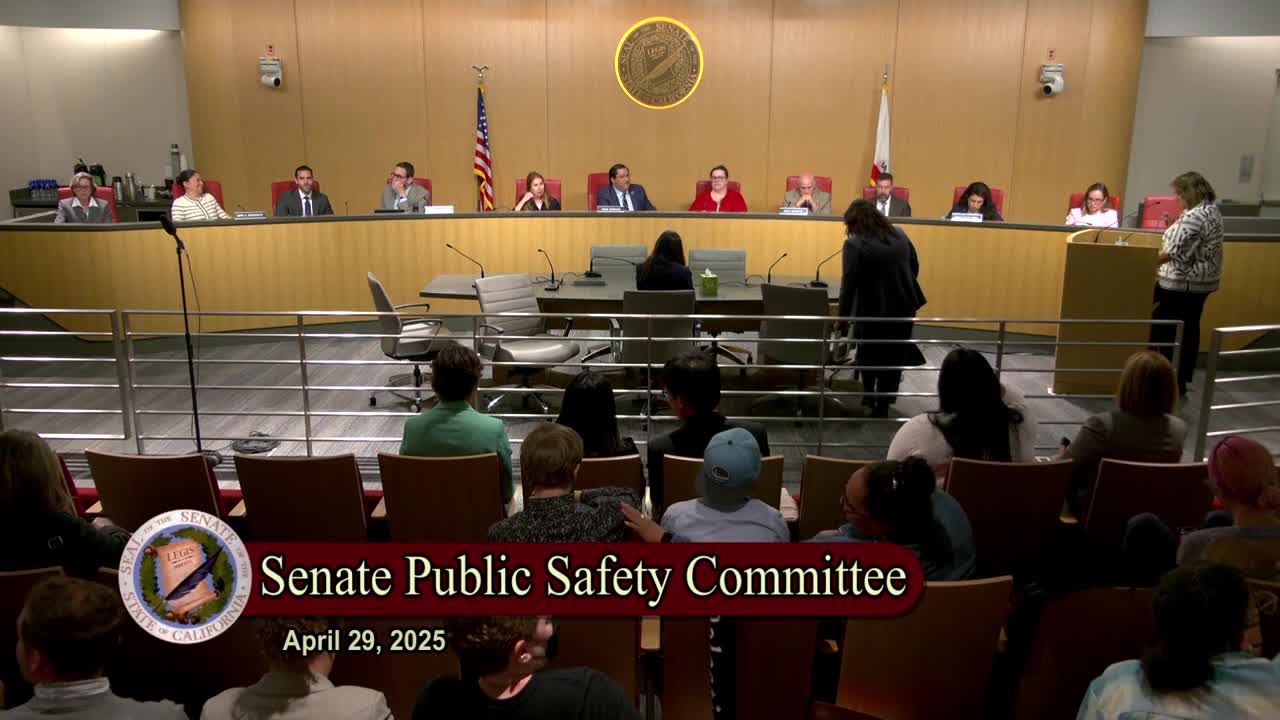 33MIN
Senate Standing Committee on Public Safety
Bill Author
Bill Co-Author(s):
