SB 362: Commercial financing: disclosures.
- Session Year: 2025-2026
- House: Senate
- Latest Version Date: 2025-10-06
Current Status:
Passed
(2025-10-06: Chaptered by Secretary of State. Chapter 352, Statutes of 2025.)
Introduced
In Committee
Awaiting First Chamber Vote
Passed First Chamber
In Committee
Awaiting Second Chamber Vote
Passed Second Chamber
Enacted
Existing law requires a provider of commercial financing to disclose certain information, as specified. Existing law provides that a provider of commercial financing licensed under the California Financing Law (CFL) is subject to examination and enforcement by the Commissioner of Financial Protection and Innovation under the CFL for any violation of those disclosure provisions, as specified. Certain violations of the CFL are a crime.
This bill would prohibit a provider of commercial financing from using the term interest or rate in a deceptive way that could reasonably result in the recipient being misled and would require those providers to use the term annual percentage rate or the acronym APR in specified circumstances. The bill would repeal the provision subjecting those providers to the CFL described above and would instead provide that a violation of the disclosure provisions described above and the provisions of the bill is a violation of the CFL if the violation relates to a commercial financing transaction subject to the CFL, or a violation of the California Consumer Financial Protection Law if the violation relates to a commercial financing transaction that is not subject to the CFL. By expanding the scope of a crime, this bill would impose a state-mandated local program.
The California Constitution requires the state to reimburse local agencies and school districts for certain costs mandated by the state. Statutory provisions establish procedures for making that reimbursement.
This bill would provide that no reimbursement is required by this act for a specified reason.
Existing law requires a provider of commercial financing to disclose certain information, as specified. Existing law provides that a provider of commercial financing licensed under the California Financing Law (CFL) is subject to examination and enforcement by the Commissioner of Financial Protection and Innovation under the CFL for any violation of those disclosure provisions, as specified. Certain violations of the CFL are a crime.
This bill would prohibit a provider of commercial financing from using the term interest or rate in a deceptive manner, as specified, way that could reasonably result in the recipient being misled and would require those providers to use the term annual percentage rate or the acronym APR in specified circumstances. The bill would repeal the provision subjecting those providers to the CFL described above, above and would instead provide that a violation of the disclosure provisions described above and the provisions of the bill is a violation of the CFL if the violation relates to a commercial financing transaction subject to the CFL, or a violation of the California Consumer Financial Protection Law if the violation relates to a commercial financing transaction that is not subject to the CFL. By expanding the scope of a crime, this bill would impose a state-mandated local program.
The California Constitution requires the state to reimburse local agencies and school districts for certain costs mandated by the state. Statutory provisions establish procedures for making that reimbursement.
This bill would provide that no reimbursement is required by this act for a specified reason.
Existing law requires a provider of commercial financing to disclose certain information, as specified. Existing law provides that a provider of commercial financing licensed under the California Financing Law (CFL) is subject to examination and enforcement by the Commissioner of Financial Protection and Innovation under the CFL for any violation of those disclosure provisions, as specified. Certain violations of the CFL are a crime.
This bill would prohibit a provider of commercial financing from using the term interest or rate, except rate in a deceptive manner, as specified, and would require those providers to use the term annual percentage rate or the acronym APR in specified circumstances. The bill would repeal the provision subjecting those providers to the CFL described above, and would instead provide that a violation of the disclosure provisions described above and the provisions of the bill is a violation of the CFL if the violation relates to a commercial financing transaction subject to the CFL, or a violation of the California Consumer Financial Protection Law if the violation relates to a commercial financing transaction that is not subject to the CFL. By expanding the scope of a crime, this bill would impose a state-mandated local program.
The California Constitution requires the state to reimburse local agencies and school districts for certain costs mandated by the state. Statutory provisions establish procedures for making that reimbursement.
This bill would provide that no reimbursement is required by this act for a specified reason.
Existing law requires a provider of commercial financing to disclose certain information, as specified. Existing law provides that a provider of commercial financing licensed under the California Financing Law (CFL) is subject to examination and enforcement by the Commissioner of Financial Protection and Innovation under the CFL for any violation of those disclosure provisions, as specified. Certain violations of the CFL are a crime.
This bill would prohibit a provider of commercial financing from using a specified underwriting method unless the provider participates in a specified review process. The bill would also prohibit those providers from using the term interest or rate, except as specified, and would require those providers to use the term annual percentage rate or the acronym APR in specified circumstances. The bill would repeal the provision subjecting those providers to the CFL described above, and would instead provide that a violation of the disclosure provisions described above and the provisions of the bill is a violation of the CFL if the violation relates to a commercial financing transaction subject to the CFL, or a violation of the California Consumer Financial Protection Law if the violation relates to a commercial financing transaction that is not subject to the CFL. By expanding the scope of a crime, this bill would impose a state-mandated local program.
The California Constitution requires the state to reimburse local agencies and school districts for certain costs mandated by the state. Statutory provisions establish procedures for making that reimbursement.
This bill would provide that no reimbursement is required by this act for a specified reason.
The California Consumer Financial Protection Law (CCFPL) requires the Department of Financial Protection and Innovation to regulate the offering and provision of consumer financial products or services under California consumer financial laws, as defined, and exercise nonexclusive oversight and enforcement authority under California consumer financial laws. The CCFPL requires the Commissioner of Financial Protection and Innovation to, at least once annually, before March 15, appear before, and present a report to, the appropriate committees of the Legislature reviewing all of the activities conducted to implement the CCFPL during the prior year and summarizing, with specificity, all of the activities it intends to conduct during the upcoming year, as prescribed.This bill would change the March 15 date described above to June 1.The California Consumer Financial Protection Law (CCFPL) requires the Department of Financial Protection and Innovation to regulate the offering and provision of consumer financial products or services under California consumer financial laws, as defined, and exercise nonexclusive oversight and enforcement authority under California consumer financial laws. The CCFPL requires the Commissioner of Financial Protection and Innovation to, at least once annually, before March 15, appear before, and present a report to, the appropriate committees of the Legislature reviewing all of the activities conducted to implement the CCFPL during the prior year and summarizing, with specificity, all of the activities it intends to conduct during the upcoming year, as prescribed.
This bill would change the March 15 date described above to June 1.
The Legislature finds and declares all of the following:
(a)Markets serve an important social function in allocating finite resources across the economy. Efficient resource allocation relies on market participants acting on information that accurately reflects the costs and benefits of their decisions.
(b)Some markets for commercial financing products offered to small businesses allocate capital inefficiently due to a lack of transparency related to the costs of financing.
(c)In 2018, California enacted a first-in-the-nation requirement for commercial financing providers to disclose the annualized cost of financing to applicants, which is implemented as a requirement to disclose the annualized percentage rate (APR) of specific financing offers.
(d)The one-time disclosure of APR can help small businesses evaluate offers and shop around for the best deal, but deceptive, unscrupulous, or confusing marketing tactics can interfere with the small business owners understanding of the costs of an offer.
(e)Examples of confusing representations related to the cost of financing include all of the following:
(1)Describing the price of credit as simple interest when referring to a nonannual rate as opposed to a noncompounding annual rate that a reasonable person would understand simple interest to mean.
(2)Describing the price of credit as an interest rate when describing a daily, weekly, or monthly rate and not an annual rate.
(3)Describing the price of credit as X% fee rate or Y% factor rate, particularly when those rates diverge materially from the APR.
(f)In order to strengthen the effect of existing law, this act seeks to provide further clarity to market participants and to the Department of Financial Protection and Innovation (DFPI) related to deceptive marketing and the authority of DFPI to enforce the law.
SEC. 2.Section 22805 of the Financial Code is repealed.SEC. 3.Section 22806 of the Financial Code is amended and renumbered to read:22805.No provision of this division imposes any liability on a provider as a result of the actual Annual Percentage Rate (APR) charged by a provider differing from the Estimated APR disclosed in conformity with any regulation, order, or written interpretive opinion of the commissioner or any such opinion of the Attorney General, whether or not such regulation, order, or written interpretive opinion is later amended, rescinded, or repealed or determined by judicial or other authority to be invalid for any reason.
SEC. 4.Section 22806 is added to the Financial Code, to read:22806.(a)A provider shall not use the term interest or rate in a deceptive way that could reasonably result in the recipient being misled.
(b)After extending a specific offer to a potential recipient, whenever a provider states a charge, pricing metric, or financing amount to the potential recipient for that specific offer during an application process for commercial financing, the provider shall also state the annual percentage rate of that commercial financing offer by using the term annual percentage rate or the acronym APR.
(c)Use of the term interest or rate is not deceptive or likely to mislead for purposes of this division if the metric of financing cost is an annual interest rate or annual percentage rate that is either fixed or floating for the period of the financing and that is expressed as a margin over an index rate.
SEC. 5.Section 22807 is added to the Financial Code, to read:22807.(a)A violation of this division by a person licensed under the California Financing Law (Division 9 (commencing with Section 22000)) shall be deemed a violation of the California Financing Law if the violation relates to a commercial financing transaction that is subject to the California Financing Law.
(b)A violation of this provision shall be deemed an unfair, deceptive, or abusive act or practice under the California Consumer Financial Protection Law (Division 24 (commencing with Section 90000)) if the violation relates to a commercial financing transaction that is not subject to the California Financing Law (Division 9 (commencing with Section 22000)).
SEC. 6.No reimbursement is required by this act pursuant to Section 6 of Article XIIIB of the California Constitution because the only costs that may be incurred by a local agency or school district will be incurred because this act creates a new crime or infraction, eliminates a crime or infraction, or changes the penalty for a crime or infraction, within the meaning of Section 17556 of the Government Code, or changes the definition of a crime within the meaning of Section 6 of Article XIIIB of the California Constitution.
The Legislature finds and declares all of the following:
(a)Markets serve an important social function in allocating finite resources across the economy. Efficient resource allocation relies on market participants acting on information that accurately reflects the costs and benefits of their decisions.
(b)Some markets for commercial financing products offered to small businesses allocate capital inefficiently due to a lack of transparency related to the costs of financing.
(c)In 2018, California enacted a first-in-the-nation requirement for commercial financing providers to disclose the annualized cost of financing to applicants, which is implemented as a requirement to disclose the annualized percentage rate (APR) of specific financing offers.
(d)The one-time disclosure of APR can help small businesses evaluate offers and shop around for the best deal, but deceptive, unscrupulous, or confusing marketing tactics can interfere with the small business owners understanding of the costs of an offer.
(e)Examples of confusing representations related to the cost of financing include all of the following:
(1)Describing the price of credit as simple interest when referring to a nonannual rate as opposed to a noncompounding annual rate that a reasonable person would understand simple interest to mean.
(2)Describing the price of credit as an interest rate when describing a daily, weekly, or monthly rate and not an annual rate.
(3)Describing the price of credit as X% fee rate or Y% factor rate, particularly when those rates diverge materially from the APR.
(f)In order to strengthen the effect of existing law, this act seeks to provide further clarity to market participants and to the Department of Financial Protection and Innovation (DFPI) related to deceptive marketing and the authority of DFPI to enforce the law.
SECTION 1.SEC. 2.Section 22805 of the Financial Code is repealed.SEC. 2.SEC. 3.Section 22806 of the Financial Code is amended and renumbered to read:22805.No provision of this division imposes any liability on a provider as a result of the actual Annual Percentage Rate (APR) charged by a provider differing from the Estimated APR disclosed in conformity with any regulation, order, or written interpretive opinion of the commissioner or any such opinion of the Attorney General, whether or not such regulation, order, or written interpretive opinion is later amended, rescinded, or repealed or determined by judicial or other authority to be invalid for any reason.
SEC. 3.SEC. 4.Section 22806 is added to the Financial Code, to read:22806.(a)A provider shall not use the term interest to refer to a percentage rate or rate in a deceptive manner, including, but not limited to, using the term simple interest in any of the following ways: way that could reasonably result in the recipient being misled.
(1)In a way that misleads the recipient.(2)In a way that is likely to materially mislead the recipient.(3)In a way that violates the Unfair Competition Law (Chapter 5 (commencing with Section 17200) of Part 2 of Division 7 of the Business and Professions Code).(b)A provider shall not use the term rate in a deceptive manner, including, but not limited to, any of the following ways:(1)In a way that misleads the recipient.(2)In a way that is likely to materially mislead the recipient.(3)In a way that violates the Unfair Competition Law (Chapter 5 (commencing with Section 17200) of Part 2 of Division 7 of the Business and Professions Code).(4)To describe a metric of financing cost other than an annual interest rate or an annual percentage rate calculated pursuant to Section 940 of Title 10 of the California Code of Regulations.(c)(b)After extending a specific offer to a potential recipient, whenever a provider states a charge, pricing metric, or financing amount to the potential recipient for that specific offer in connection with any communication during an application process for commercial financing, the provider shall also state the annual percentage rate of that commercial financing offer by using the term annual percentage rate or the acronym APR.
(d)Notwithstanding subdivisions (a) to (c), inclusive, use(c)Use of the term interest or rate is not deceptive or likely to mislead for purposes of this division if the metric of financing cost is an annual interest rate or annual percentage rate that is either fixed or floating for the period of the financing and that is expressed as a margin over an index rate.
SEC. 4.SEC. 5.Section 22807 is added to the Financial Code, to read:22807.(a)A violation of this division by a person licensed under the California Financing Law (Division 9 (commencing with Section 22000)) shall be deemed a violation of the California Financing Law if the violation relates to a commercial financing transaction that is subject to the California Financing Law.
(b)A violation of this provision shall be deemed an unfair, deceptive, or abusive act or practice under the California Consumer Financial Protection Law (Division 24 (commencing with Section 90000)) if the violation relates to a commercial financing transaction that is not subject to the California Financing Law (Division 9 (commencing with Section 22000)).
SEC. 5.SEC. 6.No reimbursement is required by this act pursuant to Section 6 of Article XIIIB of the California Constitution because the only costs that may be incurred by a local agency or school district will be incurred because this act creates a new crime or infraction, eliminates a crime or infraction, or changes the penalty for a crime or infraction, within the meaning of Section 17556 of the Government Code, or changes the definition of a crime within the meaning of Section 6 of Article XIIIB of the California Constitution.
No provision of this division imposes any liability on a provider as a result of the actual Annual Percentage Rate (APR) charged by a provider differing from the Estimated APR disclosed in conformity with any regulation, order, or written interpretive opinion of the commissioner or any such opinion of the Attorney General, whether or not such regulation, order, or written interpretive opinion is later amended, rescinded, or repealed or determined by judicial or other authority to be invalid for any reason.
SEC. 3.Section 22806 is added to the Financial Code, to read:22806.(a)A provider shall not use the term interest to describe refer to a percentage rate unless that rate is an annual percentage rate calculated pursuant to Section 940 of Title 10 of the California Code of Regulations. in a deceptive manner, including, but not limited to, using the term simple interest in any of the following ways:
(1)In a way that misleads the recipient.
(2)In a way that is likely to materially mislead the recipient.
(3)In a way that violates the Unfair Competition Law (Chapter 5 (commencing with Section 17200) of Part 2 of Division 7 of the Business and Professions Code).
(b)A provider shall not use the term rate to describe in a deceptive manner, including, but not limited to, any of the following ways:
(1)In a way that misleads the recipient.
(2)In a way that is likely to materially mislead the recipient.
(3)In a way that violates the Unfair Competition Law (Chapter 5 (commencing with Section 17200) of Part 2 of Division 7 of the Business and Professions Code).
(4)To describe a metric of financing cost presented or disclosed during an application process for a commercial financing transaction unless that rate is other than an annual interest rate or an annual percentage rate calculated pursuant to Section 940 of Title 10 of the California Code of Regulations.
(c)After extending a specific offer to a potential recipient, whenever a provider states a charge, pricing metric, or financing amount to the potential recipient for that specific offer in connection with any communication during an application process for commercial financing, the provider shall also state the annual percentage rate of that commercial financing offer by using the term annual percentage rate or the acronym APR.
(d)Notwithstanding subdivisions (a) to (c), inclusive, use of the term interest or rate is not deceptive or likely to mislead for purposes of this division if the metric of financing cost is an annual interest rate or annual percentage rate that is either fixed or floating for the period of the financing and that is expressed as a margin over an index rate.
SEC. 4.Section 22807 is added to the Financial Code, to read:22807.(a)A violation of this division by a person licensed under the California Financing Law (Division 9 (commencing with Section 22000)) shall be deemed a violation of the California Financing Law if the violation relates to a commercial financing transaction that is subject to the California Financing Law.
(b)A violation of this provision shall be deemed an unfair, deceptive, or abusive act or practice under the California Consumer Financial Protection Law (Division 24 (commencing with Section 90000)) if the violation relates to a commercial financing transaction that is not subject to the California Financing Law (Division 9 (commencing with Section 22000)).
SEC. 5.No reimbursement is required by this act pursuant to Section 6 of Article XIIIB of the California Constitution because the only costs that may be incurred by a local agency or school district will be incurred because this act creates a new crime or infraction, eliminates a crime or infraction, or changes the penalty for a crime or infraction, within the meaning of Section 17556 of the Government Code, or changes the definition of a crime within the meaning of Section 6 of Article XIIIB of the California Constitution.
No provision of this division imposes any liability on a provider as a result of the actual Annual Percentage Rate (APR) charged by a provider differing from the Estimated APR disclosed in conformity with any regulation, order, or written interpretive opinion of the commissioner or any such opinion of the Attorney General, whether or not such regulation, order, or written interpretive opinion is later amended, rescinded, or repealed or determined by judicial or other authority to be invalid for any reason.
SEC. 3.Section 22806 is added to the Financial Code, to read:22806.(a)A provider shall not use the underwriting method described in Section 931 of Title 10 of the California Code of Regulations unless the provider participates in a review process pursuant to subdivision (b).(b)(1)A provider that uses the underwriting method described in Section 931 of Title 10 of the California Code of Regulations shall, on an annual basis, report data to the commissioner regarding estimated annual percentage rates disclosed to recipients and actual retrospective annual percentage rates of completed transactions.(2)The report required by paragraph (1) shall contain information as the commissioner, by rule, prescribes as necessary or appropriate for the purpose of making a determination of whether the deviation between estimated annual percentage rates and actual retrospective annual percentage rates of completed transactions was reasonable.(c)(1)The commissioner shall establish the method of reporting required by subdivision (b) and may, upon finding that the use of projected sales volume by the provider has resulted in an unacceptable deviation between the estimated and actual annual percentage rate, require the provider to use the historical method pursuant to Section 930 of Title 10 of the California Code of Regulations.(2)The commissioner may consider unusual and extraordinary circumstances impacting the providers deviation between the estimated and actual annual percentage rate in determining whether the use of projected sales volume by the provider has resulted in an unacceptable deviation between the estimated and actual annual percentage rate.SEC. 4.Section 22807 is added to the Financial Code, to read:22807.SEC. 3.Section 22806 is added to the Financial Code, to read:22806.(a)A provider shall not use the term interest to describe a percentage rate unless that rate is an annual percentage rate calculated pursuant to Section 940 of Title 10 of the California Code of Regulations.
(b)A provider shall not use the term rate to describe a metric of financing cost presented or disclosed during an application process for a commercial financing transaction unless that rate is an annual percentage rate calculated pursuant to Section 940 of Title 10 of the California Code of Regulations.
(c)After extending a specific offer to a potential recipient, whenever a provider states a charge, pricing metric, or financing amount to the potential recipient during an application process for commercial financing, the provider shall also state the annual percentage rate of that commercial financing offer by using the term annual percentage rate or the acronym APR.
SEC. 5.Section 22808 is added to the Financial Code, to read:22808.SEC. 4.Section 22807 is added to the Financial Code, to read:22807.(a)A violation of this division by a person licensed under the California Financing Law (Division 9 (commencing with Section 22000)) shall be deemed a violation of the California Financing Law if the violation relates to a commercial financing transaction that is subject to the California Financing Law.
(b)A violation of this provision shall be deemed an unfair, deceptive, or abusive act or practice under the California Consumer Financial Protection Law (Division 24 (commencing with Section 90000)) if the violation relates to a commercial financing transaction that is not subject to the California Financing Law (Division 9 (commencing with Section 22000)).
SEC. 6.SEC. 5.No reimbursement is required by this act pursuant to Section 6 of Article XIIIB of the California Constitution because the only costs that may be incurred by a local agency or school district will be incurred because this act creates a new crime or infraction, eliminates a crime or infraction, or changes the penalty for a crime or infraction, within the meaning of Section 17556 of the Government Code, or changes the definition of a crime within the meaning of Section 6 of Article XIIIB of the California Constitution.
No provision of this division imposes any liability on a provider as a result of the actual Annual Percentage Rate (APR) charged by a provider differing from the Estimated APR disclosed in conformity with any regulation, order, or written interpretive opinion of the commissioner or any such opinion of the Attorney General, whether or not such regulation, order, or written interpretive opinion is later amended, rescinded, or repealed or determined by judicial or other authority to be invalid for any reason.
SEC. 3.Section 22806 is added to the Financial Code, to read:22806.(a)A provider shall not use the underwriting method described in Section 931 of Title 10 of the California Code of Regulations unless the provider participates in a review process pursuant to subdivision (b).
(b)(1)A provider that uses the underwriting method described in Section 931 of Title 10 of the California Code of Regulations shall, on an annual basis, report data to the commissioner regarding estimated annual percentage rates disclosed to recipients and actual retrospective annual percentage rates of completed transactions.
(2)The report required by paragraph (1) shall contain information as the commissioner, by rule, prescribes as necessary or appropriate for the purpose of making a determination of whether the deviation between estimated annual percentage rates and actual retrospective annual percentage rates of completed transactions was reasonable.
(c)(1)The commissioner shall establish the method of reporting required by subdivision (b) and may, upon finding that the use of projected sales volume by the provider has resulted in an unacceptable deviation between the estimated and actual annual percentage rate, require the provider to use the historical method pursuant to Section 930 of Title 10 of the California Code of Regulations.
(2)The commissioner may consider unusual and extraordinary circumstances impacting the providers deviation between the estimated and actual annual percentage rate in determining whether the use of projected sales volume by the provider has resulted in an unacceptable deviation between the estimated and actual annual percentage rate.
SEC. 4.Section 22807 is added to the Financial Code, to read:22807.(a)A provider shall not use the term interest to describe a percentage rate unless that rate is an annual percentage rate calculated pursuant to Section 940 of Title 10 of the California Code of Regulations.
(b)A provider shall not use the term rate to describe a metric of financing cost presented or disclosed during an application process for a commercial financing transaction unless that rate is an annual percentage rate calculated pursuant to Section 940 of Title 10 of the California Code of Regulations.
(c)After extending a specific offer to a potential recipient, whenever a provider states a charge, pricing metric, or financing amount to the potential recipient during an application process for commercial financing, the provider shall also state the annual percentage rate of that commercial financing offer by using the term annual percentage rate or the acronym APR.
SEC. 5.Section 22808 is added to the Financial Code, to read:22808.(a)A violation of this division by a person licensed under the California Financing Law (Division 9 (commencing with Section 22000)) shall be deemed a violation of the California Financing Law if the violation relates to a commercial financing transaction that is subject to the California Financing Law.
(b)A violation of this provision shall be deemed an unfair, deceptive, or abusive act or practice under the California Consumer Financial Protection Law (Division 24 (commencing with Section 90000)) if the violation relates to a commercial financing transaction that is not subject to the California Financing Law (Division 9 (commencing with Section 22000)).
SEC. 6.No reimbursement is required by this act pursuant to Section 6 of Article XIIIB of the California Constitution because the only costs that may be incurred by a local agency or school district will be incurred because this act creates a new crime or infraction, eliminates a crime or infraction, or changes the penalty for a crime or infraction, within the meaning of Section 17556 of the Government Code, or changes the definition of a crime within the meaning of Section 6 of Article XIIIB of the California Constitution.
SECTION 1.Section 90009.5 of the Financial Code is amended to read:90009.5.(a)Notwithstanding paragraph (1) of subdivision (a) of Section 90009, the department shall promulgate rules regarding registration requirements applicable to a covered person no later than three years following the initiation of its second action to enforce a violation of this division by persons providing the same or substantially similar consumer financial product or service as the covered person.(b)The regulation requiring a covered person to register with the department shall become inoperative on January 1, of the calendar year that is four years following the initial year of required registration unless the Legislature takes action to extend the registration or to incorporate the scope of the activity in which the covered person is authorized to engage into a new or existing licensing law. The Legislature shall conduct public hearings to obtain input on the desirability or feasibility of extending, revising, or terminating the regulation. Failure of the Legislature to take action pursuant to this section shall not impact the departments enforcement authority under this division.(c)The department shall submit to the appropriate committees of the Legislature on or before December 1 before the year a regulation described in subdivision (b) is set to become inoperative, a complete report of the departments activities related to the covered persons required to be registered by the regulation covering the entire period since the initial year of required registration.(d)At least once annually, before June 1, the commissioner shall appear before, and present a report to, the appropriate committees of the Legislature reviewing all of the activities conducted to implement this division during the prior year and summarizing, with specificity, all of the activities it intends to conduct during the upcoming year. This report shall include, but not be limited to, all of the following:(1)A summary of all enforcement actions taken to implement this division during the prior year.(2)A review of business models in use among covered persons that it studied during the prior year and a description of which business models in use among covered persons it plans to study during the upcoming year.(3)A review of all regulations it proposed, or finalized, or on which it sought public feedback during the prior year and a description of all regulations it intends to propose, finalize, or on which it intends to seek public feedback during the upcoming year.(4)A review of all of the activities in which it engaged during the prior year using authority contained in paragraph (1) of subdivision (d) of Section 90006 and a description of the activities in which it plans to engage during the upcoming year.(5)A review of all outreach efforts it conducted during the prior year using authority contained in paragraph (2) of subdivision (d) of Section 90006 and a description of subject matter it plans to include and groups to which it plans to outreach during the upcoming year.(6)A review of all activities it conducted during the prior year using authority contained in paragraph (3) of subdivision (d) of Section 90006 and a description of what activities it plans to conduct during the upcoming year.(7)Any other topic deemed relevant by the commissioner or requested to be covered by a chair of the appropriate committee of the Legislature.(a)Notwithstanding paragraph (1) of subdivision (a) of Section 90009, the department shall promulgate rules regarding registration requirements applicable to a covered person no later than three years following the initiation of its second action to enforce a violation of this division by persons providing the same or substantially similar consumer financial product or service as the covered person.
(b)The regulation requiring a covered person to register with the department shall become inoperative on January 1, of the calendar year that is four years following the initial year of required registration unless the Legislature takes action to extend the registration or to incorporate the scope of the activity in which the covered person is authorized to engage into a new or existing licensing law. The Legislature shall conduct public hearings to obtain input on the desirability or feasibility of extending, revising, or terminating the regulation. Failure of the Legislature to take action pursuant to this section shall not impact the departments enforcement authority under this division.
(c)The department shall submit to the appropriate committees of the Legislature on or before December 1 before the year a regulation described in subdivision (b) is set to become inoperative, a complete report of the departments activities related to the covered persons required to be registered by the regulation covering the entire period since the initial year of required registration.
(d)At least once annually, prior to March 15, before June 1, the commissioner shall appear before before, and present a report to to, the appropriate committees of the Legislature reviewing all of the activities conducted to implement this division during the prior year and summarizing, with specificity, all of the activities it intends to conduct during the upcoming year. This report shall include, but not be limited to, all of the following:
(1)A summary of all enforcement actions taken to implement this division during the prior year.
(2)A review of business models in use among covered persons that it studied during the prior year and a description of which business models in use among covered persons it plans to study during the upcoming year.
(3)A review of all regulations it proposed, or finalized, or on which it sought public feedback during the prior year and a description of all regulations it intends to propose, finalize, or on which it intends to seek public feedback during the upcoming year.
(4)A review of all of the activities in which it engaged during the prior year using authority contained in paragraph (1) of subdivision (d) of Section 90006 and a description of the activities in which it plans to engage during the upcoming year.
(5)A review of all outreach efforts it conducted during the prior year using authority contained in paragraph (2) of subdivision (d) of Section 90006 and a description of subject matter it plans to include and groups to which it plans to outreach during the upcoming year.
(6)A review of all activities it conducted during the prior year using authority contained in paragraph (3) of subdivision (d) of Section 90006 and a description of what activities it plans to conduct during the upcoming year.
(7)Any other topic deemed relevant by the commissioner or requested to be covered by a chair of the appropriate committee of the Legislature.
|
Date
|
Status
|
|---|---|
| Oct 6, 2025 | Chaptered by Secretary of State. Chapter 352, Statutes of 2025. |
| Oct 6, 2025 | Approved by the Governor. |
| Sep 16, 2025 | Enrolled and presented to the Governor at 3 p.m. |
| Sep 8, 2025 | Assembly amendments concurred in. (Ayes 39. Noes 0. Page 2605.) Ordered to engrossing and enrolling. |
| Sep 3, 2025 | In Senate. Concurrence in Assembly amendments pending. |
| Sep 3, 2025 | Read third time. Passed. (Ayes 79. Noes 0. Page 2866.) Ordered to the Senate. |
| Aug 28, 2025 | Ordered to third reading. |
| Aug 28, 2025 | Read third time and amended. |
| Aug 21, 2025 | Read second time. Ordered to third reading. |
| Aug 20, 2025 | From committee: Do pass. (Ayes 15. Noes 0.) (August 20). |
| Jul 16, 2025 | From committee: Do pass and re-refer to Com. on APPR. (Ayes 12. Noes 0.) (July 15). Re-referred to Com. on APPR. |
| Jul 10, 2025 | From committee with author's amendments. Read second time and amended. Re-referred to Com. on JUD. |
| Jul 8, 2025 | From committee: Do pass and re-refer to Com. on JUD. (Ayes 9. Noes 0.) (July 7). Re-referred to Com. on JUD. |
| Jun 17, 2025 | June 23 hearing postponed by committee. |
| Jun 9, 2025 | Referred to Coms. on B. & F. and JUD. |
| Jun 3, 2025 | In Assembly. Read first time. Held at Desk. |
| Jun 2, 2025 | Read third time. Passed. (Ayes 38. Noes 0. Page 1400.) Ordered to the Assembly. |
| May 27, 2025 | Read second time. Ordered to third reading. |
| May 23, 2025 | Read second time and amended. Ordered to second reading. |
| May 23, 2025 | From committee: Do pass as amended. (Ayes 6. Noes 0. Page 1198.) (May 23). |
| May 16, 2025 | Set for hearing May 23. |
| May 5, 2025 | May 5 hearing: Placed on APPR. suspense file. |
| Apr 25, 2025 | Set for hearing May 5. |
| Apr 23, 2025 | From committee: Do pass and re-refer to Com. on APPR. (Ayes 13. Noes 0. Page 834.) (April 22). Re-referred to Com. on APPR. |
| Apr 10, 2025 | Set for hearing April 22. |
| Apr 9, 2025 | Re-referred to Com. on JUD. |
| Apr 3, 2025 | From committee: Do pass and re-refer to Com. on RLS. (Ayes 7. Noes 0. Page 632.) (April 2). Re-referred to Com. on RLS. |
| Mar 18, 2025 | Set for hearing April 2. |
| Mar 17, 2025 | From committee with author's amendments. Read second time and amended. Re-referred to Com. on B. & F.I. |
| Feb 26, 2025 | Referred to Com. on B. & F.I. |
| Feb 14, 2025 | From printer. May be acted upon on or after March 16. |
| Feb 13, 2025 | Introduced. Read first time. To Com. on RLS. for assignment. To print. |
|
Date
|
Description
|
Location
|
Votes
|
|
|---|---|---|---|---|
| Sep 8, 2025 | Unfinished Business SB362 Grayson Concurrence | Senate Floor |
Passed |
|
| Sep 3, 2025 | The committee(s) on HWN recommend(s) that the measure be PASSED, WITH AMENDMENTS and be recommitted | Assembly Floor |
Passed |
|
| Aug 20, 2025 | Do pass. | Assembly Standing Committee on Appropriations |
Passed |
|
| Jul 15, 2025 | Do pass and be re-referred to the Committee on [Appropriations] | Assembly Standing Committee on Judiciary |
Passed |
|
| Jul 7, 2025 | Do pass and be re-referred to the Committee on [Judiciary] | Assembly Standing Committee on Banking and Finance |
Passed |
|
| Jun 2, 2025 | Senate 3rd Reading SB362 Grayson | Senate Floor |
Passed |
|
| May 23, 2025 | Do pass as amended | Senate Standing Committee on Appropriations |
Passed |
|
| May 5, 2025 | Placed on suspense file | Senate Standing Committee on Appropriations |
Passed |
|
| Apr 22, 2025 | Do pass, but first be re-referred to the Committee on [Appropriations] | Senate Standing Committee on Judiciary |
Passed |
|
| Apr 2, 2025 | Do pass, but first be re-referred to the Committee on [Rules] | Senate Standing Committee on Banking and Financial Institutions |
Passed |
This list shows positions taken on this bill by organizations on the date displayed, which is linked to the original source.
Positions by individuals are not included.
|
Organization
|
Position
|
Date
|
|---|---|---|
| Accessity | ** Support | |
| AmPac Tri-State CDC | ** Support | |
| Asociacion De Emprendedor@s | ** Support | |
| Californa Southern SBDC | ** Support | |
| California Association for Micro Enterprise Opportunity | ** Support | |
| California Capital Financial Development Corporation | ** Support | |
| California Coalition for Community Investment | ** Support | |
| California Low-Income Consumer Coalition | ** Support | |
| Cameo - California Association for Micro Enterprise Opportunity | ** Support | |
| CAMEO Network | ** Support | |
| Consumer Federation Of California | ** Support | |
| Electronic Transactions Association | ** Against | |
| El Pajaro Community Development Corporation | ** Support | |
| Hias Economic Advancement Fund | ** Support | |
| Housing and Economic Rights Advocates | ** Support | |
| Housing Trust Silicon Valley | ** Support | |
| Ica Fund | ** Support | |
| Innovative Lending Platform Association | ** Against | |
| Jedi | ** Support | |
| Microcare Community Development Solutions | ** Support | |
| MicroEnterprise Collaborative of Inland Southern California | ** Support | |
| Other | ** Against | |
| Pacific Community Ventures | ** Support | |
| Public Counsel | ** Support | |
| Responsible Business Lending Coalition | ** Support | |
| San Joaquin Community Foundation | ** Support | |
| Secured Finance Network | ** Against | |
| Small Business Majority | ** Support | |
| The Responsible Business Lending Coalition | ** Support | |
| Toss It Up | ** Support | |
| Uptima Entrepreneur Cooperative | ** Support |
SENATE RULES COMMITTEE Office of Senate Floor Analyses (916) 651-1520 Fax: (916) 327-4478 | SB 362 |
UNFINISHED BUSINESS
Bill No: SB 362
Author: Grayson (D)
Amended: 8/28/25 in Assembly
Vote: 21
SENATE BANKING & F.I. COMMITTEE: 7-0, 4/2/25
AYES: Grayson, Niello, Cervantes, Hurtado, Limón, Richardson, Strickland
SENATE JUDICIARY COMMITTEE: 13-0, 4/22/25
AYES: Umberg, Niello, Allen, Arreguín, Ashby, Caballero, Durazo, Laird, Stern, Valladares, Wahab, Weber Pierson, Wiener
SENATE APPROPRIATIONS COMMITTEE: 6-0, 5/23/25
AYES: Caballero, Seyarto, Cabaldon, Grayson, Richardson, Wahab
NO VOTE RECORDED: Dahle
SENATE FLOOR: 38-0, 6/2/25
AYES: Allen, Alvarado-Gil, Archuleta, Arreguín, Ashby, Becker, Blakespear, Cabaldon, Caballero, Cervantes, Choi, Cortese, Dahle, Durazo, Gonzalez, Grayson, Grove, Jones, Laird, Limón, McGuire, McNerney, Menjivar, Niello, Ochoa Bogh, Padilla, Pérez, Richardson, Rubio, Seyarto, Smallwood-Cuevas, Stern, Strickland, Umberg, Valladares, Wahab, Weber Pierson, Wiener
NO VOTE RECORDED: Hurtado, Reyes
ASSEMBLY FLOOR: 79-0, 9/3/25 - See last page for vote
SUBJECT: Commercial financing: disclosures
SOURCE: CAMEO Network, Responsible Business Lending Coalition, Small Business Majority
DIGEST:
This bill regulates the use of “interest” and “rate” as terms to describe charges related to a commercial financing transaction and clarifies the enforcement authority provided to the Department of Financial Protection and Innovation (DFPI) for violations of commercial financing disclosure requirements.
Assembly Amendments
are clarifying in nature.
ANALYSIS:
Existing Law
- Establishes disclosure requirements related to commercial financing. (Division 9.5 of the Financial Code, commencing with Section 22800)
- Defines “commercial financing” as an accounts receivable purchase transaction, including factoring, asset-based lending transaction, commercial loan, commercial open-end credit plan, or lease financing transaction intended by the recipient for use primarily for other than personal, family, or household purposes. (Financial Code Section 22800 (d))
- Subjects providers licensed under the California Financing Law to examination and enforcement by DFPI for any violation of the disclosure requirements. (Financial Code Section 22805)
- Authorizes, pursuant to the California Consumer Financial Protection Law (CCFPL) and its implementing regulations:
- DFPI to promulgate regulations that define unfair, deceptive, and abusive acts and practices in connection with the offering or provision of commercial financing to small business recipients, nonprofits, and family farms. The rulemaking may also include data collection and reporting on the provision of commercial financing or other financial products and services. (Financial Code Section 90009 (e))
- Provides, pursuant to (a), rules governing commercial financing products and services, including the following:
- Defines “covered entity” to mean a small business, nonprofit, or family farm whose activities are principally directed or managed from California. (Title 10 California Code of Regulations, Section 1060(d))
- Defines “covered provider” to mean any person engaged in the business of offering or providing commercial financing or another financial product or service to a covered entity, unless that person is exempted from the CCFPL pursuant to Financial Code Section 90002. (Title 10 California Code of Regulations, Section 1060(e))
- Defines “small business” to mean a business entity organized for profit with annual gross receipts of no more than $16,000,000 or the annual gross receipt level as biennially adjusted by the Department of General Services in accordance with Government Code section 14837, subdivision (d)(3), whichever is greater. (Title 10 California Code of Regulations, Section 1060 (i)))
- Provides that it is unlawful for a covered provider to engage or have engaged in any unfair, deceptive, or abusive act or practice in connection with the offering or provision of commercial financing or another financial product or service to a covered entity. (Title 10 California Code of Regulations, Section 1061(a))
- Provides that an act or practice is unfair if either:
- The act or practice causes or is likely to cause substantial injury to the covered entity, the injury is not reasonably avoidable by the covered entity, and the injury is not outweighed by countervailing benefits, or
- The act or practice is unfair under the California Unfair Competition Law and related case law. (Title 10 California Code of Regulations, Section 1061(b))
- Provides that an act or practice, including a representation or omission, is deceptive if either:
- The act or practice misleads or is likely to mislead the covered entity, the covered entity’s interpretation of the act or practice is reasonable under the circumstances, and the act or practice is material.
- The act or practice is deceptive under the California Unfair Competition Law and related case law. (Title 10 California Code of Regulations, Section 1061(c))
- Provides that an act or practice is abusive if either:
- The act or practice materially interferes with the ability of a covered entity to understand a term or condition of commercial financing or another financial product or service.
- The act or practice takes unreasonable advantage of:
- A lack of understanding on the part of the covered entity of the material risks, costs, or conditions of the commercial financing or other financial product or service;
- The inability of the covered entity to protect its interests in selecting or using commercial financing or another financial product or service; or
- The reasonable reliance by the covered entity on a covered provider to act in the interests of the covered entity. (Title 10 California Code of Regulations, Section 1061(d))
This bill:
- Prohibits a commercial financing provider from term “interest” or “rate” in a deceptive way that could reasonably result in the recipient being misled.
- Requires a commercial financing provider, after extending a specific offer to a potential recipient and whenever stating a charge, pricing metric, or financing amount to the potential recipient during an application process, to state the “annual percentage rate” by using that term or the acronym “APR.”
- Provides that a violation of the commercial financing disclosure requirements is an unfair, deceptive, or abusive act or practice under the CCFPL if the violation relates to a commercial financing transaction that is not subject to the California Financing Law.
Background
This bill seeks to expand and strengthen California’s first-in-the-nation commercial financing disclosure law. Existing law requires a commercial financing provider to disclose key terms when offering financing to a small business, including the total amount of financing, the dollar cost of financing, the method, frequency, and amount of payments, and the annualized rate. This last factor – the annualized rate – has been the primary source of disagreement between small business advocates and some parts of the commercial financing industry. The legislature has sided overwhelmingly with the small business advocates, most recently supporting a bill in 2023 to remove a sunset, making the annualized rate disclosure apply indefinitely. Every member of the Senate and Assembly voted “aye” on the measure.
Current law requires certain terms of financing to be disclosed by commercial financing providers to potential recipients. But once that information is disclosed a single time, a provider can revert to using opaque or confusing pricing terms as the provider discusses the offer with the prospective recipient. This can result in the potential recipient misunderstanding the terms of the offer and making inaccurate comparisons between different offers from different providers. This bill adopts concepts from the federal Truth in Lending Act that require consistency in using terms like “rate” or “interest” to be used in reference to an annual percentage rate (APR) and requiring that an estimated APR be disclosed whenever a provider is discussing specified financing terms with a potential recipient.[1] The intent of this provision is to reduce confusion and improve a potential recipient’s understanding of the terms of an offer. This provision is included in New York’s disclosure law, which was enacted in 2020.
FISCAL EFFECT: Appropriation: No Fiscal Com.: Yes Local: Yes
According to the Assembly Appropriations Committee,
- Absorbable ongoing costs to the Department of Financial Protection and Innovation (DFPI) to answer legal inquiries from commercial financing providers regarding the usage of specified terms and for related enforcement workload (Financial Protection Fund).
- Possible costs to the Department of Justice (DOJ) of an unknown, but likely minor amount, as a violation of the prohibition is an unlawful business practice enforceable by DOJ under the UCL (Unfair Competition Law Fund). DOJ reports no fiscal impact from this bill, indicating DOJ does not anticipate pursuing related enforcement actions, as this bill enhances DFPI’s ability to pursue enforcement.
- Cost pressures (General Fund (GF) or Trial Court Trust Fund) of an unknown, but likely minor amount, to the courts in additional workload by creating a new prohibition enforceable under the UCL. A claim under the UCL may be brought by either a public prosecutor or a person who lost money or property as the result of the unlawful conduct. It is unlikely many actions will be filed statewide, as this bill enhances DFPI’s ability to pursue administrative enforcement outside the court system.
SUPPORT: (Verified 9/3/25)
Accessity
Ampac Tri-state CDC
Asociacion De Emprendedor@s
Californa Southern SBDC
California Capital Financial Development Corporation
California Coalition for Community Investment
California Low-income Consumer Coalition
Cameo - California Association for Micro Enterprise Opportunity
Cameo Network
Consumer Federation of California
El Pajaro Community Development Corporation
Hias Economic Advancement Fund
Housing and Economic Rights Advocates
Housing Trust Silicon Valley
Ica Fund
Jedi
Microcare Community Development Solutions
Microenterprise Collaborative of Inland Southern California
Pacific Community Ventures
Public Counsel
Responsible Business Lending Coalition
San Joaquin Community Foundation
Small Business Majority
The Responsible Business Lending Coalition
Toss It Up
Uptima Entrepreneur Cooperative
OPPOSITION: (Verified 9/3/25)
None received
ARGUMENTS IN SUPPORT: CAMEO Network, Responsible Business Lending Coalition, and Small Business Majority, as co-sponsors, write in support:
SB 362 addresses current gaps in California’s small business financing disclosure framework. The bill provides a reporting mechanism that allows DFPI to evaluate the actual vs. estimated APRs disclosed by a provider, to prevent rigging of estimates. The bill requires that providers disclose the estimated APR throughout the offering process, wherever details of the financing offer are mentioned. The bill also makes clear DFPI’s enforcement authority related to licensed activity and financing activities that are permitted to take place outside of the licensing framework. These solutions will create a more coherent disclosure framework and result in small businesses receiving better information as they shop around for the best financing offers for their business.
ASSEMBLY FLOOR: 79-0, 9/3/25
AYES: Addis, Aguiar-Curry, Ahrens, Alanis, Alvarez, Arambula, Ávila Farías, Bains, Bauer-Kahan, Bennett, Berman, Boerner, Bonta, Bryan, Calderon, Caloza, Carrillo, Castillo, Chen, Connolly, Davies, DeMaio, Dixon, Elhawary, Ellis, Flora, Fong, Gabriel, Gallagher, Garcia, Gipson, Jeff Gonzalez, Mark González, Hadwick, Haney, Harabedian, Hart, Hoover, Irwin, Jackson, Kalra, Krell, Lackey, Lee, Lowenthal, Macedo, McKinnor, Muratsuchi, Nguyen, Ortega, Pacheco, Papan, Patel, Patterson, Pellerin, Petrie-Norris, Quirk-Silva, Ramos, Ransom, Celeste Rodriguez, Michelle Rodriguez, Rogers, Blanca Rubio, Sanchez, Schiavo, Schultz, Sharp-Collins, Solache, Soria, Stefani, Ta, Tangipa, Valencia, Wallis, Ward, Wicks, Wilson, Zbur, Rivas
Prepared by: Michael Burdick / B. & F.I. /
9/3/25 18:38:10
**** END ****
SENATE THIRD READING
STR Bill Id:SB 362
Author:(Grayson)
As Amended Ver:August 28, 2025
Majority vote
SUMMARY
This bill prohibits a commercial financing provider from using certain terms in a deceptive manner and clarifies the enforcement authority provided to the Department of Financial Protection and Innovation (DFPI) for violations of the requirements.
Major Provisions
- Adds legislative findings describing the specific issue of confusion in commercial financing.
- Prohibits the use of the term ″interest″ and ″rate″ in a deceptive way that could reasonably misled a recipient.
- Requires statement of the annual percent rate (APR) anytime a provider states a charge, pricing metric, or financing amount to the potential recipient after a extending a specific offer.
- Clarifies that it is not misleading or deceptive to use the terms ″interests″ or ″rate″ if the metric of financing cost is an annual interest rate or annual percentage rate that is either fixed or floating for the period of the financing and that is expressed as a margin over an index rate.
- Provides that a violation of these provisions is either enforceable under the California Financing Law (CFL) if the violation relates to a commercial financing transaction subject to the CFL, or enforceable under the California Consumer Financial Protection Law (CCFPL) if the violation relates to a commercial financing transaction not subject to the CFL.
COMMENTS
In 2018, SB 1235 (Glazer, Chapter 1011, Statutes of 2018) established a first-in-the-nation disclosure framework that applies to a variety of financing products offered to small business borrowers. Modeled after the disclosures required by the federal Truth in Lending Act, SB 1235 requires financing providers to disclose all interest, fees, and other finance charges associated with loans and other forms of financing extended to small businesses. The law also requires that finance charges be disclosed as an annualized rate with the goal of allowing customers to be able to compare offers with comparable metrics to be able to shop for the best deal.
While generally successful, some remaining hanging threads are being addressed in this bill to achieve the transparency originally sought for small businesses to have more informed market choice, especially as non-traditional lending starts to take up more market share. Some providers still use inconsistent terminology throughout the lending application process, including misleading or deceptive terms such as ″simple interest″ or ″factor rate.″
This bill prohibits a provider from using certain financial terms in a deceptive manner and requires a provider to state the APR of an offer during subsequent pricing communications with a borrower.
Because state oversight of the financial industry generally relies on licensing programs built around strict definitions of products or services, new or emerging financial products may not fit into one of DFPI′s many existing programs. For example, the CFL requires licensure of companies offering consumer or commercial loans, but does not generally apply to commercial financing providers offering non-loan products, such as sales-based financing or factoring, many of which are utilized by small businesses unable to obtain traditional loans. AB 1864 (Limon), Chapter 157, Statutes of 2020, established the CCFPL to fill these consumer gaps and empower DFPI to oversee unlicensed providers of consumer financial products or services.
As this bill prohibits a specific form of unlawful, unfair, or fraudulent business acts or misleading advertising, a violation of this bill′s provisions is generally enforceable through the UCL, under which a public prosecutor or certain private plaintiffs may bring a case. This bill empowers DFPI to also take enforcement action against an unlicensed provider by clarifying DFPI may enforce violations under the CFL (for providers licensed under the CFL) or CCFPL (for unlicensed providers).
According to the Author
″Running a small business is hard enough without needing to wade through the dizzying array of credit options that can either lift a business up or weigh it down into failure. I am proud that California led the way in 2018, setting us on the path to providing more complete and helpful pricing disclosures for commercial financing. These requirements equip small businesses with the information they need to compare financing offers and make a decision that best fits their needs. SB 362 will strengthen our price disclosure law by improving the accountability of financing providers and ensuring that small businesses receive clear disclosures throughout the marketing process.″
Arguments in Support
California Low-Income Consumer Coalition writes:
SB 362 addresses these current gaps in California′s small business financing disclosure framework. The bill requires that providers disclose the estimated APR throughout the offering process, whenever details of the financing offer are mentioned. The bill also makes clear DFPI′s enforcement authority related to activity by licensed entities. These solutions will create a more coherent disclosure framework and result in small businesses receiving better information as they shop around for the best financing offers for their business.″
Arguments in Opposition
None received.
Verified 8/28/2025.
FISCAL COMMENTS
- Absorbable ongoing costs to the Department of Financial Protection and Innovation (DFPI) to answer legal inquiries from commercial financing providers regarding the usage of specified terms and for related enforcement workload (Financial Protection Fund).
- Possible costs to the Department of Justice (DOJ) of an unknown, but likely minor amount, as a violation of the prohibition is an unlawful business practice enforceable by DOJ under the UCL (Unfair Competition Law Fund). DOJ reports no fiscal impact from this bill, indicating DOJ does not anticipate pursuing related enforcement actions, as this bill enhances DFPI′s ability to pursue enforcement.
- Cost pressures (General Fund (GF) or Trial Court Trust Fund) of an unknown, but likely minor amount, to the courts in additional workload by creating a new prohibition enforceable under the UCL. A claim under the UCL may be brought by either a public prosecutor or a person who lost money or property as the result of the unlawful conduct. It is unlikely many actions will be filed statewide, as this bill enhances DFPI′s ability to pursue administrative enforcement outside the court system.
VOTES
SENATE FLOOR: 38-0-2
YES: Allen, Alvarado-Gil, Archuleta, Arreguín, Ashby, Becker, Blakespear, Cabaldon, Caballero, Cervantes, Choi, Cortese, Dahle, Durazo, Gonzalez, Grayson, Grove, Jones, Laird, Limón, McGuire, McNerney, Menjivar, Niello, Ochoa Bogh, Padilla, Pérez, Richardson, Rubio, Seyarto, Smallwood-Cuevas, Stern, Strickland, Umberg, Valladares, Wahab, Weber Pierson, Wiener
ABS, ABST OR NV: Hurtado, Reyes
ASM BANKING AND FINANCE: 9-0-0
YES: Valencia, Chen, Dixon, Fong, Krell, Michelle Rodriguez, Blanca Rubio, Schiavo, Soria
ASM JUDICIARY: 12-0-0
YES: Kalra, Dixon, Bauer-Kahan, Bryan, Connolly, Harabedian, Macedo, Pacheco, Papan, Sanchez, Stefani, Zbur
ASM APPROPRIATIONS: 15-0-0
YES: Wicks, Arambula, Calderon, Caloza, Dixon, Elhawary, Fong, Mark González, Hart, Pacheco, Pellerin, Jeff Gonzalez, Solache, Ta, Tangipa
UPDATED
VERSION: August 28, 2025
CONSULTANT: Desiree NguyenOrth / B. & F. / (916) 319-3081 FN: 0001289
SENATE THIRD READING
STR Bill Id:SB 362
Author:(Grayson)
As Amended Ver:July 10, 2025
Majority vote
SUMMARY
This bill prohibits a commercial financing provider from using certain terms in a deceptive manner and clarifies the enforcement authority provided to the Department of Financial Protection and Innovation (DFPI) for violations of the requirements.
Major Provisions
- Adds legislative findings describing the specific issue of confusion in commercial financing.
- Prohibits the use of the term "interest" and "rate" in a deceptive way that could reasonably misled a recipient.
- Requires statement of the annual percent rate (APR) anytime a provider states a charge, pricing metric, or financing amount to the potential recipient after a extending a specific offer.
- Clarifies that it is not misleading or deceptive to use the terms "interests" or "rate" if the metric of financing cost is an annual interest rate or annual percentage rate that is either fixed or floating for the period of the financing and that is expressed as a margin over an index rate.
- Provides that a violation of these provisions is either enforceable under the California Financing Law (CFL) if the violation relates to a commercial financing transaction subject to the CFL, or enforceable under the California Consumer Financial Protection Law (CCFPL) if the violation relates to a commercial financing transaction not subject to the CFL.
COMMENTS
In 2018, SB 1235 (Glazer, Chapter 1011, Statutes of 2018) established a first-in-the-nation disclosure framework that applies to a variety of financing products offered to small business borrowers. Modeled after the disclosures required by the federal Truth in Lending Act, SB 1235 requires financing providers to disclose all interest, fees, and other finance charges associated with loans and other forms of financing extended to small businesses. The law also requires that finance charges be disclosed as an annualized rate with the goal of allowing customers to be able to compare offers with comparable metrics to be able to shop for the best deal.
While generally successful, some remaining hanging threads are being addressed in this bill to achieve the transparency originally sought for small businesses to have more informed market choice, especially as non-traditional lending starts to take up more market share. Some providers still use inconsistent terminology throughout the lending application process, including misleading or deceptive terms such as "simple interest" or "factor rate."
This bill prohibits a provider from using certain financial terms in a deceptive manner and requires a provider to state the APR of an offer during subsequent pricing communications with a borrower.
Because state oversight of the financial industry generally relies on licensing programs built around strict definitions of products or services, new or emerging financial products may not fit into one of DFPI's many existing programs. For example, the CFL requires licensure of companies offering consumer or commercial loans, but does not generally apply to commercial financing providers offering non-loan products, such as sales-based financing or factoring, many of which are utilized by small businesses unable to obtain traditional loans. AB 1864 (Limon), Chapter 157, Statutes of 2020, established the CCFPL to fill these consumer gaps and empower DFPI to oversee unlicensed providers of consumer financial products or services.
As this bill prohibits a specific form of unlawful, unfair, or fraudulent business acts or misleading advertising, a violation of this bill's provisions is generally enforceable through the UCL, under which a public prosecutor or certain private plaintiffs may bring a case. This bill empowers DFPI to also take enforcement action against an unlicensed provider by clarifying DFPI may enforce violations under the CFL (for providers licensed under the CFL) or CCFPL (for unlicensed providers).
According to the Author
"Running a small business is hard enough without needing to wade through the dizzying array of credit options that can either lift a business up or weigh it down into failure. I am proud that California led the way in 2018, setting us on the path to providing more complete and helpful pricing disclosures for commercial financing. These requirements equip small businesses with the information they need to compare financing offers and make a decision that best fits their needs. SB 362 will strengthen our price disclosure law by improving the accountability of financing providers and ensuring that small businesses receive clear disclosures throughout the marketing process."
Arguments in Support
California Low-Income Consumer Coalition writes:
SB 362 addresses these current gaps in California's small business financing disclosure framework. The bill requires that providers disclose the estimated APR throughout the offering process, whenever details of the financing offer are mentioned. The bill also makes clear DFPI's enforcement authority related to activity by licensed entities. These solutions will create a more coherent disclosure framework and result in small businesses receiving better information as they shop around for the best financing offers for their business."
Arguments in Opposition
None received.
Verified 8/21/2025.
FISCAL COMMENTS
- Absorbable ongoing costs to the Department of Financial Protection and Innovation (DFPI) to answer legal inquiries from commercial financing providers regarding the usage of specified terms and for related enforcement workload (Financial Protection Fund).
- Possible costs to the Department of Justice (DOJ) of an unknown, but likely minor amount, as a violation of the prohibition is an unlawful business practice enforceable by DOJ under the UCL (Unfair Competition Law Fund). DOJ reports no fiscal impact from this bill, indicating DOJ does not anticipate pursuing related enforcement actions, as this bill enhances DFPI's ability to pursue enforcement.
- Cost pressures (General Fund (GF) or Trial Court Trust Fund) of an unknown, but likely minor amount, to the courts in additional workload by creating a new prohibition enforceable under the UCL. A claim under the UCL may be brought by either a public prosecutor or a person who lost money or property as the result of the unlawful conduct. It is unlikely many actions will be filed statewide, as this bill enhances DFPI's ability to pursue administrative enforcement outside the court system.
VOTES
SENATE FLOOR: 38-0-2
YES: Allen, Alvarado-Gil, Archuleta, Arreguín, Ashby, Becker, Blakespear, Cabaldon, Caballero, Cervantes, Choi, Cortese, Dahle, Durazo, Gonzalez, Grayson, Grove, Jones, Laird, Limón, McGuire, McNerney, Menjivar, Niello, Ochoa Bogh, Padilla, Pérez, Richardson, Rubio, Seyarto, Smallwood-Cuevas, Stern, Strickland, Umberg, Valladares, Wahab, Weber Pierson, Wiener
ABS, ABST OR NV: Hurtado, Reyes
ASM BANKING AND FINANCE: 9-0-0
YES: Valencia, Chen, Dixon, Fong, Krell, Michelle Rodriguez, Blanca Rubio, Schiavo, Soria
ASM JUDICIARY: 12-0-0
YES: Kalra, Dixon, Bauer-Kahan, Bryan, Connolly, Harabedian, Macedo, Pacheco, Papan, Sanchez, Stefani, Zbur
ASM APPROPRIATIONS: 15-0-0
YES: Wicks, Arambula, Calderon, Caloza, Dixon, Elhawary, Fong, Mark González, Hart, Pacheco, Pellerin, Jeff Gonzalez, Solache, Ta, Tangipa
UPDATED
VERSION: July 10, 2025
CONSULTANT: Desiree NguyenOrth / B. & F. / (916) 319-3081 FN: 0001228
Date of Hearing: August 20, 2025
ASSEMBLY COMMITTEE ON APPROPRIATIONS
Buffy Wicks, Chair
SBPCA Bill Id:SB 362
Author:(Grayson) – As Amended Ver:July 10, 2025
Policy Committee: | Banking and Finance | Vote: | 9 - 0 |
Judiciary | 12 - 0 | ||
|
|
Urgency: No State Mandated Local Program: Yes Reimbursable: No
SUMMARY:
This bill prohibits a commercial financing provider from using certain terms in a deceptive manner.
Specifically, this bill:
- Prohibits a provider of commercial financing from using the term “interest” or “rate” in a deceptive manner, including in a way that violates the Unfair Competition Law (UCL).
- Requires a provider, after extending a specific commercial financing offer to a potential recipient, to state the annual percentage rate (APR) of the offer whenever the provider states a charge, pricing metric, or financing amount to the potential recipient.
- Provides that a violation of these provisions is either enforceable under the California Financing Law (CFL) if the violation relates to a commercial financing transaction subject to the CFL, or enforceable under the California Consumer Financial Protection Law (CCFPL) if the violation relates to a commercial financing transaction not subject to the CFL.
FISCAL EFFECT:
- Absorbable ongoing costs to the Department of Financial Protection and Innovation (DFPI) to answer legal inquiries from commercial financing providers regarding the usage of specified terms and for related enforcement workload (Financial Protection Fund).
- Possible costs to the Department of Justice (DOJ) of an unknown, but likely minor amount, as a violation of the prohibition is an unlawful business practice enforceable by DOJ under the UCL (Unfair Competition Law Fund). DOJ reports no fiscal impact from this bill, indicating DOJ does not anticipate pursuing related enforcement actions, as this bill enhances DFPI’s ability to pursue enforcement.
- Cost pressures (General Fund (GF) or Trial Court Trust Fund) of an unknown, but likely minor amount, to the courts in additional workload by creating a new prohibition enforceable under the UCL. A claim under the UCL may be brought by either a public prosecutor or a person who lost money or property as the result of the unlawful conduct. It is unlikely many actions will be filed statewide, as this bill enhances DFPI’s ability to pursue administrative enforcement outside the court system.
COMMENTS:
- Purpose. According to the author:
California led the way in 2018, setting us on the path to providing more complete and helpful pricing disclosures for commercial financing. These requirements equip small businesses with the information they need to compare financing offers and make a decision that best fits their needs. SB 362 will strengthen our price disclosure law by improving the accountability of financing providers and ensuring that small businesses receive clear disclosures throughout the marketing process.
- Background. Commercial Financing Disclosures. SB 1235 (Glazer), Chapter 1011, Statutes of 2018, required DFPI to establish the following standardized commercial financing disclosures for certain borrowers: (a) the total amount of funds provided, (b) the total dollar cost of the financing, (c) the term or estimated term, method, frequency, and amount of payments, (d) a description of prepayment penalties, and (e) until January 1, 2024, the total cost of financing expressed at an annualized rate. SB 1235 applied to a wide range of financing products, including a closed-end transaction, sales-based financing, asset-based lending, an open-end credit plan, factoring, and lease financing. After a multi-year regulatory process with numerous stakeholder comment periods, the disclosures took effect in December 2022, requiring a lender to provide, until January 1, 2024, an APR to meet the total-cost-of-financing disclosure requirement described above. SB 33 (Glazer), Chapter 376, Statutes of 2023, repealed the sunset date, thus making the APR disclosure permanent.
Despite such transparency measures, providers may still use inconsistent terminology throughout the lending application process, including ambiguous or misleading terms such as “simple interest” or “factor rate.” This bill prohibits a provider from using certain financial terms in a deceptive manner and requires a provider to state the APR of an offer during subsequent pricing communications with a borrower.
Enforcement Authority. Because state oversight of the financial industry generally relies on licensing programs built around strict definitions of products or services, new or emerging financial products may not fit into one of DFPI’s many existing programs. For example, the CFL requires licensure of companies offering consumer or commercial loans, but does not generally apply to commercial financing providers offering non-loan products, such as sales-based financing or factoring, many of which are utilized by small businesses unable to obtain traditional loans. AB 1864 (Limon), Chapter 157, Statutes of 2020, established the CCFPL to fill these consumer gaps and empower DFPI to oversee unlicensed providers of consumer financial products or services.
As this bill prohibits a specific form of unlawful, unfair, or fraudulent business acts or misleading advertising, a violation of this bill’s provisions is generally enforceable through the UCL, under which a public prosecutor or certain private plaintiffs may bring a case. This bill empowers DFPI to also take enforcement action against an unlicensed provider by clarifying DFPI may enforce violations under the CFL (for providers licensed under the CFL) or CCFPL (for unlicensed providers).
- Support and Opposition. This bill is co-sponsored by the California Association for Micro Enterprise Opportunity, Responsible Business Lending Coalition, and Small Business Majority, which argue this bill “will create a more coherent disclosure framework and result in small businesses receiving better information as they shop around for the best financing offers for their business.” This bill is also supported by consumer groups and economic development organizations.
This bill is opposed by online lending associations, with the Electronic Transactions Association arguing “the disclosures required in this bill could be confusing for both online companies that provide financing to small business and the small business community.”
- Related Legislation. SB 825 (Limon) specifies DFPI’s authority under the CCFPL to take enforcement action against certain DFPI licensees engaging in unfair, deceptive, and abusive acts and practices. SB 825 is pending hearing in this committee.
- Prior Legislation. SB 1482 (Glazer), of the 2023-24 Legislative Session, would have imposed various duties on commercial financing providers and brokers. SB 1482 was ordered to the Assembly Inactive File.
Analysis Prepared by: Irene Ho / APPR. / (916) 319-2081
Date of Hearing: July 15, 2025
ASSEMBLY COMMITTEE ON JUDICIARY
Ash Kalra, Chair
SBPCA Bill Id:SB 362
Author:(Grayson) – As Amended Ver:July 10, 2025
SENATE VOTE: 38-0
SUBJECT: Commercial financing: disclosures
KEY ISSUE: Should the Legislature strengthen California’s commercial financing disclosure law by prohibiting DECEPTIVE useS of financial terms such as “interest” and “rate,” requiring consistent disclosure of annual percentage rates during the application process, and clarifying enforcement authority under the CFL and the CCFPL?
SYNOPSIS
In 2018, the Legislature enacted SB 1235 (Glazer) Chap. 1011, Stats. 2018, to bring transparency to California’s increasingly complex commercial financing marketplace. Modeled after the federal Truth in Lending Act (TILA), SB 1235 created the nation’s first commercial financing disclosure law, requiring providers to disclose key terms such as the total cost of financing, payment structure, and an annualized rate. Because calculating an annual percentage rate (APR) for non-loan products can involve estimates, the law delegated to the Department of Financial Protection and Innovation (DFPI) the authority to define disclosure metrics by regulation and temporarily sunset the APR requirement. In 2022, after extensive rulemaking, DFPI finalized regulations requiring estimated APR disclosures for all covered financing products, including sales-based financing and factoring. SB 33 (Glazer) Chap. 376, Stats. 2023, eliminated the sunset and established a statutory safe harbor for providers acting in good faith. That bill passed the Legislature unanimously.
Despite this progress, gaps remain. The current law does not require consistency in terminology throughout the application process, allowing providers to use ambiguous or misleading terms like “simple interest” or “factor rate” in subsequent communications with borrowers. Moreover, enforcement authority for unlicensed providers has remained uncertain. SB 362 addresses these shortcomings by (1) prohibiting use of financial terms like “interest” and “rate” in deceptive ways; (2) requiring providers to state the APR whenever they communicate pricing after extending a specific offer; and (3) clarifying that DFPI can enforce violations under either the California Financing Law (CFL) or the California Consumer Financial Protection Law (CCFPL), depending on whether the provider is licensed. This measure is co-sponsored by the CAMEO Network, Responsible Business Lending Coalition, and the Small Business Majority. This measure was previously heard and passed by the Assembly Committee on Banking and Finance 9-0.
SUMMARY: Strengthens requirements related to pricing disclosures for commercial financing transactions and clarifies the enforcement authority provided to the Department of Financial Protection and Innovation (DFPI) for violations of the requirements. Specifically, this bill:
- Prohibits a provider from using the term “interest” to refer to a percentage rate in a deceptive manner, including in the following ways:
- Using the term “simple interest” in a way that misleads or is likely to materially mislead the recipient.
- Using the term “simple interest” in a way that violates the Unfair Competition Law.
- Prohibits a provider from using the term “rate” in a deceptive manner, including in the following ways:
- Using the term “rate” in a way that misleads or is likely to mislead the recipient.
- Using the term “rate” in a way that violates the Unfair Competition Law.
- Establishes that for all communication during the application process, after extending a specific offer to a potential recipient, whenever a provider states a charge, pricing metric, or financing amount to the potential recipient during an application process for commercial financing, the provider must also state the annual percentage rate of that commercial financing offer by using the term “annual percentage rate” or the acronym “APR,” as provided.
- Establishes that the use of the term “interest” or “rate” is not deceptive or likely to mislead if the metric of financing cost is an annual interest rate or annual percentage rate that is either fixed or floating for the period of the financing and that is expressed as a margin over an index rate.
- Provides that a violation of commercial financing disclosure requirements (Section 22800 et seq.) by a person licensed under the California Financing Law (commencing with Section 22000) is deemed a violation of the California Financing Law if the violation relates to a commercial financing transaction that is subject to the California Financing Law.
- Provides that a violation of the commercial financing disclosure requirements (Section 22800 et seq.) is an unfair, deceptive, or abusive act or practice under the CCFPL if the violation relates to a commercial financing transaction that is not subject to the California Financing Law.
EXISTING STATE LAW:
- Establishes California’s Commercial Financing Disclosure Law within Division 9.5 (Division 9.5) of the Financial Code. (Financial Code Sections 22800–22806. All further statutory references are to the Financial Code, unless otherwise specified.)
- Defines a “provider” to mean a person who extends a specific offer of commercial financing to a recipient. This includes a nondepository institution that partners with a depository institution to offer commercial financing through an online lending platform. A provider that facilitates such financing is not deemed to have engaged in lending or loan origination. (Section 22800 (m).)
- Defines “commercial financing” as an accounts receivable purchase transaction, including factoring, asset-based lending transaction, commercial loan, commercial open-end credit plan, or lease financing transaction intended by the recipient for use primarily for other than personal, family, or household purposes. (Section 22800 (d).)
- Exempts from Division 9.5 the following entities and transactions:
- Depository institutions;
- Lenders regulated under the federal Farm Credit Act (12 U.S.C. Section 2001 et seq.);
- Certain floorplan financing offered to automobile dealers, vehicle rental companies, or their affiliates, when the transaction is at least $50,000;
- Persons who make no more than one commercial financing transaction in California in a 12-month period, or who make five or fewer such transactions in that period if they are incidental to the person’s business. (Section 22801.)
- Defines a “recipient” as a person offered commercial financing of $500,000 or less by a provider. (Section 22800 (n).)
- Requires a covered provider to obtain a written acknowledgment from a recipient at the time of the commercial financing offer that the following disclosures were provided:
- Total amount of funds provided;
- Total dollar cost of the financing;
- Term or estimated term;
- Method, frequency, and amount of payments;
- Description of prepayment policies;
- Total cost of financing expressed as an annualized rate. (Section 22802.)
- Allows providers offering factoring or asset-based lending under a general agreement to disclose example terms in lieu of specific transaction disclosures, including:
- Amount financed;
- Total dollar cost;
- Term or estimated term;
- Method, frequency, and amount of payments;
- Description of prepayment policies;
- Total cost of financing expressed as an annualized rate. (Section 22803.)
- Directs the DFPI to adopt regulations specifying the content, format, and timing of disclosures under 6)-7). (Sections 22804 (a).)
- Requires DFPI to adopt additional regulations governing the calculation and disclosure of the annualized rate, including:
- Method of calculation and types of fees and charges to include;
- Circumstances allowing estimated annualized rates and associated accuracy standards;
- Timing, format, and manner of disclosure. (Section 22804 (b).)
- Establishes the California Financing Law (CFL), which regulates consumer and commercial loans with the goals of ensuring an adequate supply of credit to borrowers in the state and protecting borrowers against unfair lending practices. (Section 22000 et seq.)
- Provides that a licensed provider under the CFL may be subject to enforcement by the commissioner under the CFL for any violation of Division 9.5. (Section 22805.)
- Establishes the California Consumer Financial Protection Law (CCFPL), which makes unfair, deceptive, or abusive acts or practices (UDAAPs) unlawful with respect to consumer financial products or services. (Section 90003 (a)(1).)
- Defines DFPI’s UDAAP authority in commercial financing transactions in Title 10 of the California Code of Regulations. (Title 10 California Code of Regulations Section 1061.)
- Provides, pursuant to the CCFPL and its implementing regulations:
- Authorizes DFPI to promulgate regulations that define unfair, deceptive, and abusive acts and practices in connection with the offering or provision of commercial financing to small business recipients, nonprofits, and family farms. The rulemaking may also include data collection and reporting on the provision of commercial financing or other financial products and services. (Financial Code Section 90009 (e).)
- Pursuant to (a), provides rules governing commercial financing products and services, including the following:
- Defines “covered entity” to mean a small business, nonprofit, or family farm whose activities are principally directed or managed from California. (Title 10 California Code of Regulations, Section 1060 (d).)
- Defines “covered provider” to mean any person engaged in the business of offering or providing commercial financing or another financial product or service to a covered entity, unless that person is exempted from the CCFPL pursuant to Financial Code Section 90002. (Title 10 California Code of Regulations, Section 1060 (e).)
- Defines “small business” to mean a business entity organized for profit with annual gross receipts of no more than $16,000,000 or the annual gross receipt level as biennially adjusted by the Department of General Services in accordance with Government Code Section 14837 (d)(3), whichever is greater. (Title 10 California Code of Regulations, Section 1060 (i).)
- Provides that it is unlawful for a covered provider to engage or have engaged in any unfair, deceptive, or abusive act or practice in connection with the offering or provision of commercial financing or another financial product or service to a covered entity. (Title 10 California Code of Regulations, Section 1061 (a).)
- Provides that an act or practice is unfair if either:
- The act or practice causes or is likely to cause substantial injury to the covered entity, the injury is not reasonably avoidable by the covered entity, and the injury is not outweighed by countervailing benefits, or
- The act or practice is unfair under the California Unfair Competition Law and related case law. (Title 10 California Code of Regulations, Section 1061 (b).)
- Provides that an act or practice, including a representation or omission, is deceptive if either:
- The act or practice misleads or is likely to mislead the covered entity, the covered entity’s interpretation of the act or practice is reasonable under the circumstances, and the act or practice is material.
- The act or practice is deceptive under the California Unfair Competition Law and related case law. (Title 10 California Code of Regulations, Section 1061 (c).)
- Provides that an act or practice is abusive if either:
- The act or practice materially interferes with the ability of a covered entity to understand a term or condition of commercial financing or another financial product or service.
- The act or practice takes unreasonable advantage of:
- A lack of understanding on the part of the covered entity of the material risks, costs, or conditions of the commercial financing or other financial product or service;
- The inability of the covered entity to protect its interests in selecting or using commercial financing or another financial product or service; or
- The reasonable reliance by the covered entity on a covered provider to act in the interests of the covered entity. (Title 10 California Code of Regulations, Section 1061 (d).)
- Defines “specific commercial financing offer” as a written communication to a recipient quoting a payment amount and cost of financing, based on information from or about the recipient, excluding basic identity or interest in financing. (Title 10 California Code of Regulations Section 900 (a)(29).)
- Defines “at the time of extending a specific commercial financing offer” to include:
- The moment a specific offer is quoted;
- When contract terms are amended in a way that increases the APR, unless to cure a default;
- Each draw on an open-end credit plan, where disclosures are made in connection with that draw. (Title 10 California Code of Regulations Section 900 (a)(5).)
- Establishes the Unfair Competition Law (UCL), which provides a statutory cause of action for any unlawful, unfair, or fraudulent business act or practice and unfair, deceptive, untrue, or misleading advertising, including over the internet. (Business and Professions Code Section 17200 et seq.)
- Defines annual percentage rate and provides a standardized method for its calculation. (Title 10 California Code of Regulations Section 940.)
EXISTING FEDERAL LAW:
- Requires a creditor who responds orally to any inquiry about the cost of credit to disclose any rate of finance charge solely in terms of the annual percentage rate (APR), regardless of the method used to compute finance charges. In the case of open-end credit, the creditor may also state the periodic rate. In the case of non–open-end credit where interest is computed at a simple annual rate constitutes a major component of the finance charge, the simple annual rate may also be stated. (15 U.S.C. Section 1665a.)
- Provides that any advertisement stating a finance charge rate must express the rate as an “annual percentage rate,” using that term. (12 C.F.R. Section 1026.24(c) (Regulation Z).)
- Sets forth the rules for calculating and disclosing the annual percentage rate (APR), including requirements for accuracy, computation for mortgage loans, use of APR calculation tools, single add-on rate transactions, and transactions involving a range of balances. (12 C.F.R. Section 1026.22.)
- Requires that if an advertisement includes certain “triggering terms” related to credit (e.g., down payment amount, number of payments, amount of any payment, or the amount of any finance charge), it must also disclose additional credit terms, including the APR. (12 C.F.R. Section 1026.24(d).)
FISCAL EFFECT: As currently in print this bill is keyed fiscal.
COMMENTS: California has led the nation in establishing transparency standards for small business financing. Building on the foundational work of SB 1235 (2018) and SB 33 (2023), this bill seeks to close remaining gaps in the commercial financing disclosure framework. Specifically, it addresses persistent confusion around commonly used financial terms—such as “interest” and “rate”—and ensures that small business borrowers receive consistent and accurate cost information throughout the financing application process. As explained by the author:
Running a small business is hard enough without needing to wade through the dizzying array of credit options that can either lift a business up or weigh it down into failure. I am proud that California led the way in 2018, setting us on the path to providing more complete and helpful pricing disclosures for commercial financing. These requirements equip small businesses with the information they need to compare financing offers and make a decision that best fits their needs. SB 362 will strengthen our price disclosure law by improving the accountability of financing providers and ensuring that small businesses receive clear disclosures throughout the marketing process.
Background and legislative history. In 2016, the Federal Reserve, the U.S. Treasury Department, the Office of the Comptroller of the Currency, and others highlighted the lack of protections for small businesses as a critical gap in the regulatory framework. (See, e.g., U.S. Treasury Small Business Borrowers Will Likely Require Enhanced Safeguards (2016), https://www.treasury.gov/connect/blog/Pages/Opportunities-and-Challenges-in-Online-Marketplace-Lending.aspx.) Against this backdrop, in 2018, the Legislature enacted SB 1235 (Glazer) Chap. 1011, Stats. 2018, establishing the first commercial financing disclosure law in the nation. Modeled after the federal Truth in Lending Act (TILA), SB 1235 was enacted in response to the increasing complexity and opacity of nonbank financing products—including sales-based financing, factoring, and merchant cash advances—which often use unfamiliar terminology and nonstandard pricing structures that are difficult for small business owners to evaluate.
SB 1235 requires providers of covered commercial financing products of $500,000 or less to disclose key terms to recipients before consummating a transaction, including the total amount of funds provided, total dollar cost of the financing, the payment method and frequency, prepayment policies, and the total cost of financing expressed as an annualized rate. However, recognizing that calculating an Annual Percentage Rate (APR) for non-loan products can be complex and may require estimation, the Legislature delegated to DFPI the authority to determine the appropriate disclosure metric through regulation. To allow DFPI time to promulgate those rules, SB 1235 included a sunset provision applicable only to the annualized rate disclosure requirement.
Over the course of four years, DFPI undertook an extensive rulemaking process to define disclosure methods for nontraditional products. In 2022, DFPI adopted regulations requiring the use of estimated APR for all covered financing products, including sales-based financing, factoring, and asset-based lending. The rules permit providers to use either a historical method or an underwriting method to estimate APR, depending on the available data.
To make the estimated APR disclosure permanent, the Legislature enacted SB 33 (Glazer) Chap. 376, Stats. 2023. SB 33 eliminated the sunset clause, affirming the Legislature’s commitment to uniform pricing transparency for commercial financing transactions. It also codified a statutory safe harbor for providers who make estimated APR disclosures in good faith and in accordance with DFPI regulations or guidance. SB 33 passed unanimously in both houses of the Legislature, despite continued opposition from industry stakeholders who argued that estimated APRs can be misleading when based on projected sales or variable terms. Supporters—including small business advocacy organizations and community lenders—argued that APR remains the most meaningful metric for comparing financing options, especially when products vary significantly in form but not function.
Existing law. The legal regime regulating small business financing in California remains multi-layered. While banks and credit unions are governed by federal and state regulation, nondepository institutions offering loans are subject to the CFL, and many alternative financing providers are regulated only under the CCFPL. SB 1235’s disclosure requirements were deliberately placed outside the CFL to ensure they apply broadly to both licensed and unlicensed providers. However, this structural choice has led to uneven enforcement authority—DFPI can pursue violations against CFL licensees under the CFL (Section 22805), but the enforcement pathway against unlicensed providers is not explicit, and thus remains less clear. Moreover, while the disclosures required under SB 1235 and SB 33 are effective at the moment a financing offer is extended, current law does not expressly prevent providers from reverting to opaque or misleading terminology in subsequent conversations with the borrower.
This bill strengthens California’s commercial financing disclosure law by improving transparency in provider communications, promoting consistent use of pricing terminology, and clarifying DFPI’s enforcement authority. Specifically, the bill prohibits commercial financing providers from using certain financial terms in a deceptive manner and ensures that key cost disclosures—including the APR—are provided consistently throughout the application process.
Prohibits deceptive use of “interest” and “rate.” The bill prohibits a provider from using the term “interest” to refer to a percentage rate in a way that misleads or is likely to materially mislead the recipient. This includes any use of the term “simple interest” that is deceptive under California’s Unfair Competition Law (UCL). The bill also prohibits a provider from using the term “rate” in a deceptive or misleading manner. These restrictions are likewise cross-referenced to the UCL.
The apparent purpose for cross-referencing to the UCL is to clarify that for communications that obscure or misrepresent the cost of financing, these representations may constitute an unfair or deceptive act or practice subject to enforcement under the UCL by the Attorney General or other authorized public prosecutors. These provisions are modeled, in part, on analogous restrictions under the CCFPL and are intended to prevent bait-and-switch marketing or other conduct that materially misleads small business borrowers evaluating offers for commercial financing.
Nonetheless, the proposed subdivisions (a) and (b) largely restate existing law, as the deceptive use of financial terminology is already prohibited under broad consumer protection statutes. California has long treated consumer protection as a matter of public importance, enacting broad statutes to prohibit unfair, deceptive, and abusive business practices. The Unfair Competition Law, the False Advertising Law (Business and Professions Code Section 17500), and the Consumer Legal Remedies Act (Civil Code Section 1750 et seq.) each authorize enforcement against misleading conduct in commerce. However, these laws are general in scope, and the Legislature often enacts more specific standards for conduct already prohibited under broader statutes. SB 362 follows that tradition. Nevertheless, as this bill moves through the Legislature, the author may wish to clarify the existing language in subdivisions (a) and (b) and consider substituting a more objective standard, replacing the existing language with something such as, “A provider shall not use the term “interest” or “rate” in a deceptive way that could reasonably result in the recipient being misled.”
Ensuring consistent APR disclosure throughout the application process. The bill also requires that after a specific commercial financing offer has been extended, whenever a provider states a charge, pricing metric, or financing amount to the potential recipient during the application process, the provider must also state the APR of the offer. This disclosure must use the full term “annual percentage rate” or the abbreviation “APR,” and is intended to provide consistency and comparability as the recipient evaluates the offer.
An Annual Percentage Rate (APR) is a standardized measure of the cost of credit that includes all fees and interest rates charged by a lender, created by Congress in 1968 through enactment of TILA. Generally, it is expressed as a percentage and is calculated based on the amount of the loan and the duration of the loan. APR generally provides borrowers with the most pertinent information on the actual price they would pay to borrow money. Its ubiquity across the lending space makes it particularly useful: it is a bottom-line number borrowers can compare among lenders and investment products.
California has long embraced APR as the preferred metric for commercial financing transparency. SB 33 (2023), building on SB 1235 (2018), made estimated APR disclosures permanent and established a statutory safe harbor for providers that comply in good faith. DFPI, through its regulations, affirmed that APR is the most meaningful and comparable disclosure metric across financing types.
The Federal Reserve appears to concur – in a 2019 report on Small Business Borrowers, the Federal Reserve found that “nontraditional pricing metrics” like “simple interest” and “fee rate” can misguide small businesses into unnecessarily expensive financing. (Board of Governors of the Federal Reserve System, Uncertain Times: What Small Business Borrowers Find When Browsing Online Lender Website, December 2019, available at https://www.federalreserve.gov/publications/files/what-small-business-borrowers-find-when-browsing-online-lender-websites.pdf.)
While the APR disclosure mandate is in existing law, it has not stopped predatory lenders from taking advantage of this state’s small business owners. The sponsors of this measure point to reporting, as well as anecdotal evidence of continued deceptive practices—especially among minority-owned small business owners. Research by the University of Michigan, specifically regarding California small business owners, finds business owners being charged average APRs of 94% APRs as high as 358%. The average California business using predatory loans is charged 178% of its net income, with Black- and Latino-owned businesses being disproportionately targeted with expensive lending products. (Lenderman, Daria, et al., Public Banking in California: Learning from the Bank of North Dakota, July 7, 2025, University of Michigan Poverty Solutions, available at https://poverty.umich.edu/publications/public-banking-in-california-learning-from-the-bank-of-north-dakota/#:~:text=Today%20in%20California%2C%20small%20businesses,reaching%20a%20shocking%20358%25%20APR..)
This bill ensures that the APR disclosure requirement—currently triggered only “at the time of extending a specific commercial financing offer” (Title 10 California Code of Regulations Section 900(a)(5))—applies throughout the full lifecycle of the application process. That means any time the provider discusses costs or pricing after an offer is made, the APR must also be stated. For example, if a provider initially discloses a 12% APR for a $50,000, five-year product, and the borrower later requests $100,000, the provider would need to disclose the new APR reflecting the changed terms. Current law does not require this subsequent disclosure—SB 362 would fix that.
Safe harbor for use of “interest” or “rate” in conventional contexts. The bill clarifies that it is not considered deceptive or misleading to use the terms “interest” or “rate” when referring to an annual interest rate or annual percentage rate that is either fixed or floating and expressed as a margin over an index rate—such as “Prime + 5%.” According to the sponsors, this type of pricing model is commonly used in traditional credit products, particularly commercial loans, and involves either a fixed rate set at closing based on the index at that time or a floating rate that adjusts over time as the index fluctuates.
By codifying this exception, the bill ensures that the prohibition on deceptive use of terms like “interest” or “rate” does not interfere with conventional pricing structures or terminology that are widely understood in commercial finance. The safe harbor thus preserves clarity for providers and borrowers alike, while reinforcing the bill’s broader goal of preventing genuinely misleading or opaque disclosures.
Enforcement. This bill strengthens the enforcement framework for California’s commercial financing disclosure law by clarifying how violations of Division 9.5 are treated under three overlapping regimes: the California Financing Law (CFL), the California Consumer Financial Protection Law (CCFPL), and the Unfair Competition Law (UCL).
Under existing law, commercial financing providers licensed under the CFL are already required to comply with Division 9.5’s disclosure provisions. SB 362 clarifies that any violation of Division 9.5 by a CFL licensee constitutes a violation of the CFL when the transaction is governed by that law. This replaces existing Section 28005, which already states that a violation of the commercial disclosure law by a licensee is a violation of the CFL. Under the prohibition pursuant to the CFL, DFPI may take enforcement action against licensed providers using the full range of its administrative tools, including suspension or revocation of licensure, monetary penalties, and cease-and-desist orders. (See Sections 22159-22172.)
Importantly, SB 362 also addresses enforcement gaps with respect to unlicensed commercial financing providers, where existing law is currently silent. For financing transactions that fall outside the CFL’s licensing framework but are still subject to the disclosure requirements under Division 9.5, the bill deems any violation of the disclosure requirements an unfair, deceptive, or abusive act or practice (UDAAP) under the CCFPL. This clarification empowers DFPI to regulate and sanction unlicensed actors using its civil and administrative authority under the CCFPL. Available remedies include injunctive relief, restitution, and civil penalties of up to $10,000 per violation—or $25,000 for reckless conduct. (Sections 90003, 90012-90015.)
In addition to DFPI’s authority, the bill’s provisions may be enforced under the Unfair Competition Law (Bus. & Prof. Code Section 17200 et seq.), which prohibits unlawful, unfair, or fraudulent business acts and misleading advertising. SB 362 explicitly prohibits the deceptive use of terms like “interest,” “rate,” and “simple interest,” and provides that such conduct is actionable under the UCL. However, it is worth noting that a cross-reference is not required for UCL enforcement: a violation of any statute—including the commercial financing disclosure law—can be independently actionable under the UCL’s “unlawful” prong.
California’s Unfair Competition Law provides an expansive cause of action for any unlawful, unfair, or fraudulent business act or practice. Courts have long held that UCL claims may be predicated on violations of other laws, including Division 9.5 and other industry-specific regulations. (See Cel-Tech Communications, Inc. v. Los Angeles Cellular Tel. Co. (1999) 20 Cal.4th 163, 180; Kasky v. Nike, Inc. (2002) 27 Cal.4th 939, 949.)
The Attorney General (and local public prosecutors) are authorized to pursue enforcement actions against those servicers for unlawful, unfair, or fraudulent practices. (Business and Professions Code Sections 17204, 17206, 17207.) UCL enforcement actions by public prosecutors do not require proof of intent or actual injury — only that a practice falls within one of the statute’s three prongs. This low threshold makes the UCL a powerful tool for regulators to seek civil penalties, restitution, and injunctive relief. The UCL authorizes injunctive relief and restitution for private plaintiffs (Section 17203), although it does not permit compensatory damages or penalties. Standing is limited to those who suffer an economic injury in fact and lost money or property as a result of the unfair practice (Section 17204; Kwikset Corp. v. Superior Court (2011) 51 Cal.4th 310, 320–21). Thus, a commercial borrower misled by a provider’s improper use of financial terminology or omission of an APR disclosure may be able to seek relief under the UCL, provided they can establish actual economic harm. However, compensatory and punitive damages are not available, and civil penalties may only be imposed in actions brought by public entities.
Finally, proposed Section 22807 (which replaces Section 22805) deems a violation of Division 9.5 to be a violation of the CFL or the CCFPL, depending on whether the provider is licensed or unlicensed. However, neither the CFL nor the CCFPL currently includes parallel language expressly incorporating Division 9.5 by reference. This could lead to confusion or unintended gaps in enforcement. A person attempting to comply with or enforce either the CFL or CCFPL could miss the relevance of Division 9.5 entirely. To avoid such “amendment by implication”—a disfavored approach in statutory construction (see, McLaughlin v. State Bd. of Education (1999) 75 Cal.App.4th 196, 219–220)—the author may wish to consider adding cross-references to Division 9.5 directly within the CFL and CCFPL.
First Amendment considerations. As raised by the Senate Judiciary Committee’s analysis of this measure, although no opponent has raised the issue, it is worth considering whether the bill’s restrictions on the use of certain financial terms implicate providers’ speech rights under the First Amendment. Specifically, the bill regulates commercial speech by prohibiting the deceptive use of terms such as “rate,” “interest,” and “simple interest,” and by requiring providers to disclose the APR when discussing financing terms after a specific offer has been extended. These provisions are modeled on disclosure standards under the federal Truth in Lending Act and fall squarely within the state’s authority to prevent misleading or deceptive commercial practices. Under Zauderer v. Office of Disciplinary Counsel (1985) 471 U.S. 626, the government may compel disclosure of accurate, factual, and noncontroversial information when reasonably related to a legitimate governmental interest, such as protecting consumers from deceptive marketing. Similarly, under Central Hudson Gas & Electric Corp. v. Public Service Comm’n (1980) 447 U.S. 557, restrictions on misleading commercial speech are constitutionally permissible and subject to a more deferential standard of review.
Because the bill’s speech-related provisions are factual, content-neutral, and tailored towards preventing consumer deception in the commercial financing market, they are likely to withstand constitutional scrutiny under either Zauderer or Central Hudson. These types of disclosure mandates and terminology restrictions are routinely upheld when designed to prevent fraud or ensure informed consumer decision-making.
ARGUMENTS IN SUPPORT: A broad coalition representing over 500 for-profit financing companies and nonprofit advocates for economic opportunity, as well as thousands of small business owners, explain their support of SB 362:
Over the last fifteen years, practices from the pre-crisis subprime mortgage market have become common in small business financing. California has been leading responsible small business lending since 2018. SB 362 continues this leadership by tightening up several holes in California’s legal framework that are allowing some brokers and financing companies to take advantage of small businesses. We thank you for authoring this bill to create a fair financial marketplace where good actors compete fairly and small businesses thrive.
The unanimous passage of SB 33 in 2023 made permanent California’s transparent price disclosure framework for small business financing. However, that disclosure framework remains hobbled, including:
● The flexibility that current statute allows providers in calculating an estimated APR for certain forms of financing could result in systemic underestimating of APRs without strong oversight;
● One-time disclosure requirements could result in unscrupulous providers distracting or deceiving potential borrowers by misrepresenting the cost of financing; and
● The current statute lacks clarity on how its provisions would be enforced relative to providers that are not required to be licensed under an existing program administered by the Department of Financial Protection and Innovation (DFPI).
SB 362 addresses the gaps in California’s small business financing disclosure framework. The bill provides a reporting mechanism that allows DFPI to evaluate the actual vs. estimated APRs disclosed by a provider and prevent rigging of estimates. The bill requires that providers disclose the estimated APR at any time during the offering process where details of the financing offer are mentioned. The bill also makes clear DFPI’s enforcement authority related to licensed activity and financing activities that are permitted to take place outside of the licensing framework. These solutions will create a more coherent disclosure framework and result in small businesses receiving better information as they shop around for the best financing offers that fit their needs.
ARGUMENTS IN OPPOSITION: The Electronic Transactions Association, the leading trade association representing the payments industry, opposes this measure, arguing that the bill’s required APR disclosure for commercial financing will create confusion and uncertainty for small businesses:
APR as applied to Commercial Financing: ETA is concerned that SB 362, by mandating an annual percentage rate or estimated annual percentage rate (collectively “APR”) disclosure for commercial financing, will create significant confusion and uncertainty for small businesses trying to make informed decisions about the cost of financing products. The Truth in Lending Act (“TILA”) was enacted strictly for consumer transactions, not commercial transactions and does not take into account the unique payment features of sales-based financing products, which do not have a fixed term, fixed payments, or have an absolute right to repay. Since these types of products do not have a defined term or a periodic payment amount, it would require a funding company to assume or estimate parts of the APR formula, which only increases complexity.
• APR calculations are highly duration-sensitive for loan terms of less than a year.
In other words, the APR increases rapidly the shorter the loan term. For example, the APR of typical short-term commercial loans will fluctuate widely based on only small differences in the term of the loans
• Alternative Measurement: ETA urges the Committee to consider Total Cost of Capital (“TCC”) as the method for disclosing the cost of financing products. The TCC method has been enacted in Connecticut, Florida, Georgia, Kansas, Missouri, Utah, and Virginia, and is a key measurement that matters to small business owners. TCC is more useful for comparing the absolute cost of a loan with a small business’s expected return from investing the loan proceeds. A business that expects a short-term return on its investment would likely choose a loan with a shorter term and higher monthly payments to minimize TCC, even though that loan is likely to have a higher APR.
With this, opposition appears to be re-litigating an argument against APR that has been considered—and thoroughly rejected—by the Legislature. The Legislature has sided overwhelmingly with the small business advocates in advocating for the use of APR or estimated APR, most recently supporting a bill in 2023 to remove a sunset, making the annualized rate disclosure apply indefinitely. (SB 33 (Glazer), Chap. 376, Stats. 2023.) Every member of the Senate and Assembly voted “aye” on that measure.
REGISTERED SUPPORT / OPPOSITION:
Support
Cameo - California Association for Micro Enterprise Opportunity (co-sponsor)
Responsible Business Lending Coalition (co-sponsor)
Small Business Majority (co-sponsor)
Accessity
Ampac Tri-state CDC
Asociacion De Emprendedor@s
California Southern SBDC
California Capital Financial Development Corporation
California Coalition for Community Investment (CCCI)
California Low-income Consumer Coalition
Consumer Federation of California
El Pajaro Community Development Corporation
Hias Economic Advancement Fund
Housing and Economic Rights Advocates (HERA)
Housing Trust Silicon Valley
Ica Fund
Jedi
Microcare Community Development Solutions
Microenterprise Collaborative of Inland Southern California
Pacific Community Ventures
Public Counsel
San Joaquin Community Foundation
The Responsible Business Lending Coalition
Toss It Up
Uptima Entrepreneur Cooperative
Opposition
Electronic Transactions Association
Innovative Lending Platform Association
Other
Secured Finance Network
Analysis Prepared by: Shiran Zohar / JUD. / (916) 319-2334
SENATE RULES COMMITTEE Office of Senate Floor Analyses (916) 651-1520 Fax: (916) 327-4478 | SB 362 |
THIRD READING
Bill No: SB 362
Author: Grayson (D)
Amended: 5/23/25
Vote: 21
SENATE BANKING & F.I. COMMITTEE: 7-0, 4/2/25
AYES: Grayson, Niello, Cervantes, Hurtado, Limón, Richardson, Strickland
SENATE JUDICIARY COMMITTEE: 13-0, 4/22/25
AYES: Umberg, Niello, Allen, Arreguín, Ashby, Caballero, Durazo, Laird, Stern, Valladares, Wahab, Weber Pierson, Wiener
SENATE APPROPRIATIONS COMMITTEE: 6-0, 5/23/25
AYES: Caballero, Seyarto, Cabaldon, Grayson, Richardson, Wahab
NO VOTE RECORDED: Dahle
SUBJECT: Commercial financing: disclosures
SOURCE: CAMEO Network, Responsible Business Lending Coalition, Small Business Majority
DIGEST:
This bill regulates the use of “interest” and “rate” as terms to describe charges related to a commercial financing transaction and clarifies the enforcement authority provided to the Department of Financial Protection and Innovation (DFPI) for violations of commercial financing disclosure requirements.
ANALYSIS:
EXISTING LAW
- Establishes disclosure requirements related to commercial financing. (Division 9.5 of the Financial Code, commencing with Section 22800)
- Defines “commercial financing” as an accounts receivable purchase transaction, including factoring, asset-based lending transaction, commercial loan, commercial open-end credit plan, or lease financing transaction intended by the recipient for use primarily for other than personal, family, or household purposes. (Financial Code Section 22800 (d))
- Subjects providers licensed under the California Financing Law to examination and enforcement by DFPI for any violation of the disclosure requirements. (Financial Code Section 22805)
- Authorizes, pursuant to the California Consumer Financial Protection Law (CCFPL) and its implementing regulations:
- DFPI to promulgate regulations that define unfair, deceptive, and abusive acts and practices in connection with the offering or provision of commercial financing to small business recipients, nonprofits, and family farms. The rulemaking may also include data collection and reporting on the provision of commercial financing or other financial products and services. (Financial Code Section 90009 (e))
- Provides, pursuant to (a), rules governing commercial financing products and services, including the following:
- Defines “covered entity” to mean a small business, nonprofit, or family farm whose activities are principally directed or managed from California. (Title 10 California Code of Regulations, Section 1060(d))
- Defines “covered provider” to mean any person engaged in the business of offering or providing commercial financing or another financial product or service to a covered entity, unless that person is exempted from the CCFPL pursuant to Financial Code Section 90002. (Title 10 California Code of Regulations, Section 1060(e))
- Defines “small business” to mean a business entity organized for profit with annual gross receipts of no more than $16,000,000 or the annual gross receipt level as biennially adjusted by the Department of General Services in accordance with Government Code section 14837, subdivision (d)(3), whichever is greater. (Title 10 California Code of Regulations, Section 1060 (i)))
- Provides that it is unlawful for a covered provider to engage or have engaged in any unfair, deceptive, or abusive act or practice in connection with the offering or provision of commercial financing or another financial product or service to a covered entity. (Title 10 California Code of Regulations, Section 1061(a))
- Provides that an act or practice is unfair if either:
- The act or practice causes or is likely to cause substantial injury to the covered entity, the injury is not reasonably avoidable by the covered entity, and the injury is not outweighed by countervailing benefits, or
- The act or practice is unfair under the California Unfair Competition Law and related case law. (Title 10 California Code of Regulations, Section 1061(b))
- Provides that an act or practice, including a representation or omission, is deceptive if either:
- The act or practice misleads or is likely to mislead the covered entity, the covered entity’s interpretation of the act or practice is reasonable under the circumstances, and the act or practice is material.
- The act or practice is deceptive under the California Unfair Competition Law and related case law. (Title 10 California Code of Regulations, Section 1061(c))
- Provides that an act or practice is abusive if either:
- The act or practice materially interferes with the ability of a covered entity to understand a term or condition of commercial financing or another financial product or service.
- The act or practice takes unreasonable advantage of:
- A lack of understanding on the part of the covered entity of the material risks, costs, or conditions of the commercial financing or other financial product or service;
- The inability of the covered entity to protect its interests in selecting or using commercial financing or another financial product or service; or
- The reasonable reliance by the covered entity on a covered provider to act in the interests of the covered entity. (Title 10 California Code of Regulations, Section 1061(d))
This bill:
- Prohibits a commercial financing provider from the following:
- Using the term “interest” to describe a percentage rate unless that rate is an annual percentage rate calculated in accordance with specified existing laws.
- Using the term “rate” to describe a metric of financing cost unless that rate is an annual percentage rate calculated in accordance with specified existing laws.
- Requires a commercial financing provider, after extending a specific offer to a potential recipient and whenever stating a charge, pricing metric, or financing amount to the potential recipient during an application process, to state the “annual percentage rate” by using that term or the acronym “APR.”
- Provides that a violation of the commercial financing disclosure requirements is an unfair, deceptive, or abusive act or practice under the CCFPL if the violation relates to a commercial financing transaction that is not subject to the California Financing Law.
Background
This bill seeks to expand and strengthen California’s first-in-the-nation commercial financing disclosure law. Existing law requires a commercial financing provider to disclose key terms when offering financing to a small business, including the total amount of financing, the dollar cost of financing, the method, frequency, and amount of payments, and the annualized rate. This last factor – the annualized rate – has been the primary source of disagreement between small business advocates and some parts of the commercial financing industry. The legislature has sided overwhelmingly with the small business advocates, most recently supporting a bill in 2023 to remove a sunset, making the annualized rate disclosure apply indefinitely. Every member of the Senate and Assembly voted “aye” on the measure.
Current law requires certain terms of financing to be disclosed by commercial financing providers to potential recipients. But once that information is disclosed a single time, a provider can revert to using opaque or confusing pricing terms as the provider discusses the offer with the prospective recipient. This can result in the potential recipient misunderstanding the terms of the offer and making inaccurate comparisons between different offers from different providers. This bill adopts concepts from the federal Truth in Lending Act that require consistency in using terms like “rate” or “interest” to be used in reference to an annual percentage rate (APR) and requiring that an estimated APR be disclosed whenever a provider is discussing specified financing terms with a potential recipient.[1] The intent of this provision is to reduce confusion and improve a potential recipient’s understanding of the terms of an offer. This provision is included in New York’s disclosure law, which was enacted in 2020.
FISCAL EFFECT: Appropriation: No Fiscal Com.: Yes Local: Yes
According to the Senate Appropriations Committee, unknown fiscal impact to DFPI associated with a potential increase in enforcement workload (Financial Protection Fund). The costs to DFPI will depend on, among other things, any increase in the volume of complaints it receives specific to violations of the California Financing Law as provided in this bill; however to the extent there is not a significant increase, the fiscal impact to DFPI may be minor.
SUPPORT: (Verified 5/23/2025)
CAMEO Network (co-source)
Responsible Business Lending Coalition (co-source)
Small Business Majority (co-source)
Accessity
Asociacion De Emprendedor@s
Californa Southern Sbdc
California Coalition for Community Investment
Consumer Federation of California
El Pajaro Community Development Corporation
Hias Economic Advancement Fund
Housing and Economic Rights Advocates
Ica Fund
Jedi
Microcare Community Development Solutions
Microenterprise Collaborative of Inland Southern California
Public Counsel
San Joaquin Community Foundation
Toss It Up
Uptima Entrepreneur Cooperative
OPPOSITION: (Verified 5/23/2025)
Electronic Transactions Association
Innovative Lending Platform Association
ARGUMENTS IN SUPPORT: CAMEO Network, Responsible Business Lending Coalition, and Small Business Majority, as co-sponsors, write in support:
SB 362 addresses current gaps in California’s small business financing disclosure framework. The bill provides a reporting mechanism that allows DFPI to evaluate the actual vs. estimated APRs disclosed by a provider, to prevent rigging of estimates. The bill requires that providers disclose the estimated APR throughout the offering process, wherever details of the financing offer are mentioned. The bill also makes clear DFPI’s enforcement authority related to licensed activity and financing activities that are permitted to take place outside of the licensing framework. These solutions will create a more coherent disclosure framework and result in small businesses receiving better information as they shop around for the best financing offers for their business.
ARGUMENTS IN OPPOSITION: The Electronic Transactions Association writes that “SB 362 limits providers’ ability to use the term “rate” while conducting commercial financing transactions. Placing stringent limits on the use of this term prevents providers from communicating clearly and directly with potential recipients of funding.”
Prepared by: Michael Burdick / B. & F.I. /
5/27/25 12:20:08
**** END ****
SENATE COMMITTEE ON
Senator Anna Caballero, Chair
2025 - 2026 Regular Session
SB 362 (Grayson) - Commercial financing: disclosures
Version: | Policy Vote: |
Urgency: | Mandate: |
Hearing Date: | Consultant: |
Bill Summary:
SB 362 strengthens requirements related to pricing disclosures for commercial financing transactions and clarifies the enforcement authority provided to the Department of Financial Protection and Innovation (DFPI) for violations of the requirements.
*********** ANALYSIS ADDENDUM – SUSPENSE FILE ***********
The following information is revised to reflect amendments
adopted by the committee on May 23, 2025
Fiscal Impact:
Unknown fiscal impact to DFPI associated with a potential increase in enforcement workload (Financial Protection Fund). The costs to DFPI will depend on, among other things, any increase in the volume of complaints it receives specific to violations of the California Financing Law as provided in this bill; however to the extent there is not a significant increase, the fiscal impact to DFPI may be minor.
Committee Amendments:
Delete Section 3 of the bill and make conforming changes.
-- END --
SENATE COMMITTEE ON APPROPRIATIONS
Senator Anna Caballero, Chair
2025 - 2026 Regular Session
SB 362 (Grayson) - Commercial financing: disclosures
Version: March 17, 2025 | Policy Vote: B. & F.I. 7 - 0, JUD. 13 - 0 |
Urgency: No | Mandate: Yes |
Hearing Date: May 5, 2025 | Consultant: Janelle Miyashiro |
Bill Summary:
SB 362 strengthens requirements related to pricing disclosures for commercial financing transactions and clarifies the enforcement authority provided to the Department of Financial Protection and Innovation (DFPI) for violations of the requirements.
Fiscal Impact:
Unknown likely significant costs, ranging in the hundreds of thousands of dollars (Financial Protection Fund), to DFPI for one-time rulemaking workload to establish the new reporting method and ongoing staff for additional examination and enforcement activities.
Background:
Consumer and commercial loans and lines of credit offered by other business entities are regulated by the DFPI and must obtain a license under the California Financing Law (CFL). The California Consumer Financial Protection Law (CCFPL) regulates non-loan financial products offered to consumers—financial products such as sales-based financing, merchant advances, and factoring—which do not fit within the definition of a “loan” but serve the same purpose.
However, current law does not impose the same degree of regulation of, or oversight for, transactions relating to non-loan financing products offered to businesses. In 2018, to help close this gap, the Legislature enacted SB 1235 (Glazer, Chapter 1011, Statutes of 2018), which established Division 9.5’s (Financial Code, div. 9.5, §§ 22800 et. seq.) disclosure requirements for specified entities extending commercial financing offers of less than $500,000. SB 1235 deliberately placed its disclosure requirements outside of the CFL—while applying the requirements to CFL licensees offering covered financial products—to ensure that it covered all commercial lenders, except those already covered by other relevant disclosure laws. In 2023, the Legislature enacted SB 33 (Glazer, Chapter 376, Statutes of 2023), which removed the sunset clause on one of Division 9.5’s disclosures required for non-loan commercial finance providers: the requirement that they disclose the total cost of the financing as expressed in an annualized rate, in a format implemented by the DFPI through regulation.
Division 9.5’s annualized rate disclosure requirement—which requires the financing provider to disclose the “total cost of the financing as expressed as an annualized rate”—has proven controversial. SB 1235 gave DFPI the discretion to determine the best metric for expressing the annualized rate, and after a four-year rulemaking process, the DFPI landed on the annual percentage rate (APR) method. The DFPI’s regulations also establish how providers of sales-based financing can calculate their estimated APR under two methods: the historical method and the underwriting method. Providers using the underwriting method must additionally conduct regular audits to determine whether its estimated and actual APR rates were sufficiently similar. In the event that the difference between the estimated and actual APR was too great, the provider is prohibited from using the underwriting method for a set period of time.
Proposed Law:
- Provides a review process to be conducted by DFPI of commercial financing providers that use a specified method for calculating an estimated APR on sales-based financing products pursuant to existing commercial financing disclosure requirements.
- Authorizes DFPI to require a commercial financing provider to use a different method with less allowance for discretion by the provider if DFPI finds an unacceptable deviation between estimated and actual APRs, as specified.
- Prohibits a commercial financing provider from the following:
- Using the term “interest” to describe a percentage rate unless that rate is an annual percentage rate calculated in accordance with specified existing laws.
- Using the term “rate” to describe a metric of financing cost unless that rate is an annual percentage rate calculated in accordance with specified existing laws.
- Requires a commercial financing provider, after extending a specific offer to a potential recipient and whenever stating a charge, pricing metric, or financing amount to the potential recipient during an application process, to state the “annual percentage rate” by using that term or the acronym “APR.”
- Provides that a violation of the commercial financing disclosure requirements is an unfair, deceptive, or abusive act or practice under the CCFPL if the violation relates to a commercial financing transaction that is not subject to the CFL.
Related Legislation:
SB 728 (Padilla, 2025) proposes a registration framework for commercial financing providers and brokers under the CCFPL and specified conduct requirements applicable to those persons. SB 728 is pending in this committee.
-- END --
Senator Thomas Umberg, Chair
2025-2026 Regular Session
Bill No: SB 362 (Author:Grayson)
Version: March 17, 2025
Hearing Date: April 22, 2025
Fiscal: Yes
Urgency: No
Consultant: AWM
SUBJECT
Commercial financing: disclosures
DIGEST
This bill strengthens requirements related to pricing disclosures for commercial financing transactions and clarifies the Department of Financial Protection and Innovation’s (DFPI) enforcement authority for violations of those requirements.
EXECUTIVE SUMMARY
In 2018, the Legislature enacted SB 1235 (Glazer, Ch. 1011, Stats. 2018), which established required disclosures for commercial financing offers of under $500,000, as specified. The bill was intended to provide small business owners with information about the actual costs of non-loan financing products not already covered by the California Financing Law (CFL). The DFPI adopted regulations implementing SB 1235 at the end of 2022.
This bill is intended to strengthen California’s commercial financing disclosure regime in three ways. First, the bill specifies that the disclosure requirements apply to entities covered by the California Consumer Financial Protection Law (CCFPL) when they offer the types of non-loan financing products addressed in SB 1235. Second, the bill establishes a DFPI review process for finance providers who wish to use a specific method of calculating one of their disclosures; the DFPI procedure is intended to ensure that the disclosures are reasonably accurate and not misleading. Third, this bill limits when a finance provider can use certain terms outside of their normal meaning, to ensure that the recipients of non-loan financing products are not misled.
This bill is sponsored by CAMEO Network, the Responsible Business Lending Coalition, and Small Business Majority, and is supported by 16 for-profit financing companies, nonprofit advocates, and small business owners. The Committee has not received timely opposition to this bill. The Senate Banking and Financial Institutions Committee passed this bill with a vote of 7-0.
PROPOSED CHANGES TO THE LAW
Existing law:
- Establishes the CFL, which regulates consumer and commercial loans with the goals of ensuring an adequate supply of credit to borrowers in the state and protecting borrowers against unfair lending practices. (Fin. Code, div. 9, §§ 22000 et seq.)
- Establishes, within Division 9.5 of the Financial Code (Division 9.5), disclosure requirements related to commercial financing. (Fin. Code, div. 9.5, §§ 22800 et seq.)
- Exempts from Division 9.5’s disclosure requirements:
- A provider that is a depository institution.
- A provider that is a lender regulated under the federal Farm Credit Act.
- A commercial financing transaction secured by real property.
- A commercial financing transaction in which the recipient is a dealer, as defined, or a vehicle rental company, and other specified requirements are met.
- Any person who makes no more than one commercial financing transaction in California in a 12-month period or any person who makes 5 or fewer commercial financing transactions in a 12-month period that are incidental to the business of the person relying on the exemption. (Fin. Code, § 22801.)
- Defines the following relevant terms within Division 9.5:
- “Commercial financing” means an accounts receivable purchase transaction, including factoring, asset-based lending transaction, commercial loan, commercial open-end credit plan, or lease financing intended by the recipient for use primarily for other than personal, family, or household purposes; for purposes of determining whether financing is covered by 2), the provider may rely on any written statement of intended purposes signed by the recipient, as specified.
- “Commercial loan” means a loan of a principal amount of $5,000 or more, or any loan under an open-ended credit plan, the proceeds of which are intended by the recipient for use primarily other than personal, family, or household purposes.
- “Person” means an individual, a corporation, a partnership, a limited liability company, a joint venture, an association, a joint stock company, a trust, or an unincorporated organization.
- “Provider” means a person who extends a specific offer of commercial financing to a recipient, and includes a nondepository institution which enters into a written agreement with a depository to arrange for the extension of commercial financing by the depository institution to a recipient via an online lending platform administered by the nondepository institution.
- “Recipient” means a person who is presented a specific commercial financing offer by a provider that is equal to or less than $500,000. (Fin. Code, § 22800.)
- Requires a covered provider to disclose all of the following information to a recipient at the time of extending a specific commercial financing offer to that recipient, and to obtain the recipient’s signature on the disclosure before consummating the transaction:
- The total amount of funds provided.
- The total dollar cost of the financing.
- The term or estimated term.
- The method, frequency, and amount of payments.
- A description of prepayment policies.
- The total cost of the financing expressed as an annualized rate. (Fin. Code, § 22802.)
- Permits a provider who offers commercial financing that is factoring or asset-based lending and that offers the recipient an agreement that describes the general terms and conditions of the commercial financing transaction to provide the following disclosures as an example of a transaction that could occur under the general agreement for a given amount of accounts receivables, in lieu of the disclosures in 4):
- An amount financed.
- The total dollar cost.
- The term or estimated term.
- The method, frequency, and amount of payments.
- A description of prepayment policies.
- The total cost of the financing expressed as an annualized rate. (Fin. Code, § 22803.)
- Requires the Commissioner of the DFPI to adopt regulations governing the disclosures in 5) and 6), including regulations concerning the annualized rate disclosure. (Fin. Code, § 22804.)
- Provides that any provider licensed under the CFL as of the date the DFPI adopts final regulations pursuant to 5) shall be subject to examination and enforcement by the DFPI under the CFL for any violation of the disclosure requirements set forth above or related rules or orders. (Fin. Code, § 22805.)
- Provides that, if an actual annual percentage rate (APR) charged by a provider differs from the estimated APR disclosed by the provider under 5) or 6), no liability shall attach if the estimated APR was disclosed in conformity with any regulation, order, or written interpretive opinion of the Commissioner of the DFPI or the Attorney General. (Fin. Code, § 22806.)
This bill:
- Establishes a process by which the DFPI can approve a provider’s use of the underwriting method for calculating estimated APR when making the required commercial financing disclosures under Division 9.5, as follows:
- The provider shall, on an annual basis, report data to the DFPI regarding estimated annual percentage rates disclosed to recipients and actual retrospective annual percentage rates of completed transactions.
- The report contains information as the DFPI, by rule, prescribes as necessary or appropriate for the purpose of making a determination of whether the deviation between estimated APRs and actual retrospective APRs of completed transactions was reasonable.
- Requires the DFPI to establish the method of reporting required under 1) and may, upon a finding that the use of projected sales volume by the provider has resulted in an unacceptable deviation between the estimated and actual APR, require the provider to use a specified alternative method; the DFPI may consider unusual and extraordinary circumstances impacting the provider’s deviation between estimated and actual APR in determining whether the provider’s use of projected sales volume has resulted in an unacceptable deviation.
- Provides that a provider shall not, in connection with its Division 9.5 disclosures:
- Use the term “interest” to describe a percentage rate unless that rate is an annual percentage rate calculated pursuant to Section 940 of Title 10 of the California Code of Regulations.
- Use the term “rate” to describe a metric of financing cost presented or disclosed during an application process for a commercial financing transaction unless that rate is an APR calculated pursuant to Section 940 of the California Code of Regulations.
- Requires a provider, after extending a specific offer covered by Division 9.5 to a potential recipient, whenever a provider states a charge, pricing metric, or financing amount to the potential recipient during an application process for commercial financing, to also state the APR of that commercial financing offer by using the term “annual percentage rate” or “APR.”
- Modifies the enforcement of the Division 9.5 disclosure requirements to provide that:
- A violation of the commercial financing disclosure requirements by a person licensed under the CFL shall be deemed a violation of the CFL if the violation relates to a commercial financing transaction that is subject to the CFL.
- A violation of the commercial financing disclosure requirements shall be deemed an unfair, deceptive, or abusive act or practice under the CCFPL if the violation relates to a commercial financing transaction that is not subject to the CFL.
COMMENTS
- Author’s comment
According to the author:
Running a small business is hard enough without needing to wade through the dizzying array of credit options that can either lift a business up or weigh it down into failure. I am proud that California led the way in 2018, setting us on the path to providing more complete and helpful pricing disclosures for commercial financing. These requirements equip small businesses with the information they need to compare financing offers and make a decision that best fits their needs. But going first means that you cannot learn from others, and as other states have joined us in these efforts, I see opportunities to adopt good policies that can make our law even better. SB 362 will strengthen our price disclosure law by improving the accountability of financing providers and ensuring that small businesses receive clear disclosures throughout the marketing process.
2. Background on Division 9.5 and the annualized rate disclosure requirement
The legal regime regulating loans and other financing products is complex. Banks, trust companies, savings and loan associations, and other traditional banking entities are regulated under industry-specific federal and state laws.[1] Consumer and commercial loans and lines of credit offered by other business entities are regulated by the DFPI and must obtain a license under the CFL.[2] And the CCFPL regulates non-loan financial products offered to consumers—financial products such as sales-based financing, merchant advances, and factoring—which do not fit within the definition of a “loan” but serve the same purpose.[3]
Current law does not, however, impose the same degree of regulation of, or oversight for, transactions relating to non-loan financing products offered to businesses. In 2018, to help close this gap, the Legislature enacted SB 1235 (Glazer, Ch. 1011, Stats. 2018), which established Division 9.5’s disclosure requirements for specified entities extending commercial financing offers of less than $500,000. SB 1235 deliberately placed its disclosure requirements outside of the CFL—while applying the requirements to CFL licensees offering covered financial products—to ensure that it covered all commercial lenders, except those already covered by other relevant disclosure laws.[4] In 2023, the Legislature enacted SB 33 (Glazer, Ch. 376, Stats. 2023), which removed the sunset clause on one of Division 9.5’s disclosures required for non-loan commercial finance providers: the requirement that they disclose the total cost of the financing as expressed in an annualized rate, in a format implemented by the DFPI through regulation.
Division 9.5’s annualized rate disclosure requirement—which requires the financing provider to disclose the “total cost of the financing as expressed as an annualized rate”[5]—has proven controversial. SB 1235 gave DFPI the discretion to determine the best metric for expressing the annualized rate, and after a four-year rulemaking process, the DFPI landed on the APR method.[6] The DFPI’s regulations also establish how providers of sales-based financing can calculate their estimated APR under two methods: the historical method and the underwriting method.[7] Providers using the underwriting method must additionally conduct regular audits to determine whether its estimated and actual APR rates were sufficiently similar.[8] In the event that the difference between the estimated and actual APR was too great, the provider is prohibited from using the underwriting method for a set period of time.[9]
When this Committee heard SB 33 in 2023, the only opposition to the bill related to the continued APR disclosure requirement; opponents argued that it was too difficult to estimate an APR with meaningful certainty, meaning financers would be unfairly charged with incorrect disclosures. As a compromise, the author added a safe harbor for cases when the actual APR varied from an estimated APR provided by a financier, if the disclosure was made in conformity with any applicable regulation, order, or written interpretive opinion issued by the DFPI or the Attorney General.[10]
3. This bill adds additional oversight of, and protections for, Division 9.5’s disclosure requirements
This bill is intended to strengthen California’s protections for borrowers in three ways.
First, this bill is intended to further harmonize the obligations imposed on various finance providers. Division 9.5 already applies to CFL licensees; this bill extends Division 9.5’s requirements to finance providers covered by the CCFPL but not the CFL, by deeming a violation of Division 9.5 an unfair, deceptive, or abusive act or practice under the CCFPL if the transaction is not also subject to the CFL. This change allows the DFPI to use its CCFPL enforcement authority against unlicensed finance providers that fail to comply with their disclosure obligations.
Second, the bill adds additional oversight to the use of the underwriting method to comply with Division 9.5’s annualized rate disclosure. Under this bill, providers using the underwriting method to calculate APR will be required to annually report the DFPI information about their estimated versus actual APR rates. If the DFPI determines that there is too great a divergence between the provider’s estimated and actual rates, the DFPI may require the provider to use the historical method of calculating APR instead. This is intended to ensure that providers are not systematically misstating the actual cost of financing provided to small business owners.
Finally, this bill adds to Division 9.5 restrictions on the use of the terms “interest,” “rate,” and “APR” except when used to describe the APR calculated in compliance with applicable regulations. These limitations are intended to prevent finance providers from using commonly understood terms in misleading ways, particularly during negotiations after the Division 9.5 disclosures have already been made. According to the Senate Banking and Financial Institutions Committee’s analysis of this bill, which is incorporated herein by reference, these provisions are modeled after similar provisions in the federal Truth in Lending Act.
Although no opponent has raised the issue, it is worth noting that the bill’s restrictions on the use of certain terms are restrictions on providers’ speech, which could theoretically give rise to a First Amendment challenge. It appears that such a challenge would be unlikely to succeed. Commercial speech is entitled to fewer protections than noncommercial speech.[11] The state is “free to prevent the dissemination of commercial speech that is false, deceptive, or misleading.”[12] Given that the express goal of this bill is to prevent the misleading use of commonly understood terms, it appears likely that the state would meet its burden of showing that these provisions fall within the state’s power to regulate deceptive business communications.
4. Arguments in support
According to a coalition of the bill’s supporters and sponsor CAMEO Network:
The unanimous passage of SB 33 in 2023 made permanent California’s transparent price disclosure framework for small business financing. However, that disclosure framework remains hobbled, including:
- The flexibility that current statute allows providers in calculating an estimated APR for certain forms of financing could result in systemic underestimating of APRs without strong oversight;
- One-time disclosure requirements could result in unscrupulous providers distracting or deceiving potential borrowers by misrepresenting the cost of financing; and
- The current statute lacks clarity on how its provisions would be enforced relative to providers that are not required to be licensed under an existing program administered by the Department of Financial Protection and Innovation (DFPI).
SB 362 addresses the gaps in California’s small business financing disclosure framework. The bill provides a reporting mechanism that allows DFPI to evaluate the actual vs. estimated APRs disclosed by a provider and prevent rigging of estimates. The bill requires that providers disclose the estimated APR at any time during the offering process where details of the financing offer are mentioned. The bill also makes clear DFPI’s enforcement authority related to licensed activity and financing activities that are permitted to take place outside of the licensing framework. These solutions will create a more coherent disclosure framework and result in small businesses receiving better information as they shop around for the best financing offers that fit their needs.
SUPPORT
CAMEO Network (co-sponsor)
Responsible Business Lending Coalition (co-sponsor)
Small Business Majority (co-sponsor)
Accessity
Asociacion de Emprendedor@s
California Coalition for Community Investment
California Southern SBDC
Consumer Federation of California
El Pajaro Community Development Corporation
HIAS Economic Advancement Fund
Housing and Economic Rights Advocates
ICA Fund
JEDI
MicroCare Community Development Solutions
Microenterprise Collaborative of Inland Southern California
Public Council
San Joaquin Community Foundation
Toss It Up
Uptima Entrepreneur Cooperative
OPPOSITION
None received
RELATED LEGISLATION
Pending legislation:
SB 825 (Limón, 2025) clarifies that the CCFPL’s enforcement exemption for persons or employees acting under the authority of certain licenses, certificates, or charters issued by the DFPI does not prevent the Commissioner of the DFPI from using the CCFPL’s authority to enforce the CCFPL’s prohibition on deceptive or abusive acts or practices. SB 825 is pending before this Committee and is set to be heard on the same date as this bill.
SB 728 (Padilla, 2025) expands the purposes of the CCFPL to include protecting small businesses from abusive financial practices, as specified, and implements a registration requirement for businesses providing non-loan commercial financing products, beginning January 1, 2027. SB 728 is pending before this Committee and is set to be heard on the same date as this bill.
Prior legislation:
SB 1482 (Glazer, 2024) was substantially similar to SB 869 (Glazer, 2023) when it was passed by this Committee, but it was eventually amended by the author so that it would have established a registration program for commercial financing providers; the Assembly Appropriations Committee then amended out most of the bill’s effective provisions. SB 1482 died on the Assembly Floor.
SB 869 (Glazer, 2023) would have expanded the CFL to include non-loan commercial financing products, and included required disclosures substantially similar to this bill’s requirements for how to estimate APR for sales-based financing and how a provider must communicate with a potential recipient when discussing pricing information. SB 869 died in the Senate Appropriations Committee.
SB 33 (Glazer, Ch. 376, Stats. 2023) removed the sunset provision put in place by SB 1235 (Glazer, Ch. 1011, Stats. 2018) on a specific disclosure term required for entities offering commercial financing products not covered by the CFL.
SB 1235 (Glazer, Ch. 1011, Stats. 2018) established disclosure requirements for specified entities extending commercial financing offers of less than $500,000, including entities offering commercial financing in forms not covered by the CFL.
PRIOR VOTES:
Senate Banking and Financial Institutions Committee (Ayes 7, Noes 0)
**************
See Fin. Code, § 22050. ↑
Fin. Code, div. 9, §§ 22000 et seq. ↑
Id., div. 24, §§ 90000 et seq. ↑
Sen. Comm. on Banking & Financial Institutions on Sen. Bill No. 1235 (2017-2018 Reg. Sess.) Aug. 31, 2018, p. 7; Fin. Code, § 228801. ↑
Fin. Code, §§ 22802, 22803. ↑
See Cal. Code Regs., tit. 10, §§ 930, 931, 940. ↑
Id., §§ 930-931. ↑
Id., § 931. ↑
Ibid. ↑
See Fin. Code, § 22806. ↑
Zauderer v. Office of Disciplinary Counsel of Supreme Court of Ohio (1985) 471 U.S. 626, 637. ↑
Id. at p. 638. ↑
SENATE COMMITTEE ON
BANKING AND FINANCIAL INSTITUTIONS
Senator Timothy Grayson, Chair
2025 - 2026 Regular
Bill No: SB 362 Hearing Date: April 2, 2025
Author: | Grayson | ||
Version: | March 17, 2025 Amended | ||
Urgency: | No | Fiscal: | Yes |
Consultant: | Michael Burdick | ||
Subject: Commercial financing: disclosures
SUMMARY
This bill strengthens requirements related to pricing disclosures for commercial financing transactions and clarifies the enforcement authority provided to the Department of Financial Protection and Innovation for violations of the requirements.
EXISTING LAW
- Establishes disclosure requirements related to commercial financing. (Division 9.5 of the Financial Code, commencing with Section 22800)
- Defines “commercial financing” as an accounts receivable purchase transaction, including factoring, asset-based lending transaction, commercial loan, commercial open-end credit plan, or lease financing transaction intended by the recipient for use primarily for other than personal, family, or household purposes. (Financial Code Section 22800 (d))
- Defines “recipient” as a person who is presented a specific commercial financing offer by a provider that is equal to or less than $500,000. (Financial Code Section 22800 (n))
- Requires a provider of commercial financing to disclose the following information to a recipient at the time of extending a specific commercial financing offer to that recipient:
- The total amount of funds provided.
- The total dollar cost of the financing.
- The term or estimated term.
- The method, frequency, and amount of payments.
- A description of prepayment penalties.
- The total cost of the financing expressed as an annualized rate. (Financial Code Section 22802)
- Allows a provider of commercial financing that is factoring or asset-based lending to offer, in lieu of 4) above, the following:
- An agreement that generally describes the general terms and conditions of the commercial financing transaction that will occur under the agreement, and
- The same information as described in b) – f) of 4) above based on an example transaction that could occur under the general agreement for a given amount of accounts receivable. (Financial Code Section 22803)
- Requires the Department of Financial Protection and Innovation (DFPI) to adopt regulations governing the disclosures described in 4) and 5) above, including when providers may disclose an estimated annualize rate and how such an estimate shall be calculated. (Financial Code Section 22804)
- Subjects providers licensed under the California Financing Law to examination and enforcement by DFPI for any violation of the disclosure requirements. (Financial Code Section 22805)
- Exempts specified entities, including depository institutions, and specified categories of transactions from the disclosure requirements. (Financial Code Section 22801)
- Provides, pursuant to 6) above, regulations that specify in detail how the disclosure requirements apply to the range of commercial financing products included in 2) above. For sales-based financing, allows a provider to use estimated sales, income, or receipts when deriving an estimated APR and requires the provider to audit its calculations periodically, as specified. (Title 10, Chapter 3 of the California Code of Regulations, Subchapter 3 commencing with Section 900)
- Pursuant to the California Consumer Financial Protection Law (CCFPL) and its implementing regulations:
- Authorizes DFPI to promulgate regulations that define unfair, deceptive, and abusive acts and practices in connection with the offering or provision of commercial financing to small business recipients, nonprofits, and family farms. The rulemaking may also include data collection and reporting on the provision of commercial financing or other financial products and services. (Financial Code Section 90009 (e))
- Pursuant to (a), provides rules governing commercial financing products and services, including the following:
- Defines “covered entity” to mean a small business, nonprofit, or family farm whose activities are principally directed or managed from California. (Title 10 California Code of Regulations, Section 1060(d))
- Defines “covered provider” to mean any person engaged in the business of offering or providing commercial financing or another financial product or service to a covered entity, unless that person is exempted from the CCFPL pursuant to Financial Code Section 90002. (Title 10 California Code of Regulations, Section 1060(e))
- Defines “small business” to mean a business entity organized for profit with annual gross receipts of no more than $16,000,000 or the annual gross receipt level as biennially adjusted by the Department of General Services in accordance with Government Code section 14837, subdivision (d)(3), whichever is greater. (Title 10 California Code of Regulations, Section 1060 (i)))
- Provides that it is unlawful for a covered provider to engage or have engaged in any unfair, deceptive, or abusive act or practice in connection with the offering or provision of commercial financing or another financial product or service to a covered entity. (Title 10 California Code of Regulations, Section 1061(a))
- Provides that an act or practice is unfair if either:
- The act or practice causes or is likely to cause substantial injury to the covered entity, the injury is not reasonably avoidable by the covered entity, and the injury is not outweighted by countervailing benefits, or
- The act or practice is unfair under the California Unfair Competition Law and related case law. (Title 10 California Code of Regulations, Section 1061(b))
- Provides that an act or practice, including a representation or omission, is deceptive if either:
- The act or practice misleads or is likely to mislead the covered entity, the covered entity’s interpretation of the act or practice is reasonable under the circumstances, and the act or practice is material.
- The act or practice is deceptive under the California Unfair Competition Law and related case law. (Title 10 California Code of Regulations, Section 1061(c))
- Provides that an act or practice is abusive if either:
- The act or practice materially interferes with the ability of a covered entity to understand a term or condition of commercial financing or another financial product or service.
- The act or practice takes unreasonable advantage of:
- A lack of understanding on the part of the covered entity of the material risks, costs, or conditions of the commercial financing or other financial product or service;
- The inability of the covered entity to protect its interests in selecting or using commercial financing or another financial product or service; or
- The reasonable reliance by the covered entity on a covered provider to act in the interests of the covered entity. (Title 10 California Code of Regulations, Section 1061(d))
THIS BILL
- Provides a review process to be conducted by DFPI of commercial financing providers that use a specified method for calculating an estimated APR on sales-based financing products pursuant to existing commercial financing disclosure requirements. Authorizes DFPI to require a commercial financing provider to use a different method with less allowance for discretion by the provider if DFPI finds an unacceptable deviation between estimated and actual APRs, as specified.
- Prohibits a commercial financing provider from the following:
- Using the term “interest” to describe a percentage rate unless that rate is an annual percentage rate calculated in accordance with specified existing laws.
- Using the term “rate” to describe a metric of financing cost unless that rate is an annual percentage rate calculated in accordance with specified existing laws.
- Requires a commercial financing provider, after extending a specific offer to a potential recipient and whenever stating a charge, pricing metric, or financing amount to the potential recipient during an application process, to state the “annual percentage rate” by using that term or the acronym “APR.”
- Provides that a violation of the commercial financing disclosure requirements is an unfair, deceptive, or abusive act or practice under the CCFPL if the violation relates to a commercial financing transaction that is not subject to the California Financing Law.
COMMENTS
- Purpose
According to the author:
Running a small business is hard enough without needing to wade through the dizzying array of credit options that can either lift a business up or weigh it down into failure. I am proud that California led the way in 2018, setting us on the path to providing more complete and helpful pricing disclosures for commercial financing. These requirements equip small businesses with the information they need to compare financing offers and make a decision that best fits their needs. But going first means that you cannot learn from others, and as other states have joined us in these efforts, I see opportunities to adopt good policies that can make our law even better. SB 362 will strengthen our price disclosure law by improving the accountability of financing providers and ensuring that small businesses receive clear disclosures throughout the marketing process.
- Background
This bill seeks to expand and strengthen California’s first-in-the-nation commercial financing disclosure law. Existing law requires a commercial financing provider to disclose key terms when offering financing to a small business, including the total amount of financing, the dollar cost of financing, the method, frequency, and amount of payments, and the annualized rate. This last factor – the annualized rate – has been the primary source of disagreement between small business advocates and some parts of the commercial financing industry. The legislature has sided overwhelmingly with the small business advocates, most recently supporting a bill in 2023 to remove a sunset, making the annualized rate disclosure apply indefinitely. Every member of the Senate and Assembly voted “aye” on the measure.
Last legislative session, the Senate considered two bills that contained similar provisions as this bill. SB 869 would have expanded the California Financing Law to require providers of various non-loan financing products to be licensed under that law. In addition to the proposed expansion of the licensing law, SB 869 included provisions substantially similar to those found in this bill, related to the method of estimating an APR for sales-based financing and how a provider must communicate with a potential recipient when discussing pricing information. SB 869 was held by the Senate Appropriations Committee. Senator Glazer then introduced SB 1482 in a similar form as the bill that was held by Appropriations, but the author eventually amended the bill to focus on a proposed registration program for commercial financing providers pursuant to the California Consumer Financial Protection Law (CCFPL). That bill was not taken up on the Assembly Floor after the Assembly Appropriations Committee gutted the measure.
The organizations that supported SB 869 and SB 1482 last year are sponsoring two bills this session seeking similar goals: this bill, which strengthens the existing disclosure framework, and SB 728 (Padilla), which proposes an oversight framework under the CCFPL, as well as several conduct requirements for providers and brokers of commercial financing transactions.
- Improving accountability
This bill levels out accountability across commercial financing providers related to pricing disclosures. Under current law, traditional commercial lenders who are subject to the California Financing Law face potential enforcement actions under that law for a violation of the disclosure framework. Unlicensed commercial financing providers, on the other hand, are not subject to clear enforcement authority from DFPI, despite receiving less oversight from the regulator and offering higher cost and more complex financing products, in general, than licensed lenders. This bill clarifies that DFPI can use enforcement authority provided by the CCFPL to hold these unlicensed providers accountable to the disclosure requirements.
Additionally, a certain segment of commercial financing providers are allowed to use significant discretion in estimating APRs under the disclosure framework. The regulation allowing this discretion requires that a provider audit its estimates, comparing actual APRs retrospectively against the estimate. This bill strengthens that audit process by requiring DFPI to review the retrospective analysis and authorizes DFPI to compel the provider to use a different process with less discretion allowed to the provider if the provider systemically underestimated APRs.
- Improving information provided to small businesses
Current law requires certain terms of financing to be disclosed by commercial financing providers to potential recipients. But once that information is disclosed a single time, a provider can revert to using opaque or confusing pricing terms as the provider discusses the offer with the prospective recipient. This can result in the potential recipient misunderstanding the terms of the offer and making inaccurate comparisons between different offers from different providers. This bill adopts concepts from the federal Truth in Lending Act that require consistency in using terms like “rate” or “interest” to be used in reference to an APR and requiring that an estimated APR be disclosed whenever a provider is discussing specified financing terms with a potential recipient.[1] The intent of this provision is to reduce confusion and improve a potential recipient’s understanding of the terms of an offer. This provision is included in New York’s disclosure law, which was enacted in 2020.
- Arguments in support
CAMEO Network, Responsible Business Lending Coalition, and Small Business Majority write in support:
SB 362 addresses current gaps in California’s small business financing disclosure framework. The bill provides a reporting mechanism that allows DFPI to evaluate the actual vs. estimated APRs disclosed by a provider, to prevent rigging of estimates. The bill requires that providers disclose the estimated APR throughout the offering process, wherever details of the financing offer are mentioned. The bill also makes clear DFPI’s enforcement authority related to licensed activity and financing activities that are permitted to take place outside of the licensing framework. These solutions will create a more coherent disclosure framework and result in small businesses receiving better information as they shop around for the best financing offers for their business.
- Double referral
If passed by this committee, this bill will be re-referred to the Senate Rules Committee, which will subsequently refer the bill to the Senate Judiciary Committee.
- Prior and Related Legislation
SB 728 (Padilla) of this legislative session proposes a registration framework for commercial financing providers and brokers under the CCFPL and specified conduct requirements applicable to those persons. The bill is currently in the Senate Rules Committee and will likely be referred and heard in this committee later this month.
SB 1482 (Glazer, 2024) would have provided a registration program under the CCFPL for persons providing commercial financing or commercial financing brokerage services to California residents. The bill died on the Assembly inactive file.
SB 869 (Glazer, 2023) would have expanded the scope of the California Financing Law to cover specified commercial financing transactions offered to small businesses and would have established requirements and prohibitions on commercial financing providers and brokers engaged in such transactions. The bill was held by the Senate Appropriations Committee.
SB 33 (Glazer, Chapter 376, Statutes of 2023) removed a sunset related to disclosing the cost of a commercial financing transaction expressed as an annualized rate, making the disclosure requirement apply indefinitely.
SB 1235 (Glazer, Chapter 1011, Statutes of 2018) established a first-in-the-nation disclosure framework that applies to a variety of financing products offered to small business borrowers.
LIST OF REGISTERED SUPPORT/OPPOSITION
Support
Cameo Network (co-sponsor)
Responsible Business Lending Coalition (co-sponsor)
Small Business Majority (co-sponsor)
Accessity
Californa Southern SBDC
California Coalition for Community Investment (CCCI)
Consumer Federation of California
El Pajaro Community Development Corporation
Hias Economic Advancement Fund
Housing and Economic Rights Advocates (HERA)
Ica Fund
Jedi
Microcare Community Development Solutions
Microenterprise Collaborative of Inland Southern California
Public Counsel
San Joaquin Community Foundation
Toss It Up
Opposition
None received
-- END --
Discussed in Hearing
 1MIN
Senate Floor
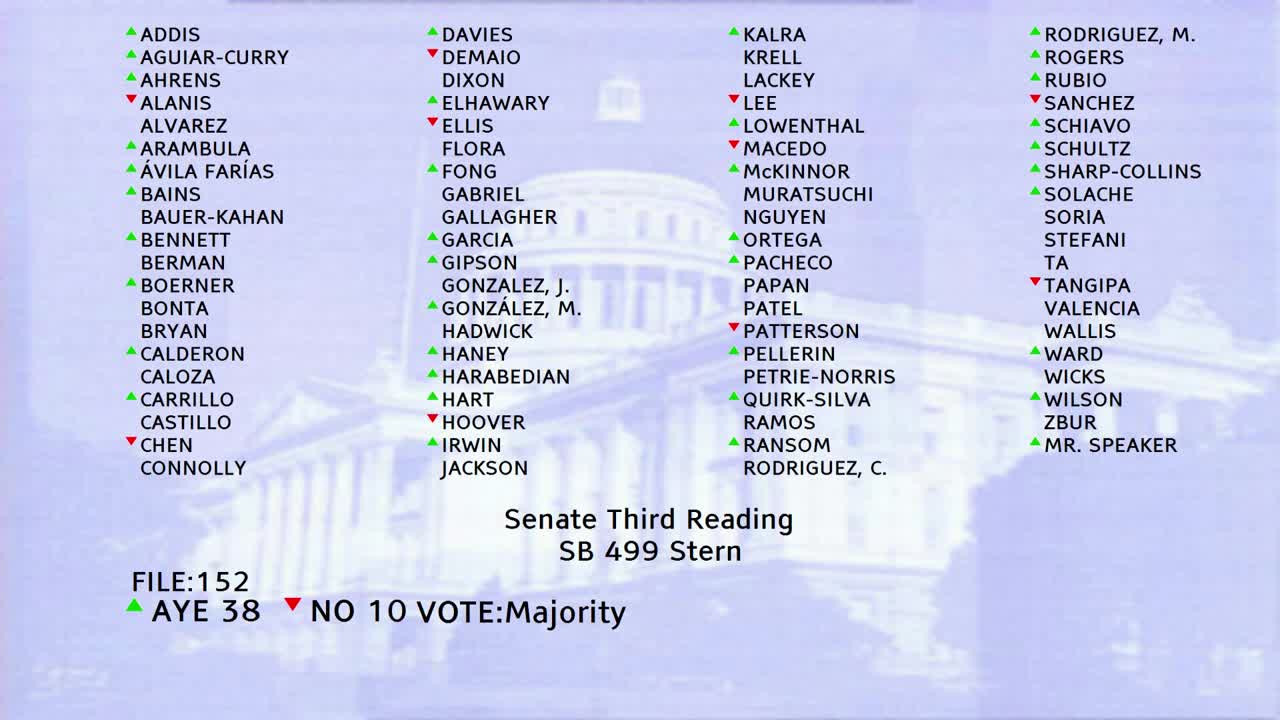 1MIN
Assembly Floor
 8MIN
Assembly Standing Committee on Judiciary
 9MIN
Assembly Standing Committee on Banking and Finance
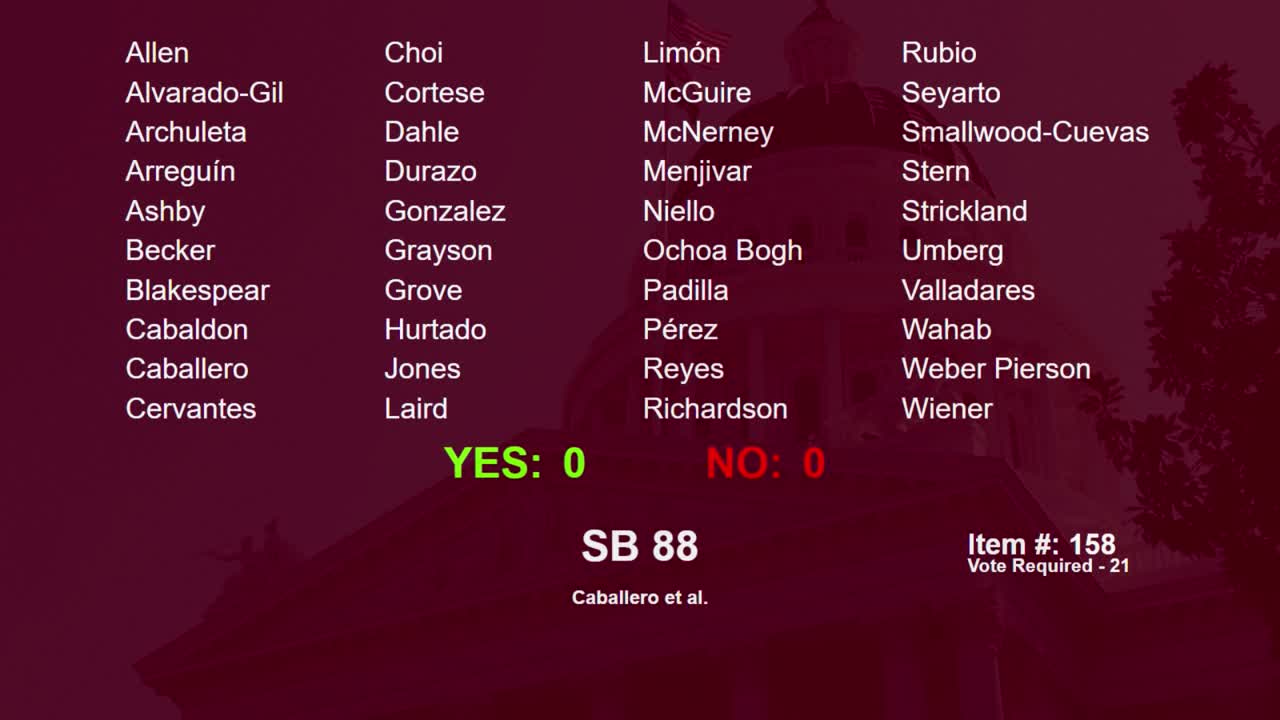 2MIN
Senate Floor
 6MIN
Senate Standing Committee on Judiciary
 8MIN
Senate Standing Committee on Banking and Financial Institutions
Bill Author

Bill Co-Author(s):