SB 369: Salton Sea: restoration projects: skilled and trained workforce.
- Session Year: 2025-2026
- House: Senate
- Latest Version Date: 2025-09-12
Current Status:
Failed
(2026-03-02: Veto sustained.)
Introduced
In Committee
Awaiting First Chamber Vote
Passed First Chamber
In Committee
Awaiting Second Chamber Vote
Passed Second Chamber
Enacted
Existing law requires the Secretary of the Natural Resources Agency, in consultation and coordination with the Salton Sea Authority, to lead Salton Sea restoration efforts. Existing law, to the extent that funding is appropriated to the Department of Fish and Wildlife for Salton Sea restoration activities, authorizes the Department of Water Resources, in coordination and under agreement with the Department of Fish and Wildlife, to undertake certain restoration efforts.
This bill would require, except as provided, specified state agencies undertaking a Salton Sea restoration project in excess of $1,000,000 to obtain, as part of a contract entered into on or after January 1, 2026, an enforceable commitment that every bidder, contractor, subcontractor, or other entity at every tier, as defined, shall use a skilled and trained workforce, as provided, to perform all work that falls within an apprenticeship occupation in the building and construction trades.
Existing law requires the Secretary of the Natural Resources Agency, in consultation and coordination with the Salton Sea Authority, to lead Salton Sea restoration efforts. Existing law, to the extent that funding is appropriated to the Department of Fish and Wildlife for Salton Sea restoration activities, authorizes the Department of Water Resources, in coordination and under agreement with the Department of Fish and Wildlife, to undertake certain restoration efforts.
This bill would require, except as provided, a state agency specified state agencies undertaking a Salton Sea restoration project to obtain, as part of a contract entered into on or after January 1, 2026, an enforceable commitment that every bidder, contractor, subcontractor, or other entity at every tier, as defined, shall use a skilled and trained workforce, as provided, to perform all work that falls within an apprenticeship occupation in the building and construction trades.
Existing law requires the Secretary of the Natural Resources Agency, in consultation and coordination with the Salton Sea Authority, to lead Salton Sea restoration efforts. Existing law, to the extent that funding is appropriated to the Department of Fish and Wildlife for Salton Sea restoration activities, authorizes the Department of Water Resources, in coordination and under agreement with the Department of Fish and Wildlife, to undertake certain restoration efforts.
This bill would require, except as provided, a state agency undertaking a Salton Sea restoration project to obtain, as part of a contract entered into on or after January 1, 2026, an enforceable commitment that every bidder, contractor, subcontractor, or other entity at every tier, as defined, shall use a skilled and trained workforce, as provided, to perform all work that falls within an apprenticeship occupation in the building and construction trades.
The Legislature finds and declares all of the following:
(a)Flows into the Salton Sea have declined in recent years, and the result is a shrinking, increasingly saline lake.
(b)As the Salton Sea recedes, previously submerged lakebed is exposed, creating dust that is of concern to local communities.
(c)California state agencies are advancing Salton Sea restoration projects critical to ensuring the health and well-being of the Salton Sea ecosystem, the residents of the Imperial Valley, and the surrounding communities.
(d)The communities surrounding the Salton Sea are some of the most impoverished in the state.
(e)More than 21 percent of the population of the County of Imperial lives below the poverty line, which is nearly double the national average of 11.6 percent.
(f)Less than 10 percent of residents under 65 years of age in the County of Imperial have health insurance.
(g)There is a significant gap in wages between the County of Imperial and the rest of the state, such that wages in the County of Imperial are up to 25 percent lower than the statewide average.
(h)To help mitigate the gap in wages, it is the intent of the Legislature for all work that encompasses Salton Sea restoration projects that falls within an occupation that has an apprenticeship in the building and construction trades to be performed by a skilled and trained workforce as defined in Section 2601 of the Public Contract Code.
(i)A skilled and trained workforce brings with it higher paying jobs, medical insurance, and training and development for the local workforce.
(j)A skilled and trained workforce requirement will expand apprenticeship training in the County of Imperial.
(k)A skilled and trained workforce requirement will promote safety and quality in the completion of Salton Sea restoration projects.
SEC. 2.Section 2946 is added to the Fish and Game Code, to read:2946.(a)For projects in excess of one million dollars ($1,000,000), a state agency undertaking a Salton Sea restoration project shall obtain, as part of a contract entered into on or after January 1, 2026, an enforceable commitment that every bidder, contractor, subcontractor, or other entity at every tier shall use a skilled and trained workforce to perform all work that falls within an apprenticeship occupation in the building and construction trades.
(b)This section shall not apply if all construction work on the project is subject to a project labor agreement that requires the use of a skilled and trained workforce.
(c)For purposes of this section, the following definitions apply:
(1)Entity shall have the same meaning as defined in Section 1777.1 of the Labor Code.
(2)Every tier means all contracts at any level to carry out the project, whether negotiated or advertised, and includes contracts for the supply and manufacture of off-site aggregate materials for the project. Every tier does not include contracts for transportation services.
(3)State agency means the Natural Resources Agency, the Department of Water Resources, or the department.
(4)Project labor agreement has the same meaning as defined in Section 2500 of the Public Contract Code.
(5)Skilled and trained workforce has the same meaning as defined in Section 2601 of the Public Contract Code.
(6)Salton Sea restoration project means the erection, construction, alteration, repair, or improvement of any Salton Sea ecosystem structure, building, road, or other improvement that is undertaken as part of the restoration of the Salton Sea ecosystem.
The Legislature finds and declares all of the following:
(a)Flows into the Salton Sea have declined in recent years, and the result is a shrinking, increasingly saline lake.
(b)As the Salton Sea recedes, previously submerged lakebed is exposed, creating dust that is of concern to local communities.
(c)California state agencies are advancing Salton Sea restoration projects critical to ensuring the health and well-being of the Salton Sea ecosystem, the residents of the Imperial Valley, and the surrounding communities.
(d)The communities surrounding the Salton Sea are some of the most impoverished in the state.
(e)More than 21 percent of the population of the County of Imperial lives below the poverty line, which is nearly double the national average of 11.6 percent.
(f)Less than 10 percent of residents under 65 years of age in the County of Imperial have health insurance.
(g)There is a significant gap in wages between the County of Imperial and the rest of the state, such that wages in the County of Imperial are up to 25 percent lower than the statewide average.
(h)To help mitigate the gap in wages, it is the intent of the Legislature for all work that encompasses Salton Sea Restoration restoration projects that fall falls within an occupation that has an apprenticeship in the building and construction trades to be performed by a skilled and trained workforce as defined in Section 2601 of the Public Contract Code.
(i)A skilled and trained workforce brings with it higher paying jobs, medical insurance, and training and development for the local workforce.
(j)A skilled and trained workforce requirement will expand apprenticeship training in the County of Imperial.
(k)A skilled and trained workforce requirement will promote safety and quality in the competition completion of Salton Sea restoration projects.
SEC. 2.Section 2946 is added to the Fish and Game Code, to read:2946.(a)A For projects in excess of one million dollars ($1,000,000), a state agency undertaking a Salton Sea restoration project shall obtain, as part of a contract entered into on or after January 1, 2026, an enforceable commitment that every bidder, contractor, subcontractor, or other entity at every tier shall use a skilled and trained workforce to perform all work that falls within an apprenticeship occupation in the building and construction trades.
(b)This section shall not apply if all construction work on the project is subject to a project labor agreement that requires the use of a skilled and trained workforce.
(c)For purposes of this section, the following definitions apply:
(1)Entity shall have the same meaning as defined in Section 1777.1 of the Labor Code.
(2)Every tier means all contracts at any level to carry out the project, whether negotiated or advertised, and includes contracts for the supply and manufacture of off-site aggregate materials for the project. Every tier does not include contracts for transportation services.
(3)State agency means the Natural Resources Agency, the Department of Water Resources, or the department.
(4)Project labor agreement has the same meaning as defined in Section 2500 of the Public Contract Code.
(5)Skilled and trained workforce has the same meaning as defined in Section 2601 of the Public Contract Code.
(6)Salton Sea restoration project means the erection, construction, alteration, repair, or improvement of any Salton Sea ecosystem structure, building, road, or other improvement that will exceed in cost, including labor and materials, a total of fifty thousand dollars ($50,000), and that is undertaken as part of the restoration of the Salton Sea ecosystem.
The Legislature finds and declares all of the following:
(a)Flows into the Salton Sea have declined in recent years, and the result is a shrinking, increasingly saline lake.
(b)As the Salton Sea recedes, previously submerged lakebed is exposed, creating dust that is of concern to local communities.
(c)California state agencies are advancing Salton Sea restoration projects critical to ensuring the health and well-being of the Salton Sea ecosystem, the residents of the Imperial Valley, and the surrounding communities.
(d)The communities surrounding the Salton Sea are some of the most impoverished in the state.
(e)More than 21 percent of the population of the County of Imperial lives below the poverty line, which is nearly double the national average of 11.6 percent.
(f)Less than 10 percent of residents under 65 years of age in the County of Imperial have health insurance.
(g)There is a significant gap in wages between the County of Imperial and the rest of the state, such that wages in the County of Imperial are up to 25 percent lower than the statewide average.
(h)To help mitigate the gap in wages, it is the intent of the Legislature for all work that encompasses Salton Sea Restoration projects that fall within an occupation that has an apprenticeship in the building and construction trades be performed by a skilled and trained workforce as defined in Section 2601 of the Public Contract Code.
(i)A skilled and trained workforce brings with it higher paying jobs, medical insurance, and training and development for the local workforce.
(j)A skilled and trained workforce requirement will expand apprenticeship training in the County of Imperial.
(k)A skilled and trained workforce requirement will promote safety and quality in the competition of Salton Sea restoration projects.
SEC. 2.Section 2946 is added to the Fish and Game Code, to read:2946.(a)A state agency undertaking a Salton Sea restoration project shall obtain, as part of a contract entered into on or after January 1, 2026, an enforceable commitment that every bidder, contractor, subcontractor, or other entity at every tier shall use a skilled and trained workforce to perform all work that falls within an apprenticeship occupation in the building and construction trades.
(b)This section shall not apply if all construction work on the project is subject to a project labor agreement that requires the use of a skilled and trained workforce.
(c)For purposes of this section, the following definitions apply:
(1)Entity shall have the same meaning as defined in Section 1777.1 of the Labor Code.
(2)Every tier means all contracts at any level to carry out the project, whether negotiated or advertised, and includes contracts for the supply and manufacture of off-site aggregate materials for the project. Every tier does not include contracts for transportation services.
(3)State agency means a state agency as defined in Section 11000 of the Government Code. the Natural Resources Agency, the Department of Water Resources, or the department.
(4)Project labor agreement has the same meaning as defined in Section 2500 of the Public Contract Code.
(5)Skilled and trained workforce has the same meaning as defined in Section 2601 of the Public Contract Code.
(6)Salton Sea restoration project means the erection, construction, alteration, repair, or improvement of any Salton Sea ecosystem structure, building, road, or other improvement that will exceed in cost, including labor and materials, a total of fifty thousand dollars ($50,000), and that is undertaken as part of the restoration of the Salton Sea ecosystem.
The Legislature finds and declares all of the following:
(a)Flows into the Salton Sea have declined in recent years, and the result is a shrinking, increasingly saline lake.
(b)As the Salton Sea recedes, previously submerged lakebed is exposed, creating dust that is of concern to local communities.
(c)California state agencies are advancing Salton Sea restoration projects critical to ensuring the health and well-being of the Salton Sea ecosystem, the residents of the Imperial Valley, and the surrounding communities.
(d)The communities surrounding the Salton Sea are some of the most impoverished in the state.
(e)More than 21 percent of the population of the County of Imperial lives below the poverty line, which is nearly double the national average of 11.6 percent.
(f)Less than 10 percent of residents under 65 years of age in the County of Imperial have health insurance.
(g)There is a significant gap in wages between the County of Imperial and the rest of the state, such that wages in the County of Imperial are up to 25 percent lower than the statewide average.
(h)To help mitigate the gap in wages, it is the intent of the Legislature for all work that encompasses Salton Sea Restoration projects that fall within an occupation that has an apprenticeship in the building and construction trades be performed by a skilled and trained workforce as defined in Section 2601 of the Public Contract Code.
(i)A skilled and trained workforce brings with it higher paying jobs, medical insurance, and training and development for the local workforce.
(j)A skilled and trained workforce requirement will expand apprenticeship training in the County of Imperial.
(k)A skilled and trained workforce requirement will promote safety and quality in the competition of Salton Sea restoration projects.
SEC. 2.Section 2946 is added to the Fish and Game Code, to read:2946.(a)A state agency undertaking a Salton Sea restoration project shall obtain, as part of a contract entered into on or after January 1, 2026, an enforceable commitment that every bidder, contractor, subcontractor, or other entity at every tier shall use a skilled and trained workforce to perform all work that falls within an apprenticeship occupation in the building and construction trades.
(b)This section shall not apply if all construction work on the project is subject to a project labor agreement that requires the use of a skilled and trained workforce.
(c)For purposes of this section, the following definitions apply:
(1)Entity shall have the same meaning as defined in Section 1777.1 of the Labor Code.
(2)Every tier means all contracts at any level to carry out the project, whether negotiated or advertised, and includes contracts for the supply and manufacture of off-site aggregate materials for the project. Every tier does not include contracts for transportation services.
(3)State agency means a state agency as defined in Section 11000 of the Government Code.
(4)Project labor agreement has the same meaning as defined in Section 2500 of the Public Contract Code.
(5)Skilled and trained workforce has the same meaning as defined in Section 2601 of the Public Contract Code.
(6)Salton Sea restoration project means the erection, construction, alteration, repair, or improvement of any Salton Sea ecosystem structure, building, road, or other improvement that will exceed in cost, including labor and materials, a total of fifty thousand dollars ($50,000), and that is undertaken as part of the restoration of the Salton Sea ecosystem.
|
Date
|
Status
|
|---|---|
| Mar 2, 2026 | Veto sustained. |
| Mar 2, 2026 | Stricken from file. |
| Oct 13, 2025 | In Senate. Consideration of Governor's veto pending. |
| Oct 13, 2025 | Vetoed by the Governor. |
| Sep 17, 2025 | Enrolled and presented to the Governor at 2 p.m. |
| Sep 10, 2025 | Assembly amendments concurred in. (Ayes 39. Noes 0. Page 2763.) Ordered to engrossing and enrolling. |
| Sep 8, 2025 | In Senate. Concurrence in Assembly amendments pending. |
| Sep 8, 2025 | Read third time. Passed. (Ayes 69. Noes 5. Page 3001.) Ordered to the Senate. |
| Sep 3, 2025 | Read second time. Ordered to third reading. |
| Sep 2, 2025 | Read second time and amended. Ordered to second reading. |
| Aug 29, 2025 | From committee: Do pass as amended. (Ayes 13. Noes 1.) (August 29). |
| Aug 20, 2025 | August 20 set for first hearing. Placed on APPR. suspense file. |
| Jul 10, 2025 | From committee: Do pass and re-refer to Com. on APPR. (Ayes 6. Noes 0.) (July 9). Re-referred to Com. on APPR. |
| Jul 1, 2025 | From committee: Do pass and re-refer to Com. on L. & E. (Ayes 12. Noes 0.) (July 1). Re-referred to Com. on L. & E. |
| Jun 9, 2025 | Referred to Coms. on W. P., & W. and L. & E. |
| Jun 3, 2025 | In Assembly. Read first time. Held at Desk. |
| Jun 2, 2025 | Read third time. Passed. (Ayes 33. Noes 2. Page 1365.) Ordered to the Assembly. |
| May 23, 2025 | Read second time. Ordered to third reading. |
| May 23, 2025 | From committee: Do pass. (Ayes 5. Noes 0. Page 1198.) (May 23). |
| May 16, 2025 | Set for hearing May 23. |
| Apr 21, 2025 | April 21 hearing: Placed on APPR. suspense file. |
| Apr 4, 2025 | Set for hearing April 21. |
| Apr 3, 2025 | April 7 hearing postponed by committee. |
| Mar 28, 2025 | Set for hearing April 7. |
| Mar 26, 2025 | Re-referred to Com. on APPR. |
| Mar 26, 2025 | Withdrawn from committee. |
| Mar 25, 2025 | From committee: Do pass and re-refer to Com. on G.O. (Ayes 6. Noes 0. Page 532.) (March 25). Re-referred to Com. on G.O. |
| Mar 17, 2025 | From committee with author's amendments. Read second time and amended. Re-referred to Com. on N.R. & W. |
| Mar 12, 2025 | Set for hearing March 25. |
| Feb 26, 2025 | Referred to Coms. on N.R. & W. and G.O. |
| Feb 14, 2025 | From printer. May be acted upon on or after March 16. |
| Feb 13, 2025 | Introduced. Read first time. To Com. on RLS. for assignment. To print. |
|
Date
|
Description
|
Location
|
Votes
|
|
|---|---|---|---|---|
| Sep 10, 2025 | Unfinished Business SB369 Padilla Concurrence | Senate Floor |
Passed |
|
| Sep 8, 2025 | SB 369 Padilla Senate Third Reading By Ortega | Assembly Floor |
Passed |
|
| Aug 29, 2025 | Do pass as amended. | Assembly Standing Committee on Appropriations |
Passed |
|
| Jul 9, 2025 | Do pass and be re-referred to the Committee on [Appropriations] | Assembly Standing Committee on Labor and Employment |
Passed |
|
| Jul 1, 2025 | Do pass and be re-referred to the Committee on [Labor and Employment] | Assembly Standing Committee on Water, Parks, and Wildlife |
Passed |
|
| Jun 2, 2025 | Senate 3rd Reading SB369 Padilla | Senate Floor |
Passed |
|
| May 23, 2025 | Do pass | Senate Standing Committee on Appropriations |
Passed |
|
| Apr 21, 2025 | Placed on suspense file | Senate Standing Committee on Appropriations |
Passed |
|
| Mar 25, 2025 | Do pass, but first be re-referred to the Committee on [Governmental Organization] | Senate Standing Committee on Natural Resources and Water |
Passed |
This list shows positions taken on this bill by organizations on the date displayed, which is linked to the original source.
Positions by individuals are not included.
|
Organization
|
Position
|
Date
|
|---|---|---|
| California Department of Finance | ** Against | |
| California Federation of Labor Unions, Afl-cio | ** Support | |
| California State Association Of Electrical Workers | ** Support | |
| California State Pipe Trades Council | ** Support | |
| Comite Civico del Valle, Inc. | ** Support | |
| Comite Civico Del Valle Inc | ** Support | |
| County of Riverside | ** Support | |
| District Council Of Iron Workers Of The State Of California And Vicinity | ** Support | |
| international union of operating engineers, california-nevada conference | ** Support | |
| Los Amigos De LA Comunidad, INC. | ** Support | |
| Southern California Contractors Association | ** Support | |
| State Building & Construction Trades Council Of California | ** Support | |
| Western States Council Sheet Metal, Air, Rail And Transportation | ** Support |
SENATE RULES COMMITTEE Office of Senate Floor Analyses (916) 651-1520 Fax: (916) 327-4478 | SB 369 |
VETO
Bill No: SB 369
Author: Padilla (D)
Enrolled: 9/12/25
Vote: 27
SENATE NATURAL RES. & WATER COMMITTEE: 6-0, 3/25/25
AYES: Limón, Allen, Grove, Hurtado, Laird, Stern
NO VOTE RECORDED: Seyarto
SENATE APPROPRIATIONS COMMITTEE: 5-0, 5/23/25
AYES: Caballero, Cabaldon, Grayson, Richardson, Wahab
NO VOTE RECORDED: Seyarto, Dahle
SENATE FLOOR: 39-0, 9/10/25
AYES: Allen, Alvarado-Gil, Archuleta, Arreguín, Ashby, Becker, Blakespear, Cabaldon, Caballero, Cervantes, Cortese, Dahle, Durazo, Gonzalez, Grayson, Grove, Hurtado, Jones, Laird, Limón, McGuire, McNerney, Menjivar, Niello, Ochoa Bogh, Padilla, Pérez, Reyes, Richardson, Rubio, Seyarto, Smallwood-Cuevas, Stern, Strickland, Umberg, Valladares, Wahab, Weber Pierson, Wiener
NO VOTE RECORDED: Choi
ASSEMBLY FLOOR: 69-5, 9/8/25 - See last page for vote
SUBJECT: Salton Sea: restoration projects: skilled and trained workforce
SOURCE: International Union of Operating Engineers, California-Nevada Conference
DIGEST:
This bill extends the requirement to use a skilled and trained workforce to Salton Sea restoration projects undertaken by specified state agencies.
ANALYSIS:
Existing law:
- Requires, Under the Salton Sea Restoration Act, the Secretary of California Natural Resources Agency (CNRA), in consultation and coordination with the Salton Sea Authority, to lead the Salton Sea restoration efforts, as specified. (Fish and Game Code (FGC) §2942(a)(1))
- Authorizes Department of Water Resources (DWR), in coordination with California Department of Fish and Wildlife (CDFW), to undertake Salton Sea restoration efforts. (FGC §2942(a)(3))
- Allows DWR design-build projects to authorize the Director of DWR to procure design-build contracts for public works projects in excess of $1,000,000 that are at the Salton Sea. (Public Contract Code (PCC) §10204)
- Prohibits a design-build entity from being prequalified or short-listed unless the entity provides an enforceable commitment that the entity and its subcontractors at every tier will use a skilled and trained workforce to perform all work on the project or the contract falls within an apprenticeable occupation in the building and construction trades. (PCC §10208(c))
- Requires owners or operators of specified petroleum refineries and petrochemical manufacturing facilities, when contracting for construction or related work, to use a skilled and trained workforce to perform all onsite work, as specified. Does not apply this requirement in situations of workforce shortages and emergencies, as specified. (Health and Safety Code (HSC) §25536.7)
- Prescribes skilled and trained workforce requirements for when a public entity is required to obtain an enforceable commitment that a bidder, contractor, or other entity will use a skilled and trained workforce to complete a contract or project. (PCC §2600)
- Defines “skilled and trained workforce” to mean a workforce that meets certain requirements including a phase-in of a skilled and trained workforce – 30% workforce during the first year of implementation, 40% workforce during the second year, 50% workforce during the third year of implementation, and 60% workforce thereafter. (PCC §2601(d))
- Excludes acoustical installers, bricklayers, carpenters, cement masons, drywall installers or lathers, marble masons, finishers, or setters, modular furniture or systems installers, operating engineers, pile drivers, plasterers, roofers or waterproofers, stone masons, surveyors, teamsters, terrazzo workers or finishers, and tile layers, setters, and finishers from these phase-in workforce requirements, and instead requires at least 30% workforce for these occupations. (PCC §2601(d))
This bill:
- Requires, for a Salton Sea restoration project in excess of $1,000,000, CDFW, DWR, and CNRA to obtain an enforceable commitment that every bidder, contractor, subcontractor, or other entity at every tier to use a skilled and trained workforce to perform all work that falls within an apprenticeship occupation in the building and construction trades. This requirement does not apply if all construction work on the project is subject to a project labor agreement that requires the use of a skilled and trained workforce.
- Defines “Salton Sea restoration project” as the erection, construction, alteration, repair, and improvement of any Salton Sea ecosystem structure, building, road, or other improvement that is undertaken as part of the restoration of the Salton Sea ecosystem.
- Makes findings and declarations about the Salton Sea, its surrounding community, and the benefits of a skilled and trained workforce requirements.
Background
The Salton Sea. The Salton Sea is California’s largest lake, located 235 feet below sea level in Riverside and Imperial Counties near the California‐Mexico border. The Salton Sea watershed is part of the Colorado River basin, and encompasses roughly 8,000 square miles. Over the past millennia, the meandering Colorado River periodically filled the Salton Basin, creating ancestral freshwater lakes that eventually evaporated. Today’s Salton Sea was formed in 1905 when massive flooding caused the Colorado River to break through an irrigation canal and flow uncontrolled into the Salton Basin for 18 months. After the breach in the irrigation canal was fixed, the Salton Sea has been primarily sustained by agricultural drainage water, approximately 80% of which flows from the farming-heavy Imperial Valley to the south.
Many species depend on the Salton Sea ecosystem: it supports over 400 species of birds, is home to many species of fish, and is a critical stop on the Pacific Flyway for migrating birds, including several threatened and endangered species. The Salton Sea National Wildlife Refuge was established in 1930 to preserve wintering habitat for waterfowl and other migratory birds. The southern end of the Salton Sea may be the richest source of geothermal energy in the United States, and possibly the world.
The role of state agencies. AB 71 (V. Manuel Perez, Chapter 402, Statutes of 2013) articulates the state’s goals and established a state framework for Salton Sea restoration. The goals include permanently protecting fish and wildlife that are dependent on the Salton Sea ecosystem, restoring the long-term stable aquatic and shoreline habitat for fish and wildlife that depend upon the Salton Sea, mitigating air quality impacts, and protecting water quality, among others.
AB 71 requires the CNRA Secretary to lead Salton Sea restoration efforts. The bill provides that the CNRA Secretary and the Legislature shall maintain full authority and responsibility for any state obligation under the Quantification Settlement Agreement and that both shall have final approval for any proposed restoration plan. AB 71 also authorizes CDFW and DWR to undertake certain restoration efforts.
Governor Brown launched the Salton Sea Management Program (SSMP) in 2018 to coordinate Salton Sea restoration efforts. CNRA, CDFW, and DWR implement the SSMP, while the State Water Resources Control Board (State Water Board) monitors and assesses progress on the implementation of the SSMP.
In 2018, the SSMP released the “Phase I: Ten-Year Plan” to guide state projects at the Salton Sea and to address potential public health and environmental effects over the ensuing decade. The plan seeks to improve conditions by constructing 30,000 acres of habitat and dust suppression projects around the Salton Sea.
In April 2024, the SSMP published a “Salton Sea Long-Range Plan” (Long-Range Plan), a long-term pathway for the restoration and management of the Salton Sea beyond the next decade. The Long-Range Plan discusses 13 restoration concepts for long-range solutions, with some concepts having multiple variations. These concepts of varying feasibility include, amongst others, pump out options that create an artificial outlet for the Salton Sea by pumping Salton Sea water from the Sea and using it for dust control, pumping Salton Sea water to the Sea of Cortez, or both; water optimization to capture water in interceptor canals; water recycling, involving the construction of five desalination plants; water importation of desalinated water from Sea of Cortez; and water exchange.
[See Senate Natural Resources and Water Committee analysis for additional background information]
FISCAL EFFECT: Appropriation: No Fiscal Com.: Yes Local: No
According to the Assembly Floor Analysis, the Assembly Appropriations Committee identified the following fiscal impact:
- “Costs of an unknown amount, almost certainly in excess of $150,000 in the aggregate, to CNRA, DWR, and DFW for increased administrative costs to ensure compliance with the new contracting requirements (General Fund, bond funds). The magnitude of these costs is variable based on the number of and amount of funding allocated to potential restoration projects.
- The aforementioned state agencies may also incur potentially significant increased project costs, to the extent this bill increases bid prices or deters some contractors from bidding on contracts. In cases where a foregone contractor would have been the low bidder, the state agency will pay more, and remaining contractors may face less competitive pressure when bidding on contracts, thus increasing contract costs. The labor requirement may also result in scheduling delays or limit the number of bids received due to regional workforce limitations. For example, if there is a shortage of skilled and trained workers locally, a contractor may need to spend more on travel, lodging, and meals for workers from other parts of the state.
- DFW notes it currently uses a variety of methods to contract for Salton Sea restoration work, including utilizing nonprofits, public works contracts, and partnerships with other state agencies. Often, workers hired to work on projects in the Salton Sea have been trained in other countries or receive on-the-job training. Requiring contracted workers to obtain formal skills and training for construction positions as a prerequisite to working on Salton Sea restoration projects may limit the department's options to hire workers and complete projects on time and within specified budgets.
- For a prior version of the bill, DWR noted that while there is significant uncertainty about the cost of this bill, the department estimated approximately a 10% increase in contracting costs as a result of the skilled and trained workforce requirement. As an example, DWR expects to receive approximately $150 million from the Proposition 4 climate bond for Salton Sea projects – which the department plans to expend through five separate state contracts. Of this amount, DWR estimates an approximately $15 million increase in project costs. CNRA notes it carries out nearly all its Salton Sea-related project contracting through DWR. Limiting the skilled and trained workforce requirement to projects over $1 million should limit the overall impact on project and contracting costs, although the magnitude remains unknown.
- The Department of Industrial Relations does not anticipate any costs as a result of this bill.”
SUPPORT: (Verified 10/14/25)
International Union of Operating Engineers, California-Nevada Conference (source)
California Federation of Labor Unions, AFL-CIO
California State Association of Electrical Workers
California State Pipe Trades Council
Comite Civico Del Valle, Inc.
County of Riverside
District Council of Iron Workers of the State of California and Vicinity
Los Amigos de la Comunidad, Inc.
Southern California Contractors Association
State Building & Construction Trades Council of California
Western States Council Sheet Metal, Air, Rail and Transportation
OPPOSITION: (Verified 10/14/25)
California Department of Finance
ARGUMENTS IN SUPPORT: According to the author, “For years, the receding lake bed at the Salton Sea, exacerbated by our changing climate, has created environmental hazards that threaten the health of communities in the Imperial Valley, predominantly composed of Latino agricultural workers. The state and federal government have provided funding for Salton Sea restoration, which is critical to ensuring the health and well-being of the Salton Sea ecosystem and the Imperial Valley community, but is only a piece of helping this region overcome the challenges it faces. The Imperial Valley already has a high unemployment rate and many residents face poor working conditions and low wages. Given the risk to workers, and effort to ensure a labor pipeline for residents in the Imperial Valley, and support towards the rapid completion of Salton Sea Restoration projects, SB 369 is crucial to statutorily require the use of a local skilled and trained workforce for all restoration work at the Salton Sea.”
ARGUMENTS IN OPPOSITION: According to the California Department of Finance, “[t]he Department of Finance is opposed to this bill because it would significantly increase the cost of the state’s existing legal liabilities associated with Salton Sea restoration.”
GOVERNOR'S VETO MESSAGE:
I am returning Senate Bill 369 without my signature.
This bill would impose new workforce requirements on contractors, subcontractors, and entities at every other tier that work on state restoration projects at the Salton Sea starting January 1, 2026.
Over the course of my Administration, the state's Salton Sea Management Program has dramatically increased the pace and scale of its restoration projects, covering miles of previously exposed lakebed with bird and fish habitat, as well as native plants.
These efforts are addressing severe habitat loss and the public health risks of exposed lakebed dust emissions. Simultaneously, these investments are providing job opportunities for local workers in a region long burdened by high unemployment. These mutually beneficial outcomes are a transformative step for this region. That is why I was proud to collaborate with the author last year on the creation of the Salton Sea Conservancy, which will further advance these shared objectives and enhance these outcomes.
I appreciate the author's efforts and commitment to addressing the pervasive issues in the Salton Sea region. Though well-intended, I am concerned this bill may result in delays to critical, shovel-ready restoration projects. Recognizing the importance of prioritizing efforts to provide high-quality, local jobs while balancing the urgent need to accelerate restoration projects at the Salton Sea, I am directing the California Natural Resources Agency, in consultation with the California Labor and Workforce Development Agency, to identify and publish recommendations on increasing regional workforce development opportunities and promote long-term economic mobility in the community.
For these reasons, I cannot sign this bill.
ASSEMBLY FLOOR: 69-5, 9/8/25
AYES: Addis, Aguiar-Curry, Ahrens, Alanis, Alvarez, Arambula, Ávila Farías, Bains, Bauer-Kahan, Bennett, Berman, Boerner, Bonta, Bryan, Calderon, Caloza, Carrillo, Chen, Connolly, Davies, Elhawary, Flora, Fong, Gabriel, Garcia, Gipson, Jeff Gonzalez, Mark González, Haney, Harabedian, Hart, Irwin, Jackson, Kalra, Krell, Lackey, Lee, Lowenthal, McKinnor, Muratsuchi, Ortega, Pacheco, Papan, Patel, Patterson, Pellerin, Petrie-Norris, Quirk-Silva, Ramos, Ransom, Celeste Rodriguez, Michelle Rodriguez, Rogers, Blanca Rubio, Schiavo, Schultz, Sharp-Collins, Solache, Soria, Stefani, Ta, Tangipa, Valencia, Wallis, Ward, Wicks, Wilson, Zbur, Rivas
NOES: DeMaio, Dixon, Ellis, Johnson, Macedo
NO VOTE RECORDED: Castillo, Gallagher, Hadwick, Hoover, Nguyen, Sanchez
Prepared by: Genevieve Wong / N.R. & W. / (916) 651-4116
10/14/25 15:58:38
**** END ****
SENATE RULES COMMITTEE Office of Senate Floor Analyses (916) 651-1520 Fax: (916) 327-4478 | SB 369 |
UNFINISHED BUSINESS
Bill No: SB 369
Author: Padilla (D)
Amended: 9/2/25 in Assembly
Vote: 21
SENATE NATURAL RES. & WATER COMMITTEE: 6-0, 3/25/25
AYES: Limón, Allen, Grove, Hurtado, Laird, Stern
NO VOTE RECORDED: Seyarto
SENATE APPROPRIATIONS COMMITTEE: 5-0, 5/23/25
AYES: Caballero, Cabaldon, Grayson, Richardson, Wahab
NO VOTE RECORDED: Seyarto, Dahle
SENATE FLOOR: 33-2, 6/2/25
AYES: Allen, Alvarado-Gil, Archuleta, Arreguín, Ashby, Becker, Blakespear, Cabaldon, Caballero, Cervantes, Cortese, Dahle, Durazo, Gonzalez, Grayson, Jones, Laird, Limón, McGuire, McNerney, Menjivar, Padilla, Pérez, Richardson, Rubio, Smallwood-Cuevas, Stern, Strickland, Umberg, Valladares, Wahab, Weber Pierson, Wiener
NOES: Grove, Ochoa Bogh
NO VOTE RECORDED: Choi, Hurtado, Niello, Reyes, Seyarto
ASSEMBLY FLOOR: 69-5, 9/8/25 - See last page for vote
SUBJECT: Salton Sea: restoration projects: skilled and trained workforce
SOURCE: International Union of Operating Engineers, California-Nevada Conference
DIGEST:
This bill extends the requirement to use a skilled and trained workforce to Salton Sea restoration projects undertaken by specified state agencies.
Assembly Amendments
of 9/2/25 apply these provisions only to projects in excess of $1,000,000.
ANALYSIS:
Existing law:
- Requires, Under the Salton Sea Restoration Act, the Secretary of California Natural Resources Agency (CNRA), in consultation and coordination with the Salton Sea Authority, to lead the Salton Sea restoration efforts, as specified. (Fish and Game Code (FGC) §2942(a)(1))
- Authorizes Department of Water Resources (DWR), in coordination with California Department of Fish and Wildlife (CDFW), to undertake Salton Sea restoration efforts. (FGC §2942(a)(3))
- Authorizes Department of Water Resources (DWR), in coordination with California Department of Fish and Wildlife (CDFW), to undertake Salton Sea restoration efforts. (FGC §2942(a)(3))
- Allows DWR design-build projects to authorize the Director of DWR to procure design-build contracts for public works projects in excess of $1,000,000 that are at the Salton Sea. (Public Contract Code (PCC) §10204)
- Prohibits a design-build entity from being prequalified or short-listed unless the entity provides an enforceable commitment that the entity and its subcontractors at every tier will use a skilled and trained workforce to perform all work on the project or the contract falls within an apprenticeable occupation in the building and construction trades. (PCC §10208(c))
- Requires owners or operators of specified petroleum refineries and petrochemical manufacturing facilities, when contracting for construction or related work, to use a skilled and trained workforce to perform all onsite work, as specified. Does not apply this requirement in situations of workforce shortages and emergencies, as specified. (Health and Safety Code (HSC) §25536.7)
- Prescribes skilled and trained workforce requirements for when a public entity is required to obtain an enforceable commitment that a bidder, contractor, or other entity will use a skilled and trained workforce to complete a contract or project. (PCC §2600)
- Defines “skilled and trained workforce” to mean a workforce that meets certain requirements including a phase-in of a skilled and trained workforce – 30% workforce during the first year of implementation, 40% workforce during the second year, 50% workforce during the third year of implementation, and 60% workforce thereafter. (PCC §2601(d))
- Excludes acoustical installers, bricklayers, carpenters, cement masons, drywall installers or lathers, marble masons, finishers, or setters, modular furniture or systems installers, operating engineers, pile drivers, plasterers, roofers or waterproofers, stone masons, surveyors, teamsters, terrazzo workers or finishers, and tile layers, setters, and finishers from these phase-in workforce requirements, and instead requires at least 30% workforce for these occupations. (PCC §2601(d))
This bill:
- Requires, for a Salton Sea restoration project in excess of $1,000,000, CDFW, DWR, and CNRA to obtain an enforceable commitment that every bidder, contractor, subcontractor, or other entity at every tier to use a skilled and trained workforce to perform all work that falls within an apprenticeship occupation in the building and construction trades. This requirement does not apply if all construction work on the project is subject to a project labor agreement that requires the use of a skilled and trained workforce.
- Defines “Salton Sea restoration project” as the erection, construction, alteration, repair, and improvement of any Salton Sea ecosystem structure, building, road, or other improvement that is undertaken as part of the restoration of the Salton Sea ecosystem.
- Makes findings and declarations about the Salton Sea, its surrounding community, and the benefits of a skilled and trained workforce requirements.
Background
- The Salton Sea. The Salton Sea is California’s largest lake, located 235 feet below sea level in Riverside and Imperial Counties near the California‐Mexico border. The Salton Sea watershed is part of the Colorado River basin, and encompasses roughly 8,000 square miles. Over the past millennia, the meandering Colorado River periodically filled the Salton Basin, creating ancestral freshwater lakes that eventually evaporated. Today’s Salton Sea was formed in 1905 when massive flooding caused the Colorado River to break through an irrigation canal and flow uncontrolled into the Salton Basin for 18 months. After the breach in the irrigation canal was fixed, the Salton Sea has been primarily sustained by agricultural drainage water, approximately 80 percent of which flows from the farming-heavy Imperial Valley to the south.
Many species depend on the Salton Sea ecosystem: it supports over 400 species of birds, is home to many species of fish, and is a critical stop on the Pacific Flyway for migrating birds, including several threatened and endangered species. The Salton Sea National Wildlife Refuge was established in 1930 to preserve wintering habitat for waterfowl and other migratory birds. The southern end of the Salton Sea may be the richest source of geothermal energy in the United States, and possibly the world.
- The role of state agencies. AB 71 (V. Manuel Perez, Chapter 402, Statutes of 2013) articulates the state’s goals and established a state framework for Salton Sea restoration. The goals include permanently protecting fish and wildlife that are dependent on the Salton Sea ecosystem, restoring the long-term stable aquatic and shoreline habitat for fish and wildlife that depend upon the Salton Sea, mitigating air quality impacts, and protecting water quality, among others.
AB 71 requires the CNRA Secretary to lead Salton Sea restoration efforts. The bill provides that the CNRA Secretary and the Legislature shall maintain full authority and responsibility for any state obligation under the Quantification Settlement Agreement and that both shall have final approval for any proposed restoration plan. AB 71 also authorizes CDFW and DWR to undertake certain restoration efforts.
Governor Brown launched the Salton Sea Management Program (SSMP) in 2018 to coordinate Salton Sea restoration efforts. CNRA, CDFW, and DWR implement the SSMP, while the State Water Resources Control Board (State Water Board) monitors and assesses progress on the implementation of the SSMP.
In 2018, the SSMP released the “Phase I: Ten-Year Plan” to guide state projects at the Salton Sea and to address potential public health and environmental effects over the ensuing decade. The plan seeks to improve conditions by constructing 30,000 acres of habitat and dust suppression projects around the Salton Sea.
In April 2024, the SSMP published a “Salton Sea Long-Range Plan” (Long-Range Plan), a long-term pathway for the restoration and management of the Salton Sea beyond the next decade. The Long-Range Plan discusses 13 restoration concepts for long-range solutions, with some concepts having multiple variations. These concepts of varying feasibility include, amongst others, pump out options that create an artificial outlet for the Salton Sea by pumping Salton Sea water from the Sea and using it for dust control, pumping Salton Sea water to the Sea of Cortez, or both; water optimization to capture water in interceptor canals; water recycling, involving the construction of five desalination plants; water importation of desalinated water from Sea of Cortez; and water exchange.
[See Senate Natural Resources and Water Committee analysis for additional background information]
FISCAL EFFECT: Appropriation: No Fiscal Com.: Yes Local: No
According to the Assembly Floor Analysis, the Assembly Appropriations Committee identified the following fiscal impact:
- “Costs of an unknown amount, almost certainly in excess of $150,000 in the aggregate, to CNRA, DWR, and DFW for increased administrative costs to ensure compliance with the new contracting requirements (General Fund, bond funds). The magnitude of these costs is variable based on the number of and amount of funding allocated to potential restoration projects.
- The aforementioned state agencies may also incur potentially significant increased project costs, to the extent this bill increases bid prices or deters some contractors from bidding on contracts. In cases where a foregone contractor would have been the low bidder, the state agency will pay more, and remaining contractors may face less competitive pressure when bidding on contracts, thus increasing contract costs. The labor requirement may also result in scheduling delays or limit the number of bids received due to regional workforce limitations. For example, if there is a shortage of skilled and trained workers locally, a contractor may need to spend more on travel, lodging, and meals for workers from other parts of the state.
- DFW notes it currently uses a variety of methods to contract for Salton Sea restoration work, including utilizing nonprofits, public works contracts, and partnerships with other state agencies. Often, workers hired to work on projects in the Salton Sea have been trained in other countries or receive on-the-job training. Requiring contracted workers to obtain formal skills and training for construction positions as a prerequisite to working on Salton Sea restoration projects may limit the department's options to hire workers and complete projects on time and within specified budgets.
- For a prior version of the bill, DWR noted that while there is significant uncertainty about the cost of this bill, the department estimated approximately a 10% increase in contracting costs as a result of the skilled and trained workforce requirement. As an example, DWR expects to receive approximately $150 million from the Proposition 4 climate bond for Salton Sea projects – which the department plans to expend through five separate state contracts. Of this amount, DWR estimates an approximately $15 million increase in project costs. CNRA notes it carries out nearly all its Salton Sea-related project contracting through DWR. Limiting the skilled and trained workforce requirement to projects over $1 million should limit the overall impact on project and contracting costs, although the magnitude remains unknown.
- The Department of Industrial Relations does not anticipate any costs as a result of this bill.”
SUPPORT: (Verified 9/5/25)
International Union of Operating Engineers, California-Nevada Conference (source)
California Federation of Labor Unions, AFL-CIO
California State Association of Electrical Workers
California State Pipe Trades Council
Comite Civico Del Valle, Inc.
County of Riverside
District Council of Iron Workers of the State of California and Vicinity
Los Amigos de la Comunidad, Inc.
Southern California Contractors Association
State Building & Construction Trades Council of California
Western States Council Sheet Metal, Air, Rail and Transportation
OPPOSITION: (Verified 9/5/25)
California Department of Finance
ARGUMENTS IN SUPPORT: According to the author, “For years, the receding lake bed at the Salton Sea, exacerbated by our changing climate, has created environmental hazards that threaten the health of communities in the Imperial Valley, predominantly composed of Latino agricultural workers. The state and federal government have provided funding for Salton Sea restoration, which is critical to ensuring the health and well-being of the Salton Sea ecosystem and the Imperial Valley community, but is only a piece of helping this region overcome the challenges it faces. The Imperial Valley already has a high unemployment rate and many residents face poor working conditions and low wages. Given the risk to workers, and effort to ensure a labor pipeline for residents in the Imperial Valley, and support towards the rapid completion of Salton Sea Restoration projects, SB 369 is crucial to statutorily require the use of a local skilled and trained workforce for all restoration work at the Salton Sea.”
ARGUMENTS IN OPPOSITION: According to the California Department of Finance, “[t]he Department of Finance is opposed to this bill because it would significantly increase the cost of the state’s existing legal liabilities associated with Salton Sea restoration.”
Assembly Floor, 69-5, 9/8/25
Ayes: Addis, Aguiar-Curry, Ahrens, Alanis, Alvarez, Arambula, Ávila Farías, Bains, Bauer-Kahan, Bennett, Berman, Boerner, Bonta, Bryan, Calderon, Caloza, Carrillo, Chen, Connolly, Davies, Elhawary, Flora, Fong, Gabriel, Garcia, Gipson, Jeff Gonzalez, Mark González, Haney, Harabedian, Hart, Irwin, Jackson, Kalra, Krell, Lackey, Lee, Lowenthal, McKinnor, Muratsuchi, Ortega, Pacheco, Papan, Patel, Patterson, Pellerin, Petrie-Norris, Quirk-Silva, Ramos, Ransom, Celeste Rodriguez, Michelle Rodriguez, Rogers, Blanca Rubio, Schiavo, Schultz, Sharp-Collins, Solache, Soria, Stefani, Ta, Tangipa, Valencia, Wallis, Ward, Wicks, Wilson, Zbur, Rivas
Noes: DeMaio, Dixon, Ellis, Johnson, Macedo
No Vote Recorded: Castillo, Gallagher, Hadwick, Hoover, Nguyen, Sanchez
Prepared by: Genevieve Wong / N.R. & W. / (916) 651-4116
9/8/25 19:46:33
**** END ****
SENATE THIRD READING
STR Bill Id:SB 369
Author:(Padilla)
As Amended Ver:September 02, 2025
Majority vote
SUMMARY
Requires the use of a skilled and trained workforce for Salton Sea restoration projects that cost more than $1 million.
Major Provisions
- Requires a state agency undertaking a Salton Sea restoration project that costs more than $1 million to obtain an enforceable commitment that every bidder, contractor, subcontractor, or other entity at every tier use a skilled and trained workforce to perform all work on the project that falls within an apprenticeship occupation in the building and construction trades. This requirement shall apply to any contract entered into on or after January 1, 2026.
- Provides that this bill shall not apply to a Salton Sea restoration project if the project is subject to a project labor agreement that requires the use of a skilled and trained workforce.
- Defines "Salton Sea restoration project" as the erection, construction, alteration, repair, or improvement of any Salton Sea ecosystem structure, building, road, or other improvement and that is undertaken as part of the restoration of the Salton Sea ecosystem.
COMMENTS
The Salton Sea is California's largest lake and was once famous for its sport fishery and other recreational uses. It is located in southern Riverside County and northern Imperial County in southeastern California. The sea is approximately 35 miles long and up to 15 miles wide with approximately 320 square miles of water surface and 105 miles of shoreline. The modern Salton Sea was created in 1905 as a result of flood flows from the Colorado River. Since then, approximately 90% of the freshwater inflow to the Salton Sea has been agricultural runoff from the Imperial Valley, preventing the sea from drying up as had occurred in the past. As the Salton Sea has no outlets, salts and nutrients concentrate in it. Currently, the Salton Sea has a salinity level that is approximately 60% higher than the ocean. Increasing levels of salinity have significantly reduced the presence of fish in the sea. In addition, as the sea has become increasingly nutrient-polluted (eutrophication), the occurrences of fish die-offs and unpleasant odors have made the area a much less attractive destination for recreation.
The surface elevation of the Salton Sea has steadily declined since the implementation of the Quantification Settlement Agreement (QSA) in 2003, an important water agreement regarding California’s use of Colorado River water that included a water transfer from the Imperial Irrigation District (IID) to the San Diego County Water Authority (SDCWA). When the water transfer began in 2003, IID was required to put mitigation flows into the sea for 15 years. Mitigation flows into the sea stopped on January 1, 2018. A decrease of over 13 feet in elevation from 2003 to the present has resulted in a net exposure of 37 square miles of dry lake bed – known as "playa" (Pacific Institute, 2025).
In many areas, the playa consists of fine sediments that were deposited at the bottom of the sea over many years. Due to the high winds and arid climate around the sea, the wind picks up significant amounts of fine dust, increasing the amount of particulate matter in the air and contributing to poor air quality in the Imperial and Coachella Valleys. Particulate matter is especially dangerous to children and the elderly. Over time, particulate matter can become trapped in the lungs, causing asthma attacks, bronchitis, and other lung diseases, and can also exacerbate existing heart conditions. While not solely attributable to the playa, Imperial County has one of the highest rates of asthma-related emergency room visits for children in California (Farzan et al., 2019).
In order to facilitate the signing of the QSA, the state agreed to assume most of the financial responsibility for mitigating negative environmental impacts and for Salton Sea restoration efforts. The QSA limits the funding for mitigation related to the water conservation and transfer activities, as well as Salton Sea restoration, for certain QSA parties (IID, SDCWA, and Coachella Valley Water District) to $163 million in 2003 dollars, adjusted for inflation. The Legislature enacted several bills in 2003 to implement the QSA. These legislative measures committed the state to taking on responsibility for Salton Sea restoration that was not covered by parties to the QSA and also established a number of broad goals for the restoration effort.
The California Natural Resources Agency (CNRA), with support from the Department of Water Resources (DWR) and the Department of Fish and Wildlife (DFW), implements the Salton Sea Management Program (Program). The Program was established to fulfill the state's obligations to restore the Salton Sea. The Program is currently focused on achieving the goals of the Salton Sea Management Plan Phase 1: 10-Year Plan by completing 29,800 acres of dust suppression and habitat restoration projects. To date the Program has completed projects covering 3,225 acres; this falls short of its goal of having completed 14,200 acres of projects by the end of 2024. The Program has also developed a long-range plan to outline a path for the restoration and management of the Salton Sea beyond 2028. The Long-Range Plan was released last year.
California has expended more than $285 million in bond funds and $73 million in General Fund for restoration and mitigation projects at the Salton Sea since 2003, most of this funding has been expended in recent years to implement the Phase 1: 10-Year Plan. The federal government has also committed an additional $250 million to fund projects at the Salton Sea.
According to the Author
"For years, the receding lake bed at the Salton Sea, exacerbated by our changing climate, has created environmental hazards that threaten the health of communities in the Imperial Valley, predominantly composed of Latino agricultural workers. The state and federal government have provided funding for Salton Sea restoration, which is critical to ensuring the health and well-being of the Salton Sea ecosystem and the Imperial Valley community, but this only a piece of helping this region overcome the challenges it faces. The Imperial Valley already has a high unemployment rate and many residents face poor working conditions and low wages. Given the risk to workers, effort to ensure a labor pipeline for residents in the Imperial Valley, and support towards the rapid completion of Salton Sea Restoration projects, [this bill] is crucial to statutorily require the use of a local skilled and trained workforce for all restoration work at the Salton Sea."
Arguments in Support
The California-Nevada Conference of Operating Engineers (Operating Engineers) is the sponsor of this bill and argues that it will facilitate the rapid completion of Salton Sea restoration projects and ensure the protection of workers. The Operating Engineers contend that this bill is necessary because "workers performing Salton Sea restoration projects are at greater risk of exposure to toxic substances given their proximity to, and interaction with, the toxins that encompass the lakebed of the Salton Sea." Finally, the Operating Engineers assert that by creating a pipeline of trained workers in the region, this bill will benefit the Imperial Valley for years to come.
Arguments in Opposition
The Department of Finance is opposed to this bill, stating it "would significantly increase the cost of the state's existing legal liabilities associated with Salton Sea restoration."
FISCAL COMMENTS
According to the Assembly Appropriations Committee, this bill has the following fiscal impact:
- Costs of an unknown amount, almost certainly in excess of $150,000 in the aggregate, to CNRA, DWR, and DFW for increased administrative costs to ensure compliance with the new contracting requirements (General Fund, bond funds). The magnitude of these costs is variable based on the number of and amount of funding allocated to potential restoration projects.
- The aforementioned state agencies may also incur potentially significant increased project costs, to the extent this bill increases bid prices or deters some contractors from bidding on contracts. In cases where a foregone contractor would have been the low bidder, the state agency will pay more, and remaining contractors may face less competitive pressure when bidding on contracts, thus increasing contract costs. The labor requirement may also result in scheduling delays or limit the number of bids received due to regional workforce limitations. For example, if there is a shortage of skilled and trained workers locally, a contractor may need to spend more on travel, lodging, and meals for workers from other parts of the state.
- DFW notes it currently uses a variety of methods to contract for Salton Sea restoration work, including utilizing nonprofits, public works contracts, and partnerships with other state agencies. Often, workers hired to work on projects in the Salton Sea have been trained in other countries or receive on-the-job training. Requiring contracted workers to obtain formal skills and training for construction positions as a prerequisite to working on Salton Sea restoration projects may limit the department's options to hire workers and complete projects on time and within specified budgets.
- For a prior version of the bill, DWR noted that while there is significant uncertainty about the cost of this bill, the department estimated approximately a 10% increase in contracting costs as a result of the skilled and trained workforce requirement. As an example, DWR expects to receive approximately $150 million from the Proposition 4 climate bond for Salton Sea projects – which the department plans to expend through five separate state contracts. Of this amount, DWR estimates an approximately $15 million increase in project costs. CNRA notes it carries out nearly all its Salton Sea-related project contracting through DWR. Limiting the skilled and trained workforce requirement to projects over $1 million should limit the overall impact on project and contracting costs, although the magnitude remains unknown.
- The Department of Industrial Relations does not anticipate any costs as a result of this bill.
VOTES
SENATE FLOOR: 33-2-5
YES: Allen, Alvarado-Gil, Archuleta, Arreguín, Ashby, Becker, Blakespear, Cabaldon, Caballero, Cervantes, Cortese, Dahle, Durazo, Gonzalez, Grayson, Jones, Laird, Limón, McGuire, McNerney, Menjivar, Padilla, Pérez, Richardson, Rubio, Smallwood-Cuevas, Stern, Strickland, Umberg, Valladares, Wahab, Weber Pierson, Wiener
NO: Grove, Ochoa Bogh
ABS, ABST OR NV: Choi, Hurtado, Niello, Reyes, Seyarto
ASM WATER, PARKS, AND WILDLIFE: 12-0-1
YES: Papan, Jeff Gonzalez, Alvarez, Ávila Farías, Bains, Bennett, Boerner, Caloza, Hart, Celeste Rodriguez, Rogers, Tangipa
ABS, ABST OR NV: Macedo
ASM LABOR AND EMPLOYMENT: 6-0-1
YES: Ortega, Chen, Elhawary, Kalra, Lee, Ward
ABS, ABST OR NV: Flora
ASM APPROPRIATIONS: 13-1-1
YES: Wicks, Arambula, Calderon, Caloza, Elhawary, Fong, Mark González, Ahrens, Pacheco, Pellerin, Solache, Ta, Tangipa
NO: Dixon
ABS, ABST OR NV: Sanchez
UPDATED
VERSION: September 02, 2025
CONSULTANT: Pablo Garza / W., P., & W. / (916) 319-2096 FN: 0001420
Date of Hearing: August 20, 2025
ASSEMBLY COMMITTEE ON APPROPRIATIONS
Buffy Wicks, Chair
SBPCA Bill Id:SB 369
Author:(Padilla) – As Amended Ver:March 17, 2025
Policy Committee: | Water, Parks and Wildlife | Vote: | 12 - 0 |
Labor and Employment | 6 - 0 | ||
|
|
Urgency: No State Mandated Local Program: No Reimbursable: No
SUMMARY:
This bill requires the use of a skilled and trained workforce for Salton Sea restoration projects undertaken by specified state agencies.
Specifically, this bill, among other things:
- Requires a state agency undertaking a Salton Sea restoration project to obtain, as part of a contract entered into on or after January 1, 2026, an enforceable commitment that every bidder, contractor, subcontractor, or other entity at every tier, as defined, shall use a skilled and trained workforce to perform all work that falls within an apprenticeship occupation in the building and construction trades.
- Provides that this bill does not apply if all construction work on the project is subject to a project labor agreement (PLA) that requires the use of a skilled and trained workforce.
- Defines “state agency” as the California Natural Resources Agency (CNRA), the Department of Water Resources (DWR), or the Department of Fish and Wildlife (DFW).
- Defines “Salton Sea restoration project” as the erection, construction, alteration, repair, or improvement of any Salton Sea ecosystem structure, building, road, or other improvement that exceeds $50,000 in cost and that is undertaken as part of the restoration of the Salton Sea ecosystem.
FISCAL EFFECT:
1) Costs of an unknown amount, almost certainly in excess of $150,000 in the aggregate, to CNRA, DWR, and DFW for increased administrative costs to ensure compliance with the new contracting requirements (General Fund, bond funds). The magnitude of these costs is variable based on the number of and amount of funding allocated to potential restoration projects.
2) The aforementioned state agencies may also incur potentially significant increased project costs, to the extent this bill increases bid prices or deters some contractors from bidding on contracts. In cases where a foregone contractor would have been the low bidder, the state agency will pay more, and remaining contractors may face less competitive pressure when bidding on contracts, thus increasing contract costs. The labor requirement may also result in scheduling delays or limit the number of bids received due to regional workforce limitations. For example, if there is a shortage of skilled and trained workers locally, a contractor may need to spend more on travel, lodging, and meals for workers from other parts of the state.
DFW notes it currently uses a variety of methods to contract for Salton Sea restoration work, including utilizing nonprofits, public works contracts, and partnerships with other state agencies. Often, workers hired to work on projects in the Salton Sea have been trained in other countries or receive on-the-job training. Requiring contracted workers to obtain formal skills and training for construction positions as a prerequisite to working on Salton Sea restoration projects may limit the department’s options to hire workers and complete projects on time and within specified budgets.
3) For its part, DWR notes that while there is significant uncertainty about the cost of this bill, the department estimates approximately a 10% increase in contracting costs as a result of the skilled and trained workforce requirement. As an example, DWR expects to receive approximately $150 million from the Proposition 4 climate bond for Salton Sea projects – which the department plans to expend through five separate state contracts. Of this amount, DWR estimates an approximately $15 million increase in project costs. CNRA notes it carries out nearly all its Salton Sea-related project contracting through DWR.
4) The Department of Industrial Relations does not anticipate any costs as a result of this bill.
The Department of Finance (DOF) is opposed to this bill, stating the bill “would significantly increase the cost of the state’s existing legal liabilities associated with Salton Sea restoration.”
COMMENTS:
1) Purpose. According to the author:
For years, the receding lake bed at the Salton Sea, exacerbated by our changing climate, has created environmental hazards that threaten the health of communities in the Imperial Valley, predominantly composed of Latino agricultural workers. The state and federal government have provided funding for Salton Sea restoration, which is critical to ensuring the health and well-being of the Salton Sea ecosystem and the Imperial Valley community, but this only a piece of helping this region overcome the challenges it faces.
The Imperial Valley already has a high unemployment rate and many residents face poor working conditions and low wages. Given the risk to workers, effort to ensure a labor pipeline for residents in the Imperial Valley, and support towards the rapid completion of Salton Sea Restoration projects, [this bill] is crucial to statutorily require the use of a local skilled and trained workforce for all restoration work at the Salton Sea.
2) Background. Salton Sea. According to CNRA, flows into the Salton Sea have declined in recent years, and the result is a shrinking, increasingly saline lake. As the Salton Sea recedes, previously submerged lakebed is being exposed, creating dust that is of concern to local communities.
To address these challenges, state agencies are advancing projects at the Salton Sea to improve air quality and provide critical environmental habitat for birds along the Pacific Flyway. CNRA, DWR, and DWR are implementing the Salton Sea Management Program (SSMP), which includes a 10-year plan that aims to improve conditions by constructing 30,000 acres of habitat and dust suppression projects around the sea. To date, the SSMP has completed projects covering 3,225 acres; this falls short of its goal of completing 14,200 acres of projects by the end of 2024. The SSMP has also developed a long-range plan to outline a path for the restoration and management of the Salton Sea beyond 2028.
The SSMP has received approximately $600 million in state funding to date, nearly all of which has been either expended or committed to projects. In addition, the federal Inflation Reduction Act provides $250 million to restore the Salton Sea. According to CNRA, additional funding, likely around $500 million over the next several years, is needed for the state to achieve its SSMP phase 1 legal requirements. SB 583 (Padilla), Chapter 771, Statutes of 2024, creates a new Salton Sea Conservancy (Conservancy) in CNRA, and the Proposition 4 climate bond allocates up to $10 million for its creation. As part of the Governor’s January budget for fiscal year 2025-26, the Conservancy requested 15 permanent positions, $10 million in Proposition 4 funding, and ongoing funding through the Salton Sea Lithium Fund for the establishment and operation of the Conservancy. The Budget Act of 2025, signed in June, deferred action on this request to subsequent budget negotiations. DOF asserts this bill’s requirements do not apply to the newly created conservancy, which is aimed at the operations and maintenance of acres restored through the SSMP.
Skilled and Trained Workforce. A skilled and trained workforce means all the workers performing work in an apprenticeable occupation in the building and construction trades are either skilled journeypersons or apprentices registered in a program approved by the Division of Apprenticeship Standards (DAS). A contractor required to provide an enforceable commitment that a skilled and trained workforce will be used to complete a project must submit a monthly report to the awarding body demonstrating compliance with skilled and trained standards. If the contractor fails to provide the monthly report, or provides a report that is incomplete or does not demonstrate compliance, the awarding body must withhold contract payments. The awarding body must also notify the Labor Commissioner when the monthly report does not demonstrate compliance, with contractors subject to specified civil penalties for such violations.
The California-Nevada Conference of Operating Engineers, the sponsor of this bill, writes in support:
Currently, Skilled and Trained workforce requirements are only required for design-build construction projects at the Salton Sea that cost over $1,000,000. Given the toxic nature of performing work at the Salton Sea and the importance of ensuring that these projects are completed at a rapid pace, the State should be taking every precaution necessary to ensure that workers on these projects have received the highest level of safety training in order for this work to be completed in a safe and efficient manner.
Analysis Prepared by: Nikita Koraddi / APPR. / (916) 319-2081
Date of Hearing: July 9, 2025
ASSEMBLY COMMITTEE ON LABOR AND EMPLOYMENT
Liz Ortega, Chair
SBPCA Bill Id:SB 369
Author:(Padilla) – As Amended Ver:March 17, 2025
SENATE VOTE: 33-2
SUBJECT: Salton Sea: restoration projects: skilled and trained workforce
SUMMARY: Requires a skilled and trained workforce for Salton Sea restoration projects over $50,000. Specifically, this bill:
- Requires a state agency undertaking a Salton Sea restoration project to obtain, as part of a contract entered into on or after January 1, 2026, an enforceable commitment that every bidder, contractor, subcontractor, or other entity at every tier shall use a skilled and trained workforce to perform all work that falls within an apprenticeship occupation in the building and construction trades.
- Provides that (1) above does not apply if all construction work on the project is subject to a project labor agreement that requires the use of a skilled and trained workforce.
- Defines the following terms:
- “Salton Sea restoration project” to mean the erection, construction, alteration, repair, or improvement of any Salton Sea ecosystem structure, building, road, or other improvement that will exceed in cost, including labor and materials, a total of $50,000, and that is undertaken as part of the restoration of the Salton Sea ecosystem.
- “Every tier” to mean all contracts at any level to carry out the project, whether negotiated or advertised, and includes contracts for the supply and manufacture of off-site aggregate materials for the project. “Every tier” does not include contracts for transportation services.
- “State agency” to mean the Natural Resources Agency (CNRA), the Department of Water Resources (DWR), or the Department of Fish and Wildlife (DFW).
- Makes related findings and declarations.
EXISTING LAW:
- Authorizes a public entity to require a bidder, contractor, or other entity to use a skilled and trained workforce to complete a contract or project regardless of whether the public entity is required to do so by a statute or regulation. Public Contract Code § 2600(b).
- Requires, when the use of a skilled and trained workforce to complete a contract or project is required, the public entity to include in all bid documents and construction contracts a notice that the project is subject to the skilled and trained workforce requirement. Public Contract Code § 2600(c).
- Defines a “skilled and trained workforce” to mean a workforce in which all the workers performing work in an apprenticeable occupation in the building and construction trades are either skilled journeypersons or apprentices registered in an apprenticeship program. Public Contract Code § 2601.
- Requires a contractor, bidder, or other entity to provide to the public entity or other awarding body, on a monthly basis while the project or contract is being performed, a report demonstrating compliance with skilled and trained workforce requirements. Public Contract Code § 2602.
- Requires a contractor or subcontractor to pay a civil penalty to the state of not more than $5,000 per month of work performed in violation of the skilled and trained workforce requirements if the Labor Commissioner or their designee determines that the contractor or subcontractor failed to use a skilled and trained workforce. A contractor or subcontractor that commits a second or subsequent violation within a three-year period shall forfeit as a civil penalty to the state the sum of not more than $10,000 per month of work performed in violation. Public Contract Code § 2603.
- Provides that the ratio of work performed by apprentices to journeymen employed in a particular craft or trade on the public work may be no higher than the ratio stipulated in the apprenticeship standards under which the apprenticeship program operates if the contractor agrees to be bound by those standards, but provides that, unless otherwise specified, in no case shall the ratio be less than one hour of apprentice work for every five hours of journeyman work. Labor Code § 1777.5(g).
- Defines “project labor agreement” to mean a prehire collective bargaining agreement that establishes terms and conditions of employment for a specific construction project or projects, and authorizes a public entity to use, enter into, or require contractors to enter into a project labor agreement for a construction project if specified conditions are met. Public Contract Code § 2500(b)(1).
- Defines “entity” to mean a company, limited liability company, association, partnership, sole proprietorship, limited liability partnership, corporation, business trust, or organization. Labor Code § 1777.1(i).
- Authorizes the Director of the DWR to procure design-build contracts for public works projects in excess of $1 million that are at the Salton Sea or that are necessary for the construction, maintenance, or operation of elements of State Water Facilities, as defined, and requires the use of a skilled and trained workforce for these design-build contracts. Public Contract Code § 10204 et seq.
FISCAL EFFECT: According to the Senate Appropriations Committee, “The Department of Water Resources (DWR), while noting significant uncertainty surrounding any specific costs of this bill, estimates at minimum a $15 million impact to Salton Sea programs (Proposition 4), not accounting for schedule delays or other possible impacts.”
COMMENTS: A “skilled and trained workforce” is one in which all the workers performing work in an apprenticeable occupation in the building and construction trades are either skilled journeypersons or apprentices registered in a state-approved apprenticeship program.
The use of a skilled and trained workforce can have numerous benefits to workers, project owners and the local area in which the project takes place. For one, a skilled and trained workforce generally brings increased productivity to a project, as well as reduces the likelihood of errors and rework. Well-trained workers have a greater understanding of the industry best practices and quality standards, helping ensure that work is completed efficiently and correctly. A skilled and trained workforce can also bring improved safety and risk mitigation to a project, reducing the likelihood of workplace accidents.
Additionally, apprenticeship requirements for skilled and trained workforces help ensure that projects not only benefit the workers participating in the project, but also build a pipeline of workers in the community for future projects. This could be particularly beneficial for an area like Imperial County, which consistently has the highest unemployment rate in the state. In May 2025 the unemployment rate was 17.4 percent,[1] as compared to 5.3 percent for California[2] and 4.2 percent for the nation.[3]
The Salton Sea Management Plan:
(Please see the Assembly Water, Parks and Wildlife Committee analysis for more background on the Salton Sea, and the associated environmental problems and restoration efforts underway.)
Reduced inflows from the Colorado River and agricultural runoff have resulted in several critical issues at the Salton Sea, including shrinking water levels, increased salinity, and toxic dust pollution. To mitigate the impacts on the environment and public health, the CNRA, the DWR and the DFW are tasked with implementing the Salton Sea Management Program (SSMP), which includes a 10-year plan that aims to improve conditions by constructing 30,000 acres of habitat and dust suppression projects around the Sea. The SSMP team is also working to establish a long-term pathway for the Salton Sea beyond the next decade, including work to evaluate the feasibility of water importation.[4]
As part of the 2022 budget (AB 203), the Legislature authorized the DWR to use design-build procurement for public works projects that cost more than $1 million at the Salton Sea or that are related to the State Water Project. These design-build projects are required to use a skilled and trained workforce. This bill would extend skilled and trained requirements to Salton Sea restoration projects that cost more than $50,000, regardless of procurement method.
According to the Author:
“For years, the receding lake bed at the Salton Sea, exacerbated by our changing climate, has created environmental hazards that threaten the health of communities in the Imperial Valley, predominantly composed of Latino agricultural workers. The state and federal government have provided funding for Salton Sea restoration, which is critical to ensuring the health and well-being of the Salton Sea ecosystem and the Imperial Valley community, but is only a piece of helping this region overcome the challenges it faces. The Imperial Valley already has a high unemployment rate and many residents face poor working conditions and low wages. Given the risk to workers, and effort to ensure a labor pipeline for residents in the Imperial Valley, and support towards the rapid completion of Salton Sea Restoration projects, SB 369 is crucial to statutorily require the use of a local skilled and trained workforce for all restoration work at the Salton Sea.”
The author adds that the bill promotes equity in that “the Salton Sea has been rapidly depleted year after year leading to the release of dust particles that further worsen the air quality in the Imperial Valley. The workers performing Salton Sea restoration programs face exposure to toxic substances, because of their proximity and interaction with the lakebed. The Imperial Valley already has a high unemployment rate and many residents face poor working conditions and low wages. Given the risk to workers, statutorily requiring the use of a skilled and trained workforce will establish a pipeline of skilled workers for future projects that will benefit the residents of the Imperial Valley for years to come. It also ensures local workers participating on projects are paid a living wage and provided with health and welfare benefits for themselves and their families.”
Arguments in Support
The California-Nevada Conference of Operating Engineers, sponsor of this measure, writes in support that “Skilled and Trained workforce requirements ensure that a certain percentage of workers on covered projects have graduated from a State Registered Apprenticeship program. This means that these workers have received the highest level of training in the State related to the work they are performing. These requirements also assist in ensuring that local workers are participating in projects and that high-road contractors are performing the work, which ensures that local workers on skilled and trained projects are paid a living wage and provided with health and welfare benefits for themselves and their families. Additionally, Skilled and Trained Requirements ensure that apprentices are being trained under highly trained journeyman, which creates a pipeline of skilled workers for future projects that will benefit residents of the Imperial Valley for years to come. Considering the toxic and urgent nature of the work being performed at the Salton Sea, legislation is needed to ensure that all projects related to Salton Sea restoration work are covered by labor standards that protect workers and promote economic mobility.”
Arguments in Opposition
None on file.
Prior and Related Legislation
AB 1235 (Rogers) of 2025 would have prohibited a contractor from being prequalified for, shortlisted for, or awarded a design-build contract with the Trustees of the California State University unless the contractor provides an enforceable commitment to the trustees that the contractor and its subcontractors at every tier will use a skilled and trained workforce to perform all work on the project or contract that falls within an apprenticeable occupation in the building and construction trades, as specified. Held in the Assembly Appropriations Committee.
SB 1298 (Cortese) of 2024 would have authorized the California Energy Commission, until January 1, 2030, to exempt from its certification a thermal powerplant with a generating capacity of up to 150 megawatts, if specified requirements are met, including that a skilled and trained workforce is used to perform all construction work on the facility, as specified. Died in the Assembly Rules Committee.
SB 144 (Committee on Budget and Fiscal Review), Chapter 367, Statutes of 2023, required eligible centralized procurement entity projects to, among other things, use a skilled and trained workforce.
AB 203 (Committee on Budget), Chapter 60, Statutes of 2022, among other provisions, provided the DWR authority to use design-build for public works projects that cost more than $1 million at the Salton Sea or that are related to the State Water Project.
SB 288 (Wiener), Chapter 200, Statutes of 2020, required the use of a skilled and trained workforce for certain transit-related projects conducted by public agencies.
SB 524 (Stern) of 2019 would have required that a skilled and trained workforce perform the work for energy efficiency projects of $50,000 or more in ratepayer-funded incentives within the same building, facility or complex. Died on the Assembly inactive file.
SB 693 (Hueso), Chapter 774, Statutes of 2016, consolidated the “skilled and trained workforce” requirements of various provisions of existing law related to alternative construction delivery methods and defined the terms of those requirements.
SB 785 (Wolk), Chapter 931, Statutes of 2014, enacted more uniform provisions authorizing the Department of General Services, the Department of Corrections and Rehabilitation, and most local agencies to utilize the design-build procurement process for specified public works projects; prohibited a design-build entity from being prequalified or shortlisted unless the entity provides an enforceable commitment that the entity and its subcontractors at every tier will use a skilled and trained workforce, as specified.
SB 54 (Hancock), Chapter 795, Statutes of 2013, introduced the skilled and trained workforce requirement and applied it to construction and related work performed at specified petroleum refineries and petrochemical manufacturing facilities.
REGISTERED SUPPORT / OPPOSITION:
Support
California-Nevada Conference of Operating Engineers (Sponsor)
California Federation of Labor Unions, AFL-CIO
California State Association of Electrical Workers
California State Pipe Trades Council
Comite Civico Del Valle, INC
District Council of Iron Workers of the State of California and Vicinity
Southern California Contractors Association
State Building & Construction Trades Council of California
Western States Council Sheet Metal, Air, Rail and Transportation
Opposition
None on file.
Analysis Prepared by: Erin Hickey / L. & E. /
El Centro Metropolitan Statistical Area (Msa)(Imperial County). (May 2025) Employment Development Department. https://labormarketinfo.edd.ca.gov/file/lfmonth/ecen$pds.pdf ↑
“California’s May Unemployment Rate Remains at 5.3 percent.” Employment Development Department. https://edd.ca.gov/en/about_edd/news_releases_and_announcements/unemployment-may-2025/ ↑
State Employment And Unemployment — May 2025. Bureau of Labor Statistics. https://www.bls.gov/news.release/pdf/laus.pdf ↑
Salton Sea Management Program: https://saltonsea.ca.gov/ ↑
Date of Hearing: July 1, 2025
ASSEMBLY COMMITTEE ON WATER, PARKS, AND WILDLIFE
Diane Papan, Chair
SBPCA Bill Id:SB 369
Author:(Padilla) – As Amended Ver:March 17, 2025
SENATE VOTE: 33-2
SUBJECT: Salton Sea: restoration projects: skilled and trained workforce
SUMMARY: Requires the use of a skilled and trained workforce for Salton Sea restoration projects. Specifically, this bill:
- Requires a state agency undertaking a Salton Sea restoration project to obtain an enforceable commitment that every bidder, contractor, subcontractor, or other entity at every tier use a skilled and trained workforce to perform all work on the project that falls within an apprenticeship occupation in the building and construction trades. This requirement shall apply to any contract entered into on or after January 1, 2026.
- Provides that this bill shall not apply to a Salton Sea restoration project if the project is subject to a project labor agreement that requires the use of a skilled and trained workforce.
- Defines “every tier” as all contracts at any level, including contracts for the supply and manufacture of off-site aggregate materials for the project. Specifies that this definition does not include transportation services.
- Defines “state agency” as the Natural Resources Agency (NRA), the Department of Water Resources (DWR), or the Department of Fish and Wildlife (DFW).
- Defines “Salton Sea restoration project” as the erection, construction, alteration, repair, or improvement of any Salton Sea ecosystem structure, building, road, or other improvement that exceeds $50,000 in cost and that is undertaken as part of the restoration of the Salton Sea ecosystem.
- Makes findings and declarations regarding the Salton Sea and the need for this bill.
EXISTING LAW:
- Requires the Secretary of NRA, in consultation and coordination with the Salton Sea Authority, to lead Salton Sea restoration efforts. Authorizes DWR to use design-build procurement authority for projects constructed at the Salton Sea that cost more than $1 million [Fish and Game Code (FGC) § 2942].
- Defines Salton Sea Authority as the joint powers authority comprised of the Imperial County, Riverside County, the Imperial Irrigation District, the Coachella Valley Water District, and the Torres Martinez Desert Cahuilla Indian Tribe (FGC § 2941).
- Permits DWR to use design-build contracts for public works projects at the Salton Sea that cost more than $1 million (Public Contract Code § 10204).
- Defines “entity” as a company, limited liability company, association, partnership, sole proprietorship, limited liability partnership, corporation, business trust, or organization (Labor Code § 1771.1).
- Defines “project labor agreement” as a prehire collective bargaining agreement that establishes terms and conditions for employment for a specific construction project or projects and that complies with requirements under federal law including minimum training or experience qualifications for employment or priority in opportunities for employment based upon length of service (Public Contract Code § 2500).
- Defines “skilled and trained workforce” as one in which all workers performing work in an apprenticeable occupation in the building and construction trades are either skilled journeypersons or apprentices registered in an approved apprenticeship program and in which specified percentages of skilled journeypersons in the workforce have graduated from an apprenticeship program (Public Contract Code § 2601).
FISCAL EFFECT: Unknown. This bill is keyed fiscal.
COMMENTS:
- Purpose of this bill. According to the author, this bill is intended to increase the pace of Salton Sea restoration projects and ensure workers on these projects are protected. The author states: “For years, the receding lake bed at the Salton Sea, exacerbated by our changing climate, has created environmental hazards that threaten the health of communities in the Imperial Valley, predominantly composed of Latino agricultural workers. The state and federal government have provided funding for Salton Sea restoration, which is critical to ensuring the health and well-being of the Salton Sea ecosystem and the Imperial Valley community, but this only a piece of helping this region overcome the challenges it faces. The Imperial Valley already has a high unemployment rate and many residents face poor working conditions and low wages. Given the risk to workers, effort to ensure a labor pipeline for residents in the Imperial Valley, and support towards the rapid completion of Salton Sea Restoration projects, [this bill] is crucial to statutorily require the use of a local skilled and trained workforce for all restoration work at the Salton Sea.”
- Background. The Salton Sea is California's largest lake and was once famous for its sport fishery and other recreational uses. It is located in southern Riverside County and northern Imperial County in southeastern California. The sea is approximately 35 miles long and up to 15 miles wide with approximately 320 square miles of water surface and 105 miles of shoreline. The modern Salton Sea was created in 1905 as a result of flood flows from the Colorado River. Since then, approximately 90% of the freshwater inflow to the Salton Sea is agricultural runoff from the Imperial Valley, preventing the sea from drying up as had occurred in the past. As the Salton Sea has no outlets, salts and nutrients concentrate in it. Currently, the Salton Sea has a salinity level that is approximately 60% higher than the ocean. Increasing levels of salinity have significantly reduced the presence of fish in the sea. In addition, as the sea has become increasingly nutrient polluted (eutrophication), the occurrences of fish die-offs and unpleasant odors have made the area a much less attractive destination for recreation.
The surface elevation of the Salton Sea has steadily declined since the implementation of the Quantification Settlement Agreement (QSA) in 2003, an important water agreement regarding California’s use of Colorado River water that included a water transfer from the Imperial Irrigation District (IID) to the San Diego County Water Authority (SDCWA). When the water transfer began in 2003, IID was required to put mitigation flows into the sea for 15 years. Mitigation flows into the sea stopped in January 1, 2018. A decrease of over 13 feet in elevation from 2003 to the present has resulted in a net exposure of 37 square miles of dry lake bed – known as “playa.”[1]
In many areas, the playa consists of fine sediments that were deposited at the bottom of the sea over many years. Due to the high winds and arid climate around the sea, the wind picks up significant amounts of fine dust, increasing the amount of particulate matter in the air and contributing to poor air quality in the Imperial and Coachella Valleys. Particulate matter is especially dangerous to children and the elderly. Over time, particulate matter can become trapped in the lungs, causing asthma attacks, bronchitis, lung diseases, and can exacerbate existing heart conditions. While not solely attributable to the playa, Imperial County has one of the highest rates of asthma-related emergency room visits for children in California.[2]
In order to facilitate the signing of the QSA, the state agreed to assume most of the financial responsibility for mitigating negative environmental impacts and for Salton Sea restoration efforts. The QSA limits the funding for mitigation related to the water conservation and transfer activities, as well as Salton Sea restoration, for certain QSA parties (IID, SDCWA, and Coachella Valley Water District) to $163 million in 2003 dollars, adjusted for inflation. The Legislature enacted several bills in 2003 to implement the QSA (see Related Legislation, below). These legislative measures committed the state to taking on responsibility for Salton Sea restoration that was not covered by parties to the QSA and also established a number of broad goals for the restoration effort.
Salton Sea Management Program (Program). Led by NRA with support from DWR and DFW, the Program was established to fulfill the state’s obligations to restore the Salton Sea. The Program is currently focused on achieving the goals of the Salton Sea Management Plan Phase 1: 10-Year Plan by completing 29,800 acres of dust suppression and habitat restoration projects. To date the Program has completed projects covering 3,225 acres; this falls short of its goal of having completed 14,200 acres of projects by the end of 2024. The Program has also developed a long-range plan to outline a path for the restoration and management of the Salton Sea beyond 2028. The Long-Range Plan was released last year.
Salton Sea funding. California has expended more than $285 million in bond funds and $73 million in General Fund for restoration and mitigation projects at the Salton Sea since 2003, most of this funding has been expended in recent years to implement the Phase 1: 10-Year Plan. The federal government has also committed an additional $250 million to fund projects at the Salton Sea. - Arguments in support. The California-Nevada Conference of Operating Engineers (Operating Engineers) is the sponsor of this bill and argues that it will facilitate the rapid completion of Salton Sea restoration projects and ensure the protection of workers. The Operating Engineers contend that this bill is necessary because “workers performing Salton Sea restoration projects are at greater risk of exposure to toxic substances given their proximity to, and interaction with, the toxins that encompass the lakebed of the Salton Sea.” Finally, the Operating Engineers assert that by creating a pipeline of trained workers in the region, this bill will benefit the Imperial Valley for years to come.
- Double referral. This bill has also been referred to the Assembly Labor and Employment Committee.
- Related legislation. AB 203 (Committee on Budget), Chapter 60, Statutes of 2022, is the public resources trailer bill for the 2022-23 budget year. Among other provisions, provides DWR authority to use design-build for public works projects that cost more than $1 million at the Salton Sea or that are related to the State Water Project.
SB 277 (Ducheny), Chapter 611, Statutes of 2003, states the intent of the Legislature that the State of California undertake the restoration of the Salton Sea ecosystem, provides for that restoration, and protects wildlife dependent on the Salton Sea ecosystem.
SB 317 (Kuehl), Chapter 612, Statutes of 2003, allows DFW to authorize the take of fully protected species in connection with projects to implement the QSA.
SB 654 (Machado), Chapter 613, Statutes of 2003, authorizes DFW to enter into a joint powers agreement for the purposes providing for the payment of environmental mitigation requirements related to the restoration of the Salton Sea.
REGISTERED SUPPORT / OPPOSITION:
Support
California-Nevada Conference of Operating Engineers (sponsor)
California Federation of Labor Unions, AFL-CIO
California State Association of Electrical Workers
California State Pipe Trades Council
State Building & Construction Trades Council of California
Western States Council Sheet Metal, Air, Rail and Transportation
Opposition
None on file
Analysis Prepared by: Pablo Garza / W., P., & W. / (916) 319-2096
Pacific Institute, “Current Information on the Salton Sea,” (2025), https://pacinst.org/current- information-salton-sea/, accessed June 23, 2025. ↑
Shoereh F. Farzan, Mitiasoa Razafy, Sandrah P. Eckel, Luis Olmedo, Esther Bejarano, and Jill E. Johnston, “Assessment of Respiratory Health Symptoms and Asthma in Children near a Drying Saline Lake,” International Journal of Environmental Research and Public Health, 16 (20), 3828 (2019): https://doi.org/10.3390/ijerph16203828. ↑
SENATE RULES COMMITTEE Office of Senate Floor Analyses (916) 651-1520 Fax: (916) 327-4478 | SB 369 |
THIRD READING
Bill No: SB 369
Author: Padilla (D)
Amended: 3/17/25
Vote: 21
SENATE NATURAL RES. & WATER COMMITTEE: 6-0, 3/25/25
AYES: Limón, Allen, Grove, Hurtado, Laird, Stern
NO VOTE RECORDED: Seyarto
SENATE APPROPRIATIONS COMMITTEE: 5-0, 5/23/25
AYES: Caballero, Cabaldon, Grayson, Richardson, Wahab
NO VOTE RECORDED: Seyarto, Dahle
SUBJECT: Salton Sea: restoration projects: skilled and trained workforce
SOURCE: International Union of Operating Engineers, California Nevada Conference of Operating Engineers
DIGEST:
This bill extends the requirement to use a skilled and trained workforce to Salton Sea restoration projects undertaken by specified state agencies.
ANALYSIS:
Existing law:
- Requires, under the Salton Sea Restoration Act:
- Requires the Secretary of California Natural Resources Agency (CNRA), in consultation and coordination with the Salton Sea Authority, to lead the Salton Sea restoration efforts, as specified. (Fish and Game (FGC) §2942(a)(1))
- Authorizes Department of Water Resources (DWR), in coordination with California Department of Fish and Wildlife (CDFW), to undertake Salton Sea restoration efforts. (FGC §2942(a)(3))
- Requires the Secretary of California Natural Resources Agency (CNRA), in consultation and coordination with the Salton Sea Authority, to lead the Salton Sea restoration efforts, as specified. (Fish and Game (FGC) §2942(a)(1))
- Requires, for DWR design-build projects:
- Authorizes the Director of DWR to procure design-build contracts for public works projects in excess of $1,000,000 that are at the Salton Sea. (Public Contract Code (PCC) §10204)
- Prohibits a design-build entity from being prequalified or short-listed unless the entity provides an enforceable commitment that the entity and its subcontractors at every tier will use a skilled and trained workforce to perform all work on the project or the contract falls within an apprenticeable occupation in the building and construction trades. (PCC §10208(c))
- Authorizes the Director of DWR to procure design-build contracts for public works projects in excess of $1,000,000 that are at the Salton Sea. (Public Contract Code (PCC) §10204)
- Requires owners or operators of specified petroleum refineries and petrochemical manufacturing facilities, when contracting for construction or related work, to use a skilled and trained workforce to perform all onsite work, as specified. Does not apply this requirement in situations of workforce shortages and emergencies, as specified. (Health and Safety Code (HSC) §25536.7)
- Prescribes skilled and trained workforce requirements for when a public entity is required to obtain an enforceable commitment that a bidder, contractor, or other entity will use a skilled and trained workforce to complete a contract or project. (PCC §2600)
- Defines “skilled and trained workforce” to mean a workforce that meets certain requirements including a phase-in of a skilled and trained workforce – 30% workforce during the first year of implementation, 40% workforce during the second year, 50% workforce during the third year of implementation, and 60% workforce thereafter. (PCC §2601(d))
- Excludes acoustical installers, bricklayers, carpenters, cement masons, drywall installers or lathers, marble masons, finishers, or setters, modular furniture or systems installers, operating engineers, pile drivers, plasterers, roofers or waterproofers, stone masons, surveyors, teamsters, terrazzo workers or finishers, and tile layers, setters, and finishers from these phase-in workforce requirements, and instead requires at least 30% workforce for these occupations. (PCC §2601(d))
- Defines “skilled and trained workforce” to mean a workforce that meets certain requirements including a phase-in of a skilled and trained workforce – 30% workforce during the first year of implementation, 40% workforce during the second year, 50% workforce during the third year of implementation, and 60% workforce thereafter. (PCC §2601(d))
This bill:
- Requires CDFW, DWR, and CNRA, for a Salton Sea restoration project, to obtain an enforceable commitment that every bidder, contractor, subcontractor, or other entity at every tier to use a skilled and trained workforce to perform all work that falls within an apprenticeship occupation in the building and construction trades. This requirement does not apply if all construction work on the project is subject to a project labor agreement that requires the use of a skilled and trained workforce.
- Defines “Salton Sea restoration project” as the erection, construction, alteration, repair, and improvement of any Salton Sea ecosystem structure, building, road, or other improvement that will exceed in cost, including labor and materials, a total of $50,000, and that is undertaken as part of the restoration of the Salton Sea ecosystem.
- Makes findings and declarations about the Salton Sea, its surrounding community, and the benefits of a skilled and trained workforce requirements.
Background:
- The Salton Sea. The Salton Sea is California’s largest lake, located 235 feet below sea level in Riverside and Imperial Counties near the California‐Mexico border. The Salton Sea watershed is part of the Colorado River basin, and encompasses roughly 8,000 square miles. Over the past millennia, the meandering Colorado River periodically filled the Salton Basin, creating ancestral freshwater lakes that eventually evaporated. Today’s Salton Sea was formed in 1905 when massive flooding caused the Colorado River to break through an irrigation canal and flow uncontrolled into the Salton Basin for 18 months. After the breach in the irrigation canal was fixed, the Salton Sea has been primarily sustained by agricultural drainage water, approximately 80% of which flows from the farming-heavy Imperial Valley to the south.
Many species depend on the Salton Sea ecosystem: it supports over 400 species of birds, is home to many species of fish, and is a critical stop on the Pacific Flyway for migrating birds, including several threatened and endangered species. The Salton Sea National Wildlife Refuge was established in 1930 to preserve wintering habitat for waterfowl and other migratory birds. The southern end of the Salton Sea may be the richest source of geothermal energy in the United States, and possibly the world.
- The role of state agencies. AB 71 (V. Manuel Perez, Chapter 402, Statutes of 2013) articulates the state’s goals and established a state framework for Salton Sea restoration. The goals include permanently protecting fish and wildlife that are dependent on the Salton Sea ecosystem, restoring the long-term stable aquatic and shoreline habitat for fish and wildlife that depend upon the Salton Sea, mitigating air quality impacts, and protecting water quality, among others.
AB 71 requires the CNRA Secretary to lead Salton Sea restoration efforts. The bill provides that the CNRA Secretary and the Legislature shall maintain full authority and responsibility for any state obligation under the Quantification Settlement Agreement and that both shall have final approval for any proposed restoration plan. AB 71 also authorizes CDFW and DWR to undertake certain restoration efforts.
Governor Brown launched the Salton Sea Management Program (SSMP) in 2018 to coordinate Salton Sea restoration efforts. CNRA, CDFW, and DWR implement the SSMP, while the State Water Resources Control Board (State Water Board) monitors and assesses progress on the implementation of the SSMP.
In 2018, the SSMP released the “Phase I: Ten-Year Plan” to guide state projects at the Salton Sea and to address potential public health and environmental effects over the ensuing decade. The plan seeks to improve conditions by constructing 30,000 acres of habitat and dust suppression projects around the Salton Sea.
In April 2024, the SSMP published a “Salton Sea Long-Range Plan” (Long-Range Plan), a long-term pathway for the restoration and management of the Salton Sea beyond the next decade. The Long-Range Plan discusses 13 restoration concepts for long-range solutions, with some concepts having multiple variations. These concepts of varying feasibility include, amongst others, pump out options that create an artificial outlet for the Salton Sea by pumping Salton Sea water from the Sea and using it for dust control, pumping Salton Sea water to the Sea of Cortez, or both; water optimization to capture water in interceptor canals; water recycling, involving the construction of five desalination plants; water importation of desalinated water from Sea of Cortez; and water exchange.
[See Senate Natural Resources and Water Committee analysis for additional background information]
FISCAL EFFECT: Appropriation: No Fiscal Com.: Yes Local: No
According to the Senate Appropriations Committee, DWR, “while noting significant uncertainty surrounding any specific costs of this bill, estimates at minimum a $15 million impact to Salton Sea programs (Proposition 4), not accounting for schedule delays or other possible impacts.”
SUPPORT: (Verified 5/23/25)
International Union of Operating Engineers, Cal-Nevada Conference (source)
California Federation of Labor Unions, Afl-cio
California State Association of Electrical Workers
California State Pipe Trades Council
Comite Civico Del Valle, INC
District Council of Iron Workers of the State of California and Vicinity
Southern California Contractors Association
State Building & Construction Trades Council of California
Western States Council Sheet Metal, Air, Rail and Transportation
OPPOSITION: (Verified 5/23/25)
None received
ARGUMENTS IN SUPPORT: According to the author, “For years, the receding lake bed at the Salton Sea, exacerbated by our changing climate, has created environmental hazards that threaten the health of communities in the Imperial Valley, predominantly composed of Latino agricultural workers. The state and federal government have provided funding for Salton Sea restoration, which is critical to ensuring the health and well-being of the Salton Sea ecosystem and the Imperial Valley community, but is only a piece of helping this region overcome the challenges it faces. The Imperial Valley already has a high unemployment rate and many residents face poor working conditions and low wages. Given the risk to workers, and effort to ensure a labor pipeline for residents in the Imperial Valley, and support towards the rapid completion of Salton Sea Restoration projects, SB 369 is crucial to statutorily require the use of a local skilled and trained workforce for all restoration work at the Salton Sea.”
Prepared by: Genevieve Wong / N.R. & W. / (916) 651-4116
5/25/25 16:39:47
SENATE COMMITTEE ON
Senator Anna Caballero, Chair
2025 - 2026 Regular Session
SB 369 (Padilla) - Salton Sea: restoration projects: skilled and trained workforce
Version: | Policy Vote: |
Urgency: | Mandate: |
Hearing Date: | Consultant: |
Bill Summary:
This bill would extend the requirement to use a skilled and trained workforce to Salton Sea restoration projects undertaken by specified state agencies.
Fiscal Impact:
- The Department of Water Resources (DWR), while noting significant uncertainty surrounding any specific costs of this bill, estimates at minimum a $15 million impact to Salton Sea programs (Proposition 4), not accounting for schedule delays or other possible impacts.
Background:
The Salton Sea is California’s largest lake, located 235 feet below sea level in Riverside and Imperial Counties near the California‐Mexico border. The Salton Sea watershed is part of the Colorado River basin, and encompasses roughly 8,000 square miles. Over the past millennia, the meandering Colorado River periodically filled the Salton Basin, creating ancestral freshwater lakes that eventually evaporated. Today’s Salton Sea was formed in 1905 when massive flooding caused the Colorado River to break through an irrigation canal and flow uncontrolled into the Salton Basin for 18 months. After the breach in the irrigation canal was fixed, the Salton Sea has been primarily sustained by agricultural drainage water, approximately 80 percent of which flows from the farming-heavy Imperial Valley to the south.
In 2003, the state, Imperial Irrigation District, Coachella Valley Water District, Metropolitan Water District of Southern California, and multiple additional parties entered into a series of agreements to address longstanding issues regarding usage of Colorado River water. These agreements are collectively known as the Quantification Settlement Agreement (QSA), the main purpose of which is to reduce California’s use of Colorado River water to 4.4 million acre-feet per year.
As part of the strategy, the QSA includes an agreement to transfer water that was historically used to irrigate farm fields near the Salton Sea to two Southern California water districts. This has resulted in reduced flows into the Salton Sea, causing the water level to recede. It has also led to increased salinity and concentrated nutrients from farm runoff, both of which create inhospitable conditions for fish and wildlife. The Salton Sea is currently more than twice as salty as the ocean, and nutrient pollution has caused an overgrowth of algae, which is depleting oxygen levels.
Further, receding water levels create public health risks for nearby residents due to air pollution from dust particles released from the previously submerged lakebed. With no natural outlet, decades of agricultural and wastewater accumulation are embedded in the Salton Sea’s now-exposed soils. As the Salton Sea continues to shrink, more of this particulate matter, which is of varying composition and may contain dangerous pollutants, will be released into the air. Pollutant species in the particulate matter include arsenic, selenium, and legacy pesticides such as dichlorodiphenyldichloroethylene (DDE).
AB 71 (V. Manuel Perez, Chapter 402, Statutes of 2013) articulates the state’s goals and established a state framework for Salton Sea restoration. The goals include permanently protecting fish and wildlife that are dependent on the Salton Sea ecosystem, restoring the long-term stable aquatic and shoreline habitat for fish and wildlife that depend upon the Salton Sea, mitigating air quality impacts, and protecting water quality, among others.
AB 71 requires the California Natural Resources Agency (CNRA) Secretary to lead Salton Sea restoration efforts. The bill provides that the CNRA Secretary and the Legislature shall maintain full authority and responsibility for any state obligation under the QSA and that both shall have final approval for any proposed restoration plan. AB 71 also authorizes the California Department of Fish and Wildlife (CDFW) and the Department of Water Resources (DWR) to undertake certain restoration efforts.
Governor Brown launched the Salton Sea Management Program (SSMP) in 2018 to coordinate Salton Sea restoration efforts. CNRA, CDFW, and DWR implement the SSMP, while the State Water Resources Control Board (State Water Board) monitors and assesses progress on the implementation of the SSMP.
In 2018, the SSMP released the “Phase I: Ten-Year Plan” to guide state projects at the Salton Sea and to address potential public health and environmental effects over the ensuing decade. The plan seeks to improve conditions by constructing 30,000 acres of habitat and dust suppression projects around the Salton Sea.
Skilled and trained workforce. Over the years various legislative proposals have required the use of a “skilled and trained workforce” for certain construction and related work. A “skilled and trained workforce” is defined in the Public Contract Code as a workforce where all the workers performing work in an apprenticeable occupation in the building and construction trades are either skilled journeypersons or apprentices registered in a Division of Apprenticeship Standards-approved apprenticeship program.
Proposed Law:
This bill would:
- Require CDFW, DWR, and CNRA, for a Salton Sea restoration project, to obtain an enforceable commitment that every bidder, contractor, subcontractor, or other entity at every tier to use a skilled and trained workforce to perform all work that falls within an apprenticeship occupation in the building and construction trades. This requirement does not apply if all construction work on the project is subject to a project labor agreement that requires the use of a skilled and trained workforce.
- Define “Salton Sea restoration project” as the erection, construction, alteration, repair, and improvement of any Salton Sea ecosystem structure, building, road, or other improvement that will exceed in cost, including labor and materials, a total of $50,000, and that is undertaken as part of the restoration of the Salton Sea ecosystem.
- Make findings and declarations about the Salton Sea, its surrounding community, and the benefits of a skilled and trained workforce requirements.
Related Legislation:
SB 288 (Wiener, Chapter 200, Statutes of 2020) required the use of a skilled and trained workforce for certain transit-related projects conducted by public agencies.
SB 524 (Stern, 2019) would have applied skilled and trained workforce requirements to energy efficiency programs. This bill died on the Assembly Floor.
AB 3018 (Low, Chapter 882, Statutes of 2018) enhanced compliance with skilled and trained workforce rules.
SB 693 (Hueso, Chapter 774, Statutes of 2016) consolidated the “skilled and trained workforce” requirements of various provisions of existing law related to alternative construction delivery methods and defined the terms of those requirements.
SB 54 (Hancock, Chapter 795, Statutes of 2013) introduced the skilled and trained workforce requirement and applied it to construction and related work performed at specified petroleum refineries and petrochemical manufacturing facilities.
Staff Comments:
DWR is expecting the $147.6 million dedicated to Salton Sea Project work from Proposition 4 to be expended in approximately 5 separate state contracts. DWR notes that, while there is no certainty of the cost impacts of SB 369, given the dollar certainty, the “cost” this bill would have is more likely to be reflected as reduced capability to undertake 100 percent of the desired work. Additionally, DWR notes that the requirements could limit the number bids received due to regional workforce limitations. The department estimates approximately a 10% impact to contracting costs, so for Proposition 4 DWR would expect at minimum a $15 million impact to programs, not counting for schedule delays.
-- END --
SENATE COMMITTEE ON NATURAL RESOURCES AND WATER
Senator Monique Limón, Chair
2025 - 2026 Regular
Bill No: SB Hearing Date: March 25, 2025
Author: | Padilla | ||
Version: | March 17, 2025 Amended | ||
Urgency: | No | Fiscal: | Yes |
Consultant: | Genevieve Wong | ||
Subject: Salton Sea: restoration projects: skilled and trained workforce
SUMMARY
This bill extends the requirement to use a skilled and trained workforce to Salton Sea restoration projects undertaken by specified state agencies.
BACKGROUND AND EXISTING LAW
The Salton Sea. The Salton Sea is California’s largest lake, located 235 feet below sea level in Riverside and Imperial Counties near the California‐Mexico border. The Salton Sea watershed is part of the Colorado River basin, and encompasses roughly 8,000 square miles. Over the past millennia, the meandering Colorado River periodically filled the Salton Basin, creating ancestral freshwater lakes that eventually evaporated. Today’s Salton Sea was formed in 1905 when massive flooding caused the Colorado River to break through an irrigation canal and flow uncontrolled into the Salton Basin for 18 months. After the breach in the irrigation canal was fixed, the Salton Sea has been primarily sustained by agricultural drainage water, approximately 80 percent of which flows from the farming-heavy Imperial Valley to the south.
Many species depend on the Salton Sea ecosystem: it supports over 400 species of birds, is home to many species of fish, and is a critical stop on the Pacific Flyway for migrating birds, including several threatened and endangered species. The Salton Sea National Wildlife Refuge was established in 1930 to preserve wintering habitat for waterfowl and other migratory birds. The southern end of the Salton Sea may be the richest source of geothermal energy in the United States, and possibly the world.
The Quantification Settlement Agreement and resulting impacts. In 2003, the state, Imperial Irrigation District, Coachella Valley Water District, Metropolitan Water District of Southern California, and multiple additional parties entered into a series of agreements to address longstanding issues regarding usage of Colorado River water. These agreements are collectively known as the Quantification Settlement Agreement (QSA), the main purpose of which is to reduce California’s use of Colorado River water to 4.4 million acre-feet per year.
As part of the strategy, the QSA includes an agreement to transfer water that was historically used to irrigate farm fields near the Salton Sea to two Southern California water districts. This has resulted in reduced flows into the Salton Sea, causing the water level to recede. It has also led to increased salinity and concentrated nutrients from farm runoff, both of which create inhospitable conditions for fish and wildlife. The Salton Sea is currently more than twice as salty as the ocean, and nutrient pollution has caused an overgrowth of algae, which is depleting oxygen levels.
Further, receding water levels create public health risks for nearby residents due to air pollution from dust particles released from the previously submerged lakebed. With no natural outlet, decades of agricultural and wastewater accumulation are embedded in the Salton Sea’s now-exposed soils. As the Salton Sea continues to shrink, more of this particulate matter, which is of varying composition and may contain dangerous pollutants, will be released into the air. Pollutant species in the particulate matter include arsenic, selenium, and legacy pesticides such as dichlorodiphenyldichloroethylene (DDE).
The role of state agencies. AB 71 (V. Manuel Perez, Chapter 402, Statutes of 2013) articulates the state’s goals and established a state framework for Salton Sea restoration. The goals include permanently protecting fish and wildlife that are dependent on the Salton Sea ecosystem, restoring the long-term stable aquatic and shoreline habitat for fish and wildlife that depend upon the Salton Sea, mitigating air quality impacts, and protecting water quality, among others.
AB 71 requires the California Natural Resources Agency (CNRA) Secretary to lead Salton Sea restoration efforts. The bill provides that the CNRA Secretary and the Legislature shall maintain full authority and responsibility for any state obligation under the QSA and that both shall have final approval for any proposed restoration plan. AB 71 also authorizes the California Department of Fish and Wildlife (CDFW) and the Department of Water Resources (DWR) to undertake certain restoration efforts.
Governor Brown launched the Salton Sea Management Program (SSMP) in 2018 to coordinate Salton Sea restoration efforts. CNRA, CDFW, and DWR implement the SSMP, while the State Water Resources Control Board (State Water Board) monitors and assesses progress on the implementation of the SSMP.
In 2018, the SSMP released the “Phase I: Ten-Year Plan” to guide state projects at the Salton Sea and to address potential public health and environmental effects over the ensuing decade. The plan seeks to improve conditions by constructing 30,000 acres of habitat and dust suppression projects around the Salton Sea.
In April 2024, the SSMP published a “Salton Sea Long-Range Plan” (Long-Range Plan), a long-term pathway for the restoration and management of the Salton Sea beyond the next decade. The Long-Range Plan discusses 13 restoration concepts for long-range solutions, with some concepts having multiple variations. These concepts of varying feasibility include, amongst others:
- Pump out options that create an artificial outlet for the Salton Sea by pumping Salton Sea water from the Sea and using it for dust control, pumping Salton Sea water to the Sea of Cortez, or both.
- Water optimization to capture water in interceptor canals.
- Water Recycling, involving the construction of five desalination plants.
- Water importation of desalinated water from Sea of Cortez.
- Water Exchange.
Salton Sea Management Program and Community Needs Report. In September 2024, CNRA, as a part of the SSMP, released its Salton Sea Management Program and Community Needs Report, a public engagement project to better understand challenges faced by local communities and tribes and to learn more about how to address those challenges. The report found that although SSMP supports local or targeted hiring for projects, prioritizing local contractors when possible, more is needed to connect local communities to Salton Sea restoration work. As such, the SSMP will consider various opportunities including, among others, supporting the development of curriculum, training, and pre-apprenticeship and apprenticeship programs that prepare residents for these restoration careers.
Skilled and trained workforce. Over the years various legislative proposals have required the use of a “skilled and trained workforce” for certain construction and related work. A “skilled and trained workforce” is defined in the Public Contract Code as a workforce where all the workers performing work in an apprenticeable occupation in the building and construction trades are either skilled journeypersons or apprentices registered in a Division of Apprenticeship Standards-approved apprenticeship program.
Existing law:
- The Salton Sea Restoration Act:
- Requires the Secretary of CNRA, in consultation and coordination with the Salton Sea Authority, to lead the Salton Sea restoration efforts including:
- Early start habitat demonstration projects.
- Biological investigations relating to the restoration of the Salton Sea.
- Investigations of water quality, sedimentation, and inflows relating to the restoration of the Salton Sea.
- Air quality investigations relating to the restoration of the Salton Sea.
- Financial assistance grant programs to support restoration activities of local stakeholders.
- Requires the Secretary of CNRA, in consultation and coordination with the Salton Sea Authority, to lead the Salton Sea restoration efforts including:
(Fish and Game (FGC) §2942(a)(1))
- Authorizes DWR, in coordination with CDFW, to undertake restoration efforts identified in (a) above. (FGC §2942(a)(3))
- Authorizes DWR, in coordination with CDFW, to undertake restoration efforts identified in (a) above. (FGC §2942(a)(3))
- For DWR design-build projects:
- Authorizes the Director of DWR to procure design-build contracts for public works projects in excess of $1,000,000 that are at the Salton Sea. (Public Contract Code (PCC) §10204)
- Prohibits a design-build entity from being prequalified or short-listed unless the entity provides an enforceable commitment that the entity and its subcontractors at every tier will use a skilled and trained workforce to perform all work on the project or the contract falls within an apprenticeable occupation in the building and construction trades. (PCC §10208(c))
- Authorizes the Director of DWR to procure design-build contracts for public works projects in excess of $1,000,000 that are at the Salton Sea. (Public Contract Code (PCC) §10204)
- Requires owners or operators of specified petroleum refineries and petrochemical manufacturing facilities, when contracting for construction or related work, to use a skilled and trained workforce to perform all onsite work, as specified. Does not apply this requirement in the following situations:
- To the extent that the contractor has requested qualified workers from the local hiring halls that dispatch workers in the apprenticeable occupations and, due to workforce shortages, the contractor is unable to obtain sufficient qualified workers within 48 hours of the request; or
- To the extent that compliance is impracticable because an emergency requires immediate action to prevent public harm or safety or to the environment, but the criteria applies as soon as the emergency is over or it becomes practicable for contractors to obtain a qualified workforce. (Health and Safety Code (HSC) §25536.7)
- To the extent that the contractor has requested qualified workers from the local hiring halls that dispatch workers in the apprenticeable occupations and, due to workforce shortages, the contractor is unable to obtain sufficient qualified workers within 48 hours of the request; or
- Prescribes skilled and trained workforce requirements for when a public entity is required to obtain an enforceable commitment that a bidder, contractor, or other entity will use a skilled and trained workforce to complete a contract or project. (PCC §2600)
- Defines “skilled and trained workforce” to mean a workforce that meets certain requirements including a phase-in of a skilled and trained workforce – 30% workforce during the first year of implementation, 40% workforce during the second year, 50% workforce during the third year of implementation, and 60% workforce thereafter. (PCC §2601(d))
- Excludes acoustical installers, bricklayers, carpenters, cement masons, drywall installers or lathers, marble masons, finishers, or setters, modular furniture or systems installers, operating engineers, pile drivers, plasterers, roofers or waterproofers, stone masons, surveyors, teamsters, terrazzo workers or finishers, and tile layers, setters, and finishers from these phase-in workforce requirements, and instead requires at least 30% workforce for these occupations. (PCC §2601(d))
- Defines “skilled and trained workforce” to mean a workforce that meets certain requirements including a phase-in of a skilled and trained workforce – 30% workforce during the first year of implementation, 40% workforce during the second year, 50% workforce during the third year of implementation, and 60% workforce thereafter. (PCC §2601(d))
PROPOSED LAW
This bill would:
- Require CDFW, DWR, and CNRA, for a Salton Sea restoration project, to obtain an enforceable commitment that every bidder, contractor, subcontractor, or other entity at every tier to use a skilled and trained workforce to perform all work that falls within an apprenticeship occupation in the building and construction trades. This requirement does not apply if all construction work on the project is subject to a project labor agreement that requires the use of a skilled and trained workforce.
- Define “Salton Sea restoration project” as the erection, construction, alteration, repair, and improvement of any Salton Sea ecosystem structure, building, road, or other improvement that will exceed in cost, including labor and materials, a total of $50,000, and that is undertaken as part of the restoration of the Salton Sea ecosystem.
- Makes findings and declarations about the Salton Sea, its surrounding community, and the benefits of a skilled and trained workforce requirements.
ARGUMENTS IN SUPPORT
According to the author, “For years, the receding lake bed at the Salton Sea, exacerbated by our changing climate, has created environmental hazards that threaten the health of communities in the Imperial Valley, predominantly composed of Latino agricultural workers. The state and federal government have provided funding for Salton Sea restoration, which is critical to ensuring the health and well-being of the Salton Sea ecosystem and the Imperial Valley community, but is only a piece of helping this region overcome the challenges it faces. The Imperial Valley already has a high unemployment rate and many residents face poor working conditions and low wages. Given the risk to workers, and effort to ensure a labor pipeline for residents in the Imperial Valley, and support towards the rapid completion of Salton Sea Restoration projects, SB 369 is crucial to statutorily require the use of a local skilled and trained workforce for all restoration work at the Salton Sea.”
ARGUMENTS IN OPPOSITION
None Received
COMMENTS
This bill is double-referred. This bill is referred to both this Committee and the Senate Government Organization Committee. Elements of the bill under the Senate Governmental Organization Committee’s jurisdiction will be discussed before that Committee and are included here for context and completeness only.
Current and future Salton Sea Restoration Projects. According to the SSMP website, there are 10 projects in the planning/design stage, 4 projects in the implementation stage, and 3 have construction completed.
Salton Sea Restoration Projects
Name | Project Type | Duration | Jobs Created |
Planning/Design | |||
North Lake Alternative H Site | Aquatic Habitat | 2024-? | Not available |
North Lake Project Planning Area | Aquatic Habitat | 2027-? | Not available |
North Lake Pilot Demonstration | Aquatic Habitat | 2024-? | Not available |
Audubon Bombay Beach Restoration | Aquatic Habitat | 2025-2028 | 2 |
Wister Unit Marsh Bird Habitat Restoration | Vegetation Enhancement | 2025 - ? | Not available |
Species Conservation Habitat Expansion | Aquatic Habitat | 2023-2027 | Not available |
SCH Vegetation | Vegetation Enhancement | 2023 - ? | Not available |
Kane Spring | Fish and Wildlife Habitat | 2025 – 2028 | Not available |
San Felipe Fan Restoration | Vegetation Enhancement | 2024 - ? | Not available |
Desert Shores Channel Restoration | Aquatic Habitat | 2024 - ? | Not available |
Implementation | |||
West Bombay Beach Vegetation Enhancement | Vegetation Enhancement | 2021 - ? | Not available |
Species Conservation Habitat | Aquatic Habitat | 2020-2025 | Not available |
Tule Wash Vegetation Enhancement | Vegetation Enhancement | 2021 | 7 |
Clubhouse Vegetation Enhancement | Vegetation Enhancement | 2021 – 2024 | 4 |
Construction Completed | |||
New River East | Dust Suppression | 2020 | Not available |
Bruchard Road | Dust Suppression | 2020 | Not available |
New River West | Dust Suppression | 2020 | Not available |
*Based on information found on the SSMP website as of March 14, 2025. “Not available” indicates the information was not disclosed on the SSMP website.
Additionally, implementation of the Long-Range Plan restoration concepts will also result in an unknown number of restoration projects in the area, each of unknown size. Some of these projects could be complex and large in size, requiring the creation of jobs for the construction of those projects. Those projects would also be subject to the skilled and trained workforce requirements of this bill.
Ongoing considerations. Some prior similar bills that have required the use of a skilled and trained workforce for certain projects have also included language that provided for the “phase-in” of skilled and trained workforce requirements (increased required percentages over time) and provisions to address circumstances where there might be a shortage of qualified workers or emergency situations. These bills are:
- SB 419 (Stern, 2021), as it was heard in this committee, would have required the use of a skilled and trained workforce for certain work performed on the state’s oil and gas wells and related production facilities. The bill was later amended to relate to a Californians for All College Service Program.
- SB 54 (Hancock, Chapter 795, Statutes of 2013), which is similar prior legislation applicable to refineries.
Phase-in requirements. This bill, by incorporating the PCC’s definition of “skilled and trained workforce”, would include the “phase-in” requirements that are provided for in PCC §2601. PCC §2601, during its first year of implementation, required at least 30% of the skilled journeypersons employed to perform work on the contract or project are graduates of an apprenticeship program for the applicable occupation. Each subsequent year that percentage increased, eventually requiring at least 60% for work performed in the year 2020 and thereafter. This “partial” workforce requirement does not apply to specified construction trades (bricklayers, carpenters, operating engineers, etc.) pursuant to the carve out those occupations in PCC §2601(d)(2). Instead, a 30% workforce requirement apples for those occupations.
Workforce shortages and emergency situations. This bill, unlike SB 419 and SB 54, does not include provisions for when there might be workforce shortages or emergency situations that require immediate action to prevent public harm or safety or to the environment.
While it does not appear that current restoration projects would have an issue meeting the workforce requirements imposed by the bill, it is less clear, however, the types and number of jobs that might be needed to complete projects contemplated by the Long-Range Plan. Additionally, it is difficult to predict situations of qualified worker shortages or unexpected emergency situations requiring immediately action and how those would interplay with the workforce requirements of this bill.
The author’s office and sponsor, however, have expressed concern that adding language that would allow the skilled and trained workforce requirements to be waived during times of an emergency or insufficient workforce may provide an opportunity for individuals to try to get around these requirements. As such, the author may wish to continue to consider ways to craft language that could help address these potential emergency or worker shortage situations, such as provisions found in SB 54 and SB 419, while still protecting against abuse of such situations.
Recent related legislation
SB 288 (Wiener, Chapter 200, Statutes of 2020) required the use of a skilled and trained workforce for certain transit-related projects conducted by public agencies.
SB 524 (Stern, 2019) would have applied skilled and trained workforce requirements to energy efficiency programs. This bill died on the Assembly Floor.
AB 3018 (Low, Chapter 882, Statutes of 2018) enhanced compliance with skilled and trained workforce rules.
SB 693 (Hueso, Chapter 774, Statutes of 2016) consolidated the “skilled and trained workforce” requirements of various provisions of existing law related to alternative construction delivery methods and defined the terms of those requirements.
SB 54 (Hancock, Chapter 795, Statutes of 2013) introduced the skilled and trained workforce requirement and applied it to construction and related work performed at specified petroleum refineries and petrochemical manufacturing facilities.
SUPPORT
International Union of Operating Engineers, California Nevada Conference of Operating Engineers (sponsor)
California State Association of Electrical Workers
California State Pipe Trades Council
Western States Council Sheet Metal, Air, Rail, and Transportation
OPPOSITION
None Received
-- END --
Discussed in Hearing
 1MIN
Senate Floor
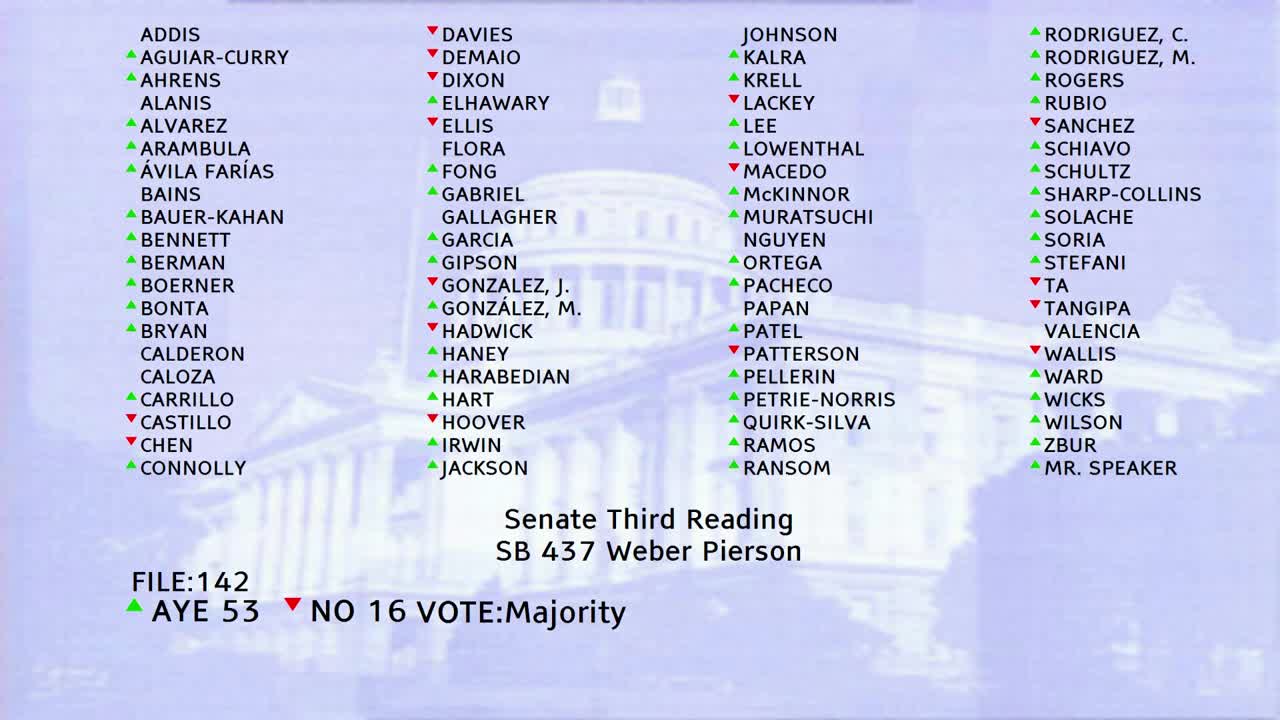 53SEC
Assembly Floor
 5MIN
Assembly Standing Committee on Labor and Employment
 10MIN
Assembly Standing Committee on Water, Parks, and Wildlife
 6MIN
Senate Floor
 12MIN
Senate Standing Committee on Natural Resources and Water
Bill Author

Bill Co-Author(s):